CN102741294A - Antibodies for the treatment and diagnosis of tumors expressing SLC34A2 (TAT211=SEQID2) - Google Patents
Antibodies for the treatment and diagnosis of tumors expressing SLC34A2 (TAT211=SEQID2) Download PDFInfo
- Publication number
- CN102741294A CN102741294A CN2010800626890A CN201080062689A CN102741294A CN 102741294 A CN102741294 A CN 102741294A CN 2010800626890 A CN2010800626890 A CN 2010800626890A CN 201080062689 A CN201080062689 A CN 201080062689A CN 102741294 A CN102741294 A CN 102741294A
- Authority
- CN
- China
- Prior art keywords
- antibody
- seq
- sequence
- polypeptide
- cells
- Prior art date
- Legal status (The legal status is an assumption and is not a legal conclusion. Google has not performed a legal analysis and makes no representation as to the accuracy of the status listed.)
- Pending
Links
Images


Classifications
-
- C—CHEMISTRY; METALLURGY
- C07—ORGANIC CHEMISTRY
- C07K—PEPTIDES
- C07K16/00—Immunoglobulins [IGs], e.g. monoclonal or polyclonal antibodies
- C07K16/18—Immunoglobulins [IGs], e.g. monoclonal or polyclonal antibodies against material from animals or humans
- C07K16/28—Immunoglobulins [IGs], e.g. monoclonal or polyclonal antibodies against material from animals or humans against receptors, cell surface antigens or cell surface determinants
- C07K16/30—Immunoglobulins [IGs], e.g. monoclonal or polyclonal antibodies against material from animals or humans against receptors, cell surface antigens or cell surface determinants from tumour cells
-
- A—HUMAN NECESSITIES
- A61—MEDICAL OR VETERINARY SCIENCE; HYGIENE
- A61K—PREPARATIONS FOR MEDICAL, DENTAL OR TOILETRY PURPOSES
- A61K31/00—Medicinal preparations containing organic active ingredients
- A61K31/33—Heterocyclic compounds
- A61K31/395—Heterocyclic compounds having nitrogen as a ring hetero atom, e.g. guanethidine or rifamycins
- A61K31/535—Heterocyclic compounds having nitrogen as a ring hetero atom, e.g. guanethidine or rifamycins having six-membered rings with at least one nitrogen and one oxygen as the ring hetero atoms, e.g. 1,2-oxazines
- A61K31/537—Heterocyclic compounds having nitrogen as a ring hetero atom, e.g. guanethidine or rifamycins having six-membered rings with at least one nitrogen and one oxygen as the ring hetero atoms, e.g. 1,2-oxazines spiro-condensed or forming part of bridged ring systems
-
- A—HUMAN NECESSITIES
- A61—MEDICAL OR VETERINARY SCIENCE; HYGIENE
- A61K—PREPARATIONS FOR MEDICAL, DENTAL OR TOILETRY PURPOSES
- A61K45/00—Medicinal preparations containing active ingredients not provided for in groups A61K31/00 - A61K41/00
- A61K45/06—Mixtures of active ingredients without chemical characterisation, e.g. antiphlogistics and cardiaca
-
- A—HUMAN NECESSITIES
- A61—MEDICAL OR VETERINARY SCIENCE; HYGIENE
- A61K—PREPARATIONS FOR MEDICAL, DENTAL OR TOILETRY PURPOSES
- A61K47/00—Medicinal preparations characterised by the non-active ingredients used, e.g. carriers or inert additives; Targeting or modifying agents chemically bound to the active ingredient
- A61K47/50—Medicinal preparations characterised by the non-active ingredients used, e.g. carriers or inert additives; Targeting or modifying agents chemically bound to the active ingredient the non-active ingredient being chemically bound to the active ingredient, e.g. polymer-drug conjugates
- A61K47/51—Medicinal preparations characterised by the non-active ingredients used, e.g. carriers or inert additives; Targeting or modifying agents chemically bound to the active ingredient the non-active ingredient being chemically bound to the active ingredient, e.g. polymer-drug conjugates the non-active ingredient being a modifying agent
- A61K47/68—Medicinal preparations characterised by the non-active ingredients used, e.g. carriers or inert additives; Targeting or modifying agents chemically bound to the active ingredient the non-active ingredient being chemically bound to the active ingredient, e.g. polymer-drug conjugates the non-active ingredient being a modifying agent the modifying agent being an antibody, an immunoglobulin or a fragment thereof, e.g. an Fc-fragment
- A61K47/6801—Drug-antibody or immunoglobulin conjugates defined by the pharmacologically or therapeutically active agent
- A61K47/6803—Drugs conjugated to an antibody or immunoglobulin, e.g. cisplatin-antibody conjugates
- A61K47/68031—Drugs conjugated to an antibody or immunoglobulin, e.g. cisplatin-antibody conjugates the drug being an auristatin
-
- A—HUMAN NECESSITIES
- A61—MEDICAL OR VETERINARY SCIENCE; HYGIENE
- A61K—PREPARATIONS FOR MEDICAL, DENTAL OR TOILETRY PURPOSES
- A61K47/00—Medicinal preparations characterised by the non-active ingredients used, e.g. carriers or inert additives; Targeting or modifying agents chemically bound to the active ingredient
- A61K47/50—Medicinal preparations characterised by the non-active ingredients used, e.g. carriers or inert additives; Targeting or modifying agents chemically bound to the active ingredient the non-active ingredient being chemically bound to the active ingredient, e.g. polymer-drug conjugates
- A61K47/51—Medicinal preparations characterised by the non-active ingredients used, e.g. carriers or inert additives; Targeting or modifying agents chemically bound to the active ingredient the non-active ingredient being chemically bound to the active ingredient, e.g. polymer-drug conjugates the non-active ingredient being a modifying agent
- A61K47/68—Medicinal preparations characterised by the non-active ingredients used, e.g. carriers or inert additives; Targeting or modifying agents chemically bound to the active ingredient the non-active ingredient being chemically bound to the active ingredient, e.g. polymer-drug conjugates the non-active ingredient being a modifying agent the modifying agent being an antibody, an immunoglobulin or a fragment thereof, e.g. an Fc-fragment
- A61K47/6801—Drug-antibody or immunoglobulin conjugates defined by the pharmacologically or therapeutically active agent
- A61K47/6803—Drugs conjugated to an antibody or immunoglobulin, e.g. cisplatin-antibody conjugates
- A61K47/68033—Drugs conjugated to an antibody or immunoglobulin, e.g. cisplatin-antibody conjugates the drug being a maytansine
-
- A—HUMAN NECESSITIES
- A61—MEDICAL OR VETERINARY SCIENCE; HYGIENE
- A61K—PREPARATIONS FOR MEDICAL, DENTAL OR TOILETRY PURPOSES
- A61K47/00—Medicinal preparations characterised by the non-active ingredients used, e.g. carriers or inert additives; Targeting or modifying agents chemically bound to the active ingredient
- A61K47/50—Medicinal preparations characterised by the non-active ingredients used, e.g. carriers or inert additives; Targeting or modifying agents chemically bound to the active ingredient the non-active ingredient being chemically bound to the active ingredient, e.g. polymer-drug conjugates
- A61K47/51—Medicinal preparations characterised by the non-active ingredients used, e.g. carriers or inert additives; Targeting or modifying agents chemically bound to the active ingredient the non-active ingredient being chemically bound to the active ingredient, e.g. polymer-drug conjugates the non-active ingredient being a modifying agent
- A61K47/68—Medicinal preparations characterised by the non-active ingredients used, e.g. carriers or inert additives; Targeting or modifying agents chemically bound to the active ingredient the non-active ingredient being chemically bound to the active ingredient, e.g. polymer-drug conjugates the non-active ingredient being a modifying agent the modifying agent being an antibody, an immunoglobulin or a fragment thereof, e.g. an Fc-fragment
- A61K47/6801—Drug-antibody or immunoglobulin conjugates defined by the pharmacologically or therapeutically active agent
- A61K47/6803—Drugs conjugated to an antibody or immunoglobulin, e.g. cisplatin-antibody conjugates
- A61K47/6807—Drugs conjugated to an antibody or immunoglobulin, e.g. cisplatin-antibody conjugates the drug or compound being a sugar, nucleoside, nucleotide, nucleic acid, e.g. RNA antisense
- A61K47/6809—Antibiotics, e.g. antitumor antibiotics anthracyclins, adriamycin, doxorubicin or daunomycin
-
- A—HUMAN NECESSITIES
- A61—MEDICAL OR VETERINARY SCIENCE; HYGIENE
- A61K—PREPARATIONS FOR MEDICAL, DENTAL OR TOILETRY PURPOSES
- A61K47/00—Medicinal preparations characterised by the non-active ingredients used, e.g. carriers or inert additives; Targeting or modifying agents chemically bound to the active ingredient
- A61K47/50—Medicinal preparations characterised by the non-active ingredients used, e.g. carriers or inert additives; Targeting or modifying agents chemically bound to the active ingredient the non-active ingredient being chemically bound to the active ingredient, e.g. polymer-drug conjugates
- A61K47/51—Medicinal preparations characterised by the non-active ingredients used, e.g. carriers or inert additives; Targeting or modifying agents chemically bound to the active ingredient the non-active ingredient being chemically bound to the active ingredient, e.g. polymer-drug conjugates the non-active ingredient being a modifying agent
- A61K47/68—Medicinal preparations characterised by the non-active ingredients used, e.g. carriers or inert additives; Targeting or modifying agents chemically bound to the active ingredient the non-active ingredient being chemically bound to the active ingredient, e.g. polymer-drug conjugates the non-active ingredient being a modifying agent the modifying agent being an antibody, an immunoglobulin or a fragment thereof, e.g. an Fc-fragment
- A61K47/6801—Drug-antibody or immunoglobulin conjugates defined by the pharmacologically or therapeutically active agent
- A61K47/6803—Drugs conjugated to an antibody or immunoglobulin, e.g. cisplatin-antibody conjugates
- A61K47/6811—Drugs conjugated to an antibody or immunoglobulin, e.g. cisplatin-antibody conjugates the drug being a protein or peptide, e.g. transferrin or bleomycin
- A61K47/6813—Drugs conjugated to an antibody or immunoglobulin, e.g. cisplatin-antibody conjugates the drug being a protein or peptide, e.g. transferrin or bleomycin the drug being a peptidic cytokine, e.g. an interleukin or interferon
-
- A—HUMAN NECESSITIES
- A61—MEDICAL OR VETERINARY SCIENCE; HYGIENE
- A61K—PREPARATIONS FOR MEDICAL, DENTAL OR TOILETRY PURPOSES
- A61K47/00—Medicinal preparations characterised by the non-active ingredients used, e.g. carriers or inert additives; Targeting or modifying agents chemically bound to the active ingredient
- A61K47/50—Medicinal preparations characterised by the non-active ingredients used, e.g. carriers or inert additives; Targeting or modifying agents chemically bound to the active ingredient the non-active ingredient being chemically bound to the active ingredient, e.g. polymer-drug conjugates
- A61K47/51—Medicinal preparations characterised by the non-active ingredients used, e.g. carriers or inert additives; Targeting or modifying agents chemically bound to the active ingredient the non-active ingredient being chemically bound to the active ingredient, e.g. polymer-drug conjugates the non-active ingredient being a modifying agent
- A61K47/68—Medicinal preparations characterised by the non-active ingredients used, e.g. carriers or inert additives; Targeting or modifying agents chemically bound to the active ingredient the non-active ingredient being chemically bound to the active ingredient, e.g. polymer-drug conjugates the non-active ingredient being a modifying agent the modifying agent being an antibody, an immunoglobulin or a fragment thereof, e.g. an Fc-fragment
- A61K47/6801—Drug-antibody or immunoglobulin conjugates defined by the pharmacologically or therapeutically active agent
- A61K47/6803—Drugs conjugated to an antibody or immunoglobulin, e.g. cisplatin-antibody conjugates
- A61K47/6811—Drugs conjugated to an antibody or immunoglobulin, e.g. cisplatin-antibody conjugates the drug being a protein or peptide, e.g. transferrin or bleomycin
- A61K47/6817—Toxins
-
- A—HUMAN NECESSITIES
- A61—MEDICAL OR VETERINARY SCIENCE; HYGIENE
- A61K—PREPARATIONS FOR MEDICAL, DENTAL OR TOILETRY PURPOSES
- A61K47/00—Medicinal preparations characterised by the non-active ingredients used, e.g. carriers or inert additives; Targeting or modifying agents chemically bound to the active ingredient
- A61K47/50—Medicinal preparations characterised by the non-active ingredients used, e.g. carriers or inert additives; Targeting or modifying agents chemically bound to the active ingredient the non-active ingredient being chemically bound to the active ingredient, e.g. polymer-drug conjugates
- A61K47/51—Medicinal preparations characterised by the non-active ingredients used, e.g. carriers or inert additives; Targeting or modifying agents chemically bound to the active ingredient the non-active ingredient being chemically bound to the active ingredient, e.g. polymer-drug conjugates the non-active ingredient being a modifying agent
- A61K47/68—Medicinal preparations characterised by the non-active ingredients used, e.g. carriers or inert additives; Targeting or modifying agents chemically bound to the active ingredient the non-active ingredient being chemically bound to the active ingredient, e.g. polymer-drug conjugates the non-active ingredient being a modifying agent the modifying agent being an antibody, an immunoglobulin or a fragment thereof, e.g. an Fc-fragment
- A61K47/6835—Medicinal preparations characterised by the non-active ingredients used, e.g. carriers or inert additives; Targeting or modifying agents chemically bound to the active ingredient the non-active ingredient being chemically bound to the active ingredient, e.g. polymer-drug conjugates the non-active ingredient being a modifying agent the modifying agent being an antibody, an immunoglobulin or a fragment thereof, e.g. an Fc-fragment the modifying agent being an antibody or an immunoglobulin bearing at least one antigen-binding site
- A61K47/6849—Medicinal preparations characterised by the non-active ingredients used, e.g. carriers or inert additives; Targeting or modifying agents chemically bound to the active ingredient the non-active ingredient being chemically bound to the active ingredient, e.g. polymer-drug conjugates the non-active ingredient being a modifying agent the modifying agent being an antibody, an immunoglobulin or a fragment thereof, e.g. an Fc-fragment the modifying agent being an antibody or an immunoglobulin bearing at least one antigen-binding site the antibody targeting a receptor, a cell surface antigen or a cell surface determinant
-
- A—HUMAN NECESSITIES
- A61—MEDICAL OR VETERINARY SCIENCE; HYGIENE
- A61K—PREPARATIONS FOR MEDICAL, DENTAL OR TOILETRY PURPOSES
- A61K47/00—Medicinal preparations characterised by the non-active ingredients used, e.g. carriers or inert additives; Targeting or modifying agents chemically bound to the active ingredient
- A61K47/50—Medicinal preparations characterised by the non-active ingredients used, e.g. carriers or inert additives; Targeting or modifying agents chemically bound to the active ingredient the non-active ingredient being chemically bound to the active ingredient, e.g. polymer-drug conjugates
- A61K47/51—Medicinal preparations characterised by the non-active ingredients used, e.g. carriers or inert additives; Targeting or modifying agents chemically bound to the active ingredient the non-active ingredient being chemically bound to the active ingredient, e.g. polymer-drug conjugates the non-active ingredient being a modifying agent
- A61K47/68—Medicinal preparations characterised by the non-active ingredients used, e.g. carriers or inert additives; Targeting or modifying agents chemically bound to the active ingredient the non-active ingredient being chemically bound to the active ingredient, e.g. polymer-drug conjugates the non-active ingredient being a modifying agent the modifying agent being an antibody, an immunoglobulin or a fragment thereof, e.g. an Fc-fragment
- A61K47/6835—Medicinal preparations characterised by the non-active ingredients used, e.g. carriers or inert additives; Targeting or modifying agents chemically bound to the active ingredient the non-active ingredient being chemically bound to the active ingredient, e.g. polymer-drug conjugates the non-active ingredient being a modifying agent the modifying agent being an antibody, an immunoglobulin or a fragment thereof, e.g. an Fc-fragment the modifying agent being an antibody or an immunoglobulin bearing at least one antigen-binding site
- A61K47/6851—Medicinal preparations characterised by the non-active ingredients used, e.g. carriers or inert additives; Targeting or modifying agents chemically bound to the active ingredient the non-active ingredient being chemically bound to the active ingredient, e.g. polymer-drug conjugates the non-active ingredient being a modifying agent the modifying agent being an antibody, an immunoglobulin or a fragment thereof, e.g. an Fc-fragment the modifying agent being an antibody or an immunoglobulin bearing at least one antigen-binding site the antibody targeting a determinant of a tumour cell
-
- A—HUMAN NECESSITIES
- A61—MEDICAL OR VETERINARY SCIENCE; HYGIENE
- A61K—PREPARATIONS FOR MEDICAL, DENTAL OR TOILETRY PURPOSES
- A61K47/00—Medicinal preparations characterised by the non-active ingredients used, e.g. carriers or inert additives; Targeting or modifying agents chemically bound to the active ingredient
- A61K47/50—Medicinal preparations characterised by the non-active ingredients used, e.g. carriers or inert additives; Targeting or modifying agents chemically bound to the active ingredient the non-active ingredient being chemically bound to the active ingredient, e.g. polymer-drug conjugates
- A61K47/51—Medicinal preparations characterised by the non-active ingredients used, e.g. carriers or inert additives; Targeting or modifying agents chemically bound to the active ingredient the non-active ingredient being chemically bound to the active ingredient, e.g. polymer-drug conjugates the non-active ingredient being a modifying agent
- A61K47/68—Medicinal preparations characterised by the non-active ingredients used, e.g. carriers or inert additives; Targeting or modifying agents chemically bound to the active ingredient the non-active ingredient being chemically bound to the active ingredient, e.g. polymer-drug conjugates the non-active ingredient being a modifying agent the modifying agent being an antibody, an immunoglobulin or a fragment thereof, e.g. an Fc-fragment
- A61K47/6835—Medicinal preparations characterised by the non-active ingredients used, e.g. carriers or inert additives; Targeting or modifying agents chemically bound to the active ingredient the non-active ingredient being chemically bound to the active ingredient, e.g. polymer-drug conjugates the non-active ingredient being a modifying agent the modifying agent being an antibody, an immunoglobulin or a fragment thereof, e.g. an Fc-fragment the modifying agent being an antibody or an immunoglobulin bearing at least one antigen-binding site
- A61K47/6851—Medicinal preparations characterised by the non-active ingredients used, e.g. carriers or inert additives; Targeting or modifying agents chemically bound to the active ingredient the non-active ingredient being chemically bound to the active ingredient, e.g. polymer-drug conjugates the non-active ingredient being a modifying agent the modifying agent being an antibody, an immunoglobulin or a fragment thereof, e.g. an Fc-fragment the modifying agent being an antibody or an immunoglobulin bearing at least one antigen-binding site the antibody targeting a determinant of a tumour cell
- A61K47/6857—Medicinal preparations characterised by the non-active ingredients used, e.g. carriers or inert additives; Targeting or modifying agents chemically bound to the active ingredient the non-active ingredient being chemically bound to the active ingredient, e.g. polymer-drug conjugates the non-active ingredient being a modifying agent the modifying agent being an antibody, an immunoglobulin or a fragment thereof, e.g. an Fc-fragment the modifying agent being an antibody or an immunoglobulin bearing at least one antigen-binding site the antibody targeting a determinant of a tumour cell the tumour determinant being from lung cancer cell
-
- A—HUMAN NECESSITIES
- A61—MEDICAL OR VETERINARY SCIENCE; HYGIENE
- A61K—PREPARATIONS FOR MEDICAL, DENTAL OR TOILETRY PURPOSES
- A61K47/00—Medicinal preparations characterised by the non-active ingredients used, e.g. carriers or inert additives; Targeting or modifying agents chemically bound to the active ingredient
- A61K47/50—Medicinal preparations characterised by the non-active ingredients used, e.g. carriers or inert additives; Targeting or modifying agents chemically bound to the active ingredient the non-active ingredient being chemically bound to the active ingredient, e.g. polymer-drug conjugates
- A61K47/51—Medicinal preparations characterised by the non-active ingredients used, e.g. carriers or inert additives; Targeting or modifying agents chemically bound to the active ingredient the non-active ingredient being chemically bound to the active ingredient, e.g. polymer-drug conjugates the non-active ingredient being a modifying agent
- A61K47/68—Medicinal preparations characterised by the non-active ingredients used, e.g. carriers or inert additives; Targeting or modifying agents chemically bound to the active ingredient the non-active ingredient being chemically bound to the active ingredient, e.g. polymer-drug conjugates the non-active ingredient being a modifying agent the modifying agent being an antibody, an immunoglobulin or a fragment thereof, e.g. an Fc-fragment
- A61K47/6835—Medicinal preparations characterised by the non-active ingredients used, e.g. carriers or inert additives; Targeting or modifying agents chemically bound to the active ingredient the non-active ingredient being chemically bound to the active ingredient, e.g. polymer-drug conjugates the non-active ingredient being a modifying agent the modifying agent being an antibody, an immunoglobulin or a fragment thereof, e.g. an Fc-fragment the modifying agent being an antibody or an immunoglobulin bearing at least one antigen-binding site
- A61K47/6851—Medicinal preparations characterised by the non-active ingredients used, e.g. carriers or inert additives; Targeting or modifying agents chemically bound to the active ingredient the non-active ingredient being chemically bound to the active ingredient, e.g. polymer-drug conjugates the non-active ingredient being a modifying agent the modifying agent being an antibody, an immunoglobulin or a fragment thereof, e.g. an Fc-fragment the modifying agent being an antibody or an immunoglobulin bearing at least one antigen-binding site the antibody targeting a determinant of a tumour cell
- A61K47/6869—Medicinal preparations characterised by the non-active ingredients used, e.g. carriers or inert additives; Targeting or modifying agents chemically bound to the active ingredient the non-active ingredient being chemically bound to the active ingredient, e.g. polymer-drug conjugates the non-active ingredient being a modifying agent the modifying agent being an antibody, an immunoglobulin or a fragment thereof, e.g. an Fc-fragment the modifying agent being an antibody or an immunoglobulin bearing at least one antigen-binding site the antibody targeting a determinant of a tumour cell the tumour determinant being from a cell of the reproductive system: ovaria, uterus, testes, prostate
-
- A—HUMAN NECESSITIES
- A61—MEDICAL OR VETERINARY SCIENCE; HYGIENE
- A61P—SPECIFIC THERAPEUTIC ACTIVITY OF CHEMICAL COMPOUNDS OR MEDICINAL PREPARATIONS
- A61P35/00—Antineoplastic agents
-
- A—HUMAN NECESSITIES
- A61—MEDICAL OR VETERINARY SCIENCE; HYGIENE
- A61P—SPECIFIC THERAPEUTIC ACTIVITY OF CHEMICAL COMPOUNDS OR MEDICINAL PREPARATIONS
- A61P37/00—Drugs for immunological or allergic disorders
- A61P37/02—Immunomodulators
- A61P37/04—Immunostimulants
-
- C—CHEMISTRY; METALLURGY
- C07—ORGANIC CHEMISTRY
- C07K—PEPTIDES
- C07K16/00—Immunoglobulins [IGs], e.g. monoclonal or polyclonal antibodies
- C07K16/18—Immunoglobulins [IGs], e.g. monoclonal or polyclonal antibodies against material from animals or humans
-
- C—CHEMISTRY; METALLURGY
- C07—ORGANIC CHEMISTRY
- C07K—PEPTIDES
- C07K16/00—Immunoglobulins [IGs], e.g. monoclonal or polyclonal antibodies
- C07K16/18—Immunoglobulins [IGs], e.g. monoclonal or polyclonal antibodies against material from animals or humans
- C07K16/28—Immunoglobulins [IGs], e.g. monoclonal or polyclonal antibodies against material from animals or humans against receptors, cell surface antigens or cell surface determinants
-
- C—CHEMISTRY; METALLURGY
- C07—ORGANIC CHEMISTRY
- C07K—PEPTIDES
- C07K16/00—Immunoglobulins [IGs], e.g. monoclonal or polyclonal antibodies
- C07K16/18—Immunoglobulins [IGs], e.g. monoclonal or polyclonal antibodies against material from animals or humans
- C07K16/28—Immunoglobulins [IGs], e.g. monoclonal or polyclonal antibodies against material from animals or humans against receptors, cell surface antigens or cell surface determinants
- C07K16/30—Immunoglobulins [IGs], e.g. monoclonal or polyclonal antibodies against material from animals or humans against receptors, cell surface antigens or cell surface determinants from tumour cells
- C07K16/3023—Lung
-
- C—CHEMISTRY; METALLURGY
- C07—ORGANIC CHEMISTRY
- C07K—PEPTIDES
- C07K16/00—Immunoglobulins [IGs], e.g. monoclonal or polyclonal antibodies
- C07K16/18—Immunoglobulins [IGs], e.g. monoclonal or polyclonal antibodies against material from animals or humans
- C07K16/28—Immunoglobulins [IGs], e.g. monoclonal or polyclonal antibodies against material from animals or humans against receptors, cell surface antigens or cell surface determinants
- C07K16/30—Immunoglobulins [IGs], e.g. monoclonal or polyclonal antibodies against material from animals or humans against receptors, cell surface antigens or cell surface determinants from tumour cells
- C07K16/3069—Reproductive system, e.g. ovaria, uterus, testes, prostate
-
- G01N33/5752—
-
- G01N33/57545—
-
- G01N33/5759—
-
- A—HUMAN NECESSITIES
- A61—MEDICAL OR VETERINARY SCIENCE; HYGIENE
- A61K—PREPARATIONS FOR MEDICAL, DENTAL OR TOILETRY PURPOSES
- A61K39/00—Medicinal preparations containing antigens or antibodies
- A61K2039/505—Medicinal preparations containing antigens or antibodies comprising antibodies
-
- C—CHEMISTRY; METALLURGY
- C07—ORGANIC CHEMISTRY
- C07K—PEPTIDES
- C07K2317/00—Immunoglobulins specific features
- C07K2317/10—Immunoglobulins specific features characterized by their source of isolation or production
- C07K2317/14—Specific host cells or culture conditions, e.g. components, pH or temperature
-
- C—CHEMISTRY; METALLURGY
- C07—ORGANIC CHEMISTRY
- C07K—PEPTIDES
- C07K2317/00—Immunoglobulins specific features
- C07K2317/20—Immunoglobulins specific features characterized by taxonomic origin
- C07K2317/24—Immunoglobulins specific features characterized by taxonomic origin containing regions, domains or residues from different species, e.g. chimeric, humanized or veneered
-
- C—CHEMISTRY; METALLURGY
- C07—ORGANIC CHEMISTRY
- C07K—PEPTIDES
- C07K2317/00—Immunoglobulins specific features
- C07K2317/50—Immunoglobulins specific features characterized by immunoglobulin fragments
- C07K2317/56—Immunoglobulins specific features characterized by immunoglobulin fragments variable (Fv) region, i.e. VH and/or VL
-
- C—CHEMISTRY; METALLURGY
- C07—ORGANIC CHEMISTRY
- C07K—PEPTIDES
- C07K2317/00—Immunoglobulins specific features
- C07K2317/50—Immunoglobulins specific features characterized by immunoglobulin fragments
- C07K2317/56—Immunoglobulins specific features characterized by immunoglobulin fragments variable (Fv) region, i.e. VH and/or VL
- C07K2317/565—Complementarity determining region [CDR]
-
- C—CHEMISTRY; METALLURGY
- C07—ORGANIC CHEMISTRY
- C07K—PEPTIDES
- C07K2317/00—Immunoglobulins specific features
- C07K2317/50—Immunoglobulins specific features characterized by immunoglobulin fragments
- C07K2317/56—Immunoglobulins specific features characterized by immunoglobulin fragments variable (Fv) region, i.e. VH and/or VL
- C07K2317/567—Framework region [FR]
-
- C—CHEMISTRY; METALLURGY
- C07—ORGANIC CHEMISTRY
- C07K—PEPTIDES
- C07K2317/00—Immunoglobulins specific features
- C07K2317/70—Immunoglobulins specific features characterized by effect upon binding to a cell or to an antigen
- C07K2317/73—Inducing cell death, e.g. apoptosis, necrosis or inhibition of cell proliferation
-
- C—CHEMISTRY; METALLURGY
- C07—ORGANIC CHEMISTRY
- C07K—PEPTIDES
- C07K2317/00—Immunoglobulins specific features
- C07K2317/70—Immunoglobulins specific features characterized by effect upon binding to a cell or to an antigen
- C07K2317/76—Antagonist effect on antigen, e.g. neutralization or inhibition of binding
-
- C—CHEMISTRY; METALLURGY
- C07—ORGANIC CHEMISTRY
- C07K—PEPTIDES
- C07K2317/00—Immunoglobulins specific features
- C07K2317/70—Immunoglobulins specific features characterized by effect upon binding to a cell or to an antigen
- C07K2317/77—Internalization into the cell
-
- C—CHEMISTRY; METALLURGY
- C07—ORGANIC CHEMISTRY
- C07K—PEPTIDES
- C07K2317/00—Immunoglobulins specific features
- C07K2317/90—Immunoglobulins specific features characterized by (pharmaco)kinetic aspects or by stability of the immunoglobulin
- C07K2317/92—Affinity (KD), association rate (Ka), dissociation rate (Kd) or EC50 value
Landscapes
- Health & Medical Sciences (AREA)
- Life Sciences & Earth Sciences (AREA)
- Engineering & Computer Science (AREA)
- Chemical & Material Sciences (AREA)
- Bioinformatics & Cheminformatics (AREA)
- Immunology (AREA)
- Medicinal Chemistry (AREA)
- General Health & Medical Sciences (AREA)
- Veterinary Medicine (AREA)
- Pharmacology & Pharmacy (AREA)
- Animal Behavior & Ethology (AREA)
- Public Health (AREA)
- Epidemiology (AREA)
- Cell Biology (AREA)
- Organic Chemistry (AREA)
- Molecular Biology (AREA)
- Biochemistry (AREA)
- Proteomics, Peptides & Aminoacids (AREA)
- Genetics & Genomics (AREA)
- Biophysics (AREA)
- Reproductive Health (AREA)
- Oncology (AREA)
- Pulmonology (AREA)
- Toxicology (AREA)
- Chemical Kinetics & Catalysis (AREA)
- General Chemical & Material Sciences (AREA)
- Nuclear Medicine, Radiotherapy & Molecular Imaging (AREA)
- Gynecology & Obstetrics (AREA)
- Pregnancy & Childbirth (AREA)
- Medicines Containing Antibodies Or Antigens For Use As Internal Diagnostic Agents (AREA)
- Peptides Or Proteins (AREA)
- Hematology (AREA)
- Urology & Nephrology (AREA)
- Biomedical Technology (AREA)
- General Physics & Mathematics (AREA)
- Food Science & Technology (AREA)
- Physics & Mathematics (AREA)
- Analytical Chemistry (AREA)
- Biotechnology (AREA)
- Pathology (AREA)
Abstract
Description
相关申请 related application
本申请是依据37C.F.R.§1.53(b)(1)提交的非临时申请,依据35U.S.C.§119(e)要求2009年11月30日提交的流水号为61/265,262的临时申请和2010年9月20日提交的流水号为61/384,467的临时申请的优先权,通过提及在此完整收录其内容。
This application is a nonprovisional application filed pursuant to 37 C.F.R. §1.53(b)(1), provisional
技术领域 technical field
本发明致力于可用于诊断和治疗哺乳动物中的肿瘤的物质组合物,及使用那些物质组合物来诊断和治疗哺乳动物中的肿瘤的方法。 The present invention is directed to compositions of matter useful for diagnosing and treating tumors in mammals, and methods of using those compositions of matter for diagnosing and treating tumors in mammals. the
发明背景 Background of the invention
恶性肿瘤(癌)是在美国位居心脏病之后的第二位致死原因(Boring et al.,CA Cancel J.Clin.43:7(1993))。癌的特征为衍生自正常组织的异常或肿瘤性细胞的数量增加,所述细胞增殖形成肿瘤块;这些赘生性肿瘤细胞侵入邻近组织;及产生恶性细胞,所述恶性细胞最终经血液或淋巴系统传播到局部淋巴结并经称为转移的过程传播到远处。在癌性状态,细胞在正常细胞不生长的条件下增殖。癌自身表现为多种形式,特征为不同程度的侵袭力和进攻性。 Malignant tumors (cancers) are the second leading cause of death in the United States after heart disease (Boring et al., CA Cancel J. Clin. 43:7 (1993)). Carcinoma is characterized by an increased number of abnormal or neoplastic cells derived from normal tissue that proliferate to form a tumor mass; invasion of adjacent tissues by these neoplastic neoplastic cells; and production of malignant cells that eventually pass through the blood or lymphatic system Spread to regional lymph nodes and to distant places through a process called metastasis. In the cancerous state, cells proliferate under conditions in which normal cells do not grow. Cancer manifests itself in many forms, characterized by varying degrees of invasiveness and aggressiveness. the
在寻找癌症诊断和治疗的有效细胞靶物的尝试中,研究人员试图鉴定在一种或多种特定类型的癌细胞的表面上与一种或多种正常非癌性细胞相比特异性表达的跨膜多肽膜相关多肽。通常,此类膜相关多肽在癌细胞的表面上比在非癌性细胞的表面上表达的量更大。此类肿瘤相关细胞表面抗原多肽的鉴定导致了经基于抗体的疗法特异性靶向破坏癌细胞的能力。在这点上,注意到基于抗体的疗法已经证明在某些癌症的治疗中是非常有效的。例如, 



尽管在哺乳动物癌症疗法中有了上述进展,对于能够分别检测哺乳动物中肿瘤的存在和有效抑制肿瘤性细胞生长的另外的诊断和治疗剂仍然存在很大的需要。因此,本发明的目标之一是鉴定在一种或多种类型的癌细胞上与正常细胞上或其它不同癌细胞上相比表达更大量的细胞膜相关多肽,及使用那些多肽及其编码核酸来生成可用于哺乳动物中的癌症的治疗性处理和诊断性检测的物质组合物。 Despite the aforementioned advances in mammalian cancer therapy, there remains a great need for additional diagnostic and therapeutic agents capable of detecting the presence of tumors and effectively inhibiting the growth of neoplastic cells, respectively, in mammals. Accordingly, one of the objectives of the present invention is to identify cell membrane-associated polypeptides expressed in greater amounts on one or more types of cancer cells than on normal cells or on other different cancer cells, and to use those polypeptides and nucleic acids encoding them to Compositions of matter useful for the therapeutic treatment and diagnostic detection of cancer in mammals are produced. the
发明概述 Summary of the invention
在本说明书中,申请人首次描述了如下所述的细胞多肽(及其编码核酸或其片段)的鉴定,所述细胞多肽在一种或多种类型癌细胞表面上表达的程度高于它们在一种或多种类型正常非癌细胞表面上表达的程度。这些多肽在本文中称为肿瘤相关抗原性靶多肽(Tumor-associated Antigenic Target polypeptides,“TAT”多肽),它们有望充当哺乳动物中癌症治疗和诊断的有效靶物。 In this specification, Applicants describe for the first time the identification of cellular polypeptides (and nucleic acids encoding them or fragments thereof) that are expressed on the surface of one or more types of cancer cells to a greater extent than they are on the The extent to which one or more types are expressed on the surface of normal, non-cancerous cells. These polypeptides, referred to herein as Tumor-associated Antigenic Target polypeptides ("TAT" polypeptides), are expected to serve as effective targets for cancer therapy and diagnosis in mammals. the
因此,在本发明的一个实施方案中,本发明提供了分离的核酸分子,其具有编码肿瘤相关抗原性靶多肽或其片段(“TAT”多肽)的核苷酸序列。 Accordingly, in one embodiment of the invention, the invention provides an isolated nucleic acid molecule having a nucleotide sequence encoding a tumor-associated antigenic target polypeptide or a fragment thereof ("TAT" polypeptide). the
在某些方面,所述分离的核酸分子包含与下述各项具有至少约80%的核酸序列同一性,或者至少约81%、82%、83%、84%、85%、86%、87%、88%、89%、90%、91%、92%、93%、94%、95%、96%、97%、98%、99%或100%的核酸序列同一性的核苷酸序列: In certain aspects, the isolated nucleic acid molecule comprises at least about 80% nucleic acid sequence identity, or at least about 81%, 82%, 83%, 84%, 85%, 86%, 87% A nucleotide sequence with %, 88%, 89%, 90%, 91%, 92%, 93%, 94%, 95%, 96%, 97%, 98%, 99%, or 100% nucleic acid sequence identity :
(a)编码 (a) Coding
具有本文所公开的氨基酸序列的全长TAT多肽、 A full-length TAT polypeptide having an amino acid sequence disclosed herein,
本文所公开的缺少信号肽的TAT多肽氨基酸序列、 The amino acid sequence of the TAT polypeptide lacking the signal peptide disclosed herein,
本文所公开的有或没有信号肽的跨膜TAT多肽的胞外域、或 The extracellular domain of the transmembrane TAT polypeptide disclosed herein with or without a signal peptide, or
本文所公开的全长TAT多肽氨基酸序列的任何其它具体定义的片段的DNA分子;或者 A DNA molecule of any other specifically defined fragment of the full-length TAT polypeptide amino acid sequence disclosed herein; or
(b)(a)的DNA分子的互补分子(complement)。 (b) A complement to the DNA molecule of (a). the
在其它方面,所述分离的核酸分子包含与下述各项具有至少约80%的核 酸序列同一性,或者至少约81%、82%、83%、84%、85%、86%、87%、88%、89%、90%、91%、92%、93%、94%、95%、96%、97%、98%、99%或100%的核酸序列同一性的核苷酸序列: In other aspects, the isolated nucleic acid molecule comprises at least about 80% nucleic acid sequence identity to the following, or at least about 81%, 82%, 83%, 84%, 85%, 86%, 87% A nucleotide sequence with %, 88%, 89%, 90%, 91%, 92%, 93%, 94%, 95%, 96%, 97%, 98%, 99%, or 100% nucleic acid sequence identity :
(a)包含 (a) contains
本文所公开的全长TAT多肽cDNA的编码序列、 The coding sequence of the full-length TAT polypeptide cDNA disclosed herein,
本文所公开的缺少信号肽的TAT多肽的编码序列、 The coding sequence of the TAT polypeptide lacking the signal peptide disclosed herein,
本文所公开的有或没有信号肽的跨膜TAT多肽的胞外域的编码序列、或 The coding sequence of the extracellular domain of the transmembrane TAT polypeptide disclosed herein with or without a signal peptide, or
本文所公开的全长TAT多肽氨基酸序列的任何其它具体定义的片段的编码序列的DNA分子;或者 A DNA molecule of the coding sequence of any other specifically defined fragment of the full-length TAT polypeptide amino acid sequence disclosed herein; or
(b)(a)的DNA分子的互补分子。 (b) A complementary molecule to the DNA molecule of (a). the
本文的另一个方面提供了分离的核酸分子,其包含如下核苷酸序列,所述核苷酸序列编码跨膜域删除的或跨膜域灭活的TAT多肽,或者与此类编码核苷酸序列互补,其中,本文中公开了此类多肽的跨膜域。因此,设想了本文中所描述的TAT多肽的可溶性胞外域。 Another aspect herein provides an isolated nucleic acid molecule comprising a nucleotide sequence encoding a TAT polypeptide with a transmembrane domain deleted or a transmembrane domain inactivated, or in combination with such encoding nucleotides The sequences are complementary, wherein the transmembrane domains of such polypeptides are disclosed herein. Thus, the soluble extracellular domains of the TAT polypeptides described herein are contemplated. the
在其它方面,本发明致力于分离的核酸分子,其与下述核苷酸序列杂交: In other aspects, the present invention is directed to isolated nucleic acid molecules that hybridize to the following nucleotide sequences:
(a)编码 (a) Coding
具有本文所公开的全长氨基酸序列的TAT多肽、 TAT polypeptide having the full-length amino acid sequence disclosed herein,
本文所公开的缺少信号肽的TAT多肽氨基酸序列、 The amino acid sequence of the TAT polypeptide lacking the signal peptide disclosed herein,
本文所公开的有或没有信号肽的跨膜TAT多肽的胞外域、或 The extracellular domain of the transmembrane TAT polypeptide disclosed herein with or without a signal peptide, or
本文所公开的全长TAT多肽氨基酸序列的任何其它具体定义的片段的核苷酸序列,或者 The nucleotide sequence of any other specifically defined fragment of the full-length TAT polypeptide amino acid sequence disclosed herein, or
(b)(a)的核苷酸序列的互补分子。 (b) A complementary molecule to the nucleotide sequence of (a). the
在这点上,本发明的一个实施方案致力于本文所公开的全长TAT多肽编码序列的片段或其互补序列,它们可用作例如杂交探针,所述杂交探针可用作例如诊断探针、PCR引物、反义寡核苷酸探针,或者用于编码全长TAT多肽的片段,可任选编码包含抗TAT多肽抗体的结合位点的多肽。此类核酸片段的长度通常为至少约5个核苷酸,或者长度为至少约6、7、8、9、10、11、12、13、14、15、16、17、18、19、20、21、22、23、24、25、26、27、28、29、30、35、40、45、50、55、60、65、70、75、80、85、90、95、100、105、110、115、120、125、130、135、140、145、150、155、160、165、 170、175、180、185、190、195、200、210、220、230、240、250、260、270、280、290、300、310、320、330、340、350、360、370、380、390、400、410、420、430、440、450、460、470、480、490、500、510、520、530、540、550、560、570、580、590、600、610、620、630、640、650、660、670、680、690、700、710、720、730、740、750、760、770、780、790、800、810、820、830、840、850、860、870、880、890、900、910、920、930、940、950、960、970、980、990或1000个核苷酸,其中在此语境中,术语“约”意指所述核苷酸序列长度加上或减去所述长度的10%。此外,此类核酸片段经常包含衍生自TAT多肽全长编码序列或其互补序列的连续核苷酸。注意到TAT多肽编码核苷酸序列或其互补序列的新片段可以常规方式确定,即使用多种众所周知的序列对比程序中的任一种将TAT多肽编码核苷酸序列与其它已知核苷酸序列对比,并确定哪个(些)TAT多肽编码核苷酸序列或其互补序列是新的。本文设想了TAT多肽编码核苷酸序列或其互补序列的所有此类新片段。还设想了由这些核苷酸分子片段编码的TAT多肽片段,优选那些包含抗TAT多肽抗体的结合位点的TAT多肽片段。
In this regard, one embodiment of the invention is directed to fragments of the full-length TAT polypeptide coding sequence disclosed herein or its complement, which can be used, for example, as hybridization probes which can be used, for example, as diagnostic probes. Needles, PCR primers, antisense oligonucleotide probes, or fragments for encoding full-length TAT polypeptides, may optionally encode polypeptides comprising a binding site for an anti-TAT polypeptide antibody. Such nucleic acid fragments are typically at least about 5 nucleotides in length, or at least about 6, 7, 8, 9, 10, 11, 12, 13, 14, 15, 16, 17, 18, 19, 20 nucleotides in length. , 21, 22, 23, 24, 25, 26, 27, 28, 29, 30, 35, 40, 45, 50, 55, 60, 65, 70, 75, 80, 85, 90, 95, 100, 105 ,110,115,120,125,130,135,140,145,150,155,160,165,170,175,180,185,190,195,200,210,220,230,240,250,260 ,270,280,290,300,310,320,330,340,350,360,370,380,390,400,410,420,430,440,450,460,470,480,490,500,510 ,520,530,540,550,560,570,580,590,600,610,620,630,640,650,660,670,680,690,700,710,720,730,740,750,760 ,770,780,790,800,810,820,830,840,850,860,870,880,890,900,910,920,930,940,950,960,970,980,990, or 1000 cores nucleotides, wherein in this context the term "about" means the length of the nucleotide sequence plus or
在另一个实施方案中,本发明提供了分离的TAT多肽,其由上文鉴定的任何分离的核酸序列编码。 In another embodiment, the invention provides an isolated TAT polypeptide encoded by any of the isolated nucleic acid sequences identified above. the
在某一个方面,本发明涉及分离的TAT多肽,其包含与 In a certain aspect, the present invention relates to the TAT polypeptide of separation, it comprises and
具有本文所公开的全长氨基酸序列的TAT多肽、 TAT polypeptide having the full-length amino acid sequence disclosed herein,
本文所公开的缺少信号肽的TAT多肽氨基酸序列、 The amino acid sequence of the TAT polypeptide lacking the signal peptide disclosed herein,
本文所公开的有或没有信号肽的跨膜TAT多肽的胞外域、 The extracellular domain of the transmembrane TAT polypeptide disclosed herein with or without signal peptide,
由本文所公开的任何核酸序列编码的氨基酸序列、 Amino acid sequences encoded by any of the nucleic acid sequences disclosed herein,
本文所公开的全长TAT多肽氨基酸序列的任何其它具体定义的片段具有至少约80%的氨基酸序列同一性,或者至少约81%、82%、83%、84%、85%、86%、87%、88%、89%、90%、91%、92%、93%、94%、95%、96%、97%、98%、99%或100%的氨基酸序列同一性的氨基酸序列。 Any other specifically defined fragment of the full-length TAT polypeptide amino acid sequence disclosed herein has at least about 80% amino acid sequence identity, or at least about 81%, 82%, 83%, 84%, 85%, 86%, 87% %, 88%, 89%, 90%, 91%, 92%, 93%, 94%, 95%, 96%, 97%, 98%, 99%, or 100% amino acid sequence identity. the
在又一个方面,本发明涉及分离的TAT多肽,其包含与编码 In yet another aspect, the present invention relates to an isolated TAT polypeptide comprising and encoding
(a)具有本文所公开的全长氨基酸序列的TAT多肽、 (a) a TAT polypeptide having the full-length amino acid sequence disclosed herein,
(b)本文所公开的缺少信号肽的TAT多肽氨基酸序列、 (b) the amino acid sequence of the TAT polypeptide lacking the signal peptide disclosed herein,
(c)本文所公开的有或没有信号肽的跨膜TAT多肽的胞外域、 (c) the extracellular domain of the transmembrane TAT polypeptide disclosed herein with or without a signal peptide,
(d)本文所公开的任何核酸序列编码的氨基酸序列、或 (d) the amino acid sequence encoded by any nucleic acid sequence disclosed herein, or
(e)本文所公开的全长TAT多肽氨基酸序列的任何其它具体定义的片段的DNA分子的互补序列杂交的核苷酸序列编码的氨基酸序列。 (e) the amino acid sequence encoded by the nucleotide sequence hybridized to the complementary sequence of the DNA molecule of any other specifically defined fragment of the full-length TAT polypeptide amino acid sequence disclosed herein. the
在一个具体的方面,本发明提供了分离的TAT多肽,其没有N-末端信号序列和/或没有起始甲硫氨酸,且由编码上文所述氨基酸序列的核苷酸序列所编码。本文还描述了用于产生它的方法,其中所述方法包括:在适于表达TAT多肽的条件下培养包含如下载体的宿主细胞,所述载体包含适宜的编码核酸分子,并从细胞培养物回收TAT多肽。 In a specific aspect, the present invention provides an isolated TAT polypeptide, which is free of an N-terminal signal sequence and/or free of an initial methionine, and which is encoded by a nucleotide sequence encoding the amino acid sequence described above. Also described herein is a method for producing it, wherein the method comprises: cultivating a host cell comprising a vector comprising a suitable encoding nucleic acid molecule under conditions suitable for expression of a TAT polypeptide, and recovering from the cell culture TAT polypeptide. the
本发明的另一个方面提供了分离的TAT多肽,其是跨膜域删除的或跨膜域灭活的。本文还描述了用于产生它的方法,其中所述方法包括:在适于表达TAT多肽的条件下培养包含如下载体的宿主细胞,所述载体包含适宜的编码核酸分子,并从细胞培养物回收TAT多肽。 Another aspect of the invention provides an isolated TAT polypeptide that has a transmembrane domain deleted or a transmembrane domain inactivated. Also described herein is a method for producing it, wherein the method comprises: cultivating a host cell comprising a vector comprising a suitable encoding nucleic acid molecule under conditions suitable for expression of a TAT polypeptide, and recovering from the cell culture TAT polypeptide. the
在本发明的其它实施方案中,本发明提供了包含编码任何本文所述多肽的DNA的载体。还提供了包含任何此类载体的宿主细胞。举例而言,所述宿主细胞可以是CHO细胞、大肠杆菌(E.coli)细胞或酵母细胞。还提供了用于产生任何本文所述多肽的方法,包括在适于表达期望多肽的条件下培养宿主细胞并从细胞培养物回收期望多肽。 In other embodiments of the invention, the invention provides vectors comprising DNA encoding any of the polypeptides described herein. Host cells comprising any such vectors are also provided. For example, the host cells may be CHO cells, Escherichia coli (E. coli) cells or yeast cells. Also provided are methods for producing any of the polypeptides described herein, comprising culturing a host cell under conditions suitable for expression of the desired polypeptide and recovering the desired polypeptide from the cell culture. the
在其它实施方案中,本发明提供了分离的嵌合多肽,其包含与异源(非TAT)多肽融合的任何本文所述TAT多肽。此类嵌合分子的例子包括与异源多肽诸如例如表位标签序列或免疫球蛋白Fc区融合的任何本文所述TAT多肽。 In other embodiments, the invention provides isolated chimeric polypeptides comprising any of the TAT polypeptides described herein fused to a heterologous (non-TAT) polypeptide. Examples of such chimeric molecules include any of the TAT polypeptides described herein fused to a heterologous polypeptide such as, for example, an epitope tag sequence or an immunoglobulin Fc region. the
在另一个实施方案中,本发明提供了抗体,其结合,优选特异性结合任何前述或后述多肽。任选的是,所述抗体是单克隆抗体、抗体片段、嵌合抗体、人源化抗体、单链抗体、或竞争性抑制抗TAT多肽抗体与其各自抗原性表位结合的抗体。本发明的抗体可任选偶联生长抑制剂或细胞毒剂诸如毒素包括例如美登木素生物碱(maytansinoid)或加利车霉素(calicheamicin)、抗生素、放射性同位素、溶核酶(nucleolytic enzyme)或诸如此类。本发明的抗体可任选在CHO细胞或细菌细胞中产生,且优选抑制其所结合的细胞生长或增殖或者诱导其所结合的细胞死亡。为了诊断目的,本发明的抗体可以被可检测地标记,附着于固相支持物,等等。 In another embodiment, the present invention provides antibodies that bind, preferably specifically bind, any of the aforementioned or the following polypeptides. Optionally, the antibody is a monoclonal antibody, an antibody fragment, a chimeric antibody, a humanized antibody, a single chain antibody, or an antibody that competitively inhibits the binding of an anti-TAT polypeptide antibody to its respective antigenic epitope. Antibodies of the invention may optionally be conjugated to growth inhibitory or cytotoxic agents such as toxins including, for example, maytansinoids or calicheamicin, antibiotics, radioisotopes, nucleolytic enzymes or something like that. Antibodies of the invention may optionally be produced in CHO cells or bacterial cells, and preferably inhibit growth or proliferation or induce death of cells to which they bind. Antibodies of the invention may be detectably labeled, attached to a solid support, etc. for diagnostic purposes. the
在本发明的其它实施方案中,本发明提供了包含编码任何本文所述抗体的DNA的载体。还提供了包含任何此类载体的宿主细胞。举例而言,所述 宿主细胞可以是CHO细胞、大肠杆菌细胞或酵母细胞。还提供了用于产生任何本文所述抗体的方法,包括在适于表达期望抗体的条件下培养宿主细胞并从细胞培养物回收期望的抗体。 In other embodiments of the invention, the invention provides vectors comprising DNA encoding any of the antibodies described herein. Host cells comprising any such vectors are also provided. For example, the host cell can be a CHO cell, an E. coli cell or a yeast cell. Also provided are methods for producing any of the antibodies described herein, comprising culturing a host cell under conditions suitable for expression of the desired antibody and recovering the desired antibody from the cell culture. the
在又一个实施方案中,本发明涉及物质组合物,其包含与载体组合的:如本文所述的TAT多肽、如本文所述的嵌合TAT多肽、或如本文所述的抗TAT抗体。任选的是,所述载体是药学可接受的载体。 In yet another embodiment, the invention relates to a composition of matter comprising: a TAT polypeptide as described herein, a chimeric TAT polypeptide as described herein, or an anti-TAT antibody as described herein, in combination with a carrier. Optionally, the carrier is a pharmaceutically acceptable carrier. the
在又一个实施方案中,本发明涉及制品,其包括容器及该容器中容纳的物质组合物,其中所述物质组合物可包含如本文所述的TAT多肽、如本文所述的嵌合TAT多肽、或如本文所述的抗TAT抗体。该制品可任选还包括附于所述容器的标签或所述容器中包括的包装插页,其涉及所述物质组合物在肿瘤的治疗性处理或诊断性检测中的用途。 In yet another embodiment, the present invention relates to an article of manufacture comprising a container and a composition of matter contained in the container, wherein the composition of matter may comprise a TAT polypeptide as described herein, a chimeric TAT polypeptide as described herein , or an anti-TAT antibody as described herein. The article of manufacture may optionally further comprise a label affixed to said container or a package insert included in said container relating to the use of said composition of matter in the therapeutic treatment or diagnostic detection of a tumor. the
本发明的另一个实施方案致力于如本文所述的TAT多肽、如本文所述的嵌合TAT多肽、或如本文所述的抗TAT多肽抗体用于制备药物的用途,所述药物可用于治疗对所述TAT多肽、嵌合TAT多肽、或抗TAT多肽抗体有响应的状况。 Another embodiment of the present invention is directed to the use of a TAT polypeptide as described herein, a chimeric TAT polypeptide as described herein, or an anti-TAT polypeptide antibody as described herein for the manufacture of a medicament for the treatment of A condition responsive to said TAT polypeptide, chimeric TAT polypeptide, or anti-TAT polypeptide antibody. the
本发明的其它实施方案致力于任何分离的抗体,其包含本文所公开的CDR-L1、CDR-L2、CDR-L3、CDR-H1、CDR-H2和CDR-H3序列中的一种或多种,或是与任何此类抗体结合相同表位的任何抗体。 Other embodiments of the invention are directed to any isolated antibody comprising one or more of the CDR-L1, CDR-L2, CDR-L3, CDR-H1, CDR-H2 and CDR-H3 sequences disclosed herein , or any antibody that binds to the same epitope as any such antibody. the
本发明的另一个实施方案致力于用于抑制表达TAT多肽的细胞生长的方法,其中该方法包括使所述细胞接触与所述TAT多肽结合的抗体,且其中所述抗体与所述TAT多肽的结合引起所述表达TAT多肽的细胞的生长抑制。在优选的实施方案中,所述细胞是癌细胞,且所述抗体与所述TAT多肽的结合引起表达所述TAT多肽的所述细胞死亡。任选的是,所述抗体是单克隆抗体、抗体片段、嵌合抗体、人源化抗体、或单链抗体。本发明方法中所采用的抗体可任选偶联生长抑制剂或细胞毒剂诸如毒素包括例如美登木素生物碱或加利车霉素、抗生素、放射性同位素、溶核酶或诸如此类。本发明方法中所采用的抗体可任选在CHO细胞或细菌细胞中产生。 Another embodiment of the present invention is directed to a method for inhibiting the growth of a cell expressing a TAT polypeptide, wherein the method comprises contacting said cell with an antibody that binds to said TAT polypeptide, and wherein said antibody binds to said TAT polypeptide Binding results in growth inhibition of the TAT polypeptide-expressing cells. In preferred embodiments, said cell is a cancer cell, and binding of said antibody to said TAT polypeptide causes death of said cell expressing said TAT polypeptide. Optionally, the antibody is a monoclonal antibody, antibody fragment, chimeric antibody, humanized antibody, or single chain antibody. Antibodies employed in the methods of the invention may optionally be conjugated to growth inhibitory or cytotoxic agents such as toxins including, for example, maytansinoids or calicheamicins, antibiotics, radioisotopes, nucleolytic enzymes, or the like. Antibodies employed in the methods of the invention may optionally be produced in CHO cells or bacterial cells. the
本发明的又一个实施方案致力于治疗性处理具有癌性肿瘤的哺乳动物的方法,所述癌性肿瘤包含表达TAT多肽的细胞,其中该方法包括给所述哺乳动物施用治疗有效量的结合所述TAT多肽的抗体,由此所述肿瘤得到有效的治疗性处理。任选的是,所述抗体是单克隆抗体、抗体片段、嵌合抗体、 人源化抗体或单链抗体。本发明方法中所采用的抗体可任选偶联生长抑制剂或细胞毒剂诸如毒素包括例如美登木素生物碱或加利车霉素、抗生素、放射性同位素、溶核酶或诸如此类。本发明方法中所采用的抗体可任选在CHO细胞或细菌细胞中产生。 Yet another embodiment of the present invention is directed to a method of therapeutically treating a mammal having a cancerous tumor comprising cells expressing a TAT polypeptide, wherein the method comprises administering to said mammal a therapeutically effective amount of a combination of Antibodies against the TAT polypeptide, whereby the tumor is effectively treated therapeutically. Optionally, the antibody is a monoclonal antibody, antibody fragment, chimeric antibody, humanized antibody or single chain antibody. Antibodies employed in the methods of the invention may optionally be conjugated to growth inhibitory or cytotoxic agents such as toxins including, for example, maytansinoids or calicheamicins, antibiotics, radioisotopes, nucleolytic enzymes, or the like. Antibodies employed in the methods of the invention may optionally be produced in CHO cells or bacterial cells. the
本发明的又一个实施方案致力于测定怀疑含有TAT多肽的样品中该TAT多肽的存在的方法,其中该方法包括使所述样品暴露于结合所述TAT多肽的抗体,并测定所述样品中所述抗体与所述TAT多肽的结合,其中此类结合的存在表明所述样品中存在所述TAT多肽。任选的是,所述样品可包括怀疑表达TAT多肽的细胞(可以是癌细胞)。本发明方法中所采用的抗体可任选被可检测地标记、附着于固相支持物,或诸如此类。 Yet another embodiment of the present invention is directed to a method of determining the presence of a TAT polypeptide in a sample suspected of containing the TAT polypeptide, wherein the method comprises exposing said sample to an antibody that binds to said TAT polypeptide, and determining said sample in said sample. binding of said antibody to said TAT polypeptide, wherein the presence of such binding indicates the presence of said TAT polypeptide in said sample. Optionally, the sample may include cells (which may be cancer cells) suspected of expressing a TAT polypeptide. Antibodies employed in the methods of the invention may optionally be detectably labeled, attached to a solid support, or the like. the
本发明的又一个实施方案致力于诊断哺乳动物中肿瘤的存在的方法,其中该方法包括检测(a)从所述哺乳动物获得的组织细胞的测试样品中和(b)相同组织来源或类型的已知正常非癌性细胞的对照样品中编码TAT多肽的基因的表达水平,其中所述TAT多肽在测试样品中的表达水平高于对照样品表明获取该测试样品的哺乳动物中存在肿瘤。 Yet another embodiment of the present invention is directed to a method for diagnosing the presence of a tumor in a mammal, wherein the method comprises detecting (a) in a test sample of tissue cells obtained from said mammal and (b) tumors of the same tissue origin or type. It is known that the expression level of a gene encoding a TAT polypeptide in a control sample of normal, noncancerous cells, wherein the TAT polypeptide is expressed at a higher level in the test sample than in the control sample, indicates the presence of a tumor in the mammal from which the test sample was obtained. the
本发明的又一个实施方案致力于诊断哺乳动物中肿瘤的存在的方法,其中该方法包括(a)使包含从所述哺乳动物获得的组织细胞的测试样品接触结合TAT多肽的抗体,并(b)检测所述测试样品中所述抗体和所述TAT多肽之间复合物的形成,其中复合物的形成表明所述哺乳动物中存在肿瘤。任选的是,所采用的抗体被可检测地标记,附着于固相支持物,或诸如此类,和/或所述组织细胞的测试样品是从怀疑具有癌性肿瘤的个体获得的。 Yet another embodiment of the present invention is directed to a method for diagnosing the presence of a tumor in a mammal, wherein the method comprises (a) contacting a test sample comprising tissue cells obtained from said mammal with an antibody that binds a TAT polypeptide, and (b ) detecting complex formation between said antibody and said TAT polypeptide in said test sample, wherein complex formation indicates the presence of a tumor in said mammal. Optionally, the antibodies employed are detectably labeled, attached to a solid support, or the like, and/or the test sample of tissue cells is obtained from an individual suspected of having a cancerous tumor. the
本发明的又一个实施方案致力于治疗或预防与改变的,优选提高的TAT多肽表达或TAT多肽活性有关的细胞增殖性紊乱(病症)的方法,该方法包括给需要此类治疗的受试者施用有效量的TAT多肽的拮抗剂。优选的是,所述细胞增殖性紊乱是癌症,且所述TAT多肽的拮抗剂是抗TAT多肽抗体或反义寡核苷酸。细胞增殖性紊乱TAT多肽的有效治疗或预防可以是直接杀死表达TAT多肽的细胞或抑制其生长的结果,或者通过拮抗TAT多肽的细胞生长促进活性实现。 Yet another embodiment of the present invention is directed to a method of treating or preventing a cell proliferative disorder (disorder) associated with altered, preferably increased TAT polypeptide expression or TAT polypeptide activity, comprising administering to a subject in need of such treatment An effective amount of an antagonist of the TAT polypeptide is administered. Preferably, the cell proliferative disorder is cancer and the antagonist of the TAT polypeptide is an anti-TAT polypeptide antibody or an antisense oligonucleotide. Effective treatment or prevention of TAT polypeptides in cell proliferative disorders can be the result of directly killing or inhibiting the growth of cells expressing TAT polypeptides, or by antagonizing the cell growth promoting activity of TAT polypeptides. the
本发明的又一个实施方案致力于使抗体与表达TAT多肽的细胞结合的方法,其中该方法包括在适于所述抗体与所述TAT多肽结合的条件下使表达TAT多肽的细胞接触所述抗体,并容许它们之间的结合。在优选的实施方案 中,所述抗体用可定性和/或定量测定所述抗体结合所述细胞的位置和/或量的分子或化合物标记。 Yet another embodiment of the present invention is directed to a method of binding an antibody to a cell expressing a TAT polypeptide, wherein the method comprises contacting the cell expressing the TAT polypeptide with the antibody under conditions suitable for binding of the antibody to the TAT polypeptide , and allow combinations between them. In preferred embodiments, the antibody is labeled with a molecule or compound that allows qualitative and/or quantitative determination of the location and/or amount of binding of the antibody to the cell. the
本发明的其它实施方案致力于TAT多肽、编码TAT多肽的核酸或包含该核酸的载体或宿主细胞、或抗TAT多肽抗体在制备可用于(i)癌症或肿瘤的治疗性处理或诊断性检测或(ii)细胞增殖性紊乱(病症)的治疗性处理或预防的药物中的用途。 Other embodiments of the present invention are directed to TAT polypeptides, nucleic acids encoding TAT polypeptides or vectors or host cells comprising the nucleic acids, or anti-TAT polypeptide antibodies that can be used in the preparation of (i) therapeutic treatment or diagnostic detection of cancer or tumors or (ii) Use in a medicament for the therapeutic treatment or prevention of a cell proliferative disorder (condition). the
本发明的另一个实施方案致力于抑制癌细胞生长的方法,其中所述癌细胞的生长至少部分依赖于TAT多肽的生长促进效果(其中所述TAT多肽可以是由癌细胞自身表达的,或者是由产生对癌细胞具有生长促进效果的多肽的细胞表达的),其中该方法包括使所述TAT多肽接触结合所述TAT多肽的抗体,由此拮抗所述TAT多肽的生长促进活性,继而抑制所述癌细胞的生长。优选完全抑制癌细胞的生长。甚至更优选的是,所述抗体与所述TAT多肽的结合诱导所述癌细胞的死亡。任选的是,所述抗体是单克隆抗体、抗体片段、嵌合抗体、人源化抗体或单链抗体。本发明方法中所采用的抗体可任选偶联生长抑制剂或细胞毒剂诸如毒素包括例如美登木素生物碱或加利车霉素、抗生素、放射性同位素、溶核酶或诸如此类。本发明方法中所使用的抗体可任选在CHO细胞或细菌细胞中产生。 Another embodiment of the present invention is directed to a method of inhibiting the growth of cancer cells, wherein the growth of the cancer cells depends at least in part on the growth-promoting effect of a TAT polypeptide (wherein the TAT polypeptide may be expressed by the cancer cells themselves, or is expressed by cells that produce a polypeptide having a growth-promoting effect on cancer cells), wherein the method comprises contacting the TAT polypeptide with an antibody that binds to the TAT polypeptide, thereby antagonizing the growth-promoting activity of the TAT polypeptide, thereby inhibiting the TAT polypeptide growth of cancer cells. Preferably, the growth of cancer cells is completely inhibited. Even more preferably, binding of said antibody to said TAT polypeptide induces death of said cancer cell. Optionally, the antibody is a monoclonal antibody, antibody fragment, chimeric antibody, humanized antibody or single chain antibody. Antibodies employed in the methods of the invention may optionally be conjugated to growth inhibitory or cytotoxic agents such as toxins including, for example, maytansinoids or calicheamicins, antibiotics, radioisotopes, nucleolytic enzymes, or the like. Antibodies used in the methods of the invention may optionally be produced in CHO cells or bacterial cells. the
本发明的又一个实施方案致力于治疗性处理哺乳动物中的肿瘤的方法,其中所述肿瘤的生长至少部分依赖于TAT多肽的生长促进效果,其中所述方法包括给所述哺乳动物施用治疗有效量的结合所述TAT多肽的抗体,由此拮抗所述TAT多肽的生长促进活性并使所述肿瘤得到有效的治疗性处理。任选的是,所述抗体是单克隆抗体、抗体片段、嵌合抗体、人源化抗体或单链抗体。本发明方法中所采用的抗体可任选偶联生长抑制剂或细胞毒剂诸如毒素包括例如美登木素生物碱或加利车霉素、抗生素、放射性同位素、溶核酶或诸如此类。本发明方法中所采用的抗体可任选在CHO细胞或细菌细胞中产生。 Yet another embodiment of the present invention is directed to a method of therapeutically treating a tumor in a mammal, wherein the growth of said tumor is at least partially dependent on the growth-promoting effect of a TAT polypeptide, wherein said method comprises administering to said mammal a therapeutically effective An amount of antibody that binds to the TAT polypeptide, thereby antagonizing the growth-promoting activity of the TAT polypeptide and allowing effective therapeutic treatment of the tumor. Optionally, the antibody is a monoclonal antibody, antibody fragment, chimeric antibody, humanized antibody or single chain antibody. Antibodies employed in the methods of the invention may optionally be conjugated to growth inhibitory or cytotoxic agents such as toxins including, for example, maytansinoids or calicheamicins, antibiotics, radioisotopes, nucleolytic enzymes, or the like. Antibodies employed in the methods of the invention may optionally be produced in CHO cells or bacterial cells. the
在其它实施方案中,本发明致力于如下这套本申请或未来申请可能的权利要求: In other embodiments, the present invention addresses the following set of possible claims in this or future applications:
1.分离的核酸,其具有与下述各项具有至少80%核酸序列同一性的核苷酸序列: 1. An isolated nucleic acid having a nucleotide sequence having at least 80% nucleic acid sequence identity to:
(a)DNA分子,其编码SEQ ID NO:2所示氨基酸序列; (a) a DNA molecule encoding the amino acid sequence shown in SEQ ID NO: 2;
(b)DNA分子,其编码SEQ ID NO:2所示氨基酸序列,缺少其相关信号肽; (b) DNA molecule, which encodes the amino acid sequence shown in SEQ ID NO: 2, lacking its associated signal peptide;
(c)DNA分子,其编码SEQ ID NO:2所示多肽的胞外域,具有其相关信号肽; (c) a DNA molecule encoding the extracellular domain of the polypeptide shown in SEQ ID NO: 2, with its associated signal peptide;
(d)DNA分子,其编码SEQ ID NO:2所示多肽的胞外域,缺少其相关信号肽; (d) a DNA molecule that encodes the extracellular domain of the polypeptide shown in SEQ ID NO: 2, lacking its associated signal peptide;
(e)SEQ ID NO:1所示核苷酸序列; (e) Nucleotide sequence shown in SEQ ID NO:1;
(f)SEQ ID NO:1所示核苷酸序列的全长编码序列;或 (f) the full-length coding sequence of the nucleotide sequence shown in SEQ ID NO: 1; or
(g)(a),(b),(c),(d),(e)或(f)的互补序列。 (g) The complement of (a), (b), (c), (d), (e) or (f). the
2.分离的核酸,其具有: 2. An isolated nucleic acid having:
(a)核苷酸序列,其编码SEQ ID NO:2所示氨基酸序列; (a) nucleotide sequence, which encodes the amino acid sequence shown in SEQ ID NO: 2;
(b)核苷酸序列,其编码SEQ ID NO:2所示氨基酸序列,缺少其相关信号肽; (b) nucleotide sequence, which encodes the amino acid sequence shown in SEQ ID NO: 2, lacking its related signal peptide;
(c)核苷酸序列,其编码SEQ ID NO:2所示多肽的胞外域,具有其相关信号肽; (c) a nucleotide sequence encoding the extracellular domain of the polypeptide shown in SEQ ID NO: 2, with its associated signal peptide;
(d)核苷酸序列,其编码SEQ ID NO:2所示多肽的胞外域,缺少其相关信号肽; (d) a nucleotide sequence encoding the extracellular domain of the polypeptide shown in SEQ ID NO: 2, lacking its associated signal peptide;
(e)SEQ ID NO:1所示核苷酸序列; (e) Nucleotide sequence shown in SEQ ID NO:1;
(f)SEQ ID NO:1所示核苷酸序列的全长编码区;或 (f) the full-length coding region of the nucleotide sequence shown in SEQ ID NO: 1; or
(g)(a),(b),(c),(d),(e)或(f)的互补序列。 (g) The complement of (a), (b), (c), (d), (e) or (f). the
3.分离的核酸,其与下述任一项杂交: 3. An isolated nucleic acid that hybridizes to any of the following:
(a)核酸,其编码SEQ ID NO:2所示氨基酸序列; (a) nucleic acid, which encodes the amino acid sequence shown in SEQ ID NO: 2;
(b)核酸,其编码SEQ ID NO:2所示氨基酸序列,缺少其相关信号肽; (b) nucleic acid encoding the amino acid sequence shown in SEQ ID NO: 2, lacking its associated signal peptide;
(c)核酸,其编码SEQ ID NO:2所示多肽的胞外域,具有其相关信号肽; (c) nucleic acid encoding the extracellular domain of the polypeptide shown in SEQ ID NO: 2, with its associated signal peptide;
(d)核酸,其编码SEQ ID NO:2所示多肽的胞外域,缺少其相关信号肽; (d) a nucleic acid encoding the extracellular domain of the polypeptide shown in SEQ ID NO: 2, lacking its associated signal peptide;
(e)SEQ ID NO:1所示核苷酸序列; (e) Nucleotide sequence shown in SEQ ID NO:1;
(f)SEQ ID NO:1所示核苷酸序列的全长编码区;或 (f) the full-length coding region of the nucleotide sequence shown in SEQ ID NO: 1; or
(g)(a),(b),(c),(d),(e)或(f)的互补序列。 (g) The complement of (a), (b), (c), (d), (e) or (f). the
4.权利要求3的核酸,其中所述杂交在严格条件下发生。
4. The nucleic acid of
5.权利要求3的核酸,其长度为至少约5个核苷酸。
5. The nucleic acid of
6.表达载体,其包含权利要求1、2或3的核酸。
6. An expression vector comprising the nucleic acid of
7.权利要求6的表达载体,其中所述核酸与控制序列可操作连接,所述控制序列受到用该载体转化的宿主细胞的识别。
7. 6. The expression vector of
8.宿主细胞,其包含权利要求7的表达载体。
8. A host cell comprising the expression vector of
9.权利要求8的宿主细胞,其是CHO细胞、大肠杆菌细胞或酵母细胞。
9. The host cell of
10.用于生产多肽的方法,包括在适于表达所述多肽的条件下培养权利要求8的宿主细胞,并从细胞培养物回收所述多肽。
10. A method for producing a polypeptide comprising culturing the host cell of
11.分离的多肽,其与下述各项具有至少80%的氨基酸序列同一性: 11. An isolated polypeptide having at least 80% amino acid sequence identity to:
(a)SEQ ID NO:2所示多肽; (a) polypeptide shown in SEQ ID NO:2;
(b)SEQ ID NO:2所示多肽,缺少其相关信号肽; (b) The polypeptide shown in SEQ ID NO: 2 lacks its related signal peptide;
(c)SEQ ID NO:2所示多肽的胞外域,具有其相关信号肽; (c) the extracellular domain of the polypeptide shown in SEQ ID NO: 2, with its associated signal peptide;
(d)SEQ ID NO:2所示多肽的胞外域,缺少其相关信号肽; (d) the extracellular domain of the polypeptide shown in SEQ ID NO: 2, lacking its associated signal peptide;
(e)SEQ ID NO:1所示核苷酸序列所编码的多肽;或 (e) the polypeptide encoded by the nucleotide sequence shown in SEQ ID NO: 1; or
(f)SEQ ID NO:1所示核苷酸序列的全长编码区所编码的多肽。 (f) The polypeptide encoded by the full-length coding region of the nucleotide sequence shown in SEQ ID NO:1. the
12.分离的多肽,其具有: 12. An isolated polypeptide having:
(a)SEQ ID NO:2所示氨基酸序列; (a) amino acid sequence shown in SEQ ID NO: 2;
(b)SEQ ID NO:2所示氨基酸序列,缺少其相关信号肽序列; (b) The amino acid sequence shown in SEQ ID NO: 2 lacks its related signal peptide sequence;
(c)SEQ ID NO:2所示多肽的胞外域的氨基酸序列,具有其相关信号肽序列; (c) the amino acid sequence of the extracellular domain of the polypeptide shown in SEQ ID NO: 2, with its associated signal peptide sequence;
(d)SEQ ID NO:2所示多肽的胞外域的氨基酸序列,缺少其相关信号肽序列; (d) The amino acid sequence of the extracellular domain of the polypeptide shown in SEQ ID NO: 2, lacking its related signal peptide sequence;
(e)SEQ ID NO:1所示核苷酸序列所编码的氨基酸序列;或 (e) the amino acid sequence encoded by the nucleotide sequence shown in SEQ ID NO: 1; or
(f)SEQ ID NO:1所示核苷酸序列的全长编码区所编码的氨基酸序列。 (f) The amino acid sequence encoded by the full-length coding region of the nucleotide sequence shown in SEQ ID NO:1. the
13.嵌合多肽,其包含与异源多肽融合的权利要求11或12的多肽。
13. A chimeric polypeptide comprising the polypeptide of
14.权利要求13的嵌合多肽,其中所述异源多肽是表位标签序列或免疫球蛋白的Fc区。
14. The chimeric polypeptide of
15.分离的抗体,其结合与下述各项具有至少80%氨基酸序列同一性的多肽: 15. An isolated antibody that binds a polypeptide having at least 80% amino acid sequence identity to:
(a)SEQ ID NO:2所示多肽; (a) polypeptide shown in SEQ ID NO:2;
(b)SEQ ID NO:2所示多肽,缺少其相关信号肽; (b) The polypeptide shown in SEQ ID NO: 2 lacks its related signal peptide;
(c)SEQ ID NO:2所示多肽的胞外域,具有其相关信号肽; (c) the extracellular domain of the polypeptide shown in SEQ ID NO: 2, with its associated signal peptide;
(d)SEQ ID NO:2所示多肽的胞外域,缺少其相关信号肽; (d) the extracellular domain of the polypeptide shown in SEQ ID NO: 2, lacking its associated signal peptide;
(e)SEQ ID NO:1所示核苷酸序列所编码的多肽;或 (e) the polypeptide encoded by the nucleotide sequence shown in SEQ ID NO: 1; or
(f)SEQ ID NO:1所示核苷酸序列的全长编码区所编码的多肽。 (f) The polypeptide encoded by the full-length coding region of the nucleotide sequence shown in SEQ ID NO:1. the
16.分离的抗体,其结合具有下述任一项的多肽: 16. An isolated antibody that binds a polypeptide having any of the following:
(a)SEQ ID NO:2所示氨基酸序列; (a) amino acid sequence shown in SEQ ID NO: 2;
(b)SEQ ID NO:2所示氨基酸序列,缺少其相关信号肽序列; (b) The amino acid sequence shown in SEQ ID NO: 2 lacks its related signal peptide sequence;
(c)SEQ ID NO:2所示多肽的胞外域的氨基酸序列,具有其相关信号肽序列; (c) the amino acid sequence of the extracellular domain of the polypeptide shown in SEQ ID NO: 2, with its associated signal peptide sequence;
(d)SEQ ID NO:2所示多肽的胞外域的氨基酸序列,缺少其相关信号肽序列; (d) The amino acid sequence of the extracellular domain of the polypeptide shown in SEQ ID NO: 2, lacking its related signal peptide sequence;
(e)SEQ ID NO:1所示核苷酸序列所编码的氨基酸序列;或 (e) the amino acid sequence encoded by the nucleotide sequence shown in SEQ ID NO: 1; or
(f)SEQ ID NO:1所示核苷酸序列的全长编码区所编码的氨基酸序列。 (f) The amino acid sequence encoded by the full-length coding region of the nucleotide sequence shown in SEQ ID NO:1. the
17.权利要求15或16的抗体,其是单克隆抗体。
17. The antibody of
18.权利要求15或16的抗体,其是抗体片段。
18. The antibody of
19.权利要求15或16的抗体,其是嵌合或人源化抗体。
19. The antibody of
20.权利要求15或16的抗体,其与生长抑制剂偶联。
20. The antibody of
21.权利要求15或16的抗体,其与细胞毒剂偶联。
twenty one. The antibody of
22.权利要求21的抗体,其中所述细胞毒剂选自毒素、抗生素、放射性同位素和溶核酶。
twenty two. 22. The antibody of
23.权利要求21的抗体,其中所述细胞毒剂是毒素。
twenty three. The antibody of
24.权利要求23的抗体,其中所述毒素选自美登木素生物碱和加利车霉素。
twenty four. The antibody of
25.权利要求23的抗体,其中所述毒素是美登木素生物碱。
25. 23. The antibody of
26.权利要求15或16的抗体,其在细菌中产生。
26. The antibody of
27.权利要求15或16的抗体,其在CHO细胞中产生。
27. The antibody of
28.权利要求15或16的抗体,其诱导与其结合的细胞死亡。
28. 15. The antibody of
29.权利要求15或16的抗体,其被可检测地标记。
29. The antibody of
30.分离的核酸,其具有编码权利要求15或16的抗体的核苷酸序列。
30. An isolated nucleic acid having a nucleotide sequence encoding the antibody of
31.表达载体,其包含与控制序列可操作连接的权利要求30的核酸,所述控制序列由用该载体转化的宿主细胞识别。
31. An expression vector comprising the nucleic acid of
32.宿主细胞,其包含权利要求31的表达载体。
32. A host cell comprising the expression vector of
33.权利要求32的宿主细胞,其是CHO细胞、大肠杆菌细胞或酵母细胞。
33. The host cell of
34.用于生产抗体的方法,包括在适于表达所述抗体的条件下培养权利要求32的宿主细胞,并从细胞培养物回收所述抗体。
34. A method for producing an antibody comprising culturing the host cell of
35.物质组合物,其包含与载体组合的: 35. A composition of matter comprising, in combination with a carrier:
(a)权利要求11的多肽;
(a) the polypeptide of
(b)权利要求12的多肽;
(b) the polypeptide of
(c)权利要求13的嵌合多肽;
(c) the chimeric polypeptide of
(d)权利要求15的抗体;或
(d) the antibody of
(e)权利要求16的抗体。
(e) The antibody of
36.权利要求35的物质组合物,其中所述载体是药学可接受的载体。
36. The composition of matter of
37.制品,其包括: 37. products, which include:
(a)容器;及 (a) container; and
(b)所述容器中容纳的权利要求35的物质组合物。
(b) The composition of matter of
38.权利要求37的制品,还包括附于所述容器的标签或所述容器中包括的包装插页,其涉及所述物质组合物用于癌症的治疗性处理或诊断性检测的用途。
38. 37. The article of manufacture of
39.抑制细胞生长的方法,所述细胞表达与所述任一项具有至少80%氨基酸序列同一性的蛋白质: 39. A method of inhibiting the growth of a cell expressing a protein having at least 80% amino acid sequence identity to any of:
(a)SEQ ID NO:2所示多肽; (a) polypeptide shown in SEQ ID NO:2;
(b)SEQ ID NO:2所示多肽,缺少其相关信号肽; (b) The polypeptide shown in SEQ ID NO: 2 lacks its related signal peptide;
(c)SEQ ID NO:2所示多肽的胞外域,具有其相关信号肽; (c) the extracellular domain of the polypeptide shown in SEQ ID NO: 2, with its associated signal peptide;
(d)SEQ ID NO:2所示多肽的胞外域,缺少其相关信号肽; (d) the extracellular domain of the polypeptide shown in SEQ ID NO: 2, lacking its associated signal peptide;
(e)SEQ ID NO:1所示核苷酸序列所编码的多肽;或 (e) the polypeptide encoded by the nucleotide sequence shown in SEQ ID NO: 1; or
(f)SEQ ID NO:1所示核苷酸序列的全长编码区所编码的多肽,所述方法包括使所述细胞接触结合所述蛋白质的抗体,由此所述抗体与所述蛋白质的结合引起所述细胞的生长抑制。 (f) a polypeptide encoded by the full-length coding region of the nucleotide sequence shown in SEQ ID NO: 1, said method comprising contacting said cell with an antibody that binds said protein, whereby said antibody binds to said protein Binding causes growth inhibition of the cells. the
40.权利要求39的方法,其中所述抗体是单克隆抗体。
40. 39. The method of
41.权利要求39的方法,其中所述抗体是抗体片段。
41. 39. The method of
42.权利要求39的方法,其中所述抗体是嵌合或人源化抗体。
42. 39. The method of
43.权利要求39的方法,其中所述抗体与生长抑制剂偶联。
43. 39. The method of
44.权利要求39的方法,其中所述抗体与细胞毒剂偶联。
44. 39. The method of
45.权利要求44的方法,其中所述细胞毒剂选自毒素、抗生素、放射性同位素和溶核酶。
45. 44. The method of
46.权利要求44的方法,其中所述细胞毒剂是毒素。
46. 44. The method of
47.权利要求46的方法,其中所述毒素选自美登木素生物碱和加利车霉素。
47. 46. The method of
48.权利要求46的方法,其中所述毒素是美登木素生物碱。
48. 46. The method of
49.权利要求39的方法,其中所述抗体在细菌中产生。
49. 39. The method of
50.权利要求39的方法,其中所述抗体在CHO细胞中产生。
50. 39. The method of
51.权利要求39的方法,其中所述细胞是癌细胞。
51. 39. The method of
52.权利要求51的方法,其中使所述癌细胞进一步暴露于放射处理或化疗剂。
52. 51. The method of
53.权利要求51的方法,其中所述癌细胞选自乳腺癌细胞、结肠直肠癌细胞、肺癌细胞、卵巢癌细胞、中枢神经系统癌细胞、肝癌细胞、膀胱癌细胞、胰腺癌细胞、宫颈癌细胞、黑素瘤细胞和白血病细胞。
53. The method of
54.权利要求51的方法,其中所述癌细胞与相同组织来源的正常细胞相比更大量的表达所述蛋白质。
54. 51. The method of
55.权利要求39的方法,其引起所述细胞死亡。
55. 39. The method of
56.权利要求39的方法,其中所述蛋白质具有:
56. The method of
(a)SEQ ID NO:2所示氨基酸序列; (a) amino acid sequence shown in SEQ ID NO: 2;
(b)SEQ ID NO:2所示氨基酸序列,缺少其相关信号肽序列; (b) The amino acid sequence shown in SEQ ID NO: 2 lacks its related signal peptide sequence;
(c)SEQ ID NO:2所示多肽的胞外域的氨基酸序列,具有其相关信号肽序列; (c) the amino acid sequence of the extracellular domain of the polypeptide shown in SEQ ID NO: 2, with its associated signal peptide sequence;
(d)SEQ ID NO:2所示多肽的胞外域的氨基酸序列,缺少其相关信号肽序列; (d) The amino acid sequence of the extracellular domain of the polypeptide shown in SEQ ID NO: 2, lacking its related signal peptide sequence;
(e)SEQ ID NO:1所示核苷酸序列所编码的氨基酸序列;或 (e) the amino acid sequence encoded by the nucleotide sequence shown in SEQ ID NO: 1; or
(f)SEQ ID NO:1所示核苷酸序列的全长编码区所编码的氨基酸序列。 (f) The amino acid sequence encoded by the full-length coding region of the nucleotide sequence shown in SEQ ID NO:1. the
57.治疗性处理具有癌性肿瘤的哺乳动物的方法,所述癌性肿瘤包含表达与下述任一项具有至少80%氨基酸序列同一性的蛋白质的细胞: 57. A method of therapeutically treating a mammal having a cancerous tumor comprising cells expressing a protein having at least 80% amino acid sequence identity to any of the following:
(a)SEQ ID NO:2所示多肽; (a) polypeptide shown in SEQ ID NO:2;
(b)SEQ ID NO:2所示多肽,缺少其相关信号肽; (b) The polypeptide shown in SEQ ID NO: 2 lacks its related signal peptide;
(c)SEQ ID NO:2所示多肽的胞外域,具有其相关信号肽; (c) the extracellular domain of the polypeptide shown in SEQ ID NO: 2, with its associated signal peptide;
(d)SEQ ID NO:2所示多肽的胞外域,缺少其相关信号肽; (d) the extracellular domain of the polypeptide shown in SEQ ID NO: 2, lacking its associated signal peptide;
(e)SEQ ID NO:1所示核苷酸序列所编码的多肽;或 (e) the polypeptide encoded by the nucleotide sequence shown in SEQ ID NO: 1; or
(f)SEQ ID NO:1所示核苷酸序列的全长编码区所编码的多肽,所述方法包括给所述哺乳动物施用治疗有效量的结合所述蛋白质的抗 体,由此有效治疗所述哺乳动物。 (f) a polypeptide encoded by the full-length coding region of the nucleotide sequence shown in SEQ ID NO: 1, the method comprising administering to the mammal a therapeutically effective amount of an antibody that binds to the protein, thereby effectively treating the mammal. the
58.权利要求57的方法,其中所述抗体是单克隆抗体。
58. 57. The method of
59.权利要求57的方法,其中所述抗体是抗体片段。
59. 57. The method of
60.权利要求57的方法,其中所述抗体是嵌合或人源化抗体。
60. 57. The method of
61.权利要求57的方法,其中所述抗体与生长抑制剂偶联。
61. 57. The method of
62.权利要求57的方法,其中所述抗体与细胞毒剂偶联。
62. 57. The method of
63.权利要求62的方法,其中所述细胞毒剂选自毒素、抗生素、放射性同位素和溶核酶。
63. 62. The method of
64.权利要求62的方法,其中所述细胞毒剂是毒素。
64. 62. The method of
65.权利要求64的方法,其中所述毒素选自美登木素生物碱和加利车霉素。
65. 64. The method of
66.权利要求64的方法,其中所述毒素是美登木素生物碱。
66. 64. The method of
67.权利要求57的方法,其中所述抗体在细菌中产生。
67. 57. The method of
68.权利要求57的方法,其中所述抗体在CHO细胞中产生。
68. 57. The method of
69.权利要求57的方法,其中使所述肿瘤进一步暴露于放射处理或化疗剂。
69. 57. The method of
70.权利要求57的方法,其中所述肿瘤是乳腺肿瘤、结肠直肠肿瘤、肺肿瘤、卵巢肿瘤、中枢神经系统肿瘤、肝肿瘤、膀胱肿瘤、胰腺肿瘤或宫颈肿瘤。
70. 57. The method of
71.权利要求57的方法,其中所述肿瘤的癌性细胞与相同组织来源的正常细胞相比更大量的表达所述蛋白质。
71. 57. The method of
72.权利要求57的方法,其中所述蛋白质具有:
72. The method of
(a)SEQ ID NO:2所示氨基酸序列; (a) amino acid sequence shown in SEQ ID NO: 2;
(b)SEQ ID NO:2所示氨基酸序列,缺少其相关信号肽序列; (b) The amino acid sequence shown in SEQ ID NO: 2 lacks its related signal peptide sequence;
(c)SEQ ID NO:2所示多肽的胞外域的氨基酸序列,具有其相关信号肽序列; (c) the amino acid sequence of the extracellular domain of the polypeptide shown in SEQ ID NO: 2, with its associated signal peptide sequence;
(d)SEQ ID NO:2所示多肽的胞外域的氨基酸序列,缺少其相关信号肽序列; (d) The amino acid sequence of the extracellular domain of the polypeptide shown in SEQ ID NO: 2, lacking its related signal peptide sequence;
(e)SEQ ID NO:1所示核苷酸序列所编码的氨基酸序列;或 (e) the amino acid sequence encoded by the nucleotide sequence shown in SEQ ID NO: 1; or
(f)SEQ ID NO:1所示核苷酸序列的全长编码区所编码的氨基酸序列。 (f) The amino acid sequence encoded by the full-length coding region of the nucleotide sequence shown in SEQ ID NO:1. the
73.测定怀疑含有某种蛋白质的样品中该蛋白质的存在的方法,其中所述蛋白质与下述任一项具有至少80%的氨基酸序列同一性: 73. A method for determining the presence of a protein in a sample suspected of containing the protein, wherein the protein has at least 80% amino acid sequence identity to any of the following:
(a)SEQ ID NO:2所示多肽; (a) polypeptide shown in SEQ ID NO:2;
(b)SEQ ID NO:2所示多肽,缺少其相关信号肽; (b) The polypeptide shown in SEQ ID NO: 2 lacks its related signal peptide;
(c)SEQ ID NO:2所示多肽的胞外域,具有其相关信号肽; (c) the extracellular domain of the polypeptide shown in SEQ ID NO: 2, with its associated signal peptide;
(d)SEQ ID NO:2所示多肽的胞外域,缺少其相关信号肽; (d) the extracellular domain of the polypeptide shown in SEQ ID NO: 2, lacking its associated signal peptide;
(e)SEQ ID NO:1所示核苷酸序列所编码的多肽;或 (e) the polypeptide encoded by the nucleotide sequence shown in SEQ ID NO: 1; or
(f)SEQ ID NO:1所示核苷酸序列的全长编码区所编码的多肽,所述方法包括使所述样品暴露于结合所述蛋白质的抗体,并测定所述样品中所述抗体与所述蛋白质的结合,其中所述抗体与所述蛋白质的结合表明所述样品中存在所述蛋白质。 (f) a polypeptide encoded by the full-length coding region of the nucleotide sequence shown in SEQ ID NO: 1, the method comprising exposing the sample to an antibody that binds to the protein, and measuring the antibody in the sample Binding to the protein, wherein binding of the antibody to the protein indicates the presence of the protein in the sample. the
74.权利要求73的方法,其中所述样品包含怀疑表达所述蛋白质的细胞。
74. 73. The method of
75.权利要求74的方法,其中所述细胞是癌细胞。
75. The method of
76.权利要求73的方法,其中所述抗体被可检测地标记。
76. The method of
77.权利要求73的方法,其中所述蛋白质具有:
77. The method of
(a)SEQ ID NO:2所示氨基酸序列; (a) amino acid sequence shown in SEQ ID NO:2;
(b)SEQ ID NO:2所示氨基酸序列,缺少其相关信号肽序列; (b) The amino acid sequence shown in SEQ ID NO: 2 lacks its related signal peptide sequence;
(c)SEQ ID NO:2所示多肽的胞外域的氨基酸序列,具有其相关信号肽序列; (c) the amino acid sequence of the extracellular domain of the polypeptide shown in SEQ ID NO: 2, with its associated signal peptide sequence;
(d)SEQ ID NO:2所示多肽的胞外域的氨基酸序列,缺少其相关信号肽序列; (d) The amino acid sequence of the extracellular domain of the polypeptide shown in SEQ ID NO: 2, lacking its related signal peptide sequence;
(e)SEQ ID NO:1所示核苷酸序列所编码的氨基酸序列;或 (e) the amino acid sequence encoded by the nucleotide sequence shown in SEQ ID NO: 1; or
(f)SEQ ID NO:1所示核苷酸序列的全长编码区所编码的氨基酸序列。 (f) The amino acid sequence encoded by the full-length coding region of the nucleotide sequence shown in SEQ ID NO:1. the
78.诊断哺乳动物中肿瘤的存在的方法,所述方法包括测定从所述哺乳动物获得的组织细胞的测试样品中及相同组织来源的已知正常细胞的对照样品中编码与下述任一项具有至少80%氨基酸序列同一性的蛋白质的基因的表达水平: 78. A method for diagnosing the presence of a tumor in a mammal, said method comprising assaying a test sample of tissue cells obtained from said mammal and a control sample of known normal cells of the same tissue origin encoding Expression levels of genes for proteins with 80% amino acid sequence identity:
(a)SEQ ID NO:2所示多肽; (a) polypeptide shown in SEQ ID NO:2;
(b)SEQ ID NO:2所示多肽,缺少其相关信号肽; (b) The polypeptide shown in SEQ ID NO: 2 lacks its related signal peptide;
(c)SEQ ID NO:2所示多肽的胞外域,具有其相关信号肽; (c) the extracellular domain of the polypeptide shown in SEQ ID NO: 2, with its associated signal peptide;
(d)SEQ ID NO:2所示多肽的胞外域,缺少其相关信号肽; (d) the extracellular domain of the polypeptide shown in SEQ ID NO: 2, lacking its associated signal peptide;
(e)SEQ ID NO:1所示核苷酸序列所编码的多肽;或 (e) the polypeptide encoded by the nucleotide sequence shown in SEQ ID NO: 1; or
(f)SEQ ID NO:1所示核苷酸序列的全长编码区所编码的多肽,其中所述蛋白质在测试样品中的表达水平高于对照样品表明获取测试 样品的哺乳动物中存在肿瘤。 (f) a polypeptide encoded by the full-length coding region of the nucleotide sequence shown in SEQ ID NO: 1, wherein the expression level of the protein in the test sample is higher than that in the control sample, indicating that there is a tumor in the mammal that obtained the test sample. the
79.权利要求78的方法,其中测定编码所述蛋白质的基因的表达水平的步骤包括在原位杂交或RT-PCR分析中使用寡核苷酸。
79. 78. The method of
80.权利要求78的方法,其中测定编码所述蛋白质的基因的表达水平的步骤包括在免疫组化或Western印迹分析中使用抗体。
80. 78. The method of
81.权利要求78的方法,其中所述蛋白质具有:
81. The method of
(a)SEQ ID NO:2所示氨基酸序列; (a) amino acid sequence shown in SEQ ID NO: 2;
(b)SEQ ID NO:2所示氨基酸序列,缺少其相关信号肽序列; (b) The amino acid sequence shown in SEQ ID NO: 2 lacks its related signal peptide sequence;
(c)SEQ ID NO:2所示多肽的胞外域的氨基酸序列,具有其相关信号肽序列; (c) the amino acid sequence of the extracellular domain of the polypeptide shown in SEQ ID NO: 2, with its associated signal peptide sequence;
(d)SEQ ID NO:2所示多肽的胞外域的氨基酸序列,缺少其相关信号肽序列; (d) The amino acid sequence of the extracellular domain of the polypeptide shown in SEQ ID NO: 2, lacking its related signal peptide sequence;
(e)SEQ ID NO:1所示核苷酸序列所编码的氨基酸序列;或 (e) the amino acid sequence encoded by the nucleotide sequence shown in SEQ ID NO: 1; or
(f)SEQ ID NO:1所示核苷酸序列的全长编码区所编码的氨基酸序列。 (f) The amino acid sequence encoded by the full-length coding region of the nucleotide sequence shown in SEQ ID NO:1. the
82.诊断哺乳动物中肿瘤的存在的方法,所述方法包括使从所述哺乳动物获得的组织细胞的测试样品接触这样的抗体,该抗体结合与下述任一项具有至少80%的氨基酸序列同一性的蛋白质: 82. A method of diagnosing the presence of a tumor in a mammal, said method comprising contacting a test sample of tissue cells obtained from said mammal with an antibody binding to any of the following having at least 80% amino acid sequence identity of protein:
(a)SEQ ID NO:2所示多肽; (a) polypeptide shown in SEQ ID NO:2;
(b)SEQ ID NO:2所示多肽,缺少其相关信号肽; (b) The polypeptide shown in SEQ ID NO: 2 lacks its related signal peptide;
(c)SEQ ID NO:2所示多肽的胞外域,具有其相关信号肽; (c) the extracellular domain of the polypeptide shown in SEQ ID NO: 2, with its associated signal peptide;
(d)SEQ ID NO:2所示多肽的胞外域,缺少其相关信号肽; (d) the extracellular domain of the polypeptide shown in SEQ ID NO: 2, lacking its associated signal peptide;
(e)SEQ ID NO:1所示核苷酸序列所编码的多肽;或 (e) the polypeptide encoded by the nucleotide sequence shown in SEQ ID NO: 1; or
(f)SEQ ID NO:1所示核苷酸序列的全长编码区所编码的多肽,并检测测试样品中所述抗体和所述蛋白质之间复合物的形成,其中复合物的形成表明所述哺乳动物中存在肿瘤。 (f) a polypeptide encoded by the full-length coding region of the nucleotide sequence shown in SEQ ID NO: 1, and detecting the formation of a complex between the antibody and the protein in the test sample, wherein the formation of the complex indicates that the Tumors are present in the above mammals. the
83.权利要求82的方法,其中所述抗体被可检测地标记。
83. 82. The method of
84.权利要求82的方法,其中所述组织细胞的测试样品从怀疑具有癌性肿瘤的个体获得。
84. 82. The method of
85.权利要求82的方法,其中所述蛋白质具有:
85. The method of
(a)SEQ ID NO:2所示氨基酸序列; (a) amino acid sequence shown in SEQ ID NO: 2;
(b)SEQ ID NO:2所示氨基酸序列,缺少其相关信号肽序列; (b) The amino acid sequence shown in SEQ ID NO: 2 lacks its related signal peptide sequence;
(c)SEQ ID NO:2所示多肽的胞外域的氨基酸序列,具有其相关信号肽序列; (c) the amino acid sequence of the extracellular domain of the polypeptide shown in SEQ ID NO: 2, with its associated signal peptide sequence;
(d)SEQ ID NO:2所示多肽的胞外域的氨基酸序列,缺少其相关信号肽序列; (d) The amino acid sequence of the extracellular domain of the polypeptide shown in SEQ ID NO: 2, lacking its related signal peptide sequence;
(e)SEQ ID NO:1所示核苷酸序列所编码的氨基酸序列;或 (e) the amino acid sequence encoded by the nucleotide sequence shown in SEQ ID NO: 1; or
(f)SEQ ID NO:1所示核苷酸序列的全长编码区所编码的氨基酸序列。 (f) The amino acid sequence encoded by the full-length coding region of the nucleotide sequence shown in SEQ ID NO:1. the
86.治疗或预防与某种蛋白质的表达或活性增高有关的细胞增殖性紊乱的方法,所述蛋白质与下述任一项具有至少80%的氨基酸序列同一性: 86. A method of treating or preventing a cell proliferative disorder associated with increased expression or activity of a protein having at least 80% amino acid sequence identity to any of the following:
(a)SEQ ID NO:2所示多肽; (a) polypeptide shown in SEQ ID NO:2;
(b)SEQ ID NO:2所示多肽,缺少其相关信号肽; (b) The polypeptide shown in SEQ ID NO: 2 lacks its related signal peptide;
(c)SEQ ID NO:2所示多肽的胞外域,具有其相关信号肽; (c) the extracellular domain of the polypeptide shown in SEQ ID NO: 2, with its associated signal peptide;
(d)SEQ ID NO:2所示多肽的胞外域,缺少其相关信号肽; (d) the extracellular domain of the polypeptide shown in SEQ ID NO: 2, lacking its associated signal peptide;
(e)SEQ ID NO:1所示核苷酸序列所编码的多肽;或 (e) the polypeptide encoded by the nucleotide sequence shown in SEQ ID NO: 1; or
(f)SEQ ID NO:1所示核苷酸序列的全长编码区所编码的多肽,所述方法包括给需要此类治疗的受试者施用有效量的所述蛋白质的拮抗剂,由此有效治疗或预防所述细胞增殖性紊乱。 (f) a polypeptide encoded by the full-length coding region of the nucleotide sequence shown in SEQ ID NO: 1, said method comprising administering an effective amount of an antagonist of said protein to a subject in need of such treatment, whereby Effectively treat or prevent said cell proliferative disorder. the
87.权利要求86的方法,其中所述细胞增殖性紊乱是癌症。
87. The method of
88.权利要求86的方法,其中所述拮抗剂是抗TAT多肽抗体或反义寡核苷酸。
88. 86. The method of
89.使抗体与细胞结合的方法,所述细胞表达与下述任一项具有至少80%氨基酸序列同一性的蛋白质: 89. A method of binding an antibody to a cell expressing a protein having at least 80% amino acid sequence identity to any of the following:
(a)SEQ ID NO:2所示多肽; (a) polypeptide shown in SEQ ID NO:2;
(b)SEQ ID NO:2所示多肽,缺少其相关信号肽; (b) The polypeptide shown in SEQ ID NO: 2 lacks its related signal peptide;
(c)SEQ ID NO:2所示多肽的胞外域,具有其相关信号肽; (c) the extracellular domain of the polypeptide shown in SEQ ID NO: 2, with its associated signal peptide;
(d)SEQ ID NO:2所示多肽的胞外域,缺少其相关信号肽; (d) the extracellular domain of the polypeptide shown in SEQ ID NO: 2, lacking its associated signal peptide;
(e)SEQ ID NO:1所示核苷酸序列所编码的多肽;或 (e) the polypeptide encoded by the nucleotide sequence shown in SEQ ID NO: 1; or
(f)SEQ ID NO:1所示核苷酸序列的全长编码区所编码的多肽,所述方法包括使所述细胞接触结合所述蛋白质的抗体,并允许所述抗体与所述蛋白质的结合发生,由此使所述抗体结合所述细胞。 (f) a polypeptide encoded by the full-length coding region of the nucleotide sequence shown in SEQ ID NO: 1, the method comprising contacting the cell with an antibody that binds to the protein, and allowing the antibody to bind to the protein Binding occurs whereby the antibody binds the cell. the
90.权利要求89的方法,其中所述抗体是单克隆抗体。
90. 89. The method of
91.权利要求89的方法,其中所述抗体是抗体片段。
91. 89. The method of
92.权利要求89的方法,其中所述抗体是嵌合或人源化抗体。
92. 89. The method of
93.权利要求89的方法,其中所述抗体与生长抑制剂偶联。
93. 89. The method of
94.权利要求89的方法,其中所述抗体与细胞毒剂偶联。
94. 89. The method of
95.权利要求94的方法,其中所述细胞毒剂选自毒素、抗生素、放射性同位素和溶核酶。
95. 94. The method of
96.权利要求94的方法,其中所述细胞毒剂是毒素。
96. 94. The method of
97.权利要求96的方法,其中所述毒素选自美登木素生物碱和加利车霉素。
97. 96. The method of
98.权利要求96的方法,其中所述毒素是美登木素生物碱。
98. 96. The method of
99.权利要求89的方法,其中所述抗体在细菌中产生。
99. 89. The method of
100.权利要求89的方法,其中所述抗体在CHO细胞中产生。
100. 89. The method of
101.权利要求89的方法,其中所述细胞是癌细胞。
101. 89. The method of
102.权利要求101的方法,其中使所述癌细胞进一步暴露于放射处理或化疗剂。
102. 101. The method of
103.权利要求101的方法,其中所述癌细胞选自乳腺癌细胞、结肠直肠癌细胞、肺癌细胞、卵巢癌细胞、中枢神经系统癌细胞、肝癌细胞、膀胱癌细胞、胰腺癌细胞、宫颈癌细胞、黑素瘤细胞和白血病细胞。
103. The method of
104.权利要求103的方法,其中所述癌细胞与相同组织来源的正常细胞相比更大量地表达所述蛋白质。
104. 103. The method of
105.权利要求89的方法,其引起所述细胞死亡。
105. 89. The method of
106.权利要求1-5或30任一项的核酸在制备用于癌症的治疗性处理或诊断性检测的药物中的用途。 106. Use of the nucleic acid according to any one of claims 1-5 or 30 for the preparation of a medicament for the therapeutic treatment or diagnostic detection of cancer. the
107.权利要求1-5或30任一项的核酸在制备用于治疗肿瘤的药物中的用途。 107. Use of the nucleic acid according to any one of claims 1-5 or 30 in the preparation of a medicament for treating tumors. the
108.权利要求1-5或30任一项的核酸在制备用于治疗或预防细胞增殖性紊乱(病症)的药物中的用途。 108. Use of the nucleic acid according to any one of claims 1-5 or 30 in the preparation of a medicament for treating or preventing a cell proliferative disorder (disease). the
109.权利要求6、7或31任一项的表达载体在制备用于癌症的治疗性处理或诊断性检测的药物中的用途。
109. Use of the expression vector according to any one of
110.权利要求6、7或31任一项的表达载体在制备用于治疗肿瘤的药物中的用途。
110. Use of the expression vector according to any one of
111.权利要求6、7或31任一项的表达载体在制备用于治疗或预防细胞增殖性紊乱(病症)的药物中的用途。
111. Use of the expression vector according to any one of
112.权利要求8、9、32或33任一项的宿主细胞在制备用于癌症的治疗性 处理或诊断性检测的药物中的用途。
112. Use of the host cell of any one of
113.权利要求8、9、32或33任一项的宿主细胞在制备用于治疗肿瘤的药物中的用途。
113. Use of the host cell according to any one of
114.权利要求8、9、32或33任一项的宿主细胞在制备用于治疗或预防细胞增殖性紊乱(病症)的药物中的用途。
114. Use of the host cell according to any one of
115.权利要求11-14任一项的多肽在制备用于癌症的治疗性处理或诊断性检测的药物中的用途。 115. Use of the polypeptide according to any one of claims 11-14 for the preparation of a medicament for the therapeutic treatment or diagnostic detection of cancer. the
116.权利要求11-14任一项的多肽在制备用于治疗肿瘤的药物中的用途。 116. Use of the polypeptide according to any one of claims 11-14 in the preparation of a medicament for treating tumors. the
117.权利要求11-14任一项的宿主细胞在制备用于治疗或预防细胞增殖性紊乱的药物中的用途。 117. Use of the host cell according to any one of claims 11-14 for the preparation of a medicament for the treatment or prevention of a cell proliferative disorder. the
118.权利要求15-29任一项的抗体在制备用于癌症的治疗性处理或诊断性检测的药物中的用途。 118. Use of an antibody according to any one of claims 15-29 for the manufacture of a medicament for the therapeutic treatment or diagnostic detection of cancer. the
119.权利要求15-29任一项的抗体在制备用于治疗肿瘤的药物中的用途。 119. Use of the antibody according to any one of claims 15-29 in the preparation of a medicament for treating tumors. the
120.权利要求15-29任一项的抗体在制备用于治疗或预防细胞增殖性紊乱的药物中的用途。 120. Use of the antibody according to any one of claims 15-29 for the preparation of a medicament for the treatment or prevention of a cell proliferative disorder. the
121.权利要求35或36任一项的物质组合物在制备用于癌症的治疗性处理或诊断性检测的药物中的用途。
121. Use of a composition of matter according to any one of
122.权利要求35或36任一项的物质组合物在制备用于治疗肿瘤的药物中的用途。
122. Use of the composition of matter according to any one of
123.权利要求35或36任一项的物质组合物在制备用于治疗或预防细胞增殖性紊乱的药物中的用途。
123. Use of the composition of matter according to any one of
124.权利要求37或38任一项的制品在制备用于癌症的治疗性处理或诊断性检测的药物中的用途。
124. Use of an article of manufacture according to any one of
125.权利要求37或38任一项的制品在制备用于治疗肿瘤的药物中的用途。
125. Use of the preparation according to any one of
126.权利要求37或38任一项的制品在制备用于治疗或预防细胞增殖性紊乱的药物中的用途。
126. Use of a preparation according to any one of
127.用于抑制细胞生长的方法,其中所述细胞的生长至少部分依赖于下述任一项具有至少80%氨基酸序列同一性的蛋白质的生长促进作用: 127. A method for inhibiting the growth of a cell, wherein the growth of the cell is at least in part dependent on the growth promoting effect of any of the following proteins having at least 80% amino acid sequence identity:
(a)SEQ ID NO:2所示多肽; (a) polypeptide shown in SEQ ID NO:2;
(b)SEQ ID NO:2所示多肽,缺少其相关信号肽; (b) The polypeptide shown in SEQ ID NO: 2 lacks its related signal peptide;
(c)SEQ ID NO:2所示多肽的胞外域,具有其相关信号肽; (c) the extracellular domain of the polypeptide shown in SEQ ID NO: 2, with its associated signal peptide;
(d)SEQ ID NO:2所示多肽的胞外域,缺少其相关信号肽; (d) the extracellular domain of the polypeptide shown in SEQ ID NO: 2, lacking its associated signal peptide;
(e)SEQ ID NO:1所示核苷酸序列所编码的多肽;或 (e) the polypeptide encoded by the nucleotide sequence shown in SEQ ID NO: 1; or
(f)SEQ ID NO:1所示核苷酸序列的全长编码区所编码的多肽,所述方法包括使所述蛋白质接触与所述蛋白质结合的抗体,由此抑制所述细胞的生长。 (f) a polypeptide encoded by the full-length coding region of the nucleotide sequence shown in SEQ ID NO: 1, the method comprising making the protein contact with an antibody binding to the protein, thereby inhibiting the growth of the cell. the
128.权利要求127的方法,其中所述细胞是癌细胞。 128. 127. The method of claim 127, wherein said cell is a cancer cell. the
129.权利要求127的方法,其中所述蛋白质由所述细胞表达。 129. 127. The method of claim 127, wherein said protein is expressed by said cell. the
130.权利要求127的方法,其中所述抗体与所述蛋白质的结合拮抗所述蛋白质的细胞生长强化活性。 130. 127. The method of claim 127, wherein binding of said antibody to said protein antagonizes the cell growth enhancing activity of said protein.
131.权利要求127的方法,其中所述抗体与所述蛋白质的结合诱导所述细胞死亡。 131. 127. The method of claim 127, wherein binding of said antibody to said protein induces death of said cell. the
132.权利要求127的方法,其中所述抗体是单克隆抗体。 132. 127. The method of claim 127, wherein said antibody is a monoclonal antibody. the
133.权利要求127的方法,其中所述抗体是抗体片段。 133. 127. The method of claim 127, wherein said antibody is an antibody fragment. the
134.权利要求127的方法,其中所述抗体是嵌合或人源化抗体。 134. 127. The method of claim 127, wherein said antibody is a chimeric or humanized antibody. the
135.权利要求127的方法,其中所述抗体与生长抑制剂偶联。 135. 127. The method of claim 127, wherein said antibody is conjugated to a growth inhibitory agent. the
136.权利要求127的方法,其中所述抗体与细胞毒剂偶联。 136. 127. The method of claim 127, wherein said antibody is conjugated to a cytotoxic agent. the
137.权利要求136的方法,其中所述细胞毒剂选自毒素、抗生素、放射性同位素和溶核酶。 137. 136. The method of claim 136, wherein said cytotoxic agent is selected from the group consisting of toxins, antibiotics, radioisotopes, and nucleolytic enzymes. the
138.权利要求136的方法,其中所述细胞毒剂是毒素。 138. 136. The method of claim 136, wherein said cytotoxic agent is a toxin. the
139.权利要求138的方法,其中所述毒素选自美登木素生物碱和加利车霉素。 139. 138. The method of claim 138, wherein said toxin is selected from the group consisting of maytansinoids and calicheamicins. the
140.权利要求138的方法,其中所述毒素是美登木素生物碱。 140. 138. The method of claim 138, wherein said toxin is a maytansinoid. the
141.权利要求127的方法,其中所述抗体在细菌中产生。 141. 127. The method of claim 127, wherein said antibody is produced in bacteria. the
142.权利要求127的方法,其中所述抗体在CHO细胞中产生。 142. 127. The method of claim 127, wherein said antibody is produced in CHO cells. the
143.权利要求127的方法,其中所述蛋白质具有: 143. The method of claim 127, wherein said protein has:
(a)SEQ ID NO:2所示氨基酸序列; (a) amino acid sequence shown in SEQ ID NO: 2;
(b)SEQ ID NO:2所示氨基酸序列,缺少其相关信号肽序列; (b) The amino acid sequence shown in SEQ ID NO: 2 lacks its related signal peptide sequence;
(c)SEQ ID NO:2所示多肽的胞外域的氨基酸序列,具有其相关信号肽序列; (c) the amino acid sequence of the extracellular domain of the polypeptide shown in SEQ ID NO: 2, with its associated signal peptide sequence;
(d)SEQ ID NO:2所示多肽的胞外域的氨基酸序列,缺少其相关信号肽序列; (d) The amino acid sequence of the extracellular domain of the polypeptide shown in SEQ ID NO: 2, lacking its related signal peptide sequence;
(e)SEQ ID NO:1所示核苷酸序列所编码的氨基酸序列;或 (e) the amino acid sequence encoded by the nucleotide sequence shown in SEQ ID NO: 1; or
(f)SEQ ID NO:1所示核苷酸序列的全长编码区所编码的氨基酸序列。 (f) The amino acid sequence encoded by the full-length coding region of the nucleotide sequence shown in SEQ ID NO:1. the
144.治疗性处理哺乳动物中的肿瘤的方法,其中所述肿瘤的生长至少部分依赖于下述任一项具有至少80%氨基酸序列同一性的蛋白质的生长促进作用: 144. A method of therapeutically treating a tumor in a mammal, wherein the growth of said tumor is at least in part dependent on the growth promoting effect of any of the following proteins having at least 80% amino acid sequence identity:
(a)SEQ ID NO:2所示多肽; (a) polypeptide shown in SEQ ID NO:2;
(b)SEQ ID NO:2所示多肽,缺少其相关信号肽; (b) The polypeptide shown in SEQ ID NO: 2 lacks its related signal peptide;
(c)SEQ ID NO:2所示多肽的胞外域,具有其相关信号肽; (c) the extracellular domain of the polypeptide shown in SEQ ID NO: 2, with its associated signal peptide;
(d)SEQ ID NO:2所示多肽的胞外域,缺少其相关信号肽; (d) the extracellular domain of the polypeptide shown in SEQ ID NO: 2, lacking its associated signal peptide;
(e)SEQ ID NO:1所示核苷酸序列所编码的多肽;或 (e) the polypeptide encoded by the nucleotide sequence shown in SEQ ID NO: 1; or
(f)SEQ ID NO:1所示核苷酸序列的全长编码区所编码的多肽,所述方法包括使所述蛋白质接触与所述蛋白质结合的抗体,由此有效治疗所述肿瘤。 (f) a polypeptide encoded by the full-length coding region of the nucleotide sequence shown in SEQ ID NO: 1, the method comprising contacting the protein with an antibody that binds to the protein, thereby effectively treating the tumor. the
145.权利要求144的方法,其中所述蛋白质由所述肿瘤的细胞表达。 145. 144. The method of claim 144, wherein said protein is expressed by cells of said tumor. the
146.权利要求144的方法,其中所述抗体与所述蛋白质的结合拮抗所述蛋白质的细胞生长促进活性。 146. 144. The method of claim 144, wherein binding of said antibody to said protein antagonizes the cell growth promoting activity of said protein.
147.权利要求144的方法,其中所述抗体是单克隆抗体。 147. 144. The method of claim 144, wherein said antibody is a monoclonal antibody. the
148.权利要求144的方法,其中所述抗体是抗体片段。 148. The method of claim 144, wherein said antibody is an antibody fragment. the
149.权利要求144的方法,其中所述抗体是嵌合或人源化抗体。 149. 144. The method of claim 144, wherein said antibody is a chimeric or humanized antibody. the
150.权利要求144的方法,其中所述抗体与生长抑制剂偶联。 150. 144. The method of claim 144, wherein said antibody is conjugated to a growth inhibitory agent. the
151.权利要求144的方法,其中所述抗体与细胞毒剂偶联。 151. 144. The method of claim 144, wherein said antibody is conjugated to a cytotoxic agent. the
152.权利要求151的方法,其中所述细胞毒剂选自毒素、抗生素、放射性同位素和溶核酶。 152. 151. The method of claim 151, wherein said cytotoxic agent is selected from the group consisting of toxins, antibiotics, radioisotopes, and nucleolytic enzymes. the
153.权利要求151的方法,其中所述细胞毒剂是毒素。 153. 151. The method of claim 151, wherein said cytotoxic agent is a toxin. the
154.权利要求153的方法,其中所述毒素选自美登木素生物碱和加利车霉素。 154. 153. The method of claim 153, wherein said toxin is selected from the group consisting of maytansinoids and calicheamicins. the
155.权利要求153的方法,其中所述毒素是美登木素生物碱。 155. 153. The method of claim 153, wherein said toxin is a maytansinoid. the
156.权利要求144的方法,其中所述抗体在细菌中产生。 156. The method of claim 144, wherein said antibody is produced in bacteria. the
157.权利要求144的方法,其中所述抗体在CHO细胞中产生。 157. 144. The method of claim 144, wherein said antibody is produced in CHO cells. the
158.权利要求144的方法,其中所述蛋白质具有: 158. The method of claim 144, wherein said protein has:
(a)SEQ ID NO:2所示氨基酸序列; (a) amino acid sequence shown in SEQ ID NO: 2;
(b)SEQ ID NO:2所示氨基酸序列,缺少其相关信号肽序列; (b) The amino acid sequence shown in SEQ ID NO: 2 lacks its related signal peptide sequence;
(c)SEQ ID NO:2所示多肽的胞外域的氨基酸序列,具有其相关信号肽序列; (c) the amino acid sequence of the extracellular domain of the polypeptide shown in SEQ ID NO: 2, with its associated signal peptide sequence;
(d)SEQ ID NO:2所示多肽的胞外域的氨基酸序列,缺少其相关信号肽序列; (d) The amino acid sequence of the extracellular domain of the polypeptide shown in SEQ ID NO: 2, lacking its related signal peptide sequence;
(e)SEQ ID NO:1所示核苷酸序列所编码的氨基酸序列;或 (e) the amino acid sequence encoded by the nucleotide sequence shown in SEQ ID NO: 1; or
(f)SEQ ID NO:1所示核苷酸序列的全长编码区所编码的氨基酸序列。 (f) The amino acid sequence encoded by the full-length coding region of the nucleotide sequence shown in SEQ ID NO:1. the
159.分离的抗体,其与权利要求15至29任一项的抗体结合相同表位。 159. An isolated antibody that binds to the same epitope as the antibody of any one of claims 15-29. the
160.权利要求159的抗体,其是单克隆抗体。 160. The antibody of claim 159 which is a monoclonal antibody. the
161.权利要求159的抗体,其是抗体片段。 161. The antibody of claim 159 which is an antibody fragment. the
162.权利要求159的抗体,其是嵌合或人源化抗体。 162. The antibody of claim 159 which is a chimeric or humanized antibody. the
163.权利要求159的抗体,其与生长抑制剂偶联。 163. 159. The antibody of claim 159 conjugated to a growth inhibitory agent. the
164.权利要求159的抗体,其与细胞毒剂偶联。 164. 159. The antibody of claim 159 conjugated to a cytotoxic agent. the
165.权利要求164的抗体,其中所述细胞毒剂选自毒素、抗生素、放射性同位素和溶核酶。 165. The antibody of claim 164, wherein said cytotoxic agent is selected from the group consisting of toxins, antibiotics, radioisotopes, and nucleolytic enzymes. the
166.权利要求164的抗体,其中所述细胞毒剂是毒素。 166. The antibody of claim 164, wherein said cytotoxic agent is a toxin. the
167.权利要求166的抗体,其中所述毒素选自美登木素生物碱和加利车霉素。 167. The antibody of claim 166, wherein said toxin is selected from the group consisting of maytansinoids and calicheamicins. the
168.权利要求166的抗体,其中所述毒素是美登木素生物碱。 168. The antibody of claim 166, wherein said toxin is a maytansinoid. the
169.权利要求159的抗体,其在细菌中产生。 169. The antibody of claim 159 produced in bacteria. the
170.权利要求159的抗体,其在CHO细胞中产生。 170. The antibody of claim 159 produced in CHO cells. the
171.权利要求159的抗体,其诱导其所结合的细胞死亡。 171. 159. The antibody of claim 159, which induces the death of a cell to which it binds. the
172.权利要求159的抗体,其被可检测地标记。 172. The antibody of claim 159 which is detectably labeled. the
173.权利要求159的抗体,其包含权利要求15至29的任何抗体的至少一个互补决定区。 173. 159. The antibody of claim 159 comprising at least one complementarity determining region of any antibody of claims 15-29. the
174.产生结合TAT多肽的单克隆抗体的杂交瘤细胞。 174. A hybridoma cell that produces a monoclonal antibody that binds a TAT polypeptide. the
175.鉴定如下所述抗体的方法,所述抗体结合权利要求15至29的任何抗体结合的表位,所述方法包括测定测试抗体阻断权利要求15至29的任何抗体结合的能力,其中所述测试抗体在相等抗体浓度阻断所述权利要求15至29的任何抗体与所述TAT多肽结合达至少40%的能力表明所述测试抗体能够结合所述权利要求15至29的任何抗体所结合的表位。
175. A method of identifying an antibody that binds to an epitope to which any antibody of
阅读本说明书后,本发明的其它实施方案对于本领域技术人员而言将是显而易见的。 Other embodiments of the invention will be apparent to those skilled in the art from reading this specification. the
附图简述 Brief description of the drawings
图1显示了TAT211cDNA的核苷酸序列(SEQ ID NO:1),其中SEQ IDNO:1是本文中称作“DNA219894”的克隆。 Figure 1 shows the nucleotide sequence (SEQ ID NO: 1) of TAT211 cDNA, wherein SEQ ID NO: 1 is the clone referred to herein as "DNA219894". the
图2显示了衍生自图1中所示SEQ ID NO:1的编码序列的氨基酸序列(SEQ ID NO:2)。 Figure 2 shows the amino acid sequence (SEQ ID NO:2) derived from the coding sequence of SEQ ID NO:1 shown in Figure 1. the
图3A-C显示了以下各项的轻链可变区氨基酸序列的比对:轻链人亚类I共有序列(huKI;SEQ ID NO:3)、鼠10H1抗TAT211抗体(mu10H1-L;SEQ IDNO:4)、和10H1抗TAT211移植的“人源化”抗体(10H1-graft;SEQ ID NO:5)、和多种其它抗TAT211“人源化”抗体(SEQ ID NO:6-11)。 Figure 3A-C shows the alignment of the light chain variable region amino acid sequences of the following: light chain human subclass I consensus sequence (huKI; SEQ ID NO:3), mouse 10H1 anti-TAT211 antibody (mu10H1-L; SEQ ID NO:3), ID NO:4), and 10H1 anti-TAT211 grafted "humanized" antibody (10H1-graft; SEQ ID NO:5), and various other anti-TAT211 "humanized" antibodies (SEQ ID NO:6-11) . the
图4A-C显示了以下各项的重链可变区氨基酸序列的比对:重链人亚组III共有序列(hum III;SEQ ID NO:12)、鼠10H1抗TAT211抗体(mu10H1-H;SEQ ID NO:13)、10H1抗TAT211移植的“人源化”抗体(10H1-graft;SEQ IDNO:14)、和多种其它抗TAT211“人源化抗体(SEQ ID NO:15-20)。 Figure 4A-C shows the alignment of the heavy chain variable region amino acid sequences of: heavy chain human subgroup III consensus sequence (hum III; SEQ ID NO: 12), mouse 10H1 anti-TAT211 antibody (mu10H1-H; SEQ ID NO:13), 10H1 anti-TAT211 grafted "humanized" antibody (10H1-graft; SEQ ID NO:14), and various other anti-TAT211 "humanized" antibodies (SEQ ID NOs:15-20).
图5显示了选定的亲和力成熟的10H1衍生抗体的各种CDR-L1序列(SEQ ID NOS:21-34)。 Figure 5 shows various CDR-L1 sequences (SEQ ID NOS:21-34) of selected affinity matured 10H1-derived antibodies. the
图6显示了选定的亲和力成熟的10H1衍生抗体的各种CDR-L2序列(SEQ ID NOS:35-38)。 Figure 6 shows various CDR-L2 sequences (SEQ ID NOS:35-38) of selected affinity matured 10H1-derived antibodies. the
图7显示了选定的亲和力成熟的10H1衍生抗体的各种CDR-L3序列(SEQ ID NOS:39-41)。 Figure 7 shows various CDR-L3 sequences (SEQ ID NOS:39-41) of selected affinity matured 10H1-derived antibodies. the
图8显示了选定的亲和力成熟的10H1衍生抗体的各种CDR-H1序列(SEQ ID NOS:42-45)。 Figure 8 shows various CDR-H1 sequences (SEQ ID NOS:42-45) of selected affinity matured 10H1-derived antibodies. the
图9显示了选定的亲和力成熟的10H1衍生抗体的各种CDR-H2序列(SEQ ID NOS:46-60)。 Figure 9 shows various CDR-H2 sequences (SEQ ID NOS: 46-60) of selected affinity matured 10H1 -derived antibodies. the
图10显示了选定的亲和力成熟的10H1衍生抗体的各种CDR-H3序列(SEQ ID NOS:61-65)。 Figure 10 shows various CDR-H3 sequences (SEQ ID NOS:61-65) of selected affinity matured 10H1-derived antibodies. the
图11显示了用于实施本发明的例示性受体人共有框架序列,序列标识符如下:人VH亚类I共有框架除去Kabat CDR(SEQ ID NO:66)、人VH亚 类I共有框架除去延伸的高变区(SEQ ID NO:67-69)、人VH亚类II共有框架除去Kabat CDR(SEQ ID NO:70)、人VH亚类II共有框架除去延伸的高变区(SEQ ID NO:71-73)、人VH亚类III共有框架除去Kabat CDR“L变体”(SEQID NO:74)、和人VH亚类III共有框架除去Kabat CDR“F变体”(SEQ IDNO:75)。 Figure 11 shows an exemplary acceptor human consensus framework sequence useful in the practice of the invention, with the following sequence identifiers: Human VH Subclass I Consensus Framework minus Kabat CDR (SEQ ID NO:66), Human VH Subclass I Consensus Framework minus Extended hypervariable region (SEQ ID NO:67-69), human VH subclass II consensus framework removes Kabat CDR (SEQ ID NO:70), human VH subclass II consensus framework removes extended hypervariable region (SEQ ID NO :71-73), human VH subclass III consensus framework minus Kabat CDR "L variant" (SEQ ID NO:74), and human VH subclass III consensus framework minus Kabat CDR "F variant" (SEQ ID NO:75) . the
图12显示了用于实施本发明的例示性受体人共有框架序列,序列标识符如下:人VLκ亚类I共有框架除去Kabat CDR(SEQ ID NO:76)、人VLκ亚类II共有框架除去Kabat CDR(SEQ ID NO:77)、人VLκ亚类III共有框架除去Kabat CDR(SEQ ID NO:78)、和人VLκ亚类IV共有框架除去Kabat CDR(SEQ ID NO:79)。 Figure 12 shows an exemplary receptor human consensus framework sequence useful in the practice of the invention, with the following sequence identifiers: Human VLκ subclass I consensus framework minus Kabat CDR (SEQ ID NO:76), human VLκ subclass II consensus framework minus Kabat CDR (SEQ ID NO:77), human VLκ subclass III consensus framework removed Kabat CDR (SEQ ID NO:78), and human VLκ subclass IV consensus framework removed Kabat CDR (SEQ ID NO:79). the
图13显示了抗体10H1.1.4B的重链氨基酸序列(SEQ ID NO:80)。 Figure 13 shows the heavy chain amino acid sequence (SEQ ID NO:80) of antibody 10H1.1.4B. the
图14显示了抗体10H1.1.4B的轻链氨基酸序列(SEQ ID NO:81)。 Figure 14 shows the light chain amino acid sequence of antibody 10H1.1.4B (SEQ ID NO:81). the
图15显示了下述ADC vc-MMAE缀合抗体处理对OVCAR-3细胞(其在细胞表面上内源表达TAT211多肽)的体外杀伤:10H1.11(◆)、10H1.11.1 
图16显示了下述ADC vc-MMAE缀合抗体处理对293细胞(其不在细胞表面上内源表达TAT211多肽)的体外杀伤:10H1.11.4B(●)、或抗人gD(│)。 Figure 16 shows the in vitro killing of 293 cells (which do not endogenously express TAT211 polypeptide on the cell surface) by ADC vc-MMAE conjugated antibody treatment: 10H1.11.4B (●), or anti-human gD (│). the
图17显示了下述ADC vc-MMAE缀合抗体处理对293/TAT211细胞(其改造成在细胞表面上表达TAT211多肽)的体外杀伤:10H1.11.4B(●)、或抗人gD(│)。 Figure 17 shows the in vitro killing of 293/TAT211 cells (which were engineered to express the TAT211 polypeptide on the cell surface) following ADC vc-MMAE conjugated antibody treatment: 10H1.11.4B (●), or anti-human gD (│) . the
图18显示了使用下述ADC vc-MMAE缀合抗体进行的小鼠乳房脂肪垫实验中对OVCAR-3肿瘤的体内杀伤:单独的媒介(□)、10H1.11(◆)、10H1.11.1(■)、10H1.11.2B(▲)、10H1.11.4B(●)、10H1.11.6B(+)、和10H1-graft(○)。 Figure 18 shows in vivo killing of OVCAR-3 tumors in a mouse mammary fat pad assay using the following ADC vc-MMAE conjugated antibodies: vehicle alone ( ), 10H1.11 ( ), 10H1.11.1 ( ■), 10H1.11.2B(▲), 10H1.11.4B(●), 10H1.11.6B(+), and 10H1-graft(○). the
图19显示了使用下述ADC vc-MMAE缀合抗体进行的小鼠乳房脂肪垫实验中对OVCAR-3肿瘤的体内杀伤:单独的媒介(X)、3mg/g的10H1.11.4B(■)、1mg/kg的10H1.11.4B(●)、或不结合TAT211的非特异性抗gp120对照抗体(▲)。 Figure 19 shows in vivo killing of OVCAR-3 tumors in a mouse mammary fat pad assay using the following ADC vc-MMAE conjugated antibodies: vehicle alone (X), 10H1.11.4B at 3mg/g( ) , 10H1.11.4B at 1 mg/kg (•), or a non-specific anti-gp120 control antibody that does not bind TAT211 (▲). the
优选实施方案的详述 DETAILED DESCRIPTION OF THE PREFERRED EMBODIMENTS
I.定义 I. definition
术语“TAT多肽”和“TAT”在用于本文时且后面紧跟着数值名称时指各种多肽,其中完整名称(即TAT/数值)指本文描述的特定多肽序列。术语“TAT/数值多肽”和“TAT/数值”,其中术语“数值”作为实际数值名称提供,在用于本文时涵盖天然序列多肽、多肽变体和天然序列多肽的片段和多肽变体(本文中有进一步定义)。本文中描述的TAT多肽可从多种来源分离,诸如人组织类型或其它来源,或者通过重组或合成方法制备。术语“TAT多肽”指本文中公开的每一种个别的TAT/数值多肽。本说明书中涉及“TAT多肽”的所有公开内容适用于独自的以及共同的每一种多肽。例如,关于多肽的制备、纯化、衍生、针对该多肽的抗体的形成、针对该多肽的TAT结合寡肽的形成、针对该多肽的TAT结合有机分子的形成、施用、含有该多肽的组合物、用该多肽治疗疾病、等等的描述适用于本发明的具体的每一种多肽。术语“TAT多肽”还包括本文中公开的TAT/数值多肽的变体。在一个实施方案中,TAT211多肽序列显示为SEQ ID NO:2。 The terms "TAT polypeptide" and "TAT" when used herein and immediately followed by a numerical designation refer to various polypeptides, where the full name (ie TAT/number) refers to the specific polypeptide sequence described herein. The terms "TAT/value polypeptide" and "TAT/value", wherein the term "value" is provided as the actual value designation, when used herein encompass native sequence polypeptides, polypeptide variants and fragments and polypeptide variants of native sequence polypeptides (herein are further defined in ). The TAT polypeptides described herein can be isolated from a variety of sources, such as human tissue types or other sources, or produced by recombinant or synthetic methods. The term "TAT polypeptide" refers to each individual TAT/value polypeptide disclosed herein. All disclosures related to "TAT polypeptide" in this specification apply to each polypeptide individually and collectively. For example, with respect to the preparation, purification, derivatization, formation of antibodies against the polypeptide, formation of TAT-binding oligopeptides against the polypeptide, formation of TAT-binding organic molecules against the polypeptide, administration, compositions containing the polypeptide, The description of using the polypeptide to treat disease, etc., applies to each specific polypeptide of the invention. The term "TAT polypeptide" also includes variants of the TAT/numeric polypeptides disclosed herein. In one embodiment, the TAT211 polypeptide sequence is shown as SEQ ID NO:2. the
“天然序列TAT多肽”包括与衍生自自然界的相应TAT多肽具有相同氨基酸序列的多肽。此类天然序列TAT多肽可从自然界分离,或者可通过重组或合成手段生成。术语“天然序列TAT多肽”明确涵盖天然存在的截短或分泌形式的特定TAT多肽(例如胞外结构域序列)、该多肽的天然存在变体形式(例如可变剪接形式)和天然存在的等位变体。在本发明的某些实施方案中,本文中公开的天然序列TAT多肽是包含附图中所示全长氨基酸序列的成熟或全长天然序列多肽。起始和终止密码子(如果指示的话)在图中以粗体和下划线显示。附图中以“N”或“X”指示的核酸残基是任何核酸残基。然而,尽管附图中公开的TAT多肽据显示以本文中指派为图中第1位氨基酸的甲硫氨酸残基开始,可以想到且有可能的是,可采用位于图中第1位氨基酸上游或下游的其它甲硫氨酸残基作为TAT多肽的起始氨基酸残基。
A "native sequence TAT polypeptide" includes a polypeptide having the same amino acid sequence as a corresponding TAT polypeptide derived from nature. Such native sequence TAT polypeptides can be isolated from nature, or can be produced by recombinant or synthetic means. The term "native sequence TAT polypeptide" specifically encompasses naturally occurring truncated or secreted forms of a particular TAT polypeptide (e.g. extracellular domain sequence), naturally occurring variant forms of the polypeptide (e.g. alternatively spliced forms) and naturally occurring, etc. bit variant. In certain embodiments of the invention, the native sequence TAT polypeptides disclosed herein are mature or full-length native sequence polypeptides comprising the full-length amino acid sequences shown in the Figures. Start and stop codons (where indicated) are bolded and underlined in the figure. Nucleic acid residues indicated by "N" or "X" in the figures are any nucleic acid residues. However, although the TAT polypeptides disclosed in the figures are shown to begin with the methionine residue designated herein as
TAT多肽“胞外结构域”或“ECD”指基本上不含跨膜结构域和胞质结构域的TAT多肽形式。通常,TAT多肽ECD具有少于1%的所述跨膜结构域和/或胞质结构域,优选具有少于0.5%的所述结构域。可以理解,为本发明TAT多肽鉴定的任何跨膜结构域是依照本领域常规用于鉴定该种类型疏水性结构域的标准鉴定的。跨膜结构域的精确边界可以变化,但最有可能是本文中最初鉴定的结构域任一末端不超过约5个氨基酸。因此,任选的是, TAT多肽的胞外结构域可含有实施例或说明书中鉴定的跨膜结构域/胞外结构域边界任一侧的约5个或更少氨基酸,而且本发明设想了具有或没有相关信号肽的此类多肽及编码它们的核酸。 A TAT polypeptide "extracellular domain" or "ECD" refers to a form of a TAT polypeptide that is substantially free of transmembrane and cytoplasmic domains. Typically, the TAT polypeptide ECD has less than 1% of said transmembrane domain and/or cytoplasmic domain, preferably has less than 0.5% of said domain. It is understood that any transmembrane domain identified for a TAT polypeptide of the invention is identified according to criteria routinely used in the art to identify hydrophobic domains of that type. The precise boundaries of the transmembrane domains may vary, but are most likely to be no more than about 5 amino acids from either end of the domains originally identified herein. Thus, optionally, the extracellular domain of the TAT polypeptide may contain about 5 or fewer amino acids on either side of the transmembrane domain/extracellular domain boundary identified in the examples or specification, and the present invention contemplates Such polypeptides and nucleic acids encoding them, with or without associated signal peptides. the
本说明书和/或附图中可能显示了本文中所公开的各种TAT多肽的“信号肽”的大致位置。然而,应当注意,信号肽的C-末端边界可以变化,但最有可能的是本文中最初鉴定的信号肽C-末端边界任一侧不超过约5个氨基酸,其中信号肽的C-末端边界可依照本领域常规用于鉴定该种类型氨基酸序列元件的标准鉴定(例如Nielsen et al.,Prot.Eng.10:1-6(1997)和von Heinje et al.,Nucl.Acids.Res.14:4683-4690(1986))。此外,还认识到,在有些情况中,从分泌多肽上切除信号序列不是完全统一的,导致超过一种分泌种类。本发明涵盖这些成熟多肽,其中信号肽在本文中所鉴定的信号肽C-末端边界任一侧不超过约5个氨基酸内切除,本发明还涵盖编码所述成熟多肽的多核苷酸。 The approximate locations of the "signal peptides" of the various TAT polypeptides disclosed herein may be shown in the specification and/or accompanying drawings. It should be noted, however, that the C-terminal boundary of the signal peptide can vary, but is most likely no more than about 5 amino acids on either side of the C-terminal boundary of the signal peptide initially identified herein, where the C-terminal boundary of the signal peptide Can be used according to the standard identification (such as Nielsen et al., Prot. Eng. 10:1-6 (1997) and von Heinje et al., Nucl. Acids. Res. 14 :4683-4690 (1986)). Furthermore, it is also recognized that in some cases, the cleavage of the signal sequence from the secreted polypeptide is not completely uniform, resulting in more than one secreted species. The invention encompasses these mature polypeptides in which the signal peptide is cleaved no more than about 5 amino acids on either side of the signal peptide C-terminal boundary identified herein, as well as polynucleotides encoding said mature polypeptides. the
“TAT多肽变体”意指与本文中所公开的全长天然序列TAT多肽序列、缺乏本文中所公开的信号肽的TAT多肽序列、具有或没有本文中所公开的信号肽的TAT多肽胞外结构域、或本文中所公开的全长TAT多肽序列的任何其它片段(诸如那些由只呈现全长TAT多肽的完整编码序列一部分的核酸编码的片段)具有至少约80%的氨基酸序列同一性的本文中所定义的TAT多肽,优选活性TAT多肽。此类TAT多肽变体包括例如其中全长天然氨基酸序列的N-或C-末端添加或删除一个或多个氨基酸残基的TAT多肽。通常,TAT多肽变体与本文中所公开的全长天然序列TAT多肽序列、缺乏本文中所公开的信号肽的TAT多肽序列、具有或没有本文中所公开的信号肽的TAT多肽胞外结构域、或本文中所公开的全长TAT多肽序列的任何其它特别限定片段具有至少约80%的氨基酸序列同一性,或者至少约81%、82%、83%、84%、85%、86%、87%、88%、89%、90%、91%、92%、93%、94%、95%、96%、97%、98%或99%的氨基酸序列同一性。通常,TAT变体多肽的长度为至少约10个氨基酸,或者长度为至少约20、30、40、50、60、70、80、90、100、110、120、130、140、150、160、170、180、190、200、210、220、230、240、250、260、270、280、290、300、310、320、330、340、350、360、370、380、390、400、410、420、430、440、450、460、470、480、490、500、510、520、530、540、550、560、570、580、590、600个氨基酸 或更多。任选的是,TAT变体多肽与天然TAT多肽序列相比具有不超过一个保守氨基酸替代,或者与天然TAT多肽序列相比具有不超过2、3、4、5、6、7、8、9或10个保守氨基酸替代。 "TAT polypeptide variant" means a TAT polypeptide sequence that is extracellular with the full-length native sequence TAT polypeptide sequence disclosed herein, the TAT polypeptide sequence lacking the signal peptide disclosed herein, the TAT polypeptide with or without the signal peptide disclosed herein domain, or any other fragment of the full-length TAT polypeptide sequence disclosed herein (such as those fragments encoded by a nucleic acid that presents only a part of the complete coding sequence of a full-length TAT polypeptide) having at least about 80% amino acid sequence identity A TAT polypeptide as defined herein is preferably an active TAT polypeptide. Such TAT polypeptide variants include, for example, TAT polypeptides in which one or more amino acid residues have been added or deleted from the N- or C-terminus of the full-length native amino acid sequence. Typically, TAT polypeptide variants are associated with a full-length native sequence TAT polypeptide sequence disclosed herein, a TAT polypeptide sequence lacking a signal peptide disclosed herein, a TAT polypeptide extracellular domain with or without a signal peptide disclosed herein , or any other specifically defined fragment of the full-length TAT polypeptide sequence disclosed herein has at least about 80% amino acid sequence identity, or at least about 81%, 82%, 83%, 84%, 85%, 86%, 87%, 88%, 89%, 90%, 91%, 92%, 93%, 94%, 95%, 96%, 97%, 98%, or 99% amino acid sequence identity. Typically, the TAT variant polypeptides are at least about 10 amino acids in length, or at least about 20, 30, 40, 50, 60, 70, 80, 90, 100, 110, 120, 130, 140, 150, 160, 170, 180, 190, 200, 210, 220, 230, 240, 250, 260, 270, 280, 290, 300, 310, 320, 330, 340, 350, 360, 370, 380, 390, 400, 410, 420, 430, 440, 450, 460, 470, 480, 490, 500, 510, 520, 530, 540, 550, 560, 570, 580, 590, 600 amino acids or more. Optionally, the TAT variant polypeptide has no more than one conservative amino acid substitution compared to the native TAT polypeptide sequence, or no more than 2, 3, 4, 5, 6, 7, 8, 9 amino acid substitutions compared to the native TAT polypeptide sequence or 10 conservative amino acid substitutions. the
关于本文中所鉴定的TAT多肽序列的“百分比(%)氨基酸序列同一性”定义为对比序列并在必要时引入缺口以获取最大百分比序列同一性后,且不将任何保守替代视为序列同一性的一部分时,候选序列中与特定TAT多肽序列中的氨基酸残基相同的氨基酸残基的百分率。可以本领域技术范围内的多种方式进行测定百分比氨基酸序列同一性目的的序列对比,例如使用公众可得到的计算机软件,诸如BLAST、BLAST-2、ALIGN或Megalign(DNASTAR)软件。本领域技术人员可决定测量对比的适宜参数,包括对所比较序列全长获得最大对比所需的任何算法。然而,为了本发明,%氨基酸序列同一性值是使用序列比较计算机程序ALIGN-2获得的,其中美国专利No.7,160,985中提供了ALIGN-2程序的完整源代码,通过提及收入本文。ALIGN-2序列比较计算机程序由Genentech公司编写,其源代码已经连同用户文档一起提交给美国版权局(US Copyright Office,Washington D.C.,20559),并以美国版权注册号TXU510087注册。公众可通过Genentech公司(South San Francisco,California)得到ALIGN-2程序,或者可从源代码编译。ALIGN2程序应当编译成在UNIX操作系统,优选数码UNIX V4.0D上使用。所有序列比较参数由ALIGN-2程序设定且不变。 "Percent (%) amino acid sequence identity" with respect to the TAT polypeptide sequences identified herein is defined after aligning the sequences and introducing gaps, if necessary, to obtain the maximum percent sequence identity, and does not consider any conservative substitutions as sequence identity The percentage of amino acid residues in the candidate sequence that are identical to the amino acid residues in the specific TAT polypeptide sequence. Alignment of sequences for purposes of determining percent amino acid sequence identity can be performed in various ways that are within the skill in the art, for example, using publicly available computer software such as BLAST, BLAST-2, ALIGN or Megalign (DNASTAR) software. Those skilled in the art can determine appropriate parameters for measuring alignment, including any algorithms needed to achieve maximal alignment over the full length of the sequences being compared. However, for purposes of the present invention, % amino acid sequence identity values were obtained using the sequence comparison computer program ALIGN-2, the complete source code for the ALIGN-2 program being provided in US Patent No. 7,160,985, incorporated herein by reference. The ALIGN-2 sequence comparison computer program was written by Genentech, and its source code has been submitted to the United States Copyright Office (US Copyright Office, Washington D.C., 20559) together with the user documentation, and registered under the United States Copyright Registration No. TXU510087. The ALIGN-2 program is publicly available through Genentech, Inc. (South San Francisco, California), or can be compiled from source. The ALIGN2 program should be compiled for use on a UNIX operating system, preferably digital UNIX V4.0D. All sequence comparison parameters are set by the ALIGN-2 program and do not change. the
在采用ALIGN-2用于氨基酸序列比较的情况中,给定氨基酸序列A相对于(to)、与(with)、或针对(against)给定氨基酸序列B的%氨基酸序列同一性(或者可表述为具有或包含相对于、与、或针对给定氨基酸序列B的某一%氨基酸序列同一性的给定氨基酸序列A)如下计算: In the case of using ALIGN-2 for amino acid sequence comparison, the % amino acid sequence identity of a given amino acid sequence A relative to, with, or against a given amino acid sequence B (or can be expressed For a given amino acid sequence A having or comprising a certain % amino acid sequence identity to, with, or for a given amino acid sequence B) is calculated as follows:
分数X/Y乘100
Fraction X/
其中X是由序列对比程序ALIGN-2在该程序的A和B对比中评分为相同匹配的氨基酸残基数,且其中Y是B中的氨基酸残基总数。可以领会,若氨基酸序列A的长度与氨基酸序列B的长度不相等,则A相对于B的%氨基酸序列同一性将不等于B相对于A的%氨基酸序列同一性。 where X is the number of amino acid residues scored as identical matches in the alignment of A and B by the sequence alignment program ALIGN-2, and where Y is the total number of amino acid residues in B. It will be appreciated that if the length of amino acid sequence A is not equal to the length of amino acid sequence B, the % amino acid sequence identity of A with respect to B will not be equal to the % amino acid sequence identity of B with respect to A. the
“TAT变体多核苷酸”或“TAT变体核酸序列”意指编码本文中所定义的TAT多肽,优选活性TAT多肽且与编码本文中所公开的全长天然序列TAT多肽序列、本文中所公开的缺乏信号肽的全长天然序列TAT多肽序列、本文 中所公开的具有或没有信号肽的TAT多肽胞外结构域、或本文中所公开的全长TAT多肽序列的任何其它片段(诸如那些由只呈现全长TAT多肽的完整编码序列一部分的核酸编码的片段)的核苷酸序列具有至少约80%核酸序列同一性的核酸分子。通常,TAT变体多核苷酸与编码本文中所公开的全长天然序列TAT多肽序列、本文中所公开的缺乏信号肽的全长天然序列TAT多肽序列、本文中所公开的具有或没有信号序列的TAT多肽胞外结构域、或本文中所公开的全长TAT多肽序列的任何其它片段的核酸序列具有至少约80%的核酸序列同一性,或者至少约81%、82%、83%、84%、85%、86%、87%、88%、89%、90%、91%、92%、93%、94%、95%、96%、97%、98%或99%的核酸序列同一性。变体不涵盖天然核苷酸序列。 "TAT variant polynucleotide" or "TAT variant nucleic acid sequence" means encoding a TAT polypeptide as defined herein, preferably an active TAT polypeptide and encoding the full-length native sequence TAT polypeptide sequence disclosed herein, the herein disclosed A disclosed full-length native sequence TAT polypeptide sequence lacking a signal peptide, a TAT polypeptide extracellular domain disclosed herein with or without a signal peptide, or any other fragment of a full-length TAT polypeptide sequence disclosed herein, such as those A nucleic acid molecule having a nucleotide sequence of at least about 80% nucleic acid sequence identity by a nucleic acid encoding a fragment that only presents a part of the complete coding sequence of a full-length TAT polypeptide. Typically, a TAT variant polynucleotide is associated with a sequence encoding a full-length native sequence TAT polypeptide disclosed herein, a full-length native sequence TAT polypeptide sequence disclosed herein lacking a signal peptide, a full-length native sequence TAT polypeptide sequence disclosed herein with or without a signal sequence. The nucleotide sequence of any other fragment of the TAT polypeptide extracellular domain or the full-length TAT polypeptide sequence disclosed herein has at least about 80% nucleotide sequence identity, or at least about 81%, 82%, 83%, 84 %, 85%, 86%, 87%, 88%, 89%, 90%, 91%, 92%, 93%, 94%, 95%, 96%, 97%, 98%, or 99% nucleic acid sequence identity sex. Variants do not encompass native nucleotide sequences. the
通常,TAT变体多核苷酸的长度为至少约5个核苷酸,或者长度为至少约6、7、8、9、10、11、12、13、14、15、16、17、18、19、20、21、22、23、24、25、26、27、28、29、30、35、40、45、50、55、60、65、70、75、80、85、90、95、100、105、110、115、120、125、130、135、140、145、150、155、160、165、170、175、180、185、190、195、200、210、220、230、240、250、260、270、280、290、300、310、320、330、340、350、360、370、380、390、400、410、420、430、440、450、460、470、480、490、500、510、520、530、540、550、560、570、580、590、600、610、620、630、640、650、660、670、680、690、700、710、720、730、740、750、760、770、780、790、800、810、820、830、840、850、860、870、880、890、900、910、920、930、940、950、960、970、980、990或1000个核苷酸,其中在此语境中,术语“约”意指所述核苷酸序列长度加上或减去所述长度的10%。 Typically, the TAT variant polynucleotides are at least about 5 nucleotides in length, or at least about 6, 7, 8, 9, 10, 11, 12, 13, 14, 15, 16, 17, 18, 19, 20, 21, 22, 23, 24, 25, 26, 27, 28, 29, 30, 35, 40, 45, 50, 55, 60, 65, 70, 75, 80, 85, 90, 95, 100, 105, 110, 115, 120, 125, 130, 135, 140, 145, 150, 155, 160, 165, 170, 175, 180, 185, 190, 195, 200, 210, 220, 230, 240, 250, 260, 270, 280, 290, 300, 310, 320, 330, 340, 350, 360, 370, 380, 390, 400, 410, 420, 430, 440, 450, 460, 470, 480, 490, 500, 510, 520, 530, 540, 550, 560, 570, 580, 590, 600, 610, 620, 630, 640, 650, 660, 670, 680, 690, 700, 710, 720, 730, 740, or 1000 nucleotides, wherein in this context the term "about" means the length of the nucleotide sequence plus or minus 10% of the length. the
关于本文中所鉴定的TAT编码核酸序列的“百分比(%)核酸序列同一性”定义为对比序列并在必要时引入缺口以获取最大百分比序列同一性后,候选序列中与TAT目的核酸序列中的核苷酸相同的核苷酸的百分率。可以本领域技术范围内的多种方式进行测定百分比核酸序列同一性目的的序列对比,例如使用公众可得到的计算机软件,诸如BLAST、BLAST-2、ALIGN或Megalign(DNASTAR)软件。然而,为了本发明,%核酸序列同一性值是使用序列比较计算机程序ALIGN-2获得的,其中美国专利No.7,160,985中提供了ALIGN-2程序的完整源代码,通过提及收入本文。ALIGN-2序列比较计 算机程序由Genentech公司编写,其源代码已经连同用户文档一起提交给美国版权局(US Copyright Office,Washington D.C.,20559),并以美国版权注册号TXU510087注册。公众可通过Genentech公司(South San Francisco,California)得到ALIGN-2程序,或者可从提供的源代码编译。ALIGN2程序应当编译成在UNIX操作系统,优选数码UNIX V4.0D上使用。所有序列比较参数由ALIGN-2程序设定且不变。 "Percentage (%) nucleic acid sequence identity" with respect to the TAT-encoding nucleic acid sequences identified herein is defined as the difference between the candidate sequence and the TAT nucleic acid sequence of interest after aligning the sequences and introducing gaps, if necessary, to obtain the maximum percent sequence identity. The percentage of nucleotides that are identical. Alignment for purposes of determining percent nucleic acid sequence identity can be performed in various ways that are within the skill in the art, for example, using publicly available computer software such as BLAST, BLAST-2, ALIGN or Megalign (DNASTAR) software. However, for purposes of the present invention, % nucleic acid sequence identity values were obtained using the sequence comparison computer program ALIGN-2, the complete source code for the ALIGN-2 program being provided in US Patent No. 7,160,985, incorporated herein by reference. The ALIGN-2 sequence comparison computer program was written by Genentech, and its source code has been submitted to the U.S. Copyright Office (US Copyright Office, Washington D.C., 20559) together with user documentation, and registered under U.S. Copyright Registration No. TXU510087. The ALIGN-2 program is publicly available through Genentech Corporation (South San Francisco, California), or can be compiled from the provided source code. The ALIGN2 program should be compiled for use on a UNIX operating system, preferably digital UNIX V4.0D. All sequence comparison parameters are set by the ALIGN-2 program and do not change. the
在采用ALIGN-2来比较核酸序列的情况中,给定核酸序列C相对于(to)、与(with)、或针对(against)给定氨基酸序列D的%核酸序列同一性(或者可表述为具有或包含相对于、与、或针对给定核酸序列D的某一%核酸序列同一性的给定核酸序列C)如下计算: In the case of comparing nucleic acid sequences using ALIGN-2, the % nucleic acid sequence identity (or can be expressed as A given nucleic acid sequence C having or comprising a certain % nucleic acid sequence identity with respect to, with, or for a given nucleic acid sequence D) is calculated as follows:
分数W/Z乘100 Fraction W/Z multiplied by 100
其中W是由序列对比程序ALIGN-2在该程序的C和D对比中评分为相同匹配的核苷酸数,且其中Z是D中的核苷酸总数。可以领会,若核酸序列C的长度与核酸序列D的长度不相等,则C相对于D的%核酸序列同一性将不等于D相对于C的%核酸序列同一性。 where W is the number of nucleotides scored as identical matches in the alignment of C and D by the sequence alignment program ALIGN-2, and where Z is the total number of nucleotides in D. It will be appreciated that if the length of nucleic acid sequence C is not equal to the length of nucleic acid sequence D, then the % nucleic acid sequence identity of C relative to D will not be equal to the % nucleic acid sequence identity of D relative to C. the
在其它实施方案中,TAT变体多核苷酸是编码TAT多肽且能够与编码本文中所公开的全长TAT多肽的核苷酸序列杂交,优选在严格杂交和洗涤条件下杂交的核酸分子。TAT变体多肽可以是那些由TAT变体多核苷酸编码的变体多肽。 In other embodiments, a TAT variant polynucleotide is a nucleic acid molecule that encodes a TAT polypeptide and is capable of hybridizing, preferably under stringent hybridization and washing conditions, to a nucleotide sequence encoding a full-length TAT polypeptide disclosed herein. TAT variant polypeptides may be those variant polypeptides encoded by TAT variant polynucleotides.
术语“全长编码区”在涉及编码TAT多肽的核酸使用时指编码本发明全长TAT多肽的核苷酸序列(常常在附图中起始和终止密码子(含)之间显示)。术语“全长编码区”在涉及ATCC保藏核酸使用时指插入保藏在ATCC的载体中的cDNA的TAT多肽编码部分(常常在附图中起始和终止密码子(含)之间显示)。 The term "full-length coding region" when used in reference to a nucleic acid encoding a TAT polypeptide refers to the nucleotide sequence (often shown between the start and stop codons (inclusive) in the figures) that encodes the full-length TAT polypeptide of the present invention. The term "full-length coding region" when used in reference to an ATCC deposited nucleic acid refers to the TAT polypeptide-encoding portion of the cDNA inserted into a vector deposited with ATCC (often shown between the start and stop codons in the figures, inclusive). the
“分离的”,在用于描述本文中所公开的各种TAT多肽时,意指已经鉴定且与/由其天然环境的一种成分分开和/或回收的多肽。其天然环境的污染性成分指通常会干扰该多肽的诊断或治疗用途的物质,可包括酶、激素、和其它蛋白质性质或非蛋白质性质的溶质。在优选的实施方案中,将多肽纯化至(1)足以通过使用转杯式测序仪获得至少15个残基的N-末端或内部氨基酸序列的程度,或(2)根据使用考马斯蓝或优选银染色的非还原或还原条件下的SDS-PAGE,达到同质。既然TAT多肽天然环境的至少一种成分不会存 在,那么分离的多肽包括重组细胞内的原位多肽。然而,分离的多肽通常通过至少一个纯化步骤来制备。 "Isolated," as used to describe the various TAT polypeptides disclosed herein, means a polypeptide that has been identified and separated and/or recovered from a component of its natural environment. Contaminating components of its natural environment refer to substances that would normally interfere with the diagnostic or therapeutic use of the polypeptide, and may include enzymes, hormones, and other proteinaceous or nonproteinaceous solutes. In a preferred embodiment, the polypeptide is purified (1) to an extent sufficient to obtain an N-terminal or internal amino acid sequence of at least 15 residues by use of a rotor-cup sequencer, or (2) by the use of Coomassie blue or Silver-stained SDS-PAGE under non-reducing or reducing conditions is preferred to achieve homogeneity. Isolated polypeptide includes the polypeptide in situ within recombinant cells since at least one component of the TAT polypeptide's natural environment will not be present. Ordinarily, however, isolated polypeptide will be prepared by at least one purification step. the
“分离的”TAT多肽编码核酸或其它多肽编码核酸指已经鉴定且与该多肽编码核酸的天然来源中通常与之相关的至少一种污染性核酸分子分开的核酸分子。分离的多肽编码核酸分子不同于在自然界中发现它时的形式或背景。分离的多肽编码核酸分子因此与存在于天然细胞中时的特定多肽编码核酸分子有区别。然而,分离的多肽编码核酸分子包括通常表达该多肽的细胞中所包含的多肽编码核酸分子,例如当所述核酸分子在所述细胞中的染色体定位不同于它在天然细胞中的染色体定位时。 An "isolated" TAT polypeptide-encoding nucleic acid or other polypeptide-encoding nucleic acid refers to a nucleic acid molecule that has been identified and separated from at least one contaminating nucleic acid molecule with which the polypeptide-encoding nucleic acid is ordinarily associated in its natural source. An isolated polypeptide-encoding nucleic acid molecule is other than the form or setting in which it is found in nature. An isolated polypeptide-encoding nucleic acid molecule thus is distinguished from the particular polypeptide-encoding nucleic acid molecule as it exists in natural cells. However, an isolated polypeptide-encoding nucleic acid molecule includes polypeptide-encoding nucleic acid molecules contained in cells that ordinarily express the polypeptide, for example, when the nucleic acid molecule is in a chromosomal location in the cell that differs from its chromosomal location in natural cells. the
术语“控制序列”指在特定宿主生物体中表达可操作连接的编码序列所必需的DNA序列。例如,适于原核生物的控制序列包括启动子、任选的操纵基因序列、和核糖体结合位点。已知真核细胞利用启动子、多腺苷酸化信号、和增强子。 The term "control sequences" refers to DNA sequences necessary for the expression of an operably linked coding sequence in a particular host organism. For example, suitable control sequences for prokaryotes include a promoter, an optional operator sequence, and a ribosome binding site. Eukaryotic cells are known to utilize promoters, polyadenylation signals, and enhancers. the
若一条核酸与另一条核酸序列处于功能性相互关系中,则它是“可操作连接”的。例如,若前序列(presequence)或分泌前导序列(secretory leader)的DNA表达成参与多肽分泌的前蛋白质(preprotein),则它与多肽的DNA可操作连接;若启动子或增强子影响编码序列的转录,则它与该序列可操作连接;或者,若核糖体结合位点的位置促进翻译,则它与编码序列可操作连接。通常,“可操作连接”意味着相连的DNA序列是相邻的,而且在分泌前导的情况中意味着相邻且处于阅读状态。然而,增强子不必相邻。连接可通过在方便的限制性位点处的连接反应来实现。如果没有此类位点,那么依照常规实践使用合成的寡核苷酸衔接头或接头。 A nucleic acid is "operably linked" if it is placed in a functional relationship with another nucleic acid sequence. For example, if the DNA of the presequence or secretory leader is expressed as a preprotein involved in the secretion of the polypeptide, it is operably linked to the DNA of the polypeptide; if the promoter or enhancer affects the expression of the coding sequence transcription, it is operably linked to that sequence; or, a ribosomal binding site is operably linked to a coding sequence if its location facilitates translation. Generally, "operably linked" means that the DNA sequences being linked are contiguous, and, in the case of a secretory leader, contiguous and in reading condition. However, enhancers do not have to be contiguous. Linking can be accomplished by ligation at convenient restriction sites. If such sites are not available, synthetic oligonucleotide adapters or linkers are used in accordance with conventional practice. the
杂交反应的“严格性”可以容易的由本领域普通技术人员确定,而且通常根据探针长度、洗涤温度、和盐浓度凭经验计算。通常,较长的探针要求较高的温度以正确退火,而较短的探针需要较低的温度。杂交通常依赖于当互补链存在于低于其解链温度的环境中时变性DNA重新退火的能力。探针和可杂交序列之间的期望同源性程度越高,可使用的相对温度也越高。结果是,推断出较高相对温度将趋向于使反应条件更为严格,而较低温度也就较不严格。关于杂交反应严格性的另外细节和解释,参见Ausubel等人,《Current Protocols in Molecular Biology》,Wiley Interscience Publishers,1995。 "Stringency" of a hybridization reaction can be readily determined by one of ordinary skill in the art, and is usually calculated empirically based on probe length, washing temperature, and salt concentration. Generally, longer probes require higher temperatures to anneal properly, while shorter probes require lower temperatures. Hybridization generally relies on the ability of denatured DNA to re-anneal when complementary strands are present in an environment below their melting temperature. The higher the degree of desired homology between the probe and the hybridizable sequence, the higher the relative temperature that can be used. As a result, it was concluded that higher relative temperatures would tend to make the reaction conditions more stringent and lower temperatures less so. For additional details and explanations on the stringency of hybridization reactions, see Ausubel et al., "Current Protocols in Molecular Biology", Wiley Interscience Publishers, 1995. the
“严格条件”或“高严格性条件”,如本文中所定义的,可如下鉴别: (1)采用低离子强度和高温进行洗涤,例如0.015M氯化钠/0.0015M柠檬酸钠/0.1%十二烷基硫酸钠,50℃;(2)在杂交过程中采用变性剂,诸如甲酰胺,例如50%(v/v)甲酰胺及0.1%牛血清清蛋白/0.1%Ficoll/0.1%聚乙烯吡咯烷酮/50mM磷酸钠缓冲液pH 6.5,含750mM氯化钠,75mM柠檬酸钠,42℃;或(3)在采用50%甲酰胺,5x SSC(0.75M NaCl,0.075M柠檬酸钠),50mM磷酸钠(pH 6.8),0.1%焦磷酸钠,5x Denhardt氏溶液,超声波处理的鲑鱼精DNA(50μg/ml),0.1%SDS,和10%硫酸右旋糖苷的溶液中于42℃杂交过夜,以及于42℃在0.2x SSC(氯化钠/柠檬酸钠)中洗涤10分钟,接着在含EDTA的0.1x SSC中于55℃进行10分钟高严格性洗涤。 "Stringent conditions" or "high stringency conditions", as defined herein, can be identified as follows: (1) Washing with low ionic strength and high temperature, such as 0.015M sodium chloride/0.0015M sodium citrate/0.1% Sodium dodecyl sulfate, 50°C; (2) Use denaturants such as formamide during hybridization, such as 50% (v/v) formamide and 0.1% bovine serum albumin/0.1% Ficoll/0.1% poly Vinylpyrrolidone/50mM sodium phosphate buffer pH 6.5, containing 750mM sodium chloride, 75mM sodium citrate, 42°C; or (3) in 50% formamide, 5x SSC (0.75M NaCl, 0.075M sodium citrate), Hybridize overnight at 42°C in a solution of 50mM sodium phosphate (pH 6.8), 0.1% sodium pyrophosphate, 5x Denhardt's solution, sonicated salmon sperm DNA (50 μg/ml), 0.1% SDS, and 10% dextran sulfate , and a 10 minute wash in 0.2x SSC (sodium chloride/sodium citrate) at 42°C, followed by a 10 minute high stringency wash in 0.1x SSC with EDTA at 55°C. the
“中等严格条件”可以如Sambrook等人,《Molecular Cloning:ALaboratory Manual》,New York,Cold Spring Harbor Press,1989所述鉴别,包括使用比上文所述较不严格的洗涤溶液和杂交条件(例如温度、离子强度和%SDS)。中等严格条件的一个例子是于37℃在含:20%甲酰胺,5x SSC(150mM NaCl,15mM柠檬酸三钠),50mM磷酸钠(pH 7.6),5x Denhardt氏溶液,10%硫酸右旋糖苷,和20mg/ml变性剪切的鲑鱼精DNA的溶液中温育过夜,接着在1x SSC中于约37-50℃洗涤滤膜。技术人员将认识到如何根据需要调整温度、离子强度等以适应诸如探针长度等因素。 "Moderately stringent conditions" can be identified as described in Sambrook et al., "Molecular Cloning: A Laboratory Manual", New York, Cold Spring Harbor Press, 1989, including the use of less stringent wash solutions and hybridization conditions than those described above (e.g. temperature, ionic strength and %SDS). An example of moderately stringent conditions is at 37°C in the presence of: 20% formamide, 5x SSC (150mM NaCl, 15mM trisodium citrate), 50mM sodium phosphate (pH 7.6), 5x Denhardt's solution, 10% dextran sulfate , and 20 mg/ml denatured sheared salmon sperm DNA overnight, followed by washing the filter in 1x SSC at approximately 37-50°C. The skilled artisan will recognize how to adjust temperature, ionic strength, etc. as necessary to accommodate factors such as probe length. the
术语“表位标记的”在用于本文时指包含与“标签多肽”融合的TAT多肽或抗TAT抗体的嵌合多肽。标签多肽具有足够残基以提供表位而可制备针对其的抗体,但又足够短使得其不干扰与其融合的多肽的活性。标签多肽优选还是相当独特的,使得所述抗体基本上不与其它表位发生交叉反应。合适的标签多肽通常具有至少6个氨基酸残基且通常在约8个到约50个氨基酸残基之间(优选在约10个到约20个氨基酸残基之间)。 The term "epitope-tagged" as used herein refers to a chimeric polypeptide comprising a TAT polypeptide or anti-TAT antibody fused to a "tag polypeptide". The tag polypeptide has enough residues to provide an epitope against which antibodies can be raised, but is short enough that it does not interfere with the activity of the polypeptide to which it is fused. The tag polypeptide is preferably also sufficiently unique that the antibody does not substantially cross-react with other epitopes. Suitable tag polypeptides generally have at least 6 amino acid residues and usually between about 8 and about 50 amino acid residues (preferably between about 10 and about 20 amino acid residues). the
“有活性的”或“活性”为了本发明指保留天然或天然存在TAT的生物学和/或免疫学活性的TAT多肽形式,其中“生物学”活性指由天然或天然存在TAT引起的,诱导针对天然或天然存在TAT所具有的抗原性表位的抗体生成的能力以外的生物学功能(或是抑制性的或是刺激性的),而“免疫学”活性指诱导针对天然或天然存在TAT所具有的抗原性表位的抗体生成的能力。 "Active" or "active" for the purposes of the present invention refers to a form of TAT polypeptide that retains the biological and/or immunological activity of native or naturally occurring TAT, wherein "biological" activity refers to that induced by native or naturally occurring TAT, induced A biological function (either inhibitory or stimulatory) other than the ability to generate antibodies against antigenic epitopes possessed by native or naturally occurring TAT, whereas "immunological" activity refers to the induction of antibodies against native or naturally occurring TAT The ability to generate antibodies to antigenic epitopes. the
术语“拮抗剂”以最广义使用,包括部分或完全阻断、抑制、或中和本文中所公开的天然TAT多肽的生物学活性的任何分子。类似的,术语“激动 剂”以最广义使用,包括模拟本文中所公开的天然TAT多肽的生物学活性的任何分子。合适的激动剂或拮抗剂分子明确包括激动性或拮抗性抗体或抗体片段、天然TAT多肽的片段或氨基酸序列变体、肽、反义寡核苷酸、有机小分子等。用于鉴定TAT多肽的激动剂或拮抗剂分子的方法可包括使TAT多肽接触候选激动剂或拮抗剂分子并测量通常与TAT多肽有关的一种或多种生物学活性的可检测变化。 The term "antagonist" is used in the broadest sense and includes any molecule that partially or completely blocks, inhibits, or neutralizes the biological activity of the native TAT polypeptide disclosed herein. Similarly, the term "agonist" is used in the broadest sense to include any molecule that mimics the biological activity of a native TAT polypeptide disclosed herein. Suitable agonist or antagonist molecules specifically include agonist or antagonist antibodies or antibody fragments, fragments or amino acid sequence variants of native TAT polypeptide, peptides, antisense oligonucleotides, small organic molecules, and the like. Methods for identifying agonist or antagonist molecules of a TAT polypeptide can include contacting a TAT polypeptide with a candidate agonist or antagonist molecule and measuring a detectable change in one or more biological activities normally associated with a TAT polypeptide. the
“处理”或“治疗”或“缓和”指治疗性处理及预防性或防范性措施二者,其中目标是预防或减缓(减轻)所针对的病理学状况或紊乱。需要治疗的受试者包括早就患有紊乱的受试者以及倾向于患上紊乱的受试者或要预防紊乱的受试者。如果在依照本发明的方法接受治疗量的抗TAT抗体、TAT结合寡肽或TAT结合有机分子后,患者在如下一项或多项中显示出可观察和/或可测量的降低或消失,那么受试者或哺乳动物成功“治疗”了表达TAT多肽的癌症:癌细胞数减少或癌细胞消失;肿瘤体积缩小;癌细胞浸润到周围器官中,包括癌传播到软组织和骨中受到抑制(即一定程度的减缓,优选停止);肿瘤转移受到抑制(即一定程度的减缓,优选停止);肿瘤生长受到一定程度的抑制;和/或与特定癌症有关的一种或多种症状得到一定程度的减轻;发病率和死亡率降低;及生命质量提高。就抗TAT抗体或TAT结合寡肽可预防癌细胞生长和/或杀死现有癌细胞而言,它可能是抑制细胞的和/或毒害细胞的。这些体征或症状的减轻还可以由患者感受到。 "Treatment" or "treatment" or "alleviation" refers to both therapeutic treatment and prophylactic or preventive measures, wherein the object is to prevent or slow down (lessen) the targeted pathological condition or disorder. Those in need of treatment include those already with the disorder as well as those prone to develop the disorder or those in which the disorder is to be prevented. If, after receiving a therapeutic amount of an anti-TAT antibody, a TAT-binding oligopeptide, or a TAT-binding organic molecule according to the methods of the present invention, the patient exhibits an observable and/or measurable decrease or disappearance in one or more of the following, then The subject or mammal successfully "treats" the cancer expressing the TAT polypeptide: the number of cancer cells is reduced or the cancer cells disappear; slowed down to some extent, preferably stopped); tumor metastasis is inhibited to some extent (i.e. slowed to some extent, preferably stopped); tumor growth is inhibited to some extent; and/or one or more symptoms associated with a particular cancer are inhibited to some extent reduction in morbidity and mortality; and improvement in quality of life. To the extent an anti-TAT antibody or TAT-binding oligopeptide prevents cancer cell growth and/or kills existing cancer cells, it may be cytostatic and/or cytotoxic. Relief of these signs or symptoms can also be felt by the patient. the
用于评估疾病的成功治疗和改善的上述参数可以容易地通过内科医师所熟悉的常规流程来测量。对于癌症治疗,可通过例如评估疾病进展时间(time to disease progression,TTP)和/或测定响应速率(response rate,RR)来测量功效。转移可通过分期测试(staging test)来测定,及通过骨扫描及钙水平和其它酶的测试以测定是否传播到骨。还可进行CT扫描以查明是否传播到骨盆及该区域中的淋巴结。分别使用胸腔X射线和通过已知方法进行的肝酶水平测量来分别查明是否转移到肺和肝。用于监测疾病的其它常规方法包括经直肠超声检查(TRUS)和经直肠针吸活组织检查(TRNB)。 The above parameters for assessing successful treatment and improvement of a disease can be readily measured by routine procedures familiar to physicians. For cancer therapy, efficacy can be measured by, for example, assessing time to disease progression (TTP) and/or determining response rate (RR). Metastases can be determined by staging tests, and by bone scans and tests for calcium levels and other enzymes to determine if spread to the bone. A CT scan may also be done to look for spread to the pelvis and lymph nodes in that area. Metastasis to the lungs and liver were ascertained separately using chest X-rays and liver enzyme level measurements by known methods. Other conventional methods for monitoring disease include transrectal ultrasonography (TRUS) and transrectal needle biopsy (TRNB). the
“长期”施用指以与短期模式相反的连续模式施用药剂,从而将初始治疗效果(活性)维持较长的一段时间。“间歇”施用指并非连续不间断进行的处理,而是本质上是循环的处理。 "Chronological" administration refers to the administration of an agent in a continuous pattern as opposed to a short-term pattern, whereby the initial therapeutic effect (activity) is maintained for an extended period of time. "Intermittent" application refers to a treatment that is not performed continuously without interruption, but is cyclic in nature. the
对于癌症的治疗、减轻症状、或诊断而言,“哺乳动物”指归入哺乳类 的任何动物,包括人、家畜和牲畜,及动物园、运动或宠物动物,诸如犬、猫、牛、马、绵羊、猪、山羊、兔等。优选的是,哺乳动物指人。 For the purposes of the treatment, alleviation of symptoms, or diagnosis of cancer, "mammal" means any animal classified as a mammal, including humans, domestic animals, and livestock, and zoo, sporting, or pet animals such as dogs, cats, cows, horses, Sheep, pigs, goats, rabbits, etc. Preferably, mammal refers to human. the
“联合”一种或多种其它治疗剂的施用包括同时(共同)施用和任意次序的连续施用。 Administration "in conjunction with" one or more other therapeutic agents includes both simultaneous (co)administration and sequential administration in any order. the
“载体”在用于本文时包括药学可接受的载体、赋形剂或稳定剂,它们在所采用的剂量和浓度对暴露于其的细胞或哺乳动物是无毒的。通常,生理学可接受的载体是pH缓冲水溶液。生理学可接受载体的来自包括缓冲剂,诸如磷酸盐、柠檬酸盐和其它有机酸盐的缓冲剂;抗氧化剂,包括抗坏血酸;低分子量(少于约10个残基)多肽;蛋白质,诸如血清清蛋白、明胶或免疫球蛋白;亲水性聚合物,诸如聚乙烯吡咯烷酮;氨基酸,诸如甘氨酸、谷氨酰胺、天冬酰胺、精氨酸或赖氨酸;单糖、二糖和其它碳水化合物,包括葡萄糖、甘露糖或糊精;螯合剂,诸如EDTA;糖醇,诸如甘露醇或山梨醇;成盐相反离子,诸如钠;和/或非离子表面活性剂,诸如 

“固相”或“固体支持物”意指本发明的抗体、TAT结合寡肽或TAT结合有机分子可粘着或附着其上的非水性基质。本文中所涵盖的固相的例子包括那些部分或完全由玻璃(例如可控孔径玻璃)、多糖(例如琼脂糖)、聚丙烯酰胺、聚苯乙烯、聚乙烯醇和聚硅氧烷(silicone)制成的固相。在某些实施方案中,根据语境,固相可包括测定板的孔;在其它实施方案中,它指纯化柱(例如亲和层析柱)。此术语还包括离散颗粒的不连续固相,诸如美国专利4,275,149中所述。 "Solid phase" or "solid support" means a non-aqueous substrate to which an antibody, TAT-binding oligopeptide or TAT-binding organic molecule of the invention can adhere or attach. Examples of solid phases contemplated herein include those made partially or entirely of glass (e.g., controlled pore glass), polysaccharides (e.g., agarose), polyacrylamide, polystyrene, polyvinyl alcohol, and silicone. formed solid phase. In certain embodiments, depending on the context, a solid phase may include the wells of an assay plate; in other embodiments, it refers to a purification column (eg, an affinity chromatography column). The term also includes a discontinuous solid phase of discrete particles, such as described in US Patent 4,275,149. the
“脂质体”指由各种类型脂质、磷脂和/或表面活性剂构成的,可用于对哺乳动物递送药物(诸如TAT多肽、针对其的抗体或TAT结合寡肽)的小囊泡。与生物膜的脂质排列相似,脂质体的成分通常排列成双层形式。 "Liposome" refers to a small vesicle composed of various types of lipids, phospholipids and/or surfactants, which can be used to deliver drugs (such as TAT polypeptides, antibodies against it, or TAT-binding oligopeptides) to mammals. Similar to the lipid arrangement of biological membranes, the components of liposomes are often arranged in a bilayer formation. the
“小”分子或有机“小”分子在本文中定义为分子量小于约500道尔顿。 "Small" molecules or organic "small" molecules are defined herein as having a molecular weight of less than about 500 Daltons. the
本文中所公开的多肽、抗体、TAT结合寡肽、TAT结合有机分子、或其激动剂或拮抗剂的“有效量”指足以实现明确规定的目的的量。“有效量”可凭经验且以常规方式,联系所述的目的来确定。 An "effective amount" of a polypeptide, antibody, TAT-binding oligopeptide, TAT-binding organic molecule, or agonist or antagonist thereof disclosed herein refers to an amount sufficient to achieve a clearly stated purpose. An "effective amount" can be determined empirically and in a routine manner, in connection with the stated purpose. the
术语“治疗有效量”指在受试者或哺乳动物中有效“治疗”疾病或紊乱的抗体、多肽、TAT结合寡肽、TAT结合有机分子或其它药物的量。在癌症的情况中,药物的治疗有效量可减少癌细胞数;缩小肿瘤体积;抑制(即一 定程度的减缓,优选停止)癌细胞浸润到周围器官中;抑制(即一定程度的减缓,优选停止)肿瘤转移;一定程度的抑制肿瘤生长;和/或一定程度的减轻与癌症有关的一种或多种症状。参见本文中“治疗”的定义。就药物可预防现存癌细胞生长和/或杀死现有癌细胞的程度而言,它可以是抑制细胞的和/或毒害细胞的。 The term "therapeutically effective amount" refers to an amount of an antibody, polypeptide, TAT-binding oligopeptide, TAT-binding organic molecule or other drug effective to "treat" a disease or disorder in a subject or mammal. In the case of cancer, a therapeutically effective amount of the drug reduces the number of cancer cells; reduces tumor volume; inhibits (i.e. slows down to some extent, preferably stops) the infiltration of cancer cells into surrounding organs; inhibits (i.e. slows down to some extent, preferably stops) cessation of) tumor metastasis; some inhibition of tumor growth; and/or some alleviation of one or more symptoms associated with cancer. See the definition of "treatment" herein. To the extent the drug prevents the growth of and/or kills existing cancer cells, it may be cytostatic and/or cytotoxic. the
抗TAT抗体、TAT多肽、TAT结合寡肽或TAT结合有机分子的“生长抑制量”指能够在体外或在体内抑制细胞,尤其是肿瘤,例如癌细胞生长的量。抗TAT抗体、TAT多肽、TAT结合寡肽或TAT结合有机分子为了抑制肿瘤性细胞生长的“生长抑制量”可凭经验且以常规方式来确定。 A "growth inhibitory amount" of an anti-TAT antibody, TAT polypeptide, TAT-binding oligopeptide or TAT-binding organic molecule refers to an amount capable of inhibiting the growth of cells, especially tumors, such as cancer cells, in vitro or in vivo. The "growth inhibitory amount" of an anti-TAT antibody, TAT polypeptide, TAT-binding oligopeptide, or TAT-binding organic molecule to inhibit the growth of neoplastic cells can be determined empirically and in a routine manner. the
抗TAT抗体、TAT多肽、TAT结合寡肽或TAT结合有机分子的“细胞毒性量”指能够在体外或在体内引起细胞,尤其是肿瘤,例如癌细胞破坏的量。抗TAT抗体、TAT多肽、TAT结合寡肽或TAT结合有机分子为了抑制肿瘤性细胞生长的“细胞毒性量”可凭经验且以常规方式来确定。 A "cytotoxic amount" of an anti-TAT antibody, TAT polypeptide, TAT-binding oligopeptide or TAT-binding organic molecule refers to an amount capable of causing destruction of cells, especially tumors, such as cancer cells, in vitro or in vivo. A "cytotoxic amount" of an anti-TAT antibody, TAT polypeptide, TAT-binding oligopeptide, or TAT-binding organic molecule to inhibit the growth of neoplastic cells can be determined empirically and in a routine manner. the
术语“抗体”以最广义使用,明确覆盖例如单一抗TAT单克隆抗体(包括激动性、拮抗性和中和性抗体)、具有多表位特异性的抗TAT抗体组合物、多克隆抗体、单链抗TAT抗体、及抗TAT抗体的片段(见下文),只要它们展现出期望生物学或免疫学活性。术语“免疫球蛋白”(Ig)在本文中与抗体可互换使用。 The term "antibody" is used in the broadest sense and specifically covers, for example, single anti-TAT monoclonal antibodies (including agonistic, antagonistic and neutralizing antibodies), anti-TAT antibody compositions with polyepitope specificity, polyclonal antibodies, monoclonal Chain anti-TAT antibodies, and fragments of anti-TAT antibodies (see below), as long as they exhibit the desired biological or immunological activity. The term "immunoglobulin" (Ig) is used interchangeably herein with antibody. the
“分离的”抗体指已经鉴定且与/由其天然环境的一种成分分开和/或回收的抗体。其天然环境的污染性成分指会干扰该抗体的诊断或治疗用途的物质,可包括酶、激素、和其它蛋白质性质或非蛋白质性质的溶质。在优选的实施方案中,将抗体纯化至(1)根据Lowry方法的测定,抗体重量超过95%,最优选重量超过99%,(2)足以通过使用转杯式测序仪获得至少15个残基的N-末端或内部氨基酸序列的程度,或(3)根据使用考马斯蓝或优选银染色的还原性或非还原性条件下的SDS-PAGE,达到同质。既然抗体天然环境的至少一种成分不会存在,那么分离的抗体包括重组细胞内的原位抗体。然而,分离的抗体通常通过至少一个纯化步骤来制备。 An "isolated" antibody refers to an antibody that has been identified and separated and/or recovered from a component of its natural environment. Contaminating components of its natural environment refer to substances that interfere with the diagnostic or therapeutic use of the antibody, and may include enzymes, hormones, and other proteinaceous or non-proteinaceous solutes. In a preferred embodiment, the antibody is purified to (1) greater than 95% by weight of the antibody, most preferably greater than 99% by weight, as determined by the Lowry method, (2) sufficient to obtain at least 15 residues by use of a rotor-cup sequencer The degree of N-terminal or internal amino acid sequence, or (3) homogeneity according to SDS-PAGE under reducing or non-reducing conditions using Coomassie blue or preferably silver staining. Isolated antibody includes the antibody in situ within recombinant cells since at least one component of the antibody's natural environment will not be present. Ordinarily, however, isolated antibody will be prepared by at least one purification step. the
基本的4链抗体单元是由两条相同的轻链(L)和两条相同的重链(H)构成的异四聚体糖蛋白(IgM抗体由5个基本的异四聚体单元及称作J链的另外多肽组成,因此包含10个抗原结合位点;而分泌型IgA抗体可聚合形成包含2-5个基本的4链单元及J链的多价装配物)。在IgG的情况中,4链单元 通常是约150,000道尔顿。每条轻链通过一个共价二硫键与重链相连,而两条重链通过一个或多个二硫键彼此相连,二硫键的数目取决于重链的同种型。每条重链和轻链还具有间隔规律的链内二硫键。每条重链在N-末端具有一个可变区(VH),接着是三个(对于α和γ链)或四个(对于μ和ε同种型)恒定区(CH)。每条轻链在N-末端具有一个可变区(VL),接着是其另一端的一个恒定区(CL)。VL与VH排列在一起,而CL与重链的第一恒定区(CH1)排列在一起。认为特定的氨基酸残基在轻链和重链可变区之间形成界面。成对的一个VH和一个VL一起形成一个抗原结合位点。关于不同类别抗体的结构和性质,参见例如《Basic and Clinical Immunology》,第8版,Daniel P.Stites,Abba I.Terr和Tristram G.Parslow编,Appleton&Lange,Norwalk,CT,1994,第71页和第6章。
The basic 4-chain antibody unit is a heterotetrameric glycoprotein composed of two identical light chains (L) and two identical heavy chains (H) (IgM antibodies consist of 5 basic heterotetrameric units and An additional polypeptide that serves as the J chain, thus comprising 10 antigen-binding sites; whereas secretory IgA antibodies can polymerize to form multivalent assemblies comprising 2–5 basic 4-chain units plus the J chain). In the case of IgG, the 4-chain unit is typically about 150,000 Daltons. Each light chain is linked to a heavy chain by one covalent disulfide bond, while the two heavy chains are linked to each other by one or more disulfide bonds, the number of disulfide bonds depending on the heavy chain isotype. Each heavy and light chain also has regularly spaced intrachain disulfide bridges. Each heavy chain has at the N-terminus one variable region ( VH ) followed by three (for α and γ chains) or four (for μ and ε isotypes) constant regions ( CH ). Each light chain has at its N-terminus a variable region (V L ) followed by a constant region ( CL ) at its other end. The VL is aligned with the VH , and the CL is aligned with the first constant domain ( CH1 ) of the heavy chain. Certain amino acid residues are believed to form the interface between the light and heavy chain variable regions. A pair of one VH and one VL together forms an antigen binding site. For the structure and properties of the different classes of antibodies see, for example, "Basic and Clinical Immunology", 8th edition, edited by Daniel P. Stites, Abba I. Terr and Tristram G. Parslow, Appleton & Lange, Norwalk, CT, 1994, p. 71 and
来自任何脊椎动物物种的轻链,根据其恒定区氨基酸序列,可归入两种截然不同类型中的一种,称作卡帕(κ)和拉姆达(λ)。根据其重链(CH)恒定区氨基酸序列,免疫球蛋白可归入不同的类别或同种型。有五类免疫球蛋白:IgA、IgD、IgE、IgG和IgM,分别具有称作α、δ、ε、γ和μ的重链。根据CH序列和功能的较小差异,γ和α类可进一步分为亚类,例如人类表达下列亚类:IgG1、IgG2、IgG3、IgG4、IgA1和IgA2。 Light chains from any vertebrate species can, based on their constant region amino acid sequence, be assigned to one of two distinct types, called kappa (κ) and lambda (λ). Depending on the amino acid sequence of the constant region of their heavy chains ( CH ), immunoglobulins can be assigned to different classes, or isotypes. There are five classes of immunoglobulins: IgA, IgD, IgE, IgG, and IgM, with heavy chains called alpha, delta, epsilon, gamma, and mu, respectively. The gamma and alpha classes can be further divided into subclasses based on minor differences in CH sequence and function, eg humans express the following subclasses: IgGl, IgG2, IgG3, IgG4, IgAl and IgA2.
术语“可变的”指可变区中的某些区段在抗体序列中差异广泛的实情。V结构域介导抗原结合并限定特定抗体对其特定抗原的特异性。然而,变异性并非均匀分布于可变区跨越的110个氨基酸。事实上,V区由15-30个氨基酸,称作框架区(KR)的相对不变异的区段及将框架区分开的每个长度为9-12个氨基酸,称作“高变区”的极度变异的较短区域构成。天然重链和轻链的可变区各自包含四个FR,它们大多采取β-折叠构象,通过形成环状连接且在有些情况中形成β-折叠结构一部分的三个高变区连接。每条链中的高变区通过FR非常接近的保持在一起,并与另一条链的高变区一起促成抗体的抗原结合位点的形成(参见Kabat等人,《Sequences of Proteins of Immunological Interest》,第5版,Public Health Service,National Institutes of Health,Bethesda,MD,1991)。恒定区不直接参与抗体与抗原的结合,但展现出多种效应器功能,诸如抗体依赖性细胞介导的细胞毒性(ADCC)中抗体的参与。 The term "variable" refers to the fact that certain segments of the variable region vary widely among antibody sequences. The V domain mediates antigen binding and defines the specificity of a particular antibody for its particular antigen. However, the variability is not evenly distributed over the 110 amino acids spanned by the variable region. In fact, the V region consists of relatively invariant segments of 15-30 amino acids called framework regions (KR) separated by regions of 9-12 amino acids in length called "hypervariable regions". Extremely variable composition of shorter regions. The variable regions of native heavy and light chains each comprise four FRs, mostly adopting a β-sheet conformation, connected by three hypervariable regions that form loops connecting and in some cases forming part of the β-sheet structure. The hypervariable regions in each chain are held together in close proximity by FRs and together with the hypervariable regions of the other chain contribute to the formation of the antibody's antigen-binding site (see Kabat et al., Sequences of Proteins of Immunological Interest , 5th Edition, Public Health Service, National Institutes of Health, Bethesda, MD, 1991). The constant regions are not directly involved in the binding of the antibody to the antigen, but exhibit various effector functions, such as the involvement of the antibody in antibody-dependent cell-mediated cytotoxicity (ADCC). the
术语“单克隆抗体”在用于本文时指从一群基本上同质的抗体获得的抗 体,即构成群体的各个抗体相同,除了可能以极小量存在的可能的天然存在突变外。单克隆抗体是高度特异的,针对单一抗原性位点。另外,与通常包含针对不同决定簇(表位)的不同抗体的多克隆抗体制备物不同,每种单克隆抗体针对抗原上的单一决定簇。除了它们的特异性,单克隆抗体的优越性体现在它们在合成时可未受到其它抗体的污染。修饰语“单克隆”不能解释为要求通过任何特定方法来生成抗体。例如,可用于本发明的单克隆抗体可通过最初由Kohler et al.,Nature,256:495(1975)描述的杂交瘤方法来制备,或者可通过重组DNA方法在细菌、真核动物或植物细胞中制备(参见例如美国专利4,816,567)。“单克隆抗体”还可使用例如Clackson et al.,Nature,352:624-628(1991)和Marks et al.,J.Mol.Biol.,222:581-597(1991)中描述的技术从噬菌体抗体库分离。 The term "monoclonal antibody" as used herein refers to an antibody obtained from a population of substantially homogeneous antibodies, i.e., the individual antibodies comprising the population are identical except for possible naturally occurring mutations that may be present in minimal amounts. Monoclonal antibodies are highly specific, directed against a single antigenic site. In addition, each monoclonal antibody is directed against a single determinant on the antigen, unlike polyclonal antibody preparations, which generally contain different antibodies directed against different determinants (epitopes). In addition to their specificity, monoclonal antibodies have the advantage that they can be synthesized without contamination from other antibodies. The modifier "monoclonal" is not to be construed as requiring that the antibody be produced by any particular method. For example, monoclonal antibodies useful in the present invention can be produced by the hybridoma method originally described by Kohler et al., Nature, 256:495 (1975), or can be produced in bacterial, eukaryotic, or plant cells by recombinant DNA methods. prepared in (see eg US Patent 4,816,567). "Monoclonal antibodies" can also be obtained from Phage antibody library isolation. the
单克隆抗体在本文中包括“嵌合”抗体,以及此类抗体的片段,其中重链和/或轻链的一部分与衍生自特定物种或属于特定抗体类别或亚类的抗体中的相应序列相同或同源,而链的剩余部分与衍生自另一物种或属于另一抗体类别或亚类的抗体中的相应序列相同或同源,只要它们展现出期望生物学活性(参见美国专利4,816,567和Morrison et al.,Proc.Natl.Acad.Sci.USA,81:6851-6855(1984))。本文中感兴趣的嵌合抗体包括包含衍生自非人灵长类动物(如旧大陆猴类(Old World Monkey)、猿等)的可变区抗原结合序列和人恒定区序列的“灵长类化(primatized)”抗体。 Monoclonal antibodies herein include "chimeric" antibodies, as well as fragments of such antibodies, in which a portion of the heavy and/or light chains are identical to the corresponding sequences in antibodies derived from a particular species or belonging to a particular antibody class or subclass or homologous, while the remainder of the chain is identical or homologous to the corresponding sequence in an antibody derived from another species or belonging to another antibody class or subclass, provided they exhibit the desired biological activity (see U.S. Patent No. 4,816,567 and Morrison et al., Proc. Natl. Acad. Sci. USA, 81:6851-6855 (1984)). Chimeric antibodies of interest herein include "primate antibodies" comprising variable region antigen-binding sequences derived from non-human primates (e.g., Old World Monkeys, apes, etc.) and human constant region sequences. (primatized)” antibody. the
“完整抗体”指包含抗原结合位点以及CL和至少重链恒定区CH1、CH2和CH3的抗体。恒定区可以是天然序列恒定区(例如人天然序列恒定区)或其氨基酸序列变体。优选的是,完整抗体具有一项或多项效应器功能。 "Intact antibody" refers to an antibody comprising an antigen binding site as well as CL and at least the heavy chain constant regions CH1 , CH2 and CH3 . The constant region may be a native sequence constant region (eg, a human native sequence constant region) or an amino acid sequence variant thereof. Preferably, intact antibodies possess one or more effector functions.
“抗体片段”包含完整抗体的一部分,优选完整抗体的抗原结合区或可变区。抗体片段的例子包括Fab、Fab'、F(ab')2和Fv片段;双抗体(diabody);线性抗体(参见美国专利5,641,870,实施例2;Zapata et al.,Protein Eng.8(10):1057-1062(1995));单链抗体分子;及由抗体片段形成的多特异性抗体。 An "antibody fragment" comprises a portion of an intact antibody, preferably the antigen-binding or variable region of an intact antibody. Examples of antibody fragments include Fab, Fab', F(ab') 2 and Fv fragments; diabodies; linear antibodies (see US Patent 5,641,870, Example 2; Zapata et al., Protein Eng. 8(10) :1057-1062 (1995)); single-chain antibody molecules; and multispecific antibodies formed from antibody fragments.
用木瓜蛋白酶消化抗体产生两个相同的抗原结合片段,称作“Fab”片段,和一个残余“Fc”片段,其名称反映了它易于结晶的能力。Fab片段由一条完整轻链及一条重链的可变区(VH)和第一恒定区(CH1)组成。每个Fab片段对于抗原结合是单价的,即它具有一个抗原结合位点。胃蛋白酶处理抗体产生一个较大F(ab′)2片段,它粗略相当于两个通过二硫键相连的Fab片段, 具有二价抗原结合活性且仍能够交联抗原。Fab’片段因在CH1结构域的羧基末端增加了少数残基而与Fab片段有所不同,包括来自抗体铰链区的一个或多个半胱氨酸。Fab’-SH是本文中对其中恒定区半胱氨酸残基携带游离硫醇基的Fab’的称谓。F(ab')2抗体片段最初是作为成对Fab’片段生成的,在Fab’片段之间具有铰链半胱氨酸。还知道抗体片段的其它化学偶联。 Digestion of antibodies with papain yields two identical antigen-binding fragments, termed "Fab" fragments, and a residual "Fc" fragment, whose name reflects its ability to readily crystallize. The Fab fragment consists of a complete light chain and the variable ( VH ) and first constant domain ( CHI ) domains of a heavy chain. Each Fab fragment is monovalent for antigen binding, ie it has one antigen binding site. Pepsin treatment of the antibody yields a larger F(ab') 2 fragment, roughly equivalent to two disulfide-linked Fab fragments, that has divalent antigen-binding activity and is still capable of cross-linking antigen. Fab' fragments differ from Fab fragments by the addition of a few residues at the carboxyl terminus of the CHI domain, including one or more cysteines from the antibody hinge region. Fab'-SH is the designation herein for a Fab' in which the cysteine residues of the constant domains bear a free thiol group. F(ab') 2 antibody fragments were originally produced as pairs of Fab' fragments with hinge cysteines between them. Other chemical couplings of antibody fragments are also known.
Fc片段包含通过二硫键保持在一起的两条重链的羧基末端部分。抗体的效应器功能是由Fc区中的序列决定的,该区还是受到在某些类型细胞上发现的Fc受体(FcR)识别的部分。 The Fc fragment comprises the carboxy-terminal portions of the two heavy chains held together by disulfide bonds. The effector functions of antibodies are determined by sequences in the Fc region, which is also the part recognized by Fc receptors (FcRs) found on certain types of cells. the
“Fv”是包含完整抗原识别和结合位点的最小抗体片段。此片段由紧密、非共价结合的一个重链可变区和一个轻链可变区的二聚体组成。从这两个结构域的折叠中散发出六个高变环(重链和轻链各3个环),贡献出抗原结合的氨基酸残基并赋予抗体以抗原结合特异性。然而,即使是单个可变区(或只包含对抗原特异的三个CDR的半个Fv)也具有识别和结合抗原的能力,尽管亲和力低于完整结合位点。 "Fv" is the smallest antibody fragment that contains the complete antigen recognition and binding site. This fragment consists of a dimer of one heavy chain variable domain and one light chain variable domain in tight, non-covalent association. Six hypervariable loops (3 loops each for the heavy and light chains) emanate from the fold of these two domains, contributing the amino acid residues for antigen binding and conferring antigen-binding specificity to the antibody. However, even a single variable domain (or half of an Fv comprising only the three CDRs specific for an antigen) has the ability to recognize and bind antigen, albeit with a lower affinity than the full binding site. the
“单链Fv”,也可缩写为“sFv”或“scFv”,是包含连接成一条多肽链的抗体VH和VL结构域的抗体片段。优选的是,sFv多肽在VH和VL结构域之间还包含多肽接头,使得sFv形成抗原结合期望的结构。关于sFv的综述参见Plückthun,《The Pharmacology of Monoclonal Antibodies》,vol.113,Rosenburg和Moore编,Springer-Verlag,New York,pp.269-315,1994;Borrebaeck 1995,见下文。 "Single-chain Fv", also abbreviated "sFv" or "scFv", is an antibody fragment comprising the VH and VL domains of an antibody linked into a single polypeptide chain. Preferably, the sFv polypeptide further comprises a polypeptide linker between the VH and VL domains, so that the sFv forms a desired structure for antigen binding. For a review of sFv see Plückthun, "The Pharmacology of Monoclonal Antibodies", vol. 113, eds. Rosenburg and Moore, Springer-Verlag, New York, pp. 269-315, 1994; Borrebaeck 1995, see below.
术语“双抗体”指通过在VH和VL结构域之间使用短接头(约5-10个残基)构建sFv片段(见上一段)而制备的小型抗体片段,由于接头短,使得V结构域实行链间而非链内配对,导致二价片段,即具有两个抗原结合位点的片段。双特异性双抗体是两个“交叉”sFv片段的异二聚体,其中两种抗体的VH和VL结构域存在于不同多肽链上。双抗体更完整的描述于例如EP 404,097;WO 93/11161;Hollinger et al.,Proc.Natl.Acad.Sci.USA,90:6444-6448(1993)。 The term "diabodies" refers to small antibody fragments prepared by constructing sFv fragments (see previous paragraph) using a short linker (approximately 5-10 residues) between the VH and VL domains, such that the V The domains undergo interchain rather than intrachain pairing, resulting in bivalent fragments, ie, fragments with two antigen-binding sites. Bispecific diabodies are heterodimers of two "crossover" sFv fragments in which the VH and VL domains of the two antibodies are present on different polypeptide chains. Diabodies are more fully described in, eg, EP 404,097; WO 93/11161; Hollinger et al., Proc. Natl. Acad. Sci. USA, 90:6444-6448 (1993).
非人(例如啮齿类)抗体的“人源化”形式指最低限度包含衍生自非人抗体的序列的嵌合抗体。在极大程度上,人源化抗体指人免疫球蛋白(受体抗体)中的高变区残基用具有期望抗体特异性、亲和力和能力的非人物种(供体抗体)诸如小鼠、大鼠、兔或非人灵长类的高变区残基替换的免疫球蛋白。 在有些情况中,将人免疫球蛋白的框架区(FR)残基用相应的非人残基替换。此外,人源化抗体可包含在受体抗体或供体抗体中没有发现的残基。进行这些修饰是为了进一步改进抗体的性能。通常,人源化抗体包含至少一个、通常两个基本上整个如下可变区,其中整个或基本上整个高变环对应于非人免疫球蛋白的高变环,且整个或基本上整个FR是人免疫球蛋白序列的FR。人源化抗体任选还包含至少部分免疫球蛋白恒定区(Fc),通常是人免疫球蛋白的恒定区。更多细节参见Jones et al.,Nature 321:522-525(1986);Riechmann et al.,Nature 332:323-329(1988);Presta,Curr.Op.Struct.Biol.2:593-596(1992)。 "Humanized" forms of non-human (eg, rodent) antibodies are chimeric antibodies that contain minimal sequence derived from the non-human antibody. For the most part, humanized antibodies refer to hypervariable region residues in a human immunoglobulin (recipient antibody) that have been replaced with a non-human species (donor antibody) such as mouse, Immunoglobulins with substitutions of hypervariable region residues from rat, rabbit or non-human primate. In some instances, framework region (FR) residues of the human immunoglobulin are replaced with corresponding non-human residues. In addition, humanized antibodies may comprise residues which are not found in either the recipient antibody or the donor antibody. These modifications are made to further refine antibody performance. Typically, a humanized antibody will comprise at least one, usually two, substantially all of a variable region in which all or substantially all of the hypervariable loops correspond to those of a non-human immunoglobulin and all or substantially all of the FRs are FRs of human immunoglobulin sequences. The humanized antibody optionally will also comprise at least a portion of an immunoglobulin constant region (Fc), typically that of a human immunoglobulin. For more details see Jones et al., Nature 321:522-525 (1986); Riechmann et al., Nature 332:323-329 (1988); Presta, Curr. Op. Struct. Biol. 2:593-596 ( 1992). the
“物种依赖性抗体”,例如哺乳动物抗人IgE抗体,指对来自第一哺乳动物物种的抗原的结合亲和力强于对来自第二哺乳动物物种的该抗原的同系物的结合亲和力的抗体。通常,物种依赖性抗体“特异性结合”人类抗原(即具有不超过约1x10⁻⁷M,优选不超过约1x10⁻⁸M,最优选不超过约1x10⁻⁹M的结合亲和力(Kd)),但是对来自第二非人哺乳动物物种的该抗原的同系物具有比其对人类抗原的结合亲和力弱至少约50倍,或至少约500倍,或至少约1000倍的结合亲和力。物种依赖性抗体可以是上文定义的各种类型抗体,但是优选人源化抗体或人抗体。 A "species-dependent antibody", such as a mammalian anti-human IgE antibody, refers to an antibody that binds an antigen from a first mammalian species with greater binding affinity than a homolog of that antigen from a second mammalian species. Typically, the species-dependent antibody "specifically binds" a human antigen (i.e. has a binding affinity (Kd) of no more than about 1x10⁻⁷ M, preferably no more than about 1x10⁻⁸ M, most preferably no more than about 1x10⁻⁹ M), However, the homologue of the antigen from the second non-human mammalian species has a binding affinity that is at least about 50-fold, or at least about 500-fold, or at least about 1000-fold weaker than its binding affinity for the human antigen. Species-dependent antibodies may be various types of antibodies as defined above, but are preferably humanized or human antibodies.
术语“依照Kabat的可变域残基编号”或“依照Kabat的氨基酸位置编号”及其变体指Kabat et al.,Sequences of Proteins of Immunological Interest,5th Ed.Public Health Service,National Institutes of Health,Bethesda,MD.(1991)中的抗体编辑用于重链可变域或轻链可变域的编号系统。使用此编号系统,实际的线性氨基酸序列可包含较少或另外的氨基酸,对应于可变域FR或CDR的缩短或插入。例如,重链可变域可包含H2残基52后的单一氨基酸插入(依照Kabat为残基52a)及重链FR残基82后的插入残基(例如依照Kabat为残基82a、82b和82c等)。给定抗体的Kabat残基编号可通过将抗体序列与“标准”Kabat编号序列对比同源区来确定。
The terms "variable domain residue numbering according to Kabat" or "amino acid position numbering according to Kabat" and variants thereof refer to Kabat et al., Sequences of Proteins of Immunological Interest, 5th Ed. Public Health Service, National Institutes of Health, The antibody editor in Bethesda, MD. (1991) uses the numbering system for either the heavy chain variable domain or the light chain variable domain. Using this numbering system, the actual linear amino acid sequence may contain fewer or additional amino acids corresponding to shortenings or insertions in FRs or CDRs of the variable domains. For example, a heavy chain variable domain may comprise a single amino acid insertion after
短语“基本上相似”或“基本上相同”在用于本文时表示两个数值(通常一个涉及本发明的抗体而另一个涉及参照/比较抗体)之间足够高的相似程度,以致本领域技术人员将认为在用所述数值(例如Kd值)所测量的生物学特性背景内两个数值之间的差异具有很小的或没有生物学和/或统计学显著性。作为参照/比较抗体的数值的函数,所述两个数值之间的差异优选小于 约50%,优选小于约40%,优选小于约30%,优选小于约20%,优选小于约10%。 The phrase "substantially similar" or "substantially the same" as used herein indicates a sufficiently high degree of similarity between two values (typically one relating to an antibody of the invention and the other to a reference/comparative antibody) that one skilled in the art A person will consider a difference between two values to have little or no biological and/or statistical significance within the context of the biological property measured by the value (eg, Kd value). As a function of the value of the reference/comparison antibody, the difference between said two values is preferably less than about 50%, preferably less than about 40%, preferably less than about 30%, preferably less than about 20%, preferably less than about 10%. the
“结合亲和力”通常指分子(例如抗体)的单一结合位点与其结合配偶体(例如抗原)之间全部非共价相互作用总和的强度。除非另有说明,在用于本文时,“结合亲和力”指反映结合对的成员(例如抗体与抗原)之间1:1相互作用的内在结合亲和力。分子X对其配偶体Y的亲和力通常可用解离常数(Kd)来表述。亲和力可通过本领域知道的常用方法来测量,包括本文中所描述的。低亲和力抗体通常缓慢的结合抗原且趋于容易解离,而高亲和力抗体通常更快速的结合抗原且趋于保持更长时间的结合。本领域知道测量结合亲和力的多种方法,其中任一种都可用于本发明的目的。下文描述了具体的示例性实施方案。 "Binding affinity" generally refers to the strength of the sum of all non-covalent interactions between a single binding site of a molecule (eg, an antibody) and its binding partner (eg, an antigen). As used herein, unless otherwise stated, "binding affinity" refers to intrinsic binding affinity that reflects a 1:1 interaction between members of a binding pair (eg, antibody and antigen). The affinity of a molecule X for its partner Y is usually expressed in terms of a dissociation constant (Kd). Affinity can be measured by common methods known in the art, including those described herein. Low-affinity antibodies generally bind antigen slowly and tend to dissociate readily, while high-affinity antibodies generally bind antigen more rapidly and tend to remain bound longer. Various methods of measuring binding affinity are known in the art, any of which can be used for the purposes of the present invention. Specific exemplary embodiments are described below. the
在一个实施方案中,依照本发明的“Kd”或“Kd值”是通过如下测定法所述使用Fab型式的目的抗体及其抗原进行的放射性标记抗原结合测定法(RIA)来测量的:通过在存在未标记抗原的滴定系列的条件下,用最小浓度的125I标记抗原平衡Fab,然后用抗Fab抗体包被的平板捕捉结合的抗原来测量Fab对抗原的溶液中的结合亲和力(Chen,et al.,J Mol Biol 293:865-881(1999))。为了确定测定条件,用50mM碳酸钠(pH 9.6)中的5μg/ml捕捉用抗Fab抗体(Cappel Labs)包被微量滴定板(Dynex)过夜,随后用PBS中的2%(w/v)牛血清清蛋白在室温(约23°C)封闭2-5小时。在非吸附平板(Nunc#269620)中,将100pM或26pM[125I]-抗原与连续稀释的目的Fab混合(例如与Presta et al.,Cancer Res.57:4593-4599(1997)中抗VEGF抗体,Fab-12的评估一致)。然后将目的Fab保温过夜;不过,保温可持续更长时间(例如65个小时)以保证达到平衡。此后,将混合物转移至捕捉板以进行室温保温(例如1小时)。然后除去溶液,并用含0.1%Tween-20的PBS洗板8次。平板干燥后,加入150μl/孔闪烁液(MicroScint-20;Packard),然后在Topcount伽马计数器(Packard)上对平板计数10分钟。选择各Fab的给出小于或等于最大结合之20%的浓度用于竞争性结合测定法。依照另一实施方案,Kd或Kd值是通过表面等离振子共振测定法使用BIAcoreTM-2000或BIAcoreTM-3000(BIAcore,Inc.,Piscataway,NJ)在25°C使用固定化抗原CM5芯片在约10个响应单位(RU)测量的。简而言之,依照供应商的说明书用盐酸N-乙基-N’-(3-二甲基氨基丙基)-碳化二亚胺(EDC)和N-羟基琥珀酰亚胺(NHS)活化羧甲基化右旋 糖苷生物传感器芯片(CM5,BIAcore Inc.)。用10mM乙酸钠pH 4.8将抗原稀释至5μg/ml(约0.2μM),然后以5μl/分钟的流速注入以获得约10个响应单位(RU)的偶联蛋白质。注入抗原后,注入1M乙醇胺以封闭未反应基团。为了进行动力学测量,在25°C以约25μl/分钟的流速注入在含0.05%Tween-20的PBS(PBST)中两倍连续稀释的Fab(0.78nM至500nM)。使用简单一对一朗格缪尔(Langmuir)结合模型(BIAcore Evaluation Software version 3.2)通过同时拟合结合和解离传感图计算结合速率(kon)和解离速率(koff)。平衡解离常数(Kd)以比率koff/kon计算。参见例如Chen,Y.,et al.,J Mol Biol 293:865-881(1999)。如果根据上文表面等离振子共振测定法,结合速率超过106M-1S-1,那么结合速率可使用荧光淬灭技术来测定,即根据分光计诸如配备了断流装置的分光光度计(a stop-flow equipped spectrophometer)(Aviv Instruments)或8000系列SLM-Aminco分光光度计(ThermoSpectronic)中用经搅拌的比色杯的测量,在存在浓度渐增的抗原的条件下,测量PBS,pH 7.2中的20nM抗抗原抗体(Fab形式)在25°C的荧光发射强度(激发=295nm;发射=340nm,16nm带通(band pass))的升高或降低。 In one embodiment, "Kd" or "Kd value" according to the present invention is measured by a radiolabeled antigen binding assay (RIA) using a Fab format of the antibody of interest and its antigen as described in the following assay: by In-solution binding affinity of the Fab to the antigen was measured by equilibrating the Fab with a minimal concentration of 125 I-labeled antigen in the presence of a titration series of unlabeled antigen, and then capturing the bound antigen on an anti-Fab antibody-coated plate (Chen, et al. et al., J Mol Biol 293:865-881 (1999)). To determine assay conditions, microtiter plates (Dynex) were coated overnight with 5 μg/ml capture anti-Fab antibody (Cappel Labs) in 50 mM sodium carbonate (pH 9.6), followed by 2% (w/v) bovine in PBS. Block with serum albumin for 2-5 hours at room temperature (approximately 23°C). In a non-absorbent plate (Nunc #269620), 100 pM or 26 pM [ 125 I]-antigen was mixed with serially diluted Fab of interest (for example with anti-VEGF in Presta et al., Cancer Res. 57:4593-4599 (1997) antibody, Fab-12 was evaluated in agreement). The Fab of interest is then incubated overnight; however, the incubation can be continued for a longer period of time (eg, 65 hours) to ensure equilibrium is reached. Thereafter, the mixture is transferred to a capture plate for room temperature incubation (eg, 1 hour). The solution was then removed, and the plate was washed 8 times with PBS containing 0.1% Tween-20. After the plates had dried, 150 [mu]l/well scintillation fluid (MicroScint-20; Packard) was added and the plates were counted for 10 minutes on a Topcount gamma counter (Packard). Concentrations of each Fab that gave less than or equal to 20% of maximal binding were chosen for competitive binding assays. According to another embodiment, the Kd or Kd value is determined by surface plasmon resonance using a BIAcore ™ -2000 or BIAcore ™ -3000 (BIAcore, Inc., Piscataway, NJ) at 25°C using an immobilized antigen CM5 chip on Measured in approximately 10 response units (RU). Briefly, activation with N-ethyl-N'-(3-dimethylaminopropyl)-carbodiimide hydrochloride (EDC) and N-hydroxysuccinimide (NHS) following the supplier's instructions Carboxymethylated dextran biosensor chip (CM5, BIAcore Inc.). Antigen was diluted to 5 μg/ml (approximately 0.2 μM) with 10 mM sodium acetate pH 4.8 and injected at a flow rate of 5 μl/min to obtain approximately 10 response units (RU) of coupled protein. After antigen injection, 1M ethanolamine was injected to block unreacted groups. For kinetic measurements, two-fold serial dilutions of Fab (0.78 nM to 500 nM) in PBS containing 0.05% Tween-20 (PBST) were injected at 25°C at a flow rate of approximately 25 μl/min. Association rates (k on ) and dissociation rates (k off ) were calculated by simultaneously fitting association and dissociation sensorgrams using a simple one-to-one Langmuir binding model (BIAcore Evaluation Software version 3.2). Equilibrium dissociation constants (Kd) were calculated as the ratio k off /k on . See, eg, Chen, Y., et al., J Mol Biol 293:865-881 (1999). If the rate of incorporation exceeds 10 6 M -1 S -1 as determined by surface plasmon resonance above, then the rate of incorporation can be determined using fluorescence quenching techniques, i.e., according to a spectrometer such as a spectrophotometer equipped with a flow cut-off device. (a stop-flow equipped spectrophometer) (Aviv Instruments) or 8000 series SLM-Aminco spectrophotometer (ThermoSpectronic) with a stirred cuvette measurement, in the presence of increasing concentrations of antigen, measurement of PBS, pH Increase or decrease in fluorescence emission intensity (excitation=295nm; emission=340nm, 16nm band pass) of 20nM anti-antigen antibody (Fab format) in 7.2 at 25°C.
依照本发明的“结合速率”(on-rate,rate of association,association rate)或“kon”也可通过上文所述相同的表面等离振子共振技术使用BIAcoreTM-2000或BIAcoreTM-3000(BIAcore,Inc.,Piscataway,NJ)在25°C使用固定化抗原CM5芯片在约10个响应单位(RU)来测定。简而言之,依照供应商的说明书用盐酸N-乙基-N’-(3-二甲基氨基丙基)-碳化二亚胺(EDC)和N-羟基琥珀酰亚胺(NHS)活化羧甲基化右旋糖苷生物传感器芯片(CM5,BIAcore Inc.)。用10mM乙酸钠pH 4.8将抗原稀释至5μg/ml(约0.2μM),然后以5μl/分钟的流速注入以获得约10个响应单位(RU)的偶联蛋白质。注入抗原后,注入1M乙醇胺以封闭未反应基团。为了进行动力学测量,在25°C以约25μl/分钟的流速注入在含0.05%Tween-20的PBS(PBST)中两倍连续稀释的Fab(0.78nM至500nM)。使用简单一对一朗格缪尔(Langmuir)结合模型(BIAcoreEvaluation Software version 3.2)通过同时拟合结合和解离传感图计算结合速率(kon)和解离速率(koff)。平衡解离常数(Kd)以比率koff/kon计算。参见例如Chen,Y.,et al.,J Mol Biol 293:865-881(1999)。然而,如果根据上文表面等离振子共振测定法,结合速率超过106M-1S-1,那么结合速率优选使用荧光淬灭技术来测定,即根据分光计诸如配备了断流装置的分光光度计(Aviv Instruments)或8000系列SLM-Aminco分光光度计(ThermoSpectronic)中用经搅拌的比色杯的测量,在存在浓度渐增的抗原的条件下,测量PBS,pH 7.2中的20nM抗抗原抗体(Fab形式)在25°C的荧光发射强度(激发=295nm;发射=340nm,16nm带通)的升高或降低。在一个实施方案中,依照本发明的“Kd”或“Kd值”是通过如下测定法所述使用Fab型式的抗体和抗原分子进行的放射性标记抗原结合测定法(RIA)来测量的:通过在存在未标记抗原的滴定系列的条件下,用最小浓度的125I标记抗原平衡Fab,然后用抗Fab抗体包被的平板捕捉结合的抗原来测量Fab对抗原的溶液中的结合亲和力(Chen,et al.,J Mol Biol 293:865-881(1999))。为了确定测定条件,用50mM碳酸钠(pH 9.6)中的5μg/ml捕捉用抗Fab抗体(Cappel Labs)包被微量滴定板(Dynex)过夜,随后用PBS中的2%(w/v)牛血清清蛋白在室温(约23°C)封闭2-5小时。在非吸附平板(Nunc#269620)中,将100pM或26pM[125I]-抗原与连续稀释的目的Fab混合(与Presta et al.,Cancer Res.57:4593-4599(1997)中抗VEGF抗体,Fab-12的评估一致)。然后将目的Fab保温过夜;不过,保温可持续更长时间(例如65个小时)以保证达到平衡。此后,将混合物转移至捕捉板以进行室温保温1小时。然后除去溶液,并用含0.1%Tween-20的PBS洗板8次。平板干燥后,加入150μl/孔闪烁液(MicroScint-20;Packard),然后在Topcount伽马计数器(Packard)上对平板计数10分钟。选择各Fab的给出小于或等于最大结合之20%的浓度用于竞争性结合测定法。依照另一实施方案,Kd或Kd值是通过表面等离振子共振测定法使用BIAcoreTM-2000或BIAcoreTM-3000(BIAcore,Inc.,Piscataway,NJ)在25°C使用固定化抗原CM5芯片在约10个响应单位(RU)测量的。简而言之,依照供应商的说明书用盐酸N-乙基-N’-(3-二甲基氨基丙基)-碳化二亚胺(EDC)和N-羟基琥珀酰亚胺(NHS)活化羧甲基化右旋糖苷生物传感器芯片(CM5,BIAcore Inc.)。用10mM乙酸钠pH 4.8将抗原稀释至5μg/ml(约0.2μM),然后以5μl/分钟的流速注入以获得约10个响应单位(RU)的偶联蛋白质。注入抗原后,注入1M乙醇胺以封闭未反应基团。为了进行动力学测量,在25°C以约25μl/分钟的流速注入在含0.05%Tween-20的PBS(PBST)中两倍连续稀释的Fab(0.78nM至500nM)。使用简单一对一朗格缪尔(Langmuir)结合模型(BIAcore Evaluation Software version 3.2)通过同时拟合结合和解离传感图计算结合速率(kon)和解离速率(koff)。平衡解离常数(Kd)以比率koff/kon计算。参见例如 Chen,Y.,et al.,J Mol Biol 293:865-881(1999)。如果根据上文表面等离振子共振测定法,结合速率超过106M-1S-1,那么结合速率可使用荧光淬灭技术来测定,即根据分光计诸如配备了断流装置的分光光度计(Aviv Instruments)或8000系列SLM-Aminco分光光度计(ThermoSpectronic)中用经搅拌的比色杯的测量,在存在浓度渐增的抗原的条件下,测量PBS,pH 7.2中的20nM抗抗原抗体(Fab形式)在25°C的荧光发射强度(激发=295nm;发射=340nm,16nm带通)的升高或降低。 The "on-rate, rate of association, association rate" or "k on " according to the present invention can also be used with BIAcore ™ -2000 or BIAcore ™ -3000 by the same surface plasmon resonance technique as described above (BIAcore, Inc., Piscataway, NJ) at approximately 10 response units (RU) using an immobilized antigen CM5 chip at 25°C. Briefly, activation with N-ethyl-N'-(3-dimethylaminopropyl)-carbodiimide hydrochloride (EDC) and N-hydroxysuccinimide (NHS) following the supplier's instructions Carboxymethylated dextran biosensor chip (CM5, BIAcore Inc.). Antigen was diluted to 5 μg/ml (approximately 0.2 μM) with 10 mM sodium acetate pH 4.8 and injected at a flow rate of 5 μl/min to obtain approximately 10 response units (RU) of coupled protein. After antigen injection, 1M ethanolamine was injected to block unreacted groups. For kinetic measurements, two-fold serial dilutions of Fab (0.78 nM to 500 nM) in PBS containing 0.05% Tween-20 (PBST) were injected at 25°C at a flow rate of approximately 25 μl/min. Association rates (k on ) and dissociation rates (k off ) were calculated by simultaneously fitting association and dissociation sensorgrams using a simple one-to-one Langmuir binding model (BIAcoreEvaluation Software version 3.2). Equilibrium dissociation constants (Kd) were calculated as the ratio k off /k on . See, eg, Chen, Y., et al., J Mol Biol 293:865-881 (1999). However, if the incorporation rate exceeds 10 6 M -1 S -1 as determined by surface plasmon resonance above, then the incorporation rate is preferably determined using fluorescence quenching techniques, i.e. according to a spectrometer such as a spectrometer equipped with a flow stop. Measurements with stirred cuvettes in a photometer (Aviv Instruments) or 8000 Series SLM-Aminco Spectrophotometer (ThermoSpectronic) 20 nM anti-antigen in PBS, pH 7.2 in the presence of increasing concentrations of antigen An increase or decrease in the fluorescence emission intensity (excitation=295nm; emission=340nm, 16nm bandpass) of an antibody (Fab format) at 25°C. In one embodiment, "Kd" or "Kd value" according to the present invention is measured by a radiolabeled antigen binding assay (RIA) using Fab format antibodies and antigen molecules as described in the following assay: The in-solution binding affinity of the Fab to the antigen was measured by equilibrating the Fab with a minimal concentration of 125 I-labeled antigen in the presence of a titration series of unlabeled antigen, and then capturing the bound antigen on an anti-Fab antibody-coated plate (Chen, et al. al., J Mol Biol 293:865-881 (1999)). To determine assay conditions, microtiter plates (Dynex) were coated overnight with 5 μg/ml capture anti-Fab antibody (Cappel Labs) in 50 mM sodium carbonate (pH 9.6), followed by 2% (w/v) bovine in PBS. Block with serum albumin for 2-5 hours at room temperature (approximately 23°C). In a non-adsorbing plate (Nunc#269620), 100pM or 26pM [ 125 I]-antigen was mixed with serially diluted Fab of interest (with anti-VEGF antibody in Presta et al., Cancer Res.57:4593-4599 (1997) , consistent with the evaluation of Fab-12). The Fab of interest is then incubated overnight; however, the incubation can be continued for a longer period of time (eg, 65 hours) to ensure equilibrium is reached. Thereafter, the mixture was transferred to a capture plate for 1 hour incubation at room temperature. The solution was then removed, and the plate was washed 8 times with PBS containing 0.1% Tween-20. After the plates had dried, 150 [mu]l/well scintillation fluid (MicroScint-20; Packard) was added and the plates were counted for 10 minutes on a Topcount gamma counter (Packard). Concentrations of each Fab that gave less than or equal to 20% of maximal binding were chosen for competitive binding assays. According to another embodiment, the Kd or Kd value is determined by surface plasmon resonance using a BIAcore ™ -2000 or BIAcore ™ -3000 (BIAcore, Inc., Piscataway, NJ) at 25°C using an immobilized antigen CM5 chip on Measured in approximately 10 response units (RU). Briefly, activation with N-ethyl-N'-(3-dimethylaminopropyl)-carbodiimide hydrochloride (EDC) and N-hydroxysuccinimide (NHS) following the supplier's instructions Carboxymethylated dextran biosensor chip (CM5, BIAcore Inc.). Antigen was diluted to 5 μg/ml (approximately 0.2 μM) with 10 mM sodium acetate pH 4.8 and injected at a flow rate of 5 μl/min to obtain approximately 10 response units (RU) of coupled protein. After antigen injection, 1M ethanolamine was injected to block unreacted groups. For kinetic measurements, two-fold serial dilutions of Fab (0.78 nM to 500 nM) in PBS containing 0.05% Tween-20 (PBST) were injected at 25°C at a flow rate of approximately 25 μl/min. Association rates (k on ) and dissociation rates (k off ) were calculated by simultaneously fitting association and dissociation sensorgrams using a simple one-to-one Langmuir binding model (BIAcore Evaluation Software version 3.2). Equilibrium dissociation constants (Kd) were calculated as the ratio k off /k on . See, eg, Chen, Y., et al., J Mol Biol 293:865-881 (1999). If the rate of incorporation exceeds 10 6 M -1 S -1 as determined by surface plasmon resonance above, then the rate of incorporation can be determined using fluorescence quenching techniques, i.e., according to a spectrometer such as a spectrophotometer equipped with a flow stop (Aviv Instruments) or 8000 series SLM-Aminco spectrophotometer (ThermoSpectronic) with the measurement of the stirred cuvette, in the presence of increasing concentration of the antigen, measure the 20nM anti-antigen antibody in PBS, pH 7.2 ( Fab form) increases or decreases in fluorescence emission intensity (excitation=295nm; emission=340nm, 16nm bandpass) at 25°C.
在一个实施方案中,依照本发明的“结合速率”(on-rate,rate of association,association rate)或“kon”是通过上文所述相同的表面等离振子共振技术使用BIAcoreTM-2000或BIAcoreTM-3000(BIAcore,Inc.,Piscataway,NJ)在25°C使用固定化抗原CM5芯片在约10个响应单位(RU)测定的。简而言之,依照供应商的说明书用盐酸N-乙基-N’-(3-二甲基氨基丙基)-碳化二亚胺(EDC)和N-羟基琥珀酰亚胺(NHS)活化羧甲基化右旋糖苷生物传感器芯片(CM5,BIAcore Inc.)。用10mM乙酸钠pH 4.8将抗原稀释至5μg/ml(约0.2μM),然后以5μl/分钟的流速注入以获得约10个响应单位(RU)的偶联蛋白质。注入抗原后,注入1M乙醇胺以封闭未反应基团。为了进行动力学测量,在25°C以约25μl/分钟的流速注入在含0.05%Tween-20的PBS(PBST)中两倍连续稀释的Fab(0.78nM至500nM)。使用简单一对一朗格缪尔(Langmuir)结合模型(BIAcore Evaluation Software version 3.2)通过同时拟合结合和解离传感图计算结合速率(kon)和解离速率(koff)。平衡解离常数(Kd)以比率koff/kon计算。参见例如Chen,Y.,et al.,J Mol Biol 293:865-881(1999)。然而,如果根据上文表面等离振子共振测定法,结合速率超过106M-1S-1,那么结合速率优选使用荧光淬灭技术来测定,即根据分光计诸如配备了断流装置的分光光度计(Aviv Instruments)或8000系列SLM-Aminco分光光度计(ThermoSpectronic)中用经搅拌的比色杯的测量,在存在浓度渐增的抗原的条件下,测量PBS,pH7.2中的20nM抗抗原抗体(Fab形式)在25°C的荧光发射强度(激发=295nm;发射=340nm,16nm带通)的升高或降低。 In one embodiment, the "on-rate, rate of association, association rate" or "k on " according to the present invention is obtained by the same surface plasmon resonance technique described above using BIAcore ™ -2000 or BIAcore ™ -3000 (BIAcore, Inc., Piscataway, NJ) at about 10 response units (RU) at 25°C using an immobilized antigen CM5 chip. Briefly, activation with N-ethyl-N'-(3-dimethylaminopropyl)-carbodiimide hydrochloride (EDC) and N-hydroxysuccinimide (NHS) following the supplier's instructions Carboxymethylated dextran biosensor chip (CM5, BIAcore Inc.). Antigen was diluted to 5 μg/ml (approximately 0.2 μM) with 10 mM sodium acetate pH 4.8 and injected at a flow rate of 5 μl/min to obtain approximately 10 response units (RU) of coupled protein. After antigen injection, 1M ethanolamine was injected to block unreacted groups. For kinetic measurements, two-fold serial dilutions of Fab (0.78 nM to 500 nM) in PBS containing 0.05% Tween-20 (PBST) were injected at 25°C at a flow rate of approximately 25 μl/min. Association rates (k on ) and dissociation rates (k off ) were calculated by simultaneously fitting association and dissociation sensorgrams using a simple one-to-one Langmuir binding model (BIAcore Evaluation Software version 3.2). Equilibrium dissociation constants (Kd) were calculated as the ratio k off /k on . See, eg, Chen, Y., et al., J Mol Biol 293:865-881 (1999). However, if the incorporation rate exceeds 10 6 M -1 S -1 as determined by surface plasmon resonance above, then the incorporation rate is preferably determined using fluorescence quenching techniques, i.e. according to a spectrometer such as a spectrometer equipped with a flow stop. Measurements using a stirred cuvette in a photometer (Aviv Instruments) or 8000 series SLM-Aminco spectrophotometer (ThermoSpectronic), in the presence of increasing concentrations of antigen, measured 20 nM antibody in PBS, pH 7.2 Increase or decrease in fluorescence emission intensity (excitation = 295nm; emission = 340nm, 16nm bandpass) of antigen antibody (Fab format) at 25°C.
短语“实质性降低”或“实质性不同”在用于本文时表示两个数值(通常一个涉及本发明的抗体而另一个涉及参照/比较抗体)之间足够高的差异程度,以致本领域技术人员将认为在用所述数值(例如Kd值、HAMA反应)所测量的生物学特性背景内两个数值之间的差异具有统计学显著性。作为参 照/比较抗体的数值的函数,所述两个数值之间的差异优选大于约10%,优选大于约20%,优选大于约30%,优选大于约40%,优选大于约50%。 The phrases "substantially lower" or "substantially different" as used herein mean a sufficiently high degree of difference between two values (usually one relating to an antibody of the invention and the other to a reference/comparative antibody) that one skilled in the art One will consider a difference between two values to be statistically significant within the context of the biological property measured by the value (eg Kd value, HAMA response). As a function of the value of the reference/comparison antibody, the difference between said two values is preferably greater than about 10%, preferably greater than about 20%, preferably greater than about 30%, preferably greater than about 40%, preferably greater than about 50%. the
“抗原”是抗体可选择性结合的预定抗原。靶抗原可以是多肽、碳水化合物、核酸、脂质、半抗原或其它天然发生的或合成的化合物。优选的是,靶抗原是多肽。就本文目的而言,“受体人框架”是包含衍生自人免疫球蛋白框架或人共有框架的VL或VH框架之氨基酸序列的框架。“衍生自”人免疫球蛋白框架或人共有框架的受体人框架包含与之相同的氨基酸序列,或者可包含预先存在的氨基酸序列变化。当存在预先存在的氨基酸变化时,优选存在不超过5个,优选4个或更少,或者3个或更少预先存在的氨基酸变化。当VH中存在预先存在的氨基酸变化时,优选那些变化只位于71H、73H和78H中的三个、两个或一个位置;例如,位于那些位置的氨基酸残基可以是71A、73T和/或78A。在一个实施方案中,VL受体人框架在序列上与VL人免疫球蛋白框架序列或人共有框架序列相同。 An "antigen" is a predetermined antigen to which an antibody can selectively bind. Target antigens can be polypeptides, carbohydrates, nucleic acids, lipids, haptens, or other naturally occurring or synthetic compounds. Preferably, the target antigen is a polypeptide. For the purposes herein, an "acceptor human framework" is a framework comprising an amino acid sequence derived from a VL or VH framework of a human immunoglobulin framework or a human consensus framework. An acceptor human framework "derived from" a human immunoglobulin framework or a human consensus framework comprises the same amino acid sequence thereto, or may comprise pre-existing amino acid sequence changes. Where there are pre-existing amino acid changes, preferably no more than 5, preferably 4 or less, or 3 or fewer pre-existing amino acid changes are present. When there are pre-existing amino acid changes in the VH, preferably those changes are at only three, two or one of the 71H, 73H and 78H positions; for example, the amino acid residues at those positions may be 71A, 73T and/or 78A . In one embodiment, the VL acceptor human framework is identical in sequence to a VL human immunoglobulin framework sequence or a human consensus framework sequence. the
本发明的抗体可能能够竞争对第二抗体所结合的相同表位的结合。若单克隆抗体在标准体外抗体竞争结合分析中在相同抗体浓度阻断其它单克隆抗体的结合达40%或更多,则认为各单克隆抗体共享“相同表位”。 An antibody of the invention may be able to compete for binding to the same epitope to which a second antibody binds. Monoclonal antibodies are considered to share the "identical epitope" if they block the binding of other mAbs by 40% or more at the same antibody concentration in a standard in vitro antibody competition binding assay. the
“人共有框架”是代表人免疫球蛋白VL或VH框架序列选集中最常见的氨基酸残基的框架。通常,所述人免疫球蛋白VL或VH选集来自可变区序列亚型。通常,所述序列亚型是如Kabat等人所述的亚型。在一个实施方案中,对于VL,所述亚型是如Kabat等人所述的亚型κI。在一个实施方案中,对于VH,所述亚型是如Kabat等人所述的亚型III。 A "human consensus framework" is a framework representing the most common amino acid residues in a selection of human immunoglobulin VL or VH framework sequences. Typically, the human immunoglobulin VL or VH selection is from a variable region sequence subtype. Typically, the sequence subtype is a subtype as described by Kabat et al. In one embodiment, for VL, the subtype is subtype κI as described by Kabat et al. In one embodiment, for VH, the subtype is subgroup III as described by Kabat et al. the
“VH亚型III共有框架”包含获自Kabat等人所述的可变重链亚型III中的氨基酸序列的共有序列。 A "VH subtype III consensus framework" comprises a consensus sequence obtained from the amino acid sequences in variable heavy chain subtype III described by Kabat et al. the
“VL亚型I共有框架”包含获自Kabat等人所述的可变轻链κ亚型I中的氨基酸序列的共有序列。 A "VL subtype I consensus framework" comprises the consensus sequence obtained from the amino acid sequences in variable light kappa subtype I described by Kabat et al. the
“未修饰的人框架”是具有与受体人框架相同的氨基酸序列的人框架,例如在受体人框架中没有人到非人的氨基酸替代。 An "unmodified human framework" is a human framework that has the same amino acid sequence as the recipient human framework, eg, no human to non-human amino acid substitutions in the recipient human framework. the
“改变的高变区”就本文目的而言是其中包含一个或多个(例如1个至约16个)氨基酸替代的高变区。
An "altered hypervariable region" for the purposes herein is a hypervariable region comprising one or more (
“未修饰的高变区”就本文目的而言是具有与衍生它的非人抗体相同的氨基酸序列的高变区,即其中没有一个或多个氨基酸替代的高变区。 An "unmodified hypervariable region" for the purposes herein is a hypervariable region having the same amino acid sequence as the non-human antibody from which it is derived, ie, a hypervariable region without one or more amino acid substitutions therein. the
术语“高变区”、“HVR”、“HV”或“CDR”在用于本文时指抗体可变域中序列上高度可变且/或形成结构上确定的环的区域。通常,抗体包含6个高变区:三个在VH中(H1、H2、H3),三个在VL中(L1、L2、L3)。本文使用且包括许多高变区的叙述。Kabat互补决定区(CDR)是以序列可变性为基础的,而且是最常用的(Kabat et al.,Sequences of Proteins of Immunological Interest,5th Ed.Public Health Service,National Institutes of Health,Bethesda,MD.(1991))。Chothia改为指结构环的位置(Chothia and LeskJ.Mol.Biol.196:901-917(1987))。“接触”高变区是以可获得复杂晶体结构的分析为基础的。下文记录了这些高变区中每一个的残基。除非另有说明,将采用Kabat编号。高变区的位置通常如下:第24-34位氨基酸(HVR-L1)、第49-56位氨基酸(HVR-L2)、第89-97位氨基酸(HVR-L3)、第26-35A位氨基酸(HVR-H1)、第49-65位氨基酸(HVR-H2)和第93-102位氨基酸(HVR-H3)。 The terms "hypervariable region", "HVR", "HV" or "CDR" as used herein refer to regions of an antibody variable domain that are hypervariable in sequence and/or form structurally defined loops. Typically, antibodies contain six hypervariable regions: three in the VH (H1, H2, H3) and three in the VL (L1, L2, L3). A description of a number of hypervariable regions is used and included herein. The Kabat complementarity determining regions (CDRs) are based on sequence variability and are the most commonly used (Kabat et al., Sequences of Proteins of Immunological Interest, 5th Ed. Public Health Service, National Institutes of Health, Bethesda, MD. (1991)). Chothia instead refers to the position of the structural loop (Chothia and Lesk J. Mol. Biol. 196:901-917 (1987)). "Contacting" hypervariable regions is based on analyzes where complex crystal structures can be obtained. The residues of each of these hypervariable regions are reported below. Kabat numbering will be used unless otherwise stated. The positions of hypervariable regions are usually as follows: amino acids 24-34 (HVR-L1), amino acids 49-56 (HVR-L2), amino acids 89-97 (HVR-L3), amino acids 26-35A (HVR-H1), amino acids 49-65 (HVR-H2) and amino acids 93-102 (HVR-H3). the
高变区还可包括如下“延伸的高变区”:VL中的氨基酸24-36(L1)和氨基酸46-56(L2)。对于这些定义中的每一个,可变域残基是依照文献Kabat等人(见上文)所述编号的。 Hypervariable regions may also include "extended hypervariable regions" as follows: amino acids 24-36 (L1) and amino acids 46-56 (L2) in the VL. For each of these definitions, variable domain residues are numbered as described by Kabat et al. (supra). the
“框架”或“FR”残基是可变区中除了如本文所定义的高变区残基以外的那些残基。 "Framework" or "FR" residues are those residues in a variable region other than hypervariable region residues as defined herein. the
“人抗体”是具有与由人生成的抗体的氨基酸序列对应的氨基酸序列且/或使用本文所公开的用于制备人抗体的任何技术制备的抗体。人抗体的这种定义明确排除了包含非人抗原结合残基的人源化抗体。 A "human antibody" is an antibody that has an amino acid sequence corresponding to that of an antibody produced by a human and/or has been made using any of the techniques disclosed herein for making human antibodies. This definition of a human antibody specifically excludes humanized antibodies comprising non-human antigen-binding residues. the
“亲和力成熟的”抗体指在其一个或多个CDR中具有导致抗体对抗原的亲和力与没有这些改变的亲本抗体相比有所改进的一处或多处改变的抗体。优选的亲和力成熟的抗体将具有纳摩尔或甚至皮摩尔水平的对靶抗原的亲和力。亲和力成熟的抗体可通过本领域已知流程生成。Marks et al.,Bio/Technology 10:779-783(1992)描述了经由通过VH和VL结构域改组的亲和力成熟。下列文献描述了CDR和/或框架残基的随机诱变:Barbas et al.,Proc.Nat.Acad.Sci.USA 91:3809-3813(1994);Schier et al.,Gene 169:147-155(1995);Yelton et al.,J.Immunol.155:1994-2004(1995);Jackson et al.,J.Immunol.154(7):3310-9(1995);及Hawkins et al.,J.Mol.Biol.226:889-896(1992)。 An "affinity matured" antibody refers to an antibody that has one or more alterations in one or more of its CDRs that result in an improvement in the affinity of the antibody for antigen compared to a parent antibody without these alterations. Preferred affinity matured antibodies will have nanomolar or even picomolar affinity for the target antigen. Affinity matured antibodies can be generated by procedures known in the art. Marks et al., Bio/Technology 10:779-783 (1992) describe affinity maturation via shuffling through VH and VL domains. Random mutagenesis of CDRs and/or framework residues is described in the following documents: Barbas et al., Proc. Nat. Acad. Sci. USA 91:3809-3813 (1994); Schier et al., Gene 169:147-155 (1995); Yelton et al., J. Immunol.155:1994-2004 (1995); Jackson et al., J. Immunol.154(7):3310-9 (1995); and Hawkins et al., J . Mol. Biol. 226:889-896 (1992). the
“阻断性”抗体或“拮抗性”抗体指抑制或降低其所结合的抗原的生物 学活性的抗体。优选的阻断性抗体或拮抗性抗体基本上抑制或完全抑制抗原的生物学活性。 A "blocking" antibody or "antagonist" antibody refers to an antibody that inhibits or reduces the biological activity of the antigen to which it binds. Preferred blocking or antagonistic antibodies substantially or completely inhibit the biological activity of the antigen. the
“TAT结合寡肽”指结合,优选特异性结合本文中所描述的TAT多肽的寡肽。TAT结合寡肽可使用已知寡肽合成方法而化学合成,或者可使用重组技术来制备和纯化。TAT结合寡肽的长度通常是至少约5个氨基酸,或者长度为至少约6、7、8、9、10、11、12、13、14、15、16、17、18、19、20、21、22、23、24、25、26、27、28、29、30、31、32、33、34、35、36、37、38、39、40、41、42、43、44、45、46、47、48、49、50、51、52、53、54、55、56、57、58、59、60、61、62、63、64、65、66、67、68、69、70、71、72、73、74、75、76、77、78、79、80、81、82、83、84、85、86、87、88、89、90、91、92、93、94、95、96、97、98、99或100个氨基酸或更多,其中能够结合,优选特异性结合本文所述TAT多肽的此类TAT结合寡肽可使用众所周知的技术无需过多实验就得以鉴定。在这点上,注意到用于对寡肽库筛选能够特异性结合多肽靶物的寡肽的技术是本领域众所周知的(参见例如美国专利5,556,762,5,750,373,4,708,871,4,833,092,5,223,409,5,403,484,5,571,689,5,663,143;PCT公开号WO 84/03506和WO 84/03564;Geysen et al.,Proc.Natl.Acad.Sci.U.S.A.,81:3998-4002(1984);Geysen et al.,Proc.Natl.Acad.Sci.U.S.A.,82:178-182(1985);Geysen et al.,in Synthetic Peptides as Antigens,130-149(1986);Geysen et al.,J.Immunol.Meth.,102:259-274(1987);Schoofs et al.,J.Immunol.,140:611-616(1988),Cwirla,S.E.et al.(1990)Proc.Natl.Acad.Sci.USA,87:6378;Lowman,H.B.et al.(1991)Biochemistry,30:10832;Clackson,T.et al.(1991)Nature,352:624;Marks,J.D.et al.(1991)J.Mol.Biol.,222:581;Kang,A.S.et al.(1991)Proc.Natl.Acad.Sci.USA,88:8363;Smith,G.P.(1991)Current Opin.Biotechnol.,2:668。 A "TAT-binding oligopeptide" refers to an oligopeptide that binds, preferably specifically binds, a TAT polypeptide described herein. TAT-binding oligopeptides can be chemically synthesized using known oligopeptide synthesis methods, or can be prepared and purified using recombinant techniques. The TAT-binding oligopeptide is typically at least about 5 amino acids in length, or at least about 6, 7, 8, 9, 10, 11, 12, 13, 14, 15, 16, 17, 18, 19, 20, 21 in length , 22, 23, 24, 25, 26, 27, 28, 29, 30, 31, 32, 33, 34, 35, 36, 37, 38, 39, 40, 41, 42, 43, 44, 45, 46 , 47, 48, 49, 50, 51, 52, 53, 54, 55, 56, 57, 58, 59, 60, 61, 62, 63, 64, 65, 66, 67, 68, 69, 70, 71 , 72, 73, 74, 75, 76, 77, 78, 79, 80, 81, 82, 83, 84, 85, 86, 87, 88, 89, 90, 91, 92, 93, 94, 95, 96 , 97, 98, 99 or 100 amino acids or more, wherein such TAT-binding oligopeptides capable of binding, preferably specifically binding, to a TAT polypeptide described herein can be identified using well known techniques without undue experimentation. In this regard, it is noted that techniques for screening oligopeptide libraries for oligopeptides capable of specifically binding a polypeptide target are well known in the art (see, e.g., U.S. Pat. 5,663,143; PCT Publication Nos. WO 84/03506 and WO 84/03564; Geysen et al., Proc. Natl. Acad. Sci. U.S.A., 81:3998-4002 (1984); Geysen et al., Proc. Natl. Acad. Sci.U.S.A.,82:178-182(1985);Geysen et al.,in Synthetic Peptides as Antigens,130-149(1986);Geysen et al.,J.Immunol.Meth.,102:259-274(1987 ); Schoofs et al., J. Immunol., 140:611-616 (1988), Cwirla, S.E. et al. (1990) Proc.Natl.Acad.Sci.USA, 87:6378; Lowman, H.B.et al. (1991) Biochemistry, 30: 10832; Clackson, T. et al. (1991) Nature, 352: 624; Marks, J. D. et al. (1991) J. Mol. Biol., 222: 581; Kang, A. S. et al .(1991) Proc.Natl.Acad.Sci.USA,88:8363;Smith,G.P.(1991)Current Opin.Biotechnol.,2:668.
“TAT结合有机分子”指不同于本文中所定义的寡肽或抗体,而结合,优选特异性结合本文所述TAT多肽的有机分子。TAT结合有机分子可使用已知方法来鉴定和化学合成(参见例如PCT公开号WO 00/00823和WO00/39585)。TAT结合有机分子的大小通常是小于约2000道尔顿,或者大小小于约1500、750、500、250或200道尔顿,其中能够结合,优选特异性结合本文所述TAT多肽的此类有机分子可使用众所周知的技术无需过多实验就得以鉴定。在这点上,注意到用于对有机分子库筛选能够结合多肽靶物的 分子的技术是本领域众所周知的(参见例如PCT公开号WO 00/00823和WO00/39585)。 "TAT-binding organic molecule" refers to an organic molecule other than an oligopeptide or antibody as defined herein that binds, preferably specifically binds, a TAT polypeptide as described herein. TAT-binding organic molecules can be identified and chemically synthesized using known methods (see, eg, PCT Publication Nos. WO 00/00823 and WO 00/39585). TAT-binding organic molecules are typically less than about 2000 Daltons in size, or less than about 1500, 750, 500, 250 or 200 Daltons in size, wherein such organic molecules are capable of binding, preferably specifically binding, to a TAT polypeptide described herein Can be identified without undue experimentation using well known techniques. In this regard, it is noted that techniques for screening libraries of organic molecules for molecules capable of binding a polypeptide target are well known in the art (see, e.g., PCT Publication Nos. WO 00/00823 and WO 00/39585). the
“结合”目的抗原,例如肿瘤相关多肽抗原靶物的抗体、寡肽或其它有机分子指以足够亲和力结合该抗原,使得该抗体、寡肽或其它有机分子可作为诊断剂和/或治疗剂用于靶向表达该抗原的细胞或组织且不显著与其它蛋白质发生交叉反应的分子。在此类实施方案中,根据荧光激活细胞分选(FACS)分析或放射免疫沉淀(RIA)的测定,抗体、寡肽或其它有机分子结合“非靶物”蛋白质的程度将小于该抗体、寡肽或其它有机分子对其特定靶物蛋白质的结合的约10%。对于抗体、寡肽或其它有机分子对靶分子的结合,术语“特异结合”或“特异性结合”特定多肽或特定多肽靶物上的表位或对其“特异”意味着可测量的不同于非特异相互作用的结合。特异结合可通过例如测定分子的结合并与对照分子的结合比较来测量,所述对照分子通常是结构相似但没有结合活性的分子。例如,特异结合可通过与对照分子的竞争来测定,所述对照分子与靶物相似,例如过量的未标记靶物。在这种情况中,若经标记靶物与探针的结合受到过量未标记靶物的竞争性抑制,则指示特异结合。术语“特异结合”或“特异性结合”特定多肽或特定多肽靶物上的表位或对其“特异”在用于本文时可展现出例如对靶物的Kd为至少约10-4M,或至少约10-5M,或至少约10-6M,或至少约10-7M,或至少约10-8M,或至少约10-9M,或至少约10-10M,或至少约10-11M,或至少约10-12M或10-12M以上。在一个实施方案中,术语“特异结合”指这样的结合,其中分子结合特定多肽或特定多肽上的表位,而基本上不结合任何其它多肽或多肽表位。 An antibody, oligopeptide or other organic molecule that "binds" an antigen of interest, such as a tumor-associated polypeptide antigen target, means binding the antigen with sufficient affinity such that the antibody, oligopeptide or other organic molecule is useful as a diagnostic and/or therapeutic agent Molecules that target cells or tissues expressing the antigen and do not significantly cross-react with other proteins. In such embodiments, the antibody, oligopeptide, or other organic molecule will bind the "non-target" protein to a lesser extent than the antibody, oligopeptide, or other organic molecule, as determined by fluorescence-activated cell sorting (FACS) analysis or radioimmunoprecipitation (RIA). Approximately 10% of the binding of peptides or other organic molecules to their specific target protein. With respect to the binding of an antibody, oligopeptide, or other organic molecule to a target molecule, the term "specifically binds" or "specifically binds" to or is "specific for" a particular polypeptide or an epitope on a particular polypeptide target means measurably different from Binding of non-specific interactions. Specific binding can be measured, for example, by assaying the binding of a molecule and comparing the binding to a control molecule, typically a molecule of similar structure but without binding activity. For example, specific binding can be determined by competition with a control molecule that is similar to the target, eg, an excess of unlabeled target. In this case, specific binding is indicated if binding of the labeled target to the probe is competitively inhibited by excess unlabeled target. The term "specifically binds" or "specifically binds" to or is "specific for" an epitope on a particular polypeptide or a particular polypeptide target as used herein may exhibit, for example, a Kd for the target of at least about 10-4 M, Or at least about 10 -5 M, or at least about 10 -6 M, or at least about 10 -7 M, or at least about 10 -8 M, or at least about 10 -9 M, or at least about 10 -10 M, or at least About 10 -11 M, or at least about 10 -12 M or more. In one embodiment, the term "specifically binds" refers to a binding in which a molecule binds to a particular polypeptide or epitope on a particular polypeptide without substantially binding to any other polypeptide or polypeptide epitope.
“抑制表达TAT多肽的肿瘤细胞生长”的抗体、寡肽或其它有机分子或“生长抑制性”抗体、寡肽或其它有机分子指对表达或过表达适宜TAT多肽的癌细胞导致可测量的生长抑制的分子。TAT多肽可以是在癌细胞表面上表达的跨膜多肽,或者可以是由癌细胞生成和分泌的多肽。与适宜对照相比,优选的生长抑制性抗TAT抗体、寡肽或有机分子将表达TAT的肿瘤细胞的生长抑制超过20%,优选约20%至约50%,甚至更优选超过50%(例如约50%至约100%),所述对照通常是未用所测试抗体、寡肽或其它有机分子处理的肿瘤细胞。在一个实施方案中,可在细胞培养物中在约0.1至30μg/ml或约0.5nM至200nM的抗体浓度测量生长抑制作用,其中生长抑制作用是在肿瘤细胞暴露于抗体后1-10天测定的。肿瘤细胞体内生长抑制作用可以 多种方式测定,诸如下文实施例部分所述。若以约1μg/kg至约100mg/kg体重施用抗TAT抗体导致在距首次施用抗体约5天至3个月内,优选约5至30天内肿瘤体积缩小或肿瘤细胞增殖降低,则该抗体在体内是生长抑制性的。 Antibodies, oligopeptides or other organic molecules that "inhibit the growth of tumor cells expressing a TAT polypeptide" or "growth inhibitory" antibodies, oligopeptides or other organic molecules are those that result in measurable growth of cancer cells that express or overexpress a suitable TAT polypeptide inhibitory molecule. The TAT polypeptide may be a transmembrane polypeptide expressed on the surface of cancer cells, or may be a polypeptide produced and secreted by cancer cells. Preferred growth inhibitory anti-TAT antibodies, oligopeptides or organic molecules inhibit the growth of TAT-expressing tumor cells by more than 20%, preferably from about 20% to about 50%, even more preferably by more than 50%, compared to a suitable control (e.g. about 50% to about 100%), the control is typically tumor cells not treated with the antibody, oligopeptide or other organic molecule being tested. In one embodiment, growth inhibition can be measured in cell culture at an antibody concentration of about 0.1 to 30 μg/ml or about 0.5 nM to 200 nM, wherein the growth inhibition is determined 1-10 days after exposure of the tumor cells to the antibody of. Tumor cell growth inhibition in vivo can be assayed in various ways, such as described in the Examples section below. If administration of an anti-TAT antibody at about 1 μg/kg to about 100 mg/kg body weight results in a reduction in tumor volume or a reduction in tumor cell proliferation within about 5 days to 3 months, preferably within about 5 to 30 days, of the first administration of the antibody, the antibody is In vivo is growth inhibitory. the
“诱导凋亡”的抗体、寡肽或其它有机分子指根据膜联蛋白V结合、DNA断裂、细胞收缩、内质网膨胀、细胞破裂、和/或膜囊形成(称作凋亡小体)的测定,诱导程序性细胞死亡的分子。所述细胞通常是过表达TAT多肽的细胞。优选的是,所述细胞是肿瘤细胞,例如前列腺、乳腺、卵巢、胃、子宫内膜、肺、肾、结肠、膀胱肿瘤细胞。有多种方法可用于评估与凋亡有关的细胞事件。例如,可通过膜联蛋白结合来测量磷脂酰丝氨酸(PS)易位;可通过DNA梯化(laddering)来评估DNA断裂;可通过亚二倍体细胞的任何增加来评估伴随着DNA断裂的核/染色质浓缩。优选的是,诱导凋亡的抗体、寡肽或其它有机分子是在膜联蛋白结合测定法中导致对膜联蛋白结合的诱导相对于未处理细胞提高约2至50倍,优选约5至50倍,最优选约10至50倍的分子。 Antibodies, oligopeptides, or other organic molecules that "induce apoptosis" are those based on annexin V binding, DNA fragmentation, cell shrinkage, endoplasmic reticulum swelling, cell rupture, and/or membrane vesicle formation (called apoptotic bodies) Determination of molecules that induce programmed cell death. The cells are typically cells that overexpress a TAT polypeptide. Preferably, the cells are tumor cells, eg prostate, breast, ovarian, stomach, endometrial, lung, kidney, colon, bladder tumor cells. There are a variety of methods available for assessing cellular events associated with apoptosis. For example, phosphatidylserine (PS) translocation can be measured by annexin binding; DNA fragmentation can be assessed by DNA laddering; nuclear concomitant DNA fragmentation can be assessed by any increase in hypodiploid cells. / Chromatin condensation. Preferably, the apoptosis-inducing antibody, oligopeptide or other organic molecule is one that results in about 2 to 50 fold, preferably about 5 to 50 fold induction of annexin binding relative to untreated cells in an annexin binding assay. times, most preferably about 10 to 50 times the number of molecules. the
抗体“效应器功能”指那些可归于抗体Fc区(天然序列Fc区或氨基酸序列变体Fc区)的生物学活性,且随抗体同种型而变化。抗体效应器功能的例子包括:C1q结合和补体依赖性细胞毒性;Fc受体结合;抗体依赖性细胞介导的细胞毒性(ADCC);吞噬作用;细胞表面受体(例如B细胞受体)的下调;和B细胞激活。 Antibody "effector functions" refer to those biological activities attributable to the Fc region of an antibody (either native sequence Fc region or amino acid sequence variant Fc region), and vary with antibody isotype. Examples of antibody effector functions include: C1q binding and complement-dependent cytotoxicity; Fc receptor binding; antibody-dependent cell-mediated cytotoxicity (ADCC); phagocytosis; downregulation; and B cell activation. the
“抗体依赖性细胞介导的细胞毒性”或“ADCC”指其中结合到某些细胞毒性细胞(例如天然杀伤(NK)细胞、嗜中性粒细胞和巨噬细胞)上存在的Fc受体(FcR)上的分泌型Ig使得这些细胞毒性效应细胞能够特异性结合携带抗原的靶细胞,随后用细胞毒素杀死靶细胞的细胞毒性形式。所述抗体“武装”(arm)细胞毒性细胞,而且是此类杀伤作用绝对必需的。介导ADCC的主要细胞,NK细胞,只表达FcγRIII,而单核细胞表达FcγRI、FcγRII和FcγRIII。Ravetch and Kinet,Annu.Rev.Immunol.,9:457-92(1991)中第464页表3总结了造血细胞上的FcR表达。为了评估目的分子的ADCC活性,可进行体外ADCC测定法,诸如美国专利5,500,362或5,821,337中所述。可用于此类测定法的效应细胞包括外周血单个核细胞(PBMC)和天然杀伤(NK)细胞。或者/另外,可在体内评估目的分子的ADCC活性,例如在动物模型中, 诸如Clynes et al.,PNAS(USA)95:652-656(1998)中所公开的。 "Antibody-dependent cell-mediated cytotoxicity" or "ADCC" refers to Fc receptors ( Secreted Ig on FcR) enables these cytotoxic effector cells to specifically bind antigen-bearing target cells, followed by the cytotoxic form of cytotoxic killing of target cells. The antibodies "arm" the cytotoxic cells and are absolutely required for such killing. The primary cells that mediate ADCC, NK cells, express FcγRIII only, whereas monocytes express FcγRI, FcγRII, and FcγRIII. FcR expression on hematopoietic cells is summarized in Table 3 on page 464 of Ravetch and Kinet, Annu. Rev. Immunol., 9:457-92 (1991). To assess the ADCC activity of a molecule of interest, an in vitro ADCC assay, such as that described in US Pat. No. 5,500,362 or 5,821,337, can be performed. Useful effector cells for such assays include peripheral blood mononuclear cells (PBMC) and natural killer (NK) cells. Alternatively, or additionally, the ADCC activity of the molecule of interest can be assessed in vivo, for example in an animal model such as that disclosed in Clynes et al., PNAS (USA) 95:652-656 (1998). the
“Fc受体”或“FcR”描述与抗体Fc区结合的受体。优选的FcR是天然序列人FcR。此外,优选的FcR是与IgG抗体结合的FcR(γ受体),包括FcγRI、FcγRII和FcγRIII亚类的受体,包括这些受体的等位变体和可变剪接形式。FcγRII受体包括FcγRIIA(“活化受体”)和FcγRIIB(“抑制受体”),它们具有相似的氨基酸序列,区别主要在于其胞质结构域。活化受体FcγRIIA在其胞质结构域中包含免疫受体基于酪氨酸的活化基序(ITAM)。抑制受体FcγRIIB在其胞质结构域中包含免疫受体基于酪氨酸的抑制基序(ITIM)(参见综述 
“人效应细胞”指表达一种或多种FcR并执行效应器功能的白细胞。优选的是,该细胞至少表达FcγRIII并执行ADCC效应器功能。介导ADCC的人白细胞的例子包括外周血单个核细胞(PBMC)、天然杀伤(NK)细胞、单核细胞、细胞毒性T细胞和嗜中性粒细胞,优选PBMC和NK细胞。效应细胞可以从天然来源分离,例如血液。 "Human effector cells" refer to leukocytes that express one or more FcRs and perform effector functions. Preferably, the cells express at least FcyRIII and perform ADCC effector functions. Examples of human leukocytes that mediate ADCC include peripheral blood mononuclear cells (PBMC), natural killer (NK) cells, monocytes, cytotoxic T cells and neutrophils, preferably PBMC and NK cells. Effector cells can be isolated from natural sources, such as blood. the
“补体依赖性细胞毒性”或“CDC”指存在补体时靶细胞的溶解。经典补体途径的激活是由补体系统第一组分(C1q)结合与其关联抗原结合的(适宜亚型的)抗体起始的。为了评估补体激活,可进行CDC测定法,例如Gazzano-Santoro et al.,J.Immunol.Methods 202:163(1996)中所述。 "Complement-dependent cytotoxicity" or "CDC" refers to the lysis of target cells in the presence of complement. Activation of the classical complement pathway is initiated by the first component of the complement system (C1q) binding antibodies (of the appropriate subtype) to their cognate antigens. To assess complement activation, a CDC assay, such as that described in Gazzano-Santoro et al., J. Immunol. Methods 202:163 (1996), can be performed. the
术语“癌症”和“癌性”指或描述哺乳动物中特征通常为细胞生长不受调节的生理状况。癌症的例子包括但不限于癌、淋巴瘤、母细胞瘤、肉瘤、及白血病或淋巴样恶性肿瘤。此类癌症的更具体例子包括鳞状细胞癌(例如上皮鳞状细胞癌)、肺癌包括小细胞肺癌、非小细胞肺癌、肺的腺癌和肺的鳞状癌、腹膜癌、肝细胞癌、胃癌包括胃肠癌、胰腺癌、成胶质细胞瘤、宫颈癌、卵巢癌、肝癌、膀胱癌、尿道癌、肝瘤(hepatoma)、乳腺癌、结肠癌、直肠癌、结肠直肠癌、子宫内膜或子宫癌、唾液腺癌、肾癌、前列腺癌、外 阴癌、甲状腺癌、肝的癌、肛门癌、阴茎癌、黑素瘤、多发性骨髓瘤和B细胞淋巴瘤、脑癌、以及头和颈癌,及相关转移。 The terms "cancer" and "cancerous" refer to or describe the physiological condition in mammals that is often characterized by unregulated cell growth. Examples of cancer include, but are not limited to, carcinoma, lymphoma, blastoma, sarcoma, and leukemia or lymphoid malignancies. More specific examples of such cancers include squamous cell carcinoma (e.g. epithelial squamous cell carcinoma), lung cancer including small cell lung cancer, non-small cell lung cancer, adenocarcinoma of the lung and squamous carcinoma of the lung, peritoneal carcinoma, hepatocellular carcinoma, Gastric cancer includes gastrointestinal cancer, pancreatic cancer, glioblastoma, cervical cancer, ovarian cancer, liver cancer, bladder cancer, urethral cancer, hepatoma, breast cancer, colon cancer, rectal cancer, colorectal cancer, intrauterine cancer Membranous or uterine cancer, salivary gland cancer, kidney cancer, prostate cancer, vulvar cancer, thyroid cancer, liver cancer, anal cancer, penile cancer, melanoma, multiple myeloma and B-cell lymphoma, brain cancer, and brain cancer and neck cancer, and associated metastases. the
术语“细胞增殖性紊乱”和“增殖性紊乱”指与一定程度的异常细胞增殖有关的紊乱。在一个实施方案中,所述细胞增殖性紊乱指癌症。 The terms "cell proliferative disorder" and "proliferative disorder" refer to a disorder associated with some degree of abnormal cell proliferation. In one embodiment, the cell proliferative disorder is cancer. the
“肿瘤”在用于本文时指所有肿瘤性细胞生长和增殖,无论是恶性的还是良性的,及所有癌前(pre-cancerous)和癌性细胞和组织。 "Tumor" as used herein refers to all neoplastic cell growth and proliferation, whether malignant or benign, and to all pre-cancerous and cancerous cells and tissues. the
“诱导细胞死亡”的抗体、寡肽或其它有机分子指引起可存活细胞变得不能存活的分子。所述细胞指表达TAT多肽的细胞,优选与同一组织类型的正常细胞相比过表达TAT多肽的细胞。TAT多肽可以是在癌细胞表面上表达的跨膜多肽,或者可以是由癌细胞生成和分泌的多肽。优选的是,所述细胞是癌细胞,例如乳腺、卵巢、胃、子宫内膜、唾液腺、肺、肾、结肠、甲状腺、胰或膀胱的癌细胞。体外细胞死亡可在不存在补体或免疫效应细胞时测定,以区分由抗体依赖性细胞介导的细胞毒性(ADCC)或补体依赖性细胞毒性(CDC)诱导的细胞死亡。因此,用于细胞死亡的测定法可使用热灭活血清(即不含补体)在不存在免疫效应细胞时进行。为了确定抗体、寡肽或其它有机分子是否能够诱导细胞死亡,可相对于未处理细胞来评估膜完整性的丧失,它是通过碘化丙啶(propidium iodide)(PI)、锥虫蓝(参见Moore et al.Cytotechnology 17:1-11(1995))或7AAD的摄取来评估的。优选的诱导细胞死亡的抗体、寡肽或其它有机分子是在PI摄取测定法中在BT474细胞中诱导PI摄取的分子。 An antibody, oligopeptide or other organic molecule that "induces cell death" refers to a molecule that causes viable cells to become nonviable. The cell refers to a cell expressing a TAT polypeptide, preferably a cell overexpressing a TAT polypeptide compared with normal cells of the same tissue type. The TAT polypeptide may be a transmembrane polypeptide expressed on the surface of cancer cells, or may be a polypeptide produced and secreted by cancer cells. Preferably, the cells are cancer cells, such as cancer cells of the breast, ovary, stomach, endometrium, salivary gland, lung, kidney, colon, thyroid, pancreas or bladder. Cell death in vitro can be assayed in the absence of complement or immune effector cells to distinguish cell death induced by antibody-dependent cell-mediated cytotoxicity (ADCC) or complement-dependent cytotoxicity (CDC). Therefore, assays for cell death can be performed in the absence of immune effector cells using heat-inactivated serum (ie, without complement). To determine whether antibodies, oligopeptides, or other organic molecules are capable of inducing cell death, loss of membrane integrity can be assessed relative to untreated cells by means of propidium iodide (PI), trypan blue (see Moore et al.Cytotechnology 17:1-11(1995)) or the uptake of 7AAD was evaluated. Preferred cell death-inducing antibodies, oligopeptides or other organic molecules are molecules that induce PI uptake in BT474 cells in a PI uptake assay. the
“表达TAT的细胞”指或在细胞表面上或以分泌形式表达内源或转染的TAT多肽的细胞。“表达TAT的癌”指包含在细胞表面上存在TAT多肽或生成和分泌TAT多肽的细胞的癌。“表达TAT的癌”任选在其细胞表面上生成足够水平的TAT多肽,使得抗TAT抗体、寡肽或其它有机分子可与其结合并对癌产生治疗效果。在另一个实施方案中,“表达TAT的癌”任选生成和分泌足够水平的TAT多肽,使得抗TAT抗体、寡肽或其它有机分子拮抗剂可与其结合并对癌具有治疗效果。对于后者,所述拮抗剂可以是降低、抑制或阻止肿瘤细胞生成和分泌分泌型TAT多肽的反义寡核苷酸。“过表达”TAT多肽的癌指与同一组织类型的非癌性细胞相比,在其细胞表面上具有显著更高水平的TAT多肽或生成和分泌显著更高水平的TAT多肽的癌。此类过表达可以是由基因扩增或者是由转录或翻译提高引起的。可在诊断或预后测定 法中通过评估细胞表面上存在的或细胞分泌的TAT蛋白质水平的升高(例如通过免疫组织化学测定法,使用针对分离的TAT多肽制备的抗TAT抗体,所述多肽可使用重组DNA技术从编码TAT多肽的分离的核酸制备;FACS分析;等)来确定TAT多肽过表达。或者/另外,可测量细胞中编码TAT多肽的核酸或mRNA的水平,例如通过荧光原位杂交,使用对应于编码TAT的核酸或其互补链的基于核酸的探针(FISH;参见WO 98/45479,公开于1998年10月);Southern印迹;Northern印迹;或聚合酶链式反应(PCR)技术,诸如实时定量PCR(RT-PCR)。还可使用基于抗体的测定法,通过测量生物学流体诸如血清中的脱落抗原来研究TAT多肽过表达(还可参见例如美国专利4,933,294,授权于1990年6月12日;WO 91/05264,公开于1991年4月18日;美国专利5,401,638,授权于1995年3月28日;Sias et al.,J.Immunol.Methods 132:73-80(1990))。除了上述测定法,熟练从业人员还可利用多种体内测定法。例如,可将患者体内细胞暴露于任选用可检测标记物例如放射性同位素标记的抗体,并且可评估抗体与患者体内细胞的结合,例如通过外部扫描放射性或通过分析取自事先已暴露于所述抗体的患者的活组织检查切片。 A "TAT-expressing cell" refers to a cell that expresses an endogenous or transfected TAT polypeptide either on the cell surface or in secreted form. A "TAT-expressing cancer" refers to a cancer comprising cells that present a TAT polypeptide on the cell surface or that produce and secrete a TAT polypeptide. A "TAT-expressing cancer" optionally produces sufficient levels of a TAT polypeptide on its cell surface such that an anti-TAT antibody, oligopeptide or other organic molecule can bind to it and have a therapeutic effect on the cancer. In another embodiment, a "TAT-expressing cancer" optionally produces and secretes sufficient levels of a TAT polypeptide such that an anti-TAT antibody, oligopeptide, or other organic molecule antagonist can bind to it and have a therapeutic effect on the cancer. For the latter, the antagonist may be an antisense oligonucleotide that reduces, inhibits or prevents the production and secretion of secreted TAT polypeptide by tumor cells. A cancer that "overexpresses" a TAT polypeptide refers to a cancer that has a significantly higher level of a TAT polypeptide on its cell surface or produces and secretes a significantly higher level of a TAT polypeptide than a non-cancerous cell of the same tissue type. Such overexpression may be caused by gene amplification or by increased transcription or translation. Anti-TAT antibodies raised against isolated TAT polypeptides that can be used in diagnostic or prognostic assays by assessing elevated levels of TAT protein present on the cell surface or secreted by cells (e.g., by immunohistochemical assays) TAT polypeptide overexpression is determined using recombinant DNA techniques prepared from isolated nucleic acid encoding the TAT polypeptide; FACS analysis; etc.). Alternatively, or additionally, the level of nucleic acid or mRNA encoding a TAT polypeptide in the cell may be measured, for example, by fluorescence in situ hybridization using nucleic acid-based probes corresponding to the nucleic acid encoding TAT or its complementary strand (FISH; see WO 98/45479 , published October 1998); Southern blotting; Northern blotting; or polymerase chain reaction (PCR) techniques such as real-time quantitative PCR (RT-PCR). Antibody-based assays can also be used to study TAT polypeptide overexpression by measuring shed antigen in biological fluids such as serum (see also, e.g., U.S. Patent 4,933,294, issued June 12, 1990; WO 91/05264, published on April 18, 1991; US Patent 5,401,638, issued March 28, 1995; Sias et al., J. Immunol. Methods 132:73-80 (1990)). In addition to the assays described above, a variety of in vivo assays are available to the skilled practitioner. For example, cells in the patient's body can be exposed to antibodies optionally labeled with a detectable label, such as a radioactive isotope, and the binding of the antibody to the cells in the patient's body can be assessed, for example, by externally scanning for radioactivity or by analyzing samples obtained from previously exposed cells. Biopsies from patients with antibodies. the
在用于本文时,术语“免疫粘附素”指将异源蛋白质(“粘附素”)的结合特异性与免疫球蛋白恒定区的效应器功能联合起来的抗体样分子。在结构上,免疫粘附素包括不同于抗体的抗原识别和结合位点(即是“异源”的)、具有期望结合特异性的氨基酸序列和免疫球蛋白恒定区序列的融合物。免疫粘附素分子的粘附素部分通常是至少包含受体或配体的结合位点的连续(contiguous)氨基酸序列。免疫粘附素中的免疫球蛋白恒定区序列可从任何免疫球蛋白获得,诸如IgG-1、IgG-2、IgG-3或IgG-4亚型、IgA(包括IgA-1和IgA-2)、IgE、IgD或IgM。 As used herein, the term "immunoadhesin" refers to an antibody-like molecule that combines the binding specificity of a heterologous protein ("adhesin") with the effector function of an immunoglobulin constant region. Structurally, an immunoadhesin comprises a fusion of an antigen recognition and binding site distinct from that of an antibody (ie, is "heterologous"), an amino acid sequence with the desired binding specificity, and an immunoglobulin constant region sequence. The adhesin portion of an immunoadhesin molecule is typically a contiguous sequence of amino acids comprising at least the binding site for a receptor or ligand. Immunoglobulin constant region sequences in immunoadhesins can be obtained from any immunoglobulin such as IgG-1, IgG-2, IgG-3 or IgG-4 subtypes, IgA (including IgA-1 and IgA-2) , IgE, IgD or IgM. the
词“标记物”在用于本文时指与抗体、寡肽或其它有机分子直接或间接偶联从而产生“经标记”抗体、寡肽或其它有机分子的可检测化合物或组合物。标记物可以是自身就可检测的(例如放射性同位素标记物或荧光标记物),或者在酶标记物的情况中,可催化可检测的底物化合物或组合物的化学改变。 The word "label" as used herein refers to a detectable compound or composition that is coupled directly or indirectly to an antibody, oligopeptide or other organic molecule to produce a "labeled" antibody, oligopeptide or other organic molecule. Labels may be detectable in themselves (eg, radioisotopic labels or fluorescent labels), or, in the case of enzymatic labels, catalyze a chemical alteration of a detectable substrate compound or composition. the
术语“细胞毒剂”在用于本文时指抑制或防止细胞的功能和/或引起细胞破坏的物质。该术语意图包括:放射性同位素,例如At211、I131、I125、Y90、 Re186、Re188、Sm153、Bi212、P32和Lu的放射性同位素;化疗剂;酶及其片段,诸如溶核酶;抗生素;和毒素,诸如小分子毒素或者细菌、真菌、植物或动物起源的酶活毒素,包括其片段和/或变体;及下文披露的各种抗肿瘤药或抗癌药。下文记载了其它细胞毒剂。杀肿瘤药引起肿瘤细胞的破坏。 The term "cytotoxic agent" as used herein refers to a substance that inhibits or prevents the function of cells and/or causes destruction of cells. The term is intended to include: radioactive isotopes such as those of At 211 , I 131 , I 125 , Y 90 , Re 186 , Re 188 , Sm 153 , Bi 212 , P 32 , and Lu; chemotherapeutic agents; enzymes and fragments thereof, such as Nucleolytic enzymes; antibiotics; and toxins, such as small molecule toxins or enzymatic toxins of bacterial, fungal, plant or animal origin, including fragments and/or variants thereof; and various antineoplastic or anticancer agents disclosed below. Other cytotoxic agents are described below. Tumoricidal drugs cause the destruction of tumor cells.
“化疗剂”指可用于治疗癌症的化学化合物。化疗剂的例子包括烷化剂类(alkylating agents),诸如塞替派(thiotepa)和 环磷酰胺(cyclophosphamide);磺酸烷基酯类(alkyl sulfonates),诸如白消安(busulfan)、英丙舒凡(improsulfan)和哌泊舒凡(piposulfan);氮丙啶类(aziridines),诸如苯佐替派(benzodepa)、卡波醌(carboquone)、美妥替派(meturedepa)和乌瑞替派(uredepa);乙撑亚胺类(ethylenimines)和甲基蜜胺类(methylamelamines),包括六甲蜜胺(altretamine)、三乙撑蜜胺(triethylenemelamine)、三乙撑磷酰胺(triethylenephosphoramide)、三乙撑硫代磷酰胺(triethylenethiophosphoramide)和三羟甲蜜胺(trimethylolomelamine);番荔枝内酯类(acetogenins)(尤其是布拉他辛(bullatacin)和布拉他辛酮(bullatacinone));δ-9-四氢大麻酚(tetrahydrocannabinol)(屈大麻酚(dronabinol), 


该定义还包括起调节、降低、阻断或抑制可促进癌生长的激素效果作用的抗激素剂,且常常是系统或全身治疗的形式。它们自身可以是激素。例子包括抗雌激素类和选择性雌激素受体调节剂类(SERM),包括例如他莫昔芬(tamoxifen)(包括 
















“生长抑制剂”在用于本文时指在体外或在体内抑制细胞,尤其是表达TAT的癌细胞生长的化合物或组合物。因此,生长抑制剂可以是显著降低S期的TAT表达细胞百分比的药剂。生长抑制剂的例子包括阻断细胞周期行进(处于S期以外的位置)的药剂,诸如诱导G1停滞和M期停滞的药剂。经典的M期阻断剂包括长春药类(vincas)(长春新碱(vincristine)和长春碱(vinblastine))、紫杉烷类(taxanes)、和拓扑异构酶II抑制剂诸如多柔比星(doxorubicin)、表柔比星(epirubicin)、柔红霉素(daunorubicin)、依托泊苷(etoposide)和博来霉素(bleomycin)。那些阻滞G1的药剂也溢出进入S期停滞,例如DNA烷化剂类诸如他莫昔芬(tamoxifen)、泼尼松(prednisone)、达卡巴嗪(dacarbazine)、双氯乙基甲胺(mechlorethamine)、顺铂(cisplatin)、甲氨蝶呤(methotrexate)、5-氟尿嘧啶(5-fluorouracil)和ara-C。更多信息可参见《The Molecular Basis of Cancer》,Mendelsohn和Israel编,第1章,题为“Cell cycle regulation,oncogenes,and antieioplastic drugs”,Murakaini等人,WB Saunders,Philadelphia,1995,尤其是第13页。紫杉烷类(帕利他塞(paclitaxel)和多西他赛(docetaxel))都是衍生自紫杉树的抗癌药。衍生自欧洲紫杉的多西他赛( 
“多柔比星(Doxorubicin)”是蒽环类抗生素。多柔比星的完整化学名是(8S-顺式)-10-[(3-氨基-2,3,6-三脱氧-α-L-来苏-吡喃己糖基)氧基]-7,8,9,10-四氢-6,8,11-三羟基-8-(羟基乙酰基)-1-甲氧基-5,12-萘二酮。 "Doxorubicin" is an anthracycline antibiotic. The complete chemical name of doxorubicin is (8S-cis)-10-[(3-Amino-2,3,6-trideoxy-α-L-lyso-hexopyranosyl)oxy]- 7,8,9,10-tetrahydro-6,8,11-trihydroxy-8-(hydroxyacetyl)-1-methoxy-5,12-naphthalenedione. the
(8S-cis)-10-[(3-amino-2,3,6-trideoxy-α-L-lyxo-hexapyranosyl)oxy]-7,8,9,10-tetra hydro-6,8,11-trihydroxy-8-(hydroxyacetyl)-1-methoxy-5,12-naphthacenedione (8S-cis)-10-[(3-amino-2,3,6-trideoxy-α-L-lyxo-hexapyranosyl)oxy]-7,8,9,10-tetra hydro-6,8,11- trihydroxy-8-(hydroxyacetyl)-1-methoxy-5,12-naphthacenedione
术语“细胞因子”指由一种细胞群释放的、作为细胞间介质作用于另一细胞的蛋白质的通称。此类细胞因子的例子有淋巴因子、单核因子和传统的多肽激素。细胞因子中包括生长激素,诸如人生长激素、N-甲硫氨酰人生长激素和牛生长激素;甲状旁腺素;甲状腺素;胰岛素;胰岛素原;松驰素;松驰素原;糖蛋白激素类,诸如促卵泡激素(FSH)、促甲状腺激素(TSH)和促黄体激素(LH);肝生长因子;成纤维细胞生长因子;促乳素;胎盘催乳激素; 肿瘤坏死因子-α和-β;穆勒氏(Mullerian)抑制性物质;小鼠促性腺激素相关肽;抑制素;激活素;血管内皮生长因子;整联蛋白;血小板生成素(TPO);神经生长因子,诸如NGF-β;血小板衍生生长因子;转化生长因子(TGF),诸如TGF-α和TGF-β;胰岛素样生长因子-I和-II;促红细胞生成素(EPO);骨诱导因子;干扰素,诸如干扰素-α、-β和-γ;集落刺激因子(CSF),诸如巨噬细胞CSF(M-CSF)、粒细胞-巨噬细胞CSF(GM-CSF)和粒细胞CSF(G-CSF);白介素(IL),诸如IL-1、IL-1a、IL-2、IL-3、IL-4、IL-5、IL-6、IL-7、IL-8、IL-9、IL-11、IL-12;肿瘤坏死因子,诸如TNF-α或TNF-β;及其它多肽因子,包括LIF和kit配体(KL)。在用于本文时,术语细胞因子包括来自天然来源或来自重组细胞培养物的蛋白质及天然序列细胞因子的生物学活性等效物。 The term "cytokine" refers to a generic term for proteins released by one population of cells that act as intercellular mediators on another cell. Examples of such cytokines are lymphokines, monokines and traditional polypeptide hormones. Cytokines include growth hormones such as human growth hormone, N-methionyl human growth hormone, and bovine growth hormone; parathyroid hormone; thyroxine; insulin; proinsulin; relaxin; prorelaxin; glycoprotein hormones Such as follicle-stimulating hormone (FSH), thyroid-stimulating hormone (TSH), and luteinizing hormone (LH); liver growth factor; fibroblast growth factor; prolactin; placental lactogen; tumor necrosis factor-alpha and -beta ; Mullerian inhibitory substances; mouse gonadotropin-related peptide; inhibin; activin; vascular endothelial growth factor; integrins; thrombopoietin (TPO); nerve growth factors, such as NGF-beta; Platelet-derived growth factor; transforming growth factor (TGF), such as TGF-α and TGF-β; insulin-like growth factor-I and -II; erythropoietin (EPO); osteoinductive factor; interferon, such as interferon- α, -β, and -γ; colony-stimulating factors (CSF), such as macrophage CSF (M-CSF), granulocyte-macrophage CSF (GM-CSF), and granulocyte CSF (G-CSF); interleukins ( IL), such as IL-1, IL-1a, IL-2, IL-3, IL-4, IL-5, IL-6, IL-7, IL-8, IL-9, IL-11, IL- 12. Tumor necrosis factor, such as TNF-alpha or TNF-beta; and other polypeptide factors, including LIF and kit ligand (KL). As used herein, the term cytokine includes proteins from natural sources or from recombinant cell culture and biologically active equivalents of the native sequence cytokines. the
术语“包装插页”用于指通常包括在治疗用产品的商品包装中的说明书,它们包含有关涉及此类治疗用产品应用的适应征、用法、剂量、施用、禁忌症和/或警告的信息。 The term "package insert" is used to refer to instructions commonly included in commercial packages of therapeutic products which contain information regarding the indications, usage, dosage, administration, contraindications and/or warnings concerning the use of such therapeutic products. the
II.本发明的组合物和方法 II. Compositions and methods of the invention
A.抗TAT抗体 A. Anti-TAT antibody
在一个实施方案中,本发明提供了可在本文中用作治疗剂和/或诊断剂的抗TAT抗体。例示性的抗体包括多克隆的、单克隆的、人源化的、双特异性的、和异源偶联的抗体。 In one embodiment, the invention provides anti-TAT antibodies useful herein as therapeutic and/or diagnostic agents. Exemplary antibodies include polyclonal, monoclonal, humanized, bispecific, and heteroconjugated antibodies. the
1.多克隆抗体 1. polyclonal antibody
多克隆抗体优选通过在动物中多次皮下(sc)或腹膜内(ip)注射相关抗原和佐剂来生成。将相关抗原(尤其在使用合成肽时)与在待免疫的物种中有免疫原性的蛋白质偶联可能是有用的。例如,可使用双功能或衍生化试剂,例如马来酰亚胺苯甲酰磺基琥珀酰亚胺酯(经半胱氨酸残基的偶联)、N-羟基琥珀酰亚胺(经赖氨酸残基)、戊二醛、琥珀酸酐、SOCl2、或R1N=C=NR,其中R和R1是不同的烃基,将抗原与匙孔虫戚血蓝蛋白(KLH)、血清清蛋白、牛甲状腺球蛋白或大豆胰蛋白酶抑制剂偶联。 Polyclonal antibodies are preferably generated by multiple subcutaneous (sc) or intraperitoneal (ip) injections of the relevant antigen and adjuvant in animals. It may be useful to couple relevant antigens (especially when synthetic peptides are used) to proteins that are immunogenic in the species to be immunized. For example, bifunctional or derivatizing reagents can be used, such as maleimide benzoyl sulfosuccinimide ester (via coupling of cysteine residues), N-hydroxysuccinimide (via lysine amino acid residues), glutaraldehyde, succinic anhydride, SOCl 2 , or R 1 N=C=NR, wherein R and R 1 are different hydrocarbon groups, the antigen is combined with keyhole limpet hemocyanin (KLH), serum Albumin, bovine thyroglobulin, or soybean trypsin inhibitor conjugates.
通过将例如100μg或5μg蛋白质或偶联物(分别用于兔或小鼠)与3倍体积的弗氏完全佐剂混和,并将溶液皮内注射于多个部位,由此将动物针对抗原、免疫原性偶联物或衍生物进行免疫。一个月后,通过多个部位的皮下 注射,用弗氏完全佐剂中肽或偶联物初始量的1/5-1/10对动物进行强化免疫。7-14天后,采集动物的血液,并测定血清的抗体滴度。对动物进行强化直到滴度达到稳定的高水平。偶联物还可在重组细胞培养物中作为蛋白质融合物来制备。同样,适当使用凝聚剂诸如明矾来增强免疫应答。 By mixing, for example, 100 μg or 5 μg of the protein or conjugate (for rabbits or mice, respectively) with 3 volumes of Freund's complete adjuvant and injecting the solution intradermally at multiple sites, the animals are thus primed against the antigen, Immunization with immunogenic conjugates or derivatives. One month later, animals were boosted with 1/5-1/10 the initial amount of peptide or conjugate in Freund's complete adjuvant by subcutaneous injection at multiple sites. After 7-14 days, the blood of the animal was collected, and the antibody titer of the serum was determined. Animals are boosted until titers reach a stable high level. Conjugates can also be prepared in recombinant cell culture as protein fusions. Likewise, coagulants such as alum are used appropriately to enhance the immune response. the
2.单克隆抗体 2. Monoclonal antibodies
单克隆抗体可以通过最初由Kohler et al.,Nature 256:495(1975)描述的杂交瘤方法来制备,或者可通过重组DNA方法来制备(美国专利4,816,567)。 Monoclonal antibodies can be prepared by the hybridoma method originally described by Kohler et al., Nature 256:495 (1975), or by recombinant DNA methods (US Patent 4,816,567). the
在杂交瘤方法中,如上所述免疫小鼠或其它合适的宿主动物,诸如仓鼠,以引发生成或能够生成如下抗体的淋巴细胞,所述抗体将特异性结合用于免疫的蛋白质。或者,可以在体外免疫淋巴细胞。免疫后,分离淋巴细胞,然后使用合适的融合剂诸如聚乙二醇将淋巴细胞与骨髓瘤细胞系融合,形成杂交瘤细胞(Goding,Monoclonal Antibodies:Principles and Practice,pp.59-103,Academic Press,1986)。 In the hybridoma approach, a mouse or other suitable host animal, such as a hamster, is immunized as described above to elicit lymphocytes that produce or are capable of producing antibodies that will specifically bind the protein used for immunization. Alternatively, lymphocytes can be immunized in vitro. After immunization, the lymphocytes are isolated and then fused with a myeloma cell line using a suitable fusion agent such as polyethylene glycol to form hybridoma cells (Goding, Monoclonal Antibodies: Principles and Practice, pp.59-103, Academic Press ,1986). the
将如此制备的杂交瘤细胞在合适的培养基中接种和培养,所述培养基优选含有抑制未融合的亲本骨髓瘤细胞(也称作融合配偶)生长或存活的一种或多种物质。例如,如果亲本骨髓瘤细胞缺乏次黄嘌呤鸟嘌呤磷酸核糖转移酶(HGPRT或HPRT),则用于杂交瘤的选择性培养基通常将含有次黄嘌呤、氨基喋呤和胸苷(HAT培养基),这些物质阻止缺乏HGPRT的细胞生长。 The hybridoma cells so prepared are seeded and cultured in a suitable medium, preferably containing one or more substances that inhibit the growth or survival of the unfused parental myeloma cells (also called fusion partners). For example, if the parental myeloma cells lack hypoxanthine-guanine phosphoribosyltransferase (HGPRT or HPRT), selective media for hybridomas will typically contain hypoxanthine, aminopterin, and thymidine (HAT medium ), which prevent the growth of cells lacking HGPRT. the
优选的融合配偶骨髓瘤细胞是那些高效融合、支持选择的抗体生成细胞稳定的高水平生成抗体、并对针对未融合亲本细胞进行选择的选择性培养基敏感的骨髓瘤细胞。优选的骨髓瘤细胞系是鼠源骨髓瘤系,诸如可从Salk Institute Cell Distribution Center(San Diege,California,USA)购得的MOPC-21和MPC-11小鼠肿瘤的细胞系,以及可从American Type Culture Collection(Manassas,Virginia,USA)购得的SP-2及衍生物,例如X63-Ag8-653细胞。用于生成人单克隆抗体的人骨髓瘤和小鼠-人异源骨髓瘤细胞系也已有描述(Kozbor,J.Immunol.133:3001(1984);Brodeur et al.,Monoclonal Antibody Production Techniques and Applications,pp.51-63,Marcel Dekker,Inc.,New York,1987)。 Preferred fusion partner myeloma cells are those that fuse efficiently, support stable high-level production of antibodies by the selected antibody-producing cells, and are sensitive to selective media for selection against the unfused parental cells. Preferred myeloma cell lines are murine myeloma lines, such as the MOPC-21 and MPC-11 mouse tumor cell lines commercially available from the Salk Institute Cell Distribution Center (San Diege, California, USA), and commercially available from the American Type Culture Collection (Manassas, Virginia, USA) purchased SP-2 and derivatives, such as X63-Ag8-653 cells. Human myeloma and mouse-human heteromyeloma cell lines for the production of human monoclonal antibodies have also been described (Kozbor, J. Immunol. 133:3001 (1984); Brodeur et al., Monoclonal Antibody Production Techniques and Applications, pp.51-63, Marcel Dekker, Inc., New York, 1987). the
可对杂交瘤细胞正在其中生长的培养基测定针对抗原的单克隆抗体的生成。优选的是,通过免疫沉淀或通过体外结合测定法,诸如放射性免疫测定法(RIA)或酶联免疫吸附测定法(ELISA),测定由杂交瘤细胞生成的单克隆 抗体的结合特异性。 The production of monoclonal antibodies to the antigen can be assayed for the medium in which the hybridoma cells are growing. Preferably, the binding specificity of monoclonal antibodies produced by hybridoma cells is determined by immunoprecipitation or by an in vitro binding assay, such as radioimmunoassay (RIA) or enzyme-linked immunosorbent assay (ELISA). the
单克隆抗体的结合亲和力可通过例如Munson et al.,Anal.Biochem.107:220(1980)中记载的Scatchard分析来测定。 The binding affinity of monoclonal antibodies can be determined, for example, by Scatchard analysis as described in Munson et al., Anal. Biochem. 107:220 (1980). the
一旦鉴定得到生成具有所需特异性、亲和力和/或活性的抗体的杂交瘤细胞,所述克隆可通过有限稀释流程进行亚克隆,并使用标准方法进行培养(Goding,Monoclonal Antibodies:Principles and Practice,pp.59-103,Academic Press,1986)。适于这一目的的培养基包括例如D-MEM或RPMI-1640培养基。另外,杂交瘤细胞可在动物中作为腹水瘤进行体内培养,例如通过将细胞i.p.注射到小鼠中。 Once hybridoma cells producing antibodies with the desired specificity, affinity, and/or activity have been identified, the clones can be subcloned by limiting dilution procedures and cultured using standard methods (Goding, Monoclonal Antibodies: Principles and Practice, pp.59-103, Academic Press, 1986). Media suitable for this purpose include, for example, D-MEM or RPMI-1640 medium. Alternatively, hybridoma cells can be cultured in vivo in animals as ascites tumors, for example by injecting the cells i.p. into mice. the
可通过常规抗体纯化流程,诸如例如亲和层析(例如使用蛋白A或蛋白G-Sepharose)或离子交换层析、羟磷灰石层析、凝胶电泳、透析等,将亚克隆分泌的单克隆抗体与培养基、腹水或血清适当分开。 Monoclones secreted by subclones can be purified by conventional antibody purification procedures such as, for example, affinity chromatography (e.g., using protein A or protein G-Sepharose) or ion exchange chromatography, hydroxyapatite chromatography, gel electrophoresis, dialysis, etc. Clonal antibodies are appropriately separated from culture medium, ascitic fluid, or serum. the
编码单克隆抗体的DNA易于通过常规流程分离并测序(例如使用能够特异性结合编码鼠源抗体重链和轻链的基因的寡核苷酸探针)。以杂交瘤细胞作为此类DNA的优选来源。一旦分离,可将DNA置于表达载体中,然后将该表达载体转染到不另外产生抗体蛋白质的宿主细胞中,诸如大肠杆菌细胞、猿猴COS细胞、中国仓鼠卵巢(CHO)细胞或骨髓瘤细胞,以在重组宿主细胞中获得单克隆抗体的合成。关于编码抗体的DNA在细菌中的重组表达的综述性论文包括Skerra et al.,Curr.Opinion in Immunol.5:256-262(1993)和Plückthun,Immunol.Revs.130:151-188(1992)。 DNA encoding monoclonal antibodies is readily isolated and sequenced by conventional procedures (eg, using oligonucleotide probes that bind specifically to genes encoding the heavy and light chains of murine antibodies). Hybridoma cells are a preferred source of such DNA. Once isolated, the DNA can be placed into an expression vector, which is then transfected into host cells that do not otherwise produce antibody protein, such as E. coli cells, simian COS cells, Chinese Hamster Ovary (CHO) cells, or myeloma cells , to obtain monoclonal antibody synthesis in recombinant host cells. Review papers on recombinant expression of antibody-encoding DNA in bacteria include Skerra et al., Curr. Opinion in Immunol. 5:256-262 (1993) and Plückthun, Immunol. Revs. 130:151-188 (1992) . the
在另一个实施方案中,可从使用McCafferty et al.,Nature 348:552-554(1990)所述技术构建的噬菌体抗体文库中分离单克隆抗体或抗体片段。Clackson et al.,Nature 352:624-628(1991)和Marks et al.,J.Mol.Biol.222:581-597(1991)分别描述了使用噬菌体文库分离鼠源和人源抗体。后续出版物描述了通过链改组(Marks et al.,Bio/Technology 10:779-783(1992)),以及组合感染和体内重组作为构建非常大的噬菌体文库的策略(Waterhouse et al.,Nuc.Acids Res.21:2265-2266(1993)),生成高亲和力(nM范围)的人源抗体。由此,这些技术是用于分离单克隆抗体的传统单克隆抗体杂交瘤技术的可行替换方法。 In another embodiment, monoclonal antibodies or antibody fragments can be isolated from phage antibody libraries constructed using the techniques described in McCafferty et al., Nature 348:552-554 (1990). Clackson et al., Nature 352:624-628 (1991) and Marks et al., J. Mol. Biol. 222:581-597 (1991) describe the isolation of murine and human antibodies, respectively, using phage libraries. Subsequent publications described strategies for constructing very large phage libraries by strand shuffling (Marks et al., Bio/Technology 10:779-783 (1992)), as well as combinatorial infection and in vivo recombination (Waterhouse et al., Nuc. Acids Res.21:2265-2266(1993)), generate high affinity (nM range) human antibody. Thus, these techniques are viable alternatives to traditional monoclonal antibody hybridoma techniques for isolation of monoclonal antibodies. the
可以修饰编码抗体的DNA以生成嵌合或融合抗体多肽,例如通过用人重链和轻链恒定区(CH和CL)序列替代同源鼠源序列(美国专利4,816,567; Morrison et al.,Proc.Natl.Acad.Sci.USA 81:6851(1984)),或通过融合免疫球蛋白编码序列和非免疫球蛋白多肽(异源多肽)的整个或部分编码序列。非免疫球蛋白多肽序列可替代抗体的恒定区,或者用它们替代抗体的一个抗原结合位点的可变区,产生嵌合二价抗体,它包含对一种抗原具有特异性的一个抗原结合位点以及对不同抗原具有特异性的另一个抗原结合位点。 Antibody-encoding DNA can be modified to generate chimeric or fusion antibody polypeptides, for example by replacing the homologous murine sequences with human heavy and light chain constant region ( CH and CL ) sequences (U.S. Patent 4,816,567; Morrison et al., Proc. USA 81:6851 (1984)), or by fusing the whole or part of the coding sequence of an immunoglobulin coding sequence and a non-immunoglobulin polypeptide (heterologous polypeptide). Non-immunoglobulin polypeptide sequences can be substituted for the constant region of the antibody, or they can be substituted for the variable region of one of the antibody's antigen-binding sites, resulting in chimeric bivalent antibodies that contain an antigen-binding site specific for one antigen site and another antigen-binding site specific for a different antigen.
3.人抗体和人源化抗体 3. Human Antibodies and Humanized Antibodies
本发明的抗TAT抗体还可包括人源化抗体或人抗体。非人(例如鼠源)抗体的人源化形式指最低限度包含衍生自非人免疫球蛋白的序列的嵌合免疫球蛋白、免疫球蛋白链或其片段(诸如Fv、Fab、Fab'、F(ab′)2或抗体的其它抗原结合子序列)。人源化抗体包括人免疫球蛋白(受体抗体)中的互补决定区(CDR)残基用具有期望特异性、亲和力和能力的非人物种(供体抗体)诸如小鼠、大鼠或兔的CDR残基替换的免疫球蛋白。在有些情况中,将人免疫球蛋白的Fv框架残基用相应的非人残基替换。人源化抗体还可包含在受体抗体或输入的CDR或框架序列中没有发现的残基。通常,人源化抗体包含至少一个、通常两个基本上整个如下可变区,其中整个或基本上整个CDR区对应于非人免疫球蛋白的CDR区,且整个或基本上整个FR区是人免疫球蛋白共有序列的FR区。人源化抗体最好还包含至少部分免疫球蛋白恒定区(Fc),通常是人免疫球蛋白的恒定区(Jones et al.,Nature 321:522-525(1986);Riechmann et al.,Nature 332:323-329(1988);Presta,Curr.Op.Struct.Biol.2:593-596(1992))。 The anti-TAT antibodies of the present invention may also include humanized or human antibodies. Humanized forms of non-human (e.g. murine) antibodies are chimeric immunoglobulins, immunoglobulin chains or fragments thereof (such as Fv, Fab, Fab', F (ab') 2 or other antigen-binding subsequence of an antibody). Humanized antibodies comprise complementarity determining region (CDR) residues from a human immunoglobulin (recipient antibody) with a non-human species (donor antibody) such as mouse, rat or rabbit with the desired specificity, affinity, and capacity to Immunoglobulins with CDR residue substitutions. In some instances, Fv framework residues of the human immunoglobulin are replaced with corresponding non-human residues. Humanized antibodies may also comprise residues which are not found in the recipient antibody or in the imported CDR or framework sequences. Typically, a humanized antibody will comprise at least one, and usually two substantially all, variable regions in which all or substantially all of the CDR regions correspond to those of a non-human immunoglobulin and all or substantially all of the FR regions are human FR regions of the immunoglobulin consensus sequence. The humanized antibody preferably also will comprise at least a portion of an immunoglobulin constant region (Fc), typically that of a human immunoglobulin (Jones et al., Nature 321:522-525 (1986); Riechmann et al., Nature 332:323-329 (1988); Presta, Curr. Op. Struct. Biol. 2:593-596 (1992)).
用于将非人抗体人源化的方法在本领域是众所周知的。通常,人源化抗体具有一个或多个从非人来源引入的氨基酸残基。这些非人氨基酸残基常常称作“输入”残基,它们通常取自“输入”可变区。人源化可基本上依照Winter及其同事的方法进行(Jones et al.,Nature 321:522-525(1986);Riechmann et al.,Nature 332:323-327(1988);Verhoeyen et al.,Science 239:1534-1536(1988)),通过用啮齿类CDR序列替代相应的人抗体序列。因此,此类“人源化”抗体是嵌合抗体(美国专利4,816,567),其中基本上少于整个人可变区用来自非人物种的相应序列替代。在实践中,人源化抗体通常是其中一些CDR残基和可能的一些FR残基用来自啮齿类抗体中类似位点的残基替代的人抗体。 Methods for humanizing non-human antibodies are well known in the art. Typically, humanized antibodies have one or more amino acid residues that have been introduced from a source that is non-human. These non-human amino acid residues are often referred to as "import" residues, which are usually taken from an "import" variable region. Humanization can be performed essentially according to the method of Winter and colleagues (Jones et al., Nature 321:522-525 (1986); Riechmann et al., Nature 332:323-327 (1988); Verhoeyen et al., Science 239:1534-1536 (1988)), by substituting rodent CDR sequences for the corresponding human antibody sequences. Thus, such "humanized" antibodies are chimeric antibodies (US Patent 4,816,567) in which substantially less than an entire human variable region is replaced with the corresponding sequence from a non-human species. In practice, humanized antibodies are typically human antibodies in which some CDR residues and possibly some FR residues are substituted by residues from analogous sites in rodent antibodies. the
当抗体意图在于人类治疗性用途时,用于制备人源化抗体的人可变区的 选择,包括轻链和重链,对于降低抗原性和HAMA应答(人抗小鼠抗体)非常重要。根据所谓的“最适(best-fit)”方法,用啮齿类抗体可变区序列对已知的人可变区序列的整个文库进行筛选。鉴定与啮齿类最接近的人V结构域序列,并接受其中的人框架区(FR)用于人源化抗体(Sims et al.,J.Immunol.151:2296(1993);Chothia et al.,J.Mol.Biol.196:901(1987))。另一种方法使用由轻链或重链特定亚型的所有人抗体的共有序列衍生的特定框架区。同一框架可用于数种不同的人源化抗体(Carter et al.,Proc.Natl.Acad.Sci.USA89:4285(1992);Presta et al.,J.Immunol.151:2623(1993))。 The selection of human variable regions, including light and heavy chains, used to prepare humanized antibodies is important for reducing antigenicity and HAMA response (human anti-mouse antibody) when the antibody is intended for human therapeutic use. According to the so-called "best-fit" method, rodent antibody variable region sequences are used to screen the entire library of known human variable region sequences. Identify the closest human V domain sequences to rodents and accept the human framework regions (FRs) therein for use in humanized antibodies (Sims et al., J. Immunol. 151:2296 (1993); Chothia et al. , J. Mol. Biol. 196:901 (1987)). Another approach uses specific framework regions derived from the consensus sequence of all human antibodies of a specific subtype of light or heavy chain. The same framework can be used for several different humanized antibodies (Carter et al., Proc. Natl. Acad. Sci. USA 89:4285 (1992); Presta et al., J. Immunol. 151:2623 (1993)). the
更为重要的是,抗体在人源化后保持对抗原的高结合亲和力以及其它有利的生物学特性。为了实现这一目的,依照一种优选的方法,通过使用亲本和人源化序列的三维模型分析亲本序列和各种概念性人源化产物的方法来制备人源化抗体。三维免疫球蛋白模型通常是可获得的,且为本领域熟练技术人员所熟悉。还可获得图解和显示所选候选免疫球蛋白序列的可能三维构象结构的计算机程序。检查这些显示图像能够分析残基在候选免疫球蛋白序列行使功能中的可能作用,即分析影响候选免疫球蛋白结合其抗原的能力的残基。这样,可从受体和输入序列中选出FR残基并进行组合,从而获得所需抗体特征,诸如对靶抗原的亲和力提高。通常,高变区残基直接且最实质的涉及对抗原结合的影响。 More importantly, antibodies retain high binding affinity to antigens and other favorable biological properties after humanization. To achieve this, according to a preferred method, humanized antibodies are prepared by analyzing the parental sequences and various conceptual humanized products using three-dimensional models of the parental and humanized sequences. Three-dimensional immunoglobulin models are commonly available and are familiar to those skilled in the art. Computer programs are also available which illustrate and display probable three-dimensional conformational structures of selected candidate immunoglobulin sequences. Examination of these displays enables the analysis of the likely role of the residues in the functioning of the candidate immunoglobulin sequence, ie, the analysis of residues that affect the ability of the candidate immunoglobulin to bind its antigen. In this way, FR residues can be selected and combined from the recipient and import sequences so that the desired antibody characteristic, such as increased affinity for the target antigen(s), is achieved. In general, the hypervariable region residues are directly and most substantially involved in affecting antigen binding. the
设想了人源化抗TAT抗体的各种形式。例如,人源化抗体可以是抗体片段,诸如Fab,任选偶联有一种或多种细胞毒剂以生成免疫偶联物。或者,人源化抗体可以是完整的抗体,诸如完整的IgG1抗体。 Various forms of humanized anti-TAT antibodies are envisioned. For example, a humanized antibody can be an antibody fragment, such as a Fab, optionally conjugated to one or more cytotoxic agents to generate an immunoconjugate. Alternatively, a humanized antibody can be a whole antibody, such as a whole IgG1 antibody. the
作为人源化的替代方法,可生成人抗体。例如,现在有可能生成在缺乏内源免疫球蛋白生成的情况下能够在免疫后生成人抗体完整全集的转基因动物(例如小鼠)。例如,已经描述了嵌合和种系突变小鼠中抗体重链连接区(JH)基因的纯合删除导致内源抗体生成的完全抑制。将人种系免疫球蛋白基因集(array)转移到此类种系突变小鼠中将导致在抗原攻击后生成人抗体。参见例如Jakobovits et al.,Proc.Natl.Acad.Sci.USA 90:2551(1993);Jakobovits et al.,Nature 362:255-258(1993);Bruggemann et al.,Year in Immuno.7:33(1993);美国专利5,545,806,5,569,825,5,591,669(都是GenPharm的);5,545,807;及WO 97/17852。 As an alternative to humanization, human antibodies can be produced. For example, it is now possible to generate transgenic animals (such as mice) capable of producing a complete repertoire of human antibodies following immunization in the absence of endogenous immunoglobulin production. For example, it has been described that homozygous deletion of the antibody heavy chain joining region (JH) gene in chimeric and germline mutant mice results in complete inhibition of endogenous antibody production. Transfer of the human germline immunoglobulin gene array into such germline mutant mice will result in the production of human antibodies following antigen challenge. See, e.g., Jakobovits et al., Proc. Natl. Acad. Sci. USA 90:2551 (1993); Jakobovits et al., Nature 362:255-258 (1993); Bruggemann et al., Year in Immuno. 7:33 (1993); U.S. Patents 5,545,806, 5,569,825, 5,591,669 (all to GenPharm); 5,545,807; and WO 97/17852. the
或者,噬菌体展示技术(McCafferty et al.,Nature 348:552-553(1990)) 可用于在体外从来自未免疫供体的免疫球蛋白可变(V)区基因全集生成人抗体和抗体片段。根据这种技术,将抗体V区基因克隆到丝状噬菌体诸如M13或fd的主要或次要外壳蛋白基因的读码框中,并在噬菌体颗粒表面上展示为功能性抗体片段。因为丝状颗粒包含噬菌体基因组的单链DNA拷贝,以抗体的功能特性为基础进行的选择也导致编码展示那些特性的抗体的基因的选择。由此,噬菌体模拟B细胞的一些特性。噬菌体展示可以多种形式进行,综述参见例如Johnson,Kevin S.and Chiswell,David J.,Current Opinion in Structural Biology 3:564-571(1993)。V基因区段的数种来源可用于噬菌体展示。Clackson et al.,Nature 352:624-628(1991)从衍生自免疫小鼠脾的小型V基因随机组合文库分离得到大量不同的抗 唑酮抗体。可基本上依照Marks et al.,J.Mol.Biol.222:581-597(1991)或Griffith et al.,EMBO J.12:725-734(1993)所述技术,由未免疫人供体构建V基因全集,并分离针对大量不同抗原(包括自身抗原)的抗体。还可参见美国专利5,565,332和5,573,905。 Alternatively, phage display technology (McCafferty et al., Nature 348:552-553 (1990)) can be used to generate human antibodies and antibody fragments in vitro from immunoglobulin variable (V) region gene repertoires from unimmunized donors. According to this technique, antibody V region genes are cloned in frame with the major or minor coat protein gene of a filamentous bacteriophage such as M13 or fd, and displayed as functional antibody fragments on the surface of the phage particle. Because the filamentous particle contains a single-stranded DNA copy of the phage genome, selection based on the functional properties of the antibody also results in selection of genes encoding antibodies exhibiting those properties. Thus, the phage mimics some properties of B cells. Phage display can be performed in a variety of formats, reviewed eg in Johnson, Kevin S. and Chiswell, David J., Current Opinion in Structural Biology 3:564-571 (1993). Several sources of V gene segments are available for phage display. Clackson et al., Nature 352:624-628 (1991) isolated a large number of different anti- Antibodies to oxazolone. From a naive human donor, essentially following the techniques described by Marks et al., J. Mol. Biol. 222:581-597 (1991) or Griffith et al., EMBO J. 12:725-734 (1993) Construct V gene repertoires and isolate antibodies against a large number of different antigens, including self-antigens. See also US Patents 5,565,332 and 5,573,905.
如上所述,还可通过体外激活B细胞(参见美国专利5,567,610和5,229,275)来生成人抗体。 Human antibodies can also be produced by in vitro activation of B cells (see US Pat. Nos. 5,567,610 and 5,229,275), as described above. the
4.抗体片段 4. antibody fragment
在某些情况中,使用抗体片段而非完整抗体是有利的。片段的体积较小,容许快速清除,并且可导致对实体瘤的进入提高。 In some cases it may be advantageous to use antibody fragments rather than whole antibodies. The small size of the fragments allows rapid clearance and may lead to improved entry into solid tumors. the
已经开发了用于生成抗体片段的多种技术。传统上,通过蛋白水解消化完整抗体来衍生这些片段(参见例如Morimoto et al.,Journal of Biochemical and Biophysical Methods 24:107-117(1992);Brennan et al.,Science 229:81(1985))。然而,现在可直接由重组宿主细胞生成这些片段。Fab、Fv和scFv抗体片段都可在大肠杆菌中表达和由大肠杆菌分泌,由此容许容易的生成大量的这些片段。可从上文讨论的抗体噬菌体文库分离抗体片段。或者,可直接从大肠杆菌回收Fab'-SH片段,并通过化学方法偶联形成F(ab′)2片段(Carter et al.,Bio/Technology 10:163-167(1992))。依照另一种方法,可直接从重组宿主细胞培养物分离F(ab')2片段。包含补救受体结合表位残基、具有延长的体内半衰期的Fab和F(ab')2片段描述于美国专利5,869,046。用于生成抗体片段的其它技术对熟练从业人员是显而易见的。在其它实施方案中,选择的抗体是单链Fv片段(scFv)。参见WO 93/16185;美国专利5,571,894;和美国专利5,587,458。Fv和scFv是具有完整结合位点且缺乏恒定区的唯一 种类;因此,它们适合于在体内使用过程中降低非特异性结合。可构建scFv融合蛋白以生成效应物蛋白质位于scFv氨基末端或羧基末端的融合。参见《Antibody Engineering》,Borrebaeck编,见上文。抗体片段还可以是“线性抗体”,例如美国专利5,641,870中描述的抗体。此类线性抗体片段可以是单特异性的或双特异性的。 Various techniques have been developed for generating antibody fragments. Traditionally, these fragments have been derived by proteolytic digestion of intact antibodies (see, eg, Morimoto et al., Journal of Biochemical and Biophysical Methods 24:107-117 (1992); Brennan et al., Science 229:81 (1985)). However, these fragments can now be produced directly by recombinant host cells. Fab, Fv and scFv antibody fragments can all be expressed in and secreted from E. coli, thereby allowing the facile production of large quantities of these fragments. Antibody fragments can be isolated from the antibody phage libraries discussed above. Alternatively, Fab'-SH fragments can be recovered directly from E. coli and chemically coupled to form F(ab') 2 fragments (Carter et al., Bio/Technology 10:163-167 (1992)). According to another approach, F(ab') 2 fragments can be isolated directly from recombinant host cell culture. Fab and F(ab') 2 fragments comprising salvage receptor binding epitope residues with prolonged in vivo half-lives are described in US Patent 5,869,046. Other techniques for generating antibody fragments will be apparent to the skilled practitioner. In other embodiments, the antibody of choice is a single chain Fv fragment (scFv). See WO 93/16185; US Patent 5,571,894; and US Patent 5,587,458. Fv and scFv are the only species that have complete binding sites and lack constant regions; thus, they are suitable for reducing non-specific binding during in vivo use. scFv fusion proteins can be constructed to generate fusions with effector proteins at either the amino- or carboxy-terminus of the scFv. See Antibody Engineering, ed. Borrebaeck, supra. Antibody fragments can also be "linear antibodies," such as those described in US Pat. No. 5,641,870. Such linear antibody fragments may be monospecific or bispecific.
5.双特异性抗体 5. bispecific antibody
双特异性抗体指对至少两种不同表位具有结合特异性的抗体。例示性的双特异性抗体可结合本文所述TAT蛋白的两种不同表位。其它此类抗体可将TAT结合位点与针对另一种蛋白质的结合位点联合起来。或者,可以将抗TAT臂与结合白细胞上触发分子诸如T细胞受体分子(例如CD3)或IgG的Fc受体(FcγR)诸如FcγRI(CD64)、FcγRII(CD32)和FcγRIII(CD16)的臂联合起来,从而将细胞防御机制聚焦和定位于表达TAT的细胞。双特异性抗体还可用于将细胞毒剂定位于表达TAT的细胞。这些抗体拥有TAT结合臂及结合细胞毒剂(例如肥皂草毒蛋白(saporin)、抗干扰素-α、长春花生物碱(vinca alkaloid)、蓖麻毒蛋白A链、甲氨蝶呤或放射性同位素半抗原)的臂。可将双特异性抗体制备成全长抗体或抗体片段(例如F(ab')2双特异性抗体)。 Bispecific antibodies refer to antibodies that have binding specificities for at least two different epitopes. Exemplary bispecific antibodies can bind two different epitopes of the TAT protein described herein. Other such antibodies may associate a TAT binding site with a binding site for another protein. Alternatively, the anti-TAT arm can be combined with an arm that binds triggering molecules on leukocytes such as T cell receptor molecules (eg CD3) or Fc receptors (FcγRs) of IgG such as FcγRI (CD64), FcγRII (CD32) and FcγRIII (CD16) up, thereby focusing and localizing cellular defense mechanisms on TAT-expressing cells. Bispecific antibodies can also be used to localize cytotoxic agents to TAT-expressing cells. These antibodies possess a TAT-binding arm and bind cytotoxic agents such as saporin, anti-interferon-alpha, vinca alkaloid, ricin A chain, methotrexate, or radioisotope moieties. antigen) arms. Bispecific antibodies can be prepared as full-length antibodies or antibody fragments (eg, F(ab') 2 bispecific antibodies).
WO 96/16673描述了双特异性抗ErbB2/抗FcγRIII抗体,美国专利5,837,234公开了双特异性抗ErbB2/抗FcγRI抗体。双特异性抗ErbB2/Fcα抗体显示于WO 98/02463。美国专利5,821,337教导了双特异性抗ErbB2/抗CD3抗体。 WO 96/16673 describes bispecific anti-ErbB2/anti-FcyRIII antibodies and US Patent 5,837,234 discloses bispecific anti-ErbB2/anti-FcyRI antibodies. Bispecific anti-ErbB2/Fcα antibodies are shown in WO 98/02463. US Patent 5,821,337 teaches bispecific anti-ErbB2/anti-CD3 antibodies. the
用于制备双特异性抗体的方法是本领域已知的。全长双特异性抗体的传统生成基于两种免疫球蛋白重链-轻链对的共表达,其中两种链具有不同的特异性(Millstein et al.,Nature 305:537-539(1983))。由于免疫球蛋白重链和轻链的随机分配,这些杂交瘤(四源杂交瘤(quadroma))生成10种不同抗体分子的潜在混合物,其中只有一种具有正确的双特异性结构。通常通过亲和层析步骤进行的正确分子的纯化相当麻烦,且产物产量低。WO 93/08829及Traunecker et al.,EMBO J.10:3655-3659(1991)中公开了类似的流程。 Methods for preparing bispecific antibodies are known in the art. Traditional production of full-length bispecific antibodies is based on the co-expression of two immunoglobulin heavy chain-light chain pairs, where the two chains have different specificities (Millstein et al., Nature 305:537-539(1983)) . Due to the random assortment of immunoglobulin heavy and light chains, these hybridomas (quadromas) produce a potential mixture of 10 different antibody molecules, only one of which has the correct bispecific structure. Purification of the correct molecule, usually by an affinity chromatography step, is rather cumbersome with low product yields. Similar procedures are disclosed in WO 93/08829 and Traunecker et al., EMBO J. 10:3655-3659 (1991). the
根据一种不同的方法,将具有所需结合特异性(抗体-抗原结合位点)的抗体可变区与免疫球蛋白恒定区序列融合。优选的是,融合使用包含至少部分铰链、CH2和CH3区的免疫球蛋白重链恒定区。优选的是,在至少一种融合物中具有包含轻链结合所必需的位点的第一重链恒定区(CH1)。将编码免 疫球蛋白重链融合物以及,如果需要,免疫球蛋白轻链的DNA插入分开的表达载体,并共转染到合适的宿主细胞中。在用于构建的三种多肽链比例不等时提供期望双特异性抗体的最佳产量的实施方案中,这为调整三种多肽片段的相互比例提供了更大的灵活性。然而,在至少两种多肽链以相同比率表达导致高产量时或在该比率对期望链组合的产量没有显著影响时,有可能将两种或所有三种多肽链的编码序列插入同一个载体。 According to a different approach, antibody variable regions with the desired binding specificity (antibody-antigen combining site) are fused to immunoglobulin constant region sequences. Preferably, the fusion uses an immunoglobulin heavy chain constant region comprising at least part of the hinge, CH2 and CH3 regions. It is preferred to have the first heavy chain constant region ( CH 1 ) containing the site necessary for light chain binding in at least one fusion. DNA encoding the immunoglobulin heavy chain fusion and, if desired, the immunoglobulin light chain is inserted into separate expression vectors and co-transfected into suitable host cells. This allows for greater flexibility in adjusting the relative ratios of the three polypeptide fragments in embodiments where unequal ratios of the three polypeptide chains are used for construction to provide optimal yields of the desired bispecific antibody. However, it is possible to insert the coding sequences for two or all three polypeptide chains into the same vector when expression of at least two polypeptide chains in the same ratio results in high yields or when this ratio has no significant effect on the yield of the desired chain combination.
在本方法的一个优选实施方案中,双特异性抗体由一个臂上具有第一结合特异性的杂合免疫球蛋白重链,和另一个臂上的杂合免疫球蛋白重链-轻链对(提供第二结合特异性)构成。由于免疫球蛋白轻链仅在半个双特异性分子中的存在提供了分离的便利途径,因此发现这种不对称结构便于将所需双特异性复合物(compound)与不想要的免疫球蛋白链组合分开。该方法公开于WO 94/04690。关于生成双特异性抗体的其它细节参见例如Suresh et al.,Methods in Enzymology 121:210(1986)。 In a preferred embodiment of the method, the bispecific antibody is composed of a hybrid immunoglobulin heavy chain having a first binding specificity in one arm, and a hybrid immunoglobulin heavy chain-light chain pair in the other arm. (providing a second binding specificity) constitutes. Since the presence of immunoglobulin light chains in only half of the bispecific molecule provides a convenient route to separation, this asymmetric structure was found to facilitate the separation of the desired bispecific compound from the undesired immunoglobulin Chain combinations separate. This method is disclosed in WO 94/04690. See, e.g., Suresh et al., Methods in Enzymology 121:210 (1986) for additional details on generating bispecific antibodies. the
根据美国专利5,731,168中描述的另一种方法,可改造一对抗体分子之间的界面,将从重组细胞培养物中回收的异二聚体的百分比最大化。优选的界面包含至少部分CH3结构域。在该方法中,将第一抗体分子界面的一个或多个小氨基酸侧链用较大侧链(例如酪氨酸或色氨酸)替换。通过用较小氨基酸侧链(例如丙氨酸或苏氨酸)替换大氨基酸侧链,在第二抗体分子的界面上产生针对大侧链的相同或相似大小的补偿性“空腔”。这提供了较之其它不想要的终产物诸如同二聚体提高异二聚体产量的机制。 According to another approach described in US Pat. No. 5,731,168, the interface between a pair of antibody molecules can be engineered to maximize the percentage of heterodimers recovered from recombinant cell culture. A preferred interface comprises at least part of a CH3 domain. In this method, one or more small amino acid side chains at the interface of the first antibody molecule are replaced with larger side chains (eg, tyrosine or tryptophan). Compensatory "cavities" of equal or similar size to the large side chains are created on the interface of the second antibody molecule by replacing large amino acid side chains with smaller amino acid side chains (eg, alanine or threonine). This provides a mechanism to increase the yield of heterodimers compared to other unwanted end products such as homodimers.
双特异性抗体包括交联或“异源偶联”抗体。例如,异源偶联物中的一种抗体可与亲合素偶联,另一种抗体与生物素偶联。例如,此类抗体建议用于将免疫系统细胞靶向不想要的细胞(美国专利4,676,980),及用于治疗HIV感染(WO 91/00360、WO 92/200373和EP 03089)。可使用任何便利的交联方法制备异源偶联抗体。合适的交联剂是本领域众所周知的,并且连同许多交联技术一起公开于美国专利4,676,980。 Bispecific antibodies include cross-linked or "heteroconjugated" antibodies. For example, one antibody in the heteroconjugate can be conjugated to avidin and the other to biotin. For example, such antibodies have been suggested for targeting immune system cells to unwanted cells (US Patent 4,676,980), and for the treatment of HIV infection (WO 91/00360, WO 92/200373 and EP 03089). Heteroconjugate antibodies can be prepared using any convenient cross-linking method. Suitable crosslinking agents are well known in the art and are disclosed in US Patent 4,676,980, along with a number of crosslinking techniques. the
文献中还描述了由抗体片段生成双特异性抗体的技术。例如,可使用化学连接来制备双特异性抗体。Brennan et al.,Science 229:81(1985)描述了通过蛋白水解切割完整抗体以生成F(ab′)2片段的方法。将这些片段在存在二硫醇络合剂亚砷酸钠的情况下还原,以稳定邻近的二硫醇并防止分子间二硫键的形成。然后将产生的Fab’片段转变为硫代硝基苯甲酸酯(TNB)衍生物。然 后将Fab′-TNB衍生物之一通过巯基乙胺的还原重新恢复成Fab'-硫醇,并与等摩尔量的另一种Fab'-TNB衍生物混合,以形成双特异性抗体。产生的双特异性抗体可用作酶的选择性固定化试剂。 Techniques for generating bispecific antibodies from antibody fragments are also described in the literature. For example, chemical linkage can be used to prepare bispecific antibodies. Brennan et al., Science 229:81 (1985) describe proteolytic cleavage of intact antibodies to generate F(ab') 2 fragments. These fragments were reduced in the presence of the dithiol complexing agent sodium arsenite to stabilize adjacent dithiols and prevent intermolecular disulfide bond formation. The resulting Fab' fragments are then converted to thionitrobenzoate (TNB) derivatives. One of the Fab'-TNB derivatives was then reconverted to the Fab'-thiol by reduction with mercaptoethylamine, and mixed with an equimolar amount of the other Fab'-TNB derivative to form a bispecific antibody. The resulting bispecific antibodies can be used as selective immobilization reagents for enzymes.
最近的进展使得从大肠杆菌中直接回收Fab'-SH片段变得更加容易,这些片段可化学偶联以形成双特异性抗体。Shalaby et al.,J.Exp.Med.175:217-225(1992)描述了生成完全人源化的双特异性抗体F(ab')2分子。每个Fab'片段由大肠杆菌分开分泌,并在体外进行定向化学偶联以形成双特异性抗体。如此形成的双特异性抗体能够结合过表达ErbB2受体的细胞和正常人T细胞,以及触发人细胞毒性淋巴细胞针对人乳腺肿瘤靶的溶解活性。还描述了从重组细胞培养物直接制备和分离双特异性抗体片段的多种技术。例如,已使用亮氨酸拉链生成双特异性抗体。Kostelny et al.,J.Immunol.148(5):1547-1553(1992)。将来自Fos和Jun蛋白的亮氨酸拉链肽通过基因融合与两种不同抗体的Fab'部分连接。抗体同二聚体在铰链区还原而形成单体,然后重新氧化而形成抗体异二聚体。这种方法也可用于生成抗体同二聚体。由Hollinger et al.,Proc.Natl.Acad.Sci.USA 90:6444-6448(1993)描述的“双抗体(diabody)”技术提供了制备双特异性抗体片段的替代机制。该片段包含通过接头相连的VH和VL,所述接头太短使得同一条链上的两个结构域之间不能配对。因此,迫使一个片段上的VH和VL结构域与另一个片段上的互补VL和VH结构域配对,由此形成两个抗原结合位点。还报道了通过使用单链Fv(scFv)二聚体制备双特异性抗体片段的另一种策略。参见Gruber et al.,J.Immunol.152:5368(1994)。 Recent advances have made it easier to directly recover Fab'-SH fragments from E. coli, which can be chemically coupled to form bispecific antibodies. Shalaby et al., J. Exp. Med. 175:217-225 (1992) describe the generation of fully humanized bispecific antibody F(ab') 2 molecules. Each Fab' fragment is secreted separately from E. coli and undergoes directed chemical coupling in vitro to form bispecific antibodies. The bispecific antibody thus formed was able to bind cells overexpressing the ErbB2 receptor and normal human T cells, as well as trigger the lytic activity of human cytotoxic lymphocytes against human breast tumor targets. Various techniques for the direct production and isolation of bispecific antibody fragments from recombinant cell culture have also been described. For example, bispecific antibodies have been generated using leucine zippers. Kostelny et al., J. Immunol. 148(5):1547-1553 (1992). Leucine zipper peptides from the Fos and Jun proteins were linked by gene fusion to the Fab' portions of two different antibodies. Antibody homodimers are reduced at the hinge region to form monomers, which are then reoxidized to form antibody heterodimers. This method can also be used to generate antibody homodimers. The "diabody" technique described by Hollinger et al., Proc. Natl. Acad. Sci. USA 90:6444-6448 (1993) provides an alternative mechanism for making bispecific antibody fragments. This fragment comprises a VH and a VL connected by a linker that is too short to allow pairing between the two domains on the same chain. Thus, the VH and VL domains on one fragment are forced to pair with the complementary VL and VH domains on the other fragment, thereby forming two antigen-binding sites. Another strategy for preparing bispecific antibody fragments by using single-chain Fv (scFv) dimers has also been reported. See Gruber et al., J. Immunol. 152:5368 (1994).
设想了具有超过两个效价的抗体。例如,可制备三特异性抗体。Tutt et al.,J.Immunol.147:60(1991)。 Antibodies with more than two valences are contemplated. For example, trispecific antibodies can be prepared. Tutt et al., J. Immunol. 147:60 (1991). the
6.异源偶联抗体 6. Heteroconjugate Antibody
异源偶联抗体也在本发明的范围之内。异源偶联抗体由两种共价连接的抗体构成。此类抗体建议例如用于将免疫系统细胞靶向不想要的细胞(美国专利4,676,980)及用于治疗HIV感染(WO 91/00360;WO 92/200373;EP03089)。设想了可在体外使用合成蛋白质化学的已知方法制备抗体,包括那些涉及交联剂的方法。例如,可使用二硫化物交换反应或通过形成硫醚键来构建免疫毒素。适于此目的的试剂的例子包括亚氨基硫醇酯/盐(iminothiolate)和4-巯基丁亚氨酸甲酯(methyl-4-mercaptobutyrimidate)及例如美国专利 4,676,980中所公开的。 Heteroconjugate antibodies are also within the scope of the invention. Heteroconjugate antibodies consist of two covalently linked antibodies. Such antibodies have been suggested, for example, for targeting immune system cells to unwanted cells (US Patent 4,676,980) and for treating HIV infection (WO 91/00360; WO 92/200373; EP03089). It is contemplated that antibodies can be prepared in vitro using known methods of synthetic protein chemistry, including those involving cross-linking agents. For example, immunotoxins can be constructed using disulfide exchange reactions or by forming thioether bonds. Examples of reagents suitable for this purpose include iminothiolate and methyl-4-mercaptobutyrimidate and those disclosed, for example, in U.S. Patent 4,676,980. the
7.多价抗体 7. multivalent antibody
多价抗体可以比二价抗体更快地受到表达该抗体所结合抗原的细胞的内化(和/或异化)。本发明的抗体可以是可容易地通过编码抗体多肽链的核酸的重组表达而生成、具有三个或更多抗原结合位点的多价抗体(不同于IgM类)(例如四价抗体)。多价抗体可包含二聚化结构域和三个或更多抗原结合位点。优选的二聚化结构域包含(或由其组成)Fc区或交联区。在这种情况中,抗体将包含Fc区及Fc区氨基末端的三个或更多抗原结合位点。本文中优选的多价抗体包含(或由其组成)三个至约八个,但优选四个抗原结合位点。多价抗体包含至少一条多肽链(且优选两条多肽链),其中所述多肽链包含两个或多个可变区。例如,多肽链可包含VD1-(X1)n-VD2-(X2)n-Fc,其中VD1是第一可变区,VD2是第二可变区,Fc是Fc区的一条多肽链,X1和X2代表氨基酸或多肽,而n是0或1。例如,多肽链可包含:VH-CH1-柔性接头-VH-CH1-Fc区链;或VH-CH1-VH-CH1-Fc区链。本文中的多价抗体优选还包含至少两条(且优选四条)轻链可变区多肽。本文中的多价抗体可包含例如约两条至约八条轻链可变区多肽。本文设想的轻链可变区多肽包含轻链可变区,且任选还包含CL结构域。 Multivalent antibodies can be internalized (and/or catabolic) more rapidly than bivalent antibodies by cells expressing the antigen to which the antibody binds. Antibodies of the invention may be multivalent antibodies (other than the IgM class) that can be readily produced by recombinant expression of nucleic acids encoding antibody polypeptide chains (eg, tetravalent antibodies) having three or more antigen-binding sites. A multivalent antibody may comprise a dimerization domain and three or more antigen binding sites. Preferred dimerization domains comprise (or consist of) an Fc region or a crosslinking region. In such cases, the antibody will comprise an Fc region and three or more antigen binding sites amino-terminal to the Fc region. Preferred multivalent antibodies herein comprise (or consist of) three to about eight, but preferably four, antigen binding sites. A multivalent antibody comprises at least one polypeptide chain (and preferably two polypeptide chains), wherein said polypeptide chains comprise two or more variable regions. For example, the polypeptide chain may comprise VD1-(X1) n -VD2-(X2) n -Fc, wherein VD1 is the first variable domain, VD2 is the second variable domain, Fc is a polypeptide chain of the Fc region, X1 and X2 represents amino acid or polypeptide, and n is 0 or 1. For example, the polypeptide chain may comprise: VH-CH1-flexible linker-VH-CH1-Fc region chain; or VH-CH1-VH-CH1-Fc region chain. The multivalent antibodies herein preferably also comprise at least two (and preferably four) light chain variable region polypeptides. A multivalent antibody herein may comprise, for example, about two to about eight light chain variable region polypeptides. A light chain variable region polypeptide contemplated herein comprises a light chain variable region, and optionally further comprises a CL domain.
8.效应器功能的工程改造 8. Engineering of Effector Functions
可能希望在效应器功能方面修饰本发明的抗体,例如为了增强抗体的抗体依赖性细胞介导的细胞毒性(ADCC)和/或补体依赖性细胞毒性(CDC)。这可通过在抗体Fc区中引入一个或多个氨基酸替代来实现。或者/另外,可在Fc区中引入半胱氨酸残基,从而使得在该区中形成链间二硫键。如此生成的同二聚体抗体可具有改善的内化能力和/或提高的补体介导的细胞杀伤和抗体依赖性细胞毒性(ADCC)。参见Caron et al.,J.Exp.Med.176:1191-1195(1992)和Shopes,B.,J.Immunol.148:2918-2922(1992)。具有增强的抗肿瘤活性的同二聚体抗体还可使用如Wolff et al.,Cancer Research 53:2560-2565(1993)中描述的异双功能交联剂来制备。或者,抗体可改造成具有双重Fc区,由此可具有增强的补体溶解和ADCC能力。参见Stevenson et al.,Anti-Cancer Drug Design 3:219-230(1989)。为了提高抗体的血清半衰期,可如例如美国专利5,739,277中所述将补救受体结合表位掺入抗体(尤其是抗体片段)。在用于本文时,术语“补救(salvage)受体结合表位”指IgG分子(例 如IgG1、IgG2、IgG3或IgG4)Fc区中负责提高IgG分子体内血清半衰期的表位。 It may be desirable to modify the antibodies of the invention with respect to effector function, eg, in order to enhance antibody-dependent cell-mediated cytotoxicity (ADCC) and/or complement-dependent cytotoxicity (CDC) of the antibody. This can be achieved by introducing one or more amino acid substitutions in the Fc region of the antibody. Alternatively, or additionally, cysteine residues may be introduced in the Fc region such that interchain disulfide bonds are formed in this region. The homodimeric antibodies so generated may have improved internalization capabilities and/or increased complement-mediated cell killing and antibody-dependent cellular cytotoxicity (ADCC). See Caron et al., J. Exp. Med. 176:1191-1195 (1992) and Shopes, B., J. Immunol. 148:2918-2922 (1992). Homodimeric antibodies with enhanced antitumor activity can also be prepared using heterobifunctional crosslinkers as described in Wolff et al., Cancer Research 53:2560-2565 (1993). Alternatively, antibodies can be engineered to have dual Fc regions and thus can have enhanced complement lytic and ADCC capabilities. See Stevenson et al., Anti-Cancer Drug Design 3:219-230 (1989). To increase the serum half-life of antibodies, salvage receptor binding epitopes can be incorporated into antibodies (especially antibody fragments) as described, eg, in US Pat. No. 5,739,277. As used herein, the term "salvage receptor binding epitope" refers to an epitope in the Fc region of an IgG molecule (eg, IgG1 , IgG2 , IgG3 or IgG4 ) that is responsible for increasing the serum half-life of the IgG molecule in vivo.
9.免疫偶联物 9. Immunoconjugate
本发明还关于包含偶联有细胞毒剂的抗体的免疫偶联物,所述细胞毒剂诸如化疗剂、生长抑制剂、毒素(如细菌、真菌、植物或动物起源的酶活性毒素或其片段)或放射性同位素(即放射偶联物)。 The invention also relates to immunoconjugates comprising antibodies conjugated to cytotoxic agents, such as chemotherapeutic agents, growth inhibitors, toxins (such as enzymatically active toxins of bacterial, fungal, plant or animal origin or fragments thereof) or Radioisotopes (i.e. radioconjugates). the
上文已经描述了可用于生成此类免疫偶联物的化疗剂。可使用的酶活性毒素及其片段包括白喉毒素A链、白喉毒素的非结合活性片段、外毒素A链(来自铜绿假单胞菌Pseudomonas aeruginosa)、蓖麻毒蛋白(ricin)A链、相思豆毒蛋白(abrin)A链、蒴莲根毒蛋白(modeccin)A链、α-帚曲霉素(sarcin)、油桐(Aleutites fordii)毒蛋白、香石竹(dianthin)毒蛋白、美洲商陆(Phytolaca americana)毒蛋白(PAPI、PAPII和PAP-S)、苦瓜(Momordica charantia)抑制物、麻疯树毒蛋白(curcin)、巴豆毒蛋白(crotin)、肥皂草(sapaonaria offcinalis)抑制物、白树毒蛋白(gelonin)、丝林霉素(mitogellin)、局限曲菌素(restrictocin)、酚霉素(phenomycin)、依诺霉素(enomycin)和单端孢菌素(trichothecenes)。多种放射性核素可用于生成放射偶联抗体。实例包括212Bi、131I、131In、90Y和 186Re。抗体和细胞毒剂的偶联物可使用多种双功能蛋白质偶联剂来制备,诸如N-琥珀酰亚氨基-3-(2-吡啶基二硫代)丙酸酯(SPDP)、亚氨基硫烷(IT)、亚氨酸酯(诸如盐酸己二酰亚氨酸二甲酯)、活性酯类(诸如辛二酸二琥珀酰亚氨基酯)、醛类(诸如戊二醛)、双叠氮化合物(诸如双(对-叠氮苯甲酰基)己二胺)、双重氮衍生物(诸如双(对-重氮苯甲酰基)乙二胺)、二异氰酸酯(诸如甲苯2,6-二异氰酸酯)、和双活性氟化合物(诸如1,5-二氟-2,4-二硝基苯)的双功能衍生物。例如,可如Vitetta et al.,Science 238:1098(1987)中所述制备蓖麻毒蛋白免疫毒素。碳-14标记的1-异硫氰酸苯甲基-3-甲基二亚乙基三胺五乙酸(MX-DTPA)是用于将放射性核苷酸与抗体偶联的例示性螯合剂。参见WO 94/11026。
Chemotherapeutic agents that can be used to generate such immunoconjugates have been described above. Enzyme-active toxins and fragments thereof that can be used include diphtheria toxin A chain, non-binding active fragment of diphtheria toxin, exotoxin A chain (from Pseudomonas aeruginosa), ricin A chain, acacia Abrin A chain, modeccin A chain, α-sarcin, Aleutites fordii toxin, carnation (dianthin) toxin, Pokeweed ( Phytolaca americana) toxins (PAPI, PAPII, and PAP-S), Momordica charantia inhibitor, curcin, crotin, sapaonaria offcinalis inhibitor, white tree gelonin, mitogellin, restrictocin, phenomycin, enomycin and trichothecenes. A variety of radionuclides are available for the generation of radioconjugated antibodies. Examples include 212 Bi, 131 I, 131 In, 90 Y, and 186 Re. Conjugates of antibodies and cytotoxic agents can be prepared using a variety of bifunctional protein coupling reagents, such as N-succinimidyl-3-(2-pyridyldithio)propionate (SPDP), iminothio Alkanes (IT), imidate esters (such as dimethyl adipimidate hydrochloride), active esters (such as disuccinimidyl suberate), aldehydes (such as glutaraldehyde), bisphosphonates Nitrogen compounds (such as bis(p-azidobenzoyl)hexanediamine), dinitrogen derivatives (such as bis(p-diazobenzoyl)ethylenediamine), diisocyanates (such as
本文还设想了抗体与一种或多种小分子毒素诸如加利车霉素(calicheamicin)、美登木素生物碱类(maytansinoids)、单端孢霉素(trichothecene)和CC1065,及这些毒素具有毒素活性的衍生物的偶联物。 Also contemplated herein are antibodies with one or more small molecule toxins such as calicheamicin, maytansinoids, trichothecene, and CC1065, and that these toxins have Conjugates of toxin-active derivatives. the
美登素和美登木素生物碱类Maytansine and maytansinoids
在一个优选的实施方案中,本发明的抗TAT抗体(全长或片段)与一个 或多个美登木素生物碱分子偶联。 In a preferred embodiment, an anti-TAT antibody (full length or fragment) of the invention is conjugated to one or more maytansinoid molecules. the
美登木素生物碱类是通过抑制微管蛋白多聚化来发挥作用的有丝分裂抑制剂。美登素最初从东非灌木齿叶美登木(Maytenus serrata)分离得到(美国专利3,896,111)。随后发现某些微生物也生成美登木素生物碱类,诸如美登醇和C-3美登醇酯(美国专利4,151,042)。例如下列美国专利公开了合成美登醇及其衍生物和类似物:4,137,230;4,248,870;4,256,746;4,260,608;4,265,814;4,294,757;4,307,016;4,308,268;4,308,269;4,309,428;4,313,946;4,315,929;4,317,821;4,322,348;4,331,598;4,361,650;4,364,866;4,424,219;4,450,254;4,362,663;及4,371,533,明确将其公开内容收入本文作为参考。 Maytansinoids are mitotic inhibitors that act by inhibiting tubulin polymerization. Maytansine was originally isolated from the East African shrub Maytenus serrata (US Patent 3,896,111). It was subsequently discovered that certain microorganisms also produce maytansinoids such as maytansinol and C-3 maytansinoid esters (US Patent 4,151,042).例如下列美国专利公开了合成美登醇及其衍生物和类似物:4,137,230;4,248,870;4,256,746;4,260,608;4,265,814;4,294,757;4,307,016;4,308,268;4,308,269;4,309,428;4,313,946;4,315,929;4,317,821;4,322,348;4,331,598;4,361,650; 4,364,866; 4,424,219; 4,450,254; 4,362,663; and 4,371,533, the disclosures of which are expressly incorporated herein by reference. the
美登木素生物碱-抗体偶联物Maytansinoid-antibody conjugate
在改进其治疗指数的尝试中,已经将美登素和美登木素生物碱类与特异结合肿瘤细胞抗原的抗体偶联。例如下列专利公开了包含美登木素生物碱类的免疫偶联物及其治疗用途:美国专利5,208,020;5,416,064;及欧洲专利EP0425235B1,明确将其公开内容收入本文作为参考。Liu et al.,Proc.Natl.Acad.Sci.USA 93:8618-8623(1996)记载了包含与针对人结肠直肠癌的单克隆抗体C242连接的称为DM1的美登木素生物碱的免疫偶联物。发现该偶联物具有针对培养的结肠癌细胞的高度细胞毒性,而且在体内肿瘤生长测定法中显示抗肿瘤活性。Chari et al.,Cancer Research 52:127-131(1992)记载了其中美登木素生物碱经二硫化物接头与结合人结肠癌细胞系上抗原的鼠抗体A7或结合HER-2/neu癌基因的另一种鼠单克隆抗体TA.1偶联的免疫偶联物。在体外在人乳腺癌细胞系SK-BR-3上测试了TA.1-美登木素生物碱偶联物的细胞毒性,该细胞系每个细胞表达3x105个HER-2表面抗原。药物偶联物达到了与游离美登木素生物碱药物相似程度的细胞毒性,这可通过增加每个抗体分子偶联的美登木素生物碱分子数目来提高。A7-美登木素生物碱偶联物在小鼠中显示低系统性细胞毒性。 In an attempt to improve their therapeutic index, maytansine and maytansinoids have been conjugated to antibodies that specifically bind tumor cell antigens. For example, the following patents disclose immunoconjugates comprising maytansinoids and their therapeutic uses: US Patent 5,208,020; 5,416,064; and European Patent EP0425235B1, the disclosures of which are expressly incorporated herein by reference. Liu et al., Proc. Natl. Acad. Sci. USA 93:8618-8623 (1996) describe an immune system comprising a maytansinoid called DM1 linked to a monoclonal antibody C242 against human colorectal cancer. Conjugates. The conjugate was found to be highly cytotoxic against cultured colon cancer cells and showed antitumor activity in an in vivo tumor growth assay. Chari et al., Cancer Research 52:127-131 (1992) documented that maytansinoids bind to murine antibody A7, which binds to an antigen on a human colon cancer cell line, or bind to HER-2/neu carcinoma via a disulfide linker. Another mouse monoclonal antibody TA.1 conjugated immunoconjugate of the gene. The cytotoxicity of the TA.1-maytansinoid conjugate was tested in vitro on the human breast cancer cell line SK-BR-3, which expresses 3x10⁵ HER-2 surface antigens per cell. The drug conjugates achieved a similar degree of cytotoxicity to the free maytansinoid drug, which could be enhanced by increasing the number of maytansinoid molecules conjugated per antibody molecule. A7-maytansinoid conjugates show low systemic cytotoxicity in mice.
抗TAT多肽抗体-美登木素生物碱偶联物(免疫偶联物)Anti-TAT polypeptide antibody-maytansinoid conjugate (immunoconjugate)
抗TAT抗体-美登木素生物碱偶联物可通过将抗TAT抗体与美登木素生物碱分子化学连接且不显著削弱抗体或美登木素生物碱分子的生物学活性来制备。每个抗体分子偶联平均3-4个美登木素生物碱分子在增强针对靶细胞的细胞毒性中显示功效,且对抗体的功能或溶解度没有负面影响,尽管预计甚至一个分子的毒素/抗体也将较之裸抗体的使用增强细胞毒性。美登木素 生物碱类在本领域是众所周知的,而且可通过已知技术合成或从天然来源分离。例如美国专利5,208,020和上文提及的其它专利及非专利发表物中公开了合适的美登木素生物碱类。优选的美登木素生物碱类是美登醇和美登醇分子的芳香环或其它位置经过修饰的美登醇类似物,诸如各种美登醇酯。 The anti-TAT antibody-maytansinoid conjugate can be prepared by chemically linking the anti-TAT antibody to a maytansinoid molecule without significantly impairing the biological activity of the antibody or the maytansinoid molecule. Conjugation of an average of 3-4 maytansinoid molecules per antibody molecule showed efficacy in enhancing cytotoxicity against target cells without negatively affecting antibody function or solubility, although even one molecule of toxin/antibody was expected Cytotoxicity will also be enhanced over the use of naked antibodies. Maytansinoids are well known in the art and can be synthesized by known techniques or isolated from natural sources. Suitable maytansinoids are disclosed, for example, in US Patent 5,208,020 and the other patents and non-patent publications mentioned above. Preferred maytansinoids are maytansinol and maytansinol analogs with modifications in the aromatic ring or other positions of the maytansinol molecule, such as various maytansinol esters. the
本领域知道许多连接基团可用于制备抗体-美登木素生物碱偶联物,包括例如美国专利5,208,020或欧洲专利0425235B1;Chari et al.,Cancer Research 52:127-131(1992);及2004年10月8日提交的美国专利申请No.10/960,602中所公开的,明确将其公开内容收入本文作为参考。包含接头成分SMCC的抗体-美登木素生物碱偶联物可以如2004年10月8日提交的美国专利申请No.10/960,602中所公开的来制备。连接基团包括二硫化物基团、硫醚基团、酸不稳定基团、光不稳定基团、肽酶不稳定基团、或酯酶不稳定基团,正如上文所述专利中所公开的,优选二硫化物和硫醚基团。本文描述和例示了别的连接基团。 Many linking groups are known in the art that can be used to prepare antibody-maytansinoid conjugates, including, for example, U.S. Patent 5,208,020 or European Patent 0425235B1; Chari et al., Cancer Research 52:127-131 (1992); and 2004 as disclosed in U.S. Patent Application No. 10/960,602, filed October 8, the disclosure of which is expressly incorporated herein by reference. Antibody-maytansinoid conjugates comprising the linker component SMCC can be prepared as disclosed in US Patent Application No. 10/960,602, filed October 8,2004. Linking groups include disulfide groups, thioether groups, acid-labile groups, photo-labile groups, peptidase-labile groups, or esterase-labile groups, as described in the aforementioned patents. Disclosed, disulfide and thioether groups are preferred. Additional linking groups are described and exemplified herein. the
可使用多种双功能蛋白质偶联剂来制备抗体和美登木素生物碱的偶联物,所述偶联剂诸如N-琥珀酰亚氨基-3-(2-吡啶基二硫代)丙酸酯(SPDP)、琥珀酰亚氨基-4-(N-马来酰亚氨基甲基)环己烷-1-羧酸酯、亚氨基硫烷(IT)、亚氨酸酯(诸如盐酸己二酰亚氨酸二甲酯)、活性酯类(诸如辛二酸二琥珀酰亚氨基酯)、醛类(诸如戊二醛)、双叠氮化合物(诸如双(对-叠氮苯甲酰基)己二胺)、双重氮衍生物(诸如双(对-重氮苯甲酰基)-乙二胺)、二异氰酸酯(诸如甲苯2,6-二异氰酸酯)、和双活性氟化合物(诸如1,5-二氟-2,4-二硝基苯)的双功能衍生物。特别优选的偶联剂包括N-琥珀酰亚氨基-3-(2-吡啶基二硫代)丙酸酯(SPDP)(Carlsson et al.,Biochem.J.173:723-737(1978))和N-琥珀酰亚氨基-4-(2-吡啶基硫代)戊酸酯(SPP),由此提供二硫键连接。
Conjugates of antibodies and maytansinoids can be prepared using a variety of bifunctional protein coupling agents, such as N-succinimidyl-3-(2-pyridyldithio)propionic acid ester (SPDP), succinimidyl-4-(N-maleimidomethyl)cyclohexane-1-carboxylate, iminothiolane (IT), imidate (such as adipic dihydrochloride dimethyl imidate), active esters (such as disuccinimidyl suberate), aldehydes (such as glutaraldehyde), bisazides (such as bis(p-azidobenzoyl) Hexamethylenediamine), dinitrogen derivatives (such as bis(p-diazobenzoyl)-ethylenediamine), diisocyanates (such as
根据连接的类型,可将接头附着于美登木素生物碱分子的多个位置。例如,可使用常规偶联技术通过与羟基的反应来形成酯键。反应可发生在具有羟基的C-3位置、经羟甲基修饰的C-14位置、经羟基修饰的C-15位置、和具有羟基的C-20位置。在一个优选的实施方案中,在美登醇或美登醇类似物的C-3位置形成键连接。 Linkers can be attached to the maytansinoid molecule at various locations depending on the type of linkage. For example, ester linkages can be formed by reaction with hydroxyl groups using conventional coupling techniques. The reaction can occur at the C-3 position with a hydroxyl group, the C-14 position modified with a hydroxymethyl group, the C-15 position modified with a hydroxyl group, and the C-20 position with a hydroxyl group. In a preferred embodiment, the linkage is formed at the C-3 position of maytansinol or maytansinol analog. the
Auristatin和多拉司他汀Auristatin and dolastatin
在有些实施方案中,免疫偶联物包含与多拉司他汀类(dolastatins)或多拉司他汀肽类似物及衍生物、auristatin类偶联的本发明抗体(美国专利No. 5,635,483;5,780,588)。多拉司他汀类和auristatin类已经显示出干扰微管动力学、GTP水解、及核和细胞分裂(Woyke et al(2001)Antimicrob.Agents and Chemothe r.45(12):3580-3584)且具有抗癌(US 5,663,149)和抗真菌活性(Pettit et al(1998)Antimicrob.Agents Chemothe r.42:2961-2965)。多拉司他汀或auristatin药物模块(moiety)可经由肽药物模块的N(氨基)末端或C(羧基)末端附着于抗体(WO 02/088172)。 In some embodiments, immunoconjugates comprise antibodies of the invention conjugated to dolastatins or dolastatin peptide analogs and derivatives, auristatins (US Pat. Nos. 5,635,483; 5,780,588). Dolastatins and auristatins have been shown to interfere with microtubule dynamics, GTP hydrolysis, and nuclear and cell division (Woyke et al (2001) Antimicrob. Agents and Chemother. 45 (12): 3580-3584) and have Anticancer (US 5,663,149) and antifungal activity (Pettit et al (1998) Antimicrob. Agents Chemother. 42:2961-2965). The dolastatin or auristatin drug moiety can be attached to the antibody via the N (amino) or C (carboxy) terminus of the peptide drug moiety (WO 02/088172). the
例示性的auristatin实施方案包括N-末端连接的单甲基auristatin药物模块DE和DF(即MMAE和MMAF),披露于Senter et al.,Proceedings of the American Association for Cancer Research,Volume 45,Abstract Number 623,presented March 28,2004,明确将其公开内容完整收入本文作为参考。
Exemplary auristatin embodiments include N-terminal linked monomethyl auristatin drug moieties DE and DF (i.e., MMAE and MMAF), as disclosed in Senter et al., Proceedings of the American Association for Cancer Research,
典型的是,基于肽的药物模块可通过在两个或多个氨基酸和/或肽片段之间形成肽键来制备。此类肽键可依照例如肽化学领域众所周知的液相合成法来制备(参见E. 
加利车霉素Calicheamicin
另一种感兴趣的免疫偶联物包括偶联有一个或多个加利车霉素分子的抗TAT抗体。加利车霉素抗生素家族能够在亚皮摩尔浓度生成双链DNA断裂。关于加利车霉素家族偶联物的制备参见美国专利5,712,374;5,714,586;5,739,116;5,767,285;5,770,701;5,770,710;5,773,001;5,877,296(都属于美国Cyanamid公司)。可用的加利车霉素结构类似物包括但不限于γ1 I、α2 I、α3 I、N-乙酰基-γ1 I、PSAG和θI 1(Hinman et al.,Cancer Research 53:3336-3342(1993);Lode et al.,Cancer Research 58:2925-2928(1998);及上述授予美国Cyanamid公司的美国专利)。可与抗体缀合的另一种抗肿瘤药物是QFA,它是一种抗叶酸药物。加利车霉素和QFA都具有胞内作用位点,且不易穿过质膜。因此,这些试剂经由抗体介导的内化的细胞摄取大大增强了它们的细胞毒效果。 Another immunoconjugate of interest includes an anti-TAT antibody conjugated to one or more calicheamicin molecules. The calicheamicin antibiotic family is capable of generating double-strand DNA breaks at sub-picomolar concentrations. For the preparation of calicheamicin family conjugates, see US Patents 5,712,374; 5,714,586; 5,739,116; 5,767,285; 5,770,701; 5,770,710; 5,773,001; Useful structural analogs of calicheamicin include, but are not limited to, γ1I , α2I , α3I , N-acetyl- γ1I , PSAG, and θI1 (Hinman et al., Cancer Research 53 : 3336-3342 (1993); Lode et al., Cancer Research 58:2925-2928 (1998); and the above-mentioned U.S. patent granted to U.S. Cyanamid Corporation). Another antineoplastic drug that can be conjugated to the antibody is QFA, which is an antifolate drug. Both calicheamicin and QFA have intracellular sites of action and do not readily cross the plasma membrane. Thus, cellular uptake of these agents via antibody-mediated internalization greatly enhances their cytotoxic effects.
其它细胞毒剂other cytotoxic agents
可与本发明的抗TAT抗体偶联的其它抗肿瘤剂包括BCNU、链佐星(streptozoicin)、长春新碱(vincristine)、5-氟尿嘧啶、美国专利5,053,394、5,770,710中记载的统称为LL-E33288复合物的试剂家族、及埃斯波霉素类(esperamicins)(美国专利5,877,296)。 Other anti-tumor agents that can be conjugated with the anti-TAT antibody of the present invention include BCNU, streptozoicin, vincristine, 5-fluorouracil, the LL-E33288 complexes described in US Patent Nos. 5,053,394, 5,770,710 family of reagents, and esperamicins (US Patent 5,877,296). the
可用的酶活性毒素及其片段包括白喉毒素A链、白喉毒素的非结合活性片段、外毒素A链(来自铜绿假单胞菌Pseudomonas aeruginosa)、蓖麻毒蛋白(ricin)A链、相思豆毒蛋白(abrin)A链、蒴莲根毒蛋白(modeccin)A链、α-帚曲霉素(sarcin)、油桐(Aleutites fordii)毒蛋白、香石竹(dianthin)毒蛋白、美洲商陆(Pytolaca americana)毒蛋白(PAPI、PAPII和PAP-S)、苦瓜(Momordica charantia)抑制物、麻疯树毒蛋白(curcin)、巴豆毒蛋白(crotin)、肥皂草(sapaonaria offcinalis)抑制物、白树毒蛋白(gelonin)、丝林霉素(mitogellin)、局限曲菌素(restrictocin)、酚霉素(phenomycin)、依诺霉素(enomycin)和单端孢菌素(trichothecenes)。参见例如1993年10月28日公开的WO 93/21232。 Enzyme-active toxins and fragments thereof that can be used include diphtheria toxin A chain, non-binding active fragment of diphtheria toxin, exotoxin A chain (from Pseudomonas aeruginosa), ricin A chain, abrin A chain of protein (abrin), A chain of modeccin, α-sarcin, toxin of Aleutites fordii, toxin of dianthin, Pytolaca americana) toxins (PAPI, PAPII, and PAP-S), Momordica charantia inhibitors, curcin, crotin, sapaonaria offcinalis inhibitors, gelonin gelonin, mitogellin, restrictocin, phenomycin, enomycin and trichothecenes. See, e.g., WO 93/21232 published October 28, 1993. the
本发明还设想了抗体和具有核酸降解活性的化合物(如核糖核酸酶或DNA内切核酸酶,诸如脱氧核糖核酸酶;DNA酶)之间形成的免疫偶联物。 The invention also contemplates immunoconjugates formed between antibodies and compounds having nucleic acid degrading activity, such as ribonucleases or DNA endonucleases, such as deoxyribonucleases; DNases. the
为了选择性破坏肿瘤,抗体可包含高度放射性原子。多种放射性同位素可用于生成放射偶联的抗TAT抗体。实例包括At211、I131、I125、Y90、Re186、Re188、Sm153、Bi212、P32、Pb212和Lu的放射性同位素。在将偶联物用于诊断时,可包含放射性原子用于闪烁照相研究,例如Tc99m或I123,或是包含自旋标记物用于核磁共振(NMR)成像(也称为磁共振成像,mri),诸如碘-123、碘-131、铟-111、氟-19、碳-13、氮-15、氧-17、钆、锰或铁。 To selectively destroy tumors, antibodies may contain highly radioactive atoms. A variety of radioactive isotopes are available for the generation of radioconjugated anti-TAT antibodies. Examples include At 211 , I 131 , I 125 , Y 90 , Re 186 , Re 188 , Sm 153 , Bi 212 , P 32 , Pb 212 , and radioactive isotopes of Lu. When the conjugate is used for diagnostics, it can contain a radioactive atom for scintigraphic studies, such as Tc 99m or I 123 , or a spin label for nuclear magnetic resonance (NMR) imaging (also known as magnetic resonance imaging, mri), such as iodine-123, iodine-131, indium-111, fluorine-19, carbon-13, nitrogen-15, oxygen-17, gadolinium, manganese or iron.
可以已知方式将放射性或其它标记物掺入偶联物。例如,可生物合成肽,或是通过化学氨基酸合成法合成肽,其中使用涉及例如氟-19代替氢的合适氨基酸前体。可经肽中的半胱氨酸残基来附着标记物,诸如Tc99m或I123、Re186、Re188和In111。可以经赖氨酸残基来附着钇-90。IODOGEN法(Fraker et al.,Biochem.Biophys.Res.Commun.80:49-57(1978))可用于掺入碘-123。《Monoclonal Antibodies in Immunoscintigraphy》(Chatal,CRC Press,1989)详细记载了其它方法。 Radioactive or other labels can be incorporated into the conjugates in a known manner. For example, peptides can be synthesized biosynthetically, or by chemical amino acid synthesis using suitable amino acid precursors involving, for example, fluorine-19 in place of hydrogen. Labels such as Tc 99m or I 123 , Re 186 , Re 188 and In 111 can be attached via cysteine residues in the peptide. Yttrium-90 can be attached via lysine residues. The IODOGEN method (Fraker et al., Biochem. Biophys. Res. Commun. 80:49-57 (1978)) can be used to incorporate iodine-123. Other methods are described in detail in "Monoclonal Antibodies in Immunoscintigraphy" (Chatal, CRC Press, 1989).
可使用多种双功能蛋白质偶联剂来制备抗体和细胞毒剂的偶联物,所述偶联剂诸如N-琥珀酰亚氨基-3-(2-吡啶基二硫代)丙酸酯(SPDP)、琥珀酰亚氨基-4-(N-马来酰亚氨基甲基)环己烷-1-羧酸酯、亚氨基硫烷(IT)、亚氨酸酯(诸 如盐酸己二酰亚氨酸二甲酯)、活性酯类(诸如辛二酸二琥珀酰亚氨基酯)、醛类(诸如戊二醛)、双叠氮化合物(诸如双(对-叠氮苯甲酰基)己二胺)、双重氮衍生物(诸如双(对-重氮苯甲酰基)-乙二胺)、二异硫氰酸酯(诸如甲苯2,6-二异氰酸酯)、和双活性氟化合物(诸如1,5-二氟-2,4-二硝基苯)的双功能衍生物。例如,可如Vitetta et al.,Science 238:1098(1987)中所述制备蓖麻毒蛋白免疫毒素。碳-14标记的1-异硫氰酸苯甲基-3-甲基二亚乙基三胺五乙酸(MX-DTPA)是用于将放射性核苷酸与抗体偶联的例示性螯合剂。参见WO94/11026。接头可以是便于在细胞中释放细胞毒药物的“可切割接头”。例如,可使用酸不稳定接头、肽酶敏感接头、光不稳定接头、二甲基接头、或含二硫化物接头(Chari et al.,Cancer Research 52:127-131(1992);美国专利5,208,020)。
Conjugates of antibodies and cytotoxic agents can be prepared using a variety of bifunctional protein coupling agents, such as N-succinimidyl-3-(2-pyridyldithio)propionate (SPDP ), succinimidyl-4-(N-maleimidomethyl)cyclohexane-1-carboxylate, iminosulfane (IT), imidate (such as adipyl hydrochloride Amino acid dimethyl ester), active esters (such as disuccinimidyl suberate), aldehydes (such as glutaraldehyde), bisazides (such as bis(p-azidobenzoyl) amines), dinitrogen derivatives (such as bis(p-diazobenzoyl)-ethylenediamine), diisothiocyanates (such as
本发明的化合物明确涵盖但不限于用以下交联试剂制备的ADC:BMPS、EMCS、GMBS、HBVS、LC-SMCC、MBS、MPBH、SBAP、SIA、SIAB、SMCC、SMPB、SMPH、sulfo-EMC S、sulfo-GMB S、sulfo-KMUS、sulfo-MBS、sulfo-SIAB、sulfo-SMCC和sulfo-SMPB、及SVSB((4-乙烯基砜)苯甲酸琥珀酰亚氨基酯,可从例如Pierce Biotechnology公司(Rockford,IL.,U.S.A)购买)。参见2003-2004 Applications Handbook and Catalog第467-498页。 Compounds of the invention specifically encompass, but are not limited to, ADCs prepared with the following crosslinking reagents: BMPS, EMCS, GMBS, HBVS, LC-SMCC, MBS, MPBH, SBAP, SIA, SIAB, SMCC, SMPB, SMPH, sulfo-EMC S , sulfo-GMB S, sulfo-KMUS, sulfo-MBS, sulfo-SIAB, sulfo-SMCC, and sulfo-SMPB, and SVSB ((4-vinylsulfone) succinimidyl benzoate, available from, for example, Pierce Biotechnology (Rockford, IL., U.S.A) purchased). See pages 467-498 of the 2003-2004 Applications Handbook and Catalog. the
或者,可通过例如重组技术或肽合成来制备包含抗TAT抗体和细胞毒剂的融合蛋白。DNA的长度可包含各自编码偶联物两个部分的区域,或是彼此毗邻或是由编码接头肽的区域分开,该接头肽不破坏偶联物的期望特性。 Alternatively, a fusion protein comprising an anti-TAT antibody and a cytotoxic agent can be prepared, for example, by recombinant techniques or peptide synthesis. The length of DNA may comprise regions each encoding the two moieties of the conjugate, either adjacent to each other or separated by a region encoding a linker peptide that does not destroy the desired properties of the conjugate. the
在又一个实施方案中,可将抗体与“受体”(诸如链霉亲合素)偶联从而用于肿瘤预先靶向,其中对患者施用抗体-受体偶联物,接着使用清除剂由循环中清除未结合的偶联物,然后施用与细胞毒剂(如放射性核苷酸)偶联的“配体”(如亲合素)。 In yet another embodiment, antibodies can be conjugated to "receptors" such as streptavidin for pre-targeting of tumors, wherein the antibody-receptor conjugate is administered to the patient, followed by a clearing agent Unbound conjugate is cleared from the cycle, followed by administration of a "ligand" (eg, avidin) conjugated to a cytotoxic agent (eg, radionucleotide). the
10.免疫脂质体 10. immunoliposome
本文中所公开的抗TAT抗体还可配制成免疫脂质体。“脂质体”指由各种类型脂质、磷脂和/或表面活性剂构成的,可用于对哺乳动物递送药物的小囊泡。与生物膜的脂质排列相似,脂质体的成分通常排列成双层形式。含有抗体的脂质体可通过本领域已知方法来制备,诸如Epstein et al.,Proc.Natl.Acad.Sci.USA 82:3688(1985);Hwang et al.,Proc.Natl.Acad.Sci.USA 77: 4030(1980);美国专利4,485,045和4,544,545;及WO 97/38731,公开于1997年10月23日中所述。循环时间延长的脂质体披露于美国专利5,013,556。 The anti-TAT antibodies disclosed herein can also be formulated as immunoliposomes. "Liposome" refers to a small vesicle composed of various types of lipids, phospholipids and/or surfactants, which can be used to deliver drugs to mammals. Similar to the lipid arrangement of biological membranes, the components of liposomes are often arranged in a bilayer formation. Antibody-containing liposomes can be prepared by methods known in the art, such as Epstein et al., Proc. Natl. Acad. Sci. USA 82:3688 (1985); Hwang et al., Proc. Natl. Acad. Sci. .USA 77: 4030 (1980); U.S. Patents 4,485,045 and 4,544,545; and WO 97/38731, published October 23, 1997. Liposomes with increased circulation time are disclosed in US Patent 5,013,556. the
可用包含磷脂酰胆碱、胆固醇和PEG衍生化磷脂酰乙醇胺(PEG-PE)的脂类组合物通过反相蒸发法生成特别有用的脂质体。将脂质体挤过具有设定孔径的滤器,产生具有期望直径的脂质体。可如Martin et al.,J.Biol.Chem.257:286-288(1982)中所述,将本发明抗体的Fab’片段经二硫化物交换反应与脂质体偶联。任选在脂质体中包含化疗剂。参见Gabizon et al.,J.National Cancer Inst.81(19):1484(1989)。 Particularly useful liposomes can be generated by the reverse phase evaporation method from a lipid composition comprising phosphatidylcholine, cholesterol and PEG-derivatized phosphatidylethanolamine (PEG-PE). Liposomes are extruded through filters of defined pore size, yielding liposomes with the desired diameter. Fab' fragments of antibodies of the invention can be conjugated to liposomes via a disulfide exchange reaction as described in Martin et al., J. Biol. Chem. 257:286-288 (1982). Chemotherapeutic agents are optionally included in the liposomes. See Gabizon et al., J. National Cancer Inst. 81(19):1484 (1989). the
B.TAT结合寡肽 B. TAT binding oligopeptide
本发明的TAT结合寡肽指结合,优选特异性结合本文所述TAT多肽的寡肽。TAT结合寡肽可以使用已知的寡肽合成方法学化学合成,或者可使用重组技术制备和纯化。TAT结合寡肽的长度通常是至少约5个氨基酸,或者长度为至少约6、7、8、9、10、11、12、13、14、15、16、17、18、19、20、21、22、23、24、25、26、27、28、29、30、31、32、33、34、35、36、37、38、39、40、41、42、43、44、45、46、47、48、49、50、51、52、53、54、55、56、57、58、59、60、61、62、63、64、65、66、67、68、69、70、71、72、73、74、75、76、77、78、79、80、81、82、83、84、85、86、87、88、89、90、91、92、93、94、95、96、97、98、99或100个氨基酸或更长,其中此类寡肽能够结合,优选特异性结合本文所述TAT多肽。TAT结合寡肽无需过多试验就可使用公知技术来鉴定。在这点上,注意到用于对寡肽文库筛选能够特异性结合多肽靶物的寡肽的技术是本领域公知的(参见例如美国专利5,556,762,5,750,373,4,708,871,4,833,092,5,223,409,5,403,484,5,571,689,5,663,143;PCT公开号WO 84/03506和WO 84/03564;Geysen et al.,Proc.Natl.Acad.Sci.U.S.A.81:3998-4002(1984);Geysen et al.,Proc.Natl.Acad.Sci.U.S.A.82:178-182(1985);Geysen et al.,in Synthetic Peptides as Antigens,130-149(1986);Geysen et al.,J.Immunol.Meth.102:259-274(1987);Schoofset al.,J.Immunol.140:611-616(1988);Cwirla,S.E.et al.,(1990)Proc.Natl.Acad.Sci.USA 87:6378;Lowman,H.B.et al.,(1991)Biochemistry 30:10832;Clackson,T.et al.,(1991)Nature 352:624;Marks,J.D.et al.,(1991),J.Mol.Biol.222:581;Kang,A.S.et al.,(1991)Proc.Natl.Acad.Sci.USA 88:8363;Smith,G.P.,(1991)Current Opin.Biotechnol.2:668)。 A TAT-binding oligopeptide of the present invention refers to an oligopeptide that binds, preferably specifically binds, the TAT polypeptide described herein. TAT-binding oligopeptides can be chemically synthesized using known oligopeptide synthesis methodologies, or can be prepared and purified using recombinant techniques. The TAT-binding oligopeptide is typically at least about 5 amino acids in length, or at least about 6, 7, 8, 9, 10, 11, 12, 13, 14, 15, 16, 17, 18, 19, 20, 21 in length , 22, 23, 24, 25, 26, 27, 28, 29, 30, 31, 32, 33, 34, 35, 36, 37, 38, 39, 40, 41, 42, 43, 44, 45, 46 , 47, 48, 49, 50, 51, 52, 53, 54, 55, 56, 57, 58, 59, 60, 61, 62, 63, 64, 65, 66, 67, 68, 69, 70, 71 , 72, 73, 74, 75, 76, 77, 78, 79, 80, 81, 82, 83, 84, 85, 86, 87, 88, 89, 90, 91, 92, 93, 94, 95, 96 , 97, 98, 99 or 100 amino acids or longer, wherein such oligopeptides are capable of binding, preferably specifically binding, to the TAT polypeptide described herein. TAT-binding oligopeptides can be identified without undue experimentation using known techniques. In this regard, it is noted that techniques for screening oligopeptide libraries for oligopeptides capable of specifically binding to a polypeptide target are well known in the art (see, e.g., U.S. Pat. 5,663,143; PCT Publication Nos. WO 84/03506 and WO 84/03564; Geysen et al., Proc. Natl. Acad. Sci. U.S.A. 81:3998-4002 (1984); Geysen et al., Proc. Schoofset al., J.Immunol.140:611-616(1988); Cwirla, S.E.et al., (1990) Proc.Natl.Acad.Sci.USA 87:6378; Lowman, H.B.et al., (1991) Biochemistry 30:10832; Clackson, T.et al., (1991) Nature 352:624; Marks, J.D.et al., (1991), J.Mol.Biol.222:581; Kang, A.S.et al., (1991 ) Proc. Natl. Acad. Sci. USA 88:8363; Smith, G.P., (1991) Current Opin. Biotechnol. 2:668). the
在这点上,噬菌体展示是一种可以筛选大型寡肽文库来鉴定那些文库中能够特异性结合多肽靶物的成员的公知技术。噬菌体展示是将变体多肽作为与外壳蛋白的融合蛋白展示在噬菌体颗粒表面的一种技术(Scott,J.K.and Smith,G.P.(1990)Science 249:386)。噬菌体展示的效用在于,可以对选择性随机化蛋白质变体(或随机克隆cDNA)的大型文库迅速且有效地分选那些以高亲和力结合靶分子的序列。在噬菌体上展示肽(Cwirla,S.E.et al.,(1990)Proc.Natl.Acad.Sci.USA 87:6378)或蛋白质(Lowman,H.B.et al.,(1991)Biochemistry 30:10832;Clackson,T.et al.,(1991)Nature 352:624;Marks,J.D.et al.,(1991)J.MoI.Biol.222:581;Kang,A.S.et al.,(1991)Proc.Natl.Acad.Sci.USA 88:8363)文库已经用于对数百万多肽或寡肽筛选具有特异结合特性的那些多肽或寡肽(Smith,G.P.(1991)Current Opin.Biotechnol.2:668)。分选随机突变体的噬菌体文库需要构建和扩充大量变体的策略,使用靶受体进行亲和纯化的流程,及评估结合富集的结果的手段。参见美国专利5,223,409,5,403,484,5,571,689和5,663,143。 In this regard, phage display is a well-known technique that can screen large oligopeptide libraries to identify members of those libraries that are capable of specifically binding a polypeptide target. Phage display is a technique for displaying variant polypeptides as fusion proteins with coat proteins on the surface of phage particles (Scott, J.K. and Smith, G.P. (1990) Science 249:386). The utility of phage display is that large libraries of selectively randomized protein variants (or randomly cloned cDNAs) can be rapidly and efficiently sorted for those sequences that bind the target molecule with high affinity. Displaying peptides (Cwirla, S.E. et al., (1990) Proc. Natl. Acad. Sci. USA 87:6378) or proteins (Lowman, H.B. et al., (1991) Biochemistry 30:10832; Clackson, T. .et al., (1991) Nature 352:624; Marks, J.D.et al., (1991) J.MoI.Biol.222:581; Kang, A.S.et al., (1991) Proc.Natl.Acad.Sci USA 88:8363) libraries have been used to screen millions of polypeptides or oligopeptides for those having specific binding properties (Smith, G.P. (1991) Current Opin. Biotechnol. 2:668). Sorting phage libraries of random mutants requires strategies for constructing and expanding large numbers of variants, protocols for affinity purification using target receptors, and means for evaluating the results of binding enrichment. See US Patents 5,223,409, 5,403,484, 5,571,689 and 5,663,143. the
尽管大多数噬菌体展示方法已经使用丝状噬菌体,λ类(lambdoid)噬菌体展示系统(WO 95/34683;US 5,627,024)、T4噬菌体展示系统(Ren et al.,Gene215:439(1998);Zhu et al.,Cancer Research 58(15):3209-3214(1998);Jiang et al.,Infection&Immunity 65(11):4770-4777(1997);Ren et al.,Gene 195(2):303-311(1997);Ren,Protein Sci.5:1833(1996);Efimov et al.,Virus Genes 10:173(1995))和T7噬菌体展示系统(Smith and Scott,Methods in Enzymology217:228-257(1993);US 5,766,905)也是已知的。 Although most phage display methods have used filamentous phage, the lambdoid phage display system (WO 95/34683; US 5,627,024), the T4 phage display system (Ren et al., Gene215:439 (1998); Zhu et al. ., Cancer Research 58(15):3209-3214(1998); Jiang et al., Infection & Immunity 65(11):4770-4777(1997); Ren et al., Gene 195(2):303-311(1997 ); Ren, Protein Sci.5: 1833 (1996); Efimov et al., Virus Genes 10: 173 (1995)) and T7 phage display system (Smith and Scott, Methods in Enzymology 217: 228-257 (1993); US 5,766,905) are also known. the
现在已经对基础噬菌体展示概念开发了很多其它改进和变通。这些改进增强了展示系统对肽文库筛选与选定靶分子的结合及展示功能性蛋白质的能力,所述功能性蛋白质具有对这些蛋白质筛选期望特性的潜力。已经开发了用于噬菌体展示反应的组合反应装置(WO 98/14277),而且噬菌体展示文库已经用于分析和控制生物分子相互作用(WO 98/20169;WO 98/20159)和受约束(constrained)螺旋肽的特性(WO 98/20036)。WO 97/35196描述了分离亲和配体的方法,其中使噬菌体展示文库接触第一种溶液和第二种溶液以选择性分离结合的配体,在第一种溶液中配体将结合靶分子,而在第二种溶液中亲和配体将不会结合靶分子。WO 97/46251描述了这样一种方法,即用亲和纯化的抗体生物淘选随机噬菌体展示库,然后分离结合的噬菌体,随后使用 微量板的孔进行淘选过程以分离高亲和力结合的噬菌体。已经报道了金黄色葡萄球菌(Staphylococcus aureus)蛋白A作为亲和标签的使用(Li et al.,(1998)Mol.Biotech.9:187)。WO 97/47314描述了底物扣除文库用于区别酶特异性的用途,其中使用可以是噬菌体展示库的组合文库。WO 97/09446描述了使用噬菌体展示选择适用于洗涤剂的酶的方法。美国专利5,498,538,5,432,018和WO 98/15833中描述了选择特异性结合的蛋白质的其它方法。 Many other improvements and variations on the basic phage display concept have now been developed. These improvements enhance the ability of the display system to screen peptide libraries in conjunction with selected target molecules and to display functional proteins that have the potential to screen these proteins for desired properties. Combinatorial reaction setups have been developed for phage display reactions (WO 98/14277), and phage display libraries have been used to analyze and control biomolecular interactions (WO 98/20169; WO 98/20159) and constrained Properties of helical peptides (WO 98/20036). WO 97/35196 describes a method for isolating affinity ligands wherein a phage display library is contacted with a first solution in which the ligand will bind the target molecule and a second solution to selectively isolate the bound ligand , while in the second solution the affinity ligand will not bind the target molecule. WO 97/46251 describes a method of biopanning a random phage display library with affinity purified antibodies followed by isolation of bound phage followed by a panning process using the wells of a microtiter plate to isolate high affinity binding phage. The use of Staphylococcus aureus protein A as an affinity tag has been reported (Li et al., (1998) Mol. Biotech. 9:187). WO 97/47314 describes the use of substrate subtraction libraries to differentiate enzyme specificities, using combinatorial libraries which may be phage display libraries. WO 97/09446 describes a method for selecting enzymes suitable for use in detergents using phage display. Other methods of selecting specifically binding proteins are described in U.S. Patent Nos. 5,498,538, 5,432,018 and WO 98/15833. the
产生肽文库和筛选这些文库的方法还公开于美国专利5,723,286,5,432,018,5,580,717,5,427,908,5,498,530,5,770,434,5,734,018,5,698,426,5,763,192,和5,723,323。 Methods for generating peptide libraries and screening these libraries are also disclosed in US Pat. the
C.TAT结合有机分子 C. TAT binds to organic molecules
TAT结合有机分子指本文所定义的寡肽或抗体以外,结合、优选特异性结合本文所述TAT多肽的有机分子。TAT结合有机分子可以使用已知方法学来鉴定和化学合成(参见例如PCT公开号WO 00/00823和WO 00/39585)。TAT结合有机分子的大小通常小于约2000道尔顿,或者其大小小于约1500、750、500、250或200道尔顿,其中此类能够结合、优选特异性结合本文所述TAT多肽的有机分子无需过多实验就可使用公知技术来鉴定。在这点上,注意到用于对有机分子文库筛选能够结合多肽靶物的分子的技术是本领域公知的(参见例如PCT公开号WO 00/00823和WO 00/39585)。TAT结合有机分子可以是例如醛、酮、肟、腙、缩氨基脲(semicarbazone)、卡巴肼(carbazide)、伯胺、仲胺、叔胺、N-取代的肼、酰肼、醇、醚、硫醇、硫醚、二硫化物、羧酸、酯、酰胺、脲、氨基甲酸酯(carbamate)、碳酸酯(carbonate)、缩酮、硫缩酮(thioketal)、缩醛、硫缩醛、芳基卤、芳基磺酸酯(aryl sulfonate)、烃基卤、烃基磺酸酯(alkyl sulfonate)、芳香族化合物、杂环化合物、苯胺、烯烃、炔烃、二醇、氨基醇、 

D.筛选具有期望特性的抗TAT抗体、TAT结合寡肽和TAT结合有机分子 D. Screening for anti-TAT antibodies, TAT-binding oligopeptides, and TAT-binding organic molecules with desired properties
上文已经描述了用于产生结合TAT多肽的抗体、寡肽和有机分子的技术。根据需要,可进一步选择具有某些生物学性质的抗体、寡肽或其它有机分子。 Techniques for generating antibodies, oligopeptides and organic molecules that bind TAT polypeptides have been described above. Antibodies, oligopeptides or other organic molecules with certain biological properties can be further selected as needed. the
可通过本领域公知的方法,例如使用内源性或在用TAT基因转染后表达TAT多肽的细胞,来评估本发明抗TAT抗体、寡肽或其它有机分子的生长抑制效果。例如,可将适宜的肿瘤细胞系和TAT转染细胞用不同浓度的本发明抗TAT单克隆抗体、寡肽或其它有机分子处理几天(例如2-7天),并用结晶紫或MTT染色,或者通过一些其它比色测定法来分析。测量增殖的另一种方法是通过比较在存在或缺乏本发明的抗TAT抗体、TAT结合寡肽或TAT结合有机分子时所处理细胞的3H-胸苷摄取。处理后,收获细胞并在闪烁计数器中对掺入DNA的放射性的量进行测量。适宜的阳性对照包括用已知抑制所选细胞系生长的生长抑制性抗体处理该细胞系。可以本领域知道的多种方法来测定体内肿瘤细胞的生长抑制。优选的是,肿瘤细胞是过表达TAT多肽的细胞。优选的是,与未处理的肿瘤细胞相比,抗TAT抗体、TAT结合寡肽或TAT结合有机分子将在体外或在体内抑制表达TAT的肿瘤细胞的细胞增殖达约25-100%,更优选约30-100%,甚更优选约50-100%或70-100%,在一个实施方案中,抗体浓度为约0.5-30μg/ml。可在细胞培养物中在抗体浓度为约0.5-30μg/ml或约0.5nM至200nM时测量生长抑制,其中在使肿瘤细胞暴露于抗体后1-10天测量生长抑制。如果以约1μg/g至约100mg/kg体重施用抗TAT抗体导致在自首次施用抗体起约5天至3个月内、优选约5至30天内肿瘤体积缩小或肿瘤细胞增殖降低,那么该抗体是体内生长抑制性的。 The growth inhibitory effect of anti-TAT antibodies, oligopeptides or other organic molecules of the present invention can be assessed by methods known in the art, such as using cells expressing TAT polypeptide endogenously or after transfection with TAT gene. For example, appropriate tumor cell lines and TAT-transfected cells can be treated with different concentrations of anti-TAT monoclonal antibodies, oligopeptides or other organic molecules of the present invention for several days (for example, 2-7 days), and stained with crystal violet or MTT, Or by some other colorimetric assay. Another way to measure proliferation is by comparing3H -thymidine uptake by cells treated in the presence or absence of an anti-TAT antibody, TAT-binding oligopeptide, or TAT-binding organic molecule of the invention. After treatment, cells were harvested and the amount of radioactivity incorporated into the DNA was measured in a scintillation counter. Suitable positive controls include treatment of the cell line of choice with a growth inhibitory antibody known to inhibit the growth of the cell line. Growth inhibition of tumor cells in vivo can be assayed in a variety of ways known in the art. Preferably, the tumor cells are cells that overexpress the TAT polypeptide. Preferably, the anti-TAT antibody, TAT-binding oligopeptide, or TAT-binding organic molecule will inhibit cell proliferation of TAT-expressing tumor cells by about 25-100%, in vitro or in vivo, compared to untreated tumor cells, more preferably About 30-100%, even more preferably about 50-100% or 70-100%, in one embodiment, the antibody concentration is about 0.5-30 μg/ml. Growth inhibition can be measured in cell culture at an antibody concentration of about 0.5-30 μg/ml, or about 0.5 nM to 200 nM, where growth inhibition is measured 1-10 days after exposing tumor cells to the antibody. If administration of an anti-TAT antibody at about 1 μg/g to about 100 mg/kg body weight results in a reduction in tumor volume or a reduction in tumor cell proliferation within about 5 days to 3 months, preferably within about 5 to 30 days, of the antibody, then the antibody is growth inhibitory in vivo.
为了选择诱导细胞死亡的抗TAT抗体、TAT结合寡肽或TAT结合有机分子,可相对于对照评估膜完整性的丧失,这由例如碘化丙啶(PI)、锥虫蓝或7AAD摄取来指示。PI摄取测定法可在缺乏补体和免疫效应细胞时进行。将表达TAT多肽的肿瘤细胞与单独的培养基或含有适宜的抗TAT抗体(例如约10μg/ml)、TAT结合寡肽或TAT结合有机分子的培养基一起温育。将细胞温育3天的时间段。每次处理后,清洗细胞并等分(aliquot)到35mm带滤盖的(strainer-capped)的12x75试管中(每支试管1ml,每个处理组3支试管)用于去除细胞团块。然后向试管加入PI(10μg/ml)。使用 

为了筛选结合TAT多肽上目的抗体所结合的表位的抗体、寡肽或其它有机分子,可进行常规的交叉阻断测定法,诸如Antibodies,A Laboratory Manual,Cold Spring Harbor Laboratory,Ed Harlow and David Lane(1988)中所描述的。此测定法可用于确定测试抗体、寡肽或其它有机分子是否与已知的抗TAT抗体结合相同的位点或表位。或者/另外,可通过本领域已知的方法进行表位作图(mapping)。例如,可通过诸如丙氨酸扫描来诱变抗体序列以鉴定接触残基。首先对突变体抗体测试与多克隆抗体的结合以确保正确折叠。在不同的方法中,可在竞争测定法中使用对应于TAT多肽不同区的肽,使用几种测试抗体或者一种测试抗体和具有已表征或已知表位的抗体。 To screen for antibodies, oligopeptides or other organic molecules that bind to the epitope on the TAT polypeptide to which the antibody of interest binds, conventional cross-blocking assays such as Antibodies, A Laboratory Manual, Cold Spring Harbor Laboratory, Ed Harlow and David Lane can be performed as described in (1988). This assay can be used to determine whether a test antibody, oligopeptide, or other organic molecule binds to the same site or epitope as a known anti-TAT antibody. Alternatively, or additionally, epitope mapping can be performed by methods known in the art. For example, antibody sequences can be mutagenized to identify contact residues, such as by alanine scanning. The mutant antibody was first tested for binding to the polyclonal antibody to ensure proper folding. In a different approach, peptides corresponding to different regions of the TAT polypeptide can be used in a competition assay using several test antibodies or a test antibody and an antibody with a characterized or known epitope. the
E.依赖抗体的酶介导的前体药物疗法(ADEPT) E. Antibody-dependent enzyme-mediated prodrug therapy (ADEPT)
通过将抗体与前体药物活化酶偶联,本发明的抗体还可用于ADEPT,所述前体药物活化酶将前体药物(例如肽基化疗剂,参见WO 81/01145)转变为活性抗癌药。参见例如WO 88/07378和美国专利4,975,278。 Antibodies of the invention can also be used in ADEPT by conjugating the antibody to a prodrug activating enzyme that converts a prodrug (e.g. a peptide-based chemotherapeutic, see WO 81/01145) into an active anticancer medicine. See, e.g., WO 88/07378 and U.S. Patent 4,975,278. the
可用于ADEPT的免疫偶联物的酶组分包括能够以这样一种方式作用于前体药物从而将其转变为更有活性的细胞毒性形式的任何酶。 Useful enzyme components of immunoconjugates for ADEPT include any enzyme capable of acting on a prodrug in such a manner as to convert it to a more active cytotoxic form. the
可用于本发明方法的酶包括但不限于可将含磷酸盐/酯的前体药物转变为游离药物的碱性磷酸酶;可将含硫酸盐/酯的前体药物转变为游离药物的芳基硫酸酯酶;可将无毒5-氟胞嘧啶转变为抗癌药5-氟尿嘧啶的胞嘧啶脱氨酶;可将含肽的前体药物转变为游离药物的蛋白酶,诸如沙雷氏菌蛋白酶(serratia protease)、嗜热菌蛋白酶(thermolysin)、枯草杆菌蛋白酶(subtilisin)、羧肽酶和组织蛋白酶(诸如组织蛋白酶B和L);可转化含D-氨基酸替代的前体药物的D-丙氨酰羧肽酶;可将糖基化前体药物转变为游离药物的碳水化合物切割酶,诸如β-半乳糖苷酶和神经氨酸酶;可将用β-内酰胺衍生的药物转变为游离药物的β-内酰胺酶;及可将在其氨基氮处分别用苯氧乙酰基或苯乙酰基衍生的药物转变成游离药物的青霉素酰胺酶,诸如青霉素V酰胺酶或青霉素G酰胺酶。或者,可使用具有酶活性的抗体,本领域也称作“抗体酶”,将本发明的前体药物转变为游离活性药物(参见例如Massey,Nature 328:457-458(1987))。可如本文所述制备抗体-抗体酶偶联物,用于将抗体酶递送至肿瘤细胞群。 Enzymes that can be used in the methods of the invention include, but are not limited to, alkaline phosphatases that can convert phosphate-containing prodrugs to free drugs; aryl enzymes that can convert sulfate-containing prodrugs to free drugs; Sulfatases; cytosine deaminases that convert non-toxic 5-fluorocytosine to the anticancer drug 5-fluorouracil; proteases that convert peptide-containing prodrugs to free drugs, such as Serratia protease ( serratia protease), thermolysin, subtilisin, carboxypeptidases, and cathepsins (such as cathepsins B and L); D-alanine that converts prodrugs containing D-amino acid substitutions Acylcarboxypeptidases; carbohydrate-cleaving enzymes that convert glycosylated prodrugs to free drugs, such as β-galactosidase and neuraminidase; convert drugs derivatized with β-lactams to free drugs and penicillin amidases, such as penicillin V amidase or penicillin G amidase, which can convert a drug derivatized at its amino nitrogen with a phenoxyacetyl or phenylacetyl group, respectively, into the free drug. Alternatively, antibodies with enzymatic activity, also known in the art as "abzymes," can be used to convert the prodrugs of the invention into free active drugs (see, eg, Massey, Nature 328:457-458 (1987)). Antibody-abzyme conjugates can be prepared as described herein for delivery of the abzyme to a tumor cell population. the
可通过本领域众所周知的技术将本发明的酶与抗TAT抗体共价结合,诸如使用上文所讨论的异双功能交联剂。或者,可使用本领域众所周知的重组 DNA技术构建包含与本发明酶的至少功能活性部分连接的本发明抗体的至少抗原结合区的融合蛋白(参见例如Neuberger et al.,Nature 312:604-608(1984))。 Enzymes of the invention can be covalently conjugated to anti-TAT antibodies by techniques well known in the art, such as using the heterobifunctional cross-linking reagents discussed above. Alternatively, fusion proteins comprising at least the antigen-binding region of an antibody of the invention linked to at least a functionally active portion of an enzyme of the invention can be constructed using recombinant DNA techniques well known in the art (see, e.g., Neuberger et al., Nature 312:604-608( 1984)). the
F.全长TAT多肽 F. Full-length TAT polypeptide
本发明还提供了新鉴定并分离的核苷酸序列,其编码本申请中称为TAT多肽的多肽。具体的说,已经鉴定并分离了编码多种TAT多肽的cDNA(部分或全长),正如下文实施例进一步详细公开的。 The present invention also provides a newly identified and isolated nucleotide sequence encoding a polypeptide referred to herein as a TAT polypeptide. In particular, cDNAs (partial or full length) encoding various TAT polypeptides have been identified and isolated, as disclosed in further detail in the Examples below. the
正如下文实施例所公开的,多个cDNA克隆已经保藏于ATCC。那些克隆的实际核苷酸序列可以由熟练技术人员使用本领域常规方法通过对所保藏克隆测序来容易的测定。预测的氨基酸序列可使用常规技术从核苷酸序列确定。对于本文所述TAT多肽及编码核酸,在有些情况中,申请人已经鉴定了认为是根据那时可获得的序列信息最好的可鉴定读码框。 As disclosed in the Examples below, several cDNA clones have been deposited with the ATCC. The actual nucleotide sequences of those clones can be readily determined by the skilled artisan by sequencing the deposited clones using methods routine in the art. A predicted amino acid sequence can be determined from the nucleotide sequence using conventional techniques. For the TAT polypeptides and encoding nucleic acids described herein, in some cases, Applicants have identified what is believed to be the best identifiable reading frame based on the sequence information available at the time. the
G.抗TAT抗体和TAT多肽变体 G. Anti-TAT antibodies and TAT polypeptide variants
除了本文所述抗TAT抗体和全长天然序列TAT多肽,设想了可制备抗TAT抗体和TAT多肽变体。抗TAT抗体和TAT多肽变体可通过将适宜的核苷酸改变引入编码DNA和/或通过合成期望抗体或多肽来制备。本领域技术人员将领会,氨基酸改变可改变抗TAT抗体或TAT多肽的翻译后加工,诸如改变糖基化位点的数目或位置或者改变膜锚定特征。 In addition to the anti-TAT antibodies and full-length native sequence TAT polypeptides described herein, it is contemplated that anti-TAT antibody and TAT polypeptide variants can be made. Anti-TAT antibodies and TAT polypeptide variants can be prepared by introducing appropriate nucleotide changes into the encoding DNA and/or by synthesizing the desired antibody or polypeptide. Those skilled in the art will appreciate that amino acid changes can alter the post-translational processing of an anti-TAT antibody or TAT polypeptide, such as altering the number or location of glycosylation sites or altering membrane anchoring characteristics. the
可在本文所述抗TAT抗体和TAT多肽中进行变异,例如使用例如美国专利5,364,934所述的保守和非保守突变的任何技术和指导方针。变异可以是编码抗体或多肽的一个或多个密码子的替代、删除或插入,其导致氨基酸序列相对于天然序列抗体或多肽的改变。任选的是,变异是通过抗TAT抗体或TAT多肽的一个或多个结构域中至少一个氨基酸为任何其它氨基酸所替代。通过比较抗TAT抗体或TAT多肽的序列与同源已知蛋白质分子的序列,并将高同源区中进行的氨基酸序列改变的数目最少化,可发现确定哪些氨基酸残基可插入、替代或删除而不会对期望活性有不利影响的方针。氨基酸替代可以是将一种氨基酸用具有相似结构和/或化学特性的另一种氨基酸替代的结果,诸如用丝氨酸替代亮氨酸,即保守氨基酸替代。插入或删除可任选在约1个至5个氨基酸的范围内。可通过在序列中系统进行氨基酸插入、替代或删除,并对所得变体测试由全长或成熟天然序列展示的活性来确定可容许的变异。 Variations can be made in the anti-TAT antibodies and TAT polypeptides described herein, eg, using any of the techniques and guidelines for conservative and non-conservative mutations as described, for example, in US Patent No. 5,364,934. A variation may be a substitution, deletion or insertion of one or more codons encoding an antibody or polypeptide, which results in a change in amino acid sequence relative to the native sequence antibody or polypeptide. Optionally, the variation is by replacing at least one amino acid in one or more domains of the anti-TAT antibody or TAT polypeptide with any other amino acid. By comparing the sequence of an anti-TAT antibody or TAT polypeptide with that of homologous known protein molecules, and minimizing the number of amino acid sequence changes made in regions of high homology, it can be found to determine which amino acid residues can be inserted, substituted or deleted without Policies that would adversely affect the desired activity. Amino acid substitutions may be the result of replacing one amino acid with another amino acid having similar structural and/or chemical properties, such as replacing leucine with serine, ie conservative amino acid substitutions. Insertions or deletions can optionally range from about 1 to 5 amino acids. Permissible variation can be determined by systematically making amino acid insertions, substitutions or deletions in the sequence and testing the resulting variants for the activity exhibited by the full-length or mature native sequence. the
本文提供了抗TAT抗体和TAT多肽的片段。例如,在与全长天然抗体或蛋白质比较时,此类片段可在N-末端或C-末端截短,或者可缺少内部残基。某些片段缺少对于抗TAT抗体或TAT多肽的期望生物学活性不是至关重要的氨基酸残基。 Provided herein are anti-TAT antibodies and fragments of TAT polypeptides. For example, such fragments may be truncated at the N-terminus or C-terminus, or may lack internal residues when compared to a full-length native antibody or protein. Certain fragments lack amino acid residues that are not essential for the desired biological activity of the anti-TAT antibody or TAT polypeptide. the
抗TAT抗体和TAT多肽片段可通过多种常规技术中的任一种来制备。期望肽片段可化学合成。一种备选方法牵涉通过酶促消化产生抗体或多肽片段,例如通过用已知在由特定氨基酸残基限定的位点处切割蛋白质的酶处理蛋白质,或者通过用合适的限制酶消化DNA,并分离期望片段。还有一种合适的技术牵涉分离并通过聚合酶链式反应(PCR)扩增编码期望抗体或多肽片段的DNA片段。限定DNA片段期望末端的寡核苷酸在PCR中用作5'和3'引物。优选的是,抗TAT抗体和TAT多肽片段与本文所公开的天然抗TAT抗体或TAT多肽共享至少一种生物学和/或免疫学活性。 Anti-TAT antibodies and TAT polypeptide fragments can be prepared by any of a variety of conventional techniques. It is contemplated that peptide fragments can be chemically synthesized. An alternative method involves the production of antibody or polypeptide fragments by enzymatic digestion, for example by treating the protein with an enzyme known to cleave proteins at sites defined by specific amino acid residues, or by digesting DNA with suitable restriction enzymes, and Separate desired fragments. Yet another suitable technique involves isolating and amplifying by polymerase chain reaction (PCR) a DNA fragment encoding the desired antibody or polypeptide fragment. Oligonucleotides defining the desired ends of the DNA fragments are used as 5' and 3' primers in PCR. Preferably, anti-TAT antibodies and TAT polypeptide fragments share at least one biological and/or immunological activity with a native anti-TAT antibody or TAT polypeptide disclosed herein. the
在具体实施方案中,感兴趣的保守替代见表1标题“优选替代”下所示。如果此类替代导致生物学活性的改变,那么可引入表1中称为“例示替代”的更实质性改变,或者如下文关于氨基酸类别进一步所述的,并筛选产物。 In specific embodiments, conservative substitutions of interest are shown in Table 1 under the heading "Preferred Substitutions". If such substitutions result in a change in biological activity, more substantial changes, termed "exemplary substitutions" in Table 1, or as further described below for amino acid classes, can be introduced and the products screened. the
表1 Table 1
[0625] [0625]
对抗TAT抗体或TAT多肽的功能或免疫学身份的实质性修饰通过选择在保持以下方面的效果上显著不同的替代来完成:(a)替代区域的多肽主链的结构,例如作为折叠片或螺旋构象,(b)靶位点处分子的电荷或疏水性,或(c)侧链的体积。根据共同的侧链特性,天然存在残基可如下分组: Substantial modification of the functional or immunological identity of an anti-TAT antibody or TAT polypeptide is accomplished by selecting substitutions that differ significantly in their effect on preserving (a) the structure of the polypeptide backbone of the substituted region, e.g., as a sheet or helix Conformation, (b) the charge or hydrophobicity of the molecule at the target site, or (c) the volume of the side chain. Naturally occurring residues can be grouped according to common side chain properties as follows:
(1)疏水性的:正亮氨酸、Met、Ala、Val、Leu、Ile; (1) Hydrophobic: Norleucine, Met, Ala, Val, Leu, Ile;
(2)中性、亲水性的:Cys、Ser、Thr、Asn、Gln; (2) Neutral and hydrophilic: Cys, Ser, Thr, Asn, Gln;
(3)酸性的:Asp、Glu; (3) acidic: Asp, Glu;
(4)碱性的:His、Lys、Arg; (4) Basic: His, Lys, Arg;
(5)影响侧链取向的残基:Gly、Pro;和 (5) Residues affecting side chain orientation: Gly, Pro; and
(6)芳香族的:Trp、Tyr、Phe。 (6) Aromatic: Trp, Tyr, Phe. the
非保守替代将需要用这些类别之一中的一个成员交换另一个类别的。还可以将此类替代残基引入保守替代位点,或者更优选的是,引入剩余的(非保守)位点。 Non-conservative substitutions will entail exchanging a member of one of these classes for another. Such replacement residues may also be introduced into conservative substitution sites, or, more preferably, into remaining (non-conserved) sites. the
变异可使用本领域知道的方法来进行,诸如寡核苷酸介导的(定点)诱变、丙氨酸扫描、及PCR诱变。可对克隆的DNA进行定点诱变(Carter et al.,Nucl.Acids Res.13:4331(1986);Zoller et al.,Nucl.Acids Res.10:6487(1987))、盒式诱变(Wells et al.,Gene 34:315(1985))、限制性选择诱变(restriction selection mutagenesis)(Wells et al.,Philos.Trans.R.Soc.London SerA 317:415(1986))或其它已知技术以产生抗TAT抗体或TAT多肽变体DNA。 Mutations can be performed using methods known in the art, such as oligonucleotide-mediated (site-directed) mutagenesis, alanine scanning, and PCR mutagenesis. Cloned DNA can be subjected to site-directed mutagenesis (Carter et al., Nucl. Acids Res. 13:4331 (1986); Zoller et al., Nucl. Acids Res. 10:6487 (1987)), cassette mutagenesis ( Wells et al., Gene 34:315 (1985)), restriction selection mutagenesis (restriction selection mutagenesis) (Wells et al., Philos.Trans.R.Soc.London SerA 317:415 (1986)) or other established Known techniques to produce anti-TAT antibody or TAT polypeptide variant DNA. the
还可采用扫描氨基酸分析来鉴定沿着连续序列的一个或多个氨基酸。在优选的扫描用氨基酸中有相对较小的中性氨基酸。此类氨基酸包括丙氨酸、甘氨酸、丝氨酸和半胱氨酸。丙氨酸通常是这组中的优选扫描用氨基酸,因为它消除了β-碳上的侧链,而且不大可能改变变体的主链构象(Cunningham and Wells,Science 244:1081-1085(1989))。丙氨酸通常也是优选的,因为它 是最常见的氨基酸。另外,常常在隐蔽位置和暴露位置都能发现它(Creighton,The Proteins,W.H.Freeman&Co.,N.Y.;Chothia,J.Mol.Biol.150:1(1976))。如果丙氨酸替代不产生足够量的变体,那么可使用等排(isoteric)氨基酸。 Scanning amino acid analysis can also be used to identify one or more amino acids along the contiguous sequence. Among the preferred scanning amino acids are relatively small neutral amino acids. Such amino acids include alanine, glycine, serine and cysteine. Alanine is usually the preferred scanning amino acid in this group because it eliminates the side chain on the β-carbon and is less likely to change the backbone conformation of the variant (Cunningham and Wells, Science 244:1081-1085 (1989 )). Alanine is also generally preferred because it is the most common amino acid. In addition, it is often found both in cryptic and exposed positions (Creighton, The Proteins, W.H. Freeman & Co., N.Y.; Chothia, J. Mol. Biol. 150:1 (1976)). If alanine substitution does not result in a sufficient number of variants, isoteric amino acids can be used. the
任何不涉及保持抗TAT抗体或TAT多肽正确构象的半胱氨酸残基也可被替代,通常用丝氨酸,以改进分子的氧化稳定性和防止异常交联。相反,可向抗TAT抗体或TAT多肽中添加半胱氨酸键以改善其稳定性(特别是当抗体是抗体片段诸如Fv片段时)。 Any cysteine residue not involved in maintaining the correct conformation of the anti-TAT antibody or TAT polypeptide can also be substituted, usually with serine, to improve the oxidative stability of the molecule and prevent aberrant crosslinking. Conversely, cysteine linkages can be added to anti-TAT antibodies or TAT polypeptides to improve their stability (especially when the antibodies are antibody fragments such as Fv fragments). the
特别优选的一类替代变体牵涉替代亲本抗体的一个或多个高变区残基(例如人源化或人抗体)。通常,选择用于进一步开发的所得变体相对于产生它们的亲本抗体将具有改进的生物学特性。产生此类替代变体的一种便利方法牵涉使用噬菌体展示进行的亲和力成熟。简而言之,将数个高变区位点(例如6-7个位点)突变,在各个位点产生所有可能的氨基酸替代。如此产生的抗体变体以单价形式展示在丝状噬菌体颗粒上,作为与各个颗粒内包装的M13基因III产物的融合物。然后如本文所公开的对噬菌体展示的变体筛选其生物学活性(例如结合亲和力)。为了鉴定用于修饰的候选高变区位点,可进行丙氨酸扫描诱变以鉴定对抗原结合有重要贡献的高变区残基。或者/另外,分析抗原-抗体复合物的晶体结构以鉴定抗体和人TAT多肽之间的接触点可能是有益的。此类接触残基及邻近残基是依照本文详述技术进行替代的候选位点。一旦产生此类变体,如本文所述对该组变体进行筛选,可选择在一种或多种相关测定法中有优良特性的抗体用于进一步的开发。 A particularly preferred class of substitutional variants involves substituting one or more hypervariable region residues of a parent antibody (eg, a humanized or human antibody). Generally, the resulting variants selected for further development will have improved biological properties relative to the parent antibody from which they were generated. A convenient method of generating such substitutional variants involves affinity maturation using phage display. Briefly, several hypervariable region positions (eg, 6-7 positions) are mutated to generate all possible amino acid substitutions at each position. The antibody variants so generated are displayed in a monovalent fashion on filamentous phage particles as fusions to the gene III product of M13 packaged within each particle. The phage-displayed variants are then screened for biological activity (eg, binding affinity) as disclosed herein. To identify candidate hypervariable region sites for modification, alanine scanning mutagenesis can be performed to identify hypervariable region residues that contribute significantly to antigen binding. Alternatively, or additionally, it may be beneficial to analyze the crystal structure of the antigen-antibody complex to identify contact points between the antibody and the human TAT polypeptide. Such contact residues and neighboring residues are candidates for substitution according to the techniques detailed herein. Once such variants are generated, the panel of variants is screened as described herein, and antibodies with superior properties in one or more relevant assays can be selected for further development. the
编码抗TAT抗体的氨基酸序列变体的核酸分子可通过本领域已知的多种方法来制备。这些方法包括但不限于从天然来源分离(在天然存在氨基酸序列变体的情况中),或者通过对早期制备的变体或非变体形式的抗TAT抗体进行寡核苷酸介导的(或定点)诱变、PCR诱变和盒式诱变来制备。 Nucleic acid molecules encoding amino acid sequence variants of anti-TAT antibodies can be prepared by a variety of methods known in the art. These methods include, but are not limited to, isolation from natural sources (in the case of naturally occurring amino acid sequence variants), or by oligonucleotide-mediated (or site-directed mutagenesis, PCR mutagenesis, and cassette mutagenesis. the
H.对抗TAT抗体和TAT多肽的修饰 H. Modification of anti-TAT antibody and TAT polypeptide
对抗TAT抗体和TAT多肽的共价修饰包括在本发明的范围内。一种类型的共价修饰包括使抗TAT抗体或TAT多肽的靶氨基酸残基与有机衍生化试剂反应,该有机衍生化试剂能够与抗TAT抗体或TAT多肽的选定侧链或者N-或C-末端残基起反应。用双功能试剂进行的衍生化可用于例如使抗TAT抗体或TAT多肽与不溶于水的支持基质或表面交联,以用于抗TAT抗体的纯化方法,反之亦然。常用的交联剂包括例如1,1-双(重氮-乙酰基)-2-苯乙烷、 戊二醛、N-羟基琥珀酰亚胺酯例如与4-叠氮水杨酸形成的酯、同双功能亚氨酸酯包括二琥珀酰亚胺酯诸如3,3'-二硫代双(琥珀酰亚氨基丙酸酯)、双功能马来酰亚胺诸如双-N-马来酰亚胺-1,8-辛烷和诸如甲基-3-[(对-叠氮苯基)二硫代]丙酰亚胺酯等试剂。 Covalent modifications of anti-TAT antibodies and TAT polypeptides are included within the scope of the invention. One type of covalent modification involves reacting targeted amino acid residues of an anti-TAT antibody or TAT polypeptide with an organic derivatization reagent capable of interacting with selected side chains of the anti-TAT antibody or TAT polypeptide or N- or C - The terminal residue is reacted. Derivatization with bifunctional reagents can be used, for example, to crosslink anti-TAT antibodies or TAT polypeptides to water-insoluble support matrices or surfaces for use in anti-TAT antibody purification methods, and vice versa. Commonly used crosslinking agents include, for example, 1,1-bis(diazo-acetyl)-2-phenylethane, glutaraldehyde, N-hydroxysuccinimide esters such as those with 4-azidosalicylic acid , Homobifunctional imidate esters include disuccinimidyl esters such as 3,3'-dithiobis(succinimidyl propionate), bifunctional maleimides such as bis-N-maleimide Imino-1,8-octane and reagents such as methyl-3-[(p-azidophenyl)dithio]propionimide ester. the
其它修饰包括谷氨酰胺酰和天冬酰胺酰残基分别脱酰胺为谷氨酰和天冬氨酰残基,脯氨酸和赖氨酸的羟基化,丝氨酰或苏氨酰残基的羟基的磷酸化,赖氨酸、精氨酸和组氨酸侧链的α-氨基的甲基化(T.E.Creighton,Proteins:Structure and Molecular Properties,W.H.Freeman&Co.,San Francisco,pp.79-86(1983)),N-末端胺的乙酰化,及任何C-末端羧基的酰胺化。 Other modifications include deamidation of glutaminyl and asparaginyl residues to glutamyl and aspartyl residues, respectively, hydroxylation of proline and lysine, and modification of seryl or threonyl residues. Phosphorylation of hydroxyl groups, methylation of α-amino groups of lysine, arginine and histidine side chains (T.E.Creighton, Proteins: Structure and Molecular Properties, W.H.Freeman&Co., San Francisco, pp.79-86( 1983)), acetylation of the N-terminal amine, and amidation of any C-terminal carboxyl group. the
本发明范围内所包括的对抗TAT抗体或TAT多肽的另一类共价修饰包括改变抗体或多肽的天然糖基化样式。“改变天然糖基化样式”在本文中意图指删除一个或多个在天然序列抗TAT抗体或TAT多肽中发现的碳水化合物模块(moiety)(或是通过消除潜在糖基化位点,或是通过以化学和/或酶促手段删除糖基化),和/或添加一个或多个在天然序列抗TAT抗体或TAT多肽中不存在的糖基化位点。另外,此短语包括天然蛋白质糖基化中的质的改变,牵涉所存在的多种碳水化合物模块的本质和比例的改变。 Another type of covalent modification of an anti-TAT antibody or TAT polypeptide encompassed within the scope of the invention involves altering the native glycosylation pattern of the antibody or polypeptide. "Altering the native glycosylation pattern" is intended herein to mean the deletion of one or more carbohydrate moieties found in native sequence anti-TAT antibodies or TAT polypeptides (either by eliminating potential glycosylation sites, or By removing glycosylation by chemical and/or enzymatic means), and/or adding one or more glycosylation sites that do not exist in the native sequence anti-TAT antibody or TAT polypeptide. In addition, this phrase includes qualitative changes in native protein glycosylation involving changes in the nature and ratio of the various carbohydrate modules present. the
抗体和其它多肽的糖基化通常或是N-连接的或是O-连接的。N-连接指碳水化合物模块附着于天冬酰胺残基的侧链。三肽序列天冬酰胺-X-丝氨酸和天冬酰胺-X-苏氨酸(其中X是除脯氨酸外的任何氨基酸)是将碳水化合物模块酶促附着于天冬酰胺侧链的识别序列。由此,多肽中这些三肽序列其中任一的存在产生潜在的糖基化位点。O-连接的糖基化指将糖类N-乙酰半乳糖胺、半乳糖或木糖之一附着于羟基氨基酸,最常见的是丝氨酸或苏氨酸,但也可使用5-羟脯氨酸或5-羟赖氨酸。 Glycosylation of antibodies and other polypeptides is typically either N-linked or O-linked. N-linked refers to the attachment of the carbohydrate moiety to the side chain of an asparagine residue. The tripeptide sequences asparagine-X-serine and asparagine-X-threonine (where X is any amino acid except proline) are the recognition sequences for enzymatic attachment of the carbohydrate module to the asparagine side chain . Thus, the presence of any of these tripeptide sequences in a polypeptide creates a potential glycosylation site. O-linked glycosylation refers to the attachment of one of the sugars N-acetylgalactosamine, galactose, or xylose to a hydroxyamino acid, most commonly serine or threonine, but 5-hydroxyproline can also be used or 5-hydroxylysine. the
向抗TAT抗体或TAT多肽中添加糖基化位点通过改变氨基酸序列使其包含一个或多个上述三肽序列而便利地完成(用于N-连接的糖基化位点)。这种改变还可通过向原始抗TAT抗体或TAT多肽的序列中添加或替代一个或多个丝氨酸或苏氨酸残基来进行(用于O-连接的糖基化位点)。可任选通过DNA水平的变化来改变抗TAT抗体或TAT多肽的氨基酸序列,特别是通过在预先选择的碱基处突变编码抗TAT抗体或TAT多肽的DNA,从而产生将翻译成期望氨基酸的密码子。 Addition of glycosylation sites to an anti-TAT antibody or TAT polypeptide is conveniently accomplished by altering the amino acid sequence to include one or more of the tripeptide sequences described above (for N-linked glycosylation sites). Such alterations can also be made by adding or substituting one or more serine or threonine residues (for O-linked glycosylation sites) to the sequence of the original anti-TAT antibody or TAT polypeptide. The amino acid sequence of the anti-TAT antibody or TAT polypeptide can optionally be altered by changes at the DNA level, in particular by mutating the DNA encoding the anti-TAT antibody or TAT polypeptide at preselected bases, thereby generating a code that will translate into the desired amino acid son. the
增加抗TAT抗体或TAT多肽上糖模块的数目的另一种方法是通过使糖 苷与多肽化学或酶促偶联。本领域对此类方法有描述,例如1987年9月11日公开的WO 87/05330,和Aplin and Wriston,CRC Crit.Rev.Biochem.,pp.259-306(1981)。 Another way to increase the number of glycomoieties on an anti-TAT antibody or TAT polypeptide is by chemical or enzymatic coupling of glycosides to the polypeptide. Such methods are described in the art, for example, WO 87/05330, published September 11, 1987, and Aplin and Wriston, CRC Crit. Rev. Biochem., pp. 259-306 (1981). the
去除抗TAT抗体或TAT多肽上存在的糖模块可通过化学或酶促方法来实现,或者通过编码充当糖基化靶物的氨基酸残基的密码子的突变替代。化学脱糖基化技术是本领域已知的,而且描述于例如Hakimuddin et al.,Arch.Biochem.Biophys.259:52(1987)和Edge et al.,Anal.Biochem.118:131(1981)。酶促切割多肽上的糖模块可通过使用多种内切和外切糖苷酶来实现,如Thotakura et al.,Meth.Enzvmol.138:350(1987)所述。 Removal of sugar moieties present on an anti-TAT antibody or TAT polypeptide can be accomplished chemically or enzymatically, or by mutational substitution of codons encoding amino acid residues that serve as targets for glycosylation. Chemical deglycosylation techniques are known in the art and described, for example, in Hakimuddin et al., Arch. Biochem. Biophys. 259:52 (1987) and Edge et al., Anal. Biochem. 118:131 (1981) . Enzymatic cleavage of sugar moieties on polypeptides can be achieved by the use of a variety of endo- and exoglycosidases as described by Thotakura et al., Meth. Enzvmol. 138:350 (1987). the
对抗TAT抗体或TAT多肽的另一类共价修饰包括,以美国专利4,640,835;4,496,689;4,301,144;4,670,417;4,791,192或4,179,337所述方式,将抗体或多肽与多种非蛋白质性质的聚合物之一连接,例如聚乙二醇(PEG)、聚丙二醇或聚氧亚烷(polyoxyalkylene)。抗体或多肽还可包载于例如通过凝聚技术或通过界面聚合制备的微胶囊中(例如分别是羟甲基纤维素或明胶微胶囊和聚(甲基丙烯酸甲酯)微胶囊)、在胶状药物递送系统中(例如脂质体、清蛋白微球体、微乳剂、纳米颗粒和纳米胶囊)、或在粗滴乳状液中。此类技术公开于例如Remington's Pharmaceutical Sciences,16th edition,Osol,A.Ed.,1980。 Another type of covalent modification of anti-TAT antibodies or TAT polypeptides includes, in the manner described in US Patent Nos. 4,640,835; 4,496,689; 4,301,144; 4,670,417; For example polyethylene glycol (PEG), polypropylene glycol or polyoxyalkylene. Antibodies or polypeptides can also be entrapped, for example, in microcapsules prepared by agglomeration techniques or by interfacial polymerization (such as hydroxymethylcellulose or gelatin microcapsules and poly(methyl methacrylate) microcapsules, respectively), in colloidal In drug delivery systems (such as liposomes, albumin microspheres, microemulsions, nanoparticles, and nanocapsules), or in macroemulsions. Such techniques are disclosed, for example, in Remington's Pharmaceutical Sciences, 16th edition, Osol, A. Ed., 1980. the
还可以形成嵌合分子的方式修饰本发明的抗TAT抗体或TAT多肽,所述嵌合分子包含与另一种异源多肽或氨基酸序列融合的抗TAT抗体或TAT多肽。 Anti-TAT antibodies or TAT polypeptides of the invention may also be modified in such a way as to form chimeric molecules comprising an anti-TAT antibody or TAT polypeptide fused to another heterologous polypeptide or amino acid sequence. the
在一个实施方案中,此类嵌合分子包括带有标签多肽的抗TAT抗体或TAT多肽的融合物,所述标签多肽提供了抗标签抗体可选择性结合的表位。表位标签通常位于抗TAT抗体或TAT多肽的氨基或羧基末端。此类表位标记形式的抗TAT抗体或TAT多肽的存在可使用针对所述标签多肽的抗体来检测。而且,表位标签的提供使抗TAT抗体或TAT多肽易于使用抗标签抗体或另一类结合所述表位标签的亲和基质通过亲和纯化来纯化。多种标签多肽及其各自抗体是本领域公知的。例子包括多组氨酸(poly-his)或多-组氨酸-甘氨酸(poly-his-gly)标签;流感HA标签多肽及其抗体12CA5(Field et al.,Mol.Cell.Biol.8:2159-2165(1988));c-myc标签及其抗体8F9,3C7,6E10,G4,B7和9E10抗体(Evan et al.,Molecular and Cellular Biology 5:3610-3616(1985)); 及单纯疱疹病毒糖蛋白D(gD)标签及其抗体(Paborsky et al.,Protein Engineering 3(6):547-553(1990))。其它标签多肽包括Flag肽(Hopp et al.,BioTechnology 6:1204-1210(1988));KT3表位肽(Martin et al.,Science 255:192-194(1992));α-微管蛋白表位肽(Skinner et al.,J.Biol.Chem.266:15163-15166(1991));及T7基因10蛋白肽标签(Lutz-Freyermuth et al.,Proc.Natl.Acad.Sci.USA 87:6393-6397(1990))。
In one embodiment, such chimeric molecules comprise an anti-TAT antibody or a fusion of a TAT polypeptide with a tag polypeptide that provides an epitope to which the anti-tag antibody can selectively bind. The epitope tag is usually located at the amino or carboxy terminus of the anti-TAT antibody or TAT polypeptide. The presence of such epitope-tagged forms of anti-TAT antibodies or TAT polypeptides can be detected using antibodies directed against the tag polypeptide. Furthermore, the provision of an epitope tag facilitates purification of the anti-TAT antibody or TAT polypeptide by affinity purification using an anti-tag antibody or another type of affinity matrix that binds the epitope tag. A variety of tag polypeptides and their respective antibodies are well known in the art. Examples include poly-histidine (poly-his) or poly-histidine-glycine (poly-his-gly) tags; influenza HA tag polypeptide and its antibody 12CA5 (Field et al., Mol. Cell. Biol. 8: 2159-2165 (1988)); the c-myc tag and its antibodies 8F9, 3C7, 6E10, G4, B7, and 9E10 antibodies (Evan et al., Molecular and Cellular Biology 5:3610-3616 (1985)); and herpes simplex Viral glycoprotein D (gD) tag and its antibody (Paborsky et al., Protein Engineering 3(6):547-553(1990)). Other tag polypeptides include Flag peptide (Hopp et al., BioTechnology 6:1204-1210 (1988)); KT3 epitope peptide (Martin et al., Science 255:192-194 (1992)); α-tubulin table peptide (Skinner et al., J.Biol.Chem.266:15163-15166 (1991)); and
在一个备选实施方案中,嵌合分子可包括抗TAT抗体或TAT多肽与免疫球蛋白或免疫球蛋白特定区域的融合物。对于二价形式的嵌合分子(也称为“免疫粘附素”),此类融合物可以是与IgG分子Fc区的融合。Ig融合物优选包含用可溶形式(跨膜结构域删除或失活)的抗TAT抗体或TAT多肽置换Ig分子内至少一个可变区的替代。在一个特别优选的实施方案中,免疫球蛋白融合物包含IgG1分子的铰链区、CH2区和CH3区,或者铰链区、CH1区、CH2区和CH3区。关于免疫球蛋白融合物的制备还可参见1995年6月27日授权的美国专利5,428,130。 In an alternative embodiment, a chimeric molecule may comprise a fusion of an anti-TAT antibody or TAT polypeptide to an immunoglobulin or a specific region of an immunoglobulin. For bivalent forms of chimeric molecules (also known as "immunoadhesins"), such fusions may be to the Fc region of an IgG molecule. The Ig fusion preferably comprises a substitution of at least one variable region within the Ig molecule with a soluble form (transmembrane domain deleted or inactivated) of the anti-TAT antibody or TAT polypeptide. In a particularly preferred embodiment, the immunoglobulin fusion comprises the hinge, CH2 and CH3 regions, or the hinge, CH1 , CH2 and CH3 regions of an IgG1 molecule. See also US Patent 5,428,130, issued June 27, 1995, for the preparation of immunoglobulin fusions.
I.抗TAT抗体和TAT多肽的制备 I. Preparation of anti-TAT antibody and TAT polypeptide
下面的描述主要涉及通过培养用包含编码抗TAT抗体和TAT多肽的核酸的载体转化或转染的细胞来制备抗TAT抗体和TAT多肽。当然设想了可采用本领域公知的备选方法来制备抗TAT抗体和TAT多肽。例如,可使用固相技术通过直接肽合成来生成适宜的氨基酸序列或其部分(参见例如Stewart et al.,Solid-Phase Peptide Synthesis,W.H.Freeman Co.,San Francisco,CA,1969;Merrifield,J.Am.Chem.Soc.85:2149-2154(1963))。体外蛋白质合成可使用手工技术或通过自动化来进行。自动化合成可例如使用Applied Biosystems Peptide Synthesizer(Foster City,CA)依照制造商的说明书来完成。抗TAT抗体或TAT多肽的多个部分可分开化学合成,并使用化学或酶促方法组合以生成期望的抗TAT抗体和TAT多肽。 The following description mainly relates to the production of anti-TAT antibodies and TAT polypeptides by culturing cells transformed or transfected with vectors comprising nucleic acids encoding anti-TAT antibodies and TAT polypeptides. It is of course contemplated that alternative methods known in the art may be employed to prepare anti-TAT antibodies and TAT polypeptides. For example, solid-phase techniques can be used to generate suitable amino acid sequences, or portions thereof, by direct peptide synthesis (see, e.g., Stewart et al., Solid-Phase Peptide Synthesis, W.H. Freeman Co., San Francisco, CA, 1969; Merrifield, J. Am. Chem. Soc. 85:2149-2154 (1963)). In vitro protein synthesis can be performed using manual techniques or by automation. Automated synthesis can be accomplished, for example, using the Applied Biosystems Peptide Synthesizer (Foster City, CA) according to the manufacturer's instructions. Portions of an anti-TAT antibody or TAT polypeptide can be chemically synthesized separately and combined using chemical or enzymatic methods to produce the desired anti-TAT antibody and TAT polypeptide. the
1.编码抗TAT抗体或TAT多肽的DNA的分离 1. Isolation of DNA encoding anti-TAT antibody or TAT polypeptide
编码抗TAT抗体或TAT多肽的DNA可以从cDNA文库获得,所述cDNA文库从认为具有所述抗TAT抗体或TAT多肽mRNA且以可检测水平表达它的组织制备。因此,人的抗TAT抗体或TAT多肽DNA可以方便地从以人组织制备的cDNA文库获得。抗TAT抗体或TAT多肽编码基因也可从基因组文库或通过已知的合成流程(例如自动化核酸合成)获得。 DNA encoding an anti-TAT antibody or TAT polypeptide can be obtained from a cDNA library prepared from a tissue believed to have said anti-TAT antibody or TAT polypeptide mRNA and express it at a detectable level. Therefore, human anti-TAT antibody or TAT polypeptide DNA can be conveniently obtained from a cDNA library prepared from human tissue. Anti-TAT antibody or TAT polypeptide encoding genes can also be obtained from genomic libraries or by known synthetic procedures (eg, automated nucleic acid synthesis). the
可以用设计用于鉴定目的基因或由其编码的蛋白质的探针(诸如至少约20-80个碱基的寡核苷酸)筛选文库。用选定探针筛选cDNA或基因组文库可使用标准流程进行,诸如Sambrook et al.,Molecular Cloning:A Laboratory Manual,New York,Cold Spring Harbor Laboratory Press,1989所述。分离编码抗TAT抗体或TAT多肽的基因的一种备选方法是使用PCR方法学(Sambrook et al.,见上文;Dieffenbach et al.,PCR Primer:A Laboratory Manual,Cold Spring Harbor Laboratory Press,1995)。 Libraries can be screened with probes, such as oligonucleotides of at least about 20-80 bases, designed to identify the gene of interest or the protein encoded thereby. Screening of cDNA or genomic libraries with selected probes can be performed using standard procedures, such as those described by Sambrook et al., Molecular Cloning: A Laboratory Manual, New York, Cold Spring Harbor Laboratory Press, 1989. An alternative method for isolating genes encoding anti-TAT antibodies or TAT polypeptides is to use PCR methodology (Sambrook et al., supra; Dieffenbach et al., PCR Primer: A Laboratory Manual, Cold Spring Harbor Laboratory Press, 1995 ). the
用于筛选cDNA文库的技术是本领域公知的。选作探针的寡核苷酸序列应该足够长且足够明确(unambiguous),使得假阳性降到最低。寡核苷酸优选是标记的,使得它在与所筛选文库中的DNA杂交时可检测出。标记方法是本领域公知的,包括使用放射标记物,像32P-标记的ATP、生物素化或酶标记。杂交条件,包括中等严格性和高度严格性,见Sambrook et al,见上文。 Techniques for screening cDNA libraries are well known in the art. The oligonucleotide sequences selected as probes should be sufficiently long and sufficiently unambiguous that false positives are minimized. The oligonucleotide is preferably labeled such that it is detectable when hybridized to DNA in the library being screened. Labeling methods are well known in the art and include the use of radiolabels like32P -labeled ATP, biotinylation or enzymatic labeling. For hybridization conditions, including medium stringency and high stringency, see Sambrook et al, supra.
在此类文库筛选方法中鉴定的序列可以与保藏的和公共数据库诸如GenBank或其它私有序列数据库中可得到的其它已知序列比较和对比。所述分子限定区域内的或跨越全长序列的序列同一性(或是在氨基酸水平上或是在核苷酸水平上)可使用本领域知道的和本文描述的方法来测定。 Sequences identified in such library screening methods can be compared and aligned to other known sequences deposited and available in public databases such as GenBank or other proprietary sequence databases. Sequence identity (either at the amino acid or nucleotide level) within defined regions of the molecule or across the full-length sequence of the molecule can be determined using methods known in the art and described herein. the
具有蛋白质编码序列的核酸可通过使用本文首次公开的推断的氨基酸序列筛选选定的cDNA或基因组文库来获得,并且必要时,使用Sambrook et al.,见上文所述常规引物延伸流程来检测可能不会逆转录为cDNA的mRNA的前体和加工的中间产物。 Nucleic acids with protein-coding sequences can be obtained by screening selected cDNA or genomic libraries using the deduced amino acid sequences disclosed for the first time herein and, if necessary, using the general primer extension protocol described by Sambrook et al., supra, to detect possible Precursor and processing intermediate of mRNA that is not reverse transcribed into cDNA. the
2.宿主细胞的选择和转化 2. Selection and transformation of host cells
将宿主细胞用本文所述用于抗TAT抗体或TAT多肽生成的表达或克隆载体转染或转化,并在为了诱导启动子、选择转化子、或扩增编码期望序列的基因而恰当调整的常规营养培养基中培养。培养条件,诸如培养基、温度、pH等等,可以由本领域技术人员无需过多实验就选择。通常,用于使细胞培养物生产力最大化的原理、方案和实用技术可参见Mammalian Cell Biotechnology:a Practical Approach,M.Butler,ed.,IRL Press,1991和Sambrook et al.,见上文。 Host cells are transfected or transformed with the expression or cloning vectors described herein for the production of anti-TAT antibodies or TAT polypeptides, and routinely adapted for induction of promoters, selection of transformants, or amplification of genes encoding desired sequences. cultured in nutrient medium. Culture conditions, such as media, temperature, pH, etc., can be selected by those skilled in the art without undue experimentation. In general, principles, protocols and practical techniques for maximizing cell culture productivity can be found in Mammalian Cell Biotechnology: a Practical Approach, M. Butler, ed., IRL Press, 1991 and Sambrook et al., supra. the
真核细胞转染和原核细胞转化的方法是普通技术人员所知道的,例如CaCl2、CaPO4、脂质体介导的和电穿孔。根据所用宿主细胞,转化使用对此类细胞适宜的标准技术进行。采用氯化钙的钙处理,如Sambrook et al.,见 上文所述,或电穿孔通常用于原核细胞。用根瘤土壤杆菌(Agrobacterium tumefaciens)的感染用于某些植物细胞的转化,如Shaw et al.,Gene 23:315(1983)和1989年6月29日公开的WO 89/05859所述。对于没有此类细胞壁的哺乳动物细胞,可采用Graham and van der Eb,Virology 52:456-457(1978)的磷酸钙沉淀法。哺乳动物细胞宿主系统转染的一般情况参见美国专利4,399,216。进入酵母的转化通常依照Van Solingen et al.,J.Bact.130:946(1977)和Hsiao et al.,Proc.Natl.Acad.Sci.(USA)76:3829(1979)的方法来进行。然而,也可使用用于将DNA导入细胞的其它方法,诸如核显微注射、电穿孔、细菌原生质体与完整细胞的融合、或聚阳离子例如polybrene、聚鸟氨酸。关于用于转化哺乳动物细胞的多种技术见Keown et al.,Methods in Enzvmology 185:527-537(1990)和Mansour et al.,Nature 336:348-352(1988)。 Methods of eukaryotic cell transfection and prokaryotic cell transformation are known to those of ordinary skill, such as CaCl2 , CaPO4 , liposome-mediated and electroporation. Depending on the host cell used, transformation is performed using standard techniques appropriate for such cells. Calcium treatment with calcium chloride, as described by Sambrook et al., supra, or electroporation is commonly used for prokaryotic cells. Infection with Agrobacterium tumefaciens is used for transformation of certain plant cells as described in Shaw et al., Gene 23:315 (1983) and WO 89/05859, published June 29, 1989 . For mammalian cells without such cell walls, the calcium phosphate precipitation method of Graham and van der Eb, Virology 52:456-457 (1978) can be used. See US Patent 4,399,216 for general information on transfection of mammalian cell host systems. Transformation into yeast is generally performed according to the methods of Van Solingen et al., J. Bact. 130:946 (1977) and Hsiao et al., Proc. Natl. Acad. Sci. (USA) 76:3829 (1979). However, other methods for introducing DNA into cells may also be used, such as nuclear microinjection, electroporation, fusion of bacterial protoplasts with intact cells, or polycations such as polybrene, polyornithine. See Keown et al., Methods in Enzvmology 185:527-537 (1990) and Mansour et al., Nature 336:348-352 (1988) for various techniques for transforming mammalian cells.
适于克隆或表达本文载体中的DNA的宿主细胞包括原核生物、酵母、或高等真核细胞。合适的原核生物包括但不限于真细菌,诸如革兰氏阴性或革兰氏阳性生物体,例如肠杆菌科,诸如大肠杆菌。多种大肠杆菌菌株是公众可获得的,诸如大肠杆菌K12菌株MM294(ATCC 31,446);大肠杆菌X1776(ATCC 31,537);大肠杆菌菌株W3110(ATCC 27,325)和K5772(ATCC53,635)。其它合适的原核生物宿主细胞包括肠杆菌科,诸如埃希氏菌属(Escherichia)例如大肠埃希氏菌(大肠杆菌)(E.coli)、肠杆菌属(Enterobacter)、欧文氏菌属(Erwinia)、克雷伯氏菌属(Klebsiella)、变形菌属(Proteus)、沙门氏菌属(Salmonella)例如鼠伤寒沙门氏菌(Salmonella typhimurium)、沙雷氏菌属(Serratia)例如粘质沙雷氏菌(Serratia marcescans)、和志贺氏菌属(Shigella),以及芽孢杆菌属(Bacilli)诸如枯草芽孢杆菌(B.subtilis)和地衣芽孢杆菌(B.licheniformis)(例如1989年4月12日出版的DD 266,710中公开的地衣芽孢杆菌41P)、假单胞菌属(Pseudomonas)诸如铜绿假单胞菌(P.aeruginosa)、和链霉菌属(Streptomyces)。这些例子是例示性的而非限制性的。菌株W3110是一个特别优选的宿主或亲本宿主,因为它是用于重组DNA产物发酵的常用宿主菌株。优选的是,宿主细胞分泌最小量的蛋白水解酶。例如,菌株W3110可以修饰,在编码对宿主而言内源的蛋白质的基因中产生遗传突变,此类宿主的例子包括大肠杆菌W3110菌株1A2,其具有完整基因型tonA;大肠杆菌W3110菌株9E4,其具有完整基因型tonA ptr3;大肠杆菌W3110菌株27C7 (ATCC 55,244),其具有完整基因型tonA ptr3 phoA E15(argF-lac)169 degPompT kanr;大肠杆菌W3110菌株37D6,其具有完整基因型tonA ptr3 phoAE15(argF-lac)169 degP ompT rbs7 ilvG kanr;大肠杆菌W3110菌株40B4,它是具有非卡那霉素抗性degP删除突变的菌株37D6;及具有1990年8月7日授权的美国专利4,946,783中公开的突变型周质蛋白酶的大肠杆菌菌株。或者,体外克隆方法,例如PCR或其它核酸聚合酶反应也是合适的。 Suitable host cells for cloning or expressing the DNA in the vectors herein include prokaryotes, yeast, or higher eukaryotes. Suitable prokaryotes include, but are not limited to, eubacteria, such as Gram-negative or Gram-positive organisms, eg Enterobacteriaceae, such as E. coli. Various E. coli strains are publicly available, such as E. coli K12 strain MM294 (ATCC 31,446); E. coli X1776 (ATCC 31,537); E. coli strains W3110 (ATCC 27,325) and K5772 (ATCC 53,635). Other suitable prokaryotic host cells include Enterobacteriaceae, such as Escherichia (Escherichia) such as Escherichia coli (E. coli) (E. coli), Enterobacter (Enterobacter), Erwinia (Erwinia ), Klebsiella, Proteus, Salmonella such as Salmonella typhimurium, Serratia such as Serratia marcescens marcescans), and Shigella, and Bacilli such as B. subtilis and B. licheniformis (eg in DD 266,710, April 12, 1989 Disclosed are Bacillus licheniformis 41P), Pseudomonas such as P. aeruginosa, and Streptomyces. These examples are illustrative and not limiting. Strain W3110 is a particularly preferred host or parental host because it is a commonly used host strain for the fermentation of recombinant DNA products. Preferably, the host cell secretes minimal amounts of proteolytic enzymes. For example, strain W3110 can be modified to produce genetic mutations in genes encoding proteins that are endogenous to the host, examples of such hosts include Escherichia coli W3110 strain 1A2, which has the complete genotype tonA; Escherichia coli W3110 strain 9E4, which E. coli W3110 strain 27C7 (ATCC 55,244) with intact genotype tonA ptr3 phoA E15(argF-lac)169 degPompT kan r ; E. coli W3110 strain 37D6 with intact genotype tonA ptr3 phoAE15 (argF-lac)169 degP ompT rbs7 ilvG kan r ; E. coli W3110 strain 40B4, which is strain 37D6 with a non-kanamycin-resistant degP deletion mutation; Escherichia coli strains with disclosed mutant periplasmic proteases. Alternatively, in vitro cloning methods such as PCR or other nucleic acid polymerase reactions are also suitable.
全长抗体、抗体片段及抗体融合物蛋白质可在细菌中制备,特别是在不需要糖基化和Fc效应器功能时,诸如当治疗用抗体与细胞毒剂(例如毒素)偶联且免疫偶联物自身显示出肿瘤细胞破坏的效力时。全长抗体在循环中具有较长半衰期。大肠杆菌中的制备更快且更加省钱。对于抗体片段和多肽在细菌中的表达,参见例如US 5,648,237(Carter等人),US 5,789,199(JoIy等人),和US 5,840,523(Simmons等人),它们描述了用于优化表达和分泌的翻译起始区(TIR)和信号序列,在此收入这些专利作为参考。表达后,从大肠杆菌细胞糊在可溶性级分中分离抗体,并且可例如根据同种型通过蛋白A或G柱来纯化。最终的纯化可以与用于纯化例如在CHO细胞中表达的抗体的方法类似的进行。 Full-length antibodies, antibody fragments, and antibody fusion proteins can be produced in bacteria, especially when glycosylation and Fc effector functions are not required, such as when therapeutic antibodies are conjugated to cytotoxic agents (e.g., toxins) and immunoconjugated When the drug itself shows efficacy in tumor cell destruction. Full-length antibodies have a longer half-life in circulation. Preparation in E. coli is faster and less expensive. For expression of antibody fragments and polypeptides in bacteria, see, e.g., US 5,648,237 (Carter et al.), US 5,789,199 (Joly et al.), and US 5,840,523 (Simmons et al.), which describe translational initiators for optimal expression and secretion. Initiation Region (TIR) and Signal Sequences, these patents are hereby incorporated by reference. After expression, antibodies are isolated in the soluble fraction from E. coli cell paste and can be purified, eg, by protein A or G columns, depending on isotype. Final purification can be performed analogously to the methods used to purify antibodies expressed eg in CHO cells. the
除了原核生物以外,真核微生物,诸如丝状真菌或酵母也是编码抗TAT抗体或TAT多肽的载体的合适克隆或表达宿主。酿酒糖酵母(Saccharomyces cerevisiae)是常用的低等真核宿主微生物。其它的包括粟酒裂殖糖酵母(Schizosaccharomyces pombe)(Beach and Nurse,Nature 290:140(1981);EP139,383,1985年5月2日公开);克鲁维酵母属(Kluyveromyces)宿主(美国专利4,943,529;Fleer et al.,Bio/Technology 9:968-975(1991))诸如例如乳酸克鲁维酵母(K.lactis)(MW98-8C,CBS683,CBS4574;Louvencourt et al.,J. Bacteriol.154(2):737-742(1983))、脆壁克鲁维酵母(K.fragilis)(ATCC12,424)、保加利亚克鲁维酵母(K.bulgaricus)(ATCC 16,045)、威克克鲁维酵母(K.wickeramii)(ATCC 24,178)、K.waltii(ATCC 56,500)、果蝇克鲁维酵母(K.drosophilarum)(ATCC 36,906;Van den Berg et al.,Bio/Technology 8:135(1990))、耐热克鲁维酵母(K.thermotolerans)、和马克思克鲁维酵母(K.marxianus);亚罗酵母属(Yarrowia)(EP 402,226);巴斯德毕赤酵母(Pichia pastoris)(EP 183,070;Sreekrishna et al.,J.Basic Microbiol.28:265-278(1988));假丝酵母属(Candida);瑞氏木霉(Trichoderma reesia)(EP 244,234); 粗糙脉孢菌(Neurospora crassa)(Case et al.,Proc.Natl.Acad.Sci.USA 76:5259-5263(1979));许旺酵母属(Schwanniomyces)诸如许旺酵母(Schwanniomyces occidentalis)(EP 394,538,1990年10月31日公开);和丝状真菌诸如例如脉孢菌属(Neurospora)、青霉属(Penicillium)、弯颈霉属(Tolypocladium)(WO 91/00357,1991年1月10日公开)、和曲霉属(Aspergillus)宿主诸如构巢曲霉(A.nidulans)(Balance et al.,Biochem.Biophys.Res.Commun.112:284-289(1983);Tilburn et al.,Gene 26:205-221(1983);Yelton et al.,Proc.Natl.Acad.Sci.USA 81:1470-1474(1984))和黑曲霉(A.niger)(Kelly and Hynes,EMBO J.4:475-479(1985))。甲基营养型酵母(Methylotropic yeast)适于本发明,包括但不限于能够在甲醇上生长的、选自以下属的酵母:汉逊氏酵母属(Hansenula)、假丝酵母属(Candida)、克勒克氏酵母属(Kloeckera)、毕赤氏酵母属(Pichia)、糖酵母属(Saccharomyces)、球拟酵母属(Torulopsis)、和红酵母属(Rhodotorula)。作为这类酵母的例子的具体物种列表可参见C.Anthony,The Biochemisty of Methylotrophs,269(1982)。 In addition to prokaryotes, eukaryotic microorganisms such as filamentous fungi or yeast are suitable cloning or expression hosts for vectors encoding anti-TAT antibodies or TAT polypeptides. Saccharomyces cerevisiae is a commonly used lower eukaryotic host microorganism. Others include Schizosaccharomyces pombe (Beach and Nurse, Nature 290:140 (1981); EP139,383, published May 2, 1985); Kluyveromyces host (USA Patent 4,943,529; Fleer et al., Bio/Technology 9:968-975 (1991)) such as, for example, K. lactis (MW98-8C, CBS683, CBS4574; Louvencourt et al., J. Bacteriol. 154(2):737-742(1983)), K. fragilis (ATCC 12,424), K. bulgaricus (ATCC 16,045), Wick Kluyveromyces Yeast (K.wickeramii) (ATCC 24,178), K.waltii (ATCC 56,500), Drosophila Kluyveromyces (K.drosophilarum) (ATCC 36,906; Van den Berg et al., Bio/Technology 8:135(1990) ), K.thermotolerans, and K.marxianus; Yarrowia (EP 402,226); Pichia pastoris (EP 183,070; Sreekrishna et al., J.Basic Microbiol. 28:265-278(1988)); Candida; Trichoderma reesia (EP 244,234); Neurospora crassa ) (Case et al., Proc.Natl.Acad.Sci.USA 76:5259-5263 (1979)); Schwanniomyces such as Schwanniomyces occidentalis (EP 394,538, October 31, 1990 and filamentous fungi such as, for example, Neurospora (Neurospora), Penicillium (Penicillium), Tolypocladium (Tolypocladium) (WO 91/00357, published January 10, 1991), and Aspergillus (Aspergillus) hosts such as Aspergillus nidulans (A. nidulans) (Balance et al., Biochem. Biophys. Res. Commun. 112:284-289(1983); Tilburn et al., Gene 26:205-221(1983); Yelton et al., Proc. Natl. Acad .Sci.USA 81:1470-1474(1984)) and Aspergillus niger (A. niger) (Kelly and Hynes, EMBO J. 4:475-479(1985)). Methylotropic yeasts are suitable for the present invention, including but not limited to yeasts capable of growing on methanol selected from the genera Hansenula, Candida, Gram Kloeckera, Pichia, Saccharomyces, Torulopsis, and Rhodotorula. A list of specific species that are examples of such yeasts can be found in C. Anthony, The Biochemistry of Methylotrophs, 269 (1982).
适用于表达糖基化抗TAT抗体或TAT多肽的宿主细胞衍生自多细胞生物体。无脊椎动物细胞的例子包括昆虫细胞诸如果蝇S2和夜蛾Sf9,以及植物细胞诸如棉、玉米、马铃薯、大豆、矮牵牛、番茄、烟草的细胞培养物。。已经鉴定了许多杆状病毒株和变体及相应的允许的昆虫宿主细胞,它们来自诸如草地夜蛾Spodoptera frugiperda(毛虫)、埃及伊蚊Aedes aegypti(蚊子)、白纹伊蚊Aedes albopictus(蚊子)、黑腹果蝇Drosophila melanogaster(果蝇)、和家蚕Bombyx mori等宿主。公众可获得多种病毒株用于转染,例如苜蓿尺蠖(Autographa californica)NPV的L-1变体和家蚕(Bombyx mori)NPV的Bm-5株,而且此类病毒可依照本发明用作本文的病毒,特别是用于转染草地夜蛾细胞。 Suitable host cells for expressing glycosylated anti-TAT antibodies or TAT polypeptides are derived from multicellular organisms. Examples of invertebrate cells include insect cells such as Drosophila S2 and Spodoptera Sf9, and plant cells such as cotton, corn, potato, soybean, petunia, tomato, tobacco cell cultures. . A number of baculovirus strains and variants and corresponding permissive insect host cells have been identified from sources such as Spodoptera frugiperda (caterpillar), Aedes aegypti (mosquito), Aedes albopictus (mosquito) , Drosophila melanogaster (fruit fly), and Bombyx mori and other hosts. A variety of virus strains are available to the public for transfection, such as the L-1 variant of Autographa californica NPV and the Bm-5 strain of Bombyx mori NPV, and such viruses can be used in accordance with the present invention as herein virus, especially for transfection of Spodoptera frugiperda cells. the
然而,对脊椎动物细胞最感兴趣,而且通过培养(组织培养)脊椎动物细胞来繁殖已经成为常规流程。有用的哺乳动物宿主细胞系的例子是用SV40转化的猴肾CV1系(COS-7,ATCC CRL 1651);人胚肾系(293或为了在悬浮培养中生长而亚克隆的293细胞,Graham et al.,1977,J.Gen Virol.36:59);幼仓鼠肾细胞(BHK,ATCC CCL 10);中国仓鼠卵巢细胞/-DHFR(CHO,Urlaub et al.,1980,Proc.Natl.Acad.Sci.USA 77:4216);小鼠塞托利(sertoli)细胞(TM4,Mather,1980,Biol.Reprod.23:243-251);猴肾细胞(CV1, ATCC CCL 70);非洲绿猴肾细胞(VERO-76,ATCC CRL-1587);人宫颈癌细胞(HELA,ATCC CCL 2);犬肾细胞(MDCK,ATCC CCL 34);牛鼠(buffalo rat)肝细胞(BRL 3A,ATCC CRL 1442);人肺细胞(W138,ATCC CCL 75);人肝细胞(Hep G2,HB 8065);小鼠乳腺肿瘤(MMT 060562,ATCC CCL 51);TRI细胞(Mather et al.,1982,Annals N.Y.Acad.Sci.383:44-68);MRC5细胞;FS4细胞;和人肝瘤系(Hep G2)。 However, vertebrate cells are of most interest and propagation of vertebrate cells in culture (tissue culture) has become routine. Examples of useful mammalian host cell lines are the monkey kidney CV1 line transformed with SV40 (COS-7, ATCC CRL 1651); the human embryonic kidney line (293 or 293 cells subcloned for growth in suspension culture, Graham et al. al.,1977, J.Gen Virol.36:59); baby hamster kidney cells (BHK, ATCC CCL 10); Chinese hamster ovary cells/-DHFR (CHO, Urlaub et al., 1980, Proc.Natl.Acad. Sci.USA 77:4216); mouse Sertoli (sertoli) cells (TM4, Mather, 1980, Biol.Reprod.23:243-251); monkey kidney cells (CV1, ATCC CCL 70); African green monkey kidney Cells (VERO-76, ATCC CRL-1587); Human cervical cancer cells (HELA, ATCC CCL 2); Canine kidney cells (MDCK, ATCC CCL 34); Cow mouse (buffalo rat) liver cells (BRL 3A, ATCC CRL 1442 ); human lung cells (W138, ATCC CCL 75); human hepatocytes (Hep G2, HB 8065); mouse mammary gland tumors (MMT 060562, ATCC CCL 51); TRI cells (Mather et al., 1982, Annals N.Y.Acad .Sci.383:44-68); MRC5 cells; FS4 cells; and human hepatoma line (Hep G2). the
用上述用于抗TAT抗体或TAT多肽生成的表达或克隆载体转化宿主细胞,并在为了诱导启动子、选择转化子、或扩增编码期望序列的基因而恰当调整的常规营养培养基中培养。 Host cells are transformed with the expression or cloning vectors described above for anti-TAT antibody or TAT polypeptide production, and cultured in conventional nutrient media appropriately adjusted for the induction of promoters, selection of transformants, or amplification of genes encoding desired sequences. the
3.复制型载体的选择和使用 3. Selection and use of replicative vectors
可以将编码抗TAT抗体或TAT多肽的核酸(例如cDNA或基因组DNA)插入复制型载体用于克隆(DNA扩增)或表达。多种载体是公众可得到的。载体可以是例如质粒、粘粒、病毒颗粒或噬菌体的形式。可以通过多种方法将适宜的核酸序列插入载体。通常,使用本领域已知的技术将DNA插入适宜的限制性内切酶位点。载体构件通常包括但不限于下列一种或多种:信号序列、复制起点、一种或多种标记基因、增强子元件、启动子、和转录终止序列。包含一种或多种这些构件的合适载体的构建采用技术人员已知的标准连接技术。 Nucleic acid (eg, cDNA or genomic DNA) encoding an anti-TAT antibody or TAT polypeptide can be inserted into a replicating vector for cloning (DNA amplification) or expression. Various vectors are publicly available. A vector may be in the form of, for example, a plasmid, cosmid, viral particle or phage. A suitable nucleic acid sequence can be inserted into a vector by a variety of methods. Typically, the DNA is inserted into appropriate restriction enzyme sites using techniques known in the art. Vector components typically include, but are not limited to, one or more of the following: a signal sequence, an origin of replication, one or more marker genes, an enhancer element, a promoter, and a transcription termination sequence. Construction of suitable vectors comprising one or more of these building blocks employs standard ligation techniques known to the skilled artisan. the
TAT不仅可以直接重组生产,而且可以作为与异源多肽的融合多肽,所述异源多肽可以是在成熟蛋白质或多肽的N-末端具有特定切割位点的信号序列或其它多肽。通常,信号序列可以是载体的构件,或者它可以是插入载体的编码抗TAT抗体或TAT多肽的DNA的一部分。信号序列可以是原核信号序列,选自例如碱性磷酸酶、青霉素酶、lpp、或热稳定的肠毒素II前导序列。为了酵母分泌,信号序列可以是例如酵母转化酶前导序列、α因子前导序列(包括糖酵母和克鲁维酵母的α-因子前导序列,后者见美国专利5,010,182)、或酸性磷酸酶前导序列、白色假丝酵母葡糖淀粉酶前导序列(1990年4月4日公开的EP 362,179)、或1990年11月15日公开的WO90/13646中描述的信号。在哺乳动物细胞表达中,可以使用哺乳动物信号序列来指导蛋白质的分泌,诸如来自相同或相关物种的分泌型多肽的信号序列,以及病毒分泌前导序列。 TAT can not only be directly recombinantly produced, but also can be used as a fusion polypeptide with a heterologous polypeptide, which can be a signal sequence or other polypeptide with a specific cleavage site at the N-terminal of the mature protein or polypeptide. Typically, the signal sequence can be a component of the vector, or it can be part of the DNA encoding the anti-TAT antibody or TAT polypeptide inserted into the vector. The signal sequence may be a prokaryotic signal sequence selected from eg alkaline phosphatase, penicillinase, lpp, or a thermostable enterotoxin II leader sequence. For yeast secretion, the signal sequence can be, for example, the yeast invertase leader, the alpha-factor leader (including the alpha-factor leaders of Saccharomyces and Kluyveromyces, the latter see U.S. Patent 5,010,182), or the acid phosphatase leader, The Candida albicans glucoamylase leader sequence (EP 362,179 published April 4, 1990), or the signal described in WO90/13646 published November 15, 1990. In mammalian cell expression, mammalian signal sequences may be used to direct secretion of proteins, such as signal sequences for secreted polypeptides from the same or related species, and viral secretory leaders. the
表达和克隆载体都包含能够使载体在一种或多种选择的宿主细胞中复 制的核酸序列。众所周知多种细菌、酵母、和病毒的此类序列。来自质粒pBR322的复制起点适合于大多数革兰氏阴性细菌,2μ质粒起点适合于酵母,而各种病毒起点(SV40、多瘤病毒、腺病毒、VSV、或BPV)可用于哺乳动物细胞中的克隆载体。 Both expression and cloning vectors contain nucleic acid sequences that enable the vector to replicate in one or more selected host cells. Such sequences are well known for a variety of bacteria, yeast, and viruses. The origin of replication from plasmid pBR322 is suitable for most Gram-negative bacteria, the 2μ plasmid origin is suitable for yeast, and various viral origins (SV40, polyoma, adenovirus, VSV, or BPV) are available for replication in mammalian cells Cloning vector. the
表达和克隆载体通常将包含选择基因,也称为选择标志。典型的选择基因编码如下蛋白质:(a)赋予抗生素或其它毒素抗性,例如氨苄青霉素、新霉素、甲氨蝶呤、或四环素;(b)补足营养缺陷;或(c)提供不能由复合培养基获得的关键营养物,例如编码芽孢杆菌D-丙氨酸消旋酶的基因。 Expression and cloning vectors will usually contain a selection gene, also called a selectable marker. Typical selection genes encode proteins that: (a) confer resistance to antibiotics or other toxins, such as ampicillin, neomycin, methotrexate, or tetracycline; (b) complement auxotrophs; or (c) provide Key nutrients for media acquisition, such as the gene encoding Bacillus D-alanine racemase. the
适于哺乳动物细胞的选择标志的一个例子是能够鉴定有能力摄取编码抗TAT抗体或TAT多肽的核酸的细胞的选择标志,诸如DHFR或胸苷激酶。在采用野生型DHFR时,适宜的宿主细胞是DHFR活性缺陷的CHO细胞系,其制备和繁殖如Urlaub et al.,Proc.Natl.Acad.Sci.USA 77:4216(1980)所述。适用于酵母的选择基因为存在于酵母质粒YRp7中的trp1基因(Stinchcomb et al.,1979,Nature 282:39;Kingsman et al.,1979,Gene 7:141;Tschemper et al.,1980,Gene 10:157)。trp1基因为缺乏在色氨酸中生长能力的酵母突变株,例如ATCC No.44076或PEP4-1提供了选择标志(Jones,1977,Genetics 85:12)。 An example of a selectable marker suitable for mammalian cells is one that enables the identification of cells capable of taking up nucleic acid encoding an anti-TAT antibody or TAT polypeptide, such as DHFR or thymidine kinase. When using wild-type DHFR, suitable host cells are CHO cell lines deficient in DHFR activity, prepared and propagated as described by Urlaub et al., Proc. Natl. Acad. Sci. USA 77:4216 (1980). The selection gene suitable for yeast is the trp1 gene present in the yeast plasmid YRp7 (Stinchcomb et al., 1979, Nature 282:39; Kingsman et al., 1979, Gene 7:141; Tschemper et al., 1980, Gene 10 :157). The trp1 gene provides a selectable marker for mutant strains of yeast lacking the ability to grow in tryptophan, such as ATCC No. 44076 or PEP4-1 (Jones, 1977, Genetics 85:12).
表达和克隆载体通常包含与编码抗TAT抗体或TAT多肽的核酸序列可操作连接的启动子以指导mRNA合成。受到多种潜在宿主细胞识别的启动子是众所周知的。适用于原核宿主的启动子包括β-内酰胺酶和乳糖启动子系统(Chang et al.,Nature 275:615(1978);Goeddel et al.,Nature 281:544(1979))、碱性磷酸酶、色氨酸(trp)启动子系统(Goeddel,Nucleic acids Res.8:4057(1980);EP 36,776)、和杂合启动子诸如tac启动子(deBoer et al.,Proc.Natl.Acad.Sci.USA 80:21-25(1983))。用于细菌系统的启动子还将包含与编码抗TAT抗体或TAT多肽的DNA可操作连接的Shine-Dalgarno(S.D.)序列。 Expression and cloning vectors typically contain a promoter operably linked to the nucleic acid sequence encoding the anti-TAT antibody or TAT polypeptide to direct mRNA synthesis. Promoters recognized by a variety of potential host cells are well known. Promoters suitable for prokaryotic hosts include the β-lactamase and lactose promoter systems (Chang et al., Nature 275:615 (1978); Goeddel et al., Nature 281:544 (1979)), alkaline phosphatase , the tryptophan (trp) promoter system (Goeddel, Nucleic acids Res. 8:4057 (1980); EP 36,776), and hybrid promoters such as the tac promoter (deBoer et al., Proc. Natl. Acad. Sci . USA 80:21-25 (1983)). Promoters for use in bacterial systems will also contain a Shine-Dalgarno (SD) sequence operably linked to the DNA encoding the anti-TAT antibody or TAT polypeptide.
适用于酵母宿主的启动子序列的例子包括3-磷酸甘油酸激酶(Hitzeman et al.,J.Biol.Chem.255:2073(1980))或其它糖酵解酶(Hess et al.,J.Adv.Enzyme Reg.7:149(1968);Holland,Biochemistry 17:4900(1978))的启动子,诸如烯醇酶、甘油醛-3-磷酸脱氢酶、己糖激酶、丙酮酸脱羧酶、磷酸果糖激酶、葡萄糖-6-磷酸异构酶、3-磷酸甘油酸变位酶、丙酮酸激酶、磷酸丙糖异构酶、磷酸葡萄糖异构酶、和葡糖激酶。 Examples of suitable promoter sequences for yeast hosts include 3-phosphoglycerate kinase (Hitzeman et al., J. Biol. Chem. 255:2073 (1980)) or other glycolytic enzymes (Hess et al., J. Adv.Enzyme Reg. 7:149(1968); Holland, Biochemistry 17:4900(1978)), such as enolase, glyceraldehyde-3-phosphate dehydrogenase, hexokinase, pyruvate decarboxylase, Phosphofructokinase, glucose-6-phosphate isomerase, 3-phosphoglycerate mutase, pyruvate kinase, triose phosphate isomerase, phosphoglucose isomerase, and glucokinase.
作为具有由生长条件控制转录的额外优点的诱导型启动子的其它酵母 启动子是醇脱氢酶2、异细胞色素C、酸性磷酸酶、与氮代谢有关的降解酶、金属硫蛋白、甘油醛-3-磷酸脱氢酶、及负责麦芽糖和半乳糖利用的酶的启动子区。适用于酵母表达的载体和启动子进一步描述于EP 73,657。
Other yeast promoters that are inducible promoters with the added advantage of controlling transcription by growth conditions are
在哺乳动物宿主细胞中由载体转录抗TAT抗体或TAT多肽受到例如由病毒诸如多瘤病毒、禽痘病毒(1989年7月5日公开的UK 2,211,504)、腺病毒(诸如腺病毒2)、牛乳头瘤病毒、禽类肉瘤病毒、巨细胞病毒、逆转录病毒、乙肝病毒和猿猴病毒40(SV40)基因组获得的启动子、由异源哺乳动物启动子例如肌动蛋白启动子或免疫球蛋白启动子、及由热休克启动子的控制,倘若此类启动子与宿主细胞系统相容的话。 Transcription of an anti-TAT antibody or TAT polypeptide from a vector in a mammalian host cell is mediated, for example, by viruses such as polyoma virus, fowl pox virus (UK 2,211,504 published on July 5, 1989), adenovirus (such as adenovirus 2), bovine milk Head tumor virus, avian sarcoma virus, cytomegalovirus, retrovirus, hepatitis B virus and simian virus 40 (SV40) genome derived promoters derived from heterologous mammalian promoters such as actin promoter or immunoglobulin promoter , and control by a heat shock promoter, provided such promoters are compatible with the host cell system. the
可通过在载体中插入增强子序列来提高高等真核细胞对编码抗TAT抗体或TAT多肽的DNA的转录。增强子是DNA的顺式作用元件,通常大约10至300bp,作用于启动子以增加转录。已知来自哺乳动物基因(球蛋白、弹性蛋白酶、清蛋白、α-胎蛋白和胰岛素)的许多增强子序列。然而,通常使用来自真核细胞病毒的增强子。例子包括SV40复制起点晚期一侧的增强子(bp 100-270)、巨细胞病毒早期启动子增强子、多瘤病毒复制起点晚期一侧的增强子、和腺病毒增强子。增强子可以剪接到载体中,位于抗TAT抗体或TAT多肽编码序列的5'或3'位置,但是优选位于启动子的5'位点。 Transcription of DNA encoding an anti-TAT antibody or TAT polypeptide by higher eukaryotic cells can be increased by inserting an enhancer sequence into the vector. Enhancers are cis-acting elements of DNA, usually about 10 to 300 bp, that act on a promoter to increase transcription. Many enhancer sequences are known from mammalian genes (globin, elastase, albumin, α-fetoprotein, and insulin). Typically, however, enhancers from eukaryotic viruses are used. Examples include the SV40 enhancer on the late side of the replication origin (bp 100-270), the cytomegalovirus early promoter enhancer, the polyoma virus enhancer on the late side of the replication origin, and the adenovirus enhancer. The enhancer can be spliced into the vector at the 5' or 3' position of the anti-TAT antibody or TAT polypeptide coding sequence, but is preferably located at the 5' position of the promoter. the
用于真核宿主细胞(酵母、真菌、昆虫、植物、动物、人、或来自其它多细胞生物体的有核细胞)的表达载体还将包含终止转录和稳定mRNA所必需的序列。此类序列通常可以由真核或病毒DNA或cDNA非翻译区的5'端和偶尔的3'端获得。这些区域包含在编码抗TAT抗体或TAT多肽的mRNA的非翻译部分中转录成聚腺苷酸化片段的核苷酸区段。 Expression vectors for use in eukaryotic host cells (yeast, fungi, insect, plant, animal, human, or nucleated cells from other multicellular organisms) will also contain sequences necessary to terminate transcription and stabilize mRNA. Such sequences are generally available from the 5' and occasionally 3' untranslated regions of eukaryotic or viral DNAs or cDNAs. These regions comprise nucleotide segments transcribed as polyadenylated fragments in the untranslated portion of the mRNA encoding the anti-TAT antibody or TAT polypeptide. the
适合在改动后在重组脊椎动物细胞培养物中合成抗TAT抗体或TAT多肽的其它方法、载体和宿主细胞见Gething et al.,Nature 293:620-625(1981);Mantei et al.,Nature 281:40-46(1979);EP 117,060;和EP 117,058。 See Gething et al., Nature 293:620-625 (1981) for other methods, vectors and host cells suitable for synthesizing anti-TAT antibodies or TAT polypeptides in recombinant vertebrate cell culture after modification; Mantei et al., Nature 281 :40-46 (1979); EP 117,060; and EP 117,058. the
4.培养宿主细胞 4. Culturing host cells
可以在多种培养基中培养用于生成本发明抗TAT抗体或TAT多肽的宿主细胞。商品化培养基诸如Ham氏F10(Sigma)、极限必需培养基(MEM,Sigma)、RPMI-1640(Sigma)、和Dulbecco氏改良的Eagle氏培养基(DMEM,Sigma)适于培养宿主细胞。另外,可以使用下列文献中描述的任何培养基作为宿主细胞的培养基:Ham et al.,1979,Meth.Enz.58:44;Barnes et al., 1980,Anal.Biochem.102:255;美国专利4,767,704;4,657,866;4,927,762;4,560,655;或5,122,469;WO 90/03430;WO 87/00195;或U.S.Patent Re.30,985。任何这些培养基可以根据需要补充激素和/或其它生长因子(诸如胰岛素、运铁蛋白、或表皮生长因子)、盐(诸如氯化钠、钙、镁、和磷酸盐)、缓冲剂(诸如HEPES)、核苷酸(诸如腺苷和胸苷)、抗生素(诸如GENTAMYCINTM药物)、痕量元素(定义为通常以微摩尔范围的终浓度存在的无机化合物)、和葡萄糖或等效能源。还可以以适当浓度包含本领域技术人员知道的任何其它必需补充物。培养条件诸如温度、pH等即先前为表达而选择用于宿主细胞的,这对于普通技术人员而言是显然的。 Host cells used to produce an anti-TAT antibody or TAT polypeptide of the invention can be cultured in a variety of media. Commercial media such as Ham's F10 (Sigma), Minimal Essential Medium (MEM, Sigma), RPMI-1640 (Sigma), and Dulbecco's Modified Eagle's Medium (DMEM, Sigma) are suitable for culturing host cells. In addition, any medium described in the following documents can be used as a medium for host cells: Ham et al., 1979, Meth. Enz.58:44; Barnes et al., 1980, Anal.Biochem.102:255; Patents 4,767,704; 4,657,866; 4,927,762; 4,560,655; or 5,122,469; WO 90/03430; WO 87/00195; Any of these media can be supplemented as needed with hormones and/or other growth factors (such as insulin, transferrin, or epidermal growth factor), salts (such as sodium chloride, calcium, magnesium, and phosphate), buffers (such as HEPES ), nucleotides (such as adenosine and thymidine), antibiotics (such as the drug GENTAMYCIN ™ ), trace elements (defined as inorganic compounds usually present in final concentrations in the micromolar range), and glucose or an equivalent energy source. Any other necessary supplements known to those skilled in the art may also be included at appropriate concentrations. It will be apparent to those of ordinary skill that the culture conditions, such as temperature, pH, etc., are those previously selected for the host cell for expression.
5.检测基因扩增/表达 5. Detection of gene amplification/expression
基因的扩增和/或表达可以在样品中直接测量,例如根据本文提供的序列,使用适宜的标记探针,通过常规的Southern印迹、对mRNA转录定量的Northern印迹(Thomas,Proc.Natl.Acad.Sci.USA 77:5201-5205(1980))、点印迹(DNA分析)或原位杂交。或者,可采用能识别特定双链体的抗体,所述双链体包括DNA双链体、RNA双链体、及DNA-RNA杂合双链体或DNA-蛋白质双链体。继而可标记抗体,并可进行测定法,其中将双链体结合到表面上,从而在双链体在表面上形成时,可检测与双链体结合的抗体的存在。 Amplification and/or expression of a gene can be measured directly in a sample, for example, by conventional Southern blotting, Northern blotting for quantification of mRNA transcription (Thomas, Proc. Natl. Acad. . Sci. USA 77:5201-5205 (1980)), dot blot (DNA analysis) or in situ hybridization. Alternatively, antibodies that recognize specific duplexes, including DNA duplexes, RNA duplexes, and DNA-RNA hybrid duplexes or DNA-protein duplexes, can be employed. The antibody can then be labeled and an assay can be performed in which the duplex is bound to the surface so that when the duplex is formed on the surface, the presence of antibody bound to the duplex can be detected. the
或者,为了直接对基因产物的表达定量,可通过免疫学方法测量基因表达,诸如细胞或组织切片的免疫组化染色和细胞培养物或体液的测定法。可用于免疫组化染色和/或样品液体测定法的抗体可以是单克隆的或多克隆的,而且可以在任何哺乳动物中制备。方便的是,可针对天然序列TAT多肽或针对基于本文提供的DNA序列的合成肽或针对与TAT DNA融合且编码特定抗体表位的外源序列来制备抗体。 Alternatively, to directly quantify the expression of gene products, gene expression can be measured by immunological methods, such as immunohistochemical staining of cells or tissue sections and assays of cell cultures or body fluids. Antibodies useful for immunohistochemical staining and/or sample fluid assays can be monoclonal or polyclonal and can be produced in any mammal. Conveniently, antibodies may be raised against native sequence TAT polypeptides or against synthetic peptides based on the DNA sequences provided herein or against exogenous sequences fused to TAT DNA and encoding specific antibody epitopes. the
6.纯化抗TAT抗体和TAT多肽 6. Purification of anti-TAT antibody and TAT polypeptide
可以从培养液或从宿主细胞裂解物中回收各种形式的抗TAT抗体和TAT多肽。如果是膜结合的,那么可使用合适的去污剂溶液(例如Triton-X100)或通过酶促裂解使其从膜释放。抗TAT抗体和TAT多肽表达中所采用的细胞可通过多种物理或化学手段破裂,诸如冻融循环、超声处理、机械破裂、或细胞溶解剂。 Various forms of anti-TAT antibodies and TAT polypeptides can be recovered from culture fluid or from host cell lysates. If membrane bound, it can be released from the membrane using a suitable detergent solution (eg Triton-X100) or by enzymatic cleavage. Cells employed in the expression of anti-TAT antibodies and TAT polypeptides can be disrupted by various physical or chemical means, such as freeze-thaw cycles, sonication, mechanical disruption, or cell lysing agents. the
可能期望从重组细胞蛋白质或多肽纯化抗TAT抗体和TAT多肽。下面 的流程是合适纯化流程的例示:在离子交换柱上的分级;乙醇沉淀;反相HPLC;在硅土或阳离子交换树脂诸如DEAE上的层析;层析聚焦;SDS-PAGE;硫酸铵沉淀;使用例如Sephadex G-75的凝胶过滤;蛋白ASepharose柱以除去污染物诸如IgG;及结合抗TAT抗体和TAT多肽的表位标记形式的金属螯合柱。可采用多种蛋白质纯化方法,此类方法是本领域已知的,并描述于例如Deutscher,Methods in Enzymology,182(1990);Scopes, Protein Purification:Principes and Practice,Springer-Verlag,New York (1982)。纯化步骤的选择将取决于例如所用生成方法的性质和所产生的具体抗TAT抗体或TAT多肽。 It may be desirable to purify anti-TAT antibodies and TAT polypeptides from recombinant cellular proteins or polypeptides. The following schemes are exemplary of suitable purification procedures: fractionation on ion exchange columns; ethanol precipitation; reverse phase HPLC; chromatography on silica or cation exchange resins such as DEAE; chromatofocusing; SDS-PAGE; ammonium sulfate precipitation ; gel filtration using eg Sephadex G-75; protein ASepharose columns to remove contaminants such as IgG; and metal chelating columns that bind anti-TAT antibodies and epitope-tagged forms of TAT polypeptides. A variety of protein purification methods can be employed, such methods are known in the art and described, for example, in Deutscher, Methods in Enzymology , 182 (1990); Scopes, Protein Purification: Principles and Practice , Springer-Verlag, New York (1982 ). The choice of purification steps will depend, for example, on the nature of the production method used and the particular anti-TAT antibody or TAT polypeptide produced.
在使用重组技术时,可以在细胞内、在周质空间中生成抗体,或者直接分泌到培养基中。如果在细胞内生成抗体,那么作为第一步,通过例如离心或超滤清除宿主细胞或裂解片段的微粒碎片。Carter et al.,Bio/Technology 10:163-167,1992描述了用于分离分泌到大肠杆菌周质空间的抗体的流程。简单地说,在存在乙酸钠(pH 3.5)、EDTA和苯甲基磺酰氟(PMSF)时使细胞糊融化约30分钟。可以通过离心除去细胞碎片。如果将抗体分泌到培养基中,那么通常首先使用商品化蛋白质浓缩滤器,例如Amicon或Millipore Pellicon超滤单元浓缩来自此类表达系统的上清液。在任何上述步骤中,可以包括蛋白酶抑制剂诸如PMSF来抑制蛋白水解,而且可以包括抗生素来防止外来污染物的生长。 Using recombinant techniques, antibodies can be produced intracellularly, in the periplasmic space, or secreted directly into the culture medium. If the antibody is produced intracellularly, as a first step, particulate debris of host cells or lysed fragments are removed by eg centrifugation or ultrafiltration. Carter et al., Bio/Technology 10:163-167, 1992 describe a procedure for isolating antibodies secreted into the periplasmic space of E. coli. Briefly, the cell paste was thawed for approximately 30 min in the presence of sodium acetate (pH 3.5), EDTA, and phenylmethylsulfonyl fluoride (PMSF). Cellular debris can be removed by centrifugation. If the antibody is secreted into culture medium, supernatants from such expression systems are usually first concentrated using commercially available protein concentration filters such as Amicon or Millipore Pellicon ultrafiltration units. In any of the above steps, protease inhibitors such as PMSF may be included to inhibit proteolysis, and antibiotics may be included to prevent the growth of adventitious contaminants. the
可以使用例如羟磷灰石层析、凝胶电泳、透析、和亲和层析来纯化由细胞制备的抗体组合物,优选的纯化技术是亲和层析。蛋白A作为亲和配体的适宜性取决于抗体中存在的任何免疫球蛋白Fc区的种类和同种型。蛋白A可用于纯化基于人γ1、γ2或γ4重链的抗体(Lindmark et al.,1983,J.Immunol.Meth.62:1-13)。蛋白G推荐用于所有小鼠同种型和人γ3(Guss et al.,1986,EMBO J.5:1567-1575)。亲和配体所附着的基质最常用的是琼脂糖,但是可以使用其它基质。物理稳定的基质诸如可控孔径玻璃或聚(苯乙烯二乙烯)苯能够获得比琼脂糖更快的流速和更短的加工时间。对于包含CH3结构域的抗体而言,可使用Bakerbond ABXTM树脂(J.T.Baker,Phillipsburg,NJ)进行纯化。根据待回收的抗体,也可使用其它蛋白质纯化技术,诸如离子交换柱上的分级分离、乙醇沉淀、反相HPLC、硅土上的层析、肝素SEPHAROSETM上的层析、阴离子或阳离子交换树脂(诸如聚天冬氨酸柱)上的层析、层析 聚焦、SDS-PAGE、和硫酸铵沉淀。 Antibody compositions produced by cells can be purified using, for example, hydroxyapatite chromatography, gel electrophoresis, dialysis, and affinity chromatography, the preferred purification technique being affinity chromatography. The suitability of protein A as an affinity ligand depends on the species and isotype of any immunoglobulin Fc region present in the antibody. Protein A can be used to purify antibodies based on human γ1, γ2 or γ4 heavy chains (Lindmark et al., 1983, J. Immunol. Meth. 62:1-13). Protein G is recommended for all mouse isotypes and human γ3 (Guss et al., 1986, EMBO J. 5:1567-1575). The matrix to which the affinity ligand is attached is most commonly agarose, but other matrices may be used. Physically stable matrices such as controlled pore glass or poly(styrenedivinyl)benzene enable faster flow rates and shorter processing times than agarose. For CH3 domain containing antibodies, Bakerbond ABX ™ resin (JT Baker, Phillipsburg, NJ) can be used for purification. Depending on the antibody to be recovered, other protein purification techniques such as fractionation on ion exchange columns, ethanol precipitation, reverse phase HPLC, chromatography on silica, chromatography on heparin SEPHAROSETM, anion or cation exchange resins ( such as chromatography on a polyaspartic acid column), chromatofocusing, SDS-PAGE, and ammonium sulfate precipitation.
在任何初步的纯化步骤后,包含目的抗体和污染物的混合物可以使用pH约2.5-4.5的洗脱缓冲液,优选在低盐浓度(例如约0-0.25M盐)进行低pH疏水相互作用层析。 After any preliminary purification steps, the mixture containing the antibody of interest and contaminants can be subjected to a low pH hydrophobic interaction layer using an elution buffer at a pH of about 2.5-4.5, preferably at a low salt concentration (e.g., about 0-0.25M salt). analysis. the
J.药用配制剂 J. Pharmaceutical preparations
可如下制备依照本发明使用的抗TAT抗体、TAT结合寡肽、TAT结合有机分子和/或TAT多肽的治疗用配制剂,即以冻干剂型或水溶液的形式,将具有期望纯度的抗体、多肽、寡肽或有机分子与任选的药学可接受的载体、赋形剂或稳定剂混合(Remington's Pharmaceutical Sciences,16th edition,Osol,A.Ed.,1980)。可接受的载体、赋形剂或稳定剂在所采用的剂量和浓度对接受者是无毒的,包括缓冲剂,诸如醋酸盐、Tris、磷酸盐、柠檬酸盐和其它有机酸的缓冲剂;抗氧化剂,包括抗坏血酸和甲硫氨酸;防腐剂(诸如氯化十八烷基二甲基苄基铵;氯化己烷双胺;苯扎氯铵、苯索氯铵;酚、丁醇或苯甲醇;对羟基苯甲酸烷基酯,诸如对羟基苯甲酸甲酯或丙酯;邻苯二酚;间苯二酚;环己醇;3-戊醇;和间甲酚);低分子量(少于约10个残基)多肽;蛋白质,诸如血清清蛋白、明胶或免疫球蛋白;亲水性聚合物,诸如聚乙烯吡咯烷酮;氨基酸,诸如甘氨酸、谷氨酰胺、天冬酰胺、组氨酸、精氨酸或赖氨酸;单糖、二糖和其它碳水化合物,包括葡萄糖、甘露糖或糊精;螯合剂,诸如EDTA;张力调节剂(tonicifer),诸如海藻糖和氯化钠;糖类,诸如蔗糖、甘露醇、海藻糖或山梨醇;表面活性剂,诸如聚山梨醇酯;成盐相反离子,诸如钠;金属复合物(例如Zn-蛋白质复合物);和/或非离子表面活性剂,诸如TWEENTM、PLURONICSTM或聚乙二醇(PEG)。所述抗体的配制剂优选包含浓度为5-200mg/ml,优选10-100mg/ml的抗体。 Therapeutic formulations of anti-TAT antibodies, TAT-binding oligopeptides, TAT-binding organic molecules and/or TAT polypeptides for use in accordance with the present invention can be prepared by mixing the antibodies, polypeptides, and , oligopeptides or organic molecules are mixed with optional pharmaceutically acceptable carriers, excipients or stabilizers (Remington's Pharmaceutical Sciences, 16th edition, Osol, A. Ed., 1980). Acceptable carriers, excipients or stabilizers which are nontoxic to recipients at the dosages and concentrations employed include buffers such as acetate, Tris, phosphate, citrate and other organic acids ; antioxidants, including ascorbic acid and methionine; preservatives (such as stearyldimethylbenzyl ammonium chloride; hexanediamine chloride; benzalkonium chloride, benzethonium chloride; phenol, butanol or benzyl alcohol; alkyl parabens such as methyl or propyl paraben; catechol; resorcinol; cyclohexanol; 3-pentanol; and m-cresol); low molecular weight (less than about 10 residues) polypeptides; proteins, such as serum albumin, gelatin, or immunoglobulins; hydrophilic polymers, such as polyvinylpyrrolidone; amino acids, such as glycine, glutamine, asparagine, histamine acids, arginine, or lysine; monosaccharides, disaccharides, and other carbohydrates, including glucose, mannose, or dextrin; chelating agents, such as EDTA; tonicifers, such as trehalose and sodium chloride; Sugars, such as sucrose, mannitol, trehalose, or sorbitol; surfactants, such as polysorbate; salt-forming counterions, such as sodium; metal complexes (such as Zn-protein complexes); and/or nonionic Surfactants such as TWEEN ™ , PLURONICS ™ or polyethylene glycol (PEG). The formulation of the antibody preferably comprises the antibody at a concentration of 5-200 mg/ml, preferably 10-100 mg/ml.
本文中的配制剂还可含有超过一种所治疗具体适应症所必需的活性化合物,优选活性互补且彼此没有不利影响的。例如,除了抗TAT抗体、TAT结合寡肽或TAT结合有机分子之外,可能还期望在一种配制剂中含有另一种抗体,例如结合TAT多肽上不同表位的第二抗TAT抗体,或针对一些其它靶物诸如影响特定癌生长的生长因子的抗体。或者/另外,所述组合物还可包含化疗剂、细胞毒剂、细胞因子、生长抑制剂、抗激素剂和/或心脏保护剂。合适的是,此类分子以对于预定目的有效的量组合存在。 The formulations herein may also contain more than one active compound as necessary for the particular indication being treated, preferably with complementary activities that do not adversely affect each other. For example, in addition to an anti-TAT antibody, a TAT-binding oligopeptide, or a TAT-binding organic molecule, it may be desirable to include another antibody in a formulation, such as a second anti-TAT antibody that binds a different epitope on the TAT polypeptide, or Antibodies against some other target such as a growth factor that affects the growth of a particular cancer. Alternatively, or additionally, the composition may comprise chemotherapeutic, cytotoxic, cytokine, growth inhibitory, antihormonal and/or cardioprotective agents. Suitably such molecules are present in combination in amounts effective for the intended purpose. the
所述活性成分还可包载于例如通过凝聚技术或通过界面聚合制备的微 胶囊中(例如分别是羟甲基纤维素或明胶微胶囊和聚(甲基丙烯酸甲酯)微胶囊)、在胶状药物递送系统中(例如脂质体、清蛋白微球体、微乳剂、纳米颗粒和纳米胶囊)、或在粗滴乳状液中。此类技术公开于例如Remington's Pharmaceutical Sciences,16th edition,Osol,A.Ed.,1980。 The active ingredient can also be entrapped, for example, in microcapsules prepared by coacervation techniques or by interfacial polymerization (such as hydroxymethylcellulose or gelatin microcapsules and poly(methyl methacrylate) microcapsules, respectively), in gelatin in drug delivery systems such as liposomes, albumin microspheres, microemulsions, nanoparticles, and nanocapsules, or in macroemulsions. Such techniques are disclosed, for example, in Remington's Pharmaceutical Sciences, 16th edition, Osol, A. Ed., 1980. the
可制备持续释放制剂。持续释放制剂的合适例子包括含有抗体的固体疏水性聚合物半透性基质,该基质是定型产品的形式,例如薄膜或微胶囊。持续释放基质的例子包括聚酯、水凝胶(例如聚(2-羟乙基-甲基丙烯酸酯)或聚(乙烯醇))、聚交酯(美国专利3,773,919)、L-谷氨酸和L-谷氨酸γ-乙酯的共聚物、不可降解的乙烯-乙酸乙烯、可降解的乳酸-乙醇酸共聚物诸如LUPRONDEPOTTM(由乳酸-乙醇酸共聚物和醋酸亮丙瑞林构成的可注射微球体)及聚-D-(-)-3-羟基丁酸。 Sustained release formulations can be prepared. Suitable examples of sustained release formulations include semipermeable matrices of solid hydrophobic polymers containing the antibody in the form of styling products such as films or microcapsules. Examples of sustained release matrices include polyesters, hydrogels (such as poly(2-hydroxyethyl-methacrylate) or poly(vinyl alcohol)), polylactide (US Patent 3,773,919), L-glutamic acid and Copolymers of gamma-ethyl L-glutamate, non-degradable ethylene-vinyl acetate, degradable lactic-glycolic acid copolymers such as LUPRONDEPOTTM (an injectable drug composed of lactic-co-glycolic acid and leuprolide acetate) microspheres) and poly-D-(-)-3-hydroxybutyrate. the
用于体内施用的配制剂必须是无菌的。这可容易的通过使用无菌滤膜过滤来实现。 Formulations for in vivo administration must be sterile. This is readily accomplished by filtration using sterile membrane filters.
K.使用抗TAT抗体、TAT结合寡肽和TAT结合有机分子的诊断和治疗 K. Diagnosis and therapy using anti-TAT antibodies, TAT-binding oligopeptides, and TAT-binding organic molecules
为了测定癌中的TAT表达,可利用多种诊断测定法。在一个实施方案中,可通过免疫组化(IHC)来分析TAT多肽过表达。可对来自肿瘤活组织检查的石蜡包埋组织切片进行IHC测定法,并给予如下TAT蛋白质染色强度标准:得分0:未观察到染色或者在少于10%的肿瘤细胞中观察到膜染色。 To determine TAT expression in cancer, a variety of diagnostic assays are available. In one embodiment, TAT polypeptide overexpression can be analyzed by immunohistochemistry (IHC). IHC assays can be performed on paraffin-embedded tissue sections from tumor biopsies and given the following criteria for TAT protein staining intensity: Score 0: No staining or membranous staining observed in less than 10% of tumor cells. the
得分1+:在超过10%的肿瘤细胞中检测到微弱的/刚刚可察觉的膜染色。所述细胞只在其部分膜上有染色。
得分2+:在超过10%的肿瘤细胞中观察到微弱至中等的完全膜染色。
得分3+:在超过10%的肿瘤细胞中观察到中等至强烈的完全膜染色。
那些TAT多肽表达得分0或1+的肿瘤可鉴定为未过表达TAT,而那些得分2+或3+的肿瘤可鉴定为过表达TAT。 Those tumors with a TAT polypeptide expression score of 0 or 1+ can be identified as not overexpressing TAT, while those with a score of 2+ or 3+ can be identified as overexpressing TAT. the
或者/另外,可对福尔马林固定、石蜡包埋的肿瘤组织进行FISH测定法诸如 

还可使用体内诊断测定法来评估TAT过表达或扩增,例如通过施用结合待检测分子且标记有可检测标记物(例如放射性同位素或荧光标记物)的分子(诸如抗体、寡肽或有机分子),然后对患者进行外部扫描以定位所述标记物。 TAT overexpression or amplification can also be assessed using in vivo diagnostic assays, for example, by administering molecules (such as antibodies, oligopeptides, or organic molecules) that bind to the molecule to be detected and are labeled with a detectable label (such as a radioisotope or fluorescent label). ), the patient is then externally scanned to locate the marker. the
如上文所述,本发明的抗TAT抗体、寡肽和有机分子具有多种非治疗性应用。本发明的抗TAT抗体、寡肽和有机分子可用于表达TAT多肽的癌症的诊断和分级(例如在放射成像中)。抗体、寡肽和有机分子还可用于从细胞中纯化或免疫沉淀TAT多肽,用于TAT多肽的体外检测和定量例如在ELISA或Western印迹中,作为纯化其它细胞的一个步骤从混合细胞群中杀死和消除表达TAT的细胞。 As noted above, the anti-TAT antibodies, oligopeptides and organic molecules of the invention have a variety of non-therapeutic applications. The anti-TAT antibodies, oligopeptides and organic molecules of the invention are useful in the diagnosis and staging (eg, in radiographic imaging) of TAT polypeptide-expressing cancers. Antibodies, oligopeptides and organic molecules can also be used to purify or immunoprecipitate TAT polypeptides from cells, for in vitro detection and quantification of TAT polypeptides e.g. in ELISA or Western blot, as a step in the purification of other cells from mixed cell populations Cells expressing TAT are killed and eliminated. the
现在,根据癌症的分级,癌症的治疗牵涉下列疗法中的一种或它们的组合:手术去除癌性组织,放疗和化疗。抗TAT抗体、寡肽或有机分子疗法对于不能很好耐受化疗的毒性和副作用的老年患者和放疗具有有限效用的转移性疾病可能是尤其想要的。本发明的靶向肿瘤的抗TAT抗体、寡肽或有机分子可用于在疾病的最初诊断时或在复发期间减轻表达TAT的癌症。对于治疗性应用,可单独使用抗TAT抗体、寡肽或有机分子,或者用于与例如激素、抗血管发生剂(antiangiogen)或放射标记的化合物,或者与手术、冷冻疗法和/或放疗的联合疗法。抗TAT抗体、寡肽或有机分子的治疗可与其它形式的常规疗法联合施用,与常规疗法连续、在之前或之后施用。化疗药物诸如 

在一个具体的实施方案中,将包含与细胞毒剂偶联的抗TAT抗体、寡肽或有机分子的偶联物施用于患者。优选的是,与TAT蛋白质结合的免疫偶联物由细胞内化,导致免疫偶联物在杀死其所结合的癌细胞方面的治疗功效提高。在一个优选的实施方案中,细胞毒剂靶向或干扰癌细胞中的核酸。此类细胞毒剂的例子上文已有描述,包括美登木素生物碱类、加利车霉素、核糖 核酸酶及DNA内切核酸酶。 In a specific embodiment, a conjugate comprising an anti-TAT antibody, oligopeptide or organic molecule conjugated to a cytotoxic agent is administered to a patient. Preferably, the immunoconjugate bound to the TAT protein is internalized by the cell, resulting in increased therapeutic efficacy of the immunoconjugate in killing cancer cells to which it binds. In a preferred embodiment, the cytotoxic agent targets or interferes with nucleic acids in cancer cells. Examples of such cytotoxic agents are described above and include maytansinoids, calicheamicins, ribonucleases and DNA endonucleases. the
将抗TAT抗体、寡肽、有机分子或其毒素偶联物依照已知方法施用给人类患者,诸如静脉内施用,例如作为推注(bolus)或一段时间的连续输注,通过肌肉内、腹膜内、脑脊髓内、皮下、关节内、滑膜内、鞘内、口服、局部或吸入路径。优选静脉内或皮下施用抗体、寡肽或有机分子。 Anti-TAT antibodies, oligopeptides, organic molecules or toxin conjugates thereof are administered to human patients according to known methods, such as intravenous administration, for example as a bolus or continuous infusion over a period of time, intramuscularly, peritoneally Intra-, intra-cerebrospinal, subcutaneous, intra-articular, intra-synovial, intrathecal, oral, topical, or inhalation routes. Preferably the antibody, oligopeptide or organic molecule is administered intravenously or subcutaneously. the
抗TAT抗体、寡肽或有机分子的施用可联合其它治疗方案。联合施用包括使用分开的配制剂或单一的药用配制剂的共施用,及任意顺序的连续施用,其中优选有一段时间所有两种(或所有)活性剂同时发挥其生物学活性。优选的是,此类联合疗法导致协同治疗效果。 Administration of anti-TAT antibodies, oligopeptides or organic molecules can be combined with other therapeutic regimens. Joint administration includes co-administration using separate formulations or a single pharmaceutical formulation, as well as sequential administration in any order, wherein there is preferably a period of time when all two (or all) active agents exert their biological activity simultaneously. Preferably, such combination therapy results in a synergistic therapeutic effect. the
可能还期望将一种或多种抗TAT抗体、寡肽或有机分子的施用与针对与特定癌症有关的另一种肿瘤抗原的抗体的施用联合。 It may also be desirable to combine administration of one or more anti-TAT antibodies, oligopeptides, or organic molecules with administration of an antibody directed against another tumor antigen associated with a particular cancer. the
在另一个实施方案中,本发明的治疗性处理方法涉及(一种或多种)抗TAT抗体、寡肽或有机分子与一种或多种化疗剂或生长抑制剂的联合施用,包括不同化疗剂的混合物(cocktail)的联合施用。化疗剂包括磷酸雌莫司汀(estramustine phosphate)、泼尼莫司汀(prednimustine)、顺铂、5-氟尿嘧啶、美法仑(melphalan)、环磷酰胺、羟基脲和羟基脲紫杉烷(hydroxyureataxane)(诸如帕利他塞和多西他塞(doxetaxel))和/或蒽环类(anthracycline)抗生素。此类化疗剂的制剂和剂量给药方案可依照制造商的说明书使用或由熟练从业人员根据经验确定。此类化疗的制备和剂量给药方案还可参阅Chemotherapy Service Ed.,M.C.Perry,Williams&Wilkins,Baltimore,MD(1992)。 In another embodiment, the therapeutic treatment methods of the present invention involve the administration of anti-TAT antibody(s), oligopeptides or organic molecules in combination with one or more chemotherapeutic or growth inhibitory agents, including different chemotherapeutic Co-administration of a cocktail of agents. Chemotherapy agents include estramustine phosphate, prednimustine, cisplatin, 5-fluorouracil, melphalan, cyclophosphamide, hydroxyurea, and hydroxyureataxane ) (such as paclitaxel and doxetaxel) and/or anthracycline antibiotics. Formulation and dosing regimens for such chemotherapeutic agents may be used according to manufacturer's instructions or determined empirically by the skilled practitioner. Preparation and dosing regimens for such chemotherapy are also found in Chemotherapy Service Ed., M.C. Perry, Williams & Wilkins, Baltimore, MD (1992). the
抗体、寡肽或有机分子可与抗激素化合物以此类分子的已知剂量联合,所述抗激素化合物例如抗雌激素化合物,诸如他莫昔芬(tamoxifen);抗孕酮化合物,诸如奥那司酮(onapristone)(见EP 616,812);或抗雄激素化合物,诸如氟他米特(flutamide)。当待治疗癌症是雄激素非依赖性癌症时,患者可能先前已经接受过抗雄激素疗法,并在癌症变成雄激素非依赖性时,可以给患者施用抗TAT抗体、寡肽或有机分子(任选以及本文所述其它药剂)。 Antibodies, oligopeptides or organic molecules can be combined with antihormonal compounds, such as antiestrogenic compounds such as tamoxifen; antiprogesterogenic compounds such as ona, at known doses of such molecules onapristone (see EP 616,812); or antiandrogenic compounds such as flutamide. When the cancer to be treated is an androgen-independent cancer, the patient may have previously received anti-androgen therapy, and when the cancer becomes androgen-independent, an anti-TAT antibody, oligopeptide, or organic molecule ( Optionally and other agents described herein). the
有时,还给患者共施用心脏保护剂(以预防或降低与疗法有关的心肌功能障碍)或一种或多种细胞因子可能也是有益的。除了上述治疗方案,在抗体、寡肽或有机分子疗法之前、同时、或之后,可给患者进行手术去除癌细胞和/或放疗。任何上述共施用药剂的合适剂量就是那些目前所使用的剂量,而且可由于该药剂与抗TAT抗体、寡肽或有机分子的联合作用(协同作用) 而降低。 Sometimes it may also be beneficial to co-administer the patient with a cardioprotective agent (to prevent or reduce myocardial dysfunction associated with the therapy) or one or more cytokines. In addition to the above treatment regimens, patients may undergo surgery to remove cancer cells and/or radiation therapy before, simultaneously with, or after antibody, oligopeptide, or organic molecule therapy. Suitable dosages of any of the above co-administered agents are those currently used and may be lowered due to the combined action (synergy) of the agent with the anti-TAT antibody, oligopeptide or organic molecule. the
为了预防或治疗疾病,施用的剂量和模式可以由内科医师依照已知标准来选择。抗体、寡肽或有机分子的适宜剂量将取决于如上定义的待治疗疾病的类型、疾病的严重程度和进程、是为了预防还是治疗目的施用抗体、寡肽或有机分子、先前的疗法、患者的临床史及对抗体、寡肽或有机分子的响应、及主治医师的判断。恰当的将抗体、寡肽或有机分子一次性或在一系列治疗中施用给患者。优选的是,将抗体、寡肽或有机分子通过静脉内输注或通过皮下注射来施用。根据疾病的类型和严重程度,约1μg/kg至约50mg/kg体重(例如约0.1-15mg/kg/剂)的抗体可作为初始侯选剂量施用给患者,无论是例如通过一次或多次分开的施用,或是通过连续输注。剂量给药方案可包括施用约4mg/kg的初始加载剂量,后续约2mg/kg抗TAT抗体的每周维持剂量。然而,其它剂量方案也可使用。根据上述因素,典型的每日剂量可在约1μg/kg到100mg/kg或更大的范围内施用。对于持续几天或更长时间的重复施用,根据状况,维持治疗直到发生对疾病症状的期望遏制。这种疗法的进展可容易地通过常规方法和测定法,并基于内科医师或其它本领域技术人员知道的标准来监测。 For prophylaxis or treatment of diseases, the dosage and mode of administration can be selected by a physician according to known criteria. The appropriate dosage of the antibody, oligopeptide or organic molecule will depend on the type of disease to be treated as defined above, the severity and course of the disease, whether the antibody, oligopeptide or organic molecule is administered for prophylactic or therapeutic purposes, previous therapy, the patient's Clinical history and response to antibodies, oligopeptides, or organic molecules, and the judgment of the attending physician. The antibody, oligopeptide or organic molecule is suitably administered to the patient at one time or over a series of treatments. Preferably, the antibody, oligopeptide or organic molecule is administered by intravenous infusion or by subcutaneous injection. Depending on the type and severity of the disease, about 1 μg/kg to about 50 mg/kg of body weight (e.g., about 0.1-15 mg/kg/dose) of the antibody may be administered to the patient as an initial candidate dose, either, e.g., by one or more divided administration, or by continuous infusion. A dosing regimen may include administering an initial loading dose of about 4 mg/kg, followed by a weekly maintenance dose of about 2 mg/kg of anti-TAT antibody. However, other dosage regimens can also be used. Typical daily dosages may range from about 1 μg/kg to 100 mg/kg or more, depending on the factors mentioned above. For repeated administrations over several days or longer, depending on the condition, the treatment is maintained until the desired suppression of disease symptoms occurs. The progress of such therapy can be readily monitored by conventional methods and assays and based on criteria known to the physician or other persons skilled in the art. the
除了将抗体蛋白质施用给患者,本申请设想通过基因疗法来施用抗体。编码抗体的核酸的此类施用涵盖在表述“施用治疗有效量的抗体”中。关于使用基因疗法来产生胞内抗体的用途参见例如1996年3月14日公开的WO96/07321。 In addition to administering the antibody protein to a patient, the present application contemplates administering the antibody by gene therapy. Such administration of a nucleic acid encoding an antibody is encompassed within the expression "administering a therapeutically effective amount of an antibody". See eg WO96/07321 published March 14, 1996 for the use of gene therapy to generate intrabodies. the
有两种主要方法使核酸(任选包含在载体中)进入患者的细胞,即体内和回体(ex vivo)。对于体内递送,通常在需要抗体的部位将核酸直接注射到患者体内。对于回体治疗,采集患者的细胞,将核酸导入这些分离的细胞,并将经过修饰的细胞或是直接施用于患者,或是例如装入多孔膜内并植入患者体内(参见例如美国专利4,892,538和5,283,187)。有多种技术可用于将核酸导入活细胞。这些技术根据是将核酸转移至预期宿主的体外培养细胞还是体内细胞而有所变化。适于在体外将核酸转移到哺乳动物细胞中的技术包括使用脂质体、电穿孔、显微注射、细胞融合、DEAE-右旋糖苷、磷酸钙沉淀法等。常用于回体递送基因的载体是逆转录病毒载体。 There are two main methods of getting nucleic acid (optionally contained in a vector) into a patient's cells, in vivo and ex vivo. For in vivo delivery, the nucleic acid is usually injected directly into the patient at the site where the antibody is required. For ex vivo therapy, the patient's cells are harvested, nucleic acid is introduced into these isolated cells, and the modified cells are either administered directly to the patient or, for example, encased in a porous membrane and implanted in the patient (see, e.g., U.S. Pat. No. 4,892,538 and 5,283,187). A variety of techniques are available for introducing nucleic acids into living cells. These techniques vary depending on whether the nucleic acid is being transferred to cultured cells of the intended host in vitro or in vivo. Suitable techniques for transferring nucleic acids into mammalian cells in vitro include the use of liposomes, electroporation, microinjection, cell fusion, DEAE-dextran, calcium phosphate precipitation, and the like. Vectors commonly used to deliver genes ex vivo are retroviral vectors. the
目前优选的体内核酸转移技术包括用病毒载体(诸如腺病毒、I型单纯疱疹病毒或腺伴随病毒)和基于脂质的系统(可用于脂质介导的基因转移的 脂质有例如DOTMA、DOPE和DC-Chol)进行的转染。关于目前已知的基因标记和基因治疗方案的综述参见Anderson et al.,Science 256:808-813(1992)。还可参见WO 93/25673及其引用的参考文献。 Currently preferred in vivo nucleic acid transfer techniques include the use of viral vectors (such as adenovirus, herpes simplex virus type I, or adeno-associated virus) and lipid-based systems (lipids that can be used for lipid-mediated gene transfer are, for example, DOTMA, DOPE and DC-Chol). For a review of currently known gene markers and gene therapy protocols see Anderson et al., Science 256:808-813 (1992). See also WO 93/25673 and references cited therein. the
本发明的抗TAT抗体可以是本文中“抗体”定义所涵盖的不同形式。因此,抗体包括全长或完整抗体,抗体片段,天然序列抗体或氨基酸变体,人源化的、嵌合的或融合抗体,免疫偶联物,及其功能性片段。在融合抗体中,抗体序列与异源多肽序列融合。可在Fc区中修饰抗体以提供期望的效应器功能。如本文各章节中更为详细讨论的,凭借适宜的Fc区,结合在细胞表面上的裸抗体可诱导细胞毒性,例如经由抗体依赖性细胞细胞毒性(ADCC),或通过在补体依赖性细胞毒性中募集补体,或一些其它机制。或者,在期望消除或降低效应器功能从而使副作用或治疗并发症降至最低时,可使用某些其它Fc区。 The anti-TAT antibodies of the invention may be in different forms encompassed by the definition of "antibody" herein. Thus, antibodies include full-length or whole antibodies, antibody fragments, native sequence antibodies or amino acid variants, humanized, chimeric or fusion antibodies, immunoconjugates, and functional fragments thereof. In fusion antibodies, antibody sequences are fused to heterologous polypeptide sequences. Antibodies can be modified in the Fc region to provide desired effector functions. As discussed in more detail in various sections herein, by virtue of an appropriate Fc region, naked antibodies bound on the cell surface can induce cytotoxicity, e.g., via antibody-dependent cellular cytotoxicity (ADCC), or via recruitment of complement, or some other mechanism. Alternatively, certain other Fc regions may be used when it is desired to eliminate or reduce effector function to minimize side effects or complications of treatment. the
在一个实施方案中,抗体与本发明抗体竞争对相同表位的结合或基本上结合相同表位。还设想了具有本发明抗TAT抗体的生物学特征的抗体,明确包括体内肿瘤靶向和任何细胞增殖抑制或细胞毒性特征。 In one embodiment, the antibody competes for, or binds substantially to, the same epitope as an antibody of the invention. Antibodies having the biological characteristics of the anti-TAT antibodies of the invention are also contemplated, specifically including in vivo tumor targeting and any cell proliferation inhibitory or cytotoxic characteristics. the
本文详细描述了生成上述抗体的方法。 Methods for generating such antibodies are described in detail herein. the
本发明抗TAT抗体、寡肽和有机分子可用于治疗哺乳动物中表达TAT的癌症或减轻所述癌症的一种或多种症状。此类癌症包括前列腺癌、泌尿道癌、肺癌、乳腺癌、结肠癌和卵巢癌,更具体的有前列腺腺癌、肾细胞癌、结肠直肠腺癌、肺的腺癌、肺的鳞状细胞癌和胸膜间皮瘤。癌症涵盖任何前述的转移癌。本发明的抗体、寡肽或有机分子能够结合哺乳动物中表达TAT多肽的癌细胞的至少一部分。在一个优选的实施方案中,所述抗体、寡肽或有机分子在体外或在体内在结合细胞上的TAT多肽时有效破坏或杀死表达TAT的肿瘤细胞或抑制此类肿瘤细胞的生长。此类抗体包括裸抗TAT抗体(未与任何药剂偶联)。具有细胞毒性或细胞生长抑制特性的裸抗体可以进一步与细胞毒剂合作(harness),使得它们在破坏肿瘤细胞上更有效。可以通过例如将抗体与细胞毒剂偶联形成本文所述免疫偶联物,而赋予抗TAT抗体以细胞毒性特性。细胞毒剂或生长抑制剂优选是小分子。优选毒素诸如加利车霉素或美登木素生物碱类及其类似物或衍生物。 The anti-TAT antibodies, oligopeptides and organic molecules of the invention are useful for treating or alleviating one or more symptoms of TAT-expressing cancers in mammals. Such cancers include prostate, urinary tract, lung, breast, colon, and ovarian cancers, more specifically prostate adenocarcinoma, renal cell carcinoma, colorectal adenocarcinoma, adenocarcinoma of the lung, squamous cell carcinoma of the lung and pleural mesothelioma. Cancer encompasses any of the aforementioned metastatic cancers. The antibody, oligopeptide or organic molecule of the present invention is capable of binding at least a portion of a cancer cell expressing a TAT polypeptide in a mammal. In a preferred embodiment, the antibody, oligopeptide or organic molecule effectively destroys or kills TAT-expressing tumor cells or inhibits the growth of such tumor cells when binding to the TAT polypeptide on the cells in vitro or in vivo. Such antibodies include naked anti-TAT antibodies (not conjugated to any agent). Naked antibodies with cytotoxic or cytostatic properties can further harness cytotoxic agents, making them more effective at destroying tumor cells. Cytotoxic properties can be conferred on an anti-TAT antibody by, for example, conjugating the antibody to a cytotoxic agent to form an immunoconjugate as described herein. Cytotoxic or growth inhibitory agents are preferably small molecules. Preference is given to toxins such as calicheamicin or maytansinoids and their analogs or derivatives. the
本发明提供了包含本发明抗TAT抗体、寡肽或有机分子及载体的组合物。为了治疗癌症的目的,可以将组合物施用于需要此类治疗的患者,其中 组合物可包含一种或多种呈现为免疫偶联物或裸抗体的抗TAT抗体。在另一个实施方案中,组合物可包含这些抗体、寡肽或有机分子并联合其它治疗剂诸如细胞毒剂或生长抑制剂,包括化疗剂。本发明还提供了包含本发明抗TAT抗体、寡肽或有机分子及载体的配制剂。在一个实施方案中,该配制剂是包含药学可接受载体的治疗用配制剂。 The invention provides a composition comprising the anti-TAT antibody, oligopeptide or organic molecule of the invention and a carrier. For the purpose of treating cancer, compositions may be administered to a patient in need of such treatment, wherein the composition may comprise one or more anti-TAT antibodies presented as immunoconjugates or naked antibodies. In another embodiment, compositions may comprise these antibodies, oligopeptides or organic molecules in combination with other therapeutic agents such as cytotoxic or growth inhibitory agents, including chemotherapeutic agents. The present invention also provides a formulation comprising the anti-TAT antibody, oligopeptide or organic molecule of the present invention and a carrier. In one embodiment, the formulation is a therapeutic formulation comprising a pharmaceutically acceptable carrier. the
本发明的另一个方面是编码抗TAT抗体的分离核酸。本发明包含编码重链和轻链二者,尤其是高变区残基的核酸,编码天然序列抗体以及所述抗体的变体、修饰物和人源化型式的链。 Another aspect of the invention is an isolated nucleic acid encoding an anti-TAT antibody. The invention encompasses nucleic acids encoding both heavy and light chains, especially hypervariable region residues, chains encoding native sequence antibodies as well as variants, modifications and humanized versions of said antibodies. the
本发明还提供了可用于治疗哺乳动物中表达TAT多肽的癌症或减轻所述癌症的一种或多种症状的方法,包括给哺乳动物施用治疗有效量的抗TAT抗体、寡肽或有机分子。抗体、寡肽或有机分子治疗用组合物可由内科医师指导,短期或长期或间断施用。还提供了抑制表达TAT多肽的细胞生长和杀死这样的细胞的方法。 The present invention also provides a method for treating a TAT polypeptide-expressing cancer in a mammal or alleviating one or more symptoms of the cancer, comprising administering a therapeutically effective amount of an anti-TAT antibody, oligopeptide or organic molecule to the mammal. Antibody, oligopeptide or organic molecule therapeutic compositions may be administered short term or long term or intermittently as directed by a physician. Also provided are methods of inhibiting the growth of cells expressing TAT polypeptides and killing such cells. the
本发明还提供了包含至少一种抗TAT抗体、寡肽或有机分子的试剂盒和制品。包含抗TAT抗体、寡肽或有机分子的试剂盒可用于例如表达TAT的细胞的杀伤测定法,从细胞中纯化或免疫沉淀TAT多肽。例如,为了分离和纯化TAT,试剂盒可包含与珠子(例如sepharose珠子)偶联的抗TAT抗体、寡肽或有机分子。可以提供包含抗体、寡肽或有机分子的试剂盒,用于TAT的体外检测和定量,例如在ELISA或Western印迹中。可用于检测的此类抗体、寡肽或有机分子可以与标记物诸如荧光或放射标记物一起提供。 The invention also provides kits and articles of manufacture comprising at least one anti-TAT antibody, oligopeptide or organic molecule. Kits comprising anti-TAT antibodies, oligopeptides or organic molecules can be used, for example, in killing assays of cells expressing TAT, purifying or immunoprecipitating TAT polypeptides from cells. For example, for the isolation and purification of TAT, the kit may comprise anti-TAT antibodies, oligopeptides, or organic molecules coupled to beads (eg, sepharose beads). Kits comprising antibodies, oligopeptides or organic molecules can be provided for in vitro detection and quantification of TAT, for example in ELISA or Western blot. Such antibodies, oligopeptides or organic molecules useful for detection may be provided with labels such as fluorescent or radioactive labels. the
L.制品和试剂盒 L. Products and kits
本发明的另一个方面是包含可用于治疗表达TAT的癌症的物质的制品。制品包括容器和所述容器上或与其相连的标签或包装插页。合适的容器包括例如瓶子、小管、注射器等。容器可用各种材料制成,诸如玻璃或塑料。容器中装有有效治疗癌症状况的组合物,而且可具有无菌存取口(例如容器可以是具有皮下注射针头可刺穿的塞子的静脉内溶液袋或小管)。组合物中的至少一种活性剂是本发明的抗TAT抗体、寡肽或有机分子。标签或包装插页指示该组合物用于治疗癌症。标签或包装插页进一步包含给癌症患者施用抗体、寡肽或有机分子组合物的说明书。另外,制品还可包括第二容器,其中装有药学可接受的缓冲剂,诸如注射用抑菌水(BWFI)、磷酸盐缓冲盐水、林格氏(Ringer)溶液和右旋糖溶液。它还可包括商业和用户立场上所需的其它 物质,包括其它缓冲剂、稀释剂、滤器、针头和注射器。 Another aspect of the invention is an article of manufacture comprising a substance useful in the treatment of a TAT expressing cancer. An article of manufacture includes a container and a label or package insert on or associated with the container. Suitable containers include, for example, bottles, vials, syringes, and the like. The container can be made of various materials, such as glass or plastic. The container contains a composition effective for treating a cancerous condition and may have a sterile access port (for example, the container may be an intravenous solution bag or vial with a hypodermic needle pierceable stopper). At least one active agent in the composition is an anti-TAT antibody, oligopeptide or organic molecule of the invention. The label or package insert indicates that the composition is used to treat cancer. The label or package insert further comprises instructions for administering the antibody, oligopeptide or organic molecule composition to a cancer patient. Additionally, the article of manufacture may also include a second container containing a pharmaceutically acceptable buffer, such as bacteriostatic water for injection (BWFI), phosphate buffered saline, Ringer's solution, and dextrose solution. It may also include other materials desired on a commercial and user standpoint, including other buffers, diluents, filters, needles and syringes. the
还提供了可用于多种目的的试剂盒,例如用于表达TAT的细胞的杀伤测定法,用于从细胞中纯化或免疫沉淀TAT多肽。为了分离和纯化TAT,试剂盒可包含与珠子(例如sepharose珠子)偶联的抗TAT抗体、寡肽或有机分子。可以提供包含抗体、寡肽或有机分子的试剂盒,用于TAT多肽的体外检测和定量,例如在ELISA或Western印迹中进行的。与制品相同,试剂盒包括容器和所述容器上或与其相连的标签或包装插页。容器中装有包含至少一种本发明抗TAT抗体、寡肽或有机分子的组合物。可包括另外的容器,其中装有例如稀释剂和缓冲剂、对照抗体。标签或包装插页可提供对组合物的描述以及用于预期体外或诊断用途的说明书。 Also provided are kits useful for a variety of purposes, eg, for killing assays of cells expressing TAT, for purifying or immunoprecipitating TAT polypeptides from cells. For the isolation and purification of TAT, the kit may contain anti-TAT antibodies, oligopeptides, or organic molecules coupled to beads (eg, sepharose beads). Kits comprising antibodies, oligopeptides or organic molecules can be provided for in vitro detection and quantification of TAT polypeptides, for example in ELISA or Western blot. As with articles of manufacture, kits include a container and a label or package insert on or associated with the container. The container contains a composition comprising at least one anti-TAT antibody, oligopeptide or organic molecule of the present invention. Additional containers containing eg diluents and buffers, control antibodies may be included. A label or package insert can provide a description of the composition and instructions for its intended in vitro or diagnostic use. the
M.TAT多肽和编码TAT多肽的核酸的用途 Use of M.TAT polypeptide and nucleic acid encoding TAT polypeptide
编码TAT多肽的核苷酸序列(或其互补序列)在分子生物学领域具有多种应用,包括用作杂交探针,用于染色体和基因作图,及用于生成反义RNA和DNA探针。编码TAT的核酸还可用于通过本文所述重组技术来制备TAT多肽,其中那些TAT多肽可用于例如制备本文所述抗TAT抗体。 Nucleotide sequences encoding TAT polypeptides (or their complements) have a variety of applications in the field of molecular biology, including use as hybridization probes, for mapping chromosomes and genes, and for generating antisense RNA and DNA probes . Nucleic acids encoding TAT can also be used to produce TAT polypeptides by recombinant techniques described herein, wherein those TAT polypeptides can be used, for example, to produce anti-TAT antibodies described herein. the
全长天然序列TAT基因或其部分可作为杂交探针用于cDNA文库以分离全长TAT cDNA或分离与本文所公开的天然TAT序列具有期望序列同一性的其它cDNA(例如那些编码TAT的天然存在变体或来自其它物种的TAT的cDNA)。任选的是,探针的长度为约20个到约50个碱基。杂交探针可衍生自全长天然核苷酸序列的至少部分新的区域,其中那些区域不需要过多试验就可以确定,或者来自包含天然序列TAT的启动子、增强子元件和内含子的基因组序列。举例来说,筛选方法将包括使用已知DNA序列分离TAT基因的编码区以合成约40个碱基的选定探针。杂交探针可用多种标记物标记,包括放射性核苷酸,诸如32P或35S,或酶标记物,诸如通过亲合素/生物素偶联系统与探针偶联的碱性磷酸酶。具有与本发明TAT基因的序列互补的序列的标记探针可用于筛选人cDNA、基因组DNA或mRNA文库以确定探针与此类文库的哪些成员杂交。下面的实施例更详细的描述了杂交技术。使用本文所公开的方法,本申请中公开的任何EST序列可类似地用作探针。 The full-length native sequence TAT gene, or a portion thereof, can be used as a hybridization probe in a cDNA library to isolate full-length TAT cDNA or to isolate other cDNAs having the desired sequence identity to the native TAT sequences disclosed herein (such as those encoding TAT naturally occurring variants or TAT cDNAs from other species). Optionally, the probes are about 20 to about 50 bases in length. Hybridization probes may be derived from at least partially novel regions of the full-length native nucleotide sequence, where those regions can be determined without undue experimentation, or from promoters, enhancer elements, and introns comprising the native sequence TAT. genome sequence. For example, the screening method will involve isolating the coding region of the TAT gene using known DNA sequences to synthesize approximately 40 bases of selected probes. Hybridization probes can be labeled with a variety of labels, including radioactive nucleotides, such as32P or35S , or enzymatic labels, such as alkaline phosphatase coupled to the probe via an avidin/biotin coupling system. Labeled probes having a sequence complementary to that of the TAT gene of the invention can be used to screen human cDNA, genomic DNA or mRNA libraries to determine which members of such libraries the probe hybridizes to. The following examples describe hybridization techniques in more detail. Any of the EST sequences disclosed in this application can similarly be used as probes using the methods disclosed herein.
编码TAT的核酸的其它有用片段包括反义或有义寡核苷酸,包括能够结合靶TAT mRNA(有义)或TAT DNA(反义)序列的单链核酸序列(或是RNA或是DNA)。依照本发明,反义或有义寡核苷酸包含TAT DNA编码区 的片段。此类片段通常包含至少约14个核苷酸,优选约14至30个核苷酸。根据编码给定蛋白质的cDNA序列来衍生反义或有义寡核苷酸的能力描述于例如Stein and Cohen,Cancer Res.48:2659,1988和van der Krol et al.,BioTechniques 6:958,1988。 Other useful segments of TAT-encoding nucleic acids include antisense or sense oligonucleotides, comprising single-stranded nucleic acid sequences (either RNA or DNA) capable of binding to target TAT mRNA (sense) or TAT DNA (antisense) sequences . According to the present invention, antisense or sense oligonucleotides comprise segments of the TAT DNA coding region. Such fragments generally comprise at least about 14 nucleotides, preferably about 14 to 30 nucleotides. The ability to derive antisense or sense oligonucleotides from the cDNA sequence encoding a given protein is described, for example, in Stein and Cohen, Cancer Res. 48:2659, 1988 and van der Krol et al., BioTechniques 6:958, 1988 . the
反义或有义寡核苷酸与靶核酸序列的结合导致双链体的形成,其通过多种手段之一阻断靶序列的转录或翻译,所述手段包括双链体的降解增强、转录或翻译的过早终止、或其它手段。此类方法涵盖在本发明中。反义寡核苷酸因此可用于阻断TAT蛋白质的表达,其中那些TAT蛋白质可能在哺乳动物中起诱导癌症的作用。反义或有义寡核苷酸还包括具有经过修饰的糖-磷酸二酯骨架(或其它糖键(linkage),诸如WO 91/06629中所述)的寡核苷酸,且其中此类糖键对内源核酸酶有抗性。具有抗性糖键的此类寡核苷酸在体内是稳定的(即能够抵抗酶促降解),但保留了能够结合靶核苷酸序列的序列特异性。 Binding of an antisense or sense oligonucleotide to a target nucleic acid sequence results in the formation of a duplex that blocks transcription or translation of the target sequence by one of a number of means including enhanced degradation of the duplex, transcription Or premature termination of translation, or other means. Such methods are encompassed by the present invention. Antisense oligonucleotides can thus be used to block the expression of TAT proteins, which may play a role in inducing cancer in mammals. Antisense or sense oligonucleotides also include oligonucleotides with modified sugar-phosphodiester backbones (or other sugar linkages, such as described in WO 91/06629), and wherein such sugars Bonds are resistant to endogenous nucleases. Such oligonucleotides with resistant sugar linkages are stable in vivo (ie, resistant to enzymatic degradation), but retain sequence specificity capable of binding the target nucleotide sequence. the
用于反义结合的优选基因内位点包括掺入基因可读框(ORF)的翻译起始密码子(5'-AUG/5'-ATG)或终止密码子(5'-UAA、5'-UAG和5-UGA/5'-TAA、5'-TAG和5'-TGA)的区域。这些区域指mRNA或基因中涵盖从翻译起始或终止密码子起任一方向(即5'或3')的约25个至约50个毗连核苷酸的部分。用于反义结合的其它优选区域包括:内含子;外显子;内含子-外显子连接处;可读框(ORF)或“编码区”,即翻译起始密码子和翻译终止密码子之间的区域;mRNA的5′帽,其包含经由5'-5'三磷酸键与mRNA的最5'端残基连接的N7-甲基化鸟苷残基,包括5'帽结构自身以及与帽相邻的前50个核苷酸;5′非翻译区(5'UTR),即mRNA中从翻译起始密码子起5'方向的部分,因此包括mRNA中5'帽位点和翻译起始密码子之间的核苷酸或基因上的相应核苷酸;和3′非翻译区(3'UTR),即mRNA中从翻译终止密码子起3'方向的部分,因此包括mRNA中翻译终止密码子和3'末端之间的核苷酸或基因上的相应核苷酸。 Preferred intragenic sites for antisense binding include translation initiation codons (5'-AUG/5'-ATG) or termination codons (5'-UAA, 5'-ATG) incorporated into the open reading frame (ORF) of the gene -UAG and 5-UGA/5'-TAA, 5'-TAG and 5'-TGA). These regions refer to the portion of an mRNA or gene encompassing about 25 to about 50 contiguous nucleotides in either direction (ie, 5' or 3') from the translation initiation or termination codon. Other preferred regions for antisense binding include: introns; exons; intron-exon junctions; open reading frame (ORF) or "coding region", i.e. translation initiation codon and translation termination The region between codons; the 5' cap of an mRNA that contains N7-methylated guanosine residues linked to the 5'-most residues of the mRNA via a 5'-5' triphosphate bond, including the 5' cap structure By itself and the first 50 nucleotides adjacent to the cap; the 5' untranslated region (5'UTR), that part of the mRNA 5' from the translation initiation codon, thus including the 5' cap site in the mRNA and the nucleotides between the translation initiation codon or the corresponding nucleotides on the gene; and the 3' untranslated region (3'UTR), i.e. the part of the mRNA in the 3' direction from the translation termination codon, thus including The nucleotide between the translation stop codon and the 3' end in an mRNA or the corresponding nucleotide on a gene. the
可用于抑制TAT蛋白质表达的优选反义化合物的具体例子包括包含经修饰骨架或非天然核苷间键的寡核苷酸。具有经修饰骨架的寡核苷酸包括那些在骨架中保留磷原子的以及那些在骨架中没有磷原子的寡核苷酸。为了本说明书的目的,而且有时候在本领域内参考,在其核苷间骨架中没有磷原子的经修饰寡核苷酸也可认为是寡核苷酸。优选的经修饰寡核苷酸骨架包括例 如具有正常3'-5'键的硫代磷酸酯、手性硫代磷酸酯、二硫代磷酸酯、磷酸三酯、氨烷基磷酸三酯(aminoalkylphosphotriester)、甲基和其它烃基膦酸酯包括3'-亚烃基膦酸酯(3'-alkylene phosphonate)、5'-亚烃基膦酸酯(5'-alkylene phosphonate)和手性膦酸酯、亚磷酸酯、氨基磷酸酯包括3'-氨基氨基磷酸酯(3'-amino phosphoramidate)和氨烃基氨基磷酸酯(aminoalkylphosphoramidate)、硫羰氨基磷酸酯(thionophosphoramidate)、硫羰烃基膦酸酯(thionoalkylphosphonate)、硫羰烃基磷酸三酯(thionoalkylphosphotriester)、硒代磷酸酯(selenophosphate)和溴代磷酸酯(borano-phosphate),它们的2'-5'连接类似物,及那些具有反向极性的类似物,其中一个或多个核苷酸间键是3'到3'、5'到5'、或2'到2'键。具有反向极性的优选寡核苷酸在最3'端核苷酸间键包含单一3'到3'键,即可以是无碱基(核碱基缺失或以羟基取代)的单一反向核苷残基。多种盐、混合盐和游离酸的形式也包括在内。教导含磷键的制备的代表性美国专利包括但不限于美国专利3,687,808;4,469,863;4,476,301;5,023,243;5,177,196;5,188,897;5,264,423;5,276,019;5,278,302;5,286,717;5,321,131;5,399,676;5,405,939;5,453,496;5,455,233;5,466,677;5,476,925;5,519,126;5,536,821;5,541,306;5,550,111;5,563,253;5,571,799;5,587,361;5,194,599;5,565,555;5,527,899;5,721,218;5,672,697;和5,625,050,在此收入每一项作为参考。 Specific examples of preferred antisense compounds useful for inhibiting expression of TAT proteins include oligonucleotides comprising modified backbones or non-natural internucleoside linkages. Oligonucleotides with modified backbones include those that retain a phosphorus atom in the backbone as well as those that do not have a phosphorus atom in the backbone. For purposes of this specification, and sometimes referenced in the art, a modified oligonucleotide without a phosphorus atom in its internucleoside backbone is also considered an oligonucleotide. Preferred modified oligonucleotide backbones include, for example, phosphorothioates with normal 3'-5' linkages, chiral phosphorothioates, phosphorodithioates, phosphotriesters, aminoalkylphosphotriesters ( aminoalkylphosphotriester), methyl and other alkyl phosphonates including 3'-alkylene phosphonate, 5'-alkylene phosphonate and chiral phosphonate, Phosphites and phosphoramidates include 3'-amino phosphoramidate and aminoalkylphosphoramidate, thionophosphoramidate, and thionoalkylphosphonate , thionoalkylphosphotriester, selenophosphate, and borano-phosphate, their 2'-5' linked analogs, and those with reversed polarity , wherein one or more of the internucleotide linkages is a 3' to 3', 5' to 5', or 2' to 2' linkage. Preferred oligonucleotides with reverse polarity contain a single 3' to 3' bond at the 3'most internucleotide linkage, i.e. a single reverse that can be abasic (nucleobase deleted or substituted with hydroxyl) nucleoside residues. Various salts, mixed salts and free acid forms are also included.教导含磷键的制备的代表性美国专利包括但不限于美国专利3,687,808;4,469,863;4,476,301;5,023,243;5,177,196;5,188,897;5,264,423;5,276,019;5,278,302;5,286,717;5,321,131;5,399,676;5,405,939;5,453,496;5,455,233;5,466,677;5,476,925 ; 5,519,126; 5,536,821; 5,541,306; 5,550,111; 5,563,253; 5,571,799; 5,587,361; 5,194,599; 5,565,555; 5,527,899; the
其中不含磷原子的优选经修饰寡核苷酸骨架具有由短链烃基或环烃基核苷间键、混合杂原子和烃基或环烃基核苷间键、或一个或多个短链杂原子或杂环核苷间键形成的骨架。这些包括那些具有吗啉代键(部分由核苷的糖部分形成);硅氧烷骨架;硫化物、亚砜和砜骨架;甲酰基(formacetyl)和硫代甲酰基(thioformacetyl)骨架;亚甲基甲酰基(formacetyl)和硫代甲酰基(thioformacetyl)骨架;核糖乙酰基骨架;含烯骨架;氨基磺酸酯(sulfamate)骨架;亚甲基亚氨基和亚甲基肼基(methylenehydrazino)骨架;磺酸酯和磺酰胺(sulfonamide)骨架;酰胺骨架;及其它具有混合N、O、S和CH2组成部分的骨架。教导此类寡核苷酸的制备的代表性美国专利包括但不限于美国专利5,034,506;5,166,315;5,185,444;5,214,134;5,216,141;5,235,033;5,264,562;5,264,564;5,405,938;5,434,257;5,466,677;5,470,967;5,489,677;5,541,307;5,561,225;5,596,086;5,602,240;5,610,289;5,602,240;5,608,046;5,610,289;5,618,704;5,623,070;5,663,312;5,633,360;5,677,437;5,792,608;5,646,269; 和5,677,439,在此收入每一项作为参考。 Preferred modified oligonucleotide backbones in which no phosphorus atoms are present have short chain hydrocarbyl or cyclohydrocarbyl internucleoside linkages, mixed heteroatoms and hydrocarbyl or cyclohydrocarbyl internucleoside linkages, or one or more short chain heteroatoms or The backbone formed by linkages between heterocyclic nucleosides. These include those with morpholino linkages (formed in part from the sugar moieties of nucleosides); siloxane backbones; sulfide, sulfoxide, and sulfone backbones; formacetyl and thioformacetyl backbones; methylene Formacetyl and thioformacetyl skeletons; ribose acetyl skeletons; alkene-containing skeletons; sulfamate skeletons; methyleneimino and methylenehydrazino skeletons; Sulfonate and sulfonamide backbones; amide backbones; and other backbones with mixed N, O, S, and CH2 moieties.教导此类寡核苷酸的制备的代表性美国专利包括但不限于美国专利5,034,506;5,166,315;5,185,444;5,214,134;5,216,141;5,235,033;5,264,562;5,264,564;5,405,938;5,434,257;5,466,677;5,470,967;5,489,677;5,541,307;5,561,225; 5,596,086;5,602,240;5,610,289;5,602,240;5,608,046;5,610,289;5,618,704;5,623,070;5,663,312;5,633,360;5,677,437;5,792,608;5,646,269; 和5,677,439,在此收入每一项作为参考。 the
在其它优选的反义寡核苷酸中,核苷酸单元的糖和核苷间键,即骨架,用新基团取代。保持碱基单元以与适宜的核酸靶化合物杂交。已显示出具有卓越杂交特性的这样一种寡聚化合物,即寡核苷酸模拟物,称为肽核酸(PNA)。在PNA化合物中,寡核苷酸的糖骨架以含酰胺骨架取代,特别是氨乙基甘氨酸骨架。核碱基得到保留并直接或间接结合骨架酰胺部分的氮杂氮原子。教导PNA化合物的制备的代表性美国专利包括但不限于美国专利5,539,082;5,714,331;和5,719,262,在此收入每一项作为参考。PNA化合物的更多教导可参见Nielsen et al.,1991,Science 254:1497-1500。 In other preferred antisense oligonucleotides, the sugar and internucleoside linkages of the nucleotide units, ie the backbone, are replaced with new groups. The base units are retained to hybridize to the appropriate nucleic acid target compound. One such oligomeric compound, an oligonucleotide mimic, that has been shown to have excellent hybridization properties is called a peptide nucleic acid (PNA). In PNA compounds, the sugar backbone of the oligonucleotide is replaced with an amide-containing backbone, especially an aminoethylglycine backbone. The nucleobase is retained and bound directly or indirectly to the aza nitrogen atom of the amide portion of the backbone. Representative US patents that teach the preparation of PNA compounds include, but are not limited to, US Patents 5,539,082; 5,714,331; and 5,719,262, each of which is incorporated herein by reference. Further teaching on PNA compounds can be found in Nielsen et al., 1991, Science 254:1497-1500. the
优选的反义寡核苷酸掺入了硫代磷酸酯(phosphorothioate)骨架和/或杂原子骨架,特别是-CH2-NH-O-CH2-、-CH2-N(CH3)-O-CH2-(称为亚甲基(甲基亚氨基)或MMI骨架)、-CH2-O-N(CH3)-CH2-、上述美国专利5,489,677中描述的-CH2-N(CH3)-N(CH3)-CH2-和-O-N(CH3)-CH2-CH2-(其中天然磷酸二酯骨架表示为-O-P-O-CH2-)、及上述美国专利5,602,240的酰胺骨架。上述美国专利5,034,506的具有吗啉代骨架结构的反义寡核苷酸也是优选的。 Preferred antisense oligonucleotides incorporate a phosphorothioate backbone and/or a heteroatom backbone, especially -CH2 -NH-O- CH2- , -CH2 -N( CH3 )- O-CH 2 - (known as methylene (methylimino) or MMI skeleton), -CH 2 -ON(CH 3 )-CH 2 -, -CH 2 -N(CH 3 ) -N(CH 3 )-CH 2 - and -ON(CH 3 )-CH 2 -CH 2 - (wherein the natural phosphodiester backbone is represented as -OPO-CH 2 -), and amides of the aforementioned US Patent 5,602,240 skeleton. Antisense oligonucleotides having a morpholino backbone structure of the aforementioned US Patent No. 5,034,506 are also preferred.
经修饰的寡核苷酸还可以包含一种或多种取代糖模块。优选的寡核苷酸在2'位置包含如下之一:OH;F;O-烷基,S-烷基,或N-烷基;O-烯基,S-烯基,或N-烯基;O-炔基,S-炔基,或N-炔基;或O-烃基-O-烃基,其中烷基、烯基和炔基可以是取代的或未取代的C1到C10烷基或C2到C10烯基和炔基。特别优选的是O[(CH2)nO]mCH3、O(CH2)nOCH3、O(CH2)nNH2、O(CH2)nCH3、O(CH2)nONH2、和O(CH2)nON[(CH2)nCH3)]2,其中n和m是1到约10。其它优选的反义寡核苷酸在2'位置包含如下之一:C1到C10低级烃基,取代的低级烃基,烯基,炔基,烃芳基,芳烃基,O-烃芳基或O-芳烃基,SH,SCH3,OCN,Cl,Br,CN,CF3,OCF3,SOCH3,SO2CH3,ONO2,NO2,N3,NH2,杂环烃基,杂环烃芳基,氨烃基氨基(aminoalkylamino),聚烃基氨基(polyalkylamino),取代的甲硅烷基,RNA切割基团(cleaving group),报道基团(reporter group),嵌入剂,用于提高寡核苷酸的药动学性质的基团,或用于提高核苷酸的药效学性质的基团,及具有相似性质的其它取代基。优选的修饰包括2'-甲氧基乙氧基(2'-O-CH2CH2OCH3,也称作2'-O-(2-甲氧基乙基)或2'-MOE)(Martin et al.,1995,HeIv.Chim.Acta 78:486-504)即烃氧基烃氧基(alkoxyalkoxy)。进一步优选的修饰包括2'-二甲氨基氧基乙氧基,即 O(CH2)2ON(CH3)2基团,也称作2'-DMAOE,如下文实施例所述,和2'-二甲氨基乙氧基乙氧基(本领域也称作2'-O-二甲氨基乙氧基乙基或2'-DMAEOE),即2'-O-(CH2)2-O-(CH2)2-N(CH3)2。 Modified oligonucleotides may also comprise one or more substituted sugar moieties. Preferred oligonucleotides contain one of the following at the 2' position: OH; F; O-alkyl, S-alkyl, or N-alkyl; O-alkenyl, S-alkenyl, or N-alkenyl ; O-alkynyl, S-alkynyl, or N-alkynyl; or O-alkyl-O-alkynyl, wherein the alkyl, alkenyl, and alkynyl groups may be substituted or unsubstituted C 1 to C 10 alkyl Or C 2 to C 10 alkenyl and alkynyl. Particularly preferred are O[(CH 2 ) n O] m CH 3 , O(CH 2 ) n OCH 3 , O(CH 2 ) n NH 2 , O(CH 2 ) n CH 3 , O( CH 2 ) n ONH 2 , and O(CH 2 ) n ON[(CH 2 ) n CH 3 )] 2 , where n and m are 1 to about 10. Other preferred antisense oligonucleotides comprise one of the following at the 2' position: C1 to C10 lower alkyl, substituted lower alkyl, alkenyl, alkynyl, alkaryl, arel, O-aryl or O-aryl, SH, SCH 3 , OCN, Cl, Br, CN, CF 3 , OCF 3 , SOCH 3 , SO 2 CH 3 , ONO 2 , NO 2 , N 3 , NH 2 , heterocycloalkyl, heterocycle Hydrocarbyl, aminoalkylamino, polyalkylamino, substituted silyl, RNA cleaving group, reporter group, intercalating agent, used to improve oligonucleotide A group with pharmacokinetic properties of an acid, or a group for improving the pharmacodynamic properties of a nucleotide, and other substituents with similar properties. Preferred modifications include 2'-methoxyethoxy (2' - O- CH2CH2OCH3 , also known as 2'-O-(2-methoxyethyl) or 2'-MOE ) ( Martin et al., 1995, HeIv.Chim.Acta 78:486-504) is alkoxyalkoxy. Further preferred modifications include 2'-dimethylaminooxyethoxy, the O( CH2 ) 2ON ( CH3 ) 2 group, also known as 2'-DMAOE, as described in the Examples below, and 2 '-Dimethylaminoethoxyethoxy (also known in the art as 2'-O-dimethylaminoethoxyethyl or 2'-DMAEOE), ie 2'-O-(CH 2 ) 2 -O -(CH 2 ) 2 -N(CH 3 ) 2 .
进一步优选的修饰包括锁定核酸(Locked Nucleic Acid,LNA),其中2'-羟基与糖环的3'或4'碳原子相连,由此形成双环糖模块。键优选是桥接2'氧原子和4'碳原子的亚甲基(methelyne)(-CH2-)n基团,其中n是1或2。LNA及其制备参见WO 98/39352和WO 99/14226。 A further preferred modification includes Locked Nucleic Acid (LNA), wherein the 2'-hydroxyl is linked to the 3' or 4' carbon atom of the sugar ring, thereby forming a bicyclic sugar module. The bond is preferably a methelyne (—CH 2 —) n group, where n is 1 or 2, bridging the 2′ oxygen atom and the 4′ carbon atom. LNAs and their preparation are described in WO 98/39352 and WO 99/14226.
其它优选的修饰包括2'-甲氧基(2'-O-CH3),2'-氨丙氧基(2'-OCH2CH2CH2NH2),2'-烯丙基(2'-CH2-CH=CH2),2'-O-烯丙基(2'-O-CH2-CH=CH2)和2'-氟(2'-F)。2'-修饰可以在阿拉伯糖(arabino)(上)位或核糖(ribo)(下)位。优选的2'-阿拉伯糖修饰是2'-F。也可在寡核苷酸上的其它位置进行类似的修饰,特别是3'末端核苷酸的糖的3'位置或在2'-5'连接的寡核苷酸中和5'末端核苷酸的5'位置。寡核苷酸还可具有糖模拟物,诸如用环丁基模块取代呋喃戊糖基(pentofuranosyl)糖。教导此类经过修饰的糖结构的制备的代表性美国专利包括但不限于美国专利4,981,957;5,118,800;5,319,080;5,359,044;5,393,878;5,446,137;5,466,786;5,514,785;5,519,134;5,567,811;5,576,427;5,591,722;5,597,909;5,610,300;5,627,053;5,639,873;5,646,265;5,658,873;5,670,633;5,792,747;和5,700,920,在此完整收入每一项作为参考。 Other preferred modifications include 2'-methoxy (2'-O-CH 3 ), 2'-aminopropoxy (2'-OCH 2 CH 2 CH 2 NH 2 ), 2'-allyl (2 '-CH 2 -CH=CH 2 ), 2'-O-allyl (2'-O-CH 2 -CH=CH 2 ) and 2'-fluoro (2'-F). The 2'-modification can be at the arabino (upper) or ribo (lower) position. A preferred 2'-arabinose modification is 2'-F. Similar modifications can also be made at other positions on the oligonucleotide, particularly the 3' position of the sugar of the 3' terminal nucleotide or in 2'-5' linked oligonucleotides and the 5' terminal nucleoside The 5' position of the acid. Oligonucleotides may also have sugar mimics, such as substitution of pentofuranosyl sugars with cyclobutyl moieties.教导此类经过修饰的糖结构的制备的代表性美国专利包括但不限于美国专利4,981,957;5,118,800;5,319,080;5,359,044;5,393,878;5,446,137;5,466,786;5,514,785;5,519,134;5,567,811;5,576,427;5,591,722;5,597,909;5,610,300;5,627,053 ;5,639,873;5,646,265;5,658,873;5,670,633;5,792,747; and 5,700,920, each of which is hereby incorporated by reference in its entirety.
寡核苷酸还可包括核碱基(本领域内通常简称为“碱基”)修饰或替代。在用于本文时,“未修饰的”或“天然的”核碱基包括嘌呤碱基腺嘌呤(A)和鸟嘌呤(G),及嘧啶碱基胸腺嘧啶(T)、胞嘧啶(C)和尿嘧啶(U)。经过修饰的核碱基包括其它合成的和天然的核碱基,诸如5-甲基胞嘧啶(5-me-C),5-羟甲基胞嘧啶,黄嘌呤,次黄嘌呤,2-氨基腺嘌呤,腺嘌呤和鸟嘌呤的6-甲基和其它烃基衍生物,腺嘌呤和鸟嘌呤的2-丙基和其它烃基衍生物,2-硫尿嘧啶,2-硫胸腺嘧啶和2-硫胞嘧啶,5-卤代尿嘧啶和胞嘧啶,5-丙炔基(-C≡C-CH3或-CH2-C≡CH)尿嘧啶和胞嘧啶及嘧啶碱基的其它炔基衍生物,6-偶氮(azo)尿嘧啶、胞嘧啶和胸腺嘧啶,5-尿嘧啶(假尿嘧啶),4-硫尿嘧啶,8-卤代、8-氨基、8-巯基(thiol)、8-硫代烃基(thioalkyl)、8-羟基和其它8-取代的腺嘌呤和鸟嘌呤,5-卤代特别是5-溴、5-三氟甲基和其它5-取代的尿嘧啶和胞嘧啶,7-甲基鸟嘌呤和7-甲基腺嘌呤,2-F-腺嘌呤,2-氨基-腺嘌呤,8- 氮杂鸟嘌呤和8-氮杂腺嘌呤,7-脱氮鸟嘌呤和7-脱氮腺嘌呤和3-脱氮鸟嘌呤和3-脱氮腺嘌呤。进一步修饰的核碱基包括三环嘧啶,诸如吩 


与寡核苷酸化学连接的反义寡核苷酸的另一种修饰是提高寡核苷酸的活性、细胞分布或细胞摄取的一种或多种模块或偶联物(conjugate)。本发明的化合物可包含与功能基团诸如伯羟基或仲羟基共价连接的偶联基团(conjugate group)。本发明的偶联基团包括嵌入剂、报道分子、多胺、聚酰胺、聚乙二醇、聚醚、提高寡聚体药效学性质的基团、和提高寡聚体药动学性质的基团。典型的偶联基团包括胆固醇、脂质、阳离子脂质、磷脂、阳离子磷脂、生物素、吩嗪、叶酸(folate)、菲啶、蒽醌、吖啶、荧光素、罗丹明、香豆素、和染料。在本发明的内容中,提高药效学性质的基团包括提高寡聚体摄取、提高寡聚体对降解的抗性、和/或增强与RNA的序列特异性杂交的基 团。在本发明的内容中,提高药动学性质的基团包括提高寡聚体摄取、分布、代谢或排泄的基团。偶联物模块包括但不限于脂质模块,诸如胆固醇模块(Letsinger et al.,1989,Proc.Natl.Acad.Sci.USA 86:6553-6556),胆酸(Manoharan et al.,1994,Bioorg.Med.Chem.Let.4:1053-1060),硫醚例如己基-S-三苯甲基硫醇(tritylthiol)(Manoharan et al.,1992,Ann.N.Y.Acad.Sci.660:306-309;Manoharan et al.,1993,Bioorg.Med.Chem.Let.3:2765-2770),硫代胆固醇(Oberhauser et al.,1992,Nucl.Acids Res.20:533-538),脂肪族链例如十二烷二醇或十一烷基残基(Saison-Behmoaras et al.,1991,EMBO J.10:1111-1118;Kabanov et al.,1990,FEBS Lett.259:327-330;Svinarchuk et al.,1993,Biochimie 75:49-54),磷脂例如二-十六烷基-外消旋-甘油或三乙基-铵1,2-二-O-十六烷基-外消旋-甘油-3-H-膦酸酯(Manoharan et al.,1995,Tetrahedron Lett.36:3651-3654;Shea et al.,1990,Nucl.Acids Res.18:3777-3783),多胺或聚乙二醇链(Manoharan et al.,1995,Nucleosides&Nucleotides 14:969-973),或醋酸金刚烷(Manoharan et al.,1995,Tetrahedron Lett.36:3651-3654),棕榈基模块(Mishra et al.,1995,Biochi m.Biophys.Acta1264:229-237),或十八烷胺或己氨基-羰基-氧胆固醇模块。本发明的寡核苷酸还可与活性药物物质偶联,例如阿司匹林(aspirin)、华法林(warfarin)、苯基丁氮酮(phenylbutazone)、布洛芬(ibuprofen)、舒洛芬(suprofen)、芬布芬(fenbufen)、酮洛芬(ketoprofen)、(S)-(+)-普拉洛芬(pranoprofen)、卡洛芬(carprofen)、丹磺酰肌氨酸(dansylsarcosine)、2,3,5-三碘苯甲酸、氟芬那酸(flufenamic acid)、亚叶酸(folinic acid)、苯并噻二嗪(benzothiadiazide)、氯噻嗪(chlorothiazide)、二氮草杂 
不必对给定化合物中的所有位置作均一的修饰,事实上可以在单一化合物中甚至在寡核苷酸内的单一核苷处掺入超过一种上述修饰。本发明还包括作为嵌合化合物的反义化合物。在本发明的内容中,“嵌合的”反义化合物或“嵌合物”指包含两个或多个在化学上不同的区的反义化合物,特别是寡核苷酸,每个区由至少一个单体单元构成,在寡核苷酸化合物的情况中即为核苷酸。这些寡核苷酸通常包含至少一个区,其中寡核苷酸经过修饰而赋予该寡核苷酸以提高的对核酸酶降解的抗性、提高的细胞摄取、和/或提高的对靶核酸的结合亲和力。寡核苷酸的额外区可充当能够切割RNA:DNA或RNA:RNA杂合物的酶的底物。举例而言,RNA酶H是切割RNA:DNA双链体的RNA链的细胞内切核酸酶。因此,RNA酶H的活化导致对RNA靶物的切割,由此大大提高寡核苷酸对基因表达的抑制效率。因此,在使用嵌合寡核苷酸时,与杂交于相同靶区的硫代磷酸酯脱氧寡核苷酸相比,用较短的寡核苷酸通常获得相当的结果。本发明的嵌合反义化合物可形成为如上所述的两种或多种寡核苷酸、经修饰的寡核苷酸、寡核苷和/或寡核苷酸模拟物的复合结构。优选的嵌合反义寡核苷酸在3'-末端掺入至少一个2'修饰的糖(优选2'-O-(CH2)2-O-CH3)以赋予核酸酶抗性,及具有至少4个相连2'-H糖的区域以赋予RNA酶H活性。此类化合物在本领域也称为杂合物(hybrid)或接合物(gapmer)。优选的接合物(gapmer)在由具有至少4个相连2'-H糖的至少一个区分隔的3'-末端和5'末端具有2'修饰的糖(优选2'-O-(CH2)2-O-CH3)的区,且优选掺入硫代磷酸酯骨架键。教导此类杂合物结构的制备的代表性美国专利包括但不限于美国专利5,013,830;5,149,797;5,220,007;5,256,775;5,366,878;5,403,711;5,491,133;5,565,350;5,623,065;5,652,355;5,652,356;和5,700,922,在此完整收入每一项作为参考。 It is not necessary to uniformly modify all positions in a given compound, and in fact more than one such modification may be incorporated in a single compound or even at a single nucleoside within an oligonucleotide. The present invention also includes antisense compounds that are chimeric compounds. In the context of the present invention, a "chimeric" antisense compound or "chimera" refers to an antisense compound, particularly an oligonucleotide, comprising two or more chemically distinct regions, each composed of At least one monomeric unit constitutes, in the case of an oligonucleotide compound, a nucleotide. These oligonucleotides generally comprise at least one region wherein the oligonucleotide has been modified to confer on the oligonucleotide increased resistance to nuclease degradation, increased cellular uptake, and/or increased resistance to target nucleic acid binding affinity. The additional region of the oligonucleotide can serve as a substrate for enzymes capable of cleaving RNA:DNA or RNA:RNA hybrids. For example, RNase H is a cellular endonuclease that cleaves the RNA strand of an RNA:DNA duplex. Activation of RNase H thus results in cleavage of the RNA target, thereby greatly increasing the efficiency of oligonucleotide inhibition of gene expression. Thus, when chimeric oligonucleotides are used, comparable results are generally obtained with shorter oligonucleotides compared to phosphorothioate deoxyoligonucleotides that hybridize to the same target region. Chimeric antisense compounds of the invention can be formed as composite structures of two or more oligonucleotides, modified oligonucleotides, oligonucleosides and/or oligonucleotide mimetics as described above. Preferred chimeric antisense oligonucleotides incorporate at the 3'-end at least one 2'-modified sugar (preferably 2'-O-(CH 2 ) 2 -O-CH 3 ) to confer nuclease resistance, and A region with at least 4 linked 2'-H sugars to confer RNase H activity. Such compounds are also known in the art as hybrids or gapmers. Preferred gapmers have 2'-modified sugars (preferably 2'-O-( CH2 ) 2 -O-CH 3 ), and preferably incorporates phosphorothioate backbone linkages. Representative U.S. patents that teach the preparation of such hybrid structures include, but are not limited to, U.S. Patents 5,013,830; 5,149,797; 5,220,007; 5,256,775; one for reference.
依照本发明使用的反义化合物可方便且常规的通过众所周知的固相合成技术来制备。有多家销售商销售用于此类合成的设备,包括例如Applied Biosystems(Foster City,Calif.)。另外/或者,可采用本领域已知的用于此类合成的任何其它手段。众所周知使用类似技术来制备寡核苷酸,诸如硫代磷酸酯和烃基化衍生物。本发明的化合物还可与其它分子、分子结构或化合物的 混合物混合、胶囊化、偶联或以其它方式关联成例如脂质体,受体靶向分子,口服的、直肠的、局部的或其它剂型以帮助摄取、分布和/或吸收。教导此类摄取、分布和/或吸收辅助剂型的制备的代表性美国专利包括但不限于美国专利5,108,921;5,354,844;5,416,016;5,459,127;5,521,291;5,543,158;5,547,932;5,583,020;5,591,721;4,426,330;4,534,899;5,013,556;5,108,921;5,213,804;5,227,170;5,264,221;5,356,633;5,395,619;5,416,016;5,417,978;5,462,854;5,469,854;5,512,295;5,527,528;5,534,259;5,543,152;5,556,948;5,580,575;和5,595,756,在此收入每一项作为参考。 Antisense compounds for use in accordance with the present invention are conveniently and routinely prepared by well known solid phase synthesis techniques. Equipment for such synthesis is sold by several vendors including, for example, Applied Biosystems (Foster City, Calif.). Additionally or alternatively, any other means known in the art for such syntheses may be employed. It is well known to use similar techniques to prepare oligonucleotides, such as phosphorothioate and alkylated derivatives. The compounds of the invention may also be mixed, encapsulated, conjugated or otherwise associated with other molecules, molecular structures or mixtures of compounds into e.g. liposomes, receptor targeting molecules, oral, rectal, topical or other Dosage forms to aid uptake, distribution and/or absorption.教导此类摄取、分布和/或吸收辅助剂型的制备的代表性美国专利包括但不限于美国专利5,108,921;5,354,844;5,416,016;5,459,127;5,521,291;5,543,158;5,547,932;5,583,020;5,591,721;4,426,330;4,534,899;5,013,556;5,108,921 ;5,213,804;5,227,170;5,264,221;5,356,633;5,395,619;5,416,016;5,417,978;5,462,854;5,469,854;5,512,295;5,527,528;5,534,259;5,543,152;5,556,948;5,580,575;和5,595,756,在此收入每一项作为参考。 the
有义或反义寡核苷酸的其它例子包括那些与有机模块,诸如WO90/10048中描述的那些,及提高寡核苷酸对靶核酸序列的亲和力的其它模块,诸如聚-(L-赖氨酸)共价连接的寡核苷酸。而且,嵌入剂,诸如玫瑰树碱(ellipticine)和烷化剂或金属络合物可附着于有义或反义寡核苷酸以调整反义或有义寡核苷酸对靶核苷酸序列的结合特异性。 Other examples of sense or antisense oligonucleotides include those combined with organic moieties, such as those described in WO90/10048, and other moieties that increase the affinity of the oligonucleotide for a target nucleic acid sequence, such as poly-(L-lysine amino acid) covalently linked oligonucleotides. Also, intercalating agents such as ellipticine and alkylating agents or metal complexes can be attached to the sense or antisense oligonucleotides to align the antisense or sense oligonucleotides to the target nucleotide sequence. binding specificity. the
可通过任何基因转移方法将反义或有义寡核苷酸导入包含靶核酸序列的细胞,包括例如CaPO4介导的DNA转染、电穿孔、或通过使用基因转移载体诸如埃巴二氏病毒(Epstein-Barr virus)。在一种优选的流程中,将反义或有义寡核苷酸插入合适的逆转录病毒载体。使包含靶核酸序列的细胞在体内或回体接触重组逆转录病毒载体。合适的逆转录病毒载体包括但不限于那些衍生自鼠逆转录病毒M-MuLV的那些,N2(衍生自M-MuLV的逆转录病毒),或命名为DCT5A、DCT5B和DCT5C的双拷贝载体(见WO 90/13641)。 Antisense or sense oligonucleotides can be introduced into cells containing the target nucleic acid sequence by any method of gene transfer, including, for example, CaPO mediated DNA transfection, electroporation, or by using a gene transfer vector such as Epstein-Barr virus (Epstein-Barr virus). In a preferred procedure, antisense or sense oligonucleotides are inserted into a suitable retroviral vector. Cells containing the target nucleic acid sequence are contacted with the recombinant retroviral vector in vivo or ex vivo. Suitable retroviral vectors include, but are not limited to, those derived from the murine retrovirus M-MuLV, N2 (a retrovirus derived from M-MuLV), or the double-copy vectors designated DCT5A, DCT5B, and DCT5C (see WO 90/13641).
还可通过与配体结合分子形成偶联物将有义或反义寡核苷酸导入包含靶核苷酸序列的细胞,如WO 91/04753中所述。合适的配体结合分子包括但不限于细胞表面受体、生长因子、其它细胞因子、或结合细胞表面受体的其它配体。优选的是,与配体结合分子的偶联基本不干扰所述配体结合分子结合其相应分子或受体的能力或者阻断有义或反义寡核苷酸或其偶联物型式进入细胞。 Sense or antisense oligonucleotides can also be introduced into cells containing a target nucleotide sequence by forming a conjugate with a ligand binding molecule, as described in WO 91/04753. Suitable ligand binding molecules include, but are not limited to, cell surface receptors, growth factors, other cytokines, or other ligands that bind cell surface receptors. Preferably, the conjugation to the ligand binding molecule does not substantially interfere with the ability of the ligand binding molecule to bind its corresponding molecule or receptor or block entry of the sense or antisense oligonucleotide or conjugated versions thereof into the cell . the
或者,可通过形成寡核苷酸-脂质复合物将有义或反义寡核苷酸导入包含靶核酸序列的细胞,如WO 90/10448中所述。有义或反义寡核苷酸-脂质复合物优选在细胞内由内源脂肪酶解离。 Alternatively, sense or antisense oligonucleotides can be introduced into cells containing a target nucleic acid sequence by forming oligonucleotide-lipid complexes, as described in WO 90/10448. Sense or antisense oligonucleotide-lipid complexes are preferably dissociated intracellularly by endogenous lipases. the
反义或有义RNA或DNA分子的长度通常是至少约5个核苷酸,或者长度为至少约6,7,8,9,10,11,12,13,14,15,16,17,18,19,20,21,22,23,24,25, 26,27,28,29,30,35,40,45,50,55,60,65,70,75,80,85,90,95,100,105,110,115,120,125,130,135,140,145,150,155,160,165,170,175,180,185,190,195,200,210,220,230,240,250,260,270,280,290,300,310,320,330,340,350,360,370,380,390,400,410,420,430,440,450,460,470,480,490,500,510,520,530,540,550,560,570,580,590,600,610,620,630,640,650,660,670,680,690,700,710,720,730,740,750,760,770,780,790,800,810,820,830,840,850,860,870,880,890,900,910,920,930,940,950,960,970,980,990,或1000个核苷酸,其中在此内容中术语“约”指所述核苷酸序列长度加或减该长度的10%。 Antisense or sense RNA or DNA molecules are typically at least about 5 nucleotides in length, or at least about 6, 7, 8, 9, 10, 11, 12, 13, 14, 15, 16, 17, 18,19,20,21,22,23,24,25, 26,27,28,29,30,35,40,45,50,55,60,65,70,75,80,85,90, 95,100,105,110,115,120,125,130,135,140,145,150,155,160,165,170,175,180,185,190,195,200,210,220,230,240,250,260,270,280,290,300,310,320,330,340,350,360,370,380,390,400,410,420,430,440,450,460,470,480,490,500,510,520,530,540,550,560,570,580,590,600,610,620,630,640,650,660,670,680,690,700,710,720,730,740,750,760,770,780,790,800,810,820,830,840,850,860,870,880,890,900,910,920,930,940,950,960,970,980,990,或1000个核苷酸,其中在此内容中术语“约”指所述核苷酸序列长度加或减该长度的10%。 the
还可将探针用于PCR技术以产生用于鉴定密切相关的TAT编码序列的序列池。 The probes can also be used in PCR techniques to generate a pool of sequences for the identification of closely related TAT coding sequences. the
编码TAT的核苷酸序列还可用于构建杂交探针,用于给编码该TAT的基因作图和用于给患遗传性紊乱的个体作遗传分析。可使用已知技术将本文提供的核苷酸序列定位于染色体和染色体特定区域,诸如原位杂交、针对已知染色体标志的连锁分析、和筛选文库的杂交。 Nucleotide sequences encoding TAT can also be used to construct hybridization probes for mapping the gene encoding the TAT and for genetic analysis of individuals with genetic disorders. The nucleotide sequences provided herein can be mapped to chromosomes and specific regions of chromosomes using known techniques, such as in situ hybridization, linkage analysis against known chromosomal markers, and hybridization to screen libraries. the
当TAT的编码序列编码结合另一种蛋白质的蛋白质时(例如当TAT是受体时),可以在测定法中使用TAT以鉴定参与结合相互作用的其它蛋白质或分子。通过此类方法,可鉴定受体/配体结合相互作用的抑制物。参与此类结合相互作用的蛋白质还可用于筛选结合相互作用的肽或小分子抑制物或激动剂。同样,受体TAT还可用于分离相关配体。可设计筛选测定法以发现模拟天然TAT或TAT受体的生物学活性的领先化合物。此类筛选测定法将包括适应高通量筛选化学文库的测定法,使它们特别适用于鉴定小分子药物候选物。所设想的小分子包括合成的有机或无机化合物。可以多种形式进行测定法,包括本领域已经很好表征的蛋白质-蛋白质结合测定法、生物化学筛选测定法、免疫测定法和基于细胞的测定法。 When the coding sequence of TAT encodes a protein that binds another protein (eg, when TAT is a receptor), TAT can be used in an assay to identify other proteins or molecules involved in the binding interaction. By such methods, inhibitors of receptor/ligand binding interactions can be identified. Proteins involved in such binding interactions can also be used to screen for peptide or small molecule inhibitors or agonists of the binding interaction. Likewise, the receptor TAT can also be used to isolate related ligands. Screening assays can be designed to discover lead compounds that mimic the biological activity of native TAT or TAT receptors. Such screening assays will include assays amenable to high-throughput screening of chemical libraries, making them particularly useful for identifying small molecule drug candidates. Small molecules contemplated include synthetic organic or inorganic compounds. Assays can be performed in a variety of formats, including protein-protein binding assays, biochemical screening assays, immunoassays, and cell-based assays, which are well characterized in the art. the
编码TAT的核酸或其修饰形式还可用于生成转基因动物或“敲除”动物,它们继而可用于开发和筛选治疗上有用的试剂。转基因动物(例如小鼠或大鼠)指具有包含转基因的细胞的动物,其中将转基因导入动物或产前的动物前体(ancestor),例如胚胎阶段。转基因指整合到发育成转基因动物的细胞的基因组中的DNA。在一个实施方案中,可依照已建立的技术用编码TAT的cDNA克隆编码TAT的基因组DNA,并将该基因组序列用于生成转基因动 物,所述转基因动物包含表达编码TAT的DNA的细胞。用于生成转基因动物,特别是诸如小鼠或大鼠等动物的方法在本领域已经是常规的,参见例如美国专利4,736,866和4,870,009。通常,用组织特异性增强子使TAT转基因的掺入靶向特定细胞。包含在胚胎阶段导入动物种系的编码TAT的转基因拷贝的转基因动物可用于检验编码TAT的DNA表达提高的效果。此类动物可作为测试动物用于测试认为针对例如与其过表达有关的病理状况赋予保护的试剂。依照本发明的的这个方面,用制剂治疗动物,与携带转基因的未处理动物相比病理状况的发病率下降将表明对该病理状况的潜在治疗性干预。 Nucleic acids encoding TAT or modified forms thereof can also be used to generate transgenic or "knockout" animals, which in turn can be used in the development and screening of therapeutically useful agents. A transgenic animal (such as a mouse or rat) refers to an animal having cells containing a transgene introduced into the animal or a prenatal animal ancestor, such as an embryonic stage. Transgene refers to DNA integrated into the genome of a cell that develops into a transgenic animal. In one embodiment, the TAT-encoding cDNA can be used to clone TAT-encoding genomic DNA according to established techniques, and this genomic sequence is used to generate transgenic animals comprising cells expressing TAT-encoding DNA. Methods for generating transgenic animals, particularly animals such as mice or rats, are already routine in the art, see eg US Patents 4,736,866 and 4,870,009. Typically, tissue-specific enhancers are used to target incorporation of the TAT transgene to specific cells. Transgenic animals containing a copy of the transgene encoding TAT introduced into the germline of the animal at the embryonic stage can be used to test the effect of increased expression of DNA encoding TAT. Such animals can be used as test animals for testing agents believed to confer protection against, for example, pathological conditions associated with their overexpression. According to this aspect of the invention, a reduction in the incidence of a pathological condition in animals treated with the formulation compared to untreated animals carrying the transgene would indicate a potential therapeutic intervention for the pathological condition. the
或者,TAT的非人同源物可用于构建TAT“敲除”动物,它由于编码TAT的内源基因和导入该动物胚胎干细胞的改变的编码TAT的基因组DNA之间同源重组而具有缺陷的或改变的编码TAT的基因。例如,编码TAT的cDNA可依照已建立的技术用于克隆编码TAT的基因组DNA。可以将编码TAT的基因组DNA的一部分删除或用另一基因替代,所述另一基因诸如可用于监测整合的、编码选择标志的基因。通常,载体中包含数千碱基未改变的侧翼DNA(5'和3'末端都有)(关于同源重组载体的描述参见例如Thomas and Capecchi,1987,Cell 51:503)。将载体导入胚胎干细胞系(例如通过电穿孔),并选择其中所导入DNA与内源DNA发生同源重组的细胞(参见例如Li et al.,1992,Cell 69:915)。然后将所选细胞注射到动物(例如小鼠或大鼠)的胚泡中以形成聚集嵌合体(参见例如Bradley,in Teratocarcinomas and Embryonic Stem Cells:A Practical Approach,E.J.Robertson,ed.IRL,Oxford,1987,pp.113-152)。然后可将嵌合胚植入合适的假孕雌性代孕动物,并使胚胎足月产生“敲除”动物。在其生殖细胞中包含同源重组DNA的后代可通过标准技术鉴定,并用于繁殖其中动物的所有细胞都包含同源重组DNA的动物。敲除动物可以根据例如由于缺乏TAT多肽而具有抵御某些病理状况的能力和形成了病理状况而得到鉴定。 Alternatively, non-human homologues of TAT can be used to construct TAT "knockout" animals that are defective due to homologous recombination between the endogenous gene encoding TAT and the altered genomic DNA encoding TAT introduced into the embryonic stem cells of the animal. or an altered gene encoding TAT. For example, cDNA encoding TAT can be used to clone genomic DNA encoding TAT according to established techniques. A portion of the genomic DNA encoding TAT can be deleted or replaced with another gene, such as a gene encoding a selectable marker that can be used to monitor integration. Typically, the vector contains several thousand bases of unchanged flanking DNA (both at the 5' and 3' ends) (for a description of homologous recombination vectors see eg Thomas and Capecchi, 1987, Cell 51:503). The vector is introduced into an embryonic stem cell line (e.g., by electroporation), and cells are selected for homologous recombination of the introduced DNA with endogenous DNA (see, e.g., Li et al., 1992, Cell 69:915). The selected cells are then injected into blastocysts of animals such as mice or rats to form aggregated chimeras (see for example Bradley, in Teratocarcinomas and Embryonic Stem Cells: A Practical Approach, E.J. Robertson, ed. IRL, Oxford, pp. 1987, pp. 113-152). The chimeric embryos can then be implanted into a suitable pseudopregnant female surrogate animal and the embryos brought to term to produce "knockout" animals. Progeny comprising the homologously recombined DNA in their germ cells can be identified by standard techniques and used to breed animals in which all cells of the animal contain the homologously recombined DNA. Knockout animals can be identified based on, for example, the ability to resist certain pathological conditions and the development of pathological conditions due to the absence of a TAT polypeptide. the
编码TAT多肽的核酸还可用于基因疗法。在基因疗法应用中,将基因导入细胞以实现治疗上有效的基因产物的体内合成,例如用于替代缺陷基因。“基因疗法”包括常规基因疗法和施用基因治疗剂两种,前者通过一次处理获得持续的效果,后者涉及一次或反复施用治疗上有效的DNA或mRNA。反义RNA和DNA可作为治疗剂用于在体内阻断某些基因的表达。已经显示可以将短反义寡核苷酸输入它们在其中起抑制剂作用的细胞,尽管由于细胞 膜对它们的摄取有限,因而它们的胞内浓度低(Zamecnik et al.,1986,Proc.Natl.Acad.Sci.USA 83:4143-4146)。可以修饰寡核苷酸以提高它们的摄取,例如通过用不带电荷的基团取代它们带负电荷的磷酸二酯基团。 Nucleic acids encoding TAT polypeptides can also be used in gene therapy. In gene therapy applications, genes are introduced into cells to enable the in vivo synthesis of a therapeutically effective gene product, for example to replace a defective gene. "Gene therapy" includes both conventional gene therapy, which involves one-time treatment for sustained effects, and administration of gene therapy agents, which involve one-time or repeated administration of therapeutically effective DNA or mRNA. Antisense RNA and DNA can be used as therapeutic agents to block the expression of certain genes in the body. It has been shown that short antisense oligonucleotides can be imported into cells in which they act as inhibitors, although their intracellular concentrations are low due to their limited uptake by the cell membrane (Zamecnik et al., 1986, Proc. Natl Acad. Sci. USA 83:4143-4146). Oligonucleotides can be modified to enhance their uptake, for example by replacing their negatively charged phosphodiester groups with uncharged groups. the
有多种技术可用于将核酸导入活细胞。这些技术根据是将核酸转移到体外的培养细胞中,还是体内的预期宿主的细胞中而有所变化。适于在体外将核酸转移到哺乳动物细胞中的技术包括使用脂质体、电穿孔、显微注射、细胞融合、DEAE-右旋糖苷、磷酸钙沉淀法等。目前优选的体内基因转移技术包括使用病毒(通常是逆转录病毒)载体的转染和病毒外壳蛋白-脂质体介导的转染(Dzau et al.,1993,Trends in Biotechnology 11:205-210)。在有些情况中,期望与靶向靶细胞的试剂一起提供核酸来源,所述试剂诸如对细胞表面膜蛋白或靶细胞特异的抗体、靶细胞上受体的配体等。在采用脂质体时,结合与胞吞有关的细胞表面膜蛋白的蛋白质可用于靶向和/或促进摄取,例如对特定细胞类型有向性的衣壳蛋白或其片段、在循环中经历内化的蛋白质的抗体、靶向胞内定位并增强胞内半衰期的蛋白质。受体介导的胞吞的技术参见例如Wu et al.,1987,J.Biol.Chem.262:4429-4432;和Wagner et al.,1990,Proc.Natl.Acad.Sci.USA 87:3410-3414。关于基因标记和基因疗法方案的综述见Anderson et al.,1992,Science 256:808-813。 A variety of techniques are available for introducing nucleic acids into living cells. These techniques vary depending on whether the nucleic acid is being transferred into cultured cells in vitro or into cells of the intended host in vivo. Suitable techniques for transferring nucleic acids into mammalian cells in vitro include the use of liposomes, electroporation, microinjection, cell fusion, DEAE-dextran, calcium phosphate precipitation, and the like. Currently preferred in vivo gene transfer techniques include transfection using viral (usually retroviral) vectors and viral coat protein-liposome-mediated transfection (Dzau et al., 1993, Trends in Biotechnology 11:205-210 ). In some cases, it may be desirable to provide a source of nucleic acid with an agent that targets the target cell, such as an antibody specific for a cell surface membrane protein or the target cell, a ligand for a receptor on the target cell, and the like. When using liposomes, proteins that bind cell surface membrane proteins involved in endocytosis can be used to target and/or facilitate uptake, such as capsid proteins or Antibodies to proteins that target intracellular localization and enhance intracellular half-life. For techniques of receptor-mediated endocytosis see, e.g., Wu et al., 1987, J. Biol. Chem. 262:4429-4432; and Wagner et al., 1990, Proc. Natl. Acad. Sci. USA 87: 3410 -3414. For a review of gene markers and gene therapy protocols, see Anderson et al., 1992, Science 256:808-813. the
本文所述编码TAT多肽的核酸分子或其片段可用于染色体鉴定。在这点上,鉴定新染色体标志的需求在增加,因为根据实际的序列数据,现在只有相对较少的染色体标记试剂可用。本发明的每种TAT核酸分子都可用作染色体标志。 Nucleic acid molecules encoding TAT polypeptides described herein or fragments thereof can be used for chromosome identification. In this regard, the need to identify new chromosomal markers is increasing because relatively few chromosomal marker reagents are now available based on actual sequence data. Each of the TAT nucleic acid molecules of the present invention can be used as a chromosomal marker. the
本发明的TAT多肽和核酸分子还可在诊断上用于组织分型,其中本发明的TAT多肽可能在一种组织中与另一种组织相比,优选在患病组织中与相同组织类型的正常组织相比差异表达。TAT核酸分子可用于生成探针,用于PCR、Northern分析、Southern分析、和Western分析。 The TAT polypeptides and nucleic acid molecules of the present invention can also be used diagnostically for tissue typing, wherein the TAT polypeptides of the present invention may be compared in one tissue to another, preferably in diseased tissue to the same tissue type. Differential expression compared to normal tissues. TAT nucleic acid molecules can be used to generate probes for PCR, Northern analysis, Southern analysis, and Western analysis. the
本发明涵盖筛选化合物以鉴定那些模拟TAT多肽(激动剂)或阻止TAT多肽产生效果((拮抗剂)的化合物的方法。用于拮抗剂药物候选物的筛选测定法设计成鉴定与本文鉴定的基因所编码的TAT多肽结合或复合,或者以其它方式干扰所编码多肽与其它细胞蛋白质相互作用的化合物,包括例如抑制细胞表达TAT多肽。此类筛选测定法包括适应高通量筛选化学文库的测定法,使得它们特别适用于鉴定小分子药物候选物。 The present invention encompasses methods of screening compounds to identify those that mimic the TAT polypeptide (agonists) or prevent the TAT polypeptide from producing its effects (antagonists). Screening assays for antagonist drug candidates are designed to identify genes related to those identified herein Compounds in which the encoded TAT polypeptide binds or complexes, or otherwise interferes with the interaction of the encoded polypeptide with other cellular proteins, including, for example, inhibiting cellular expression of the TAT polypeptide. Such screening assays include assays adapted to high-throughput screening of chemical libraries , making them particularly suitable for identifying small molecule drug candidates.
可以多种形式进行测定法,包括本领域已经完善的蛋白质-蛋白质结合测定法、生物化学筛选测定法、免疫测定法和基于细胞的测定法。 Assays can be performed in a variety of formats, including protein-protein binding assays, biochemical screening assays, immunoassays, and cell-based assays, which are well established in the art. the
用于拮抗剂的所有测定法的共同之处在于它们需要使药物候选物接触本文鉴定的核酸所编码的TAT多肽,其条件和时间足以使这两种组分相互作用。 Common to all assays for antagonists is that they require contacting the drug candidate with the TAT polypeptide encoded by the nucleic acid identified herein under conditions and for a time sufficient to allow the two components to interact. the
在结合测定法中,相互作用指结合,所形成的复合物可在反应混合物中分离或检测。在一个具体的实施方案中,将本文鉴定的基因所编码的TAT多肽或药物候选物通过共价或非共价附着固定在固相上,例如微量滴定板上。非共价附着通常通过用TAT多肽溶液包被固相表面并干燥来实现。或者,对待固定的TAT多肽特异的固定化抗体例如单克隆抗体可用于将它锚定到固相表面上。测定法如下进行,将可以用可检测标记物标记的非固定化组分加到固定化组分例如包含锚定组分的包被表面上。在反应完成时,例如通过清洗除去未反应的组分,并检测锚定到固相表面上的复合物。若最初的非固定化组分携带可检测标记物,检测出固定到表面上的标记物表明发生了复合作用。若最初的非固定化组分不携带标记物,可例如通过使用特异性结合已固定复合物的标记抗体来检测复合作用。 In binding assays, interaction refers to binding and the complexes formed can be isolated or detected in the reaction mixture. In a specific embodiment, a TAT polypeptide or drug candidate encoded by a gene identified herein is immobilized on a solid phase, such as a microtiter plate, by covalent or non-covalent attachment. Non-covalent attachment is usually achieved by coating the solid phase surface with a solution of TAT polypeptide and drying. Alternatively, immobilized antibodies, such as monoclonal antibodies, specific for the TAT polypeptide to be immobilized can be used to anchor it to the solid surface. The assay is performed by adding a non-immobilized component, which can be labeled with a detectable label, to an immobilized component, eg, a coated surface comprising an anchor component. Upon completion of the reaction, unreacted components are removed, eg, by washing, and complexes anchored to the solid surface are detected. If the initial non-immobilized component carries a detectable label, detection of the label immobilized to the surface indicates that complexation has occurred. If the initial non-immobilized components do not carry a label, complexation can be detected, for example, by using a labeled antibody that specifically binds the immobilized complex. the
如果候选化合物与本文鉴定的基因所编码的特定TAT多肽相互作用但不结合,那么它与该多肽的相互作用可通过用于检测蛋白质-蛋白质相互作用的公知方法来测定。此类测定法包括传统方法,诸如例如交联、免疫共沉淀、和通过梯度或层析柱的共纯化。另外,可以如Chevray and Nathans,1991,Proc.Natl.Acad.Sci.USA 89:5789-5793所公开的,使用Fields及其同事(Fields and Song,1989,Nature(London)340:245-246;Chien et al.,1991,Proc.Natl.Acad.Sci.USA 88:9578-9582)描述的基于酵母的遗传系统来监测蛋白质-蛋白质相互作用。许多转录激活物,诸如酵母GAL4,由两个空间上离散的模块结构域组成,一个起DNA结合结构域的作用,另一个起转录激活结构域的功能。上述出版物中描述的酵母表达系统(通称为“双杂交系统”)利用了此特性,采用两种杂合蛋白质,在一个中将靶蛋白质与GAL4的DNA结合结构域融合,而在另一个中将候选激活蛋白质与激活结构域融合。GAL1-lacZ报道基因在GAL4激活的启动子控制下的表达依赖于GAL4活性经由蛋白质-蛋白质相互作用的重建。用β-半乳糖苷酶的显色底物检测包含相互作用多肽的菌落。使用双杂交技术鉴定两种特定蛋白质之间的蛋白质- 蛋白质相互作用的完整试剂盒(MATCHMAKERTM)可从Clontech购买。此系统还可延伸到对参与特定蛋白质相互作用的蛋白质结构域的作图以及指出对这些相互作用至关重要的氨基酸残基。 If a candidate compound interacts with, but does not bind, a particular TAT polypeptide encoded by a gene identified herein, its interaction with that polypeptide can be determined by well-known methods for detecting protein-protein interactions. Such assays include traditional methods such as, for example, cross-linking, co-immunoprecipitation, and co-purification by gradient or chromatographic columns. Alternatively, Fields and colleagues (Fields and Song, 1989, Nature (London) 340:245-246; Chien et al., 1991, Proc. Natl. Acad. Sci. USA 88:9578-9582) described a yeast-based genetic system to monitor protein-protein interactions. Many transcriptional activators, such as yeast GAL4, consist of two spatially discrete modular domains, one functioning as a DNA-binding domain and the other as a transcriptional activation domain. The yeast expression system described in the aforementioned publication (commonly referred to as the "two-hybrid system") takes advantage of this property by employing two hybrid proteins in which the target protein is fused to the DNA-binding domain of GAL4 and in the other A candidate activation protein is fused to an activation domain. Expression of the GAL1-lacZ reporter gene under the control of a GAL4-activated promoter is dependent on reconstitution of GAL4 activity via protein-protein interactions. Colonies containing interacting polypeptides were detected with a chromogenic substrate for β-galactosidase. A complete kit (MATCHMAKER ™ ) for the identification of protein-protein interactions between two specific proteins using the two-hybrid technique is commercially available from Clontech. This system can also be extended to map protein domains involved in specific protein interactions and to indicate amino acid residues that are critical for these interactions.
干扰本文鉴定的基因所编码的TAT多肽与其它胞内或胞外组分相互作用的化合物可如下测试:通常在足以使两种产物相互作用和结合的条件和时间条件下制备包含基因产物及胞内或胞外组分的反应混合物。为了测试候选化合物抑制结合的能力,在缺乏和存在测试化合物时进行反应。另外,可以向第三份反应混合物中加入安慰剂,作为阳性对照。如上所述监测混合物中存在的TAT多肽和胞内或胞外组分之间的结合(复合物形成)。对照反应物中形成复合物但含有测试化合物的反应混合物中没有形成复合物表明,测试化合物干扰TAT多肽与其反应配偶体的相互作用。 Compounds that interfere with the interaction of a TAT polypeptide encoded by a gene identified herein with other intracellular or extracellular components can be tested by preparing a compound comprising a gene product and a cellular compound, usually under conditions and for a time sufficient to allow the two products to interact and bind. Reaction mixture of intracellular or extracellular components. To test the ability of candidate compounds to inhibit binding, reactions are performed in the absence and presence of test compounds. Additionally, a placebo can be added to the third reaction mixture as a positive control. Binding (complex formation) between the TAT polypeptide present in the mixture and intracellular or extracellular components is monitored as described above. Complex formation in the control reaction but not in the reaction mixture containing the test compound indicates that the test compound interferes with the interaction of the TAT polypeptide with its reaction partner. the
为了测定拮抗剂,可将TAT多肽与要筛选特定活性的化合物一起加到细胞中,在存在TAT多肽时该化合物抑制目的活性的能力表明,该化合物是TAT多肽的拮抗剂。或者,可如下检测拮抗剂,将TAT多肽和潜在的拮抗剂与膜结合的TAT多肽受体或重组受体在适于竞争性抑制测定法的条件下组合。TAT多肽可进行标记,诸如通过放射性标记,使得与受体结合的TAT多肽分子的数目可用于测定潜在拮抗剂的效力。编码受体的基因可通过本领域技术人员知道的多种方法来鉴定,例如配体淘选和FACS分选。Coligan et al.,1991,Current Protocols in Immun.1(2):Chapter 5。优选的是,采用表达克隆,其中从对TAT多肽有响应的细胞制备多腺苷酸化RNA,将从此RNA构建的cDNA文库分成几个集合,并用于转染COS细胞或对TAT多肽没有响应的其它细胞。使在载玻片上培养的转染细胞暴露于经过标记的TAT多肽。可通过多种手段来标记TAT多肽,包括碘化或包含位点特异性蛋白质激酶的识别位点。固定和温育后,将载玻片进行放射自显影分析。鉴定阳性集合,制备子集,并用相互作用的子集进行再次转染和再次筛选过程,最后产生编码推定受体的单个克隆。
To assay for antagonists, a TAT polypeptide can be added to cells along with a compound to be screened for a particular activity, the ability of the compound to inhibit the activity of interest in the presence of the TAT polypeptide indicates that the compound is an antagonist of the TAT polypeptide. Alternatively, antagonists can be detected by combining TAT polypeptide and potential antagonists with membrane-bound TAT polypeptide receptors or recombinant receptors under conditions suitable for competitive inhibition assays. The TAT polypeptide can be labeled, such as by radioactive labeling, so that the number of TAT polypeptide molecules bound to the receptor can be used to determine the potency of a potential antagonist. Genes encoding receptors can be identified by various methods known to those skilled in the art, such as ligand panning and FACS sorting. Coligan et al., 1991, Current Protocols in Immun. 1(2):
作为受体鉴定的备选方法,可使经标记的TAT多肽与表达受体分子的细胞膜或提取制备物光亲和性相连。通过PAGE解析交联物质并对X-射线胶片曝光。可切下包含受体的标记复合物,解离成肽片段,并进行蛋白质微量测序。从微量测序获得的氨基酸序列可用于设计一组简并寡核苷酸探针,用于筛选cDNA文库以鉴定编码推定受体的基因。 As an alternative to receptor identification, a labeled TAT polypeptide can be photoaffinity linked to cell membranes or extract preparations expressing the receptor molecule. Cross-linked material was resolved by PAGE and exposed to X-ray film. The tagged complex containing the receptor can be cleaved, dissociated into peptide fragments, and subjected to protein microsequencing. Amino acid sequences obtained from microsequencing can be used to design a set of degenerate oligonucleotide probes for screening cDNA libraries to identify genes encoding putative receptors. the
在用于拮抗剂的另一种测定法中,在存在候选化合物时将表达受体的哺乳动物细胞或膜制备物与经过标记的TAT多肽一起温育。然后测量所述化合物增强或阻断此相互作用的能力。 In another assay for antagonists, receptor-expressing mammalian cells or membrane preparations are incubated with labeled TAT polypeptide in the presence of a candidate compound. The ability of the compound to enhance or block this interaction is then measured. the
潜在拮抗剂的更具体的例子包括结合免疫球蛋白与TAT多肽的融合物的多肽,特别是抗体,包括但不限于多克隆和单克隆抗体及抗体片段,单链抗体,抗独特型抗体,和嵌合的或人源化型式的此类抗体或片段,以及人抗体和抗体片段。或者,潜在的拮抗剂可以是密切相关的蛋白质,例如识别受体但不起作用,由此竞争性抑制TAT多肽的作用的突变形式的TAT多肽。 More specific examples of potential antagonists include polypeptides that bind fusions of immunoglobulins and TAT polypeptides, particularly antibodies, including but not limited to polyclonal and monoclonal antibodies and antibody fragments, single chain antibodies, anti-idiotypic antibodies, and Chimeric or humanized versions of such antibodies or fragments, as well as human antibodies and antibody fragments. Alternatively, a potential antagonist may be a closely related protein, such as a mutant form of the TAT polypeptide that recognizes the receptor but is inactive, thereby competitively inhibiting the action of the TAT polypeptide. the
另一种潜在的TAT多肽拮抗剂是使用反义技术制备的反义RNA或DNA构建物,其中例如反义RNA或DNA分子通过与靶mRNA杂交并防止蛋白质翻译来起直接阻断mRNA翻译的作用。反义技术可用于通过与反义DNA或RNA形成三股螺旋来控制基因表达,二者都基于多核苷酸与DNA或RNA的结合。例如,将编码本文成熟TAT多肽的多核苷酸序列的5'编码部分用于设计长度为约10-40个碱基对的反义RNA寡核苷酸。将DNA寡核苷酸设计成与基因中参与转录的区互补(三股螺旋-参见Lee et al.,1979,Nucl.Acids Res.6:3073;Cooney et al.,1988,Science 241:456;Dervan et al.,1991,Science251:1360),由此防止转录和产生TAT多肽。反义RNA寡核苷酸与mRNA在体内杂交并阻断mRNA分子翻译成为TAT多肽(反义-Okano,1991,Neurochem.56:560;Oligodeoxynucleotides as Antisense Inhibitors of Gene Expression,CRC Press:Boca Raton,FL,1988)。上述寡核苷酸还可递送至细胞,使得反义RNA或DNA可在体内表达以抑制TAT多肽的生成。在使用反义DNA时,优选衍生自靶基因核苷酸序列的翻译起始位点(例如约-10到+10位置之间)的寡脱氧核糖核苷酸。 Another potential TAT polypeptide antagonist is an antisense RNA or DNA construct prepared using antisense technology, where, for example, an antisense RNA or DNA molecule acts to directly block mRNA translation by hybridizing to the target mRNA and preventing protein translation . Antisense technology can be used to control gene expression by forming triple helices with antisense DNA or RNA, both of which are based on the binding of polynucleotides to DNA or RNA. For example, the 5' coding portion of the polynucleotide sequence encoding the mature TAT polypeptide herein is used to design antisense RNA oligonucleotides about 10-40 base pairs in length. DNA oligonucleotides are designed to be complementary to regions of the gene involved in transcription (triple helix - see Lee et al., 1979, Nucl. Acids Res. 6:3073; Cooney et al., 1988, Science 241:456; Dervan et al., 1991, Science251:1360), thereby preventing transcription and production of TAT polypeptide. Antisense RNA oligonucleotides hybridize with mRNA in vivo and block the translation of mRNA molecule into TAT polypeptide (antisense-Okano, 1991, Neurochem.56:560; Oligodeoxynucleotides as Antisense Inhibitors of Gene Expression , CRC Press: Boca Raton, FL ,1988). The oligonucleotides described above can also be delivered to cells so that antisense RNA or DNA can be expressed in vivo to inhibit the production of TAT polypeptide. Where antisense DNA is used, oligodeoxyribonucleotides derived from the translation initiation site (eg, between about -10 and +10 positions) of the nucleotide sequence of the target gene are preferred.
潜在的拮抗剂包括结合TAT多肽的活性位点、受体结合位点、或生长因子或其它相关结合位点,由此阻断TAT多肽的正常生物学活性的小分子。小分子的例子包括但不限于小肽或肽样分子,优选可溶性肽,和合成的非肽基有机或无机化合物。 Potential antagonists include small molecules that bind to the TAT polypeptide's active site, receptor binding site, or growth factor or other related binding site, thereby blocking the normal biological activity of the TAT polypeptide. Examples of small molecules include, but are not limited to, small peptides or peptide-like molecules, preferably soluble peptides, and synthetic non-peptidyl organic or inorganic compounds. the
核酶是能够催化对RNA的特异性切割的酶性RNA分子。核酶通过与互补靶RNA发生序列特异性杂交,随后进行内切核酸水解(endonucleolytic)切割来起作用。可通过已知技术来鉴定潜在RNA靶物内的特定核酶切割位点。更多细节参见例如Rossi,1994,Current Biology 4:469-471和PCT公开号WO 97/33551(1997年9月18日公开)。 Ribozymes are enzymatic RNA molecules capable of catalyzing the specific cleavage of RNA. Ribozymes function by sequence-specific hybridization to a complementary target RNA, followed by endonucleolytic cleavage. Specific ribozyme cleavage sites within potential RNA targets can be identified by known techniques. For more details see, eg, Rossi, 1994, Current Biology 4:469-471 and PCT Publication No. WO 97/33551 (published September 18, 1997). the
用于抑制转录的三股螺旋结构中的核酸分子应当是单链的且由脱氧核苷酸组成。设计这些寡核苷酸的碱基组成,使得它通过Hoogsteen碱基配对原则促进三股螺旋形成,这通常需要在双链体的一条链上有大段嘌呤或嘧啶。更多细节参见例如PCT公开号WO 97/33551,见上文。 The nucleic acid molecule in the triple helix structure used to inhibit transcription should be single-stranded and composed of deoxynucleotides. The base composition of these oligonucleotides is designed such that it promotes triple helix formation via the Hoogsteen base-pairing principle, which typically requires a large stretch of purine or pyrimidine on one strand of the duplex. For more details see, e.g., PCT Publication No. WO 97/33551, supra. the
这些小分子可通过上文讨论的一种或多种筛选测定法和/或通过本领域技术人员公知的任何其它筛选技术来鉴定。 These small molecules can be identified by one or more of the screening assays discussed above and/or by any other screening technique known to those skilled in the art. the
分离的编码TAT多肽的核酸在本文中可用于使用本领域公知的技术且如本文所述来重组生成TAT多肽。继而,所生成的TAT多肽可用于使用本领域公知的技术且如本文所述来生成抗TAT抗体。 Isolated nucleic acids encoding TAT polypeptides may be used herein to recombinantly produce TAT polypeptides using techniques well known in the art and as described herein. The resulting TAT polypeptides can then be used to generate anti-TAT antibodies using techniques well known in the art and as described herein. the
本文鉴定的特异性结合TAT多肽的抗体以及通过上文公开的筛选测定法鉴定的其它分子可以以药用组合物的形式施用,用于治疗多种紊乱(病症),包括癌症。 Antibodies identified herein that specifically bind TAT polypeptides, as well as other molecules identified by the screening assays disclosed above, can be administered in the form of pharmaceutical compositions for the treatment of various disorders (conditions), including cancer. the
如果TAT多肽在胞内,而且使用完整抗体作为抑制剂,那么优选使抗体内化。然而,还可以用脂转染或脂质体将抗体或抗体片段递送到细胞中。在使用抗体片段时,优选特异性结合靶蛋白质的结合结构域的最小抑制性片段。例如,根据抗体的可变区序列,可以设计保留与靶蛋白质序列结合能力的肽分子。此类肽可以化学合成和/或通过重组DNA技术生成。参见例如Marasco et al.,1993,Proc.Natl.Acad.Sci.USA 90:7889-7893。 If the TAT polypeptide is intracellular, and whole antibodies are used as inhibitors, it is preferred to internalize the antibody. However, lipofection or liposomes can also be used to deliver antibodies or antibody fragments into cells. Where antibody fragments are used, minimal inhibitory fragments that specifically bind the binding domain of the target protein are preferred. For example, based on the variable region sequences of antibodies, peptide molecules can be designed that retain the ability to bind to target protein sequences. Such peptides can be chemically synthesized and/or produced by recombinant DNA techniques. See, e.g., Marasco et al., 1993, Proc. Natl. Acad. Sci. USA 90:7889-7893. the
本文中的配制剂还可含有所治疗具体适应症所必需的一种以上的活性化合物,优选那些活性互补且彼此没有不利影响的。或者/另外,所述组合物还可包含增强其功能的药剂,诸如例如细胞毒剂、细胞因子、化疗剂、或生长抑制剂。合适的是,此类分子以对于预定目的有效的量组合存在。 The formulations herein may also contain more than one active compound as necessary for the particular indication being treated, preferably those with complementary activities that do not adversely affect each other. Alternatively, or additionally, the composition may also comprise agents that enhance its function, such as, for example, cytotoxic agents, cytokines, chemotherapeutic agents, or growth inhibitory agents. Suitably such molecules are present in combination in amounts effective for the intended purpose. the
提供下列实施例仅仅为了例示目的,而非意图以任何方式限制本发明的范围。 The following examples are provided for illustrative purposes only and are not intended to limit the scope of the invention in any way. the
在此完整收入本说明书中引用的所有专利和文献作为参考。 All patents and literature cited in this specification are hereby incorporated by reference in their entirety. the
实施例 Example
实施例1:使用 
分析包含基因表达信息的私有数据库( Gene Logic Inc.,Gaithersburg,MD),试图鉴定其表达在特定目的人肿瘤组织中较之其它人肿 瘤和/或正常人组织显著且可检测地上调的多肽(及其编码核酸)。具体而言,使用可通过Gene Logic公司(Gaithersburg,MD)获得的、与 

实施例2:原位杂交 Example 2: In situ hybridization
原位杂交是用于细胞或组织制备物内核酸序列检测和定位的有力且通用的技术。它可用于例如鉴定基因表达的部位,分析转录的组织分布,鉴定和定位病毒感染,跟踪特定mRNA合成的变化,及帮助染色体作图。 In situ hybridization is a powerful and versatile technique for the detection and localization of nucleic acid sequences within cell or tissue preparations. It can be used, for example, to identify sites of gene expression, analyze the tissue distribution of transcripts, identify and localize viral infections, track changes in specific mRNA synthesis, and aid in chromosome mapping. the
原位杂交遵循Lu and Gillett,Cell Vision 1:169-176(1994)中的优化版本方案进行,使用PCR生成的33P标记核糖核酸探针(riboprobe)。简而言之,将甲醛固定、石蜡包埋的人组织切片,脱石蜡,在蛋白酶K(20g/ml)中于37°C除蛋白质15分钟,并如Lu and Gillett,同上所述进一步处理以进行原位杂交。从PCR产物生成[33-P]UTP标记的反义核糖核酸探针,并于55°C杂交过夜。将载玻片浸入Kodak NTB2核示踪乳液(nuclear track emulsion)并曝光4周。 In situ hybridization was performed following an optimized version of the protocol in Lu and Gillett, Cell Vision 1:169-176 (1994), using 33 P-labeled riboprobes generated by PCR. Briefly, formaldehyde-fixed, paraffin-embedded human tissue sections were deparaffinized, deproteinized in proteinase K (20 g/ml) at 37°C for 15 min, and further processed as described by Lu and Gillett, supra to Perform in situ hybridization. [ 33 -P]UTP-labeled antisense riboprobes were generated from PCR products and hybridized overnight at 55°C. Slides were immersed in Kodak NTB2 nuclear track emulsion and exposed for 4 weeks.
3333 P-核糖核酸探针合成P-riboprobe synthesis
将6.0μl(125mCi)33P-UTP(Amersham BF 1002,SA<2000Ci/mmol)快速真空干燥。向含干燥33P-UTP的每个管中加入以下成分:2.0μl 5x转录缓冲液,1.0μl DTT(100mM),2.0μl NTP混合物(2.5mM:10μl每种10mM GTP,CTP&ATP+10μl H2O),1.0μl UTP(50μM),1.0μl Rnasin,1.0μl DNA模板(1μg),1.0μl H2O,1.0μl RNA聚合酶(对于PCR产物,经常是T3=AS,T7=S)。将管于37°C温育1小时。加入1.0μl RQ1 DNA酶,然后于37°C温育15分钟。加入90μl TE(10mM Tris pH 7.6/1mM EDTA pH 8.0),将混合液转移到DE81纸上。将剩余溶液加到Microcon-50超滤单元中,用程序10旋转(6分钟)。将过滤单元倒置在第二个管上,并用程序2旋转(3分钟)。在最后的旋转回收后,加入100μl TE。将1μl终产物转移到DE81纸上,并在6ml Biofluor II 中计数。
6.0 μl (125 mCi) of 33 P-UTP (Amersham BF 1002, SA < 2000 Ci/mmol) was quickly vacuum dried. Add the following to each tube containing dried P-UTP: 2.0 μl 5x transcription buffer, 1.0 μl DTT (100 mM), 2.0 μl NTP mix (2.5 mM: 10 μl each of 10 mM GTP, CTP & ATP + 10 μl H 2 O ), 1.0 μl UTP (50 μM), 1.0 μl Rnasin, 1.0 μl DNA template (1 μg), 1.0 μl H 2 O, 1.0 μl RNA polymerase (for PCR products, often T3=AS, T7=S). Tubes were incubated for 1 hour at 37°C. Add 1.0 μl RQ1 DNase and incubate at 37°C for 15 minutes. 90 μl TE (10 mM Tris pH 7.6/1 mM EDTA pH 8.0) was added and the mixture was transferred to DE81 paper. Add the remaining solution to a Microcon-50 ultrafiltration unit and spin on program 10 (6 min). Invert the filter unit over the second tube and spin with program 2 (3 min). After the final spin recovery, 100 [mu]l TE was added.
将探针在TBE/尿素凝胶上电泳。将1-3μl探针或5μl RNA Mrk III加到3μl上样缓冲液中。在95°C加热块上加热3分钟后,将探针立即置于冰上。冲洗凝胶孔,加入样品,并在180-250伏特电泳45分钟。将凝胶包裹在saran包装纸中,并在-70°C冷柜中用增光屏对XAR胶片曝光1小时至过夜。 The probes were run on a TBE/urea gel. Add 1-3 μl probe or 5 μl RNA Mrk III to 3 μl loading buffer. After heating for 3 min on a 95 °C heating block, place the probe on ice immediately. The gel wells were rinsed, samples were added, and run at 180-250 volts for 45 minutes. Wrap the gel in saran wrap and expose to XAR film with an intensifying screen in a -70°C freezer for 1 hr to overnight. the
3333 P-杂交P-hybrid
A.冷冻切片的预处理 A. Pretreatment of Cryosections
从冷柜中取出载玻片,放在铝盘上,并于室温融化5分钟。将盘在55°C温箱中放置5分钟以减少冷凝(condensation)。将载波片在通风橱中在冰上在4%低聚甲醛中固定10分钟,并在0.5x SSC(25ml 20x SSC+975ml SQ H2O)中于室温清洗5分钟。在0.5μg/ml蛋白酶K(12.5μl 10mg/ml储液在250ml预热的无RNA酶的RNA酶缓冲液中稀释)于37°C除蛋白质10分钟后,将切片在0.5x SSC中于室温清洗10分钟。将切片在70%、95%、100%乙醇中脱水,每次2分钟。 Remove the slides from the freezer, place on an aluminum plate, and thaw at room temperature for 5 minutes. Place the tray in a 55°C incubator for 5 minutes to reduce condensation. Slides were fixed in 4% paraformaldehyde for 10 minutes on ice in a fume hood and washed in 0.5x SSC (25ml 20x SSC+975ml SQ H 2 O) for 5 minutes at room temperature. After deproteinization with 0.5 μg/ml proteinase K (12.5 μl of 10 mg/ml stock solution diluted in 250 ml of pre-warmed RNase-free RNase buffer) at 37°C for 10 min, sections were incubated in 0.5x SSC at room temperature Wash for 10 minutes. Dehydrate the sections in 70%, 95%, and 100% ethanol for 2 min each.
B.石蜡包埋切片的预处理 B. Pretreatment of Paraffin Embedded Sections
将载玻片脱石蜡,放置在SQ H2O中,并在2x SSC中于室温漂洗两次,每次5分钟。将人胚胎或甲醛组织的切片在20μg/ml蛋白酶K(500μl 10mg/ml在250ml无RNA酶的RNA酶缓冲液中稀释,37°C 15分钟)或8x蛋白酶K(100μl在250ml RNA酶缓冲液中稀释,37°C 30分钟)中除蛋白质。随后在0.5x SSC中漂洗,并如上所述进行脱水。
Slides were deparaffinized, placed in SQ H2O , and rinsed twice in 2x SSC for 5 min each at room temperature. Sections of human embryos or formaldehyde tissue were incubated with 20 μg/ml proteinase K (500
C.预杂交 C. Prehybridization
将载玻片放置在衬有Box缓冲液(4x SSC,50%甲酰胺)所饱和的滤纸的塑料盒中。 Slides were placed in plastic boxes lined with filter paper saturated with Box buffer (4x SSC, 50% formamide). the
D.杂交 D. hybridization
将每个载玻片的1.0x10⁶cpm探针和1.0μl tRNA(50mg/ml储液)于95°C加热3分钟。将载玻片在冰上冷却,每个载玻片加48μl杂交缓冲液。漩涡振荡后,向载玻片上的50μl预杂交液中加入50μl 33P混合液。将载玻片于55°C温育过夜。 1.0×10 6 cpm probe and 1.0 μl tRNA (50 mg/ml stock solution) per slide were heated at 95° C. for 3 minutes. Slides were cooled on ice and 48 μl of hybridization buffer was added to each slide. After vortexing, 50 μl of 33 P mixture was added to 50 μl of prehybridization solution on the slide. Slides were incubated overnight at 55°C.
E.清洗 E. Cleaning
用2x SSC,EDTA(400ml 20x SSC+16ml 0.25M EDTA,Vf=4L)于室温进 行2次10分钟清洗,随后于37°C用RNA酶A(500μl 10mg/ml在250ml RNA酶缓冲液中稀释=20μg/ml)处理30分钟。将载玻片用2x SSC,EDTA于室温清洗2次10分钟。严格清洗条件如下:55°C,0.1x SSC,EDTA(20ml 20x SSC+16ml EDTA,Vf=4L),2小时。 Wash with 2x SSC, EDTA (400ml 20x SSC+16ml 0.25M EDTA, Vf = 4L) twice for 10 minutes at room temperature, followed by RNase A (500μl 10mg/ml in 250ml RNase buffer) at 37°C dilution = 20 μg/ml) for 30 minutes. Slides were washed twice with 2x SSC, EDTA for 10 minutes at room temperature. Stringent washing conditions were as follows: 55°C, 0.1x SSC, EDTA (20ml 20x SSC+16ml EDTA, V f =4L), 2 hours.
F.寡核苷酸 F. Oligonucleotides
对本文所公开的多种DNA序列进行原位分析。获取用于这些分析的寡核苷酸使其与附图所示核酸(或其互补序列)互补。 In situ analysis was performed on various DNA sequences disclosed herein. The oligonucleotides used in these assays were obtained so that they were complementary to the nucleic acids (or their complements) shown in the figures. the
G.结果 G. Results
至于TAT211在正常人组织中的表达,在测试的乳腺上皮、胆囊粘膜、肺、和肾小管样品中观察到弱至中等表达。测试的所有其它正常人组织(包括正常人卵巢基质和子宫肌膜二者)对于TAT211表达是阴性的。相反,在测试的16/27份(59%)人非小细胞肺癌中观察到TAT211强表达。另外,在测试的8/9份(89%)人子宫内膜癌中也观察到TAT211强表达。最后,在测试的12/14份卵巢癌中观察到TAT211强表达。 Regarding the expression of TAT211 in normal human tissues, weak to moderate expression was observed in the mammary epithelium, gallbladder mucosa, lung, and renal tubular samples tested. All other normal human tissues tested, including both normal human ovarian stroma and myometrium, were negative for TAT211 expression. In contrast, strong expression of TAT211 was observed in 16/27 (59%) human NSCLCs tested. In addition, strong expression of TAT211 was also observed in 8/9 (89%) human endometrial carcinomas tested. Finally, strong expression of TAT211 was observed in 12/14 ovarian carcinomas tested. the
实施例3:结合TAT211多肽的抗体的制备 Example 3: Preparation of antibodies binding to TAT211 polypeptide
此实施例例示了能特异性结合TAT211的单克隆抗体的制备。 This example illustrates the preparation of monoclonal antibodies that specifically bind TAT211. the
用于生成单克隆抗体的技术是本领域已知的,且描述于例如Goding,同上。可采用的免疫原包括纯化的TAT、含TAT的融合蛋白、和在细胞表面上表达重组TAT的细胞。熟练技术人员无需过度实验就可做出免疫原的选择。 Techniques for generating monoclonal antibodies are known in the art and are described, eg, in Goding, supra. Useful immunogens include purified TAT, TAT-containing fusion proteins, and cells expressing recombinant TAT on the cell surface. The choice of immunogen can be made by the skilled artisan without undue experimentation. the
使用在完全弗氏佐剂中乳化的TAT免疫原通过1-100微克量的皮下或腹膜内注射免疫小鼠诸如Balb/c。或者,将免疫原在MPL-TDM佐剂(Ribi Immunochemical Research,Hamilton,MT)中乳化并注射到动物的后爪垫中。10至12天后用在选定佐剂中乳化的追加免疫原对已免疫小鼠进行加强免疫。此后,持续数周,还可通过追加免疫注射对小鼠进行加强免疫。可通过眼窝后放血定期从小鼠获取血清样品,用于在ELISA测定法中测试以检测抗TAT抗体。 Mice such as Balb/c are immunized by subcutaneous or intraperitoneal injection in amounts of 1-100 micrograms using TAT immunogen emulsified in complete Freund's adjuvant. Alternatively, the immunogen was emulsified in MPL-TDM adjuvant (Ribi Immunochemical Research, Hamilton, MT) and injected into the hind paw pad of the animals. Immunized mice are boosted 10 to 12 days later with booster immunogen emulsified in the chosen adjuvant. Thereafter, over several weeks, mice can also be boosted with booster injections. Serum samples can be periodically obtained from mice by retro-orbital bleeds for testing in an ELISA assay to detect anti-TAT antibodies. the
在检测到合适的抗体滴度后,抗体呈“阳性”的动物可进行最后的TAT静脉内注射。3至4天后,处死小鼠并收获脾细胞。然后将脾细胞与选定的鼠骨髓瘤细胞系融合(使用35%聚乙二醇),诸如P3X63AgU.1,可从ATCC,No.CRL 1597获取。融合产生杂交瘤细胞,然后可分配到96孔组织培养板 中,其中装有HAT(次黄嘌呤、氨基喋呤和胸苷)培养基以抑制未融合细胞、骨髓瘤杂合体和脾细胞杂合体的增殖。 Animals "positive" for antibodies were given a final intravenous injection of TAT after detection of suitable antibody titers. After 3 to 4 days, mice were sacrificed and splenocytes were harvested. The splenocytes are then fused (using 35% polyethylene glycol) with a selected murine myeloma cell line, such as P3X63AgU.1, available from ATCC, No. CRL 1597. Fusion produces hybridoma cells that can then be dispensed into 96-well tissue culture plates containing HAT (hypoxanthine, aminopterin, and thymidine) medium to suppress unfused cells, myeloma hybrids, and splenocyte hybrids proliferation. the
根据对TAT的反应性在ELISA中对杂交瘤细胞进行筛选。分泌针对TAT的期望单克隆抗体的“阳性”杂交瘤细胞的确定在本领域技术范围内。 Hybridoma cells were screened in ELISA for reactivity to TAT. Determination of "positive" hybridoma cells that secrete the desired monoclonal antibody to TAT is within the skill of the art. the
阳性杂交瘤细胞可腹膜内注射到同基因Balb/c小鼠中以生成含有抗TAT单克隆抗体的腹水。或者,可在组织培养瓶或滚瓶中培养杂交瘤细胞。腹水中生成的单克隆抗体的纯化可使用硫酸胺沉淀后续凝胶排阻层析来完成。或者,可采用基于抗体与蛋白A或蛋白G结合的亲和层析。 Positive hybridoma cells can be injected intraperitoneally into syngeneic Balb/c mice to generate ascites fluid containing anti-TAT monoclonal antibodies. Alternatively, hybridoma cells can be grown in tissue culture or roller bottles. Purification of monoclonal antibodies produced in ascites fluid can be accomplished using ammonium sulfate precipitation followed by gel exclusion chromatography. Alternatively, affinity chromatography based on antibody binding to protein A or protein G can be used. the
使用上文所述技术,产生了多种分开的且不同的杂交瘤细胞系,每一种都产生了结合天然TAT211多肽的单克隆抗体。使用众所周知的且常规采用的技术,诸如Western印迹、ELISA分析、表达TAT211多肽的细胞的FACS分拣分析和/或免疫组织化学分析,由这些杂交瘤系产生的单克隆抗体显示出结合TAT211多肽。选择一种特定鼠杂交瘤系(其表达称作10H1,也称作mu10H1的鼠单克隆抗体)用于进一步研究。与10H1单克隆抗体有关的氨基酸序列及其多种其它型式(包括VL、VH和/或CDR域)显示于图3-12。 Using the techniques described above, multiple separate and distinct hybridoma cell lines were generated, each producing a monoclonal antibody that binds native TAT211 polypeptide. Monoclonal antibodies produced by these hybridoma lines were shown to bind the TAT211 polypeptide using well known and routinely employed techniques, such as Western blot, ELISA analysis, FACS sorting analysis of cells expressing the TAT211 polypeptide, and/or immunohistochemical analysis. A specific murine hybridoma line expressing a murine monoclonal antibody called 10H1, also called mu10H1, was selected for further study. The amino acid sequences associated with the 10H1 monoclonal antibody and its various other forms (including VL, VH and/or CDR domains) are shown in Figures 3-12. the
实施例4:竞争性结合分析和表位作图 Example 4: Competitive Binding Analysis and Epitope Mapping
可以通过标准竞争性结合分析来测定所述单克隆抗体所结合的TAT211表位(Fendly et al.,Cancer Research 50:1550-1558(1990))。可以使用PANDEXTM Screen Machine来量化荧光,在经改造而表达TAT211的完整PC3细胞上通过直接荧光来进行抗体的交叉封闭研究。使用已建立的规程,将各单克隆抗体与异硫氰酸荧光素(FITC)偶联(Wofsy et al.,Selected Methods in Cellular Immunology,p.287,Mishel and Schiigi(编)San Francisco:W.J.Freeman Co.(1980))。将表达TAT211的PC3细胞的汇合单层胰酶消化,洗涤一次,并以1.75x10⁶个细胞/ml重悬于含0.5%牛血清清蛋白(BSA)和0.1%NaN3的冷PBS中。加入终浓度1%的胶乳(latex)颗粒(IDC,Portland,OR)以减少PANDEXTM平板膜的堵塞。将20μl细胞悬浮液和20μl纯化的单克隆抗体(100μg/ml至0.1μg/ml)加入PANDEXTM平板孔中并在冰上温育30分钟。将20μl预定稀释度的FITC标记的单克隆抗体加入各孔中,温育30分钟,洗涤,并用PANDEXTM Screen Machine量化荧光。如果与无关单克隆抗体对照相比且在相同的抗体浓度,各种单克隆抗体相互阻断结合达40%或更 多,则认为这些单克隆抗体共享某一表位。使用此测定法,本领域普通技术人员可鉴定与上文所述那些单克隆抗体结合相同表位的其它单克隆抗体。 The TAT211 epitope bound by the monoclonal antibody can be determined by standard competitive binding assays (Fendly et al., Cancer Research 50:1550-1558 (1990)). Fluorescence can be quantified using the PANDEX™ Screen Machine, and antibody cross-blocking studies were performed by direct fluorescence on intact PC3 cells engineered to express TAT211. Each monoclonal antibody was conjugated to fluorescein isothiocyanate (FITC) using established protocols (Wofsy et al., Selected Methods in Cellular Immunology, p. 287, Mishel and Schiigi (eds.) San Francisco: WJ Freeman Co. .(1980)). A confluent monolayer of TAT211-expressing PC3 cells was trypsinized, washed once, and resuspended at 1.75x10⁶ cells/ml in cold PBS containing 0.5% bovine serum albumin (BSA) and 0.1% NaN3 . Latex (latex) particles (IDC, Portland, OR) at a final concentration of 1% were added to reduce clogging of PANDEX ™ flat membranes. Add 20 μl of cell suspension and 20 μl of purified monoclonal antibody (100 μg/ml to 0.1 μg/ml) into the wells of a PANDEX ™ plate and incubate on ice for 30 minutes. 20 [mu]l of predetermined dilutions of FITC-labeled monoclonal antibodies were added to each well, incubated for 30 minutes, washed, and fluorescence was quantified using a PANDEX (TM) Screen Machine. Monoclonal antibodies were considered to share an epitope if they blocked binding to each other by 40% or more compared to an unrelated mAb control and at the same antibody concentration. Using this assay, one of ordinary skill in the art can identify other monoclonal antibodies that bind the same epitope as those described above.
可以进行删除分析以鉴定抗原性表位在SEQ ID NO:2所示多肽序列中的大致位置。在一个实验中证明了抗TAT211单克隆抗体结合位于图2所示TAT211多肽序列的氨基酸320-361之间的抗原性表位。包含任何这些具体鉴定的抗原性表位位点的多肽、编码这些多肽的核酸分子、及结合这些多肽的抗体都涵盖在本发明内。 Deletion analysis can be performed to identify the approximate location of the antigenic epitope within the polypeptide sequence set forth in SEQ ID NO:2. In one experiment it was demonstrated that anti-TAT211 monoclonal antibodies bind to an antigenic epitope located between amino acids 320-361 of the TAT211 polypeptide sequence shown in FIG. 2 . Polypeptides comprising any of these specifically identified antigenic epitope sites, nucleic acid molecules encoding such polypeptides, and antibodies that bind such polypeptides are encompassed by the present invention. the
实施例5:免疫组化分析 Example 5: Immunohistochemical analysis
如上所述制备针对TAT211的抗体,并如下使用功能性抗TAT211单克隆抗体进行免疫组化分析。首先将组织切片在丙酮/乙醇中固定5分钟(冰冻或石蜡包埋的)。然后在PBS中清洗切片,随后用亲合素和生物素(Vector试剂盒)封闭10分钟,每次封闭后在PBS中清洗。然后将切片用10%血清封闭20分钟,随后吸干以去除过量溶液。然后将一抗以10μg/ml的浓度加到切片上达1小时,随后在PBS中清洗切片。然后将生物素化的二抗(抗一抗)加到切片上达30分钟,随后在PBS中清洗切片。然后将切片暴露于Vector试剂盒的试剂达30分钟,随后在PBS中清洗切片。然后将切片暴露于二氨基联苯胺(Diaminobenzidine)(Pierce)达5分钟,随后在PBS中清洗。然后将切片用Mayers苏木精复染,盖上盖玻片并观察。免疫组化分析还可如Sambrook et al.,《Molecular Cloning:A Laboratory Manual》,New York:Cold Spring Harbor Press,1989和Ausubel et al.,《Current Protocols of Molecular Biology》,Unit 3.16,John Wiley and Sons 1997中所述进行。 Antibodies against TAT211 were prepared as described above, and immunohistochemical analysis was performed using functional anti-TAT211 monoclonal antibodies as follows. First fix the tissue sections (frozen or paraffin-embedded) in acetone/ethanol for 5 minutes. Sections were then washed in PBS and subsequently blocked with avidin and biotin (Vector kit) for 10 min, washing in PBS after each block. Sections were then blocked with 10% serum for 20 minutes and subsequently blotted to remove excess solution. Primary antibodies were then added to the sections at a concentration of 10 [mu]g/ml for 1 hour before sections were washed in PBS. A biotinylated secondary antibody (anti-primary antibody) was then added to the sections for 30 minutes, followed by washing the sections in PBS. Sections were then exposed to the reagents of the Vector kit for 30 minutes before washing the sections in PBS. Sections were then exposed to Diaminobenzidine (Pierce) for 5 minutes, followed by washing in PBS. Sections were then counterstained with Mayers' hematoxylin, covered with a coverslip and observed. Immunohistochemical analysis can also be performed such as Sambrook et al., "Molecular Cloning: A Laboratory Manual", New York: Cold Spring Harbor Press, 1989 and Ausubel et al., "Current Protocols of Molecular Biology", Unit 3.16, John Wiley and Performed as described in Sons 1997. the
这些分析的结果证明了采用的抗TAT211单克隆抗体没有可检测的结合任何下述正常人组织:脑、心、肝、前列腺、皮肤、脾、主动脉、睾丸、甲状腺、小肠和大肠、胃和卵巢基质,而且在正常肺泡细胞、乳腺上皮、肾小管子集和扁桃体中只观察到弱结合。 The results of these analyzes demonstrated that the anti-TAT211 monoclonal antibody employed had no detectable binding to any of the following normal human tissues: brain, heart, liver, prostate, skin, spleen, aorta, testis, thyroid, small and large intestine, stomach and Ovarian stroma, and only weak binding was observed in normal alveolar cells, mammary epithelium, renal tubular subsets, and tonsils. the
相反,在9/11份独立卵巢透明细胞癌样品、19/20份独立卵巢子宫内膜样腺癌样品、4/10份独立卵巢粘液腺癌样品、和23/25份独立卵巢浆液性腺癌样品中观察到中等至强TAT211表达。总之,在测试的所有66份独立卵巢腺癌样品的总共58份(88%)中观察到可检测的TAT211表达。 In contrast, in 9/11 independent ovarian clear cell carcinoma samples, 19/20 ovarian endometrioid adenocarcinoma independent samples, 4/10 ovarian mucinous adenocarcinoma independent samples, and 23/25 ovarian serous adenocarcinoma independent samples Moderate to strong TAT211 expression was observed in . Overall, detectable TAT211 expression was observed in a total of 58 (88%) of all 66 independent ovarian adenocarcinoma samples tested. the
此外,在24/31份独立肺腺癌样品中观察到中等至强TAT211表达。总 之,在测试的所有31份独立肺腺癌样品的总共27份(87%)中观察到可检测的TAT211表达。 Furthermore, moderate to strong TAT211 expression was observed in 24/31 independent lung adenocarcinoma samples. Overall, detectable TAT211 expression was observed in a total of 27 (87%) of all 31 independent lung adenocarcinoma samples tested. the
还在19/23份独立甲状腺乳头状癌样品中观察到中等至强TAT211表达。总之,在测试的所有23份独立甲状腺乳头状癌样品的总共21份(91%)中观察到可检测的TAT211表达。 Moderate to strong TAT211 expression was also observed in 19/23 independent papillary thyroid carcinoma samples. Overall, detectable TAT211 expression was observed in a total of 21 (91%) of all 23 independent papillary thyroid carcinoma samples tested. the
使用抗TAT211单克隆抗体10H1(有关氨基酸序列显示于图3-12),对各种原发性和匹配的局部转移性癌组织样品采用免疫组织化学分析以确定(与原发性相比)转移性状态中是否维持TAT211表达。这些分析的结果证明了在原发性和匹配的局部转移性样品中在TAT211表达方面有高度的一致性。具体地,在测试的10份卵巢腺癌样品中,9份显示原发性肿瘤和匹配的局部转移二者中相同的中等至高TAT211表达水平。在测试的14份肺腺癌样品中,12份显示原发性肿瘤和匹配的局部转移二者中相同的中等至高TAT211表达水平。最后,在3份鳞状细胞肺癌样品中,2份显示原发性肿瘤和匹配的局部转移二者中相同的中等至高TAT211表达水平。 Immunohistochemical analysis of various primary and matched locally metastatic carcinoma tissue samples to determine (as compared to primary) metastasis using the anti-TAT211 monoclonal antibody 10H1 (the relevant amino acid sequence is shown in Figure 3-12) Whether TAT211 expression is maintained in the sexual state. The results of these analyzes demonstrated a high degree of concordance in TAT211 expression in primary and matched local metastatic samples. Specifically, of the 10 ovarian adenocarcinoma samples tested, 9 showed the same moderate to high TAT211 expression levels in both primary tumors and matched local metastases. Of the 14 lung adenocarcinoma samples tested, 12 showed the same moderate to high TAT211 expression levels in both primary tumors and matched local metastases. Finally, of the 3 squamous cell lung cancer samples, 2 showed the same moderate to high TAT211 expression levels in both primary tumors and matched local metastases. the
实施例6:鼠单克隆抗体的人源化 Example 6: Humanization of mouse monoclonal antibodies
此实施例证明了将针对TAT211的鼠抗体10H1人源化方法的适用性。 This example demonstrates the applicability of the method for humanizing the murine antibody 10H1 directed against TAT211. the
TAT211的胞外域在大肠杆菌(不糖基化的)中及作为免疫粘附素(Fc融合物)在CHO(糖基化的)细胞中表达并通过常规手段纯化。表达抗体10H1的鼠杂交瘤通过用自大肠杆菌衍生的重组TAT211胞外域免疫小鼠获得并通过ELISA中其结合TAT211包被板的能力鉴定。 The extracellular domain of TAT211 was expressed in E. coli (non-glycosylated) and as an immunoadhesin (Fc fusion) in CHO (glycosylated) cells and purified by conventional means. Murine hybridomas expressing antibody 10H1 were obtained by immunizing mice with recombinant TAT211 ectodomain derived from E. coli and identified by their ability to bind TAT211-coated plates in ELISA. the
鼠10H1可变域的克隆 Cloning of murine 10H1 variable domains
使用标准方法从生成10H1的杂交瘤细胞提取总RNA。用对重链和轻链的简并引物通过RT-PCR扩增轻链可变域(VL)和重链可变域(VH)。正向引物对VL和VH区的N端氨基酸序列特异。LC和HC反向引物分别设计成与轻链恒定域(CL)和重链第一恒定域(CH1)(它们在物种间高度保守)中的区域退火。使用常规测序方法测定目的多核苷酸序列。10H1VL(SEQ ID NO:4)和VH(SEQ ID NO:13)氨基酸序列分别显示于图3和图4。 Total RNA was extracted from 10H1-producing hybridoma cells using standard methods. The light chain variable domain (VL) and heavy chain variable domain (VH) were amplified by RT-PCR using degenerate primers for the heavy and light chains. The forward primers are specific for the N-terminal amino acid sequences of the VL and VH regions. The LC and HC reverse primers were designed to anneal to regions in the light chain constant domain (CL) and the heavy chain first constant domain (CH1), respectively, which are highly conserved across species. The polynucleotide sequence of interest is determined using conventional sequencing methods. The amino acid sequences of 10H1 VL (SEQ ID NO:4) and VH (SEQ ID NO:13) are shown in Figure 3 and Figure 4, respectively. the
高变区直接移植到受体人共有框架上 Hypervariable regions grafted directly onto the recipient human consensus framework
用于此项工作的噬菌粒是单价Fab-g3展示载体,其由单个phoA启动子控制下的两个可读框组成。第一个可读框由stII信号序列及与其融合的受体 轻链的VL和CH1结构域组成,第二个可读框由stII信号序列及与其融合的受体重链VH和CH1结构域及之后的噬菌体次要外壳蛋白P3组成。 The phagemid used for this work was a monovalent Fab-g3 display vector consisting of two open reading frames under the control of a single phoA promoter. The first open reading frame consists of the stII signal sequence and the VL and CH1 domains of the acceptor light chain fused to it, and the second open reading frame consists of the stII signal sequence and the VH and CH1 domains of the acceptor heavy chain fused to it, followed by The phage minor coat protein P3. the
将来自鼠10H1(mu10H1)的VL和VH结构域与人VLκI(huKI)和人VH亚组III(huIII)共有序列进行比对。为生成CDR移植物,将来自mu10H1的高变区移植到huKI和huIII共有受体框架中,以生成直接的CDR-移植物,10H1-移植物(图3和4)。在VL结构域中,将下述区移植至人共有受体:第24-34位(L1)、第50-56位(L2)和第89-97位(L3)。在VH结构域中,移植了第26-35位(H1)、第49-65位(H2)和第93-102位(H3)。MacCallum等人(MacCallum et al.,J.Mol.Biol.262:732-745(1996))分析了抗体与抗原复合物的晶体结构,发现重链的第49和93位是接触区的一部分,因此在对抗体人源化时CDR-H2和CDR-H3的限定中包括这些位置似乎是合理的。 The VL and VH domains from murine 10H1 (mu10H1) were aligned with the human VLκI (huKI) and human VH subgroup III (huIII) consensus sequences. To generate the CDR-grafts, hypervariable regions from mu10H1 were grafted into the huKI and huIII consensus acceptor framework to generate a direct CDR-graft, the 10H1-graft (Figures 3 and 4). In the VL domain, the following regions were grafted into the human consensus receptor: positions 24-34 (L1), positions 50-56 (L2) and positions 89-97 (L3). In the VH domain, positions 26-35 (H1), 49-65 (H2) and 93-102 (H3) were grafted. MacCallum et al. (MacCallum et al., J. Mol. Biol. 262:732-745 (1996)) analyzed the crystal structure of the antibody-antigen complex and found that the 49th and 93rd positions of the heavy chain are part of the contact region, It therefore seemed reasonable to include these positions in the definition of CDR-H2 and CDR-H3 for antibody humanization. the
使用分别针对每个高变区的各寡核苷酸通过LC和HC表达载体的Kunkel诱变生成IgG形式的“10H1-移植物”。还使用Kunkel诱变产生提高亲和力或稳定性的氨基酸变化。通过DNA测序鉴定正确的克隆。 IgG-form "10H1-grafts" were generated by Kunkel mutagenesis of the LC and HC expression vectors using individual oligonucleotides for each hypervariable region, respectively. Amino acid changes that improve affinity or stability were also made using Kunkel mutagenesis. Correct clones were identified by DNA sequencing. the
高变区的随机化 Randomization of hypervariable regions
使用仍维持鼠高变区序列的偏向性的温和随机化策略(soft randomization strategy),将序列多样性分别引入10H1-移植物的每一个高变区。这是使用Gallop et al.,J.Med.Chem.37:1233-1251(1994)最早记载的中毒寡核苷酸合成策略(poisoned oligonucleotide synthesis strategy)而实现的。对于待突变高变区内的一个给定位置,对编码野生型氨基酸的密码子用70:10:10:10核苷酸混合物下毒,在每个位置导致平均50%的突变率。 Sequence diversity was introduced into each hypervariable region of the 10H1-graft individually using a soft randomization strategy that still maintained the bias of the murine hypervariable region sequences. This was achieved using the poisoned oligonucleotide synthesis strategy first described by Gallop et al., J. Med. Chem. 37:1233-1251 (1994). For a given position within the hypervariable region to be mutated, the codon encoding the wild-type amino acid was poisoned with a 70:10:10:10 nucleotide mixture, resulting in an average 50% mutation rate at each position. the
温和随机化寡核苷酸模仿鼠高变区序列并涵盖直接高变区移植物所限定的相同区。VH结构域H2起点(第49位)处的氨基酸位置的序列多样性通过使用密码子RGC限制为A、G、S或T。 The mildly randomized oligonucleotides mimic the murine hypervariable region sequences and encompass the same regions defined by direct hypervariable region grafts. The sequence diversity at the amino acid position at the start of VH domain H2 (position 49) is restricted to A, G, S or T by use of the codon RGC. the
为避免再选出野生型CDR移植序列,通过Kunkel诱变将终止密码子(TAA)引入10H1-移植物的每个CDR的中部,导致6种不同模板,各自在不同CDR中引入了终止密码子。将随机化寡核苷酸用于引入多样性以及用于修复相应模板中的终止密码子。 To avoid re-selection of wild-type CDR-grafted sequences, a stop codon (TAA) was introduced into the middle of each CDR of the 10H1-graft by Kunkel mutagenesis, resulting in 6 different templates, each with a stop codon introduced in a different CDR . Randomized oligonucleotides were used to introduce diversity and to repair stop codons in the corresponding templates. the
噬菌体文库的生成 Phage library generation
将如上所述设计用于在每个高变区中引入多样性的随机化寡核苷酸集合分别在含660ng寡核苷酸,50mM Tris pH7.5,10mM MgCl2,1mM ATP, 20mM DTT,和5U多核苷酸激酶的20μl反应中于37°C磷酸化1小时。 The set of randomized oligonucleotides designed to introduce diversity in each hypervariable region as described above were prepared in 660 ng oligonucleotides, 50 mM Tris pH7.5, 10 mM MgCl 2 , 1 mM ATP, 20 mM DTT, Phosphorylate in a 20 μl reaction with 5U polynucleotide kinase for 1 hour at 37°C.
将致力于在单一CDR中引入多样性的每种磷酸化寡核苷酸集合(pool)与含相应终止密码子的20μg Kunkel模板混合。在50mM Tris pH7.5,10mMMgCl2以500μl终体积进行反应,导致寡核苷酸与模板的比率为3。将混合液退火,90°C 4分钟,50°C 5分钟,然后在冰上冷却。然后填充退火后的模板(250μl),其通过添加1μl 100mM ATP,10μl 25mM dNTP(dATP,dCTP,dGTP和dTTP各25mM),15μl 100mM DTT,25μl 10X TM缓冲液(0.5M Tris pH7.5,0.1M MgCl2),2400U T4连接酶,和30U T7聚合酶并于室温温育3小时来实现。然后清洁填充后的产物,电穿孔到SS320细胞中并在存在M13/KO7辅助噬菌体时扩增,如Sidhu et al.,Methods in Enzymology 328:333-363(2000)所述。库容量的范围为1-2x10⁹个独立克隆。将来自初始库的随机克隆测序以评估文库质量。
Each pool of phosphorylated oligonucleotides dedicated to introducing diversity in a single CDR was mixed with 20 μg of Kunkel template containing the corresponding stop codon. Reactions were performed in 50 mM Tris pH 7.5, 10 mM MgCl 2 in a final volume of 500 μl resulting in an oligonucleotide to template ratio of 3. Anneal the mixture at 90°C for 4 min and 50°C for 5 min, then cool on ice. The annealed template (250 μl) was then filled by adding 1
噬菌体选择 Phage selection
为进行噬菌体选择,将CHO衍生的TAT211胞外域(2μg/ml)在PBS中在MaxiSorp微量滴定板(Nunc)上于4°C固定过夜。将板用酪蛋白封闭剂(Pierce)封闭至少1小时。从培养物上清液收获噬菌体并重悬于含0.5%BSA和0.05%Tween 20的PBS(PBSBT)。在噬菌体选择后,将微量滴定板用含0.05%Tween 20的PBS(PBST)彻底清洗,并通过将孔用100mM HCl温育30分钟来洗脱所结合的噬菌体。将噬菌体用1M Tris pH8中和,并使用XL1-Blue细胞和M13/KO7辅助噬菌体扩增,在2YT,50μg/ml羧苄青霉素中于37°C培养过夜。将从含靶物的孔洗脱的噬菌体的滴度与从不含靶物的孔回收的噬菌体的滴度进行比较以评估富集情况。
For phage selection, CHO-derived TAT211 ectodomain (2 μg/ml) was fixed overnight at 4°C in PBS on MaxiSorp microtiter plates (Nunc). Plates were blocked with casein blocker (Pierce) for at least 1 hour. Phage were harvested from the culture supernatant and resuspended in PBS containing 0.5% BSA and 0.05% Tween 20 (PBSBT). After phage selection, microtiter plates were washed extensively with PBS containing 0.05% Tween 20 (PBST), and bound phage were eluted by incubating the wells with 100 mM HCl for 30 minutes. Phage were neutralized with
Fab和IgG生成 Fab and IgG generation
为表达Fab蛋白质供亲和力测量,将终止密码子引入噬菌体展示载体中重链与g3之间。将克隆转化到大肠杆菌34B8细胞中并在完全C.R.A.P.培养基中于30°C进行培养(Presta et al.Cancer Res.57:4593-4599(1997))。通过离心收获细胞,重悬于PBS,100μM PMSF,100μM苯甲脒,2.5mM EDTA,并用微量流化仪(microfluidizer)破碎。通过蛋白G亲和层析纯化Fab。 To express the Fab protein for affinity measurements, a stop codon was introduced between the heavy chain and g3 in the phage display vector. Clones were transformed into E. coli 34B8 cells and grown in complete C.R.A.P. medium at 30°C (Presta et al. Cancer Res. 57:4593-4599 (1997)). Cells were harvested by centrifugation, resuspended in PBS, 100 μM PMSF, 100 μM benzamidine, 2.5 mM EDTA, and disrupted with a microfluidizer. Fabs were purified by protein G affinity chromatography. the
为了筛选目的,首先在293细胞中生成IgG变体。使用FuGene系统将编码VL和VH的载体(25μg)转染入293细胞。将500μl of FuGene与4.5ml不含FBS的DMEM培养基混合,并于室温温育5分钟。将每条链(25μg)添 加至此化合物,并于室温温育20分钟,然后转移至五个T-150烧瓶,于37°C在5%CO2中转染过夜。次日除去含有转染混合物的培养基,并更换成23ml含有0.1ml/L痕量元素(A0934)和10mg/L胰岛素(A0940)的PS04培养基。将细胞再温育5天,之后以1000rpm 5min收获培养液,并使用0.22μm低蛋白质结合滤器无菌过滤。每125ml培养液添加2.5ml 0.1%PMSF之后,样品可保存于4°C。使用蛋白G亲和层析纯化IgG。 For screening purposes, IgG variants were first generated in 293 cells. Vectors (25 μg) encoding VL and VH were transfected into 293 cells using the FuGene system. 500 μl of FuGene was mixed with 4.5 ml DMEM medium without FBS and incubated at room temperature for 5 minutes. Each strand (25 μg) was added to this compound and incubated for 20 minutes at room temperature, then transferred to five T-150 flasks and transfected overnight at 37°C in 5% CO. The next day, the medium containing the transfection mixture was removed and replaced with 23 ml PS04 medium containing 0.1 ml/L trace elements (A0934) and 10 mg/L insulin (A0940). Cells were incubated for an additional 5 days before culture was harvested at 1000 rpm for 5 min and sterile filtered using a 0.22 μm low protein binding filter. Samples can be stored at 4°C after adding 2.5ml 0.1% PMSF per 125ml of culture medium. IgG was purified using protein G affinity chromatography.
亲和力测定 Affinity determination
通过Scatchard分析及使用BIAcoreTM-2000或A100通过表面等离振子共振实施亲和力测定。 Affinity determinations were performed by Scatchard analysis and by surface plasmon resonance using a BIAcore™-2000 or A100. the
BIAcore 2000
将TAT211胞外域(糖基化的)固定化(大约100-500RU,在10mM乙酸钠pH 4.8中,在CM5传感器芯片上),10H1抗体变体充当分析物(以30μl/分的流速注射,使用在PBST中2倍连续稀释液,4-1000nM)。对每份样品分析4分钟结合和10分钟解离。每次注射后,将芯片用10mM甘氨酸pH 1.7再生。 The TAT211 ectodomain (glycosylated) was immobilized (approximately 100-500 RU in 10 mM sodium acetate pH 4.8 on a CM5 sensor chip) and the 10H1 antibody variant served as the analyte (injected at a flow rate of 30 μl/min using 2-fold serial dilutions in PBST, 4-1000 nM). Each sample was analyzed for 4 minutes association and 10 minutes dissociation. After each injection, the chip was regenerated with 10 mM glycine pH 1.7. the
结果和讨论 Results and discussion
用于人源化的人受体框架基于共有人κI VL域和共有人亚组III VH域。将mu10H1的VL和VH域与人κI和亚组III域进行比对;鉴定每个互补决定区(CDR)并移植入人受体框架以生成可表达成IgG的CDR移植物(10H1-移植物)(图3和4)。使用表面等离振子共振评估Fab形式的10H1-移植物的亲和力,发现对CHO衍生的TAT211胞外域具有74nM的亲和力,指示CDR移植物相对于mu10H1杂交瘤抗体损失了约2倍的亲和力。通过Scatchard分析,mu10H1 IgG结合P828,OVCAR4,P701sc20和Igrov1细胞(都表达TAT211)的亲和力分别测定为36,37,59和61nM。 The human acceptor framework used for humanization was based on the consensus human κI VL domain and the consensus human subgroup III VH domain. The VL and VH domains of mu10H1 were aligned with human kappa I and subgroup III domains; each complementarity determining region (CDR) was identified and grafted into a human acceptor framework to generate a CDR graft that could be expressed as IgG (10H1-graft ) (Figures 3 and 4). The affinity of the Fab format of the 10H1-graft was assessed using surface plasmon resonance and found to have an affinity of 74 nM for the CHO-derived TAT211 ectodomain, indicating a ~2-fold loss of affinity for the CDR graft relative to the mu10H1 hybridoma antibody. By Scatchard analysis, the affinities of mu10H1 IgG binding to P828, OVCAR4, P701sc20 and Igrov1 cells (all expressing TAT211) were determined to be 36, 37, 59 and 61 nM, respectively. the
生成了Fab展示噬菌体文库,其中分开将多样性引入10H1-嫁接物的每个CDR并针对CHO衍生的TAT211胞外域淘选。在所有6个文库中在第二轮之后观察到富集。在第6轮之后,自每个文库挑取克隆进行DNA序列分析,并揭示了六个CDR每个中所靶向的序列变化(图3和4)。这些自文库鉴定的序列变化可代表产生结合改善的变体的变化或仅仅指示对TAT211胞外域结合没有影响的位置处的氨基酸变化。
A Fab display phage library was generated in which diversity was introduced into each CDR of the 10H1-graft separately and panned against the CHO-derived TAT211 ectodomain. Enrichment was observed after the second round in all 6 libraries. After
将数个选定克隆表达成Fab并通过Biacore表征对TAT211胞外域的结 合。所有克隆结合细胞表面上的TAT211,而且大多数克隆以相对于10H1-移植物大大改善的亲和力结合。 Several selected clones were expressed as Fabs and characterized by Biacore for binding to the TAT211 ectodomain. All clones bound TAT211 on the cell surface, and most clones bound with much improved affinity relative to the 10H1-graft. the
10H1-移植物的CDR-L1中的潜在脱酰胺和异天冬氨酸形成位点的消除 Elimination of potential deamidation and isoaspartate formation sites in CDR-L1 of 10H1-grafts
为避免潜在的制造问题,消除了10H1-移植物的CDR-L1中的潜在异天冬氨酸形成位点Asn28-Gly29,这通过对其它抗体中这些位置处找到的残基取样来实现。发现10H1-移植物的CDR-L1中Asn28变成Ser28(10H1.v11.1)是合适的替换,而且有助于消除潜在的脱酰胺和异天冬氨酸形成。另外,发现VH中的回复突变V93A对结合的影响很小(10H1.11.2b,图4),并将其掺入稍晚的人源化变体,因为丙氨酸是此位置更常见的。 To avoid potential manufacturing issues, potential isoaspartate formation sites Asn28-Gly29 in CDR-L1 of the 10H1-graft were eliminated by sampling residues found at these positions in other antibodies. Asn28 to Ser28 (10H1.v11.1) in CDR-L1 of the 10H1-graft was found to be a suitable replacement and helped to eliminate potential deamidation and isoaspartate formation. Additionally, the backmutation V93A in VH was found to have little effect on binding (10H1.11.2b, Fig. 4) and was incorporated into the slightly later humanized variant, since alanine is more common at this position. the
10H1.11的亲和力成熟 Affinity maturation of 10H1.11
生成了另外的噬菌体文库以亲和力成熟10H1.11对TAT211胞外域的结合。10H1.11.2B中的多样性靶向先前文库中频繁改变的位置,而且包括轻链中的位置27,27c,27e,29,93和94及重链中的位置54,55和61。自这些文库鉴定的序列显示于图3-12。
Additional phage libraries were generated to affinity mature 10H1.11 for binding to the TAT211 ectodomain. The diversity in 10H1.11.2B targets frequently changed positions in previous libraries and includes
自选定的序列,将数个序列重定形式成IgG以通过Biacore和Scatchard分析进行评估。10H1.11.4B是自10H1.11.2B中观察到的细分变化生成的,而且根据Scatchard分析具有最强亲和力。显示出具有VL氨基酸序列SEQ IDNO:9(轻链氨基酸序列SEQ ID NO:81)和VH氨基酸序列SEQ ID NO:18(重链氨基酸序列SEQ ID NO:80)的抗体10H1.11.4B以比鼠10H1要高的亲和力结合细胞表面上的TAT211,而且因此选择作为用于进一步开发的先导候选物。 From selected sequences, several sequences were reformatted to IgG for evaluation by Biacore and Scatchard analysis. 10H1.11.4B was generated from the subdivision changes observed in 10H1.11.2B and had the strongest affinity according to Scatchard analysis. Antibody 10H1.11.4B with VL amino acid sequence of SEQ ID NO:9 (light chain amino acid sequence of SEQ ID NO:81) and VH amino acid sequence of SEQ ID NO:18 (heavy chain of amino acid sequence of SEQ ID NO:80) was shown to be comparable to mouse 10H1 binds with high affinity to TAT211 on the cell surface and was therefore selected as a lead candidate for further development. the
实施例7:偶联有毒素的结合TAT211的抗体的制备 Example 7: Preparation of TAT211-binding antibody coupled with toxin
抗体-药物偶联物(ADC),即免疫偶联物,在癌症治疗中用于局部递送细胞毒剂或细胞抑制剂(即用于杀死或抑制肿瘤细胞的药物)的用途(Payne(2003)Cancer Cell 3:207-212;Syrigos and Epenetos(1999)Anticancer Research19:605-614;Niculescu-Duvaz and Springer(1997)Adv.Drug Del.Rev.26:151-172;US 4,975,278)容许将药物部分靶向递送至肿瘤,并在那儿进行细胞内积累,而系统施用这些未经偶联的药物试剂可能在试图消除的肿瘤细胞以外导致不可接受的对正常细胞的毒性水平(Baldwin et al.(1986)Lancet(1986年5月15日)pp.603-05;Thorpe(1985)"Antibody Carriers Of Cytotoxic Agents In Cancer Therapy:A Review",in Monoclonal Antibodies‘84:Biological And Clinical Applications,Pinchera et al.(编),pp.475-506)。由此试图获得最大功效及最小毒性。设计和改进ADC的努力聚焦于单克隆抗体(mAb)的选择性以及药物连接和药物释放特性。多克隆抗体和单克隆抗体皆有报道可用于这些策略(Rowland et al.(1986)Cancer Immunol.Immunother.,21:183-87)。这些方法中所使用的药物包括道诺霉素(daunomycin)、多柔比星(doxorubicin)、甲氨蝶呤(methotrexate)和长春地辛(vindesine)(Rowland et al.(1986)见上文)。抗体-毒素偶联物中所使用的毒素包括细菌毒素诸如白喉毒素、植物毒素诸如蓖麻毒蛋白、小分子毒素诸如格尔德霉素(geldanamycin)(Mandler et al.(2000)J.of the Nat.Cancer Inst.92(19):1573-1581;Mandler et al.(2000)Bioorganic&Med.Chem.Letters 10:1025-1028;Mandler et al.(2002)Bioconjugate Chem.13:786-791)、美登木素生物碱类(EP 1391213;Liu et al.(1996)Proc.Natl.Acad.Sci.USA 93:8618-8623)、和加利车霉素(Lode et al.(1998)Cancer Res.58:2928;Hinman et al.(1993)Cancer Res.53:3336-3342)。 The use of antibody-drug conjugates (ADCs), i.e., immunoconjugates, for the local delivery of cytotoxic or cytostatic agents (i.e., drugs used to kill or inhibit tumor cells) in cancer therapy (Payne (2003) Cancer Cell 3:207-212; Syrigos and Epenetos (1999) Anticancer Research 19:605-614; Niculescu-Duvaz and Springer (1997) Adv.Drug Del.Rev.26:151-172; US 4,975,278) allow drugs to be partially targeted delivery to tumors where they accumulate intracellularly, and systemic administration of these unconjugated pharmaceutical agents may result in unacceptable levels of toxicity to normal cells beyond the tumor cells that are being eliminated (Baldwin et al. (1986) Lancet (May 15, 1986) pp.603-05; Thorpe (1985) "Antibody Carriers Of Cytotoxic Agents In Cancer Therapy: A Review", in Monoclonal Antibodies '84: Biological And Clinical Applications, Pinchera et al. (ed. ), pp.475-506). Thereby an attempt was made to obtain maximum efficacy with minimum toxicity. Efforts to design and improve ADCs have focused on monoclonal antibody (mAb) selectivity as well as drug attachment and drug release properties. Both polyclonal and monoclonal antibodies have been reported to be useful in these strategies (Rowland et al. (1986) Cancer Immunol. Immunother., 21:183-87). Drugs used in these methods include daunomycin, doxorubicin, methotrexate, and vindesine (Rowland et al. (1986) supra) . Toxins used in antibody-toxin conjugates include bacterial toxins such as diphtheria toxin, plant toxins such as ricin, small molecule toxins such as geldanamycin (Mandler et al. (2000) J. of the Nat.Cancer Inst.92(19):1573-1581;Mandler et al.(2000)Bioorganic&Med.Chem.Letters 10:1025-1028;Mandler et al.(2002)Bioconjugate Chem.13:786-791), US Densin alkaloids (EP 1391213; Liu et al. (1996) Proc. Natl. Acad. Sci. USA 93:8618-8623), and calicheamicin (Lode et al. (1998) Cancer Res. 58:2928; Hinman et al. (1993) Cancer Res. 53:3336-3342). the
在本发明的抗体-药物偶联物(ADC)中,将抗体(Ab)经接头(L)与一个或多个药物部分(D)缀合,例如每个抗体偶联约1个至约20个药物部分。可采用本领域技术人员知道的有机化学反应、条件和试剂通过数种路径来制备具有通式: In the antibody-drug conjugate (ADC) of the present invention, the antibody (Ab) is conjugated to one or more drug moieties (D) via a linker (L), for example, about 1 to about 20 moieties per antibody. drug section. Organic chemical reactions, conditions and reagents known to those skilled in the art can be used to prepare compounds having the general formula:
Ab-(L-D)p Ab-(LD) p
的ADC,包括:(1)抗体的亲核基团经共价键与二价接头试剂反应,形成Ab-L,随后与药物部分D反应;和(2)药物部分的亲核基团经共价键与二价接头试剂反应,形成D-L,随后与抗体的亲核基团反应。本文还描述了用于制备ADC的其它方法。 An ADC comprising: (1) the nucleophilic group of the antibody reacts with a bivalent linker reagent via a covalent bond to form Ab-L, which is subsequently reacted with the drug moiety D; and (2) the nucleophilic group of the drug moiety is covalently The bond reacts with a divalent linker reagent to form D-L, which subsequently reacts with the nucleophilic group of the antibody. Other methods for preparing ADCs are also described herein. the
接头可以由一种或多种接头组分构成。例示性的接头组分包括6-马来酰亚胺己酰基("MC")、马来酰亚胺丙酰基("MP")、缬氨酸-瓜氨酸("val-cit")、丙氨酸-苯丙氨酸("ala-phe")、对氨基苄氧羰基("PAB")、4-(2-吡啶基硫代)戊酸N-琥珀酰亚氨基酯("SPP")、4-(N-马来酰亚胺甲基)环己烷-1羧酸N-琥珀酰亚氨基酯(″SMCC')、和(4-碘-乙酰基)氨基苯甲酸N-琥珀酰亚氨基酯(″SIAB")。本领域知道别的接头组分,本文也描述了一些。 A linker can be composed of one or more linker components. Exemplary linker components include 6-maleimidecaproyl ("MC"), maleimidepropionyl ("MP"), valine-citrulline ("val-cit"), Alanine-phenylalanine ("ala-phe"), p-aminobenzyloxycarbonyl ("PAB"), N-succinimidyl 4-(2-pyridylthio)pentanoate ("SPP") ), 4-(N-maleimidomethyl)cyclohexane-1 carboxylic acid N-succinimidyl ester ("SMCC'), and (4-iodo-acetyl)aminobenzoic acid N-succinimidyl Imidoester ("SIAB"). Additional linker components are known in the art and some are described herein.
在有些实施方案中,接头可包含氨基酸残基。例示性的氨基酸接头构件包括二肽、三肽、四肽或五肽。例示性的二肽包括:缬氨酸-瓜氨酸(vc或 val-cit)、丙氨酸-苯丙氨酸(af或ala-phe)。例示性三肽包括:甘氨酸-缬氨酸-瓜氨酸(gly-val-cit)和甘氨酸-甘氨酸-甘氨酸(gly-gly-gly)。包含氨基酸接头组分的氨基酸残基包括那些天然存在的氨基酸,以及次要的氨基酸和非天然存在的氨基酸类似物,诸如瓜氨酸。氨基酸接头构件可以在它们的特定酶(例如肿瘤相关蛋白酶,组织蛋白酶B、C和D,或纤溶酶蛋白酶)的酶促切割的选择性方面进行设计和优化。 In some embodiments, linkers may comprise amino acid residues. Exemplary amino acid linker building blocks include dipeptides, tripeptides, tetrapeptides or pentapeptides. Exemplary dipeptides include: valine-citrulline (vc or val-cit), alanine-phenylalanine (af or ala-phe). Exemplary tripeptides include: glycine-valine-citrulline (gly-val-cit) and glycine-glycine-glycine (gly-gly-gly). Amino acid residues comprising amino acid linker components include those naturally occurring amino acids, as well as minor amino acids and non-naturally occurring amino acid analogs, such as citrulline. Amino acid linker building blocks can be designed and optimized with respect to their selectivity for enzymatic cleavage by specific enzymes (eg, tumor-associated proteases, cathepsins B, C, and D, or plasmin proteases). the
抗体的亲核基团包括但不限于:(i)N末端氨基;(ii)侧链氨基,例如赖氨酸;(iii)侧链巯基,例如半胱氨酸;和(iv)糖基化抗体中糖的羟基或氨基。氨基、巯基、羟基、酰肼、肟、肼、缩氨基硫脲、羧酸肼、和芳基酰肼是亲核的,能够与接头部分上的亲电子基团反应而形成共价键,而接头试剂包括:(i)活性酯类,诸如NHS酯、HOBt酯、卤代甲酸酯、和酸性卤化物;(ii)烷基和苯甲基卤化物,诸如卤代乙酰胺;(iii)醛类、酮类、羧基和马来酰亚胺基团。某些抗体具有可还原的链间二硫键,即半胱氨酸桥。可通过还原剂诸如DTT(二硫苏糖醇)处理使抗体具有与接头试剂缀合的反应活性。每个半胱氨酸桥理论上将形成两个反应性硫醇亲核体。可经由赖氨酸与2-亚氨基硫烷(Traut氏试剂)的反应,导致胺转变为硫醇,从而将额外亲核基团引入抗体。可以通过引入一个、两个、三个、四个或更多个半胱氨酸残基(例如制备包含一个或多个非天然半胱氨酸氨基酸残基的突变型抗体)而将反应性硫醇基引入抗体(或其片段)。 Nucleophilic groups of antibodies include, but are not limited to: (i) N-terminal amino groups; (ii) side chain amino groups, such as lysine; (iii) side chain sulfhydryl groups, such as cysteine; and (iv) glycosylation The hydroxyl or amino group of a sugar in an antibody. Amino, mercapto, hydroxyl, hydrazide, oxime, hydrazine, thiosemicarbazone, hydrazine carboxylate, and arylhydrazide are nucleophilic and capable of reacting with electrophilic groups on the linker moiety to form a covalent bond, while Linker reagents include: (i) active esters, such as NHS esters, HOBt esters, haloformates, and acid halides; (ii) alkyl and benzyl halides, such as haloacetamides; (iii) Aldehydes, ketones, carboxyl and maleimide groups. Certain antibodies have reducible interchain disulfide bonds, ie, cysteine bridges. Antibodies can be made reactive for conjugation with linker reagents by treatment with a reducing agent such as DTT (dithiothreitol). Each cysteine bridge will theoretically form two reactive thiol nucleophiles. Additional nucleophilic groups can be introduced into antibodies via the reaction of lysine with 2-iminothiolane (Traut's reagent), resulting in the conversion of amines to thiols. Reactive sulfur can be introduced by introducing one, two, three, four or more cysteine residues (e.g. by making mutant antibodies containing one or more non-natural cysteine amino acid residues). Alcohol groups are introduced into antibodies (or fragments thereof). the
还可通过修饰抗体来生成本发明的抗体-药物偶联物,即引入可与接头试剂或药物上的亲核取代基反应的亲电子部分。可用例如高碘酸盐氧化剂氧化糖基化抗体的糖,从而形成可与接头试剂或药物部分的胺基团反应的醛或酮基团。所得亚胺Schiff碱基可形成稳定的键,或者可用例如硼氢化物试剂还原而形成稳定的胺连接。在一个实施方案中,糖基化抗体的碳水化合物部分与半乳糖氧化酶或偏高碘酸钠的反应可在蛋白质中生成羰(醛和酮)基团,它可与药物上的适宜基团反应(Hermanson,Bioconjugate Techniques)。在另一个实施方案中,包含N末端丝氨酸或苏氨酸残基的蛋白质可与偏高碘酸钠反应,导致在第一个氨基酸处生成醛(Geoghegan&Stroh,Bioconjugate Chem.3:138-146(1992);US 5362852)。此类醛可与药物部分或接头亲核体反应。 Antibody-drug conjugates of the invention can also be produced by modifying the antibody, ie, introducing an electrophilic moiety that is reactive with a nucleophilic substituent on the linker reagent or drug. The sugar of a glycosylated antibody can be oxidized with an oxidizing agent such as periodate to form an aldehyde or ketone group that can react with an amine group of a linker reagent or drug moiety. The resulting imine Schiff base can form a stable bond, or can be reduced with, for example, a borohydride reagent to form a stable amine linkage. In one embodiment, reaction of the carbohydrate moiety of a glycosylated antibody with galactose oxidase or sodium metaperiodate generates carbonyl (aldehyde and ketone) groups in the protein, which can react with appropriate groups on the drug reaction (Hermanson, Bioconjugate Techniques). In another embodiment, proteins comprising N-terminal serine or threonine residues can be reacted with sodium metaperiodate resulting in the formation of an aldehyde at the first amino acid (Geoghegan & Stroh, Bioconjugate Chem. 3:138-146 (1992 ); US 5362852). Such aldehydes can react with drug moieties or linker nucleophiles. the
或者,可通过例如重组技术或肽合成来制备包含抗体和细胞毒剂的融合蛋白。DNA的长度可包含各自编码偶联物两个部分的区域,或是彼此毗邻 或是由编码接头肽的区域分开,该接头肽不破坏偶联物的期望特性。 Alternatively, a fusion protein comprising an antibody and a cytotoxic agent can be prepared, for example, by recombinant techniques or peptide synthesis. The length of DNA may comprise regions each encoding the two moieties of the conjugate, either adjacent to each other or separated by a region encoding a linker peptide that does not destroy the desired properties of the conjugate. the
在又一个实施方案中,可将抗体与“受体”(诸如链霉亲和素)偶联从而用于肿瘤预先靶向,其中对患者施用抗体-受体偶联物,接着使用清除剂由循环中清除未结合的偶联物,然后施用与细胞毒剂(例如放射性核苷酸)偶联的“配体”(例如亲合素)。 In yet another embodiment, antibodies can be conjugated to "receptors" such as streptavidin for pre-targeting of tumors, wherein the antibody-receptor conjugate is administered to the patient, followed by a clearing agent Unbound conjugate is cleared from the cycle, followed by administration of a "ligand" (eg, avidin) conjugated to a cytotoxic agent (eg, radionucleotide). the
通过将毒素与纯化的抗体连接来生成抗体-药物偶联物的具体技术是本领域众所周知且常规采用的。例如,可如下实现纯化的单克隆抗体与毒素DM1的偶联。将纯化的抗体用4-(2-吡啶基硫代)戊酸N-琥珀酰亚氨基酯衍生化以引入二硫代吡啶基。用SPP(2.3ml乙醇中的5.3个摩尔当量)处理44.7ml含NaCl(50mM)和EDTA(1mM)的50mM硫酸钾缓冲液(pH 6.5)中的抗体(376.0mg,8mg/mL)。在氩气下于环境温度温育90分钟后,将反应混合液通过用35mM柠檬酸钠,154mM NaCl和2mM EDTA平衡的Sephadex G25柱凝胶过滤。然后合并并检测含有抗体的级分。将抗体-SPP-Py(337.0mg,带可释放的2-硫代吡啶基团)用上文35mM柠檬酸钠缓冲液pH6.5稀释至终浓度2.5mg/ml。然后向抗体溶液中加入3.0mM二甲基乙酰胺(DMA,在最终的反应混合液中为3%v/v)中的DM1(1.7个当量,16.1摩尔)。让反应在氩气下于环境温度进行20小时。将反应液加载至用35mM柠檬酸钠,154mM NaCl,pH 6.5平衡的Sephacryl S300凝胶过滤柱(5.0cm x 90.0cm,1.77L)。流速为5.0ml/min,收集了65份级分(各20.0ml)。合并并检测各级分,其中通过测量252nm和280nm处的吸光度来测定每个抗体分子连接的DM1药物分子的数目(p')。 Specific techniques for generating antibody-drug conjugates by linking toxins to purified antibodies are well known and routinely employed in the art. For example, conjugation of purified monoclonal antibodies to toxin DM1 can be accomplished as follows. Purified antibodies were derivatized with N-succinimidyl 4-(2-pyridylthio)pentanoate to introduce dithiopyridyl groups. Antibody (376.0 mg, 8 mg/mL) in 44.7 ml of 50 mM potassium sulfate buffer (pH 6.5) containing NaCl (50 mM) and EDTA (1 mM) was treated with SPP (5.3 molar equivalents in 2.3 ml of ethanol). After 90 minutes of incubation at ambient temperature under argon, the reaction mixture was gel filtered through a Sephadex G25 column equilibrated with 35 mM sodium citrate, 154 mM NaCl and 2 mM EDTA. Fractions containing antibody were then pooled and assayed. Antibody-SPP-Py (337.0 mg with a releasable 2-thiopyridine group) was diluted with the above 35 mM sodium citrate buffer pH 6.5 to a final concentration of 2.5 mg/ml. DM1 (1.7 equiv, 16.1 mol) in 3.0 mM dimethylacetamide (DMA, 3% v/v in the final reaction mixture) was then added to the antibody solution. The reaction was allowed to proceed at ambient temperature under argon for 20 hours. The reaction solution was loaded onto a Sephacryl S300 gel filtration column (5.0cm x 90.0cm, 1.77L) equilibrated with 35mM sodium citrate, 154mM NaCl, pH 6.5. The flow rate was 5.0 ml/min and 65 fractions (20.0 ml each) were collected. Fractions were pooled and assayed, wherein the number of DM1 drug molecules linked per antibody molecule (p') was determined by measuring absorbance at 252 nm and 280 nm. the
为例示目的,还可如下实现纯化的单克隆抗体与毒素DM1的偶联。将纯化的抗体用4-(N-马来酰亚胺甲基)环己烷-1-羧酸琥珀酰亚氨基酯(SMCC,Pierce Biotechnology,Inc)衍生化以引入SMCC接头。用7.5个摩尔当量的SMCC(20mM,在6.7mg/ml DMSO中)处理50mM磷酸钾/50mM氯化钠/2mM EDTA,pH 6.5中的20mg/ml抗体。在氩气下于环境温度搅动2小时后,将反应混合液通过用50mM磷酸钾/50mM氯化钠/2mM EDTA,pH 6.5平衡的Sephadex G25柱过滤。合并并检测含有抗体的级分。将抗体-SMCC用50mM磷酸钾/50mM氯化钠/2mM EDTA,pH 6.5稀释至终浓度10mg/ml,并与DM1(1.7个当量,假设5个SMCC/一个抗体,7.37mg/ml)在二甲基乙酰胺中的10mM溶液反应。将反应液在氩气下于环境温度搅动16.5小时。然 后将偶联反应混合液通过用1x PBS pH6.5平衡的Sephadex G25凝胶过滤柱(1.5x4.9cm)过滤。然后通过252nm和280nm处的吸光度来测量DM1/抗体比率(p)。 For illustrative purposes, conjugation of purified monoclonal antibodies to toxin DM1 can also be accomplished as follows. Purified antibodies were derivatized with succinimidyl 4-(N-maleimidomethyl)cyclohexane-1-carboxylate (SMCC, Pierce Biotechnology, Inc) to introduce the SMCC linker. 20 mg/ml antibody in 50 mM potassium phosphate/50 mM sodium chloride/2 mM EDTA, pH 6.5 was treated with 7.5 molar equivalents of SMCC (20 mM in 6.7 mg/ml DMSO). After stirring at ambient temperature under argon for 2 hours, the reaction mixture was filtered through a Sephadex G25 column equilibrated with 50 mM potassium phosphate/50 mM sodium chloride/2 mM EDTA, pH 6.5. Fractions containing antibody were pooled and assayed. Antibody-SMCC was diluted with 50mM potassium phosphate/50mM sodium chloride/2mM EDTA, pH 6.5 to a final concentration of 10mg/ml, and mixed with DM1 (1.7 equivalents, assuming 5 SMCC/one antibody, 7.37mg/ml) in two A 10 mM solution in methylacetamide was reacted. The reaction was stirred at ambient temperature under argon for 16.5 hours. The coupling reaction mixture was then filtered through a Sephadex G25 gel filtration column (1.5x4.9 cm) equilibrated with 1x PBS pH 6.5. The DM1/antibody ratio (p) was then measured by absorbance at 252 nm and 280 nm. the
此外,可以用双马来酰亚胺试剂BM(PEO)4(Pierce Chemical)修饰所选抗体上的游离半胱氨酸,在抗体的表面上留下未反应的马来酰亚胺基团。这可如下来实现,将BM(PEO)4在50%乙醇/水混合液中溶解至浓度10mM,以10倍摩尔过量加至在磷酸盐缓冲盐水中以大约1.6mg/ml(10微摩尔)的浓度含有抗体的溶液,并让其反应1小时。通过在30mM柠檬酸盐pH 6及150mM NaCl缓冲液中凝胶过滤来除去过量的BM(PEO)4。将大约10倍摩尔过量的DM1溶于二甲基乙酰胺(DMA)并加至抗体-BMPEO中间体。也可采用二甲基甲酰胺(DMF)来溶解药物部分试剂。让反应混合液反应过夜,然后在PBS中凝胶过滤或透析以除去未反应的药物。通过在PBS中的S200柱上凝胶过滤来除去高分子量聚集体并供应纯化的抗体-BMPEO-DM1偶联物。
Additionally, free cysteines on selected antibodies can be modified with the bismaleimide reagent BM(PEO)4 (Pierce Chemical), leaving unreacted maleimide groups on the surface of the antibody. This can be achieved by dissolving BM(PEO)4 in a 50% ethanol/water mixture to a concentration of 10 mM and adding it in a 10-fold molar excess to approximately 1.6 mg/ml (10 micromolar) in phosphate buffered saline. concentration of the antibody-containing solution and let it react for 1 hr. Excess BM(PEO) was removed by gel filtration in 30
通常通过抗体的众多赖氨酸残基将细胞毒性药物与抗体偶联。还可通过目的抗体中存在的或改造引入的硫醇基来实现偶联。例如,已经通过遗传工程技术将半胱氨酸残基引入蛋白质以形成供配体共价附着的位点(Better et al.(1994)J.Biol.Chem.13:9644-9650;Bernhard et al.(1994)Bioconjugate Chem.5:126-132;Greenwood et al.(1994)Therapeutic Immunology 1:247-255;Tu et al.(1999)Proc.Natl.Acad.Sci USA 96:4862-4867;Kanno et al.(2000)J.of Biotechnology,76:207-214;Chmura et al.(2001)Proc.Nat.Acad.Sci.USA98(15):8480-8484;美国专利No.6,248,564)。一旦目的抗体中存在游离的半胱氨酸残基,可以将毒素连接至该位点。举例而言,将溶于DMSO的药物接头试剂,马来酰亚胺己酰基-单甲基auristatin E(monomethyl auristatin E)(MMAE)即MC-MMAE、马来酰亚胺己酰基-单甲基auristatin F(monomethyl auristatin F)(MMAF)即MC-MMAF、MC-val-cit-PAB-MMAE或MC-val-cit-PAB-MMAF在乙腈和水中稀释至已知浓度,并加至冷却的磷酸盐缓冲盐水(PBS)中的半胱氨酸衍生化抗体。约1小时后,加入过量的马来酰亚胺以淬灭反应并覆盖任何未反应的抗体硫醇基基团。通过离心超滤将反应混合液浓缩,通过PBS中的G25树脂的洗脱将偶联有毒素的抗体纯化和脱盐,在无菌条件下通过0.2μm滤器过滤,并冷冻供贮存。 Cytotoxic drugs are typically conjugated to antibodies through the antibody's numerous lysine residues. Conjugation can also be achieved through thiol groups present in or engineered to be introduced in the antibody of interest. For example, cysteine residues have been introduced into proteins by genetic engineering techniques to form sites for covalent attachment of ligands (Better et al. (1994) J. Biol. Chem. 13:9644-9650; Bernhard et al. .(1994) Bioconjugate Chem.5:126-132; Greenwood et al.(1994) Therapeutic Immunology 1:247-255; Tu et al.(1999) Proc.Natl.Acad.Sci USA 96:4862-4867; Kanno et al. (2000) J. of Biotechnology, 76:207-214; Chmura et al. (2001) Proc. Nat. Acad. Sci. USA98(15): 8480-8484; US Patent No. 6,248,564). Once a free cysteine residue exists in the antibody of interest, the toxin can be attached to this site. For example, the drug linker reagent dissolved in DMSO, maleimide caproyl-monomethyl auristatin E (monomethyl auristatin E) (MMAE) is MC-MMAE, maleimide caproyl-monomethyl Auristatin F (monomethyl auristatin F) (MMAF) i.e. MC-MMAF, MC-val-cit-PAB-MMAE or MC-val-cit-PAB-MMAF was diluted to a known concentration in acetonitrile and water and added to cooled phosphoric acid Cysteine derivatized antibodies in salt-buffered saline (PBS). After approximately 1 hour, excess maleimide was added to quench the reaction and cap any unreacted antibody thiol groups. The reaction mixture was concentrated by centrifugal ultrafiltration, the toxin-conjugated antibody was purified and desalted by elution of G25 resin in PBS, filtered through a 0.2 μm filter under sterile conditions, and frozen for storage. the
另外,本发明的抗TAT211抗体可使用下述技术偶联至auristatin和 dolostatin毒素(诸如MMAE和MMAF)。用过量的100mM二硫苏糖醇(DTT)处理溶于500mM硼酸钠和500mM氯化钠pH 8.0的抗体。于37°C温育约30分钟后,通过Sephadex G25树脂上的洗脱更换缓冲液并用含1mM DTPA的PBS洗脱。通过溶液在280nm处的吸光度测定还原的抗体浓度,并通过与DTNB(Aldrich,Milwaukee,WI)的反应及412nm处的吸光度测定硫醇浓度,由此检查硫醇/抗体值。使溶于PBS中的还原的抗体在冰上变冷。 Additionally, anti-TAT211 antibodies of the invention can be conjugated to auristatin and dolostatin toxins (such as MMAE and MMAF) using the techniques described below. Antibody dissolved in 500 mM sodium borate and 500 mM sodium chloride pH 8.0 was treated with an excess of 100 mM dithiothreitol (DTT). After approximately 30 minutes of incubation at 37°C, the buffer was changed by elution on Sephadex G25 resin and eluted with PBS containing 1 mM DTPA. The thiol/antibody value was checked by measuring the reduced antibody concentration by the absorbance of the solution at 280 nm and the thiol concentration by reaction with DTNB (Aldrich, Milwaukee, WI) and absorbance at 412 nm. The reduced antibody in PBS was chilled on ice. the
将溶于DMSO的药物接头试剂(1)马来酰亚胺己酰基-单甲基auristatinE(MMAE)即MC-MMAE,(2)MC-MMAF,(3)MC-val-cit-PAB-MMAE,或(4)MC-val-cit-PAB-MMAF在乙腈和水中稀释至已知浓度,并加至冷却的PBS中的还原的抗体。约1小时后,加入过量的马来酰亚胺以淬灭反应并覆盖任何未反应的抗体硫醇基团。通过离心超滤将反应混合液浓缩,通过PBS中的G25树脂的洗脱将偶联的抗体纯化和脱盐,在无菌条件下通过0.2μm滤器过滤,并冷冻供贮存。 The drug linker reagent (1) maleimide caproyl-monomethyl auristatinE (MMAE) dissolved in DMSO is MC-MMAE, (2) MC-MMAF, (3) MC-val-cit-PAB-MMAE , or (4) MC-val-cit-PAB-MMAF diluted to known concentrations in acetonitrile and water and added to reduced antibody in chilled PBS. After approximately 1 hour, excess maleimide was added to quench the reaction and cap any unreacted antibody thiol groups. The reaction mixture was concentrated by centrifugal ultrafiltration, the conjugated antibody was purified and desalted by elution of G25 resin in PBS, filtered through a 0.2 μm filter under sterile conditions, and frozen for storage. the
实施例8:体外肿瘤细胞杀伤测定法 Example 8: In Vitro Tumor Cell Killing Assay
表达目的TAT211多肽的哺乳动物细胞可使用标准表达载体和克隆技术获得。或者,表达目的TAT211多肽的许多肿瘤细胞系是可公开获得的,例如通过ATCC,而且可使用标准ELISA或FACS分析进行常规鉴定。然后可将抗TAT211多肽单克隆抗体(及其毒素偶联衍生物)用于测定法中以测定所述抗体在体外杀伤表达TAT211多肽的细胞的能力。 Mammalian cells expressing the TAT211 polypeptide of interest can be obtained using standard expression vector and cloning techniques. Alternatively, a number of tumor cell lines expressing a TAT211 polypeptide of interest are publicly available, eg, through the ATCC, and can be routinely identified using standard ELISA or FACS analysis. Anti-TAT211 polypeptide monoclonal antibodies (and toxin-conjugated derivatives thereof) can then be used in assays to determine the ability of the antibodies to kill TAT211 polypeptide-expressing cells in vitro. the
例如,如上所述获取表达目的TAT211多肽的细胞并分配到96孔皿中。在一项分析中,在4天的整个细胞温育期间都包括抗体/毒素偶联物(或裸抗体)。在第二项独立的分析中,将细胞与抗体/毒素偶联物(或裸抗体)一起温育1小时,然后清洗并在缺乏抗体/毒素偶联物的条件下温育4天。然后使用Promega(Cat#G7571)的CellTiter-Glo发光细胞存活力测定法测量细胞存活力。未处理细胞充当阴性对照。 For example, cells expressing the TAT211 polypeptide of interest are obtained and distributed into 96-well dishes as described above. In one assay, the antibody/toxin conjugate (or naked antibody) was included throughout the entire cell incubation period of 4 days. In a second independent analysis, cells were incubated with antibody/toxin conjugate (or naked antibody) for 1 hr, then washed and incubated in the absence of antibody/toxin conjugate for 4 days. Cell viability was then measured using the CellTiter-Glo Luminescent Cell Viability Assay from Promega (Cat#G7571). Untreated cells served as negative controls. the
在第一项实验中且特别是对于本发明而言,对各种浓度的人源化抗TAT211 10H1抗体的ADC MC-vc-PAB-MMAE毒素偶联物和对结合TAT211而言非特异性的对照抗体(抗人gD或抗豚草)测试了结合以杀伤表达TAT211多肽的细胞系OVCAR-3的能力。更具体地,在96孔板中以3000个细胞每孔接种OVCAR-3细胞,之后用各种浓度的抗体处理。在第7天使 用Cell Titer-Glo试剂对细胞杀伤定量。这些分析中所采用的抗体是:(i)抗TAT211抗体10H1-嫁接物,其具有SEQ ID NO:5所示VL氨基酸序列和SEQID NO:14所示VH氨基酸序列;(ii)非特异性抗人gD抗体;(iii)非特异性抗豚草抗体;(iv)人源化抗TAT211抗体10H1.11,其具有SEQ ID NO:6所示VL氨基酸序列和SEQ ID NO:15所示VH氨基酸序列;(v)人源化抗TAT211抗体10H1.11.2B,其具有SEQ ID NO:8所示VL氨基酸序列和SEQ ID NO:17所示VH氨基酸序列;(vi)人源化抗TAT211抗体10H1.11.4B,其具有SEQ IDNO:9所示VL氨基酸序列和SEQ ID NO:18所示VH氨基酸序列;(vii)人源化抗TAT211抗体10H1.11.6B,其具有SEQ ID NO:11所示VL氨基酸序列和SEQ ID NO:20所示VH氨基酸序列;及(viii)人源化抗TAT211抗体10H1.11.1,其具有SEQ ID NO:7所示VL氨基酸序列和SEQ ID NO:16所示VH氨基酸序列。这些实验的结果显示于图15,证明了每一种偶联有毒素的抗TAT211抗体在OVCAR-3(即在细胞表面上表达TAT211多肽的细胞)中引起显著水平的细胞死亡,而对任何非特异性抗体没有观察到显著的细胞杀伤。这些数据证明了所测试的抗TAT211抗体在体外能够结合表达TAT211多肽的细胞的表面上的该多肽并引起这些细胞的死亡。
In a first experiment and particularly for the present invention, ADC MC-vc-PAB-MMAE toxin conjugates for various concentrations of humanized anti-TAT211 10H1 antibody and non-specific controls for binding TAT211 Antibodies (anti-human gD or anti-ragweed) were tested for their ability to bind to kill the cell line OVCAR-3 expressing the TAT211 polypeptide. More specifically, OVCAR-3 cells were seeded at 3000 cells per well in a 96-well plate, and then treated with various concentrations of antibodies. Cell killing was quantified on
在第二项实验中,在体外对各种浓度的(i)MC-vc-PAB-MMAE偶联的10H1.11.4B或(ii)对照抗人gD抗体测试了它们杀伤293细胞(不内源表达TAT211多肽)或重组改造成在其细胞表面上表达TAT211多肽的293细胞(293/TAT211细胞)的能力。更具体地,在96孔板中以2000个细胞每孔接种293或293/TAT211细胞,之后用各种浓度的抗体处理。在第7天使用Cell Titer-Glo试剂对细胞杀伤定量。用293细胞获得的结果显示于图16,其中数据证明了非特异性对照抗人gD抗体和抗TAT211 10H1.11.4B抗体都不能产生显著的对293细胞(不表达TAT211多肽)的杀伤。然而,相反,用293/TAT211细胞(在细胞表面上表达TAT211多肽(获得的结果(图17)证明了毒素偶联的抗TAT211 10H1.11.4B抗体在体外引起显著的细胞杀伤。
In a second experiment, various concentrations of (i) MC-vc-PAB-MMAE-conjugated 10H1.11.4B or (ii) a control anti-human gD antibody were tested in vitro for their killing of 293 cells (without endogenous The ability to express TAT211 polypeptides) or recombinantly engineered 293 cells (293/TAT211 cells) to express TAT211 polypeptides on their cell surface. More specifically, 293 or 293/TAT211 cells were seeded at 2000 cells per well in a 96-well plate, and then treated with various concentrations of antibodies. Cell killing was quantified on
这些数据证明了这些测定法中所采用的各种抗TAT211抗体能够结合细胞表面上的TAT211多肽并诱导抗体结合的那些细胞死亡。 These data demonstrate that the various anti-TAT211 antibodies employed in these assays are capable of binding TAT211 polypeptides on the cell surface and inducing the death of those cells bound by the antibodies. the
实施例9:体内肿瘤杀伤测定法 Example 9: In Vivo Tumor Killing Assay
为了测试各种抗TAT211抗体用于体内肿瘤杀伤的功效,采用OVCAR-3 乳房脂肪垫体内模型。具体地,使用表达TAT211的OVCAR-3卵巢腺癌细胞系创建OVCAR-3乳房脂肪垫体内模型4382-061404,所述细胞系获得自American Type Culture Collection(Manassas,VA)。将OVCAR-3细胞腹膜内注射入具有米色(beige)突变的雌性C.B-17严重联合免疫缺陷小鼠(C.B-17SCID.beige)。自携带腹膜内肿瘤的小鼠切出供体肿瘤,切碎,并手术植入雌性C.B-17SCID.beige受体小鼠的右胸乳房脂肪垫。将乳房脂肪垫肿瘤连续传代以维持移植物系及提供携带肿瘤的小鼠,供功效研究用(通常在移植后14-18天准备好)。用于维持移植物系的C.B-17SCID.beige小鼠为6-8周龄,而且得自Charles River Laboratories,Inc.(San Diego,CA)。然后采用各种浓度(包括3mg/kg)的各种抗体来测定它们对体内肿瘤体积均值的影响。 To test the efficacy of various anti-TAT211 antibodies for tumor killing in vivo, the OVCAR-3 mammary fat pad in vivo model was employed. Specifically, the OVCAR-3 breast fat pad in vivo model 4382-061404 was created using the OVCAR-3 ovarian adenocarcinoma cell line expressing TAT211 obtained from the American Type Culture Collection (Manassas, VA). OVCAR-3 cells were injected intraperitoneally into female C.B-17 severe combined immunodeficient mice (C.B-17SCID.beige) with the beige mutation. Donor tumors were excised from intraperitoneal tumor-bearing mice, minced, and surgically implanted into the right thoracic mammary fat pad of female C.B-17SCID.beige recipient mice. Mammary fat pad tumors are serially passaged to maintain graft lines and tumor-bearing mice are provided for efficacy studies (usually ready 14-18 days after transplantation). C.B-17SCID.beige mice used to maintain the graft line were 6-8 weeks old and were obtained from Charles River Laboratories, Inc. (San Diego, CA). Various antibodies were then employed at various concentrations (including 3 mg/kg) to determine their effect on mean tumor volume in vivo. the
这些各种体内分析的结果显示于图18和19。这些结果证明了所测试的各种抗TAT211抗体能够在体内结合肿瘤细胞表面上的TAT211多肽并诱导那些表达TAT211的肿瘤细胞死亡。因此,这些实验的结果显示了所测试的各种抗TAT211抗体在体内在表达TAT211的肿瘤的治疗性处理方面是有效的。 The results of these various in vivo assays are shown in FIGS. 18 and 19 . These results demonstrate that the various anti-TAT211 antibodies tested are able to bind TAT211 polypeptides on the surface of tumor cells in vivo and induce the death of those tumor cells expressing TAT211. Thus, the results of these experiments show that the various anti-TAT211 antibodies tested are effective in vivo in the therapeutic treatment of TAT211 -expressing tumors. the
实施例10:抗TAT211抗体的细胞内在化 Example 10: Cellular Internalization of Anti-TAT211 Antibodies
为了确定本文中描述的抗TAT211抗体是否在结合细胞表面上的TAT211多肽时内在化入表达TAT211的细胞,在8孔腔式载玻片(Nalge Nunc Intl.)中接种细胞(OVCAR3为100,000个细胞/孔,Igrov1或293为30,000个细胞/孔)并于37°C/5%CO2温育24-48小时。以生长培养基中2-5ug/ml添加抗TAT211抗体与蛋白酶抑制剂(50ug/ml亮肽酶素和5ug/ml胃酶抑素)一起过夜或2小时。这些蛋白酶抑制剂防止一抗降解,容许检测溶酶体中的抗体。为了活体标记,将细胞与抗体一起于室温温育45分钟。然后清洗所有细胞,在3%低聚甲醛中固定10分钟,用0.05%皂苷透化5-10分钟并于室温通过PBS+1%BSA封闭非特异性抗体结合位点20分钟。然后将细胞与用Alexa-488标记的二抗(Molecular Probes)一起于37°C温育1小时,清洗,然后取出腔插件以暴露带有细胞的载玻片。将载玻片通过应用VectaShield来封固,其中用DAPI标记核(Vector Laboratories),然后放置在盖玻片下并用透明指甲油密封。 To determine whether the anti-TAT211 antibodies described herein internalize into cells expressing TAT211 upon binding to the TAT211 polypeptide on the cell surface, cells (100,000 cells for OVCAR3) were seeded in 8-well chamber slides (Nalge Nunc Intl.) /well, 30,000 cells/well for Igrov1 or 293) and incubated at 37°C/5% CO 2 for 24-48 hours. Anti-TAT211 antibody was added with protease inhibitors (50 ug/ml leupeptin and 5 ug/ml pepstatin) at 2-5 ug/ml in the growth medium overnight or 2 hours. These protease inhibitors prevent primary antibody degradation, allowing detection of antibodies in lysosomes. For in vivo labeling, cells were incubated with antibodies for 45 minutes at room temperature. All cells were then washed, fixed in 3% paraformaldehyde for 10 minutes, permeabilized with 0.05% saponin for 5-10 minutes and blocked non-specific antibody binding sites by PBS+1% BSA for 20 minutes at room temperature. Cells were then incubated with Alexa-488-labeled secondary antibody (Molecular Probes) for 1 hr at 37°C, washed, and chamber inserts were removed to expose the slides with cells. Slides were mounted by applying VectaShield, in which nuclei were labeled with DAPI (Vector Laboratories), then placed under a coverslip and sealed with clear nail polish.
来自这些分析的结果证明了本文中描述的各种抗TAT211抗体结合活细胞表面上的TAT211多肽,而且迅速地内在化入细胞并在抗体添加至细胞后 不到20小时内定位于细胞的溶酶体。因此,本文中描述的抗TAT211抗体是用于表达TAT211多肽的肿瘤的毒素偶联的肿瘤疗法的卓越候选物。 Results from these assays demonstrate that the various anti-TAT211 antibodies described herein bind to TAT211 polypeptides on the surface of living cells, and are rapidly internalized into cells and localized to lysosomes of cells within less than 20 hours of antibody addition to cells . Accordingly, the anti-TAT211 antibodies described herein are excellent candidates for toxin-conjugated tumor therapy of tumors expressing TAT211 polypeptides. the
实施例11:TAT作为杂交探针的用途 Example 11: Use of TAT as a hybridization probe
下面的方法描述了编码TAT的核苷酸序列作为杂交探针用于例如诊断哺乳动物中肿瘤存在的用途。 The following method describes the use of a TAT-encoding nucleotide sequence as a hybridization probe for, eg, diagnosis of the presence of a tumor in a mammal. the
包含本文所公开的全长或成熟TAT的编码序列的DNA也可作为探针用于筛选人组织cDNA文库或人组织基因组文库中的同源DNA(诸如那些编码TAT的天然存在变体的DNA)。 DNA comprising the coding sequence of full-length or mature TAT disclosed herein can also be used as probes for screening of homologous DNA (such as those encoding naturally occurring variants of TAT) in human tissue cDNA libraries or human tissue genomic libraries . the
含任一种文库DNA的滤膜的杂交和清洗在如下高严格条件下进行。放射性标记的TAT衍生探针与滤膜的杂交在50%甲酰胺,5x SSC,0.1%SDS,0.1%焦磷酸钠,50mM磷酸钠pH 6.8,2x Denhardt氏溶液和10%硫酸右旋糖苷的溶液中于42°C进行20小时。滤膜的清洗在0.1x SSC和0.1%SDS的水溶液中于42°C进行。 Hybridization and washing of filters containing DNA from either library were performed under high stringency conditions as follows. Hybridization of radiolabeled TAT-derived probes to filter membranes in 50% formamide, 5x SSC, 0.1% SDS, 0.1% sodium pyrophosphate, 50mM sodium phosphate pH 6.8, 2x Denhardt's solution and 10% dextran sulfate for 20 hours at 42°C. Washing of the filters was performed at 42°C in 0.1x SSC and 0.1% SDS in water. the
然后可使用本领域已知的标准技术来鉴定与编码全长天然序列TAT的DNA具有期望序列同一性的DNA。 DNA having the desired sequence identity to the DNA encoding the full-length native sequence TAT can then be identified using standard techniques known in the art. the
实施例12:TAT在大肠杆菌中的表达 Example 12: Expression of TAT in Escherichia coli
此实施例通过大肠杆菌中的重组表达例示了非糖基化形式的TAT的制备。 This example exemplifies the production of an aglycosylated form of TAT by recombinant expression in E. coli. the
首先使用选定的PCR引物扩增编码TAT的DNA序列。引物应当包含与选定的表达载体上的限制酶位点对应的限制酶位点。可采用多种表达载体。合适载体的一个例子是pBR322(衍生自大肠杆菌;参阅Bolivar et al.,Gene,2:95(1977)),它包含氨苄青霉素和四环素抗性的基因。将载体用限制酶消化并去磷酸化。然后将PCR扩增序列连接到载体中。载体优选包含编码抗生素抗性基因、trp启动子、多组氨酸前导序列(包含头6个STII密码子、多组氨酸序列和肠激酶切割位点)、TAT编码区、λ转录终止子和argU基因的序列。 The DNA sequence encoding TAT is first amplified using selected PCR primers. Primers should contain restriction enzyme sites corresponding to those on the chosen expression vector. A variety of expression vectors can be used. An example of a suitable vector is pBR322 (derived from E. coli; see Bolivar et al., Gene, 2:95 (1977)), which contains genes for ampicillin and tetracycline resistance. The vector was digested with restriction enzymes and dephosphorylated. The PCR amplified sequence is then ligated into the vector. The vector preferably contains a gene encoding antibiotic resistance, a trp promoter, a polyhistidine leader sequence (including the first 6 STII codons, a polyhistidine sequence, and an enterokinase cleavage site), a TAT coding region, a lambda transcription terminator, and Sequence of the argU gene. the
然后通过Sambrook et al.,同上中描述的方法用连接混合液转化选定的大肠杆菌菌株。通过在LB平板上生长的能力来鉴定转化子,然后挑选抗生素抗性菌落。可分离质粒DNA,并通过限制性分析和DNA测序进行确认。 The ligation mix was then used to transform selected E. coli strains by the method described in Sambrook et al., supra. Transformants were identified by their ability to grow on LB plates, followed by picking for antibiotic resistant colonies. Plasmid DNA can be isolated and confirmed by restriction analysis and DNA sequencing. the
选定的克隆可在液体培养基中培养过夜,诸如补充有抗生素的LB培养基。随后可用过夜培养物接种大规模培养基。然后使细胞生长至期望光密度,在此期间表达启动子开启。 Selected clones can be grown overnight in liquid media, such as LB media supplemented with antibiotics. Overnight cultures can then be used to inoculate large-scale media. The cells are then grown to the desired optical density, during which time the expression promoter is turned on. the
将细胞再培养若干小时后,可通过离心收获细胞。通过离心收获的细胞沉淀物可使用本领域已知的各种试剂溶解,然后可用金属螯合柱在允许蛋白质紧密结合的条件下纯化溶解的TAT蛋白。 After culturing the cells for an additional several hours, the cells can be harvested by centrifugation. Cell pellets harvested by centrifugation can be lysed using various reagents known in the art, and the solubilized TAT protein can then be purified using metal chelating columns under conditions that allow tight protein binding. the
使用如下流程,TAT可以多组氨酸标记形式在大肠杆菌中表达。首先用选定的PCR引物扩增编码TAT的DNA。所述引物包含与选定的表达载体上的限制酶位点对应的限制酶位点,以及提供有效和可靠的翻译起始、金属螯合柱上的快速纯化及肠激酶的蛋白水解切除的其它有用序列。然后将PCR扩增的多组氨酸标记的序列连接到表达载体中,用于转化基于菌株52(W3110 fuhA(tonA)lon galE rpoHts(htpRts)clpP(lacIq))的大肠杆菌宿主。首先将转化子在含50mg/ml羧苄青霉素的LB培养基中于30°C振荡培养至O.D.600达到3-5。然后将培养物在CRAP培养基(通过在500mL水中混和3.57g(NH4)2SO4,0.71g柠檬酸钠·2H2O,1.07g KCl,5.36g Difco酵母提取物,5.36g Sheffield hycase SF,以及110mM MPOS pH 7.3,0.55%(w/v)葡萄糖和7mM MgSO4来配制)中稀释50-100倍,并于30°C振荡培养大约20-30小时。取出样品通过SDS-PAGE分析来验证表达,并将大量培养物离心以沉淀细胞。冷冻细胞沉淀物直至纯化和重折叠。 TAT can be expressed in a polyhistidine-tagged form in E. coli using the following protocol. The TAT-encoding DNA is first amplified with selected PCR primers. The primers contain restriction enzyme sites corresponding to those on the selected expression vector, as well as other enzymes that provide efficient and reliable translation initiation, rapid purification on metal-chelating columns, and proteolytic cleavage of enterokinase. useful sequence. The PCR-amplified polyhistidine-tagged sequence was then ligated into an expression vector for transformation of an E. coli host based on strain 52 (W3110 fuhA(tonA)lon galE rpoHts(htpRts)clpP(lacIq)). Firstly, transformants were cultured with shaking at 30°C in LB medium containing 50 mg/ml carbenicillin until the OD600 reached 3-5. The culture was then grown in CRAP medium (by mixing 3.57g (NH 4 ) 2 SO 4 , 0.71 g sodium citrate·2H 2 O, 1.07 g KCl, 5.36 g Difco yeast extract, 5.36 g Sheffield hycase SF in 500 mL water , and 110mM MPOS pH 7.3, 0.55% (w/v) glucose and 7mM MgSO 4 to prepare), diluted 50-100 times, and cultured at 30°C for about 20-30 hours with shaking. Samples were removed to verify expression by SDS-PAGE analysis, and bulk cultures were centrifuged to pellet cells. Freeze cell pellets until purified and refolded.
将来自0.5至1升发酵液的大肠杆菌团(6-10g沉淀物)重悬于10倍体积(w/v)的7M胍,20mM Tris pH 8缓冲液。加入固体亚硫酸钠和连四硫酸钠至终浓度分别为0.1M和0.02M,并将溶液于4°C搅动过夜。此步骤产生所有半胱氨酸残基通过亚硫酸酰化(sulfitolization)而封闭的变性蛋白质。将溶液在Beckman超速离心机中以40,000rpm离心30分钟。将上清液用3-5倍体积的金属螯合柱缓冲液(6M胍,20mM Tris,pH 7.4)稀释,并通过0.22微米滤器过滤至澄清。将澄清的提取物加到在金属螯合柱缓冲液中平衡的5mlQiagen Ni-NTA金属螯合柱上。用含50mM咪唑(Calbiochem,Utrol grade)pH7.4的另外缓冲液清洗柱子。用含250mM咪唑的缓冲液洗脱蛋白质。合并含有期望蛋白质的级分并贮存于4°C。利用根据蛋白质的氨基酸序列计算的消光系数通过其在280nm的吸光度估计其浓度。
Resuspend the E. coli pellet (6-10 g pellet) from 0.5 to 1 liter of fermentation broth in 10 volumes (w/v) of 7M guanidine, 20
通过将蛋白质样品在新鲜配制的重折叠缓冲液中稀释使蛋白质重折叠, 所述重折叠缓冲液由如下组成:20mM Tris,pH 8.6,0.3M NaCl,2.5M尿素,5mM半胱氨酸,20mM甘氨酸和1mM EDTA。选择重折叠体积使得最终的蛋白质浓度在50至100μg/ml之间。将重折叠溶液于4°C温和搅动12-36小时。通过加入TFA至终浓度0.4%(pH大约3)终止重折叠反应。在进一步纯化蛋白质之前,将溶液通过0.22微米滤器过滤,并加入乙腈至终浓度2-10%。将重折叠蛋白质在Poros R1/H反相柱上层析,使用0.1%TFA作为流动缓冲液,并用10至80%的乙腈梯度洗脱。在SDS聚丙烯酰胺凝胶上分析具A280吸光度的级分的等分试样,并合并含均一重折叠蛋白质的级分。通常,大多数蛋白质的正确重折叠形式在最低乙腈浓度得到洗脱,因为那些形式是最紧凑的,其疏水内部受到掩蔽而免于与反相树脂的相互作用。聚集形式常常在较高乙腈浓度得到洗脱。除了从期望形式中解除蛋白质的错误折叠形式,反相步骤还从样品中去除内毒素。 The protein was refolded by diluting the protein sample in freshly prepared refolding buffer consisting of: 20mM Tris, pH 8.6, 0.3M NaCl, 2.5M urea, 5mM cysteine, 20mM Glycine and 1 mM EDTA. The refolding volume was chosen such that the final protein concentration was between 50 and 100 μg/ml. The refolding solution was gently agitated at 4°C for 12-36 hours. The refolding reaction was terminated by adding TFA to a final concentration of 0.4% (pH approximately 3). Before further protein purification, the solution was filtered through a 0.22 µm filter and acetonitrile was added to a final concentration of 2-10%. The refolded protein was chromatographed on a Poros R1/H reversed-phase column using 0.1% TFA as the running buffer and eluted with a gradient of 10 to 80% acetonitrile. Aliquots of fractions with A280 absorbance were analyzed on SDS polyacrylamide gels and fractions containing uniformly refolded proteins were pooled. In general, the correctly refolded forms of most proteins elute at the lowest acetonitrile concentration because those forms are the most compact, with their hydrophobic interiors masked from interaction with reversed-phase resins. Aggregate forms are often eluted at higher acetonitrile concentrations. In addition to unwinding the misfolded form of the protein from the desired form, the reverse phase step also removes endotoxin from the sample. the
合并含期望折叠的TAT多肽的级分,并用对准溶液的温和氮流去除乙腈。通过透析或通过使用在配制缓冲液中平衡的G25 Superfine(Pharmacia)树脂的凝胶过滤将蛋白质配制到含0.14M氯化钠和4%甘露糖的20mMHepes pH 6.8中,并无菌过滤。 Fractions containing the expected folded TAT polypeptide were pooled and the acetonitrile was removed with a gentle flow of nitrogen directed against the solution. Proteins were formulated by dialysis or by gel filtration using G25 Superfine (Pharmacia) resin equilibrated in formulation buffer into 20 mM Hepes pH 6.8 containing 0.14M sodium chloride and 4% mannose and sterile filtered. the
本文所公开的某些TAT多肽已经使用此技术成功表达并纯化。 Certain TAT polypeptides disclosed herein have been successfully expressed and purified using this technique. the
实施例13:TAT在哺乳动物细胞中的表达 Example 13: Expression of TAT in mammalian cells
此实施例通过哺乳动物细胞中的重组表达例示了潜在糖基化形式的TAT的制备。 This example exemplifies the production of a potentially glycosylated form of TAT by recombinant expression in mammalian cells. the
采用载体pRK5(参阅1989年3月15日公开的EP 307,247)作为表达载体。任选的是,使用诸如Sambrook et al.,同上中描述的连接方法,将TATDNA连接到经选定的限制酶消化以容许插入TAT DNA的pRK5中。所得载体称为pRK5-TAT。 The vector pRK5 (see EP 307,247 published on March 15, 1989) was used as the expression vector. Optionally, the TAT DNA is ligated into pRK5 digested with selected restriction enzymes to allow insertion of the TAT DNA using ligation methods such as those described in Sambrook et al., supra. The resulting vector was called pRK5-TAT. the
在一个实施方案中,选定的宿主细胞可以是293细胞。将人293细胞(ATCC CCL 1573)在组织培养皿中在诸如补充有胎牛血清任选和营养成分和/或抗生素的DMEM等培养基中培养至汇合。将约10μg pRK5-TAT DNA与约1μg编码VA RNA基因的DNA(Thimmappaya et al.,Cell,31:543(1982))混合,并溶于500μl 1mM Tris-HCl,0.1mM EDTA,0.227M CaCl2。向此混合液中逐滴加入500μl 50mM HEPES(pH 7.35),280mM NaCl,1.5mM NaPO4, 并于25°C沉淀10分钟形成沉淀物。将沉淀物悬浮并加到293细胞中,使其于37°C静置约4小时。吸去培养基并加入2ml含20%甘油的PBS达30秒。然后用无血清培养基清洗293细胞,加入新鲜培养基,并将细胞温育约5天。 In one embodiment, the selected host cells may be 293 cells. Human 293 cells (ATCC CCL 1573) are grown to confluency in a tissue culture dish in a medium such as DMEM supplemented with fetal bovine serum optionally and nutrients and/or antibiotics. About 10 μg of pRK5-TAT DNA was mixed with about 1 μg of DNA encoding VA RNA gene (Thimmappaya et al., Cell, 31:543 (1982)), and dissolved in 500 μl of 1 mM Tris-HCl, 0.1 mM EDTA, 0.227M CaCl 2 . 500 μl of 50 mM HEPES (pH 7.35), 280 mM NaCl, 1.5 mM NaPO 4 was added dropwise to the mixture, and precipitated at 25° C. for 10 minutes to form a precipitate. The pellet was suspended and added to 293 cells and allowed to stand at 37°C for about 4 hours. The medium was aspirated and 2 ml of PBS containing 20% glycerol was added for 30 sec. The 293 cells were then washed with serum-free medium, fresh medium was added, and the cells were incubated for about 5 days.
转染后大约24小时,去除培养基,并用培养基(单独)或含200μCi/ml35S-半胱氨酸和200μCi/ml 35S-甲硫氨酸的培养基置换。温育12小时后,收集条件培养基,在旋转滤器上浓缩,并加到15%SDS凝胶上。处理后的凝胶可干燥,并对胶片曝光选定的一段时间以显现TAT多肽的存在。含转染细胞的培养物可进行进一步温育(在无血清培养基中),并在选定的生物测定法中测试培养基。 Approximately 24 hours after transfection, the medium was removed and replaced with medium (alone) or medium containing 200 μCi/ml 35S-cysteine and 200 μCi/ml 35S -methionine. After 12 hours of incubation, conditioned medium was collected, concentrated on a spin filter, and loaded onto a 15% SDS gel. The processed gel can be dried and exposed to film for a selected period of time to visualize the presence of the TAT polypeptide. Cultures containing transfected cells can be further incubated (in serum-free medium) and the medium tested in selected bioassays.
在一种备选技术中,可使用Somparyrac et al.,Proc.Natl.Acad.Sci.,12:7575(1981)描述的硫酸右旋糖苷法将TAT瞬时导入293细胞。将293细胞在旋转摇瓶中培养至最大密度,加入700μg pRK5-TAT DNA。首先通过离心从旋转摇瓶浓缩细胞并用PBS清洗。将DNA-右旋糖苷沉淀物在细胞沉淀物上温育4小时。将细胞用20%甘油处理90秒,用组织培养基清洗,再次放入装有组织培养基、5μg/ml牛胰岛素和0.1μg/ml牛运铁蛋白的旋转摇瓶。大约4天后,将条件培养基离心并过滤以去除细胞和碎片。然后可通过任何选定的方法诸如透析和/或柱层析来浓缩并纯化含所表达TAT的样品。 In an alternative technique, TAT can be transiently introduced into 293 cells using the dextran sulfate method described by Somparyrac et al., Proc. Natl. Acad. Sci., 12:7575 (1981). 293 cells were grown to maximum density in spinner flasks and 700 μg pRK5-TAT DNA was added. Cells were first concentrated from spinner flasks by centrifugation and washed with PBS. The DNA-dextran pellet was incubated on the cell pellet for 4 hours. Cells were treated with 20% glycerol for 90 s, washed with tissue culture medium, and placed again in a spinner flask containing tissue culture medium, 5 μg/ml bovine insulin, and 0.1 μg/ml bovine transferrin. After approximately 4 days, the conditioned medium was centrifuged and filtered to remove cells and debris. The expressed TAT-containing sample can then be concentrated and purified by any chosen method, such as dialysis and/or column chromatography. the
在另一个实施方案中,可在CHO细胞中表达TAT。可使用已知试剂诸如CaPO4或DEAE-右旋糖苷将pRK5-TAT转染到CHO细胞。如上所述,可将细胞培养物温育,并用培养基(单独的)或含放射性标记物诸如35S-甲硫氨酸的培养基置换上述的培养基。测定TAT多肽的存在后,可用无血清培养基置换上述培养基。优选的是,将培养物温育约6天,然后收获条件培养基。然后可通过任何选定的方法来浓缩并纯化含所表达TAT的培养液。 In another embodiment, TAT can be expressed in CHO cells. pRK5-TAT can be transfected into CHO cells using known reagents such as CaPO4 or DEAE-dextran. As described above, cell cultures can be incubated and the culture medium replaced by medium (alone) or medium containing a radiolabel such as35S -methionine. After determining the presence of the TAT polypeptide, the medium can be replaced with serum-free medium. Preferably, the culture is incubated for about 6 days before harvesting the conditioned medium. The culture broth containing expressed TAT can then be concentrated and purified by any chosen method.
还可在宿主CHO细胞中表达表位标记的TAT。可将TAT亚克隆到pRK5载体外。亚克隆插入片段可进行PCR以融合到杆状病毒表达载体中,与选定的表位标签诸如多组氨酸标签处于同一读码框。然后可将多组氨酸标记的TAT插入片段亚克隆到SV40驱动的载体中,所述载体包含选择标记诸如DHFR以选择稳定的克隆。最后,可用SV40驱动的载体转染CHO细胞(如上所述)。可如上所述进行标记以验证表达。然后可通过任何选定的方法诸如Ni2+-螯合亲和层析来浓缩并纯化含所表达的多组氨酸标记的TAT的培养液。 Epitope-tagged TAT can also be expressed in host CHO cells. TAT can be subcloned out of the pRK5 vector. Subcloned inserts can be PCR-fused into baculovirus expression vectors in-frame with selected epitope tags, such as polyhistidine tags. The polyhistidine-tagged TAT insert can then be subcloned into an SV40 driven vector containing a selectable marker such as DHFR to select for stable clones. Finally, CHO cells can be transfected with the SV40-driven vector (as described above). Labeling can be performed as described above to verify expression. The culture broth containing expressed polyhistidine-tagged TAT can then be concentrated and purified by any method of choice, such as Ni2 + -chelate affinity chromatography.
TAT还可通过瞬时表达流程在CHO和/或COS细胞中表达,或者通过其它稳定表达流程在CHO细胞中表达。 TAT can also be expressed in CHO and/or COS cells by transient expression procedures, or in CHO cells by other stable expression procedures. the
CHO细胞中的稳定表达使用如下流程进行。将蛋白质作为IgG构建物(免疫粘附素)表达,其中将相应蛋白质的可溶形式(例如胞外结构域)的编码序列与含铰链、CH2和CH3结构域的IgG1恒定区序列融合,和/或带有多组氨酸标记。 Stable expression in CHO cells was performed using the following protocol. Expression of the protein as an IgG construct (immunoadhesin) in which the coding sequence of the soluble form of the corresponding protein (e.g. extracellular domain) is fused to the IgG1 constant region sequence containing the hinge, CH2 and CH3 domains, and/or Or with a polyhistidine tag. the
PCR扩增后,使用如Ausubel et al.,Current Protocols of Molecular Biology,Unit 3.16,John Wiley and Sons(1997)中所描述的标准技术将各DNA亚克隆到CHO表达载体中。将CHO表达载体构建成在目的DNA的5’和3’具有相容限制性位点以容许cDNA方便的穿梭。用于在CHO细胞中表达的载体如Lucas et al.,Nucl.Acids Res.24:9(1774-1779)(1996)中所述,利用SV40早期启动子/增强子来驱动目的cDNA和二氢叶酸还原酶(DHFR)的表达。DHFR表达容许选择质粒在转染后的稳定维持。 Following PCR amplification, each DNA was subcloned into a CHO expression vector using standard techniques as described in Ausubel et al., Current Protocols of Molecular Biology, Unit 3.16, John Wiley and Sons (1997). CHO expression vectors are constructed with compatible restriction sites 5' and 3' of the DNA of interest to allow easy shuttling of the cDNA. The vector used for expression in CHO cells utilizes the SV40 early promoter/enhancer to drive the cDNA of interest and dihydrogen as described in Lucas et al., Nucl. Acids Res. Expression of folate reductase (DHFR). DHFR expression allows stable maintenance of the selection plasmid after transfection. the
使用商品化转染试剂 
通过置于水浴中融化含质粒DNA的安瓿并震荡混合。将内容物转移到装有10mL培养基的离心管中,并以1000rpm离心5分钟。吸出上清液,并将细胞重悬于10mL选择培养基(含5%0.2μm渗滤后的胎牛血清的0.2μm过滤PS20)。然后将细胞等分到装有90mL选择培养基的100mL转瓶中。1-2天后,将细胞转移到装有150mL选择性生长培养基的250mL旋转瓶中,并于37°C温育。再过2-3天后,以3x10⁵个细胞/mL接种250mL、500mL和2000mL转瓶。通过离心并重悬于生产培养基而用新鲜培养基置换细胞培养基。尽管可采用任何合适的CHO培养基,实际上可使用1992年6月16日授权的美国专利5,122,469中描述的生产培养基。以1.2x106个细胞/mL接种3L生产转瓶。第0天,测定细胞数和pH。第1天,对转瓶采样并开始喷入过滤的空气。第2天,对转瓶采样,将温度转变成33°C,并加入30mL 500g/L葡萄糖和0.6mL 10%防沫剂(例如35%聚二甲基硅氧烷乳液,Dow Corning365医用乳液)。在整个生产过程中,根据需要调节pH使其保持在7.2左右。10天后,或者直至存活力降至70%以下,通过离心收获细胞培养物并通过 0.22μm滤器过滤。滤出液贮存于4°C或立即加到柱上以进行纯化。
Thaw ampoules containing plasmid DNA by placing in a water bath and vortex to mix. Transfer the contents to a centrifuge tube containing 10 mL of medium and centrifuge at 1000 rpm for 5 min. Aspirate the supernatant and resuspend the cells in 10 mL of selection medium (0.2 µm filtered PS20 containing 5% 0.2 µm diafiltered fetal bovine serum). Cells were then aliquoted into 100 mL spinner bottles containing 90 mL of selection medium. After 1-2 days, transfer the cells to a 250 mL spinner flask containing 150 mL of selective growth medium and incubate at 37°C. After another 2-3 days, 250 mL, 500 mL and 2000 mL spinner bottles were inoculated at 3x10⁵ cells/mL. Cell culture medium was replaced with fresh medium by centrifugation and resuspension in production medium. Although any suitable CHO medium can be used, in practice the production medium described in US Patent 5,122,469, issued June 16, 1992 can be used. Inoculate a 3 L production spinner bottle at 1.2x10⁶ cells/mL. On
对于多组氨酸标记的构建物,使用Ni-NTA柱(Qiagen)纯化蛋白质。纯化前,向条件培养基中加入咪唑至浓度5mM。于4°C用泵将条件培养基以4-5ml/分钟的流速加到在含0.3M NaCl和5mM咪唑的20mM Hepes pH 7.4中平衡的6ml Ni-NTA柱上。加样后,用另外的平衡缓冲液清洗柱子,并用含0.25M咪唑的平衡缓冲液洗脱蛋白质。随后将高度纯化的蛋白质用25mlG25 Superfine(Pharmacia)柱脱盐放入含10mM Hepes,0.14M NaCl和4%甘露醇,pH 6.8的贮存缓冲液中,并贮存于-80°C。 For polyhistidine-tagged constructs, proteins were purified using Ni-NTA columns (Qiagen). Before purification, imidazole was added to the conditioned medium to a concentration of 5 mM. Conditioned medium was pumped at 4°C onto a 6 ml Ni-NTA column equilibrated in 20 mM Hepes pH 7.4 containing 0.3 M NaCl and 5 mM imidazole at a flow rate of 4-5 ml/min. After loading, the column was washed with additional equilibration buffer and the protein was eluted with equilibration buffer containing 0.25M imidazole. The highly purified protein was then desalted with a 25 ml G25 Superfine (Pharmacia) column into a storage buffer containing 10 mM Hepes, 0.14 M NaCl and 4% mannitol, pH 6.8, and stored at -80°C. the
免疫粘附素(含Fc)构建物如下从条件培养基中纯化。用泵将条件培养物加到在20mM磷酸钠缓冲液,pH 6.8中平衡的5ml蛋白A柱(Pharmacia)上。加样后,用平衡缓冲液彻底清洗柱子,然后用100mM柠檬酸,pH 3.5进行洗脱。洗脱的蛋白质立即通过将1ml级分收集到装有275μL 1M Tris缓冲液,pH9的管中而中和。随后如上文关于多组氨酸标记的蛋白质所述将高度纯化的蛋白质脱盐放入贮存缓冲液中。通过SDS聚丙烯酰胺凝胶和经Edman降解的N-末端氨基酸测序评估均一性。
Immunoadhesin (Fc-containing) constructs were purified from conditioned media as follows. Conditioned cultures were pumped onto 5 ml protein A columns (Pharmacia) equilibrated in 20 mM sodium phosphate buffer, pH 6.8. After loading, the column was washed thoroughly with equilibration buffer and then eluted with 100mM citric acid, pH 3.5. Eluted proteins were immediately neutralized by collecting 1 ml fractions into tubes containing 275 μL of 1M Tris buffer,
本文所公开的某些TAT多肽已经使用此技术得到成功表达并纯化。 Certain TAT polypeptides disclosed herein have been successfully expressed and purified using this technique. the
实施例14:TAT在酵母中的表达 Example 14: Expression of TAT in yeast
下面的方法描述了TAT在酵母中的重组表达。 The following method describes the recombinant expression of TAT in yeast. the
首先,构建酵母表达载体用于由ADH2/GAPDH启动子启动的TAT的细胞内生成或分泌。将编码TAT和启动子的DNA插入选定质粒的合适限制酶位点以指导TAT的细胞内表达。对于分泌,可将编码TAT的DNA与编码用于TAT表达的ADH2/GAPDH启动子、天然TAT信号肽或其它哺乳动物信号肽或者例如酵母α因子或转化酶分泌信号/前导序列、及接头序列(如果需要)的DNA一起克隆到选定的质粒中。 First, a yeast expression vector was constructed for the intracellular production or secretion of TAT driven by the ADH2/GAPDH promoter. The DNA encoding TAT and the promoter are inserted into the appropriate restriction enzyme sites of the selected plasmid to direct the intracellular expression of TAT. For secretion, TAT-encoding DNA can be combined with the ADH2/GAPDH promoter encoding for TAT expression, the native TAT signal peptide or other mammalian signal peptide or e.g. yeast alpha factor or invertase secretion signal/leader sequence, and a linker sequence ( If desired) DNA together into the selected plasmid. the
然后可以用上文所述表达质粒转化酵母细胞诸如酵母菌株AB110,并在选定的发酵培养基中培养。经转化的酵母的上清液可通过使用10%三氯乙酸的沉淀及通过SDS-PAGE的分离、随后使用考马斯蓝的凝胶染色进行分析。 Yeast cells, such as yeast strain AB110, can then be transformed with the expression plasmids described above and cultured in a selected fermentation medium. Supernatants of transformed yeast can be analyzed by precipitation with 10% trichloroacetic acid and separation by SDS-PAGE followed by gel staining with Coomassie blue. the
随后可通过离心从发酵培养液中去除酵母细胞并使用选定的滤筒滤器浓缩培养液来分离和纯化重组TAT。含TAT的浓缩液可使用选定的柱层析树脂进一步纯化。 Recombinant TAT can then be isolated and purified by centrifugation to remove yeast cells from the fermentation broth and concentrate the broth using selected cartridge filters. The TAT-containing concentrate can be further purified using selected column chromatography resins. the
本文所公开的某些TAT多肽已经使用此技术成功表达并纯化。 Certain TAT polypeptides disclosed herein have been successfully expressed and purified using this technique. the
实施例15:TAT在杆状病毒感染的昆虫细胞中的表达 Example 15: Expression of TAT in baculovirus-infected insect cells
下面的方法描述了TAT在杆状病毒感染的昆虫细胞中的重组表达。 The following method describes the recombinant expression of TAT in baculovirus-infected insect cells. the
将编码TAT的序列融合到杆状病毒表达载体内所包含的表位标签的上游。此类表位标签包括多组氨酸标签和免疫球蛋白标签(像IgG的Fc区)。可采用多种质粒,包括衍生自商品化质粒诸如pVL1393(Novagen)的质粒。简而言之,用与5'和3′区互补的引物通过PCR扩增编码TAT的序列或TAT编码序列的期望部分,诸如编码跨膜蛋白质胞外结构域的序列或编码成熟蛋白质的序列(如果所述蛋白质是细胞外的话)。5'引物将掺入侧翼(选定的)限制酶位点。然后用那些选定的限制酶消化产物,并亚克隆到表达载体中。 The sequence encoding TAT was fused upstream of the epitope tag contained within the baculovirus expression vector. Such epitope tags include polyhistidine tags and immunoglobulin tags (like the Fc region of IgG). A variety of plasmids can be used, including those derived from commercially available plasmids such as pVL1393 (Novagen). Briefly, a TAT-encoding sequence or a desired portion of a TAT-encoding sequence, such as the sequence encoding the extracellular domain of a transmembrane protein or the sequence encoding the mature protein ( if the protein is extracellular). The 5' primer will incorporate flanking (selected) restriction enzyme sites. The products are then digested with those selected restriction enzymes and subcloned into expression vectors. the
使用脂转染试剂(lipofectin,可从GIBCO-BRL购买)将上述质粒和BACULOGOLDTM病毒DNA(Pharmingen)共转染到草地夜蛾(Spodoptera frugiperda)(“Sf9”)细胞(ATCC CRL 1711)中,产生重组杆状病毒。于28°C温育4-5天后,收获释放的病毒并用于进一步扩增。病毒感染和蛋白质表达如O'Reilley et al.,Baculovirus expression vectors:A Laboratory Manual,Oxford:Oxford University Press(1994)所述进行。 The above plasmids and BACULOGOLDTM viral DNA (Pharmingen) were co-transfected into Spodoptera frugiperda ("Sf9") cells (ATCC CRL 1711) using lipofectin (available from GIBCO-BRL) to generate Recombinant baculovirus. After 4-5 days of incubation at 28°C, the released virus was harvested and used for further amplification. Viral infection and protein expression were performed as described by O'Reilley et al., Baculovirus expression vectors: A Laboratory Manual, Oxford: Oxford University Press (1994). the
然后可纯化所表达的多组氨酸标记的TAT,例如通过如下的Ni2+-螯合亲和层析。如Rupert et al.,Nature,362:175-179(1993)所述从重组病毒感染的Sf9细胞制备提取物。简而言之,清洗Sf9细胞,重悬于超声处理缓冲液(25mLHepes pH 7.9,12.5mM MgCl2,0.1mM EDTA,10%甘油,0.1%NP-40,0.4MKCl),在冰上超声处理2次各20秒。通过离心使超声处理物澄清,将上清液在加样缓冲液(50mM磷酸盐,300mM NaCl,10%甘油,pH 7.8)中稀释50倍并通过0.45μm滤器过滤。制备柱床体积5mL的Ni2+-NTA琼脂糖柱(可从Qiagen购买),用25mL水清洗并用25mL加样缓冲液平衡。将过滤后的细胞提取物以0.5mL/分钟加到柱上。用加样缓冲液清洗柱子至基线A280,此时开始收集级分。接着,用第二清洗缓冲液(50mM磷酸盐,300mM NaCl,10%甘油,pH 6.0)清洗柱子,洗脱非特异性结合的蛋白质。再次达到A280基线后,用第二清洗缓冲液中的0至500mM咪唑梯度冲洗柱子。收集1mL级分,并通过SDS-PAGE和银染或者通过使用偶联有碱性磷酸酶的Ni2+-NTA(Qiagen)的Western印迹进行分析。合并含所洗脱的His10标记的TAT的级分, 并针对加样缓冲液进行透析。 The expressed polyhistidine-tagged TAT can then be purified, for example, by Ni2 + -chelate affinity chromatography as follows. Extracts were prepared from recombinant virus-infected Sf9 cells as described by Rupert et al., Nature, 362:175-179 (1993). Briefly, Sf9 cells were washed, resuspended in sonication buffer (25 mL Hepes pH 7.9, 12.5 mM MgCl 2 , 0.1 mM EDTA, 10% glycerol, 0.1% NP-40, 0.4 MKCl), and sonicated on ice for 2 20 seconds each time. The sonication was clarified by centrifugation and the supernatant was diluted 50-fold in loading buffer (50 mM phosphate, 300 mM NaCl, 10% glycerol, pH 7.8) and filtered through a 0.45 μm filter. Prepare a Ni 2+ -NTA agarose column (available from Qiagen) with a bed volume of 5 mL, wash with 25 mL of water and equilibrate with 25 mL of loading buffer. The filtered cell extract was applied to the column at 0.5 mL/min. The column was washed with loading buffer to a baseline A280 at which point collection of fractions began. Next, the column was washed with a second wash buffer (50 mM phosphate, 300 mM NaCl, 10% glycerol, pH 6.0) to elute non-specifically bound proteins. After the A280 baseline was reached again, the column was washed with a gradient of 0 to 500 mM imidazole in the second wash buffer. 1 mL fractions were collected and analyzed by SDS-PAGE and silver staining or by Western blotting using Ni 2+ -NTA (Qiagen) coupled to alkaline phosphatase. Fractions containing eluted His 10 -tagged TAT were pooled and dialyzed against loading buffer.
或者,IgG标记的(或Fc标记的)TAT的纯化可使用已知的层析技术进行,包括例如蛋白A或蛋白G柱层析。 Alternatively, purification of IgG-tagged (or Fc-tagged) TAT can be performed using known chromatographic techniques including, for example, protein A or protein G column chromatography. the
本文所公开的某些TAT多肽已经使用此技术成功表达并纯化。 Certain TAT polypeptides disclosed herein have been successfully expressed and purified using this technique. the
实施例16:使用特异抗体纯化TAT多肽 Example 16: Purification of TAT polypeptide using specific antibody
可通过蛋白质纯化领域的多种标准技术来纯化天然或重组TAT多肽。例如,使用对目的TAT多肽特异的抗体通过免疫亲和层析纯化原TAT多肽(pro-TAT polypeptide)、成熟TAT多肽或前TAT多肽(pre-TAT polypeptide)。通常,免疫亲和柱是通过将抗TAT多肽抗体与活化的层析树脂共价偶联而构造的。 Native or recombinant TAT polypeptides can be purified by a variety of standard techniques in the protein purification art. For example, the original TAT polypeptide (pro-TAT polypeptide), mature TAT polypeptide or pre-TAT polypeptide (pre-TAT polypeptide) is purified by immunoaffinity chromatography using an antibody specific to the target TAT polypeptide. Typically, immunoaffinity columns are constructed by covalently coupling anti-TAT polypeptide antibodies to activated chromatography resins. the
多克隆免疫球蛋白是通过用硫酸胺沉淀或通过固定化蛋白A(Pharmacia LKB Biotechnology,Piscataway,N.J.)纯化从免疫血清中制备的。同样的,单克隆抗体是通过硫酸胺沉淀或固定化蛋白A层析从小鼠腹水液体中制备的。将部分纯化的免疫球蛋白共价附着于层析树脂诸如CnBr活化的SEPHAROSETM(Pharmacia LKB Biotechnology)。依照制造商的说明书将所述抗体与树脂偶联,封闭所述树脂,并清洗衍生的树脂。 Polyclonal immunoglobulins were prepared from immune sera by precipitation with ammonium sulfate or by purification by immobilized protein A (Pharmacia LKB Biotechnology, Piscataway, N.J.). Likewise, monoclonal antibodies were prepared from mouse ascites fluid by ammonium sulfate precipitation or chromatography on immobilized protein A. Partially purified immunoglobulins are covalently attached to chromatographic resins such as CnBr-activated SEPHAROSETM (Pharmacia LKB Biotechnology). The antibody was coupled to the resin, the resin blocked, and the derivatized resin washed according to the manufacturer's instructions. the
此类免疫亲和层析柱通过从细胞制备含可溶形式TAT多肽的级分而用于TAT多肽的纯化。此制备物是通过向全细胞或经差速离心获得的亚细胞级分中加入去污剂进行的溶解或通过本领域众所周知的其它方法衍生的。或者,含信号序列的可溶性TAT多肽可以以有用量分泌到培养细胞的培养基中。 Such immunoaffinity chromatography columns are used for the purification of TAT polypeptides by preparing fractions from cells containing soluble forms of TAT polypeptides. The preparation is derived by lysis by addition of detergent to whole cells or a subcellular fraction obtained by differential centrifugation or by other methods well known in the art. Alternatively, a soluble TAT polypeptide containing a signal sequence can be secreted into the medium of cultured cells in useful amounts. the
使含可溶性TAT多肽的制备物流过免疫亲和柱,并在容许TAT多肽优先吸附的条件下清洗柱子(例如存在去污剂时的高离子强度缓冲液)。然后,在破坏抗体/TAT多肽结合的条件下(例如低pH缓冲液,诸如大约pH 2-3,或高浓度离液剂,诸如尿素或硫氰酸根离子)洗脱柱子,并收集TAT多肽。 Pass the preparation containing soluble TAT polypeptide through the immunoaffinity column and wash the column under conditions that allow preferential adsorption of the TAT polypeptide (eg, high ionic strength buffer in the presence of detergent). Then, the column is eluted under conditions that destroy antibody/TAT polypeptide binding (for example, a low pH buffer, such as about pH 2-3, or a high concentration of a chaotropic agent, such as urea or thiocyanate ion), and the TAT polypeptide is collected. the
认为前述书面说明足以使本领域技术人员能够实践本发明。本发明并不限于所保藏构建物的范围,因为所保藏实施方案意图作为本发明某些方面的单一例示,而且功能上相当的任何构建物都在本发明的范围内。本文中的材料保藏并非承认本文中所包含的书面说明不足以能够实践本发明的任何方 面,包括其最佳模式,也不能解释为将权利要求的范围限制于它所描述的具体例示。实际上,根据上面的描述,除了本文所显示和描述的,本发明的多种修饰对于本领域技术人员是显而易见的,而且在所附权利要求的范围内。 The foregoing written description is considered sufficient to enable any person skilled in the art to practice the invention. The present invention is not limited in scope by the deposited constructs, as the deposited embodiments are intended as single illustrations of certain aspects of the invention and any constructs that are functionally equivalent are within the scope of the invention. The deposit of material herein is not an admission that the written description contained herein is insufficient to enable the practice of any aspect of the invention, including its best mode, nor should it be construed to limit the scope of a claim to the specific exemplification it describes. Indeed, various modifications of the invention in addition to those shown and described herein will be apparent to those skilled in the art from the foregoing description and are within the scope of the appended claims. the


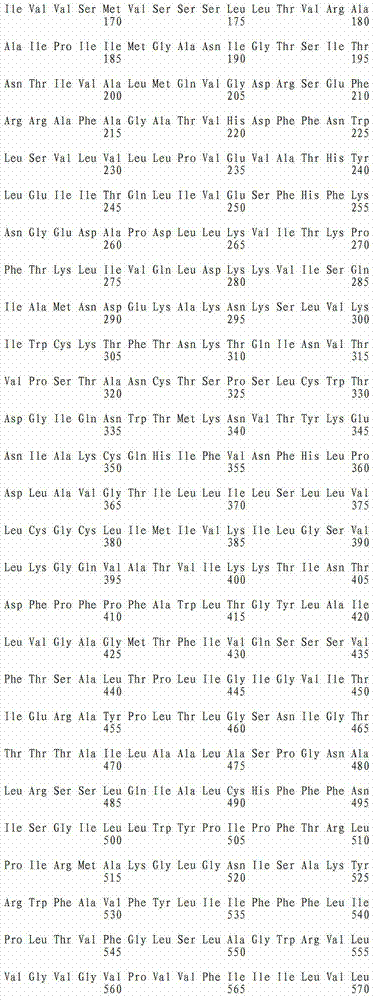
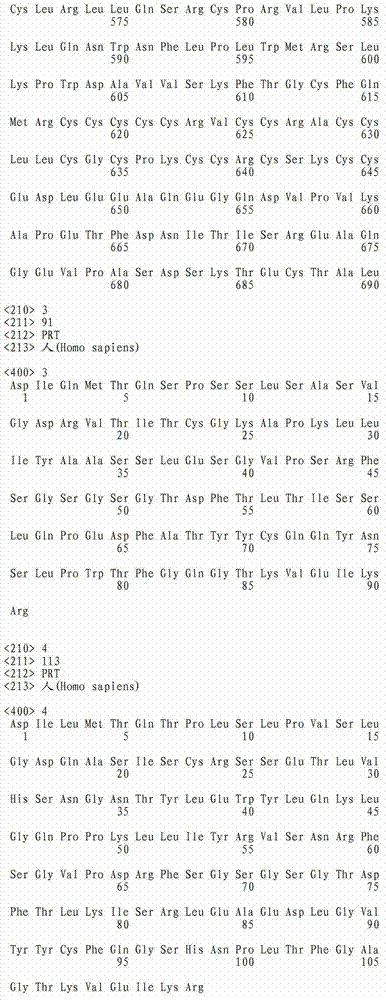


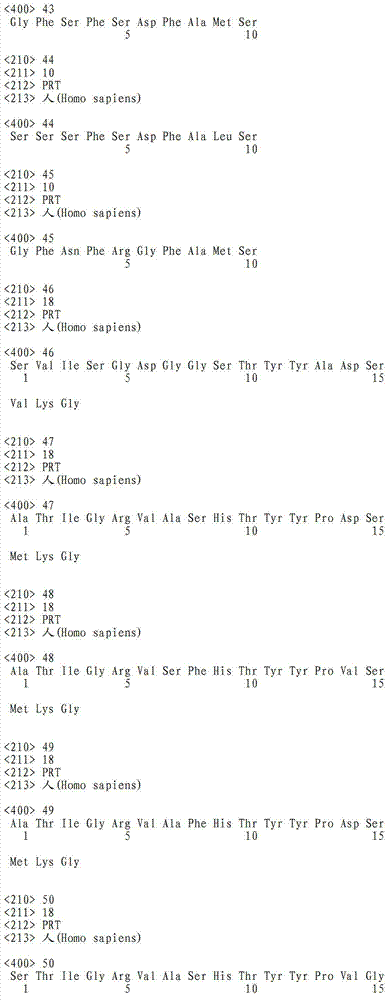

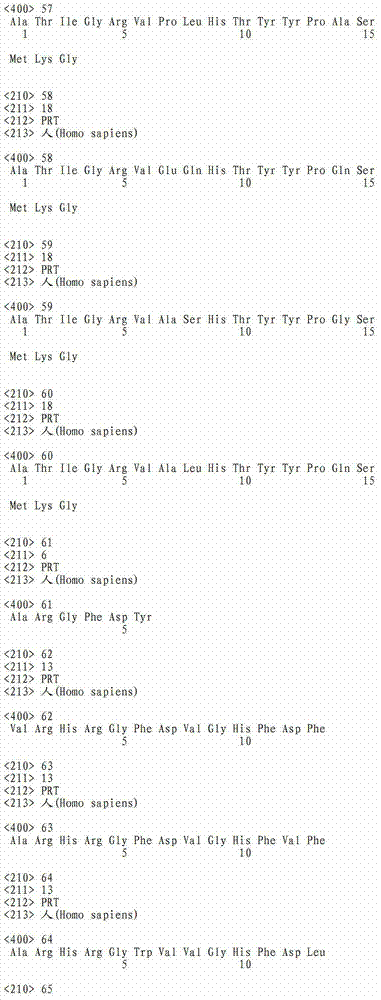

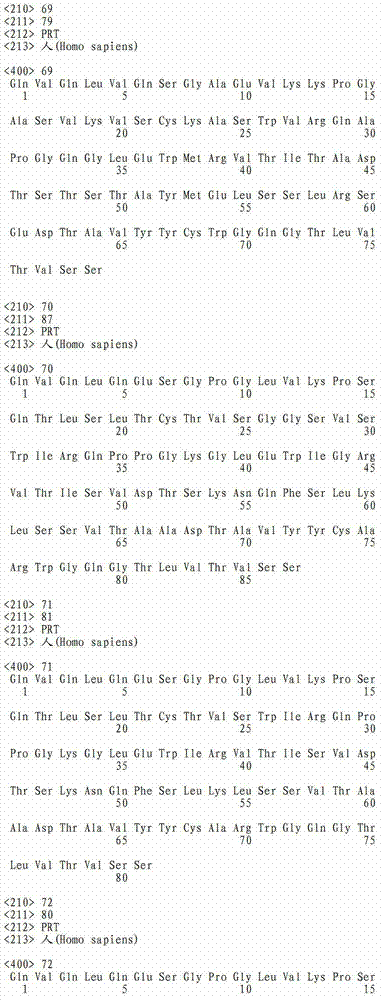


Claims (54)
Priority Applications (1)
| Application Number | Priority Date | Filing Date | Title |
|---|---|---|---|
| CN201310692626.9A CN103755809B (en) | 2009-11-30 | 2010-11-29 | The antibody of the tumour of SLC34A2 (TAT211=SEQID2) is expressed in treatment and diagnosis |
Applications Claiming Priority (5)
| Application Number | Priority Date | Filing Date | Title |
|---|---|---|---|
| US26526209P | 2009-11-30 | 2009-11-30 | |
| US61/265,262 | 2009-11-30 | ||
| US38446710P | 2010-09-20 | 2010-09-20 | |
| US61/384,467 | 2010-09-20 | ||
| PCT/US2010/058197 WO2011066503A2 (en) | 2009-11-30 | 2010-11-29 | Compositions and methods for the diagnosis and treatment of tumor |
Related Child Applications (2)
| Application Number | Title | Priority Date | Filing Date |
|---|---|---|---|
| CN201410010079.6A Division CN103724432B (en) | 2009-11-30 | 2010-11-29 | The antibody that the tumour of SLC34A2 (TAT211=SEQID2) is expressed in treatment and diagnosis |
| CN201310692626.9A Division CN103755809B (en) | 2009-11-30 | 2010-11-29 | The antibody of the tumour of SLC34A2 (TAT211=SEQID2) is expressed in treatment and diagnosis |
Publications (1)
| Publication Number | Publication Date |
|---|---|
| CN102741294A true CN102741294A (en) | 2012-10-17 |
Family
ID=43856230
Family Applications (3)
| Application Number | Title | Priority Date | Filing Date |
|---|---|---|---|
| CN2010800626890A Pending CN102741294A (en) | 2009-11-30 | 2010-11-29 | Antibodies for the treatment and diagnosis of tumors expressing SLC34A2 (TAT211=SEQID2) |
| CN201310692626.9A Active CN103755809B (en) | 2009-11-30 | 2010-11-29 | The antibody of the tumour of SLC34A2 (TAT211=SEQID2) is expressed in treatment and diagnosis |
| CN201410010079.6A Active CN103724432B (en) | 2009-11-30 | 2010-11-29 | The antibody that the tumour of SLC34A2 (TAT211=SEQID2) is expressed in treatment and diagnosis |
Family Applications After (2)
| Application Number | Title | Priority Date | Filing Date |
|---|---|---|---|
| CN201310692626.9A Active CN103755809B (en) | 2009-11-30 | 2010-11-29 | The antibody of the tumour of SLC34A2 (TAT211=SEQID2) is expressed in treatment and diagnosis |
| CN201410010079.6A Active CN103724432B (en) | 2009-11-30 | 2010-11-29 | The antibody that the tumour of SLC34A2 (TAT211=SEQID2) is expressed in treatment and diagnosis |
Country Status (24)
| Country | Link |
|---|---|
| US (7) | US8535675B2 (en) |
| EP (2) | EP3002297B1 (en) |
| JP (2) | JP5856065B2 (en) |
| KR (1) | KR101884028B1 (en) |
| CN (3) | CN102741294A (en) |
| AR (1) | AR079217A1 (en) |
| AU (2) | AU2010324686B2 (en) |
| BR (1) | BR112012012750A2 (en) |
| CA (1) | CA2781887C (en) |
| CL (1) | CL2012001403A1 (en) |
| CO (1) | CO6551727A2 (en) |
| CR (1) | CR20120354A (en) |
| EC (1) | ECSP12011932A (en) |
| IL (2) | IL219420A0 (en) |
| MA (1) | MA33839B1 (en) |
| MX (2) | MX2012006072A (en) |
| NZ (1) | NZ599707A (en) |
| PE (1) | PE20121584A1 (en) |
| PH (2) | PH12012500982A1 (en) |
| RU (2) | RU2015132142A (en) |
| SG (2) | SG10201408599QA (en) |
| TW (2) | TWI537383B (en) |
| WO (1) | WO2011066503A2 (en) |
| ZA (1) | ZA201203078B (en) |
Cited By (3)
| Publication number | Priority date | Publication date | Assignee | Title |
|---|---|---|---|---|
| CN105188763A (en) * | 2013-03-13 | 2015-12-23 | 诺华股份有限公司 | Antibody drug conjugates and corresponding antibodies |
| CN105828840A (en) * | 2013-12-16 | 2016-08-03 | 基因泰克公司 | 1-(Chloromethyl)-2,3-dihydro-1H-benzo[e]indole dimer antibody-drug conjugate compounds and methods of use and treatment |
| CN111492246A (en) * | 2017-09-20 | 2020-08-04 | 梅尔莎纳医疗公司 | Compositions and methods for predicting response to NAPI2B-targeted therapy |
Families Citing this family (10)
| Publication number | Priority date | Publication date | Assignee | Title |
|---|---|---|---|---|
| US10260089B2 (en) | 2012-10-29 | 2019-04-16 | The Research Foundation Of The State University Of New York | Compositions and methods for recognition of RNA using triple helical peptide nucleic acids |
| US9415118B2 (en) | 2013-03-13 | 2016-08-16 | Novartis Ag | Antibody drug conjugates |
| US10442836B2 (en) | 2013-08-12 | 2019-10-15 | Genentech, Inc. | 1-(chloromethyl)-2,3-dihydro-1H-benzo[E]indole dimer antibody-drug conjugate compounds, and methods of use and treatment |
| EP3429693B1 (en) | 2016-03-15 | 2023-08-23 | Mersana Therapeutics, Inc. | Napi2b-targeted antibody-drug conjugates and methods of use thereof |
| EP3498733A4 (en) * | 2016-08-15 | 2020-04-08 | National Cancer Center Japan | ANTIBODIES BINDING TMEM132A, ANTI-CANCER AGENT AND CANCER TEST METHOD |
| BR112021002747A2 (en) | 2018-08-17 | 2021-08-10 | Mersana Therapeutics, Inc. | antibody-drug and polymer conjugates targeting napi2b and methods of using them |
| MX2022000779A (en) * | 2019-07-19 | 2022-02-14 | Sinocelltech Ltd | HUMANIZED ANTI-VEGF MONOCLONAL ANTIBODY. |
| WO2025131025A1 (en) * | 2023-12-21 | 2025-06-26 | Lanova Medicines Development Co., Ltd. | Conjugates of anti-slc34a2 antibody and uses thereof |
| WO2025210264A1 (en) | 2024-04-04 | 2025-10-09 | Merck Patent Gmbh | Antibody-drug-conjugates binding napi2b |
| CN119661678A (en) * | 2024-11-14 | 2025-03-21 | 卡秋(江苏)生物科技有限公司 | A NaPi2b extracellular region antigen protein fragment and its preparation method and application |
Citations (2)
| Publication number | Priority date | Publication date | Assignee | Title |
|---|---|---|---|---|
| WO2003000113A2 (en) * | 2001-06-20 | 2003-01-03 | Genentech, Inc. | Compositions and methods for the diagnosis and treatment of tumor |
| CN101208431A (en) * | 2005-04-08 | 2008-06-25 | 健泰科生物技术公司 | Compositions and methods for tumor diagnosis and treatment |
Family Cites Families (376)
| Publication number | Priority date | Publication date | Assignee | Title |
|---|---|---|---|---|
| US3687808A (en) | 1969-08-14 | 1972-08-29 | Univ Leland Stanford Junior | Synthetic polynucleotides |
| US3773919A (en) | 1969-10-23 | 1973-11-20 | Du Pont | Polylactide-drug mixtures |
| US3896111A (en) | 1973-02-20 | 1975-07-22 | Research Corp | Ansa macrolides |
| US4179337A (en) | 1973-07-20 | 1979-12-18 | Davis Frank F | Non-immunogenic polypeptides |
| US4151042A (en) | 1977-03-31 | 1979-04-24 | Takeda Chemical Industries, Ltd. | Method for producing maytansinol and its derivatives |
| US4137230A (en) | 1977-11-14 | 1979-01-30 | Takeda Chemical Industries, Ltd. | Method for the production of maytansinoids |
| USRE30985E (en) | 1978-01-01 | 1982-06-29 | Serum-free cell culture media | |
| FR2413974A1 (en) | 1978-01-06 | 1979-08-03 | David Bernard | DRYER FOR SCREEN-PRINTED SHEETS |
| US4307016A (en) | 1978-03-24 | 1981-12-22 | Takeda Chemical Industries, Ltd. | Demethyl maytansinoids |
| US4265814A (en) | 1978-03-24 | 1981-05-05 | Takeda Chemical Industries | Matansinol 3-n-hexadecanoate |
| US4275149A (en) | 1978-11-24 | 1981-06-23 | Syva Company | Macromolecular environment control in specific receptor assays |
| JPS5562090A (en) | 1978-10-27 | 1980-05-10 | Takeda Chem Ind Ltd | Novel maytansinoid compound and its preparation |
| US4256746A (en) | 1978-11-14 | 1981-03-17 | Takeda Chemical Industries | Dechloromaytansinoids, their pharmaceutical compositions and method of use |
| JPS55164687A (en) | 1979-06-11 | 1980-12-22 | Takeda Chem Ind Ltd | Novel maytansinoid compound and its preparation |
| JPS5566585A (en) | 1978-11-14 | 1980-05-20 | Takeda Chem Ind Ltd | Novel maytansinoid compound and its preparation |
| JPS55102583A (en) | 1979-01-31 | 1980-08-05 | Takeda Chem Ind Ltd | 20-acyloxy-20-demethylmaytansinoid compound |
| JPS55162791A (en) | 1979-06-05 | 1980-12-18 | Takeda Chem Ind Ltd | Antibiotic c-15003pnd and its preparation |
| JPS55164685A (en) | 1979-06-08 | 1980-12-22 | Takeda Chem Ind Ltd | Novel maytansinoid compound and its preparation |
| JPS55164686A (en) | 1979-06-11 | 1980-12-22 | Takeda Chem Ind Ltd | Novel maytansinoid compound and its preparation |
| JPS6023084B2 (en) | 1979-07-11 | 1985-06-05 | 味の素株式会社 | blood substitute |
| US4309428A (en) | 1979-07-30 | 1982-01-05 | Takeda Chemical Industries, Ltd. | Maytansinoids |
| JPS5645483A (en) | 1979-09-19 | 1981-04-25 | Takeda Chem Ind Ltd | C-15003phm and its preparation |
| EP0028683A1 (en) | 1979-09-21 | 1981-05-20 | Takeda Chemical Industries, Ltd. | Antibiotic C-15003 PHO and production thereof |
| JPS5645485A (en) | 1979-09-21 | 1981-04-25 | Takeda Chem Ind Ltd | Production of c-15003pnd |
| WO1981001145A1 (en) | 1979-10-18 | 1981-04-30 | Univ Illinois | Hydrolytic enzyme-activatible pro-drugs |
| US4399216A (en) | 1980-02-25 | 1983-08-16 | The Trustees Of Columbia University | Processes for inserting DNA into eucaryotic cells and for producing proteinaceous materials |
| ZA811368B (en) | 1980-03-24 | 1982-04-28 | Genentech Inc | Bacterial polypedtide expression employing tryptophan promoter-operator |
| WO1982001188A1 (en) | 1980-10-08 | 1982-04-15 | Takeda Chemical Industries Ltd | 4,5-deoxymaytansinoide compounds and process for preparing same |
| US4450254A (en) | 1980-11-03 | 1984-05-22 | Standard Oil Company | Impact improvement of high nitrile resins |
| US4469863A (en) | 1980-11-12 | 1984-09-04 | Ts O Paul O P | Nonionic nucleic acid alkyl and aryl phosphonates and processes for manufacture and use thereof |
| US4315929A (en) | 1981-01-27 | 1982-02-16 | The United States Of America As Represented By The Secretary Of Agriculture | Method of controlling the European corn borer with trewiasine |
| US4313946A (en) | 1981-01-27 | 1982-02-02 | The United States Of America As Represented By The Secretary Of Agriculture | Chemotherapeutically active maytansinoids from Trewia nudiflora |
| JPS57192389A (en) | 1981-05-20 | 1982-11-26 | Takeda Chem Ind Ltd | Novel maytansinoid |
| US4485045A (en) | 1981-07-06 | 1984-11-27 | Research Corporation | Synthetic phosphatidyl cholines useful in forming liposomes |
| US4426330A (en) | 1981-07-20 | 1984-01-17 | Lipid Specialties, Inc. | Synthetic phospholipid compounds |
| US4534899A (en) | 1981-07-20 | 1985-08-13 | Lipid Specialties, Inc. | Synthetic phospholipid compounds |
| NZ201705A (en) | 1981-08-31 | 1986-03-14 | Genentech Inc | Recombinant dna method for production of hepatitis b surface antigen in yeast |
| US5023243A (en) | 1981-10-23 | 1991-06-11 | Molecular Biosystems, Inc. | Oligonucleotide therapeutic agent and method of making same |
| US4640835A (en) | 1981-10-30 | 1987-02-03 | Nippon Chemiphar Company, Ltd. | Plasminogen activator derivatives |
| US4476301A (en) | 1982-04-29 | 1984-10-09 | Centre National De La Recherche Scientifique | Oligonucleotides, a process for preparing the same and their application as mediators of the action of interferon |
| US4943529A (en) | 1982-05-19 | 1990-07-24 | Gist-Brocades Nv | Kluyveromyces as a host strain |
| JPS5927900A (en) | 1982-08-09 | 1984-02-14 | Wakunaga Seiyaku Kk | Oligonucleotide derivative and its preparation |
| US4870009A (en) | 1982-11-22 | 1989-09-26 | The Salk Institute For Biological Studies | Method of obtaining gene product through the generation of transgenic animals |
| US4560655A (en) | 1982-12-16 | 1985-12-24 | Immunex Corporation | Serum-free cell culture medium and process for making same |
| US4657866A (en) | 1982-12-21 | 1987-04-14 | Sudhir Kumar | Serum-free, synthetic, completely chemically defined tissue culture media |
| US4713339A (en) | 1983-01-19 | 1987-12-15 | Genentech, Inc. | Polycistronic expression vector construction |
| AU2353384A (en) | 1983-01-19 | 1984-07-26 | Genentech Inc. | Amplification in eukaryotic host cells |
| FR2540122B1 (en) | 1983-01-27 | 1985-11-29 | Centre Nat Rech Scient | NOVEL COMPOUNDS COMPRISING A SEQUENCE OF OLIGONUCLEOTIDE LINKED TO AN INTERCALATION AGENT, THEIR SYNTHESIS PROCESS AND THEIR APPLICATION |
| US4605735A (en) | 1983-02-14 | 1986-08-12 | Wakunaga Seiyaku Kabushiki Kaisha | Oligonucleotide derivatives |
| US4948882A (en) | 1983-02-22 | 1990-08-14 | Syngene, Inc. | Single-stranded labelled oligonucleotides, reactive monomers and methods of synthesis |
| NZ207394A (en) | 1983-03-08 | 1987-03-06 | Commw Serum Lab Commission | Detecting or determining sequence of amino acids |
| WO1984003506A1 (en) | 1983-03-08 | 1984-09-13 | Commw Serum Lab Commission | Antigenically active amino acid sequences |
| EP0138854B1 (en) | 1983-03-08 | 1992-11-04 | Chiron Mimotopes Pty. Ltd. | Antigenically active amino acid sequences |
| US4824941A (en) | 1983-03-10 | 1989-04-25 | Julian Gordon | Specific antibody to the native form of 2'5'-oligonucleotides, the method of preparation and the use as reagents in immunoassays or for binding 2'5'-oligonucleotides in biological systems |
| US4816567A (en) | 1983-04-08 | 1989-03-28 | Genentech, Inc. | Recombinant immunoglobin preparations |
| DD266710A3 (en) | 1983-06-06 | 1989-04-12 | Ve Forschungszentrum Biotechnologie | Process for the biotechnical production of alkaline phosphatase |
| US4544545A (en) | 1983-06-20 | 1985-10-01 | Trustees University Of Massachusetts | Liposomes containing modified cholesterol for organ targeting |
| AU3145184A (en) | 1983-08-16 | 1985-02-21 | Zymogenetics Inc. | High expression of foreign genes in schizosaccharomyces pombe |
| US4587044A (en) | 1983-09-01 | 1986-05-06 | The Johns Hopkins University | Linkage of proteins to nucleic acids |
| US4767704A (en) | 1983-10-07 | 1988-08-30 | Columbia University In The City Of New York | Protein-free culture medium |
| US5118800A (en) | 1983-12-20 | 1992-06-02 | California Institute Of Technology | Oligonucleotides possessing a primary amino group in the terminal nucleotide |
| US5118802A (en) | 1983-12-20 | 1992-06-02 | California Institute Of Technology | DNA-reporter conjugates linked via the 2' or 5'-primary amino group of the 5'-terminal nucleoside |
| US4496689A (en) | 1983-12-27 | 1985-01-29 | Miles Laboratories, Inc. | Covalently attached complex of alpha-1-proteinase inhibitor with a water soluble polymer |
| US4933294A (en) | 1984-01-30 | 1990-06-12 | Icrf Patents Limited | Method of detecting truncated epidermal growth factor receptors |
| US4736866B1 (en) | 1984-06-22 | 1988-04-12 | Transgenic non-human mammals | |
| US5550111A (en) | 1984-07-11 | 1996-08-27 | Temple University-Of The Commonwealth System Of Higher Education | Dual action 2',5'-oligoadenylate antiviral derivatives and uses thereof |
| FR2567892B1 (en) | 1984-07-19 | 1989-02-17 | Centre Nat Rech Scient | NOVEL OLIGONUCLEOTIDES, THEIR PREPARATION PROCESS AND THEIR APPLICATIONS AS MEDIATORS IN DEVELOPING THE EFFECTS OF INTERFERONS |
| US5258506A (en) | 1984-10-16 | 1993-11-02 | Chiron Corporation | Photolabile reagents for incorporation into oligonucleotide chains |
| US5367066A (en) | 1984-10-16 | 1994-11-22 | Chiron Corporation | Oligonucleotides with selectably cleavable and/or abasic sites |
| US5430136A (en) | 1984-10-16 | 1995-07-04 | Chiron Corporation | Oligonucleotides having selectably cleavable and/or abasic sites |
| US4879231A (en) | 1984-10-30 | 1989-11-07 | Phillips Petroleum Company | Transformation of yeasts of the genus pichia |
| US4828979A (en) | 1984-11-08 | 1989-05-09 | Life Technologies, Inc. | Nucleotide analogs for nucleic acid labeling and detection |
| FR2575751B1 (en) | 1985-01-08 | 1987-04-03 | Pasteur Institut | NOVEL ADENOSINE DERIVATIVE NUCLEOSIDES, THEIR PREPARATION AND THEIR BIOLOGICAL APPLICATIONS |
| US5405938A (en) | 1989-12-20 | 1995-04-11 | Anti-Gene Development Group | Sequence-specific binding polymers for duplex nucleic acids |
| US5166315A (en) | 1989-12-20 | 1992-11-24 | Anti-Gene Development Group | Sequence-specific binding polymers for duplex nucleic acids |
| US5185444A (en) | 1985-03-15 | 1993-02-09 | Anti-Gene Deveopment Group | Uncharged morpolino-based polymers having phosphorous containing chiral intersubunit linkages |
| US5235033A (en) | 1985-03-15 | 1993-08-10 | Anti-Gene Development Group | Alpha-morpholino ribonucleoside derivatives and polymers thereof |
| US5034506A (en) | 1985-03-15 | 1991-07-23 | Anti-Gene Development Group | Uncharged morpholino-based polymers having achiral intersubunit linkages |
| US6492107B1 (en) | 1986-11-20 | 2002-12-10 | Stuart Kauffman | Process for obtaining DNA, RNA, peptides, polypeptides, or protein, by recombinant DNA technique |
| WO1986005803A1 (en) | 1985-03-30 | 1986-10-09 | Marc Ballivet | Method for obtaining dna, rna, peptides, polypeptides or proteins by means of a dna recombinant technique |
| NZ215865A (en) | 1985-04-22 | 1988-10-28 | Commw Serum Lab Commission | Method of determining the active site of a receptor-binding analogue |
| US4762779A (en) | 1985-06-13 | 1988-08-09 | Amgen Inc. | Compositions and methods for functionalizing nucleic acids |
| DE3675588D1 (en) | 1985-06-19 | 1990-12-20 | Ajinomoto Kk | HAEMOGLOBIN TIED TO A POLY (ALKENYLENE OXIDE). |
| GB8516415D0 (en) | 1985-06-28 | 1985-07-31 | Celltech Ltd | Culture of animal cells |
| US4676980A (en) | 1985-09-23 | 1987-06-30 | The United States Of America As Represented By The Secretary Of The Department Of Health And Human Services | Target specific cross-linked heteroantibodies |
| WO1987005330A1 (en) | 1986-03-07 | 1987-09-11 | Michel Louis Eugene Bergh | Method for enhancing glycoprotein stability |
| US5317098A (en) | 1986-03-17 | 1994-05-31 | Hiroaki Shizuya | Non-radioisotope tagging of fragments |
| US4927762A (en) | 1986-04-01 | 1990-05-22 | Cell Enterprises, Inc. | Cell culture medium with antioxidant |
| GB8610600D0 (en) | 1986-04-30 | 1986-06-04 | Novo Industri As | Transformation of trichoderma |
| US5401638A (en) | 1986-06-04 | 1995-03-28 | Oncogene Science, Inc. | Detection and quantification of neu related proteins in the biological fluids of humans |
| US4791192A (en) | 1986-06-26 | 1988-12-13 | Takeda Chemical Industries, Ltd. | Chemically modified protein with polyethyleneglycol |
| JPS638396A (en) | 1986-06-30 | 1988-01-14 | Wakunaga Pharmaceut Co Ltd | Poly-labeled oligonucleotide derivative |
| US5567610A (en) | 1986-09-04 | 1996-10-22 | Bioinvent International Ab | Method of producing human monoclonal antibodies and kit therefor |
| DE3788914T2 (en) | 1986-09-08 | 1994-08-25 | Ajinomoto Kk | Compounds for cleaving RNA at a specific position, oligomers used in the preparation of these compounds and starting materials for the synthesis of these oligomers. |
| IL85035A0 (en) | 1987-01-08 | 1988-06-30 | Int Genetic Eng | Polynucleotide molecule,a chimeric antibody with specificity for human b cell surface antigen,a process for the preparation and methods utilizing the same |
| US4946783A (en) | 1987-01-30 | 1990-08-07 | President And Fellows Of Harvard College | Periplasmic protease mutants of Escherichia coli |
| GB8705477D0 (en) | 1987-03-09 | 1987-04-15 | Carlton Med Prod | Drug delivery systems |
| US5264423A (en) | 1987-03-25 | 1993-11-23 | The United States Of America As Represented By The Department Of Health And Human Services | Inhibitors for replication of retroviruses and for the expression of oncogene products |
| US5276019A (en) | 1987-03-25 | 1994-01-04 | The United States Of America As Represented By The Department Of Health And Human Services | Inhibitors for replication of retroviruses and for the expression of oncogene products |
| US4904582A (en) | 1987-06-11 | 1990-02-27 | Synthetic Genetics | Novel amphiphilic nucleic acid conjugates |
| EP0366685B1 (en) | 1987-06-24 | 1994-10-19 | Howard Florey Institute Of Experimental Physiology And Medicine | Nucleoside derivatives |
| US5010182A (en) | 1987-07-28 | 1991-04-23 | Chiron Corporation | DNA constructs containing a Kluyveromyces alpha factor leader sequence for directing secretion of heterologous polypeptides |
| US4975278A (en) | 1988-02-26 | 1990-12-04 | Bristol-Myers Company | Antibody-enzyme conjugates in combination with prodrugs for the delivery of cytotoxic agents to tumor cells |
| IL87737A (en) | 1987-09-11 | 1993-08-18 | Genentech Inc | Method for culturing polypeptide factor dependent vertebrate recombinant cells |
| US5585481A (en) | 1987-09-21 | 1996-12-17 | Gen-Probe Incorporated | Linking reagents for nucleotide probes |
| US5188897A (en) | 1987-10-22 | 1993-02-23 | Temple University Of The Commonwealth System Of Higher Education | Encapsulated 2',5'-phosphorothioate oligoadenylates |
| US4924624A (en) | 1987-10-22 | 1990-05-15 | Temple University-Of The Commonwealth System Of Higher Education | 2,',5'-phosphorothioate oligoadenylates and plant antiviral uses thereof |
| GB8724885D0 (en) | 1987-10-23 | 1987-11-25 | Binns M M | Fowlpox virus promotors |
| US5525465A (en) | 1987-10-28 | 1996-06-11 | Howard Florey Institute Of Experimental Physiology And Medicine | Oligonucleotide-polyamide conjugates and methods of production and applications of the same |
| US5606040A (en) | 1987-10-30 | 1997-02-25 | American Cyanamid Company | Antitumor and antibacterial substituted disulfide derivatives prepared from compounds possessing a methyl-trithio group |
| US5770701A (en) | 1987-10-30 | 1998-06-23 | American Cyanamid Company | Process for preparing targeted forms of methyltrithio antitumor agents |
| US5053394A (en) | 1988-09-21 | 1991-10-01 | American Cyanamid Company | Targeted forms of methyltrithio antitumor agents |
| DE3738460A1 (en) | 1987-11-12 | 1989-05-24 | Max Planck Gesellschaft | MODIFIED OLIGONUCLEOTIDS |
| US5283187A (en) | 1987-11-17 | 1994-02-01 | Brown University Research Foundation | Cell culture-containing tubular capsule produced by co-extrusion |
| US4892538A (en) | 1987-11-17 | 1990-01-09 | Brown University Research Foundation | In vivo delivery of neurotransmitters by implanted, encapsulated cells |
| US5403711A (en) | 1987-11-30 | 1995-04-04 | University Of Iowa Research Foundation | Nucleic acid hybridization and amplification method for detection of specific sequences in which a complementary labeled nucleic acid probe is cleaved |
| WO1989005358A1 (en) | 1987-11-30 | 1989-06-15 | University Of Iowa Research Foundation | Dna and rna molecules stabilized by modifications of the 3'-terminal phosphodiester linkage and their use as nucleic acid probes and as therapeutic agents to block the expression of specifically targeted genes |
| JPH04501201A (en) | 1987-12-21 | 1992-03-05 | ジ・アップジョン・カンパニー | Agrobacterium-mediated transformation of germinated plant seeds |
| US5082830A (en) | 1988-02-26 | 1992-01-21 | Enzo Biochem, Inc. | End labeled nucleotide probe |
| EP0406309A4 (en) | 1988-03-25 | 1992-08-19 | The University Of Virginia Alumni Patents Foundation | Oligonucleotide n-alkylphosphoramidates |
| US5266684A (en) | 1988-05-02 | 1993-11-30 | The Reagents Of The University Of California | Peptide mixtures |
| US5278302A (en) | 1988-05-26 | 1994-01-11 | University Patents, Inc. | Polynucleotide phosphorodithioates |
| US5109124A (en) | 1988-06-01 | 1992-04-28 | Biogen, Inc. | Nucleic acid probe linked to a label having a terminal cysteine |
| US5216141A (en) | 1988-06-06 | 1993-06-01 | Benner Steven A | Oligonucleotide analogs containing sulfur linkages |
| US5571689A (en) | 1988-06-16 | 1996-11-05 | Washington University | Method of N-acylating peptide and proteins with diheteroatom substituted analogs of myristic acid |
| US5175273A (en) | 1988-07-01 | 1992-12-29 | Genentech, Inc. | Nucleic acid intercalating agents |
| AU4005289A (en) | 1988-08-25 | 1990-03-01 | Smithkline Beecham Corporation | Recombinant saccharomyces |
| US5223409A (en) | 1988-09-02 | 1993-06-29 | Protein Engineering Corp. | Directed evolution of novel binding proteins |
| US5663143A (en) | 1988-09-02 | 1997-09-02 | Dyax Corp. | Engineered human-derived kunitz domains that inhibit human neutrophil elastase |
| US5262536A (en) | 1988-09-15 | 1993-11-16 | E. I. Du Pont De Nemours And Company | Reagents for the preparation of 5'-tagged oligonucleotides |
| US5194599A (en) | 1988-09-23 | 1993-03-16 | Gilead Sciences, Inc. | Hydrogen phosphonodithioate compositions |
| AU632065B2 (en) | 1988-09-23 | 1992-12-17 | Novartis Vaccines And Diagnostics, Inc. | Cell culture medium for enhanced cell growth, culture longevity and product expression |
| GB8823869D0 (en) | 1988-10-12 | 1988-11-16 | Medical Res Council | Production of antibodies |
| US5512439A (en) | 1988-11-21 | 1996-04-30 | Dynal As | Oligonucleotide-linked magnetic particles and uses thereof |
| US5175384A (en) | 1988-12-05 | 1992-12-29 | Genpharm International | Transgenic mice depleted in mature t-cells and methods for making transgenic mice |
| US5225538A (en) | 1989-02-23 | 1993-07-06 | Genentech, Inc. | Lymphocyte homing receptor/immunoglobulin fusion proteins |
| US5009772A (en) | 1989-02-27 | 1991-04-23 | Kerr-Mcgee Corporation | Solvent extraction process |
| US5599923A (en) | 1989-03-06 | 1997-02-04 | Board Of Regents, University Of Tx | Texaphyrin metal complexes having improved functionalization |
| US5457183A (en) | 1989-03-06 | 1995-10-10 | Board Of Regents, The University Of Texas System | Hydroxylated texaphyrins |
| EP0462145B1 (en) | 1989-03-07 | 1994-04-27 | Genentech, Inc. | Covalent conjugates of lipid and oligonucleotide |
| US5354844A (en) | 1989-03-16 | 1994-10-11 | Boehringer Ingelheim International Gmbh | Protein-polycation conjugates |
| US5108921A (en) | 1989-04-03 | 1992-04-28 | Purdue Research Foundation | Method for enhanced transmembrane transport of exogenous molecules |
| DE394538T1 (en) | 1989-04-28 | 1991-04-11 | Rhein Biotech Ges. Fuer Biotechnologische Prozesse Und Produkte Mbh, 4000 Duesseldorf | YEAR CELLS OF THE SCHWANNIOMYCES GENERATION. |
| FR2646437B1 (en) | 1989-04-28 | 1991-08-30 | Transgene Sa | NOVEL DNA SEQUENCES, THEIR APPLICATION AS A SEQUENCE ENCODING A SIGNAL PEPTIDE FOR THE SECRETION OF MATURE PROTEINS BY RECOMBINANT YEASTS, EXPRESSION CASSETTES, PROCESSED YEASTS AND PROCESS FOR PREPARING THE SAME |
| CA2055435A1 (en) | 1989-05-10 | 1990-11-11 | Eli Gilboa | Stably transformed eucaryotic cells comprising a foreign transcribable dna under the control of a pol iii promoter |
| US5391723A (en) | 1989-05-31 | 1995-02-21 | Neorx Corporation | Oligonucleotide conjugates |
| US5256775A (en) | 1989-06-05 | 1993-10-26 | Gilead Sciences, Inc. | Exonuclease-resistant oligonucleotides |
| EP0402226A1 (en) | 1989-06-06 | 1990-12-12 | Institut National De La Recherche Agronomique | Transformation vectors for yeast yarrowia |
| US4958013A (en) | 1989-06-06 | 1990-09-18 | Northwestern University | Cholesteryl modified oligonucleotides |
| DE3920358A1 (en) | 1989-06-22 | 1991-01-17 | Behringwerke Ag | BISPECIFIC AND OLIGO-SPECIFIC, MONO- AND OLIGOVALENT ANTI-BODY CONSTRUCTS, THEIR PRODUCTION AND USE |
| US5227170A (en) | 1989-06-22 | 1993-07-13 | Vestar, Inc. | Encapsulation process |
| ES2096590T3 (en) | 1989-06-29 | 1997-03-16 | Medarex Inc | BI-SPECIFIC REAGENTS FOR AIDS THERAPY. |
| FR2649120B1 (en) | 1989-06-30 | 1994-01-28 | Cayla | NOVEL STRAIN AND ITS MUTANTS OF FILAMENTOUS MUSHROOMS, PROCESS FOR PRODUCING RECOMBINANT PROTEINS USING SAID STRAIN, AND STRAINS AND PROTEINS OBTAINED BY SAID METHOD |
| US5451463A (en) | 1989-08-28 | 1995-09-19 | Clontech Laboratories, Inc. | Non-nucleoside 1,3-diol reagents for labeling synthetic oligonucleotides |
| US5134066A (en) | 1989-08-29 | 1992-07-28 | Monsanto Company | Improved probes using nucleosides containing 3-dezauracil analogs |
| US5254469A (en) | 1989-09-12 | 1993-10-19 | Eastman Kodak Company | Oligonucleotide-enzyme conjugate that can be used as a probe in hybridization assays and polymerase chain reaction procedures |
| US5591722A (en) | 1989-09-15 | 1997-01-07 | Southern Research Institute | 2'-deoxy-4'-thioribonucleosides and their antiviral activity |
| WO1991005264A1 (en) | 1989-09-29 | 1991-04-18 | Oncogenetics Partners | Detection and quantification of neu related proteins in the biological fluids of humans |
| WO1991004753A1 (en) | 1989-10-02 | 1991-04-18 | Cetus Corporation | Conjugates of antisense oligonucleotides and therapeutic uses thereof |
| US5527528A (en) | 1989-10-20 | 1996-06-18 | Sequus Pharmaceuticals, Inc. | Solid-tumor treatment method |
| US5013556A (en) | 1989-10-20 | 1991-05-07 | Liposome Technology, Inc. | Liposomes with enhanced circulation time |
| US5356633A (en) | 1989-10-20 | 1994-10-18 | Liposome Technology, Inc. | Method of treatment of inflamed tissues |
| US5399676A (en) | 1989-10-23 | 1995-03-21 | Gilead Sciences | Oligonucleotides with inverted polarity |
| US5721218A (en) | 1989-10-23 | 1998-02-24 | Gilead Sciences, Inc. | Oligonucleotides with inverted polarity |
| US5264564A (en) | 1989-10-24 | 1993-11-23 | Gilead Sciences | Oligonucleotide analogs with novel linkages |
| CA2071483C (en) | 1989-10-24 | 2001-04-17 | Mark Matteucci | Oligonucleotide analogs with novel linkages |
| US5264562A (en) | 1989-10-24 | 1993-11-23 | Gilead Sciences, Inc. | Oligonucleotide analogs with novel linkages |
| EP0942000B1 (en) | 1989-10-24 | 2004-06-23 | Isis Pharmaceuticals, Inc. | 2'-Modified oligonucleotides |
| US5208020A (en) | 1989-10-25 | 1993-05-04 | Immunogen Inc. | Cytotoxic agents comprising maytansinoids and their therapeutic use |
| CA2026147C (en) | 1989-10-25 | 2006-02-07 | Ravi J. Chari | Cytotoxic agents comprising maytansinoids and their therapeutic use |
| US5292873A (en) | 1989-11-29 | 1994-03-08 | The Research Foundation Of State University Of New York | Nucleic acids labeled with naphthoquinone probe |
| US5177198A (en) | 1989-11-30 | 1993-01-05 | University Of N.C. At Chapel Hill | Process for preparing oligoribonucleoside and oligodeoxyribonucleoside boranophosphates |
| US5130302A (en) | 1989-12-20 | 1992-07-14 | Boron Bilogicals, Inc. | Boronated nucleoside, nucleotide and oligonucleotide compounds, compositions and methods for using same |
| US5580575A (en) | 1989-12-22 | 1996-12-03 | Imarx Pharmaceutical Corp. | Therapeutic drug delivery systems |
| US5469854A (en) | 1989-12-22 | 1995-11-28 | Imarx Pharmaceutical Corp. | Methods of preparing gas-filled liposomes |
| US5486603A (en) | 1990-01-08 | 1996-01-23 | Gilead Sciences, Inc. | Oligonucleotide having enhanced binding affinity |
| US5587361A (en) | 1991-10-15 | 1996-12-24 | Isis Pharmaceuticals, Inc. | Oligonucleotides having phosphorothioate linkages of high chiral purity |
| US5681941A (en) | 1990-01-11 | 1997-10-28 | Isis Pharmaceuticals, Inc. | Substituted purines and oligonucleotide cross-linking |
| US5578718A (en) | 1990-01-11 | 1996-11-26 | Isis Pharmaceuticals, Inc. | Thiol-derivatized nucleosides |
| US5623065A (en) | 1990-08-13 | 1997-04-22 | Isis Pharmaceuticals, Inc. | Gapped 2' modified oligonucleotides |
| US5670633A (en) | 1990-01-11 | 1997-09-23 | Isis Pharmaceuticals, Inc. | Sugar modified oligonucleotides that detect and modulate gene expression |
| US5646265A (en) | 1990-01-11 | 1997-07-08 | Isis Pharmceuticals, Inc. | Process for the preparation of 2'-O-alkyl purine phosphoramidites |
| US5459255A (en) | 1990-01-11 | 1995-10-17 | Isis Pharmaceuticals, Inc. | N-2 substituted purines |
| US5587470A (en) | 1990-01-11 | 1996-12-24 | Isis Pharmaceuticals, Inc. | 3-deazapurines |
| US5498538A (en) | 1990-02-15 | 1996-03-12 | The University Of North Carolina At Chapel Hill | Totally synthetic affinity reagents |
| US5149797A (en) | 1990-02-15 | 1992-09-22 | The Worcester Foundation For Experimental Biology | Method of site-specific alteration of rna and production of encoded polypeptides |
| US5220007A (en) | 1990-02-15 | 1993-06-15 | The Worcester Foundation For Experimental Biology | Method of site-specific alteration of RNA and production of encoded polypeptides |
| AU7579991A (en) | 1990-02-20 | 1991-09-18 | Gilead Sciences, Inc. | Pseudonucleosides and pseudonucleotides and their polymers |
| US5214136A (en) | 1990-02-20 | 1993-05-25 | Gilead Sciences, Inc. | Anthraquinone-derivatives oligonucleotides |
| US5321131A (en) | 1990-03-08 | 1994-06-14 | Hybridon, Inc. | Site-specific functionalization of oligodeoxynucleotides for non-radioactive labelling |
| US5470967A (en) | 1990-04-10 | 1995-11-28 | The Dupont Merck Pharmaceutical Company | Oligonucleotide analogs with sulfamate linkages |
| US5264618A (en) | 1990-04-19 | 1993-11-23 | Vical, Inc. | Cationic lipids for intracellular delivery of biologically active molecules |
| US5229275A (en) | 1990-04-26 | 1993-07-20 | Akzo N.V. | In-vitro method for producing antigen-specific human monoclonal antibodies |
| US5427908A (en) | 1990-05-01 | 1995-06-27 | Affymax Technologies N.V. | Recombinant library screening methods |
| GB9009980D0 (en) | 1990-05-03 | 1990-06-27 | Amersham Int Plc | Phosphoramidite derivatives,their preparation and the use thereof in the incorporation of reporter groups on synthetic oligonucleotides |
| DK0455905T3 (en) | 1990-05-11 | 1998-12-07 | Microprobe Corp | Dipsticks for nucleic acid hybridization assays and method for covalent immobilization of oligonucleotides |
| US5723286A (en) | 1990-06-20 | 1998-03-03 | Affymax Technologies N.V. | Peptide library and screening systems |
| CA2088258C (en) | 1990-07-27 | 2004-09-14 | Phillip Dan Cook | Nuclease resistant, pyrimidine modified oligonucleotides that detect and modulate gene expression |
| US5608046A (en) | 1990-07-27 | 1997-03-04 | Isis Pharmaceuticals, Inc. | Conjugated 4'-desmethyl nucleoside analog compounds |
| US5138045A (en) | 1990-07-27 | 1992-08-11 | Isis Pharmaceuticals | Polyamine conjugated oligonucleotides |
| US5489677A (en) | 1990-07-27 | 1996-02-06 | Isis Pharmaceuticals, Inc. | Oligonucleoside linkages containing adjacent oxygen and nitrogen atoms |
| US5677437A (en) | 1990-07-27 | 1997-10-14 | Isis Pharmaceuticals, Inc. | Heteroatomic oligonucleoside linkages |
| US5541307A (en) | 1990-07-27 | 1996-07-30 | Isis Pharmaceuticals, Inc. | Backbone modified oligonucleotide analogs and solid phase synthesis thereof |
| US5218105A (en) | 1990-07-27 | 1993-06-08 | Isis Pharmaceuticals | Polyamine conjugated oligonucleotides |
| US5688941A (en) | 1990-07-27 | 1997-11-18 | Isis Pharmaceuticals, Inc. | Methods of making conjugated 4' desmethyl nucleoside analog compounds |
| US5602240A (en) | 1990-07-27 | 1997-02-11 | Ciba Geigy Ag. | Backbone modified oligonucleotide analogs |
| US5623070A (en) | 1990-07-27 | 1997-04-22 | Isis Pharmaceuticals, Inc. | Heteroatomic oligonucleoside linkages |
| US5610289A (en) | 1990-07-27 | 1997-03-11 | Isis Pharmaceuticals, Inc. | Backbone modified oligonucleotide analogues |
| US5618704A (en) | 1990-07-27 | 1997-04-08 | Isis Pharmacueticals, Inc. | Backbone-modified oligonucleotide analogs and preparation thereof through radical coupling |
| DK0541722T3 (en) | 1990-08-03 | 1996-04-22 | Sterling Winthrop Inc | Compounds and Methods for Inhibiting Gene Expression |
| US5245022A (en) | 1990-08-03 | 1993-09-14 | Sterling Drug, Inc. | Exonuclease resistant terminally substituted oligonucleotides |
| US5177196A (en) | 1990-08-16 | 1993-01-05 | Microprobe Corporation | Oligo (α-arabinofuranosyl nucleotides) and α-arabinofuranosyl precursors thereof |
| US5512667A (en) | 1990-08-28 | 1996-04-30 | Reed; Michael W. | Trifunctional intermediates for preparing 3'-tailed oligonucleotides |
| US5545806A (en) | 1990-08-29 | 1996-08-13 | Genpharm International, Inc. | Ransgenic non-human animals for producing heterologous antibodies |
| JP2938569B2 (en) | 1990-08-29 | 1999-08-23 | ジェンファーム インターナショナル,インコーポレイティド | Method for producing xenogeneic immunoglobulin and transgenic mouse |
| US5214134A (en) | 1990-09-12 | 1993-05-25 | Sterling Winthrop Inc. | Process of linking nucleosides with a siloxane bridge |
| US5561225A (en) | 1990-09-19 | 1996-10-01 | Southern Research Institute | Polynucleotide analogs containing sulfonate and sulfonamide internucleoside linkages |
| EP0549686A4 (en) | 1990-09-20 | 1995-01-18 | Gilead Sciences Inc | Modified internucleoside linkages |
| US5770434A (en) | 1990-09-28 | 1998-06-23 | Ixsys Incorporated | Soluble peptides having constrained, secondary conformation in solution and method of making same |
| US5698426A (en) | 1990-09-28 | 1997-12-16 | Ixsys, Incorporated | Surface expression libraries of heteromeric receptors |
| US5122469A (en) | 1990-10-03 | 1992-06-16 | Genentech, Inc. | Method for culturing Chinese hamster ovary cells to improve production of recombinant proteins |
| US5432272A (en) | 1990-10-09 | 1995-07-11 | Benner; Steven A. | Method for incorporating into a DNA or RNA oligonucleotide using nucleotides bearing heterocyclic bases |
| ATE198598T1 (en) | 1990-11-08 | 2001-01-15 | Hybridon Inc | CONNECTION OF MULTIPLE REPORTER GROUPS ON SYNTHETIC OLIGONUCLEOTIDES |
| ATE176239T1 (en) | 1990-11-21 | 1999-02-15 | Iterex Pharma Lp | SYNTHESIS OF EQUIMOLAR MIXTURES OF VARIOUS OLIGOMERS, SPECIFICALLY OLIGOPEPTIDE MIXTURES |
| DE69129154T2 (en) | 1990-12-03 | 1998-08-20 | Genentech, Inc., South San Francisco, Calif. | METHOD FOR ENRICHING PROTEIN VARIANTS WITH CHANGED BINDING PROPERTIES |
| US5206161A (en) | 1991-02-01 | 1993-04-27 | Genentech, Inc. | Human plasma carboxypeptidase B |
| US5571894A (en) | 1991-02-05 | 1996-11-05 | Ciba-Geigy Corporation | Recombinant antibodies specific for a growth factor receptor |
| US5672697A (en) | 1991-02-08 | 1997-09-30 | Gilead Sciences, Inc. | Nucleoside 5'-methylene phosphonates |
| CA2102511A1 (en) | 1991-05-14 | 1992-11-15 | Paul J. Higgins | Heteroconjugate antibodies for treatment of hiv infection |
| JP3220180B2 (en) | 1991-05-23 | 2001-10-22 | 三菱化学株式会社 | Drug-containing protein-bound liposomes |
| US5539082A (en) | 1993-04-26 | 1996-07-23 | Nielsen; Peter E. | Peptide nucleic acids |
| US5719262A (en) | 1993-11-22 | 1998-02-17 | Buchardt, Deceased; Ole | Peptide nucleic acids having amino acid side chains |
| US5714331A (en) | 1991-05-24 | 1998-02-03 | Buchardt, Deceased; Ole | Peptide nucleic acids having enhanced binding affinity, sequence specificity and solubility |
| JP4124480B2 (en) | 1991-06-14 | 2008-07-23 | ジェネンテック・インコーポレーテッド | Immunoglobulin variants |
| US5371241A (en) | 1991-07-19 | 1994-12-06 | Pharmacia P-L Biochemicals Inc. | Fluorescein labelled phosphoramidites |
| US5571799A (en) | 1991-08-12 | 1996-11-05 | Basco, Ltd. | (2'-5') oligoadenylate analogues useful as inhibitors of host-v5.-graft response |
| WO1993006217A1 (en) | 1991-09-19 | 1993-04-01 | Genentech, Inc. | EXPRESSION IN E. COLI OF ANTIBODY FRAGMENTS HAVING AT LEAST A CYSTEINE PRESENT AS A FREE THIOL, USE FOR THE PRODUCTION OF BIFUNCTIONAL F(ab')2 ANTIBODIES |
| ES2136092T3 (en) | 1991-09-23 | 1999-11-16 | Medical Res Council | PROCEDURES FOR THE PRODUCTION OF HUMANIZED ANTIBODIES. |
| US5362852A (en) | 1991-09-27 | 1994-11-08 | Pfizer Inc. | Modified peptide derivatives conjugated at 2-hydroxyethylamine moieties |
| US5521291A (en) | 1991-09-30 | 1996-05-28 | Boehringer Ingelheim International, Gmbh | Conjugates for introducing nucleic acid into higher eucaryotic cells |
| NZ244306A (en) | 1991-09-30 | 1995-07-26 | Boehringer Ingelheim Int | Composition for introducing nucleic acid complexes into eucaryotic cells, complex containing nucleic acid and endosomolytic agent, peptide with endosomolytic domain and nucleic acid binding domain and preparation |
| FI941572L (en) | 1991-10-07 | 1994-05-27 | Oncologix Inc | Combination and method of use of anti-erbB-2 monoclonal antibodies |
| US5270170A (en) | 1991-10-16 | 1993-12-14 | Affymax Technologies N.V. | Peptide library and screening method |
| ES2103918T3 (en) | 1991-10-17 | 1997-10-01 | Ciba Geigy Ag | BICYCLE NUCLEOSIDES, OLIGONUCLEOTIDES, PROCEDURE FOR THEIR OBTAINING AND INTERMEDIATE PRODUCTS. |
| WO1993008829A1 (en) | 1991-11-04 | 1993-05-13 | The Regents Of The University Of California | Compositions that mediate killing of hiv-infected cells |
| US5594121A (en) | 1991-11-07 | 1997-01-14 | Gilead Sciences, Inc. | Enhanced triple-helix and double-helix formation with oligomers containing modified purines |
| WO1993011161A1 (en) | 1991-11-25 | 1993-06-10 | Enzon, Inc. | Multivalent antigen-binding proteins |
| TW393513B (en) | 1991-11-26 | 2000-06-11 | Isis Pharmaceuticals Inc | Enhanced triple-helix and double-helix formation with oligomers containing modified pyrimidines |
| AU3222793A (en) | 1991-11-26 | 1993-06-28 | Gilead Sciences, Inc. | Enhanced triple-helix and double-helix formation with oligomers containing modified pyrimidines |
| US5484908A (en) | 1991-11-26 | 1996-01-16 | Gilead Sciences, Inc. | Oligonucleotides containing 5-propynyl pyrimidines |
| US5792608A (en) | 1991-12-12 | 1998-08-11 | Gilead Sciences, Inc. | Nuclease stable and binding competent oligomers and methods for their use |
| US5359044A (en) | 1991-12-13 | 1994-10-25 | Isis Pharmaceuticals | Cyclobutyl oligonucleotide surrogates |
| US5700922A (en) | 1991-12-24 | 1997-12-23 | Isis Pharmaceuticals, Inc. | PNA-DNA-PNA chimeric macromolecules |
| US5565552A (en) | 1992-01-21 | 1996-10-15 | Pharmacyclics, Inc. | Method of expanded porphyrin-oligonucleotide conjugate synthesis |
| US5595726A (en) | 1992-01-21 | 1997-01-21 | Pharmacyclics, Inc. | Chromophore probe for detection of nucleic acid |
| FR2687679B1 (en) | 1992-02-05 | 1994-10-28 | Centre Nat Rech Scient | OLIGOTHIONUCLEOTIDES. |
| ATE503496T1 (en) | 1992-02-06 | 2011-04-15 | Novartis Vaccines & Diagnostic | BIOSYNTHETIC BINDING PROTEIN FOR TUMOR MARKERS |
| US5573905A (en) | 1992-03-30 | 1996-11-12 | The Scripps Research Institute | Encoded combinatorial chemical libraries |
| ZA932522B (en) | 1992-04-10 | 1993-12-20 | Res Dev Foundation | Immunotoxins directed against c-erbB-2(HER/neu) related surface antigens |
| US5633360A (en) | 1992-04-14 | 1997-05-27 | Gilead Sciences, Inc. | Oligonucleotide analogs capable of passive cell membrane permeation |
| US5434257A (en) | 1992-06-01 | 1995-07-18 | Gilead Sciences, Inc. | Binding compentent oligomers containing unsaturated 3',5' and 2',5' linkages |
| WO1993025673A1 (en) | 1992-06-04 | 1993-12-23 | The Regents Of The University Of California | In vivo gene therapy with intron-free sequence of interest |
| EP0577558A2 (en) | 1992-07-01 | 1994-01-05 | Ciba-Geigy Ag | Carbocyclic nucleosides having bicyclic rings, oligonucleotides therefrom, process for their preparation, their use and intermediates |
| US5272250A (en) | 1992-07-10 | 1993-12-21 | Spielvogel Bernard F | Boronated phosphoramidate compounds |
| US5652355A (en) | 1992-07-23 | 1997-07-29 | Worcester Foundation For Experimental Biology | Hybrid oligonucleotide phosphorothioates |
| JPH08500017A (en) | 1992-08-17 | 1996-01-09 | ジェネンテク,インコーポレイテッド | Bispecific immune adhesin |
| ATE139900T1 (en) | 1992-11-13 | 1996-07-15 | Idec Pharma Corp | THERAPEUTIC USE OF CHIMERIC AND LABELED ANTIBODIES AGAINST HUMAN B LYMPHOCYTE RESTRICTED DIFFERENTIATION ANTIGEN FOR THE TREATMENT OF B CELL LYMPHOMA |
| US5583020A (en) | 1992-11-24 | 1996-12-10 | Ribozyme Pharmaceuticals, Inc. | Permeability enhancers for negatively charged polynucleotides |
| US5635483A (en) | 1992-12-03 | 1997-06-03 | Arizona Board Of Regents Acting On Behalf Of Arizona State University | Tumor inhibiting tetrapeptide bearing modified phenethyl amides |
| CA2109861C (en) | 1992-12-04 | 1999-03-16 | Shu-Hui Chen | 6,7-modified paclitaxels |
| US5574142A (en) | 1992-12-15 | 1996-11-12 | Microprobe Corporation | Peptide linkers for improved oligonucleotide delivery |
| JP3351476B2 (en) | 1993-01-22 | 2002-11-25 | 三菱化学株式会社 | Phospholipid derivatives and liposomes containing the same |
| US5780588A (en) | 1993-01-26 | 1998-07-14 | Arizona Board Of Regents | Elucidation and synthesis of selected pentapeptides |
| US5476925A (en) | 1993-02-01 | 1995-12-19 | Northwestern University | Oligodeoxyribonucleotides including 3'-aminonucleoside-phosphoramidate linkages and terminal 3'-amino groups |
| US5395619A (en) | 1993-03-03 | 1995-03-07 | Liposome Technology, Inc. | Lipid-polymer conjugates and liposomes |
| GB9304618D0 (en) | 1993-03-06 | 1993-04-21 | Ciba Geigy Ag | Chemical compounds |
| EP0616812B1 (en) | 1993-03-24 | 1999-11-03 | Berlex Biosciences | Combination with anti-hormonal compounds and binding molecules for the treatment of cancer |
| CA2159631A1 (en) | 1993-03-30 | 1994-10-13 | Sanofi | Acyclic nucleoside analogs and oligonucleotide sequences containing them |
| CA2159629A1 (en) | 1993-03-31 | 1994-10-13 | Sanofi | Oligonucleotides with amide linkages replacing phosphodiester linkages |
| DE4311944A1 (en) | 1993-04-10 | 1994-10-13 | Degussa | Coated sodium percarbonate particles, process for their preparation and detergent, cleaning and bleaching compositions containing them |
| US5462854A (en) | 1993-04-19 | 1995-10-31 | Beckman Instruments, Inc. | Inverse linkage oligonucleotides for chemical and enzymatic processes |
| US5534259A (en) | 1993-07-08 | 1996-07-09 | Liposome Technology, Inc. | Polymer compound and coated particle composition |
| US5543158A (en) | 1993-07-23 | 1996-08-06 | Massachusetts Institute Of Technology | Biodegradable injectable nanoparticles |
| US5417978A (en) | 1993-07-29 | 1995-05-23 | Board Of Regents, The University Of Texas System | Liposomal antisense methyl phosphonate oligonucleotides and methods for their preparation and use |
| US5502177A (en) | 1993-09-17 | 1996-03-26 | Gilead Sciences, Inc. | Pyrimidine derivatives for labeled binding partners |
| US5457187A (en) | 1993-12-08 | 1995-10-10 | Board Of Regents University Of Nebraska | Oligonucleotides containing 5-fluorouracil |
| US5446137B1 (en) | 1993-12-09 | 1998-10-06 | Behringwerke Ag | Oligonucleotides containing 4'-substituted nucleotides |
| JP3585238B2 (en) | 1993-12-09 | 2004-11-04 | トーマス ジェファーソン ユニバーシティー | Compounds and methods for site-directed mutagenesis in eukaryotic cells |
| US5595756A (en) | 1993-12-22 | 1997-01-21 | Inex Pharmaceuticals Corporation | Liposomal compositions for enhanced retention of bioactive agents |
| US5519134A (en) | 1994-01-11 | 1996-05-21 | Isis Pharmaceuticals, Inc. | Pyrrolidine-containing monomers and oligomers |
| US5596091A (en) | 1994-03-18 | 1997-01-21 | The Regents Of The University Of California | Antisense oligonucleotides comprising 5-aminoalkyl pyrimidine nucleotides |
| US5627053A (en) | 1994-03-29 | 1997-05-06 | Ribozyme Pharmaceuticals, Inc. | 2'deoxy-2'-alkylnucleotide containing nucleic acid |
| US5625050A (en) | 1994-03-31 | 1997-04-29 | Amgen Inc. | Modified oligonucleotides and intermediates useful in nucleic acid therapeutics |
| US5646269A (en) | 1994-04-28 | 1997-07-08 | Gilead Sciences, Inc. | Method for oligonucleotide analog synthesis |
| US5525711A (en) | 1994-05-18 | 1996-06-11 | The United States Of America As Represented By The Secretary Of The Department Of Health And Human Services | Pteridine nucleotide analogs as fluorescent DNA probes |
| US5773001A (en) | 1994-06-03 | 1998-06-30 | American Cyanamid Company | Conjugates of methyltrithio antitumor agents and intermediates for their synthesis |
| EP0760012A4 (en) | 1994-06-10 | 1997-07-02 | Symbiotech Inc | Method of detecting compounds utilizing genetically modified lambdoid bacteriophage |
| US5543152A (en) | 1994-06-20 | 1996-08-06 | Inex Pharmaceuticals Corporation | Sphingosomes for enhanced drug delivery |
| US5597696A (en) | 1994-07-18 | 1997-01-28 | Becton Dickinson And Company | Covalent cyanine dye oligonucleotide conjugates |
| US5627024A (en) | 1994-08-05 | 1997-05-06 | The Scripps Research Institute | Lambdoid bacteriophage vectors for expression and display of foreign proteins |
| US5597909A (en) | 1994-08-25 | 1997-01-28 | Chiron Corporation | Polynucleotide reagents containing modified deoxyribose moieties, and associated methods of synthesis and use |
| US5580731A (en) | 1994-08-25 | 1996-12-03 | Chiron Corporation | N-4 modified pyrimidine deoxynucleotides and oligonucleotide probes synthesized therewith |
| US5910486A (en) | 1994-09-06 | 1999-06-08 | Uab Research Foundation | Methods for modulating protein function in cells using, intracellular antibody homologues |
| US5591721A (en) | 1994-10-25 | 1997-01-07 | Hybridon, Inc. | Method of down-regulating gene expression |
| US5789199A (en) | 1994-11-03 | 1998-08-04 | Genentech, Inc. | Process for bacterial production of polypeptides |
| US6214388B1 (en) | 1994-11-09 | 2001-04-10 | The Regents Of The University Of California | Immunoliposomes that optimize internalization into target cells |
| US5512295A (en) | 1994-11-10 | 1996-04-30 | The Board Of Trustees Of The Leland Stanford Junior University | Synthetic liposomes for enhanced uptake and delivery |
| EP0794792A1 (en) | 1994-12-02 | 1997-09-17 | Chiron Corporation | Method of promoting an immune response with a bispecific antibody |
| US5663149A (en) | 1994-12-13 | 1997-09-02 | Arizona Board Of Regents Acting On Behalf Of Arizona State University | Human cancer inhibitory pentapeptide heterocyclic and halophenyl amides |
| US5792747A (en) | 1995-01-24 | 1998-08-11 | The Administrators Of The Tulane Educational Fund | Highly potent agonists of growth hormone releasing hormone |
| US5731168A (en) | 1995-03-01 | 1998-03-24 | Genentech, Inc. | Method for making heteromultimeric polypeptides |
| US5840523A (en) | 1995-03-01 | 1998-11-24 | Genetech, Inc. | Methods and compositions for secretion of heterologous polypeptides |
| US5641870A (en) | 1995-04-20 | 1997-06-24 | Genentech, Inc. | Low pH hydrophobic interaction chromatography for antibody purification |
| US5739277A (en) | 1995-04-14 | 1998-04-14 | Genentech Inc. | Altered polypeptides with increased half-life |
| US5869046A (en) | 1995-04-14 | 1999-02-09 | Genentech, Inc. | Altered polypeptides with increased half-life |
| US5712374A (en) | 1995-06-07 | 1998-01-27 | American Cyanamid Company | Method for the preparation of substantiallly monomeric calicheamicin derivative/carrier conjugates |
| US5837234A (en) | 1995-06-07 | 1998-11-17 | Cytotherapeutics, Inc. | Bioartificial organ containing cells encapsulated in a permselective polyether suflfone membrane |
| US5714586A (en) | 1995-06-07 | 1998-02-03 | American Cyanamid Company | Methods for the preparation of monomeric calicheamicin derivative/carrier conjugates |
| US5652356A (en) | 1995-08-17 | 1997-07-29 | Hybridon, Inc. | Inverted chimeric and hybrid oligonucleotides |
| ATE239799T1 (en) | 1995-09-07 | 2003-05-15 | Novozymes As | DETECTION OF DETERGENT ENZYME ACTIVITY BY PHAGES. |
| DE19544393A1 (en) | 1995-11-15 | 1997-05-22 | Hoechst Schering Agrevo Gmbh | Synergistic herbicidal mixtures |
| WO1997033551A2 (en) | 1996-03-15 | 1997-09-18 | Millennium Pharmaceuticals | Compositions and methods for the diagnosis, prevention, and treatment of neoplastic cell growth and proliferation |
| JPH11507246A (en) | 1996-03-20 | 1999-06-29 | ダイアックス コープ. | Designing affinity ligands for macromolecules |
| CA2256449A1 (en) | 1996-06-06 | 1997-12-11 | Lajolla Pharmaceutical Company | Apl immunoreactive peptides, conjugates thereof and methods of treatment for apl antibody-mediated pathologies |
| DE69731226T2 (en) | 1996-06-10 | 2006-03-09 | The Scripps Research Institute, La Jolla | USE OF SUBSTRATE SUBTRACTION LIBRARIES FOR THE DISTINCTION OF ENZYME SPECIFICATIONS |
| US5766905A (en) | 1996-06-14 | 1998-06-16 | Associated Universities Inc. | Cytoplasmic bacteriophage display system |
| US5922845A (en) | 1996-07-11 | 1999-07-13 | Medarex, Inc. | Therapeutic multispecific compounds comprised of anti-Fcα receptor antibodies |
| WO1998014277A1 (en) | 1996-10-04 | 1998-04-09 | Whatman, Inc. | Device and method for simultaneous multiple chemical syntheses |
| JP2001512560A (en) | 1996-10-08 | 2001-08-21 | ユー―ビスイス ベスローテン フェンノートシャップ | Methods and means for the selection of peptides and proteins with specific affinity for a target |
| CA2270869A1 (en) | 1996-11-06 | 1998-05-14 | Genentech, Inc. | Constrained helical peptides and methods of making same |
| IL119586A (en) | 1996-11-07 | 2001-09-13 | Univ Ramot | Discontinuous library of a single biological unit and a method for its preparation |
| IL119587A (en) | 1996-11-07 | 2000-12-06 | Univ Ramot | Method of preparing and for obtaining bimolecular interactions |
| JP3756313B2 (en) | 1997-03-07 | 2006-03-15 | 武 今西 | Novel bicyclonucleosides and oligonucleotide analogues |
| US5994071A (en) | 1997-04-04 | 1999-11-30 | Albany Medical College | Assessment of prostate cancer |
| US6319688B1 (en) * | 1997-04-28 | 2001-11-20 | Smithkline Beecham Corporation | Polynucleotide encoding human sodium dependent phosphate transporter (IPT-1) |
| US6248564B1 (en) | 1997-08-29 | 2001-06-19 | Harvard University | Mutant MHC class I molecules |
| NZ503765A (en) | 1997-09-12 | 2002-04-26 | Exiqon As | Bi-cyclic and tri-cyclic nucleotide analogues |
| US7160985B2 (en) | 1997-10-29 | 2007-01-09 | Genentech, Inc. | Pro180 polypeptide |
| US6335155B1 (en) | 1998-06-26 | 2002-01-01 | Sunesis Pharmaceuticals, Inc. | Methods for rapidly identifying small organic molecule ligands for binding to biological target molecules |
| EP1135498B1 (en) * | 1998-11-18 | 2008-01-23 | Genentech, Inc. | Antibody variants with higher binding affinity compared to parent antibodies |
| JP2002533726A (en) | 1998-12-28 | 2002-10-08 | サネシス ファーマシューティカルス インコーポレイテッド | Identification of small organic molecule ligands for binding |
| CH694588A5 (en) * | 1999-02-09 | 2005-04-15 | Hoffmann La Roche | Human intestinal Npt2B. |
| US20040034192A1 (en) * | 2000-01-06 | 2004-02-19 | Seishi Kato | Human proteins having hyprophobic domains and dnas encoding these proteins |
| WO2001057190A2 (en) | 2000-02-03 | 2001-08-09 | Hyseq, Inc. | Novel nucleic acids and polypeptides |
| US20070042392A1 (en) * | 2000-02-03 | 2007-02-22 | Nuvelo, Inc. | Novel nucleic acids and polypeptides |
| AU2001243142A1 (en) | 2000-02-03 | 2001-08-14 | Hyseq, Inc. | Novel nucleic acids and polypeptides |
| AU2001253140A1 (en) * | 2000-04-03 | 2001-10-15 | The Government Of The United States Of America, As Represented By The Secretary Of The Department Of Health And Human Services | Tumor markers in ovarian cancer |
| WO2001081579A1 (en) * | 2000-04-05 | 2001-11-01 | Euroceltique S.A. | Anti-idiotype inducing antibodies, comprising at least one epitope from angiogenin, for the inhibition of angiogenesis |
| WO2001088159A2 (en) * | 2000-05-16 | 2001-11-22 | Euro-Celtique S.A. | Cd28 synthebody for the modulation of immune responses |
| US20030087250A1 (en) | 2001-03-14 | 2003-05-08 | Millennium Pharmaceuticals, Inc. | Nucleic acid molecules and proteins for the identification, assessment, prevention, and therapy of ovarian cancer |
| US6884869B2 (en) | 2001-04-30 | 2005-04-26 | Seattle Genetics, Inc. | Pentapeptide compounds and uses related thereto |
| US7189507B2 (en) * | 2001-06-18 | 2007-03-13 | Pdl Biopharma, Inc. | Methods of diagnosis of ovarian cancer, compositions and methods of screening for modulators of ovarian cancer |
| CA2451465A1 (en) | 2001-06-18 | 2002-12-27 | Eos Biotechnology Inc. | Methods of diagnosis of ovarian cancer, compositions and methods of screening for modulators of ovarian cancer |
| US7803915B2 (en) * | 2001-06-20 | 2010-09-28 | Genentech, Inc. | Antibody compositions for the diagnosis and treatment of tumor |
| US20050272120A1 (en) | 2001-06-20 | 2005-12-08 | Genentech, Inc. | Compositions and methods for the diagnosis and treatment of tumor |
| GB2378949B (en) * | 2001-08-16 | 2005-09-07 | Morten Steen Hanefeld Dziegiel | Recombinant anti-plasmodium falciparum antibodies |
| US20050123536A1 (en) | 2001-11-20 | 2005-06-09 | Che-Leung Law | Treatment of immunological disorders using anti-dc30 antibodies |
| WO2003060086A2 (en) * | 2002-01-15 | 2003-07-24 | Board Of Regents, The University Of Texas System | Napi type iib polypeptides and methods for making and using same |
| EP2353611B1 (en) * | 2002-07-31 | 2015-05-13 | Seattle Genetics, Inc. | Drug conjugates and their use for treating cancer, an autoimmune disease or an infectious disease |
| EP1391213A1 (en) | 2002-08-21 | 2004-02-25 | Boehringer Ingelheim International GmbH | Compositions and methods for treating cancer using maytansinoid CD44 antibody immunoconjugates and chemotherapeutic agents |
| AU2002951346A0 (en) * | 2002-09-05 | 2002-09-26 | Garvan Institute Of Medical Research | Diagnosis of ovarian cancer |
| AU2003289716A1 (en) | 2002-09-12 | 2004-04-30 | Incyte Corporation | Molecules for diagnostics and therapeutics |
| US20050004348A1 (en) * | 2002-12-23 | 2005-01-06 | Miyamoto Ken-Ichi | Novel type II Na/Pi cotransporters and type II Na/Pi cotransporter expression regulatory factors |
| WO2004063355A2 (en) * | 2003-01-10 | 2004-07-29 | Protein Design Labs, Inc. | Novel methods of diagnosis of metastatic cancer, compositions and methods of screening for modulators of matastatic cancer |
| RU2251699C1 (en) * | 2003-09-25 | 2005-05-10 | Киселев Всеволод Иванович | Method for early and preclinical diagnostics of cervical cancer |
| PT2489364E (en) * | 2003-11-06 | 2015-04-16 | Seattle Genetics Inc | Monomethylvaline compounds conjugated to antibodies |
| TW200714289A (en) * | 2005-02-28 | 2007-04-16 | Genentech Inc | Treatment of bone disorders |
| ES2373080T3 (en) * | 2005-06-20 | 2012-01-31 | Genentech, Inc. | ANTIBODIES THAT JOIN THE ANTIGEN TAT10772 ASSOCIATED WITH TUMORS FOR THE DIAGNOSIS AND TREATMENT OF A TUMOR. |
| US8383799B2 (en) * | 2006-01-20 | 2013-02-26 | Cell Signaling Technology, Inc. | Translocation and mutant ROS kinase in human non-small cell lung carcinoma |
| US8586006B2 (en) * | 2006-08-09 | 2013-11-19 | Institute For Systems Biology | Organ-specific proteins and methods of their use |
| AU2007309029B2 (en) * | 2006-10-25 | 2013-05-09 | Aovatechnologies, Inc. | Methods of reducing phosphate absorption |
| JP2007302676A (en) * | 2007-05-29 | 2007-11-22 | Genentech Inc | Humanized anti-β7 antagonists and uses thereof |
| WO2009097128A1 (en) * | 2008-01-29 | 2009-08-06 | Ludwig Institute For Cancer Research Ltd. | Membrane transporter napi2b (slc34a2) epitope for antibody therapy, antibodies directed thereto, and target for cancer therapy |
| EP2443258A4 (en) * | 2009-06-19 | 2013-12-18 | Synergenz Bioscience Ltd | Methods and compositions for assessment of pulmonary function and disorders |
| MA34277B1 (en) * | 2010-04-15 | 2013-06-01 | Spirogen Developments Sarl | PYRROLOBENZODIAZEPINES AND CONJUGATES THEREOF |
| EP2569626B1 (en) * | 2010-05-11 | 2019-11-27 | Veracyte, Inc. | Methods and compositions for diagnosing conditions |
-
2010
- 2010-11-29 CN CN2010800626890A patent/CN102741294A/en active Pending
- 2010-11-29 EP EP15186593.8A patent/EP3002297B1/en active Active
- 2010-11-29 MX MX2012006072A patent/MX2012006072A/en active IP Right Grant
- 2010-11-29 SG SG10201408599QA patent/SG10201408599QA/en unknown
- 2010-11-29 EP EP10790603A patent/EP2507264A2/en not_active Ceased
- 2010-11-29 JP JP2012541221A patent/JP5856065B2/en active Active
- 2010-11-29 PE PE2012000729A patent/PE20121584A1/en not_active Application Discontinuation
- 2010-11-29 CN CN201310692626.9A patent/CN103755809B/en active Active
- 2010-11-29 KR KR1020127016941A patent/KR101884028B1/en active Active
- 2010-11-29 SG SG10201408598XA patent/SG10201408598XA/en unknown
- 2010-11-29 TW TW102147079A patent/TWI537383B/en not_active IP Right Cessation
- 2010-11-29 CN CN201410010079.6A patent/CN103724432B/en active Active
- 2010-11-29 RU RU2015132142/10A patent/RU2015132142A/en not_active Application Discontinuation
- 2010-11-29 NZ NZ599707A patent/NZ599707A/en not_active IP Right Cessation
- 2010-11-29 MX MX2015002854A patent/MX338694B/en unknown
- 2010-11-29 RU RU2012127351/10A patent/RU2563359C2/en active
- 2010-11-29 AU AU2010324686A patent/AU2010324686B2/en not_active Ceased
- 2010-11-29 TW TW099141294A patent/TWI507524B/en not_active IP Right Cessation
- 2010-11-29 PH PH1/2012/500982A patent/PH12012500982A1/en unknown
- 2010-11-29 BR BR112012012750-0A patent/BR112012012750A2/en not_active Application Discontinuation
- 2010-11-29 AR ARP100104399A patent/AR079217A1/en unknown
- 2010-11-29 CA CA2781887A patent/CA2781887C/en active Active
- 2010-11-29 WO PCT/US2010/058197 patent/WO2011066503A2/en not_active Ceased
- 2010-11-30 US US12/956,282 patent/US8535675B2/en active Active
-
2012
- 2012-04-25 IL IL219420A patent/IL219420A0/en unknown
- 2012-04-26 ZA ZA2012/03078A patent/ZA201203078B/en unknown
- 2012-05-29 EC ECSP12011932 patent/ECSP12011932A/en unknown
- 2012-05-30 CL CL2012001403A patent/CL2012001403A1/en unknown
- 2012-06-12 CO CO12098607A patent/CO6551727A2/en active IP Right Grant
- 2012-06-20 MA MA34990A patent/MA33839B1/en unknown
- 2012-06-27 CR CR20120354A patent/CR20120354A/en unknown
-
2013
- 2013-08-09 US US13/963,286 patent/US8871911B2/en active Active
- 2013-08-09 US US13/963,269 patent/US9029511B2/en active Active
-
2014
- 2014-05-08 US US14/273,308 patent/US20140363873A1/en not_active Abandoned
-
2015
- 2015-08-13 IL IL240560A patent/IL240560A0/en unknown
- 2015-12-10 JP JP2015240830A patent/JP2016104752A/en active Pending
-
2016
- 2016-01-07 PH PH12016500047A patent/PH12016500047A1/en unknown
- 2016-08-10 AU AU2016213762A patent/AU2016213762A1/en not_active Abandoned
- 2016-11-02 US US15/341,261 patent/US9994643B2/en active Active
-
2018
- 2018-05-18 US US15/983,361 patent/US20180251567A1/en not_active Abandoned
-
2022
- 2022-03-16 US US17/655,136 patent/US20220204640A1/en active Pending
Patent Citations (2)
| Publication number | Priority date | Publication date | Assignee | Title |
|---|---|---|---|---|
| WO2003000113A2 (en) * | 2001-06-20 | 2003-01-03 | Genentech, Inc. | Compositions and methods for the diagnosis and treatment of tumor |
| CN101208431A (en) * | 2005-04-08 | 2008-06-25 | 健泰科生物技术公司 | Compositions and methods for tumor diagnosis and treatment |
Non-Patent Citations (2)
| Title |
|---|
| CAIRNS,B. ET AL.: "ACH01561.1", 《GENBANK》, 18 August 2008 (2008-08-18) * |
| RAMZIYA KIYAMOVA ET AL.: "Development of monoclonal antibodies specific for the human sodium-dependent phosphate co-transporter NaPi2b", 《HYBRIDOMA》, vol. 27, no. 4, 31 August 2008 (2008-08-31), XP002534210, DOI: doi:10.1089/HYB.2008.0015 * |
Cited By (5)
| Publication number | Priority date | Publication date | Assignee | Title |
|---|---|---|---|---|
| CN105188763A (en) * | 2013-03-13 | 2015-12-23 | 诺华股份有限公司 | Antibody drug conjugates and corresponding antibodies |
| CN105188763B (en) * | 2013-03-13 | 2019-02-19 | 诺华股份有限公司 | Antibody Drug Conjugates and Corresponding Antibodies |
| CN105828840A (en) * | 2013-12-16 | 2016-08-03 | 基因泰克公司 | 1-(Chloromethyl)-2,3-dihydro-1H-benzo[e]indole dimer antibody-drug conjugate compounds and methods of use and treatment |
| CN105828840B (en) * | 2013-12-16 | 2020-08-04 | 基因泰克公司 | 1-(Chloromethyl)-2,3-dihydro-1H-benzo[e]indole dimer antibody-drug conjugate compounds and methods of use and treatment |
| CN111492246A (en) * | 2017-09-20 | 2020-08-04 | 梅尔莎纳医疗公司 | Compositions and methods for predicting response to NAPI2B-targeted therapy |
Also Published As
Similar Documents
| Publication | Publication Date | Title |
|---|---|---|
| EP2135881B1 (en) | Antibodies binding to the tumour associated antigen TAT10772 for the diagnosis and treatment of tumor | |
| CN102985113B (en) | Compositions and methods for the diagnosis and treatment of tumor | |
| US20220204640A1 (en) | Compositions and methods for the diagnosis and treatment of tumor | |
| CN104284677A (en) | Compositions and methods for the diagnosis and treatment of tumor | |
| CN102958941A (en) | Compositions and methods for tumor diagnosis and treatment | |
| CN101595130B (en) | Compositions and methods for tumor diagnosis and treatment | |
| HK1174342A (en) | Antibodies for treating and diagnosing tumors expressing slc34a2 (tat211 = seqid2 ) | |
| HK1192891A (en) | Antibodies for treating and diagnosing tumors expressing slc34a2 (tat211=seqid2) | |
| HK1134098B (en) | Antibodies binding to the tumour associated antigen tat10772 for the diagnosis and treatment of tumor | |
| HK1192890A (en) | Antibodies for treating and diagnosing tumors expressing slc34a2 (tat211=seqid2) | |
| HK1178074B (en) | Compositions and methods for the diagnosis and treatment of tumor |
Legal Events
| Date | Code | Title | Description |
|---|---|---|---|
| C06 | Publication | ||
| PB01 | Publication | ||
| C10 | Entry into substantive examination | ||
| SE01 | Entry into force of request for substantive examination | ||
| REG | Reference to a national code |
Ref country code: HK Ref legal event code: DE Ref document number: 1174342 Country of ref document: HK |
|
| C02 | Deemed withdrawal of patent application after publication (patent law 2001) | ||
| WD01 | Invention patent application deemed withdrawn after publication |
Application publication date: 20121017 |