BR112013007309B1 - antibody-drug conjugate comprising an anti-191p4d12 antibody conjugated to monomethyl auristatin and (mmae), its use, and pharmaceutical composition - Google Patents
antibody-drug conjugate comprising an anti-191p4d12 antibody conjugated to monomethyl auristatin and (mmae), its use, and pharmaceutical composition Download PDFInfo
- Publication number
- BR112013007309B1 BR112013007309B1 BR112013007309-8A BR112013007309A BR112013007309B1 BR 112013007309 B1 BR112013007309 B1 BR 112013007309B1 BR 112013007309 A BR112013007309 A BR 112013007309A BR 112013007309 B1 BR112013007309 B1 BR 112013007309B1
- Authority
- BR
- Brazil
- Prior art keywords
- antibody
- cancer
- drug conjugate
- amino acid
- drug
- Prior art date
Links
Images


Classifications
-
- A—HUMAN NECESSITIES
- A61—MEDICAL OR VETERINARY SCIENCE; HYGIENE
- A61K—PREPARATIONS FOR MEDICAL, DENTAL OR TOILETRY PURPOSES
- A61K47/00—Medicinal preparations characterised by the non-active ingredients used, e.g. carriers or inert additives; Targeting or modifying agents chemically bound to the active ingredient
- A61K47/50—Medicinal preparations characterised by the non-active ingredients used, e.g. carriers or inert additives; Targeting or modifying agents chemically bound to the active ingredient the non-active ingredient being chemically bound to the active ingredient, e.g. polymer-drug conjugates
- A61K47/51—Medicinal preparations characterised by the non-active ingredients used, e.g. carriers or inert additives; Targeting or modifying agents chemically bound to the active ingredient the non-active ingredient being chemically bound to the active ingredient, e.g. polymer-drug conjugates the non-active ingredient being a modifying agent
- A61K47/68—Medicinal preparations characterised by the non-active ingredients used, e.g. carriers or inert additives; Targeting or modifying agents chemically bound to the active ingredient the non-active ingredient being chemically bound to the active ingredient, e.g. polymer-drug conjugates the non-active ingredient being a modifying agent the modifying agent being an antibody, an immunoglobulin or a fragment thereof, e.g. an Fc-fragment
- A61K47/6835—Medicinal preparations characterised by the non-active ingredients used, e.g. carriers or inert additives; Targeting or modifying agents chemically bound to the active ingredient the non-active ingredient being chemically bound to the active ingredient, e.g. polymer-drug conjugates the non-active ingredient being a modifying agent the modifying agent being an antibody, an immunoglobulin or a fragment thereof, e.g. an Fc-fragment the modifying agent being an antibody or an immunoglobulin bearing at least one antigen-binding site
- A61K47/6851—Medicinal preparations characterised by the non-active ingredients used, e.g. carriers or inert additives; Targeting or modifying agents chemically bound to the active ingredient the non-active ingredient being chemically bound to the active ingredient, e.g. polymer-drug conjugates the non-active ingredient being a modifying agent the modifying agent being an antibody, an immunoglobulin or a fragment thereof, e.g. an Fc-fragment the modifying agent being an antibody or an immunoglobulin bearing at least one antigen-binding site the antibody targeting a determinant of a tumour cell
-
- C—CHEMISTRY; METALLURGY
- C07—ORGANIC CHEMISTRY
- C07K—PEPTIDES
- C07K16/00—Immunoglobulins [IGs], e.g. monoclonal or polyclonal antibodies
- C07K16/18—Immunoglobulins [IGs], e.g. monoclonal or polyclonal antibodies against material from animals or humans
- C07K16/28—Immunoglobulins [IGs], e.g. monoclonal or polyclonal antibodies against material from animals or humans against receptors, cell surface antigens or cell surface determinants
- C07K16/30—Immunoglobulins [IGs], e.g. monoclonal or polyclonal antibodies against material from animals or humans against receptors, cell surface antigens or cell surface determinants from tumour cells
-
- A—HUMAN NECESSITIES
- A61—MEDICAL OR VETERINARY SCIENCE; HYGIENE
- A61K—PREPARATIONS FOR MEDICAL, DENTAL OR TOILETRY PURPOSES
- A61K47/00—Medicinal preparations characterised by the non-active ingredients used, e.g. carriers or inert additives; Targeting or modifying agents chemically bound to the active ingredient
- A61K47/50—Medicinal preparations characterised by the non-active ingredients used, e.g. carriers or inert additives; Targeting or modifying agents chemically bound to the active ingredient the non-active ingredient being chemically bound to the active ingredient, e.g. polymer-drug conjugates
- A61K47/51—Medicinal preparations characterised by the non-active ingredients used, e.g. carriers or inert additives; Targeting or modifying agents chemically bound to the active ingredient the non-active ingredient being chemically bound to the active ingredient, e.g. polymer-drug conjugates the non-active ingredient being a modifying agent
- A61K47/68—Medicinal preparations characterised by the non-active ingredients used, e.g. carriers or inert additives; Targeting or modifying agents chemically bound to the active ingredient the non-active ingredient being chemically bound to the active ingredient, e.g. polymer-drug conjugates the non-active ingredient being a modifying agent the modifying agent being an antibody, an immunoglobulin or a fragment thereof, e.g. an Fc-fragment
- A61K47/6801—Drug-antibody or immunoglobulin conjugates defined by the pharmacologically or therapeutically active agent
-
- A—HUMAN NECESSITIES
- A61—MEDICAL OR VETERINARY SCIENCE; HYGIENE
- A61K—PREPARATIONS FOR MEDICAL, DENTAL OR TOILETRY PURPOSES
- A61K47/00—Medicinal preparations characterised by the non-active ingredients used, e.g. carriers or inert additives; Targeting or modifying agents chemically bound to the active ingredient
- A61K47/50—Medicinal preparations characterised by the non-active ingredients used, e.g. carriers or inert additives; Targeting or modifying agents chemically bound to the active ingredient the non-active ingredient being chemically bound to the active ingredient, e.g. polymer-drug conjugates
- A61K47/51—Medicinal preparations characterised by the non-active ingredients used, e.g. carriers or inert additives; Targeting or modifying agents chemically bound to the active ingredient the non-active ingredient being chemically bound to the active ingredient, e.g. polymer-drug conjugates the non-active ingredient being a modifying agent
- A61K47/68—Medicinal preparations characterised by the non-active ingredients used, e.g. carriers or inert additives; Targeting or modifying agents chemically bound to the active ingredient the non-active ingredient being chemically bound to the active ingredient, e.g. polymer-drug conjugates the non-active ingredient being a modifying agent the modifying agent being an antibody, an immunoglobulin or a fragment thereof, e.g. an Fc-fragment
- A61K47/6801—Drug-antibody or immunoglobulin conjugates defined by the pharmacologically or therapeutically active agent
- A61K47/6803—Drugs conjugated to an antibody or immunoglobulin, e.g. cisplatin-antibody conjugates
-
- A—HUMAN NECESSITIES
- A61—MEDICAL OR VETERINARY SCIENCE; HYGIENE
- A61K—PREPARATIONS FOR MEDICAL, DENTAL OR TOILETRY PURPOSES
- A61K47/00—Medicinal preparations characterised by the non-active ingredients used, e.g. carriers or inert additives; Targeting or modifying agents chemically bound to the active ingredient
- A61K47/50—Medicinal preparations characterised by the non-active ingredients used, e.g. carriers or inert additives; Targeting or modifying agents chemically bound to the active ingredient the non-active ingredient being chemically bound to the active ingredient, e.g. polymer-drug conjugates
- A61K47/51—Medicinal preparations characterised by the non-active ingredients used, e.g. carriers or inert additives; Targeting or modifying agents chemically bound to the active ingredient the non-active ingredient being chemically bound to the active ingredient, e.g. polymer-drug conjugates the non-active ingredient being a modifying agent
- A61K47/68—Medicinal preparations characterised by the non-active ingredients used, e.g. carriers or inert additives; Targeting or modifying agents chemically bound to the active ingredient the non-active ingredient being chemically bound to the active ingredient, e.g. polymer-drug conjugates the non-active ingredient being a modifying agent the modifying agent being an antibody, an immunoglobulin or a fragment thereof, e.g. an Fc-fragment
- A61K47/6801—Drug-antibody or immunoglobulin conjugates defined by the pharmacologically or therapeutically active agent
- A61K47/6803—Drugs conjugated to an antibody or immunoglobulin, e.g. cisplatin-antibody conjugates
- A61K47/68031—Drugs conjugated to an antibody or immunoglobulin, e.g. cisplatin-antibody conjugates the drug being an auristatin
-
- A—HUMAN NECESSITIES
- A61—MEDICAL OR VETERINARY SCIENCE; HYGIENE
- A61K—PREPARATIONS FOR MEDICAL, DENTAL OR TOILETRY PURPOSES
- A61K47/00—Medicinal preparations characterised by the non-active ingredients used, e.g. carriers or inert additives; Targeting or modifying agents chemically bound to the active ingredient
- A61K47/50—Medicinal preparations characterised by the non-active ingredients used, e.g. carriers or inert additives; Targeting or modifying agents chemically bound to the active ingredient the non-active ingredient being chemically bound to the active ingredient, e.g. polymer-drug conjugates
- A61K47/51—Medicinal preparations characterised by the non-active ingredients used, e.g. carriers or inert additives; Targeting or modifying agents chemically bound to the active ingredient the non-active ingredient being chemically bound to the active ingredient, e.g. polymer-drug conjugates the non-active ingredient being a modifying agent
- A61K47/68—Medicinal preparations characterised by the non-active ingredients used, e.g. carriers or inert additives; Targeting or modifying agents chemically bound to the active ingredient the non-active ingredient being chemically bound to the active ingredient, e.g. polymer-drug conjugates the non-active ingredient being a modifying agent the modifying agent being an antibody, an immunoglobulin or a fragment thereof, e.g. an Fc-fragment
- A61K47/6801—Drug-antibody or immunoglobulin conjugates defined by the pharmacologically or therapeutically active agent
- A61K47/6803—Drugs conjugated to an antibody or immunoglobulin, e.g. cisplatin-antibody conjugates
- A61K47/6811—Drugs conjugated to an antibody or immunoglobulin, e.g. cisplatin-antibody conjugates the drug being a protein or peptide, e.g. transferrin or bleomycin
-
- A—HUMAN NECESSITIES
- A61—MEDICAL OR VETERINARY SCIENCE; HYGIENE
- A61K—PREPARATIONS FOR MEDICAL, DENTAL OR TOILETRY PURPOSES
- A61K47/00—Medicinal preparations characterised by the non-active ingredients used, e.g. carriers or inert additives; Targeting or modifying agents chemically bound to the active ingredient
- A61K47/50—Medicinal preparations characterised by the non-active ingredients used, e.g. carriers or inert additives; Targeting or modifying agents chemically bound to the active ingredient the non-active ingredient being chemically bound to the active ingredient, e.g. polymer-drug conjugates
- A61K47/51—Medicinal preparations characterised by the non-active ingredients used, e.g. carriers or inert additives; Targeting or modifying agents chemically bound to the active ingredient the non-active ingredient being chemically bound to the active ingredient, e.g. polymer-drug conjugates the non-active ingredient being a modifying agent
- A61K47/68—Medicinal preparations characterised by the non-active ingredients used, e.g. carriers or inert additives; Targeting or modifying agents chemically bound to the active ingredient the non-active ingredient being chemically bound to the active ingredient, e.g. polymer-drug conjugates the non-active ingredient being a modifying agent the modifying agent being an antibody, an immunoglobulin or a fragment thereof, e.g. an Fc-fragment
- A61K47/6835—Medicinal preparations characterised by the non-active ingredients used, e.g. carriers or inert additives; Targeting or modifying agents chemically bound to the active ingredient the non-active ingredient being chemically bound to the active ingredient, e.g. polymer-drug conjugates the non-active ingredient being a modifying agent the modifying agent being an antibody, an immunoglobulin or a fragment thereof, e.g. an Fc-fragment the modifying agent being an antibody or an immunoglobulin bearing at least one antigen-binding site
- A61K47/6851—Medicinal preparations characterised by the non-active ingredients used, e.g. carriers or inert additives; Targeting or modifying agents chemically bound to the active ingredient the non-active ingredient being chemically bound to the active ingredient, e.g. polymer-drug conjugates the non-active ingredient being a modifying agent the modifying agent being an antibody, an immunoglobulin or a fragment thereof, e.g. an Fc-fragment the modifying agent being an antibody or an immunoglobulin bearing at least one antigen-binding site the antibody targeting a determinant of a tumour cell
- A61K47/6855—Medicinal preparations characterised by the non-active ingredients used, e.g. carriers or inert additives; Targeting or modifying agents chemically bound to the active ingredient the non-active ingredient being chemically bound to the active ingredient, e.g. polymer-drug conjugates the non-active ingredient being a modifying agent the modifying agent being an antibody, an immunoglobulin or a fragment thereof, e.g. an Fc-fragment the modifying agent being an antibody or an immunoglobulin bearing at least one antigen-binding site the antibody targeting a determinant of a tumour cell the tumour determinant being from breast cancer cell
-
- A—HUMAN NECESSITIES
- A61—MEDICAL OR VETERINARY SCIENCE; HYGIENE
- A61K—PREPARATIONS FOR MEDICAL, DENTAL OR TOILETRY PURPOSES
- A61K47/00—Medicinal preparations characterised by the non-active ingredients used, e.g. carriers or inert additives; Targeting or modifying agents chemically bound to the active ingredient
- A61K47/50—Medicinal preparations characterised by the non-active ingredients used, e.g. carriers or inert additives; Targeting or modifying agents chemically bound to the active ingredient the non-active ingredient being chemically bound to the active ingredient, e.g. polymer-drug conjugates
- A61K47/51—Medicinal preparations characterised by the non-active ingredients used, e.g. carriers or inert additives; Targeting or modifying agents chemically bound to the active ingredient the non-active ingredient being chemically bound to the active ingredient, e.g. polymer-drug conjugates the non-active ingredient being a modifying agent
- A61K47/68—Medicinal preparations characterised by the non-active ingredients used, e.g. carriers or inert additives; Targeting or modifying agents chemically bound to the active ingredient the non-active ingredient being chemically bound to the active ingredient, e.g. polymer-drug conjugates the non-active ingredient being a modifying agent the modifying agent being an antibody, an immunoglobulin or a fragment thereof, e.g. an Fc-fragment
- A61K47/6835—Medicinal preparations characterised by the non-active ingredients used, e.g. carriers or inert additives; Targeting or modifying agents chemically bound to the active ingredient the non-active ingredient being chemically bound to the active ingredient, e.g. polymer-drug conjugates the non-active ingredient being a modifying agent the modifying agent being an antibody, an immunoglobulin or a fragment thereof, e.g. an Fc-fragment the modifying agent being an antibody or an immunoglobulin bearing at least one antigen-binding site
- A61K47/6851—Medicinal preparations characterised by the non-active ingredients used, e.g. carriers or inert additives; Targeting or modifying agents chemically bound to the active ingredient the non-active ingredient being chemically bound to the active ingredient, e.g. polymer-drug conjugates the non-active ingredient being a modifying agent the modifying agent being an antibody, an immunoglobulin or a fragment thereof, e.g. an Fc-fragment the modifying agent being an antibody or an immunoglobulin bearing at least one antigen-binding site the antibody targeting a determinant of a tumour cell
- A61K47/6857—Medicinal preparations characterised by the non-active ingredients used, e.g. carriers or inert additives; Targeting or modifying agents chemically bound to the active ingredient the non-active ingredient being chemically bound to the active ingredient, e.g. polymer-drug conjugates the non-active ingredient being a modifying agent the modifying agent being an antibody, an immunoglobulin or a fragment thereof, e.g. an Fc-fragment the modifying agent being an antibody or an immunoglobulin bearing at least one antigen-binding site the antibody targeting a determinant of a tumour cell the tumour determinant being from lung cancer cell
-
- A—HUMAN NECESSITIES
- A61—MEDICAL OR VETERINARY SCIENCE; HYGIENE
- A61K—PREPARATIONS FOR MEDICAL, DENTAL OR TOILETRY PURPOSES
- A61K47/00—Medicinal preparations characterised by the non-active ingredients used, e.g. carriers or inert additives; Targeting or modifying agents chemically bound to the active ingredient
- A61K47/50—Medicinal preparations characterised by the non-active ingredients used, e.g. carriers or inert additives; Targeting or modifying agents chemically bound to the active ingredient the non-active ingredient being chemically bound to the active ingredient, e.g. polymer-drug conjugates
- A61K47/51—Medicinal preparations characterised by the non-active ingredients used, e.g. carriers or inert additives; Targeting or modifying agents chemically bound to the active ingredient the non-active ingredient being chemically bound to the active ingredient, e.g. polymer-drug conjugates the non-active ingredient being a modifying agent
- A61K47/68—Medicinal preparations characterised by the non-active ingredients used, e.g. carriers or inert additives; Targeting or modifying agents chemically bound to the active ingredient the non-active ingredient being chemically bound to the active ingredient, e.g. polymer-drug conjugates the non-active ingredient being a modifying agent the modifying agent being an antibody, an immunoglobulin or a fragment thereof, e.g. an Fc-fragment
- A61K47/6835—Medicinal preparations characterised by the non-active ingredients used, e.g. carriers or inert additives; Targeting or modifying agents chemically bound to the active ingredient the non-active ingredient being chemically bound to the active ingredient, e.g. polymer-drug conjugates the non-active ingredient being a modifying agent the modifying agent being an antibody, an immunoglobulin or a fragment thereof, e.g. an Fc-fragment the modifying agent being an antibody or an immunoglobulin bearing at least one antigen-binding site
- A61K47/6851—Medicinal preparations characterised by the non-active ingredients used, e.g. carriers or inert additives; Targeting or modifying agents chemically bound to the active ingredient the non-active ingredient being chemically bound to the active ingredient, e.g. polymer-drug conjugates the non-active ingredient being a modifying agent the modifying agent being an antibody, an immunoglobulin or a fragment thereof, e.g. an Fc-fragment the modifying agent being an antibody or an immunoglobulin bearing at least one antigen-binding site the antibody targeting a determinant of a tumour cell
- A61K47/6859—Medicinal preparations characterised by the non-active ingredients used, e.g. carriers or inert additives; Targeting or modifying agents chemically bound to the active ingredient the non-active ingredient being chemically bound to the active ingredient, e.g. polymer-drug conjugates the non-active ingredient being a modifying agent the modifying agent being an antibody, an immunoglobulin or a fragment thereof, e.g. an Fc-fragment the modifying agent being an antibody or an immunoglobulin bearing at least one antigen-binding site the antibody targeting a determinant of a tumour cell the tumour determinant being from liver or pancreas cancer cell
-
- A—HUMAN NECESSITIES
- A61—MEDICAL OR VETERINARY SCIENCE; HYGIENE
- A61K—PREPARATIONS FOR MEDICAL, DENTAL OR TOILETRY PURPOSES
- A61K47/00—Medicinal preparations characterised by the non-active ingredients used, e.g. carriers or inert additives; Targeting or modifying agents chemically bound to the active ingredient
- A61K47/50—Medicinal preparations characterised by the non-active ingredients used, e.g. carriers or inert additives; Targeting or modifying agents chemically bound to the active ingredient the non-active ingredient being chemically bound to the active ingredient, e.g. polymer-drug conjugates
- A61K47/51—Medicinal preparations characterised by the non-active ingredients used, e.g. carriers or inert additives; Targeting or modifying agents chemically bound to the active ingredient the non-active ingredient being chemically bound to the active ingredient, e.g. polymer-drug conjugates the non-active ingredient being a modifying agent
- A61K47/68—Medicinal preparations characterised by the non-active ingredients used, e.g. carriers or inert additives; Targeting or modifying agents chemically bound to the active ingredient the non-active ingredient being chemically bound to the active ingredient, e.g. polymer-drug conjugates the non-active ingredient being a modifying agent the modifying agent being an antibody, an immunoglobulin or a fragment thereof, e.g. an Fc-fragment
- A61K47/6835—Medicinal preparations characterised by the non-active ingredients used, e.g. carriers or inert additives; Targeting or modifying agents chemically bound to the active ingredient the non-active ingredient being chemically bound to the active ingredient, e.g. polymer-drug conjugates the non-active ingredient being a modifying agent the modifying agent being an antibody, an immunoglobulin or a fragment thereof, e.g. an Fc-fragment the modifying agent being an antibody or an immunoglobulin bearing at least one antigen-binding site
- A61K47/6851—Medicinal preparations characterised by the non-active ingredients used, e.g. carriers or inert additives; Targeting or modifying agents chemically bound to the active ingredient the non-active ingredient being chemically bound to the active ingredient, e.g. polymer-drug conjugates the non-active ingredient being a modifying agent the modifying agent being an antibody, an immunoglobulin or a fragment thereof, e.g. an Fc-fragment the modifying agent being an antibody or an immunoglobulin bearing at least one antigen-binding site the antibody targeting a determinant of a tumour cell
- A61K47/6861—Medicinal preparations characterised by the non-active ingredients used, e.g. carriers or inert additives; Targeting or modifying agents chemically bound to the active ingredient the non-active ingredient being chemically bound to the active ingredient, e.g. polymer-drug conjugates the non-active ingredient being a modifying agent the modifying agent being an antibody, an immunoglobulin or a fragment thereof, e.g. an Fc-fragment the modifying agent being an antibody or an immunoglobulin bearing at least one antigen-binding site the antibody targeting a determinant of a tumour cell the tumour determinant being from kidney or bladder cancer cell
-
- A—HUMAN NECESSITIES
- A61—MEDICAL OR VETERINARY SCIENCE; HYGIENE
- A61K—PREPARATIONS FOR MEDICAL, DENTAL OR TOILETRY PURPOSES
- A61K47/00—Medicinal preparations characterised by the non-active ingredients used, e.g. carriers or inert additives; Targeting or modifying agents chemically bound to the active ingredient
- A61K47/50—Medicinal preparations characterised by the non-active ingredients used, e.g. carriers or inert additives; Targeting or modifying agents chemically bound to the active ingredient the non-active ingredient being chemically bound to the active ingredient, e.g. polymer-drug conjugates
- A61K47/51—Medicinal preparations characterised by the non-active ingredients used, e.g. carriers or inert additives; Targeting or modifying agents chemically bound to the active ingredient the non-active ingredient being chemically bound to the active ingredient, e.g. polymer-drug conjugates the non-active ingredient being a modifying agent
- A61K47/68—Medicinal preparations characterised by the non-active ingredients used, e.g. carriers or inert additives; Targeting or modifying agents chemically bound to the active ingredient the non-active ingredient being chemically bound to the active ingredient, e.g. polymer-drug conjugates the non-active ingredient being a modifying agent the modifying agent being an antibody, an immunoglobulin or a fragment thereof, e.g. an Fc-fragment
- A61K47/6889—Conjugates wherein the antibody being the modifying agent and wherein the linker, binder or spacer confers particular properties to the conjugates, e.g. peptidic enzyme-labile linkers or acid-labile linkers, providing for an acid-labile immuno conjugate wherein the drug may be released from its antibody conjugated part in an acidic, e.g. tumoural or environment
-
- A—HUMAN NECESSITIES
- A61—MEDICAL OR VETERINARY SCIENCE; HYGIENE
- A61N—ELECTROTHERAPY; MAGNETOTHERAPY; RADIATION THERAPY; ULTRASOUND THERAPY
- A61N5/00—Radiation therapy
- A61N5/10—X-ray therapy; Gamma-ray therapy; Particle-irradiation therapy
- A61N5/1001—X-ray therapy; Gamma-ray therapy; Particle-irradiation therapy using radiation sources introduced into or applied onto the body; brachytherapy
-
- A—HUMAN NECESSITIES
- A61—MEDICAL OR VETERINARY SCIENCE; HYGIENE
- A61P—SPECIFIC THERAPEUTIC ACTIVITY OF CHEMICAL COMPOUNDS OR MEDICINAL PREPARATIONS
- A61P35/00—Antineoplastic agents
-
- A—HUMAN NECESSITIES
- A61—MEDICAL OR VETERINARY SCIENCE; HYGIENE
- A61P—SPECIFIC THERAPEUTIC ACTIVITY OF CHEMICAL COMPOUNDS OR MEDICINAL PREPARATIONS
- A61P43/00—Drugs for specific purposes, not provided for in groups A61P1/00-A61P41/00
-
- C—CHEMISTRY; METALLURGY
- C07—ORGANIC CHEMISTRY
- C07K—PEPTIDES
- C07K16/00—Immunoglobulins [IGs], e.g. monoclonal or polyclonal antibodies
- C07K16/18—Immunoglobulins [IGs], e.g. monoclonal or polyclonal antibodies against material from animals or humans
- C07K16/28—Immunoglobulins [IGs], e.g. monoclonal or polyclonal antibodies against material from animals or humans against receptors, cell surface antigens or cell surface determinants
- C07K16/2803—Immunoglobulins [IGs], e.g. monoclonal or polyclonal antibodies against material from animals or humans against receptors, cell surface antigens or cell surface determinants against the immunoglobulin superfamily
-
- C—CHEMISTRY; METALLURGY
- C07—ORGANIC CHEMISTRY
- C07K—PEPTIDES
- C07K16/00—Immunoglobulins [IGs], e.g. monoclonal or polyclonal antibodies
- C07K16/18—Immunoglobulins [IGs], e.g. monoclonal or polyclonal antibodies against material from animals or humans
- C07K16/28—Immunoglobulins [IGs], e.g. monoclonal or polyclonal antibodies against material from animals or humans against receptors, cell surface antigens or cell surface determinants
- C07K16/30—Immunoglobulins [IGs], e.g. monoclonal or polyclonal antibodies against material from animals or humans against receptors, cell surface antigens or cell surface determinants from tumour cells
- C07K16/3015—Breast
-
- C—CHEMISTRY; METALLURGY
- C07—ORGANIC CHEMISTRY
- C07K—PEPTIDES
- C07K16/00—Immunoglobulins [IGs], e.g. monoclonal or polyclonal antibodies
- C07K16/18—Immunoglobulins [IGs], e.g. monoclonal or polyclonal antibodies against material from animals or humans
- C07K16/28—Immunoglobulins [IGs], e.g. monoclonal or polyclonal antibodies against material from animals or humans against receptors, cell surface antigens or cell surface determinants
- C07K16/30—Immunoglobulins [IGs], e.g. monoclonal or polyclonal antibodies against material from animals or humans against receptors, cell surface antigens or cell surface determinants from tumour cells
- C07K16/3023—Lung
-
- C—CHEMISTRY; METALLURGY
- C07—ORGANIC CHEMISTRY
- C07K—PEPTIDES
- C07K16/00—Immunoglobulins [IGs], e.g. monoclonal or polyclonal antibodies
- C07K16/18—Immunoglobulins [IGs], e.g. monoclonal or polyclonal antibodies against material from animals or humans
- C07K16/28—Immunoglobulins [IGs], e.g. monoclonal or polyclonal antibodies against material from animals or humans against receptors, cell surface antigens or cell surface determinants
- C07K16/30—Immunoglobulins [IGs], e.g. monoclonal or polyclonal antibodies against material from animals or humans against receptors, cell surface antigens or cell surface determinants from tumour cells
- C07K16/3038—Kidney, bladder
-
- C—CHEMISTRY; METALLURGY
- C07—ORGANIC CHEMISTRY
- C07K—PEPTIDES
- C07K16/00—Immunoglobulins [IGs], e.g. monoclonal or polyclonal antibodies
- C07K16/18—Immunoglobulins [IGs], e.g. monoclonal or polyclonal antibodies against material from animals or humans
- C07K16/28—Immunoglobulins [IGs], e.g. monoclonal or polyclonal antibodies against material from animals or humans against receptors, cell surface antigens or cell surface determinants
- C07K16/30—Immunoglobulins [IGs], e.g. monoclonal or polyclonal antibodies against material from animals or humans against receptors, cell surface antigens or cell surface determinants from tumour cells
- C07K16/3069—Reproductive system, e.g. ovaria, uterus, testes, prostate
-
- A—HUMAN NECESSITIES
- A61—MEDICAL OR VETERINARY SCIENCE; HYGIENE
- A61K—PREPARATIONS FOR MEDICAL, DENTAL OR TOILETRY PURPOSES
- A61K39/00—Medicinal preparations containing antigens or antibodies
- A61K2039/505—Medicinal preparations containing antigens or antibodies comprising antibodies
-
- C—CHEMISTRY; METALLURGY
- C07—ORGANIC CHEMISTRY
- C07K—PEPTIDES
- C07K2317/00—Immunoglobulins specific features
- C07K2317/20—Immunoglobulins specific features characterized by taxonomic origin
- C07K2317/21—Immunoglobulins specific features characterized by taxonomic origin from primates, e.g. man
-
- C—CHEMISTRY; METALLURGY
- C07—ORGANIC CHEMISTRY
- C07K—PEPTIDES
- C07K2317/00—Immunoglobulins specific features
- C07K2317/30—Immunoglobulins specific features characterized by aspects of specificity or valency
- C07K2317/34—Identification of a linear epitope shorter than 20 amino acid residues or of a conformational epitope defined by amino acid residues
-
- C—CHEMISTRY; METALLURGY
- C07—ORGANIC CHEMISTRY
- C07K—PEPTIDES
- C07K2317/00—Immunoglobulins specific features
- C07K2317/50—Immunoglobulins specific features characterized by immunoglobulin fragments
- C07K2317/56—Immunoglobulins specific features characterized by immunoglobulin fragments variable (Fv) region, i.e. VH and/or VL
- C07K2317/565—Complementarity determining region [CDR]
-
- C—CHEMISTRY; METALLURGY
- C07—ORGANIC CHEMISTRY
- C07K—PEPTIDES
- C07K2317/00—Immunoglobulins specific features
- C07K2317/70—Immunoglobulins specific features characterized by effect upon binding to a cell or to an antigen
- C07K2317/73—Inducing cell death, e.g. apoptosis, necrosis or inhibition of cell proliferation
-
- C—CHEMISTRY; METALLURGY
- C07—ORGANIC CHEMISTRY
- C07K—PEPTIDES
- C07K2317/00—Immunoglobulins specific features
- C07K2317/90—Immunoglobulins specific features characterized by (pharmaco)kinetic aspects or by stability of the immunoglobulin
- C07K2317/92—Affinity (KD), association rate (Ka), dissociation rate (Kd) or EC50 value
Landscapes
- Health & Medical Sciences (AREA)
- Life Sciences & Earth Sciences (AREA)
- Chemical & Material Sciences (AREA)
- Immunology (AREA)
- Engineering & Computer Science (AREA)
- Bioinformatics & Cheminformatics (AREA)
- General Health & Medical Sciences (AREA)
- Medicinal Chemistry (AREA)
- Organic Chemistry (AREA)
- Cell Biology (AREA)
- Animal Behavior & Ethology (AREA)
- Public Health (AREA)
- Veterinary Medicine (AREA)
- Pharmacology & Pharmacy (AREA)
- Epidemiology (AREA)
- Molecular Biology (AREA)
- Proteomics, Peptides & Aminoacids (AREA)
- Biochemistry (AREA)
- Biophysics (AREA)
- Genetics & Genomics (AREA)
- Oncology (AREA)
- Nuclear Medicine, Radiotherapy & Molecular Imaging (AREA)
- General Chemical & Material Sciences (AREA)
- Chemical Kinetics & Catalysis (AREA)
- Urology & Nephrology (AREA)
- Biomedical Technology (AREA)
- Gastroenterology & Hepatology (AREA)
- Pulmonology (AREA)
- Radiology & Medical Imaging (AREA)
- Pathology (AREA)
- Reproductive Health (AREA)
- Pregnancy & Childbirth (AREA)
- Gynecology & Obstetrics (AREA)
- Peptides Or Proteins (AREA)
- Medicines Containing Antibodies Or Antigens For Use As Internal Diagnostic Agents (AREA)
- Medicines That Contain Protein Lipid Enzymes And Other Medicines (AREA)
- Medicinal Preparation (AREA)
- Micro-Organisms Or Cultivation Processes Thereof (AREA)
- Preparation Of Compounds By Using Micro-Organisms (AREA)
- Pharmaceuticals Containing Other Organic And Inorganic Compounds (AREA)
Abstract
conjugados anticorpo-fármaco (adc) que se ligam às proteínas 191p4d12. a presente invenção refere-se a conjugados anticorpo-fármaco (adc's) que se ligam à proteína 191p4d12 e variantes dos mesmos. o 191p4d12 mostra expressão tecido-específica em tecido adulto normal e é expresso de forma aberrante nos cânceres mencionados na tabela i. consequentemente, os adc's da invenção fornecem uma composição terapêutica para o tratamento do câncer.antibody-drug (adc) conjugates that bind to 191p4d12 proteins. The present invention relates to antibody-drug conjugates (adc's) that bind to the 191p4d12 protein and variants thereof. 191p4d12 shows tissue-specific expression in normal adult tissue and is aberrantly expressed in the cancers mentioned in table i. consequently, the adc's of the invention provide a therapeutic composition for the treatment of cancer.
Description
[001] Este aplicação é um pedido de patente não provisório, que reivindica o benefício de prioridade do pedido de patente provisório US n° 61/387.933, depositado em 29 de setembro de 2010. Os conteúdos de cada pedido mencionado neste parágrafo estão completamente incorporados por referência na presente invenção.[001] This application is a non-provisional patent application claiming the priority benefit of US Provisional Patent Application No. 61/387,933, filed September 29, 2010. The contents of each application mentioned in this paragraph are fully incorporated. by reference in the present invention.
[002] Todo o conteúdo da seguinte submissão eletrônica da listagem de sequências através do servidor EFS-WEB do USPTO, conforme autorizado e apresentado em MPEP §1730 II.B.2(a)(C), está aqui incorporado, a título de referência em sua totalidade para todos os propósitos. A listagem de sequências é identificada no arquivo de texto depositado eletronicamente, da seguinte forma:
[003] Não se aplica.[003] Not applicable.
[004] A invenção aqui descrita refere-se a anticorpos, fragmentos de ligação, e seus conjugados anticorpo-fármaco (ADCs), que se ligam a proteínas chamadas 191P4D12. A invenção refere-se adicionalmente aos métodos prognósticos, profiláticos e terapêuticos e composições úteis no tratamento de cânceres que expressam 191P4D12.The invention described herein relates to antibodies, binding fragments, and their antibody-drug conjugates (ADCs), which bind to proteins called 191P4D12. The invention further relates to prognostic, prophylactic and therapeutic methods and compositions useful in the treatment of cancers expressing 191P4D12.
[005] O câncer é a segunda principal causa de morte humana depois da doença coronariana. Em todo o mundo, milhões de pessoas morrem de câncer todos os anos. Apenas nos Estados Unidos, conforme relatado pela Sociedade Americana de Câncer (American Cancer Society), o câncer causa a morte de bem mais de meio milhão de pessoas anualmente, com mais de 1,2 milhão de novos casos diagnosticados por ano. Embora mortes por doença cardíaca tenham caído significativamente, as resultantes do câncer estão geralmente aumentando. Na primeira parte do próximo século, prevê-se que o câncer irá se tornar a principal causa de morte.[005] Cancer is the second leading cause of human death after coronary heart disease. Worldwide, millions of people die from cancer every year. In the United States alone, as reported by the American Cancer Society, cancer kills well over half a million people annually, with more than 1.2 million new cases diagnosed each year. While deaths from heart disease have dropped significantly, those resulting from cancer are generally on the rise. In the first part of the next century, cancer is predicted to become the leading cause of death.
[006] Em todo o mundo, vários cânceres se sobressaem como os que mais matam. Em particular, carcinomas dos pulmões, próstata, mama, cólon, pâncreas, ovário, e bexiga representam as causas primárias de morte por câncer. Estes e virtualmente todos os outros carcinomas compartilham um elemento letal comum. Com algumas poucas exceções, a doença metastática de um carcinoma é fatal. Além disso, mesmo para os pacientes com câncer que sobrevivem inicialmente aos seus cânceres primários, a experiência comum tem mostrado que suas vidas são dramaticamente alteradas. Muitos pacientes com câncer sentem fortes ansiedades induzidas pela percepção do potencial para recorrência ou falha do tratamento. Muitos pacientes com câncer sofrem debilitações físicas após o tratamento. Além disso, muitos pacientes com câncer passam por recorrência.[006] All over the world, several cancers stand out as the ones that kill the most. In particular, carcinomas of the lungs, prostate, breast, colon, pancreas, ovary, and bladder represent the primary causes of cancer death. These and virtually all other carcinomas share a common lethal element. With a few exceptions, metastatic disease from a carcinoma is fatal. Furthermore, even for cancer patients who initially survive their primary cancers, common experience has shown that their lives are dramatically altered. Many cancer patients experience strong anxieties induced by the realization of the potential for recurrence or treatment failure. Many cancer patients suffer physical debilitation after treatment. Also, many cancer patients experience a recurrence.
[007] Em todo o mundo, o câncer de próstata é o quarto câncer mais prevalente em homens. Na América do Norte e no Norte da Europa, ele é de longe o câncer mais comum em homens e é a segunda principal causa de morte por câncer em homens. Apenas nos Estados Unidos, bem mais de 30.000 homens morrem anualmente desta doença - perdendo apenas para o câncer de pulmão. Apesar da magnitude destas figuras, ainda não há tratamento eficaz para o câncer de próstata metastático. A prostatectomia cirúrgica, radioterapia, terapia por ablação hormonal, castração cirúrgica e quimioterapia continuam a ser as principais modalidades de tratamento. Infelizmente, estes tratamentos são ineficazes para muitos e estão frequentemente associados com consequências indesejáveis.[007] Worldwide, prostate cancer is the fourth most prevalent cancer in men. In North America and Northern Europe, it is by far the most common cancer in men and is the second leading cause of cancer death in men. In the United States alone, well over 30,000 men die each year from this disease - second only to lung cancer. Despite the magnitude of these figures, there is still no effective treatment for metastatic prostate cancer. Surgical prostatectomy, radiotherapy, hormone ablation therapy, surgical castration and chemotherapy remain the main treatment modalities. Unfortunately, these treatments are ineffective for many and are often associated with undesirable consequences.
[008] Na frente de diagnóstico, a falta de um marcador para o tumor de próstata que possa detectar precisamente tumores localizados em estágio inicial ainda é uma limitação significativa no diagnóstico e manejo desta doença. Embora o teste com antígeno prostático específico sérico (PSA) tenha sido uma ferramenta muito útil, é amplamente considerado que sua especificidade e utilidade geral não possui muitos aspectos importantes.[008] On the diagnostic front, the lack of a prostate tumor marker that can accurately detect early-stage localized tumors is still a significant limitation in the diagnosis and management of this disease. Although serum prostate specific antigen (PSA) testing has been a very useful tool, it is widely considered that its specificity and general utility lacks many important aspects.
[009] O progresso na identificação de marcadores específicos adicionais para o câncer de próstata tem sido aprimorado pela geração de xenoenxertos de câncer de próstata que podem recapitular diferentes estágios da doença em camundongos. Os xenoenxertos do LAPC (Los Angeles Prostate Cancer) são xenoenxertos de câncer de próstata que sobreviveram à passagem em camundongos com deficiência imune combinada grave (SCID) e mostraram a capacidade de imitar a transição de dependência de androgênio para independência de androgênio (Klein et al., 1997, Nat. Med. 3:402). Os marcadores para o câncer de próstata mais recentemente identificados incluem PCTA-1 (Su et al., 1996, Proc. Natl. Acad. Sci. USA 93: 7252), antígeno de membrana próstata-específico (PSMA) (Pinto et al., Clin Cancer Res 1996 Set 2 (9): 1445-51), STEAP (Hubert, et al., Proc Natl Acad Sci U S A. 1999 Dez 7; 96(25): 14523-8) e antígeno de célula tronco da próstata (PSCA) (Reiter et al., 1998, Proc. Natl. Acad. Sci. USA 95: 1735).[009] Progress in identifying additional specific markers for prostate cancer has been enhanced by the generation of prostate cancer xenografts that can recapitulate different stages of disease in mice. LAPC (Los Angeles Prostate Cancer) xenografts are prostate cancer xenografts that have survived passage in mice with severe combined immune deficiency (SCID) and have shown the ability to mimic the transition from androgen dependence to androgen independence (Klein et al. ., 1997, Nat. Med. 3:402). The most recently identified markers for prostate cancer include PCTA-1 (Su et al., 1996, Proc. Natl. Acad. Sci. USA 93: 7252), prostate-specific membrane antigen (PSMA) (Pinto et al. , Clin Cancer Res 1996 Sep 2(9):1445-51), STEAP (Hubert, et al., Proc Natl Acad Sci US A. 1999 Dec 7;96(25): 14523-8) and stem cell antigen. prostate (PSCA) (Reiter et al., 1998, Proc. Natl. Acad. Sci. USA 95: 1735).
[0010] Embora marcadores anteriormente identificados como o PSA tenham facilitado os esforços para diagnosticar e tratar o câncer de próstata, há uma necessidade para a identificação de marcadores e alvos terapêuticos adicionais para os cânceres próstata e cânceres relacionados de modo a melhorar ainda mais o diagnóstico e a terapia. Estima-se que 130.200 casos de câncer colorretal ocorreram em 2000 nos Estados Unidos, incluindo 93.800 casos de câncer de cólon e 36.400 de câncer retal.[0010] Although previously identified markers such as PSA have facilitated efforts to diagnose and treat prostate cancer, there is a need to identify additional markers and therapeutic targets for prostate cancers and related cancers to further improve diagnosis and therapy. An estimated 130,200 cases of colorectal cancer occurred in 2000 in the United States, including 93,800 cases of colon cancer and 36,400 of rectal cancer.
[0011] Os cânceres colorretais são o terceiro câncer mais comum em homens e mulheres. As taxas de incidência caíram significativamente durante os anos de 1992 a 1996 (-2,1% por ano). Pesquisas sugerem que estes declínios foram causados pelo aumento da triagem e remoção de pólipos, evitando a progressão dos pólipos para cânceres invasivos. Houve uma estimativa de 56.300 mortes (47.700 por câncer de cólon, 8.600 por câncer retal) em 2000, o que corresponde a cerca de 11% de todas as mortes por câncer nos EUA.[0011] Colorectal cancers are the third most common cancer in men and women. Incidence rates dropped significantly during the years 1992 to 1996 (-2.1% per year). Research suggests that these declines were caused by increased screening and removal of polyps, preventing the progression of polyps to invasive cancers. There were an estimated 56,300 deaths (47,700 from colon cancer, 8,600 from rectal cancer) in 2000, which corresponds to about 11% of all cancer deaths in the US.
[0012] No presente, a cirurgia é a forma mais comum de terapia para o câncer colorretal, e para cânceres que não espalharam, é frequentemente curativa. A quimioterapia, ou quimioterapia mais radiação, é dada antes ou após a cirurgia para a maioria dos pacientes cujo câncer já perfurou profundamente a parede dos intestinos ou se espalhou para os linfonodos. Uma colostomia permanente (criação de uma abertura abdominal para a eliminação dos dejetos corporais) é ocasionalmente necessária para o câncer de cólon e raramente é necessária para o câncer retal. Ainda há uma necessidade por modalidades eficazes de diagnóstico e tratamento para o câncer colorretal.[0012] At present, surgery is the most common form of therapy for colorectal cancer, and for cancers that have not spread, it is often curative. Chemotherapy, or chemotherapy plus radiation, is given before or after surgery for most patients whose cancer has already pierced deep into the intestinal wall or has spread to lymph nodes. A permanent colostomy (creating an abdominal opening to dispose of bodily waste) is occasionally needed for colon cancer and is rarely needed for rectal cancer. There is still a need for effective diagnostic and treatment modalities for colorectal cancer.
[0013] De todos os novos casos de câncer nos Estados Unidos, o câncer de bexiga representa aproximadamente 5 porcento em homens (a quinta neoplasia mais comum) e 3 porcento em mulheres (oitava neoplasia mais comum). A incidência está crescendo lentamente, de forma concomitante com uma população cada vez mais velha. Em 1998, haviam 54.500 casos estimados, incluindo 39.500 em homens e 15.000 em mulheres. Esta incidência ajustada pela idade nos Estados Unidos é 32 por 100.000 para homens e oito por 100.000 em mulheres. A razão homem/mulher histórica de 3:1 pode estar reduzindo em relação aos padrões de tabagismo em mulheres. 11.000 mortes por câncer de bexiga foram estimadas em 1998 (7.800 em homens e 3.900 em mulheres). A incidência e a mortalidade do câncer de bexiga aumentam muito com a idade e será um problema crescente já que a população se torna cada vez mais velha.[0013] Of all new cancer cases in the United States, bladder cancer represents approximately 5 percent in men (the fifth most common cancer) and 3 percent in women (the eighth most common cancer). The incidence is slowly growing, concurrently with an increasingly older population. In 1998, there were an estimated 54,500 cases, including 39,500 in men and 15,000 in women. This age-adjusted incidence in the United States is 32 per 100,000 for men and eight per 100,000 for women. The historical male/female ratio of 3:1 may be declining relative to smoking patterns in women. 11,000 deaths from bladder cancer were estimated in 1998 (7,800 in men and 3,900 in women). Bladder cancer incidence and mortality increase dramatically with age and will be a growing problem as the population becomes older and older.
[0014] A maioria dos cânceres de bexiga recorre na bexiga. O câncer de bexiga é controlado com uma combinação de resseção transuretral da bexiga (TUR) e quimioterapia ou imunoterapia intravesical. A natureza multifocal e recorrente do câncer de bexiga indica as limitações da TUR. A maioria dos cânceres invasivos do músculo não são curados apenas por TUR. Cistectomia radical e desvio urinário são os meios mais eficazes para se eliminar o câncer, mas implicam em um impacto inegável sobre a função urinária e sexual. Ainda há uma necessidade significativo por modalidades de tratamento que sejam benéficas para os pacientes com câncer de bexiga.[0014] Most bladder cancers recur in the bladder. Bladder cancer is managed with a combination of transurethral bladder resection (TUR) and intravesical chemotherapy or immunotherapy. The multifocal and recurrent nature of bladder cancer indicates the limitations of TUR. Most muscle invasive cancers are not cured by TUR alone. Radical cystectomy and urinary diversion are the most effective means of eliminating cancer, but they have an undeniable impact on urinary and sexual function. There is still a significant need for treatment modalities that are beneficial to bladder cancer patients.
[0015] Houve uma estimativa de 164.100 novos casos de câncer de pulmão and brônquico em 2000, o que corresponde a 14% de todos os diagnósticos de câncer nos EUA. A velocidade de incidência do câncer de pulmão e brônquico está caindo significativamente em homens, de altos 86,5 por 100.000 em 1984 para 70.0 em 1996. Nos anos 90, a taxa de aumento entre as mulheres começou a reduzir. Em 1996, a taxa de incidência em mulheres foi de 42,3 por 100.000.[0015] There were an estimated 164,100 new cases of lung and bronchial cancer in 2000, which accounts for 14% of all cancer diagnoses in the US. The rate of incidence of lung and bronchial cancer is falling significantly in men, from high 86.5 per 100,000 in 1984 to 70.0 in 1996. In the 1990s, the rate of increase among women began to decline. In 1996, the incidence rate in women was 42.3 per 100,000.
[0016] O câncer de pulmão e brônquico causou 156.900 mortes estimadas em 2000, o que representa 28% de todas as mortes por câncer. Durante 1992 a 1996, a mortalidade do câncer de pulmão caiu significativamente entre os homens (-1,7% por ano) enquanto as taxas para as mulheres ainda estavam aumentando significativamente (0,9% por ano). Desde 1987, mais mulheres morrem a cada ano de câncer de pulmão do que de câncer de mama, que por mais de 40 anos, era a principal causa de morte por câncer em mulheres. A redução da incidência e das taxas de mortalidade do câncer de pulmão resultou mais provavelmente da redução das taxas de tabagismo ao longo dos 30 anos anteriores; entretanto, a redução dos padrões de tabagismo entre mulheres fica atrás da dos homens. De interesse, embora os declínios no uso de tabaco em adultos tenha reduzido, o uso de tabaco em jovens está aumentando novamente.[0016] Lung and bronchial cancer caused an estimated 156,900 deaths in 2000, representing 28% of all cancer deaths. During 1992 to 1996, mortality from lung cancer dropped significantly among men (-1.7% per year) while rates for women were still increasing significantly (0.9% per year). Since 1987, more women have died each year from lung cancer than from breast cancer, which for more than 40 years was the leading cause of cancer death in women. The reduction in lung cancer incidence and mortality rates most likely resulted from the reduction in smoking rates over the previous 30 years; however, the reduction in smoking patterns among women lags behind that of men. Interestingly, although declines in adult tobacco use have slowed, tobacco use in young people is on the rise again.
[0017] As opções de tratamento para o câncer de pulmão e brônquico são determinadas pelo tipo e pelo estágio do câncer e incluem cirurgia, radioterapia, e quimioterapia. Para muitos cânceres localizados, a cirurgia é geralmente o tratamento de escolha. Pelo fato de a doença já ter geralmente se espalhado no momento em que é descoberta, a radioterapia e a quimioterapia são frequentemente necessárias em combinação com a cirurgia. A quimioterapia sozinha ou combinada com radiação é o tratamento de escolha para o câncer de pulmão de pequenas células; neste regime, uma grande porcentagem dos pacientes sofrem remissão, que em alguns casos é duradoura. Há, entretanto, uma necessidade crescente por abordagens eficazes de tratamento e diagnóstico para os cânceres de pulmão e brônquico.[0017] Treatment options for lung and bronchial cancer are determined by the type and stage of cancer and include surgery, radiation therapy, and chemotherapy. For many localized cancers, surgery is often the treatment of choice. Because the disease has usually spread by the time it is discovered, radiotherapy and chemotherapy are often needed in combination with surgery. Chemotherapy alone or combined with radiation is the treatment of choice for small cell lung cancer; on this regimen, a large percentage of patients experience remission, which in some cases is long-lasting. There is, however, a growing need for effective treatment and diagnostic approaches for lung and bronchial cancers.
[0018] Esperava-se que 182.800 novos casos invasivos estimados de câncer de mama ocorressem entre mulheres nos Estados Unidos durante o ano de 2000. Adicionalmente, era esperado que cerca de 1.400 novos casos de câncer de mama fossem diagnosticados em homens em 2000. Após aumentar cerca de 4% ao ano nos anos 80, as taxas de incidência do câncer de mama em mulheres ser equilibraram nos anos 90 para cerca de 110,6 casos por 100.000.[0018] An estimated 182,800 new invasive cases of breast cancer were expected to occur among women in the United States during the year 2000. Additionally, approximately 1,400 new cases of breast cancer were expected to be diagnosed in men in 2000. Afterwards. increasing by about 4% a year in the 1980s, breast cancer incidence rates in women balanced out in the 1990s to about 110.6 cases per 100,000.
[0019] Apenas nos EUA, houve 41.200 mortes estimadas (40.800 mulheres, 400 homens) em 2000 devido ao câncer de mama. O câncer de mama se classifica como o segundo entre as mortes por câncer em mulheres. De acordo com os dados mais recentes, as taxas de mortalidade reduziram significativamente durante os anos de 1992 a 1996 com as maiores reduções em mulheres mais jovens, brancas e negras. Estas reduções foram provavelmente o resultado da detecção mais precoce e do tratamento aprimorado.[0019] In the US alone, there were 41,200 estimated deaths (40,800 women, 400 men) in 2000 due to breast cancer. Breast cancer ranks second among cancer deaths in women. According to the most recent data, mortality rates decreased significantly during the years 1992 to 1996 with the greatest reductions in younger, white and black women. These reductions were likely the result of earlier detection and improved treatment.
[0020] Levando em consideração as circunstâncias médicas e as preferências do paciente, o tratamento do câncer de mama pode envolver lumpectomia (remoção local do tumor) e remoção dos linfonodos sob os braços; mastectomia (remoção cirúrgica da mama) e remoção dos linfonodos sob os braços; radioterapia; quimioterapia; ou terapia hormonal. Frequentemente, dois ou mais métodos são usados em combinação. Vários estudos mostraram que, para a doença em estágio inicial, as taxas de sobrevida em longo prazo após lumpectomia mais radioterapia são similares às taxas de sobrevida após a mastectomia radical modificada. Avanços significativos nas técnicas de reconstrução fornecem várias opções para a reconstrução da mama após a mastectomia. Recentemente, tal reconstrução tem sido feita ao mesmo tempo em que a mastectomia.[0020] Taking into account the medical circumstances and the patient's preferences, treatment of breast cancer may involve lumpectomy (local removal of the tumor) and removal of lymph nodes under the arms; mastectomy (surgical removal of the breast) and removal of lymph nodes under the arms; radiotherapy; chemotherapy; or hormone therapy. Often two or more methods are used in combination. Several studies have shown that, for early-stage disease, long-term survival rates after lumpectomy plus radiotherapy are similar to survival rates after modified radical mastectomy. Significant advances in reconstructive techniques provide several options for breast reconstruction after mastectomy. Recently, such reconstruction has been done at the same time as the mastectomy.
[0021] A excisão local do carcinoma dutal in situ (DCIS) com quantidades adequadas de tecido de mama circundante normal pode evitar a recorrência local do DCIS. A radiação para a mama e/ou tamoxifeno podem reduzir a chance do DCIS ocorrer no tecido de mama remanescente. Isto é importante porque o DCIS, se deixado sem tratamento, pode se desenvolver em câncer de mama invasivo. Entretanto, há graves efeitos colaterais ou sequelas causadas por estes tratamentos. Há, portanto, uma necessidade por tratamentos eficazes para o câncer de mama.Local excision of ductal carcinoma in situ (DCIS) with adequate amounts of surrounding normal breast tissue can prevent local recurrence of DCIS. Radiation to the breast and/or tamoxifen may reduce the chance of DCIS occurring in remaining breast tissue. This is important because DCIS, if left untreated, can develop into invasive breast cancer. However, there are serious side effects or sequelae caused by these treatments. There is therefore a need for effective treatments for breast cancer.
[0022] Houve 23.100 novos casos estimados de câncer de ovário nos Estados Unidos em 2000. Isto representa 4% de todos os cânceres entre mulheres e se classifica em segundo lugar entre os cânceres ginecológicos. Durante 1992 a 1996, as taxas de incidência do câncer de ovário estavam reduzindo significativamente. Como consequência ao câncer de ovário, houve uma estimativa de 14.000 mortes em 2000. O câncer de ovário causa mais mortes do que qualquer outro câncer do sistema reprodutor feminino.[0022] There were an estimated 23,100 new cases of ovarian cancer in the United States in 2000. This represents 4% of all cancers among women and ranks second among gynecological cancers. During 1992 to 1996, ovarian cancer incidence rates were significantly declining. As a consequence of ovarian cancer, there were an estimated 14,000 deaths in 2000. Ovarian cancer causes more deaths than any other cancer of the female reproductive system.
[0023] A cirurgia, radioterapia, e a quimioterapia são as opções de tratamento para o câncer de ovário. A cirurgia geralmente inclui a remoção de um ou ambos os ovários, as tubos de falópio (salpingo- ooforectomia), e o útero (histerectomia). Em alguns tumores muito precoces, apenas o ovário envolvido será removido, especialmente em mulheres jovens que desejam engravidar. Na doença avançada, é feita uma tentativa de remover toda a doença intra-abdominal para acentuar o efeito da quimioterapia. Ainda há uma importante necessidade por opções de tratamento eficazes para o câncer de ovário.[0023] Surgery, radiotherapy, and chemotherapy are the treatment options for ovarian cancer. Surgery usually includes removing one or both of the ovaries, the fallopian tubes (salpingo-oophorectomy), and the uterus (hysterectomy). In some very early tumors, only the involved ovary will be removed, especially in young women who want to become pregnant. In advanced disease, an attempt is made to remove all intra-abdominal disease to enhance the effect of chemotherapy. There is still an important need for effective treatment options for ovarian cancer.
[0024] Houve 28.300 novos casos estimados de câncer pancreático nos Estados Unidos em 2000. Ao longo dos últimos 20 anos, as taxas de câncer pancreático caíram em homens. As taxas entre as mulheres permaneceram aproximadamente constantes, mas podem estar começando a cair. O câncer pancreático causou 28.200 mortes estimadas em 2000 nos Estados Unidos. Ao longo dos últimos 20 anos, houve uma redução leve, porém significativa nas taxas de mortalidade entre os homens (cerca de -0,9% por ano) enquanto as taxas aumentaram ligeiramente entre as mulheres.[0024] There were an estimated 28,300 new cases of pancreatic cancer in the United States in 2000. Over the past 20 years, rates of pancreatic cancer have fallen in men. Rates among women have remained roughly constant but may be starting to decline. Pancreatic cancer caused an estimated 28,200 deaths in 2000 in the United States. Over the past 20 years, there has been a slight but significant reduction in mortality rates among men (about -0.9% per year) while rates have increased slightly among women.
[0025] A cirurgia, radioterapia, e a quimioterapia são as opções de tratamento para o câncer pancreático. Estas opções de tratamento podem estender a sobrevida e/ou aliviar os sintomas em muitos pacientes, mas provavelmente não produzirão uma cura para a maioria. Há uma necessidade significativa por opções terapêuticas e de diagnóstico adicionais para os cânceres. Estas incluem o uso de anticorpos, vacinas, e pequenas moléculas como modalidades de tratamento. Adicionalmente, há também uma necessidade de usar estas modalidades como ferramentas de pesquisa para diagnosticar, detectar, monitorar, e fomentar o estado da técnica em todas as áreas de tratamentos e estudos para o câncer.[0025] Surgery, radiotherapy, and chemotherapy are the treatment options for pancreatic cancer. These treatment options can extend survival and/or alleviate symptoms in many patients, but are unlikely to produce a cure for most. There is a significant need for additional therapeutic and diagnostic options for cancers. These include the use of antibodies, vaccines, and small molecules as treatment modalities. Additionally, there is also a need to use these modalities as research tools to diagnose, detect, monitor, and advance the state of the art in all areas of cancer treatments and studies.
[0026] A utilidade terapêutica dos anticorpos monoclonais (mAbs) (G. Kohler e C. Milstein, Nature 256:495-497 (1975)) está sendo compreendida. Os anticorpos monoclonais foram agora aprovados como terapias em transplante, câncer, doença infecciosa, doença cardiovascular e inflamação. Diferentes isotipos têm diferentes funções efetoras. Tais diferenças de função se refletem em estruturas tridimensionais distintas para os vários isotipos de imunoglobulina (P.M. Alzari et al., Annual Rev. Immunol., 6:555-580 (1988)).The therapeutic utility of monoclonal antibodies (mAbs) (G. Kohler and C. Milstein, Nature 256:495-497 (1975)) is being understood. Monoclonal antibodies have now been approved as therapies in transplantation, cancer, infectious disease, cardiovascular disease and inflammation. Different isotypes have different effector functions. Such differences in function are reflected in distinct three-dimensional structures for the various immunoglobulin isotypes (P.M. Alzari et al., Annual Rev. Immunol., 6:555-580 (1988)).
[0027] Pelo fato de os camundongos serem convenientes para imunização e reconhecerem a maioria dos antígenos humanos como estranhos, os mAbs contra alvos humanos com potencial terapêutico têm sido tipicamente de origem murina. Entretanto, os mAbs murinos possuem desvantagens inerentes como agentes terapêuticos para humanos. Eles exigem dosagem mais frequente já que os mAbs têm uma meia-vida circulante mais curta em seres humanos do que os anticorpos humanos. Mais criticamente, a administração repetida de anticorpos murinos ao sistema imune humano faz com que o sistema imune humano responda por reconhecer a proteína de camundongo como estranha e gere uma resposta de anticorpo humano anti- camundongo (HAMA) . Tal resposta de HAMA pode resultar em reação alérgica e a rápida depuração do anticorpo murino do sistema tornando, assim, o tratamento pelo anticorpo murino inútil. Para evitar estes efeitos, têm sido feitas tentativas para criar sistemas imunes humanos dentro de camundongos.[0027] Because mice are convenient for immunization and recognize most human antigens as foreign, mAbs against human targets with therapeutic potential have typically been of murine origin. However, murine mAbs have inherent disadvantages as therapeutic agents for humans. They require more frequent dosing as mAbs have a shorter circulating half-life in humans than human antibodies. More critically, repeated administration of murine antibodies to the human immune system causes the human immune system to respond by recognizing the mouse protein as foreign and generating a human anti-mouse antibody (HAMA) response. Such a HAMA response can result in an allergic reaction and rapid clearance of the murine antibody from the system, thus rendering murine antibody treatment useless. To avoid these effects, attempts have been made to create human immune systems within mice.
[0028] As tentativas iniciais esperaram criar camundongos transgênicos capazes de responder a antígenos com anticorpos com sequências humanas (vide Bruggemann et al., Proc. Nat'l. Acad. Sci. USA 86:6709-6713 (1989)), mas eram limitados pela quantidade de DNA que poderia ser mantida de maneira estável pelos veículos de clonagem disponíveis. O uso de vetores de clonagem de cromossomo artificial de levedura (YAC) mostrou o caminho para introduzir grandes fragmentos de linhagem germinativa de locus de Ig humana em mamíferos transgênicos. Essencialmente, a maioria dos genes das regiões V, D, e J humanas dispostos com o mesmo espaçamento encontrado no genoma humano e as regiões constantes humanas foram introduzidas em camundongos usando YACs. Uma destas cepas de camundongo transgênico é conhecida como camundongos XenoMouse® e é disponível comercialmente junto à Amgen Fremont, Inc. (Fremont CA).Initial attempts had hoped to create transgenic mice capable of responding to antigens with antibodies with human sequences (see Bruggemann et al., Proc. Nat'l. Acad. Sci. USA 86:6709-6713 (1989)), but they were limited by the amount of DNA that could be stably maintained by available cloning vehicles. The use of yeast artificial chromosome (YAC) cloning vectors has shown the way to introduce large germline fragments of human Ig locus into transgenic mammals. Essentially, most of the human V, D, and J region genes arranged with the same spacing found in the human genome and the human constant regions were introduced into mice using YACs. One such transgenic mouse strain is known as XenoMouse® mice and is commercially available from Amgen Fremont, Inc. (Fremont CA).
[0029] A invenção fornece anticorpos, fragmentos de ligação, e seus conjugados anticorpo-fármaco (ADCs) que se ligam às proteínas 191P4D12 e aos fragmentos de polipeptídeo das proteínas 191P4D12. Em algumas modalidades, a invenção compreende anticorpos completamente humanos conjugados com um agente terapêutico. Em certas modalidades, há uma ressalva de que toda a sequência de ácidos nucleicos da figura 3 não seja codificada e/ou toda a sequência de aminoácidos da figura 2 não seja preparada. Em certas modalidades, toda a sequência de ácidos nucleicos da figura 3 é codificada e/ou toda a sequência de aminoácidos da figura 2 é preparada, qualquer uma das duas nas respectivas formas de dose unitária para seres humanos.The invention provides antibodies, binding fragments, and their antibody-drug conjugates (ADCs) that bind to 191P4D12 proteins and to polypeptide fragments of 191P4D12 proteins. In some embodiments, the invention comprises fully human antibodies conjugated to a therapeutic agent. In certain embodiments, there is a proviso that the entire nucleic acid sequence of Figure 3 is not encoded and/or the entire amino acid sequence of Figure 2 is not prepared. In certain embodiments, the entire nucleic acid sequence of Figure 3 is encoded and/or the entire amino acid sequence of Figure 2 is prepared, either in respective human unit dose forms.
[0030] A invenção fornece adicionalmente várias composições imunogênicas ou terapêuticas, por exemplo, conjugados anticorpo- fármaco, e estratégias para tratar cânceres que expressam 191P4D12, tais como cânceres dos tecidos mencionados na tabela I.[0030] The invention further provides various immunogenic or therapeutic compositions, e.g. antibody-drug conjugates, and strategies for treating cancers expressing 191P4D12, such as tissue cancers mentioned in table I.
[0031] Figura 1. A sequência de cDNA e de aminoácidos de 191P4D12 é mostrada na Figura 1. A metionina de início está sublinhada. A quadro de leitura aberto se estende do ácido nucleico 264 ao 1796, incluindo o códon de parada.[0031] Figure 1. The cDNA and amino acid sequence of 191P4D12 is shown in Figure 1. The start methionine is underlined. The open reading frame extends from nucleic acid 264 to 1796, including the stop codon.
[0032] Figuras 2A-B. Sequências de ácidos nucleicos e aminoácidos dos anticorpos 191P4D12. Figura 2A. A sequência de cDNA e de aminoácidos da cadeia pesada de Ha22-2(2,4)6.1. A sequência líder está com sublinhado duplo, a região variável da cadeia pesada está sublinhada, e a região constante de IgG1 humana está sublinhada com uma linha tracejada. Figura 2B. A sequência do cDNA e de aminoácidos da cadeia leve de Ha22-2(2,4)6.1. A sequência líder está com sublinhado duplo, a região variável da cadeia leve está sublinhada, e a região constante kappa humana está sublinhada com uma linha tracejada.[0032] Figures 2A-B. Nucleic acid and amino acid sequences of 191P4D12 antibodies. Figure 2A. The heavy chain cDNA and amino acid sequence of Ha22-2(2,4)6.1. The leader sequence is double underlined, the heavy chain variable region is underlined, and the human IgG1 constant region is underlined with a dashed line. Figure 2B. The cDNA and amino acid sequence of the light chain of Ha22-2(2,4)6.1. The leader sequence is double underlined, the light chain variable region is underlined, and the human kappa constant region is underlined with a dashed line.
[0033] Figuras 3A-B. Sequências de aminoácido dos anticorpos 191P4D12. Figura 3A. A sequência de aminoácidos da cadeia pesada de Ha22-2(2,4)6.1. A sequência líder está com sublinhado duplo, a região variável da cadeia pesada está sublinhada, e a região constante de IgG1 humana está sublinhada com uma linha tracejada. Figura 3B. A sequência de aminoácidos da cadeia leve de Ha22-2(2,4)6.1. A sequência líder está com sublinhado duplo, a região variável da cadeia leve está sublinhada, e a região constante kappa humana está sublinhada com uma linha tracejada.[0033] Figures 3A-B. Amino Acid Sequences of 191P4D12 Antibodies. Figure 3A. The heavy chain amino acid sequence of Ha22-2(2,4)6.1. The leader sequence is double underlined, the heavy chain variable region is underlined, and the human IgG1 constant region is underlined with a dashed line. Figure 3B. The light chain amino acid sequence of Ha22-2(2,4)6.1. The leader sequence is double underlined, the light chain variable region is underlined, and the human kappa constant region is underlined with a dashed line.
[0034] Figuras 4A-B. Alinhamento dos anticorpos Ha22-2(2,4)6.1 à linhagem germinativa de Ig humana. Figura 4A. Alinhamento da cadeia pesada de Ha22-2(2,4)6.1 à linhagem germinativa de Ig humana. Figura 4B. Alinhamento da cadeia leve de Ha22-2(2,4)6.1 à linhagem germinativa de Ig humana.[0034] Figures 4A-B. Alignment of Ha22-2(2,4)6.1 antibodies to human Ig germline. Figure 4A. Alignment of Ha22-2(2,4)6.1 heavy chain to human Ig germline. Figure 4B. Alignment of Ha22-2(2,4)6.1 light chain to human Ig germline.
[0035] Figuras 5A-B. Ensaios de ligação de MAb Ha22-2(2,4)6.1. Figura 5A: As células RAT-controle e RAT-191P4D12 foram marcadas com MAb Ha22-2(2,4)6.1 de hibridoma ou de células CHO. A ligação foi detectada por citometria de fluxo. Os resultados mostram que o MAb Ha22-2(2,4)6.1 expresso de forma recombinante em células CHO é secretado e se liga especificamente a 191P4D12 de superfície celular. Figura 5B: O MAb Ha22-2(2,4)6.1 de hibridoma ou de células CHO foi testado para ligação à proteína extracelular 191P4D12 purificada recombinante por ELISA. Os resultados mostram que a ligação da proteína 191P4D12 a Ha22-2(2,4)6.1 derivado de CHO e hibridoma foi idêntica.[0035] Figures 5A-B. Mab Ha22-2(2,4)6.1 binding assays. Figure 5A: RAT-control and RAT-191P4D12 cells were labeled with MAb Ha22-2(2,4)6.1 from hybridoma or CHO cells. Binding was detected by flow cytometry. The results show that recombinantly expressed MAb Ha22-2(2,4)6.1 in CHO cells is secreted and specifically binds to cell surface 191P4D12. Figure 5B: MAb Ha22-2(2,4)6.1 from hybridoma or CHO cells was tested for binding to recombinant purified extracellular 191P4D12 protein by ELISA. The results show that the binding of 191P4D12 protein to Ha22-2(2,4)6.1 derived from CHO and hybridoma was identical.
[0036] Figura 6 Determinação de afinidade de Ha22- 2(2,4)6.1vcMMAE por FACS usando células PC3-humano-191P4D12. A afinidade é 0,69 Kd.[0036] Figure 6 Affinity determination of Ha22-2(2,4)6.1vcMMAE by FACS using PC3-human-191P4D12 cells. Affinity is 0.69 Kd.
[0037] Figura 7 Determinação de afinidade de Ha22- 2(2,4)6.1vcMMAE por FACS usando células PC3-cynomolgus- 191P4D12. A afinidade é 0,34 Kd.[0037] Figure 7 Affinity determination of Ha22-2(2,4)6.1vcMMAE by FACS using PC3-cynomolgus-191P4D12 cells. Affinity is 0.34 Kd.
[0038] Figura 8 Determinação de afinidade de Ha22- 2(2,4)6.1vcMMAE por FACS usando células PC3-rato-191P4D12. A afinidade é 1.6 Kd.[0038] Figure 8 Affinity determination of Ha22-2(2,4)6.1vcMMAE by FACS using PC3-mouse-191P4D12 cells. Affinity is 1.6 Kd.
[0039] Figuras 9A-D. Citotoxicidade celular mediada por Ha22- 2(2,4) 6.1vcMMAE. Figura 9A: Ensaio de citotoxicidade celular usando células PC3-humano-191P4D12. Figura 9B: Ensaio de citotoxicidade celular usando células PC3-cynomolgus-191P4D12. Figura 9C: Ensaio de citotoxicidade celular usando células PC3-rato-191P4D12. Figura 9D: Ensaio de citotoxicidade celular usando células PC3-Neo.[0039] Figures 9A-D. Ha22-2(2,4) 6.1vcMMAE-mediated cell cytotoxicity. Figure 9A: Cellular cytotoxicity assay using PC3-human-191P4D12 cells. Figure 9B: Cellular cytotoxicity assay using PC3-cynomolgus-191P4D12 cells. Figure 9C: Cellular cytotoxicity assay using PC3-mouse-191P4D12 cells. Figure 9D: Cell cytotoxicity assay using PC3-Neo cells.
[0040] Figura 10. Mapeamento de domínio do MAb Ha22-(2,4)6.1 por FACS.[0040] Figure 10. Mab Ha22-(2,4)6.1 domain mapping by FACS.
[0041] Figura 11. Mapeamento de domínio do MAb Ha22- 2(2,4)6.1 por análise de Western Blot.[0041] Figure 11. Domain mapping of MAb Ha22-2(2,4)6.1 by Western Blot analysis.
[0042] Figura 12. Avaliação do MAb Ha22-2(2,4)6.1 no modelo de formação de tumor subcutâneo de xenoenxerto de câncer de pulmão humano AG-L4 em camundongos SCID. Os resultados mostram que os MAbs 191P4D12 não inibiram significativamente o crescimento tumoral em xenoenxerto de câncer de pulmão humano AG-L4 em camundongos SCID.[0042] Figure 12. Evaluation of MAb Ha22-2(2,4)6.1 in the AG-L4 human lung cancer xenograft subcutaneous tumor formation model in SCID mice. The results show that MAbs 191P4D12 did not significantly inhibit tumor growth in AG-L4 human lung cancer xenograft in SCID mice.
[0043] Figura 13 Avaliação do MAb Ha22-2(2,4)6.1 no modelo de formação de tumor subcutâneo de xenoenxerto de câncer pancreático humano HPAC em camundongos SCID. Os resultados mostram que os MAbs 191P4D12 não inibiram o crescimento tumoral em um xenoenxerto pancreático humano em camundongos SCID quando comparado ao anticorpo de controle.[0043] Figure 13 Evaluation of MAb Ha22-2(2,4)6.1 in the HPAC human pancreatic cancer xenograft subcutaneous tumor formation model in SCID mice. The results show that MAbs 191P4D12 did not inhibit tumor growth in a human pancreatic xenograft in SCID mice when compared to the control antibody.
[0044] Figura 14 Avaliação do MAb Ha22-2(2,4)6.1 no modelo de formação de tumor subcutâneo de xenoenxerto de câncer pancreático humano AG-Panc3 em camundongos SCID. Os resultados mostram que os MAbs 191P4D12 não inibiram o crescimento tumoral em um xenoenxerto pancreático humano em camundongos SCID quando comparado ao anticorpo de controle.[0044] Figure 14 Evaluation of MAb Ha22-2(2,4)6.1 in the AG-Panc3 human pancreatic cancer xenograft subcutaneous tumor formation model in SCID mice. The results show that MAbs 191P4D12 did not inhibit tumor growth in a human pancreatic xenograft in SCID mice when compared to the control antibody.
[0045] Figura 15 Eficácia de Ha22-2(2,4)6.1-vcMMAE em xenoenxerto de câncer de pulmão humano subcutâneo estabelecido AG-L4 em camundongos SCID. Os resultados mostram que o tratamento com Ha22-2(2,4)6.1-vcMMAE inibiu significativamente o crescimento de xenoenxertos de câncer de pulmão AG-L4 implantados subcutaneamente em camundongos nude em comparação ao controles tratado e não tratado.[0045] Figure 15 Efficacy of Ha22-2(2,4)6.1-vcMMAE in AG-L4 established subcutaneous human lung cancer xenograft in SCID mice. The results show that treatment with Ha22-2(2,4)6.1-vcMMAE significantly inhibited the growth of subcutaneously implanted AG-L4 lung cancer xenografts in nude mice compared to treated and untreated controls.
[0046] Figura 16 Eficácia de Ha22-2(2,4)6.1-vcMMAE em xenoenxerto de câncer de mama humano subcutâneo estabelecido BT-483 em camundongos SCID. Os resultados mostram que o tratamento com Ha22-2(2,4)6.1-vcMMAE inibiu significativamente o crescimento dos xenoenxertos de tumor de mama BT-483 implantados subcutaneamente em camundongos SCID em comparação aos ADCs de controle tratados e não tratados.[0046] Figure 16 Efficacy of Ha22-2(2,4)6.1-vcMMAE in established BT-483 subcutaneous human breast cancer xenograft in SCID mice. The results show that treatment with Ha22-2(2,4)6.1-vcMMAE significantly inhibited the growth of BT-483 breast tumor xenografts implanted subcutaneously in SCID mice compared to treated and untreated control ADCs.
[0047] Figura 17 Eficácia de Ha22-2(2,4)6.1-vcMMAE em xenoenxerto de câncer de bexiga humano subcutâneo estabelecido AG-B1 em camundongos SCID. Os resultados mostram que o tratamento com Ha22-2(2,4)6.1-vcMMAE inibiu significativamente o crescimento de xenoenxertos de câncer de bexiga AG-B1 em comparação aos ADCs de controle.[0047] Figure 17 Efficacy of Ha22-2(2,4)6.1-vcMMAE in AG-B1 established subcutaneous human bladder cancer xenograft in SCID mice. The results show that treatment with Ha22-2(2,4)6.1-vcMMAE significantly inhibited the growth of AG-B1 bladder cancer xenografts compared to control ADCs.
[0048] Figura 18 Eficácia de Ha22-2(2,4)6.1-vcMMAE em xenoenxerto de câncer pancreático humano subcutâneo estabelecido AG-Panc2 em camundongos SCID. Os resultados mostram que o tratamento com Ha22-2(2,4)6.1-vcMMAE inibiu significativamente o crescimento de xenoenxertos de câncer pancreático AG-Panc2 em comparação aos ADCs de controle.[0048] Figure 18 Efficacy of Ha22-2(2,4)6.1-vcMMAE in AG-Panc2 established subcutaneous human pancreatic cancer xenograft in SCID mice. The results show that treatment with Ha22-2(2,4)6.1-vcMMAE significantly inhibited the growth of AG-Panc2 pancreatic cancer xenografts compared to control ADCs.
[0049] Figura 19 Eficácia de Ha22-2(2,4)6.1-vcMMAE em xenoenxerto de câncer de pulmão humano subcutâneo estabelecido AG-Panc4 em camundongos SCID. Os resultados mostram que o tratamento com Ha22-2(2,4)6.1-vcMMAE inibiu significativamente o crescimento dos xenoenxertos de câncer pancreático AG-Panc4 em comparação aos ADCs de controle.[0049] Figure 19 Efficacy of Ha22-2(2,4)6.1-vcMMAE in AG-Panc4 established subcutaneous human lung cancer xenograft in SCID mice. The results show that treatment with Ha22-2(2,4)6.1-vcMMAE significantly inhibited the growth of AG-Panc4 pancreatic cancer xenografts compared to control ADCs.
[0050] Figura 20 Eficácia de Ha22-2(2,4)6.1-vcMMAE em dosagem comparativa em xenoenxerto de câncer de bexiga humano subcutâneo estabelecido AG-B8 em camundongos SCID. Os resultados mostram que o tratamento com Ha22-2(2,4)6.1vcMMAE a 10mg/kg inibiu significativamente o crescimento dos xenoenxertos de câncer de bexiga AG-B8 em comparação a Ha22-2(2,4)6.1vcMMAE a 5mg/kg.[0050] Figure 20 Efficacy of Ha22-2(2,4)6.1-vcMMAE at comparative dosage in AG-B8 established subcutaneous human bladder cancer xenograft in SCID mice. The results show that treatment with Ha22-2(2,4)6.1vcMMAE at 10mg/kg significantly inhibited the growth of AG-B8 bladder cancer xenografts compared to Ha22-2(2,4)6.1vcMMAE at 5mg/ kg.
[0051] Figuras 21A-N. Detecção da proteína 191P4D12 em espécimes de paciente com câncer por IHC. As figuras 21A-B mostram espécimes de câncer de bexiga. As figuras 21C-D mostram espécimes de câncer de mama. As figuras 21E-F mostram espécimes de câncer pancreático. As figuras 21G-H mostram espécimes de câncer de pulmão. As figuras 21I-J mostram espécimes de câncer de ovário. As figuras 21K-L mostram espécimes de câncer de esôfago. As figuras 21M-N mostram espécimes de câncer de esôfago.[0051] Figures 21A-N. Detection of 191P4D12 protein in cancer patient specimens by IHC. Figures 21A-B show bladder cancer specimens. Figures 21C-D show breast cancer specimens. Figures 21E-F show pancreatic cancer specimens. Figures 21G-H show lung cancer specimens. Figures 21I-J show ovarian cancer specimens. Figures 21K-L show esophageal cancer specimens. Figures 21M-N show esophageal cancer specimens.
[0052] Figuras 22A-B. Mostram curvas de ligação usadas para determinar a afinidade do MAb Ha22-2(2,4)6.1 e Ha22- 2(2,4)6.1vcMMAE a 191P4D12 recombinante purificada (aminoácidos de ECD 1 a 348).[0052] Figures 22A-B. They show binding curves used to determine the affinity of MAb Ha22-2(2,4)6.1 and Ha22-2(2,4)6.1vcMMAE to purified recombinant 191P4D12 (
[0053] Figuras 23A-D. Mostram a ligação de Ha22-2(2,4)6.1 a células PC3 que expressam 191P4D12 (figura 23A) e ortólogos de macaco cynomolgus (figura 23B), rato (figura 23C) e camundongo (figura 23D).[0053] Figures 23A-D. They show the binding of Ha22-2(2,4)6.1 to PC3 cells expressing 191P4D12 (figure 23A) and cynomolgus monkey (figure 23B), rat (figure 23C) and mouse (figure 23D) orthologs.
[0054] Figuras 24A-D. Mostram que a ligação de Ha22-2(2,4)6.1 ao mutante duplo A76I, S91N é similar à ligação do ortólogo murino.[0054] Figures 24A-D. They show that the binding of Ha22-2(2,4)6.1 to the A76I double mutant, S91N is similar to the binding of the murine ortholog.
[0055] Figura 25 Mostra um modelo do domínio V de 191P4D12 com base em dados da estrutura do cristal publicada para os membros de família de 191P4D12 e proteínas contendo domínio Ig usando PyMOL. As posições de Ala-76 (pontilhado) e Ser-91 (sombreado com linhas cruzadas) são mostrados.[0055] Figure 25 Shows a 191P4D12 V domain model based on published crystal structure data for 191P4D12 family members and Ig domain-containing proteins using PyMOL. The positions of Ala-76 (dotted) and Ser-91 (shaded with crossed lines) are shown.
[0056] Figuras 26A-C. Mostram que Ha22-2(2,4)6.1 se liga a células que expressam o domínio V (figura 26A) assim como 191P4D12 selvagem (figura 26B), mas não a células que expressam o domínio C1C2 geradas antes (figura 26C).[0056] Figures 26A-C. They show that Ha22-2(2,4)6.1 binds to cells expressing the V domain (Fig. 26A) as well as wild-type 191P4D12 (Fig. 26B), but not to cells expressing the C1C2 domain generated earlier (Fig. 26C).
[0057] I.) Definições[0057] I.) Definitions
[0058] II.) Anticorpos 191P4D12[0058] II.) 191P4D12 Antibodies
[0059] III.) Conjugados anticorpo-fármaco em geral[0059] III.) Antibody-drug conjugates in general
[0060] III(A). Maitansinoides[0060] III(A). Maytansinoids
[0061] III(B). Auristatinas e dolastatinas[0061] III(B). Auristatins and Dolastatins
[0062] III(C). Caliqueamicina[0062] III(C). calicheamicin
[0063] III(D). Outros agentes citotóxicos[0063] III(D). Other cytotoxic agents
[0064] 191P4D12 IV.) conjugados anticorpo-fármaco que se ligam a[0064] 191P4D12 IV.) antibody-drug conjugates that bind to
[0065] V.) Unidades ligantes[0065] V.) Binding units
[0066] VI.) A unidade esticadora[0066] VI.) The stretching unit
[0067] VII.) A unidade de aminoácido[0067] VII.) The amino acid unit
[0068] VIII.) A unidade espaçadora[0068] VIII.) The spacer unit
[0069] IX.) A unidade de fármaco[0069] IX.) The drug unit
[0070] X.) Carregamento de fármaco[0070] X.) Drug Loading
[0071] ADCs XI.) Métodos para determinação do efeito citotóxico de[0071] ADCs XI.) Methods for determining the cytotoxic effect of
[0072] 191P4D12 XII.) Tratamento de câncer(es) que expressa(m)[0072] 191P4D12 XII.) Treatment of cancer(s) that express(s)
[0073] anticorpo XIII.) 191P4D12 como um alvo para terapia à base de[0073] antibody XIII.) 191P4D12 as a target for
[0074] XIV.) Coquetéis de ADC de 191P4D12[0074] XIV.) 191P4D12 ADC Cocktails
[0075] XV.) Terapia de combinação[0075] XV.) Combination Therapy
[0076] XVI.) Kits/artigos de fabricação[0076] XVI.) Kits/articles of manufacture
[0077] Exceto onde definido de outro modo, todos os termos da técnica, notações e outros termos científicos ou terminologia usada na presente invenção se destinam a ter os significados comumente compreendidos pelos versados na técnica a qual esta invenção pertence. Em alguns casos, termos com significados comumente entendidos são aqui definidos para clareza e/ou para pronta referência, e a inclusão de tais definições na presente invenção não deve necessariamente ser considerada para representar uma diferença substancial em relação ao que é geralmente compreendido na técnica. Muitas das técnicas e procedimentos descritos ou mencionados aqui são bem compreendidos e comumente empregados usando metodologia convencional pelos versados na técnica, como, por exemplo, as metodologias de clonagem molecular amplamente utilizadas descritas em Sambrook et al.,Molecular Cloning: A Laboratory Manual 2a. edição (1989) Cold Spring Harbor Laboratory Press, Cold Spring Harbor, N.Y. Conforme for adequado, os procedimentos envolvendo o uso de kits e reagentes comercialmente disponíveis são geralmente executados de acordo com os protocolos e/ou parâmetros definidos pelo fabricante, exceto onde especificado em contrário.[0077] Except where defined otherwise, all art terms, notations and other scientific terms or terminology used in the present invention are intended to have the meanings commonly understood by one of ordinary skill in the art to which this invention belongs. In some cases, terms with commonly understood meanings are defined herein for clarity and/or for ready reference, and the inclusion of such definitions in the present invention should not necessarily be construed to represent a substantial difference from what is generally understood in the art. Many of the techniques and procedures described or mentioned herein are well understood and commonly employed using conventional methodology by those skilled in the art, such as, for example, the widely used molecular cloning methodologies described in Sambrook et al., Molecular Cloning: A Laboratory Manual 2a. edition (1989) Cold Spring Harbor Laboratory Press, Cold Spring Harbor, NY As appropriate, procedures involving the use of commercially available kits and reagents are generally performed in accordance with the protocols and/or parameters defined by the manufacturer, except where specified in contrary.
[0078] Quando um nome comercial é usado na presente invenção, referência ao nome comercial também se refere à formulação do produto, o fármaco genérico, e o(s) ingrediente(s) farmacêutico(s) ativo(s) do produto de nome comercial, exceto onde indicado em contrário pelo contexto.[0078] When a trade name is used in the present invention, reference to the trade name also refers to the product formulation, the generic drug, and the active pharmaceutical ingredient(s) of the name product commercial, except where the context indicates otherwise.
[0079] Os termos "câncer avançado", "câncer localmente avançado", "doença avançada"e "doença localmente avançada"significam cânceres que se estenderam através da cápsula do tecido relevante, e se destinam a incluir doença em estágio C de acordo com o sistema da Associação de Urologia Americana (American Urological Association (AUA)), doença em estágio C1 - C2 de acordo com o sistema de Whitmore-Jewett, e doença em estágio T3 - T4 e N+ de acordo com sistema TNM (tumor, nodo, metástase). Em geral, cirurgia não é recomendada para pacientes com doença localmente avançada, e estes pacientes têm resultados substancialmente menos favoráveis em comparação aos pacientes tendo câncer clinicamente localizado (confinado ao órgão).[0079] The terms "advanced cancer", "locally advanced cancer", "advanced disease" and "locally advanced disease" mean cancers that have extended through the relevant tissue capsule, and are intended to include stage C disease according to the American Urological Association (AUA) system, stage C1 - C2 disease according to the Whitmore-Jewett system, and stage T3 - T4 and N+ disease according to the TNM (tumor, node) system , metastasis). In general, surgery is not recommended for patients with locally advanced disease, and these patients have substantially less favorable outcomes compared to patients with clinically localized (organ-confined) cancer.
[0080] A abreviação "AFP" se refere a dimetilvalina-valina- dolaisoleucina- dolaprolina-fenilalanina-p-fenilenodiamina (vide fórmula XVI abaixo).The abbreviation "AFP" refers to dimethylvaline-valine-dolaisoleucine-dolaproline-phenylalanine-p-phenylenediamine (see formula XVI below).
[0081] A abreviação "MMAE" se refere ao monometil auristatina E (vide fórmula XI abaixo).[0081] The abbreviation "MMAE" refers to monomethyl auristatin E (see formula XI below).
[0082] A abreviação "AEB" se refere a um éster produzido pela reação de auristatina E com ácido para-acetil benzoico (vide fórmula XX abaixo).[0082] The abbreviation "AEB" refers to an ester produced by the reaction of auristatin E with para-acetyl benzoic acid (see formula XX below).
[0083] A abreviação "AEVB" se refere a um éster produzido pela reação de auristatina E com ácido benzoil valérico (vide fórmula XXI abaixo).[0083] The abbreviation "AEVB" refers to an ester produced by the reaction of auristatin E with benzoyl valeric acid (see formula XXI below).
[0084] A abreviação "MMAF" se refere a dovalina-valina- dolaisoleucina-dolaprolina-fenilalanina (vide fórmula XVIV abaixo).[0084] The abbreviation "MMAF" refers to dovaline-valine-dolaisoleucine-dolaproline-phenylalanine (see formula XVIV below).
[0085] Exceto onde especificado em contrário, o termo "alquila" se refere a um hidrocarboneto saturado linear ou ramificado tendo de cerca de 1 a cerca de 20 átomos de carbono (e todas as combinações e subcombinações de intervalos e números específicos de átomos de carbono ali contidos), com de cerca de 1 a cerca de 8 átomos de carbono sendo preferencial. Exemplos de grupos alquila são metila, etila, n-propila, iso-propila, n-butila, iso-butila, sec-butila, terc-butila, n- pentila, 2-pentila, 3-pentila, 2-metil-2-butila, n-hexila, n-heptila, n-octila, n-nonila, n-decila, 3-metil-2-butila, 3-metil-1-butila, 2-metil-1-butila, 1- hexila, 2-hexila, 3-hexila, 2-metil-2-pentila, 3-metil-2-pentila, 4-metil-2- pentila, 3-metil-3-pentila, 2-metil-3-pentila, 2,3-dimetil-2-butila, e 3,3- dimetil-2-butila.[0085] Unless otherwise specified, the term "alkyl" refers to a straight or branched saturated hydrocarbon having from about 1 to about 20 carbon atoms (and all combinations and subcombinations of specific ranges and numbers of carbon atoms. contained therein), with from about 1 to about 8 carbon atoms being preferred. Examples of alkyl groups are methyl, ethyl, n-propyl, iso-propyl, n-butyl, iso-butyl, sec-butyl, tert-butyl, n-pentyl, 2-pentyl, 3-pentyl, 2-methyl-2 -butyl, n-hexyl, n-heptyl, n-octyl, n-nonyl, n-decyl, 3-methyl-2-butyl, 3-methyl-1-butyl, 2-methyl-1-butyl, 1-hexyl , 2-hexyl, 3-hexyl, 2-methyl-2-pentyl, 3-methyl-2-pentyl, 4-methyl-2-pentyl, 3-methyl-3-pentyl, 2-methyl-3-pentyl, 2 ,3-dimethyl-2-butyl, and 3,3-dimethyl-2-butyl.
[0086] Os grupos alquila, que sozinhos ou como parte de outro grupo, podem ser opcionalmente substituídos com um ou mais grupos, de preferência, 1 a 3 grupos (e quaisquer substituintes adicionais selecionados a partir de halogênio), incluindo, mas não se limitando a, - halogênio, -O-(C1-C8 alquila), -O-(C2-C8 alquenila), -O-(C2-C8 alquinila), - arila, -C(O)R', -OC(O)R', -C(O)OR', -C(O)NH2 , -C(O)NHR', -C(O)N(R')2, - NHC(O)R', -SR', -SO3R', -S(O)2R', -S(O)R', -OH, =O, -N3 , -NH2, -NH(R'), - N(R')2 e -CN, onde cada R'é independentemente selecionado a partir de -H, -C1-C8 alquila, -C2-C8 alquenila, -C2-C8 alquinila, ou -arila, e em que os ditos grupos -O-(C1-C8 alquila), -O-(C2-C8 alquenila), -O-(C2-C8 alquinila), -arila, -C1-C8 alquila, -C2-C8 alquenila, e -C2-C8 alquinila podem ser opcionalmente adicionalmente substituídos com um ou mais grupos incluindo, mas não se limitando a, -C1-C8 alquila, -C2-C8 alquenila, -C2-C8 alquinila, -halogênio, -O-(C1-C8 alquila), -O-(C2-C8 alquenila), -O-(C2-C8 alquinila), -arila, -C(O)R'', -OC(O)R'', -C(O)OR'', - C(O)NH2, -C(O)NHR'', -C(O) N(R'')2, -NHC(O)R'', -SR'', -SO3R'', - S(O)2R'', -S(O)R'', -OH, -N3 , -NH2, -NH (R''), -N(R'')2 e -CN, onde cada R''é independentemente selecionado a partir de -H, -C1-C8 alquila, - C2-C8 alquenila, -C2-C8 alquinila, ou -arila.[0086] Alkyl groups, which alone or as part of another group, may optionally be substituted with one or more groups, preferably 1 to 3 groups (and any additional substituents selected from halogen), including, but not limited to, limiting to, - halogen, -O-(C1-C8 alkyl), -O-(C2-C8 alkenyl), -O-(C2-C8 alkynyl), - aryl, -C(O)R', -OC( O)R', -C(O)OR', -C(O)NH2 , -C(O)NHR', -C(O)N(R')2, - NHC(O)R', -SR ', -SO3R', -S(O)2R', -S(O)R', -OH, =O, -N3 , -NH2, -NH(R'), -N(R')2 and - CN, where each R' is independently selected from -H, -C1-C8 alkyl, -C2-C8 alkenyl, -C2-C8 alkynyl, or -aryl, and wherein said groups -O-(C1-C8) alkyl), -O-(C2-C8 alkenyl), -O-(C2-C8 alkynyl), -aryl, -C1-C8 alkyl, -C2-C8 alkenyl, and -C2-C8 alkynyl may be optionally further substituted with one or more groups including, but not limited to, -C1-C8 alkyl, -C2-C8 alkenyl, -C2-C8 alkynyl, -halogen, -O-(C1-C8 alkyl), -O-(C2-C8 alkenyl), -O- (C2-C8 alkynyl), -aryl, -C(O)R'', -OC(O)R'', -C(O)OR'', -C(O)NH2, -C(O)NHR '', -C(O)N(R'')2, -NHC(O)R'', -SR'', -SO3R'', -S(O)2R'', -S(O)R '', -OH, -N3, -NH2, -NH(R''), -N(R'')2 and -CN, where each R'' is independently selected from -H, -C1-C8 alkyl, -C2-C8 alkenyl, -C2-C8 alkynyl, or -aryl.
[0087] Exceto onde especificado em contrário, os termos "alquenila" e "alquinila" se referem a cadeias carbônicas lineares ou ramificadas tendo de cerca de 2 a cerca de 20 átomos de carbono (e todas as combinações e subcombinações de intervalos e números específicos de átomos de carbono ali contidos), com de cerca de 2 a cerca de 8 átomos de carbono sendo preferencial. Uma cadeia alquenila tem pelo menos uma dupla ligação na cadeia e uma cadeia alquinila tem pelo menos uma ligação tripla na cadeia. Exemplos de grupos alquenila incluem, mas não se limitam a etileno ou vinila, alila, -1- butenila, -2-butenila, -isobutilenila, -1-pentenila, -2-pentenila, -3-metil - 1-butenila, -2-metil-2-butenila, e -2,3-dimetil-2- butenila. Exemplos de grupos alquinila incluem, mas não se limitam a acetilênico, propargila, acetilenila, propinila, -1-butinila, -2-butinila, -1-pentinila, -2-pentinila, e - 3-metil-1-butinila.[0087] Unless otherwise specified, the terms "alkenyl" and "alkynyl" refer to straight or branched carbon chains having from about 2 to about 20 carbon atoms (and all combinations and subcombinations of specific ranges and numbers of carbon atoms contained therein), with from about 2 to about 8 carbon atoms being preferred. An alkenyl chain has at least one double bond in the chain and an alkynyl chain has at least one triple bond in the chain. Examples of alkenyl groups include, but are not limited to ethylene or vinyl, allyl, -1-butenyl, -2-butenyl, -isobutylenyl, -1-pentenyl, -2-pentenyl, -3-methyl-1-butenyl, - 2-methyl-2-butenyl, and -2,3-dimethyl-2-butenyl. Examples of alkynyl groups include, but are not limited to, acetylenic, propargyl, acetylenyl, propynyl, -1-butynyl, -2-butynyl, -1-pentynyl, -2-pentynyl, and -3-methyl-1-butynyl.
[0088] Os grupos alquenila e alquinila, quer sozinhos ou como parte de outro grupo, podem ser opcionalmente substituídos com um ou mais grupos, de preferência, 1 a 3 grupos (e quaisquer substituintes adicionais selecionados a partir de halogênio), incluindo, mas não se limitando a -halogênio, -O-(C1-C8 alquila), -O-(C2-C8 alquenila), -O-(C2- C8 alquinila), -arila, -C(O)R', -OC (O)R', -C(O)OR', -C(O)NH2, - C(O)NHR', -C(O)N(R')2, -NHC(O)R', -SR', -SO3R', -S(O)2R', -S(O)R', -OH, =O, -N3, -NH2, -NH(R'), -N(R')2 e -CN, onde cada R'é independentemente selecionado a partir de -H, -C1-C8 alquila, -C2-C8 alquenila, -C2-C8 alquinila, ou -arila e em que os ditos grupos -O-(C1-C8 alquila), -O-(C2-C8 alquenila), -O-(C2-C8 alquinila), -arila, -C1-C8 alquila, -C2-C8 alquenila, e -C2-C8 alquinila podem ser opcionalmente substituídos adicionalmente com um ou mais substituintes incluindo, mas não se limitando a, -C1-C8 alquila, -C2-C8 alquenila, -C2-C8 alquinila, -halogênio, -O-(C1-C8 alquila), -O-(C2-C8 alquenila), -O-(C2C8 alquinila), -arila, -C(O)R'', -OC(O)R'', -C(O)OR'', -C(O)NH2 , - C(O)NHR'', -C(O)N(R'')2, -NHC(O)R'', -SR'', -SO3R'', -S(O)2R'', -S(O)R'', -OH, -N3 , -NH2, -NH(R''), -N(R'')2 e -CN, onde cada R''é independentemente selecionado a partir de -H, -C1-C8 alquila, -C2-C8 alquenila, -C2-C8 alquinila, ou -arila.[0088] Alkenyl and alkynyl groups, either alone or as part of another group, may optionally be substituted with one or more groups, preferably 1 to 3 groups (and any additional substituents selected from halogen), including but not limited to -halogen, -O-(C1-C8 alkyl), -O-(C2-C8 alkenyl), -O-(C2-C8 alkynyl), -aryl, -C(O)R', -OC (O)R', -C(O)OR', -C(O)NH2, -C(O)NHR', -C(O)N(R')2, -NHC(O)R', - SR', -SO3R', -S(O)2R', -S(O)R', -OH, =O, -N3, -NH2, -NH(R'), -N(R')2 and -CN, where each R' is independently selected from -H, -C1-C8 alkyl, -C2-C8 alkenyl, -C2-C8 alkynyl, or -aryl and wherein said groups -O-(C1-C8) alkyl), -O-(C2-C8 alkenyl), -O-(C2-C8 alkynyl), -aryl, -C1-C8 alkyl, -C2-C8 alkenyl, and -C2-C8 alkynyl may be optionally further substituted with one or more substituents including, but not limited to, -C1-C8 alkyl, -C2-C8 alkenyl, -C2-C8 alkynyl, -halogen, -O-(C1-C8 alkyl), -O-(C2-C 8 alkenyl), -O-(C2C8 alkynyl), -aryl, -C(O)R'', -OC(O)R'', -C(O)OR'', -C(O)NH2 , - C(O)NHR'', -C(O)N(R'')2, -NHC(O)R'', -SR'', -SO3R'', -S(O)2R'', - S(O)R'', -OH, -N3, -NH2, -NH(R''), -N(R'')2 and -CN, where each R'' is independently selected from -H , -C1-C8 alkyl, -C2-C8 alkenyl, -C2-C8 alkynyl, or -aryl.
[0089] Exceto onde especificado em contrário, o termo "alquileno" se refere a um radical hidrocarboneto de cadeia ramificada ou linear saturada tendo de cerca de 1 a cerca de 20 átomos de carbono (e todas as combinações e subcombinações de intervalos e números específicos de átomos de carbono ali contidos), com de cerca de 1 a cerca de 8 átomos de carbono sendo preferencial e tendo dois centros de radical monovalente derivados pela remoção de dois átomos de hidrogênio do mesmo átomo de carbono ou de dois átomos de carbono diferentes de um alcano original. Os alquilenos típicos incluem, mas não se limitam a metileno, etileno, propileno, butileno, pentileno, hexileno, heptileno, ocitileno, nonileno, decaleno, 1,4-ciclo- hexileno, e similares. Os grupos alquileno, quer sozinhos ou como parte de outro grupo, podem ser opcionalmente substituídos com um ou mais grupos, de preferência, 1 a 3 grupos (e quaisquer substituintes adicionais selecionados a partir de halogênio), incluindo, mas não se limitando a -halogênio, -O-(C1-C8 alquila), -O-(C2-C8 alquenila), -O-(C2-C8 alquinila), -arila, -C(O)R', -OC(O)R', -C (O)OR', -C(O)NH2, -C(O)NHR', - C(O)N(R')2, -NHC(O)R', -SR', -SO3R', -S(O)2 R', -S(O)R', -OH, =O, -N3 , -NH2, -NH(R'), -N(R')2 e -CN, onde cada R'é independentemente selecionado a partir de -H, -C1-C8 alquila, -C2-C8 alquenila, -C2-C8 alquinila, ou -arila e em que os ditos -O-(C1-C8 alquila), -O-(C2-C8 alquenila), -O-(C2-C8 alquinila), -arila, -C1-C8 alquila, -C2-C8 alquenila, e -C2-C8 alquinila podem ser opcionalmente, adicionalmente substituídos com um ou mais substituintes incluindo, mas não se limitando a, -C1-C8 alquila, -C2-C8 alquenila, -C2-C8 alquinila, -halogênio, -O-(C1-C8 alquila), -O-(C2-C8 alquenila), -O-(C2-C8 alquinila), -arila, -C(O)R'', - OC(O)R'', -C(O)OR'', -C(O)NH2 , -C (O)NHR'', -C(O)N(R'')2, - NHC(O)R'', -SR'', -SO3R'', -S(O)2R'', -S(O)R'', -OH, -N3, -NH2, -NH(R''), -N(R'')2 e -CN, onde cada R''é independentemente selecionado a partir de -H, -C1-C8 alquila, -C2-C8 alquenila, -C2-C8 alquinila, ou -arila.[0089] Unless otherwise specified, the term "alkylene" refers to a saturated straight or branched chain hydrocarbon radical having from about 1 to about 20 carbon atoms (and all combinations and subcombinations of specific ranges and numbers of carbon atoms contained therein), with from about 1 to about 8 carbon atoms being preferred and having two monovalent radical centers derived by removing two hydrogen atoms from the same carbon atom or from two different carbon atoms from an original alkane. Typical alkylenes include, but are not limited to methylene, ethylene, propylene, butylene, pentylene, hexylene, heptylene, octylene, nonylene, dekalene, 1,4-cyclohexylene, and the like. Alkylene groups, whether alone or as part of another group, may optionally be substituted with one or more groups, preferably 1 to 3 groups (and any additional substituents selected from halogen), including, but not limited to - halogen, -O-(C1-C8 alkyl), -O-(C2-C8 alkenyl), -O-(C2-C8 alkynyl), -aryl, -C(O)R', -OC(O)R' , -C(O)OR', -C(O)NH2, -C(O)NHR', -C(O)N(R')2, -NHC(O)R', -SR', -SO3R ', -S(O)2 R', -S(O)R', -OH, =O, -N3, -NH2, -NH(R'), -N(R')2 and -CN, where each R' is independently selected from -H, -C1-C8 alkyl, -C2-C8 alkenyl, -C2-C8 alkynyl, or -aryl and wherein said -O-(C1-C8 alkyl), -O -(C2-C8 alkenyl), -O-(C2-C8 alkynyl), -aryl, -C1-C8 alkyl, -C2-C8 alkenyl, and -C2-C8 alkynyl may be optionally further substituted with one or more substituents including, but not limited to, -C1-C8 alkyl, -C2-C8 alkenyl, -C2-C8 alkynyl, -halogen, -O-(C1-C8 alkyl), -O-(C2-C8 alkenyl), - O-(C2-C8 alkynyl), -aryl, -C(O)R'', -OC(O)R'', -C(O)OR'', -C(O)NH2 , -C(O)NHR'', - C(O)N(R'')2, - NHC(O)R'', -SR'', -SO3R'', -S(O)2R'', -S(O)R'', - OH, -N3, -NH2, -NH(R''), -N(R'')2 and -CN, where each R'' is independently selected from -H, -C1-C8 alkyl, -C2 -C8 alkenyl, -C2-C8 alkynyl, or -aryl.
[0090] Exceto onde especificado em contrário, o termo "alquenileno" se refere a um grupo alquileno opcionalmente substituído contendo pelo menos uma dupla ligação carbono-carbono. Os grupos alquenileno exemplificadores incluem, por exemplo, etenileno (-CH=CH-) e propenileno (-CH=CHCH2-).[0090] Unless otherwise specified, the term "alkenylene" refers to an optionally substituted alkylene group containing at least one carbon-carbon double bond. Exemplary alkenylene groups include, for example, ethenylene (-CH=CH-) and propenylene (-CH=CHCH2-).
[0091] Exceto onde especificado em contrário, o termo "alquinileno" se refere a um grupo alquileno opcionalmente substituído contendo pelo menos uma ligação tripla carbono-carbono. Os grupos alquinileno exemplificadores incluem, por exemplo, acetileno (-C=C-), propargila (-CH2C=C-), e 4-pentinila (-CH2CH2CH2C=CH-).[0091] Unless otherwise specified, the term "alkynylene" refers to an optionally substituted alkylene group containing at least one carbon-carbon triple bond. Exemplary alkynylene groups include, for example, acetylene (-C=C-), propargyl (-CH2C=C-), and 4-pentynyl (-CH2CH2CH2C=CH-).
[0092] Exceto onde especificado em contrário, o termo "arila" se refere a um radical hidrocarboneto aromático monovalente de 6 a 20 átomos de carbono (e todas as combinações e subcombinações de intervalos e números específicos de átomos de carbono ali contidos) derivado pela remoção de um átomo de hidrogênio de um único átomo de carbono de um sistema de anel aromático original. Alguns grupos arila são representados pelas estruturas exemplificadoras como "Ar". Os grupos arila típicos incluem, mas não se limitam aos radicais derivados de benzeno, benzeno substituído, fenila, naftaleno, antraceno, bifenila, e similares.[0092] Unless otherwise specified, the term "aryl" refers to a monovalent aromatic hydrocarbon radical of 6 to 20 carbon atoms (and all combinations and subcombinations of specific ranges and numbers of carbon atoms contained therein) derived by removing a hydrogen atom from a single carbon atom from an original aromatic ring system. Some aryl groups are represented by exemplifying structures such as "Ar". Typical aryl groups include, but are not limited to, radicals derived from benzene, substituted benzene, phenyl, naphthalene, anthracene, biphenyl, and the like.
[0093] Um grupo arila, quer sozinho ou como parte de outro grupo, pode ser opcionalmente substituído com um ou mais, de preferência, 1 a 5, ou mesmo 1 a 2 grupos, incluindo, mas não se limitando a - halogênio, -C1-C8 alquila, -C2-C8 alquenila, -C2-C8 alquinila, -O-(C1-C8 alquila), -O-(C2-C8 alquenila), -O-(C2-C8 alquinila), -arila, -C(O)R', - OC(O)R', -C(O)OR', -C(O)NH2 , -C(O)NHR', -C(O)N(R')2, -NHC(O)R', - SR', -SO3R', -S(O)2R', -S(O)R', -OH, -NO2, -N3 , -NH2, -NH(R'), -N(R')2 e -CN, onde cada R' é independentemente selecionado a partir de -H, - C1-C8 alquila, -C2-C8 alquenila, -C2-C8 alquinila, ou -arila e em que os ditos -C1-C8 alquila, -C2-C8 alquenila, -C2-C8 alquinila, O-(C1-C8 alquila), -O-(C2-C8 alquenila), -O-(C2-C8 alquinila), e -arila podem ser opcionalmente, adicionalmente, substituídos com um ou mais substituintes incluindo, mas não se limitando a -C1-C8 alquila, -C2-C8 alquenila, -C2-C8 alquinila, -halogênio, -O-(C1-C8 alquila), -O-(C2-C8 alquenila), -O-(C2-C8 alquinila), -arila, -C(O)R'', -OC(O)R'', -C(O)OR'', - C(O)NH2 , -C(O)NHR'', -C(O) N(R'')2, -NHC(O)R'', -SR'', -SO3R'', - S(O)2R'', -S(O)R'', -OH, -N3 , -NH2, -NH (R''), -N(R'')2 e -CN, onde cada R'' é independentemente selecionado a partir de -H, -C1-C8 alquila, - C2-C8 alquenila, -C2-C8 alquinila, ou -arila.[0093] An aryl group, either alone or as part of another group, may optionally be substituted with one or more, preferably 1 to 5, or even 1 to 2 groups, including, but not limited to - halogen, - C1-C8 alkyl, -C2-C8 alkenyl, -C2-C8 alkynyl, -O-(C1-C8 alkyl), -O-(C2-C8 alkenyl), -O-(C2-C8 alkynyl), -aryl, -C(O)R', -OC(O)R', -C(O)OR', -C(O)NH2 , -C(O)NHR', -C(O)N(R')2 , -NHC(O)R', -SR', -SO3R', -S(O)2R', -S(O)R', -OH, -NO2, -N3, -NH2, -NH(R' ), -N(R')2 and -CN, where each R' is independently selected from -H, -C1-C8 alkyl, -C2-C8 alkenyl, -C2-C8 alkynyl, or -aryl and where said -C1-C8 alkyl, -C2-C8 alkenyl, -C2-C8 alkynyl, O-(C1-C8 alkyl), -O-(C2-C8 alkenyl), -O-(C2-C8 alkynyl), and -aryl may be optionally additionally substituted with one or more substituents including, but not limited to -C1-C8 alkyl, -C2-C8 alkenyl, -C2-C8 alkynyl, -halogen, -O-(C1-C8 alkyl ), -O-(C2-C8 alkenyl), -O-(C2-C8 alkynyl) , -aryl, -C(O)R'', -OC(O)R'', -C(O)OR'', -C(O)NH2 , -C(O)NHR'', -C( O) N(R'')2, -NHC(O)R'', -SR'', -SO3R'', -S(O)2R'', -S(O)R'', -OH, -N3, -NH2, -NH(R''), -N(R'')2 and -CN, where each R'' is independently selected from -H, -C1-C8 alkyl, -C2-C8 alkenyl, -C2-C8 alkynyl, or -aryl.
[0094] Exceto onde especificado em contrário, o termo "arileno" se refere a um grupo arila opcionalmente substituído que é divalente (isto é, derivado pela remoção de dois átomos de hidrogênio do mesmo átomo de carbono ou de dois átomos de carbono diferentes de um sistema de anel aromático original) e pode estar nas configurações orto, meta, ou para, conforme mostrado nas seguintes estruturas com a fenila como o grupo arila exemplificador.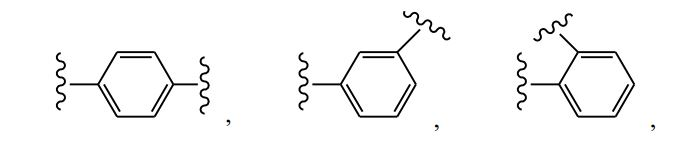
[0095] Os grupos "-(C1-C8 alquileno)arila," "-(C2-C8 alquenileno)arila", "e -(C2-C8 alquinileno)arila"típicos incluem, mas não se limitam a benzila, 2-feniletan-1-ila, 2-fenileten-1-ila, naftilmetila, 2- naftiletan-1-ila, 2-naftileten-1-ila, naftobenzila, 2-naftofeniletan-1-ila e similares.[0095] Typical "-(C1-C8 alkylene)aryl," "-(C2-C8 alkenylene)aryl", "and -(C2-C8 alkynylene)aryl" groups include, but are not limited to benzyl, 2- phenylethan-1-yl, 2-phenylethen-1-yl, naphthylmethyl, 2-naphthylethane-1-yl, 2-naphthylethen-1-yl, naphthobenzyl, 2-naphthylethane-1-yl and the like.
[0096] Exceto onde especificado em contrário, o termo "heterociclo," se refere a um sistema de anel monocíclico, bicíclico, ou policíclico tendo de 3 a 14 átomos de anel (também chamado de membros de anel) em que pelo menos um átomo de anel em pelo menos um anel é um heteroátomo selecionado a partir de N, O, P, ou S (e todas as combinações e subcombinações de intervalos e números específicos de átomos de carbono e heteroátomos ali contidos). O heterociclo pode ter de 1 a 4 heteroátomos de anel selecionados independentemente a partir de N, O, P, ou S. Um ou mais átomos de N, C, ou S em um heterociclo podem ser oxidados. Um heterociclo monocíclico tem, de preferência, 3 a 7 membros de anel (por exemplo, 2 a 6 átomos de carbono e 1 a 3 heteroátomos selecionados independentemente a partir de N, O, P, ou S) e um heterociclo bicíclico tem, de preferência, 5 a 10 membros de anel (por exemplo, 4 a 9 átomos de carbono e 1 a 3 heteroátomos selecionados independentemente a partir de N, O, P, ou S). O anel que inclui o heteroátomo pode ser aromático ou não aromático. Exceto onde especificado em contrário, o heterociclo é ligado a seu grupo pendente em qualquer heteroátomo ou átomo de carbono que resulte em uma estrutura estável.[0096] Unless otherwise specified, the term "heterocycle," refers to a monocyclic, bicyclic, or polycyclic ring system having from 3 to 14 ring atoms (also called ring members) in which at least one atom A ring in at least one ring is a heteroatom selected from N, O, P, or S (and all combinations and subcombinations of specific ranges and numbers of carbon atoms and heteroatoms contained therein). The heterocycle can have from 1 to 4 ring heteroatoms independently selected from N, O, P, or S. One or more N, C, or S atoms in a heterocycle can be oxidized. A monocyclic heterocycle preferably has 3 to 7 ring members (for example, 2 to 6 carbon atoms and 1 to 3 heteroatoms independently selected from N, O, P, or S) and a bicyclic heterocycle has, preferably, 5 to 10 ring members (for example, 4 to 9 carbon atoms and 1 to 3 heteroatoms independently selected from N, O, P, or S). The ring including the heteroatom can be aromatic or non-aromatic. Unless otherwise specified, the heterocycle is attached to its pendant group at any heteroatom or carbon atom that results in a stable structure.
[0097] Os heterociclos são descritos em Paquette, "Principles of Modern Heterocyclic Chemistry" (W.A. Benjamin, New York, 1968), particularmente, nos capítulos 1, 3, 4, 6, 7, e 9; "The Chemistry of Heterocyclic Compounds, A series of Monographs" (John Wiley & Sons, New York, 1950 até o presente), em particular, Volumes 13, 14, 16, 19, e 28; e J. Am. Chem. Soc. 82:5566 (1960).[0097] Heterocycles are described in Paquette, "Principles of Modern Heterocyclic Chemistry" (W.A. Benjamin, New York, 1968), particularly in
[0098] Exemplos de grupos de "heterociclo" incluem, a título de exemplo, e não de limitação piridila, di-hidropiridila, tetra-hidropiridil (piperidila), tiazolila, pirimidinila, furanila, tienila, pirrolila, pirazolila, imidazolila, tetrazolila, benzofuranila, tianaftalenila, indolila, indolenila, quinolinila, isoquinolinila, benzimidazolila, piperidinila, 4-piperidonila, pirrolidinila, 2-pirrolidonila, pirrolinila, tetra-hidrofuranila, bis-tetra- hidrofuranila, tetra-hidropiranila, bis-tetra-hidropiranila, tetra- hidroquinolinila, tetra-hidroisoquinolinila, deca-hidroquinolinila, octa- hidroisoquinolinila, azocinila, triazinila, 6H-1,2,5-tiadiazinila, 2H,6H - 1,5,2-ditiazinila, tienila, tiantrenila, piranila, isobenzofuranila, cromenila, xantenila, fenoxatinila, 2H-pirrolila, isotiazolila, isoxazolila, pirazinila, piridazinila, indolizinila, isoindolila, 3H-indolila, 1H-indazolila, purinila, 4H-quinolizinila, ftalazinila, naftiridinila, quinoxalinila, quinazolinila, cinolinila, pteridinila, 4H-carbazolila, carbazolila, β-carbolinila, fenantridinila, acridinila, pirimidinila, fenantrolinila, fenazinila, fenotiazinila, furazanila, fenoxazinila, isocromanila, cromanila, imidazolidinila, imidazolinila, pirazolidinila, pirazolinila, piperazinila, indolinila, isoindolinila, quinuclidinila, morfolinila, oxazolidinila, benzotriazolila, benzisoxazolila, oxindolila, benzoxazolinila, e isatinoila. Os grupos "heterociclo" preferenciais incluem, mas não se limitam a benzofuranila, benzotiofenila, indolila, benzopirazolila, coumarinila, isoquinolinila, pirrolila, tiofenila, furanila, tiazolila, imidazolila, pirazolila, triazolila, quinolinila, pirimidinila, piridinila, piridonila, pirazinila, piridazinila, isotiazolila, isoxazolila and tetrazolila.[0098] Examples of "heterocycle" groups include, by way of example and not limitation, pyridyl, dihydropyridyl, tetrahydropyridyl (piperidyl), thiazolyl, pyrimidinyl, furanyl, thienyl, pyrrolyl, pyrazolyl, imidazolyl, tetrazolyl, benzofuranyl, thianaphthalenyl, indolyl, indolenyl, quinolinyl, isoquinolinyl, benzimidazolyl, piperidinyl, 4-piperidonyl, pyrrolidinyl, 2-pyrrolidonyl, pyrrolinyl, tetrahydrofuranyl, bis-tetrahydrofuranyl, tetrahydropyranyl, bis-tetrahydropyranyl hydroquinolinyl, tetrahydroisoquinolinyl, decahydroquinolinyl, octahydroisoquinolinyl, azocinyl, triazinyl, 6H-1,2,5-thiadiazinyl, 2H,6H - 1,5,2-dithiazinyl, thienyl, thianthrenyl, pyranyl, isobenzofuranyl, cromenyl, xanthenyl, fenoxatinyl, 2H-pyrrolyl, isothiazolyl, isoxazolyl, pyrazinyl, pyridazinyl, indolizinyl, isoindolyl, 3H-indolyl, 1H-indazolyl, purinyl, 4H-quinolizinyl, phthalazinyl, naphthyridinyl, quinoxalinyl, cinoxalinyl, inyl, 4H-carbazolyl, carbazolyl, β-carbolinyl, phenanthridinyl, acridinyl, pyrimidinyl, phenanthrolinyl, phenazinyl, phenothiazinyl, furazanyl, fenoxazinyl, isochromanyl, chromanyl, imidazolidinyl, imidazolinyl, pyrazolidinyl, pyrazolinyl, morpholinyl, indolylinyl oxazolidinyl, benzotriazolyl, benzisoxazolyl, oxindolyl, benzoxazolinyl, and isatinoyl. Preferred "heterocycle" groups include, but are not limited to, benzofuranyl, benzothiophenyl, indolyl, benzopyrazolyl, coumarinyl, isoquinolinyl, pyrrolyl, thiophenyl, furanyl, thiazolyl, imidazolyl, pyrazolyl, triazolyl, quinolinyl, pyrimidinyl, pyridinyl, pyrazinyl , isothiazolyl, isoxazolyl and tetrazolyl.
[0099] Um grupo heterociclo, quer sozinho ou como parte de outro grupo, pode ser opcionalmente substituído com um ou mais grupos, de preferência, 1 a 2 grupos, incluindo, mas não se limitando a, -C1-C8 alquila, -C2-C8 alquenila, -C2-C8 alquinila, -halogênio, -O-(C1-C8 alquila), -O-(C2-C8 alquenila), -O-(C2-C8 alquinila), -arila, -C(O)R', - OC(O)R', -C(O)OR', -C(O)NH2, -C (O)NHR', -C(O)N(R')2, -NHC(O)R', - SR', -SO3R', -S(O)2R', -S(O)R', -OH, -N3, -NH2, -NH(R'), -N(R')2 e -CN, onde cada R'é independentemente selecionado a partir de -H, -C1-C8 alquila, -C2-C8 alquenila, -C2-C8 alquinila, ou -arila e em que os ditos grupos -O-(C1-C8 alquila), -O-(C2-C8 alquenila), -O-(C2-C8 alquinila), - C1-C8 alquila, -C2-C8 alquenila, -C2-C8 alquinila, e -arila podem ser opcionalmente adicionalmente substituídos com um ou mais substituintes incluindo, mas não se limitando a -C1-C8 alquila, -C2-C8 alquenila, -C2-C8 alquinila, -halogênio, -O-(C1-C8 alquila), -O-(C2-C8 alquenila), -O-(C2-C8 alquinila), -arila, -C(O)R'', -OC(O)R'', -C(O)OR'', - C(O)NH2 , -C(O)NHR'', -C(O)N (R'')2, -NHC(O)R'', -SR'', -SO3R'', - S(O)2R'', -S(O)R'', -OH, -N3 , -NH2, -NH(R''), -N (R'')2 e -CN, onde cada R''é independentemente selecionado a partir de -H, -C1-C8 alquila, - C2-C8 alquenila, -C2-C8 alquinila, ou arila.[0099] A heterocycle group, either alone or as part of another group, may optionally be substituted with one or more groups, preferably 1 to 2 groups, including, but not limited to, -C1-C8 alkyl, -C2 -C8 alkenyl, -C2-C8 alkynyl, -halogen, -O-(C1-C8 alkyl), -O-(C2-C8 alkenyl), -O-(C2-C8 alkynyl), -aryl, -C(O )R', -OC(O)R', -C(O)OR', -C(O)NH2, -C(O)NHR', -C(O)N(R')2, -NHC( O)R', -SR', -SO3R', -S(O)2R', -S(O)R', -OH, -N3, -NH2, -NH(R'), -N(R' )2 and -CN, where each R' is independently selected from -H, -C1-C8 alkyl, -C2-C8 alkenyl, -C2-C8 alkynyl, or -aryl and wherein said groups -O-( C1-C8 alkyl), -O-(C2-C8 alkenyl), -O-(C2-C8 alkynyl), -C1-C8 alkyl, -C2-C8 alkenyl, -C2-C8 alkynyl, and -aryl may optionally be further substituted with one or more substituents including, but not limited to -C1-C8 alkyl, -C2-C8 alkenyl, -C2-C8 alkynyl, -halogen, -O-(C1-C8 alkyl), -O-(C2 -C8 alkenyl), -O-(C2-C8 alkynyl), -ar ila, -C(O)R'', -OC(O)R'', -C(O)OR'', -C(O)NH2 , -C(O)NHR'', -C(O) N(R'')2, -NHC(O)R'', -SR'', -SO3R'', -S(O)2R'', -S(O)R'', -OH, -N3 , -NH2, -NH(R''), -N(R'')2 and -CN, where each R'' is independently selected from -H, -C1-C8 alkyl, -C2-C8 alkenyl, -C2-C8 alkynyl, or aryl.
[00100] A título de exemplo, e não de limitação, os heterociclos ligados ao carbono podem ser ligados nas seguintes posições: posição 2, 3, 4, 5, ou 6 de uma piridina; posição 3, 4, 5, ou 6 de uma piridazina; posição 2, 4, 5, ou 6 de uma pirimidina; posição 2, 3, 5, ou 6 de uma pirazina; posição 2, 3, 4, ou 5 de um furano, tetra-hidrofurano, tiofurano, tiofeno, pirrol ou tetraidropirrol; posição 2, 4, ou 5 de um oxazol, imidazol ou tiazol; posição 3, 4, ou 5 de um isoxazol, pirazol, ou isotiazol; posição 2 ou 3 de uma aziridina; posição 2, 3, ou 4 de uma azetidina; posição 2, 3, 4, 5, 6, 7, ou 8 de uma quinolina; ou posição 1, 3, 4, 5, 6, 7, ou 8 de uma isoquinolina. Mais tipicamente ainda, os heterociclos ligados ao carbono incluem 2-piridila, 3-piridila, 4-piridila, 5-piridila, 6-piridila, 3-piridazinila, 4-piridazinila, 5-piridazinila, 6-piridazinila, 2-pirimidinila, 4-pirimidinila, 5-pirimidinila, 6-pirimidinila, 2-pirazinila, 3-pirazinila, 5-pirazinila, 6-pirazinila, 2-tiazolila, 4-tiazolila, ou 5-tiazolila.By way of example, and not limitation, carbon-linked heterocycles may be attached at the following positions:
[00101] A título de exemplo, e não de limitação, os heterociclos ligados ao nitrogênio podem ser ligados na posição 1 de uma aziridina, azetidina, pirrol, pirrolidina, 2-pirrolina, 3-pirrolina, imidazol, imidazolidina, 2-imidazolina, 3-imidazolina, pirazol, pirazolina, 2- pirazolina, 3-pirazolina, piperidina, piperazina, indol, indolina, ou 1H- indazol; posição 2 de um isoindol, ou isoindolina; posição 4 de uma morfolina; e posição 9 de um carbazol, ou β-carbolina. Mais tipicamente ainda, os heterociclos ligados ao nitrogênio incluem 1- aziridila, 1-azetedila, 1-pirrolila, 1-imidazolila, 1-pirazolila, e 1-piperi- dinila.By way of example, and not limitation, nitrogen-linked heterocycles may be linked at the 1-position of an aziridine, azetidine, pyrrole, pyrrolidine, 2-pyrroline, 3-pyrroline, imidazolidine, imidazolidine, 2-imidazoline, 3-imidazoline, pyrazole, pyrazoline, 2-pyrazoline, 3-pyrazoline, piperidine, piperazine, indole, indoline, or 1H-indazole;
[00102] Exceto onde especificado em contrário, o termo "carbociclo," se refere a um sistema de anel monocíclico, bicíclico, ou policíclico não aromático saturado ou insaturado tendo de 3 a 14 átomos de anel (e todas as combinações e subcombinações de intervalos e números específicos de átomos de carbono ali contidos) em que todos os átomos de anel são átomos de carbono. Os carbociclos monocíclicos têm, de preferência, 3 a 6 átomos de anel, com mais preferência ainda 5 ou 6 átomos de anel. Os carbociclos bicíclicos têm, de preferência, 7 a 12 átomos de anel, por exemplo, dispostos como um sistema biciclo [4,5], [5,5], [5,6] ou [6,6], ou 9 ou 10 átomos de anel dispostos como um sistema biciclo [5,6] ou [6,6]. O termo "carbociclo" inclui, por exemplo, um anel carbociclo monocíclico fundido a um anel arila (por exemplo, um anel carbociclo monocíclico fundido a um anel benzeno). Os carbociclos têm, de preferência, 3 a 8 átomos de anel de carbono.[00102] Unless otherwise specified, the term "carbocycle," refers to a non-aromatic saturated or unsaturated monocyclic, bicyclic, or polycyclic ring system having from 3 to 14 ring atoms (and all combinations and subcombinations of ranges and specific numbers of carbon atoms contained therein) wherein all ring atoms are carbon atoms. Monocyclic carbocycles preferably have 3 to 6 ring atoms, more preferably 5 or 6 ring atoms. Bicyclic carbocycles preferably have 7 to 12 ring atoms, for example arranged as a [4.5], [5.5], [5.6] or [6.6], or 9 or 10 ring atoms arranged as a [5,6] or [6,6] bicyclic system. The term "carbocycle" includes, for example, a monocyclic carbocycle ring fused to an aryl ring (for example, a monocyclic carbocycle ring fused to a benzene ring). Carbocycles preferably have 3 to 8 carbon ring atoms.
[00103] Os grupos carbociclo, que sozinhos ou como parte de outro grupo, podem ser opcionalmente substituídos com, por exemplo, um ou mais grupos, de preferência, 1 ou 2 grupos (e quaisquer substituintes adicionais selecionados a partir de halogênio), incluindo, mas não se limitando a -halogênio, -C1-C8 alquila, -C2-C8 alquenila, -C2-C8 alquinila, -O-(C1-C8 alquila), -O-(C2-C8 alquenila), -O- (C2-C8 alquinila), -arila, -C(O)R', -OC(O)R', -C(O) OR', -C(O)NH2 , - C(O)NHR', -C(O)N(R')2, -NHC(O)R', -SR', -SO3R', -S(O)2R', -S(O)R', - OH, =O, -N3, -NH2, -NH(R'), -N(R')2 e -CN, onde cada R'é independentemente selecionado a partir de -H, -C1-C8 alquila, -C2-C8 alquenila, -C2-C8 alquinila, ou -arila e em que os ditos grupos -C1-C8 alquila, -C2-C8 alquenila, -C2-C8 alquinila, -O-(C1-C8 alquila), -O-(C2-C8 alquenila), -O-(C2-C8 alquinila), e -arila podem ser opcionalmente adicionalmente substituídos com um ou mais substituintes incluindo, mas não se limitando a -C1-C8 alquila, -C2-C8 alquenila, -C2-C8 alquinila, -halogênio, -O-(C1-C8 alquila), -O-(C2-C8 alquenila), -O-(C2-C8 alquinila), -arila, -C(O)R'', -OC(O)R'', -C(O)OR'', -C(O) NH2 , - C(O)NHR'', -C(O)N(R'')2, -NHC(O)R'', -SR'', -SO3R'', -S(O)2R'', -S(O) R'', -OH, -N3 , -NH2, -NH(R''), -N(R'')2 e -CN, onde cada R''é independentemente selecionado a partir de -H, -C1-C8 alquila, -C2-C8 alquenila, -C2-C8 alquinila, ou -arila.[00103] Carbocycle groups, which alone or as part of another group, may optionally be substituted with, for example, one or more groups, preferably 1 or 2 groups (and any additional substituents selected from halogen), including , but not limited to -halogen, -C1-C8 alkyl, -C2-C8 alkenyl, -C2-C8 alkynyl, -O-(C1-C8 alkyl), -O-(C2-C8 alkenyl), -O- (C2-C8 alkynyl), -aryl, -C(O)R', -OC(O)R', -C(O)OR', -C(O)NH2 , -C(O)NHR', - C(O)N(R')2, -NHC(O)R', -SR', -SO3R', -S(O)2R', -S(O)R', -OH, =O, - N3, -NH2, -NH(R'), -N(R')2 and -CN, where each R' is independently selected from -H, -C1-C8 alkyl, -C2-C8 alkenyl, -C2 -C8 alkynyl, or -aryl and wherein said groups -C1-C8 alkyl, -C2-C8 alkenyl, -C2-C8 alkynyl, -O-(C1-C8 alkyl), -O-(C2-C8 alkenyl) , -O-(C2-C8 alkynyl), and -aryl may be optionally further substituted with one or more substituents including, but not limited to -C1-C8 alkyl, -C2-C8 alkenyl, - C2-C8 alkynyl, -halogen, -O-(C1-C8 alkyl), -O-(C2-C8 alkenyl), -O-(C2-C8 alkynyl), -aryl, -C(O)R'', -OC(O)R'', -C(O)OR'', -C(O)NH2 , -C(O)NHR'', -C(O)N(R'')2, -NHC( O)R'', -SR'', -SO3R'', -S(O)2R'', -S(O)R'', -OH, -N3, -NH2, -NH(R'') , -N(R'')2 and -CN, where each R'' is independently selected from -H, -C1-C8 alkyl, -C2-C8 alkenyl, -C2-C8 alkynyl, or -aryl.
[00104] Exemplos de substituintes carbocíclicos monocíclicos incluem -ciclopropila, -ciclobutila, -ciclopentila, -1-ciclopent-1-enila, -1- ciclopent-2-enila, -1-ciclopent-3-enila, ciclo-hexila, -1-ciclo-hex-1-enila, -1-ciclo-hex-2-enila, -1-ciclo-hex-3-enila, -ciclo-heptila, -ciclo-octila. - 1,3-ciclo-hexadienila, -1,4-ciclo-hexadienila, -1,3-ciclo-heptadienila, - 1,3,5-ciclo-heptatrienila, e -ciclo-octadienila.[00104] Examples of monocyclic carbocyclic substituents include -cyclopropyl, -cyclobutyl, -cyclopentyl, -1-cyclopent-1-enyl, -1-cyclopent-2-enyl, -1-cyclopent-3-enyl, cyclohexyl, - 1-cyclohex-1-enyl, -1-cyclohex-2-enyl, -1-cyclohex-3-enyl, -cycloheptyl, -cyclooctyl. - 1,3-cyclohexadienyl, -1,4-cyclohexadienyl, -1,3-cycloheptadienyl, - 1,3,5-cycloheptatrienyl, and -cyclooctadienyl.
[00105] Um "carbociclo," quer usado sozinho ou como parte de outro grupo, se refere a um grupo carbociclo opcionalmente substituído, conforme definido acima, que é divalente (isto é, derivado pela remoção de dois átomos de hidrogênio do mesmo átomo de carbono ou de dois átomos de carbono diferentes de um sistema de anel carbocíclico original).[00105] A "carbocycle," whether used alone or as part of another group, refers to an optionally substituted carbocycle group, as defined above, which is divalent (ie, derived by removing two hydrogen atoms from the same atom of carbon or two carbon atoms different from an original carbocyclic ring system).
[00106] Exceto onde indicado em contrário pelo contexto, um hífen (-) designa o ponto de ligação à molécula pendente. Consequentemente, o termo "-(C1-C8 alquileno)arila" ou "-C1-C8 alquileno(arila)" se refere a um radical C1-C8 alquileno, como definido aqui, em que o radical alquileno está ligado à molécula de pendente em qualquer um dos átomos de carbono do radical alquileno e um dos átomos de hidrogênio ligado a um átomo de carbono do radical alquileno é substituído por um radical arila, como definido aqui.[00106] Except where the context indicates otherwise, a hyphen (-) designates the point of attachment to the pendant molecule. Accordingly, the term "-(C1-C8 alkylene)aryl" or "-C1-C8 alkylene(aryl)" refers to a C1-C8 alkylene radical, as defined herein, wherein the alkylene radical is attached to the pendant molecule. on any of the carbon atoms of the alkylene radical and one of the hydrogen atoms bonded to a carbon atom of the alkylene radical is replaced by an aryl radical, as defined herein.
[00107] Quando um grupo particular é "substituído", aquele grupo pode ter um ou mais substituintes, de preferência de um a cinco substituintes, com mais preferência de um a três substituintes, com a máxima preferência, de um a dois substituintes, selecionados independentemente a partir da lista de substituintes. O grupo pode, entretanto, ter geralmente qualquer quantidade de substituintes selecionados a partir de halogênio. Os grupos que são substituídos estão assim indicados.[00107] When a particular group is "substituted", that group may have one or more substituents, preferably from one to five substituents, more preferably from one to three substituents, most preferably from one to two substituents, selected independently from the list of substituents. The group can, however, generally have any number of substituents selected from halogen. The groups that are replaced are indicated as such.
[00108] Pretende-se que a definição de qualquer substituinte ou variável em um local específico em uma molécula seja independente de suas definições em qualquer lugar nesta molécula. Compreende-se que os substituintes e os padrões de substituição nos compostos desta invenção podem ser selecionados por um indivíduo versado na técnica de modo a proporcionar compostos que sejam quimicamente estáveis e que possam ser prontamente sintetizados por técnicas conhecidas na técnica, assim como os métodos aqui descritos.[00108] The definition of any substituent or variable at a specific location in a molecule is intended to be independent of its definitions anywhere in this molecule. It is understood that the substituents and substitution patterns in the compounds of this invention can be selected by one of skill in the art so as to provide compounds that are chemically stable and that can be readily synthesized by techniques known in the art, as well as the methods herein. described.
[00109] Os grupos protetores para uso na presente invenção referem-se a grupos que bloqueiam seletivamente, temporariamente ou permanentemente, um sítio reativo em um composto multifuncional. Os grupos protetores de hidróxi adequados para uso na presente invenção são farmaceuticamente aceitáveis e podem ou não precisar ser clivados do composto-mãe após administração a um indivíduo para que o composto seja ativo. A clivagem é através de processos metabólicos normais dentro do corpo. Os grupos protetores de hidróxi são bem conhecidos na técnica, vide Protective Groups in Organic Synthesispor T. W. Greene e P. G. M. Wuts (John Wiley & sons, 3Â edição) aqui incorporado na íntegra, a título de referência e para todos os propósitos e incluem, por exemplo, grupos protetores de éter (por exemplo, éteres de alquila e éteres de silila incluindo, por exemplo, dialquilsililéter, trialquilsililéter, dialquilalcoxisililéter), éster, carbonato, carbamatos, sulfonato, and fosfato. Exemplos de grupos protetores de hidróxi incluem, mas não se limitam a éter metílico; éter metóxi metílico, éter metiltiometílico, éter (fenildimetilsilil)metoximetílico, éter benziloximetílico, éter p-metoxibenziloximetílico, éter p- nitrobenziloximetílico, éter o-nitrobenziloximetílico, éter (4- metoxifenóxi)metílico, éter guaiacolmetílico, éter t-butoximetílico, éter 4-penteniloximetílico, éter siloximetílico, éter 2-metoxietoximetílico, éter 2,2, 2-tricloroetoximetílico, éter bis(2-cloroetóxi)metílico, éter 2- (trimetilsilil) etoximetílico, éter mentoximetílico, éter tetra- hidropiranílico, éter 1-metoxiciclo-hexílico, éter 4-metoxitetra- hidrotiopiranílico, éter 4-metoxitetra-hidrotiopiranílico, S,S-dióxido, éter 1-[(2-cloro-4-metil)fenil]-4-metoxipiperidin-4-ílico, éter 1-(2-fluorofenil)- 4-metoxipiperidin-4-ílico, éter 1,4-dioxan-2-ílico, éter tetra- hidrofuranílico, éter tetra-hidrotiofuranílico; éteres etílicos substituídos como éter 1-etoxietílico, éter 1-(2-cloroetoxi)etílico, éter 1-[2- (trimetilsilil)etóxi] etílico, éter 1-metil-1-metóxietílico, éter 1-metil-1- benziloxietílico, éter 1-metil-1-benzilóxi-2-fluoroetílico, éter 1-metil-1- fenoxietílico, éter 2-trimetilsilílico, éter t-butílico, éter alílico, éteres propargílicos, éter p-clorofenílico, éter p-metoxifenílico, éter benzílico, éter p-metoxibenzílico, éter 3,4-dimetoxibenzílico, éter trimetilsilílico, éter trietilsilílico, éter tripropilsilílico éter dimetilisopropilsilílico, éter dietilisopropilsilílico, éter dimetil-hexilsilílico, éter t-butildimetilsilílico, éter difenilmetilsilílico, éster de benzoilformiato, éster de acetato, éster de cloroacetato, éster de dicloroacetato, éster de tricloroacetato, éster de trifluoroacetato, éster de metóxiacetato, éster de trifenilmetoxiacetato, éster de fenilacetato, éster de benzoato, carbonato de alquil metila, carbonato de alquil 9-fluorenilmetila, carbonato de alquil etila, carbonato de alquil 2,2,2,-tricloroetila, carbonato de 1,1,-dimetil-2,2,2-tricloroetila, alquilsulfonato, metanossulfonato, benzilsulfonato, tosilato, metileno acetal, etilideno acetal, e t-butilmetilideno cetal. Os grupos protetores preferenciais são representados pelas fórmulas -Ra, -Si(Ra)(Ra)(Ra), -C(O)Ra, -C(O)ORa, -C(O)NH(Ra), -S(O)2Ra, -S(O)2OH, P(O)(OH)2, e -P(O)(OH)ORa, em que Raé C1-C20 alquila, C2-C20 alquenila, C2-C20 alquinila, -C1-C20 alquileno(carbociclo), -C2-C20 alquenileno(carbociclo), -C2-C20 alquinileno(carbociclo), -C6-C10 arila, -C1-C20 alquileno(arila), -C2-C20 alquenileno(arila), -C2-C20 alquinileno(arila), -C1-C20 alquileno(heterociclo), -C2-C20 alquenileno(heterociclo), ou -C2-C20 alquinileno(heterociclo) em que os ditos radicais alquila, alquenila, alquinila, alquileno, alquenileno, alquinileno, arila, carbociclo, e heterociclo, quer sozinhos ou como parte de outro grupo são opcionalmente substituídos.[00109] Protecting groups for use in the present invention refer to groups that selectively, temporarily or permanently block a reactive site on a multifunctional compound. Suitable hydroxy protecting groups for use in the present invention are pharmaceutically acceptable and may or may not need to be cleaved from the parent compound after administration to an individual for the compound to be active. Cleavage is through normal metabolic processes within the body. Hydroxy protecting groups are well known in the art, see Protective Groups in Organic Synthesis by TW Greene and PGM Wuts (John Wiley & Sons, 3rd edition) incorporated herein in its entirety by reference and for all purposes and include, for example , ether protecting groups (for example, alkyl ethers and silyl ethers including, for example, dialkylsilyl ether, trialkylsilyl ether, dialkylalkoxysilyl ether), ester, carbonate, carbamates, sulfonate, and phosphate. Examples of hydroxy protecting groups include, but are not limited to, methyl ether; methoxy methyl ether, methylthiomethyl ether, (phenyldimethylsilyl)methoxymethyl ether, benzyloxymethyl ether, p-methoxybenzyloxymethyl ether, p-nitrobenzyloxymethyl ether, o-nitrobenzyloxymethyl ether, (4-methoxyphenoxy)methyl ether, guaiacolmethyl ether, t-butoxymethyl ether pentenyloxymethyl, siloxymethyl ether, 2-methoxyethoxymethyl ether, 2,2,2-trichloroethoxymethyl ether, bis(2-chloroethoxy)methyl ether, 2-(trimethylsilyl)ethoxymethyl ether, menthoxymethyl ether, tetrahydropyranyl ether, 1-methoxycyclohexyl ether , 4-methoxytetrahydrothiopyranyl ether, 4-methoxytetrahydrothiopyranyl ether, S,S-dioxide, 1-[(2-chloro-4-methyl)phenyl]-4-methoxypiperidin-4-yl ether, 1-(2 -fluorophenyl)-4-methoxypiperidin-4-yl, 1,4-dioxan-2-yl ether, tetrahydrofuranyl ether, tetrahydrothiofuranyl ether; substituted ethyl ethers such as 1-ethoxyethyl ether, 1-(2-chloroethoxy)ethyl ether, 1-[2-(trimethylsilyl)ethoxy]ethyl ether, 1-methyl-1-methoxyethyl ether, 1-methyl-1-benzyloxyethyl ether, 1-methyl-1-benzyloxy-2-fluoroethyl ether, 1-methyl-1-phenoxyethyl ether, 2-trimethylsilyl ether, t-butyl ether, allyl ether, propargyl ethers, p-chlorophenyl ether, p-methoxyphenyl ether, benzyl ether , p-methoxybenzyl ether, 3,4-dimethoxybenzyl ether, trimethylsilyl ether, triethylsilyl ether, tripropylsilyl ether, dimethylisopropylsilyl ether, diethylisopropylsilyl ether, dimethylhexylsilyl ether, t-butyldimethylsilyl ether, diphenylmethylsilyl ether, benzoyl ester acetate ester, ether chloroacetate, dichloroacetate ester, trichloroacetate ester, trifluoroacetate ester, methoxyacetate ester, triphenylmethoxyacetate ester, phenylacetate ester, benzoate ester, alkyl methyl carbonate, alkyl 9-fluorenylmethyl carbonate, alkyl ether carbonate ila, 2,2,2-alkyl-trichloroethyl carbonate, 1,1,-dimethyl-2,2,2-trichloroethyl carbonate, alkylsulfonate, methanesulfonate, benzylsulfonate, tosylate, methylene acetal, ethylidene acetal, and t-butylmethylidene ketal . Preferred protecting groups are represented by the formulas -Ra, -Si(Ra)(Ra)(Ra), -C(O)Ra, -C(O)ORa, -C(O)NH(Ra), -S( O)2Ra, -S(O)2OH, P(O)(OH)2, and -P(O)(OH)ORa, where Ra is C1-C20 alkyl, C2-C20 alkenyl, C2-C20 alkynyl, - C1-C20 alkylene(carbocycle), -C2-C20 alkenylene(carbocycle), -C2-C20 alkynylene(carbocycle), -C6-C10 aryl, -C1-C20 alkylene(aryl), -C2-C20 alkenylene(aryl), -C2-C20 alkynylene(aryl), -C1-C20 alkylene(heterocycle), -C2-C20 alkenylene(heterocycle), or -C2-C20 alkynylene(heterocycle) wherein said alkyl, alkenyl, alkynyl, alkylene, alkenylene radicals , alkynylene, aryl, carbocycle, and heterocycle, either alone or as part of another group are optionally substituted.
[00110] "Alterar o padrão de glicosilação nativo" se destina, para os propósitos da presente invenção, significar deletar uma ou mais porções de carboidrato encontradas na sequência nativa de 191P4D12 (pela remoção do sítio de glicosilação subjacente ou pela deleção da glicosilação por meios químicos e/ou enzimáticos), e/ou adição de um ou mais sítios de glicosilação que não estão presentes na sequência de 191P4D12 nativa. Além disso, a expressão inclui alterações qualitativas na glicosilação das proteínas nativas, envolvendo uma alteração na natureza e nas proporções das várias porções de carboidrato presentes.[00110] "Changing the native glycosylation pattern" is intended, for the purposes of the present invention, to mean deleting one or more carbohydrate moieties found in the native sequence of 191P4D12 (by removing the underlying glycosylation site or by deleting glycosylation by means chemical and/or enzymatic), and/or addition of one or more glycosylation sites that are not present in the native 191P4D12 sequence. Furthermore, the expression includes qualitative changes in the glycosylation of native proteins, involving a change in the nature and proportions of the various carbohydrate moieties present.
[00111] O termo "analógico"se refere a uma molécula que é estruturalmente similar ou compartilha atributos similares ou correspondentes com outra molécula (por exemplo, uma proteína relacionada a 191P4D12). Por exemplo, um analógico de uma proteína 191P4D12 pode ser ligado especificamente por um anticorpo ou célula T que se liga especificamente a 191P4D12.[00111] The term "analog" refers to a molecule that is structurally similar or shares similar or corresponding attributes with another molecule (eg, a 191P4D12-related protein). For example, an analog of a 191P4D12 protein can be specifically bound by an antibody or T cell that specifically binds to 191P4D12.
[00112] O termo "anticorpo"é usado em seu sentido mais amplo, a menos que seja claramente indicado de outro modo. Portanto, um "anticorpo" pode ser de ocorrência natural ou artificial, como, por exemplo, anticorpos monoclonais produzidos por tecnologia de hibridoma convencional. Os anticorpos 191P4D12 compreendem anticorpos monoclonais e policlonais assim como fragmentos contendo o domínio de ligação ao antígeno e/ou uma ou mais regiões de determinação de complementaridade destes anticorpos. Como usado aqui, o termo "anticorpo" se refere a qualquer forma de anticorpo ou fragmento do mesmo que se liga especificamente a 191P4D12 e/ou tem a atividade biológica desejada e abrange especificamente os anticorpos monoclonais (incluindo os anticorpos monoclonais de extensão completa), anticorpos policlonais, anticorpos multiespecíficos (por exemplo, anticorpos biespecíficos), e fragmentos de anticorpo contanto que eles se liguem especificamente a 191P4D12 e/ou tenham a atividade biológica desejada. Qualquer anticorpo específico pode ser usado nos métodos e composições aqui fornecidas. Desta forma, em uma modalidade, o termo "anticorpo" abrange uma molécula que compreende pelo menos uma região variável de uma molécula de imunoglobulina de cadeia leve e pelo menos uma região variável de uma molécula de cadeia pesada que, em combinação, formam um sítio de ligação específico para o antígeno alvo. Em uma modalidade, o anticorpo é um anticorpo IgG. Por exemplo, o anticorpo é um anticorpo IgG1, IgG2, IgG3, ou IgG4. Os anticorpos úteis aos presentes métodos e composições podem ser gerados em cultura celular, em fagos, ou em vários animais, incluindo, mas não se limitando a vacas, coelhos, cabras, camundongos, ratos, hamsters, porcos da guiné, ovelhas, cachorros, gatos, macacos, chimpanzés, e símios. Portanto, em uma modalidade, um anticorpo da presente invenção é um anticorpo de mamífero. As técnicas de fago podem ser usadas para isolar um anticorpo inicial ou para gerar variantes com características de especificidade ou avidez alteradas. Tais técnicas são de rotina e bem conhecidas na técnica. Em uma modalidade, o anticorpo é produzido por meios recombinantes conhecidos na técnica. Por exemplo, um anticorpo recombinante pode ser produzido por transfectar uma célula hospedeira com um vetor que compreende uma sequência de DNA que codifica o anticorpo. Um ou mais vetores podem ser usados para transfectar a sequência de DNA que expressa pelo menos uma região VL e uma região VH na célula hospedeira. Descrições exemplificadoras de meios recombinantes para geração e produção de anticorpo incluem Delves, ANTIBODY PRODUCTION: ESSENTIAL TECHNIQUES (Wiley, 1997); Shephard, et al., MONOCLONAL ANTIBODIES (Oxford University Press, 2000); Goding, MONOCLONAL ANTIBODIES: PRINCIPLES AND PRACTICE (Academic Press, 1993); e CURRENT PROTOCOLS IN IMMUNOLOGY (John Wiley & Sons, edição mais recente). Um anticorpo da presente invenção pode ser modificado por meios recombinantes para aumentar a eficácia do anticorpo em mediar a função desejada. Desta forma, está dentro do escopo da invenção que anticorpos podem ser modificados por substituições usando meios recombinantes. Tipicamente, as substituições serão substituições conservativas. Por exemplo, pelo menos um aminoácido na região constante do anticorpo pode ser substituído por um resíduo diferente. Vide, por exemplo, a patente US 5.624.821, patente US 6.194.551, Pedido N° WO 9958572; e Angal, et al., Mol. Immunol. 30: 105-08 (1993). A modificação nos aminoácidos inclui deleções, adições, e substituições de aminoácidos. Em alguns casos, tais alterações são feitas para reduzir as atividades indesejadas, por exemplo, citotoxicidade dependente do complemento. Frequentemente, os anticorpos são marcados pela união, covalentemente ou não covalentemente, de uma substância que fornece um sinal detectável. Uma ampla variedade de rótulos e técnicas de conjugação são conhecidos e são relatados extensamente na literatura científica e de patentes. Estes anticorpos podem ser selecionados para ligação à molecula 191P4D12 normal ou defeituosa. Vide por exemplo, Antibody Engineering: A Practical Approach (Oxford University Press, 1996). Os anticorpos adequados com as atividades biológicas desejadas podem ser identificados usando os seguintes ensaios in vitro, incluindo, mas não se limitando a: proliferação, migração, adesão, crescimento em ágar macio, angiogênese, comunicação célula-célula, apoptose, transporte, transdução de sinal, e os seguintes ensaios in vivo, tal como a inibição do crescimento tumoral. Os anticorpos aqui fornecidos também podem ser úteis em aplicações diagnósticas. Como anticorpos de captura ou não neutralizantes, eles podem ser selecionados por sua capacidade de se ligar ao antígeno específico sem inibir a ligação ao receptor ou a atividade biológica do antígeno. Como anticorpos neutralizantes, os anticorpos podem ser úteis em ensaios de ligação competitiva. Eles também podem ser usados para quantificar 191P4D12 ou seu receptor.[00112] The term "antibody" is used in its broadest sense unless clearly indicated otherwise. Therefore, an "antibody" can be naturally or artificially occurring, such as, for example, monoclonal antibodies produced by conventional hybridoma technology. 191P4D12 antibodies comprise monoclonal and polyclonal antibodies as well as fragments containing the antigen binding domain and/or one or more complementarity determining regions of these antibodies. As used herein, the term "antibody" refers to any form of antibody or fragment thereof that specifically binds to 191P4D12 and/or has the desired biological activity and specifically encompasses monoclonal antibodies (including full-length monoclonal antibodies), polyclonal antibodies, multispecific antibodies (eg, bispecific antibodies), and antibody fragments as long as they specifically bind 191P4D12 and/or have the desired biological activity. Any specific antibody can be used in the methods and compositions provided herein. Thus, in one embodiment, the term "antibody" encompasses a molecule that comprises at least one variable region of a light chain immunoglobulin molecule and at least one variable region of a heavy chain molecule that, in combination, form a site specific binding to the target antigen. In one embodiment, the antibody is an IgG antibody. For example, the antibody is an IgG1, IgG2, IgG3, or IgG4 antibody. Antibodies useful in the present methods and compositions can be generated in cell culture, on phages, or in various animals, including, but not limited to, cows, rabbits, goats, mice, rats, hamsters, guinea pigs, sheep, dogs, cats, monkeys, chimpanzees, and apes. Therefore, in one embodiment, an antibody of the present invention is a mammalian antibody. Phage techniques can be used to isolate an initial antibody or to generate variants with altered specificity or avidity characteristics. Such techniques are routine and well known in the art. In one embodiment, the antibody is produced by recombinant means known in the art. For example, a recombinant antibody can be produced by transfecting a host cell with a vector that comprises a DNA sequence that encodes the antibody. One or more vectors can be used to transfect DNA sequence expressing at least one VL region and one VH region into the host cell. Exemplary descriptions of recombinant means for antibody generation and production include Delves, ANTIBODY PRODUCTION: ESSENTIAL TECHNIQUES (Wiley, 1997); Shephard, et al., MONOCLONAL ANTIBODIES (Oxford University Press, 2000); Goding, MONOCLONAL ANTIBODIES: PRINCIPLES AND PRACTICE (Academic Press, 1993); and CURRENT PROTOCOLS IN IMMUNOLOGY (John Wiley & Sons, most recent edition). An antibody of the present invention can be modified by recombinant means to increase the antibody's effectiveness in mediating the desired function. Thus, it is within the scope of the invention that antibodies can be modified by substitutions using recombinant means. Typically, substitutions will be conservative substitutions. For example, at least one amino acid in the antibody constant region can be replaced by a different residue. See, for example, US Patent 5,624,821, US Patent 6,194,551, Application No. WO 9958572; and Angal, et al., Mol. Immunol. 30: 105-08 (1993). Amino acid modification includes amino acid deletions, additions, and substitutions. In some cases, such changes are made to reduce unwanted activities, eg complement dependent cytotoxicity. Antibodies are often labeled by binding, covalently or non-covalently, a substance that provides a detectable signal. A wide variety of labeling and conjugation techniques are known and are reported extensively in the scientific and patent literature. These antibodies can be selected for binding to the normal or defective 191P4D12 molecule. See, for example, Antibody Engineering: A Practical Approach (Oxford University Press, 1996). Suitable antibodies with the desired biological activities can be identified using the following in vitro assays, including, but not limited to: proliferation, migration, adhesion, growth on soft agar, angiogenesis, cell-cell communication, apoptosis, transport, transduction of signal, and the following in vivo assays, such as tumor growth inhibition. The antibodies provided herein may also be useful in diagnostic applications. As capture or non-neutralizing antibodies, they can be selected for their ability to bind specific antigen without inhibiting receptor binding or biological activity of the antigen. As neutralizing antibodies, the antibodies can be useful in competitive binding assays. They can also be used to quantify 191P4D12 or its receiver.
[00113] O termo "porção de ligação ao antígeno"ou "fragmento de anticorpo" de um anticorpo (ou simplesmente "porção de anticorpo"), para uso na presente invenção, se refere a um ou mais fragmentos de um anticorpo 191P4D12 que guardam a capacidade de se ligar especificamente a um antígeno (por exemplo, 191P4D12 e variantes; figura 1). Foi mostrado que a função de ligação ao antígeno de um anticorpo pode ser executada por fragmentos de um anticorpo de extensão completa. Exemplos de fragmentos de ligação abrangidos pelo termo "porção de ligação ao antígeno"de um anticorpo incluem (i) um fragmento Fab, um fragmento monovalente que consiste nos domínios VL, VH, CL e CH1; (ii) um fragmento F(ab')2, um fragmento bivalente que compreende dois fragmentos Fab ligados por uma ligação de dissulfeto na região de dobradiça; (iii) um fragmento Fd que consiste nos domínios VH e CH1; (iv) um fragmento Fv que consiste nos domínios VL e VH de um único braço de um anticorpo, (v) um fragmento dAb (Ward et al., (1989) Nature 341:544-546), que consiste em um domínio VH; e (vi) uma região determinante de complementaridade (CDR) isolada. Além disso, embora os dois domínios do fragmento Fv, VL e VH, sejam codificados por genes separados, eles podem ser unidos, com o uso de métodos recombinantes, por um ligante sintético que permite que eles sejam produzidos como uma cadeia de proteína única na qual as regiões VL e VH pareiam para formar moléculas monovalentes (conhecidas como Fv de cadeia única (scFv); vide, por exemplo, Bird et al. (1988) Science 242:423-426; e Huston et al (1988) Proc. Natl. Acad. Sci. USA 85:5879-5883). Estes anticorpos de cadeia única também estão abrangidos pelo termo "porção de ligação ao antígeno"de um anticorpo. Estes fragmentos de anticorpo são obtidos com o uso de técnicas convencionais conhecidas dos versados na técnica, e os fragmentos são selecionados quanto a sua utilidade da mesma forma que os anticorpos intactos.The term "antigen-binding portion" or "antibody fragment" of an antibody (or simply "antibody portion"), for use herein, refers to one or more fragments of a 191P4D12 antibody that guard the ability to specifically bind an antigen (eg, 191P4D12 and variants; Figure 1). It has been shown that the antigen-binding function of an antibody can be performed by fragments of a full-length antibody. Examples of binding fragments encompassed by the term "antigen-binding portion" of an antibody include (i) a Fab fragment, a monovalent fragment consisting of the VL, VH, CL and CH1 domains; (ii) an F(ab')2 fragment, a bivalent fragment comprising two Fab fragments linked by a disulfide bond in the hinge region; (iii) an Fd fragment consisting of the VH and CH1 domains; (iv) an Fv fragment consisting of the VL and VH domains of a single arm of an antibody, (v) a dAb fragment (Ward et al., (1989) Nature 341:544-546), which consists of a VH domain ; and (vi) an isolated complementarity determining region (CDR). Furthermore, although the two domains of the Fv fragment, VL and VH, are encoded by separate genes, they can be joined, using recombinant methods, by a synthetic linker that allows them to be produced as a single protein chain in the which VL and VH regions pair to form monovalent molecules (known as single-chain Fv (scFv); see, for example, Bird et al. (1988) Science 242:423-426; and Huston et al (1988) Proc. Natl. Acad. Sci. USA 85:5879-5883). These single chain antibodies are also encompassed by the term "antigen binding portion" of an antibody. These antibody fragments are obtained using standard techniques known to those of skill in the art, and fragments are selected for their usefulness in the same way as intact antibodies.
[00114] Para uso na presente invenção, qualquer forma do "antígeno"pode ser usada para gerar um anticorpo que é específico para 191P4D12. Desta forma, o antígeno gerador pode ser um único epítopo, múltiplos epítopos, ou toda a proteína sozinha ou em combinação com um ou mais agentes acentuares de imunogenicidade conhecidos na técnica. O antígeno gerador pode ser uma proteína isolada de extensão completa, uma proteína de superfície celular (por exemplo, imunização com células transfectadas com pelo menos uma porção do antígeno), ou uma proteína solúvel (por exemplo, imunização com apenas a porção domínio extracelular da proteína). O antígeno pode ser produzido em uma célula geneticamente modificada. O DNA que codifica o antígeno pode ser genômico ou não genômico (por exemplo, cDNA) e codifica pelo menos uma porção do domínio extracelular. Como usado aqui, o termo "porção"se refere ao número mínimo de aminoácidos ou ácidos nucleicos, conforme for adequado, para constituir um epítopo imunogênico do antígeno de interesse. Quaisquer vetores genéticos adequados para transformação das células de interesse podem ser empregados, incluindo, mas não se limitando a vetores adenovirais, plasmídeos, e vetores não virais, como lipídios catiônicos. Em uma modalidade, o anticorpo dos métodos e composições da presente invenção se ligam especificamente a pelo menos uma porção do domínio extracelular do 191P4D12 de interesse.[00114] For use in the present invention, any form of the "antigen" can be used to generate an antibody that is specific for 191P4D12. Thus, the generating antigen can be a single epitope, multiple epitopes, or the entire protein alone or in combination with one or more immunogenicity enhancing agents known in the art. The generating antigen can be an isolated full-length protein, a cell surface protein (eg immunization with cells transfected with at least a portion of the antigen), or a soluble protein (eg immunization with only the extracellular domain portion of the protein). The antigen can be produced in a genetically modified cell. The DNA encoding the antigen can be genomic or non-genomic (eg, cDNA) and encodes at least a portion of the extracellular domain. As used herein, the term "portion" refers to the minimum number of amino acids or nucleic acids, as appropriate, to constitute an immunogenic epitope of the antigen of interest. Any suitable genetic vectors for transforming the cells of interest can be employed, including but not limited to adenoviral vectors, plasmids, and non-viral vectors such as cationic lipids. In one embodiment, the antibody of the methods and compositions of the present invention specifically binds to at least a portion of the 191P4D12 extracellular domain of interest.
[00115] Os anticorpos ou seus fragmentos de ligação ao antígeno aqui fornecidos podem ser conjugados a um "agente bioativo." Como usado aqui, o termo "agente bioativo" se refere a qualquer composto sintético ou de ocorrência natural que se liga ao antígeno e/ou intensifica ou media um efeito biológico desejado para acentuar as toxinas que matam a célula. Em uma modalidade, os fragmentos de ligação úteis na presente invenção são fragmentos biologicamente ativos. Como usado aqui, o termo "biologicamente ativa" se refere a um anticorpo ou fragmento de anticorpo que é capaz de se ligar ao epítopo antigênico desejado e exerce diretamente ou indiretamente um efeito biológico. Os efeitos diretos incluem, mas não se limitam à modulação, estimulação, e/ou inibição de um sinal de crescimento, a modulação, estimulação, e/ou inibição de um sinal anti-apoptótico, a modulação, estimulação, e/ou inibição de um sinal apoptótico ou necrótico, modulação, estimulação, e/ou inibição da cascata de ADCC, e modulação, estimulação, e/ou inibição da cascata de CDC.The antibodies or antigen-binding fragments thereof provided herein may be conjugated to a "bioactive agent." As used herein, the term "bioactive agent" refers to any synthetic or naturally occurring compound that binds to antigen and/or enhances or mediates a desired biological effect to enhance cell-killing toxins. In one embodiment, the binding fragments useful in the present invention are biologically active fragments. As used herein, the term "biologically active" refers to an antibody or antibody fragment that is capable of binding to the desired antigenic epitope and directly or indirectly exerting a biological effect. Direct effects include, but are not limited to, modulation, stimulation, and/or inhibition of a growth signal, modulation, stimulation, and/or inhibition of an anti-apoptotic signal, modulation, stimulation, and/or inhibition of an apoptotic or necrotic signal, modulating, stimulating, and/or inhibiting the ADCC cascade, and modulating, stimulating, and/or inhibiting the CDC cascade.
[00116] Anticorpos "biespecíficos" também são úteis nos presentes métodos e composições. Como usado aqui, o termo "anticorpo biespecífico"se refere a um anticorpo, tipicamente um anticorpo monoclonal, que tem especificidades de ligação por pelo menos dois epítopos antigênicos diferentes. Em uma modalidade, os epítopos são do mesmo antígeno. Em outra modalidade, os epítopos são de dois antígenos diferentes. Os métodos de fabricação de anticorpos biespecíficos são conhecidos na técnica. Por exemplo, os anticorpos biespecíficos podem ser produzidos de forma recombinante usando a coexpressão de dois pares de cadeia pesada/cadeia leve de imunoglobulina. Vide, por exemplo, Milstein et al., Nature 305:537-39 (1983). Alternativamente, os anticorpos biespecíficos podem ser preparados usando ligação química. Vide, por exemplo, Brennan, et al., Science 229:81 (1985). Os anticorpos biespecíficos incluem fragmentos de anticorpo biespecífico. Vide, por exemplo, Hollinger, et al., Proc. Natl. Acad. Sci. U.S.A. 90:6444-48 (1993), Gruber, et al., J. Immunol. 152:5368 (1994)."Bispecific" antibodies are also useful in the present methods and compositions. As used herein, the term "bispecific antibody" refers to an antibody, typically a monoclonal antibody, that has binding specificities for at least two different antigenic epitopes. In one embodiment, the epitopes are from the same antigen. In another modality, the epitopes are from two different antigens. Methods for making bispecific antibodies are known in the art. For example, bispecific antibodies can be produced recombinantly using the co-expression of two immunoglobulin heavy chain/light chain pairs. See, for example, Milstein et al., Nature 305:537-39 (1983). Alternatively, bispecific antibodies can be prepared using chemical linkage. See, for example, Brennan, et al., Science 229:81 (1985). Bispecific antibodies include bispecific antibody fragments. See, for example, Hollinger, et al., Proc. Natl. Academic Sci. U.S.A. 90:6444-48 (1993), Gruber, et al., J. Immunol. 152:5368 (1994).
[00117] Os anticorpos monoclonais aqui descritos incluem especificamente anticorpos "quiméricos"nos quais uma porção da cadeia pesada e/ou leve é idêntica ou homóloga a sequências correspondentes em anticorpos derivados de uma espécie particular ou que pertencem a uma classe ou subclasse específica de anticorpo, enquanto o restante da(s) cadeia(s) é idêntico ou homólogo às sequências correspondentes em anticorpos derivados de outra espécie ou que pertencem a outra classe ou subclasse de anticorpo, assim como fragmentos destes anticorpos, contanto que eles se liguem especificamente ao antígeno alvo e/ou tenham a atividade biológica desejada (patente US n° 4.816.567; e Morrison et al., Proc. Natl. Acad. Sci. USA 81: 6851-6855 (1984)).The monoclonal antibodies described herein specifically include "chimeric" antibodies in which a portion of the heavy and/or light chain is identical or homologous to corresponding sequences in antibodies derived from a particular species or belonging to a specific class or subclass of antibody , while the remainder of the chain(s) is identical or homologous to the corresponding sequences in antibodies derived from another species or belonging to another class or subclass of antibody, as well as fragments of these antibodies, as long as they specifically bind to the antigen target and/or have the desired biological activity (US Patent No. 4,816,567; and Morrison et al., Proc. Natl. Acad. Sci. USA 81:6851-6855 (1984)).
[00118] O termo "agente quimioterápico" se refere a todos os compostos químicos que são eficazes em inibir o crescimento tumoral. Alguns exemplos não limitadores de agentes quimioterápicos incluem agentes alquilantes; por exemplo, mostardas de nitrogênio, compostos de etilenoimina e sulfonatos de alquila; antimetabólitos, por exemplo, antagonistas de ácido fólico, purina ou pirimidina; inibidores mitóticos, por exemplo, agentes anti-tubulina como alcaloides da vinca, auristatinas e derivados de podofilotoxina; antibióticos citotóxicos; compostos que danificam ou interferem com a expressão ou replicação do DNA, por exemplo, ligantes do sulco menor do DNA; e antagonistas de receptor de fator de crescimento. Além disso, os agentes quimioterápicos incluem agentes citotóxicos (conforme definidos aqui), anticorpos, moléculas biológicas e pequenas moléculas.[00118] The term "chemotherapeutic agent" refers to all chemical compounds that are effective in inhibiting tumor growth. Some non-limiting examples of chemotherapeutic agents include alkylating agents; for example nitrogen mustards, ethyleneimine compounds and alkyl sulfonates; antimetabolites, for example folic acid, purine or pyrimidine antagonists; mitotic inhibitors, for example anti-tubulin agents like vinca alkaloids, auristatins and podophyllotoxin derivatives; cytotoxic antibiotics; compounds that damage or interfere with DNA expression or replication, for example, DNA minor groove ligands; and growth factor receptor antagonists. In addition, chemotherapeutic agents include cytotoxic agents (as defined herein), antibodies, biological molecules, and small molecules.
[00119] O termo "composto" se refere a e abrange o composto químico em si assim como, quer explicitamente declarado ou não, e a menos que o contexto deixe claro que os seguintes devem ser excluídos: formas amorfas e cristalinas do composto, inclusive formas polimórficas, onde estas formas podem fazer parte de uma mistura ou podem estar em isolamento; formas de ácido livre e base livre do composto, que são tipicamente as formas mostradas nas estruturas aqui fornecidas; isômeros do composto, que se refere aos isômeros ópticos, e isômeros tautoméricos, onde os isômeros ópticos incluem enantiômeros e diastereômeros, isômeros quirais e isômeros não quirais, e os isômeros ópticos incluem isômeros ópticos isolados assim como misturas de isômeros ópticos inclusive misturas racêmicas e não racêmicas; onde um isômero pode estar na forma isolada ou em mistura com um ou mais outros isômeros; isótopos do composto, incluindo compostos contendo deutério e trítio, e incluindo compostos contendo radioisótopos, incluindo radioisótopos terapeuticamente e diagnosticamente eficazes; formas multiméricas do composto, incluindo formas diméricas, triméricas, etc.; sais do composto, de preferência, sais farmaceuticamente aceitáveis, incluindo sais de adição de ácido e sais de adição de base, incluindo sais que possuem contraíons orgânicos e contraíons inorgânicos, e incluindo formas zwitteriônicas, onde se um composto for associado com dois ou mais contraíons, os dois ou mais contraíons podem ser iguais diferentes; e solvatos do composto, incluindo hemissolvatos, monossolvatos, dissolvatos, etc., incluindo solvatos orgânicos e solvatos inorgânicos, os ditos solvatos inorgânicos incluindo hidratos; onde se um composto for associado com duas ou mais moléculas solventes, as duas ou mais moléculas solventes podem ser iguais ou diferentes. Em alguns casos, referência feita aqui a um composto da invenção incluirá uma referência explícita a uma das formas acima, por exemplo, sais e/ou solvatos; entretanto, esta referência é apenas para ênfase e não deve ser interpretada como exclusiva de outras das formas acima, como identificado acima.[00119] The term "compound" refers to and encompasses the chemical compound itself as well as, whether explicitly stated or not, and unless the context makes it clear that the following are to be excluded: amorphous and crystalline forms of the compound, including forms polymorphic, where these forms can be part of a mixture or can be in isolation; free acid and free base forms of the compound, which are typically the forms shown in the structures provided herein; compound isomers, which refers to optical isomers, and tautomeric isomers, where optical isomers include enantiomers and diastereomers, chiral isomers and non-chiral isomers, and optical isomers include isolated optical isomers as well as mixtures of non-optical isomers and mixtures of optical isomers including racemic; where an isomer can be in isolated form or in admixture with one or more other isomers; isotopes of the compound, including compounds containing deuterium and tritium, and including compounds containing radioisotopes, including therapeutically and diagnostically effective radioisotopes; multimeric forms of the compound, including dimeric, trimeric, etc. forms; salts of the compound, preferably pharmaceutically acceptable salts, including acid addition salts and base addition salts, including salts having organic counterions and inorganic counterions, and including zwitterionic forms, where if a compound is associated with two or more counterions , the two or more counterions can be the same different; and solvates of the compound, including hemisolvates, monosolvates, dissovates, etc., including organic solvates and inorganic solvates, said inorganic solvates including hydrates; where if a compound is associated with two or more solvent molecules, the two or more solvent molecules can be the same or different. In some cases, reference made herein to a compound of the invention will include an explicit reference to one of the above forms, for example, salts and/or solvates; however, this reference is for emphasis only and should not be construed as exclusive to other of the above forms as identified above.
[00120] Como usado aqui, o termo "substituição conservativa" se refere a substituições de aminoácidos que são conhecidas dos versados na técnica e podem ser feitas geralmente sem alterar a atividade biológica da molécula resultante. Os versados na técnica reconhecem que, em geral, substituições de um único aminoácido em regiões não essenciais de um polipeptídeo não alteram substancialmente a atividade biológica (vide, por exemplo, Watson, et al., MOLECULAR BIOLOGY OF THE GENE, The Benjamin/Cummings Pub. Co., p. 224 (4a edição, 1987)). Tais substituições exemplificadoras são feitas, de preferência, de acordo com aquelas apresentadas na Tabela II e na(s) tabela(s) III(a-b). Por exemplo, tais alterações incluem substituição de qualquer um dentre isoleucina (I), valina (V), e leucina (L) por qualquer outro destes aminoácidos hidrofóbicos; ácido aspártico (D) por ácido glutâmico (E) e vice-versa; glutamina (Q) por asparagina (N) e vice-versa; e serina (S) por treonina (T) e vice-versa. Outras substituições também podem ser consideradas conservativas, dependendo do ambiente do aminoácido particular e de seu papel na estrutura tridimensional da proteína. Por exemplo, glicina (G) e alanina (A) podem ser frequentemente intercambiáveis, assim como alanina (A) e valina (V). A metionina (M), que é relativamente hidrofóbica, pode ser frequentemente trocada por leucina e isoleucina, e algumas vezes por valina. A lisina (K) e a arginina (R) são frequentemente intercambiáveis em locais nos quais a característica significativa do resíduo de aminoácido é sua carga e os pK's diferentes destes dois resíduos de aminoácido não são significativos. Ainda outras alterações podem ser consideradas "conservativas" em ambientes particulares (vide, por exemplo, a tabela III(a) da presente invenção; páginas 13 a 15 "Biochemistry" 2a. ED. Lubert Stryer ed (Stanford University); Henikoff et al., PNAS 1992 Vol 89 10915-10919; Lei et al., J Biol Chem 19 de maio de 1995; 270(20):11882-11886). Outras substituições também são permissíveis e podem ser determinadas empiricamente ou de acordo com substituições conservativas conhecidas.[00120] As used herein, the term "conservative substitution" refers to amino acid substitutions that are known to those of skill in the art and can generally be made without altering the biological activity of the resulting molecule. Those skilled in the art recognize that, in general, single amino acid substitutions in non-essential regions of a polypeptide do not substantially alter biological activity (see, for example, Watson, et al., MOLECULAR BIOLOGY OF THE GENE, The Benjamin/Cummings Pub. Co., p. 224 (4th edition, 1987)). Such exemplary substitutions are preferably made in accordance with those shown in Table II and Table(s) III(a-b). For example, such changes include replacing any one of isoleucine (I), valine (V), and leucine (L) with any other of these hydrophobic amino acids; aspartic acid (D) for glutamic acid (E) and vice versa; glutamine (Q) for asparagine (N) and vice versa; and serine (S) for threonine (T) and vice versa. Other substitutions may also be considered conservative, depending on the particular amino acid's environment and its role in the three-dimensional structure of the protein. For example, glycine (G) and alanine (A) can often be interchangeable, as can alanine (A) and valine (V). Methionine (M), which is relatively hydrophobic, can often be exchanged for leucine and isoleucine, and sometimes for valine. Lysine (K) and arginine (R) are often interchangeable at sites where the significant characteristic of the amino acid residue is its charge and the different pK's of these two amino acid residues are not significant. Still other alterations may be considered "conservative" in particular environments (see, for example, Table III(a) of the present invention;
[00121] O termo "agente citotóxico"se refere a uma substância que inibe ou impede a atividade de expressão de células, a função das células e/ou causa destruição das células. O termo destina-se a incluir isótopos radioativos, agentes quimioterápicos, e toxinas como toxinas de pequenas moléculas ou toxinas enzimaticamente ativas de origem bacteriana, fúngica, vegetal ou animal, inclusive fragmentos e/ou suas variantes. Exemplos de agentes citotóxicos incluem, mas não se limitam a auristatinas (por exemplo, auristatina E, auristatina F, MMAE e MMAF), auromicinas, maitansinoides, ricina, cadeia A de ricina, combrestatina, duocarmicinas, dolastatinas, doxorrubicina, daunorrubicina, taxois, cisplatina, cc1065, brometo de etídio, mitomicina, etoposídeo, tenoposídeo, vincristina, vinblastina, colchicina, di-hidróxi antracin diona, actinomicina, toxina de difteria, exotoxina de Pseudomonas (PE) A, PE40, abrina, cadeia A de abrina, cadeia A de modecina, alfa-sarcina, gelonina, mitogelina, retstrictocina, fenomicina, enomicina, curicina, crotina, caliqueamicina, inibidor de Sapaonaria officinalis, e glicocorticoides e outros agentes quimioterápicos, assim como radioisótopos como At211, I131, I125, Y90, Re186, Re188, Sm153, Bi212 ou 213, P32 e isótopos radioativos de Lu inclusive Lu177. Os anticorpos podem, também, ser conjugados a uma enzima ativadora de profármaco anticâncer capaz de converter o profármaco em sua forma ativa.[00121] The term "cytotoxic agent" refers to a substance that inhibits or prevents cell expression activity, cell function and/or causes cell destruction. The term is intended to include radioactive isotopes, chemotherapeutic agents, and toxins such as small molecule toxins or enzymatically active toxins of bacterial, fungal, plant, or animal origin, including fragments and/or variants thereof. Examples of cytotoxic agents include, but are not limited to, auristatins (e.g., auristatin E, auristatin F, MMAE and MMAF), auromycins, maytansinoids, ricin, ricin A chain, combrestatin, duocarmycins, dolastatins, doxorubicin, daunoisrubicin, cisplatin, cc1065, ethidium bromide, mitomycin, etoposide, tenoposide, vincristine, vinblastine, colchicine, dihydroxy anthracin dione, actinomycin, diphtheria toxin, Pseudomonas exotoxin (PE) A, PE40, abrin, abrin A chain, That of modecin, alpha-sarcin, gelonin, mitogelin, retstrictocin, phenomycin, enomycin, curicin, crotin, calicheamicin, sapaonaria officinalis inhibitor, and glucocorticoids and other chemotherapeutic agents, as well as radioisotopes such as At211, I131, I125, Y90, Re186, Re188, Sm153, Bi212 or 213, P32 and radioactive isotopes of Lu including Lu177. Antibodies can also be conjugated to an anticancer prodrug activating enzyme capable of converting the prodrug into its active form.
[00122] Como usado aqui, o termo "diacorpos" se refere a pequenos fragmentos de anticorpo com dois sítios de ligação ao antígeno, cujos fragmentos compreendem um domínio variável de cadeia pesada (VH) conectado a um domínio variável da cadeia leve (VL) na mesma cadeia polipeptídica (VH-VL). Pelo uso de um ligante que é curto demais para permitir o pareamento entre os dois domínios na mesma cadeia, os domínios são forçados a parear com os domínios complementares de outra cadeia e criar dois sítios de ligação ao antígeno. Os diacorpos são descritos mais completamente, por exemplo, em EP 404.097; WO 93/11161; e Hollinger et al., Proc. Natl. Acad. Sci. USA 90:6444-48 (1993).[00122] As used herein, the term "diabodies" refers to small antibody fragments with two antigen-binding sites, which fragments comprise a heavy chain variable domain (VH) connected to a light chain variable domain (VL) on the same polypeptide chain (VH-VL). By using a linker that is too short to allow pairing between the two domains on the same chain, the domains are forced to pair with the complementary domains of another chain and create two antigen-binding sites. Diabodies are more fully described, for example, in EP 404,097; WO 93/11161; and Hollinger et al., Proc. Natl. Academic Sci. USA 90:6444-48 (1993).
[00123] O termo "depletar," no contexto do efeito de um agente de ligação de 191P4D12 em células que expressam 191P4D12, se refere a uma redução no número ou a eliminação das células que expressam 191P4D12.[00123] The term "deplete," in the context of the effect of a 191P4D12 binding agent on cells expressing 191P4D12, refers to a reduction in the number or elimination of cells expressing 191P4D12.
[00124] O termo "produto gênico" é usado na presente invenção para indicar um peptídeo/proteína ou mRNA. Por exemplo, um "produto gênico da invenção" é algumas vezes chamado aqui de "sequência de aminoácidos de câncer", "proteína de câncer", "proteína de um câncer mencionado na tabela I", um "mRNA de câncer", "mRNA de um câncer mencionado na tabela I", etc. Em uma modalidade, a proteína de câncer é codificada por um ácido nucleico da figura 1. A proteína de câncer pode ser um fragmento, ou alternativamente, pode ser a proteína de extensão completa codificada pelos ácidos nucleicos da figura 1. Em uma modalidade, uma sequência de aminoácidos de câncer é usada para determinar identidade ou similaridade de sequência. Em outra modalidade, as sequências são variantes alélicas de ocorrência natural de uma proteína codificada por um ácido nucleico da figura 1. Em outra modalidade, as sequências são variantes de sequência, como adicionalmente descrito aqui.[00124] The term "gene product" is used in the present invention to indicate a peptide/protein or mRNA. For example, a "gene product of the invention" is sometimes referred to here as "cancer amino acid sequence", "cancer protein", "protein from a cancer mentioned in table I", a "cancer mRNA", "mRNA of a cancer mentioned in table I", etc. In one embodiment, the cancer protein is encoded by a nucleic acid of Figure 1. The cancer protein can be a fragment, or alternatively, it can be the full length protein encoded by the nucleic acids of Figure 1. In one embodiment, a cancer amino acid sequence is used to determine sequence identity or similarity. In another embodiment, the sequences are naturally occurring allelic variants of a protein encoded by a nucleic acid of Figure 1. In another embodiment, the sequences are sequence variants, as further described herein.
[00125] Anticorpos "heteroconjugados"são úteis nos presentes métodos e composições. Como usado aqui, o termo "anticorpo de heteroconjugado" se refere a dois anticorpos unidos covalentemente. Tais anticorpos podem ser preparados usando métodos conhecidos na química de proteínas sintéticas, inclusive usando agentes de reticulação. Vide, por exemplo, a patente US 4.676.980."Heteroconjugate" antibodies are useful in the present methods and compositions. As used herein, the term "heteroconjugate antibody" refers to two covalently joined antibodies. Such antibodies can be prepared using known methods in synthetic protein chemistry, including using crosslinking agents. See, for example, US patent 4,676,980.
[00126] O termo "homólogo"se refere a uma molécula que tem homologia a outra molécula, por exemplo, por ter sequências de resíduos químicos que são iguais ou similares em posições correspondentes.[00126] The term "homologous" refers to a molecule that has homology to another molecule, for example, by having sequences of chemical residues that are the same or similar in corresponding positions.
[00127] Em uma modalidade, o anticorpo aqui fornecido é um "anticorpo humano." Como usado aqui, o termo "anticorpo humano" se refere a um anticorpo no qual essencialmente as sequências inteiras das sequências de cadeia leve e cadeia pesada, inclusive as regiões determinantes de complementaridade (CDRs), são de genes humanos. Em uma modalidade, os anticorpos monoclonais humanos são preparados pela técnica de trioma, a técnica de célula B humana (vide, por exemplo, Kozbor, et al., Immunol. Today 4: 72 (1983), técnica de transformação de EBV (vide, por exemplo, Cole et al. Monoclonal Antibodies And Cancer Therapy 77-96 (1985)), ou usando apresentação em fago (vide, por exemplo, Marks et al., J. Mol. Biol. 222:581 (1991)). Em uma modalidade específica, o anticorpo humano é gerado em um camundongo transgênico. Os procedimentos para fazer tais anticorpos parcialmente a completamente humanos são conhecidos na técnica e qualquer um de tais procedimentos podem ser usados. De acordo com uma modalidade particularmente preferencial, sequências de anticorpos completamente humanos são produzidas em um camundongo transgênico manipulado para expressar genes de anticorpo de cadeia pesada e leve humanos. Uma descrição exemplificadora da preparação de camundongos transgênicos que produzem anticorpos humanos é encontrada no pedido No. WO 02/43478 e na patente US 6.657.103 (Abgenix) e sua progênie. As células B de camundongos transgênicos que produzem o anticorpo desejado podem ser então fundidas para fazer linhagens celulares de hibridoma para produção contínua do anticorpo. Vide, por exemplo, as patentes US n°s 5.569.825; 5.625.126; 5.633.425; 5.661.016; e 5.545.806; e Jakobovits, Adv. Drug Del. Rev. 31:33-42 (1998); Green, et al., J. Exp. Med. 188:483-95 (1998).[00127] In one embodiment, the antibody provided herein is a "human antibody." As used herein, the term "human antibody" refers to an antibody in which essentially the entire sequences of the light chain and heavy chain sequences, including the complementarity determining regions (CDRs), are from human genes. In one embodiment, human monoclonal antibodies are prepared by the trioma technique, the human B cell technique (see, for example, Kozbor, et al., Immunol. Today 4: 72 (1983), EBV transformation technique (see, , for example, Cole et al. Monoclonal Antibodies And Cancer Therapy 77-96 (1985)), or using phage display (see, for example, Marks et al., J. Mol. Biol. 222:581 (1991)) In a specific embodiment, the human antibody is generated in a transgenic mouse. Procedures for making such antibodies partially to fully human are known in the art and any such procedures can be used. Fully human antibodies are produced in a transgenic mouse engineered to express human heavy and light chain antibody genes. An exemplary description of the preparation of transgenic mice that produce human antibodies is found in p ed. No. WO 02/43478 and in US patent 6,657,103 (Abgenix) and its progeny. B cells from transgenic mice that produce the desired antibody can then be fused to make hybridoma cell lines for continuous antibody production. See, for example, US Patent Nos. 5,569,825; 5,625,126; 5,633,425; 5,661,016; and 5,545,806; and Jakobovits, Adv. Drug Del. Rev. 31:33-42 (1998); Green, et al., J. Exp. Med. 188:483-95 (1998).
[00128] Como usado aqui, o termo "anticorpo humanizado" se refere às formas de anticorpos que contêm sequências de anticorpos não humanos (por exemplo, murinos) assim como de anticorpos humanos. Tais anticorpos são anticorpos quiméricos que contêm uma sequência mínima derivada de imunoglobulina não humana. Em geral, o anticorpo humanizado compreenderá substancialmente todo de ao menos um, e tipicamente dois, domínios variáveis, nos quais todas ou substancialmente todas as alças hipervariáveis correspondem àquelas de uma imunoglobulina não humana e todas ou substancialmente todas as regiões FR são de uma sequência de imunoglobulina humana. O anticorpo humanizado também compreenderá, opcionalmente, pelo menos uma porção de uma região constante de imunoglobulina (Fc), tipicamente a de uma imunoglobulina humana. Vide por exemplo, Cabilly patente US 4,816,567; Queen et al. (1989) Proc. Nat'l Acad. Sci. USA 86:10029-10033; e Antibody Engineering: A Practical Approach (Oxford University Press 1996).[00128] As used herein, the term "humanized antibody" refers to those forms of antibodies which contain sequences from non-human (eg murine) antibodies as well as human antibodies. Such antibodies are chimeric antibodies that contain minimal sequence derived from non-human immunoglobulin. In general, the humanized antibody will comprise substantially all of at least one, and typically two, variable domains, in which all or substantially all of the hypervariable loops correspond to those of a non-human immunoglobulin and all or substantially all of the FR regions are of a sequence of human immunoglobulin. The humanized antibody will optionally also comprise at least a portion of an immunoglobulin constant region (Fc), typically that of a human immunoglobulin. See, for example, Cabilly US Patent 4,816,567; Queen et al. (1989) Proc. Nat'l Acad. Sci. USA 86:10029-10033; and Antibody Engineering: A Practical Approach (Oxford University Press 1996).
[00129] Os termos "inibir" ou "inibição de" para uso na presente invenção, significam reduzir em uma quantidade mensurável, ou até impedir completamente.[00129] The terms "inhibit" or "inhibition of" for use in the present invention mean to reduce by a measurable amount, or even to completely prevent.
[00130] As frases "isolado" ou "biologicamente puro" referem-se ao material que é substancialmente ou essencialmente livre de componentes que acompanham normalmente o material tal como ele é encontrado no seu estado nativo. Desta forma, os peptídeos isolados de acordo com a invenção, de preferência, não contêm materiais normalmente associados com os peptídeos no seu ambiente in situ. Por exemplo, um polinucleotídeo é dito "isolado" quando ele é substancialmente separado de polinucleotídeos contaminantes que correspondem ou são complementares a genes além dos genes 191P4D12 ou que codificam polipeptídeos além do produto gênico de 191P4D12 ou seus fragmentos. Um versado na técnica pode facilmente empregar procedimentos de isolamento de ácido nucleico para obter um polinucleotídeo 191P4D12 isolado. Uma proteína é dita "isolada," por exemplo, quando métodos físicos, mecânicos ou químicos são empregados para remover as proteínas 191P4D12 de constituintes celulares que estão normalmente associados com a proteína. Um versado na técnica pode facilmente empregar métodos de purificação padrão para obter uma proteína 191P4D12 isolada. Alternativamente, uma proteína isolada pode ser preparada por meios químicos.[00130] The phrases "isolated" or "biologically pure" refer to material that is substantially or essentially free of components that normally accompany the material as it is found in its native state. Thus, the isolated peptides according to the invention preferably do not contain materials normally associated with the peptides in their in situ environment. For example, a polynucleotide is said to be "isolated" when it is substantially separated from contaminating polynucleotides that correspond or are complementary to genes other than the 191P4D12 genes or that encode polypeptides other than the 191P4D12 gene product or fragments thereof. One skilled in the art can readily employ nucleic acid isolation procedures to obtain an isolated 191P4D12 polynucleotide. A protein is called "isolated," for example, when physical, mechanical, or chemical methods are employed to remove 191P4D12 proteins from cellular constituents that are normally associated with the protein. One skilled in the art can easily employ standard purification methods to obtain an isolated 191P4D12 protein. Alternatively, an isolated protein can be prepared by chemical means.
[00131] Os "marcadores" adequados incluem radionuclídeos, enzimas, substratos, cofatores, inibidores, porções fluorescentes, porções quimioluminescentes, partículas magnéticas, e similares. Patentes que ensinam o uso de tais marcadores incluem as patentes US n°s 3.817.837; 3.850.752; 3.939.350; 3.996.345; 4.277.437; 4.275.149; e 4.366.241. Além disso, os anticorpos aqui fornecidos podem ser úteis como o componente de ligação ao antígeno de fluorocorpos. Vide por exemplo, Zeytun et al., Nat. Biotechnol. 21:1473-79 (2003).Suitable "markers" include radionuclides, enzymes, substrates, cofactors, inhibitors, fluorescent moieties, chemiluminescent moieties, magnetic particles, and the like. Patents teaching the use of such markers include US Patent Nos. 3,817,837; 3,850,752; 3,939,350; 3,996,345; 4,277,437; 4,275,149; and 4,366,241. In addition, the antibodies provided herein may be useful as the antigen-binding component of fluorobodies. See for example, Zeytun et al., Nat. Biotechnol. 21:1473-79 (2003).
[00132] O termo "mamífero"se refere a qualquer organismo classificado como um mamífero, inclusive camundongos, ratos, coelhos, cachorros, gatos, vacas, cavalos e seres humanos. Em uma modalidade da invenção, o mamífero é um camundongo. Em outra modalidade da invenção, o mamífero é um ser humano.[00132] The term "mammal" refers to any organism classified as a mammal, including mice, rats, rabbits, dogs, cats, cows, horses and humans. In one embodiment of the invention, the mammal is a mouse. In another embodiment of the invention, the mammal is a human.
[00133] Os termos "câncer metastático"e "doença metastática"significam cânceres que se espalharam para linfonodos regionais ou para locais distantes, e se destinam a incluir doença em estágio D de acordo com o sistema AUA e estágio TxNxM+ de acordo com o sistema TNM.[00133] The terms "metastatic cancer" and "metastatic disease" mean cancers that have spread to regional lymph nodes or to distant locations, and are intended to include stage D disease according to the AUA system and stage TxNxM+ according to the system TNM.
[00134] O termo "modulador" ou "composto de teste" ou "candidato de fármaco"ou equivalentes gramaticais, para uso na presente invenção, descreve qualquer molécula, por exemplo, proteína, oligopeptídeo, pequena molécula orgânica, polissacarídeo, polinucleotídeo, etc., a ser testada quanto a capacidade de alterar diretamente ou indiretamente o fenótipo de câncer ou a expressão de uma sequência de câncer, por exemplo, sequências de ácidos nucleicos ou proteína, ou efeitos de sequências de câncer (por exemplo, sinalização, expressão gênica, interação de proteína, etc.) Em um aspecto, um modulador irá neutralizar o efeito de uma proteína de câncer da invenção. Por "neutralizar" entende-se que uma atividade de uma proteína é inibida ou bloqueada, junto com o consequente efeito sobre a célula. Em outro aspecto, um modulador irá neutralizar o efeito de um gene, e sua proteína correspondente, da invenção pela normalização dos níveis da dita proteína. Em modalidades preferenciais, os moduladores alteram os perfis de expressão, ou ácidos nucleicos ou proteínas de perfis de expressão aqui fornecidos, ou vias efetoras a jusante. Em uma modalidade, o modulador suprime um fenótipo de câncer, por exemplo, para uma impressão digital tecido normal. Em outra modalidade, um modulador induziu um fenótipo de câncer. Em geral, uma pluralidade de misturas de teste é corrida em paralelo com diferentes concentrações de agente para se obter uma resposta diferencial às várias concentrações. Tipicamente, uma destas concentrações serve como um controle negativo, isto é, na concentração zero ou abaixo do nível de detecção.[00134] The term "modulator" or "test compound" or "drug candidate" or grammatical equivalents, for use in the present invention, describes any molecule, for example, protein, oligopeptide, small organic molecule, polysaccharide, polynucleotide, etc. ., to be tested for the ability to directly or indirectly alter the cancer phenotype or the expression of a cancer sequence, for example, nucleic acid or protein sequences, or effects of cancer sequences (for example, signaling, gene expression , protein interaction, etc.) In one aspect, a modulator will neutralize the effect of a cancer protein of the invention. By "neutralizing" it is meant that an activity of a protein is inhibited or blocked, along with the consequent effect on the cell. In another aspect, a modulator will neutralize the effect of a gene, and its corresponding protein, of the invention by normalizing the levels of said protein. In preferred embodiments, the modulators alter expression profiles, or expression profiles nucleic acids or proteins provided herein, or downstream effector pathways. In one embodiment, the modulator suppresses a cancer phenotype, for example, for a normal tissue fingerprint. In another modality, a modulator induced a cancer phenotype. In general, a plurality of test mixtures are run in parallel with different concentrations of agent to obtain a differential response at the various concentrations. Typically, one of these concentrations serves as a negative control, that is, at zero concentration or below the detection level.
[00135] Os moduladores, candidatos de fármaco, ou compostos de teste abrangem inúmeras classes químicas, embora tipicamente elas sejam moléculas orgânicas, de preferência, pequenos compostos orgânicos que têm um peso molecular de mais de 100 e menos que cerca de 2.500 Daltons. As moléculas pequenas preferenciais são menores que 2000, ou menores que 1500 ou menores que 1000 ou menores que 500 D. Os agentes candidatos compreendem grupos funcionais necessários para a interação estrutural com proteínas, particularmente, ligação ao hidrogênio, e incluem tipicamente pelo menos um grupo amina, carbonila, hidroxila ou carboxila, de preferência ao menos dois dos grupos químicos funcionais. Os agentes candidatos frequentemente compreendem estruturas cíclicas de carbono ou heterocíclicas e/ou estruturas aromáticas ou poliaromáticas substituídas com um ou mais dos grupos funcionais acima. Os moduladores também compreendem biomoléculas como peptídeos, sacarídeos, ácidos graxos, esteroides, purinas, pirimidinas, derivados, análogos estruturais ou combinações dos mesmos. Peptídeos são particularmente preferenciais. Uma classe de moduladores são peptídeos, por exemplo, de cerca de cinco a cerca de 35 aminoácidos, com de cerca de cinco a cerca de 20 aminoácidos sendo preferencial, e de cerca de 7 a cerca de 15 sendo particularmente preferencial. De preferência, a proteína moduladora do câncer é solúvel, inclui uma região não transmembranar, e/ou tem uma Cys N-terminal para ajudar na solubilidade. Em uma modalidade, a terminação C do fragmento é mantida como um ácido livre e a terminação N é uma amina livre para ajudar no acoplamento, isto é, à cisteína. Em uma modalidade, uma proteína de câncer da invenção é conjugada a um agente imunogênico, conforme discutido neste documento. Em uma modalidade, a proteína de câncer é conjugada ao BSA. Os peptídeos da invenção, por exemplo, de comprimentos preferenciais, podem ser ligados uns aos outros ou a outros aminoácidos para criar um peptídeo/proteína mais longo. Os peptídeos moduladores podem ser produtos de digestão de proteínas de ocorrência natural tal como é descrito acima, peptídeos aleatórios, ou peptídeos aleatórios "induzidos". Em uma modalidade preferencial, os moduladores à base de peptídeo/proteína são anticorpos, e fragmentos dos mesmos, conforme definidos aqui.[00135] Modulators, drug candidates, or test compounds span numerous chemical classes, although typically they are organic molecules, preferably small organic compounds that have a molecular weight of more than 100 and less than about 2,500 Daltons. Preferred small molecules are less than 2000, or less than 1500 or less than 1000 or less than 500 D. Candidate agents comprise functional groups necessary for structural interaction with proteins, particularly hydrogen bonding, and typically include at least one group amine, carbonyl, hydroxyl or carboxyl, preferably at least two of the functional chemical groups. Candidate agents often comprise cyclic carbon or heterocyclic structures and/or aromatic or polyaromatic structures substituted with one or more of the above functional groups. Modulators also comprise biomolecules such as peptides, saccharides, fatty acids, steroids, purines, pyrimidines, derivatives, structural analogues or combinations thereof. Peptides are particularly preferred. One class of modulators are peptides, for example, from about five to about 35 amino acids, with from about five to about 20 amino acids being preferred, and from about 7 to about 15 being particularly preferred. Preferably, the cancer modulating protein is soluble, includes a non-transmembrane region, and/or has an N-terminal Cys to aid solubility. In one embodiment, the C-terminus of the fragment is maintained as a free acid and the N-terminus is a free amine to aid in coupling, ie, to cysteine. In one embodiment, a cancer protein of the invention is conjugated to an immunogenic agent as discussed herein. In one embodiment, the cancer protein is conjugated to BSA. Peptides of the invention, for example, of preferred lengths, can be linked together or to other amino acids to create a longer peptide/protein. Modulator peptides can be naturally occurring protein digestion products as described above, random peptides, or "induced" random peptides. In a preferred embodiment, the peptide/protein-based modulators are antibodies, and fragments thereof, as defined herein.
[00136] O termo "anticorpo monoclonal", para uso na presente invenção, se refere a um anticorpo obtido a partir de uma população de anticorpos substancialmente homogênea, isto é, os anticorpos individuais que compõem a população são idênticos com a exceção de possíveis mutações de ocorrência natural que podem estar presentes em menores quantidades. Os anticorpos monoclonais são altamente específicos, sendo dirigidos contra um único epítopo antigênico. Em contrapartida, preparações de anticorpo convencionais (policlonais) incluem tipicamente uma variedade de anticorpos dirigidos contra (ou específicos para) epítopos diferentes. Em uma modalidade, o anticorpo policlonal contém uma pluralidade de anticorpos monoclonais com diferentes especificidades, afinidades, ou avidez de epítopo dentro de um único antígeno que contém múltiplos epítopos antigênicos. O modificador "monoclonal" indica o caráter do anticorpo como sendo obtido a partir de uma população substancialmente homogênea de anticorpos e não deve ser interpretada como exigindo produção do anticorpo por qualquer método particular. Por exemplo, os anticorpos monoclonais a serem usados de acordo com a presente invenção podem ser produzidos pelo método de hibridoma primeiramente descrito por Kohler et al., Nature, 256: 495 (1975), ou podem ser produzidos por métodos de DNA recombinante (consulte, por exemplo, patente US n° 4.816.567). Os "anticorpos monoclonais" podem, também, ser isolados de bibliotecas de anticorpo de fago com o uso de técnicas descritas em Clackson et al.., Nature, 352: 624-628 (1991) e Marks et al., J. Mol. Biol. 222: 581-597 (1991), por exemplo. Estes anticorpos monoclonais se ligarão geralmente com pelo menos um Kd de cerca de 1 μM, mais geralmente ao menos cerca de 300 nM, tipicamente, ao menos cerca de 30 nM, de preferência ao menos cerca de 10 nM, com mais preferência pelo menos cerca de 3 nM ou melhor, geralmente determinado por ELISA.[00136] The term "monoclonal antibody", for use in the present invention, refers to an antibody obtained from a substantially homogeneous population of antibodies, that is, the individual antibodies that make up the population are identical with the exception of possible mutations naturally occurring that may be present in smaller amounts. Monoclonal antibodies are highly specific, being directed against a single antigenic epitope. In contrast, conventional (polyclonal) antibody preparations typically include a variety of antibodies directed against (or specific for) different epitopes. In one embodiment, the polyclonal antibody contains a plurality of monoclonal antibodies with different epitope specificities, affinities, or avidity within a single antigen that contains multiple antigenic epitopes. The modifier "monoclonal" indicates the character of the antibody as being obtained from a substantially homogeneous population of antibodies and should not be interpreted as requiring production of the antibody by any particular method. For example, the monoclonal antibodies to be used in accordance with the present invention can be produced by the hybridoma method first described by Kohler et al., Nature, 256: 495 (1975), or can be produced by recombinant DNA methods (see , for example, US Patent No. 4,816,567). "Monoclonal antibodies" can also be isolated from phage antibody libraries using techniques described in Clackson et al., Nature, 352: 624-628 (1991) and Marks et al., J. Mol. Biol. 222: 581-597 (1991), for example. These monoclonal antibodies will generally bind with at least a Kd of about 1 µM, more generally at least about 300 nM, typically at least about 30 nM, preferably at least about 10 nM, more preferably at least about of 3 nM or better, usually determined by ELISA.
[00137] Um "excipiente farmacêutico"compreende um material, tal como um adjuvante, um veículo, agentes de ajuste de pH e tamponamento, agentes de ajuste de tonicidade, agentes umectantes, conservantes, e similares.[00137] A "pharmaceutical excipient" comprises a material, such as an adjuvant, a vehicle, pH adjusting and buffering agents, tonicity adjusting agents, wetting agents, preservatives, and the like.
[00138] "Farmaceuticamente aceitável"se refere a uma composição não tóxica, inerte que é fisiologicamente compatível com seres humanos ou outros mamíferos.[00138] "Pharmaceutically acceptable" refers to a non-toxic, inert composition that is physiologically compatible with humans or other mammals.
[00139] O termo "polinucleotídeo"significa uma forma polimérica de nucleotídeos com pelo menos 10 bases ou pares de base de comprimento, ribonucleotídeos ou desoxinucleotídeos ou uma forma modificada de qualquer tipo de nucleotídeo, e se destina a incluir formas de fita simples e dupla de DNA e/ou RNA. Na técnica, este termo é frequentemente usado de forma intercambiável com "oligonucleotídeo". Um polinucleotídeo pode compreender uma sequência de nucleotídeos aqui apresentada, em que a timidina (T), conforme mostrado, por exemplo, na figura 1, também pode ser uracila (U); esta definição refere-se às diferenças entre as estruturas químicas do DNA e do RNA, em particular, a observação de que uma das quatro bases principais no RNA é uracila (U) ao invés de timidina (T).[00139] The term "polynucleotide" means a polymeric form of nucleotides of at least 10 bases or base pairs in length, ribonucleotides or deoxynucleotides or a modified form of any type of nucleotide, and is intended to include single and double stranded forms of DNA and/or RNA. In the art, this term is often used interchangeably with "oligonucleotide". A polynucleotide may comprise a nucleotide sequence shown herein, wherein the thymidine (T), as shown, for example, in Figure 1 may also be uracil (U); this definition refers to the differences between the chemical structures of DNA and RNA, in particular the observation that one of the four main bases in RNA is uracil (U) rather than thymidine (T).
[00140] O termo "polipeptídeo"significa um polímero de pelo menos cerca de 4, 5, 6, 7, ou 8 aminoácidos. Por todo o relatório descritivo, designações padrão de três letras ou de uma letra para aminoácidos são usadas. Na técnica, este termo é frequentemente usado de forma intercambiável com "peptídeo"ou "proteína".[00140] The term "polypeptide" means a polymer of at least about 4, 5, 6, 7, or 8 amino acids. Throughout the descriptive report, standard three-letter or one-letter designations for amino acids are used. In the art, this term is often used interchangeably with "peptide" or "protein".
[00141] Uma molécula de DNA ou RNA "recombinante"é uma molécula de DNA ou RNA que foi submetida à manipulação molecular in vitro.[00141] A "recombinant" DNA or RNA molecule is a DNA or RNA molecule that has been subjected to molecular manipulation in vitro.
[00142] Como usado aqui, o termo "Fv de cadeia única"ou "scFv" ou anticorpo de "cadeia única"se refere a fragmentos de anticorpo que compreendem os domínios VH e VL do anticorpo, em que estes domínios estão presentes em uma única cadeia polipeptídica. Geralmente, o polipeptídeo de Fv compreende, adicionalmente, um ligante de polipeptídeo entre domínios VH and VL que permite que o sFv forme a estrutura desejada para a ligação ao antígeno. Para uma revisão de sFv, vide Pluckthun, The Pharmacology Of Monoclonal Antibodies, vol. 113, Rosenburg and Moore eds. Springer-Verlag, New York, pp. 269-315 (1994).As used herein, the term "single-chain Fv" or "scFv" or "single-chain" antibody refers to antibody fragments comprising the VH and VL domains of the antibody, wherein these domains are present in a single polypeptide chain. Generally, the Fv polypeptide additionally comprises a polypeptide linker between VH and VL domains that allows the sFv to form the desired structure for antigen binding. For a review of sFv, see Pluckthun, The Pharmacology Of Monoclonal Antibodies, vol. 113, Rosenburg and Moore eds. Springer-Verlag, New York, pp. 269-315 (1994).
[00143] Como usado aqui, os termos "específico", "se liga especificamente" e "se liga especificamente" referem-se à ligação seletiva do anticorpo ao epítopo do antígeno alvo. Os anticorpos podem ser testados quanto a especificidade de ligação pela comparação da ligação a um antígeno adequado com a ligação a um antígeno irrelevante ou mistura de antígenos sob um dado conjunto de condições. Se o anticorpo se ligar ao antígeno adequado pelo menos 2, 5, 7, e de preferência 10 vezes mais que ao antígeno irrelevante ou mistura de antígenos, então, ele é considerado específico. Em uma modalidade, um anticorpo específico é um que se se liga apenas ao antígeno 191P4D12, mas não se liga ao antígeno irrelevante. Em outra modalidade, um anticorpo específico é um que se liga ao antígeno de 191P4D12 humano, mas não se liga ao antígeno de 191P4D12 não- humano com 70%, 75%, 80%, 85%, 90%, 91%, 92%, 93%, 94%, 95%, 96%, 97%, 98%, 99% ou mais homologia de aminoácido com o antígeno de 191P4D12. Em outra modalidade, um anticorpo específico é um que se liga ao antígeno de 191P4D12 humano e se liga ao antígeno de 191P4D12 murino, mas com um grau mais elevado de ligação ao antígeno humano. Em outra modalidade, um anticorpo específico é um que se liga ao antígeno de 191P4D12 humano e se liga ao antígeno de 191P4D12 primata, mas com um grau mais elevado de ligação ao antígeno humano. Em outra modalidade, o anticorpo específico se liga ao antígeno de 191P4D12 humano e qualquer antígeno de 191P4D12 não humano, mas com um maior grau de ligação ao antígeno humano ou qualquer combinação dos mesmos.As used herein, the terms "specific", "specifically binds" and "specifically binds" refer to the selective binding of the antibody to the target antigen epitope. Antibodies can be tested for binding specificity by comparing binding to an appropriate antigen with binding to an irrelevant antigen or mixture of antigens under a given set of conditions. If the antibody binds to the appropriate antigen at least 2, 5, 7, and preferably 10 times more than the irrelevant antigen or mixture of antigens, then it is considered specific. In one embodiment, a specific antibody is one that binds only to the 191P4D12 antigen but does not bind the irrelevant antigen. In another embodiment, a specific antibody is one that binds to the human 191P4D12 antigen but does not bind to the non-human 191P4D12 antigen with 70%, 75%, 80%, 85%, 90%, 91%, 92% , 93%, 94%, 95%, 96%, 97%, 98%, 99% or more amino acid homology to the 191P4D12 antigen. In another embodiment, a specific antibody is one that binds to the human 191P4D12 antigen and binds to the murine 191P4D12 antigen, but with a higher degree of binding to the human antigen. In another embodiment, a specific antibody is one that binds to the human 191P4D12 antigen and binds to the primate 191P4D12 antigen, but with a higher degree of binding to the human antigen. In another embodiment, the specific antibody binds to the human 191P4D12 antigen and any non-human 191P4D12 antigen, but with a greater degree of binding to the human antigen or any combination thereof.
[00144] Para uso na presente invenção "tratar" ou "terapêutico"e termos gramaticalmente relacionados se referem a qualquer aprimoramento de qualquer consequência de uma doença, tal como sobrevida prolongada, menos morbidade, e/ou uma redução dos efeitos colaterais que são os subprodutos de uma modalidade terapêutica alternativa; tal como é facilmente entendido na técnica, erradicação completa da doença é preferencial, mas não é um requisito para um ato de tratamento.[00144] For use in the present invention "treat" or "therapeutic" and grammatically related terms refer to any amelioration of any consequence of a disease, such as prolonged survival, less morbidity, and/or a reduction in the side effects that are the by-products of an alternative therapeutic modality; as is readily understood in the art, complete eradication of the disease is preferred, but not a requirement for an act of treatment.
[00145] O termo "variante" se refere a uma molécula que exibe uma variação de um tipo ou norma descrita, tal como uma proteína que tem um ou mais resíduos de aminoácido diferentes na(s) posição(ões) correspondente(s) de uma proteína especificamente descrita (por exemplo, a proteína 191P4D12 mostrada na figura 1.) Um analógico é um exemplo de uma proteína variante. Isoformas de splice ou polimorfismos de nucleotídeo único (SNPs) são exemplos adicionais de variantes.[00145] The term "variant" refers to a molecule that exhibits a variation of a described type or norm, such as a protein that has one or more different amino acid residues at the corresponding position(s) of a specifically described protein (for example, the 191P4D12 protein shown in Figure 1.) An analog is an example of a variant protein. Splice isoforms or single nucleotide polymorphisms (SNPs) are additional examples of variants.
[00146] As "proteínas 191P4D12" e/ou "proteínas relacionadas a 191P4D12" da invenção incluem aquelas especificamente identificadas na presente invenção (vide, figura 1), assim como variantes alélicas, variantes de substituição conservativa, análogos e homólogos que podem ser isolados/gerados e caracterizados sem experimentação excessiva de acordo com os métodos aqui descritos ou facilmente disponíveis na técnica. As proteínas de fusão que combinam partes de diferentes proteínas 191P4D12 ou seus fragmentos, assim como proteínas de fusão de uma proteína 191P4D12 e um polipeptídeo heterólogo também estão incluídas. Tais proteínas 191P4D12 são coletivamente chamadas proteínas relacionadas a 191P4D12, as proteínas da invenção, ou 191P4D12. O termo "proteína relacionada a 191P4D12" se refere a um fragmento de polipeptídeo ou uma sequência de proteína 191P4D12 com 4, 5, 6, 7, 8, 9, 10, 11, 12, 13, 14, 15, 16, 17, 18, 19, 20, 21, 22, 23, 24, 25, ou mais de 25 aminoácidos; ou, pelo menos 30, 35, 40, 45, 50, 55, 60, 65, 70, 80, 85, 90, 95, 100, 105, 110, 115, 120, 125, 130, 135, 140, 145, 150, 155, 160, 165, 170, 175, 180, 185, 190, 195, 200, 225, 250, 275, 300, 325, 330, 335, 339 ou mais aminoácidos.The "191P4D12 proteins" and/or "191P4D12-related proteins" of the invention include those specifically identified in the present invention (see, Figure 1), as well as allelic variants, conservative substitution variants, analogs and homologs that can be isolated / generated and characterized without undue experimentation according to the methods described herein or readily available in the art. Fusion proteins that combine parts of different 191P4D12 proteins or fragments thereof, as well as fusion proteins of a 191P4D12 protein and a heterologous polypeptide are also included. Such 191P4D12 proteins are collectively called 191P4D12-related proteins, the proteins of the invention, or 191P4D12. The term "191P4D12-related protein" refers to a polypeptide fragment or a 191P4D12 protein sequence having 4, 5, 6, 7, 8, 9, 10, 11, 12, 13, 14, 15, 16, 17, 18, 19, 20, 21, 22, 23, 24, 25, or more than 25 amino acids; or at least 30, 35, 40, 45, 50, 55, 60, 65, 70, 80, 85, 90, 95, 100, 105, 110, 115, 120, 125, 130, 135, 140, 145, 150, 155, 160, 165, 170, 175, 180, 185, 190, 195, 200, 225, 250, 275, 300, 325, 330, 335, 339 or more amino acids.
[00147] Outro aspecto da invenção fornece anticorpos que se ligam às proteínas relacionadas a 191P4D12 (vide figura 1). Em uma modalidade, o anticorpo que se liga às proteínas relacionadas a 191P4D12 é um anticorpo que se liga especificamente à proteína 191P4D12 compreendendo a sequência de aminoácidos de SEQ ID NO.: 2. O anticorpo que se liga especificamente à proteína 191P4D12 compreendendo a sequência de aminoácidos de SEQ ID NO.: 2 inclui anticorpos que podem se ligar a outras proteínas relacionadas a 191P4D12. Por exemplo, os anticorpos que se ligam à proteína 191P4D12 que compreendem a sequência de aminoácidos de SEQ ID NO.:2 podem se ligar às proteínas relacionadas a 191P4D12, tal como variantes de 191P4D12 e os seus homólogos ou análogos.Another aspect of the invention provides antibodies that bind to 191P4D12-related proteins (see Figure 1). In one embodiment, the antibody that binds to 191P4D12-related proteins is an antibody that specifically binds to the 191P4D12 protein comprising the amino acid sequence of SEQ ID NO.: 2. The antibody that specifically binds to the 191P4D12 protein comprising the sequence of amino acids of SEQ ID NO.: 2 include antibodies that can bind to other 191P4D12-related proteins. For example, antibodies that bind to 191P4D12 protein that comprise the amino acid sequence of SEQ ID NO.:2 can bind to 191P4D12-related proteins, such as 191P4D12 variants and their homologues or analogs.
[00148] Os anticorpos 191P4D12 da invenção são particularmente úteis no câncer (vide, por exemplo, tabela I) ensaios prognósticos, formação de imagens, e metodologias terapêuticas. De maneira similar, tais anticorpos são úteis no tratamento, e/ou prognóstico de câncer de cólon e outros cânceres, na medida em que 191P4D12 também está expresso ou superexpresso nestes outros cânceres. Além disso, anticorpos expressos intracelularmente (por exemplo, anticorpos de cadeia única) são terapeuticamente úteis no tratamento de cânceres nos quais a expressão de 191P4D12 está envolvida, tal como cânceres de cólon avançados ou metastáticos ou outros cânceres avançados ou metastáticos.The 191P4D12 antibodies of the invention are particularly useful in cancer (see, for example, table I) prognostic assays, imaging, and therapeutic methodologies. Similarly, such antibodies are useful in the treatment, and/or prognosis of colon cancer and other cancers, as 191P4D12 is also expressed or overexpressed in these other cancers. In addition, intracellularly expressed antibodies (eg, single-chain antibodies) are therapeutically useful in treating cancers in which 191P4D12 expression is involved, such as advanced or metastatic colon cancers or other advanced or metastatic cancers.
[00149] Vários métodos para a preparação de anticorpos, especificamente, anticorpos monoclonais, são bem conhecidos na técnica. Por exemplo, anticorpos podem ser preparados pela imunização de um hospedeiro mamífero adequado usando uma proteína, peptídeo, ou fragmento relacionado a 191P4D12, sob a forma isolada ou imunoconjugada (Antibodies: A Laboratory Manual, CSH Press, Eds., Harlow, e Lane (1988); Harlow, Antibodies, Cold Spring Harbor Press, NY (1989)). Além disso, as proteínas de fusão de 191P4D12 também podem ser usadas, tal como uma proteína de fusão a GST de 191P4D12. Em uma modalidade particular, uma proteína de fusão de GST que compreende toda ou quase toda a sequência de aminoácidos da figura 1 é produzida e, então, usada como um imunógeno para gerar os anticorpos adequados. Em outra modalidade, uma proteína relacionada a 191P4D12 é sintetizada e usada como um imunógeno.[00149] Various methods for preparing antibodies, specifically, monoclonal antibodies, are well known in the art. For example, antibodies can be prepared by immunizing a suitable mammalian host using a 191P4D12-related protein, peptide, or fragment, in isolated or immunoconjugated form (Antibodies: A Laboratory Manual, CSH Press, Eds., Harlow, and Lane ( 1988); Harlow, Antibodies, Cold Spring Harbor Press, NY (1989)). In addition, 191P4D12 fusion proteins can also be used, such as a 191P4D12 GST fusion protein. In a particular embodiment, a GST fusion protein comprising all or nearly all of the amino acid sequence of Figure 1 is produced and then used as an immunogen to generate the appropriate antibodies. In another embodiment, a 191P4D12-related protein is synthesized and used as an immunogen.
[00150] Além disso, métodos de imunização com DNA nu conhecidos na técnica são usados (com ou sem a proteína relacionada a 191P4D12 purificada ou células que expressam 191P4D12) para gerar uma resposta imune ao imunógeno codificado (para uma revisão, vide Donnelly et al., 1997, Ann. Rev. Immunol. 15: 617-648).In addition, naked DNA immunization methods known in the art are used (with or without purified 191P4D12-related protein or cells expressing 191P4D12) to generate an immune response to the encoded immunogen (for a review, see Donnelly et al. ., 1997, Ann. Rev. Immunol. 15: 617-648).
[00151] A sequência de aminoácidos de uma proteína 191P4D12 conforme mostrado na figura 1 pode ser analisada para selecionar regiões específicas da proteína 191P4D12 para gerar anticorpos. Por exemplo, análises de capacidade hidrofóbica e capacidade hidrofílica de uma sequência de aminoácidos de 191P4D12 são usadas para identificar as regiões hidrofílicas na estrutura de 191P4D12. As regiões de uma proteína 191P4D12 que mostram estrutura imunogênica, assim como outras regiões e domínios, podem ser facilmente identificadas usando vários outros métodos conhecidos na técnica, como análise de Chou-Fasman, Garnier-Robson, Kyte-Doolittle, Eisenberg, Karplus-Schultz ou Jameson-Wolf. Os perfis de capacidade hidrofílica podem ser gerados usando o método de Hopp, T.P. e Woods, K.R., 1981, Proc. Natl. Acad. Sci. U.S.A. 78:3824-3828. Os perfis de hidropaticidade podem ser gerados usando o método de Kyte, J. e Doolittle, R.F., 1982, J. Mol. Biol. 157:105-132. Os perfis de percentual (%) de resíduos acessíveis podem ser gerados usando o método de Janin J., 1979, Nature 277:491-492. Os perfis de flexibilidade médios podem ser gerados usando o método de Bhaskaran R., Ponnuswamy P.K., 1988, Int. J. Pept. Protein Res. 32:242-255. Os perfis voltas-beta podem ser gerados usando o método de Deleage, G., Roux B., 1987, Protein Engineering 1:289294. Desta forma, cada região identificada por qualquer um destes programas ou métodos está dentro do escopo da presente invenção. Os métodos preferenciais para a geração de anticorpos 191P4D12 são ilustrados adicionalmente por meio dos exemplos aqui fornecidos. Os métodos para preparar uma proteína ou polipeptídeo para uso como um imunógeno são bem conhecidos na técnica. Também são bem conhecidos na técnica, os métodos para preparar conjugados imunogênicos de uma proteína com um veículo, tal como BSA, KLH ou outra proteína carreadora. Em algumas circunstâncias, conjugação direta usando, por exemplo, reagentes de carbodiimida é usada; em outros casos, reagentes de ligação como os fornecidos pela Pierce Chemical Co., Rockford, IL, são eficazes. A administração de um imunógeno de 191P4D12 é frequentemente conduzida por injeção ao longo de um período de tempo adequado e com o uso de um adjuvante adequado, tal como é entendido na técnica. Durante, o esquema de imunização, titulações de anticorpos podem ser feitas para determinar a adequação da formação do anticorpo.[00151] The amino acid sequence of a 191P4D12 protein as shown in figure 1 can be analyzed to select specific regions of the 191P4D12 protein to generate antibodies. For example, hydrophobic capacity and hydrophilic capacity analyzes of a 191P4D12 amino acid sequence are used to identify the hydrophilic regions in the 191P4D12 structure. Regions of a 191P4D12 protein that show immunogenic structure, as well as other regions and domains, can be easily identified using various other methods known in the art, such as Chou-Fasman, Garnier-Robson, Kyte-Doolittle, Eisenberg, Karplus-Schultz analysis or Jameson-Wolf. Hydrophilic capacity profiles can be generated using the method of Hopp, T.P. and Woods, K.R., 1981, Proc. Natl. Academic Sci. U.S.A. 78:3824-3828. Hydropathicity profiles can be generated using the method of Kyte, J. and Doolittle, R.F., 1982, J. Mol. Biol. 157:105-132. Percent (%) accessible waste profiles can be generated using the method of Janin J., 1979, Nature 277:491-492. Average flexibility profiles can be generated using the method of Bhaskaran R., Ponnuswamy P.K., 1988, Int. J. Pept. Protein Res. 32:242-255. Beta-loop profiles can be generated using the method of Deleage, G., Roux B., 1987, Protein Engineering 1:289294. Thus, each region identified by any of these programs or methods is within the scope of the present invention. Preferred methods for generating 191P4D12 antibodies are further illustrated by means of the examples provided herein. Methods for preparing a protein or polypeptide for use as an immunogen are well known in the art. Methods for making immunogenic conjugates of a protein with a carrier such as BSA, KLH or other carrier protein are also well known in the art. In some circumstances, direct conjugation using, for example, carbodiimide reagents is used; in other cases, binding reagents such as those supplied by Pierce Chemical Co., Rockford, IL, are effective. Administration of a 191P4D12 immunogen is often conducted by injection over a suitable period of time and with the use of a suitable adjuvant, as is understood in the art. During the immunization schedule, antibody titrations can be taken to determine the adequacy of antibody formation.
[00152] Os anticorpos monoclonais 191P4D12 podem ser produzidos por vários meios bem conhecidos na técnica. Por exemplo, linhagens celulares imortalizadas que secretam um anticorpo monoclonal desejado são preparadas usando a tecnologia padrão de hibridoma de Kohler e Milstein ou modificações que imortalizam células B produtoras de anticorpo, tal como é de conhecimento geral. As linhagens celulares imortalizadas que secretam os anticorpos desejados são selecionadas por imunoensaio, no qual o antígeno é uma proteína relacionada a 191P4D12. Quando a cultura celular imortalizada adequada é identificada, as células podem ser expandidas e os anticorpos produzidos a partir de culturas in vitro ou a partir de fluido de ascite.191P4D12 monoclonal antibodies can be produced by various means well known in the art. For example, immortalized cell lines that secrete a desired monoclonal antibody are prepared using standard hybridoma technology of Kohler and Milstein or modifications that immortalize antibody-producing B cells, as is well known. Immortalized cell lines that secrete the desired antibodies are selected by immunoassay, in which the antigen is a 191P4D12-related protein. When the appropriate immortalized cell culture is identified, cells can be expanded and antibodies produced from in vitro cultures or from ascites fluid.
[00153] Os anticorpos ou fragmentos da invenção também podem ser produzidos por meios recombinantes. As regiões que se ligam especificamente às regiões desejadas de uma proteína 191P4D12 também podem ser produzidas no contexto de anticorpos quiméricos ou enxertados com uma região determinante de complementaridade (CDR) com origem de múltiplas espécies. Os anticorpos 191P4D12 humanizados ou humanos também podem ser produzidos, e são preferenciais para uso nos contextos terapêuticos. Os métodos para humanizar anticorpos murinos e outros anticorpos não humanos mediante a substituição uma ou mais das CDRs do anticorpo não humano por sequências correspondentes do anticorpo humano, são bem conhecidos (vide, por exemplo, Jones et al., 1986, Nature 321: 522-525; Riechmann et al., 1988, Nature 332: 323-327; Verhoeyen et al., 1988, Science 239: 1534-1536). Vide ainda Carter et al., 1993, Proc. Natl. Acad. Sci. USA 89: 4285 e Sims et al., 1993, J. Immunol. 151: 2296.Antibodies or fragments of the invention can also be produced by recombinant means. Regions that specifically bind to the desired regions of a 191P4D12 protein can also be produced in the context of chimeric antibodies or grafted with a complementarity determining region (CDR) of multiple species origin. Humanized or human 191P4D12 antibodies can also be produced, and are preferred for use in therapeutic contexts. Methods for humanizing murine antibodies and other non-human antibodies by substituting one or more of the non-human antibody CDRs with corresponding human antibody sequences are well known (see, for example, Jones et al., 1986, Nature 321: 522 -525; Riechmann et al., 1988, Nature 332: 323-327; Verhoeyen et al., 1988, Science 239: 1534-1536). See also Carter et al., 1993, Proc. Natl. Academic Sci. USA 89:4285 and Sims et al., 1993, J. Immunol. 151: 2296.
[00154] Em uma modalidade preferencial, os anticorpos da presente invenção compreendem anticorpos 191P4D12 completamente humanos (MAbs 191P4D12). Vários métodos na técnica fornecem meios para produzir MAbs 191P4D12 completamente humanos. Por exemplo, uma modalidade preferencial fornece técnicas que usam camundongos transgênicos inativados para produção de anticorpos, manipulados com loci de cadeias pesadas e leves humanas chamados de Xenomouse (Amgen Fremont, Inc.). Uma descrição exemplificadora da preparação de camundongos transgênicos que produzem anticorpos humanos pode ser encontrada em U.S. 6.657.103. Vide, também,patentes US n°s 5.569.825; 5.625.126; 5.633.425; 5.661.016; e 5.545.806; e Mendez. et. al. Nature Genetics, 15: 146-156 (1998); Kellerman, S.A. & Green, L.L., Curr. Opin. Biotechnol 13, 593-597 (2002).In a preferred embodiment, the antibodies of the present invention comprise fully human 191P4D12 antibodies (MAbs 191P4D12). Various methods in the art provide a means to produce fully human 191P4D12 MAbs. For example, a preferred modality provides techniques that use inactivated transgenic mice to produce antibodies, engineered with human heavy and light chain loci called the Xenomouse (Amgen Fremont, Inc.). An exemplary description of the preparation of transgenic mice that produce human antibodies can be found in U.S. 6.657,103. See also US Patent Nos. 5,569,825; 5,625,126; 5,633,425; 5,661,016; and 5,545,806; and Mendez. et. al. Nature Genetics, 15: 146-156 (1998); Kellerman, S.A. & Green, L.L., Curr.
[00155] Além disso, os anticorpos humanos da invenção podem ser gerados usando camundongo HuMAb (Medarex, Inc.) que contém miniloci de gene de imunoglobulina humana que codificam sequências de imunoglobulina de cadeia pesada humano não rearranjada (mu e gama) e de cadeia leve kappa, junto com mutações direcionadas que inativam os loci das cadeias mu e kappa endógenos (vide, por exemplo, Lonberg, et al. (1994) Nature 368(6474): 856-859).[00155] In addition, human antibodies of the invention can be generated using mouse HuMAb (Medarex, Inc.) that contain human immunoglobulin gene miniloci encoding unrearranged human heavy chain (mu and gamma) and chain immunoglobulin sequences kappa light, along with targeted mutations that inactivate endogenous mu and kappa chain loci (see, for example, Lonberg, et al. (1994) Nature 368(6474): 856-859).
[00156] Em outra modalidade, os anticorpos completamente humanos da invenção podem ser criados com o uso de um camundongo que carrega sequências de imunoglobulina humana em transgenes e transcromossomos, tal como um camundongo que carrega um transgene de cadeia pesada humana e um transcromossomo de cadeia leve humana. Tais camundongos, chamados na presente invenção como "camundongo KM", são descritos Tomizuka et al. (2000) Proc. Natl. Acad. Sci. USA 97:722-727 e publicação PCT WO 02/43478 para Tomizuka, et al.In another embodiment, the fully human antibodies of the invention can be created using a mouse that carries human immunoglobulin sequences on transgenes and transchromosomes, such as a mouse that carries a human heavy chain transgene and a chain transchromosome light human. Such mice, called in the present invention as "mouse KM", are described Tomizuka et al. (2000) Proc. Natl. Academic Sci. USA 97:722-727 and PCT publication WO 02/43478 to Tomizuka, et al.
[00157] Os anticorpos monoclonais humanos da invenção também podem ser preparados com o uso de métodos de apresentação em fago para seleção de bibliotecas de genes de imunoglobulina humana. Tais métodos de apresentação em fago para isolar anticorpos humanos são estabelecidos na técnica. Videm por exemplo: patentes US n°s 5.223.409; 5.403.484; e 5.571.698 para Ladner et al.; patentes US n°s 5.427.908 e 5.580.717 para Dower et al.; patentes US n°s 5.969.108 e 6.172.197 para McCafferty et al.; e patentes US n°s 5.885.793; 6.521.404; 6.544.731; 6.555.313; 6.582.915 e 6.593.081 para Griffiths et al.The human monoclonal antibodies of the invention can also be prepared using phage display methods for selecting human immunoglobulin gene libraries. Such phage display methods for isolating human antibodies are established in the art. See for example: US Patent Nos. 5,223,409; 5,403,484; and 5,571,698 to Ladner et al.; US Patent Nos. 5,427,908 and 5,580,717 to Dower et al.; US Patent Nos. 5,969,108 and 6,172,197 to McCafferty et al.; and US Patent Nos. 5,885,793; 6,521,404; 6,544,731; 6,555,313; 6,582,915 and 6,593,081 for Griffiths et al.
[00158] Os anticorpos monoclonais humanos da invenção também podem ser preparados com o uso de camundongos SCID nos quais as células imunes humanas foram reconstituídas para que uma resposta de anticorpo humano possa ser gerada mediante imunização. Tais camundongos são descritos, por exemplo, nas patentes US n°s 5.476.996 e 5.698.767 para Wilson et al.The human monoclonal antibodies of the invention can also be prepared using SCID mice in which human immune cells have been reconstituted so that a human antibody response can be generated upon immunization. Such mice are described, for example, in US Patent Nos. 5,476,996 and 5,698,767 to Wilson et al.
[00159] Em uma modalidade preferencial, os MAbs 191P4D12 da invenção compreendem regiões variáveis da cadeias pesada e leve de um anticorpo designado Ha22-2(2,4)6.1 produzido por um hibridoma depositado sob o n° de acesso da American Type Culture Collection (ATCC): PTA-11267 (vide, figura 3), ou regiões variáveis pesadas e leves compreendendo sequências de aminoácido que são homólogas às sequências de aminoácido das regiões variáveis da cadeias pesada e leve de Ha22-2(2,4)6.1, e em que os anticorpos retêm as propriedades funcionais desejadas dos MAbs 191P4D12 da invenção. A região variável da cadeia pesada de Ha22-2(2,4)6.1 consiste na sequência de aminoácidos que vai do 20° resíduo de E até o 136° resíduo de S da SEQ ID NO.7, e a região variável da cadeia leve de Ha22-2(2,4)6.1 consiste na sequência de aminoácidos que vai do 23°Â resíduo de D até o 130° resíduo de R da SEQ ID NO:8. Como a região constante do anticorpo da invenção, qualquer subclasse da região constante pode ser escolhida. Em uma modalidade, pode-se usar a região constante de IgG1 humana como a região constante da cadeia pesada e a região constante kappa de Ig humana como a região constante da cadeia leve.In a preferred embodiment, the MAbs 191P4D12 of the invention comprise heavy and light chain variable regions of an antibody designated Ha22-2(2,4)6.1 produced by a hybridoma deposited under accession number of the American Type Culture Collection ( ATCC): PTA-11267 (see, Figure 3), or heavy and light variable regions comprising amino acid sequences that are homologous to the amino acid sequences of the heavy and light chain variable regions of Ha22-2(2,4)6.1, and wherein the antibodies retain the desired functional properties of the 191P4D12 MAbs of the invention. The heavy chain variable region of Ha22-2(2,4)6.1 consists of the amino acid sequence from the 20th E residue to the 136th S residue of SEQ ID NO.7, and the light chain variable region of Ha22-2(2,4)6.1 consists of the amino acid sequence from the 23rd residue of D to the 130th residue of R of SEQ ID NO:8. As the constant region of the antibody of the invention, any subclass of the constant region can be chosen. In one embodiment, one can use the human IgG1 constant region as the heavy chain constant region and the human Ig kappa constant region as the light chain constant region.
[00160] Por exemplo, a invenção apresenta um anticorpo monoclonal isolado, ou porção de ligação ao antígeno do mesmo, que compreende uma região variável da cadeia pesada e uma região variável da cadeia leve, em que:[00160] For example, the invention features an isolated monoclonal antibody, or antigen-binding portion thereof, comprising a heavy chain variable region and a light chain variable region, wherein:
[00161] imunógeno a região variável da cadeia pesada compreende uma sequência de aminoácidos que é pelo menos 80% homóloga à sequência de aminoácidos da região variável da cadeia pesada apresentada na figura 3; eThe heavy chain variable region immunogen comprises an amino acid sequence that is at least 80% homologous to the heavy chain variable region amino acid sequence shown in Figure 3; and
[00162] (a) a região variável da cadeia leve compreende uma sequência de aminoácidos que é pelo menos 80% homóloga à sequência de aminoácidos da região variável da cadeia leve apresentada na figura 3.(a) the light chain variable region comprises an amino acid sequence that is at least 80% homologous to the light chain variable region amino acid sequence shown in Figure 3.
[00163] Em outras modalidades, as sequências de aminoácido VH e/ou VL podem ser 85%, 86%, 87%, 88%, 89%, 90%, 91%, 92%, 93%, 94%, 95%, 96%, 97%, 98% ou 99% homólogas às sequências VH e VL apresentadas na figura 3.[00163] In other embodiments, the VH and/or VL amino acid sequences may be 85%, 86%, 87%, 88%, 89%, 90%, 91%, 92%, 93%, 94%, 95% , 96%, 97%, 98% or 99% homologous to the VH and VL sequences shown in Figure 3.
[00164] Em outra modalidade, a invenção apresenta um anticorpo monoclonal isolado, ou porção de ligação ao antígeno do mesmo, compreendendo uma região variável da cadeia pesada humanizada e uma região variável da cadeia leve humanizada, em que:[00164] In another embodiment, the invention features an isolated monoclonal antibody, or antigen-binding portion thereof, comprising a humanized heavy chain variable region and a humanized light chain variable region, wherein:
[00165] (a) a região variável da cadeia pesada compreende regiões determinantes de complementaridade (CDRs) que têm as sequências de aminoácidos das CDRs da região variável da cadeia pesada apresentadas na figura 3;(a) the heavy chain variable region comprises complementarity determining regions (CDRs) having the amino acid sequences of the heavy chain variable region CDRs shown in Figure 3;
[00166] (b) a região variável da cadeia leve compreende CDRs que têm as sequências de aminoácido das CDRs da região variável da cadeia leve apresentadas na figura 3.[00166] (b) the light chain variable region comprises CDRs having the amino acid sequences of the light chain variable region CDRs shown in Figure 3.
[00167] Os anticorpos manipulados da invenção incluem aqueles nos quais foram feitas modificações a resíduos estruturais dentro da VH e/ou VL (por exemplo, para otimizar as propriedades do anticorpo). Tipicamente, estas modificações estruturais são feitas para diminuir a imunogenicidade do anticorpo. Por exemplo, uma abordagem é "retromutar" um ou mais resíduos estruturais para a sequência de linhagem germinativa correspondente. Mais especificamente, um anticorpo que sofreu mutação somática pode conter resíduos estruturais que diferem da sequência de linhagem germinativa da qual o anticorpo deriva. Tais resíduos podem ser identificados por comparar as sequências estruturais do anticorpo às sequências de linhagem germinativa a partir das quais o anticorpo deriva. Para voltar às sequências das regiões estruturais para sua configuração de linhagem germinativa, as mutações somáticas podem ser "retromutadas" para a sequência de linhagem germinativa, por exemplo, por mutagênese sítio-dirigida ou mutagênese mediada por PCR (por exemplo, "retromutadas" de leucina para metionina). Tais anticorpos "retromutados"também estão abrangidos pela invenção.Engineered antibodies of the invention include those in which modifications have been made to framework residues within the VH and/or VL (e.g., to optimize the properties of the antibody). Typically, these structural modifications are made to decrease the immunogenicity of the antibody. For example, one approach is to "backmutate" one or more framework residues to the corresponding germline sequence. More specifically, an antibody that has undergone somatic mutation may contain framework residues that differ from the germline sequence from which the antibody is derived. Such residues can be identified by comparing the antibody framework sequences to the germline sequences from which the antibody is derived. To return the framework region sequences to their germline configuration, somatic mutations can be "backmutated" to the germline sequence, eg, by site-directed mutagenesis or PCR-mediated mutagenesis (eg, "backmutated" from leucine to methionine). Such "remutated" antibodies are also encompassed by the invention.
[00168] Outro tipo de modificação estrutural envolve mutação de um ou mais resíduos dentro da região estrutural, ou mesmo dentro de uma ou mais regiões CDR, para remover epítopos de célula T para assim reduzir a potencial imunogenicidade do anticorpo. Esta abordagem também é chamada de "desimunização"e é descrita em mais detalhes na publicação de patente U.S. n° 2003/0153043 por Carr et al.Another type of structural modification involves mutating one or more residues within the framework region, or even within one or more CDR regions, to remove T cell epitopes to thereby reduce the potential immunogenicity of the antibody. This approach is also called "deimmunization" and is described in more detail in U.S. Patent Publication No. 2003/0153043 by Carr et al.
[00169] Em adição ou alternativamente às modificações produzidas dentro das regiões estruturais ou CDR, os anticorpos da invenção podem ser manipulados para incluir modificações dentro da região Fc, tipicamente para alterar uma ou mais propriedades funcionais do anticorpo, como meia-vida sérica, fixação do complemento, ligação do receptor Fc e/ou citotoxicidade celular dependente de antígeno. Além disso, um MAb 191P4D12 da invenção pode ser quimicamente modificado (por exemplo, uma ou mais porções químicas podem ser fixadas ao anticorpo) ou podem ser modificadas para alterar sua glicosilação, novamente para alterar uma ou mais propriedades funcionais do MAb. Cada uma destas modalidades é descrita em mais detalhes abaixo.In addition or alternatively to modifications produced within framework regions or CDRs, antibodies of the invention can be engineered to include modifications within the Fc region, typically to alter one or more functional properties of the antibody, such as serum half-life, binding complement, Fc receptor binding and/or antigen-dependent cellular cytotoxicity. Furthermore, a MAb 191P4D12 of the invention can be chemically modified (e.g., one or more chemical moieties can be attached to the antibody) or can be modified to alter its glycosylation, again to alter one or more functional properties of the MAb. Each of these modalities is described in more detail below.
[00170] Em uma modalidade, a região de dobradiça de CH1 é modificada de modo que o número de resíduos de cisteína na região de dobradiça seja alterado, por exemplo, aumentado ou reduzido. Esta abordagem é descrita adicionalmente na patente US 5.677.425 por Bodmer et al. O número de resíduos de cisteína na região de dobradiça de CH1 é alterado, por exemplo, para facilitar a montagem das cadeias pesada e leve ou para aumentar ou diminuir a estabilidade do MAb 191P4D12.[00170] In one embodiment, the hinge region of CH1 is modified such that the number of cysteine residues in the hinge region is changed, e.g., increased or decreased. This approach is further described in US patent 5,677,425 by Bodmer et al. The number of cysteine residues in the CH1 hinge region is altered, for example, to facilitate heavy and light chain assembly or to increase or decrease the stability of MAb 191P4D12.
[00171] Em outra modalidade, a região de dobradiça Fc de um anticorpo é mutada para reduzir a meia-vida biológica do MAb 191P4D12. Mais especificamente, uma ou mais mutações de aminoácido são introduzidas na região de interface do domínio CH2- CH3 do fragmento Fc-dobradiça de modo que o anticorpo tenha ligação à proteína A de Estafilococcila (SpA) defeituosa em relação à ligação à SpA do domínio Fc-dobradiça nativo. Esta abordagem é descrita em mais detalhes na patente US 6.165.745 por Ward et al.In another embodiment, the Fc hinge region of an antibody is mutated to reduce the biological half-life of MAb 191P4D12. More specifically, one or more amino acid mutations are introduced into the CH2-CH3 domain interface region of the Fc-hinge fragment so that the antibody has binding to Staphylococcal protein A (SpA) defective with respect to binding to SpA of the Fc domain -native hinge. This approach is described in more detail in US patent 6,165,745 by Ward et al.
[00172] Em outra modalidade, o MAb 191P4D12 é modificado para aumentar sua meia-vida biológica. Várias abordagens são possíveis. Por exemplo, mutações podem ser introduzidas, conforme descrito na patente U.S. n° 6.277.375 para Ward. Alternativamente, para aumentar a meia-vida biológica, o anticorpo pode ser alterado dentro da região CH1 ou CL para conter um epítopo de ligação do receptor de salvamento retirado de duas alças de um domínio CH2 de uma região Fc de uma IgG, conforme descrito nas patentes U.S. n° 5.869.046 e 6.121.022 por Presta et al.[00172] In another embodiment, MAb 191P4D12 is modified to increase its biological half-life. Several approaches are possible. For example, mutations can be introduced, as described in U.S. Patent No. 6,277,375 to Ward. Alternatively, to increase the biological half-life, the antibody can be altered within the CH1 or CL region to contain a salvage receptor binding epitope taken from two loops of a CH2 domain of an Fc region of an IgG, as described in US patents 5,869,046 and 6,121,022 by Presta et al.
[00173] Em ainda outras modalidades, a região Fc é alterada pela substituição de pelo menos um resíduo de aminoácido por um resíduo de aminoácido diferente para alterar as funções efetoras do MAb 191P4D12. Por exemplo, um ou mais aminoácidos selecionados a partir de resíduos de aminoácido específicos podem ser substituídos por um resíduo de aminoácido diferente para que o anticorpo tenha uma afinidade alterada por um ligante efetor, mas retenha a capacidade de ligação ao antígeno do anticorpo de origem. O ligante efetor do qual a afinidade é alterada pode ser, por exemplo, um receptor Fc ou o componente C1 do complemento. Esta abordagem é descrita em mais detalhes nas patentes US n°s 5.624.821 e 5.648.260, ambas de Winter et al.In still other embodiments, the Fc region is altered by replacing at least one amino acid residue with a different amino acid residue to alter the effector functions of MAb 191P4D12. For example, one or more amino acids selected from specific amino acid residues can be replaced with a different amino acid residue so that the antibody has an altered affinity for an effector ligand, but retains the antigen-binding capacity of the source antibody. The effector ligand for which the affinity is altered can be, for example, an Fc receptor or the C1 component of complement. This approach is described in more detail in US Patent Nos. 5,624,821 and 5,648,260, both to Winter et al.
[00174] A reatividade dos anticorpos 191P4D12 com uma proteína relacionada a 191P4D12 pode ser estabelecida por inúmeros meios bem conhecidos, inclusive Western blot, imunoprecipitação, ELISA, e análises FACS usando, conforme for adequado, proteínas relacionadas a 191P4D12, células que expressam 191P4D12 ou seus extratos. Um anticorpo 191P4D12 ou fragmento do mesmo pode ser marcado com um marcador detectável ou conjugado a uma segunda molécula. Os marcadores detectáveis adequados incluem, mas não se limitam a um radioisótopo, um composto fluorescente, um composto bioluminescente, composto quimioluminescente, um agente quelante de metal ou uma enzima. Adicionalmente, anticorpos biespecíficos específicos para dois ou mais epítopos de 191P4D12 são gerados usando métodos de conhecimento geral na técnica. Anticorpos homodiméricos também podem ser gerados por técnicas de reticulação conhecidas na arte (por exemplo, Wolff et al., Cancer Res. 53: 2560-2565).The reactivity of 191P4D12 antibodies with a 191P4D12-related protein can be established by a number of well-known means, including Western blot, immunoprecipitation, ELISA, and FACS analysis using, as appropriate, 191P4D12-related proteins, 191P4D12 expressing cells or your extracts. A 191P4D12 antibody or fragment thereof can be labeled with a detectable marker or conjugated to a second molecule. Suitable detectable labels include, but are not limited to, a radioisotope, a fluorescent compound, a bioluminescent compound, a chemiluminescent compound, a metal chelating agent or an enzyme. Additionally, bispecific antibodies specific for two or more epitopes of 191P4D12 are generated using methods well known in the art. Homodimeric antibodies can also be generated by cross-linking techniques known in the art (for example, Wolff et al., Cancer Res. 53: 2560-2565).
[00175] Em ainda uma outra modalidade preferencial, o MAb 191P4D12 da invenção é um anticorpo que compreende a cadeia pesada e leve de um anticorpo designado Ha22-2(2,4)6.1. A cadeia pesada de Ha22-2(2,4)6.1 consiste na sequência de aminoácidos que vai do 20° resíduo de E até o 466° resíduo de K da SEQ ID NO:7 e a cadeia leve de Ha22-2(2,4)6.1 consiste na sequência de aminoácidos que vai do 23° resíduo de D até o 236° resíduo de C da sequência da SEQ ID NO:8. Cuja sequência que é apresentada na figura 2 e figura 3. Em uma modalidade preferencial, Ha22-2(2,4)6.1 é conjugado a um agente citotóxico.In yet another preferred embodiment, the MAb 191P4D12 of the invention is an antibody comprising the heavy and light chain of an antibody designated Ha22-2(2,4)6.1. The heavy chain of Ha22-2(2,4)6.1 consists of the amino acid sequence from the 20th residue of E to the 466th residue of K of SEQ ID NO:7 and the light chain of Ha22-2(2, 4)6.1 is the amino acid sequence from the 23rd D residue to the 236th C residue of the sequence of SEQ ID NO:8. The sequence of which is shown in Figure 2 and Figure 3. In a preferred embodiment, Ha22-2(2,4)6.1 is conjugated to a cytotoxic agent.
[00176] O hibridoma que produz o anticorpo designado Ha22- 2(2,4)6.1 foi enviado (através da Federal Express) para a American Type Culture Collection (ATCC), P.O. Box 1549, Manassas, VA 20108 em 18 de agosto de 2010 e foi atribuído o número de acesso PTA- 11267.The hybridoma producing the antibody designated Ha22-2(2,4)6.1 was shipped (via Federal Express) to the American Type Culture Collection (ATCC), PO Box 1549, Manassas, VA 20108 on August 18, 2010 and the access number PTA-11267 was assigned.
[00177] Conjugados anticorpo-fármaco em geral[00177] Antibody-drug conjugates in general
[00178] Em outro aspecto, a invenção fornece conjugados anticorpo-fármaco (ADCs), compreendendo um anticorpo conjugado a um agente citotóxico como um agente quimioterápico, um fármaco, um agente inibidor de crescimento, uma toxina (por exemplo, uma toxina enzimaticamente ativa de origem bacteriana, fúngica, vegetal ou animal, ou seus fragmentos), ou um isótopo radioativo (isto é, um radioconjugado). Em outro aspecto, a invenção fornece adicionalmente métodos de uso dos ADCs. Em um aspecto, um ADC compreende qualquer dos MAbs 191P4D12 da presente invenção ligados covalentemente a um agente citotóxico ou um agente detectável.[00178] In another aspect, the invention provides antibody-drug conjugates (ADCs), comprising an antibody conjugated to a cytotoxic agent such as a chemotherapeutic agent, a drug, a growth inhibitory agent, a toxin (e.g., an enzymatically active toxin of bacterial, fungal, plant, or animal origin, or fragments thereof), or a radioactive isotope (ie, a radioconjugate). In another aspect, the invention further provides methods of using ADCs. In one aspect, an ADC comprises any of the 191P4D12 MAbs of the present invention covalently linked to a cytotoxic agent or a detectable agent.
[00179] O uso de conjugados anticorpo-fármaco para a aplicação local de agentes citotóxicos ou citostáticos, isto é, fármacos para matar ou inibir células tumorais no tratamento do câncer (Syrigos e Epenetos (1999) Anticancer Research 19:605-614; Niculescu-Duvaz and Springer (1997) Adv. Drg Del. Rev. 26:151-172; patente US 4.975.278) permite a aplicação direcionada da porção de fármaco aos tumores, e o acúmulo intracelular ali, onde a administração sistêmica destes agentes farmacêuticos não conjugados pode resultar em níveis inaceitáveis de toxicidade às células normais assim como as células tumorais que se busca eliminar (Baldwin et al., (1986) Lancet pp. (Mar. 15, 1986):603-05; Thorpe, (1985) "Antibody Carriers Of Cytotoxic Agents In Cancer Therapy: A Review," in Monoclonal Antibodies '84: Biological And Clinical Applications, A. Pinchera et al. (ed.s), pp. 475506). A eficácia máxima com toxicidade mínima é assim buscada. Ambos os anticorpos policlonais e anticorpos monoclonais foram relatados como úteis nestas estratégias (Rowland et al., (1986) Cancer Immunol. Immunother., 21:183-87). Os fármacos usados nestes métodos incluem daunomicina, doxorrubicina, metotrexato, e vindesina (Rowland et al., (1986) supra). As toxinas usadas em conjugados de anticorpo-toxina incluem toxinas bacterianas como toxina de difteria, toxinas vegetais como ricina, toxinas de pequena molécula como geldanamicina (Mandler et al (2000) Jour. of the Nat. Cancer Inst. 92(19):1573-1581; Mandler et al (2000) Bioorganic & Med. Chem. Letters 10:1025-1028; Mandler et al (2002) Bioconjugate Chem. 13:786-791), maitansinoides (EP 1391213; Liu et al., (1996) Proc. Natl. Acad. Sci. USA 93:8618-8623), e caliqueamicina (Lode et al (1998) Cancer Res. 58:2928; Hinman et al (1993) Cancer Res. 53:33363342). As toxinas podem expressar seus efeitos citotóxicos e citostáticos por mecanismos que incluem ligação à tubulina, ligação ao DNA, ou inibição da topoisomerase. Alguns fármacos citotóxicos tendem a ser inativos ou menos ativos quando conjugados a anticorpos grandes ou ligantes de receptor de proteína.[00179] The use of antibody-drug conjugates for the local application of cytotoxic or cytostatic agents, that is, drugs to kill or inhibit tumor cells in the treatment of cancer (Syrigos and Epenetos (1999) Anticancer Research 19:605-614; Niculescu -Duvaz and Springer (1997) Adv. Drg Del. Rev. 26:151-172; US patent 4,975,278) allows targeted application of the drug portion to tumors, and intracellular accumulation there, where systemic administration of these pharmaceutical agents unconjugated can result in unacceptable levels of toxicity to normal cells as well as tumor cells that one seeks to eliminate (Baldwin et al., (1986) Lancet pp. (Mar. 15, 1986):603-05; Thorpe, (1985) "Antibody Carriers Of Cytotoxic Agents In Cancer Therapy: A Review," in Monoclonal Antibodies '84: Biological And Clinical Applications, A. Pinchera et al. (ed.s), pp. 475506). Maximum efficacy with minimal toxicity is thus sought. Both polyclonal antibodies and monoclonal antibodies have been reported to be useful in these strategies (Rowland et al., (1986) Cancer Immunol. Immunother., 21:183-87). Drugs used in these methods include daunomycin, doxorubicin, methotrexate, and vindesine (Rowland et al., (1986) supra). Toxins used in antibody-toxin conjugates include bacterial toxins such as diphtheria toxin, plant toxins such as ricin, small molecule toxins such as geldanamycin ( Mandler et al (2000) Jour. of the Nat. Cancer Inst. 92(19):1573 -1581; Mandler et al (2000) Bioorganic & Med. Chem. Letters 10:1025-1028; Mandler et al (2002) Bioconjugate Chem. 13:786-791), maytansinoides (EP 1391213; Liu et al., (1996) ) Proc. Natl. Acad. Sci. USA 93:8618-8623), and calicheamicin (Lode et al (1998) Cancer Res. 58:2928; Hinman et al (1993) Cancer Res. 53:33363342). Toxins can express their cytotoxic and cytostatic effects by mechanisms that include tubulin binding, DNA binding, or topoisomerase inhibition. Some cytotoxic drugs tend to be inactive or less active when conjugated to large antibodies or protein receptor ligands.
[00180] Exemplos de conjugados anticorpo-fármaco são, ZEVALIN® (ibritumomabe tiuxetan, Biogen/Idec) que um conjugado anticorpo- radioisótopo composto por um anticorpo monoclonal IgG1 kappa murino dirigido contra o antígeno CD20 encontrado sobre a superfície de linfócitos B normais e malignos e o radioisótopo 111In ou 90Y ligado por um quelante de ligante de tioureia (Wiseman et al (2000) Eur. Jour. Nucl. Med. 27(7):766-77; Wiseman et al (2002) Blood 99(12):4336-42; Witzig et al (2002) J. Clin. Oncol. 20(10) :2453-63; Witzig et al (2002) J. Clin. Oncol. 20(15):3262-69).[00180] Examples of antibody-drug conjugates are, ZEVALIN® (ibritumomab tiuxetan, Biogen/Idec) which is an antibody-radioisotope conjugate composed of a murine IgG1 kappa monoclonal antibody directed against the CD20 antigen found on the surface of normal and malignant B lymphocytes and the 111In or 90Y radioisotope bound by a thiourea ligand chelator (Wiseman et al (2000) Eur. Jour. Nucl. Med. 27(7):766-77; Wiseman et al (2002) Blood 99(12): 4336-42; Witzig et al (2002) J. Clin. Oncol. 20(10):2453-63; Witzig et al (2002) J. Clin. Oncol. 20(15):3262-69).
[00181] Adicionalmente, MYLOTARGTM (gemtuzumabe ozogamicina, Wyeth Pharmaceuticals), um conjugado anticorpo- fármaco de anticorpo composto por um anticorpo CD33 hu ligado à caliqueamicina, foi aprovado em 2000 para o tratamento de leucemia mieloide aguda por injeção (Drugs of the Future (2000) 25(7):686; patentes US n°s 4970198; 5079233; 5585089; 5606040; 5693762; 5739116; 5767285; 5773001).[00181] Additionally, MYLOTARGTM (gemtuzumab ozogamycin, Wyeth Pharmaceuticals), an antibody-drug antibody conjugate composed of a hu CD33 antibody linked to calicheamicin, was approved in 2000 for the treatment of acute myeloid leukemia by injection (Drugs of the Future ( 2000) 25(7):686; US Patent Nos. 4970198; 5079233; 5585089; 5606040; 5693762; 5739116; 5767285; 5773001).
[00182] Além disso, o Cantuzumabe mertansina (Immunogen, Inc.), um conjugado anticorpo-fármaco composto pelo anticorpo huC242 ligado através do ligante dissulfeto SPP à porção de fármaco maitansinoide , DM1, está progredindo para testes de fase II para o tratamento de cânceres que expressam CanAg, tais como cólon, pancreática, gástrico, e outros.In addition, Cantuzumab mertansine (Immunogen, Inc.), an antibody-drug conjugate composed of the antibody huC242 linked through the SPP disulfide linker to the maytansinoid drug moiety, DM1, is progressing to phase II trials for the treatment of cancers that express CanAg, such as colon, pancreatic, gastric, and others.
[00183] Adicionalmente, MLN-2704 (Millennium Pharm., BZL Biologics, Immunogen Inc.), um conjugado anticorpo-fármaco composto pelo anticorpo monoclonal anti-antígeno de membrana específico da próstata (PSMA) ligado à porção de fármaco maitansinoide, DM1, está sob desenvolvimento para o potencial tratamento de tumores de próstata.[00183] Additionally, MLN-2704 (Millennium Pharm., BZL Biologics, Immunogen Inc.), an antibody-drug conjugate composed of the monoclonal antibody anti-prostate-specific membrane antigen (PSMA) linked to the maytansinoid drug moiety, DM1, is under development for the potential treatment of prostate tumors.
[00184] Finalmente, os peptídeos de auristatina, auristatina E (AE) e monometilauristatina (MMAE), análogos sintéticos da dolastatina, foram conjugados aos anticorpos monoclonais quiméricos cBR96 (específico para Lewis Y em carcinomas) e cAC10 (específico para CD30 em malignidades hematológicas) (Doronina et al (2003) Nature Biotechnology 21(7):778-784) e estão sob desenvolvimento terapêutico.[00184] Finally, the peptides of auristatin, auristatin E (AE) and monomethylauristatin (MMAE), synthetic analogues of dolastatin, were conjugated to the chimeric monoclonal antibodies cBR96 (specific for Lewis Y in carcinomas) and cAC10 (specific for CD30 in hematologic malignancies ) (Doronina et al (2003) Nature Biotechnology 21(7):778-784) and are under therapeutic development.
[00185] Adicionalmente, os agentes quimioterápicos úteis na geração de ADCs são descritos na presente invenção. Toxinas enzimaticamente ativas e fragmentos das mesmas que podem ser usadas incluem cadeia A de difteria, fragmentos ativos não ligantes da toxina de difteria, cadeia A da exotoxina (de Pseudomonas aeruginosa), cadeia A de ricina, cadeia A de abrina, cadeia A de modecina, alfa-sarcina, proteínas de Aleurites fordii, proteínas de diantina, proteínas de Phytolaca americana (PAPI, PAPII, e PAP-S), inibidor de momordica charantia, curcina, crotina, inibidor de Sapaonaria officinalis, gelonina, mitogelina, restrictocina, fenomicina, enomicina, e os tricotecenos. Vide, por exemplo, WO 93/21232 publicado em 28 de outubro de 1993. Uma variedade de radionuclídeos estão disponíveis para a produção dos anticorpos radioconjugados. Exemplos incluem 212Bi, 131I, 131In, 90Y, e 186Re. Os conjugados do anticorpo e agente citotóxico são produzidos usando uma variedade de agentes de acoplamento de proteína bifuncionais, tais como propionato de N-succinimidil-3-(2-piridilditiol) (SPDP), iminotiolano (IT), derivados bifuncionais de imidoésteres (como dimetil adipimidato HCl), ésteres ativos (como suberato de disuccinimidila), aldeídos (como glutaraldeído), compostos bis-azido (como bis (p- azidobenzoil) hexanodiamina), derivados de bis-diazônio (como bis-(p- diazônio-benzoil)-etilenodiamina), diisocianatos (como 2,6-diisocianato de tolueno), e compostos de flúor bis-ativos (como 1,5-difluoro-2,4- dinitrobenzeno). Por exemplo, uma imunotoxina de ricina pode ser preparada conforme descrito em Vitetta et al (1987) Science, 238:1098. O ácido 1-isotiocianatobenzil-3-metildietileno triaminapenta- acético (MX-DTPA) marcado com carbono14 é um agente quelante exemplificador para conjugação de radionucleotídeo ao anticorpo (WO94/11026).[00185] Additionally, chemotherapeutic agents useful in the generation of ADCs are described in the present invention. Enzymatically active toxins and fragments thereof that can be used include diphtheria A chain, non-binding active fragments of diphtheria toxin, exotoxin A chain (from Pseudomonas aeruginosa), ricin A chain, abrin A chain, modecin A chain , alpha-sarcin, Aleurites fordii proteins, diantin proteins, American Phytolaca proteins (PAPI, PAPII, and PAP-S), momordica charantia inhibitor, curcina, crotin, Sapaonaria officinalis inhibitor, gelonin, mitogelin, restrictocin, phenomycin , enomicin, and trichothecenes. See, for example, WO 93/21232 published October 28, 1993. A variety of radionuclides are available for the production of radioconjugated antibodies. Examples include 212Bi, 131I, 131In, 90Y, and 186Re. Antibody and cytotoxic agent conjugates are produced using a variety of bifunctional protein coupling agents, such as N-succinimidyl-3-(2-pyridyldithiol) propionate (SPDP), iminothiolane (IT), bifunctional imidoester derivatives (such as dimethyl adipimidate HCl), active esters (such as disuccinimidyl suberate), aldehydes (such as glutaraldehyde), bis-azido compounds (such as bis(p-azidobenzoyl) hexanediamine), bis-diazonium derivatives (such as bis-(p-diazonium-benzoyl) )-ethylenediamine), diisocyanates (such as 2,6-toluene diisocyanate), and bis-active fluorine compounds (such as 1,5-difluoro-2,4-dinitrobenzene). For example, a ricin immunotoxin can be prepared as described in Vitetta et al (1987) Science, 238:1098. Carbon-14-labeled 1-isothiocyanatobenzyl-3-methyldiethylene triaminepentaacetic acid (MX-DTPA) is an exemplary chelating agent for conjugation of radionucleotide to antibody (WO94/11026).
[00186] Os conjugados de um anticorpo e uma ou mais toxinas de pequena molécula, como uma caliqueamicina, maitansinoides, dolastatinas, auristatinas, um tricoteceno, e CC1065, e os derivados destas toxinas que têm atividade de toxina, também são contemplados na presente invenção.[00186] Conjugates of an antibody and one or more small molecule toxins, such as a calicheamicin, maytansinoids, dolastatins, auristatins, a trichothecene, and CC1065, and derivatives of these toxins that have toxin activity, are also contemplated in the present invention .
[00187] Os compostos de maitansina adequados para uso como porções de fármaco maitansinoide são bem conhecidos na técnica, e podem ser isolados a partir de fontes naturais de acordo com métodos conhecidos, produzidos usando técnicas de engenharia genética (vide Yu et al (2002) PNAS 99:7968-7973), ou maitansinol e análogos de maitansinol preparados sinteticamente de acordo com métodos conhecidos.Maytansine compounds suitable for use as maytansinoid drug moieties are well known in the art, and can be isolated from natural sources according to known methods, produced using genetic engineering techniques (see Yu et al (2002) PNAS 99:7968-7973), or maytansinol and maytansinol analogues prepared synthetically according to known methods.
[00188] As porções de fármaco maitansinoide exemplificadoras incluem aquelas que têm um anel aromático modificado, como: C-19- decloro (US 4256746) (preparado pela redução com hidreto de alumínio e lítio de ansamitocina P2); C-20-hidróxi (ou C-20-demetil) +/- C-19-decloro (Pat. US N°s 4.361.650 e 4.307.016) (preparado por desmetilação usando Streptomyces ou Actinomyces ou decloração usando LAH); e C-20-demetóxi, C-20-acilóxi (-OCOR), +/-decloro (patente US n° 4.294.757) (preparado por acilação usando cloretos de acila) e aqueles tendo modificações em outras posições.Exemplary maytansinoid drug moieties include those having a modified aromatic ring, such as: C-19-dechlorine (US 4256746) (prepared by lithium aluminum hydride reduction of ansamitocin P2); C-20-hydroxy (or C-20-demethyl) +/- C-19-dechloro (US Pat. Nos. 4,361,650 and 4,307,016) (prepared by demethylation using Streptomyces or Actinomyces or dechlorination using LAH); and C-20-demethoxy, C-20-acyloxy (-OCOR), +/-dechlor (US Patent No. 4,294,757) (prepared by acylation using acyl chlorides) and those having modifications at other positions.
[00189] As porções de fármaco maitansinoide exemplificadoras incluem, também, aquelas tendo modificações como: C-9-SH (US 4.424.219) (preparado pela reação de maitansinol com H2S ou P2S5); C-14-alcoximetil (demetóxi/CH2 OR)(US 4331598); C-14-hidroximetil ou aciloximetil (CH2OH ou CH2OAc) (US 4450254) (preparado a partir de Nocardia); C-15-hidróxi/acilóxi (US 4.364.866) (preparado pela conversão do maitansinol por Streptomyces); C-15-metóxi (Pat. US N°s 4.313.946 e 4.315.929) (isolado a partir de Trewia nudlflora); C-18- N-demetil (Pat. US N°s 4.362.663 e 4.322.348) (preparado pela desmetilação de maitansinol por Streptomyces); e 4,5-desoxi (US 4.371.533) (preparado pela redução com tricloreto de titânio/LAH do maitansinol).[00189] Exemplary maytansinoid drug moieties also include those having modifications such as: C-9-SH (US 4,424,219) (prepared by reacting maytansinol with H2S or P2S5); C-14-alkoxymethyl (demethoxy/CH2 OR)(US 4331598); C-14-hydroxymethyl or acyloxymethyl (CH2OH or CH2OAc) (US 4450254) (prepared from Nocardia); C-15-hydroxy/acyloxy (US 4,364,866) (prepared by conversion of maytansinol by Streptomyces); C-15-methoxy (US Pat. Nos. 4,313,946 and 4,315,929) (isolated from Trewia nudlflora); C-18-N-demethyl (US Pat. Nos. 4,362,663 and 4,322,348) (prepared by the demethylation of maytansinol by Streptomyces); and 4,5-deoxy (US 4,371,533) (prepared by titanium trichloride/LAH reduction of maytansinol).
[00190] Os ADCs contendo maitansinoides, métodos para fabricação dos mesmos, e seu uso terapêutico são revelados, por exemplo, nas patentes US n°s 5.208.020; 5.416.064; 6.441.163 e na patente europeia EP 0 425 235 B1, cujas descrições estão aqui expressamente incorporadas por referência. Liu et al., Proc. Natl. Acad. Sci. USA 93:8618-8623 (1996) descreveram ADCs compreendendo um maitansinoide designado DM1 ligado ao anticorpo monoclonal C242 dirigido contra câncer colorretal humano. Foi observado que o conjugado era altamente citotóxico para células de câncer de cólon cultivadas, e mostrou atividade antitumoral em um teste de crescimento tumoral in vivo. Chari et al., Cancer Research 52:127-131 (1992) descrevem ADCs nos quais um maitansinoide foi conjugado através de um ligante de dissulfeto ao anticorpo murino A7 que se liga a um antígeno em linhagens celulares de câncer de cólon humano, ou a outro anticorpo monoclonal murino TA.1 que se liga ao oncogene HER-2/neu. A citotoxicidade do conjugado TA.1- maitansinoide foi testada in vitro na linhagem celular de câncer de mama humana SK-BR-3, que expressa 3 x 10⁵ antígenos de superfície de HER-2 por célula. O conjugado de fármaco obteve um grau de citotoxicidade similar ao fármaco maitansinoide livre, o que pode ser aumentado mediante o aumento do número de moléculas maitansinoides por molécula de anticorpo. O conjugado A7- maitansinoide mostrou baixa citotoxicidade sistêmica em camundongos.[00190] ADCs containing maytansinoids, methods for manufacturing them, and their therapeutic use are disclosed, for example, in US patents No. 5,208,020; 5,416,064; 6,441,163 and
[00191] Em algumas modalidades, o ADC compreende um anticorpo da invenção conjugado a dolastatinas ou análogos peptídicos de dolastatina e derivados, as auristatinas (patentes US n°s 5.635.483; 5.780.588). Foi mostrado que as dolastatinas e auristatinas interferem com a dinâmica dos microtúbulo, hidrólise de GTP, e divisão nuclear e celular (Woyke et al (2001) Antimicrob. Agents and Chemother. 45(12):3580-3584) e têm atividade anticâncer (US 5,663,149) e fungicida (Pettit et al (1998) Antimicrob. Agents Chemother. 42:2961-2965). A porção de fármaco de dolastatina ou auristatina pode ser fixada ao anticorpo através da terminação N (amino) ou da terminação C (carboxila) da porção do fármaco peptídico (WO 02/088172).In some embodiments, the ADC comprises an antibody of the invention conjugated to dolastatins or peptide analogues of dolastatin and derivatives, auristatins (US Patent Nos. 5,635,483; 5,780,588). Dolastatins and auristatins have been shown to interfere with microtubule dynamics, GTP hydrolysis, and nuclear and cell division (Woyke et al (2001) Antimicrob. Agents and Chemother. 45(12):3580-3584) and have anticancer activity ( US 5,663,149) and fungicide (Pettit et al (1998) Antimicrob. Agents Chemother. 42:2961-2965). The drug portion of dolastatin or auristatin can be attached to the antibody via the N-terminus (amino) or the C-terminus (carboxyl) of the peptide drug portion (WO 02/088172).
[00192] Modalidades de auristatina exemplificadoras incluem as porções de fármaco DE e DF de monometilauristatina ligadas à terminação N, reveladas em "Senter et al, Proceedings of the American Association for Cancer Research, Volume 45, número do resumo 623, apresentado em 28 de março de 2004 e descrito na Publicação de Patente US n° 2005/0238649, cuja descrição está expressamente incorporada na íntegra, a título de referência.Exemplary auristatin modalities include the DE and DF drug moieties of monomethylauristatin linked to the N-terminus, disclosed in "Senter et al, Proceedings of the American Association for Cancer Research,
[00193] Uma modalidade de auristatina exemplificadora é MMAE (em que a linha ondulada indica a ligação covalente a um ligante (L) de um conjugado anticorpo-fármaco).
[00194] Outra modalidade de auristatina exemplificadora é MMAF, em que a linha ondulada indica a ligação covalente a um ligante (L) de um conjugado anticorpo-fármaco (US 2005/0238649):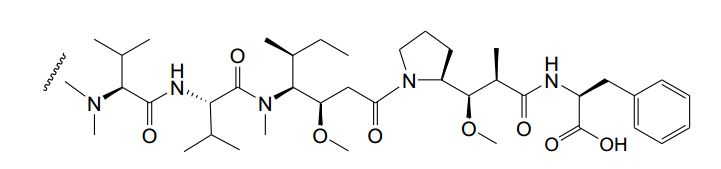
[00195] Modalidades exemplares adicionais compreendendo MMAE ou MMAF e vários componentes de ligante (descritos adicionalmente na presente invenção) têm as seguintes estruturas e abreviações (em que Ab meios anticorpo, S é um enxofre do anticorpo, e p é 1 a cerca de 8):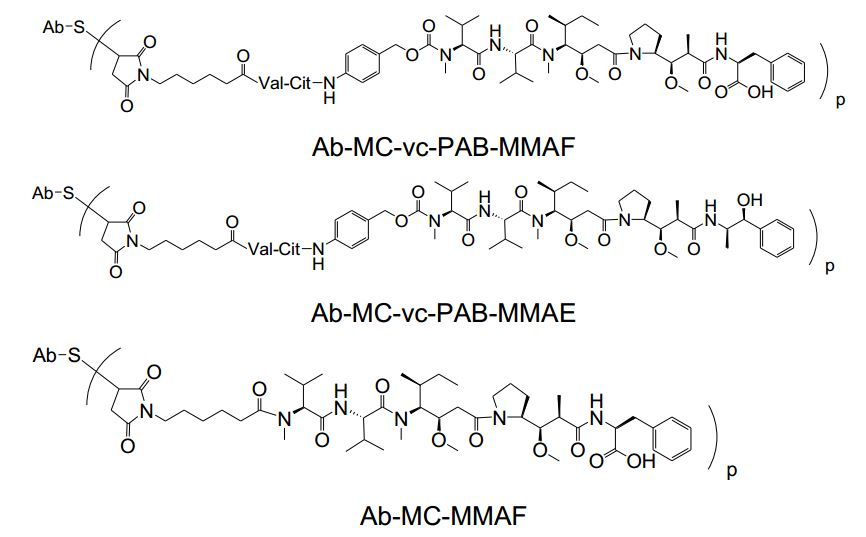
[00196] Tipicamente, porções de fármaco à base de peptídeo podem ser preparadas pela formação de uma ligação peptídica entre dois ou mais aminoácidos e/ou fragmentos de peptídeo. Tais ligações peptídicas podem ser preparadas, por exemplo, de acordo com o método de síntese em fase líquida (vide E. Schroder e K. Lübke, "The Peptides", volume 1, pp 76-136, 1965, Academic Press) que é bem conhecidos no campo de química de peptídeos. As porções de fármaco de auristatina/dolastatina podem ser preparadas de acordo com os métodos de: US 5635483; US 5780588; Pettit et al (1989) J. Am. Chem. Soc. 111:5463-5465; Pettit et al (1998) Anti-Cancer Drug Design 13:243-277; Pettit, G.R., et al. Synthesis, 1996, 719-725; Pettit et al (1996) J. Chem. Soc. Perkin Trans. 1 5:859-863; e Doronina (2003) Nat Biotechnol 21(7):778-784.Typically, peptide-based drug moieties can be prepared by forming a peptide bond between two or more amino acids and/or peptide fragments. Such peptide bonds can be prepared, for example, according to the liquid phase synthesis method (see E. Schroder and K. Lübke, "The Peptides",
[00197] Em outras modalidades, o ADC compreende um anticorpo da invenção conjugado a uma ou mais moléculas de caliqueamicina. A família caliqueamicina de antibióticos é capaz de produzir quebras de DNA dupla fita em concentrações sub-picomolares. Para a preparação dos conjugados da família caliqueamicina, vide as patentes U.S. 5.712.374. 5.714.586. 5.739.116. 5.767.285. 5.770.701. 5.770.710. 5.773.001. 5.877.296 (todas para a American Cyanamid Company). Análogos estruturais da caliqueamicina que podem ser usados incluem, mas não se limitam a YI1,αZ α3I, N-acetil-YiI, PSAG e θIi (Hinman et al., Cancer Research 53:3336-3342 (1993), Lode et al., Cancer Research 58:2925-2928 (1998) e as patentes US supracitadas para American Cyanamid). Outro fármaco antitumoral ao qual o anticorpo pode ser conjugado é QFA que é um antifolato. Tanto a caliqueamicina quanto o QFA têm sítios intracelulares de ação e não cruzam facilmente a membrana plasmática. Portanto, a absorção celular destes agentes através de internalização mediada pelo anticorpo intensifica muito seus efeitos citotóxicos.In other embodiments, the ADC comprises an antibody of the invention conjugated to one or more calicheamicin molecules. The calicheamicin family of antibiotics is capable of producing double-stranded DNA breaks at sub-picomolar concentrations. For the preparation of conjugates of the calicheamicin family, see U.S. Patents 5,712,374. 5,714,586. 5,739,116. 5,767,285. 5,770,701. 5,770,710. 5,773,001. 5,877,296 (all to American Cyanamid Company). Structural analogues of calicheamicin that can be used include, but are not limited to YI1,αZ α3I, N-acetyl-YiI, PSAG and θIi (Hinman et al., Cancer Research 53:3336-3342 (1993), Lode et al. , Cancer Research 58:2925-2928 (1998) and the aforementioned US patents for American Cyanamid). Another anti-tumor drug to which the antibody can be conjugated is QFA which is an antifolate. Both calicheamicin and FFQ have intracellular sites of action and do not easily cross the plasma membrane. Therefore, cellular uptake of these agents through antibody-mediated internalization greatly enhances their cytotoxic effects.
[00198] Outros agentes antitumorais que podem ser conjugados aos anticorpos da invenção incluem BCNU, estreptozoicina, vincristina e 5-fluorouracila, a família de agentes conhecidos coletivamente como o complexo LL-E33288 descrito nas patentes US 5.053.394, 5.770.710 assim como as esperamicinas (patente U.S. 5.877.296).Other antitumor agents that can be conjugated to the antibodies of the invention include BCNU, streptozoicin, vincristine and 5-fluorouracil, the family of agents collectively known as the LL-E33288 complex described in US patents 5,053,394, 5,770,710 as well as the esperamycins (US patent 5,877,296).
[00199] Toxinas enzimaticamente ativas e fragmentos das mesmas que podem ser usadas incluem cadeia A de difteria, fragmentos ativos não ligantes da toxina de difteria, cadeia A da exotoxina (de Pseudomonas aeruginosa), cadeia A de ricina, cadeia A de abrina, cadeia A de modecina, alfa-sarcina, proteínas de Aleurites fordii, proteínas de diantina, proteínas de Phytolaca americana (PAPI, PAPII, e PAP-S), inibidor de momordica charantia, curcina, crotina, inibidor de Sapaonaria officinalis, gelonina, mitogelina, restrictocina, fenomicina, enomicina, e os tricotecenos. Vide, por exemplo, WO 93/21232 publicado em 28 de outubro de 1993.Enzymatically active toxins and fragments thereof that can be used include diphtheria A chain, non-binding active diphtheria toxin fragments, exotoxin A chain (from Pseudomonas aeruginosa), ricin A chain, abrin A chain, chain That of modecin, alpha-sarcin, Aleurites fordii proteins, diantin proteins, American Phytolaca proteins (PAPI, PAPII, and PAP-S), momordica charantia inhibitor, curcina, crotin, Sapaonaria officinalis inhibitor, gelonin, mitogelin, restrictocin, phenomycin, enomycin, and the trichothecenes. See, for example, WO 93/21232 published October 28, 1993.
[00200] A presente invenção contempla ainda um ADC formado entre um anticorpo e um composto com atividade nucleolítica (por exemplo, uma ribonuclease ou uma DNA endonuclease, tal como uma desoxiribonuclease; DNase).The present invention further contemplates an ADC formed between an antibody and a compound with nucleolytic activity (for example, a ribonuclease or a DNA endonuclease, such as a deoxyribonuclease; DNase).
[00201] Para a destruição seletiva do tumor, o anticorpo pode compreender um átomo altamente radioativo. Uma variedade de isótopos radioativos estão disponíveis para a produção dos anticorpos radioconjugados. Exemplos incluem At211, I131, I125, Y90, Re186, Re188, Sm153, Bi212, P32, Pb212 e isótopos radioativos de Lu. Quando o conjugado é usado para detecção, ele pode compreender um átomo radioativo para estudos cintigráficos, por exemplo, tc99m ou I123, ou um marcador de spin para formação de imagens por ressonância magnética nuclear (RMN) (também conhecida como formação de imagens por ressonância magnética, mri), tal como iodo-123 novamente, iodo-131, índio-111, flúor-19, carbono-13, nitrogênio-15, oxigênio-17, gadolínio, manganês ou ferro.[00201] For selective tumor destruction, the antibody may comprise a highly radioactive atom. A variety of radioactive isotopes are available for the production of radioconjugated antibodies. Examples include At211, I131, I125, Y90, Re186, Re188, Sm153, Bi212, P32, Pb212 and radioactive isotopes of Lu. When the conjugate is used for detection, it can comprise a radioactive atom for scintigraphic studies, eg tc99m or I123, or a spin tag for nuclear magnetic resonance (NMR) imaging (also known as resonance imaging magnetic, mri), such as iodine-123 again, iodine-131, indium-111, fluorine-19, carbon-13, nitrogen-15, oxygen-17, gadolinium, manganese or iron.
[00202] Os rádio marcadores ou outros marcadores podem ser incorporados no conjugado em formas conhecidas. Por exemplo, o peptídeo pode ser biossintetizado ou pode ser sintetizado por síntese química de aminoácidos usando precursores de aminoácido adequados, envolvendo, por exemplo, flúor-19 no lugar de hidrogênio. Marcadores como tc99m ou I123, .Re186, Re188 e In111 podem ser ligados através de um resíduo de cisteína no peptídeo. O ítrio-90 pode ser ligado através de um resíduo de lisina. O método IODOGEN (Fraker et al (1978) Biochem. Biophys. Res. Commun. 80: 49-57 pode ser usado para incorporar iodo-123. "Monoclonal Antibodies in Immunoscintigraphy" (Chatal, CRC Press 1989) descreve outros métodos em detalhes.Radiolabels or other labels can be incorporated into the conjugate in known ways. For example, the peptide can be biosynthesized or can be synthesized by chemical amino acid synthesis using suitable amino acid precursors, involving, for example, fluorine-19 in place of hydrogen. Tags such as tc99m or I123, .Re186, Re188 and In111 can be linked through a cysteine residue in the peptide. Yttrium-90 can be attached via a lysine residue. The IODOGEN method (Fraker et al (1978) Biochem. Biophys. Res. Commun. 80:49-57 can be used to incorporate iodine-123. "Monoclonal Antibodies in Immunoscintigraphy" (Chatal, CRC Press 1989) describes other methods in detail .
[00203] Compostos conjugados anticorpo-fármaco que se ligam a 191P4D12[00203] Antibody-drug conjugated compounds that bind to 191P4D12
[00204] A presente invenção apresenta, entre outros, compostos conjugados anticorpo-fármaco para aplicação direcionada de fármacos. Os inventores fizeram a descoberta de que os compostos conjugados anticorpo-fármaco têm potente atividade citotóxica e/ou citostática contra células que expressam 191P4D12. Os compostos conjugados anticorpo-fármaco compreendem uma unidade de anticorpo ligada covalentemente a pelo menos uma unidade do fármaco. As unidades do fármaco podem ser ligadas covalentemente diretamente ou através de uma unidade ligante (LU).[00204] The present invention presents, among others, conjugated antibody-drug compounds for targeted application of drugs. The inventors made the discovery that the antibody-drug conjugated compounds have potent cytotoxic and/or cytostatic activity against cells expressing 191P4D12. Antibody-drug conjugate compounds comprise an antibody moiety covalently linked to at least one drug moiety. The drug units can be covalently linked directly or through a linker unit (LU).
[00205] Em algumas modalidades, o composto conjugado anticorpo-fármaco tem a seguinte fórmula:
[00206] ou um sal farmaceuticamente aceitável ou solvato do mesmo; em que:[00206] or a pharmaceutically acceptable salt or solvate thereof; on what:
[00207] L é a unidade de anticorpo, por exemplo, o MAb 191P4D12 da presente invenção, e[00207] L is the antibody moiety, e.g. MAb 191P4D12 of the present invention, and
[00208] (LU-D) é uma porção de unidade ligante-unidade do fármaco, sendo que:[00208] (LU-D) is a drug unit-binding unit portion, where:
[00209] LU- é uma unidade ligante, e[00209] LU- is a binding unit, and
[00210] -D é uma unidade de fármaco que tem atividade citostática ou citotóxica contra uma célula alvo; e[00210] -D is a drug unit that has cytostatic or cytotoxic activity against a target cell; and
[00211] p é um número inteiro de 1 a 20.[00211] p is an integer from 1 to 20.
[00212] Em algumas modalidades, p varia de 1 a 10, 1 a 9, 1 a 8, 1 a 7, 1 a 6, 1 a 5, 1 a 4, 1 a 3, ou 1 a 2. Em algumas modalidades, p varia de 2 a 10, 2 a 9, 2 a 8, 2 a 7, 2 a 6, 2 a 5, 2 a 4 ou 2 a 3. Em outras modalidades, p é 1, 2, 3, 4, 5 ou 6. Em algumas modalidades, p é 2 ou 4.[00212] In some modalities, p ranges from 1 to 10, 1 to 9, 1 to 8, 1 to 7, 1 to 6, 1 to 5, 1 to 4, 1 to 3, or 1 to 2. In some modalities , p ranges from 2 to 10, 2 to 9, 2 to 8, 2 to 7, 2 to 6, 2 to 5, 2 to 4 or 2 to 3. In other modalities, p is 1, 2, 3, 4, 5 or 6. In some modes, p is 2 or 4.
[00213] Em algumas modalidades, o composto conjugado anticorpo-fármaco tem a seguinte fórmula:
[00214] ou um sal farmaceuticamente aceitável ou solvato do mesmo, em que:[00214] or a pharmaceutically acceptable salt or solvate thereof, wherein:
[00215] L é a unidade de anticorpo, por exemplo, o MAb 191P4D12; e[00215] L is the antibody moiety, for example, MAb 191P4D12; and
[00216] -Aa-Ww-Yy- é uma unidade ligante (LU), em que:[00216] -Aa-Ww-Yy- is a binding unit (LU), in which:
[00217] -A- é uma unidade esticadora,[00217] -A- is a stretching unit,
[00218] a é 0 ou 1,[00218] a is 0 or 1,
[00219] cada -W- é independentemente uma unidade de aminoácido,[00219] each -W- is independently an amino acid unit,
[00220] w é um número inteiro na faixa de 0 a 12,[00220] w is an integer in the
[00221] -Y- é uma unidade espaçadora autoimolativa,[00221] -Y- is a self-immolative spacer unit,
[00222] y é 0, 1 ou 2;[00222] y is 0, 1 or 2;
[00223] -D é uma unidade de fármaco que tem atividade citostática ou citotóxica contra a célula alvo; e[00223] -D is a drug unit that has cytostatic or cytotoxic activity against the target cell; and
[00224] p é um número inteiro de 1 a 20.[00224] p is an integer from 1 to 20.
[00225] Em algumas modalidades, a é 0 ou 1, w é 0 ou 1, e y é 0, 1 ou 2. Em algumas modalidades, a é 0 ou 1, w é 0 ou 1, e y é 0 ou 1. Em algumas modalidades, p varia de 1 a 10, 1 a 9, 1 a 8, 1 a 7, 1 a 6, 1 a 5, 1 a 4, 1 a 3, ou 1 a 2. Em algumas modalidades, p varia de 2 a 8, 2 a 7, 2 a 6, 2 a 5, 2 a 4 ou 2 a 3. Em outras modalidades, p é 1, 2, 3, 4, 5 ou 6. Em algumas modalidades, p é 2 ou 4. Em algumas modalidades, quando w não é zero, y é 1 ou 2. Em algumas modalidades, quando w é 1 a 12, y é 1 ou 2. Em algumas modalidades, w é 2 a 12 e y é 1 ou 2. Em algumas modalidades, a é 1 e w e y são 0.[00225] In some embodiments, a is 0 or 1, w is 0 or 1, and y is 0, 1 or 2. In some embodiments, a is 0 or 1, w is 0 or 1, and y is 0 or 1. In In some modalities, p ranges from 1 to 10, 1 to 9, 1 to 8, 1 to 7, 1 to 6, 1 to 5, 1 to 4, 1 to 3, or 1 to 2. In some modalities, p ranges from 2 to 8, 2 to 7, 2 to 6, 2 to 5, 2 to 4 or 2 to 3. In other modes, p is 1, 2, 3, 4, 5 or 6. In some modes, p is 2 or 4. In some modes, when w is non-zero, y is 1 or 2. In some modes, when w is 1 to 12, y is 1 or 2. In some modes, w is 2 to 12 and y is 1 or 2. In some modes, a is 1 and w and y are 0.
[00226] Para composições compreendendo uma pluralidade anticorpos, o carregamento do fármaco é representado por p, o número médio de moléculas de fármaco por anticorpo. O carregamento do fármaco pode variar de 1 a 20 fármacos (D) por anticorpo. O número médio de fármacos por anticorpo na preparação de reações de conjugação pode ser caracterizado por meios convencionais como espectroscopia de massa, ensaio ELISA, e HPLC. A distribuição quantitativa dos conjugados anticorpo-fármaco em termos de p pode, também, ser determinada. Em alguns casos, a separação, purificação, e caracterização de conjugados anticorpo- fármaco homogêneos, onde p é um determinado valor a partir dos conjugados anticorpo-fármaco com outros carregamentos de fármaco podem ser obtidas através de meios tais como HPLC de fase reversa ou eletroforese. Em modalidades exemplificadoras, p é de 2 a 8.For compositions comprising a plurality of antibodies, the drug loading is represented by p, the average number of drug molecules per antibody. Drug loading can range from 1 to 20 drugs (D) per antibody. The average number of drugs per antibody in preparing conjugation reactions can be characterized by conventional means such as mass spectroscopy, ELISA assay, and HPLC. The quantitative distribution of antibody-drug conjugates in terms of p can also be determined. In some cases, the separation, purification, and characterization of homogeneous antibody-drug conjugates, where p is a value determined from antibody-drug conjugates with other drug loadings can be achieved by means such as reverse-phase HPLC or electrophoresis . In exemplary modalities, p is from 2 to 8.
[00227] A geração de compostos conjugados anticorpo-fármaco pode ser feita por qualquer técnica conhecida dos versados na técnica. Resumidamente, os compostos conjugados anticorpo-fármaco compreendem MAb 191P4D12 como a unidade de anticorpo, um fármaco, e opcionalmente, um ligante que une o fármaco e o agente de ligação. Em uma modalidade preferencial, o anticorpo é MAb 191P4D12 que compreende regiões variáveis da cadeias pesada e leve de um anticorpo designado Ha22-2(2,4)6.1 descrito acima. Em uma modalidade mais preferencial, o anticorpo é MAb 191P4D12 que compreende a cadeia pesada e leve de um anticorpo designado Ha22- 2(2,4)6.1 descrito acima. Várias reações diferentes estão disponíveis para a ligação covalente de fármacos e/ou ligantes aos agentes de ligação. Isto é frequentemente feito pela reação dos resíduos de aminoácido do agente de ligação, por exemplo, molécula de anticorpo, incluindo os grupos amina da lisina, os grupos de ácido carboxílico livre do ácido glutâmico e aspártico, os grupos sulfidrila da cisteína e as várias porções dos aminoácidos aromáticos. Um dos métodos inespecíficos mais comumente usados de ligação covalente é a reação de carbodiimida para ligar um grupo carbóxi (ou amino) de um composto a grupos amino (ou carbóxi) do anticorpo. Adicionalmente, agentes bifuncionais como dialdeídos ou imidoésteres têm sido usados para ligar o grupo amino de um composto aos grupos amino de uma molécula de anticorpo. A reação de base de Schiff também está disponível para a ligação de fármacos aos agentes de ligação. Este método envolve a oxidação de periodato de um fármaco que contém grupos glicol ou hidróxi, formando, assim, um aldeído que é então reagido com o agente de ligação. A fixação ocorre através da formação de uma base de Schiff com grupos amino do agente de ligação. Os isotiocianatos também podem ser usados como agentes de acoplamento para ligar covalentemente os fármacos aos agentes de ligação. Outras técnicas são conhecidas do versado na técnica e estão dentro do escopo da presente invenção.[00227] The generation of conjugated antibody-drug compounds can be done by any technique known to those skilled in the art. Briefly, antibody-drug conjugated compounds comprise MAb 191P4D12 as the antibody moiety, a drug, and optionally, a linker that joins the drug and the binding agent. In a preferred embodiment, the antibody is MAb 191P4D12 which comprises heavy and light chain variable regions of an antibody designated Ha22-2(2,4)6.1 described above. In a more preferred embodiment, the antibody is MAb 191P4D12 which comprises the heavy and light chain of an antibody designated Ha22-2(2,4)6.1 described above. Several different reactions are available for the covalent attachment of drugs and/or ligands to binding agents. This is often done by reacting the amino acid residues of the binding agent, eg antibody molecule, including the amino groups of lysine, the free carboxylic acid groups of glutamic and aspartic acid, the sulfhydryl groups of cysteine and the various moieties of aromatic amino acids. One of the most commonly used nonspecific methods of covalent bonding is the carbodiimide reaction to link a carboxy (or amino) group of a compound to the amino (or carboxy) groups of the antibody. Additionally, bifunctional agents such as dialdehydes or imidoesters have been used to link the amino group of a compound to the amino groups of an antibody molecule. Schiff's base reaction is also available for drug binding to binding agents. This method involves periodate oxidation of a drug containing glycol or hydroxy groups, thereby forming an aldehyde which is then reacted with the coupling agent. Fixation takes place through the formation of a Schiff base with amino groups of the binding agent. Isothiocyanates can also be used as coupling agents to covalently link drugs to linkers. Other techniques are known to the person skilled in the art and are within the scope of the present invention.
[00228] Em certas modalidades, um intermediário, que é o precursor do ligante, é reagido com o fármaco sob as condições adequadas. Em certas modalidades, grupos reativos são usados no fármaco e/ou no intermediário. O produto da reação entre o fármaco e o intermediário, ou o fármaco derivatizado, é, subsequentemente, reagido com o MAb 191P4D12 sob condições adequadas.[00228] In certain embodiments, an intermediate, which is the precursor of the ligand, is reacted with the drug under the appropriate conditions. In certain embodiments, reactive groups are used in the drug and/or intermediate. The product of the reaction between the drug and the intermediate, or the derivatized drug, is subsequently reacted with MAb 191P4D12 under suitable conditions.
[00229] Cada uma das unidades particulares dos compostos conjugados anticorpo-fármaco é descrita em mais detalhes na presente invenção. A síntese e a estrutura de unidades ligantes exemplificadoras, unidades esticadoras, unidades de aminoácido, unidade espaçadora autoimolativa, e unidades de fármaco também são descritas nas publicações de pedido de patente US N°s 2003- 0083263, 2005-0238649 e 2005-0009751, cada um está aqui integralmente incorporado, por referência e para todos os propósitos.[00229] Each of the particular units of the antibody-drug conjugate compounds is described in more detail in the present invention. The synthesis and structure of exemplary linker units, stretcher units, amino acid units, self-immolative spacer unit, and drug units are also described in US patent application publications Nos. 2003-0083263, 2005-0238649 and 2005-0009751, each is incorporated herein in its entirety, by reference and for all purposes.
[00230] Tipicamente, os compostos conjugados anticorpo-fármaco compreendem uma unidade ligante entre a unidade de fármaco e a unidade de anticorpo. Em algumas modalidades, o ligante é clivável sob condições intracelulares, de modo que a clivagem do ligante libere a unidade de fármaco do anticorpo no ambiente intracelular. Em ainda outras modalidades, a unidade ligante não é clivável e o fármaco é liberado, por exemplo, por degradação do anticorpo.[00230] Typically, antibody-drug conjugate compounds comprise a linker moiety between the drug moiety and the antibody moiety. In some embodiments, the linker is cleavable under intracellular conditions such that cleavage of the linker releases the drug moiety of the antibody into the intracellular environment. In still other embodiments, the linker moiety is not cleavable and the drug is released, for example, by antibody degradation.
[00231] Em algumas modalidades, o ligante é clivável por um agente de clivagem que está presente no ambiente intracelular (por exemplo, dentro de um lisossomo ou endossomo ou caveola). O ligante pode ser, por exemplo, um ligante de peptidila que é clivado por uma enzima peptidase ou protease intracelular, incluindo, mas não se limitando a uma protease lisossomal ou endossomal. Em algumas modalidades, o ligante de peptidila tem pelo menos dois aminoácidos de comprimento ou ao menos três aminoácidos de comprimento. Os agentes de clivagem podem incluir as catepsinas B e D e plasmina, todas as quais são conhecidas para hidrolisar derivados de fármacos dipeptídicos resultando na liberação do fármaco ativo dentro das células-alvo (vide, por exemplo, Dubowchik e Walker, 1999, Pharm. Therapeutics 83:67-123). Os mais típicos são os ligantes de peptidila que são cliváveis por enzimas que estão presentes em células que expressam 191P4D12. Por exemplo, um ligante de peptidila que é clivável pela protease dependente de tiol catepsina-B, que é altamente expressa no tecido canceroso, pode ser usado (por exemplo, um ligante Phe-Leu ou um ligante Gly-Phe-Leu-Gly (SEQ ID NO:9)). Outros exemplos destes ligantes são descritos, por exemplo, na patente US 6.214.345, aqui incorporada na íntegra, a título de referência e para todos os propósitos. Em uma modalidade específica, o ligante de peptidila clivável por uma protease intracelular é um ligante Val-Cit ou um ligante Phe-Lys (vide, por exemplo, a patente U.S. 6.214.345, que descreve a síntese de doxorrubicina com o ligante Val-Cit). Uma vantagem de usar a liberação proteolítica intracelular do agente terapêutico é que o agente é tipicamente atenuado quando conjugado e as estabilidades no soro dos conjugados são tipicamente altas.[00231] In some embodiments, the ligand is cleavable by a cleavage agent that is present in the intracellular environment (eg, within a lysosome or endosome or caveola). The linker can be, for example, a peptidyl linker that is cleaved by an intracellular peptidase or protease enzyme, including, but not limited to, a lysosomal or an endosomal protease. In some embodiments, the peptidyl linker is at least two amino acids long or at least three amino acids long. Cleavage agents can include cathepsins B and D and plasmin, all of which are known to hydrolyze dipeptide drug derivatives resulting in the release of the active drug within target cells (see, for example, Dubowchik and Walker, 1999, Pharm. Therapeutics 83:67-123). Most typical are peptidyl linkers that are cleavable by enzymes that are present in cells expressing 191P4D12. For example, a peptidyl linker that is cleavable by the thiol-dependent protease cathepsin-B, which is highly expressed in cancer tissue, can be used (eg, a Phe-Leu linker or a Gly-Phe-Leu-Gly linker ( SEQ ID NO:9)). Other examples of such binders are described, for example, in US patent 6,214,345, incorporated herein in its entirety, by way of reference and for all purposes. In a specific embodiment, the peptidyl linker cleavable by an intracellular protease is a Val-Cit linker or a Phe-Lys linker (see, for example, US patent 6,214,345, which describes the synthesis of doxorubicin with the Val- linker. Cit). An advantage of using intracellular proteolytic release of the therapeutic agent is that the agent is typically attenuated when conjugated and the serum stabilities of the conjugates are typically high.
[00232] Em outras modalidades, o ligante clivável é sensível ao pH, isto é, sensível à hidrólise em determinadas valores de pH. Tipicamente, o ligante sensível ao pH é hidrolisável sob condições ácidas. Por exemplo, um ligante ácido-lábil que é hidrolisável no lisossomo (por exemplo, uma hidrazona, semicarbazona, tiosemicarbazona, amida cis-aconítica, ortoéster, acetal, cetal, ou similares) pode ser usado. (Vide, por exemplo, as patentes US n°s 5.122.368; 5.824.805; 5.622.929; Dubowchik e Walker. 1999, Pharm. Therapeutics 83:67-123; Neville et al., 1989, Biol. Chem.264:1465314661.) Tais ligantes são relativamente estáveis sob condições de pH neutro, como as do sangue, mas são instáveis com pH abaixo de 5,5 ou 5,0, o pH aproximado do lisossomo. Em certas modalidades, o ligante hidrolisável é um ligante de tioéter (tal como, por exemplo, um tioéter ligado ao agente terapêutico através de uma ligação de acil- hidrazona ( vide, por exemplo, a patente US 5.622.929).[00232] In other embodiments, the cleavable linker is pH sensitive, that is, sensitive to hydrolysis at certain pH values. Typically, the pH sensitive binder is hydrolysable under acidic conditions. For example, an acid-labile binder that is hydrolysable in the lysosome (for example, a hydrazone, semicarbazone, thiosemicarbazone, cis-aconitic amide, orthoester, acetal, ketal, or the like) can be used. (See, for example, US Patent Nos. 5,122,368; 5,824,805; 5,622,929; Dubowchik and Walker. 1999, Pharm. Therapeutics 83:67-123; Neville et al., 1989, Biol. Chem. 264:1465314661.) Such binders are relatively stable under neutral pH conditions such as blood, but are unstable at pH below 5.5 or 5.0, the approximate pH of the lysosome. In certain embodiments, the hydrolyzable linker is a thioether linker (such as, for example, a thioether linked to the therapeutic agent via an acylhydrazone linkage (see, for example, US patent 5,622,929).
[00233] Em ainda outras modalidades, o ligante é clivável sob condições redutoras (por exemplo, um ligante de dissulfeto). Vários ligantes de dissulfeto são conhecidos na técnica, incluindo, por exemplo, os que podem ser formados usando SATA (N-succinimidil-S- acetiltioacetato), SPDP (N-succinimidil-3-(2-piridilditio)propionato), SPDB (N-succinimidil-3-(2-piridilditio) butirato) e SMPT (N-succinimidil- oxicarbonil-alfa-metil-alfa-(2-piridil-ditio) tolueno), SPDB e SMPT. (vide, por exemplo, Thorpe et al., 1987, Cancer Res. 47:5924-5931; Wawrzynczak et al., In Immunoconjugates: Antibody Conjugates in Radioimagery and Therapy of Cancer (C. W. Vogel ed., Oxford U. Press, 1987. Vide, também, patente US 4.880.935.)[00233] In still other embodiments, the linker is cleavable under reducing conditions (eg, a disulfide linker). Various disulfide linkers are known in the art, including, for example, those that can be formed using SATA (N-succinimidyl-S-acetylthioacetate), SPDP (N-succinimidyl-3-(2-pyridyldithio)propionate), SPDB (N -succinimidyl-3-(2-pyridyldithio) butyrate) and SMPT (N-succinimidyl-oxycarbonyl-alpha-methyl-alpha-(2-pyridyl-dithio) toluene), SPDB and SMPT. (See, for example, Thorpe et al., 1987, Cancer Res. 47:5924-5931; Wawrzynczak et al., In Immunoconjugates: Antibody Conjugates in Radioimaging and Therapy of Cancer (CW Vogel ed., Oxford U. Press, 1987) See also US Patent 4,880,935).
[00234] Em ainda outras modalidades específicas, o ligante é um ligante de malonato (Johnson et al., 1995, Anticancer Res. 15:138793), um ligante de maleimidobenzoíla (Lau et al., 1995, Bioorg-Med- Chem. 3(10):1299-1304), ou um análogo de 3'-N-amida (Lau et al., 1995, Bioorg-Med-Chem. 3(10):1305-12).In yet other specific embodiments, the linker is a malonate linker (Johnson et al., 1995, Anticancer Res. 15:138793), a maleimidobenzoyl linker (Lau et al., 1995, Bioorg-Med-Chem. 3(10):1299-1304), or a 3'-N-amide analog (Lau et al., 1995, Bioorg-Med-Chem. 3(10):1305-12).
[00235] Em ainda outras modalidades, as unidade ligante não é clivável e o fármaco é liberado por degradação do anticorpo. (Vide a publicação US n° 2005/0238649 aqui incorporada por referência em sua totalidade e para todos os propósitos).[00235] In still other embodiments, the linker moiety is not cleavable and the drug is released by antibody degradation. (See US Publication No. 2005/0238649 incorporated herein by reference in its entirety and for all purposes).
[00236] Tipicamente, o ligante não é substancialmente sensível ao ambiente extracelular. Para uso na presente invenção, "não substancialmente sensível ao ambiente extracelular," no contexto de um ligante, significa que no máximo cerca de 20%, tipicamente no máximo cerca de 15%, mais tipicamente no máximo cerca de 10%, e ainda mais tipicamente no máximo cerca de 5%, no máximo cerca de 3%, ou no máximo cerca de 1% dos ligantes, em uma amostra de composto conjugado anticorpo-fármaco, são clivados quando o composto conjugado anticorpo-fármaco se apresenta em um ambiente extracelular (por exemplo, no plasma). Pode-se determinar se um ligante não será substancialmente sensível ao ambiente extracelular, por exemplo, por incubar com plasma o composto conjugado anticorpo-fármaco durante um período de tempo predeterminado (por exemplo, 2, 4, 8, 16, ou 24 horas) e, então, quantificar a quantidade de fármaco livre presente no plasma.[00236] Typically, the ligand is not substantially sensitive to the extracellular environment. For use in the present invention, "not substantially sensitive to the extracellular environment," in the context of a binder, means at most about 20%, typically at most about 15%, more typically at most about 10%, and even more typically at most about 5%, at most about 3%, or at most about 1% of the ligands, in an antibody-drug conjugate compound sample, are cleaved when the antibody-drug conjugate compound presents itself in an extracellular environment (eg in plasma). It can be determined whether a binder will not be substantially sensitive to the extracellular environment, for example, by incubating the antibody-drug conjugated compound with plasma for a predetermined period of time (e.g., 2, 4, 8, 16, or 24 hours) and then quantifying the amount of free drug present in the plasma.
[00237] Em outras modalidades não mutuamente exclusivas, o ligante promove internalização celular. Em certas modalidades, o ligante promove internalização celular quando conjugado ao agente terapêutico (isto é, nos arredores da porção ligante-agente terapêutico do composto conjugado anticorpo-fármaco, conforme descrito aqui). Em ainda outras modalidades, o ligante promove internalização celular quando conjugado ao composto de auristatina e ao MAb 191P4D12.[00237] In other non-mutually exclusive modalities, the ligand promotes cell internalization. In certain embodiments, the linker promotes cellular internalization when conjugated to the therapeutic agent (i.e., in the vicinity of the linker-therapeutic agent portion of the antibody-drug conjugated compound, as described herein). In still other embodiments, the ligand promotes cell internalization when conjugated to the auristatin compound and MAb 191P4D12.
[00238] Vários ligantes exemplificadores que podem ser usados com as presentes composições e métodos são descritos no WO 2004010957, publicação US n° 2006/0074008, publicação US n° 20050238649, e publicação US n° 2006/0024317 (cada uma das quais está aqui incorporada a título de referência na presente invenção em sua totalidade e para todos os propósitos).[00238] Various exemplary binders that can be used with the present compositions and methods are described in WO 2004010957, US publication no. 2006/0074008, US publication no. 20050238649, and US publication no. herein incorporated by reference into the present invention in its entirety and for all purposes).
[00239] Uma "unidade ligante" (LU) é um composto bifuncional que pode ser usado para ligar uma unidade de fármaco e uma unidade de anticorpo para formar um composto conjugado anticorpo-fármaco. Em algumas modalidades, a unidade ligante tem a fórmula:
[00240] em que: -A- é uma unidade esticadora,[00240] where: -A- is a stretching unit,
[00241] a é 0 ou 1,[00241] a is 0 or 1,
[00242] cada -W- é independentemente uma unidade de aminoácido,[00242] each -W- is independently an amino acid unit,
[00243] w é um número inteiro na faixa de 0 a 12,[00243] w is an integer in the
[00244] -Y- é uma unidade espaçadora autoimolativa, e[00244] -Y- is a self-immolative spacer unit, and
[00245] y é 0, 1 ou 2.[00245] y is 0, 1 or 2.
[00246] Em algumas modalidades, a é 0 ou 1, w é 0 ou 1, e y é 0, 1 ou 2. Em algumas modalidades, a é 0 ou 1, w é 0 ou 1, e y é 0 ou 1. Em algumas modalidades, quando w é 1 a 12, y é 1 ou 2. Em algumas modalidades, w é 2 a 12 e y é 1 ou 2. Em algumas modalidades, a é 1 e w e y são 0.[00246] In some modes, a is 0 or 1, w is 0 or 1, and y is 0, 1 or 2. In some modes, a is 0 or 1, w is 0 or 1, and y is 0 or 1. In In some modes, when w is 1 to 12, y is 1 or 2. In some modes, w is 2 to 12, and y is 1 or 2. In some modes, a is 1 and w and y are 0.
[00247] A unidade esticadora[00247] The stretching unit
[00248] A unidade esticadora ( A ), quando presente, é capaz de ligar uma unidade de anticorpo a uma unidade de aminoácido (-W-), se presente, a uma unidade espaçadora (-Y-), se presente; ou a uma unidade de fármaco (-D). Os grupos funcionais úteis que podem estar presentes em um MAb 191P4D12 (por exemplo, Ha22-2(2,4)6.1), naturalmente ou através de manipulação química incluem, mas não se limitam a, sulfidrila, amino, hidroxila, o grupo hidroxila anomérico de um carboidrato, e uma carboxila. Os grupos funcionais adequados são sulfidrila e amino. Em um exemplo, os grupos sulfidrila podem ser gerados por redução das ligações de dissulfeto intramoleculares de um MAb 191P4D12. Em outra modalidade, os grupos sulfidrila podem ser gerados pela reação de um grupo amino de uma porção de lisina de um MAb 191P4D12 com 2-iminotiolano (reagente de Traut) ou outros reagentes geradores de sulfidrila. Em certas modalidades, o MAb 191P4D12 é um anticorpo recombinante e é manipulado para transportar uma ou mais lisinas. Em certas outras modalidades, o MAb 191P4D12 recombinante é manipulado para transportar grupos sulfidrila adicionais, por exemplo, cisteínas adicionais.[00248] The stretcher unit ( A ), when present, is capable of linking an antibody unit to an amino acid unit (-W-), if present, to a spacer unit (-Y-), if present; or to a drug unit (-D). Useful functional groups that may be present in a MAb 191P4D12 (eg, Ha22-2(2,4)6.1), naturally or through chemical manipulation include, but are not limited to, sulfhydryl, amino, hydroxyl, the hydroxyl group anomeric of a carbohydrate, and a carboxyl. Suitable functional groups are sulfhydryl and amino. In one example, sulfhydryl groups can be generated by reducing the intramolecular disulfide bonds of a MAb 191P4D12. In another embodiment, sulfhydryl groups can be generated by reacting an amino group of a lysine moiety of a MAb 191P4D12 with 2-iminothiolane (Traut's reagent) or other sulfhydryl-generating reagents. In certain embodiments, MAb 191P4D12 is a recombinant antibody and is engineered to carry one or more lysines. In certain other embodiments, the recombinant MAb 191P4D12 is engineered to carry additional sulfhydryl groups, e.g., additional cysteines.
[00249] Em uma modalidade, a unidade esticadora forma uma ligação com um átomo de enxofre da unidade de anticorpo. O átomo de enxofre pode ser derivado de um grupo sulfidrila de um anticorpo. As unidades esticadoras representativas desta modalidade são mostradas dentro de colchetes das fórmulas IIIa e IIIb, sendo que L-, - W-, -Y-, -D, w e y são como definidos acima, e R17é selecionado a partir de -C1-C10 alquileno-, -C1-C10 alquenileno-, -C1-C10 alquinileno-, carbociclo-, -O-(C1-C8 alquileno)-, O-(C1-C8 alquenileno)-, -O-(C1-C8 alquinileno)-, -arileno-, -C1-C10 alquileno-arileno-, -C2-C10 alquenileno- arileno, -C2-C10 alquinileno-arileno, -arileno-C1-C10 alquileno-, -arileno- C2-C10 alquenileno-, -arileno-C2-C10 alquinileno-, -C1-C10 alquileno- (carbociclo)-, -C2-C10 alquenileno-(carbociclo)-, -C2-C10 alquinileno- (carbociclo)-, -(carbociclo)-C1-C10 alquileno-, -(carbociclo)-C2-C10 alquenileno-, -(carbociclo)-C2-C10 alquinileno, -heterociclo-, -C1-C10 alquileno- (heterociclo)-, -C2-C10 alquenileno-(heterociclo)-, -C2-C10 alquinileno- (heterociclo)-, -(heterociclo)-C1-C10 alquileno-, -( heterociclo)-C2-C10 alquenileno-, -( heterociclo)-C1-C10 alquinileno-, -(CH2CH2O)r-, ou - (CH2CH2O)r-CH2-, e r é um número inteiro na faixa de 1 a 10, sendo que os ditos radicais alquila, alquenila, alquinila, alquileno, alquenileno, alquinileno, arila, carbociclo, carbociclo, heterociclo, e arileno, quer sozinhos ou como parte de outro grupo, são opcionalmente substituídos. Em algumas modalidades, os ditos radicais alquila, alquenila, alquinila, alquileno, alquenileno, alquinileno, arila, carbociclíco, carbociclo, heterociclo, e arileno, quer sozinhos ou como parte de outro grupo, são não substituídos. Em algumas modalidades, R17é selecionado a partir de -C1-C10 alquileno-, -carbociclo-, -O-(C1-C8 alquileno)-, -arileno-, -C1-C10 alquileno-arileno-, -arileno-C1-C10 alquileno-, -C1-C10 alquileno-(carbociclo)-, -(carbociclo)-C1-C10 alquileno-, -C3-C8 heterociclo-, -C1-C10 alquileno-( heterociclo)-, -(heterociclo)-C1- C10 alquileno-, -(CH2CH2O)r-, e -(CH2CH2O)r-CH2-; e r é um número inteiro na faixa de 1 a 10, sendo que os ditos grupos alquileno são não-substituídos e o restante dos grupos são opcionalmente substituídos.[00249] In one embodiment, the stretcher unit forms a bond with a sulfur atom of the antibody unit. The sulfur atom can be derived from the sulfhydryl group of an antibody. Representative stretching units of this embodiment are shown within brackets of formulas IIIa and IIIb, wherein L-, -W-, -Y-, -D, w and y are as defined above, and R17 is selected from -C1-C10 alkylene -, -C1-C10 alkenylene-, -C1-C10 alkynylene-, carbocycle-, -O-(C1-C8 alkylene)-, O-(C1-C8 alkenylene)-, -O-(C1-C8 alkynylene)- , -arylene-, -C1-C10 alkylene-arylene-, -C2-C10 alkenylene-arylene, -C2-C10 alkynylene-arylene, -arylene-C1-C10 alkylene-, -arylene-C2-C10 alkenylene-, -arylene -C2-C10 alkynylene-, -C1-C10 alkylene-(carbocycle)-, -C2-C10 alkenylene-(carbocycle)-, -C2-C10 alkynylene- (carbocycle)-, -(carbocycle)-C1-C10 alkylene- , -(carbocycle)-C2-C10 alkenylene-, -(carbocycle)-C2-C10 alkynylene, -heterocycle-, -C1-C10 alkylene-(heterocycle)-, -C2-C10 alkenylene-(heterocycle)-, -C2 -C10 alkynylene-(heterocycle)-, -(heterocycle)-C1-C10 alkylene-, -(heterocycle)-C2-C10 alkenylene-, -(heterocycle)-C1-C10 alkynylene-, -(CH2CH2O)r-, or- (CH2CH2O)r-CH2-, er is an integer in the range of 1 to 10, said alkyl, alkenyl, alkynyl, alkylene, alkenylene, alkynylene, aryl, carbocycle, carbocycle, heterocycle, and arylene radicals, either alone or as part of another group, are optionally substituted. In some embodiments, said alkyl, alkenyl, alkynyl, alkylene, alkenylene, alkynylene, aryl, carbocyclic, carbocycle, heterocycle, and arylene radicals, either alone or as part of another group, are unsubstituted. In some embodiments, R17 is selected from -C1-C10 alkylene-, -carbocycle-, -O-(C1-C8 alkylene)-, -arylene-, -C1-C10 alkylene-arylene-, -arylene-C1-C10 alkylene-, -C1-C10 alkylene-(carbocycle)-, -(carbocycle)-C1-C10 alkylene-, -C3-C8 heterocycle-, -C1-C10 alkylene-(heterocycle)-, -(heterocycle)-C1- C10 alkylene-, -(CH2CH2O)r-, and -(CH2CH2O)r-CH2-; and r is an integer in the range of 1 to 10, said alkylene groups being unsubstituted and the remainder of the groups being optionally substituted.
[00250] Deve ser compreendido a partir de todas as modalidades exemplificadoras que mesmo quando não expressamente denotado, 1 a 20 porções de fármaco podem ser ligadas a um anticorpo ( p = 1-20).

[00251] Uma unidade esticadora ilustrativa é aquela da fórmula IIIa em que R17 é -(CH2)5-: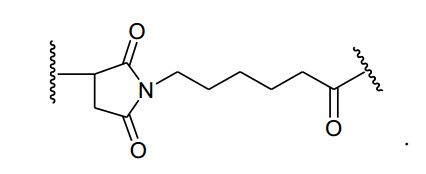
[00252] Outra unidade esticadora ilustrativa é a da fórmula IIIa em que R17 é -(CH2CH2O)r-CH2-; e r é 2:
[00253] Uma unidade esticadora ilustrativa é a da fórmula IIIa, em que R17 é arileno- ou arileno-C1-C10 alquileno-. Em algumas modalidades, o grupo arila é um grupo fenila não-substituído.[00253] An illustrative stretching unit is that of formula IIIa, wherein R17 is arylene- or arylene-C1-C10 alkylene-. In some embodiments, the aryl group is an unsubstituted phenyl group.
[00254] Mais uma outra unidade esticadora ilustrativa é a da fórmula IIIb, em que R17 é -(CH2)5-: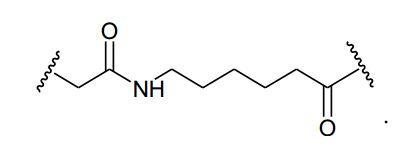
[00255] Em certas modalidades, a unidade esticadora está ligada à unidade de anticorpo através de uma ligação dissulfeto entre um átomo de enxofre da unidade de anticorpo e um átomo de enxofre da unidade esticadora. Uma unidade esticadora representativa desta modalidade é mostrada dentro de colchetes da Fórmula IV, em que R17, L-, -W-, -Y-, -D, w e y são como definidos acima.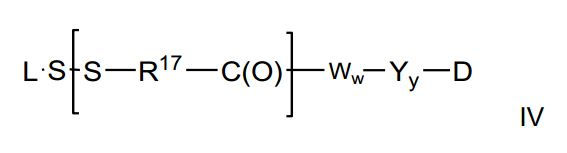
[00256] Deve ser observado que ao longo deste pedido, a porção S na fórmula abaixo se refere a um átomo de enxofre da unidade de anticorpo, exceto onde indicado em contrário pelo contexto.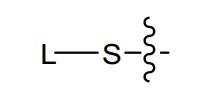
[00257] Em ainda outras modalidades, o esticador contém um sítio reativo que pode formar uma ligação com um grupo amino primário ou secundário de um anticorpo. Exemplos destes sítios reativos incluem, mas não se limitam a ésteres ativados como ésteres de succinimida, ésteres de 4-nitrofenila, ésteres de pentafluorofenila, ésteres de tetrafluorofenila, anidridos, cloretos de ácido, cloretos de sulfonila, isocianatos e isotiocianatos. As unidades esticadoras representativas desta modalidade são mostradas dentro dos colchetes das fórmulas Va e Vb, em que -R17-, L-, -W-, -Y-, -D, w e y são como definidos acima;
[00258] Em algumas modalidades, o esticador contém um sítio reativo que é reativo a um grupo de carboidrato modificado (-CHO) que pode estar presente em um anticorpo. Por exemplo, um carboidrato pode ser moderadamente oxidado usando um reagente tal como periodato de sódio e a unidade resultante (-CHO) do carboidrato oxidado pode ser condensada com um esticador que contém uma funcionalidade tal como uma hidrazida, uma oxima, uma amina primária ou secundária, uma hidrazina, uma tiosemicarbazona, um carboxilato de hidrazina, e uma aril-hidrazida tal como as descritas por Kaneko et al., 1991, Bioconjugate Chem. 2:133-41. As unidades esticadoras representativas desta modalidade são mostradas dentro dos colchetes das fórmulas VIa, VIb, e VIc, em que -R17-, L-, -W-, -Y-, - D, w e y são como definidos acima.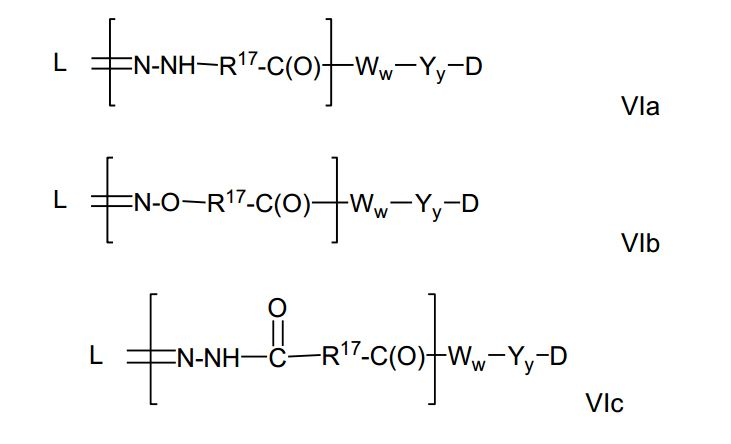
[00259] A unidade de aminoácido[00259] The amino acid unit
[00260] A unidade de aminoácido (-W-), quando presente, liga a unidade esticadora à unidade espaçadora, se a unidade espaçadora estiver presente, liga a unidade esticadora à porção de fármaco se a unidade espaçadora estiver ausente, e liga a unidade de anticorpo à unidade de fármaco se a unidade esticadora e a unidade espaçadora estiverem ausentes.[00260] The amino acid unit (-W-), when present, connects the stretcher unit to the spacer unit, if the spacer unit is present, connects the stretcher unit to the drug portion if the spacer unit is absent, and turns on the spacer unit of antibody to the drug unit if the stretcher unit and the spacer unit are absent.
[00261] Ww- pode ser, por exemplo, uma unidade de monopeptídeo, dipeptídeo, tripeptídeo, tetrapeptídeo, pentapeptídeo, hexapeptídeo, heptapeptídeo, octapeptídeo, nonapeptídeo, decapeptídeo, undecapeptídeo ou dodecapeptídeo. Cada unidade -W- tem independentemente a fórmula denotada abaixo nos colchetes, e w é um número inteiro na faixa de 0 a 12:
[00262] em que R19é hidrogênio, metila, isopropila, isobutila, sec- butila, benzila, p-hidróxibenzila, -CH2OH, -CH(OH)CH3, -CH2CH2SCH3, -CH2CONH2, -CH2 COOH, -CH2CH2CONH2, -CH2CH2COOH, - (CH2)3NHC(=NH)NH2, -(CH2)3 NH2, -(CH2)3NHCOCH3, -(CH2)3NHCHO, -(CH2)4NHC(=NH)NH2, -(CH2)4NH2, -(CH2)4NHCOCH3, -(CH2)4NHCHO, -(CH2)3NHCONH2, -(CH2)4NHCONH2, -CH2CH2CH(OH)CH2NH2, 2- piridil metila-, 3-piridil metila-, 4-piridil metila-, fenila, cicloexila,
[00263] Em algumas modalidades, a unidade de aminoácido pode ser clivada enzimaticamente por uma ou mais enzimas, incluindo uma protease associada ao câncer ou tumor para liberar a unidade do fármaco (-D) que, em uma modalidade, é protonada in vivo mediante liberação para fornecer um fármaco (D).[00263] In some embodiments, the amino acid unit can be enzymatically cleaved by one or more enzymes, including a cancer-associated protease or tumor to release the drug unit (-D) which, in one embodiment, is protonated in vivo by release to deliver a drug (D).
[00264] Em certas modalidades, a unidade de aminoácido pode compreender aminoácidos naturais. Em outras modalidades, a unidade de aminoácido pode compreender aminoácidos não naturais. As unidades Ww ilustrativas são representadas pelas fórmulas (VII)-(IX):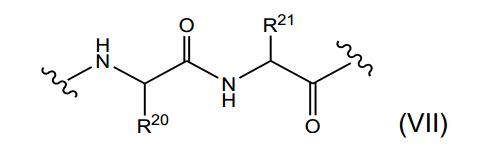
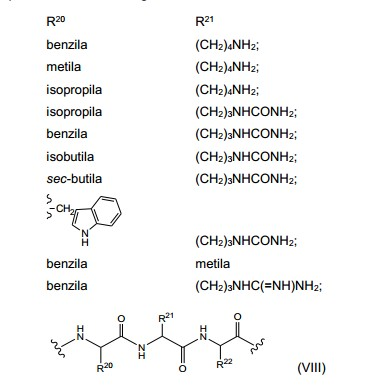
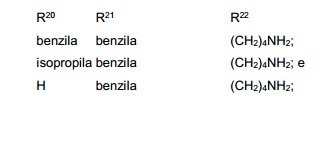

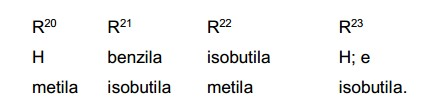
[00265] As unidades de aminoácido exemplificadoras incluem, mas não se limitam a unidades da Fórmula VII onde: R20 é benzila e R21 é - (CH2)4 NH2; R20 é isopropila e R21 é -(CH2)4NH2; ou R20 é isopropila e R21 é -(CH2)3 NHCONH2. Outra unidade de aminoácido exemplificadora é uma unidade da Fórmula VIII em que R20 é benzila, R21 é benzila, e R22 é -(CH2)4NH2.Exemplary amino acid moieties include, but are not limited to Formula VII moieties where: R20 is benzyl and R21 is -(CH2)4 NH2; R20 is isopropyl and R21 is -(CH2)4NH2; or R20 is isopropyl and R21 is -(CH2)3 NHCONH2. Another exemplary amino acid moiety is a Formula VIII moiety where R20 is benzyl, R21 is benzyl, and R22 is -(CH2)4NH2.
[00266] As unidades -Ww- úteis podem ser projetadas e otimizadas na sua seletividade para clivagem enzimática por uma enzima particular, por exemplo, uma protease associada ao tumor. Em uma modalidade, uma unidade -Ww - é aquela cuja clivagem é catalisada pela catepsina B, C e D, ou uma plasmina protease.[00266] Useful -Ww- units can be designed and optimized in their selectivity for enzymatic cleavage by a particular enzyme, for example, a tumor associated protease. In one embodiment, a -Ww - unit is one whose cleavage is catalyzed by cathepsin B, C, and D, or a plasmin protease.
[00267] Em uma modalidade, -Ww- é um dipeptídeo, tripeptídeo, tetrapeptídeo ou pentapeptídeo. Quando R19, R20, R21, R22 ou R23 é diferente de hidrogênio, o átomo de carbono ao qual R19, R20, R21, R22 ou R23 está ligado é quiral.[00267] In one embodiment, -Ww- is a dipeptide, tripeptide, tetrapeptide or pentapeptide. When R19, R20, R21, R22 or R23 is other than hydrogen, the carbon atom to which R19, R20, R21, R22 or R23 is attached is chiral.
[00268] Cada átomo de carbono ao qual R19, R20, R21, R22 ou R23 está ligado está independentemente na configuração (S) ou (R).[00268] Each carbon atom to which R19, R20, R21, R22 or R23 is attached is independently in the (S) or (R) configuration.
[00269] Em um aspecto da unidade de aminoácido, a unidade de aminoácido é valina-citrulina (vc ou Val-Cit). Em outro aspecto, a unidade de aminoácido é fenilalanina-lisina (isto é, fk). Em ainda um outro aspecto da unidade de aminoácido, a unidade de aminoácido é N-metilvalina-citrulina. Em ainda um outro aspecto, a unidade de aminoácido é ácido 5-aminovalérico, homo fenilalanina lisina, tetraisoquinolina carboxilato lisina, cicloexil alanina lisina, ácido isonepecótico lisina, beta-alanina lisina, glicina serina valina glutamina e ácido isonepecótico.[00269] In one aspect of the amino acid unit, the amino acid unit is valine-citrulline (vc or Val-Cit). In another aspect, the amino acid moiety is phenylalanine-lysine (i.e., fk). In yet another aspect of the amino acid moiety, the amino acid moiety is N-methylvaline-citrulline. In yet another aspect, the amino acid moiety is 5-aminovaleric acid, homophenylalanine lysine, tetraisoquinoline carboxylate lysine, cyclohexyl alanine lysine, isonepecotic acid lysine, beta-alanine lysine, glycine serine valine glutamine and isonepecotic acid.
[00270] A unidade espaçadora[00270] The spacer unit
[00271] A unidade espaçadora (-Y-), quando presente, liga uma unidade de aminoácido à unidade de fármaco quando uma unidade de aminoácido está presente. Alternativamente, a unidade espaçadora liga a unidade esticadora à unidade de fármaco quando a unidade de aminoácido está ausente. A unidade espaçadora também liga a unidade de fármaco à unidade de anticorpo quando a unidade de aminoácido e a unidade esticadora estão ausentes.[00271] The spacer unit (-Y-), when present, links an amino acid unit to the drug unit when an amino acid unit is present. Alternatively, the spacer unit connects the stretcher unit to the drug unit when the amino acid unit is absent. The spacer unit also connects the drug unit to the antibody unit when the amino acid unit and stretcher unit are absent.
[00272] As unidades espaçadores são de dois tipos gerais: não auto-imolativas ou autoimolativas. Uma unidade espaçadora não autoimolativa é uma na qual parte ou toda a unidade espaçadora permanece ligada à porção de fármaco após a clivagem, particularmente enzimática, de uma unidade de aminoácido do conjugado anticorpo-fármaco. Exemplos de uma unidade espaçadora não autoimolativa incluem, mas não se limitam a uma unidade espaçadora (glicina-glicina) e uma unidade espaçadora de glicina (ambas mostradas no esquema 1) (abaixo). Quando um conjugado contendo uma unidade espaçadora glicina-glicina ou uma unidade espaçadora de glicina sofre clivagem enzimática através de uma enzima (por exemplo, uma protease associada à célula tumoral, uma protease associada à célula de câncer ou uma protease associada a um linfócito), a porção de fármaco glicina-glicina ou uma porção de fármaco-glicina é clivada de L-Aa-Ww-. Em uma modalidade, uma reação de hidrólise independente ocorre dentro da célula alvo, clivando a ligação porção de fármaco-glicina e liberando o fármaco. Esquema 1
[00273] Em algumas modalidades, uma unidade espaçadora não auto-imolativa (-Y-) é -Gly-. Em algumas modalidades, a unidade espaçadora não auto-imolativa (-Y-) é -Gly-Gly-.[00273] In some embodiments, a non-self-immolative spacer unit (-Y-) is -Gly-. In some embodiments, the non-self-immolative spacer unit (-Y-) is -Gly-Gly-.
[00274] Em uma modalidade, um conjugado droga-ligante é fornecido, no qual a unidade espaçadora está ausente (-Yy - onde y=0), ou um sal farmaceuticamente aceitável ou solvato do mesmo.[00274] In one embodiment, a drug-linker conjugate is provided, in which the spacer unit is absent (-Yy - where y=0), or a pharmaceutically acceptable salt or solvate thereof.
[00275] Alternativamente, um conjugado contendo uma unidade espaçadora auto-imolativa pode liberar -D. Como usado aqui, o termo "espaçador auto-imolativo" se refere a uma porção química bifuncional que é capaz de ligar covalentemente juntas duas porções químicas espaçadas em uma molécula tripartida estável. Ela será espontaneamente separada da segunda porção química se sua ligação à primeira porção for clivada.[00275] Alternatively, a conjugate containing a self-immolative spacer unit may release -D. As used herein, the term "self-immolative spacer" refers to a bifunctional chemical moiety that is capable of covalently linking together two spaced chemical moieties in a stable tripartite molecule. It will spontaneously separate from the second chemical moiety if its bond to the first moiety is cleaved.
[00276] Em algumas modalidades, -Yy- é uma unidade de álcool p- aminobenzílico (PAB) (vide esquemas 2 e 3) cuja porção fenileno é substituída com Qm, em que Q é -C1-C8 alquila, -C1-C8 alquenila, -C1-C8alquinila, -O-(C1-C8 alquila), -O-(C1-C8 alquenila), -O-(C1-C8 alquinila), -halogênio, - nitro ou -ciano; e m é um número inteiro na faixa de 0 a 4. Os grupos alquila, alquenila e alquinila, quer sozinhos ou como parte de outro grupo, podem ser opcionalmente substituídos.[00276] In some embodiments, -Yy- is a p-aminobenzyl alcohol (PAB) unit (see
[00277] Em algumas modalidades, -Y- é um grupo PAB que é ligado a -Ww - através do átomo de nitrogênio do amino do grupo PAB, e é conectado diretamente a -D através de um grupo carbonato, carbamato ou éter. Sem se ater a uma teoria ou mecanismo particular, o esquema 2 representa um possível mecanismo de liberação de fármaco de um grupo PAB, que é fixado diretamente a -D através de um grupo carbamato ou carbonato, conforme descrito por Toki et al., 2002, J. Org. Chem. 67:1866-1872. Esquema 2
[00278] No esquema 2, Q é -C1-C8 alquila, -C1-C8 alquenila, -C1-C8 alquinila, -O-(C1-C8 alquila), -O-(C1-C8 alquenila), -O-(C1-C8 alquinila), - halogênio, -nitro ou -ciano; m é um número inteiro na faixa de 0 a 4; e p na faixa de 1 a cerca de 20. Os grupos alquila, alquenila e alquinila, quer sozinhos ou como parte de outro grupo, podem ser opcionalmente substituídos.[00278] In
[00279] Sem se ater a uma teoria ou mecanismo particular, o esquema 3 representa um possível mecanismo de liberação de fármaco de um grupo PAB, que é ligado diretamente a -D através de uma ligação éter ou amina, em que D inclui o grupo oxigênio ou nitrogênio que faz parte da unidade de fármaco. Esquema 3
[00280] No esquema 3, Q é -C1-C8 alquila, -C1-C8 alquenila, -C1-C8 alquinila, -O-(C1-C8 alquila), -O-(C1-C8 alquenila), -O-(C1-C8 alquinila), - halogênio, -nitro ou -ciano; m é um número inteiro na faixa de 0 a 4; e p na faixa de 1 a cerca de 20. Os grupos alquila, alquenila e alquinila, quer sozinhos ou como parte de outro grupo, podem ser opcionalmente substituídos.[00280] In
[00281] Outros Exemplos de espaçadores auto-imolativos incluem, mas não se limitam a compostos aromáticos que são eletronicamente similares ao grupo PAB, tais como derivados de 2-aminoimidazol-5- metanol (Hay et al., 1999, Bioorg. Med. Chem. Lett. 9:2237) e orto ou para-aminobenzilacetais. Espaçadores que sofrem ciclização mediante hidrólise da ligação amida podem ser usados, tais como amidas de ácido 4-aminobutírico substituídas e não substituídas (Rodrigues et al., 1995, Chemistry Biology 2:223), sistemas de anéis biciclo[2.2.1] e biciclo[2.2.2] adequadamente substituídos (Storm et al., 1972, J. Amer. Chem. Soc. 94:5815) e amidas de ácido 2-aminofenilpropiônico (Amsberry et al., 1990, J. Org. Chem. 55:5867). A eliminação dos fármacos contendo amina que são substituídos na posição α da glicina (Kingsbury et al., 1984, J. Med. Chem. 27:1447) também é um exemplo de espaçadores auto-imolativos.[00281] Other Examples of self-immolative spacers include, but are not limited to aromatic compounds that are electronically similar to the PAB group, such as 2-aminoimidazol-5-methanol derivatives (Hay et al., 1999, Bioorg. Med. Chem. Lett. 9:2237) and ortho or para-aminobenzylacetals. Spacers that undergo cyclization upon hydrolysis of the amide bond can be used, such as substituted and unsubstituted 4-aminobutyric acid amides (Rodrigues et al., 1995, Chemistry Biology 2:223), bicyclo[2.2.1] and ring systems suitably substituted bicyclo[2.2.2] (Storm et al., 1972, J. Amer. Chem. Soc. 94:5815) and 2-aminophenylpropionic acid amides (Amsberry et al., 1990, J. Org. Chem. 55) :5867). The elimination of amine-containing drugs that are substituted at the α position of glycine (Kingsbury et al., 1984, J. Med. Chem. 27:1447) is also an example of self-immolative spacers.
[00282] Em uma modalidade, a unidade espaçadora é uma unidade bis(hidroximetil)-estireno (BHMS) ramificada, como mostrado no esquema 4, que pode ser usada para incorporar e liberar múltiplos fármacos. Esquema 4
[00283] No esquema 4, Q é -C1-C8 alquila, -C1-C8 alquenila, -C1-C8 alquinila, -O-(C1-C8 alquila), -O-(C1-C8 alquenila), -O-(C1-C8 alquinila), - halogênio, -nitro ou -ciano; m é um número inteiro na faixa de 0 a 4; n é 0 ou 1; e p varia de 1 a cerca de 20. Os grupos alquila, alquenila e alquinila, quer sozinhos ou como parte de outro grupo, podem ser opcionalmente substituídos.[00283] In
[00284] Em algumas modalidades, as porções -D são iguais. Em ainda outra modalidade, as porções -D são diferentes.[00284] In some embodiments, the -D portions are the same. In yet another embodiment, the -D portions are different.
[00285] Em um aspecto, as unidades espaçadoras (-Yy-) são representadas pelas fórmulas (X)-(XII):
[00286] em que Q é -C1-C8 alquila, -C1-C8 alquenila, -C1-C8 alquinila, -O-(C1-C8 alquila), -O-(C1-C8 alquenila), -O-(C1-C8 alquinila), - halogênio, -nitro ou -ciano; e m é um número inteiro na faixa de 0 a 4. Os grupos alquila, alquenila e alquinila, quer sozinhos ou como parte de outro grupo, podem ser opcionalmente substituídos.
[00287] As modalidades das fórmulas I e II compreendendo compostos conjugados anticorpo-fármaco podem incluir: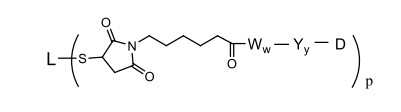
[00288] em que w e y são, cada um, 0, 1 ou 2, e,
[00289] em que w e y são, cada um, 0,
[00290] A unidade de fármaco[00290] The drug unit
[00291] A porção de fármaco (D) pode ser qualquer fármaco citotóxico, citostático ou imunomodulador (por exemplo, imunossupressor). D é uma unidade (porção) de fármaco que tem um átomo que pode formar uma ligação com a unidade espaçadora, com a unidade de aminoácido, com a unidade esticadora ou com a unidade de anticorpo. Em algumas modalidades, a unidade de fármaco D tem um átomo de nitrogênio que pode formar uma ligação com a unidade espaçadora. Como usado aqui, os termos "unidade de fármaco"e "porção de fármaco" são sinônimos e usados de forma intercambiável.[00291] The drug portion (D) can be any cytotoxic, cytostatic or immunomodulatory drug (eg immunosuppressant). D is a drug unit (moiety) that has an atom that can form a bond with the spacer unit, amino acid unit, stretcher unit, or antibody unit. In some embodiments, the drug unit D has a nitrogen atom that can form a bond with the spacer unit. As used herein, the terms "drug unit" and "drug portion" are synonymous and used interchangeably.
[00292] As classes úteis de agentes citotóxicos, citostáticos, ou imunomoduladores incluem, por exemplo, agentes antitubulina, ligantes do sulco menor do DNA, inibidores da replicação de DNA, e agentes alquilantes.Useful classes of cytotoxic, cytostatic, or immunomodulatory agents include, for example, anti-tubulin agents, DNA minor groove binders, DNA replication inhibitors, and alkylating agents.
[00293] Em algumas modalidades, o fármaco é uma auristatina, tal como auristatina E (também conhecido na técnica como um derivado de dolastatina-10) ou um derivado da mesma. A auristatina pode ser, por exemplo, um éster formado entre auristatina E e um ceto ácido. Por exemplo, a auristatina E pode ser reagida com o ácido paraacetil benzoico ou ácido benzoil valérico para produzir AEB e AEVB, respectivamente. Outras auristatinas típicas incluem AFP, MMAF, e MMAE. A síntese e a estrutura das auristatinas exemplificadoras são descritas na publicação do pedido de patente U.S. n° 2003-0083263; na Publicação de Patente Internacional n° WO 04/010957, na Publicação de Patente Internacional n° WO 02/088172, e nas patentes US n°s 7.498.298. 6.884.869. 6.323.315; 6.239.104; 6.034.065; 5.780.588; 5.665.860; 5.663.149; 5.635.483; 5.599.902; 5.554.725; 5.530.097; 5.521.284; 5.504.191; 5.410.024; 5.138.036; 5.076.973; 4.986.988; 4.978.744; 4.879.278; 4.816.444; e 4.486.414, cada uma das quais está aqui incorporada a título de referência em sua totalidade e para todos os propósitos.[00293] In some embodiments, the drug is an auristatin, such as auristatin E (also known in the art as a derivative of dolastatin-10) or a derivative thereof. Auristatin can be, for example, an ester formed between auristatin E and an acid keto. For example, auristatin E can be reacted with paraacetyl benzoic acid or benzoyl valeric acid to produce AEB and AEVB, respectively. Other typical auristatins include AFP, MMAF, and MMAE. The synthesis and structure of exemplary auristatins are described in U.S. Patent Application Publication No. 2003-0083263; in International Patent Publication No. WO 04/010957, in International Patent Publication No. WO 02/088172, and in US patents No. 7,498,298. 6,884,869. 6,323,315; 6,239,104; 6,034,065; 5,780,588; 5,665,860; 5,663,149; 5,635,483; 5,599,902; 5,554,725; 5,530,097; 5,521,284; 5,504,191; 5,410,024; 5,138,036; 5,076,973; 4,986,988; 4,978,744; 4,879,278; 4,816,444; and 4,486,414, each of which is incorporated herein by reference in its entirety and for all purposes.
[00294] Foi mostrado que as auristatinas interferem com a dinâmica dos microtúbulos e com a divisão nuclear e celular e têm atividade anticâncer. As auristatinas se ligam à tubulina e podem exercer um efeito citotóxico ou citostático sobre uma célula que expressa 191P4D12. Há inúmeros ensaios diferentes, conhecidos na técnica, que podem ser usados para determinar se uma auristatina ou um conjugado anticorpo-fármaco resultante exerce um efeito citostático ou citotóxico sobre uma linhagem celular desejada.[00294] Auristatins have been shown to interfere with microtubule dynamics and with nuclear and cell division and have anti-cancer activity. Auristatins bind to tubulin and can exert a cytotoxic or cytostatic effect on a cell that expresses 191P4D12. There are a number of different assays known in the art that can be used to determine whether an auristatin or a resulting antibody-drug conjugate exerts a cytostatic or cytotoxic effect on a desired cell lineage.
[00295] Os métodos para determinar se um composto se liga à tubulina são conhecidos na técnica. Vide, por exemplo Muller et al., Anal. Chem 2006, 78, 4390-4397; Hamel et al., Molecular Pharmacology, 1995 47: 965-976; e Hamel et al., The Journal of Biological Chemistry, 1990 265:28, 17141-17149. Para os propósitos da presente invenção, a afinidade relativa de um composto à tubulina pode ser determinada. Algumas auristatinas preferenciais da presente invenção se ligam à tubulina com uma afinidade na faixa de 10 vezes menor (afinidade menor) que a afinidade de ligação da MMAE à tubulina até 10 vezes, 20 vezes ou mesmo 100 vezes maior (maior afinidade) do que a afinidade de ligação de MMAE à tubulina.[00295] Methods to determine whether a compound binds to tubulin are known in the art. See, for example, Muller et al., Anal.
[00296] Em algumas modalidades, -D é uma auristatina com a fórmula DE ou DF:
[00297] ou uma forma de sal farmaceuticamente aceitável ou solvato da mesma;[00297] or a pharmaceutically acceptable salt form or solvate thereof;
[00298] em que, independentemente, em cada ponto:[00298] in which, independently, at each point:
[00299] a linha ondulada indica uma ligação;[00299] the wavy line indicates a connection;
[00300] R2é -C1-C20 alquila, -C2-C20 alquenila, ou -C2-C20 alquinila;[00300] R2is -C1-C20 alkyl, -C2-C20 alkenyl, or -C2-C20 alkynyl;
[00301] R3é -H, -C1-C20 alquila, -C2-C20 alquenila, -C2-C20 alquinila, -carbociclo, -C1-C20 alquileno (carbociclo), -C2-C20 alquenileno(carbociclo), -C2-C20 alquinileno(carbociclo), -arila, -C1-C20 alquileno(arila), -C2-C20 alquenileno(arila), -C2-C20 alquinileno(arila), heterociclo, -C1-C20 alquileno(heterociclo), -C2-C20 alquenileno(heterociclo), ou -C2-C20 alquinileno(heterociclo);[00301] R3is -H, -C1-C20 alkyl, -C2-C20 alkenyl, -C2-C20 alkynyl, -carbocycle, -C1-C20 alkylene (carbocycle), -C2-C20 alkenylene(carbocycle), -C2-C20 alkynylene(carbocycle), -aryl, -C1-C20 alkylene(aryl), -C2-C20 alkenylene(aryl), -C2-C20 alkynylene(aryl), heterocycle, -C1-C20 alkylene(heterocycle), -C2-C20 alkenylene (heterocycle), or -C 2 -
[00302] R4é -H, -C1-C20 alquila, -C2-C20 alquenila, -C2-C20 alquinila, carbociclo, -C1-C20 alquileno (carbociclo), -C2-C20 alquenileno(carbociclo), -C2-C20 alquinileno(carbociclo), arila, -C1-C20 alquileno(arila), -C2-C20 alquenileno (arila), -C2-C20 alquinileno(arila), - heterociclo, -C1-C20 alquileno(heterociclo), -C2-C20 alquenileno(heterociclo), ou -C2-C20 alquinileno(heterociclo);[00302] R4is -H, -C1-C20 alkyl, -C2-C20 alkenyl, -C2-C20 alkynyl, carbocycle, -C1-C20 alkylene (carbocycle), -C2-C20 alkenylene(carbocycle), -C2-C20 alkynylene (carbocycle), aryl, -C1-C20 alkylene(aryl), -C2-C20 alkenylene (aryl), -C2-C20 alkynylene(aryl), - heterocycle, -C1-C20 alkylene(heterocycle), -C2-C20 alkenylene (heterocycle), or -C 2 -
[00303] R5é -H ou -C1-C8 alquila;[00303] R5is -H or -C1-C8 alkyl;
[00304] ou R4 e R5juntos formam um anel carbocíclico e têm a fórmula -(CRaRb)s- em que Ra e Rbsão, independentemente, -H, -C1-C20 alquila, -C2-C20 alquenila, -C2-C20 alquinila, ou -carbociclo e s é 2, 3, 4, 5 ou 6,[00304] or R4 and R5 together form a carbocyclic ring and have the formula -(CRaRb)s- wherein Ra and Rb are, independently, -H, -C1-C20 alkyl, -C2-C20 alkenyl, -C2-C20 alkynyl, or -carbocycle es is 2, 3, 4, 5 or 6,
[00305] R6é -H, -C1-C20 alquila, -C2-C20 alquenila, ou -C2-C20 alquinila;[00305] R6 is -H, -C1-C20 alkyl, -C2-C20 alkenyl, or -C2-C20 alkynyl;
[00306] R7é -H, -C1-C20 alquila, -C2-C20 alquenila, -C2-C20 alquinila, carbociclo, -C1-C20 alquileno (carbociclo), -C2-C20 alquenileno(carbociclo), -C2-C20 alquinileno(carbociclo), -arila, -C1-C20 alquileno(arila), -C2-C20 alquenileno(arila), -C2-C20 alquinileno(arila), heterociclo, -C1-C20 alquileno(heterociclo), -C2-C20 alquenileno(heterociclo), ou -C2-C20 alquinileno(heterociclo);[00306] R7is -H, -C1-C20 alkyl, -C2-C20 alkenyl, -C2-C20 alkynyl, carbocycle, -C1-C20 alkylene (carbocycle), -C2-C20 alkenylene(carbocycle), -C2-C20 alkynylene (carbocycle), -aryl, -C1-C20 alkylene(aryl), -C2-C20 alkenylene(aryl), -C2-C20 alkynylene(aryl), heterocycle, -C1-C20 alkylene(heterocycle), -C2-C20 alkenylene (heterocycle), or -C 2 -
[00307] cada R8é independentemente -H, -OH, -C1-C20 alquila, -C2C20 alquenila, -C2-C20 alquinila, -O-(C1-C20 alquila), -O-(C2-C20 alquenila), -O-(C1-C20 alquinila), ou -carbociclo;[00307] each R8 is independently -H, -OH, -C1-C20 alkyl, -C2C20 alkenyl, -C2-C20 alkynyl, -O-(C1-C20 alkyl), -O-(C2-C20 alkenyl), -O -(C1-C20 alkynyl), or -carbocycle;
[00308] R9é -H, -C1-C20 alquila, -C2-C20 alquenila, ou -C2-C20 alquinila;[00308] R9 is -H, -C1-C20 alkyl, -C2-C20 alkenyl, or -C2-C20 alkynyl;
[00309] R24é -arila, -heterociclo, ou -carbociclo;[00309] R24 is -aryl, -heterocycle, or -carbocycle;
[00310] R25é -H, C1-C20 alquila, -C2-C20 alquenila, -C2-C20 alquinila, -carbociclo, -O-(C1-C20 alquila), -O-(C2-C20 alquenila), -O-(C2-C20 alquinila), ou OR18em que R18é -H, um grupo protetor de hidroxila, ou uma ligação direta onde OR18representa =O;R25is -H, C1-C20 alkyl, -C2-C20 alkenyl, -C2-C20 alkynyl, -carbocycle, -O-(C1-C20 alkyl), -O-(C2-C20 alkenyl), -O- (C2-C20 alkynyl), or OR18 where R18 is -H, a hydroxyl protecting group, or a direct bond where OR18 is =O;
[00311] R26é -H, -C1-C20 alquila, -C2-C20 alquenila, ou -C2-C20 alquinila, -arila, -heterociclo, ou -carbociclo;[00311] R26 is -H, -C1-C20 alkyl, -C2-C20 alkenyl, or -C2-C20 alkynyl, -aryl, -heterocycle, or -carbocycle;
[00312] R10é -arila ou -heterociclo;[00312] R10 is -aryl or -heterocycle;
[00313] Z é -O, -S, -NH, ou -NR12, em que R12é -C1-C20 alquila, -C2C20 alquenila, ou -C2-C20 alquinila;Z is -O, -S, -NH, or -NR12, wherein R12 is -C1-C20 alkyl, -C2C20 alkenyl, or -C2-C20 alkynyl;
[00314] R11é -H, -C1-C20 alquila, --C2-C20 alquenila, -C2-C20 alquinila, -arila, -heterociclo, -(R13O)m-R14, ou -(R13O)m-CH(R15)2;[00314] R11 is -H, -C1-C20 alkyl, --C2-C20 alkenyl, -C2-C20 alkynyl, -aryl, -heterocycle, -(R13O)m-R14, or -(R13O)m-CH(R15 )two;
[00315] m é um número inteiro na faixa de 1 a 1000 ou m=0 a 1000;[00315] m is an integer in the
[00316] R13 é -C2-C20 alquileno, -C2-C20 alquenileno, ou -C2-C20 alquinileno;[00316] R13 is -C2-C20 alkylene, -C2-C20 alkenylene, or -C2-C20 alkynylene;
[00317] R14 é -H, -C1-C20 alquila, -C2-C20 alquenila, ou -C2-C20 alquinila;[00317] R14 is -H, -C1-C20 alkyl, -C2-C20 alkenyl, or -C2-C20 alkynyl;
[00318] cada ocorrência de R15é independentemente -H, -COOH,- (CH2)n-N(R16)2, -(CH2)n-SO3H, - (CH2)n-SO3-C1-C20 alquila, - (CH2)n- SO3-C2-C20 alquenila, ou - (CH2)n-SO3-C2-C20 alquinila;[00318] each occurrence of R15 is independently -H, -COOH, -(CH2)nN(R16)2, -(CH2)n-SO3H, -(CH2)n-SO3-C1-C20 alkyl, -(CH2)n - SO3-C2-C20 alkenyl, or -(CH2)n-SO3-C2-C20 alkynyl;
[00319] cada ocorrência de R16é independentemente -H, -C1-C20 alquila, -C2-C20 alquenila, -C2-C20 alquinila ou - (CH2)n-COOH; e[00319] each occurrence of R16 is independently -H, -C1-C20 alkyl, -C2-C20 alkenyl, -C2-C20 alkynyl, or -(CH2)n-COOH; and
[00320] n é um número inteiro na faixa de 0 a 6;[00320] n is an integer in the
[00321] em que os ditos radicais alquila, alquenila, alquinila, alquileno, alquenileno, alquinileno, arila, carbociclo, e heterociclo, quer sozinhos ou como parte de outro grupo, são opcionalmente substituídos.[00321] wherein said alkyl, alkenyl, alkynyl, alkylene, alkenylene, alkynylene, aryl, carbocycle, and heterocycle radicals, either alone or as part of another group, are optionally substituted.
[00322] As auristatinas com a fórmula DE incluem aquelas nas quais os ditos radicais alquila, alquenila, alquinila, alquileno, alquenileno, alquinileno, arila, carbociclo, e heterociclo são não substituídos.Auristatins of formula DE include those in which said alkyl, alkenyl, alkynyl, alkylene, alkenylene, alkynylene, aryl, carbocycle, and heterocycle radicals are unsubstituted.
[00323] As auristatinas com a fórmula DE incluem aquelas nas quais os grupos de R2, R3, R4, R5, R6, R7, R8, e R9 são não substituídos e os grupos de R19, R20 e R21são opcionalmente substituídos, conforme descrito aqui.Auristatins of formula DE include those in which the groups of R2, R3, R4, R5, R6, R7, R8, and R9 are unsubstituted and the groups of R19, R20 and R21 are optionally substituted, as described herein .
[00324] As auristatinas com a fórmula DE incluem aquelas nas quais[00324] Auristatins with the formula DE include those in which
[00325] R2é C1-C8 alquila;[00325] R2is C1-C8 alkyl;
[00326] R3, R4e R7são independentemente selecionados a partir de -H, -C1-C20 alquila, -C2-C20 alquenila, -C2-C20 alquinila, C3-C6 carbociclo monocíclico, -C1-C20 alquileno(C3-C6 carbociclo monocíclico), -C2-C20 alquenileno(C3-C6 carbociclo monocíclico), -C2C20 alquinileno(C3-C6 carbociclo monocíclico), C6-C10 arila, -C1-C20 alquileno(C6-C10 arila), -C2-C20 alquenileno (C6-C10 arila), -C2-C20 alquinileno(C6-C10 arila), heterociclo, -C1-C20 alquileno (heterociclo), - C2-C20 alquenileno(heterociclo), ou -C2-C20 alquinileno(heterociclo); em que os ditos radicais alquila, alquenila, alquinila, alquileno, alquenileno, alquinileno, carbociclo, arila e heterociclo são opcionalmente substituídos;[00326] R3, R4and R7are independently selected from -H, -C1-C20 alkyl, -C2-C20 alkenyl, -C2-C20 alkynyl, C3-C6 monocyclic carbocycle, -C1-C20 alkylene(C3-C6 monocyclic carbocycle ), -C2-C20 alkenylene(C3-C6 monocyclic carbocycle), -C2C20 alkynylene(C3-C6 monocyclic carbocycle), C6-C10 aryl, -C1-C20 alkylene(C6-C10 aryl), -C2-C20 alkenylene (C6 -C10 aryl), -C2-C20 alkynylene(C6-C10 aryl), heterocycle, -C1-C20 alkylene (heterocycle), -C2-C20 alkenylene(heterocycle), or -C2-C20 alkynylene(heterocycle); wherein said alkyl, alkenyl, alkynyl, alkylene, alkenylene, alkynylene, carbocycle, aryl and heterocycle radicals are optionally substituted;
[00327] R5é -H;[00327] R5 is -H;
[00328] R6é -C1-C8 alquila;[00328] R6 is -C1-C8 alkyl;
[00329] cada R8é independentemente selecionado a partir de -OH, -O-(C1-C20 alquila), -O-(C2-C20 alquenila), ou -O-(C2-C20 alquinila) em que os ditos radicais alquila, alquenila, e alquinila são opcionalmente substituídos;[00329] each R8 is independently selected from -OH, -O-(C1-C20 alkyl), -O-(C2-C20 alkenyl), or -O-(C2-C20 alkynyl) wherein said alkyl radicals, alkenyl, and alkynyl are optionally substituted;
[00330] R9é -H ou -C1-C8 alquila;[00330] R9 is -H or -C1-C8 alkyl;
[00331] R24é -fenila opcionalmente substituída;[00331] R24is -optionally substituted phenyl;
[00332] R25é -OR18; em que R18é H, um grupo protetor de hidroxila, ou uma ligação direta onde OR18representa =O;[00332] R25 is -OR18; where R18is H, a hydroxyl protecting group, or a direct bond where OR18represents =O;
[00333] R26é selecionado a partir de -H, -C1-C20 alquila, -C2-C20 alquenila, -C2-C20 alquinila, ou -carbociclo; em que os ditos radicais alquila, alquenila, alquinila e carbociclo são opcionalmente substituídos; ou uma forma de sal farmaceuticamente aceitável ou solvato dos mesmos.[00333] R26 is selected from -H, -C1-C20 alkyl, -C2-C20 alkenyl, -C2-C20 alkynyl, or -carbocycle; wherein said alkyl, alkenyl, alkynyl and carbocycle radicals are optionally substituted; or a pharmaceutically acceptable salt form or solvate thereof.
[00334] As auristatinas com a fórmula DE incluem aquelas nas quais[00334] Auristatins with the formula DE include those in which
[00335] R2é metila[00335] R2 is methyl
[00336] R3é -H, -C1-C8 alquila, -C2-C8 alquenila, ou C2-C8 alquinila, em que os ditos radicais alquila, alquenila e alquinila são opcionalmente substituídos;[00336] R3 is -H, -C1-C8 alkyl, -C2-C8 alkenyl, or C2-C8 alkynyl, wherein said alkyl, alkenyl and alkynyl radicals are optionally substituted;
[00337] R4é -H, -C1-C8 alquila, -C2-C8 alquenila, -C2-C8 alquinila, C3-C6 carbociclo monocíclico, -C6-C10 arila, -C1-C8 alquileno(C6-C10 arila), -C2-C8 alquenileno(C6-C10 arila), -C2-C8 alquinileno(C6-C10 arila), -C1-C8 alquileno (C3-C6 carbociclo monocíclico), -C2-C8 alquenileno (C3-C6 carbociclo monocíclico), -C2-C8 alquinileno(C3-C6 carbociclo monocíclico); em que os ditos radicais alquila, alquenila, alquinila, alquileno, alquenileno, alquinileno, arila e carbociclo, quer sozinhos ou como parte de outro grupo, são opcionalmente substituídos;[00337] R4is -H, -C1-C8 alkyl, -C2-C8 alkenyl, -C2-C8 alkynyl, C3-C6 monocyclic carbocycle, -C6-C10 aryl, -C1-C8 alkylene(C6-C10 aryl), - C2-C8 alkenylene(C6-C10 aryl), -C2-C8 alkynylene(C6-C10 aryl), -C1-C8 alkylene (C3-C6 monocyclic carbocycle), -C2-C8 alkenylene (C3-C6 monocyclic carbocycle), - C2-C8 alkynylene(C3-C6 monocyclic carbocycle); wherein said alkyl, alkenyl, alkynyl, alkylene, alkenylene, alkynylene, aryl and carbocycle radicals, either alone or as part of another group, are optionally substituted;
[00338] R5é -H;[00338] R5 is -H;
[00339] R6é metila[00339] R6 is methyl
[00340] R7é -C1-C8 alquila, -C2-C8 alquenila ou -C2-C8 alquinila;[00340] R7is -C1-C8 alkyl, -C2-C8 alkenyl or -C2-C8 alkynyl;
[00341] cada R8é metóxi;[00341] each R8 is methoxy;
[00342] R9é -H ou -C1-C8 alquila;[00342] R9 is -H or -C1-C8 alkyl;
[00343] R24é -fenila;[00343] R24is -phenyl;
[00344] R25é -OR18; em que R18é H, um grupo protetor de hidroxila, ou uma ligação direta onde OR18representa =O;[00344] R25 is -OR18; where R18is H, a hydroxyl protecting group, or a direct bond where OR18represents =O;
[00345] R26é metila[00345] R26 is methyl
[00346] ou uma forma de sal farmaceuticamente aceitável do mesmo.[00346] or a pharmaceutically acceptable salt form thereof.
[00347] As auristatinas com a fórmula DE incluem aquelas nas quais:[00347] Auristatins with the formula DE include those in which:
[00348] R2é metila R3é -H ou -C1-C3 alquila; R4é -C1-C5 alquila; R5 é -H; R6é metila R7é isopropila ou sec-butila; R8é metóxi; R9é -H ou - C1-C8 alquila; R24é fenila; R25é -OR18; em que R18é -H, um grupo protetor de hidroxila, ou uma ligação direta na qual OR18 representa =O; e R26é metila ou uma forma de sal farmaceuticamente aceitável ou solvato dos mesmos.[00348] R2is methyl R3is -H or -C1-C3 alkyl; R4is -C1-C5 alkyl; R5 is -H; R6is methyl R7is isopropyl or sec-butyl; R8 is methoxy; R9 is -H or -C1-C8 alkyl; R24is phenyl; R25 is -OR18; wherein R18 is -H, a hydroxyl protecting group, or a direct bond in which OR18 is =O; and R26 is methyl or a pharmaceutically acceptable salt or solvate form thereof.
[00349] As auristatinas com a fórmula DE incluem aquelas nas quais:[00349] Auristatins with the formula DE include those in which:
[00350] R2é metila ou C1-C3 alquila,[00350] R2is methyl or C1-C3 alkyl,
[00351] R3é -H ou -C1-C3 alquila;[00351] R3 is -H or -C1-C3 alkyl;
[00352] R4 é -C1-C5 alquila;[00352] R4 is -C1-C5 alkyl;
[00353] R5é H;[00353] R5is H;
[00354] R6é C1-C3 alquila;[00354] R6 is C1-C3 alkyl;
[00355] R7é -C1-C5 alquila;[00355] R7 is -C1-C5 alkyl;
[00356] R8 é -C1-C3 alcóxi;[00356] R8 is -C1-C3 alkoxy;
[00357] R9 é -H ou -C1-C8 alquila;[00357] R9 is -H or -C1-C8 alkyl;
[00358] R24 é fenila;[00358] R24 is phenyl;
[00359] R25é -OR18; em que R18is -H, um grupo protetor de hidroxila, ou uma ligação direta na qual OR18representa =O; e[00359] R25 is -OR18; where R18is -H, a hydroxyl protecting group, or a direct bond where OR18represents =O; and
[00360] R26é -C1-C3 alquila;[00360] R26 is -C1-C3 alkyl;
[00361] ou uma forma de sal farmaceuticamente aceitável do mesmo.[00361] or a pharmaceutically acceptable salt form thereof.
[00362] As auristatinas com a fórmula DF incluem aquelas nas quais:[00362] Auristatins with the DF formula include those in which:
[00363] R2é metila[00363] R2 is methyl
[00364] R3, R4, e R7são independentemente selecionados a partir de -H, -C1-C20 alquila, -C2-C20 alquenila, -C2-C20 alquinila, C3-C6 carbociclo monocíclico, -C1-C20 alquileno(C3-C6 carbociclo monocíclico), -C2-C20 alquenileno(C3-C6 carbociclo monocíclico), -C2C20alquinileno(C3-C6 carbociclo monocíclico), -C6-C10 arila, -C1-C20 alquileno(C6-C10 arila), -C2-C20 alquenileno(C6-C10 arila), -C2-C20 alquinileno(C6-C10 arila), heterociclo, -C1-C20 alquileno(heterociclo), - C2-C20 alquenileno(heterociclo), ou -C2-C20 alquinileno(heterociclo); em que os ditos radicais alquila, alquenila, alquinila, alquileno, alquenileno, alquinileno, carbociclo, arila e heterociclo, quer sozinhos ou como parte de outro grupo, são opcionalmente substituídos;[00364] R3, R4, and R7 are independently selected from -H, -C1-C20 alkyl, -C2-C20 alkenyl, -C2-C20 alkynyl, C3-C6 monocyclic carbocycle, -C1-C20(C3-C6) alkylene monocyclic carbocycle), -C2-C20 alkenylene(C3-C6 monocyclic carbocycle), -C2C20alkynylene(C3-C6 monocyclic carbocycle), -C6-C10 aryl, -C1-C20 alkylene(C6-C10 aryl), -C2-C20 alkenylene (C6-C10 aryl), -C2-C20 alkynylene(C6-C10 aryl), heterocycle, -C1-C20 alkylene(heterocycle), -C2-C20 alkenylene(heterocycle), or -C2-C20 alkynylene(heterocycle); wherein said alkyl, alkenyl, alkynyl, alkylene, alkenylene, alkynylene, carbocycle, aryl and heterocycle radicals, either alone or as part of another group, are optionally substituted;
[00365] R5é -H;[00365] R5 is -H;
[00366] R6é metila[00366] R6 is methyl
[00367] cada R8é metóxi;[00367] each R8 is methoxy;
[00368] R9é -H, -C1-C20 alquila, -C2-C20 alquenila, ou -C2-C20 alquinila; em que os ditos radicais alquila, alquenila e alquinila são opcionalmente substituídos;[00368] R9 is -H, -C1-C20 alkyl, -C2-C20 alkenyl, or -C2-C20 alkynyl; wherein said alkyl, alkenyl and alkynyl radicals are optionally substituted;
[00369] R10arila é opcionalmente substituída ou heterociclo opcionalmente substituído;[00369] R10 aryl is optionally substituted or optionally substituted heterocycle;
[00370] Z é -O-, -S-, -NH-, ou -NR12, em que R12é -C1-C20 alquila, - C2-C20 alquenila, ou -C2-C20 alquinila, cada uma das quais sendo opcionalmente substituída;Z is -O-, -S-, -NH-, or -NR12, where R12 is -C1-C20 alkyl, -C2-C20 alkenyl, or -C2-C20 alkynyl, each of which is optionally substituted ;
[00371] R11é -H, -C1-C20 alquila, -C2-C20 alquenila, -C2-C20 alquinila, -arila, -heterociclo, -(R13O)m-R14, ou -(R13O)m-CH(R15)2, em que os ditos radicais alquila, alquenila, alquinila, arila e heterociclo são opcionalmente substituídos;R11 is -H, -C1-C20 alkyl, -C2-C20 alkenyl, -C2-C20 alkynyl, -aryl, -heterocycle, -(R13O)m-R14, or -(R13O)m-CH(R15) 2, wherein said alkyl, alkenyl, alkynyl, aryl and heterocycle radicals are optionally substituted;
[00372] m é um número inteiro na faixa de 1 a 1000 ou m = 0;[00372] m is an integer in the
[00373] R13 é -C2-C20 alquileno, -C2-C20 alquenileno, ou -C2-C20 alquinileno, cada um dos quais sendo opcionalmente substituído;[00373] R13 is -C2-C20 alkylene, -C2-C20 alkenylene, or -C2-C20 alkynylene, each of which is optionally substituted;
[00374] R14 é -H, -C1-C20 alquila, -C2-C20 alquenila, ou -C2-C20 alquinila sendo que os ditos radicais alquila, alquenila e alquinila são opcionalmente substituídos;R14 is -H, -C1-C20 alkyl, -C2-C20 alkenyl, or -C2-C20 alkynyl wherein said alkyl, alkenyl and alkynyl radicals are optionally substituted;
[00375] cada ocorrência de R15é independentemente -H, -COOH, - (CH2)n-N(R16)2, -(CH2)n-SO3H, -(CH2)n-SO3-C1-C20 alquila, -(CH2)n- SO3-C2-C20 alquenila, ou -(CH2)n-SO3-C2-C20 alquinila, sendo que os ditos radicais alquila, alquenila e alquinila são opcionalmente substituídos;[00375] each occurrence of R15 is independently -H, -COOH, -(CH2)nN(R16)2, -(CH2)n-SO3H, -(CH2)n-SO3-C1-C20 alkyl, -(CH2)n - SO3-C2-C20 alkenyl, or -(CH2)n-SO3-C2-C20 alkynyl, said alkyl, alkenyl and alkynyl radicals being optionally substituted;
[00376] cada ocorrência de R16é independentemente -H, -C1-C20 alquila, -C2-C20 alquenila, -C2-C20 alquinila ou -(CH2)n-COOH, em que os ditos radicais alquila, alquenila e alquinila são opcionalmente substituídos;[00376] each occurrence of R16 is independently -H, -C1-C20 alkyl, -C2-C20 alkenyl, -C2-C20 alkynyl or -(CH2)n-COOH, wherein said alkyl, alkenyl and alkynyl radicals are optionally substituted ;
[00377] n é um número inteiro na faixa de 0 a 6;[00377] n is an integer in the
[00378] ou um sal farmaceuticamente aceitável do mesmo.[00378] or a pharmaceutically acceptable salt thereof.
[00379] Em algumas dessas modalidades, R10 é fenila opcionalmente substituída.[00379] In some of these embodiments, R10 is optionally substituted phenyl.
[00380] As auristatinas com a fórmula DF incluem aquelas nas quais os grupos de R2, R3, R4, R5, R6, R7, R8, e R9são não substituídos e os grupos de R10 e R11são conforme descrito aqui.Auristatins of formula DF include those in which the groups of R2, R3, R4, R5, R6, R7, R8, and R9 are unsubstituted and the groups of R10 and R11 are as described herein.
[00381] As auristatinas com a fórmula DF incluem aquelas nas quais os ditos radicais alquila, alquenila, alquinila, alquileno, alquenileno, alquinileno, arila, carbociclo, e heterociclo são não substituídos.Auristatins of formula DF include those in which said alkyl, alkenyl, alkynyl, alkylene, alkenylene, alkynylene, aryl, carbocycle, and heterocycle radicals are unsubstituted.
[00382] As auristatinas com a fórmula DF incluem aquelas nas quais[00382] Auristatins with the DF formula include those in which
[00383] R2é -C1-C3 alquila; R3é -H ou -C1-C3 alquila; R4é -C1-C5 alquila; R5é -H; R6é -C1-C3 alquila; R7é -C1-C5 alquila; R8é -C1-C3 alcóxi; R9é -H ou -C1-C8 alquila; R10é fenila opcionalmente substituída; Z é -O-, -S-, ou -NH-; R11 é como definido aqui; ou um sal farmaceuticamente aceitável das mesmas.[00383] R2is -C1-C3 alkyl; R3is -H or -C1-C3 alkyl; R4is -C1-C5 alkyl; R5 is -H; R6 is -C1-C3 alkyl; R7is -C1-C5 alkyl; R8 is -C1-C3 alkoxy; R9 is -H or -C1-C8 alkyl; R10 is optionally substituted phenyl; Z is -O-, -S-, or -NH-; R11 is as defined here; or a pharmaceutically acceptable salt thereof.
[00384] As auristatinas com a fórmula DF incluem aquelas nas quais[00384] Auristatins with the DF formula include those in which
[00385] R2é metila R3é -H ou -C1-C3 alquila; R4é -C1-C5 alquila; R5 é -H; R6é metila R7é isopropila ou sec-butila; R8é metóxi; R9é -H ou -C1-C8 alquila; R10é fenila opcionalmente substituída; Z é -O-, -S-, ou -NH-; e R11é como definido na presente invenção; ou um sal farmaceuticamente aceitável das mesmas.[00385] R2is methyl R3is -H or -C1-C3 alkyl; R4is -C1-C5 alkyl; R5 is -H; R6is methyl R7is isopropyl or sec-butyl; R8 is methoxy; R9 is -H or -C1-C8 alkyl; R10 is optionally substituted phenyl; Z is -O-, -S-, or -NH-; and R11 is as defined in the present invention; or a pharmaceutically acceptable salt thereof.
[00386] As auristatinas com a fórmula DF incluem aquelas nas quais[00386] Auristatins with the DF formula include those in which
[00387] R2é metila R3é -H ou -C1-C3 alquila; R4é -C1-C5 alquila; R5 é -H; R6é metila; R7é isopropila ou sec-butila; R8é metóxi; R9é -H ou C1-C8 alquila; R10é fenila; e Z é -O- ou -NH- e R11é como definido aqui, de preferência, hidrogênio; ou uma forma de sal farmaceuticamente aceitável das mesmas.[00387] R2is methyl R3is -H or -C1-C3 alkyl; R4is -C1-C5 alkyl; R5 is -H; R6 is methyl; R7is isopropyl or sec-butyl; R8 is methoxy; R9 is -H or C1-C8 alkyl; R10 is phenyl; and Z is -O- or -NH- and R11 is as defined herein, preferably hydrogen; or a pharmaceutically acceptable salt form thereof.
[00388] As auristatinas com a fórmula DF incluem aquelas nas quais[00388] Auristatins with the DF formula include those in which
[00389] R2é -C1-C3 alquila; R3é -H ou -C1-C3 alquila; R4é -C1-C5 alquila; R5é -H; R6é -C1-C3 alquila; R7é -C1-C5 alquila; R8é -C1-C3 alcóxi; R9é -H ou -C1-C8 alquila; R10é fenila; e Z é -O- ou -NH- e R11 é como definido aqui, de preferência, hidrogênio; ou uma forma de sal farmaceuticamente aceitável das mesmas.[00389] R2is -C1-C3 alkyl; R3is -H or -C1-C3 alkyl; R4is -C1-C5 alkyl; R5 is -H; R6 is -C1-C3 alkyl; R7is -C1-C5 alkyl; R8 is -C1-C3 alkoxy; R9 is -H or -C1-C8 alkyl; R10 is phenyl; and Z is -O- or -NH- and R11 is as defined herein, preferably hydrogen; or a pharmaceutically acceptable salt form thereof.
[00390] As auristatinas com a fórmula DE ou DF incluem aquelas nas quais R3, R4 e R7são, independentemente, isopropila ou sec-butila e R5é -H. Em uma modalidade exemplificadora, R3 e R4são, cada um, isopropila, R5é H, e R7é sec-butila. O restante dos substituintes é como definido aqui.Auristatins of formula DE or DF include those in which R3, R4 and R7 are independently isopropyl or sec-butyl and R5 is -H. In an exemplary embodiment, R3 and R4 are each isopropyl, R5 is H, and R7 is sec-butyl. The remainder of the substituents are as defined herein.
[00391] As auristatinas com a fórmula DE ou DF incluem aquelas nas quais R2 e R6são, cada um, metila, e R9é H. O restante dos substituintes é como definido aqui.Auristatins of formula DE or DF include those in which R2 and R6 are each methyl, and R9 is H. The remainder of the substituents are as defined herein.
[00392] As auristatinas com a fórmula DE ou DF incluem aquelas nas quais cada ocorrência de R8é -OCH3. O restante dos substituintes é como definido aqui.Auristatins of formula DE or DF include those in which each occurrence of R8 is -OCH3. The remainder of the substituents are as defined herein.
[00393] As auristatinas com a fórmula DE ou DF incluem aquelas nas quais R3 e R4são, cada um, isopropila, R2 e R6são, cada um, metila, R5é H, R7é sec-butila, cada ocorrência de R8é -OCH3, e R9é H. O restante dos substituintes é como definido aqui.[00393] Auristatins of formula DE or DF include those in which R3 and R4 are each isopropyl, R2 and R6 are each methyl, R5 is H, R7 is sec-butyl, each occurrence of R8 is -OCH3, and R9 is H. The remainder of the substituents are as defined herein.
[00394] As auristatinas com a fórmula DF incluem aquelas nas quais Z é -O- ou -NH-. O restante dos substituintes é como definido aqui.Auristatins of formula DF include those in which Z is -O- or -NH-. The remainder of the substituents are as defined herein.
[00395] As auristatinas com a fórmula DF incluem aquelas nas quais R10 é arila. O restante dos substituintes é como definido aqui.[00395] Auristatins of formula DF include those in which R10 is aryl. The remainder of the substituents are as defined herein.
[00396] As auristatinas com a fórmula DF incluem aquelas nas quais R10 é -fenila. O restante dos substituintes é como definido aqui.[00396] Auristatins of formula DF include those in which R10 is -phenyl. The remainder of the substituents are as defined herein.
[00397] As auristatinas com a fórmula DF incluem aquelas nas quais Z é -O-, e R11 é H, metila ou t-butila. O restante dos substituintes é como definido aqui.Auristatins of formula DF include those in which Z is -O-, and R11 is H, methyl or t-butyl. The remainder of the substituents are as defined herein.
[00398] As auristatinas com a fórmula DF incluem aquelas nas quais, quando Z é -NH-, R11 é -(R13O)m-CH(R15)2, em que R15 é - (CH2)n-N(R16)2, e R16 é -C1-C8 alquila ou -(CH2)n-COOH. O restante dos substituintes é como definido aqui.[00398] Auristatins of formula DF include those in which, when Z is -NH-, R11 is -(R13O)m-CH(R15)2, wherein R15 is -(CH2)nN(R16)2, and R16 is -C1-C8 alkyl or -(CH2)n-COOH. The remainder of the substituents are as defined herein.
[00399] As auristatinas com a fórmula DF incluem aquelas nas quais quando Z é -NH-, R11 é -(R13O)m-CH(R15)2, em que R15 é -(CH2)n- SO3H. O restante dos substituintes é como definido aqui.Auristatins of formula DF include those in which when Z is -NH-, R11 is -(R13O)m-CH(R15)2, wherein R15 is -(CH2)n-SO3H. The remainder of the substituents are as defined herein.
[00400] Em modalidades preferenciais, quando D é uma auristatina da Fórmula DE, w é um número inteiro na faixa de 1 a 12, de preferência, 2 a 12, y é 1 ou 2, e a é, de preferência, 1.[00400] In preferred embodiments, when D is an auristatin of Formula DE, w is an integer in the range of 1 to 12, preferably 2 to 12, y is 1 or 2, and a is preferably 1.
[00401] Em algumas modalidades, em que D é uma auristatina da Fórmula DF, a é 1 e w e y são 0.[00401] In some modalities, where D is an auristatin of Formula DF, a is 1 and w and y are 0.
[00402] As unidades de fármaco ilustrativas (-D) incluem as unidades de fármaco que têm as seguintes estruturas: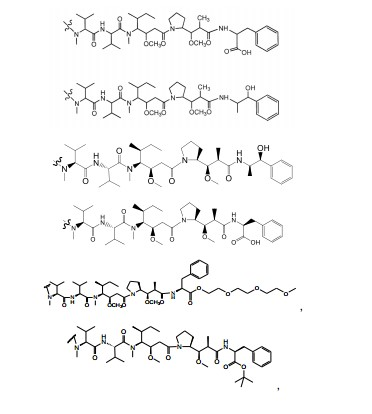
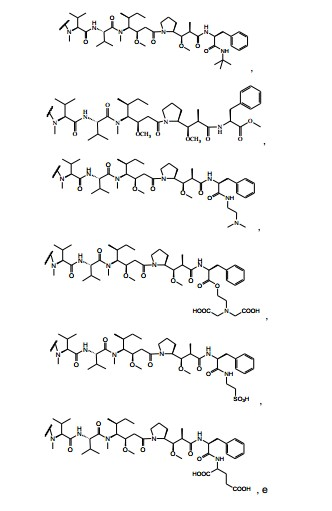
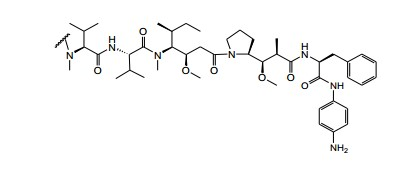
[00403] Em um aspecto, grupos hidrofílicos, por exemplo, mas não se limitando a ésteres de trietileno glicol (TEG) podem ser ligados à unidade de fármaco em R11. Sem se ater à teoria, os grupos hidrofílicos ajudam na internalização e não aglomeração da unidade de fármaco.[00403] In one aspect, hydrophilic groups, for example but not limited to triethylene glycol esters (TEG) may be attached to the drug moiety in R11. Without sticking to theory, hydrophilic groups help in the internalization and non-agglomeration of the drug unit.
[00404] Em algumas modalidades, a unidade de fármaco não é TZT-1027. Em algumas modalidades, a unidade de fármaco não é auristatina E, dolastatina 10, ou auristatina PE.[00404] In some embodiments, the drug unit is not TZT-1027. In some embodiments, the drug unit is not auristatin E,
[00405] Os compostos conjugados anticorpo-fármaco exemplificadores têm as seguintes estruturas, em que "L" ou "mAb-s-" representa um MAb 191P4D12 designado Ha22-2(2,4)6.1 aqui apresentado:
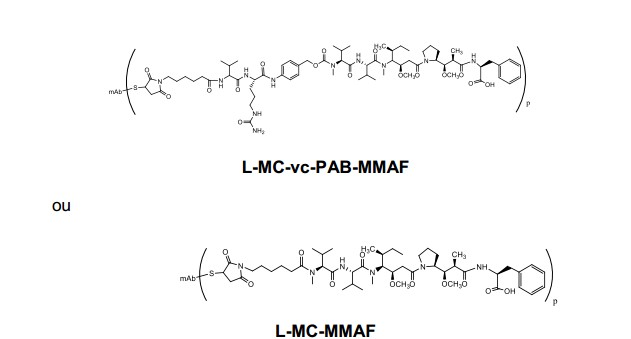
[00406] Em algumas modalidades, a unidade de fármaco é uma caliqueamicina, camptotecina, um maitansinoide, ou uma antraciclina. Em algumas modalidades, o fármaco é uma taxano, um inibidor de topoisomerase, um alcaloide da vinca, ou similares.[00406] In some embodiments, the drug unit is a calicheamicin, camptothecin, a maytansinoid, or an anthracycline. In some embodiments, the drug is a taxane, a topoisomerase inhibitor, a vinca alkaloid, or the like.
[00407] Em algumas modalidades típicas, os agentes citotóxicos adequados incluem, por exemplo, ligantes do sulco menor do DNA (por exemplo, enediinas e lexitropsinas, um composto CBI; vide também patente US 6.130.237), duocarmicinas, taxanos (por exemplo, paclitaxel e docetaxel), puromicinas, e alcaloides da vinca. Outros agentes citotóxicos incluem, por exemplo, CC-1065, SN-38, topotecano, morfolino-doxorrubicina, rizoxina, cianomorfolino- doxorrubicina, equinomicina, combretastatina, netropsina, epotilona A e B, estramustina, criptofisinas, cemadotina, maitansinoides, discodermolídeo, eleuterobina, e mitoxantrona.In some typical embodiments, suitable cytotoxic agents include, for example, DNA minor groove ligands (eg, enediins and lexitropsins, a CBI compound; see also US patent 6,130,237), duocarmycins, taxanes (eg. , paclitaxel and docetaxel), puromycins, and vinca alkaloids. Other cytotoxic agents include, for example, CC-1065, SN-38, topotecan, morpholino-doxorubicin, rizoxin, cyanomorpholino-doxorubicin, echinomycin, combretastatin, netropsin, epothilone A and B, estramustine, cryptophysins, cemadotine, eleuterodermolinosin , and mitoxantrone.
[00408] Em algumas modalidades, o fármaco é um agente anti- tubulina. Exemplos de agentes anti-tubulina incluem, auristatinas, taxanos (por exemplo, Taxol® (paclitaxel), Taxotere® (docetaxel)), T67 (Tularik) e alcaloides da vinca (por exemplo, vincristina, vinblastina, vindesina, e vinorelbina). Outros agentes anti-tubulina incluem, por exemplo, derivados de bacatina , análogos de taxano (por exemplo, epotilona A e B), nocodazol, colchicina e colcimida, estramustina, criptoficinas, cemadotina, maitansinoides, combretastatinas, discodermolídeo, e eleuterobina.[00408] In some embodiments, the drug is an anti-tubulin agent. Examples of anti-tubulin agents include, auristatins, taxanes (for example, Taxol® (paclitaxel), Taxotere® (docetaxel)), T67 (Tularik) and vinca alkaloids (for example, vincristine, vinblastine, vindesine, and vinorelbine). Other anti-tubulin agents include, for example, baccatin derivatives, taxane analogues (eg, epothilone A and B), nocodazole, colchicine and colcimide, estramustine, cryptophycins, cemadotine, maytansinoids, combretastatins, discodermolide, and eleuterobin.
[00409] Em certas modalidades, o agente citotóxico é um maitansinoide, outro grupo de agentes anti-tubulina. Por exemplo, em modalidades específicas, o maitansinoide é maitansina ou DM-1 (ImmunoGen, Inc.; vide também Chari et al., 1992, Cancer Res. 52:127-131).[00409] In certain embodiments, the cytotoxic agent is a maytansinoid, another group of anti-tubulin agents. For example, in specific embodiments, the maytansinoid is maytansine or DM-1 (ImmunoGen, Inc.; see also Chari et al., 1992, Cancer Res. 52:127-131).
[00410] Em certas modalidades, o agente citotóxico ou citostático é uma dolastatina. Em certas modalidades, o agente citotóxico ou citostático é da classe da auristatina. Desta forma, em uma modalidade específica, o agente citotóxico ou citostático é MMAE (fórmula XI). Em uma outra modalidade específica, o agente citotóxico ou citostático é AFP (fórmula XVI).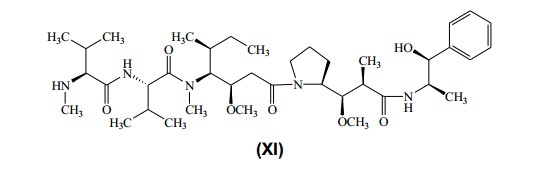
[00411] Em certas modalidades, o agente citotóxico ou citostático é um composto das fórmulas XII-XXI ou um sal farmaceuticamente aceitável do mesmo: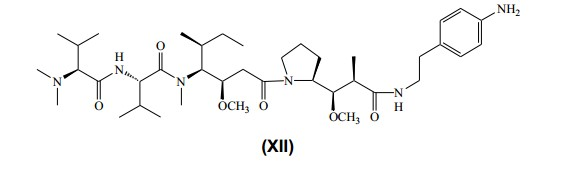
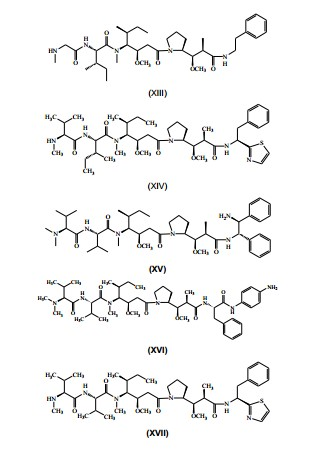
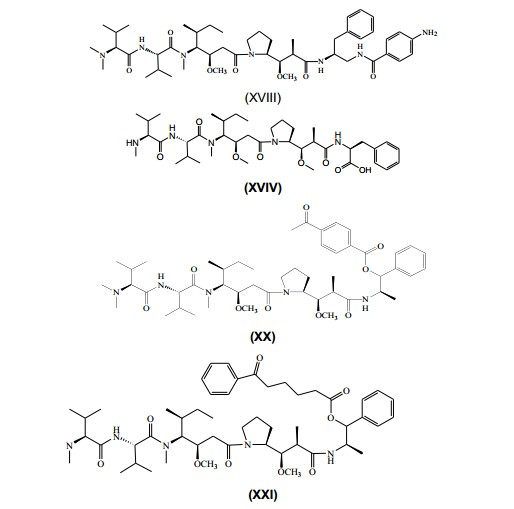
[00412] O carregamento do fármaco é representado por p e é o número médio de porções de fármaco por anticorpo em uma molécula. O carregamento do fármaco pode variar de 1 a 20 porções de fármaco (D) por anticorpo. Os ADCs da invenção incluem coleções de anticorpos conjugados com uma gama de porções de fármaco, de 1 a 20. O número médio de porções de fármaco por anticorpo nas preparações de ADC a partir de reações de conjugação pode ser caracterizado por meios convencionais, tais como espectroscopia de massa e, ensaio ELISA. A distribuição quantitativa do ADC em termos de p pode, também, ser determinada. Em alguns casos, a separação, purificação, e caracterização de ADCs homogêneos, onde p é um determinado valor a partir dos ADCs com outros carregamentos de fármaco podem ser obtidas através de meios tais como eletroforese.[00412] Drug loading is represented by p and is the average number of drug moieties per antibody in a molecule. Drug loading can range from 1 to 20 drug portions (D) per antibody. The ADCs of the invention include collections of antibodies conjugated to a range of drug moieties, from 1 to 20. The average number of drug moieties per antibody in ADC preparations from conjugation reactions can be characterized by conventional means such as mass spectroscopy and ELISA assay. The quantitative distribution of the ADC in terms of p can also be determined. In some cases, separation, purification, and characterization of homogeneous ADCs, where p is a given value from ADCs with other drug loadings, can be achieved by means such as electrophoresis.
[00413] Para alguns conjugados anticorpo-fármaco, p pode ser limitado pelo número de sítios de ligação no anticorpo. Por exemplo, quando a ligação é uma cisteína tiol, tal como nas modalidades exemplificadoras acima, um anticorpo pode ter apenas um ou vários grupos cisteína tiol, ou pode ter apenas um ou vários grupos tiol suficientemente reativos através dos quais um ligante pode ser ligado. Em certas modalidades, um carregamento maior do fármaco, por exemplo, p >5, pode causar agregação, insolubilidade, toxicidade ou perda de permeabilidade celular de certos conjugados anticorpo- fármaco. Em certas modalidades, o carregamento do fármaco para um ADC da invenção varia de 1 a cerca de 8; de cerca de 2 a cerca de 6; de cerca de 3 a cerca de 5; de cerca de 3 a cerca de 4; de cerca de 3,1 a cerca de 3,9; de cerca de 3,2 a cerca de 3,8; de cerca de 3,2 a cerca de 3,7; de cerca de 3,2 a cerca de 3,6; de cerca de 3,3 a cerca de 3,8; ou de cerca de 3,3 a cerca de 3,7. De fato, foi mostrado que para certos ADCs, a razão ótima das porções de fármaco por anticorpo pode ser menor que 8, e pode ser de cerca de 2 a cerca de 5. Vide a patente US n° 7.498.298 (aqui incorporada a título de referência, em sua totalidade).[00413] For some antibody-drug conjugates, p may be limited by the number of binding sites on the antibody. For example, when the linkage is a cysteine thiol, as in the exemplary embodiments above, an antibody may have only one or more cysteine thiol groups, or it may have only one or more thiol groups sufficiently reactive through which a linker can be attached. In certain embodiments, increased drug loading, eg, p >5, can cause aggregation, insolubility, toxicity, or loss of cell permeability of certain antibody-drug conjugates. In certain embodiments, drug loading for an ADC of the invention ranges from 1 to about 8; from about 2 to about 6; from about 3 to about 5; from about 3 to about 4; from about 3.1 to about 3.9; from about 3.2 to about 3.8; from about 3.2 to about 3.7; from about 3.2 to about 3.6; from about 3.3 to about 3.8; or from about 3.3 to about 3.7. In fact, it has been shown that for certain ADCs, the optimal ratio of drug to antibody portions may be less than 8, and may be from about 2 to about 5. See US Patent No. 7,498,298 (herein incorporated in reference title in its entirety).
[00414] Em certas modalidades, menos que o máximo teórico de porções de fármaco são conjugadas a um anticorpo durante uma reação de conjugação. Um anticorpo pode conter, por exemplo, resíduos de lisina que não reagem com o intermediário fármaco-ligante ou reagente ligante, como discutido abaixo. Em geral, os anticorpos não contêm muitos grupos cisteína tiol livres e reativos, que podem ser ligados a uma porção de fármaco; de fato, a maioria dos resíduos de cisteína tiol nos anticorpos existe como pontes de dissulfeto. Em certas modalidades, um anticorpo pode ser reduzido com um agente redutor, tal como ditiotreitol (DTT) ou tricarboniletilfosfina (TCEP), sob condições redutoras parciais ou totais, para gerar grupos de cisteína tiol reativos. Em certas modalidades, um anticorpo é submetido a condições desnaturantes para revelar grupos nucleofílicos reativos, tais como lisina ou cisteína.[00414] In certain embodiments, less than the theoretical maximum drug moieties are conjugated to an antibody during a conjugation reaction. An antibody can contain, for example, lysine residues that do not react with the drug-linker intermediate or linking reagent, as discussed below. In general, antibodies do not contain many free and reactive cysteine thiol groups, which can be attached to a drug moiety; in fact, most cysteine thiol residues in antibodies exist as disulfide bridges. In certain embodiments, an antibody can be reduced with a reducing agent, such as dithiothreitol (DTT) or tricarbonylethylphosphine (TCEP), under partial or total reducing conditions, to generate reactive cysteine thiol groups. In certain embodiments, an antibody is subjected to denaturing conditions to reveal reactive nucleophilic groups, such as lysine or cysteine.
[00415] O carregamento (razão fármaco/anticorpo) de um ADC pode ser controlado de diferentes formas, por exemplo, por: (i) limitar o excesso molar de intermediário fármaco-ligante ou reagente ligante em relação ao anticorpo, (ii) limitar o tempo ou a temperatura da reação de conjugação, (iii) condições redutoras parciais ou limitantes para a modificação da cisteína tiol, (iv) manipular por técnicas recombinantes a sequência de aminoácidos do anticorpo, para que o número e a posição dos resíduos de cisteína seja modificada para controlar o número e/ou a posição das ligações ligante-fármaco (tal como tioMab ou tioFab preparados conforme descrito aqui e em WO2006/034488 (aqui incorporada a título de referência, em sua totalidade)).[00415] The loading (drug/antibody ratio) of an ADC can be controlled in different ways, for example, by: (i) limiting the molar excess of drug-linker intermediate or binding reagent relative to the antibody, (ii) limiting the time or temperature of the conjugation reaction, (iii) partial reducing or limiting conditions for the modification of the cysteine thiol, (iv) manipulating by recombinant techniques the amino acid sequence of the antibody so that the number and position of the cysteine residues is modified to control the number and/or position of linker-drug bonds (such as thioMab or thioFab prepared as described herein and in WO2006/034488 (incorporated by reference herein in its entirety)).
[00416] Deve ser compreendido que quando mais de um grupo nucleofílico reage com um intermediário fármaco-ligante ou reagente ligante seguido pelo reagente da porção de fármaco, então, o produto resultante é uma mistura dos compostos de ADC com uma distribuição de uma ou mais porções de fármaco ligadas a um anticorpo. O número médio de fármacos por anticorpo pode ser calculado a partir da mistura por um ensaio ELISA de anticorpo duplo, que é específico para o anticorpo e específico para o fármaco. As moléculas de ADC individuais podem ser identificadas na mistura por espectroscopia de massa e separadas por HPLC, por exemplo, cromatografia de interação hidrofóbica (vide, por exemplo, Hamblett, K.J., et al. "Effect of drug loading on the pharmacology, pharmacokinetics, and toxicity of an anti-CD30 antibody-drug conjugate," resumo n° 624, American Association for Cancer Research, 2004 Annual Meeting, 27 a 31 de março, 2004, Proceedings of the AACR, Volume 45, março de 2004; Alley, S.C., et al. "Controlling the location of drug attachment in antibody-drug conjugates," resumo n° 627, American Association for Cancer Research, Reunião anual de 2004, 27 a 31 de março de 2004, Proceedings of the AACR, Volume 45, março de 2004). Em certas modalidades, um ADC homogêneo com um único valor de carregamento pode ser isolado a partir da mistura de conjugação por eletroforese ou cromatografia.[00416] It should be understood that when more than one nucleophilic group reacts with a drug-linker intermediate or linking reagent followed by the drug portion reagent, then the resulting product is a mixture of the ADC compounds with a distribution of one or more drug moieties linked to an antibody. The average number of drugs per antibody can be calculated from the mixture by a dual antibody ELISA assay, which is antibody-specific and drug-specific. Individual ADC molecules can be identified in the mixture by mass spectroscopy and separated by HPLC, eg, hydrophobic interaction chromatography (see, for example, Hamblett, KJ, et al. "Effect of drug loading on the pharmacology, pharmacokinetics, and toxicity of an anti-CD30 antibody-drug conjugate," abstract #624, American Association for Cancer Research, 2004 Annual Meeting, March 27-31, 2004, Proceedings of the AACR,
[00417] Os métodos para determinar se um fármaco ou conjugado anticorpo-fármaco exerce um efeito citostático e/ou citotóxico em uma célula são conhecidos. Em geral, a atividade citotóxica ou citostática de um conjugado anticorpo-fármaco pode ser medida por: expor células de mamífero que expressam uma proteína-alvo do conjugado anticorpo-fármaco em um meio de cultura celular; cultivar as células durante um período de cerca de 6 horas a cerca de 5 dias; e medir a viabilidade celular. Os testes à base de célula in vitro podem ser usados para medir a viabilidade (proliferação), citotoxicidade, e indução de apoptose (ativação de caspase) do conjugado anticorpo- fármaco.[00417] Methods to determine whether a drug or antibody-drug conjugate exerts a cytostatic and/or cytotoxic effect on a cell are known. In general, the cytotoxic or cytostatic activity of an antibody-drug conjugate can be measured by: exposing mammalian cells that express a target protein of the antibody-drug conjugate in a cell culture medium; culturing the cells for a period of about 6 hours to about 5 days; and measure cell viability. In vitro cell-based tests can be used to measure the viability (proliferation), cytotoxicity, and induction of apoptosis (caspase activation) of the antibody-drug conjugate.
[00418] Para determinar se um conjugado anticorpo-fármaco exerce um efeito citostático, um ensaio de incorporação de timidina pode ser usado. Por exemplo, células de câncer que expressam um antígeno alvo a uma densidade de 5.000 células/poço de uma placa de 96 poços podem ser cultivadas por um período de 72 horas e expostas a 0,5 μCi de 3H-timidina durante as 8 horas finais do período de 72 horas. A incorporação de 3H-timidina em células da cultura é medida na presença e ausência do conjugado anticorpo-fármaco.[00418] To determine whether an antibody-drug conjugate exerts a cytostatic effect, a thymidine incorporation assay can be used. For example, cancer cells expressing a target antigen at a density of 5,000 cells/well of a 96-well plate can be cultured for a period of 72 hours and exposed to 0.5 μCi of 3H-thymidine for the final 8 hours of the 72 hour period. 3 H-thymidine incorporation into cultured cells is measured in the presence and absence of the antibody-drug conjugate.
[00419] Para determinar a citotoxicidade, a necrose ou apoptose (morte celular programada) pode ser medida. A necrose é tipicamente acompanhada por permeabilidade aumentada da membrana plasmática,; inchaço da célula, e ruptura da membrana plasmática. A apoptose é tipicamente caracterizada por borbulhamento (blebbing) da membrana, condensação do citoplasma, e ativação de endonucleases endógenas. A determinação de qualquer um destes efeitos sobre as células de câncer indica que um conjugado anticorpo-fármaco é útil no tratamento de cânceres.[00419] To determine cytotoxicity, necrosis or apoptosis (programmed cell death) can be measured. Necrosis is typically accompanied by increased plasma membrane permeability; cell swelling, and plasma membrane rupture. Apoptosis is typically characterized by membrane blebbing, cytoplasmic condensation, and activation of endogenous endonucleases. Determining any of these effects on cancer cells indicates that an antibody-drug conjugate is useful in treating cancers.
[00420] A viabilidade celular pode ser medida pela determinação em uma célula da absorção de um corante, como vermelho neutro, azul de tripan, ou azul ALAMAR® (vide, por exemplo, Page et al., 1993, Intl. J. Oncology 3:473-476). Em tal ensaio, as células são incubadas em meios contendo o corante, as células são lavadas, e o corante remanescente, que reflete a absorção celular do corante, é medido espectrofotometricamente. O corante sulforodamina B (SRB) de ligação à proteína também pode ser usado para medir citotoxicidade (Skehan et al., 1990, J. Natl. Cancer Inst. 82:1107-12).Cell viability can be measured by determining in a cell the uptake of a dye such as neutral red, trypan blue, or ALAMAR® blue (see, for example, Page et al., 1993, Intl. J. Oncology 3:473-476). In such an assay, cells are incubated in dye-containing media, the cells are washed, and the remaining dye, which reflects the cellular uptake of the dye, is measured spectrophotometrically. The protein-binding sulphorodamine B (SRB) dye can also be used to measure cytotoxicity (Skehan et al., 1990, J. Natl. Cancer Inst. 82:1107-12).
[00421] Alternativamente, um sal de tetrazólio, como MTT, é usado em um ensaio colorimétrico quantitativo para sobrevivência e proliferação da célula de mamífero pela detecção de células vivas, mas não mortas (vide, por exemplo, Mosmann, 1983, J. Immunol. Methods 65:55-63).[00421] Alternatively, a tetrazolium salt, such as MTT, is used in a quantitative colorimetric assay for mammalian cell survival and proliferation by detecting living but not dead cells (see, for example, Mosmann, 1983, J. Immunol Methods 65:55-63).
[00422] A apoptose pode ser quantificada mediante a medição, por exemplo, da fragmentação do DNA. Métodos fotométricos comerciais para a determinação quantitativa in vitro da fragmentação do DNA estão disponíveis. Exemplos destes ensaios, incluindo TUNEL (que detecta a incorporação de nucleotídeos marcados em DNA fragmentado) e ensaios à base de ELISA, são descritos em Biochemica, 1999, no. 2, pg. 34 a 37 (Roche Molecular Biochemicals).Apoptosis can be quantified by measuring, for example, DNA fragmentation. Commercial photometric methods for quantitative in vitro determination of DNA fragmentation are available. Examples of these assays, including TUNEL (which detects the incorporation of labeled nucleotides into fragmented DNA) and ELISA-based assays, are described in Biochemica, 1999, no. 2, p. 34 to 37 (Roche Molecular Biochemicals).
[00423] A apoptose também pode ser determinada mediante a medição de alterações morfológicas em uma célula. Por exemplo, tal como com a necrose, a perda da integridade da membrana plasmática, pode ser determinada mediante a medição da absorção de determinados corantes (por exemplo, um corante fluorescente como, por exemplo, laranja de acridina ou brometo de etídio). Um método para medir o número de células apoptóticas foi descrito por Duke e Cohen, Current Protocols in Immunology (Coligan et al. eds., 1992, pp. 3.17.1-3.17.16). As células podem, também, ser marcadas com um corante de DNA (por exemplo, laranja de acridina, brometo de etídio, ou iodeto de propídio) e observadas para condensação da cromatina e marginação ao longo da membrana nuclear interna. Outras alterações morfológicas que podem ser medidas para determinar a apoptose incluem, por exemplo, condensação citoplasmática, aumento do abaulamento da membrana e retração celular.[00423] Apoptosis can also be determined by measuring morphological changes in a cell. For example, as with necrosis, loss of plasma membrane integrity can be determined by measuring the absorption of certain dyes (eg a fluorescent dye such as acridine orange or ethidium bromide). A method for measuring the number of apoptotic cells has been described by Duke and Cohen, Current Protocols in Immunology (Coligan et al. eds., 1992, pp. 3.17.1-3.17.16). Cells can also be labeled with a DNA dye (eg, acridine orange, ethidium bromide, or propidium iodide) and observed for chromatin condensation and margination along the inner nuclear membrane. Other morphological changes that can be measured to determine apoptosis include, for example, cytoplasmic condensation, increased membrane bulging, and cell retraction.
[00424] A presença de células apoptóticas pode ser medida em ambos os compartimentos aderido e "flutuante" das culturas. Por exemplo, ambos os compartimentos podem ser coletados pela remoção do sobrenadante, tripsinização das células aderidas, combinação das preparações após uma etapa de lavagem por centrifugação (por exemplo, 10 minutos a 2000 rpm), e detecção de apoptose (por exemplo, mediante a medição da fragmentação do DNA). (Vide, por exemplo, Piazza et al., 1995, Cancer Research 55:3110-16).[00424] The presence of apoptotic cells can be measured in both the adhered and "floating" compartments of the cultures. For example, both compartments can be collected by removing the supernatant, trypsinizing adhered cells, combining the preparations after a washing step by centrifugation (eg, 10 minutes at 2000 rpm), and detecting apoptosis (eg, by means of measurement of DNA fragmentation). (See, for example, Piazza et al., 1995, Cancer Research 55:3110-16).
[00425] In vivo, o efeito de uma composição terapêutica de 191P4D12 pode ser avaliado em um modelo animal adequado. Por exemplo, modelos de câncer xenogênico podem ser usados, sendo que os explantes de câncer ou tecidos de xenoenxerto subcultivados são introduzidos em animais imunocomprometidos, tais como camundongos nude ou SCID (Klein et al., 1997, Nature Medicine 3: 402-408). Por exemplo, o pedido de patente PCT WO98/16628 e a patente U.S. 6.107.540 descrevem vários modelos de xenoenxerto de câncer de próstata humano capazes de recapitular o desenvolvimento de tumores primários, micrometástases, e a formação de metástases osteoblásticas características de doença em estágio tardio. A eficácia pode ser prevista usando ensaios que medem a inibição da formação do tumor, regressão do tumor ou metástase, e similares.In vivo, the effect of a therapeutic composition of 191P4D12 can be evaluated in a suitable animal model. For example, xenogenic cancer models can be used, whereby cancer explants or subcultured xenograft tissues are introduced into immunocompromised animals such as nude or SCID mice (Klein et al., 1997, Nature Medicine 3: 402-408) . For example, PCT patent application WO98/16628 and US patent 6,107,540 describe various human prostate cancer xenograft models capable of recapitulating the development of primary tumors, micrometastases, and osteoblastic metastasis formation characteristic of stage disease late. Efficacy can be predicted using assays that measure inhibition of tumor formation, tumor regression or metastasis, and the like.
[00426] Ensaios In vivo que avaliam a promoção da apoptose são úteis na avaliação das composições terapêuticas. Em uma modalidade, os xenoenxertos de camundongos que carregam tumor tratados com a composição terapêutica podem ser examinados para a presença de focos apoptóticos e comparados a camundongos carregando o xenoenxerto de controle não tratado. A extensão na qual os focos apoptóticos são encontrados nos tumores dos camundongos tratados fornece uma indicação da eficácia terapêutica da composição.[00426] In vivo assays that assess the promotion of apoptosis are useful in evaluating therapeutic compositions. In one embodiment, xenografts from tumor-bearing mice treated with the therapeutic composition can be examined for the presence of apoptotic foci and compared to mice carrying the untreated control xenograft. The extent to which apoptotic foci are found in tumors from treated mice provides an indication of the therapeutic efficacy of the composition.
[00427] As composições terapêuticas usadas na prática dos métodos supracitados podem ser formuladas em composições farmacêuticas compreendendo um veículo adequado para o método de aplicação desejado. Os veículos adequados incluem qualquer material que, quando combinado com a composição terapêutica, guarde a função antitumoral da composição terapêutica e seja geralmente não reativo com o sistema imune do paciente. Exemplos incluem, mas não se limitam a qualquer um de vários veículos farmacêuticos padrão como soluções salinas tamponadas com fosfato estéreis, água bacteriostática, e similares (vide, geralmente, Remington's Pharmaceutical Sciences 16a edição, A. Osal., Ed., 1980).Therapeutic compositions used in the practice of the aforementioned methods may be formulated into pharmaceutical compositions comprising a vehicle suitable for the desired method of application. Suitable carriers include any material which, when combined with the therapeutic composition, retains the antitumor function of the therapeutic composition and is generally non-reactive with the patient's immune system. Examples include, but are not limited to any of a number of standard pharmaceutical carriers such as sterile phosphate-buffered saline solutions, bacteriostatic water, and the like (see, generally, Remington's Pharmaceutical Sciences 16th edition, A. Osal., Ed., 1980).
[00428] As formulações terapêuticas podem ser solubilizadas e administradas através de qualquer via capaz de liberar a composição terapêutica ao sítio do tumor. As vias de administração potencialmente eficazes incluem, mas não se limitam a intravenosa, parenteral, intraperitoneal, intramuscular, intratumoral, intradérmica, intraórgão, ortotópica, e similares. Uma formulação preferencial para injeção intravenosa compreende a composição terapêutica em uma solução de água bacteriostática conservada, água estéril não conservada, e/ou diluída em sacos de cloreto de polivinila ou polietileno contendo 0,9% de cloreto de sódio estéril para injeção, USP. As preparações de proteína terapêuticas podem ser liofilizadas e armazenadas como pós estéreis, de preferência, a vácuo, e, então, reconstituídas em água bacteriostática (contendo, por exemplo, conservante de álcool benzílico) ou em água estéril antes da injeção.[00428] Therapeutic formulations can be solubilized and administered through any route capable of delivering the therapeutic composition to the tumor site. Potentially effective routes of administration include, but are not limited to, intravenous, parenteral, intraperitoneal, intramuscular, intratumoral, intradermal, intraorganic, orthotopic, and the like. A preferred formulation for intravenous injection comprises the therapeutic composition in a solution of preserved bacteriostatic water, sterile unpreserved water, and/or diluted in polyvinyl chloride or polyethylene bags containing 0.9% sterile sodium chloride for injection, USP. Therapeutic protein preparations can be lyophilized and stored as sterile powders, preferably under vacuum, and then reconstituted in bacteriostatic water (containing, for example, benzyl alcohol preservative) or in sterile water prior to injection.
[00429] As dosagens e protocolos de administração para o tratamento dos cânceres usando os métodos supracitados variarão com o método e com o câncer alvo, e dependerão, geralmente, de vários outros fatores entendidos na técnica.Dosages and administration protocols for treating cancers using the aforementioned methods will vary with the method and the target cancer, and will generally depend on various other factors understood in the art.
[00430] A identificação de 191P4D12 como uma proteína que está normalmente expressa em um conjunto restrito de tecidos, mas que também está expressa em cânceres, tais como aqueles mencionados na tabela I, abre inúmeras abordagens terapêuticas para o tratamento destes cânceres.[00430] The identification of 191P4D12 as a protein that is normally expressed in a restricted set of tissues, but which is also expressed in cancers, such as those mentioned in table I, opens up numerous therapeutic approaches for the treatment of these cancers.
[00431] Digno de nota, terapias antitumorais direcionadas têm sido úteis mesmo quando a proteína direcionada está expressa em tecidos normais, até mesmo tecidos de órgãos vitais normais. Um órgão vital é um que é necessário para sustentar a vida, tal como o coração ou cólon. Um órgão não vital é um que pode ser removido e como uma consequência, o indivíduo ainda pode sobreviver. Exemplos de órgãos não vitais são ovário, mama, e próstata.Of note, targeted antitumor therapies have been useful even when the targeted protein is expressed in normal tissues, even normal vital organ tissues. A vital organ is one that is needed to sustain life, such as the heart or colon. A non-vital organ is one that can be removed and as a consequence, the individual can still survive. Examples of non-vital organs are ovary, breast, and prostate.
[00432] A expressão de uma proteína-alvo em um tecido normal, mesmo em tecido normal vital, não anula a utilidade de um agente de direcionamento para a proteína como um terapêutico para determinados tumores no quais a proteína também est6á superexpressa. Por exemplo, a expressão em órgãos vitais não é por si só prejudicial. Além disso, os órgãos considerados dispensáveis, tais como a próstata e o ovário, podem ser removidos sem afetar a mortalidade. Finalmente, alguns órgãos vitais não são afetados pela expressão do órgão normal por causa de um privilégio imunológico. Os órgãos imunoprivilegiados são órgãos que são protegidos do sangue por uma barreira sangue-órgão e, desta forma, não são acessíveis para imunoterapia. Exemplos de órgãos imunoprivilegiados são o cérebro e os testículos.[00432] The expression of a target protein in normal tissue, even in vital normal tissue, does not negate the usefulness of a targeting agent for the protein as a therapeutic for certain tumors in which the protein is also overexpressed. For example, expression in vital organs is not in itself harmful. Furthermore, organs considered expendable, such as the prostate and ovary, can be removed without affecting mortality. Finally, some vital organs are unaffected by normal organ expression because of an immunological privilege. Immunoprivileged organs are organs that are protected from the blood by a blood-organ barrier and thus not accessible for immunotherapy. Examples of immune-privileged organs are the brain and testicles.
[00433] Consequentemente, as abordagens terapêuticas que inibem a atividade de uma proteína 191P4D12 são úteis para pacientes que tem um câncer que expressa 191P4D12. Estas abordagens terapêuticas geralmente se enquadram em três classes. A primeira classe modula a função de 191P4D12, uma vez que ela se refere ao crescimento da célula tumoral levando à inibição ou retardo do crescimento da célula tumoral ou indução de sua morte. A segunda classe compreende vários métodos para inibir a ligação ou associação de uma proteína 191P4D12 com seu parceiro de ligação ou com outras proteínas. A terceira classe compreende uma variedade de métodos para inibir a transcrição de um gene 191P4D12 ou a tradução do mRNA de 191P4D12.Consequently, therapeutic approaches that inhibit the activity of a 191P4D12 protein are useful for patients who have a cancer that expresses 191P4D12. These therapeutic approaches generally fall into three classes. The first class modulates the function of 191P4D12 as it refers to tumor cell growth leading to inhibition or delay of tumor cell growth or induction of its death. The second class comprises various methods for inhibiting the binding or association of a 191P4D12 protein with its binding partner or with other proteins. The third class comprises a variety of methods for inhibiting the transcription of a 191P4D12 gene or the translation of 191P4D12 mRNA.
[00434] Consequentemente, os pacientes com câncer podem ser avaliados para a presença e para o nível de expressão de 191P4D12, usando, de preferência, avaliações por imunoistoquímica do tecido tumoral, formação de imagens quantitativas de 191P4D12, ou outras técnicas que indicam confiavelmente a presença e o grau de expressão de 191P4D12. A análise imunoistoquímica das biópsias de tumor ou espécimes cirúrgicos é preferencial para este propósito. Os métodos para análise imunoistoquímica de tecidos tumorais são bem conhecidos na técnica.[00434] Consequently, cancer patients can be evaluated for the presence and level of expression of 191P4D12, preferably using immunohistochemical assessments of tumor tissue, quantitative imaging of 191P4D12, or other techniques that reliably indicate the presence and degree of expression of 191P4D12. Immunohistochemical analysis of tumor biopsies or surgical specimens is preferred for this purpose. Methods for immunohistochemical analysis of tumor tissues are well known in the art.
[00435] 191P4D12 é um alvo atrativo para estratégias terapêuticas à base de anticorpo. Várias estratégias com anticorpos são conhecidas na técnica para direcionar moléculas extracelulares e intracelulares (vide, por exemplo, morte mediada pelo complemento e ADCC assim como o uso de intracorpos). Pelo fato de 191P4D12 ser expresso por células de câncer de várias linhagens em relação às células correspondentes normais, a administração sistêmica de composições imunorreativas à 191P4D12 é preparada, as quais têm excelente sensibilidade sem efeitos tóxicos, inespecíficos e/ou não-alvo causados pela ligação da composição imunorreativa a órgãos e tecidos não-alvo. Os anticorpos reativos especificamente com os domínios de 191P4D12 são úteis para tratar cânceres que expressam 191P4D12 sistemicamente, de preferência, como conjugados anticorpo-fármaco (isto é ADCs) em que o conjugado está com uma toxina ou agente terapêutico.[00435] 191P4D12 is an attractive target for antibody-based therapeutic strategies. Several antibody strategies are known in the art to target extracellular and intracellular molecules (see, for example, complement-mediated killing and ADCC as well as the use of intrabodies). Because 191P4D12 is expressed by cancer cells of various lineages relative to the corresponding normal cells, systemic administration of 191P4D12 immunoreactive compositions is prepared, which have excellent sensitivity without toxic, non-specific and/or non-target effects caused by binding of the immunoreactive composition to non-target organs and tissues. Antibodies specifically reactive with 191P4D12 domains are useful to treat cancers expressing 191P4D12 systemically, preferably as antibody-drug conjugates (i.e. ADCs) where the conjugate is with a toxin or therapeutic agent.
[00436] Os versados na técnica entendem que anticorpos podem ser usados para direcionar especificamente e se ligar a moléculas imunogênicas, como uma região imunogênica de uma sequência de 191P4D12 mostrada na figura 1. Além disso, os versados na técnica entendem que é rotina conjugar anticorpos a agentes citotóxicos (vide, por exemplo, Slevers et al. Blood 93:11 3678-3684 (1 de junho de 1999)). Quando os agentes citotóxicos e/ou terapêuticos são aplicados diretamente às células, tal como pela conjugação dos mesmos a anticorpos específicos para uma molécula expressa por aquela célula (por exemplo, 191P4D12), o agente citotóxico irá exercer seu efeito biológico conhecido (isto é, citotoxicidade) nestas células.[00436] Those of skill in the art understand that antibodies can be used to specifically target and bind to immunogenic molecules, such as an immunogenic region of a 191P4D12 sequence shown in Figure 1. Furthermore, those of skill in the art understand that it is routine to conjugate antibodies to cytotoxic agents (see, for example, Slevers et al. Blood 93:11 3678-3684 (June 1, 1999)). When cytotoxic and/or therapeutic agents are applied directly to cells, such as by conjugating them to specific antibodies for a molecule expressed by that cell (eg, 191P4D12), the cytotoxic agent will exert its known biological effect (i.e., cytotoxicity) in these cells.
[00437] Uma ampla variedade de composições e métodos para usar os conjugados de anticorpo-agente citotóxico para matar células são conhecidos na técnica. No contexto de cânceres, os métodos típicos envolvem administrar a um mamífero que tem um tumor, uma quantidade biologicamente eficaz de um conjugado que compreende um agente citotóxico e/ou terapêutico selecionado ligado a um agente de direcionamento (por exemplo, um MAb 191P4D12, de preferência, Ha22-2(2,4)6.1) que se liga a um antígeno (por exemplo, 191P4D12) expresso, acessível para ligação ou localizado nas superfícies celulares. Uma modalidade típica é um método para liberar um agente citotóxico e/ou terapêutico a uma célula que expressa 191P4D12, compreendendo conjugar o agente citotóxico a um anticorpo que se liga imunoespecificamente a um epítopo de 191P4D12, e expor a célula ao conjugado anticorpo-fármaco (ADC). Outra modalidade ilustrativa é um método de tratar um indivíduo com suspeita de sofrer câncer metastático, compreendendo uma etapa de administrar parenteralmente ao dito indivíduo uma composição farmacêutica que compreende uma quantidade terapeuticamente eficaz de um anticorpo conjugado a um agente citotóxico e/ou terapêutico.A wide variety of compositions and methods for using antibody-cytotoxic agent conjugates to kill cells are known in the art. In the context of cancers, typical methods involve administering to a mammal having a tumor, a biologically effective amount of a conjugate comprising a selected cytotoxic and/or therapeutic agent linked to a targeting agent (e.g., a MAb 191P4D12, of preferably, Ha22-2(2,4)6.1) that binds to an antigen (eg, 191P4D12) expressed, accessible for binding, or located on cell surfaces. A typical embodiment is a method for delivering a cytotoxic and/or therapeutic agent to a cell expressing 191P4D12, comprising conjugating the cytotoxic agent to an antibody that immunospecifically binds to a 191P4D12 epitope, and exposing the cell to the antibody-drug conjugate ( ADC). Another illustrative embodiment is a method of treating an individual suspected of suffering from metastatic cancer, comprising a step of parenterally administering to said individual a pharmaceutical composition comprising a therapeutically effective amount of an antibody conjugated to a cytotoxic and/or therapeutic agent.
[00438] A imunoterapia para o câncer usando anticorpos 191P4D12 pode ser feita de acordo com várias abordagens que foram empregadas de forma bem sucedida no tratamento de outros tipos de câncer, incluindo, mas não se limitando ao câncer de cólon (Arlen et al., 1998, Crit. Rev. Immunol. 18:133-138), mieloma múltiplo (Ozaki et al., 1997, Blood 90:3179-3186, Tsunenari et al., 1997, Blood 90:24372444), câncer gástrico (Kasprzyk et al., 1992, Cancer Res. 52:27712776), linfoma de célula B (Funakoshi et al., 1996, J. Immunother. Emphasis Tumor Immunol. 19:93-101), leucemia (Zhong et al., 1996, Leuk. Res. 20:581-589), câncer colorretal (Moun et al., 1994, Cancer Res. 54:6160-6166; Velders et al., 1995, Cancer Res. 55:4398-4403), e câncer de mama (Shepard et al., 1991, J. Clin. Immunol. 11:117- 127). Algumas abordagens terapêuticas envolvem a conjugação de anticorpo nu a uma toxina ou radioisótopo, tal como a conjugação de Y91 ou I131 a anticorpos anti-CD20 (por exemplo, Zevalin®, IDEC Pharmaceuticals Corp. or Bexxar®, Coulter Pharmaceuticals) respectivamente, enquanto outras envolvem a coadministração de anticorpos e outros agentes terapêuticos, como Herceptin® (trastuzu MAb) com paclitaxel (Genentech, Inc.). Em uma modalidade preferencial, os anticorpos serão conjugados a um agente citotóxico, acima, de preferência, um derivado de auristatina designado MMAE (Seattle Genetics, Inc).[00438] Immunotherapy for cancer using 191P4D12 antibodies can be done according to several approaches that have been successfully employed in the treatment of other types of cancer, including, but not limited to colon cancer (Arlen et al., 1998, Crit. Rev. Immunol. 18:133-138), multiple myeloma (Ozaki et al., 1997, Blood 90:3179-3186, Tsunenari et al., 1997, Blood 90:24372444), gastric cancer (Kasprzyk et al., al., 1992, Cancer Res. 52:27712776), B-cell lymphoma (Funakoshi et al., 1996, J. Immunother. Emphasis Tumor Immunol. 19:93-101), leukemia (Zhong et al., 1996, Leuk Res. 20:581-589), colorectal cancer (Moun et al., 1994, Cancer Res. 54:6160-6166; Velders et al., 1995, Cancer Res. 55:4398-4403), and breast cancer (Shepard et al., 1991, J. Clin. Immunol. 11:117-127). Some therapeutic approaches involve conjugation of naked antibody to a toxin or radioisotope, such as conjugation of Y91 or I131 to anti-CD20 antibodies (eg, Zevalin®, IDEC Pharmaceuticals Corp. or Bexxar®, Coulter Pharmaceuticals) respectively, while others involve the co-administration of antibodies and other therapeutic agents, such as Herceptin® (trastuzu MAb) with paclitaxel (Genentech, Inc.). In a preferred embodiment, the antibodies will be conjugated to a cytotoxic agent, above preferably an auristatin derivative designated MMAE (Seattle Genetics, Inc).
[00439] Embora a terapia com anticorpo 191P4D12 seja útil para todos os estágios do câncer, a terapia com anticorpo pode ser particularmente adequada em cânceres avançados ou metastáticos. O tratamento com a terapia com anticorpo da invenção é indicado para pacientes que receberam um ou mais ciclos de quimioterapia. Alternativamente, a terapia com anticorpo da invenção é combinada com um regime quimioterapêutico ou de radiação para pacientes que não receberam tratamento quimioterapêutico. Adicionalmente, a terapia com anticorpo pode permitir o uso de dosagens reduzidas de quimioterapia concomitante, particularmente para pacientes que não toleram muito bem a toxicidade do agente quimioterápico. Fan et al. (Cancer Res. 53:4637-4642, 1993), Prewett et al. (International J. of Onco. 9:217-224, 1996), e Hancock et al. (Cancer Res. 51:4575-4580, 1991) descrevem o uso de vários anticorpos junto com agentes quimioterápicos.Although 191P4D12 antibody therapy is useful for all stages of cancer, antibody therapy may be particularly suitable in advanced or metastatic cancers. Treatment with the antibody therapy of the invention is indicated for patients who have received one or more cycles of chemotherapy. Alternatively, the antibody therapy of the invention is combined with a chemotherapeutic or radiation regimen for patients who have not received chemotherapeutic treatment. Additionally, antibody therapy may allow the use of reduced dosages of concomitant chemotherapy, particularly for patients who do not tolerate the toxicity of the chemotherapeutic agent very well. Fan et al. (Cancer Res. 53:4637-4642, 1993), Prewett et al. (International J. of Onco. 9:217-224, 1996), and Hancock et al. (Cancer Res. 51:4575-4580, 1991) describe the use of various antibodies in conjunction with chemotherapeutic agents.
[00440] Os anticorpos monoclonais de 191P4D12 que tratam os cânceres apresentados na Tabela I incluem aqueles que iniciam uma potente resposta imune contra o tumor ou os que são diretamente citotóxicos. Nesse sentido, os anticorpos monoclonais de 191P4D12 (MAbs) podem gerar lise da célula tumoral por mecanismos de citotoxicidade celular mediada pelo complemento ou dependente de anticorpo (ADCC), que exigem uma porção Fc intacta da molécula de imunoglobulina para interação com sítios do receptor Fc da célula efetora em proteínas do complemento. Além disso, os MAbs 191P4D12 que exercem um efeito biológico direto sobre o crescimento tumoral são úteis para tratar cânceres que expressam 191P4D12. Os mecanismos pelos quais os MAbs diretamente citotóxicos agem incluem: inibição do crescimento celular, modulação da diferenciação celular, modulação dos perfis do fator de angiogênese do tumor, e a indução de apoptose. O(s) mecanismo(s) pelo(s) qual(is) um MAb 191P4D12 particular exerce um efeito antitumoral é/são avaliado(s) usando qualquer quantidade de ensaios in vitro que avaliam a morte celular, tais como ADCC, lise celular mediada pelo complemento, e assim por diante, tal como é de conhecimento geral na técnica.191P4D12 monoclonal antibodies that treat the cancers shown in Table I include those that initiate a potent immune response against the tumor or those that are directly cytotoxic. In this sense, 191P4D12 monoclonal antibodies (MAbs) can generate tumor cell lysis by complement-mediated or antibody-dependent cell cytotoxicity (ADCC) mechanisms, which require an intact Fc portion of the immunoglobulin molecule to interact with Fc receptor sites of the effector cell into complement proteins. In addition, 191P4D12 MAbs that exert a direct biological effect on tumor growth are useful for treating cancers that express 191P4D12. The mechanisms by which directly cytotoxic MAbs act include: inhibition of cell growth, modulation of cell differentiation, modulation of tumor angiogenesis factor profiles, and induction of apoptosis. The mechanism(s) by which a particular 191P4D12 MAb exerts an antitumor effect is/are evaluated using any number of in vitro assays that assess cell death, such as ADCC, cell lysis complement-mediated, and so on, as is well known in the art.
[00441] Consequentemente, os anticorpos monoclonais preferenciais usados nos método terapêutico da invenção são aqueles que são completamente humanos e que se ligam especificamente ao antígeno de 191P4D12 alvo com alta afinidade.Consequently, the preferred monoclonal antibodies used in the therapeutic methods of the invention are those that are fully human and that specifically bind to the target 191P4D12 antigen with high affinity.
[00442] Os métodos terapêuticos da invenção contemplam a administração de ADCs de 191P4D12 únicos assim como combinações, ou coquetéis, de MAbs diferentes (isto é, MAbs 191P4D12 ou Mabs que se ligam a outra proteína). Tais coquetéis de MAb podem ter certas vantagens na medida em que eles contêm MAbs que atingem epítopos diferentes, exploram diferentes mecanismos efetores ou combinam MAbs diretamente citotóxicos com MAbs que contam com a funcionalidade efetora imune. Tais MAbs em combinação podem exibir efeitos terapêuticos sinérgicos. Além disso, os MAbs 191P4D12 podem ser administrados concomitantemente com outras modalidades terapêuticas, incluindo, mas não se limitando a vários agentes quimioterapêuticos e biológicos, bloqueadores de androgênio, moduladores imunes (por exemplo, IL-2, GM-CSF), cirurgia ou radiação. Em uma modalidade preferencial, os MAbs 191P4D12 são administrados sob a forma conjugada.The therapeutic methods of the invention contemplate the administration of single 191P4D12 ADCs as well as combinations, or cocktails, of different MAbs (i.e., 191P4D12 MAbs or Mabs that bind another protein). Such MAb cocktails may have certain advantages in that they contain MAbs that target different epitopes, exploit different effector mechanisms, or combine directly cytotoxic MAbs with MAbs that rely on immune effector functionality. Such MAbs in combination can exhibit synergistic therapeutic effects. In addition, MAbs 191P4D12 may be administered concurrently with other therapeutic modalities, including, but not limited to, various chemotherapeutic and biological agents, androgen blockers, immune modulators (eg, IL-2, GM-CSF), surgery or radiation . In a preferred embodiment, MAbs 191P4D12 are administered in conjugated form.
[00443] As formulações de ADC de 191P4D12 são administradas através de qualquer via capaz de liberar os anticorpos a uma célula tumoral. As vias de administração incluem, mas não se limitam a intravenosa, intraperitoneal, intramuscular, intratumoral, intradérmica, e similares. O tratamento geralmente envolve a administração repetida da preparação de ADC de 191P4D12, através de uma via de administração aceitável, tal como injeção intravenosa (IV), tipicamente a uma dose na faixa que inclui, mas não se limita a 0,1, 0,2, 0,3, 0,4, 0,5, 0,6, 0,7, 0,8, 0,9, 1, 2, 3, 4, 5, 6, 7, 8, 9, 10, 15, 20, ou 25 mg/kg de peso corporal. Em geral, doses na faixa de 10 a 1000 mg de MAb por semana são eficazes e bem toleradas.191P4D12 ADC formulations are administered via any route capable of delivering the antibodies to a tumor cell. Routes of administration include, but are not limited to, intravenous, intraperitoneal, intramuscular, intratumoral, intradermal, and the like. Treatment generally involves repeated administration of the 191P4D12 ADC preparation, via an acceptable route of administration, such as intravenous (IV) injection, typically at a dose in the range that includes but is not limited to 0.1, 0, 2, 0.3, 0.4, 0.5, 0.6, 0.7, 0.8, 0.9, 1, 2, 3, 4, 5, 6, 7, 8, 9, 10, 15, 20, or 25 mg/kg body weight. In general, doses in the range of 10 to 1000 mg of MAb per week are effective and well tolerated.
[00444] Com base na experiência clínica com Herceptin® (Trastuzumab) no tratamento de câncer de mama metastático, uma dose de carregamento inicial de aproximadamente 4 mg/kg de peso corporal do paciente IV, seguido de doses semanais de cerca de 2 mg/kg IV da preparação de MAb representa um regime de dosagem aceitável. De preferência, a dose de carregamento inicial é administrada como uma infusão de 90 minutos ou mais. A dose de manutenção periódica é administrada como uma infusão de 30 minutos ou mais, contanto que a dose inicial tenha sido bem tolerada. Conforme entendido pelos versados na técnica, vários fatores podem influenciar o regime de dosagem ideal em um caso particular. Tais fatores incluem, por exemplo, a afinidade de ligação e a meia-vida dos MAbs usados, o grau de expressão de 191P4D12 no paciente, a extensão de antígeno 191P4D12 disperso circulante, o nível de concentração desejado do anticorpo em estado estacionário, frequência do tratamento, e a influência de agentes quimioterapêuticos ou outros agentes usados em combinação com o método de tratamento da invenção, assim como o estado de saúde de um paciente específico.[00444] Based on clinical experience with Herceptin® (Trastuzumab) in the treatment of metastatic breast cancer, an initial loading dose of approximately 4 mg/kg of patient body weight IV, followed by weekly doses of approximately 2 mg/ kg IV of the MAb preparation represents an acceptable dosing regimen. Preferably, the initial loading dose is administered as an infusion of 90 minutes or longer. The periodic maintenance dose is given as an infusion of 30 minutes or more, provided the starting dose has been well tolerated. As understood by those skilled in the art, several factors can influence the optimal dosage regimen in a particular case. Such factors include, for example, the binding affinity and half-life of the MAbs used, the degree of expression of 191P4D12 in the patient, the extent of circulating dispersed 191P4D12 antigen, the desired steady-state antibody concentration level, frequency of treatment, and the influence of chemotherapeutic agents or other agents used in combination with the method of treatment of the invention, as well as the health status of a specific patient.
[00445] Opcionalmente, os pacientes devem ser avaliados quanto aos níveis de 191P4D12 em uma dada amostra (por exemplo, os níveis de antígeno 191P4D12 circulante e/ou células que expressam 191P4D12) de modo a ajudar na determinação do regime de dosagem mais eficaz, etc. Tais avaliações também são usadas para o monitoramento dos propósitos ao longo da terapia, e são úteis para medir o sucesso terapêutico em combinação com a avaliação de outros parâmetros (por exemplo, citologia de urina e/ou níveis de ImmunoCyt na terapia do câncer de bexiga, ou por analogia, os níveis séricos de PSA na terapia do câncer de próstata).[00445] Optionally, patients should be evaluated for 191P4D12 levels in a given sample (eg, circulating 191P4D12 antigen levels and/or 191P4D12 expressing cells) in order to aid in determining the most effective dosing regimen, etc. Such assessments are also used for monitoring purposes throughout therapy, and are useful for measuring therapeutic success in combination with the assessment of other parameters (eg urine cytology and/or ImmunoCyt levels in bladder cancer therapy , or by analogy, serum PSA levels in prostate cancer therapy).
[00446] Um objeto da presente invenção é fornecer ADCs de 191P4D12, que inibem ou atrasam o crescimento de células tumorais que expressam 191P4D12. Um objeto adicional desta invenção é fornecer métodos para inibir a angiogênese e outras funções biológicas e, assim, reduzir o crescimento tumoral em mamíferos, de preferência, seres humanos, usando tais ADCs de 191P4D12, e, em particular, usar tais ADCs de 191P4D12 combinadas com outros fármacos ou tratamentos imunologicamente ativos.[00446] An object of the present invention is to provide 191P4D12 ADCs, which inhibit or delay the growth of tumor cells expressing 191P4D12. A further object of this invention is to provide methods for inhibiting angiogenesis and other biological functions and thus reducing tumor growth in mammals, preferably humans, using such 191P4D12 ADCs, and in particular using such combined 191P4D12 ADCs with other immunologically active drugs or treatments.
[00447] Em uma modalidade, há sinergia quando os tumores, inclusive tumores humanos, são tratados com ADCs de 191P4D12 em conjunto com agentes quimioterápicos ou radiação ou combinações dos mesmos. Em outras palavras, a inibição do crescimento tumoral por um ADC de 191P4D12 é intensificada mais do que o esperado quando combinado com agentes quimioterápicos ou radiação ou combinações dos mesmos. A sinergia pode ser mostrada, por exemplo, por maior inibição do crescimento tumoral com o tratamento combinado do que seria esperado a partir de um tratamento apenas com ADC de 191P4D12 ou o efeito aditivo do tratamento com um ADC de 191P4D12 e um agente quimioterápico ou radiação. De preferência, a sinergia é demonstrada por remissão do câncer, quando a remissão não é esperada a partir do tratamento com ADC de 191P4D12 ou com tratamento usando uma combinação aditiva de um ADC de 191P4D12 e um agente quimioterápico ou radiação.[00447] In one embodiment, there is synergy when tumors, including human tumors, are treated with 191P4D12 ADCs in conjunction with chemotherapy agents or radiation or combinations thereof. In other words, the inhibition of tumor growth by a 191P4D12 ADC is enhanced more than expected when combined with chemotherapy agents or radiation or combinations thereof. Synergy can be shown, for example, by greater inhibition of tumor growth with combined treatment than would be expected from treatment with 191P4D12 ADC alone or the additive effect of treatment with a 191P4D12 ADC and a chemotherapeutic agent or radiation . Preferably, synergy is demonstrated by cancer remission, when remission is not expected from treatment with 191P4D12 ADC or with treatment using an additive combination of a 191P4D12 ADC and a chemotherapeutic agent or radiation.
[00448] O método para inibir o crescimento de células tumorais usando um ADC de 191P4D12 e uma combinação de quimioterapia ou radiação, ou ambos, compreende administrar o ADC de 191P4D12 antes, durante, ou após começar a quimioterapia ou radioterapia, assim como qualquer combinação dos mesmos (isto é, antes e durante, antes e depois, durante e depois, ou antes, durante, e depois de começar a quimioterapia e/ou radioterapia). Por exemplo, o ADC de 191P4D12 é tipicamente administrado entre 1 e 60 dias, de preferência, entre 3 e 40 dias, com mais preferência, entre 5 e 12 dias antes de iniciar a radioterapia e/ou quimioterapia. Entretanto, dependendo do protocolo de tratamento e das necessidades específicas do paciente, o método é feito de modo a fornecer o tratamento mais eficaz e, em última análise, prolongar a vida do paciente.[00448] The method of inhibiting tumor cell growth using a 191P4D12 ADC and a combination of chemotherapy or radiation, or both, comprises administering the 191P4D12 ADC before, during, or after starting chemotherapy or radiotherapy, as well as any combination of the same (ie, before and during, before and after, during and after, or before, during, and after starting chemotherapy and/or radiotherapy). For example, 191P4D12 ADC is typically administered between 1 and 60 days, preferably between 3 and 40 days, more preferably between 5 and 12 days prior to initiating radiotherapy and/or chemotherapy. However, depending on the treatment protocol and the specific needs of the patient, the method is designed to provide the most effective treatment and, ultimately, to prolong the patient's life.
[00449] A administração dos agentes quimioterápicos pode ser feita em uma variedade maneiras, inclusive sistemicamente pelas vias parenteral e enteral. Em uma modalidade, os ADCs de 191P4D12 e o agente quimioterápico são administrados como moléculas separadas. Exemplos específicos de agentes quimioterápicos ou quimioterapia incluem cisplatina, dacarbazina (DTIC), dactinomicina, mecloretamina (mostarda de nitrogênio), estreptozocina, ciclofosfamida, carmustina (BCNU), lomustina (CCNU), doxorrubicina (adriamicina), daunorrubicina, procarbazina, mitomicina, citarabina, etoposídeo, metotrexato, 5-fluorouracila, vinblastina, vincristina, bleomicina, paclitaxel (taxol), docetaxel (taxotere), aldesleuquin, asparaginase, busulfan, carboplatina, cladribina, dacarbazina, floxuridina, fludarabina, hidroxiureia, ifosfamida, interferon alfa, leuprolídeo, megestrol, melfalana, mercaptopurina, plicamicina, mitotano, pegaspargase, pentostatina, pipobromano, plicamicina, estreptozocina, tamoxifeno, teniposídeo, testolactona, tioguanina, tiotepa, mostarda de uracila, vinorelbina, gencitabina, clorambucila, taxol e combinações dos mesmos.[00449] The administration of chemotherapeutic agents can be done in a variety of ways, including systemically by parenteral and enteral routes. In one embodiment, the 191P4D12 ADCs and the chemotherapeutic agent are administered as separate molecules. Specific examples of chemotherapeutic agents or chemotherapy include cisplatin, dacarbazine (DTIC), dactinomycin, mechlorethamine (nitrogen mustard), streptozocin, cyclophosphamide, carmustine (BCNU), lomustine (CCNU), doxorubicin (adriamycin), daunorubicin, procarbazine, mitomycin, cytarazine , etoposide, methotrexate, 5-fluorouracil, vinblastine, vincristine, bleomycin, paclitaxel (taxol), docetaxel (taxotere), aldesleuquin, asparaginase, busulfan, carboplatin, cladribine, dacarbazine, floxuridine, fludarabine, alpha hydroxyurea megestrol, melphalan, mercaptopurine, plicamycin, mitotane, pegaspargase, pentostatin, pipobroman, plicamycin, streptozocin, tamoxifen, teniposide, testolactone, thioguanine, thiotepa, uracil mustard, vinorelbine, gemcitabine, taxozocine, and same combinations.
[00450] A fonte de radiação, usada em combinação com um ADC de 191P4D12, pode ser externa ou interna ao paciente sendo tratado. Quando a fonte é externa ao paciente, a terapia é conhecida como radioterapia de feixe externo (EBRT). Quando a fonte de radiação é interna ao paciente, o tratamento é chamado braquiterapia (BT).[00450] The radiation source, used in combination with a 191P4D12 ADC, can be external or internal to the patient being treated. When the source is external to the patient, the therapy is known as external beam radiotherapy (EBRT). When the radiation source is internal to the patient, the treatment is called brachytherapy (BT).
[00451] Os regimes terapêuticos descritos acima podem ser combinados adicionalmente com agentes e/ou regimes de tratamento para o câncer adicionais, por exemplo, quimioterapia adicional, vacinas contra o câncer, inibidores de transdução de sinal, agentes úteis no tratamento de crescimento celular anormal ou câncer, anticorpos (por exemplo anticorpos anti-CTLA-4, conforme descrito no WO/2005/092380 (Pfizer)) ou outros ligantes que inibem o crescimento tumoral pela ligação a IGF-1R, e citocinas.The therapeutic regimens described above can be further combined with additional cancer treatment agents and/or regimens, e.g., additional chemotherapy, cancer vaccines, signal transduction inhibitors, agents useful in the treatment of abnormal cell growth or cancer, antibodies (for example anti-CTLA-4 antibodies as described in WO/2005/092380 (Pfizer)) or other ligands that inhibit tumor growth by binding to IGF-1R, and cytokines.
[00452] Quando o mamífero é submetido à quimioterapia adicional, os agentes quimioterápicos descritos acima podem ser usados. Adicionalmente, inibidores de fator de crescimento, modificadores de resposta biológica, terapia anti-hormonal, moduladores seletivos do receptor de estrogênio (SERMs), inibidores de angiogênese, e antiandrogênios podem ser usados. Por exemplo, anti-hormônios, por exemplo antiestrogênios como Nolvadex (tamoxifeno) ou, anti- androgênios como Casodex (4'-ciano-3-(4-fluorofenilsulfonil)-2-hidróxi-2- metil-3'-(trifluorometil)propionanilida) podem ser usados.When the mammal undergoes additional chemotherapy, the chemotherapeutic agents described above can be used. Additionally, growth factor inhibitors, biological response modifiers, anti-hormonal therapy, selective estrogen receptor modulators (SERMs), angiogenesis inhibitors, and antiandrogens can be used. For example, anti-hormones, for example anti-estrogens like Nolvadex (tamoxifen) or, anti-androgens like Casodex (4'-cyano-3-(4-fluorophenylsulfonyl)-2-hydroxy-2-methyl-3'-(trifluoromethyl) propionanilide) can be used.
[00453] As abordagens terapêuticas acima podem ser combinadas com qualquer um de uma ampla variedade de regimes cirúrgicos, quimioterápicos ou de radioterapia . As abordagens terapêuticas da invenção podem permitir o uso de dosagens reduzidas de quimioterapia (ou outras terapias) e/ou administração menos frequente, uma vantagem para todos os pacientes e particularmente para os que não toleram bem a toxicidade do agente quimioterápico. Kits/artigos de fabricaçãoThe above therapeutic approaches can be combined with any of a wide variety of surgical, chemotherapy or radiotherapy regimens. The therapeutic approaches of the invention may allow the use of reduced dosages of chemotherapy (or other therapies) and/or less frequent administration, an advantage for all patients and particularly for those who do not tolerate the toxicity of the chemotherapeutic agent well. Kits/articles of manufacture
[00454] Para uso nas aplicações laboratoriais, de prognóstico, profiláticas, de diagnóstico e terapêuticas aqui descritas, kits estão dentro do escopo da invenção. Tais kits podem compreender um veículo, uma embalagem, ou recipiente que é compartimentalizado para receber um ou mais recipientes, tais como frascos, tubos, e similares, cada um dos recipientes compreendendo um dos elementos separados a serem usados no método, junto com um rótulo ou bula compreendendo instruções para uso, tal como um uso aqui descrito. Por exemplo, o(s) recipiente(s) pode(m) compreender um anticorpo que é ou que pode ser marcado de forma detectável. Os kits podem compreender um recipiente compreendendo uma unidade de fármaco. O kit pode incluir a totalidade ou parte das sequências de aminoácidos na figura 2, ou figura 3 ou seus análogos, ou uma molécula de ácido nucleico que codifica tais sequências de aminoácidos.[00454] For use in the laboratory, prognostic, prophylactic, diagnostic and therapeutic applications described herein, kits are within the scope of the invention. Such kits may comprise a vehicle, a package, or container that is compartmentalized to receive one or more containers, such as vials, tubes, and the like, each of the containers comprising one of the separate elements to be used in the method, along with a label or package insert comprising instructions for use, such as a use described herein. For example, the recipient(s) may comprise an antibody which is or may be detectably labeled. Kits can comprise a container comprising a drug unit. The kit may include all or part of the amino acid sequences in Figure 2, or Figure 3 or analogs thereof, or a nucleic acid molecule encoding such amino acid sequences.
[00455] O kit da invenção compreenderá tipicamente o recipiente descrito acima e um ou mais outros recipientes associados com ele, que compreendem materiais desejáveis a partir de um ponto de vista comercial e do usuário, incluindo tampões, diluentes, filtros, agulhas, seringas; rótulos para o veículo, embalagem, recipiente, frasco e/ou tubo listando os conteúdos e/ou instruções para uso, e bulas com instruções para uso.[00455] The kit of the invention will typically comprise the container described above and one or more other containers associated with it, which comprise materials desirable from a commercial and user standpoint, including buffers, diluents, filters, needles, syringes; labels for the vehicle, packaging, container, bottle and/or tube listing contents and/or instructions for use, and package inserts with instructions for use.
[00456] Um rótulo pode estar presente sobre ou com o recipiente para indicar que a composição é usada para uma terapia específica ou aplicação não-terapêutica, tal como uma aplicação de prognóstico, profilática, de diagnóstico ou laboratorial, e também pode indicar instruções para uso in vivo ou in vitro , como aquelas aqui descritas. Instruções e outras informações também podem estar incluídas em uma bula ou rótulo incluído com ou sobre o kit. O rótulo pode estar sobre ou associado com o recipiente. Um rótulo pode estar sobre um recipiente quando letras, números ou outros caracteres que formam o rótulo são moldados ou gravados no recipiente em si; um rótulo pode estar associado com um recipiente quando ele está presente no interior de um receptáculo ou carreador que também guarda o recipiente, por exemplo, como uma bula. O rótulo pode indicar que uma composição é usada para diagnosticar, tratar, evitar ou dar prognóstico de uma condição, tal como um câncer de um tecido apresentado na Tabela I.[00456] A label may be present on or with the container to indicate that the composition is used for a specific therapy or non-therapeutic application, such as a prognostic, prophylactic, diagnostic or laboratory application, and may also indicate instructions for in vivo or in vitro use, such as those described herein. Instructions and other information may also be included on a package insert or label included with or on the kit. The label can be on or associated with the container. A label can be on top of a container when letters, numbers, or other characters that make up the label are molded or engraved on the container itself; a label may be associated with a container when it is present within a receptacle or carrier that also holds the container, for example, as a package insert. The label may indicate that a composition is used to diagnose, treat, prevent or predict a condition, such as cancer of a tissue shown in Table I.
[00457] Os termos "kit" e "artigo de fabricação"podem ser usados como sinônimos.[00457] The terms "kit" and "article of manufacture" may be used interchangeably.
[00458] Em outra modalidade da invenção, é fornecido um artigo de fabricação contendo composições, como anticorpo(s), ou conjugados anticorpo-fármaco (ADCs) por exemplo, materiais úteis para o diagnóstico, prognóstico, profilaxia e/ou tratamento de cânceres de tecidos, tais como aqueles apresentados na Tabela I. O artigo de fabricação compreende tipicamente pelo menos um recipiente e pelo menos um rótulo. Os recipientes adequados incluem, por exemplo, garrafas, frascos, seringa, e tubos de teste. Os recipientes podem ser formados a partir de uma variedade de materiais, como vidro, metal ou plástico. O recipiente pode guardar a(s) sequência(s) de aminoácidos, pequena(s) molécula(s), sequência(s) de ácidos nucleicos, população(ões) de células e/ou anticorpo(s). Em outra modalidade, um recipiente compreende um anticorpo, um fragmento de ligação do mesmo ou uma proteína de ligação específica para uso na avaliação da expressão de proteína de 191P4D12 em células e tecidos, ou para fins laboratoriais, de prognóstico, diagnóstico, profiláticos e terapêuticos relevantes; indicações e/ou instruções para o uso podem ser incluídas sobre ou com tal recipiente, assim como reagentes e outras composições ou ferramentas usadas para estes propósitos.[00458] In another embodiment of the invention, an article of manufacture is provided containing compositions, such as antibody(s), or antibody-drug conjugates (ADCs) for example, materials useful for the diagnosis, prognosis, prophylaxis and/or treatment of cancers of fabrics, such as those shown in Table I. The article of manufacture typically comprises at least one container and at least one label. Suitable containers include, for example, bottles, vials, syringes, and test tubes. Containers can be formed from a variety of materials, such as glass, metal or plastic. The container may hold amino acid sequence(s), small molecule(s), nucleic acid sequence(s), cell population(s) and/or antibody(s). In another embodiment, a container comprises an antibody, a binding fragment thereof, or a specific binding protein for use in assessing 191P4D12 protein expression in cells and tissues, or for laboratory, prognostic, diagnostic, prophylactic and therapeutic purposes. relevant; indications and/or instructions for use may be included on or with such container, as well as reagents and other compositions or tools used for these purposes.
[00459] O recipiente pode alternativamente guardar uma composição que é eficaz para tratar, diagnosticar, dar prognóstico ou evitar uma condição e pode ter uma porta de acesso estéril (por exemplo, o recipiente pode ser uma bolsa de solução intravenosa ou um frasco que tem uma tampa perfurável por uma agulha de injeção hipodérmica). Os agentes ativos na composição podem ser um anticorpo capaz de se ligar especificamente a 191P4D12 ou um conjugado anticorpo-fármaco que se liga especificamente a 191P4D12.[00459] The container may alternatively hold a composition that is effective to treat, diagnose, predict or prevent a condition and may have a sterile access port (for example, the container may be an intravenous solution bag or a bottle that has a cap pierceable by a hypodermic injection needle). The active agents in the composition can be an antibody capable of specifically binding 191P4D12 or an antibody-drug conjugate that specifically binds 191P4D12.
[00460] O artigo de fabricação pode compreender adicionalmente um segundo recipiente compreendendo um tampão farmaceuticamente aceitável, tal como solução salina tamponada com fosfato, solução de Ringer e/ou solução de dextrose. Ele pode incluir, ainda, outros materiais desejáveis a partir de um ponto de vista comercial e do usuário, incluindo outros tampões, diluentes, filtros, agitadores, agulhas, seringas, e/ou bulas com indicações e/ou instruções para uso.The article of manufacture may further comprise a second container comprising a pharmaceutically acceptable buffer, such as phosphate buffered saline, Ringer's solution and/or dextrose solution. It may also include other materials desirable from a commercial and user standpoint, including other buffers, diluents, filters, stirrers, needles, syringes, and/or package inserts with directions and/or instructions for use.
[00461] Vários aspectos da invenção são adicionalmente descritos e ilustrados por meio dos vários exemplos que seguem, nenhum destes sendo destinado a limitar o escopo da invenção.[00461] Various aspects of the invention are further described and illustrated by means of the various examples that follow, none of which are intended to limit the scope of the invention.
[00462] A sequência do gene 191P4D12 foi descoberta usando os métodos de hibridização subtrativa por supressão (SSH) conhecidos na técnica. A sequência de SSH de 191P4D12 com 223 bp foi identificada a partir de cDNAs negativos (-) de tumor de bexiga derivados de um grupo de nove (9) tecidos normais usando métodos- padrão. Um clone de cDNA de extensão completa para 191P4D12 foi isolado a partir de uma biblioteca de cDNA de câncer de bexiga. O cDNA tem 3464 bp de comprimento e codifica uma ORF com 510 aminoácidos (vide, figura 1). O gene 191P4D12 mostra homologia ao gene de Nectina-4. Para referência adicional, vide, US2004/0083497 (Agensys, Inc., Santa Monica, CA) e publicação PCT WO2004/016799 (Agensys, Inc., Santa Monica, CA). Para modalidades exemplificadoras do antígeno de 191P4D12, vide a figura 1.The 191P4D12 gene sequence was discovered using suppressive subtractive hybridization (SSH) methods known in the art. The 223 bp 191P4D12 SSH sequence was identified from negative (-) bladder tumor cDNAs derived from a pool of nine (9) normal tissues using standard methods. A full-length cDNA clone for 191P4D12 was isolated from a bladder cancer cDNA library. The cDNA is 3464 bp long and encodes a 510 amino acid ORF (see Figure 1). The 191P4D12 gene shows homology to the Nectin-4 gene. For additional reference, see, US2004/0083497 (Agensys, Inc., Santa Monica, CA) and PCT publication WO2004/016799 (Agensys, Inc., Santa Monica, CA). For exemplary modalities of the 191P4D12 antigen, see Figure 1.
[00463] Em uma modalidade, os anticorpos monoclonais terapêuticos ("MAbs") para 191P4D12 e variantes de 191P4D12 compreendem aqueles que reagem com epítopos específicos para cada proteína ou são específicos para sequências em comum entre as variantes que poderiam se ligar, internalizar, perturbar ou modular a função biológica de 191P4D12 ou variantes de 191P4D12, por exemplo, os que perturbariam a interação com ligantes, substratos, e parceiros de ligação. Os imunógenos para geração de tais MAbs incluem os projetados para codificar ou conter os domínios extracelulares ou toda a sequência da proteína 191P4D12, regiões previstas para conter motivos funcionais, e regiões das variantes da proteína 191P4D12 previstas para serem antigênicas a partir de análise por computador da sequência de aminoácidos. Os imunógenos incluem peptídeos e proteínas recombinantes como tag5-191P4D12, uma proteína marcada com His derivada de célula de mamífero purificada. Além disso, células manipuladas para expressar altos teores de 191P4D12, como RAT1-191P4D12 ou 300.19-191P4D12, são usadas para imunizar os camundongos.In one embodiment, therapeutic monoclonal antibodies ("MAbs") to 191P4D12 and 191P4D12 variants comprise those that react with specific epitopes for each protein or are specific for sequences in common between the variants that could bind, internalize, perturb or modulate the biological function of 191P4D12 or 191P4D12 variants, for example, those that would disrupt interaction with ligands, substrates, and binding partners. Immunogens for generating such MAbs include those designed to encode or contain extracellular domains or the entire 191P4D12 protein sequence, regions predicted to contain functional motifs, and regions of 191P4D12 protein variants predicted to be antigenic from computer analysis of the amino acid sequence. Immunogens include recombinant peptides and proteins such as tag5-191P4D12, a purified mammalian cell-derived His-tagged protein. In addition, cells engineered to express high levels of 191P4D12, such as RAT1-191P4D12 or 300.19-191P4D12, are used to immunize mice.
[00464] MAbs para 191P4D12 foram gerados usando tecnologia XenoMouse® (Amgem Fremont) em que os loci da cadeia pesada e leve kappa de murino foram inativados e a maioria dos loci de imunoglobulina de cadeia pesada e cadeia leve kappa humanos foram inseridos. O MAb designado Ha22-2(2,4)6.1 foi gerado a partir da imunização de camundongos XenoMice produtores de Y1humano com pTag5/mychis-191P4D12 (aminoácidos 23 a 351).MAbs for 191P4D12 were generated using XenoMouse® technology (Amgem Fremont) in which the murine heavy and kappa light chain loci were inactivated and most of the human heavy chain and kappa light chain immunoglobulin loci were inserted. The MAb designated Ha22-2(2,4)6.1 was generated from the immunization of human Y1 producing XenoMice mice with pTag5/mychis-191P4D12 (amino acids 23 to 351).
[00465] O MAb 191P4D12 Ha22-2(2,4)6.1 se liga especificamente à proteína pTag5/mychis-191P4D12 por ELISA assim como a células recombinantes que expressam 191P4D12 e múltiplas linhagens de células de câncer que expressam 191P4D12.MAb 191P4D12 Ha22-2(2,4)6.1 specifically binds to pTag5/mychis-191P4D12 protein by ELISA as well as to recombinant cells expressing 191P4D12 and multiple cancer cell lines expressing 191P4D12.
[00466] O hibridoma que produz um anticorpo designado Ha22- 2(2,4)6.1 foi enviado (através da Federal Express) para a American Type Culture Collection (ATCC), P.O. Box 1549, Manassas, VA 20108 em 18 de agosto de 2010 e foi atribuído o número de acesso PTA- 11267.The hybridoma producing an antibody designated Ha22-2(2,4)6.1 was shipped (via Federal Express) to the American Type Culture Collection (ATCC), PO Box 1549, Manassas, VA 20108 on August 18, 2010 and the access number PTA-11267 was assigned.
[00467] As sequências codificantes de DNA para o MAb 191P4D12 Ha22-2(2,4)6.1 foram determinadas após isolamento do mRNA das respectivas células de hibridoma com o reagente Trizol (Life Technologies, Gibco BRL).The DNA coding sequences for MAb 191P4D12 Ha22-2(2,4)6.1 were determined after isolation of mRNA from the respective hybridoma cells with Trizol reagent (Life Technologies, Gibco BRL).
[00468] As sequências de ácidos nucleicos variáveis de cadeia pesada e leve anti-191P4D12 Ha22-2(2,4)6.1 l foram sequenciadas a partir das células de hibridoma usando o seguinte protocolo. Células de hibridoma secretando Ha22-2(2,4)6.1 foram lisadas com o reagente Trizol (Life Technologies, Gibco BRL). O RNA total foi purificado e quantificado. Os cDNAs de primeira fita foram gerados a partir do RNA total com iniciação por oligo (dT)12-18 usando o sistema Superscript Preamplification da Gibco-BRL. O cDNA de primeira fita foi amplificado usando iniciadores para a cadeia pesada variável de imunoglobulina humana e iniciadores para a cadeia leve variável da imunoglobulina humana. Os produtos de PCR foram sequenciados e as regiões variáveis de cadeia pesada e leve foram determinadas.The anti-191P4D12 Ha22-2(2,4)6.1l heavy and light chain variable nucleic acid sequences were sequenced from the hybridoma cells using the following protocol. Hybridoma cells secreting Ha22-2(2,4)6.1 were lysed with Trizol reagent (Life Technologies, Gibco BRL). Total RNA was purified and quantified. First strand cDNAs were generated from total RNA with oligo (dT)12-18 priming using the Gibco-BRL Superscript Preamplification system. First strand cDNA was amplified using human immunoglobulin variable heavy chain primers and human immunoglobulin variable light chain primers. PCR products were sequenced and heavy and light chain variable regions were determined.
[00469] As sequências de ácidos nucleicos e aminoácido das regiões variáveis de cadeia pesada e leve são mencionadas na figura 2 e na figura 3. O alinhamento do MAb Ha22-2(2,4)6.1 à linhagem germinativa de Ig humana é apresentada na figura 4A-4B.The nucleic acid and amino acid sequences of the heavy and light chain variable regions are mentioned in figure 2 and figure 3. The alignment of MAb Ha22-2(2,4)6.1 to the human Ig germline is shown in Figure 4A-4B.
[00470] Exemplo 3[00470] Example 3
[00471] Para expressar o MAb Ha22-2(2,4)6.1 de forma recombinante nas células transfectadas, as sequências das cadeias pesada e leve variáveis do MAb Ha22-2(2,4)6.1 foram clonadas a montante das regiões constantes de IgG1 de cadeia pesada humana e IgK de cadeia leve humana, respectivamente. Os cassetes completos de cadeia pesada e cadeia leve humanas de MAb Ha22-2(2,4)6.1 foram clonados a jusante do promotor/intenEASsificador de CMV em um vetor de clonagem. Um sítio de poliadenilação foi incluído a jusante da sequência codificante do MAb. Os construtos que expressam o MAb Ha22-2(2,4)6.1 recombinante foram transfectados em células CHO. O MAb Ha22-2(2,4)6.1 secretado das células recombinantes foi avaliado para ligação ao 191P4D12 de superfície celular por citometria de fluxo (Figure 5A). Células RAT-controle e RAT-191P4D12 foram coradas com MAb Ha22-2(2,4)6.1 de hibridoma ou de células CHO transfectadas com os construtos do vetor de cadeia pesada e leve de Ha22-2(2,4)6.1 . A ligação foi detectada por citometria de fluxo.To express the Mab Ha22-2(2,4)6.1 recombinantly in the transfected cells, the heavy and light chain variable sequences of the MAb Ha22-2(2,4)6.1 were cloned upstream of the constant regions of Human heavy chain IgG1 and human light chain IgK, respectively. The complete human heavy chain and light chain cassettes of MAb Ha22-2(2,4)6.1 were cloned downstream of the CMV promoter/enhancer in a cloning vector. A polyadenylation site was included downstream of the MAb coding sequence. Constructs expressing recombinant Mab Ha22-2(2,4)6.1 were transfected into CHO cells. MAb Ha22-2(2,4)6.1 secreted from the recombinant cells was evaluated for binding to cell surface 191P4D12 by flow cytometry (Figure 5A). RAT-control and RAT-191P4D12 cells were stained with MAb Ha22-2(2,4)6.1 from hybridoma or from CHO cells transfected with the Ha22-2(2,4)6.1 heavy and light chain vector constructs. Binding was detected by flow cytometry.
[00472] Os resultados mostram que o Ha22-2(2,4)6.1 expresso de forma recombinante expresso em células CHO se liga a 191P4D12 de maneira similar ao Ha22-2(2,4)6.1 purificado do hibridoma. O MAb Ha22-2(2,4)6.1 secretado a partir das células recombinantes também foi avaliado para ligação à proteína 191P4D12 recombinante por ELISA. Conforme mostrado na figura 5B, a ligação de Ha22-2(2,4)6.1 à proteína 191P4D12 foi idêntica entre o material de MAb derivado de CHO e de células de hibridoma.The results show that recombinantly expressed Ha22-2(2,4)6.1 expressed in CHO cells binds 191P4D12 in a similar manner to Ha22-2(2,4)6.1 purified from the hybridoma. MAb Ha22-2(2,4)6.1 secreted from the recombinant cells was also evaluated for binding to recombinant 191P4D12 protein by ELISA. As shown in Figure 5B, the binding of Ha22-2(2,4)6.1 to the 191P4D12 protein was identical between MAb material derived from CHO and from hybridoma cells.
[00473] O MAb Ha22-2(2,4)6.1 (figura 2) foi conjugado a um derivado de auristatina designado MMAE (fórmula XI) usando um ligante vc (Val-Cit) aqui descrito para criar o conjugado anticorpo- fármaco (ADC) da invenção designado Ha22-2(2,4)6.1vcMMAE usando os seguintes protocolos. A conjugação do ligante vc (Val-Cit) ao MMAE (Seattle Genetics, Inc., Seattle, WA) foi terminada usando o método geral apresentado na Tabela IV para criar o vcMMAE citotóxico (vide, patente US n° 7.659.241).MAb Ha22-2(2,4)6.1 (figure 2) was conjugated to an auristatin derivative designated MMAE (formula XI) using a vc linker (Val-Cit) described herein to create the antibody-drug conjugate ( ADC) of the invention designated Ha22-2(2,4)6.1vcMMAE using the following protocols. Conjugation of the vc linker (Val-Cit) to the MMAE (Seattle Genetics, Inc., Seattle, WA) was completed using the general method shown in Table IV to create the cytotoxic vcMMAE (see, US Patent No. 7,659,241).
[00474] A seguir, o conjugado anticorpo-fármaco (ADC) da invenção, designado Ha22-2(2,4)6.1vcMMAE, foi feito usando os seguintes protocolos.Next, the antibody-drug conjugate (ADC) of the invention, designated Ha22-2(2,4)6.1vcMMAE, was made using the following protocols.
[00475] Resumidamente, uma solução de 15 mg/mL do Ha22-2(2,4) 6.1MAb em nitrato 10 mM a pH 5,0, 1% de sorbitol, 3% de L-arginina é adicionada com um volume de 20% de TrisCl 0,1 M a pH 8,4, EDTA 25mM e NaCl 750 mM para ajustar o pH da solução para 7,5, EDTA 5mM e cloreto de sódio 150 mM. O mAb é então reduzido parcialmente pela adição de 2,3 equivalentes molares de TCEP (em relação aos mols de MAb) e, então, agitado a 37°C durante 2 horas. A solução de MAb parcialmente reduzida é então resfriada para 5°C e 4,4 equivalentes molares de vcMMAE (em relação aos mols de anticorpo) são adicionados como uma solução a 6% (v/v) de DMSO. A mistura é agitada durante 60 minutos a 5°C e, então, durante 15 minutos adicionais após a adição de 1 equivalente molar de N- acetilcisteína em relação ao vcMMAE. O excesso de vcMMAE suprimido e outros componentes da reação são removidos por ultrafiltração/diafiltração do conjugado anticorpo-fármaco (ADC) com 10 volumes de histidina 20 mM, pH 6,0.Briefly, a 15 mg/ml solution of Ha22-2(2,4)6.1MAb in 10 mM nitrate at pH 5.0, 1% sorbitol, 3% L-arginine is added with one volume of 20% 0.1M TrisCl pH 8.4, 25mM EDTA and 750mM NaCl to adjust the solution pH to 7.5, 5mM EDTA and 150mM sodium chloride. The mAb is then partially reduced by adding 2.3 molar equivalents of TCEP (relative to moles of MAb) and then stirred at 37°C for 2 hours. The partially reduced MAb solution is then cooled to 5°C and 4.4 molar equivalents of vcMMAE (relative to moles of antibody) are added as a 6% (v/v) DMSO solution. The mixture is stirred for 60 minutes at 5°C and then for an additional 15 minutes after the addition of 1 molar equivalent of N-acetylcysteine relative to vcMMAE. Excess suppressed vcMMAE and other reaction components are removed by ultrafiltration/diafiltration of the antibody-drug conjugate (ADC) with 10 volumes of 20 mM histidine, pH 6.0.
[00476] O conjugado anticorpo-fármaco (ADC) resultante é designado Ha22-2(2,4)6.1vcMMAE e tem a seguinte fórmula:
[00477] em que o MAb é Ha22-2(2,4)6.1 (figura 2 e figura 3) e p é de 1 a 8. O valor de p do conjugado anticorpo-fármaco apresentado neste exemplo foi de cerca de 3,8.[00477] where the MAb is Ha22-2(2,4)6.1 (figure 2 and figure 3) and p is from 1 to 8. The p value of the antibody-drug conjugate shown in this example was about 3.8 .
[00478] Os conjugados anticorpo-fármaco que se ligam a 191P4D12 foram gerados usando os procedimentos apresentados no exemplo intitulado "Conjugação anticorpo-fármaco de MAb Ha22- 2(2,4)6.1" e foram selecionados, identificados, e caracterizados usando uma combinação de ensaios conhecidos na técnica.[00478] Antibody-drug conjugates that bind to 191P4D12 were generated using the procedures presented in the example titled "Antibody-drug conjugation of MAb Ha22-2(2,4)6.1" and were selected, identified, and characterized using a combination of assays known in the art.
[00479] O Ha22-2(2,4)6.1vcMMAE foi testado para sua afinidade de ligação ao 191P4D12 expresso sobre a superfície de células PC3- humano-191P4D12, PC3-cynomolgus-191P4D12, e PC3-rato- 191P4D12 respectivamente. Resumidamente, onze (11) diluições de Ha22-2(2,4)6.1vcMMAE foram incubadas com cada um dos tipos celulares (50.000 células por poço) de um dia para o outro a 4°C a uma concentração final de 160 nM a 0,011 nM. No final da incubação, as células são lavadas e incubadas com anticorpo de detecção anti-hIgG- PE por 45 min a 4°C. Após a lavagem dos anticorpos de detecção não ligados, as células são analisadas por FACS. Os valores da média de intensidade de fluorescência (MFI) foram obtidos conforme mencionado nas figuras 6 a 8. Os valores de MFI foram inseridos no programa Graphpad Prism e analisados usando uma equação para ligação a um sítio (hipérbola) de Y=Bmax*X/(Kd+X) para gerar as curvas de saturação de Ha22-2(2,4)6.1vcMMAE mostradas também nas figuras 6 a 8, respectivamente. O Bmax é o valor de MFI na ligação máxima de Ha22-2(2,4)6.1vcMMAE a 191P4D12; Kd é a afinidade de ligação de Ha22-2(2,4)6.1vcMMAE que é a concentração de Ha22- 2(2,4)6.1vcMMAE necessária para atingir a metade da ligação máxima.Ha22-2(2,4)6.1vcMMAE was tested for its binding affinity to 191P4D12 expressed on the surface of PC3-human-191P4D12, PC3-cynomolgus-191P4D12, and PC3-mouse-191P4D12 cells respectively. Briefly, eleven (11) dilutions of Ha22-2(2,4)6.1vcMMAE were incubated with each cell type (50,000 cells per well) overnight at 4°C at a final concentration of 160 nM at 0.011 nM. At the end of the incubation, cells are washed and incubated with anti-hIgG-PE detection antibody for 45 min at 4°C. After washing off unbound detection antibodies, cells are analyzed by FACS. The mean fluorescence intensity (MFI) values were obtained as mentioned in Figures 6 to 8. The MFI values were entered into the Graphpad Prism program and analyzed using an equation for binding to a site (hyperbola) of Y=Bmax*X /(Kd+X) to generate the Ha22-2(2,4)6.1vcMMAE saturation curves shown also in figures 6 to 8, respectively. Bmax is the MFI value at the maximum binding of Ha22-2(2,4)6.1vcMMAE to 191P4D12; Kd is the binding affinity of Ha22-2(2,4)6.1vcMMAE which is the concentration of Ha22-2(2,4)6.1vcMMAE required to achieve half maximal binding.
[00480] A afinidade (Kd) calculada de Ha22-2(2,4)6.1vcMMAE a 191P4D12 expresso sobre a superfície de células PC3-humano- 191P4D12, PC3-cynomolgus-191P4D12, e PC3-rato-191P4D12, respectivamente, é 0,69 nM (figura 6), 0,34 nM (figura 7), e 1,6 nM (figura 8).The calculated affinity (Kd) of Ha22-2(2,4)6.1vcMMAE to 191P4D12 expressed on the surface of PC3-human-191P4D12, PC3-cynomolgus-191P4D12, and PC3-mouse-191P4D12 cells, respectively, is 0.69 nM (Figure 6), 0.34 nM (Figure 7), and 1.6 nM (Figure 8).
[00481] A afinidade de MAb Ha22-2(2,4)6.1 e Ha22- 2(2,4)6.1vcMMAE ao 191P4D12 recombinante purificado (aminoácidos de ECD 1 a 348) foi feita por ressonância de plásmon de superfície (SPR) (BIAcore). Resumidamente, anticorpos policlonais de cabra anti- FcY humano (Jackson Immuno Research Labs, Inc.) foram imobilizados covalentemente sobre a superfície de um chip sensor CM5 (Biacore). O MAb Ha22-2(2,4)6.1 purificado ou Ha22- 2(2,4)6.1vcMMAE foram então capturados sobre a superfície do dito chip. Em média, aproximadamente 300 RUs de MAb Ha22-2(2,4)6.1 de teste ou Ha22-2(2,4)6.1vcMMAE foram capturados em cada ciclo. Subsequentemente, uma série de cinco (5) a seis (6) diluições de 191P4D12 recombinante (aminoácidos de ECD 1 a 348) na faixa de 1 nM a 100 nM foi injetada sobre tal superfície para gerar curvas de ligação (sensogramas) que foram processados e ajustados globalmente para um modelo de interação 1:1 usando os programas BIAevaluation 3.2 e CLAMP (Myszka e Morton, 1998) (figura 22). A tabela V resume as constantes da taxa de associação e dissociação assim como as afinidades de MAb Ha22-2(2,4)6.1 e Ha22-2(2,4) 6.1vcMMAE ao 191P4D12 recombinante (aminoácidos de ECD 1 a 348).The affinity of MAb Ha22-2(2,4)6.1 and Ha22-2(2,4)6.1vcMMAE to purified recombinant 191P4D12 (
[00482] Para mapear o sítio de ligação de MAb Ha22-2(2,4)6.1 a um domínio específico da proteína 191P4D12, várias linhagens celulares recombinantes Rat1(E) expressando tais domínios (ou uma combinação dos mesmos) foram geradas (tabela VI). A ligação de Ha22-2(2,4)6.1 à superfície celular foi avaliada por FACS usando protocolos padrão. Conforme mostrado na figura 10, o MAb Ha22- 2(2,4)6.1 se liga a células que expressam o domínio VC1 assim como 191P4D12 selvagem, mas não a células que expressam o domínio C1C2. Adicionalmente, outro MAb 191P4D12 intitulado Ha22-8e6.1 reconhece o domínio C1C2 de 191P4D12 sobre a superfície celular, mas não o domínio VC1. Isto sugere que o sítio de ligação para MAb Ha22-2(2,4)6.1 está situado no domínio de 1 a 147 aa de 191P4D12, mas que nem todos os MAb que se ligam a 191P4D12 reconhecem este domínio.To map the binding site of MAb Ha22-2(2,4)6.1 to a specific domain of the 191P4D12 protein, several recombinant Rat1(E) cell lines expressing such domains (or a combination thereof) were generated (table SAW). The binding of Ha22-2(2,4)6.1 to the cell surface was assessed by FACS using standard protocols. As shown in Figure 10, MAb Ha22-2(2,4)6.1 binds to cells expressing the VC1 domain as well as wild-type 191P4D12, but not to cells expressing the C1C2 domain. Additionally, another MAb 191P4D12 titled Ha22-8e6.1 recognizes the C1C2 domain of 191P4D12 on the cell surface, but not the VC1 domain. This suggests that the binding site for MAb Ha22-2(2,4)6.1 is located in the 1 to 147 aa domain of 191P4D12, but that not all MAbs that bind to 191P4D12 recognize this domain.
[00483] Para corroborar adicionalmente os resulta apresentados na figura 10, uma análise de Western Blot foi feita. Resumidamente, toda a porção extracelular de 191P4D12 (extensão completa), assim como os domínios específicos apresentados na Tabela VI foram expressos em células 293T como proteínas de fusão Fc murinas e purificadas. Anticorpo de cabra anti-HRP camundongo foi usado como um controle. Conforme mostrado na figura 11, quando separado em SDS-PAGE (não reduzido) e marcado com Ha22-2(2,4)6.1-biotina seguido de estreptavidina-HRP, as bandas que correspondem aos construtos de fusão de 191P4D12 de extensão completa (coluna 1), V (coluna 2) e VC1 (coluna 3), mas não o construto de fusão de C1C2 (coluna 4) são reconhecidas. Isto sugere ainda que o epítopo de ligação para o MAb Ha22-2(2,4)6.1 está situado dentro do domínio de 1 a 147 aa de 191P4D12.[00483] To further corroborate the results presented in Figure 10, a Western Blot analysis was performed. Briefly, the entire extracellular portion of 191P4D12 (full length) as well as the specific domains shown in Table VI were expressed in 293T cells as purified, murine Fc fusion proteins. Goat mouse anti-HRP antibody was used as a control. As shown in Figure 11, when separated on SDS-PAGE (unreduced) and labeled with Ha22-2(2,4)6.1-biotin followed by streptavidin-HRP, the bands that correspond to the full-length 191P4D12 fusion constructs ( column 1), V (column 2) and VC1 (column 3), but not the fusion construct of C1C2 (column 4) are recognized. This further suggests that the binding epitope for MAb Ha22-2(2,4)6.1 is located within the 1 to 147 aa domain of 191P4D12.
[00484] A capacidade de Ha22-2(2,4)6.1vcMMAE em mediar a citotoxicidade dependente de 191P4D12 foi avaliada em células PC3 manipuladas para expressar 191P4D12 humano, 191P4D12 cynomolgus e 191P4D12 de rato. Resumidamente, células PC3-Neo, PC3-humano-191P4D12, PC3-cynomolgus-191P4D12 ou células PC3- rato-191P4D12 (1500 células/poço) foram semeadas em uma placa de 96 poços no dia 1. No dia seguinte um volume igual de meio contendo a concentração indicada de Ha22-2(2,4) 6.1vcMMAE ou um MAb de controle conjugado com vcMMAE (isto é, controle-vcMMAE) foi adicionado a cada poço. As células foram deixadas em incubação durante 4 dias a 37 graus C. No final do período de incubação, azul de Alamar foi adicionado a cada poço e a incubação foi continuada por mais 4 horas. A fluorescência resultante foi detectada usando um leitor de placas Biotek com um comprimento de onda de excitação de 620 nM e um comprimento de onda de emissão de 540 nM.The ability of Ha22-2(2,4)6.1vcMMAE to mediate 191P4D12-dependent cytotoxicity was evaluated in PC3 cells engineered to express human 191P4D12, cynomolgus 191P4D12 and rat 191P4D12. Briefly, PC3-Neo, PC3-human-191P4D12, PC3-cynomolgus-191P4D12 or PC3-mouse-191P4D12 cells (1500 cells/well) were seeded in a 96-well plate on
[00485] Os resulta na figura 9A-9D mostram que a Ha22- 2(2,4)6.1vcMMAE mediou citotoxicidade em células PC3-humano- 191P4D12 (figura 9A), PC3-cynomolgus-191P4D12 (figura 9B), e PC3- rato-191P4D12 (figura 9C) enquanto um uma IgG humana de controle conjugada com vcMMAE não teve efeito. A especificidade de Ha22- 2(2,4)6.1vcMMAE foi demonstrada adicionalmente pela falta de toxicidade para células PC3-Neo que não expressam 191P4D12 (figura 9D). Desta forma, estes resultados indicam que Ha22- 2(2,4)6.1vcMMAE pode liberar seletivamente um fármaco citotóxico a células que expressam 191P4D12, levando a sua morte.The results in Figure 9A-9D show that Ha22-2(2,4)6.1vcMMAE mediated cytotoxicity in PC3-human-191P4D12 (figure 9A), PC3-cynomolgus-191P4D12 (figure 9B), and PC3- cells mouse-191P4D12 (Fig. 9C) while a control human IgG conjugated to vcMMAE had no effect. The specificity of Ha22-2(2,4)6.1vcMMAE was further demonstrated by the lack of toxicity for PC3-Neo cells that do not express 191P4D12 (Fig. 9D). Thus, these results indicate that Ha22-2(2,4)6.1vcMMAE can selectively release a cytotoxic drug to cells expressing 191P4D12, leading to its death.
[00486] Exemplo 7 Ha22-2(2,4)6.1vcMMAE inibe crescimento de tumores In Vivo[00486] Example 7 Ha22-2(2,4)6.1vcMMAE Inhibits Tumor Growth In Vivo
[00487] A expressão significativa de 191P4D12 sobre a superfície celular de tecidos tumorais, junto com sua expressão restritiva em tecidos normais torna o 191P4D12 um bom alvo para terapia com anticorpos e de maneira similar, terapia através de ADC. Desta forma, a eficácia terapêutica de Ha22-2(2,4)6.1vcMMAE em modelos de camundongo de xenoenxerto de câncer de bexiga, pulmão, mama, e pancreático humano é avaliada.The significant expression of 191P4D12 on the cell surface of tumor tissues, together with its restrictive expression in normal tissues makes 191P4D12 a good target for antibody therapy and similarly, ADC therapy. In this way, the therapeutic efficacy of Ha22-2(2,4)6.1vcMMAE in xenograft mouse models of human bladder, lung, breast, and pancreatic cancer is evaluated.
[00488] A eficácia do conjugado anticorpo-fármaco sobre o crescimento tumoral e formação de metástase é estudada em modelos de xenoenxerto de câncer em camundongos (por exemplo, subcutaneamente e ortotopicamente).[00488] The efficacy of antibody-drug conjugate on tumor growth and metastasis formation is studied in mouse cancer xenograft models (eg, subcutaneously and orthotopically).
[00489] Os tumores subcutâneos (s.c.) são gerados por injeção de 5 x 10⁴- 106 células de câncer misturadas a uma diluição de 1:1 com Matrigel (Collaborative Research) no flanco direito de camundongos SCID macho. Para testar a eficácia de ADC sobre a formação do tumor, as injeções de ADC são iniciadas no mesmo dia que as injeções de célula tumoral. Como um controle, os camundongos são injetados com IgG humana purificada ou PBS; ou um MAb purificado que reconhece um antígeno irrelevante não expresso em células humanas. Em estudos preliminares, nenhuma diferença é encontrada entre a IgG de controle ou PBS no crescimento tumoral. Os tamanhos do tumor são determinados por medições de compasso de calibre, e o volume do tumor é calculada como largura2 x comprimento/2, sendo que a largura é a menor dimensão e o comprimento é a maior dimensão. Os camundongos com tumores subcutâneos com mais que 1,5 cm de diâmetro são sacrificados.Subcutaneous (s.c.) tumors are generated by injecting 5 x 10⁴-106 cancer cells mixed at a 1:1 dilution with Matrigel (Collaborative Research) into the right flank of male SCID mice. To test the effectiveness of ADC on tumor formation, ADC injections are started on the same day as tumor cell injections. As a control, mice are injected with purified human IgG or PBS; or a purified MAb that recognizes an irrelevant antigen not expressed on human cells. In preliminary studies, no difference is found between control IgG or PBS in tumor growth. Tumor sizes are determined by caliper measurements, and tumor volume is calculated as width2 x length/2, with width being the smallest dimension and length being the largest dimension. Mice with subcutaneous tumors larger than 1.5 cm in diameter are sacrificed.
[00490] Os tumores de ovário frequentemente metastatizam e crescem dentro da cavidade peritoneal. Consequentemente, o crescimento intraperitoneal dos tumores de ovário em camundongos é feito pela injeção de 2 milhões de células diretamente no peritôneo de camundongos fêmea. Os camundongos são monitorados quanto a saúde geral, atividade física, e aparência até quase o momento da morte. No momento do sacrifício, a cavidade peritoneal pode ser examinada para determinar a carga tumoral e os pulmões são coletados para avaliar metástase para locais distantes. Alternativamente, a morte pode ser usada como um desfecho. Os camundongos são, então, segregados em grupos para os tratamentos adequados, com 191P4D12 ou MAbs de controle sendo injetados i.p.Ovarian tumors often metastasize and grow within the peritoneal cavity. Consequently, intraperitoneal growth of ovarian tumors in mice is accomplished by injecting 2 million cells directly into the peritoneum of female mice. The mice are monitored for general health, physical activity, and appearance until almost time of death. At the time of sacrifice, the peritoneal cavity can be examined to determine tumor burden and the lungs are collected to assess for metastases to distant sites. Alternatively, death can be used as an outcome. Mice are then segregated into groups for appropriate treatments, with 191P4D12 or control MAbs being injected i.p.
[00491] Uma vantagem dos modelos de câncer de xenoenxerto é a capacidade de se estudar a neovascularização e angiogênese. O crescimento tumoral é parcialmente dependente do desenvolvimento de novos vasos sanguíneos. Embora o sistema capilar e a rede sanguínea em desenvolvimento sejam de origem hospedeira, o início e a arquitetura da neovasculatura é regulada pelo tumor de xenoenxerto (Davidoff et al., Clin Cancer Res. (2001) 7:2870; Solesvik et al., Eur J Cancer Clin Oncol. (1984) 20:1295). O efeito do anticorpo e de pequenas moléculas sobre a neovascularização é estudado de acordo com procedimentos conhecidos na técnica, tal como por análise de IHC de tecidos tumorais e seu ambiente circundante.[00491] An advantage of xenograft cancer models is the ability to study neovascularization and angiogenesis. Tumor growth is partially dependent on the development of new blood vessels. Although the developing capillary system and blood network are of host origin, the initiation and architecture of the neovasculature is regulated by the xenograft tumor (Davidoff et al., Clin Cancer Res. (2001) 7:2870; Solesvik et al., Eur J Cancer Clin Oncol. (1984) 20:1295). The effect of antibody and small molecules on neovascularization is studied according to procedures known in the art, such as by IHC analysis of tumor tissues and their surrounding environment.
[00492] Ha22-2(2,4)6.1ADC inibe a formação de xenoenxertos de câncer de pulmão, bexiga, mama, e pancreático. Estes resultados indicam a utilidade de Ha22-2(2,4)6.1ADC no tratamento dos estágios local e avançado de câncer e, de preferência, os cânceres apresentados na Tabela I. ADCs de 191P4D12:[00492] Ha22-2(2,4)6.1ADC inhibits the formation of lung, bladder, breast, and pancreatic cancer xenografts. These results indicate the usefulness of Ha22-2(2,4)6.1ADC in the treatment of local and advanced stages of cancer, and preferably the cancers shown in Table I. 191P4D12 ADCs:
[00493] Anticorpos monoclonais foram criados contra 191P4D12, conforme descrito no exemplo intitulado "Geração dos anticorpos monoclonais (MAbs) 191P4D12." Adicionalmente, os MAbs são conjugados a uma toxina, conforme descrito no exemplo intitulado "Conjugação anticorpo fármaco de MAb Ha22-2(2,4)6.1" para formar Ha22-2(2,4)6.1vcMMAE. O Ha22-2(2,4)6.1vc MMAE é caracterizado por FACS, e outros métodos conhecidos na técnica para determinar sua capacidade de se ligar a 191P4D12.[00493] Monoclonal antibodies were raised against 191P4D12, as described in the example entitled "Generation of the 191P4D12 monoclonal antibodies (MAbs)." Additionally, the MAbs are conjugated to a toxin as described in the example entitled "Antibody drug conjugation of MAb Ha22-2(2,4)6.1" to form Ha22-2(2,4)6.1vcMMAE. Ha22-2(2,4)6.1vc MMAE is characterized by FACS, and other methods known in the art to determine its ability to bind 191P4D12.
[00494] As células BT-483 e HPAC são mantidas em DMEM, suplementadas com L-glutamina e 10% de SFB, conforme conhecido na técnica. Os xenoenxertos de AG-B8, AG-Panc4, AG-Panc2, AG-B1, AG-L4, and AG-Panc3 são mantidos por propagação seriada em camundongos SCID.BT-483 and HPAC cells are maintained in DMEM, supplemented with L-glutamine and 10% FBS, as known in the art. AG-B8, AG-Panc4, AG-Panc2, AG-B1, AG-L4, and AG-Panc3 xenografts are maintained by serial propagation in SCID mice.
[00495] Neste experimento, o xenoenxerto de câncer de pulmão derivado de paciente AG-L4 foi mantido por passagens seriadas em camundongos SCID. Os tumores de estoque foram coletados de forma estéril e foram digeridos enzimaticamente em suspensões de células únicas. Dois (2) milhões de células foram implantadas no flanco de camundongos SCID individuais. Os animais foram então atribuídos aleatoriamente a sete grupos: seis (6) grupos tratados com anticorpo 191P4D12 e um grupo com anticorpo de controle H3-1.10.1.2 (n=10). Todos os anticorpos foram administrados intraperitonealmente a 750 μg/animal duas vezes por semana até o final do estudo. O crescimento tumoral foi monitorado usando medições com compasso de calibre a cada 3 a 4 dias. O volume tumoral foi calculado como largura2 x comprimento/2, onde a largura é a menor dimensão e o comprimento é a maior dimensão.[00495] In this experiment, the AG-L4 patient-derived lung cancer xenograft was maintained by serial passage in SCID mice. Stock tumors were collected in a sterile manner and enzymatically digested in single cell suspensions. Two (2) million cells were implanted in the flank of individual SCID mice. The animals were then randomly assigned to seven groups: six (6) groups treated with antibody 191P4D12 and one group with control antibody H3-1.10.1.2 (n=10). All antibodies were administered intraperitoneally at 750 μg/animal twice a week until the end of the study. Tumor growth was monitored using caliper measurements every 3 to 4 days. Tumor volume was calculated as width2 x length/2, where width is the smallest dimension and length is the largest dimension.
[00496] Os resultados mostram que o MAb 191P4D12 não inibiu significativamente o crescimento tumoral em xenoenxerto de câncer de pulmão humano AG-L4 em camundongos SCID. Adicionalmente, outros MAbs 191P4D12 foram utilizados neste estudo. Os resultados não são mostrados. (figura 12).[00496] The results show that MAb 191P4D12 did not significantly inhibit tumor growth in AG-L4 human lung cancer xenograft in SCID mice. Additionally, other MAbs 191P4D12 were used in this study. Results are not shown. (figure 12).
[00497] Em um outro experimento, células HPAC de câncer pancreático humano (2,0 milhões/camundongo) foram injetadas no flanco de camundongos SCID individuais. Os animais foram então atribuídos aleatoriamente a oito grupos: sete (7) grupos tratados com anticorpo 191P4D12 e um grupo com anticorpo de controle H3-1.4.1.2 (n=10). Todos os anticorpos foram administrados intraperitonealmente a 500 μg/animal duas vezes por semana até o final do estudo. O crescimento tumoral foi monitorado usando medições com compasso de calibre a cada 3 a 4 dias. O volume tumoral foi calculado como largura2 x comprimento/2, onde a largura é a menor dimensão e o comprimento é a maior dimensão.[00497] In another experiment, human pancreatic cancer HPAC cells (2.0 million/mouse) were injected into the flank of individual SCID mice. The animals were then randomly assigned to eight groups: seven (7) groups treated with 191P4D12 antibody and one group with control antibody H3-1.4.1.2 (n=10). All antibodies were administered intraperitoneally at 500 μg/animal twice a week until the end of the study. Tumor growth was monitored using caliper measurements every 3 to 4 days. Tumor volume was calculated as width2 x length/2, where width is the smallest dimension and length is the largest dimension.
[00498] Os resultados mostram que o MAb 191P4D12 não inibiu o crescimento tumoral em um xenoenxerto pancreático humano em camundongos SCID quando comparado ao anticorpo de controle. Adicionalmente, outros MAbs 191P4D12 foram utilizados neste estudo. Os resultados não são mostrados. (figura 13).[00498] The results show that MAb 191P4D12 did not inhibit tumor growth in a human pancreatic xenograft in SCID mice when compared to the control antibody. Additionally, other MAbs 191P4D12 were used in this study. Results are not shown. (figure 13).
[00499] Avaliação do MAb Ha22-2(2,4)6.1 no modelo de formação de tumor subcutâneo de xenoenxerto de câncer pancreático humano AG-Panc3 em camundongos SCID.[00499] Evaluation of MAb Ha22-2(2,4)6.1 in the AG-Panc3 human pancreatic cancer xenograft subcutaneous tumor formation model in SCID mice.
[00500] Em outro experimento, o xenoenxerto de câncer pancreático derivado de paciente AG-Panc3 foi mantido por passagens seriadas em camundongos SCID. Os tumores de estoque foram coletados de forma estéril e triturados em pedaços de 1 mm3. Seis pedaços foram implantados no flanco de camundongos SCID individuais. Os animais foram então atribuídos aleatoriamente às seguintes coortes (n=10): dois (2) grupos tratados com MAb 191P4D12 e um grupo com anticorpo de controle H3-1.4.1.2. Todos os anticorpos foram administrados intraperitonealmente a 500 μg/animal duas vezes por semana até o final do estudo. O crescimento tumoral foi monitorado usando medições com compasso de calibre a cada 3 a 4 dias. O volume tumoral foi calculado como largura2 x comprimento/2, onde a largura é a menor dimensão e o comprimento é a maior dimensão.[00500] In another experiment, the AG-Panc3 patient-derived pancreatic cancer xenograft was maintained by serial passages in SCID mice. Stock tumors were collected in a sterile manner and crushed into 1 mm3 pieces. Six pieces were implanted in the flank of individual SCID mice. The animals were then randomly assigned to the following cohorts (n=10): two (2) groups treated with MAb 191P4D12 and one group with control antibody H3-1.4.1.2. All antibodies were administered intraperitoneally at 500 μg/animal twice a week until the end of the study. Tumor growth was monitored using caliper measurements every 3 to 4 days. Tumor volume was calculated as width2 x length/2, where width is the smallest dimension and length is the largest dimension.
[00501] Os resultados mostram que o MAb 191P4D12 não inibiu o crescimento tumoral em um xenoenxerto pancreático humano em camundongos SCID quando comparado ao anticorpo de controle. Adicionalmente, outros MAbs 191P4D12 foram utilizados neste estudo. Os resultados não são mostrados. (figura 14).[00501] The results show that MAb 191P4D12 did not inhibit tumor growth in a human pancreatic xenograft in SCID mice when compared to the control antibody. Additionally, other MAbs 191P4D12 were used in this study. Results are not shown. (figure 14).
[00502] Em outro experimento, o xenoenxerto de câncer de pulmão derivado de paciente AG-L13 foi mantido por passagens seriadas em camundongos SCID. Os tumores de estoque foram coletados de forma estéril e triturados em pedaços de 1 mm3. Seis (6) pedaços foram implantados no flanco de camundongos SCID individuais. Os tumores foram deixados crescer sem tratamento até eles atingirem um volume aproximado de 200 mm3. O Ha22-2(2,4)6.1vcMMAE e o ADC de controle foram administrados a 10 mg/kg a cada sete (7) dias por duas doses por injeção de bolus intravenoso. A quantidade de ADC administrado se baseou no peso corporal individual de cada animal obtido imediatamente antes da dosagem. O crescimento tumoral foi monitorado usando medições com compasso de calibre a cada 3 a 4 dias. O volume tumoral foi calculado como largura2 x comprimento/2, onde a largura é a menor dimensão e o comprimento é a maior dimensão.[00502] In another experiment, the AG-L13 patient-derived lung cancer xenograft was maintained by serial passage in SCID mice. Stock tumors were collected in a sterile manner and crushed into 1 mm3 pieces. Six (6) pieces were implanted in the flank of individual SCID mice. Tumors were allowed to grow without treatment until they reached an approximate volume of 200 mm3. Ha22-2(2,4)6.1vcMMAE and control ADC were administered at 10 mg/kg every seven (7) days for two doses by intravenous bolus injection. The amount of ADC administered was based on each animal's individual body weight obtained immediately prior to dosing. Tumor growth was monitored using caliper measurements every 3 to 4 days. Tumor volume was calculated as width2 x length/2, where width is the smallest dimension and length is the largest dimension.
[00503] Os resultados mostram que o tratamento com Ha22- 2(2,4)6.1-vcMMAE inibiu significativamente o crescimento de xenoenxertos de câncer de pulmão AG-L4 implantados subcutaneamente em camundongos nude em comparação ao ADC de controle. Adicionalmente, outros MAbs 191P4D12 foram utilizados neste estudo. Os resultados não são mostrados. (figura 15).[00503] The results show that Ha22-2(2,4)6.1-vcMMAE treatment significantly inhibited the growth of subcutaneously implanted AG-L4 lung cancer xenografts in nude mice compared to the control ADC. Additionally, other MAbs 191P4D12 were used in this study. Results are not shown. (figure 15).
[00504] Neste experimento, as células BT-483 de câncer de mama humano foram usadas para gerar xenoenxertos de estoque, que foram mantidos por passagens seriadas em camundongos SCID. Os tumores de estoque foram coletados de forma estéril e triturados em pedaços de 1 mm3. Seis (6) pedaços foram implantados no flanco de camundongos SCID individuais. Os tumores foram deixados crescer sem tratamento até eles atingirem um volume aproximado de 100 mm3. O Ha22-2(2,4)6.1vcMMAE e o ADC de controle foram administrados a 5 mg/kg a cada quatro (4) dias por quatro (4) doses por injeção de bolus intravenoso. A quantidade de ADC administrado se baseou no peso corporal individual de cada animal obtido imediatamente antes da dosagem. O crescimento tumoral foi monitorado usando medições com compasso de calibre a cada 3 a 4 dias. O volume tumoral foi calculado como largura2 x comprimento/2, onde a largura é a menor dimensão e o comprimento é a maior dimensão.[00504] In this experiment, BT-483 human breast cancer cells were used to generate stock xenografts, which were maintained by serial passage in SCID mice. Stock tumors were collected in a sterile manner and crushed into 1 mm3 pieces. Six (6) pieces were implanted in the flank of individual SCID mice. Tumors were allowed to grow without treatment until they reached an approximate volume of 100 mm3. Ha22-2(2,4)6.1vcMMAE and control ADC were administered at 5 mg/kg every four (4) days for four (4) doses by intravenous bolus injection. The amount of ADC administered was based on each animal's individual body weight obtained immediately prior to dosing. Tumor growth was monitored using caliper measurements every 3 to 4 days. Tumor volume was calculated as width2 x length/2, where width is the smallest dimension and length is the largest dimension.
[00505] Os resultados mostram que o tratamento com Ha22- 2(2,4)6.1-vcMMAE inibiu significativamente o crescimento dos xenoenxertos de tumor de mama BT-483 implantados subcutaneamente em camundongos SCID em comparação ao ADC de controle. Adicionalmente, outros MAbs 191P4D12 foram utilizados neste estudo. Os resultados não são mostrados. (figura 16).[00505] The results show that Ha22-2(2,4)6.1-vcMMAE treatment significantly inhibited the growth of BT-483 breast tumor xenografts implanted subcutaneously in SCID mice compared to the control ADC. Additionally, other MAbs 191P4D12 were used in this study. Results are not shown. (figure 16).
[00506] Em outro experimento, o xenoenxerto de câncer de bexiga derivado de paciente AG-B1 foi mantido por passagens seriadas em camundongos SCID. Os tumores de estoque foram coletados de forma estéril e triturados em pedaços de 1 mm3. Seis (6) pedaços foram implantados no flanco de camundongos SCID individuais. Os tumores foram deixados crescer sem tratamento até eles atingirem um volume aproximado de 230 mm3. O Ha22-2(2,4)6.1vcMMAE e o ADC de controle foram administrados a 4 mg/kg uma vez por injeção de bolus intravenoso. A quantidade de ADC administrado se baseou no peso corporal individual de cada animal obtido imediatamente antes da dosagem. O crescimento tumoral foi monitorado usando medições com compasso de calibre a cada 3 a 4 dias. O volume tumoral foi calculado como largura2 x comprimento/2, onde a largura é a menor dimensão e o comprimento é a maior dimensão.[00506] In another experiment, the AG-B1 patient-derived bladder cancer xenograft was maintained by serial passage in SCID mice. Stock tumors were collected in a sterile manner and crushed into 1 mm3 pieces. Six (6) pieces were implanted in the flank of individual SCID mice. Tumors were allowed to grow without treatment until they reached an approximate volume of 230 mm3. Ha22-2(2,4)6.1vcMMAE and control ADC were administered at 4 mg/kg once by intravenous bolus injection. The amount of ADC administered was based on each animal's individual body weight obtained immediately prior to dosing. Tumor growth was monitored using caliper measurements every 3 to 4 days. Tumor volume was calculated as width2 x length/2, where width is the smallest dimension and length is the largest dimension.
[00507] Os resultados mostram que o tratamento com Ha22- 2(2,4)6.1-vcMMAE inibiu significativamente o crescimento de xenoenxertos de câncer de bexiga AG-B1 em comparação ao ADC de controle. Adicionalmente, outros MAbs 191P4D12 foram utilizados neste estudo. Os resultados não são mostrados. (figura 17). Eficácia de Ha22-2(2,4)6.1-vcMMAE em xenoenxerto de câncer pancreático humano subcutâneo estabelecido AG-Panc2 em camundongos SCID.[00507] The results show that Ha22-2(2,4)6.1-vcMMAE treatment significantly inhibited the growth of AG-B1 bladder cancer xenografts compared to control ADC. Additionally, other MAbs 191P4D12 were used in this study. Results are not shown. (figure 17). Efficacy of Ha22-2(2,4)6.1-vcMMAE in AG-Panc2 established subcutaneous human pancreatic cancer xenograft in SCID mice.
[00508] Em outro experimento, o xenoenxerto de câncer pancreático derivado de paciente AG-Panc2 foi mantido por passagens seriadas em camundongos SCID. Os tumores de estoque foram coletados de forma estéril e triturados em pedaços de 1 mm3. Cinco (5) pedaços foram implantados no flanco de camundongos SCID individuais. Os tumores foram deixados crescer sem tratamento até eles atingirem um volume aproximado de 100 mm3. O Ha22- 2(2,4)6.1vcMMAE e o ADC de controle foram administrados a 5 mg/kg a cada quatro (4) dias por quatro (4) doses por injeção de bolus intravenoso. A quantidade de ADC administrado se baseou no peso corporal individual de cada animal obtido imediatamente antes da dosagem. O crescimento tumoral foi monitorado usando medições com compasso de calibre a cada 3 a 4 dias. O volume tumoral foi calculado como largura2 x comprimento/2, onde a largura é a menor dimensão e o comprimento é a maior dimensão.[00508] In another experiment, the AG-Panc2 patient-derived pancreatic cancer xenograft was maintained by serial passages in SCID mice. Stock tumors were collected in a sterile manner and crushed into 1 mm3 pieces. Five (5) pieces were implanted in the flank of individual SCID mice. Tumors were allowed to grow without treatment until they reached an approximate volume of 100 mm3. Ha22-2(2,4)6.1vcMMAE and control ADC were administered at 5 mg/kg every four (4) days for four (4) doses by intravenous bolus injection. The amount of ADC administered was based on each animal's individual body weight obtained immediately prior to dosing. Tumor growth was monitored using caliper measurements every 3 to 4 days. Tumor volume was calculated as width2 x length/2, where width is the smallest dimension and length is the largest dimension.
[00509] Os resultados mostram que o tratamento com Ha22- 2(2,4)6.1-vcMMAE inibiu significativamente o crescimento de xenoenxertos de câncer pancreático AG-Panc2 em comparação ao ADC de controle. Adicionalmente, outros MAbs 191P4D12 foram utilizados neste estudo. Os resultados não são mostrados. (figura 18). Eficácia de Ha22-2(2,4)6.1-vcMMAE em xenoenxerto de câncer pancreático humano subcutâneo estabelecido AG-Panc4 em camundongos SCID.[00509] The results show that Ha22-2(2,4)6.1-vcMMAE treatment significantly inhibited the growth of AG-Panc2 pancreatic cancer xenografts compared to the control ADC. Additionally, other MAbs 191P4D12 were used in this study. Results are not shown. (figure 18). Efficacy of Ha22-2(2,4)6.1-vcMMAE in AG-Panc4 established subcutaneous human pancreatic cancer xenograft in SCID mice.
[00510] Em outro experimento, o xenoenxerto de câncer pancreático derivado de paciente AG-Panc4 foi mantido por passagens seriadas em camundongos SCID. Os tumores de estoque foram coletados de forma estéril e triturados em pedaços de 1 mm3. Seis (6) pedaços foram implantados no flanco de camundongos SCID individuais. O Ha22-2(2,4)6.1vcMMAE e o ADC de controle foram administrados a 5 mg/kg a cada sete (7) dias por três doses por injeção de bolus intravenoso. A quantidade de ADC administrado se baseou no peso corporal individual de cada animal obtido imediatamente antes da dosagem. O crescimento tumoral foi monitorado usando medições com compasso de calibre a cada 3 a 4 dias. O volume tumoral foi calculado como largura2 x comprimento/2, onde a largura é a menor dimensão e o comprimento é a maior dimensão.[00510] In another experiment, the AG-Panc4 patient-derived pancreatic cancer xenograft was maintained by serial passages in SCID mice. Stock tumors were collected in a sterile manner and crushed into 1 mm3 pieces. Six (6) pieces were implanted in the flank of individual SCID mice. Ha22-2(2,4)6.1vcMMAE and control ADC were administered at 5 mg/kg every seven (7) days for three doses by intravenous bolus injection. The amount of ADC administered was based on each animal's individual body weight obtained immediately prior to dosing. Tumor growth was monitored using caliper measurements every 3 to 4 days. Tumor volume was calculated as width2 x length/2, where width is the smallest dimension and length is the largest dimension.
[00511] Os resultados mostram que o tratamento com Ha22- 2(2,4)6.1-vcMMAE inibiu significativamente o crescimento de xenoenxertos de câncer pancreático AG-Panc4 em comparação ao ADC de controle. Adicionalmente, outros MAbs 191P4D12 foram utilizados neste estudo. Os resultados não são mostrados. (figura 19).[00511] The results show that Ha22-2(2,4)6.1-vcMMAE treatment significantly inhibited the growth of AG-Panc4 pancreatic cancer xenografts compared to control ADC. Additionally, other MAbs 191P4D12 were used in this study. Results are not shown. (figure 19).
[00512] Eficácia de Ha22-2(2,4)6.1-vcMMAE em dosagem comparativa em xenoenxerto de câncer de bexiga humano subcutâneo estabelecido AG-B8 em camundongos SCID.[00512] Efficacy of Ha22-2(2,4)6.1-vcMMAE at comparative dosage in AG-B8 established subcutaneous human bladder cancer xenograft in SCID mice.
[00513] Neste experimento, o xenoenxerto de câncer de bexiga derivado de paciente AG-B8 foi mantido por passagens seriadas em camundongos SCID. Os tumores de estoque foram coletados de forma estéril e triturados em pedaços de 1 mm3. Seis (6) pedaços foram implantados no flanco de camundongos SCID individuais. Os tumores foram deixados crescer sem tratamento até eles atingirem um volume aproximado de 200 mm3. Os animais foram então atribuídos aleatoriamente às três seguintes coortes (n=6): dois (2) grupos tratados com Ha22-2(2,4)6.1-vcMMAE e um grupo de ADC VCD37- 5ce5p-vcMMAE de controle. O Ha22-2(2,4)6.1-vcMMAE foi administrado a 5 mg/kg ou 10 mg/kg e o ADC de controle foi dado a 5 mg/kg. Todos os ADCs foram administrados uma vez por injeção de bolus intravenoso. A quantidade de ADC administrado se baseou no peso corporal individual de cada animal obtido imediatamente antes da dosagem. O crescimento tumoral foi monitorado usando medições com compasso de calibre a cada 3 a 4 dias. O volume tumoral foi calculado como largura2 x comprimento/2, onde a largura é a menor dimensão e o comprimento é a maior dimensão.[00513] In this experiment, the AG-B8 patient-derived bladder cancer xenograft was maintained by serial passage in SCID mice. Stock tumors were collected in a sterile manner and crushed into 1 mm3 pieces. Six (6) pieces were implanted in the flank of individual SCID mice. Tumors were allowed to grow without treatment until they reached an approximate volume of 200 mm3. The animals were then randomly assigned to the following three cohorts (n=6): two (2) groups treated with Ha22-2(2,4)6.1-vcMMAE and one control group VCD37-5ce5p-vcMMAE ADC. Ha22-2(2,4)6.1-vcMMAE was given at 5 mg/kg or 10 mg/kg and control ADC was given at 5 mg/kg. All ADCs were administered once by intravenous bolus injection. The amount of ADC administered was based on each animal's individual body weight obtained immediately prior to dosing. Tumor growth was monitored using caliper measurements every 3 to 4 days. Tumor volume was calculated as width2 x length/2, where width is the smallest dimension and length is the largest dimension.
[00514] Os resultados mostram que o tratamento com Ha22- 2(2,4)6.1vc MMAE a 10mg/kg inibiu o crescimento dos xenoenxertos de câncer de bexiga AG-B8 em comparação a Ha22-2(2,4)6.1vcMMAE a 5mg/kg. (figura 20).[00514] The results show that treatment with Ha22-2(2,4)6.1vc MMAE at 10mg/kg inhibited the growth of AG-B8 bladder cancer xenografts compared to Ha22-2(2,4)6.1vcMMAE at 5mg/kg. (figure 20).
[00515] Em suma, as figuras 12 a 20, mostram que o ADC de 191P4D12 chamado Ha22-2(2,4)6.1vcMMAE inibiu significativamente o crescimento de células tumorais que expressam 191P4D12 quando comparada aos ADCs de controle. Desta forma, o Ha22- 2(2,4)6.1vcMMAE pode ser usado para propósitos terapêuticos para tratar e gerenciar os cânceres apresentados na Tabela I.[00515] In summary, Figures 12 to 20, show that the 191P4D12 ADC called Ha22-2(2,4)6.1vcMMAE significantly inhibited the growth of tumor cells expressing 191P4D12 when compared to the control ADCs. Thus, Ha22-2(2,4)6.1vcMMAE can be used for therapeutic purposes to treat and manage the cancers presented in Table I.
[00516] Os ADCs de 191P4D12 são usados de acordo com a presente invenção, os quais se ligam especificamente a 191P4D12, e são usados no tratamento de determinados tumores, de preferência, os mencionados na tabela I. Com relação a cada uma destas indicações, duas abordagens clínicas são buscadas de forma bem sucedida.191P4D12 ADCs are used in accordance with the present invention, which specifically bind to 191P4D12, and are used in the treatment of certain tumors, preferably those mentioned in table I. With respect to each of these indications, two clinical approaches are successfully pursued.
[00517] I.) Terapia adjunta: Na terapia adjunta, os pacientes são tratadas com ADCs de 191P4D12 em combinação com uma agente quimioterápico ou antineoplásico e/ou radioterapia ou uma combinação dos mesmos. Os alvos de câncer primário, tais como os mencionados na tabela I, são tratados sob protocolos padrão mediante a adição de ADCs de 191P4D12 à terapia padrão de primeira e segunda linha. Os delineamentos do protocolo abordam a eficácia, conforme avaliado pelos exemplos a seguir, que incluem, mas não se limitam a uma redução na massa do tumor das lesões primárias ou metastáticas, sobrevida livre de progressão aumentada, sobrevida global, aprimoramento da saúde dos pacientes, estabilização da doença, assim como a capacidade de reduzir as doses usuais de quimioterapia padrão e outros agentes biológicos. Estas reduções de dosagem permitem terapia adicional e/ou prolongada por reduzir a toxicidade relacionada com a dose do agente quimioterápico ou biológico. Os ADCs de 191P4D12 são utilizados em vários testes clínicos adjuntos em combinação com os agentes quimioterápicos ou antineoplásicos.[00517] I.) Adjunct Therapy: In adjunct therapy, patients are treated with 191P4D12 ADCs in combination with a chemotherapeutic or antineoplastic agent and/or radiation therapy or a combination thereof. Primary cancer targets, such as those mentioned in Table I, are treated under standard protocols by adding 191P4D12 ADCs to standard first- and second-line therapy. The protocol designs address efficacy, as assessed by the following examples, which include, but are not limited to, a reduction in tumor mass of primary or metastatic lesions, increased progression-free survival, overall survival, improved patient health, disease stabilization, as well as the ability to reduce the usual doses of standard chemotherapy and other biological agents. These dosage reductions allow for additional and/or prolonged therapy by reducing the dose-related toxicity of the chemotherapeutic or biological agent. 191P4D12 ADCs are used in several adjunct clinical trials in combination with chemotherapeutic or antineoplastic agents.
[00518] II.) Monoterapia: Com relação ao uso dos ADCs de 191P4D12 na monoterapia de tumores, os ADCs de 191P4D12 são administrados aos pacientes sem um agente quimioterápico ou antineoplásico. Em uma modalidade, a monoterapia é conduzida clinicamente em pacientes com câncer em estágio final com doença metastática extensa. Os delineamentos do protocolo abordam a eficácia, conforme avaliado pelos exemplos a seguir, que incluem, mas não se limitam a uma redução na massa do tumor das lesões primárias ou metastáticas, sobrevida livre de progressão aumentada, sobrevida global, aprimoramento da saúde dos pacientes, estabilização da doença, assim como a capacidade de reduzir as doses usuais de quimioterapia padrão e outros agentes biológicos.[00518] II.) Monotherapy: Regarding the use of 191P4D12 ADCs in tumor monotherapy, 191P4D12 ADCs are administered to patients without a chemotherapeutic or antineoplastic agent. In one modality, monotherapy is conducted clinically in end-stage cancer patients with extensive metastatic disease. The protocol designs address efficacy, as assessed by the following examples, which include, but are not limited to, a reduction in tumor mass of primary or metastatic lesions, increased progression-free survival, overall survival, improved patient health, disease stabilization, as well as the ability to reduce the usual doses of standard chemotherapy and other biological agents.
[00519] Dosagem[00519] Dosage
[00520] Os regimes de dosagem podem ser ajustados para fornecer a resposta ótima desejada. Por exemplo, um único bolus pode ser administrado, várias doses divididas podem ser administradas ao longo do tempo ou a dose pode ser reduzida ou aumentada proporcionalmente conforme indicado pelas exigências da situação terapêutica. É especificamente vantajoso formular as composições parenterais em forma de unidade de dosagem para facilidade de administração e uniformidade de dosagem. A forma de unidade de dosagem, para uso na presente invenção, refere-se a unidades fisicamente distintas adequadas como dosagens unitárias para os indivíduos mamíferos a serem tratados; cada unidade contém uma quantidade predeterminada de composto ativo calculada para produzir o efeito terapêutico desejado em associação com o veículo farmacêutico necessário. A especificação para as formas de unidade de dosagem da invenção são ditadas por e diretamente dependentes (a) das características únicas do anticorpo e/ou ADC e do efeito terapêutico ou profilático particular a ser alcançado, e (b) das limitações inerentes na técnica de composição de tal composto ativo para o tratamento de sensibilidade em indivíduos.[00520] Dosing regimens can be adjusted to provide the desired optimal response. For example, a single bolus may be administered, several divided doses may be administered over time, or the dose may be reduced or increased proportionately as indicated by the requirements of the therapeutic situation. It is specifically advantageous to formulate the parenteral compositions in dosage unit form for ease of administration and uniformity of dosage. Dosage unit form for use in the present invention refers to physically distinct units suitable as unitary dosages for the mammalian subjects to be treated; each unit contains a predetermined quantity of active compound calculated to produce the desired therapeutic effect in association with the required pharmaceutical carrier. The specification for the dosage unit forms of the invention are dictated by and directly dependent on (a) the unique characteristics of the antibody and/or ADC and the particular therapeutic or prophylactic effect to be achieved, and (b) the limitations inherent in the art of composition of such active compound for the treatment of sensitivity in individuals.
[00521] Uma faixa exemplificadora, não limitadora para uma quantidade terapeuticamente eficaz de um ADC de 191P4D12 administrado em combinação de acordo com a invenção é cerca de 0,5 a cerca de 10 mg/kg, cerca de 1 a cerca de 5 mg/kg, pelo menos 1 mg/kg, pelo menos 2 mg/kg, pelo menos 3 mg/kg, ou ao menos 4 mg/kg. Outras faixas não limitadoras exemplificadoras são, por exemplo, cerca de 0,5 a cerca de 5 mg/kg, ou por exemplo, cerca de 0,8 a cerca de 5 mg/kg ou, por exemplo, cerca de 1 a cerca de 7,5 mg/kg. A modalidade de alta dose da invenção refere-se a uma dosagem de mais de 10 mg/kg. Deve-se observar que os valores de dosagem podem variar com o tipo e com a severidade da condição a ser aliviada, e podem incluir doses únicas ou múltiplas. Deve ser ainda compreendido que para qualquer indivíduo específico, os regimes de dosagem específicos devem ser ajustados ao longo do tempo de acordo com a necessidade individual e o julgamento profissional da pessoa que administra ou supervisiona a administração das composições, e que as faixas de dosagem aqui descritas têm função meramente exemplar e não se destinam a limitar o escopo ou a prática da composição reivindicada. Plano de desenvolvimento clínico (CDP)An exemplary, non-limiting range for a therapeutically effective amount of a 191P4D12 ADC administered in combination according to the invention is about 0.5 to about 10 mg/kg, about 1 to about 5 mg/ kg, at least 1 mg/kg, at least 2 mg/kg, at least 3 mg/kg, or at least 4 mg/kg. Other exemplary non-limiting ranges are, for example, about 0.5 to about 5 mg/kg, or for example, about 0.8 to about 5 mg/kg, or, for example, about 1 to about 7.5 mg/kg. The high-dose embodiment of the invention relates to a dosage of more than 10 mg/kg. It should be noted that dosage values may vary with the type and severity of the condition to be alleviated, and may include single or multiple doses. It should further be understood that for any specific individual, specific dosage regimens must be adjusted over time in accordance with the individual need and the professional judgment of the person administering or supervising the administration of the compositions, and that the dosage ranges herein described are for exemplary purposes only and are not intended to limit the scope or practice of the claimed composition. Clinical Development Plan (CDP)
[00522] O CDP segue e desenvolve tratamentos de ADCs de 191P4D12 com relação à terapia adjunta ou monoterapia. Os testes demonstram inicialmente segurança e, posteriormente, confirmam a eficácia em doses repetidas. Os testes são com rótulo aberto comparando a quimioterapia padrão com terapia padrão mais ADCs de 191P4D12. Conforme será entendido, um critério não-limitador que pode ser utilizado com relação à inclusão dos pacientes é os níveis de expressão de 191P4D12 nos seus tumores, como determinado por biópsia.CDP follows and develops treatments of 191P4D12 ADCs with regard to adjunct therapy or monotherapy. Tests initially demonstrate safety and later confirm efficacy in repeated doses. Trials are open-label comparing standard chemotherapy with standard therapy plus 191P4D12 ADCs. As will be understood, a non-limiting criterion that can be used with regard to patient inclusion is the expression levels of 191P4D12 in their tumors, as determined by biopsy.
[00523] Assim como com qualquer agente terapêutico à base de infusão de proteína ou anticorpo as preocupações com segurança estão relacionadas principalmente a (i) síndrome de liberação de citocina, isto é, hipotensão, febre, agitação, calafrios; (ii) desenvolvimento de uma resposta imunogênica ao material (isto é, desenvolvimento de anticorpos humanos pelo paciente contra o agente terapêutico de anticorpo, ou resposta HAMA); e, (iii) toxicidade às células normais que expressam 191P4D12. Testes e acompanhamento padrão são utilizados para monitorar cada uma destas preocupações de segurança. Foi observado que os ADCs de 191P4D12 são seguros para administração humana.As with any protein or antibody infusion based therapeutic agent safety concerns are primarily related to (i) cytokine release syndrome ie hypotension, fever, agitation, chills; (ii) development of an immunogenic response to the material (ie, development of human antibodies by the patient against the antibody therapeutic agent, or HAMA response); and, (iii) toxicity to normal cells expressing 191P4D12. Standard testing and tracking is used to monitor each of these security concerns. 191P4D12 ADCs have been found to be safe for human administration.
[00524] A expressão da proteína 191P4D12 por imuno-histoquímica foi testada em espécimes tumorais de pacientes com câncer de (i) bexiga, (ii) mama, (iii) pancreático, (iv) pulmão, (v) ovário, (vi) esôfago , e (vii) de pacientes de cabeça e pescoço. Resumidamente, tecidos incluídos em cera de parafina e fixados em formalina foram cortados em seções de quatro (4) mícrons e montados sobre lâminas de vidro. As seções foram desenceradas, re-hidratadas e tratadas com solução de recuperação de antígeno de EDTA (Biogenex, San Ramon, CA) no micro-ondas EZ-Retriever (Biogenex, San Ramon, CA) durante 30 minutos a 95°C. As seções foram então tratadas com solução de peróxido de hidrogênio a 3% para inativar a atividade da peroxidase endógena. O bloco de proteína isento de soro (Dako, Carpenteria, CA) foi usado para inibir a ligação não-específica antes da incubação com o anticorpo monoclonal de camundongo anti-191P4D12 ou um controle isotípico. Subsequentemente, as seções foram tratadas com o sistema de detecção Super Sensitive® Polymer-horseradish peroxidase (HRP) que consiste em uma incubação em reagente Super Enhancer® seguido de uma incubação com conjugado de polímero- anticorpo secundário HRP (BioGenex, San Ramon, CA). As seções foram então reveladas usando o kit DAB (BioGenex, San Ramon, CA). Os núcleos foram corados usando hematoxilina, e analisados por microscopia de campo claro. Marcação específica foi detectada nos espécimes do paciente usando o anticorpo imunorreativo 191P4D12, conforme indicado pela coloração marrom. (Vide, figura 21(A), 21(C), 21(E), 21(G), 21(I), 21(K), e 21(M)). Em contrapartida, o anticorpo de controle não corou nenhum espécime de paciente. (Vide, figura 21(B), 21(D), 21(F), 21(H), 21(J), 21(L), e 21(N)).[00524] The expression of 191P4D12 protein by immunohistochemistry was tested in tumor specimens from patients with (i) bladder, (ii) breast, (iii) pancreatic, (iv) lung, (v) ovary, (vi) cancer esophagus, and (vii) from head and neck patients. Briefly, tissues embedded in paraffin wax and fixed in formalin were cut into sections of four (4) microns and mounted on glass slides. Sections were dewaxed, rehydrated and treated with EDTA antigen retrieval solution (Biogenex, San Ramon, CA) in the EZ-Retriever microwave (Biogenex, San Ramon, CA) for 30 minutes at 95°C. The sections were then treated with a 3% hydrogen peroxide solution to inactivate endogenous peroxidase activity. The serum-free protein block (Dako, Carpenteria, CA) was used to inhibit non-specific binding prior to incubation with anti-191P4D12 mouse monoclonal antibody or an isotypic control. Subsequently, sections were treated with the Super Sensitive® Polymer-horseradish peroxidase (HRP) detection system which consists of an incubation in Super Enhancer® reagent followed by an incubation with polymer-secondary antibody HRP conjugate (BioGenex, San Ramon, CA ). The sections were then developed using the DAB kit (BioGenex, San Ramon, CA). Nuclei were stained using hematoxylin, and analyzed by brightfield microscopy. Specific labeling was detected in the patient specimens using the immunoreactive antibody 191P4D12, as indicated by the brown stain. (See, Figure 21(A), 21(C), 21(E), 21(G), 21(I), 21(K), and 21(M)). In contrast, the control antibody did not stain any patient specimen. (See Figure 21(B), 21(D), 21(F), 21(H), 21(J), 21(L), and 21(N)).
[00525] Os resultados mostram expressão de 191P4D12 nas células tumorais de tecidos de pacientes com câncer de bexiga, mama, pancreático, pulmão, ovário, esôfago, e cabeça e pescoço. Estes resultados indicam que 191P4D12 é expresso em cânceres humanos e que os anticorpos direcionados contra este antígeno e o conjugado anticorpo-fármaco designado Ha22-2(2,4)6.1vcMMAE) são úteis para propósitos diagnósticos e terapêuticos. (figura 21).[00525] The results show expression of 191P4D12 in tumor cells from tissues of patients with cancer of the bladder, breast, pancreatic, lung, ovary, esophagus, and head and neck. These results indicate that 191P4D12 is expressed in human cancers and that antibodies directed against this antigen and the antibody-drug conjugate designated Ha22-2(2,4)6.1vcMMAE) are useful for diagnostic and therapeutic purposes. (figure 21).
[00526] A proteína 191P4D12 de origem humana, de cynomolgus, de rato e murina foi superexpressa de forma recombinante em uma linhagem celular PC3 para determinar a reatividade cruzada de Ha22- 2(2,4)6.1 a estes ortólogos. Foi mostrado que Ha22-2(2,4)6.1 faz forte reação cruzada com os ortólogos de cynomolgus e rato de 191P4D12 (figura 23). Os valores de ligação EC50 são mostrados na tabela VII. A ligação de Ha22-2(2,4)6.1 ao ortólogo murino mostra uma redução significativa no valor de ligação EC50, que mostra que importantes substituições de aminoácido no domínio V (em comparação às sequências humanas e de rato) afetaram a afinidade de Ha22- 2(2,4)6.1 ao 191P4D12.[00526] The 191P4D12 protein of human, cynomolgus, rat and murine origin was recombinantly overexpressed in a PC3 cell line to determine the cross-reactivity of Ha22-2(2,4)6.1 to these orthologs. Ha22-2(2,4)6.1 has been shown to cross-react strongly with the cynomolgus and rat orthologs of 191P4D12 (figure 23). EC50 binding values are shown in table VII. Binding of Ha22-2(2,4)6.1 to the murine ortholog shows a significant reduction in the EC50 binding value, which shows that important amino acid substitutions in domain V (compared to human and rat sequences) affected the affinity of Ha22 - 2(2,4)6.1 to 191P4D12.
[00527] A tabela VIII mostra o alinhamento de sequências de proteína de aa 1 a 180 de ortólogos de 191P4D12 contendo o domínio V. Apenas dois aminoácidos na sequência ortóloga de rato, Thr-75 e Ser-90, são substituídos na sequência ortóloga murina por Ile e Asn, respectivamente (marcados em texto em negrito). Deve ser observado que os aminoácidos correspondentes na sequência humana são Ala- 76 e Ser-91. Para determinar se estes aminoácidos compreendem o epítopo de ligação de Ha22-2(2,4)6.1, vários construtos mutantes de 191P4D12 e seus ortólogos murinos foram gerados e expressos em células PC3 (tabela IX). Aminoácidos "murinos" foram introduzidos ao invés de uma mutagênese por substituição de alanina padrão na sequência humana e vice-versa na sequência de camundongo.Table VIII shows the alignment of protein sequences from
[00528] Foi mostrado que a mutação de Ser-91 para Asn em 191P4D12 prejudica muito a ligação de Ha22-2(2,4)6.1, confirmando que este aminoácido, Ser-91, é essencial para a ligação e deve compreender o epítopo reconhecido pelo MAb Ha22-2(2,4)6.1. Uma mutação adicional de Ala na posição 76 (mutante duplo A76I, S91N) também foi introduzida em 191P4D12. Foi mostrado que a ligação de Ha22-2(2,4)6.1 ao mutante duplo A76I, S91N é muito similar à ligação do ortólogo murino (figura 24). De modo oposto, a mutação de Asn-90 na sequência murina para Ser melhora dramaticamente a ligação de Ha22-2(2,4)6.1 ao ortólogo mutante murino, confirmando adicionalmente a importância do aminoácido nesta posição para a ligação de Ha22-2(2,4)6.1. A ligação de Ha22-2(2,4)6.1 ao mutante duplo de ortólogo murino A90S, I75A parece muito similar ao ortólogo humano de 191P4D12.[00528] It has been shown that the Ser-91 to Asn mutation in 191P4D12 greatly impairs the binding of Ha22-2(2,4)6.1, confirming that this amino acid, Ser-91, is essential for binding and must understand the epitope recognized by MAb Ha22-2(2,4)6.1. An additional Ala mutation at position 76 (double mutant A76I, S91N) was also introduced into 191P4D12. The binding of Ha22-2(2,4)6.1 to the A76I double mutant, S91N was shown to be very similar to the murine ortholog binding (Figure 24). Conversely, mutating Asn-90 in the murine sequence to Ser dramatically improves the binding of Ha22-2(2,4)6.1 to the mutant murine ortholog, further confirming the importance of the amino acid at this position for the binding of Ha22-2( 2.4)6.1. The binding of Ha22-2(2,4)6.1 to the double mutant of murine ortholog A90S, I75A appears very similar to the human ortholog of 191P4D12.
[00529] Juntos, estes dados provam que Ser-91 e Ala-76 desempenham um papel crucial na ligação de Ha22-2(2,4)6.1 à proteína 191P4D12 sobre a superfície celular e fazem parte do epítopo reconhecido por Ha22-2(2,4)6.1 sobre a superfície de 191P4D12.Together, these data prove that Ser-91 and Ala-76 play a crucial role in the binding of Ha22-2(2,4)6.1 to the 191P4D12 protein on the cell surface and are part of the epitope recognized by Ha22-2( 2.4)6.1 on the surface of 191P4D12.
[00530] Para visualizar este conceito, geramos um modelo de computador do domínio V de 191P4D12 com base em dados publicados da estrutura cristalina para membros da família de 191P4D12 e proteínas contendo domínio de Ig usando PyMOL (figura 25). As posições de Ala-76 (pontilhadas) e Ser-91 (sombreado com linhas cruzadas) são mostradas.[00530] To visualize this concept, we generated a computer model of the V domain of 191P4D12 based on published crystal structure data for 191P4D12 family members and Ig domain-containing proteins using PyMOL (figure 25). The positions of Ala-76 (dotted) and Ser-91 (shaded with crossed lines) are shown.
[00531] Adicionalmente, para refinar adicionalmente o sítio de ligação de Ha22-2(2,4)6.1 na molécula de 191P4D12, desenhamos e expressamos um fragmento de 191P4D12 que corresponde ao domínio V sobre a superfície de células Rato(1)E. O construto a seguir foi gerado em vetor retroviral:Additionally, to further refine the binding site of Ha22-2(2,4)6.1 in the 191P4D12 molecule, we designed and expressed a 191P4D12 fragment that corresponds to the V domain on the surface of Rato(1)E cells. The following construct was generated in a retroviral vector:
[00532] 191P4D12 (aa1-150,347-510)[00532] 191P4D12 (aa1-150.347-510)
[00533] A ligação do MAb Ha22-2(2,4)6.1 foi avaliada por FACS. Conforme mostrado na figura 26, Ha22-2(2,4)6.1 se liga a células que expressam o domínio V (A) assim como 191P4D12 selvagem (B), mas não a células que expressam o domínio de C1C2 geradas antes (C). Isto prova que o sítio de ligação para este anticorpo está situado no domínio V de 191P4D12 dentro dos primeiros 150 aminoácidos.The binding of MAb Ha22-2(2,4)6.1 was evaluated by FACS. As shown in Figure 26, Ha22-2(2,4)6.1 binds to cells expressing the V domain (A) as well as wild type 191P4D12 (B), but not to cells expressing the C1C2 domain generated earlier (C) . This proves that the binding site for this antibody is located in the V domain of 191P4D12 within the first 150 amino acids.
[00534] Os resultados mostram que o MAb Ha22-2(2,4)6.1 se liga ao domínio v da proteína 191P4D12 da posição aa 1 a 150 e mostra ainda que o epítopo específico compreendendo os aa Ser-91 e aa Ala- 76 são críticos para a ligação do MAb Ha22-2(2,4)6.1.[00534] The results show that the MAb Ha22-2(2,4)6.1 binds to the v domain of the 191P4D12 protein from the
[00535] Ao longo deste pedido, vários dados de websites, publicações, pedidos de patente e patentes são mencionados. (Os websites são mencionados por seus endereços de Localizador-Padrão de Recursos, ou URL, na internet.) As descrições de cada uma destas referências estão aqui incorporadas, por referência nas suas totalidades.[00535] Throughout this application, various data from websites, publications, patent applications and patents are mentioned. (Websites are referred to by their Standard Resource Locator, or URL, addresses on the internet.) Descriptions of each of these references are incorporated herein by reference in their entirety.
[00536] A presente invenção não deve ter seu escopo limitado pelas modalidades apresentadas na presente invenção, que tem o objetivo de serem apenas ilustrações de aspectos individuais da invenção, e quaisquer que sejam funcionalmente equivalentes estão dentro do escopo da invenção. Várias modificações aos modelos e métodos da invenção, em adição aos aqui descritos, se tornarão evidentes aos versados na técnica a partir da descrição e dos ensinamentos anteriormente mencionados, e se destinam, de maneira similar, a se enquadrar dentro do escopo da invenção. Tais modificações ou outras modalidades podem ser praticadas sem que se desvie do verdadeiro escopo e espírito da invenção. TABELAS Tabela I: Tecidos que expressam 191P4D12 quando malignos. Cólon Pâncreas Ovariano Mama Pulmão Bexiga Tabela II: Abreviações de aminoácido
[00537] Adaptada da matriz de substituição de aminoácido BLOSUM62 do programa GCG 9.0 (matriz de substituição de bloco). Quanto mais elevado o valor, mais provavelmente uma substituição é encontrada em proteínas naturais relacionadas.


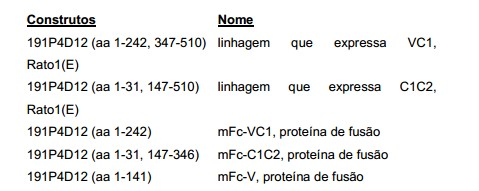
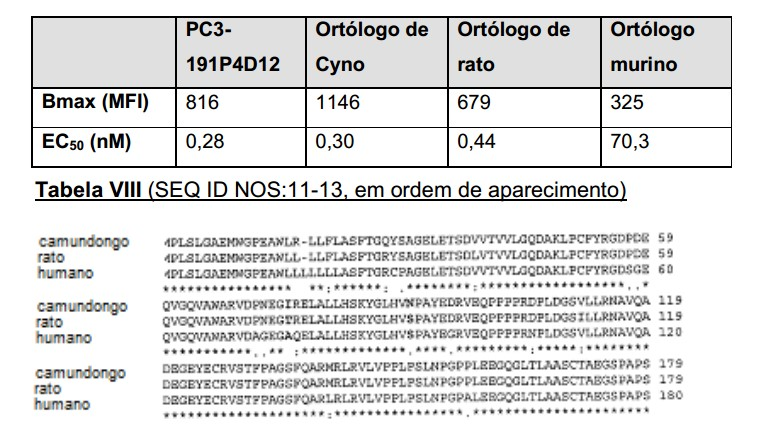

Claims (38)

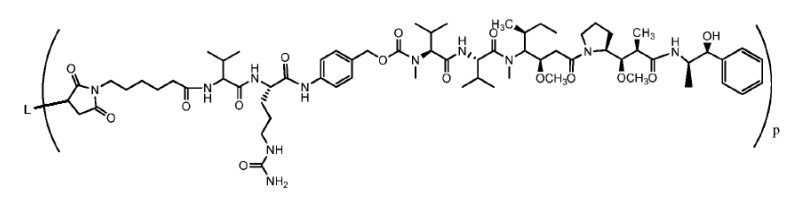
Applications Claiming Priority (3)
| Application Number | Priority Date | Filing Date | Title |
|---|---|---|---|
| US38793310P | 2010-09-29 | 2010-09-29 | |
| US61/387,933 | 2010-09-29 | ||
| PCT/US2011/054054 WO2012047724A1 (en) | 2010-09-29 | 2011-09-29 | Antibody drug conjugates (adc) that bind to 191p4d12 proteins |
Publications (2)
| Publication Number | Publication Date |
|---|---|
| BR112013007309A2 BR112013007309A2 (en) | 2016-07-05 |
| BR112013007309B1 true BR112013007309B1 (en) | 2021-07-06 |
Family
ID=45871300
Family Applications (1)
| Application Number | Title | Priority Date | Filing Date |
|---|---|---|---|
| BR112013007309-8A BR112013007309B1 (en) | 2010-09-29 | 2011-09-29 | antibody-drug conjugate comprising an anti-191p4d12 antibody conjugated to monomethyl auristatin and (mmae), its use, and pharmaceutical composition |
Country Status (30)
| Country | Link |
|---|---|
| US (8) | US8637642B2 (en) |
| EP (3) | EP3903812A1 (en) |
| JP (9) | JP6083871B2 (en) |
| KR (10) | KR102627947B1 (en) |
| CN (2) | CN105567717B (en) |
| AU (1) | AU2011312417B2 (en) |
| BR (1) | BR112013007309B1 (en) |
| CA (1) | CA2811644C (en) |
| CY (3) | CY1121023T1 (en) |
| DK (2) | DK3409287T5 (en) |
| EA (2) | EA027887B1 (en) |
| ES (2) | ES2874306T3 (en) |
| FR (1) | FR22C1050I2 (en) |
| HR (1) | HRP20181154T8 (en) |
| HU (3) | HUE054855T2 (en) |
| IL (6) | IL319612A (en) |
| LT (2) | LT2621526T (en) |
| LU (1) | LUC00280I2 (en) |
| MX (4) | MX347954B (en) |
| NL (1) | NL301198I2 (en) |
| NO (1) | NO2022039I1 (en) |
| PH (2) | PH12017501461B1 (en) |
| PL (2) | PL3409287T3 (en) |
| PT (2) | PT3409287T (en) |
| RS (1) | RS57483B1 (en) |
| SI (2) | SI2621526T1 (en) |
| SM (1) | SMT201800365T1 (en) |
| TW (8) | TWI764324B (en) |
| UA (1) | UA110495C2 (en) |
| WO (1) | WO2012047724A1 (en) |
Families Citing this family (84)
| Publication number | Priority date | Publication date | Assignee | Title |
|---|---|---|---|---|
| EP3903812A1 (en) | 2010-09-29 | 2021-11-03 | Agensys, Inc. | Antibody drug conjugates (adc) that bind to 191p4d12 proteins |
| US20130058947A1 (en) | 2011-09-02 | 2013-03-07 | Stem Centrx, Inc | Novel Modulators and Methods of Use |
| US20130116404A1 (en) | 2011-11-08 | 2013-05-09 | Case Western Reserve University | Targeted non-invasive imaging probes of egfr expressing cells |
| JP6089047B2 (en) | 2012-02-24 | 2017-03-01 | アッヴィ・ステムセントルクス・エル・エル・シー | DLL3 modulator and method of use |
| PH12020500604A1 (en) | 2012-02-24 | 2023-06-14 | Abbvie Stemcentrx Llc | Anti sez6 antibodies and methods of use |
| DK2887959T3 (en) * | 2012-08-23 | 2019-02-18 | Agensys Inc | ANTIBODY-PHARMACEUTICAL CONJUGATES (ADC) BINDING TO 158P1D7 PROTEINS |
| US9353150B2 (en) | 2012-12-04 | 2016-05-31 | Massachusetts Institute Of Technology | Substituted pyrazino[1′,2′:1 ,5]pyrrolo[2,3-b]-indole-1,4-diones for cancer treatment |
| HK1218930A1 (en) | 2013-02-08 | 2017-03-17 | Abbvie Stemcentrx Llc | Novel multispecific constructs |
| SMT201900339T1 (en) | 2013-02-22 | 2019-07-11 | Medimmune Ltd | Antidll3-antibody-pbd conjugates and uses thereof |
| JP2016538318A (en) | 2013-08-28 | 2016-12-08 | ステムセントリックス, インコーポレイテッド | New SEZ6 modulator and method of use |
| CA2922544A1 (en) * | 2013-08-28 | 2015-03-05 | Stemcentrx, Inc. | Engineered anti-dll3 conjugates and methods of use |
| EP3892294A1 (en) | 2013-08-28 | 2021-10-13 | AbbVie Stemcentrx LLC | Site-specific antibody conjugation methods and compositions |
| BR112016018891A2 (en) | 2014-02-21 | 2017-10-10 | Abbvie Stemcentrx Llc | anti-dll3 antibodies and drug conjugates for use in melanoma |
| KR20220025946A (en) * | 2014-03-21 | 2022-03-03 | 애브비 인코포레이티드 | Anti-egfr antibodies and antibody drug conjugates |
| CN104212698A (en) * | 2014-10-01 | 2014-12-17 | 南京飞马食品有限公司 | Germinated brown rice vinegar manufacturing method |
| MX382481B (en) | 2015-03-09 | 2025-03-13 | Agensys Inc | ANTIBODY-DRUG CONJUGATES (ADC) THAT BIND TO FLT3 PROTEINS. |
| HUE061408T2 (en) | 2015-06-29 | 2023-06-28 | Daiichi Sankyo Co Ltd | Method for selectively manufacturing antibody-drug conjugate |
| WO2017042210A1 (en) * | 2015-09-09 | 2017-03-16 | INSERM (Institut National de la Santé et de la Recherche Médicale) | Antibodies having specificity to nectin-4 and uses thereof |
| US10918627B2 (en) | 2016-05-11 | 2021-02-16 | Massachusetts Institute Of Technology | Convergent and enantioselective total synthesis of Communesin analogs |
| WO2018047154A1 (en) | 2016-09-07 | 2018-03-15 | Yissum Research Development Company Of The Hebrew University Of Jerusalem Ltd. | Anti-nkp46 antibodies and therapeutic use of same |
| MA50134A (en) | 2016-12-16 | 2020-07-29 | Bluefin Biomedicine Inc | ANTI-PROTEIN 1 ANTIBODY CONTAINING AN ANTI-CUB DOMAIN (CDCP1), ANTIBODY-DRUG CONJUGATES AND THEIR METHODS OF USE |
| EP3589654A1 (en) | 2017-03-02 | 2020-01-08 | INSERM (Institut National de la Santé et de la Recherche Médicale) | Antibodies having specificity to nectin-4 and uses thereof |
| US11932650B2 (en) | 2017-05-11 | 2024-03-19 | Massachusetts Institute Of Technology | Potent agelastatin derivatives as modulators for cancer invasion and metastasis |
| MX2019014318A (en) * | 2017-06-05 | 2020-08-13 | Agensys Inc | Nectin-4 binding proteins and methods of use thereof. |
| MX420258B (en) * | 2017-09-07 | 2025-02-10 | Dragonfly Therapeutics Inc | Proteins binding nkg2d, cd16 and a tumor-associated antigen |
| CA3075218A1 (en) | 2017-09-19 | 2019-03-28 | Paul Scherrer Institut | Transglutaminase conjugation method and linker |
| US10640508B2 (en) | 2017-10-13 | 2020-05-05 | Massachusetts Institute Of Technology | Diazene directed modular synthesis of compounds with quaternary carbon centers |
| WO2019183633A1 (en) | 2018-03-23 | 2019-09-26 | Case Western Reserve Univeristy | Psma targeted conjugate compounds and uses thereof |
| MX2020009842A (en) | 2018-03-23 | 2020-10-15 | Seattle Genetics Inc | Use of antibody drug conjugates comprising tubulin disrupting agents to treat solid tumor. |
| TWI851577B (en) | 2018-06-07 | 2024-08-11 | 美商思進公司 | Camptothecin conjugates |
| US11180531B2 (en) * | 2018-06-22 | 2021-11-23 | Bicycletx Limited | Bicyclic peptide ligands specific for Nectin-4 |
| JP7514834B2 (en) * | 2018-12-03 | 2024-07-11 | アジェンシス,インコーポレイテッド | Pharmaceutical compositions comprising anti-191P4D12 antibody drug conjugates and methods of use thereof |
| US11535634B2 (en) | 2019-06-05 | 2022-12-27 | Massachusetts Institute Of Technology | Compounds, conjugates, and compositions of epipolythiodiketopiperazines and polythiodiketopiperazines and uses thereof |
| KR20220054321A (en) * | 2019-08-13 | 2022-05-02 | 어젠시스 인코포레이티드 | Treatment of Cancer Using Antibody Drug Conjugates (ADCs) That Bind to 191P4D12 Protein |
| CA3162282A1 (en) * | 2019-11-25 | 2021-06-03 | Agensys, Inc. | Treatment of cancers with antibody drug conjugates (adc) that bind to 191p4d12 proteins |
| WO2021151984A1 (en) | 2020-01-31 | 2021-08-05 | Innate Pharma | Treatment of cancer |
| WO2021168274A1 (en) | 2020-02-21 | 2021-08-26 | Silverback Therapeutics, Inc. | Nectin-4 antibody conjugates and uses thereof |
| CN115103691B (en) * | 2020-03-25 | 2025-01-24 | 苏州盛迪亚生物医药有限公司 | A pharmaceutical composition containing an antibody-drug conjugate and its use |
| BR112022020332A2 (en) | 2020-04-10 | 2022-12-13 | Seagen Inc | ANTIBODY-DRUG CONJUGATE COMPOUND, COMPOSITION, METHOD OF TREATMENT OF CANCER AND AN AUTOIMMUNE DISORDER |
| EP4168453A4 (en) * | 2020-06-18 | 2024-11-20 | BioAtla, Inc. | CONDITIONALLY ACTIVE ANTI-NECTIN-4 ANTIBODIES |
| MX2022016232A (en) * | 2020-06-19 | 2023-03-14 | Agensys Inc | Markers for use in methods for treating cancers with antibody drug conjugates (adc). |
| CA3193584A1 (en) | 2020-09-04 | 2022-03-10 | Novarock Biotherapeutics, Ltd. | Nectin-4 antibodies and uses thereof |
| AU2021345721A1 (en) | 2020-09-16 | 2023-04-20 | Sichuan Kelun-Biotech Biopharmaceutical Co., Ltd. | Anti-nectin-4 antibody, conjugate including same, and application thereof |
| MX2023003059A (en) * | 2020-09-17 | 2023-06-02 | Agensys Inc | Methods for treating cancers with antibody drug conjugates (adc) that bind to 191p4d12 proteins. |
| WO2022076767A1 (en) * | 2020-10-11 | 2022-04-14 | Agensys, Inc. | Methods for treating cancers with antibody drug conjugates (adc) that bind to 191p4d12 proteins |
| EP4232095A1 (en) | 2020-10-25 | 2023-08-30 | Araris Biotech AG | Means and methods for producing antibody-linker conjugates |
| CA3200974A1 (en) | 2020-11-08 | 2022-05-12 | Seagen Inc. | Combination therapy |
| KR102408221B1 (en) * | 2020-11-10 | 2022-06-13 | 삼성메카닉스 (주) | Grid Coupling Molding Device |
| CA3196198A1 (en) | 2020-11-25 | 2022-06-02 | Manel KRAIEM | Treatment of cancer |
| WO2022182415A1 (en) | 2021-02-24 | 2022-09-01 | Massachusetts Institute Of Technology | Himastatin derivatives, and processes of preparation thereof, and uses thereof |
| AU2022238571A1 (en) | 2021-03-18 | 2023-09-14 | Seagen Inc. | Selective drug release from internalized conjugates of biologically active compounds |
| EP4086284A1 (en) | 2021-05-07 | 2022-11-09 | Emergence Therapeutics AG | Anti-nectin-4 antibody exatecan conjugates |
| JP7579991B2 (en) | 2021-03-31 | 2024-11-08 | エマージェンス セラピューティクス ゲーエムベーハー | Anti-nectin-4 antibody exatecan conjugate |
| AU2022253902A1 (en) | 2021-04-10 | 2023-11-02 | Genmab A/S | Folr1 binding agents, conjugates thereof and methods of using the same |
| JP7742892B2 (en) | 2021-04-23 | 2025-09-22 | ジェンマブ エー/エス | Anti-CD70 antibodies, conjugates thereof and methods of using same |
| JP2024515342A (en) | 2021-04-26 | 2024-04-09 | 江▲蘇▼恒瑞医▲薬▼股▲フン▼有限公司 | Anti-Nectin-4 antibody and anti-Nectin-4 antibody-drug conjugate and medical uses thereof |
| IL308795A (en) | 2021-05-28 | 2024-01-01 | Seagen Inc | Anthracycline antibody conjugates |
| WO2023019236A1 (en) * | 2021-08-13 | 2023-02-16 | Agensys, Inc. | Methods for treating non-muscle invasive bladder cancer (nmibc) with antibody drug conjugates (adc) that bind to 191p4d12 proteins |
| AU2022388735A1 (en) | 2021-11-09 | 2024-05-30 | Case Western Reserve University | Psma targeted conjugate compounds and uses thereof |
| EP4433096A1 (en) | 2021-11-19 | 2024-09-25 | Ardeagen Corporation | Gpc3 binding agents, conjugates thereof and methods of using the same |
| CN119278055A (en) | 2022-03-17 | 2025-01-07 | 思进公司 | Camptothecin conjugate |
| EP4496593A1 (en) | 2022-03-23 | 2025-01-29 | Synaffix B.V. | Antibody-conjugates for targeting of tumours expressing nectin-4 |
| JP7690922B2 (en) * | 2022-05-02 | 2025-06-11 | 株式会社三洋物産 | Gaming Machines |
| JP7740118B2 (en) * | 2022-05-02 | 2025-09-17 | 株式会社三洋物産 | gaming machines |
| WO2023221971A1 (en) | 2022-05-16 | 2023-11-23 | 江苏恒瑞医药股份有限公司 | Pharmaceutical composition containing anti-nectin-4 antibody drug conjugate and use thereof |
| EP4532020A1 (en) | 2022-05-25 | 2025-04-09 | Innate Pharma | Nectin-4 binding agents |
| WO2023235754A1 (en) | 2022-06-01 | 2023-12-07 | ALX Oncology Inc. | Combination therapies for treating urothelial carcinoma |
| EP4285935A1 (en) | 2022-06-03 | 2023-12-06 | Emergence Therapeutics AG | Novel anti-nectin-4 antibody camptothecin derivative conjugates |
| EP4309676A1 (en) | 2022-07-22 | 2024-01-24 | Emergence Therapeutics AG | Novel anti-nectin-4 antibody camptothecin derivative conjugates |
| EP4324849A1 (en) | 2022-08-18 | 2024-02-21 | Emergence Therapeutics AG | Humanized anti-nectin-4 antibodies |
| WO2024052503A1 (en) | 2022-09-08 | 2024-03-14 | Institut National de la Santé et de la Recherche Médicale | Antibodies having specificity to ltbp2 and uses thereof |
| EP4344707A1 (en) | 2022-09-29 | 2024-04-03 | Emergence Therapeutics AG | New anti-nectin-4 antibody drug conjugates |
| WO2024067841A1 (en) | 2022-09-30 | 2024-04-04 | 上海迪诺医药科技有限公司 | Benzazepine derivative, conjugate containing same, and use thereof |
| WO2024129756A1 (en) | 2022-12-13 | 2024-06-20 | Seagen Inc. | Site-specific engineered cysteine antibody drug conjugates |
| EP4461317A1 (en) | 2023-05-12 | 2024-11-13 | Emergence Therapeutics GmbH | Antibody-drug conjugates comprising an anti-nectin-4 antibody and belotecan or a derivative thereof |
| WO2024258743A1 (en) | 2023-06-13 | 2024-12-19 | Adcentrx Therapeutics, Inc. | Methods and compositions related to antibodies and antibody drug conjugates (adcs) that bind nectin-4 proteins |
| EP4534102A1 (en) | 2023-10-02 | 2025-04-09 | Eli Lilly and Company | Antibody drug conjugate (adc) targeting nectin 4 and comprising an exatecan payload |
| EP4534101A1 (en) | 2023-10-02 | 2025-04-09 | Eli Lilly and Company | Antibody drug conjugate (adc) targeting nectin 4 and comprising an exatecan payload |
| WO2025149947A1 (en) | 2024-01-12 | 2025-07-17 | Seagen Inc. | Antibody-drug conjugates |
| WO2025149667A1 (en) | 2024-01-12 | 2025-07-17 | Pheon Therapeutics Ltd | Antibody drug conjugates and uses thereof |
| WO2025162492A1 (en) * | 2024-01-29 | 2025-08-07 | 甘李药业股份有限公司 | Linker, ligand-drug conjugate and medical use thereof |
| WO2025195487A1 (en) * | 2024-03-21 | 2025-09-25 | 石药集团巨石生物制药有限公司 | Use of antibody-drug conjugate targeting nectin-4 |
| WO2025224297A1 (en) | 2024-04-26 | 2025-10-30 | Institut National de la Santé et de la Recherche Médicale | Antibodies having specificity to tgfbi and uses thereof |
| WO2025264533A1 (en) | 2024-06-17 | 2025-12-26 | Adcentrx Therapeutics Inc. | Methods and compositions related to antibody drug conjugates (adcs) that bind steap-1 proteins |
Family Cites Families (150)
| Publication number | Priority date | Publication date | Assignee | Title |
|---|---|---|---|---|
| NL154598B (en) | 1970-11-10 | 1977-09-15 | Organon Nv | PROCEDURE FOR DETERMINING AND DETERMINING LOW MOLECULAR COMPOUNDS AND PROTEINS THAT CAN SPECIFICALLY BIND THESE COMPOUNDS AND TEST PACKAGING. |
| US3817837A (en) | 1971-05-14 | 1974-06-18 | Syva Corp | Enzyme amplification assay |
| US3939350A (en) | 1974-04-29 | 1976-02-17 | Board Of Trustees Of The Leland Stanford Junior University | Fluorescent immunoassay employing total reflection for activation |
| US3996345A (en) | 1974-08-12 | 1976-12-07 | Syva Company | Fluorescence quenching with immunological pairs in immunoassays |
| US4307016A (en) | 1978-03-24 | 1981-12-22 | Takeda Chemical Industries, Ltd. | Demethyl maytansinoids |
| US4277437A (en) | 1978-04-05 | 1981-07-07 | Syva Company | Kit for carrying out chemically induced fluorescence immunoassay |
| US4275149A (en) | 1978-11-24 | 1981-06-23 | Syva Company | Macromolecular environment control in specific receptor assays |
| US4256746A (en) | 1978-11-14 | 1981-03-17 | Takeda Chemical Industries | Dechloromaytansinoids, their pharmaceutical compositions and method of use |
| JPS55102583A (en) | 1979-01-31 | 1980-08-05 | Takeda Chem Ind Ltd | 20-acyloxy-20-demethylmaytansinoid compound |
| JPS55162791A (en) | 1979-06-05 | 1980-12-18 | Takeda Chem Ind Ltd | Antibiotic c-15003pnd and its preparation |
| JPS5645483A (en) | 1979-09-19 | 1981-04-25 | Takeda Chem Ind Ltd | C-15003phm and its preparation |
| EP0028683A1 (en) | 1979-09-21 | 1981-05-20 | Takeda Chemical Industries, Ltd. | Antibiotic C-15003 PHO and production thereof |
| JPS5645485A (en) | 1979-09-21 | 1981-04-25 | Takeda Chem Ind Ltd | Production of c-15003pnd |
| US4366241A (en) | 1980-08-07 | 1982-12-28 | Syva Company | Concentrating zone method in heterogeneous immunoassays |
| WO1982001188A1 (en) | 1980-10-08 | 1982-04-15 | Takeda Chemical Industries Ltd | 4,5-deoxymaytansinoide compounds and process for preparing same |
| US4450254A (en) | 1980-11-03 | 1984-05-22 | Standard Oil Company | Impact improvement of high nitrile resins |
| US4313946A (en) | 1981-01-27 | 1982-02-02 | The United States Of America As Represented By The Secretary Of Agriculture | Chemotherapeutically active maytansinoids from Trewia nudiflora |
| US4315929A (en) | 1981-01-27 | 1982-02-16 | The United States Of America As Represented By The Secretary Of Agriculture | Method of controlling the European corn borer with trewiasine |
| JPS57192389A (en) | 1981-05-20 | 1982-11-26 | Takeda Chem Ind Ltd | Novel maytansinoid |
| US4486414A (en) | 1983-03-21 | 1984-12-04 | Arizona Board Of Reagents | Dolastatins A and B cell growth inhibitory substances |
| US4816567A (en) | 1983-04-08 | 1989-03-28 | Genentech, Inc. | Recombinant immunoglobin preparations |
| US4970198A (en) | 1985-10-17 | 1990-11-13 | American Cyanamid Company | Antitumor antibiotics (LL-E33288 complex) |
| US4676980A (en) | 1985-09-23 | 1987-06-30 | The United States Of America As Represented By The Secretary Of The Department Of Health And Human Services | Target specific cross-linked heteroantibodies |
| US4880935A (en) | 1986-07-11 | 1989-11-14 | Icrf (Patents) Limited | Heterobifunctional linking agents derived from N-succinimido-dithio-alpha methyl-methylene-benzoates |
| US5079233A (en) | 1987-01-30 | 1992-01-07 | American Cyanamid Company | N-acyl derivatives of the LL-E33288 antitumor antibiotics, composition and methods for using the same |
| WO1988007089A1 (en) | 1987-03-18 | 1988-09-22 | Medical Research Council | Altered antibodies |
| US4816444A (en) | 1987-07-10 | 1989-03-28 | Arizona Board Of Regents, Arizona State University | Cell growth inhibitory substance |
| US4975278A (en) | 1988-02-26 | 1990-12-04 | Bristol-Myers Company | Antibody-enzyme conjugates in combination with prodrugs for the delivery of cytotoxic agents to tumor cells |
| US5677425A (en) | 1987-09-04 | 1997-10-14 | Celltech Therapeutics Limited | Recombinant antibody |
| US5606040A (en) | 1987-10-30 | 1997-02-25 | American Cyanamid Company | Antitumor and antibacterial substituted disulfide derivatives prepared from compounds possessing a methyl-trithio group |
| US5770701A (en) | 1987-10-30 | 1998-06-23 | American Cyanamid Company | Process for preparing targeted forms of methyltrithio antitumor agents |
| US5053394A (en) | 1988-09-21 | 1991-10-01 | American Cyanamid Company | Targeted forms of methyltrithio antitumor agents |
| IL106992A (en) | 1988-02-11 | 1994-06-24 | Bristol Myers Squibb Co | Acylhydrazone derivatives of anthracycline and methods for their preparation |
| US5476996A (en) | 1988-06-14 | 1995-12-19 | Lidak Pharmaceuticals | Human immune system in non-human animal |
| US5223409A (en) | 1988-09-02 | 1993-06-29 | Protein Engineering Corp. | Directed evolution of novel binding proteins |
| US5076973A (en) | 1988-10-24 | 1991-12-31 | Arizona Board Of Regents | Synthesis of dolastatin 3 |
| US5530101A (en) | 1988-12-28 | 1996-06-25 | Protein Design Labs, Inc. | Humanized immunoglobulins |
| US4978744A (en) | 1989-01-27 | 1990-12-18 | Arizona Board Of Regents | Synthesis of dolastatin 10 |
| US4879278A (en) | 1989-05-16 | 1989-11-07 | Arizona Board Of Regents | Isolation and structural elucidation of the cytostatic linear depsipeptide dolastatin 15 |
| US4986988A (en) | 1989-05-18 | 1991-01-22 | Arizona Board Of Regents | Isolation and structural elucidation of the cytostatic linear depsipeptides dolastatin 13 and dehydrodolastatin 13 |
| DE3920358A1 (en) | 1989-06-22 | 1991-01-17 | Behringwerke Ag | BISPECIFIC AND OLIGO-SPECIFIC, MONO- AND OLIGOVALENT ANTI-BODY CONSTRUCTS, THEIR PRODUCTION AND USE |
| CA2026147C (en) | 1989-10-25 | 2006-02-07 | Ravi J. Chari | Cytotoxic agents comprising maytansinoids and their therapeutic use |
| US5208020A (en) | 1989-10-25 | 1993-05-04 | Immunogen Inc. | Cytotoxic agents comprising maytansinoids and their therapeutic use |
| US5138036A (en) | 1989-11-13 | 1992-08-11 | Arizona Board Of Regents Acting On Behalf Of Arizona State University | Isolation and structural elucidation of the cytostatic cyclodepsipeptide dolastatin 14 |
| US6657103B1 (en) | 1990-01-12 | 2003-12-02 | Abgenix, Inc. | Human antibodies derived from immunized xenomice |
| US5427908A (en) | 1990-05-01 | 1995-06-27 | Affymax Technologies N.V. | Recombinant library screening methods |
| US6172197B1 (en) | 1991-07-10 | 2001-01-09 | Medical Research Council | Methods for producing members of specific binding pairs |
| GB9015198D0 (en) | 1990-07-10 | 1990-08-29 | Brien Caroline J O | Binding substance |
| US5633425A (en) | 1990-08-29 | 1997-05-27 | Genpharm International, Inc. | Transgenic non-human animals capable of producing heterologous antibodies |
| US5545806A (en) | 1990-08-29 | 1996-08-13 | Genpharm International, Inc. | Ransgenic non-human animals for producing heterologous antibodies |
| US5625126A (en) | 1990-08-29 | 1997-04-29 | Genpharm International, Inc. | Transgenic non-human animals for producing heterologous antibodies |
| US5661016A (en) | 1990-08-29 | 1997-08-26 | Genpharm International Inc. | Transgenic non-human animals capable of producing heterologous antibodies of various isotypes |
| JP2938569B2 (en) | 1990-08-29 | 1999-08-23 | ジェンファーム インターナショナル,インコーポレイティド | Method for producing xenogeneic immunoglobulin and transgenic mouse |
| WO1993011161A1 (en) | 1991-11-25 | 1993-06-10 | Enzon, Inc. | Multivalent antigen-binding proteins |
| DE69233782D1 (en) | 1991-12-02 | 2010-05-20 | Medical Res Council | Preparation of Autoantibodies on Phage Surfaces Starting from Antibody Segment Libraries |
| US5622929A (en) | 1992-01-23 | 1997-04-22 | Bristol-Myers Squibb Company | Thioether conjugates |
| ZA932522B (en) | 1992-04-10 | 1993-12-20 | Res Dev Foundation | Immunotoxins directed against c-erbB-2(HER/neu) related surface antigens |
| AU4116793A (en) | 1992-04-24 | 1993-11-29 | Board Of Regents, The University Of Texas System | Recombinant production of immunoglobulin-like domains in prokaryotic cells |
| ATE139900T1 (en) | 1992-11-13 | 1996-07-15 | Idec Pharma Corp | THERAPEUTIC USE OF CHIMERIC AND LABELED ANTIBODIES AGAINST HUMAN B LYMPHOCYTE RESTRICTED DIFFERENTIATION ANTIGEN FOR THE TREATMENT OF B CELL LYMPHOMA |
| US6034065A (en) | 1992-12-03 | 2000-03-07 | Arizona Board Of Regents | Elucidation and synthesis of antineoplastic tetrapeptide phenethylamides of dolastatin 10 |
| US5635483A (en) | 1992-12-03 | 1997-06-03 | Arizona Board Of Regents Acting On Behalf Of Arizona State University | Tumor inhibiting tetrapeptide bearing modified phenethyl amides |
| US5410024A (en) | 1993-01-21 | 1995-04-25 | Arizona Board Of Regents Acting On Behalf Of Arizona State University | Human cancer inhibitory pentapeptide amides |
| US5780588A (en) | 1993-01-26 | 1998-07-14 | Arizona Board Of Regents | Elucidation and synthesis of selected pentapeptides |
| US6214345B1 (en) | 1993-05-14 | 2001-04-10 | Bristol-Myers Squibb Co. | Lysosomal enzyme-cleavable antitumor drug conjugates |
| US5773001A (en) | 1994-06-03 | 1998-06-30 | American Cyanamid Company | Conjugates of methyltrithio antitumor agents and intermediates for their synthesis |
| US7625697B2 (en) | 1994-06-17 | 2009-12-01 | The Board Of Trustees Of The Leland Stanford Junior University | Methods for constructing subarrays and subarrays made thereby |
| US5521284A (en) | 1994-08-01 | 1996-05-28 | Arizona Board Of Regents Acting On Behalf Of Arizona State University | Human cancer inhibitory pentapeptide amides and esters |
| US5504191A (en) | 1994-08-01 | 1996-04-02 | Arizona Board Of Regents Acting On Behalf Of Arizona State University | Human cancer inhibitory pentapeptide methyl esters |
| US5530097A (en) | 1994-08-01 | 1996-06-25 | Arizona Board Of Regents Acting On Behalf Of Arizona State University | Human cancer inhibitory peptide amides |
| US5554725A (en) | 1994-09-14 | 1996-09-10 | Arizona Board Of Regents Acting On Behalf Of Arizona State University | Synthesis of dolastatin 15 |
| US5599902A (en) | 1994-11-10 | 1997-02-04 | Arizona Board Of Regents Acting On Behalf Of Arizona State University | Cancer inhibitory peptides |
| US5663149A (en) | 1994-12-13 | 1997-09-02 | Arizona Board Of Regents Acting On Behalf Of Arizona State University | Human cancer inhibitory pentapeptide heterocyclic and halophenyl amides |
| US5869046A (en) | 1995-04-14 | 1999-02-09 | Genentech, Inc. | Altered polypeptides with increased half-life |
| US6121022A (en) | 1995-04-14 | 2000-09-19 | Genentech, Inc. | Altered polypeptides with increased half-life |
| US5714586A (en) | 1995-06-07 | 1998-02-03 | American Cyanamid Company | Methods for the preparation of monomeric calicheamicin derivative/carrier conjugates |
| US5712374A (en) | 1995-06-07 | 1998-01-27 | American Cyanamid Company | Method for the preparation of substantiallly monomeric calicheamicin derivative/carrier conjugates |
| WO1997023243A1 (en) | 1995-12-22 | 1997-07-03 | Bristol-Myers Squibb Company | Branched hydrazone linkers |
| US6130237A (en) | 1996-09-12 | 2000-10-10 | Cancer Research Campaign Technology Limited | Condensed N-aclyindoles as antitumor agents |
| EP0953039B1 (en) | 1996-10-15 | 2007-08-29 | The Regents Of The University Of California | Animal models of human prostate cancer progression |
| JP2001509679A (en) | 1997-01-21 | 2001-07-24 | ヒューマン・ジェノム・サイエンシズ・インコーポレイテッド | Polynucleotides and polypeptides encoding the receptor |
| US6239104B1 (en) | 1997-02-25 | 2001-05-29 | Arizona Board Of Regents | Isolation and structural elucidation of the cytostatic linear and cyclo-depsipeptides dolastatin 16, dolastatin 17, and dolastatin 18 |
| US6277375B1 (en) | 1997-03-03 | 2001-08-21 | Board Of Regents, The University Of Texas System | Immunoglobulin-like domains with increased half-lives |
| ATE319745T1 (en) | 1997-05-21 | 2006-03-15 | Biovation Ltd | METHOD FOR PRODUCING NON-IMMUNOGENIC PROTEINS |
| US20030065156A1 (en) | 1997-12-23 | 2003-04-03 | Williams Lewis T. | Novel human genes and gene expression products I |
| US6194551B1 (en) | 1998-04-02 | 2001-02-27 | Genentech, Inc. | Polypeptide variants |
| ES2272061T5 (en) | 1998-04-15 | 2012-02-24 | Merck Serono Biodevelopment | GENOMIC SEQUENCE OF THE 5-LIPOXYGENASE ACTIVATING PROTEIN (FLAP), SAME POLYMORPHIC MARKERS AND METHODS FOR ASTHMA DETECTION. |
| GB9809951D0 (en) | 1998-05-08 | 1998-07-08 | Univ Cambridge Tech | Binding molecules |
| US6264949B1 (en) | 1998-09-29 | 2001-07-24 | Mount Sinai School Of Medicine Of New York University | Noninvasive agents for diagnosis and prognosis of the progression of fibrosis |
| US20020137160A1 (en) | 1998-12-17 | 2002-09-26 | Byatt John C | Nucleic acid and other molecules associated with lactation and muscle and fat deposition |
| US7160694B2 (en) | 1999-06-14 | 2007-01-09 | Millennium Pharmaceuticals, Inc. | Nucleic acids encoding TANGO405 and functional fragments and uses thereof |
| EP1194549A2 (en) | 1999-07-02 | 2002-04-10 | Chiron Corporation | Human genes and gene expression products |
| EP1074617A3 (en) | 1999-07-29 | 2004-04-21 | Research Association for Biotechnology | Primers for synthesising full-length cDNA and their use |
| CA2382161A1 (en) | 1999-09-03 | 2001-03-15 | Human Genome Sciences, Inc. | Immunoglobulin superfamily polynucleotides, polypeptides, and antibodies |
| EP1218392A4 (en) | 1999-09-10 | 2003-04-09 | Millennium Pharm Inc | Novel genes encoding proteins having prognostic, diagnostic, preventive, therapeutic, and other uses |
| US6323315B1 (en) | 1999-09-10 | 2001-11-27 | Basf Aktiengesellschaft | Dolastatin peptides |
| AU7721500A (en) | 1999-09-29 | 2001-04-30 | Human Genome Sciences, Inc. | Colon and colon cancer associated polynucleotides and polypeptides |
| AU2001229340A1 (en) | 2000-01-14 | 2001-07-24 | Millennium Pharmaceuticals, Inc. | Genes compositions, kits, and methods for identification, assessment, prevention, and therapy of breast cancer |
| US20030013649A1 (en) | 2000-01-31 | 2003-01-16 | Rosen Craig A. | Nucleic acids, proteins, and antibodies |
| US20020168711A1 (en) | 2000-01-31 | 2002-11-14 | Rosen Craig A. | Nucleic acids, proteins, and antibodies |
| CA2397407A1 (en) | 2000-01-31 | 2001-08-02 | Human Genome Sciences, Inc. | Nucleic acids, proteins, and antibodies |
| AU2001243142A1 (en) | 2000-02-03 | 2001-08-14 | Hyseq, Inc. | Novel nucleic acids and polypeptides |
| AU2001241541A1 (en) | 2000-02-17 | 2001-08-27 | Millennium Predictive Medicine, Inc. | Novel genes, compositions, kits, and methods for identification, assessment, prevention, and therapy of human prostate cancer |
| CN1169954C (en) | 2000-03-09 | 2004-10-06 | 上海市肿瘤研究所 | Polynucleotide encoding a human protein with the function of inhibiting the growth of cancer cells |
| AU4592601A (en) | 2000-03-21 | 2001-10-03 | Millennium Predictive Medicine | Novel genes, compositions, kits, and method for identification, assessment, prevention, and therapy of ovarian cancer |
| US6436703B1 (en) | 2000-03-31 | 2002-08-20 | Hyseq, Inc. | Nucleic acids and polypeptides |
| WO2001090304A2 (en) | 2000-05-19 | 2001-11-29 | Human Genome Sciences, Inc. | Nucleic acids, proteins, and antibodies |
| WO2001094629A2 (en) | 2000-06-05 | 2001-12-13 | Avalon Pharmaceuticals | Cancer gene determination and therapeutic screening using signature gene sets |
| JP2004508019A (en) | 2000-07-28 | 2004-03-18 | コンピュジェン インコーポレイテッド | Oligonucleotide libraries for detecting RNA transcripts and splice variants occupying locations in the transcriptome |
| MXPA03002479A (en) | 2000-10-05 | 2004-05-24 | Immunex Corp | Nectin polypeptides, polynucleotides, methods of making and use thereof. |
| EP1916303B1 (en) | 2000-11-30 | 2013-02-27 | Medarex, Inc. | Nucleic acids encoding rearranged human immunoglobulin sequences from transgenic transchromosomal mice |
| CN1297700C (en) * | 2000-12-20 | 2007-01-31 | 帝人株式会社 | Method for manufacturing polyester mixed fiber yarn |
| US20040029114A1 (en) | 2001-01-24 | 2004-02-12 | Eos Technology, Inc. | Methods of diagnosis of breast cancer, compositions and methods of screening for modulators of breast cancer |
| WO2002059377A2 (en) | 2001-01-24 | 2002-08-01 | Protein Design Labs | Methods of diagnosis of breast cancer, compositions and methods of screening for modulators of breast cancer |
| AU2002251841A1 (en) | 2001-01-30 | 2002-08-12 | Corixa Corporation | Compositions and methods for the therapy and diagnosis of pancreatic cancer |
| US7271240B2 (en) | 2001-03-14 | 2007-09-18 | Agensys, Inc. | 125P5C8: a tissue specific protein highly expressed in various cancers |
| AU2002338431A1 (en) | 2001-04-04 | 2002-11-05 | Quark Biotech, Inc. | Sequence characteristics of bladder cancer |
| JP2005527180A (en) | 2001-04-18 | 2005-09-15 | プロテイン デザイン ラブス, インコーポレイテッド | Lung cancer diagnosis method, composition of lung cancer modifier and screening method |
| US6884869B2 (en) | 2001-04-30 | 2005-04-26 | Seattle Genetics, Inc. | Pentapeptide compounds and uses related thereto |
| US20030083263A1 (en) | 2001-04-30 | 2003-05-01 | Svetlana Doronina | Pentapeptide compounds and uses related thereto |
| US6794501B2 (en) | 2001-05-04 | 2004-09-21 | Ludwig Institute For Cancer Research | Colon cancer antigen panel |
| US6441163B1 (en) | 2001-05-31 | 2002-08-27 | Immunogen, Inc. | Methods for preparation of cytotoxic conjugates of maytansinoids and cell binding agents |
| EP1572872A2 (en) | 2001-06-05 | 2005-09-14 | Exelixis, Inc. | Igs as modifiers of the p53 pathway and methods of use |
| US7189507B2 (en) | 2001-06-18 | 2007-03-13 | Pdl Biopharma, Inc. | Methods of diagnosis of ovarian cancer, compositions and methods of screening for modulators of ovarian cancer |
| CA2451465A1 (en) | 2001-06-18 | 2002-12-27 | Eos Biotechnology Inc. | Methods of diagnosis of ovarian cancer, compositions and methods of screening for modulators of ovarian cancer |
| US7171311B2 (en) | 2001-06-18 | 2007-01-30 | Rosetta Inpharmatics Llc | Methods of assigning treatment to breast cancer patients |
| US20040076955A1 (en) | 2001-07-03 | 2004-04-22 | Eos Biotechnology, Inc. | Methods of diagnosis of bladder cancer, compositions and methods of screening for modulators of bladder cancer |
| US20030099974A1 (en) | 2001-07-18 | 2003-05-29 | Millennium Pharmaceuticals, Inc. | Novel genes, compositions, kits and methods for identification, assessment, prevention, and therapy of breast cancer |
| KR101005130B1 (en) | 2001-07-19 | 2011-01-04 | 니목스 코포레이션 | Peptides effective for the treatment of other diseases that require the removal or destruction of tumors and cells |
| EP2143438B1 (en) | 2001-09-18 | 2011-07-13 | Genentech, Inc. | Compositions and methods for the diagnosis and treatment of tumors |
| JP4200100B2 (en) * | 2001-11-07 | 2008-12-24 | アジェンシス,インコーポレイテッド | Nucleic acids and corresponding proteins referred to as 161P2F10B useful in cancer treatment and detection |
| WO2003042661A2 (en) | 2001-11-13 | 2003-05-22 | Protein Design Labs, Inc. | Methods of diagnosis of cancer, compositions and methods of screening for modulators of cancer |
| US20030232350A1 (en) | 2001-11-13 | 2003-12-18 | Eos Biotechnology, Inc. | Methods of diagnosis of cancer, compositions and methods of screening for modulators of cancer |
| AU2003245488A1 (en) | 2002-06-13 | 2003-12-31 | Regulome Corporation | Functional sites |
| EP2353611B1 (en) | 2002-07-31 | 2015-05-13 | Seattle Genetics, Inc. | Drug conjugates and their use for treating cancer, an autoimmune disease or an infectious disease |
| US20040081653A1 (en) * | 2002-08-16 | 2004-04-29 | Raitano Arthur B. | Nucleic acids and corresponding proteins entitled 251P5G2 useful in treatment and detection of cancer |
| AU2008202217B2 (en) * | 2002-08-16 | 2012-07-26 | Agensys, Inc. | Nucleic acids and corresponding proteins entitled 191PAD12(b) useful in treatment and detection of cancer |
| EP1391213A1 (en) | 2002-08-21 | 2004-02-25 | Boehringer Ingelheim International GmbH | Compositions and methods for treating cancer using maytansinoid CD44 antibody immunoconjugates and chemotherapeutic agents |
| CA2496923A1 (en) | 2002-08-29 | 2004-03-11 | University Of Massachusetts | Utilization of emulsion interface engineering to produce oxidatively stable lipid delivery systems |
| AR045563A1 (en) * | 2003-09-10 | 2005-11-02 | Warner Lambert Co | ANTIBODIES DIRECTED TO M-CSF |
| PT2489364E (en) | 2003-11-06 | 2015-04-16 | Seattle Genetics Inc | Monomethylvaline compounds conjugated to antibodies |
| WO2005092380A2 (en) | 2004-03-26 | 2005-10-06 | Pfizer Products Inc | Uses of anti-ctla-4 antibodies |
| WO2005111076A1 (en) | 2004-05-12 | 2005-11-24 | Institut National De La Sante Et De La Recherche Medicale (Inserm) | Nectin 4 (n4) as a marker for cancer prognosis |
| US7691962B2 (en) | 2004-05-19 | 2010-04-06 | Medarex, Inc. | Chemical linkers and conjugates thereof |
| NZ553500A (en) | 2004-09-23 | 2009-11-27 | Genentech Inc Genentech Inc | Cysteine engineered antibodies and conjugates withCysteine engineered antibodies and conjugates with a free cysteine amino acid in the heavy chain a free cysteine amino acid in the heavy chain |
| CN101500590A (en) * | 2005-03-31 | 2009-08-05 | 阿根西斯公司 | Antibodies and related molecules that bind to 161P2F10B protein |
| WO2006105488A2 (en) | 2005-03-31 | 2006-10-05 | Agensys, Inc. | Antibodies and related molecules that bind to 161p2f10b proteins |
| EP2078732B1 (en) * | 2006-07-10 | 2015-09-16 | Fujita Health University | Method of identifying a candidate diagnostic or therapeutic antibody using flow cytometry |
| LT2845866T (en) | 2006-10-27 | 2017-07-10 | Genentech, Inc. | Antibodies and immunoconjugates and uses therefor |
| JP5394246B2 (en) | 2007-03-30 | 2014-01-22 | ジェネンテック, インコーポレイテッド | Antibodies and immunoconjugates and methods for their use |
| EP3903812A1 (en) * | 2010-09-29 | 2021-11-03 | Agensys, Inc. | Antibody drug conjugates (adc) that bind to 191p4d12 proteins |
-
2011
- 2011-09-29 EP EP21166650.8A patent/EP3903812A1/en active Pending
- 2011-09-29 LT LTEP11831345.1T patent/LT2621526T/en unknown
- 2011-09-29 SM SM20180365T patent/SMT201800365T1/en unknown
- 2011-09-29 WO PCT/US2011/054054 patent/WO2012047724A1/en not_active Ceased
- 2011-09-29 TW TW109135992A patent/TWI764324B/en active
- 2011-09-29 TW TW107103146A patent/TWI674112B/en active
- 2011-09-29 CN CN201510519846.0A patent/CN105567717B/en active Active
- 2011-09-29 KR KR1020237028203A patent/KR102627947B1/en active Active
- 2011-09-29 KR KR1020227001399A patent/KR102504750B1/en active Active
- 2011-09-29 PH PH1/2017/501461A patent/PH12017501461B1/en unknown
- 2011-09-29 UA UAA201305358A patent/UA110495C2/en unknown
- 2011-09-29 MX MX2016003743A patent/MX347954B/en unknown
- 2011-09-29 KR KR1020137011094A patent/KR20130130709A/en not_active Abandoned
- 2011-09-29 TW TW104140581A patent/TWI651096B/en active
- 2011-09-29 PT PT181718032T patent/PT3409287T/en unknown
- 2011-09-29 IL IL319612A patent/IL319612A/en unknown
- 2011-09-29 EA EA201300411A patent/EA027887B1/en unknown
- 2011-09-29 IL IL311145A patent/IL311145B2/en unknown
- 2011-09-29 PT PT118313451T patent/PT2621526T/en unknown
- 2011-09-29 KR KR1020247001866A patent/KR102801509B1/en active Active
- 2011-09-29 KR KR1020257013489A patent/KR20250058780A/en active Pending
- 2011-09-29 SI SI201131535T patent/SI2621526T1/en unknown
- 2011-09-29 SI SI201131986T patent/SI3409287T1/en unknown
- 2011-09-29 EP EP11831345.1A patent/EP2621526B1/en active Active
- 2011-09-29 KR KR1020237006492A patent/KR102595129B1/en active Active
- 2011-09-29 KR KR1020197004139A patent/KR102166408B1/en active Active
- 2011-09-29 PL PL18171803T patent/PL3409287T3/en unknown
- 2011-09-29 TW TW114101352A patent/TW202543678A/en unknown
- 2011-09-29 CN CN201180056969.5A patent/CN103402538B/en active Active
- 2011-09-29 DK DK18171803.2T patent/DK3409287T5/en active
- 2011-09-29 ES ES18171803T patent/ES2874306T3/en active Active
- 2011-09-29 TW TW107143990A patent/TWI720377B/en active
- 2011-09-29 TW TW111117461A patent/TWI814373B/en active
- 2011-09-29 IL IL290591A patent/IL290591B2/en unknown
- 2011-09-29 KR KR1020177031187A patent/KR101851746B1/en active Active
- 2011-09-29 EP EP18171803.2A patent/EP3409287B9/en active Active
- 2011-09-29 TW TW112112533A patent/TWI882308B/en active
- 2011-09-29 US US13/249,111 patent/US8637642B2/en not_active Ceased
- 2011-09-29 KR KR1020207028941A patent/KR102295534B1/en active Active
- 2011-09-29 ES ES11831345.1T patent/ES2680624T3/en active Active
- 2011-09-29 HR HRP20181154TT patent/HRP20181154T8/en unknown
- 2011-09-29 DK DK11831345.1T patent/DK2621526T3/en active
- 2011-09-29 EA EA201790850A patent/EA201790850A1/en unknown
- 2011-09-29 BR BR112013007309-8A patent/BR112013007309B1/en active IP Right Grant
- 2011-09-29 PL PL11831345T patent/PL2621526T3/en unknown
- 2011-09-29 JP JP2013531875A patent/JP6083871B2/en active Active
- 2011-09-29 TW TW100135340A patent/TWI524901B/en active
- 2011-09-29 MX MX2013003419A patent/MX337873B/en active IP Right Grant
- 2011-09-29 MX MX2017006479A patent/MX369679B/en unknown
- 2011-09-29 AU AU2011312417A patent/AU2011312417B2/en active Active
- 2011-09-29 KR KR1020217026806A patent/KR102353283B1/en active Active
- 2011-09-29 RS RS20180854A patent/RS57483B1/en unknown
- 2011-09-29 HU HUE18171803A patent/HUE054855T2/en unknown
- 2011-09-29 CA CA2811644A patent/CA2811644C/en active Active
- 2011-09-29 HU HUE11831345A patent/HUE038908T2/en unknown
- 2011-09-29 PH PH1/2013/500542A patent/PH12013500542A1/en unknown
-
2013
- 2013-03-14 US US13/830,899 patent/US9078931B2/en active Active
- 2013-03-22 MX MX2019013655A patent/MX2019013655A/en unknown
- 2013-03-24 IL IL225460A patent/IL225460B/en active IP Right Grant
-
2015
- 2015-07-13 US US14/798,302 patent/US9314538B2/en active Active
-
2016
- 2016-03-14 US US15/069,853 patent/US9962454B2/en active Active
- 2016-12-15 JP JP2016243252A patent/JP2017110002A/en not_active Withdrawn
-
2017
- 2017-09-06 US US15/697,146 patent/USRE48389E1/en active Active
-
2018
- 2018-04-02 US US15/943,527 patent/US10894090B2/en active Active
- 2018-07-31 CY CY181100790T patent/CY1121023T1/en unknown
- 2018-10-02 IL IL262073A patent/IL262073B/en active IP Right Grant
- 2018-11-02 JP JP2018207044A patent/JP2019055958A/en active Pending
- 2018-11-02 JP JP2018207426A patent/JP6726258B2/en active Active
- 2018-11-02 JP JP2018207295A patent/JP2019031563A/en active Pending
-
2020
- 2020-06-26 JP JP2020110083A patent/JP7042872B2/en active Active
- 2020-11-13 IL IL278696A patent/IL278696B/en unknown
- 2020-12-15 US US17/122,786 patent/US11559582B2/en active Active
-
2021
- 2021-05-18 CY CY20211100429T patent/CY1124166T1/en unknown
-
2022
- 2022-03-15 JP JP2022039841A patent/JP7370405B2/en active Active
- 2022-09-28 NL NL301198C patent/NL301198I2/en unknown
- 2022-09-29 NO NO2022039C patent/NO2022039I1/en unknown
- 2022-10-04 HU HUS2200043C patent/HUS2200043I1/en unknown
- 2022-10-05 FR FR22C1050C patent/FR22C1050I2/en active Active
- 2022-10-05 CY CY2022029C patent/CY2022029I2/en unknown
- 2022-10-05 LT LTPA2022012C patent/LTC2621526I2/lt unknown
- 2022-10-06 LU LU00280C patent/LUC00280I2/fr unknown
- 2022-12-14 US US18/066,156 patent/US20230346968A1/en not_active Abandoned
-
2023
- 2023-10-17 JP JP2023178591A patent/JP7688088B6/en active Active
-
2025
- 2025-05-22 JP JP2025085582A patent/JP2025113404A/en active Pending
Also Published As
Similar Documents
| Publication | Publication Date | Title |
|---|---|---|
| JP7688088B2 (en) | Antibody Drug Conjugates (ADCs) that Bind to 191P4D12 Protein | |
| DK2887959T3 (en) | ANTIBODY-PHARMACEUTICAL CONJUGATES (ADC) BINDING TO 158P1D7 PROTEINS | |
| CA2754531A1 (en) | Antibody drug conjugates (adc) that bind to 24p4c12 proteins | |
| AU2020201153B2 (en) | Antibody drug conjugates (ADC) that bind to 191P4D12 proteins | |
| HK40063369A (en) | Antibody drug conjugates (adc) that bind to 191p4d12 proteins | |
| HK40009592A (en) | Antibody drug conjugates (adc) that bind to 158p1d7 proteins | |
| HK1256964B (en) | Antibody drug conjugates (adc) that bind to 191p4d12 proteins | |
| EA040277B1 (en) | ANTIBODY DRUG CONJUGATES (ADC) 191P4D12 PROTEIN BINDING | |
| HK1210958B (en) | Antibody drug conjugates (adc) that bind to 158p1d7 proteins | |
| HK1187820B (en) | Antibody drug conjugates (adc) that bind to 191p4d12 proteins | |
| HK1187820A (en) | Antibody drug conjugates (adc) that bind to 191p4d12 proteins |
Legal Events
| Date | Code | Title | Description |
|---|---|---|---|
| B07D | Technical examination (opinion) related to article 229 of industrial property law [chapter 7.4 patent gazette] | ||
| B06F | Objections, documents and/or translations needed after an examination request according [chapter 6.6 patent gazette] | ||
| B07E | Notification of approval relating to section 229 industrial property law [chapter 7.5 patent gazette] |
Free format text: NOTIFICACAO DE ANUENCIA RELACIONADA COM O ART 229 DA LPI |
|
| B06U | Preliminary requirement: requests with searches performed by other patent offices: procedure suspended [chapter 6.21 patent gazette] | ||
| B06A | Patent application procedure suspended [chapter 6.1 patent gazette] | ||
| B09A | Decision: intention to grant [chapter 9.1 patent gazette] | ||
| B350 | Update of information on the portal [chapter 15.35 patent gazette] | ||
| B16A | Patent or certificate of addition of invention granted [chapter 16.1 patent gazette] |
Free format text: PRAZO DE VALIDADE: 20 (VINTE) ANOS CONTADOS A PARTIR DE 29/09/2011, OBSERVADAS AS CONDICOES LEGAIS. |
|
| B25D | Requested change of name of applicant approved |
Owner name: AGENSYS, INC. (US) ; SEAGEN INC. (US) |