CN110382492B - Microbicidal oxadiazole derivatives - Google Patents
Microbicidal oxadiazole derivatives Download PDFInfo
- Publication number
- CN110382492B CN110382492B CN201880014967.1A CN201880014967A CN110382492B CN 110382492 B CN110382492 B CN 110382492B CN 201880014967 A CN201880014967 A CN 201880014967A CN 110382492 B CN110382492 B CN 110382492B
- Authority
- CN
- China
- Prior art keywords
- methyl
- group
- alkyl
- compound
- ring
- Prior art date
- Legal status (The legal status is an assumption and is not a legal conclusion. Google has not performed a legal analysis and makes no representation as to the accuracy of the status listed.)
- Active
Links
Classifications
-
- C—CHEMISTRY; METALLURGY
- C07—ORGANIC CHEMISTRY
- C07D—HETEROCYCLIC COMPOUNDS
- C07D413/00—Heterocyclic compounds containing two or more hetero rings, at least one ring having nitrogen and oxygen atoms as the only ring hetero atoms
- C07D413/14—Heterocyclic compounds containing two or more hetero rings, at least one ring having nitrogen and oxygen atoms as the only ring hetero atoms containing three or more hetero rings
-
- A—HUMAN NECESSITIES
- A01—AGRICULTURE; FORESTRY; ANIMAL HUSBANDRY; HUNTING; TRAPPING; FISHING
- A01N—PRESERVATION OF BODIES OF HUMANS OR ANIMALS OR PLANTS OR PARTS THEREOF; BIOCIDES, e.g. AS DISINFECTANTS, AS PESTICIDES OR AS HERBICIDES; PEST REPELLANTS OR ATTRACTANTS; PLANT GROWTH REGULATORS
- A01N43/00—Biocides, pest repellants or attractants, or plant growth regulators containing heterocyclic compounds
- A01N43/72—Biocides, pest repellants or attractants, or plant growth regulators containing heterocyclic compounds having rings with nitrogen atoms and oxygen or sulfur atoms as ring hetero atoms
- A01N43/82—Biocides, pest repellants or attractants, or plant growth regulators containing heterocyclic compounds having rings with nitrogen atoms and oxygen or sulfur atoms as ring hetero atoms five-membered rings with three ring hetero atoms
-
- A—HUMAN NECESSITIES
- A01—AGRICULTURE; FORESTRY; ANIMAL HUSBANDRY; HUNTING; TRAPPING; FISHING
- A01N—PRESERVATION OF BODIES OF HUMANS OR ANIMALS OR PLANTS OR PARTS THEREOF; BIOCIDES, e.g. AS DISINFECTANTS, AS PESTICIDES OR AS HERBICIDES; PEST REPELLANTS OR ATTRACTANTS; PLANT GROWTH REGULATORS
- A01N43/00—Biocides, pest repellants or attractants, or plant growth regulators containing heterocyclic compounds
- A01N43/72—Biocides, pest repellants or attractants, or plant growth regulators containing heterocyclic compounds having rings with nitrogen atoms and oxygen or sulfur atoms as ring hetero atoms
- A01N43/84—Biocides, pest repellants or attractants, or plant growth regulators containing heterocyclic compounds having rings with nitrogen atoms and oxygen or sulfur atoms as ring hetero atoms six-membered rings with one nitrogen atom and either one oxygen atom or one sulfur atom in positions 1,4
-
- A—HUMAN NECESSITIES
- A01—AGRICULTURE; FORESTRY; ANIMAL HUSBANDRY; HUNTING; TRAPPING; FISHING
- A01N—PRESERVATION OF BODIES OF HUMANS OR ANIMALS OR PLANTS OR PARTS THEREOF; BIOCIDES, e.g. AS DISINFECTANTS, AS PESTICIDES OR AS HERBICIDES; PEST REPELLANTS OR ATTRACTANTS; PLANT GROWTH REGULATORS
- A01N43/00—Biocides, pest repellants or attractants, or plant growth regulators containing heterocyclic compounds
- A01N43/90—Biocides, pest repellants or attractants, or plant growth regulators containing heterocyclic compounds having two or more relevant hetero rings, condensed among themselves or with a common carbocyclic ring system
-
- C—CHEMISTRY; METALLURGY
- C07—ORGANIC CHEMISTRY
- C07D—HETEROCYCLIC COMPOUNDS
- C07D413/00—Heterocyclic compounds containing two or more hetero rings, at least one ring having nitrogen and oxygen atoms as the only ring hetero atoms
- C07D413/02—Heterocyclic compounds containing two or more hetero rings, at least one ring having nitrogen and oxygen atoms as the only ring hetero atoms containing two hetero rings
- C07D413/04—Heterocyclic compounds containing two or more hetero rings, at least one ring having nitrogen and oxygen atoms as the only ring hetero atoms containing two hetero rings directly linked by a ring-member-to-ring-member bond
-
- C—CHEMISTRY; METALLURGY
- C07—ORGANIC CHEMISTRY
- C07D—HETEROCYCLIC COMPOUNDS
- C07D417/00—Heterocyclic compounds containing two or more hetero rings, at least one ring having nitrogen and sulfur atoms as the only ring hetero atoms, not provided for by group C07D415/00
- C07D417/14—Heterocyclic compounds containing two or more hetero rings, at least one ring having nitrogen and sulfur atoms as the only ring hetero atoms, not provided for by group C07D415/00 containing three or more hetero rings
-
- C—CHEMISTRY; METALLURGY
- C07—ORGANIC CHEMISTRY
- C07D—HETEROCYCLIC COMPOUNDS
- C07D471/00—Heterocyclic compounds containing nitrogen atoms as the only ring hetero atoms in the condensed system, at least one ring being a six-membered ring with one nitrogen atom, not provided for by groups C07D451/00 - C07D463/00
- C07D471/02—Heterocyclic compounds containing nitrogen atoms as the only ring hetero atoms in the condensed system, at least one ring being a six-membered ring with one nitrogen atom, not provided for by groups C07D451/00 - C07D463/00 in which the condensed system contains two hetero rings
- C07D471/04—Ortho-condensed systems
Landscapes
- Chemical & Material Sciences (AREA)
- Organic Chemistry (AREA)
- Life Sciences & Earth Sciences (AREA)
- Agronomy & Crop Science (AREA)
- Pest Control & Pesticides (AREA)
- Plant Pathology (AREA)
- Health & Medical Sciences (AREA)
- Engineering & Computer Science (AREA)
- Dentistry (AREA)
- General Health & Medical Sciences (AREA)
- Wood Science & Technology (AREA)
- Zoology (AREA)
- Environmental Sciences (AREA)
- Plural Heterocyclic Compounds (AREA)
- Agricultural Chemicals And Associated Chemicals (AREA)
- Heterocyclic Carbon Compounds Containing A Hetero Ring Having Nitrogen And Oxygen As The Only Ring Hetero Atoms (AREA)
- Nitrogen Condensed Heterocyclic Rings (AREA)
Abstract
具有式(I)的化合物:其中取代基是如在权利要求1中所定义的,所述化合物作为杀有害生物剂、尤其作为杀真菌剂是有用的。 Compounds of formula (I): wherein the substituents are as defined in claim 1, said compounds are useful as pesticides, especially as fungicides. 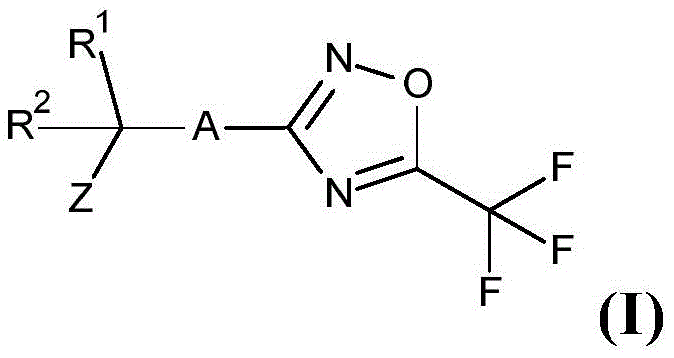
Description
The present invention relates to microbiocidal oxadiazole derivatives, for example as active ingredients, which have microbiocidal activity, in particular fungicidal activity. The invention also relates to agrochemical compositions comprising at least one of these oxadiazole derivatives, to processes for the preparation of these compounds and to the use of these oxadiazole derivatives or compositions in agriculture or horticulture for controlling or preventing infestation of plants, harvested food crops, seeds or non-living materials by phytopathogenic microorganisms, preferably fungi.
WO 2015/185485 describes the use of substituted oxadiazoles for combating phytopathogenic fungi.
According to the present invention there is provided a compound having the formula (I):

wherein the method comprises the steps of
A is selected from A-1, A-2 or A-3;

R 1 and R is 2 Independently represents hydrogen, methyl, ethyl, fluoro, cyano, difluoromethyl or trifluoromethyl; and is also provided with
Z is selected from Z 1 、Z 2 Or Z is 3 The method comprises the steps of carrying out a first treatment on the surface of the Wherein the method comprises the steps of
Z 1 Represents a 4-to 6-membered non-aromatic heterocyclic ring containing 1 ring nitrogen, wherein the heterocyclic group optionally contains 1 or 2 groups independently selected from N, O, S, C (O) and S (O) 2 Provided that the heterocyclyl ring does not contain 2 consecutive atoms selected from O and S, or the heterocyclyl optionally contains 1 further ring member NR 3 Wherein the heterocyclic group is optionally substituted with 1 or 2 substituents which may be the same or different and are selected from R 4 And wherein the heterocyclyl is further bound to the remainder of the molecule through a ring nitrogen;
R 3 represents hydrogen, hydroxy, amino, formyl, C 1-3 Alkyl, C 1-3 Alkoxy, C 1-3 Alkylcarbonyl, C 1-3 Alkoxycarbonyl, N-C 1-3 Alkylaminocarbonyl, N-di-C 1-3 Alkylaminocarbonyl, N-C 1-3 Alkoxycarbonyl, N-C 1-3 alkyl-N-C 1-3 Alkoxy-aminocarbonyl, C 1-2 Alkylsulfonyl, N-C 1-2 Alkylaminosulfonyl, N-bic 1-2 Alkylaminosulfonyl, C 1-2 Alkyl dicarbonyl, C 1-2 Alkoxydicarbonyl, N-C 1-2 Alkylamino groupDicarbonyl or N, N-di-C 1-2 An alkylamino dicarbonyl;
R 4 represents cyano, halogen, hydroxy, amino, methyl, ethyl, difluoromethyl, trifluoromethyl, methoxy, N-methylamino or N, N-dimethylamino;
Z 2 Represents a 5-or 6-membered heteroaryl ring containing 1 ring nitrogen, wherein the heteroaryl optionally comprises 1, 2 or 3 additional ring members independently selected from O, S or N, and wherein the heteroaryl is optionally substituted with 1 or 2 groups selected from R 5 1 is selected from R 6 Or 1 substituent selected from R 5 And 1 substituent selected from R 6 And wherein the heteroaryl is further bound to the remainder of the molecule through a ring nitrogen;
R 5 represents hydroxy, amino, cyano, halogen, formyl, nitro, C 1-4 Alkyl, C 1-4 Alkoxy, C 3-4 Alkenyl, C 3-4 Alkynyl, C 3-4 Alkenyloxy, C 3-4 Alkynyloxy, cyano C 1-2 Alkyl, C 1-2 Haloalkyl, hydroxy C 1-2 Alkyl, C 1-2 Alkoxy C 1-2 Alkyl, C 1-2 Alkoxy C 1-2 Alkoxy C 1-2 Alkyl, N-dimethylamino, C 1-3 Alkoxycarbonyl group C 1-2 Alkyl, C 1-3 Alkylcarbonyloxy C 1-2 Alkyl, N-C 1-3 Alkylaminocarbonyl group C 1-2 Alkyl, N-di C 1-3 Alkylaminocarbonyl group C 1-2 Alkyl, C 1-2 Alkylsulfonyl, C 1-3 Alkylcarbonyl, C 1-3 Alkyl dicarbonyl, C 1-3 Alkoxydicarbonyl, N-C 1-3 Alkylaminodicarbonyl, or N, N-di-C 1-3 An alkylamino dicarbonyl; or alternatively
R 5 represents-C (O) N (R) a )(R b ) Wherein:
R a represents hydrogen, C 1-6 Alkyl, C 3-4 Alkenyl, C 3-4 Alkynyl, C 1-3 Haloalkyl, C 3-4 Haloalkenyl, C 1-4 Alkoxy, C 1-2 Alkoxy C 1-3 Alkyl, C 2-3 Haloalkoxy, C 3-4 Alkenyloxy, C 3-4 Alkynyloxy, N-C 1-3 Alkylamino or N, N-di-C 1-2 An alkylamino group; or alternatively
R a Represent C 3-5 Cycloalkyl, C 3-5 Cycloalkyl C 1-2 Alkyl, phenyl C 1-2 Alkyl, heterocyclyl (wherein the heterocyclyl moiety is a 4-to 6-membered non-aromatic ring containing 1 or 2 heteroatoms independently selected from N, O or S, provided that the heterocyclyl cannot contain 2 consecutive atoms selected from O and S), heteroaryl or heteroaryl C 1-2 An alkyl group (wherein the heteroaryl moiety is a 5-or 6-membered aromatic ring containing 1, 2, 3, or 4 heteroatoms independently selected from N, O and S); wherein the cycloalkyl, phenyl, heterocyclyl or heteroaryl is optionally substituted with 1 or 2 substituents which may be the same or different and are selected from hydroxy, amino, formyl, acyl, cyano, halogen, methyl, trifluoromethyl, methoxy or N, N-dimethylamino, and wherein when R a When cycloalkyl or heterocyclyl, these rings optionally contain 1 member selected from C (O) or S (O) 2 Is a group of (2); and is also provided with
R b Represents hydrogen, methyl, ethyl, propyl, prop-2-enyl, prop-2-ynyl, cyclopropyl or cyclopropylmethyl; or alternatively
R a And R is b Together with the nitrogen atom they share form an azetidinyl ring, a pyrrolidinyl ring, an isoxazolidinyl ring, a morpholino ring, a piperazin-4-yl ring or a piperidinyl ring, said rings being optionally substituted with 1 or 2 groups selected from halogen, methyl, ethyl or methoxy; or alternatively
R 5 represents-C (O) O-R c Wherein:
R c represents hydrogen, C 1-6 Alkyl, C 3-5 Alkenyl, C 3-5 Alkynyl, C 1-3 Haloalkyl, C 3-4 Haloalkenyl, N-di C 1-3 Alkylamino C 1-3 Alkyl, C 3-6 Cycloalkyl, C 3-4 Cycloalkyl C 1-2 Alkyl, phenyl, heterocyclyl (wherein the heterocyclyl moiety is a moiety comprising 1 or 2 moieties independently selected from OA 4-to 6-membered non-aromatic ring of heteroatoms of S and N, provided that the heterocyclyl cannot contain 2 consecutive atoms selected from O and S), a heteroaryl group (wherein the heteroaryl moiety is a 5-or 6-membered aromatic ring comprising 1, 2 or 3 heteroatoms independently selected from N, O and S); and wherein the cycloalkyl, phenyl, heterocyclyl or heteroaryl is optionally substituted with 1 or 2 substituents which may be the same or different and are selected from hydroxy, amino, formyl, methylcarbonyl, cyano, halogen, methyl, trifluoromethyl, methoxy or N, N-dimethylamino, and wherein when R c When cycloalkyl or heterocyclyl, these rings optionally contain 1 member selected from C (O) or S (O) 2 Is a group of (2); or alternatively
R 5 represents-N (R) d )(R e ) or-C 1-2 alkyl-N (R) d )(R e ) Wherein
R d Represent C 1-3 Alkyl, C 3-4 Alkenyl, C 3-4 Alkynyl, methylcarbonyl, methoxycarbonyl, N-methylaminocarbonyl, N-dimethylaminocarbonyl, N-methoxyaminocarbonyl, N-methyl-N-methoxy-aminocarbonyl, methylsulfonyl, N-methylaminosulfonyl, N-dimethylaminosulfonyl, methyldicarbonyl, N-methylaminodicarbonyl, or N, N-dimethylaminodicarbonyl; and is also provided with
R e Represents hydrogen, methyl, ethyl, or propyl; or alternatively
R d And R is e Together with the nitrogen atom they share form an azetidinyl ring, a pyrrolidinyl ring, an isoxazolidinyl ring, a morpholino ring, a piperazin-4-yl ring or a piperidinyl ring, said rings being optionally substituted with 1 or 2 groups selected from halogen, methyl, ethyl or methoxy; or alternatively
R 5 Represents-ch=n (R f ) Wherein R is f Represent C 1-4 Alkyl, C 1-4 Alkoxy, C 2-4 Alkenyloxy, or C 2-4 Alkynyloxy;
R 6 represent C 3-6 Cycloalkyl, phenyl, heteroaryl (wherein the heteroaryl moiety is 5-or 6-membered containing 1, 2, 3 or 4 heteroatoms independently selected from N, O and S)A membered aromatic ring), a heterocyclic group (wherein the heterocyclic moiety is a 4-to 6-membered non-aromatic ring comprising 1 or 2 heteroatoms independently selected from N, O and S), and wherein the cycloalkyl, phenyl, heteroaryl and heterocyclic groups are optionally substituted with 1 or 2 substituents, which may be the same or different, selected from hydroxy, amino, formyl, acyl, cyano, halogen, methyl, trifluoromethyl, methoxy, N-dimethylamino, and wherein when R 6 When cycloalkyl or heterocyclyl, these rings optionally contain 1 member selected from C (O) or S (O) 2 Is a group of (2);
and is also provided with
Z 3 Represents a heterobicyclic group which is a 7-to 9-membered saturated, partially saturated or aromatic fused ring or a saturated spiro ring system containing 1 nitrogen, wherein the heterobicyclic group optionally comprises 1 or 2 groups independently selected from N, O, S, C (O) and S (O) 2 Provided that the heterobicyclic group cannot contain 2 consecutive atoms selected from O and S, wherein the heterobicyclic group is optionally substituted with 1 member selected from R 7 And wherein the heterobicyclic group is further bound to the remainder of the molecule through a ring nitrogen; and is also provided with
R 7 Is cyano, fluoro, chloro, amino, hydroxy, methyl, difluoromethyl, trifluoromethyl, methoxy, N-dimethylamino, formyl, methylcarbonyl, methoxycarbonyl, N-methylaminocarbonyl, or N, N-dimethylaminocarbonyl;
or a salt or N-oxide thereof.
Surprisingly, it has been found that for practical purposes, novel compounds of formula (I) have a very advantageous level of biological activity for protecting plants from diseases caused by fungi.
According to a second aspect of the present invention there is provided an agrochemical composition comprising a fungicidally effective amount of a compound of formula (I). Such agricultural compositions may further comprise at least one additional active ingredient and/or an agrochemically acceptable diluent or carrier.
According to a third aspect of the present invention there is provided a method of controlling or preventing infestation of useful plants by phytopathogenic microorganisms, wherein a fungicidally effective amount of a compound of formula (I), or a composition comprising the compound as active ingredient, is applied to the plants, parts thereof or the locus thereof.
According to a fourth aspect of the present invention there is provided the use of a compound of formula (I) as a fungicide. According to this particular aspect of the invention, the use may not include methods of treating the human or animal body by surgery or therapy.
As used herein, the term "halogen" refers to fluorine (fluoro), chlorine (chloro), bromine (bromo) or iodine (iodine, iodo), preferably fluorine, chlorine or bromine.
As used herein, cyano means a —cn group.
As used herein, the term "hydroxyl" or "hydroxyl" means an-OH group.
As used herein, amino means-NH 2 A group.
As used herein, acyl means-C (O) CH 3 A group.
As used herein, formyl means a-C (O) H group.
As used herein, the term "C 1-6 Alkyl "refers to a straight or branched hydrocarbon chain group consisting of only carbon and hydrogen atoms, which is free of unsaturation, has from one to six carbon atoms, and which is attached to the remainder of the molecule by a single bond. C (C) 1-4 Alkyl, C 1-3 Alkyl and C 1-2 Alkyl groups should be construed accordingly. C (C) 1-6 Examples of alkyl groups include, but are not limited to, methyl, ethyl, n-propyl, 1-methylethyl (isopropyl), n-butyl, and 1-dimethylethyl (t-butyl). "C 1 -C 2 An alkylene "group means C 1-2 The corresponding definition of alkyl is different in that such a group is attached to the rest of the molecule by two single bonds. C (C) 1-2 Examples of alkylene groups are-CH 2 -and-CH 2 CH 2 -。
As used herein, the term "C 1-4 Alkoxy "means having the formula-OR x Wherein R is a group of x Is C as defined above in general 1-4 An alkyl group. Term C 1-3 Alkoxy and C 1-2 Alkoxy groups should be construed accordingly. C (C) 1-4 Examples of alkoxy groups include, but are not limited to, methoxy, ethoxy, propoxy, isopropoxy, and tert-butoxy.
As used herein, the term "C 1-3 Haloalkyl "means C as defined generally above substituted with one or more identical or different halogen atoms 1-3 An alkyl group. C (C) 1-3 Examples of haloalkyl include, but are not limited to, fluoromethyl, fluoroethyl, difluoromethyl, trifluoromethyl, 2-trifluoroethyl, and 3, 3-trifluoropropyl.
As used herein, the term "C 2-6 Alkenyl "refers to a straight or branched hydrocarbon chain group consisting of only carbon atoms and hydrogen atoms, containing at least one double bond, which may be in (E) -or (Z) -configuration, having from two to six carbon atoms, attached to the rest of the molecule by single bonds. C (C) 3-6 Alkenyl, C 3-5 Alkenyl, C 2-4 Alkenyl and C 2-3 Alkenyl groups should be construed accordingly. C (C) 2-6 Examples of alkenyl groups include, but are not limited to, prop-1-enyl, allyl (prop-2-enyl), and but-1-enyl.
As used herein, the term "C 3-6 Haloalkenyl "refers to C as generally defined above substituted with one or more identical or different halogen atoms 3-6 Alkenyl groups. C (C) 3-4 Haloalkenyl groups should be construed accordingly.
As used herein, the term "C 2-4 Alkenyloxy "means having the formula-OR x Wherein R is a group of x Is C as defined above in general 2-4 Alkenyl groups.
As used herein, the term "C 2-6 Alkynyl "refers to a straight or branched hydrocarbon chain group consisting of only carbon and hydrogen atoms, containing at least one triple bond, having from two to six carbon atoms, and which is attached to the remainder of the molecule by a single bond. C (C) 3-5 Alkynyl and C 2-4 Alkynyl group shouldAnd interpreted accordingly. C (C) 2-6 Examples of alkynyl groups include, but are not limited to, prop-1-ynyl, propargyl (prop-2-ynyl).
As used herein, the term "C 2-4 Alkynyloxy "means having the formula-OR x Wherein R is a group of x Is C as defined above in general 2-4 Alkynyl groups.
As used herein, the term "C 1-4 Alkoxy C 1-4 Alkyl "means having the formula R y -O-R x -a group wherein R y Is C as defined above in general 1-4 Alkyl, and R x Is C as defined above in general 1-4 An alkylene group.
As used herein, the term "hydroxy C 1-4 Alkyl "means C as generally defined above substituted with one or more hydroxy groups 1-4 An alkyl group. The term "hydroxy C 1-2 Alkyl "should be construed accordingly.
As used herein, the term "cyano C 1-2 Alkyl "means C as generally defined above substituted with one or more cyano groups 1-2 An alkyl group.
As used herein, the term "C 1-4 Alkylcarbonyl "refers to a compound having the formula-C (O) R x Wherein R is a group of x Is C as defined above in general 1-4 An alkyl group.
As used herein, the term "C 1-3 Alkyldicarbonyl "means having the formula- [ C (O)] 2 R x Wherein R is a group of x Is C as defined above in general 1-3 An alkyl group.
As used herein, the term "C 1-3 Alkylcarbonyloxy C 1-2 Alkyl "means having the formula R y C(O)OR x -a group wherein R y Is C as defined above in general 1-3 Alkyl, and R x Is C as defined above in general 1-2 An alkylene group.
As used herein, the term "C 1-2 Alkoxy C 1-2 Alkoxy C 1-2 Alkyl "means having the formula R x OR y OR z -a group wherein R y And R is z Is as above generally definedSense C 1-2 Alkylene group, and R x Is C as defined above in general 1-2 An alkyl group.
As used herein, the term "C 1-3 Alkoxyaminocarbonyl "refers to a compound having the formula R x ONHC (O) -group, wherein R x Is C as defined above in general 1-3 An alkyl group.
As used herein, the term "N-C 1-3 alkyl-N-C 1-3 Alkoxy-aminocarbonyl "means a compound having the formula (R x )(R x O) NHC (O) -groups, wherein each R x Is C as defined above in general 1-3 An alkyl group.
As used herein, the term "C 1-3 Alkoxycarbonyl "means a compound having the formula R x OC (O) -group, wherein R x Is C as defined above in general 1-3 An alkyl group.
As used herein, the term "C 1-3 Alkoxycarbonyl group C 1-2 Alkyl "means having the formula R x OC(O)R y -a group wherein R x Is C as defined above in general 1-3 Alkyl, and R y Is C as defined above in general 1-2 An alkylene group.
As used herein, the term "C 1-3 Alkoxy dicarbonyl means a compound having the formula R x O[C(O)] 2 -a group wherein R x Is C as defined above in general 1-3 An alkyl group. Term C 1-2 Alkoxy dicarbonyl groups should be construed accordingly.
As used herein, the term "C 1-2 Alkylsulfonyl "means having the formula R x S(O) 2 -a group wherein R x Is C as defined above in general 1-2 An alkyl group.
As used herein, the term "N-C 1-3 Alkylamino "means having the formula R x NH-group, wherein R x Is C as defined above in general 1-3 An alkyl group.
As used herein, the term "N, N-bic 1-2 Alkylamino "means having the formula R x (R x ) A group of N-, wherein R x Is C as defined above in general 1-2 An alkyl group.
As used herein, the term "N-C 1-2 Alkylaminosulfonyl "means having the formula R x NHS(O) 2 -a group wherein R x Is C as defined above in general 1-2 An alkyl group.
As used herein, the term "N, N-bic 1-2 Alkylaminosulfonyl "means having the formula R x (R x )NS(O) 2 -a group wherein each R x Independently C as defined above in general 1-2 An alkyl group.
As used herein, the term "C 1-3 Alkylaminocarbonyl "means having formula R x NHC (O) -group, wherein R x Is C as defined above in general 1-3 An alkyl group.
As used herein, the term "N, N-bic 1-3 Alkylaminocarbonyl "means a compound having the formula (R x )R x NHC (O) -groups, wherein each R x Independently C as defined above in general 1-3 An alkyl group.
As used herein, the term "N-C 1-3 Alkylaminodicarbonyl "means having the formula R x NH[C(O)] 2 -a group wherein R x Is C as defined above in general 1-3 An alkyl group.
As used herein, the term "N, N-bic 1-3 Alkylaminodicarbonyl "means an amino acid having the formula (R x )R x NH[C(O)] 2 -a group wherein each R x Independently C as defined above in general 1-3 An alkyl group. The term N, N-bic 1-2 Alkylamino dicarbonyl groups should be construed accordingly.
As used herein, the term "N, N-bic 1-3 Alkylaminocarbonyl group C 1-2 Alkyl "means having the formula (R x )R x NHC(O)R y -a group wherein each R x Independently C as defined above in general 1-3 Alkyl, and R y Is C as defined above in general 1-2 An alkylene group.
As used herein, the term "C 3-6 Cycloalkyl "means saturated or partially unsaturated andand contains a stable monocyclic group of 3 to 6 carbon atoms. C (C) 3-5 Cycloalkyl and C 3 Cycloalkyl groups should be construed accordingly. C (C) 3-6 Examples of cycloalkyl groups include, but are not limited to, cyclopropyl, cyclobutyl, cyclopentyl, cyclopenten-1-yl, cyclopenten-3-yl, and cyclohexen-3-yl.
As used herein, the term "C 3-6 Cycloalkyl C 1-2 Alkyl "means C as defined above 1-2 C as defined above wherein alkylene is attached to the remainder of the molecule 3-6 Cycloalkyl rings. C (C) 3-6 Cycloalkyl C 1-3 Examples of alkyl groups include, but are not limited to, cyclopropyl-methyl and cyclobutyl-ethyl.
As used herein, the term "phenyl C 1-2 Alkyl "means C as defined above 1-2 The alkylene groups are attached to the benzene rings of the remainder of the molecule. Phenyl C 1-2 Examples of alkyl groups include, but are not limited to, benzyl.
As used herein, the term "heteroaryl" generally refers to a 5-or 6-membered monocyclic aromatic ring group containing 1, 2, 3, or 4 heteroatoms independently selected from nitrogen, oxygen, and sulfur. The heteroaryl group is bonded to the remainder of the molecule via a carbon atom or heteroatom. Examples of heteroaryl groups include, but are not limited to, furyl, pyrrolyl, thienyl, pyrazolyl, imidazolyl, thiazolyl, oxazolyl, isoxazolyl, triazolyl, tetrazolyl, pyrazinyl, pyridazinyl, pyrimidinyl, pyridyl, and indolyl.
As used herein, the term "heteroaryl C 1-2 Alkyl "means C as defined above 1-2 An alkylene group is attached to the remainder of the molecule as generally defined above.
As used herein, the term "heterocyclyl" or "heterocyclic" generally refers to a stable, saturated or partially saturated 4-to 6-membered non-aromatic monocyclic ring containing 1, 2 or 3 heteroatoms independently selected from nitrogen, oxygen and sulfur. The heterocyclic group may be bonded to the remainder of the molecule via a carbon atom or heteroatom. Examples of heterocyclyl groups include, but are not limited to, azetidinyl, oxetanyl, pyrrolidinyl, tetrahydrofuranyl, tetrahydrothiophenyl, tetrahydrothiopyranyl, piperidinyl, piperazinyl, tetrahydropyranyl, dioxolanyl, and morpholinyl.
As used herein, the term "heterobicyclic" or "heterobicyclic" refers to a stable 7-to 9-membered saturated, partially saturated or aromatic fused ring or saturated spiro ring group containing 1 nitrogen, which contains 1 or 2 additional ring members independently selected from nitrogen, oxygen and sulfur. The heterobicyclic group is bonded to the remainder of the molecule via a nitrogen atom. Examples of heterobicyclic groups include, but are not limited to, pyrrolopyridine, benzimidazole.
The presence of one or more possible asymmetric carbon atoms in the compound of formula (I) means that the compound can exist in chiral isomer form, i.e. in enantiomeric or diastereoisomeric form. Atropisomers may also be present as a result of limited rotation about a single bond. Formula (I) is intended to include all those possible isomeric forms and mixtures thereof. The present invention includes all those possible isomeric forms of the compounds having formula (I) and mixtures thereof. Likewise, formula (I) is intended to include all possible tautomers (including lactam-lactam tautomers and keto-enol tautomers), when present. The present invention includes all possible tautomeric forms of the compounds having formula (I).
In each case, the compounds according to the invention of formula (I) are in free form, oxidized form (as N-oxide), covalently hydrated form, or in salt form (for example in agronomically usable or agronomically acceptable salt form).
The N-oxide is an oxidized form of a tertiary amine or an oxidized form of a nitrogen-containing heteroaromatic compound. They are described, for example, in "Heterocholic N-oxides" by CRC Press, boca Raton [ Bokaraton CRC Press ] A.Albini and S.Pietra, 1991.
The following list provides substituents A (A-1, A-2, A-3), R with reference to the compounds of formula (I) according to the invention 1 、R 2 Z (including Z 1 、Z 2 、Z 3 )、R 3 、R 4 、R 5 (including R a 、R b 、R c 、R d 、R e 、R f )、R 6 And R is 7 Including the preferred definitions. For any of these substituents, any definition given below may be combined with any definition of any other substituent given below or elsewhere in this document.
A is selected from A-1, A-2 and A-3.A-1 represents 2, 5-thienyl, A-2 represents 2, 4-thienyl, and A-3 represents 3, 5-thienyl. Preferably, A is A-1.
R 1 And R is 2 Independently represents hydrogen, methyl, ethyl, fluoro, cyano, difluoromethyl or trifluoromethyl. Preferably, R 1 And R is 2 Independently represents hydrogen or methyl, more preferably R 1 And R is 2 All represent hydrogen.
Z is selected from Z 1 、Z 2 And Z 3 。
Z 1 Represents a 4-, 5-or 6-membered non-aromatic heterocyclyl ring containing 1 ring nitrogen, wherein the heterocyclyl optionally contains 1 or 2 groups independently selected from N, O, S, C (O) and S (O) 2 Provided that the heterocyclic group does not contain 2 consecutive atoms selected from O and S, or that the heterocyclic group optionally contains 1 further ring member NR 3 Wherein the heterocyclic group is optionally substituted with 1 or 2 substituents which may be the same or different and are selected from R 4 And wherein the heterocyclyl is further bound to the remainder of the molecule through a ring nitrogen.
Preferably Z 1 Represents a 4-, 5-or 6-membered non-aromatic heterocyclic group containing 1 ring nitrogen, wherein the heterocyclic group optionally contains 1 atom independently selected from N, O, S, C (O) or S (O) 2 (especially O or C (O)) wherein the heterocyclyl is optionally substituted with 1 or 2 substituents which may be the same or different and are selected from R 4 And wherein the heterocyclyl is further bound to the remainder of the molecule through a ring nitrogen.
More preferably, Z 1 Selected from:

wherein Z is 1 Optionally substituted with 1 or 2 substituents, which may be the same or different, selected from R 4 。
In certain embodiments of the invention, Z 1 Optionally by 1 member selected from R 4 Is substituted by a substituent of (a).
R 3 Represents hydrogen, hydroxy, amino, formyl, C 1-3 Alkyl, C 1-3 Alkoxy, C 1-3 Alkylcarbonyl, C 1-3 Alkoxycarbonyl, N-C 1-3 Alkylaminocarbonyl, N-di-C 1-3 Alkylaminocarbonyl, N-C 1-3 Alkoxycarbonyl, N-C 1-3 alkyl-N-C 1-3 Alkoxy-aminocarbonyl, C 1-2 Alkylsulfonyl, N-C 1-2 Alkylaminosulfonyl, N-bic 1-2 Alkylaminosulfonyl, C 1-2 Alkyl dicarbonyl, C 1-2 Alkoxydicarbonyl, N-C 1-2 Alkylamino dicarbonyl or N, N-di-C 1-2 Alkyl amino dicarbonyl.
R 4 Represents cyano, halogen, hydroxy, amino, methyl, ethyl, difluoromethyl, trifluoromethyl, methoxy, N-methylamino or N, N-dimethylamino. Preferably, R 4 Selected from methyl or ethyl.
Z 2 Represents a 5-or 6-membered heteroaryl ring containing 1 ring nitrogen, wherein the heteroaryl optionally comprises 1, 2 or 3 additional ring members independently selected from O, S or N, and wherein the heteroaryl is optionally substituted with 1 or 2 groups selected from R 5 1 is selected from R 6 Or 1 substituent selected from R 5 And 1 substituent selected from R 6 And wherein the heteroaryl is further bound to the remainder of the molecule through a ring nitrogen;
in certain preferred embodiments of the invention, Z 2 Optionally by 1 or 2 groups selected from R 5 And most preferably is optionally substituted with a substituent selected from R individually 5 Is substituted by a substituent of (a).
Preferably Z 2 Selected from the group consisting of:

Wherein Z is 2 Optionally by 1 or 2 groups selected from R 5 1 is selected from R 6 Or 1 substituent selected from R 5 And 1 substituent selected from R 6 Is substituted by a substituent of (a).
More preferably, Z 2 Selected from:

wherein Z is 2 Optionally by 1 or 2 groups selected from R 5 1 is selected from R 6 Or 1 substituent selected from R 5 And 1 substituent selected from R 6 Is substituted by a substituent of (a).
R 5 Represents hydroxy, amino, cyano, halogen, formyl, nitro, C 1-4 Alkyl, C 1-4 Alkoxy, C 3-4 Alkenyl, C 3-4 Alkynyl, C 3-4 Alkenyloxy, C 3-4 Alkynyloxy, cyano C 1-2 Alkyl, C 1-2 Haloalkyl, hydroxy C 1-2 Alkyl, C 1-2 Alkoxy C 1-2 Alkyl, C 1-2 Alkoxy C 1-2 Alkoxy C 1-2 Alkyl, N-dimethylamino, C 1-3 Alkoxycarbonyl group C 1-2 Alkyl, C 1-3 Alkylcarbonyloxy C 1-2 Alkyl, N-C 1-3 Alkylaminocarbonyl group C 1-2 Alkyl, N-di C 1-3 Alkylaminocarbonyl group C 1-2 Alkyl, C 1-2 Alkylsulfonyl, C 1-3 Alkylcarbonyl, C 1-3 Alkyl dicarbonyl, C 1-3 Alkoxydicarbonyl, N-C 1-3 Alkylaminodicarbonyl, or N, N-di-C 1-3 An alkylamino dicarbonyl; or alternatively
R 5 represents-C (O) N (R) a )(R b ) Wherein:
R a represents hydrogen、C 1-6 Alkyl, C 3-4 Alkenyl, C 3-4 Alkynyl, C 1-3 Haloalkyl, C 3-4 Haloalkenyl, C 1-4 Alkoxy, C 1-2 Alkoxy C 1-3 Alkyl, C 2-3 Haloalkoxy, C 3-4 Alkenyloxy, C 3-4 Alkynyloxy, N-C 1-3 Alkylamino or N, N-di-C 1-2 An alkylamino group; or alternatively
R a Represent C 3-5 Cycloalkyl, C 3-5 Cycloalkyl C 1-2 Alkyl, phenyl C 1-2 Alkyl, heterocyclyl C 1-2 Alkyl (wherein the heterocyclyl moiety is a 4-to 6-membered non-aromatic ring containing 1 or 2 heteroatoms independently selected from N, O or S, provided that the heterocyclyl cannot contain 2 consecutive atoms selected from O and S), heteroaryl or heteroaryl C 1-2 An alkyl group (wherein the heteroaryl moiety is a 5-or 6-membered aromatic ring containing 1, 2, 3, or 4 heteroatoms independently selected from N, O and S); wherein the cycloalkyl, phenyl, heterocyclyl or heteroaryl is optionally substituted with 1 or 2 substituents which may be the same or different and are selected from hydroxy, amino, formyl, acyl, cyano, halogen, methyl, trifluoromethyl, methoxy or N, N-dimethylamino, and wherein when R a When cycloalkyl or heterocyclyl, these rings optionally contain 1 member selected from C (O) or S (O) 2 Is a group of (2); and is also provided with
R b Represents hydrogen, methyl, ethyl, propyl, prop-2-enyl, prop-2-ynyl, cyclopropyl or cyclopropylmethyl; or alternatively
R a And R is b Together with the nitrogen atom they share form an azetidinyl, pyrrolidinyl, or piperidinyl ring, optionally substituted with 1 or 2 groups selected from halogen, methyl, ethyl, or methoxy; or alternatively
R 5 represents-C (O) O-R c Wherein:
R c represents hydrogen, C 1-6 Alkyl, C 3-5 Alkenyl, C 3-5 Alkynyl, C 1-3 Haloalkyl, C 3-4 Haloalkenyl, N-di C 1-3 Alkylamino C 1-3 Alkyl, C 3-6 Cycloalkyl, C 3-4 Cycloalkyl C 1-2 Alkyl, phenyl, heterocyclyl (wherein the heterocyclyl moiety is a 4-to 6-membered non-aromatic ring comprising 1 or 2 heteroatoms independently selected from O, S and N, provided that the heterocyclyl cannot contain 2 consecutive atoms selected from O and S), heteroaryl (wherein the heteroaryl moiety is a 5-or 6-membered aromatic ring comprising 1, 2 or 3 heteroatoms independently selected from N, O and S); and wherein the cycloalkyl, phenyl, heterocyclyl or heteroaryl is optionally substituted with 1 or 2 substituents which may be the same or different and are selected from hydroxy, amino, formyl, methylcarbonyl, cyano, halogen, methyl, trifluoromethyl, methoxy or N, N-dimethylamino, and wherein when R c When cycloalkyl or heterocyclyl, these rings optionally contain 1 member selected from C (O) or S (O) 2 Is a group of (2); or alternatively
R 5 represents-N (R) d )(R e ) or-C 1-2 alkyl-N (R) d )(R e ) Wherein
R d Represent C 1-3 Alkyl, C 3-4 Alkenyl, C 3-4 Alkynyl, methylcarbonyl, methoxycarbonyl, N-methylaminocarbonyl, N-dimethylaminocarbonyl, N-methoxyaminocarbonyl, N-methyl-N-methoxy-aminocarbonyl, methylsulfonyl, N-methylaminosulfonyl, N-dimethylaminosulfonyl, methyldicarbonyl, N-methylaminodicarbonyl, or N, N-dimethylaminodicarbonyl; and is also provided with
R e Represents hydrogen, methyl, ethyl, or propyl; or alternatively
R 5 Represents-ch=n (R f ) Wherein R is f Represent C 1-4 Alkyl, C 1-4 Alkoxy, C 2-4 Alkenyloxy, or C 2-4 Alkynyloxy;
R 6 represent C 3-6 Cycloalkyl, phenyl, heteroaryl (wherein the heteroaryl moiety is a 5-or 6-membered aromatic ring containing 1, 2, 3 or 4 heteroatoms independently selected from N, O and S), heterocyclyl (wherein the heterocyclyl moiety is a 4-to 6-membered non-aromatic ring containing 1 or 2 heteroatoms independently selected from N, O and S)Ring), and wherein the cycloalkyl, phenyl, heteroaryl and heterocyclyl groups are optionally substituted with 1 or 2 substituents, which may be the same or different, selected from hydroxy, amino, formyl, acyl, cyano, halogen, methyl, trifluoromethyl, methoxy, N-dimethylamino, and wherein when R 6 When cycloalkyl or heterocyclyl, these rings optionally contain 1 member selected from C (O) or S (O) 2 Is a group of (2).
Preferably, R 5 Independently selected from hydroxy, amino, cyano, halogen, formyl, nitro, C 1-4 Alkyl, C 1-4 Alkoxy, C 1-2 Haloalkyl, C 1-2 Alkoxy C 1-2 Alkyl, N-dimethylamino, -C (O) O-R c (wherein R is c Is C 1-4 Alkyl) and-C (O) N (R) a )(R b ) (wherein R is a Selected from hydrogen, C 1-4 Alkyl or C 1-4 Alkoxy, and R b Selected from hydrogen or methyl), and R 6 Is phenyl optionally substituted with 1 or 2 substituents, which may be the same or different, selected from hydroxy, methyl, methoxy, cyano, fluoro, chloro or bromo.
More preferably, R 5 Selected from amino, cyano, chloro, fluoro, formyl, nitro, methyl, ethyl, difluoromethyl, methoxymethyl, N-dimethylamino, methoxycarbonyl, ethoxycarbonyl or N-propoxycarbonyl; or-C (O) N (R) a )(R b ) (wherein R is a Selected from hydrogen, methyl or methoxy and R b Selected from hydrogen or methyl), and R 6 Is phenyl optionally substituted with 1 or 2 substituents, which may be the same or different, selected from fluorine, chlorine or bromine.
Z 3 Represents a heterobicyclic group which is a 7-to 9-membered saturated, partially saturated or aromatic fused ring or a saturated spiro ring system containing 1 nitrogen, wherein the heterobicyclic group optionally comprises 1 or 2 groups independently selected from N, O, S, C (O) and S (O) 2 Provided that the heterobicyclic group cannot contain 2 consecutive atoms selected from O and S, wherein the heterobicyclic group is optionally substituted with 1 member selected from R 7 Is taken as a substituent of (2)And wherein the heterobicyclic group is further bound to the remainder of the molecule through a ring nitrogen; and is also provided with
Preferably Z 3 Represents an heterobicyclic group which is a 9 membered saturated, partially saturated or aromatic fused ring system containing 1 nitrogen, wherein the heterobicyclic group optionally comprises 1 further ring member independently selected from N, O and S, wherein the heterobicyclic group is optionally substituted with 1 member selected from R 7 And wherein the heterobicyclic group is further bound to the remainder of the molecule via a ring nitrogen.
More preferably, Z 3 Selected from:

wherein Z is 3 Optionally by 1 member selected from R 7 Is substituted by a substituent of (a).
R 7 Is cyano, fluoro, chloro, amino, hydroxy, methyl, difluoromethyl, trifluoromethyl, methoxy, N-dimethylamino, formyl, methylcarbonyl, methoxycarbonyl, N-methylaminocarbonyl, or N, N-dimethylaminocarbonyl. Preferably, R 7 Selected from hydroxy, methoxy, methylcyano, fluoro or chloro.
Preferably, the compounds according to formula (I) are selected from compounds 1.1 to 1.190 listed in table T1 (below).
Preferably, in the compounds according to formula (I) of the invention:
a is A-1;
R 1 is hydrogen and R 2 Is hydrogen or methyl;
z is Z 1 Wherein Z is 1 Represents a 4-, 5-or 6-membered non-aromatic heterocyclic group containing 1 ring nitrogen, wherein the heterocyclic group optionally contains 1 atom independently selected from N, O, S, C (O) or S (O) 2 (especially O or C (O)) wherein the heterocyclyl is optionally substituted with 1 or 2 substituents which may be the same or different and are selected from R 4 And wherein the heterocyclyl is further through a ring nitrogenBinding to the remainder of the molecule; and is also provided with
R 4 Represents cyano, halogen, hydroxy, amino, methyl, ethyl, difluoromethyl, trifluoromethyl, methoxy, N-methylamino or N, N-dimethylamino.
More preferably, the process is carried out,
a is A-1;
R 1 and R is 2 Is hydrogen;
z is Z 1 Wherein Z is 1 Represents a 4-, 5-or 6-membered non-aromatic heterocyclic group containing 1 ring nitrogen, wherein the heterocyclic group optionally contains 1 atom independently selected from N, O, S, C (O) or S (O) 2 (especially O or C (O)) wherein the heterocyclyl is optionally substituted with 1 or 2 substituents which may be the same or different and are selected from R 4 And wherein the heterocyclyl is further bound to the remainder of the molecule through a ring nitrogen; and is also provided with
R 4 Represents methyl or ethyl.
Preferably, in the compounds according to formula (I) of the invention:
a is A-1;
R 1 is hydrogen and R 2 Is hydrogen or methyl; and is also provided with
Z is Z 2 Wherein Z is 2 Selected from:

wherein Z is 2 Optionally by 1 or 2 groups selected from R 5 1 is selected from R 6 Or 1 substituent selected from R 5 And 1 substituent selected from R 6 Is substituted by a substituent of (a).
More preferably, the process is carried out,
a is A-1;
R 1 and R is 2 Is hydrogen; and is also provided with
Z is Z 2 Wherein Z is 2 Selected from:

wherein Z is 2 Optionally by 1 or 2 groups selected from R 5 Or 1 substituent selected from R 6 Is substituted by a substituent of (a).
Preferably, in the compounds according to formula (I) of the invention:
a is A-1;
R 1 is hydrogen and R 2 Is hydrogen or methyl; and is also provided with
Z is Z 3 Wherein Z is 3 Represents an heterobicyclic group which is a 9 membered saturated, partially saturated or aromatic fused ring system containing 1 nitrogen, wherein the heterobicyclic group optionally comprises 1 further ring member independently selected from N, O and S, wherein the heterobicyclic group is optionally substituted with 1 member selected from R 7 And wherein the heterobicyclic group is further bound to the remainder of the molecule through a ring nitrogen;
more preferably, the process is carried out,
a is A-1;
R 1 and R is 2 Is hydrogen;
z is Z 3 Wherein Z is 3 Represents an heterobicyclic group which is a 9 membered saturated, partially saturated or aromatic fused ring system containing 1 nitrogen, wherein the heterobicyclic group optionally comprises 1 further ring member independently selected from N, O and S, wherein the heterobicyclic group is optionally substituted with 1 member selected from R 7 And wherein the heterobicyclic group is further bound to the remainder of the molecule through a ring nitrogen; and is also provided with
R 7 Selected from hydroxy, methoxy, methylcyano, fluoro or chloro.
The compound of the present invention may be an enantiomer of a compound having formula (I) as represented by formula (Ia) or formula (Ib) wherein R 1 And R is 2 Are different substituents.

It will be appreciated that the compounds of formula (I) according to the present invention, when in an aqueous medium, may exist in CF with the corresponding covalently hydrated forms (i.e., compounds of formula (I-Ia) and formula (I-IIa) as shown below, which may exist in tautomeric forms, such as compounds of formula (I-Ib) and formula (I-IIb) 3 -oxadiazole motifs exist in reversible equilibrium. This dynamic balance may be important for the biological activity of the compounds having formula (I). As regards the compounds of formula (I) according to the invention, A (A-1, A-2, A-3), R 1 、R 2 Z (including Z 1 、Z 2 、Z 3 )、R 3 、R 4 、R 5 (including R a 、R b 、R c 、R d 、R e 、R f )、R 6 And R is 7 The nomenclature of (a) generally applies to compounds of the formulae (I-Ia), (I-Ib), (I-IIa) and (I-IIb), as well as to A (A-1, A-2, A-3), R as shown in tables 1.1 to 1.3, tables 2.1 and 2.2 1 、R 2 Z (including Z 1 、Z 2 、Z 3 )、R 3 、R 4 、R 5 (including R a 、R b 、R c 、R d 、R e 、R f )、R 6 And R is 7 Or the compounds 1.1 to 1.190 according to the invention listed in table T1 (below).

The compounds of the present invention may be prepared as shown in schemes 1 to 10 below, wherein (unless otherwise indicated) the definition of each variable is as defined above for compounds having formula (I).
The compounds of formula (I) may be prepared by reacting a compound of formula (I) with a base (e.g. triethylamine, N-di-isopropylethylamine, K 2 CO 3 、NaHCO 3 、Na 2 CO 3 、Cs 2 CO 3 Or NaH) in the presence of a suitable solvent (e.g., dimethylacetamide,Treating a compound of formula (II) wherein X is OSO with a compound of formula (III) in tetrahydrofuran, 2-methyltetrahydrofuran, acetone, toluene or acetonitrile at a temperature between 25 ℃ and 110 DEG C 2 CH 3 Cl, br or I). In some cases, a catalyst (e.g., bu 4 NHSO 4 、Bu 4 NBr、Bu 4 NI, naI or 4-dimethylaminopyridine) and microwave irradiation may achieve better reaction performance. Furthermore, the compounds of formula (I) may optionally be prepared, for example, by using methanesulfonyl chloride (ClSO) prior to treatment with the compounds of formula (III) 2 Me) to convert-OH to an improved leaving group (e.g. -OSO) 2 CH 3 A group), via coupling transformations with compounds of formula (III) and compounds of formula (II) wherein X is OH. For related examples, see: WO 2013/13253, WO 2017/118689 and Garcia, m. et al org. Biomol. Chem. [ organic and biomolecular chemistry ] ](2004),11,1633. This reaction is shown in scheme 1.

Scheme 1
The compound of formula (II) wherein X is halogen, preferably Cl or Br, can be prepared by reacting a halogen source, e.g., N-bromosuccinimide (NBS) or N-chlorosuccinimide (NCS), with a free radical initiator, e.g., (PhCO 2 ) 2 Or Azobisisobutyronitrile (AIBN)) in a suitable solvent such as tetrachloromethane at a temperature between 55 ℃ and 100 ℃ in the presence of ultraviolet light. For relevant examples, see Liu, S. et al Synthesis](2001) 14,2078, WO 2017/118689 and Kompella, A. Et al Org. Proc. Res. Dev. [ organic processing research and development ]](2012),16,1794. This reaction is shown in scheme 2.

Scheme 2
Alternatively, compounds having formula (II) wherein X is hydrogen, OH, cl, br or I can be prepared from compounds having formula (V) by treatment with trifluoroacetic anhydride or trifluoroacetyl halide (including trifluoroacetyl fluoride, trifluoroacetyl chloride and trifluoroacetyl bromide) in the presence of a base such as pyridine or 4-dimethylaminopyridine in a suitable solvent such as ethyl acetate, tetrahydrofuran, 2-methyltetrahydrofuran or ethanol at a temperature between 0 ℃ and 75 ℃. For related examples, see WO 2003/028729, WO 2017/055473, and WO 2010/045251. This reaction is shown in scheme 3.

Scheme 3
Compounds of formula (V) wherein X is hydrogen, OH or halogen can be prepared from compounds of formula (VI) by treatment with hydroxylamine hydrochloride or aqueous hydroxylamine solutions in the presence of a base such as triethylamine or potassium carbonate in a suitable solvent such as methanol or ethanol at a temperature between 0 ℃ and 80 ℃. In some cases, better reaction performance may be obtained using a catalyst (e.g., 8-hydroxyquinoline). For relevant examples, see Kitamura, S.et al chem.Pharm.Bull. [ chemical and pharmaceutical bulletins ] (2001), 49,268, WO 2017/055473 and WO 2013/066838. This reaction is shown in scheme 4.
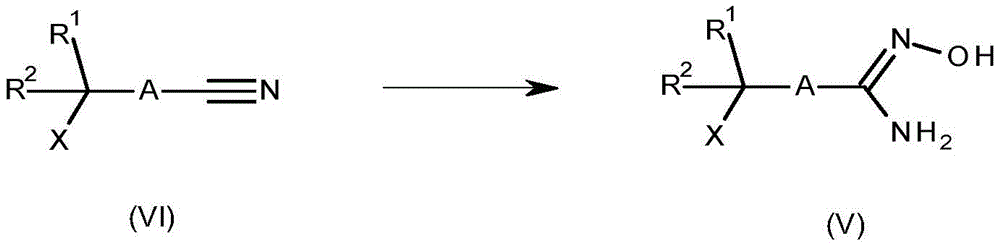
Scheme 4
The compound of formula (VI) may be prepared by reacting a compound of formula (VI) with a suitable cyanide reagent (e.g. Pd (0)/Zn (CN)) in a suitable solvent (e.g. dimethylformamide or N-methylpyrrolidone) at an elevated temperature between 100 ℃ and 120 ℃ 2 Or CuCN) is prepared from a compound having the formula (VII) (wherein Y is Cl, br or I). For related examples, see US 2007/0155739 and WO 2009/022746. This reaction is shown in scheme 5.

Scheme 5
Compounds of formula (VII) (wherein X is Cl, br, I or OSO 2 Me, and Y is Cl, br, I or CN) is commercially available, or can be prepared in a suitable solvent (e.g., methylene chloride) at a temperature between 0deg.C and 100deg.C by use of an acid source (e.g., hydrochloric acid, hydrobromic acid or hydroiodic acid), or in the presence of triphenylphosphine, a halogen source (e.g., CCl 3 Br、CCl 4 Or I 2 ) Or with methanesulfonyl chloride (ClSO) 2 Me) treatment is prepared from compounds having formula (VIII). For related examples, see Liu, h. Et al bioorg. Med. Chem. [ bioorganic and pharmaceutical chemistry ]](2008) 16,10013, WO 2014/020350 and Kompella, A. Et al bioorg. Med. Chem. Lett [ bioorganic and pharmaceutical chemistry rapid report ]](2001),1,3161. The compounds of formula (VIII) are commercially available or prepared using known methods. This reaction is shown in scheme 6.

Scheme 6
Alternatively, compounds having formula (I) may be prepared from compounds having formula (IX) by treatment with trifluoroacetic anhydride or trifluoroacetyl halide (including trifluoroacetyl fluoride, trifluoroacetyl chloride and trifluoroacetyl bromide) in the presence of a base (e.g., pyridine or 4-dimethylaminopyridine) in a suitable solvent (e.g., ethyl acetate, tetrahydrofuran, 2-methyltetrahydrofuran, or ethanol) at a temperature between 0 ℃ and 75 ℃. For related examples, see WO 2003/028729, WO 2017/118689, and WO 2010/045251. This reaction is shown in scheme 7.

Scheme 7
The compound of formula (IX) may be prepared by reacting a compound of formula (IX) with a suitable solvent (such as A)In an alcohol or ethanol) in a base (e.g. triethylamine or K 2 CO 3 ) Is prepared from a compound of formula (X) by treatment with hydroxylamine hydrochloride or an aqueous hydroxylamine solution in the presence of (C). In some cases, better reaction performance may be obtained using a catalyst (e.g., 8-hydroxyquinoline). For related examples, see Kitamura, S.et al chem.Pharm.Bull. [ chemical and pharmaceutical bulletins ] ](2001) 49,268 and WO 2013/066838. This reaction is shown in scheme 8.
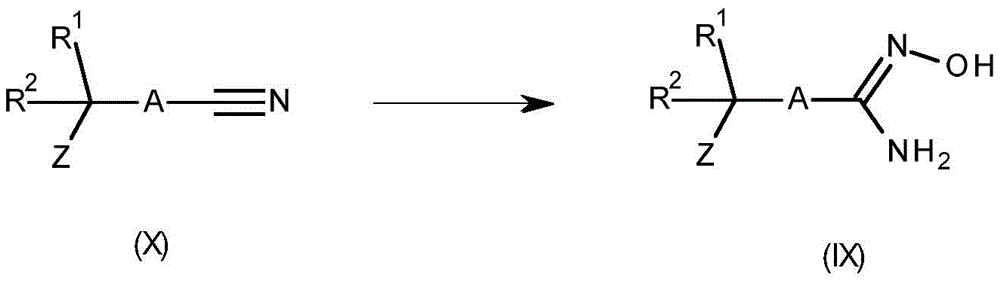
Scheme 8
The compounds of formula (X) may be prepared by reacting a compound of formula (X) with a suitable cyanide reagent (e.g. Pd (0)/Zn (CN)) in a suitable solvent (e.g. dimethylformamide or N-methylpyrrolidone) at an elevated temperature between 80℃and 120 ℃ 2 Or CuCN) is prepared from a compound having the formula (XI) (wherein Y is Cl, br or I). For relevant examples, see US 2007/0155739, WO 2017/118689, and WO 2009/022746. This reaction is shown in scheme 9.

Scheme 9
Compounds of formula (XI) wherein Y is CN, cl, br or I can be prepared by reacting a compound of formula (XI) with a base such as triethylamine, N-diisopropylethylamine, K 2 CO 3 、NaHCO 3 、Na 2 CO 3 、Cs 2 CO 3 Or NaH) in the presence of a suitable solvent (e.g. dimethylacetamide, tetrahydrofuran, 2-methyltetrahydrofuran, acetone, toluene or acetonitrile) at a temperature between 25 ℃ and 110 ℃ with a compound of formula (III) (wherein X is OSO 2 CH 3 Cl, br or I). In some cases, a catalyst (e.g., bu 4 NHSO 4 、Bu 4 NBr、Bu 4 NI, naI or 4-dimethylaminopyridine) and microwave irradiation may achieve better reactivityCan be used. Furthermore, the compound of formula (XI) may optionally be prepared by using methanesulfonyl chloride (ClSO) prior to treatment with the compound of formula (III) 2 Me) to convert-OH to an improved leaving group (e.g. -OSO) 2 CH 3 Group) is obtained via coupling transformations with compounds of formula (III) and compounds of formula (VII) wherein X is OH. The compounds of formula (III) are commercially available or prepared using known methods. For related examples, see: WO 2013/13253, WO 2017/118689 and Garcia, m. et al org. Biomol. Chem. [ organic and biomolecular chemistry ]](2004),11,1633. This reaction is shown in scheme 10.
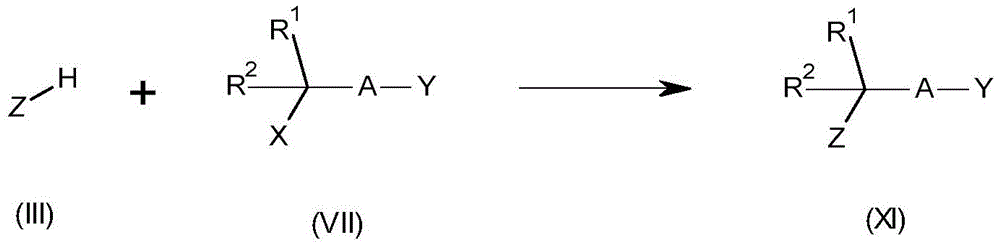
Scheme 10
As indicated, surprisingly, it has now been found that for practical purposes the compounds of formula (I) according to the invention have a very advantageous level of biological activity for protecting plants against diseases caused by fungi.
The compounds of formula (I) can be used in the agricultural sector and related fields, for example as active ingredients for controlling plant pests, or on non-living materials for controlling spoilage microorganisms or organisms potentially harmful to humans. These novel compounds are distinguished by low application rates but by high activity, good plant tolerance and no environmental hazard. They have very useful therapeutic, prophylactic and systemic properties and can be used to protect countless cultivated plants. The compounds of formula (I) can be used to inhibit or destroy pests that occur on plants or plant parts (fruits, flowers, leaves, stems, tubers, roots) of different crops of useful plants, while also protecting those plant parts that grow later from, for example, phytopathogenic microorganisms.
The invention further relates to a method for controlling or preventing infestation of plants or plant propagation material and/or harvested food crops which are susceptible to attack by microorganisms by treating the plants or plant propagation material and/or harvested food crops, wherein an effective amount of a compound of formula (I) is applied to the plants, parts thereof or the locus thereof.
Compounds having formula (I) can also be used as fungicides. As used herein, the term "fungicide" means a compound that controls, alters, or prevents the growth of fungi. The term "fungicidally effective amount" when used means the amount of such compound or combination of such compounds that is capable of affecting fungal growth. The effects of control or modification include all deviations from natural development, such as killing, retardation, etc., and prevention of barriers or other defensive structures included in or on plants to prevent fungal infection.
It may also be possible to use compounds of formula (I) as seed dressing agents for treating plant propagation material (e.g. seeds, such as fruits, tubers or grains) or plant cuttings, for protection against fungal infections as well as against phytopathogenic fungi present in the soil. The propagation material may be treated with a composition comprising a compound having the formula (I): for example, seeds may be dressed prior to sowing. The active compounds having formula (I) can also be applied to the cereal grains (coating) by dipping the seeds in a liquid formulation or by coating them with a solid formulation. The composition may also be applied to the planting site at the time of planting the propagation material, such as to the furrow of the seed during sowing. The invention also relates to such a method of treating plant propagation material, and to plant propagation material so treated.
Furthermore, the compounds of formula (I) can be used in the relevant field for controlling fungi, for example for industrial material (including wood and industrial products related to wood) protection, food storage, hygiene management.
Furthermore, the invention can be used to protect non-living materials (e.g., wood, wallboard, and paint) from fungal attack.
Compounds having formula (I) are useful, for example, against disease fungi and fungal vectors, and phytopathogenic bacteria and viruses. Fungi and fungal vectors for these diseases and phytopathogenic bacteria and viruses are for example:
cephalosporium bifidum, alternaria species, rhizopus species, cephalosporium species, acidocella species, aspergillus species (including Aspergillus flavus, aspergillus fumigatus, aspergillus nidulans, aspergillus niger, aspergillus terreus), aureobasidium species (including Aureobasidium pullulans), acidovorax, alternaria wheat, bremia lactucae (Bremia lactucae), portuga species (including Botrytis cinerea (B. Dothidea), vitis vinifera (B. Obtusa)), vitis species (including Botrytis cinerea (B. Cinerea)), candida species (including Candida albicans, candida glabra (C. Glabra), candida krusei (C. Krusei), candida rugosa (C. Lusitana), candida parapsilosis (C. Parapica)), candida tropicalis (C. Trocalis)); cep haloascus frers, cornus species, cercospora species (including brown spot germ (C. Arachidiola)), sporotrichum (Cercosporidium personatum), cladosporium species, clavipita, coccidioides, achromyces species, anthrax species (including banana anthracis (C. Musae)), novel Cryptococcus, methanococcus (Diadorthes) species, hymenochaeta species, neurospora species, elsinosphaera species, epidellum species, epidermomyces species, pyricularia, erysiphe species (including Compositae powdery mildew (E. Cityorea)), grape top blight (Eutypata), fusarium species (including Fusarium nii, fusarium graminearum, F. Lanuginosa, fusarium species, fusarium solani, fusarium, fusarium oxysporum, fusarium layering), wheat take-all (Gaeumannomyces graminis), saccharum sinensis Roxb (Gibberella fujikuroi), nicotiana tabacum (Gloeodes pomigena), pantoea banana (Gloeosporium musarum), sclerotinia apple (Glomerella cingulate), vitis (Guignardia bidwellii), rhizopus arjuniper (Gymnosporangium juniperi-virginianae), desmodium species, alternaria species, cellulomyces species (including histoplasma capsulatum (H.capsulosum)), red line bacteria, leptographium lindbergi, erysiphe capsici (Leveillula), pinus pinnatifida (Lophodermium seditiosum), leucopia avenae (Microdochium nivale), microsporum species, sclerotinia species, mucor species, sphaerella species (including Mycosphaerella, malus pumila (M.pomi)); the species may be selected from the group consisting of Alternaria species, paracoccus species, penicillium species (including Penicillium digitatum, penicillium italicum), plasmodium species, peronospora species (including Peronospora zeae, plasmodium philippinensis, and Peronospora johnsonii), peronospora species, cephalosporium nodosum, phellinus Huang Huo, phellinus (Phellinus igniarus), phytophthora species, phoma species, phytophthora vitis (Phomopsis viticola), phytophthora species (including Phytophthora infestans), plasmodium species (including Holstonia, plasmodium viticola (P.vineticum)), geosporium species, leucotheca species (including Leucotheca gracilii (P.leucotrich))), polymyxa graminearum (Polymyxa graminis), polymyxa betanae (Polymyxa betae), rhizoctonia cerealis (pseudomonas species), pseudoperonospora species (including pseudoperonospora sp. Scandens), pseudoperonospora species (including pseudoperonospora cucumeria, pseudoperonospora scandens), pseudopeziza tracheiphila, peronospora species (including hordeolum (p. Hordei), wheat leaf rust (p. Recondita), puccinia strigosa (p. Striformis), brown rust (p. Tritertina)), sclerotium species, pyriform species (including pyriform sp. Oryzae), pythium species (including pythium ultimum), septorium species, rhizoctonia (Rhizomucor pusillus), rhizopus oligosporus, coracoides species, rhizopus species, rhizoctonia sericin species (including cercospora spinosa and cercospora polyspora spinosa), calicheapest (schizothyrimpomomi), sclerotium species, septoria species (including septoria nodorum (s. Nodorum), septoria tritici (s. Tritici)), erysiphe necator (Sphaerotheca macularis), single-capsule shell of coix (Sphaerotheca fusca) (erysiphe necator (Sphaerotheca fuliginea)), sporotrichum (sporothrix) species, septoria nodorum (Stagonospora nodorum), photinia (stephylium) species, chaetomium (stereus hirsutum), rhizoctonia solani (Thananatis), rhizopus (Thielaviopsis basicola), tilletia species, trichoderma species (including trichoderma harzianum, trichoderma pseudokoningii, trichoderma viride), trichophyton species, nucleuses species, grape hook shells, melanogaster (urocystin) species, ustilago (Ustilago) species, cladosporium species (including apple cladosporium (v. Inaequalis)), verticillium species, and xanthomonas species.
The compounds of formula (I) may be used, for example, in lawns, ornamental plants such as flowers, shrubs, hardwood or evergreen plants, for example conifers, as well as tree injection, pest management and the like.
Within the scope of the present invention, the target crop and/or useful plant to be protected typically includes perennial and annual crops, such as berry plants, e.g. blackberry, blueberry, cranberry, raspberry and strawberry; cereals, such as barley, maize (or corn), millet, oat, rice, rye, sorghum, triticale, and wheat; fiber plants, such as cotton, flax, hemp, jute and sisal; field crops, such as sugar beet and fodder beet, coffee beans, hops, mustard, rape (canola), poppy, sugarcane, sunflower, tea and tobacco; fruit trees, such as apples, apricots, avocados, bananas, cherries, oranges, nectarines, peaches, pears, and plums; grass, such as bermuda grass, bluegrass, bunte grass, ciliate grass, nigella sativa, ryegrass, san-jose grass, zoysia japonica; herbs such as basil, borage, chives, coriander, lavender, angelicae pubescentis, peppermint, oregano, parsley, rosemary, sage and thyme; legumes such as beans, lentils, peas, and soybeans; nuts such as almonds, cashews, peanuts, hazelnuts, peanuts, pecans, pistachios and walnuts; palm plants, such as oil palm; ornamental plants such as flowers, shrubs and trees; other trees such as cocoa, coconut, olive and rubber; vegetables such as asparagus, eggplant, broccoli, cabbage, carrot, cucumber, garlic, lettuce, zucchini, melon, okra, onion, pepper, potato, pumpkin, rhubarb, spinach, and tomato; and grape vine, such as grape.
The term "useful plant" is to be understood as also including the use thereof for herbicides (like bromoxynil) or classes of herbicides (like for example HPPD inhibitors, ALS inhibitors, for example primisulfuron, fluoxastrobin) as a result of conventional breeding methods or genetic engineeringUseful plants that are resistant to prosulfuron and trifloxysulfuron, EPSPS (5-enol-acetone-shikimate-3-phosphate-synthase) inhibitors, GS (glutamine synthase) inhibitors, or PPO (protoporphyrinogen oxidase) inhibitors. Examples of crops which have been rendered imidazolinone (e.g. imazethapyr) tolerant by conventional breeding methods (mutagenesis) are Summer rape (canola). Examples of crops which have been rendered tolerant to herbicides or classes of herbicides by genetic engineering methods include glyphosate and glufosinate resistant maize varieties which are +.>
 And->
And-> Commercially available under the trade name.
The term "useful plant" is to be understood as also including useful plants which have been so transformed by the use of recombinant DNA technology that they are capable of synthesizing one or more selectively acting toxins, such as are known, for example, from toxin-producing bacteria, particularly those of the genus bacillus.
Examples of such plants are: (maize variety, expressing CryIA (b) toxin); YIELdGard
  (maize variety, expressing CryIIIB (b 1) toxin); YIELdGard->
 (maize varieties expressing CryIA (b) and CryIIIB (b 1) toxins);
 (maize variety, expressing Cry9 (c) toxin); herculex->
 (maize variety, expressing CryIF (a 2) toxin and obtaining the enzyme phosphinothricin N-acetyltransferase (PAT) that is salt-tolerant to the herbicide phosphinothricin); nuCOTN->
 (cotton variety, expressing CryIA (c) toxins); bollgard->
 (cotton variety, expressing CryIA (c) toxins); bollgard->
 (cotton varieties expressing CryIA (c) and CryIIA (b) toxins);
 (cotton variety, expressing VIP toxin);
 (potato variety, expressing CryIIIA toxin);
 GT Advantage (GA 21 glyphosate resistance trait),>
 CB Advantage (Bt 11 Corn Borer (CB) trait), tight>
 RW (corn rootworm trait) & gt>
The term "crop" is to be understood as also including crop plants which have been so transformed by the use of recombinant DNA technology that they are capable of synthesizing one or more selectively acting toxins, such as are known, for example, from toxin-producing bacteria, especially those of the genus bacillus.
Toxins that can be expressed by such transgenic plants include, for example, insecticidal proteins from bacillus cereus or bacillus thuringiensis; or insecticidal proteins from bacillus thuringiensis, such as delta-endotoxins, e.g., cry1Ab, cry1Ac, cry1F, cry Fa2, cry2Ab, cry3A, cry Bb1 or Cry9C, or vegetative insecticidal proteins (Vip), e.g., vip1, vip2, vip3 or Vip3A; or insecticidal proteins of bacterial plant nematodes, such as certain species of the genus Photorhabdus (Photorhabdus spp.) or Xenorhabdus (Xenorhabdus spp.), such as Xenorhabdus (Photorhabdus luminescens), xenorhabdus nematophilus (Xenorhabdus nematophilus); toxins produced by animals, such as scorpions, spider toxins, bee toxins, and other insect-specific neurotoxins; toxins produced by fungi, such as streptomycin, lectins (lecins), such as pea lectin, barley lectin or vanishing lotus lectin; lectins (agglutanins); protease inhibitors such as trypsin inhibitor, silk protease inhibitor, patatin, cystatin, papain inhibitor; ribosome Inactivating Proteins (RIP), such as ricin, maize-RIP, abrin, luffa seed protein, saporin or curcin; steroid metabolizing enzymes such as 3-hydroxysteroid oxidase, ecdysteroid-UDP-glycosyl-transferase, cholesterol oxidase, ecdysone inhibitor, HMG-COA-reductase, ion channel blockers such as sodium or calcium channel blockers, juvenile hormone esterase, diuretic hormone receptor, stilbene synthase, bibenzyl synthase, chitinase and glucanase.
Further, in the context of the present invention, delta-endotoxins (e.g., cry1Ab, cry1Ac, cry1F, cry Fa2, cry2Ab, cry3A, cry Bb1 or Cry 9C) or vegetative insecticidal proteins (Vip) (e.g., vip1, vip2, vip3 or Vip 3A) are understood to obviously also include mixed toxins, truncated toxins and modified toxins. Hybrid toxins are recombinantly produced by a new combination of different domains of those proteins (see, e.g., WO 02/15701). Truncated toxins, such as truncated Cry1 abs, are known. In the case of modified toxins, one or more amino acids of the naturally occurring toxin are replaced. In such amino acid substitutions, it is preferred to insert non-naturally occurring protease recognition sequences into the toxin, such as, for example, in the case of Cry3A055, a cathepsin-G-recognition sequence into the Cry3A toxin (see WO 03/018810).
Examples of such toxins or transgenic plants capable of synthesizing such toxins are disclosed, for example, in EP-A-0 374 753, WO 93/07278, WO 95/34656, EP-A-0 427 529, EP-A-451 878 and WO 03/052073.
Methods for preparing such transgenic plants are generally known to the person skilled in the art and are described, for example, in the publications mentioned above. CryI-type deoxyribonucleic acids and their preparation are known, for example, from WO 95/34656, EP-A-0 367 474, EP-A-0 401 979 and WO 90/13651.
Toxins included in transgenic plants render the plants tolerant to harmful insects. These insects may be present in any insect taxa, but are especially commonly found in beetles (coleoptera), diptera (diptera), and butterflies (lepidoptera).
Transgenic plants comprising one or more genes encoding insecticide resistance and expressing one or more toxins are known and some of them are commercially available. Examples of such plants are: (maize variety, expressing Cry1Ab toxin); YIELdGard->
 (maize variety, expressing Cry3Bb1 toxin); YIELdGard
 (maize variety, expressing Cry1Ab and Cry3Bb1 toxins);
 (maize variety, expressing Cry9C toxin); herculex->
 (maize variety, expressing Cry1Fa2 toxin and obtaining the enzyme phosphinothricin N-acetyltransferase (PAT) that is salt-tolerant to the herbicide glufosinate); nuCOTN->
 (cotton variety, expressing Cry1Ac toxin); bollgard->
 (cotton variety, expressing Cry1Ac toxin); bollgard->
 (cotton varieties expressing Cry1Ac and Cry2Ab toxins);
 (cotton variety, expressing Vip3A and Cry1Ab toxins);
 (potato variety, expressing Cry3A toxin);
 GT Advantage (GA 21 glyphosate resistance trait),
 CB Advantage (Bt 11 Corn Borer (CB) trait) >
Further examples of such transgenic crops are:
bt11 maize from the seed company of Fangzha (Syngenta Seeds SAS), path Huo Bite (Chemin de l' Hobit) 27, F-31 st. Su Weier (St. Sauveur), france accession number C/FR/96/05/10. Genetically modified maize is rendered resistant to attack by european corn borer (corn borer and cnaphalocrocis medinalis) by transgenic expression of truncated Cry1Ab toxins. Bt11 maize also transgenically expresses PAT enzyme to obtain tolerance to the herbicide glufosinate ammonium.
Bt176 corn from seed of Fangzha, huo Bite, line 27, F-31 790 san Su Weier, france accession number C/FR/96/05/10. Genetically modified maize, genetically expressed as a Cry1Ab toxin, is resistant to attack by european corn borers (corn borers and cnaphalocrocis medinalis). Bt176 maize also transgenically expresses the enzyme PAT to obtain tolerance to the herbicide glufosinate ammonium.
MIR604 corn from seed of Fangda, huo Bite, line 27, F-31 790, sheng Su Weier, france, accession number C/FR/96/05/10. Corn that has been rendered insect-resistant by transgenic expression of the modified Cry3A toxin. The toxin is Cry3A055 modified by insertion of a cathepsin-G-protease recognition sequence. The preparation of such transgenic maize plants is described in WO 03/018810.
MON 863 corn from Monsanto Europe S.A.), 270-272 Teflon (Avenue DE Tervuren), B-1150 Brussels, belgium, accession number C/DE/02/9.MON 863 expresses a Cry3Bb1 toxin and is resistant to certain coleopteran insects.
IPC 531 cotton from Monsanto Europe S.A., 270-272 Teflon (Avenue de Tervuren), B-1150 Brussels, belgium, accession number C/ES/96/02.
6.1507 maize, from pioneer overseas company (Pioneer Overseas Corporation), tedelsco, avenue Tedesco, 7B-1160 Brussels, belgium, accession number C/NL/00/10. Genetically modified maize, expressing the protein Cry1F to obtain resistance to certain lepidopteran insects, and PAT protein to obtain tolerance to herbicide grass Dingan.
NK603×MON 810 maize from Monsanto Europe S.A., 270-272 Teflon, inc(Avenue de Tervuren), B-1150 Brussell, belgium, accession number C/GB/02/M3/03. By crossing the genetically modified varieties NK603 and MON 810, it is made up of a conventionally bred hybrid maize variety. NK603×MON 810 maize transgenically expresses the protein CP4EPSPS obtained from Agrobacterium strain CP4 (making it herbicide resistant)  (containing glyphosate)), and also Cry1Ab toxins obtained from Bacillus thuringiensis subspecies (Bacillus thuringiensis subsp. Kurstaki) (which render them resistant to certain lepidopteran insects, including European corn borers).
The compounds of formula (I), including any of compounds 1.1 to 1.190, according to the present invention comprising compounds of formula (I) are useful for controlling or preventing phytopathogenic diseases, especially phytopathogenic fungi on soybean plants, such as phakopsora pachyrhizi.
In particular, transgenic soybean plants expressing toxins, e.g., insecticidal proteins such as delta-endotoxins, e.g., cry1Ac (Cry 1Ac Bt proteins). Accordingly, this may include inclusion of event MON87701 (see U.S. patent No. 8,049,071 and related applications and patents, and WO 2014/170327 A1 (see, for example, reference Intacta RR2 PRO TM Paragraph of soybean [008 ]]) Event MON87751 (U.S. patent application publication No. 2014/0373191) or event DAS-81419 (U.S. patent No. 8632978 and related applications and patents).
Other transgenic soybean plants may comprise event SYHT0H2-HPPD tolerance (U.S. patent application publication No. 2014/0201860 and related applications and patents), event MON 89788-glyphosate tolerance (U.S. patent application No. 7,632,985 and related applications and patents), event MON 87708-dicamba tolerance (U.S. patent application publication No. US 2011/0067134 and related applications and patents), event DP-356043-5-glyphosate and ALS tolerance (U.S. patent application publication No. US 2010/0184079 and related applications and patents), event A2704-12-glufosinate tolerance (U.S. patent application publication No. US 2008/032656 and related applications and patents), event A event DP-305523-1-ALS tolerance (U.S. patent application publication No. US 2008/0312082 and related applications and patents), event A5547-127-glufosinate tolerance (U.S. patent application publication No. US 2008/0196127 and related applications and patents), event DAS-40278-9-tolerance to 2, 4-dichlorophenoxyacetic acid and aryloxyphenoxypropionic acid esters (see WO 2011/022469, WO 2011/022470, WO 2011/022471, and related applications and patents), event 127-ALS tolerance (WO 2010/080829 and related applications and patents), event GTS 40-3-2-glyphosate tolerance, event DAS-68416-4-2, 4-dichlorophenoxyacetic acid and glufosinate tolerance, event FG 72-glyphosate and isoxazolone tolerance, and isoxaflutole tolerance, event BPS-CV127-9-ALS tolerance, GU 262-glufosinate tolerance or event SYHT04R-HPPD tolerance.
In certain instances, compounds having formula (I) according to the present invention may exhibit synergistic interactions between active ingredients when used to control or prevent phytopathogenic diseases, especially phytopathogenic fungi such as phakopsora pachyrhizi on soybean plants, especially any transgenic soybean plants as described above.
As used herein, the term "locus" means a place in or on which plants are grown, or where seeds of cultivated plants are sown, or where seeds are to be placed in soil. It includes soil, seeds, and seedlings, along with established vegetation.
The term "plant" refers to all the tangible parts of a plant, including seeds, seedlings, saplings, roots, tubers, stems, stalks, leaves, and fruits.
The term "plant propagation material" is understood to mean the reproductive parts of the plant, such as seeds, which parts can be used for propagation of the plant, as well as nutritional materials, such as cuttings or tubers (e.g. potatoes). Mention may be made, for example, of seeds (in the strict sense), roots, fruits, tubers, bulbs, rhizomes and parts of plants. Mention may also be made of germinated plants and young plants to be transplanted after germination or after soil break. These young plants may be protected prior to transplantation by being treated, either completely or partially, by dipping. Preferably, "plant propagation material" is understood to mean seeds.
The compounds of formula (I) can be used in unmodified form or, preferably, together with adjuvants conventionally used in the field of formulation. For this purpose, they can be conveniently formulated in a known manner as emulsifiable concentrates, coatable pastes, directly sprayable or dilutable solutions or suspensions, diluted emulsions, wettable powders, soluble powders, dusts, granules and also encapsulants, for example encapsulated in polymeric substances. For the type of these compositions, the method of application is selected according to the intended purpose and prevailing circumstances, such as spraying, atomizing, dusting, spreading, coating or pouring. These compositions may also contain additional adjuvants, such as stabilizers, defoamers, viscosity modifiers, binders or tackifiers, as well as fertilizers, micronutrient donors or other formulations for achieving special effects.
Suitable carriers and adjuvants, for example for agricultural use, may be solid or liquid and are substances useful in formulation technology, for example natural or regenerated mineral substances, solvents, dispersions, wetting agents, tackifiers, thickeners, binders or fertilisers. Such vectors are described, for example, in WO 97/33890.
Suspension concentrates are aqueous formulations in which highly dispersed solid particles of the active compound are suspended. Such formulations include anti-settling agents and dispersants, and may further include wetting agents to enhance activity, as well as defoamers and crystal growth inhibitors. In use, these concentrates are diluted in water and typically applied as a spray to the area to be treated. The amount of active ingredient may range from 0.5% to 95% of the concentrate.
Wettable powders are in the form of highly dispersed particles that are readily dispersible in water or other liquid carrier. These particles contain the active ingredient held in a solid matrix. Typical solid matrices include fuller's earth, kaolin clays, silica and other readily wettable organic or inorganic solids. Wettable powders normally contain from 5% to 95% of the active ingredient plus a small amount of wetting, dispersing or emulsifying agents.
Emulsifiable concentrates are homogeneous liquid compositions dispersible in water or other liquids and may consist entirely of the active compound with a liquid or solid emulsifier, or may also contain liquid carriers such as xylene, heavy aromatic naphthas, isophorone and other non-volatile organic solvents. In use, these concentrates are dispersed in water or other liquid and are typically applied as a spray to the area to be treated. The amount of active ingredient may range from 0.5% to 95% of the concentrate.
The granule formulation includes both extrudates and coarser particles and is typically applied undiluted to the area to be treated. Typical carriers for particulate formulations include sand, fuller's earth, attapulgite clay, bentonite, montmorillonite, vermiculite, perlite, calcium carbonate, brick, pumice, pyrophyllite, kaolin, dolomite, stucco, wood flour, crushed corn cobs, crushed peanut shells, sugar, sodium chloride, sodium sulfate, sodium silicate, sodium borate, magnesium oxide, mica, iron oxide, zinc oxide, titanium oxide, antimony oxide, cryolite, gypsum, diatomaceous earth, calcium sulfate and other organic or inorganic absorbent active compounds or active compound coated materials. Granular formulations typically contain from 5% to 25% of an active ingredient which may include surfactants such as heavy aromatic volatile oils, kerosene and other petroleum fractions, or vegetable oils; and/or an adhesive such as dextrin, glue or synthetic resin.
Dust agents are free-flowing mixtures of active ingredients with highly dispersed solids such as talc, clay, flour and other organic and inorganic solids as dispersants and carriers.
Microcapsules are typically droplets or particles of an active ingredient enclosed within an inert porous shell that allows the enclosed material to escape to the environment at a controlled rate. The diameter of the encapsulated droplets is typically 1 to 50 microns. The encapsulated liquid typically constitutes 50% to 95% by weight of the capsule and may include a solvent in addition to the active compound. The encapsulated particles are typically porous particles, wherein the porous membrane seals the particle orifice, thereby preserving the active species in liquid form inside the particle pores. The diameter of the particles typically ranges from 1 mm to 1 cm and preferably from 1 mm to 2 mm. The particles are formed by extrusion, agglomeration or spheronization, or are naturally occurring. Examples of such materials are vermiculite, sintered clay, kaolin, attapulgite clay, sawdust and carbon granules. Shell or membrane materials include natural and synthetic rubbers, fibrous materials, styrene-butadiene copolymers, polyacrylonitriles, polyacrylates, polyesters, polyamides, polyureas, polyurethanes and starch xanthates.
Other useful formulations for agrochemical applications include simple solutions of the active ingredient in solvents such as acetone, alkylated naphthalenes, xylenes and other organic solvents in which the active ingredient is fully dissolved at the desired concentration. Pressurized sprays can also be used wherein the active ingredient is dispersed in a highly dispersed form due to evaporation of the low boiling dispersant solvent carrier.
Suitable agricultural adjuvants and carriers useful in formulating the compositions of the invention in the above formulation types are well known to those of ordinary skill in the art.
Liquid carriers which may be used include, for example, water, toluene, xylene, naphtha, crop oil, acetone, methyl ethyl ketone, cyclohexanone, acetic anhydride, acetonitrile, acetophenone, amyl acetate, 2-butanone, chlorobenzene, cyclohexane, cyclohexanol, alkyl acetate, diacetone alcohol, 1, 2-dichloropropane, diethanolamine, p-diethylbenzene, diethylene glycol rosin acid, diethylene glycol butyl ether, diethylene glycol diethyl ether, diethylene glycol methyl ether, N, N-dimethylformamide, dimethyl sulfoxide, 1, 4-dioxane, dipropylene glycol methyl ether, dipropylene glycol dibenzoate, dipropylene glycol (dipropylene glycol), alkylpyrrolidone, ethyl acetate, 2-ethylhexanol, ethylene carbonate, 1-trichloroethane, 2-heptanone, alpha-pinene, d-limonene, ethylene glycol butyl ether, ethylene glycol methyl ether, gamma-butyrolactone, glycerol diacetate, glycerol monoacetate, glycerol triacetate, hexadecane, hexylene glycol, isopentyl acetate, isobornyl acetate, isooctane, isophorone, cumene, isopropyl myristate, lactic acid, laurylamine, mesityl oxide, methoxypropanol, methyl isoamyl ketone, methyl isobutyl ketone, methyl laurate, methyl octanoate, methyl oleate, methylene chloride, m-xylene, N-hexane, N-octylamine, stearic acid, acetic acid Xin Anzhi, oleic acid, methyl acetate, methyl laurate, methyl octanoate, methyl oleate, methyl laurate, methyl oleylamine, o-xylene, phenol, polyethylene glycol (PEG 400), propionic acid, propylene glycol monomethyl ether, p-xylene, toluene, triethyl phosphate, triethylene glycol, xylene sulfonic acid, paraffin, mineral oil, trichloroethylene, perchloroethylene, ethyl acetate, amyl acetate, methyl acetate, ethyl acetate, and ethyl acetate, butyl acetate, methanol, ethanol, isopropanol, and higher molecular weight alcohols such as amyl alcohol, tetrahydrofurfuryl alcohol, hexanol, octanol, and the like, ethylene glycol, propylene glycol, glycerol, and N-methyl-2-pyrrolidone. Water is typically the carrier of choice for dilution of the concentrate.
Suitable solid carriers include, for example, talc, titanium dioxide, pyrophyllite clay, silica, attapulgite clay, diatomaceous earth (kieselguhr), chalk, diatomaceous earth (diatomaxeouseth), lime, calcium carbonate, bentonite, fuller's earth, cotton seed hulls, wheat flour, soybean flour, pumice, wood flour, walnut hull flour, and lignin.
A wide range of surfactants can be advantageously employed in the liquid and solid compositions, particularly those designed to be diluted with carrier prior to application. These agents, when used, typically constitute from 0.1% to 15% by weight of the formulation. They may be anionic, cationic, nonionic or polymeric in nature and may be employed as emulsifiers, wetting agents, suspending agents or for other purposes. Typical surfactants include alkyl sulfates such as diethanolammonium lauryl sulfate; alkylaryl sulfonates such as calcium dodecylbenzenesulfonate; alkylphenol/alkylene oxide addition products, such as nonylphenol-c.sub.18 ethoxylate; alcohol-alkylene oxide addition products, such as tridecyl alcohol-c.sub.16 ethoxylate; soaps, such as sodium stearate; alkyl naphthalene sulfonates such as sodium dibutyl naphthalene sulfonate; salts of dialkyl sulfosuccinates, such as sodium bis (2-ethylhexyl) sulfosuccinate; sorbitol esters such as sorbitol oleate; quaternary amines, such as lauryl trimethyl ammonium chloride; polyoxyethylene esters of fatty acids, such as polyethylene glycol stearate; block copolymers of ethylene oxide and propylene oxide; and salts of mono-and dialkyl phosphates.
Other adjuvants commonly used in agricultural compositions include crystallization inhibitors, viscosity modifiers, suspending agents, spray droplet modifiers, pigments, antioxidants, foaming agents, antifoams, opacifiers, compatibilizing agents, defoamers, masking agents, neutralizing and buffering agents, corrosion inhibitors, dyes, odorants, spreading agents, penetration aids, micronutrients, emollients, lubricants, and fixing agents.
Furthermore, further biocidal active ingredients or compositions may be combined with the compositions of the present invention and used in the methods of the present invention and applied simultaneously or sequentially with the compositions of the present invention. When administered simultaneously, these additional active ingredients may be formulated or mixed together with the compositions of the present invention, for example, in a spray can. These additional biocidal active ingredients can be fungicides, herbicides, insecticides, bactericides, acaricides, nematicides and/or plant growth regulators.
The pesticides mentioned herein using their generic names are known, for example, from "The Pesticide Manual [ handbook of pesticides ]", 15 th edition, british crop protection committee (British Crop Protection Council) 2009.
In addition, the compositions of the present invention may also be administered with one or more systemic acquired resistance inducers ("SAR" inducers). SAR inducers are known and described, for example, in US patent No. US 6,919,298 and include, for example, salicylates and the commercial SAR inducer alamic benzene-S-methyl.
The compounds of formula (I) are generally used in the form of agrochemical compositions and can be applied to the crop area or the plant to be treated simultaneously or sequentially with further compounds. For example, these additional compounds may be fertilizers or micronutrient donors or other formulations that affect plant growth. They may also be selective or nonselective herbicides, together with insecticides, fungicides, bactericides, nematicides, molluscicides or mixtures of several of these preparations, if desired together with further carriers, surfactants or adjuvants which facilitate application, which are customarily used in the art of formulation.
The compounds of formula (I) may be used in the form of (fungicidal) compositions for controlling or protecting against phytopathogenic microorganisms, comprising at least one compound of formula (I) or at least one preferred individual compound as defined herein as active ingredient (in free form or in agrochemically usable salt form) and at least one of the above adjuvants.
Accordingly, the present invention provides a composition, preferably a fungicidal composition, comprising at least one compound of formula (I), an agriculturally acceptable carrier and optionally an adjuvant. An agriculturally acceptable carrier is, for example, a carrier suitable for agricultural use. Agricultural vectors are well known in the art. Preferably, the composition may comprise, in addition to the compound having formula (I), at least one or more pesticidally active compounds, for example an additional fungicidally active ingredient.
The compound of formula (I) may be the only active ingredient of the composition or it may be admixed with one or more additional active ingredients such as pesticides, fungicides, synergists, herbicides or plant growth regulators, as appropriate. In some cases, the additional active ingredients may result in unexpected synergistic activity.
Examples of suitable additional active ingredients include the following: an acyclic amino acid (acycloamino acid) fungicide, an aliphatic nitrogen fungicide, an amide fungicide, an aniline fungicide, an antibiotic fungicide, an aromatic fungicide, an arsenic-containing fungicide, an aryl phenyl ketone fungicide, a benzamide fungicide, a benzanilide fungicide, a benzimidazole fungicide, a benzothiazole fungicide, a plant fungicide, a bridged biphenyl fungicide, a carbamate fungicide, a benzoate fungicide, a conazole fungicide, a copper fungicide, a dicarboximide fungicide, a dinitrophenol fungicide, a dithiocarbamate fungicide, a dithiolane fungicide, a furfuryl amide fungicide, a furfuryl amine fungicide, a hydrazide fungicide, an imidazole fungicide, a mercury fungicide, a morpholine fungicide, an organophosphorus fungicide, an organotin fungicide, an oxathiamine fungicide, an oxazole fungicide, a phenylthioamide fungicide, a polysulfide fungicide, a pyrazole fungicide, a pyridine fungicide, a pyrimidine fungicide, a pyrrole fungicide, a quaternary ammonium fungicide, a quinoline fungicide, a quinone fungicide, a quinoxaline fungicide, a strobilurin fungicide, a sulfonanilide fungicide, a thiodiazole fungicide, a thiazole fungicide, a thiazolidine fungicide, a thiocarbamate fungicide, a triazine fungicide, a triazole fungicide, a valine fungicide, a zinc fungicide, a amide fungicide.
Examples of suitable additional active ingredients also include the following: 3-difluoromethyl-1-methyl-1H-pyrazole-4-carboxylic acid (9-dichloromethylene-1, 2,3, 4-tetrahydro-1, 4-methano-naphthalen-5-yl) -amide, 3-difluoromethyl-1-H-pyrazole-4-carboxylic acid methoxy- [ 1-methyl-2- (2, 4, 6-trichlorophenyl) -ethyl ] -amide, 1-methyl-3-difluoromethyl-1H-pyrazole-4-carboxylic acid (2-dichloromethylene-3-ethyl-1-methyl-indan-4-yl) -amide (1072957-71-1), 1-methyl-3-difluoromethyl-1H-pyrazole-4-carboxylic acid (4' -methylsulfanyl-biphenyl-2-yl) -amide, 1-methyl-3-difluoromethyl-4H-pyrazole-4-carboxylic acid [2- (2, 4-dichloro-phenyl) -2-methoxy-1-methyl-ethyl ] -amide, (5-chloro-2, 4-difluoromethyl-pyridin-2, 3-yl) - (3-methyl-4-methoxy-methyl-4-methano-4-carboxylic acid, (5-bromo-4-chloro-2-methoxy-pyridin-3-yl) - (2, 3, 4-trimethoxy-6-methyl-phenyl) -methanone, 2- {2- [ (E) -3- (2, 6-dichloro-phenyl) -1-methyl-prop-2-en- (E) -iminooxymethyl ] -phenyl } -2- [ (Z) -methoxyimino ] -N-methyl-acetamide, 3- [5- (4-chloro-phenyl) -2, 3-dimethyl-isoxazolidin-3-yl ] -pyridine, (E) -N-methyl-2- [2- (2, 5-dimethylphenoxymethyl) phenyl ] -2-methoxy-iminoacetamide, 4-bromo-2-cyano-N, N-dimethyl-6-trifluoromethylbenzimidazole-1-sulfonamide, a- [ N- (3-chloro-2, 6-xylyl) -2-methoxyacetamide ] -y-butyrolactone, 4-chloro-2-cyano-N, N-dimethyl-5-p-tolylimidazole-1-N-allyl-4, 5-dimethyl-2-silyl-3-trimethylsilyl-3-carboxamide, N- (l-cyano-1, 2-dimethylpropyl) -2- (2, 4-dichlorophenoxy) propanamide, N- (2-methoxy-5-pyridinyl) -cyclopropanecarboxamide, (+ -) -cis-1- (4-chlorophenyl) -2- (1H-1, 2, 4-triazol-1-yl) -cycloheptanol, 2- (1-tert-butyl) -1- (2-chlorophenyl) -3- (1, 2, 4-triazol-1-yl) -propan-2-ol, 2',6' -dibromo-2-methyl-4-trifluoromethoxy-4 '-trifluoromethyl-1, 3-thiazole-5-carboxamide, 1-imidazolyl-1- (4' -chlorophenoxy) -3, 3-dimethylbutyl-2-one, methyl (E) -2- [2- [6- (2-cyanophenoxy) pyrimidin-4-yloxy ] phenyl ] 3-methoxypropenoate, (E) -2- [2- [6- (2-thioamidylphenoxy) pyrimidin-4-yloxy ] phenyl ] -3-methoxypropenoate, (E) -methyl 2- [2- [6- (2-fluorophenoxy) pyrimidin-4-yloxy ] phenyl ] -3-methoxypolylacrylate, (E) -methyl 2- [2- [6- (2, 6-difluorophenoxy) pyrimidin-4-yloxy ] phenyl ] -3-methoxypolylacrylate, (E) -methyl 2- [2- [3- (pyrimidin-2-yloxy) phenoxy ] phenyl ] -3-methoxypolylacrylate, (E) -methyl 2- [2- [3- (5-methylpyrimidin-2-yloxy) -phenoxy ] phenyl ] -3-methoxypolylacrylate, (E) -methyl 2- [2- [3- (phenyl-sulfonyloxy) phenoxy ] phenyl-3-methoxypolylacrylate, (E) -methyl 2- [2- [3- (4-nitrophenoxy) phenoxy ] phenyl ] -3-methoxypolylacrylate, (E) -methyl 2- [ 2-phenoxyphenyl ] -3-methoxypolylacrylate, (E) -methyl 2- [2- (3, 5-dimethyl-benzoyl) pyrrol-1-yl ] -3-methoxypolylacrylate, (E) -methyl 2- [2- (3-methoxyphenoxy) phenyl ] -3-methoxypolyl acrylate, methyl (E) -2- [2- (2-phenylethen-1-yl) -phenyl ] -3-methoxypolyl acrylate, methyl (E) -2- [2- (3, 5-dichlorophenoxy) pyridin-3-yl ] -3-methoxypolyl acrylate, methyl (E) -2- (2- (3- (1, 2-tetrafluoroethoxy) phenoxy) phenyl) -3-methoxypolyl acrylate, methyl (E) -2- (2- [3- (. Alpha. -hydroxybenzyl) phenoxy ] phenyl) -3-methoxypolyl acrylate, methyl (E) -2- (2- (4-phenoxypyridin-2-yloxy) phenyl) -3-methoxypolyl acrylate, methyl (E) -2- [2- (3-n-propoxy-phenoxy) phenyl ] 3-methoxypolyl acrylate, methyl (E) -2- [2- (3-isopropoxyphenoxy) phenyl ] -3-methoxypolyl acrylate, methyl (E) -2- [2- [3- (2-fluorophenoxy) phenoxy ] phenyl ] -3-methoxypolyl acrylate, (E) -methyl 2- [2- (3-ethoxyphenoxy) phenyl ] -3-methoxyacrylate, methyl (E) -2- [2- (4-tert-butyl-pyridin-2-yloxy) phenyl ] -3-methoxyacrylate, methyl (E) -2- [2- [3- (3-cyanophenoxy) phenoxy ] phenyl ] -3-methoxyacrylate, methyl (E) -2- [2- [ (3-methyl-pyridin-2-yloxymethyl) phenyl ] -3-methoxyacrylate, methyl (E) -2- [2- [6- (2-methyl-phenoxy) pyrimidin-4-yloxy ] phenyl ] -3-methoxyacrylate, methyl (E) -2- [2- (5-bromo-pyridin-2-yloxymethyl) phenyl ] -3-methoxyacrylate, methyl (E) -2- [2- (3- (3-iodopyridin-2-yloxy) phenoxy) phenyl ] -3-methoxyacrylate, methyl (E) -2- [2- [6- (2-chloropyridin-3-yloxy) pyrimidin-4-yloxy ] phenyl ] -3-methoxyacrylate, (E) (E) -2- [2- (5, 6-dimethylpyrazin-2-ylmethyloxymethyl) phenyl ] -3-methoxyacrylic acid methyl ester, (E) -2- {2- [6- (6-methylpyridin-2-yloxy) pyrimidin-4-yloxy ] phenyl } -3-methoxy-acrylic acid methyl ester, (E) -2- {2- (3-methoxyphenyl) methyl oximinomethyl ] -phenyl } -3-methoxyacrylic acid methyl ester, (E) -2- {2- (6- (2-azidophenoxy) -pyrimidin-4-yloxy ] phenyl } -3-methoxyacrylic acid methyl ester, (E) -2- {2- [ 6-phenylpyrimidin-4-yl) -methyloximomethyl ] phenyl } -3-methoxyacrylic acid methyl ester, (E) -2- {2- [ (4-chlorophenyl) -methyloximomethyl ] -phenyl } -3-methoxyacrylic acid methyl ester, (E) -2- {2- [6- (2-n-propylphenoxy) -1,3, 5-triazin-4-yloxy ] phenyl } -3-methoxyacrylic acid methyl ester, (E) (E) -2- {2- [ (3-nitrophenyl) methyl oximinomethyl ] phenyl } -3-methoxyacrylic acid methyl ester, 3-chloro-7- (2-aza-2, 7-trimethyl-oct-3-en-5-yne), 2, 6-dichloro-N- (4-trifluoromethylbenzyl) -benzamide, 3-iodo-2-propynyl alcohol, 4-chlorophenyl-3-iodopropargyl formal, 3-bromo-2, 3-diiodo-2-propenyl ethyl carbamate, 2, 3-triiodoallyl alcohol, 3-bromo-2, 3-diiodo-2-propenol, 3-iodo-2-propynyl N-butyl carbamate, 3-iodo-2-propynyl N-hexyl carbamate, 3-iodo-2-propynyl cyclohexyl carbamate, 3-iodo-2-propynyl phenyl carbamate; phenol derivatives such as tribromophenol, tetrachlorophenol, 3-methyl-4-chlorophenol, 3, 5-dimethyl-4-chlorophenol, phenoxyethanol, dichlorophenol, o-phenylphenol, m-phenylphenol, p-phenylphenol, 2-benzyl-4-chlorophenol, 5-hydroxy-2 (5H) -furanone; 4, 5-dichloro-dithiazolinone, 4, 5-benzodithiazolinone, 4, 5-trimethylene dithiazolinone, 4, 5-dichloro- (3H) -1, 2-dithio-3-one, 3, 5-dimethyl-tetrahydro-1, 3, 5-thiadiazine-2-thione, N- (2-p-chlorobenzoylethyl) -hexamethylenetetramine chloride, activated ester, octaninety-mixed acid (acypetacs), bollwire, albendazole, cartap (aldimorph), allicin, allyl alcohol, xinmi junan, indazole sulfenamide, amoeba (amobam), aminophosphonic acid (am propyl fosfos), dichlormid, thiram (asemate), nystatin (aureomycin), azaconazole, azafenadine (afenoxine), oxydiphenoxine (aziiram), azoxystrobin, barium polysulfide benalaxyl, benalaxyl-M, mefenoxam (benodanil), benomyl, dixyl, triazophos (bentaluron), benthiavalicarb-M, benzalkonium chloride, fenobucarb (benzamacroil), benzamof (benzamof), bezofurazol (benzovindesipram), berberine, chlorotoxin (bethazin), bisbenzotriazolol (biloxazol), le miticide, biphenyl, bitertanol, thiodicarboxyl, bipyramid (bixafen), blasticidin-S, boscalid, bromothalonil, furfuryl, bupirimate, butachlor, thiodicarb, captan, trifluralin, docalaxyl hydrochloride, carboxin, triad, gaboxamide, carvone, CGA41396, CGA41397, fenamic acid, chitosan, traceazole (chlorbenthiazone), pendimethalin, chlorquinone, clofenazole, difenoconazole, chloropicrin, chlorothalonil, clotrimazole (chlorozolinate), etoxazole, climbazole, clotrimazole, clakang (clozyacon), copper-containing compounds such as copper acetate, copper carbonate, copper hydroxide, copper naphthenate, copper oleate, copper oxychloride, copper oxyquinoline, copper silicate, copper sulfate, copper resinate, copper zinc chromate and mixtures of Boldo, cresol, thiabendazole thiram chloride (cuprobam), cuprous oxide, cyazofamid, cyproconazole (cycloxamid), cycloheximide, cyflufenamid, cymoxanil, cyhalofop-butyl (cypendazole), cyproconazole, cyprodinil, dazomet, prochloraz, decafosin, dehydroacetic acid, di-2-pyridyl disulfide 1,1' -dioxide, dichlofluanid (dichlofluanid), pyridalyl, dichlornaphthaquinone, chloranil, dichlorophenol, sclerotinia, benzyl chlortriadimenol, triclopyr, difenoconazole, diflupyr, O, O-diisopropyl-S-benzylthiophosphate, dimefonazole (dimefluzole), dimethconazole, dimefonazole (dimefonazole), dimethomorph, dimethirimol, diniconazole-M, dimetol, dimetoram, periwinkle, nitropenyl (dinotefuran), nitrooctyl (dinosulfon), nitrobutyl (dinoterbin), diphenylamine, pyrithione, alcohol-stopping, sterilizing phosphorus (dimeimfos), dithianon, dithioether, dodecyldimethyl ammonium chloride, dodemorph, doxorubin, dodine, nitrone, dodecyl guanidine acetate, diuron, difenofos, enoxystrobin, epoxiconazole, mancozeb (etem), ethaboxam, bupirimate, ethoxyquin, ethylallicin (ethilicin), (Z) -N-benzyl-N ([ methyl (methyl-thioethyleneamino-oxycarbonyl) amino ] thio) -beta-aminopropionate, carbendazim, famoxadone, imidazolone, dexamethasone the composition comprises the components of imibenconazole, chlorpyrifos, fenbuconazole, formamide, cyproconazole, fenpropidin, fenpyrad, fenpropidin, fenpropimorph, fenpropidone, fenpropidin, fenpropidone, fenpropidium-methyl, fenpyrad-methyl, fenpropidium-triphenyltin acetate, triphenyltin hydroxide, ferox, azoxystrobin, fluazinam, fludioxonil, flumetoprolol, flumorph, fluopicolide, fluopyram triflurazole, triflurazole (flufurazozole), fluoxastrobin, fluquinconazole, flusilazole, sulfenamide, flufenamide (flutanil), flufenamide, flutriafol, flufenamide, folpet, formaldehyde, fosetyl-acid, mevalonate, furalaxyl, difuramide, furazoles, furfurol, furalon, levamisole, griseofulvin, guanamine, quinoline acrylate (halarinate), hexachlorobenzene, hexachloroprene, hexachlorophene, hexaconazole, cycloheximide (hexytifos), mercuric oxide (hydrogamphen), hydroxyisoxazole, hymexazol, imazalil sulfate, imibenclamide, biguanide, iminoctadine triacetate, cumin (inezin), iodopropynyl butyl carbamate (docarb), ipconazole, ipFenitroflucouonazole, iprobenfos, iprodione, propineb, isopropyl butylcarbamate, isoprothiolane, isopyrazam, iprovalicarb, cimetidone, seed soaking phosphorus (izopamfos), kasugamycin, kresoxim-methyl, LY186054, LY211795, LY248908, mancozeb, mandipropamid, mancozeb, ortho-amide, mecanizid, mecarb penconazole, cyprodinil, metolachlor, mercuric chloride, mercurous chloride, meptyldinocap (meptyldinocap), metalaxyl, mefenoxam-M, wilbuzin, hydrazonodone (metazoxolon), metconazole, triflumuron, furbenomyl, methyl bromide, methyl iodide, methyl isothiocyanate, metiram-zinc, phenoxyjunan, metrafenone, thiabendazole, zineb (milneb) moroxydine, myclobutanil, metrafil, sodium ambam, natamycin, tian An, nickel, nitrostyrene, phthalide, fluopyram, isotianil, furamide, organomercury compounds, orysastrobin, osthole, oxadixyl, epoxysulfuron, octoxin-copper (oxamine-coppers), oxaquin-acid, oxybenzozole (oxadoconazole) carboxin, pyriproxyfen (parinol), pyriproxyfen, penconazole, penflufen, pentachlorophenol, penthiopyrad, fenhexamid, fenbuconazole, clomazone (phosdiphen), phytophthora-Al, phosphoric acids, phthalide, picoxystrobin, triamcinolone, polyurethane, polyoxin D, polyoxin (polyoxin), metiram (polyram), triamcinolone (polyram), probenazole, prochloraz, procymidone, propamocarb, propiconazole, propineb, propionic acid, propioquinoline, thiodicarb (prothiocarb), prothioconazole, fluxapyroxad-ol (pydifumethofen), bifidam, pyraclostrobin, fixed phosphorus, piroxicam, boscalid (pyrindidinil), pyrizoxime, pyrimethanil, piroxicam, fluquindoxime, pyribenzoxim (pyriroxychlor), cloproflumix, pyrrolirizine, quaternary ammonium compounds, hydroxyquinolinylethanol (quinacetol), quinone hydrazone (quinazamid), quinconazole, fluquinconazole, quinconazole, pioglycene, pyribenzoxazole (sabazepine), and scopolamine (saxin) penciclopirox olamine (sedaxane), silthiopham, simeconazole, cilexezole (sipconazole), sodium pentachlorophenate, spiroxamine, streptomycin, sulfur, pentylphosphazene (sulpen), tebuconazole, iso Ding Yiyang quinoline (tebfuquin), phyllostatin, tetrachloronitrobenzene, fosthiazate, fluoroether azole, thiabendazole, thiadifluoro (thiadifluor), thiafenapyr (thiafenofen), thiaflufenamid, 2- (thiocyanomethyl) benzothiazole, thiabendazole-methyl, fenpyrad (thiaquinx), celecoxib, thiabendazole, iminoxazole (timibenconazole), thiobenzamide (tioxymid), clomazole-methyl, tolylfluanil, triadimefon, triamcinolone (triamcinolone), azol), ding San, imidazosin, tricyclazole, tridemorph, trifloxystrobin, acetamiprid (triflumazole), oxaziclomefone, triflumazole, triticonazole, uniconazole, thiram (urebridge), jinggangmycin, propamocarb (valifenate), carb, ethephon, cyromazine (zarilamid), zineb, ziram, and zoxamide.
The compounds of the invention may also be used in combination with anthelmintic agents. Such anthelmintic agents include compounds selected from the group consisting of macrolides, such as ivermectin, avermectin, abamectin, emamectin, eprinomectin, doramectin, selamectin, moxidectin, neminomectin and milbemycin derivatives, as described in EP-357460, EP-444964 and EP-594291. Additional anthelmintic agents include semisynthetic and biosynthetic avermectin/milbemycin derivatives, such as those described in US-5015630, WO-9415944 and WO-9522552. Additional anthelmintic agents include benzimidazoles such as albendazole, candidazole, fenbendazole, flubendazole, mebendazole, oxfendazole, oxbendazole, pamidazole, and other members of this class. Additional anthelmintic agents include imidazothiazoles and tetrahydropyrimidines such as tetraimidazole, levamisole, thiopyrimidine pamoate, octotel or morantel. Additional anthelmintic agents include flukicides (e.g., triclabendazole and closuluron) and tapecides (e.g., praziquantel and exenatide).
The compounds of the invention may be used in combination with derivatives and analogues of paraherquamide (marcfortine) anthelmintic agents and antiparasitic oxazolines, as disclosed in US-5478855, US-4639771 and DE-19520936.
The compounds of the invention may be used in combination with derivatives and analogues of the general class of dioxomorpholinium antiparasitic agents as described in WO 96/15121, and also with helminthic active cyclic depsipeptides such as those described in WO 96/11945, WO 93/19053, WO 93/25543, EP 0 626 375, EP 0 382 173, WO 94/19334, EP 0 382 173 and EP 0 503 538.
The compounds of the invention may be used in combination with other ectoparasiticides; for example fipronil; a pyrethroid; an organic phosphate; insect growth regulators such as lufenuron; ecdysone agonists such as tebufenozide and the like; neonicotinoids such as imidacloprid and the like.
The compounds of the present invention may be used in combination with terpene alkaloids, such as those described in International patent application publication No. WO 95/19363 or WO 04/72086, in particular the compounds disclosed therein.
Other examples of such bioactive compounds that may be used in combination with the compounds of the present invention include, but are not limited to, the following:
organic phosphate: acephate, methyl piroxicam, ethyl phoxim, methyl phoxim, bromphos, ethyl phoxim, thiophos, chlorpyrifos, clofenapyr, endo-phos, endo-S-methyl, endo-phos-p-S-methylsulfone, chlorimphos, diazinon, dichlorvos, baizhi, dimethoate, ethahos, ethion, acephate, oxypyriphos, valaphos, benfophos, fenitrothion, fenthion, pirfenphos, dinotefuran, amon, fos-methyl, heptene, chlorzophos, iprophos, isoxazole, malathion fenphos, methamidophos, methidathion, methylparathion, acephate, monocrotophos, dibromophosphorus, omethoate, methyl oxo-endophos, paraoxon, parathion, methylparathion, phenthoate, phoxim, iminophos, phosphamidon, phorate, oxime phophos, chlorfenphos-methyl, profenofos, proetamphos, propylthiophos, pyrazophos, pyridazinethion, quinophos, thiophos, temephos, terbufos, butyl pyrifos, setrofos, dimethos (thimeton), triazophos, trichlorfon, aphos.
Urethane: carbofuran, aldicarb, 2-sec-butylphenyl methyl carbamate, carbosulfan, carbaryl, carbosulfan, ethiprole, fenoxycarb, fentanyl, furacarb, HCN-801, isoprocarb, indoxacarb, methomyl, 5-methyl-m-isopropylbutachlor (methyl) carbamate, carbosulfan, pirimicarb, propoxur, thiodicarb, monocrotocarb, triazamate, UC-51717.
Pyrethroid: fluorovalinate, allyl pyrethrin, alpha-cypermethrin (alphametrin), (E) - (1R) -cis-2, 2-dimethyl-3- (2-oxathiolan-3-ylidenemethyl) cyclopropanecarboxylic acid 5-benzyl-3-furanylmethyl ester, bifenthrin, beta-cyhalothrin, cyfluthrin, alpha-cypermethrin (alpha-cypermethrin), beta-cypermethrin, bio-allyl pyrethrin ((S) -cyclopentyl isomer), bio-bifenthrin, NCI-85193, beta-cythrin, cyfluthrin, celebrilin (cythihrin) cyhalothrin, deltamethrin, valinate, fenvalerate, flucythrinate, flumethrin, flucythrinate (D isomer), prochlorethamate, lambda-cyhalothrin, permethrin, phenothrin, propathrin, pyrethrin (natural product), bifenthrin, tetramethrin, transfluthrin, theta-cypermethrin, flusilathrin, t-flucythrin, tefluthrin, zeta-cypermethrin.
Arthropod growth regulator: a) Chitin synthesis inhibitor: benzoyl urea: chlorfluazuron, fluzouron, flucycloxuron, lufenuron, triflumuron, fenuron, flufenoxuron, chlorfluazuron, buprofezin, fenpropiron, hexythiazox, etoxazole, clofentezine; b) Ecdysone antagonists: chlorantraniliprole and methomyl calluses; c) Juvenile hormone analogs: pyriproxyfen, methoprene (including S-methoprene), fenoxycarb; d) Lipid biosynthesis inhibitors: spirodiclofen.
Other antiparasitic agents: acarquinone, amitraz, AKD-1022, ANS-118, azadirachtin, bacillus thuringiensis, monosulfuron, bifenazate, lefenpyrad, fenisobromolate, BTG-504, BTG-505 toxafen, cartap, fenamate, acetamiprid, chlorfenapyr, chromafenozide, clothianidin, cyprodinil, diuron, chlorfenapyr DBI-3204, dipyr, dihydroxymethyl dihydroxypyrrolidine, diquat, captan, ethiprole, ethofenprox, fenazaquin, flufenzine (flumite), MTI-800, fenpyroximate, azoxystrobin, flufenpyrad, trifloxystrobin, flufenzine, trifluoperazone, benzyl fenpyrad (fluprofexyfen), benzyl fenpyrad (halofenprox), fenbucin (halofenox) Fluor-hydrazone, IKI-220, kenali, NC-196, mentha indicum (neem guard), nedinotefuran (nidinoterrestrran), nitenpyram, SD-35651, WL-108477, pyridalyl, propargite, protriafen, pymetrozine, pyridaben, pyriminobac-methyl, NC-1111, R-195, RH-0345, RH-2485, RYI-210, S-1283, S-1833, SI-8601, flusilate, silicon Luo Mating (silomadine), spinosad, tebufenpyrad, trichlorfon sulfone, tetramycin, thiacloprid, thiocyclam, tolfenpyrad, triazamate, triazophos, pyrifos, rotylen, YI-5301.
Biological agent: bacillus thuringiensis subtype Hua Yachong (Bacillus thuringiensis sspaizawai), bacillus thuringiensis subspecies kurstaki (kurstaki), bacillus thuringiensis delta endotoxins, baculoviruses, entomopathogenic bacteria, viruses and fungi.
Bactericides: aureomycin, oxytetracycline, streptomycin.
Other biological agents: enfluroxacin, febantel, penciclovir, meloxicam, cefalexin, kanamycin, p Mo Ben, clenbuterol, omeprazole, thiothim, benazepril, pi Ruipu (pyriproxole), cefquinome, florfenicol, buserelin, ceftazidime, tolacil, ceftiofur, carprofen, meflozonone, praziquantel, triclabendazole.
The following mixtures of compounds of formula (I) with active ingredients are preferred. The abbreviation "TX" means a composition selected from the group consisting of: compounds as shown in tables 1.1 to 1.3 and tables 2.1 and 2.2 (below), or compounds 1.1 to 1.190 as shown in table T1 (below):
an adjuvant selected from the group consisting of: petroleum (alias) (628) +tx,
an acaricide selected from the group consisting of: 1, 1-bis (4-chlorophenyl) -2-ethoxyethanol (IUPAC name) (910) +TX, 2, 4-dichlorophenyl benzenesulfonate (IUPAC/chemical abstract name) (1059) +TX, 2-fluoro-N-methyl-N-1-naphthaleneacetamide (IUPAC name) (1295) +TX, 4-chlorophenyl phenyl sulfone (IUPAC name) (981) +TX, abamectin (1) +TX, methoquinone (3) +TX, acetylchlorfenapyr [ CCN ] +TX, parthenolide (9) +TX, aldicarb (16) +TX, aldicarb (863) +TX, alpha-cypermethrin (202) +TX, methiphos (870) +TX Sulfamethoate [ CCN ] +TX, aminothiosalt (872) +TX, amine phosphorus (875) +TX, amine phosphorus oxalate (875) +TX, amitraz (24) +TX, acaricide (881) +TX, arsenic trioxide (882) +TX, AVI 382 (compound code) +TX, AZ 60541 (compound code) +TX, beneficial cotton phosphorus (44) +TX, cotton retaining phosphorus (azinphos-methyl) (45) +TX, azobenzene (IUPAC name) (888) +TX, azocyclotin (azacycltin) (46) +TX, azo phosphorus (azothoate) (889) +TX, benomyl (62) +TX), benziram Sha Lin (benoxafos) (alias) [ CCN ] +TX, benomyl (benzoximate) (71) +TX, benzyl benzoate (IUPAC name) [ CCN ] +TX, bifenazate (74) +TX, bifenthrin (76) +TX, le mite (907) +TX, brofenprox (alias) +TX, bronocyclone (918) +TX, brofenphos (920) +TX, ethyl brofenphos (921) +TX, brofenpyrad (94) +TX, buprofezin (99) +TX, buketon (103) +TX, buketon sulfone (104) +TX, butyl pyridaben (76) +TX, brofencarb (calcium polysulfide) (111) +TX, vomite (carb) TX (94 TX, 3+bacarb (115) +mite (29) +mite) and (35), brofencarb (35) +mite (35) +, clofenamic (131) +tx, ethylacaricidal (chlorobenzilate) (975) +tx, etomium (chloromebuform) (977) +tx, chlorfenamic (chlorometaron) (978) +tx, propylfenamic (chloropropylene) (983) +tx, chlorpyrifos (145) +tx, methyl chlorpyrifos (146) +tx, chlorfenphos (chlorophos) (994) +tx, guathrin (cinerin) I (696) +tx, guathrin II (696) +tx, guayule (cinerins) (696) +tx, tetramethrin (158) +tx, chloroiodosalam (CCN) +tx, coumarone (174) +tx, clomiphos (TX) [ CCN ] +tx, coumaphos (1010) +tx, thiozamate (1020), fenphos (CAS) +1013) and cyflufenphos (1013). 400882-07-7) +TX, cyhalothrin (196) +TX, tricyclotin (199) +TX, cypermethrin (201) +TX, DCPM (1032) +TX, DDT (219) +TX, trifluor (demephin) (1037) +TX, trifluor-O (1037) +TX, tebufos-S (1037) +TX, varyiphos (dimeon) (1038) +TX, methyl varyiphos (224) +TX, varyiphos-O (1038) +TX, methyl varyiphos-O (224) +TX, neoprene-S (1038) +TX, methylNeoprene-S (224) +TX, neoprene-S-methylsulfonyl (dimet-S-methyl-boss) (1039) +TX, chlorsulfuron (226) +TX, chloriminothiolane (dialifos) (1042) +TX, diazinon (227) +TX, benzosulfonamide (230) +TX, dichlorvos (236) +TX, methiphos (dicyclopos) (alias) +TX, kaikan (242) +TX, baizhi (243) +TX, ubiquit (1071) +TX, methiphos (dimefox) (1081) +TX, dimethoate (262) +TX, dimefomycin (dinacti) (alias) (653) +TX) Demesifen (dinex) (1089) +TX, descarbofen (dinex-dicylexine) (1089) +TX, detriton (dinobuton) (269) +TX, dimetoram (dinocap) (270) +TX, dinotefuran-4 [ CCN ] +TX, dinotefuran-6 [ CCN ] +TX, dinitrate (1090) +TX, nitrovalerate (dinoenton) (1092) +TX, nitrooctyl (dinotefon) (1097) +TX, nitrobutyl (dinotebon) (1098) +TX, dinotefuran (1102) +TX, diphenyl sulfone (IUPAC name) (1103) +TX, disulfiran (alias) [ CCN ] +TX, ethidium (278) +TX, DNOC (282) +TX, fluoxymethyl (dofenapyn) (1113) +TX, dorametin (alias) [ CCN ] +TX, thion (294) +TX, as phospho (endothiaon) (1121) +TX, EPN (297) +TX, eprinomectin (alias) [ CCN ] +TX, ethionazole (309) +TX, yithiaphos (method-methyl) (1134) +TX, etoxazole (etoxazole) (320) +TX, pyrithione (ethylmfos) (1142) +TX, fenazaflo (1147) +fenazaflo) TX, fenazafion (328) +TX, fenbutatin (fenbutatin oxide TX (TX) (1121) +TX), EPN (297) +TX, pyrithione (NOT TX) (337) +TX, fenpropathrin (342) +TX), tebufenpyr (np (TX) +TX), fenpyrad (35) (TX), fenpropin (fenpropion) (35) +methyl (fenpropion) (1134) +fenpyrad (35) +flufenpyrad (35) +, fluorescine (fluvalinate) (1184) +TX, FMC 1137 (development code) (1185) +TX, anti-mite (405) +TX, anti-mite hydrochloride (405) +TX, amicarbazone (formarate) (1193) +TX, gamma-HCH (430) +TX, fruit green pyridine (glyodin) (1205) +TX, benzyl mite ether (half fenprox) (424) +TX, heptene ether (heptenophos) (432) +TX, hexadecyl cyclopropane carboxylate (IUPAC/chemical abstracts) (1216, thiamite hydrochloride (441) +TX, methyl iodide (IUPAC name) (542) +TX, water amine thiophos (isocarbophos) (473) (carb) (1193) +TX), isopropyl O- (methoxyaminothiophosphoryl) salicylate (IU) (473 TX, iver (YI) (1205) +), iver (N) + (696) +jasmine N, jasmine (6) +, acarvos (metacross) (1266) +TX, methamidophos (527) +TX, methidathion (529) +TX, methomyl (530) +TX, methomyl (531) +TX, bromomethane (537) +TX, methomyl (metacarb) (550) +TX, methidathion (556) +TX, monocarb (mexacarb) (1290) +TX, milnacin (557) +TX, milbemycin oxime (aliases) [ CCN ] +TX, propafos (mipafox) (1293) +TX, monocrotophos (561) +TX, methidathion (morph) (1300) +TX, moxidectin (aliases) [ CCN ] +TX, dibromophosphorus (naled) (567) +TX, dicarbox (aliases) NC-184 (compound code) +TX, NC-512 (compound code) +TX, fluroxydine (nifloride) (1309) +TX, nicomycin (alias) [ CCN ] +TX, pentacyanocarb (nitrilalarb) (1313) +TX, pentacyanocarb (nitrilalarb) 1:1 zinc chloride complex (1313) +TX, NNI-0101 (compound code) +TX, NNI-0250 (compound code) +TX, omethoate (omethoate) (594) +TX, floxuridine (602) +TX, phosphorous (oxyreprofos) (1324) +TX, sulfone-mixed phosphorous (oxydisulfoton) (1325) +TX, pp' -DDT (219) +TX, parathion (615) +TX, N-methyl-ethyl acetate (methyl acetate), permethrin (626) +tx, petroleum oil (alias) (628) +tx, fenphos (1330) +tx, phenthoate (631) +tx, mefenitrothion (636) +tx, phosulphos (637) +tx, thiocyclophosphorus (phosfolan) (1338) +tx, iminothiolane (638) +tx, phosphamine (639) +tx, phoxim (642) +tx, methylpyrimidiphos (652) +tx, turpentine chloride (polychloroeteres) (idioms) (1347) +tx, milbemycin (polynaphins) (alias) (653) +tx, prochloraz (1350) +tx, profenofos (662) +tx, tick louse (1354) +tx the compounds may be selected from the group consisting of propargite (671) +TX, propafenox (propyimphos) (673) +TX, propoxur (678) +TX, ethionamide (prothion) (1360) +TX, thiophosphoryl (prothirate) (1362) +TX, pyrethrin I (696) +TX, pyrethrin II (696) +TX, pyrethrin (pyrethrs) (696) +TX, pyridaben (699) +TX, pyridaphethion (pyridazin) (701) +TX, pyriminofen (pyrimidifen) (706) +TX, pyrithione (1370) +TX, quinalphos (711) +TX, quinalphos (quinalphos) (1381) +TX, R-1492 (development code) (1382) +TX), RA-17 (development code) (1383) +TX, rotenone (722) +TX, octamethylphos (schradan) (1389) +TX, thiotepa (sebufos) (alias) +TX, selamectin (selamectin) (alias) [ CCN ] +TX, SI-0009 (compound code) +TX, su Liu phosphorus (sophamide) (1402) +TX, spirodiclofen (738) +TX, spiromesifen (739) +TX, SSI-121 (development code) (1404) +TX, shu Feilun (alias) [ CCN ] +TX, flubendiamide (sulforamid) (750) +TX, sulfotep) (753) +TX, sulfur (754) +TX SZI-121 (development code) (757) +tx, flucythrinate (398) +tx, TEPP (1417) +tx, terbufenpyrad (763) +tx, TEPP (1417) +tx, terbucarb (terbam) (alias) +tx, set Luo Lin (777) +tx, trichlorfon sulfone (tetradifon) (786) +tx, acaricidin (tetranectin) (alias) (653) +tx, acaricidal (tetrasul) (1425) +tx, monocrotocarb (thiofenox) (alias) +tx, pyriftalin (thiocarbon) 1431) +tx, monocrotocarb (thiofanox) (800) +tx, methyophos (thiomethton) (801) +tx, fluben (1436) +tx, sulyxotin (thiabendazole) (alias) [ CCN ] +TX, triaminophos (triaminophos) (1441) +TX, benthiavalicarb (triarathene) (1443) +TX, triazophos (820) +TX, triazophos (triazuron) (alias) +TX, trichlorfon (824) +TX, chlorpyrifos (triafenofos) (1455) +TX, methidatin (triaactin) (alias) (653) +TX, aphididan (847) +TX, fluoropyrazole (vaniliprole) [ CCN ] and YI-5302 (compound code) +TX,
An algicide selected from the group consisting of: baishazin (bethoxazin) [ CCN ] +tx, copper dioctanoate (IUPAC name) (170) +tx, copper sulfate (172) +tx, cybutryne [ CCN ] +tx, dihydronaphthoquinone (dichlone) (1052) +tx, dichlorophenol (232) +tx, polyacid (295) +tx, triphenyltin (Fenin) (347) +tx, slaked lime [ CCN ] +tx, sodium zincate (nabam) (566) +tx, algicidal quinone (quinine) (714) +tx, quinone amine (quininamid) (1379) +tx, cimex (730) +tx, triphenyltin acetate (IUPAC name) (347) and triphenyltin hydroxide (IUPAC name) (347) +tx,
an anthelmintic agent selected from the group consisting of: abamectin (1) +TX, clafos (1011) +TX, doramectin (aliases) [ CCN ] +TX, according to Ma Keding (291) +TX, according to Ma Keding benzoate (291) +TX, irinotecan (aliases) [ CCN ] +TX, ivermectin (aliases) [ CCN ] +TX, milbemycin (aliases) [ CCN ] +TX, moxidectin (aliases) [ CCN ] +TX, piperazine [ CCN ] +TX, selamectin (aliases) [ CCN ] +TX, spinosad (737) and thiophanate (1435) +TX,
a bird killer selected from the group consisting of: aldochloroses (127) +TX, additively dieldrin (1122) +TX, phoxim (346) +TX, pyridin-4-amine (IUPAC name) (23) and strychnine (745) +TX,
A bactericide selected from the group consisting of: 1-hydroxy-1H-pyridine-2-thione (IUPAC name) (1222) +TX, 4- (quinoxalin-2-ylamino) benzenesulfonamide (IUPAC name) (748) +TX, 8-hydroxyquinoline sulfate (446) +TX, bromonitro alcohol (97) +TX, copper dioctate (IUPAC name) (170) +TX, copper hydroxide (IUPAC name) (169) +TX, cresol [ CCN ] +TX, dichlorophenol (232) +TX, bipyralid (1105) +TX, doxine (1112) +TX, sodium (fetaminosulf) (1144) +TX, formaldehyde (404) +TX, mercuric plus (alias) [ CCN ] +TX, kasugamycin (483) +TX, kasugamycin hydrochloride hydrate (483) +TX, di (dimethyldithiocarbamate) nickel (PAC name) (169) +TX), trichlorethylpyridine (nipy) (580) +TX, xin Saitong) +oxacin (590), oxacin sulfate (movable furniture (606), and doxycycline (766) + (765), which are included in the same substance as the active substance, and the active substance of the active substance,
a biological agent selected from the group consisting of: the particle virus of cotton bollworm (Adoxophyes orana GV) (12) +TX, the agrobacterium radiobacter (Agrobacterium radiobacter) (alias) (13) +TX, the predatory mite (amblyeus spp.) (alias) (19) +TX, the asparagus nuclear polyhedrosis virus (Anagrapha falcifera NPV) (alias) (28) +TX, the red-wing small bee (Anagrus atoms) (alias) (29) +TX, the short-range insect-tooth small bee (Aphelinus abdominalis) (alias) (33) +TX, the cotton-tooth parasitic bee (Aphidius colemani) (alias) (34) +TX, the aphid mosquito (Aphidoletes aphidimyza) (alias) (35) +TX, the alfalfa silver night polyhedrosis virus (Autographa californica NPV) (38) +TX, the hard Bacillus (TX) (48) +TX, the spherical Bacillus (Bacillus sphaericus Neide) (academic name) (49) +TX, the Bacillus thuringiensis (Bacillus thuringiensis Berliner) (51) +TX, the Bacillus thuringiensis (74light-yellow Bacillus) (Bacillus thuringiensis) +soft-end sp) (823, the Bacillus sp (Aphidius colemani) (alias) and the Bacillus sp (823) (35) +35) +Bacillus sp (35) +Bacillus sp) Bacillus thuringiensis subspecies (Bacillus thuringiensis subsp. Kurstaki) (academic) 51) +TX, bacillus thuringiensis subspecies (Bacillus thuringiensis subsp. Tenebrionis) (academic) 51) +TX, beauveria bassiana (Beauveria bassiana) (aliases) 53) +TX, beauveria bassiana (Beauveria brongniartii) (aliases) 54) +TX, sand fly (Chrysoperla carnea) (aliases) 151) +TX, cryptophan mandshurica (Cryptolaemus montrouzieri) (178) +TX, malus pumila granulosis virus (Cydia pomonella GV) (aliases) 191) +TX, siberian hizoma (Dacnussa sibirica) (aliases) 212) +TX, beauveria soensis (Diglyphssaea) 254) +TX, trimerella aphis (encarpium) for (alien) 293) +TX, myzus cerrensis (2) (300) +300) +Nuclear worm (393, spodoptera frugiperda) and Heterosis (393) 24 (393) and Heterophilus heterodera (Helicoverpa zea NPV) egidis) (alias) (433) +TX, agrimonia pilosa (Hippodamia convergens) (alias) (442) +TX, orange powder host parasitic wasp (Leptomastix dactylopii) (alias) (488) +TX, blind domain (Macrolophus caliginosus) (alias) (491) +TX, cabbage looper nuclear polyhedrosis virus (Mamestra brassicae NPV) (494) +TX, huang Kuobing jumper bee (Metaphycus helvolus) (alias) (522) +TX, metarhizium anisopliae variety (Metarhizium anisopliae var. Acridum) (chemical name) (523) +TX, metarhizium anisopliae small spore variety (Metarhizium anisopliae var. Aniopsis) (chemical name) (523) +TX, pine Huang Shefeng nuclear polyhedrosis virus (Neodiprion sertifer NPV) and red head pine leaf polyhedrosis virus (N.lecontei NPV) (alias) (575) +TX, small flower domain (Orius spp.) (alias) (596) +TX), paecilomyces fumosoroseus (Paecilomyces fumosoroseus) (613) +TX, ipomelo flower domain (Phytoseiulus persimilis) (742) +nuclear polyhedrosis nematodes (742) +8) (742) (8, 8) nuclear polyhedrosis nematodes (742) (8) +nuclear polyhedrosis virus (742) (35) (alias TX) +nuclear polyhedrosis virus (742) (35) +nuclear polyhedrosis) and red head pine nuclear polyhedrosis virus (35) (742) (35) (8) Grignard nematodes (Steinernema glaseri) (aliases) (742) +TX, steinernema riobrave (aliases) (742) +TX, steinernema riobravis (aliases) (742) +TX, gryllotalpa nematodes (Steinernema scapterisci) (aliases) (742) +TX, steinernema spp.) (aliases) (742) +TX, trichoderma spp.) (aliases) (826) +TX, west blind spider mites (Typhlodromus occidentalis) (aliases) (844) and Verticillium lecanii (Verticillium lecanii) (848) +TX, bacillus amyloliquefaciens variant (bacillus subtilis var. Amyloliquefaciens) strain FZB24 (available from Novesignal Bio Inc. (Novozymes Biologicals Inc.,5400Corporate Circle,Salem,VA 24153,U.S.A.) of the company garden 5400, calif., va., U.S.A.  Well-known) +tx,
a soil disinfectant selected from the group consisting of: methyl iodide (IUPAC name) (542) and methyl bromide (537) +tx,
a chemosterilant selected from the group consisting of: azophos (apholate) [ CCN ] +TX, bis (aziridine) methylaminophosphine sulfide (bisazir) (alias) [ CCN ] +TX, busulfan (alias) [ CCN ] +TX, diflubenzuron (250) +TX, dimetif (dimatif) (alias) [ CCN ] +TX, altretamine (hemel) [ CCN ] +TX, altfophos (hempa) [ CCN ] +TX, methylaldiba (methyl) [ CCN ] +TX, methylthio (methylthio) [ CCN ] +TX, sterile (methyl apholate) [ CCN ] +TX, sterile pyridine (morzid) [ CCN ] +TX, fluoroyoung urea (penfluron) (CCN ] +TX, ba (tepa) [ CCN ] +TX, thiohexamethylphosphorus (hempa) [ CCN ] +TX ] +thiomethyl) and (thioimine (alias) [ CCN ] +TX,
an insect pheromone selected from the group consisting of: (E) -dec-5-en-1-yl acetate and (E) -dec-5-en-1-ol (IUPAC name) (222) +TX, (E) -tridec-4-en-1-yl acetate (IUPAC name) (829) +TX, (E) -6-methylhept-2-en-4-ol (IUPAC name) (541) +TX, (E, Z) -tetradec-4, 10-dien-1-yl acetate (IUPAC name) (779) +TX, (Z) -dodeca-7-en-1-yl acetate (IUPAC name) (285) +TX, (Z) -hexadec-11-en aldehyde (IUPAC name) (436) +TX, (Z) -hexadec-11-en-1-yl acetate (IUPAC name) (438) +TX, (Z) -hexadec-13-en-11-en-1-yl acetate (IUPAC name) (448) + (Z) -hexadec-7-en-1-yl acetate (IUPAC name) (782) +TX, (Z) -hexadec-13-en-10-one (IUPAC name), (Z) -tetradec-9-en-1-ol (IUPAC name) (783) +TX, (Z) -tetradec-9-en-1-yl acetate (IUPAC name) (784) +TX, (7E, 9Z) -dodeca-7, 9-dien-1-yl acetate (IUPAC name) (283) +TX, (9Z, 11E) -tetradec-9, 11-dien-1-yl acetate (IUPAC name) (780) +TX, (9Z, 12E) -tetradec-9, 12-dien-1-yl acetate (IUPAC name) (781) +TX, 14-methyl octadec-1-en (IUPAC name) (545) +TX, 4-methyl nonanal-5-ol and 4-methyl nonanal-5-one (IUPAC name) (544) +TX, alpha-polylysine (multi) (alias) [ CCN) ]+TX, west Pinus bark beetle aggregate pheromone (bricomin) (alias) [ CCN ]]+TX, dodecadienol (alias) [ CCN ]]+TX, available Mongolian (codlemone) (alias) (167) +TX, cyromazine (cure) (alias) (179) +TX, epoxynonadecane (dispareure) (277) +TX, dodeca-8-en-1-yl acetate (IUPAC name)Is named (286) +TX, dodec-9-en-1-yl acetate (IUPAC name) (287) +TX, dodec-8+TX, 10-dien-1-yl acetate (IUPAC name) (284) + TX, dominicalure (alias) [ CCN)]+TX, ethyl 4-methyl octanoate (IUPAC name) (317) +TX, eugenol (alias) [ CCN ]]+TX, southern pine bark beetle aggregate pheromone (alias) [ CCN ]]+TX, cetylparaben (gossypplus) (alias) (420) +TX, trapping and killing alkene mixture (grandlure) (421) +TX, trapping and killing alkene mixture I (alias) (421) +TX, trapping and killing alkene mixture II (alias) (421) +TX, trapping and killing alkene mixture III (alias) (421) +TX, trapping and killing alkene mixture IV (alias) (421) +TX, hexadecene acetate (hexalure) [ CCN)]+TX, bark beetle dienol (alias) [ CCN ]]+TX, silly enol (alias) [ CCN ]]+TX, chafer sex attractant (alias) (481) +TX, linetin (alias) [ CCN ]]+TX, litlure (alias) [ CCN ]]+TX, spodoptera frugiperda sex attractant (alias) [ CCN ] ]+TX, trapping ester (med lure) [ CCN ]]+TX, megatomoic acid (alias) [ CCN ]]+TX, methyl eugenol (alias) (540) +TX, durene (mu scale) (563) +TX, octadecyl-2, 13-dien-1-yl acetate (IUPAC name) (588) +TX, octadecyl-3, 13-dien-1-yl acetate (IUPAC name) (589) +TX, he Kangbi (orfrale) (alias) [ CCN)]+ TX, oryctalure (alias) (317) +TX, non-lercanine (alias) [ CCN ]]+TX, trap (CCN)]+TX, sordidin (alias) (736) +TX, phagostimulal (alias) [ CCN ]]+TX, tetradec-11-en-1-yl acetate (IUPAC name) (785) +TX, terlure (839) +TX, terlure A (alias) (839) +TX, terlure B 1 (alias) (839) +TX and Teinduced ketone B 2 (alias) (839) +TX, teinduced ketone C (alias) (839) and trunk-call (alias) [ CCN ]]+TX,
An insect repellent selected from the group consisting of: 2- (octylthio) ethanol (IUPAC name) (591) +TX, mosquito-repellent ketone (butylopyronoxy) (933) +TX, butoxy (polypropylene glycol) (936) +TX, dibutyl adipate (IUPAC name) (1046) +TX, dibutyl phthalate (1047) +TX, dibutyl succinate (IUPAC name) (1048) +TX, mosquito-repellent amine [ CCN ] +TX, mosquito-repellent ester (dimethyl carbate) [ CCN ] +TX, dimethyl phthalate [ CCN ] +TX, ethylhexyl glycol (1137) +TX, hexylurea [ CCN ] +TX, mequin (methoquin-butyl) (1276) +TX, methyl neodecanoamide [ CCN ] +TX, carbamate [ oxamate ] [ CCN ] and hydroxypiperidine [ CCN ] +TX,
An insecticide selected from the group consisting of: 1-dichloro-1-nitroethane (IUPAC/chemical abstract name) (1058) +TX, 1-dichloro-2, 2-bis (4-ethylphenyl) ethane (IUPAC name) (1056) +TX, 1, 2-dichloropropane (IUPAC/chemical abstract name) (1062) +TX, 1, 2-dichloropropane and 1, 3-dichloropropene (IUPAC name) (1063) +TX, 1-bromo-2-chloroethane (IUPAC/chemical abstract name) (916) +TX, 2-trichloro-1- (3, 4-dichlorophenyl) ethyl acetate (IUPAC name) (1451) +TX 2, 2-Diethylene2-ethylsulfinylethyl methyl phosphate (IUPAC name) (1066) +TX, 2- (1, 3-dithiolan-2-yl) phenyl dimethylcarbamate (IUPAC/chemical abstract name) (1109) +TX, 2- (2-butoxyethoxy) ethyl thiocyanate (IUPAC/chemical abstract name) (935) +TX, 2- (4, 5-dimethyl-1, 3-dioxolan-2-yl) phenyl methylcarbamate (IUPAC/chemical abstract name) (1084) +TX, 2- (4-chloro-3, 5-xylyloxy) ethanol (IUPAC name) (986) +TX, 2-chlorovinyldiethyl phosphate (IUPAC name) (984) +TX, 2-imidazolidinone (IUPAC name) (1225) +TX, 2-isovalerylindan-1, 3-dione (IUPAC name) (1246) +TX, 2-methyl (prop-2-ynyl) aminophenylmethylcarbamate (IUPAC name) (1284) +TX, 2-thiocyanoethyl laurate (IUPAC name) (1433) +TX, 3-bromo-1-chloroproprop-1-ene (IUPAC name) (917) +TX, 3-methyl-1-phenylpyrazol-5-yl dimethylcarbamate (IUPAC name) (1283) +TX 4-methyl (prop-2-ynyl) amino-3, 5-xylylmethyl carbamate (IUPAC name) (1285) +tx, 5-dimethyl-3-oxocyclohex-1-enyl dimethyl carbamate (IUPAC name) (1085) +tx, abamectin (1) +tx, acephate (2) +tx, acetamiprid (4) +tx, housefly phosphorus (alias) [ CCN ] +tx, acetylworm nitrile [ CCN ] +tx, fluoroprophrin (9) +tx, acrylonitrile (IUPAC name) (861) +tx, cotton bollwire (15) +tx, aldicarb (16) +tx, aldicarb (863) +tx, armadin (864) +TX, propethrin (17) +TX, alomicin (alias) [ CCN ] +TX, dewep (866) +TX, alpha-cypermethrin (202) +TX, alpha-ecdysone (alias) [ CCN ] +TX, aluminum phosphide (640) +TX, 60+Cypran (60) +Cypran (24) +TX, neonicotinoid (877) +TX, dewep (883) +TX, AVI 382 (compound code) +TX, AZ 60541 (compound code) +TX, azadirachtin (alias) (41) +TX, methylpyridinium (42) +TX, yigossypium (44) +TX, methylvalley phosphorus (45) +TX, azophos (889) +Bacillus, cypran (873) +TX, amine phosphorus (875) +TX, hydrogen oxalate phosphorus (875) +TX, cypran (883) +TX, amitraz (24) +TX, neonicotin (877) +TX, defipron TX, devop (883) +TX, AVI 382 (compound code) +TX, ax (42) +TX, AZ 35+TX, ax (44) +TX, yiguphos TX (45) +TX, ax (tx+TX), ax, cypran (TX) (41) +TX, cypran (TX) (35) +TX, cypran (35) +35) +35+Cypran (35) +Cypran (35) +35+Cypran (35) Beta-cypermethrin (203) +TX, bifenthrin (76) +TX, bio-propethrin (78) +TX, bio-propen S-cyclopentenyl isomer (alias) (79) +TX, bio-cycloprothrin (bioethane method) [ CCN ] +TX, bio-permethrin (908) +TX, bio-permethrin (80) +TX, bis (2-chloroethyl) ether (IUPAC name) (909) +TX, bis-trifluoracene (83) +TX, borax (86) +TX, deltamethrin (alias) +TX, bromophenbenephosphine (914) +TX, bromoene killing (918) +TX, bromo-DDT (alias) [ CCN ] +TX Bromophos (920) +TX, bromophos-ethyl (921) +TX, methomyl (924) +TX, buprofezin (99) +TX, benfuracarb (926) +TX, termidothiophos (butathiofos) (927) +TX, buketowei (103) +TX, butyl phosphorus (932) +TX, butyl sulfone wei (104) +TX, butyl pyridaben (alias) +TX, thiowire phosphorus (109) +TX, calcium arsenate [ CCN ] +TX, calcium cyanide (444) +TX, calcium polysulfide (IUPAC name) (111) +TX, toxafen (941) +TX, clomazone (943) +TX, carbaryl (115) +TX, carbofuran (118) +TX, carbon disulfide (IUPAC/chemical abstract name) (945) +tx, carbon tetrachloride (IUPAC name) (946) +tx, phosphorus trisulfide (947) +tx, carbosulfan (119) +tx, cartap (123) +tx, cartap hydrochloride (123) +tx, veratrine (alias) (725) +tx, borneol (960) +tx, chlordane (128) +tx, decachlorone (963) +tx, acetamiprid (964) +tx, acetamiprid hydrochloride (964) +tx, phosphorus oxychloride (129) +tx, chlorfenapyr (130) +tx, chlorpyrifos (131) +tx, chlorpyrimide (132) +tx, chloroform [ CCN ] +tx bitter chloride (141) +TX, chlorpyrifos (989) +TX, pyridine (chlorrazotos) (990) +TX, chlorpyrifos (145) +TX, chlorpyrifos (146) +TX, fenphos (994) +TX, chromafenozide (150) +TX, guayule I (696) +TX, guayuthrin II (696) +TX, guayuthrin (696) +TX, cis-benfurhrin (alias) +TX, benfurthrin (80) +TX, cyhalothrin (alias) +TX, desmethylwire (999) +TX, chloroiodosal (alias) [ CCN ] +TX, thiamethoxam (165) +TX, copper acetylarsenite [ CCN ] +TX, copper arsenate [ CCN ] +tx, copper oleate [ CCN ] +tx, coumaphos (174) +tx, animaphos (1006) +tx, crotamiton (alias) [ CCN ] +tx, butene phosphorus (1010) +tx, yoepon (1011) +tx, cryolite (alias) (177) +tx, CS 708 (development code) (1012) +tx, benzonitrile phosphine (1019) +tx, cartonenitrile (184) +tx, carprofen phosphorus (1020) +tx, cycloparaffin [ CCN ] +tx, beta-cythrin (188) +tx, beta-cyhalothrin (193) +tx, lambda-cyhalothrin (196) +tx, lambda-cyhalothrin (201) +tx, beta-cyhalothrin (206) +tx cyromazine (209) +TX, cyromazine (aliases) [ CCN ] +TX, d-limonene (aliases) [ CCN ] +TX, d-tetramethrin (aliases) (788) +TX, DAEP (1031) +TX, dafone (216) +TX, DDT (219) +TX, carbofuran (decacarbofuran) (1034) +TX, deltamethrin (223) +TX, tenatophos (1037) +TX, tenatophos-O (1037) +TX, tenatophos-S (1037) +TX, endophos (1038) +TX, endophos-methyl (224) +TX, endophos-O (1038) +TX, endophos-O-methyl (224) +TX, endophos-S (1038) +TX, neoprene-S-methyl (224) +TX, neoprene-S-methylsulfonylmethyl sulfone (demton-S-methyl) (1039) +TX, chlorsulfuron (226) +TX, chlorthion (1042) +TX, desx (diamidafos) (1044) +TX, diazinon (227) +TX, isochlorophosphorus (1050) +TX, desx (1051) +TX, dichlorvos (236) +TX, dicyclophos (alias) +TX, dicresyl (alias) [ CCN ] +TX, baizhifu (243) +TX, decnii (244) +TX, dieldrin (1070) +TX, diethyl 5-methylpyrazol-3-yl phosphate (IUPAC name) (1076) +TX) diflubenzuron (250) +TX, diprophylline (dilor) (alias) [ CCN ] +TX, tetrafluoromethrin [ CCN ] +TX, methiphos (1081) +TX, dimchip (1085) +TX, dimethoate (262) +TX, permethrin (1083) +TX, methylparaben (265) +TX, defly (1086) +TX, abamectin (1089) +TX, abamectin-dicycleline (1089) +TX, propofol (1093) +TX, pentanifol (1094) +TX, dimchip (1095) +TX, dinotefuran (271) +TX, benomyl (1099) +TX, vegetable and fruit phosphorus (1100) +TX, dioxycarb (1101) +TX, dephos (1102) +TX, ethylphosphorus (278) + TX, dithicrofos (1108) +TX, DNOC (282) +TX, doramectin (alias) [ CCN ] +TX, DSP (1115) +TX, ecdysterone (alias) [ CCN ] +TX, EI 1642 (development code) (1118) +TX, emamectin (291) +TX, emamectin benzoate (291) +TX, EMPC (1120) +TX, enellethrin (292) +TX, thiodan (294) +TX, genophos (1121) +TX, isodir (1122) +TX, EPBP (1123) +TX, EPN (297) +TX, juvenin (1124) +TX, irinotecan (alias) [ CCN ] +TX; fenvalerate (302) +TX, ethohos (alias) [ CCN ] +TX, monosultap (308) +TX, ethion (309) +TX, ethiprole (310) +TX, yithion (method-methyl) (1134) +TX, citizen (312) +TX, ethyl formate (IUPAC name) [ CCN ] +TX, ethyl-DDD (alias) (1056) +TX, ethylene dibromide (316) +TX, ethylene dichloride (chemical name) (1136) +TX, ethylene oxide [ CCN ] +TX, ethofenprox (319) +TX, ethiazophos (1142) +TX, EXD (1143) +TX, sulfamphos (323) +TX), fenphos (326) +TX, fenpropidin (1147) +TX, coumaphos (1148) +TX, diethofencarb (1149) +TX, fenfipronil (1150) +TX, fenitrothion (335) +TX, fenobucarb (336) + TX, fenoxacrim (1153) +TX, fenxycarb (340) +TX, fenpropathrin (1155) +TX, fenpropathrin (342) +TX, fenpyrad (alias) +TX, feng Suolin (1158) +TX, coumaphos (346) +TX, ethyl coumaphos (CCN) +TX, fenfipronil (349) +TX, fipronil (354) +TX, flonicamid (358) +TX, fluazinamide (TX with accession numbers 272451-65-7) +TX, fipronil (1168) +TX, flufenuron (366) +TX, fipronil (367) +TX, fipronil (1169) +fipronil (1194) +35) +flufluflubendiamide (1194) + (1195) +35) +flubendiamide (1194) +35 (1194, fipronil (1194) +35 (35) +flubendiamide (1194) +35 (35) +35) and (35) and (1194) flubendiamide (which are the same to be satisfied Carbosulfan (1196) +TX, furacarb (412) +TX, anti-pyrethrum (1200) +TX, gamma-cyhalothrin (197) +TX, gamma-HCH (430) +TX, biguanide salt (422) +TX, biguanide acetate (422) +TX, GY-81 (development code) (423) +TX, benfuracarb (424) +TX, chlortebufenozide (425) +TX, HCH (430) +TX, HEOD (1070) +TX, heptachloro (1211) +TX, heptylether (432) +TX, fashion [ CCN ] +TX, hexaflumuron (439) +TX, HHHDN (864) +TX, furazone (443) +TX, hydrocyanic acid (444) +TX; ethyl chloride (445) +TX, quinolinone (hyquincarb) (1223) +TX, imidacloprid (458) +TX, imicarb (460) +TX, indoxacarb (465) +TX, methyl iodide (IUPAC name) (542) +TX, IPSP (1229) +TX, chlorzophos (1231) +TX, carbochlorazol (1232) +TX, water amine thiophosphor (alias) (473) +TX, isoxadifen (1235) +TX, iso Liu Lin (1236) +TX, isoxacarb (isolan) (1237) +TX, isoprocarb (472) +TX, isopropyl O- (methoxyaminothiophosphoryl) salicylate (IUPAC name) (473) +TX), pyricularia oryzae (474) +TX, isoxazophos (1244) +TX, isoxazole phosphorus (isoxaethion) (480) +TX, ivermectin (alias) [ CCN ] +TX, heliomycin I (696) +TX, heliomycin II (696) +TX, iodiphos (1248) +TX, juvenile hormone I (alias) [ CCN ] +TX, juvenile hormone II (alias) [ CCN ] +TX, juvenile hormone III (alias) [ CCN ] +TX, cleavan (1249) +TX, imazapyr (484) +TX, lambda-cyhalothrin (198) +TX, lead arsenate [ CCN ] + TX, lepimectin (CCN) +TX, bromophenyl phosphorus (1250) +TX, lindan (430) +TX, lead arsenate [ CCN ] + TX, lepimectin pyridaphos (lirimfos) (1251) +TX, lufenuron (490) +TX, thiazophos (1253) +TX, m-isopropylphenyl methyl carbamate (IUPAC name) (1014) +TX, magnesium phosphide (IUPAC name) (640) +TX, malathion (492) +TX, propargite (1254) +TX, azidos (1255) +TX, acephate (502) +TX, methyl acephate (1258) +TX, acephate (1260) +TX, dimesphos (1261) +TX, mercurous chloride (513) +TX, mesulfophos (1263) +TX, metaflumizone (CCN) +TX, acre (519) +TX, the various sodium salts (519) +TX, the various fenpropaphos (1266) +TX, methamidophos (527) +TX, methylsulfonyl fluoride (IUPAC/chemical abstract name) (1268) +TX, methidathion (529) +TX, methiocarb (530) +TX, butenyl (methocrophos) (1273) +TX, methomyl (531) +TX, methoprene (532) +TX, mequintin (methoquin-butyl) (1276) +TX, methothrin (alias) (533) +TX, methodol (534) +TX, methofenozide (535) +TX, bromomethane (537) +TX) methyl isothiocyanate (543) +TX, methyl chloroform (alias) [ CCN ] +TX, methylene chloride [ CCN ] +TX, methoxybenflumethrin [ CCN ] +TX, methomyl (550) +TX, oxadiazon (metaxazone) (1288) +TX, methoprene (556) +TX, carbofuran (1290) +TX, milbexime (alias) [ CCN ] +TX, propylenefiuoro (1293) +TX, termate (1294) +TX, monocrotophos (561) +TX, propylenefiprone (1300) +TX, moxidecin (alias) [ CCN ] +TX, nepeptidphos (alias) [ CCN ] +TX, dibromophosphorus (567) +TX, naphthalene (IUPAC/chemical abstract name) (1303) +TX, NC-170 (development code) (1306) +TX, NC-184 (compound code) +TX, nicotine (578) +TX, nicotine sulfate (578) +TX, flumetsulam (1309) +TX, nitenpyram (579) +TX, nitenpyram (nithiazine) (1311) +TX, pentafine (1313) +TX, pentafine 1:1 zinc chloride complex (1313) +TX, NNI-0101 (compound code) +TX, NNI-0250 (compound code) +TX, nornicotine (conventional name) (1319) +TX, bisbenzofuron (585) +TX, polyfluoluron (586) +TX, O-5-dichloro-4-iodophenyl O-ethyl thiophosphonate (PAC name) (7) +TX, O, 1052-methyl-2-oxo-2H-thio-7-phospho-PAC (IU) 2-phosphorodithio (PAC name) (IU 4) +4-methyl 4-phosphorothioate (PAC name), IU 4-phosphorothioate (IU name), IU-4-methyl-4-phosphorothioate (PAC name), IU 4-methyl-2-phosphorothioate (PAC name (IU name) Oxamyl (602) +TX, sulfone phosphorus-adsorbing (609) +TX, phosphorus-isosulfoxide (1324) +TX, phosphorus-sulfone (1325) +TX, pp' -DDT (219) +TX, p-dichlorobenzene [ CCN ] +TX, parathion (615) +TX, parathion-methyl (616) +TX, fluvaluron (alias) [ CCN ] +TX, pentachlorophenol (623) +TX, pentachlorophenyl laurate (IUPAC name) (623) +TX, permethrin (626) +TX, petroleum (alias) (628) +TX, PH 60-38 (development code) (1328) +TX, phosphorus-phenol (phenylkapton) (1330) +TX, phenyl ether (630) +TX) Rice-Fender powder (631) +TX, tolfenphos (636) +TX, fu Shu (637) +TX, thiocyclophosphane (1338) +TX, imisulfos (638) +TX, p-chlorthion (1339) +TX, phosphamine (639) +TX, phosphine (IUPAC name) (640) +TX, phoxim (642) +TX, phoxim-methyl (1340) +TX, minoxidil (pirimiphos) (1344) +TX, pirimicarb (651) +TX, ethylpyriphos (1345) +TX, methylpyrimidin (652) +TX, polychloro dicyclopentadiene isomer (IUPAC name) (1346) +TX, polychloro terpene (custom name) (1347) +TX), potassium arsenite [ CCN ] +tx, potassium thiocyanate [ CCN ] +tx, propathrin (655) +tx, precocin I (alias) [ CCN ] +tx, precocin II (alias) [ CCN ] +tx, precocin III (alias) [ CCN ] +tx, acetylpyrimidine phosphorus (primidophos) (1349) +tx, profenofos (662) +tx, profluthrin (profluthrin) [ CCN ] +tx, tick carb (1354) +tx, methiocarb (1355) +tx, profenofos (1356) +tx, aminopropphos (673) +tx, propoxur (678) +tx, ethionan (1360) +tx, profenofos (686) +tx, hair (1362) +tx, propylbenzene pyrethrin (protriafen) [ CCN ] +tx; pymetrozine (688) +TX, pyrazophos (689) +TX, pyrazophos (693) +TX, antichlorethamine (pyromethrin) (1367) +TX, pyrethrin I (696) +TX, pyrethrin II (696) +TX, pyrethrin (696) +TX, pyridaben (699) +TX, pyridalyl (700) +TX, pyridaphethione (701) +TX, pyriminobac (706) +TX, pyriminophos (1370) +TX, pyriproxyfen (708) +TX, kudo (alias) [ CCN ] +TX, quinalphos (711) +TX, quinalphos-methyl (1376) +TX, livestock phosphate (quinitho) (0) +TX, quinalphos (1381) +TX, R-1492 (development code) (1382) +TX, iodoethersalamine (alias) [ CCN ] +TX, bifenthrin (719) +TX, rotenone (722) +TX, RU 15525 (development code) (723) +TX, RU 25475 (development code) (1386) +TX, ryanodine (alias) (1387) +TX, rimexodine (custom name) (1387) +TX, veratrine (alias) (725) +TX, octaphos (1389) +TX, claritan (alias) +TX, selagmatine (alias) [ CCN ] +TX, SI-0009 (compound code) +TX, SI-0205 (compound code) +TX) SI-0404 (compound code) +TX, SI-0405 (compound code) +TX, fluorosilicone (728) +TX, SN 72129 (development code) (1397) +TX, sodium arsenite [ CCN ] +TX, sodium cyanide (444) +TX, sodium fluoride (IUPAC/chemical abstract name) (1399) +TX, sodium fluorosilicate (1400) +TX, sodium pentachlorophenate (623) +TX, sodium selenate (IUPAC name) (1401) +TX, sodium thiocyanate [ CCN ] +TX, su Liu phosphorus (1402) +TX, spinosad (737) +TX, spiromesifen (739) +TX, spirotetramat (spirotetman) (CCN) + TX, sulcofuron (746) +TX), sulcofuron-sodium (746) +TX, flubendiamide (750) +TX, fenitrothion (753) +TX, sulfonyl fluoride (756) +TX, thioprophos (1408) +TX, tar (alias) (758) +TX, fluvalinate (398) +TX, thiamethoxam (1412) +TX, TDE (1414) +TX, tebufenozide (762) +TX, tebufenpyrad (763) +TX, butyl pyrimidine phosphorus (764) +TX, flubenurea (768) +TX, tefluthrin (769) +TX, dithiophosphate (770) +TX, TEPP (1417) +TX, cycloprophrin (1418) +TX, t-Budwarb (alias) +TX, t-Bubufos (773) +TX, tetrachloroethane [ CCN ] +TX insecticidal ly (777) +TX, tetramethrin (787) +TX, beta-cypermethrin (204) +TX, thiacloprid (791) +TX, thiafenox (alias) +TX, thiamethoxam (792) +TX, thiacloprid (thicfos) (1428) +TX, methoprene (1431) +TX, thiocyclam (798) +TX, thiocyclam oxalate (798) +TX, thiodicarb (799) +TX, monocrotophos (800) +TX, methyl ethyl phosphorus (801) +TX, methoprene (1434) +TX, monosultap (thiosultap) (803) +TX, insecticidal bis (thiotap-sodium) (TX) +TX, thuringin (CCN ] +TX, 803, cycloxaprin (alias), tolfenpyrad (809) +TX, tetrabromothrin (812) +TX, tetrafluorofenthrin (813) + TX, transpermethrin (1440) +TX, triazophos (1441) +TX, triazophos (818) +TX, triazophos (820) +TX, triazuron (alias) +TX, trichlorfon (824) + TX, trichlormetaphos-3 (alias) [ CCN ] +TX, toxafos (1452) +TX, triclophos (triphenofos) (1455) +TX, triflumuron (835) +TX, milbezoar (840) +TX, nitenpyram (1459) +TX, aphid (847) +TX, fluoropyrazole (vaniliprole) [ CCN ] +TX, veratrine (alias) (725) +TX; veratrine (alias) (725) +TX, XMC (853) +TX, methomyl (854) +TX, YI-5302 (compound code) +TX, zeta-cypermethrin (205) + TX, zetamethrin (alias) +TX, zinc phosphide (640) + TX, zolaprofos (1469) and ZXI 8901 (development code) (858) +TX, cyantraniliprole [736994-63-19+TX, chlorantraniliprole [500008-45-7] +TX, cyenopyrafen [560121-52-0] +TX, cyflumetofen [400882-07-7] +TX, novel quinazoline (pyrifluquinazon) [337458-27-2] +TX, spinetoram [187166-40-1+187166-15-0] +TX, spirotetramat [203313-25-1] +TX, dinotefuran [946578-00-3] +TX, sulfoxaflor [704886-18-0] +TX, bifenthrin [915288-13-0] +TX, tefluthrin [84937-88-2] +TX, trifluoro-pyrim (triflumezopyrrom) (disclosed in WO 2012/092115) +TX,
A molluscicide selected from the group consisting of: di (tributyltin) oxide (IUPAC name) (913) +tx, bromoacetamide [ CCN ] +tx, calcium arsenate [ CCN ] +tx, triamcinolone (cloethocarb) (999) +tx, copper acetylarsenite [ CCN ] +tx, copper sulfate (172) +tx, triphenyltin (347) +tx, iron phosphate (IUPAC name) (352) +tx, metaldehyde (518) +tx, methomyl (530) +tx, niclosamide (576) +tx, niclosamide ethanolamine salt (576) +tx, pentachlorophenol (623) +tx, sodium pentachloro oxide (623) +tx, thiaacarb (tazimcarb) (1412) +tx, thiodicarb (799) +tx, tributyltin oxide (913) +tx, spiromorpholine (trimerph) (1454) +tx, mixed dicacarb (trimethacarb) (840) +tx, triphenyltin acetate (IUPAC) (347) and triphenyltin (iuhydrogen oxide) (347) (35-35, 35-35 (35) by the IUPAC names,
a nematicide selected from the group consisting of: AKD-3088 (Compound code) +TX, 1, 2-dibromo-3-chloropropane (IUPAC/chemical abstract name) (1045) +TX, 1, 2-dichloropropane (IUPAC/chemical abstract name) (1062) +TX, 1, 2-dichloropropane and 1, 3-dichloropropene (IUPAC name) (1063) +TX, 1, 3-dichloropropene (233) +TX, 3, 4-dichlorotetrahydrothiophene 1, 1-dioxide (IUPAC/chemical abstract name) (1065) +TX, 3- (4-chlorophenyl) -5-methylrhodamine (IUPAC name) (980) +TX, 5-methyl-6-thio-1, 3, 5-thiadiazinon-3-ylacetic acid (PAC name) (1286) +TX, 6-isopentenyl aminopurine (TX) (210) +TX, abamectin (1) +TX), acetylnitrile [ CCN ] +TX, cotton boll (15) +carb, carb (62, carbon disulfide (62) +16) +phenylthiocarbon (35), 400, 16) +phenylthiocarbon (35), 400, 16+phenylthiocarbon (35), and (35) and (35-phenylthiocarbon (35) are (35), and (16) +, chlorpyrifos (145) +TX, desmethylwire (999) +TX, cytokinin (alias) (210) +TX, dazomet (216) +TX, DBCP (1045) +TX, DCIP (218) +TX, desmodromic (diamidafos) (1044) +TX, desmodromic (1051) +TX, dicarboxyphos (dicyclopos) (alias) +TX, dimethoate (262) +TX, doramectin (alias) [ CCN ] +TX, emamectin (291) +TX, emamectin benzoate (291) +TX, irinotecan (alias) [ CCN ] +TX, methiphos (312) +TX, ethylene dibromide (316) +TX, keline phosphorus (326) +TX tebufenpyrad (fenpyrad) (alias) +TX, feng Suolin (1158) +TX, fosthiazate (408) +TX, carbothion (1196) +TX, furfuraldehyde (alias) [ CCN ] +TX, GY-81 (development code) (423) +TX, thiophos [ CCN ] +TX, methyl iodide (IUPAC name) (542) +TX, ai Shami dofuros (isamidofos) (1230) +TX, clozophos (1231) +TX, ivermectin (alias) [ CCN ] +TX, kinetin (alias) (210) +TX, methylpredphos (1258) +TX, weimu (519) +TX, weimu potassium salt (alias) (519) +TX, weimu sodium salt (519) +TX), methyl bromide (537) +TX, methyl isothiocyanate (543) +TX, milbexime (alias) [ CCN ] +TX, moxidectin (alias) [ CCN ] +TX, verruca-containing composition (alias) (565) +TX, NC-184 (compound code) +TX, oxamyl (602) +TX, methamphetamine (636) +TX, phosphamine (639) +TX, phosphocarb [ CCN ] +TX, keline dan (alias) +TX, selametin (alias) [ CCN ] +TX, spinosad (737) +TX, tertbutycarb (alias) +TX, tertbutylphos (773) +TX, tetrachlorethiophene (IUPAC/chemical abstract name) (1422) +TX, thiafenox (TX) +TX, thiaphosphazine (1434) +TX, triazophos (820) +TX, triazophos (TX) +aphid (TX), xylenol [ CCN ] +2, YN ] +TX, ylupin (737) +TX, tertbutyloxine (alias) (35-35) and (37-35-fluorosulfone (alias) [ CCN ] +TX ] (alias ] (35),
A nitrification inhibitor selected from the group consisting of: potassium ethylxanthate [ CCN ] and chloropyridine (580) +TX,
a plant activator selected from the group consisting of: thiadiazole (6) +TX, thiadiazole-S-methyl (6) +TX, probenazole (658) and giant knotweed (Reynoutria sachalinensis) extract (alias) (720) +TX,
a rodenticide selected from the group consisting of: 2-isovalerylindan-1, 3-dione (IUPAC name) (1246) +TX, 4- (quinoxalin-2-ylamino) benzenesulfonamide (IUPAC name) (748) +TX, alpha-chlorohydrin [ CCN ] +TX, aluminum phosphide (640) +TX, anto (880) +TX, arsenic trioxide (882) +TX, barium carbonate (891) +TX, bismurine urea (912) +TX, bromomurine (89) +TX, bromodiuron (91) +TX, bromomurine amine (92) +TX, calcium cyanide (444) +TX, azoaldose (127) +TX, chloromurine ketone (140) +TX, cholecalciferol (alias) (850) +TX, clomazone (1004) +TX gram deratization (1005) +TX, naphthalene deratization (175) +TX, pyrimidine deratization (1009) +TX, mouse de-gram (246) +TX, thiabendazole (249) +TX, sodium difenoate (273) +TX, calcific alcohol (301) +TX, fluoromurine (357) +TX, fluoroacetamide (379) +TX Fluroridine (1183) +TX, fluroridine hydrochloride (1183) +TX, gamma-HCH (430) +TX, hydrocyanic acid (444) +TX, methyl iodide (IUPAC name) (542) +TX, lindane (430) +TX, magnesium phosphide (IUPAC name) (640) +TX, methyl bromide (537) +TX, mouse special (1318) +TX, mouse phosphorus (1336) +TX, phosphine (IUPAC name) (640) +TX, phosphorus [ CCN ] +TX, raticide (1341) +TX, potassium arsenite [ CCN ] +TX, mouse killer (1371) +TX, sea onion glucoside (1390) +TX, sodium arsenite [ CCN ] +TX, sodium cyanide (444) +TX, sodium fluoroacetate (735) +TX, strychnine (745) +TX, thallium sulfate [ CCN ] +TX, mouse killer (851) and zinc phosphide (640) +TX,
A potentiator selected from the group consisting of: 2- (2-Butoxyethoxy) ethyl piperonyl ester (IUPAC name) (934) +TX, 5- (1, 3-benzodioxol-5-yl) -3-hexylcyclohex-2-enone (IUPAC name) (903) +TX, farnesol with nerolidol (alias) (324) +TX, MB-599 (development code) (498) +TX, MGK 264 (development code) (296) +TX, synergistic ether (piperonyl butoxide) (649) +TX, synergistic aldehyde (piceate) (1343) +TX, synergistic ester (propylene timer) (1358) +TX, S421 (development code) (724) +TX, synergistic powder (sesamex) (1393) +TX, sesamolin (sesamolin) (1394) and sulfoxide (1406) +TX,
an animal repellent selected from the group consisting of: anthraquinone (32) +TX, chloral candy (127) +TX, copper naphthenate [ CCN ] +TX, copper (171) +TX, diazinon (227) +TX, dicyclopentadiene (chemical name) (1069) +TX, biguanide salt (guazatine) (422) +TX, biguanide acetate (422) +TX, methomyl (530) +TX, pyridin-4-amine (IUPAC name) (23) +TX, zepam (804) +TX, methomyl (840) +TX, zinc naphthenate [ CCN ] and thiram (856) +TX,
a virucide selected from the group consisting of: clothes Ma Ning (aliases) [ CCN ] and ribavirin (aliases) [ CCN ] +TX,
A wound protecting agent selected from the group consisting of: mercuric oxide (512) +TX, xin Saitong (590) and thiophanate-methyl (802) +TX,
and a bioactive compound selected from the group consisting of: azoxamide [865318-97-4 ]]+TX, indazole sulfenamid [348635-87-0 ]]+TX, azaconazole [60207-31-0 ]]+TX, benzovindifiupyr (benzovindifiupyr) [1072957-71-1 ]]+TX, bifidaxatriol [70585-36-3 ]]+TX, bispyrimidine [581809-46-3 ]]+TX, furfuryl-myclobutanil [116255-48-2 ]]+TX, coumoxystrobin [850881-70-8 ]]+TX, cyproconazole [94361-06-5 ]]+TX, difenoconazole [119446-68-3 ]]+TX, diniconazole [83657-24-3 ]]+TX, enestroburin [238410-11-2 ]]+TX, epoxiconazole [106325-08-0 ]]+TX, nitrile benzoxazole [114369-43-6 ]]+TX, amifepin [473798-59-3 ]]+TX, fluoroquinazolin [136426-54-5 ]]+TX, flusilazole [85509-19-9 ]]+TX, flutriafol [76674-21-0 ]]+TX, fluoxazole amide [907204-31-3 ]]+TX, fluopyram [658066-35-4 ]]+TX, enestroburin [366815-39-6]+TX, isofetiamid [875915-78-9 ]]+TX, hexaconazole [79983-71-4 ]]+TX, imazalil [35554-44-0 ]]+TX, iminoazole [86598-92-7 ]]+TX, myclobutanil [125225-28-7 ] ]+TX、ipfentrifluconazole[1417782-08-1]+TX, isothiazolin [224049-04-1 ]]+TX、mandestrobin[173662-97-0](which can be prepared according to the procedure described in WO 2010/093059) + TX, mefentrifluconazole [1417782-03-6]+TX, metconazole [125116-23-6 ]]+TX, myclobutanil [88671-89-0 ]]+TX, paclobutrazol [76738-62-0 ]]+TX, pyricularia oryzae [101903-30-4 ]]+TX, penflufen [494793-67-8 ]]+TX, penconazole [66246-88-6 ]]+TX, prothioconazole [178928-70-6 ]]+TX, pyripyroxime (pyrifenox) [88283-41-4 ]]+TX, prochloraz [67747-09-5 ]]+TX, propiconazole [60207-90-1]+TX, simeconazole [149508-90-7]+TX, tebuconazole [107534-96-3 ]]+TX, fluoroether azole [112281-77-3 ]]+TX, triazolone [43121-43-3 ]]+TX, triazolone [55219-65-3 ]]+TX, triflumizole [99387-89-0 ]]+TX, triticonazole [131983-72-7 ]]+TX, tricyclic safrimol [12771-68-5 ]]+TX, chloropyrimidinol [60168-88-9 ]]+TX, fluoclopyrimidinol [63284-71-9 ]]+TX, bupirimate [41483-43-6]+TX, metronidazole (dimetidine) [5221-53-4 ]]+TX, ethirimol [23947-60-6]+TX, dodemorph [1593-77-7 ]]+TX, fenpropidin (fenpropidin) [67306-00-7]+TX, butylmorpholine [67564-91-4 ]]+TX, spiroxamine [118134-30-8 ]]+TX, tridemorph [81412-43-3 ]]+TX, cyprodinil [121552-61-2 ] ]+TX, cyprodinil [110235-47-7 ]]+TX, pyrimethanil (pyrimethanil) [53112-28-0 ]]+TX, fenpiclonil [74738-17-3 ]]+TX, fludioxonil (fludioxonil) [131341-86-1 ]]+TX, penflufen (flupinapyr) [1383809-87-7 ]]+TX, benalaxyl [71626-11-4 ]]+TX, furalaxyl [57646-30-7 ]]+TX, metalaxyl [57837-19-1 ]]+TX, R-metalaxyl [70630-17-0 ]]+TX, furylamide [58810-48-3 ]]+TX, oxadixyl [77732-09-3 ]]+TX, benomyl [17804-35-2 ]]+TX, carbendazim [10605-21-7 ]]+TX, prochloraz (debacarb) [62732-91-6 ]]+TX, wheat straw (3878-19-1)]+TX, thiabendazole [148-79-8 ]]+TX, ethiprole [84332-86-5 ]]+TX, sclerotium (dichlorzonine) [24201-58-9 ]]+TX, iprodione [ 36134-19-7 ]]+TX, methylozol (myclobulin) [54864-61-8 ]]+TX, procymidone [32809-16-8 ]]+TX, vinyl sclerotium (vinclozoline) [50471 ]-44-8]+TX, boscalid (boscalid) [188425-85-6 ]]+TX, carboxin [5234-68-4 ]]+TX, mefuranilide [24691-80-3 ]]+TX, fudolannin (flutolanil) [66332-96-5 ]]+TX, flutolanil [958647-10-4 ]]+TX, mefenacet [55814-41-0 ]]+TX, carboxin oxide [5259-88-1 ]]+TX, penthiopyrad [183675-82-3 ] ]+TX, thifluzamide [130000-40-7 ]]+TX, biguanide salt [108173-90-6 ]]+TX, duoduodine [2439-10-3 ]][112-65-2](free base) +TX, iminoctadine [13516-27-3]+TX, azoxystrobin [131860-33-8 ]]+TX, dimoxystrobin [149961-52-4 ]]+TX, enestroburin { Proc.BCPC, int.Congr., glasgow.2003,1, 93} +TX, fluoxastrobin [361377-29-9 ]]+TX, methyl ethereal ester [143390-89-0 ]]+TX, phenoxyl bacteria amine [133408-50-1 ]]+TX, trifloxystrobin [141517-21-7 ]]+TX, orysastrobin [248593-16-0 ]]+TX, picoxystrobin [117428-22-5 ]]+TX, pyraclostrobin [175013-18-0 ]]+TX, pyraclostrobin [862588-11-2 ]]+TX, fumei iron [14484-64-1 ]]+TX, mancozeb [8018-01-7 ]]+TX, mancozeb [12427-38-2 ]]+TX, ambam [9006-42-2 ]]+TX, methylzin (propineb) [12071-83-9 ]]+TX, coulomb [137-26-8 ]]+TX, zineb [12122-67-7 ]]+TX, fumeizin [137-30-4 ]]+TX, captafol [2425-06-1 ]]+TX, captan [133-06-2 ]]+TX, benzosulfonamide [1085-98-9 ]]+TX, zopicloram (fluoroimide) [41205-21-4 ]]+TX, folpet [133-07-3 ]]+TX, toluene-fluoro-sulfonamide [731-27-1 ]]+TX, bordeaux mixture [8011-63-0]+TX, copper hydroxide [20427-59-2 ]]+TX, copper chloride (coppereox) 1332-40-7 ]+TX, copper sulfate (coppers sulfate) [7758-98-7 ]]+TX, copper oxide (copperoxide) [1317-39-1 ]]+TX, mancozeb (mancopolymer) [53988-93-5 ]]+TX, copper quinoline (copper) 10380-28-6]+TX, dinotefuran (dinocap) [131-72-6 ]]+TX, phthaloyl ester (nitrothral-isopropyl) [10552-74-6]+TX, kewensan [17109-49-8 ]]+TX, iprobenphos [26087-47-8 ]]+TX, isoprothiolane [50512-35-1 ]]+TX, phosphorus oxychloride (phosdiphen) [36519-00-3]+TX, clostridium phosphorus (pyrazophos) [13457-18-6 ]]+TX, tolclofos methyl [57018-04-9 ]]+TX, benzothiadiazole (acibenzolar-S-methyl) [135158-54-2 ]]+TX, de-benomyl [101-05-3 ]]+TX, benthiavalicarb isopropyl [413615-35-7 ]]+TX, blasticidin-S [2079-00-7]+TX, mite-killing manganese (chinomethoat) [2439-01-2]+TX, geometallocenePowder (chloreb) [2675-77-6 ]]+TX, chlorothalonil [1897-45-6 ]]+TX, cyflufenamid [180409-60-3 ]]+TX, cymoxanil [57966-95-7 ]]+TX, dichloro-naphthaquinone (dichloro-naphthaquinone) [117-80-6 ]]+TX, dicyclopentadienyl amine (dicyclopentadien) [139920-32-4 ]]+TX, pyridazinone [62865-36-5 ]]+TX, chloronitrosamine (dicycloparan) [99-30-9 ]]+TX, diethofencarb [87130-20-9 ]]+TX, dimethomorph [110488-70-5 ] ]+TX、SYP-LI90(Flumorph)[211867-47-9]+TX, dithianon [3347-22-6]+TX, ethaboxam [162650-77-3 ]]+TX, tu-jun (etrididazole) [2593-15-9 ]]+TX, famoxadone [131807-57-3 ]]+TX, fenamidone [161326-34-7 ]]+TX, pyricularia oryzae amide (Fenoxanil) [115852-48-7 ]]+TX, triphenyltin (Fentin) [668-34-8 ]]+TX, azoxystrobin [89269-64-7 ]]+TX, fluazinam [79622-59-6 ]]+TX, fluopicolide [239110-15-7]+TX, sulfenamide (flusulfenamide) [106917-52-6 ]]+TX, cycloxamide [126833-17-8 ]]+TX, fosetyl-aluminum [39148-24-8 ]]+TX, hymexazol [10004-44-1 ]]+TX, propineb [140923-17-7 ]]+TX, IKF-916 (Siemens (Cyazofamid)) [120116-88-3 ]]+TX, kasugamycin (kasugamycin) [6980-18-3]+TX, sulfofocarb [66952-49-6]+TX, benzofuranone [220899-03-6 ]]+TX, pencycuron (66063-05-6)]+TX, pyricularia oryzae [27355-22-2 ]]+TX、picarbutrazox[500207-04-5]+TX, polyoxin (polyoxins) [11113-80-7]+TX, thiabendazole [27605-76-1 ]]+TX, carbofuran (propamocarb) [25606-41-1]+TX, iodoquinazolinone (proquinazid) [189278-12-4 ]]+TX, pyridylflumefene (pydifumetofen) [1228284-64-7]+TX, pyraclostrobin [915410-70-7 ] ]+TX, pyroquin (pyroquin) [57369-32-1 ]]+TX、pyriofenone[688046-61-9]+TX, pirfencarb [799247-52-2 ]]+TX, boscalid [847749-37-5 ]]+TX, quinoxyfen [124495-18-7 ]]+TX, pentachloronifenzene [82-68-8 ]]+TX, sulfur [7704-34-9]+TX、Timorex Gold TM (plant extract from Stoketon Group) containing tea tree oil) + TX, tebufloquin [376645-78-2]+TX, tiadinil [223580-51-6 ]]+TX, imidazoxide [72459-58-6]+TX、tolprocarb[911499-62-2]+TX, chlorodil [902760-40-1 ]]+TX, tricycloazole [41814-78-2 ]]+TX, oxazine [26644-46-2 ]]+TX, validamycin [37248-47-8 ]]+TX, downy mildew (valifenalate) [28 ]3159-90-0]+TX, zoxamide (RH 7281) [156052-68-5 ]]+TX, mandipropamid [374726-62-2]+TX, pymetrozine [881685-58-1 ]]+TX, cyanogen allyl ester+TX, sedaxane [874967-67-6 ]]+TX, trinexapac-ethyl [95266-40-3 ]]+TX, 3-difluoromethyl-1-methyl-1H-pyrazole-4-carboxylic acid (9-dichloromethylene-1, 2,3, 4-tetrahydro-1, 4-methano-naphthalen-5-yl) -amide (disclosed in WO 2007/048556) +TX, 3-difluoromethyl-1-methyl-1H-pyrazole-4-carboxylic acid (3 ',4',5' -trifluoro-biphenyl-2-yl) -amide (disclosed in WO 2006/087343) +TX, [ (3S, 4R,4aR,6S,6aS,12R,12aS,12 bS) -3- [ (cyclopropylcarbonyl) oxy group ]-1,3, 4a,5, 6a,12 a,12 b-decahydro-6, 12-dihydroxy-4, 6a,12 b-trimethyl-11-oxo-9- (3-pyridinyl) -2h,11h naphtho [2,1-b]Pyrano [3,4-e]Pyran-4-yl]Methyl-cyclopropanecarboxylic acid ester [915972-17-7 ]]+TX and 1,3, 5-trimethyl-N- (2-methyl-1-oxopropyl) -N- [3- (2-methylpropyl) -4- [2, 2-trifluoro-1-methoxy-1- (trifluoromethyl) ethyl ]]Phenyl group]-1H-pyrazole-4-carboxamide [926914-55-8]+TX,
Or a bioactive compound selected from the group consisting of: n- [ (5-chloro-2-isopropyl-phenyl) methyl ] -N-cyclopropyl-3- (difluoromethyl) -5-fluoro-1-methyl-pyrazole-4-carboxamide (which may be prepared according to the procedure described in WO 2010/130767) +TX, 2, 6-dimethyl-1H, 5H- [1,4] dithio [2,3-c:5,6-c' ] bipyrrole-1, 3,5,7 (2H, 6H) -tetratone (which may be prepared according to the procedure described in WO 2011/138281) +TX, 6-ethyl-5, 7-dioxo-pyrrolo [4,5] [1,4] dithio [1,2-c ] isothiazol-3-carbonitrile +TX, 4- (2-bromo-4-fluoro-phenyl) -N- (2-chloro-6-fluoro-phenyl) -2, 5-dimethyl-pyrazol-3-amine (which may be prepared according to the procedure described in WO 2011/138281, 3+4-methyl-4-methyl-1-methyl-4-methyl-5-methyl-carboxamide (which may be prepared according to the procedure described in WO 2012) 3- (3, 4-dichloro-1, 2-thiazol-5-ylmethoxy) -1, 2-benzothiazole 1, 1-dioxide (can be prepared according to the procedure described in WO 2007/129454) +tx, 2- [2- [ (2, 5-dimethylphenoxy) methyl ] phenyl ] -2-methoxy-N-methyl-acetamide+tx, 3- (4, 4-difluoro-3, 4-dihydro-3, 3-dimethylisoquinolin-1-yl) quinolone (can be prepared according to the procedure described in WO 2005/070917) +tx, 2- [ 2-fluoro-6- [ (8-fluoro-2-methyl-3-quinolinyl) oxy ] phenyl ] propan-2-ol (can be prepared according to the procedure described in WO 2007/081174) +tx, 2- [2- [ (7, 8-difluoro-2-methyl-3-quinolinyl) oxy ] -6-fluoro-phenyl ] propan-2-ol (can be prepared according to the procedure described in WO 2005/070917) +2- [ 2-fluoro-6- [ (8-methyl-3-quinolinyl) oxy ] phenyl ] propan-2-ol (can be prepared according to the procedure described in WO 2011/081174) +tx, 2- [2- [ (7, 8-difluoro-2-methyl-3-quinolinyl) oxy ] -6-fluoro-phenyl ] propan-2-ol (can be prepared according to the procedure described in WO 2005/070 17) +6-amino ] p-7-methoxy-2-yl ] methyl-4-ol (can be prepared according to the procedure described in WO 2011/081174) N- [2- (3, 4-difluorophenyl) phenyl ] -3- (trifluoromethyl) pyrazine-2-carboxamide (which may be prepared according to the procedure described in WO 2007/072999) +TX, 3- (difluoromethyl) -1-methyl-N- [ (3R) -1, 3-trimethylindan-4-yl ] pyrazole-4-carboxamide (which may be prepared according to the procedure described in WO 2014/013842) +TX, 2-trifluoroethyl N- [ 2-methyl-1- [ [ (4-methylbenzoyl) amino ] methyl ] propyl ] carbamate+TX, (2 RS) -2- [4- (4-chlorophenoxy) -alpha, α, α -trifluoro-o-tolyl ] -1- (1H-1, 2, 4-triazol-1-yl) propan-2-ol+TX, (2 RS) -2- [4- (4-chlorophenoxy) - α, α, α -trifluoro-o-tolyl ] -3-methyl-1- (1H-1, 2, 4-triazol-1-yl) butan-2-ol+TX, 2- (difluoromethyl) -N- [ (3R) -3-ethyl-1, 1-dimethyl-indan-4-yl ] pyridine-3-carboxamide+TX, 2- (difluoromethyl) -N- [ 3-ethyl-1, 1-dimethyl-indan-4-yl ] pyridine-3-carboxamide +tx, N '- (2, 5-dimethyl-4-phenoxy-phenyl) -N-ethyl-N-methyl-formamidine +tx, N' - [4- (4, 5-dichlorothiazol-2-yl) oxy-2, 5-dimethyl-phenyl ] -N-ethyl-N-methyl-formamidine (can be prepared according to the procedure described in WO 2007/031513) +tx, [2- [3- [2- [1- [2- [3, 5-bis (difluoromethyl) pyrazol-1-yl ] acetyl ] -4-piperidinyl ] thiazol-4-yl ] -4, 5-dihydroisoxazol-5-yl ] -3-chloro-phenyl ] methane sulfonate (can be prepared according to the procedure described in WO 2012/025557) +tx, but-3-alkynyl N- [6- [ [ (Z) - [ (1-methyltetrazol-5-yl) -phenyl ] methylene ] 2] carbamate can be prepared according to the procedure described in WO 2007/031841 ] amino ] 2-per 000841 2- [ [3- (2-chlorophenyl) -2- (2, 4-difluorophenyl) oxiran-2-yl ] methyl ] -4H-1,2, 4-triazole-3-thione (which can be prepared according to the procedure described in WO 2010/146031) +TX, methyl N- [ [5- [4- (2, 4-dimethylphenyl) triazol-2-yl ] -2-methyl-phenyl ] methyl ] carbamate+TX, 3-chloro-6-methyl-5-phenyl-4- (2, 4, 6-trifluorophenyl) pyridazine (which can be prepared according to the procedure described in WO 2005/121) + TX 2- [ 2-chloro-4- (4-chlorophenoxy) phenyl ] -1- (1, 2, 4-triazol-1-yl) propan-2-ol (which may be prepared according to the procedure described in WO 2013/024982) +tx, 3-chloro-4- (2, 6-difluorophenyl) -6-methyl-5-phenyl-pyridazine (which may be prepared according to the procedure described in WO 2012/020774) +tx, 4- (2, 6-difluorophenyl) -6-methyl-5-phenyl-pyridazine-3-carbonitrile (which may be prepared according to the procedure described in WO 2012/020774) +tx, (R) -3- (difluoromethyl) -1-methyl-N- [1, 3-trimethylindan-4-yl ] pyrazole-4-carboxamide (may be prepared according to the procedure described in WO 2011/162397) +TX, 3- (difluoromethyl) -N- (7-fluoro-1, 3-trimethyl-indan-4-yl) -1-methyl-pyrazole-4-carboxamide (may be prepared according to the procedure described in WO 2012/084812) +TX, 1- [2- [ [1- (4-chlorophenyl) pyrazol-3-yl ] oxymethyl ] -3-methyl-phenyl ] -4-methyl-tetrazol-5-one (may be prepared according to the procedure described in WO 2013/162072) +TX, 1-methyl-4- [ 3-methyl-2- [ [ 2-methyl-4- (3, 4, 5-trimethylpyrazol-1-yl) phenoxy ] methyl ] phenyl ] tetrazol-5-one (may be prepared according to the procedure described in WO 2012/084812- [ [1- (4-chlorophenyl) pyrazol-3-yl ] oxymethyl ] -3-methyl-tetrazol-5-one (may be prepared according to the procedure described in WO 2013/162072) +TX, 1-methyl-4- [ 3-methyl-2- [ [ 2-methyl-4- (3, 4, 5-trimethylpyrazol-yl) phenoxy ] phenyl ] tetrazol-5-one (may be prepared according to the procedure described in WO 2013- [ -2- ], (4-phenoxyphenyl) methyl 2-amino-6-methyl-pyridine-3-carboxylate+tx, N- (5-chloro-2-isopropylbenzyl) -N-cyclopropyl-3- (difluoromethyl) -5-fluoro-1-methylpyrazole-4-carboxamide [1255734-28-1] (which may be prepared according to the procedure described in WO 2010/130767) +tx, 3- (difluoromethyl) -N- [ (R) -2, 3-dihydro-1, 3-trimethyl-1H-inden-4-yl ] -1-methylpyrazole-4-carboxamide [1352994-67-2] +tx, N ' - (2, 5-dimethyl-4-phenoxy-phenyl) -N-ethyl-N-methyl-formamidine+tx, N ' - [4- (4, 5-dichloro-thiazol-2-yloxy) -2, 5-dimethyl-phenyl ] -N-methyl-formamidine+tx, N ' - (2, 5-dimethyl-4-phenoxy-phenyl) -N-methyl-formamidine+tx, N' - [4- (4, 5-dichloro-thiazol-2-yloxy) -2, 5-dimethyl-phenyl ] -N-ethyl-N-methyl-formamidine +TX,

References in brackets after the active ingredient, e.g. [3878-19-1]Refers to chemical abstract accession numbers. The above described mixed formulations are known. When the active ingredients are included in "The Pesticide Manual [ handbook of pesticides ] ]"[ The Pesticide Manual-A World Compendium [ handbook of pesticides-Global overview ]]The method comprises the steps of carrying out a first treatment on the surface of the 13 th edition; editing: c.d.s.tomlin; the British Crop Protection Coimcil [ British crop protection Committee ]]]In which they are described with the entry numbers given in parentheses above for the particular compound; for example, the compound "abamectin" is described by entry number (1). Wherein "[ CCN ]]"is added to the above specific compounds, said compounds being included in" Compendium of Pesticide Common Names [ general outline of pesticide names ]]"in, it can be on the internet [ a.wood;Compendium of Pesticide Common Names, 1995-2004]obtaining; for example, the compound "acetylfipronil" is described in the internet address http:// www.alanwood.net/peticides/acetope.
Most active ingredients are indicated by the so-called "common name" hereinabove, the corresponding "ISO common name" or other "common name" being used in different situations. If the name is not "common name", the name species used is replaced with the name given in parentheses for the particular compound; in this case, IUPAC names, IUPAC/chemical abstract names, "chemical names", "conventional names", "compound names", or "development codes" are used, or "aliases" are used if neither one of those names nor "common names" is used. "CAS registry number" means a chemical abstract registry number.
The active ingredient mixtures of the compounds of the formula (I) (selected from one of the compounds shown in tables 1.1 to 1.3 and tables 2.1 and 2.2 (hereinbelow), or the compounds 1.1 to 1.190 described in Table T1 (hereinbelow)) are preferably in a mixing ratio of from 100:1 to 1:6000, in particular in a ratio of from 50:1 to 1:50, more in particular in a ratio of from 20:1 to 1:20, even more in particular in a ratio of from 10:1 to 1:10, very in particular in a ratio of from 5:1 and 1:5, particularly preferably in a ratio of from 2:1 to 1:2, and likewise in a ratio of from 4:1 to 2:1, in particular at a ratio of 1:1, or 5:1, or 5:2, or 5:3, or 5:4, or 4:1, or 4:2, or 4:3, or 3:1, or 3:2, or 2:1, or 1:5, or 2:5, or 3:5, or 4:5, or 1:4, or 2:4, or 3:4, or 1:3, or 2:3, or 1:2, or 1:600, or 1:300, or 1:150, or 1:35, or 2:35, or 4:35, or 1:75, or 2:75, or 4:75, or 1:6000, or 1:3000, or 1:1500, or 1:350, or 2:350, or 4:350, or 1:750, or 2:750, or 4:750. Those mixing ratios are by weight.
The mixture as described above may be used in a method for controlling pests, which comprises applying a composition comprising the mixture as described above to the pest or its environment, a method for treating the human or animal body by surgery or therapy, and a diagnostic method carried out on the human or animal body.
Mixtures comprising the compounds as shown in tables 1.1 to 1.3 and tables 2.1 and 2.2 (below) or the compounds 1.1 to 1.190 as described in table T1 (below) and one or more of the active ingredients described above can be applied, for example, in a single "ready-to-use" form, in a combined spray mixture (which consists of individual formulations of these single active ingredient components) (e.g. "tank mix") and when applied in a sequential manner (i.e. one after another for a moderately short period of time, such as hours or days) in combination with these individual active ingredients. The order of application of the compounds as shown in tables 1.1 to 1.3 and tables 2.1 and 2.2 (below) or the compounds 1.1 to 1.190 as described in table T1 (below) and one or more of the active ingredients as described above is not necessary for the operation of the present invention.
The compositions according to the invention may also comprise further solid or liquid adjuvants, such as stabilizers, for example non-epoxidized or epoxidized vegetable oils (for example epoxidized coconut oil, rapeseed oil or soybean oil), defoamers (for example silicone oil), preservatives, viscosity regulators, binders and/or tackifiers, fertilizers or other active ingredients for achieving specific effects, for example bactericides, fungicides, nematicides, plant activators, molluscicides or herbicides.
The compositions according to the invention are prepared in a manner known per se, in the absence of auxiliaries, for example by grinding, sieving and/or compressing the solid active ingredients; and in the presence of at least one auxiliary, for example by intimately mixing the active ingredient with one or more auxiliary and/or grinding the active ingredient with one or more auxiliary. These processes for preparing the compositions and the use of the compounds (I) for preparing these compositions are also subjects of the invention.
Another aspect of the invention relates to the use of a compound of formula (I) or a preferred individual compound as defined herein, a composition comprising at least one compound of formula (I) or at least one preferred individual compound as defined above, or a fungicidal or insecticidal mixture comprising at least one compound of formula (I) or at least one preferred individual compound as defined above, in combination with other fungicides or insecticides as described above, for controlling or preventing infestation of plants (e.g. useful plants, such as crop plants), propagation material thereof (e.g. seeds), harvested crops (e.g. harvested food crops), or non-living material by insects or by phytopathogenic microorganisms, preferably fungi.
Another aspect of the invention relates to a method of controlling or preventing infestation of plants (e.g. useful plants, such as crop plants), propagation material thereof (e.g. seeds), harvested crops (e.g. harvested food crops), or non-living material by insects or by phytopathogenic or spoilage microorganisms, or organisms which may be harmful to humans, in particular fungal organisms, which method comprises applying a compound of formula (I) or preferably a single compound as defined above as an active ingredient to a part of a plant or to a locus thereof, propagation material thereof, or to any part of non-living material.
Control or prevention means that infestation by phytopathogenic or spoilage microorganisms or organisms potentially harmful to humans, in particular fungal organisms, is reduced to such a level that is proved to be improved.
A preferred method of controlling or preventing infestation of crop plants by phytopathogenic microorganisms, notably fungal organisms or insects, comprises applying a compound of formula (I) or an agrochemical composition comprising at least one of said compounds is foliar application. The frequency and rate of application will depend on the risk of infestation by the corresponding pathogen or insect. However, the compounds of formula (I) can also penetrate plants via the soil through the roots (systemic action) by wetting the locus of the plants with a liquid formulation or by applying the compounds in solid form, for example in granular form, to the soil (soil application). In rice crops, such particles may be applied to irrigated rice fields. The compound having formula (I) may also be applied to the seed (coating) by: seeds or tubers are either impregnated with a liquid formulation of the fungicide or they are coated with a solid formulation.
Formulations, for example compositions comprising compounds of formula (I) and, if desired, solid or liquid adjuvants or monomers for encapsulating compounds of formula (I), can be prepared in a known manner, generally by intimately mixing and/or grinding the compounds with extenders, for example solvents, solid carriers and optionally surface-active compounds (surfactants).
The advantageous application rate is generally from 5g to 2kg of active ingredient (a.i.) per hectare (ha), preferably from 10g to 1kg a.i./ha, most preferably from 20g to 600g a.i./ha. When used as a seed soaking agent, suitable dosages are from 10mg to 1g active substance per kg seed.
When the combinations according to the invention are used for treating seeds, a ratio of 0.001 to 50g of compound having formula (I) per kg of seed, preferably from 0.01 to 10g/kg of seed, is generally sufficient.
Suitably, the composition comprising a compound of formula (I) according to the invention is administered prophylactically (meaning before the disease has progressed) or healthily (meaning after the disease has progressed).
The compositions OF the invention can be used in any conventional form, for example, in the form OF a double-pack, dry seed-treating powder (DS), seed-treating Emulsion (ES), seed-treating flowable concentrate (FS), seed-treating solution (LS), seed-treating water-dispersible powder (WS), seed-treating capsule suspension (CF), seed-treating Gel (GF), emulsion Concentrate (EC), suspension Concentrate (SC), suspension Emulsion (SE), capsule Suspension (CS), water-dispersible particles (WG), emulsifiable particles (EG), water-in-oil Emulsion (EO), oil-in-water Emulsion (EW), microemulsion (ME), dispersible oil suspension (OD), oil suspension (OF), oil-soluble concentrate (OL), ultra-low volume Suspension (SU), ultra-low volume liquid (UL), master drug (TK), dispersible Concentrate (DC), wettable Powder (WP) or any technically feasible formulation in combination with agriculturally acceptable adjuvants.
Such compositions can be produced in a conventional manner, for example by mixing the active ingredient with suitable formulation inert agents (diluents, solvents, fillers and optionally other formulation ingredients, such as surfactants, biocides, antifreeze agents, adhesion agents, thickeners and compounds which provide a coadjuvant effect). Conventional slow release formulations intended to sustain long-term efficacy may also be used. In particular, formulations to be applied in spray form (e.g., water-dispersible concentrates (e.g., EC, SC, DC, OD, SE, EW, EO, etc.), wettable powders and granules) may contain surfactants (e.g., wetting agents and dispersants) and other compounds that provide an adjunctive effect, such as condensation products of formaldehyde with naphthalene sulfonates, alkylaryl sulfonates, lignin sulfonates, fatty alkyl sulfates and ethoxylated alkylphenols and ethoxylated fatty alcohols.
The seed dressing formulations are applied to the seeds in a manner known per se in the form of suitable seed dressing formulations, for example in the form of aqueous suspensions or dry powders which have good adhesion to the seeds, using the combinations and diluents of the invention. Such seed dressing formulations are known in the art. Seed dressing formulations may contain the individual active ingredients or combinations of active ingredients in encapsulated form, for example as slow release capsules or microcapsules.
Typically, the formulation comprises from 0.01 to 90% by weight of an active agent consisting of at least a compound of formula (I), optionally together with other active agents, in particular microbiocides or preservatives, etc., from 0 to 20% of an agriculturally acceptable surfactant and from 10 to 99.99% of a solid or liquid formulation inert agent and one or more adjuvants. The concentrated form of the composition typically contains between about 2% and 80%, preferably between about 5% and 70% by weight of active agent. The formulation may, for example, contain from 0.01% to 20%, preferably from 0.01% to 5% by weight of active agent in the form of administration. However, commercial products will preferably be formulated as concentrates and the end user will typically use dilute formulations.
However, it is preferred that the commercial product is formulated as a concentrate and the end user will typically use a diluted formulation.
TABLE 1.1: the table discloses 65 specific compounds of formula (T-1):

wherein A is 2, 5-thienyl and R 1 And R is 2 Is hydrogen, and Z is as defined in table 1 below.
Tables 1.2 to 1.3 (which follow table 1.1) each provide 65 individual compounds of formula (T-1), A, R therein 1 And R is 2 As specifically defined in tables 1.2 to 1.3, see table 1 (where Z is specifically defined).
TABLE 1
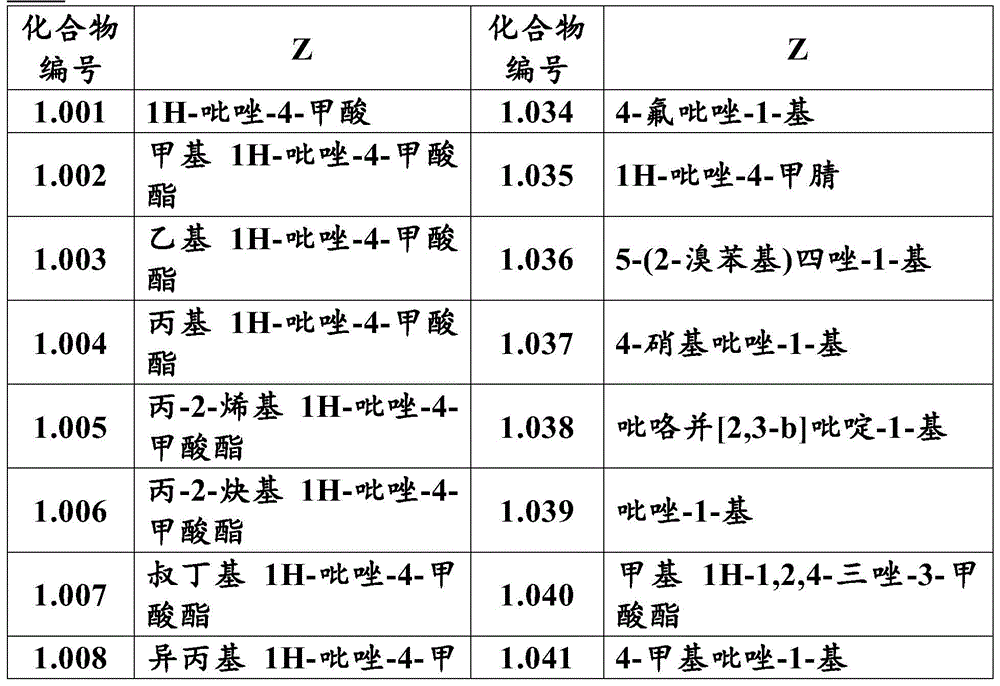


TABLE 1.2: the table discloses 65 specific compounds of formula (T-1) wherein A is 3, 5-thienyl and R 1 And R is 2 Is hydrogen and Z is as defined in Table 1 above.
TABLE 1.3: the table discloses 65 specific compounds of formula (T-1) wherein A is 2, 5-thienyl and R 1 Is hydrogen, R 2 Is methyl, and Z is as defined in table 1 above.
TABLE 2.1: the table discloses 372 specific compounds of formula (T-2):

wherein R is 1 Is hydrogen, Z is as defined in Table 2 below.
Table 2.2 (which follows Table 2.1) provides 372 individual compounds of the formula (T-2) in which R 1 As specifically defined in table 2.2, see table 2 (where Z is specifically defined).
TABLE 2


TABLE 2.2: the table discloses 372 specific compounds of formula (T-2) wherein R 1 Is methyl and Z is as defined in table 2 above.
For Z as defined in tables 1 and 2 above (except for compound numbers 1.034, 1.036 to 1.039, 1.041 to 1.043, 1.046 to 1.048, 1.050, 1.051, 1.053 to 1.065 identified as groups), the Z groups are disclosed as compounds in which available ring nitrogen (represented by the N-H group) is the point of attachment of the Z group of the compound of formula (I) to the remainder of the molecule according to the invention.
For example, the Z group of compound 1.001 (1H-pyrazole-4-carboxylic acid) in Table 1 is:

the Z group of compound 1.021 (N- (cyclopropylmethyl) -1H-pyrazole-4-carboxamide) in table 1 is:

the Z group of compound 1.035 (1H-pyrazole-4-carbonitrile) in Table 1 is:

the Z group of compound 1.049 (1H-pyrazole-4-carbaldehyde) in Table 1 is:
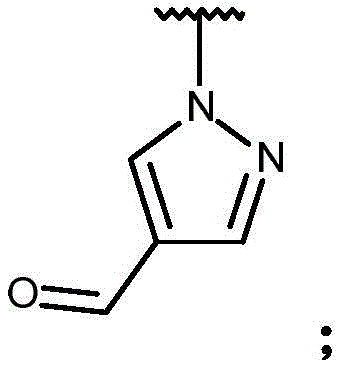
the Z group of compound 2.194 (isopropyl 1H-1,2, 4-triazole-3-carboxylate) in Table 2 is:

using the appropriate structural units (compounds of formulae (II) and (III)), the following general procedure is used in combination to provide compounds of formula (I). Compounds prepared by the following combination schemes were analyzed using LC/MS method B.
Examples
The following examples serve to illustrate the invention. The compounds of the invention may differ from the known compounds in greater efficacy at low application rates, as demonstrated by one of ordinary skill in the art using the experimental procedures outlined in the examples, using lower application rates (if necessary) such as 50ppm, 12.5ppm, 6ppm, 3ppm, 1.5ppm, 0.8ppm, or 0.2 ppm.
The compounds having formula (I) may have any number of benefits, including in particular advantageous levels of biological activity for protecting plants from diseases caused by fungi or superior properties for use as agrochemical active ingredients (e.g. higher biological activity, advantageous activity profile, increased safety (including improved crop tolerance), improved physico-chemical properties, or increased biodegradability).
Throughout this specification, temperature is given in degrees celsius (°c) and "mp" means melting point. LC/MS means liquid chromatography-mass spectrometry, and the description of the apparatus and method (methods A, B and C) is as follows:
the LC/MS apparatus and method a are described as follows:
SQ detector 2 from Waters
The ionization method comprises the following steps: electrospray
Polarity: positive and negative ions
Capillary (kV) 3.0, cone (V) 30.00, extractor (V) 2.00, source temperature (DEG C) 150, desolvation temperature (DEG C) 350, cone gas flow (L/Hr) 0, desolvation gas flow (L/Hr) 650
The mass range is as follows: 100 to 900Da
DAD wavelength range (nm): 210 to 500
The method uses the following HPLC gradient conditions of Watts ACQUITY UPLC:
( Solvent a: water/methanol 20:1+0.05% formic acid, and solvent B: acetonitrile +0.05% formic acid )

Column type: waters ACQUITY UPLC HSS T; column length: 30mm; column inner diameter: 2.1mm; particle size: 1.8 microns; temperature: 60 ℃.
The LC/MS apparatus and method B are described as follows:
SQ detector 2 from Waters
The ionization method comprises the following steps: electrospray
Polarity: positive ions
Capillary (kV) 3.5, cone (V) 30.00, extractor (V) 3.00, source temperature (DEG C) 150, desolvation temperature (DEG C) 400, cone gas flow (L/Hr) 60, desolvation gas flow (L/Hr) 700
The mass range is as follows: 140 to 800Da
DAD wavelength range (nm): 210 to 400
The method uses the following HPLC gradient conditions of Watts ACQUITY UPLC:
( Solvent a: water/methanol 9:1+0.1% formic acid, and solvent B: acetonitrile +0.1% formic acid )

Column type: waters ACQUITY UPLC HSS T; column length: 30mm; column inner diameter: 2.1mm; particle size: 1.8 microns; temperature: 60 ℃.
The LC/MS apparatus and method C are described as follows:
SQ detector 2 from Waters
The ionization method comprises the following steps: electrospray
Mass spectrometer ACQUITY H grade UPLC from Watts
Polarity: positive and negative polarity conversion
Scan type: MS1 scanning
Capillary (kV) 3.00, cone (V) 40.00, desolvation temperature (. Degree.C.) 500, cone gas flow rate (L/Hr) 50, desolvation gas flow rate (L/Hr) 1000
The mass range is as follows: 0 to 2000Da
DAD wavelength range (nm): 200 to 350
The method uses the following HPLC gradient conditions of Watts ACQUITY UPLC:
(solvent A: water+0.1% formic acid, and solvent B: acetonitrile)

Column type: waters ACQUITY UPLC BEH C; column length: 50mm; column inner diameter: 2.1mm; particle size: 1.7 microns; temperature: 35 ℃.
If necessary, the final compounds pure in the enantiomeric sense can be obtained from the racemic material via standard physical separation techniques (such as reverse phase chiral chromatography) or by stereoselective synthesis techniques (e.g., by using chiral starting materials) where appropriate.
Examples of formulations

The active ingredient is thoroughly mixed with the adjuvants and the mixture is thoroughly ground in a suitable mill to provide a wettable powder that can be diluted with water to give a suspension of the desired concentration.

The active ingredient is thoroughly mixed with the adjuvants and the mixture is thoroughly ground in a suitable mill to provide a powder that can be used directly in seed treatment.
Emulsifiable concentrate

Emulsions with any desired dilution that can be used in plant protection can be obtained from such concentrates by dilution with water.

The ready-to-use dust agent is obtained by mixing the active ingredient with a carrier and grinding the mixture in a suitable grinder. Such powders may also be used for dry dressing of seeds.
Extruder pellets
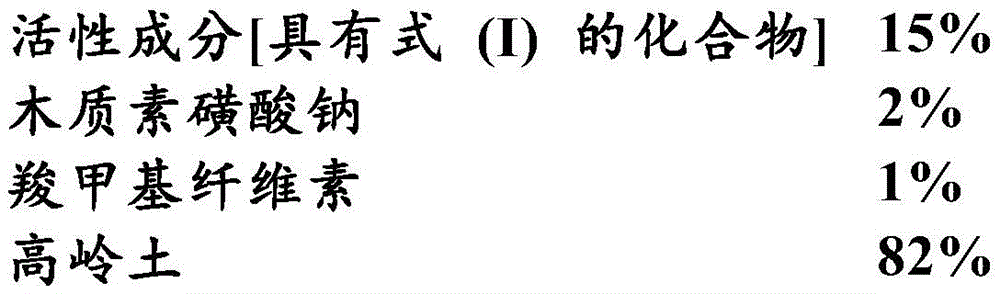
The active ingredient is mixed and ground with the adjuvants, and the mixture is wetted with water. The mixture is extruded and then dried in an air stream.
Coated granule
Active ingredient [ Compound having formula (I) ] 8%
Polyethylene glycol (molecular weight 200) 3%
Kaolin 89%
The finely ground active ingredient is applied uniformly in a mixer to kaolin wet with polyethylene glycol. In this way a dust-free coated granule is obtained.
Suspension concentrate

Finely ground active ingredient is intimately mixed with an adjuvant to give a suspension concentrate from which any desired dilution of the suspension can be obtained by dilution with water. Using such dilutions, living plants can be treated together with plant propagation material and protected against microbial infestation by spraying, watering or dipping.
Flowable concentrate for seed treatment


Finely ground active ingredient is intimately mixed with an adjuvant to give a suspension concentrate from which any desired dilution of the suspension can be obtained by dilution with water. Using such dilutions, living plants can be treated together with plant propagation material and protected against microbial infestation by spraying, watering or dipping.
Sustained release capsule suspension
28 parts of a combination of compounds of the formula I are mixed with 2 parts of an aromatic solvent and 7 parts of a toluene diisocyanate/polymethylene-polyphenyl isocyanate mixture (8:1). The mixture was emulsified in a mixture of 1.2 parts of polyvinyl alcohol, 0.05 parts of defoamer and 51.6 parts of water until the desired particle size was reached. To this emulsion was added 2.8 parts of a 1, 6-hexamethylenediamine mixture in 5.3 parts of water. The mixture was stirred until the polymerization was completed.
The capsule suspension obtained is stabilized by adding 0.25 parts of thickener and 3 parts of dispersant. The capsule suspension formulation contains 28% active ingredient. The diameter of the mesocapsules is 8-15 microns.
The resulting formulation is applied to the seeds as an aqueous suspension suitable for use in the device for this purpose.
AIBN = azobisisobutyronitrile
DMF = dimethylformamide
DMA = dimethylacetamide
Dipea=n, N-di-isopropyl ethylamine
EtOAc = ethyl acetate
Hcl=hydrochloric acid
mp = melting point
C = degrees celsius
Meoh=methanol
NaOH = sodium hydroxide
NBS = N-bromosuccinimide
min = min
rt=room temperature
h=h
TFAA = trifluoroacetic anhydride
THF = tetrahydrofuran
R t Retention time (in minutes)
LC/ms=liquid chromatography-mass spectrometry (descriptions of apparatus and methods for LC/MS analysis are given above)
Preparation example
Accordingly, the compounds of formula (I) may be prepared using the synthetic techniques described above and below.
Example 1: this example illustrates N, N-dimethyl-1- [ [5- [5- (trifluoromethyl) -1,2, 4-oxadiazol-3-yl ]]-2-thienyl]Methyl group]Preparation of 1,2, 4-triazol-3-amine (Compound 1.4 of Table T1)

Step 1: preparation of N' -hydroxy-5-methyl-thiophene-2-carboxamidine

To a suspension of 5-methylthiophene-2-carbonitrile (9.0 g,73 mmol) in ethanol (365 mL) was added triethylamine (20.6 mL,146 mmol) with stirring at room temperature, followed by the introduction of hydroxylamine hydrochloride (10.3 g,146 mmol) in portions. The reaction contents were heated at reflux for 3.5 hours, cooled to 25 ℃, and concentrated under reduced pressure to afford N' -hydroxy-5-methyl-thiophene-2-carboxamidine as a crude residue, which was used for the next conversion without further purification. LC/MS (method a) retention time = 0.24 minutes, 156 (m+h).
Step 2: preparation of 3- (5-methyl-2-thienyl) -5- (trifluoromethyl) -1,2, 4-oxadiazole

Pyridine (24 mL,292 mmol) was introduced into a suspension of crude N' -hydroxy-5-methyl-thiophene-2-carboxamidine (32.0 g) in tetrahydrofuran (1.0L), and the contents were cooled to 10 ℃. TFAA (30.9 mL,219 mL) was introduced drop-wise into the suspension. The reaction mixture was warmed to 25 ℃ overnight and then concentrated under reduced pressure. The residue was dissolved in ethyl acetate, and the mixture was taken up in 1M aqueous HCl, water and saturated Na 2 CO 3 Washing with aqueous solution. The organic layer was dried over sodium sulfate, filtered, and volatiles were removed under reduced pressure. The crude residue was purified by flash chromatography on silica gel (using a cyclohexane/EtOAc eluent gradient) to give 3- (5-methyl-2-thienyl) -5- (trifluoromethyl) -1,2, 4-oxadiazole (13.1 g,76% yield) as a clear oil. LC/MS (method a) retention time = 1.13 minutes, no mass was detected.
1 H NMR(400MHz,CDCl 3 )δppm:7.68(d,1H),6.84(d,1H),2.57(s,3H)。
19 F NMR(400MHz、CDCl 3 )δppm:-65.44(s)。
Step 3a:3- [5- (bromomethyl) -2-thienyl]Preparation of 5- (trifluoromethyl) -1,2, 4-oxadiazole

AIBN (0.93 g,5.6 mmol) and then NBS (11.02 g,61.3 mmol) were added to a solution of 3- (5-methyl-2-thienyl) -5- (trifluoromethyl) -1,2, 4-oxadiazole (13.1 g,55.7 mmol) and tetrachloromethane (111 mL) under argon. The contents were heated at 70 ℃ for 18 hours. The mixture was cooled to 25 ℃ and then diluted with dichloromethane and water. The layers were separated, the organic phase was dried over sodium sulfate and volatiles were removed under reduced pressure. The crude residue was purified by flash chromatography on silica gel (using a cyclohexane/EtOAc eluent gradient) to give 3- [5- (bromomethyl) -2-thienyl ] -5- (trifluoromethyl) -1,2, 4-oxadiazole (3.86 g,22% yield) as a yellow oil. LC/MS (method a) retention time = 1.14 minutes, no mass detected.
1 H NMR(400MHz,CDCl 3 )δppm:8.11(d,1H),7.55(d,1H),4.53(s,2H)。
19 F NMR(400MHz、CDCl 3 )δppm:-65.31(s)。
Isolation of 3- [5- (dibromomethyl) -2-thienyl ] -5- (trifluoromethyl) -1,2, 4-oxadiazole (13.0 g) as a yellow amorphous solid as a by-product

1 H NMR(400MHz,CDCl 3 )δppm:7.73(d,1H),7.32(d,1H),6.91(s,1H)。
Step 4: n, N-dimethyl-1- [ [5- [5- (trifluoromethyl) -1,2, 4-oxadiazol-3-yl]-2-thienyl]Nail armor
Base group]Preparation of 1,2, 4-triazol-3-amines
A solution of 3- [5- (bromomethyl) -2-thienyl ] -5- (trifluoromethyl) -1,2, 4-oxadiazole (150 mg,0.48 mmol), N-dimethyl-4H-1, 2, 4-triazol-3-amine (64 mg,0.57 mmol) and potassium carbonate (133 mg,0.96 mmol) in acetonitrile (6.0 mL) was stirred at room temperature overnight. The solid was removed by filtration, washed with ethyl acetate, and the volatiles were removed under reduced pressure. The resulting residue was purified by flash chromatography on silica gel (using a cyclohexane/EtOAc eluent gradient) to give N, N-dimethyl-1- [ [5- [5- (trifluoromethyl) -1,2, 4-oxadiazol-3-yl ] -2-thienyl ] methyl ] -1,2, 4-triazol-3-amine (49 mg,30% yield) as a yellow solid. LC/MS (method a) retention time=0.96 min, 345 (m+h). mp: 113-116 DEG C
1 H NMR(400MHz,CDCl 3 )δppm:7.78(s,1H),7.75(d,1H),7.11(d,1H),5.37(s,2H),2.99(s,6H)。
Example 2: this example illustrates methyl 1- [ [5- [5- (trifluoromethyl) -1,2, 4-oxadiazol-3-yl]-2-thienyl]Methyl group]Preparation of 1,2, 4-triazole-3-carboxylic acid ester (Compound 1.6 of Table T1)

A mixture of 3- [5- (bromomethyl) -2-thienyl ] -5- (trifluoromethyl) -1,2, 4-oxadiazole (1.0 g,3.2 mmol), methyl 1H-1,2, 4-triazole-3-carboxylate (610 mg,4.8 mmol) and potassium carbonate (640 mg,6.4 mmol) in acetonitrile (32 mL) was heated at 110℃for 2 hours. The resulting orange suspension was filtered to remove solids, and then the filtrate was concentrated under reduced pressure. The resulting crude residue was purified by silica gel chromatography (using a cyclohexane/ethyl acetate gradient) to give 750mg of the title compound as a white solid. LC/MS (method a) retention time=0.91 min, 360 (m+h).
1 H NMR(400MHz,CDCl 3 )δppm:8.25(s,1H),7.81(d,1H),7.22(d,1H),5.65(s,2H),4.05(s,3H)。
Methyl 2- [ [5- [5- (trifluoromethyl) -1,2, 4-oxadiazol-3-yl ] -2-thienyl ] methyl ] -1,2, 4-triazole-3-carboxylate (compound 1.55 of table T1) (306 mg), LC/MS (method a) retention time=0.91 min, 360 (m+h) was isolated as a by-product in the form of a colourless gum.

1 H NMR(400MHz,CDCl 3 )δppm:8.05(s,1H),7.75(d,1H),7.22(d,1H),6.50(s,2H),4.05(s,3H)。
Example 3: this example illustrates propyl 2- [ [5- [5- (trifluoromethyl) -1,2, 4-oxadiazol-3-yl]-2-thienyl]Methyl group]Preparation of 1,2, 4-triazole-3-carboxylic acid ester (Compound 1.44 of Table T1)

To a solution of methyl 2- [ [5- [5- (trifluoromethyl) -1,2, 4-oxadiazol-3-yl ] -2-thienyl ] methyl ] -1,2, 4-triazole-3-carboxylate (100 mg,0.27 mmol) and propanol (0.83 mL) was introduced concentrated sulfuric acid (0.01 mL). The white suspension was stirred at reflux for 12 hours during which time it became a clear solution. The reaction mixture was concentrated under reduced pressure and the residue was purified by flash chromatography on silica gel (gradient with cyclohexane/ethyl acetate) to give 47mg of the title compound as a colourless gum. LC/MS (method a) retention time=1.10 minutes 388 (m+h).
1 H NMR(400MHz,CDCl 3 )δppm:8.05(s,1H),7.75(d,1H),7.25(d,1H),6.05(s,2H),4.45(t,2H),1.85(m,2H),1.05(t,3H)。
Example 4: this example illustrates N-methyl-N-methoxy-2- [ [5- [5- (trifluoromethyl) -1,2, 4-oxadiazol-3-yl ]]-2-thienyl]Methyl group]Preparation of 1,2, 4-triazole-3-carboxamide (Compound 1.61 of Table T1)

To a solution of clear O-methylhydroxylamine hydrochloride (136 mg,1.67 mmol) in toluene (2 mL) was introduced dropwise diethylaluminum chloride (1M in toluene, 1.67mL,1.67 mmol). After 10 minutes methyl 2- [ [5- [5- (trifluoromethyl) -1,2, 4-oxadiazol-3-yl ] -2-thienyl ] methyl ] -1,2, 4-triazole-3-carboxylate (150 mg,0.41 mmol) was added and the mixture was heated at 70 ℃ for 12 hours. Quench the reaction with water (about 0.030 mL) and concentrate the suspension under reduced pressure. The resulting residue was purified by flash chromatography on silica gel (using a cyclohexane/ethyl acetate gradient) to give 64mg of the title compound as a white solid. m.p is 135-140 ℃; LC/MS (method a) retention time=0.93 min, 375 (m+h).
1 H NMR(400MHz,CDCl 3 )δppm:7.95(s,1H),7.75(d,1H),7.35(d,1H),6.12(s,2H),3.97(s,3H)。
Example 5: this example illustrates methyl 1- [ [5- [5- (trifluoromethyl) -1,2, 4-oxadiazol-3-yl]-2-thienyl]Methyl group]Preparation of pyrazole-3-carboxylic acid ester (Compound 1.53 of Table T1)

A mixture of 3- [5- (bromomethyl) -2-thienyl ] -5- (trifluoromethyl) -1,2, 4-oxadiazole (1.0 g,3.2 mmol), methyl 1H-pyrazole-3-carboxylate (600 mg,4.8 mmol) and potassium carbonate (660 mg,6.4 mmol) in acetonitrile (32 mL) was heated at 110℃for 2 hours. The orange suspension was filtered to remove solids, and then the filtrate was concentrated under reduced pressure. The resulting crude residue was purified by flash chromatography on silica gel (using a cyclohexane/ethyl acetate gradient) to give 610mg of the title compound as a white solid. LC/MS (method a) retention time=1.00 min, 359 (m+h).
1 H NMR(400MHz,CDCl 3 )δppm:7.78(d,1H),7.51(d,1H),7.12(d,1H),6.89(d,1H),5.61(s,2H),3.98(s,3H)。
Methyl 2- [ [5- [5- (trifluoromethyl) -1,2, 4-oxadiazol-3-yl ] -2-thienyl ] methyl ] pyrazole-3-carboxylate (compound 1.54 of table T1) was isolated as a by-product in the form of a white solid (274 mg). LC/MS (method a) retention time=1.10 minutes, 359 (m+h).

1 H NMR(400MHz,CDCl 3 )δppm:7.72(d,1H),7.58(d,1H),7.18(d,1H),6.89(d,1H),6.05(s,2H),3.98(s,3H)。
Example 6: this example illustrates ethyl 1- [ [5- [5- (trifluoromethyl) -1,2, 4-oxadiazol-3-yl]-2-thienyl]Methyl group]Preparation of pyrazole-3-carboxylic acid ester (Compound 1.42 of Table T1)

To a solution of methyl 1- [ [5- [5- (trifluoromethyl) -1,2, 4-oxadiazol-3-yl ] -2-thienyl ] methyl ] pyrazole-3-carboxylate (100 mg,0.27 mmol) and propanol (0.83 mL) was introduced concentrated sulfuric acid (0.01 mL). The white suspension was stirred at reflux for 2 hours during which time it became a clear solution. The reaction mixture was concentrated under reduced pressure and the resulting crude residue was purified by reverse phase column chromatography (using a water/acetonitrile eluent gradient) to give 20mg of the title compound as a white solid. mp: 120-124 ℃; LC/MS (method a) retention time=1.07 min, 373 (m+h).
1 H NMR(400MHz,CDCl 3 )δppm:7.71(d,1H),7.52(d,1H),7.12(d,1H),6.85(d,1H),5.62(s,2H),4.45(q,2H),1.45(t,3H)。
Example 7: this example illustrates N, N-dimethyl-2- [ [5- [5- (trifluoromethyl) -1,2, 4-oxadiazol-3-yl ]]-2-thienyl]Methyl group]Preparation of pyrazole-3-carboxamide (Compound 1.58 of Table T1)

To a solution of clear N-methyl methylamine hydrochloride (136 mg,1.67 mmol) in toluene (2 mL) was introduced dropwise diethylaluminum chloride (1M in toluene, 1.67mL,1.67 mmol). After 10 minutes methyl 2- [ [5- [5- (trifluoromethyl) -1,2, 4-oxadiazol-3-yl ] -2-thienyl ] methyl ] pyrazole-3-carboxylate (150 mg,0.41 mmol) was added and the mixture was heated at 70 ℃ for 12 hours. Quench the reaction with water (about 0.030 mL) and concentrate the suspension under reduced pressure. The resulting residue was purified by flash chromatography on silica gel (using a cyclohexane/ethyl acetate gradient) to give the title compound as a yellow gum (105 mg,67% yield). LC/MS (method a) retention time = 0.96 minutes, 372 (m+h).
1 H NMR(400MHz,CDCl 3 )δppm:7.71(d,1H),7.55(d,1H),7.12(d,1H),6.42(d,1H),5.78(s,2H),3.05(s,3H),3.15(s,3H)。
The following general procedure is carried out in combination using the appropriate structural units (compounds of formulae (II) and (III)) to provide compounds of formula (I). Compounds prepared by the following combination schemes were analyzed using LC/MS method B.
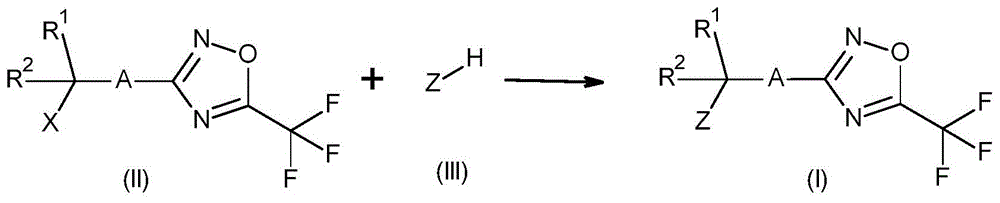
For example, a [ [5- (trifluoromethyl) -1,2, 4-oxadiazol-3-yl ] heteroaryl ] methyl bromide derivative (0.03 mmol) having formula (II) in acetonitrile (1.0 mL) was transferred to a microwave vial containing an amine derivative having formula (III) (0.03 mmol), potassium carbonate (0.06 mmol), and stirred for 20 minutes at 120 ℃ under microwave irradiation in a parallel microwave apparatus. The solvent was removed under a stream of nitrogen. The resulting crude residue was dissolved in a mixture of MeOH (250 μl) and DMA (500 μl) and directly presented for preparative LC/MS purification to provide compounds having formula (I). The structures of the isomers were assigned by NMR techniques.
If necessary, the final compounds pure in the enantiomeric sense can be obtained from the racemic material via standard physical separation techniques (such as reverse phase chiral chromatography) or by stereoselective synthesis techniques (e.g., by using chiral starting materials) where appropriate.
t Table T1: melting point (mp) data and/or retention time (R) of the compound according to formula (I):


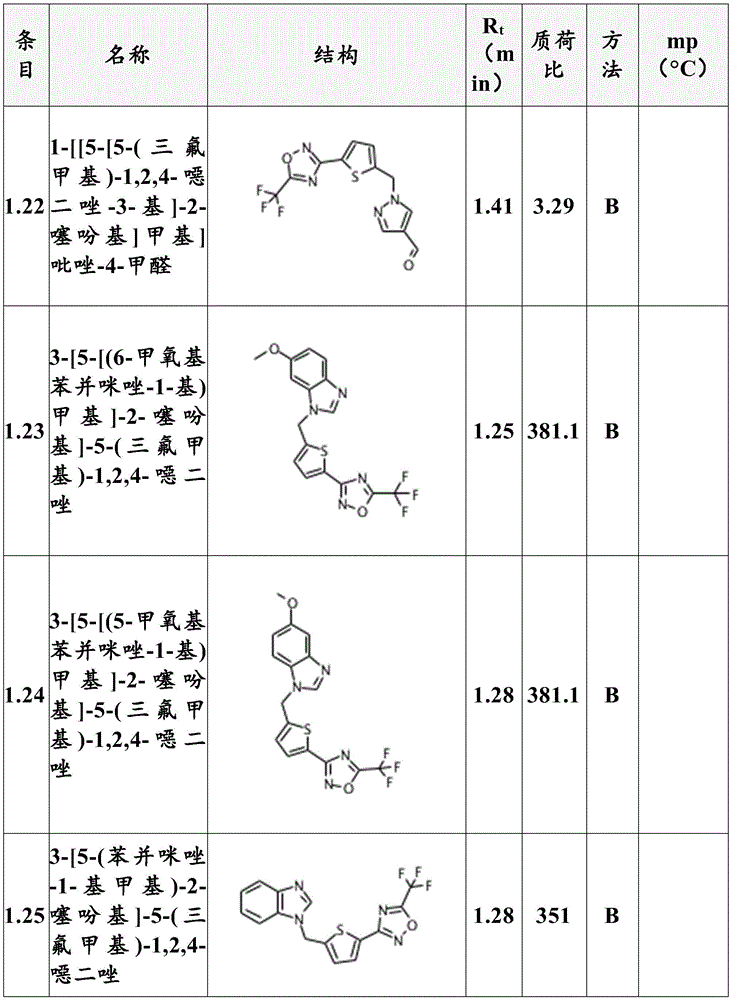


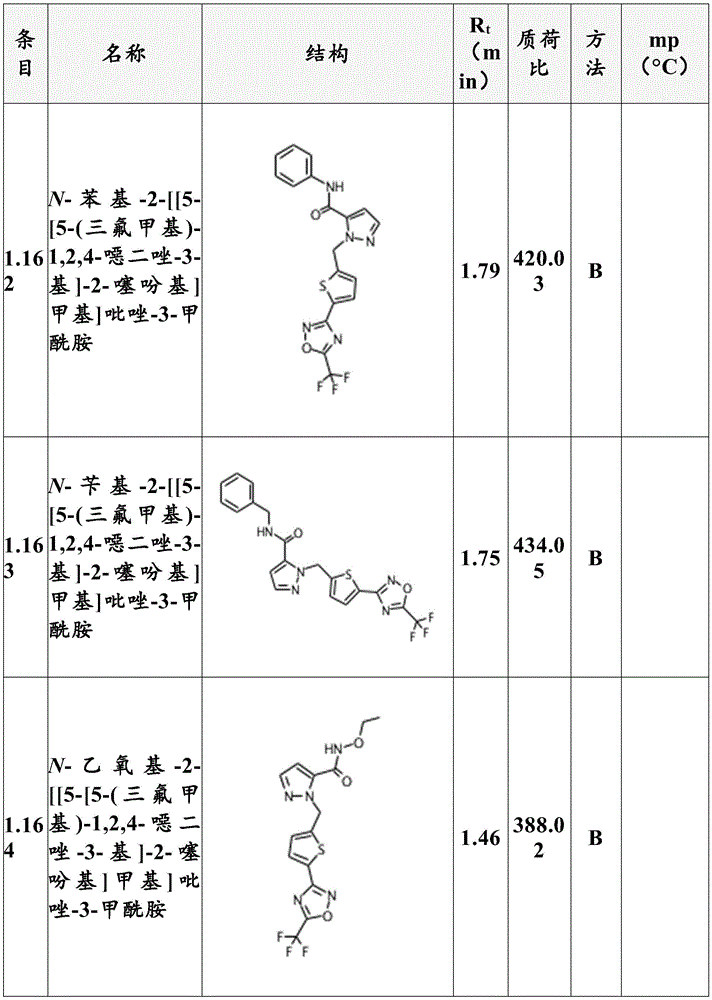


biological example
Leaf discs or segments of different plant species are cut from plants grown in the greenhouse. Cut leaf discs or leaves Duan Zhiyu were plated on water agar in multiwell plates (24 well format). Leaf discs were sprayed with the test solution either before (prophylactic) or after (therapeutic) inoculation. The compounds to be tested were prepared as DMSO solutions (max 10 mg/mL) and diluted to the appropriate concentration with 0.025% tween20 just before spraying. Inoculated leaf discs or leaf segments were incubated under defined conditions (temperature, relative humidity, light, etc.) according to the corresponding test system. Depending on the disease system, a single assessment of disease levels was made 3 to 14 days post inoculation. The percent disease control relative to untreated test leaf discs or segments is then calculated.
General examples of liquid culture tests in well plates:
Mycelium fragments or conidia of the fungus (freshly prepared from a liquid culture of the fungus or from a cryogenic storage) are directly mixed into the nutrient broth. A DMSO solution of test compound (max 10 mg/mL) was diluted by factor 50 with 0.025% Tween20 and 10 μl of this solution was pipetted into a microtiter plate (96 well format). A nutrient broth containing the fungal spore/mycelium fragments was then added to it, giving the final concentration of the test compound. The test plates were incubated at 24℃in the dark at 96% relative humidity. Inhibition of fungal growth was determined photometrically after 2 to 7 days depending on the disease system and the percentage of antifungal activity was calculated relative to untreated test.
Example 1: fungicidal activity against Puccinia recondita/wheat/leaf disc prophylaxis (brown rust disease)
Wheat leaf segment cultivars Kanzler was placed on agar in multiwell plates (24 well format) and sprayed with formulated test compound diluted in water. The leaf discs were inoculated with a spore suspension of the fungus 1 day after application. Inoculated leaf sections were incubated in a climatic chamber under a 12 hour illumination/12 hour darkness light regimen at 19 ℃ and 75% relative humidity (rh), and compound activity was assessed as percent disease control compared to untreated when appropriate levels of disease damage occurred in untreated test leaf sections (7 to 9 days post-application).
In this test, the following compounds gave at least 80% disease control at 200ppm in the administered formulation when compared to untreated control leaf discs showing extensive disease progression under the same conditions.
Compounds (from table T1) 1.1, 1.2, 1.3, 1.4, 1.5, 1.6, 1.7, 1.8, 1.9, 1.10, 1.11, 1.12, 1.13, 1.14, 1.16, 1.17, 1.18, 1.19, 1.21, 1.22, 1.23, 1.24, 1.25, 1.26, 1.30, 1.32, 1.33, 1.34, 1.35, 1.36, 1.37, 1.38, 1.39, 1.40, 1.41, 1.42, 1.43, 1.44, 1.45, 1.46, 1.47, 1.48, 1.49, 1.50, 1.51, 1.52, 1.53, 1.54, 1.55, 1.56, 1.57, 1.58, 1.59, 1.60, 1.61, 1.62, 1.63. 1.64, 1.66, 1.68, 1.70, 1.71, 1.73, 1.79, 1.82, 1.83, 1.84, 1.85, 1.88, 1.91, 1.94, 1.95, 1.96, 1.98, 1.100, 1.101, 1.102, 1.103, 1.105, 1.106, 1.109, 1.113, 1.115, 1.120, 1.122, 1.126, 1.128, 1.129, 1.130, 1.137, 1.140, 1.144, 1.145, 1.149, 1.151, 1.153, 1.155, 1.156, 1.157, 1.158, 1.159, 1.160, 1.161, 1.162, 1.163, 1.164, 1.165, 1.166, 1.167, 1.168, 1.169, 1.176, and 1.177.
Example 2: fungicidal activity/wheat/leaf disc therapies (brown rust) against Puccinia recondita
Wheat leaf segment cultivar Kanzler was placed on agar in multiwell plates (24 well format). The leaf segments are then inoculated with a spore suspension of the fungus. The plates were stored in the dark at 19℃and 75% relative humidity. 1 day after inoculation, the formulated test compound diluted in water is applied. In a climatic chamber, leaf sections were incubated at 19 ℃ and 75% relative humidity under a 12 hour illumination/12 hour darkness light regimen, and compound activity was assessed as percent disease control compared to untreated when appropriate levels of disease damage occurred in untreated test leaf sections (6 to 8 days post-application).
In this test, the following compounds gave at least 80% disease control at 200ppm in the administered formulation when compared to untreated control leaf discs showing extensive disease progression under the same conditions.
Compounds (from Table T1) 1.1, 1.2, 1.4, 1.6, 1.8, 1.9, 1.11, 1.13, 1.14, 1.16, 1.17, 1.19, 1.21, 1.22, 1.23, 1.24, 1.25, 1.30, 1.32, 1.33, 1.34, 1.35, 1.36, 1.37, 1.38, 1.39, 1.40, 1.41, 1.42, 1.43, 1.44, 1.45, 1.46, 1.47, 1.48, 1.49, 1.50, 1.51, 1.52, 1.53, 1.54, 1.55, 1.56, 1.57, 1.58, 1.59, 1.60, 1.39, 1.40 1.61, 1.63, 1.64, 1.66, 1.68, 1.70, 1.73, 1.79, 1.82, 1.83, 1.84, 1.85, 1.88, 1.91, 1.94, 1.95, 1.96, 1.98, 1.100, 1.101, 1.102, 1.103, 1.105, 1.106, 1.109, 1.113, 1.120, 1.122, 1.126, 1.128, 1.129, 1.130, 1.137, 1.140, 1.144, 1.145, 1.151, 1.153, 1.158, 1.160, 1.161, 1.164, 1.166, 1.168, 1.169, 1.176, and 1.177.
Example 3: fungicidal activity/soybean/leaf disc prophylaxis against phakopsora pachyrhizi (asian soybean rust disease)
Soybean leaf discs were placed on water agar in a multiwell plate (24 well format) and sprayed with formulated test compound diluted in water. One day after application, leaf discs were inoculated by spraying spore suspension on the lower leaf surface. Leaf discs were kept at 20 ℃ in a climatic chamber with 12h illumination/day and 75% rh after a 24-36 hour incubation period at 20 ℃ and 75% rh in the dark. When appropriate levels of disease damage occurred in the untreated test leaf discs (12 to 14 days post-administration), the activity of the compounds was assessed as percent disease control compared to untreated.
In this test, the following compounds gave at least 80% disease control at 200ppm in the administered formulation when compared to untreated control leaf discs showing extensive disease progression under the same conditions.
Compounds (from table T1) 1.1, 1.4, 1.6, 1.13, 1.14, 1.17, 1.19, 1.21, 1.23, 1.24, 1.25, 1.30, 1.32, 1.33, 1.34, 1.35, 1.38, 1.39, 1.40, 1.41, 1.42, 1.43, 1.44, 1.45, 1.46, 1.47, 1.48, 1.49, 1.50, 1.51, 1.52, 1.53, 1.54, 1.55, 1.56, 1.57, 1.58, 1.59, 1.60 and 1.61.
Example 4: fungicidal activity/cucumber/preventive method (charcoal) against liquid cultures of melon small clumps (cucurbita pepo)
Cellulitis disease
Fungal conidia from cryogenic storage were directly mixed into the nutrient broth (PDB-potato dextrose broth). After placing the (DMSO) solution of the test compound in a microtiter plate (96 well format), the nutrient broth containing the fungal spores is added. The test plates were incubated at 24 ℃ and inhibition of growth was measured photometrically 3 to 4 days after application.
In this test, the following compounds gave at least 80% disease control at 20ppm in the administered formulation when compared to untreated controls showing extensive disease progression under the same conditions.
Compounds (from table T1) 1.1, 1.2, 1.3, 1.4, 1.5, 1.6, 1.7, 1.8, 1.9, 1.10, 1.11, 1.12, 1.13, 1.14, 1.15, 1.16, 1.17, 1.18, 1.19, 1.20, 1.21, 1.22, 1.23, 1.24, 1.25, 1.26, 1.27, 1.28, 1.29, 1.30, 1.31, 1.32, 1.33, 1.34, 1.35, 1.36, 1.37, 1.38, 1.39, 1.40, 1.41, 1.42, 1.43, 1.44, 1.45, 1.46, 1.47, 1.48, 1.49, 1.50, 1.51, 1.52, 1.53, 1.54, 1.55, 1.57, 1.55. 1.59, 1.60, 1.61, 1.62, 1.64, 1.66, 1.68, 1.70, 1.71, 1.73, 1.79, 1.82, 1.84, 1.85, 1.88, 1.91, 1.94, 1.95, 1.96, 1.98, 1.100, 1.101, 1.102, 1.103, 1.105, 1.106, 1.109, 1.115, 1.120, 1.122, 1.126, 1.128, 1.129, 1.130, 1.137, 1.140, 1.144, 1.145, 1.149, 1.151, 1.153, 1.155, 1.156, 1.157, 1.158, 1.159, 1.160, 1.161, 1.162, 1.163, 1.164, 1.165, 1.166, 1.167, 1.168 and 1.169.
Claims (12)
1. A compound having the formula (I):

wherein the method comprises the steps of
A is A-1;

R 1 and R is 2 Independently represents hydrogen or methyl; and is also provided with
Z is selected from Z 1 、Z 2 Or Z is 3 The method comprises the steps of carrying out a first treatment on the surface of the Wherein the method comprises the steps of
Z 1 Represents a 4-to 6-membered non-aromatic heterocyclyl ring selected from:

wherein the heterocyclic group is optionally substituted with 1 or 2 substituents which may be the same or different and are selected from R 4 And wherein the heterocyclyl is further bound to the remainder of the molecule through a ring nitrogen;
R 4 represents cyano, halogen, hydroxy, amino, methyl, ethyl, difluoromethyl, trifluoromethyl, methoxy, N-methylamino or N, N-dimethylamino;
Z 2 represents a 5-membered heteroaryl ring selected from

Wherein the heteroaryl is optionally substituted with 1 or 2 groups selected from R 5 1 is selected from R 6 Or 1 substituent selected from R 5 And 1 substituent selected from R 6 And wherein the heteroaryl is further bound to the remainder of the molecule through a ring nitrogen;
R 5 represents hydroxy, amino, cyano, halogen, formyl, nitro, C 1-4 Alkyl, C 1-4 Alkoxy, C 3-4 Alkenyl, C 3-4 Alkynyl, C 3-4 Alkenyloxy, C 3-4 Alkynyloxy, cyano C 1-2 Alkyl, C 1-2 Haloalkyl, hydroxy C 1-2 Alkyl, C 1-2 Alkoxy C 1-2 Alkyl, C 1-2 Alkoxy C 1-2 Alkoxy C 1-2 Alkyl, N-dimethylamino, C 1-3 Alkoxycarbonyl group C 1-2 Alkyl, C 1-3 Alkylcarbonyloxy C 1-2 Alkyl, N-C 1-3 Alkylaminocarbonyl group C 1-2 Alkyl, N-di C 1-3 Alkylaminocarbonyl group C 1-2 Alkyl, C 1-2 Alkylsulfonyl, C 1-3 Alkylcarbonyl, C 1-3 Alkyl dicarbonyl, C 1-3 Alkoxydicarbonyl, N-C 1-3 Alkylaminodicarbonyl, or N, N-di-C 1-3 An alkylamino dicarbonyl; or alternatively
R 5 represents-C (O) N (R) a )(R b ) Wherein:
R a represents hydrogen, C 1-6 Alkyl, C 3-4 Alkenyl, C 3-4 Alkynyl, C 1-3 Haloalkyl, C 3-4 Haloalkenyl, C 1-4 Alkoxy, C 1-2 Alkoxy C 1-3 Alkyl, C 2-3 Haloalkoxy, C 3-4 Alkenyloxy, C 3-4 Alkynyloxy, N-C 1-3 Alkylamino or N, N-di-C 1-2 An alkylamino group; or alternatively
R a Represent C 3-5 Cycloalkyl; c (C) 3-5 Cycloalkyl C 1-2 An alkyl group; a phenyl group; phenyl C 1-2 An alkyl group; a heterocyclyl, wherein the heterocyclyl moiety is a 4-to 6-membered non-aromatic ring comprising 1 or 2 heteroatoms independently selected from N, O or S, provided that the heterocyclyl cannot contain 2 consecutive atoms selected from O and S; heteroaryl or heteroaryl C 1-2 An alkyl group, wherein the heteroaryl moiety is a 5-or 6-membered aromatic ring containing 1, 2, 3, or 4 heteroatoms independently selected from N, O and S; wherein the cycloalkyl, phenyl, heterocyclyl or heteroaryl group is optionally substituted with 1 or 2 substituents which may be the same or different and are selected from hydroxy, amino, formyl, acyl, cyano, halogen, methyl, trifluoromethyl, methoxy or N, N-dimethylamino, and Wherein when R is a When cycloalkyl or heterocyclyl, these rings optionally contain 1 member selected from C (O) or S (O) 2 Is a group of (2); and is also provided with
R b Represents hydrogen, methyl, ethyl, propyl, prop-2-enyl, prop-2-ynyl, cyclopropyl or cyclopropylmethyl; or alternatively
R a And R is b Together with the nitrogen atom they share form an azetidinyl ring, a pyrrolidinyl ring, an isoxazolidinyl ring, a morpholino ring, a piperazin-4-yl ring or a piperidinyl ring, said rings being optionally substituted with 1 or 2 groups selected from halogen, methyl, ethyl or methoxy; or alternatively
R 5 represents-C (O) O-R c Wherein:
R c represents hydrogen; c (C) 1-6 An alkyl group; c (C) 3-5 Alkenyl groups; c (C) 3-5 Alkynyl; c (C) 1-3 A haloalkyl group; c (C) 3-4 A haloalkenyl group; n, N-di C 1-3 Alkylamino C 1-3 An alkyl group; c (C) 3-6 Cycloalkyl; c (C) 3-4 Cycloalkyl C 1-2 An alkyl group; a phenyl group; a heterocyclyl, wherein the heterocyclyl moiety is a 4-to 6-membered non-aromatic ring comprising 1 or 2 heteroatoms independently selected from O, S and N, provided that the heterocyclyl cannot contain 2 consecutive atoms selected from O and S; heteroaryl, wherein the heteroaryl moiety is a 5-or 6-membered aromatic ring comprising 1, 2, or 3 heteroatoms independently selected from N, O and S; and wherein the cycloalkyl, phenyl, heterocyclyl or heteroaryl is optionally substituted with 1 or 2 substituents which may be the same or different and are selected from hydroxy, amino, formyl, methylcarbonyl, cyano, halogen, methyl, trifluoromethyl, methoxy or N, N-dimethylamino, and wherein when R c When cycloalkyl or heterocyclyl, these rings optionally contain 1 member selected from C (O) or S (O) 2 Is a group of (2); or alternatively
R 5 represents-N (R) d )(R e ) or-C 1-2 alkyl-N (R) d )(R e ) Wherein
R d Represent C 1-3 Alkyl, C 3-4 Alkenyl, C 3-4 Alkynyl, methylcarbonyl, methoxycarbonyl, N-methylaminocarbonylA group, N-dimethylaminocarbonyl, N-methoxyaminocarbonyl, N-methyl-N-methoxy-aminocarbonyl, methylsulfonyl, N-methylaminosulfonyl, N-dimethylaminosulfonyl, methyldicarbonyl, N-methylaminodicarbonyl, or N, N-dimethylaminodicarbonyl; and is also provided with
R e Represents hydrogen, methyl, ethyl, or propyl; or alternatively
R d And R is e Together with the nitrogen atom they share form an azetidinyl ring, a pyrrolidinyl ring, an isoxazolidinyl ring, a morpholino ring, a piperazin-4-yl ring or a piperidinyl ring, said rings being optionally substituted with 1 or 2 groups selected from halogen, methyl, ethyl or methoxy; or alternatively
R 5 Represents-ch=n (R f ) Wherein R is f Represent C 1-4 Alkyl, C 1-4 Alkoxy, C 2-4 Alkenyloxy, or C 2-4 Alkynyloxy;
R 6 represent C 3-6 Cycloalkyl; a phenyl group; heteroaryl, wherein the heteroaryl moiety is a 5-or 6-membered aromatic ring comprising 1, 2, 3, or 4 heteroatoms independently selected from N, O and S; a heterocyclyl, wherein the heterocyclyl moiety is a 4-to 6-membered non-aromatic ring comprising 1 or 2 heteroatoms independently selected from N, O and S; and wherein the cycloalkyl, phenyl, heteroaryl and heterocyclyl groups are optionally substituted with 1 or 2 substituents which may be the same or different and are selected from hydroxy, amino, formyl, acyl, cyano, halogen, methyl, trifluoromethyl, methoxy, N-dimethylamino, and wherein when R 6 When cycloalkyl or heterocyclyl, these rings optionally contain 1 member selected from C (O) or S (O) 2 Is a group of (2); and
Z 3 represents a heterobicyclic group selected from:

wherein said heterobicyclic group is optionally substituted with 1 member selected from R 7 And wherein the heterobicyclic group is further substituted by a ringNitrogen is bound to the remainder of the molecule; and is also provided with
R 7 Is cyano, fluoro, chloro, amino, hydroxy, methyl, difluoromethyl, trifluoromethyl, methoxy, N-dimethylamino, formyl, methylcarbonyl, methoxycarbonyl, N-methylaminocarbonyl, or N, N-dimethylaminocarbonyl;
or a salt thereof.
2. The compound of claim 1, wherein R 1 And R is 2 Is hydrogen.
3. The compound of claim 1, wherein R 4 Selected from methyl or ethyl.
4. The compound of claim 1, wherein R 5 Independently selected from hydroxyl groups; an amino group; cyano group; halogen; a formyl group; a nitro group; c (C) 1-4 An alkyl group; c (C) 1-4 An alkoxy group; c (C) 1-2 A haloalkyl group; c (C) 1-2 Alkoxy C 1-2 An alkyl group; n, N-dimethylamino; -C (O) O-R c Wherein R is c Is C 1-4 An alkyl group; and-C (O) N (R) a )(R b ) Wherein R is a Selected from hydrogen, C 1-4 Alkyl or C 1-4 Alkoxy, and R b Selected from hydrogen or methyl; and is also provided with
R 6 Is phenyl optionally substituted with 1 or 2 substituents, which may be the same or different, selected from hydroxy, methyl, methoxy, cyano, fluoro, chloro or bromo.
5. The compound of claim 4, wherein R 5 Selected from amino, cyano, chloro, fluoro, formyl, nitro, methyl, ethyl, difluoromethyl, methoxymethyl, N-dimethylamino, methoxycarbonyl, ethoxycarbonyl or N-propoxycarbonyl; and is also provided with
R 6 Is phenyl optionally substituted with 1 or 2 substituents, which may be the same or different, selected from fluorine, chlorine or bromine.
6. The compound of claim 1, wherein Z 2 Optionally by 1 or 2 groups selected from R 5 Is substituted by a substituent of (a).
7. The compound of claim 1, wherein R 7 Selected from hydroxy, methoxy, methyl, cyano, fluoro or chloro.
8. An agrochemical composition comprising a fungicidally effective amount of a compound of formula (I) according to any one of claims 1 to 7.
9. The composition of claim 8, further comprising at least one additional active ingredient and/or an agrochemically acceptable diluent or carrier.
10. A method for controlling or preventing infestation of useful plants by phytopathogenic microorganisms, wherein a fungicidally effective amount of a compound of formula (I) according to any of claims 1 to 7, or a composition comprising the compound as active ingredient, is applied to the plants, parts thereof or the locus thereof.
11. Use of a compound of formula (I) according to any one of claims 1 to 7 as fungicide, with the exception of methods for the treatment of the human or animal body by surgery or therapy and diagnostic methods carried out on the human or animal body.
12. The compound of claim 1, wherein the compound is selected from the group consisting of:


Applications Claiming Priority (7)
| Application Number | Priority Date | Filing Date | Title |
|---|---|---|---|
| EP17159202.5 | 2017-03-03 | ||
| EP17159202 | 2017-03-03 | ||
| EP17160411.9 | 2017-03-10 | ||
| EP17160411 | 2017-03-10 | ||
| IN201711043196 | 2017-12-01 | ||
| IN201711043196 | 2017-12-01 | ||
| PCT/EP2018/055042 WO2018158365A1 (en) | 2017-03-03 | 2018-03-01 | Microbiocidal oxadiazole derivatives |
Publications (2)
| Publication Number | Publication Date |
|---|---|
| CN110382492A CN110382492A (en) | 2019-10-25 |
| CN110382492B true CN110382492B (en) | 2023-07-14 |
Family
ID=61557278
Family Applications (1)
| Application Number | Title | Priority Date | Filing Date |
|---|---|---|---|
| CN201880014967.1A Active CN110382492B (en) | 2017-03-03 | 2018-03-01 | Microbicidal oxadiazole derivatives |
Country Status (11)
| Country | Link |
|---|---|
| US (1) | US11358957B2 (en) |
| EP (1) | EP3589629A1 (en) |
| JP (1) | JP2020510670A (en) |
| CN (1) | CN110382492B (en) |
| BR (1) | BR112019018238B1 (en) |
| CL (1) | CL2019002512A1 (en) |
| CO (1) | CO2019009262A2 (en) |
| IL (1) | IL269023B (en) |
| MX (1) | MX2019010261A (en) |
| UY (1) | UY37623A (en) |
| WO (1) | WO2018158365A1 (en) |
Families Citing this family (201)
| Publication number | Priority date | Publication date | Assignee | Title |
|---|---|---|---|---|
| TWI886480B (en) | 2017-04-06 | 2025-06-11 | 美商富曼西公司 | Fungicidal oxadiazoles |
| CA3090133A1 (en) | 2018-01-30 | 2019-08-08 | Pi Industries Ltd. | Oxadiazoles for use in controlling phytopathogenic fungi |
| WO2020007658A1 (en) * | 2018-07-02 | 2020-01-09 | Syngenta Crop Protection Ag | 3-(2-thienyl)-5-(trifluoromethyl)-1,2,4-oxadiazole derivatives as agrochemical fungicides |
| WO2020165403A1 (en) | 2019-02-15 | 2020-08-20 | Syngenta Crop Protection Ag | Phenyl substituted thiazole derivatives as microbiocidal compounds |
| ES2953140T3 (en) | 2019-03-08 | 2023-11-08 | Syngenta Crop Protection Ag | Pesticide-active azole-amide compounds |
| BR112021018495A2 (en) | 2019-03-20 | 2021-11-30 | Syngenta Crop Protection Ag | Pesticide-active azolamide compounds |
| JP2022525967A (en) | 2019-03-20 | 2022-05-20 | シンジェンタ クロップ プロテクション アクチェンゲゼルシャフト | Pesticide active azoleamide compound |
| EP3941914A1 (en) | 2019-03-22 | 2022-01-26 | Syngenta Crop Protection AG | N-[1-(5-bromo-2-pyrimidin-2-yl-1,2,4-triazol-3-yl)ethyl]-2-cyclopropyl-6-(trifluoromethyl)pyridine-4-carboxamide derivatives and related compounds as insecticides |
| GB201903942D0 (en) | 2019-03-22 | 2019-05-08 | Syngenta Crop Protection Ag | Microbiocidal compounds |
| JP7472163B2 (en) | 2019-03-27 | 2024-04-22 | シンジェンタ クロップ プロテクション アクチェンゲゼルシャフト | Microbicidal thiazole derivatives |
| UY38623A (en) | 2019-03-29 | 2020-10-30 | Syngenta Crop Protection Ag | DIAZINE-AMIDE COMPOUNDS ACTIVE AS PESTICIDES |
| MX2021012162A (en) | 2019-04-05 | 2021-11-03 | Syngenta Crop Protection Ag | Pesticidally active diazine-amide compounds. |
| WO2020208095A1 (en) | 2019-04-10 | 2020-10-15 | Syngenta Crop Protection Ag | Microbiocidal picolinamide derivatives |
| MX2021012352A (en) | 2019-04-10 | 2022-01-18 | Syngenta Crop Protection Ag | FUNGICIDAL COMPOSITIONS. |
| PE20220172A1 (en) | 2019-04-11 | 2022-01-28 | Syngenta Crop Protection Ag | DIAZINE-AMIDE COMPOUNDS ACTIVE AS PESTICIDES |
| AR119011A1 (en) | 2019-05-29 | 2021-11-17 | Syngenta Crop Protection Ag | DERIVATIVES OF [1,3]DIOXOLO[4,5-c]PYRIDINE-4-CARBOXAMIDE, AGROCHEMICAL COMPOSITIONS THAT COMPRISE THEM AND THEIR USE AS FUNGICIDE TO CONTROL OR PREVENT THE INFESTATION OF USEFUL PLANTS |
| AR119009A1 (en) | 2019-05-29 | 2021-11-17 | Syngenta Crop Protection Ag | MICROBICIDE ALCOPYPYRIDINE AND ALCOXYPYRIMIDINE DERIVATIVES |
| CN113924294B (en) | 2019-05-29 | 2024-12-06 | 先正达农作物保护股份公司 | Microbicidal derivatives |
| EP3976610A1 (en) | 2019-05-29 | 2022-04-06 | Syngenta Crop Protection AG | Microbiocidal derivatives |
| US12171231B2 (en) * | 2019-06-21 | 2024-12-24 | Nihon Nohyaku Co., Ltd. | Oxadiazole compounds or salts thereof, agrohorticultural fungicides containing the compounds, and methods of using the same |
| EP3994124A1 (en) | 2019-07-05 | 2022-05-11 | Syngenta Crop Protection AG | Microbiocidal picolinamide derivatives |
| GB201910037D0 (en) | 2019-07-12 | 2019-08-28 | Syngenta Crop Protection Ag | Microbiocidal compounds |
| AR119774A1 (en) | 2019-08-19 | 2022-01-12 | Pi Industries Ltd | OXADIAZOLE COMPOUNDS CONTAINING A 5-MEMBER HETEROAROMATIC RING TO CONTROL OR PREVENT PHYTOPATHOGENIC FUNGI |
| JP2022545266A (en) | 2019-08-23 | 2022-10-26 | シンジェンタ クロップ プロテクション アクチェンゲゼルシャフト | Pesticidal active pyrazine-amide compounds |
| GB201912595D0 (en) | 2019-09-02 | 2019-10-16 | Syngenta Crop Protection Ag | Plant growth regulator compounds |
| UY38885A (en) | 2019-09-20 | 2021-04-30 | Syngenta Crop Protection Ag | PESTICIDALLY ACTIVE COMPOUNDS OF AZETIDINIL-, PYRROLIDINIL-, PIPERDINIL- OR PIPERAZINYL-PYRIDINYL CARBONYL |
| CN114450280B (en) | 2019-09-20 | 2025-02-25 | 先正达农作物保护股份公司 | Pesticide-active heterocyclic derivatives having sulfur-containing and sulfoximine substituents |
| BR112022008131A2 (en) | 2019-11-01 | 2022-07-19 | Syngenta Crop Protection Ag | PESTICIDALLY ACTIVE FUSED BICYCLIC HETEROAROMATIC COMPOUNDS |
| WO2021090865A1 (en) * | 2019-11-07 | 2021-05-14 | 日本農薬株式会社 | Oxadiazoline compound or salts thereof, agricultural and horticultural bactericide containing said compound, and method for using same |
| BR112022010522A2 (en) | 2019-12-04 | 2022-08-16 | Syngenta Crop Protection Ag | HETEROAROMATIC, BICYCLIC, FUSED AND PESTICIDELY ACTIVE AMINO COMPOUNDS |
| WO2021122645A1 (en) | 2019-12-20 | 2021-06-24 | Syngenta Crop Protection Ag | Pesticidally active azole-amide compounds |
| WO2021136722A1 (en) | 2019-12-31 | 2021-07-08 | Syngenta Crop Protection Ag | Pesticidally active heterocyclic derivatives with sulfur containing substituents |
| TW202132300A (en) | 2020-01-06 | 2021-09-01 | 瑞士商先正達農作物保護公司 | Pesticidally active heterocyclic derivatives with sulfur containing substituents |
| WO2021148639A1 (en) | 2020-01-24 | 2021-07-29 | Syngenta Crop Protection Ag | Pesticidally active fused bicyclic heteroaromatic compounds |
| JP2023513047A (en) | 2020-01-30 | 2023-03-30 | シンジェンタ クロップ プロテクション アクチェンゲゼルシャフト | Pesticidal effective condensed bicyclic aromatic heterocyclic amino compounds |
| BR112022015723A2 (en) | 2020-02-11 | 2023-02-14 | Syngenta Crop Protection Ag | PESTICIDLY ACTIVE CYCLIC AMINE COMPOUNDS |
| BR112022017093A2 (en) | 2020-02-27 | 2023-02-14 | Syngenta Crop Protection Ag | DIAZINE-BISAMIDE COMPOUNDS ACTIVE IN PESTICIDE TERMS |
| WO2021175822A1 (en) | 2020-03-02 | 2021-09-10 | Syngenta Crop Protection Ag | Pesticidally amidine-substituted benzoic acid amide compounds |
| AU2021232616A1 (en) | 2020-03-05 | 2022-09-22 | Syngenta Crop Protection Ag | Fungicidal compositions |
| UY39115A (en) | 2020-03-05 | 2021-10-29 | Syngenta Crop Protection Ag | FUNGICIDE MIXTURES OF ARYL METHOXYACRYLATE DERIVATIVES |
| EP4117435A1 (en) | 2020-03-13 | 2023-01-18 | Syngenta Crop Protection AG | Methods of controlling or preventing infestation of plants by the phytopathogenic microorganism corynespora cassiicola |
| CN115279186A (en) | 2020-03-13 | 2022-11-01 | 先正达农作物保护股份公司 | Method for controlling or preventing plant infection by phytopathogen microorganism corynespora polymorpha |
| EP4117438A1 (en) | 2020-03-13 | 2023-01-18 | Syngenta Crop Protection AG | Methods of controlling or preventing infestation of plants by the phytopathogenic microorganism corynespora cassiicola |
| AR121734A1 (en) | 2020-04-08 | 2022-07-06 | Syngenta Crop Protection Ag | DIHYDROPYRROLOPYRAZINE TYPE MICROBICIDE DERIVATIVES OF QUINOLINE |
| AR121733A1 (en) | 2020-04-08 | 2022-07-06 | Syngenta Crop Protection Ag | MICROBIOCIDE DERIVATIVES OF THE DIHYDRO-(THIAZINE)OXAZINE TYPE OF QUINOLINE |
| BR112022020239A2 (en) | 2020-04-08 | 2022-11-22 | Syngenta Crop Protection Ag | QUINOLINE DERIVATIVES DIHYDRO-(THIAZINE)OXAZINE MICROBIOCIDES |
| WO2021213929A1 (en) | 2020-04-20 | 2021-10-28 | Syngenta Crop Protection Ag | Pesticidally active substituted 1,3-dihydro-2h-imidazo[4,5-c]pyridin-2-one derivatives with sulfur containing substituents |
| JP7746286B2 (en) | 2020-04-30 | 2025-09-30 | シンジェンタ クロップ プロテクション アクチェンゲゼルシャフト | Pesticidal Active Heterocyclic Derivatives with Sulfur-Containing Substituents - Patent application |
| GB202006399D0 (en) | 2020-04-30 | 2020-06-17 | Syngenta Crop Protection Ag | Microbiocidal compounds |
| GB202006386D0 (en) | 2020-04-30 | 2020-06-17 | Syngenta Crop Protection Ag | Microbiocidal Compounds |
| GB202006480D0 (en) | 2020-05-01 | 2020-06-17 | Syngenta Crop Protection Ag | Microbiocidal compounds |
| GB202006606D0 (en) | 2020-05-05 | 2020-06-17 | Syngenta Crop Protection Ag | Microbiocidal compounds |
| WO2021224409A1 (en) | 2020-05-06 | 2021-11-11 | Syngenta Crop Protection Ag | Pesticidally active heterocyclic derivatives with sulfur containing substituents |
| AU2021284955A1 (en) | 2020-06-03 | 2022-12-15 | Syngenta Crop Protection Ag | Fungicidal compositions |
| EP4161277A1 (en) | 2020-06-03 | 2023-04-12 | Syngenta Crop Protection AG | Fungicidal compositions |
| GEAP202416125A (en) | 2020-06-03 | 2024-06-10 | Syngenta Crop Protection Ag | Microbiocidal derivatives |
| WO2022013417A1 (en) | 2020-07-17 | 2022-01-20 | Syngenta Crop Protection Ag | Pesticidally active heterocyclic derivatives with sulfur containing substituents |
| WO2022017975A1 (en) | 2020-07-18 | 2022-01-27 | Syngenta Crop Protection Ag | Pesticidally active heterocyclic derivatives with sulfur containing substituents |
| EP4204409B1 (en) | 2020-08-31 | 2025-12-24 | Syngenta Crop Protection AG | Pesticidally active heterocyclic derivatives with sulfur containing substituents |
| US20230348496A1 (en) | 2020-09-01 | 2023-11-02 | Syngenta Crop Protection Ag | Pesticidally active heterocyclic derivatives with sulfur containing substituents |
| GB202013756D0 (en) | 2020-09-02 | 2020-10-14 | Syngenta Crop Protection Ag | Plant growth regulator compounds |
| BR112023003939A2 (en) | 2020-09-02 | 2023-04-11 | Syngenta Crop Protection Ag | HETEROCYCLIC DERIVATIVES WITH PESTICIDE ACTIVITY, HAVING SULFUR-CONTAINING SUBSTITUENTS |
| EP4208447A1 (en) | 2020-09-02 | 2023-07-12 | Syngenta Crop Protection AG | Pesticidally active heterocyclic derivatives with sulfur containing substituents |
| UY39411A (en) | 2020-09-09 | 2022-04-29 | Syngenta Crop Protection Ag | PESTICIDICALLY ACTIVE INDAZOLIL PYRAZOLE[3,4-C] PYRIDINE DERIVATIVES WITH SULFUR-CONTAINING SUBSTITUENTS |
| GB202014840D0 (en) | 2020-09-21 | 2020-11-04 | Syngenta Crop Protection Ag | Microbiocidal compounds |
| AR124276A1 (en) | 2020-10-22 | 2023-03-15 | Syngenta Crop Protection Ag | PLANT GROWTH REGULATORY COMPOUNDS |
| WO2022101265A1 (en) | 2020-11-13 | 2022-05-19 | Syngenta Crop Protection Ag | Pesticidally active fused bicyclic heteroaromatic compounds |
| UY39544A (en) | 2020-12-02 | 2022-06-30 | Syngenta Crop Protection Ag | FUNGICIDE COMPOSITIONS COMPRISING A MIXTURE OF COMPONENTS (A) AND (B) AS ACTIVE PRINCIPLES |
| WO2022117650A1 (en) | 2020-12-02 | 2022-06-09 | Syngenta Crop Protection Ag | Fungicidal compositions |
| WO2022157334A1 (en) | 2021-01-21 | 2022-07-28 | Syngenta Crop Protection Ag | Pesticidally active heterocyclic derivatives with sulfur containing substituents |
| US20240397947A1 (en) | 2021-01-22 | 2024-12-05 | Syngenta Crop Protection Ag | Method for the control or suppression of phytopathogenic bacteria |
| JP2024506253A (en) | 2021-01-23 | 2024-02-13 | シンジェンタ クロップ プロテクション アクチェンゲゼルシャフト | Pesticide-effective aromatic heterocyclic compounds |
| WO2022207479A1 (en) | 2021-03-27 | 2022-10-06 | Syngenta Crop Protection Ag | Microbiocidal isonicotinic amide derivatives |
| WO2022207462A1 (en) | 2021-03-30 | 2022-10-06 | Syngenta Crop Protection Ag | Pesticidally active cyclic amine compounds |
| UY39696A (en) | 2021-03-31 | 2022-10-31 | Syngenta Crop Protection Ag | MICROBIOCIDA DERIVATIVES OF QUINOLIN/QUINOXALIN-BENZOTHIAZINE AS FUNGICIDAL AGENTS, IN PARTICULAR C |
| AR125342A1 (en) | 2021-04-16 | 2023-07-05 | Syngenta Crop Protection Ag | CYCLIC AMINE COMPOUNDS ACTIVE AS PESTICIDES |
| EP4326710A1 (en) | 2021-04-20 | 2024-02-28 | Syngenta Crop Protection AG | Microbiocidal quinoline/quinoxaline isoquinoline derivatives |
| AU2022269255B2 (en) | 2021-05-04 | 2025-09-11 | Syngenta Crop Protection Ag | Use of clethodim for insect control |
| BR112023025112A2 (en) | 2021-06-01 | 2024-02-20 | Syngenta Crop Protection Ag | TETRAHYDROISOQUINOLINE MICROBIOCIDE DERIVATIVES |
| PH12023553272A1 (en) | 2021-06-02 | 2024-04-22 | Syngenta Crop Protection Ag | Pesticidally active heterocyclic derivatives with sulfoximine containing substituents |
| US20240287047A1 (en) | 2021-06-09 | 2024-08-29 | Syngenta Crop Protection Ag | Pesticidally active diazine-amide compounds |
| EP4359408A1 (en) | 2021-06-24 | 2024-05-01 | Syngenta Crop Protection AG | 2-[3-[1 [(quinazolin-4-yl)amino]ethyl]pyrazin-2-yl]thiazole-5-carbonitrile derivatives and similar compounds as pesticides |
| AU2022301674A1 (en) | 2021-07-02 | 2023-12-21 | Syngenta Crop Protection Ag | Use of fluazifop-p-butyl for insect control |
| EP4376616A1 (en) | 2021-07-27 | 2024-06-05 | Syngenta Crop Protection AG | Method for controlling diamide resistant pests & compounds therefor |
| AU2022318251A1 (en) | 2021-07-29 | 2024-01-25 | Syngenta Crop Protection Ag | Pesticidally active fused bicyclic heteroaromatic compounds |
| CR20240051A (en) | 2021-08-02 | 2024-03-18 | Syngenta Crop Protection Ag | Microbiocidal pyrazole derivatives |
| US20240308988A1 (en) | 2021-08-05 | 2024-09-19 | Syngenta Crop Protection Ag | Method For Controlling Diamide Resistant Pests and Compounds Therefor |
| AR126729A1 (en) | 2021-08-10 | 2023-11-08 | Syngenta Crop Protection Ag | FUNGICIDE MIXTURE |
| US20250145640A1 (en) | 2021-08-10 | 2025-05-08 | Syngenta Crop Protection Ag | 2,2-difluoro-5h-[1,3]dioxolo[4,5-f]isoindol-7-one derivatives as pesticides |
| JP2024532152A (en) | 2021-08-19 | 2024-09-05 | シンジェンタ クロップ プロテクション アクチェンゲゼルシャフト | Method for controlling diamide-resistant pests and compounds therefor |
| IL312020A (en) | 2021-10-14 | 2024-06-01 | Syngenta Crop Protection Ag | IMIDAZO[1,2-A]PYRIDINE DERIVATIVES |
| UY39992A (en) | 2021-10-25 | 2023-05-15 | Syngenta Crop Protection Ag | Heterocyclic derivatives active as pesticides with sulfur-containing substituents |
| JP2024540115A (en) | 2021-10-27 | 2024-10-31 | シンジェンタ クロップ プロテクション アクチェンゲゼルシャフト | Pesticidal Active Pyridazinone Compounds. |
| EP4422404A1 (en) | 2021-10-29 | 2024-09-04 | Syngenta Crop Protection AG | Fungicidal compositions |
| EP4422402A1 (en) | 2021-10-29 | 2024-09-04 | Syngenta Crop Protection AG | Fungicidal compositions comprising fludioxonil |
| CN118265702A (en) | 2021-11-19 | 2024-06-28 | 先正达农作物保护股份公司 | Microbicidal isonicotinamide derivatives |
| WO2023094303A1 (en) | 2021-11-25 | 2023-06-01 | Syngenta Crop Protection Ag | Microbiocidal heterobiaryl amide derivatives |
| WO2023094304A1 (en) | 2021-11-25 | 2023-06-01 | Syngenta Crop Protection Ag | Microbiocidal heterobiaryl amide derivatives |
| CA3238010A1 (en) | 2021-12-02 | 2023-06-08 | Andrew Edmunds | Fungicidal compositions |
| CN118891256A (en) | 2021-12-10 | 2024-11-01 | 先正达农作物保护股份公司 | Pesticidal activity pyridazinone compounds of (A) |
| WO2023110710A1 (en) | 2021-12-13 | 2023-06-22 | Syngenta Crop Protection Ag | Method for controlling diamide resistant pests & compounds therefor |
| AR127922A1 (en) | 2021-12-15 | 2024-03-13 | Syngenta Crop Protection Ag | BICYCLIC HETEROCYCLIC DERIVATIVES MICROBIOCIDES |
| EP4197333A1 (en) | 2021-12-15 | 2023-06-21 | Syngenta Crop Protection AG | Method for controlling diamide resistant pests & compounds therefor |
| WO2023111215A1 (en) | 2021-12-17 | 2023-06-22 | Syngenta Crop Protection Ag | Microbiocidal pyridine-substituted benzothiazine derivatives |
| CN118368986A (en) | 2021-12-17 | 2024-07-19 | 先正达农作物保护股份公司 | Microbicidal pyrazole derivatives |
| CA3240879A1 (en) | 2021-12-17 | 2023-06-22 | Claire BOYLES | Fungicidal compositions |
| EP4451882A1 (en) | 2021-12-22 | 2024-10-30 | Syngenta Crop Protection AG | Fungicidal compositions |
| WO2023118011A1 (en) | 2021-12-22 | 2023-06-29 | Syngenta Crop Protection Ag | Microbiocidal aza-heterobiaryl derivatives |
| WO2023118434A1 (en) | 2021-12-22 | 2023-06-29 | Globachem Nv | Pesticidally active amide compounds |
| WO2023139166A1 (en) | 2022-01-19 | 2023-07-27 | Syngenta Crop Protection Ag | Methods for controlling plant pathogens |
| WO2023148206A1 (en) | 2022-02-02 | 2023-08-10 | Syngenta Crop Protection Ag | Microbiocidal n-amide derivatives |
| UY40139A (en) | 2022-02-07 | 2023-08-31 | Syngenta Crop Protection Ag | IMIDAZO[1,2-A]PYRIDIN-2-YL]-1-PYRAZOLO[3,4-C]PYRIDINE DERIVATIVES ACTIVE AS PESTICIDES WITH SUBSTITUTES |
| UY40138A (en) | 2022-02-07 | 2023-08-31 | Syngenta Crop Protection Ag | PYRAZOLO[3,4-C]PYRIDIN-5-YL]-2-QUINOXALINE OR 2-QUINOLINE DERIVATIVES ACTIVE AS PESTICIDES WITH THEIR |
| WO2023166067A1 (en) | 2022-03-02 | 2023-09-07 | Syngenta Crop Protection Ag | Microbiocidal pyridazinone amide derivatives |
| UY40202A (en) | 2022-04-01 | 2023-10-31 | Syngenta Crop Protection Ag | Pyrazolopyridine derivatives active as pesticides with sulfur-containing substituents |
| AR129158A1 (en) | 2022-04-29 | 2024-07-24 | Syngenta Crop Protection Ag | FUNGICIDAL COMPOSITIONS OF METARYLPICOXAMID |
| AR129265A1 (en) | 2022-05-12 | 2024-08-07 | Syngenta Crop Protection Ag | ALKOXY-HETEROARYL-CARBOXAMIDE OR THIOAMIDE COMPOUNDS |
| JP2025520650A (en) | 2022-06-21 | 2025-07-03 | シンジェンタ クロップ プロテクション アクチェンゲゼルシャフト | Pesticidal Active Fused Bicyclic Aromatic Heterocyclic Compounds |
| AR129535A1 (en) | 2022-06-21 | 2024-09-04 | Syngenta Crop Protection Ag | HETEROCYCLIC BICYCLIC CARBOXAMIDE DERIVATIVES MICROBIOCIDES |
| WO2024008567A1 (en) | 2022-07-07 | 2024-01-11 | Syngenta Crop Protection Ag | Precision application devices and compositions |
| IL318054A (en) | 2022-07-21 | 2025-02-01 | Syngenta Crop Protection Ag | Crystalline forms of 1,2,4-oxadiazole fungicides |
| KR20250036910A (en) | 2022-07-22 | 2025-03-14 | 신젠타 크롭 프로텍션 아게 | Solid form of heterocyclic amide derivative |
| WO2024022910A1 (en) | 2022-07-26 | 2024-02-01 | Syngenta Crop Protection Ag | 1-[1-[2-(pyrimidin-4-yl)-1,2,4-triazol-3-yl]ethyl]-3-[2,4-dichloro-5-phenyl]urea derivatives and similar compounds as pesticides |
| WO2024033374A1 (en) | 2022-08-11 | 2024-02-15 | Syngenta Crop Protection Ag | Novel arylcarboxamide or arylthioamide compounds |
| TW202412626A (en) | 2022-08-16 | 2024-04-01 | 瑞士商先正達農作物保護股份公司 | New use |
| JP2025532590A (en) | 2022-09-16 | 2025-10-01 | シンジェンタ クロップ プロテクション アクチェンゲゼルシャフト | Pesticidally active cyclic amine compounds |
| AR130569A1 (en) | 2022-09-28 | 2024-12-18 | Syngenta Crop Protection Ag | FUNGICIDAL COMPOSITIONS |
| AR130567A1 (en) | 2022-09-28 | 2024-12-18 | Syngenta Crop Protection Ag | FUNGICIDAL COMPOSITIONS |
| GB202214203D0 (en) | 2022-09-28 | 2022-11-09 | Syngenta Crop Protection Ag | Fungicidal compositions |
| TW202430514A (en) | 2022-09-30 | 2024-08-01 | 瑞士商先正達農作物保護股份公司 | Microbiocidal pyrazole derivatives |
| TW202430031A (en) | 2022-09-30 | 2024-08-01 | 瑞士商先正達農作物保護股份公司 | Microbiocidal pyrazole derivatives |
| WO2024089023A1 (en) | 2022-10-25 | 2024-05-02 | Syngenta Crop Protection Ag | Pesticidally active heterocyclic derivatives with sulfur containing substituents |
| WO2024089191A1 (en) | 2022-10-27 | 2024-05-02 | Syngenta Crop Protection Ag | Microbiocidal heterobicyclic dihydrooxadiazine derivatives |
| WO2024089216A1 (en) | 2022-10-27 | 2024-05-02 | Syngenta Crop Protection Ag | Novel sulfur-containing heteroaryl carboxamide compounds |
| WO2024094575A1 (en) | 2022-10-31 | 2024-05-10 | Syngenta Crop Protection Ag | Pesticidally active heterocyclic derivatives with sulfur containing substituents |
| WO2024100069A1 (en) | 2022-11-08 | 2024-05-16 | Syngenta Crop Protection Ag | Microbiocidal pyridine derivatives |
| TW202434557A (en) | 2022-11-09 | 2024-09-01 | 瑞士商先正達農作物保護股份公司 | Microbiocidal pyrazole derivatives |
| TW202434579A (en) | 2022-11-16 | 2024-09-01 | 瑞士商先正達農作物保護股份公司 | Microbiocidal tetrahydroisoquinoline derivatives |
| WO2024110554A1 (en) | 2022-11-23 | 2024-05-30 | Syngenta Crop Protection Ag | N-[(1 -[2-[6-(pyridazin-3-yl]-1,2,4-triazol-3-yl]ethyl]-quinazolin-4-amine and n-[1-[3-(6-(pyridazin-3-yl)pyrazin-2-yl]ethyl]-8-quinazolin-4-amine derivatives as pesticides |
| WO2024110215A1 (en) | 2022-11-24 | 2024-05-30 | Syngenta Crop Protection Ag | Pesticidally active cyclic amine compounds |
| CN120344511A (en) | 2022-11-29 | 2025-07-18 | 先正达农作物保护股份公司 | Microbicidal tetrahydroisoquinoline derivatives |
| TW202439972A (en) | 2022-11-30 | 2024-10-16 | 瑞士商先正達農作物保護股份公司 | Fungicidal compositions |
| EP4626882A1 (en) | 2022-11-30 | 2025-10-08 | Syngenta Crop Protection AG | Microbiocidal tetrahydroisoquinoline derivatives |
| WO2024126388A1 (en) | 2022-12-12 | 2024-06-20 | Syngenta Crop Protection Ag | Pesticidally active heterocyclic derivatives with sulfur containing substituents |
| EP4634178A1 (en) | 2022-12-14 | 2025-10-22 | Syngenta Crop Protection AG | Imidazo[1,2-a]pyridine derivatives |
| EP4634152A1 (en) | 2022-12-15 | 2025-10-22 | Syngenta Crop Protection AG | Novel bicyclic-carboxamide compounds useful as pesticides |
| WO2024126407A1 (en) | 2022-12-16 | 2024-06-20 | Syngenta Crop Protection Ag | Benzimidazole derivatives |
| EP4638425A1 (en) | 2022-12-19 | 2025-10-29 | Syngenta Crop Protection AG | Microbiocidal pyridazine dihydrooxadiazine derivatives |
| WO2024132895A1 (en) | 2022-12-19 | 2024-06-27 | Syngenta Crop Protection Ag | Microbiocidal dihydrooxadiazinyl pyridazinone compounds |
| WO2024133426A1 (en) | 2022-12-21 | 2024-06-27 | Syngenta Crop Protection Ag | Method for controlling diamide resistant pests and compounds therefor |
| WO2024133551A1 (en) | 2022-12-21 | 2024-06-27 | Syngenta Crop Protection Ag | Pesticidally active pyridazine compounds |
| AR131541A1 (en) | 2023-01-07 | 2025-04-09 | Syngenta Crop Protection Ag | NOVEL CARBOXAMIDE COMPOUNDS |
| EP4655293A1 (en) | 2023-01-23 | 2025-12-03 | Syngenta Crop Protection AG | Pesticidally active heterocyclic derivatives with sulfur containing substituents |
| AR131667A1 (en) | 2023-01-27 | 2025-04-16 | Syngenta Crop Protection Ag | PYRAZOLE DERIVATIVES MICROBIOCIDES |
| AR131665A1 (en) | 2023-02-01 | 2025-04-16 | Syngenta Crop Protection Ag | FUNGICIDAL COMPOSITIONS |
| CN120693061A (en) | 2023-02-13 | 2025-09-23 | 先正达农作物保护股份公司 | Bicyclic compounds with pesticidal activity |
| WO2024170484A1 (en) | 2023-02-13 | 2024-08-22 | Globachem Nv | Pesticidally active amide compounds |
| WO2024170365A1 (en) | 2023-02-14 | 2024-08-22 | Syngenta Crop Protection Ag | Composition comprising cyprodinil and lactose-based filler |
| WO2025201636A1 (en) | 2023-03-31 | 2025-10-02 | Syngenta Crop Protection Ag | Pesticidally-active 2,2-dihalocyclopropyl compounds |
| WO2024213653A1 (en) | 2023-04-13 | 2024-10-17 | Syngenta Crop Protection Ag | Imidazo[1,2-a]pyridine derivatives |
| AR132358A1 (en) | 2023-04-13 | 2025-06-18 | Syngenta Crop Protection Ag | BICYCLIC IMIDAZO DERIVATIVES |
| TW202446263A (en) | 2023-04-13 | 2024-12-01 | 瑞士商先正達農作物保護股份公司 | Fungicidal compositions |
| AR132351A1 (en) | 2023-04-13 | 2025-06-18 | Syngenta Crop Protection Ag | IMIDAZO[1,2-A]PYRAZINE DERIVATIVES |
| WO2024213650A1 (en) | 2023-04-13 | 2024-10-17 | Syngenta Crop Protection Ag | Imidazo[1,2-a]pyridine derivatives |
| AR132354A1 (en) | 2023-04-13 | 2025-06-18 | Syngenta Crop Protection Ag | PYRAZOLO[1,5-A]PYRIDINE DERIVATIVES |
| WO2024213651A1 (en) | 2023-04-13 | 2024-10-17 | Syngenta Crop Protection Ag | Imidazo[1,2-a]pyridine derivatives |
| AR132352A1 (en) | 2023-04-13 | 2025-06-18 | Syngenta Crop Protection Ag | IMIDAZO[1,2-A]PYRAZINE DERIVATIVES |
| AR132353A1 (en) | 2023-04-13 | 2025-06-18 | Syngenta Crop Protection Ag | PYRAZOLO[1,5-A]PYRIDINE DERIVATIVES |
| WO2025214612A1 (en) | 2023-04-14 | 2025-10-16 | Syngenta Crop Protection Ag | Pesticidally-active 2,2-dihalocyclopropyl compounds |
| WO2024217995A1 (en) | 2023-04-20 | 2024-10-24 | Syngenta Crop Protection Ag | Pesticidally active dihydropyridinone derivatives |
| WO2025261608A1 (en) | 2023-06-29 | 2025-12-26 | Syngenta Crop Protection Ag | Pesticidally-active 2,2-dihalocyclopropyl compounds |
| WO2026002399A1 (en) | 2023-07-07 | 2026-01-02 | Syngenta Crop Protection Ag | Pesticidally-active 2,2-dihalocyclopropyl compounds |
| WO2025021537A1 (en) | 2023-07-21 | 2025-01-30 | Syngenta Crop Protection Ag | Benzimidazole derivatives |
| WO2025022008A1 (en) | 2023-07-27 | 2025-01-30 | Syngenta Crop Protection Ag | Pesticidally active quinazoline compounds |
| WO2025022007A1 (en) | 2023-07-27 | 2025-01-30 | Syngenta Crop Protection Ag | Pesticidally active quinazoline compounds |
| WO2026017247A1 (en) | 2023-07-28 | 2026-01-22 | Syngenta Crop Protection Ag | Pesticidally-active 2,2-dihalocyclopropyl compounds |
| WO2025032129A1 (en) | 2023-08-08 | 2025-02-13 | Syngenta Crop Protection Ag | Novel aminoindane and aminotetraline compounds |
| WO2025045835A1 (en) | 2023-08-30 | 2025-03-06 | Syngenta Crop Protection Ag | Pesticidally active oxoindole compounds |
| WO2025045837A1 (en) | 2023-08-31 | 2025-03-06 | Syngenta Crop Protection Ag | Pesticidally active indazole compounds |
| WO2025045838A2 (en) | 2023-08-31 | 2025-03-06 | Syngenta Crop Protection Ag | Pesticidally active benzisothiazole compounds |
| WO2025087761A1 (en) | 2023-10-27 | 2025-05-01 | Syngenta Crop Protection Ag | Pesticidally active cyclic amine compounds |
| WO2025104032A1 (en) | 2023-11-14 | 2025-05-22 | Syngenta Crop Protection Ag | Novel carboxamide compounds |
| WO2025109114A1 (en) | 2023-11-24 | 2025-05-30 | Syngenta Crop Protection Ag | Novel carboxamide compounds |
| WO2025120070A1 (en) | 2023-12-08 | 2025-06-12 | Syngenta Crop Protection Ag | Polymorphs of a methoxyacrylate derivative |
| WO2025132349A1 (en) | 2023-12-19 | 2025-06-26 | Syngenta Crop Protection Ag | Pesticidally active quinazoline compounds |
| WO2025132754A1 (en) | 2023-12-21 | 2025-06-26 | Syngenta Crop Protection Ag | Pesticidally active quinazoline compounds |
| WO2025132758A1 (en) | 2023-12-21 | 2025-06-26 | Syngenta Crop Protection Ag | Pesticidally active quinazoline compounds |
| WO2025149637A1 (en) | 2024-01-12 | 2025-07-17 | Syngenta Crop Protection Ag | Novel carboxamide compounds |
| WO2025149629A1 (en) | 2024-01-12 | 2025-07-17 | Syngenta Crop Protection Ag | Novel carboxamide compounds |
| WO2025247783A1 (en) | 2024-05-29 | 2025-12-04 | Syngenta Crop Protection Ag | Pesticidally active dihydro-benzoxazinone compounds |
| WO2025248032A1 (en) | 2024-05-31 | 2025-12-04 | Syngenta Crop Protection Ag | Pesticidally active indazole compounds |
| WO2025252553A1 (en) | 2024-06-04 | 2025-12-11 | Syngenta Crop Protection Ag | Pesticidally-active 2,2-dihalocyclopropyl compounds |
| WO2025252556A1 (en) | 2024-06-05 | 2025-12-11 | Syngenta Crop Protection Ag | Pesticidally-active 2,2-dihalocyclopropyl compounds |
| WO2025252655A1 (en) | 2024-06-06 | 2025-12-11 | Syngenta Crop Protection Ag | Pesticidally active pyridopyrimidone compounds |
| WO2025257024A1 (en) | 2024-06-12 | 2025-12-18 | Syngenta Crop Protection Ag | Fungicidal compositions |
| WO2025257023A1 (en) | 2024-06-12 | 2025-12-18 | Syngenta Crop Protection Ag | Fungicidal compositions |
| WO2025256333A1 (en) | 2024-06-13 | 2025-12-18 | Syngenta Crop Protection Ag | Pesticidally active aminoheterocycle derivatives |
| WO2025257413A1 (en) | 2024-06-13 | 2025-12-18 | Syngenta Crop Protection Ag | Pecticidally active dihydroazole derivatives |
| WO2025257072A1 (en) | 2024-06-14 | 2025-12-18 | Syngenta Crop Protection Ag | Pesticidally active 2-oxobenzimidazole compounds |
| EP4667451A1 (en) | 2024-06-21 | 2025-12-24 | Syngenta Crop Protection AG | Pesticidally-active 2,2-dihalocyclopropyl compounds |
| WO2026008750A1 (en) | 2024-07-05 | 2026-01-08 | Syngenta Crop Protection Ag | Novel carboxamide compounds |
Citations (4)
| Publication number | Priority date | Publication date | Assignee | Title |
|---|---|---|---|---|
| EP0276432A2 (en) * | 1986-12-12 | 1988-08-03 | Ciba-Geigy Ag | Pesticides |
| WO2009029632A1 (en) * | 2007-08-27 | 2009-03-05 | Helicon Therapeutics, Inc. | Therapeutic isoxazole compounds |
| WO2015185485A1 (en) * | 2014-06-06 | 2015-12-10 | Basf Se | Use of substituted oxadiazoles for combating phytopathogenic fungi |
| CN108289449A (en) * | 2015-11-19 | 2018-07-17 | 巴斯夫欧洲公司 | Qu Dai oxadiazoles for preventing and kill off plant pathogenic fungi |
Family Cites Families (84)
| Publication number | Priority date | Publication date | Assignee | Title |
|---|---|---|---|---|
| FR2211008A5 (en) | 1972-12-18 | 1974-07-12 | Pepro | |
| JPS61107392A (en) | 1984-10-31 | 1986-05-26 | 株式会社東芝 | Image processing system |
| BR8600161A (en) | 1985-01-18 | 1986-09-23 | Plant Genetic Systems Nv | CHEMICAL GENE, HYBRID, INTERMEDIATE PLASMIDIO VECTORS, PROCESS TO CONTROL INSECTS IN AGRICULTURE OR HORTICULTURE, INSECTICIDE COMPOSITION, PROCESS TO TRANSFORM PLANT CELLS TO EXPRESS A PLANTINIDE TOXIN, PRODUCED BY CULTURES, UNITED BY BACILLA |
| ZA879329B (en) * | 1986-12-12 | 1988-06-13 | Ciba-Geigy Ag | Pesticides |
| AU613521B2 (en) | 1988-09-02 | 1991-08-01 | Sankyo Company Limited | 13-substituted milbemycin derivatives, their preparation and use |
| US5169629A (en) | 1988-11-01 | 1992-12-08 | Mycogen Corporation | Process of controlling lepidopteran pests, using bacillus thuringiensis isolate denoted b.t ps81gg |
| EP0374753A3 (en) | 1988-12-19 | 1991-05-29 | American Cyanamid Company | Insecticidal toxines, genes coding therefor, antibodies binding them, transgenic plant cells and plants expressing these toxines |
| US5015630A (en) | 1989-01-19 | 1991-05-14 | Merck & Co., Inc. | 5-oxime avermectin derivatives |
| NO176766C (en) | 1989-02-07 | 1995-05-24 | Meiji Seika Kaisha | Process for the preparation of a compound having anthelmintic activity |
| GB8910624D0 (en) | 1989-05-09 | 1989-06-21 | Ici Plc | Bacterial strains |
| ES2074547T3 (en) | 1989-11-07 | 1995-09-16 | Pioneer Hi Bred Int | LARVICID LECTINES, AND INDUCED RESISTANCE OF PLANTS TO INSECTS. |
| JPH085894B2 (en) | 1990-03-01 | 1996-01-24 | 三共株式会社 | Milbemycin ether derivative |
| JPH0570366A (en) | 1991-03-08 | 1993-03-23 | Meiji Seika Kaisha Ltd | Composition for medicine |
| UA48104C2 (en) | 1991-10-04 | 2002-08-15 | Новартіс Аг | Dna fragment including sequence that codes an insecticide protein with optimization for corn, dna fragment providing directed preferable for the stem core expression of the structural gene of the plant related to it, dna fragment providing specific for the pollen expression of related to it structural gene in the plant, recombinant dna molecule, method for obtaining a coding sequence of the insecticide protein optimized for corn, method of corn plants protection at least against one pest insect |
| ATE211466T1 (en) | 1992-03-17 | 2002-01-15 | Fujisawa Pharmaceutical Co | DEPSIPEPTIDES, PRODUCTION AND USE |
| UA39936C2 (en) | 1992-04-28 | 2001-07-16 | Йашима Кемікал Індастрі Ко., Лтд | 2-(2,6-difluorophenyl)-4-(2-ethoxy-4-tert-butylphenyl)-2-oxazoline, method of miticide treatment and miticide composition |
| DE4317458A1 (en) | 1992-06-11 | 1993-12-16 | Bayer Ag | Use of cyclic depsipeptides with 18 ring atoms for the control of endoparasites, new cyclic depsipeptides with 18 ring atoms and process for their preparation |
| AU666750B2 (en) | 1992-09-01 | 1996-02-22 | Novartis Animal Health K.K. | Novel processes for the production of 13-ether derivatives of milbemycins, and novel intermediates therefor |
| GB9300883D0 (en) | 1993-01-18 | 1993-03-10 | Pfizer Ltd | Antiparasitic agents |
| KR100309091B1 (en) | 1993-02-19 | 2001-12-28 | 이치로 키타사토 | Derivatives of cyclic Defsipeptide PF 1022 |
| DE4317457A1 (en) | 1993-05-26 | 1994-12-01 | Bayer Ag | Octacyclodepsipeptides with endoparasiticidal activity |
| JP2767161B2 (en) | 1994-01-14 | 1998-06-18 | ファイザー製薬株式会社 | Antiparasitic pyrrolobenzoxazine compounds |
| GB9402916D0 (en) | 1994-02-16 | 1994-04-06 | Pfizer Ltd | Antiparasitic agents |
| US5530195A (en) | 1994-06-10 | 1996-06-25 | Ciba-Geigy Corporation | Bacillus thuringiensis gene encoding a toxin active against insects |
| DE4437198A1 (en) | 1994-10-18 | 1996-04-25 | Bayer Ag | Process for sulfonylation, sulfenylation and phosphorylation of cyclic depsipeptides |
| DE4440193A1 (en) | 1994-11-10 | 1996-05-15 | Bayer Ag | Use of dioxomorpholines to control endoparasites, new dioxomorpholines and processes for their production |
| DE19520936A1 (en) | 1995-06-08 | 1996-12-12 | Bayer Ag | Ectoparasiticides means |
| ES2176697T3 (en) | 1996-03-11 | 2002-12-01 | Syngenta Participations Ag | PIRIMIDIN-4-ONA DERIVATIVES AS PESTICIDES. |
| CN100353846C (en) | 2000-08-25 | 2007-12-12 | 辛根塔参与股份公司 | New insecticidal toxins from Bacillus thuringiensis insecticidal crystal proteins |
| US7230167B2 (en) | 2001-08-31 | 2007-06-12 | Syngenta Participations Ag | Modified Cry3A toxins and nucleic acid sequences coding therefor |
| EP1482940A2 (en) | 2001-10-03 | 2004-12-08 | Pharmacia Corporation | Prodrugs of substituted polycyclic compounds useful for selective inhibition of the coagulation cascade |
| AR037328A1 (en) | 2001-10-23 | 2004-11-03 | Dow Agrosciences Llc | COMPOSITE OF [7-BENCIL-2,6-DIOXO-1,5-DIOXONAN-3-IL] -4-METOXIPIRIDIN-2-CARBOXAMIDE, COMPOSITION THAT UNDERSTANDS AND METHOD THAT USES IT |
| WO2003052073A2 (en) | 2001-12-17 | 2003-06-26 | Syngenta Participations Ag | Novel corn event |
| US6919298B2 (en) | 2002-04-04 | 2005-07-19 | Valent Biosciences Corporation | Enhanced herbicide composition |
| GB0303439D0 (en) | 2003-02-14 | 2003-03-19 | Pfizer Ltd | Antiparasitic terpene alkaloids |
| WO2005070917A1 (en) | 2004-01-23 | 2005-08-04 | Sankyo Agro Company, Limited | 3-(dihydro(tetrahydro)isoquinolin-1-yl)quinolines |
| DE602005014359D1 (en) | 2004-06-09 | 2009-06-18 | Sumitomo Chemical Co | PYRIDAZINE COMPOUND AND ITS USE |
| DE102005007160A1 (en) | 2005-02-16 | 2006-08-24 | Basf Ag | Pyrazolecarboxylic acid anilides, process for their preparation and compositions containing them for controlling harmful fungi |
| CA2603944C (en) | 2005-04-08 | 2015-06-23 | Bayer Bioscience N.V. | Elite event a2704-12 comprising the integration of the phosphinothricin acetyltransferase (pat) gene into soybeans, and methods and kits for identifying such event in biological samples |
| JP5281392B2 (en) | 2005-04-11 | 2013-09-04 | バイエル・クロップサイエンス・エヌ・ヴェー | Elite event A5547-127 and methods and kits for identifying the event in biological samples |
| PT1885176T (en) | 2005-05-27 | 2016-11-28 | Monsanto Technology Llc | EVENT MON89788 OF SOYBEANS AND METHODS FOR ITS DETECTION |
| AR056507A1 (en) | 2005-09-13 | 2007-10-10 | Bayer Cropscience Ag | PESTICIDE DERIVED FROM PHENYLAMIDINE REPLACED WITH TIAZOLILOXI |
| CA2626312C (en) | 2005-10-25 | 2014-10-07 | Hans Tobler | Heterocyclic amide derivatives useful as microbiocides |
| TWI372752B (en) | 2005-12-22 | 2012-09-21 | Nihon Nohyaku Co Ltd | Pyrazinecarboxamide derivatives and plant disease controlling agents containing the same |
| AU2006332694A1 (en) | 2005-12-30 | 2007-07-12 | Alantos Pharmaceuticals, Holding, Inc. | Substituted bis-amide metalloprotease inhibitors |
| CN101437806B (en) | 2006-05-08 | 2011-01-19 | 组合化学工业株式会社 | 1,2-Benzisothiazole derivatives and agricultural or horticultural plant disease control agent |
| US7951995B2 (en) | 2006-06-28 | 2011-05-31 | Pioneer Hi-Bred International, Inc. | Soybean event 3560.4.3.5 and compositions and methods for the identification and detection thereof |
| EP3067425A1 (en) | 2006-10-31 | 2016-09-14 | E. I. du Pont de Nemours and Company | Soybean event dp-305423-1 and constructs for the generation thereof |
| EP2186804B1 (en) | 2007-08-10 | 2015-06-17 | Nippon Soda Co., Ltd. | Nitrogen-containing heterocyclic compound and pest control agent |
| EP2209897A1 (en) | 2007-11-15 | 2010-07-28 | Monsanto Technology, LLC | Soybean plant and seed corresponding to transgenic event mon87701 and methods for detection thereof |
| US8614217B2 (en) | 2008-07-04 | 2013-12-24 | Bayer Cropscience Ag | Fungicide hydroximoyl-tetrazole derivatives |
| CA2741029A1 (en) | 2008-10-17 | 2010-04-22 | Xenon Pharmaceuticals Inc. | Spiro-oxindole compounds and their use as therapeutic agents |
| WO2010080829A1 (en) | 2009-01-07 | 2010-07-15 | Basf Agrochemical Products B.V. | Soybean event 127 and methods related thereto |
| LT2682382T (en) | 2009-02-16 | 2017-02-27 | Sumitomo Chemical Company, Limited | Method for Producing Phenylacetamide Compound |
| AR076839A1 (en) | 2009-05-15 | 2011-07-13 | Bayer Cropscience Ag | FUNGICIDE DERIVATIVES OF PIRAZOL CARBOXAMIDAS |
| BRPI1010110A2 (en) | 2009-06-16 | 2015-08-25 | Basf Se | Fungicidal mixtures, azolylmethyloxyrane of formula 1, compound of formula i-a, agrochemical composition, seed and method for controlling phytopathogenic fungi |
| KR101772638B1 (en) | 2009-08-19 | 2017-08-31 | 다우 아그로사이언시즈 엘엘씨 | Detection of aad-1 event das-40278-9 |
| CA2771543C (en) | 2009-08-19 | 2018-05-15 | Dow Agrosciences Llc | Control of aad-1 monocot volunteers in fields of dicot crops |
| CA3038144C (en) | 2009-08-19 | 2023-03-14 | Yunxing Cory Cui | Aad-1 event das-40278-9, related transgenic corn lines, and event-specific identification thereof |
| JP5726878B2 (en) | 2009-09-17 | 2015-06-03 | モンサント テクノロジー エルエルシー | Soybean transgenic event MON87708 and method of use thereof |
| AP3294A (en) | 2010-01-04 | 2015-05-31 | Nippon Soda Co | Nitrogen-containing heterocyclic compound and agricultural fungicide |
| RU2012152237A (en) | 2010-05-06 | 2014-06-20 | Байер Кропсайенс Аг | METHOD FOR PRODUCING DIETHYNTHETRACARBOXIDIAMIDES |
| JP2012025735A (en) | 2010-06-24 | 2012-02-09 | Sumitomo Chemical Co Ltd | Plant disease control composition and method of controlling plant disease |
| JP5857512B2 (en) | 2010-08-10 | 2016-02-10 | 住友化学株式会社 | Plant disease control composition and use thereof |
| US8759527B2 (en) | 2010-08-25 | 2014-06-24 | Bayer Cropscience Ag | Heteroarylpiperidine and -piperazine derivatives as fungicides |
| TWI504350B (en) | 2010-09-01 | 2015-10-21 | Du Pont | Fungicidal pyrazoles and their mixtures |
| TWI667347B (en) | 2010-12-15 | 2019-08-01 | 瑞士商先正達合夥公司 | Soybean event syht0h2 and compositions and methods for detection thereof |
| IT1403275B1 (en) | 2010-12-20 | 2013-10-17 | Isagro Ricerca Srl | HIGH-ACTIVITY INDANYLANILIDES FUNGICIDE AND THEIR PHYTOSANITARY COMPOSITIONS |
| TWI528899B (en) | 2010-12-29 | 2016-04-11 | 杜邦股份有限公司 | Mesoionic pesticides |
| BR102012019436B8 (en) | 2011-07-26 | 2022-10-11 | Dow Agrosciences Llc | SOYBEAN EVENT DETECTION METHOD PDAB9582.814.19.1 |
| EP2744794B1 (en) | 2011-08-15 | 2015-12-30 | Basf Se | Fungicidal substituted 1-{2-cyclyloxy-2-[2-halo-4-(4-halogen-phenoxy)-phenyl]-ethyl}-1h-[1,2,4]triazole compounds |
| WO2013066838A1 (en) | 2011-10-31 | 2013-05-10 | Glaxosmithkline Llc | Compounds and methods |
| RU2696572C2 (en) | 2012-03-07 | 2019-08-05 | Инститьют Оф Кансер Ресёрч: Ройял Кансер Хоспитал (Зе) | 3-aryl-5-substituted isoquinolin-1-one compounds and their therapeutic application |
| JP6107377B2 (en) | 2012-04-27 | 2017-04-05 | 住友化学株式会社 | Tetrazolinone compounds and uses thereof |
| JP6106976B2 (en) | 2012-07-20 | 2017-04-05 | 住友化学株式会社 | Plant disease control composition and use thereof |
| GB201213700D0 (en) | 2012-08-01 | 2012-09-12 | Proximagen Ltd | Receptor antagnists II |
| JP6142752B2 (en) | 2012-09-28 | 2017-06-07 | 住友化学株式会社 | Tetrazolinone compounds and uses thereof |
| JP6393273B2 (en) | 2012-12-19 | 2018-09-19 | バイエル・クロップサイエンス・アクチェンゲゼルシャフト | Difluoromethyl-nicotinic acid-indanyl carboxamides as fungicides |
| AR095866A1 (en) | 2013-04-19 | 2015-11-18 | Bayer Cropscience Ag | METHOD FOR FIGHTING PESTS |
| AU2014278155B2 (en) | 2013-06-14 | 2018-05-17 | Monsanto Technology Llc | Soybean transgenic event MON87751 and methods for detection and use thereof |
| RU2708392C2 (en) | 2014-12-30 | 2019-12-06 | ДАУ АГРОСАЙЕНСИЗ ЭлЭлСи | Picolinamide compounds with fungicidal activity |
| UY36571A (en) | 2015-03-05 | 2016-09-30 | Bayer Cropscience Ag | COMBINATIONS OF ACTIVE COMPOUNDS |
| HUE050030T2 (en) | 2015-10-02 | 2020-11-30 | Syngenta Participations Ag | Microbiocidal oxadiazole derivatives |
| UY37062A (en) * | 2016-01-08 | 2017-08-31 | Syngenta Participations Ag | DERIVATIVES OF ARYL OXADIAZOL FUNGICIDAS |
-
2018
- 2018-02-28 UY UY0001037623A patent/UY37623A/en not_active Application Discontinuation
- 2018-03-01 CN CN201880014967.1A patent/CN110382492B/en active Active
- 2018-03-01 BR BR112019018238-1A patent/BR112019018238B1/en active IP Right Grant
- 2018-03-01 JP JP2019547632A patent/JP2020510670A/en not_active Ceased
- 2018-03-01 MX MX2019010261A patent/MX2019010261A/en unknown
- 2018-03-01 US US16/489,805 patent/US11358957B2/en active Active
- 2018-03-01 EP EP18708404.1A patent/EP3589629A1/en not_active Withdrawn
- 2018-03-01 WO PCT/EP2018/055042 patent/WO2018158365A1/en not_active Ceased
-
2019
- 2019-08-27 CO CONC2019/0009262A patent/CO2019009262A2/en unknown
- 2019-08-29 IL IL269023A patent/IL269023B/en unknown
- 2019-09-02 CL CL2019002512A patent/CL2019002512A1/en unknown
Patent Citations (4)
| Publication number | Priority date | Publication date | Assignee | Title |
|---|---|---|---|---|
| EP0276432A2 (en) * | 1986-12-12 | 1988-08-03 | Ciba-Geigy Ag | Pesticides |
| WO2009029632A1 (en) * | 2007-08-27 | 2009-03-05 | Helicon Therapeutics, Inc. | Therapeutic isoxazole compounds |
| WO2015185485A1 (en) * | 2014-06-06 | 2015-12-10 | Basf Se | Use of substituted oxadiazoles for combating phytopathogenic fungi |
| CN108289449A (en) * | 2015-11-19 | 2018-07-17 | 巴斯夫欧洲公司 | Qu Dai oxadiazoles for preventing and kill off plant pathogenic fungi |
Also Published As
| Publication number | Publication date |
|---|---|
| UY37623A (en) | 2018-09-28 |
| EP3589629A1 (en) | 2020-01-08 |
| US11358957B2 (en) | 2022-06-14 |
| BR112019018238B1 (en) | 2023-11-07 |
| WO2018158365A1 (en) | 2018-09-07 |
| IL269023A (en) | 2019-10-31 |
| CN110382492A (en) | 2019-10-25 |
| CO2019009262A2 (en) | 2019-08-30 |
| BR112019018238A2 (en) | 2020-06-23 |
| MX2019010261A (en) | 2019-10-21 |
| JP2020510670A (en) | 2020-04-09 |
| CL2019002512A1 (en) | 2019-11-29 |
| US20200277287A1 (en) | 2020-09-03 |
| IL269023B (en) | 2021-12-01 |
Similar Documents
| Publication | Publication Date | Title |
|---|---|---|
| CN110382492B (en) | Microbicidal oxadiazole derivatives | |
| CN111406055B (en) | Microbicidal thiazole derivatives | |
| CN109890209B (en) | Microbicidal oxadiazole derivatives | |
| CN109311830B (en) | Microbicidal oxadiazole derivatives | |
| CN111303116B (en) | Microbicidal heterobicyclic derivatives | |
| CN109071522B (en) | Microbicidal oxadiazole derivatives | |
| JP2019514860A (en) | Microbicidal oxadiazole derivative | |
| JP2019537553A (en) | Microbicidal oxadiazole derivatives | |
| CN108368099B (en) | Microbicidal oxadiazole derivatives | |
| JP2019528252A (en) | Microbicidal oxadiazole derivatives | |
| JP7158469B2 (en) | Microbicidal quinoline(thio)carboxamide derivatives | |
| JP2019521094A (en) | Microbicidal oxadiazole derivative | |
| JP2018537426A (en) | Microbicidal oxadiazole derivatives | |
| JP2019514845A (en) | Microbicidal oxadiazole derivative | |
| JP2019523224A (en) | Microbicidal oxadiazole derivatives | |
| JP2019526534A (en) | Microbicidal oxadiazole derivatives | |
| CN106103444A (en) | Microbicidal heterobicyclic derivatives | |
| JP2020514340A (en) | Microbicide oxadiazole derivative | |
| JP2019526535A (en) | Microbicidal oxadiazole derivatives | |
| CN112714764A (en) | 3- (2-thienyl) -5- (trifluoromethyl) -1,2, 4-oxadiazole derivatives as agrochemical fungicides | |
| CN110709395A (en) | Microbicidal oxadiazole derivatives | |
| CN111344279B (en) | Microbicidal pyridinamide derivatives | |
| CN111093372B (en) | Microbicidal quinoline (thio) carboxamide derivatives | |
| JP7150009B2 (en) | Microbicidal quinoline(thio)carboxamide derivatives | |
| JP2020533356A (en) | Microbial quinoline (thio) carboxamide derivative |
Legal Events
| Date | Code | Title | Description |
|---|---|---|---|
| PB01 | Publication | ||
| PB01 | Publication | ||
| SE01 | Entry into force of request for substantive examination | ||
| SE01 | Entry into force of request for substantive examination | ||
| GR01 | Patent grant | ||
| GR01 | Patent grant |