CN109791157B - Measuring protein expression using reagents with barcoded oligonucleotide sequences - Google Patents
Measuring protein expression using reagents with barcoded oligonucleotide sequences Download PDFInfo
- Publication number
- CN109791157B CN109791157B CN201780058799.1A CN201780058799A CN109791157B CN 109791157 B CN109791157 B CN 109791157B CN 201780058799 A CN201780058799 A CN 201780058799A CN 109791157 B CN109791157 B CN 109791157B
- Authority
- CN
- China
- Prior art keywords
- protein
- barcode
- oligonucleotide
- oligonucleotides
- sequences
- Prior art date
- Legal status (The legal status is an assumption and is not a legal conclusion. Google has not performed a legal analysis and makes no representation as to the accuracy of the status listed.)
- Active
Links
Images






Classifications
-
- G—PHYSICS
- G01—MEASURING; TESTING
- G01N—INVESTIGATING OR ANALYSING MATERIALS BY DETERMINING THEIR CHEMICAL OR PHYSICAL PROPERTIES
- G01N33/00—Investigating or analysing materials by specific methods not covered by groups G01N1/00 - G01N31/00
- G01N33/48—Biological material, e.g. blood, urine; Haemocytometers
- G01N33/50—Chemical analysis of biological material, e.g. blood, urine; Testing involving biospecific ligand binding methods; Immunological testing
- G01N33/53—Immunoassay; Biospecific binding assay; Materials therefor
- G01N33/566—Immunoassay; Biospecific binding assay; Materials therefor using specific carrier or receptor proteins as ligand binding reagents where possible specific carrier or receptor proteins are classified with their target compounds
-
- G—PHYSICS
- G01—MEASURING; TESTING
- G01N—INVESTIGATING OR ANALYSING MATERIALS BY DETERMINING THEIR CHEMICAL OR PHYSICAL PROPERTIES
- G01N33/00—Investigating or analysing materials by specific methods not covered by groups G01N1/00 - G01N31/00
- G01N33/48—Biological material, e.g. blood, urine; Haemocytometers
- G01N33/50—Chemical analysis of biological material, e.g. blood, urine; Testing involving biospecific ligand binding methods; Immunological testing
- G01N33/68—Chemical analysis of biological material, e.g. blood, urine; Testing involving biospecific ligand binding methods; Immunological testing involving proteins, peptides or amino acids
-
- C—CHEMISTRY; METALLURGY
- C12—BIOCHEMISTRY; BEER; SPIRITS; WINE; VINEGAR; MICROBIOLOGY; ENZYMOLOGY; MUTATION OR GENETIC ENGINEERING
- C12N—MICROORGANISMS OR ENZYMES; COMPOSITIONS THEREOF; PROPAGATING, PRESERVING, OR MAINTAINING MICROORGANISMS; MUTATION OR GENETIC ENGINEERING; CULTURE MEDIA
- C12N15/00—Mutation or genetic engineering; DNA or RNA concerning genetic engineering, vectors, e.g. plasmids, or their isolation, preparation or purification; Use of hosts therefor
- C12N15/09—Recombinant DNA-technology
- C12N15/10—Processes for the isolation, preparation or purification of DNA or RNA
- C12N15/1003—Extracting or separating nucleic acids from biological samples, e.g. pure separation or isolation methods; Conditions, buffers or apparatuses therefor
- C12N15/1006—Extracting or separating nucleic acids from biological samples, e.g. pure separation or isolation methods; Conditions, buffers or apparatuses therefor by means of a solid support carrier, e.g. particles, polymers
-
- C—CHEMISTRY; METALLURGY
- C12—BIOCHEMISTRY; BEER; SPIRITS; WINE; VINEGAR; MICROBIOLOGY; ENZYMOLOGY; MUTATION OR GENETIC ENGINEERING
- C12N—MICROORGANISMS OR ENZYMES; COMPOSITIONS THEREOF; PROPAGATING, PRESERVING, OR MAINTAINING MICROORGANISMS; MUTATION OR GENETIC ENGINEERING; CULTURE MEDIA
- C12N15/00—Mutation or genetic engineering; DNA or RNA concerning genetic engineering, vectors, e.g. plasmids, or their isolation, preparation or purification; Use of hosts therefor
- C12N15/09—Recombinant DNA-technology
- C12N15/10—Processes for the isolation, preparation or purification of DNA or RNA
- C12N15/1096—Processes for the isolation, preparation or purification of DNA or RNA cDNA Synthesis; Subtracted cDNA library construction, e.g. RT, RT-PCR
-
- C—CHEMISTRY; METALLURGY
- C12—BIOCHEMISTRY; BEER; SPIRITS; WINE; VINEGAR; MICROBIOLOGY; ENZYMOLOGY; MUTATION OR GENETIC ENGINEERING
- C12Q—MEASURING OR TESTING PROCESSES INVOLVING ENZYMES, NUCLEIC ACIDS OR MICROORGANISMS; COMPOSITIONS OR TEST PAPERS THEREFOR; PROCESSES OF PREPARING SUCH COMPOSITIONS; CONDITION-RESPONSIVE CONTROL IN MICROBIOLOGICAL OR ENZYMOLOGICAL PROCESSES
- C12Q1/00—Measuring or testing processes involving enzymes, nucleic acids or microorganisms; Compositions therefor; Processes of preparing such compositions
- C12Q1/68—Measuring or testing processes involving enzymes, nucleic acids or microorganisms; Compositions therefor; Processes of preparing such compositions involving nucleic acids
-
- C—CHEMISTRY; METALLURGY
- C12—BIOCHEMISTRY; BEER; SPIRITS; WINE; VINEGAR; MICROBIOLOGY; ENZYMOLOGY; MUTATION OR GENETIC ENGINEERING
- C12Q—MEASURING OR TESTING PROCESSES INVOLVING ENZYMES, NUCLEIC ACIDS OR MICROORGANISMS; COMPOSITIONS OR TEST PAPERS THEREFOR; PROCESSES OF PREPARING SUCH COMPOSITIONS; CONDITION-RESPONSIVE CONTROL IN MICROBIOLOGICAL OR ENZYMOLOGICAL PROCESSES
- C12Q1/00—Measuring or testing processes involving enzymes, nucleic acids or microorganisms; Compositions therefor; Processes of preparing such compositions
- C12Q1/68—Measuring or testing processes involving enzymes, nucleic acids or microorganisms; Compositions therefor; Processes of preparing such compositions involving nucleic acids
- C12Q1/6804—Nucleic acid analysis using immunogens
-
- C—CHEMISTRY; METALLURGY
- C12—BIOCHEMISTRY; BEER; SPIRITS; WINE; VINEGAR; MICROBIOLOGY; ENZYMOLOGY; MUTATION OR GENETIC ENGINEERING
- C12Q—MEASURING OR TESTING PROCESSES INVOLVING ENZYMES, NUCLEIC ACIDS OR MICROORGANISMS; COMPOSITIONS OR TEST PAPERS THEREFOR; PROCESSES OF PREPARING SUCH COMPOSITIONS; CONDITION-RESPONSIVE CONTROL IN MICROBIOLOGICAL OR ENZYMOLOGICAL PROCESSES
- C12Q1/00—Measuring or testing processes involving enzymes, nucleic acids or microorganisms; Compositions therefor; Processes of preparing such compositions
- C12Q1/68—Measuring or testing processes involving enzymes, nucleic acids or microorganisms; Compositions therefor; Processes of preparing such compositions involving nucleic acids
- C12Q1/6806—Preparing nucleic acids for analysis, e.g. for polymerase chain reaction [PCR] assay
-
- C—CHEMISTRY; METALLURGY
- C12—BIOCHEMISTRY; BEER; SPIRITS; WINE; VINEGAR; MICROBIOLOGY; ENZYMOLOGY; MUTATION OR GENETIC ENGINEERING
- C12Q—MEASURING OR TESTING PROCESSES INVOLVING ENZYMES, NUCLEIC ACIDS OR MICROORGANISMS; COMPOSITIONS OR TEST PAPERS THEREFOR; PROCESSES OF PREPARING SUCH COMPOSITIONS; CONDITION-RESPONSIVE CONTROL IN MICROBIOLOGICAL OR ENZYMOLOGICAL PROCESSES
- C12Q1/00—Measuring or testing processes involving enzymes, nucleic acids or microorganisms; Compositions therefor; Processes of preparing such compositions
- C12Q1/68—Measuring or testing processes involving enzymes, nucleic acids or microorganisms; Compositions therefor; Processes of preparing such compositions involving nucleic acids
- C12Q1/6813—Hybridisation assays
- C12Q1/6816—Hybridisation assays characterised by the detection means
- C12Q1/6823—Release of bound markers
-
- C—CHEMISTRY; METALLURGY
- C12—BIOCHEMISTRY; BEER; SPIRITS; WINE; VINEGAR; MICROBIOLOGY; ENZYMOLOGY; MUTATION OR GENETIC ENGINEERING
- C12Q—MEASURING OR TESTING PROCESSES INVOLVING ENZYMES, NUCLEIC ACIDS OR MICROORGANISMS; COMPOSITIONS OR TEST PAPERS THEREFOR; PROCESSES OF PREPARING SUCH COMPOSITIONS; CONDITION-RESPONSIVE CONTROL IN MICROBIOLOGICAL OR ENZYMOLOGICAL PROCESSES
- C12Q1/00—Measuring or testing processes involving enzymes, nucleic acids or microorganisms; Compositions therefor; Processes of preparing such compositions
- C12Q1/68—Measuring or testing processes involving enzymes, nucleic acids or microorganisms; Compositions therefor; Processes of preparing such compositions involving nucleic acids
- C12Q1/6844—Nucleic acid amplification reactions
- C12Q1/6851—Quantitative amplification
-
- C—CHEMISTRY; METALLURGY
- C12—BIOCHEMISTRY; BEER; SPIRITS; WINE; VINEGAR; MICROBIOLOGY; ENZYMOLOGY; MUTATION OR GENETIC ENGINEERING
- C12Q—MEASURING OR TESTING PROCESSES INVOLVING ENZYMES, NUCLEIC ACIDS OR MICROORGANISMS; COMPOSITIONS OR TEST PAPERS THEREFOR; PROCESSES OF PREPARING SUCH COMPOSITIONS; CONDITION-RESPONSIVE CONTROL IN MICROBIOLOGICAL OR ENZYMOLOGICAL PROCESSES
- C12Q1/00—Measuring or testing processes involving enzymes, nucleic acids or microorganisms; Compositions therefor; Processes of preparing such compositions
- C12Q1/68—Measuring or testing processes involving enzymes, nucleic acids or microorganisms; Compositions therefor; Processes of preparing such compositions involving nucleic acids
- C12Q1/6869—Methods for sequencing
-
- G—PHYSICS
- G01—MEASURING; TESTING
- G01N—INVESTIGATING OR ANALYSING MATERIALS BY DETERMINING THEIR CHEMICAL OR PHYSICAL PROPERTIES
- G01N33/00—Investigating or analysing materials by specific methods not covered by groups G01N1/00 - G01N31/00
- G01N33/48—Biological material, e.g. blood, urine; Haemocytometers
- G01N33/50—Chemical analysis of biological material, e.g. blood, urine; Testing involving biospecific ligand binding methods; Immunological testing
- G01N33/5005—Chemical analysis of biological material, e.g. blood, urine; Testing involving biospecific ligand binding methods; Immunological testing involving human or animal cells
- G01N33/5008—Chemical analysis of biological material, e.g. blood, urine; Testing involving biospecific ligand binding methods; Immunological testing involving human or animal cells for testing or evaluating the effect of chemical or biological compounds, e.g. drugs, cosmetics
- G01N33/5044—Chemical analysis of biological material, e.g. blood, urine; Testing involving biospecific ligand binding methods; Immunological testing involving human or animal cells for testing or evaluating the effect of chemical or biological compounds, e.g. drugs, cosmetics involving specific cell types
- G01N33/5047—Cells of the immune system
- G01N33/505—Cells of the immune system involving T-cells
-
- G—PHYSICS
- G01—MEASURING; TESTING
- G01N—INVESTIGATING OR ANALYSING MATERIALS BY DETERMINING THEIR CHEMICAL OR PHYSICAL PROPERTIES
- G01N33/00—Investigating or analysing materials by specific methods not covered by groups G01N1/00 - G01N31/00
- G01N33/48—Biological material, e.g. blood, urine; Haemocytometers
- G01N33/50—Chemical analysis of biological material, e.g. blood, urine; Testing involving biospecific ligand binding methods; Immunological testing
- G01N33/53—Immunoassay; Biospecific binding assay; Materials therefor
- G01N33/543—Immunoassay; Biospecific binding assay; Materials therefor with an insoluble carrier for immobilising immunochemicals
- G01N33/54306—Solid-phase reaction mechanisms
-
- G—PHYSICS
- G01—MEASURING; TESTING
- G01N—INVESTIGATING OR ANALYSING MATERIALS BY DETERMINING THEIR CHEMICAL OR PHYSICAL PROPERTIES
- G01N33/00—Investigating or analysing materials by specific methods not covered by groups G01N1/00 - G01N31/00
- G01N33/48—Biological material, e.g. blood, urine; Haemocytometers
- G01N33/50—Chemical analysis of biological material, e.g. blood, urine; Testing involving biospecific ligand binding methods; Immunological testing
- G01N33/53—Immunoassay; Biospecific binding assay; Materials therefor
- G01N33/543—Immunoassay; Biospecific binding assay; Materials therefor with an insoluble carrier for immobilising immunochemicals
- G01N33/54313—Immunoassay; Biospecific binding assay; Materials therefor with an insoluble carrier for immobilising immunochemicals the carrier being characterised by its particulate form
-
- G—PHYSICS
- G01—MEASURING; TESTING
- G01N—INVESTIGATING OR ANALYSING MATERIALS BY DETERMINING THEIR CHEMICAL OR PHYSICAL PROPERTIES
- G01N33/00—Investigating or analysing materials by specific methods not covered by groups G01N1/00 - G01N31/00
- G01N33/48—Biological material, e.g. blood, urine; Haemocytometers
- G01N33/50—Chemical analysis of biological material, e.g. blood, urine; Testing involving biospecific ligand binding methods; Immunological testing
- G01N33/68—Chemical analysis of biological material, e.g. blood, urine; Testing involving biospecific ligand binding methods; Immunological testing involving proteins, peptides or amino acids
- G01N33/6803—General methods of protein analysis not limited to specific proteins or families of proteins
- G01N33/6842—Proteomic analysis of subsets of protein mixtures with reduced complexity, e.g. membrane proteins, phosphoproteins, organelle proteins
-
- G—PHYSICS
- G01—MEASURING; TESTING
- G01N—INVESTIGATING OR ANALYSING MATERIALS BY DETERMINING THEIR CHEMICAL OR PHYSICAL PROPERTIES
- G01N33/00—Investigating or analysing materials by specific methods not covered by groups G01N1/00 - G01N31/00
- G01N33/48—Biological material, e.g. blood, urine; Haemocytometers
- G01N33/50—Chemical analysis of biological material, e.g. blood, urine; Testing involving biospecific ligand binding methods; Immunological testing
- G01N33/68—Chemical analysis of biological material, e.g. blood, urine; Testing involving biospecific ligand binding methods; Immunological testing involving proteins, peptides or amino acids
- G01N33/6854—Immunoglobulins
- G01N33/6857—Antibody fragments
-
- G—PHYSICS
- G16—INFORMATION AND COMMUNICATION TECHNOLOGY [ICT] SPECIALLY ADAPTED FOR SPECIFIC APPLICATION FIELDS
- G16B—BIOINFORMATICS, i.e. INFORMATION AND COMMUNICATION TECHNOLOGY [ICT] SPECIALLY ADAPTED FOR GENETIC OR PROTEIN-RELATED DATA PROCESSING IN COMPUTATIONAL MOLECULAR BIOLOGY
- G16B25/00—ICT specially adapted for hybridisation; ICT specially adapted for gene or protein expression
- G16B25/10—Gene or protein expression profiling; Expression-ratio estimation or normalisation
-
- G—PHYSICS
- G16—INFORMATION AND COMMUNICATION TECHNOLOGY [ICT] SPECIALLY ADAPTED FOR SPECIFIC APPLICATION FIELDS
- G16B—BIOINFORMATICS, i.e. INFORMATION AND COMMUNICATION TECHNOLOGY [ICT] SPECIALLY ADAPTED FOR GENETIC OR PROTEIN-RELATED DATA PROCESSING IN COMPUTATIONAL MOLECULAR BIOLOGY
- G16B99/00—Subject matter not provided for in other groups of this subclass
-
- G—PHYSICS
- G16—INFORMATION AND COMMUNICATION TECHNOLOGY [ICT] SPECIALLY ADAPTED FOR SPECIFIC APPLICATION FIELDS
- G16Z—INFORMATION AND COMMUNICATION TECHNOLOGY [ICT] SPECIALLY ADAPTED FOR SPECIFIC APPLICATION FIELDS, NOT OTHERWISE PROVIDED FOR
- G16Z99/00—Subject matter not provided for in other main groups of this subclass
-
- B—PERFORMING OPERATIONS; TRANSPORTING
- B01—PHYSICAL OR CHEMICAL PROCESSES OR APPARATUS IN GENERAL
- B01J—CHEMICAL OR PHYSICAL PROCESSES, e.g. CATALYSIS OR COLLOID CHEMISTRY; THEIR RELEVANT APPARATUS
- B01J2219/00—Chemical, physical or physico-chemical processes in general; Their relevant apparatus
- B01J2219/00274—Sequential or parallel reactions; Apparatus and devices for combinatorial chemistry or for making arrays; Chemical library technology
- B01J2219/00583—Features relative to the processes being carried out
- B01J2219/00603—Making arrays on substantially continuous surfaces
- B01J2219/00646—Making arrays on substantially continuous surfaces the compounds being bound to beads immobilised on the solid supports
-
- B—PERFORMING OPERATIONS; TRANSPORTING
- B01—PHYSICAL OR CHEMICAL PROCESSES OR APPARATUS IN GENERAL
- B01J—CHEMICAL OR PHYSICAL PROCESSES, e.g. CATALYSIS OR COLLOID CHEMISTRY; THEIR RELEVANT APPARATUS
- B01J2219/00—Chemical, physical or physico-chemical processes in general; Their relevant apparatus
- B01J2219/00274—Sequential or parallel reactions; Apparatus and devices for combinatorial chemistry or for making arrays; Chemical library technology
- B01J2219/00718—Type of compounds synthesised
- B01J2219/0072—Organic compounds
- B01J2219/00722—Nucleotides
-
- B—PERFORMING OPERATIONS; TRANSPORTING
- B01—PHYSICAL OR CHEMICAL PROCESSES OR APPARATUS IN GENERAL
- B01J—CHEMICAL OR PHYSICAL PROCESSES, e.g. CATALYSIS OR COLLOID CHEMISTRY; THEIR RELEVANT APPARATUS
- B01J2219/00—Chemical, physical or physico-chemical processes in general; Their relevant apparatus
- B01J2219/00274—Sequential or parallel reactions; Apparatus and devices for combinatorial chemistry or for making arrays; Chemical library technology
- B01J2219/00718—Type of compounds synthesised
- B01J2219/0072—Organic compounds
- B01J2219/00725—Peptides
-
- C—CHEMISTRY; METALLURGY
- C07—ORGANIC CHEMISTRY
- C07K—PEPTIDES
- C07K2319/00—Fusion polypeptide
- C07K2319/01—Fusion polypeptide containing a localisation/targetting motif
-
- G—PHYSICS
- G16—INFORMATION AND COMMUNICATION TECHNOLOGY [ICT] SPECIALLY ADAPTED FOR SPECIFIC APPLICATION FIELDS
- G16H—HEALTHCARE INFORMATICS, i.e. INFORMATION AND COMMUNICATION TECHNOLOGY [ICT] SPECIALLY ADAPTED FOR THE HANDLING OR PROCESSING OF MEDICAL OR HEALTHCARE DATA
- G16H10/00—ICT specially adapted for the handling or processing of patient-related medical or healthcare data
- G16H10/20—ICT specially adapted for the handling or processing of patient-related medical or healthcare data for electronic clinical trials or questionnaires
-
- G—PHYSICS
- G16—INFORMATION AND COMMUNICATION TECHNOLOGY [ICT] SPECIALLY ADAPTED FOR SPECIFIC APPLICATION FIELDS
- G16H—HEALTHCARE INFORMATICS, i.e. INFORMATION AND COMMUNICATION TECHNOLOGY [ICT] SPECIALLY ADAPTED FOR THE HANDLING OR PROCESSING OF MEDICAL OR HEALTHCARE DATA
- G16H20/00—ICT specially adapted for therapies or health-improving plans, e.g. for handling prescriptions, for steering therapy or for monitoring patient compliance
- G16H20/10—ICT specially adapted for therapies or health-improving plans, e.g. for handling prescriptions, for steering therapy or for monitoring patient compliance relating to drugs or medications, e.g. for ensuring correct administration to patients
- G16H20/13—ICT specially adapted for therapies or health-improving plans, e.g. for handling prescriptions, for steering therapy or for monitoring patient compliance relating to drugs or medications, e.g. for ensuring correct administration to patients delivered from dispensers
Landscapes
- Health & Medical Sciences (AREA)
- Life Sciences & Earth Sciences (AREA)
- Chemical & Material Sciences (AREA)
- Engineering & Computer Science (AREA)
- Immunology (AREA)
- Molecular Biology (AREA)
- Biomedical Technology (AREA)
- Physics & Mathematics (AREA)
- Organic Chemistry (AREA)
- Biotechnology (AREA)
- General Health & Medical Sciences (AREA)
- Analytical Chemistry (AREA)
- Urology & Nephrology (AREA)
- Hematology (AREA)
- Proteomics, Peptides & Aminoacids (AREA)
- Bioinformatics & Cheminformatics (AREA)
- Biochemistry (AREA)
- Microbiology (AREA)
- Zoology (AREA)
- Wood Science & Technology (AREA)
- Genetics & Genomics (AREA)
- Biophysics (AREA)
- Cell Biology (AREA)
- Pathology (AREA)
- General Engineering & Computer Science (AREA)
- Medicinal Chemistry (AREA)
- General Physics & Mathematics (AREA)
- Food Science & Technology (AREA)
- Bioinformatics & Computational Biology (AREA)
- Chemical Kinetics & Catalysis (AREA)
- Medical Informatics (AREA)
- Crystallography & Structural Chemistry (AREA)
- Plant Pathology (AREA)
- Theoretical Computer Science (AREA)
- Evolutionary Biology (AREA)
- Spectroscopy & Molecular Physics (AREA)
- Tropical Medicine & Parasitology (AREA)
- Toxicology (AREA)
- Epidemiology (AREA)
- Primary Health Care (AREA)
Abstract
Description
相关申请的交叉引用CROSS-REFERENCE TO RELATED APPLICATIONS
本申请根据35 U.S.C.§119(e)要求于2016年9月26日提交的美国临时专利号62/399,795、2017年2月27日提交美国临时专利号62/464279、和2017年6月6日提交的美国临时专利号62/515,952的优先权,这些相关申请中每个申请的内容在此通过引用以其全文明确地并入本文中。This application requires US Provisional Patent No. 62/399,795, filed on September 26, 2016, US Provisional Patent No. 62/464279, filed February 27, 2017, and June 6, 2017, pursuant to 35 U.S.C. §119(e) Priority to US Provisional Patent No. 62/515,952 filed, the contents of each of these related applications are hereby expressly incorporated by reference in their entirety.
序列表的引用Sequence Listing Reference
本申请是连同电子格式的序列表一起提交的。序列表被提供为题为Sequence_Listing_BDCRI_025A.txt的文件,创建于2017年9月24日,大小是2,988个字节。将电子格式的序列表的信息通过引用以其全文并入本文。This application is being filed together with a Sequence Listing in electronic format. The sequence listing is provided as a file entitled Sequence_Listing_BDCRI_025A.txt, created on September 24, 2017, and is 2,988 bytes in size. The information of the Sequence Listing in electronic format is incorporated herein by reference in its entirety.
背景background
技术领域technical field
本披露总体上涉及分子生物学,并更具体地涉及蛋白质表达和基因表达的同时测量。The present disclosure relates generally to molecular biology, and more particularly to the simultaneous measurement of protein expression and gene expression.
相关技术说明Related technical notes
当前技术允许以大量平行方式(例如,>10,000个细胞)通过将细胞特异性寡核苷酸条形码附着于来自单个细胞的聚(A)mRNA分子测量单个细胞的基因表达,因为这些细胞中的每一个与皮升微孔中条形码化的试剂珠共定位。其他可用的技术允许一次测量96至384个单个细胞的基因表达。可以通过首先用荧光抗体标记细胞并通过流式分选仪分选细胞(例如,BD FACSseq仪)实现索引分选。FACSseq是一种经济实惠的流式分选仪,允许进行一次参数分选。对于想要检查多种蛋白质表达的研究人员来说,他们将需要更复杂的多色流式分选仪。Current technology allows the measurement of gene expression in individual cells in a massively parallel manner (eg, >10,000 cells) by attaching cell-specific oligonucleotide barcodes to poly(A) mRNA molecules from individual cells, since each of these cells One co-localizes with barcoded reagent beads in picoliter microwells. Other available techniques allow the measurement of gene expression in 96 to 384 individual cells at a time. Index sorting can be achieved by first labeling cells with fluorescent antibodies and sorting cells by a flow sorter (eg, a BD FACSseq instrument). FACSseq is an affordable flow sorter that allows one-shot parameter sorting. For researchers who want to examine the expression of multiple proteins, they will need a more sophisticated multicolor flow sorter.
存在对能够定量分析蛋白质表达的方法和系统以及允许同时测量细胞中蛋白质表达和基因表达的方法和系统的需要。There is a need for methods and systems that enable quantitative analysis of protein expression, and methods and systems that allow simultaneous measurement of protein expression and gene expression in cells.
发明内容SUMMARY OF THE INVENTION
本文披露的一些实施例提供多个组合物,其各自包括与寡核苷酸缀合的蛋白质结合试剂,其中该寡核苷酸包括与该蛋白质结合试剂缀合的该蛋白质结合试剂的独特标识,并且该蛋白质结合试剂能够特异性结合蛋白质靶。在一些实施例中,独特标识包括长度为25-45个核苷酸的核苷酸序列。在一些实施例中,独特标识选自独特标识的多元组。在一些实施例中,独特标识的多元组包括至少100种不同的独特标识。在一些实施例中,独特标识的多元组包括至少1,000种不同的独特标识。在一些实施例中,独特标识的多元组包括至少10,000种不同的独特标识。在一些实施例中,多个组合物包括多个抗体、多个适配子、或其组合。在一些实施例中,寡核苷酸通过接头与蛋白质结合试剂缀合。在一些实施例中,该接头包括化学基团。在一些实施例中,该寡核苷酸包括接头。在一些实施例中,该化学基团可逆地附接至蛋白质结合试剂。在一些实施例中,该化学基团选自下组,该组由以下组成:UV可光解基团、链霉抗生物素蛋白、生物素、胺、及其任何组合。在一些实施例中,该独特标识与样品的基因组序列不同源。在一些实施例中,该样品是单个细胞、多个细胞、组织、肿瘤样品、或其任何组合。在一些实施例中,该样品是哺乳动物样品、细菌样品、病毒样品、酵母样品、真菌样品、或其任何组合。在一些实施例中,寡核苷酸包括条形码序列(例如,分子标记序列)、聚(A)尾、或其组合。在一些实施例中,多个组合物包括至少100种不同的蛋白质结合试剂。在一些实施例中,多个组合物包括至少100种不同的蛋白质结合试剂。在一些实施例中,多个组合物包括至少1,000种不同的蛋白质结合试剂。在一些实施例中,多个组合物包括至少10,000种不同的蛋白质结合试剂。在一些实施例中,每种蛋白质结合试剂与一个或多个寡核苷酸缀合,这些寡核苷酸包括选自一组至少10种不同的条形码序列中的至少一种条形码序列。在一些实施例中,每种蛋白质结合试剂与一个或多个寡核苷酸缀合,这些寡核苷酸包括选自一组至少100种不同的条形码序列中的至少一种条形码序列。在一些实施例中,每种蛋白质结合试剂与一个或多个寡核苷酸缀合,这些寡核苷酸包括选自一组至少1,000种不同的条形码序列中的至少一种条形码序列。多个组合物可以进一步包括不与寡核苷酸缀合的第二蛋白质结合试剂。蛋白质结合试剂和第二蛋白质结合试剂可以是相同的。在一些实施例中,多个组合物能够特异性结合多个蛋白质靶。在一些实施例中,该多个蛋白质靶包括细胞表面蛋白质、细胞标志物、B细胞受体、T细胞受体、抗体、主要组织相容性复合体、肿瘤抗原、受体、或其任何组合。在一些实施例中,多个蛋白质靶包括10-400种不同的蛋白质靶。Some embodiments disclosed herein provide compositions each comprising a protein binding reagent conjugated to an oligonucleotide, wherein the oligonucleotide comprises a unique identification of the protein binding reagent conjugated to the protein binding reagent, And the protein binding reagent can specifically bind to the protein target. In some embodiments, the unique identifier includes a nucleotide sequence of 25-45 nucleotides in length. In some embodiments, the unique identifier is selected from a tuple of unique identifiers. In some embodiments, the tuple of unique identifiers includes at least 100 different unique identifiers. In some embodiments, the tuple of unique identifiers includes at least 1,000 different unique identifiers. In some embodiments, the tuple of unique identifiers includes at least 10,000 different unique identifiers. In some embodiments, the plurality of compositions include a plurality of antibodies, a plurality of aptamers, or a combination thereof. In some embodiments, the oligonucleotide is conjugated to the protein binding reagent via a linker. In some embodiments, the linker includes a chemical group. In some embodiments, the oligonucleotide includes a linker. In some embodiments, the chemical group is reversibly attached to the protein binding reagent. In some embodiments, the chemical group is selected from the group consisting of UV photolyzable groups, streptavidin, biotin, amines, and any combination thereof. In some embodiments, the unique identification is not homologous to the genomic sequence of the sample. In some embodiments, the sample is a single cell, a plurality of cells, a tissue, a tumor sample, or any combination thereof. In some embodiments, the sample is a mammalian sample, a bacterial sample, a viral sample, a yeast sample, a fungal sample, or any combination thereof. In some embodiments, the oligonucleotides include barcode sequences (eg, molecular marker sequences), poly(A) tails, or combinations thereof. In some embodiments, the plurality of compositions include at least 100 different protein binding agents. In some embodiments, the plurality of compositions include at least 100 different protein binding agents. In some embodiments, the plurality of compositions includes at least 1,000 different protein binding agents. In some embodiments, the plurality of compositions include at least 10,000 different protein binding agents. In some embodiments, each protein binding agent is conjugated to one or more oligonucleotides comprising at least one barcode sequence selected from a set of at least 10 different barcode sequences. In some embodiments, each protein binding agent is conjugated to one or more oligonucleotides comprising at least one barcode sequence selected from a set of at least 100 different barcode sequences. In some embodiments, each protein binding agent is conjugated to one or more oligonucleotides comprising at least one barcode sequence selected from a set of at least 1,000 different barcode sequences. Various compositions can further include a second protein binding agent that is not conjugated to the oligonucleotide. The protein binding reagent and the second protein binding reagent can be the same. In some embodiments, multiple compositions are capable of specifically binding multiple protein targets. In some embodiments, the plurality of protein targets include cell surface proteins, cell markers, B cell receptors, T cell receptors, antibodies, major histocompatibility complexes, tumor antigens, receptors, or any combination thereof . In some embodiments, the plurality of protein targets includes 10-400 different protein targets.
本文披露的一些实施例提供了对样品中多个蛋白质靶进行定量分析的方法,该方法包括:提供包括多个蛋白质靶的样品;提供多个组合物,每个组合物包括与寡核苷酸缀合的蛋白质结合试剂,其中该寡核苷酸包括与该蛋白质结合试剂缀合的该蛋白质结合试剂的独特标识,并且该蛋白质结合试剂能够特异性结合该多个蛋白质靶中的至少一个;将该多个组合物与样品接触用于与该多个蛋白质靶特异性结合;去除未结合的组合物;提供多个寡核苷酸探针,其中该多个寡核苷酸探针中的每个包括靶结合区和条形码序列(例如,分子标记序列),其中该条形码序列来自独特条形码序列的多元组;使该多个寡核苷酸探针与该多个组合物的寡核苷酸接触;延伸与这些寡核苷酸杂交的寡核苷酸探针以产生多个经标记的核酸,其中每个经标记的核酸包括独特标识和条形码序列;并确定针对每种独特标识的独特条形码序列的数量,凭此确定样品中每种蛋白质靶的数量。在一些实施例中,独特标识包括长度为25-45个核苷酸的核苷酸序列。在一些实施例中,独特标识选自独特标识的多元组。在一些实施例中,独特标识的多元组包括至少100种不同的独特标识。在一些实施例中,独特标识的多元组包括至少1,000种不同的独特标识。在一些实施例中,独特标识的多元组包括至少10,000种不同的独特标识。在一些实施例中,多个组合物包括多个抗体、多个适配子、或其组合。在一些实施例中,寡核苷酸通过接头与蛋白质结合试剂缀合。在一些实施例中,该接头包括化学基团。在一些实施例中,该寡核苷酸包括接头。在一些实施例中,该化学基团可逆地附接至蛋白质结合试剂。在一些实施例中,该化学基团选自下组,该组由以下组成:UV可光解基团、链霉抗生物素蛋白、生物素、胺、及其任何组合。在一些实施例中,样品包括单个细胞。在一些实施例中,多个蛋白质靶在单个细胞的表面表达。在一些实施例中,去除未结合的组合物包括用洗涤缓冲液洗涤单个细胞。在一些实施例中,这些方法包括裂解单个细胞。在一些实施例中,这些方法包括从蛋白质结合试剂中分离寡核苷酸。在一些实施例中,通过UV光解、化学处理(二硫苏糖醇)、加热、酶处理、或其任何组合将寡核苷酸从蛋白质结合试剂中分离。在一些实施例中,寡核苷酸探针中的每一个包括细胞标记、通用引物的结合位点、或其任何组合。在一些实施例中,靶结合区包括聚(dT)。在一些实施例中,多个寡核苷酸探针被固定在固体支持物上。在一些实施例中,固体支持物是珠。在一些实施例中,这些方法进一步包括扩增多个经标记的核酸以产生多个扩增子。在一些实施例中,扩增包括对条形码序列的至少一部分和独特标识的至少一部分进行PCR扩增。在一些实施例中,独特条形码序列的多元组包括至少100个独特条形码序列。在一些实施例中,独特条形码序列的多元组包括至少1,000个独特条形码序列。在一些实施例中,独特条形码序列的多元组包括至少10,000个独特条形码序列。多个组合物可以进一步包括不与寡核苷酸缀合的第二蛋白质结合试剂。蛋白质结合试剂和第二蛋白质结合试剂可以是相同的。在一些实施例中,这些方法进一步包括对多个扩增子进行测序。在一些实施例中,测序包括对条形码序列的至少一部分和独特标识的至少一部分进行测序。Some embodiments disclosed herein provide a method of quantitatively analyzing a plurality of protein targets in a sample, the method comprising: providing a sample comprising a plurality of protein targets; providing a plurality of compositions, each composition comprising an oligonucleotide A conjugated protein binding reagent, wherein the oligonucleotide includes a unique identification of the protein binding reagent conjugated to the protein binding reagent, and the protein binding reagent is capable of specifically binding at least one of the plurality of protein targets; the The plurality of compositions are contacted with a sample for specific binding to the plurality of protein targets; unbound compositions are removed; and a plurality of oligonucleotide probes are provided, wherein each of the plurality of oligonucleotide probes each includes a target binding region and a barcode sequence (eg, a molecular marker sequence), wherein the barcode sequence is from a multiplicity of unique barcode sequences; contacting the plurality of oligonucleotide probes with oligonucleotides of the plurality of compositions extending oligonucleotide probes that hybridize to these oligonucleotides to generate a plurality of labeled nucleic acids, wherein each labeled nucleic acid includes a unique identification and a barcode sequence; and determining a unique barcode sequence for each unique identification , thereby determining the amount of each protein target in the sample. In some embodiments, the unique identifier includes a nucleotide sequence of 25-45 nucleotides in length. In some embodiments, the unique identifier is selected from a tuple of unique identifiers. In some embodiments, the tuple of unique identifiers includes at least 100 different unique identifiers. In some embodiments, the tuple of unique identifiers includes at least 1,000 different unique identifiers. In some embodiments, the tuple of unique identifiers includes at least 10,000 different unique identifiers. In some embodiments, the plurality of compositions include a plurality of antibodies, a plurality of aptamers, or a combination thereof. In some embodiments, the oligonucleotide is conjugated to the protein binding reagent via a linker. In some embodiments, the linker includes a chemical group. In some embodiments, the oligonucleotide includes a linker. In some embodiments, the chemical group is reversibly attached to the protein binding reagent. In some embodiments, the chemical group is selected from the group consisting of UV photolyzable groups, streptavidin, biotin, amines, and any combination thereof. In some embodiments, the sample includes a single cell. In some embodiments, multiple protein targets are expressed on the surface of a single cell. In some embodiments, removing unbound composition includes washing the single cells with a washing buffer. In some embodiments, the methods include lysing single cells. In some embodiments, these methods include isolating oligonucleotides from protein binding reagents. In some embodiments, oligonucleotides are separated from protein binding reagents by UV photolysis, chemical treatment (dithiothreitol), heat, enzymatic treatment, or any combination thereof. In some embodiments, each of the oligonucleotide probes includes a cell marker, a binding site for a universal primer, or any combination thereof. In some embodiments, the target binding region comprises poly(dT). In some embodiments, multiple oligonucleotide probes are immobilized on a solid support. In some embodiments, the solid support is a bead. In some embodiments, the methods further comprise amplifying a plurality of labeled nucleic acids to generate a plurality of amplicons. In some embodiments, amplifying comprises PCR amplifying at least a portion of the barcode sequence and at least a portion of the unique identification. In some embodiments, the tuple of unique barcode sequences includes at least 100 unique barcode sequences. In some embodiments, the tuple of unique barcode sequences includes at least 1,000 unique barcode sequences. In some embodiments, the tuple of unique barcode sequences includes at least 10,000 unique barcode sequences. Various compositions can further include a second protein binding agent that is not conjugated to the oligonucleotide. The protein binding reagent and the second protein binding reagent can be the same. In some embodiments, the methods further comprise sequencing the plurality of amplicons. In some embodiments, sequencing includes sequencing at least a portion of the barcode sequence and at least a portion of the unique identification.
本文披露的一些实施例提供了对样品中多个蛋白质靶和多个核酸靶分子进行同时定量分析的方法,该方法包括:提供包括多个蛋白质靶和多个核酸靶分子的样品;提供多个组合物,每个组合物包括与寡核苷酸缀合的蛋白质结合试剂,其中该寡核苷酸包括与该蛋白质结合试剂缀合的该蛋白质结合试剂的独特标识,并且该蛋白质结合试剂能够特异性结合该多个蛋白质靶中的至少一个;将该多个组合物与样品接触用于与该多个蛋白质靶特异性结合;去除未结合的组合物;提供多个寡核苷酸探针,其中该多个寡核苷酸探针中的每个包括靶结合区和条形码序列(例如,分子标记序列),其中该条形码序列来自独特条形码序列的多元组;使该多个寡核苷酸探针与这些组合物的寡核苷酸和该多个核酸靶分子接触用于杂交;延伸与这些寡核苷酸和核酸靶分子杂交的寡核苷酸探针以产生多个经标记的核酸,其中每个经标记的核酸包括独特标识或核酸靶分子,以及条形码序列;并确定针对每种独特标识和每种核酸靶分子的独特条形码序列的数量,凭此确定样品中每种蛋白质靶和每种核酸靶分子的数量。在一些实施例中,独特标识包括长度为25-45个核苷酸的核苷酸序列。在一些实施例中,独特标识选自独特标识的多元组。在一些实施例中,独特标识的多元组包括至少100种不同的独特标识。在一些实施例中,独特标识的多元组包括至少1,000种不同的独特标识。在一些实施例中,独特标识的多元组包括至少10,000种不同的独特标识。在一些实施例中,多个组合物包括多个抗体、多个适配子、或其组合。在一些实施例中,寡核苷酸通过接头与蛋白质结合试剂缀合。在一些实施例中,该接头包括化学基团。在一些实施例中,该寡核苷酸包括接头。在一些实施例中,该化学基团可逆地附接至蛋白质结合试剂。在一些实施例中,该化学基团选自下组,该组由以下组成:UV可光解基团、链霉抗生物素蛋白、生物素、胺、及其任何组合。在一些实施例中,样品包括单个细胞。在一些实施例中,多个蛋白质靶在单个细胞的表面表达。在一些实施例中,去除未结合的组合物包括用洗涤缓冲液洗涤单个细胞。在一些实施例中,这些方法包括裂解单个细胞。在一些实施例中,这些方法包括从蛋白质结合试剂中分离寡核苷酸。在一些实施例中,通过UV光解、化学处理(二硫苏糖醇)、加热、酶处理、或其任何组合将寡核苷酸从蛋白质结合试剂中分离。在一些实施例中,寡核苷酸探针中的每一个包括细胞标记、通用引物的结合位点、或其任何组合。在一些实施例中,靶结合区包括聚(dT)。在一些实施例中,多个寡核苷酸探针被固定在固体支持物上。在一些实施例中,固体支持物是珠。在一些实施例中,这些方法进一步包括扩增多个经标记的核酸以产生多个扩增子。在一些实施例中,扩增包括对条形码序列的至少一部分、独特标识的至少一部分和核酸靶分子的至少一部分进行PCR扩增。在一些实施例中,独特条形码序列的多元组包括至少100个独特条形码序列。在一些实施例中,独特条形码序列的多元组包括至少1,000个独特条形码序列。在一些实施例中,独特条形码序列的多元组包括至少10,000个独特条形码序列。多个组合物可以进一步包括不与寡核苷酸缀合的第二蛋白质结合试剂。蛋白质结合试剂和第二蛋白质结合试剂可以是相同的。在一些实施例中,这些方法进一步包括对多个扩增子进行测序。在一些实施例中,测序包括对条形码序列的至少一部分、独特标识的至少一部分和核酸靶分子的至少一部分进行测序。Some embodiments disclosed herein provide a method for the simultaneous quantitative analysis of a plurality of protein targets and a plurality of nucleic acid target molecules in a sample, the method comprising: providing a sample comprising a plurality of protein targets and a plurality of nucleic acid target molecules; providing a plurality of Compositions, each composition comprising a protein binding reagent conjugated to an oligonucleotide, wherein the oligonucleotide comprises a unique identification of the protein binding reagent conjugated to the protein binding reagent, and the protein binding reagent is capable of specific sexually binding at least one of the plurality of protein targets; contacting the plurality of compositions with a sample for specific binding to the plurality of protein targets; removing unbound compositions; providing a plurality of oligonucleotide probes, wherein each of the plurality of oligonucleotide probes includes a target binding region and a barcode sequence (eg, a molecular marker sequence), wherein the barcode sequence is from a tuple of unique barcode sequences; causing the plurality of oligonucleotide probes contacting the oligonucleotides of the compositions and the plurality of nucleic acid target molecules with the needles for hybridization; extending the oligonucleotide probes hybridized with the oligonucleotides and the nucleic acid target molecules to generate a plurality of labeled nucleic acids, wherein each labeled nucleic acid includes a unique identifier or nucleic acid target molecule, and a barcode sequence; and determining the number of unique barcode sequences for each unique identifier and each nucleic acid target molecule, thereby determining each protein target and each nucleic acid target in the sample number of nucleic acid target molecules. In some embodiments, the unique identifier includes a nucleotide sequence of 25-45 nucleotides in length. In some embodiments, the unique identifier is selected from a tuple of unique identifiers. In some embodiments, the tuple of unique identifiers includes at least 100 different unique identifiers. In some embodiments, the tuple of unique identifiers includes at least 1,000 different unique identifiers. In some embodiments, the tuple of unique identifiers includes at least 10,000 different unique identifiers. In some embodiments, the plurality of compositions include a plurality of antibodies, a plurality of aptamers, or a combination thereof. In some embodiments, the oligonucleotide is conjugated to the protein binding reagent via a linker. In some embodiments, the linker includes a chemical group. In some embodiments, the oligonucleotide includes a linker. In some embodiments, the chemical group is reversibly attached to the protein binding reagent. In some embodiments, the chemical group is selected from the group consisting of UV photolyzable groups, streptavidin, biotin, amines, and any combination thereof. In some embodiments, the sample includes a single cell. In some embodiments, multiple protein targets are expressed on the surface of a single cell. In some embodiments, removing unbound composition includes washing the single cells with a washing buffer. In some embodiments, the methods include lysing single cells. In some embodiments, these methods include isolating oligonucleotides from protein binding reagents. In some embodiments, oligonucleotides are separated from protein binding reagents by UV photolysis, chemical treatment (dithiothreitol), heat, enzymatic treatment, or any combination thereof. In some embodiments, each of the oligonucleotide probes includes a cell marker, a binding site for a universal primer, or any combination thereof. In some embodiments, the target binding region comprises poly(dT). In some embodiments, multiple oligonucleotide probes are immobilized on a solid support. In some embodiments, the solid support is a bead. In some embodiments, the methods further comprise amplifying a plurality of labeled nucleic acids to generate a plurality of amplicons. In some embodiments, amplifying comprises PCR amplifying at least a portion of the barcode sequence, at least a portion of the unique identification, and at least a portion of the nucleic acid target molecule. In some embodiments, the tuple of unique barcode sequences includes at least 100 unique barcode sequences. In some embodiments, the tuple of unique barcode sequences includes at least 1,000 unique barcode sequences. In some embodiments, the tuple of unique barcode sequences includes at least 10,000 unique barcode sequences. Various compositions can further include a second protein binding agent that is not conjugated to the oligonucleotide. The protein binding reagent and the second protein binding reagent can be the same. In some embodiments, the methods further comprise sequencing the plurality of amplicons. In some embodiments, sequencing includes sequencing at least a portion of the barcode sequence, at least a portion of the unique identification, and at least a portion of the nucleic acid target molecule.
本文披露的一些实施例提供了用于对样品中多个蛋白质靶和多个核酸靶分子进行同时定量分析的试剂盒,该试剂盒包括多个组合物(这些组合物中的每个包括与寡核苷酸缀合的蛋白质结合试剂,其中该寡核苷酸包括与蛋白质结合试剂缀合的该蛋白质结合试剂的独特标识并且该蛋白质结合试剂能够特异性结合蛋白质靶)和多个寡核苷酸探针,其中该多个寡核苷酸探针中的每个包括靶结合区和条形码序列(例如,分子标记序列),其中该条形码序列来自独特条形码序列的多元组。本文披露的内容包括用于对样品中多个蛋白质靶和多个核酸靶分子进行同时定量分析的试剂盒,该试剂盒包括多个组合物(这些组合物中的每个包括各自与寡核苷酸缀合的两个或更多个蛋白质结合试剂,其中该寡核苷酸包括与两个或更多个蛋白质结合试剂中一个缀合的该两个或更多个蛋白质结合试剂中一个的独特标识,并且这些蛋白质结合试剂能够特异性结合蛋白质靶)和多个寡核苷酸探针,其中该多个寡核苷酸探针中的每个包括靶结合区和条形码序列(例如,分子标记序列),其中该条形码序列来自独特条形码序列的多元组。本文披露的内容包括用于对样品中多个蛋白质靶和多个核酸靶分子进行同时定量分析的试剂盒,该试剂盒包括多个组合物(这些组合物中的每个包括各自与寡核苷酸缀合的两个或更多个蛋白质结合试剂,其中该寡核苷酸包括与蛋白质结合试剂缀合的该蛋白质结合试剂的独特标识,并且这些蛋白质结合试剂能够特异性结合蛋白质靶)和多个寡核苷酸探针,其中该多个寡核苷酸探针中的每个包括靶结合区和条形码序列(例如,分子标记序列),其中该条形码序列来自独特条形码序列的多元组。Some embodiments disclosed herein provide kits for the simultaneous quantitative analysis of multiple protein targets and multiple nucleic acid target molecules in a sample, the kits comprising a plurality of compositions (each of these compositions comprising an Nucleotide-conjugated protein binding reagent, wherein the oligonucleotide comprises a unique identification of the protein binding reagent conjugated to the protein binding reagent and the protein binding reagent is capable of specifically binding a protein target) and a plurality of oligonucleotides A probe, wherein each of the plurality of oligonucleotide probes includes a target binding region and a barcode sequence (eg, a molecular marker sequence), wherein the barcode sequence is from a tuple of unique barcode sequences. Disclosed herein includes kits for the simultaneous quantitative analysis of multiple protein targets and multiple nucleic acid target molecules in a sample, the kits comprising a plurality of compositions (each of these compositions comprising a Acid-conjugated two or more protein binding reagents, wherein the oligonucleotide comprises a unique identification, and the protein binding reagents are capable of specifically binding protein targets) and a plurality of oligonucleotide probes, wherein each of the plurality of oligonucleotide probes includes a target binding region and a barcode sequence (eg, a molecular marker sequence), wherein the barcode sequence is from a tuple of unique barcode sequences. Disclosed herein includes kits for the simultaneous quantitative analysis of multiple protein targets and multiple nucleic acid target molecules in a sample, the kits comprising a plurality of compositions (each of these compositions comprising a Acid-conjugated two or more protein-binding reagents, wherein the oligonucleotide includes a unique identification of the protein-binding reagents to which the protein-binding reagents are conjugated, and the protein-binding reagents are capable of specifically binding a protein target) and multiple an oligonucleotide probe, wherein each of the plurality of oligonucleotide probes includes a target binding region and a barcode sequence (eg, a molecular marker sequence), wherein the barcode sequence is from a tuple of unique barcode sequences.
在一些实施例中,寡核苷酸探针中的每一个包括细胞标记、通用引物的结合位点、或其任何组合。在一些实施例中,靶结合区包括聚(dT)。在一些实施例中,多个寡核苷酸探针被固定在固体支持物上。在一些实施例中,固体支持物是珠。在一些实施例中,独特条形码序列的多元组包括至少100个独特条形码序列。在一些实施例中,独特条形码序列的多元组包括至少1,000个独特条形码序列。在一些实施例中,独特条形码序列的多元组包括至少10,000个独特条形码序列。在一些实施例中,这些试剂盒包括至少1,000个寡核苷酸探针。在一些实施例中,这些试剂盒包括至少10,000个寡核苷酸探针。在一些实施例中,这些试剂盒包括至少100,000个寡核苷酸探针。在一些实施例中,这些试剂盒包括至少1,000,000个寡核苷酸探针。在一些实施例中,独特标识包括长度为25-45个核苷酸的核苷酸序列。在一些实施例中,独特标识选自独特标识的多元组。在一些实施例中,独特标识的多元组包括至少100种不同的独特标识。在一些实施例中,独特标识的多元组包括至少1,000种不同的独特标识。在一些实施例中,独特标识的多元组包括至少10,000种不同的独特标识。多个组合物可以进一步包括不与寡核苷酸缀合的第二蛋白质结合试剂。蛋白质结合试剂和第二蛋白质结合试剂可以是相同的。在一些实施例中,多个组合物包括多个抗体、多个适配子、或其组合。在一些实施例中,寡核苷酸通过接头与蛋白质结合试剂缀合。在一些实施例中,该接头包括化学基团。在一些实施例中,该寡核苷酸包括接头。在一些实施例中,该化学基团可逆地附接至蛋白质结合试剂。在一些实施例中,该化学基团选自下组,该组由以下组成:UV可光解基团、链霉抗生物素蛋白、生物素、胺、及其任何组合。在一些实施例中,该独特标识与样品的基因组序列不同源。在一些实施例中,该样品是单个细胞、多个细胞、组织、肿瘤样品、或其任何组合。在一些实施例中,该样品是哺乳动物样品、细菌样品、病毒样品、酵母样品、真菌样品、或其任何组合。在一些实施例中,寡核苷酸包括条形码序列(例如,分子标记序列)、聚(A)尾、或其组合。在一些实施例中,多个组合物包括至少100种不同的蛋白质结合试剂。在一些实施例中,多个组合物包括至少100种不同的蛋白质结合试剂。在一些实施例中,多个组合物包括至少1,000种不同的蛋白质结合试剂。在一些实施例中,多个组合物包括至少10,000种不同的蛋白质结合试剂。在一些实施例中,多个组合物包括至少10,000种不同的蛋白质结合试剂。在一些实施例中,每种蛋白质结合试剂与一个或多个寡核苷酸缀合,这些寡核苷酸包括选自一组至少10种不同的条形码序列中的至少一种条形码序列。在一些实施例中,每种蛋白质结合试剂与一个或多个寡核苷酸缀合,这些寡核苷酸包括选自一组至少100种不同的条形码序列中的至少一种条形码序列。在一些实施例中,每种蛋白质结合试剂与一个或多个寡核苷酸缀合,这些寡核苷酸包括选自一组至少1,000种不同的条形码序列中的至少一种条形码序列。在一些实施例中,多个组合物能够特异性结合多个蛋白质靶。在一些实施例中,该多个蛋白质靶包括细胞表面蛋白质、细胞标志物、B细胞受体、T细胞受体、抗体、主要组织相容性复合体、肿瘤抗原、受体、或其任何组合。在一些实施例中,多个蛋白质靶包括10-400种不同的蛋白质靶。In some embodiments, each of the oligonucleotide probes includes a cell marker, a binding site for a universal primer, or any combination thereof. In some embodiments, the target binding region comprises poly(dT). In some embodiments, multiple oligonucleotide probes are immobilized on a solid support. In some embodiments, the solid support is a bead. In some embodiments, the tuple of unique barcode sequences includes at least 100 unique barcode sequences. In some embodiments, the tuple of unique barcode sequences includes at least 1,000 unique barcode sequences. In some embodiments, the tuple of unique barcode sequences includes at least 10,000 unique barcode sequences. In some embodiments, these kits include at least 1,000 oligonucleotide probes. In some embodiments, these kits include at least 10,000 oligonucleotide probes. In some embodiments, these kits include at least 100,000 oligonucleotide probes. In some embodiments, these kits include at least 1,000,000 oligonucleotide probes. In some embodiments, the unique identifier includes a nucleotide sequence of 25-45 nucleotides in length. In some embodiments, the unique identifier is selected from a tuple of unique identifiers. In some embodiments, the tuple of unique identifiers includes at least 100 different unique identifiers. In some embodiments, the tuple of unique identifiers includes at least 1,000 different unique identifiers. In some embodiments, the tuple of unique identifiers includes at least 10,000 different unique identifiers. Various compositions can further include a second protein binding agent that is not conjugated to the oligonucleotide. The protein binding reagent and the second protein binding reagent can be the same. In some embodiments, the plurality of compositions include a plurality of antibodies, a plurality of aptamers, or a combination thereof. In some embodiments, the oligonucleotide is conjugated to the protein binding reagent via a linker. In some embodiments, the linker includes a chemical group. In some embodiments, the oligonucleotide includes a linker. In some embodiments, the chemical group is reversibly attached to the protein binding reagent. In some embodiments, the chemical group is selected from the group consisting of UV photolyzable groups, streptavidin, biotin, amines, and any combination thereof. In some embodiments, the unique identification is not homologous to the genomic sequence of the sample. In some embodiments, the sample is a single cell, a plurality of cells, a tissue, a tumor sample, or any combination thereof. In some embodiments, the sample is a mammalian sample, a bacterial sample, a viral sample, a yeast sample, a fungal sample, or any combination thereof. In some embodiments, the oligonucleotides include barcode sequences (eg, molecular marker sequences), poly(A) tails, or combinations thereof. In some embodiments, the plurality of compositions include at least 100 different protein binding agents. In some embodiments, the plurality of compositions include at least 100 different protein binding agents. In some embodiments, the plurality of compositions includes at least 1,000 different protein binding agents. In some embodiments, the plurality of compositions include at least 10,000 different protein binding agents. In some embodiments, the plurality of compositions include at least 10,000 different protein binding agents. In some embodiments, each protein binding agent is conjugated to one or more oligonucleotides comprising at least one barcode sequence selected from a set of at least 10 different barcode sequences. In some embodiments, each protein binding agent is conjugated to one or more oligonucleotides comprising at least one barcode sequence selected from a set of at least 100 different barcode sequences. In some embodiments, each protein binding agent is conjugated to one or more oligonucleotides comprising at least one barcode sequence selected from a set of at least 1,000 different barcode sequences. In some embodiments, multiple compositions are capable of specifically binding multiple protein targets. In some embodiments, the plurality of protein targets include cell surface proteins, cell markers, B cell receptors, T cell receptors, antibodies, major histocompatibility complexes, tumor antigens, receptors, or any combination thereof . In some embodiments, the plurality of protein targets includes 10-400 different protein targets.
本文披露的一些实施例提供了鉴定样品中生物标志物的方法,该方法包括:提供包括多个蛋白质靶和多个核酸靶分子的样品;提供多个组合物,每个组合物包括与寡核苷酸缀合的蛋白质结合试剂,其中该寡核苷酸包括与该蛋白质结合试剂缀合的该蛋白质结合试剂的独特标识,并且该蛋白质结合试剂能够特异性结合该多个蛋白质靶中的至少一个;将该多个组合物与样品接触用于与该多个蛋白质靶特异性结合;去除未结合的组合物;提供多个寡核苷酸探针,其中该多个寡核苷酸探针中的每个包括靶结合区和条形码序列(例如,分子标记序列),其中该条形码序列来自独特条形码序列的多元组;使该多个寡核苷酸探针与这些组合物的寡核苷酸和该多个核酸靶分子接触用于杂交;延伸与这些寡核苷酸和核酸靶分子杂交的寡核苷酸探针以产生多个经标记的核酸,其中每个经标记的核酸包括独特标识或核酸靶分子,以及条形码序列(例如,分子标记序列);确定针对每种独特标识和每种核酸靶分子的独特条形码序列的数量;并且使用蛋白质靶的数量或核酸靶分子的数量鉴定生物标志物。在一些实施例中,这些方法包括确定至少一种蛋白质靶和至少一种核酸靶分子的数量。在一些实施例中,这些方法包括将至少一种蛋白质靶及其对应的核酸靶分子的数量进行比较。在一些实施例中,这些方法包括如果蛋白质靶的数量高于其对应的核酸靶分子则鉴定生物标志物。在一些实施例中,这些方法包括如果蛋白质靶的数量至少10X高于其对应的核酸靶分子则鉴定生物标志物。在一些实施例中,这些方法包括如果蛋白质靶的对应核酸靶分子的数量少于10则鉴定生物标志物。在一些实施例中,这些方法包括如果蛋白质靶的对应核酸靶分子的数量为0则鉴定生物标志物。Some embodiments disclosed herein provide a method of identifying a biomarker in a sample, the method comprising: providing a sample comprising a plurality of protein targets and a plurality of nucleic acid target molecules; providing a plurality of compositions, each composition comprising an A nucleotide-conjugated protein binding reagent, wherein the oligonucleotide includes a unique identification of the protein binding reagent to which the protein binding reagent is conjugated, and the protein binding reagent is capable of specifically binding at least one of the plurality of protein targets contacting the plurality of compositions with a sample for specific binding to the plurality of protein targets; removing unbound compositions; providing a plurality of oligonucleotide probes, wherein in the plurality of oligonucleotide probes each of which includes a target binding region and a barcode sequence (eg, a molecular marker sequence), wherein the barcode sequence is from a multiplicity of unique barcode sequences; aligning the plurality of oligonucleotide probes with the oligonucleotides and oligonucleotides of the compositions contacting the plurality of nucleic acid target molecules for hybridization; extending oligonucleotide probes hybridized to the oligonucleotides and nucleic acid target molecules to generate a plurality of labeled nucleic acids, wherein each labeled nucleic acid includes a unique identification or nucleic acid target molecules, and barcode sequences (eg, molecular marker sequences); determine the number of unique barcode sequences for each unique identifier and each nucleic acid target molecule; and use the number of protein targets or the number of nucleic acid target molecules to identify biomarkers . In some embodiments, the methods include determining the amount of at least one protein target and at least one nucleic acid target molecule. In some embodiments, the methods include comparing the quantity of at least one protein target and its corresponding nucleic acid target molecule. In some embodiments, the methods include identifying a biomarker if the protein target is higher in quantity than its corresponding nucleic acid target molecule. In some embodiments, the methods include identifying a biomarker if the protein target is at least 10X higher in number than its corresponding nucleic acid target molecule. In some embodiments, the methods include identifying a biomarker if the number of corresponding nucleic acid target molecules for the protein target is less than 10. In some embodiments, the methods include identifying a biomarker if the number of corresponding nucleic acid target molecules for the protein target is zero.
本文的披露包括对照颗粒组合物。在一些实施例中,对照颗粒组合物包括与对照颗粒相关联的多个对照颗粒寡核苷酸,其中该多个对照颗粒寡核苷酸中的每一个包括对照条形码序列和聚(dA)区。多个对照颗粒寡核苷酸中至少两个可以包括不同的对照条形码序列。对照颗粒寡核苷酸可以包括条形码序列(例如,分子标记序列)。对照颗粒寡核苷酸可以包括通用引物的结合位点。The disclosure herein includes control particle compositions. In some embodiments, the control particle composition includes a plurality of control particle oligonucleotides associated with the control particle, wherein each of the plurality of control particle oligonucleotides includes a control barcode sequence and a poly(dA) region . At least two of the plurality of control particle oligonucleotides can include different control barcode sequences. Control particle oligonucleotides can include barcode sequences (eg, molecular marker sequences). Control particle oligonucleotides can include binding sites for universal primers.
在一些实施例中,对照条形码序列长度为至少6个核苷酸、25-45个核苷酸、约128个核苷酸、至少128个核苷酸、约200-500个核苷酸、或其组合。对照颗粒寡核苷酸长度可以是约50个核苷酸、约100个核苷酸、约200个核苷酸、至少200个核苷酸、小于约200-300个核苷酸、约500个核苷酸、或其组合。多个对照颗粒寡核苷酸中至少5、10、100、1000、或更多个的对照条形码序列可以是相同的。多个对照颗粒寡核苷酸中约10、100、1000、或更多个的对照条形码序列可以是相同的。多个对照颗粒寡核苷酸中至少3、5、10、100、或更多个可以包括不同的对照条形码序列。In some embodiments, the control barcode sequence is at least 6 nucleotides, 25-45 nucleotides, about 128 nucleotides, at least 128 nucleotides, about 200-500 nucleotides in length, or its combination. Control particle oligonucleotides can be about 50 nucleotides, about 100 nucleotides, about 200 nucleotides, at least 200 nucleotides, less than about 200-300 nucleotides, about 500 nucleotides in length Nucleotides, or a combination thereof. At least 5, 10, 100, 1000, or more of the control barcode sequences in the plurality of control particle oligonucleotides can be identical. About 10, 100, 1000, or more of the control barcode sequences in the plurality of control particle oligonucleotides can be identical. At least 3, 5, 10, 100, or more of the plurality of control particle oligonucleotides can include different control barcode sequences.
在一些实施例中,多个对照颗粒寡核苷酸包括多个第一对照颗粒寡核苷酸(各自包括第一对照条形码序列)和多个第二对照颗粒寡核苷酸(各自包括第二对照条形码序列),并且其中该第一对照条形码序列和该第二对照条形码序列具有不同的序列。多个第一对照颗粒寡核苷酸的数量和多个第二对照颗粒寡核苷酸的数量可以大约相同。多个第一对照颗粒寡核苷酸的数量和多个第二对照颗粒寡核苷酸的数量可以是不同的。多个第一对照颗粒寡核苷酸的数量可以是多个第二对照颗粒寡核苷酸的数量的至少2倍、10倍、100倍、或更多倍。In some embodiments, the plurality of control particle oligonucleotides comprise a plurality of first control particle oligonucleotides (each comprising a first control barcode sequence) and a plurality of second control particle oligonucleotides (each comprising a second control barcode sequence), and wherein the first control barcode sequence and the second control barcode sequence have different sequences. The number of the plurality of first control particle oligonucleotides and the number of the plurality of second control particle oligonucleotides can be about the same. The number of the plurality of first control particle oligonucleotides and the number of the plurality of second control particle oligonucleotides may be different. The number of the plurality of first control particle oligonucleotides can be at least 2 times, 10 times, 100 times, or more than the number of the plurality of second control particle oligonucleotides.
在一些实施例中,对照条形码序列与物种的基因组序列不同源。对照条形码序列可以与物种的基因组序列同源。该物种可以是非哺乳动物物种。非哺乳动物物种可以是噬菌体物种。噬菌体物种可以是T7噬菌体、PhiX噬菌体、或其组合。In some embodiments, the control barcode sequence is not homologous to the genome sequence of the species. The control barcode sequence can be homologous to the genome sequence of the species. The species may be a non-mammalian species. The non-mammalian species can be a bacteriophage species. The phage species can be T7 phage, PhiX phage, or a combination thereof.
在一些实施例中,多个对照颗粒寡核苷酸中的至少一个通过接头与对照颗粒相关联。该多个对照颗粒寡核苷酸中的至少一个可以包括接头。该接头可以包括化学基团。该化学基团可以可逆地附接至多个对照颗粒寡核苷酸中的至少一个。该化学基团可以包括UV可光解基团、链霉抗生物素蛋白、生物素、胺、二硫键联、或其任何组合。In some embodiments, at least one of the plurality of control particle oligonucleotides is associated with the control particle through a linker. At least one of the plurality of control particle oligonucleotides can include a linker. The linker may include chemical groups. The chemical group can be reversibly attached to at least one of the plurality of control particle oligonucleotides. The chemical groups may include UV photolyzable groups, streptavidin, biotin, amines, disulfide linkages, or any combination thereof.
在一些实施例中,对照颗粒的直径为约1-1000微米、约10-100微米、7.5微米、或其组合。In some embodiments, the control particles have a diameter of about 1-1000 microns, about 10-100 microns, 7.5 microns, or a combination thereof.
在一些实施例中,多个对照颗粒寡核苷酸被固定在对照颗粒上。多个对照颗粒寡核苷酸可以被部分固定在对照颗粒上。多个对照颗粒寡核苷酸可以被包封在对照颗粒中。多个对照颗粒寡核苷酸可以被部分包封在对照颗粒中。对照颗粒可以是可破坏的。对照颗粒可以是珠。珠可以包括琼脂糖凝胶珠、链霉抗生物素蛋白珠、琼脂糖珠、磁珠、缀合珠、蛋白A缀合珠、蛋白G缀合珠、蛋白A/G缀合珠、蛋白L缀合珠、寡(dT)缀合珠、二氧化硅珠、二氧化硅样珠、抗生物素微珠、抗荧光染料微珠、或其任何组合。对照颗粒可以包括聚二甲基硅氧烷(PDMS)、聚苯乙烯、玻璃、聚丙烯、琼脂糖、明胶、水凝胶、顺磁物质、陶瓷、塑料、玻璃、甲基苯乙烯、丙烯酸聚合物、钛、乳胶、琼脂糖凝胶、纤维素、尼龙、硅酮、或其任何组合的材料。对照颗粒可以包括可破坏的水凝胶颗粒。In some embodiments, multiple control particle oligonucleotides are immobilized on the control particle. Multiple control particle oligonucleotides can be partially immobilized on the control particle. Multiple control particle oligonucleotides can be encapsulated in control particles. Multiple control particle oligonucleotides can be partially encapsulated in control particles. Control particles can be destructible. The control particles can be beads. Beads can include Sepharose beads, streptavidin beads, agarose beads, magnetic beads, conjugated beads, protein A conjugated beads, protein G conjugated beads, protein A/G conjugated beads, protein L Conjugated beads, oligo(dT) conjugated beads, silica beads, silica-like beads, anti-biotin microbeads, anti-fluorescent dye microbeads, or any combination thereof. Control particles can include polydimethylsiloxane (PDMS), polystyrene, glass, polypropylene, agarose, gelatin, hydrogels, paramagnetic substances, ceramics, plastics, glass, methylstyrene, acrylic polymers material, titanium, latex, sepharose, cellulose, nylon, silicone, or any combination thereof. Control particles can include destructible hydrogel particles.
在一些实施例中,对照颗粒与可检测部分相关联。对照颗粒寡核苷酸可以与可检测部分相关联。In some embodiments, a control particle is associated with a detectable moiety. A control particle oligonucleotide can be associated with a detectable moiety.
在一些实施例中,对照颗粒与多个第一蛋白质结合试剂相关联,并且多个第一蛋白质结合试剂中至少一个与多个对照颗粒寡核苷酸之一相关联。第一蛋白质结合试剂可以包括第一抗体。该对照颗粒寡核苷酸可以通过接头与第一蛋白质结合试剂缀合。该第一对照颗粒寡核苷酸可以包括接头。该接头可以包括化学基团。该化学基团可以可逆地附接至第一蛋白质结合试剂。该化学基团可以包括UV可光解基团、链霉抗生物素蛋白、生物素、胺、二硫键联、或其任何组合。In some embodiments, a control particle is associated with a plurality of first protein binding reagents, and at least one of the plurality of first protein binding reagents is associated with one of the plurality of control particle oligonucleotides. The first protein binding reagent can include a first antibody. The control particle oligonucleotide can be conjugated to the first protein binding reagent via a linker. The first control particle oligonucleotide may include a linker. The linker may include chemical groups. The chemical group can be reversibly attached to the first protein binding reagent. The chemical groups may include UV photolyzable groups, streptavidin, biotin, amines, disulfide linkages, or any combination thereof.
在一些实施例中,该第一蛋白质结合试剂与具有相同对照条形码序列的多个对照颗粒寡核苷酸中的两个或更多个相关联。第一蛋白质结合试剂可以与具有不同对照条形码序列的多个对照颗粒寡核苷酸中的两个或更多个相关联。在一些实施例中,多个第一蛋白质结合试剂中至少一个不与多个对照颗粒寡核苷酸中的任一个相关联。与对照颗粒寡核苷酸相关联的第一蛋白质结合试剂和不与任何对照颗粒寡核苷酸相关联的第一蛋白质结合试剂可以是相同的蛋白质结合试剂。In some embodiments, the first protein binding reagent is associated with two or more of the plurality of control particle oligonucleotides having the same control barcode sequence. The first protein binding reagent can be associated with two or more of the plurality of control particle oligonucleotides having different control barcode sequences. In some embodiments, at least one of the plurality of first protein binding reagents is not associated with any of the plurality of control particle oligonucleotides. The first protein binding reagent associated with the control particle oligonucleotide and the first protein binding reagent not associated with any control particle oligonucleotide can be the same protein binding reagent.
在一些实施例中,对照颗粒与多个第二蛋白质结合试剂相关联。多个第二蛋白质结合试剂中至少一个可以与多个对照颗粒寡核苷酸中的一个相关联。与第一蛋白质结合试剂相关联的对照颗粒寡核苷酸和与第二蛋白质结合试剂相关联的对照颗粒寡核苷酸可以包括不同的对照条形码序列。第一蛋白质结合试剂和第二蛋白质结合试剂可以是相同的蛋白质结合试剂。In some embodiments, the control particles are associated with a plurality of second protein binding reagents. At least one of the plurality of second protein binding reagents can be associated with one of the plurality of control particle oligonucleotides. The control particle oligonucleotide associated with the first protein binding reagent and the control particle oligonucleotide associated with the second protein binding reagent may comprise different control barcode sequences. The first protein binding reagent and the second protein binding reagent can be the same protein binding reagent.
在一些实施例中,第一蛋白质结合试剂可以与配偶体结合试剂相关联,并且其中使用配偶体结合试剂使该第一蛋白质结合试剂与对照颗粒相关联。配偶体结合试剂可以包括配偶体抗体。配偶体抗体可以包括抗猫抗体、抗鸡抗体、抗奶牛抗体、抗狗抗体、抗驴抗体、抗山羊抗体、抗豚鼠抗体、抗仓鼠抗体、抗马抗体、抗人抗体、抗美洲驼抗体、抗猴抗体、抗小鼠抗体、抗猪抗体、抗兔抗体、抗大鼠抗体、抗绵羊抗体、或其组合。配偶体抗体可以包括免疫球蛋白G(IgG)、F(ab’)片段、F(ab’)2片段、其组合、或其片段。In some embodiments, the first protein binding reagent can be associated with a partner binding reagent, and wherein the first protein binding reagent is associated with the control particle using the partner binding reagent. Partner binding reagents can include partner antibodies. Partner antibodies may include anti-cat antibodies, anti-chicken antibodies, anti-cow antibodies, anti-dog antibodies, anti-donkey antibodies, anti-goat antibodies, anti-guinea pig antibodies, anti-hamster antibodies, anti-horse antibodies, anti-human antibodies, anti-llama antibodies, Anti-monkey, anti-mouse, anti-pig, anti-rabbit, anti-rat, anti-sheep, or a combination thereof. Partner antibodies can include immunoglobulin G (IgG), F(ab') fragments, F(ab')2 fragments, combinations thereof, or fragments thereof.
在一些实施例中,第一蛋白质结合试剂可以与可检测部分相关联。第二蛋白质结合试剂可以与可检测部分相关联。In some embodiments, the first protein binding reagent can be associated with a detectable moiety. The second protein binding reagent can be associated with a detectable moiety.
本文披露的是用于确定靶的数量的方法。在一些实施例中,该方法包括:使用多个条形码(例如,随机条形码)使多个细胞中的细胞的多个靶和多个对照颗粒寡核苷酸条形码化(例如,随机条形码化),以创建多个条形码化的靶(例如,随机条形码化的靶)和多个条形码化的对照颗粒寡核苷酸(例如,随机条形码化的对照颗粒寡核苷酸)。在一些实施例中,多个随机条形码中的每一个包括以下的一个或多个:细胞标记序列、条形码序列(例如,分子标记序列)、和靶结合区。多个条形码中至少两个条形码的条形码序列可以包括不同的序列。多个条形码中至少两个条形码可以包括相同的细胞标记序列。在一些实施例中,对照颗粒组合物包括与该多个对照颗粒寡核苷酸相关联的对照颗粒,其中该多个对照颗粒寡核苷酸中的每一个包括对照条形码序列和假-靶区,该假-靶区包括与该多个条形码中至少一个的靶结合区基本互补的序列。该方法可以包括:获得该多个条形码化的靶和该多个条形码化的对照颗粒寡核苷酸的测序数据;对测序数据中与具有该对照条形码序列的多个对照颗粒寡核苷酸相关联的具有不同序列的条形码序列的数量进行计数。该方法可以包括:对于该多个靶中的至少一个靶:对测序数据中与该靶相关联的具有不同序列的条形码序列的数量进行计数;并且估计靶的数量,其中经估计的靶的数量跟与经计数的靶相关联的具有不同序列的条形码序列的数量和与对照条形码序列相关联的具有不同序列的条形码序列的数量相关。Disclosed herein are methods for determining the number of targets. In some embodiments, the method comprises: using a plurality of barcodes (eg, random barcodes) to barcode (eg, random barcodes) a plurality of targets and a plurality of control particle oligonucleotides of cells of the plurality of cells, to create multiple barcoded targets (eg, randomly barcoded targets) and multiple barcoded control particle oligonucleotides (eg, randomly barcoded control particle oligonucleotides). In some embodiments, each of the plurality of random barcodes includes one or more of the following: a cellular marker sequence, a barcode sequence (eg, a molecular marker sequence), and a target binding region. The barcode sequences of at least two barcodes of the plurality of barcodes may comprise different sequences. At least two barcodes of the plurality of barcodes can include the same cell marker sequence. In some embodiments, the control particle composition includes a control particle associated with the plurality of control particle oligonucleotides, wherein each of the plurality of control particle oligonucleotides includes a control barcode sequence and a pseudo-target region , the pseudo-target region includes a sequence substantially complementary to the target binding region of at least one of the plurality of barcodes. The method can include: obtaining sequencing data for the plurality of barcoded targets and the plurality of barcoded control particle oligonucleotides; correlating the sequencing data with the plurality of control particle oligonucleotides having the control barcode sequences The number of linked barcode sequences with different sequences is counted. The method can include: for at least one target of the plurality of targets: counting the number of barcode sequences having distinct sequences associated with the target in the sequencing data; and estimating the number of targets, wherein the estimated number of targets There is a correlation between the number of barcode sequences with different sequences associated with the counted targets and the number of barcode sequences with different sequences associated with the control barcode sequences.
在一些实施例中,假-靶区包括聚(dA)区。假-靶区可以包括靶的子序列。在一些实施例中,对照条形码序列长度可以是至少6个核苷酸、25-45个核苷酸、约128个核苷酸、至少128个核苷酸、约200-500个核苷酸、或其组合。对照颗粒寡核苷酸长度可以是约50个核苷酸、约100个核苷酸、约200个核苷酸、至少200个核苷酸、少于约200-300个核苷酸、约500个核苷酸、或其任何组合。多个对照颗粒寡核苷酸中至少5、10、100、1000、或更多个的对照条形码序列可以是相同的。多个对照颗粒寡核苷酸中至少3、5、10、100、或更多个可以包括不同的对照条形码序列。In some embodiments, the pseudo-target region includes a poly(dA) region. Pseudo-target regions can include subsequences of the target. In some embodiments, the control barcode sequence length can be at least 6 nucleotides, 25-45 nucleotides, about 128 nucleotides, at least 128 nucleotides, about 200-500 nucleotides, or a combination thereof. Control particle oligonucleotides can be about 50 nucleotides, about 100 nucleotides, about 200 nucleotides, at least 200 nucleotides, less than about 200-300 nucleotides, about 500 nucleotides in length nucleotides, or any combination thereof. At least 5, 10, 100, 1000, or more of the control barcode sequences in the plurality of control particle oligonucleotides can be identical. At least 3, 5, 10, 100, or more of the plurality of control particle oligonucleotides can include different control barcode sequences.
在一些实施例中,多个对照颗粒寡核苷酸包括多个第一对照颗粒寡核苷酸(各自包括第一对照条形码序列)和多个第二对照颗粒寡核苷酸(各自包括第二对照条形码序列)。第一对照条形码序列和第二对照条形码序列可以具有不同的序列。多个第一对照颗粒寡核苷酸的数量和多个第二对照颗粒寡核苷酸的数量可以大约相同。多个第一对照颗粒寡核苷酸的数量和多个第二对照颗粒寡核苷酸的数量可以是不同的。多个第一对照颗粒寡核苷酸的数量可以是多个第二对照颗粒寡核苷酸的数量的至少2倍、10倍、100倍、或更多倍。In some embodiments, the plurality of control particle oligonucleotides comprise a plurality of first control particle oligonucleotides (each comprising a first control barcode sequence) and a plurality of second control particle oligonucleotides (each comprising a second control barcode sequence). The first control barcode sequence and the second control barcode sequence may have different sequences. The number of the plurality of first control particle oligonucleotides and the number of the plurality of second control particle oligonucleotides can be about the same. The number of the plurality of first control particle oligonucleotides and the number of the plurality of second control particle oligonucleotides may be different. The number of the plurality of first control particle oligonucleotides can be at least 2 times, 10 times, 100 times, or more than the number of the plurality of second control particle oligonucleotides.
在一些实施例中,对测序数据中与具有该对照条形码序列的多个对照颗粒寡核苷酸相关联的具有不同序列的条形码序列的数量进行计数包括:对测序数据中与该第一对照条形码序列相关联的具有不同序列的条形码序列的数量进行计数;并且对测序数据中与该第二对照条形码序列相关联的具有不同序列的条形码序列的数量进行计数;经估计的靶的数量可以与以下相关:与经计数的靶相关联具有不同序列的条形码序列的数量、与第一对照条形码序列相关联的具有不同序列的条形码序列的数量、以及与第二对照条形码序列相关联的具有不同序列条形码序列的数量。经估计的靶的数量可以与以下相关:与经计数的靶相关联的具有不同序列的条形码序列的数量、与对照条形码序列相关联的具有不同序列的条形码序列的数量、以及包括对照条形码序列的多个对照颗粒寡核苷酸的数量。经估计的靶的数量可以与以下相关:与经计数的靶相关联的具有不同序列的条形码序列的数量,以及包括对照条形码序列的多个对照颗粒寡核苷酸的数量与跟对照条形码序列相关联的具有不同序列的条形码序列的数量的比率。In some embodiments, counting the number of barcode sequences of different sequences associated with the plurality of control particle oligonucleotides having the control barcode sequence in the sequencing data comprises: counting the number of barcode sequences in the sequencing data that are associated with the first control barcode count the number of barcode sequences with different sequences associated with the sequence; and count the number of barcode sequences with different sequences associated with the second control barcode sequence in the sequencing data; the estimated number of targets can be compared with the following Correlation: the number of barcode sequences with different sequences associated with the counted targets, the number of barcode sequences with different sequences associated with the first control barcode sequence, and the barcodes with different sequences associated with the second control barcode sequence the number of sequences. The estimated number of targets can be related to the number of barcode sequences with different sequences associated with the counted targets, the number of barcode sequences with different sequences associated with the control barcode sequence, and the number of barcode sequences that include the control barcode sequence. Number of multiple control particle oligonucleotides. The estimated number of targets can be related to the number of barcode sequences with different sequences associated with the counted targets, and the number of multiple control particle oligonucleotides including the control barcode sequence to be related to the control barcode sequence The ratio of the number of linked barcode sequences with different sequences.
在一些实施例中,对照颗粒寡核苷酸与细胞的基因组序列不同源。对照颗粒寡核苷酸可以与物种的基因组序列不同源。对照颗粒寡核苷酸可以与物种的基因组序列同源。该物种可以是非哺乳动物物种。非哺乳动物物种可以是噬菌体物种。噬菌体物种可以是T7噬菌体、PhiX噬菌体、或其组合。In some embodiments, the control particle oligonucleotide is not homologous to the genomic sequence of the cell. Control particle oligonucleotides may be non-homologous to the species' genomic sequence. Control particle oligonucleotides can be homologous to the genome sequence of the species. The species may be a non-mammalian species. The non-mammalian species can be a bacteriophage species. The phage species can be T7 phage, PhiX phage, or a combination thereof.
在一些实施例中,对照颗粒寡核苷酸通过接头与对照颗粒缀合。多个对照颗粒寡核苷酸中的至少一个可以通过接头与对照颗粒相关联。该多个对照颗粒寡核苷酸中的至少一个可以包括接头。该化学基团可以可逆地附接至多个对照颗粒寡核苷酸中的至少一个。该化学基团可以包括UV可光解基团、链霉抗生物素蛋白、生物素、胺、二硫键联、或其任何组合。In some embodiments, the control particle oligonucleotide is conjugated to the control particle via a linker. At least one of the plurality of control particle oligonucleotides can be associated with the control particle through a linker. At least one of the plurality of control particle oligonucleotides can include a linker. The chemical group can be reversibly attached to at least one of the plurality of control particle oligonucleotides. The chemical groups may include UV photolyzable groups, streptavidin, biotin, amines, disulfide linkages, or any combination thereof.
在一些实施例中,对照颗粒的直径为约1-1000微米、约10-100微米、约7.5微米、或其组合。多个对照颗粒寡核苷酸被固定在对照颗粒上。多个对照颗粒寡核苷酸可以被部分固定在对照颗粒上。多个对照颗粒寡核苷酸可以被包封在对照颗粒中。多个对照颗粒寡核苷酸可以被部分包封在对照颗粒中。In some embodiments, the control particles have a diameter of about 1-1000 microns, about 10-100 microns, about 7.5 microns, or a combination thereof. Multiple control particle oligonucleotides were immobilized on control particles. Multiple control particle oligonucleotides can be partially immobilized on the control particle. Multiple control particle oligonucleotides can be encapsulated in control particles. Multiple control particle oligonucleotides can be partially encapsulated in control particles.
在一些实施例中,该方法包括在将多个靶和对照颗粒以及多个对照颗粒寡核苷酸条形码化之前从对照颗粒释放多个对照颗粒寡核苷酸中的至少一个。In some embodiments, the method includes releasing at least one of the plurality of control particle oligonucleotides from the control particle prior to barcoding the plurality of target and control particles and the plurality of control particle oligonucleotides.
在一些实施例中,对照颗粒是可破坏的。对照颗粒可以是对照颗粒珠。对照颗粒珠可以包括琼脂糖凝胶珠、链霉抗生物素蛋白珠、琼脂糖珠、磁珠、缀合珠、蛋白A缀合珠、蛋白G缀合珠、蛋白A/G缀合珠、蛋白L缀合珠、寡(dT)缀合珠、二氧化硅珠、二氧化硅样珠、抗生物素微珠、抗荧光染料微珠、或其任何组合。对照颗粒可以包括聚二甲基硅氧烷(PDMS)、聚苯乙烯、玻璃、聚丙烯、琼脂糖、明胶、水凝胶、顺磁物质、陶瓷、塑料、玻璃、甲基苯乙烯、丙烯酸聚合物、钛、乳胶、琼脂糖凝胶、纤维素、尼龙、硅酮、或其任何组合的材料。对照颗粒可以包括可破坏的水凝胶颗粒。In some embodiments, the control particles are destructible. The control particles can be control particle beads. Control particle beads can include sepharose beads, streptavidin beads, agarose beads, magnetic beads, conjugated beads, protein A conjugated beads, protein G conjugated beads, protein A/G conjugated beads, Protein L-conjugated beads, oligo(dT)-conjugated beads, silica beads, silica-like beads, anti-biotin microbeads, anti-fluorescent dye microbeads, or any combination thereof. Control particles can include polydimethylsiloxane (PDMS), polystyrene, glass, polypropylene, agarose, gelatin, hydrogels, paramagnetic substances, ceramics, plastics, glass, methylstyrene, acrylic polymers material, titanium, latex, sepharose, cellulose, nylon, silicone, or any combination thereof. Control particles can include destructible hydrogel particles.
在一些实施例中,对照颗粒与可检测部分相关联。对照颗粒寡核苷酸可以与可检测部分相关联。In some embodiments, a control particle is associated with a detectable moiety. A control particle oligonucleotide can be associated with a detectable moiety.
在一些实施例中,对照颗粒能与多种第一蛋白质结合试剂相关联,并且多个第一蛋白质结合试剂中至少一个能与多个对照颗粒寡核苷酸之一相关联。第一蛋白质结合试剂可以包括第一抗体。该对照颗粒寡核苷酸可以通过接头与第一蛋白质结合试剂缀合。该第一对照颗粒寡核苷酸可以包括接头。该接头可以包括化学基团。该化学基团可以可逆地附接至第一蛋白质结合试剂。该化学基团可以包括UV可光解基团、链霉抗生物素蛋白、生物素、胺、二硫键联、或其任何组合。In some embodiments, a control particle can be associated with a plurality of first protein binding reagents, and at least one of the plurality of first protein binding reagents can be associated with one of the plurality of control particle oligonucleotides. The first protein binding reagent can include a first antibody. The control particle oligonucleotide can be conjugated to the first protein binding reagent via a linker. The first control particle oligonucleotide may include a linker. The linker may include chemical groups. The chemical group can be reversibly attached to the first protein binding reagent. The chemical groups may include UV photolyzable groups, streptavidin, biotin, amines, disulfide linkages, or any combination thereof.
在一些实施例中,该第一蛋白质结合试剂可以与具有相同对照条形码序列的多个对照颗粒寡核苷酸中的两个或更多个相关联。第一蛋白质结合试剂可以与具有不同对照条形码序列的多个对照颗粒寡核苷酸中的两个或更多个相关联。多个第一蛋白质结合试剂中至少一个可以与多个对照颗粒寡核苷酸中的任一个相关联。与对照颗粒寡核苷酸相关联的第一蛋白质结合试剂和不与任何对照颗粒寡核苷酸相关联的第一蛋白质结合试剂可以是相同的蛋白质结合试剂。对照颗粒能与多个第二蛋白质结合试剂相关联。多个第二蛋白质结合试剂中至少一个可以与多个对照颗粒寡核苷酸中的一个相关联。与第一蛋白质结合试剂相关联的对照颗粒寡核苷酸和与第二蛋白质结合试剂相关联的对照颗粒寡核苷酸可以包括不同的对照条形码序列。第一蛋白质结合试剂和第二蛋白质结合试剂可以是相同的蛋白质结合试剂。In some embodiments, the first protein binding reagent can be associated with two or more of the plurality of control particle oligonucleotides having the same control barcode sequence. The first protein binding reagent can be associated with two or more of the plurality of control particle oligonucleotides having different control barcode sequences. At least one of the plurality of first protein binding reagents can be associated with any one of the plurality of control particle oligonucleotides. The first protein binding reagent associated with the control particle oligonucleotide and the first protein binding reagent not associated with any control particle oligonucleotide can be the same protein binding reagent. Control particles can be associated with multiple second protein binding reagents. At least one of the plurality of second protein binding reagents can be associated with one of the plurality of control particle oligonucleotides. The control particle oligonucleotide associated with the first protein binding reagent and the control particle oligonucleotide associated with the second protein binding reagent may comprise different control barcode sequences. The first protein binding reagent and the second protein binding reagent can be the same protein binding reagent.
在一些实施例中,第一蛋白质结合试剂与配偶体结合试剂相关联,并且其中使用配偶体结合试剂使该第一蛋白质结合试剂与对照颗粒相关联。配偶体结合试剂可以包括配偶体抗体。配偶体抗体可以包括抗猫抗体、抗鸡抗体、抗奶牛抗体、抗狗抗体、抗驴抗体、抗山羊抗体、抗豚鼠抗体、抗仓鼠抗体、抗马抗体、抗人抗体、抗美洲驼抗体、抗猴抗体、抗小鼠抗体、抗猪抗体、抗兔抗体、抗大鼠抗体、抗绵羊抗体、或其组合。配偶体抗体可以包括免疫球蛋白G(IgG)、F(ab’)片段、F(ab’)2片段、其组合、或其片段。In some embodiments, the first protein binding reagent is associated with a partner binding reagent, and wherein the first protein binding reagent is associated with the control particle using the partner binding reagent. Partner binding reagents can include partner antibodies. Partner antibodies may include anti-cat antibodies, anti-chicken antibodies, anti-cow antibodies, anti-dog antibodies, anti-donkey antibodies, anti-goat antibodies, anti-guinea pig antibodies, anti-hamster antibodies, anti-horse antibodies, anti-human antibodies, anti-llama antibodies, Anti-monkey, anti-mouse, anti-pig, anti-rabbit, anti-rat, anti-sheep, or a combination thereof. Partner antibodies can include immunoglobulin G (IgG), F(ab') fragments, F(ab')2 fragments, combinations thereof, or fragments thereof.
在一些实施例中,第一蛋白质结合试剂可以与可检测部分相关联。第二蛋白质结合试剂可以与可检测部分相关联。In some embodiments, the first protein binding reagent can be associated with a detectable moiety. The second protein binding reagent can be associated with a detectable moiety.
在一些实施例中,条形码包括通用引物的结合位点。该靶结合区可以包括聚(dT)区。In some embodiments, the barcode includes a binding site for a universal primer. The target binding region may comprise a poly(dT) region.
在一些实施例中,多个条形码与条形码化颗粒相关联。例如,多个条形码中的至少一个条形码可以被固定在条形码化颗粒上。多个条形码中的至少一个条形码可以被部分固定在条形码化颗粒上。多个条形码中的至少一个条形码可以被包封在条形码化颗粒中。多个条形码中的至少一个条形码可以被部分包封在条形码化颗粒中。In some embodiments, multiple barcodes are associated with barcoded particles. For example, at least one barcode of the plurality of barcodes can be immobilized on the barcoded particle. At least one barcode of the plurality of barcodes can be partially immobilized on the barcoded particle. At least one barcode of the plurality of barcodes can be encapsulated in barcoded particles. At least one barcode of the plurality of barcodes can be partially encapsulated in barcoded particles.
在一些实施例中,条形码化颗粒是可破坏的。条形码化颗粒可以是条形码化珠。条形码化珠可以包括琼脂糖凝胶珠、链霉抗生物素蛋白珠、琼脂糖珠、磁珠、缀合珠、蛋白A缀合珠、蛋白G缀合珠、蛋白A/G缀合珠、蛋白L缀合珠、寡(dT)缀合珠、二氧化硅珠、二氧化硅样珠、抗生物素微珠、抗荧光染料微珠、或其任何组合。条形码化颗粒可以包括聚二甲基硅氧烷(PDMS)、聚苯乙烯、玻璃、聚丙烯、琼脂糖、明胶、水凝胶、顺磁物质、陶瓷、塑料、玻璃、甲基苯乙烯、丙烯酸聚合物、钛、乳胶、琼脂糖凝胶、纤维素、尼龙、硅酮、或其任何组合的材料。条形码化颗粒可以包括可破坏的水凝胶颗粒。In some embodiments, the barcoded particles are destructible. The barcoded particles can be barcoded beads. Barcoded beads can include sepharose beads, streptavidin beads, sepharose beads, magnetic beads, conjugated beads, protein A conjugated beads, protein G conjugated beads, protein A/G conjugated beads, Protein L-conjugated beads, oligo(dT)-conjugated beads, silica beads, silica-like beads, anti-biotin microbeads, anti-fluorescent dye microbeads, or any combination thereof. Barcoded particles can include polydimethylsiloxane (PDMS), polystyrene, glass, polypropylene, agarose, gelatin, hydrogels, paramagnetic substances, ceramics, plastics, glass, methylstyrene, acrylic Materials of polymers, titanium, latex, sepharose, cellulose, nylon, silicone, or any combination thereof. Barcoded particles can include destructible hydrogel particles.
在一些实施例中,条形码化颗粒的条形码包括选自至少1000、10000或更多种不同的条形码序列的条形码序列。在一些实施例中,条形码的条形码序列包括随机序列。在一些实施例中,条形码化颗粒包括至少10000个条形码。In some embodiments, the barcodes of the barcoded particles comprise barcode sequences selected from at least 1000, 10000 or more different barcode sequences. In some embodiments, the barcode sequence of the barcode includes a random sequence. In some embodiments, the barcoded particles comprise at least 10,000 barcodes.
在一些实施例中,使用多个条形码使多个靶和多个对照颗粒寡核苷酸条形码化,包括:使该多个条形码与该多个靶的靶以及该多个对照颗粒寡核苷酸的对照颗粒寡核苷酸接触以生成与这些靶和这些对照颗粒寡核苷酸杂交的条形码;并且延伸与这些靶和这些对照颗粒寡核苷酸杂交的条形码以生成多个条形码化的靶和多个条形码化的对照颗粒寡核苷酸。延伸这些条形码可以包括使用DNA聚合酶、逆转录酶、或其组合延伸这些条形码。In some embodiments, the plurality of targets and the plurality of control particle oligonucleotides are barcoded using a plurality of barcodes, comprising: combining the plurality of barcodes with the targets of the plurality of targets and the plurality of control particle oligonucleotides contacting the control particle oligonucleotides to generate barcodes that hybridize to the targets and the control particle oligonucleotides; and extending the barcodes that hybridize to the targets and the control particle oligonucleotides to generate barcoded targets and Multiple barcoded control particle oligonucleotides. Extending the barcodes can include extending the barcodes using DNA polymerase, reverse transcriptase, or a combination thereof.
在一些实施例中,该方法包括扩增多个条形码化的靶和多个条形码化的对照颗粒寡核苷酸以产生多个扩增子。扩增多个条形码化的靶和多个条形码化的对照颗粒寡核苷酸可以包括使用聚合酶链式反应(PCR)扩增条形码序列的至少一部分和对照颗粒寡核苷酸的至少一部分或条形码序列的至少一部分和对照颗粒寡核苷酸的至少一部分。获得测序数据可以包括获得多个扩增子的测序数据。获得测序数据可以包括对条形码序列的至少一部分和对照颗粒寡核苷酸的至少一部分,或条形码序列的至少一部分和对照颗粒寡核苷酸的至少一部分进行测序。In some embodiments, the method includes amplifying a plurality of barcoded targets and a plurality of barcoded control particle oligonucleotides to generate a plurality of amplicons. Amplifying the plurality of barcoded targets and the plurality of barcoded control particle oligonucleotides can include amplifying at least a portion of the barcode sequence and at least a portion of the control particle oligonucleotide or barcode using a polymerase chain reaction (PCR). At least a portion of the sequence and at least a portion of the control particle oligonucleotide. Obtaining sequencing data can include obtaining sequencing data for a plurality of amplicons. Obtaining sequencing data can include sequencing at least a portion of the barcode sequence and at least a portion of the control particle oligonucleotide, or at least a portion of the barcode sequence and at least a portion of the control particle oligonucleotide.
本文披露的是试剂盒。在一些实施例中,该试剂盒包括:包括与对照颗粒相关联的多个对照颗粒寡核苷酸的对照颗粒组合物,其中该多个对照颗粒寡核苷酸中的每一个包括对照条形码序列和聚(dA)区。Disclosed herein are kits. In some embodiments, the kit includes: a control particle composition comprising a plurality of control particle oligonucleotides associated with a control particle, wherein each of the plurality of control particle oligonucleotides includes a control barcode sequence and poly(dA) regions.
在一些实施例中,多个对照颗粒寡核苷酸中的至少两个包括不同的对照条形码序列。在一些实施例中,对照条形码序列长度可以是至少6个核苷酸、25-45个核苷酸、约128个核苷酸、至少128个核苷酸、约200-500个核苷酸、或其组合。对照颗粒寡核苷酸长度可以是约50个核苷酸、约100个核苷酸、约200个核苷酸、至少200个核苷酸、少于约200-300个核苷酸、约500个核苷酸、或其任何组合。多个对照颗粒寡核苷酸中至少5、10、100、1000、或更多个的对照条形码序列可以是相同的。多个对照颗粒寡核苷酸中至少3、5、10、100、或更多个可以包括不同的对照条形码序列。In some embodiments, at least two of the plurality of control particle oligonucleotides comprise different control barcode sequences. In some embodiments, the control barcode sequence length can be at least 6 nucleotides, 25-45 nucleotides, about 128 nucleotides, at least 128 nucleotides, about 200-500 nucleotides, or a combination thereof. Control particle oligonucleotides can be about 50 nucleotides, about 100 nucleotides, about 200 nucleotides, at least 200 nucleotides, less than about 200-300 nucleotides, about 500 nucleotides in length nucleotides, or any combination thereof. At least 5, 10, 100, 1000, or more of the control barcode sequences in the plurality of control particle oligonucleotides can be identical. At least 3, 5, 10, 100, or more of the plurality of control particle oligonucleotides can include different control barcode sequences.
在一些实施例中,多个对照颗粒寡核苷酸包括多个第一对照颗粒寡核苷酸(各自包括第一对照条形码序列)和多个第二对照颗粒寡核苷酸(各自包括第二对照条形码序列)。第一对照条形码序列和第二对照条形码序列可以具有不同的序列。多个第一对照颗粒寡核苷酸的数量和多个第二对照颗粒寡核苷酸的数量可以大约相同。多个第一对照颗粒寡核苷酸的数量和多个第二对照颗粒寡核苷酸的数量可以是不同的。多个第一对照颗粒寡核苷酸的数量可以是多个第二对照颗粒寡核苷酸的数量的至少2倍、10倍、100倍、或更多倍。In some embodiments, the plurality of control particle oligonucleotides comprise a plurality of first control particle oligonucleotides (each comprising a first control barcode sequence) and a plurality of second control particle oligonucleotides (each comprising a second control barcode sequence). The first control barcode sequence and the second control barcode sequence may have different sequences. The number of the plurality of first control particle oligonucleotides and the number of the plurality of second control particle oligonucleotides can be about the same. The number of the plurality of first control particle oligonucleotides and the number of the plurality of second control particle oligonucleotides may be different. The number of the plurality of first control particle oligonucleotides can be at least 2 times, 10 times, 100 times, or more than the number of the plurality of second control particle oligonucleotides.
在一些实施例中,对照颗粒寡核苷酸与细胞的基因组序列不同源。对照颗粒寡核苷酸可以与物种的基因组序列不同源。对照颗粒寡核苷酸可以与物种的基因组序列同源。该物种可以是非哺乳动物物种。非哺乳动物物种可以是噬菌体物种。噬菌体物种可以是T7噬菌体、PhiX噬菌体、或其组合。In some embodiments, the control particle oligonucleotide is not homologous to the genomic sequence of the cell. Control particle oligonucleotides may be non-homologous to the species' genomic sequence. Control particle oligonucleotides can be homologous to the genome sequence of the species. The species may be a non-mammalian species. The non-mammalian species can be a bacteriophage species. The phage species can be T7 phage, PhiX phage, or a combination thereof.
在一些实施例中,对照颗粒寡核苷酸通过接头与对照颗粒缀合。多个对照颗粒寡核苷酸中的至少一个可以通过接头与对照颗粒相关联。该多个对照颗粒寡核苷酸中的至少一个可以包括接头。该化学基团可以可逆地附接至多个对照颗粒寡核苷酸中的至少一个。该化学基团可以包括UV可光解基团、链霉抗生物素蛋白、生物素、胺、二硫键联、或其任何组合。In some embodiments, the control particle oligonucleotide is conjugated to the control particle via a linker. At least one of the plurality of control particle oligonucleotides can be associated with the control particle through a linker. At least one of the plurality of control particle oligonucleotides can include a linker. The chemical group can be reversibly attached to at least one of the plurality of control particle oligonucleotides. The chemical groups may include UV photolyzable groups, streptavidin, biotin, amines, disulfide linkages, or any combination thereof.
在一些实施例中,对照颗粒的直径为约1-1000微米、约10-100微米、约7.5微米、或其组合。多个对照颗粒寡核苷酸被固定在对照颗粒上。多个对照颗粒寡核苷酸可以被部分固定在对照颗粒上。多个对照颗粒寡核苷酸可以被包封在对照颗粒中。多个对照颗粒寡核苷酸可以被部分包封在对照颗粒中。In some embodiments, the control particles have a diameter of about 1-1000 microns, about 10-100 microns, about 7.5 microns, or a combination thereof. Multiple control particle oligonucleotides were immobilized on control particles. Multiple control particle oligonucleotides can be partially immobilized on the control particle. Multiple control particle oligonucleotides can be encapsulated in control particles. Multiple control particle oligonucleotides can be partially encapsulated in control particles.
在一些实施例中,对照颗粒是可破坏的。对照颗粒可以是对照颗粒珠。对照颗粒珠可以包括琼脂糖凝胶珠、链霉抗生物素蛋白珠、琼脂糖珠、磁珠、缀合珠、蛋白A缀合珠、蛋白G缀合珠、蛋白A/G缀合珠、蛋白L缀合珠、寡(dT)缀合珠、二氧化硅珠、二氧化硅样珠、抗生物素微珠、抗荧光染料微珠、或其任何组合。对照颗粒可以包括聚二甲基硅氧烷(PDMS)、聚苯乙烯、玻璃、聚丙烯、琼脂糖、明胶、水凝胶、顺磁物质、陶瓷、塑料、玻璃、甲基苯乙烯、丙烯酸聚合物、钛、乳胶、琼脂糖凝胶、纤维素、尼龙、硅酮、或其任何组合的材料。对照颗粒可以包括可破坏的水凝胶颗粒。In some embodiments, the control particles are destructible. The control particles can be control particle beads. Control particle beads can include sepharose beads, streptavidin beads, agarose beads, magnetic beads, conjugated beads, protein A conjugated beads, protein G conjugated beads, protein A/G conjugated beads, Protein L-conjugated beads, oligo(dT)-conjugated beads, silica beads, silica-like beads, anti-biotin microbeads, anti-fluorescent dye microbeads, or any combination thereof. Control particles can include polydimethylsiloxane (PDMS), polystyrene, glass, polypropylene, agarose, gelatin, hydrogels, paramagnetic substances, ceramics, plastics, glass, methylstyrene, acrylic polymers material, titanium, latex, sepharose, cellulose, nylon, silicone, or any combination thereof. Control particles can include destructible hydrogel particles.
在一些实施例中,对照颗粒与可检测部分相关联。对照颗粒寡核苷酸可以与可检测部分相关联。In some embodiments, a control particle is associated with a detectable moiety. A control particle oligonucleotide can be associated with a detectable moiety.
在一些实施例中,对照颗粒能与多种第一蛋白质结合试剂相关联,并且多个第一蛋白质结合试剂中至少一个能与多个对照颗粒寡核苷酸之一相关联。第一蛋白质结合试剂可以包括第一抗体。该对照颗粒寡核苷酸可以通过接头与第一蛋白质结合试剂缀合。该第一对照颗粒寡核苷酸可以包括接头。该接头可以包括化学基团。该化学基团可以可逆地附接至第一蛋白质结合试剂。该化学基团可以包括UV可光解基团、链霉抗生物素蛋白、生物素、胺、二硫键联、或其任何组合。In some embodiments, a control particle can be associated with a plurality of first protein binding reagents, and at least one of the plurality of first protein binding reagents can be associated with one of the plurality of control particle oligonucleotides. The first protein binding reagent can include a first antibody. The control particle oligonucleotide can be conjugated to the first protein binding reagent via a linker. The first control particle oligonucleotide may include a linker. The linker may include chemical groups. The chemical group can be reversibly attached to the first protein binding reagent. The chemical groups may include UV photolyzable groups, streptavidin, biotin, amines, disulfide linkages, or any combination thereof.
在一些实施例中,该第一蛋白质结合试剂可以与具有相同对照条形码序列的多个对照颗粒寡核苷酸中的两个或更多个相关联。第一蛋白质结合试剂可以与具有不同对照条形码序列的多个对照颗粒寡核苷酸中的两个或更多个相关联。多个第一蛋白质结合试剂中至少一个可以与多个对照颗粒寡核苷酸中的任一个相关联。与对照颗粒寡核苷酸相关联的第一蛋白质结合试剂和不与任何对照颗粒寡核苷酸相关联的第一蛋白质结合试剂可以是相同的蛋白质结合试剂。对照颗粒能与多个第二蛋白质结合试剂相关联。多个第二蛋白质结合试剂中至少一个可以与多个对照颗粒寡核苷酸中的一个相关联。与第一蛋白质结合试剂相关联的对照颗粒寡核苷酸和与第二蛋白质结合试剂相关联的对照颗粒寡核苷酸可以包括不同的对照条形码序列。第一蛋白质结合试剂和第二蛋白质结合试剂可以是相同的蛋白质结合试剂。In some embodiments, the first protein binding reagent can be associated with two or more of the plurality of control particle oligonucleotides having the same control barcode sequence. The first protein binding reagent can be associated with two or more of the plurality of control particle oligonucleotides having different control barcode sequences. At least one of the plurality of first protein binding reagents can be associated with any one of the plurality of control particle oligonucleotides. The first protein binding reagent associated with the control particle oligonucleotide and the first protein binding reagent not associated with any control particle oligonucleotide can be the same protein binding reagent. Control particles can be associated with multiple second protein binding reagents. At least one of the plurality of second protein binding reagents can be associated with one of the plurality of control particle oligonucleotides. The control particle oligonucleotide associated with the first protein binding reagent and the control particle oligonucleotide associated with the second protein binding reagent may comprise different control barcode sequences. The first protein binding reagent and the second protein binding reagent can be the same protein binding reagent.
在一些实施例中,第一蛋白质结合试剂与配偶体结合试剂相关联,并且其中使用配偶体结合试剂使该第一蛋白质结合试剂与对照颗粒相关联。配偶体结合试剂可以包括配偶体抗体。配偶体抗体可以包括抗猫抗体、抗鸡抗体、抗奶牛抗体、抗狗抗体、抗驴抗体、抗山羊抗体、抗豚鼠抗体、抗仓鼠抗体、抗马抗体、抗人抗体、抗美洲驼抗体、抗猴抗体、抗小鼠抗体、抗猪抗体、抗兔抗体、抗大鼠抗体、抗绵羊抗体、或其组合。配偶体抗体可以包括免疫球蛋白G(IgG)、F(ab’)片段、F(ab’)2片段、其组合、或其片段。In some embodiments, the first protein binding reagent is associated with a partner binding reagent, and wherein the first protein binding reagent is associated with the control particle using the partner binding reagent. Partner binding reagents can include partner antibodies. Partner antibodies may include anti-cat antibodies, anti-chicken antibodies, anti-cow antibodies, anti-dog antibodies, anti-donkey antibodies, anti-goat antibodies, anti-guinea pig antibodies, anti-hamster antibodies, anti-horse antibodies, anti-human antibodies, anti-llama antibodies, Anti-monkey, anti-mouse, anti-pig, anti-rabbit, anti-rat, anti-sheep, or a combination thereof. Partner antibodies can include immunoglobulin G (IgG), F(ab') fragments, F(ab')2 fragments, combinations thereof, or fragments thereof.
在一些实施例中,第一蛋白质结合试剂可以与可检测部分相关联。第二蛋白质结合试剂可以与可检测部分相关联。In some embodiments, the first protein binding reagent can be associated with a detectable moiety. The second protein binding reagent can be associated with a detectable moiety.
在一些实施例中,该试剂盒包括多个条形码。多个条形码的条形码可以包括靶结合区和条形码序列(例如,分子标记序列),并且多个条形码中至少两个条形码的条形码序列可以包括不同的分子标记序列。条形码可以包括细胞标记序列、通用引物的结合位点、或其任何组合。靶结合区包括聚(dT)区。In some embodiments, the kit includes a plurality of barcodes. The barcodes of the plurality of barcodes can include target binding regions and barcode sequences (eg, molecular marker sequences), and the barcode sequences of at least two of the plurality of barcodes can include different molecular marker sequences. Barcodes can include cell marker sequences, binding sites for universal primers, or any combination thereof. The target binding region includes a poly(dT) region.
在一些实施例中,多个条形码可以与条形码化颗粒相关联。多个条形码中的至少一个条形码可以被固定在条形码化颗粒上。多个条形码中的至少一个条形码被部分固定在条形码化颗粒上。多个条形码中的至少一个条形码可以被包封在条形码化颗粒中。多个条形码中的至少一个条形码可以被部分包封在条形码化颗粒中。条形码化颗粒可以是可破坏的。条形码化颗粒可以是第二珠。珠可以包括琼脂糖凝胶珠、链霉抗生物素蛋白珠、琼脂糖珠、磁珠、缀合珠、蛋白A缀合珠、蛋白G缀合珠、蛋白A/G缀合珠、蛋白L缀合珠、寡(dT)缀合珠、二氧化硅珠、二氧化硅样珠、抗生物素微珠、抗荧光染料微珠、或其任何组合。条形码化颗粒可以包括选自下组的材料,该组由以下组成:聚二甲基硅氧烷(PDMS)、聚苯乙烯、玻璃、聚丙烯、琼脂糖、明胶、水凝胶、顺磁物质、陶瓷、塑料、玻璃、甲基苯乙烯、丙烯酸聚合物、钛、乳胶、琼脂糖凝胶、纤维素、尼龙、硅酮、及其任何组合。条形码化颗粒可以包括可破坏的水凝胶颗粒。In some embodiments, multiple barcodes can be associated with barcoded particles. At least one barcode of the plurality of barcodes can be immobilized on the barcoded particle. At least one barcode of the plurality of barcodes is partially immobilized on the barcoded particle. At least one barcode of the plurality of barcodes can be encapsulated in barcoded particles. At least one barcode of the plurality of barcodes can be partially encapsulated in barcoded particles. Barcoded particles can be destructible. The barcoded particles can be second beads. Beads can include Sepharose beads, streptavidin beads, agarose beads, magnetic beads, conjugated beads, protein A conjugated beads, protein G conjugated beads, protein A/G conjugated beads, protein L Conjugated beads, oligo(dT) conjugated beads, silica beads, silica-like beads, anti-biotin microbeads, anti-fluorescent dye microbeads, or any combination thereof. The barcoded particles may comprise a material selected from the group consisting of polydimethylsiloxane (PDMS), polystyrene, glass, polypropylene, agarose, gelatin, hydrogels, paramagnetic substances , ceramics, plastics, glass, methylstyrene, acrylic polymers, titanium, latex, sepharose, cellulose, nylon, silicone, and any combination thereof. Barcoded particles can include destructible hydrogel particles.
在一些实施例中,条形码化颗粒的条形码包括选自至少1000、10000或更多种不同的条形码序列的条形码序列。条形码的条形码序列可以包括随机序列。条形码化颗粒可以包括至少10000个条形码。该试剂盒可以包括DNA聚合酶。该试剂盒可以包括用于聚合酶链式反应(PCR)的试剂。In some embodiments, the barcodes of the barcoded particles comprise barcode sequences selected from at least 1000, 10000 or more different barcode sequences. The barcode sequence of the barcode can include random sequences. The barcoded particles can include at least 10,000 barcodes. The kit may include DNA polymerase. The kit may include reagents for polymerase chain reaction (PCR).
本文披露的是可以用于测序对照的方法和组合物。在一些实施例中,该方法包括:使多个细胞中的一个或多个细胞与多个对照组合物的对照组合物接触,其中该多个细胞中的细胞包括多个靶和多个蛋白质靶,其中该多个对照组合物中的每一个包括与对照寡核苷酸相关联的蛋白质结合试剂,其中该蛋白质结合试剂能够特异性结合该多个蛋白质靶中的至少一个,并且其中该对照寡核苷酸包括对照条形码序列和假-靶区,该假-靶区包括与该多个条形码中至少一个的靶结合区基本互补的序列;使用多个条形码使该对照寡核苷酸条形码化,以创建多个条形码化的对照寡核苷酸,其中该多个条形码中的每一个包括细胞标记序列、条形码序列(例如,分子标记序列)、和/或靶结合区,其中该多个条形码中至少两个条形码的条形码序列包括不同的序列,并且其中该多个条形码中至少两个条形码包括相同的细胞标记序列;获得该多个条形码化的对照寡核苷酸的测序数据;使用测序数据中该多个条形码化的对照寡核苷酸的至少一个特征确定该一个或多个细胞的至少一个特征。在一些实施例中,假-靶区包括聚(dA)区。Disclosed herein are methods and compositions that can be used for sequencing controls. In some embodiments, the method includes contacting one or more cells of a plurality of cells with a control composition of a plurality of control compositions, wherein cells of the plurality of cells include a plurality of targets and a plurality of protein targets , wherein each of the plurality of control compositions includes a protein binding reagent associated with a control oligonucleotide, wherein the protein binding reagent is capable of specifically binding at least one of the plurality of protein targets, and wherein the control oligonucleotide the nucleotides include a control barcode sequence and a pseudo-target region, the pseudo-target region including a sequence substantially complementary to the target binding region of at least one of the plurality of barcodes; barcoded the control oligonucleotide using the plurality of barcodes, to create a plurality of barcoded control oligonucleotides, wherein each of the plurality of barcodes includes a cell marker sequence, a barcode sequence (eg, a molecular marker sequence), and/or a target binding region, wherein the plurality of barcodes The barcode sequences of at least two barcodes comprise different sequences, and wherein at least two barcodes of the plurality of barcodes comprise the same cell marker sequence; obtaining sequencing data of the plurality of barcoded control oligonucleotides; using the sequencing data At least one characteristic of the plurality of barcoded control oligonucleotides determines at least one characteristic of the one or more cells. In some embodiments, the pseudo-target region includes a poly(dA) region.
在一些实施例中,对照条形码序列长度为至少6个核苷酸、25-45个核苷酸、约128个核苷酸、至少128个核苷酸、约200-500个核苷酸、或其组合。对照颗粒寡核苷酸长度可以是约50个核苷酸、约100个核苷酸、约200个核苷酸、至少200个核苷酸、小于约200-300个核苷酸、约500个核苷酸、或其组合。多个对照颗粒寡核苷酸中至少2、10、100、1000、或更多个的对照条形码序列可以是相同的。多个对照颗粒寡核苷酸中至少2、10、100、1000、或更多个可以包括不同的对照条形码序列。In some embodiments, the control barcode sequence is at least 6 nucleotides, 25-45 nucleotides, about 128 nucleotides, at least 128 nucleotides, about 200-500 nucleotides in length, or its combination. Control particle oligonucleotides can be about 50 nucleotides, about 100 nucleotides, about 200 nucleotides, at least 200 nucleotides, less than about 200-300 nucleotides, about 500 nucleotides in length Nucleotides, or a combination thereof. At least 2, 10, 100, 1000, or more of the control barcode sequences in the plurality of control particle oligonucleotides can be identical. At least 2, 10, 100, 1000, or more of the plurality of control particle oligonucleotides can include different control barcode sequences.
在一些实施例中,确定一个或多个细胞的至少一个特征包括:确定测序数据中与该多个条形码化的对照寡核苷酸相关联的具有不同序列的细胞标记序列的数量;并且使用与多个条形码化的对照寡核苷酸相关联的具有不同序列的细胞标记序列的数量,确定一个或多个细胞的数量。该方法可以包括:基于经确定的一个或多个细胞的数量确定单个细胞捕获效率。该方法可以包括:包括基于经确定的一个或多个细胞的数量和多个细胞的数量的比率确定单个细胞捕获效率。In some embodiments, determining the at least one characteristic of the one or more cells comprises: determining the number of cell marker sequences having different sequences associated with the plurality of barcoded control oligonucleotides in the sequencing data; and using a The number of cell marker sequences with different sequences associated with the plurality of barcoded control oligonucleotides determines the number of one or more cells. The method can include determining a single cell capture efficiency based on the determined number of one or more cells. The method may include comprising determining a single cell capture efficiency based on the determined ratio of the number of one or more cells and the number of the plurality of cells.
在一些实施例中,使用测序数据中多个条形码化的对照寡核苷酸的特征确定一个或多个细胞的至少一个特征包括对于测序数据中的每个细胞标记,确定与该细胞标记和该对照条形码序列相关联的具有不同序列的条形码序列的数量;并且使用与该细胞标记和该对照条形码序列相关联的具有不同序列的条形码序列的数量确定一个或多个细胞的数量。确定与该细胞标记和该对照条形码序列相关联的具有不同序列的条形码序列的数量可以包括:对于测序数据中的每个细胞标记,确定与该细胞标记和该对照条形码序列相关联的具有最多数量不同序列的条形码序列的数量。使用与该细胞标记和该对照条形码序列相关联的具有不同序列的条形码序列的数量确定一个或多个细胞的数量可以包括:生成具有最多数量不同序列的条形码序列的数量和测序数据中与具有最多数量不同序列的条形码序列的数量相关联的细胞标记的数量的图;并且在图中确定截止值作为一个或多个细胞的数量。In some embodiments, determining at least one characteristic of the one or more cells using the characteristics of the plurality of barcoded control oligonucleotides in the sequencing data includes, for each cell marker in the sequencing data, determining a relationship between the cell marker and the cell marker. the number of barcode sequences with different sequences associated with the control barcode sequence; and the number of one or more cells is determined using the number of barcode sequences with different sequences associated with the cell marker and the control barcode sequence. Determining the number of barcode sequences with different sequences associated with the cell marker and the control barcode sequence may include: for each cell marker in the sequencing data, determining the number of barcode sequences associated with the cell marker and the control barcode sequence with the greatest number The number of barcode sequences of different sequences. Determining the number of the one or more cells using the number of barcode sequences having different sequences associated with the cell marker and the control barcode sequence may include generating the number of barcode sequences having the greatest number of distinct sequences and sequencing data with the greatest number of barcode sequences having the greatest number of distinct sequences. A graph of the number of cell markers associated with the number of barcode sequences of different sequences; and a cutoff value is determined in the graph as the number of one or more cells.
在一些实施例中,对照寡核苷酸与多个细胞中任一个的基因组序列不同源。对照寡核苷酸可以与物种的基因组序列同源。该物种可以是非哺乳动物物种。非哺乳动物物种可以是噬菌体物种。噬菌体物种可以是T7噬菌体、PhiX噬菌体、或其组合。In some embodiments, the control oligonucleotide is not homologous to the genomic sequence of any one of the plurality of cells. The control oligonucleotide can be homologous to the genome sequence of the species. The species may be a non-mammalian species. The non-mammalian species can be a bacteriophage species. The phage species can be T7 phage, PhiX phage, or a combination thereof.
在一些实施例中,方法包括在使对照寡核苷酸条形码化之前,从蛋白质结合试剂释放对照寡核苷酸。在一些实施例中,该方法包括去除多个对照组合物中未结合的对照组合物。去除未结合的对照组合物可以包括用洗涤缓冲液洗涤多个细胞中的一个或多个细胞。去除未结合的细胞鉴定组合物可以包括使用流式细胞术选择与对照组合物的至少一个蛋白质结合试剂结合的细胞。In some embodiments, the method includes releasing the control oligonucleotide from the protein binding reagent prior to barcoding the control oligonucleotide. In some embodiments, the method includes removing unbound control compositions from the plurality of control compositions. Removing unbound control composition can include washing one or more cells of the plurality of cells with a washing buffer. Removing unbound cells of the identifying composition can include using flow cytometry to select cells that bind to at least one protein binding agent of the control composition.
在一些实施例中,多个蛋白质靶中的至少一个在细胞表面上。该多个蛋白质靶中的至少一个可以包括细胞表面蛋白质、细胞标志物、B细胞受体、T细胞受体、主要组织相容性复合体、肿瘤抗原、受体、整合素、或其任何组合。蛋白质结合试剂可以包括抗体。该对照寡核苷酸可以通过接头与蛋白质结合试剂缀合。该对照寡核苷酸可以包括接头。该接头可以包括化学基团。该化学基团可以可逆地附接至第一蛋白质结合试剂。该化学基团可以包括UV可光解基团、链霉抗生物素蛋白、生物素、胺、二硫键联、或其任何组合。In some embodiments, at least one of the plurality of protein targets is on the cell surface. At least one of the plurality of protein targets can include cell surface proteins, cell markers, B cell receptors, T cell receptors, major histocompatibility complex, tumor antigens, receptors, integrins, or any combination thereof . Protein binding reagents can include antibodies. The control oligonucleotide can be conjugated to a protein binding reagent via a linker. The control oligonucleotides may include linkers. The linker may include chemical groups. The chemical group can be reversibly attached to the first protein binding reagent. The chemical groups may include UV photolyzable groups, streptavidin, biotin, amines, disulfide linkages, or any combination thereof.
在一些实施例中,蛋白质结合试剂与具有相同对照条形码序列的两个或更多个对照寡核苷酸相关联。蛋白质结合试剂可以与具有不同相同对照条形码序列的两个或更多个对照寡核苷酸相关联。在一些实施例中,多个对照组合物的第二蛋白质结合试剂不与对照寡核苷酸相关联。蛋白质结合试剂和第二蛋白质结合试剂可以是相同的。In some embodiments, the protein binding reagent is associated with two or more control oligonucleotides having the same control barcode sequence. The protein binding reagent can be associated with two or more control oligonucleotides having different identical control barcode sequences. In some embodiments, the second protein binding reagent of the plurality of control compositions is not associated with a control oligonucleotide. The protein binding reagent and the second protein binding reagent can be the same.
在一些实施例中,条形码包括通用引物的结合位点。该靶结合区可以包括聚(dT)区。在一些实施例中,多个条形码与条形码化颗粒相关联。多个条形码中的至少一个条形码可以被固定在条形码化颗粒上。多个条形码中的至少一个条形码可以被部分固定在条形码化颗粒上。多个条形码中的至少一个条形码被包封在条形码化颗粒中。多个条形码中的至少一个条形码被部分包封在条形码化颗粒中。条形码化颗粒可以是可破坏的。条形码化颗粒可以是条形码化珠。条形码化珠可以包括琼脂糖凝胶珠、链霉抗生物素蛋白珠、琼脂糖珠、磁珠、缀合珠、蛋白A缀合珠、蛋白G缀合珠、蛋白A/G缀合珠、蛋白L缀合珠、寡(dT)缀合珠、二氧化硅珠、二氧化硅样珠、抗生物素微珠、抗荧光染料微珠、或其任何组合。条形码化颗粒可以包括聚二甲基硅氧烷(PDMS)、聚苯乙烯、玻璃、聚丙烯、琼脂糖、明胶、水凝胶、顺磁物质、陶瓷、塑料、玻璃、甲基苯乙烯、丙烯酸聚合物、钛、乳胶、琼脂糖凝胶、纤维素、尼龙、硅酮、或其任何组合的材料。条形码化颗粒可以包括可破坏的水凝胶颗粒。In some embodiments, the barcode includes a binding site for a universal primer. The target binding region may comprise a poly(dT) region. In some embodiments, multiple barcodes are associated with barcoded particles. At least one barcode of the plurality of barcodes can be immobilized on the barcoded particle. At least one barcode of the plurality of barcodes can be partially immobilized on the barcoded particle. At least one barcode of the plurality of barcodes is encapsulated in barcoded particles. At least one barcode of the plurality of barcodes is partially encapsulated in barcoded particles. Barcoded particles can be destructible. The barcoded particles can be barcoded beads. Barcoded beads can include sepharose beads, streptavidin beads, sepharose beads, magnetic beads, conjugated beads, protein A conjugated beads, protein G conjugated beads, protein A/G conjugated beads, Protein L-conjugated beads, oligo(dT)-conjugated beads, silica beads, silica-like beads, anti-biotin microbeads, anti-fluorescent dye microbeads, or any combination thereof. Barcoded particles can include polydimethylsiloxane (PDMS), polystyrene, glass, polypropylene, agarose, gelatin, hydrogels, paramagnetic substances, ceramics, plastics, glass, methylstyrene, acrylic Materials of polymers, titanium, latex, sepharose, cellulose, nylon, silicone, or any combination thereof. Barcoded particles can include destructible hydrogel particles.
在一些实施例中,条形码化颗粒与光学部分相关联。对照寡核苷酸可以与光学部分相关联。In some embodiments, barcoded particles are associated with optical moieties. A control oligonucleotide can be associated with an optical moiety.
在一些实施例中,条形码化颗粒的条形码包括选自至少1000、10000或更多种不同的条形码序列的条形码序列。在一些实施例中,条形码的条形码序列包括随机序列。在一些实施例中,条形码化颗粒包括至少10000个条形码。In some embodiments, the barcodes of the barcoded particles comprise barcode sequences selected from at least 1000, 10000 or more different barcode sequences. In some embodiments, the barcode sequence of the barcode includes a random sequence. In some embodiments, the barcoded particles comprise at least 10,000 barcodes.
在一些实施例中,使对照寡核苷酸条形码化包括:使用多个条形码使该对照寡核苷酸条形码化,以创建多个条形码化的对照寡核苷酸。在一些实施例中,使用多个条形码使多种对照寡核苷酸条形码化包括:使该多个条形码与该多个对照组合物的对照寡核苷酸接触以生成与这些对照寡核苷酸杂交的条形码;并且延伸与对照寡核苷酸杂交的条形码以生成多个条形码化的对照寡核苷酸。延伸这些条形码可以包括使用DNA聚合酶、逆转录酶、或其组合延伸这些条形码。在一些实施例中,该方法包括扩增多个条形码化的对照寡核苷酸以产生多个扩增子。扩增多个条形码化的对照寡核苷酸可以包括使用聚合酶链式反应(PCR)对条形码序列的至少一部分和对照寡核苷酸的至少一部分进行扩增。在一些实施例中,获得测序数据包括获得多个扩增子的测序数据。获得测序数据可以包括对条形码序列的至少一部分和对照寡核苷酸的至少一部分进行测序。In some embodiments, barcoding a control oligonucleotide includes barcoding the control oligonucleotide using a plurality of barcodes to create a plurality of barcoded control oligonucleotides. In some embodiments, barcoding a plurality of control oligonucleotides using a plurality of barcodes includes contacting the plurality of barcodes with control oligonucleotides of the plurality of control compositions to generate control oligonucleotides with the plurality of barcodes and extending the barcode hybridized to the control oligonucleotide to generate a plurality of barcoded control oligonucleotides. Extending the barcodes can include extending the barcodes using DNA polymerase, reverse transcriptase, or a combination thereof. In some embodiments, the method includes amplifying a plurality of barcoded control oligonucleotides to generate a plurality of amplicons. Amplifying the plurality of barcoded control oligonucleotides can include amplifying at least a portion of the barcode sequence and at least a portion of the control oligonucleotide using a polymerase chain reaction (PCR). In some embodiments, obtaining sequencing data includes obtaining sequencing data for a plurality of amplicons. Obtaining sequencing data can include sequencing at least a portion of the barcode sequence and at least a portion of the control oligonucleotide.
本文的披露内容包括用于测序对照的方法。在一些实施例中,该方法包括:使多个细胞中的一个或多个细胞与多个对照组合物的对照组合物接触,其中该多个细胞中的细胞包括多个靶和多个结合靶,其中该多个对照组合物中的每一个包括与对照寡核苷酸相关联的细胞组分结合试剂,其中该细胞组分结合试剂能够特异性结合该多个结合靶中的至少一个,并且其中该对照寡核苷酸包括对照条形码序列和假-靶区,该假-靶区包括与该多个条形码中至少一个的靶结合区基本互补的序列;使用多个条形码使该对照寡核苷酸条形码化,以创建多个条形码化的对照寡核苷酸,其中该多个条形码中的每一个包括细胞标记序列、条形码序列(例如,分子标记序列)、和/或靶结合区,其中该多个条形码中至少两个条形码的条形码序列包括不同的序列,并且其中该多个条形码中至少两个条形码包括相同的细胞标记序列;获得该多个条形码化的对照寡核苷酸的测序数据;使用测序数据中该多个条形码化的对照寡核苷酸的至少一个特征确定该一个或多个细胞的至少一个特征。在一些实施例中,假-靶区包括聚(dA)区。The disclosure herein includes methods for sequencing controls. In some embodiments, the method includes contacting one or more cells of a plurality of cells with a control composition of a plurality of control compositions, wherein cells of the plurality of cells include a plurality of targets and a plurality of binding targets , wherein each of the plurality of control compositions includes a cellular component binding reagent associated with a control oligonucleotide, wherein the cellular component binding reagent is capable of specifically binding to at least one of the plurality of binding targets, and wherein the control oligonucleotide includes a control barcode sequence and a pseudo-target region, the pseudo-target region includes a sequence substantially complementary to the target binding region of at least one of the plurality of barcodes; the control oligonucleotide is rendered using the plurality of barcodes acid barcoding to create a plurality of barcoded control oligonucleotides, wherein each of the plurality of barcodes includes a cell marker sequence, a barcode sequence (eg, a molecular marker sequence), and/or a target binding region, wherein the barcode sequences of at least two barcodes of the plurality of barcodes comprise different sequences, and wherein at least two barcodes of the plurality of barcodes comprise the same cell marker sequence; obtaining sequencing data of the plurality of barcoded control oligonucleotides; At least one characteristic of the one or more cells is determined using at least one characteristic of the plurality of barcoded control oligonucleotides in the sequencing data. In some embodiments, the pseudo-target region includes a poly(dA) region.
在一些实施例中,对照条形码序列长度为至少6个核苷酸、25-45个核苷酸、约128个核苷酸、至少128个核苷酸、约200-500个核苷酸、或其组合。对照颗粒寡核苷酸长度可以是约50个核苷酸、约100个核苷酸、约200个核苷酸、至少200个核苷酸、小于约200-300个核苷酸、约500个核苷酸、或其组合。多个对照颗粒寡核苷酸中至少2、10、100、1000、或更多个的对照条形码序列可以是相同的。多个对照颗粒寡核苷酸中至少2、10、100、1000、或更多个可以包括不同的对照条形码序列。In some embodiments, the control barcode sequence is at least 6 nucleotides, 25-45 nucleotides, about 128 nucleotides, at least 128 nucleotides, about 200-500 nucleotides in length, or its combination. Control particle oligonucleotides can be about 50 nucleotides, about 100 nucleotides, about 200 nucleotides, at least 200 nucleotides, less than about 200-300 nucleotides, about 500 nucleotides in length Nucleotides, or a combination thereof. At least 2, 10, 100, 1000, or more of the control barcode sequences in the plurality of control particle oligonucleotides can be identical. At least 2, 10, 100, 1000, or more of the plurality of control particle oligonucleotides can include different control barcode sequences.
在一些实施例中,确定一个或多个细胞的至少一个特征包括:确定测序数据中与该多个条形码化的对照寡核苷酸相关联的具有不同序列的细胞标记序列的数量;并且使用与多个条形码化的对照寡核苷酸相关联的具有不同序列的细胞标记序列的数量,确定一个或多个细胞的数量。在一些实施例中,该方法包括:基于经确定的一个或多个细胞的数量确定单个细胞捕获效率。在一些实施例中,该方法包括:基于经确定的一个或多个细胞的数量和多个细胞的数量的比率确定单个细胞捕获效率。In some embodiments, determining the at least one characteristic of the one or more cells comprises: determining the number of cell marker sequences having different sequences associated with the plurality of barcoded control oligonucleotides in the sequencing data; and using a The number of cell marker sequences with different sequences associated with the plurality of barcoded control oligonucleotides determines the number of one or more cells. In some embodiments, the method includes determining a single cell capture efficiency based on the determined number of one or more cells. In some embodiments, the method includes determining a single cell capture efficiency based on the determined ratio of the number of one or more cells to the number of the plurality of cells.
在一些实施例中,确定一个或多个细胞的至少一个特征可以包括:对于测序数据中的每个细胞标记,确定与该细胞标记和该对照条形码序列相关联的具有不同序列的条形码序列的数量;并且使用与该细胞标记和该对照条形码序列相关联的具有不同序列的条形码序列的数量确定一个或多个细胞的数量。确定与该细胞标记和该对照条形码序列相关联的具有不同序列的条形码序列的数量包括:对于测序数据中的每个细胞标记,确定与该细胞标记和该对照条形码序列相关联的具有最多数量不同序列的条形码序列的数量。使用与该细胞标记和该对照条形码序列相关联的具有不同序列的条形码序列的数量确定一个或多个细胞的数量可以包括:生成具有最多数量不同序列的条形码序列的数量和测序数据中与具有最多数量不同序列的条形码序列的数量相关联的细胞标记的数量的图;并且在图中确定截止值作为一个或多个细胞的数量。In some embodiments, determining at least one characteristic of the one or more cells can include: for each cell marker in the sequencing data, determining the number of barcode sequences having different sequences associated with the cell marker and the control barcode sequence and the number of one or more cells is determined using the number of barcode sequences having different sequences associated with the cell marker and the control barcode sequence. Determining the number of barcode sequences with different sequences associated with the cell marker and the control barcode sequence includes: for each cell marker in the sequencing data, determining the number of barcode sequences associated with the cell marker and the control barcode sequence with the greatest number of differences The number of barcode sequences for the sequence. Determining the number of the one or more cells using the number of barcode sequences having different sequences associated with the cell marker and the control barcode sequence may include generating the number of barcode sequences having the greatest number of distinct sequences and sequencing data with the greatest number of barcode sequences having the greatest number of distinct sequences. A graph of the number of cell markers associated with the number of barcode sequences of different sequences; and a cutoff value is determined in the graph as the number of one or more cells.
在一些实施例中,对照寡核苷酸与多个细胞中任一个的基因组序列不同源。对照寡核苷酸可以与物种的基因组序列同源。该物种可以是非哺乳动物物种。非哺乳动物物种可以是噬菌体物种。噬菌体物种可以是T7噬菌体、PhiX噬菌体、或其组合。In some embodiments, the control oligonucleotide is not homologous to the genomic sequence of any one of the plurality of cells. The control oligonucleotide can be homologous to the genome sequence of the species. The species may be a non-mammalian species. The non-mammalian species can be a bacteriophage species. The phage species can be T7 phage, PhiX phage, or a combination thereof.
在一些实施例中,该方法包括:在使对照寡核苷酸条形码化之前,从细胞组分结合试剂释放对照寡核苷酸。多个结合靶中的至少一个可以在细胞表面上表达。该多个结合靶中的至少一个可以包括细胞表面蛋白质、细胞标志物、B细胞受体、T细胞受体、主要组织相容性复合体、肿瘤抗原、受体、整合素、或其任何组合。细胞组分结合试剂可以包括细胞表面结合试剂、抗体、四聚体、适配子、蛋白质骨架、侵入物、或其组合。In some embodiments, the method includes releasing the control oligonucleotide from the cellular component binding reagent prior to barcoding the control oligonucleotide. At least one of the plurality of binding targets can be expressed on the cell surface. At least one of the plurality of binding targets can include cell surface proteins, cell markers, B cell receptors, T cell receptors, major histocompatibility complex, tumor antigens, receptors, integrins, or any combination thereof . Cell component binding reagents can include cell surface binding reagents, antibodies, tetramers, aptamers, protein backbones, invaders, or combinations thereof.
在一些实施例中,细胞组分结合试剂的结合靶选自包括10-100种不同的结合靶的组。该细胞组分结合试剂的结合靶可以包括碳水化合物、脂质、蛋白质、细胞外蛋白质、细胞表面蛋白质、细胞标志物、B细胞受体、T细胞受体、主要组织相容性复合体、肿瘤抗原、受体、整合素、细胞内蛋白质、或其任何组合。该对照寡核苷酸可以通过接头与细胞组分结合试剂缀合。该对照寡核苷酸可以包括接头。该接头可以包括化学基团。该化学基团可以可逆地附接至第一细胞组分结合试剂。该化学基团可以包括UV可光解基团、链霉抗生物素蛋白、生物素、胺、二硫键联、或其任何组合。In some embodiments, the binding target of the cellular component binding agent is selected from the group consisting of 10-100 different binding targets. The binding targets of the cellular component binding agent may include carbohydrates, lipids, proteins, extracellular proteins, cell surface proteins, cell markers, B cell receptors, T cell receptors, major histocompatibility complex, tumors Antigens, receptors, integrins, intracellular proteins, or any combination thereof. The control oligonucleotide can be conjugated to the cellular component binding reagent via a linker. The control oligonucleotides may include linkers. The linker may include chemical groups. The chemical group can be reversibly attached to the first cellular component binding reagent. The chemical groups may include UV photolyzable groups, streptavidin, biotin, amines, disulfide linkages, or any combination thereof.
在一些实施例中,细胞组分结合试剂可以与具有相同对照条形码序列的两个或更多个对照寡核苷酸相关联。细胞组分结合试剂可以与具有不同相同对照条形码序列的两个或更多个对照寡核苷酸相关联。在一些实施例中,多个对照组合物的第二细胞组分结合试剂不与对照寡核苷酸相关联。细胞组分结合试剂和第二细胞组分结合试剂可以是相同的。In some embodiments, the cellular component binding reagent can be associated with two or more control oligonucleotides having the same control barcode sequence. The cellular component binding reagent can be associated with two or more control oligonucleotides having different identical control barcode sequences. In some embodiments, the second cellular component binding reagent of the plurality of control compositions is not associated with a control oligonucleotide. The cellular component binding reagent and the second cellular component binding reagent may be the same.
在一些实施例中,条形码包括通用引物的结合位点。在一些实施例中,靶结合区包括聚(dT)区。In some embodiments, the barcode includes a binding site for a universal primer. In some embodiments, the target binding region comprises a poly(dT) region.
在一些实施例中,多个条形码与条形码化颗粒相关联。多个条形码中的至少一个条形码可以被固定在条形码化颗粒上。多个条形码中的至少一个条形码可以被部分固定在条形码化颗粒上。多个条形码中的至少一个条形码可以被包封在条形码化颗粒中。多个条形码中的至少一个条形码可以被部分包封在条形码化颗粒中。条形码化颗粒可以是可破坏的。条形码化颗粒可以是条形码化珠。在一些实施例中,条形码化珠包括琼脂糖凝胶珠、链霉抗生物素蛋白珠、琼脂糖珠、磁珠、缀合珠、蛋白A缀合珠、蛋白G缀合珠、蛋白A/G缀合珠、蛋白L缀合珠、寡(dT)缀合珠、二氧化硅珠、二氧化硅样珠、抗生物素微珠、抗荧光染料微珠、或其任何组合。条形码化颗粒可以包括聚二甲基硅氧烷(PDMS)、聚苯乙烯、玻璃、聚丙烯、琼脂糖、明胶、水凝胶、顺磁物质、陶瓷、塑料、玻璃、甲基苯乙烯、丙烯酸聚合物、钛、乳胶、琼脂糖凝胶、纤维素、尼龙、硅酮、或其任何组合的材料。条形码化颗粒可以包括可破坏的水凝胶颗粒。条形码化颗粒可以与光学部分相关联。In some embodiments, multiple barcodes are associated with barcoded particles. At least one barcode of the plurality of barcodes can be immobilized on the barcoded particle. At least one barcode of the plurality of barcodes can be partially immobilized on the barcoded particle. At least one barcode of the plurality of barcodes can be encapsulated in barcoded particles. At least one barcode of the plurality of barcodes can be partially encapsulated in barcoded particles. Barcoded particles can be destructible. The barcoded particles can be barcoded beads. In some embodiments, the barcoded beads include Sepharose beads, streptavidin beads, agarose beads, magnetic beads, conjugated beads, protein A conjugated beads, protein G conjugated beads, protein A/ G-conjugated beads, protein L-conjugated beads, oligo(dT)-conjugated beads, silica beads, silica-like beads, anti-biotin beads, anti-fluorescent dye beads, or any combination thereof. Barcoded particles can include polydimethylsiloxane (PDMS), polystyrene, glass, polypropylene, agarose, gelatin, hydrogels, paramagnetic substances, ceramics, plastics, glass, methylstyrene, acrylic Materials of polymers, titanium, latex, sepharose, cellulose, nylon, silicone, or any combination thereof. Barcoded particles can include destructible hydrogel particles. Barcoded particles can be associated with optical moieties.
在一些实施例中,对照寡核苷酸可以与光学部分相关联。在一些实施例中,条形码化颗粒的条形码包括选自至少1000、10000或更多种不同的条形码序列的条形码序列。在一些实施例中,条形码的条形码序列包括随机序列。条形码化颗粒可以包括至少10000个条形码。In some embodiments, a control oligonucleotide can be associated with an optical moiety. In some embodiments, the barcodes of the barcoded particles comprise barcode sequences selected from at least 1000, 10000 or more different barcode sequences. In some embodiments, the barcode sequence of the barcode includes a random sequence. The barcoded particles can include at least 10,000 barcodes.
在一些实施例中,使对照寡核苷酸条形码化包括:使用多个条形码使该对照寡核苷酸条形码化,以创建多个条形码化的对照寡核苷酸。使用多个条形码使多种对照寡核苷酸条形码化可以包括:使该多个条形码与该多个对照组合物的对照寡核苷酸接触以生成与这些对照寡核苷酸杂交的条形码;并且延伸与对照寡核苷酸杂交的条形码以生成多个条形码化的对照寡核苷酸。延伸这些条形码可以包括使用DNA聚合酶、逆转录酶、或其组合延伸这些条形码。在一些实施例中,该方法包括扩增多个条形码化的对照寡核苷酸以产生多个扩增子。扩增多个条形码化的对照寡核苷酸可以包括使用聚合酶链式反应(PCR)对条形码序列的至少一部分和对照寡核苷酸的至少一部分进行扩增。获得测序数据可以包括获得多个扩增子的测序数据。获得测序数据可以包括对条形码序列的至少一部分和对照寡核苷酸的至少一部分进行测序。In some embodiments, barcoding a control oligonucleotide includes barcoding the control oligonucleotide using a plurality of barcodes to create a plurality of barcoded control oligonucleotides. Barcoding the plurality of control oligonucleotides using the plurality of barcodes can include: contacting the plurality of barcodes with control oligonucleotides of the plurality of control compositions to generate barcodes that hybridize to the control oligonucleotides; and The barcodes hybridized to the control oligonucleotides are extended to generate multiple barcoded control oligonucleotides. Extending the barcodes can include extending the barcodes using DNA polymerase, reverse transcriptase, or a combination thereof. In some embodiments, the method includes amplifying a plurality of barcoded control oligonucleotides to generate a plurality of amplicons. Amplifying the plurality of barcoded control oligonucleotides can include amplifying at least a portion of the barcode sequence and at least a portion of the control oligonucleotide using a polymerase chain reaction (PCR). Obtaining sequencing data can include obtaining sequencing data for a plurality of amplicons. Obtaining sequencing data can include sequencing at least a portion of the barcode sequence and at least a portion of the control oligonucleotide.
本文披露的是用于测序对照的方法。在一些实施例中,该方法包括:使多个细胞中的一个或多个细胞与多个对照组合物的对照组合物接触,其中该多个细胞中的细胞包括多个靶和多个蛋白质靶,其中该多个对照组合物中的每一个包括与对照寡核苷酸相关联的蛋白质结合试剂,其中该蛋白质结合试剂能够特异性结合该多个蛋白质靶中的至少一个,并且其中该对照寡核苷酸包括对照条形码序列和假-靶区,该假-靶区包括与该多个条形码中至少一个的靶结合区基本互补的序列;并且使用多个对照寡核苷酸的至少一个特征确定一个或多个细胞的至少一个特征。假-靶区可以包括聚(dA)区。Disclosed herein are methods for sequencing controls. In some embodiments, the method includes contacting one or more cells of a plurality of cells with a control composition of a plurality of control compositions, wherein cells of the plurality of cells include a plurality of targets and a plurality of protein targets , wherein each of the plurality of control compositions includes a protein binding reagent associated with a control oligonucleotide, wherein the protein binding reagent is capable of specifically binding at least one of the plurality of protein targets, and wherein the control oligonucleotide Nucleotides comprising a control barcode sequence and a pseudo-target region comprising a sequence substantially complementary to a target binding region of at least one of the plurality of barcodes; and determined using at least one characteristic of the plurality of control oligonucleotides At least one characteristic of one or more cells. Pseudo-target regions may include poly(dA) regions.
在一些实施例中,对照条形码序列长度为至少6个核苷酸、25-45个核苷酸、约128个核苷酸、至少128个核苷酸、约200-500个核苷酸、或其组合。对照颗粒寡核苷酸长度可以是约50个核苷酸、约100个核苷酸、约200个核苷酸、至少200个核苷酸、小于约200-300个核苷酸、约500个核苷酸、或其组合。多个对照颗粒寡核苷酸中至少2、10、100、1000、或更多个的对照条形码序列可以是相同的。多个对照颗粒寡核苷酸中至少2、10、100、1000、或更多个可以包括不同的对照条形码序列。In some embodiments, the control barcode sequence is at least 6 nucleotides, 25-45 nucleotides, about 128 nucleotides, at least 128 nucleotides, about 200-500 nucleotides in length, or its combination. Control particle oligonucleotides can be about 50 nucleotides, about 100 nucleotides, about 200 nucleotides, at least 200 nucleotides, less than about 200-300 nucleotides, about 500 nucleotides in length Nucleotides, or a combination thereof. At least 2, 10, 100, 1000, or more of the control barcode sequences in the plurality of control particle oligonucleotides can be identical. At least 2, 10, 100, 1000, or more of the plurality of control particle oligonucleotides can include different control barcode sequences.
在一些实施例中,确定一个或多个细胞的至少一个特征包括:确定测序数据中与该多个条形码化的对照寡核苷酸相关联的具有不同序列的细胞标记序列的数量;并且使用与多个条形码化的对照寡核苷酸相关联的具有不同序列的细胞标记序列的数量,确定一个或多个细胞的数量。该方法可以包括:基于经确定的一个或多个细胞的数量确定单个细胞捕获效率。该方法可以包括:包括基于经确定的一个或多个细胞的数量和多个细胞的数量的比率确定单个细胞捕获效率。In some embodiments, determining the at least one characteristic of the one or more cells comprises: determining the number of cell marker sequences having different sequences associated with the plurality of barcoded control oligonucleotides in the sequencing data; and using a The number of cell marker sequences with different sequences associated with the plurality of barcoded control oligonucleotides determines the number of one or more cells. The method can include determining a single cell capture efficiency based on the determined number of one or more cells. The method may include comprising determining a single cell capture efficiency based on the determined ratio of the number of one or more cells and the number of the plurality of cells.
在一些实施例中,使用测序数据中多个条形码化的对照寡核苷酸的特征确定一个或多个细胞的至少一个特征包括对于测序数据中的每个细胞标记,确定与该细胞标记和该对照条形码序列相关联的具有不同序列的条形码序列的数量;并且使用与该细胞标记和该对照条形码序列相关联的具有不同序列的条形码序列的数量确定一个或多个细胞的数量。确定与该细胞标记和该对照条形码序列相关联的具有不同序列的条形码序列的数量可以包括:对于测序数据中的每个细胞标记,确定与该细胞标记和该对照条形码序列相关联的具有最多数量不同序列的条形码序列的数量。使用与该细胞标记和该对照条形码序列相关联的具有不同序列的条形码序列的数量确定一个或多个细胞的数量可以包括:生成具有最多数量不同序列的条形码序列的数量和测序数据中与具有最多数量不同序列的条形码序列的数量相关联的细胞标记的数量的图;并且在图中确定截止值作为一个或多个细胞的数量。In some embodiments, determining at least one characteristic of the one or more cells using the characteristics of the plurality of barcoded control oligonucleotides in the sequencing data includes, for each cell marker in the sequencing data, determining a relationship between the cell marker and the cell marker. the number of barcode sequences with different sequences associated with the control barcode sequence; and the number of one or more cells is determined using the number of barcode sequences with different sequences associated with the cell marker and the control barcode sequence. Determining the number of barcode sequences with different sequences associated with the cell marker and the control barcode sequence may include: for each cell marker in the sequencing data, determining the number of barcode sequences associated with the cell marker and the control barcode sequence with the greatest number The number of barcode sequences of different sequences. Determining the number of the one or more cells using the number of barcode sequences having different sequences associated with the cell marker and the control barcode sequence may include generating the number of barcode sequences having the greatest number of distinct sequences and the number of barcode sequences having the highest number of distinct sequences in the sequencing data A graph of the number of cell markers associated with the number of barcode sequences of different sequences; and a cutoff value is determined in the graph as the number of one or more cells.
在一些实施例中,对照寡核苷酸与多个细胞中任一个的基因组序列不同源。对照寡核苷酸可以与物种的基因组序列同源。该物种可以是非哺乳动物物种。非哺乳动物物种可以是噬菌体物种。噬菌体物种可以是T7噬菌体、PhiX噬菌体、或其组合。In some embodiments, the control oligonucleotide is not homologous to the genomic sequence of any one of the plurality of cells. The control oligonucleotide can be homologous to the genome sequence of the species. The species may be a non-mammalian species. The non-mammalian species can be a bacteriophage species. The phage species can be T7 phage, PhiX phage, or a combination thereof.
在一些实施例中,方法包括在使对照寡核苷酸条形码化之前,从蛋白质结合试剂释放对照寡核苷酸。在一些实施例中,该方法包括去除多个对照组合物中未结合的对照组合物。去除未结合的对照组合物可以包括用洗涤缓冲液洗涤多个细胞中的一个或多个细胞。去除未结合的细胞鉴定组合物可以包括使用流式细胞术选择与对照组合物的至少一个蛋白质结合试剂结合的细胞。In some embodiments, the method includes releasing the control oligonucleotide from the protein binding reagent prior to barcoding the control oligonucleotide. In some embodiments, the method includes removing unbound control compositions from the plurality of control compositions. Removing unbound control composition can include washing one or more cells of the plurality of cells with a washing buffer. Removing unbound cells of the identifying composition can include using flow cytometry to select cells that bind to at least one protein binding agent of the control composition.
在一些实施例中,多个蛋白质靶中的至少一个在细胞表面上。该多个蛋白质靶中的至少一个可以包括细胞表面蛋白质、细胞标志物、B细胞受体、T细胞受体、主要组织相容性复合体、肿瘤抗原、受体、整合素、或其任何组合。蛋白质结合试剂可以包括抗体。该对照寡核苷酸可以通过接头与蛋白质结合试剂缀合。该对照寡核苷酸可以包括接头。该接头可以包括化学基团。该化学基团可以可逆地附接至第一蛋白质结合试剂。该化学基团可以包括UV可光解基团、链霉抗生物素蛋白、生物素、胺、二硫键联、或其任何组合。In some embodiments, at least one of the plurality of protein targets is on the cell surface. At least one of the plurality of protein targets can include cell surface proteins, cell markers, B cell receptors, T cell receptors, major histocompatibility complex, tumor antigens, receptors, integrins, or any combination thereof . Protein binding reagents can include antibodies. The control oligonucleotide can be conjugated to a protein binding reagent via a linker. The control oligonucleotides may include linkers. The linker may include chemical groups. The chemical group can be reversibly attached to the first protein binding reagent. The chemical groups may include UV photolyzable groups, streptavidin, biotin, amines, disulfide linkages, or any combination thereof.
在一些实施例中,蛋白质结合试剂与具有相同对照条形码序列的两个或更多个对照寡核苷酸相关联。蛋白质结合试剂可以与具有不同相同对照条形码序列的两个或更多个对照寡核苷酸相关联。在一些实施例中,多个对照组合物的第二蛋白质结合试剂不与对照寡核苷酸相关联。蛋白质结合试剂和第二蛋白质结合试剂可以是相同的。In some embodiments, the protein binding reagent is associated with two or more control oligonucleotides having the same control barcode sequence. The protein binding reagent can be associated with two or more control oligonucleotides having different identical control barcode sequences. In some embodiments, the second protein binding reagent of the plurality of control compositions is not associated with a control oligonucleotide. The protein binding reagent and the second protein binding reagent can be the same.
在一些实施例中,条形码包括通用引物的结合位点。该靶结合区可以包括聚(dT)区。在一些实施例中,多个条形码与条形码化颗粒相关联。多个条形码中的至少一个条形码可以被固定在条形码化颗粒上。多个条形码中的至少一个条形码可以被部分固定在条形码化颗粒上。多个条形码中的至少一个条形码被包封在条形码化颗粒中。多个条形码中的至少一个条形码被部分包封在条形码化颗粒中。条形码化颗粒可以是可破坏的。条形码化颗粒可以是条形码化珠。条形码化珠可以包括琼脂糖凝胶珠、链霉抗生物素蛋白珠、琼脂糖珠、磁珠、缀合珠、蛋白A缀合珠、蛋白G缀合珠、蛋白A/G缀合珠、蛋白L缀合珠、寡(dT)缀合珠、二氧化硅珠、二氧化硅样珠、抗生物素微珠、抗荧光染料微珠、或其任何组合。条形码化颗粒可以包括聚二甲基硅氧烷(PDMS)、聚苯乙烯、玻璃、聚丙烯、琼脂糖、明胶、水凝胶、顺磁物质、陶瓷、塑料、玻璃、甲基苯乙烯、丙烯酸聚合物、钛、乳胶、琼脂糖凝胶、纤维素、尼龙、硅酮、或其任何组合的材料。条形码化颗粒可以包括可破坏的水凝胶颗粒。In some embodiments, the barcode includes a binding site for a universal primer. The target binding region may comprise a poly(dT) region. In some embodiments, multiple barcodes are associated with barcoded particles. At least one barcode of the plurality of barcodes can be immobilized on the barcoded particle. At least one barcode of the plurality of barcodes can be partially immobilized on the barcoded particle. At least one barcode of the plurality of barcodes is encapsulated in barcoded particles. At least one barcode of the plurality of barcodes is partially encapsulated in barcoded particles. Barcoded particles can be destructible. The barcoded particles can be barcoded beads. Barcoded beads can include sepharose beads, streptavidin beads, sepharose beads, magnetic beads, conjugated beads, protein A conjugated beads, protein G conjugated beads, protein A/G conjugated beads, Protein L-conjugated beads, oligo(dT)-conjugated beads, silica beads, silica-like beads, anti-biotin microbeads, anti-fluorescent dye microbeads, or any combination thereof. Barcoded particles can include polydimethylsiloxane (PDMS), polystyrene, glass, polypropylene, agarose, gelatin, hydrogels, paramagnetic substances, ceramics, plastics, glass, methylstyrene, acrylic Materials of polymers, titanium, latex, sepharose, cellulose, nylon, silicone, or any combination thereof. Barcoded particles can include destructible hydrogel particles.
在一些实施例中,条形码化颗粒与光学部分相关联。对照寡核苷酸可以与光学部分相关联。In some embodiments, barcoded particles are associated with optical moieties. A control oligonucleotide can be associated with an optical moiety.
在一些实施例中,该方法包括:使用多个条形码使该对照寡核苷酸条形码化,以创建多个条形码化的对照寡核苷酸,其中该多个条形码中的每一个包括细胞标记序列、条形码序列、和/或靶结合区,其中该多个条形码中至少两个条形码的条形码序列包括不同的序列,并且其中该多个条形码中至少两个条形码包括相同的细胞标记序列;并且获得该多个条形码化的对照寡核苷酸的测序数据;In some embodiments, the method comprises: barcoding the control oligonucleotide using a plurality of barcodes to create a plurality of barcoded control oligonucleotides, wherein each of the plurality of barcodes includes a cell marker sequence , a barcode sequence, and/or a target binding region, wherein the barcode sequences of at least two barcodes of the plurality of barcodes comprise different sequences, and wherein at least two barcodes of the plurality of barcodes comprise the same cell marker sequence; and obtaining the Sequencing data for multiple barcoded control oligonucleotides;
在一些实施例中,条形码化颗粒的条形码包括选自至少1000、10000或更多种不同的条形码序列的条形码序列。在一些实施例中,条形码的条形码序列包括随机序列。在一些实施例中,条形码化颗粒包括至少10000个条形码。In some embodiments, the barcodes of the barcoded particles comprise barcode sequences selected from at least 1000, 10000 or more different barcode sequences. In some embodiments, the barcode sequence of the barcode includes a random sequence. In some embodiments, the barcoded particles comprise at least 10,000 barcodes.
在一些实施例中,使对照寡核苷酸条形码化包括:使用多个条形码使该对照寡核苷酸条形码化,以创建多个条形码化的对照寡核苷酸。在一些实施例中,使用多个条形码使多种对照寡核苷酸条形码化包括:使该多个条形码与该多个对照组合物的对照寡核苷酸接触以生成与这些对照寡核苷酸杂交的条形码;并且延伸与对照寡核苷酸杂交的条形码以生成多个条形码化的对照寡核苷酸。延伸这些条形码可以包括使用DNA聚合酶、逆转录酶、或其组合延伸这些条形码。在一些实施例中,该方法包括扩增多个条形码化的对照寡核苷酸以产生多个扩增子。扩增多个条形码化的对照寡核苷酸可以包括使用聚合酶链式反应(PCR)对条形码序列的至少一部分和对照寡核苷酸的至少一部分进行扩增。在一些实施例中,获得测序数据包括获得多个扩增子的测序数据。获得测序数据可以包括对条形码序列的至少一部分和对照寡核苷酸的至少一部分进行测序。In some embodiments, barcoding a control oligonucleotide includes barcoding the control oligonucleotide using a plurality of barcodes to create a plurality of barcoded control oligonucleotides. In some embodiments, barcoding a plurality of control oligonucleotides using a plurality of barcodes includes contacting the plurality of barcodes with control oligonucleotides of the plurality of control compositions to generate control oligonucleotides with the plurality of barcodes and extending the barcode hybridized to the control oligonucleotide to generate a plurality of barcoded control oligonucleotides. Extending the barcodes can include extending the barcodes using DNA polymerase, reverse transcriptase, or a combination thereof. In some embodiments, the method includes amplifying a plurality of barcoded control oligonucleotides to generate a plurality of amplicons. Amplifying the plurality of barcoded control oligonucleotides can include amplifying at least a portion of the barcode sequence and at least a portion of the control oligonucleotide using a polymerase chain reaction (PCR). In some embodiments, obtaining sequencing data includes obtaining sequencing data for a plurality of amplicons. Obtaining sequencing data can include sequencing at least a portion of the barcode sequence and at least a portion of the control oligonucleotide.
本文的披露内容包括用于细胞鉴定的方法。在一些实施例中,该方法包括:使第一多个细胞和第二多个细胞分别与两种细胞鉴定组合物接触,其中第一多个细胞中的每一个和第二多个细胞中的每一个包括一个或多个抗原靶,其中这两种细胞鉴定组合物中的每一种包括与细胞鉴定寡核苷酸相关联的抗原结合试剂,其中该抗原结合试剂能够特异性结合该一个或多个抗原靶中的至少一个,其中该细胞鉴定寡核苷酸包括细胞鉴定序列,并且其中这两种细胞鉴定组合物的细胞鉴定序列包括不同的序列;使用多个条形码使这些细胞鉴定寡核苷酸条形码化,以创建多个条形码化的细胞鉴定寡核苷酸,其中该多个条形码中的每一个包括细胞标记序列、条形码序列(例如,分子标记序列)、和/或靶结合区,其中该多个条形码中至少两个条形码的条形码序列包括不同的序列,并且其中该多个条形码中至少两个条形码包括相同的细胞标记序列;获得该多个条形码化的细胞鉴定寡核苷酸的测序数据;并且鉴定获得的测序数据中与两个或更多个细胞鉴定序列相关联的细胞标记序列;并且从获得的测序数据中去除与细胞标记序列相关联的测序数据和/或从后续分析中排除与细胞标记序列相关联的测序数据。在一些实施例中,细胞鉴定寡核苷酸包括条形码序列、通用引物的结合位点、或其组合。The disclosure herein includes methods for cell identification. In some embodiments, the method comprises: contacting the first plurality of cells and the second plurality of cells with two cell-identifying compositions, respectively, wherein each of the first plurality of cells and the second plurality of cells Each includes one or more antigen targets, wherein each of the two cell-identifying compositions includes an antigen-binding reagent associated with a cell-identifying oligonucleotide, wherein the antigen-binding reagent is capable of specifically binding to the one or at least one of a plurality of antigen targets, wherein the cell identification oligonucleotide comprises a cell identification sequence, and wherein the cell identification sequences of the two cell identification compositions include different sequences; the cell identification oligonucleotides are enabled using a plurality of barcodes nucleotide barcoding to create a plurality of barcoded cell identification oligonucleotides, wherein each of the plurality of barcodes includes a cell marker sequence, a barcode sequence (eg, a molecular marker sequence), and/or a target binding region, wherein barcode sequences of at least two barcodes of the plurality of barcodes comprise different sequences, and wherein at least two barcodes of the plurality of barcodes comprise the same cell marker sequence; obtaining the plurality of barcoded cell identification oligonucleotides sequencing data; and identifying cell marker sequences associated with two or more cell identification sequences in the obtained sequencing data; and removing the sequencing data associated with the cell marker sequences from the obtained sequencing data and/or from subsequent analysis Sequencing data associated with cell marker sequences were excluded from . In some embodiments, the cell identification oligonucleotide includes a barcode sequence, a binding site for a universal primer, or a combination thereof.
本文的披露内容包括用于多重态鉴定的方法。在一些实施例中,该方法包括:使第一多个细胞和第二多个细胞分别与两种细胞鉴定组合物接触,其中第一多个细胞中的每一个和第二多个细胞中的每一个包括一个或多个抗原靶,其中这两种细胞鉴定组合物中的每一种包括与细胞鉴定寡核苷酸相关联的抗原结合试剂,其中该抗原结合试剂能够特异性结合该一个或多个抗原靶中的至少一个,其中该细胞鉴定寡核苷酸包括细胞鉴定序列,并且其中这两种细胞鉴定组合物的细胞鉴定序列包括不同的序列;使用多个条形码使这些细胞鉴定寡核苷酸条形码化,以创建多个条形码化的细胞鉴定寡核苷酸,其中该多个条形码中的每一个包括细胞标记序列、条形码序列(例如,分子标记序列)、和/或靶结合区,其中该多个条形码中至少两个条形码的条形码序列包括不同的序列,并且其中该多个条形码中至少两个条形码包括相同的细胞标记序列;获得该多个条形码化的细胞鉴定寡核苷酸的测序数据;并且在获得的测序数据中鉴定各自与两个或更多个细胞鉴定序列相关联的一个或多个多重态细胞标记序列。在一些实施例中,该方法包括:从获得的测序数据中去除与一个或多个多重态细胞标记序列相关联的测序数据和/或从后续分析中排除与一个或多个多重态细胞标记序列相关联的测序数据。在一些实施例中,细胞鉴定寡核苷酸包括条形码序列(例如,分子标记序列)、通用引物的结合位点、或其组合。The disclosure herein includes methods for multiplex identification. In some embodiments, the method comprises: contacting the first plurality of cells and the second plurality of cells with two cell-identifying compositions, respectively, wherein each of the first plurality of cells and the second plurality of cells Each includes one or more antigen targets, wherein each of the two cell-identifying compositions includes an antigen-binding reagent associated with a cell-identifying oligonucleotide, wherein the antigen-binding reagent is capable of specifically binding to the one or at least one of a plurality of antigen targets, wherein the cell identification oligonucleotide comprises a cell identification sequence, and wherein the cell identification sequences of the two cell identification compositions include different sequences; the cell identification oligonucleotides are enabled using a plurality of barcodes nucleotide barcoding to create a plurality of barcoded cell identification oligonucleotides, wherein each of the plurality of barcodes includes a cell marker sequence, a barcode sequence (eg, a molecular marker sequence), and/or a target binding region, wherein barcode sequences of at least two barcodes of the plurality of barcodes comprise different sequences, and wherein at least two barcodes of the plurality of barcodes comprise the same cell marker sequence; obtaining the plurality of barcoded cell identification oligonucleotides sequencing data; and identifying in the obtained sequencing data one or more polymorphic cell marker sequences each associated with the two or more cell identification sequences. In some embodiments, the method comprises: removing sequencing data associated with the one or more polymorphic cell marker sequences from the obtained sequencing data and/or excluding sequences associated with the one or more polymorphic cell marker sequences from subsequent analysis Associated sequencing data. In some embodiments, the cell identification oligonucleotides include barcode sequences (eg, molecular marker sequences), binding sites for universal primers, or combinations thereof.
在一些实施例中,使第一多个细胞和第二多个细胞分别与两种细胞鉴定组合物接触包括:使该第一多个细胞与这两种细胞鉴定组合物中的第一细胞鉴定组合物接触;并且使第一多个细胞与两种细胞鉴定组合物的第二细胞鉴定组合物接触。In some embodiments, contacting the first plurality of cells and the second plurality of cells with the two cell identification compositions, respectively, comprises: contacting the first plurality of cells with a first cell identification of the two cell identification compositions contacting the compositions; and contacting the first plurality of cells with a second cell identification composition of the two cell identification compositions.
在一些实施例中,细胞鉴定序列长度为至少6个核苷酸、25-60个核苷酸(例如,45个核苷酸)、约128个核苷酸、至少128个核苷酸、约200-500个核苷酸、或其组合。细胞鉴定寡核苷酸长度为约50个核苷酸、约100个核苷酸、约200个核苷酸、至少200个核苷酸、少于约200-300个核苷酸、约500个核苷酸、或其组合。在一些实施例中,多个细胞鉴定组合物中至少10、100、1000、或更多个细胞鉴定组合物的细胞鉴定序列包括不同的序列。In some embodiments, the cell identification sequence is at least 6 nucleotides, 25-60 nucleotides (eg, 45 nucleotides), about 128 nucleotides, at least 128 nucleotides, about 128 nucleotides in length 200-500 nucleotides, or a combination thereof. Cell identification oligonucleotides are about 50 nucleotides, about 100 nucleotides, about 200 nucleotides, at least 200 nucleotides, less than about 200-300 nucleotides, about 500 nucleotides in length Nucleotides, or a combination thereof. In some embodiments, the cell identification sequences of at least 10, 100, 1000, or more of the cell identification compositions in the plurality of cell identification compositions comprise different sequences.
在一些实施例中,抗原结合试剂包括抗体、四聚体、适配子、蛋白质骨架、或其组合。该细胞鉴定寡核苷酸可以通过接头与抗原结合试剂缀合。该寡核苷酸可以包括接头。该接头可以包括化学基团。该化学基团可以可逆或不可逆地附接至抗原结合试剂。该化学基团可以包括UV可光解基团、二硫键、链霉抗生物素蛋白、生物素、胺、二硫键联、或其任何组合。In some embodiments, the antigen binding reagents include antibodies, tetramers, aptamers, protein backbones, or combinations thereof. The cell-identifying oligonucleotide can be conjugated to an antigen-binding reagent via a linker. The oligonucleotides may include linkers. The linker may include chemical groups. The chemical group can be reversibly or irreversibly attached to the antigen binding reagent. The chemical groups may include UV photolyzable groups, disulfide bonds, streptavidin, biotin, amines, disulfide bonds, or any combination thereof.
在一些实施例中,第一多个细胞和第二多个细胞中的至少一个包括单个细胞。一个或多个抗原靶中的至少一个可以在细胞表面上。In some embodiments, at least one of the first plurality of cells and the second plurality of cells comprises a single cell. At least one of the one or more antigenic targets can be on the cell surface.
在一些实施例中,该方法包括:去除两种细胞鉴定组合物中未结合的细胞鉴定组合物。去除未结合的细胞鉴定组合物可以包括用洗涤缓冲液洗涤第一多个细胞和第二多个细胞的细胞。去除未结合的细胞鉴定组合物可以包括使用流式细胞术选择与这两种细胞鉴定组合物的至少一个抗原结合试剂结合的细胞。在一些实施例中,该方法包括:裂解第一多个细胞和第二多个细胞中的一个或多个细胞。In some embodiments, the method includes removing unbound cell identification compositions of the two cell identification compositions. Removing the unbound cell identification composition can include washing the cells of the first plurality of cells and the second plurality of cells with a wash buffer. Removing unbound cell identification compositions can include using flow cytometry to select cells that bind to at least one antigen binding reagent of the two cell identification compositions. In some embodiments, the method includes lysing one or more cells of the first plurality of cells and the second plurality of cells.
在一些实施例中,细胞鉴定寡核苷酸被配置为与抗原结合试剂可分离或不可分离。该方法可以包括将细胞鉴定寡核苷酸与抗原结合试剂分离。分离细胞鉴定寡核苷酸可以包括通过UV光解、化学处理(例如,使用还原剂,比如二硫苏糖醇)、加热、酶处理、或其任何组合将细胞鉴定寡核苷酸与抗原结合试剂分离。In some embodiments, the cell identification oligonucleotides are configured to be separable or non-isolated from the antigen binding reagent. The method can include separating the cell-identifying oligonucleotide from the antigen binding reagent. Isolating the cell-identifying oligonucleotide can include binding the cell-identifying oligonucleotide to the antigen by UV photolysis, chemical treatment (eg, using a reducing agent such as dithiothreitol), heat, enzymatic treatment, or any combination thereof Reagent separation.
在一些实施例中,细胞鉴定寡核苷酸与一个或多个细胞中任一个的基因组序列不同源。对照条形码序列可以与物种的基因组序列不同源。该物种可以是非哺乳动物物种。非哺乳动物物种可以是噬菌体物种。噬菌体物种是T7噬菌体、PhiX噬菌体、或其组合。In some embodiments, the cell identification oligonucleotide is not homologous to the genomic sequence of any one of the one or more cells. The control barcode sequence may not be homologous to the genome sequence of the species. The species may be a non-mammalian species. The non-mammalian species can be a bacteriophage species. The phage species is T7 phage, PhiX phage, or a combination thereof.
在一些实施例中,第一多个细胞和第二多个细胞包括肿瘤细胞、哺乳动物细胞、细菌细胞、病毒细胞、酵母细胞、真菌细胞、或其任何组合。细胞鉴定寡核苷酸可以包括与多个条形码中至少一个条形码的捕获序列互补的序列。条形码可以包括含有捕获序列的靶结合区。该靶结合区可以包括聚(dT)区。与条形码的捕获序列互补的细胞鉴定寡核苷酸的序列可以包括聚(dA)区。In some embodiments, the first plurality of cells and the second plurality of cells include tumor cells, mammalian cells, bacterial cells, viral cells, yeast cells, fungal cells, or any combination thereof. The cell identification oligonucleotide can include a sequence complementary to the capture sequence of at least one barcode of the plurality of barcodes. The barcode can include a target binding region containing a capture sequence. The target binding region may comprise a poly(dT) region. The sequence of the cell identification oligonucleotide complementary to the barcoded capture sequence may include a poly(dA) region.
在一些实施例中,抗原靶包括细胞外蛋白质、细胞内蛋白质、或其任何组合。抗原靶可以包括细胞表面蛋白质、细胞标志物、B细胞受体、T细胞受体、主要组织相容性复合体、肿瘤抗原、受体、整合素、或其任何组合。抗原靶可以包括脂质、碳水化合物、或其任何组合。抗原靶可以选自包括10-100个不同抗原靶的组。In some embodiments, the antigenic target includes extracellular proteins, intracellular proteins, or any combination thereof. Antigen targets can include cell surface proteins, cell markers, B cell receptors, T cell receptors, major histocompatibility complex, tumor antigens, receptors, integrins, or any combination thereof. Antigen targets can include lipids, carbohydrates, or any combination thereof. The antigenic targets may be selected from the group comprising 10-100 different antigenic targets.
在一些实施例中,抗原结合试剂与具有相同序列的两个或更多个细胞鉴定寡核苷酸相关联。抗原结合试剂可以与具有不同细胞鉴定序列的两个或更多个细胞鉴定寡核苷酸相关联。多个细胞鉴定组合物的细胞鉴定组合物可以包括不与细胞鉴定寡核苷酸缀合的第二抗原结合试剂。抗原结合试剂和第二抗原结合试剂可以是相同的。In some embodiments, the antigen binding reagent is associated with two or more cell-identifying oligonucleotides having the same sequence. The antigen binding reagent can be associated with two or more cell identification oligonucleotides having different cell identification sequences. The cell identification composition of the plurality of cell identification compositions can include a second antigen binding reagent that is not conjugated to the cell identification oligonucleotide. The antigen binding reagent and the second antigen binding reagent can be the same.
在一些实施例中,多个条形码的条形码包括靶结合区和条形码序列(例如,分子标记序列),并且多个条形码中至少两个条形码的条形码序列包括不同的分子标记序列。条形码可以包括细胞标记序列、通用引物的结合位点、或其任何组合。该靶结合区可以包括聚(dT)区。In some embodiments, the barcodes of the plurality of barcodes comprise target binding regions and barcode sequences (eg, molecular marker sequences), and the barcode sequences of at least two barcodes of the plurality of barcodes comprise different molecular marker sequences. Barcodes can include cell marker sequences, binding sites for universal primers, or any combination thereof. The target binding region may comprise a poly(dT) region.
在一些实施例中,多个条形码可以与颗粒相关联。多个条形码中的至少一个条形码可以被固定在颗粒上。多个条形码中的至少一个条形码可以被部分固定在颗粒上。多个条形码中的至少一个条形码可以被包封在颗粒中。多个条形码中的至少一个条形码可以被部分包封在颗粒中。颗粒可以是可破坏的。颗粒可以是珠。珠可以包括琼脂糖凝胶珠、链霉抗生物素蛋白珠、琼脂糖珠、磁珠、缀合珠、蛋白A缀合珠、蛋白G缀合珠、蛋白A/G缀合珠、蛋白L缀合珠、寡(dT)缀合珠、二氧化硅珠、二氧化硅样珠、抗生物素微珠、抗荧光染料微珠、或其任何组合。颗粒可以包括选自下组的材料,该组由以下组成:聚二甲基硅氧烷/(PDMS)、聚苯乙烯、玻璃、聚丙烯、琼脂糖、明胶、水凝胶、顺磁物质、陶瓷、塑料、玻璃、甲基苯乙烯、丙烯酸聚合物、钛、乳胶、琼脂糖凝胶、纤维素、尼龙、硅酮、及其任何组合。颗粒可以包括可破坏的水凝胶颗粒。In some embodiments, multiple barcodes can be associated with a particle. At least one barcode of the plurality of barcodes can be immobilized on the particle. At least one barcode of the plurality of barcodes can be partially immobilized on the particle. At least one barcode of the plurality of barcodes can be encapsulated in the particle. At least one barcode of the plurality of barcodes can be partially encapsulated in the particle. Particles can be destructible. The particles can be beads. Beads can include Sepharose beads, streptavidin beads, agarose beads, magnetic beads, conjugated beads, protein A conjugated beads, protein G conjugated beads, protein A/G conjugated beads, protein L Conjugated beads, oligo(dT) conjugated beads, silica beads, silica-like beads, anti-biotin microbeads, anti-fluorescent dye microbeads, or any combination thereof. The particles may comprise a material selected from the group consisting of polydimethylsiloxane/(PDMS), polystyrene, glass, polypropylene, agarose, gelatin, hydrogels, paramagnetic substances, Ceramics, plastics, glass, methylstyrene, acrylic polymers, titanium, latex, sepharose, cellulose, nylon, silicone, and any combination thereof. The particles may include destructible hydrogel particles.
在一些实施例中,抗原结合试剂与可检测部分相关联。在一些实施例中,颗粒与可检测部分相关联。细胞鉴定寡核苷酸与光学部分相关联。在一些实施例中,颗粒的条形码可以包括选自至少1000、10000、或更多个不同条形码序列的条形码序列。条形码的条形码序列可以包括随机序列。颗粒可以包括至少10000个条形码。In some embodiments, the antigen binding reagent is associated with a detectable moiety. In some embodiments, particles are associated with detectable moieties. Cell identification oligonucleotides are associated with optical moieties. In some embodiments, the barcode of the particle may comprise a barcode sequence selected from at least 1000, 10000, or more different barcode sequences. The barcode sequence of the barcode can include random sequences. The particles can include at least 10,000 barcodes.
在一些实施例中,使用多个条形码使细胞鉴定寡核苷酸条形码化,包括:使该多个条形码与这些细胞鉴定寡核苷酸接触以生成与这些细胞鉴定寡核苷酸杂交的条形码;并且延伸与细胞鉴定寡核苷酸杂交的条形码以生成多个条形码化的细胞鉴定寡核苷酸。延伸这些条形码可以包括使用DNA聚合酶延伸这些条形码以生成多个条形码化的细胞鉴定寡核苷酸。延伸这些条形码可以包括使用逆转录酶延伸这些条形码以生成多个条形码化的细胞鉴定寡核苷酸。In some embodiments, barcoded cell identification oligonucleotides using a plurality of barcodes, comprising: contacting the plurality of barcodes with the cell identification oligonucleotides to generate barcodes that hybridize to the cell identification oligonucleotides; And the barcodes hybridized to the cell identification oligonucleotides are extended to generate a plurality of barcoded cell identification oligonucleotides. Extending the barcodes can include extending the barcodes using a DNA polymerase to generate a plurality of barcoded cell identification oligonucleotides. Extending the barcodes can include extending the barcodes using reverse transcriptase to generate a plurality of barcoded cell identification oligonucleotides.
在一些实施例中,该方法包括:扩增多个条形码化的细胞鉴定寡核苷酸以产生多个扩增子。扩增多个条形码化的细胞鉴定寡核苷酸可以包括使用聚合酶链式反应(PCR)对条形码序列的至少一部分和细胞鉴定寡核苷酸的至少一部分进行扩增。在一些实施例中,获得多个条形码化的细胞鉴定寡核苷酸的测序数据可以包括获得该多个扩增子的测序数据。获得测序数据包括对条形码序列的至少一部分和细胞鉴定寡核苷酸的至少一部分进行测序。在一些实施例中,鉴定至少一个细胞的样品来源包括基于至少一个条形码化的细胞鉴定寡核苷酸的细胞鉴定序列鉴定多个条形码化的靶的样品来源。In some embodiments, the method comprises: amplifying a plurality of barcoded cell identification oligonucleotides to generate a plurality of amplicons. Amplifying the plurality of barcoded cell identification oligonucleotides can include amplifying at least a portion of the barcode sequence and at least a portion of the cell identification oligonucleotide using a polymerase chain reaction (PCR). In some embodiments, obtaining sequencing data for the plurality of barcoded cell identification oligonucleotides can include obtaining sequencing data for the plurality of amplicons. Obtaining sequencing data includes sequencing at least a portion of the barcode sequence and at least a portion of the cell identification oligonucleotide. In some embodiments, identifying the source of the sample for the at least one cell includes identifying the source of the sample for the plurality of barcoded targets based on the cell-identifying sequence of the at least one barcoded cell-identifying oligonucleotide.
在一些实施例中,使用多个条形码使细胞鉴定寡核苷酸条形码化以创建多个条形码化的细胞鉴定寡核苷酸包括使用多个随机条形码使细胞鉴定寡核苷酸随机条形码化以创建多个随机条形码化的细胞鉴定寡核苷酸。In some embodiments, barcoding a cell identification oligonucleotide using a plurality of barcodes to create a plurality of barcoded cell identification oligonucleotides comprises randomly barcoding the cell identification oligonucleotide using a plurality of random barcodes to create a plurality of barcoded cell identification oligonucleotides Multiple randomly barcoded cell identification oligonucleotides.
在一些实施例中,该方法包括:使用该多个条形码使该细胞的多个靶条形码化,以创建多个条形码化的靶,其中该多个条形码中的每一个包括细胞标记序列,并且其中该多个条形码中至少两个条形码包括相同的细胞标记序列;并且获得条形码化的靶的测序数据。使用多个条形码使多个靶条形码化以创建多个条形码化的靶可以包括:使这些靶的拷贝与这些条形码的靶结合区接触;并且使用多个条形码逆转录该多个靶以创建多个经逆转录的靶。In some embodiments, the method comprises: barcoding a plurality of targets of the cell using the plurality of barcodes to create a plurality of barcoded targets, wherein each of the plurality of barcodes includes a cell marker sequence, and wherein At least two barcodes of the plurality of barcodes include the same cell marker sequence; and sequencing data for the barcoded target is obtained. Barcoding the plurality of targets using the plurality of barcodes to create the plurality of barcoded targets may include: contacting copies of the targets with target binding regions of the barcodes; and reverse transcribing the plurality of targets using the plurality of barcodes to create the plurality of targets Reverse transcribed target.
在一些实施例中,该方法包括:在获得该多个条形码化的靶的测序数据之前,扩增这些条形码化的靶以创建多个经扩增的条形码化的靶。扩增条形码化的靶以生成多个经扩增的条形码化的靶可以包括:通过聚合酶链式反应(PCR)扩增这些条形码化的靶。使用多个条形码使细胞的多个靶条形码化以创建多个条形码化的靶可以包括使用多个随机条形码使细胞的多个靶随机条形码化以创建多个随机条形码化的靶。In some embodiments, the method comprises: prior to obtaining sequencing data for the plurality of barcoded targets, amplifying the plurality of barcoded targets to create a plurality of amplified barcoded targets. Amplifying the barcoded targets to generate a plurality of amplified barcoded targets can include amplifying the barcoded targets by polymerase chain reaction (PCR). Barcoding the plurality of targets of the cell using the plurality of barcodes to create the plurality of barcoded targets may include randomly barcoding the plurality of targets of the cell using the plurality of random barcodes to create the plurality of randomly barcoded targets.
本文的披露内容包括用于细胞鉴定的方法。在一些实施例中,该方法包括:使第一多个细胞和第二多个细胞分别与两种细胞鉴定组合物接触,其中第一多个细胞中的每一个和第二多个细胞中的每一个包括一个或多个细胞组分靶,其中这两种细胞鉴定组合物中的每一种包括与细胞鉴定寡核苷酸相关联的细胞组分结合试剂,其中该细胞组分结合试剂能够特异性结合该一个或多个细胞组分靶中的至少一个,其中该细胞鉴定寡核苷酸包括细胞鉴定序列,并且其中多个细胞鉴定组合物中的这两种细胞鉴定组合物的细胞鉴定序列包括不同的序列;使用多个条形码使这些细胞鉴定寡核苷酸条形码化,以创建多个条形码化的细胞鉴定寡核苷酸,其中该多个条形码中的每一个包括细胞标记序列、条形码序列(例如,分子标记序列)、和/或靶结合区,其中该多个条形码中至少两个条形码的条形码序列包括不同的序列,并且其中该多个条形码中至少两个条形码包括相同的细胞标记序列;获得该多个条形码化的细胞鉴定寡核苷酸的测序数据;鉴定获得的测序数据中各自与两个或更多个细胞鉴定序列相关联的一个或多个细胞标记序列;并且从获得测序数据中去除各自与两个或更多个细胞鉴定序列相关联的一个或多个细胞标记序列相关联的测序数据和/或从后续分析中各自与两个或更多个细胞鉴定序列相关联的一个或多个细胞标记序列相关联的测序数据。在一些实施例中,细胞鉴定寡核苷酸包括条形码序列(例如,分子标记序列)、通用引物的结合位点、或其组合。The disclosure herein includes methods for cell identification. In some embodiments, the method comprises: contacting the first plurality of cells and the second plurality of cells with two cell-identifying compositions, respectively, wherein each of the first plurality of cells and the second plurality of cells Each includes one or more cellular component targets, wherein each of the two cell-identifying compositions includes a cellular component-binding reagent associated with a cell-identifying oligonucleotide, wherein the cellular component binding reagent is capable of specifically binds at least one of the one or more cellular component targets, wherein the cell identification oligonucleotide includes a cell identification sequence, and wherein the cell identification of the two cell identification compositions of the plurality of cell identification compositions The sequences include different sequences; the cell identification oligonucleotides are barcoded using a plurality of barcodes to create a plurality of barcoded cell identification oligonucleotides, wherein each of the plurality of barcodes includes a cell marker sequence, a barcode Sequences (eg, molecular marker sequences), and/or target binding regions, wherein the barcode sequences of at least two barcodes of the plurality of barcodes comprise different sequences, and wherein at least two barcodes of the plurality of barcodes comprise the same cellular marker sequences; obtaining sequencing data for the plurality of barcoded cell-identifying oligonucleotides; identifying one or more cell marker sequences in the obtained sequencing data each associated with two or more cell-identifying sequences; and obtaining from Sequencing data that is associated with one or more cell marker sequences each associated with two or more cell identification sequences is removed from the sequencing data and/or each associated with two or more cell identification sequences from subsequent analysis Sequencing data associated with one or more cell marker sequences. In some embodiments, the cell identification oligonucleotides include barcode sequences (eg, molecular marker sequences), binding sites for universal primers, or combinations thereof.
本文的披露内容包括用于多重态鉴定的方法。在一些实施例中,该方法包括:使第一多个细胞和第二多个细胞分别与两种细胞鉴定组合物接触,其中第一多个细胞中的每一个和第二多个细胞中的每一个包括一个或多个细胞组分靶,其中这两种细胞鉴定组合物中的每一种包括与细胞鉴定寡核苷酸相关联的细胞组分结合试剂,其中该细胞组分结合试剂能够特异性结合该一个或多个细胞组分靶中的至少一个,其中该细胞鉴定寡核苷酸包括细胞鉴定序列,并且其中多个细胞鉴定组合物中的这两种细胞鉴定组合物的细胞鉴定序列包括不同的序列;使用多个条形码使这些细胞鉴定寡核苷酸条形码化,以创建多个条形码化的细胞鉴定寡核苷酸,其中该多个条形码中的每一个包括细胞标记序列、条形码序列(例如,分子标记序列)、和/或靶结合区,其中该多个条形码中至少两个条形码的条形码序列包括不同的序列,并且其中该多个条形码中至少两个条形码包括相同的细胞标记序列;获得该多个条形码化的细胞鉴定寡核苷酸的测序数据;鉴定获得的测序数据中各自与两个或更多个细胞鉴定序列相关联的一个或多个多重态细胞标记序列。在一些实施例中,该方法包括:从获得的测序数据中去除与一个或多个多重态细胞标记序列相关联的测序数据和/或从后续分析中排除与一个或多个多重态细胞标记序列相关联的测序数据。在一些实施例中,细胞鉴定寡核苷酸包括条形码序列(例如,分子标记序列)、通用引物的结合位点、或其组合。The disclosure herein includes methods for multiplex identification. In some embodiments, the method comprises: contacting the first plurality of cells and the second plurality of cells with two cell-identifying compositions, respectively, wherein each of the first plurality of cells and the second plurality of cells Each includes one or more cellular component targets, wherein each of the two cell-identifying compositions includes a cellular component-binding reagent associated with a cell-identifying oligonucleotide, wherein the cellular component binding reagent is capable of specifically binds at least one of the one or more cellular component targets, wherein the cell identification oligonucleotide includes a cell identification sequence, and wherein the cell identification of the two cell identification compositions of the plurality of cell identification compositions The sequences include different sequences; the cell identification oligonucleotides are barcoded using a plurality of barcodes to create a plurality of barcoded cell identification oligonucleotides, wherein each of the plurality of barcodes includes a cell marker sequence, a barcode Sequences (eg, molecular marker sequences), and/or target binding regions, wherein the barcode sequences of at least two barcodes of the plurality of barcodes comprise different sequences, and wherein at least two barcodes of the plurality of barcodes comprise the same cellular marker sequences; obtaining sequencing data for the plurality of barcoded cell-identifying oligonucleotides; identifying one or more polymorphic cell marker sequences in the obtained sequencing data each associated with two or more cell-identifying sequences. In some embodiments, the method comprises: removing sequencing data associated with the one or more polymorphic cell marker sequences from the obtained sequencing data and/or excluding sequences associated with the one or more polymorphic cell marker sequences from subsequent analysis Associated sequencing data. In some embodiments, the cell identification oligonucleotides include barcode sequences (eg, molecular marker sequences), binding sites for universal primers, or combinations thereof.
在一些实施例中,使第一多个细胞和第二多个细胞分别与两种细胞鉴定组合物接触包括:使该第一多个细胞与这两种细胞鉴定组合物中的第一细胞鉴定组合物接触;并且使第一多个细胞与两种细胞鉴定组合物的第二细胞鉴定组合物接触。In some embodiments, contacting the first plurality of cells and the second plurality of cells with the two cell identification compositions, respectively, comprises: contacting the first plurality of cells with a first cell identification of the two cell identification compositions contacting the compositions; and contacting the first plurality of cells with a second cell identification composition of the two cell identification compositions.
在一些实施例中,细胞鉴定序列长度为至少6个核苷酸、25-60个核苷酸(例如,45个核苷酸)、约128个核苷酸、至少128个核苷酸、约200-500个核苷酸、或其组合。细胞鉴定寡核苷酸长度为约50个核苷酸、约100个核苷酸、约200个核苷酸、至少200个核苷酸、少于约200-300个核苷酸、约500个核苷酸、或其组合。在一些实施例中,多个细胞鉴定组合物中至少10、100、1000、或更多个细胞鉴定组合物的细胞鉴定序列包括不同的序列。In some embodiments, the cell identification sequence is at least 6 nucleotides, 25-60 nucleotides (eg, 45 nucleotides), about 128 nucleotides, at least 128 nucleotides, about 128 nucleotides in length 200-500 nucleotides, or a combination thereof. Cell identification oligonucleotides are about 50 nucleotides, about 100 nucleotides, about 200 nucleotides, at least 200 nucleotides, less than about 200-300 nucleotides, about 500 nucleotides in length Nucleotides, or a combination thereof. In some embodiments, the cell identification sequences of at least 10, 100, 1000, or more of the cell identification compositions in the plurality of cell identification compositions comprise different sequences.
在一些实施例中,细胞组分结合试剂包括抗体、四聚体、适配子、蛋白质骨架、或其组合。该细胞鉴定寡核苷酸可以通过接头与细胞组分结合试剂缀合。该寡核苷酸可以包括接头。该接头可以包括化学基团。该化学基团可以可逆或不可逆地附接至细胞组分结合试剂。该化学基团可以包括UV可光解基团、二硫键、链霉抗生物素蛋白、生物素、胺、二硫键联、或其任何组合。In some embodiments, cellular component binding reagents include antibodies, tetramers, aptamers, protein backbones, or combinations thereof. The cell identification oligonucleotides can be conjugated to cell component binding reagents via linkers. The oligonucleotides may include linkers. The linker may include chemical groups. The chemical group can be reversibly or irreversibly attached to the cellular component binding reagent. The chemical groups may include UV photolyzable groups, disulfide bonds, streptavidin, biotin, amines, disulfide bonds, or any combination thereof.
在一些实施例中,第一多个细胞和第二多个细胞中的至少一个包括单个细胞。一个或多个细胞组分靶中的至少一个可以在细胞表面上。In some embodiments, at least one of the first plurality of cells and the second plurality of cells comprises a single cell. At least one of the one or more cellular component targets can be on the cell surface.
在一些实施例中,该方法包括:去除两种细胞鉴定组合物中未结合的细胞鉴定组合物。去除未结合的细胞鉴定组合物可以包括用洗涤缓冲液洗涤第一多个细胞和第二多个细胞的细胞。去除未结合的细胞鉴定组合物可以包括使用流式细胞术选择与这两种细胞鉴定组合物的至少一个细胞组分结合试剂结合的细胞。在一些实施例中,该方法包括:裂解第一多个细胞和第二多个细胞中的一个或多个细胞。In some embodiments, the method includes removing unbound cell identification compositions of the two cell identification compositions. Removing the unbound cell identification composition can include washing the cells of the first plurality of cells and the second plurality of cells with a wash buffer. Removing unbound cell identification compositions can include using flow cytometry to select cells that bind to at least one cellular component binding reagent of the two cell identification compositions. In some embodiments, the method includes lysing one or more cells of the first plurality of cells and the second plurality of cells.
在一些实施例中,细胞鉴定寡核苷酸被配置为与细胞组分结合试剂可分离或不可分离。该方法可以包括将细胞鉴定寡核苷酸与细胞组分结合试剂分离。分离细胞鉴定寡核苷酸可以包括通过UV光解、化学处理(例如,使用还原剂,比如二硫苏糖醇)、加热、酶处理、或其任何组合将细胞鉴定寡核苷酸与细胞组分结合试剂分离。In some embodiments, the cell identification oligonucleotide is configured to be separable or non-isolated from the cellular component binding reagent. The method can include isolating the cell-identifying oligonucleotide from the cellular component binding reagent. Isolating the cell-identifying oligonucleotides can include separating the cell-identifying oligonucleotides from the cell group by UV photolysis, chemical treatment (eg, using a reducing agent such as dithiothreitol), heat, enzymatic treatment, or any combination thereof Separate binding reagents.
在一些实施例中,细胞鉴定寡核苷酸与一个或多个细胞中任一个的基因组序列不同源。对照条形码序列可以与物种的基因组序列不同源。该物种可以是非哺乳动物物种。非哺乳动物物种可以是噬菌体物种。噬菌体物种是T7噬菌体、PhiX噬菌体、或其组合。In some embodiments, the cell identification oligonucleotide is not homologous to the genomic sequence of any one of the one or more cells. The control barcode sequence may not be homologous to the genome sequence of the species. The species may be a non-mammalian species. The non-mammalian species can be a bacteriophage species. The phage species is T7 phage, PhiX phage, or a combination thereof.
在一些实施例中,第一多个细胞和第二多个细胞包括肿瘤细胞、哺乳动物细胞、细菌细胞、病毒细胞、酵母细胞、真菌细胞、或其任何组合。细胞鉴定寡核苷酸可以包括与多个条形码中至少一个条形码的捕获序列互补的序列。条形码可以包括含有捕获序列的靶结合区。该靶结合区可以包括聚(dT)区。与条形码的捕获序列互补的细胞鉴定寡核苷酸的序列可以包括聚(dA)区。In some embodiments, the first plurality of cells and the second plurality of cells include tumor cells, mammalian cells, bacterial cells, viral cells, yeast cells, fungal cells, or any combination thereof. The cell identification oligonucleotide can include a sequence complementary to the capture sequence of at least one barcode of the plurality of barcodes. The barcode can include a target binding region containing a capture sequence. The target binding region may comprise a poly(dT) region. The sequence of the cell identification oligonucleotide complementary to the barcoded capture sequence may include a poly(dA) region.
在一些实施例中,抗原靶包括细胞外蛋白质、细胞内蛋白质、或其任何组合。抗原靶可以包括细胞表面蛋白质、细胞标志物、B细胞受体、T细胞受体、主要组织相容性复合体、肿瘤抗原、受体、整合素、或其任何组合。抗原靶可以包括脂质、碳水化合物、或其任何组合。抗原靶可以选自包括10-100个不同抗原靶的组。In some embodiments, the antigenic target includes extracellular proteins, intracellular proteins, or any combination thereof. Antigen targets can include cell surface proteins, cell markers, B cell receptors, T cell receptors, major histocompatibility complex, tumor antigens, receptors, integrins, or any combination thereof. Antigen targets can include lipids, carbohydrates, or any combination thereof. The antigenic targets may be selected from the group comprising 10-100 different antigenic targets.
在一些实施例中,细胞组分结合试剂与具有相同序列的两个或更多个细胞鉴定寡核苷酸相关联。细胞组分结合试剂可以与具有不同细胞鉴定序列的两个或更多个细胞鉴定寡核苷酸相关联。多个细胞鉴定组合物的细胞鉴定组合物可以包括不与细胞鉴定寡核苷酸缀合的第二细胞组分结合试剂。细胞组分结合试剂和第二细胞组分结合试剂可以是相同的。In some embodiments, the cellular component binding reagent is associated with two or more cell-identifying oligonucleotides having the same sequence. The cell component binding reagent can be associated with two or more cell identification oligonucleotides having different cell identification sequences. A cell identification composition of a plurality of cell identification compositions can include a second cell component binding reagent that is not conjugated to a cell identification oligonucleotide. The cellular component binding reagent and the second cellular component binding reagent may be the same.
在一些实施例中,多个条形码的条形码包括靶结合区和条形码序列(例如,分子标记序列),并且多个条形码中至少两个条形码的条形码序列包括不同的分子标记序列。条形码可以包括细胞标记序列、通用引物的结合位点、或其任何组合。该靶结合区可以包括聚(dT)区。In some embodiments, the barcodes of the plurality of barcodes comprise target binding regions and barcode sequences (eg, molecular marker sequences), and the barcode sequences of at least two barcodes of the plurality of barcodes comprise different molecular marker sequences. Barcodes can include cell marker sequences, binding sites for universal primers, or any combination thereof. The target binding region may comprise a poly(dT) region.
在一些实施例中,多个条形码可以与颗粒相关联。多个条形码中的至少一个条形码可以被固定在颗粒上。多个条形码中的至少一个条形码可以被部分固定在颗粒上。多个条形码中的至少一个条形码可以被包封在颗粒中。多个条形码中的至少一个条形码可以被部分包封在颗粒中。颗粒可以是可破坏的。颗粒可以是珠。珠可以包括琼脂糖凝胶珠、链霉抗生物素蛋白珠、琼脂糖珠、磁珠、缀合珠、蛋白A缀合珠、蛋白G缀合珠、蛋白A/G缀合珠、蛋白L缀合珠、寡(dT)缀合珠、二氧化硅珠、二氧化硅样珠、抗生物素微珠、抗荧光染料微珠、或其任何组合。颗粒可以包括选自下组的材料,该组由以下组成:聚二甲基硅氧烷(PDMS)、聚苯乙烯、玻璃、聚丙烯、琼脂糖、明胶、水凝胶、顺磁物质、陶瓷、塑料、玻璃、甲基苯乙烯、丙烯酸聚合物、钛、乳胶、琼脂糖凝胶、纤维素、尼龙、硅酮、及其任何组合。颗粒可以包括可破坏的水凝胶颗粒。In some embodiments, multiple barcodes can be associated with a particle. At least one barcode of the plurality of barcodes can be immobilized on the particle. At least one barcode of the plurality of barcodes can be partially immobilized on the particle. At least one barcode of the plurality of barcodes can be encapsulated in the particle. At least one barcode of the plurality of barcodes can be partially encapsulated in the particle. Particles can be destructible. The particles can be beads. Beads can include Sepharose beads, streptavidin beads, agarose beads, magnetic beads, conjugated beads, protein A conjugated beads, protein G conjugated beads, protein A/G conjugated beads, protein L Conjugated beads, oligo(dT) conjugated beads, silica beads, silica-like beads, anti-biotin microbeads, anti-fluorescent dye microbeads, or any combination thereof. The particles may comprise a material selected from the group consisting of polydimethylsiloxane (PDMS), polystyrene, glass, polypropylene, agarose, gelatin, hydrogels, paramagnetic substances, ceramics , plastic, glass, methylstyrene, acrylic polymers, titanium, latex, sepharose, cellulose, nylon, silicone, and any combination thereof. The particles may include destructible hydrogel particles.
在一些实施例中,细胞组分结合试剂与可检测部分相关联。在一些实施例中,颗粒与可检测部分相关联。细胞鉴定寡核苷酸与光学部分相关联。In some embodiments, the cellular component binding reagent is associated with a detectable moiety. In some embodiments, particles are associated with detectable moieties. Cell identification oligonucleotides are associated with optical moieties.
在一些实施例中,颗粒的条形码可以包括选自至少1000、10000、或更多种不同条形码序列的条形码序列。条形码的条形码序列可以包括随机序列。颗粒可以包括至少10000个条形码。In some embodiments, the barcode of the particle may comprise a barcode sequence selected from at least 1000, 10000, or more different barcode sequences. The barcode sequence of the barcode can include random sequences. The particles can include at least 10,000 barcodes.
在一些实施例中,使用多个条形码使细胞鉴定寡核苷酸条形码化,包括:使该多个条形码与这些细胞鉴定寡核苷酸接触以生成与这些细胞鉴定寡核苷酸杂交的条形码;并且延伸与细胞鉴定寡核苷酸杂交的条形码以生成多个条形码化的细胞鉴定寡核苷酸。延伸这些条形码可以包括使用DNA聚合酶延伸这些条形码以生成多个条形码化的细胞鉴定寡核苷酸。延伸这些条形码可以包括使用逆转录酶延伸这些条形码以生成多个条形码化的细胞鉴定寡核苷酸。In some embodiments, barcoded cell identification oligonucleotides using a plurality of barcodes, comprising: contacting the plurality of barcodes with the cell identification oligonucleotides to generate barcodes that hybridize to the cell identification oligonucleotides; And the barcodes hybridized to the cell identification oligonucleotides are extended to generate a plurality of barcoded cell identification oligonucleotides. Extending the barcodes can include extending the barcodes using a DNA polymerase to generate a plurality of barcoded cell identification oligonucleotides. Extending the barcodes can include extending the barcodes using reverse transcriptase to generate a plurality of barcoded cell identification oligonucleotides.
在一些实施例中,该方法包括:扩增多个条形码化的细胞鉴定寡核苷酸以产生多个扩增子。扩增多个条形码化的细胞鉴定寡核苷酸可以包括使用聚合酶链式反应(PCR)对条形码序列的至少一部分和细胞鉴定寡核苷酸的至少一部分进行扩增。在一些实施例中,获得多个条形码化的细胞鉴定寡核苷酸的测序数据可以包括获得该多个扩增子的测序数据。获得测序数据包括对条形码序列的至少一部分和细胞鉴定寡核苷酸的至少一部分进行测序。在一些实施例中,鉴定至少一个细胞的样品来源包括基于至少一个条形码化的细胞鉴定寡核苷酸的细胞鉴定序列鉴定多个条形码化的靶的样品来源。In some embodiments, the method comprises: amplifying a plurality of barcoded cell identification oligonucleotides to generate a plurality of amplicons. Amplifying the plurality of barcoded cell identification oligonucleotides can include amplifying at least a portion of the barcode sequence and at least a portion of the cell identification oligonucleotide using a polymerase chain reaction (PCR). In some embodiments, obtaining sequencing data for the plurality of barcoded cell identification oligonucleotides can include obtaining sequencing data for the plurality of amplicons. Obtaining sequencing data includes sequencing at least a portion of the barcode sequence and at least a portion of the cell identification oligonucleotide. In some embodiments, identifying the source of the sample for the at least one cell includes identifying the source of the sample for the plurality of barcoded targets based on the cell-identifying sequence of the at least one barcoded cell-identifying oligonucleotide.
在一些实施例中,使用多个条形码使细胞鉴定寡核苷酸条形码化以创建多个条形码化的细胞鉴定寡核苷酸包括使用多个随机条形码使细胞鉴定寡核苷酸随机条形码化以创建多个随机条形码化的细胞鉴定寡核苷酸。In some embodiments, barcoding a cell identification oligonucleotide using a plurality of barcodes to create a plurality of barcoded cell identification oligonucleotides comprises randomly barcoding the cell identification oligonucleotide using a plurality of random barcodes to create a plurality of barcoded cell identification oligonucleotides Multiple randomly barcoded cell identification oligonucleotides.
在一些实施例中,该方法包括:使用该多个条形码使该细胞的多个靶条形码化,以创建多个条形码化的靶,其中该多个条形码中的每一个包括细胞标记序列,并且其中该多个条形码中至少两个条形码包括相同的细胞标记序列;并且获得条形码化的靶的测序数据。使用多个条形码使多个靶条形码化以创建多个条形码化的靶可以包括:使这些靶的拷贝与这些条形码的靶结合区接触;并且使用多个条形码逆转录该多个靶以创建多个经逆转录的靶。In some embodiments, the method comprises: barcoding a plurality of targets of the cell using the plurality of barcodes to create a plurality of barcoded targets, wherein each of the plurality of barcodes includes a cell marker sequence, and wherein At least two barcodes of the plurality of barcodes include the same cell marker sequence; and sequencing data for the barcoded target is obtained. Barcoding the plurality of targets using the plurality of barcodes to create the plurality of barcoded targets may include: contacting copies of the targets with target binding regions of the barcodes; and reverse transcribing the plurality of targets using the plurality of barcodes to create the plurality of targets Reverse transcribed target.
在一些实施例中,该方法包括:在获得该多个条形码化的靶的测序数据之前,扩增这些条形码化的靶以创建多个经扩增的条形码化的靶。扩增条形码化的靶以生成多个经扩增的条形码化的靶可以包括:通过聚合酶链式反应(PCR)扩增这些条形码化的靶。使用多个条形码使细胞的多个靶条形码化以创建多个条形码化的靶可以包括使用多个随机条形码使细胞的多个靶随机条形码化以创建多个随机条形码化的靶。In some embodiments, the method comprises: prior to obtaining sequencing data for the plurality of barcoded targets, amplifying the plurality of barcoded targets to create a plurality of amplified barcoded targets. Amplifying the barcoded targets to generate a plurality of amplified barcoded targets can include amplifying the barcoded targets by polymerase chain reaction (PCR). Barcoding the plurality of targets of the cell using the plurality of barcodes to create the plurality of barcoded targets may include randomly barcoding the plurality of targets of the cell using the plurality of random barcodes to create the plurality of randomly barcoded targets.
本文的披露内容包括用于细胞鉴定的方法。在一些实施例中,该方法包括:使来自第一多个细胞和第二多个细胞中每一个的一个或多个细胞分别与多个两种细胞鉴定组合物的细胞鉴定组合物接触,其中第一多个细胞中的每一个和第二多个细胞中的每一个包括一个或多个抗原靶,其中这两种细胞鉴定组合物中的每一种包括与细胞鉴定寡核苷酸相关联的抗原结合试剂,其中该抗原结合试剂能够特异性结合该一个或多个抗原靶中的至少一个,其中该细胞鉴定寡核苷酸包括细胞鉴定序列,并且其中这两种细胞鉴定组合物的细胞鉴定序列包括不同的序列;并且鉴定各自与两个或更多个细胞鉴定序列相关联的一个或多个细胞。在一些实施例中,细胞鉴定寡核苷酸包括条形码序列、通用引物的结合位点、或其组合。The disclosure herein includes methods for cell identification. In some embodiments, the method includes contacting one or more cells from each of the first plurality of cells and the second plurality of cells, respectively, with a plurality of cell identification compositions of the two cell identification compositions, wherein Each of the first plurality of cells and each of the second plurality of cells include one or more antigenic targets, wherein each of the two cell identification compositions includes a cell identification oligonucleotide associated with The antigen-binding reagent, wherein the antigen-binding reagent is capable of specifically binding to at least one of the one or more antigenic targets, wherein the cell-identifying oligonucleotide comprises a cell-identifying sequence, and wherein the two cell-identifying compositions are cells Identifying sequences includes different sequences; and identifying one or more cells each associated with two or more cell-identifying sequences. In some embodiments, the cell identification oligonucleotide includes a barcode sequence, a binding site for a universal primer, or a combination thereof.
本文的披露内容是用于多重态鉴定的方法。在一些实施例中,该方法包括:使来自第一多个细胞和第二多个细胞中每一个的一个或多个细胞分别与多个两种细胞鉴定组合物的细胞鉴定组合物接触,其中第一多个细胞中的每一个和第二多个细胞中的每一个包括一个或多个抗原靶,其中这两种细胞鉴定组合物中的每一种包括与细胞鉴定寡核苷酸相关联的抗原结合试剂,其中该抗原结合试剂能够特异性结合该一个或多个抗原靶中的至少一个,其中该细胞鉴定寡核苷酸包括细胞鉴定序列,并且其中这两种细胞鉴定组合物的细胞鉴定序列包括不同的序列;并且鉴定各自与两个或更多个细胞鉴定序列相关联的一个或多个细胞作为多重态细胞(multiplet cell)。Disclosed herein are methods for multiplex identification. In some embodiments, the method includes contacting one or more cells from each of the first plurality of cells and the second plurality of cells, respectively, with a plurality of cell identification compositions of the two cell identification compositions, wherein Each of the first plurality of cells and each of the second plurality of cells include one or more antigenic targets, wherein each of the two cell identification compositions includes a cell identification oligonucleotide associated with The antigen-binding reagent, wherein the antigen-binding reagent is capable of specifically binding to at least one of the one or more antigenic targets, wherein the cell-identifying oligonucleotide comprises a cell-identifying sequence, and wherein the two cell-identifying compositions are cells The identification sequences include different sequences; and one or more cells each associated with two or more cell identification sequences are identified as multiplet cells.
在一些实施例中,鉴定各自与两个或更多个细胞鉴定序列相关联的细胞包括:使用多个条形码使这些细胞鉴定寡核苷酸条形码化,以创建多个条形码化的细胞鉴定寡核苷酸,其中该多个条形码中的每一个包括细胞标记序列、条形码序列(例如,分子标记序列)、和/或靶结合区,其中该多个条形码中至少两个条形码的条形码序列包括不同的序列,并且其中该多个条形码中至少两个条形码包括相同的细胞标记序列;获得该多个条形码化的细胞鉴定寡核苷酸的测序数据;并且在获得的测序数据中鉴定各自与两个或更多个细胞鉴定序列相关联的一个或多个细胞标记序列。该方法可以包括从获得测序数据中去除各自与两个或更多个细胞鉴定序列相关联的一个或多个细胞标记序列相关联的测序数据和/或从后续分析中各自与两个或更多个细胞鉴定序列相关联的一个或多个细胞标记序列相关联的测序数据。In some embodiments, identifying cells each associated with two or more cell identification sequences comprises: barcoded the cell identification oligonucleotides using a plurality of barcodes to create a plurality of barcoded cell identification oligos nucleotides, wherein each of the plurality of barcodes includes a cellular marker sequence, a barcode sequence (eg, a molecular marker sequence), and/or a target binding region, wherein the barcode sequences of at least two barcodes of the plurality of barcodes include different sequence, and wherein at least two barcodes of the plurality of barcodes include the same cell marker sequence; obtaining sequencing data for the plurality of barcoded cell identification oligonucleotides; and identifying in the obtained sequencing data each of the two or more One or more cell marker sequences associated with the more cell identification sequences. The method may include removing from the obtained sequencing data sequencing data associated with one or more cell marker sequences each associated with two or more cell identification sequences and/or each associated with two or more cell marker sequences from subsequent analysis Each cell identification sequence is associated with one or more cell marker sequences associated with the sequencing data.
在一些实施例中,使第一多个细胞和第二多个细胞分别与两种细胞鉴定组合物接触包括:使该第一多个细胞与这两种细胞鉴定组合物中的第一细胞鉴定组合物接触;并且使第一多个细胞与两种细胞鉴定组合物的第二细胞鉴定组合物接触。In some embodiments, contacting the first plurality of cells and the second plurality of cells with the two cell identification compositions, respectively, comprises: contacting the first plurality of cells with a first cell identification of the two cell identification compositions contacting the compositions; and contacting the first plurality of cells with a second cell identification composition of the two cell identification compositions.
在一些实施例中,细胞鉴定序列长度为至少6个核苷酸、25-60个核苷酸(例如,45个核苷酸)、约128个核苷酸、至少128个核苷酸、约200-500个核苷酸、或其组合。细胞鉴定寡核苷酸长度为约50个核苷酸、约100个核苷酸、约200个核苷酸、至少200个核苷酸、少于约200-300个核苷酸、约500个核苷酸、或其组合。在一些实施例中,多个细胞鉴定组合物中至少10、100、1000、或更多个细胞鉴定组合物的细胞鉴定序列包括不同的序列。In some embodiments, the cell identification sequence is at least 6 nucleotides, 25-60 nucleotides (eg, 45 nucleotides), about 128 nucleotides, at least 128 nucleotides, about 128 nucleotides in length 200-500 nucleotides, or a combination thereof. Cell identification oligonucleotides are about 50 nucleotides, about 100 nucleotides, about 200 nucleotides, at least 200 nucleotides, less than about 200-300 nucleotides, about 500 nucleotides in length Nucleotides, or a combination thereof. In some embodiments, the cell identification sequences of at least 10, 100, 1000, or more of the cell identification compositions in the plurality of cell identification compositions comprise different sequences.
在一些实施例中,抗原结合试剂包括抗体、四聚体、适配子、蛋白质骨架、或其组合。该细胞鉴定寡核苷酸可以通过接头与抗原结合试剂缀合。该寡核苷酸可以包括接头。该接头可以包括化学基团。该化学基团可以可逆或不可逆地附接至抗原结合试剂。该化学基团可以包括UV可光解基团、二硫键、链霉抗生物素蛋白、生物素、胺、二硫键联、或其任何组合。In some embodiments, the antigen binding reagents include antibodies, tetramers, aptamers, protein backbones, or combinations thereof. The cell-identifying oligonucleotide can be conjugated to an antigen-binding reagent via a linker. The oligonucleotides may include linkers. The linker may include chemical groups. The chemical group can be reversibly or irreversibly attached to the antigen binding reagent. The chemical groups may include UV photolyzable groups, disulfide bonds, streptavidin, biotin, amines, disulfide bonds, or any combination thereof.
在一些实施例中,第一多个细胞和第二多个细胞中的至少一个包括单个细胞。一个或多个抗原靶中的至少一个可以在细胞表面上。在一些实施例中,该方法包括:去除两种细胞鉴定组合物中未结合的细胞鉴定组合物。去除未结合的细胞鉴定组合物可以包括用洗涤缓冲液洗涤第一多个细胞和第二多个细胞的细胞。去除未结合的细胞鉴定组合物可以包括使用流式细胞术选择与这两种细胞鉴定组合物的至少一个抗原结合试剂结合的细胞。在一些实施例中,该方法包括:裂解第一多个细胞和第二多个细胞中的一个或多个细胞。In some embodiments, at least one of the first plurality of cells and the second plurality of cells comprises a single cell. At least one of the one or more antigenic targets can be on the cell surface. In some embodiments, the method includes removing unbound cell identification compositions of the two cell identification compositions. Removing the unbound cell identification composition can include washing the cells of the first plurality of cells and the second plurality of cells with a wash buffer. Removing unbound cell identification compositions can include using flow cytometry to select cells that bind to at least one antigen binding reagent of the two cell identification compositions. In some embodiments, the method includes lysing one or more cells of the first plurality of cells and the second plurality of cells.
在一些实施例中,细胞鉴定寡核苷酸被配置为与抗原结合试剂可分离或不可分离。该方法可以包括将细胞鉴定寡核苷酸与抗原结合试剂分离。分离细胞鉴定寡核苷酸可以包括通过UV光解、化学处理(例如,使用还原剂,比如二硫苏糖醇)、加热、酶处理、或其任何组合将细胞鉴定寡核苷酸与抗原结合试剂分离。In some embodiments, the cell identification oligonucleotides are configured to be separable or non-isolated from the antigen binding reagent. The method can include separating the cell-identifying oligonucleotide from the antigen binding reagent. Isolating the cell-identifying oligonucleotide can include binding the cell-identifying oligonucleotide to the antigen by UV photolysis, chemical treatment (eg, using a reducing agent such as dithiothreitol), heat, enzymatic treatment, or any combination thereof Reagent separation.
在一些实施例中,细胞鉴定寡核苷酸与一个或多个细胞中任一个的基因组序列不同源。对照条形码序列可以与物种的基因组序列不同源。该物种可以是非哺乳动物物种。非哺乳动物物种可以是噬菌体物种。噬菌体物种是T7噬菌体、PhiX噬菌体、或其组合。In some embodiments, the cell identification oligonucleotide is not homologous to the genomic sequence of any one of the one or more cells. The control barcode sequence may not be homologous to the genome sequence of the species. The species may be a non-mammalian species. The non-mammalian species can be a bacteriophage species. The phage species is T7 phage, PhiX phage, or a combination thereof.
在一些实施例中,第一多个细胞和第二多个细胞包括肿瘤细胞、哺乳动物细胞、细菌细胞、病毒细胞、酵母细胞、真菌细胞、或其任何组合。细胞鉴定寡核苷酸可以包括与多个条形码中至少一个条形码的捕获序列互补的序列。条形码可以包括含有捕获序列的靶结合区。该靶结合区可以包括聚(dT)区。与条形码的捕获序列互补的细胞鉴定寡核苷酸的序列可以包括聚(dA)区。In some embodiments, the first plurality of cells and the second plurality of cells include tumor cells, mammalian cells, bacterial cells, viral cells, yeast cells, fungal cells, or any combination thereof. The cell identification oligonucleotide can include a sequence complementary to the capture sequence of at least one barcode of the plurality of barcodes. The barcode can include a target binding region containing a capture sequence. The target binding region may comprise a poly(dT) region. The sequence of the cell identification oligonucleotide complementary to the barcoded capture sequence may include a poly(dA) region.
在一些实施例中,抗原靶包括细胞外蛋白质、细胞内蛋白质、或其任何组合。抗原靶可以包括细胞表面蛋白质、细胞标志物、B细胞受体、T细胞受体、主要组织相容性复合体、肿瘤抗原、受体、整合素、或其任何组合。抗原靶可以包括脂质、碳水化合物、或其任何组合。抗原靶可以选自包括10-100个不同抗原靶的组。In some embodiments, the antigenic target includes extracellular proteins, intracellular proteins, or any combination thereof. Antigen targets can include cell surface proteins, cell markers, B cell receptors, T cell receptors, major histocompatibility complex, tumor antigens, receptors, integrins, or any combination thereof. Antigen targets can include lipids, carbohydrates, or any combination thereof. The antigenic targets may be selected from the group comprising 10-100 different antigenic targets.
在一些实施例中,抗原结合试剂与具有相同序列的两个或更多个细胞鉴定寡核苷酸相关联。抗原结合试剂可以与具有不同细胞鉴定序列的两个或更多个细胞鉴定寡核苷酸相关联。多个细胞鉴定组合物的细胞鉴定组合物可以包括不与细胞鉴定寡核苷酸缀合的第二抗原结合试剂。抗原结合试剂和第二抗原结合试剂可以是相同的。In some embodiments, the antigen binding reagent is associated with two or more cell-identifying oligonucleotides having the same sequence. The antigen binding reagent can be associated with two or more cell identification oligonucleotides having different cell identification sequences. The cell identification composition of the plurality of cell identification compositions can include a second antigen binding reagent that is not conjugated to the cell identification oligonucleotide. The antigen binding reagent and the second antigen binding reagent can be the same.
在一些实施例中,多个条形码的条形码包括靶结合区和条形码序列(例如,分子标记序列),并且多个条形码中至少两个条形码的条形码序列包括不同的分子标记序列。条形码可以包括细胞标记序列、通用引物的结合位点、或其任何组合。该靶结合区可以包括聚(dT)区。In some embodiments, the barcodes of the plurality of barcodes comprise target binding regions and barcode sequences (eg, molecular marker sequences), and the barcode sequences of at least two barcodes of the plurality of barcodes comprise different molecular marker sequences. Barcodes can include cell marker sequences, binding sites for universal primers, or any combination thereof. The target binding region may comprise a poly(dT) region.
在一些实施例中,多个条形码可以与颗粒相关联。多个条形码中的至少一个条形码可以被固定在颗粒上。多个条形码中的至少一个条形码可以被部分固定在颗粒上。多个条形码中的至少一个条形码可以被包封在颗粒中。多个条形码中的至少一个条形码可以被部分包封在颗粒中。颗粒可以是可破坏的。颗粒可以是珠。珠可以包括琼脂糖凝胶珠、链霉抗生物素蛋白珠、琼脂糖珠、磁珠、缀合珠、蛋白A缀合珠、蛋白G缀合珠、蛋白A/G缀合珠、蛋白L缀合珠、寡(dT)缀合珠、二氧化硅珠、二氧化硅样珠、抗生物素微珠、抗荧光染料微珠、或其任何组合。颗粒可以包括选自下组的材料,该组由以下组成:聚二甲基硅氧烷(PDMS)、聚苯乙烯、玻璃、聚丙烯、琼脂糖、明胶、水凝胶、顺磁物质、陶瓷、塑料、玻璃、甲基苯乙烯、丙烯酸聚合物、钛、乳胶、琼脂糖凝胶、纤维素、尼龙、硅酮、及其任何组合。颗粒可以包括可破坏的水凝胶颗粒。In some embodiments, multiple barcodes can be associated with a particle. At least one barcode of the plurality of barcodes can be immobilized on the particle. At least one barcode of the plurality of barcodes can be partially immobilized on the particle. At least one barcode of the plurality of barcodes can be encapsulated in the particle. At least one barcode of the plurality of barcodes can be partially encapsulated in the particle. Particles can be destructible. The particles can be beads. Beads can include Sepharose beads, streptavidin beads, agarose beads, magnetic beads, conjugated beads, protein A conjugated beads, protein G conjugated beads, protein A/G conjugated beads, protein L Conjugated beads, oligo(dT) conjugated beads, silica beads, silica-like beads, anti-biotin microbeads, anti-fluorescent dye microbeads, or any combination thereof. The particles may comprise a material selected from the group consisting of polydimethylsiloxane (PDMS), polystyrene, glass, polypropylene, agarose, gelatin, hydrogels, paramagnetic substances, ceramics , plastic, glass, methylstyrene, acrylic polymers, titanium, latex, sepharose, cellulose, nylon, silicone, and any combination thereof. The particles may include destructible hydrogel particles.
在一些实施例中,抗原结合试剂与可检测部分相关联。在一些实施例中,颗粒与可检测部分相关联。细胞鉴定寡核苷酸与光学部分相关联。In some embodiments, the antigen binding reagent is associated with a detectable moiety. In some embodiments, particles are associated with detectable moieties. Cell identification oligonucleotides are associated with optical moieties.
在一些实施例中,颗粒的条形码可以包括选自至少1000、10000、或更多种不同条形码序列的条形码序列。条形码的条形码序列可以包括随机序列。颗粒可以包括至少10000个条形码。In some embodiments, the barcode of the particle may comprise a barcode sequence selected from at least 1000, 10000, or more different barcode sequences. The barcode sequence of the barcode can include random sequences. The particles can include at least 10,000 barcodes.
在一些实施例中,使用多个条形码使细胞鉴定寡核苷酸条形码化,包括:使该多个条形码与这些细胞鉴定寡核苷酸接触以生成与这些细胞鉴定寡核苷酸杂交的条形码;并且延伸与细胞鉴定寡核苷酸杂交的条形码以生成多个条形码化的细胞鉴定寡核苷酸。延伸这些条形码可以包括使用DNA聚合酶延伸这些条形码以生成多个条形码化的细胞鉴定寡核苷酸。延伸这些条形码可以包括使用逆转录酶延伸这些条形码以生成多个条形码化的细胞鉴定寡核苷酸。In some embodiments, barcoded cell identification oligonucleotides using a plurality of barcodes, comprising: contacting the plurality of barcodes with the cell identification oligonucleotides to generate barcodes that hybridize to the cell identification oligonucleotides; And the barcodes hybridized to the cell identification oligonucleotides are extended to generate a plurality of barcoded cell identification oligonucleotides. Extending the barcodes can include extending the barcodes using a DNA polymerase to generate a plurality of barcoded cell identification oligonucleotides. Extending the barcodes can include extending the barcodes using reverse transcriptase to generate a plurality of barcoded cell identification oligonucleotides.
在一些实施例中,该方法包括:扩增多个条形码化的细胞鉴定寡核苷酸以产生多个扩增子。扩增多个条形码化的细胞鉴定寡核苷酸可以包括使用聚合酶链式反应(PCR)对条形码序列的至少一部分和细胞鉴定寡核苷酸的至少一部分进行扩增。在一些实施例中,获得多个条形码化的细胞鉴定寡核苷酸的测序数据可以包括获得该多个扩增子的测序数据。获得测序数据包括对条形码序列的至少一部分和细胞鉴定寡核苷酸的至少一部分进行测序。在一些实施例中,鉴定至少一个细胞的样品来源包括基于至少一个条形码化的细胞鉴定寡核苷酸的细胞鉴定序列鉴定多个条形码化的靶的样品来源。In some embodiments, the method comprises: amplifying a plurality of barcoded cell identification oligonucleotides to generate a plurality of amplicons. Amplifying the plurality of barcoded cell identification oligonucleotides can include amplifying at least a portion of the barcode sequence and at least a portion of the cell identification oligonucleotide using a polymerase chain reaction (PCR). In some embodiments, obtaining sequencing data for the plurality of barcoded cell identification oligonucleotides can include obtaining sequencing data for the plurality of amplicons. Obtaining sequencing data includes sequencing at least a portion of the barcode sequence and at least a portion of the cell identification oligonucleotide. In some embodiments, identifying the source of the sample for the at least one cell includes identifying the source of the sample for the plurality of barcoded targets based on the cell-identifying sequence of the at least one barcoded cell-identifying oligonucleotide.
在一些实施例中,使用多个条形码使细胞鉴定寡核苷酸条形码化以创建多个条形码化的细胞鉴定寡核苷酸包括使用多个随机条形码使细胞鉴定寡核苷酸随机条形码化以创建多个随机条形码化的细胞鉴定寡核苷酸。In some embodiments, barcoding a cell identification oligonucleotide using a plurality of barcodes to create a plurality of barcoded cell identification oligonucleotides comprises randomly barcoding the cell identification oligonucleotide using a plurality of random barcodes to create a plurality of barcoded cell identification oligonucleotides Multiple randomly barcoded cell identification oligonucleotides.
在一些实施例中,该方法包括:使用该多个条形码使该细胞的多个靶条形码化,以创建多个条形码化的靶,其中该多个条形码中的每一个包括细胞标记序列,并且其中该多个条形码中至少两个条形码包括相同的细胞标记序列;并且获得条形码化的靶的测序数据。使用多个条形码使多个靶条形码化以创建多个条形码化的靶可以包括:使这些靶的拷贝与这些条形码的靶结合区接触;并且使用多个条形码逆转录该多个靶以创建多个经逆转录的靶。In some embodiments, the method comprises: barcoding a plurality of targets of the cell using the plurality of barcodes to create a plurality of barcoded targets, wherein each of the plurality of barcodes includes a cell marker sequence, and wherein At least two barcodes of the plurality of barcodes include the same cell marker sequence; and sequencing data for the barcoded target is obtained. Barcoding the plurality of targets using the plurality of barcodes to create the plurality of barcoded targets may include: contacting copies of the targets with target binding regions of the barcodes; and reverse transcribing the plurality of targets using the plurality of barcodes to create the plurality of targets Reverse transcribed target.
在一些实施例中,该方法包括:在获得该多个条形码化的靶的测序数据之前,扩增这些条形码化的靶以创建多个经扩增的条形码化的靶。扩增条形码化的靶以生成多个经扩增的条形码化的靶可以包括:通过聚合酶链式反应(PCR)扩增这些条形码化的靶。使用多个条形码使细胞的多个靶条形码化以创建多个条形码化的靶可以包括使用多个随机条形码使细胞的多个靶随机条形码化以创建多个随机条形码化的靶。In some embodiments, the method comprises: prior to obtaining sequencing data for the plurality of barcoded targets, amplifying the plurality of barcoded targets to create a plurality of amplified barcoded targets. Amplifying the barcoded targets to generate a plurality of amplified barcoded targets can include amplifying the barcoded targets by polymerase chain reaction (PCR). Barcoding the plurality of targets of the cell using the plurality of barcodes to create the plurality of barcoded targets may include randomly barcoding the plurality of targets of the cell using the plurality of random barcodes to create the plurality of randomly barcoded targets.
本文披露的是用于确定蛋白质相互作用的方法。在一些实施例中,该方法包括:使细胞与第一对相互作用确定组合物接触,其中该细胞包括第一蛋白质靶和第二蛋白质靶,其中该第一对相互作用确定组合物中的每一个包括与相互作用确定寡核苷酸相关联的蛋白质结合试剂,其中该第一对相互作用确定组合物中之一的蛋白质结合试剂能够特异性结合第一蛋白质靶,并且该第一对相互作用确定组合物中另一个的蛋白质结合试剂能够特异性结合第二蛋白质靶,并且其中该相互作用确定寡核苷酸包括相互作用确定序列和桥寡核苷酸杂交区,并且其中该第一对相互作用确定组合物的相互作用确定序列包括不同的序列;使用桥寡核苷酸连接该第一对相互作用确定组合物的相互作用确定寡核苷酸以生成经连接的相互作用确定寡核苷酸,其中该桥寡核苷酸包括能够特异性结合该第一对相互作用确定组合物的桥寡核苷酸杂交区的两个杂交区;使用多个条形码使经连接的相互作用确定寡核苷酸条形码化以创建多个条形码化的相互作用确定寡核苷酸,其中该多个条形码中的每一个包括条形码序列和捕获序列;获得多个条形码化的相互作用确定寡核苷酸的测序数据;并且基于在获得的测序数据中该第一对相互作用确定组合物的相互作用确定序列的关联,确定第一和第二蛋白质靶之间的相互作用。Disclosed herein are methods for determining protein interactions. In some embodiments, the method includes contacting a cell with a first pair of interaction-determining compositions, wherein the cell includes a first protein target and a second protein target, wherein each of the first pair of interaction-determining compositions one comprising a protein binding reagent associated with an interaction-defining oligonucleotide, wherein the protein-binding reagent of one of the first pair of interaction-defining compositions is capable of specifically binding a first protein target, and the first pair interacts Another protein-binding agent in the composition is determined to be capable of specifically binding the second protein target, and wherein the interaction-determining oligonucleotide comprises an interaction-determining sequence and a bridge oligonucleotide hybridization region, and wherein the first pair is mutually The interaction-defining sequences of the action-defining composition include different sequences; the first pair of interaction-defining oligonucleotides of the interaction-defining composition are ligated using a bridge oligonucleotide to generate a ligated interaction-defining oligonucleotide , wherein the bridge oligonucleotide comprises two hybridization regions capable of specifically binding the bridge oligonucleotide hybridization regions of the first pair of interaction-determining compositions; using multiple barcodes to allow the linked interaction-determining oligonucleotides acid barcoding to create a plurality of barcoded interaction-determining oligonucleotides, wherein each of the plurality of barcodes includes a barcode sequence and a capture sequence; obtaining sequencing data for the plurality of barcoded interaction-determining oligonucleotides and based on the association of the interaction determination sequences of the first pair of interaction determination compositions in the obtained sequencing data, the interaction between the first and second protein targets is determined.
在一些实施例中,该方法包括:使细胞与第一对相互作用确定组合物接触,其中该细胞包括第一细胞组分靶和第二细胞组分靶,其中该第一对相互作用确定组合物中的每一个包括与相互作用确定寡核苷酸相关联的细胞组分结合试剂,其中该第一对相互作用确定组合物中之一的细胞组分结合试剂能够特异性结合第一细胞组分靶,并且该第一对相互作用确定组合物中另一个的细胞组分结合试剂能够特异性结合第二细胞组分靶,并且其中该相互作用确定寡核苷酸包括相互作用确定序列和桥寡核苷酸杂交区,并且其中该第一对相互作用确定组合物的相互作用确定序列包括不同的序列;使用桥寡核苷酸连接该第一对相互作用确定组合物的相互作用确定寡核苷酸以生成经连接的相互作用确定寡核苷酸,其中该桥寡核苷酸包括能够特异性结合该第一对相互作用确定组合物的桥寡核苷酸杂交区的两个杂交区;使用多个条形码使经连接的相互作用确定寡核苷酸条形码化以创建多个条形码化的相互作用确定寡核苷酸,其中该多个条形码中的每一个包括条形码序列和捕获序列;获得多个条形码化的相互作用确定寡核苷酸的测序数据;并且基于在获得的测序数据中该第一对相互作用确定组合物的相互作用确定序列的关联,确定第一和第二细胞组分靶之间的相互作用。在一些实施例中,两个细胞组分结合试剂中至少一个包括蛋白质结合试剂,其中该蛋白质结合试剂与两个相互作用确定寡核苷酸中之一相关联,并且其中该一个或多个细胞组分靶包括至少一个蛋白质靶。In some embodiments, the method includes contacting a cell with a first pair of interaction-defining compositions, wherein the cell includes a first cellular component target and a second cellular component target, wherein the first pair of interaction-defining compositions each of which includes a cell component binding reagent associated with the interaction-defining oligonucleotide, wherein the cellular component-binding reagent of one of the first pair of interaction-defining compositions is capable of specifically binding to the first cell group sub-targets, and the other cellular component binding reagent in the first pair of interaction-defining compositions is capable of specifically binding to the second cellular component target, and wherein the interaction-defining oligonucleotide comprises an interaction-defining sequence and a bridge an oligonucleotide hybridization region, and wherein the interaction-determining sequences of the first pair of interaction-determining compositions comprise different sequences; using a bridge oligonucleotide to connect the interaction-determining oligonuclei of the first pair of interaction-determining compositions nucleotides to generate a linked interaction-defining oligonucleotide, wherein the bridge oligonucleotide includes two hybridization regions capable of specifically binding the hybridization regions of the bridge oligonucleotide of the first pair of interaction-defining compositions; Barcoding the ligated interaction-defining oligonucleotides using a plurality of barcodes to create a plurality of barcoded interaction-defining oligonucleotides, wherein each of the plurality of barcodes includes a barcode sequence and a capture sequence; obtaining a plurality of barcodes Sequencing data for the barcoded interaction-determining oligonucleotides; and the association of the interaction-determining sequences for the first pair of interaction-determining compositions in the obtained sequencing data, determining the first and second cellular component targets interaction between. In some embodiments, at least one of the two cellular component binding reagents comprises a protein binding reagent, wherein the protein binding reagent is associated with one of the two interaction-determining oligonucleotides, and wherein the one or more cells Component targets include at least one protein target.
在一些实施例中,使细胞与第一对相互作用确定组合物接触包括:使细胞与第一对相互作用确定组合物中的每一个依次或同时接触。第一蛋白质靶可以与第二蛋白质靶相同。第一蛋白质靶可以与第二蛋白质靶不同。In some embodiments, contacting the cells with the first pair of interaction-determining compositions comprises contacting the cells with each of the first pair of interaction-determining compositions sequentially or simultaneously. The first protein target can be the same as the second protein target. The first protein target can be different from the second protein target.
在一些实施例中,相互作用确定序列长度为至少6个核苷酸、25-60个核苷酸、约45个核苷酸、约50个核苷酸、约100个核苷酸、约128个核苷酸、至少128个核苷酸、约200个核苷酸、至少200个核苷酸、少于约200-300个核苷酸、约200-500个核苷酸、约500个核苷酸、或其任何组合。In some embodiments, the interaction-determining sequence is at least 6 nucleotides, 25-60 nucleotides, about 45 nucleotides, about 50 nucleotides, about 100 nucleotides, about 128 nucleotides in length nucleotides, at least 128 nucleotides, about 200 nucleotides, at least 200 nucleotides, less than about 200-300 nucleotides, about 200-500 nucleotides, about 500 nucleotides Glycosides, or any combination thereof.
在一些实施例中,该方法包括使细胞与第二对相互作用确定组合物接触,其中该细胞包括第三蛋白质靶和第四蛋白质靶,其中该第二对相互作用确定组合物中的每个包括与相互作用确定寡核苷酸相关联的蛋白质结合试剂,其中该第二对相互作用确定组合物中之一的蛋白质结合试剂能够特异性结合第三蛋白质靶,并且该第二对相互作用确定组合物中另一个的蛋白质结合试剂能够特异性结合第四蛋白质靶。第三和第四蛋白质靶中的至少一个可以与第一和第二蛋白质靶不同。第三和第四蛋白质靶中的至少一个以及第一和第二蛋白质靶中的至少一个可以是相同的。In some embodiments, the method includes contacting a cell with a second pair of interaction-determining compositions, wherein the cell includes a third protein target and a fourth protein target, wherein each of the second pair of interaction-determining compositions comprising a protein-binding reagent associated with an interaction-determining oligonucleotide, wherein the protein-binding reagent of one of the second pair of interaction-determining compositions is capable of specifically binding a third protein target, and the second pair of interaction-determining compositions Another protein binding agent in the composition is capable of specifically binding the fourth protein target. At least one of the third and fourth protein targets can be different from the first and second protein targets. At least one of the third and fourth protein targets and at least one of the first and second protein targets can be the same.
在一些实施例中,该方法包括使细胞与三对或更多对相互作用确定组合物接触。多对相互作用确定组合物的至少10、100、1000个、或其任何组合的相互作用确定组合物的相互作用确定序列可以包括不同的序列。In some embodiments, the method includes contacting the cells with three or more pairs of interaction-determining compositions. Pairs of at least 10, 100, 1000, or any combination of interaction-defining compositions of the interaction-defining composition The interaction-defining sequences of the interaction-defining composition may comprise different sequences.
在一些实施例中,第一对相互作用确定组合物的桥寡核苷酸杂交区包括不同的序列。桥寡核苷酸杂交区中的至少一个可以与桥寡核苷酸中的两个杂交区中的至少一个互补。In some embodiments, the bridging oligonucleotide hybridization regions of the first pair of interaction-defining compositions comprise different sequences. At least one of the hybridization regions of the bridge oligonucleotide can be complementary to at least one of the two hybridization regions of the bridge oligonucleotide.
在一些实施例中,使用桥寡核苷酸连接第一对相互作用确定组合物的相互作用确定寡核苷酸包括:将桥寡核苷酸的第一杂交区与相互作用确定寡核苷酸的桥寡核苷酸杂交区中的第一桥寡核苷酸杂交区杂交;将桥寡核苷酸的第二杂交区与相互作用确定寡核苷酸的桥寡核苷酸杂交区中的第二桥寡核苷酸杂交区杂交;并且连接与桥寡核苷酸杂交的相互作用确定寡核苷酸以生成经连接的相互作用确定寡核苷酸。In some embodiments, linking the first pair of interaction-determining oligonucleotides of the interaction-determining composition using a bridge oligonucleotide comprises: connecting the first hybridization region of the bridge oligonucleotide to the interaction-determining oligonucleotide The first bridge oligonucleotide hybridization region in the bridge oligonucleotide hybridization region of the The second bridge oligonucleotide hybridizes to the hybridized region; and the interaction-defining oligonucleotide hybridized to the bridge oligonucleotide is ligated to generate a ligated interaction-defining oligonucleotide.
在一些实施例中,蛋白质结合试剂包括抗体、四聚体、适配子、蛋白质骨架、整合素、或其组合。In some embodiments, protein binding reagents include antibodies, tetramers, aptamers, protein backbones, integrins, or combinations thereof.
在一些实施例中,相互作用确定寡核苷酸通过接头与蛋白质结合试剂缀合。该寡核苷酸可以包括接头。该接头可以包括化学基团。该化学基团可以可逆或不可逆地附接至蛋白质结合试剂。该化学基团可以包括UV可光解基团、二硫键、链霉抗生物素蛋白、生物素、胺、二硫键联、或其任何组合。一个或多个蛋白质靶中的至少一个可以在细胞表面上。In some embodiments, the interaction-determining oligonucleotide is conjugated to the protein binding reagent via a linker. The oligonucleotides may include linkers. The linker may include chemical groups. The chemical group can be reversibly or irreversibly attached to the protein binding reagent. The chemical groups may include UV photolyzable groups, disulfide bonds, streptavidin, biotin, amines, disulfide bonds, or any combination thereof. At least one of the one or more protein targets can be on the cell surface.
在一些实施例中,该方法包括:在使细胞与第一对相互作用确定组合物接触之前固定细胞。该方法可以包括:去除第一对相互作用确定组合物中未结合的相互作用确定组合物。去除未结合的相互作用确定组合物可以包括用洗涤缓冲液洗涤细胞。去除未结合的相互作用确定组合物可以包括使用流式细胞术选择细胞。该方法可以包括裂解细胞。In some embodiments, the method includes fixing the cells prior to contacting the cells with the first pair of interaction-defining compositions. The method can include removing unbound interaction-determining compositions from the first pair of interaction-determining compositions. Removing the unbound interaction-determining composition can include washing the cells with a washing buffer. Removing unbound interaction-determining compositions can include selecting cells using flow cytometry. The method can include lysing cells.
在一些实施例中,相互作用确定寡核苷酸被配置为与蛋白质结合试剂可分离或不可分离。该方法可以包括将相互作用确定寡核苷酸与蛋白质结合试剂分离。分离相互作用确定寡核苷酸可以包括通过UV光解、化学处理、加热、酶处理、或其任何组合将相互作用确定寡核苷酸与蛋白质结合试剂分离。In some embodiments, the interaction-determining oligonucleotide is configured to be separable or non-separable from the protein binding reagent. The method can include separating the interaction-determining oligonucleotide from the protein binding reagent. Separating the interaction-determining oligonucleotides can include separating the interaction-determining oligonucleotides from the protein binding reagent by UV photolysis, chemical treatment, heat, enzymatic treatment, or any combination thereof.
在一些实施例中,相互作用确定寡核苷酸与细胞的基因组序列不同源。相互作用确定寡核苷酸可以与物种的基因组序列同源。该物种可以是非哺乳动物物种。非哺乳动物物种可以是噬菌体物种。噬菌体物种可以是T7噬菌体、PhiX噬菌体、或其组合。In some embodiments, the interaction-determining oligonucleotide is not homologous to the genomic sequence of the cell. Interaction-determining oligonucleotides can be homologous to the genome sequence of the species. The species may be a non-mammalian species. The non-mammalian species can be a bacteriophage species. The phage species can be T7 phage, PhiX phage, or a combination thereof.
在一些实施例中,细胞包括肿瘤细胞或非肿瘤细胞。该细胞可以包括哺乳动物细胞、细菌细胞、病毒细胞、酵母细胞、真菌细胞、或其任何组合。In some embodiments, the cells include tumor cells or non-tumor cells. The cells can include mammalian cells, bacterial cells, viral cells, yeast cells, fungal cells, or any combination thereof.
在一些实施例中,该方法包括:使两个或更多个细胞与第一对相互作用确定组合物接触,并且其中该两个或更多个细胞中的每一个包括第一和第二蛋白质靶。该两个或更多个细胞中的至少一个细胞可以包括单个细胞。In some embodiments, the method includes contacting two or more cells with a first pair of interaction-determining compositions, and wherein each of the two or more cells includes the first and second proteins target. At least one of the two or more cells may comprise a single cell.
在一些实施例中,条形码包括细胞标记序列、通用引物的结合位点、或其任何组合。多个条形码中至少两个条形码可以包括相同的细胞标记序列。第一对相互作用确定组合物中之一的相互作用确定寡核苷酸可以包括与捕获序列互补的序列。捕获序列可以包括聚(dT)区。与捕获序列互补的相互作用确定寡核苷酸的序列可以包括聚(dA)区。相互作用确定寡核苷酸可以包括第二条形码序列。第一对相互作用确定组合物中另一个的相互作用确定寡核苷酸可以包括通用引物的结合位点。In some embodiments, the barcode includes a cell marker sequence, a binding site for a universal primer, or any combination thereof. At least two barcodes of the plurality of barcodes can include the same cell marker sequence. The interaction-determining oligonucleotide of one of the first pair of interaction-determining compositions may comprise a sequence complementary to the capture sequence. The capture sequence can include a poly(dT) region. The sequence of the interaction-determining oligonucleotide complementary to the capture sequence may include a poly(dA) region. The interaction-determining oligonucleotide can include a second barcode sequence. The interaction-defining oligonucleotide of the other of the first pair of interaction-defining compositions may comprise a binding site for a universal primer.
在一些实施例中,蛋白质靶包括细胞外蛋白质、细胞内蛋白质、或其任何组合。蛋白质靶可以包括细胞表面蛋白质、细胞标志物、B细胞受体、T细胞受体、主要组织相容性复合体、肿瘤抗原、受体、整合素、或其任何组合。In some embodiments, protein targets include extracellular proteins, intracellular proteins, or any combination thereof. Protein targets can include cell surface proteins, cell markers, B cell receptors, T cell receptors, major histocompatibility complex, tumor antigens, receptors, integrins, or any combination thereof.
在一些实施例中,蛋白质靶包括脂质、碳水化合物、或其任何组合。蛋白质靶可以选自包括10-100个不同蛋白质靶的组。In some embodiments, protein targets include lipids, carbohydrates, or any combination thereof. The protein target may be selected from a group comprising 10-100 different protein targets.
在一些实施例中,蛋白质结合试剂与具有相同序列的两个或更多个相互作用确定寡核苷酸相关联。蛋白质结合试剂可以与具有不同相互作用确定序列的两个或更多个相互作用确定寡核苷酸相关联。In some embodiments, the protein binding reagent is associated with two or more interaction-defining oligonucleotides having the same sequence. The protein binding reagent can be associated with two or more interaction-defining oligonucleotides having different interaction-defining sequences.
在一些实施例中,多个相互作用确定组合物中的一个包括不与相互作用确定寡核苷酸相关联的第二蛋白质结合试剂。蛋白质结合试剂和第二蛋白质结合试剂可以是相同的。蛋白质结合试剂可以与可检测部分相关联。In some embodiments, one of the plurality of interaction-determining compositions includes a second protein-binding reagent not associated with the interaction-determining oligonucleotide. The protein binding reagent and the second protein binding reagent can be the same. A protein binding reagent can be associated with a detectable moiety.
在一些实施例中,多个条形码与颗粒相关联。多个条形码中的至少一个条形码可以被固定在颗粒上。多个条形码中的至少一个条形码可以被部分固定在颗粒上。多个条形码中的至少一个条形码可以被包封在颗粒中。多个条形码中的至少一个条形码可以被部分包封在颗粒中。颗粒可以是可破坏的。颗粒可以包括珠。颗粒可以包括琼脂糖凝胶珠、链霉抗生物素蛋白珠、琼脂糖珠、磁珠、缀合珠、蛋白A缀合珠、蛋白G缀合珠、蛋白A/G缀合珠、蛋白L缀合珠、寡(dT)缀合珠、二氧化硅珠、二氧化硅样珠、抗生物素微珠、抗荧光染料微珠、或其任何组合。颗粒可以包括选自下组的材料,该组由以下组成:聚二甲基硅氧烷(PDMS)、聚苯乙烯、玻璃、聚丙烯、琼脂糖、明胶、水凝胶、顺磁物质、陶瓷、塑料、玻璃、甲基苯乙烯、丙烯酸聚合物、钛、乳胶、琼脂糖凝胶、纤维素、尼龙、硅酮、及其任何组合。颗粒可以包括可破坏的水凝胶颗粒。颗粒可以与可检测部分相关联。相互作用确定寡核苷酸可以与可检测部分相关联。颗粒的条形码包括条形码序列,所述条形码序列可以选自、约是、至少是、至多是1000、10000、或更多个、或更少个、或其任何组合的不同的条形码序列。条形码的条形码序列可以包括随机序列。颗粒可以包括至少10000个条形码。In some embodiments, multiple barcodes are associated with the particle. At least one barcode of the plurality of barcodes can be immobilized on the particle. At least one barcode of the plurality of barcodes can be partially immobilized on the particle. At least one barcode of the plurality of barcodes can be encapsulated in the particle. At least one barcode of the plurality of barcodes can be partially encapsulated in the particle. Particles can be destructible. Particles may include beads. Particles can include sepharose beads, streptavidin beads, agarose beads, magnetic beads, conjugated beads, protein A conjugated beads, protein G conjugated beads, protein A/G conjugated beads, protein L Conjugated beads, oligo(dT) conjugated beads, silica beads, silica-like beads, anti-biotin microbeads, anti-fluorescent dye microbeads, or any combination thereof. The particles may comprise a material selected from the group consisting of polydimethylsiloxane (PDMS), polystyrene, glass, polypropylene, agarose, gelatin, hydrogels, paramagnetic substances, ceramics , plastic, glass, methylstyrene, acrylic polymers, titanium, latex, sepharose, cellulose, nylon, silicone, and any combination thereof. The particles may include destructible hydrogel particles. Particles can be associated with detectable moieties. The interaction-determining oligonucleotide can be associated with a detectable moiety. The barcode of the particle includes a barcode sequence that can be selected from, about, at least, at most 1000, 10000, or more, or less, or any combination of different barcode sequences. The barcode sequence of the barcode can include random sequences. The particles can include at least 10,000 barcodes.
在一些实施例中,使用多个条形码使相互作用确定寡核苷酸条形码化包括:使多个条形码与相互作用确定寡核苷酸接触以生成与相互作用确定寡核苷酸杂交的条形码;并且延伸与相互作用确定寡核苷酸杂交的条形码以生成多个条形码化的相互作用确定寡核苷酸。延伸这些条形码可以包括使用DNA聚合酶延伸这些条形码以生成多个条形码化的相互作用确定寡核苷酸。延伸这些条形码可以包括使用逆转录酶延伸这些条形码以生成多个条形码化的相互作用确定寡核苷酸。延伸这些条形码可以包括使用莫洛尼鼠白血病病毒(M-MLV)逆转录酶或Taq DNA聚合酶延伸这些条形码以生成多个条形码化的相互作用确定寡核苷酸。延伸这些条形码可以包括从经连接的相互作用确定寡核苷酸置换桥寡核苷酸。该方法可以包括:扩增多个条形码化的相互作用确定寡核苷酸以产生多个扩增子。扩增多个条形码化的相互作用确定寡核苷酸可以包括使用聚合酶链式反应(PCR)对条形码序列的至少一部分和相互作用确定寡核苷酸的至少一部分进行扩增。In some embodiments, barcoding the interaction-defining oligonucleotide using the plurality of barcodes comprises: contacting the plurality of barcodes with the interaction-defining oligonucleotide to generate a barcode that hybridizes to the interaction-defining oligonucleotide; and The barcodes hybridized with the interaction-defining oligonucleotides are extended to generate a plurality of barcoded interaction-defining oligonucleotides. Extending the barcodes can include extending the barcodes using a DNA polymerase to generate a plurality of barcoded interaction-defining oligonucleotides. Extending the barcodes can include extending the barcodes using reverse transcriptase to generate a plurality of barcoded interaction-defining oligonucleotides. Extending the barcodes can include extending the barcodes using Moloney Murine Leukemia Virus (M-MLV) reverse transcriptase or Taq DNA polymerase to generate multiple barcoded interaction-defining oligonucleotides. Extending these barcodes can include replacing bridge oligonucleotides from ligated interaction determination oligonucleotides. The method can include amplifying a plurality of barcoded interaction-defining oligonucleotides to generate a plurality of amplicons. Amplifying the plurality of barcoded interaction-defining oligonucleotides can include amplifying at least a portion of the barcode sequence and at least a portion of the interaction-defining oligonucleotide using a polymerase chain reaction (PCR).
在一些实施例中,获得多个条形码化的相互作用确定寡核苷酸的测序数据可以包括获得该多个扩增子的测序数据。获得测序数据可以包括对条形码序列的至少一部分和相互作用确定寡核苷酸的至少一部分进行测序。获得多个条形码化的相互作用确定寡核苷酸的测序数据可以包括获得多个条形码化的相互作用确定寡核苷酸的部分和/或完整的序列。In some embodiments, obtaining sequencing data for the plurality of barcoded interaction-determining oligonucleotides can include obtaining sequencing data for the plurality of amplicons. Obtaining sequencing data can include sequencing at least a portion of the barcode sequence and at least a portion of the interaction-determining oligonucleotide. Obtaining sequencing data for the plurality of barcoded interaction-defining oligonucleotides can include obtaining partial and/or complete sequences of the plurality of barcoded interaction-defining oligonucleotides.
在一些实施例中,其中多个条形码包括多种随机条形码,其中该多个随机条形码中每一个的条形码序列包括分子标记序列,其中该多个随机条形码中至少两个随机条形码的分子标记序列包括不同的序列,并且其中使用多个条形码使相互作用确定寡核苷酸条形码化以创建多个条形码化的相互作用确定寡核苷酸包括使用该多个随机条形码使相互作用确定寡核苷酸随机条形码化以创建多个随机条形码化的相互作用确定寡核苷酸。In some embodiments, wherein the plurality of barcodes comprises a plurality of random barcodes, wherein the barcode sequence of each of the plurality of random barcodes comprises a molecular marker sequence, wherein the molecular marker sequences of at least two random barcodes of the plurality of random barcodes comprise different sequences, and wherein barcoding the interaction-determining oligonucleotide using a plurality of barcodes to create a plurality of barcoded interaction-determining oligonucleotides comprises randomizing the interaction-determining oligonucleotide using the plurality of random barcodes Barcoding to create multiple randomly barcoded interaction-defining oligonucleotides.
在一些实施例中,使用多个条形码使细胞的多个靶条形码化以创建多个条形码化的靶;并且获得条形码化的靶的测序数据。使用多个条形码使多个靶条形码化以创建多个条形码化的靶可以包括:使这些靶的拷贝与这些条形码的靶结合区接触;并且使用多个条形码逆转录该多个靶以创建多个经逆转录的靶。In some embodiments, multiple targets of the cell are barcoded using multiple barcodes to create multiple barcoded targets; and sequencing data for the barcoded targets is obtained. Barcoding the plurality of targets using the plurality of barcodes to create the plurality of barcoded targets may include: contacting copies of the targets with target binding regions of the barcodes; and reverse transcribing the plurality of targets using the plurality of barcodes to create the plurality of targets Reverse transcribed target.
在一些实施例中,该方法可包括:在获得该多个条形码化的靶的测序数据之前,扩增这些条形码化的靶以创建多个经扩增的条形码化的靶。扩增条形码化的靶以生成多个经扩增的条形码化的靶可以包括:通过聚合酶链式反应(PCR)扩增这些条形码化的靶。使用多个条形码使细胞的多个靶条形码化以创建多个条形码化的靶可以包括使用多个随机条形码使细胞的多个靶随机条形码化以创建多个随机条形码化的靶。In some embodiments, the method can include: prior to obtaining sequencing data for the plurality of barcoded targets, amplifying the plurality of barcoded targets to create a plurality of amplified barcoded targets. Amplifying the barcoded targets to generate a plurality of amplified barcoded targets can include amplifying the barcoded targets by polymerase chain reaction (PCR). Barcoding the plurality of targets of the cell using the plurality of barcodes to create the plurality of barcoded targets may include randomly barcoding the plurality of targets of the cell using the plurality of random barcodes to create the plurality of randomly barcoded targets.
本文披露的实施例包括用于鉴定蛋白质相互作用的试剂盒。在一些实施例中,该试剂盒包括:第一对相互作用确定组合物,其中该第一对相互作用确定组合物中的每一个包括与相互作用确定寡核苷酸相关联的蛋白质结合试剂,其中该第一对相互作用确定组合物中之一的蛋白质结合试剂能够特异性结合第一蛋白质靶,并且该第一对相互作用确定组合物中另一个的蛋白质结合试剂能够特异性结合第二蛋白质靶,其中该相互作用确定寡核苷酸包括相互作用确定序列和桥寡核苷酸杂交区,并且其中该第一对相互作用确定组合物的相互作用确定序列包括不同的序列;并且多个桥寡核苷酸各自包括能够特异性结合第一对相互作用确定组合物的桥寡核苷酸杂交区的两个杂交区。Embodiments disclosed herein include kits for identifying protein interactions. In some embodiments, the kit includes: a first pair of interaction-determining compositions, wherein each of the first pair of interaction-determining compositions includes a protein-binding reagent associated with an interaction-determining oligonucleotide, wherein the protein-binding agent of one of the first pair of interaction-determining compositions is capable of specifically binding to a first protein target, and the protein-binding agent of the other of the first pair of interaction-determining compositions is capable of specifically binding to a second protein a target, wherein the interaction-defining oligonucleotide comprises an interaction-defining sequence and a bridge oligonucleotide hybridization region, and wherein the interaction-defining sequences of the first pair of interaction-defining compositions comprise different sequences; and a plurality of bridges The oligonucleotides each include two hybridization regions capable of specifically binding to the first pair of bridging oligonucleotide hybridization regions of the interaction-defining composition.
在一些实施例中,相互作用确定序列长度为至少6个核苷酸、25-60个核苷酸、约45个核苷酸、约50个核苷酸、约100个核苷酸、约128个核苷酸、至少128个核苷酸、约200-500个核苷酸、约200个核苷酸、至少200个核苷酸、约200-300个核苷酸、约500个核苷酸、或其任何组合。In some embodiments, the interaction-determining sequence is at least 6 nucleotides, 25-60 nucleotides, about 45 nucleotides, about 50 nucleotides, about 100 nucleotides, about 128 nucleotides in length nucleotides, at least 128 nucleotides, about 200-500 nucleotides, about 200 nucleotides, at least 200 nucleotides, about 200-300 nucleotides, about 500 nucleotides , or any combination thereof.
在一些实施例中,该试剂盒包括:第二对相互作用确定组合物,其中该第二对相互作用确定组合物中的每个包括与相互作用确定寡核苷酸相关联的蛋白质结合试剂,其中该第二对相互作用确定组合物中之一的蛋白质结合试剂能够特异性结合第三蛋白质靶,并且该第二对相互作用确定组合物中另一个的蛋白质结合试剂能够特异性结合第四蛋白质靶。第三和第四蛋白质靶中的至少一个可以与第一和第二蛋白质靶不同。第三和第四蛋白质靶中的至少一个以及第一和第二蛋白质靶中的至少一个可以是相同的。In some embodiments, the kit includes: a second pair of interaction-determining compositions, wherein each of the second pair of interaction-determining compositions includes a protein-binding reagent associated with an interaction-determining oligonucleotide, wherein the protein-binding agent of one of the second pair of interaction-determining compositions is capable of specifically binding to a third protein target, and the protein-binding agent of the other of the second pair of interaction-determining compositions is capable of specifically binding a fourth protein target. At least one of the third and fourth protein targets can be different from the first and second protein targets. At least one of the third and fourth protein targets and at least one of the first and second protein targets can be the same.
在一些实施例中,该试剂盒包括:三对或更多对的相互作用确定组合物。三对或更多对的相互作用确定组合物的至少10个相互作用确定组合物的相互作用确定序列可以包括不同的序列。三对或更多对的相互作用确定组合物的至少100个相互作用确定组合物的相互作用确定序列可以包括不同的序列。三对或更多对的相互作用确定组合物的至少1000个相互作用确定组合物的相互作用确定序列可以包括不同的序列。In some embodiments, the kit includes: three or more pairs of interaction-determining compositions. At least 10 interaction-defining compositions of three or more pairs of interaction-defining compositions The interaction-defining sequences of the composition may include different sequences. At least 100 interaction-defining compositions of three or more pairs of interaction-defining compositions The interaction-defining sequences of the composition may include different sequences. At least 1000 interaction-defining compositions of three or more pairs of interaction-defining compositions The interaction-defining sequences of the composition may include different sequences.
在一些实施例中,多个相互作用确定组合物中两个相互作用确定组合物的桥寡核苷酸杂交区包括不同的序列。桥寡核苷酸杂交区中的至少一个可以与桥寡核苷酸中的两个杂交区中的至少一个互补。In some embodiments, the bridging oligonucleotide hybridization regions of two interaction-defining compositions in the plurality of interaction-defining compositions comprise different sequences. At least one of the hybridization regions of the bridge oligonucleotide can be complementary to at least one of the two hybridization regions of the bridge oligonucleotide.
在一些实施例中,蛋白质结合试剂可以包括抗体、四聚体、适配子、蛋白质骨架、或其组合。该相互作用确定寡核苷酸可以通过接头与蛋白质结合试剂缀合。该至少一个相互作用确定寡核苷酸可以包括接头。该接头可以包括化学基团。该化学基团可以可逆或不可逆地附接至蛋白质结合试剂。该化学基团可以包括UV可光解基团、二硫键、链霉抗生物素蛋白、生物素、胺、二硫键联、或其任何组合。In some embodiments, protein binding reagents can include antibodies, tetramers, aptamers, protein backbones, or combinations thereof. This interaction determines that the oligonucleotide can be conjugated to the protein binding reagent via a linker. The at least one interaction-determining oligonucleotide may include a linker. The linker may include chemical groups. The chemical group can be reversibly or irreversibly attached to the protein binding reagent. The chemical groups may include UV photolyzable groups, disulfide bonds, streptavidin, biotin, amines, disulfide bonds, or any combination thereof.
在一些实施例中,相互作用确定寡核苷酸与任何目的细胞的基因组序列不同源。目的细胞可以包括肿瘤细胞或非肿瘤细胞。目的细胞可以包括单个细胞、哺乳动物细胞、细菌细胞、病毒细胞、酵母细胞、真菌细胞、或其任何组合。In some embodiments, the interaction-determining oligonucleotide is not homologous to the genomic sequence of any cell of interest. Cells of interest can include tumor cells or non-tumor cells. Cells of interest can include single cells, mammalian cells, bacterial cells, viral cells, yeast cells, fungal cells, or any combination thereof.
在一些实施例中,该试剂盒包括:多个条形码,其中该多个条形码中的每一个包括条形码序列和捕获序列。第一对相互作用确定组合物中之一的相互作用确定寡核苷酸可以包括与多个条形码中至少一个条形码的捕获序列互补的序列。捕获序列可以包括聚(dT)区。与条形码的捕获序列互补的相互作用确定寡核苷酸的序列可以包括聚(dA)区。第一对相互作用确定组合物中另一个的相互作用确定寡核苷酸可以包括细胞标记序列、通用引物的结合位点、或其任何组合。多个条形码可以包括多个随机条形码,其中该多个随机条形码中每一个的条形码序列包括分子标记序列,其中该多个随机条形码中至少两个随机条形码的分子标记序列包括不同的序列。In some embodiments, the kit includes: a plurality of barcodes, wherein each of the plurality of barcodes includes a barcode sequence and a capture sequence. The interaction-determining oligonucleotide of one of the first pair of interaction-determining compositions may comprise a sequence complementary to the capture sequence of at least one barcode of the plurality of barcodes. The capture sequence can include a poly(dT) region. The sequence of the interaction-determining oligonucleotide complementary to the capture sequence of the barcode may include a poly(dA) region. The interaction-defining oligonucleotide of the other of the first pair of interaction-defining compositions can include a cell marker sequence, a binding site for a universal primer, or any combination thereof. The plurality of barcodes may comprise a plurality of random barcodes, wherein the barcode sequence of each of the plurality of random barcodes comprises a molecular marker sequence, wherein the molecular marker sequences of at least two random barcodes of the plurality of random barcodes comprise different sequences.
在一些实施例中,蛋白质靶包括细胞外蛋白质、细胞内蛋白质、或其任何组合蛋白质靶可以包括细胞表面蛋白质、细胞标志物、B细胞受体、T细胞受体、主要组织相容性复合体、肿瘤抗原、受体、或其任何组合。蛋白质靶可以选自包括10-100个不同蛋白质靶的组。In some embodiments, protein targets include extracellular proteins, intracellular proteins, or any combination thereof. Protein targets may include cell surface proteins, cell markers, B cell receptors, T cell receptors, major histocompatibility complexes , tumor antigens, receptors, or any combination thereof. The protein target may be selected from a group comprising 10-100 different protein targets.
在一些实施例中,蛋白质结合试剂可以与具有相同序列的两个或更多个相互作用确定寡核苷酸相关联。蛋白质结合试剂可以与具有不同相互作用确定序列的两个或更多个相互作用确定寡核苷酸相关联。In some embodiments, a protein binding agent can be associated with two or more interaction-defining oligonucleotides having the same sequence. The protein binding reagent can be associated with two or more interaction-defining oligonucleotides having different interaction-defining sequences.
在一些实施例中,第一对相互作用确定组合物中的一个包括不与相互作用确定寡核苷酸相关联的第二蛋白质结合试剂。第一蛋白质结合试剂和第二蛋白质结合试剂可以是相同或不同的。蛋白质结合试剂可以与可检测部分相关联。在一些实施例中,相互作用确定寡核苷酸与可检测部分相关联。In some embodiments, one of the first pair of interaction-determining compositions includes a second protein-binding reagent not associated with the interaction-determining oligonucleotide. The first protein binding reagent and the second protein binding reagent may be the same or different. A protein binding reagent can be associated with a detectable moiety. In some embodiments, the interaction-determining oligonucleotide is associated with a detectable moiety.
在一些实施例中,多个条形码与颗粒相关联。多个条形码中的至少一个条形码可以被固定在颗粒上。多个条形码中的至少一个条形码可以被部分固定在颗粒上。多个条形码中的至少一个条形码可以被包封在颗粒中。多个条形码中的至少一个条形码可以被部分包封在颗粒中。颗粒可以是可破坏的。颗粒可以包括珠。颗粒可以包括琼脂糖凝胶珠、链霉抗生物素蛋白珠、琼脂糖珠、磁珠、缀合珠、蛋白A缀合珠、蛋白G缀合珠、蛋白A/G缀合珠、蛋白L缀合珠、寡(dT)缀合珠、二氧化硅珠、二氧化硅样珠、抗生物素微珠、抗荧光染料微珠、或其任何组合。颗粒可以包括选自下组的材料,该组由以下组成:聚二甲基硅氧烷(PDMS)、聚苯乙烯、玻璃、聚丙烯、琼脂糖、明胶、水凝胶、顺磁物质、陶瓷、塑料、玻璃、甲基苯乙烯、丙烯酸聚合物、钛、乳胶、琼脂糖凝胶、纤维素、尼龙、硅酮、及其任何组合。颗粒可以包括可破坏的水凝胶颗粒。颗粒可以与可检测部分相关联。In some embodiments, multiple barcodes are associated with the particle. At least one barcode of the plurality of barcodes can be immobilized on the particle. At least one barcode of the plurality of barcodes can be partially immobilized on the particle. At least one barcode of the plurality of barcodes can be encapsulated in the particle. At least one barcode of the plurality of barcodes can be partially encapsulated in the particle. Particles can be destructible. Particles may include beads. Particles can include sepharose beads, streptavidin beads, agarose beads, magnetic beads, conjugated beads, protein A conjugated beads, protein G conjugated beads, protein A/G conjugated beads, protein L Conjugated beads, oligo(dT) conjugated beads, silica beads, silica-like beads, anti-biotin microbeads, anti-fluorescent dye microbeads, or any combination thereof. The particles may comprise a material selected from the group consisting of polydimethylsiloxane (PDMS), polystyrene, glass, polypropylene, agarose, gelatin, hydrogels, paramagnetic substances, ceramics , plastic, glass, methylstyrene, acrylic polymers, titanium, latex, sepharose, cellulose, nylon, silicone, and any combination thereof. The particles may include destructible hydrogel particles. Particles can be associated with detectable moieties.
颗粒的条形码可以包括选自至少1000种不同的条形码序列的条形码序列。颗粒的条形码可以包括选自至少10000种不同的条形码序列的条形码序列。条形码的条形码序列可以包括随机序列。颗粒可以包括至少10000个条形码。The barcode of the particle may comprise a barcode sequence selected from at least 1000 different barcode sequences. The barcode of the particle may comprise a barcode sequence selected from at least 10,000 different barcode sequences. The barcode sequence of the barcode can include random sequences. The particles can include at least 10,000 barcodes.
在一些实施例中,该试剂盒包括:DNA聚合酶。该试剂盒可以包括逆转录酶。该试剂盒可以包括:莫洛尼鼠白血病病毒(M-MLV)逆转录酶或Taq DNA聚合酶。在一些实施例中,该方法包括固定剂(例如,福尔马林、多聚甲醛、戊二醛/四氧化锇、酒精固定剂、Hepes-谷氨酸缓冲液介导的有机溶剂保护效应(HOPE)、Bouin溶液、或其任何组合)。In some embodiments, the kit includes: DNA polymerase. The kit may include reverse transcriptase. The kit may include: Moloney Murine Leukemia Virus (M-MLV) reverse transcriptase or Taq DNA polymerase. In some embodiments, the method includes a fixative (eg, formalin, paraformaldehyde, glutaraldehyde/osmium tetroxide, alcohol fixative, Hepes-glutamate buffer mediated organic solvent protective effect ( HOPE), Bouin's solution, or any combination thereof).
本文披露的是用于以快速、有效和高度可扩展的方式跨宽范围的生物分子和可检测标记组合而递送高质量和性能特异性产物的系统和方法。在本发明的实施例中,对经标记的生物分子作出要求,并且响应于该要求,从经激活的生物分子和经激活的标记的预先存在的集合制备经标记的生物分子。Disclosed herein are systems and methods for delivering high quality and performance specific products in a rapid, efficient and highly scalable manner across a broad range of biomolecule and detectable label combinations. In an embodiment of the invention, a demand for a labeled biomolecule is made, and in response to the demand, the labeled biomolecule is prepared from a preexisting collection of activated biomolecules and activated labels.
在一些实施例中,生物分子包括多肽、核酸、多糖、或其任何组合。核酸可以是寡核苷酸、DNA或RNA。多肽可以是蛋白质、酶或蛋白质结合试剂。蛋白质结合试剂可以包括抗体、适配体、或其任何组合。与标记缀合的蛋白质结合试剂能够特异性结合多个蛋白质靶中的至少一个。In some embodiments, biomolecules include polypeptides, nucleic acids, polysaccharides, or any combination thereof. Nucleic acids can be oligonucleotides, DNA or RNA. Polypeptides can be proteins, enzymes or protein binding reagents. Protein binding reagents can include antibodies, aptamers, or any combination thereof. The protein binding reagent conjugated to the label is capable of specifically binding at least one of a plurality of protein targets.
在一些实施例中,该多个蛋白质靶包括细胞表面蛋白质、细胞标志物、B细胞受体、T细胞受体、抗体、主要组织相容性复合体、肿瘤抗原、受体、或其任何组合。多个蛋白质靶可以包括例如10-400种不同的蛋白质靶。生物分子可以选自至少100、1,000或10,000个不同的生物分子。一个或多个经标记的生物分子试剂可以进一步包括不与标记共价偶联的第二生物分子。生物分子和该第二生物分子可以是相同的。In some embodiments, the plurality of protein targets include cell surface proteins, cell markers, B cell receptors, T cell receptors, antibodies, major histocompatibility complexes, tumor antigens, receptors, or any combination thereof . The multiple protein targets can include, for example, 10-400 different protein targets. The biomolecules can be selected from at least 100, 1,000 or 10,000 different biomolecules. The one or more labeled biomolecule reagents can further include a second biomolecule that is not covalently coupled to the label. The biomolecule and the second biomolecule can be the same.
在一些实施例中,该标记包括荧光团、发色团、多肽、蛋白质、酶、酶底物、催化剂、氧化还原标记、放射性标记、声学标记、拉曼(Raman)(SERS)标签、质量标签、同位素标签、磁颗粒、微颗粒、纳米颗粒、寡核苷酸、或其任何组合。在一些实施例中,标记包括酶、酶底物或其组合,并且其中该酶能够将酶底物修饰成相应的修饰的酶底物。In some embodiments, the label includes a fluorophore, chromophore, polypeptide, protein, enzyme, enzyme substrate, catalyst, redox label, radiolabel, acoustic label, Raman (SERS) label, mass label , isotopic tags, magnetic particles, microparticles, nanoparticles, oligonucleotides, or any combination thereof. In some embodiments, the label comprises an enzyme, an enzyme substrate, or a combination thereof, and wherein the enzyme is capable of modifying the enzyme substrate to a corresponding modified enzyme substrate.
在一些实施例中,酶底物与对应的经修饰的酶底物具有至少一个官能团的差异。该至少一个官能团可以是烷基、烯基、炔基、苯基、苄基、卤基、氟、氯、溴、碘、羟基、羰基、醛、卤代甲酰基、碳酸酯、羧酸根、羧基、酯、甲氧基、氢过氧基、过氧基、醚、半缩醛、半缩酮、乙缩醛、缩酮、乙缩醛、原酸酯、亚甲基二氧基、原碳酸酯、甲酰胺、伯胺、仲胺、叔胺、4°铵、伯氯胺酮、仲氯胺酮、伯醛亚胺、仲醛亚胺、酰亚胺、叠氮基、偶氮基、二酰亚胺、氰酸酯、异氰酸酯、硝酸酯、腈、异腈、亚硝基氧基、硝基、亚硝基、吡啶基、巯基、硫醚、二硫醚、亚磺酰基、磺酰基、亚磺基、磺基、硫氰酸酯、异硫氰酸酯、碳硫酮、碳硫醛、膦基、膦酰基、磷酸酯、磷酸二酯、二羟硼基(borono)、硼酸酯(boronate)、亚二羟硼基(borino)、亚硼酸酯(borinate)、或其任何组合。In some embodiments, the enzyme substrate differs from the corresponding modified enzyme substrate by at least one functional group. The at least one functional group can be alkyl, alkenyl, alkynyl, phenyl, benzyl, halo, fluorine, chlorine, bromine, iodine, hydroxyl, carbonyl, aldehyde, haloformyl, carbonate, carboxylate, carboxyl , ester, methoxy, hydroperoxy, peroxy, ether, hemiacetal, hemiketal, acetal, ketal, acetal, orthoester, methylenedioxy, orthocarbonic acid Ester, formamide, primary amine, secondary amine, tertiary amine, 4° ammonium, primary ketamine, secondary ketamine, primary aldimine, secondary aldimine, imide, azide, azo, diimide , cyanate, isocyanate, nitrate, nitrile, isonitrile, nitrosooxy, nitro, nitroso, pyridyl, mercapto, sulfide, disulfide, sulfinyl, sulfonyl, sulfinyl , sulfo, thiocyanate, isothiocyanate, carbon thione, carbon thioaldehyde, phosphine, phosphono, phosphate, phosphate diester, borono, boronate , borino, borinate, or any combination thereof.
在一些实施例中,酶包括甲基转移酶、糖苷水解酶、琼脂水解酶、氨酸酶、淀粉酶、乙糖苷酶、卡拉胶酶、纤维素酶、神经酰胺酶、几丁质酶、脱乙酰几丁质酶、柠檬酸酶(citrinase)、葡聚糖酶、糊精酶、果糖苷酶、岩藻多糖酶、墨角藻糖苷酶、呋喃糖苷酶、半乳糖苷酶、半乳糖醛酸酶、葡聚糖酶、葡糖苷酶、葡萄糖醛酸酶、葡萄糖苷酸酶、糖水解酶、糖苷酶、己糖苷酶、水解酶、艾杜糖醛酸酶、肌苷酶(inosidase)、菊粉酶、乳糖酶、果聚糖酶、地衣多糖酶、连接酶、裂解酶、溶菌酶、麦芽糖苷酶、麦芽糖壳三糖酶(maltotriosidase)、甘露二糖苷酶、甘露糖苷酶、胞壁酸酶、辛糖酸酶(octulosonase)、辛糖酸水解酶(octulosonidase)、樱草苷酶(primeverosidase)、蛋白酶、支链淀粉酶、鼠李糖苷酶、糖胺酶(saminidase)、唾液酸酶、合酶、转移酶、海藻糖酶、turonidase、turonosidase、木聚糖酶、木糖苷酶、或其组合。In some embodiments, the enzymes include methyltransferases, glycoside hydrolases, agar hydrolases, amidases, amylases, biotosidases, carrageenase, cellulases, ceramidase, chitinase, de Chitinase, citrinase, glucanase, dextrinase, fructosidase, fucoidanase, fucosidase, furanosidase, galactosidase, galacturonic acid Enzyme, glucanase, glucosidase, glucuronidase, glucuronidase, glycohydrolase, glycosidase, hexosidase, hydrolase, iduronidase, inosidase, chrysanthemum Powderase, lactase, fructanase, lichenase, ligase, lyase, lysozyme, maltosidase, maltotriosidase, mannobiosidase, mannosidase, muramidase , octulosonase, octulosonidase, primeverosidase, protease, pullulanase, rhamnosidase, saminidase, sialidase, synthetic Enzyme, transferase, trehalase, turonidase, turonosidase, xylanase, xylosidase, or a combination thereof.
在一些实施例中,酶底物包括6-巯基嘌呤、纤维二糖、纤维四糖、木四糖、异樱草糖(isoprimeverose)、β-D-龙胆二糖、木葡聚糖和甘露三糖、琼脂糖、胺酸、淀粉、寡糖、多糖、纤维素、神经酰胺、几丁质、壳聚糖、右旋糖、糊精、果糖、岩藻多糖、岩藻糖、呋喃糖苷、半乳糖苷、葡聚糖、吡喃葡萄糖苷、葡萄糖苷、葡萄糖醛酸、葡糖苷酸、葡萄糖、糖苷、糖胺聚糖、己糖苷(hexaoside)、菊粉、乳糖、levanose、脂多糖、甘露糖、麦芽糖苷、麦芽三糖苷、甘露糖、辛基酮糖酸(octulosonate)、寡糖、果胶酸酯、果胶、肽、聚半乳糖醛酸(polygalacturonide)、多核苷酸、支链淀粉、鼠李糖苷、木聚糖、或其任何组合。In some embodiments, the enzyme substrate includes 6-mercaptopurine, cellobiose, cellotetraose, xylotetraose, isoprimeverose, beta-D-gentiobiose, xyloglucan, and mannose Trisaccharide, agarose, amino acid, starch, oligosaccharide, polysaccharide, cellulose, ceramide, chitin, chitosan, dextrose, dextrin, fructose, fucoidan, fucose, furanoside, Galactoside, glucan, glucopyranoside, glucoside, glucuronic acid, glucuronide, glucose, glycoside, glycosaminoglycan, hexaoside, inulin, lactose, levanose, lipopolysaccharide, mannose Sugars, maltosides, maltotriosides, mannose, octulosonate, oligosaccharides, pectate esters, pectin, peptides, polygalacturonide, polynucleotides, amylopectin , rhamnoside, xylan, or any combination thereof.
在一些实施例中,寡核苷酸包括针对生物分子的独特标识。独特标识可以包括长度为25-45个核苷酸的核苷酸序列。独特标识可以选自独特标识的多元组。独特标识的多元组可以包括至少100、1,000或10,000种不同的独特标识。寡核苷酸可以具有选自至少10、100、或1,000种不同的条形码序列的序列。In some embodiments, oligonucleotides include unique identifiers for biomolecules. Unique identifiers can include nucleotide sequences 25-45 nucleotides in length. The unique identifier may be selected from a tuple of unique identifiers. The tuple of unique identifiers may include at least 100, 1,000 or 10,000 different unique identifiers. The oligonucleotide can have a sequence selected from at least 10, 100, or 1,000 different barcode sequences.
在一些实施例中,该标记通过接头与生物分子缀合。该标记可以包括接头。该接头可以包括化学基团。该化学基团可以可逆地附接至生物分子。该化学基团可以选自下组,该组由以下组成:UV可光解基团、链霉抗生物素蛋白、生物素、胺、及其任何组合。In some embodiments, the label is conjugated to the biomolecule through a linker. The label may include linkers. The linker may include chemical groups. The chemical group can be reversibly attached to the biomolecule. The chemical group may be selected from the group consisting of UV photolyzable groups, streptavidin, biotin, amines, and any combination thereof.
独特标识可以与样品的基因组序列不同源。该样品可以是单个细胞、多个细胞、组织、肿瘤样品、或其任何组合。该样品可以是哺乳动物样品、细菌样品、病毒样品、酵母样品、真菌样品、或其任何组合。寡核苷酸可以包括条形码序列(例如,分子标记序列)、聚(A)尾、或其组合。The unique identity can be non-homologous to the genomic sequence of the sample. The sample can be a single cell, multiple cells, tissue, tumor sample, or any combination thereof. The sample can be a mammalian sample, a bacterial sample, a viral sample, a yeast sample, a fungal sample, or any combination thereof. Oligonucleotides can include barcode sequences (eg, molecular marker sequences), poly(A) tails, or combinations thereof.
本披露的多方面还包括用于在制备经标记的生物分子试剂中使用的系统。根据一些实施例的系统包括:输入管理器,其用于接收对经标记的生物分子试剂的要求;存储器,其用于存储具有多种经标记的生物分子试剂存储标识的数据集;处理模块,其通信地联接到该存储器并被配置为从该数据集鉴定与该经标记的生物分子试剂要求相对应的一个或多个经标记的生物分子试剂存储标识;以及输出管理器,其用于提供该一个或多个所鉴定的经标记的生物分子试剂存储标识。在一些实施例中,对经标记的生物分子试剂的要求包括生物分子要求和标记要求。在其他实施例中,对经标记的生物分子试剂的要求是经标记的生物分子要求。在一些实施例中,标记要求包括酶要求和底物要求。Aspects of the present disclosure also include systems for use in preparing labeled biomolecular reagents. A system according to some embodiments includes: an input manager for receiving a request for a labeled biomolecular reagent; a memory for storing a data set having a plurality of labeled biomolecular reagent storage identifiers; a processing module, communicatively coupled to the memory and configured to identify one or more labeled biomolecule reagent storage identifiers corresponding to the labeled biomolecule reagent requirement from the data set; and an output manager for providing The one or more identified labeled biomolecular reagents store identifications. In some embodiments, the requirements for labeled biomolecular reagents include biomolecule requirements and labeling requirements. In other embodiments, the requirement for a labeled biomolecule reagent is a labeled biomolecule requirement. In some embodiments, the labeling requirement includes an enzymatic requirement and a substrate requirement.
在一些实施例中,生物分子包括多肽、核酸、多糖、或其任何组合。核酸可以是寡核苷酸、DNA或RNA。多肽可以是蛋白质、酶或蛋白质结合试剂。蛋白质结合试剂可以包括抗体、适配体、或其任何组合。与标记缀合的蛋白质结合试剂能够特异性结合多个蛋白质靶中的至少一个。In some embodiments, biomolecules include polypeptides, nucleic acids, polysaccharides, or any combination thereof. Nucleic acids can be oligonucleotides, DNA or RNA. Polypeptides can be proteins, enzymes or protein binding reagents. Protein binding reagents can include antibodies, aptamers, or any combination thereof. The protein binding reagent conjugated to the label is capable of specifically binding at least one of a plurality of protein targets.
在一些实施例中,该多个蛋白质靶包括细胞表面蛋白质、细胞标志物、B细胞受体、T细胞受体、抗体、主要组织相容性复合体、肿瘤抗原、受体、或其任何组合。多个蛋白质靶可以包括例如10-400种不同的蛋白质靶。生物分子可以选自至少100、1,000或10,000个不同的生物分子。In some embodiments, the plurality of protein targets include cell surface proteins, cell markers, B cell receptors, T cell receptors, antibodies, major histocompatibility complexes, tumor antigens, receptors, or any combination thereof . The multiple protein targets can include, for example, 10-400 different protein targets. The biomolecules can be selected from at least 100, 1,000 or 10,000 different biomolecules.
在一些实施例中,该标记包括荧光团、发色团、多肽、蛋白质、酶、酶底物、催化剂、氧化还原标记、放射性标记、声学标记、拉曼(Raman)(SERS)标签、质量标签、同位素标签、磁颗粒、微颗粒、纳米颗粒、寡核苷酸、或其任何组合。在一些实施例中,标记包括酶、酶底物或其组合,并且其中该酶能够将酶底物修饰成相应的修饰的酶底物。In some embodiments, the label includes a fluorophore, chromophore, polypeptide, protein, enzyme, enzyme substrate, catalyst, redox label, radiolabel, acoustic label, Raman (SERS) label, mass label , isotopic tags, magnetic particles, microparticles, nanoparticles, oligonucleotides, or any combination thereof. In some embodiments, the label comprises an enzyme, an enzyme substrate, or a combination thereof, and wherein the enzyme is capable of modifying the enzyme substrate to a corresponding modified enzyme substrate.
在一些实施例中,酶底物与对应的经修饰的酶底物具有至少一个官能团的差异。该至少一个官能团可以是烷基、烯基、炔基、苯基、苄基、卤基、氟、氯、溴、碘、羟基、羰基、醛、卤代甲酰基、碳酸酯、羧酸根、羧基、酯、甲氧基、氢过氧基、过氧基、醚、半缩醛、半缩酮、乙缩醛、缩酮、乙缩醛、原酸酯、亚甲基二氧基、原碳酸酯、甲酰胺、伯胺、仲胺、叔胺、4°铵、伯氯胺酮、仲氯胺酮、伯醛亚胺、仲醛亚胺、酰亚胺、叠氮基、偶氮基、二酰亚胺、氰酸酯、异氰酸酯、硝酸酯、腈、异腈、亚硝基氧基、硝基、亚硝基、吡啶基、巯基、硫醚、二硫醚、亚磺酰基、磺酰基、亚磺基、磺基、硫氰酸酯、异硫氰酸酯、碳硫酮、碳硫醛、膦基、膦酰基、磷酸酯、磷酸二酯、二羟硼基、硼酸酯、亚二羟硼基、亚硼酸酯、或其任何组合。In some embodiments, the enzyme substrate differs from the corresponding modified enzyme substrate by at least one functional group. The at least one functional group can be alkyl, alkenyl, alkynyl, phenyl, benzyl, halo, fluorine, chlorine, bromine, iodine, hydroxyl, carbonyl, aldehyde, haloformyl, carbonate, carboxylate, carboxyl , ester, methoxy, hydroperoxy, peroxy, ether, hemiacetal, hemiketal, acetal, ketal, acetal, orthoester, methylenedioxy, orthocarbonic acid Ester, formamide, primary amine, secondary amine, tertiary amine, 4° ammonium, primary ketamine, secondary ketamine, primary aldimine, secondary aldimine, imide, azide, azo, diimide , cyanate, isocyanate, nitrate, nitrile, isonitrile, nitrosooxy, nitro, nitroso, pyridyl, mercapto, sulfide, disulfide, sulfinyl, sulfonyl, sulfinyl , sulfo, thiocyanate, isothiocyanate, carbon thione, carbon thioaldehyde, phosphine, phosphono, phosphate, phosphate diester, dihydroxyboron, boronate, dihydroxyboron , boronite, or any combination thereof.
在一些实施例中,酶包括甲基转移酶、糖苷水解酶、琼脂水解酶、氨酸酶、淀粉酶、乙糖苷酶、卡拉胶酶、纤维素酶、神经酰胺酶、几丁质酶、脱乙酰几丁质酶、柠檬酸酶、葡聚糖酶、糊精酶、果糖苷酶、岩藻多糖酶、墨角藻糖苷酶、呋喃糖苷酶、半乳糖苷酶、半乳糖醛酸酶、葡聚糖酶、葡糖苷酶、葡萄糖醛酸酶、葡萄糖苷酸酶、糖水解酶、糖苷酶、己糖苷酶、水解酶、艾杜糖醛酸酶、肌苷酶、菊粉酶、乳糖酶、果聚糖酶、地衣多糖酶、连接酶、裂解酶、溶菌酶、麦芽糖苷酶、麦芽糖壳三糖酶、甘露二糖苷酶、甘露糖苷酶、胞壁酸酶、辛糖酸酶、辛糖酸水解酶、樱草苷酶、蛋白酶、支链淀粉酶、鼠李糖苷酶、糖胺酶、唾液酸酶、合酶、转移酶、海藻糖酶、turonidase、turonosidase、木聚糖酶、木糖苷酶、或其组合。In some embodiments, the enzymes include methyltransferases, glycoside hydrolases, agar hydrolases, amidases, amylases, biotosidases, carrageenase, cellulases, ceramidase, chitinase, de Chitinase, citrate, glucanase, dextrinase, fructosidase, fucoidanase, fucosidase, furanosidase, galactosidase, galacturonidase, glucosidase Glycanase, glucosidase, glucuronidase, glucuronidase, glycohydrolase, glycosidase, hexosidase, hydrolase, iduronidase, inosidase, inulinase, lactase, fructanase, lichenase, ligase, lyase, lysozyme, maltosidase, maltochitotrisidase, mannobiosidase, mannosidase, muramidase, caprylonidase, caprylic acid Hydrolase, primroselinase, protease, pullulanase, rhamnosidase, glycosaminase, sialidase, synthase, transferase, trehalase, turonidase, turonosidase, xylanase, xylosidase , or a combination thereof.
在一些实施例中,酶底物包括6-巯基嘌呤、纤维二糖、纤维四糖、木四糖、异樱草糖、β-D-龙胆二糖、木葡聚糖和甘露三糖、琼脂糖、胺酸、淀粉、寡糖、多糖、纤维素、神经酰胺、几丁质、壳聚糖、右旋糖、糊精、果糖、岩藻多糖、岩藻糖、呋喃糖苷、半乳糖苷、葡聚糖、吡喃葡萄糖苷、葡萄糖苷、葡萄糖醛酸、葡糖苷酸、葡萄糖、糖苷、糖胺聚糖、己糖苷、菊粉、乳糖、levanose、脂多糖、甘露糖、麦芽糖苷、麦芽三糖苷、甘露糖、辛基酮糖酸、寡糖、果胶酸酯、果胶、肽、聚半乳糖醛酸、多核苷酸、支链淀粉、鼠李糖苷、木聚糖、或其任何组合。In some embodiments, the enzyme substrate includes 6-mercaptopurine, cellobiose, cellotetraose, xylotetraose, isoprimrose, beta-D-gentiobiose, xyloglucan, and mannotriose, Agarose, amino acid, starch, oligosaccharide, polysaccharide, cellulose, ceramide, chitin, chitosan, dextrose, dextrin, fructose, fucoidan, fucose, furanoside, galactoside , glucan, glucopyranoside, glucoside, glucuronic acid, glucuronide, glucose, glycoside, glycosaminoglycan, hexoside, inulin, lactose, levanose, lipopolysaccharide, mannose, maltoside, malt Triglycoside, mannose, octyl ketonic acid, oligosaccharide, pectate, pectin, peptide, polygalacturonic acid, polynucleotide, pullulan, rhamnoside, xylan, or any of them combination.
在一些实施例中,寡核苷酸包括针对生物分子的独特标识。独特标识可以包括长度为25-45个核苷酸的核苷酸序列。独特标识可以选自独特标识的多元组。独特标识的多元组可以包括至少100、1,000或10,000种不同的独特标识。寡核苷酸可以具有选自至少10、100、或1,000种不同的条形码序列的序列。In some embodiments, oligonucleotides include unique identifiers for biomolecules. Unique identifiers can include nucleotide sequences 25-45 nucleotides in length. The unique identifier may be selected from a tuple of unique identifiers. The tuple of unique identifiers may include at least 100, 1,000 or 10,000 different unique identifiers. The oligonucleotide can have a sequence selected from at least 10, 100, or 1,000 different barcode sequences.
在一些实施例中,该标记通过接头与生物分子缀合。该标记可以包括接头。该接头可以包括化学基团。该化学基团可以可逆地附接至生物分子。该化学基团可以选自下组,该组由以下组成:UV可光解基团、链霉抗生物素蛋白、生物素、胺、及其任何组合。In some embodiments, the label is conjugated to the biomolecule through a linker. The label may include linkers. The linker may include chemical groups. The chemical group can be reversibly attached to the biomolecule. The chemical group may be selected from the group consisting of UV photolyzable groups, streptavidin, biotin, amines, and any combination thereof.
独特标识可以与样品的基因组序列不同源。该样品可以是单个细胞、多个细胞、组织、肿瘤样品、或其任何组合。该样品可以是哺乳动物样品、细菌样品、病毒样品、酵母样品、真菌样品、或其任何组合。寡核苷酸可以包括条形码序列(例如,分子标记序列)、聚(A)尾、或其组合。The unique identity can be non-homologous to the genomic sequence of the sample. The sample can be a single cell, multiple cells, tissue, tumor sample, or any combination thereof. The sample can be a mammalian sample, a bacterial sample, a viral sample, a yeast sample, a fungal sample, or any combination thereof. Oligonucleotides can include barcode sequences (eg, molecular marker sequences), poly(A) tails, or combinations thereof.
输入管理器可以可操作地联接到图形用户界面,例如网站菜单界面,其中将对经标记的生物分子试剂的要求输入到互联网网站。在一些实施例中,输入管理器被配置为接收经标记的生物分子要求。在其他实施例中,输入管理器被配置为接收生物分子要求和标记要求。在一些实施例中,标记要求包括酶要求和底物要求。输入管理器可以例如从单个用户或从多个用户接收多个经标记的生物分子试剂要求。The input manager may be operably coupled to a graphical user interface, such as a website menu interface, in which requests for labeled biomolecular reagents are entered into an Internet website. In some embodiments, the input manager is configured to receive the tagged biomolecule requirements. In other embodiments, the input manager is configured to receive biomolecule requests and labeling requests. In some embodiments, the labeling requirement includes an enzymatic requirement and a substrate requirement. The input manager may receive multiple labeled biomolecule reagent requests, eg, from a single user or from multiple users.
主题系统包括用于存储一个或多个数据集的存储器,这些数据集包括经标记的生物分子、生物分子、经激活的生物分子、标记、经激活的标记和反应接头的存储标识。系统还包括通信地联接到存储器的处理模块,该处理模块鉴定来自一个或多个数据集的与经标记的生物分子试剂要求的组分(例如,生物分子要求、标记要求、经标记的生物分子要求等)相对应的存储标识。在一些实施例中,输出管理器可操作地联接到通信部件,以例如在电子显示器上或通过用打印机打印存储标识来显示所鉴定的存储标识。The subject system includes memory for storing one or more datasets including labeled biomolecules, biomolecules, activated biomolecules, labels, activated labels, and stored identities of reactive linkers. The system also includes a processing module communicatively coupled to the memory, the processing module identifying components (e.g., biomolecule requirement, label requirement, labelled biomolecule) from the one or more datasets that are required by the labelled biomolecule reagent requirements, etc.) corresponding to the storage identifier. In some embodiments, the output manager is operably coupled to the communication component to display the identified storage identification, eg, on an electronic display or by printing the storage identification with a printer.
在一些实施例中,目的系统还包括与输出管理器可操作地通信以制备经标记的生物分子试剂的试剂制备装置。试剂制备管理器被配置为从输出管理器接收所鉴定的存储标识,并产生与经标记的生物分子试剂要求相对应的经标记的生物分子试剂。In some embodiments, the destination system further includes a reagent preparation device in operative communication with the output manager to prepare the labeled biomolecule reagent. The reagent preparation manager is configured to receive the identified storage identification from the output manager and generate a labeled biomolecule reagent corresponding to the labeled biomolecule reagent requirement.
在实施例中,试剂制备装置包括多个经激活的生物分子、多个经激活的标记和取样设备,该取样设备用以将经激活的生物分子和经激活的标记提供给接触装置。在一些实施例中,试剂制备装置包括试剂分析仪,其可用于例如通过固相液相色谱来表征、配制或纯化所产生的经标记的生物分子试剂。In an embodiment, the reagent preparation device includes a plurality of activated biomolecules, a plurality of activated labels and a sampling device for providing the activated biomolecules and the activated labels to the contacting device. In some embodiments, the reagent preparation device includes a reagent analyzer, which can be used to characterize, formulate, or purify the produced labeled biomolecular reagents, eg, by solid phase liquid chromatography.
生物分子可以是多肽、核酸或多糖。在一些实施例中,生物分子是核酸,例如寡核苷酸、DNA或RNA。在其他实施例中,生物分子是多肽,例如蛋白质、酶或抗体。标记可以包括荧光团、发色团、酶、酶底物、催化剂、化学发光底物、电化学发光底物、氧化还原标记、放射性标记、声学标记、拉曼(SERS)标签、质量标签、同位素标签(例如,同位素纯的稀土元素)、磁颗粒、微颗粒、纳米颗粒、寡核苷酸、或其任何组合。Biomolecules can be polypeptides, nucleic acids or polysaccharides. In some embodiments, the biomolecule is a nucleic acid, such as an oligonucleotide, DNA or RNA. In other embodiments, the biomolecule is a polypeptide, such as a protein, enzyme, or antibody. Labels can include fluorophores, chromophores, enzymes, enzyme substrates, catalysts, chemiluminescent substrates, electrochemiluminescent substrates, redox labels, radiolabels, acoustic labels, Raman (SERS) labels, mass labels, isotopes Tags (eg, isotopically pure rare earth elements), magnetic particles, microparticles, nanoparticles, oligonucleotides, or any combination thereof.
经标记的生物分子试剂是通过将经激活的生物分子与经激活的标记联接来制备。经激活的生物分子和经激活的标记均含有反应性接头。在实施例中,反应性接头发生反应以在经激活的生物分子和经激活的接头之间形成化学键。Labeled biomolecule reagents are prepared by linking an activated biomolecule to an activated label. Both activated biomolecules and activated labels contain reactive linkers. In an embodiment, the reactive linker reacts to form a chemical bond between the activated biomolecule and the activated linker.
本披露的多方面还包括用于制备经标记的生物分子试剂的方法。根据一些实施例的方法包括接收对经标记的生物分子试剂的要求,鉴定与经标记的生物分子试剂要求的组分相对应的存储标识(例如,与生物分子要求和标记要求相对应的存储标识),并输出一种或多种所鉴定的存储标识。在一些实施例中,将所鉴定的生物分子存储标识和标记存储标识输出到电子显示器上或者用打印机打印。在一些实施例中,例如从单个用户或多个用户接收对经标记的生物分子试剂的多个要求。在一些情况下,对经标记的生物分子试剂的要求可以包括多个生物分子要求和多个标记要求。在一些实施例中,对经标记的生物分子试剂的要求可以包括多个生物分子要求和单个标记要求。在仍一些实施例中,对经标记的生物分子试剂的要求可以包括单个生物分子要求和多个标记要求。在一些实施例中,标记要求包括酶要求和底物要求。Aspects of the present disclosure also include methods for preparing labeled biomolecular reagents. Methods according to some embodiments include receiving a request for a labeled biomolecule reagent, identifying a storage identity corresponding to a component of the labeled biomolecule reagent demand (eg, a storage identity corresponding to the biomolecule demand and the labeling demand) ), and output one or more of the identified storage IDs. In some embodiments, the identified biomolecule storage identifiers and marker storage identifiers are output on an electronic display or printed on a printer. In some embodiments, multiple requests for labeled biomolecular reagents are received, eg, from a single user or multiple users. In some cases, the requirements for labeled biomolecular reagents may include multiple biomolecule requirements and multiple labeling requirements. In some embodiments, the requirements for labeled biomolecule reagents may include multiple biomolecule requirements and a single labeling requirement. In still some embodiments, the requirements for labeled biomolecule reagents may include a single biomolecule requirement and multiple labeling requirements. In some embodiments, the labeling requirement includes an enzymatic requirement and a substrate requirement.
在一些实施例中,方法还包括使经激活的生物分子与经激活的标记接触以产生经标记的生物分子试剂。在一些实施例中,将经激活的生物分子和经激活的标记在试剂制备装置中接触。在一些情况下,对经标记的生物分子试剂进行进一步纯化。在制备后,可以将经标记的生物分子试剂进行包装,并运输到远的位置。In some embodiments, the method further comprises contacting the activated biomolecule with the activated label to produce a labeled biomolecule reagent. In some embodiments, the activated biomolecule and the activated label are contacted in a reagent preparation device. In some cases, the labeled biomolecule reagent is further purified. After preparation, the labeled biomolecular reagents can be packaged and shipped to remote locations.
本披露的多方面还包括用于要求并接收经标记的生物分子试剂的方法。根据一些实施例的方法包括传送对经标记的生物分子试剂(例如,本文所述的主题系统之一)的要求并且接收包括共价结合于标签的生物分子的经标记的生物分子试剂。在一些实施例中,传送对经标记的生物分子试剂的要求包括将生物分子要求和标记要求输入到图形用户界面,例如互联网网站上的网站菜单界面。在一些实施例中,传送对经标记的生物分子试剂的要求包括输入多个生物分子要求和多个标记要求。在一些实施例中,标记要求包括酶要求和底物要求。在其他实施例中,传送对经标记的生物分子试剂的要求包括输入单个生物分子要求和多个标记要求。在又其他实施例中,传送对经标记的生物分子试剂的要求包括输入多个生物分子要求并输入单个标记要求。在再其他实施例中,传送对经标记的生物分子试剂的要求包括输入经标记的生物分子要求。Aspects of the present disclosure also include methods for requesting and receiving labeled biomolecular reagents. A method according to some embodiments includes transmitting a request for a labeled biomolecule reagent (eg, one of the subject systems described herein) and receiving the labeled biomolecule reagent including a biomolecule covalently bound to a tag. In some embodiments, communicating the request for the labeled biomolecule reagent includes entering the biomolecule request and the labeling request into a graphical user interface, such as a website menu interface on an Internet website. In some embodiments, transmitting the request for the labeled biomolecule reagent includes inputting a plurality of biomolecule requests and a plurality of labeling requests. In some embodiments, the labeling requirement includes an enzymatic requirement and a substrate requirement. In other embodiments, transmitting the request for the labeled biomolecule reagent includes inputting a single biomolecule request and a plurality of labeling requests. In yet other embodiments, transmitting the request for the labeled biomolecule reagent includes entering multiple biomolecule requests and entering a single labeling request. In yet other embodiments, transmitting the request for the labeled biomolecule reagent includes inputting the labeled biomolecule request.
在一些实施例中,生物分子包括多肽、核酸、多糖、或其任何组合。核酸可以是寡核苷酸、DNA或RNA。多肽可以是蛋白质、酶或蛋白质结合试剂。蛋白质结合试剂可以包括抗体、适配体、或其任何组合。与标记缀合的蛋白质结合试剂能够特异性结合多个蛋白质靶中的至少一个。In some embodiments, biomolecules include polypeptides, nucleic acids, polysaccharides, or any combination thereof. Nucleic acids can be oligonucleotides, DNA or RNA. Polypeptides can be proteins, enzymes or protein binding reagents. Protein binding reagents can include antibodies, aptamers, or any combination thereof. The protein binding reagent conjugated to the label is capable of specifically binding at least one of a plurality of protein targets.
在一些实施例中,该多个蛋白质靶包括细胞表面蛋白质、细胞标志物、B细胞受体、T细胞受体、抗体、主要组织相容性复合体、肿瘤抗原、受体、或其任何组合。多个蛋白质靶可以包括例如10-400种不同的蛋白质靶。生物分子可以选自至少100、1,000或10,000个不同的生物分子。接收经标记的生物分子试剂可以包括接收与标记共价偶联的经标记的生物分子和不与标记共价偶联的第二生物分子。经标记的生物分子和该第二生物分子可以是相同的。In some embodiments, the plurality of protein targets include cell surface proteins, cell markers, B cell receptors, T cell receptors, antibodies, major histocompatibility complexes, tumor antigens, receptors, or any combination thereof . The multiple protein targets can include, for example, 10-400 different protein targets. The biomolecules can be selected from at least 100, 1,000 or 10,000 different biomolecules. Receiving the labeled biomolecule reagent can include receiving the labeled biomolecule covalently coupled to the label and a second biomolecule not covalently coupled to the label. The labeled biomolecule and the second biomolecule can be the same.
在一些实施例中,该标记包括荧光团、发色团、多肽、蛋白质、酶、酶底物、催化剂、氧化还原标记、放射性标记、声学标记、拉曼(SERS)标签、质量标签、同位素标签、磁颗粒、微颗粒、纳米颗粒、寡核苷酸、或其任何组合。在一些实施例中,标记包括酶、酶底物或其组合,并且其中该酶能够将酶底物修饰成相应的修饰的酶底物。In some embodiments, the label includes a fluorophore, chromophore, polypeptide, protein, enzyme, enzyme substrate, catalyst, redox label, radiolabel, acoustic label, Raman (SERS) label, mass label, isotopic label , magnetic particles, microparticles, nanoparticles, oligonucleotides, or any combination thereof. In some embodiments, the label comprises an enzyme, an enzyme substrate, or a combination thereof, and wherein the enzyme is capable of modifying the enzyme substrate to a corresponding modified enzyme substrate.
在一些实施例中,酶底物与对应的经修饰的酶底物具有至少一个官能团的差异。该至少一个官能团可以是烷基、烯基、炔基、苯基、苄基、卤基、氟、氯、溴、碘、羟基、羰基、醛、卤代甲酰基、碳酸酯、羧酸根、羧基、酯、甲氧基、氢过氧基、过氧基、醚、半缩醛、半缩酮、乙缩醛、缩酮、乙缩醛、原酸酯、亚甲基二氧基、原碳酸酯、甲酰胺、伯胺、仲胺、叔胺、4°铵、伯氯胺酮、仲氯胺酮、伯醛亚胺、仲醛亚胺、酰亚胺、叠氮基、偶氮基、二酰亚胺、氰酸酯、异氰酸酯、硝酸酯、腈、异腈、亚硝基氧基、硝基、亚硝基、吡啶基、巯基、硫醚、二硫醚、亚磺酰基、磺酰基、亚磺基、磺基、硫氰酸酯、异硫氰酸酯、碳硫酮、碳硫醛、膦基、膦酰基、磷酸酯、磷酸二酯、二羟硼基、硼酸酯、亚二羟硼基、亚硼酸酯、或其任何组合。In some embodiments, the enzyme substrate differs from the corresponding modified enzyme substrate by at least one functional group. The at least one functional group can be alkyl, alkenyl, alkynyl, phenyl, benzyl, halo, fluorine, chlorine, bromine, iodine, hydroxyl, carbonyl, aldehyde, haloformyl, carbonate, carboxylate, carboxyl , ester, methoxy, hydroperoxy, peroxy, ether, hemiacetal, hemiketal, acetal, ketal, acetal, orthoester, methylenedioxy, orthocarbonic acid Ester, formamide, primary amine, secondary amine, tertiary amine, 4° ammonium, primary ketamine, secondary ketamine, primary aldimine, secondary aldimine, imide, azide, azo, diimide , cyanate, isocyanate, nitrate, nitrile, isonitrile, nitrosooxy, nitro, nitroso, pyridyl, mercapto, sulfide, disulfide, sulfinyl, sulfonyl, sulfinyl , sulfo, thiocyanate, isothiocyanate, carbon thione, carbon thioaldehyde, phosphine, phosphono, phosphate, phosphate diester, dihydroxyboron, boronate, dihydroxyboron , boronite, or any combination thereof.
在一些实施例中,酶包括甲基转移酶、糖苷水解酶、琼脂水解酶、氨酸酶、淀粉酶、乙糖苷酶、卡拉胶酶、纤维素酶、神经酰胺酶、几丁质酶、脱乙酰几丁质酶、柠檬酸酶、葡聚糖酶、糊精酶、果糖苷酶、岩藻多糖酶、墨角藻糖苷酶、呋喃糖苷酶、半乳糖苷酶、半乳糖醛酸酶、葡聚糖酶、葡糖苷酶、葡萄糖醛酸酶、葡萄糖苷酸酶、糖水解酶、糖苷酶、己糖苷酶、水解酶、艾杜糖醛酸酶、肌苷酶、菊粉酶、乳糖酶、果聚糖酶、地衣多糖酶、连接酶、裂解酶、溶菌酶、麦芽糖苷酶、麦芽糖壳三糖酶、甘露二糖苷酶、甘露糖苷酶、胞壁酸酶、辛糖酸酶、辛糖酸水解酶、樱草苷酶、蛋白酶、支链淀粉酶、鼠李糖苷酶、糖胺酶、唾液酸酶、合酶、转移酶、海藻糖酶、turonidase、turonosidase、木聚糖酶、木糖苷酶、或其组合。In some embodiments, the enzymes include methyltransferases, glycoside hydrolases, agar hydrolases, amidases, amylases, biotosidases, carrageenase, cellulases, ceramidase, chitinase, de Chitinase, citrate, glucanase, dextrinase, fructosidase, fucoidanase, fucosidase, furanosidase, galactosidase, galacturonidase, glucosidase Glycanase, glucosidase, glucuronidase, glucuronidase, glycohydrolase, glycosidase, hexosidase, hydrolase, iduronidase, inosidase, inulinase, lactase, fructanase, lichenase, ligase, lyase, lysozyme, maltosidase, maltochitotrisidase, mannobiosidase, mannosidase, muramidase, caprylonidase, caprylic acid Hydrolase, primroselinase, protease, pullulanase, rhamnosidase, glycosaminase, sialidase, synthase, transferase, trehalase, turonidase, turonosidase, xylanase, xylosidase , or a combination thereof.
在一些实施例中,酶底物包括6-巯基嘌呤、纤维二糖、纤维四糖、木四糖、异樱草糖、β-D-龙胆二糖、木葡聚糖和甘露三糖、琼脂糖、胺酸、淀粉、寡糖、多糖、纤维素、神经酰胺、几丁质、壳聚糖、右旋糖、糊精、果糖、岩藻多糖、岩藻糖、呋喃糖苷、半乳糖苷、葡聚糖、吡喃葡萄糖苷、葡萄糖苷、葡萄糖醛酸、葡糖苷酸、葡萄糖、糖苷、糖胺聚糖、己糖苷、菊粉、乳糖、levanose、脂多糖、甘露糖、麦芽糖苷、麦芽三糖苷、甘露糖、辛基酮糖酸、寡糖、果胶酸酯、果胶、肽、聚半乳糖醛酸、多核苷酸、支链淀粉、鼠李糖苷、木聚糖、或其任何组合。In some embodiments, the enzyme substrate includes 6-mercaptopurine, cellobiose, cellotetraose, xylotetraose, isoprimrose, beta-D-gentiobiose, xyloglucan, and mannotriose, Agarose, amino acid, starch, oligosaccharide, polysaccharide, cellulose, ceramide, chitin, chitosan, dextrose, dextrin, fructose, fucoidan, fucose, furanoside, galactoside , glucan, glucopyranoside, glucoside, glucuronic acid, glucuronide, glucose, glycoside, glycosaminoglycan, hexoside, inulin, lactose, levanose, lipopolysaccharide, mannose, maltoside, malt Triglycoside, mannose, octyl ketonic acid, oligosaccharide, pectate, pectin, peptide, polygalacturonic acid, polynucleotide, pullulan, rhamnoside, xylan, or any of them combination.
在一些实施例中,寡核苷酸包括针对生物分子的独特标识。独特标识可以包括长度为25-45个核苷酸的核苷酸序列。独特标识可以选自独特标识的多元组。独特标识的多元组可以包括至少100、1,000或10,000种不同的独特标识。寡核苷酸可以具有选自至少10、100、或1,000种不同的条形码序列的序列。在一些实施例中,该寡核苷酸通过接头与生物分子缀合。该寡核苷酸可以包括接头。该接头可以包括化学基团。该化学基团可以可逆地附接至生物分子。该化学基团可以选自下组,该组由以下组成:UV可光解基团、链霉抗生物素蛋白、生物素、胺、及其任何组合。In some embodiments, oligonucleotides include unique identifiers for biomolecules. Unique identifiers can include nucleotide sequences 25-45 nucleotides in length. The unique identifier may be selected from a tuple of unique identifiers. The tuple of unique identifiers may include at least 100, 1,000 or 10,000 different unique identifiers. The oligonucleotide can have a sequence selected from at least 10, 100, or 1,000 different barcode sequences. In some embodiments, the oligonucleotide is conjugated to the biomolecule via a linker. The oligonucleotides may include linkers. The linker may include chemical groups. The chemical group can be reversibly attached to the biomolecule. The chemical group may be selected from the group consisting of UV photolyzable groups, streptavidin, biotin, amines, and any combination thereof.
独特标识可以与样品的基因组序列不同源。该样品可以是单个细胞、多个细胞、组织、肿瘤样品、或其任何组合。该样品可以是哺乳动物样品、细菌样品、病毒样品、酵母样品、真菌样品、或其任何组合。寡核苷酸可以包括条形码序列(例如,分子标记序列)、聚(A)尾、或其组合。The unique identity can be non-homologous to the genomic sequence of the sample. The sample can be a single cell, multiple cells, tissue, tumor sample, or any combination thereof. The sample can be a mammalian sample, a bacterial sample, a viral sample, a yeast sample, a fungal sample, or any combination thereof. Oligonucleotides can include barcode sequences (eg, molecular marker sequences), poly(A) tails, or combinations thereof.
附图说明Description of drawings
图1说明了非限制性示例性随机条形码。Figure 1 illustrates a non-limiting exemplary random barcode.
图2显示了随机条形码化和数字计数的非限制性示例性工作流程。Figure 2 shows a non-limiting exemplary workflow for random barcoding and digit counting.
图3是显示用于从多个靶产生随机地条形码化的靶的索引文库的非限制性示例性过程的示意图。3 is a schematic diagram showing a non-limiting exemplary process for generating an indexed library of randomly barcoded targets from multiple targets.
图4显示了与包括蛋白质结合试剂的独特标识的寡核苷酸缀合的示例性蛋白质结合试剂(此处所示的抗体)的示意图。Figure 4 shows a schematic diagram of an exemplary protein binding reagent (the antibody shown here) conjugated to a uniquely identified oligonucleotide comprising the protein binding reagent.
图5显示了使用寡核苷酸缀合的抗体以高通量方式同时测量蛋白质表达和基因表达的示例性工作流程的示意图。Figure 5 shows a schematic diagram of an exemplary workflow for simultaneous measurement of protein expression and gene expression in a high-throughput manner using oligonucleotide-conjugated antibodies.
图6A-6E显示了用寡核苷酸功能化的颗粒的非限制性示例性示意图。6A-6E show non-limiting exemplary schematic diagrams of particles functionalized with oligonucleotides.
图7是使用用寡核苷酸功能化的颗粒进行单个细胞测序对照的示例性工作流程的示意图。7 is a schematic diagram of an exemplary workflow for single cell sequencing controls using particles functionalized with oligonucleotides.
图8是使用用寡核苷酸功能化的颗粒进行单个细胞测序对照的另一个示例性工作流程的示意图。8 is a schematic diagram of another exemplary workflow for single cell sequencing controls using particles functionalized with oligonucleotides.
图9显示了使用对照寡核苷酸-缀合的抗体确定单个细胞测序效率的示例性工作流程的示意图。Figure 9 shows a schematic diagram of an exemplary workflow for determining single cell sequencing efficiency using control oligonucleotide-conjugated antibodies.
图10显示了使用对照寡核苷酸-缀合的抗体确定单个细胞测序效率的示例性工作流程的另一示意图。Figure 10 shows another schematic diagram of an exemplary workflow for determining single cell sequencing efficiency using a control oligonucleotide-conjugated antibody.
图11A-11C是显示对照寡核苷酸可用于细胞计数的图。11A-11C are graphs showing that control oligonucleotides can be used for cell counting.
图12说明了根据一个实施例制备用于提供用于实验室和临床测定用的经标记的生物分子试剂组合物的经标记的生物分子试剂的步骤。12 illustrates steps for preparing a labeled biomolecule reagent for use in a labeled biomolecule reagent composition for use in laboratory and clinical assays, according to one embodiment.
图13提供了根据本发明实施例的方法的示意图。Figure 13 provides a schematic diagram of a method according to an embodiment of the present invention.
图14说明了本披露的用于按需提供可定制的经标记的生物分子试剂的方法。14 illustrates a method of the present disclosure for providing customizable labeled biomolecular reagents on demand.
图15描绘了根据本发明的一些实施例的用于传送对经标记的生物分子试剂的要求的图形用户界面。Figure 15 depicts a graphical user interface for communicating a request for a labeled biomolecule reagent, according to some embodiments of the present invention.
图16描绘了根据本发明的一些实施例的本披露的计算机系统。Figure 16 depicts a computer system of the present disclosure in accordance with some embodiments of the present invention.
图17展示了根据本发明的一些实施例的用于接收、处理和输出对经标记的生物分子试剂的要求的流程图。17 illustrates a flow diagram for receiving, processing, and outputting requests for labeled biomolecular reagents, according to some embodiments of the present invention.
图18图(a)-(d)显示了用于同时确定蛋白质表达和基因表达的寡核苷酸的非限制性示例性设计。Figure 18 Panels (a)-(d) show non-limiting exemplary designs of oligonucleotides for simultaneous determination of protein and gene expression.
图19显示了用于同时测定蛋白质表达和基因表达的非限制性示例性寡核苷酸序列的示意图。Figure 19 shows a schematic diagram of non-limiting exemplary oligonucleotide sequences for simultaneous determination of protein expression and gene expression.
图20图(a)-(f)是非限制性示例性tSNE投影图,这些tSNE投影图显示了使用寡核苷酸缀合的抗体以高通量方式同时测量CD4蛋白表达和基因表达的结果。Figure 20 Panels (a)-(f) are non-limiting exemplary tSNE projections showing the results of simultaneous measurement of CD4 protein expression and gene expression in a high-throughput manner using oligonucleotide-conjugated antibodies.
图21图(a)-(f)是显示CD4T细胞、CD8T细胞、和髓样细胞中CD4mRNA和蛋白质表达的非限制性示例性条形图。Figure 21 Panels (a)-(f) are non-limiting exemplary bar graphs showing CD4 mRNA and protein expression in CD4 T cells, CD8 T cells, and myeloid cells.
图22是非限制性示例性条形图,该条形图显示在相似测序深度情况下CD4蛋白质水平的检测灵敏度随着抗体:寡核苷酸的比率增加而增加,其中1:3比率表现优于1:1和1:2比率。Figure 22 is a non-limiting exemplary bar graph showing that the detection sensitivity of CD4 protein levels increases with increasing antibody:oligonucleotide ratios at similar sequencing depths, with the 1:3 ratio outperforming 1:1 and 1:2 ratios.
图23图(a)-(d)是显示使用流式细胞术分选的细胞的细胞表面上的CD4蛋白质表达的图。Figure 23 Panels (a)-(d) are graphs showing CD4 protein expression on the cell surface of cells sorted using flow cytometry.
图24图(a)-(f)是显示两个样品的CD4T细胞、CD8T细胞、和髓样细胞中CD4mRNA和蛋白质表达的非限制性示例性条形图。Figure 24 Panels (a)-(f) are non-limiting exemplary bar graphs showing CD4 mRNA and protein expression in CD4 T cells, CD8 T cells, and myeloid cells for two samples.
图25是显示使用不同样品制备方案确定的CD4蛋白质水平的检测灵敏度的非限制性示例性条形图,其中抗体:寡核苷酸比率为1:3。Figure 25 is a non-limiting exemplary bar graph showing the detection sensitivity of CD4 protein levels determined using different sample preparation protocols with an antibody:oligonucleotide ratio of 1:3.
图26A-26C是显示使用稀释滴定确定抗体原液的最佳稀释度的非限制性示例性图。Figures 26A-26C are non-limiting exemplary graphs showing the use of dilution titrations to determine optimal dilutions of antibody stocks.
图27显示了用于确定寡核苷酸-缀合的抗体的染色浓度使得抗体寡核苷酸占测序数据中总读数的所需百分比的非限制性示例性实验设计。Figure 27 shows a non-limiting exemplary experimental design for determining the staining concentration of oligonucleotide-conjugated antibodies such that antibody oligonucleotides constitute the desired percentage of total reads in sequencing data.
图28图(a)-(d)是非限制性示例性生物分析仪迹线,这些生物分析仪迹线显示与抗体寡核苷酸的预期大小一致的峰(由箭头指示)。Figure 28, panels (a)-(d) are non-limiting exemplary bioanalyzer traces showing peaks (indicated by arrows) consistent with the expected sizes of antibody oligonucleotides.
图29图(a)-(f)是非限制性示例性直方图,这些直方图显示了用不同抗体稀释液染色的样品的检测的抗体寡核苷酸分子数和与这些抗体寡核苷酸缀合的抗体分子(“热抗体”)的不同百分比。Figure 29 Panels (a)-(f) are non-limiting exemplary histograms showing the number of antibody oligonucleotide molecules detected and conjugated to these antibody oligonucleotides for samples stained with different antibody dilutions Different percentages of combined antibody molecules ("hot antibodies").
图30A-30C是非限制性示例性图,这些示例性图显示寡核苷酸-缀合的抗CD147抗体分子可用于标记各种细胞类型。使用血液组(图30A)中的488个基因的表达谱确定细胞类型。用使用1:100稀释的储备液制备的10%热抗体:90%冷抗体的混合物对细胞染色,在直方图中产生显示检测到的抗体寡核苷酸分子数的清晰信号(图30B)。抗体寡核苷酸对各种细胞类型的标记示于图30C中。30A-30C are non-limiting exemplary figures showing that oligonucleotide-conjugated anti-CD147 antibody molecules can be used to label various cell types. Cell types were determined using the expression profiles of 488 genes in the blood panel (Figure 30A). Cells were stained with a mixture of 10% hot antibody:90% cold antibody prepared using a 1:100 dilution of the stock solution, producing a clear signal in the histogram showing the number of antibody oligonucleotide molecules detected (Figure 30B). Labeling of various cell types by antibody oligonucleotides is shown in Figure 30C.
图31A-31C是非限制性示例性图,这些示例性图显示寡核苷酸-缀合的抗CD147抗体可用于标记各种细胞类型。使用血液组(图31A)中的488个基因的表达谱确定细胞类型。用使用1:100稀释的储备液制备的1%热抗体:99%冷抗体的混合物对细胞染色,在直方图中不产生显示检测到的抗体寡核苷酸分子数的清晰信号(图31B)。抗体寡核苷酸对各种细胞类型的标记示于图31C中。31A-31C are non-limiting exemplary figures showing that oligonucleotide-conjugated anti-CD147 antibodies can be used to label various cell types. Cell types were determined using the expression profiles of 488 genes in the blood panel (FIG. 31A). Staining of cells with a mixture of 1% hot antibody:99% cold antibody prepared using a 1:100 dilution of the stock solution did not produce a clear signal in the histogram showing the number of antibody oligonucleotide molecules detected (Figure 31B) . Labeling of various cell types by antibody oligonucleotides is shown in Figure 31C.
图32A-32C是非限制性示例性图,这些示例性图显示寡核苷酸-缀合的抗CD147抗体分子可用于标记各种细胞类型。使用血液组(图32A)中的488个基因的表达谱确定细胞类型。用1:800稀释的储备液对细胞染色,在直方图中产生显示检测到的抗体寡核苷酸分子数的清晰信号(图32B)。抗体寡核苷酸对各种细胞类型的标记示于图32C中。32A-32C are non-limiting exemplary figures showing that oligonucleotide-conjugated anti-CD147 antibody molecules can be used to label various cell types. Cell types were determined using the expression profiles of 488 genes in the blood panel (Figure 32A). Staining the cells with a 1:800 dilution of the stock solution produced a clear signal in the histogram showing the number of antibody oligonucleotide molecules detected (Figure 32B). Labeling of various cell types by antibody oligonucleotides is shown in Figure 32C.
图33A-33B是显示染色缓冲液中的对照颗粒寡核苷酸的组成和使用图7所示的工作流程检测的与对照颗粒相关联的对照颗粒寡核苷酸的组成的图。33A-33B are graphs showing the composition of control particle oligonucleotides in staining buffer and control particle oligonucleotides associated with control particles detected using the workflow shown in FIG. 7 .
图34A-34B是血细胞计数器中细胞(图34A,白色圆圈)和对照颗粒(图34B,黑色圆圈)的明视野图像。Figures 34A-34B are brightfield images of cells (Figure 34A, white circles) and control particles (Figure 34B, black circles) in a hemocytometer.
图35A-35B是与荧光团相关联的寡核苷酸-缀合的抗体结合的对照颗粒的相差(图35A,10X)和荧光(图35B,10X)图像。35A-35B are phase contrast (FIG. 35A, 10X) and fluorescence (FIG. 35B, 10X) images of fluorophore-associated oligonucleotide-conjugated antibody-bound control particles.
图36是显示被装载到盒的微孔中的细胞和对照颗粒的图像。Figure 36 is an image showing cells and control particles loaded into the microwells of the cassette.
具体实施方式Detailed ways
在以下详细描述中,参考了附图,附图形成了本发明的一部分。在附图中,除非上下文另有指示,否则相似的符号通常标识相似的组件。在具体实施例、附图和权利要求中描述的说明性实施例不意味着是限制性的。在不脱离本文提出的主题的精神或范围的情况下,可以利用其他实施例,并且可以做出其他改变。容易理解的是,如本文一般描述的以及图中说明的本披露的方面能以各种不同的配置来布置、替换、组合、分离和设计,所有这些都在本文中明确考虑并且构成本披露内容的一部分。In the following detailed description, reference is made to the accompanying drawings, which form a part hereof. In the drawings, similar symbols typically identify similar components, unless context dictates otherwise. The illustrative embodiments described in the specific embodiments, drawings, and claims are not meant to be limiting. Other embodiments may be utilized, and other changes may be made, without departing from the spirit or scope of the subject matter presented herein. It will be readily understood that aspects of the present disclosure as generally described herein and illustrated in the drawings can be arranged, substituted, combined, separated and designed in various different configurations, all of which are expressly contemplated herein and constitute the subject matter of the present disclosure a part of.
来自GenBank的所有专利、公开的专利申请、其他出版物、和序列,以及本文提及的其他数据库关于相关技术通过引用以其整体并入。All patents, published patent applications, other publications, and sequences from GenBank, as well as other databases mentioned herein, are incorporated by reference in their entirety with respect to the related art.
对少量核酸(例如信使核糖核苷酸(mRNA)分子)进行量化对于确定例如在不同发育阶段或在不同环境条件下在细胞中表达的基因是临床上重要的。然而,确定核酸分子(例如,mRNA分子)的绝对数量也是非常具有挑战性的,尤其是当分子数量非常小时。确定样品中分子的绝对数量的一种方法是数字聚合酶链式反应(PCR)。理想地,PCR在每个循环中产生分子的相同拷贝。然而,PCR可具有缺点使得每个分子复制具有随机概率,且此概率根据PCR循环和基因序列而变化,这导致扩增偏差和不准确的基因表达测量。可以将具有独特分子标记的随机条形码(也称为分子指数(MI))用于计数分子数量并校正扩增偏差。如PreciseTM测定(赛卢拉研究公司(Cellular Research,Inc.)(帕洛阿尔托,加利福尼亚))的随机条形码化可以通过使用分子标记(ML)在逆转录(RT)期间标记mRNA来校正由PCR和文库制备步骤诱导的偏差。The quantification of small amounts of nucleic acids, such as messenger ribonucleotide (mRNA) molecules, is clinically important for identifying genes that are expressed in cells, eg, at different developmental stages or under different environmental conditions. However, determining the absolute number of nucleic acid molecules (eg, mRNA molecules) is also very challenging, especially when the number of molecules is very small. One method of determining the absolute number of molecules in a sample is the digital polymerase chain reaction (PCR). Ideally, PCR produces identical copies of the molecule in each cycle. However, PCR can have the disadvantage that each molecule replicates with a random probability, and this probability varies according to PCR cycles and gene sequence, which leads to amplification bias and inaccurate gene expression measurements. Random barcodes with unique molecular markers, also known as molecular indices (MI), can be used to count the number of molecules and correct for amplification bias. Random barcoding as in the Precise ™ assay (Cellular Research, Inc. (Palo Alto, CA)) can be corrected by labeling mRNA during reverse transcription (RT) using molecular markers (ML). Bias induced by PCR and library preparation steps.
PreciseTM测定可利用具有大量的(例如6561至65536个)随机条形码的非耗尽性池、聚(T)寡核苷酸上的独特分子标记,以在RT步骤期间与样品中的所有聚(A)-mRNA杂交。随机条形码可包括通用PCR引发位点。在RT期间,靶基因分子与随机条形码任意地反应。每个靶分子可以与随机条形码杂交,从而产生随机地条形码化的互补核糖核苷酸(cDNA)分子。在标记后,可将来自微孔板微孔的随机地条形码化的cDNA分子池化进单个管中用于PCR扩增和测序。可以分析原始测序数据以产生读数的数量、具有独特分子标记的随机条形码的数量、和mRNA分子的数量。The Precise ™ assay can utilize a non-depleted pool with a large number (eg, 6561 to 65536) of random barcodes, unique molecular markers on poly(T) oligonucleotides to interact with all poly(T) oligonucleotides in the sample during the RT step. A) - mRNA hybridization. Random barcodes can include universal PCR priming sites. During RT, target gene molecules randomly react with random barcodes. Each target molecule can hybridize to a random barcode, resulting in randomly barcoded complementary ribonucleotide (cDNA) molecules. After labeling, randomly barcoded cDNA molecules from microplate wells can be pooled into a single tube for PCR amplification and sequencing. Raw sequencing data can be analyzed to generate the number of reads, the number of random barcodes with unique molecular markers, and the number of mRNA molecules.
用于确定单个细胞的mRNA表达谱的方法能以大规模平行方式进行。例如,PreciseTM测定可用于同时确定超过10,000个细胞的mRNA表达谱。每个样品用于分析的单个细胞的数量(例如,100个或1,000个单个细胞)可以低于当前单个细胞技术的容量。将来自不同样品的细胞池化使得能够提高当前单一技术的容量利用率,从而降低试剂浪费和单个细胞分析的成本。将来自不同样品的细胞池化可以最小化不同样品的细胞的cDNA文库制备方面的变化,从而能够更准确地比较不同的样品。The method for determining the mRNA expression profile of a single cell can be performed in a massively parallel manner. For example, the Precise ™ assay can be used to simultaneously determine the mRNA expression profile of more than 10,000 cells. The number of single cells per sample for analysis (eg, 100 or 1,000 single cells) can be lower than the capacity of current single cell technologies. Pooling cells from different samples enables increased capacity utilization of current single techniques, thereby reducing reagent waste and the cost of single cell analysis. Pooling cells from different samples can minimize variations in cDNA library preparation of cells from different samples, enabling more accurate comparisons of different samples.
本文披露的一些实施例提供多个组合物,其各自包括与寡核苷酸缀合的蛋白质结合试剂,其中该寡核苷酸包括与该蛋白质结合试剂缀合的该蛋白质结合试剂的独特标识,并且该蛋白质结合试剂能够特异性结合蛋白质靶。在一些实施例中,独特标识包括长度为25-45个核苷酸的核苷酸序列。在一些实施例中,独特标识选自独特标识的多元组。在一些实施例中,独特标识的多元组包括至少100种不同的独特标识。在一些实施例中,独特标识的多元组包括至少1,000种不同的独特标识。在一些实施例中,独特标识的多元组包括至少10,000种不同的独特标识。在一些实施例中,多个组合物包括多个抗体、多个适配子、或其组合。在一些实施例中,多个组合物包括至少100种不同的蛋白质结合试剂。在一些实施例中,多个组合物包括至少100种不同的蛋白质结合试剂。在一些实施例中,多个组合物包括至少1,000种不同的蛋白质结合试剂。在一些实施例中,多个组合物包括至少10,000种不同的蛋白质结合试剂。在一些实施例中,多个组合物包括至少10,000种不同的蛋白质结合试剂。在一些实施例中,每种蛋白质结合试剂与一个或多个寡核苷酸缀合,这些寡核苷酸包括选自一组至少10种不同的条形码序列中的至少一种条形码序列(例如,一个分子标记序列)。在一些实施例中,每种蛋白质结合试剂与一个或多个寡核苷酸缀合,这些寡核苷酸包括选自一组至少100种不同的条形码序列中的至少一种条形码序列。在一些实施例中,每种蛋白质结合试剂与一个或多个寡核苷酸缀合,这些寡核苷酸包括选自一组至少1,000种不同的条形码序列中的至少一种条形码序列。在一些实施例中,多个组合物能够特异性结合多个蛋白质靶。在一些实施例中,该多个蛋白质靶包括细胞表面蛋白质、细胞标志物、B细胞受体、T细胞受体、抗体、主要组织相容性复合体、肿瘤抗原、受体、或其任何组合。在一些实施例中,多个蛋白质靶包括10-400种不同的蛋白质靶。Some embodiments disclosed herein provide compositions each comprising a protein binding reagent conjugated to an oligonucleotide, wherein the oligonucleotide comprises a unique identification of the protein binding reagent conjugated to the protein binding reagent, And the protein binding reagent can specifically bind to the protein target. In some embodiments, the unique identifier includes a nucleotide sequence of 25-45 nucleotides in length. In some embodiments, the unique identifier is selected from a tuple of unique identifiers. In some embodiments, the tuple of unique identifiers includes at least 100 different unique identifiers. In some embodiments, the tuple of unique identifiers includes at least 1,000 different unique identifiers. In some embodiments, the tuple of unique identifiers includes at least 10,000 different unique identifiers. In some embodiments, the plurality of compositions include a plurality of antibodies, a plurality of aptamers, or a combination thereof. In some embodiments, the plurality of compositions include at least 100 different protein binding agents. In some embodiments, the plurality of compositions include at least 100 different protein binding agents. In some embodiments, the plurality of compositions includes at least 1,000 different protein binding agents. In some embodiments, the plurality of compositions include at least 10,000 different protein binding agents. In some embodiments, the plurality of compositions include at least 10,000 different protein binding agents. In some embodiments, each protein binding agent is conjugated to one or more oligonucleotides comprising at least one barcode sequence selected from a set of at least 10 different barcode sequences (eg, a molecular marker sequence). In some embodiments, each protein binding agent is conjugated to one or more oligonucleotides comprising at least one barcode sequence selected from a set of at least 100 different barcode sequences. In some embodiments, each protein binding agent is conjugated to one or more oligonucleotides comprising at least one barcode sequence selected from a set of at least 1,000 different barcode sequences. In some embodiments, multiple compositions are capable of specifically binding multiple protein targets. In some embodiments, the plurality of protein targets include cell surface proteins, cell markers, B cell receptors, T cell receptors, antibodies, major histocompatibility complexes, tumor antigens, receptors, or any combination thereof . In some embodiments, the plurality of protein targets includes 10-400 different protein targets.
定义definition
除非另有定义,否则本文使用的所有技术术语具有与本披露所属领域的本领域普通技术人员通常理解的相同的含义。如本说明书和所附权利要求书中使用的,除非上下文另有明确指示,否则单数形式“一个/一种(a/an)”和“所述(the)”包括复数的提及物。除非另外说明,在本文中对“或”的任何提及旨在涵盖“和/或”。Unless otherwise defined, all technical terms used herein have the same meaning as commonly understood by one of ordinary skill in the art to which this disclosure belongs. As used in this specification and the appended claims, the singular forms "a/an" and "the" include plural referents unless the context clearly dictates otherwise. Any reference to "or" herein is intended to encompass "and/or" unless stated otherwise.
如本文所用的,术语“衔接子”可以意指促进相关联的核酸的扩增或测序的序列。相关联的核酸可包括靶核酸。相关联的核酸可包括空间标记、靶标记、样品标记、索引标记、或条形码(例如,分子标记)中的一个或多个。衔接子可以是线性的。衔接子可以是预腺苷酸化的衔接子。衔接子可以是双链或单链的。一个或多个衔接子可以位于核酸的5’或3’端。当衔接子在5′和3′端包括已知序列时,已知序列可以是相同或不同的序列。位于多核苷酸的5′和/或3′端的衔接子能够与固定在表面上的一种或多种寡核苷酸杂交。在一些实施例中,衔接子可包括通用序列。通用序列可以是两个或更多个核酸分子共有的核苷酸序列的区域。两个或更多个核酸分子也可具有不同序列的区域。因此,例如,5’衔接子可包括相同和/或通用核酸序列,且3’衔接子可包括相同和/或通用序列。可存在于多个核酸分子的不同成员中的通用序列可允许使用与通用序列互补的单个通用引物复制或扩增多个不同序列。相似地,可以存在于核酸分子的集合中的不同成员中的至少一个、两个(例如,一对)或更多个通用序列可以允许使用与通用序列互补的至少一个、两个(例如,一对)或更多个单个通用引物复制或扩增多个不同序列。因此,通用引物包括可与此类通用序列杂交的序列。可以修饰携带靶核酸序列的分子以将通用衔接子(例如,非靶核酸序列)附接至不同靶核酸序列的一端或两端。与靶核酸附接的一个或多个通用引物可以提供通用引物杂交的位点。与靶核酸附接的一个或多个通用引物可以彼此相同或不同。As used herein, the term "adapter" can mean a sequence that facilitates amplification or sequencing of an associated nucleic acid. Associated nucleic acids can include target nucleic acids. The associated nucleic acid can include one or more of a spatial marker, a target marker, a sample marker, an index marker, or a barcode (eg, a molecular marker). Adaptors can be linear. The adaptor can be a pre-adenylated adaptor. Adapters can be double-stranded or single-stranded. One or more adaptors can be located at the 5' or 3' end of the nucleic acid. When the adaptor includes known sequences at the 5' and 3' ends, the known sequences can be the same or different sequences. Adapters located at the 5' and/or 3' ends of the polynucleotide are capable of hybridizing to one or more oligonucleotides immobilized on the surface. In some embodiments, adaptors can include universal sequences. A universal sequence can be a region of a nucleotide sequence shared by two or more nucleic acid molecules. Two or more nucleic acid molecules can also have regions of different sequences. Thus, for example, a 5' adaptor can include the same and/or universal nucleic acid sequence, and a 3' adaptor can include the same and/or universal sequence. A universal sequence that may be present in different members of multiple nucleic acid molecules may allow the replication or amplification of multiple different sequences using a single universal primer complementary to the universal sequence. Similarly, at least one, two (eg, a pair), or more universal sequences that may be present in different members of a collection of nucleic acid molecules may allow the use of at least one, two (eg, a pair) that are complementary to the universal sequence. pair) or more single universal primers to replicate or amplify multiple different sequences. Thus, universal primers include sequences that hybridize to such universal sequences. Molecules carrying target nucleic acid sequences can be modified to attach universal adaptors (eg, non-target nucleic acid sequences) to one or both ends of different target nucleic acid sequences. One or more universal primers attached to the target nucleic acid can provide sites for the universal primers to hybridize. The one or more universal primers attached to the target nucleic acid can be the same or different from each other.
如本文所用的,抗体可以是全长(例如,天然存在的或通过正常免疫球蛋白基因片段重组过程形成的)免疫球蛋白分子(例如,IgG抗体)或免疫球蛋白分子的免疫活性(即,特异性结合)部分(像抗体片段)。As used herein, an antibody can be a full-length (eg, naturally occurring or formed by normal immunoglobulin gene fragment recombination processes) immunoglobulin molecule (eg, an IgG antibody) or an immunologically active immunoglobulin molecule (ie, specific binding) moieties (like antibody fragments).
在一些实施例中,抗体是功能性抗体片段。例如,抗体片段可以是抗体的一部分,如F(ab’)2、Fab’、Fab、Fv、sFv等。抗体片段可以与由全长抗体识别的相同的抗原结合。抗体片段可以包括由抗体的可变区组成的分离的片段,如由重链和轻链的可变区组成的“Fv”片段和其中轻链和重链可变区通过肽接头连接的重组单链多肽分子(“scFv蛋白”)。示例性抗体可以包括但不限于癌细胞抗体、病毒抗体、结合至细胞表面受体(例如,CD8、CD34、和CD45)的抗体、和治疗性抗体。In some embodiments, the antibody is a functional antibody fragment. For example, an antibody fragment can be part of an antibody, such as F(ab')2, Fab', Fab, Fv, sFv, and the like. Antibody fragments can bind to the same antigens recognized by full-length antibodies. Antibody fragments can include isolated fragments consisting of the variable regions of antibodies, such as "Fv" fragments consisting of the variable regions of heavy and light chains and recombinant monoliths in which the variable regions of the light and heavy chains are linked by a peptide linker. chain polypeptide molecules ("scFv proteins"). Exemplary antibodies can include, but are not limited to, cancer cell antibodies, viral antibodies, antibodies that bind to cell surface receptors (eg, CD8, CD34, and CD45), and therapeutic antibodies.
如本文使用的,术语“关联”或“与……相关联”可意指两个或更多个种类可以被鉴定为在某个时间点处共定位。关联可意指两个或更多个种类在或曾经在相似的容器内。关联可以是信息学关联,其中例如关于两个或更多个种类的数字信息被存储并且可以用于确定所述种类中的一个或多个在某个时间点处共定位。关联也可以是物理关联。在一些情况下,两个或更多个相关联的种类彼此之间或与共同的固体或半固体表面是“连接的”、“附接的”或“固定的”。关联可以指用于将标记附接到固体或半固体支持物(如珠)上的共价或非共价方式。关联可以包括靶和标记之间的杂交。As used herein, the term "associated with" or "associated with" can mean that two or more species can be identified as co-localized at a certain point in time. Associated can mean that two or more species are or have been within a similar container. The association may be an informatics association, wherein, for example, numerical information about two or more species is stored and can be used to determine that one or more of the species are co-localized at a certain point in time. Associations can also be physical associations. In some cases, two or more associated species are "connected," "attached," or "fixed" to each other or to a common solid or semi-solid surface. Association can refer to covalent or non-covalent means for attaching labels to solid or semi-solid supports such as beads. Association can include hybridization between target and label.
如本文使用的,术语“互补性”可以指两个核苷酸之间精确配对的能力。例如,如果核酸的在给定位置的核苷酸能够与另一个核酸的核苷酸以氢键结合,则两个核酸被认为在所述位置处是彼此互补的。两单链核酸分子之间的互补性可以是“部分的”,其中该核苷酸中仅一些结合,或者当该单链分子之间存在完全互补性时,这种互补性可以是完全的。如果第一核苷酸序列与第二核苷酸序列互补,则可以认为第一核苷酸序列是第二序列的“互补体”。如果第一核苷酸序列互补于和第二序列相反的序列(即,核苷酸顺序相反),则可以认为第一核苷酸序列是第二序列的“反向互补体”。如本文使用的,术语“互补体”、“互补”和“反向互补体”可以互换使用。从本披露可以理解,如果一个分子可以与另一个分子杂交,则其可以是杂交的分子的互补体。As used herein, the term "complementarity" can refer to the ability for precise pairing between two nucleotides. For example, two nucleic acids are said to be complementary to each other at a given position if a nucleotide of a nucleic acid is capable of hydrogen bonding with a nucleotide of another nucleic acid at that position. The complementarity between two single-stranded nucleic acid molecules can be "partial", wherein only some of the nucleotides are bound, or when there is complete complementarity between the single-stranded molecules, the complementarity can be complete. A first nucleotide sequence can be considered a "complement" of a second sequence if the first nucleotide sequence is complementary to the second nucleotide sequence. A first nucleotide sequence can be considered to be the "reverse complement" of a second sequence if it is complementary to the opposite sequence to the second sequence (ie, the nucleotide sequence is reversed). As used herein, the terms "complement," "complement," and "reverse complement" are used interchangeably. It will be understood from this disclosure that if a molecule can hybridize to another molecule, it can be the complement of the hybridized molecule.
如本文使用的,术语“数字计数”可以指用于估计样品中靶分子数量的方法。数字计数可以包括确定已经与样品中的靶相关联的独特标记的数量的步骤。这种随机方法将计数分子的问题从相同分子的定位和鉴定之一转化为有关检测到一组预定义标记的一系列是/否数字问题。As used herein, the term "digital counting" can refer to a method for estimating the number of target molecules in a sample. Digital counting may include the step of determining the number of unique labels that have been associated with the target in the sample. This stochastic approach transforms the problem of counting molecules from one of localization and identification of the same molecule to a series of yes/no numerical questions about the detection of a predefined set of markers.
如本文使用的,术语(多个)“标记”可以指与样品中的靶相关联的核酸代码。标记可以是例如核酸标记。标记可以是完全或部分可扩增的标记。标记可以是完全或部分可测序的标记。标记可以是可鉴定为有区别的天然核酸的一部分。标记可以是已知的序列。标记可以包括核酸序列的接点,例如天然和非天然序列的接点。如本文使用的,术语“标记”可以与术语“索引”、“标签”或“标记-标签”互换使用。标记可以传达信息。例如,在各种实施例中,可以使用标记来确定样品的身份、样品的来源、细胞的身份和/或靶。As used herein, the term "marker"(s) may refer to a nucleic acid code associated with a target in a sample. Labels can be, for example, nucleic acid labels. The marker can be a fully or partially amplifiable marker. Labels can be fully or partially sequenceable labels. The marker can be a portion of the native nucleic acid that can be identified as distinct. The markers can be of known sequences. Labels can include junctions of nucleic acid sequences, such as junctions of native and non-native sequences. As used herein, the term "marker" may be used interchangeably with the terms "index", "tag" or "marker-tag". Markers can convey information. For example, in various embodiments, markers can be used to determine the identity of the sample, the source of the sample, the identity of the cells, and/or the target.
如本文使用的,术语“非耗尽性储库(non-depleting reservoir)”可以指由许多不同标记组成的条形码(例如,随机条形码)的池。非耗尽性储库可以包括大量不同的随机条形码,使得当非耗尽性储库与靶池相关联时,每个靶可能与独特的随机条形码相关联。每个经标记的靶分子的独特性可以通过随机选择的统计来确定,并且取决于与多样的标记相比在集合中相同的靶分子的拷贝数。所得的经标记的靶分子集合的大小可以通过条形码化处理的随机性质来确定,然后对检测到的随机条形码的数量的分析允许计算原始集合或样品中存在的靶分子的数量。当存在的靶分子的拷贝数与独特的随机条形码的数量的比率低时,经标记的靶分子是高度独特的(即,用给定的标记来标记多于一个靶分子的概率非常低)。As used herein, the term "non-depleting reservoir" can refer to a pool of barcodes (eg, random barcodes) composed of many different labels. A non-depleted reservoir can include a large number of different random barcodes, such that when a non-depleted reservoir is associated with a pool of targets, each target can be associated with a unique random barcode. The uniqueness of each labeled target molecule can be determined by randomly selected statistics and depends on the number of copies of the same target molecule in the pool compared to the diverse labels. The size of the resulting set of labeled target molecules can be determined by the stochastic nature of the barcoding process, and analysis of the number of random barcodes detected allows calculation of the number of target molecules present in the original set or sample. A labeled target molecule is highly unique (ie, the probability of labeling more than one target molecule with a given label is very low) when the ratio of the number of copies of the target molecule present to the number of unique random barcodes is low.
如本文所用的,术语“核酸”是指多核苷酸序列、或其片段。核酸可包括核苷酸。核酸对于细胞可以是外源的或内源的。核酸可以存在于无细胞环境中。核酸可以是基因或其片段。核酸可以是DNA。核酸可以是RNA。核酸可以包括一种或多种类似物(例如改变的骨架、糖或核碱基)。类似物的一些非限制性实例包括:5-溴尿嘧啶、肽核酸、外来核酸、吗啉代、锁核酸、二醇核酸、苏糖核酸、二脱氧核苷酸、虫草菌素、7-脱氮-GTP、荧光团(例如,罗丹明或与糖连接的荧光黄素)、含有核苷酸的硫醇、生物素连接的核苷酸、荧光基类似物、CpG岛、甲基-7-鸟苷、甲基化的核苷酸、肌苷、硫代尿苷、假尿苷、二氢尿苷、辫苷、以及怀俄苷。“核酸”、“多核苷酸”、“靶多核苷酸”和“靶核酸”可以互换使用。As used herein, the term "nucleic acid" refers to a polynucleotide sequence, or a fragment thereof. Nucleic acids can include nucleotides. Nucleic acids can be exogenous or endogenous to the cell. Nucleic acids can exist in a cell-free environment. Nucleic acids can be genes or fragments thereof. The nucleic acid can be DNA. The nucleic acid can be RNA. Nucleic acids can include one or more analogs (eg, altered backbones, sugars, or nucleobases). Some non-limiting examples of analogs include: 5-bromouracil, peptide nucleic acids, foreign nucleic acids, morpholinos, locked nucleic acids, diol nucleic acids, threose nucleic acids, dideoxynucleotides, cordycepin, 7-deoxynucleotides Nitrogen-GTP, fluorophores (eg, rhodamine or sugar-linked fluorescein), nucleotide-containing thiols, biotin-linked nucleotides, fluorophores, CpG islands, methyl-7- Guanosine, methylated nucleotides, inosine, thiouridine, pseudouridine, dihydrouridine, braidin, and wyoside. "Nucleic acid," "polynucleotide," "target polynucleotide," and "target nucleic acid" are used interchangeably.
核酸可以包括一种或多种修饰(例如,碱基修饰、骨架修饰),以为核酸提供新的或增强的特征(例如,改进的稳定性)。核酸可以包括核酸亲和标签。核苷可以是碱基-糖组合。核苷的碱基部分可以是杂环碱基。此类杂环碱基的两个最常见的类别是嘌呤和嘧啶。核苷酸可以是还包括与核苷的糖部分共价连接的磷酸基团的核苷。对于包括呋喃戊糖的那些核苷,磷酸基团可以连接到糖的2′、3′或5′羟基部分。在形成核酸中,磷酸基团可以将相邻的核苷彼此共价连接以形成线性高分子化合物。转而此线性高分子化合物的各自端可以进一步接合而形成环状化合物;然而,线性化合物通常是合适的。此外,线性化合物可以具有内部核苷酸碱基互补性,并且因此可以按产生完全或部分双链化合物的方式折叠。在核酸中,该磷酸基团通常可以被称为形成核酸的核苷间骨架。连键或骨架可以是3’到5′磷酸二酯键。Nucleic acids can include one or more modifications (eg, base modifications, backbone modifications) to provide new or enhanced characteristics (eg, improved stability) to the nucleic acid. Nucleic acids can include nucleic acid affinity tags. Nucleosides can be base-sugar combinations. The base portion of the nucleoside can be a heterocyclic base. The two most common classes of such heterocyclic bases are purines and pyrimidines. Nucleotides can be nucleosides that also include a phosphate group covalently attached to the sugar moiety of the nucleoside. For those nucleosides including pentofuranoses, the phosphate group can be attached to the 2', 3' or 5' hydroxyl moiety of the sugar. In the formation of nucleic acids, phosphate groups can covalently link adjacent nucleosides to each other to form linear polymeric compounds. In turn, the respective ends of this linear polymer compound can be further joined to form a cyclic compound; however, a linear compound is generally suitable. In addition, linear compounds can have internal nucleotide base complementarity and thus can be folded in a manner that results in fully or partially double-stranded compounds. In nucleic acids, this phosphate group may generally be referred to as forming the internucleoside backbone of the nucleic acid. The linkage or backbone can be a 3' to 5' phosphodiester bond.
核酸可以包括修饰的骨架和/或修饰的核苷间键。修饰的骨架可以包括在骨架中保留磷原子和在骨架中不具有磷原子的那些。其中含有磷原子的合适修饰的核酸骨架可以含有例如硫代磷酸酯;手性硫代磷酸酯;二硫代磷酸酯;磷酸三酯;氨基烷基磷酸三酯;甲基膦酸酯和其他烷基膦酸酯,如3′-亚烷基膦酸酯、5′-亚烷基膦酸酯;手性膦酸酯;亚磷酸酯;包括3′-氨基磷酰胺酯和氨基烷基磷酰胺酯的磷酰胺酯;磷二酰胺酯;硫代羰基磷酰胺酯;硫代羰基烷基膦酸酯;硫代羰基烷基磷酸三酯;硒代磷酸酯;以及具有正常3′-5′键的硼烷磷酸酯,2′-5′连接的类似物和具有反向极性的那些,其中一个或多个核苷酸间键是3′至3′、5′至5′或2′至2′键。Nucleic acids may include modified backbones and/or modified internucleoside linkages. Modified backbones may include those that retain phosphorus atoms in the backbone and those that do not have phosphorus atoms in the backbone. Suitable modified nucleic acid backbones containing phosphorus atoms therein may contain, for example, phosphorothioates; chiral phosphorothioates; phosphorodithioates; phosphoric triesters; aminoalkyl phosphoric triesters; methylphosphonates and other alkanes phosphonates, such as 3'-alkylene phosphonates, 5'-alkylene phosphonates; chiral phosphonates; phosphites; including 3'-phosphoramidates and aminoalkylphosphonamides Phosphoramidates of esters; phosphorodiamidates; thiocarbonyl phosphoramidates; thiocarbonyl alkyl phosphonates; thiocarbonyl alkyl phosphoric triesters; selenophosphorous esters; borane phosphates, 2'-5' linked analogs and those with reverse polarity where one or more internucleotide linkages are 3' to 3', 5' to 5' or 2' to 2' key.
核酸可以包括由短链烷基或环烷基核苷间键、混合杂原子、和烷基或环烷基核苷间键或者一个或多个短链杂原子的或杂环的核苷间键形成的多核苷酸骨架。这些可包括具有以下结构的那些:吗啉代键(从核苷的糖部分部分地形成);硅氧烷骨架;硫化物、亚砜和砜骨架;甲酰乙酰基和硫代甲酰乙酰基骨架;亚甲基甲酰乙酰基和硫代甲酰乙酰基骨架;核糖乙酰基骨架;含烯的骨架;氨基磺酸盐骨架;亚甲亚氨基和亚甲肼基骨架;磺酸酯和磺酰胺骨架;酰胺骨架;和具有混合的N、O、S和CH2组分部分的其他骨架。Nucleic acids may include internucleoside linkages consisting of short-chain alkyl or cycloalkyl, mixed heteroatoms, and alkyl or cycloalkyl internucleoside linkages or one or more short-chain heteroatomic or heterocyclic internucleoside linkages The formed polynucleotide backbone. These may include those having the following structures: morpholino linkages (partially formed from the sugar moieties of nucleosides); siloxane backbones; sulfide, sulfoxide and sulfone backbones; formylacetyl and thioformylacetyl groups Skeletons; Methyleneformylacetyl and thioformylacetyl skeletons; Riboacetyl skeletons; Alkene-containing skeletons; Sulfamate skeletons; Methyleneimino and methylenehydrazino skeletons; amide backbones; amide backbones; and other backbones with mixed N, O, S, and CH2 component parts.
核酸可以包括核酸模拟物。术语“模拟物”可以旨在包括其中只有呋喃糖环或呋喃糖环和核苷酸间键两者被非呋喃糖基团替代的多核苷酸,仅替代呋喃糖环也可以称为糖替代物。可以保持杂环碱基部分或修饰的杂环碱基部分以便与适当的靶核酸杂交。一种这样的核酸可以是肽核酸(PNA)。在PNA中,多核苷酸的糖骨架可以被含酰胺的骨架(特别是氨基乙基甘氨酸骨架)替代。核苷酸可以被保持并且直接或间接地结合至骨架的酰胺部分的氮杂氮原子上。PNA化合物中的骨架可以包括两个或更多个连接的氨基乙基甘氨酸单元,其给予PNA含酰胺的骨架。杂环碱基部分可以直接或间接地结合到骨架的酰胺部分的氮杂氮原子上。Nucleic acids can include nucleic acid mimetics. The term "mimetic" may be intended to include polynucleotides in which only the furanose ring or both the furanose ring and the internucleotide linkage are replaced by non-furanose groups, which may also be referred to as sugar substitutes . Heterocyclic base moieties or modified heterocyclic base moieties can be maintained for hybridization to an appropriate target nucleic acid. One such nucleic acid may be a peptide nucleic acid (PNA). In PNA, the sugar backbone of a polynucleotide can be replaced by an amide-containing backbone, particularly an aminoethylglycine backbone. Nucleotides can be retained and bound directly or indirectly to the aza nitrogen atoms of the amide moiety of the backbone. The backbone in a PNA compound can include two or more linked aminoethylglycine units, which give the PNA an amide-containing backbone. The heterocyclic base moiety can be bound directly or indirectly to the aza nitrogen atom of the amide moiety of the backbone.
核酸可以包括吗啉代骨架结构。例如,核酸可以包括代替核糖环的6元吗啉代环。在这些实施例的一些中,磷二酰胺酯或其他非磷酸二酯核苷间键可替代磷酸二酯键。Nucleic acids can include morpholino backbone structures. For example, a nucleic acid can include a 6-membered morpholino ring in place of a ribose ring. In some of these embodiments, phosphodiester or other non-phosphodiester internucleoside linkages can be substituted for phosphodiester linkages.
核酸可以包括具有附接到吗啉代环上的杂环碱基的连接的吗啉代单元(即吗啉代核酸)。连接基团可以连接吗啉代核酸中的吗啉代单体单元。非离子型基于吗啉代的寡聚化合物可以与细胞蛋白具有较少的不希望的相互作用。基于吗啉代的多核苷酸可以是核酸的非离子模拟物。吗啉代类别中的多种化合物可以使用不同的连接基团连接。另一类多核苷酸模拟物可称为环己烯基核酸(CeNA)。通常存在于核酸分子中的呋喃糖环可以被环己烯基环替代。可以制备CeNA DMT保护的亚磷酰胺单体,并用于使用亚磷酰胺化学的寡聚化合物合成。将CeNA单体并入核酸链可以增加DNA/RNA杂交体的稳定性。CeNA寡聚腺苷酸可以与具有和天然复合物相似的稳定性的核酸互补体形成复合物。另外的修饰可以包括锁核酸(LNA),其中2′-羟基基团连接到糖环的4′碳原子,从而形成2′-C,4′-C-氧亚甲基键,由此形成双环糖部分。该键可以是桥连2′氧原子和4′碳原子的基团亚甲基(-CH2),其中n是1或2。LNA和LNA类似物可以表现出与互补性核酸非常高的双链体热稳定性(Tm=+3℃至+10℃)、对3′-外切核苷酸降解的稳定性以及良好的溶解度特性。Nucleic acids can include linked morpholino units having a heterocyclic base attached to a morpholino ring (ie, morpholino nucleic acids). The linking group can link the morpholino monomer units in the morpholino nucleic acid. Non-ionic morpholino-based oligomeric compounds may have fewer undesired interactions with cellular proteins. Morpholino-based polynucleotides can be nonionic mimetics of nucleic acids. Various compounds in the morpholino class can be linked using different linking groups. Another class of polynucleotide mimetics may be referred to as cyclohexenyl nucleic acids (CeNA). The furanose rings normally present in nucleic acid molecules can be replaced by cyclohexenyl rings. CeNA DMT protected phosphoramidite monomers can be prepared and used for oligomeric compound synthesis using phosphoramidite chemistry. Incorporation of CeNA monomers into nucleic acid strands can increase the stability of DNA/RNA hybrids. CeNA oligoadenylation can form complexes with nucleic acid complements with similar stability to native complexes. Additional modifications may include locked nucleic acids (LNA) in which a 2'-hydroxy group is attached to the 4' carbon atom of the sugar ring, thereby forming a 2'-C,4'-C-oxymethylene bond, thereby forming a bicyclic ring sugar part. The bond may be the group methylene (-CH2) bridging the 2' oxygen atom and the 4' carbon atom, where n is 1 or 2. LNA and LNA analogs can exhibit very high duplex thermal stability (Tm = +3°C to +10°C) with complementary nucleic acids, stability to 3'-exonucleotide degradation, and good solubility characteristic.
核酸还可以包括核碱基(通常简称为“碱基”)修饰或取代。如本文使用的,“未修饰的”或“天然的”核碱基可以包括嘌呤碱基(例如腺嘌呤(A)和鸟嘌呤(G))、以及嘧啶碱基(例如胸腺嘧啶(T)、胞嘧啶(C)和尿嘧啶(U))。经修饰的核碱基可以包括其他合成以及天然的核碱基,如5-甲基胞嘧啶(5-me-C),5-羟甲基胞嘧啶,黄嘌呤,次黄嘌呤,2-氨基腺嘌呤,腺嘌呤和鸟嘌呤的6-甲基以及其他烷基衍生物,腺嘌呤和鸟嘌呤的2-丙基以及其他烷基衍生物,2-硫尿嘧啶,2-硫胸腺嘧啶以及2-硫胞嘧啶,5-卤代尿嘧啶以及胞嘧啶,5-丙炔基(-C=C-CH3)尿嘧啶及胞嘧啶以及嘧啶碱基的其他炔基衍生物,6-偶氮基尿嘧啶,胞嘧啶以及胸腺嘧啶,5-尿嘧啶(假尿嘧啶),4-硫尿嘧啶,8-卤基、8-氨基、8-巯基、8-硫烷基、8-羟基以及其他8-取代的腺嘌呤和鸟嘌呤,5-卤基特别是5-溴、5-三氟甲基以及其他5-取代的尿嘧啶和胞嘧啶、7-甲基鸟嘌呤和7-甲基腺嘌呤、2-F-腺嘌呤、2-氨基腺嘌呤、8-氮杂鸟嘌呤和8-氮杂腺嘌呤、7-脱氮杂鸟嘌呤和7-脱氮杂腺嘌呤、以及3-脱氮杂鸟嘌呤和3-脱氮杂腺嘌呤。经修饰的核碱基可以包括三环嘧啶如吩噁嗪胞苷(1H-嘧啶并(5,4-b)(1,4)苯并噁嗪-2(3H)-酮)、吩噻嗪胞苷(1H-嘧啶并(5,4-b)(1,4)苯并噻嗪-2(3H)-酮),G-夹(clamp)如取代的吩噁嗪胞苷(例如9-(2-氨基乙氧基)-H-嘧啶并(5,4-(b)(1,4)苯并噁嗪-2(3H)-酮)、吩噻嗪胞苷(1H-嘧啶并(5,4-b)(1,4)苯并噻嗪-2(3H)-酮),G-夹(clamp)如取代的吩噁嗪胞苷(例如9-(2-氨基乙氧基)-H-嘧啶并(5,4-(b)(1,4)苯并噁嗪-2(3H)-酮)、咔唑胞苷(2H-嘧啶并(4,5-b)吲哚-2-酮)、吡啶并吲哚胞苷(H吡啶并(3′,′:4,5)吡咯并[2,3-d]嘧啶-2-酮)。Nucleic acids may also include nucleobase (often abbreviated "base") modifications or substitutions. As used herein, "unmodified" or "natural" nucleobases can include purine bases (eg, adenine (A) and guanine (G)), as well as pyrimidine bases (eg, thymine (T), cytosine (C) and uracil (U)). Modified nucleobases can include other synthetic as well as natural nucleobases such as 5-methylcytosine (5-me-C), 5-hydroxymethylcytosine, xanthine, hypoxanthine, 2-amino Adenine, 6-methyl of adenine and guanine and other alkyl derivatives, 2-propyl and other alkyl derivatives of adenine and guanine, 2-thiouracil, 2-thiothymine and 2 -thiocytosine, 5-halouracil and cytosine, 5-propynyl (-C=C-CH3) uracil and other alkynyl derivatives of cytosine and pyrimidine bases, 6-azouracil pyrimidine, cytosine and thymine, 5-uracil (pseudouracil), 4-thiouracil, 8-halo, 8-amino, 8-mercapto, 8-sulfanyl, 8-hydroxy and other 8- Substituted adenine and guanine, 5-halo in particular 5-bromo, 5-trifluoromethyl and other 5-substituted uracil and cytosine, 7-methylguanine and 7-methyladenine, 2-F-adenine, 2-aminoadenine, 8-azaguanine and 8-azaadenine, 7-deazaguanine and 7-deazaadenine, and 3-deazaguanine purine and 3-deazaadenine. Modified nucleobases can include tricyclic pyrimidines such as phenoxazinecytidine (1H-pyrimido(5,4-b)(1,4)benzoxazin-2(3H)-one), phenothiazine Cytidine (1H-pyrimido(5,4-b)(1,4)benzothiazin-2(3H)-one), G-clamps such as substituted phenoxazinecytidines (eg 9- (2-Aminoethoxy)-H-pyrimido(5,4-(b)(1,4)benzoxazin-2(3H)-one), phenothiazinecytidine (1H-pyrimido( 5,4-b)(1,4)Benzothiazin-2(3H)-one), G-clamps such as substituted phenoxazinecytidines (eg 9-(2-aminoethoxy) -H-pyrimido(5,4-(b)(1,4)benzoxazin-2(3H)-one), carbazolcytidine (2H-pyrimido(4,5-b)indole- 2-keto), pyridoindolecytidine (Hpyrido(3',':4,5)pyrrolo[2,3-d]pyrimidin-2-one).
如本文使用的,术语“样品”可以指包括靶的组合物。用于通过披露的方法、装置、和系统进行分析的合适样品包括细胞、组织、器官、或生物体。As used herein, the term "sample" can refer to a composition that includes a target. Suitable samples for analysis by the disclosed methods, devices, and systems include cells, tissues, organs, or organisms.
如本文使用的,术语“采样装置”或“装置”可以指可以取一部分样品和/或将所述部分放置在基底上的装置。采样装置可以指例如荧光激活细胞分选(FACS)机、细胞分选机、活检针、活检装置、组织切片装置、微流体装置、叶栅和/或超薄切片机。As used herein, the term "sampling device" or "device" may refer to a device that can take a portion of a sample and/or place the portion on a substrate. The sampling device may refer to, for example, a fluorescence activated cell sorting (FACS) machine, a cell sorter, a biopsy needle, a biopsy device, a tissue sectioning device, a microfluidic device, a cascade and/or an ultramicrotome.
如本文使用的,术语“固体支持物”可以指可以附接多个条形码(例如,随机条形码)的离散固体或半固体表面。固体支持物可以包括任何类型的实心的、多孔的或空心的球体、球、承座、圆柱体或其他类似配置,其由塑料、陶瓷、金属或高分子材料(例如,水凝胶)构成,其上可以固定核酸(例如,共价地或非共价地)。固体支持物可以包括可以是球形的(例如,微球)或具有非球形或不规则形状的离散颗粒,所述形状是如立方形、长方形、锥形、圆柱形、圆锥形、椭圆形或圆盘形等。珠的形状可以是非球形的。以阵列间隔开的多个固体支持物可以不包括基底。固体支持物可以与术语“珠”互换使用。As used herein, the term "solid support" can refer to a discrete solid or semi-solid surface to which multiple barcodes (eg, random barcodes) can be attached. The solid support may comprise any type of solid, porous or hollow sphere, ball, socket, cylinder or other similar configuration, which is composed of plastic, ceramic, metal or polymeric materials (e.g., hydrogels), Nucleic acids can be immobilized thereon (eg, covalently or non-covalently). Solid supports can include discrete particles that can be spherical (eg, microspheres) or have non-spherical or irregular shapes, such as cubes, rectangles, cones, cylinders, cones, ellipses, or circles disc etc. The shape of the beads may be non-spherical. The plurality of solid supports spaced apart in an array may not include a substrate. Solid support is used interchangeably with the term "bead".
如本文所用的,术语“随机条形码”是指包括本披露的标记的多核苷酸序列。随机条形码可以是可用于随机条形码化的多核苷酸序列。随机条形码可用于对样品中的靶定量。随机条形码可用于控制标记与靶相关联后可能发生的错误。例如,随机条形码可用于评估扩增或测序错误。与靶相关联的随机条形码可以称为随机条形码-靶或随机条形码-标签-靶。As used herein, the term "random barcode" refers to a polynucleotide sequence that includes a marker of the present disclosure. A random barcode can be a polynucleotide sequence that can be used for random barcodes. Random barcodes can be used to quantify targets in a sample. Random barcodes can be used to control errors that may occur after the marker is associated with the target. For example, random barcodes can be used to assess amplification or sequencing errors. A random barcode associated with a target may be referred to as a random barcode-target or a random barcode-tag-target.
如本文使用的,术语“随机条形码化”是指核酸的随机进行标记(例如,条形码化)。随机条形码化可以利用递归泊松策略来关联并对与靶相关的标记进行定量。如本文使用的,术语“随机条形码化”可以与“随机进行标记”互换使用。As used herein, the term "random barcoding" refers to the random labeling (eg, barcoding) of nucleic acids. Random barcoding can utilize recursive Poisson strategies to correlate and quantify target-associated markers. As used herein, the term "random barcoding" may be used interchangeably with "randomly labeling."
如本文使用的,术语“靶”可以指可与条形码(例如,随机条形码)相关联的组合物。用于通过披露的方法、装置和系统进行分析的示例性合适的靶包括寡核苷酸、DNA、RNA、mRNA、微小RNA、tRNA等。靶可以是单链的或双链的。在一些实施例中,靶可以是蛋白质、多肽或肽。在一些实施例中,靶是脂质。如本文使用的,“靶”可以与“种类”互换使用。As used herein, the term "target" can refer to a composition that can be associated with a barcode (eg, a random barcode). Exemplary suitable targets for analysis by the disclosed methods, devices and systems include oligonucleotides, DNA, RNA, mRNA, microRNA, tRNA, and the like. Targets can be single-stranded or double-stranded. In some embodiments, the target may be a protein, polypeptide or peptide. In some embodiments, the target is a lipid. As used herein, "target" is used interchangeably with "species."
术语“逆转录酶”可以指具有逆转录酶活性(即,催化从RNA模板合成DNA)的一组酶。通常,这样的酶包括但不限于逆转录病毒逆转录酶、逆转录转座子逆转录酶、逆转录质粒逆转录酶、逆转录子逆转录酶、细菌逆转录酶、II型内含子衍生的逆转录酶,及其突变体、变体或衍生物。非逆转录病毒逆转录酶包括非LTR逆转录转座子逆转录酶、逆转录质粒逆转录酶、逆转录子逆转录酶和II型内含子逆转录酶。II型内含子逆转录酶的实例包括乳酸乳球菌Ll.LtrB内含子逆转录酶、细长嗜热聚球藻(Thermosynechococcus elongatus)TeI4c内含子逆转录酶或嗜热脂肪土芽孢杆菌GsI-IIC内含子逆转录酶。其他类别的逆转录酶可以包括许多类型的非逆转录病毒逆转录酶(即,逆转录子、II型内含子、以及多样性产生型逆转录元件等等)。The term "reverse transcriptase" can refer to a group of enzymes that have reverse transcriptase activity (ie, catalyze the synthesis of DNA from an RNA template). Typically, such enzymes include, but are not limited to, retroviral reverse transcriptase, retrotransposon reverse transcriptase, reverse plasmid reverse transcriptase, reverse transcriptase reverse transcriptase, bacterial reverse transcriptase, type II intron derived The reverse transcriptase, and its mutants, variants or derivatives. Non-retroviral reverse transcriptases include non-LTR retrotransposon reverse transcriptases, retroplasmid reverse transcriptases, reverse transcriptase reverse transcriptases, and type II intron reverse transcriptases. Examples of type II intron reverse transcriptases include Lactococcus lactis Ll.LtrB intron reverse transcriptase, Thermosynechococcus elongatus TeI4c intron reverse transcriptase, or Geobacillus stearothermophilus GsI -IIC intron reverse transcriptase. Other classes of reverse transcriptases can include many types of non-retroviral reverse transcriptases (ie, retrotrons, type II introns, and diversity-producing retroelements, etc.).
术语“通用衔接子引物”、“通用引物衔接子”或“通用衔接子序列”可互换地使用是指可以用于与条形码(例如,随机条形码)杂交以产生基因特异性条形码的核苷酸序列。通用衔接子序列例如可以是在本披露的方法中使用的所有条形码通用的已知的序列。例如,当使用本文披露的方法标记多个靶时,每个靶特异性序列可以连接到相同的通用衔接子序列上。在一些实施例中,超过一个通用衔接子序列可以用于本文披露的方法中。例如,当使用本文披露的方法标记多个靶时,至少两个靶特异性序列连接到不同的通用衔接子序列上。通用衔接子引物及其互补物可以包括在两个寡核苷酸中,其中的一个包括靶特异性序列且另一个包括条形码。例如,通用衔接子序列可以是包括靶特异性序列的寡核苷酸的一部分,以产生与靶核酸互补的核苷酸序列。包括条形码和通用衔接子序列的互补序列的第二寡核苷酸可与核苷酸序列杂交并产生靶特异性条形码(例如,靶特异性随机条形码)。在一些实施例中,通用衔接子引物具有与本披露内容的方法中使用的通用PCR引物不同的序列。The terms "universal adaptor primer," "universal primer adaptor," or "universal adaptor sequence" are used interchangeably to refer to nucleotides that can be used to hybridize to barcodes (eg, random barcodes) to generate gene-specific barcodes sequence. The universal adaptor sequence can be, for example, a known sequence that is common to all barcodes used in the methods of the present disclosure. For example, when multiple targets are labeled using the methods disclosed herein, each target-specific sequence can be ligated to the same universal adaptor sequence. In some embodiments, more than one universal adaptor sequence can be used in the methods disclosed herein. For example, when multiple targets are labeled using the methods disclosed herein, at least two target-specific sequences are ligated to different universal adaptor sequences. The universal adaptor primer and its complement can be included in two oligonucleotides, one of which includes the target-specific sequence and the other a barcode. For example, a universal adaptor sequence can be part of an oligonucleotide that includes a target-specific sequence to generate a nucleotide sequence complementary to the target nucleic acid. A second oligonucleotide comprising the complementary sequence of the barcode and universal adaptor sequence can hybridize to the nucleotide sequence and generate a target-specific barcode (eg, a target-specific random barcode). In some embodiments, the universal adaptor primer has a different sequence than the universal PCR primer used in the methods of the present disclosure.
本文披露的一些实施例提供多个组合物,其各自包括与寡核苷酸缀合的蛋白质结合试剂,其中该寡核苷酸包括与该蛋白质结合试剂缀合的该蛋白质结合试剂的独特标识,并且该蛋白质结合试剂能够特异性结合蛋白质靶。在一些实施例中,独特标识包括长度为25-45个核苷酸的核苷酸序列。在一些实施例中,独特标识选自独特标识的多元组。在一些实施例中,独特标识的多元组包括至少100种不同的独特标识。在一些实施例中,独特标识的多元组包括至少1,000种不同的独特标识。在一些实施例中,独特标识的多元组包括至少10,000种不同的独特标识。在一些实施例中,多个组合物包括多个抗体、多个适配子、或其组合。在一些实施例中,多个组合物包括至少100种不同的蛋白质结合试剂。在一些实施例中,多个组合物包括至少100种不同的蛋白质结合试剂。在一些实施例中,多个组合物包括至少1,000种不同的蛋白质结合试剂。在一些实施例中,多个组合物包括至少10,000种不同的蛋白质结合试剂。在一些实施例中,多个组合物包括至少10,000种不同的蛋白质结合试剂。在一些实施例中,每种蛋白质结合试剂与一个或多个寡核苷酸缀合,这些寡核苷酸包括选自一组至少10种不同的条形码序列中的至少一种条形码序列(例如,分子标记序列)。在一些实施例中,每种蛋白质结合试剂与一个或多个寡核苷酸缀合,这些寡核苷酸包括选自一组至少100种不同的条形码序列中的至少一种条形码序列。在一些实施例中,每种蛋白质结合试剂与一个或多个寡核苷酸缀合,这些寡核苷酸包括选自一组至少1,000种不同的条形码序列中的至少一种条形码序列。在一些实施例中,多个组合物能够特异性结合多个蛋白质靶。在一些实施例中,该多个蛋白质靶包括细胞表面蛋白质、细胞标志物、B细胞受体、T细胞受体、抗体、主要组织相容性复合体、肿瘤抗原、受体、或其任何组合。在一些实施例中,多个蛋白质靶包括10-400种不同的蛋白质靶。Some embodiments disclosed herein provide compositions each comprising a protein binding reagent conjugated to an oligonucleotide, wherein the oligonucleotide comprises a unique identification of the protein binding reagent conjugated to the protein binding reagent, And the protein binding reagent can specifically bind to the protein target. In some embodiments, the unique identifier includes a nucleotide sequence of 25-45 nucleotides in length. In some embodiments, the unique identifier is selected from a tuple of unique identifiers. In some embodiments, the tuple of unique identifiers includes at least 100 different unique identifiers. In some embodiments, the tuple of unique identifiers includes at least 1,000 different unique identifiers. In some embodiments, the tuple of unique identifiers includes at least 10,000 different unique identifiers. In some embodiments, the plurality of compositions include a plurality of antibodies, a plurality of aptamers, or a combination thereof. In some embodiments, the plurality of compositions include at least 100 different protein binding agents. In some embodiments, the plurality of compositions include at least 100 different protein binding agents. In some embodiments, the plurality of compositions includes at least 1,000 different protein binding agents. In some embodiments, the plurality of compositions include at least 10,000 different protein binding agents. In some embodiments, the plurality of compositions include at least 10,000 different protein binding agents. In some embodiments, each protein binding agent is conjugated to one or more oligonucleotides comprising at least one barcode sequence selected from a set of at least 10 different barcode sequences (eg, molecular marker sequences). In some embodiments, each protein binding agent is conjugated to one or more oligonucleotides comprising at least one barcode sequence selected from a set of at least 100 different barcode sequences. In some embodiments, each protein binding agent is conjugated to one or more oligonucleotides comprising at least one barcode sequence selected from a set of at least 1,000 different barcode sequences. In some embodiments, multiple compositions are capable of specifically binding multiple protein targets. In some embodiments, the plurality of protein targets include cell surface proteins, cell markers, B cell receptors, T cell receptors, antibodies, major histocompatibility complexes, tumor antigens, receptors, or any combination thereof . In some embodiments, the plurality of protein targets includes 10-400 different protein targets.
条形码barcode
条形码化(如,随机条形码化)已描述于例如US 20150299784、WO 2015031691、以及Fu等人,Proc Natl Acad Sci U.S.A.[美国国家科学院院刊]2011年5月31日;108(22):9026-31中,这些出版物的内容通过引用以其整体结合在此。在一些实施例中,本文披露的条形码可以是随机条形码,该随机条形码可以是可用于对靶进行随机标记(例如,条形码,标签)的多核苷酸序列。如果随机条形码的不同的条形码序列的数量与待标记的任何靶的出现次数的比率可以是、或约1:1、2:1、3:1、4:1、5:1、6:1、7:1、8:1、9:1、10:1、11:1、12:1、13:1、14:1、15:1、16:1、17:1、18:1、19:1、20:1、30:1、40:1、50:1、60:1、70:1、80:1、90:1、100:1、或在这些值的任何两个之间的数字或范围,则条形码可以称为随机条形码。靶可以是包括具有相同或几乎相同序列的mRNA分子的mRNA种类。如果随机条形码的不同的条形码序列的数量与待标记的任何靶的出现次数的比率是至少、或至多1:1、2:1、3:1、4:1、5:1、6:1、7:1、8:1、9:1、10:1、11:1、12:1、13:1、14:1、15:1、16:1、17:1、18:1、19:1、20:1、30:1、40:1、50:1、60:1、70:1、80:1、90:1、或100:1,则条形码可以称为随机条形码。随机条形码的条形码序列可以称为分子标记。Barcoding (eg, random barcoding) has been described, for example, in US 20150299784, WO 2015031691, and Fu et al., Proc Natl Acad Sci U.S.A. 2011 May 31;108(22):9026- 31, the contents of these publications are incorporated herein by reference in their entirety. In some embodiments, the barcodes disclosed herein can be random barcodes, which can be polynucleotide sequences that can be used to randomly label (eg, barcode, tag) a target. If the ratio of the number of different barcode sequences of random barcodes to the number of occurrences of any target to be labelled can be, or about 1:1, 2:1, 3:1, 4:1, 5:1, 6:1, 7:1, 8:1, 9:1, 10:1, 11:1, 12:1, 13:1, 14:1, 15:1, 16:1, 17:1, 18:1, 19: 1, 20:1, 30:1, 40:1, 50:1, 60:1, 70:1, 80:1, 90:1, 100:1, or a number between any two of these values or range, the barcode can be called a random barcode. A target can be an mRNA species that includes mRNA molecules with the same or nearly the same sequence. If the ratio of the number of distinct barcode sequences of random barcodes to the number of occurrences of any target to be labeled is at least, or at most 1:1, 2:1, 3:1, 4:1, 5:1, 6:1, 7:1, 8:1, 9:1, 10:1, 11:1, 12:1, 13:1, 14:1, 15:1, 16:1, 17:1, 18:1, 19: 1, 20:1, 30:1, 40:1, 50:1, 60:1, 70:1, 80:1, 90:1, or 100:1, the barcode can be called a random barcode. The barcode sequences of random barcodes can be referred to as molecular markers.
条形码(例如随机条形码)可以包括一个或多个标记。示例性标记可包括通用标记、细胞标记、条形码序列(例如,分子标记)、样品标记、板标记、空间标记、和/或前空间(pre-spatial)标记。图1说明了具有空间标记的示例性条形码104。条形码104可包括可将条形码与固体支持物105连接的5’胺。条形码可包括通用标记、维度标记、空间标记、细胞标记、和/或分子标记。条形码中不同标记(包括但不限于通用标记、维度标记、空间标记、细胞标记、和分子标记)的顺序可以改变。例如,如图1中显示,通用标记可以是5’-末端标记,且分子标记可以是3’-末端标记。空间标记、维度标记、和细胞标记能以任何顺序。在一些实施例中,通用标记、空间标记、维度标记、细胞标记、和分子标记是以任何顺序的。条形码可以包括靶结合区。靶结合区可以与样品中的靶(例如,靶核酸、RNA、mRNA、DNA)相互作用。例如,靶结合区可以包括可以与mRNA的聚(A)尾相互作用的寡聚(dT)序列。在一些情况下,条形码的标记(例如,通用标记、维度标记、空间标记、细胞标记和条形码序列)可以由1、2、3、4、5、6、7、8、9、10、11、12、13、14、15、16、17、18、19、或20个或更多个核苷酸分开。A barcode (eg, a random barcode) may include one or more indicia. Exemplary markers can include universal markers, cellular markers, barcode sequences (eg, molecular markers), sample markers, plate markers, spatial markers, and/or pre-spatial markers. FIG. 1 illustrates an
标记(例如细胞标记)可包括一组独特的定义长度的核酸子序列,例如每个七个核苷酸(相当于一些汉明错误校正代码中使用的比特数量),其可以设计为提供错误校正能力。可以设计包括七个核苷酸序列的错误校正子序列组,使得所述组中的序列的任何成对组合展现出定义的“遗传距离”(或错配碱基数),例如一组纠错子序列能被设计为展现三个核苷酸的遗传距离。在这种情况下,对于经标记的靶核酸分子的序列数据组中的错误校正序列的审查(在下面更全面地描述)能允许检测或校正扩增或测序误差。在一些实施例中,用于产生错误校正代码的核酸子序列的长度可以变化,例如,它们可以是、或是约1、2、3、4、5、6、7、8、9、10、15、20、30、31、40、50个、或在这些值的任何两个之间的数字或范围的核苷酸长度。在一些实施例中,其他长度的核酸子序列可以用来产生错误校正代码。A marker (eg, a cell marker) can include a unique set of nucleic acid subsequences of defined length, eg, seven nucleotides each (equivalent to the number of bits used in some Hamming error correction codes), which can be designed to provide error correction ability. A set of error-corrector sequences comprising seven nucleotide sequences can be designed such that any pairwise combination of sequences in the set exhibits a defined "genetic distance" (or number of mismatched bases), e.g., a set of error corrections Subsequences can be designed to exhibit a genetic distance of three nucleotides. In this case, review of the error-correcting sequences in the sequence data set of the labeled target nucleic acid molecule (described more fully below) can allow detection or correction of amplification or sequencing errors. In some embodiments, the nucleic acid subsequences used to generate error correction codes may vary in length, eg, they may be, or be about 1, 2, 3, 4, 5, 6, 7, 8, 9, 10, Nucleotide lengths of 15, 20, 30, 31, 40, 50, or a number or range between any two of these values. In some embodiments, nucleic acid subsequences of other lengths can be used to generate error correction codes.
条形码可以包括靶结合区。靶结合区可以与样品中的靶相互作用。该靶可以是、或包括核糖核酸(RNA)、信使RNA(mRNA)、微小RNA、小干扰RNA(siRNA)、RNA降解产物、各自含有聚(A)尾的RNA、或其任何组合。在一些实施例中,多个靶可包括脱氧核糖核酸(DNA)。The barcode can include a target binding region. The target binding region can interact with the target in the sample. The target can be, or include, ribonucleic acid (RNA), messenger RNA (mRNA), microRNA, small interfering RNA (siRNA), RNA degradation products, RNAs each containing a poly(A) tail, or any combination thereof. In some embodiments, the plurality of targets may include deoxyribonucleic acid (DNA).
在一些实施例中,靶结合区可以包括可以与mRNA的聚(A)尾相互作用的寡聚(dT)序列。条形码的一个或多个标记(例如,通用标记、维度标记、空间标记、细胞标记、和条形码序列(例如,分子标记))可以通过间隔物与条形码的剩余标记的另一个或两个分开。间隔物可以是例如,1、2、3、4、5、6、7、8、9、10、11、12、13、14、15、16、17、18、19、或20个或更多个核苷酸。在一些实施例中,条形码的标记中没有一个被间隔物分开。In some embodiments, the target binding region can include an oligo(dT) sequence that can interact with the poly(A) tail of the mRNA. One or more markers of the barcode (eg, universal markers, dimensional markers, spatial markers, cellular markers, and barcode sequences (eg, molecular markers)) can be separated from the other or both of the remaining markers of the barcode by a spacer. Spacers can be, for example, 1, 2, 3, 4, 5, 6, 7, 8, 9, 10, 11, 12, 13, 14, 15, 16, 17, 18, 19, or 20 or more nucleotides. In some embodiments, none of the indicia of the barcode are separated by a spacer.
通用标记Universal Mark
条形码可以包括一个或多个通用标记。在一些实施例中,对于条形码组中的所有条形码(附接到给定的固体支持物上的),一个或多个通用标记可以是相同的。在一些实施例中,对于附接到多个珠上的所有条形码,一个或多个通用标记可以是相同的。在一些实施例中,通用标记可以包括能够与测序引物杂交的核酸序列。测序引物可以用于对包括通用标记的条形码进行测序。测序引物(例如,通用测序引物)可以包括与高通量测序平台相联系的测序引物。在一些实施例中,通用标记可以包括能够与PCR引物杂交的核酸序列。在一些实施例中,通用标记可以包括能够与测序引物和PCR引物杂交的核酸序列。能够与测序或PCR引物杂交的通用标记的核酸序列可以被称为引物结合位点。通用标记可以包括可用于引发条形码转录的序列。通用标记可以包括可用于延伸条形码或条形码内的区域的序列。通用标记的长度可以是或是约1、2、3、4、5、10、15、20、25、30、35、40、45、50个核苷酸、或在这些值的任何两个之间的数字或范围的核苷酸。例如,通用标记可包括至少约10个核苷酸。通用标记的长度可以是至少、或至多1、2、3、4、5、10、15、20、25、30、35、40、45、50、100、200、或300个核苷酸。在一些实施例中,可切割接头或修饰的核苷酸可以是通用标记序列的一部分,以使条形码能够从支持物上被切割下来。A barcode can include one or more generic indicia. In some embodiments, one or more universal markers may be the same for all barcodes in a barcode set (attached to a given solid support). In some embodiments, the one or more common indicia may be the same for all barcodes attached to multiple beads. In some embodiments, the universal label can include a nucleic acid sequence capable of hybridizing to a sequencing primer. Sequencing primers can be used to sequence barcodes that include universal markers. Sequencing primers (eg, universal sequencing primers) can include sequencing primers associated with high-throughput sequencing platforms. In some embodiments, the universal marker can include a nucleic acid sequence capable of hybridizing to PCR primers. In some embodiments, the universal marker can include a nucleic acid sequence capable of hybridizing to sequencing primers and PCR primers. Universally labeled nucleic acid sequences capable of hybridizing to sequencing or PCR primers can be referred to as primer binding sites. Universal markers can include sequences that can be used to initiate transcription of the barcode. Universal markers can include sequences that can be used to extend barcodes or regions within barcodes. The length of the universal label can be or about 1, 2, 3, 4, 5, 10, 15, 20, 25, 30, 35, 40, 45, 50 nucleotides, or between any two of these values A number or range of nucleotides in between. For example, a universal marker can include at least about 10 nucleotides. A universal marker can be at least, or at most 1, 2, 3, 4, 5, 10, 15, 20, 25, 30, 35, 40, 45, 50, 100, 200, or 300 nucleotides in length. In some embodiments, the cleavable linker or modified nucleotide can be part of a universal tag sequence to enable the barcode to be cleaved from the support.
维度标记dimension markers
条形码可以包括一个或多个维度标记。在一些实施例中,维度标记可以包括提供关于标记(例如,随机标记)发生的维度的信息的核酸序列。例如,维度标记可以提供关于对靶进行随机条形码化的时间的信息。维度标记可以与样品中条形码化(例如,随机条形码化)的时间相关联。维度标记可以在标记的时间处被激活。不同的维度标记可以在不同的时间被激活。该维度标记提供关于靶、靶组和/或样品被随机条形码化的顺序的信息。例如,在细胞周期的G0期可以对细胞群进行随机条形码化。在细胞周期的G1期,可以用条形码(例如,随机条形码)对这些细胞再次进行脉冲处理。在细胞周期的S期,可以用条形码对所述细胞再次进行脉冲处理,等等。每个脉冲(例如,细胞周期的每个阶段)处的条形码可以包括不同的维度标记。以这种方式,该维度标记提供关于哪些靶在细胞周期的哪个时期被标记的信息。维度标记可以探询许多不同的生物阶段。示例性的生物学时间可以包括但不限于细胞周期、转录(例如,转录起始)和转录物降解。在另一个实例中,样品(例如,细胞、细胞群)可以在用药物和/或疗法治疗之前和/或之后随机标记。不同靶的拷贝数的变化可以指示样品对药物和/或疗法的反应。A barcode can include one or more dimension marks. In some embodiments, dimensional markers may include nucleic acid sequences that provide information about the dimensions in which the markers (eg, random markers) occur. For example, dimensional markers can provide information about when the target was randomly barcoded. Dimensional markers can be associated with the time of barcoding (eg, random barcoding) in the sample. A dimension marker can be activated at the marked time. Different dimension markers can be activated at different times. The dimensional markers provide information about the order in which the targets, target groups, and/or samples were randomly barcoded. For example, cell populations can be randomly barcoded during the G0 phase of the cell cycle. During the G1 phase of the cell cycle, these cells can be pulsed again with barcodes (eg, random barcodes). During the S phase of the cell cycle, the cells can be pulsed again with barcodes, and so on. The barcodes at each pulse (eg, each phase of the cell cycle) can include different dimensional markers. In this way, the dimensional labeling provides information on which targets are labelled in which phase of the cell cycle. Dimensional markers can interrogate many different biological stages. Exemplary biological times can include, but are not limited to, the cell cycle, transcription (eg, transcription initiation), and transcript degradation. In another example, a sample (eg, cells, cell populations) can be randomly labeled before and/or after treatment with a drug and/or therapy. Changes in copy number of different targets can be indicative of a sample's response to a drug and/or therapy.
维度标记可以是可激活的。可以在特定时间点激活可激活的维度标记。可激活的标记可以被例如组成性地激活(例如,不关闭)。该可激活的维度标记可以被例如可逆地激活(例如,该可激活的维度标记可以打开和关闭)。该维度标记可以被例如可逆地激活至少1、2、3、4、5、6、7、8、9或10次或更多次。该维度标记可以被可逆地激活例如至少1、2、3、4、5、6、7、8、9或10次或更多次。在一些实施例中,可以用荧光;光;化学事件(例如,切割,另一种分子的连接,修饰的添加(例如,聚乙二醇化、sumo化、乙酰化、甲基化、去乙酰化、去甲基化);光化学事件(例如,光锁定);以及引入非天然的核苷酸将该维度标记激活。Dimension markers can be activatable. An activatable dimension marker can be activated at a specific point in time. An activatable marker can be, for example, constitutively activated (eg, not turned off). The activatable dimension marker can be activated, for example, reversibly (eg, the activatable dimension marker can be turned on and off). The dimension marker can be activated, for example, reversibly at least 1, 2, 3, 4, 5, 6, 7, 8, 9 or 10 or more times. The dimension marker can be reversibly activated, eg, at least 1, 2, 3, 4, 5, 6, 7, 8, 9, or 10 or more times. In some embodiments, fluorescence; light; chemical events (eg, cleavage, attachment of another molecule, addition of modifications (eg, pegylation, sumoylation, acetylation, methylation, deacetylation) can be used , demethylation); photochemical events (eg, photolocking); and introduction of unnatural nucleotides to activate the dimensional labeling.
在一些实施例中,该维度标记对于附接到给定的固体支持物(例如,珠)上的所有条形码(例如,随机条形码)可以是相同的,但对于不同的固体支持物(例如,珠)是不同的。在一些实施例中,相同固体支持物上的至少60%、70%、80%、85%、90%、95%、97%、99%或100%的条形码可以包括相同的维度标记。在一些实施例中,相同固体支持物上的至少60%的条形码可以包括相同的维度标记。在一些实施例中,相同固体支持物上的至少95%的条形码可以包括相同的维度标记。In some embodiments, the dimensional label may be the same for all barcodes (eg, random barcodes) attached to a given solid support (eg, beads), but may be the same for different solid supports (eg, beads) ) are different. In some embodiments, at least 60%, 70%, 80%, 85%, 90%, 95%, 97%, 99%, or 100% of the barcodes on the same solid support can include the same dimensional indicia. In some embodiments, at least 60% of the barcodes on the same solid support can include the same dimensional indicia. In some embodiments, at least 95% of the barcodes on the same solid support can include the same dimensional indicia.
多个固体支持物(例如,珠)可以表现多达106个或更多个独特维度标记序列。维度标记的长度可以是或是约1、2、3、4、5、10、15、20、25、30、35、40、45、50个核苷酸、或在这些值的任何两个之间的数字或范围的核苷酸。维度标记的长度可以是至少、或至多1、2、3、4、5、10、15、20、25、30、35、40、45、50、100、200、或300个核苷酸。维度标记可包括在约5至约200个之间的核苷酸。维度标记可包括在约10至约150个之间的核苷酸。维度标记可包括长度在约20至约125个之间的核苷酸。Multiple solid supports (eg, beads) can express up to 106 or more unique dimensional marker sequences. The length of the dimension markers can be or about 1, 2, 3, 4, 5, 10, 15, 20, 25, 30, 35, 40, 45, 50 nucleotides, or between any two of these values A number or range of nucleotides in between. A dimensional marker can be at least, or at most 1, 2, 3, 4, 5, 10, 15, 20, 25, 30, 35, 40, 45, 50, 100, 200, or 300 nucleotides in length. Dimensional markers can include between about 5 and about 200 nucleotides. Dimensional markers can include between about 10 and about 150 nucleotides. Dimensional markers can include between about 20 and about 125 nucleotides in length.
空间标记space marker
条形码可以包括一个或多个空间标记。在一些实施例中,空间标记可以包括提供与条形码相关联的靶分子的空间取向的信息的核酸序列。空间标记可以与样品中的坐标相关联。该坐标可以是固定的坐标。例如可以参考基底固定坐标。空间标记可以参考二维或三维网格。可以参考界标固定坐标。在空间中界标是可被鉴定的。界标可以是可被成像的结构。界标可以是生物学结构,例如解剖学界标。界标可以是细胞界标,例如细胞器。界标可以是非天然界标,如具有可鉴定标识(如色码、条形码、磁性、荧光、放射性或独特尺寸或形状)的结构。空间标记可以与物理分区(例如,孔、容器或液滴)相关联。在一些实施例中,将多个空间标记一起用于编码在空间中的一个或多个位置。A barcode can include one or more space markers. In some embodiments, a spatial marker can include a nucleic acid sequence that provides information on the spatial orientation of the target molecule associated with the barcode. Spatial markers can be associated with coordinates in the sample. The coordinates can be fixed coordinates. For example, the coordinates can be fixed with reference to the substrate. Spatial markers can reference a 2D or 3D grid. The coordinates can be fixed with reference to the landmarks. Landmarks are identifiable in space. Landmarks can be structures that can be imaged. Landmarks can be biological structures, such as anatomical landmarks. The landmarks can be cellular landmarks, such as organelles. A landmark may be a non-natural landmark, such as a structure with an identifiable identifier (eg, color-coded, barcoded, magnetic, fluorescent, radioactive, or unique in size or shape). Spatial markers can be associated with physical partitions (eg, wells, containers, or droplets). In some embodiments, multiple spatial markers are used together to encode one or more locations in space.
所述空间标记对于附接到给定的固体支持物(例如,珠)上的所有条形码可以是相同的,但对于不同的固体支持物(例如,珠)是不同的。在一些实施例中,包括相同空间标记的相同固体支持物上的条形码的百分比可以是、或是约60%、70%、80%、85%、90%、95%、97%、99%、100%、或在这些值的任何两个之间的数字或范围。在一些实施例中,包括相同空间标记的相同固体支持物上的条形码的百分比可以是至少、或至多60%、70%、80%、85%、90%、95%、97%、99%、或100%。在一些实施例中,相同固体支持物上的至少60%的条形码可以包括相同的空间标记。在一些实施例中,相同固体支持物上的至少95%的条形码可以包括相同的空间标记。The spatial label can be the same for all barcodes attached to a given solid support (eg, beads), but different for different solid supports (eg, beads). In some embodiments, the percentage of barcodes on the same solid support comprising the same spatial label can be, or is about 60%, 70%, 80%, 85%, 90%, 95%, 97%, 99%, 100%, or a number or range between any two of these values. In some embodiments, the percentage of barcodes on the same solid support comprising the same spatial label can be at least, or at most 60%, 70%, 80%, 85%, 90%, 95%, 97%, 99%, or 100%. In some embodiments, at least 60% of the barcodes on the same solid support can include the same spatial label. In some embodiments, at least 95% of the barcodes on the same solid support can include the same spatial label.
多个固体支持物(例如,珠)可以表现多达106个或更多个独特空间标记序列。空间标记的长度可以是或是约1、2、3、4、5、10、15、20、25、30、35、40、45、50个核苷酸、或在这些值的任何两个之间的数字或范围的核苷酸。空间标记的长度可以是至少、或至多1、2、3、4、5、10、15、20、25、30、35、40、45、50、100、200、或300个核苷酸。空间标记可包括在约5至约200个之间的核苷酸。空间标记可包括在约10至约150个之间的核苷酸。空间标记可包括长度在约20至约125个之间的核苷酸。Multiple solid supports (eg, beads) can express up to 106 or more unique spatial tag sequences. The length of the spatial marker can be or about 1, 2, 3, 4, 5, 10, 15, 20, 25, 30, 35, 40, 45, 50 nucleotides, or between any two of these values A number or range of nucleotides in between. Spatial tags can be at least, or at most 1, 2, 3, 4, 5, 10, 15, 20, 25, 30, 35, 40, 45, 50, 100, 200, or 300 nucleotides in length. Spatial tags can include between about 5 and about 200 nucleotides. Spatial tags can include between about 10 and about 150 nucleotides. Spatial tags can include between about 20 and about 125 nucleotides in length.
细胞标记cell marker
条形码可以包括一个或多个细胞标记。在一些实施例中,细胞标记可以包括提供用于确定哪个靶核酸来自哪个细胞的信息的核酸序列。在一些实施例中,该细胞标记对于附接到给定的固体支持物(例如,珠)上的所有条形码是相同的,但对于不同的固体支持物(例如,珠)是不同的。在一些实施例中,包括相同细胞标记的相同固体支持物上的条形码的百分比可以是、或是约60%、70%、80%、85%、90%、95%、97%、99%、100%、或在这些值的任何两个之间的数字或范围。在一些实施例中,包括相同细胞标记的相同固体支持物上的条形码的百分比可以是、或是约60%、70%、80%、85%、90%、95%、97%、99%、或100%。例如,相同固体支持物上的至少60%的条形码可以包括相同的细胞标记。作为另一个实例,相同固体支持物上的至少95%的条形码可以包括相同的细胞标记。The barcode can include one or more cell markers. In some embodiments, cell markers can include nucleic acid sequences that provide information for determining which target nucleic acid came from which cell. In some embodiments, the cell marker is the same for all barcodes attached to a given solid support (eg, beads), but is different for different solid supports (eg, beads). In some embodiments, the percentage of barcodes on the same solid support comprising the same cell marker can be, or is about 60%, 70%, 80%, 85%, 90%, 95%, 97%, 99%, 100%, or a number or range between any two of these values. In some embodiments, the percentage of barcodes on the same solid support comprising the same cell marker can be, or is about 60%, 70%, 80%, 85%, 90%, 95%, 97%, 99%, or 100%. For example, at least 60% of the barcodes on the same solid support can include the same cell marker. As another example, at least 95% of the barcodes on the same solid support can include the same cell marker.
多个固体支持物(例如,珠)可以表现多达106个或更多个独特细胞标记序列。细胞标记的长度可以是或是约1、2、3、4、5、10、15、20、25、30、35、40、45、50个核苷酸、或在这些值的任何两个之间的数字或范围的核苷酸。细胞标记的长度可以是至少、或至多1、2、3、4、5、10、15、20、25、30、35、40、45、50、100、200、或300个核苷酸。例如,细胞标记可以包括约5至约200个之间的核苷酸。作为另一个实例,细胞标记可以包括约10至约150个之间的核苷酸。还作为另一个实例,细胞标记可包括长度在约20至约125个之间的核苷酸。Multiple solid supports (eg, beads) can express up to 106 or more unique cell marker sequences. The length of the cell marker can be or about 1, 2, 3, 4, 5, 10, 15, 20, 25, 30, 35, 40, 45, 50 nucleotides, or between any two of these values A number or range of nucleotides in between. The cell marker can be at least, or at most 1, 2, 3, 4, 5, 10, 15, 20, 25, 30, 35, 40, 45, 50, 100, 200, or 300 nucleotides in length. For example, a cell marker can include between about 5 and about 200 nucleotides. As another example, a cellular marker can include between about 10 and about 150 nucleotides. As yet another example, a cellular marker can include between about 20 and about 125 nucleotides in length.
条形码序列barcode sequence
条形码可以包括一个或多个条形码序列。在一些实施例中,条形码序列可以包括为与条形码杂交的特定类型的靶核酸种类提供鉴定信息的核酸序列。条形码序列可以包括如下核酸序列,该核酸序列为与条形码(例如,靶结合区)杂交的靶核酸种类的特定出现提供计数器(例如,提供粗略近似)。A barcode can include one or more barcode sequences. In some embodiments, a barcode sequence can include a nucleic acid sequence that provides identification information for a particular type of target nucleic acid species to which the barcode hybridizes. A barcode sequence can include a nucleic acid sequence that provides a counter (eg, provides a rough approximation) for the specific occurrence of a target nucleic acid species hybridized to the barcode (eg, target binding region).
在一些实施例中,将一组不同的条形码序列附接到给定的固体支持物(例如,珠)上。在一些实施例中,可以有、或约有102、103、104、105、106、107、108、109个、或在这些值的任何两个之间的数字或范围的独特分子标记序列。例如,多个条形码可以包括具有不同序列的约6561个条形码序列。作为另一个实例,多个条形码可以包括具有不同序列的约65536个条形码序列。在一些实施例中,可以有至少、或至多102、103、104、105、106、107、108、或109个独特条形码序列。独特分子标记序列可以附接至给定的固体支持物(例如,珠)上。In some embodiments, a set of different barcode sequences is attached to a given solid support (eg, a bead). In some embodiments, there may be, or about, 10 2 , 10 3 , 10 4 , 10 5 , 10 6 , 10 7 , 10 8 , 10 9 , or a number between any two of these values or A range of unique molecular marker sequences. For example, a plurality of barcodes can include about 6561 barcode sequences with different sequences. As another example, the plurality of barcodes can include about 65536 barcode sequences with different sequences. In some embodiments, there may be at least, or at most 10 2 , 10 3 , 10 4 , 10 5 , 10 6 , 10 7 , 10 8 , or 10 9 unique barcode sequences. Unique molecular marker sequences can be attached to a given solid support (eg, a bead).
条形码的长度可以是、或是约1、2、3、4、5、10、15、20、25、30、35、40、45、50个、或在这些值的任何两个之间的数字或范围的核苷酸。条形码的长度可以是至少、或至多1、2、3、4、5、10、15、20、25、30、35、40、45、50、100、200、或300个核苷酸。The length of the barcode can be or be about 1, 2, 3, 4, 5, 10, 15, 20, 25, 30, 35, 40, 45, 50, or a number between any two of these values or a range of nucleotides. The barcode can be at least, or at most 1, 2, 3, 4, 5, 10, 15, 20, 25, 30, 35, 40, 45, 50, 100, 200, or 300 nucleotides in length.
分子标记Molecular markers
条形码可以包括一个或多个分子标记。分子标记可以包括条形码序列。在一些实施例中,分子标记可以包括为与随机条形码杂交的特定类型的靶核酸种类提供鉴定信息的核酸序列。分子标记可以包括如下核酸序列,该核酸序列为与随机条形码(例如,靶结合区)杂交的靶核酸种类的特定出现提供计数器。A barcode can include one or more molecular markers. Molecular markers can include barcode sequences. In some embodiments, molecular markers can include nucleic acid sequences that provide identification information for a particular type of target nucleic acid species hybridized to a random barcode. Molecular markers can include nucleic acid sequences that provide a counter for the specific occurrence of target nucleic acid species hybridized to random barcodes (eg, target binding regions).
在一些实施例中,将一组不同的分子标记附接到给定的固体支持物(例如,珠)上。在一些实施例中,可以有、或约有102、103、104、105、106、107、108、109个、或一个数量或一个范围的独特分子标记序列。例如,多个随机条形码可包括具有不同序列的约6561个分子标记。作为另一个实例,多个随机条形码可包括具有不同序列的约65536个分子标记。在一些实施例中,可以有至少、或至多102、103、104、105、106、107、108、或109个独特分子标记序列。具有独特分子标记序列的随机条形码可以附接至给定固体支持物(例如,珠)上。In some embodiments, a set of different molecular labels is attached to a given solid support (eg, beads). In some embodiments, there may be, or about, 10 2 , 10 3 , 10 4 , 10 5 , 10 6 , 10 7 , 10 8 , 10 9 , or a number or a range of unique molecular marker sequences. For example, a plurality of random barcodes can include about 6561 molecular markers with different sequences. As another example, a plurality of random barcodes can include about 65536 molecular markers with different sequences. In some embodiments, there may be at least, or at most 10 2 , 10 3 , 10 4 , 10 5 , 10 6 , 10 7 , 10 8 , or 10 9 unique molecular marker sequences. Random barcodes with unique molecular marker sequences can be attached to a given solid support (eg, beads).
对于使用多个随机条形码的随机条形码化,不同分子标记序列的数量与任何靶的出现次数的比率可以是、或约1:1、2:1、3:1、4:1、5:1、6:1、7:1、8:1、9:1、10:1、11:1、12:1、13:1、14:1、15:1、16:1、17:1、18:1、19:1、20:1、30:1、40:1、50:1、60:1、70:1、80:1、90:1、100:1、或在这些值的任何两个之间的数字或范围。靶可以是包括具有相同或几乎相同序列的mRNA分子的mRNA种类。在一些实施例中,不同分子标记序列的数量与任何靶的出现次数的比率是至少、或至多1:1、2:1、3:1、4:1、5:1、6:1、7:1、8:1、9:1、10:1、11:1、12:1、13:1、14:1、15:1、16:1、17:1、18:1、19:1、20:1、30:1、40:1、50:1、60:1、70:1、80:1、90:1、或100:1。For random barcoding using multiple random barcodes, the ratio of the number of distinct molecular marker sequences to the number of occurrences of any target may be, or about 1:1, 2:1, 3:1, 4:1, 5:1, 6:1, 7:1, 8:1, 9:1, 10:1, 11:1, 12:1, 13:1, 14:1, 15:1, 16:1, 17:1, 18: 1, 19:1, 20:1, 30:1, 40:1, 50:1, 60:1, 70:1, 80:1, 90:1, 100:1, or at any two of these values numbers or ranges in between. A target can be an mRNA species that includes mRNA molecules with the same or nearly the same sequence. In some embodiments, the ratio of the number of distinct molecular marker sequences to the number of occurrences of any target is at least, or at most 1:1, 2:1, 3:1, 4:1, 5:1, 6:1, 7 :1, 8:1, 9:1, 10:1, 11:1, 12:1, 13:1, 14:1, 15:1, 16:1, 17:1, 18:1, 19:1 , 20:1, 30:1, 40:1, 50:1, 60:1, 70:1, 80:1, 90:1, or 100:1.
分子标记的长度可以是或是约1、2、3、4、5、10、15、20、25、30、35、40、45、50个、或在这些值的任何两个之间的数字或范围的核苷酸。分子标记的长度可以是至少、或至多1、2、3、4、5、10、15、20、25、30、35、40、45、50、100、200、或300个核苷酸。The length of the molecular marker can be at or about 1, 2, 3, 4, 5, 10, 15, 20, 25, 30, 35, 40, 45, 50, or a number between any two of these values or a range of nucleotides. The molecular marker can be at least, or at most 1, 2, 3, 4, 5, 10, 15, 20, 25, 30, 35, 40, 45, 50, 100, 200, or 300 nucleotides in length.
靶结合区target binding region
条形码可以包括一个或多个靶结合区,如捕获探针。在一些实施例中,靶结合区可以与目的靶杂交。在一些实施例中,该靶结合区可包括与靶(例如,靶核酸、靶分子,例如待分析的细胞核酸)特异性杂交(例如与特定基因序列杂交)的核酸序列。在一些实施例中,靶结合区可以包括可附接(例如,杂交)至特定靶核酸的特定位置的核酸序列。在一些实施例中,靶结合区可以包括能够与限制性酶位点突出端(例如EcoRI粘性末端突出端)进行特异性杂交的核酸序列。然后条形码可以连接到包括与限制性位点突出端互补的序列的任何核酸分子。The barcode can include one or more target binding regions, such as capture probes. In some embodiments, the target binding region can hybridize to the target of interest. In some embodiments, the target binding region may comprise a nucleic acid sequence that specifically hybridizes (eg, hybridizes to a specific gene sequence) to a target (eg, a target nucleic acid, a target molecule, such as a cellular nucleic acid to be analyzed). In some embodiments, a target binding region can include a nucleic acid sequence that can be attached (eg, hybridized) to a specific location on a specific target nucleic acid. In some embodiments, the target binding region can include a nucleic acid sequence capable of specifically hybridizing to restriction enzyme site overhangs (eg, EcoRI sticky end overhangs). The barcode can then be ligated to any nucleic acid molecule that includes sequences complementary to the restriction site overhangs.
在一些实施例中,靶结合区可以包括非特异性靶核酸序列。非特异性靶核酸序列可以指独立于靶核酸的特定序列可与多个靶核酸结合的序列。例如,靶结合区可以包括与mRNA分子上的聚(A)尾杂交的随机多聚体序列或寡聚(dT)序列。随机多聚体序列可以是例如随机二聚体、三聚体、四聚体、五聚体、六聚体、七聚体、八聚体、九聚体、十聚体或任何长度的更高多聚体序列。在一些实施例中,对于附接至给定珠的所有条形码,所述靶结合区是相同的。在一些实施例中,对于附接到给定珠上的多个条形码,靶结合区可以包括两个或更多个不同的靶结合序列。靶结合区的长度可以是或是约5、10、15、20、25、30、35、40、45、50个核苷酸、或在这些值的任何两个之间的数字或范围的核苷酸。靶结合区的长度可以是至多约5、10、15、20、25、30、35、40、45、50个或更多个核苷酸。In some embodiments, the target binding region may comprise a non-specific target nucleic acid sequence. A non-specific target nucleic acid sequence can refer to a sequence that can bind to multiple target nucleic acids independently of a specific sequence of the target nucleic acid. For example, the target binding region can include random multimeric sequences or oligomeric (dT) sequences that hybridize to poly(A) tails on the mRNA molecule. Random multimeric sequences can be, for example, random dimers, trimers, tetramers, pentamers, hexamers, heptamers, octamers, nonamers, decamers, or higher of any length. multimeric sequence. In some embodiments, the target binding region is the same for all barcodes attached to a given bead. In some embodiments, the target binding region may include two or more different target binding sequences for multiple barcodes attached to a given bead. The length of the target binding region can be or about 5, 10, 15, 20, 25, 30, 35, 40, 45, 50 nucleotides, or a number or range between any two of these values. Glycosides. The length of the target binding region can be up to about 5, 10, 15, 20, 25, 30, 35, 40, 45, 50 or more nucleotides in length.
在一些实施例中,靶结合区可以包括寡聚(dT),该寡聚(dT)可以与包括聚腺苷酸化端的mRNA杂交。靶结合区可以是基因特异性的。例如,可以将靶结合区配置为与靶的特定区域杂交。靶结合区的长度可以是或是约1、2、3、4、5、6、7、8、9、10、11、12、13、14、15、16、17、18、19、20、21、22、23、24、25、26、27、28、29、30个核苷酸、或在这些值的任何两个之间的数字或范围的核苷酸。靶结合区的长度可以是至少、或至多1、2、3、4、5、6、7、8、9、10、11、12、13、14、15、16、17、18、19、20、21、22、23、24、25、26、27、28、29、或30个核苷酸。靶结合区的长度可以是约5-30个核苷酸。当条形码包括基因特异性靶结合区时,该条形码可以称为基因特异性条形码。In some embodiments, the target binding region can include an oligo (dT) that can hybridize to mRNA including a polyadenylated end. The target binding region can be gene specific. For example, target binding regions can be configured to hybridize to specific regions of the target. The length of the target binding region can be or about 1, 2, 3, 4, 5, 6, 7, 8, 9, 10, 11, 12, 13, 14, 15, 16, 17, 18, 19, 20, 21, 22, 23, 24, 25, 26, 27, 28, 29, 30 nucleotides, or a number or range of nucleotides between any two of these values. The length of the target binding region can be at least, or at most 1, 2, 3, 4, 5, 6, 7, 8, 9, 10, 11, 12, 13, 14, 15, 16, 17, 18, 19, 20 , 21, 22, 23, 24, 25, 26, 27, 28, 29, or 30 nucleotides. The length of the target binding region can be about 5-30 nucleotides. When a barcode includes a gene-specific target binding region, the barcode can be referred to as a gene-specific barcode.
定向特性Orientation
条形码可以包括一种或多种可用于定向(例如,比对)条形码的定向特性。条形码可以包括用于等电聚焦的部分。不同的条形码可以包括不同的等电聚焦点。当将这些条形码被引入样品中时,该样品可以经历等电聚焦,以便于将所述条形码定位成已知的方式。以这种方式,该定向特性可以用于开发样品中条形码的已知的映射。示例性定向特性可以包括电泳迁移率(例如,基于条形码的尺寸)、等电点、自旋、电导率和/或自组装。例如,条形码具有自组装的定向特性,当激活时可以自组装成特定定向(例如,核酸纳米结构)。The barcode can include one or more orientation properties that can be used to orient (eg, align) the barcode. The barcode may include a section for isoelectric focusing. Different barcodes can include different isoelectric focusing points. When these barcodes are introduced into a sample, the sample can undergo isoelectric focusing in order to locate the barcodes in a known manner. In this way, the directional properties can be used to develop a known map of barcodes in a sample. Exemplary orientation properties may include electrophoretic mobility (eg, based on barcode size), isoelectric point, spin, conductivity, and/or self-assembly. For example, barcodes have the directional nature of self-assembly and can self-assemble into specific orientations (eg, nucleic acid nanostructures) when activated.
亲和特性Affinity
条形码可以包括一种或多种亲和特性。例如,空间标记可以包括亲和特性。亲和力特性可包括在化学和/或生物部分中,该特性可以促进该条形码与另一种实体(例如,细胞受体)的结合。例如,亲和特性可包括抗体,例如,对于样品上的具体部分(例如,受体)特异性的抗体。在一些实施例中,抗体可以将条形码引导到特定细胞类型或分子上。在特定细胞类型或分子处的和/或附近的靶可以被随机标记。在一些实施例中,除了空间标记的核苷酸序列,亲和力特性可以提供空间信息,因为该抗体可以将该条形码引导至特定位置。抗体可以是治疗性抗体,例如单克隆抗体或多克隆抗体。抗体可以是人源化的或嵌合的。抗体可以是裸抗体或融合抗体。A barcode can include one or more affinity properties. For example, spatial markers can include affinity properties. Affinity properties can be included in chemical and/or biological moieties that can facilitate binding of the barcode to another entity (eg, a cellular receptor). For example, an affinity property can include an antibody, eg, an antibody specific for a particular moiety (eg, a receptor) on a sample. In some embodiments, antibodies can direct barcodes to specific cell types or molecules. Targets at and/or near a particular cell type or molecule can be randomly labeled. In some embodiments, in addition to spatially tagged nucleotide sequences, affinity properties can provide spatial information as the antibody can direct the barcode to a specific location. Antibodies can be therapeutic antibodies, such as monoclonal or polyclonal antibodies. Antibodies can be humanized or chimeric. Antibodies can be naked or fusion antibodies.
抗体可以是全长(即,天然存在的或通过正常免疫球蛋白基因片段重组过程形成的)免疫球蛋白分子(例如,IgG抗体)或免疫球蛋白分子的免疫活性(即,特异性结合)部分(像抗体片段)。Antibodies can be full-length (ie, naturally occurring or formed by normal immunoglobulin gene fragment recombination processes) immunoglobulin molecules (eg, IgG antibodies) or immunologically active (ie, specifically binding) portions of immunoglobulin molecules (like antibody fragments).
抗体片段可以是例如抗体的一部分,如F(ab’)2、Fab′、Fab、Fv、sFv等。在一些实施例中,抗体片段可以与由全长抗体识别的相同的抗原结合。抗体片段可以包括由抗体的可变区组成的分离的片段,如由重链和轻链的可变区组成的“Fv”片段和其中轻链和重链可变区通过肽接头连接的重组单链多肽分子(“scFv蛋白”)。示例性抗体可以包括但不限于癌细胞抗体、病毒抗体、结合至细胞表面受体(CD8、CD34、CD45)的抗体、和治疗性抗体。Antibody fragments can be, for example, part of an antibody, such as F(ab')2, Fab', Fab, Fv, sFv, and the like. In some embodiments, the antibody fragment can bind to the same antigen recognized by the full-length antibody. Antibody fragments can include isolated fragments consisting of the variable regions of antibodies, such as "Fv" fragments consisting of the variable regions of heavy and light chains and recombinant monoliths in which the variable regions of the light and heavy chains are linked by a peptide linker. chain polypeptide molecules ("scFv proteins"). Exemplary antibodies can include, but are not limited to, cancer cell antibodies, viral antibodies, antibodies that bind to cell surface receptors (CD8, CD34, CD45), and therapeutic antibodies.
通用衔接子引物Universal Adaptor Primer
条形码可包括一个或多个通用衔接子引物。例如,基因特异性条形码(如,基因特异性随机条形码)可以包括通用衔接子引物。通用衔接子引物可以指在所有条形码上通用的核苷酸序列。通用衔接子引物可以用于构建基因特异性条形码。通用衔接子引物的长度可以是、或是约1、2、3、4、5、6、7、8、9、10、11、12、13、14、15、16、17、18、19、20、21、22、23、24、25、26、27、28、29、30个核苷酸、或在这些值的任何两个之间的数字或范围的核苷酸。通用衔接子引物的长度可以是至少、或至多1、2、3、4、5、6、7、8、9、10、11、12、13、14、15、16、17、18、19、20、21、22、23、24、25、26、27、28、29、或30个核苷酸。通用衔接子引物的长度可以是从5-30个核苷酸。The barcode can include one or more universal adaptor primers. For example, gene-specific barcodes (eg, gene-specific random barcodes) can include universal adaptor primers. A universal adaptor primer can refer to a nucleotide sequence that is universal across all barcodes. Universal adaptor primers can be used to construct gene-specific barcodes. The length of the universal adaptor primer can be, or about 1, 2, 3, 4, 5, 6, 7, 8, 9, 10, 11, 12, 13, 14, 15, 16, 17, 18, 19, 20, 21, 22, 23, 24, 25, 26, 27, 28, 29, 30 nucleotides, or a number or range of nucleotides between any two of these values. The length of the universal adaptor primer can be at least, or at most 1, 2, 3, 4, 5, 6, 7, 8, 9, 10, 11, 12, 13, 14, 15, 16, 17, 18, 19, 20, 21, 22, 23, 24, 25, 26, 27, 28, 29, or 30 nucleotides. Universal adaptor primers can be from 5-30 nucleotides in length.
错误校正error correction
本披露的细胞标记和/或任何标记还可以包括一组独特的具有限定长度的核酸子序列,例如,每个为7个核苷酸(相当于一些汉明错误校正代码中使用的位数),其被设计为提供纠错能力。类似于其他的错误校正代码,汉明码基于冗余原理,并且可以通过向待经嘈杂介质传输的数据中添加冗余校验位来构建。此类错误校正代码可以用冗余校验位编码样品鉴定物,并且“传输”呈字码的这些样品鉴定物。汉明码可以参考基于能够纠正单比特错误的固有冗余鉴别独特的二进制码的运算过程。例如,汉明码可以与核酸条形码匹配,以便筛选在核酸扩增期间发生的单核苷酸错误。通过使用汉明码鉴别单核苷酸错误,从而可以允许核酸条形码的纠正。The cellular markers and/or any markers of the present disclosure may also include a unique set of nucleic acid subsequences of defined length, eg, 7 nucleotides each (equivalent to the number of digits used in some Hamming error correction codes) , which is designed to provide error correction capabilities. Similar to other error correction codes, Hamming codes are based on the principle of redundancy and can be constructed by adding redundant check bits to data to be transmitted over a noisy medium. Such error correction codes can encode sample identifiers with redundant check digits, and "transmit" these sample identifiers in code. Hamming codes can refer to the operational process of identifying unique binary codes based on inherent redundancy capable of correcting single-bit errors. For example, Hamming codes can be matched to nucleic acid barcodes to screen for single nucleotide errors that occur during nucleic acid amplification. Correction of nucleic acid barcodes can be allowed by identifying single nucleotide errors using Hamming codes.
汉明码可以由选自二进制子空间中的多维球体(即,例如,超球面)中心的可能的字码亚组来表示。单比特错误可能落入与特定字码相关联的超球面内,并且因此可以被校正。另一方面,可以检测不与特定字码相关联的双比特错误,但是不校正。考虑到第一个超球面在坐标(0,0,0)(即,例如,使用x-y-z坐标系统)上居中,其中通过落入距离中心坐标1的半径内可以校正任何单比特错误;即,例如,单比特错误坐标为(0,0,0);(0,1,0);(0,0,1);(1,0,0)、或(1,1,0)。同样地,可以构建第二个超球面,其中通过落入其中心坐标(1,1,1)(即,例如,(1,1,1);(1,0,1);(0,1,0);或(0,1,1))的1的半径内,单比特错误可以被校正。Hamming codes can be represented by a subset of possible word codes selected from the centers of multidimensional spheres (ie, for example, hyperspheres) in a binary subspace. Single-bit errors may fall within the hypersphere associated with a particular word, and can therefore be corrected. On the other hand, double-bit errors not associated with a particular word code can be detected, but not corrected. Consider that the first hypersphere is centered on coordinates (0,0,0) (i.e., using an x-y-z coordinate system), where any single-bit errors can be corrected by falling within a radius of 1 from the center coordinate; i.e., for example , the single-bit error coordinates are (0,0,0); (0,1,0); (0,0,1); (1,0,0), or (1,1,0). Likewise, a second hypersphere can be constructed where by falling into its center coordinates (1,1,1) (ie, for example, (1,1,1);(1,0,1);(0,1) ,0); or within a radius of 1 of (0,1,1)), single-bit errors can be corrected.
在一些实施例中,用于产生错误校正代码的核酸子序列的长度可以变化,例如它们的长度可以是至少3个核苷酸、至少7个核苷酸、至少15个核苷酸、或至少31个核苷酸。在一些实施例中,其他长度的核酸子序列可以用来产生错误校正代码。In some embodiments, the nucleic acid subsequences used to generate error correction codes may vary in length, eg, they may be at least 3 nucleotides, at least 7 nucleotides, at least 15 nucleotides, or at least 31 nucleotides. In some embodiments, nucleic acid subsequences of other lengths can be used to generate error correction codes.
接头joint
当条形码包括多于一个类型的标记(例如,多于一个细胞标记或多于一个条形码序列,如一个分子标记)时,这些标记可以穿插着接头标记序列。接头标记序列的长度可以是至少约5、10、15、20、25、30、35、40、45、50个或更多个核苷酸。接头标记序列的长度可以是至多约5、10、15、20、25、30、35、40、45、50个或更多个核苷酸。在一些情况下,接头标记序列的长度是12个核苷酸。可以将接头标记序列用于促进条形码的合成。该接头标记可以包括错误校正(例如,汉明)代码。When the barcode includes more than one type of marker (eg, more than one cellular marker or more than one barcode sequence, such as a molecular marker), these markers can be interspersed with linker marker sequences. The length of the linker tag sequence can be at least about 5, 10, 15, 20, 25, 30, 35, 40, 45, 50 or more nucleotides in length. The length of the linker tag sequence can be up to about 5, 10, 15, 20, 25, 30, 35, 40, 45, 50 or more nucleotides in length. In some cases, the linker tag sequence is 12 nucleotides in length. Linker tag sequences can be used to facilitate barcode synthesis. The linker tag may include an error correction (eg, Hamming) code.
固体支持物solid support
在一些实施例中,本文披露的条形码(如随机条形码)可以与固体支持物关联。例如,固体支持物可以是合成颗粒。在一些实施例中,固体支持物上的多个条形码(例如,第一多个条形码)的一些或所有条形码序列(如,随机条形码(例如,第一条形码序列)的分子标记)具有至少一个核苷酸的差异。相同固体支持物上的条形码的细胞标记可以是相同的。不同的固体支持物上的条形码的细胞标记可以具有至少一个核苷酸的差异。例如,第一固体支持物上的第一多个条形码的第一细胞标记可以具有相同的序列,且第二固体支持物上的第二多个条形码的第二细胞标记可以具有相同的序列。第一固体支持物上的第一多个条形码的第一细胞标记和第二固体支持物上的第二多个条形码的第二细胞标记可以具有至少一个核苷酸的差异。细胞标记例如可以约5-20个核苷酸长。条形码序列例如可以约5-20个核苷酸长。合成颗粒例如可以是珠。In some embodiments, the barcodes disclosed herein (eg, random barcodes) can be associated with a solid support. For example, the solid support can be a synthetic particle. In some embodiments, some or all barcode sequences (eg, molecular markers of random barcodes (eg, the first barcode sequence)) of the plurality of barcodes (eg, the first plurality of barcodes) on the solid support have at least one core difference in nucleotides. The barcoded cell labels on the same solid support can be the same. The barcoded cellular labels on different solid supports may differ by at least one nucleotide. For example, the first cell markers of the first plurality of barcodes on the first solid support can have the same sequence, and the second cell markers of the second plurality of barcodes on the second solid support can have the same sequence. The first cell marker of the first plurality of barcodes on the first solid support and the second cell marker of the second plurality of barcodes on the second solid support may differ by at least one nucleotide. Cell markers can be, for example, about 5-20 nucleotides in length. The barcode sequence can be, for example, about 5-20 nucleotides in length. The synthetic particles can be beads, for example.
珠可以例如是硅胶珠、可控孔径玻璃珠、磁珠、Dynabead、交联葡聚糖/琼脂糖珠、珠状纤维素、聚苯乙烯珠、或其任何组合。珠可包括如聚二甲基硅氧烷(PDMS)、聚苯乙烯、玻璃、聚丙烯、琼脂糖、明胶、水凝胶、顺磁物质、陶瓷、塑料、玻璃、甲基苯乙烯、丙烯酸聚合物、钛、乳胶、琼脂糖凝胶、纤维素、尼龙、硅酮、或其任何组合的材料。The beads can be, for example, silica beads, controlled pore glass beads, magnetic beads, Dynabeads, dextran/agarose beads, beaded cellulose, polystyrene beads, or any combination thereof. Beads can include, for example, polydimethylsiloxane (PDMS), polystyrene, glass, polypropylene, agarose, gelatin, hydrogels, paramagnetic substances, ceramics, plastics, glass, methylstyrene, acrylic polymers material, titanium, latex, sepharose, cellulose, nylon, silicone, or any combination thereof.
在一些实施例中,珠可以是高分子微球(例如可变形的珠或凝胶珠),其用条形码或随机条形码功能化(如来自10X基因组公司(10X Genomics)(旧金山,加利福尼亚)的凝胶珠)。在一些实现方式中,凝胶珠可包括基于聚合物的凝胶。例如,可以通过将一种或多种聚合物前体包封进液滴来产生凝胶珠。在将聚合物前体暴露于促进剂(例如,四甲基乙二胺(TEMED))后,可以产生凝胶珠。In some embodiments, the beads may be polymeric microspheres (eg, deformable beads or gel beads) functionalized with barcodes or random barcodes (eg, gel beads from 10X Genomics (San Francisco, CA) glue beads). In some implementations, the gel beads can include polymer-based gels. For example, gel beads can be produced by encapsulating one or more polymer precursors into droplets. Gel beads can be produced after exposing the polymer precursor to an accelerator such as tetramethylethylenediamine (TEMED).
在一些实施例中,颗粒可以是可降解的。例如,高分子微球可以例如在所希望的条件下溶解、熔化或降解。所希望的条件可包括环境条件。所希望的条件可导致高分子微球以受控方式溶解、熔化或降解。由于化学刺激、物理刺激、生物刺激、热刺激、磁刺激、电刺激、光刺激或其任何组合,凝胶珠可以溶解、融化或降解。In some embodiments, the particles may be degradable. For example, polymeric microspheres can dissolve, melt, or degrade, eg, under desired conditions. Desired conditions may include ambient conditions. The desired conditions can cause the polymeric microspheres to dissolve, melt or degrade in a controlled manner. Gel beads can dissolve, melt, or degrade due to chemical stimulation, physical stimulation, biological stimulation, thermal stimulation, magnetic stimulation, electrical stimulation, light stimulation, or any combination thereof.
分析物和/或试剂(如寡核苷酸条形码)例如可以偶联/固定到凝胶珠的内表面(寡核苷酸条形码和/或用于产生寡核苷酸条形码的材料的扩散的可接近内部)和/或凝胶珠的外表面或本文描述的任何其他微胶囊。偶联/固定可以经由任何形式的化学键(例如,共价键、离子键)或物理现象(例如,范德华力、偶极-偶极相互作用等)。在一些实施例中,试剂与凝胶珠或本文描述的任何其他微胶囊的偶联/固定可以是可逆的,例如经由不稳定部分(例如,经由化学交联剂,包括本文描述的化学交联剂)。在施加刺激后,可以切割不稳定部分并释放固定化试剂。在一些实施例中,不稳定部分是二硫键。例如,在经由二硫键将寡核苷酸条形码固定到凝胶珠上的情况下,将二硫键暴露于还原剂可以切割二硫键并从珠释放寡核苷酸条形码。不稳定部分可以作为凝胶珠或微胶囊的一部分、作为将试剂或分析物与凝胶珠或微胶囊连接的化学接头的一部分、和/或作为试剂或分析物的一部分包括在内。在一些实施例中,多个条形码的至少一个条形码可固定在颗粒上、部分固定在颗粒上、包封在颗粒中、部分包封在颗粒中、或其任何组合。Analytes and/or reagents (eg, oligonucleotide barcodes), for example, can be coupled/immobilized to the inner surface of gel beads (diffusion of oligonucleotide barcodes and/or materials used to generate oligonucleotide barcodes). near the interior) and/or the outer surface of a gel bead or any other microcapsule described herein. Coupling/immobilization can be via any form of chemical bonding (eg, covalent bonds, ionic bonds) or physical phenomena (eg, van der Waals forces, dipole-dipole interactions, etc.). In some embodiments, the coupling/immobilization of the agent to the gel beads or any other microcapsules described herein can be reversible, eg, via a labile moiety (eg, via a chemical crosslinking agent, including the chemical crosslinking described herein) agent). After stimulation is applied, the labile moiety can be cleaved and the immobilized reagent released. In some embodiments, the labile moiety is a disulfide bond. For example, where oligonucleotide barcodes are immobilized on gel beads via disulfide bonds, exposing the disulfide bonds to a reducing agent can cleave the disulfide bonds and release the oligonucleotide barcode from the beads. The labile moiety can be included as part of a gel bead or microcapsule, as part of a chemical linker that attaches the reagent or analyte to the gel bead or microcapsule, and/or as part of the reagent or analyte. In some embodiments, at least one barcode of the plurality of barcodes can be immobilized on a particle, partially immobilized on a particle, encapsulated in a particle, partially encapsulated in a particle, or any combination thereof.
在一些实施例中,凝胶珠可包括广泛多种不同的聚合物,包括但不限于:聚合物、热敏聚合物、光敏聚合物、磁性聚合物、pH敏感聚合物、盐敏感聚合物、化学敏感聚合物、聚电解质、多糖、肽、蛋白质和/或塑料。聚合物可包括但不限于以下材料:如聚(N-异丙基丙烯酰胺)(PNIPAAm)、聚(苯乙烯磺酸酯)(PSS)、聚(烯丙基胺)(PAAm)、聚(丙烯酸)(PAA)、聚(乙烯亚胺)(PEI)、聚(双烯丙基二甲基-氯化铵)(PDADMAC)、聚(吡咯)(PPy)、聚(乙烯基吡咯烷酮)(PVPON)、聚(乙烯基吡啶)(PVP)、聚(甲基丙烯酸甲酯)(PMAA)、聚(甲基丙烯酸甲酯)(PMMA)、聚苯乙烯(PS)、聚(四氢呋喃)(PTHF)、聚(邻苯二甲醛)(PTHF)、聚(己基紫精)(PHV)、聚(L-赖氨酸)(PLL)、聚(L-精氨酸)(PARG)、聚(乳酸-聚羟基乙酸)(PLGA)。In some embodiments, the gel beads may include a wide variety of different polymers including, but not limited to: polymers, thermosensitive polymers, photosensitive polymers, magnetic polymers, pH sensitive polymers, salt sensitive polymers, Chemically sensitive polymers, polyelectrolytes, polysaccharides, peptides, proteins and/or plastics. Polymers may include, but are not limited to, materials such as poly(N-isopropylacrylamide) (PNIPAAm), poly(styrene sulfonate) (PSS), poly(allylamine) (PAAm), poly( acrylic acid) (PAA), poly(ethyleneimine) (PEI), poly(bisallyldimethyl-ammonium chloride) (PDADMAC), poly(pyrrole) (PPy), poly(vinylpyrrolidone) (PVPON) ), poly(vinylpyridine) (PVP), poly(methyl methacrylate) (PMAA), poly(methyl methacrylate) (PMMA), polystyrene (PS), poly(tetrahydrofuran) (PTHF) , poly(o-phthalaldehyde) (PTHF), poly(hexyl viologen) (PHV), poly(L-lysine) (PLL), poly(L-arginine) (PARG), poly(lactic acid- polyglycolic acid) (PLGA).
许多化学刺激可用于触发珠的破坏、溶解、或降解。这些化学改变的实例可包括但不限于pH介导的珠壁改变、经由交联键的化学裂解使珠壁分解、珠壁的触发解聚、和珠壁转换反应。批量改变也可用于触发珠的破坏。A number of chemical stimuli can be used to trigger destruction, dissolution, or degradation of the beads. Examples of such chemical changes may include, but are not limited to, pH-mediated bead wall changes, dissociation of bead walls via chemical cleavage of cross-links, triggered depolymerization of bead walls, and bead wall switching reactions. Batch changes can also be used to trigger the destruction of beads.
通过各种刺激对微胶囊的批量或物理变化在设计胶囊以释放试剂方面也提供了许多优点。在宏观尺度上发生批量或物理变化,其中珠破裂是由刺激引起的机械-物理力的结果。这些过程可包括但不限于压力引起的破裂、珠壁熔化、或珠壁的孔隙率的改变。Batch or physical changes to the microcapsules by various stimuli also offer many advantages in designing the capsules to release the agent. Bulk or physical changes occur at the macroscopic scale, where bead rupture is the result of mechano-physical forces induced by stimuli. These processes may include, but are not limited to, pressure-induced rupture, melting of the bead wall, or changes in the porosity of the bead wall.
生物刺激也可用于触发珠的破坏、溶解、或降解。通常,生物触发剂类似于化学触发剂,但是许多实例使用生物分子、或生命系统中常见的分子,如酶、肽、糖、脂肪酸、核酸等。例如,珠可包括具有肽交联的聚合物,该肽交联通过特定蛋白酶对切割敏感。更具体地,一个实例可包括含有GFLGK肽交联的微胶囊。在添加生物触发物(如蛋白酶组织蛋白酶B)后,壳孔的肽交联被切割且珠的内容物被释放。在其他情况下,蛋白酶可以是热激活的。在另一个实例中,珠包括含有纤维素的壳壁。水解酶壳聚糖的添加用作纤维素键裂解、壳壁解聚、和内部内容物释放的生物触发剂。Biostimulation can also be used to trigger destruction, dissolution, or degradation of the beads. In general, biological triggers are similar to chemical triggers, but many examples use biological molecules, or molecules commonly found in living systems, such as enzymes, peptides, sugars, fatty acids, nucleic acids, and the like. For example, beads can include polymers with peptide crosslinks that are sensitive to cleavage by specific proteases. More specifically, one example may include microcapsules containing GFLGK peptide cross-links. Upon addition of a biological trigger, such as the protease cathepsin B, the peptide crosslinks of the shell pores are cleaved and the contents of the beads are released. In other cases, proteases can be heat activated. In another example, the beads include a cellulose-containing shell wall. The addition of the hydrolase chitosan serves as a biotrigger for cellulose bond cleavage, shell wall depolymerization, and release of internal contents.
还可以在施加热刺激后诱导珠释放其内容物。温度的变化可导致珠的各种变化。热量的变化可能导致珠熔化,使得珠壁崩解。在其他情况下,热量可能增加珠内部组分的内部压力,使得珠破裂或爆炸。在仍其他情况下,热量可以使珠变成收缩的脱水状态。热量还可以作用于珠壁内的热敏聚合物,从而引起珠的破坏。The beads can also be induced to release their contents upon application of thermal stimulation. Changes in temperature can cause various changes in the beads. Changes in heat may cause the beads to melt, causing the bead walls to disintegrate. In other cases, heat may increase the internal pressure of components inside the beads, causing the beads to rupture or explode. In still other cases, heat can cause the beads to enter a shrinking, dehydrated state. Heat can also act on heat-sensitive polymers within the bead walls, causing damage to the beads.
将磁性纳米颗粒包括在微胶囊的珠壁中可以允许珠的触发破裂以及将珠引导成阵列。本披露的装置可包括用于任一感兴趣的磁珠。在一个实例中,将Fe3O4纳米颗粒并入含聚电解质的珠中在振荡磁场刺激的存在下触发破裂。Inclusion of magnetic nanoparticles in the bead walls of the microcapsules can allow for triggered rupture of the beads and guide the beads into an array. The devices of the present disclosure may include magnetic beads for any interest. In one example, incorporation of Fe3O4 nanoparticles into polyelectrolyte-containing beads triggers rupture in the presence of oscillating magnetic field stimulation.
由于电刺激的结果,珠也可能被破坏、溶解、或降解。与先前部分中描述的磁性颗粒相似,电敏珠可以允许珠的触发破裂以及其他功能,如电场中的对准、电导率或氧化还原反应。在一个实例中,含有电敏材料的珠在电场中排列,从而可以控制内部试剂的释放。在其他实例中,电场可以在珠壁本身内引起氧化还原反应,这可以增加孔隙率。Beads may also be destroyed, dissolved, or degraded as a result of electrical stimulation. Similar to the magnetic particles described in the previous section, electrosensitive beads can allow triggered rupture of the beads as well as other functions such as alignment in electric fields, conductivity or redox reactions. In one example, beads containing electrosensitive materials are aligned in an electric field so that the release of internal reagents can be controlled. In other examples, the electric field can induce redox reactions within the bead wall itself, which can increase porosity.
也可用光刺激来破坏珠。许多光触发是可能的,并可以包括使用各种分子(如能够吸收特定波长范围的光子的纳米颗粒和发色团)的系统。例如,金属氧化物涂层可用作胶囊触发剂。涂覆有SiO2的聚电解质胶囊的UV照射可导致珠壁的崩解。在又另一个实例中,可以将可光切换材料(如偶氮苯基团)并入珠壁中。在施加UV或可见光后,如这些的化学物质在吸收光子后经历可逆的顺式-反式异构化。在此方面,光子切换的并入导致珠壁在施加光触发剂后可崩解或变得更多孔。Light stimulation can also be used to destroy the beads. Many light triggering is possible and can include systems using various molecules such as nanoparticles and chromophores capable of absorbing photons in specific wavelength ranges. For example, metal oxide coatings can be used as capsule triggers. UV irradiation of SiO - coated polyelectrolyte capsules can lead to disintegration of the bead walls. In yet another example, a photoswitchable material, such as an azobenzene group, can be incorporated into the bead wall. Upon application of UV or visible light, chemicals such as these undergo reversible cis-trans isomerization after absorbing photons. In this regard, the incorporation of photonic switching results in bead walls that can disintegrate or become more porous upon application of a phototrigger.
例如,在图2中说明的条形码化(随机条形码化)的非限制性实例中,在框208处将细胞(如单个细胞)引入微孔阵列的多个微孔之后,在框212处可以将珠引入微孔阵列的多个微孔上。每个微孔可包括一个珠。珠可包括多个条形码。条形码可包括附接至珠的5’胺区域。条形码可以包括通用标记、条形码序列(例如,分子标记)、靶结合区、或其任何组合。For example, in the non-limiting example of barcoding (random barcoding) illustrated in FIG. 2 , after introducing cells (eg, single cells) into the plurality of microwells of the microwell array at block 208 , at block 212 the The beads are introduced onto a plurality of microwells of the microwell array. Each microwell can include one bead. The beads can include multiple barcodes. The barcode can include a 5' amine region attached to the bead. Barcodes can include universal labels, barcode sequences (eg, molecular labels), target binding regions, or any combination thereof.
本文披露的条形码可以与固体支持物(例如,珠)关联(例如,附接)。与固体支持物关联的条形码每个可包括选自下组的条形码序列,该组由以下组成:具有独特序列的至少100或1000个条形码序列。在一些实施例中,与固体支持物关联的不同条形码可包括不同序列的条形码序列。在一些实施例中,与固体支持物关联的条形码的百分比包括相同的细胞标记。例如,该百分比可以是、或是约60%、70%、80%、85%、90%、95%、97%、99%、100%、或在这些值的任何两个之间的数字或范围。作为另一个实例,该百分比可以是至少、或至多60%、70%、80%、85%、90%、95%、97%、99%、或100%。在一些实施例中,与固体支持物关联的条形码可以具有相同的细胞标记。与不同固体支持物关联的条形码可以具有选自下组的不同的细胞标记,该组由以下组成:具有独特序列的至少100或1000个细胞标记。The barcodes disclosed herein can be associated (eg, attached) to solid supports (eg, beads). The barcodes associated with the solid support can each comprise barcode sequences selected from the group consisting of at least 100 or 1000 barcode sequences having unique sequences. In some embodiments, the different barcodes associated with the solid support may comprise barcode sequences of different sequences. In some embodiments, the percentage of barcodes associated with the solid support includes the same cell marker. For example, the percentage can be, or be about 60%, 70%, 80%, 85%, 90%, 95%, 97%, 99%, 100%, or a number between any two of these values or scope. As another example, the percentage may be at least, or at most 60%, 70%, 80%, 85%, 90%, 95%, 97%, 99%, or 100%. In some embodiments, the barcodes associated with the solid support can have the same cell marker. The barcodes associated with different solid supports can have different cell markers selected from the group consisting of at least 100 or 1000 cell markers with unique sequences.
本文披露的条形码可以与固体支持物(例如,珠)关联(例如,附接)。在一些实施例中,可以用包括与多个条形码关联的多个合成的颗粒的固体支持物对样品中的多个靶进行随机地条形码化。在一些实施例中,固体支持物可包括与多个条形码关联的多个合成的颗粒。不同固体支持物上的多个条形码的空间标记可以具有至少一个核苷酸的差异。固体支持物例如可以包括处于二维或三维的多个条形码。合成的颗粒可以是珠。珠可以是硅胶珠、可控孔径玻璃珠、磁珠、Dynabead、交联葡聚糖/琼脂糖珠、珠状纤维素、聚苯乙烯珠、或其任何组合。固体支持物可包括聚合物、基质、水凝胶、针阵列装置、抗体、或其任何组合。在一些实施例中,固体支持物可以自由浮动。在一些实施例中,固体支持物可嵌入半固体或固体阵列中。条形码可以不与固体支持物关联。条形码可以是单独的核苷酸。条形码可与基底相关联。The barcodes disclosed herein can be associated (eg, attached) to solid supports (eg, beads). In some embodiments, multiple targets in a sample can be randomly barcoded with a solid support comprising multiple synthetic particles associated with multiple barcodes. In some embodiments, the solid support can include a plurality of synthetic particles associated with a plurality of barcodes. The spatial labels of the barcodes on different solid supports may differ by at least one nucleotide. The solid support may, for example, comprise a plurality of barcodes in two or three dimensions. Synthetic particles can be beads. The beads can be silica beads, controlled pore glass beads, magnetic beads, Dynabeads, dextran/agarose beads, beaded cellulose, polystyrene beads, or any combination thereof. Solid supports can include polymers, matrices, hydrogels, needle array devices, antibodies, or any combination thereof. In some embodiments, the solid support is free-floating. In some embodiments, the solid support can be embedded in a semisolid or solid array. The barcode may not be associated with the solid support. Barcodes can be individual nucleotides. A barcode can be associated with the substrate.
如本文使用的,术语“拴系”、“附接”和“固定”可互换使用,并且可以指用于将条形码附接到固体支持物上的共价或非共价方式。可以将多种不同的固体支持物中的任何一种用作固体支持物,以用于附接预先合成的条形码或用于条形码的原位固相合成。As used herein, the terms "tethered," "attached," and "immobilized" are used interchangeably and can refer to covalent or non-covalent means for attaching a barcode to a solid support. Any of a variety of different solid supports can be used as solid supports for attaching pre-synthesized barcodes or for in situ solid phase synthesis of barcodes.
在一些实施例中,固体支持物是珠。珠可以包括一种或多种类型的实心的、多孔的或空心的球体、球、承座、圆柱体或其他相似配置,其上可以固定核酸(例如,共价地或非共价地)。珠可以例如由塑料、陶瓷、金属、聚合物材料、或其任何组合构成。珠可以是、或包括球形的(例如,微球)或具有非球形或不规则形状的离散颗粒,该形状是如立方形、长方形、锥形、圆柱形、圆锥形、椭圆形或圆盘形等。在一些实施例中,珠的形状可以是非球形的。In some embodiments, the solid support is a bead. Beads can include one or more types of solid, porous, or hollow spheres, spheres, sockets, cylinders, or other similar configurations on which nucleic acids can be immobilized (eg, covalently or non-covalently). The beads may be composed of, for example, plastic, ceramic, metal, polymeric materials, or any combination thereof. Beads can be, or include, spherical (eg, microspheres) or discrete particles having a non-spherical or irregular shape, such as cubic, rectangular, conical, cylindrical, conical, elliptical, or disc-shaped Wait. In some embodiments, the shape of the beads may be non-spherical.
珠可以包含多种材料,包括但不限于顺磁性材料(例如镁、钼、锂和钽)、超顺磁性材料(例如铁氧体(Fe3O4;磁铁矿)纳米颗粒)、铁磁材料(例如,铁、镍、钴,其一些合金,以及一些稀土金属化合物)、陶瓷、塑料、玻璃、聚苯乙烯、二氧化硅、甲基苯乙烯、丙烯酸聚合物、钛、胶乳、交联琼脂糖、琼脂糖、水凝胶、聚合物、纤维素、尼龙、或其任何组合。Beads can comprise a variety of materials including, but not limited to, paramagnetic materials (eg, magnesium, molybdenum, lithium, and tantalum), superparamagnetic materials (eg, ferrite ( Fe3O4 ; magnetite) nanoparticles), ferromagnetic Materials (eg, iron, nickel, cobalt, some alloys thereof, and some rare earth metal compounds), ceramics, plastics, glass, polystyrene, silica, methylstyrene, acrylic polymers, titanium, latex, cross-linking Agarose, agarose, hydrogel, polymer, cellulose, nylon, or any combination thereof.
在一些实施例中,珠(例如,标记所附接的珠)是水凝胶珠。在一些实施例中,珠包括水凝胶。In some embodiments, the beads (eg, to which the markers are attached) are hydrogel beads. In some embodiments, the beads comprise hydrogels.
本文披露的一些实施例包括一个或多个颗粒(例如珠)。颗粒的每个可包括多个寡核苷酸(例如,条形码)。多个寡核苷酸的每个可包括条形码序列(例如,分子标记)、细胞标记、和靶结合区(例如,寡聚(dT)序列、基因特异性序列、随机多聚体、或其组合)。该多个寡核苷酸的每个的细胞标记序列可以是相同的。不同颗粒上的寡核苷酸的细胞标记序列可以是不同的,使得可以鉴定不同颗粒上的寡核苷酸。在不同实现方式中,不同细胞标记序列的数量可以是不同的。在一些实施例中,细胞标记序列的数量可以是、或是约10、100、200、300、400、500、600、700、800、900、1000、2000、3000、4000、5000、6000、7000、8000、9000、10000、20000、30000、40000、50000、60000、70000、80000、90000、100000、106、107、108、109、在这些值的任何两个之间的数字或范围、或更多。在一些实施例中,细胞标记序列的数量可以是至少、或至多10、100、200、300、400、500、600、700、800、900、1000、2000、3000、4000、5000、6000、7000、8000、9000、10000、20000、30000、40000、50000、60000、70000、80000、90000、100000、106、107、108、或109。在一些实施例中,多个颗粒中不超过1、2、3、4、5、6、7、8、9、10、20、30、40、50、60、70、80、90、100、200、300、400、500、600、700、800、900、1000、或更多个包括具有相同细胞序列的寡核苷酸。在一些实施例中,包括具有相同细胞序列的寡核苷酸的多个颗粒可以是至多0.1%、0.2%、0.3%、0.4%、0.5%、0.6%、0.7%、0.8%、0.9%、1%、2%、3%、4%、5%、6%、7%、8%、9%、10%或更多。在一些实施例中,多个颗粒中没有一个具有相同的细胞标记序列。Some embodiments disclosed herein include one or more particles (eg, beads). Each of the particles can include multiple oligonucleotides (eg, barcodes). Each of the plurality of oligonucleotides can include barcode sequences (eg, molecular markers), cellular markers, and target binding regions (eg, oligo(dT) sequences, gene-specific sequences, random multimers, or combinations thereof ). The cell marker sequence of each of the plurality of oligonucleotides can be the same. The cell marker sequences of the oligonucleotides on the different particles can be different so that the oligonucleotides on the different particles can be identified. In different implementations, the number of different cell marker sequences can be different. In some embodiments, the number of cell marker sequences can be, or be about 10, 100, 200, 300, 400, 500, 600, 700, 800, 900, 1000, 2000, 3000, 4000, 5000, 6000, 7000 , 8000, 9000, 10000, 20000, 30000, 40000, 50000, 60000 , 70000 , 80000 , 90000 , 100000, 106, 107, 108, 109, a number or range between any two of these values ,Or more. In some embodiments, the number of cell marker sequences can be at least, or at most 10, 100, 200, 300, 400, 500, 600, 700, 800, 900, 1000, 2000, 3000, 4000, 5000, 6000, 7000 , 8000, 9000, 10000, 20000, 30000, 40000, 50000, 60000 , 70000 , 80000 , 90000, 100000, 106, 107, 108, or 109 . In some embodiments, no more than 1, 2, 3, 4, 5, 6, 7, 8, 9, 10, 20, 30, 40, 50, 60, 70, 80, 90, 100, 200, 300, 400, 500, 600, 700, 800, 900, 1000, or more include oligonucleotides having the same cellular sequence. In some embodiments, the plurality of particles comprising oligonucleotides having the same cellular sequence can be at most 0.1%, 0.2%, 0.3%, 0.4%, 0.5%, 0.6%, 0.7%, 0.8%, 0.9%, 1%, 2%, 3%, 4%, 5%, 6%, 7%, 8%, 9%, 10% or more. In some embodiments, none of the plurality of particles have the same cell marker sequence.
在每个颗粒上的多个寡核苷酸可以包括不同的条形码序列(例如,分子标记)。在一些实施例中,条形码序列的数量可以是、或约10、100、200、300、400、500、600、700、800、900、1000、2000、3000、4000、5000、6000、7000、8000、9000、10000、20000、30000、40000、50000、60000、70000、80000、90000、100000、106、107、108、109、或在这些值的任何两个之间的数字或范围。在一些实施例中,条形码序列的数量可以是至少、或至多10、100、200、300、400、500、600、700、800、900、1000、2000、3000、4000、5000、6000、7000、8000、9000、10000、20000、30000、40000、50000、60000、70000、80000、90000、100000、106、107、108、或109。例如,多个寡核苷酸中的至少100个包括不同的条形码序列。作为另一个实例,在单个颗粒中,多个寡核苷酸中的至少100、500、1000、5000、10000、15000、20000、50000个、这些值的任何两个之间的数字或范围、或更多个包括不同的条形码序列。一些实施例提供了包括条形码的多个颗粒。在一些实施例中,待标记的靶和不同条形码序列的出现(或拷贝或数量)的比率可以是至少1:1、1:2、1:3、1:4、1:5、1:6、1:7、1:8、1:9、1:10、1:11、1:12、1:13、1:14、1:15、1:16、1:17、1:18、1:19、1:20、1:30、1:40、1:50、1:60、1:70、1:80、1:90、或更高。在一些实施例中,多个寡核苷酸的每个进一步包括样品标记、通用标记、或两者。颗粒例如可以是纳米颗粒或微颗粒。The multiple oligonucleotides on each particle can include different barcode sequences (eg, molecular tags). In some embodiments, the number of barcode sequences can be at, or about 10, 100, 200, 300, 400, 500, 600, 700, 800, 900, 1000, 2000, 3000, 4000, 5000, 6000, 7000, 8000 , 9000, 10000, 20000, 30000, 40000, 50000, 60000 , 70000 , 80000 , 90000, 100000, 106, 107, 108, 109 , or a number or range between any two of these values. In some embodiments, the number of barcode sequences may be at least, or at most 10, 100, 200, 300, 400, 500, 600, 700, 800, 900, 1000, 2000, 3000, 4000, 5000, 6000, 7000, 8000, 9000, 10000, 20000, 30000, 40000, 50000, 60000 , 70000 , 80000 , 90000, 100000, 106, 107, 108, or 109 . For example, at least 100 of the plurality of oligonucleotides comprise different barcode sequences. As another example, in a single particle, at least 100, 500, 1000, 5000, 10000, 15000, 20000, 50000 of the plurality of oligonucleotides, a number or range between any two of these values, or Many more include different barcode sequences. Some embodiments provide a plurality of particles including barcodes. In some embodiments, the ratio of occurrences (or copies or numbers) of targets to be labeled and different barcode sequences may be at least 1:1, 1:2, 1:3, 1:4, 1:5, 1:6 , 1:7, 1:8, 1:9, 1:10, 1:11, 1:12, 1:13, 1:14, 1:15, 1:16, 1:17, 1:18, 1 :19, 1:20, 1:30, 1:40, 1:50, 1:60, 1:70, 1:80, 1:90, or higher. In some embodiments, each of the plurality of oligonucleotides further includes a sample marker, a universal marker, or both. The particles can be, for example, nanoparticles or microparticles.
珠的尺寸可以改变。例如,珠的直径范围可以从0.1微米至50微米。在一些实施例中,珠的直径可以是或是约0.1、0.5、1、2、3、4、5、6、7、8、9、10、20、30、40、50微米、或在这些值的任何两个之间或数字或范围。The size of the beads can vary. For example, the diameter of the beads can range from 0.1 microns to 50 microns. In some embodiments, the diameter of the beads can be at or about 0.1, 0.5, 1, 2, 3, 4, 5, 6, 7, 8, 9, 10, 20, 30, 40, 50 microns, or within A value between any two or a number or range.
珠的直径可以与基底的孔的直径相关。在一些实施例中,相比孔的直径,珠的直径可以更长或更短、或约10%、20%、30%、40%、50%、60%、70%、80%、90%、100%、或在这些值的任何两个之间的数字或范围。珠的直径可以与细胞(例如,由基底的孔截留的单个细胞)的直径有关。在一些实施例中,相比孔的直径,珠的直径可以是至少、或至多10%、20%、30%、40%、50%、60%、70%、80%、90%、或100%更长或更短。珠的直径可以与细胞(例如,由基底的孔截留的单个细胞)的直径有关。在一些实施例中,相比细胞的直径,珠的直径可以更长或更短、或约10%、20%、30%、40%、50%、60%、70%、80%、90%、100%、150%、200%、250%、300%、或在这些值的任何两个之间的数字或范围。在一些实施例中,相比孔的直径,珠的直径可以是至少、或至多10%、20%、30%、40%、50%、60%、70%、80%、90%、100%、150%、200%、250%、或300%更长或更短。The diameter of the beads can be related to the diameter of the pores of the substrate. In some embodiments, the diameter of the bead may be longer or shorter, or about 10%, 20%, 30%, 40%, 50%, 60%, 70%, 80%, 90%, compared to the diameter of the hole , 100%, or a number or range between any two of these values. The diameter of the beads can be related to the diameter of the cells (eg, individual cells entrapped by the pores of the substrate). In some embodiments, the diameter of the beads can be at least, or at most 10%, 20%, 30%, 40%, 50%, 60%, 70%, 80%, 90%, or 100% compared to the diameter of the pores % longer or shorter. The diameter of the beads can be related to the diameter of the cells (eg, individual cells entrapped by the pores of the substrate). In some embodiments, the diameter of the beads may be longer or shorter, or about 10%, 20%, 30%, 40%, 50%, 60%, 70%, 80%, 90%, compared to the diameter of the cells , 100%, 150%, 200%, 250%, 300%, or a number or range between any two of these values. In some embodiments, the diameter of the beads may be at least, or at most 10%, 20%, 30%, 40%, 50%, 60%, 70%, 80%, 90%, 100% compared to the diameter of the pores , 150%, 200%, 250%, or 300% longer or shorter.
珠可以附接到和/或包埋在基底中。可以将珠附接和/或嵌入凝胶、水凝胶、聚合物,和/或基质中。使用存在于珠中可以充当位置地址的条形码上的空间标记,可以鉴定在基质(例如,凝胶、基质、支架,或聚合物)中珠的空间位置。The beads can be attached to and/or embedded in the substrate. The beads can be attached and/or embedded in gels, hydrogels, polymers, and/or matrices. The spatial location of the beads in a matrix (eg, a gel, matrix, scaffold, or polymer) can be identified using spatial tags present in the beads on barcodes that can serve as location addresses.
珠的实例可以包括但不限于链霉亲和素珠、琼脂糖珠、磁珠、

珠可以关联有(例如浸渍有)量子点或荧光染料,以使其在一个荧光光通道或多个光通道中是荧光的。珠可以关联有氧化铁或氧化铬,以使其具有顺磁性或铁磁性。珠是可被鉴定的。例如,使用照相机可以将珠成像。珠可以具有与所述珠相关联的可检测的代码。例如,珠可包括条形码。珠的尺寸可以变化,例如由于在有机或无机溶液中的溶胀。珠可以是疏水的。珠可以是亲水的。珠可以是生物相容的。The beads may be associated (eg, impregnated with) quantum dots or fluorescent dyes to render them fluorescent in a fluorescent light channel or light channels. The beads can be associated with iron oxide or chromium oxide to make them paramagnetic or ferromagnetic. Beads are identifiable. For example, the beads can be imaged using a camera. The beads may have a detectable code associated with the beads. For example, the beads can include barcodes. The size of the beads can vary, for example due to swelling in organic or inorganic solutions. The beads can be hydrophobic. The beads can be hydrophilic. The beads can be biocompatible.
可以使固体支持物(例如,珠)可视化。固体支持物可以包括可视化标签(例如,荧光染料)。可以用标识(例如,数字)将固体支持物(例如,珠)蚀刻。通过对珠成像可以将所述标识可视化。Solid supports (eg, beads) can be visualized. Solid supports can include visual labels (eg, fluorescent dyes). Solid supports (eg, beads) can be etched with logos (eg, numbers). The identification can be visualized by imaging the beads.
固体支持物可以包括不溶性、半溶性或不溶性材料。当固体支持物包括接头、支架、结构单元或附接至其上的其他反应性部分时,它可以被称为“官能化的”,而当固体支持物缺少附接至其上的这样一个反应性部分时,它可以被称为“非官能化的”。固体支持物可以在溶液中不受约束地利用,如以微量滴定孔形式;以流通形式,如在柱中;或在试纸条(dipstick)中。Solid supports can include insoluble, semi-soluble or insoluble materials. A solid support may be referred to as "functionalized" when it includes a linker, scaffold, building block, or other reactive moiety attached to it, and when the solid support lacks such a reactive moiety attached to it It may be referred to as "unfunctionalized" when it is a sexual moiety. Solid supports can be utilized unconstrained in solution, such as in microtiter wells; in flow-through format, such as in columns; or in dipsticks.
固体支持物可以包括膜、纸、塑料、涂覆的表面、平表面、玻璃、载玻片、芯片、或其任何组合。固体支持物可以采用树脂、凝胶、微球或其他几何构型的形式。固体支持物可以包括二氧化硅芯片;微颗粒;纳米颗粒;平板;阵列;毛细管;平支持物,如玻璃纤维过滤器,玻璃表面,金属表面(钢、金、银、铝、硅以及铜),玻璃支持物,塑料支持物,硅支持物,芯片,过滤器,膜,微孔板,载玻片;塑料材料包括多孔板或膜(例如,由聚乙烯、聚丙烯、聚酰胺、聚偏二氟乙烯形成);和/或晶片;梳状物(comb);针或针头(例如,适于组合合成或分析的针阵列);或平表面(如晶片(例如,硅晶片)、带有具有或不具有滤底的凹陷的晶片)的凹陷或纳升孔的阵列中的珠。Solid supports can include membranes, paper, plastics, coated surfaces, flat surfaces, glass, glass slides, chips, or any combination thereof. Solid supports can take the form of resins, gels, microspheres, or other geometries. Solid supports can include silica chips; microparticles; nanoparticles; flat plates; arrays; capillaries; flat supports such as glass fiber filters, glass surfaces, metal surfaces (steel, gold, silver, aluminum, silicon, and copper) , glass supports, plastic supports, silicon supports, chips, filters, membranes, microplates, glass slides; plastic materials include porous plates or membranes (for example, made of polyethylene, polypropylene, polyamide, polypolarized and/or wafers; combs; needles or needles (eg, arrays of needles suitable for combinatorial synthesis or analysis); or flat surfaces (eg, wafers (eg, silicon wafers) with Beads in an array of recessed or nanoliter wells (recessed wafers) with or without filter bottoms.
所述固体支持物可以包括聚合物基质(例如,凝胶、水凝胶)。该聚合物基质可能能够渗透细胞内间隙(例如,细胞器周围)。该聚合物基质可能能够贯穿循环系统进行泵送。The solid support may comprise a polymer matrix (eg, gel, hydrogel). The polymer matrix may be able to penetrate intracellular spaces (eg, around organelles). The polymer matrix may be capable of being pumped through the circulation system.
固体支持物可以是生物分子。例如,固体支持物可以是核酸、蛋白质、抗体、组蛋白、细胞区室、脂质、碳水化合物等。作为生物分子的固体支持物可被扩增、翻译、转录、降解和/或修饰(例如,聚乙二醇化、sumo化、乙酰化、甲基化)。除了附接至生物分子的空间标记之外,作为生物分子的固体支持物可以提供空间和时间信息。例如,生物分子可以在未修饰时包括第一构象,但是在修饰时可以改变为第二构象。这些不同的构象可以将本披露的条形码(例如,随机条形码)暴露给靶。例如,生物分子可以包括由于生物分子的折叠而不可接近的条形码。在修饰生物分子(例如,乙酰化)时,这些生物分子可以改变构象以暴露这些条形码。修饰的时间设置可以为本披露的条形码化的方法提供另一时间维度。The solid support can be a biomolecule. For example, solid supports can be nucleic acids, proteins, antibodies, histones, cellular compartments, lipids, carbohydrates, and the like. Solid supports that are biomolecules can be amplified, translated, transcribed, degraded and/or modified (eg, pegylated, sumoated, acetylated, methylated). In addition to spatial labels attached to biomolecules, solid supports as biomolecules can provide spatial and temporal information. For example, a biomolecule can include a first conformation when unmodified, but can change to a second conformation when modified. These different conformations can expose barcodes (eg, random barcodes) of the present disclosure to the target. For example, a biomolecule can include a barcode that is inaccessible due to the folding of the biomolecule. When biomolecules are modified (eg, acetylated), these biomolecules can change conformation to expose these barcodes. Modified temporal settings can provide another temporal dimension to the disclosed barcoding methods.
在一些实施例中,包括本披露的条形码试剂的生物分子可以位于细胞的细胞质中。激活时,该生物分子可以移动到细胞核,于此可以进行条形码化。以这种方式,所述生物分子的修饰可以编码由条形码鉴别的靶的另外的空间-时间信息。In some embodiments, biomolecules comprising barcoded reagents of the present disclosure can be located in the cytoplasm of a cell. When activated, the biomolecule can move to the nucleus, where it can be barcoded. In this way, the modification of the biomolecule can encode additional spatio-temporal information of the target identified by the barcode.
基底和微孔阵列Substrates and Microwell Arrays
如本文所用,基底可以指一种固体支持物。基底可以指可包括本披露的条形码和随机条形码的固体支持物。例如,基底可以包括多个微孔。例如,基底可以是包括两个或更多个微孔的孔阵列。在一些实施例中,微孔可以包括具有确定体积的小反应室。在一些实施例中,微孔可以截留一个或多个细胞。在一些实施例中,微孔只能截留一个细胞。在一些实施例中,微孔可以截留一个或多个固体支持物。在一些实施例中,微孔只能截留一个固体支持物。在一些实施例中,微孔截留单个细胞和单个固体支持物(例如,珠)。微孔可以包括本披露的组合条形码试剂。As used herein, a substrate can refer to a solid support. A substrate can refer to a solid support that can include barcodes and random barcodes of the present disclosure. For example, the substrate may include a plurality of micropores. For example, the substrate can be an array of wells including two or more microwells. In some embodiments, the microwells may comprise small reaction chambers of defined volume. In some embodiments, the microwells can retain one or more cells. In some embodiments, only one cell can be retained by the microwell. In some embodiments, the micropores can retain one or more solid supports. In some embodiments, the micropores can retain only one solid support. In some embodiments, the microwells retain a single cell and a single solid support (eg, a bead). Microwells can include combinatorial barcoded reagents of the present disclosure.
阵列的微孔能以多种形状和尺寸制造。适宜的几何形状包括但不限于圆柱形、圆锥形、半球形、矩形或多面体(例如,由若干平面组成的三维几何体,例如六角柱、八角柱、倒三棱锥、倒四棱锥、倒五棱锥、倒六棱椎或倒截棱锥)。微孔可以包括组合了这些几何形状中的两种或更多种的形状。例如,微孔可以是部分圆柱形的,其余部分具有倒锥形的形状。微孔可以包括两个并列圆柱体,一个的直径(例如大致对应于珠的直径)大于另一个(例如大致对应于细胞的直径),这两个圆柱体通过延伸圆柱体的全长(深度)的竖直通道(即,平行于圆柱轴)连接。微孔的开口可以在基底的上表面。微孔的开口可以在基底的下表面。微孔的封闭端(或底部)可以是平的。微孔的封闭端(或底部)可以具有弯曲表面(例如,凸形或凹形)。微孔的形状和/或尺寸可以基于有待被捕获在微孔内的细胞或固体支持物的类型来确定。The microwells of the array can be fabricated in a variety of shapes and sizes. Suitable geometric shapes include, but are not limited to, cylinders, cones, hemispheres, rectangles, or polyhedrons (e.g., three-dimensional geometries consisting of several planes, such as hexagonal, octagonal, inverted triangular, inverted quadrangular, inverted Inverted hexagonal pyramid or inverted truncated pyramid). Microwells can include shapes that combine two or more of these geometries. For example, the micropores may be partially cylindrical, with the remainder having an inverted conical shape. The microwell may comprise two side-by-side cylinders, one having a larger diameter (eg, roughly corresponding to the diameter of the bead) than the other (eg, roughly corresponding to the diameter of the cell), the two cylinders extending through the full length (depth) of the cylinder The vertical channel (ie, parallel to the cylindrical axis) is connected. The openings of the micropores may be on the upper surface of the substrate. The openings of the microwells may be on the lower surface of the substrate. The closed ends (or bottoms) of the microwells can be flat. The closed end (or bottom) of the microwell can have a curved surface (eg, convex or concave). The shape and/or size of the microwells can be determined based on the type of cells or solid support to be trapped within the microwells.
基底的孔之间的部分可具有拓扑结构。例如,基底的孔之间的部分可以是圆形的。基底的孔之间的部分可以是尖的。基底的孔之间的间距部分可以是平的。基底的孔之间的部分可以不是平的。在一些情况下,基底的孔之间的部分是圆形的。换言之,基底的不包括孔的部分可以具有弯曲表面。曲面可以被制造成使得该曲面的最高点(例如,顶点)可以处于两个或更多个孔的边缘(例如,与孔等距离)之间的最远点。曲面可以被制造成使得曲面的起始位于第一微孔的边缘处,并产生在第二微孔末端处结束的抛物线。该抛物线可以在二维范围内延伸,以捕获在孔的六边形网格附近的微孔。曲面可以被制造成使得这些孔之间的表面比孔的开口的平面更高和/或更弯曲。弯曲表面的高度可以是或是至少0.1、0.5、1、1.5、2、2.5、3、3.5、4、4.5、5、5.5、6、6.5、或7微米或更大。在一些实施例中,曲面的高度可以是至多0.1、0.5、1、1.5、2、2.5、3、3.5、4、4.5、5、5.5、6、6.5、或7微米,或更大。Portions between the pores of the substrate may have a topology. For example, the portion between the holes of the substrate may be rounded. Portions between the holes of the substrate may be pointed. The spacing portion between the holes of the substrate may be flat. The portion between the holes of the substrate may not be flat. In some cases, the portions of the substrate between the holes are rounded. In other words, the portion of the substrate that does not include holes may have a curved surface. A surface may be fabricated such that the highest point (eg, vertex) of the surface may be at the furthest point between the edges of two or more holes (eg, equidistant from the hole). The curved surface may be fabricated such that the beginning of the curved surface is at the edge of the first microwell and produces a parabola that ends at the end of the second microwell. This parabola can be extended in two dimensions to capture micropores near the hexagonal grid of pores. Curved surfaces can be made such that the surfaces between the holes are taller and/or more curved than the plane of the openings of the holes. The height of the curved surface may be or be at least 0.1, 0.5, 1, 1.5, 2, 2.5, 3, 3.5, 4, 4.5, 5, 5.5, 6, 6.5, or 7 microns or greater. In some embodiments, the height of the curved surface may be at most 0.1, 0.5, 1, 1.5, 2, 2.5, 3, 3.5, 4, 4.5, 5, 5.5, 6, 6.5, or 7 microns, or greater.
可以就孔的直径和深度而言来表征微孔尺寸。如本文使用的,微孔的直径是指可以内切于微孔几何体的平面横截面内的最大圆。微孔的直径的范围可以是有待捕获在微孔内的细胞或固体支持物的直径的从约1倍至约10倍。微孔直径可以是待俘获在微孔内的细胞或固体支持物的直径的至少1倍、至少1.5倍、至少2倍、至少3倍、至少4倍、至少5倍、或至少10倍。在一些实施例中,微孔直径可以是待俘获在微孔内的细胞或固体支持物的直径的至多10倍、至多5倍、至多4倍、至多3倍、至多2倍、至多1.5倍、或至多1倍。微孔直径可以是待俘获在微孔内的细胞或固体支持物的直径的约2.5倍。Micropore size can be characterized in terms of diameter and depth of the pores. As used herein, the diameter of a micropore refers to the largest circle that can be inscribed within the planar cross-section of the micropore geometry. The diameter of the microwells can range from about 1 to about 10 times the diameter of the cells or solid support to be trapped within the microwells. The micropore diameter can be at least 1, at least 1.5, at least 2, at least 3, at least 4, at least 5, or at least 10 times the diameter of the cells or solid support to be captured within the micropore. In some embodiments, the micropore diameter may be up to 10 times, up to 5 times, up to 4 times, up to 3 times, up to 2 times, up to 1.5 times, or at most 1x. The diameter of the micropores can be about 2.5 times the diameter of the cells or solid support to be trapped within the micropores.
可以就绝对尺寸而言指定微孔的直径。微孔的直径可以在从约5微米至约60微米的范围内。微孔直径可以是或是至少5微米、至少10微米、至少15微米、至少20微米、至少25微米、至少30微米、至少35微米、至少40微米、至少45微米、至少50微米、或至少60微米。微孔直径可以是至多60微米、至多50微米、至多45微米、至多40微米、至多35微米、至多30微米、至多25微米、至多20微米、至多15微米、至多10微米、或至多5微米。微孔直径可以是约30微米。The diameter of the pores can be specified in terms of absolute size. The diameter of the micropores may range from about 5 microns to about 60 microns. The pore diameter can be at least 5 microns, at least 10 microns, at least 15 microns, at least 20 microns, at least 25 microns, at least 30 microns, at least 35 microns, at least 40 microns, at least 45 microns, at least 50 microns, or at least 60 microns microns. The pore diameter can be up to 60 microns, up to 50 microns, up to 45 microns, up to 40 microns, up to 35 microns, up to 30 microns, up to 25 microns, up to 20 microns, up to 15 microns, up to 10 microns, or up to 5 microns. The micropore diameter may be about 30 microns.
可以选择微孔深度以提供细胞和固体支持物的有效捕获。可以选择微孔深度以提供含在孔内的测定缓冲液和其他试剂的有效交换。可以选择直径与高度(即,纵横比)的比率,使得一旦细胞和固体支持物沉积在微孔内,它们将不会由于微孔上方的流体运动而移位。可以选择微孔的尺寸,使得微孔具有足够的空间以容纳各种大小的固体支持物和细胞,而不会由于微孔上方的流体运动而移动。微孔深度可以是待俘获在微孔内的细胞或固体支持物的直径的从约1倍至约10倍。微孔深度可以是或是待俘获在微孔内的细胞或固体支持物的直径的至少1倍、至少1.5倍、至少2倍、至少3倍、至少4倍、至少5倍、或至少10倍。微孔深度可以是待俘获在微孔内的细胞或固体支持物的直径的至多10倍、至多5倍、至多4倍、至多3倍、至多2倍、至多1.5倍、或至多1倍。微孔深度可以是待俘获在微孔内的细胞或固体支持物的直径的约2.5倍。The microwell depth can be selected to provide efficient capture of cells and solid supports. The microwell depth can be selected to provide efficient exchange of assay buffer and other reagents contained within the wells. The ratio of diameter to height (ie, aspect ratio) can be chosen such that once the cells and solid support are deposited within the microwells, they will not be displaced by fluid motion over the microwells. The dimensions of the microwells can be selected such that the microwells have sufficient space to accommodate solid supports and cells of various sizes without movement due to fluid motion above the microwells. The microwell depth can be from about 1 to about 10 times the diameter of the cells or solid support to be trapped within the microwells. The microwell depth can be at least 1, at least 1.5, at least 2, at least 3, at least 4, at least 5, or at least 10 times the diameter of the cells or solid support to be captured within the microwells . The microwell depth can be up to 10 times, up to 5 times, up to 4 times, up to 3 times, up to 2 times, up to 1.5 times, or up to 1 times the diameter of the cells or solid support to be captured within the microwells. The microwell depth can be about 2.5 times the diameter of the cells or solid support to be trapped within the microwells.
可以就绝对尺寸而言指定微孔的深度。微孔深度的范围可以是从约10微米至约60微米。微孔深度可以是或是至少10微米、至少20微米、至少25微米、至少30微米、至少35微米、至少40微米、至少50微米、或至少60微米。微孔深度可以是至多60微米、至多50微米、至多40微米、至多35微米、至多30微米、至多25微米、至多20微米、或至多10微米。微孔深度可以是约30微米。The depth of the microholes can be specified in terms of absolute dimensions. The microhole depth can range from about 10 microns to about 60 microns. The micropore depth can be either at least 10 microns, at least 20 microns, at least 25 microns, at least 30 microns, at least 35 microns, at least 40 microns, at least 50 microns, or at least 60 microns. The micropore depth can be up to 60 microns, up to 50 microns, up to 40 microns, up to 35 microns, up to 30 microns, up to 25 microns, up to 20 microns, or up to 10 microns. The microhole depth can be about 30 microns.
在本披露的方法、装置和系统中使用的微孔的体积的范围可以是从约200微米3至约120,000微米3。微孔体积可以是至少200微米3、至少500微米3、至少1,000微米3、至少10,000微米3、至少25,000微米3、至少50,000微米3、至少100,000微米3、或至少120,000微米3。微孔体积可以是至多120,000微米3、至多100,000微米3、至多50,000微米3、至多25,000微米3、至多10,000微米3、至多1,000微米3、至多500微米3、或至多200微米3。微孔体积可以是约25,000微米3。微孔体积可以落入由任何这些值所限制的任何范围内(例如,从约18,000微米3至约30,000微米3)。The volume of micropores used in the methods, devices and systems of the present disclosure can range from about 200 microns 3 to about 120,000 microns 3 . The micropore volume can be at least 200 microns, at least 500 microns , at least 1,000 microns , at least 10,000 microns , at least 25,000 microns , at least 50,000 microns , at least 100,000 microns , or at least 120,000 microns . The micropore volume can be up to 120,000 microns, up to 100,000 microns , up to 50,000 microns , up to 25,000 microns , up to 10,000 microns , up to 1,000 microns , up to 500 microns , or up to 200 microns . The micropore volume can be about 25,000 microns 3 . The micropore volume can fall within any range bounded by any of these values (eg, from about 18,000 microns 3 to about 30,000 microns 3 ).
微孔体积可以是或是至少5、10、15、20、25、30、35、40、45、或50纳升3、或更高。微孔体积可以是至多5、10、15、20、25、30、35、40、45、或50纳升3、或更高。可以容纳进微孔的流体体积可以是至少5、10、15、20、25、30、35、40、45、或50纳升3、或更高。可以容纳进微孔的流体体积可以是至多5、10、15、20、25、30、35、40、45、或50纳升3、或更高。微孔体积可以是或是至少5、10、15、20、25、30、35、40、45、或50皮升3、或更高。微孔体积可以是至多5、10、15、20、25、30、35、40、45、或50皮升3、或更高。可以容纳进微孔的流体体积可以是至少5、10、15、20、25、30、35、40、45、或50皮升3、或更高。可以容纳在微孔中的液体的体积可以是至多5、10、15、20、25、30、35、40、45或50皮升3、更多。The micropore volume can be at least 5, 10, 15, 20, 25, 30, 35, 40, 45, or 50 nanoliters 3 , or higher. The micropore volume can be up to 5, 10, 15, 20, 25, 30, 35, 40, 45, or 50 nanoliters 3 , or higher. The volume of fluid that can be accommodated into the microwells can be at least 5, 10, 15, 20, 25, 30, 35, 40, 45, or 50 nanoliters 3 , or higher. The volume of fluid that can be accommodated into the microwells can be up to 5, 10, 15, 20, 25, 30, 35, 40, 45, or 50 nanoliters 3 , or higher. The micropore volume can be or be at least 5, 10, 15, 20, 25, 30, 35, 40, 45, or 50 picoliters 3 , or higher. The micropore volume can be up to 5, 10, 15, 20, 25, 30, 35, 40, 45, or 50 picoliters 3 , or higher. The volume of fluid that can be accommodated into the microwells can be at least 5, 10, 15, 20, 25, 30, 35, 40, 45, or 50 picoliters 3 , or higher. The volume of liquid that can be contained in the microwells can be up to 5, 10, 15, 20, 25, 30, 35, 40, 45 or 50 picoliters 3 , more.
在本披露的方法、装置和系统中使用的微孔的体积可以就从一个微孔到另一个微孔的体积变化而言来进一步表征。微孔体积的变异系数(表示为百分比)的范围可以是从约1%至约10%。微孔体积的变异系数可以是至少1%、至少2%、至少3%、至少4%、至少5%、至少6%、至少7%、至少8%、至少9%、或至少10%。微孔体积的变异系数可以是至多10%、至多9%、至多8%、至多7%、至多6%、至多5%、至多4%、至多3%、至多2%、或至多1%。微孔体积的变异系数可以具有在由这些值包括的范围内的任何值,例如在约1.5%和约6.5%之间。在一些实施例中,微孔体积的变异系数可以是约2.5%。The volume of the micropores used in the methods, devices and systems of the present disclosure can be further characterized in terms of volume change from one micropore to another. The coefficient of variation (expressed as a percentage) of the micropore volume can range from about 1% to about 10%. The coefficient of variation of the micropore volume can be at least 1%, at least 2%, at least 3%, at least 4%, at least 5%, at least 6%, at least 7%, at least 8%, at least 9%, or at least 10%. The coefficient of variation of the micropore volume can be at most 10%, at most 9%, at most 8%, at most 7%, at most 6%, at most 5%, at most 4%, at most 3%, at most 2%, or at most 1%. The coefficient of variation of the micropore volume can have any value within the range encompassed by these values, eg, between about 1.5% and about 6.5%. In some embodiments, the coefficient of variation of the micropore volume can be about 2.5%.
在本披露的方法、装置和系统中使用的微孔体积与珠的表面积(或条形码寡核苷酸可以附接的固体支持物的表面积)的比率的范围可以是从约2.5至约1,520微米。该比率可以是至少2.5、至少5、至少10、至少100、至少500、至少750、至少1,000、或至少1,520。该比率可以是至多1,520、至多1,000、至多750、至多500、至多100、至多10、至多5、或至多2.5。该比率可以是约67.5。微孔体积与珠(或用于固定的固体支持物)的表面积的比率可以落入由任何这些值所限制的任何范围内(例如,从约30至约120)。The ratio of the micropore volume to the surface area of the beads (or the surface area of the solid support to which the barcoded oligonucleotides can be attached) used in the methods, devices and systems of the present disclosure can range from about 2.5 to about 1,520 microns. The ratio can be at least 2.5, at least 5, at least 10, at least 100, at least 500, at least 750, at least 1,000, or at least 1,520. The ratio can be at most 1,520, at most 1,000, at most 750, at most 500, at most 100, at most 10, at most 5, or at most 2.5. The ratio can be about 67.5. The ratio of micropore volume to surface area of the beads (or solid support for immobilization) can fall within any range limited by any of these values (eg, from about 30 to about 120).
微孔阵列的孔可以排列成一维、二维或三维阵列。在一些实施例中,三维阵列可以例如通过堆积一系列的两个或更多个二维阵列(即,通过堆积包括微孔阵列的两个或更多个基底)来实现。The wells of a microwell array can be arranged in a one-dimensional, two-dimensional or three-dimensional array. In some embodiments, a three-dimensional array can be achieved, for example, by stacking a series of two or more two-dimensional arrays (ie, by stacking two or more substrates comprising an array of microwells).
可以选择微孔之间的模式和间距,以优化在每个孔中捕获单个细胞和单个固体支持物(例如,珠)的效率,并且使每单位面积的阵列中的孔的数量最大化。微孔可以根据各种随机或非随机模式分布。例如,它们可以在基底的表面上完全随机地分配,或者它们可以被安排成方形网格、矩形网格、六角网格等。在一些情况下,微孔被安排成六角的。孔之间的中心距(或间距)可以从约5微米至约75微米变化。在一些情况下,微孔之间的间距是约10微米。在其他实施例中,孔之间的间距是至少5微米、至少10微米、至少15微米、至少20微米、至少25微米、至少30微米、至少35微米、至少40微米、至少45微米、至少50微米、至少55微米、至少60微米、至少65微米、至少70微米、或至少75微米。微孔间距可以是至多75微米、至多70微米、至多65微米、至多60微米、至多55微米、至多50微米、至多45微米、至多40微米、至多35微米、至多30微米、至多25微米、至多20微米、至多15微米、至多10微米、至多5微米。微孔间距可以是约55微米。微孔间距可以落入由任何这些值所限制的任何范围内(例如,从约18微米至约72微米)。The pattern and spacing between microwells can be selected to optimize the efficiency of capturing individual cells and individual solid supports (eg, beads) in each well, and to maximize the number of wells per unit area of the array. Micropores can be distributed according to various random or non-random patterns. For example, they can be distributed completely randomly on the surface of the substrate, or they can be arranged in a square grid, a rectangular grid, a hexagonal grid, or the like. In some cases, the microwells are arranged hexagonally. The center-to-center distance (or spacing) between the holes can vary from about 5 microns to about 75 microns. In some cases, the spacing between microvias is about 10 microns. In other embodiments, the spacing between the holes is at least 5 microns, at least 10 microns, at least 15 microns, at least 20 microns, at least 25 microns, at least 30 microns, at least 35 microns, at least 40 microns, at least 45 microns, at least 50 microns microns, at least 55 microns, at least 60 microns, at least 65 microns, at least 70 microns, or at least 75 microns. The pore pitch can be up to 75 microns, up to 70 microns, up to 65 microns, up to 60 microns, up to 55 microns, up to 50 microns, up to 45 microns, up to 40 microns, up to 35 microns, up to 30 microns, up to 25 microns, up to 20 microns, up to 15 microns, up to 10 microns, up to 5 microns. The pore pitch can be about 55 microns. The pore pitch can fall within any range limited by any of these values (eg, from about 18 microns to about 72 microns).
微孔阵列在微孔之间可以包括表面特征,其被设计成帮助引导细胞和固体支持物进入孔和/或防止它们沉降在孔之间的表面上。适合的表面特征的实例可以包括但不限于环绕孔或跨过孔之间的表面的圆顶形的、脊形的或峰形的表面特征。Microwell arrays can include surface features between the microwells designed to help guide cells and solid supports into the wells and/or prevent them from settling on the surface between the wells. Examples of suitable surface features may include, but are not limited to, dome-shaped, ridge-shaped, or peak-shaped surface features surrounding holes or spanning surfaces between holes.
微孔阵列中的孔的总数量可以由孔的模式和间距以及阵列的总尺寸决定。阵列中的微孔数量的范围可以是从约96至约5,000,000或更多。阵列中的微孔数量可以是至少96、至少384、至少1,536、至少5,000、至少10,000、至少25,000、至少50,000、至少75,000、至少100,000、至少500,000、至少1,000,000或至少5,000,000。阵列中的微孔数量可以是至多5,000,000、至多1,000,000、至多75,000、至多50,000、至多25,000、至多10,000、至多5,000、至多1,536、至多384或至多96个孔。在阵列中微孔的数量可以是约96、384、和/或1536。微孔的数量可以是约150,000。在阵列中微孔的数量可以落入由任何这些值所限制的任何范围内(例如,从约100至325,000)。The total number of wells in a microwell array can be determined by the pattern and spacing of the wells and the overall size of the array. The number of microwells in the array can range from about 96 to about 5,000,000 or more. The number of microwells in the array can be at least 96, at least 384, at least 1,536, at least 5,000, at least 10,000, at least 25,000, at least 50,000, at least 75,000, at least 100,000, at least 500,000, at least 1,000,000, or at least 5,000,000. The number of microwells in the array can be up to 5,000,000, up to 1,000,000, up to 75,000, up to 50,000, up to 25,000, up to 10,000, up to 5,000, up to 1,536, up to 384, or up to 96 wells. The number of microwells in the array can be about 96, 384, and/or 1536. The number of micropores can be about 150,000. The number of microwells in the array can fall within any range limited by any of these values (eg, from about 100 to 325,000).
微孔阵列可以使用多种制造技术中的任何一种来制造。可以使用的制造方法的实例包括但不限于体微机械加工技术,如光刻法和湿化学蚀刻、等离子蚀刻或深反应离子蚀刻;微模塑和微压花;激光微机械加工;3D打印或使用可固化材料的其他直接写入制造工艺;以及类似技术。Microwell arrays can be fabricated using any of a variety of fabrication techniques. Examples of fabrication methods that may be used include, but are not limited to, bulk micromachining techniques such as photolithography and wet chemical etching, plasma etching or deep reactive ion etching; micromolding and microembossing; laser micromachining; 3D printing or Other direct-write manufacturing processes using curable materials; and similar techniques.
微孔阵列可以由多种基底材料中的任何一种制造。对材料的选择将取决于所使用的制造技术的选择,反之亦然。适合的材料的实例可以包括,但不限于,硅、熔融二氧化硅、玻璃、聚合物(例如,琼脂糖、明胶、水凝胶、聚二甲基硅氧烷(PDMS;弹性体)、聚甲基丙烯酸甲酯(PMMA)、聚碳酸酯(PC)、聚丙烯(PP)、聚乙烯(PE)、高密度聚乙烯(HDPE)、聚酰亚胺、环烯烃聚合物(COP)、环烯烃共聚物(COC)、聚对苯二甲酸乙二酯(PET)、环氧树脂、基于硫醇-烯的树脂)、金属或金属膜(例如,铝、不锈钢、铜、镍、铬和钛)等。在一些情况下,微孔包括光学粘合剂。在一些情况下,微孔由光学粘合剂制成。在一些情况下,微孔阵列包括PDMS和/或由PDMS制成。在一些情况下,微孔由塑料制成。亲水材料对于制造微孔阵列而言是令人希望的(例如,以增强润湿性并最小化细胞和其他生物材料的非特异性结合)。也可以使用可被处理或涂覆(例如通过氧等离子体处理或聚环氧乙烷表面层的接枝)的疏水材料。使用多孔亲水材料来制造微孔阵列可以是令人希望的,以便有助于装置中截留的气泡的毛细管芯吸/通气。微孔阵列可以由单一材料制成。微孔阵列可以包括两种或更多种已经结合在一起或机械连接的不同材料。Microwell arrays can be fabricated from any of a variety of substrate materials. The choice of material will depend on the choice of fabrication technique used and vice versa. Examples of suitable materials may include, but are not limited to, silicon, fused silica, glass, polymers (eg, agarose, gelatin, hydrogels, polydimethylsiloxane (PDMS; elastomer), poly Methyl Methacrylate (PMMA), Polycarbonate (PC), Polypropylene (PP), Polyethylene (PE), High Density Polyethylene (HDPE), Polyimide, Cyclic Olefin Polymer (COP), Cyclic Olefin copolymers (COC), polyethylene terephthalate (PET), epoxy resins, thiol-ene-based resins), metals or metal films (eg, aluminum, stainless steel, copper, nickel, chromium, and titanium )Wait. In some cases, the microwells include an optical adhesive. In some cases, the microwells are made of an optical adhesive. In some cases, the microwell array includes and/or is made of PDMS. In some cases, the microwells are made of plastic. Hydrophilic materials are desirable for fabricating microwell arrays (eg, to enhance wettability and minimize non-specific binding of cells and other biological materials). Hydrophobic materials that can be treated or coated (eg by oxygen plasma treatment or grafting of polyethylene oxide surface layers) can also be used. It may be desirable to use porous hydrophilic materials to fabricate microwell arrays to facilitate capillary wicking/venting of trapped air bubbles in the device. Microwell arrays can be made from a single material. Microwell arrays can include two or more different materials that have been bound together or mechanically linked.
微孔阵列可以使用具有多种尺寸和形状中的任何一种的基底来制造。例如,其内制造有微孔的基底的形状(或印迹)可以是正方形、矩形、圆形或不规则形状。微孔阵列基底的印迹可以类似于微量滴定板的印迹。微孔阵列基底的足迹可以类似于标准显微镜载玻片的足迹,例如约75mm长×25mm宽(约3“长×1”宽)或约75mm长×50mm宽(约3“长×2”宽)。其内制造有微孔的基底的厚度的范围可以是从约0.1mm厚至约10mm厚或更厚。微孔阵列基底的厚度可以是至少0.1mm厚、至少0.5mm厚、至少1mm厚、至少2mm厚、至少3mm厚、至少4mm厚、至少5mm厚、至少6mm厚、至少7mm厚、至少8mm厚、至少9mm厚,或至少10mm厚。微孔阵列基底的厚度可以是至多10mm厚、至多9mm厚、至多8mm厚、至多7mm厚、至多6mm厚、至多5mm厚、至多4mm厚、至多3mm厚、至多2mm厚、至多1mm厚、至多0.5mm厚、或至多0.1mm厚。微孔阵列基底的厚度可以是约1mm厚。微孔阵列基底的厚度可以是这些范围内的任何值,例如,微孔阵列基底的厚度可以在约0.2mm和约9.5mm之间。微孔阵列基底的厚度可以是均匀的。Microwell arrays can be fabricated using substrates of any of a variety of sizes and shapes. For example, the shape (or footprint) of the substrate in which the microwells are fabricated can be square, rectangular, circular, or irregular. The blotting of the microwell array substrate can be similar to that of a microtiter plate. The footprint of the microwell array substrate can be similar to that of a standard microscope slide, eg, about 75mm long by 25mm wide (about 3" long by 1" wide) or about 75mm long by 50mm wide (about 3" long by 2" wide ). The thickness of the substrate in which the micropores are fabricated can range from about 0.1 mm thick to about 10 mm thick or more. The thickness of the microwell array substrate can be at least 0.1 mm thick, at least 0.5 mm thick, at least 1 mm thick, at least 2 mm thick, at least 3 mm thick, at least 4 mm thick, at least 5 mm thick, at least 6 mm thick, at least 7 mm thick, at least 8 mm thick, At least 9mm thick, or at least 10mm thick. The thickness of the microwell array substrate can be at most 10 mm thick, at most 9 mm thick, at most 8 mm thick, at most 7 mm thick, at most 6 mm thick, at most 5 mm thick, at most 4 mm thick, at most 3 mm thick, at most 2 mm thick, at most 1 mm thick, at most 0.5 mm thick mm thick, or at most 0.1 mm thick. The thickness of the microwell array substrate can be about 1 mm thick. The thickness of the microwell array substrate can be any value within these ranges, for example, the thickness of the microwell array substrate can be between about 0.2 mm and about 9.5 mm. The thickness of the microwell array substrate can be uniform.
多种表面处理和表面修饰技术可以用于改变微孔阵列表面的特性。实例可以包括但不限于,氧等离子体处理以使得疏水材料表面更亲水、使用湿或干蚀刻技术以使玻璃和硅表面光滑(或粗糙)、将聚氧乙烯或其他聚合物层(如,普朗尼克)或牛血清白蛋白吸附或接枝到基底表面以使它们更亲水并且更不易于生物分子和细胞的非特异性吸附、使用硅烷反应以将化学反应性官能团接枝到另外的惰性硅和玻璃表面等。光脱保护技术可以用于选择性地激活阵列结构中的特定位置处的化学反应性官能团,例如,选择性添加或激活微孔的内壁上的化学反应性官能团(如伯胺或羧基基团)可以用于将寡核苷酸探针、肽、蛋白质或其他生物分子共价偶联至微孔壁。利用的表面处理或表面修饰的选择取决于所希望的表面特性的类型和制成微孔阵列的材料的类型两者或任一者。A variety of surface treatments and surface modification techniques can be used to alter the properties of the microwell array surface. Examples may include, but are not limited to, oxygen plasma treatment to make surfaces of hydrophobic materials more hydrophilic, use of wet or dry etching techniques to smooth (or roughen) glass and silicon surfaces, polyoxyethylene or other polymer layers (eg, Pluronic) or bovine serum albumin adsorbed or grafted to substrate surfaces to make them more hydrophilic and less prone to non-specific adsorption of biomolecules and cells, using silane reactions to graft chemically reactive functional groups to otherwise inert Silicon and glass surfaces, etc. Photodeprotection techniques can be used to selectively activate chemically reactive functional groups at specific locations in the array structure, for example, to selectively add or activate chemically reactive functional groups (such as primary amine or carboxyl groups) on the inner walls of microwells Can be used to covalently couple oligonucleotide probes, peptides, proteins or other biomolecules to the walls of microwells. The choice of surface treatment or surface modification utilized depends on both or either the type of surface properties desired and the type of material from which the microwell array is made.
可以例如在细胞裂解步骤期间密封微孔的开口,以防止靶核酸在相邻微孔之间的交叉杂交。微孔(或微孔阵列)可以使用例如夹紧在微孔阵列基底的表面上的固体材料(即,板或箔)的柔性膜或片或者合适的珠来密封或加帽,其中所述珠的直径大于所述微孔的直径。The openings of the microwells can be sealed, eg, during the cell lysis step, to prevent cross-hybridization of target nucleic acids between adjacent microwells. Microwells (or microwell arrays) can be sealed or capped using, for example, flexible films or sheets of solid material (ie, plates or foils) clamped on the surface of a microwell array substrate, or suitable beads, wherein the beads is larger than the diameter of the micropores.
使用柔性膜或固体材料的片材形成的密封件可以包括例如无机纳米孔膜(例如,氧化铝)、透析膜、载玻片、盖玻片、弹性膜(例如PDMS)、或亲水性聚合物膜(例如,涂覆有已经用裂解缓冲液水合的琼脂糖薄膜的聚合物膜)。Seals formed using flexible membranes or sheets of solid materials can include, for example, inorganic nanoporous membranes (eg, alumina), dialysis membranes, glass slides, coverslips, elastic membranes (eg, PDMS), or hydrophilic polymers A membrane (eg, a polymer membrane coated with a thin film of agarose that has been hydrated with lysis buffer).
用于封盖微孔的固体支持物(例如,珠)可以包括本披露的任何固体支持物(例如,珠)。在一些情况下,固体支持物是交联的葡聚糖珠(例如,Sephadex)。交联葡聚糖的范围可以是从约10微米至约80微米。用于加帽的交联葡聚糖珠可以是从20微米至约50微米。在一些实施例中,珠可以比微孔直径大至少约10%、20%、30%、40%、50%、60%、70%、80%、或90%。用于加帽的珠可以比微孔直径大至多约10%、20%、30%、40%、50%、60%、70%、80%、或90%。The solid support (eg, beads) used to cap the microwells can include any of the solid supports (eg, beads) of the present disclosure. In some cases, the solid support is cross-linked dextran beads (eg, Sephadex). The cross-linked dextran can range from about 10 microns to about 80 microns. Dextran beads for capping can be from 20 microns to about 50 microns. In some embodiments, the beads can be at least about 10%, 20%, 30%, 40%, 50%, 60%, 70%, 80%, or 90% larger than the pore diameter. The beads used for capping can be up to about 10%, 20%, 30%, 40%, 50%, 60%, 70%, 80%, or 90% larger than the pore diameter.
密封件或盖可以允许缓冲液穿进穿出微孔,同时阻止大分子(例如,核酸)从孔中迁移出来。通过密封或帽可以阻挡至少约1、2、3、4、5、6、7、8、9、10、12、13、14、15、16、17、18、19、或20个、或更多个核苷酸的大分子迁移进入或离开微孔。通过密封或帽可以阻挡至多约1、2、3、4、5、6、7、8、9、10、12、13、14、15、16、17、18、19、或20个或更多个核苷酸的大分子迁移进入或离开微孔。A seal or lid can allow buffer to pass in and out of the microwell, while preventing macromolecules (eg, nucleic acids) from migrating out of the well. At least about 1, 2, 3, 4, 5, 6, 7, 8, 9, 10, 12, 13, 14, 15, 16, 17, 18, 19, or 20, or more can be blocked by a seal or cap Macromolecules of multiple nucleotides migrate into or out of the micropore. Up to about 1, 2, 3, 4, 5, 6, 7, 8, 9, 10, 12, 13, 14, 15, 16, 17, 18, 19, or 20 or more can be blocked by a seal or cap Macromolecules of individual nucleotides migrate into or out of the micropore.
固体支持物(例如,珠)可以分布在基底中。通过离心或其他非磁性手段可以将固体支持物(例如,珠)分布在基底的孔中、从基底的孔中去除、或否则通过包括一个或多个微孔阵列的装置进行输送。基底的微孔可以用固体支持物预加载。基底的微孔可以容纳至少1、2、3、4、或5、或更多个固体支持物。基底的微孔可以容纳至多1、2、3、4、或5、或更多个固体支持物。在一些情况下,基底的微孔可以容纳一个固体支持物。A solid support (eg, beads) can be distributed in the substrate. Solid supports (eg, beads) can be distributed, removed from the pores of the substrate by centrifugation or other non-magnetic means, or otherwise delivered through a device comprising an array of one or more microwells. The microwells of the substrate can be preloaded with a solid support. The micropores of the substrate can accommodate at least 1, 2, 3, 4, or 5, or more solid supports. The micropores of the substrate can accommodate up to 1, 2, 3, 4, or 5, or more solid supports. In some cases, the pores of the substrate can accommodate a solid support.
可以使用微孔的替代物来区室化单独的细胞和珠,例如,单个固体支持物和单个细胞可以被限制在乳液中的单个液滴中(例如在液滴数字微流体系统中)。Alternatives to microwells can be used to compartmentalize individual cells and beads, eg, a single solid support and a single cell can be confined to a single droplet in an emulsion (eg, in a droplet digital microfluidics system).
细胞可以潜在地限制在其自身包括多个拴系条形码的多孔珠内。可以将单独的细胞和固体支持物在任何类型的容器、微容器、反应室、反应容器等中区室化。Cells can potentially be confined within porous beads that themselves include multiple tethered barcodes. Individual cells and solid supports can be compartmentalized in any type of vessel, microvessel, reaction chamber, reaction vessel, and the like.
或可以不使用微孔而进行单个细胞组合条形码化。可以不使用任何物理容器而进行单个细胞组合条形码化测定。例如,可以不使用物理容器而进行组合条形码化,通过将细胞和珠彼此靠近地嵌入聚合物层或凝胶层内以在不同的细胞/珠对之间创建扩散屏障进行。在另一个实例中,可以不使用物理容器在原位、在体内、在固体组织上,和/或在亚细胞内进行组合条形码化。Alternatively, individual cell barcoding can be performed without the use of microwells. Single cell combinatorial barcoding assays can be performed without the use of any physical containers. For example, combinatorial barcoding can be performed without the use of physical containers by embedding cells and beads in close proximity to each other within a polymer or gel layer to create diffusion barriers between different cell/bead pairs. In another example, combinatorial barcoding can be performed in situ, in vivo, on solid tissue, and/or subcellularly without the use of physical containers.
微孔阵列可以是测定系统的消耗性部件。微孔阵列可以是可重复使用的。微孔阵列可以被配置成被用作用于手动进行测定的独立式装置,或者它们可以被配置成包括提供测定程序的完全或部分自动的仪器系统的固定或可移除部件。在所披露的方法的一些实施例中,条形码(例如,随机条形码)的珠基文库可以沉积在微孔阵列的孔中作为测定程序的一部分。在一些实施例中,可以将珠预加载到微孔阵列的孔中,并且作为例如用于进行核酸靶的条形码化(例如,随机条形码化)和数字计数的试剂盒的一部分提供给用户。The microwell array can be a consumable part of the assay system. Microwell arrays can be reusable. Microwell arrays can be configured to be used as stand-alone devices for performing assays manually, or they can be configured to include fixed or removable components of a fully or partially automated instrument system that provides assay procedures. In some embodiments of the disclosed methods, bead-based libraries of barcodes (eg, random barcodes) can be deposited in wells of a microwell array as part of an assay procedure. In some embodiments, beads can be preloaded into the wells of a microwell array and provided to a user, eg, as part of a kit for performing barcoding (eg, random barcoding) and digital counting of nucleic acid targets.
在一些实施例中,提供两个配对的微孔阵列,一个预先加载有被第一磁体保持在适当位置的珠,并且另一个由用户用来加载单独的细胞。在将细胞分配到第二微孔阵列之后,这两个阵列可以面对面放置,并且第一磁体被去除,而第二磁体被用于将所述珠从第一阵列下拉到第二阵列的对应微孔中,从而确保所述珠位于第二微孔阵列中的细胞上方,并且因此最小化细胞裂解后靶分子的扩散损失,同时最大限度地将靶分子有效附接至所述珠上的条形码。In some embodiments, two paired microwell arrays are provided, one preloaded with beads held in place by the first magnet and the other used by the user to load individual cells. After dispensing the cells to the second array of microwells, the two arrays can be placed face to face with the first magnet removed and the second magnet used to pull the beads from the first array to the corresponding microwells of the second array wells, thereby ensuring that the beads are positioned over the cells in the second microwell array, and thus minimizing diffusive loss of target molecules after cell lysis, while maximizing efficient attachment of target molecules to barcodes on the beads.
本披露的微孔阵列可以预先加载固体支持物(例如,珠)。微孔阵列的每个孔可以包括单个固体支持物。在微孔阵列中至少10%、20%、30%、40%、50%、60%、70%、80%、90%,或100%的孔可以用单个固体支持物预加载。在微孔阵列中至多10%、20%、30%、40%、50%、60%、70%、80%、90%,或100%的孔可以用单个固体支持物预加载。固体支持物可以包括本披露的条形码(例如,随机条形码)。不同固体支持物上的条形码的细胞标记可以是不同的。相同固体支持物上的条形码的细胞标记可以是相同的。The microwell arrays of the present disclosure can be preloaded with solid supports (eg, beads). Each well of the microwell array can comprise a single solid support. At least 10%, 20%, 30%, 40%, 50%, 60%, 70%, 80%, 90%, or 100% of the wells in the microwell array can be preloaded with a single solid support. Up to 10%, 20%, 30%, 40%, 50%, 60%, 70%, 80%, 90%, or 100% of the wells in a microwell array can be preloaded with a single solid support. The solid support can include barcodes (eg, random barcodes) of the present disclosure. The barcoded cell labels on different solid supports can be different. The barcoded cell labels on the same solid support can be the same.
条形码化的方法barcoding method
本披露提供了用于估计身体样品(例如,组织、器官、肿瘤、细胞)中的不同位置处的不同靶的数量的方法。这些方法可以包括将条形码(例如,随机条形码)靠近样品放置,裂解样品,将不同靶与条形码相关联,对这些靶进行扩增和/或对靶进行数字计数。该方法可以进一步包括对获得自条形码上的空间标记的信息进行分析和/或可视化。在一些实施例中,该方法包括使样品中的多个靶可视化。将多个靶映射到样品的映射图上可以包括产生样品的二维映射图或三维映射图。可以在对样品中的多个靶进行条形码化(例如,随机条形码化)之前或之后产生二维映射图和三维映射图。将样品中的多个靶可视化包括将多个靶映射到样品的映射图上。将多个靶映射到样品的映射图上可以包括产生样品的二维映射图或三维映射图。可以在对样品中的多个靶进行条形码化之前或之后产生二维映射图和三维映射图。在一些实施例中,可以在裂解样品之前或之后产生二维映射图和三维映射图。在产生二维映射图或三维映射图之前或之后裂解样品可包括加热样品、使样品与洗涤剂接触、改变样品的pH、或其任何组合。The present disclosure provides methods for estimating the number of different targets at different locations in a body sample (eg, tissue, organ, tumor, cell). These methods can include placing barcodes (eg, random barcodes) close to the sample, lysing the sample, associating different targets with the barcodes, amplifying the targets and/or digitally counting the targets. The method may further include analyzing and/or visualizing information obtained from the spatial markers on the barcode. In some embodiments, the method includes visualizing a plurality of targets in the sample. Mapping the plurality of targets onto the map of the sample may include generating a two-dimensional map or a three-dimensional map of the sample. Two-dimensional maps and three-dimensional maps can be generated before or after barcoding (eg, random barcoding) of multiple targets in a sample. Visualizing the plurality of targets in the sample includes mapping the plurality of targets onto a map of the sample. Mapping the plurality of targets onto the map of the sample may include generating a two-dimensional map or a three-dimensional map of the sample. Two-dimensional maps and three-dimensional maps can be generated before or after barcoding of multiple targets in a sample. In some embodiments, two-dimensional maps and three-dimensional maps can be generated before or after lysing the sample. Lysing the sample before or after generating the two-dimensional map or three-dimensional map can include heating the sample, contacting the sample with a detergent, changing the pH of the sample, or any combination thereof.
在一些实施例中,对多个靶进行条形码化包括将多个条形码与多个靶杂交以创建条形码化的靶(例如,随机地条形码化的靶)。对多个靶进行条形码化可包括产生条形码化的靶的索引文库。产生条形码化的靶的索引文库可以用包括多个条形码(例如,随机条形码)的固体支持物进行。In some embodiments, barcoding the plurality of targets includes hybridizing the plurality of barcodes to the plurality of targets to create barcoded targets (eg, randomly barcoded targets). Barcoding the plurality of targets can include generating an indexed library of barcoded targets. Generating an indexed library of barcoded targets can be performed with a solid support comprising multiple barcodes (eg, random barcodes).
使样品和条形码接触Bring the sample and barcode into contact
本披露提供了用于使样品(例如,细胞)与本披露的基底接触的方法。可以使包括例如细胞、器官或组织薄片的样品与条形码(例如,随机条形码)接触。例如,通过重力流可以使这些细胞接触,其中可以使这些细胞沉淀并且产生单层细胞。该样品可以是组织薄切片。可以将薄切片置于基底上。该样品可以是一维的(例如,形成平面)。可以将该样品(例如,细胞)涂布于基底上,例如,通过在基底上生长/培养这些细胞。The present disclosure provides methods for contacting a sample (eg, a cell) with a substrate of the present disclosure. A sample including, for example, cells, organs, or tissue slices can be contacted with barcodes (eg, random barcodes). For example, the cells can be contacted by gravity flow, wherein the cells can be allowed to settle and a monolayer of cells can be produced. The sample can be a thin section of tissue. Thin sections can be placed on the substrate. The sample can be one-dimensional (eg, form a plane). The sample (eg, cells) can be spread on a substrate, eg, by growing/culturing the cells on the substrate.
当条形码靠近靶时,靶可以与条形码进行杂交。条形码可以按不可耗尽的比率接触,使得每个不同的靶可以与本披露的不同条形码相关联。为了确保靶与条形码之间的有效关联,可以将靶与条形码交联。When the barcode is in proximity to the target, the target can hybridize to the barcode. The barcodes can be contacted at non-depletable ratios such that each different target can be associated with a different barcode of the present disclosure. To ensure an efficient association between the target and the barcode, the target can be cross-linked to the barcode.
细胞裂解cell lysis
在细胞和条形码的分布之后,可以裂解细胞以释放靶分子。细胞裂解可以通过多种手段中的任何一种来完成,例如通过化学或生化手段,通过渗透冲击,或通过热裂解、机械裂解或光学裂解。可以通过添加包括洗涤剂(例如SDS、十二烷基硫酸锂、Triton X-100、Tween-20或NP-40)的细胞裂解缓冲液、有机溶剂(例如甲醇或丙酮)或消化酶(例如蛋白酶K、胃蛋白酶或胰蛋白酶)或其任何组合来裂解细胞。为了增加靶和条形码的关联,可通过例如降低裂解物的温度和/或增加裂解物的粘度来改变靶分子的扩散速率。Following distribution of cells and barcodes, cells can be lysed to release target molecules. Cell lysis can be accomplished by any of a variety of means, such as by chemical or biochemical means, by osmotic shock, or by thermal, mechanical, or optical lysis. Cell lysis buffers including detergents (e.g. SDS, lithium dodecyl sulfate, Triton X-100, Tween-20 or NP-40), organic solvents (e.g. methanol or acetone) or digestive enzymes (e.g. proteases) can be obtained by adding K, pepsin or trypsin) or any combination thereof to lyse cells. To increase the association of the target and barcode, the diffusion rate of the target molecule can be altered by, for example, lowering the temperature of the lysate and/or increasing the viscosity of the lysate.
在一些实施例中,可以使用滤纸将样品裂解。可以用在滤纸上部的裂解缓冲液浸渍该滤纸。在压力下可以将滤纸应用于样品,该压力可以促进样品的裂解,以及样品的靶与基底的杂交。In some embodiments, filter paper can be used to lyse the sample. The filter paper can be impregnated with lysis buffer on top of the filter paper. The filter paper can be applied to the sample under pressure that promotes lysis of the sample and hybridization of the target of the sample to the substrate.
在一些实施例中,裂解可以通过机械裂解、热裂解、光学裂解、和/或化学裂解来进行。化学裂解可以包括使用消化酶类,如蛋白酶K、胃蛋白酶、以及胰蛋白酶。可以通过将裂解缓冲液添加到基底中进行裂解。裂解缓冲液可以包括Tris HCl。裂解缓冲液可包括至少约0.01M、0.05M、0.1M、0.5M、或1M或更多Tris HCl。裂解缓冲液可包括至多约0.01M、0.05M、0.1M、0.5M、或1M或更多Tris HCL。裂解缓冲液可以包括约0.1M Tris HCl。裂解缓冲液的pH可以是至少约1、2、3、4、5、6、7、8、9、或10,或更高。裂解缓冲液的pH可以是至多约1、2、3、4、5、6、7、8、9、或10,或更高。在一些实施例中,该裂解缓冲液的pH是约7.5。该裂解缓冲液可以包括盐(例如,LiCl)。在裂解缓冲液中盐的浓度可以是至少约0.1M、0.5M、或1M、或更高。在裂解缓冲液中盐的浓度可以是至多约0.1M、0.5M、或1M、或更高。在一些实施例中,在裂解缓冲液中盐的浓度是约0.5M。裂解缓冲液可以包括洗涤剂(例如,SDS、十二烷基硫酸锂、曲通X、tween、NP-40)。在裂解缓冲液中洗涤剂的浓度可以是至少约0.0001%、0.0005%、0.001%、0.005%、0.01%、0.05%、0.1%、0.5%、1%、2%、3%、4%、5%、6%、或7%、或更高。在裂解缓冲液中洗涤剂的浓度可以是至多约0.0001%、0.0005%、0.001%、0.005%、0.01%、0.05%、0.1%、0.5%、1%、2%、3%、4%、5%、6%、或7%、或更高。在一些实施例中,在裂解缓冲液中洗涤剂的浓度是约1%十二烷基硫酸锂。该裂解方法中所用时间可以依赖于所用洗涤剂的量。在一些实施例中,所用洗涤剂越多,裂解所需时间越短。裂解缓冲液可以包括螯合剂(例如,EDTA、EGTA)。在裂解缓冲液中螯合剂的浓度可以是至少约1mM、5mM、10mM、15mM、20mM、25mM、或30mM或更高。在裂解缓冲液中螯合剂的浓度可以是至多约1、5、10、15、20、25、或30mM或更高。在一些实施例中,在裂解缓冲液中的螯合剂的浓度是约10mM。裂解缓冲液可以包括还原剂(例如,β-巯基乙醇、DTT)。在裂解缓冲液中还原剂的浓度可以是至少约1、5、10、15、或20mM或更高。在裂解缓冲液中还原剂的浓度可以是至多约1、5、10、15、或20mM或更高。在一些实施例中,在裂解缓冲液中还原剂的浓度是约5mM。在一些实施例中,裂解缓冲液可以包括约0.1M Tris HCl、约pH 7.5、约0.5M LiCl、约1%十二烷基硫酸锂、约10mM EDTA,以及约5mM DTT。In some embodiments, cleavage can be performed by mechanical cleavage, thermal cleavage, optical cleavage, and/or chemical cleavage. Chemical cleavage can include the use of digestive enzymes such as proteinase K, pepsin, and trypsin. Lysis can be performed by adding lysis buffer to the substrate. Lysis buffer can include Tris HCl. The lysis buffer can include at least about 0.01M, 0.05M, 0.1M, 0.5M, or 1M or more Tris HCl. The lysis buffer can include up to about 0.01M, 0.05M, 0.1M, 0.5M, or 1M or more Tris HCL. Lysis buffer can include about 0.1M Tris HCl. The pH of the lysis buffer can be at least about 1, 2, 3, 4, 5, 6, 7, 8, 9, or 10, or higher. The pH of the lysis buffer can be up to about 1, 2, 3, 4, 5, 6, 7, 8, 9, or 10, or higher. In some embodiments, the pH of the lysis buffer is about 7.5. The lysis buffer may include salts (eg, LiCl). The concentration of salt in the lysis buffer can be at least about 0.1M, 0.5M, or 1M, or higher. The concentration of salt in the lysis buffer can be up to about 0.1M, 0.5M, or 1M, or higher. In some embodiments, the concentration of salt in the lysis buffer is about 0.5M. Lysis buffers can include detergents (eg, SDS, lithium dodecyl sulfate, Triton X, tween, NP-40). The concentration of detergent in the lysis buffer can be at least about 0.0001%, 0.0005%, 0.001%, 0.005%, 0.01%, 0.05%, 0.1%, 0.5%, 1%, 2%, 3%, 4%, 5% %, 6%, or 7%, or higher. The concentration of detergent in the lysis buffer can be up to about 0.0001%, 0.0005%, 0.001%, 0.005%, 0.01%, 0.05%, 0.1%, 0.5%, 1%, 2%, 3%, 4%, 5% %, 6%, or 7%, or higher. In some embodiments, the concentration of detergent in the lysis buffer is about 1% lithium dodecyl sulfate. The time used in the lysis method can depend on the amount of detergent used. In some embodiments, the more detergent used, the less time required for lysis. Lysis buffers can include chelating agents (eg, EDTA, EGTA). The concentration of the chelating agent in the lysis buffer can be at least about 1 mM, 5 mM, 10 mM, 15 mM, 20 mM, 25 mM, or 30 mM or higher. The concentration of the chelating agent in the lysis buffer can be up to about 1, 5, 10, 15, 20, 25, or 30 mM or more. In some embodiments, the concentration of the chelating agent in the lysis buffer is about 10 mM. Lysis buffers can include reducing agents (eg, beta-mercaptoethanol, DTT). The concentration of reducing agent in the lysis buffer can be at least about 1, 5, 10, 15, or 20 mM or more. The concentration of reducing agent in the lysis buffer can be up to about 1, 5, 10, 15, or 20 mM or more. In some embodiments, the concentration of the reducing agent in the lysis buffer is about 5 mM. In some embodiments, the lysis buffer can include about 0.1 M Tris HCl, about pH 7.5, about 0.5 M LiCl, about 1% lithium dodecyl sulfate, about 10 mM EDTA, and about 5 mM DTT.
可以在约4℃、10℃、15℃、20℃、25℃、或30℃的温度进行裂解。裂解可以进行约1分钟、5分钟、10分钟、15分钟、或20分钟或更多分钟。裂解的细胞可以包括至少约100000、200000、300000、400000、500000、600000、或700000个靶核酸分子,或更多。裂解的细胞可以包括至多约100000、200000、300000、400000、500000、600000、或700000个靶核酸分子,或更多。The cleavage can be performed at a temperature of about 4°C, 10°C, 15°C, 20°C, 25°C, or 30°C. Lysis can be performed for about 1 minute, 5 minutes, 10 minutes, 15 minutes, or 20 minutes or more. Lysed cells can include at least about 100,000, 200,000, 300,000, 400,000, 500,000, 600,000, or 700,000 target nucleic acid molecules, or more. Lysed cells can include up to about 100,000, 200,000, 300,000, 400,000, 500,000, 600,000, or 700,000 target nucleic acid molecules, or more.
将条形码附接至靶核酸分子Attach barcodes to target nucleic acid molecules
在细胞裂解和核酸分子从释放之后,核酸分子可以随机地与共定位的固体支持物的条形码相关联。关联可以包括将条形码的靶识别区与靶核酸分子的互补部分的杂交(例如,条形码的寡聚(dT)可与靶的聚(A)尾相互作用)。可以选择用于杂交的测定条件(例如缓冲液pH、离子强度、温度等)以促进形成特定的稳定的杂交体。在一些实施例中,可以将从裂解的细胞释放出的核酸分子与基底上的多个探针(例如,与基底上的探针杂交)相关联。当该探针包括寡聚(dT)时,可以将mRNA分子与探针杂交,并且进行逆转录。可以将寡核苷酸的寡聚(dT)部分充当用于cDNA分子的第一链合成的引物。例如,图2中(在框216上)说明的条形码化的非限制性实例中,mRNA分子可以与珠上的条形码杂交。例如,单链的核苷酸片段可以与条形码的靶结合区杂交。After cell lysis and release of the nucleic acid molecules from the nucleic acid molecules, the nucleic acid molecules can be randomly associated with the barcodes of the co-localized solid support. Association can include hybridization of the target recognition region of the barcode to a complementary portion of the target nucleic acid molecule (eg, the oligo(dT) of the barcode can interact with the poly(A) tail of the target). Assay conditions for hybridization (eg, buffer pH, ionic strength, temperature, etc.) can be selected to promote the formation of particular stable hybrids. In some embodiments, nucleic acid molecules released from lysed cells can be associated with a plurality of probes on the substrate (eg, hybridized to probes on the substrate). When the probe comprises oligo(dT), the mRNA molecule can be hybridized to the probe and reverse transcribed. The oligo(dT) portion of the oligonucleotide can be used as a primer for first strand synthesis of the cDNA molecule. For example, in the non-limiting example of barcoding illustrated in Figure 2 (at block 216), mRNA molecules can hybridize to barcodes on beads. For example, single-stranded nucleotide fragments can hybridize to the target binding region of the barcode.
附接可以进一步包括将条形码的靶识别区与靶核酸分子的一部分连接。例如,靶结合区可以包括可能够与限制性位点突出端(例如EcoRI粘性末端突出端)进行特异性杂交的核酸序列。测定程序还可以包括用限制性酶(例如EcoRI)处理靶核酸以产生限制性位点突出端。然后条形码可以连接到包括与限制性位点突出端互补的序列的任何核酸分子。连接酶(例如,T4DNA连接酶)可用于连接两个片段。Attaching can further comprise linking the target recognition region of the barcode to a portion of the target nucleic acid molecule. For example, the target binding region may include a nucleic acid sequence that may be capable of specific hybridization to restriction site overhangs (eg, EcoRI sticky end overhangs). The assay procedure can also include treatment of the target nucleic acid with restriction enzymes (eg, EcoRI) to generate restriction site overhangs. The barcode can then be ligated to any nucleic acid molecule that includes sequences complementary to the restriction site overhangs. A ligase (eg, T4 DNA ligase) can be used to join the two fragments.
例如,在图2(在框220处)中说明的条形码化的非限制性实例中,随后可以将来自多个细胞(或多个样品)的经标记的靶(例如,靶-条形码分子)例如池化至管中。经标记的靶可以通过例如回收条形码和/或附接靶-条形码分子的珠来池化。For example, in the non-limiting example of barcoding illustrated in Figure 2 (at block 220), labeled targets (eg, target-barcode molecules) from multiple cells (or multiple samples) can then be labeled with, for example, Pool into tubes. Labeled targets can be pooled by, for example, recovering barcodes and/or beads to which target-barcode molecules are attached.
可以通过使用磁珠和外部施加的磁场来实现附接的靶-条形码分子的基于固体支持物的集合的检索。一旦该靶-条形码分子已经池化,所有进一步的处理可以在单个反应容器中进行。进一步的处理可以包括例如逆转录反应、扩增反应、切割反应、解离反应和/或核酸延伸反应。进一步的处理反应可以在微孔内进行,即,不首先池化来自多个细胞的经标记的靶核酸分子。Retrieval of solid support-based collections of attached target-barcode molecules can be accomplished through the use of magnetic beads and an externally applied magnetic field. Once the target-barcode molecules have been pooled, all further processing can be performed in a single reaction vessel. Further processing may include, for example, reverse transcription reactions, amplification reactions, cleavage reactions, dissociation reactions and/or nucleic acid extension reactions. Further processing reactions can be performed within the microwells, ie, without first pooling the labeled target nucleic acid molecules from multiple cells.
逆转录reverse transcription
本披露提供了使用逆转录来产生靶-条形码缀合物的方法(在图2的框224中)。靶-条形码缀合物可以包括条形码以及靶核酸(即,条形码化的cDNA分子,如随机条形码化的cDNA分子)的全部或部分的互补性序列。关联的RNA分子的逆转录可以通过添加逆转录引物连同逆转录酶一起而发生。逆转录引物可以是寡聚dT引物、随机六核苷酸引物或靶特异性寡核苷酸引物。寡聚(dT)引物的长度可以是、或可以是约12-18个核苷酸,并与哺乳动物mRNA的3′端的内源性聚(A)尾结合。随机六核苷酸引物可在多个互补位点处结合至mRNA。靶特异性寡核苷酸引物通常选择性地引发目的mRNA。The present disclosure provides methods for generating target-barcode conjugates using reverse transcription (in block 224 of Figure 2). A target-barcode conjugate can include a barcode and a complementary sequence to all or part of a target nucleic acid (ie, a barcoded cDNA molecule, such as a randomly barcoded cDNA molecule). Reverse transcription of the associated RNA molecule can occur by adding a reverse transcription primer along with a reverse transcriptase. The reverse transcription primers can be oligo dT primers, random hexanucleotide primers or target specific oligonucleotide primers. The oligo(dT) primer may be, or may be, about 12-18 nucleotides in length and bind to the endogenous poly(A) tail at the 3' end of the mammalian mRNA. Random hexanucleotide primers can bind to mRNA at multiple complementary sites. Target-specific oligonucleotide primers typically prime the mRNA of interest selectively.
在一些实施例中,标记的RNA分子的逆转录可通过添加逆转录引物而进行。在一些实施例中,该逆转录引物是寡聚(dT)引物、随机六核苷酸引物或靶特异性寡核苷酸引物。通常,寡聚(dT)引物的长度为12-18个核苷酸,并结合至在哺乳动物mRNA的3’端的内源性聚(A)+尾。随机六核苷酸引物可在多个互补位点处结合至mRNA。靶特异性寡核苷酸引物通常选择性地引发目的mRNA。In some embodiments, reverse transcription of the labeled RNA molecule can be performed by adding a reverse transcription primer. In some embodiments, the reverse transcription primer is an oligo(dT) primer, a random hexanucleotide primer, or a target-specific oligonucleotide primer. Typically, oligo(dT) primers are 12-18 nucleotides in length and bind to the endogenous poly(A)+ tail at the 3' end of mammalian mRNAs. Random hexanucleotide primers can bind to mRNA at multiple complementary sites. Target-specific oligonucleotide primers typically prime the mRNA of interest selectively.
逆转录可以重复地发生以产生多个标记的cDNA分子。本文披露的方法可包括进行至少约1、2、3、4、5、6、7、8、9、10、11、12、13、14、15、16、17、18、19或20次逆转录反应。该方法可包括进行至少约25、30、35、40、45、50、55、60、65、70、75、80、85、90、95或100次逆转录反应。Reverse transcription can occur repeatedly to generate multiple labeled cDNA molecules. The methods disclosed herein can include performing at least about 1, 2, 3, 4, 5, 6, 7, 8, 9, 10, 11, 12, 13, 14, 15, 16, 17, 18, 19, or 20 reversals Record the reaction. The method can include performing at least about 25, 30, 35, 40, 45, 50, 55, 60, 65, 70, 75, 80, 85, 90, 95, or 100 reverse transcription reactions.
扩增Amplify
可以进行一个或多个核酸扩增反应(例如,在图2的框228中)以产生经标记的靶核酸分子的多个拷贝。扩增能以多路方式进行,其中多个靶核酸序列同时进行扩增。扩增反应可用于向核酸分子添加测序衔接子。扩增反应可以包括扩增样品标记(如果存在)的至少一部分。扩增反应可以包括扩增细胞标记和/或条形码序列(例如,分子标记)的至少一部分。扩增反应可以包括扩增样品标签、细胞标记、空间标记、条形码(例如,分子标记)、靶核酸或其组合的至少一部分。扩增反应可包括扩增多个核酸的0.5%、1%、2%、3%、4%、5%、6%、7%、8%、9%、10%、15%、20%、25%、30%、35%、40%、45%、50%、55%、60%、65%、70%、75%、80%、85%、90%、95%、97%、100%、或在这些值的任何两个之间的数字或范围。该方法可以进一步包括进行一个或多个cDNA合成反应以产生包括样品标记、细胞标记、空间标记和/或条形码序列(例如,分子标记)的靶-条形码分子的一个或多个cDNA拷贝。One or more nucleic acid amplification reactions (eg, in block 228 of Figure 2) can be performed to generate multiple copies of the labeled target nucleic acid molecule. Amplification can be performed in a multiplexed manner, wherein multiple target nucleic acid sequences are amplified simultaneously. Amplification reactions can be used to add sequencing adaptors to nucleic acid molecules. The amplification reaction can include amplifying at least a portion of the sample marker (if present). The amplification reaction can include amplifying at least a portion of a cellular marker and/or barcode sequence (eg, a molecular marker). The amplification reaction can include amplifying at least a portion of a sample tag, a cellular marker, a spatial marker, a barcode (eg, a molecular marker), a target nucleic acid, or a combination thereof. The amplification reaction may comprise amplifying 0.5%, 1%, 2%, 3%, 4%, 5%, 6%, 7%, 8%, 9%, 10%, 15%, 20%, 25%, 30%, 35%, 40%, 45%, 50%, 55%, 60%, 65%, 70%, 75%, 80%, 85%, 90%, 95%, 97%, 100% , or a number or range between any two of these values. The method can further include performing one or more cDNA synthesis reactions to generate one or more cDNA copies of the target-barcode molecule including the sample marker, cell marker, spatial marker, and/or barcode sequence (eg, molecular marker).
在一些实施例中,可以使用聚合酶链式反应(PCR)进行扩增。如本文使用的,PCR可以指用于通过DNA的互补链的同时引物延伸使特异性DNA序列体外扩增的反应。如本文使用的,PCR可包括所述反应的派生形式,包括但不限于RT-PCR、实时PCR、巢式PCR、定量PCR、多重PCR、数字PCR、和组装PCR。In some embodiments, the amplification can be performed using the polymerase chain reaction (PCR). As used herein, PCR can refer to a reaction used to amplify a specific DNA sequence in vitro by simultaneous primer extension of complementary strands of DNA. As used herein, PCR can include derivatives of the reactions, including but not limited to RT-PCR, real-time PCR, nested PCR, quantitative PCR, multiplex PCR, digital PCR, and assembly PCR.
经标记的核酸的扩增可以包括基于非PCR的方法。非基于PCR的方法的实例包括但不限于多重置换扩增(MDA)、转录介导的扩增(TMA)、基于核酸序列的扩增(NASBA)、链置换扩增(SDA)、实时SDA、滚环扩增或环到环扩增(circle-to-circle amplification)。其他非基于PCR的扩增方法包括DNA依赖性RNA聚合酶驱动的RNA转录扩增或RNA指导的DNA合成和转录的多个循环以扩增DNA或RNA靶、连接酶链式反应(LCR)、和Qβ复制酶(Qβ)方法、回文探针的使用、链置换扩增、使用限制性内切核酸酶的寡核苷酸驱动的扩增、使引物与核酸序列杂交并且将所得双链体在延伸反应和扩增之前切割的扩增方法、使用缺乏5’外切核酸酶活性的核酸聚合酶的链置换扩增、滚环扩增和分支延伸扩增(RAM)。在一些实施例中,扩增不产生环化转录物。Amplification of labeled nucleic acids can include non-PCR based methods. Examples of non-PCR-based methods include, but are not limited to, multiple displacement amplification (MDA), transcription-mediated amplification (TMA), nucleic acid sequence-based amplification (NASBA), strand displacement amplification (SDA), real-time SDA, Rolling circle amplification or circle-to-circle amplification. Other non-PCR-based amplification methods include DNA-dependent RNA polymerase-driven amplification of RNA transcription or multiple cycles of RNA-directed DNA synthesis and transcription to amplify DNA or RNA targets, ligase chain reaction (LCR), and Qβ replicase (Qβ) methods, use of palindromic probes, strand displacement amplification, oligonucleotide-driven amplification using restriction endonucleases, hybridizing primers to nucleic acid sequences and combining the resulting duplexes Amplification methods that cut prior to extension reactions and amplification, strand displacement amplification using nucleic acid polymerases lacking 5' exonuclease activity, rolling circle amplification, and branch extension amplification (RAM). In some embodiments, the amplification does not produce circularized transcripts.
在一些实施例中,本文披露的方法进一步包括对经标记的核酸(例如,标记的RNA、标记的DNA、标记的cDNA)进行聚合酶链式反应,以产生标记的扩增子(例如,随机标记的扩增子)。标记的扩增子可以是双链分子。双链分子可包括双链RNA分子、双链DNA分子或者与DNA分子杂交的RNA分子。双链分子的一条或两条链可以包括样品标记、空间标记、细胞标记、和/或条形码序列(例如,分子标记)。标记的扩增子可以是单链分子。单链分子可包括DNA、RNA或其组合。本披露的核酸可以包括合成的或改变的核酸。In some embodiments, the methods disclosed herein further comprise polymerase chain reaction of labeled nucleic acid (eg, labeled RNA, labeled DNA, labeled cDNA) to generate labeled amplicons (eg, random labeled amplicon). The labeled amplicons can be double-stranded molecules. Double-stranded molecules can include double-stranded RNA molecules, double-stranded DNA molecules, or RNA molecules that hybridize to DNA molecules. One or both strands of the double-stranded molecule can include sample markers, spatial markers, cellular markers, and/or barcode sequences (eg, molecular markers). The labeled amplicons can be single-stranded molecules. Single-stranded molecules can include DNA, RNA, or a combination thereof. Nucleic acids of the present disclosure can include synthetic or altered nucleic acids.
扩增可以包括使用一个或多个非天然核苷酸。非天然核苷酸可包括光不稳定或可触发的核苷酸。非天然核苷酸的实例可以包括但不限于肽核酸(PNA)、吗啉代和锁核酸(LNA)、以及二醇核酸(GNA)与苏糖核酸(TNA)。可以将非天然核苷酸添加至扩增反应的一个或多个循环中。添加非天然核苷酸也可以用于鉴别扩增反应中特定循环或时间点的产物。Amplification can include the use of one or more non-natural nucleotides. Non-natural nucleotides can include photolabile or triggerable nucleotides. Examples of non-natural nucleotides may include, but are not limited to, peptide nucleic acid (PNA), morpholino and locked nucleic acid (LNA), and glycol nucleic acid (GNA) and threose nucleic acid (TNA). Non-natural nucleotides can be added to one or more cycles of the amplification reaction. The addition of non-natural nucleotides can also be used to identify products at specific cycles or time points in the amplification reaction.
进行一个或多个扩增反应可以包括使用一种或多种引物。一种或多种引物可以包括例如1、2、3、4、5、6、7、8、9、10、11、12、13、14、或15个或更多个核苷酸。一种或多种引物可以包括至少1、2、3、4、5、6、7、8、9、10、11、12、13、14、或15个或更多个核苷酸。一种或多种引物可以包括少于12-15个核苷酸。一种或多种引物可以退火至多个经标记的靶(例如,随机地经经标记的靶)的至少一部分。一种或多种引物可以退火至多个经标记的靶的3′端或5′端。一种或多种引物可以退火至多个经标记的靶的内部区域。内部区可以是从该多个经标记的靶的3’端的至少约50、100、150、200、220、230、240、250、260、270、280、290、300、310、320、330、340、350、360、370、380、390、400、410、420、430、440、450、460、470、480、490、500、510、520、530、540、550、560、570、580、590、600、650、700、750、800、850、900或1000个核苷酸。一种或多种引物可以包括一组固定的引物。一种或多种引物可以包括至少一种或多种定制引物。一种或多种引物可以包括至少一种或多种对照引物。一种或多种引物可以包括至少一种或多种基因特异性引物。Carrying out one or more amplification reactions can include the use of one or more primers. One or more primers can include, for example, 1, 2, 3, 4, 5, 6, 7, 8, 9, 10, 11, 12, 13, 14, or 15 or more nucleotides. One or more primers can include at least 1, 2, 3, 4, 5, 6, 7, 8, 9, 10, 11, 12, 13, 14, or 15 or more nucleotides. One or more primers may comprise less than 12-15 nucleotides. One or more primers can anneal to at least a portion of a plurality of labeled targets (eg, randomly labeled targets). One or more primers can anneal to the 3' or 5' ends of the multiple labeled targets. One or more primers can anneal to interior regions of multiple labeled targets. The internal region can be at least about 50, 100, 150, 200, 220, 230, 240, 250, 260, 270, 280, 290, 300, 310, 320, 330, 340, 350, 360, 370, 380, 390, 400, 410, 420, 430, 440, 450, 460, 470, 480, 490, 500, 510, 520, 530, 540, 550, 560, 570, 580, 590, 600, 650, 700, 750, 800, 850, 900 or 1000 nucleotides. The one or more primers may comprise a set of immobilized primers. The one or more primers can include at least one or more custom primers. The one or more primers can include at least one or more control primers. The one or more primers can include at least one or more gene-specific primers.
一种或多种引物可以包括通用引物。通用引物可以退火至通用引物结合位点。一种或多种定制引物可以退火至第一样品标记、第二样品标记、空间标记、细胞标记、条形码序列(例如,分子标记)、靶、或其任何组合。一种或多种引物可以包括通用引物和定制引物。定制引物可以设计用于扩增一个或多个靶。靶可以包括一个或多个样品中总核酸的子集。靶可以包括一个或多个样品中总的经标记的靶的子集。一种或多种引物可以包括至少96种或更多种定制引物。一种或多种引物可以包括至少960种或更多种定制引物。一种或多种引物可以包括至少9600种或更多种定制引物。一种或多种定制引物可以退火至两个或更多个不同的经标记的核酸。两个或更多个不同的经标记的核酸可以对应于一个或多个基因。The one or more primers can include universal primers. Universal primers can anneal to the universal primer binding site. One or more custom primers can anneal to a first sample marker, a second sample marker, a spatial marker, a cellular marker, a barcode sequence (eg, a molecular marker), a target, or any combination thereof. The one or more primers can include universal primers and custom primers. Custom primers can be designed to amplify one or more targets. A target may comprise a subset of the total nucleic acid in one or more samples. A target may comprise a subset of the total labeled target in one or more samples. The one or more primers can include at least 96 or more custom primers. The one or more primers can include at least 960 or more custom primers. The one or more primers can include at least 9600 or more custom primers. One or more custom primers can anneal to two or more different labeled nucleic acids. Two or more different labeled nucleic acids can correspond to one or more genes.
可以在本披露的方法中使用任何扩增方案。例如,在一个方案中,第一轮PCR可以使用基因特异性引物和针对通用亿明达(Illumina)测序引物1序列的引物来扩增附接到珠上的分子。第二轮PCR可以使用侧翼于亿明达测序引物2序列的巢式基因特异性引物和针对通用亿明达测序引物1序列的引物扩增第一PCR产物。第三轮PCR添加P5和P7以及样品索引,以便使PCR产物进入亿明达测序文库。使用150bp x 2测序的测序可以揭示读数1上的细胞标记和条形码序列(例如,分子标记)、读数2上的基因、以及索引1读数上的样品索引。Any amplification scheme can be used in the methods of the present disclosure. For example, in one protocol, the first round of PCR can use gene-specific primers and primers to the sequence of the universal
在一些实施例中,使用化学切割可以将核酸从基底中去除。例如,可以将存在于核酸中的化学基团或经修饰的碱基用于促进将其从固体支持物中去除。例如,酶可以用于从基底中去除核酸。例如,通过限制性内切核酸酶消化,可以将核酸从基底中去除。例如,使用尿嘧啶-d-糖基化酶(UDG)处理含有dUTP或ddUTP的核酸可以从基底中去除核酸。例如,可以使用用于核苷酸切除(例如,碱基切除修复酶(例如,脱嘌呤/脱嘧啶(AP)核酸内切酶))的酶将核酸从基底中去除。在一些实施例中,可以使用可光解(photocleavable)基团以及光将核酸从基底中去除。在一些实施例中,可以使用可切割接头从基底中去除核酸。例如,可切割接头可以包括以下中的至少一种:生物素/亲和素、生物素/链霉抗生物素蛋白、生物素/中性链亲和素、Ig蛋白A、光不稳定性接头、酸或碱不稳定性接头基团、或适配体。In some embodiments, the nucleic acid can be removed from the substrate using chemical cleavage. For example, chemical groups or modified bases present in nucleic acids can be used to facilitate their removal from solid supports. For example, enzymes can be used to remove nucleic acids from substrates. Nucleic acids can be removed from the substrate, for example, by restriction endonuclease digestion. For example, treatment of nucleic acid containing dUTP or ddUTP with uracil-d-glycosylase (UDG) can remove nucleic acid from the substrate. For example, nucleic acids can be removed from substrates using enzymes for nucleotide excision (eg, base excision repair enzymes (eg, apurinic/apyrimidinic (AP) endonucleases)). In some embodiments, the nucleic acid can be removed from the substrate using photocleavable groups and light. In some embodiments, cleavable linkers can be used to remove nucleic acids from substrates. For example, the cleavable linker can include at least one of the following: biotin/avidin, biotin/streptavidin, biotin/neutravidin, Ig protein A, photolabile linker , acid- or base-labile linker groups, or aptamers.
当探针是基因特异性时,可以将这些分子与探针杂交,并且进行逆转录和/或扩增。在一些实施例中,在核酸已经合成(例如,逆转录)之后,可以将其扩增。扩增能以多重方式进行,其中多个靶核酸序列同时进行扩增。扩增可以将测序衔接子添加至核酸。When the probes are gene specific, these molecules can be hybridized to the probes and reverse transcribed and/or amplified. In some embodiments, after the nucleic acid has been synthesized (eg, reverse transcribed), it can be amplified. Amplification can be performed in a multiplexed fashion, wherein multiple target nucleic acid sequences are amplified simultaneously. Amplification can add sequencing adaptors to nucleic acids.
在一些实施例中,例如,用桥接扩增可以将扩增在基底上进行。cDNA可以是同聚物尾部,使用基底上的寡聚(dT)探针,以产生用于桥接扩增的相容端。在桥接扩增中,与模板核酸的3′端互补的引物可以是共价附接至固体颗粒的每对引物的第一引物。当含有模板核酸的样品与颗粒接触并进行单个热循环时,可以将模板分子退火至第一引物,并且第一引物通过添加核苷酸而向前延伸以形成双链体分子,该双链体分子由模板分子和与模板互补的新形成的DNA链构成。在下一循环的加热步骤中,双链体分子可以变性,从颗粒释放模板分子,并通过第一引物将互补性DNA链附接至颗粒。在随后的退火和延伸步骤的退火阶段中,互补链可以与第二引物杂交,该第二引物在从第一引物去除的位置处与互补链的片段互补。该杂交可导致互补链在通过共价键固定到第一引物的第一和第二引物之间形成桥接,并通过杂交形成第二引物。在延伸阶段,通过在相同的反应混合物中添加核苷酸,第二引物可以按相反方向延伸,从而将桥转化为双链桥。然后开始下一个循环,并且该双链桥可以变性以产生两个单链核酸分子,每个单链核酸分子的一端分别经第一和第二引物附接至颗粒表面,其中每个单链核酸分子的另一端是未附接的。在该第二个循环的退火和延伸步骤中,每条链可以与先前未使用的另外的互补引物杂交在相同的颗粒上,以形成新的单链桥。将现在杂交的两个先前未使用的引物延伸从而将两个新桥转换成双链桥。In some embodiments, the amplification can be performed on the substrate, eg, using bridging amplification. The cDNA can be homopolymeric tails using oligomeric (dT) probes on the substrate to generate compatible ends for bridging amplification. In bridging amplification, the primer complementary to the 3' end of the template nucleic acid may be the first primer of each primer pair covalently attached to the solid particle. When a sample containing template nucleic acid is contacted with the particle and subjected to a single thermal cycle, the template molecule can be annealed to the first primer, and the first primer is extended forward by the addition of nucleotides to form a duplex molecule, which duplex The molecule consists of a template molecule and a newly formed DNA strand complementary to the template. In the heating step of the next cycle, the duplex molecules can be denatured, the template molecules are released from the particles, and the complementary DNA strands are attached to the particles by the first primer. During the annealing phase of the subsequent annealing and extension steps, the complementary strand can hybridize to a second primer that is complementary to the fragment of the complementary strand at the position removed from the first primer. This hybridization can cause the complementary strand to form a bridge between the first and second primers covalently immobilized to the first primer, and to form the second primer by hybridization. During the extension stage, by adding nucleotides to the same reaction mixture, the second primer can be extended in the opposite direction, thereby converting the bridge into a double-stranded bridge. The next cycle then begins, and the double-stranded bridge can be denatured to generate two single-stranded nucleic acid molecules, one end of each single-stranded nucleic acid molecule is attached to the particle surface via first and second primers, respectively, where each single-stranded nucleic acid molecule The other end of the molecule is unattached. During the annealing and extension steps of this second cycle, each strand can hybridize on the same particle with an additional complementary primer not previously used to form a new single-stranded bridge. The two previously unused primers that are now hybridizing are extended to convert the two new bridges into double-stranded bridges.
扩增反应可以包括扩增多个核酸的至少1%、2%、3%、4%、5%、6%、7%、8%、9%、10%、15%、20%、25%、30%、35%、40%、45%、50%、55%、60%、65%、70%、75%、80%、85%、90%、95%、97%或100%。The amplification reaction can include amplifying at least 1%, 2%, 3%, 4%, 5%, 6%, 7%, 8%, 9%, 10%, 15%, 20%, 25% of the plurality of nucleic acids , 30%, 35%, 40%, 45%, 50%, 55%, 60%, 65%, 70%, 75%, 80%, 85%, 90%, 95%, 97%, or 100%.
对经标记的核酸的扩增可以包括基于PCR的方法或非基于PCR的方法。对经标记的核酸的扩增可以包括对经标记的核酸的指数式扩增。对经标记的核酸的扩增可以包括对经标记的核酸的线性扩增。扩增可以通过聚合酶链式反应(PCR)来进行。PCR可指用于通过DNA的互补链的同时引物延伸使特异性DNA序列体外扩增的反应。PCR可涵盖该反应的派生形式,包括但不限于,RT-PCR、实时PCR、巢式PCR、定量PCR、多重PCR、数字PCR、抑制PCR、半抑制PCR以及装配PCR。Amplification of the labeled nucleic acid can include PCR-based methods or non-PCR-based methods. Amplifying the labeled nucleic acid can include exponential amplification of the labeled nucleic acid. Amplification of the labeled nucleic acid can include linear amplification of the labeled nucleic acid. Amplification can be performed by polymerase chain reaction (PCR). PCR can refer to a reaction used to amplify a specific DNA sequence in vitro by simultaneous primer extension of complementary strands of DNA. PCR can encompass variants of the reaction including, but not limited to, RT-PCR, real-time PCR, nested PCR, quantitative PCR, multiplex PCR, digital PCR, suppression PCR, semi-suppression PCR, and assembly PCR.
在一些实施例中,所述经标记的核酸的扩增包括非基于PCR的方法。非基于PCR的方法的实例包括但不限于多重置换扩增(MDA)、转录介导的扩增(TMA)、基于核酸序列的扩增(NASBA)、链置换扩增(SDA)、实时SDA、滚环扩增或环到环扩增(circle-to-circleamplification)。其他非基于PCR的扩增方法包括DNA依赖性RNA聚合酶驱动的RNA转录扩增或RNA指导的DNA合成和转录的多个循环以扩增DNA或RNA靶、连接酶链式反应(LCR)、Qβ复制酶(Qβ)、回文探针的使用、链置换扩增、使用限制性内切核酸酶的寡核苷酸驱动的扩增、使引物与核酸序列杂交并且将所得双链体在延伸反应和扩增之前切割的扩增方法、使用缺乏5’外切核酸酶活性的核酸聚合酶的链置换扩增、滚环扩增和分支延伸扩增(RAM)。In some embodiments, the amplification of the labeled nucleic acid comprises a non-PCR-based method. Examples of non-PCR-based methods include, but are not limited to, multiple displacement amplification (MDA), transcription-mediated amplification (TMA), nucleic acid sequence-based amplification (NASBA), strand displacement amplification (SDA), real-time SDA, Rolling circle amplification or circle-to-circlemplification. Other non-PCR-based amplification methods include DNA-dependent RNA polymerase-driven amplification of RNA transcription or multiple cycles of RNA-directed DNA synthesis and transcription to amplify DNA or RNA targets, ligase chain reaction (LCR), Qβ replicase (Qβ), use of palindromic probes, strand displacement amplification, oligonucleotide-driven amplification using restriction endonucleases, hybridization of primers to nucleic acid sequences and extension of the resulting duplexes in Amplification methods of cleavage before reaction and amplification, strand displacement amplification using nucleic acid polymerases lacking 5' exonuclease activity, rolling circle amplification and branch extension amplification (RAM).
在一些实施例中,本文披露的这些方法进一步包括对扩增的扩增子(例如,靶)进行巢式聚合酶链式反应。扩增子可以是双链分子。双链分子可包括双链RNA分子、双链DNA分子或者与DNA分子杂交的RNA分子。双链分子的一条或两条链可包括样品标签或分子鉴定物标记。可替代地,该扩增子可以是单链分子。单链分子可包括DNA、RNA或其组合。本发明的核酸可以包括合成的或改变的核酸。In some embodiments, the methods disclosed herein further comprise performing a nested polymerase chain reaction on the amplified amplicons (eg, targets). Amplicons can be double-stranded molecules. Double-stranded molecules can include double-stranded RNA molecules, double-stranded DNA molecules, or RNA molecules that hybridize to DNA molecules. One or both strands of the double-stranded molecule may include a sample tag or molecular identifier label. Alternatively, the amplicon may be a single-stranded molecule. Single-stranded molecules can include DNA, RNA, or a combination thereof. Nucleic acids of the present invention may include synthetic or altered nucleic acids.
在一些实施例中,该方法包括反复扩增经标记的核酸以产生多个扩增子。本文披露的方法可包括进行至少约1、2、3、4、5、6、7、8、9、10、11、12、13、14、15、16、17、18、19或20次扩增反应。可替代地,该方法包括进行至少约25、30、35、40、45、50、55、60、65、70、75、80、85、90、95或100次扩增反应。In some embodiments, the method includes iteratively amplifying the labeled nucleic acid to generate multiple amplicons. The methods disclosed herein can include performing at least about 1, 2, 3, 4, 5, 6, 7, 8, 9, 10, 11, 12, 13, 14, 15, 16, 17, 18, 19, or 20 expansions increase reaction. Alternatively, the method comprises performing at least about 25, 30, 35, 40, 45, 50, 55, 60, 65, 70, 75, 80, 85, 90, 95 or 100 amplification reactions.
扩增可进一步包括将一个或多个对照核酸添加至一个或多个包括多个核酸的样品中。扩增可进一步包括将一个或多个对照核酸添加至多个核酸中。对照核酸可以包括对照标记。Amplifying can further include adding one or more control nucleic acids to one or more samples comprising the plurality of nucleic acids. Amplifying can further include adding one or more control nucleic acids to the plurality of nucleic acids. The control nucleic acid can include a control marker.
扩增可以包括使用一个或多个非天然核苷酸。非天然核苷酸可以包括光不稳定和/或可触发的核苷酸。非天然核苷酸的实例包括但不限于肽核酸(PNA)、吗啉代和锁核酸(LNA)以及二醇核酸(GNA)与苏糖核酸(TNA)。可以将非天然核苷酸添加至扩增反应的一个或多个循环中。添加非天然核苷酸也可以用于鉴别扩增反应中特定循环或时间点的产物。Amplification can include the use of one or more non-natural nucleotides. Non-natural nucleotides can include photolabile and/or triggerable nucleotides. Examples of non-natural nucleotides include, but are not limited to, peptide nucleic acid (PNA), morpholino and locked nucleic acid (LNA), and diol nucleic acid (GNA) and threose nucleic acid (TNA). Non-natural nucleotides can be added to one or more cycles of the amplification reaction. The addition of non-natural nucleotides can also be used to identify products at specific cycles or time points in the amplification reaction.
进行一个或多个扩增反应可以包括使用一种或多种引物。一种或多种引物可以包括一种或多种寡核苷酸。一种或多种寡核苷酸可以包括至少约7至9个核苷酸。一种或多种寡核苷酸可包括少于12-15个核苷酸。一种或多种引物可以退火至多个经标记的核酸的至少一部分。一种或多种引物可以退火至多个经标记的核酸的3’端和/或5’端。一种或多种引物可以退火至该多个经标记的核酸的内部区。内部区可以是从该多个经标记的核酸的3’端的至少约50、100、150、200、220、230、240、250、260、270、280、290、300、310、320、330、340、350、360、370、380、390、400、410、420、430、440、450、460、470、480、490、500、510、520、530、540、550、560、570、580、590、600、650、700、750、800、850、900或1000个核苷酸。一种或多种引物可以包括一组固定的引物。一种或多种引物可以包括至少一种或多种定制引物。一种或多种引物可以包括至少一种或多种对照引物。一种或多种引物可以包括至少一种或多种管家基因引物。一种或多种引物可以包括通用引物。通用引物可以退火至通用引物结合位点。一种或多种定制引物可以退火至第一样品标签、第二样品标签、分子鉴定物标记、核酸或它们的产物。一种或多种引物可以包括通用引物和定制引物。定制引物可以被设计成扩增一个或多个靶核酸。靶核酸可以包括一个或多个样品中总核酸的子集。在一些实施例中,这些引物是附接至本披露的阵列的探针。Carrying out one or more amplification reactions can include the use of one or more primers. One or more primers may comprise one or more oligonucleotides. The one or more oligonucleotides can include at least about 7 to 9 nucleotides. One or more of the oligonucleotides may comprise less than 12-15 nucleotides. One or more primers can anneal to at least a portion of the plurality of labeled nucleic acids. One or more primers can anneal to the 3' and/or 5' ends of the plurality of labeled nucleic acids. One or more primers can anneal to interior regions of the plurality of labeled nucleic acids. The internal region can be at least about 50, 100, 150, 200, 220, 230, 240, 250, 260, 270, 280, 290, 300, 310, 320, 330, 340, 350, 360, 370, 380, 390, 400, 410, 420, 430, 440, 450, 460, 470, 480, 490, 500, 510, 520, 530, 540, 550, 560, 570, 580, 590, 600, 650, 700, 750, 800, 850, 900 or 1000 nucleotides. The one or more primers may comprise a set of immobilized primers. The one or more primers can include at least one or more custom primers. The one or more primers can include at least one or more control primers. The one or more primers can include at least one or more housekeeping gene primers. The one or more primers can include universal primers. Universal primers can anneal to the universal primer binding site. One or more custom primers can anneal to the first sample tag, the second sample tag, the molecular identifier tag, the nucleic acid, or a product thereof. The one or more primers can include universal primers and custom primers. Custom primers can be designed to amplify one or more target nucleic acids. Target nucleic acids can include a subset of total nucleic acids in one or more samples. In some embodiments, the primers are probes attached to the arrays of the present disclosure.
在一些实施例中,条形码化(例如,随机地条形码化)在样品中的多个靶进一步包括产生条形码化的片段的索引文库。不同的条形码的条形码序列(例如,不同的随机条形码的分子标记)可以彼此不同。产生条形码化的靶(例如,随机地条形码化的靶)的索引文库包括从样品中的多个靶产生多个索引多核苷酸。例如,对于包括第一索引靶和第二索引靶的条形码化的靶的索引文库,第一索引多核苷酸的标记区与第二索引多核苷酸的标记区可以具有、具有约、具有至少、或具有至多1、2、3、4、5、6、7、8、9、10、20、30、40、50个核苷酸的差异、或在这些值的任何两个之间的数字或范围的核苷酸差异。在一些实施例中,产生条形码化的靶的索引文库包括使多个靶(例如mRNA分子)与包括聚(T)区和标记区的多个寡核苷酸接触;以及使用逆转录酶进行第一链合成以产生单链标记的cDNA分子(每个包括cDNA区和标记区),其中多个靶包括不同序列的至少两个mRNA分子,且多个寡核苷酸包括不同序列的至少两个寡核苷酸。产生条形码化的靶的索引文库可进一步包括扩增单链标记的cDNA分子以产生双链标记的cDNA分子;以及在双链标记的cDNA分子上进行巢式PCR以产生标记的扩增子。在一些实施例中,该方法可包括产生衔接子标记的扩增子。In some embodiments, barcoding (eg, randomly barcoding) the plurality of targets in the sample further comprises generating an indexed library of barcoded fragments. The barcode sequences of different barcodes (eg, molecular markers of different random barcodes) can be different from each other. Generating an indexed library of barcoded targets (eg, randomly barcoded targets) involves generating a plurality of index polynucleotides from a plurality of targets in a sample. For example, for an indexed library of barcoded targets comprising a first index target and a second index target, the marker region of the first index polynucleotide and the marker region of the second index polynucleotide may have, have about, have at least, or have a difference of at most 1, 2, 3, 4, 5, 6, 7, 8, 9, 10, 20, 30, 40, 50 nucleotides, or a number between any two of these values or range of nucleotide differences. In some embodiments, generating an indexed library of barcoded targets comprises contacting a plurality of targets (eg, mRNA molecules) with a plurality of oligonucleotides comprising a poly(T) region and a tag region; and performing the first step using reverse transcriptase. One-strand synthesis to generate single-stranded labeled cDNA molecules (each comprising a cDNA region and a label region), wherein the plurality of targets comprise at least two mRNA molecules of different sequences, and the plurality of oligonucleotides comprise at least two of different sequences Oligonucleotides. Generating an indexed library of barcoded targets can further include amplifying single-stranded labeled cDNA molecules to generate double-stranded labeled cDNA molecules; and performing nested PCR on double-stranded labeled cDNA molecules to generate labeled amplicons. In some embodiments, the method can include generating adaptor-tagged amplicons.
随机条形码化可以使用核酸条形码或标签以标记单个核酸(例如,DNA或RNA)分子。在一些实施例中,其涉及将DNA条形码或标签添加至cDNA分子,因为它们是从mRNA产生的。可以进行巢式PCR以最小化PCR扩增偏差。可以使用例如下一代测序(NGS)添加衔接子用于测序。例如在图2的框232处,可以使用测序结果以确定靶的一个或多个拷贝的细胞标记、条形码序列(例如,分子标记)、和核苷酸片段的序列。Random barcoding can use nucleic acid barcodes or tags to label individual nucleic acid (eg, DNA or RNA) molecules. In some embodiments, it involves adding DNA barcodes or tags to cDNA molecules as they are produced from mRNA. Nested PCR can be performed to minimize PCR amplification bias. Adapters can be added for sequencing using, for example, next-generation sequencing (NGS). For example, at block 232 of Figure 2, the sequencing results can be used to determine the sequence of the cellular marker, barcode sequence (eg, molecular marker), and nucleotide fragment of one or more copies of the target.
图3是显示产生条形码化的靶(例如,随机地条形码化的靶)例如mRNA的索引文库的非限制性示例性过程的示意图。如步骤1显示,逆转录过程可以编码具有独特条形码序列(例如,分子标记)、细胞标记和通用PCR位点的每个mRNA分子。特别地,通过将一组条形码(例如,随机条形码)310)杂交到RNA分子302的聚(A)尾区308,可以将RNA分子302逆转录以产生经标记的cDNA分子304(包括cDNA区306)。每个条形码310可包括靶结合区,例如聚(dT)区312、条形码序列或分子标记314、和通用PCR区316。3 is a schematic diagram showing a non-limiting exemplary process for generating an indexed library of barcoded targets (eg, randomly barcoded targets), eg, mRNA. As shown in
在一些实施例中,细胞标记可包括3至20个核苷酸。在一些实施例中,条形码序列(例如,分子标记)可包括3至20个核苷酸。在一些实施例中,多个随机条形码的每个进一步包括通用标记和细胞标记的一个或多个,其中通用标记对于固体支持物上的多个随机条形码是相同的且细胞标记对于固体支持物上的多个随机条形码是相同的。在一些实施例中,通用标记可包括3至20个核苷酸。在一些实施例中,细胞标记包括3至20个核苷酸。In some embodiments, the cell marker can include 3 to 20 nucleotides. In some embodiments, the barcode sequence (eg, molecular marker) can include 3 to 20 nucleotides. In some embodiments, each of the plurality of random barcodes further comprises one or more of a universal marker and a cell marker, wherein the universal marker is the same for the plurality of random barcodes on the solid support and the cell marker is the same for the plurality of random barcodes on the solid support of multiple random barcodes are the same. In some embodiments, the universal label can include 3 to 20 nucleotides. In some embodiments, the cellular marker comprises 3 to 20 nucleotides.
在一些实施例中,标记区314可包括标记序列或分子标记318和细胞标记320。在一些实施例中,标记区314可包括通用标记、维度标记、和细胞标记的一个或多个。条形码序列或分子标记318的长度可以是、可以是约、可以是至少、或可以是至多1、2、3、4、5、6、7、8、9、10、20、30、40、50、60、70、80、90、100个核苷酸、或在这些值的任何之间的数量或范围的核苷酸。细胞标记320的长度可以是、可以是约、可以是至少、或可以是至多1、2、3、4、5、6、7、8、9、10、20、30、40、50、60、70、80、90、100个核苷酸、或在这些值的任何之间的数量或范围的核苷酸。通用标记的长度可以是、可以是约、可以是至少、或可以是至多1、2、3、4、5、6、7、8、9、10、20、30、40、50、60、70、80、90、100个核苷酸、或在这些值的任何之间的数字或范围的核苷酸。对于固体支持物上的多个随机条形码,通用标记可以是相同的,且对于固体支持物上的多个随机条形码,细胞标记是相同的。维度标记的长度可以是、可以是约、可以是至少、或可以是至多1、2、3、4、5、6、7、8、9、10、20、30、40、50、60、70、80、90、100个核苷酸、或在这些值的任何之间的数字或范围的核苷酸。In some embodiments,
在一些实施例中,标记区314可包括、包括约、包括至少、或包括至多1、2、3、4、5、6、7、8、9、10、20、30、40、50、60、70、80、90、100、200、300、400、500、600、700、800、900、1000个不同标记、或在这些值的任何之间的数字或范围的不同标记,如条形码序列或分子标记318和细胞标记320。每个标记的长度可以是、可以是约、可以是至少、或可以是至多1、2、3、4、5、6、7、8、9、10、20、30、40、50、60、70、80、90、100个核苷酸、或在这些值的任何之间的数字或范围的核苷酸。一组条形码或随机条形码310可以含有、含有约、含有至少、或可以是至多10、20、40、50、70、80、90、102、103、104、105、106、107、108、109、1010、1011、1012、1013、1014、1015、1020个条形码或随机条形码310、或在这些值的任何之间的数字或范围的条形码或随机条形码310。并且条形码或随机条形码310的组可以例如,各自含有独特标记区314。经标记的cDNA分子304可以进行纯化以去除过量条形码或随机条形码310。纯化可以包括Ampure珠纯化。In some embodiments, the
如步骤2所示,来自逆转录过程的产物在步骤1中可以池化至1管中,且用第1PCR引物池和第1通用PCR引物进行PCR扩增。因为独特标记区314,池化是可能的。特别地,可以将标记的cDNA分子304扩增以产生巢式PCR标记的扩增子322。扩增可包括多重PCR扩增。扩增可以包括在单一反应体积中用96种多重引物进行的多重PCR扩增。在一些实施例中,在单一反应体积中,多重PCR扩增可以利用、利用约、利用至少、或利用至多10、20、40、50、70、80、90、102、103、104、105、106、107、108、109、1010、1011、1012、1013、1014、1015、1020个多重引物、或在这些值的任何之间的数字或范围的多重引物。扩增可包括靶向特异性基因的定制引物326A-C和通用引物328的第1PCR引物池324。定制引物326可以与经标记的cDNA分子304的cDNA部分306’内的区域杂交。通用引物328可以与经标记的cDNA分子304的通用PCR区域316杂交。As shown in
如图3的步骤3中显示,来自步骤2中的PCR扩增的产物可以用巢式PCR引物池和第2通用PCR引物进行扩增。巢式PCR可以最小化PCR扩增偏差。特别地,巢式PCR标记的扩增子322可通过巢式PCR进行进一步扩增。巢式PCR可以包括在单个反应体积中用巢式PCR引物332a-c的巢式PCR引物池330和第2通用PCR引物328′的多重PCR。巢式PCR引物池328可含有、含有约、含有至少、或含有至多1、2、3、4、5、6、7、8、9、10、20、30、40、50、60、70、80、90、100、200、300、400、500、600、700、800、900、1000个不同巢式PCR引物330、或在这些值的任何之间的数字或范围的不同巢式PCR引物330。巢式PCR引物332可含有衔接子334,并与经标记的扩增子322的cDNA部分306”内的区域杂交。通用引物328’可以含有衔接子336,并与经标记的扩增子322的通用PCR区域316杂交。因此,步骤3产生经衔接子标记的扩增子338。在一些实施例中,巢式PCR引物332和第2通用PCR引物328’可以不含有衔接子334和336。相反,衔接子334和336可以连接到巢式PCR的产物以产生经衔接子标记的扩增子338。As shown in
如步骤4中显示,可以使用文库扩增引物将来自步骤3的PCR产物进行PCR扩增用于测序。特别地,可以将衔接子334和336用于对经衔接子标记的扩增子338执行一个或多个另外的测定。衔接子334和336可以与引物340和342杂交。一个或多个引物340和342可以是PCR扩增引物。一个或多个引物340和342可以是测序引物。一个或多个衔接子334和336可以用于经衔接子标记的扩增子338的进一步扩增。一个或多个衔接子334和336可以用于对经衔接子标记的扩增子338进行测序。引物342可含有板索引344,使得使用条形码或随机条形码310的相同组产生的扩增子可以使用下一代测序(NGS)在一个测序反应中测序。As shown in
包括与寡核苷酸缀合的细胞组分结合试剂的组合物Compositions comprising cell component binding reagents conjugated to oligonucleotides
本文披露的一些实施例提供多个组合物,每个组合物包括与寡核苷酸缀合的细胞组分结合试剂(例如,蛋白质结合试剂),其中该寡核苷酸包括与该细胞组分结合试剂缀合的该细胞组分结合试剂的独特标识。该细胞组分结合试剂的结合靶可以是、或包括碳水化合物、脂质、蛋白质、细胞外蛋白质、细胞表面蛋白质、细胞标志物、B细胞受体、T细胞受体、主要组织相容性复合体、肿瘤抗原、受体、整合素、细胞内蛋白质、或其任何组合。在一些实施例中,细胞组分结合试剂(例如,蛋白质结合试剂)能够与蛋白质靶特异性结合。在一些实施例中,寡核苷酸的每个可以包括条形码,如随机条形码。条形码可以包括条形码序列(例如,分子标记)、细胞标记、样品标记、或其任何组合。在一些实施例中,寡核苷酸的每个可以包括接头。在一些实施例中,寡核苷酸的每个可以包括寡核苷酸探针的结合位点(如聚(A)尾)。例如,聚(A)尾可以例如未锚定到固体支持物或锚定到固体支持物上。聚(A)尾的长度可以是从约10至50个核苷酸。在一些实施例中,聚(A)尾的长度可以是18个核苷酸。这些寡核苷酸可包括脱氧核糖核苷酸、核糖核苷酸、或两者。Some embodiments disclosed herein provide compositions, each composition comprising a cellular component binding reagent (eg, a protein binding reagent) conjugated to an oligonucleotide, wherein the oligonucleotide comprises a cellular component conjugated The unique identification of the binding agent for the cellular component to which the binding agent is conjugated. The binding target of the cellular component binding agent can be or include carbohydrates, lipids, proteins, extracellular proteins, cell surface proteins, cell markers, B cell receptors, T cell receptors, major histocompatibility complexes body, tumor antigen, receptor, integrin, intracellular protein, or any combination thereof. In some embodiments, cellular component binding reagents (eg, protein binding reagents) are capable of specifically binding to protein targets. In some embodiments, each of the oligonucleotides can include a barcode, such as a random barcode. Barcodes can include barcode sequences (eg, molecular markers), cellular markers, sample markers, or any combination thereof. In some embodiments, each of the oligonucleotides can include a linker. In some embodiments, each of the oligonucleotides can include a binding site for an oligonucleotide probe (eg, a poly(A) tail). For example, the poly(A) tail can be, for example, unanchored to a solid support or anchored to a solid support. The length of the poly(A) tail can be from about 10 to 50 nucleotides. In some embodiments, the poly(A) tail can be 18 nucleotides in length. These oligonucleotides can include deoxyribonucleotides, ribonucleotides, or both.
独特标识可以是例如,具有任何适合的长度的核苷酸序列,例如,从约4个核苷酸至约200个核苷酸。在一些实施例中,独特标识是长度为25个核苷酸至约45个核苷酸的核苷酸序列。在一些实施例中,独特标识的长度可以是、是约、是小于、是大于4个核苷酸、5个核苷酸、6个核苷酸、7个核苷酸、8个核苷酸、9个核苷酸、10个核苷酸、15个核苷酸、20个核苷酸、25个核苷酸、30个核苷酸、35个核苷酸、40个核苷酸、45个核苷酸、50个核苷酸、55个核苷酸、60个核苷酸、70个核苷酸、80个核苷酸、90个核苷酸、100个核苷酸、200个核苷酸、或在以上值的任何两个之间的范围。A unique identifier can be, for example, a nucleotide sequence of any suitable length, eg, from about 4 nucleotides to about 200 nucleotides. In some embodiments, the unique identifier is a nucleotide sequence from 25 nucleotides to about 45 nucleotides in length. In some embodiments, the length of the unique identifier can be, about, less than, greater than 4 nucleotides, 5 nucleotides, 6 nucleotides, 7 nucleotides, 8 nucleotides , 9 nucleotides, 10 nucleotides, 15 nucleotides, 20 nucleotides, 25 nucleotides, 30 nucleotides, 35 nucleotides, 40 nucleotides, 45 nucleotides nucleotides, 50 nucleotides, 55 nucleotides, 60 nucleotides, 70 nucleotides, 80 nucleotides, 90 nucleotides, 100 nucleotides, 200 nucleotides nucleotides, or a range between any two of the above values.
在一些实施例中,独特标识选自独特标识的多元组。独特标识的多元组可以包括至少20、至少30、至少40、至少50、至少60、至少70、至少80、至少90、至少100、至少200、至少300、至少400、至少500、至少600、至少700、至少800、至少900、至少1,000、至少2,000、至少5,000个、或更多种不同的独特标识。在一些实施例中,该组独特标识被设计为与待分析样品的DNA或RNA序列具有最小的序列同源性。在一些实施例中,该组独特标识的序列与彼此、或其互补序列相差至少1个核苷酸、至少2个核苷酸、至少3个核苷酸、至少4个核苷酸、至少5个核苷酸、至少6个核苷酸、至少7个核苷酸、至少8个核苷酸、至少9个核苷酸、至少10个核苷酸、或更多个。在一些实施例中,该组独特标识的序列与彼此、或与其互补序列相差至少3%、至少5%、至少8%、至少10%、至少15%、至少20%、或更多。In some embodiments, the unique identifier is selected from a tuple of unique identifiers. A uniquely identified tuple may include at least 20, at least 30, at least 40, at least 50, at least 60, at least 70, at least 80, at least 90, at least 100, at least 200, at least 300, at least 400, at least 500, at least 600, at least 700, at least 800, at least 900, at least 1,000, at least 2,000, at least 5,000, or more different unique identifiers. In some embodiments, the set of unique identifiers are designed to have minimal sequence homology to the DNA or RNA sequence of the sample to be analyzed. In some embodiments, the set of uniquely identified sequences differ from each other, or their complements, by at least 1 nucleotide, at least 2 nucleotides, at least 3 nucleotides, at least 4 nucleotides, at least 5 nucleotides nucleotides, at least 6 nucleotides, at least 7 nucleotides, at least 8 nucleotides, at least 9 nucleotides, at least 10 nucleotides, or more. In some embodiments, the set of uniquely identified sequences differ from each other or their complements by at least 3%, at least 5%, at least 8%, at least 10%, at least 15%, at least 20%, or more.
在一些实施例中,独特标识可以包括引物(如通用引物)的结合位点。在一些实施例中,独特标识可以包括引物(如通用引物)的至少两个结合位点。在一些实施例中,独特标识可以包括引物(如通用引物)的至少三个结合位点。引物可用于扩增独特标识,例如通过PCR扩增。在一些实施例中,引物可用于巢式PCR反应。In some embodiments, the unique identification can include a binding site for a primer (eg, a universal primer). In some embodiments, the unique identification can include at least two binding sites of a primer (eg, a universal primer). In some embodiments, the unique identification can include at least three binding sites of a primer (eg, a universal primer). Primers can be used to amplify the unique identity, eg by PCR. In some embodiments, primers can be used in nested PCR reactions.
本披露考虑了任何合适的蛋白质结合试剂,如抗体或其片段、适配体、小分子、配体、肽、寡核苷酸等、或其任何组合。在一些实施例中,蛋白质结合试剂可以是多克隆抗体、单克隆抗体、重组抗体、单链抗体(sc-Ab)、或其片段,如Fab、Fv等。在一些实施例中,多个蛋白质结合试剂可以包括至少20、至少30、至少40、至少50、至少60、至少70、至少80、至少90、至少100、至少200、至少300、至少400、至少500、至少600、至少700、至少800、至少900、至少1,000、至少2,000、至少5,000个、或更多种不同的蛋白质结合试剂。The present disclosure contemplates any suitable protein binding reagents, such as antibodies or fragments thereof, aptamers, small molecules, ligands, peptides, oligonucleotides, etc., or any combination thereof. In some embodiments, the protein binding reagent can be a polyclonal antibody, a monoclonal antibody, a recombinant antibody, a single chain antibody (sc-Ab), or a fragment thereof, such as Fab, Fv, and the like. In some embodiments, the plurality of protein binding reagents can include at least 20, at least 30, at least 40, at least 50, at least 60, at least 70, at least 80, at least 90, at least 100, at least 200, at least 300, at least 400, at least 500, at least 600, at least 700, at least 800, at least 900, at least 1,000, at least 2,000, at least 5,000, or more different protein binding reagents.
寡核苷酸可以通过各种机制与蛋白质结合试剂缀合。在一些实施例中,寡核苷酸可以与蛋白质结合试剂共价地缀合。在一些实施例中,寡核苷酸可以与蛋白质结合试剂非共价地缀合。在一些实施例中,寡核苷酸通过接头与蛋白质结合试剂缀合。接头可以,例如,从蛋白质结合试剂和/或寡核苷酸可切割或可分离。在一些实施例中,接头可包括可将寡核苷酸可逆地附接至蛋白质结合试剂的化学基团。化学基团可以与接头缀合,例如通过胺基团。在一些实施例中,接头可包括与缀合至蛋白质结合试剂的另一化学基团形成稳定键的化学基团。例如,化学基团可以是UV可光解基团、链霉抗生物素蛋白、生物素、胺等。在一些实施例中,化学基团可以通过氨基酸(例如赖氨酸)或者N末端上的伯胺与蛋白质结合试剂缀合。可商购的缀合试剂盒,如蛋白质-寡核苷酸缀合试剂盒(Solulink公司,圣地亚哥,加利福尼州)、Thunder-
寡核苷酸可以缀合到细胞组分结合试剂(例如,蛋白质结合试剂)的任何合适位点,只要它不干扰细胞组分结合试剂与其细胞组分靶之间的特异性结合即可。在一些实施例中,细胞组分结合试剂是蛋白质。在一些实施例中,细胞组分结合试剂不是抗体。在其中蛋白质结合试剂是抗体的实施例中,寡核苷酸可以在除抗原结合位点之外的任何位置(例如,Fc区、CH1结构域、CH2结构域、CH3结构域、CL结构域等)缀合至抗体。将寡核苷酸与抗体缀合的方法先前披露在例如美国专利号6,531,283中,其每个的内容通过引用以其整体明确地并入本文。寡核苷酸与蛋白质结合试剂的化学计量可以变化。为了增加在测序中检测蛋白质结合试剂特异性寡核苷酸的灵敏度,在缀合期间增加寡核苷酸与蛋白质结合试剂的比例可以是有利的。在一些实施例中,每个蛋白质结合试剂可以与单个寡核苷酸分子缀合。在一些实施例中,每个蛋白质结合试剂可以与超过一个寡核苷酸分子,例如,至少2、至少3、至少4、至少5、至少10、至少20、至少30、至少40、至少50、至少100、至少1,000个、或更多个寡核苷酸分子缀合,其中每个寡核苷酸分子包括相同的独特标识。The oligonucleotide can be conjugated to any suitable site on a cellular component binding reagent (eg, a protein binding reagent) as long as it does not interfere with specific binding between the cellular component binding reagent and its cellular component target. In some embodiments, the cellular component binding reagent is a protein. In some embodiments, the cellular component binding reagent is not an antibody. In embodiments where the protein binding agent is an antibody, the oligonucleotide can be anywhere other than the antigen binding site (eg, Fc region, CH1 domain, CH2 domain, CH3 structure domain, CL domain, etc.) conjugated to the antibody. Methods of conjugating oligonucleotides to antibodies were previously disclosed, for example, in US Pat. No. 6,531,283, the contents of each of which are expressly incorporated herein by reference in their entirety. The stoichiometry of the oligonucleotide and protein binding reagent can vary. To increase the sensitivity of detection of protein binding reagent specific oligonucleotides in sequencing, it may be advantageous to increase the ratio of oligonucleotide to protein binding reagent during conjugation. In some embodiments, each protein binding agent can be conjugated to a single oligonucleotide molecule. In some embodiments, each protein binding reagent may be associated with more than one oligonucleotide molecule, eg, at least 2, at least 3, at least 4, at least 5, at least 10, at least 20, at least 30, at least 40, at least 50, At least 100, at least 1,000, or more oligonucleotide molecules are conjugated, wherein each oligonucleotide molecule includes the same unique identifier.
图4显示了示例性蛋白质结合试剂(例如抗体)的示意图,其与包括抗体的独特标识序列的寡核苷酸缀合。与抗体缀合的寡核苷酸、用于与抗体缀合的寡核苷酸、或先前与抗体缀合的寡核苷酸在本文中可称为抗体寡核苷酸(缩写为“AbOligo”或“AbO”)。寡核苷酸还可以包括另外的组分,这些组分包括但不限于一个或多个接头、抗体的一个或多个独特标识、任选地一个或多个条形码序列(例如,分子标记)、和聚(A)尾。在一些实施例中,寡核苷酸从5’至3’可以包括接头、独特标识、条形码序列(例如,分子标记)、和聚(A)尾。Figure 4 shows a schematic diagram of an exemplary protein binding reagent, such as an antibody, conjugated to an oligonucleotide comprising the antibody's unique identification sequence. Oligonucleotides conjugated to antibodies, oligonucleotides for conjugation to antibodies, or oligonucleotides previously conjugated to antibodies may be referred to herein as antibody oligonucleotides (abbreviated as "AbOligo" or "AbO"). Oligonucleotides may also include additional components including, but not limited to, one or more linkers, one or more unique identifiers for antibodies, optionally one or more barcode sequences (eg, molecular tags), and poly(A) tails. In some embodiments, oligonucleotides can include linkers, unique identifiers, barcode sequences (eg, molecular markers), and poly(A) tails from 5' to 3'.
在一些实施例中,多个细胞组分结合试剂能够特异性结合样品中的多个细胞组分靶,如单个细胞、多个细胞、组织样品、肿瘤样品、血液样品、等等。在一些实施例中,细胞组分结合试剂是蛋白质结合试剂,并且多个蛋白质靶包括细胞表面蛋白质、细胞标志物、B细胞受体、T细胞受体、抗体、主要组织相容性复合体、肿瘤抗原、受体、或其任何组合。在一些实施例中,多个蛋白质靶可以包括细胞内蛋白质。在一些实施例中,多个蛋白质靶可以包括细胞内蛋白质。在一些实施例中,多个蛋白质可以是生物体中所有编码的蛋白质的至少1%、至少2%、至少3%、至少4%、至少5%、至少6%、至少7%、至少8%、至少9%、至少10%、至少20%、至少30%、至少40%、至少50%、至少60%、至少70%、至少80%、至少90%、至少95%、至少98%、至少99%、或更多。在一些实施例中,多个蛋白质靶可以包括至少2、至少3、至少4、至少5、至少10、至少20、至少30、至少40、至少50、至少100、至少1,000、至少10,000个、或更多种不同的蛋白质靶。In some embodiments, multiple cellular component binding reagents are capable of specifically binding multiple cellular component targets in a sample, such as a single cell, multiple cells, tissue samples, tumor samples, blood samples, and the like. In some embodiments, the cellular component binding reagent is a protein binding reagent and the plurality of protein targets include cell surface proteins, cell markers, B cell receptors, T cell receptors, antibodies, major histocompatibility complexes, Tumor antigens, receptors, or any combination thereof. In some embodiments, the plurality of protein targets can include intracellular proteins. In some embodiments, the plurality of protein targets can include intracellular proteins. In some embodiments, the plurality of proteins can be at least 1%, at least 2%, at least 3%, at least 4%, at least 5%, at least 6%, at least 7%, at least 8% of all encoded proteins in the organism , at least 9%, at least 10%, at least 20%, at least 30%, at least 40%, at least 50%, at least 60%, at least 70%, at least 80%, at least 90%, at least 95%, at least 98%, at least 99%, or more. In some embodiments, the plurality of protein targets can include at least 2, at least 3, at least 4, at least 5, at least 10, at least 20, at least 30, at least 40, at least 50, at least 100, at least 1,000, at least 10,000, or More diverse protein targets.
本文披露的抗体寡核苷酸可以例如包括条形码序列(例如,分子标记)、聚(A)尾、或其任何组合。在一些实施例中,抗体寡核苷酸包括与多个条形码中的至少一个条形码的捕获序列互补的序列。条形码的靶结合区可以包括捕获序列。靶结合区可以例如包括聚(dT)区。在一些实施例中,与条形码的捕获序列互补的抗体寡核苷酸的序列可包括聚(A)尾。抗体寡核苷酸可以包括条形码序列(例如,分子标记)。Antibody oligonucleotides disclosed herein can, for example, include barcode sequences (eg, molecular tags), poly(A) tails, or any combination thereof. In some embodiments, the antibody oligonucleotide includes a sequence complementary to the capture sequence of at least one barcode of the plurality of barcodes. The target binding region of the barcode can include a capture sequence. The target binding region may, for example, comprise a poly(dT) region. In some embodiments, the sequence of the antibody oligonucleotide complementary to the capture sequence of the barcode may include a poly(A) tail. Antibody oligonucleotides can include barcode sequences (eg, molecular tags).
在一些实施例中,抗体寡核苷酸序列包括长度在、或约6、7、8、9、10、11、12、13、14、15、16、17、18、19、20、25、30、35、40、45、50、60、70、80、90、100、110、120、128、130、140、150、160、170、180、190、200、210、220、230、240、250、260、270、280、290、300、310、320、330、340、350、360、370、380、390、400、410、420、430、440、450、460、470、480、490、500、510、520、530、540、550、560、570、580、590、600、610、620、630、640、650、660、670、680、690、700、710、720、730、740、750、760、770、780、790、800、810、820、830、840、850、860、870、880、890、900、910、920、930、940、950、960、970、980、990、1000个、或在这些值的任何两个之间的数字或范围的核苷酸的核苷酸序列。在一些实施例中,抗体寡核苷酸序列包括长度为至少、或至多6、7、8、9、10、11、12、13、14、15、16、17、18、19、20、25、30、35、40、45、50、60、70、80、90、100、110、120、128、130、140、150、160、170、180、190、200、210、220、230、240、250、260、270、280、290、300、310、320、330、340、350、360、370、380、390、400、410、420、430、440、450、460、470、480、490、500、510、520、530、540、550、560、570、580、590、600、610、620、630、640、650、660、670、680、690、700、710、720、730、740、750、760、770、780、790、800、810、820、830、840、850、860、870、880、890、900、910、920、930、940、950、960、970、980、990、或1000个核苷酸的核苷酸序列。In some embodiments, the antibody oligonucleotide sequence comprises a length of at, or about 6, 7, 8, 9, 10, 11, 12, 13, 14, 15, 16, 17, 18, 19, 20, 25, 30, 35, 40, 45, 50, 60, 70, 80, 90, 100, 110, 120, 128, 130, 140, 150, 160, 170, 180, 190, 200, 210, 220, 230, 240, 250, 260, 270, 280, 290, 300, 310, 320, 330, 340, 350, 360, 370, 380, 390, 400, 410, 420, 430, 440, 450, 460, 470, 480, 490, 500, 510, 520, 530, 540, 550, 560, 570, 580, 590, 600, 610, 620, 630, 640, 650, 660, 670, 680, 690, 700, 710, 720, 730, 740, 750, 760, 770, 780, 790, 800, 810, 820, 830, 840, 850, 860, 870, 880, 890, 900, 910, 920, 930, 940, 950, 960, 970, 980, 990, A nucleotide sequence of 1000 nucleotides, or a number or range between any two of these values. In some embodiments, the antibody oligonucleotide sequence comprises a length of at least, or at most 6, 7, 8, 9, 10, 11, 12, 13, 14, 15, 16, 17, 18, 19, 20, 25 , 30, 35, 40, 45, 50, 60, 70, 80, 90, 100, 110, 120, 128, 130, 140, 150, 160, 170, 180, 190, 200, 210, 220, 230, 240 , 250, 260, 270, 280, 290, 300, 310, 320, 330, 340, 350, 360, 370, 380, 390, 400, 410, 420, 430, 440, 450, 460, 470, 480, 490 , 500, 510, 520, 530, 540, 550, 560, 570, 580, 590, 600, 610, 620, 630, 640, 650, 660, 670, 680, 690, 700, 710, 720, 730, 740 , 750, 760, 770, 780, 790, 800, 810, 820, 830, 840, 850, 860, 870, 880, 890, 900, 910, 920, 930, 940, 950, 960, 970, 980, 990 , or a nucleotide sequence of 1000 nucleotides.
在一些实施例中,蛋白质结合试剂包括抗体、四聚物、适配体、蛋白质骨架、或其任何组合。抗体寡核苷酸可以例如通过接头与蛋白质结合试剂缀合。一个抗体寡核苷酸可以包括接头。该接头可以包括化学基团。该化学基团可以可逆地附接至蛋白质结合试剂的分子上。该化学基团可以选自下组,该组由以下组成:UV可光解基团、链霉抗生物素蛋白、生物素、胺、及其任何组合。In some embodiments, protein binding reagents include antibodies, tetramers, aptamers, protein backbones, or any combination thereof. Antibody oligonucleotides can be conjugated to protein binding reagents, eg, via linkers. An antibody oligonucleotide can include a linker. The linker may include chemical groups. The chemical group can be reversibly attached to the molecule of the protein binding reagent. The chemical group may be selected from the group consisting of UV photolyzable groups, streptavidin, biotin, amines, and any combination thereof.
在一些实施例中,蛋白质结合试剂可以结合至ADAM10、CD156c、ANO6、ATP1B2、ATP1B3、BSG、CD147、CD109、CD230、CD29、CD298、ATP1B3、CD44、CD45、CD47、CD51、CD59、CD63、CD97、CD98、SLC3A2、CLDND1、HLA-ABC、ICAM1、ITFG3、MPZL1、NA K ATP酶α1、ATP1A1、NPTN、PMCA ATP酶、ATP2B1、SLC1A5、SLC29A1、SLC2A1、SLC44A2、或其任何组合。In some embodiments, the protein binding agent can bind to ADAM10, CD156c, ANO6, ATP1B2, ATP1B3, BSG, CD147, CD109, CD230, CD29, CD298, ATP1B3, CD44, CD45, CD47, CD51, CD59, CD63, CD97, CD98, SLC3A2, CLDND1, HLA-ABC, ICAM1, ITFG3, MPZL1, NA K ATPase al, ATP1A1, NPTN, PMCA ATPase, ATP2B1, SLC1A5, SLC29A1, SLC2A1, SLC44A2, or any combination thereof.
在一些实施例中,蛋白质靶包括细胞外蛋白质、细胞内蛋白质、或其任何组合。在一些实施例中,蛋白质靶包括细胞表面蛋白质、细胞标志物、B细胞受体、T细胞受体、主要组织相容性复合体、肿瘤抗原、受体、抗体、或其任何组合。蛋白质靶可包括脂质、碳水化合物、或其任何组合。蛋白质靶可以选自包多个蛋白质靶的组。蛋白质靶的数量可以是、或约1、2、3、4、5、6、7、8、9、10、20、30、40、50、60、70、80、90、100、200、300、400、500、600、700、800、900、1000、2000、3000、4000、5000、6000、7000、8000、9000、10000个、或在这些值的任何两个之间的数字或范围。蛋白质靶的数量可以是至少、或至多1、2、3、4、5、6、7、8、9、10、20、30、40、50、60、70、80、90、100、200、300、400、500、600、700、800、900、1000、2000、3000、4000、5000、6000、7000、8000、9000、或10000个。In some embodiments, protein targets include extracellular proteins, intracellular proteins, or any combination thereof. In some embodiments, protein targets include cell surface proteins, cell markers, B cell receptors, T cell receptors, major histocompatibility complex, tumor antigens, receptors, antibodies, or any combination thereof. Protein targets can include lipids, carbohydrates, or any combination thereof. The protein target can be selected from the group consisting of multiple protein targets. The number of protein targets can be at, or about 1, 2, 3, 4, 5, 6, 7, 8, 9, 10, 20, 30, 40, 50, 60, 70, 80, 90, 100, 200, 300 , 400, 500, 600, 700, 800, 900, 1000, 2000, 3000, 4000, 5000, 6000, 7000, 8000, 9000, 10000, or a number or range between any two of these values. The number of protein targets can be at least, or at most 1, 2, 3, 4, 5, 6, 7, 8, 9, 10, 20, 30, 40, 50, 60, 70, 80, 90, 100, 200, 300, 400, 500, 600, 700, 800, 900, 1000, 2000, 3000, 4000, 5000, 6000, 7000, 8000, 9000, or 10000.
蛋白质结合试剂可以与具有相同序列的两个或更个种抗体寡核苷酸关联。蛋白质结合试剂可以与具有不同抗体寡核苷酸序列的两个或更多个抗体寡核苷酸关联。与蛋白质结合试剂关联的抗体寡核苷酸的数量在不同的实现方式中可以是不同的。在一些实施例中,抗体寡核苷酸(具有相同或不同的序列)的数量可以是、或约1、2、3、4、5、6、7、8、9、10、20、30、40、50、60、70、80、90、100、200、300、400、500、600、700、800、900、1000个、或在这些值的任何两个之间的数字或范围。在一些实施例中,抗体寡核苷酸的数量可以是至少、或至多1、2、3、4、5、6、7、8、9、10、20、30、40、50、60、70、80、90、100、200、300、400、500、600、700、800、900、或1000。The protein binding reagent can be associated with two or more antibody oligonucleotides having the same sequence. The protein binding reagent can be associated with two or more antibody oligonucleotides having different antibody oligonucleotide sequences. The number of antibody oligonucleotides associated with the protein binding reagent can vary in different implementations. In some embodiments, the number of antibody oligonucleotides (having the same or different sequences) can be, or about 1, 2, 3, 4, 5, 6, 7, 8, 9, 10, 20, 30, 40, 50, 60, 70, 80, 90, 100, 200, 300, 400, 500, 600, 700, 800, 900, 1000, or a number or range between any two of these values. In some embodiments, the number of antibody oligonucleotides can be at least, or at most 1, 2, 3, 4, 5, 6, 7, 8, 9, 10, 20, 30, 40, 50, 60, 70 , 80, 90, 100, 200, 300, 400, 500, 600, 700, 800, 900, or 1000.
多个组合物可包括一个或多个不与抗体寡核苷酸缀合的其他蛋白质结合试剂(在本文中也称为无抗体寡核苷酸的蛋白质结合试剂)。多个组合物中另外的蛋白质结合试剂的数量在不同的实现方式中可以是不同的。在一些实施例中,另外的蛋白质结合试剂的数量可以是、或是约1、2、3、4、5、6、7、8、9、10、20、30、40、50、60、70、80、90、100个、或在这些值的任何两个之间或数字或范围。在一些实施例中,另外的蛋白质结合试剂的数量可以是至少、或至多1、2、3、4、5、6、7、8、9、10、20、30、40、50、60、70、80、90、或100个。在一些实施例中,蛋白质结合试剂和任何另外的蛋白质结合试剂可以是相同的。Various compositions may include one or more other protein binding agents not conjugated to antibody oligonucleotides (also referred to herein as antibody oligonucleotide-free protein binding agents). The amount of additional protein binding agent in the various compositions can vary in different implementations. In some embodiments, the amount of the additional protein binding reagent may be, or be about 1, 2, 3, 4, 5, 6, 7, 8, 9, 10, 20, 30, 40, 50, 60, 70 , 80, 90, 100, or between any two of these values or a number or range. In some embodiments, the amount of additional protein binding reagent may be at least, or at most 1, 2, 3, 4, 5, 6, 7, 8, 9, 10, 20, 30, 40, 50, 60, 70 , 80, 90, or 100. In some embodiments, the protein binding reagent and any additional protein binding reagents can be the same.
在一些实施例中,提供了包括与一个或多个抗体寡核苷酸缀合的一个或多个蛋白质结合试剂和不与抗体寡核苷酸缀合的一个或多个蛋白质结合试剂的混合物。该混合物可用于本文披露的方法的一些实施例中,例如,用于接触一个或多个样品或一个或多个细胞。在混合物中(1)与抗体寡核苷酸缀合的蛋白质结合试剂的数量与(2)不与抗体寡核苷酸或一个或多个其他抗体寡核苷酸缀合的另一个蛋白质结合试剂(例如,相同的蛋白质结合试剂)的数量的比率在不同的实现方式中可以不同。在一些实施例中,该比率可以是、或是约1:1、1:1.1、1:1.2、1:1.3、1:1.4、1:1.5、1:1.6、1:1.7、1:1.8、1:1.9、1:2、1:2.5、1:3、1:4、1:5、1:6、1:7、1:8、1:9、1:10、1:11、1:12、1:13、1:14、1:15、1:16、1:17、1:18、1:19、1:20、1:21、1:22、1:23、1:24、1:25、1:26、1:27、1:28、1:29、1:30、1:31、1:32、1:33、1:34、1:35、1:36、1:37、1:38、1:39、1:40、1:41、1:42、1:43、1:44、1:45、1:46、1:47、1:48、1:49、1:50、1:51、1:52、1:53、1:54、1:55、1:56、1:57、1:58、1:59、1:60、1:61、1:62、1:63、1:64、1:65、1:66、1:67、1:68、1:69、1:70、1:71、1:72、1:73、1:74、1:75、1:76、1:77、1:78、1:79、1:80、1:81、1:82、1:83、1:84、1:85、1:86、1:87、1:88、1:89、1:90、1:91、1:92、1:93、1:94、1:95、1:96、1:97、1:98、1:99、1:100、1:200、1:300、1:400、1:500、1:600、1:700、1:800、1:900、1:1000、1:2000、1:3000、1:4000、1:5000、1:6000、1:7000、1:8000、1:9000、1:10000、或在这些值的任何两个之间的数字或范围。在一些实施例中,该比率可以是至少、或至多1:1、1:1.1、1:1.2、1:1.3、1:1.4、1:1.5、1:1.6、1:1.7、1:1.8、1:1.9、1:2、1:2.5、1:3、1:4、1:5、1:6、1:7、1:8、1:9、1:10、1:11、1:12、1:13、1:14、1:15、1:16、1:17、1:18、1:19、1:20、1:21、1:22、1:23、1:24、1:25、1:26、1:27、1:28、1:29、1:30、1:31、1:32、1:33、1:34、1:35、1:36、1:37、1:38、1:39、1:40、1:41、1:42、1:43、1:44、1:45、1:46、1:47、1:48、1:49、1:50、1:51、1:52、1:53、1:54、1:55、1:56、1:57、1:58、1:59、1:60、1:61、1:62、1:63、1:64、1:65、1:66、1:67、1:68、1:69、1:70、1:71、1:72、1:73、1:74、1:75、1:76、1:77、1:78、1:79、1:80、1:81、1:82、1:83、1:84、1:85、1:86、1:87、1:88、1:89、1:90、1:91、1:92、1:93、1:94、1:95、1:96、1:97、1:98、1:99、1:100、1:200、1:300、1:400、1:500、1:600、1:700、1:800、1:900、1:1000、1:2000、1:3000、1:4000、1:5000、1:6000、1:7000、1:8000、1:9000、或1:10000。In some embodiments, a mixture is provided comprising one or more protein binding reagents conjugated to one or more antibody oligonucleotides and one or more protein binding reagents not conjugated to antibody oligonucleotides. The mixture may be used in some embodiments of the methods disclosed herein, eg, for contacting one or more samples or one or more cells. In the mixture (1) the amount of protein binding reagent conjugated to the antibody oligonucleotide and (2) another protein binding reagent not conjugated to the antibody oligonucleotide or to one or more other antibody oligonucleotides The ratio of quantities (eg, the same protein binding reagent) may vary in different implementations. In some embodiments, the ratio may be, or be about 1:1, 1:1.1, 1:1.2, 1:1.3, 1:1.4, 1:1.5, 1:1.6, 1:1.7, 1:1.8, 1:1.9, 1:2, 1:2.5, 1:3, 1:4, 1:5, 1:6, 1:7, 1:8, 1:9, 1:10, 1:11, 1: 12, 1:13, 1:14, 1:15, 1:16, 1:17, 1:18, 1:19, 1:20, 1:21, 1:22, 1:23, 1:24, 1:25, 1:26, 1:27, 1:28, 1:29, 1:30, 1:31, 1:32, 1:33, 1:34, 1:35, 1:36, 1: 37, 1:38, 1:39, 1:40, 1:41, 1:42, 1:43, 1:44, 1:45, 1:46, 1:47, 1:48, 1:49, 1:50, 1:51, 1:52, 1:53, 1:54, 1:55, 1:56, 1:57, 1:58, 1:59, 1:60, 1:61, 1: 62, 1:63, 1:64, 1:65, 1:66, 1:67, 1:68, 1:69, 1:70, 1:71, 1:72, 1:73, 1:74, 1:75, 1:76, 1:77, 1:78, 1:79, 1:80, 1:81, 1:82, 1:83, 1:84, 1:85, 1:86, 1: 87, 1:88, 1:89, 1:90, 1:91, 1:92, 1:93, 1:94, 1:95, 1:96, 1:97, 1:98, 1:99, 1:100, 1:200, 1:300, 1:400, 1:500, 1:600, 1:700, 1:800, 1:900, 1:1000, 1:2000, 1:3000, 1: 4000, 1:5000, 1:6000, 1:7000, 1:8000, 1:9000, 1:10000, or a number or range between any two of these values. In some embodiments, the ratio may be at least, or at most 1:1, 1:1.1, 1:1.2, 1:1.3, 1:1.4, 1:1.5, 1:1.6, 1:1.7, 1:1.8, 1:1.9, 1:2, 1:2.5, 1:3, 1:4, 1:5, 1:6, 1:7, 1:8, 1:9, 1:10, 1:11, 1: 12, 1:13, 1:14, 1:15, 1:16, 1:17, 1:18, 1:19, 1:20, 1:21, 1:22, 1:23, 1:24, 1:25, 1:26, 1:27, 1:28, 1:29, 1:30, 1:31, 1:32, 1:33, 1:34, 1:35, 1:36, 1: 37, 1:38, 1:39, 1:40, 1:41, 1:42, 1:43, 1:44, 1:45, 1:46, 1:47, 1:48, 1:49, 1:50, 1:51, 1:52, 1:53, 1:54, 1:55, 1:56, 1:57, 1:58, 1:59, 1:60, 1:61, 1: 62, 1:63, 1:64, 1:65, 1:66, 1:67, 1:68, 1:69, 1:70, 1:71, 1:72, 1:73, 1:74, 1:75, 1:76, 1:77, 1:78, 1:79, 1:80, 1:81, 1:82, 1:83, 1:84, 1:85, 1:86, 1: 87, 1:88, 1:89, 1:90, 1:91, 1:92, 1:93, 1:94, 1:95, 1:96, 1:97, 1:98, 1:99, 1:100, 1:200, 1:300, 1:400, 1:500, 1:600, 1:700, 1:800, 1:900, 1:1000, 1:2000, 1:3000, 1: 4000, 1:5000, 1:6000, 1:7000, 1:8000, 1:9000, or 1:10000.
在一些实施例中,该比率可以是、或是约1:1、1.1:1、1.2:1、1.3:1、1.4:1、1.5:1、1.6:1、1.7:1、1.8:1、1.9:1、2:1、2.5:1、3:1、4:1、5:1、6:1、7:1、8:1、9:1、10:1、11:1、12:1、13:1、14:1、15:1、16:1、17:1、18:1、19:1、20:1、21:1、22:1、23:1、24:1、25:1、26:1、27:1、28:1、29:1、30:1、31:1、32:1、33:1、34:1、35:1、36:1、37:1、38:1、39:1、40:1、41:1、42:1、43:1、44:1、45:1、46:1、47:1、48:1、49:1、50:1、51:1、52:1、53:1、54:1、55:1、56:1、57:1、58:1、59:1、60:1、61:1、62:1、63:1、64:1、65:1、66:1、67:1、68:1、69:1、70:1、71:1、72:1、73:1、74:1、75:1、76:1、77:1、78:1、79:1、80:1、81:1、82:1、83:1、84:1、85:1、86:1、87:1、88:1、89:1、90:1、91:1、92:1、93:1、94:1、95:1、96:1、97:1、98:1、99:1、100:1、200:1、300:1、400:1、500:1、600:1、700:1、800:1、900:1、1000:1、2000:1、3000:1、4000:1、5000:1、6000:1、7000:1、8000:1、9000:1、10000:1、或在这些值的任何两个之间的数字或范围。在一些实施例中,该比率可以是至少、或至多1:1、1.1:1、1.2:1、1.3:1、1.4:1、1.5:1、1.6:1、1.7:1、1.8:1、1.9:1、2:1、2.5:1、3:1、4:1、5:1、6:1、7:1、8:1、9:1、10:1、11:1、12:1、13:1、14:1、15:1、16:1、17:1、18:1、19:1、20:1、21:1、22:1、23:1、24:1、25:1、26:1、27:1、28:1、29:1、30:1、31:1、32:1、33:1、34:1、35:1、36:1、37:1、38:1、39:1、40:1、41:1、42:1、43:1、44:1、45:1、46:1、47:1、48:1、49:1、50:1、51:1、52:1、53:1、54:1、55:1、56:1、57:1、58:1、59:1、60:1、61:1、62:1、63:1、64:1、65:1、66:1、67:1、68:1、69:1、70:1、71:1、72:1、73:1、74:1、75:1、76:1、77:1、78:1、79:1、80:1、81:1、82:1、83:1、84:1、85:1、86:1、87:1、88:1、89:1、90:1、91:1、92:1、93:1、94:1、95:1、96:1、97:1、98:1、99:1、100:1、200:1、300:1、400:1、500:1、600:1、700:1、800:1、900:1、1000:1、2000:1、3000:1、4000:1、5000:1、6000:1、7000:1、8000:1、9000:1、或10000:1。In some embodiments, the ratio may be, or be about 1:1, 1.1:1, 1.2:1, 1.3:1, 1.4:1, 1.5:1, 1.6:1, 1.7:1, 1.8:1, 1.9:1, 2:1, 2.5:1, 3:1, 4:1, 5:1, 6:1, 7:1, 8:1, 9:1, 10:1, 11:1, 12: 1, 13:1, 14:1, 15:1, 16:1, 17:1, 18:1, 19:1, 20:1, 21:1, 22:1, 23:1, 24:1, 25:1, 26:1, 27:1, 28:1, 29:1, 30:1, 31:1, 32:1, 33:1, 34:1, 35:1, 36:1, 37: 1, 38:1, 39:1, 40:1, 41:1, 42:1, 43:1, 44:1, 45:1, 46:1, 47:1, 48:1, 49:1, 50:1, 51:1, 52:1, 53:1, 54:1, 55:1, 56:1, 57:1, 58:1, 59:1, 60:1, 61:1, 62: 1, 63:1, 64:1, 65:1, 66:1, 67:1, 68:1, 69:1, 70:1, 71:1, 72:1, 73:1, 74:1, 75:1, 76:1, 77:1, 78:1, 79:1, 80:1, 81:1, 82:1, 83:1, 84:1, 85:1, 86:1, 87: 1, 88:1, 89:1, 90:1, 91:1, 92:1, 93:1, 94:1, 95:1, 96:1, 97:1, 98:1, 99:1, 100:1, 200:1, 300:1, 400:1, 500:1, 600:1, 700:1, 800:1, 900:1, 1000:1, 2000:1, 3000:1, 4000: 1, 5000:1, 6000:1, 7000:1, 8000:1, 9000:1, 10000:1, or a number or range between any two of these values. In some embodiments, the ratio may be at least, or at most 1:1, 1.1:1, 1.2:1, 1.3:1, 1.4:1, 1.5:1, 1.6:1, 1.7:1, 1.8:1, 1.9:1, 2:1, 2.5:1, 3:1, 4:1, 5:1, 6:1, 7:1, 8:1, 9:1, 10:1, 11:1, 12: 1, 13:1, 14:1, 15:1, 16:1, 17:1, 18:1, 19:1, 20:1, 21:1, 22:1, 23:1, 24:1, 25:1, 26:1, 27:1, 28:1, 29:1, 30:1, 31:1, 32:1, 33:1, 34:1, 35:1, 36:1, 37: 1, 38:1, 39:1, 40:1, 41:1, 42:1, 43:1, 44:1, 45:1, 46:1, 47:1, 48:1, 49:1, 50:1, 51:1, 52:1, 53:1, 54:1, 55:1, 56:1, 57:1, 58:1, 59:1, 60:1, 61:1, 62: 1, 63:1, 64:1, 65:1, 66:1, 67:1, 68:1, 69:1, 70:1, 71:1, 72:1, 73:1, 74:1, 75:1, 76:1, 77:1, 78:1, 79:1, 80:1, 81:1, 82:1, 83:1, 84:1, 85:1, 86:1, 87: 1, 88:1, 89:1, 90:1, 91:1, 92:1, 93:1, 94:1, 95:1, 96:1, 97:1, 98:1, 99:1, 100:1, 200:1, 300:1, 400:1, 500:1, 600:1, 700:1, 800:1, 900:1, 1000:1, 2000:1, 3000:1, 4000: 1, 5000:1, 6000:1, 7000:1, 8000:1, 9000:1, or 10000:1.
蛋白质结合试剂可以与抗体寡核苷酸缀合或不缀合。在一些实施例中,在包括与抗体寡核苷酸缀合的蛋白质结合试剂和不与抗体寡核苷酸缀合的一个或多个蛋白质结合试剂的混合物中,与抗体寡核苷酸缀合的蛋白质结合试剂的百分比可以是、或是约0.000000001%、0.00000001%、0.0000001%、0.000001%、0.00001%、0.0001%、0.001%、0.01%、0.1%、1%、2%、3%、4%、5%、6%、7%、8%、9%、10%、11%、12%、13%、14%、15%、16%、17%、18%、19%、20%、21%、22%、23%、24%、25%、26%、27%、28%、29%、30%、31%、32%、33%、34%、35%、36%、37%、38%、39%、40%、41%、42%、43%、44%、45%、46%、47%、48%、49%、50%、51%、52%、53%、54%、55%、56%、57%、58%、59%、60%、61%、62%、63%、64%、65%、66%、67%、68%、69%、70%、71%、72%、73%、74%、75%、76%、77%、78%、79%、80%、81%、82%、83%、84%、85%、86%、87%、88%、89%、90%、91%、92%、93%、94%、95%、96%、97%、98%、99%、100%、或在这些值的任何两个之间的数字或范围。在一些实施例中,在混合物中,与抗体寡核苷酸缀合的蛋白质结合试剂的百分比可以是至少、或至多0.000000001%、0.00000001%、0.0000001%、0.000001%、0.00001%、0.0001%、0.001%、0.01%、0.1%、1%、2%、3%、4%、5%、6%、7%、8%、9%、10%、11%、12%、13%、14%、15%、16%、17%、18%、19%、20%、21%、22%、23%、24%、25%、26%、27%、28%、29%、30%、31%、32%、33%、34%、35%、36%、37%、38%、39%、40%、41%、42%、43%、44%、45%、46%、47%、48%、49%、50%、51%、52%、53%、54%、55%、56%、57%、58%、59%、60%、61%、62%、63%、64%、65%、66%、67%、68%、69%、70%、71%、72%、73%、74%、75%、76%、77%、78%、79%、80%、81%、82%、83%、84%、85%、86%、87%、88%、89%、90%、91%、92%、93%、94%、95%、96%、97%、98%、99%、或100%。The protein binding reagent may or may not be conjugated to the antibody oligonucleotide. In some embodiments, the antibody oligonucleotide is conjugated in a mixture comprising a protein binding reagent conjugated to the antibody oligonucleotide and one or more protein binding reagents not conjugated to the antibody oligonucleotide The percentage of protein binding reagent can be at or about 0.000000001%, 0.00000001%, 0.0000001%, 0.000001%, 0.00001%, 0.0001%, 0.001%, 0.01%, 0.1%, 1%, 2%, 3%, 4% , 5%, 6%, 7%, 8%, 9%, 10%, 11%, 12%, 13%, 14%, 15%, 16%, 17%, 18%, 19%, 20%, 21 %, 22%, 23%, 24%, 25%, 26%, 27%, 28%, 29%, 30%, 31%, 32%, 33%, 34%, 35%, 36%, 37%, 38%, 39%, 40%, 41%, 42%, 43%, 44%, 45%, 46%, 47%, 48%, 49%, 50%, 51%, 52%, 53%, 54% , 55%, 56%, 57%, 58%, 59%, 60%, 61%, 62%, 63%, 64%, 65%, 66%, 67%, 68%, 69%, 70%, 71 %, 72%, 73%, 74%, 75%, 76%, 77%, 78%, 79%, 80%, 81%, 82%, 83%, 84%, 85%, 86%, 87%, 88%, 89%, 90%, 91%, 92%, 93%, 94%, 95%, 96%, 97%, 98%, 99%, 100%, or between any two of these values number or range. In some embodiments, the percentage of protein binding reagent conjugated to the antibody oligonucleotide in the mixture may be at least, or at most 0.000000001%, 0.00000001%, 0.0000001%, 0.000001%, 0.00001%, 0.0001%, 0.001% , 0.01%, 0.1%, 1%, 2%, 3%, 4%, 5%, 6%, 7%, 8%, 9%, 10%, 11%, 12%, 13%, 14%, 15 %, 16%, 17%, 18%, 19%, 20%, 21%, 22%, 23%, 24%, 25%, 26%, 27%, 28%, 29%, 30%, 31%, 32%, 33%, 34%, 35%, 36%, 37%, 38%, 39%, 40%, 41%, 42%, 43%, 44%, 45%, 46%, 47%, 48% , 49%, 50%, 51%, 52%, 53%, 54%, 55%, 56%, 57%, 58%, 59%, 60%, 61%, 62%, 63%, 64%, 65 %, 66%, 67%, 68%, 69%, 70%, 71%, 72%, 73%, 74%, 75%, 76%, 77%, 78%, 79%, 80%, 81%, 82%, 83%, 84%, 85%, 86%, 87%, 88%, 89%, 90%, 91%, 92%, 93%, 94%, 95%, 96%, 97%, 98% , 99%, or 100%.
在一些实施例中,在包括与抗体寡核苷酸缀合的蛋白质结合试剂和不与抗体寡核苷酸缀合的蛋白质结合试剂的混合物中,不与抗体寡核苷酸缀合的蛋白质结合试剂的比率可以是、或是约0.000000001%、0.00000001%、0.0000001%、0.000001%、0.00001%、0.0001%、0.001%、0.01%、0.1%、1%、2%、3%、4%、5%、6%、7%、8%、9%、10%、11%、12%、13%、14%、15%、16%、17%、18%、19%、20%、21%、22%、23%、24%、25%、26%、27%、28%、29%、30%、31%、32%、33%、34%、35%、36%、37%、38%、39%、40%、41%、42%、43%、44%、45%、46%、47%、48%、49%、50%、51%、52%、53%、54%、55%、56%、57%、58%、59%、60%、61%、62%、63%、64%、65%、66%、67%、68%、69%、70%、71%、72%、73%、74%、75%、76%、77%、78%、79%、80%、81%、82%、83%、84%、85%、86%、87%、88%、89%、90%、91%、92%、93%、94%、95%、96%、97%、98%、99%、100%、或在这些值的任何两个之间的数字或范围。在一些实施例中,在混合物中,不与抗体寡核苷酸缀合的蛋白质结合试剂的百分比可以是至少、或至多0.000000001%、0.00000001%、0.0000001%、0.000001%、0.00001%、0.0001%、0.001%、0.01%、0.1%、1%、2%、3%、4%、5%、6%、7%、8%、9%、10%、11%、12%、13%、14%、15%、16%、17%、18%、19%、20%、21%、22%、23%、24%、25%、26%、27%、28%、29%、30%、31%、32%、33%、34%、35%、36%、37%、38%、39%、40%、41%、42%、43%、44%、45%、46%、47%、48%、49%、50%、51%、52%、53%、54%、55%、56%、57%、58%、59%、60%、61%、62%、63%、64%、65%、66%、67%、68%、69%、70%、71%、72%、73%、74%、75%、76%、77%、78%、79%、80%、81%、82%、83%、84%、85%、86%、87%、88%、89%、90%、91%、92%、93%、94%、95%、96%、97%、98%、99%、或100%。In some embodiments, the protein not conjugated to the antibody oligonucleotide binds in the mixture comprising the protein binding reagent conjugated to the antibody oligonucleotide and the protein binding reagent not conjugated to the antibody oligonucleotide The ratio of the reagents can be at or about 0.000000001%, 0.00000001%, 0.0000001%, 0.000001%, 0.00001%, 0.0001%, 0.001%, 0.01%, 0.1%, 1%, 2%, 3%, 4%, 5% , 6%, 7%, 8%, 9%, 10%, 11%, 12%, 13%, 14%, 15%, 16%, 17%, 18%, 19%, 20%, 21%, 22 %, 23%, 24%, 25%, 26%, 27%, 28%, 29%, 30%, 31%, 32%, 33%, 34%, 35%, 36%, 37%, 38%, 39%, 40%, 41%, 42%, 43%, 44%, 45%, 46%, 47%, 48%, 49%, 50%, 51%, 52%, 53%, 54%, 55% , 56%, 57%, 58%, 59%, 60%, 61%, 62%, 63%, 64%, 65%, 66%, 67%, 68%, 69%, 70%, 71%, 72 %, 73%, 74%, 75%, 76%, 77%, 78%, 79%, 80%, 81%, 82%, 83%, 84%, 85%, 86%, 87%, 88%, 89%, 90%, 91%, 92%, 93%, 94%, 95%, 96%, 97%, 98%, 99%, 100%, or a number or range between any two of these values . In some embodiments, the percentage of protein binding reagent not conjugated to antibody oligonucleotides in the mixture may be at least, or at most 0.000000001%, 0.00000001%, 0.0000001%, 0.000001%, 0.00001%, 0.0001%, 0.001 %, 0.01%, 0.1%, 1%, 2%, 3%, 4%, 5%, 6%, 7%, 8%, 9%, 10%, 11%, 12%, 13%, 14%, 15%, 16%, 17%, 18%, 19%, 20%, 21%, 22%, 23%, 24%, 25%, 26%, 27%, 28%, 29%, 30%, 31% , 32%, 33%, 34%, 35%, 36%, 37%, 38%, 39%, 40%, 41%, 42%, 43%, 44%, 45%, 46%, 47%, 48 %, 49%, 50%, 51%, 52%, 53%, 54%, 55%, 56%, 57%, 58%, 59%, 60%, 61%, 62%, 63%, 64%, 65%, 66%, 67%, 68%, 69%, 70%, 71%, 72%, 73%, 74%, 75%, 76%, 77%, 78%, 79%, 80%, 81% , 82%, 83%, 84%, 85%, 86%, 87%, 88%, 89%, 90%, 91%, 92%, 93%, 94%, 95%, 96%, 97%, 98 %, 99%, or 100%.
细胞组分靶的定量分析方法Methods for quantitative analysis of cellular component targets
本文披露的一些实施例提供了使用本文披露的组合物以及寡核苷酸探针定量分析样品中的多个细胞组分靶(例如,蛋白质靶)的方法,这些寡核苷酸探针可以将条形码序列(例如,分子标记序列)与细胞组分结合试剂(例如,蛋白质结合试剂)的寡核苷酸关联。在一些实施例中,样品可以是单个细胞、多个细胞、组织样品、肿瘤样品、血液样品等等。在一些实施例中,样品可包括细胞类型的混合物,如正常细胞、肿瘤细胞、血细胞、B细胞、T细胞、母体细胞、胎儿细胞等、或来自不同受试者的细胞混合物。Some embodiments disclosed herein provide methods of quantitatively analyzing multiple cellular component targets (eg, protein targets) in a sample using the compositions disclosed herein and oligonucleotide probes that can Barcode sequences (eg, molecular marker sequences) are associated with oligonucleotides of cellular component binding reagents (eg, protein binding reagents). In some embodiments, the sample can be a single cell, a plurality of cells, a tissue sample, a tumor sample, a blood sample, and the like. In some embodiments, a sample may include a mixture of cell types, such as normal cells, tumor cells, blood cells, B cells, T cells, maternal cells, fetal cells, etc., or a mixture of cells from different subjects.
在一些实施例中,样品可包括多个分离进入单个区室(例如微孔阵列中的微孔)的单个细胞。In some embodiments, a sample may include a plurality of individual cells separated into a single compartment (eg, microwells in a microwell array).
该细胞组分结合试剂的结合靶(即,细胞组分靶)例如可以是、或包括碳水化合物、脂质、蛋白质、细胞外蛋白质、细胞表面蛋白质、细胞标志物、B细胞受体、T细胞受体、主要组织相容性复合体、肿瘤抗原、受体、整合素、细胞内蛋白质、或其任何组合。在一些实施例中,细胞组分靶是蛋白质靶。在一些实施例中,该多个蛋白质靶包括细胞表面蛋白质、细胞标志物、B细胞受体、T细胞受体、抗体、主要组织相容性复合体、肿瘤抗原、受体、或其任何组合。在一些实施例中,多个蛋白质靶可以包括细胞内蛋白质。在一些实施例中,多个蛋白质可以是生物体中所有编码的蛋白质的至少1%、至少2%、至少3%、至少4%、至少5%、至少6%、至少7%、至少8%、至少9%、至少10%、至少20%、至少30%、至少40%、至少50%、至少60%、至少70%、至少80%、至少90%、至少95%、至少98%、至少99%、或更多。在一些实施例中,多个蛋白质靶可以包括至少2、至少3、至少4、至少5、至少10、至少20、至少30、至少40、至少50、至少100、至少1,000、至少10,000个、或更多种不同的蛋白质靶。The binding target of the cellular component binding agent (ie, cellular component target) can be, for example, or include carbohydrates, lipids, proteins, extracellular proteins, cell surface proteins, cell markers, B cell receptors, T cells Receptor, major histocompatibility complex, tumor antigen, receptor, integrin, intracellular protein, or any combination thereof. In some embodiments, the cellular component target is a protein target. In some embodiments, the plurality of protein targets include cell surface proteins, cell markers, B cell receptors, T cell receptors, antibodies, major histocompatibility complexes, tumor antigens, receptors, or any combination thereof . In some embodiments, the plurality of protein targets can include intracellular proteins. In some embodiments, the plurality of proteins can be at least 1%, at least 2%, at least 3%, at least 4%, at least 5%, at least 6%, at least 7%, at least 8% of all encoded proteins in the organism , at least 9%, at least 10%, at least 20%, at least 30%, at least 40%, at least 50%, at least 60%, at least 70%, at least 80%, at least 90%, at least 95%, at least 98%, at least 99%, or more. In some embodiments, the plurality of protein targets can include at least 2, at least 3, at least 4, at least 5, at least 10, at least 20, at least 30, at least 40, at least 50, at least 100, at least 1,000, at least 10,000, or More diverse protein targets.
在一些实施例中,使多个蛋白质结合试剂与样品接触以与多个蛋白质靶特异性结合。可以例如通过洗涤去除未结合的蛋白质结合试剂。在其中样品包括细胞的实施例中,可以除去未特异性结合细胞的任何蛋白质结合试剂。In some embodiments, multiple protein binding reagents are contacted with the sample to specifically bind multiple protein targets. Unbound protein binding reagent can be removed, eg, by washing. In embodiments where the sample includes cells, any protein binding reagent that does not specifically bind cells can be removed.
在一些情况下,来自细胞群的细胞可以分离(例如,隔离)到本披露的基底的孔中。细胞群可以在分离前稀释。可以将这些细胞群进行稀释使得至少1%、5%、10%、15%、20%、25%、30%、35%、40%、45%、50%、55%、60%、65%、70%、75%、80%、85%、90%、95%、或100%的基底的孔接收单个细胞。可以将这些细胞群进行稀释使得至多1%、5%、10%、15%、20%、25%、30%、35%、40%、45%、50%、55%、60%、65%、70%、75%、80%、85%、90%、95%、或100%的基底的孔接收单个细胞。可以将这些细胞群进行稀释,使得在经稀释的细胞群中的细胞数量是或是至少1%、5%、10%、15%、20%、25%、30%、35%、40%、45%、50%、55%、60%、65%、70%、75%、80%、85%、90%、95%、或100%在基底上的孔的数量。可以将这些细胞群进行稀释,使得在经稀释的细胞群中的细胞数量是或是至少1%、5%、10%、15%、20%、25%、30%、35%、40%、45%、50%、55%、60%、65%、70%、75%、80%、85%、90%、95%、或100%在基底上的孔的数量。在一些情况下,将细胞群稀释使得细胞的数量是基底中孔的数量的约10%。In some cases, cells from a population of cells can be isolated (eg, sequestered) into the wells of the substrates of the present disclosure. Cell populations can be diluted prior to isolation. These cell populations can be diluted such that at least 1%, 5%, 10%, 15%, 20%, 25%, 30%, 35%, 40%, 45%, 50%, 55%, 60%, 65% , 70%, 75%, 80%, 85%, 90%, 95%, or 100% of the wells of the substrate receive a single cell. These cell populations can be diluted up to 1%, 5%, 10%, 15%, 20%, 25%, 30%, 35%, 40%, 45%, 50%, 55%, 60%, 65% , 70%, 75%, 80%, 85%, 90%, 95%, or 100% of the wells of the substrate receive a single cell. These cell populations can be diluted such that the number of cells in the diluted cell population is or is at least 1%, 5%, 10%, 15%, 20%, 25%, 30%, 35%, 40%, 45%, 50%, 55%, 60%, 65%, 70%, 75%, 80%, 85%, 90%, 95%, or 100% of the number of pores on the substrate. These cell populations can be diluted such that the number of cells in the diluted cell population is or is at least 1%, 5%, 10%, 15%, 20%, 25%, 30%, 35%, 40%, 45%, 50%, 55%, 60%, 65%, 70%, 75%, 80%, 85%, 90%, 95%, or 100% of the number of pores on the substrate. In some cases, the cell population is diluted such that the number of cells is about 10% of the number of pores in the substrate.
将单个细胞分布到基底的孔中可以遵循泊松分布。例如,可以至少有0.1%、0.5%、1%、2%、3%、4%、5%、6%、7%、8%、9%或10%或更多的概率,使得基底的孔具有多于一个细胞。可以至少有0.1%、0.5%、1%、2%、3%、4%、5%、6%、7%、8%、9%或10%或更多的概率,使得基底的孔具有多于一个细胞。将单个细胞分布到基底的孔中可以是随机的。将单个细胞分布到基底的孔中可以是非随机的。可以分离细胞,使得基底的孔仅接收一个细胞。The distribution of single cells into the pores of the substrate can follow a Poisson distribution. For example, there may be at least a probability of 0.1%, 0.5%, 1%, 2%, 3%, 4%, 5%, 6%, 7%, 8%, 9%, or 10% or more such that the pores of the substrate have more than one cell. There can be at least 0.1%, 0.5%, 1%, 2%, 3%, 4%, 5%, 6%, 7%, 8%, 9% or 10% or more probability that the pores of the substrate have multiple in a cell. The distribution of individual cells into the wells of the substrate can be random. The distribution of individual cells into the pores of the substrate can be non-random. Cells can be isolated such that the wells of the substrate receive only one cell.
在一些实施例中,蛋白质结合试剂可以另外与荧光分子缀合,以使细胞能够流式分选到单独的区室中。In some embodiments, protein binding reagents can be additionally conjugated to fluorescent molecules to enable flow sorting of cells into separate compartments.
在一些实施例中,本文披露的方法提供使多个组合物与样品接触以与多种蛋白质靶特异性结合。应理解,所用条件可允许蛋白质结合试剂(例如抗体)与蛋白质靶特异性结合。在接触步骤之后,可以除去未结合的组合物。例如,在其中样品包括细胞、并且与蛋白质靶特异性结合的组合物是细胞表面蛋白质的实施例中,可以通过用缓冲液洗涤细胞来除去未结合的组合物,使得仅与蛋白质靶特异性结合的组合物与细胞一起保留。In some embodiments, the methods disclosed herein provide for contacting a plurality of compositions with a sample to specifically bind to a plurality of protein targets. It will be appreciated that the conditions employed may allow for specific binding of the protein binding agent (eg, antibody) to the protein target. Following the contacting step, unbound composition can be removed. For example, in embodiments where the sample includes cells and the composition that specifically binds to the protein target is a cell surface protein, the unbound composition can be removed by washing the cells with a buffer such that only the protein target specifically binds The composition remains with the cells.
在一些实施例中,本文披露的方法可以包括将条形码(例如,随机条形码)与蛋白质结合试剂的多个寡核苷酸关联,该条形码可以包括条形码序列(如分子标记)、细胞标记、样品标记等、或其任何组合。例如,包括条形码的多个寡核苷酸探针可用于与组合物的多个寡核苷酸杂交。In some embodiments, the methods disclosed herein can include associating a barcode (eg, a random barcode) with a plurality of oligonucleotides of a protein binding reagent, the barcode can include a barcode sequence (eg, a molecular marker), a cell marker, a sample marker etc., or any combination thereof. For example, multiple oligonucleotide probes including barcodes can be used to hybridize to multiple oligonucleotides of the composition.
在一些实施例中,多个寡核苷酸探针可以固定在固体支持物上。固体支持物可以是自由浮动的,例如溶液中的珠。固体支持物可包埋在半固体或固体阵列中。在一些实施例中,多个寡核苷酸探针可以不固定在固体支持物上。当多个寡核苷酸探针紧邻蛋白质结合试剂的多个寡核苷酸时,蛋白质结合试剂的多个寡核苷酸可以与寡核苷酸探针杂交。寡核苷酸探针能以不可耗尽的比例接触,使得蛋白质结合试剂的每个不同的寡核苷酸可以与本披露的具有不同条形码序列(例如,分子标记)的寡核苷酸探针关联。In some embodiments, multiple oligonucleotide probes can be immobilized on a solid support. Solid supports can be free floating, such as beads in solution. Solid supports can be embedded in semisolid or solid arrays. In some embodiments, the plurality of oligonucleotide probes may not be immobilized on a solid support. When the plurality of oligonucleotide probes are in close proximity to the plurality of oligonucleotides of the protein binding reagent, the plurality of oligonucleotides of the protein binding reagent can hybridize to the oligonucleotide probes. The oligonucleotide probes can be contacted in non-exhaustive ratios such that each different oligonucleotide of the protein binding reagent can be contacted with the oligonucleotide probes of the present disclosure having different barcode sequences (eg, molecular labels) association.
在一些实施例中,本文披露的方法提供将寡核苷酸与特异性结合蛋白质靶的蛋白质结合试剂分离。能以多种方式进行分离以将化学基团与蛋白质结合试剂分离,如UV光切割、化学处理(例如,二硫苏糖醇)、加热、酶处理、或其任何组合。可以在将多个寡核苷酸探针与组合物的多个寡核苷酸杂交的步骤之前、之后或期间进行将寡核苷酸与蛋白质结合试剂分离。In some embodiments, the methods disclosed herein provide for the separation of oligonucleotides from protein binding reagents that specifically bind protein targets. Separation can be performed in a variety of ways to separate chemical groups from protein binding reagents, such as UV light cleavage, chemical treatment (eg, dithiothreitol), heat, enzymatic treatment, or any combination thereof. Separating the oligonucleotides from the protein binding reagent can be performed before, after, or during the step of hybridizing the plurality of oligonucleotide probes to the plurality of oligonucleotides of the composition.
同时定量分析蛋白质和核酸靶的方法Methods for simultaneous quantitative analysis of protein and nucleic acid targets
本文披露的一些实施例提供了使用本文披露的组合物和寡核苷酸探针同时定量分析样品中的多个蛋白质靶和多个核酸靶分子的方法,这些寡核苷酸探针可以将条形码序列(例如,分子标记序列)与蛋白质结合试剂的寡核苷酸和核酸靶分子两者关联。在一些实施例中,样品可以是单个细胞、多个细胞、组织样品、肿瘤样品、血液样品等等。在一些实施例中,样品可包括细胞类型的混合物,如正常细胞、肿瘤细胞、血细胞、B细胞、T细胞、母体细胞、胎儿细胞等、或来自不同受试者的细胞混合物。Some embodiments disclosed herein provide methods for the simultaneous quantitative analysis of multiple protein targets and multiple nucleic acid target molecules in a sample using the compositions disclosed herein and oligonucleotide probes that can barcode barcodes Sequences (eg, molecular marker sequences) are associated with both oligonucleotides and nucleic acid target molecules of the protein binding agent. In some embodiments, the sample can be a single cell, a plurality of cells, a tissue sample, a tumor sample, a blood sample, and the like. In some embodiments, a sample may include a mixture of cell types, such as normal cells, tumor cells, blood cells, B cells, T cells, maternal cells, fetal cells, etc., or a mixture of cells from different subjects.
在一些实施例中,样品可包括多个分离进入单个区室(例如微孔阵列中的微孔)的单个细胞。In some embodiments, a sample may include a plurality of individual cells separated into a single compartment (eg, microwells in a microwell array).
在一些实施例中,该多个蛋白质靶包括细胞表面蛋白质、细胞标志物、B细胞受体、T细胞受体、抗体、主要组织相容性复合体、肿瘤抗原、受体、或其任何组合。在一些实施例中,多个蛋白质靶可以包括细胞内蛋白质。在一些实施例中,多个蛋白质可以是生物体中所有编码的蛋白质的至少1%、至少2%、至少3%、至少4%、至少5%、至少6%、至少7%、至少8%、至少9%、至少10%、至少20%、至少30%、至少40%、至少50%、至少60%、至少70%、至少80%、至少90%、至少95%、至少98%、至少99%、或更多。在一些实施例中,多个蛋白质靶可以包括至少2、至少3、至少4、至少5、至少10、至少20、至少30、至少40、至少50、至少100、至少1,000、至少10,000个、或更多种不同的蛋白质靶。In some embodiments, the plurality of protein targets include cell surface proteins, cell markers, B cell receptors, T cell receptors, antibodies, major histocompatibility complexes, tumor antigens, receptors, or any combination thereof . In some embodiments, the plurality of protein targets can include intracellular proteins. In some embodiments, the plurality of proteins can be at least 1%, at least 2%, at least 3%, at least 4%, at least 5%, at least 6%, at least 7%, at least 8% of all encoded proteins in the organism , at least 9%, at least 10%, at least 20%, at least 30%, at least 40%, at least 50%, at least 60%, at least 70%, at least 80%, at least 90%, at least 95%, at least 98%, at least 99%, or more. In some embodiments, the plurality of protein targets can include at least 2, at least 3, at least 4, at least 5, at least 10, at least 20, at least 30, at least 40, at least 50, at least 100, at least 1,000, at least 10,000, or More diverse protein targets.
在一些实施例中,使多个蛋白质结合试剂与样品接触以与多个蛋白质靶特异性结合。可以例如通过洗涤去除未结合的蛋白质结合试剂。在其中样品包括细胞的实施例中,可以除去未特异性结合细胞的任何蛋白质结合试剂。In some embodiments, multiple protein binding reagents are contacted with the sample to specifically bind multiple protein targets. Unbound protein binding reagent can be removed, eg, by washing. In embodiments where the sample includes cells, any protein binding reagent that does not specifically bind cells can be removed.
在一些情况下,来自细胞群的细胞可以分离(例如,隔离)到本披露的基底的孔中。细胞群可以在分离前稀释。可以将这些细胞群进行稀释使得至少1%、5%、10%、15%、20%、25%、30%、35%、40%、45%、50%、55%、60%、65%、70%、75%、80%、85%、90%、95%、或100%的基底的孔接收单个细胞。可以将这些细胞群进行稀释使得至多1%、5%、10%、15%、20%、25%、30%、35%、40%、45%、50%、55%、60%、65%、70%、75%、80%、85%、90%、95%、或100%的基底的孔接收单个细胞。可以将这些细胞群进行稀释,使得在经稀释的细胞群中的细胞数量是或是至少1%、5%、10%、15%、20%、25%、30%、35%、40%、45%、50%、55%、60%、65%、70%、75%、80%、85%、90%、95%、或100%在基底上的孔的数量。可以将这些细胞群进行稀释,使得在经稀释的细胞群中的细胞数量是或是至少1%、5%、10%、15%、20%、25%、30%、35%、40%、45%、50%、55%、60%、65%、70%、75%、80%、85%、90%、95%、或100%在基底上的孔的数量。在一些情况下,将细胞群稀释使得细胞的数量是基底中孔的数量的约10%。In some cases, cells from a population of cells can be isolated (eg, sequestered) into the wells of the substrates of the present disclosure. Cell populations can be diluted prior to isolation. These cell populations can be diluted such that at least 1%, 5%, 10%, 15%, 20%, 25%, 30%, 35%, 40%, 45%, 50%, 55%, 60%, 65% , 70%, 75%, 80%, 85%, 90%, 95%, or 100% of the wells of the substrate receive a single cell. These cell populations can be diluted up to 1%, 5%, 10%, 15%, 20%, 25%, 30%, 35%, 40%, 45%, 50%, 55%, 60%, 65% , 70%, 75%, 80%, 85%, 90%, 95%, or 100% of the wells of the substrate receive a single cell. These cell populations can be diluted such that the number of cells in the diluted cell population is or is at least 1%, 5%, 10%, 15%, 20%, 25%, 30%, 35%, 40%, 45%, 50%, 55%, 60%, 65%, 70%, 75%, 80%, 85%, 90%, 95%, or 100% of the number of pores on the substrate. These cell populations can be diluted such that the number of cells in the diluted cell population is or is at least 1%, 5%, 10%, 15%, 20%, 25%, 30%, 35%, 40%, 45%, 50%, 55%, 60%, 65%, 70%, 75%, 80%, 85%, 90%, 95%, or 100% of the number of pores on the substrate. In some cases, the cell population is diluted such that the number of cells is about 10% of the number of pores in the substrate.
将单个细胞分布到基底的孔中可以遵循泊松分布。例如,可以至少有0.1%、0.5%、1%、2%、3%、4%、5%、6%、7%、8%、9%或10%或更多的概率,使得基底的孔具有多于一个细胞。可以至少有0.1%、0.5%、1%、2%、3%、4%、5%、6%、7%、8%、9%或10%或更多的概率,使得基底的孔具有多于一个细胞。将单个细胞分布到基底的孔中可以是随机的。将单个细胞分布到基底的孔中可以是非随机的。可以分离细胞,使得基底的孔仅接收一个细胞。The distribution of single cells into the pores of the substrate can follow a Poisson distribution. For example, there may be at least a probability of 0.1%, 0.5%, 1%, 2%, 3%, 4%, 5%, 6%, 7%, 8%, 9%, or 10% or more such that the pores of the substrate have more than one cell. There can be at least 0.1%, 0.5%, 1%, 2%, 3%, 4%, 5%, 6%, 7%, 8%, 9% or 10% or more probability that the pores of the substrate have multiple in a cell. The distribution of individual cells into the wells of the substrate can be random. The distribution of individual cells into the pores of the substrate can be non-random. Cells can be isolated such that the wells of the substrate receive only one cell.
在一些实施例中,蛋白质结合试剂可以另外与荧光分子缀合,以使细胞能够流式分选到单独的区室中。In some embodiments, protein binding reagents can be additionally conjugated to fluorescent molecules to enable flow sorting of cells into separate compartments.
在一些实施例中,本文披露的方法提供使多个组合物与样品接触以与多种蛋白质靶特异性结合。应理解,所用条件可允许蛋白质结合试剂(例如抗体)与蛋白质靶特异性结合。在接触步骤之后,可以除去未结合的组合物。例如,在其中样品包括细胞、并且与蛋白质靶特异性结合的组合物是细胞表面蛋白质的实施例中,可以通过用缓冲液洗涤细胞来除去未结合的组合物,使得仅与蛋白质靶特异性结合的组合物与细胞一起保留。In some embodiments, the methods disclosed herein provide for contacting a plurality of compositions with a sample to specifically bind to a plurality of protein targets. It will be appreciated that the conditions employed may allow for specific binding of the protein binding agent (eg, antibody) to the protein target. Following the contacting step, unbound composition can be removed. For example, in embodiments where the sample includes cells and the composition that specifically binds to the protein target is a cell surface protein, the unbound composition can be removed by washing the cells with a buffer such that only the protein target specifically binds The composition remains with the cells.
在一些实施例中,本文披露的方法可以提供从样品(例如细胞)释放多个核酸靶分子。例如,可以裂解细胞以释放多个核酸靶分子。细胞裂解可以通过多种方法中的任何一种来完成,例如,通过化学处理、渗透压休克、热处理、机械处理、光学处理、或其任何组合。可以通过添加包括洗涤剂(例如SDS、十二烷基硫酸锂、Triton X-100、Tween-20或NP-40)的细胞裂解缓冲液、有机溶剂(例如甲醇或丙酮)或消化酶(例如蛋白酶K、胃蛋白酶或胰蛋白酶)或其任何组合来裂解细胞。In some embodiments, the methods disclosed herein can provide for the release of a plurality of nucleic acid target molecules from a sample (eg, cells). For example, cells can be lysed to release multiple nucleic acid target molecules. Cell lysis can be accomplished by any of a variety of methods, eg, by chemical treatment, osmotic shock, thermal treatment, mechanical treatment, optical treatment, or any combination thereof. Cell lysis buffers including detergents (e.g. SDS, lithium dodecyl sulfate, Triton X-100, Tween-20 or NP-40), organic solvents (e.g. methanol or acetone) or digestive enzymes (e.g. proteases) can be obtained by adding K, pepsin or trypsin) or any combination thereof to lyse cells.
本领域普通技术人员将理解,多个(the plurality of)核酸分子可包括多种(avariety of)核酸分子。在一些实施例中,多个核酸分子可以包括DNA分子、RNA分子、基因组DNA分子、mRNA分子、rRNA分子、siRNA分子或其组合,并且可以是双链的或单链的。在一些实施例中,多个核酸分子包括至少100个、至少1,000个、至少10,000个、至少20,000个、至少30,000个、至少40,000个、至少50,000个、至少100,000个、至少1,000,000个或更多个种类。在一些实施例中,多个核酸分子可以来自样品,如单个细胞或多个细胞。在一些实施例中,多个核酸分子可以从多个样品(如多个单个细胞)中池化。One of ordinary skill in the art will understand that the plurality of nucleic acid molecules may comprise an availability of nucleic acid molecules. In some embodiments, the plurality of nucleic acid molecules can include DNA molecules, RNA molecules, genomic DNA molecules, mRNA molecules, rRNA molecules, siRNA molecules, or combinations thereof, and can be double-stranded or single-stranded. In some embodiments, the plurality of nucleic acid molecules comprises at least 100, at least 1,000, at least 10,000, at least 20,000, at least 30,000, at least 40,000, at least 50,000, at least 100,000, at least 1,000,000 or more type. In some embodiments, multiple nucleic acid molecules can be from a sample, such as a single cell or multiple cells. In some embodiments, multiple nucleic acid molecules can be pooled from multiple samples (eg, multiple single cells).
在一些实施例中,本文披露的方法可以包括将条形码(例如,随机条形码)与多个核酸靶分子和蛋白质结合试剂的多个寡核苷酸关联,该条形码可以包括条形码序列(如分子标记)、细胞标记、样品标记等、或其任何组合。例如,包括条形码的多个寡核苷酸探针可用于与多个核酸靶分子和组合物的多个寡核苷酸杂交。In some embodiments, the methods disclosed herein can include associating a barcode (eg, a random barcode) with a plurality of nucleic acid target molecules and a plurality of oligonucleotides of a protein binding agent, the barcode can include a barcode sequence (eg, a molecular marker) , cell markers, sample markers, etc., or any combination thereof. For example, multiple oligonucleotide probes including barcodes can be used to hybridize multiple oligonucleotides of multiple nucleic acid target molecules and compositions.
在一些实施例中,多个寡核苷酸探针可以固定在固体支持物上。固体支持物可以是自由浮动的,例如溶液中的珠。固体支持物可包埋在半固体或固体阵列中。在一些实施例中,多个寡核苷酸探针可以不固定在固体支持物上。当多个寡核苷酸探针紧邻多个核酸靶分子和蛋白质结合试剂的多个寡核苷酸时,多个核酸靶分子和蛋白质结合试剂的多个寡核苷酸可以与寡核苷酸探针杂交。寡核苷酸探针能以不可耗尽的比例接触,使得每个不同的核酸靶分子和蛋白质结合试剂的寡核苷酸可以与本披露的具有不同条形码序列(例如,分子标记)的寡核苷酸探针关联。In some embodiments, multiple oligonucleotide probes can be immobilized on a solid support. Solid supports can be free floating, such as beads in solution. Solid supports can be embedded in semisolid or solid arrays. In some embodiments, the plurality of oligonucleotide probes may not be immobilized on a solid support. When the plurality of oligonucleotide probes are adjacent to the plurality of nucleic acid target molecules and the plurality of oligonucleotides of the protein binding reagent, the plurality of oligonucleotides of the plurality of nucleic acid target molecules and the protein binding reagent can be combined with the oligonucleotides Probe Hybridization. The oligonucleotide probes can be contacted in non-exhaustive ratios such that each of the oligonucleotides of the different nucleic acid target molecules and protein binding reagents can interact with the oligonucleotides of the present disclosure with different barcode sequences (eg, molecular tags) nucleotide probe association.
在一些实施例中,本文披露的方法提供将寡核苷酸与特异性结合蛋白质靶的蛋白质结合试剂分离。能以多种方式进行分离以将化学基团与蛋白质结合试剂分离,如UV光切割、化学处理(例如,二硫苏糖醇)、加热、酶处理、或其任何组合。可以在将多个寡核苷酸探针与多个核酸靶分子和组合物的多个寡核苷酸杂交的步骤之前、之后或期间进行将寡核苷酸与蛋白质结合试剂分离。In some embodiments, the methods disclosed herein provide for the separation of oligonucleotides from protein binding reagents that specifically bind protein targets. Separation can be performed in a variety of ways to separate chemical groups from protein binding reagents, such as UV light cleavage, chemical treatment (eg, dithiothreitol), heat, enzymatic treatment, or any combination thereof. Separating the oligonucleotides from the protein binding reagent can be performed before, after, or during the step of hybridizing the plurality of oligonucleotide probes to the plurality of nucleic acid target molecules and the plurality of oligonucleotides of the composition.
条形码的关联bar code association
蛋白质结合试剂和/或核酸分子的寡核苷酸可以随机地与寡核苷酸探针关联。例如,关联可以例如包括寡核苷酸探针的靶结合区与靶核酸分子和/或蛋白质结合试剂的寡核苷酸(例如,条形码的寡核苷酸(dT)可以与靶核酸分子的聚(A)尾和/或蛋白质结合试剂的寡核苷酸的聚(A)尾相互作用)的互补部分杂交。可以选择用于杂交的测定条件(例如缓冲液pH、离子强度、温度等)以促进形成特定的稳定的杂交体。Oligonucleotides of protein binding reagents and/or nucleic acid molecules can be randomly associated with oligonucleotide probes. For example, the association can include, for example, a target binding region of an oligonucleotide probe with a target nucleic acid molecule and/or an oligonucleotide of a protein binding reagent (eg, a barcoded oligonucleotide (dT) can be polymerized with a target nucleic acid molecule (A) The tail and/or the complementary portion of the poly(A) tail interaction) of the oligonucleotide of the protein binding reagent hybridizes. Assay conditions for hybridization (eg, buffer pH, ionic strength, temperature, etc.) can be selected to promote the formation of particular stable hybrids.
本披露提供了使用逆转录将条形码序列(例如,分子标记)与靶核酸和/或蛋白质结合试剂的寡核苷酸关联的方法。由于逆转录酶可以使用RNA和DNA作为模板,所以最初缀合在蛋白质结合试剂上的寡核苷酸可以由RNA或DNA碱基、或两者组成。除细胞mRNA分子外,蛋白质结合试剂特异性寡核苷酸可以复制并共价连接至细胞标记和条形码序列(例如,分子标记)。The present disclosure provides methods of using reverse transcription to associate barcode sequences (eg, molecular tags) with target nucleic acids and/or oligonucleotides of protein binding reagents. Since reverse transcriptases can use both RNA and DNA as templates, the oligonucleotides initially conjugated to the protein binding reagents can consist of either RNA or DNA bases, or both. In addition to cellular mRNA molecules, protein binding reagent-specific oligonucleotides can be replicated and covalently linked to cellular markers and barcode sequences (eg, molecular markers).
在一些实施例中,条形码序列(例如,分子标记)可以通过连接寡核苷酸探针靶结合区和靶核酸分子的部分和/或蛋白质结合试剂的寡核苷酸的部分来添加。例如,靶结合区可以包括能够与限制性位点突出端(例如EcoRI粘端突出端)特异性杂交的核酸序列。这些方法可以进一步包括用限制酶(例如EcoRI)处理蛋白质结合试剂的靶核酸和/或寡核苷酸以产生限制性位点突出端。连接酶(例如,T4DNA连接酶)可用于连接两个片段。In some embodiments, barcode sequences (eg, molecular labels) can be added by ligating the target binding region of the oligonucleotide probe to portions of the target nucleic acid molecule and/or portions of the oligonucleotide of the protein binding reagent. For example, the target binding region may comprise a nucleic acid sequence capable of specifically hybridizing to restriction site overhangs (eg, EcoRI sticky end overhangs). These methods may further comprise treating the target nucleic acid and/or oligonucleotide of the protein binding reagent with a restriction enzyme (eg, EcoRI) to generate restriction site overhangs. A ligase (eg, T4 DNA ligase) can be used to join the two fragments.
同时定量分析蛋白质和核酸靶Simultaneous quantitative analysis of protein and nucleic acid targets
图5显示了同时定量分析单个细胞中蛋白质和核酸靶两者的示例性方法的示意图。在一些实施例中,提供了多个组合物505、505b、505c等,每个组合物包括蛋白质结合试剂,如抗体。与不同蛋白质靶结合的不同蛋白质结合试剂(如抗体)与不同的独特标识缀合。接下来,蛋白质结合试剂可以与含有多个细胞510的样品一起孵育。不同的蛋白质结合试剂可以特异性结合细胞表面的蛋白质,如细胞标志物、B细胞受体、T细胞受体、抗体、主要组织相容性复合体、肿瘤抗原、受体、或任何其组合。可以例如通过用缓冲液洗涤细胞来除去未结合的蛋白质结合试剂。然后可以将具有蛋白质结合试剂的细胞分离进入多个区室,如微孔阵列,其中单个区室515的大小适合单个细胞和单个珠520。每个珠可包括多个寡核苷酸探针,该多个寡核苷酸探针可包括珠上所有寡核苷酸探针共有的细胞标记、以及条形码序列(例如,分子标记序列)。在一些实施例中,每个寡核苷酸探针可以包括靶结合区,例如,聚(dT)序列。可以使用化学、光学或其他方法将与抗体缀合的寡核苷酸525与抗体分离。可以裂解细胞535以释放细胞内的核酸,如基因组DNA或细胞mRNA 530。细胞mRNA 530、寡核苷酸525或两者可以通过珠520上的寡核苷酸探针捕获,例如,通过与聚(dT)序列杂交。使用细胞mRNA 530和寡核苷酸525作为模板,逆转录酶可用于延伸与细胞mRNA 530和寡核苷酸525杂交的寡核苷酸探针。可以将由逆转录酶产生的延伸产物进行扩增和测序。测序读数可以经受细胞标记、条形码序列(例如,分子标记)、基因同一性、抗体特异性寡核苷酸同一性等的多路分解,这可以产生样品中每个单一细胞的蛋白质和基因表达的数字表示。Figure 5 shows a schematic diagram of an exemplary method for the simultaneous quantitative analysis of both protein and nucleic acid targets in a single cell. In some embodiments, a plurality of
确定独特条形码序列(例如,分子标记序列)的数量Determining the number of unique barcode sequences (eg, molecular marker sequences)
在一些实施例中,本文披露的方法包括确定每种独特标识和/或每种核酸靶分子的独特条形码序列(例如,分子标记序列)的数量。例如,测序读数可以用于确定每种独特标识和/或每种核酸靶分子的独特条形码序列的数量。In some embodiments, the methods disclosed herein include determining the number of unique barcode sequences (eg, molecular marker sequences) for each unique identifier and/or each nucleic acid target molecule. For example, sequencing reads can be used to determine the number of unique barcode sequences for each unique identifier and/or each nucleic acid target molecule.
在一些实施例中,每种独特标识和/或每种核酸靶分子的独特条形码序列的数量指示样品中每种蛋白质靶和/或每种核酸靶分子的数量。在一些实施例中,可以将蛋白质靶的量和其相应的核酸靶分子(例如mRNA分子)的量彼此比较。在一些实施例中,可以计算蛋白质靶的量与其相应的核酸靶分子(例如mRNA分子)的量的比率。蛋白质靶可以是例如细胞表面蛋白质标志物。在一些实施例中,细胞表面蛋白标志物的蛋白质水平与细胞表面蛋白质标志物的mRNA水平之间的比率低。In some embodiments, the number of each unique identifier and/or each unique barcode sequence for each nucleic acid target molecule is indicative of the amount of each protein target and/or each nucleic acid target molecule in the sample. In some embodiments, the amount of protein target and the amount of its corresponding nucleic acid target molecule (eg, mRNA molecule) can be compared to each other. In some embodiments, the ratio of the amount of protein target to the amount of its corresponding nucleic acid target molecule (eg, mRNA molecule) can be calculated. The protein target can be, for example, a cell surface protein marker. In some embodiments, the ratio between the protein level of the cell surface protein marker and the mRNA level of the cell surface protein marker is low.
本文披露的方法可以用于多种应用中。例如,本文披露的方法可用于样品的蛋白质组和/或转录组分析。在一些实施例中,本文披露的方法可用于鉴定样品中的蛋白质靶和/或核酸靶,即生物标志物。在一些实施例中,蛋白质靶和核酸靶彼此对应,即核酸靶编码蛋白质靶。在一些实施例中,本文披露的方法可用于鉴定蛋白质靶,这些蛋白质靶在样品中在蛋白质靶的量与其相应核酸靶分子(例如mRNA分子)的量之间具有所需比率。在一些实施例中,比率是至少0.001、至少0.01、至少0.1、至少1、至少10、至少100、至少1000、或更多个、或在以上值的任何两个之间的范围。在一些实施例中,比率是至多0.001、至多0.01、至多0.1、至多1、至多10、至多100、至多1000、或更少、或在以上值的任何两个之间的范围。在一些实施例中,本文披露的方法可用于鉴定样品中其相应的核酸靶分子的量小于1000、小于100、小于10、小于5、小于2、小于1、或者是0的蛋白质靶。The methods disclosed herein can be used in a variety of applications. For example, the methods disclosed herein can be used for proteomic and/or transcriptomic analysis of a sample. In some embodiments, the methods disclosed herein can be used to identify protein targets and/or nucleic acid targets, ie, biomarkers, in a sample. In some embodiments, the protein target and the nucleic acid target correspond to each other, ie, the nucleic acid target encodes a protein target. In some embodiments, the methods disclosed herein can be used to identify protein targets that have a desired ratio in a sample between the amount of the protein target and the amount of its corresponding nucleic acid target molecule (eg, mRNA molecule). In some embodiments, the ratio is at least 0.001, at least 0.01, at least 0.1, at least 1, at least 10, at least 100, at least 1000, or more, or a range between any two of the above values. In some embodiments, the ratio is at most 0.001, at most 0.01, at most 0.1, at most 1, at most 10, at most 100, at most 1000, or less, or a range between any two of the above values. In some embodiments, the methods disclosed herein can be used to identify protein targets whose amounts of corresponding nucleic acid target molecules are less than 1000, less than 100, less than 10, less than 5, less than 2, less than 1, or 0 in a sample.
试剂盒Reagent test kit
本文披露的一些实施例提供用于同时定量分析样品中的多个蛋白质和多个核酸靶分子的试剂盒,该试剂盒包括与寡核苷酸缀合的多个蛋白质结合试剂(其中该寡核苷酸包括该蛋白质结合试剂的独特标识)和多个寡核苷酸探针,其中该多个寡核苷酸探针的每个包括靶结合区、条形码序列(例如,分子标记序列),其中该条形码序列选自独特条形码序列(例如,分子标记序列)的多元组。本文披露内容的包括用于同时定量分析样品中的多个蛋白质靶和多个核酸靶分子的试剂盒,该试剂盒包括多个组合物(每个组合物包括各自与寡核苷酸缀合的多个蛋白质结合试剂,其中该寡核苷酸包括针对与该多个蛋白质结合试剂之一缀合的该多个蛋白质结合试剂之一的独特标识,并且这些蛋白质结合试剂能够特异性结合蛋白质靶(例如,该蛋白质靶的不同部分、该蛋白质靶的不同片段、或该蛋白质靶的不同的同种型))和多个寡核苷酸探针。本文披露内容的包括用于同时定量分析样品中的多个蛋白质靶和多个核酸靶分子的试剂盒,该试剂盒包括多个组合物(每个组合物包括与寡核苷酸缀合的多个蛋白质结合试剂,其中该寡核苷酸包括针对与该蛋白质结合试剂缀合的该蛋白质结合试剂的独特标识,并且这些蛋白质结合试剂能够特异性结合蛋白质靶)和多个寡核苷酸探针。Some embodiments disclosed herein provide kits for the simultaneous quantitative analysis of a plurality of proteins and a plurality of nucleic acid target molecules in a sample, the kits comprising a plurality of protein binding reagents conjugated to oligonucleotides (wherein the oligonucleotides nucleotides including the unique identification of the protein binding reagent) and a plurality of oligonucleotide probes, wherein each of the plurality of oligonucleotide probes includes a target binding region, a barcode sequence (eg, a molecular marker sequence), wherein The barcode sequence is selected from a tuple of unique barcode sequences (eg, molecular marker sequences). Disclosed herein include kits for the simultaneous quantitative analysis of multiple protein targets and multiple nucleic acid target molecules in a sample, the kits comprising a plurality of compositions (each composition comprising a respective oligonucleotide conjugated to A plurality of protein binding reagents, wherein the oligonucleotide includes a unique identification for one of the plurality of protein binding reagents conjugated to one of the plurality of protein binding reagents, and the protein binding reagents are capable of specifically binding a protein target ( For example, different parts of the protein target, different fragments of the protein target, or different isotypes of the protein target)) and a plurality of oligonucleotide probes. Disclosed herein include kits for the simultaneous quantitative analysis of multiple protein targets and multiple nucleic acid target molecules in a sample, the kits comprising a plurality of compositions (each composition comprising a polynucleotide conjugated to an oligonucleotide). a protein binding reagent, wherein the oligonucleotide includes a unique identification for the protein binding reagent to which the protein binding reagent is conjugated, and the protein binding reagents are capable of specifically binding a protein target) and a plurality of oligonucleotide probes .
能够特异性结合蛋白质靶的多个蛋白质结合试剂的蛋白质结合试剂的数量在不同的实现方式中可以是不同的。在一些实施例中,能够特异性结合至蛋白质靶的蛋白质结合试剂的数量可以是、或是约2、3、4、5、6、7、8、9、10、11、12、13、14、15、16、17、18、19、20、30、40、50、60、70、80、90、100、或在这些值的任何两个之间的数字或范围。在一些实施例中,能够特异性结合至蛋白质靶的蛋白质结合试剂的数量可以是至少、或至多2、3、4、5、6、7、8、9、10、11、12、13、14、15、16、17、18、19、20、30、40、50、60、70、80、90、或100。The number of protein binding reagents of multiple protein binding reagents capable of specifically binding a protein target may vary in different implementations. In some embodiments, the number of protein binding reagents capable of specifically binding to a protein target may be, or be about 2, 3, 4, 5, 6, 7, 8, 9, 10, 11, 12, 13, 14 , 15, 16, 17, 18, 19, 20, 30, 40, 50, 60, 70, 80, 90, 100, or a number or range between any two of these values. In some embodiments, the number of protein binding reagents capable of specifically binding to a protein target may be at least, or at most 2, 3, 4, 5, 6, 7, 8, 9, 10, 11, 12, 13, 14 , 15, 16, 17, 18, 19, 20, 30, 40, 50, 60, 70, 80, 90, or 100.
在一些实施例中,寡核苷酸的每个可以包括条形码序列(例如,分子标记)、细胞标记、样品标记、或其任何组合。在一些实施例中,寡核苷酸的每个可以包括接头。在一些实施例中,寡核苷酸的每个可以包括寡核苷酸探针的结合位点(如聚(A)尾)。例如,聚(A)尾可以是例如oligodA18(未锚定到固体支持物上)或oligoA18V(锚定到固体支持物上)。寡核苷酸可以包括DNA残基、RNA残基、或两者。In some embodiments, each of the oligonucleotides can include a barcode sequence (eg, a molecular marker), a cell marker, a sample marker, or any combination thereof. In some embodiments, each of the oligonucleotides can include a linker. In some embodiments, each of the oligonucleotides can include a binding site for an oligonucleotide probe (eg, a poly(A) tail). For example, the poly(A) tail can be, for example, oligodA 18 (not anchored to a solid support) or oligoA 18 V (anchored to a solid support). Oligonucleotides can include DNA residues, RNA residues, or both.
独特标识可以具有任何适合的长度,例如,从约25个核苷酸至约45个核苷酸长。在一些实施例中,独特标识的长度可以是、是约、是小于、是大于4个核苷酸、5个核苷酸、6个核苷酸、7个核苷酸、8个核苷酸、9个核苷酸、10个核苷酸、15个核苷酸、20个核苷酸、25个核苷酸、30个核苷酸、35个核苷酸、40个核苷酸、45个核苷酸、50个核苷酸、55个核苷酸、60个核苷酸、70个核苷酸、80个核苷酸、90个核苷酸、100个核苷酸、200个核苷酸、或在以上值的任何两个之间的范围。Unique identifiers can be of any suitable length, eg, from about 25 nucleotides to about 45 nucleotides in length. In some embodiments, the length of the unique identifier can be, about, less than, greater than 4 nucleotides, 5 nucleotides, 6 nucleotides, 7 nucleotides, 8 nucleotides , 9 nucleotides, 10 nucleotides, 15 nucleotides, 20 nucleotides, 25 nucleotides, 30 nucleotides, 35 nucleotides, 40 nucleotides, 45 nucleotides nucleotides, 50 nucleotides, 55 nucleotides, 60 nucleotides, 70 nucleotides, 80 nucleotides, 90 nucleotides, 100 nucleotides, 200 nucleotides nucleotides, or a range between any two of the above values.
在一些实施例中,独特标识选自独特标识的多元组。独特标识的多元组可以包括至少20、至少30、至少40、至少50、至少60、至少70、至少80、至少90、至少100、至少200、至少300、至少400、至少500、至少600、至少700、至少800、至少900、至少1,000、至少2,000、至少5,000个、或更多种不同的独特标识。在一些实施例中,该组独特标识被设计为与待分析样品的DNA或RNA序列具有最小的序列同源性。在一些实施例中,该组独特标识的序列与彼此、或其互补序列相差至少1个核苷酸、至少2个核苷酸、至少3个核苷酸、至少4个核苷酸、至少5个核苷酸、至少6个核苷酸、至少7个核苷酸、至少8个核苷酸、至少9个核苷酸、至少10个核苷酸、或更多个。In some embodiments, the unique identifier is selected from a tuple of unique identifiers. A uniquely identified tuple may include at least 20, at least 30, at least 40, at least 50, at least 60, at least 70, at least 80, at least 90, at least 100, at least 200, at least 300, at least 400, at least 500, at least 600, at least 700, at least 800, at least 900, at least 1,000, at least 2,000, at least 5,000, or more different unique identifiers. In some embodiments, the set of unique identifiers are designed to have minimal sequence homology to the DNA or RNA sequence of the sample to be analyzed. In some embodiments, the set of uniquely identified sequences differ from each other, or their complements, by at least 1 nucleotide, at least 2 nucleotides, at least 3 nucleotides, at least 4 nucleotides, at least 5 nucleotides nucleotides, at least 6 nucleotides, at least 7 nucleotides, at least 8 nucleotides, at least 9 nucleotides, at least 10 nucleotides, or more.
在一些实施例中,独特标识可以包括引物(如通用引物)的结合位点。在一些实施例中,独特标识可以包括引物(如通用引物)的至少两个结合位点。在一些实施例中,独特标识可以包括引物(如通用引物)的至少三个结合位点。引物可用于扩增独特标识,例如通过PCR扩增。在一些实施例中,引物可用于巢式PCR反应。In some embodiments, the unique identification can include a binding site for a primer (eg, a universal primer). In some embodiments, the unique identification can include at least two binding sites of a primer (eg, a universal primer). In some embodiments, the unique identification can include at least three binding sites of a primer (eg, a universal primer). Primers can be used to amplify the unique identity, eg by PCR. In some embodiments, primers can be used in nested PCR reactions.
本披露考虑了任何合适的蛋白质结合试剂,如抗体或其片段、适配体、小分子、配体、肽、寡核苷酸等、或其任何组合。在一些实施例中,蛋白质结合试剂可以是多克隆抗体、单克隆抗体、重组抗体、单链抗体(scAb)、或其片段,如Fab、Fv等。在一些实施例中,多个蛋白质结合试剂可以包括至少20、至少30、至少40、至少50、至少60、至少70、至少80、至少90、至少100、至少200、至少300、至少400、至少500、至少600、至少700、至少800、至少900、至少1,000、至少2,000、至少5,000个、或更多种不同的蛋白质结合试剂。The present disclosure contemplates any suitable protein binding reagents, such as antibodies or fragments thereof, aptamers, small molecules, ligands, peptides, oligonucleotides, etc., or any combination thereof. In some embodiments, the protein binding reagent can be a polyclonal antibody, a monoclonal antibody, a recombinant antibody, a single chain antibody (scAb), or a fragment thereof, such as Fab, Fv, and the like. In some embodiments, the plurality of protein binding reagents can include at least 20, at least 30, at least 40, at least 50, at least 60, at least 70, at least 80, at least 90, at least 100, at least 200, at least 300, at least 400, at least 500, at least 600, at least 700, at least 800, at least 900, at least 1,000, at least 2,000, at least 5,000, or more different protein binding reagents.
在一些实施例中,寡核苷酸通过接头与蛋白质结合试剂缀合。在一些实施例中,寡核苷酸可以与蛋白质结合试剂共价地缀合。在一些实施例中,寡核苷酸可以与蛋白质结合试剂非共价地缀合。在一些实施例中,接头可包括可将寡核苷酸可逆地附接至蛋白质结合试剂的化学基团。化学基团可以与接头缀合,例如通过胺基团。在一些实施例中,接头可包括与缀合至蛋白质结合试剂的另一化学基团形成稳定键的化学基团。例如,化学基团可以是UV可光解基团、链霉抗生物素蛋白、生物素、胺等。在一些实施例中,化学基团可以通过氨基酸(例如赖氨酸)或者N末端上的伯胺与蛋白质结合试剂缀合。寡核苷酸可以与蛋白质结合试剂的任何适合的位点缀合,只要它不干扰蛋白质结合试剂与其蛋白质靶之间的特异性结合即可。在其中蛋白质结合试剂是抗体的实施例中,寡核苷酸可以在除抗原结合位点之外的任何位置(例如,Fc区、CH1结构域、CH2结构域、CH3结构域、CL结构域等)缀合至抗体。在一些实施例中,每个蛋白质结合试剂可以与单个寡核苷酸分子缀合。在一些实施例中,每个蛋白质结合试剂可以与超过一个寡核苷酸分子,例如,至少2、至少3、至少4、至少5、至少10、至少20、至少30、至少40、至少50、至少100、至少1,000个、或更多个寡核苷酸分子缀合,其中每个寡核苷酸分子包括相同的独特标识。In some embodiments, the oligonucleotide is conjugated to the protein binding reagent via a linker. In some embodiments, oligonucleotides can be covalently conjugated to protein binding reagents. In some embodiments, oligonucleotides can be non-covalently conjugated to protein binding reagents. In some embodiments, the linker can include a chemical group that can reversibly attach the oligonucleotide to the protein binding reagent. Chemical groups can be conjugated to linkers, eg, through amine groups. In some embodiments, the linker can include a chemical group that forms a stable bond with another chemical group conjugated to the protein binding reagent. For example, the chemical group may be a UV photolyzable group, streptavidin, biotin, amine, and the like. In some embodiments, the chemical group can be conjugated to the protein binding reagent via an amino acid (eg, lysine) or a primary amine at the N-terminus. The oligonucleotide can be conjugated to any suitable site of the protein binding agent, so long as it does not interfere with specific binding between the protein binding agent and its protein target. In embodiments where the protein binding agent is an antibody, the oligonucleotide can be anywhere other than the antigen binding site (eg, Fc region, CH1 domain, CH2 domain, CH3 structure domain, CL domain, etc.) conjugated to the antibody. In some embodiments, each protein binding agent can be conjugated to a single oligonucleotide molecule. In some embodiments, each protein binding reagent may be associated with more than one oligonucleotide molecule, eg, at least 2, at least 3, at least 4, at least 5, at least 10, at least 20, at least 30, at least 40, at least 50, At least 100, at least 1,000, or more oligonucleotide molecules are conjugated, wherein each oligonucleotide molecule includes the same unique identifier.
在一些实施例中,多个蛋白质结合试剂能够特异性结合样品中的多个蛋白质靶,如单个细胞、多个细胞、组织样品、肿瘤样品、血液样品、等等。在一些实施例中,该多个蛋白质靶包括细胞表面蛋白质、细胞标志物、B细胞受体、T细胞受体、抗体、主要组织相容性复合体、肿瘤抗原、受体、或其任何组合。在一些实施例中,多个蛋白质靶可以包括细胞内蛋白质。在一些实施例中,多个蛋白质靶可以包括细胞内蛋白质。在一些实施例中,多个蛋白质可以是生物体中所有编码的蛋白质的至少1%、至少2%、至少3%、至少4%、至少5%、至少6%、至少7%、至少8%、至少9%、至少10%、至少20%、至少30%、至少40%、至少50%、至少60%、至少70%、至少80%、至少90%、至少95%、至少98%、至少99%、或更多。在一些实施例中,多个蛋白质靶可以包括至少2、至少3、至少4、至少5、至少10、至少20、至少30、至少40、至少50、至少100、至少1,000、至少10,000个、或更多种不同的蛋白质靶。In some embodiments, multiple protein binding reagents are capable of specifically binding multiple protein targets in a sample, such as a single cell, multiple cells, tissue samples, tumor samples, blood samples, and the like. In some embodiments, the plurality of protein targets include cell surface proteins, cell markers, B cell receptors, T cell receptors, antibodies, major histocompatibility complexes, tumor antigens, receptors, or any combination thereof . In some embodiments, the plurality of protein targets can include intracellular proteins. In some embodiments, the plurality of protein targets can include intracellular proteins. In some embodiments, the plurality of proteins can be at least 1%, at least 2%, at least 3%, at least 4%, at least 5%, at least 6%, at least 7%, at least 8% of all encoded proteins in the organism , at least 9%, at least 10%, at least 20%, at least 30%, at least 40%, at least 50%, at least 60%, at least 70%, at least 80%, at least 90%, at least 95%, at least 98%, at least 99%, or more. In some embodiments, the plurality of protein targets can include at least 2, at least 3, at least 4, at least 5, at least 10, at least 20, at least 30, at least 40, at least 50, at least 100, at least 1,000, at least 10,000, or More diverse protein targets.
单个细胞测序对照颗粒Single Cell Sequencing Control Particles
本文披露的内容包括可以用于例如单个细胞测序对照的对照颗粒组合物。对照颗粒组合物可用于本文披露的任何合适的方法、试剂盒和系统中,例如使用与寡核苷酸关联的细胞组分结合试剂测量细胞组分表达水平(例如蛋白质表达水平)的方法、试剂盒和系统。在一些实施例中,对照颗粒组合物包括与对照颗粒关联的多个对照颗粒寡核苷酸。与多个对照颗粒寡核苷酸关联的对照颗粒在本文中也称为官能化对照颗粒。图6A是用多种寡核苷酸功能化的颗粒的非限制性示例性示意图。图6A显示与对照颗粒关联的对照颗粒寡核苷酸可以包括对照条形码序列和聚(dA)区(模拟mRNA聚(A)尾)。对照颗粒寡核苷酸可以包括条形码序列(例如,分子标记序列)、通用引物的结合位点、或其任何组合。与对照颗粒关联的对照颗粒寡核苷酸与彼此可以是相同的或不同的。在一些实施例中,与对照颗粒关联的对照颗粒寡核苷酸的至少两个具有不同的对照条形码序列。在一些实施例中,多个第一对照颗粒寡核苷酸和多个第二对照寡核苷酸与对照颗粒关联,其中第一和第二颗粒寡核苷酸具有不同的对照条形码序列。Disclosed herein include control particle compositions that can be used, for example, for single cell sequencing controls. Control particle compositions can be used in any suitable methods, kits and systems disclosed herein, eg, methods, reagents for measuring expression levels of cellular components (eg, protein expression levels) using cellular component binding reagents associated with oligonucleotides Boxes and Systems. In some embodiments, the control particle composition includes a plurality of control particle oligonucleotides associated with the control particle. Control particles associated with multiple control particle oligonucleotides are also referred to herein as functionalized control particles. Figure 6A is a non-limiting exemplary schematic diagram of particles functionalized with various oligonucleotides. Figure 6A shows that a control particle oligonucleotide associated with a control particle can include a control barcode sequence and a poly(dA) region (mimicking mRNA poly(A) tail). Control particle oligonucleotides can include barcode sequences (eg, molecular marker sequences), binding sites for universal primers, or any combination thereof. The control particle oligonucleotides associated with the control particles can be the same or different from each other. In some embodiments, at least two of the control particle oligonucleotides associated with the control particle have different control barcode sequences. In some embodiments, a plurality of first control particle oligonucleotides and a plurality of second control particle oligonucleotides are associated with a control particle, wherein the first and second particle oligonucleotides have different control barcode sequences.
可以用与寡核苷酸缀合的抗体对珠(如CompBeadTM Plus(BD(Franklin Lake,新泽西)))进行官能化。CompBeads Plus的大小约为7.5微米,其与免疫细胞的大小相似。当用与寡核苷酸缀合的抗体官能化时,CompBead Plus可用作单个细胞工作流程的对照细胞或对照颗粒。AbO官能化的珠可以作为单个细胞测序对照与任何单个细胞工作流程一起使用。Beads (eg, CompBead ™ Plus (BD (Franklin Lake, NJ)) can be functionalized with antibodies conjugated to oligonucleotides. CompBeads Plus are approximately 7.5 microns in size, which is similar to the size of immune cells. When functionalized with antibodies conjugated to oligonucleotides, CompBead Plus can be used as control cells or control particles for single-cell workflows. AbO-functionalized beads can be used with any single-cell workflow as a single-cell sequencing control.
对照颗粒寡核苷酸Control particle oligonucleotide
对照条形码序列的长度在不同的实现方式中可以是不同的。在一些实施例中,对照条形码序列的长度是、或约6、7、8、9、10、11、12、13、14、15、16、17、18、19、20、25、30、35、40、45、50、60、70、80、90、100、110、120、128、130、140、150、160、170、180、190、200、210、220、230、240、250、260、270、280、290、300、310、320、330、340、350、360、370、380、390、400、410、420、430、440、450、460、470、480、490、500、510、520、530、540、550、560、570、580、590、600、610、620、630、640、650、660、670、680、690、700、710、720、730、740、750、760、770、780、790、800、810、820、830、840、850、860、870、880、890、900、910、920、930、940、950、960、970、980、990、1000个、或在这些值的任何两个之间的数字或范围的核苷酸。在一些实施例中,对照条形码序列的长度是至少、或至多6、7、8、9、10、11、12、13、14、15、16、17、18、19、20、25、30、35、40、45、50、60、70、80、90、100、110、120、128、130、140、150、160、170、180、190、200、210、220、230、240、250、260、270、280、290、300、310、320、330、340、350、360、370、380、390、400、410、420、430、440、450、460、470、480、490、500、510、520、530、540、550、560、570、580、590、600、610、620、630、640、650、660、670、680、690、700、710、720、730、740、750、760、770、780、790、800、810、820、830、840、850、860、870、880、890、900、910、920、930、940、950、960、970、980、990、或1000个核苷酸。The length of the control barcode sequence may vary in different implementations. In some embodiments, the length of the control barcode sequence is at or about 6, 7, 8, 9, 10, 11, 12, 13, 14, 15, 16, 17, 18, 19, 20, 25, 30, 35 , 40, 45, 50, 60, 70, 80, 90, 100, 110, 120, 128, 130, 140, 150, 160, 170, 180, 190, 200, 210, 220, 230, 240, 250, 260 , 270, 280, 290, 300, 310, 320, 330, 340, 350, 360, 370, 380, 390, 400, 410, 420, 430, 440, 450, 460, 470, 480, 490, 500, 510 , 520, 530, 540, 550, 560, 570, 580, 590, 600, 610, 620, 630, 640, 650, 660, 670, 680, 690, 700, 710, 720, 730, 740, 750, 760 , 770, 780, 790, 800, 810, 820, 830, 840, 850, 860, 870, 880, 890, 900, 910, 920, 930, 940, 950, 960, 970, 980, 990, 1000, or a number or range of nucleotides between any two of these values. In some embodiments, the length of the control barcode sequence is at least, or at most 6, 7, 8, 9, 10, 11, 12, 13, 14, 15, 16, 17, 18, 19, 20, 25, 30, 35, 40, 45, 50, 60, 70, 80, 90, 100, 110, 120, 128, 130, 140, 150, 160, 170, 180, 190, 200, 210, 220, 230, 240, 250, 260, 270, 280, 290, 300, 310, 320, 330, 340, 350, 360, 370, 380, 390, 400, 410, 420, 430, 440, 450, 460, 470, 480, 490, 500, 510, 520, 530, 540, 550, 560, 570, 580, 590, 600, 610, 620, 630, 640, 650, 660, 670, 680, 690, 700, 710, 720, 730, 740, 750, 760, 770, 780, 790, 800, 810, 820, 830, 840, 850, 860, 870, 880, 890, 900, 910, 920, 930, 940, 950, 960, 970, 980, 990, or 1000 nucleotides.
对照颗粒寡核苷酸的长度在不同的实现方式中可以是不同的。在一些实施例中,对照颗粒寡核苷酸的长度是、或约25、30、35、40、45、50、60、70、80、90、100、110、120、128、130、140、150、160、170、180、190、200、210、220、230、240、250、260、270、280、290、300、310、320、330、340、350、360、370、380、390、400、410、420、430、440、450、460、470、480、490、500、510、520、530、540、550、560、570、580、590、600、610、620、630、640、650、660、670、680、690、700、710、720、730、740、750、760、770、780、790、800、810、820、830、840、850、860、870、880、890、900、910、920、930、940、950、960、970、980、990、1000个、或在这些值的任何两个之间的数字或范围的核苷酸。在一些实施例中,对照颗粒寡核苷酸的长度是至少、或至多25、30、35、40、45、50、60、70、80、90、100、110、120、128、130、140、150、160、170、180、190、200、210、220、230、240、250、260、270、280、290、300、310、320、330、340、350、360、370、380、390、400、410、420、430、440、450、460、470、480、490、500、510、520、530、540、550、560、570、580、590、600、610、620、630、640、650、660、670、680、690、700、710、720、730、740、750、760、770、780、790、800、810、820、830、840、850、860、870、880、890、900、910、920、930、940、950、960、970、980、990、或1000个核苷酸。The length of the control particle oligonucleotides can vary in different implementations. In some embodiments, the length of the control particle oligonucleotide is at or about 25, 30, 35, 40, 45, 50, 60, 70, 80, 90, 100, 110, 120, 128, 130, 140, 150, 160, 170, 180, 190, 200, 210, 220, 230, 240, 250, 260, 270, 280, 290, 300, 310, 320, 330, 340, 350, 360, 370, 380, 390, 400, 410, 420, 430, 440, 450, 460, 470, 480, 490, 500, 510, 520, 530, 540, 550, 560, 570, 580, 590, 600, 610, 620, 630, 640, 650, 660, 670, 680, 690, 700, 710, 720, 730, 740, 750, 760, 770, 780, 790, 800, 810, 820, 830, 840, 850, 860, 870, 880, 890, 900, 910, 920, 930, 940, 950, 960, 970, 980, 990, 1000, or a number or range of nucleotides between any two of these values. In some embodiments, the length of the control particle oligonucleotide is at least, or at most 25, 30, 35, 40, 45, 50, 60, 70, 80, 90, 100, 110, 120, 128, 130, 140 , 150, 160, 170, 180, 190, 200, 210, 220, 230, 240, 250, 260, 270, 280, 290, 300, 310, 320, 330, 340, 350, 360, 370, 380, 390 , 400, 410, 420, 430, 440, 450, 460, 470, 480, 490, 500, 510, 520, 530, 540, 550, 560, 570, 580, 590, 600, 610, 620, 630, 640 , 650, 660, 670, 680, 690, 700, 710, 720, 730, 740, 750, 760, 770, 780, 790, 800, 810, 820, 830, 840, 850, 860, 870, 880, 890 , 900, 910, 920, 930, 940, 950, 960, 970, 980, 990, or 1000 nucleotides.
在一些实施例中,多个对照颗粒寡核苷酸的数量可以是、或约1、2、3、4、5、6、7、8、9、10、20、30、40、50、60、70、80、90、100、200、300、400、500、600、700、800、900、1000、2000、3000、4000、5000、6000、7000、8000、9000、10000、20000、30000、40000、50000、60000、70000、80000、90000、100000、1000000、10000000、100000000、1000000000、或在这些值的任何两个之间的数字或范围。在一些实施例中,多个对照颗粒寡核苷酸的数量可以是至少、或至多1、2、3、4、5、6、7、8、9、10、20、30、40、50、60、70、80、90、100、200、300、400、500、600、700、800、900、1000、2000、3000、4000、5000、6000、7000、8000、9000、10000、20000、30000、40000、50000、60000、70000、80000、90000、100000、1000000、10000000、100000000、或1000000000。In some embodiments, the number of the plurality of control particle oligonucleotides can be at, or about 1, 2, 3, 4, 5, 6, 7, 8, 9, 10, 20, 30, 40, 50, 60 , 70, 80, 90, 100, 200, 300, 400, 500, 600, 700, 800, 900, 1000, 2000, 3000, 4000, 5000, 6000, 7000, 8000, 9000, 10000, 20000, 30000, 40000 , 50000, 60000, 70000, 80000, 90000, 100000, 1000000, 10000000, 100000000, 1000000000, or a number or range between any two of these values. In some embodiments, the number of the plurality of control particle oligonucleotides can be at least, or at most 1, 2, 3, 4, 5, 6, 7, 8, 9, 10, 20, 30, 40, 50, 60, 70, 80, 90, 100, 200, 300, 400, 500, 600, 700, 800, 900, 1000, 2000, 3000, 4000, 5000, 6000, 7000, 8000, 9000, 10000, 20000, 30000, 40000, 50000, 60000, 70000, 80000, 90000, 100000, 1000000, 10000000, 100000000, or 1000000000.
多个对照颗粒寡核苷酸可以包括相同或不同的对照条形码序列。例如,多个对照颗粒寡核苷酸的至少两个可以包括不同的对照条形码序列。在一些实施例中,多个对照颗粒寡核苷酸中的至少或至多1、2、3、4、5、6、7、8、9、10、20、30、40、50、60、70、80、90、100、200、300、400、500、600、700、800、900、1000、2000、3000、4000、5000、6000、7000、8000、9000、10000、20000、30000、40000、50000、60000、70000、80000、90000、100000、1000000、10000000、100000000、或1000000000个的对照条形码序列可以是相同的。在一些实施例中,多个对照颗粒寡核苷酸中的1、2、3、4、5、6、7、8、9、10、20、30、40、50、60、70、80、90、100、200、300、400、500、600、700、800、900、1000、2000、3000、4000、5000、6000、7000、8000、9000、10000、20000、30000、40000、50000、60000、70000、80000、90000、100000、1000000、10000000、100000000、1000000000个、或约1、2、3、4、5、6、7、8、9、10、20、30、40、50、60、70、80、90、100、200、300、400、500、600、700、800、900、1000、2000、3000、4000、5000、6000、7000、8000、9000、10000、20000、30000、40000、50000、60000、70000、80000、90000、100000、1000000、10000000、100000000、1000000000个、或在这些值的任何两个之间的数字或范围的对照条形码序列可以是相同的。The multiple control particle oligonucleotides can include the same or different control barcode sequences. For example, at least two of the plurality of control particle oligonucleotides can include different control barcode sequences. In some embodiments, at least or at most 1, 2, 3, 4, 5, 6, 7, 8, 9, 10, 20, 30, 40, 50, 60, 70 of the plurality of control particle oligonucleotides ,80,90,100,200,300,400,500,600,700,800,900,1000,2000,3000,4000,5000,6000,7000,8000,9000,10000,20000,30000,40000,50000 , 60000, 70000, 80000, 90000, 100000, 1000000, 10000000, 100000000, or 1000000000 control barcode sequences can be identical. In some embodiments, 1, 2, 3, 4, 5, 6, 7, 8, 9, 10, 20, 30, 40, 50, 60, 70, 80, 90, 100, 200, 300, 400, 500, 600, 700, 800, 900, 1000, 2000, 3000, 4000, 5000, 6000, 7000, 8000, 9000, 10000, 20000, 30000, 40000, 50000, 60000, 70000, 80000, 90000, 100000, 1000000, 10000000, 100000000, 1000000000, or about 1, 2, 3, 4, 5, 6, 7, 8, 9, 10, 20, 30, 40, 50, 60, 70 ,80,90,100,200,300,400,500,600,700,800,900,1000,2000,3000,4000,5000,6000,7000,8000,9000,10000,20000,30000,40000,50000 , 60000, 70000, 80000, 90000, 100000, 1000000, 10000000, 100000000, 1000000000, or a number or range between any two of these values of the control barcode sequences can be identical.
多个对照颗粒寡核苷酸中的至少或至多0.000000001%、0.00000001%、0.0000001%、0.000001%、0.00001%、0.0001%、0.001%、0.01%、0.1%、1%、2%、3%、4%、5%、6%、7%、8%、9%、10%、11%、12%、13%、14%、15%、16%、17%、18%、19%、20%、21%、22%、23%、24%、25%、26%、27%、28%、29%、30%、31%、32%、33%、34%、35%、36%、37%、38%、39%、40%、41%、42%、43%、44%、45%、46%、47%、48%、49%、50%、51%、52%、53%、54%、55%、56%、57%、58%、59%、60%、61%、62%、63%、64%、65%、66%、67%、68%、69%、70%、71%、72%、73%、74%、75%、76%、77%、78%、79%、80%、81%、82%、83%、84%、85%、86%、87%、88%、89%、90%、91%、92%、93%、94%、95%、96%、97%、98%、99%、100%、或在这些值的任何两个之间的数字或范围的对照条形码序列可以是相同的。多个对照颗粒寡核苷酸中的0.000000001%、0.00000001%、0.0000001%、0.000001%、0.00001%、0.0001%、0.001%、0.01%、0.1%、1%、2%、3%、4%、5%、6%、7%、8%、9%、10%、11%、12%、13%、14%、15%、16%、17%、18%、19%、20%、21%、22%、23%、24%、25%、26%、27%、28%、29%、30%、31%、32%、33%、34%、35%、36%、37%、38%、39%、40%、41%、42%、43%、44%、45%、46%、47%、48%、49%、50%、51%、52%、53%、54%、55%、56%、57%、58%、59%、60%、61%、62%、63%、64%、65%、66%、67%、68%、69%、70%、71%、72%、73%、74%、75%、76%、77%、78%、79%、80%、81%、82%、83%、84%、85%、86%、87%、88%、89%、90%、91%、92%、93%、94%、95%、96%、97%、98%、99%、100%、或约0.000000001%、0.00000001%、0.0000001%、0.000001%、0.00001%、0.0001%、0.001%、0.01%、0.1%、1%、2%、3%、4%、5%、6%、7%、8%、9%、10%、11%、12%、13%、14%、15%、16%、17%、18%、19%、20%、21%、22%、23%、24%、25%、26%、27%、28%、29%、30%、31%、32%、33%、34%、35%、36%、37%、38%、39%、40%、41%、42%、43%、44%、45%、46%、47%、48%、49%、50%、51%、52%、53%、54%、55%、56%、57%、58%、59%、60%、61%、62%、63%、64%、65%、66%、67%、68%、69%、70%、71%、72%、73%、74%、75%、76%、77%、78%、79%、80%、81%、82%、83%、84%、85%、86%、87%、88%、89%、90%、91%、92%、93%、94%、95%、96%、97%、98%、99%、100%、或在这些值的任何两个之间的数字或范围的对照条形码序列可以是相同的。At least or at most 0.000000001%, 0.00000001%, 0.0000001%, 0.000001%, 0.00001%, 0.0001%, 0.001%, 0.01%, 0.1%, 1%, 2%, 3%, 4 of the plurality of control particle oligonucleotides %, 5%, 6%, 7%, 8%, 9%, 10%, 11%, 12%, 13%, 14%, 15%, 16%, 17%, 18%, 19%, 20%, 21%, 22%, 23%, 24%, 25%, 26%, 27%, 28%, 29%, 30%, 31%, 32%, 33%, 34%, 35%, 36%, 37% , 38%, 39%, 40%, 41%, 42%, 43%, 44%, 45%, 46%, 47%, 48%, 49%, 50%, 51%, 52%, 53%, 54 %, 55%, 56%, 57%, 58%, 59%, 60%, 61%, 62%, 63%, 64%, 65%, 66%, 67%, 68%, 69%, 70%, 71%, 72%, 73%, 74%, 75%, 76%, 77%, 78%, 79%, 80%, 81%, 82%, 83%, 84%, 85%, 86%, 87% , 88%, 89%, 90%, 91%, 92%, 93%, 94%, 95%, 96%, 97%, 98%, 99%, 100%, or between any two of these values The numbers or ranges of the control barcode sequences can be identical. 0.000000001%, 0.00000001%, 0.0000001%, 0.000001%, 0.00001%, 0.0001%, 0.001%, 0.01%, 0.1%, 1%, 2%, 3%, 4%, 5 in multiple control particle oligonucleotides %, 6%, 7%, 8%, 9%, 10%, 11%, 12%, 13%, 14%, 15%, 16%, 17%, 18%, 19%, 20%, 21%, 22%, 23%, 24%, 25%, 26%, 27%, 28%, 29%, 30%, 31%, 32%, 33%, 34%, 35%, 36%, 37%, 38% , 39%, 40%, 41%, 42%, 43%, 44%, 45%, 46%, 47%, 48%, 49%, 50%, 51%, 52%, 53%, 54%, 55 %, 56%, 57%, 58%, 59%, 60%, 61%, 62%, 63%, 64%, 65%, 66%, 67%, 68%, 69%, 70%, 71%, 72%, 73%, 74%, 75%, 76%, 77%, 78%, 79%, 80%, 81%, 82%, 83%, 84%, 85%, 86%, 87%, 88% , 89%, 90%, 91%, 92%, 93%, 94%, 95%, 96%, 97%, 98%, 99%, 100%, or about 0.000000001%, 0.00000001%, 0.0000001%, 0.000001% , 0.00001%, 0.0001%, 0.001%, 0.01%, 0.1%, 1%, 2%, 3%, 4%, 5%, 6%, 7%, 8%, 9%, 10%, 11%, 12 %, 13%, 14%, 15%, 16%, 17%, 18%, 19%, 20%, 21%, 22%, 23%, 24%, 25%, 26%, 27%, 28%, 29%, 30%, 31%, 32%, 33%, 34%, 35%, 36%, 37%, 38%, 39%, 40%, 41%, 42%, 43%, 44%, 45% , 46%, 47%, 48%, 49%, 50%, 51%, 52%, 53%, 54%, 55%, 56%, 57%, 58%, 59%, 60%, 61%, 62 %, 63%, 64%, 65%, 66%, 67%, 68%, 69%, 70%, 71%, 72%, 73%, 74%, 75%, 76%, 77%, 78%, 79%, 80%, 81%, 82%, 83%, 84%, 85%, 86%, 87%, 88%, 89%, 90%, 91%, 92%, 93%, 94%, 95% , 96%, 97%, 98%, 99%, 100%, or a number or range between any two of these values of the control barcode sequences can be identical.
在一些实施例中,对照条形码序列与物种的基因组序列不同源。对照条形码序列可以与物种的基因组序列同源。该物种可以是非哺乳动物物种。非哺乳动物物种可以是噬菌体物种。噬菌体物种可以是T7噬菌体、PhiX噬菌体、或其组合。In some embodiments, the control barcode sequence is not homologous to the genome sequence of the species. The control barcode sequence can be homologous to the genome sequence of the species. The species may be a non-mammalian species. The non-mammalian species can be a bacteriophage species. The phage species can be T7 phage, PhiX phage, or a combination thereof.
对照颗粒Control particles
在一些实施例中,多个对照颗粒寡核苷酸中的至少一个通过接头与对照颗粒相关联。该多个对照颗粒寡核苷酸中的至少一个可以包括接头。该接头可以包括化学基团。该化学基团可以可逆地或不可逆地附接到多个对照颗粒寡核苷酸中的至少一个上。该化学基团可以包括UV可光解基团、二硫键、链霉抗生物素蛋白、生物素、胺、二硫键联、或其任何组合。In some embodiments, at least one of the plurality of control particle oligonucleotides is associated with the control particle through a linker. At least one of the plurality of control particle oligonucleotides can include a linker. The linker may include chemical groups. The chemical group can be reversibly or irreversibly attached to at least one of the plurality of control particle oligonucleotides. The chemical groups may include UV photolyzable groups, disulfide bonds, streptavidin, biotin, amines, disulfide bonds, or any combination thereof.
对照颗粒的直径可以是、或约1-1000微米,如10-100微米或7.5微米。在一些实施例中,对照颗粒的直径可以是、或约1、2、3、4、5、6、7、8、9、10、20、30、40、50、60、70、80、90、100、200、300、400、500、600、700、800、900、1000微米、或在这些值的任何两个之间的数字或范围。在一些实施例中,对照颗粒的直径可以是至少、或至多1、2、3、4、5、6、7、8、9、10、20、30、40、50、60、70、80、90、100、200、300、400、500、600、700、800、900、或1000微米。The diameter of the control particles may be, or about, 1-1000 microns, such as 10-100 microns or 7.5 microns. In some embodiments, the diameter of the control particles can be at, or about 1, 2, 3, 4, 5, 6, 7, 8, 9, 10, 20, 30, 40, 50, 60, 70, 80, 90 , 100, 200, 300, 400, 500, 600, 700, 800, 900, 1000 microns, or a number or range between any two of these values. In some embodiments, the diameter of the control particles can be at least, or at most 1, 2, 3, 4, 5, 6, 7, 8, 9, 10, 20, 30, 40, 50, 60, 70, 80, 90, 100, 200, 300, 400, 500, 600, 700, 800, 900, or 1000 microns.
在一些实施例中,多个对照颗粒寡核苷酸被固定在对照颗粒上。多个对照颗粒寡核苷酸可以被部分固定在对照颗粒上。多个对照颗粒寡核苷酸可以被包封在对照颗粒中。多个对照颗粒寡核苷酸可以被部分包封在对照颗粒中。对照颗粒可以是可破坏的。In some embodiments, multiple control particle oligonucleotides are immobilized on the control particle. Multiple control particle oligonucleotides can be partially immobilized on the control particle. Multiple control particle oligonucleotides can be encapsulated in control particles. Multiple control particle oligonucleotides can be partially encapsulated in control particles. Control particles can be destructible.
在一些实施例中,对照颗粒可以是珠。珠可以包括琼脂糖凝胶珠、链霉抗生物素蛋白珠、琼脂糖珠、磁珠、缀合珠、蛋白A缀合珠、蛋白G缀合珠、蛋白A/G缀合珠、蛋白L缀合珠、寡(dT)缀合珠、二氧化硅珠、二氧化硅样珠、抗生物素微珠、抗荧光染料微珠、或其任何组合。对照颗粒可以包括聚二甲基硅氧烷(PDMS)、聚苯乙烯、玻璃、聚丙烯、琼脂糖、明胶、水凝胶、顺磁物质、陶瓷、塑料、玻璃、甲基苯乙烯、丙烯酸聚合物、钛、乳胶、琼脂糖凝胶、纤维素、尼龙、硅酮、或其任何组合的材料。对照颗粒可以包括可破坏的水凝胶颗粒。In some embodiments, the control particles can be beads. Beads can include Sepharose beads, streptavidin beads, agarose beads, magnetic beads, conjugated beads, protein A conjugated beads, protein G conjugated beads, protein A/G conjugated beads, protein L Conjugated beads, oligo(dT) conjugated beads, silica beads, silica-like beads, anti-biotin microbeads, anti-fluorescent dye microbeads, or any combination thereof. Control particles can include polydimethylsiloxane (PDMS), polystyrene, glass, polypropylene, agarose, gelatin, hydrogels, paramagnetic substances, ceramics, plastics, glass, methylstyrene, acrylic polymers material, titanium, latex, sepharose, cellulose, nylon, silicone, or any combination thereof. Control particles can include destructible hydrogel particles.
蛋白质结合试剂protein binding reagent
在一些实施例中,对照颗粒与多个第一蛋白质结合试剂相关联,并且多个第一蛋白质结合试剂中至少一个与多个对照颗粒寡核苷酸之一相关联。图6B显示了涂覆有用寡核苷酸官能化的许多抗体的非限制性示例性颗粒。第一蛋白质结合试剂可以包括第一抗体(例如,第一抗体、或第二抗体)。该对照颗粒寡核苷酸可以通过接头与第一蛋白质结合试剂缀合。该第一对照颗粒寡核苷酸可以包括接头。该接头可以包括化学基团。化学基团可以可逆地或不可逆地附接至第一蛋白质结合试剂。该化学基团可以包括UV可光解基团、二硫键、链霉抗生物素蛋白、生物素、胺、二硫键联、或其任何组合。In some embodiments, a control particle is associated with a plurality of first protein binding reagents, and at least one of the plurality of first protein binding reagents is associated with one of the plurality of control particle oligonucleotides. Figure 6B shows non-limiting exemplary particles coated with a number of antibodies functionalized with oligonucleotides. The first protein binding reagent can include a first antibody (eg, a first antibody, or a second antibody). The control particle oligonucleotide can be conjugated to the first protein binding reagent via a linker. The first control particle oligonucleotide may include a linker. The linker may include chemical groups. The chemical group can be reversibly or irreversibly attached to the first protein binding reagent. The chemical groups may include UV photolyzable groups, disulfide bonds, streptavidin, biotin, amines, disulfide bonds, or any combination thereof.
在一些实施例中,对照颗粒与多个第二蛋白质结合试剂相关联。多个第二蛋白质结合试剂中至少一个可以与多个对照颗粒寡核苷酸中的一个相关联。图6C显示了涂覆有用寡核苷酸官能化的多个第一抗体和未用寡核苷酸官能化的多个第二抗体的非限制性示例性颗粒。可以用热抗体(例如,与对照颗粒寡核苷酸相关联)和冷抗体(例如,与对照颗粒寡核苷酸无关联)的比例来滴定对照颗粒上的抗体,以改变从对照颗粒获得的测序读数的量。第一抗体与第二抗体可以是相同的或不同的。In some embodiments, the control particles are associated with a plurality of second protein binding reagents. At least one of the plurality of second protein binding reagents can be associated with one of the plurality of control particle oligonucleotides. Figure 6C shows a non-limiting exemplary particle coated with a plurality of primary antibodies functionalized with oligonucleotides and a plurality of secondary antibodies not functionalized with oligonucleotides. The antibody on the control particles can be titrated with the ratio of hot antibody (eg, associated with the control particle oligonucleotide) to cold antibody (eg, not associated with the control particle oligonucleotide) to alter the amount of antibody obtained from the control particle. The amount of sequencing reads. The first antibody and the second antibody can be the same or different.
图6D是在相对高、中等的、和低丰度情况下用多个第一对照颗粒寡核苷酸、与多个第二抗体缀合的多个第二对照颗粒寡核苷酸、和多个第三对照颗粒寡核苷酸官能化的颗粒的非限制性示例性示意图。多个第一对照颗粒寡核苷酸可以与多个第一蛋白质结合试剂缀合。多个第二对照颗粒寡核苷酸可以与多个第二蛋白质结合试剂缀合。多个第三对照颗粒寡核苷酸可以与多个第三蛋白质结合试剂缀合。Figure 6D is a graph with multiple first control particle oligonucleotides, multiple second control particle oligonucleotides conjugated to multiple second antibodies, and multiple second control particle oligonucleotides at relatively high, medium, and low abundances A non-limiting exemplary schematic diagram of a third control particle oligonucleotide functionalized particle. A plurality of first control particle oligonucleotides can be conjugated to a plurality of first protein binding reagents. A plurality of second control particle oligonucleotides can be conjugated to a plurality of second protein binding reagents. A plurality of third control particle oligonucleotides can be conjugated to a plurality of third protein binding reagents.
第一、第二和第三对照颗粒寡核苷酸的相对丰度可以模拟具有不同表达水平的mRNA。与第一蛋白质结合试剂相关联的对照颗粒寡核苷酸和与第二蛋白质结合试剂相关联的对照颗粒寡核苷酸可以包括不同的对照条形码序列。可以滴定不同的蛋白质结合试剂(如抗体)、和对照颗粒上的不同对照颗粒寡核苷酸,以产生标准曲线。第一蛋白质结合试剂、第二蛋白质结合试剂、或第三蛋白质结合试剂可以是相同的或不同的蛋白质结合试剂。The relative abundances of the first, second and third control particle oligonucleotides can mimic mRNAs with different expression levels. The control particle oligonucleotide associated with the first protein binding reagent and the control particle oligonucleotide associated with the second protein binding reagent may comprise different control barcode sequences. Different protein binding reagents (eg, antibodies), and different control particle oligonucleotides on control particles can be titrated to generate a standard curve. The first protein binding reagent, the second protein binding reagent, or the third protein binding reagent can be the same or different protein binding reagents.
在一些实施例中,多个第一对照颗粒寡核苷酸的数量与多个第二(或第三)对照颗粒寡核苷酸的数量的比率可以是、或是约1:1、1:1.1、1:1.2、1:1.3、1:1.4、1:1.5、1:1.6、1:1.7、1:1.8、1:1.9、1:2、1:2.5、1:3、1:4、1:5、1:6、1:7、1:8、1:9、1:10、1:11、1:12、1:13、1:14、1:15、1:16、1:17、1:18、1:19、1:20、1:21、1:22、1:23、1:24、1:25、1:26、1:27、1:28、1:29、1:30、1:31、1:32、1:33、1:34、1:35、1:36、1:37、1:38、1:39、1:40、1:41、1:42、1:43、1:44、1:45、1:46、1:47、1:48、1:49、1:50、1:51、1:52、1:53、1:54、1:55、1:56、1:57、1:58、1:59、1:60、1:61、1:62、1:63、1:64、1:65、1:66、1:67、1:68、1:69、1:70、1:71、1:72、1:73、1:74、1:75、1:76、1:77、1:78、1:79、1:80、1:81、1:82、1:83、1:84、1:85、1:86、1:87、1:88、1:89、1:90、1:91、1:92、1:93、1:94、1:95、1:96、1:97、1:98、1:99、1:100、或在这些值的任何两个之间的数字或范围。在一些实施例中,多个第一对照颗粒寡核苷酸的数量与多个第二(或第三)对照颗粒寡核苷酸的数量的比率可以是至少、或至多1:1、1:1.1、1:1.2、1:1.3、1:1.4、1:1.5、1:1.6、1:1.7、1:1.8、1:1.9、1:2、1:2.5、1:3、1:4、1:5、1:6、1:7、1:8、1:9、1:10、1:11、1:12、1:13、1:14、1:15、1:16、1:17、1:18、1:19、1:20、1:21、1:22、1:23、1:24、1:25、1:26、1:27、1:28、1:29、1:30、1:31、1:32、1:33、1:34、1:35、1:36、1:37、1:38、1:39、1:40、1:41、1:42、1:43、1:44、1:45、1:46、1:47、1:48、1:49、1:50、1:51、1:52、1:53、1:54、1:55、1:56、1:57、1:58、1:59、1:60、1:61、1:62、1:63、1:64、1:65、1:66、1:67、1:68、1:69、1:70、1:71、1:72、1:73、1:74、1:75、1:76、1:77、1:78、1:79、1:80、1:81、1:82、1:83、1:84、1:85、1:86、1:87、1:88、1:89、1:90、1:91、1:92、1:93、1:94、1:95、1:96、1:97、1:98、1:99、或1:100。In some embodiments, the ratio of the number of the plurality of first control particle oligonucleotides to the number of the plurality of second (or third) control particle oligonucleotides may be, or about 1:1, 1:1: 1.1, 1:1.2, 1:1.3, 1:1.4, 1:1.5, 1:1.6, 1:1.7, 1:1.8, 1:1.9, 1:2, 1:2.5, 1:3, 1:4, 1:5, 1:6, 1:7, 1:8, 1:9, 1:10, 1:11, 1:12, 1:13, 1:14, 1:15, 1:16, 1: 17, 1:18, 1:19, 1:20, 1:21, 1:22, 1:23, 1:24, 1:25, 1:26, 1:27, 1:28, 1:29, 1:30, 1:31, 1:32, 1:33, 1:34, 1:35, 1:36, 1:37, 1:38, 1:39, 1:40, 1:41, 1: 42, 1:43, 1:44, 1:45, 1:46, 1:47, 1:48, 1:49, 1:50, 1:51, 1:52, 1:53, 1:54, 1:55, 1:56, 1:57, 1:58, 1:59, 1:60, 1:61, 1:62, 1:63, 1:64, 1:65, 1:66, 1: 67, 1:68, 1:69, 1:70, 1:71, 1:72, 1:73, 1:74, 1:75, 1:76, 1:77, 1:78, 1:79, 1:80, 1:81, 1:82, 1:83, 1:84, 1:85, 1:86, 1:87, 1:88, 1:89, 1:90, 1:91, 1: 92, 1:93, 1:94, 1:95, 1:96, 1:97, 1:98, 1:99, 1:100, or a number or range between any two of these values. In some embodiments, the ratio of the number of the plurality of first control particle oligonucleotides to the number of the plurality of second (or third) control particle oligonucleotides may be at least, or at most 1:1, 1:1: 1.1, 1:1.2, 1:1.3, 1:1.4, 1:1.5, 1:1.6, 1:1.7, 1:1.8, 1:1.9, 1:2, 1:2.5, 1:3, 1:4, 1:5, 1:6, 1:7, 1:8, 1:9, 1:10, 1:11, 1:12, 1:13, 1:14, 1:15, 1:16, 1: 17, 1:18, 1:19, 1:20, 1:21, 1:22, 1:23, 1:24, 1:25, 1:26, 1:27, 1:28, 1:29, 1:30, 1:31, 1:32, 1:33, 1:34, 1:35, 1:36, 1:37, 1:38, 1:39, 1:40, 1:41, 1: 42, 1:43, 1:44, 1:45, 1:46, 1:47, 1:48, 1:49, 1:50, 1:51, 1:52, 1:53, 1:54, 1:55, 1:56, 1:57, 1:58, 1:59, 1:60, 1:61, 1:62, 1:63, 1:64, 1:65, 1:66, 1: 67, 1:68, 1:69, 1:70, 1:71, 1:72, 1:73, 1:74, 1:75, 1:76, 1:77, 1:78, 1:79, 1:80, 1:81, 1:82, 1:83, 1:84, 1:85, 1:86, 1:87, 1:88, 1:89, 1:90, 1:91, 1: 92, 1:93, 1:94, 1:95, 1:96, 1:97, 1:98, 1:99, or 1:100.
在一些实施例中,第一蛋白质结合试剂可以与配偶体结合试剂(例如,第二抗体)相关联,并且使用配偶体结合试剂使第一蛋白质结合试剂与对照颗粒相关联。配偶体结合试剂可以包括配偶体抗体。配偶体抗体可以包括抗猫抗体、抗鸡抗体、抗奶牛抗体、抗狗抗体、抗驴抗体、抗山羊抗体、抗豚鼠抗体、抗仓鼠抗体、抗马抗体、抗人抗体、抗美洲驼抗体、抗猴抗体、抗小鼠抗体、抗猪抗体、抗兔抗体、抗大鼠抗体、抗绵羊抗体、或其组合。配偶体抗体可以包括免疫球蛋白G(IgG)、F(ab’)片段、F(ab’)2片段、其组合、或其片段。In some embodiments, the first protein binding reagent can be associated with a partner binding reagent (eg, a second antibody), and the first protein binding reagent is associated with the control particle using the partner binding reagent. Partner binding reagents can include partner antibodies. Partner antibodies may include anti-cat antibodies, anti-chicken antibodies, anti-cow antibodies, anti-dog antibodies, anti-donkey antibodies, anti-goat antibodies, anti-guinea pig antibodies, anti-hamster antibodies, anti-horse antibodies, anti-human antibodies, anti-llama antibodies, Anti-monkey, anti-mouse, anti-pig, anti-rabbit, anti-rat, anti-sheep, or a combination thereof. Partner antibodies can include immunoglobulin G (IgG), F(ab') fragments, F(ab')2 fragments, combinations thereof, or fragments thereof.
在一些实施例中,该第一蛋白质结合试剂与具有相同对照条形码序列的多个对照颗粒寡核苷酸中的两个或更多个相关联。第一蛋白质结合试剂可以与具有不同对照条形码序列的多个对照颗粒寡核苷酸中的两个或更多个相关联。在一些实施例中,多个第一蛋白质结合试剂中至少一个不与多个对照颗粒寡核苷酸中的任一个相关联。与对照颗粒寡核苷酸相关联的第一蛋白质结合试剂和不与任何对照颗粒寡核苷酸相关联的第一蛋白质结合试剂可以是相同的蛋白质结合试剂。In some embodiments, the first protein binding reagent is associated with two or more of the plurality of control particle oligonucleotides having the same control barcode sequence. The first protein binding reagent can be associated with two or more of the plurality of control particle oligonucleotides having different control barcode sequences. In some embodiments, at least one of the plurality of first protein binding reagents is not associated with any of the plurality of control particle oligonucleotides. The first protein binding reagent associated with the control particle oligonucleotide and the first protein binding reagent not associated with any control particle oligonucleotide can be the same protein binding reagent.
对照条形码多样性Control barcode diversity
与一个对照颗粒相关联的多个对照颗粒寡核苷酸可以包括许多具有不同对照条形码序列的对照颗粒寡核苷酸。对照颗粒寡核苷酸具有的对照条形码序列的数量在不同的实现方式中可以是不同的。在一些实施例中,对照颗粒寡核苷酸具有的对照条形码序列的数量可以是、或约1、2、3、4、5、6、7、8、9、10、20、30、40、50、60、70、80、90、100、200、300、400、500、600、700、800、900、1000、10000、100000、1000000、或在这些值的任何两个之间的数字或范围。在一些实施例中,对照颗粒寡核苷酸具有的对照条形码序列的数量可以是至少、或至多1、2、3、4、5、6、7、8、9、10、20、30、40、50、60、70、80、90、100、200、300、400、500、600、700、800、900、1000、10000、100000、或1000000。The plurality of control particle oligonucleotides associated with one control particle can include a number of control particle oligonucleotides with different control barcode sequences. The number of control barcode sequences that the control particle oligonucleotide has can vary in different implementations. In some embodiments, the control particle oligonucleotide may have a number of control barcode sequences of, or about 1, 2, 3, 4, 5, 6, 7, 8, 9, 10, 20, 30, 40, 50, 60, 70, 80, 90, 100, 200, 300, 400, 500, 600, 700, 800, 900, 1000, 10000, 100000, 1000000, or a number or range between any two of these values . In some embodiments, the control particle oligonucleotides may have at least, or at most 1, 2, 3, 4, 5, 6, 7, 8, 9, 10, 20, 30, 40 number of control barcode sequences , 50, 60, 70, 80, 90, 100, 200, 300, 400, 500, 600, 700, 800, 900, 1000, 10000, 100000, or 1000000.
在一些实施例中,具有相同对照颗粒寡核苷酸序列的对照颗粒寡核苷酸的数量可以是、或约1、2、3、4、5、6、7、8、9、10、20、30、40、50、60、70、80、90、100、200、300、400、500、600、700、800、900、1000、10000、100000、1000000、或在这些值的任何两个之间的数字或范围。在一些实施例中,具有相同对照颗粒寡核苷酸序列的对照颗粒寡核苷酸的数量可以是至少、或至多1、2、3、4、5、6、7、8、9、10、20、30、40、50、60、70、80、90、100、200、300、400、500、600、700、800、900、1000、10000、100000、或1000000。In some embodiments, the number of control particle oligonucleotides having the same control particle oligonucleotide sequence can be at, or about 1, 2, 3, 4, 5, 6, 7, 8, 9, 10, 20 , 30, 40, 50, 60, 70, 80, 90, 100, 200, 300, 400, 500, 600, 700, 800, 900, 1000, 10000, 100000, 1000000, or between any two of these values number or range between. In some embodiments, the number of control particle oligonucleotides having the same control particle oligonucleotide sequence can be at least, or at most 1, 2, 3, 4, 5, 6, 7, 8, 9, 10, 20, 30, 40, 50, 60, 70, 80, 90, 100, 200, 300, 400, 500, 600, 700, 800, 900, 1000, 10000, 100000, or 1000000.
在一些实施例中,多个对照颗粒寡核苷酸包括多个第一对照颗粒寡核苷酸(各自包括第一对照条形码序列)和多个第二对照颗粒寡核苷酸(各自包括第二对照条形码序列),并且该第一对照条形码序列和该第二对照条形码序列具有不同的序列。多个第一对照颗粒寡核苷酸的数量和多个第二对照颗粒寡核苷酸的数量可以大约相同。多个第一对照颗粒寡核苷酸的数量和多个第二对照颗粒寡核苷酸的数量可以是不同的。多个第一对照颗粒寡核苷酸的数量可以是多个第二对照颗粒寡核苷酸的数量的至少2倍、10倍、100倍、或更多倍。在一些实施例中,多个第一对照颗粒寡核苷酸的数量和多个第二对照颗粒寡核苷酸的数量的比率可以是、或是约1:1、1:1.1、1:1.2、1:1.3、1:1.4、1:1.5、1:1.6、1:1.7、1:1.8、1:1.9、1:2、1:2.5、1:3、1:4、1:5、1:6、1:7、1:8、1:9、1:10、1:11、1:12、1:13、1:14、1:15、1:16、1:17、1:18、1:19、1:20、1:21、1:22、1:23、1:24、1:25、1:26、1:27、1:28、1:29、1:30、1:31、1:32、1:33、1:34、1:35、1:36、1:37、1:38、1:39、1:40、1:41、1:42、1:43、1:44、1:45、1:46、1:47、1:48、1:49、1:50、1:51、1:52、1:53、1:54、1:55、1:56、1:57、1:58、1:59、1:60、1:61、1:62、1:63、1:64、1:65、1:66、1:67、1:68、1:69、1:70、1:71、1:72、1:73、1:74、1:75、1:76、1:77、1:78、1:79、1:80、1:81、1:82、1:83、1:84、1:85、1:86、1:87、1:88、1:89、1:90、1:91、1:92、1:93、1:94、1:95、1:96、1:97、1:98、1:99、1:100、1:200、1:300、1:400、1:500、1:600、1:700、1:800、1:900、1:1000、1:2000、1:3000、1:4000、1:5000、1:6000、1:7000、1:8000、1:9000、1:10000、或在这些值的任何两个之间的数字或范围。在一些实施例中,多个第一对照颗粒寡核苷酸的数量和多个第二对照颗粒寡核苷酸的数量的比率可以是至少、或至多1:1、1:1.1、1:1.2、1:1.3、1:1.4、1:1.5、1:1.6、1:1.7、1:1.8、1:1.9、1:2、1:2.5、1:3、1:4、1:5、1:6、1:7、1:8、1:9、1:10、1:11、1:12、1:13、1:14、1:15、1:16、1:17、1:18、1:19、1:20、1:21、1:22、1:23、1:24、1:25、1:26、1:27、1:28、1:29、1:30、1:31、1:32、1:33、1:34、1:35、1:36、1:37、1:38、1:39、1:40、1:41、1:42、1:43、1:44、1:45、1:46、1:47、1:48、1:49、1:50、1:51、1:52、1:53、1:54、1:55、1:56、1:57、1:58、1:59、1:60、1:61、1:62、1:63、1:64、1:65、1:66、1:67、1:68、1:69、1:70、1:71、1:72、1:73、1:74、1:75、1:76、1:77、1:78、1:79、1:80、1:81、1:82、1:83、1:84、1:85、1:86、1:87、1:88、1:89、1:90、1:91、1:92、1:93、1:94、1:95、1:96、1:97、1:98、1:99、1:100、1:200、1:300、1:400、1:500、1:600、1:700、1:800、1:900、1:1000、1:2000、1:3000、1:4000、1:5000、1:6000、1:7000、1:8000、1:9000、或1:10000。In some embodiments, the plurality of control particle oligonucleotides comprise a plurality of first control particle oligonucleotides (each comprising a first control barcode sequence) and a plurality of second control particle oligonucleotides (each comprising a second control barcode sequence), and the first control barcode sequence and the second control barcode sequence have different sequences. The number of the plurality of first control particle oligonucleotides and the number of the plurality of second control particle oligonucleotides can be about the same. The number of the plurality of first control particle oligonucleotides and the number of the plurality of second control particle oligonucleotides may be different. The number of the plurality of first control particle oligonucleotides can be at least 2 times, 10 times, 100 times, or more than the number of the plurality of second control particle oligonucleotides. In some embodiments, the ratio of the number of the plurality of first control particle oligonucleotides to the number of the plurality of second control particle oligonucleotides may be, or about 1:1, 1:1.1, 1:1.2 , 1:1.3, 1:1.4, 1:1.5, 1:1.6, 1:1.7, 1:1.8, 1:1.9, 1:2, 1:2.5, 1:3, 1:4, 1:5, 1 :6, 1:7, 1:8, 1:9, 1:10, 1:11, 1:12, 1:13, 1:14, 1:15, 1:16, 1:17, 1:18 , 1:19, 1:20, 1:21, 1:22, 1:23, 1:24, 1:25, 1:26, 1:27, 1:28, 1:29, 1:30, 1 :31, 1:32, 1:33, 1:34, 1:35, 1:36, 1:37, 1:38, 1:39, 1:40, 1:41, 1:42, 1:43 , 1:44, 1:45, 1:46, 1:47, 1:48, 1:49, 1:50, 1:51, 1:52, 1:53, 1:54, 1:55, 1 :56, 1:57, 1:58, 1:59, 1:60, 1:61, 1:62, 1:63, 1:64, 1:65, 1:66, 1:67, 1:68 , 1:69, 1:70, 1:71, 1:72, 1:73, 1:74, 1:75, 1:76, 1:77, 1:78, 1:79, 1:80, 1 :81, 1:82, 1:83, 1:84, 1:85, 1:86, 1:87, 1:88, 1:89, 1:90, 1:91, 1:92, 1:93 , 1:94, 1:95, 1:96, 1:97, 1:98, 1:99, 1:100, 1:200, 1:300, 1:400, 1:500, 1:600, 1 :700, 1:800, 1:900, 1:1000, 1:2000, 1:3000, 1:4000, 1:5000, 1:6000, 1:7000, 1:8000, 1:9000, 1:10000 , or a number or range between any two of these values. In some embodiments, the ratio of the number of the plurality of first control particle oligonucleotides to the number of the plurality of second control particle oligonucleotides may be at least, or at most 1:1, 1:1.1, 1:1.2 , 1:1.3, 1:1.4, 1:1.5, 1:1.6, 1:1.7, 1:1.8, 1:1.9, 1:2, 1:2.5, 1:3, 1:4, 1:5, 1 :6, 1:7, 1:8, 1:9, 1:10, 1:11, 1:12, 1:13, 1:14, 1:15, 1:16, 1:17, 1:18 , 1:19, 1:20, 1:21, 1:22, 1:23, 1:24, 1:25, 1:26, 1:27, 1:28, 1:29, 1:30, 1 :31, 1:32, 1:33, 1:34, 1:35, 1:36, 1:37, 1:38, 1:39, 1:40, 1:41, 1:42, 1:43 , 1:44, 1:45, 1:46, 1:47, 1:48, 1:49, 1:50, 1:51, 1:52, 1:53, 1:54, 1:55, 1 :56, 1:57, 1:58, 1:59, 1:60, 1:61, 1:62, 1:63, 1:64, 1:65, 1:66, 1:67, 1:68 , 1:69, 1:70, 1:71, 1:72, 1:73, 1:74, 1:75, 1:76, 1:77, 1:78, 1:79, 1:80, 1 :81, 1:82, 1:83, 1:84, 1:85, 1:86, 1:87, 1:88, 1:89, 1:90, 1:91, 1:92, 1:93 , 1:94, 1:95, 1:96, 1:97, 1:98, 1:99, 1:100, 1:200, 1:300, 1:400, 1:500, 1:600, 1 :700, 1:800, 1:900, 1:1000, 1:2000, 1:3000, 1:4000, 1:5000, 1:6000, 1:7000, 1:8000, 1:9000, or 1: 10000.
可检测部分detectable part
在一些实施例中,对照颗粒是与可检测部分(例如光学部分,例如荧光团或发色团)相关联的。对照颗粒寡核苷酸可以与可检测部分(例如光学部分)相关联。在一些实施例中,第一蛋白质结合试剂可以与光学部分相关联(图6E)。第二蛋白质结合试剂可以与光学部分相关联。与光学部分关联的对照颗粒(例如,荧光标记的珠)也可用于成像和流式细胞术。In some embodiments, the control particle is associated with a detectable moiety (eg, an optical moiety such as a fluorophore or chromophore). A control particle oligonucleotide can be associated with a detectable moiety (eg, an optical moiety). In some embodiments, the first protein binding reagent can be associated with an optical moiety (FIG. 6E). A second protein binding reagent can be associated with an optical moiety. Control particles (eg, fluorescently labeled beads) associated with optical moieties can also be used for imaging and flow cytometry.
可检测的部分可以选自光谱不同的可检测部分的组。光谱不同的可检测部分包括具有可区分发射光谱的可检测部分,即使它们的发射光谱可以重叠。可检测部分的非限制性实例包括呫吨衍生物:荧光素、罗丹明、俄勒冈绿、曙红、和德克萨斯红(Texas red);菁蓝衍生物:菁蓝、吲哚碳菁、氧杂碳菁、硫代碳菁、和份菁;方酸菁衍生物和环取代的方酸菁,包括Seta、SeTau、和Square染料;萘衍生物(丹酰和氟硅酸钠(prodan)衍生物);香豆素衍生物;噁二唑衍生物:吡啶基噁唑、基苯并噁二唑、和苯并噁二唑;蒽衍生物:蒽醌,包括DRAQ5、DRAQ7和CyTRAK橙;芘衍生物:瀑布蓝(cascade blue);噁嗪衍生物:尼罗红、尼罗蓝、甲酚紫、噁嗪170;吖啶衍生物:前黄素(proflavin)、吖啶橙、吖啶黄;芳基次甲基衍生物:金胺(auramine)、结晶紫、孔雀石绿;和四吡咯衍生物:卟吩、酞菁、胆红素。可检测部分的其他非限制性实例包括羟基香豆素、氨基香豆素、甲氧基香豆素、瀑布蓝、太平洋蓝、太平洋橙、荧光黄、NBD、R-藻红蛋白(PE)、PE-Cy5缀合物、PE-Cy7缀合物、红613、PerCP、TruRed、FluorX、荧光素、BODIPY-FL、Cy2、Cy3、Cy3B、Cy3.5、Cy5、Cy5.5、Cy7、TRITC、X-罗丹明、丽丝胺罗丹明B、德克萨斯红、别藻蓝蛋白(APC)、APC-Cy7缀合物、Hoechst 33342、DAPI、Hoechst 33258、SYTOX蓝、色霉素A3、光神霉素(Mithramycin)、YOYO-1、溴化乙锭,吖啶橙、SYTOX绿、TOTO-1、TO-PRO-1、TO-PRO:菁蓝单体、噻唑橙、CyTRAK橙、碘化丙啶(PI)、LDS 751、7-AAD、SYTOX橙、TOTO-3、TO-PRO-3、DRAQ5、DRAQ7、Indo-1、Fluo-3、Fluo-4、DCFH、DHR、和SNARF。The detectable moiety may be selected from the group of spectrally distinct detectable moieties. Spectrally distinct detectable moieties include detectable moieties with distinguishable emission spectra, even though their emission spectra may overlap. Non-limiting examples of detectable moieties include xanthene derivatives: fluorescein, rhodamine, Oregon green, eosin, and Texas red; cyanine derivatives: cyanine blue, indocarbocyanine, oxacarbocyanines, thiocarbocyanines, and merocyanines; squaraine derivatives and ring-substituted squaraines, including Seta, SeTau, and Square dyes; naphthalene derivatives (dansyl and sodium fluorosilicate (prodan) Derivatives); Coumarin Derivatives; Oxadiazole Derivatives: Pyridyloxazoles, Benzoxadiazoles, and Benzoxadiazoles; Anthracene Derivatives: Anthraquinones, including DRAQ5, DRAQ7, and CyTRAK Orange; Pyrene derivatives: cascade blue; oxazine derivatives: Nile red, Nile blue, cresyl violet, oxazine 170; acridine derivatives: proflavin, acridine orange, acridine yellow; arylmethine derivatives: auramine, crystal violet, malachite green; and tetrapyrrole derivatives: porphine, phthalocyanine, bilirubin. Other non-limiting examples of detectable moieties include hydroxycoumarin, aminocoumarin, methoxycoumarin, waterfall blue, pacific blue, pacific orange, fluorescent yellow, NBD, R-phycoerythrin (PE), PE-Cy5 conjugate, PE-Cy7 conjugate, Red 613, PerCP, TruRed, FluorX, Fluorescein, BODIPY-FL, Cy2, Cy3, Cy3B, Cy3.5, Cy5, Cy5.5, Cy7, TRITC, X-Rhodamine, Lissamine Rhodamine B, Texas Red, Allophycocyanin (APC), APC-Cy7 Conjugate, Hoechst 33342, DAPI, Hoechst 33258, SYTOX Blue, Chromomycin A3, Light Mithramycin, YOYO-1, ethidium bromide, acridine orange, SYTOX green, TOTO-1, TO-PRO-1, TO-PRO: cyanine monomer, thiazole orange, CyTRAK orange, iodide Propidium (PI), LDS 751, 7-AAD, SYTOX Orange, TOTO-3, TO-PRO-3, DRAQ5, DRAQ7, Indo-1, Fluo-3, Fluo-4, DCFH, DHR, and SNARF.
可检测部分的激发波长可以变化,例如是、或是约10、20、30、40、50、60、70、80、90、100、110、120、130、140、150、160、170、180、190、200、210、220、230、240、250、260、270、280、290、300、310、320、330、340、350、360、370、380、390、400、410、420、430、440、450、460、470、480、490、500、510、520、530、540、550、560、570、580、590、600、610、620、630、640、650、660、670、680、690、700、710、720、730、740、750、760、770、780、790、800、810、820、830、840、850、860、870、880、890、900、910、920、930、940、950、960、970、980、990、1000纳米、或在这些值的任何两个之间的数字或范围。可检测部分的发射波长可以变化,例如是、或是约10、20、30、40、50、60、70、80、90、100、110、120、130、140、150、160、170、180、190、200、210、220、230、240、250、260、270、280、290、300、310、320、330、340、350、360、370、380、390、400、410、420、430、440、450、460、470、480、490、500、510、520、530、540、550、560、570、580、590、600、610、620、630、640、650、660、670、680、690、700、710、720、730、740、750、760、770、780、790、800、810、820、830、840、850、860、870、880、890、900、910、920、930、940、950、960、970、980、990、1000纳米、或在这些值的任何两个之间的数字或范围。The excitation wavelength of the detectable moiety can vary, for example, at, or about 10, 20, 30, 40, 50, 60, 70, 80, 90, 100, 110, 120, 130, 140, 150, 160, 170, 180 , 190, 200, 210, 220, 230, 240, 250, 260, 270, 280, 290, 300, 310, 320, 330, 340, 350, 360, 370, 380, 390, 400, 410, 420, 430 , 440, 450, 460, 470, 480, 490, 500, 510, 520, 530, 540, 550, 560, 570, 580, 590, 600, 610, 620, 630, 640, 650, 660, 670, 680 , 690, 700, 710, 720, 730, 740, 750, 760, 770, 780, 790, 800, 810, 820, 830, 840, 850, 860, 870, 880, 890, 900, 910, 920, 930 , 940, 950, 960, 970, 980, 990, 1000 nanometers, or a number or range between any two of these values. The emission wavelength of the detectable moiety can vary, for example, at, or about 10, 20, 30, 40, 50, 60, 70, 80, 90, 100, 110, 120, 130, 140, 150, 160, 170, 180 , 190, 200, 210, 220, 230, 240, 250, 260, 270, 280, 290, 300, 310, 320, 330, 340, 350, 360, 370, 380, 390, 400, 410, 420, 430 , 440, 450, 460, 470, 480, 490, 500, 510, 520, 530, 540, 550, 560, 570, 580, 590, 600, 610, 620, 630, 640, 650, 660, 670, 680 , 690, 700, 710, 720, 730, 740, 750, 760, 770, 780, 790, 800, 810, 820, 830, 840, 850, 860, 870, 880, 890, 900, 910, 920, 930 , 940, 950, 960, 970, 980, 990, 1000 nanometers, or a number or range between any two of these values.
可检测部分的分子量可以变化,例如是、或是约10、20、30、40、50、60、70、80、90、100、110、120、130、140、150、160、170、180、190、200、210、220、230、240、250、260、270、280、290、300、310、320、330、340、350、360、370、380、390、400、410、420、430、440、450、460、470、480、490、500、510、520、530、540、550、560、570、580、590、600、610、620、630、640、650、660、670、680、690、700、710、720、730、740、750、760、770、780、790、800、810、820、830、840、850、860、870、880、890、900、910、920、930、940、950、960、970、980、990、1000道尔顿(Da)、或在这些值的任何两个之间的数字或范围。可检测部分的分子量也可以变化,例如是、或是约10、20、30、40、50、60、70、80、90、100、110、120、130、140、150、160、170、180、190、200、210、220、230、240、250、260、270、280、290、300、310、320、330、340、350、360、370、380、390、400、410、420、430、440、450、460、470、480、490、500、510、520、530、540、550、560、570、580、590、600、610、620、630、640、650、660、670、680、690、700、710、720、730、740、750、760、770、780、790、800、810、820、830、840、850、860、870、880、890、900、910、920、930、940、950、960、970、980、990、1000千道尔顿(kDa)、或在这些值的任何两个之间的数字或范围。The molecular weight of the detectable moiety can vary, for example, at or about 10, 20, 30, 40, 50, 60, 70, 80, 90, 100, 110, 120, 130, 140, 150, 160, 170, 180, 190, 200, 210, 220, 230, 240, 250, 260, 270, 280, 290, 300, 310, 320, 330, 340, 350, 360, 370, 380, 390, 400, 410, 420, 430, 440, 450, 460, 470, 480, 490, 500, 510, 520, 530, 540, 550, 560, 570, 580, 590, 600, 610, 620, 630, 640, 650, 660, 670, 680, 690, 700, 710, 720, 730, 740, 750, 760, 770, 780, 790, 800, 810, 820, 830, 840, 850, 860, 870, 880, 890, 900, 910, 920, 930, 940, 950, 960, 970, 980, 990, 1000 Daltons (Da), or a number or range between any two of these values. The molecular weight of the detectable moiety can also vary, for example, at, or about 10, 20, 30, 40, 50, 60, 70, 80, 90, 100, 110, 120, 130, 140, 150, 160, 170, 180 , 190, 200, 210, 220, 230, 240, 250, 260, 270, 280, 290, 300, 310, 320, 330, 340, 350, 360, 370, 380, 390, 400, 410, 420, 430 , 440, 450, 460, 470, 480, 490, 500, 510, 520, 530, 540, 550, 560, 570, 580, 590, 600, 610, 620, 630, 640, 650, 660, 670, 680 , 690, 700, 710, 720, 730, 740, 750, 760, 770, 780, 790, 800, 810, 820, 830, 840, 850, 860, 870, 880, 890, 900, 910, 920, 930 , 940, 950, 960, 970, 980, 990, 1000 kilodaltons (kDa), or a number or range between any two of these values.
例如,光谱不同的可检测部分的组可以例如包括五种不同的荧光团、五种不同的发色团、五种荧光团和发色团的组合、四种不同荧光团和非荧光团的组合、四种发色团和非发色团的组合、或四种荧光团和发色团以及非荧光团非发色团的组合。在一些实施例中,可检测部分可以是1、2、3、4、5、6、7、8、9、10、20、30、40、50、60、70、80、90、100、1000、2000、3000、4000、5000、6000、7000、8000、9000、10000个、或在这些值的任何两个之间的数字或范围的光谱不同的部分之一。For example, the set of spectrally distinct detectable moieties may, for example, include five different fluorophores, five different chromophores, five combinations of fluorophores and chromophores, four different combinations of fluorophores and non-fluorophores , a combination of four chromophores and a non-chromophore, or a combination of four fluorophores and a chromophore and a non-fluorophore non-chromophore. In some embodiments, the detectable portion may be 1, 2, 3, 4, 5, 6, 7, 8, 9, 10, 20, 30, 40, 50, 60, 70, 80, 90, 100, 1000 , 2000, 3000, 4000, 5000, 6000, 7000, 8000, 9000, 10000, or one of the portions of the spectrum that differ in numbers or ranges between any two of these values.
对照颗粒工作流程Control Particle Workflow
AbO官能化的珠可以作为单个细胞测序对照与任何单个细胞工作流程一起使用。单个细胞工作流程可利用微孔阵列或微孔盒(例如,BD ResolveTM)或微流体装置(例如,10X基因组公司(10X Genomics)(旧金山,加利福尼亚)、Drop-seq(McCarroll实验室,哈佛医学院(剑桥,麻省理工学院);Macosko等人,Cell[细胞],2015年5月21日16;5:1202,其内容通过引用以其整体特此结合)、或Abseq(Mission Bio(旧金山,加利福尼亚);Shahi等人,SciRep.[科学报告]2017年3月14日;7:44447,其内容通过引用以其整体特此结合),与固体或半固体颗粒(与随机条形码相关联)(例如,BD Resolve、或Drop-seq)或包围可释放的随机条形码的可破坏的水凝胶颗粒(例如,10X基因组公司(10X Genomics),或Abseq)组合。官能化的珠可以是用于确定单个细胞工作流程效率的对照,类似于用于大量RNAseq或微阵列研究的外部RNA对照聚生体(ERCC)。AbO-functionalized beads can be used with any single-cell workflow as a single-cell sequencing control. Single cell workflows can utilize microwell arrays or microwell cassettes (eg, BD Resolve ™ ) or microfluidic devices (eg, 10X Genomics (San Francisco, CA), Drop-seq (McCarroll Laboratories, Harvard Medical School) (Cambridge, MIT); Macosko et al., Cell, 2015 May 21 16;5:1202, the contents of which are hereby incorporated by reference in their entirety), or Abseq (Mission Bio (San Francisco, California); Shahi et al, SciRep. [Scientific Reports] 2017 Mar 14;7:44447, the contents of which are hereby incorporated by reference in their entirety), with solid or semi-solid particles (associated with random barcodes) (e.g. , BD Resolve, or Drop-seq) or a combination of destructible hydrogel particles (eg, 10X Genomics, or Abseq) surrounding releasable random barcodes. Functionalized beads can be used to determine individual A control for cellular workflow efficiency, similar to the External RNA Control Consortium (ERCC) used for bulk RNAseq or microarray studies.
本文披露的是使用多个对照颗粒寡核苷酸确定靶的数量的方法。用于确定靶(例如,基因表达)的数量的方法可以与本文披露的其他方法一起使用。例如,工作流程可用于使用多个对照颗粒寡核苷酸确定蛋白质表达和基因表达。Disclosed herein are methods of determining the number of targets using multiple control particle oligonucleotides. Methods for determining the amount of a target (eg, gene expression) can be used with other methods disclosed herein. For example, workflows can be used to determine protein expression and gene expression using multiple control particle oligonucleotides.
在一些实施例中,该方法包括:使用多个条形码(例如,随机条形码)使多个细胞中的细胞的多个靶和多个对照颗粒寡核苷酸条形码化(例如,随机条形码化),以创建多个条形码化的靶(例如,随机条形码化的靶)和多个条形码化的对照颗粒寡核苷酸(例如,随机条形码化的对照颗粒寡核苷酸),其中该多个条形码的每个包括细胞标记序列、条形码序列(例如,分子标记)、和靶结合区,其中该多个条形码中的至少两个条形码的条形码序列包括不同的序列,并且其中该多个条形码中的至少两个条形码包括相同的细胞标记序列,其中对照颗粒组合物包括与多个对照颗粒寡核苷酸关联的对照颗粒,其中该多个对照颗粒寡核苷酸的每个包括对照条形码序列和假-靶区,该假-靶区包括与该多个条形码的至少一个的靶结合区基本上互补的序列。该方法可以包括:获得多个随机地条形码化的靶和多个随机地条形码化的对照颗粒寡核苷酸的测序数据;对测序数据中与具有该对照条形码序列的多个对照颗粒寡核苷酸相关联的具有不同序列的条形码序列的数量进行计数。该方法可以包括:对于该多个靶中的至少一个靶:对测序数据中与该靶相关联的具有不同序列的条形码序列的数量进行计数;并且估计靶的数量,其中经估计的靶的数量跟与经计数的靶相关联的具有不同序列的条形码序列的数量和与对照条形码序列相关联的具有不同序列的条形码序列的数量相关。在一些实施例中,假-靶区包括聚(dA)区。假-靶区可以包括靶的子序列。In some embodiments, the method comprises: using a plurality of barcodes (eg, random barcodes) to barcode (eg, random barcodes) a plurality of targets and a plurality of control particle oligonucleotides of cells of the plurality of cells, to create multiple barcoded targets (eg, randomly barcoded targets) and multiple barcoded control particle oligonucleotides (eg, randomly barcoded control particle oligonucleotides), wherein the multiple barcoded Each includes a cellular marker sequence, a barcode sequence (eg, a molecular marker), and a target binding region, wherein the barcode sequences of at least two barcodes of the plurality of barcodes comprise different sequences, and wherein at least two barcodes of the plurality of barcodes comprise different sequences each barcode includes the same cell marker sequence, wherein the control particle composition includes a control particle associated with a plurality of control particle oligonucleotides, wherein each of the plurality of control particle oligonucleotides includes a control barcode sequence and a pseudo-target a region, the pseudo-target region comprising a sequence substantially complementary to the target binding region of at least one of the plurality of barcodes. The method may include: obtaining sequencing data of a plurality of randomly barcoded targets and a plurality of randomly barcoded control particle oligonucleotides; and comparing the plurality of control particle oligonucleotides with the control barcode sequences in the sequencing data The number of acid-associated barcode sequences with different sequences was counted. The method can include: for at least one target of the plurality of targets: counting the number of barcode sequences having distinct sequences associated with the target in the sequencing data; and estimating the number of targets, wherein the estimated number of targets There is a correlation between the number of barcode sequences with different sequences associated with the counted targets and the number of barcode sequences with different sequences associated with the control barcode sequences. In some embodiments, the pseudo-target region includes a poly(dA) region. Pseudo-target regions can include subsequences of the target.
在一些实施例中,经估计的靶的数量可以与以下相关:与经计数的靶相关联的具有不同序列的条形码序列的数量、与对照条形码序列相关联的具有不同序列的条形码序列的数量、以及包含对照条形码序列的多个对照颗粒寡核苷酸的数量。经估计的靶的数量可以与以下相关:与经计数的靶相关联的具有不同序列的条形码序列的数量,以及包括对照条形码序列的多个对照颗粒寡核苷酸的数量与跟对照条形码序列相关联的具有不同序列的条形码序列的数量的比率。In some embodiments, the estimated number of targets can be related to the number of barcode sequences with different sequences associated with the counted targets, the number of barcode sequences with different sequences associated with the control barcode sequences, and the number of multiple control particle oligonucleotides containing control barcode sequences. The estimated number of targets can be related to the number of barcode sequences with different sequences associated with the counted targets, and the number of multiple control particle oligonucleotides including the control barcode sequence to be related to the control barcode sequence The ratio of the number of linked barcode sequences with different sequences.
例如,如果对照颗粒具有100个具有特定对照条形码序列的对照颗粒寡核苷酸,并且与对照条形码序列相关联的具有不同序列的条形码序列的数量(例如,具有在文库制备过程中幸存的对照条形码序列的对照颗粒寡核苷酸的数量)是80,则文库制备的效率(例如,逆转录、扩增等)是80%。因此,可以通过使用文库制备效率进行标准化来比较来自不同文库制备的数据。For example, if a control particle has 100 control particle oligonucleotides with a specific control barcode sequence, and the number of barcode sequences with a different sequence associated with the control barcode sequence (eg, with a control barcode that survived the library preparation process) The number of control particle oligonucleotides for the sequence) is 80, then the efficiency of library preparation (eg, reverse transcription, amplification, etc.) is 80%. Therefore, data from different library preparations can be compared by normalizing using library preparation efficiency.
作为另一个实例,对照颗粒可以包括五种对照颗粒寡核苷酸,其具有模拟低表达基因的特定对照条形码测序。如果与对照条形码序列相关联的具有不同序列的条形码序列的数量是5,并且未检测到低表达基因,则可以得出低表达基因不表达的结论(或该细胞的该基因的mRNA少于5个)。然而,如果与对照条形码序列相关联的具有不同序列的条形码序列的数量为零,并且未检测到低表达基因,则不能得出低表达基因不表达的结论。As another example, a control particle can include five control particle oligonucleotides with specific control barcode sequencing that mimics low-expressed genes. If the number of barcode sequences with different sequences associated with the control barcode sequence is 5, and no low-expressed gene is detected, it can be concluded that the low-expressed gene is not expressed (or the cell has less than 5 mRNA for that gene) indivual). However, if the number of barcode sequences with different sequences associated with the control barcode sequence is zero, and no low-expressed genes are detected, it cannot be concluded that low-expressed genes are not expressed.
可以确定具有不同丰度的对照颗粒寡核苷酸的捕获效率。可以基于具有两个或更多个对照条形码序列的对照颗粒寡核苷酸的捕获效率进行标准化。在一些实施例中,对测序数据中与具有该对照条形码序列的多个对照颗粒寡核苷酸相关联的具有不同序列的条形码序列的数量进行计数包括:对测序数据中与该第一对照条形码序列相关联的具有不同序列的条形码序列的数量进行计数;并且对测序数据中与该第二对照条形码序列相关联的具有不同序列的条形码序列的数量进行计数;经估计的靶的数量可以与以下相关:与经计数的靶相关联具有不同序列的条形码序列的数量、与第一对照条形码序列相关联的具有不同序列的条形码序列的数量、以及与第二对照条形码序列相关联的具有不同序列条形码序列的数量。The capture efficiency of control particle oligonucleotides with different abundances can be determined. Normalization can be based on the capture efficiency of control particle oligonucleotides with two or more control barcode sequences. In some embodiments, counting the number of barcode sequences of different sequences associated with the plurality of control particle oligonucleotides having the control barcode sequence in the sequencing data comprises: counting the number of barcode sequences in the sequencing data that are associated with the first control barcode count the number of barcode sequences with different sequences associated with the sequence; and count the number of barcode sequences with different sequences associated with the second control barcode sequence in the sequencing data; the estimated number of targets can be compared with the following Correlation: the number of barcode sequences with different sequences associated with the counted targets, the number of barcode sequences with different sequences associated with the first control barcode sequence, and the barcodes with different sequences associated with the second control barcode sequence the number of sequences.
在一些实施例中,该方法包括在将多个靶和对照颗粒以及多个对照颗粒寡核苷酸随机地条形码化之前从对照颗粒释放多个对照颗粒寡核苷酸中的至少一个。In some embodiments, the method includes releasing at least one of the plurality of control particle oligonucleotides from the control particle prior to randomly barcoding the plurality of target and control particles and the plurality of control particle oligonucleotides.
在一些实施例中,使用多个条形码使多个靶和多个对照颗粒寡核苷酸条形码化(例如,随机地条形码化)包括:使多个条形码与多个靶的靶以及多个对照颗粒寡核苷酸的对照颗粒寡核苷酸接触以生成与靶和对照颗粒寡核苷酸杂交的条形码(例如,随机条形码);并且延伸与靶和对照颗粒寡核苷酸杂交的条形码(例如,随机条形码)以生成多个随机地条形码化的靶和多个随机地条形码化的对照颗粒寡核苷酸。延伸这些条形码可以包括使用DNA聚合酶、逆转录酶、或其组合延伸这些条形码。In some embodiments, barcoded (eg, randomly barcoded) the plurality of target and the plurality of control particle oligonucleotides using the plurality of barcodes comprises: combining the plurality of barcodes with the target of the plurality of targets and the plurality of control particles contacting the control particle oligonucleotides of the oligonucleotides to generate barcodes (eg, random barcodes) that hybridize to the target and control particle oligonucleotides; and extending the barcodes that hybridize to the target and control particle oligonucleotides (eg, random barcodes) to generate multiple randomly barcoded targets and multiple randomly barcoded control particle oligonucleotides. Extending the barcodes can include extending the barcodes using DNA polymerase, reverse transcriptase, or a combination thereof.
在一些实施例中,该方法包括扩增多个随机地条形码化的靶和多个随机地条形码化的对照颗粒寡核苷酸以产生多个扩增子。扩增多个随机地条形码化的靶和多个随机地条形码化的对照颗粒寡核苷酸可以包括使用聚合酶链式反应(PCR)扩增条形码序列的至少一部分和对照颗粒寡核苷酸的至少一部分或条形码序列的至少一部分和对照颗粒寡核苷酸的至少一部分。获得测序数据可以包括获得多个扩增子的测序数据。获得测序数据可以包括对条形码序列的至少一部分和对照颗粒寡核苷酸的至少一部分,或条形码序列的至少一部分和对照颗粒寡核苷酸的至少一部分进行测序。In some embodiments, the method includes amplifying a plurality of randomly barcoded targets and a plurality of randomly barcoded control particle oligonucleotides to generate a plurality of amplicons. Amplifying the plurality of randomly barcoded targets and the plurality of randomly barcoded control particle oligonucleotides can include amplifying at least a portion of the barcode sequence and the control particle oligonucleotide using a polymerase chain reaction (PCR). At least a portion or at least a portion of a barcode sequence and at least a portion of a control particle oligonucleotide. Obtaining sequencing data can include obtaining sequencing data for a plurality of amplicons. Obtaining sequencing data can include sequencing at least a portion of the barcode sequence and at least a portion of the control particle oligonucleotide, or at least a portion of the barcode sequence and at least a portion of the control particle oligonucleotide.
微孔盒或阵列工作流程Cassette or Array Workflow
图7是使用用寡核苷酸功能化的颗粒进行单个细胞测序对照的示例性工作流程的示意图。在一些实施例中,对照颗粒组合物包括与对照颗粒704关联的多个对照颗粒寡核苷酸。例如,对照颗粒740可以与缀合至抗体705的对照颗粒寡核苷酸725相关联,该抗体705结合至对照颗粒740。对照颗粒寡核苷酸725官能化的多个对照颗粒740能以例如5%掺入多个细胞中。对照颗粒740可以在后续工作流程中被视为“细胞”。对照颗粒740也可以称为对照细胞或对照细胞颗粒。然后可将细胞710和对照颗粒740分离进入多个区室(如微孔阵列的孔),其中单个区室715a、715b的大小适合单个细胞或对照颗粒和单个珠720a、720b。珠720a、720b可以加载在区室715a、715b上。7 is a schematic diagram of an exemplary workflow for single cell sequencing controls using particles functionalized with oligonucleotides. In some embodiments, the control particle composition includes a plurality of control particle oligonucleotides associated with the control particle 704. For example,
每个珠可包括多个寡核苷酸探针,该多个寡核苷酸探针可包括珠上所有寡核苷酸探针共有的细胞标记、以及条形码序列(例如,分子标记序列)。在一些实施例中,每个寡核苷酸探针可以包括靶结合区,例如,聚(dT)序列。可以使用化学、光学或其他方法将与抗体705缀合的寡核苷酸725与抗体705分离。可以裂解735细胞710以释放细胞内的核酸,如基因组DNA或细胞mRNA 730。可以分别通过在珠720a、720b上的寡核苷酸探针捕获细胞mRNA 530和对照颗粒寡核苷酸725,例如,通过与聚(dT)序列杂交。可以回收珠并且捕获的细胞mRNA730和对照颗粒寡核苷酸725(例如,对应于总共约5000个细胞)可以池化。Each bead can include a plurality of oligonucleotide probes, which can include a cellular marker common to all oligonucleotide probes on the bead, and a barcode sequence (eg, a molecular marker sequence). In some embodiments, each oligonucleotide probe can include a target binding region, eg, a poly(dT) sequence. The
使用细胞mRNA 730和寡核苷酸725作为模板,逆转录酶可用于延伸与细胞mRNA730和寡核苷酸725杂交的寡核苷酸探针。可以将由逆转录酶产生的延伸产物进行扩增和测序。测序读数可以经受细胞标记、条形码序列(例如,分子标记)、基因同一性、对照颗粒寡核苷酸序列等的多路分解,其可以用于确定单个细胞基因表达谱和整个或部分工作流程的数量效率(例如,细胞捕获效率)。例如,可以基于数据中的与对照条形码序列相关联的细胞标记的数量来确定捕获的对照颗粒的数量。工作流程的效率可以是捕获的对照颗粒的数量与加入的对照颗粒的数量的比率。Using
微流体工作流程Microfluidics Workflow
图8是使用用寡核苷酸功能化的颗粒进行单个细胞测序对照的另一个示例性工作流程的示意图。对照颗粒寡核苷酸725官能化的多个对照颗粒740能以例如5%掺入多个细胞中。对照颗粒740可以在后续工作流程中被视为“细胞”。对照颗粒740也可以称为对照细胞或对照细胞颗粒。然后可以使用微流体装置将细胞710和对照颗粒740分离进入多个区室,如液滴745a、745。每个液滴745a、745b可以包括一个细胞710或一个对照颗粒740和水凝胶珠720a、720b。8 is a schematic diagram of another exemplary workflow for single cell sequencing controls using particles functionalized with oligonucleotides.
每个珠720a、720b可包括多个寡核苷酸探针,该多个寡核苷酸探针可包括珠上所有寡核苷酸探针共有的细胞标记、以及条形码序列(例如,分子标记序列)。在一些实施例中,每个寡核苷酸探针可以包括靶结合区,例如,聚(dT)序列。珠720a、720b可包括用于后续工作流程(例如,逆转录)的试剂。可以使用化学、光学或其他方法将与抗体705缀合的寡核苷酸725与抗体705分离。可以裂解735细胞710以释放细胞内的核酸,如基因组DNA或细胞mRNA 730。可以分别通过从珠720a、720b释放的寡核苷酸探针捕获细胞mRNA 530和对照颗粒寡核苷酸725,例如,通过与聚(dT)序列杂交。使用细胞mRNA 730和寡核苷酸725作为模板,逆转录酶可用于延伸与细胞mRNA 730和寡核苷酸725杂交的寡核苷酸探针。Each
在破碎液滴745a、745b后,可以将由逆转录酶产生的延伸产物进行池化并进行扩增和测序。测序读数可以经受细胞标记、分子标记、基因同一性、对照颗粒寡核苷酸序列等的多路分解,以确定单个细胞基因表达谱和整个或部分工作流程的数量效率。After breaking the
用于确定单个细胞测序效率的对照寡核苷酸Control Oligonucleotides for Determining Single Cell Sequencing Efficiency
在一些实施例中,通过用与寡核苷酸缀合的抗体(例如,用通用抗体或生物标记抗体)标记单个细胞并用它们产生下一代测序文库,来自NGS读数中的寡核苷酸的信号可用于确定单个细胞NGS效率。然后,这可以用作QC步骤或用于不同单个细胞测序平台的功效的评估工具。例如,对照寡核苷酸可用于本文披露的任何合适的方法、试剂盒和系统中,例如使用与寡核苷酸关联的细胞组分结合试剂测量细胞组分表达水平(例如蛋白质表达水平)的方法、试剂盒和系统。In some embodiments, signals from oligonucleotides in NGS reads are generated by labeling individual cells with antibodies conjugated to oligonucleotides (eg, with universal antibodies or biomarker antibodies) and using them to generate next-generation sequencing libraries Can be used to determine single cell NGS efficiency. This can then be used as a QC step or as an assessment tool for the efficacy of different single-cell sequencing platforms. For example, control oligonucleotides can be used in any suitable methods, kits, and systems disclosed herein, such as for measuring cellular component expression levels (eg, protein expression levels) using cellular component binding reagents associated with the oligonucleotides. Methods, kits and systems.
与寡核苷酸缀合的抗体(在本文中称为“AbO”)可以作为单个细胞测序对照与任何单个细胞工作流程一起使用。单个细胞工作流程可利用微孔阵列或微孔盒(例如,BDResolveTM)或微流体装置(例如,10X基因组公司(10X Genomics)(旧金山,加利福尼亚)、Drop-seq(McCarroll实验室,哈佛医学院(剑桥,麻省理工学院);Macosko等人,Cell[细胞],2015年5月21日16;5:1202,其内容通过引用以其整体特此结合)、或Abseq(MissionBio(旧金山,加利福尼亚);Shahi等人,Sci Rep.[科学报告]2017年3月14日;7:44447,其内容通过引用以其整体特此结合),与固体或半固体颗粒(与条形码,如随机条形码相关联)(例如,BD Resolve、或Drop-seq)或可释放的条形码(如随机条形码)包围的可破坏的水凝胶颗粒(例如,10X基因组公司(10X Genomics),或Abseq)组合。AbO可以作为确定单个细胞工作流程效率的对照。例如,来自10X基因组公司(10X Genomics)的单个细胞测序平台使用乳液将单个细胞包封在液滴中进行单个细胞捕获。因为这些液滴不容易可视化,所以不能容易地确定单个细胞的捕获效率。在这种单个细胞测序工作流程的上游使用AbO允许用户评估测序后的单个细胞捕获效率和双联体形成速率。Antibodies conjugated to oligonucleotides (referred to herein as "AbOs") can be used with any single cell workflow as single cell sequencing controls. Single cell workflows can utilize microwell arrays or microwell cassettes (eg, BDResolve ™ ) or microfluidic devices (eg, 10X Genomics (San Francisco, CA), Drop-seq (McCarroll Laboratory, Harvard Medical School) (Cambridge, MIT); Macosko et al, Cell, 2015 May 21 16;5:1202, the contents of which are hereby incorporated by reference in their entirety), or Abseq (MissionBio (San Francisco, CA) ; Shahi et al, Sci Rep. [Scientific Reports] 2017 Mar 14;7:44447, the contents of which are hereby incorporated by reference in their entirety), with solid or semi-solid particles (associated with barcodes, such as random barcodes) (eg, BD Resolve, or Drop-seq) or a combination of destructible hydrogel particles (eg, 10X Genomics, or Abseq) surrounded by releasable barcodes (eg, random barcodes). AbO can be used as a determinant Control of single-cell workflow efficiency. For example, the single-cell sequencing platform from 10X Genomics uses emulsions to encapsulate single cells in droplets for single-cell capture. Because these droplets are not easily visualized, they cannot be easily The capture efficiency of single cells can be determined directly. Using AbO upstream in this single-cell sequencing workflow allows users to assess single-cell capture efficiency and doublet formation rates after sequencing.
图9显示了使用对照寡核苷酸-缀合的抗体确定单个细胞测序效率的示例性工作流程的示意图。在一些实施例中,在加载到微孔盒或阵列的微孔915上之前,可以用与对照寡核苷酸925缀合的抗体905对一个或多个细胞(例如,5000个)900进行染色。然后可以将细胞910分离进入多个区室,如微孔阵列的孔,其中单个区室915的大小适合单个细胞和单个珠920。Figure 9 shows a schematic diagram of an exemplary workflow for determining single cell sequencing efficiency using control oligonucleotide-conjugated antibodies. In some embodiments, one or more cells (eg, 5000) 900 can be stained with an
例如,珠可包括多个寡核苷酸探针,该多个寡核苷酸探针可包括珠上所有寡核苷酸探针共有的细胞标记、以及条形码序列(例如,分子标记序列)。在一些实施例中,每个寡核苷酸探针可以包括靶结合区,例如,聚(dT)序列。可以使用化学、光学或其他方法将与抗体905缀合的寡核苷酸925与抗体905分离。可以裂解935细胞910以释放细胞内的核酸,如基因组DNA或细胞mRNA 930。可以分别通过在珠920上的寡核苷酸探针捕获细胞mRNA 930和对照寡核苷酸925,例如,通过与聚(dT)序列杂交。可以回收珠并且可以池化捕获的细胞mRNA930(例如,对应于总共约5000个细胞)。For example, a bead can include a plurality of oligonucleotide probes, which can include a cellular marker common to all oligonucleotide probes on the bead, and a barcode sequence (eg, a molecular marker sequence). In some embodiments, each oligonucleotide probe can include a target binding region, eg, a poly(dT) sequence. The
使用细胞mRNA 930和寡核苷酸925作为模板,逆转录酶可用于延伸与细胞mRNA930和寡核苷酸925杂交的寡核苷酸探针。可以将由逆转录酶产生的延伸产物进行扩增和测序。测序读数可以经受细胞标记、条形码序列(例如,分子标记)、基因同一性、对照寡核苷酸序列等的多路分解,以确定单个细胞基因表达谱和整个或部分工作流程的数量效率(例如,细胞捕获效率)。可以确定捕获并成功通过文库制备的细胞的数量(例如,少于5000个细胞)。Using
图10显示了使用对照寡核苷酸-缀合的抗体确定单个细胞测序效率的示例性工作流程的另一示意图。在图10中,可以使用微流体装置形成含有单个细胞1010a、1010b和单个颗粒1020a、1020b的液滴1045a、1045b。单个细胞1010a、1010b可以与缀合有对照寡核苷酸1025a、1025b的抗体1005a、1005b结合。在细胞裂解并在液滴1045a、1045b中逆转录后,可以破碎液滴并池化内容物用于文库制备。可以确定捕获并成功通过文库制备的细胞的数量。Figure 10 shows another schematic diagram of an exemplary workflow for determining single cell sequencing efficiency using a control oligonucleotide-conjugated antibody. In Figure 10,
图11A-11C是显示对照寡核苷酸可用于细胞计数的图。图11A-11B显示AbO的对照寡核苷酸可用作细胞计数的对照。如果实现100%捕获和文库制备效率,则mRNA计数图和对照寡核苷酸计数图的下降分数可以重合。图11C显示使用常规的仅mRNA细胞标记调用可以在高转录细胞的雾中错过低转录细胞。该方法可以在n个细胞条形码处调用截止。这可以发生在大量激活的T细胞中的静止T细胞情况下,其中激活的T细胞在RNA转录中可以高若干倍。当在靶向组(例如,癌症组)中时,这也可以发生,具有靶基因低表达的非靶向细胞(非癌细胞)将被丢弃。然而,由于蛋白质表达高得多,低转录细胞仍有更高的被调用机会。该方法可以在m个细胞条码处调用截止,其中m>n。11A-11C are graphs showing that control oligonucleotides can be used for cell counting. Figures 11A-11B show that control oligonucleotides for AbO can be used as controls for cell counting. If 100% capture and library preparation efficiency is achieved, the fractional drop in the mRNA count plot and the control oligonucleotide count plot can coincide. Figure 11C shows that low transcription cells can be missed in the fog of high transcription cells using conventional mRNA-only cell marker calling. The method can call a cutoff at n cell barcodes. This can occur in the case of resting T cells among a large number of activated T cells, which can be several-fold higher in RNA transcription. This can also happen when in a targeted group (eg, a cancer group), non-targeted cells (non-cancer cells) with low expression of the target gene will be discarded. However, low transcription cells still have a higher chance of being called due to much higher protein expression. The method can call a cutoff at m cell barcodes, where m > n.
本文披露的是用于测序对照的方法(例如,确定单个细胞测序效率)。用于确定单个细胞测序效率的方法可以与本文披露的其他方法一起使用。例如,用于单个细胞测序效率的方法可以与测定蛋白质表达的方法一起使用。作为另一个实例,工作流程可用于确定单个细胞测序效率、蛋白质表达、和/或基因表达。Disclosed herein are methods for sequencing controls (eg, determining single cell sequencing efficiency). The method for determining single cell sequencing efficiency can be used with other methods disclosed herein. For example, methods for sequencing efficiency of single cells can be used in conjunction with methods for determining protein expression. As another example, workflows can be used to determine single cell sequencing efficiency, protein expression, and/or gene expression.
在一些实施例中,该方法包括:使多个细胞中的一个或多个细胞与多个对照组合物的对照组合物接触,其中该多个细胞中的细胞包括多个靶和多个蛋白质靶,其中该多个对照组合物中的每一个包括与对照寡核苷酸相关联的蛋白质结合试剂,其中该蛋白质结合试剂能够特异性结合该多个蛋白质靶中的至少一个,并且其中该对照寡核苷酸包括对照条形码序列和假-靶区,该假-靶区包括与该多个条形码中至少一个的靶结合区基本互补的序列;使用多个条形码使该对照寡核苷酸条形码化,以创建多个条形码化的对照寡核苷酸,其中该多个条形码中的每一个包括细胞标记序列、条形码序列(例如,分子标记序列)、和靶结合区,其中该多个条形码中至少两个条形码的条形码序列包括不同的序列,并且其中该多个条形码中至少两个条形码包括相同的细胞标记序列;获得该多个条形码化的对照寡核苷酸的测序数据;使用测序数据中的多个条形码化的对照寡核苷酸的至少一个特征确定一个或多个细胞的至少一个特征(例如,捕获并成功通过文库制备的细胞的数量)。在一些实施例中,假-靶区包括聚(dA)区。In some embodiments, the method includes contacting one or more cells of a plurality of cells with a control composition of a plurality of control compositions, wherein cells of the plurality of cells include a plurality of targets and a plurality of protein targets , wherein each of the plurality of control compositions includes a protein binding reagent associated with a control oligonucleotide, wherein the protein binding reagent is capable of specifically binding at least one of the plurality of protein targets, and wherein the control oligonucleotide the nucleotides include a control barcode sequence and a pseudo-target region, the pseudo-target region including a sequence substantially complementary to the target binding region of at least one of the plurality of barcodes; barcoded the control oligonucleotide using the plurality of barcodes, to create a plurality of barcoded control oligonucleotides, wherein each of the plurality of barcodes includes a cellular marker sequence, a barcode sequence (eg, a molecular marker sequence), and a target binding region, wherein at least two of the plurality of barcodes The barcode sequences of the plurality of barcodes comprise different sequences, and wherein at least two barcodes of the plurality of barcodes comprise the same cell marker sequence; obtaining sequencing data for the plurality of barcoded control oligonucleotides; using multiple barcodes in the sequencing data At least one characteristic of each barcoded control oligonucleotide determines at least one characteristic of one or more cells (eg, the number of cells that were captured and successfully passed through the library preparation). In some embodiments, the pseudo-target region includes a poly(dA) region.
在一些实施例中,确定一个或多个细胞的至少一个特征包括:确定测序数据中与该多个条形码化的对照寡核苷酸相关联的具有不同序列的细胞标记序列的数量;并且使用与多个条形码化的对照寡核苷酸相关联的具有不同序列的细胞标记序列的数量,确定一个或多个细胞的数量。该方法可以包括:基于经确定的一个或多个细胞的数量确定单个细胞捕获效率。该方法可以包括:包括基于经确定的一个或多个细胞的数量和多个细胞的数量的比率确定单个细胞捕获效率。In some embodiments, determining the at least one characteristic of the one or more cells comprises: determining the number of cell marker sequences having different sequences associated with the plurality of barcoded control oligonucleotides in the sequencing data; and using a The number of cell marker sequences with different sequences associated with the plurality of barcoded control oligonucleotides determines the number of one or more cells. The method can include determining a single cell capture efficiency based on the determined number of one or more cells. The method may include comprising determining a single cell capture efficiency based on the determined ratio of the number of one or more cells and the number of the plurality of cells.
在一些实施例中,使用测序数据中多个条形码化的对照寡核苷酸的特征确定一个或多个细胞的至少一个特征包括对于测序数据中的每个细胞标记,确定与细胞标记和对照条形码序列相关联的具有不同序列的条形码序列(例如,分子标记序列)的数量;并且使用与该细胞标记和该对照条形码序列相关联的具有不同序列的条形码序列的数量确定一个或多个细胞的数量。确定与该细胞标记和该对照条形码序列相关联的具有不同序列的条形码序列的数量可以包括:对于测序数据中的每个细胞标记,确定与该细胞标记和该对照条形码序列相关联的具有最多数量不同序列的条形码序列的数量。使用与该细胞标记和该对照条形码序列相关联的具有不同序列的条形码序列的数量确定一个或多个细胞的数量可以包括:生成具有最多数量不同序列的条形码序列的数量和测序数据中与具有最多数量不同序列的条形码序列的数量相关联的细胞标记的数量的图;并且在图中确定截止值作为一个或多个细胞的数量。In some embodiments, determining at least one characteristic of the one or more cells using the characteristics of the plurality of barcoded control oligonucleotides in the sequencing data comprises, for each cell marker in the sequencing data, determining a correlation between the cell marker and the control barcode the number of barcode sequences (e.g., molecular marker sequences) with different sequences associated with the sequence; and using the number of barcode sequences with different sequences associated with the cell marker and the control barcode sequence to determine the number of one or more cells . Determining the number of barcode sequences with different sequences associated with the cell marker and the control barcode sequence may include: for each cell marker in the sequencing data, determining the number of barcode sequences associated with the cell marker and the control barcode sequence with the greatest number The number of barcode sequences of different sequences. Determining the number of the one or more cells using the number of barcode sequences having different sequences associated with the cell marker and the control barcode sequence may include generating the number of barcode sequences having the greatest number of distinct sequences and sequencing data with the greatest number of barcode sequences having the greatest number of distinct sequences. A graph of the number of cell markers associated with the number of barcode sequences of different sequences; and a cutoff value is determined in the graph as the number of one or more cells.
在一些实施例中,方法包括在使对照寡核苷酸条形码化之前,从蛋白质结合试剂释放对照寡核苷酸。在一些实施例中,该方法包括去除多个对照组合物中未结合的对照组合物。去除未结合的对照组合物可以包括用洗涤缓冲液洗涤多个细胞中的一个或多个细胞。去除未结合的细胞鉴定组合物可以包括使用流式细胞术选择与对照组合物的至少一个蛋白质结合试剂结合的细胞。In some embodiments, the method includes releasing the control oligonucleotide from the protein binding reagent prior to barcoding the control oligonucleotide. In some embodiments, the method includes removing unbound control compositions from the plurality of control compositions. Removing unbound control composition can include washing one or more cells of the plurality of cells with a washing buffer. Removing unbound cells of the identifying composition can include using flow cytometry to select cells that bind to at least one protein binding agent of the control composition.
在一些实施例中,使对照寡核苷酸条形码化包括:使用多个条形码(例如,随机条形码)使对照寡核苷酸条形码化,以创建多个随机地条形码化的对照寡核苷酸。在一些实施例中,使用多个条形码使多种对照寡核苷酸条形码化包括:使该多个条形码与该多个对照组合物的对照寡核苷酸接触以生成与这些对照寡核苷酸杂交的条形码;并且延伸与对照寡核苷酸杂交的条形码以生成多个条形码化的对照寡核苷酸。延伸这些条形码可以包括使用DNA聚合酶、逆转录酶、或其组合延伸这些条形码。在一些实施例中,该方法包括扩增多个条形码化的对照寡核苷酸以产生多个扩增子。扩增多个条形码化的对照寡核苷酸可以包括使用聚合酶链式反应(PCR)对条形码序列(例如,分子标记序列)的至少一部分和对照寡核苷酸的至少一部分进行扩增。在一些实施例中,获得测序数据包括获得多个扩增子的测序数据。获得测序数据可以包括对分子标记序列的至少一部分和对照寡核苷酸的至少一部分进行测序。In some embodiments, barcoding a control oligonucleotide includes barcoding a control oligonucleotide using a plurality of barcodes (eg, random barcodes) to create a plurality of randomly barcoded control oligonucleotides. In some embodiments, barcoding a plurality of control oligonucleotides using a plurality of barcodes includes contacting the plurality of barcodes with control oligonucleotides of the plurality of control compositions to generate control oligonucleotides with the plurality of barcodes and extending the barcode hybridized to the control oligonucleotide to generate a plurality of barcoded control oligonucleotides. Extending the barcodes can include extending the barcodes using DNA polymerase, reverse transcriptase, or a combination thereof. In some embodiments, the method includes amplifying a plurality of barcoded control oligonucleotides to generate a plurality of amplicons. Amplifying the plurality of barcoded control oligonucleotides can include amplifying at least a portion of a barcode sequence (eg, a molecular marker sequence) and at least a portion of the control oligonucleotide using a polymerase chain reaction (PCR). In some embodiments, obtaining sequencing data includes obtaining sequencing data for a plurality of amplicons. Obtaining sequencing data can include sequencing at least a portion of the molecular marker sequence and at least a portion of the control oligonucleotide.
细胞过载和多重态鉴定Cell overload and multiplex identification
本文还披露了用于鉴定细胞过载和多重态的方法、试剂盒和系统。此类方法、试剂盒和系统可以与本文披露的任何合适的方法、试剂盒和系统组合,例如使用与寡核苷酸关联的细胞组分结合试剂测量细胞组分表达水平(例如蛋白质表达水平)的方法、试剂盒和系统。使用当前的细胞加载技术,当将约20000个细胞加载到具有约60000个微孔的微孔盒或阵列中时,具有两个或更多个细胞(称为双重态或多重态)的微孔或液滴的数量可以是最小的。然而,当加载的细胞数量增加时,具有多个细胞的微孔或液滴的数量可显著增加。例如,当将约50000个细胞加载到微孔盒或阵列的约60000个微孔中时,具有多个细胞的微孔的百分比可以非常高,如11%-14%。这种将大量细胞加载到微孔中可以称为细胞过载。然而,如果细胞被分成许多组(例如,5个),可以用具有不同细胞鉴定序列的细胞鉴定寡核苷酸标记,则与两个或更多个细胞鉴定序列相关联的细胞标记可以在测序数据中鉴定并从随后处理中移除。相对于微孔盒或阵列中的微孔数量,可以将这种更高数量的细胞加载到微孔中。Also disclosed herein are methods, kits, and systems for identifying cellular overload and multiplicity. Such methods, kits, and systems can be combined with any suitable methods, kits, and systems disclosed herein, eg, measuring cellular component expression levels (eg, protein expression levels) using cellular component binding reagents associated with oligonucleotides methods, kits and systems. Using current cell loading techniques, microwells with two or more cells (known as doublets or multiples) when about 20,000 cells are loaded into a microwell box or array with about 60,000 wells Or the number of droplets can be minimal. However, the number of microwells or droplets with multiple cells can increase significantly when the number of loaded cells is increased. For example, when about 50,000 cells are loaded into about 60,000 microwells of a microwell cassette or array, the percentage of microwells with multiple cells can be very high, such as 11%-14%. This loading of large numbers of cells into the microwells can be referred to as cellular overload. However, if cells are divided into many groups (e.g., 5), cell identification oligonucleotides with different cell identification sequences can be labeled with cell identification sequences, and cell identification sequences associated with two or more cell identification sequences can be sequenced identified in the data and removed from subsequent processing. This higher number of cells can be loaded into the microwells relative to the number of microwells in the cassette or array.
本文披露了包括用于细胞或液滴鉴定的方法。用于细胞鉴定或双重态鉴定的方法可以与本文披露的其他方法一起使用。例如,双重态鉴定的方法可以与用于确定蛋白质表达的方法一起使用。作为另一个实例,工作流程可用于确定单个细胞的双重态、蛋白质表达、和/或基因表达。Disclosed herein include methods for cell or droplet identification. The method for cell identification or dual state identification can be used with other methods disclosed herein. For example, methods for dual state identification can be used in conjunction with methods for determining protein expression. As another example, workflows can be used to determine doublet state, protein expression, and/or gene expression of a single cell.
在一些实施例中,用于细胞或双重态鉴定的方法包括:使第一多个细胞和第二多个细胞分别与两种细胞鉴定组合物接触,其中该第一多个细胞中的每一个和该第二多个细胞中的每一个包括一个或多个抗原靶或蛋白质靶,其中这两种细胞鉴定组合物中的每一种包括与细胞鉴定寡核苷酸相关联的蛋白质结合试剂,其中该蛋白质结合试剂能够特异性结合这一个或多个抗原靶或蛋白质靶中的至少一个,其中该细胞鉴定寡核苷酸包括细胞鉴定序列,并且其中这两种细胞鉴定组合物的细胞鉴定序列包括不同的序列;使用多个条形码使这些细胞鉴定寡核苷酸条形码化,以创建多个条形码化的细胞鉴定寡核苷酸,其中该多个条形码中的每一个包括细胞标记序列、条形码序列(例如,分子标记序列)、和靶结合区,其中该多个条形码中至少两个条形码的条形码序列包括不同的序列,并且其中该多个条形码中至少两个条形码包括相同的细胞标记序列;获得该多个条形码化的细胞鉴定寡核苷酸的测序数据;并且在获得的测序数据中鉴定各自与两个或更多个细胞鉴定序列相关联的一个或多个细胞标记序列;并且从获得测序数据中去除各自与两个或更多个细胞鉴定序列相关联的一个或多个细胞标记序列相关联的测序数据和/或从后续分析(例如,单个细胞mRNA谱、或整个转录组分析)中各自与两个或更多个细胞鉴定序列相关联的一个或多个细胞标记序列相关联的测序数据)。在一些实施例中,细胞鉴定寡核苷酸包括条形码序列(例如,分子标记序列)、通用引物的结合位点、或其组合。In some embodiments, methods for cell or dual state identification include contacting a first plurality of cells and a second plurality of cells with two cell identification compositions, respectively, wherein each of the first plurality of cells and each of the second plurality of cells includes one or more antigenic targets or protein targets, wherein each of the two cell identification compositions includes a protein binding reagent associated with a cell identification oligonucleotide, wherein the protein binding reagent is capable of specifically binding to at least one of the one or more antigenic targets or protein targets, wherein the cell identification oligonucleotide comprises a cell identification sequence, and wherein the cell identification sequences of the two cell identification compositions including different sequences; barcode the cell identification oligonucleotides using a plurality of barcodes to create a plurality of barcoded cell identification oligonucleotides, wherein each of the plurality of barcodes includes a cell marker sequence, a barcode sequence (eg, a molecular marker sequence), and a target binding region, wherein the barcode sequences of at least two barcodes of the plurality of barcodes comprise different sequences, and wherein at least two barcodes of the plurality of barcodes comprise the same cellular marker sequence; obtaining; sequencing data for the plurality of barcoded cell identification oligonucleotides; and identifying in the obtained sequencing data one or more cell marker sequences each associated with two or more cell identification sequences; and obtaining sequencing from Sequencing data associated with one or more cell marker sequences each associated with two or more cell identification sequences are removed from the data and/or from subsequent analysis (eg, single cell mRNA profiles, or whole transcriptome analysis) sequencing data associated with one or more cell marker sequences each associated with two or more cell identification sequences). In some embodiments, the cell identification oligonucleotides include barcode sequences (eg, molecular marker sequences), binding sites for universal primers, or combinations thereof.
例如,该方法可用于使用细胞鉴定加载50,000个或更多个细胞(与10,000-20,000个细胞相比)。细胞鉴定可以使用寡核苷酸缀合的蛋白质结合试剂(例如,抗体)或针对通用蛋白质标记的细胞组分结合试剂,用独特细胞组分结合试剂标记来自不同样品的细胞。当来自不同样品的两个或更多个细胞或来自样品的不同细胞群的两个或更多个细胞被捕获在相同的微孔或液滴中时,组合的“细胞”(或两个或更多个细胞的内容物)可以与具有不同细胞鉴定序列的细胞鉴定寡核苷酸相关联。不同的细胞群的数量在不同的实现方式中可以是不同的。在一些实施例中,不同群的数量可以是、或约2、3、4、5、6、7、8、9、10、20、30、40、50、60、70、80、90、100个、或在这些值的任何两个之间或数字或范围。在一些实施例中,不同群的数量可以是至少、或至多2、3、4、5、6、7、8、9、10、20、30、40、50、60、70、80、90、或100。通过将样品的细胞等分成多个群,可以将样品的细胞分成多个群。基于与测序数据中的与一个细胞标记序列相关联的两个或更多个细胞鉴定序列,可以将与多于一个细胞鉴定序列相关联的细胞鉴定为“多重态”。组合的“细胞”的测序数据在本文中也称为多重态。多重态可以是双重态、三重态、四重态、五重态、六重态、七重态、八重态、九重态、或其任何组合。For example, the method can be used to load 50,000 or more cells (compared to 10,000-20,000 cells) using cell identification. Cell identification can use oligonucleotide-conjugated protein binding reagents (eg, antibodies) or cellular component binding reagents for universal protein labels, labeling cells from different samples with unique cellular component binding reagents. A combined "cell" (or two or contents of more cells) can be associated with cell identification oligonucleotides having different cell identification sequences. The number of different cell populations can be different in different implementations. In some embodiments, the number of distinct groups may be at or about 2, 3, 4, 5, 6, 7, 8, 9, 10, 20, 30, 40, 50, 60, 70, 80, 90, 100 or between any two of these values or a number or range. In some embodiments, the number of distinct groups may be at least, or at most 2, 3, 4, 5, 6, 7, 8, 9, 10, 20, 30, 40, 50, 60, 70, 80, 90, or 100. By equally dividing the cells of the sample into multiple populations, the cells of the sample can be divided into multiple populations. Cells associated with more than one cell identification sequence can be identified as "multiple states" based on two or more cell identification sequences associated with one cell marker sequence in the sequencing data. Sequencing data for the combined "cells" are also referred to herein as multiplexes. A multiplet can be a doublet, triplet, quadruplet, quintet, sextet, septet, octet, ninet, or any combination thereof.
双重态可以指与具有不同细胞鉴定序列的两个细胞鉴定寡核苷酸相关联的组合的“细胞”。双重态还可以指与具有两种细胞鉴定序列的细胞鉴定寡核苷酸相关联的组合的“细胞”。当与不同序列的两个细胞鉴定寡核苷酸相关联的两个细胞(或与具有两个不同细胞鉴定序列的细胞鉴定寡核苷酸相关联的两个或更多个细胞)被捕获在相同的微孔或液滴中时,可发生双重态,组合的“细胞”可以是与具有不同细胞鉴定序列的两个细胞鉴定寡核苷酸相关联。三重态可以指与具有不同细胞鉴定序列的三个细胞鉴定寡核苷酸相关联的组合的“细胞”、或与具有三个不同细胞鉴定序列的细胞鉴定寡核苷酸相关联的组合的“细胞”。四重态可以指与具有不同细胞鉴定序列的四个细胞鉴定寡核苷酸相关联的组合的“细胞”、或与具有四个不同细胞鉴定序列的细胞鉴定寡核苷酸相关联的组合的“细胞”。五重态可以指与具有不同细胞鉴定序列的五个细胞鉴定寡核苷酸相关联的组合的“细胞”、或与具有五个不同细胞鉴定序列的细胞鉴定寡核苷酸相关联的组合的“细胞”。六重态可以指与具有不同细胞鉴定序列的六个细胞鉴定寡核苷酸相关联的组合的“细胞”、或与具有六个不同细胞鉴定序列的细胞鉴定寡核苷酸相关联的组合的“细胞”。七重态可以指与具有不同细胞鉴定序列的七个细胞鉴定寡核苷酸相关联的组合的“细胞”、或与具有七个不同细胞鉴定序列的细胞鉴定寡核苷酸相关联的组合的“细胞”。八重态可以指与具有不同细胞鉴定序列的八个细胞鉴定寡核苷酸相关联的组合的“细胞”、或与具有八个不同细胞鉴定序列的细胞鉴定寡核苷酸相关联的组合的“细胞”。九重态可以指与具有不同细胞鉴定序列的九个细胞鉴定寡核苷酸相关联的组合的“细胞”、或与具有九个不同细胞鉴定序列的细胞鉴定寡核苷酸相关联的组合的“细胞”。A dual state may refer to a combined "cell" associated with two cell identification oligonucleotides having different cell identification sequences. A dual state can also refer to a combined "cell" associated with a cell identification oligonucleotide having two cell identification sequences. When two cells associated with two cell identification oligonucleotides of different sequences (or two or more cells associated with cell identification oligonucleotides with two different cell identification sequences) are captured in In the same microwell or droplet, dual states can occur, and the combined "cell" can be associated with two cell-identifying oligonucleotides having different cell-identifying sequences. A triplet can refer to a "cell" associated with a combination of three cell identification oligonucleotides with different cell identification sequences, or a "cell" associated with a combination of cell identification oligonucleotides with three different cell identification sequences cell". A quadruple state can refer to a "cell" associated with a combination of four cell identification oligonucleotides with different cell identification sequences, or a combination of cell identification oligonucleotides with four different cell identification sequences "cell". A quintet can refer to a "cell" associated with a combination of five cell identification oligonucleotides with different cell identification sequences, or a combination of cell identification oligonucleotides with five different cell identification sequences "cell". A sextet can refer to a "cell" associated with a combination of six cell identification oligonucleotides with different cell identification sequences, or a combination of cell identification oligonucleotides with six different cell identification sequences. "cell". A heptad can refer to a "cell" associated with a combination of seven cell identification oligonucleotides with different cell identification sequences, or a "cell" associated with a combination of cell identification oligonucleotides with seven different cell identification sequences cell". Octet can refer to a "cell" associated with a combination of eight cell identification oligonucleotides with different cell identification sequences, or a "cell" associated with a combination of cell identification oligonucleotides with eight different cell identification sequences cell". A ninet state may refer to a "cell" associated with a combination of nine cell identification oligonucleotides with different cell identification sequences, or a "cell" associated with a combination of cell identification oligonucleotides with nine different cell identification sequences cell".
作为另一个实例,该方法可用于多重态鉴定,无论是在样品过载的情况下还是在将细胞加载到微孔阵列的微孔上或产生含有细胞的液滴的情况下。当将两个或更多个细胞加载到一个微孔中时,来自组合的“细胞”(或两个或更多个细胞的内容物)的结果数据是具有异常基因表达谱的多重态细胞。通过使用细胞鉴定,可以通过寻找各自与具有不同细胞鉴定序列的两个或更多个细胞鉴定寡核苷酸(或具有两种或更多种细胞鉴定序列的细胞鉴定寡核苷酸)相关联或分配其的细胞条形码来鉴定这些多重态中的一些。用细胞鉴定序列,本文披露的方法可用于多重态鉴定(无论是在样品过载或不过载的情况下,还是在将细胞加载到微孔阵列的微孔上或产生含有细胞的液滴的情况下)。在一些实施例中,该方法包括:使第一多个细胞和第二多个细胞分别与两种细胞鉴定组合物接触,其中该第一多个细胞中的每一个和该第二多个细胞中的每一个包括一个或多个蛋白质靶,其中这两种细胞鉴定组合物中的每一种包括与细胞鉴定寡核苷酸相关联的蛋白质结合试剂,其中该蛋白质结合试剂能够特异性结合该一个或多个蛋白质靶中的至少一个,其中该细胞鉴定寡核苷酸包括细胞鉴定序列,并且其中这两种细胞鉴定组合物的细胞鉴定序列包括不同的序列;使用多个条形码使这些细胞鉴定寡核苷酸条形码化,以创建多个条形码化的细胞鉴定寡核苷酸,其中该多个条形码中的每一个包括细胞标记序列、条形码序列(例如,分子标记序列)、和靶结合区,其中该多个条形码中至少两个条形码的条形码序列包括不同的序列,并且其中该多个条形码中至少两个条形码包括相同的细胞标记序列;获得该多个条形码化的细胞鉴定寡核苷酸的测序数据;并且在获得的测序数据中鉴定各自与两个或更多个细胞鉴定序列相关联的一个或多个多重态细胞标记序列。As another example, the method can be used for multiplex identification, whether in the case of sample overload or in the case of loading cells onto the wells of a microwell array or generating droplets containing cells. When two or more cells are loaded into one microwell, the resulting data from the combined "cells" (or contents of two or more cells) are polymorphic cells with abnormal gene expression profiles. By using cell identification, two or more cell identification oligonucleotides (or cell identification oligonucleotides with two or more cell identification sequences) each associated with different cell identification sequences can be associated by finding or assign their cellular barcodes to identify some of these polymorphisms. With cell identification sequences, the methods disclosed herein can be used for multiplex identification (whether with or without sample overloading, loading cells onto the wells of a microwell array or generating droplets containing cells) ). In some embodiments, the method includes contacting a first plurality of cells and a second plurality of cells with two cell-identifying compositions, respectively, wherein each of the first plurality of cells and the second plurality of cells Each of the two cell-identifying compositions includes a protein-binding reagent associated with a cell-identifying oligonucleotide, wherein the protein-binding reagent is capable of specifically binding the at least one of the one or more protein targets, wherein the cell identification oligonucleotide includes a cell identification sequence, and wherein the cell identification sequences of the two cell identification compositions include different sequences; the cells are identified using a plurality of barcodes barcoding the oligonucleotides to create a plurality of barcoded cell identification oligonucleotides, wherein each of the plurality of barcodes includes a cell marker sequence, a barcode sequence (eg, a molecular marker sequence), and a target binding region, wherein barcode sequences of at least two barcodes of the plurality of barcodes comprise different sequences, and wherein at least two barcodes of the plurality of barcodes comprise the same cell marker sequence; obtaining the plurality of barcoded cell identification oligonucleotides sequencing data; and identifying in the obtained sequencing data one or more polymorphic cell marker sequences each associated with the two or more cell identification sequences.
可以加载到微孔盒的微孔上或使用微流体装置产生的液滴中的细胞的数量可以受多重态率(multiplet rate)限制。加载更多细胞可以导致更多的多重态,这可能难以鉴定并在单个细胞数据中产生噪声。通过细胞鉴定,该方法可用于更准确地标记或鉴定多重态并从测序数据或后续分析中去除多重态。能够以更高的置信度鉴定多重态可以增加用户对多重态率的容忍度并且将更多细胞加载到每个微孔盒上或者产生具有每个至少一个细胞的液滴。The number of cells that can be loaded onto the microwells of a microwell cartridge or in a droplet produced using a microfluidic device can be limited by the multiplet rate. Loading more cells can lead to more multiplicities, which can be difficult to identify and create noise in single-cell data. Through cell identification, this method can be used to more accurately label or identify multiplets and remove them from sequencing data or subsequent analysis. Being able to identify multiplets with higher confidence can increase the user's tolerance for multiplet rates and load more cells onto each microwell cassette or generate droplets with at least one cell each.
在一些实施例中,使第一多个细胞和第二多个细胞分别与两种细胞鉴定组合物接触包括:使该第一多个细胞与这两种细胞鉴定组合物中的第一细胞鉴定组合物接触;并且使第一多个细胞与两种细胞鉴定组合物的第二细胞鉴定组合物接触。在不同的实现方式中,多个细胞的数量和多个细胞鉴定组合物的数量可以是不同的。在一些实施例中,多个细胞和/或细胞鉴定组合物的数量可以是、或约2、3、4、5、6、7、8、9、10、20、30、40、50、60、70、80、90、100、200、300、400、500、600、700、800、900、1000、10000、100000、1000000、或在这些值的任何两个之间的数字或范围。在一些实施例中,多个细胞和/或细胞鉴定组合物的数量可以是至少、或至多2、3、4、5、6、7、8、9、10、20、30、40、50、60、70、80、90、100、200、300、400、500、600、700、800、900、1000、10000、100000、或1000000。In some embodiments, contacting the first plurality of cells and the second plurality of cells with the two cell identification compositions, respectively, comprises: contacting the first plurality of cells with a first cell identification of the two cell identification compositions contacting the compositions; and contacting the first plurality of cells with a second cell identification composition of the two cell identification compositions. In different implementations, the number of the plurality of cells and the number of the plurality of cell identification compositions can be different. In some embodiments, the number of the plurality of cells and/or the cell identification composition can be at, or about 2, 3, 4, 5, 6, 7, 8, 9, 10, 20, 30, 40, 50, 60 , 70, 80, 90, 100, 200, 300, 400, 500, 600, 700, 800, 900, 1000, 10000, 100000, 1000000, or a number or range between any two of these values. In some embodiments, the number of the plurality of cells and/or the cell identification composition can be at least, or at most 2, 3, 4, 5, 6, 7, 8, 9, 10, 20, 30, 40, 50, 60, 70, 80, 90, 100, 200, 300, 400, 500, 600, 700, 800, 900, 1000, 10000, 100000, or 1000000.
在一些实施例中,该方法包括:去除两种细胞鉴定组合物中未结合的细胞鉴定组合物。去除未结合的细胞鉴定组合物可以包括用洗涤缓冲液洗涤第一多个细胞和第二多个细胞的细胞。去除未结合的细胞鉴定组合物可以包括使用流式细胞术选择与这两种细胞鉴定组合物的至少一个蛋白质结合试剂结合的细胞。在一些实施例中,该方法包括:从多个样品中的每个中裂解一个或多个细胞。In some embodiments, the method includes removing unbound cell identification compositions of the two cell identification compositions. Removing the unbound cell identification composition can include washing the cells of the first plurality of cells and the second plurality of cells with a wash buffer. Removing unbound cell identification compositions can include using flow cytometry to select cells that bind to at least one protein binding reagent of the two cell identification compositions. In some embodiments, the method includes lysing one or more cells from each of the plurality of samples.
在一些实施例中,细胞鉴定寡核苷酸被配置为与蛋白质结合试剂可分离或不可分离。该方法可以包括将细胞鉴定寡核苷酸与蛋白质结合试剂分离。分离细胞鉴定寡核苷酸可以包括通过UV光解、化学处理(例如,使用还原剂,比如二硫苏糖醇)、加热、酶处理、或其任何组合将细胞鉴定寡核苷酸与蛋白质结合试剂分离。In some embodiments, the cell identification oligonucleotides are configured to be separable or non-isolated from the protein binding reagent. The method can include separating the cell-identifying oligonucleotide from the protein binding reagent. Isolating the cell identification oligonucleotides can include binding the cell identification oligonucleotides to the protein by UV photolysis, chemical treatment (eg, with a reducing agent such as dithiothreitol), heat, enzymatic treatment, or any combination thereof Reagent separation.
在一些实施例中,使用多个条形码使细胞鉴定寡核苷酸条形码化,包括:使该多个条形码与这些细胞鉴定寡核苷酸接触以生成与这些细胞鉴定寡核苷酸杂交的条形码;并且延伸与细胞鉴定寡核苷酸杂交的条形码以生成多个条形码化的细胞鉴定寡核苷酸。延伸这些条形码可以包括使用DNA聚合酶延伸这些条形码以生成多个条形码化的细胞鉴定寡核苷酸。延伸这些条形码可以包括使用逆转录酶延伸这些条形码以生成多个条形码化的细胞鉴定寡核苷酸。In some embodiments, barcoded cell identification oligonucleotides using a plurality of barcodes, comprising: contacting the plurality of barcodes with the cell identification oligonucleotides to generate barcodes that hybridize to the cell identification oligonucleotides; And the barcodes hybridized to the cell identification oligonucleotides are extended to generate a plurality of barcoded cell identification oligonucleotides. Extending the barcodes can include extending the barcodes using a DNA polymerase to generate a plurality of barcoded cell identification oligonucleotides. Extending the barcodes can include extending the barcodes using reverse transcriptase to generate a plurality of barcoded cell identification oligonucleotides.
在一些实施例中,该方法包括:扩增多个条形码化的细胞鉴定寡核苷酸以产生多个扩增子。扩增多个条形码化的细胞鉴定寡核苷酸可以包括使用聚合酶链式反应(PCR)对条形码序列的至少一部分和细胞鉴定寡核苷酸的至少一部分进行扩增。在一些实施例中,获得多个条形码化的细胞鉴定寡核苷酸的测序数据可以包括获得该多个扩增子的测序数据。获得测序数据包括对条形码序列的至少一部分和细胞鉴定寡核苷酸的至少一部分进行测序。在一些实施例中,鉴定至少一个细胞的样品来源包括基于至少一个条形码化的细胞鉴定寡核苷酸的细胞鉴定序列鉴定多个条形码化的靶的样品来源。In some embodiments, the method comprises: amplifying a plurality of barcoded cell identification oligonucleotides to generate a plurality of amplicons. Amplifying the plurality of barcoded cell identification oligonucleotides can include amplifying at least a portion of the barcode sequence and at least a portion of the cell identification oligonucleotide using a polymerase chain reaction (PCR). In some embodiments, obtaining sequencing data for the plurality of barcoded cell identification oligonucleotides can include obtaining sequencing data for the plurality of amplicons. Obtaining sequencing data includes sequencing at least a portion of the barcode sequence and at least a portion of the cell identification oligonucleotide. In some embodiments, identifying the source of the sample for the at least one cell includes identifying the source of the sample for the plurality of barcoded targets based on the cell-identifying sequence of the at least one barcoded cell-identifying oligonucleotide.
在一些实施例中,使用多个条形码使细胞鉴定寡核苷酸条形码化以创建多个条形码化的细胞鉴定寡核苷酸包括使用多个条形码(例如,多个随机条形码)来条形码化(例如,随机地条形码化)细胞鉴定寡核苷酸以创建多个条形码化的细胞鉴定寡核苷酸(例如,多个随机地条形码化的细胞鉴定寡核苷酸)。In some embodiments, barcoding a cell identification oligonucleotide using a plurality of barcodes to create a plurality of barcoded cell identification oligonucleotides comprises barcoding (eg, a plurality of random barcodes) using a plurality of barcodes , randomly barcoded) cell identification oligonucleotides to create a plurality of barcoded cell identification oligonucleotides (eg, a plurality of randomly barcoded cell identification oligonucleotides).
在一些实施例中,该方法包括:使用该多个条形码使该细胞的多个靶条形码化,以创建多个条形码化的靶,其中该多个条形码中的每一个包括细胞标记序列,并且其中该多个条形码中至少两个条形码包括相同的细胞标记序列;并且获得条形码化的靶的测序数据。使用多个条形码使多个靶条形码化以创建多个条形码化的靶可以包括:使这些靶的拷贝与这些条形码的靶结合区接触;并且使用多个条形码逆转录该多个靶以创建多个经逆转录的靶。In some embodiments, the method comprises: barcoding a plurality of targets of the cell using the plurality of barcodes to create a plurality of barcoded targets, wherein each of the plurality of barcodes includes a cell marker sequence, and wherein At least two barcodes of the plurality of barcodes include the same cell marker sequence; and sequencing data for the barcoded target is obtained. Barcoding the plurality of targets using the plurality of barcodes to create the plurality of barcoded targets may include: contacting copies of the targets with target binding regions of the barcodes; and reverse transcribing the plurality of targets using the plurality of barcodes to create the plurality of targets Reverse transcribed target.
在一些实施例中,该方法包括:在获得该多个条形码化的靶的测序数据之前,扩增这些条形码化的靶以创建多个经扩增的条形码化的靶。扩增条形码化的靶以生成多个经扩增的条形码化的靶可以包括:通过聚合酶链式反应(PCR)扩增这些条形码化的靶。使用多个条形码使细胞的多个靶条形码化以创建多个条形码化的靶可以包括使用多个条形码(例如,随机条形码)使多个靶条形码化(例如,随机条形码化)以创建多个条形码化的靶(例如,随机条形码化的靶)。In some embodiments, the method comprises: prior to obtaining sequencing data for the plurality of barcoded targets, amplifying the plurality of barcoded targets to create a plurality of amplified barcoded targets. Amplifying the barcoded targets to generate a plurality of amplified barcoded targets can include amplifying the barcoded targets by polymerase chain reaction (PCR). Using multiple barcodes to barcode multiple targets of a cell to create multiple barcoded targets may include barcode (eg, random barcodes) multiple targets using multiple barcodes (eg, random barcodes) to create multiple barcodes Targeted targets (eg, randomly barcoded targets).
确定细胞组分-细胞组分相互作用Determining cellular component-cellular component interactions
本文披露的是用于确定蛋白质相互作用的方法。用于确定蛋白质-蛋白质相互作用的方法可以与本文披露的其他方法一起使用。例如,用于确定蛋白质-蛋白质相互作用的方法可以与用于确定蛋白质表达的方法一起使用。作为另一个实例,工作流程可用于确定单个细胞的蛋白质-蛋白质相互作用、蛋白质表达、和/或基因表达。此类方法可以与本文披露的任何合适的方法、试剂盒和系统组合,例如使用与寡核苷酸关联的细胞组分结合试剂测量细胞组分表达水平(例如蛋白质表达水平)的方法、试剂盒和系统。Disclosed herein are methods for determining protein interactions. The methods for determining protein-protein interactions can be used with other methods disclosed herein. For example, methods for determining protein-protein interactions can be used in conjunction with methods for determining protein expression. As another example, workflows can be used to determine protein-protein interactions, protein expression, and/or gene expression of individual cells. Such methods can be combined with any suitable methods, kits and systems disclosed herein, eg, methods, kits for measuring cellular component expression levels (eg, protein expression levels) using cellular component binding reagents associated with oligonucleotides and system.
在一些实施例中,用于确定蛋白质-蛋白质相互作用的方法包括:使细胞与第一对相互作用确定组合物接触,其中该细胞包括第一细胞组分靶和第二细胞组分靶,其中该第一对相互作用确定组合物中的每一个包括与相互作用确定寡核苷酸相关联的细胞组分结合试剂,其中该第一对相互作用确定组合物中之一的细胞组分结合试剂能够特异性结合第一细胞组分靶,并且该第一对相互作用确定组合物中另一个的细胞组分结合试剂能够特异性结合第二细胞组分靶,并且其中该相互作用确定寡核苷酸包括相互作用确定序列和桥寡核苷酸杂交区,并且其中该第一对相互作用确定组合物的相互作用确定序列包括不同的序列;使用桥寡核苷酸连接该第一对相互作用确定组合物的相互作用确定寡核苷酸以生成经连接的相互作用确定寡核苷酸,其中该桥寡核苷酸包括能够特异性结合该第一对相互作用确定组合物的桥寡核苷酸杂交区的两个杂交区;使用多个条形码使经连接的相互作用确定寡核苷酸条形码化以创建多个条形码化的相互作用确定寡核苷酸,其中该多个条形码中的每一个包括条形码序列和捕获序列;获得多个条形码化的相互作用确定寡核苷酸的测序数据;并且基于在获得的测序数据中该第一对相互作用确定组合物的相互作用确定序列的关联,确定第一和第二细胞组分靶之间的相互作用。在一些实施例中,两个细胞组分结合试剂中至少一个包括蛋白质结合试剂,其中该蛋白质结合试剂与两个相互作用确定寡核苷酸中之一相关联,并且其中该一个或多个细胞组分靶包括至少一个蛋白质靶。In some embodiments, the method for determining a protein-protein interaction comprises contacting a cell with a first pair of interaction-determining compositions, wherein the cell comprises a first cellular component target and a second cellular component target, wherein Each of the first pair of interaction-defining compositions includes a cellular component-binding reagent associated with an interaction-defining oligonucleotide, wherein the cellular component-binding reagent of one of the first pair of interaction-defining compositions is capable of specifically binding a first cellular component target, and the first pair of interactions determines that the other cellular component binding reagent in the composition is capable of specifically binding a second cellular component target, and wherein the interaction determines the oligonucleotide The acid comprises an interaction-determining sequence and a bridge oligonucleotide hybridization region, and wherein the interaction-determining sequences of the first pair of interaction-determining compositions comprise different sequences; using a bridge oligonucleotide to link the first pair of interaction-determining The interaction-defining oligonucleotide of the composition to generate a linked interaction-defining oligonucleotide, wherein the bridge oligonucleotide comprises a bridge oligonucleotide capable of specifically binding the first pair of interaction-defining compositions two hybridization regions of the hybridization regions; barcoded ligated interaction-determining oligonucleotides using a plurality of barcodes to create a plurality of barcoded interaction-determining oligonucleotides, wherein each of the plurality of barcodes comprises a barcode sequence and a capture sequence; obtaining sequencing data for a plurality of barcoded interaction-determining oligonucleotides; and determining the association of the first pair of interaction-determining sequences based on the interaction of the first pair of interaction-determining compositions in the obtained sequencing data, determining a first Interactions between the first and second cellular component targets. In some embodiments, at least one of the two cellular component binding reagents comprises a protein binding reagent, wherein the protein binding reagent is associated with one of the two interaction-determining oligonucleotides, and wherein the one or more cells Component targets include at least one protein target.
在一些实施例中,该方法包括:使细胞与第一对相互作用确定组合物接触,其中该细胞包括第一蛋白质靶和第二蛋白质靶,其中该第一对相互作用确定组合物中的每一个包括与相互作用确定寡核苷酸相关联的蛋白质结合试剂,其中该第一对相互作用确定组合物中之一的蛋白质结合试剂能够特异性结合第一蛋白质靶,并且该第一对相互作用确定组合物中另一个的蛋白质结合试剂能够特异性结合第二蛋白质靶,并且其中该相互作用确定寡核苷酸包括相互作用确定序列和桥寡核苷酸杂交区,并且其中该第一对相互作用确定组合物的相互作用确定序列包括不同的序列;使用桥寡核苷酸连接该第一对相互作用确定组合物的相互作用确定寡核苷酸以生成经连接的相互作用确定寡核苷酸,其中该桥寡核苷酸包括能够特异性结合该第一对相互作用确定组合物的桥寡核苷酸杂交区的两个杂交区;使用多个条形码使经连接的相互作用确定寡核苷酸条形码化以创建多个条形码化的相互作用确定寡核苷酸,其中该多个条形码中的每一个包括条形码序列和捕获序列;获得多个条形码化的相互作用确定寡核苷酸的测序数据;并且基于在获得的测序数据中该第一对相互作用确定组合物的相互作用确定序列的关联,确定第一和第二蛋白质靶之间的相互作用。In some embodiments, the method includes contacting a cell with a first pair of interaction-determining compositions, wherein the cell includes a first protein target and a second protein target, wherein each of the first pair of interaction-determining compositions one comprising a protein binding reagent associated with an interaction-defining oligonucleotide, wherein the protein-binding reagent of one of the first pair of interaction-defining compositions is capable of specifically binding a first protein target, and the first pair interacts Another protein-binding agent in the composition is determined to be capable of specifically binding the second protein target, and wherein the interaction-determining oligonucleotide comprises an interaction-determining sequence and a bridge oligonucleotide hybridization region, and wherein the first pair is mutually The interaction-defining sequences of the action-defining composition include different sequences; the first pair of interaction-defining oligonucleotides of the interaction-defining composition are ligated using a bridge oligonucleotide to generate a ligated interaction-defining oligonucleotide , wherein the bridge oligonucleotide comprises two hybridization regions capable of specifically binding the bridge oligonucleotide hybridization regions of the first pair of interaction-determining compositions; using multiple barcodes to allow the linked interaction-determining oligonucleotides acid barcoding to create a plurality of barcoded interaction-determining oligonucleotides, wherein each of the plurality of barcodes includes a barcode sequence and a capture sequence; obtaining sequencing data for the plurality of barcoded interaction-determining oligonucleotides and based on the association of the interaction determination sequences of the first pair of interaction determination compositions in the obtained sequencing data, the interaction between the first and second protein targets is determined.
在一些实施例中,使细胞与第一对相互作用确定组合物接触包括:使细胞与第一对相互作用确定组合物中的每一个依次或同时接触。第一细胞组分靶可以与第二细胞组分靶相同。第一细胞组分靶可以与第二细胞组分靶不同。In some embodiments, contacting the cells with the first pair of interaction-determining compositions comprises contacting the cells with each of the first pair of interaction-determining compositions sequentially or simultaneously. The first cellular component target can be the same as the second cellular component target. The first cellular component target can be different from the second cellular component target.
在一些实施例中,相互作用确定序列长度为至少6个核苷酸、25-60个核苷酸、约45个核苷酸、约50个核苷酸、约100个核苷酸、约128个核苷酸、至少128个核苷酸、约200个核苷酸、至少200个核苷酸、少于约200-300个核苷酸、约200-500个核苷酸、约500个核苷酸、或其任何组合。In some embodiments, the interaction-determining sequence is at least 6 nucleotides, 25-60 nucleotides, about 45 nucleotides, about 50 nucleotides, about 100 nucleotides, about 128 nucleotides in length nucleotides, at least 128 nucleotides, about 200 nucleotides, at least 200 nucleotides, less than about 200-300 nucleotides, about 200-500 nucleotides, about 500 nucleotides Glycosides, or any combination thereof.
在一些实施例中,该方法包括使细胞与第二对相互作用确定组合物接触,其中该细胞包括第三细胞组分靶和第四细胞组分靶,其中该第二对相互作用确定组合物中的每个包括与相互作用确定寡核苷酸相关联的细胞组分结合试剂,其中该第二对相互作用确定组合物中之一的细胞组分结合试剂能够特异性结合第三细胞组分靶,并且该第二对相互作用确定组合物中另一个的细胞组分结合试剂能够特异性结合第四细胞组分靶。第三和第四细胞组分靶中的至少一个可以与第一和第二细胞组分靶可以不同。第三和第四细胞组分靶中的至少一个以及第一和第二细胞组分靶中的至少一个可以相同。In some embodiments, the method comprises contacting a cell with a second pair of interaction-defining compositions, wherein the cell includes a third cellular component target and a fourth cellular component target, wherein the second pair of interaction-defining compositions Each of the include a cellular component binding reagent associated with the interaction-defining oligonucleotide, wherein the cellular component-binding reagent of one of the second pair of interaction-defining compositions is capable of specifically binding a third cellular component target, and the second pair of interactions determines that the other cellular component binding agent in the composition is capable of specifically binding the fourth cellular component target. At least one of the third and fourth cellular component targets can be different from the first and second cellular component targets. At least one of the third and fourth cellular component targets and at least one of the first and second cellular component targets can be the same.
在一些实施例中,该方法包括使细胞与三对或更多对相互作用确定组合物接触。多对相互作用确定组合物的至少10、100、1000个、或其任何组合的相互作用确定组合物的相互作用确定序列可以包括不同的序列。In some embodiments, the method includes contacting the cells with three or more pairs of interaction-determining compositions. Pairs of at least 10, 100, 1000, or any combination of interaction-defining compositions of the interaction-defining composition The interaction-defining sequences of the interaction-defining composition may comprise different sequences.
在一些实施例中,第一对相互作用确定组合物的桥寡核苷酸杂交区包括不同的序列。桥寡核苷酸杂交区中的至少一个可以与桥寡核苷酸中的两个杂交区中的至少一个互补。In some embodiments, the bridging oligonucleotide hybridization regions of the first pair of interaction-defining compositions comprise different sequences. At least one of the hybridization regions of the bridge oligonucleotide can be complementary to at least one of the two hybridization regions of the bridge oligonucleotide.
在一些实施例中,使用桥寡核苷酸连接第一对相互作用确定组合物的相互作用确定寡核苷酸包括:将桥寡核苷酸的第一杂交区与相互作用确定寡核苷酸的桥寡核苷酸杂交区中的第一桥寡核苷酸杂交区杂交;将桥寡核苷酸的第二杂交区与相互作用确定寡核苷酸的桥寡核苷酸杂交区中的第二桥寡核苷酸杂交区杂交;并且连接与桥寡核苷酸杂交的相互作用确定寡核苷酸以生成经连接的相互作用确定寡核苷酸。In some embodiments, linking the first pair of interaction-determining oligonucleotides of the interaction-determining composition using a bridge oligonucleotide comprises: connecting the first hybridization region of the bridge oligonucleotide to the interaction-determining oligonucleotide The first bridge oligonucleotide hybridization region in the bridge oligonucleotide hybridization region of the The second bridge oligonucleotide hybridizes to the hybridized region; and the interaction-defining oligonucleotide hybridized to the bridge oligonucleotide is ligated to generate a ligated interaction-defining oligonucleotide.
在一些实施例中,细胞组分结合试剂包括抗体、四聚体、适配体、蛋白质骨架、整合素、或其任何组合。In some embodiments, cellular component binding reagents include antibodies, tetramers, aptamers, protein backbones, integrins, or any combination thereof.
在一些实施例中,相互作用确定寡核苷酸通过接头与细胞组分结合试剂缀合。该寡核苷酸可以包括接头。该接头可以包括化学基团。该化学基团可以可逆或不可逆地附接至细胞组分结合试剂。该化学基团可以包括UV可光解基团、二硫键、链霉抗生物素蛋白、生物素、胺、二硫键联、或其任何组合。一个或多个细胞组分靶中的至少一个可以在细胞表面上。In some embodiments, the interaction-determining oligonucleotide is conjugated to the cellular component binding reagent via a linker. The oligonucleotides may include linkers. The linker may include chemical groups. The chemical group can be reversibly or irreversibly attached to the cellular component binding reagent. The chemical groups may include UV photolyzable groups, disulfide bonds, streptavidin, biotin, amines, disulfide bonds, or any combination thereof. At least one of the one or more cellular component targets can be on the cell surface.
在一些实施例中,该方法包括:在使细胞与第一对相互作用确定组合物接触之前固定细胞。该方法可以包括:去除第一对相互作用确定组合物中未结合的相互作用确定组合物。去除未结合的相互作用确定组合物可以包括用洗涤缓冲液洗涤细胞。去除未结合的相互作用确定组合物可以包括使用流式细胞术选择细胞。该方法可以包括裂解细胞。In some embodiments, the method includes fixing the cells prior to contacting the cells with the first pair of interaction-defining compositions. The method can include removing unbound interaction-determining compositions from the first pair of interaction-determining compositions. Removing the unbound interaction-determining composition can include washing the cells with a washing buffer. Removing unbound interaction-determining compositions can include selecting cells using flow cytometry. The method can include lysing cells.
在一些实施例中,相互作用确定寡核苷酸被配置为与细胞组分结合试剂可分离或不可分离。该方法可以包括将相互作用确定寡核苷酸与细胞组分结合试剂分离。分离相互作用确定寡核苷酸可以包括通过UV光解、化学处理、加热、酶处理、或其任何组合将相互作用确定寡核苷酸与细胞组分结合试剂分离。In some embodiments, the interaction-determining oligonucleotide is configured to be separable or non-isolated from the cellular component binding reagent. The method can include isolating the interaction-determining oligonucleotide from the cellular component binding reagent. Isolating the interaction-determining oligonucleotides can include separating the interaction-determining oligonucleotides from the cellular component binding reagent by UV photolysis, chemical treatment, heat, enzymatic treatment, or any combination thereof.
在一些实施例中,相互作用确定寡核苷酸与细胞的基因组序列不同源。相互作用确定寡核苷酸可以与物种的基因组序列同源。该物种可以是非哺乳动物物种。非哺乳动物物种可以是噬菌体物种。噬菌体物种可以是T7噬菌体、PhiX噬菌体、或其组合。In some embodiments, the interaction-determining oligonucleotide is not homologous to the genomic sequence of the cell. Interaction-determining oligonucleotides can be homologous to the genome sequence of the species. The species may be a non-mammalian species. The non-mammalian species can be a bacteriophage species. The phage species can be T7 phage, PhiX phage, or a combination thereof.
在一些实施例中,细胞包括肿瘤细胞或非肿瘤细胞。该细胞可以包括哺乳动物细胞、细菌细胞、病毒细胞、酵母细胞、真菌细胞、或其任何组合。In some embodiments, the cells include tumor cells or non-tumor cells. The cells can include mammalian cells, bacterial cells, viral cells, yeast cells, fungal cells, or any combination thereof.
在一些实施例中,该方法包括:使两个或更多个细胞与第一对相互作用确定组合物接触,并且其中该两个或更多个细胞中的每一个包含第一和第二细胞组分靶。该两个或更多个细胞中的至少一个细胞可以包括单个细胞。In some embodiments, the method includes contacting two or more cells with a first pair of interaction-determining compositions, and wherein each of the two or more cells comprises first and second cells component target. At least one of the two or more cells may comprise a single cell.
在一些实施例中,条形码包括细胞标记序列、通用引物的结合位点、或其任何组合。多个条形码中至少两个条形码可以包括相同的细胞标记序列。第一对相互作用确定组合物中之一的相互作用确定寡核苷酸可以包括与捕获序列互补的序列。捕获序列可以包括聚(dT)区。与捕获序列互补的相互作用确定寡核苷酸的序列可以包括聚(dA)区。相互作用确定寡核苷酸可以包括第二条形码序列。第一对相互作用确定组合物中另一个的相互作用确定寡核苷酸可以包括通用引物的结合位点。In some embodiments, the barcode includes a cell marker sequence, a binding site for a universal primer, or any combination thereof. At least two barcodes of the plurality of barcodes can include the same cell marker sequence. The interaction-determining oligonucleotide of one of the first pair of interaction-determining compositions may comprise a sequence complementary to the capture sequence. The capture sequence can include a poly(dT) region. The sequence of the interaction-determining oligonucleotide complementary to the capture sequence may include a poly(dA) region. The interaction-determining oligonucleotide can include a second barcode sequence. The interaction-defining oligonucleotide of the other of the first pair of interaction-defining compositions may comprise a binding site for a universal primer.
在一些实施例中,细胞组分靶包括细胞外蛋白质、细胞内蛋白质、或其任何组合。细胞组分靶可以包括细胞表面蛋白质、细胞标志物、B细胞受体、T细胞受体、主要组织相容性复合体、肿瘤抗原、受体、整合素、或其任何组合。In some embodiments, cellular component targets include extracellular proteins, intracellular proteins, or any combination thereof. Cellular component targets can include cell surface proteins, cellular markers, B cell receptors, T cell receptors, major histocompatibility complex, tumor antigens, receptors, integrins, or any combination thereof.
在一些实施例中,细胞组分靶包括脂质、碳水化合物、或其任何组合。细胞组分靶可以选自包括10-100个不同蛋白质靶的组。In some embodiments, cellular component targets include lipids, carbohydrates, or any combination thereof. The cellular component targets may be selected from the group comprising 10-100 different protein targets.
在一些实施例中,细胞组分结合试剂与具有相同序列的两个或更多个相互作用确定寡核苷酸相关联。细胞组分结合试剂可以与具有不同相互作用确定序列的两个或更多个相互作用确定寡核苷酸相关联。In some embodiments, the cellular component binding reagent is associated with two or more interaction-defining oligonucleotides having the same sequence. The cellular component binding reagent can be associated with two or more interaction-defining oligonucleotides having different interaction-defining sequences.
在一些实施例中,多个相互作用确定组合物中的一个包括不与相互作用确定寡核苷酸相关联的第二细胞组分结合试剂。细胞组分结合试剂和第二细胞组分结合试剂可以是相同的。细胞组分结合试剂可以与可检测的部分相关联。In some embodiments, one of the plurality of interaction-defining compositions includes a second cellular component binding reagent not associated with the interaction-defining oligonucleotide. The cellular component binding reagent and the second cellular component binding reagent may be the same. The cellular component binding reagent can be associated with a detectable moiety.
在一些实施例中,多个条形码与颗粒相关联。多个条形码中的至少一个条形码可以被固定在颗粒上。多个条形码中的至少一个条形码可以被部分固定在颗粒上。多个条形码中的至少一个条形码可以被包封在颗粒中。多个条形码中的至少一个条形码可以被部分包封在颗粒中。颗粒可以是可破坏的。颗粒可以包括珠。颗粒可以包括琼脂糖凝胶珠、链霉抗生物素蛋白珠、琼脂糖珠、磁珠、缀合珠、蛋白A缀合珠、蛋白G缀合珠、蛋白A/G缀合珠、蛋白L缀合珠、寡(dT)缀合珠、二氧化硅珠、二氧化硅样珠、抗生物素微珠、抗荧光染料微珠、或其任何组合。颗粒可以包括选自下组的材料,该组由以下组成:聚二甲基硅氧烷(PDMS)、聚苯乙烯、玻璃、聚丙烯、琼脂糖、明胶、水凝胶、顺磁物质、陶瓷、塑料、玻璃、甲基苯乙烯、丙烯酸聚合物、钛、乳胶、琼脂糖凝胶、纤维素、尼龙、硅酮、及其任何组合。颗粒可以包括可破坏的水凝胶颗粒。颗粒可以与可检测部分相关联。相互作用确定寡核苷酸可以与可检测部分相关联。颗粒的条形码包括条形码序列,所述条形码序列可以选自、约是、至少是、至多是1000、10000、或更多个、或更少个、或其任何组合的不同的条形码序列。条形码的条形码序列可以包括随机序列。颗粒可以包括至少10000个条形码。In some embodiments, multiple barcodes are associated with the particle. At least one barcode of the plurality of barcodes can be immobilized on the particle. At least one barcode of the plurality of barcodes can be partially immobilized on the particle. At least one barcode of the plurality of barcodes can be encapsulated in the particle. At least one barcode of the plurality of barcodes can be partially encapsulated in the particle. Particles can be destructible. Particles may include beads. Particles can include sepharose beads, streptavidin beads, agarose beads, magnetic beads, conjugated beads, protein A conjugated beads, protein G conjugated beads, protein A/G conjugated beads, protein L Conjugated beads, oligo(dT) conjugated beads, silica beads, silica-like beads, anti-biotin microbeads, anti-fluorescent dye microbeads, or any combination thereof. The particles may comprise a material selected from the group consisting of polydimethylsiloxane (PDMS), polystyrene, glass, polypropylene, agarose, gelatin, hydrogels, paramagnetic substances, ceramics , plastic, glass, methylstyrene, acrylic polymers, titanium, latex, sepharose, cellulose, nylon, silicone, and any combination thereof. The particles may include destructible hydrogel particles. Particles can be associated with detectable moieties. The interaction-determining oligonucleotide can be associated with a detectable moiety. The barcode of the particle includes a barcode sequence that can be selected from, about, at least, at most 1000, 10000, or more, or less, or any combination of different barcode sequences. The barcode sequence of the barcode can include random sequences. The particles can include at least 10,000 barcodes.
在一些实施例中,使用多个条形码使相互作用确定寡核苷酸条形码化包括:使多个条形码与相互作用确定寡核苷酸接触以生成与相互作用确定寡核苷酸杂交的条形码;并且延伸与相互作用确定寡核苷酸杂交的条形码以生成多个条形码化的相互作用确定寡核苷酸。延伸这些条形码可以包括使用DNA聚合酶延伸这些条形码以生成多个条形码化的相互作用确定寡核苷酸。延伸这些条形码可以包括使用逆转录酶延伸这些条形码以生成多个条形码化的相互作用确定寡核苷酸。延伸这些条形码可以包括使用莫洛尼鼠白血病病毒(M-MLV)逆转录酶或Taq DNA聚合酶延伸这些条形码以生成多个条形码化的相互作用确定寡核苷酸。延伸这些条形码可以包括从经连接的相互作用确定寡核苷酸置换桥寡核苷酸。该方法可以包括:扩增多个条形码化的相互作用确定寡核苷酸以产生多个扩增子。扩增多个条形码化的相互作用确定寡核苷酸可以包括使用聚合酶链式反应(PCR)对条形码序列的至少一部分和相互作用确定寡核苷酸的至少一部分进行扩增。In some embodiments, barcoding the interaction-defining oligonucleotide using the plurality of barcodes comprises: contacting the plurality of barcodes with the interaction-defining oligonucleotide to generate a barcode that hybridizes to the interaction-defining oligonucleotide; and The barcodes hybridized with the interaction-defining oligonucleotides are extended to generate a plurality of barcoded interaction-defining oligonucleotides. Extending the barcodes can include extending the barcodes using a DNA polymerase to generate a plurality of barcoded interaction-defining oligonucleotides. Extending the barcodes can include extending the barcodes using reverse transcriptase to generate a plurality of barcoded interaction-defining oligonucleotides. Extending the barcodes can include extending the barcodes using Moloney Murine Leukemia Virus (M-MLV) reverse transcriptase or Taq DNA polymerase to generate multiple barcoded interaction-defining oligonucleotides. Extending these barcodes can include replacing bridge oligonucleotides from ligated interaction determination oligonucleotides. The method can include amplifying a plurality of barcoded interaction-defining oligonucleotides to generate a plurality of amplicons. Amplifying the plurality of barcoded interaction-defining oligonucleotides can include amplifying at least a portion of the barcode sequence and at least a portion of the interaction-defining oligonucleotide using a polymerase chain reaction (PCR).
在一些实施例中,获得多个条形码化的相互作用确定寡核苷酸的测序数据可以包括获得该多个扩增子的测序数据。获得测序数据可以包括对条形码序列的至少一部分和相互作用确定寡核苷酸的至少一部分进行测序。获得多个条形码化的相互作用确定寡核苷酸的测序数据可以包括获得多个条形码化的相互作用确定寡核苷酸的部分和/或完整的序列。In some embodiments, obtaining sequencing data for the plurality of barcoded interaction-determining oligonucleotides can include obtaining sequencing data for the plurality of amplicons. Obtaining sequencing data can include sequencing at least a portion of the barcode sequence and at least a portion of the interaction-determining oligonucleotide. Obtaining sequencing data for the plurality of barcoded interaction-defining oligonucleotides can include obtaining partial and/or complete sequences of the plurality of barcoded interaction-defining oligonucleotides.
在一些实施例中,多个条形码包括多个随机条形码,该多个随机条形码中每一个的条形码序列包括条形码序列(例如,分子标记序列),该多个随机条形码中至少两个随机条形码的条形码序列包括不同的序列,并且使用多个条形码使相互作用确定寡核苷酸条形码化以创建多个条形码化的相互作用确定寡核苷酸包括使用多个随机条形码使相互作用确定寡核苷酸随机地条形码化以创建多个随机地条形码化的相互作用确定寡核苷酸。In some embodiments, the plurality of barcodes comprises a plurality of random barcodes, the barcode sequence of each of the plurality of random barcodes comprises a barcode sequence (eg, a molecular marker sequence), the barcodes of at least two random barcodes of the plurality of random barcodes Sequences include different sequences, and barcoding an interaction-determining oligonucleotide using multiple barcodes to create multiple barcoded interaction-determining oligonucleotides includes randomizing an interaction-determining oligonucleotide using multiple random barcodes barcoded to create multiple randomly barcoded interaction-defining oligonucleotides.
在一些实施例中,使用多个条形码使细胞的多个靶条形码化以创建多个条形码化的靶;并且获得条形码化的靶的测序数据。使用多个条形码使多个靶条形码化以创建多个条形码化的靶可以包括:使这些靶的拷贝与这些条形码的靶结合区接触;并且使用多个条形码逆转录该多个靶以创建多个经逆转录的靶。In some embodiments, multiple targets of the cell are barcoded using multiple barcodes to create multiple barcoded targets; and sequencing data for the barcoded targets is obtained. Barcoding the plurality of targets using the plurality of barcodes to create the plurality of barcoded targets may include: contacting copies of the targets with target binding regions of the barcodes; and reverse transcribing the plurality of targets using the plurality of barcodes to create the plurality of targets Reverse transcribed target.
在一些实施例中,该方法可包括:在获得该多个条形码化的靶的测序数据之前,扩增这些条形码化的靶以创建多个经扩增的条形码化的靶。扩增条形码化的靶以生成多个经扩增的条形码化的靶可以包括:通过聚合酶链式反应(PCR)扩增这些条形码化的靶。使用多个条形码使细胞的多个靶条形码化以创建多个条形码化的靶可以包括使用多个随机条形码使细胞的多个靶随机条形码化以创建多个随机条形码化的靶。In some embodiments, the method can include: prior to obtaining sequencing data for the plurality of barcoded targets, amplifying the plurality of barcoded targets to create a plurality of amplified barcoded targets. Amplifying the barcoded targets to generate a plurality of amplified barcoded targets can include amplifying the barcoded targets by polymerase chain reaction (PCR). Barcoding the plurality of targets of the cell using the plurality of barcodes to create the plurality of barcoded targets may include randomly barcoding the plurality of targets of the cell using the plurality of random barcodes to create the plurality of randomly barcoded targets.
本文披露的实施例包括用于鉴定细胞组分-细胞组分相互作用(例如,蛋白质-蛋白质相互作用)的试剂盒。在一些实施例中,该试剂盒包括:第一对相互作用确定组合物,其中该第一对相互作用确定组合物中的每一个包括与相互作用确定寡核苷酸相关联的细胞组分结合试剂,其中该第一对相互作用确定组合物中之一的细胞组分结合试剂能够特异性结合第一细胞组分靶,并且该第一对相互作用确定组合物中另一个的细胞组分结合试剂能够特异性结合第二细胞组分靶,其中该相互作用确定寡核苷酸包含相互作用确定序列和桥寡核苷酸杂交区,并且其中该第一对相互作用确定组合物的相互作用确定序列包含不同的序列;并且多个桥寡核苷酸各自包括能够特异性结合第一对相互作用确定组合物的桥寡核苷酸杂交区的两个杂交区。Embodiments disclosed herein include kits for identifying cellular component-cellular component interactions (eg, protein-protein interactions). In some embodiments, the kit includes: a first pair of interaction-determining compositions, wherein each of the first pair of interaction-determining compositions comprises binding of a cellular component associated with the interaction-determining oligonucleotide Reagents, wherein the first pair of interactions determines that the cellular component binding reagent of one of the compositions is capable of specifically binding to the first cellular component target, and the first pair of interactions determines that the other cellular component of the composition binds The agent is capable of specifically binding a second cellular component target, wherein the interaction-defining oligonucleotide comprises an interaction-defining sequence and a bridge oligonucleotide hybridization region, and wherein the interaction-defining interaction of the first pair of interaction-defining compositions The sequences comprise distinct sequences; and each of the plurality of bridge oligonucleotides includes two hybridization regions capable of specifically binding the bridge oligonucleotide hybridization regions of the first pair of interaction-defining compositions.
在一些实施例中,该试剂盒包括:第二对相互作用确定组合物,其中该第二对相互作用确定组合物中的每个包括与相互作用确定寡核苷酸相关联的细胞组分结合试剂,其中该第二对相互作用确定组合物中之一的细胞组分结合试剂能够特异性结合第三细胞组分靶,并且该第二对相互作用确定组合物中另一个的细胞组分结合试剂能够特异性结合第四细胞组分靶。在一些实施例中,该试剂盒包括:三对或更多对的相互作用确定组合物。In some embodiments, the kit includes: a second pair of interaction-determining compositions, wherein each of the second pair of interaction-determining compositions includes binding of a cellular component associated with the interaction-determining oligonucleotide Reagents, wherein the second pair of interactions determines that the cellular component binding reagent of one of the compositions is capable of specifically binding to a third cellular component target, and the second pair of interactions determines that the other cellular component of the composition binds The agent is capable of specifically binding the fourth cellular component target. In some embodiments, the kit includes: three or more pairs of interaction-determining compositions.
在一些实施例中,该试剂盒包括:多个条形码,其中该多个条形码中的每一个包括条形码序列和捕获序列。多个条形码可以包括多个随机条形码,其中该多个随机条形码中每一个的条形码序列包括条形码序列(例如,分子标记序列),其中该多个随机条形码中至少两个随机条形码的条形码序列包括不同的序列。在一些实施例中,多个条形码与颗粒相关联。多个条形码的至少一个条形码可固定在颗粒上、部分固定在颗粒上、包封在颗粒中、部分包封在颗粒中、或其任何组合。颗粒可以是可破坏的。颗粒可以包括珠。In some embodiments, the kit includes: a plurality of barcodes, wherein each of the plurality of barcodes includes a barcode sequence and a capture sequence. The plurality of barcodes can comprise a plurality of random barcodes, wherein the barcode sequence of each of the plurality of random barcodes comprises a barcode sequence (eg, a molecular marker sequence), wherein the barcode sequences of at least two random barcodes of the plurality of random barcodes comprise different the sequence of. In some embodiments, multiple barcodes are associated with the particle. At least one barcode of the plurality of barcodes can be immobilized on the particle, partially immobilized on the particle, encapsulated in the particle, partially encapsulated in the particle, or any combination thereof. Particles can be destructible. Particles may include beads.
在一些实施例中,该试剂盒包括:DNA聚合酶。该试剂盒可以包括逆转录酶。该试剂盒可以包括:莫洛尼鼠白血病病毒(M-MLV)逆转录酶或Taq DNA聚合酶。在一些实施例中,该方法包括固定剂(例如,福尔马林、多聚甲醛、戊二醛/四氧化锇、酒精固定剂、Hepes-谷氨酸缓冲液介导的有机溶剂保护效应(HOPE)、Bouin溶液、或其任何组合)。In some embodiments, the kit includes: DNA polymerase. The kit may include reverse transcriptase. The kit may include: Moloney Murine Leukemia Virus (M-MLV) reverse transcriptase or Taq DNA polymerase. In some embodiments, the method includes a fixative (eg, formalin, paraformaldehyde, glutaraldehyde/osmium tetroxide, alcohol fixative, Hepes-glutamate buffer mediated organic solvent protective effect ( HOPE), Bouin's solution, or any combination thereof).
用于在制备经标记的生物分子试剂中使用的系统System for use in the preparation of labeled biomolecular reagents
在许多分析物测定中使用的经标记的生物分子试剂组合物包括与可检测标记化合物缀合的生物分子。通过到生物分子的骨架或侧链上的一个或多个共价键,生物分子与可检测标记物缀合,或者可以通过离子或其他非共价相互作用联接在一起。通常,生物分子是针对目的分析物具有特异性结合区域的探针化合物,并且可检测标记物是能例如在显微镜下用肉眼或通过某种形式的光谱(例如,UV-vis,荧光光谱等)可视化的化合物。在一些实施例中,生物分子包括多肽、核酸、多糖、或其任何组合。核酸可以是寡核苷酸、DNA或RNA。多肽可以是蛋白质、酶或蛋白质结合试剂。蛋白质结合试剂可以包括抗体、适配体、或其任何组合。与标记缀合的蛋白质结合试剂能够特异性结合多个蛋白质靶中的至少一个。Labeled biomolecule reagent compositions used in many analyte assays include biomolecules conjugated to detectably labeled compounds. The biomolecules are conjugated to the detectable label through one or more covalent bonds to the backbone or side chains of the biomolecules, or may be linked together by ionic or other non-covalent interactions. Typically, a biomolecule is a probe compound with a specific binding region for the analyte of interest, and the detectable label is one that can be detected, for example, with the naked eye under a microscope or by some form of spectroscopy (eg, UV-vis, fluorescence spectroscopy, etc.) Visualization of compounds. In some embodiments, biomolecules include polypeptides, nucleic acids, polysaccharides, or any combination thereof. Nucleic acids can be oligonucleotides, DNA or RNA. Polypeptides can be proteins, enzymes or protein binding reagents. Protein binding reagents can include antibodies, aptamers, or any combination thereof. The protein binding reagent conjugated to the label is capable of specifically binding at least one of a plurality of protein targets.
在一些实施例中,该多个蛋白质靶包括细胞表面蛋白质、细胞标志物、B细胞受体、T细胞受体、抗体、主要组织相容性复合体、肿瘤抗原、受体、或其任何组合。多个蛋白质靶可以包括例如10-400种不同的蛋白质靶。生物分子可以选自至少100、1,000或10,000个不同的生物分子。In some embodiments, the plurality of protein targets include cell surface proteins, cell markers, B cell receptors, T cell receptors, antibodies, major histocompatibility complexes, tumor antigens, receptors, or any combination thereof . The multiple protein targets can include, for example, 10-400 different protein targets. The biomolecules can be selected from at least 100, 1,000 or 10,000 different biomolecules.
在一些实施例中,寡核苷酸包括针对生物分子的独特标识。独特标识可以包括长度为25-45个核苷酸的核苷酸序列。独特标识可以选自独特标识的多元组。独特标识的多元组可以包括至少100、1,000或10,000种不同的独特标识。寡核苷酸可以具有选自至少10、100或1,000种不同条形码序列(例如,分子标记序列)的序列。在一些实施例中,该寡核苷酸通过接头与生物分子缀合。该寡核苷酸可以包括接头。该接头可以包括化学基团。该化学基团可以可逆地附接至生物分子。该化学基团可以选自下组,该组由以下组成:UV可光解基团、链霉抗生物素蛋白、生物素、胺、及其任何组合。In some embodiments, oligonucleotides include unique identifiers for biomolecules. Unique identifiers can include nucleotide sequences 25-45 nucleotides in length. The unique identifier may be selected from a tuple of unique identifiers. The tuple of unique identifiers may include at least 100, 1,000 or 10,000 different unique identifiers. The oligonucleotide can have a sequence selected from at least 10, 100, or 1,000 different barcode sequences (eg, molecular marker sequences). In some embodiments, the oligonucleotide is conjugated to the biomolecule via a linker. The oligonucleotides may include linkers. The linker may include chemical groups. The chemical group can be reversibly attached to the biomolecule. The chemical group may be selected from the group consisting of UV photolyzable groups, streptavidin, biotin, amines, and any combination thereof.
独特标识可以与样品的基因组序列不同源。该样品可以是单个细胞、多个细胞、组织、肿瘤样品、或其任何组合。该样品可以是哺乳动物样品、细菌样品、病毒样品、酵母样品、真菌样品、或其任何组合。寡核苷酸可以包括条形码序列(例如,分子标记序列)、聚(A)尾、或其组合。The unique identity can be non-homologous to the genomic sequence of the sample. The sample can be a single cell, multiple cells, tissue, tumor sample, or any combination thereof. The sample can be a mammalian sample, a bacterial sample, a viral sample, a yeast sample, a fungal sample, or any combination thereof. Oligonucleotides can include barcode sequences (eg, molecular marker sequences), poly(A) tails, or combinations thereof.
用于测定生物流体中分析物的存在和浓度的测定通常依赖于探针化合物的特异性结合。取决于目的分析物,探针化合物可以是多肽,例如各自均具有特异性结合区域的抗体或寡核苷酸。为了检测靶分析物的结合,可将能可视化的标记物(例如可通过光谱法检测)与探针化合物缀合。目前,为了制备经标记的生物分子试剂,通过单独的合成方案将每种生物分子(例如CD4-RPA-T4)分别与可检测标记(PE-Cy5)缀合,然后纯化(例如柱色谱)。由于每种经标记的生物分子试剂是分开制备和纯化的,因此提供适用于测定的特异性结合探针组合物的过程是昂贵且劳动密集的,特别是对于小规模的客户要求。此外,由于合成经标记的生物分子和随后的纯化需要一定量的交付周期,不可能按需制备性能特异性和高质量的探针组合物。商业上,常用的经标记的生物分子试剂是预先制备和存储的,并且客户只能从预先合成的经标记的生物分子试剂组合物的有限数据库中进行选择。Assays for determining the presence and concentration of analytes in biological fluids typically rely on specific binding of probe compounds. Depending on the analyte of interest, probe compounds can be polypeptides, such as antibodies or oligonucleotides, each having a specific binding region. To detect binding of the target analyte, a visualized label (eg, detectable by spectroscopic methods) can be conjugated to the probe compound. Currently, to prepare labeled biomolecule reagents, each biomolecule (eg, CD4-RPA-T4) is individually conjugated to a detectable label (PE-Cy5) by a separate synthetic protocol, followed by purification (eg, column chromatography). Because each labeled biomolecule reagent is prepared and purified separately, the process of providing specific binding probe compositions suitable for use in assays is expensive and labor-intensive, especially for small-scale customer requirements. Furthermore, due to the amount of lead time required for the synthesis of labeled biomolecules and subsequent purification, it is not possible to prepare probe compositions with performance specificity and high quality on demand. Commercially, commonly used labeled biomolecular reagents are pre-prepared and stored, and customers can only select from a limited database of pre-synthesized labeled biomolecular reagent compositions.
图12说明了根据一个实施例制备用于提供用于实验室和临床测定用的经标记的生物分子试剂组合物的经标记的生物分子试剂的步骤。首先对目的生物分子(抗体探针)进行纯化(步骤1201),并使其经历足以使生物分子与产生经标记的生物分子1200a、1200b、1200c、1200d和1200e的五种不同的可检测标记物缀合的反应条件(步骤1202)。然后对经标记的生物分子1200a、1200b、1200c、1200d和1200e各自进行纯化(步骤1203)并存储。根据客户的要求,将经标记的生物分子1200a、1200b、1200c、1200d和1200e配制成经标记的生物分子试剂组合物并包装以交付给客户。12 illustrates steps for preparing a labeled biomolecule reagent for use in a labeled biomolecule reagent composition for use in laboratory and clinical assays, according to one embodiment. Biomolecules of interest (antibody probes) are first purified (step 1201) and subjected to five different detectable labels sufficient to bind the biomolecules to the labeled
在一些实施例中,生物分子包括多肽、核酸、多糖、或其任何组合。核酸可以是寡核苷酸、DNA或RNA。多肽可以是蛋白质、酶或蛋白质结合试剂。蛋白质结合试剂可以包括抗体、适配体、或其任何组合。与标记缀合的蛋白质结合试剂能够特异性结合多个蛋白质靶中的至少一个。In some embodiments, biomolecules include polypeptides, nucleic acids, polysaccharides, or any combination thereof. Nucleic acids can be oligonucleotides, DNA or RNA. Polypeptides can be proteins, enzymes or protein binding reagents. Protein binding reagents can include antibodies, aptamers, or any combination thereof. The protein binding reagent conjugated to the label is capable of specifically binding at least one of a plurality of protein targets.
在一些实施例中,该多个蛋白质靶包括细胞表面蛋白质、细胞标志物、B细胞受体、T细胞受体、抗体、主要组织相容性复合体、肿瘤抗原、受体、或其任何组合。多个蛋白质靶可以包括例如10-400种不同的蛋白质靶。生物分子可以选自至少100、1,000或10,000个不同的生物分子。In some embodiments, the plurality of protein targets include cell surface proteins, cell markers, B cell receptors, T cell receptors, antibodies, major histocompatibility complexes, tumor antigens, receptors, or any combination thereof . The multiple protein targets can include, for example, 10-400 different protein targets. The biomolecules can be selected from at least 100, 1,000 or 10,000 different biomolecules.
在一些实施例中,寡核苷酸包括针对生物分子的独特标识。独特标识可以包括长度为25-45个核苷酸的核苷酸序列。独特标识可以选自独特标识的多元组。独特标识的多元组可以包括至少100、1,000或10,000种不同的独特标识。寡核苷酸可以具有选自至少10、100或1,000种不同条形码序列(例如,分子标记序列)的序列。在一些实施例中,该寡核苷酸通过接头与生物分子缀合。该寡核苷酸可以包括接头。该接头可以包括化学基团。该化学基团可以可逆地附接至生物分子。该化学基团可以选自下组,该组由以下组成:UV可光解基团、链霉抗生物素蛋白、生物素、胺、及其任何组合。In some embodiments, oligonucleotides include unique identifiers for biomolecules. Unique identifiers can include nucleotide sequences 25-45 nucleotides in length. The unique identifier may be selected from a tuple of unique identifiers. The tuple of unique identifiers may include at least 100, 1,000 or 10,000 different unique identifiers. The oligonucleotide can have a sequence selected from at least 10, 100, or 1,000 different barcode sequences (eg, molecular marker sequences). In some embodiments, the oligonucleotide is conjugated to the biomolecule via a linker. The oligonucleotides may include linkers. The linker may include chemical groups. The chemical group can be reversibly attached to the biomolecule. The chemical group may be selected from the group consisting of UV photolyzable groups, streptavidin, biotin, amines, and any combination thereof.
独特标识可以与样品的基因组序列不同源。该样品可以是单个细胞、多个细胞、组织、肿瘤样品、或其任何组合。该样品可以是哺乳动物样品、细菌样品、病毒样品、酵母样品、真菌样品、或其任何组合。寡核苷酸可以包括条形码序列(例如,分子标记序列)、聚(A)尾、或其组合。The unique identity can be non-homologous to the genomic sequence of the sample. The sample can be a single cell, multiple cells, tissue, tumor sample, or any combination thereof. The sample can be a mammalian sample, a bacterial sample, a viral sample, a yeast sample, a fungal sample, or any combination thereof. Oligonucleotides can include barcode sequences (eg, molecular marker sequences), poly(A) tails, or combinations thereof.
本文披露的是用于以快速、有效和高度可扩展的方式跨宽范围的生物分子和可检测标记组合而递送高质量和性能特异性产物的系统和方法。在本发明的实施例中,对经标记的生物分子作出要求,并且响应于该要求,从经激活的生物分子和经激活的标记的预先存在的集合制备经标记的生物分子。图13提供了根据本发明实施例的方法的示意图。在图13中,首先对生物分子的集合(1301a)和可检测标记或标记物的集合(1301b)进行纯化(步骤1301)。然后将每种生物分子缀合至反应性接头以用反应性部分官能化生物分子(即,用反应性接头L1激活生物分子,1302a)。然后对经激活的生物分子的集合进行纯化并存储。单独地,可检测标记物的集合还与反应性接头缀合以用反应性部分官能化可检测标记物的集合(即,用反应性接头L2激活标记,1302b)。也对经激活的标记的集合进行纯化并存储(步骤1302)。根据客户对经标记的生物分子试剂的要求,通过使经激活的生物分子(L1)与经激活的标记(L2)反应使生物分子与标记缀合(步骤1303),以形成经标记的生物分子(通过连键L1-L2键合)。通过这种方式,可以通过简单地将经激活的生物分子与经激活的标记混合来按需制备生物分子和可检测标记物的任何所需组合。Disclosed herein are systems and methods for delivering high quality and performance specific products in a rapid, efficient and highly scalable manner across a broad range of biomolecule and detectable label combinations. In an embodiment of the invention, a demand for a labeled biomolecule is made, and in response to the demand, the labeled biomolecule is prepared from a preexisting collection of activated biomolecules and activated labels. Figure 13 provides a schematic diagram of a method according to an embodiment of the present invention. In Figure 13, a collection of biomolecules (1301a) and a collection of detectable labels or labels (1301b) are first purified (step 1301). Each biomolecule is then conjugated to a reactive linker to functionalize the biomolecule with a reactive moiety (ie, activate the biomolecule with the reactive linker L1, 1302a). The collection of activated biomolecules is then purified and stored. Separately, the collection of detectable labels is also conjugated to a reactive linker to functionalize the collection of detectable labels with a reactive moiety (ie, activate the label with a reactive linker L2, 1302b). The set of activated tags is also purified and stored (step 1302). Conjugate the biomolecule to the label (step 1303) by reacting the activated biomolecule (L1) with the activated label (L2) according to the customer's requirements for the labeled biomolecule reagent to form a labeled biomolecule (bonded by linkage L1-L2). In this way, any desired combination of biomolecules and detectable labels can be prepared on demand by simply mixing the activated biomolecule with the activated label.
图14说明了本披露的这种独特的用于按需提供可定制的经标记的生物分子试剂的新方法。可以对目的生物分子进行纯化(步骤1401),并且然后用反应性接头官能化(步骤1402)以产生经激活的生物分子1400a。经激活的标记1400b、1400c、1400d、和1400e是通过用反应性接头官能化可检测标记来单独地制备。在接收到来自客户的要求时,经激活的生物分子1400a和经激活的标记1400b、1400c、1400d、和1400e的任何组合可以通过使经激活的生物分子500a的反应性接头与经激活的标记1400b、1400c、1400d、和1400e的反应性接头发生反应来按需制备。一旦缀合,将经标记的生物分子1400a-1400b、1400a-1400c、1400a-1400d和1400a-1400e配制成经标记的生物分子试剂组合物并包装以交付给客户。在一些实施例中,生物分子包括多肽、核酸、多糖、或其任何组合。核酸可以是寡核苷酸、DNA或RNA。多肽可以是蛋白质、酶或蛋白质结合试剂。蛋白质结合试剂可以包括抗体、适配体、或其任何组合。与标记缀合的蛋白质结合试剂能够特异性结合多个蛋白质靶中的至少一个。Figure 14 illustrates this unique new method of the present disclosure for providing customizable labeled biomolecular reagents on demand. The biomolecule of interest can be purified (step 1401 ) and then functionalized with a reactive linker (step 1402 ) to generate activated
在一些实施例中,该多个蛋白质靶包括细胞表面蛋白质、细胞标志物、B细胞受体、T细胞受体、抗体、主要组织相容性复合体、肿瘤抗原、受体、或其任何组合。多个蛋白质靶可以包括例如10-400种不同的蛋白质靶。生物分子可以选自至少100、1,000或10,000个不同的生物分子。In some embodiments, the plurality of protein targets include cell surface proteins, cell markers, B cell receptors, T cell receptors, antibodies, major histocompatibility complexes, tumor antigens, receptors, or any combination thereof . The multiple protein targets can include, for example, 10-400 different protein targets. The biomolecules can be selected from at least 100, 1,000 or 10,000 different biomolecules.
在一些实施例中,寡核苷酸包括针对生物分子的独特标识。独特标识可以包括长度为25-45个核苷酸的核苷酸序列。独特标识可以选自独特标识的多元组。独特标识的多元组可以包括至少100、1,000或10,000种不同的独特标识。寡核苷酸可以具有选自至少10、100或1,000种不同条形码序列(例如,分子标记序列)的序列。在一些实施例中,该寡核苷酸通过接头与生物分子缀合。该寡核苷酸可以包括接头。该接头可以包括化学基团。该化学基团可以可逆地附接至生物分子。该化学基团可以选自下组,该组由以下组成:UV可光解基团、链霉抗生物素蛋白、生物素、胺、及其任何组合。In some embodiments, oligonucleotides include unique identifiers for biomolecules. Unique identifiers can include nucleotide sequences 25-45 nucleotides in length. The unique identifier may be selected from a tuple of unique identifiers. The tuple of unique identifiers may include at least 100, 1,000 or 10,000 different unique identifiers. The oligonucleotide can have a sequence selected from at least 10, 100, or 1,000 different barcode sequences (eg, molecular marker sequences). In some embodiments, the oligonucleotide is conjugated to the biomolecule via a linker. The oligonucleotides may include linkers. The linker may include chemical groups. The chemical group can be reversibly attached to the biomolecule. The chemical group may be selected from the group consisting of UV photolyzable groups, streptavidin, biotin, amines, and any combination thereof.
独特标识可以与样品的基因组序列不同源。该样品可以是单个细胞、多个细胞、组织、肿瘤样品、或其任何组合。该样品可以是哺乳动物样品、细菌样品、病毒样品、酵母样品、真菌样品、或其任何组合。寡核苷酸可以包括条形码序列(例如,分子标记序列)、聚(A)尾、或其组合。The unique identity can be non-homologous to the genomic sequence of the sample. The sample can be a single cell, multiple cells, tissue, tumor sample, or any combination thereof. The sample can be a mammalian sample, a bacterial sample, a viral sample, a yeast sample, a fungal sample, or any combination thereof. Oligonucleotides can include barcode sequences (eg, molecular marker sequences), poly(A) tails, or combinations thereof.
本披露提供了用于在制备经标记的生物分子试剂中使用的系统。在进一步描述本披露的实施例中,首先更详细地描述了具有用于接收经标记的生物分子试剂要求的输入管理器和用于提供生物分子和标记存储标识的输出管理器的系统。接下来,描述了用于从经激活的生物分子和经激活的标记制备经标记的生物分子试剂的试剂制备装置。还提供了用于传送和接收经标记的生物分子试剂要求并制备主题经标记的生物分子试剂的方法。The present disclosure provides systems for use in preparing labeled biomolecular reagents. In further describing embodiments of the present disclosure, a system having an input manager for receiving a request for a labeled biomolecule reagent and an output manager for providing a biomolecule and label storage identity is first described in greater detail. Next, a reagent preparation apparatus for preparing a labeled biomolecule reagent from an activated biomolecule and an activated label is described. Also provided are methods for delivering and receiving labeled biomolecular reagent requests and preparing the subject labeled biomolecular reagents.
在一些实施例中,生物分子包括多肽、核酸、多糖、或其任何组合。核酸可以是寡核苷酸、DNA或RNA。多肽可以是蛋白质、酶或蛋白质结合试剂。蛋白质结合试剂可以包括抗体、适配体、或其任何组合。与标记缀合的蛋白质结合试剂能够特异性结合多个蛋白质靶中的至少一个。In some embodiments, biomolecules include polypeptides, nucleic acids, polysaccharides, or any combination thereof. Nucleic acids can be oligonucleotides, DNA or RNA. Polypeptides can be proteins, enzymes or protein binding reagents. Protein binding reagents can include antibodies, aptamers, or any combination thereof. The protein binding reagent conjugated to the label is capable of specifically binding at least one of a plurality of protein targets.
在一些实施例中,该多个蛋白质靶包括细胞表面蛋白质、细胞标志物、B细胞受体、T细胞受体、抗体、主要组织相容性复合体、肿瘤抗原、受体、或其任何组合。多个蛋白质靶可以包括例如10-400种不同的蛋白质靶。生物分子可以选自至少100、1,000或10,000个不同的生物分子。In some embodiments, the plurality of protein targets include cell surface proteins, cell markers, B cell receptors, T cell receptors, antibodies, major histocompatibility complexes, tumor antigens, receptors, or any combination thereof . The multiple protein targets can include, for example, 10-400 different protein targets. The biomolecules can be selected from at least 100, 1,000 or 10,000 different biomolecules.
在一些实施例中,寡核苷酸包括针对生物分子的独特标识。独特标识可以包括长度为25-45个核苷酸的核苷酸序列。独特标识可以选自独特标识的多元组。独特标识的多元组可以包括至少100、1,000或10,000种不同的独特标识。寡核苷酸可以具有选自至少10、100或1,000种不同条形码序列(例如,分子标记序列)的序列。在一些实施例中,该寡核苷酸通过接头与生物分子缀合。该寡核苷酸可以包括接头。该接头可以包括化学基团。该化学基团可以可逆地附接至生物分子。该化学基团可以选自下组,该组由以下组成:UV可光解基团、链霉抗生物素蛋白、生物素、胺、及其任何组合。In some embodiments, oligonucleotides include unique identifiers for biomolecules. Unique identifiers can include nucleotide sequences 25-45 nucleotides in length. The unique identifier may be selected from a tuple of unique identifiers. The tuple of unique identifiers may include at least 100, 1,000 or 10,000 different unique identifiers. The oligonucleotide can have a sequence selected from at least 10, 100, or 1,000 different barcode sequences (eg, molecular marker sequences). In some embodiments, the oligonucleotide is conjugated to the biomolecule via a linker. The oligonucleotides may include linkers. The linker may include chemical groups. The chemical group can be reversibly attached to the biomolecule. The chemical group may be selected from the group consisting of UV photolyzable groups, streptavidin, biotin, amines, and any combination thereof.
独特标识可以与样品的基因组序列不同源。该样品可以是单个细胞、多个细胞、组织、肿瘤样品、或其任何组合。该样品可以是哺乳动物样品、细菌样品、病毒样品、酵母样品、真菌样品、或其任何组合。寡核苷酸可以包括条形码序列(例如,分子标记序列)、聚(A)尾、或其组合。The unique identity can be non-homologous to the genomic sequence of the sample. The sample can be a single cell, multiple cells, tissue, tumor sample, or any combination thereof. The sample can be a mammalian sample, a bacterial sample, a viral sample, a yeast sample, a fungal sample, or any combination thereof. Oligonucleotides can include barcode sequences (eg, molecular marker sequences), poly(A) tails, or combinations thereof.
本披露的多方面包括用于在制备经标记的生物分子试剂中使用的系统。根据一些实施例的系统包括:输入管理器,其用于接收对经标记的生物分子试剂的要求;存储器,其用于存储具有多种存储标识的数据集,该多种存储标识与经标记的生物分子试剂要求的一种或多种组分(例如,生物分子、标记等)相对应;处理模块,其通信地联接到存储器并被配置为鉴定来自数据集的与经标记的生物分子试剂要求的组分相对应的存储标识;以及输出管理器,其用于提供所鉴定的存储标识。如下文更详细描述的,术语“经标记的生物分子”试剂是指与可检测标记物联接(例如通过共价键)的生物大分子。生物大分子可以是生物聚合物。“生物聚合物”是具有一种或多种类型的重复单元的聚合物。生物聚合物通常发现于生物系统中,并且具体包括多糖(例如碳水化合物)和肽(该术语用于包括多肽和蛋白质,无论是否附接至多糖)和多核苷酸、以及它们的类似物,例如由氨基酸类似物或非氨基酸基团或核苷酸类似物或非核苷酸基团构成的那些化合物或者含有氨基酸类似物或非氨基酸基团或核苷酸类似物或非核苷酸基团的那些化合物。它包括其中常规骨架已被替换为一种非天然存在的或合成的骨架的多核苷酸和其中常规碱基的一个或多个已经被替换为能够参与沃森-克里克(Watson-Crick)型氢键相互作用的一个基团(天然的或合成)的核酸(或合成的或天然存在的类似物)。多核苷酸包括单链或多链构型,其中链中的一个或多个可以或可以不与另一个完全对齐。特别地,“生物聚合物”包括DNA(包括cDNA)、RNA和寡核苷酸,无论来源如何。这样,生物分子可以包括多糖、核酸和多肽。例如,核酸可以是寡核苷酸、截短的或全长的DNA或RNA。在实施例中,寡核苷酸、截短的和全长的DNA或RNA是由10个核苷酸单体或更多,例如15个或更多,例如25个或更多,例如50个或更多,例如100个或更多,例如250个或更多(且包括500个或更多)核苷酸单体构成。例如,目的寡核苷酸、截短的和全长的DNA或RNA的长度范围可以是从10个核苷酸到108个核苷酸,例如从102个核苷酸至107个核苷酸,包括从103个核苷酸至106个核苷酸。在实施例中,生物聚合物不是单核苷酸或短链寡核苷酸(例如少于10个核苷酸)。“全长”是指DNA或RNA是如下的核酸聚合物,其具有其完整序列(例如自然界中发现的)的70%或更多,例如DNA或RNA的全长序列(例如自然界中发现的)的75%或更多,例如80%或更多,例如85%或更多,例如90%或更多,例如95%或更多,例如97%或更多,例如99%或更多并包括100%。Aspects of the present disclosure include systems for use in preparing labeled biomolecular reagents. A system according to some embodiments includes an input manager for receiving a request for a labeled biomolecular reagent; a memory for storing a data set having a plurality of memory identifications that are associated with the labeled biomolecular reagents corresponding to one or more components (eg, biomolecules, labels, etc.) of the biomolecular reagent requirement; a processing module communicatively coupled to the memory and configured to identify the labelled biomolecular reagent requirement from the dataset and an output manager for providing the identified storage identities. As described in more detail below, the term "labeled biomolecule" reagent refers to a biological macromolecule linked (eg, by a covalent bond) to a detectable label. Biomacromolecules can be biopolymers. A "biopolymer" is a polymer having one or more types of repeating units. Biopolymers are generally found in biological systems, and specifically include polysaccharides (eg, carbohydrates) and peptides (the term is used to include polypeptides and proteins, whether or not attached to polysaccharides) and polynucleotides, and analogs thereof, such as Those compounds consisting of amino acid analogues or non-amino acid groups or nucleotide analogues or non-nucleotide groups or those compounds containing amino acid analogues or non-amino acid groups or nucleotide analogues or non-nucleotide groups . It includes polynucleotides in which the conventional backbone has been replaced with a non-naturally occurring or synthetic backbone and in which one or more of the conventional bases have been replaced with those capable of participating in Watson-Crick A nucleic acid (or synthetic or naturally occurring analog) of a group (natural or synthetic) that interacts with hydrogen bonds. Polynucleotides include single-stranded or multi-stranded configurations, wherein one or more of the strands may or may not be perfectly aligned with another. In particular, "biopolymer" includes DNA (including cDNA), RNA and oligonucleotides, regardless of source. As such, biomolecules can include polysaccharides, nucleic acids and polypeptides. For example, nucleic acids can be oligonucleotides, truncated or full-length DNA or RNA. In embodiments, oligonucleotides, truncated and full-length DNA or RNA are composed of 10 nucleotide monomers or more, such as 15 or more, such as 25 or more, such as 50 nucleotides or more, eg, 100 or more, eg, 250 or more (and including 500 or more) nucleotide monomers. For example, oligonucleotides, truncated and full-length DNA or RNA of interest can range in length from 10 nucleotides to 10 8 nucleotides, such as from 10 2 nucleotides to 10 7 nucleotides nucleotides, including from 10 3 nucleotides to 10 6 nucleotides. In embodiments, the biopolymer is not a single nucleotide or short-chain oligonucleotide (eg, less than 10 nucleotides). "Full-length" means that DNA or RNA is a nucleic acid polymer that has 70% or more of its complete sequence (eg, found in nature), such as the full-length sequence of DNA or RNA (eg, found in nature) 75% or more, such as 80% or more, such as 85% or more, such as 90% or more, such as 95% or more, such as 97% or more, such as 99% or more and including 100%.
在一些实施例中,生物分子包括多肽、核酸、多糖、或其任何组合。核酸可以是寡核苷酸、DNA或RNA。多肽可以是蛋白质、酶或蛋白质结合试剂。蛋白质结合试剂可以包括抗体、适配体、或其任何组合。与标记缀合的蛋白质结合试剂能够特异性结合多个蛋白质靶中的至少一个。In some embodiments, biomolecules include polypeptides, nucleic acids, polysaccharides, or any combination thereof. Nucleic acids can be oligonucleotides, DNA or RNA. Polypeptides can be proteins, enzymes or protein binding reagents. Protein binding reagents can include antibodies, aptamers, or any combination thereof. The protein binding reagent conjugated to the label is capable of specifically binding at least one of a plurality of protein targets.
在一些实施例中,该多个蛋白质靶包括细胞表面蛋白质、细胞标志物、B细胞受体、T细胞受体、抗体、主要组织相容性复合体、肿瘤抗原、受体、或其任何组合。多个蛋白质靶可以包括例如10-400种不同的蛋白质靶。生物分子可以选自至少100、1,000或10,000个不同的生物分子。In some embodiments, the plurality of protein targets include cell surface proteins, cell markers, B cell receptors, T cell receptors, antibodies, major histocompatibility complexes, tumor antigens, receptors, or any combination thereof . The multiple protein targets can include, for example, 10-400 different protein targets. The biomolecules can be selected from at least 100, 1,000 or 10,000 different biomolecules.
在一些实施例中,寡核苷酸包括针对生物分子的独特标识。独特标识可以包括长度为25-45个核苷酸的核苷酸序列。独特标识可以选自独特标识的多元组。独特标识的多元组可以包括至少100、1,000或10,000种不同的独特标识。寡核苷酸可以具有选自至少10、100或1,000种不同条形码序列(例如,分子标记序列)的序列。在一些实施例中,该寡核苷酸通过接头与生物分子缀合。该寡核苷酸可以包括接头。该接头可以包括化学基团。该化学基团可以可逆地附接至生物分子。该化学基团可以选自下组,该组由以下组成:UV可光解基团、链霉抗生物素蛋白、生物素、胺、及其任何组合。In some embodiments, oligonucleotides include unique identifiers for biomolecules. Unique identifiers can include nucleotide sequences 25-45 nucleotides in length. The unique identifier may be selected from a tuple of unique identifiers. The tuple of unique identifiers may include at least 100, 1,000 or 10,000 different unique identifiers. The oligonucleotide can have a sequence selected from at least 10, 100, or 1,000 different barcode sequences (eg, molecular marker sequences). In some embodiments, the oligonucleotide is conjugated to the biomolecule via a linker. The oligonucleotides may include linkers. The linker may include chemical groups. The chemical group can be reversibly attached to the biomolecule. The chemical group may be selected from the group consisting of UV photolyzable groups, streptavidin, biotin, amines, and any combination thereof.
独特标识可以与样品的基因组序列不同源。该样品可以是单个细胞、多个细胞、组织、肿瘤样品、或其任何组合。该样品可以是哺乳动物样品、细菌样品、病毒样品、酵母样品、真菌样品、或其任何组合。寡核苷酸可以包括条形码序列(例如,分子标记序列)、聚(A)尾、或其组合。The unique identity can be non-homologous to the genomic sequence of the sample. The sample can be a single cell, multiple cells, tissue, tumor sample, or any combination thereof. The sample can be a mammalian sample, a bacterial sample, a viral sample, a yeast sample, a fungal sample, or any combination thereof. Oligonucleotides can include barcode sequences (eg, molecular marker sequences), poly(A) tails, or combinations thereof.
在一些实施例中,多肽可以是截短的或全长的蛋白质、酶或抗体。在实施例中,多肽、截短的和全长的蛋白质、酶或抗体是由10个氨基酸单体或更多,例如15个或更多,例如25个或更多,例如50个或更多,例如100个或更多,例如250个或更多(且包括500个或更多)氨基酸单体构成。例如,目的多肽、截短的和全长的蛋白质、酶或抗体的长度范围可以是从10个氨基酸至108个氨基酸,例如从102个氨基酸至107个氨基酸,包括从103个氨基酸至106个氨基酸。在实施例中,生物聚合物不是单氨基酸或短链多肽(例如少于10个氨基酸)。“全长”是指蛋白质、酶或抗体是如下的多肽聚合物,其具有其完整序列(例如自然界中发现的)的70%或更多,例如蛋白质、酶或抗体的全长序列(例如自然界中发现的)的75%或更多,例如80%或更多,例如85%或更多,例如90%或更多,例如95%或更多,例如97%或更多,例如99%或更多并包括100%。在本披露的实施例中,标记是基于例如荧光发射、吸光度、荧光偏振、荧光寿命、荧光波长、吸光度最大值、吸光度波长、斯托克斯位移、光散射、质量、分子量、氧化还原作用、声学、拉曼、磁性、射频、酶促反应(包括化学发光和电化学发光)或其组合可检测的可检测部分或标记物。例如,标记可以是荧光团、发色团、酶、酶底物、催化剂、氧化还原标记、放射性标记、声学标记、拉曼(SERS)标签、质量标签、同位素标签(例如,同位素纯的稀土元素)、磁性颗粒、微颗粒、纳米颗粒、寡核苷酸、或其任何组合。In some embodiments, the polypeptide may be a truncated or full-length protein, enzyme or antibody. In an embodiment, the polypeptide, truncated and full-length protein, enzyme or antibody is composed of 10 amino acid monomers or more, such as 15 or more, such as 25 or more, such as 50 or more , eg, 100 or more, eg, 250 or more (and including 500 or more) amino acid monomers. For example, polypeptides, truncated and full-length proteins, enzymes or antibodies of interest can range in length from 10 amino acids to 10 8 amino acids, such as from 10 2 amino acids to 10 7 amino acids, including from 10 3 amino acids to 10 6 amino acids. In embodiments, the biopolymer is not a single amino acid or a short chain polypeptide (eg, less than 10 amino acids). "Full-length" means that a protein, enzyme, or antibody is a polypeptide polymer that has 70% or more of its complete sequence (eg, as found in nature), such as the full-length sequence of a protein, enzyme, or antibody (eg, as found in nature). found in) 75% or more, such as 80% or more, such as 85% or more, such as 90% or more, such as 95% or more, such as 97% or more, such as 99% or More and include 100%. In embodiments of the present disclosure, labels are based on, for example, fluorescence emission, absorbance, fluorescence polarization, fluorescence lifetime, fluorescence wavelength, absorbance maximum, absorbance wavelength, Stokes shift, light scattering, mass, molecular weight, redox, A detectable moiety or label that is detectable by acoustic, Raman, magnetic, radio frequency, enzymatic reactions (including chemiluminescence and electrochemiluminescence), or a combination thereof. For example, the label can be a fluorophore, chromophore, enzyme, enzyme substrate, catalyst, redox label, radiolabel, acoustic label, Raman (SERS) label, mass label, isotopic label (eg, isotopically pure rare earth elements ), magnetic particles, microparticles, nanoparticles, oligonucleotides, or any combination thereof.
本文描述的系统可包括用于接收经标记的生物分子试剂要求的输入管理器。经标记的生物分子试剂要求可包括一种或多种组分。在一些情况下,经标记的生物分子试剂要求包括单个组分,并且是经标记的生物分子要求(即对通过反应性接头共价键合到标记的生物分子的要求)。在一些实施例中,经标记的生物分子试剂要求包括两个或更多个组分。例如,经标记的生物分子试剂要求包括生物分子要求和标记要求。在一些实施例中,生物分子要求是包括生物分子和反应性接头的经激活的生物分子要求,并且标记要求是包括标记和反应性接头的经激活的标记要求。在一些实施例中,标记要求包括酶要求和底物要求。The systems described herein can include an input manager for receiving requests for labeled biomolecular reagents. Labeled biomolecule reagent requirements may include one or more components. In some cases, the labeled biomolecule reagent requirement includes a single component, and is a labeled biomolecule requirement (ie, a requirement for covalent bonding to the labeled biomolecule through a reactive linker). In some embodiments, the labeled biomolecule reagent is required to include two or more components. For example, labeled biomolecule reagent requirements include biomolecule requirements and labeling requirements. In some embodiments, the biomolecule requirement is an activated biomolecule requirement that includes a biomolecule and a reactive linker, and the label requirement is an activated label requirement that includes a label and a reactive linker. In some embodiments, the labeling requirement includes an enzymatic requirement and a substrate requirement.
在一些实施例中,生物分子包括多肽、核酸、多糖、或其任何组合。核酸可以是寡核苷酸、DNA或RNA。多肽可以是蛋白质、酶或蛋白质结合试剂。蛋白质结合试剂可以包括抗体、适配体、或其任何组合。与标记缀合的蛋白质结合试剂能够特异性结合多个蛋白质靶中的至少一个。In some embodiments, biomolecules include polypeptides, nucleic acids, polysaccharides, or any combination thereof. Nucleic acids can be oligonucleotides, DNA or RNA. Polypeptides can be proteins, enzymes or protein binding reagents. Protein binding reagents can include antibodies, aptamers, or any combination thereof. The protein binding reagent conjugated to the label is capable of specifically binding at least one of a plurality of protein targets.
在一些实施例中,该多个蛋白质靶包括细胞表面蛋白质、细胞标志物、B细胞受体、T细胞受体、抗体、主要组织相容性复合体、肿瘤抗原、受体、或其任何组合。多个蛋白质靶可以包括例如10-400种不同的蛋白质靶。生物分子可以选自至少100、1,000或10,000个不同的生物分子。In some embodiments, the plurality of protein targets include cell surface proteins, cell markers, B cell receptors, T cell receptors, antibodies, major histocompatibility complexes, tumor antigens, receptors, or any combination thereof . The multiple protein targets can include, for example, 10-400 different protein targets. The biomolecules can be selected from at least 100, 1,000 or 10,000 different biomolecules.
在一些实施例中,寡核苷酸包括针对生物分子的独特标识。独特标识可以包括长度为25-45个核苷酸的核苷酸序列。独特标识可以选自独特标识的多元组。独特标识的多元组可以包括至少100、1,000或10,000种不同的独特标识。寡核苷酸可以具有选自至少10、100或1,000种不同条形码序列(例如,分子标记序列)的序列。在一些实施例中,该寡核苷酸通过接头与生物分子缀合。该寡核苷酸可以包括接头。该接头可以包括化学基团。该化学基团可以可逆地附接至生物分子。该化学基团可以选自下组,该组由以下组成:UV可光解基团、链霉抗生物素蛋白、生物素、胺、及其任何组合。In some embodiments, oligonucleotides include unique identifiers for biomolecules. Unique identifiers can include nucleotide sequences 25-45 nucleotides in length. The unique identifier may be selected from a tuple of unique identifiers. The tuple of unique identifiers may include at least 100, 1,000 or 10,000 different unique identifiers. The oligonucleotide can have a sequence selected from at least 10, 100, or 1,000 different barcode sequences (eg, molecular marker sequences). In some embodiments, the oligonucleotide is conjugated to the biomolecule via a linker. The oligonucleotides may include linkers. The linker may include chemical groups. The chemical group can be reversibly attached to the biomolecule. The chemical group may be selected from the group consisting of UV photolyzable groups, streptavidin, biotin, amines, and any combination thereof.
独特标识可以与样品的基因组序列不同源。该样品可以是单个细胞、多个细胞、组织、肿瘤样品、或其任何组合。该样品可以是哺乳动物样品、细菌样品、病毒样品、酵母样品、真菌样品、或其任何组合。寡核苷酸可以包括条形码序列(例如,分子标记序列)、聚(A)尾、或其组合。The unique identity can be non-homologous to the genomic sequence of the sample. The sample can be a single cell, multiple cells, tissue, tumor sample, or any combination thereof. The sample can be a mammalian sample, a bacterial sample, a viral sample, a yeast sample, a fungal sample, or any combination thereof. Oligonucleotides can include barcode sequences (eg, molecular marker sequences), poly(A) tails, or combinations thereof.
本文使用短语“经标记的生物分子要求”、“生物分子要求”和“标记要求”以分别指代与特定的经标记的生物分子、生物分子或标记相关联的信息或数据。该要求可以包括与特定的经标记的生物分子、生物分子、标记、经激活的生物分子、经激活的标记或反应性接头相关联的一个或多个字符(例如字母数字字符)的字符串、符号、图像或其他一种或多种图形表示。在一些情况下,该要求是经标记的生物分子、生物分子、标记、经激活的生物分子、经激活的标记或反应性接头的“简写”名称。例如,该要求可包括登录号或缩写探针序列。该要求还可包括描述性信息,如化学结构或反应性。在一些实施例中,信息或数据可以是经标记的生物分子、生物分子或标记的任何合适的标识,并且可以包括但不限于生物分子的名称、单体序列、序列标识号、登录号或生物来源以及标记的名称、化学结构、化学文摘服务(CAS)登记号或标记物类别(例如荧光、磁)。The phrases "labeled biomolecule claim," "biomolecule claim," and "marker claim" are used herein to refer to information or data associated with a particular labeled biomolecule, biomolecule, or marker, respectively. The requirement may include a string of one or more characters (eg, alphanumeric characters) associated with the particular labeled biomolecule, biomolecule, label, activated biomolecule, activated label, or reactive linker, A symbol, image, or other graphical representation or representations. In some cases, the requirement is a "shorthand" name for a labeled biomolecule, biomolecule, label, activated biomolecule, activated label, or reactive linker. For example, the requirement may include accession numbers or abbreviated probe sequences. The requirement may also include descriptive information such as chemical structure or reactivity. In some embodiments, the information or data may be a labeled biomolecule, biomolecule, or any suitable identification of a label, and may include, but is not limited to, the name of the biomolecule, monomer sequence, sequence identification number, accession number, or biological Source and label's name, chemical structure, Chemical Abstracts Service (CAS) registry number or label class (eg fluorescent, magnetic).
在一些实施例中,生物分子是用于目的分析物的生物探针,并且生物分子要求包括涉及结合至目的分析物的特异性结合结构域的信息或数据。目的特异性结合结构域包括但不限于抗体结合剂、蛋白质、肽、半抗原、核酸等。如在此使用的术语“抗体结合剂”包括足以结合目的分析物的多克隆抗体或单克隆抗体或片段。例如,抗体片段可以是单体Fab片段、单体Fab′片段、或二聚F(ab)′2片段。还在术语“抗体结合剂”的范围内的是由抗体工程产生的分子,例如单链抗体分子(scFv)或产生自单克隆抗体的人源化抗体或嵌合抗体,通过替换重链和轻链的恒定区以产生嵌合抗体,或替换恒定区和可变区的框架部分二者以产生人源化抗体。In some embodiments, the biomolecule is a bioprobe for the analyte of interest, and the biomolecule requirement includes information or data relating to specific binding domains that bind to the analyte of interest. Specific binding domains of interest include, but are not limited to, antibody binding agents, proteins, peptides, haptens, nucleic acids, and the like. The term "antibody binding agent" as used herein includes polyclonal or monoclonal antibodies or fragments sufficient to bind an analyte of interest. For example, antibody fragments can be monomeric Fab fragments, monomeric Fab' fragments, or dimeric F(ab)'2 fragments. Also within the scope of the term "antibody binding agent" are molecules produced by antibody engineering, such as single-chain antibody molecules (scFv) or humanized or chimeric antibodies produced from monoclonal antibodies, by replacing heavy and light chains. The constant regions of the chains to produce chimeric antibodies, or the framework portions of both the constant and variable regions are replaced to produce humanized antibodies.
在一些情况下,生物分子是多肽,并且生物分子要求可以包括如下信息,例如多肽名称、蛋白质名称、酶名称、抗体名称,或者蛋白质、酶或抗体片段的名称,源自特定生物流体(例如,血液、粘液、淋巴液、滑液、脑脊髓液、唾液、支气管肺泡灌洗液、羊水、羊膜脐血、尿液、阴道液和精液)的多肽,源自特定物种的多肽(例如小鼠单克隆抗体),以及氨基酸序列标识号。In some cases, the biomolecule is a polypeptide, and the biomolecule requirement may include information such as polypeptide name, protein name, enzyme name, antibody name, or the name of a protein, enzyme, or antibody fragment, derived from a particular biological fluid (eg, Polypeptides of blood, mucus, lymph, synovial fluid, cerebrospinal fluid, saliva, bronchoalveolar lavage fluid, amniotic fluid, amniotic cord blood, urine, vaginal fluid and semen), peptides derived from specific species (e.g. mouse monocytogenes) cloned antibody), and the amino acid sequence identification number.
在一些实施例中,生物分子是核酸,并且生物分子要求可以包括如下信息,例如寡核苷酸名称,由基因名称标识的寡核苷酸,由登录号标识的寡核苷酸,来自特定物种(例如小鼠、人)的基因的寡核苷酸,与特定组织(例如肝、脑、心脏)相关联的基因的寡核苷酸,与特定生理功能(例如凋亡、应激反应)相关联的基因的寡核苷酸,与特定疾病状态(例如癌症、心血管疾病)相关联的基因的寡核苷酸,以及核苷酸序列。In some embodiments, the biomolecule is a nucleic acid, and the biomolecule requirement may include information such as oligonucleotide name, oligonucleotide identified by gene name, oligonucleotide identified by accession number, from a specific species Oligonucleotides of genes (eg mouse, human), oligonucleotides of genes associated with specific tissues (eg liver, brain, heart), associated with specific physiological functions (eg apoptosis, stress response) Oligonucleotides of genes associated with specific disease states (eg, cancer, cardiovascular disease), and nucleotide sequences.
在一些实施例中,标记要求包括酶要求和底物要求。酶要求可以包括但不限于酶名称、多肽序列、酶的类别、EC编号、多肽共有序列、保守结构域名和/或序列、或多个相关的蛋白质(例如,属于相同蛋白质家族的蛋白质)、或其任何组合。基底要求可包括但不限于基底名称、基底的官能团、基底的类型、具有特定EC编号的一个或多个酶的一个或多个基底、或其任何组合。In some embodiments, the labeling requirement includes an enzymatic requirement and a substrate requirement. Enzyme requirements may include, but are not limited to, enzyme name, polypeptide sequence, class of enzyme, EC number, polypeptide consensus sequence, conserved structural domain names and/or sequences, or multiple related proteins (eg, proteins belonging to the same protein family), or any combination thereof. Substrate requirements may include, but are not limited to, the substrate name, the functional groups of the substrate, the type of substrate, one or more substrates for one or more enzymes with a specific EC number, or any combination thereof.
如上所讨论的,标记可以包括基于例如荧光发射、吸光度、荧光偏振、荧光寿命、荧光波长、吸光度波长、斯托克斯位移、光散射、质量、分子量、氧化还原作用、声学、拉曼、磁性、射频、酶促反应(包括化学发光和电化学发光)或其组合可检测的可检测部分或标记物。例如,标记可以是荧光团、发色团、酶、酶底物、催化剂、氧化还原标记、放射性标记、声学标记、拉曼(SERS)标签、质量标签、同位素标签(例如,同位素纯的稀土元素)、磁性颗粒、微颗粒、纳米颗粒、寡核苷酸、或其任何组合。在一些实施例中,标记是荧光团(即荧光标记,荧光染料等)。目的荧光团可以包括但不限于适用于分析应用(例如流式细胞术、成像等)的染料,例如吖啶染料、蒽醌染料、芳基甲烷染料、二芳基甲烷染料(例如二苯基甲烷染料)、含叶绿素的染料、三芳基甲烷染料(例如三苯基甲烷染料)、偶氮染料、重氮染料、硝基染料、亚硝基染料、酞菁染料、菁蓝染料、不对称菁蓝染料、醌亚胺染料、吖嗪染料、悠乐丁(eurodin)染料、番红染料、吲达胺、靛酚染料、氟染料、噁嗪染料,噁嗪酮(oxazone)染料、噻嗪染料、噻唑染料、呫吨染料、芴染料、派洛宁染料、氟染料、罗丹明染料、菲啶染料、以及化合了上述染料中的两种或更多种(例如串列)的染料、具有一种或多种单体染料单元的聚合物染料以及两种或更多种前述染料的混合物。大量染料可以从各种来源例如像分子探针(MolecularProbes)(尤金,俄勒冈州)、Dyomics GmbH(耶拿,德国)、西格玛奥德里奇(圣路易斯,密苏里州)、Sirigen公司(圣巴巴拉,加利福尼亚州)和Exciton(代顿,俄亥俄州)商购。例如,荧光团可以包括4-乙酰胺基-4′-异硫氰酰芪-2,2′二磺酸;吖啶和衍生物如吖啶、吖啶橙、吖啶黄、吖啶红和吖啶异硫氰酸酯;别藻蓝素、藻红蛋白、多甲藻素-叶绿素蛋白、5-(2′-氨乙基)氨基萘-1-磺酸(EDANS);4-氨基-N-[3-乙烯基磺酰基)苯基]萘二甲酰亚胺-3,5二磺酸盐(荧光黄VS);N-(4-苯胺基-1-萘基)马来酰亚胺;邻氨基苯甲酰胺;亮黄;香豆素和衍生物,例如香豆素、7-氨基-4-甲基香豆素(AMC,香豆素120)、7-氨基-4-三氟甲基香豆素(氯杀鼠灵151);菁蓝和衍生物例如玫瑰红、Cy3、Cy3.5、Cy5、Cy5.5、和Cy7;4′,6-二脒基-2-苯基吲哚(DAPI);5′,5”-二溴邻苯三酚磺酞(溴邻苯三酚红);7-二乙氨基-3-(4′-异硫氰酰苯基)-4-甲基香豆素;二乙氨基香豆素;二乙烯三胺五醋酸盐;4,4′-二异硫氰酰二氢-茋-2,2′-二磺酸;4,4′-二异硫氰酰茋-2,2′-二磺酸;5-[二甲氨基]萘-1-磺酰氯(DNS、丹磺酰氯);4-(4′-二甲氨基苯基偶氮)苯甲酸(DABCYL);4-二甲氨基苯基偶氮苯基-4′-异硫氰酸酯(DABITC);曙红和衍生物,例如曙红和曙红异硫氰酸酯;藻红和衍生物,例如藻红B和藻红异硫氰酸酯;乙锭;荧光素和衍生物,例如5-羧基荧光素(FAM)、5-(4,6-二氯三嗪-2-基)氨基荧光素(DTAF)、2′7′-二甲氧基-4′5′-二氯-6-羧基荧光素(JOE)、荧光素异硫氰酸酯(FITC)、荧光素氯三嗪基、萘并荧光素、和QFITC(XRITC);荧胺;IR144;IR1446;绿色荧光蛋白(GFP);造礁珊瑚荧光蛋白(RCFP);LissamineTM;丽丝胺罗丹明、荧光黄;孔雀绿异硫氰酸酯;4-甲基伞形酮;邻位甲酚酞;硝基酪氨酸;副品红;尼罗红;俄勒冈绿;酚红;B-藻红蛋白;o-邻苯二甲醛;芘和衍生物,例如芘、芘丁酸酯和琥珀酰亚胺基1-芘丁酸酯;活性红4(CibacronTM亮红3B-A);罗丹明和衍生物,例如6-羧基-X-罗丹明(ROX)、6-羧基罗丹明(R6G)、4,7-二氯罗丹明丽丝胺、罗丹明B磺酰氯、罗丹明(Rhod)、罗丹明B、罗丹明123、罗丹明X异硫氰酸酯、磺基罗丹明B、磺基罗丹明101、磺基罗丹明101的磺酰氯衍生物(德克萨斯红)、N,N,N′,N′-四甲基-6-羧基罗丹明(TAMRA)、四甲基罗丹明、和四甲基罗丹明异硫氰酸酯(TRITC);核黄素;玫红酸和铽配合物衍生物;呫吨;染料缀合的聚合物(即附接聚合物的染料),例如异硫氰酸荧光素-葡聚糖;以及化合了两种或更多种染料(例如串列)的染料、具有一种或多种单体染料单元的聚合物染料以及两种或更多种前述染料的混合物、或其组合。As discussed above, labels can include based on, for example, fluorescence emission, absorbance, fluorescence polarization, fluorescence lifetime, fluorescence wavelength, absorbance wavelength, Stokes shift, light scattering, mass, molecular weight, redox, acoustic, Raman, magnetic A detectable moiety or label detectable by , radio frequency, enzymatic reactions (including chemiluminescence and electrochemiluminescence), or a combination thereof. For example, the label can be a fluorophore, chromophore, enzyme, enzyme substrate, catalyst, redox label, radiolabel, acoustic label, Raman (SERS) label, mass label, isotopic label (eg, isotopically pure rare earth elements ), magnetic particles, microparticles, nanoparticles, oligonucleotides, or any combination thereof. In some embodiments, the label is a fluorophore (ie, fluorescent label, fluorescent dye, etc.). Fluorophores of interest may include, but are not limited to, dyes suitable for analytical applications (eg, flow cytometry, imaging, etc.) such as acridine dyes, anthraquinone dyes, arylmethane dyes, diarylmethane dyes (eg, diphenylmethane) dyes), chlorophyll-containing dyes, triarylmethane dyes (eg triphenylmethane dyes), azo dyes, diazo dyes, nitro dyes, nitroso dyes, phthalocyanine dyes, cyanine dyes, asymmetric cyanine blues Dyes, quinoneimine dyes, azine dyes, eurodin dyes, safranine dyes, indamide, indophenol dyes, fluorine dyes, oxazine dyes, oxazone dyes, thiazine dyes, Thiazole dyes, xanthene dyes, fluorene dyes, pyronine dyes, fluorine dyes, rhodamine dyes, phenanthridine dyes, and dyes combining two or more (eg, tandem) of the above dyes, having one or polymeric dyes of more monomeric dye units and mixtures of two or more of the foregoing dyes. Numerous dyes are available from various sources such as Molecular Probes (Eugene, OR), Dyomics GmbH (Jena, Germany), Sigma-Aldrich (St. Louis, MO), Sirigen (Santa Barbara, MD) California) and Exciton (Dayton, Ohio). For example, fluorophores may include 4-acetamido-4'-isothiocyanatostilbene-2,2'disulfonic acid; acridine and derivatives such as acridine, acridine orange, acridine yellow, acridine red and Acridine isothiocyanate; allophycocyanin, phycoerythrin, dinoflagellate-chlorophyll protein, 5-(2'-aminoethyl)aminonaphthalene-1-sulfonic acid (EDANS); 4-amino- N-[3-Vinylsulfonyl)phenyl]naphthalimide-3,5 disulfonate (fluorescein yellow VS); N-(4-anilino-1-naphthyl)maleimide Amines; anthranilamide; bright yellow; coumarins and derivatives such as coumarin, 7-amino-4-methylcoumarin (AMC, Coumarin 120), 7-amino-4-tris Fluoromethylcoumarin (Chlofenac 151); Cyanine and derivatives such as Rose Bengal, Cy3, Cy3.5, Cy5, Cy5.5, and Cy7; 4',6-diamidino-2-benzene Indole (DAPI); 5',5"-dibromopyrogallolsulfophthalein (bromopyrogallol red); 7-diethylamino-3-(4'-isothiocyanatophenyl)- 4-Methylcoumarin; Diethylaminocoumarin; Diethylenetriaminepentaacetate; 4,4'-Diisothiocyanatodihydro-stilbene-2,2'-disulfonic acid; 4, 4'-Diisothiocyanatostilbene-2,2'-disulfonic acid; 5-[dimethylamino]naphthalene-1-sulfonyl chloride (DNS, dansyl chloride); 4-(4'-dimethylaminobenzene azo)benzoic acid (DABCYL); 4-dimethylaminophenylazophenyl-4'-isothiocyanate (DABITC); eosin and derivatives such as eosin and eosin isothiocyanate Esters; phycoerythrin and derivatives such as phycoerythrin B and phycoerythrin isothiocyanates; ethidium; fluorescein and derivatives such as 5-carboxyfluorescein (FAM), 5-(4,6-dichlorotris Azin-2-yl)aminofluorescein (DTAF), 2'7'-dimethoxy-4'5'-dichloro-6-carboxyfluorescein (JOE), fluorescein isothiocyanate (FITC) , Fluorescein Chlorotriazinyl, Naphthofluorescein, and QFITC (XRITC); Fluorescein; IR144; IR1446; Green Fluorescent Protein (GFP); Reef-Building Coral Fluorescent Protein (RCFP); Lissamine TM ; , fluorescent yellow; malachite green isothiocyanate; 4-methylumbelliferone; ortho-cresolphthalein; nitrotyrosine; parafungus; Nile red; Oregon green; phenol red; B-phycoerythrin ; o-phthalaldehyde; pyrene and derivatives such as pyrene, pyrene butyrate and succinimidyl 1-pyrene butyrate; reactive red 4 (Cibacron ™ Brilliant Red 3B-A); rhodamine and derivatives , such as 6-carboxy-X-rhodamine (ROX), 6-carboxyrhodamine (R6G), 4,7-dichlororhodamine lissamine, Rhodamine B sulfonyl chloride, Rhodamine (Rhod), Rhodamine B, Rhodamine 123, Rhodamine X Isothiocyanate, Sulforhodamine B, Sulforhodamine 101, Sulfonyl Chloride Derivative of Sulforhodamine 101 (Texas Red), N,N,N', N'-tetramethyl-6- Carboxyrhodamine (TAMRA), tetramethylrhodamine, and tetramethylrhodamine isothiocyanate (TRITC); riboflavin; rhodamine and terbium complex derivatives; xanthene; dye-conjugated polymerization dyes (ie, polymer-attached dyes), such as fluorescein isothiocyanate-dextran; and dyes that combine two or more dyes (e.g., tandem), with one or more monomeric dyes Units of polymeric dyes and mixtures of two or more of the foregoing dyes, or combinations thereof.
在一些情况下,荧光团(即染料)是荧光聚合物染料。可用于主题方法和系统的荧光聚合物染料可以改变。在该方法的一些情况下,聚合物染料包括缀合聚合物。In some cases, the fluorophore (ie, the dye) is a fluorescent polymer dye. The fluorescent polymer dyes that can be used in the subject methods and systems can vary. In some instances of the method, the polymeric dye includes a conjugated polymer.
缀合的聚合物(CP)的特征在于离域电子结构,该结构包括具有交替的不饱和键(例如双键和/或三键)和饱和键(例如单键)的骨架,其中π电子可以从一个键移动到另一个键。这样,缀合的骨架可以在聚合物染料上赋予延长的线性结构,聚合物的重复单元之间具有有限的键角。例如,蛋白质和核酸虽然也是聚合物,但在一些情况下不形成延长杆状结构,而是折叠成更高级的三维形状。此外,CP可形成“刚性杆”状聚合物骨架,并沿着聚合物骨架链经历单体重复单元之间有限的扭曲(例如,扭转)角。在一些情况下,聚合物染料包括具有刚性杆状结构的CP。如上所概述,聚合物染料的结构特征可影响分子的荧光特性。Conjugated polymers (CPs) are characterized by a delocalized electronic structure comprising a backbone with alternating unsaturated bonds (eg double and/or triple bonds) and saturated bonds (eg single bonds) in which pi electrons can Move from one key to another. In this way, the conjugated backbone can impart extended linear structures on polymer dyes with limited bond angles between repeating units of the polymer. For example, proteins and nucleic acids, while also polymers, do not form elongated rod-like structures in some cases, but instead fold into higher-order three-dimensional shapes. In addition, CPs can form "rigid rod"-like polymer backbones and undergo limited twist (eg, twist) angles between monomer repeat units along the polymer backbone chain. In some cases, the polymeric dye includes CPs with rigid rod-like structures. As outlined above, the structural features of polymeric dyes can affect the fluorescent properties of the molecule.
可以在主题方法和系统中使用任何便利的聚合物染料。在一些情况下,聚合物染料是一种多发色团,该多发色团具有能够集光以放大荧光团的荧光输出的结构。在一些情况下,聚合物染料能够集光并将其高效转化为更长波长的发射光。在一些实施例中,聚合物染料具有能够将能量高效地转移到附近发光物质(例如“信号传导发色团”)的集光多发色团系统。能量转移机制包括例如共振能量转移(例如,Forster(或荧光)共振能量转移,FRET)、量子电荷交换(Dexter能量转移)等。在一些情况下,这些能量转移机制是相对较短的范围;也就是说,集光多发色团系统与信号传导发色团的紧密接近提供了高效的能量转移。在高效能量转移的条件下,当集光多发色团系统中各发色团的数量较大时,从信号传导发色团的发射发生放大;也就是说,相比当信号传导发色团直接被泵浦光激发时,入射光(“激发光”)处于被集光多发色团系统吸收的波长时,从信号传导发色团的发射更强烈。Any convenient polymeric dye can be used in the subject methods and systems. In some cases, the polymeric dye is a polychromophore having a structure capable of collecting light to amplify the fluorescence output of the fluorophore. In some cases, polymeric dyes are able to collect and efficiently convert light into longer wavelength emitted light. In some embodiments, polymeric dyes have light-collecting polychromophore systems capable of efficiently transferring energy to nearby luminescent species (eg, "signaling chromophores"). Energy transfer mechanisms include, for example, resonance energy transfer (eg, Forster (or fluorescence) resonance energy transfer, FRET), quantum charge exchange (Dexter energy transfer), and the like. In some cases, these energy transfer mechanisms are relatively short-range; that is, the close proximity of the light-collecting polychromophore system to the signaling chromophore provides efficient energy transfer. Under conditions of efficient energy transfer, the emission from the signaling chromophore is amplified when the number of individual chromophores in the light-collecting polychromophore system is large; that is, compared to when the signaling chromophore is directly When excited by the pump light, the emission from the signaling chromophore is more intense when the incident light ("excitation light") is at a wavelength that is absorbed by the light-collecting polychromophore system.
多发色团可以是缀合的聚合物。缀合的聚合物(CP)的特征在于离域电子结构,并且可用作针对化学和生物靶的高响应性光学报告物。由于有效缀合长度比聚合物链的长度短得多,所以骨架中含有大量很靠近的缀合的区段。因此,缀合的聚合物可高效集光,并通过能量转移实现光学放大。The polychromophore can be a conjugated polymer. Conjugated polymers (CPs) are characterized by delocalized electronic structures and can be used as highly responsive optical reporters for chemical and biological targets. Since the effective conjugation length is much shorter than the length of the polymer chain, the backbone contains a large number of conjugated segments in close proximity. Therefore, the conjugated polymers can efficiently collect light and achieve optical amplification through energy transfer.
在一些情况下,聚合物可以用作直接荧光报告物,例如具有高消光系数、高亮度等的荧光聚合物。在一些情况下,聚合物可以用作强发色团,其中颜色或光密度用作指标。In some cases, polymers can be used as direct fluorescent reporters, such as fluorescent polymers with high extinction coefficients, high brightness, and the like. In some cases, polymers can be used as strong chromophores, where color or optical density are used as indicators.
目的聚合物染料包括但不限于由Gaylord等人在美国专利号20040142344、20080293164、20080064042、20100136702、20110256549、20120028828、20120252986、20130190193和20160025735(其披露内容通过引用以其整体特此结合);和Gaylord等人,J.Am.Chem.Soc.[美国化学会志],2001,123(26),第6417-6418页;Feng等人,Chem.Soc.Rev.[化学学会评论],2010,39,2411-2419;和Traina等人,J.Am.Chem.Soc.[美国化学会志],2011,133(32),第12600-12607页(其披露内容通过引用以其整体特此结合)中描述的那些染料。Polymer dyes of interest include, but are not limited to, those described by Gaylord et al in US Patent Nos. 20040142344, 20080293164, 20080064042, 20100136702, 20110256549, 20120028828, 20120252986, 20130190193, and 20160025735 (the disclosures of which are hereby incorporated by reference in their entirety) and lorday et al. , J.Am.Chem.Soc.[Journal of the American Chemical Society], 2001, 123(26), pp. 6417-6418; Feng et al., Chem.Soc.Rev. [Review of the Chemical Society], 2010, 39, 2411 -2419; and Traina et al., J.Am.Chem.Soc., 2011, 133(32), pp. 12600-12607 (the disclosure of which is hereby incorporated by reference in its entirety) those dyes.
在一些实施例中,聚合物染料包括含有形成缀合系统的多个第一光学活性单元的缀合的聚合物,该缀合系统具有第一光学活性单元吸收光以形成激发态的第一吸收波长(例如,如本文所述的)。缀合的聚合物(CP)可以是聚阳离子、聚阴离子和/或带中性电荷的缀合的聚合物。In some embodiments, the polymeric dye comprises a conjugated polymer comprising a plurality of first optically active units forming a conjugation system having a first absorption in which the first optically active units absorb light to form an excited state wavelength (eg, as described herein). The conjugated polymer (CP) can be a polycationic, polyanionic and/or neutrally charged conjugated polymer.
CP可以是水溶性的,以便在生物样品中使用。在聚合物染料中可包括任何便利的取代基以提供增加的水溶性,例如亲水性取代基(例如亲水性聚合物)或带电荷的取代基(例如在水性溶液中(例如在生理条件下)带正电荷或负电荷的基团)。任何便利的水溶性基团(WSG)都可用于主题集光多发色团。术语“水溶性基团”是指在水性环境中很好溶剂化并且赋予与其附接的分子改进的水溶性的官能团。在一些实施例中,与缺乏WSG的多发色团相比,WSG增加多发色团在主要为水性的溶液(例如如本文所述的)中的溶解度。水溶性基团可以是在水性环境中很好溶剂化的任何便利的亲水基团。在一些实施例中,亲水性水溶性基团是带电的,例如带正电荷或带负电荷或带两性离子。在一些实施例中,亲水性水溶性基团是中性亲水基团。在一些实施例中,WSG是亲水性聚合物,例如聚乙二醇、纤维素、壳聚糖或其衍生物。CPs can be water soluble for use in biological samples. Any convenient substituent may be included in the polymer dye to provide increased water solubility, such as hydrophilic substituents (eg, hydrophilic polymers) or charged substituents (eg, in aqueous solutions (eg, under physiological conditions) bottom) positively or negatively charged groups). Any convenient water-soluble group (WSG) can be used for the subject light-collecting polychromophore. The term "water-soluble group" refers to a functional group that is well solvated in an aqueous environment and imparts improved water solubility to the molecule to which it is attached. In some embodiments, WSG increases the solubility of a polychromophore in a predominantly aqueous solution (eg, as described herein) compared to a polychromophore lacking WSG. The water-soluble group can be any convenient hydrophilic group that solvates well in an aqueous environment. In some embodiments, the hydrophilic water-soluble group is charged, eg, positively or negatively charged or zwitterionic. In some embodiments, the hydrophilic water-soluble group is a neutral hydrophilic group. In some embodiments, the WSG is a hydrophilic polymer such as polyethylene glycol, cellulose, chitosan or derivatives thereof.
如本文使用的,术语“聚环氧乙烷”、“PEO”、“聚乙二醇”和“PEG”可互换使用,并且是指包括由化学式-(CH2-CH2-O-)n-描述的链的聚合物或其衍生物。在一些实施例中,“n”是5000或更少,如1000或更少、500或更少、200或更少、100或更少、50或更少、40或更少、30或更少、20或更少、15或更少,如5至15或10至15。应理解的是,PEG聚合物可以具有任何便利的长度,并且可以包括各种末端集团,这些末端集团包括但不限于烷基、芳基、羟基、氨基、酰基、酰氧基和酰胺基末端集团。可以被适配为用于在主题多发色团中使用的官能化PEG包括由S.Zalipsky在“Functionalized poly(ethylene glycol)for preparation ofbiologically relevant conjugates[用于制备生物相关缀合物的官能化聚乙二醇]”,Bioconjugate Chemistry[生物缀合化学]1995,6(2),150-165中描述的那些PEG。目的水溶性基团包括但不限于羧酸盐、膦酸盐、磷酸盐、磺酸盐、硫酸盐、亚磺酸盐、酯、聚乙二醇(PEG)和修饰PEG、羟基、胺、铵、胍鎓、多胺和锍、多元醇、直链或环状糖类、伯胺、仲胺、叔胺或季胺和多胺、膦酸盐基团、次膦酸盐基团、抗坏血酸盐基团、二醇(包括聚醚、-COOM′、-SO3M′、-PO3M′、-NR3 +、Y′、(CH2CH2O)pR)及其混合物,其中Y′可以是任何卤素、硫酸根、磺酸根或含氧阴离子,p可以是1至500,每个R可以独立地是H或烷基(如甲基),并且M′可以是阳离子平衡离子或氢、-(CH2CH2O)yyCH2CH2XRyy、-(CH2CH2O)yyCH2CH2X-、-X(CH2CH2O)yyCH2CH2-、二醇和聚乙二醇,其中yy选自1至1000,X选自O、S和NRZZ,并且RZZ和RYY独立地选自H和C1-3烷基。As used herein, the terms "polyethylene oxide,""PEO,""polyethyleneglycol," and "PEG" are used interchangeably and are meant to include the formula -( CH2 - CH2 -O-) n - a polymer of the described chain or a derivative thereof. In some embodiments, "n" is 5000 or less, such as 1000 or less, 500 or less, 200 or less, 100 or less, 50 or less, 40 or less, 30 or less , 20 or less, 15 or less, such as 5 to 15 or 10 to 15. It is to be understood that PEG polymers can be of any convenient length and can include a variety of terminal groups including, but not limited to, alkyl, aryl, hydroxyl, amino, acyl, acyloxy, and amido terminal groups . Functionalized PEGs that can be adapted for use in the subject polychromophores include those described by S. Zalipsky in "Functionalized poly(ethylene glycol) for preparation of biologically relevant conjugates. Diols]", those PEGs described in Bioconjugate Chemistry 1995, 6(2), 150-165. Water-soluble groups of interest include, but are not limited to, carboxylates, phosphonates, phosphates, sulfonates, sulfates, sulfinates, esters, polyethylene glycol (PEG) and modified PEGs, hydroxyls, amines, ammonium , guanidiniums, polyamines and sulfoniums, polyols, linear or cyclic sugars, primary, secondary, tertiary or quaternary amines and polyamines, phosphonate groups, phosphinate groups, ascorbates groups, diols (including polyethers, -COOM', -SO3M ', -PO3M ', -NR3 + , Y', ( CH2CH2O ) pR ) and mixtures thereof, wherein Y ' can be any halogen, sulfate, sulfonate, or oxyanion, p can be from 1 to 500, each R can independently be H or an alkyl (eg, methyl), and M' can be a cationic counterion or hydrogen , -(CH 2 CH 2 O) yy CH 2 CH 2 XR yy , -(CH 2 CH 2 O) yy CH 2 CH 2 X-, -X(CH 2 CH 2 O) yy CH 2 CH 2 -, two Alcohols and polyethylene glycols, wherein yy is selected from 1 to 1000, X is selected from O, S and NR ZZ , and R ZZ and R YY are independently selected from H and C1-3 alkyl.
聚合物染料可以具有任何便利的长度。在一些实施例中,聚合物染料的单体重复单元或区段的具体数量可以落在2至500,000的范围内,例如2至100,000、2至30,000、2至10,000、2至3,000或2至1,000个单元或区段,或例如100至100,000、200至100,000、或500至50,000个单元或区段。在一些实施例中,聚合物染料的单体重复单元或区段的数量在2至1000个单元或区段的范围内,例如2至750个单元或区段,例如2至500个单元或区段,例如2至250个单元或区段,例如2至150个单元或区段,例如2至100个单元或区段,例如2至75个单元或区段,例如2至50个单元或区段,并且包括2至25个单元或区段。The polymeric dyes can be of any convenient length. In some embodiments, the specific number of monomer repeat units or segments of the polymeric dye may fall within the range of 2 to 500,000, eg, 2 to 100,000, 2 to 30,000, 2 to 10,000, 2 to 3,000, or 2 to 1,000 units or segments, or, for example, 100 to 100,000, 200 to 100,000, or 500 to 50,000 units or segments. In some embodiments, the number of monomer repeat units or segments of the polymeric dye is in the range of 2 to 1000 units or segments, such as 2 to 750 units or segments, such as 2 to 500 units or segments Segments, such as 2 to 250 units or segments, such as 2 to 150 units or segments, such as 2 to 100 units or segments, such as 2 to 75 units or segments, such as 2 to 50 units or segments segment, and includes from 2 to 25 units or segments.
聚合物染料可具有任何便利的分子量(MW)。在一些实施例中,聚合物染料的MW可以表示为平均分子量。在一些实例中,聚合物染料具有从500至500,000,如从1,000至100,000、从2,000至100,000、从10,000至100,000的平均分子量,或甚至从50,000至100,000的平均分子量。在一些实施例中,聚合物染料具有70,000的平均分子量。The polymeric dye can have any convenient molecular weight (MW). In some embodiments, the MW of a polymeric dye can be expressed as an average molecular weight. In some examples, the polymeric dye has an average molecular weight from 500 to 500,000, such as from 1,000 to 100,000, from 2,000 to 100,000, from 10,000 to 100,000, or even from 50,000 to 100,000. In some embodiments, the polymeric dye has an average molecular weight of 70,000.
在一些实施例中,聚合物染料包括以下结构:In some embodiments, the polymeric dye includes the following structures:

其中CP1、CP2、CP3和CP4独立地为缀合聚合物区段或寡聚结构,其中CP1、CP2、CP3和CP4中的一个或多个为带隙修饰的n-缀合重复单元。wherein CP 1 , CP 2 , CP 3 and CP 4 are independently conjugated polymer segments or oligomeric structures, wherein one or more of CP 1 , CP 2 , CP 3 and CP 4 are bandgap modified n - Conjugated repeat units.
在一些实施例中,缀合聚合物为聚芴缀合聚合物、聚亚苯基亚乙烯基缀合聚合物、聚亚苯基醚缀合聚合物、聚亚苯基聚合物以及其他类型的缀合聚合物。In some embodiments, the conjugated polymer is a polyfluorene conjugated polymer, a polyphenylene vinylene conjugated polymer, a polyphenylene ether conjugated polymer, a polyphenylene polymer, and other types of Conjugated polymers.
在一些情况下,聚合物染料包括以下结构:In some cases, the polymeric dye includes the following structures:

其中每个R1独立地为增溶基团或接头-染料;L1和L2是任选的接头;每个R2独立地是H或芳基取代基;每个A1和A2独立地是H、芳基取代基或荧光团;G1和G2各自独立地选自下组,该组由以下组成:端基、π缀合的区段、接头和所连接的特异性结合成员;每个n和每个m独立地是0或从1至10,000的整数;并且p是从1至100,000的整数。目的增溶基团包括但不限于水溶性官能团,例如亲水性聚合物(例如聚环氧烷、纤维素、壳聚糖等),以及进一步被亲水基团取代的烷基、芳基和杂环基团,该亲水基团例如聚环氧烷(例如,包括2-20个单元的PEG的聚乙二醇)、铵、锍、鏻也具有带电荷(带正电、带负电或两性离子)的亲水性水溶性基团等。wherein each R1 is independently a solubilizing group or linker - dye ; L1 and L2 are optional linkers ; each R2 is independently H or an aryl substituent ; each A1 and A2 is independently is H, an aryl substituent, or a fluorophore; G1 and G2 are each independently selected from the group consisting of an end group, a π - conjugated segment, a linker, and an attached specific binding member ; each n and each m is independently 0 or an integer from 1 to 10,000; and p is an integer from 1 to 100,000. Solubilizing groups of interest include, but are not limited to, water-soluble functional groups, such as hydrophilic polymers (eg, polyalkylene oxide, cellulose, chitosan, etc.), as well as alkyl, aryl, and Heterocyclic groups, the hydrophilic groups such as polyalkylene oxides (eg, polyethylene glycols including 2-20 units of PEG), ammonium, sulfonium, phosphonium are also charged (positively, negatively or zwitterions), hydrophilic water-soluble groups, etc.
在一些实施例中,聚合物染料包括作为聚合物骨架一部分的缀合区段,该缀合区段具有以下结构之一:In some embodiments, the polymeric dye includes a conjugation segment as part of the polymer backbone, the conjugation segment having one of the following structures:
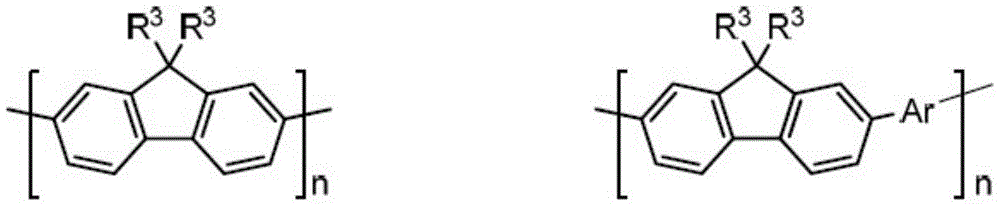
其中每个R3独立地为任选经取代的水溶性官能团,例如亲水性聚合物(例如聚环氧烷、纤维素、壳聚糖等)或进一步被亲水基团取代的烷基或芳基,该亲水基团例如聚环氧烷(例如包括2-20个单元的PEG的聚乙二醇)、铵、锍、鏻也具有带电荷(带正电、带负电或两性离子)的亲水性水溶性基团;Ar是任选地经取代的芳基或杂芳基基团;并且n是1至10000。在一些实施例中,R3是任选地经取代的烷基基团。在一些实施例中,R3是任选地经取代的芳基基团。在一些实施例中,R3被聚乙二醇、染料、化学选择性官能团或特异性结合部分取代。在一些实施例中,Ar被聚乙二醇、染料、化学选择性官能团或特异性结合部分取代。wherein each R is independently an optionally substituted water-soluble functional group such as a hydrophilic polymer (eg, polyalkylene oxide, cellulose, chitosan, etc.) or an alkyl group further substituted with a hydrophilic group or Aryl groups, the hydrophilic groups such as polyalkylene oxides (eg polyethylene glycols including 2-20 units of PEG), ammonium, sulfonium, phosphonium are also charged (positively, negatively or zwitterionic) A hydrophilic water-soluble group of ; Ar is an optionally substituted aryl or heteroaryl group; and n is 1 to 10,000. In some embodiments, R3 is an optionally substituted alkyl group. In some embodiments, R 3 is an optionally substituted aryl group. In some embodiments, R3 is substituted with polyethylene glycol, a dye, a chemoselective functional group, or a specific binding moiety. In some embodiments, Ar is substituted with polyethylene glycol, dyes, chemoselective functional groups or specific binding moieties.
在一些实施例中,聚合物染料包括以下结构:In some embodiments, the polymeric dye includes the following structures:

其中每个R1是增溶基团或接头染料基团;每个R2独立地是H或芳基取代基;L1和L2是任选的接头;每个A1和A3独立地为H、荧光团、官能团或特异性结合部分(例如抗体);并且n和m各自独立地是0至10000,其中n+m>1。wherein each R1 is a solubilizing group or a linker dye group ; each R2 is independently H or an aryl substituent ; L1 and L2 are optional linkers; each A1 and A3 is independently H , a fluorophore, a functional group, or a specific binding moiety (eg, an antibody); and n and m are each independently 0 to 10000, where n+m>1.
聚合物染料可以具有一种或多种所需的光谱特性,例如特定最大吸收波长、特定最大发射波长、消光系数、量子产率等(参见例如Chattopadhyay等人,“Brilliant violetfluorophores:A new class of ultrabright fluorescent compounds forimmunofluorescence experiments[一类新的用于免疫荧光实验的超亮荧光化合物].”Cytometry Part A[细胞计数A部分],81A(6),456-466,2012)。Polymer dyes can have one or more desired spectral properties, such as specific absorption maximum wavelengths, specific emission maximum wavelengths, extinction coefficients, quantum yields, etc. (see, e.g., Chattopadhyay et al., "Brilliant violetfluorophores: A new class of ultrabright fluorescent compounds for immunofluorescence experiments [a new class of ultra-bright fluorescent compounds for immunofluorescence experiments].” Cytometry Part A, 81A(6), 456-466, 2012).
在一些实施例中,聚合物染料具有在280和850nm之间的吸收曲线。在一些实施例中,聚合物染料具有在280至850nm范围内的最大吸收。在一些实施例中,聚合物染料吸收波长在280至850nm范围内的入射光,其中目的最大吸收的具体实例包括但不限于:348nm、355nm、405nm、407nm、445nm、488nm、640nm和652nm。在一些实施例中,聚合物染料具有选自下组的范围内的最大吸收波长,该组由以下组成:280-310nm、305-325nm、320-350nm、340-375nm、370-425nm、400-450nm、440-500nm、475-550nm、525-625nm、625-675nm和650-750nm。在一些实施例中,聚合物染料具有348nm的最大吸收波长。在一些实施例中,聚合物染料具有355nm的最大吸收波长。在一些实施例中,聚合物染料具有405nm的最大吸收波长。在一些实施例中,聚合物染料具有407nm的最大吸收波长。在一些实施例中,聚合物染料具有445nm的最大吸收波长。在一些实施例中,聚合物染料具有488nm的最大吸收波长。在一些实施例中,聚合物染料具有640nm的最大吸收波长。在一些实施例中,聚合物染料具有652nm的最大吸收波长。In some embodiments, the polymeric dye has an absorption curve between 280 and 850 nm. In some embodiments, the polymeric dye has an absorption maximum in the range of 280 to 850 nm. In some embodiments, the polymeric dye absorbs incident light at wavelengths in the range of 280 to 850 nm, with specific examples of absorption maxima of interest including, but not limited to: 348 nm, 355 nm, 405 nm, 407 nm, 445 nm, 488 nm, 640 nm, and 652 nm. In some embodiments, the polymeric dye has an absorption maximum wavelength within a range selected from the group consisting of: 280-310nm, 305-325nm, 320-350nm, 340-375nm, 370-425nm, 400- 450nm, 440-500nm, 475-550nm, 525-625nm, 625-675nm and 650-750nm. In some embodiments, the polymeric dye has an absorption maximum wavelength of 348 nm. In some embodiments, the polymeric dye has an absorption maximum wavelength of 355 nm. In some embodiments, the polymeric dye has an absorption maximum wavelength of 405 nm. In some embodiments, the polymeric dye has an absorption maximum wavelength of 407 nm. In some embodiments, the polymeric dye has an absorption maximum wavelength of 445 nm. In some embodiments, the polymeric dye has an absorption maximum wavelength of 488 nm. In some embodiments, the polymeric dye has an absorption maximum wavelength of 640 nm. In some embodiments, the polymeric dye has an absorption maximum wavelength of 652 nm.
在一些实施例中,聚合物染料具有范围为400至850nm,例如415至800nm的最大发射波长,其中目的最大发射的具体实例包括但不限于:395nm、421nm、445nm、448nm、452nm、478nm、480nm、485nm、491nm、496nm、500nm、510nm、515nm、519nm、520nm、563nm、570nm、578nm、602nm、612nm、650nm、661nm、667nm、668nm、678nm、695nm、702nm、711nm、719nm、737nm、785nm、786nm、805nm。在一些实施例中,聚合物染料具有选自下组的范围内的最大发射波长,该组由以下组成:380-400nm、410-430nm、470-490nm、490-510nm、500-520nm、560-580nm、570-595nm、590-610nm、610-650nm、640-660nm、650-700nm、700-720nm、710-750nm、740-780nm和775-795nm。在一些实施例中,聚合物染料具有395nm的最大发射。在一些实施例中,聚合物染料具有421nm的最大发射波长。在一些实施例中,聚合物染料具有478nm的最大发射波长。在一些实施例中,聚合物染料具有480nm的最大发射波长。在一些实施例中,聚合物染料具有485nm的最大发射波长。在一些实施例中,聚合物染料具有496nm的最大发射波长。在一些实施例中,聚合物染料具有510nm的最大发射波长。在一些实施例中,聚合物染料具有570nm的最大发射波长。在一些实施例中,聚合物染料具有602nm的最大发射波长。在一些实施例中,聚合物染料具有650nm的最大发射波长。在一些实施例中,聚合物染料具有711nm的最大发射波长。在一些实施例中,聚合物染料具有737nm的最大发射波长。在一些实施例中,聚合物染料具有750nm的最大发射波长。在一些实施例中,聚合物染料具有786nm的最大发射波长。在一些实施例中,聚合物染料具有421nm±5nm的最大发射波长。在一些实施例中,聚合物染料具有510nm±5nm的最大发射波长。在一些实施例中,聚合物染料具有570nm±5nm的最大发射波长。在一些实施例中,聚合物染料具有602nm±5nm的最大发射波长。在一些实施例中,聚合物染料具有650nm±5nm的最大发射波长。在一些实施例中,聚合物染料具有711nm±5nm的最大发射波长。在一些实施例中,聚合物染料具有786nm±5nm的最大发射波长。在一些实施例中,聚合物染料具有选自下组的最大发射,该组由以下组成:421nm、510nm、570nm、602nm、650nm、711nm和786nm。In some embodiments, the polymeric dye has an emission maximum wavelength in the range of 400 to 850 nm, eg, 415 to 800 nm, wherein specific examples of the emission maximum of interest include, but are not limited to: 395 nm, 421 nm, 445 nm, 448 nm, 452 nm, 478 nm, 480 nm , 485nm, 491nm, 496nm, 500nm, 510nm, 515nm, 519nm, 520nm, 563nm, 570nm, 578nm, 602nm, 612nm, 650nm, 661nm, 667nm, 668nm, 678nm, 695nm, 702nm, 711nm, 719nm, 737nm, 785nm, 786nm , 805nm. In some embodiments, the polymeric dye has an emission maximum wavelength within a range selected from the group consisting of: 380-400 nm, 410-430 nm, 470-490 nm, 490-510 nm, 500-520 nm, 560- 580nm, 570-595nm, 590-610nm, 610-650nm, 640-660nm, 650-700nm, 700-720nm, 710-750nm, 740-780nm and 775-795nm. In some embodiments, the polymeric dye has an emission maximum of 395 nm. In some embodiments, the polymeric dye has an emission maximum wavelength of 421 nm. In some embodiments, the polymeric dye has an emission maximum wavelength of 478 nm. In some embodiments, the polymeric dye has an emission maximum wavelength of 480 nm. In some embodiments, the polymeric dye has an emission maximum wavelength of 485 nm. In some embodiments, the polymeric dye has an emission maximum wavelength of 496 nm. In some embodiments, the polymeric dye has an emission maximum wavelength of 510 nm. In some embodiments, the polymeric dye has an emission maximum wavelength of 570 nm. In some embodiments, the polymeric dye has an emission maximum wavelength of 602 nm. In some embodiments, the polymeric dye has an emission maximum wavelength of 650 nm. In some embodiments, the polymeric dye has an emission maximum wavelength of 711 nm. In some embodiments, the polymeric dye has an emission maximum wavelength of 737 nm. In some embodiments, the polymeric dye has an emission maximum wavelength of 750 nm. In some embodiments, the polymeric dye has an emission maximum wavelength of 786 nm. In some embodiments, the polymeric dye has an emission maximum wavelength of 421 nm ± 5 nm. In some embodiments, the polymeric dye has an emission maximum wavelength of 510 nm ± 5 nm. In some embodiments, the polymeric dye has an emission maximum wavelength of 570 nm ± 5 nm. In some embodiments, the polymeric dye has an emission maximum wavelength of 602 nm ± 5 nm. In some embodiments, the polymeric dye has an emission maximum wavelength of 650 nm ± 5 nm. In some embodiments, the polymeric dye has an emission maximum wavelength of 711 nm ± 5 nm. In some embodiments, the polymeric dye has an emission maximum wavelength of 786 nm ± 5 nm. In some embodiments, the polymeric dye has an emission maximum selected from the group consisting of 421 nm, 510 nm, 570 nm, 602 nm, 650 nm, 711 nm, and 786 nm.
在一些实施例中,聚合物染料具有1 x 106cm-1M-1或更大,例如2 x 106cm-1M-1或更大、2.5 x 106cm-1M-1或更大、3 x 106cm-1M-1或更大、4 x 106cm-1M-1或更大、5 x 106cm-1M-1或更大、6 x 106cm-1M-1或更大、7 x 106cm-1M-1或更大、或8 x 106cm-1M-1或更大的消光系数。在一些实施例中,聚合物染料具有如下量子产率:0.05或更高,例如0.1或更高、0.15或更高、0.2或更高、0.25或更高、0.3或更高、0.35或更高、0.4或更高、0.45或更高、0.5或更高、0.6或更高、0.7或更高、0.8或更高、0.9或更高、0.95或更高、0.99或更高,且包括0.999或更高。例如,目的聚合物染料的量子产率范围可以是从0.05至1,例如从0.1至0.95,例如从0.15至0.9,例如从0.2至0.85,例如从0.25至0.75,例如从0.3至0.7,且包括从0.4至0.6的量子产率。在一些实施例中,聚合物染料具有0.1或更高的量子产率。在一些实施例中,聚合物染料具有0.3或更高的量子产率。在一些实施例中,聚合物染料具有0.5或更高的量子产率。在一些实施例中,聚合物染料具有0.6或更高的量子产率。在一些实施例中,聚合物染料具有0.7或更高的量子产率。在一些实施例中,聚合物染料具有0.8或更高的量子产率。在一些实施例中,聚合物染料具有0.9或更高的量子产率。在一些实施例中,聚合物染料具有0.95或更高的量子产率。在一些实施例中,聚合物染料具有1 x 106或更大的消光系数和0.3或更高的量子产率。在一些实施例中,聚合物染料具有2 x 10⁶或更大的消光系数和0.5或更高的量子产率。In some embodiments, the polymeric dye has 1 x 106 cm-1 M-1 or greater, such as 2 x 106 cm - 1 M- 1 or greater, 2.5 x 106 cm -1 M - 1 or greater, 3 x 10 6 cm -1 M -1 or more, 4 x 10 6 cm -1 M -1 or more, 5 x 10 6 cm -1 M -1 or more, 6 x 10 6 cm -1 M -1 or greater, 7 x 10 6 cm -1 M -1 or greater, or 8 x 10 6 cm -1 M -1 or greater extinction coefficient. In some embodiments, the polymeric dye has a quantum yield of 0.05 or higher, eg, 0.1 or higher, 0.15 or higher, 0.2 or higher, 0.25 or higher, 0.3 or higher, 0.35 or higher , 0.4 or higher, 0.45 or higher, 0.5 or higher, 0.6 or higher, 0.7 or higher, 0.8 or higher, 0.9 or higher, 0.95 or higher, 0.99 or higher, and including 0.999 or higher higher. For example, the quantum yield of the polymer dye of interest can range from 0.05 to 1, such as from 0.1 to 0.95, such as from 0.15 to 0.9, such as from 0.2 to 0.85, such as from 0.25 to 0.75, such as from 0.3 to 0.7, and includes Quantum yields from 0.4 to 0.6. In some embodiments, the polymeric dye has a quantum yield of 0.1 or higher. In some embodiments, the polymeric dye has a quantum yield of 0.3 or higher. In some embodiments, the polymeric dye has a quantum yield of 0.5 or higher. In some embodiments, the polymeric dye has a quantum yield of 0.6 or higher. In some embodiments, the polymeric dye has a quantum yield of 0.7 or higher. In some embodiments, the polymeric dye has a quantum yield of 0.8 or higher. In some embodiments, the polymeric dye has a quantum yield of 0.9 or higher. In some embodiments, the polymeric dye has a quantum yield of 0.95 or higher. In some embodiments, the polymeric dye has an extinction coefficient of 1 x 10⁶ or greater and a quantum yield of 0.3 or greater. In some embodiments, the polymeric dye has an extinction coefficient of 2 x 10⁶ or greater and a quantum yield of 0.5 or greater.
在一些实施例中,该标记包括酶、酶底物、或其组合。该酶能够将酶底物修饰成对应的经修饰的酶底物。在一些实施例中,这些酶可以是、或可以包括酶学委员会(EC)1氧化还原酶(例如,脱氢酶或氧化酶);EC 2转移酶(例如,转氨酶或激酶);EC 3水解酶(例如,脂肪酶、淀粉酶或肽酶);EC 4裂解酶(例如,脱羧酶);EC 5异构酶(例如,异构酶或变位酶);或EC 6连接酶(例如,合成酶)。In some embodiments, the label includes an enzyme, an enzyme substrate, or a combination thereof. The enzyme is capable of modifying an enzyme substrate to a corresponding modified enzyme substrate. In some embodiments, these enzymes can be, or can include Commission on Enzymes (EC) 1 oxidoreductases (eg, dehydrogenases or oxidases);
在一些实施例中,这些酶可以是、或可以包括作用于供体的CH-OH基团的EC 1.1氧化还原酶;作用于供体的醛或氧代基团的EC 1.2氧化还原酶;作用于供体的CH-CH基团的EC1.3氧化还原酶;作用于供体的CH-NH(2)基团的EC 1.4氧化还原酶;作用于供体的CH-NH基团的EC 1.5氧化还原酶;作用于NADH或NADPH的EC 1.6氧化还原酶;作用于作为供体的其他含氮化合物的EC 1.7氧化还原酶;作用于供体的硫基团的EC 1.8氧化还原酶;作用于供体的血红素基团的EC 1.9氧化还原酶;作用于作为供体的二酚和相关的底物的EC 1.10氧化还原酶;氧化金属离子的EC 1.16氧化还原酶;作用于CH或CH(2)基团的EC 1.17氧化还原酶;作用于作为供体的铁硫蛋白的EC 1.18氧化还原酶;作用于作为供体的还原的黄素氧还蛋白的EC 1.19氧化还原酶;作用于供体中的磷或砷的EC 1.20氧化还原酶;催化反应X-H+Y-H=′X-Y′的EC 1.21氧化还原酶;作用于供体中卤素的EC 1.22氧化还原酶;还原作为受体的C-O-C基团的EC 1.23氧化还原酶;或EC 1.97其他氧化还原酶。In some embodiments, these enzymes can be, or can include, EC 1.1 oxidoreductases that act on CH-OH groups of the donor; EC 1.2 oxidoreductases that act on the aldehyde or oxo groups of the donor; EC 1.3 oxidoreductase on the CH-CH group of the donor; EC 1.4 oxidoreductase on the CH-NH(2) group of the donor; EC 1.5 on the CH-NH group of the donor Oxidoreductases; EC 1.6 oxidoreductases acting on NADH or NADPH; EC 1.7 oxidoreductases acting on other nitrogen-containing compounds as donors; EC 1.8 oxidoreductases acting on the sulfur group of the donor; EC 1.9 oxidoreductases of the heme group of the donor; EC 1.10 oxidoreductases acting on diphenols and related substrates as donors; EC 1.16 oxidoreductases oxidizing metal ions; 2) EC 1.17 oxidoreductase of group; EC 1.18 oxidoreductase acting on iron-sulfur protein as donor; EC 1.19 oxidoreductase acting on reduced flavodoxin as donor; EC 1.20 oxidoreductase for phosphorus or arsenic in the body; EC 1.21 oxidoreductase for catalyzing the reaction X-H+Y-H='X-Y'; EC 1.22 oxidoreductase for acting on halogen in the donor; reducing C-O-C as acceptor group EC 1.23 oxidoreductase; or EC 1.97 other oxidoreductase.
在一些实施例中,这些酶可以是、或可以包括EC 2.1转移酶,其与底物:DNA、RNA、邻苯二酚一起转移一碳基团;转移醛或酮基团的EC 2.2转移酶;EC 2.3酰基转移酶;EC 2.4糖基转移酶;转移除甲基基团以外的烷基或芳基基团的EC 2.5转移酶;转移含氮基团的EC2.6转移酶;转移含磷基团的EC 2.7转移酶;转移含硫基团的EC 2.8转移酶;转移含硒基团的EC 2.9转移酶;或转移含钼或钨基团的EC 2.10转移酶。In some embodiments, these enzymes can be, or can include, EC 2.1 transferases that transfer one-carbon groups with substrates: DNA, RNA, catechol; EC 2.2 transferases that transfer aldehyde or ketone groups ; EC 2.3 acyltransferase; EC 2.4 glycosyltransferase; EC 2.5 transferase that transfers alkyl or aryl groups other than methyl groups; EC2.6 transferase that transfers nitrogen-containing groups; EC 2.7 transferase that transfers a molybdenum-containing group; an EC 2.8 transferase that transfers a sulfur-containing group; an EC 2.9 transferase that transfers a selenium-containing group; or an EC 2.10 transferase that transfers a molybdenum- or tungsten-containing group.
在一些实施例中,这些酶可以是、或可以包括作用于酯键的EC 3.1水解酶;EC 3.2糖基化酶;作用于醚键的EC 3.3水解酶;作用于肽键(肽酶)的EC 3.4水解酶;作用于碳-氮键、而不是肽键的EC 3.5水解酶;作用于酸酐的EC 3.6水解酶;作用于碳-碳键的EC 3.7水解酶;作用于卤化物键的EC 3.8水解酶;作用于磷-氮键的EC 3.9水解酶;作用于硫-氮键的EC 3.10水解酶;作用于碳-磷键的EC 3.11水解酶;作用于硫-硫键的EC 3.12水解酶;或作用于碳-硫键的EC 3.13水解酶。In some embodiments, these enzymes can be, or can include, EC 3.1 hydrolases that act on ester bonds; EC 3.2 glycosylases; EC 3.3 hydrolases that act on ether bonds; EC 3.4 hydrolase; EC 3.5 hydrolase acting on carbon-nitrogen bonds, not peptide bonds; EC 3.6 hydrolase acting on acid anhydrides; EC 3.7 hydrolase acting on carbon-carbon bonds; EC halide linkages 3.8 Hydrolase; EC 3.9 Hydrolase for Phosphorus-Nitrogen Bonds; EC 3.10 Hydrolase for Sulfur-Nitrogen Bonds; EC 3.11 Hydrolase for Carbon-Phosphorus Bonds; EC 3.12 Hydrolase for Sulfur-Sulfur Bonds enzyme; or EC 3.13 hydrolase acting on carbon-sulfur bonds.
在一些实施例中,这些酶可以是、或可以包括糖基水解酶(可用于分解植物生物质以生产生物燃料的酶)、氨基转移酶(涉及结合和运输小有机分子或蛋白质(其对于生物制造而言重要的)的蛋白质)、ATP结合盒(ABC)转运蛋白的溶质结合蛋白(涉及土壤微生物代谢的蛋白质,其具有生物修复中的潜在影响)、或其任何组合。In some embodiments, these enzymes can be, or can include, glycosyl hydrolases (enzymes that can be used to break down plant biomass for the production of biofuels), aminotransferases (involved in binding and transporting small organic molecules or proteins that are important to biological manufacturing), solute-binding proteins of ATP-binding cassette (ABC) transporters (proteins involved in soil microbial metabolism with potential effects in bioremediation), or any combination thereof.
在一些实施例中,这些酶可以是、或可以包括EC 4.1碳-碳裂解酶;EC 4.2碳-氧裂解酶;EC 4.3碳-氮裂解酶;EC 4.4碳-硫裂解酶;EC 4.5碳-卤化物裂解酶;EC 4.6磷-氧裂解酶;EC 4.7碳-磷裂解酶;或EC 4.99其他裂解酶。In some embodiments, the enzymes can be, or can include EC 4.1 carbon-carbon lyase; EC 4.2 carbon-oxygen lyase; EC 4.3 carbon-nitrogen lyase; EC 4.4 carbon-sulfur lyase; EC 4.5 carbon- Halide Lyase; EC 4.6 Phosphorus-Oxygen Lyase; EC 4.7 Carbon-Phosphorus Lyase; or EC 4.99 Other Lyase.
在一些实施例中,这些酶可以是、或可以包括形成碳-氧键的EC 6.1连接酶;形成碳-硫键的EC 6.2连接酶;形成碳-氮键的EC 6.3连接酶;形成碳-碳键的EC 6.4连接酶;形成磷酸酯键的EC 6.5连接酶;或形成氮-金属键的EC 6.6连接酶。In some embodiments, these enzymes can be, or can include, EC 6.1 ligases that form carbon-oxygen bonds; EC 6.2 ligases that form carbon-sulfur bonds; EC 6.3 ligases that form carbon-nitrogen bonds; EC 6.4 ligase for carbon bond formation; EC 6.5 ligase for phosphate bond formation; or EC 6.6 ligase for nitrogen-metal bond formation.
在一些实施例中,酶底物与对应的经修饰的酶底物可以相差至少一个官能团。该至少一个官能团可以是烷基、烯基、炔基、苯基、苄基、卤基、氟、氯、溴、碘、羟基、羰基、醛、卤代甲酰基、碳酸酯、羧酸根、羧基、酯、甲氧基、氢过氧基、过氧基、醚、半缩醛、半缩酮、乙缩醛、缩酮、乙缩醛、原酸酯、亚甲基二氧基、原碳酸酯、甲酰胺、伯胺、仲胺、叔胺、4°铵、伯氯胺酮、仲氯胺酮、伯醛亚胺、仲醛亚胺、酰亚胺、叠氮基、偶氮基、二酰亚胺、氰酸酯、异氰酸酯、硝酸酯、腈、异腈、亚硝基氧基、硝基、亚硝基、吡啶基、巯基、硫醚、二硫醚、亚磺酰基、磺酰基、亚磺基、磺基、硫氰酸酯、异硫氰酸酯、碳硫酮、碳硫醛、膦基、膦酰基、磷酸酯、磷酸二酯、二羟硼基、硼酸酯、亚二羟硼基、亚硼酸酯、或其任何组合。In some embodiments, the enzyme substrate and the corresponding modified enzyme substrate can differ by at least one functional group. The at least one functional group can be alkyl, alkenyl, alkynyl, phenyl, benzyl, halo, fluorine, chlorine, bromine, iodine, hydroxyl, carbonyl, aldehyde, haloformyl, carbonate, carboxylate, carboxyl , ester, methoxy, hydroperoxy, peroxy, ether, hemiacetal, hemiketal, acetal, ketal, acetal, orthoester, methylenedioxy, orthocarbonic acid Ester, formamide, primary amine, secondary amine, tertiary amine, 4° ammonium, primary ketamine, secondary ketamine, primary aldimine, secondary aldimine, imide, azide, azo, diimide , cyanate, isocyanate, nitrate, nitrile, isonitrile, nitrosooxy, nitro, nitroso, pyridyl, mercapto, sulfide, disulfide, sulfinyl, sulfonyl, sulfinyl , sulfo, thiocyanate, isothiocyanate, carbon thione, carbon thioaldehyde, phosphine, phosphono, phosphate, phosphate diester, dihydroxyboron, boronate, dihydroxyboron , boronite, or any combination thereof.
在一些实施例中,酶可以包括甲基转移酶、糖苷水解酶、琼脂水解酶、氨酸酶、淀粉酶、乙糖苷酶、卡拉胶酶、纤维素酶、神经酰胺酶、几丁质酶、脱乙酰几丁质酶、柠檬酸酶、葡聚糖酶、糊精酶、果糖苷酶、岩藻多糖酶、墨角藻糖苷酶、呋喃糖苷酶、半乳糖苷酶、半乳糖醛酸酶、葡聚糖酶、葡糖苷酶、葡萄糖醛酸酶、葡萄糖苷酸酶、糖水解酶、糖苷酶、己糖苷酶、水解酶、艾杜糖醛酸酶、肌苷酶、菊粉酶、乳糖酶、果聚糖酶、地衣多糖酶、连接酶、裂解酶、溶菌酶、麦芽糖苷酶、麦芽糖壳三糖酶、甘露二糖苷酶、甘露糖苷酶、胞壁酸酶、辛糖酸酶、辛糖酸水解酶、樱草苷酶、蛋白酶、支链淀粉酶、鼠李糖苷酶、糖胺酶、唾液酸酶、合酶、转移酶、海藻糖酶、turonidase、turonosidase、木聚糖酶、木糖苷酶、或其组合。In some embodiments, the enzymes can include methyltransferases, glycoside hydrolases, agar hydrolases, amidases, amylases, botoglycosidases, carrageenase, cellulase, ceramidase, chitinase, Chitinase, citrate, glucanase, dextrinase, fructosidase, fucoidanase, fucosidase, furanosidase, galactosidase, galacturonidase, glucanase, glucosidase, glucuronidase, glucuronidase, glycohydrolase, glycosidase, hexosidase, hydrolase, iduronidase, inosidase, inulinase, lactase , fructanase, lichenase, ligase, lyase, lysozyme, maltosidase, maltochitotrisidase, mannobiosidase, mannosidase, muramidase, octanoidase, caprylic Acid hydrolase, primroselinase, protease, pullulanase, rhamnosidase, glycosaminase, sialidase, synthase, transferase, trehalase, turonidase, turonosidase, xylanase, xylosidase enzymes, or a combination thereof.
在一些实施例中,酶底物可以包括6-巯基嘌呤、纤维二糖、纤维四糖、木四糖、异樱草糖、β-D-龙胆二糖、木葡聚糖和甘露三糖、琼脂糖、胺酸、淀粉、寡糖、多糖、纤维素、神经酰胺、几丁质、壳聚糖、右旋糖、糊精、果糖、岩藻多糖、岩藻糖、呋喃糖苷、半乳糖苷、葡聚糖、吡喃葡萄糖苷、葡萄糖苷、葡萄糖醛酸、葡糖苷酸、葡萄糖、糖苷、糖胺聚糖、己糖苷、菊粉、乳糖、levanose、脂多糖、甘露糖、麦芽糖苷、麦芽三糖苷、甘露糖、辛基酮糖酸、寡糖、果胶酸酯、果胶、肽、聚半乳糖醛酸、多核苷酸、支链淀粉、鼠李糖苷、木聚糖、或其任何组合。标记要求可以包括酶要求和底物要求。In some embodiments, the enzyme substrate can include 6-mercaptopurine, cellobiose, cellotetraose, xylotetraose, isoprimulose, beta-D-gentiobiose, xyloglucan, and mannotriose , agarose, amino acid, starch, oligosaccharide, polysaccharide, cellulose, ceramide, chitin, chitosan, dextrose, dextrin, fructose, fucoidan, fucose, furanoside, galactose Glycoside, glucan, glucopyranoside, glucoside, glucuronic acid, glucuronide, glucose, glycoside, glycosaminoglycan, hexoside, inulin, lactose, levanose, lipopolysaccharide, mannose, maltoside, Maltotriosides, mannose, octyl ketonic acid, oligosaccharides, pectate esters, pectin, peptides, polygalacturonic acid, polynucleotides, pullulan, rhamnoside, xylan, or its any combination. Labeling requirements can include enzymatic requirements and substrate requirements.
经标记的生物分子试剂是通过将经激活的生物分子与经激活的标记联接来制备。本文使用术语“经激活的”以指代具有反应性接头或反应性部分的生物分子或标记,当在适当条件下进行时其与第二反应性接头或第二反应性部分反应以形成化学键,例如像离子键(电荷-电荷相互作用)、非共价键(例如偶极-偶极或电荷-偶极)或共价键。在一些实施例中,经激活的生物分子的反应性接头或部分与经激活的标记的反应性接头或部分反应以产生离子键。在其他实施例中,经激活的生物分子的反应性接头或部分与经激活的标记的反应性接头或部分反应以产生非共价键。在又其他实施例中,经激活的生物分子的反应性接头或部分与经激活的标记的反应性接头或部分反应以产生共价键。Labeled biomolecule reagents are prepared by linking an activated biomolecule to an activated label. The term "activated" is used herein to refer to a biomolecule or label having a reactive linker or reactive moiety which, when performed under appropriate conditions, reacts with a second reactive linker or second reactive moiety to form a chemical bond, For example like ionic bonds (charge-charge interactions), non-covalent bonds (eg dipole-dipole or charge-dipole) or covalent bonds. In some embodiments, an activated reactive linker or moiety of a biomolecule reacts with an activated labeled reactive linker or moiety to create an ionic bond. In other embodiments, the activated reactive linker or moiety of the biomolecule reacts with the activated labeled reactive linker or moiety to create a non-covalent bond. In yet other embodiments, a reactive linker or moiety of an activated biomolecule is reacted with an activated labeled reactive linker or moiety to create a covalent bond.
在一些实施例中,经激活的生物分子的反应性接头或部分与经激活的标记的反应性接头或部分反应以产生共价键。可以使用使得在经激活的生物分子的反应性接头与经激活的标记的反应性接头之间形成共价键的任何便利方案,包括但不限于加成反应、消去反应、取代反应、周环反应、光化学反应、氧化还原反应、自由基反应、通过碳烯中间体的反应、复分解反应以及其他类型的成键反应。在一些实施例中,经激活的生物分子可以通过反应性连接化学与经激活的标记缀合,例如其中反应性接头对包括但不限于:马来酰亚胺/硫醇;硫醇/硫醇;吡啶基二硫醇/硫醇;碘乙酸琥珀酰亚胺酯/硫醇;N-琥珀酰亚胺酯(NHS酯)、磺基二氯苯酚酯(SDP酯)或五氟苯基酯(PFP酯)/胺;双琥珀酰亚胺酯/胺;亚氨酸酯/胺;肼或胺/醛,二醛或苯甲醛;异氰酸酯/羟基或胺;碳水化合物-高碘酸盐/肼或胺;二吖丙因/芳基叠氮化物化学;吡啶基二硫醇/芳基叠氮化物化学;炔/叠氮化物;羧基-碳二亚胺/胺;胺/磺基-SMCC(磺基琥珀酰亚胺基4-[N-马来酰亚胺基甲基]环己烷-1-甲酸酯)/硫醇和胺/BMPH(N-[β-马来酰亚胺基丙酸]酰肼.TFA)/硫醇;叠氮化物/三芳基膦;硝酮/环辛炔;叠氮化物/四嗪和甲酰基苯甲酰胺/肼基-烟酰胺。在一些实施例中,经激活的生物分子的反应性接头和经激活的标记的反应性接头经历环加成反应,例如[1+2]-环加成、[2+2]-环加成、[3+2]-环加成、[2+4]-环加成、[4+6]-环加成、或螯键反应(cheleotropic reaction),包括接头经历1,3-偶极环加成(例如叠氮化物-炔烃Huisgen环加成)、狄尔斯-阿尔德反应、逆电子需求狄尔斯阿尔德环加成、烯反应或[2+2]光化学环加成反应。In some embodiments, the activated reactive linker or moiety of the biomolecule reacts with the activated labeled reactive linker or moiety to create a covalent bond. Any convenient scheme that results in the formation of a covalent bond between the activated biomolecule's reactive linker and the activated labeled reactive linker may be used, including but not limited to addition reactions, elimination reactions, substitution reactions, pericyclic reactions , photochemical reactions, redox reactions, free radical reactions, reactions through carbene intermediates, metathesis reactions, and other types of bonding reactions. In some embodiments, activated biomolecules can be conjugated to activated labels via reactive linking chemistry, eg, where reactive linker pairs include, but are not limited to: maleimide/thiol; thiol/thiol ; Pyridyldithiol/thiol; Iodoacetate succinimidyl ester/thiol; N-succinimidyl ester (NHS ester), sulfodichlorophenol ester (SDP ester) or pentafluorophenyl ester ( PFP ester)/amine; disuccinimidyl ester/amine; imidate/amine; hydrazine or amine/aldehyde, dialdehyde or benzaldehyde; isocyanate/hydroxyl or amine; carbohydrate-periodate/hydrazine or Amine; Diazirine/Arylazide Chemistry; Pyridyldithiol/Arylazide Chemistry; Alkyne/Azide; Carboxy-Carbodiimide/Amine; Amine/Sulfo-SMCC succinimidyl 4-[N-maleimidomethyl]cyclohexane-1-carboxylate)/thiol and amine/BMPH(N-[beta-maleimidopropionic acid] ] hydrazide.TFA)/thiol; azide/triarylphosphine; nitrone/cyclooctyne; azide/tetrazine and formylbenzamide/hydrazino-nicotinamide. In some embodiments, the activated biomolecule reactive linker and the activated labeled reactive linker undergo a cycloaddition reaction, eg, [1+2]-cycloaddition, [2+2]-cycloaddition , [3+2]-cycloaddition, [2+4]-cycloaddition, [4+6]-cycloaddition, or a cheleotropic reaction, including the linker undergoing a 1,3-dipolar ring Additions (eg, azide-alkyne Huisgen cycloadditions), Diels-Alder reactions, inverse electron-demand Diels Alder cycloadditions, alkene reactions, or [2+2] photochemical cycloadditions.
在一些实施例中,生物分子要求和标记要求包括关于经激活的生物分子和经激活的标记的反应性接头的信息或数据。例如,生物分子要求和标记要求可以包括关于反应性接头的名称、化学结构、反应性接头的结构描述或反应性接头CAS号的信息或数据。在一些实施例中,生物分子要求和标记要求包括反应性接头对的名称,例如其中反应性接头对可以选自马来酰亚胺/硫醇;硫醇/硫醇;吡啶基二硫醇/硫醇;碘乙酸琥珀酰亚胺酯/硫醇;N-琥珀酰亚胺酯(NHS酯)、磺基二氯苯酚酯(SDP酯)或五氟苯基酯(PFP酯)/胺;双琥珀酰亚胺酯/胺;亚氨酸酯/胺;肼或胺/醛,二醛或苯甲醛;异氰酸酯/羟基或胺;碳水化合物-高碘酸盐/肼或胺;二吖丙因/芳基叠氮化物化学;吡啶基二硫醇/芳基叠氮化物化学;炔/叠氮化物;羧基-碳二亚胺/胺;胺/磺基-SMCC(磺基琥珀酰亚胺基4-[N-马来酰亚胺基甲基]环己烷-1-甲酸酯)/硫醇和胺/BMPH(N-[β-马来酰亚胺基丙酸]酰肼.TFA)/硫醇;叠氮化物/三芳基膦;硝酮/环辛炔;叠氮化物/四嗪和甲酰基苯甲酰胺/肼基-烟酰胺;二烯/亲二烯体;和1,3-偶极/偶极体。In some embodiments, the biomolecule requirement and the labeling requirement include information or data about the activated biomolecule and the activated labelled reactive linker. For example, biomolecule requirements and labeling requirements may include information or data regarding the name of the reactive linker, chemical structure, a structural description of the reactive linker, or the CAS number of the reactive linker. In some embodiments, the biomolecule requirement and the labeling requirement include the name of the reactive linker pair, eg, wherein the reactive linker pair can be selected from maleimide/thiol; thiol/thiol; pyridyldithiol/ Thiol; iodoacetate succinimidyl ester/thiol; N-succinimidyl ester (NHS ester), sulfodichlorophenol ester (SDP ester) or pentafluorophenyl ester (PFP ester)/amine; bis Succinimide ester/amine; imidate/amine; hydrazine or amine/aldehyde, dialdehyde or benzaldehyde; isocyanate/hydroxyl or amine; carbohydrate-periodate/hydrazine or amine; diazepine/ Arylazide Chemistry; Pyridyldithiol/Arylazide Chemistry; Alkyne/Azide; Carboxyl-Carbodiimide/Amine; Amine/Sulfo-SMCC (Sulfosuccinimidyl 4 -[N-maleimidomethyl]cyclohexane-1-carboxylate)/thiols and amines/BMPH(N-[beta-maleimidopropionic acid]hydrazide.TFA)/ thiols; azides/triarylphosphines; nitrones/cyclooctynes; azides/tetrazines and formylbenzamides/hydrazino-nicotinamides; dienes/dienephiles; and 1,3- Dipole/Dipole.
在一些实施例中,标记要求包括酶要求和底物要求。酶要求可以包括但不限于酶名称、多肽序列、酶的类别、EC编号、多肽共有序列、保守结构域名和/或序列、或多个相关的蛋白质(例如,属于相同蛋白质家族的蛋白质)、或其任何组合。基底要求可包括但不限于基底名称、基底的官能团、基底的类型、具有特定EC编号的一个或多个酶的一个或多个基底、或其任何组合。In some embodiments, the labeling requirement includes an enzymatic requirement and a substrate requirement. Enzyme requirements may include, but are not limited to, enzyme name, polypeptide sequence, class of enzyme, EC number, polypeptide consensus sequence, conserved structural domain names and/or sequences, or multiple related proteins (eg, proteins belonging to the same protein family), or any combination thereof. Substrate requirements may include, but are not limited to, the substrate name, the functional groups of the substrate, the type of substrate, one or more substrates for one or more enzymes with a specific EC number, or any combination thereof.
输入管理器被配置为接收对经标记的生物分子的要求。为了接收经标记的生物分子试剂要求,输入管理器可操作地联接到图形用户界面,在该图形用户界面处输入一个或多个经标记的生物分子试剂要求。在一些实施例中,将经标记的生物分子试剂要求在互联网网站菜单界面(例如,在远程位置)输入并通过互联网或局域网传送给输入管理器。在一些实施例中,输入管理器被配置为接收多个经标记的生物分子试剂要求。例如,输入管理器可以被配置为接收2个或更多个经标记的生物分子试剂要求,例如5个或更多个,例如10个或更多个,并且包括25个或更多个经标记的生物分子试剂要求。The input manager is configured to receive a request for the labeled biomolecule. To receive labeled biomolecular reagent requests, the input manager is operably coupled to a graphical user interface at which one or more labeled biomolecular reagent requests are entered. In some embodiments, the labeled biomolecular reagents are requested to be entered at an Internet website menu interface (eg, at a remote location) and communicated to an input manager via the Internet or a local area network. In some embodiments, the input manager is configured to receive a plurality of labeled biomolecular reagent requests. For example, the input manager may be configured to receive 2 or more labeled biomolecule reagent requests, such as 5 or more, such as 10 or more, and including 25 or more labeled requirements for biomolecular reagents.
在对经标记的生物分子试剂的要求仅包括单个组分并且是经标记的生物分子要求时,输入管理器可以被配置为接收2个或更多个经标记的生物分子要求,例如5个或更多个,例如10个或更多个,并且包括25个或更多个经标记的生物分子要求。在经标记的生物分子试剂要求包括两个组分例如生物分子要求和标记要求时,输入管理器可以被配置为接收2个或更多个生物分子要求,例如5个或更多个,例如10个或更多个,并且包括25个或更多个生物分子要求,并被配置为接收2个或更多个标记要求,例如5个或更多个,例如10个或更多个,并且包括25个或更多个标记要求。在一些实施例中,输入管理器被配置为接收经标记的生物分子试剂要求,该经标记的生物分子试剂要求包括单个生物分子要求和单个标记要求。在一些实施例中,输入管理器被配置为接收经标记的生物分子试剂要求,该经标记的生物分子试剂要求包括单个生物分子要求和多个不同的标记要求。在又一些实施例中,输入管理器被配置为接收经标记的生物分子试剂要求,该经标记的生物分子试剂要求包括多个不同的生物分子要求和单个标记要求。在仍一些实施例中,输入管理器被配置为接收经标记的生物分子试剂要求,该经标记的生物分子试剂要求包括多个不同的生物分子要求和多个不同的标记要求。该输入管理器被配置为从单个用户或多个不同用户例如2个或更多个不同用户,例如5个或更多个不同用户,例如10个或更多个不同用户,例如25个或更多个不同用户和包括100个或更多不同用户接收标记的生物分子要求。在一些实施例中,标记要求包括酶要求和底物要求。Where the request for a labeled biomolecule reagent includes only a single component and is a labeled biomolecule request, the input manager may be configured to receive 2 or more labeled biomolecule requests, eg, 5 or More, such as 10 or more, and including 25 or more labeled biomolecule requirements. Where the labeled biomolecule reagent request includes two components, eg, a biomolecule request and a labeled request, the input manager may be configured to receive 2 or more biomolecule requests, eg, 5 or more, eg, 10 and including 25 or more biomolecule requirements and configured to receive 2 or more labelling requirements, such as 5 or more, such as 10 or more, and including 25 or more marks required. In some embodiments, the input manager is configured to receive labeled biomolecule reagent requests, the labeled biomolecule reagent requests including a single biomolecule request and a single labeled request. In some embodiments, the input manager is configured to receive labeled biomolecule reagent requirements, the labeled biomolecule reagent requirements including a single biomolecule requirement and a plurality of different labeled requirements. In still other embodiments, the input manager is configured to receive labeled biomolecular reagent requirements, the labeled biomolecule reagent requirements including a plurality of different biomolecule requirements and a single labeling requirement. In still some embodiments, the input manager is configured to receive labeled biomolecule reagent requirements, the labeled biomolecule reagent requirements including a plurality of different biomolecule requirements and a plurality of different labeling requirements. The input manager is configured to select from a single user or a plurality of different users such as 2 or more different users such as 5 or more different users such as 10 or more different users such as 25 or more different users Multiple different users and including 100 or more different users receive labeled biomolecule requirements. In some embodiments, the labeling requirement includes an enzymatic requirement and a substrate requirement.
在实施例中,输入管理器还被配置为接收与被要求的经标记的生物分子试剂的所需量相对应的数量要求。可以通过在文本框中键入数字和单位(例如,μg、μmole、μM等)、选择与适当的数字和单位值相对应的复选框或从第一下拉菜单中选择数值并第二下拉菜单中选择单位值来输入数量要求。In an embodiment, the input manager is further configured to receive a quantity request corresponding to the desired quantity of the labelled biomolecular reagent requested. This can be done by typing numbers and units into the text boxes (eg, μg, μmole, μM, etc.), selecting the checkboxes corresponding to the appropriate number and unit values, or selecting a numerical value from the first drop-down menu and the second drop-down menu Select the unit value in to enter the quantity requirement.
在一些实施例中,输入管理器可操作地联接至经标记的生物分子、经激活的生物分子、生物分子、经激活的标记、标记和反应性接头的一个或多个可搜索数据库(例如目录)。在一些实施例中,输入管理器包括经标记的生物分子的数据库。在一些实施例中,输入管理器包括经激活的生物分子和经激活的标记的数据库。在又一些实施例中,输入管理器包括生物分子、标记和反应接头的数据库。In some embodiments, the input manager is operably linked to one or more searchable databases (eg, directories) of labeled biomolecules, activated biomolecules, biomolecules, activated labels, labels, and reactive linkers ). In some embodiments, the input manager includes a database of labeled biomolecules. In some embodiments, the input manager includes a database of activated biomolecules and activated labels. In yet other embodiments, the input manager includes a database of biomolecules, labels, and reaction linkers.
经标记的生物分子、经激活的生物分子、生物分子、经激活的标记、标记和反应性接头的每个数据库的全部或部分可以显示在图形用户界面上,例如在列表、下拉菜单或其他配置(例如,平铺)中。例如,图形用户界面可以同时显示每个经标记的生物分子、经激活的生物分子、生物分子、经激活的标记、标记和反应性接头的列表(即在单个屏幕上),或者可以含有经标记的生物分子试剂要求的每个组分的下拉菜单。在其他实施例中,通过将信息输入到适当的文本字段中、选择复选框、从下拉菜单选择一个或多个项目、或通过使用它们的组合来提供经标记的生物分子试剂要求。All or part of each database of labeled biomolecules, activated biomolecules, biomolecules, activated labels, labels, and reactive linkers can be displayed on a graphical user interface, such as in a list, drop-down menu, or other configuration (for example, tiling). For example, the graphical user interface may simultaneously display a list of each labeled biomolecule, activated biomolecule, biomolecule, activated label, label, and reactive linker (ie, on a single screen), or may contain labeled biomolecules A drop-down menu for each component of the biomolecular reagent requirement. In other embodiments, the labeled biomolecular reagent requirements are provided by entering information into appropriate text fields, selecting checkboxes, selecting one or more items from a drop-down menu, or by using a combination thereof.
在一个实例中,图形用户界面包括下拉菜单以通过从下拉菜单选择一种或多种经标记的生物分子来输入经标记的生物分子试剂要求。在另一个实例中,图形用户界面包括用以输入生物分子要求的第一下拉菜单和用以输入标记要求的第二下拉菜单,这些输入是通过从第一和第二下拉菜单中选择一种或多种生物分子以及一种或多种标记来进行。在又另一个实例中,图形用户界面包括用以输入生物分子要求的第一下拉菜单、用以输入标记要求的第二下拉菜单以及用以输入反应性接头要求的第三下拉菜单,这些输入是通过从下拉菜单中选择一种或多种生物分子、一种或多种标记以及一种或多种反应性接头来进行。In one example, the graphical user interface includes a drop-down menu to enter labeled biomolecule reagent requirements by selecting one or more labeled biomolecules from the drop-down menu. In another example, the graphical user interface includes a first pull-down menu for entering biomolecule requirements and a second pull-down menu for entering labeling requirements by selecting one of the first and second pull-down menus or more biomolecules and one or more labels. In yet another example, the graphical user interface includes a first pull-down menu for entering biomolecule requirements, a second pull-down menu for entering labeling requirements, and a third pull-down menu for entering reactive linker requirements, the input is performed by selecting one or more biomolecules, one or more labels, and one or more reactive linkers from a drop-down menu.
在仍另一个实例中,图形用户界面包括用以输入经激活的生物分子要求的第一下拉菜单和用以输入经激活的标记要求的第二下拉菜单,这些输入是通过从第一和第二下拉菜单中选择一种或多个经激活的生物分子以及一种或多种经激活的接头来进行。在一些实施例中,标记要求包括酶要求和底物要求。图形用户界面可包括用于输入经激活的生物分子要求的第一下拉菜单、用于输入经激活的酶要求的第二下拉菜单、以及用于输入酶底物的第三下拉菜单。图形用户界面可包括用于输入经激活的生物分子要求的第一下拉菜单、用于输入经激活的底物的第二下拉菜单、以及用于输入酶的第三下拉菜单。In yet another example, the graphical user interface includes a first drop-down menu for inputting activated biomolecule requirements and a second drop-down menu for inputting activated labeling requirements, the inputs being obtained from the first and second pull-down menus. Select one or more activated biomolecules and one or more activated linkers from the two drop-down menus to proceed. In some embodiments, the labeling requirement includes an enzymatic requirement and a substrate requirement. The graphical user interface may include a first drop-down menu for inputting activated biomolecule requirements, a second drop-down menu for inputting activated enzyme requirements, and a third drop-down menu for inputting enzyme substrates. The graphical user interface may include a first pull-down menu for entering activated biomolecule requirements, a second pull-down menu for entering activated substrates, and a third pull-down menu for entering enzymes.
在另一个实例中,图形用户界面包括数据库中可用的经标记的生物分子、经激活的生物分子、生物分子、经激活的标记、标记和反应性接头的列表。例如,图形用户界面可以在一个或多个屏幕上同时显示每个经标记的生物分子、经激活的生物分子、生物分子、经激活的标记、标记和反应性接头的列表,或者可以含有经标记的生物分子试剂要求的每个组分的下拉菜单。在一些实施例中,所有可用的经标记的生物分子、经激活的生物分子、生物分子、经激活的标记、标记和反应性接头的列表显示在单页上。在一些实施例中,所有可用的经标记的生物分子、经激活的生物分子、生物分子、经激活的标记、标记和反应性接头的列表显示在多个页面上,例如2页或更多页,如3页或更多页,例如5页或更多页,例如10页或更多页,并包括25页或更多页。在又一些实施例中,所有可用的经标记的生物分子、经激活的生物分子、生物分子、经激活的标记、标记和反应性接头的列表各自显示在单页上的单独下拉菜单中。In another example, the graphical user interface includes a list of labeled biomolecules, activated biomolecules, biomolecules, activated labels, labels, and reactive linkers available in the database. For example, the graphical user interface may simultaneously display a list of each labeled biomolecule, activated biomolecule, biomolecule, activated label, label, and reactive linker on one or more screens, or may contain labeled biomolecules A drop-down menu for each component of the biomolecular reagent requirement. In some embodiments, a list of all available labeled biomolecules, activated biomolecules, biomolecules, activated labels, labels, and reactive linkers is displayed on a single page. In some embodiments, a list of all available labeled biomolecules, activated biomolecules, biomolecules, activated labels, labels, and reactive linkers is displayed on multiple pages, eg, 2 or more pages , such as 3 or more pages, such as 5 or more pages, such as 10 or more pages, and including 25 or more pages. In yet other embodiments, the lists of all available labeled biomolecules, activated biomolecules, biomolecules, activated labels, labels and reactive linkers are each displayed in a separate drop-down menu on a single page.
图15描绘了根据一些实施例的用于传送对经标记的生物分子试剂的要求的图形用户界面。为了传送经标记的生物分子试剂要求,用户将生物分子要求和标记要求输入到要求表格1500上。通过从下拉菜单1501a中选择可检测标记物(例如,荧光团)来输入标记要求,并且通过从下拉菜单1501b选择生物分子(例如抗体探针)来输入生物分子要求。要求表格1500还包括用于输入与经标记的生物分子试剂的所需量(以微克计)相对应的数量要求的文本框1502。在一些实施例中,标记要求包括酶要求和底物要求。15 depicts a graphical user interface for communicating a request for a labeled biomolecule reagent, according to some embodiments. To transmit the labeled biomolecule reagent request, the user enters the biomolecule request and the labeled request onto the
在一些实施例中,生物分子包括多肽、核酸、多糖、或其任何组合。核酸可以是寡核苷酸、DNA或RNA。多肽可以是蛋白质、酶或蛋白质结合试剂。蛋白质结合试剂可以包括抗体、适配体、或其任何组合。与标记缀合的蛋白质结合试剂能够特异性结合多个蛋白质靶中的至少一个。In some embodiments, biomolecules include polypeptides, nucleic acids, polysaccharides, or any combination thereof. Nucleic acids can be oligonucleotides, DNA or RNA. Polypeptides can be proteins, enzymes or protein binding reagents. Protein binding reagents can include antibodies, aptamers, or any combination thereof. The protein binding reagent conjugated to the label is capable of specifically binding at least one of a plurality of protein targets.
在一些实施例中,该多个蛋白质靶包括细胞表面蛋白质、细胞标志物、B细胞受体、T细胞受体、抗体、主要组织相容性复合体、肿瘤抗原、受体、或其任何组合。多个蛋白质靶可以包括例如10-400种不同的蛋白质靶。生物分子可以选自至少100、1,000或10,000个不同的生物分子。In some embodiments, the plurality of protein targets include cell surface proteins, cell markers, B cell receptors, T cell receptors, antibodies, major histocompatibility complexes, tumor antigens, receptors, or any combination thereof . The multiple protein targets can include, for example, 10-400 different protein targets. The biomolecules can be selected from at least 100, 1,000 or 10,000 different biomolecules.
在一些实施例中,寡核苷酸包括针对生物分子的独特标识。独特标识可以包括长度为25-45个核苷酸的核苷酸序列。独特标识可以选自独特标识的多元组。独特标识的多元组可以包括至少100、1,000或10,000种不同的独特标识。寡核苷酸可以具有选自至少10、100或1,000种不同条形码序列(例如,分子标记序列)的序列。在一些实施例中,该寡核苷酸通过接头与生物分子缀合。该寡核苷酸可以包括接头。该接头可以包括化学基团。该化学基团可以可逆地附接至生物分子。该化学基团可以选自下组,该组由以下组成:UV可光解基团、链霉抗生物素蛋白、生物素、胺、及其任何组合。In some embodiments, oligonucleotides include unique identifiers for biomolecules. Unique identifiers can include nucleotide sequences 25-45 nucleotides in length. The unique identifier may be selected from a tuple of unique identifiers. The tuple of unique identifiers may include at least 100, 1,000 or 10,000 different unique identifiers. The oligonucleotide can have a sequence selected from at least 10, 100, or 1,000 different barcode sequences (eg, molecular marker sequences). In some embodiments, the oligonucleotide is conjugated to the biomolecule via a linker. The oligonucleotides may include linkers. The linker may include chemical groups. The chemical group can be reversibly attached to the biomolecule. The chemical group may be selected from the group consisting of UV photolyzable groups, streptavidin, biotin, amines, and any combination thereof.
独特标识可以与样品的基因组序列不同源。该样品可以是单个细胞、多个细胞、组织、肿瘤样品、或其任何组合。该样品可以是哺乳动物样品、细菌样品、病毒样品、酵母样品、真菌样品、或其任何组合。寡核苷酸可以包括条形码序列(例如,分子标记序列)、聚(A)尾、或其组合。The unique identity can be non-homologous to the genomic sequence of the sample. The sample can be a single cell, multiple cells, tissue, tumor sample, or any combination thereof. The sample can be a mammalian sample, a bacterial sample, a viral sample, a yeast sample, a fungal sample, or any combination thereof. Oligonucleotides can include barcode sequences (eg, molecular marker sequences), poly(A) tails, or combinations thereof.
在一些实施例中,输入管理器包括用于搜索、添加或修改经标记的生物分子试剂要求以及用于响应于用户查询的搜索引擎(例如,在本地或从远程位置通过互联网或局域网输入到图形用户界面中)。在一些实施例中,系统存储器中的每个持久对象在系统数据库中都有关联的表,并且对象属性被映射到表列。在另一方面,每个对象具有对象关系映射文件,该对象关系映射文件将该对象绑定到数据库中的表。In some embodiments, the input manager includes a search engine for searching for, adding or modifying tagged biomolecular reagent requirements and for responding to user queries (eg, input to the graph locally or from a remote location via the Internet or a local area network). in the user interface). In some embodiments, each persistent object in system memory has an associated table in the system database, and object properties are mapped to table columns. In another aspect, each object has an object-relational mapping file that binds the object to a table in the database.
对象也相互关联,并且该关联被映射为表之间的关系。对象还通过许多不同的关系相互关联,如一对一、一对多、多对一和多对多。用户查询中提供的搜索标准可包括与对象关联的属性或特性的描述,或者通过与这些属性相对应的值的描述。Objects are also related to each other, and that association is mapped as a relationship between tables. Objects are also related to each other through many different relationships, such as one-to-one, one-to-many, many-to-one, and many-to-many. The search criteria provided in the user query may include descriptions of properties or properties associated with the object, or by descriptions of the values corresponding to those properties.
关系也可以用作搜索标准。基本搜索标准可以取决于对象的属性,并且高级搜索标准可以取决于对象与其他对象的关联,例如通过搜索相关对象的特性。在一些实施例中,目的搜索引擎包括将构建多个可搜索条件(例如,所有可能的可查询条件)的查找器框架。当用户指定要搜索的实体或对象时,框架会为该对象生成所有可能的搜索条件,然后根据用户选择的条件给出结果。Relationships can also be used as search criteria. Basic search criteria may depend on properties of objects, and advanced search criteria may depend on objects' associations with other objects, such as by searching for properties of related objects. In some embodiments, the destination search engine includes a finder framework that will build multiple searchable conditions (eg, all possible searchable conditions). When the user specifies an entity or object to search, the framework generates all possible search criteria for that object, and then gives results based on the criteria selected by the user.
使用搜索引擎,系统的用户可以搜索可用的经标记的生物分子、生物分子、经激活的生物分子、标记、经激活的标记和反应性接头。搜索引擎还被配置为搜索未决或完成的经标记的生物分子试剂要求。此外,用户可以使用搜索引擎查询并找到可能目的经标记的生物分子、生物分子、经激活的生物分子、标记、经激活的标记和反应性接头。例如,用户可以搜索充当特异性抗原探针的特定生物分子或者搜索可通过预定波长的光的荧光检测的标记。对于不同的对象,搜索条件可能会有所不同,并且在一种情况下,通用查找器框架为这种搜索提供通用方案。Using a search engine, a user of the system can search for available labeled biomolecules, biomolecules, activated biomolecules, labels, activated labels, and reactive linkers. The search engine is also configured to search for pending or completed tagged biomolecule reagent requests. In addition, a user can use a search engine to query and find labeled biomolecules, biomolecules, activated biomolecules, labels, activated labels, and reactive linkers of potential interest. For example, a user can search for specific biomolecules that act as probes for specific antigens or for labels detectable by fluorescence of predetermined wavelengths of light. The search criteria may vary for different objects, and in one case, the generic finder framework provides a generic scheme for such searches.
在一些实施例中,搜索引擎可以构建查询、保存查询、修改查询、和/或更新查询,这些查询用以鉴定经标记的生物分子、生物分子、经激活的生物分子、标记、经激活的标记或反应性接头。在一些实施例中,可以共享、比较或修改搜索结果。在一些实施例中,系统被配置为设置符合有待在图形用户界面上显示的搜索标准的最大搜索结果。在一些实施例中,搜索结果显示在网页上,网页包括用于允许可能的动作的能力。此类能力包括但不限于用于从用户接收信息的链接、按钮、下拉菜单、字段等。在某些方面,系统还包括用于格式化搜索结果的结果格式化器(例如,构建适当的用户界面(如网页)以指定链接,提供了将动作(例如,“删除”、“编辑”等)与图像、文本、超链接和/或其他显示相关联的方式。In some embodiments, the search engine may construct queries, save queries, modify queries, and/or update queries to identify labeled biomolecules, biomolecules, activated biomolecules, markers, activated markers or reactive linkers. In some embodiments, search results can be shared, compared, or modified. In some embodiments, the system is configured to set the maximum search result that meets the search criteria to be displayed on the graphical user interface. In some embodiments, the search results are displayed on a web page that includes capabilities for allowing possible actions. Such capabilities include, but are not limited to, links, buttons, drop-down menus, fields, etc. for receiving information from the user. In certain aspects, the system also includes a results formatter for formatting search results (eg, building an appropriate user interface (eg, a web page) to specify links, providing for actions (eg, "delete," "edit," etc.) ) in association with images, text, hyperlinks and/or other displays.
系统还可以在网页上显示搜索对象的搜索标准。在一个方面,系统从查找器框架中获取输入数据并创建动态显示该对象的搜索标准的网页。在另一方面,查找器框架为搜索对象创建所有可能的可查询条件。这些条件作为不同的字段显示在搜索网页上。用户可以选择或指定这些字段的值并执行搜索。待显示的字段的标记为本地化形式。字段可以是“选择”框的形式,也可以是文本框或用于输入文本的其他区域。例如,用户可能希望搜索生物分子。在可搜索数据库中的生物分子包括可查询条件,如化合物名称或序列号(例如登录号)。The system can also display the search criteria of the search object on the web page. In one aspect, the system takes input data from a finder framework and creates a web page that dynamically displays search criteria for the object. On the other hand, the finder framework creates all possible queryable conditions for the search object. These criteria appear on the search page as separate fields. Users can select or specify values for these fields and perform searches. The tags of the fields to be displayed are localized. A field can be in the form of a "select" box, or a text box or other area for entering text. For example, a user may wish to search for biomolecules. Biomolecules in searchable databases include searchable terms such as compound names or serial numbers (eg, accession numbers).
在一个实施例中,搜索引擎支持搜索数据库中的经标记的生物分子、生物分子、经激活的生物分子、标记、经激活的标记和反应性接头中的每一个。在一些实施例中,系统提供一个通用查找器框架来为搜索对象创建所有可查询条件。此类条件将总体上取决于对象的特性及其与其他对象的一种或多种关系。在其他实施例中,查找器框架检索这些条件及其顺序的本地化字段名称,并将这些存储在系统存储器中(例如,存储在objectdefinition.xml文件中)。在一个实例中,字段按其存储在文件中的顺序作为用户可以选择或输入值的一组搜索参数显示在搜索页面上。搜索参数可以处于对象列表的形式,并且参数可与属性类别相关。例如,响应于用户搜索经标记的生物分子,系统可以显示可查询条件:“经标记的生物分子的名称”、“用于搜索的关键词”、“由……创建”、“由……修改”、“修改日期”、“注释”等。查找器框架可以以集合的形式返回可查询条件,该集合可以显示在搜索页面上,该集合以本地化的形式列出或表示与属性类别相对应的各种搜索字段。用户可以输入这些字段的值并且执行例如选择具有特定名称、结构、登记号等的经标记的生物分子、生物分子、经激活的生物分子、标记、经激活的标记和反应性接头中的一个或多个,提供具体的关键字,标识所需的域、创建者、修改日期、注释等。然后系统会显示满足搜索条件的经标记的生物分子、生物分子、经激活的生物分子、标记、经激活的标记或反应性接头的列表。在一些实施例中,系统显示关于用于执行搜索的标准的信息。In one embodiment, the search engine supports searching the database for each of labeled biomolecules, biomolecules, activated biomolecules, labels, activated labels, and reactive linkers. In some embodiments, the system provides a generic finder framework to create all queryable conditions for search objects. Such conditions will generally depend on the properties of the object and its relationship or relationships with other objects. In other embodiments, the finder framework retrieves the localized field names for these conditions and their order, and stores these in system memory (eg, in the objectdefinition.xml file). In one instance, the fields are displayed on the search page in the order in which they are stored in the file as a set of search parameters for which the user can select or enter values. Search parameters can be in the form of a list of objects, and parameters can be related to property categories. For example, in response to a user searching for labeled biomolecules, the system may display queryable conditions: "name of labeled biomolecule", "keywords for search", "created by", "modified by..." ", "Date Modified", "Comment", etc. The finder framework can return queryable criteria in the form of a collection that can be displayed on a search page that lists or represents the various search fields corresponding to property categories in localized form. The user can enter values for these fields and perform, for example, selecting one of a labeled biomolecule, biomolecule, activated biomolecule, label, activated label, and reactive linker with a specific name, structure, accession number, etc. or Multiple, provide specific keywords to identify the desired domain, creator, date modified, comments, etc. The system then displays a list of labeled biomolecules, biomolecules, activated biomolecules, labels, activated labels, or reactive linkers that meet the search criteria. In some embodiments, the system displays information about the criteria used to perform the search.
在一些实施例中,输入管理器包括经标记的生物分子设计平台,其被配置为提供用于选择一种或多种生物分子、经激活的生物分子、标记、经激活的标记或反应性接头的推荐。在一些实施例中,设计平台被配置为基于用户对所需经标记的生物分子的一个或多个参数的输入来提供对于选择一种或多种生物分子、经激活的生物分子、标记、经激活的标记或反应性接头的推荐。例如,可由用户输入到设计平台中的所需经标记的生物分子的参数可包括但不限于经标记的生物分子的所需物理特性(例如,分子量、熔点、纯度等);经标记的生物分子的所需化学特性(例如,化学结构、与第二经标记的生物分子的结构相似性、电离度、溶剂化、水解、化学反应性、酶促反应性、结合亲和性等);光谱特性(例如吸光度波长范围、吸光度最大值、发射波长范围、发射最大值、斯托克斯位移、量子产率、摩尔消光系数等)。在一些实施例中,设计平台被配置为基于经标记的生物分子的应用来提供对于选择一种或多种生物分子、经激活的生物分子、标记、经激活的标记或反应性接头的推荐。例如,设计平台可被配置为基于将使用的仪器(例如流式细胞仪、荧光光谱仪等)、仪器配置以及实验参数(例如目标丰度,如细胞上的抗原密度)来提供对于选择经标记的生物分子的各组分的推荐。图形用户界面可以包括一个或多个文本输入字段或下拉菜单,以便输入由设计平台使用的数据,以提供对于选择一种或多种生物分子、经激活的生物分子、标记、经激活的标记或反应性接头的推荐。In some embodiments, the input manager includes a labeled biomolecule design platform configured to provide for selection of one or more biomolecules, activated biomolecules, labels, activated labels, or reactive linkers 's recommendation. In some embodiments, the design platform is configured to provide for selection of one or more biomolecules, activated biomolecules, markers, markers, based on user input of one or more parameters of the desired labeled biomolecule Recommendations for activated tags or reactive linkers. For example, parameters of a desired labeled biomolecule that may be input into a design platform by a user may include, but are not limited to, desired physical properties of the labeled biomolecule (eg, molecular weight, melting point, purity, etc.); labeled biomolecule desired chemical properties (eg, chemical structure, structural similarity to a second labeled biomolecule, degree of ionization, solvation, hydrolysis, chemical reactivity, enzymatic reactivity, binding affinity, etc.); spectral properties (eg absorbance wavelength range, absorbance maximum, emission wavelength range, emission maximum, Stokes shift, quantum yield, molar extinction coefficient, etc.). In some embodiments, the design platform is configured to provide recommendations for selection of one or more biomolecules, activated biomolecules, labels, activated labels, or reactive linkers based on the application of the labeled biomolecule. For example, the design platform can be configured to provide a basis for selecting labeled markers based on the instrument to be used (eg, flow cytometer, fluorescence spectrometer, etc.), instrument configuration, and experimental parameters (eg, target abundance, such as antigen density on cells). Recommendations for components of biomolecules. The graphical user interface may include one or more text entry fields or drop-down menus for entering data used by the design platform to provide information for selecting one or more biomolecules, activated biomolecules, markers, activated markers or Recommendations for reactive linkers.
经标记的生物分子设计平台可以被配置为基于用户输入的信息(例如经标记的生物分子的特性或经标记的生物分子的预期应用)提供对于多种不同的生物分子、经激活的生物分子、标记、经激活的标记或反应性接头的推荐。The labeled biomolecule design platform can be configured to provide information for a variety of different biomolecules, activated biomolecules, Recommendations for labels, activated labels or reactive linkers.
例如,设计平台可以被配置为基于用户输入的信息推荐2种或更多种不同的生物分子、经激活的生物分子、标记、经激活的标记或反应性接头,例如3种或更多种、例如4种或更多种、例如5种或更多种、例如10种或更多种且包括25种或更多种生物分子、经激活的生物分子、标记、经激活的标记或反应性接头。For example, the design platform can be configured to recommend 2 or more different biomolecules, activated biomolecules, labels, activated labels or reactive linkers, such as 3 or more, eg 4 or more, eg 5 or more, eg 10 or more and including 25 or more biomolecules, activated biomolecules, labels, activated labels or reactive linkers .
在一些实施例中,经标记的生物分子设计平台被配置为提供关于最适合于特定应用(例如,流式细胞仪的配置)的生物分子、标记、经激活的标记或反应性接头的组合的推荐。例如,可以将设计平台配置为使得用户输入一种或多种生物分子和一种或多种标记的列表以及应用信息(例如仪器配置、目标丰度等),并且设计平台输出最适合于所述应用的生物分子、标记、经激活的标记和反应性接头的推荐组合。在一些实施例中,对于经标记的生物分子、生物分子、经激活的生物分子、标记、经激活的标记或反应性接头的推荐显示在显示器(例如电子显示器)上,或可以用打印机打印到例如人类可读介质(纸)上或打印成机器可读格式(例如,作为条形码)。在其他实施例中,对经标记的生物分子、生物分子、经激活的生物分子、标记、经激活的标记或反应性接头的推荐可以传送给输入管理器,并且可以如上所述来制备推荐的经标记的生物分子。In some embodiments, the labeled biomolecule design platform is configured to provide information on the combination of biomolecules, labels, activated labels, or reactive linkers best suited for a particular application (eg, configuration of a flow cytometer). recommend. For example, the design platform can be configured such that the user inputs a list of one or more biomolecules and one or more markers along with application information (eg, instrument configuration, target abundance, etc.), and the design platform outputs the most appropriate for the Recommended combinations of applied biomolecules, labels, activated labels and reactive linkers. In some embodiments, recommendations for labeled biomolecules, biomolecules, activated biomolecules, labels, activated labels, or reactive linkers are displayed on a display (eg, an electronic display), or can be printed on a printer For example, on a human readable medium (paper) or printed in a machine readable format (eg, as a barcode). In other embodiments, recommendations for labeled biomolecules, biomolecules, activated biomolecules, labels, activated labels, or reactive linkers can be communicated to an input manager, and recommendations can be prepared as described above labeled biomolecules.
本披露的系统还包括用于存储具有多种存储标识的数据集的存储器,该多种存储标识与标记生物分子试剂要求的组分相对应。术语“存储器”在本文中以其常规意义使用,以指代存储供处理器随后检索的信息的设备,并且可以包括磁性或光学设备(例如硬盘、软盘、CD或DVD)或固态存储设备(如易失性或非易失性RAM)。存储器或存储单元可具有多于一个相同或不同类型的物理存储设备(例如,存储器可具有多个存储设备,如多个硬盘驱动器或多个固态存储设备,或硬盘驱动器和固态存储设备的一些组合)。存储器可以是计算机可读介质或永久性存储器。在实施例中,存储器可以包括具有多种存储标识的一个或多个数据集,该多种存储标识与系统数据库中的每个经标记的生物分子、生物分子、标记、经激活的生物分子、经激活的标记和反应性接头相对应。The system of the present disclosure also includes a memory for storing a data set having a plurality of memory identifications corresponding to the components required to label the biomolecular reagents. The term "memory" is used herein in its conventional sense to refer to a device that stores information for subsequent retrieval by a processor, and may include magnetic or optical devices (eg, hard disks, floppy disks, CDs, or DVDs) or solid-state storage devices (such as volatile or nonvolatile RAM). A memory or storage unit may have more than one physical storage device of the same or different type (eg, a memory may have multiple storage devices, such as multiple hard drives or multiple solid state storage devices, or some combination of hard drives and solid state storage devices) ). The memory may be computer readable media or persistent storage. In an embodiment, the memory may include one or more datasets having a plurality of stored identifiers associated with each labeled biomolecule, biomolecule, marker, activated biomolecule, Activated labels correspond to reactive linkers.
存储于存储器中的数据集包括存储标识,这些存储标识与每个经标记的生物分子、生物分子、标记、经激活的生物分子、经激活的标记或反应性接头相对应。存储标识可以在数据集中作为与特定的经标记的生物分子、生物分子、标记、经激活的生物分子、经激活的标记或反应性接头相关联的一个或多个字符(例如字母数字字符)的字符串、符号、图像或其他一种或多种图形表示来呈现。在一些实施例中,存储标识是经标记的生物分子、生物分子、标记、经激活的生物分子、经激活的标记或接头的缩写名称。例如,存储标识可以包括对登录号、序列标识号、可鉴定的探针序列、CAS登记号的参考,或者可以是定制标识码。The data set stored in memory includes stored identifications corresponding to each labeled biomolecule, biomolecule, label, activated biomolecule, activated label, or reactive linker. Storage identifiers may be stored in the dataset as one or more characters (eg, alphanumeric characters) associated with a particular labeled biomolecule, biomolecule, marker, activated biomolecule, activated label, or reactive linker. character strings, symbols, images, or one or more other graphical representations. In some embodiments, the storage identification is an abbreviated name for a labeled biomolecule, biomolecule, label, activated biomolecule, activated label, or linker. For example, the stored identification may include a reference to an accession number, sequence identification number, identifiable probe sequence, CAS accession number, or may be a custom identification code.
存储在存储器中的每个数据集中的存储标识的数量可能不同,这取决于存储标识的类型。例如,存储在存储器中的具有多个经标记的生物分子存储标识的数据集可以包括10种或更多个经标记的生物分子存储标识,例如25种或更多种,例如50种或更多种,例如100种或更多种标识,例如250种或更多种,例如500种或更多种,并且包括1000种或更多个经标记的生物分子存储标识。存储在存储器中的具有多种生物分子或经激活的生物分子的数据集可以包括25种或更多种生物分子或经激活的生物分子存储标识,例如50种或更多种,例如100种或更多种,例如250种或更多种,例如500种或更多种,并且包括1000种或更多种生物分子或经激活的生物分子存储标识。存储在存储器中的具有多种标记或经激活的标记的数据集可以包括5种或更多种标记或经激活的标记存储标识,例如10种或更多种,例如15种或更多种,例如25种或更多种,并且包括50种或更多种标记或经激活的标记存储标识。在一些实施例中,存储在存储器中的具有多种反应性接头的数据集包括2种或更多种反应性接头存储标识,例如3种或更多种,例如5种或更多种,例如10种或更多种,并且包括15种或更多种反应性接头存储标识。The number of storage identities in each dataset stored in memory may vary, depending on the type of storage identities. For example, a data set having a plurality of labeled biomolecule memory identities stored in memory may include 10 or more labeled biomolecule memory identities, such as 25 or more, such as 50 or more of, eg, 100 or more identifiers, eg, 250 or more, eg, 500 or more, and including 1000 or more labeled biomolecule storage identifiers. A data set with multiple biomolecules or activated biomolecules stored in memory may include 25 or more biomolecules or activated biomolecules storage identities, such as 50 or more, such as 100 or More, such as 250 or more, such as 500 or more, and including 1000 or more biomolecules or activated biomolecule storage signatures. A dataset with multiple markers or activated markers stored in memory may include 5 or more markers or activated marker storage identities, such as 10 or more, such as 15 or more, For example, 25 or more, and including 50 or more tags or activated tag storage identifications. In some embodiments, the data set having multiple reactive linkers stored in memory includes 2 or more reactive linker storage identifiers, eg, 3 or more, eg, 5 or more, eg 10 or more, and including 15 or more reactive linker storage identifiers.
存储器与处理模块处于可操作的通信中,处理模块鉴定来自数据集的与由输入管理器接收的要求相对应的一种或多种存储标识。在一些实施例中,对经标记的生物分子试剂的要求是经标记的生物分子要求,并且处理模块鉴定来自存储器中的数据集的经标记的生物分子存储标识,该数据集具有多个经标记的生物分子存储标识。在其他实施例中,对经标记的生物分子试剂的要求包括生物分子要求和标记要求,并且处理模块鉴定:1)来自存储器中的第一数据集的生物分子存储标识,该第一数据集具有多种生物分子存储标识;和2)来自存储器中的第二数据集的标记存储标识,该第二数据集具有多种标记存储标识。在再其他实施例中,对经标记的生物分子试剂的要求包括生物分子要求、标记要求和反应性接头要求,并且处理模块鉴定:1)来自存储器中的第一数据集的生物分子存储标识,该第一数据集具有多种生物分子存储标识;2)来自存储器中的第二数据集的标记存储标识,该第二数据集具有多种标记存储标识;和3)来自存储器中的第三数据集的反应性接头存储标识,该第三数据集具有多种反应性接头存储标识。在一些实施例中,标记要求包括酶要求和底物要求。The memory is in operative communication with a processing module that authenticates one or more storage identifiers from the data set corresponding to the request received by the input manager. In some embodiments, the request for the labeled biomolecule reagent is a labeled biomolecule request, and the processing module identifies the labeled biomolecule storage identities from the data set in memory, the data set having a plurality of labeled biomolecules biomolecule storage logo. In other embodiments, the requirements for labeled biomolecular reagents include biomolecule requirements and labeling requirements, and the processing module identifies: 1) a biomolecule storage identification from a first dataset in memory, the first dataset having a plurality of biomolecular storage identities; and 2) a labelled storage identity from a second data set in memory, the second data set having the plurality of labelled storage identities. In still other embodiments, the requirements for the labeled biomolecule reagent include biomolecule requirements, labeling requirements, and reactive linker requirements, and the processing module identifies: 1) a biomolecule storage identity from the first data set in memory, The first data set has multiple biomolecular storage identities; 2) the tagged storage identities from a second data set in memory, the second data set having multiple tagged storage identities; and 3) a third data set from memory A set of reactive linker storage identities, the third data set having multiple reactive linker storage identities. In some embodiments, the labeling requirement includes an enzymatic requirement and a substrate requirement.
当与经标记的生物分子要求、生物分子要求、标记要求、经激活的生物分子要求、经激活的标记要求或反应性接头要求相对应的具体存储标识不可得(即不能由来自存储器中的任何数据集的处理模块鉴定)时,存储器可以包括用于提供对可替代的经标记的生物分子、生物分子、标记、经激活的生物分子、经激活的标记或反应性接头的推荐的算法。推荐可以是基于与所要求的经标记的生物分子、生物分子、标记、经激活的生物分子、经激活的标记或反应性接头在化学结构、反应性、探针靶、结合亲和性、目标丰度、目标密度、标记串扰、大小、价格等方面的相似性。根据所要求的组分和可用的经标记的生物分子、生物分子、标记、经激活的生物分子、经激活的标记或反应性接头之间的相似性,存储器可以被配置为提供对于以下的推荐:一种或多种替代方案,例如2种或更多种替代方案、例如3种或更多种替代方案且包括5种或更多种替代方案。When a specific stored identity corresponding to a labeled biomolecule requirement, biomolecule requirement, labeling requirement, activated biomolecule requirement, activated labeling requirement, or reactive linker requirement is not available (ie, cannot be determined by any The memory may include algorithms for providing recommendations for alternative labeled biomolecules, biomolecules, labels, activated biomolecules, activated labels, or reactive linkers when the processing module of the data set identifies). Recommendations can be based on chemical structure, reactivity, probe target, binding affinity, target Similarity in abundance, target density, marker crosstalk, size, price, and more. Depending on the similarity between the required components and the available labeled biomolecules, biomolecules, labels, activated biomolecules, activated labels, or reactive linkers, the memory can be configured to provide recommendations for the following : one or more alternatives, such as 2 or more alternatives, such as 3 or more alternatives and including 5 or more alternatives.
处理模块可以包括可商购的处理器,例如由Intel公司制造的处理器,由SunMicrosystems制造的
处理器执行操作系统,该操作系统可以是例如微软公司的

本发明的系统的处理模块包括硬件部件和软件部件两者,其中这些硬件部件可以采取一个或多个平台的形式(例如服务器的形式),这样使得功能元件、即系统的实行该系统的特定任务(诸如管理信息的输入和输出、处理信息等)的那些元件可以通过在代表该系统的一个或多个计算机平台上并且跨越该一个或多个计算机平台执行软件应用来实行。存在于本发明系统中的一个或多个平台可以是任何类型的已知的计算机平台或未来有待开发出的一种类型的计算机平台,尽管它们典型地将属于通常称为服务器的一类计算机。The processing modules of the system of the present invention include both hardware components and software components, where these hardware components may take the form of one or more platforms (eg, in the form of servers) that enable functional elements, ie, systems, to perform specific tasks for the system Those elements (such as managing the input and output of information, processing information, etc.) may be implemented by executing software applications on and across one or more computer platforms representing the system. The platform or platforms present in the system of the present invention may be any type of computer platform known or to be developed in the future, although they will typically be of a type of computer commonly referred to as a server.
然而,这些平台也可以是大型计算机、工作站或其他计算机类型。这些平台可以经由任何已知的或未来的类型的电缆敷设或包括无线系统的其他通信系统来连接,或者经互联网或者以另外的方式。这些平台可以是共定位的或这些平台可以是物理上分离的。可能取决于所选择的计算机平台的类型和/或配置,可以在任何计算机平台上采用不同操作系统。适当的操作系统包括WINDOWS
本披露的系统还包括输出管理器,其提供来自处理模块的所鉴定的存储标识。在一些实施例中,输出管理器包括电子显示器,并且将所鉴定的存储标识输出到电子显示器上。可将一种或多种存储标识同时输出到电子显示器上,例如2种或更多种、例如3种或更多种、例如5种或更多种、例如10种或更多种、例如25种或更多种、例如100种或更多种且包括500种或更多种存储标识。输出管理器可以显示来自单个用户或来自多个用户(例如来自2个或更多个用户,例如5个或更多个用户,例如10个或更多个用户,例如25个或更多个用户,并且包括100个或更多个用户)的经标记的生物分子试剂要求的存储标识。输出管理器可以被配置为按照需要组织经显示的存储标识,例如将存储标识根据对经标记的生物分子的每个要求,以用户或以存储标识的类型(例如,经标记的生物分子存储标识,生物分子存储标识,标记存储标识,反应性接头存储标识)分组。在其他实施例中,输出管理器包括打印机,并且所鉴定的存储标识被打印到人类可读介质(纸张)上或者打印成机器可读格式(例如作为条形码)。The system of the present disclosure also includes an output manager that provides the authenticated storage identification from the processing module. In some embodiments, the output manager includes an electronic display and outputs the identified storage identification to the electronic display. One or more stored identifications may be output simultaneously on the electronic display, such as 2 or more, such as 3 or more, such as 5 or more, such as 10 or more, such as 25 one or more, eg, 100 or more, and including 500 or more, stored identities. The output manager can display data from a single user or from multiple users (e.g. from 2 or more users, such as 5 or more users, such as 10 or more users, such as 25 or more users) , and including 100 or more users) of the labelled biomolecular reagent required storage identification. The output manager can be configured to organize the displayed storage identities as desired, such as by storing the identities by user or by type of storage identities (e.g., tagged biomolecule storage identities) according to each requirement for the labeled biomolecule. , biomolecule storage identifier, marker storage identifier, reactive linker storage identifier) grouping. In other embodiments, the output manager includes a printer, and the identified storage identification is printed on a human-readable medium (paper) or in a machine-readable format (eg, as a barcode).
在一些实施例中,输出管理器例如通过局域网或通过互联网,将由处理模块汇编的存储标识,例如一种或多个经标记的生物分子存储标识、生物分子存储标识、标记存储标识、反应性接头存储标识以电子格式传送给用户。由输出管理器进行的数据的电子通信可以根据常规协议实施,包括但不限于SQL、HTML或XML文档、电子邮件或其他文件、或其他形式的数据。In some embodiments, the output manager, eg, via a local area network or via the Internet, converts the storage identities compiled by the processing module, eg, one or more labeled biomolecule storage identities, biomolecule storage identities, tagged storage identities, reactive linkers The storage identification is communicated to the user in electronic format. Electronic communication of data by the output manager may be carried out according to conventional protocols, including but not limited to SQL, HTML or XML documents, email or other files, or other forms of data.
数据还可以包括互联网URL地址,这样使得用户可以从远程来源中检索另外的SQL、HTML、XML或其他文档或数据。The data may also include Internet URL addresses, so that the user can retrieve additional SQL, HTML, XML or other documents or data from remote sources.
本披露的用于输入经标记的生物分子试剂要求、存储与标记生物分子试剂要求的组分相对应的多种存储标识、鉴定一种或多种存储标识、并且输出所鉴定的存储标识的系统包括计算机。在一些实施例中,通用计算机可以被配置为用于本文披露的方法和程序的功能配置。这种计算机的硬件体系结构是本领域技术人员所熟知的,并且可以包括硬件部件,这些硬件部件包括一个或多个处理器(CPU)、随机存取存储器(RAM)、只读存储器(ROM)、内部或外部数据存储介质(例如,硬盘驱动器)。计算机系统还可以包括用于处理和输出图形信息到显示器件的一个或多个图形板。Systems of the present disclosure for inputting labeled biomolecular reagent requirements, storing multiple storage identities corresponding to components required for labeling biomolecular reagents, identifying one or more storage identities, and outputting the identified storage identities Including computer. In some embodiments, a general purpose computer may be configured for the functional configuration of the methods and programs disclosed herein. The hardware architecture of such a computer is well known to those skilled in the art and may include hardware components including one or more processors (CPU), random access memory (RAM), read only memory (ROM) , internal or external data storage media (eg, hard drives). The computer system may also include one or more graphics boards for processing and outputting graphics information to a display device.
上述部件可以通过计算机内部的总线进行适当的互连。计算机还可以包括用于与例如监视器、键盘、鼠标、网络等的通用外部部件进行通信的合适接口。在一些实施例中,计算机能够并行处理或者可以是被配置用于并行计算或分布式计算的网络的一部分,以增加本发明的方法和程序的处理能力。在一些实施例中,可以将从存储介质读出的程序代码写入到在插入计算机中的扩展板或连接到计算机的扩展单元中提供的存储器中,并且在扩展板或扩展单元中提供的CPU或类似物可以根据程序代码的指令实际执行部分或全部操作,从而实现下述功能。在其他实施例中,该方法可以使用云计算系统来进行。在这些实施例中,可以将数据文件和编程输出到运行该程序并将输出返回给用户的云计算机。The above-mentioned components can be appropriately interconnected through a bus within the computer. The computer may also include suitable interfaces for communicating with common external components such as a monitor, keyboard, mouse, network, and the like. In some embodiments, the computer is capable of parallel processing or may be part of a network configured for parallel computing or distributed computing to increase the processing power of the methods and programs of the present invention. In some embodiments, the program code read from the storage medium may be written into memory provided in an expansion board inserted into the computer or in an expansion unit connected to the computer, and a CPU provided in the expansion board or expansion unit or the like can actually perform some or all of the operations according to the instructions of the program code, thereby realizing the functions described below. In other embodiments, the method may be performed using a cloud computing system. In these embodiments, the data files and programming can be output to a cloud computer that runs the program and returns the output to the user.
在一些实施例中,系统可以包括计算机,该计算机包括:a)中央处理单元;b)主要的非易失性存储驱动器,其可以包括用于存储软件和数据的一个或多个硬盘驱动器,其中存储驱动器由磁盘控制器控制;c)系统存储器,例如高速随机存取存储器(RAM),用于存储系统控制程序、数据和应用程序,包括从非易失性存储驱动器加载的程序和数据;系统存储器还可以包括只读存储器(ROM);d)用户界面,其包括一个或多个输入或输出设备,如鼠标、键盘和显示器;e)任选的网络接口卡,其用于连接到任何有线或无线通信网络(例如打印机);和f)内部总线,其用于连接系统的上述元件。In some embodiments, the system may include a computer including: a) a central processing unit; b) a primary non-volatile storage drive, which may include one or more hard drives for storing software and data, wherein storage drives are controlled by disk controllers; c) system memory, such as high-speed random access memory (RAM), for storing system control programs, data, and applications, including programs and data loaded from non-volatile storage drives; the system The memory may also include read only memory (ROM); d) a user interface, which includes one or more input or output devices, such as a mouse, keyboard, and display; e) an optional network interface card for connecting to any wired or a wireless communication network (eg a printer); and f) an internal bus for connecting the above-mentioned elements of the system.
计算机系统的存储器可以是可存储供处理器检索的信息的任何设备,并且可以包括磁性或光学设备、或固态存储设备(如易失性或非易失性RAM)。内存或内存单元可以具有相同或不同类型的多于一个物理存储设备(例如,存储器可以具有多个存储设备,例如多个驱动器、卡或多个固态存储设备或其某些组合)。关于计算机可读介质,“永久性存储器”是指永久的存储器。The memory of a computer system can be any device that can store information for retrieval by a processor, and can include magnetic or optical devices, or solid state storage devices such as volatile or nonvolatile RAM. A memory or memory unit may have more than one physical storage device of the same or different types (eg, a memory may have multiple storage devices, such as multiple drives, cards, or multiple solid-state storage devices, or some combination thereof). With respect to computer-readable media, "persistent storage" refers to persistent storage.
永久性存储器不会通过终止向计算机或处理器供电而被擦除。计算机硬盘驱动ROM(即,不用作虚拟存储器的ROM)、CD-ROM、软盘和DVD都是永久性存储器的例子。随机存取存储器(RAM)是非永久性(即易失性)存储器的一个例子。在永久性存储器中的文件可以是可编辑并且可重写的。Persistent memory is not erased by terminating power to the computer or processor. Computer hard drive ROM (ie, ROM that is not used as virtual storage), CD-ROMs, floppy disks, and DVDs are all examples of persistent storage. Random access memory (RAM) is an example of non-persistent (ie, volatile) memory. Files in persistent storage can be editable and rewritable.
计算机的操作主要由操作系统控制,该操作系统由中央处理单元执行。操作系统可以存储在系统存储器中。在一些实施例中,操作系统包括文件系统。除了操作系统之外,系统存储器的一种可能的实现方式还包括用于实施下述方法的各种编程文件和数据文件。在一些实施例中,编程可以含有程序,其中该程序可以由各种模块以及用户界面模块构成,该用户界面模块允许用户手动选择或改变程序使用的输入或参数。数据文件可以包括针对程序的各种输入。The operation of the computer is mainly controlled by the operating system, which is executed by the central processing unit. The operating system may be stored in system memory. In some embodiments, the operating system includes a file system. In addition to the operating system, one possible implementation of system memory also includes various programming files and data files for implementing the methods described below. In some embodiments, programming may contain a program, where the program may be composed of various modules as well as a user interface module that allows a user to manually select or change the inputs or parameters used by the program. Data files can include various inputs to the program.
在一些实施例中,可以将依照本文所述的方法的指令以“编程”的形式编码到计算机可读介质上,其中,如本文使用的术语“计算机可读介质”是指参与将指令和/或数据提供至计算机以便执行和/或处理的任何存储介质或传输介质。存储介质的实例包括软盘、硬盘、光盘、磁光盘、CD-ROM、CD-R、磁带、非易失性存储卡、ROM、DVD-ROM、蓝光光盘、固态盘和网络附加存储器(NAS),无论这些设备是否在计算机内部或外部。含有信息的文件可以“存储”在计算机可读介质上,其中“存储”是指记录信息,以便日后可以通过计算机访问和检索。In some embodiments, instructions in accordance with the methods described herein may be "programmed" encoded on a computer-readable medium, wherein the term "computer-readable medium" as used herein refers to participating in the transfer of instructions and/or or any storage medium or transmission medium that provides data to a computer for execution and/or processing. Examples of storage media include floppy disks, hard disks, optical disks, magneto-optical disks, CD-ROMs, CD-Rs, magnetic tapes, non-volatile memory cards, ROMs, DVD-ROMs, Blu-ray disks, solid state disks, and network attached storage (NAS), Whether these devices are inside or outside the computer. A file containing information may be "stored" on a computer-readable medium, where "storing" means recording the information so that it can be accessed and retrieved by a computer at a later date.
本文描述的计算机实现的方法可以使用可以以任何数量的计算机编程语言中的一种或多种来编写的程序来执行。此类语言包括例如Java(Sun Microsystems公司,圣克拉拉,加利福尼亚州)、Visual Basic(微软公司,雷德蒙德,华盛顿州)和C++(AT&T公司,贝德明斯特,新泽西州)以及任何许多其他语言。The computer-implemented methods described herein may be performed using programs that may be written in one or more of any number of computer programming languages. Such languages include, for example, Java (Sun Microsystems, Santa Clara, CA), Visual Basic (Microsoft Corporation, Redmond, WA) and C++ (AT&T Corporation, Bedminster, NJ) and any many other languages.
在任何实施例中,数据可以被转发到“远程位置”,其中“远程位置”是指除了执行程序的位置之外的位置。In any embodiment, data may be forwarded to a "remote location", where "remote location" refers to a location other than the location where the program is executed.
例如,远程位置可以是同一城市中的另一位置(例如办公室、实验室等),不同城市中的另一位置,不同州中的另一位置,不同国家中的另一位置等。这样,当一个项目被指示为距另一个项目“遥远”时,意思是这两个项目可以在同一个房间中但是是分开的,或者至少在不同的房间中或不同的建筑物中,并且可以是相隔至少一英里、十英里、或至少一百英里。“传送”信息涉及通过合适的通信通道(例如,私人或公共网络)将代表该信息的数据作为电信号传输。“转发”项目是指将该项目从一个位置放到下个位置的任何方式,不论是通过物理运输该项目还是其他方式(如果可能的话),并且至少在数据的情况下包括物理运输承载数据的介质或传送数据。通信介质的实例包括无线电或红外传输通道,以及与另一台计算机或联网设备的网络连接,以及互联网或包括电子邮件传输和将信息记录在网站上等。For example, the remote location may be another location in the same city (eg, an office, laboratory, etc.), another location in a different city, another location in a different state, another location in a different country, and the like. Thus, when an item is indicated as being "remote" from another item, it means that the two items may be in the same room but separate, or at least in different rooms or in different buildings, and may are at least one mile, ten miles, or at least one hundred miles apart. "Transmitting" information involves transmitting data representing the information as an electrical signal over a suitable communication channel (eg, a private or public network). "Forwarding" an item means any means of moving the item from one location to the next, whether by physically transporting the item or otherwise (if possible), and at least in the case of data includes physical transport of data carrying media or transfer data. Examples of communication media include radio or infrared transmission channels, and a network connection to another computer or networked device, as well as the Internet or including e-mail transmissions and recording of information on websites, and the like.
一些实施例包括在单个计算机上或跨计算机网络或跨计算机网络的网络的实施,例如跨网络云、跨局域网、在手持计算机设备上等。在一些实施例中,本文描述的一个或多个步骤是在一种或多种计算机程序上实施。此类计算机程序执行本文描述的一个或多个步骤。在一些实施例中,主题方法的实现方式包括编码在一种或多种计算机可读介质上并且可以通过一种或多种通信网络传输的本文描述的各种数据结构、类别和修饰符。Some embodiments include implementation on a single computer or across a network of computers or across a network of computer networks, eg, across a network cloud, across a local area network, on a handheld computer device, and the like. In some embodiments, one or more of the steps described herein are implemented on one or more computer programs. Such computer programs perform one or more of the steps described herein. In some embodiments, implementations of the subject methods include the various data structures, classes, and modifiers described herein encoded on one or more computer-readable media and transmittable over one or more communication networks.
本发明的软件、网络、互联网、云或其他存储物和计算机网络实现方式可以用标准编程技术来完成,以执行各种分配、计算、鉴定、评分、存取、生成或丢弃步骤。Software, network, Internet, cloud or other storage and computer network implementations of the present invention can be accomplished with standard programming techniques to perform the various assigning, calculating, authenticating, scoring, accessing, generating or discarding steps.
图16描绘了根据一些实施例的本披露的计算机系统1600。计算机系统包括用户界面1601,其包括用于输入经标记的生物分子试剂要求的键盘1601a、鼠标1601b和监视器1601c。用户界面1601可操作地联接到存储器1602,该存储器包括操作系统1602a、系统文件1602b和数据集,这些数据集包括与经标记的生物分子试剂要求的组分对应的多种存储标识,这些组分如下:1)经标记的生物分子要求1602d;2)生物分子要求1602e;3)标记要求1602f;4)经激活的生物分子要求1602g;5)经激活的标记要求1602h;和6)反应性接头要求1602i。存储器1602还包括数据库1602j,该数据库包括经标记的生物分子1602k、生物分子1602l、标记1602m和反应性接头1602n的可搜索库存列表。在一些实施例中,标记要求包括酶要求和底物要求。FIG. 16 depicts a
存储器和用户界面通过连接件1604可操作地联接到处理器1603,该连接件包括由磁盘控制器1605控制的存储驱动器1606。如上所述,处理器从数据集中鉴定与输入管理器所接收的要求相对应的一种或多种存储标识。The memory and user interface are operably coupled to the
为了输出所鉴定的存储标识,根据此实施例的目的系统包括输出存储标识的网络接口控制器1607。网络接口控制器1607可以与电子显示器接合以可视地显示所鉴定的存储标识,或者可以与打印机接合以将所鉴定的存储标识呈现在人类可读介质(纸张)上或者以机器可读格式(例如,作为条形码)呈现。在一些实施例中,网络接口控制器1607例如通过局域网或通过互联网以电子格式传送存储标识,并且可以根据任何电子格式来实施,包括但不限于SQL、HTML或XML文档、电子邮件或其他文件或其他形式的数据。To output the identified storage identification, the destination system according to this embodiment includes a
图17展示了根据一些实施例的用于接收、处理和输出对经标记的生物分子试剂的要求的流程图1700。接收和处理1701要求是以输入经标记的生物分子试剂要求的一种或多种组分(1702)开始。如上所讨论,经标记的生物分子试剂要求可以包括以下中的一个或多个:1)经标记的生物分子要求;和2)生物分子要求和标记要求。在一些实施例中,生物分子要求是经激活的生物分子要求,其中生物分子与反应性接头联接。在一些实施例中,标记要求是经激活的标记要求,其中标记与反应性接头联接。在一些实施例中,标记要求包括酶要求和底物要求。17 illustrates a flow diagram 1700 for receiving, processing, and outputting requests for labeled biomolecular reagents, according to some embodiments. Receiving and processing 1701 a request begins with inputting one or more components of a labeled biomolecule reagent request (1702). As discussed above, the labelled biomolecule reagent requirements may include one or more of: 1) a labelled biomolecule requirement; and 2) a biomolecule requirement and a labelling requirement. In some embodiments, the biomolecule requirement is an activated biomolecule requirement, wherein the biomolecule is linked to a reactive linker. In some embodiments, the tagging requirement is an activated tagging requirement, wherein the tag is attached to a reactive linker. In some embodiments, the labeling requirement includes an enzymatic requirement and a substrate requirement.
在一些实施例中,生物分子包括多肽、核酸、多糖、或其任何组合。核酸可以是寡核苷酸、DNA或RNA。多肽可以是蛋白质、酶或蛋白质结合试剂。蛋白质结合试剂可以包括抗体、适配体、或其任何组合。与标记缀合的蛋白质结合试剂能够特异性结合多个蛋白质靶中的至少一个。In some embodiments, biomolecules include polypeptides, nucleic acids, polysaccharides, or any combination thereof. Nucleic acids can be oligonucleotides, DNA or RNA. Polypeptides can be proteins, enzymes or protein binding reagents. Protein binding reagents can include antibodies, aptamers, or any combination thereof. The protein binding reagent conjugated to the label is capable of specifically binding at least one of a plurality of protein targets.
在一些实施例中,该多个蛋白质靶包括细胞表面蛋白质、细胞标志物、B细胞受体、T细胞受体、抗体、主要组织相容性复合体、肿瘤抗原、受体、或其任何组合。多个蛋白质靶可以包括例如10-400种不同的蛋白质靶。生物分子可以选自至少100、1,000或10,000个不同的生物分子。In some embodiments, the plurality of protein targets include cell surface proteins, cell markers, B cell receptors, T cell receptors, antibodies, major histocompatibility complexes, tumor antigens, receptors, or any combination thereof . The multiple protein targets can include, for example, 10-400 different protein targets. The biomolecules can be selected from at least 100, 1,000 or 10,000 different biomolecules.
在一些实施例中,寡核苷酸包括针对生物分子的独特标识。独特标识可以包括长度为25-45个核苷酸的核苷酸序列。独特标识可以选自独特标识的多元组。独特标识的多元组可以包括至少100、1,000或10,000种不同的独特标识。寡核苷酸可以具有选自至少10、100或1,000种不同条形码序列(例如,分子标记序列)的序列。在一些实施例中,该寡核苷酸通过接头与生物分子缀合。该寡核苷酸可以包括接头。该接头可以包括化学基团。该化学基团可以可逆地附接至生物分子。该化学基团可以选自下组,该组由以下组成:UV可光解基团、链霉抗生物素蛋白、生物素、胺、及其任何组合。In some embodiments, oligonucleotides include unique identifiers for biomolecules. Unique identifiers can include nucleotide sequences 25-45 nucleotides in length. The unique identifier may be selected from a tuple of unique identifiers. The tuple of unique identifiers may include at least 100, 1,000 or 10,000 different unique identifiers. The oligonucleotide can have a sequence selected from at least 10, 100, or 1,000 different barcode sequences (eg, molecular marker sequences). In some embodiments, the oligonucleotide is conjugated to the biomolecule via a linker. The oligonucleotides may include linkers. The linker may include chemical groups. The chemical group can be reversibly attached to the biomolecule. The chemical group may be selected from the group consisting of UV photolyzable groups, streptavidin, biotin, amines, and any combination thereof.
独特标识可以与样品的基因组序列不同源。该样品可以是单个细胞、多个细胞、组织、肿瘤样品、或其任何组合。该样品可以是哺乳动物样品、细菌样品、病毒样品、酵母样品、真菌样品、或其任何组合。寡核苷酸可以包括条形码序列(例如,分子标记序列)、聚(A)尾、或其组合。The unique identity can be non-homologous to the genomic sequence of the sample. The sample can be a single cell, multiple cells, tissue, tumor sample, or any combination thereof. The sample can be a mammalian sample, a bacterial sample, a viral sample, a yeast sample, a fungal sample, or any combination thereof. Oligonucleotides can include barcode sequences (eg, molecular marker sequences), poly(A) tails, or combinations thereof.
在系统已接收经标记的生物分子试剂要求后,处理器确定要求的组分(即,经标记的生物分子要求;或生物分子要求和标记要求),并且系统针对与那个具体要求相对应的存储标识搜索(1703)存储器。当检索到适当的数据集时,处理模块鉴定与经标记的生物分子试剂要求的组分相对应的一种或多种存储标识(1704)。如果单个用户输入了多于一个经标记的生物分子试剂要求,则系统可以重复上述步骤,直到处理器搜找出并鉴定来自用户要求的所有存储标识(1705)。After the system has received the labeled biomolecule reagent request, the processor determines the component of the request (ie, the labeled biomolecule request; or the biomolecule request and the labeled request), and the system targets the storage corresponding to that specific request. The identity searches (1703) the memory. When the appropriate data set is retrieved, the processing module identifies one or more storage identifiers corresponding to the components required by the labeled biomolecular reagent (1704). If a single user has entered more than one labeled biomolecular reagent request, the system may repeat the above steps until the processor searches and authenticates all stored identifiers from the user request (1705).
系统被配置为一旦处理了来自用户的经标记的生物分子试剂要求,则输出(1706)所鉴定的存储标识。输出管理器可以将存储标识显示在电子显示器上或打印存储标识(1707)。存储标识还可以以电子方式传送(1708)至例如试剂制备装置或通过互联网传送至第三方制造商。The system is configured to output (1706) the identified storage identification upon processing the labeled biomolecular reagent request from the user. The output manager may display the storage identification on an electronic display or print the storage identification (1707). The stored identification can also be transmitted (1708) electronically (1708) to, for example, the reagent preparation device or to a third-party manufacturer via the Internet.
在一些实施例中,系统包括试剂制备装置,该试剂制备装置用于制备与由输入管理器接收的所要求的经标记的生物分子相对应的经标记的生物分子试剂。试剂制备装置可操作地联接到输出管理器并且被配置为接收所鉴定的存储标识(例如,经标记的生物分子存储标识、生物分子存储标识、标记存储标识、反应性接头存储标识)并且根据所接收的存储标识产生经标记的生物分子试剂。在这些实施例中,试剂制备装置可以例如通过电缆或局域网与输出管理器本地通信,或者可以在远程位置并且通过广域网或通过互联网连接至输出管理器。为了促进试剂制备装置和输出管理器之间的连接性,系统可以包括任何合适的连接协议,例如电缆、发送器、中继站、网络服务器、网络接口卡、以太网调制解调器、电话网络连接以及卫星网络连接。在一些实施例中,试剂制备装置包括图形用户界面,其中来自输出管理器的存储标识被手动输入到输入管理器中,该输入管理器可操作地联接到试剂制备装置的图形用户界面。In some embodiments, the system includes a reagent preparation device for preparing a labeled biomolecule reagent corresponding to the desired labeled biomolecule received by the input manager. The reagent preparation device is operably coupled to the output manager and is configured to receive the identified storage identification (eg, labeled biomolecule storage identification, biomolecule storage identification, labeled storage identification, reactive linker storage identification) and according to the identified storage identification The received storage identification yields a labeled biomolecule reagent. In these embodiments, the reagent preparation device may communicate locally with the output manager, eg, via a cable or a local area network, or may be connected to the output manager at a remote location and via a wide area network or via the Internet. To facilitate connectivity between the reagent preparation device and the output manager, the system may include any suitable connection protocol, such as cables, transmitters, relay stations, web servers, network interface cards, Ethernet modems, telephone network connections, and satellite network connections . In some embodiments, the reagent preparation device includes a graphical user interface, wherein the stored identification from the output manager is manually entered into an input manager operably coupled to the graphical user interface of the reagent preparation device.
在一些实施例中,试剂制备装置是全自动的。In some embodiments, the reagent preparation device is fully automated.
“全自动”是指试剂制备装置从输出管理器接收所鉴定的存储标识,并制备、配制并包装经标记的生物分子试剂,其中几乎不用人为干预或手动输入到主题系统中。在一些实施例中,主题系统被配置为在没有任何人为干预的情况下从经激活的生物分子和经激活的标记制备、纯化并包装经标记的生物分子试剂。"Fully automatic" means that the reagent preparation device receives the identified storage identification from the output manager and prepares, formulates and packages the labeled biomolecule reagent with little human intervention or manual input into the subject system. In some embodiments, the subject systems are configured to prepare, purify, and package labeled biomolecule reagents from activated biomolecules and activated labels without any human intervention.
试剂制备装置包括取样设备,该取样设备将经激活的生物分子和经激活的标记提供给接触装置。取样设备可以是与经激活的生物分子和经激活的标记的每个来源处于流体连通的任何便利设备,例如像具有多个试剂小瓶的高通量换样器,这些试剂小瓶含有经激活的生物分子和经激活的标记。取样设备还可以包括微流体通道、注射器、针、移液管、抽吸器以及其他取样设备。接触装置可以是任何适合的允许经激活的生物分子与经激活的标记接触的装置。例如,在一些实施例中,接触装置是样品室(例如封闭的、密封的、气密的、开放的、板等)。在其他实施例中,接触装置是微管。在其他实施例中,接触装置是试管。在又其他实施例中,接触装置是玻璃烧瓶(例如烧杯、容量瓶、锥形瓶等)。在仍其他实施例中,接触装置是96孔板。在一些实施例中,主题系统可以进一步包括包装单元,该包装单元被配置为将产生的经标记的生物分子试剂密封在接触装置(例如,微管、试管等)中。在其他实施例中,首先表征所产生的经标记的生物分子试剂,并进行进一步纯化、稀释、浓缩或重新配制,之后密封在容器中并用包装单元包装。The reagent preparation device includes a sampling device that provides the activated biomolecule and the activated label to the contacting device. The sampling device can be any convenient device that is in fluid communication with each source of activated biomolecules and activated labels, such as, for example, a high-throughput sample changer with multiple reagent vials containing activated biomolecules. Molecules and activated labels. Sampling devices may also include microfluidic channels, syringes, needles, pipettes, aspirators, and other sampling devices. The contacting device can be any suitable device that allows the activated biomolecule to be contacted with the activated label. For example, in some embodiments, the contacting device is a sample chamber (eg, closed, sealed, hermetically sealed, open, plate, etc.). In other embodiments, the contacting device is a microtube. In other embodiments, the contacting device is a test tube. In yet other embodiments, the contacting device is a glass flask (eg, beaker, volumetric flask, Erlenmeyer flask, etc.). In still other embodiments, the contacting device is a 96-well plate. In some embodiments, the subject systems can further include a packaging unit configured to seal the produced labeled biomolecular reagents in a contacting device (eg, a microtube, a test tube, etc.). In other embodiments, the resulting labeled biomolecular reagents are first characterized and further purified, diluted, concentrated or reconstituted before being sealed in containers and packaged in packaging units.
接触装置可以进一步包括用于将所组合的经激活的生物分子和经激活的标记进行混合的搅拌器。搅拌器可以是足以混合主题组合物的任何便利的搅拌器,包括但不限于涡旋器、超声仪、振动器(例如手动、机械或电动振动器)、摇动器、振动板、磁力搅拌器、静态混合器、旋转器、共混器、混合器、转筒、定轨摇床、气泡、微流体流动以及其他搅拌方案。The contacting device may further comprise a stirrer for mixing the combined activated biomolecule and activated label. The stirrer can be any convenient stirrer sufficient to mix the subject compositions, including but not limited to vortexers, sonicators, shakers (eg, manual, mechanical, or electric shakers), shakers, vibrating plates, magnetic stirrers, Static mixers, rotators, blenders, mixers, drums, orbital shakers, bubbles, microfluidic flow, and other agitation solutions.
在一些实施例中,试剂制备装置还包括经激活的生物分子和经激活的标记的来源。来源可包括多个经激活的生物分子和经激活的标记。在一些实施例中,试剂制备装置包括含有以下的来源:5种或更多种不同类型的经激活的生物分子,例如10种或更多种、例如100种或更多种、例如250种或更多种、例如500种或更多种并且包括1000种或更多种不同类型的经激活的生物分子。例如,试剂制备装置可以包括含有以下的来源:5种或更多种不同类型的经激活的抗体探针或经激活的寡核苷酸探针,例如10种或更多种、例如100种或更多种、例如250种或更多种、例如500种或更多种并且包括1000种或更多种不同类型的经激活的抗体探针或经激活的寡核苷酸探针。In some embodiments, the reagent preparation device further comprises a source of activated biomolecules and activated labels. Sources can include multiple activated biomolecules and activated labels. In some embodiments, the reagent preparation device comprises a source containing 5 or more different types of activated biomolecules, such as 10 or more, such as 100 or more, such as 250 or More, eg 500 or more and including 1000 or more different types of activated biomolecules. For example, a reagent preparation device may comprise a source containing 5 or more different types of activated antibody probes or activated oligonucleotide probes, eg 10 or more, eg 100 or More, eg, 250 or more, eg, 500 or more, and including 1000 or more different types of activated antibody probes or activated oligonucleotide probes.
在一些实施例中,试剂制备装置包括含有以下的来源:5种或更多种不同类型的经激活的标记,例如10种或更多种、例如15种或更多种、例如25种或更多种、例如50种或更多种并且包括100种或更多种不同类型的经激活的标记。例如,试剂制备装置可以包括含有以下的来源:5种或更多种不同类型的经激活的荧光团,例如10种或更多种、例如15种或更多种、例如25种或更多种、例如50种或更多种并且包括100种或更多种不同类型的经激活的荧光团。In some embodiments, the reagent preparation device comprises a source containing 5 or more different types of activated labels, such as 10 or more, such as 15 or more, such as 25 or more Multiple, eg, 50 or more, and including 100 or more different types of activated labels. For example, a reagent preparation device may include a source containing 5 or more different types of activated fluorophores, such as 10 or more, such as 15 or more, such as 25 or more , eg 50 or more and including 100 or more different types of activated fluorophores.
经激活的生物分子和经激活的标记的来源可以是任何适合的能够存储并向接触装置提供一种或多种类型的经激活的生物分子和经激活的标记的贮存器。在一个实例中,来源是单个高通量贮存器,该贮存器将多种不同类型的经激活的生物分子和经激活的标记存储在分开的分隔的试剂室中。在另一个实例中,经激活的生物分子和经激活的标记的来源是具有每种经激活的生物分子和每种经激活的标记的多个单独小瓶。在又另一个实例中,经激活的生物分子和经激活的标记的来源是具有每种经激活的生物分子和每种经激活的标记的预先测量的等分部分的贮存器。例如,贮存器可以包括每种经激活的生物分子和每种经激活的标记的预先测量的等分部分,这些等分部分足以制备一种或多种经标记的生物分子,例如2种或更多种,例如5种或更多种,例如10种或更多种,例如25种或更多种,例如100种或更多种,例如500种或更多种,并且包括1000种或更多种经标记的生物分子。The source of activated biomolecules and activated labels can be any suitable reservoir capable of storing and providing one or more types of activated biomolecules and activated labels to the contacting device. In one example, the source is a single high-throughput reservoir that stores multiple different types of activated biomolecules and activated labels in separate compartmentalized reagent compartments. In another example, the source of activated biomolecule and activated label is a plurality of separate vials with each activated biomolecule and each activated label. In yet another example, the source of activated biomolecules and activated labels is a reservoir with pre-measured aliquots of each activated biomolecule and each activated label. For example, a reservoir can include pre-measured aliquots of each activated biomolecule and each activated label sufficient to prepare one or more labeled biomolecules, eg, 2 or more multiple, such as 5 or more, such as 10 or more, such as 25 or more, such as 100 or more, such as 500 or more, and including 1000 or more labelled biomolecules.
取决于含有经激活的生物分子和经激活的标记的贮存器的具体设计,试剂制备装置可进一步包括一个或多个入口,以用于将经激活的生物分子和经激活的标记递送至接触装置。Depending on the specific design of the reservoir containing the activated biomolecule and activated label, the reagent preparation device may further comprise one or more inlets for delivering the activated biomolecule and activated label to the contacting device .
试剂制备装置还可以包括一个或多个试剂净化器。目的试剂纯化方案可以包括但不限于尺寸排阻色谱、离子交换色谱、过滤(例如膜过滤器,截留大小过滤)、液-液萃取、被动透析、活性透析、离心、沉淀、以及其他纯化方案。The reagent preparation device may also include one or more reagent purifiers. Reagent purification schemes of interest may include, but are not limited to, size exclusion chromatography, ion exchange chromatography, filtration (eg, membrane filters, cut-off size filtration), liquid-liquid extraction, passive dialysis, active dialysis, centrifugation, precipitation, and other purification schemes.
试剂制备装置也可以包括试剂分析器。在一些实施例中,样品分析仪可以是质谱流式细胞技术、质谱(例如TOF质谱,电感耦合等离子质谱法)、吸收光谱法、荧光光谱法、容量分析、传导率分析、核磁共振光谱法、红外光谱法、紫外可见光谱法、比色法、元素分析、液相色谱-质谱或气相色谱-质谱系统。例如,装置可以包括分析分离设备,例如液相色谱仪(LC)(包括高效液相色谱仪(HPLC)、快速蛋白质液相色谱仪(FPLC)、微型或纳米液相色谱仪或超高压液相色谱(UHPLC)设备)、毛细管电泳(CE)、或毛细管电泳色谱(CEC)装置。然而,可以使用任何手动或自动注射或分配泵系统。例如,在一些实施例中,可以通过采用纳米泵或微型泵将主题样品应用于LC-MS系统。质谱仪系统可以是任何便利的质谱系统,其通常含有用于离子化样品的离子源、用于分离离子的质量分析器以及检测离子的检测器。在一些实施例中,质谱仪可以是所谓的“串联”质谱仪,其能够分离前体离子、使前体离子片段化、并分析经片段化的前体离子。离子源可依赖于任何类型的电离方法,包括但不限于例如电喷雾电离(ESI)、大气压化学电离(APCI)、电子碰撞(EI)、大气压光电离(APPI)、基质辅助激光解吸电离(MALDI)或电感耦合等离子体(ICP)电离或其任何组合(以提供所谓的“多模”电离源)。在一个实施例中,可以通过EI、ESI或MALDI制备前体离子,并且可以通过碰撞或使用光子将所选择的前体离子片段化以产生随后分析的产物离子。同样,可以采用各种不同的质量分析器中的任何一种,包括飞行时间(TOF)、傅里叶变换离子回旋共振(FTICR)、离子阱、四极杆或双聚焦磁电扇形质量分析器或其任何混合。在一个实施例中,质量分析器可以是扇区、传输四极杆或飞行时间质量分析器。The reagent preparation device may also include a reagent analyzer. In some embodiments, the sample analyzer may be mass flow cytometry, mass spectrometry (eg TOF mass spectrometry, inductively coupled plasma mass spectrometry), absorption spectroscopy, fluorescence spectroscopy, volumetric analysis, conductivity analysis, nuclear magnetic resonance spectroscopy, Infrared spectroscopy, UV-Vis spectroscopy, colorimetry, elemental analysis, liquid chromatography-mass spectrometry or gas chromatography-mass spectrometry systems. For example, the apparatus may include analytical separation equipment such as liquid chromatography (LC) (including high performance liquid chromatography (HPLC), fast protein liquid chromatography (FPLC), micro or nano liquid chromatography, or ultra-high pressure liquid chromatography chromatography (UHPLC) equipment), capillary electrophoresis (CE), or capillary electrophoresis chromatography (CEC) equipment. However, any manual or automatic injection or dispensing pump system can be used. For example, in some embodiments, a subject sample can be applied to an LC-MS system by employing a nanopump or a micropump. The mass spectrometer system can be any convenient mass spectrometer system, which typically contains an ion source for ionizing the sample, a mass analyzer for separating the ions, and a detector for detecting the ions. In some embodiments, the mass spectrometer may be a so-called "tandem" mass spectrometer capable of separating precursor ions, fragmenting the precursor ions, and analyzing the fragmented precursor ions. The ion source may rely on any type of ionization method including, but not limited to, for example, electrospray ionization (ESI), atmospheric pressure chemical ionization (APCI), electron impact (EI), atmospheric pressure photoionization (APPI), matrix assisted laser desorption ionization (MALDI) ) or Inductively Coupled Plasma (ICP) ionization or any combination thereof (to provide a so-called "multimode" ionization source). In one embodiment, precursor ions can be prepared by EI, ESI, or MALDI, and selected precursor ions can be fragmented by collisions or using photons to generate product ions for subsequent analysis. Again, any of a variety of different mass analyzers may be employed, including time-of-flight (TOF), Fourier transform ion cyclotron resonance (FTICR), ion trap, quadrupole, or dual-focusing magneto-electric sector mass analyzers or any mixture thereof. In one embodiment, the mass analyzer may be a sector, transmission quadrupole, or time-of-flight mass analyzer.
试剂制备装置还可被配置为用一种或多种赋形剂如缓冲液、防腐剂、干燥剂等配制经标记的生物分子试剂。在一些实施例中,试剂制备装置被配置为用一种或多种缓冲液配制经标记的生物分子试剂。The reagent preparation device can also be configured to formulate the labeled biomolecular reagent with one or more excipients such as buffers, preservatives, desiccants, and the like. In some embodiments, the reagent preparation device is configured to formulate labeled biomolecular reagents with one or more buffers.
实例缓冲液可以包括但不限于PBS(磷酸盐)缓冲液、乙酸盐缓冲液、N,N-双(2-羟乙基)甘氨酸(Bicine)缓冲液、3-{[三(羟甲基)甲基]氨基}丙磺酸(TAPS)缓冲液、2-(N-吗啉代)乙磺酸(MES)缓冲液、柠檬酸盐缓冲液、三(羟甲基)甲胺(Tris)缓冲液、N-三(羟甲基)甲基甘氨酸(Tricine)缓冲液、3-[N-三(羟甲基)甲基氨基]-2-羟基丙磺酸(TAPSO)缓冲液、4-2-羟乙基-1-哌嗪乙磺酸(HEPES)缓冲液、2-{[三(羟甲基)甲基]氨基}乙磺酸(TES)缓冲液、哌嗪-N,N′-双(2-乙磺酸)(PIPES)缓冲液、二甲胂酸(二甲胂酸盐)缓冲液、盐水柠檬酸钠(SSC)缓冲液、2(R)-2-(甲基氨基)琥珀酸(琥珀酸)缓冲液、磷酸钾缓冲液、N-环己基-2-氨基乙磺酸(CHES)缓冲液、以及其他类型的缓冲溶液。Example buffers may include, but are not limited to, PBS (phosphate) buffer, acetate buffer, N,N-bis(2-hydroxyethyl)glycine (Bicine) buffer, 3-{[tris(hydroxymethyl) ) methyl]amino}propanesulfonic acid (TAPS) buffer, 2-(N-morpholino)ethanesulfonic acid (MES) buffer, citrate buffer, tris(hydroxymethyl)methylamine (Tris) Buffer, N-Tris(hydroxymethyl)methylglycine (Tricine) buffer, 3-[N-Tris(hydroxymethyl)methylamino]-2-hydroxypropanesulfonic acid (TAPSO) buffer, 4- 2-Hydroxyethyl-1-piperazineethanesulfonic acid (HEPES) buffer, 2-{[tris(hydroxymethyl)methyl]amino}ethanesulfonic acid (TES) buffer, piperazine-N,N' - Bis(2-ethanesulfonic acid) (PIPES) buffer, cacodylate (cacodylate) buffer, saline sodium citrate (SSC) buffer, 2(R)-2-(methylamino) ) succinic acid (succinic acid) buffer, potassium phosphate buffer, N-cyclohexyl-2-aminoethanesulfonic acid (CHES) buffer, and other types of buffer solutions.
试剂制备装置还可以包括用于包装经标记的生物分子试剂的包装单元。在一些实施例中,包装单元可以包装制备好的经标记的生物分子试剂并制备用于运输(例如通过邮件)的经标记的生物分子试剂。在一些实施例中,将制备好的经标记的生物分子试剂分配到容器中并密封。在一些实施例中,将经标记的生物分子试剂分配到容器中、密封并进一步包装,例如装入小袋、包、管、小瓶、微管或瓶中。如果需要,包装可以是无菌的。The reagent preparation device may also include a packaging unit for packaging the labeled biomolecule reagent. In some embodiments, the packaging unit may package the prepared labeled biomolecule reagent and prepare the labeled biomolecule reagent for shipping (eg, by mail). In some embodiments, the prepared labeled biomolecular reagent is dispensed into a container and sealed. In some embodiments, the labeled biomolecular agent is dispensed into a container, sealed and further packaged, eg, into a pouch, bag, tube, vial, microtube, or bottle. The packaging can be sterile if desired.
在一些实施例中,感兴趣的系统包括按需独立式经标记的生物分子试剂分配站,其被配置为:1)接收对经标记的生物分子试剂的一个或多个要求;2)制备所要求的经标记的生物分子试剂,并且3)将制备好的经标记的生物分子试剂递送至要求者(例如,客户)。例如,独立式试剂分配站可以是自动售货机,其被配置为接收来自客户的一个或多个经标记的生物分子试剂要求,制备所要求的经标记的生物分子并且按需将制备好的经标记的生物分子分配给客户。取决于经标记的生物分子试剂要求的数量和所要求的每种经标记的生物分子试剂的量,目的独立式试剂分配站可以在输入经标记的生物分子要求之后在10秒或更长时间内按需将经标记的生物分子制备并分配给要求者,例如在15秒或更长时间内,例如在30秒或更长时间内,例如在1分钟或更长时间内,例如在5分钟或更长时间内,例如在10分钟或更长时间内,例如在15分钟或更长时间内,例如在30分钟或更长时间内,并且包括在60分钟或更长时间内,例如在1.5小时或更长时间内,例如在2小时或更长时间内,例如在2.5小时或更长时间内,例如在3小时或更长时间内,例如在4小时或更长时间内,例如在5小时或更长时间内,例如在6小时或更长时间内,例如在8小时或更长时间内,例如在10小时或更长时间内,例如在12小时或更长时间内,例如在16小时或更长时间内,例如在18小时或更长时间内并且包括在24小时或更长时间内。在一些实施例中,独立式试剂分配站被配置为在一个持续时间内按需将经标记的生物分子制备并分配给要求者,该持续时间的范围为从5秒至60秒,例如从10秒至50秒,并且包括从15秒至45秒。在一些实施例中,独立式试剂分配站被配置为在一个持续时间内按需将经标记的生物分子制备和分配给要求者,该持续时间的范围为从1分钟至60分钟,例如从2分钟至55分钟,例如从5分钟至50分钟,例如从15分钟至45分钟,并且包括从20分钟至40分钟,例如在30分钟内将经标记的生物分子制备并分配给要求者。在仍一些实施例中,独立式试剂分配站被配置为在一个持续时间内按需将经标记的生物分子制备并分配给要求者,该持续时间的范围为从0.5小时至24小时,例如从1小时至20小时,例如从1.5小时至18小时,例如从2小时至16小时,例如从2.5小时至12小时,例如从3小时至10小时,例如从3.5小时至8小时,并且包括从4小时至6小时。In some embodiments, the system of interest includes an on-demand stand-alone labeled biomolecular reagent dispensing station configured to: 1) receive one or more requests for labeled biomolecule reagents; 2) prepare the The required labeled biomolecule reagent, and 3) the prepared labeled biomolecule reagent is delivered to the requestor (eg, customer). For example, the stand-alone reagent dispensing station may be a vending machine configured to receive a request for one or more labeled biomolecule reagents from a customer, prepare the desired labeled biomolecule, and dispense the prepared labeled biomolecule as needed. The labeled biomolecules are distributed to customers. Depending on the quantity of labelled biomolecule reagents required and the amount of each labelled biomolecule reagent required, the destination stand-alone reagent dispensing station can The labeled biomolecule is prepared and dispensed to the requester on demand, for example, within 15 seconds or more, such as within 30 seconds or more, such as within 1 minute or more, such as within 5 minutes or longer, such as 10 minutes or more, such as 15 minutes or more, such as 30 minutes or more, and including 60 minutes or more, such as 1.5 hours or more, such as 2 hours or more, such as 2.5 hours or more, such as 3 hours or more, such as 4 hours or more, such as 5 hours or more, such as 6 hours or more, such as 8 hours or more, such as 10 hours or more, such as 12 hours or more, such as 16 hours or longer, such as 18 hours or longer and including 24 hours or longer. In some embodiments, the self-contained reagent dispensing station is configured to prepare and dispense labeled biomolecules on-demand to a requester for a duration ranging from 5 seconds to 60 seconds, such as from 10 seconds seconds to 50 seconds, and including from 15 seconds to 45 seconds. In some embodiments, the self-contained reagent dispensing station is configured to prepare and dispense labeled biomolecules on-demand to a requester for a duration ranging from 1 minute to 60 minutes, such as from 2 from 5 minutes to 55 minutes, such as from 5 minutes to 50 minutes, such as from 15 minutes to 45 minutes, and including from 20 minutes to 40 minutes, such as within 30 minutes, the labeled biomolecule is prepared and dispensed to the requester. In still some embodiments, the self-contained reagent dispensing station is configured to prepare and dispense labeled biomolecules on-demand to a requester for a duration ranging from 0.5 hours to 24 hours, such as from 1 hour to 20 hours, such as from 1.5 hours to 18 hours, such as from 2 hours to 16 hours, such as from 2.5 hours to 12 hours, such as from 3 hours to 10 hours, such as from 3.5 hours to 8 hours, and including from 4 hours hours to 6 hours.
在这些实施例中,如上所述,主题独立式试剂分配站可以包括用于接收经标记的生物分子试剂要求并制备所要求的经标记的生物分子试剂的部件。例如,独立式经标记的生物分子试剂分配站可以包括用于接收对经标记的生物分子的要求的输入模块;试剂制备装置;和用于输出包装好的经标记的生物分子的分配模块。在这些实施例中,输入模块可以包括:输入管理器,其用于接收对经标记的生物分子的要求;存储器,其用于存储具有多种存储标识的数据集,该多种存储标识与经标记的生物分子试剂要求的一种或多种组分(例如,生物分子、标记等)相对应;处理模块,其通信地联接到存储器并被配置为鉴定来自数据集的与经标记的生物分子试剂要求的组分相对应的存储标识;以及输出管理器,其用于提供所鉴定的存储标识。如上所述,独立站还包括图形用户界面以及用于将经标记的生物分子要求传送给独立式分配站的输入管理器的用户输入设备。In these embodiments, as described above, the subject stand-alone reagent dispensing station can include components for receiving a request for a labeled biomolecular reagent and preparing the required labeled biomolecule reagent. For example, a stand-alone labeled biomolecule reagent dispensing station may include an input module for receiving a request for labeled biomolecule; a reagent preparation device; and a dispensing module for outputting packaged labeled biomolecule. In these embodiments, the input module may include: an input manager for receiving requests for labeled biomolecules; a memory for storing a data set having a plurality of storage identifiers that are associated with the marked biomolecules The labeled biomolecule reagent corresponds to one or more components (eg, biomolecules, labels, etc.) required by the reagent; a processing module communicatively coupled to the memory and configured to identify the labeled biomolecule from the dataset storage identifications corresponding to components required by the reagent; and an output manager for providing the identified storage identifications. As mentioned above, the stand-alone station also includes a graphical user interface and a user input device for communicating the labeled biomolecule requirements to the input manager of the stand-alone dispensing station.
在实施例中,输出管理器通信地联接到独立式试剂分配站中的试剂制备装置上,该独立式试剂分配站配置有生物分子、标记、反应性接头、经激活的生物分子和经激活的标记以及接触站的一个或多个来源,该接触站用于将经激活的生物分子和经激活的标记联接以产生所要求的经标记的生物分子。在一些实施例中,独立式试剂分配站包括多种预先合成的经标记的生物分子,并且独立式试剂分配站被配置为将一定量的预先合成的经标记的生物分子试剂等分到容器中,并将经标记的生物分子试剂分配给要求者。In an embodiment, the output manager is communicatively coupled to a reagent preparation device in a stand-alone reagent dispensing station configured with biomolecules, labels, reactive linkers, activated biomolecules and activated A label and one or more sources of contact stations for linking the activated biomolecule and the activated label to produce the desired labeled biomolecule. In some embodiments, the stand-alone reagent dispensing station includes a plurality of pre-synthesized labeled biomolecules, and the stand-alone reagent dispensing station is configured to aliquot an amount of the pre-synthesized labeled biomolecule reagent into a container , and assigns the labeled biomolecule reagent to the requester.
独立式经标记的生物分子试剂分配站还包括分配模块,该分配模块被配置为提供包装好的经标记的生物分子试剂。在实施例中,分配模块可以包括用于包装制备好的经标记的生物分子试剂的包装单元。在一些实施例中,将制备好的经标记的生物分子试剂分配到容器中并密封。在一些实施例中,将经标记的生物分子试剂分配到容器中、密封并进一步包装,例如装入小袋、包、管、小瓶、微管或瓶中。如果需要,包装可以是无菌的。The self-contained labeled biomolecular reagent dispensing station also includes a dispensing module configured to provide packaged labeled biomolecule reagents. In an embodiment, the dispensing module may comprise a packaging unit for packaging the prepared labeled biomolecule reagent. In some embodiments, the prepared labeled biomolecular reagent is dispensed into a container and sealed. In some embodiments, the labeled biomolecular agent is dispensed into a container, sealed and further packaged, eg, into a pouch, bag, tube, vial, microtube, or bottle. The packaging can be sterile if desired.
在一些实施例中,独立式试剂分配站是完全自动化的,在这里接收经标记的生物分子要求,并且该站制备、纯化并包装经标记的生物分子试剂,几乎不用人为干预或手动输入(除了经标记的生物分子要求外)到主题系统中。In some embodiments, the stand-alone reagent dispensing station is fully automated, where labeled biomolecule requests are received, and the station prepares, purifies, and packages labeled biomolecule reagents with little human intervention or manual input (except Labeled biomolecules are not required) into the subject system.
用于制备标记的生物分子试剂的方法Methods for preparing labeled biomolecular reagents
本披露的多方面还包括用于制备经标记的生物分子试剂的方法。根据一些实施例的方法包括接收对经标记的生物分子试剂的要求并制备经标记的生物分子。在其他实施例中,方法包括:如上所述用一个或多个输入管理器接收对经标记的生物分子试剂的要求,鉴定与经标记的生物分子试剂要求相对应的存储标识;输出一种或多种所鉴定的存储标识并从所鉴定的存储标识制备经标记的生物分子。Aspects of the present disclosure also include methods for preparing labeled biomolecular reagents. A method according to some embodiments includes receiving a request for a labeled biomolecule reagent and preparing the labeled biomolecule. In other embodiments, the method includes: receiving a request for a labeled biomolecular reagent with one or more input managers as described above, identifying a storage identifier corresponding to the labeled biomolecule reagent request; outputting one or more Multiple identified storage identities and preparing labeled biomolecules from the identified storage identities.
在一些实施例中,生物分子包括多肽、核酸、多糖、或其任何组合。核酸可以是寡核苷酸、DNA或RNA。多肽可以是蛋白质、酶或蛋白质结合试剂。蛋白质结合试剂可以包括抗体、适配体、或其任何组合。与标记缀合的蛋白质结合试剂能够特异性结合多个蛋白质靶中的至少一个。In some embodiments, biomolecules include polypeptides, nucleic acids, polysaccharides, or any combination thereof. Nucleic acids can be oligonucleotides, DNA or RNA. Polypeptides can be proteins, enzymes or protein binding reagents. Protein binding reagents can include antibodies, aptamers, or any combination thereof. The protein binding reagent conjugated to the label is capable of specifically binding at least one of a plurality of protein targets.
在一些实施例中,该多个蛋白质靶包括细胞表面蛋白质、细胞标志物、B细胞受体、T细胞受体、抗体、主要组织相容性复合体、肿瘤抗原、受体、或其任何组合。多个蛋白质靶可以包括例如10-400种不同的蛋白质靶。生物分子可以选自至少100、1,000或10,000个不同的生物分子。In some embodiments, the plurality of protein targets include cell surface proteins, cell markers, B cell receptors, T cell receptors, antibodies, major histocompatibility complexes, tumor antigens, receptors, or any combination thereof . The multiple protein targets can include, for example, 10-400 different protein targets. The biomolecules can be selected from at least 100, 1,000 or 10,000 different biomolecules.
在一些实施例中,寡核苷酸包括针对生物分子的独特标识。独特标识可以包括长度为25-45个核苷酸的核苷酸序列。独特标识可以选自独特标识的多元组。独特标识的多元组可以包括至少100、1,000或10,000种不同的独特标识。寡核苷酸可以具有选自至少10、100或1,000种不同条形码序列(例如,分子标记序列)的序列。在一些实施例中,该寡核苷酸通过接头与生物分子缀合。该寡核苷酸可以包括接头。该接头可以包括化学基团。该化学基团可以可逆地附接至生物分子。该化学基团可以选自下组,该组由以下组成:UV可光解基团、链霉抗生物素蛋白、生物素、胺、及其任何组合。In some embodiments, oligonucleotides include unique identifiers for biomolecules. Unique identifiers can include nucleotide sequences 25-45 nucleotides in length. The unique identifier may be selected from a tuple of unique identifiers. The tuple of unique identifiers may include at least 100, 1,000 or 10,000 different unique identifiers. The oligonucleotide can have a sequence selected from at least 10, 100, or 1,000 different barcode sequences (eg, molecular marker sequences). In some embodiments, the oligonucleotide is conjugated to the biomolecule via a linker. The oligonucleotides may include linkers. The linker may include chemical groups. The chemical group can be reversibly attached to the biomolecule. The chemical group may be selected from the group consisting of UV photolyzable groups, streptavidin, biotin, amines, and any combination thereof.
独特标识可以与样品的基因组序列不同源。该样品可以是单个细胞、多个细胞、组织、肿瘤样品、或其任何组合。该样品可以是哺乳动物样品、细菌样品、病毒样品、酵母样品、真菌样品、或其任何组合。寡核苷酸可以包括条形码序列(例如,分子标记序列)、聚(A)尾、或其组合。The unique identity can be non-homologous to the genomic sequence of the sample. The sample can be a single cell, multiple cells, tissue, tumor sample, or any combination thereof. The sample can be a mammalian sample, a bacterial sample, a viral sample, a yeast sample, a fungal sample, or any combination thereof. Oligonucleotides can include barcode sequences (eg, molecular marker sequences), poly(A) tails, or combinations thereof.
如上所讨论,经标记的生物分子试剂是与可检测标记联接(例如共价键合)的生物大分子。在一些实施例中,方法包括制备与可检测标记联接的多肽、与可检测标记联接的核酸、与可检测标记联接的多糖、或其组合。在一个实例中,生物分子是寡核苷酸、截短的或全长的DNA或RNA。在另一个实例中,生物分子是多肽、蛋白质、酶或抗体。在一些实施例中,生物分子是具有足以结合目的分析物的特异性结合结构域的生物探针。目的特异性结合结构域包括但不限于抗体结合剂、蛋白质、肽、半抗原、核酸等。如在此使用的术语“抗体结合剂”包括足以结合目的分析物的多克隆抗体或单克隆抗体或片段。抗体片段可以是例如单体Fab片段、单体Fab′片段或二聚体F(ab)′2片段;以及通过抗体工程产生的分子,例如单链抗体分子(scFv)或者从单克隆抗体产生的人源化或嵌合抗体,通过置换重链和轻链的恒定区以产生嵌合抗体或置换恒定区和可变区的框架部分二者以产生人源化抗体。As discussed above, a labeled biomolecule agent is a biomacromolecule linked (eg, covalently bonded) to a detectable label. In some embodiments, the method comprises preparing a polypeptide linked to a detectable label, a nucleic acid linked to a detectable label, a polysaccharide linked to a detectable label, or a combination thereof. In one example, the biomolecule is an oligonucleotide, truncated or full-length DNA or RNA. In another example, the biomolecule is a polypeptide, protein, enzyme or antibody. In some embodiments, the biomolecule is a bioprobe with a specific binding domain sufficient to bind the analyte of interest. Specific binding domains of interest include, but are not limited to, antibody binding agents, proteins, peptides, haptens, nucleic acids, and the like. The term "antibody binding agent" as used herein includes polyclonal or monoclonal antibodies or fragments sufficient to bind an analyte of interest. Antibody fragments can be, for example, monomeric Fab fragments, monomeric Fab' fragments, or dimeric F(ab)'2 fragments; and molecules produced by antibody engineering, such as single-chain antibody molecules (scFv) or produced from monoclonal antibodies Humanized or chimeric antibodies are produced by replacing the constant regions of the heavy and light chains to produce a chimeric antibody or by replacing the framework portions of both the constant and variable regions to produce a humanized antibody.
目的标记包括基于例如荧光发射、荧光偏振、荧光寿命、荧光波长、吸光度最大值、吸光度波长、斯托克斯位移、光散射、质量、分子量、氧化还原作用、声学、拉曼、磁性、射频、酶促反应(包括化学发光和电化学发光)或其组合可检测的标记物。目的标记可以包括但不限于荧光团、发色团、酶、酶底物、催化剂、氧化还原标记、放射性标记、声学标记、拉曼(SERS)标签、质量标签、同位素标签(例如同位素纯的稀土元素)、磁颗粒、微颗粒、纳米颗粒、寡核苷酸、或其任何组合。Labels of interest include those based on, for example, fluorescence emission, fluorescence polarization, fluorescence lifetime, fluorescence wavelength, absorbance maximum, absorbance wavelength, Stokes shift, light scattering, mass, molecular weight, redox, acoustic, Raman, magnetic, radio frequency, Labels detectable by enzymatic reactions (including chemiluminescence and electrochemiluminescence) or a combination thereof. Labels of interest can include, but are not limited to, fluorophores, chromophores, enzymes, enzyme substrates, catalysts, redox labels, radiolabels, acoustic labels, Raman (SERS) labels, mass labels, isotopic labels (eg, isotopically pure rare earths). element), magnetic particles, microparticles, nanoparticles, oligonucleotides, or any combination thereof.
方法包括接收对经标记的生物分子试剂的要求。在本披露的实施例中,经标记的生物分子试剂要求包括以下中的一个或多个:1)经标记的生物分子要求;和2)生物分子要求和标记要求。在一些实施例中,标记要求包括酶要求和底物要求。在一些实施例中,生物分子要求是经激活的生物分子要求,其中生物分子与反应性接头联接。在一些实施例中,标记要求是经激活的标记要求,其中标记与反应性接头联接。经标记的生物分子试剂要求可以通过任何便利的通信协议接收,包括但不限于通过电话、传真、电子邮件或邮寄接收经标记的生物分子试剂要求。在一些实施例中,经标记的生物分子试剂要求是通过将经标记的生物分子试剂要求输入到计算机上的图形用户界面中例如通过互联网网站来传送。The method includes receiving a request for a labeled biomolecular reagent. In embodiments of the present disclosure, the labelled biomolecule reagent requirement includes one or more of: 1) a labelled biomolecule requirement; and 2) a biomolecule requirement and a labelling requirement. In some embodiments, the labeling requirement includes an enzymatic requirement and a substrate requirement. In some embodiments, the biomolecule requirement is an activated biomolecule requirement, wherein the biomolecule is linked to a reactive linker. In some embodiments, the tagging requirement is an activated tagging requirement, wherein the tag is attached to a reactive linker. Labeled biomolecular reagent requests may be received through any convenient communication protocol, including, but not limited to, receipt of labeled biomolecule reagent requests by telephone, fax, email, or mail. In some embodiments, the labeled biomolecular reagent request is communicated by entering the labeled biomolecule reagent request into a graphical user interface on a computer, such as through an Internet website.
可以接收(同时或顺序地)一个或多个经标记的生物分子试剂要求,例如接收2个或更多个经标记的生物分子试剂要求,例如5个或更多个,例如10个或更多个,并且包括接收25个或更多个经标记的生物分子试剂要求。在对经标记的生物分子试剂的要求仅包括单个组分并且是经标记的生物分子要求时,方法可以包括接收2个或更多个经标记的生物分子要求,例如5个或更多个,例如10个或更多个,并且包括25个或更多个经标记的生物分子要求。在经标记的生物分子试剂要求包括两个组分例如生物分子要求和标记要求时,方法可以包括接收2个或更多个生物分子要求,例如5个或更多个,例如10个或更多个,并且包括25个或更多个生物分子要求,并被配置为接收2个或更多个标记要求,例如5个或更多个,例如10个或更多个,并且包括25个或更多个标记要求。在一些实施例中,方法包括接收包括单个生物分子要求和单个标记要求的经标记的生物分子试剂要求。在一些实施例中,方法包括接收包括单个生物分子要求和多个不同标记要求的经标记的生物分子试剂要求。在又一些实施例中,方法包括接收包括多个不同生物分子要求和单个标记要求的经标记的生物分子试剂要求。在仍一些实施例中,方法包括接收包括多个不同生物分子要求和多个不同标记要求的经标记的生物分子试剂要求。One or more labeled biomolecule reagent requests may be received (simultaneously or sequentially), eg, 2 or more labeled biomolecule reagent requests, such as 5 or more, such as 10 or more, may be received and includes the requirement to receive 25 or more labeled biomolecule reagents. Where the requirement for the labeled biomolecule reagent includes only a single component and is a labeled biomolecule requirement, the method may include receiving 2 or more labeled biomolecule requirements, eg, 5 or more, For example 10 or more, and including 25 or more labeled biomolecule requirements. Where the labeled biomolecule reagent requirement includes two components, eg, a biomolecule requirement and a labeling requirement, the method may include receiving 2 or more biomolecule requirements, such as 5 or more, such as 10 or more and including 25 or more biomolecule requirements and configured to receive 2 or more labelling requirements, such as 5 or more, such as 10 or more, and including 25 or more Multiple tagging requirements. In some embodiments, the method includes receiving a labeled biomolecule reagent request including a single biomolecule request and a single labeled request. In some embodiments, the method includes receiving a labelled biomolecule reagent requirement comprising a single biomolecule requirement and a plurality of different labelling requirements. In yet other embodiments, the method includes receiving a labeled biomolecule reagent requirement including a plurality of distinct biomolecule requirements and a single labeling requirement. In still some embodiments, the method includes receiving a labeled biomolecule reagent requirement comprising a plurality of different biomolecule requirements and a plurality of different labeling requirements.
经标记的生物分子试剂要求可以从单个用户或多个用户接收,例如从2个或更多个用户,例如从5个或更多个用户,例如从10个或更多个用户,例如从25个或更多个用户,并且包括从100个或更多个用户接收经标记的生物分子要求。Labeled biomolecule reagent requests may be received from a single user or from multiple users, such as from 2 or more users, such as from 5 or more users, such as from 10 or more users, such as from 25 one or more users, and including receiving tagged biomolecule requests from 100 or more users.
在一些实施例中,方法包括接收对经标记的生物分子试剂的要求并将该要求输入到输入管理器(如上所述)(通过其进入)的图形用户界面中。在其他实施例中,制备经标记的生物分子试剂要求的用户将该要求直接输入到图形用户界面中。在这些实施例中,可以将经标记的生物分子要求输入到图形用户界面中,并作为经标记的生物分子的一个或多个字符(例如字母数字字符)的字符串、符号、图像或其他一种或多种图形表示传送至输入管理器。在一些实施例中,该要求是经标记的生物分子、生物分子、标记、经激活的生物分子、经激活的标记或反应性接头的“简写”名称或其他合适的标识。例如,该要求可包括生物分子名称、标记名称、登录号、序列标识号、缩写探针序列、化学结构或化学文摘服务(CAS)登记号。In some embodiments, the method includes receiving a request for the labeled biomolecular reagent and entering the request into (via) a graphical user interface of an input manager (as described above). In other embodiments, the user requesting the preparation of the labeled biomolecular reagent enters the request directly into the graphical user interface. In these embodiments, the labeled biomolecule requirement can be entered into a graphical user interface as a string, symbol, image, or other means of one or more characters (eg, alphanumeric characters) of the labeled biomolecule One or more graphical representations are passed to the input manager. In some embodiments, the requirement is a labeled biomolecule, a biomolecule, a label, an activated biomolecule, a "shorthand" name for an activated label, or a reactive linker, or other suitable designation. For example, the request may include a biomolecule name, marker name, accession number, sequence identification number, abbreviated probe sequence, chemical structure, or a Chemical Abstracts Service (CAS) accession number.
如上所述,在输入管理器接收到经标记的生物分子要求之后,主题系统的处理模块鉴定来自存储在存储器中的数据集的与所接收的经标记的生物分子试剂要求的组分相对应的一种或多种存储标识(例如,经标记的生物分子存储标识、生物分子存储标识、标记存储标识、反应性接头存储标识等)。输出管理器输出与所接收的经标记的生物分子试剂要求的每个组分相对应的存储标识。在一些实施例中,每个经标记的生物分子存储标识都显示在监视器上。在一些实施例中,通过在机器中打印(例如,作为条形码)或人类可读格式来输出存储标识。在通过计算机控制的试剂制备装置制备经标记的生物分子试剂的情况下(如下文更详细描述),输出管理器可操作地联接到试剂制备装置,并且每个存储标识可以电子地传送到试剂制备装置,例如通过互联网协议,包括但不限于SQL、HTML或XML文档、电子邮件或其他文件或其他形式的数据。As described above, upon receipt of the labeled biomolecule requirement by the input manager, the processing module of the subject system identifies components from the data set stored in memory corresponding to the received labeled biomolecule reagent requirement One or more storage identifiers (eg, labeled biomolecule storage identifiers, biomolecule storage identifiers, labeled storage identifiers, reactive linker storage identifiers, etc.). The output manager outputs storage identifications corresponding to each component required by the received labeled biomolecular reagent. In some embodiments, each labeled biomolecule storage identifier is displayed on a monitor. In some embodiments, the storage identification is output by printing in a machine (eg, as a barcode) or in a human-readable format. In the case where the labeled biomolecular reagents are prepared by a computer-controlled reagent preparation device (as described in more detail below), the output manager is operably coupled to the reagent preparation device, and each stored identification can be electronically communicated to the reagent preparation Means, such as via Internet Protocol, including but not limited to SQL, HTML or XML documents, emails or other files or other forms of data.
取决于所接收的经标记的生物分子要求的数量,输出管理器可以同时输出一种或多种存储标识,例如2种或更多种,例如3种或更多种,例如3种或更多种,例如5种或更多种,例如10种或更多种,例如25种或更多种,例如100种或更多种,并且包括输出500种或更多种存储标识。每组输出的存储标识可以与来自单个用户或来自多个用户的经标记的生物分子要求相对应。Depending on the number of received labeled biomolecule requests, the output manager may simultaneously output one or more storage identifications, such as 2 or more, such as 3 or more, such as 3 or more types, such as 5 or more, such as 10 or more, such as 25 or more, such as 100 or more, and including outputting 500 or more storage identities. The stored identifications for each set of outputs can correspond to labeled biomolecule requirements from a single user or from multiple users.
在一些实施例中,输出管理器在显示或打印存储标识之前基于预定标准来组织(例如,组合在一起)存储标识。在一个实例中,输出管理器将来自特定用户的所有存储标识分组在一起。在另一个实例中,输出管理器将所有相同的经标记的生物分子存储标识分组在一起。在又另一个实例中,输出管理器基于生物分子的名称或类型(例如,抗体、寡核苷酸)组织存储标识。在仍另一个实例中,输出管理器基于标记的名称或类型(例如,荧光素、香豆素)组织存储标识。In some embodiments, the output manager organizes (eg, groups together) the storage identifications based on predetermined criteria before displaying or printing the storage identifications. In one example, the output manager groups together all storage identities from a particular user. In another example, the output manager groups together all the same labeled biomolecule storage identities. In yet another example, the output manager organizes the storage identification based on the name or type of the biomolecule (eg, antibody, oligonucleotide). In yet another example, the output manager organizes the storage identifiers based on the name or type of the marker (eg, fluorescein, coumarin).
在一些实施例中,方法包括根据所接收的要求和/或输出的存储标识来制备经标记的生物分子试剂。在一些实施例中,制备经标记的生物分子试剂包括从具有多个经激活的生物分子和多个经激活的标记的存储中选择经激活的生物分子和经激活的标记。每种经标记的生物分子试剂可以例如在实验室中由一个或多个个体手动制备,或者可以如上所述用计算机控制的试剂制备装置(例如高通量制备系统)制备。在一些实施例中,在输出的存储标识是经标记的生物分子存储标识的情况下,方法包括检索来自存储中的与输出的经标记的生物分子存储标识相对应的经标记的生物分子。在这些情况下,方法可以进一步包括根据需要纯化来自存储物的经标记的生物分子或添加一种或多种另外的试剂(例如缓冲液、抗氧化剂等)。在一些实施例中,可以将检索到的经标记的生物分子包装并运输给用户,而不需要进一步纯化或添加到组合物中。In some embodiments, the method includes preparing a labeled biomolecule reagent according to the received request and/or the output stored identification. In some embodiments, preparing the labeled biomolecule reagent includes selecting the activated biomolecule and the activated label from a store having a plurality of activated biomolecules and a plurality of activated labels. Each labeled biomolecule reagent can be prepared manually by one or more individuals, eg, in a laboratory, or can be prepared using a computer-controlled reagent preparation apparatus (eg, a high-throughput preparation system) as described above. In some embodiments, where the output storage identification is a labeled biomolecule storage identification, the method includes retrieving a labeled biomolecule from the storage corresponding to the output labeled biomolecule storage identification. In these cases, the method may further include purifying the labeled biomolecule from the storage or adding one or more additional reagents (eg, buffers, antioxidants, etc.) as needed. In some embodiments, the retrieved labeled biomolecules can be packaged and shipped to the user without further purification or addition to the composition.
在其他实施例中,经标记的生物分子是通过使与输出的生物分子存储标识相对应的经激活的生物分子与和输出的标记存储标识相对应的经激活的标记接触来制备。可以采用任何便利的反应方案以将经激活的生物分子与经激活的标记混合,只要反应足以在经激活的生物分子的反应性接头和经激活的标记的反应性接头之间形成共价键。在一些实施例中,混合可以包括用磁力搅拌棒搅拌混合物或手动搅拌混合物以及手动(即通过手)或机械(即,通过机械或电动摇动设备)涡旋或搅动混合物。使经激活的生物分子和经激活的标记接触持续一段时间,该持续时间足以将经激活的生物分子与经激活的标记联接,例如持续1分钟或更长时间,例如持续5分钟或更长时间,例如持续10分钟或更长时间并包括持续30分钟或更长时间。In other embodiments, the labeled biomolecule is prepared by contacting an activated biomolecule corresponding to the outputted biomolecule storage identification with an activated label corresponding to the outputted labeled storage identification. Any convenient reaction scheme can be employed to mix the activated biomolecule with the activated label, so long as the reaction is sufficient to form a covalent bond between the reactive linker of the activated biomolecule and the activated label. In some embodiments, mixing can include stirring the mixture with a magnetic stir bar or manually stirring the mixture and vortexing or agitating the mixture manually (ie, by hand) or mechanically (ie, by mechanical or electric shaking equipment). contacting the activated biomolecule and the activated label for a period of time sufficient to link the activated biomolecule with the activated label, such as for 1 minute or more, such as for 5 minutes or more , such as for 10 minutes or more and including 30 minutes or more.
如上所讨论,经激活的生物分子和经激活的标记各自包括反应性接头,当在适当条件下进行时,这些反应性接头一起反应形成化学键,例如像离子键(电荷-电荷相互作用)、非共价键(例如偶极-偶极或电荷-偶极)或共价键。在一些实施例中,经激活的生物分子的反应性接头或部分与经激活的标记的反应性接头或部分反应以产生离子键。在其他实施例中,经激活的生物分子的反应性接头或部分与经激活的标记的反应性接头或部分反应以产生非共价键。在又其他实施例中,经激活的生物分子的反应性接头或部分与经激活的标记的反应性接头或部分反应以产生共价键。在一些实施例中,经激活的生物分子的反应性接头和经激活的标记的反应性接头发生反应以产生共价键。可以使用使得在经激活的生物分子的反应性接头与经激活的标记的反应性接头之间形成共价键的任何便利方案,包括但不限于加成反应、消去反应、取代反应、周环反应、光化学反应、氧化还原反应、自由基反应、通过碳烯中间体的反应、复分解反应以及其他类型的成键反应。在一些实施例中,经激活的生物分子可以通过反应性连接化学与经激活的标记缀合,例如其中反应性接头对包括但不限于:马来酰亚胺/硫醇;硫醇/硫醇;吡啶基二硫醇/硫醇;碘乙酸琥珀酰亚胺酯/硫醇;N-琥珀酰亚胺酯(NHS酯)、磺基二氯苯酚酯(SDP酯)或五氟苯基酯(PFP酯)/胺;双琥珀酰亚胺酯/胺;亚氨酸酯/胺;肼或胺/醛,二醛或苯甲醛;异氰酸酯/羟基或胺;碳水化合物-高碘酸盐/肼或胺;二吖丙因/芳基叠氮化物化学;吡啶基二硫醇/芳基叠氮化物化学;炔/叠氮化物;羧基-碳二亚胺/胺;胺/磺基-SMCC(磺基琥珀酰亚胺基4-[N-马来酰亚胺基甲基]环己烷-1-甲酸酯)/硫醇和胺/BMPH(N-[β-马来酰亚胺基丙酸]酰肼.TFA)/硫醇;叠氮化物/三芳基膦;硝酮/环辛炔;叠氮化物/四嗪和甲酰基苯甲酰胺/肼基-烟酰胺。As discussed above, activated biomolecules and activated labels each include reactive linkers that, when performed under appropriate conditions, react together to form chemical bonds, such as ionic bonds (charge-charge interactions), non- Covalent bonds (eg dipole-dipole or charge-dipole) or covalent bonds. In some embodiments, an activated reactive linker or moiety of a biomolecule reacts with an activated labeled reactive linker or moiety to create an ionic bond. In other embodiments, the activated reactive linker or moiety of the biomolecule reacts with the activated labeled reactive linker or moiety to create a non-covalent bond. In yet other embodiments, a reactive linker or moiety of an activated biomolecule is reacted with an activated labeled reactive linker or moiety to create a covalent bond. In some embodiments, the activated biomolecule reactive linker and the activated labeled reactive linker react to create a covalent bond. Any convenient scheme that results in the formation of a covalent bond between the activated biomolecule's reactive linker and the activated labeled reactive linker may be used, including but not limited to addition reactions, elimination reactions, substitution reactions, pericyclic reactions , photochemical reactions, redox reactions, free radical reactions, reactions through carbene intermediates, metathesis reactions, and other types of bonding reactions. In some embodiments, activated biomolecules can be conjugated to activated labels via reactive linking chemistry, eg, where reactive linker pairs include, but are not limited to: maleimide/thiol; thiol/thiol ; Pyridyldithiol/thiol; Iodoacetate succinimidyl ester/thiol; N-succinimidyl ester (NHS ester), sulfodichlorophenol ester (SDP ester) or pentafluorophenyl ester ( PFP ester)/amine; disuccinimidyl ester/amine; imidate/amine; hydrazine or amine/aldehyde, dialdehyde or benzaldehyde; isocyanate/hydroxyl or amine; carbohydrate-periodate/hydrazine or Amine; Diazirine/Arylazide Chemistry; Pyridyldithiol/Arylazide Chemistry; Alkyne/Azide; Carboxy-Carbodiimide/Amine; Amine/Sulfo-SMCC succinimidyl 4-[N-maleimidomethyl]cyclohexane-1-carboxylate)/thiol and amine/BMPH(N-[beta-maleimidopropionic acid] ] hydrazide.TFA)/thiol; azide/triarylphosphine; nitrone/cyclooctyne; azide/tetrazine and formylbenzamide/hydrazino-nicotinamide.
在使经激活的生物分子和经激活的标记接触持续足以在每个相应的反应性接头之间形成化学键(例如共价键)的时间之后,可以进一步将经标记的生物分子例如通过微萃取、凝胶电泳、液-液萃取、离心、沉淀、被动或主动透析、或固相色谱(包括但不限于离子交换色谱)、采用反相固定柱的液相色谱、尺寸排阻色谱、高效液相色谱和制备薄层色谱、超滤(具有尺寸截留的膜过滤器)、以及其他纯化方案来纯化。After contacting the activated biomolecule and the activated label for a time sufficient to form a chemical bond (eg, a covalent bond) between each corresponding reactive linker, the labeled biomolecule can be further subjected to, for example, microextraction, Gel electrophoresis, liquid-liquid extraction, centrifugation, precipitation, passive or active dialysis, or solid phase chromatography (including but not limited to ion exchange chromatography), liquid chromatography using reversed-phase stationary columns, size exclusion chromatography, high performance liquid Chromatography and preparative thin layer chromatography, ultrafiltration (membrane filters with size cut-off), and other purification schemes for purification.
方法还可以包括对制备好的经标记的生物分子试剂的分析。The method can also include analysis of the prepared labeled biomolecular reagent.
分析是指表征经标记的生物分子试剂的化学组成,包括但不限于制备好的试剂组合物中化合物以及存在的任何杂质的量和类型。可以使用任何便利的方案进行对于制备好的经标记的生物分子试剂的分析,例如像通过物理测量(例如质量分析、密度分析、体积分析等)、质谱(例如TOF质谱、电感耦合等离子质谱法)、质谱流式细胞技术、吸收光谱法、荧光光谱法、传导率分析、红外光谱法、紫外可见光谱法、比色法、元素分析和核磁共振光谱法。在一些实施例中,经标记的生物分子的分析是通过质谱进行的。在一些实施例中,经标记的生物分子的分析是通过荧光光谱进行的。在一些实施例中,经标记的生物分子的分析是通过气相色谱进行的。在一些实施例中,经标记的生物分子的分析是通过液相色谱进行的。在一些实施例中,经标记的生物分子的分析是通过元素分析进行的。在一些实施例中,经标记的生物分子试剂的分析是通过气相色谱-质谱进行的。在其他实施例中,经标记的生物分子试剂的分析是通过液相色谱-质谱进行的。例如,装置可以包括分析分离设备,例如液相色谱仪(LC)(包括高效液相色谱仪(HPLC)、快速蛋白质液相色谱仪(FPLC)、微型或纳米液相色谱仪或超高压液相色谱(UHPLC)设备)、毛细管电泳(CE)、或毛细管电泳色谱(CEC)装置。然而,可以使用任何手动或自动注射或分配泵系统。例如,在一些实施例中,可以通过采用纳米泵或微型泵将主题样品应用于LC-MS系统。质谱仪系统可以是任何便利的质谱系统,其通常含有用于离子化样品的离子源、用于分离离子的质量分析器以及检测离子的检测器。在一些实施例中,质谱仪可以是所谓的“串联”质谱仪,其能够分离前体离子、使前体离子片段化、并分析经片段化的前体离子。离子源可依赖于任何类型的电离方法,包括但不限于例如电喷雾电离(ESI)、大气压化学电离(APCI)、电子碰撞(EI)、大气压光电离(APPI)、基质辅助激光解吸电离(MALDI)或电感耦合等离子体(ICP)电离或其任何组合(以提供所谓的“多模”电离源)。在一个实施例中,可以通过EI、ESI或MALDI制备前体离子,并且可以通过碰撞或使用光子将所选择的前体离子片段化以产生随后分析的产物离子。同样,可以采用各种不同的质量分析器中的任何一种,包括飞行时间(TOF)、傅里叶变换离子回旋共振(FTICR)、离子阱、四极杆或双聚焦磁电扇形质量分析器或其任何混合。在一个实施例中,质量分析器可以是扇区、传输四极杆或飞行时间质量分析器。Analysis refers to characterizing the chemical composition of labeled biomolecular reagents, including, but not limited to, the amount and type of compounds and any impurities present in the prepared reagent composition. Analysis of the prepared labeled biomolecular reagents can be performed using any convenient protocol, such as, for example, by physical measurements (eg, mass analysis, density analysis, volumetric analysis, etc.), mass spectrometry (eg, TOF mass spectrometry, inductively coupled plasma mass spectrometry) , Mass Flow Cytometry, Absorption Spectroscopy, Fluorescence Spectroscopy, Conductivity Analysis, Infrared Spectroscopy, UV-Vis Spectroscopy, Colorimetry, Elemental Analysis and Nuclear Magnetic Resonance Spectroscopy. In some embodiments, analysis of labeled biomolecules is performed by mass spectrometry. In some embodiments, analysis of labeled biomolecules is performed by fluorescence spectroscopy. In some embodiments, analysis of labeled biomolecules is performed by gas chromatography. In some embodiments, analysis of labeled biomolecules is performed by liquid chromatography. In some embodiments, analysis of labeled biomolecules is performed by elemental analysis. In some embodiments, analysis of labeled biomolecular reagents is performed by gas chromatography-mass spectrometry. In other embodiments, the analysis of the labeled biomolecular agent is performed by liquid chromatography-mass spectrometry. For example, the apparatus may include analytical separation equipment such as liquid chromatography (LC) (including high performance liquid chromatography (HPLC), fast protein liquid chromatography (FPLC), micro or nano liquid chromatography, or ultra-high pressure liquid chromatography chromatography (UHPLC) equipment), capillary electrophoresis (CE), or capillary electrophoresis chromatography (CEC) equipment. However, any manual or automatic injection or dispensing pump system can be used. For example, in some embodiments, a subject sample can be applied to an LC-MS system by employing a nanopump or a micropump. The mass spectrometer system can be any convenient mass spectrometer system, which typically contains an ion source for ionizing the sample, a mass analyzer for separating the ions, and a detector for detecting the ions. In some embodiments, the mass spectrometer may be a so-called "tandem" mass spectrometer capable of separating precursor ions, fragmenting the precursor ions, and analyzing the fragmented precursor ions. The ion source may rely on any type of ionization method including, but not limited to, for example, electrospray ionization (ESI), atmospheric pressure chemical ionization (APCI), electron impact (EI), atmospheric pressure photoionization (APPI), matrix assisted laser desorption ionization (MALDI) ) or Inductively Coupled Plasma (ICP) ionization or any combination thereof (to provide a so-called "multimode" ionization source). In one embodiment, precursor ions can be prepared by EI, ESI, or MALDI, and selected precursor ions can be fragmented by collisions or using photons to generate product ions for subsequent analysis. Again, any of a variety of different mass analyzers may be employed, including time-of-flight (TOF), Fourier transform ion cyclotron resonance (FTICR), ion trap, quadrupole, or dual-focusing magneto-electric sector mass analyzers or any mixture thereof. In one embodiment, the mass analyzer may be a sector, transmission quadrupole, or time-of-flight mass analyzer.
在制备好经标记的生物分子试剂(以及纯化和分析,如果需要的话)之后,可将每种制备好的经标记的生物分子试剂装载到容器中以用于根据经标记的生物分子要求进行包装和递送(即,运输到发起经标记的生物分子要求的用户那里)。在一些实施例中,将经标记的生物分子试剂在用于使经激活的生物分子与经激活的标记接触的容器中制备好并递送至用户。例如,可以将经标记的生物分子试剂在用于使经激活的生物分子与经激活的标记接触的微管中包装并递送。方法还可以包括将包装好的经标记的生物分子试剂例如通过邮件递送至要求者。After preparation of the labeled biomolecule reagents (and purification and analysis, if desired), each prepared labeled biomolecule reagent can be loaded into a container for packaging according to the labeled biomolecule requirements and delivery (ie, transport to the user who initiated the request for the labeled biomolecule). In some embodiments, the labeled biomolecule reagent is prepared and delivered to the user in a container for contacting the activated biomolecule with the activated label. For example, a labeled biomolecule agent can be packaged and delivered in microtubules for contacting an activated biomolecule with an activated label. The method may also include delivering the packaged labeled biomolecule reagent, eg, by mail, to the requester.
可以将制备好的经标记的生物分子试剂与其他组分一起包装,例如以用于使用或存储经标记的生物分子试剂,所述其他组分包括但不限于缓冲液、注射器、针、微量移液管、载玻片、干燥剂等。此外,包装好的经标记的生物分子试剂还可以包括用于存储和使用经标记的生物分子试剂的说明书。说明书可以记录在合适的记录介质上,例如印刷在纸或塑料上等。说明书可以作为包装插入物存在,例如在容器标签中。在其他实施例中,说明书可以作为存在于合适的计算机可读存储介质例如CD-ROM、SD卡、USB驱动器等上的电子存储数据文件存在。在又其他实施例中,实际说明书不存在于包装中,而是提供了用于从远程来源例如通过互联网获得说明书的方式。此实施例的例子是具有网址的纸或塑料插入物,在网址上可以查看说明书并且/或可以从网址下载说明书。The prepared labeled biomolecular reagent can be packaged with other components, such as for use or storage of the labeled biomolecule reagent, including, but not limited to, buffers, syringes, needles, micropipettes, etc. Liquid tubes, glass slides, desiccants, etc. In addition, the packaged labeled biomolecule reagents may also include instructions for storage and use of the labeled biomolecule reagents. The instructions may be recorded on a suitable recording medium, such as printed on paper or plastic, or the like. The instructions may be present as a package insert, for example in a container label. In other embodiments, the instructions may exist as electronically stored data files residing on a suitable computer-readable storage medium such as a CD-ROM, SD card, USB drive, or the like. In yet other embodiments, the actual instructions are not present in the packaging, but instead provide a means for obtaining the instructions from a remote source, such as over the Internet. An example of this embodiment is a paper or plastic insert with a web site where the instructions can be viewed and/or from which the instructions can be downloaded.
用于要求并接收经标记的生物分子试剂的方法Method for requesting and receiving labeled biomolecular reagents
本披露的多方面还包括用于要求并接收经标记的生物分子试剂的方法。根据一些实施例的方法包括传送对经标记的生物分子试剂的要求,该经标记的生物分子要求包括以下中的一个或多个:1)经标记的生物分子要求;和2)生物分子要求和标记要求;并接收经标记的生物分子试剂,该经标记的生物分子试剂包括与标记共价键合的生物分子。在一些实施例中,标记要求包括酶要求和底物要求。在实践主题方法时,可以将经标记的生物分子要求通过任何便利的通信协议传送,包括但不限于通过电话、传真、电子邮件或邮寄来传送经标记的生物分子要求。在一些实施例中,经标记的生物分子要求是通过将经标记的生物分子试剂要求输入到计算机上的图形用户界面中例如在互联网网站上来传送。Aspects of the present disclosure also include methods for requesting and receiving labeled biomolecular reagents. A method according to some embodiments includes communicating a requirement for a labeled biomolecule reagent, the labeled biomolecule requirement including one or more of: 1) a labeled biomolecule requirement; and 2) a biomolecule requirement and labeling requirements; and receiving a labeled biomolecule reagent comprising a biomolecule covalently bonded to the label. In some embodiments, the labeling requirement includes an enzymatic requirement and a substrate requirement. In practicing the subject methods, the labeled biomolecule requests may be communicated via any convenient communication protocol, including, but not limited to, transmission of the labeled biomolecule requests by telephone, facsimile, email, or postal mail. In some embodiments, the labeled biomolecule request is communicated by entering the labeled biomolecule reagent request into a graphical user interface on a computer, such as on an Internet website.
在一些实施例中,生物分子包括多肽、核酸、多糖、或其任何组合。核酸可以是寡核苷酸、DNA或RNA。多肽可以是蛋白质、酶或蛋白质结合试剂。蛋白质结合试剂可以包括抗体、适配体、或其任何组合。与标记缀合的蛋白质结合试剂能够特异性结合多个蛋白质靶中的至少一个。In some embodiments, biomolecules include polypeptides, nucleic acids, polysaccharides, or any combination thereof. Nucleic acids can be oligonucleotides, DNA or RNA. Polypeptides can be proteins, enzymes or protein binding reagents. Protein binding reagents can include antibodies, aptamers, or any combination thereof. The protein binding reagent conjugated to the label is capable of specifically binding at least one of a plurality of protein targets.
在一些实施例中,该多个蛋白质靶包括细胞表面蛋白质、细胞标志物、B细胞受体、T细胞受体、抗体、主要组织相容性复合体、肿瘤抗原、受体、或其任何组合。多个蛋白质靶可以包括例如10-400种不同的蛋白质靶。生物分子可以选自至少100、1,000或10,000个不同的生物分子。In some embodiments, the plurality of protein targets include cell surface proteins, cell markers, B cell receptors, T cell receptors, antibodies, major histocompatibility complexes, tumor antigens, receptors, or any combination thereof . The multiple protein targets can include, for example, 10-400 different protein targets. The biomolecules can be selected from at least 100, 1,000 or 10,000 different biomolecules.
在一些实施例中,寡核苷酸包括针对生物分子的独特标识。独特标识可以包括长度为25-45个核苷酸的核苷酸序列。独特标识可以选自独特标识的多元组。独特标识的多元组可以包括至少100、1,000或10,000种不同的独特标识。寡核苷酸可以具有选自至少10、100或1,000种不同条形码序列(例如,分子标记序列)的序列。在一些实施例中,该寡核苷酸通过接头与生物分子缀合。该寡核苷酸可以包括接头。该接头可以包括化学基团。该化学基团可以可逆地附接至生物分子。该化学基团可以选自下组,该组由以下组成:UV可光解基团、链霉抗生物素蛋白、生物素、胺、及其任何组合。In some embodiments, oligonucleotides include unique identifiers for biomolecules. Unique identifiers can include nucleotide sequences 25-45 nucleotides in length. The unique identifier may be selected from a tuple of unique identifiers. The tuple of unique identifiers may include at least 100, 1,000 or 10,000 different unique identifiers. The oligonucleotide can have a sequence selected from at least 10, 100, or 1,000 different barcode sequences (eg, molecular marker sequences). In some embodiments, the oligonucleotide is conjugated to the biomolecule via a linker. The oligonucleotides may include linkers. The linker may include chemical groups. The chemical group can be reversibly attached to the biomolecule. The chemical group may be selected from the group consisting of UV photolyzable groups, streptavidin, biotin, amines, and any combination thereof.
独特标识可以与样品的基因组序列不同源。该样品可以是单个细胞、多个细胞、组织、肿瘤样品、或其任何组合。该样品可以是哺乳动物样品、细菌样品、病毒样品、酵母样品、真菌样品、或其任何组合。寡核苷酸可以包括条形码序列(例如,分子标记序列)、聚(A)尾、或其组合。The unique identity can be non-homologous to the genomic sequence of the sample. The sample can be a single cell, multiple cells, tissue, tumor sample, or any combination thereof. The sample can be a mammalian sample, a bacterial sample, a viral sample, a yeast sample, a fungal sample, or any combination thereof. Oligonucleotides can include barcode sequences (eg, molecular marker sequences), poly(A) tails, or combinations thereof.
可以传送一个或多个经标记的生物分子试剂要求,例如传送2个或更多个经标记的生物分子试剂要求,例如5个或更多个,例如10个或更多个,并且包括传送25个或更多个经标记的生物分子试剂要求。在一些实施例中,方法包括传送包括单个生物分子要求和单个标记要求的经标记的生物分子试剂要求。在其他实施例中,经标记的生物分子试剂要求包括单个生物分子要求和多个标记要求。在又其他实施例中,经标记的生物分子试剂要求包括多个生物分子要求和单个标记要求。在再其他实施例中,经标记的生物分子要求包括多个生物分子要求和多个标记要求。在一些实施例中,经标记的生物分子试剂要求包括一个或多个经标记的生物分子要求。在一些实施例中,标记要求包括酶要求和底物要求。One or more labeled biomolecule reagent requests may be communicated, such as 2 or more labeled biomolecule reagent requests, such as 5 or more, such as 10 or more requests, and includes the transmission of 25 One or more labeled biomolecule reagents required. In some embodiments, the method includes delivering a labelled biomolecule reagent requirement comprising a single biomolecule requirement and a single label requirement. In other embodiments, the labeled biomolecule reagent requirement includes a single biomolecule requirement and multiple labeling requirements. In yet other embodiments, the labeled biomolecule reagent requirements include multiple biomolecule requirements and a single labeled requirement. In still other embodiments, the labeled biomolecule requirement includes a plurality of biomolecule requirements and a plurality of labeling requirements. In some embodiments, the labeled biomolecule reagent requirements include one or more labeled biomolecule requirements. In some embodiments, the labeling requirement includes an enzymatic requirement and a substrate requirement.
在一些实施例中,将经标记的生物分子试剂要求通过在图形用户界面上,例如在互联网网站上输入要求来传送。图形用户界面可以显示经标记的生物分子、经激活的生物分子、生物分子、经激活的标记、标记和反应性接头的数据库(例如目录)的全部或部分。来自数据库的每个类别可以显示为列表、下拉菜单或其他配置。可以通过将与生物分子和标记相关联的信息或数据输入到适当的文本字段中,或通过选择复选框或从下拉菜单中选择一个或多个项目,或通过使用它们的组合来输入经标记的生物分子试剂要求。In some embodiments, the labeled biomolecular reagent request is communicated by entering the request on a graphical user interface, eg, on an Internet website. The graphical user interface may display all or part of a database (eg, a catalog) of labeled biomolecules, activated biomolecules, biomolecules, activated labels, labels, and reactive linkers. Each category from the database can be displayed as a list, drop-down menu, or other configuration. Labels can be entered by entering information or data associated with the biomolecule and label into the appropriate text fields, or by selecting a checkbox or one or more items from a drop-down menu, or by using a combination of these requirements for biomolecular reagents.
在一个实例中,通过从下拉菜单中选择经标记的生物分子,将经标记的生物分子试剂要求输入到图形用户界面中。在另一个实例中,通过从第一下拉菜单中选择一种或多种生物分子并且从第二下拉菜单中选择一种或多种标记,将经标记的生物分子试剂要求输入到图形用户界面中。在又另一个实例中,通过从第一下拉菜单中选择一种或多种生物分子,从第二下拉菜单中选择一种或多种标记,并且从第三下拉菜单中选择一种或多种反应性接头,将经标记的生物分子试剂要求输入到图形用户界面中。In one example, the labeled biomolecule reagent requirement is entered into the graphical user interface by selecting the labeled biomolecule from a drop-down menu. In another example, a labeled biomolecule reagent is requested to be entered into a graphical user interface by selecting one or more biomolecules from a first drop-down menu and one or more labels from a second drop-down menu middle. In yet another example, by selecting one or more biomolecules from a first drop-down menu, one or more markers from a second drop-down menu, and one or more markers from a third drop-down menu A reactive linker that requires labeled biomolecule reagents to be entered into a graphical user interface.
为了输入经标记的生物分子试剂要求,将与特定经标记的生物分子、生物分子或标记相关联的信息或数据输入到图形用户界面上。输入的信息或数据可以是经标记的生物分子的一个或多个字符(例如字母数字字符)的字符串、符号、图像或其他一种或多种图形表示。在一些实施例中,输入经标记的生物分子、生物分子、标记、经激活的生物分子、经激活的标记或反应性接头的“简写”名称或其他合适的标识。例如,可以输入生物分子名称、标记名称、登录号、序列标识号、缩写探针序列、化学结构或化学文摘服务(CAS)登记号。To enter labeled biomolecule reagent requirements, information or data associated with a particular labeled biomolecule, biomolecule, or label is entered onto a graphical user interface. The input information or data may be a string, symbol, image, or other one or more graphical representations of one or more characters (eg, alphanumeric characters) of the labeled biomolecule. In some embodiments, a labeled biomolecule, biomolecule, label, activated biomolecule, activated label, or "shorthand" name of a reactive linker, or other suitable identifier is entered. For example, biomolecule names, marker names, accession numbers, sequence identification numbers, abbreviated probe sequences, chemical structures, or Chemical Abstracts Service (CAS) accession numbers can be entered.
在一些实施例中,经标记的生物分子试剂包括多肽,并且要求可以包括如下信息,例如多肽名称、蛋白质名称、酶名称、抗体名称,或者蛋白质、酶或抗体片段的名称,源自特定生物流体(例如,血液、粘液、淋巴液、滑液、脑脊髓液、唾液、支气管肺泡灌洗液、羊水、羊膜脐血、尿液、阴道液和精液)的多肽,源自特定物种的多肽(例如小鼠单克隆抗体),以及氨基酸序列标识号。在一些实施例中,经标记的生物分子试剂包括生物探针,并且要求包括与特异性结合结构域相关联的信息或数据。In some embodiments, the labeled biomolecular reagent includes a polypeptide, and the requirements may include information such as polypeptide name, protein name, enzyme name, antibody name, or the name of a protein, enzyme, or antibody fragment, derived from a particular biological fluid (e.g., blood, mucus, lymph, synovial fluid, cerebrospinal fluid, saliva, bronchoalveolar lavage, amniotic fluid, amniotic cord blood, urine, vaginal fluid, and semen), polypeptides derived from specific species (e.g., mouse monoclonal antibody), and the amino acid sequence identification number. In some embodiments, the labeled biomolecular reagent comprises a biological probe, and is required to include information or data associated with the specific binding domain.
在其他实施例中,经标记的生物分子试剂包括核酸,并且要求可以包括如下信息,例如寡核苷酸名称,由基因名称标识的寡核苷酸,由登录号标识的寡核苷酸,来自特定物种(例如小鼠、人)的基因的寡核苷酸,与特定组织(例如肝、脑、心脏)相关联的基因的寡核苷酸,与特定生理功能(例如凋亡、应激反应)相关联的基因的寡核苷酸,与特定疾病状态(例如癌症、心血管疾病)相关联的基因的寡核苷酸,以及核苷酸序列标识号。In other embodiments, the labeled biomolecular reagent includes nucleic acid, and the request may include information such as oligonucleotide name, oligonucleotide identified by gene name, oligonucleotide identified by accession number, from Oligonucleotides of genes of specific species (eg mouse, human), oligonucleotides of genes associated with specific tissues (eg liver, brain, heart), associated with specific physiological functions (eg apoptosis, stress response) ), an oligonucleotide of a gene associated with a specific disease state (eg, cancer, cardiovascular disease), and a nucleotide sequence identification number.
在一些实施例中,用于要求经标记的生物分子的方法还包括完成与经标记的生物分子要求相关的问卷或调查。在这些实施例中,经标记的生物分子的要求者被提示一系列与经标记的生物分子要求相关的问题,或以与经标记的生物分子要求相关的问卷或调查的形式提示。例如,问卷或调查可以包括与经标记的生物分子要求相关的一个问题,例如2个或更多个问题,例如3个或更多个问题,例如4个或更多个问题,并且包括与经标记的生物分子要求相关的5个或更多个问题。问卷调查或调查的内容可以取决于所需的信息而有所不同。例如,问卷或调查中的问题可包括但不限于要求提供要求者的试剂清单的内容,用经标记的生物分子进行的实验的类型,以及使用经标记的生物分子试剂的时间安排。问卷还可以包括用于输入的一个或多个打开的文本字段。例如,问卷可以是一个打开的文本反馈表。In some embodiments, the method for requesting a labeled biomolecule further comprises completing a questionnaire or survey related to the labeled biomolecule request. In these embodiments, the requestor of the labeled biomolecule is prompted with a series of questions related to the labeled biomolecule request, or in the form of a questionnaire or survey related to the labeled biomolecule request. For example, a questionnaire or survey may include one question, such as 2 or more questions, such as 3 or more questions, such as 4 or more questions, related to the labeled biomolecule requirement, and include Labeled biomolecules require 5 or more related questions. The content of a questionnaire or survey can vary depending on the information required. For example, questions in a questionnaire or survey may include, but are not limited to, the contents of the reagent list required to provide the requester, the type of experiments performed with the labeled biomolecule, and the timing of using the labeled biomolecule reagents. The questionnaire may also include one or more open text fields for input. For example, a questionnaire can be an open text feedback form.
在一些实施例中,方法包括提示要求者在传送经标记的生物分子要求(例如,输入到图形用户界面中)之前完成一系列问题或调查。在其他实施例中,方法包括在完成经标记的生物分子要求之后提示要求者完成一系列问题或调查。在再其他实施例中,在传送经标记的生物分子要求的同时,可以提示要求者与经标记的生物分子要求相关的问题。例如,方法可以包括在传送经标记的生物分子要求时提示要求者关于经标记的生物分子的具体用途(例如正在进行的实验)的问题。In some embodiments, the method includes prompting the requester to complete a series of questions or surveys before transmitting the flagged biomolecule request (eg, input into a graphical user interface). In other embodiments, the method includes prompting the requester to complete a series of questions or surveys after completing the marked biomolecule request. In still other embodiments, the requester can be prompted with questions related to the labeled biomolecule request while the labeled biomolecule request is being communicated. For example, the method may include prompting the requester with questions regarding the specific use of the labeled biomolecule (eg, ongoing experiments) when the labeled biomolecule request is delivered.
如上所讨论,设计平台可以使用完成的一系列问题或调查,提供对于一种或多种经标记的生物分子、生物分子、经激活的生物分子、标记、经激活的标记或反应性接头的推荐。例如,设计平台可以使用问题或调查的答案来推荐最适合用于与特定分析仪器(例如,流式细胞仪、荧光光谱仪)一起使用或最适合用于经标记的生物分子的预期应用的经标记的生物分子、生物分子、经激活的生物分子、标记、经激活的标记或反应性接头。在一些实施例中,设计平台被配置为使用完成的一系列问题或调查的答案以基于目标密度(例如,细胞上的抗原密度)提供对于经标记的生物分子、生物分子、经激活的生物分子、标记、经激活的标记或反应性接头的推荐。As discussed above, the design platform can use a completed series of questions or surveys to provide recommendations for one or more labeled biomolecules, biomolecules, activated biomolecules, labels, activated labels, or reactive linkers . For example, the design platform can use the answers to questions or surveys to recommend labeled biomolecules best suited for use with a particular analytical instrument (eg, flow cytometer, fluorescence spectrometer) or for the intended application of the labeled biomolecule biomolecule, biomolecule, activated biomolecule, label, activated label or reactive linker. In some embodiments, the design platform is configured to use the answers to a completed series of questions or surveys to provide information on labeled biomolecules, biomolecules, activated biomolecules based on target density (eg, antigen density on cells) Recommendations for , label, activated label or reactive linker.
可以使用与用于传送经标记的生物分子要求相同或不同的方案(例如,电话、传真、电子邮件、独立站的图形用户界面、通过互联网的图形用户界面)传送系列问题或调查的答案。例如,在通过互联网通过图形用户界面传送经标记的生物分子要求时,还可以将系列问题的答案通过图形用户界面例如用下拉菜单或文本字段输入。Answers to the series of questions or surveys can be delivered using the same or different protocols (eg, telephone, fax, email, graphical user interface at a stand-alone station, graphical user interface over the Internet) as required for delivery of the labeled biomolecule. For example, when the flagged biomolecule requirements are communicated through a graphical user interface over the Internet, the answers to the series of questions can also be entered through the graphical user interface, eg, with drop-down menus or text fields.
根据本披露的实施例的方法还包括接收经标记的生物分子试剂。可以将经标记的生物分子试剂装载在容器中来接收,并且可以与例如用于使用或存储主题组合物的一种或多种辅助组分一起包装。在一些实施例中,将经标记的生物分子试剂与缓冲液、注射器、针、微量移液管、载玻片、干燥剂等一起接收。还可以将包装好的经标记的生物分子试剂与用于存储和使用经标记的生物分子试剂的说明书一起接收,说明书例如印刷在纸、塑料上或在计算机可读介质(例如,CD-ROM、SD卡、USB驱动器)上或作为插入物提供用于从远程来源(例如在互联网上)检索用于存储和使用主题组合物的说明书的说明。The method according to an embodiment of the present disclosure also includes receiving a labeled biomolecule reagent. The labeled biomolecule agent can be received in a container, and can be packaged with one or more accessory components, eg, for use or storage of the subject composition. In some embodiments, the labeled biomolecular reagents are received with buffers, syringes, needles, micropipettes, glass slides, desiccants, and the like. The packaged labeled biomolecular reagent can also be received with instructions for storage and use of the labeled biomolecule reagent, eg, printed on paper, plastic, or on a computer-readable medium (eg, CD-ROM, Instructions for retrieving instructions for storing and using the subject compositions from a remote source (eg, on the Internet) are provided on an SD card, USB drive) or as an insert.
含有多个经激活的生物分子和多个经激活的标记的存储物Repository containing multiple activated biomolecules and multiple activated labels
本披露的方面还包括含有多个经激活的生物分子和多个经激活的标记的存储物。如上文详细讨论的,主题经标记的生物分子试剂是通过使经激活的生物分子(例如,经激活的蛋白质结合试剂,其中蛋白质结合试剂能够特异性结合蛋白质靶)与经激活的标记(例如,经激活的寡核苷酸,其中寡核苷酸包括与蛋白质结合试剂缀合的该蛋白质结合试剂的独特标识)接触来制备。在一些实施例中,在存储物中的经激活的生物分子是联接至反应性接头的多肽、核酸、多肽或其组合。在一些实施例中,存储物中的经激活的生物分子是与反应性接头联接的生物探针,其中探针包括针对目的分析物如抗体结合剂、蛋白质、肽、半抗原、核酸等的特异性结合结构域。经激活的标记是可以基于例如荧光发射、吸光度、荧光偏振、荧光寿命、荧光波长、吸光度最大值、吸光度波长、斯托克斯位移、光散射、质量、分子量、氧化还原作用、声学、拉曼、磁性、射频、酶促反应(包括化学发光和电化学发光)或其组合可检测的标记物化合物。例如,标记可以是荧光团、发色团、酶、酶底物、催化剂、氧化还原标记、放射性标记、声学标记、拉曼(SERS)标签、质量标签、同位素标签(例如,同位素纯的稀土元素)、磁性颗粒、微颗粒、纳米颗粒、寡核苷酸、或其任何组合。Aspects of the present disclosure also include depots comprising a plurality of activated biomolecules and a plurality of activated labels. As discussed in detail above, the subject labeled biomolecular agents are obtained by combining an activated biomolecule (eg, an activated protein-binding agent, wherein the protein-binding agent is capable of specifically binding a protein target) with an activated label (eg, An activated oligonucleotide, wherein the oligonucleotide comprises a protein binding agent conjugated with a unique identifier of the protein binding agent) is prepared by contacting. In some embodiments, the activated biomolecule in storage is a polypeptide, nucleic acid, polypeptide, or a combination thereof, linked to a reactive linker. In some embodiments, the activated biomolecule in the reservoir is a biological probe linked to a reactive linker, wherein the probe includes specificity for an analyte of interest such as an antibody binding agent, protein, peptide, hapten, nucleic acid, etc. Sex-binding domain. Activated labels can be based on, for example, fluorescence emission, absorbance, fluorescence polarization, fluorescence lifetime, fluorescence wavelength, absorbance maximum, absorbance wavelength, Stokes shift, light scattering, mass, molecular weight, redox, acoustics, Raman , magnetic, radiofrequency, enzymatic reactions (including chemiluminescence and electrochemiluminescence), or a combination of detectable label compounds. For example, the label can be a fluorophore, chromophore, enzyme, enzyme substrate, catalyst, redox label, radiolabel, acoustic label, Raman (SERS) label, mass label, isotopic label (eg, isotopically pure rare earth elements ), magnetic particles, microparticles, nanoparticles, oligonucleotides, or any combination thereof.
在一些实施例中,在存储物中的经激活的标记是联接至反应性接头的荧光团。目的荧光团可以包括但不限于适用于分析应用(例如流式细胞术、成像等)的染料,例如吖啶染料、蒽醌染料、芳基甲烷染料、二芳基甲烷染料(例如二苯基甲烷染料)、含叶绿素的染料、三芳基甲烷染料(例如三苯基甲烷染料)、偶氮染料、重氮染料、硝基染料、亚硝基染料、酞菁染料、菁蓝染料、不对称菁蓝染料、醌亚胺染料、吖嗪染料、eurodin染料、番红染料、吲达胺、靛酚染料、氟染料、噁嗪染料,噁嗪酮(oxazone)染料、噻嗪染料、噻唑染料、呫吨染料、芴染料、派洛宁染料、氟染料、罗丹明染料、菲啶染料、以及化合了两种或更多种染料(例如串列)的染料、以及具有一种或多种单体染料单元的聚合物染料以及两种或更多种染料的混合物。例如,荧光团可以是4-乙酰胺基-4′-异硫氰酰芪-2,2′二磺酸;吖啶和衍生物如吖啶、吖啶橙、吖啶黄、吖啶红和吖啶异硫氰酸酯;别藻蓝素、藻红蛋白、多甲藻素-叶绿素蛋白、5-(2′-氨乙基)氨基萘-1-磺酸(EDANS);4-氨基-N-[3-乙烯基磺酰基)苯基]萘二甲酰亚胺-3,5二磺酸盐(荧光黄VS);N-(4-苯胺基-1-萘基)马来酰亚胺;邻氨基苯甲酰胺;亮黄;香豆素和衍生物,例如香豆素、7-氨基-4-甲基香豆素(AMC,香豆素120)、7-氨基-4-三氟甲基香豆素(氯杀鼠灵151);菁蓝和衍生物例如玫瑰红、Cy3、Cy5、Cy5.5、和Cy7;4′,6-二脒基-2-苯基吲哚(DAPI);5′,5”-二溴邻苯三酚磺酞(溴邻苯三酚红);7-二乙氨基-3-(4′-异硫氰酰苯基)-4-甲基香豆素;二乙氨基香豆素;二乙烯三胺五醋酸盐;4,4′-二异硫氰酰二氢-茋-2,2′-二磺酸;4,4′-二异硫氰酰茋-2,2′-二磺酸;5-[二甲氨基]萘-1-磺酰氯(DNS、丹磺酰氯);4-(4′-二甲氨基苯基偶氮)苯甲酸(DABCYL);4-二甲氨基苯基偶氮苯基-4′-异硫氰酸酯(DABITC);曙红和衍生物,例如曙红和曙红异硫氰酸酯;藻红和衍生物,例如藻红B和藻红异硫氰酸酯;乙锭;荧光素和衍生物,例如5-羧基荧光素(FAM)、5-(4,6-二氯三嗪-2-基)氨基荧光素(DTAF)、2′7′-二甲氧基-4′5′-二氯-6-羧基荧光素(JOE)、荧光素异硫氰酸酯(FITC)、荧光素氯三嗪基、萘并荧光素、和QFITC(XRITC);荧胺;IR144;IR1446;绿色荧光蛋白(GFP);造礁珊瑚荧光蛋白(RCFP);LissamineTM;丽丝胺罗丹明、荧光黄;孔雀绿异硫氰酸酯;4-甲基伞形酮;邻位甲酚酞;硝基酪氨酸;副品红;尼罗红;俄勒冈绿;酚红;B-藻红蛋白;o-邻苯二甲醛;芘和衍生物,例如芘、芘丁酸酯和琥珀酰亚胺基1-芘丁酸酯;活性红4(CibacronTM亮红3B-A);罗丹明和衍生物,例如6-羧基-X-罗丹明(ROX)、6-羧基罗丹明(R6G)、4,7-二氯罗丹明丽丝胺、罗丹明B磺酰氯、罗丹明(Rhod)、罗丹明B、罗丹明123、罗丹明X异硫氰酸酯、磺基罗丹明B、磺基罗丹明101、磺基罗丹明101的磺酰氯衍生物(德克萨斯红)、N,N,N′,N′-四甲基-6-羧基罗丹明(TAMRA)、四甲基罗丹明、和四甲基罗丹明异硫氰酸酯(TRITC);核黄素;玫红酸和铽配合物衍生物;呫吨;染料缀合的聚合物(即附接聚合物的染料),例如异硫氰酸荧光素-葡聚糖;以及化合了两种或更多种前述染料(例如串列)的染料、具有一种或多种单体染料单元的聚合物染料以及两种或更多种前述染料的混合物。In some embodiments, the activated label in the storage is a fluorophore coupled to a reactive linker. Fluorophores of interest may include, but are not limited to, dyes suitable for analytical applications (eg, flow cytometry, imaging, etc.) such as acridine dyes, anthraquinone dyes, arylmethane dyes, diarylmethane dyes (eg, diphenylmethane) dyes), chlorophyll-containing dyes, triarylmethane dyes (eg triphenylmethane dyes), azo dyes, diazo dyes, nitro dyes, nitroso dyes, phthalocyanine dyes, cyanine dyes, asymmetric cyanine blues Dyes, quinoneimine dyes, azine dyes, eurodin dyes, safranine dyes, indamide, indophenol dyes, fluorine dyes, oxazine dyes, oxazone dyes, thiazine dyes, thiazole dyes, xanthene Dyes, fluorene dyes, pyronine dyes, fluorine dyes, rhodamine dyes, phenanthridine dyes, and dyes that combine two or more dyes (eg, tandem), and have one or more monomeric dye units of polymer dyes and mixtures of two or more dyes. For example, the fluorophore can be 4-acetamido-4'-isothiocyanatostilbene-2,2'disulfonic acid; acridine and derivatives such as acridine, acridine orange, acridine yellow, acridine red and Acridine isothiocyanate; allophycocyanin, phycoerythrin, dinoflagellate-chlorophyll protein, 5-(2'-aminoethyl)aminonaphthalene-1-sulfonic acid (EDANS); 4-amino- N-[3-Vinylsulfonyl)phenyl]naphthalimide-3,5 disulfonate (fluorescein yellow VS); N-(4-anilino-1-naphthyl)maleimide Amines; anthranilamide; bright yellow; coumarins and derivatives such as coumarin, 7-amino-4-methylcoumarin (AMC, Coumarin 120), 7-amino-4-tris Fluoromethylcoumarin (Chlofenac 151); Cyanine and derivatives such as Rose Bengal, Cy3, Cy5, Cy5.5, and Cy7; 4',6-diamidino-2-phenylindole ( DAPI); 5',5"-dibromo-pyrogallolsulfophthalein (bromo-pyrogallol red); 7-diethylamino-3-(4'-isothiocyanatophenyl)-4-methyl Coumarin; Diethylaminocoumarin; Diethylenetriaminepentaacetate; 4,4'-Diisothiocyanato-stilbene-2,2'-disulfonic acid; Isothiocyanatostilbene-2,2'-disulfonic acid; 5-[dimethylamino]naphthalene-1-sulfonyl chloride (DNS, dansyl chloride); 4-(4'-dimethylaminophenylazo) Benzoic acid (DABCYL); 4-Dimethylaminophenylazophenyl-4'-isothiocyanate (DABITC); Eosin and derivatives such as eosin and eosin isothiocyanate; Phycoerythrin and derivatives such as phycoerythrin B and phycoerythrin isothiocyanates; ethidium; fluorescein and derivatives such as 5-carboxyfluorescein (FAM), 5-(4,6-dichlorotriazine-2- base) aminofluorescein (DTAF), 2'7'-dimethoxy-4'5'-dichloro-6-carboxyfluorescein (JOE), fluorescein isothiocyanate (FITC), fluorescein chloride Triazinyl, naphthofluorescein, and QFITC (XRITC); Fluoramine; IR144; IR1446; Green Fluorescent Protein (GFP); Reef-Building Coral Fluorescent Protein (RCFP); Lissamine TM ; Malachite green isothiocyanate; 4-methylumbelliferone; ortho-cresolphthalein; nitrotyrosine; parafungus; Nile red; Oregon green; phenol red; B-phycoerythrin; o-ortho phthalaldehyde; pyrene and derivatives such as pyrene, pyrene butyrate and succinimidyl 1-pyrene butyrate; reactive red 4 (Cibacron ™ Brilliant Red 3B-A); rhodamine and derivatives such as 6- Carboxy-X-Rhodamine (ROX), 6-Carboxyrhodamine (R6G), 4,7-Dichlororhodamine Lissamine, Rhodamine B Sulfonyl Chloride, Rhodamine (Rhod), Rhodamine B, Rhodamine 123, Rhodamine X isothiocyanate, sulforhodamine B, sulforhodamine 101, sulforhodamine 101 sulfonyl chloride derivative (Texas Red), N,N,N',N'-tetra Methyl-6-carboxyrhodamine (T AMRA), tetramethylrhodamine, and tetramethylrhodamine isothiocyanate (TRITC); riboflavin; rhodamine and terbium complex derivatives; xanthene; polymer-attached dyes) such as fluorescein isothiocyanate-dextran; and dyes combining two or more of the foregoing dyes (eg, tandems), polymers having one or more monomeric dye units dyes and mixtures of two or more of the foregoing dyes.
在一些实施例中,荧光团(即染料)是荧光聚合物染料。可用于主题方法和系统的荧光聚合物染料是各种各样的。在该方法的一些实施例中,聚合物染料包括缀合聚合物。In some embodiments, the fluorophore (ie, the dye) is a fluorescent polymer dye. A wide variety of fluorescent polymer dyes are available for use in the subject methods and systems. In some embodiments of the method, the polymeric dye comprises a conjugated polymer.
缀合的聚合物(CP)的特征在于离域电子结构,该结构包括具有交替的不饱和键(例如双键和/或三键)和饱和键(例如单键)的骨架,其中π电子可以从一个键移动到另一个键。这样,缀合的骨架可以在聚合物染料上赋予延长的线性结构,聚合物的重复单元之间具有有限的键角。例如,蛋白质和核酸虽然也是聚合物,但在一些情况下不形成延长杆状结构,而是折叠成更高级的三维形状。此外,CP可形成“刚性杆”状聚合物骨架,并沿着聚合物骨架链经历单体重复单元之间有限的扭曲(例如,扭转)角。在一些实施例中,聚合物染料包括具有刚性杆状结构的CP。如上所概述,聚合物染料的结构特征可影响分子的荧光特性。Conjugated polymers (CPs) are characterized by a delocalized electronic structure comprising a backbone with alternating unsaturated bonds (eg double and/or triple bonds) and saturated bonds (eg single bonds) in which pi electrons can Move from one key to another. In this way, the conjugated backbone can impart extended linear structures on polymer dyes with limited bond angles between repeating units of the polymer. For example, proteins and nucleic acids, while also polymers, do not form elongated rod-like structures in some cases, but instead fold into higher-order three-dimensional shapes. In addition, CPs can form "rigid rod"-like polymer backbones and undergo limited twist (eg, twist) angles between monomer repeat units along the polymer backbone chain. In some embodiments, the polymeric dye includes CPs with rigid rod-like structures. As outlined above, the structural features of polymeric dyes can affect the fluorescent properties of the molecule.
可以在主题方法和系统中使用任何便利的聚合物染料。在一些实施例中,聚合物染料是一种多发色团,该多发色团具有能够集光以放大荧光团的荧光输出的结构。在一些实施例中,聚合物染料能够集光并将其高效转化为更长波长的发射光。在一些实施例中,聚合物染料具有能够将能量高效地转移到附近发光物质(例如“信号传导发色团”)的集光多发色团系统。能量转移机制包括例如共振能量转移(例如,Forster(或荧光)共振能量转移,FRET)、量子电荷交换(Dexter能量转移)等。在一些实施例中,这些能量转移机制是相对较短的范围;也就是说,集光多发色团系统与信号传导发色团的紧密接近提供了高效的能量转移。在高效能量转移的条件下,当集光多发色团系统中各发色团的数量较大时,从信号传导发色团的发射发生放大;也就是说,相比当信号传导发色团直接被泵浦光激发时,入射光(“激发光”)处于被集光多发色团系统吸收的波长时,从信号传导发色团的发射更强烈。Any convenient polymeric dye can be used in the subject methods and systems. In some embodiments, the polymeric dye is a polychromophore having a structure capable of collecting light to amplify the fluorescence output of the fluorophore. In some embodiments, polymeric dyes are capable of collecting and efficiently converting light into longer wavelength emitted light. In some embodiments, polymeric dyes have light-collecting polychromophore systems capable of efficiently transferring energy to nearby luminescent species (eg, "signaling chromophores"). Energy transfer mechanisms include, for example, resonance energy transfer (eg, Forster (or fluorescence) resonance energy transfer, FRET), quantum charge exchange (Dexter energy transfer), and the like. In some embodiments, these energy transfer mechanisms are relatively short-range; that is, the close proximity of the light-collecting polychromophore system to the signaling chromophore provides efficient energy transfer. Under conditions of efficient energy transfer, the emission from the signaling chromophore is amplified when the number of individual chromophores in the light-collecting polychromophore system is large; that is, compared to when the signaling chromophore is directly When excited by the pump light, the emission from the signaling chromophore is more intense when the incident light ("excitation light") is at a wavelength that is absorbed by the light-collecting polychromophore system.
多发色团可以是缀合的聚合物。缀合的聚合物(CP)的特征在于离域电子结构,并且可用作针对化学和生物靶的高响应性光学报告物。由于有效缀合长度比聚合物链的长度短得多,所以骨架中含有大量很靠近的缀合的区段。因此,缀合的聚合物可高效集光,并通过能量转移实现光学放大。The polychromophore can be a conjugated polymer. Conjugated polymers (CPs) are characterized by delocalized electronic structures and can be used as highly responsive optical reporters for chemical and biological targets. Since the effective conjugation length is much shorter than the length of the polymer chain, the backbone contains a large number of conjugated segments in close proximity. Therefore, the conjugated polymers can efficiently collect light and achieve optical amplification through energy transfer.
在一些实施例中,聚合物可以用作直接荧光报告物,例如具有高消光系数、高亮度等的荧光聚合物。在一些实施例中,聚合物可以用作强发色团,其中颜色或光密度用作指标。In some embodiments, polymers can be used as direct fluorescent reporters, such as fluorescent polymers with high extinction coefficients, high brightness, and the like. In some embodiments, polymers can be used as strong chromophores, where color or optical density are used as indicators.
目的聚合物染料包括但不限于由Gaylord等人在美国专利号20040142344、20080293164、20080064042、20100136702、20110256549、20120028828、20120252986和20130190193(其披露内容通过引用以其整体特此结合);和Gaylord等人,J.Am.Chem.Soc.[美国化学会志],2001,123(26),第6417-6418页;Feng等人,Chem.Soc.Rev.[化学学会评论],2010,39,2411-2419;和Traina等人,J.Am.Chem.Soc.[美国化学会志],2011,133(32),第12600-12607页(其披露内容通过引用以其整体特此结合)中描述的那些染料。Polymer dyes of interest include, but are not limited to, those described in U.S. Patent Nos. 20040142344, 20080293164, 20080064042, 20100136702, 20110256549, 20120028828, 20120252986, and 20130190193 by Gaylord et al. (the disclosures of which are hereby incorporated by reference in their entirety); .Am.Chem.Soc.[Journal of the American Chemical Society], 2001, 123(26), pp. 6417-6418; Feng et al., Chem.Soc.Rev. and those dyes described in Traina et al., J.Am.Chem.Soc., 2011, 133(32), pp. 12600-12607 (the disclosure of which is hereby incorporated by reference in its entirety) .
在一些实施例中,聚合物染料包括含有形成缀合系统的多个第一光学活性单元的缀合的聚合物,该缀合系统具有第一光学活性单元吸收光以形成激发态的第一吸收波长(例如,如本文所述的)。缀合的聚合物(CP)可以是聚阳离子、聚阴离子和/或带中性电荷的缀合的聚合物。In some embodiments, the polymeric dye comprises a conjugated polymer comprising a plurality of first optically active units forming a conjugation system having a first absorption in which the first optically active units absorb light to form an excited state wavelength (eg, as described herein). The conjugated polymer (CP) can be a polycationic, polyanionic and/or neutrally charged conjugated polymer.
CP可以是水溶性的,以便在生物样品中使用。在聚合物染料中可包括任何便利的取代基以提供增加的水溶性,例如亲水性取代基(例如亲水性聚合物)或带电荷的取代基(例如在水性溶液中(例如在生理条件下)带正电荷或负电荷的基团)。任何便利的水溶性基团(WSG)都可用于主题集光多发色团。术语“水溶性基团”是指在水性环境中很好溶剂化并且赋予与其附接的分子改进的水溶性的官能团。在一些实施例中,与缺乏WSG的多发色团相比,WSG增加多发色团在主要为水性的溶液(例如如本文所述的)中的溶解度。水溶性基团可以是在水性环境中很好溶剂化的任何便利的亲水基团。在一些实施例中,亲水性水溶性基团是带电的,例如带正电荷或带负电荷或带两性离子。在一些实施例中,亲水性水溶性基团是中性亲水基团。在一些实施例中,WSG是亲水性聚合物,例如聚乙二醇、纤维素、壳聚糖或其衍生物。CPs can be water soluble for use in biological samples. Any convenient substituent may be included in the polymer dye to provide increased water solubility, such as hydrophilic substituents (eg, hydrophilic polymers) or charged substituents (eg, in aqueous solutions (eg, under physiological conditions) bottom) positively or negatively charged groups). Any convenient water-soluble group (WSG) can be used for the subject light-collecting polychromophore. The term "water-soluble group" refers to a functional group that is well solvated in an aqueous environment and imparts improved water solubility to the molecule to which it is attached. In some embodiments, WSG increases the solubility of a polychromophore in a predominantly aqueous solution (eg, as described herein) compared to a polychromophore lacking WSG. The water-soluble group can be any convenient hydrophilic group that solvates well in an aqueous environment. In some embodiments, the hydrophilic water-soluble group is charged, eg, positively or negatively charged or zwitterionic. In some embodiments, the hydrophilic water-soluble group is a neutral hydrophilic group. In some embodiments, the WSG is a hydrophilic polymer such as polyethylene glycol, cellulose, chitosan or derivatives thereof.
如本文使用的,术语“聚环氧乙烷”、“PEO”、“聚乙二醇”和“PEG”可互换使用,并且是指包括由化学式-(CH2-CH2-O-)n-描述的链的聚合物或其衍生物。在一些实施例中,“n”是5000或更少,如1000或更少、500或更少、200或更少、100或更少、50或更少、40或更少、30或更少、20或更少、15或更少,如5至15或10至15。应理解的是,PEG聚合物可以具有任何便利的长度,并且可以包括各种末端集团,这些末端集团包括但不限于烷基、芳基、羟基、氨基、酰基、酰氧基和酰胺基末端集团。可以被适配为用于在主题多发色团中使用的官能化PEG包括由S.Zalipsky在“Functionalized poly(ethylene glycol)for preparation ofbiologically relevant conjugates[用于制备生物相关缀合物的官能化聚乙二醇]”,Bioconjugate Chemistry[生物缀合化学]1995,6(2),150-165中描述的那些PEG。目的水溶性基团包括但不限于羧酸盐、膦酸盐、磷酸盐、磺酸盐、硫酸盐、亚磺酸盐、酯、聚乙二醇(PEG)和经修饰的PEG、羟基、胺、铵、胍鎓、多胺和锍、多元醇、直链或环状糖类、伯胺、仲胺、叔胺或季胺和多胺、膦酸盐基团、次膦酸盐基团、抗坏血酸盐基团、二醇(包括聚醚、-COOM′、-SO3M′、-PO3M′、-NR3、Y′、(CH2CH2O)pR)及其混合物,其中Y′可以是任何卤素、硫酸根、磺酸根或含氧阴离子,p可以是1至500,每个R可以独立地是H或烷基(如甲基),并且M′可以是阳离子平衡离子或氢、-(CH2CH2O)yyCH2CH2XRyy-、-(CH2CH2O)yyCH2CH2X-、-X(CH2CH2O)yyCH2CH2--、二醇和聚乙二醇,其中yy选自1至1000,X选自O、S和NRZZ,并且RZZ和RYY独立地选自H和C1-3烷基。As used herein, the terms "polyethylene oxide,""PEO,""polyethyleneglycol," and "PEG" are used interchangeably and are meant to include the formula -( CH2 - CH2 -O-) n - a polymer of the described chain or a derivative thereof. In some embodiments, "n" is 5000 or less, such as 1000 or less, 500 or less, 200 or less, 100 or less, 50 or less, 40 or less, 30 or less , 20 or less, 15 or less, such as 5 to 15 or 10 to 15. It is to be understood that PEG polymers can be of any convenient length and can include a variety of terminal groups including, but not limited to, alkyl, aryl, hydroxyl, amino, acyl, acyloxy, and amido terminal groups . Functionalized PEGs that can be adapted for use in the subject polychromophores include those described by S. Zalipsky in "Functionalized poly(ethylene glycol) for preparation of biologically relevant conjugates. Diols]", those PEGs described in Bioconjugate Chemistry 1995, 6(2), 150-165. Water-soluble groups of interest include, but are not limited to, carboxylates, phosphonates, phosphates, sulfonates, sulfates, sulfinates, esters, polyethylene glycol (PEG) and modified PEGs, hydroxyls, amines , ammonium, guanidinium, polyamines and sulfoniums, polyols, linear or cyclic sugars, primary, secondary, tertiary or quaternary amines and polyamines, phosphonate groups, phosphinate groups, Ascorbate groups, diols (including polyethers, -COOM', -SO3M ', -PO3M ', -NR3 , Y', ( CH2CH2O ) pR ) and mixtures thereof, wherein Y' can be any halogen, sulfate, sulfonate, or oxyanion, p can be from 1 to 500, each R can be independently H or an alkyl group (eg, methyl), and M' can be a cationic counterion or Hydrogen, -(CH 2 CH 2 O) yy CH 2 CH 2 XR yy -, -(CH 2 CH 2 O) yy CH 2 CH 2 X-, -X(CH 2 CH 2 O) yy CH 2 CH 2 - -, diols and polyethylene glycols, wherein yy is selected from 1 to 1000, X is selected from O, S and NR ZZ , and R ZZ and R YY are independently selected from H and C1-3 alkyl.
聚合物染料可以具有任何便利的长度。在一些实施例中,聚合物染料的单体重复单元或区段的具体数量可以落在2至500,000的范围内,例如2至100,000、2至30,000、2至10,000、2至3,000或2至1,000个单元或区段,或例如100至100,000、200至100,000、或500至50,000个单元或区段。在一些实施例中,聚合物染料的单体重复单元或区段的数量在2至1000个单元或区段的范围内,例如2至750个单元或区段,例如2至500个单元或区段,例如2至250个单元或区段,例如2至150个单元或区段,例如2至100个单元或区段,例如2至75个单元或区段,例如2至50个单元或区段,并且包括2至25个单元或区段。The polymeric dyes can be of any convenient length. In some embodiments, the specific number of monomer repeat units or segments of the polymeric dye may fall within the range of 2 to 500,000, eg, 2 to 100,000, 2 to 30,000, 2 to 10,000, 2 to 3,000, or 2 to 1,000 units or segments, or, for example, 100 to 100,000, 200 to 100,000, or 500 to 50,000 units or segments. In some embodiments, the number of monomer repeat units or segments of the polymeric dye is in the range of 2 to 1000 units or segments, such as 2 to 750 units or segments, such as 2 to 500 units or segments Segments, such as 2 to 250 units or segments, such as 2 to 150 units or segments, such as 2 to 100 units or segments, such as 2 to 75 units or segments, such as 2 to 50 units or segments segment, and includes from 2 to 25 units or segments.
聚合物染料可具有任何便利的分子量(MW)。在一些实施例中,聚合物染料的MW可以表示为平均分子量。在一些实施例中,聚合物染料具有从500至500,000,如从1,000至100,000、从2,000至100,000、从10,000至100,000的平均分子量,或甚至从50,000至100,000的平均分子量。在一些实施例中,聚合物染料具有70,000的平均分子量。The polymeric dye can have any convenient molecular weight (MW). In some embodiments, the MW of a polymeric dye can be expressed as an average molecular weight. In some embodiments, the polymeric dye has an average molecular weight from 500 to 500,000, such as from 1,000 to 100,000, from 2,000 to 100,000, from 10,000 to 100,000, or even from 50,000 to 100,000. In some embodiments, the polymeric dye has an average molecular weight of 70,000.
聚合物染料可以具有一种或多种令人希望的光谱特性,如特定的最大吸收波长、特定的最大发射波长、消光系数、量子产率等。Polymeric dyes can have one or more desirable spectral properties, such as a specific absorption maximum wavelength, a specific emission maximum wavelength, extinction coefficient, quantum yield, and the like.
在一些实施例中,聚合物染料具有在280和850nm之间的吸收曲线。在一些实施例中,聚合物染料具有在280至850nm范围内的最大吸收。在一些实施例中,聚合物染料吸收波长在280至850nm范围内的入射光,其中目的最大吸收的具体实例包括但不限于:348nm、355nm、405nm、407nm、445nm、488nm、640nm和652nm。在一些实施例中,聚合物染料具有选自下组的范围内的最大吸收波长,该组由以下组成:280-310nm、305-325nm、320-350nm、340-375nm、370-425nm、400-450nm、440-500nm、475-550nm、525-625nm、625-675nm和650-750nm。在一些实施例中,聚合物染料具有348nm的最大吸收波长。在一些实施例中,聚合物染料具有355nm的最大吸收波长。在一些实施例中,聚合物染料具有405nm的最大吸收波长。在一些实施例中,聚合物染料具有407nm的最大吸收波长。在一些实施例中,聚合物染料具有445nm的最大吸收波长。在一些实施例中,聚合物染料具有488nm的最大吸收波长。在一些实施例中,聚合物染料具有640nm的最大吸收波长。在一些实施例中,聚合物染料具有652nm的最大吸收波长。In some embodiments, the polymeric dye has an absorption curve between 280 and 850 nm. In some embodiments, the polymeric dye has an absorption maximum in the range of 280 to 850 nm. In some embodiments, the polymeric dye absorbs incident light at wavelengths in the range of 280 to 850 nm, with specific examples of absorption maxima of interest including, but not limited to: 348 nm, 355 nm, 405 nm, 407 nm, 445 nm, 488 nm, 640 nm, and 652 nm. In some embodiments, the polymeric dye has an absorption maximum wavelength within a range selected from the group consisting of: 280-310nm, 305-325nm, 320-350nm, 340-375nm, 370-425nm, 400- 450nm, 440-500nm, 475-550nm, 525-625nm, 625-675nm and 650-750nm. In some embodiments, the polymeric dye has an absorption maximum wavelength of 348 nm. In some embodiments, the polymeric dye has an absorption maximum wavelength of 355 nm. In some embodiments, the polymeric dye has an absorption maximum wavelength of 405 nm. In some embodiments, the polymeric dye has an absorption maximum wavelength of 407 nm. In some embodiments, the polymeric dye has an absorption maximum wavelength of 445 nm. In some embodiments, the polymeric dye has an absorption maximum wavelength of 488 nm. In some embodiments, the polymeric dye has an absorption maximum wavelength of 640 nm. In some embodiments, the polymeric dye has an absorption maximum wavelength of 652 nm.
在一些实施例中,聚合物染料具有范围从400至850nm(如415至800nm)的最大发射波长,其中目的最大发射的具体实例包括但不限于:395nm、421nm、445nm、448nm、452nm、478nm、480nm、485nm、491nm、496nm、500nm、510nm、515nm、519nm、520nm、563nm、570nm、578nm、602nm、612nm、650nm、661nm、667nm、668nm、678nm、695nm、702nm、711nm、719nm、737nm、785nm、786nm、805nm。在一些实施例中,聚合物染料具有选自下组的范围内的最大发射波长,该组由以下组成:380-400nm、410-430nm、470-490nm、490-510nm、500-520nm、560-580nm、570-595nm、590-610nm、610-650nm、640-660nm、650-700nm、700-720nm、710-750nm、740-780nm和775-795nm。在一些实施例中,聚合物染料具有395nm的最大发射。在一些实施例中,聚合物染料具有421nm的最大发射波长。在一些实施例中,聚合物染料具有478nm的最大发射波长。在一些实施例中,聚合物染料具有480nm的最大发射波长。在一些实施例中,聚合物染料具有485nm的最大发射波长。在一些实施例中,聚合物染料具有496nm的最大发射波长。在一些实施例中,聚合物染料具有510nm的最大发射波长。在一些实施例中,聚合物染料具有570nm的最大发射波长。在一些实施例中,聚合物染料具有602nm的最大发射波长。在一些实施例中,聚合物染料具有650nm的最大发射波长。在一些实施例中,聚合物染料具有711nm的最大发射波长。在一些实施例中,聚合物染料具有737nm的最大发射波长。在一些实施例中,聚合物染料具有750nm的最大发射波长。在一些实施例中,聚合物染料具有786nm的最大发射波长。在一些实施例中,聚合物染料具有421nm±5nm的最大发射波长。在一些实施例中,聚合物染料具有510nm±5nm的最大发射波长。在一些实施例中,聚合物染料具有570nm±5nm的最大发射波长。在一些实施例中,聚合物染料具有602nm±5nm的最大发射波长。在一些实施例中,聚合物染料具有650nm±5nm的最大发射波长。在一些实施例中,聚合物染料具有711nm±5nm的最大发射波长。在一些实施例中,聚合物染料具有786nm±5nm的最大发射波长。在一些实施例中,聚合物染料具有选自下组的最大发射,该组由以下组成:421nm、510nm、570nm、602nm、650nm、711nm和786nm。In some embodiments, the polymeric dye has an emission maximum wavelength ranging from 400 to 850 nm (eg, 415 to 800 nm), wherein specific examples of the emission maximum of interest include, but are not limited to: 395 nm, 421 nm, 445 nm, 448 nm, 452 nm, 478 nm, 480nm, 485nm, 491nm, 496nm, 500nm, 510nm, 515nm, 519nm, 520nm, 563nm, 570nm, 578nm, 602nm, 612nm, 650nm, 661nm, 667nm, 668nm, 678nm, 695nm, 702nm, 711nm, 719nm, 737nm, 785nm, 786nm, 805nm. In some embodiments, the polymeric dye has an emission maximum wavelength within a range selected from the group consisting of: 380-400 nm, 410-430 nm, 470-490 nm, 490-510 nm, 500-520 nm, 560- 580nm, 570-595nm, 590-610nm, 610-650nm, 640-660nm, 650-700nm, 700-720nm, 710-750nm, 740-780nm and 775-795nm. In some embodiments, the polymeric dye has an emission maximum of 395 nm. In some embodiments, the polymeric dye has an emission maximum wavelength of 421 nm. In some embodiments, the polymeric dye has an emission maximum wavelength of 478 nm. In some embodiments, the polymeric dye has an emission maximum wavelength of 480 nm. In some embodiments, the polymeric dye has an emission maximum wavelength of 485 nm. In some embodiments, the polymeric dye has an emission maximum wavelength of 496 nm. In some embodiments, the polymeric dye has an emission maximum wavelength of 510 nm. In some embodiments, the polymeric dye has an emission maximum wavelength of 570 nm. In some embodiments, the polymeric dye has an emission maximum wavelength of 602 nm. In some embodiments, the polymeric dye has an emission maximum wavelength of 650 nm. In some embodiments, the polymeric dye has an emission maximum wavelength of 711 nm. In some embodiments, the polymeric dye has an emission maximum wavelength of 737 nm. In some embodiments, the polymeric dye has an emission maximum wavelength of 750 nm. In some embodiments, the polymeric dye has an emission maximum wavelength of 786 nm. In some embodiments, the polymeric dye has an emission maximum wavelength of 421 nm ± 5 nm. In some embodiments, the polymeric dye has an emission maximum wavelength of 510 nm ± 5 nm. In some embodiments, the polymeric dye has an emission maximum wavelength of 570 nm ± 5 nm. In some embodiments, the polymeric dye has an emission maximum wavelength of 602 nm ± 5 nm. In some embodiments, the polymeric dye has an emission maximum wavelength of 650 nm ± 5 nm. In some embodiments, the polymeric dye has an emission maximum wavelength of 711 nm ± 5 nm. In some embodiments, the polymeric dye has an emission maximum wavelength of 786 nm ± 5 nm. In some embodiments, the polymeric dye has an emission maximum selected from the group consisting of 421 nm, 510 nm, 570 nm, 602 nm, 650 nm, 711 nm, and 786 nm.
在一些实施例中,聚合物染料具有1 x 106cm-1M-1或更大,例如2 x 106cm-1M-1或更大、2.5 x 106cm-1M-1或更大、3 x 106cm-1M-1或更大、4 x 106cm-1M-1或更大、5 x 106cm-1M-1或更大、6 x 106cm-1M-1或更大、7 x 106cm-1M-1或更大、或8 x 106cm-1M-1或更大的消光系数。在一些实施例中,聚合物染料具有如下量子产率:0.05或更高,例如0.1或更高、0.15或更高、或更高、0.25或更高、0.3或更高、0.35或更高、0.4或更高、0.45或更高、0.5或更高、0.6或更高、0.7或更高、0.8或更高、0.9或更高、0.95或更高、0.99或更高,且包括0.999或更高。例如,目的聚合物染料的量子产率范围可以是从0.05至1,例如从0.1至0.95,例如从0.15至0.9,例如从0.2至0.85,例如从0.25至0.75,例如从0.3至0.7,且包括从0.4至0.6的量子产率。在一些实施例中,聚合物染料具有0.1或更高的量子产率。在一些实施例中,聚合物染料具有或更高的量子产率。在一些实施例中,聚合物染料具有0.5或更高的量子产率。在一些实施例中,聚合物染料具有0.6或更高的量子产率。在一些实施例中,聚合物染料具有0.7或更高的量子产率。在一些实施例中,聚合物染料具有0.8或更高的量子产率。在一些实施例中,聚合物染料具有0.9或更高的量子产率。在一些实施例中,聚合物染料具有0.95或更高的量子产率。在一些实施例中,聚合物染料具有1 x 106或更大的消光系数和0.3或更高的量子产率。在一些实施例中,聚合物染料具有2 x 10⁶或更大的消光系数和0.5或更高的量子产率。In some embodiments, the polymeric dye has 1 x 10 6 cm -1 M -1 or greater, such as 2 x 10 6 cm -1 M -1 or greater, 2.5 x 10 6 cm -1 M -1 or Larger, 3 x 10 6 cm -1 M -1 or larger, 4 x 10 6 cm -1 M -1 or larger, 5 x 10 6 cm -1 M -1 or larger, 6 x 10 6 cm -1 M -1 or greater, 7 x 10 6 cm -1 M -1 or greater, or 8 x 10 6 cm -1 M -1 or greater extinction coefficient. In some embodiments, the polymeric dye has a quantum yield of 0.05 or higher, eg, 0.1 or higher, 0.15 or higher, or higher, 0.25 or higher, 0.3 or higher, 0.35 or higher, 0.4 or higher, 0.45 or higher, 0.5 or higher, 0.6 or higher, 0.7 or higher, 0.8 or higher, 0.9 or higher, 0.95 or higher, 0.99 or higher, and including 0.999 or higher high. For example, the quantum yield of the polymer dye of interest can range from 0.05 to 1, such as from 0.1 to 0.95, such as from 0.15 to 0.9, such as from 0.2 to 0.85, such as from 0.25 to 0.75, such as from 0.3 to 0.7, and includes Quantum yields from 0.4 to 0.6. In some embodiments, the polymeric dye has a quantum yield of 0.1 or higher. In some embodiments, the polymeric dye has a quantum yield or higher. In some embodiments, the polymeric dye has a quantum yield of 0.5 or higher. In some embodiments, the polymeric dye has a quantum yield of 0.6 or higher. In some embodiments, the polymeric dye has a quantum yield of 0.7 or higher. In some embodiments, the polymeric dye has a quantum yield of 0.8 or higher. In some embodiments, the polymeric dye has a quantum yield of 0.9 or higher. In some embodiments, the polymeric dye has a quantum yield of 0.95 or higher. In some embodiments, the polymeric dye has an extinction coefficient of 1 x 10⁶ or greater and a quantum yield of 0.3 or greater. In some embodiments, the polymeric dye has an extinction coefficient of 2 x 10 6 or greater and a quantum yield of 0.5 or greater.
在一些实施例中,该标记包括荧光团、发色团、多肽、蛋白质、酶、酶底物、催化剂、氧化还原标记、放射性标记、声学标记、拉曼(SERS)标签、质量标签、同位素标签、磁颗粒、微颗粒、纳米颗粒、寡核苷酸、或其任何组合。在一些实施例中,标记包括酶、酶底物或其组合,并且其中该酶能够将酶底物修饰成相应的修饰的酶底物。In some embodiments, the label includes a fluorophore, chromophore, polypeptide, protein, enzyme, enzyme substrate, catalyst, redox label, radiolabel, acoustic label, Raman (SERS) label, mass label, isotopic label , magnetic particles, microparticles, nanoparticles, oligonucleotides, or any combination thereof. In some embodiments, the label comprises an enzyme, an enzyme substrate, or a combination thereof, and wherein the enzyme is capable of modifying the enzyme substrate to a corresponding modified enzyme substrate.
在一些实施例中,酶底物与对应的经修饰的酶底物具有至少一个官能团的差异。该至少一个官能团可以是烷基、烯基、炔基、苯基、苄基、卤基、氟、氯、溴、碘、羟基、羰基、醛、卤代甲酰基、碳酸酯、羧酸根、羧基、酯、甲氧基、氢过氧基、过氧基、醚、半缩醛、半缩酮、乙缩醛、缩酮、乙缩醛、原酸酯、亚甲基二氧基、原碳酸酯、甲酰胺、伯胺、仲胺、叔胺、4°铵、伯氯胺酮、仲氯胺酮、伯醛亚胺、仲醛亚胺、酰亚胺、叠氮基、偶氮基、二酰亚胺、氰酸酯、异氰酸酯、硝酸酯、腈、异腈、亚硝基氧基、硝基、亚硝基、吡啶基、巯基、硫醚、二硫醚、亚磺酰基、磺酰基、亚磺基、磺基、硫氰酸酯、异硫氰酸酯、碳硫酮、碳硫醛、膦基、膦酰基、磷酸酯、磷酸二酯、二羟硼基、硼酸酯、亚二羟硼基、亚硼酸酯、或其任何组合。In some embodiments, the enzyme substrate differs from the corresponding modified enzyme substrate by at least one functional group. The at least one functional group can be alkyl, alkenyl, alkynyl, phenyl, benzyl, halo, fluorine, chlorine, bromine, iodine, hydroxyl, carbonyl, aldehyde, haloformyl, carbonate, carboxylate, carboxyl , ester, methoxy, hydroperoxy, peroxy, ether, hemiacetal, hemiketal, acetal, ketal, acetal, orthoester, methylenedioxy, orthocarbonic acid Ester, formamide, primary amine, secondary amine, tertiary amine, 4° ammonium, primary ketamine, secondary ketamine, primary aldimine, secondary aldimine, imide, azide, azo, diimide , cyanate, isocyanate, nitrate, nitrile, isonitrile, nitrosooxy, nitro, nitroso, pyridyl, mercapto, sulfide, disulfide, sulfinyl, sulfonyl, sulfinyl , sulfo, thiocyanate, isothiocyanate, carbon thione, carbon thioaldehyde, phosphine, phosphono, phosphate, phosphate diester, dihydroxyboron, boronate, dihydroxyboron , boronite, or any combination thereof.
在一些实施例中,酶包括甲基转移酶、糖苷水解酶、琼脂水解酶、氨酸酶、淀粉酶、乙糖苷酶、卡拉胶酶、纤维素酶、神经酰胺酶、几丁质酶、脱乙酰几丁质酶、柠檬酸酶、葡聚糖酶、糊精酶、果糖苷酶、岩藻多糖酶、墨角藻糖苷酶、呋喃糖苷酶、半乳糖苷酶、半乳糖醛酸酶、葡聚糖酶、葡糖苷酶、葡萄糖醛酸酶、葡萄糖苷酸酶、糖水解酶、糖苷酶、己糖苷酶、水解酶、艾杜糖醛酸酶、肌苷酶、菊粉酶、乳糖酶、果聚糖酶、地衣多糖酶、连接酶、裂解酶、溶菌酶、麦芽糖苷酶、麦芽糖壳三糖酶、甘露二糖苷酶、甘露糖苷酶、胞壁酸酶、辛糖酸酶、辛糖酸水解酶、樱草苷酶、蛋白酶、支链淀粉酶、鼠李糖苷酶、糖胺酶、唾液酸酶、合酶、转移酶、海藻糖酶、turonidase、turonosidase、木聚糖酶、木糖苷酶、或其组合。In some embodiments, the enzymes include methyltransferases, glycoside hydrolases, agar hydrolases, amidases, amylases, biotosidases, carrageenase, cellulases, ceramidase, chitinase, de Chitinase, citrate, glucanase, dextrinase, fructosidase, fucoidanase, fucosidase, furanosidase, galactosidase, galacturonidase, glucosidase Glycanase, glucosidase, glucuronidase, glucuronidase, glycohydrolase, glycosidase, hexosidase, hydrolase, iduronidase, inosidase, inulinase, lactase, fructanase, lichenase, ligase, lyase, lysozyme, maltosidase, maltochitotrisidase, mannobiosidase, mannosidase, muramidase, caprylonidase, caprylic acid Hydrolase, primroselinase, protease, pullulanase, rhamnosidase, glycosaminase, sialidase, synthase, transferase, trehalase, turonidase, turonosidase, xylanase, xylosidase , or a combination thereof.
在一些实施例中,酶底物包括6-巯基嘌呤、纤维二糖、纤维四糖、木四糖、异樱草糖、β-D-龙胆二糖、木葡聚糖和甘露三糖、琼脂糖、胺酸、淀粉、寡糖、多糖、纤维素、神经酰胺、几丁质、壳聚糖、右旋糖、糊精、果糖、岩藻多糖、岩藻糖、呋喃糖苷、半乳糖苷、葡聚糖、吡喃葡萄糖苷、葡萄糖苷、葡萄糖醛酸、葡糖苷酸、葡萄糖、糖苷、糖胺聚糖、己糖苷、菊粉、乳糖、levanose、脂多糖、甘露糖、麦芽糖苷、麦芽三糖苷、甘露糖、辛基酮糖酸、寡糖、果胶酸酯、果胶、肽、聚半乳糖醛酸、多核苷酸、支链淀粉、鼠李糖苷、木聚糖、或其任何组合。In some embodiments, the enzyme substrate includes 6-mercaptopurine, cellobiose, cellotetraose, xylotetraose, isoprimrose, beta-D-gentiobiose, xyloglucan, and mannotriose, Agarose, amino acid, starch, oligosaccharide, polysaccharide, cellulose, ceramide, chitin, chitosan, dextrose, dextrin, fructose, fucoidan, fucose, furanoside, galactoside , glucan, glucopyranoside, glucoside, glucuronic acid, glucuronide, glucose, glycoside, glycosaminoglycan, hexoside, inulin, lactose, levanose, lipopolysaccharide, mannose, maltoside, malt Triglycoside, mannose, octyl ketonic acid, oligosaccharide, pectate, pectin, peptide, polygalacturonic acid, polynucleotide, pullulan, rhamnoside, xylan, or any of them combination.
在实施例中,用于根据经标记的生物分子试剂要求制备经标记的生物分子试剂的经激活的生物分子和经激活的标记是从存储物获得。存储物可以具有10种或更多种不同的经激活的生物分子,例如25种或更多种,例如50种或更多种,例如100种或更多种,例如250种或更多种,例如500种或更多种,并且包括1000种或更多个经激活的生物分子。在一个实例中,存储物包括10种或更多种不同的经激活的寡核苷酸,例如25种或更多种,例如50种或更多种,例如100种或更多种,例如250种或更多种,例如500种或更多种,并且包括1000种或更多种经激活的寡核苷酸。在另一个实例中,存储物包括10种或更多种不同的经激活的多肽,例如25种或更多种,例如50种或更多种,例如100种或更多种,例如250种或更多种,例如500种或更多种,并且包括1000种或更多种经激活的多肽。In an embodiment, the activated biomolecule and activated label used to prepare the labeled biomolecule reagent according to the labeled biomolecule reagent requirements are obtained from storage. The store may have 10 or more different activated biomolecules, such as 25 or more, such as 50 or more, such as 100 or more, such as 250 or more, For example, 500 or more, and including 1000 or more activated biomolecules. In one example, the repository includes 10 or more different activated oligonucleotides, such as 25 or more, such as 50 or more, such as 100 or more, such as 250 one or more, eg, 500 or more, and including 1000 or more activated oligonucleotides. In another example, the repository includes 10 or more different activated polypeptides, such as 25 or more, such as 50 or more, such as 100 or more, such as 250 or More, eg, 500 or more, and including 1000 or more activated polypeptides.
存储物还可以包括10种或更多种不同的经激活的标记,例如15种或更多种,例如20种或更多种,例如30种或更多种,例如40种或更多种,并且包括50种或更多种不同的经激活的标记。The store may also comprise 10 or more different activated labels, such as 15 or more, such as 20 or more, such as 30 or more, such as 40 or more, And includes 50 or more different activated markers.
多个经激活的生物分子和经激活的标记中的每一个可以存在于在任何适合的容器中的存储物中,该容器能够存储并在需要时提供经激活的生物分子或经激活的标记。在一些实施例中,将多种不同的经激活的生物分子和多种不同的经激活的标记存储在分隔成单独试剂室的单个贮存器中。在其他实施例中,多种不同的经激活的生物分子和多种不同的经激活的标记中的每一个被存储在单独的容器(例如瓶、罐等)中。在又其他实施例中,多种不同的经激活的生物分子和多种不同的经激活的标记中的每一个被存储在多个小瓶中,其中每个小瓶包括每个经激活的生物分子和每个经激活的标记的预先测量的等分试样。存储物中的每个容器还可以包括标识经激活的生物分子或经激活的标记的组分的标记(例如,生物分子、标记和反应性接头的名称、结构、CAS登记号、登录号、探针序列等)。标记还可以包括一种或多种机器可读组分,例如快速响应(QR)码或条形码。Each of the plurality of activated biomolecules and activated labels can be present in storage in any suitable container capable of storing and providing the activated biomolecules or activated labels when needed. In some embodiments, multiple different activated biomolecules and multiple different activated labels are stored in a single reservoir separated into separate reagent compartments. In other embodiments, each of the plurality of different activated biomolecules and the plurality of different activated labels are stored in separate containers (eg, bottles, jars, etc.). In yet other embodiments, each of the plurality of different activated biomolecules and the plurality of different activated labels are stored in a plurality of vials, wherein each vial includes each activated biomolecule and A pre-measured aliquot of each activated marker. Each container in storage may also include a label that identifies the activated biomolecule or activated labeled component (eg, names, structures, CAS registry numbers, accession numbers, probes, biomolecules, labels, and reactive linkers). needle sequence, etc.). The indicia may also include one or more machine-readable components, such as quick response (QR) codes or barcodes.
在一些实施例中,存储物还包括可用的经激活的生物分子和经激活的标记的数据库。该数据库可以是纸质或电子形式的印刷目录,或可以是可检索的电子数据库,例如可通过关键词、化学结构、登录号、单体序列(如氨基酸或核苷酸序列)或CAS化学注册号检索的。In some embodiments, the repository also includes a database of available activated biomolecules and activated labels. The database may be a printed catalogue in paper or electronic form, or it may be a searchable electronic database, for example accessible by keywords, chemical structures, accession numbers, monomer sequences (eg, amino acid or nucleotide sequences) or the CAS chemical registry number searched.
实用性practicality
主题系统和方法可用于制备复杂的生物试剂(例如,与可检测标记物联接的生物大分子),这种制备是一种当大规模进行时通常耗费时间、经济上效率低下并且非常耗费密集劳力的过程。本披露提供用于跨广泛生物分子和可检测标记集来交付高质量和性能特异性产品的快速、高效和高度可规模化的过程。The subject systems and methods can be used to prepare complex biological reagents (eg, biomacromolecules linked to detectable labels), a preparation that is often time-consuming, economically inefficient, and very labor-intensive when performed on a large scale. the process of. The present disclosure provides a fast, efficient and highly scalable process for delivering high quality and performance specific products across a broad set of biomolecules and detectable labels.
本文描述的系统和方法还提供了一种用以要求并提供定制生物试剂的独特新方法。除了能够从广泛的数据库(例如,在线数据库)中选择预先合成的试剂,主题系统和方法还提供用户定制,其中用户可以按需创建任何期望的经标记的生物分子。通过在易用的图形界面上简单选择生物大分子和可检测标记物,用户可以要求在各种不同的研究应用和医学诊断中使用的任何经标记的生物分子。The systems and methods described herein also provide a unique new approach to requesting and providing customized biological reagents. In addition to the ability to select pre-synthesized reagents from extensive databases (eg, online databases), the subject systems and methods also provide for user customization, where the user can create any desired labeled biomolecule on demand. With simple selection of biomacromolecules and detectable labels on an easy-to-use graphical interface, users can request any labeled biomolecule for use in a variety of different research applications and medical diagnostics.
本披露还提供了获得大量复杂生物试剂的途径,通过小规模合成制备这些是不可能的。主题系统和方法是可规模化的,有助于按需制备成千上万的生物分子和可检测标记物的不同组合。在一些实施例中,主题系统提供完全自动化的方案,使得定制的可检测生物分子探针的制备几乎不需要人类输入。The present disclosure also provides access to a large number of complex biological reagents that are not possible to prepare by small-scale synthesis. The subject systems and methods are scalable, facilitating on-demand production of thousands of different combinations of biomolecules and detectable labels. In some embodiments, the subject systems provide a fully automated protocol that allows for the preparation of custom detectable biomolecular probes requiring little human input.
本披露还用于可以希望将来自生物样品的细胞分析用于研究、实验室测试或用于治疗的应用中。在一些实施例中,主题方法和系统可以有助于分析从流体或组织样品(例如用于疾病如癌症的样本)获得的细胞。与使用从头合成的探针组合物相比,本披露的方法和系统还允许以增强的效率和低成本分析来自生物样品(例如器官、组织、组织片段、流体)的细胞。The present disclosure also finds use in applications where it may be desirable to use analysis of cells from biological samples for research, laboratory testing, or for therapy. In some embodiments, the subject methods and systems can facilitate analysis of cells obtained from fluid or tissue samples (eg, samples for diseases such as cancer). The methods and systems of the present disclosure also allow for the analysis of cells from biological samples (eg, organs, tissues, tissue fragments, fluids) with enhanced efficiency and low cost compared to using de novo synthesized probe compositions.
实例example
以上讨论的实施例的一些方面在以下实例中进一步详细披露,其不是旨在以任何方式限制本披露的范围。Some aspects of the above-discussed embodiments are disclosed in further detail in the following examples, which are not intended to limit the scope of the present disclosure in any way.
实例1Example 1
与蛋白质结合试剂缀合的寡核苷酸Oligonucleotides Conjugated to Protein Binding Reagents
该实例表明设计可以与蛋白质结合试剂缀合的寡核苷酸。可以将这些寡核苷酸用于同时确定蛋白质表达和基因表达。This example demonstrates the design of oligonucleotides that can be conjugated to protein binding reagents. These oligonucleotides can be used to simultaneously determine protein expression and gene expression.
95mer寡核苷酸设计95mer oligonucleotide design
将以下方法用于生成候选寡核苷酸序列和相应的引物序列用于同时确定蛋白质表达和基因表达。The following methods were used to generate candidate oligonucleotide sequences and corresponding primer sequences for simultaneous determination of protein expression and gene expression.
1.序列生成和消除1. Sequence Generation and Elimination
将以下方法用于生成用于同时确定蛋白质表达和基因表达的候选寡核苷酸序列。The following methods were used to generate candidate oligonucleotide sequences for simultaneous determination of protein and gene expression.
1a.随机生成许多具有所需长度(45bps)的候选序列(50,000个序列)。1a. Randomly generate a number of candidate sequences (50,000 sequences) of the desired length (45 bps).
1b.将转录调控LSRR序列附接在所生成的序列的5’末端,并且将聚(A)序列(25bps)附接在所生成的序列的3’末端。1b. Attached the transcriptional regulatory LSRR sequence to the 5' end of the generated sequence, and the poly(A) sequence (25 bps) to the 3' end of the generated sequence.
1c.去除所生成并附接的不具有在40%至50%范围内的GC含量的序列。1c. Remove generated and attached sequences that do not have a GC content in the range of 40% to 50%.
1d.去除各自具有一个或多个发夹结构的剩余序列。1d. Removal of remaining sequences each having one or more hairpin structures.
剩余候选寡核苷酸序列的数量是423。The number of remaining candidate oligonucleotide sequences was 423.
2.引物设计2. Primer Design
将以下方法用于设计针对剩余423个候选寡核苷酸序列的引物。The following method was used to design primers for the remaining 423 candidate oligonucleotide sequences.
2.1 N1引物:使用通用N1序列:GTTGTCAAGATGCTACCGTTCAGAG(LSRR序列;SEQ IDNO.5)作为N1引物。 2.1 N1 primer : The general N1 sequence: GTTGTCAAGATGCTACCGTTCAGAG (LSRR sequence; SEQ ID NO. 5) was used as the N1 primer.
2.2 N2引物(用于扩增具体的抗体寡核苷酸;例如,图18中的N2引物): 2.2 N2 primers (for amplifying specific antibody oligonucleotides; eg, N2 primers in Figure 18 ):
2.2a.去除不从N1序列下游开始的候选N2引物。2.2a. Remove candidate N2 primers that do not start downstream of the N1 sequence.
2.2b.去除与候选寡核苷酸序列的最后35bps重叠的候选N2引物。2.2b. Remove candidate N2 primers that overlap the last 35 bps of the candidate oligonucleotide sequence.
2.2c.使用寡核苷酸(例如,人转录组或小鼠转录组)去除与正在被研究的细胞种类的转录组对齐的引物候选物。2.2c. Use oligonucleotides (eg, human transcriptome or mouse transcriptome) to remove primer candidates that align with the transcriptome of the cell type being studied.
2.2d.使用ILR2序列作为默认对照(ACACGACGCTCTTCCGATCT)以最小化或避免引物-引物相互作用。2.2d. Use the ILR2 sequence as a default control (ACACGACGCTCTTCCGATCT) to minimize or avoid primer-primer interactions.
在423个候选寡核苷酸序列中,设计针对390个候选序列的N2引物。Of the 423 candidate oligonucleotide sequences, N2 primers were designed for 390 candidate sequences.
3.筛选3. Screening
将以下方法用于筛选剩余390个候选引物序列。The following method was used to screen the remaining 390 candidate primer sequences.
3a.消除具有以As结尾的随机序列的任何候选寡核苷酸序列(即聚(A)序列的有效长度大于25bps),以使聚(A)尾对于所有条形码保持相同的长度。3a. Eliminate any candidate oligonucleotide sequences with random sequences ending in As (ie, the poly(A) sequence has an effective length greater than 25 bps) so that the poly(A) tail remains the same length for all barcodes.
3b.消除具有4个或更多个连续Gs(>3Gs)的任何候选寡核苷酸序列,因为Gs运行的寡核苷酸合成中的额外成本和潜在较低的产率。3b. Eliminate any candidate oligonucleotide sequences with 4 or more consecutive Gs (>3Gs) due to additional cost and potentially lower yields in Gs-run oligonucleotide synthesis.
图18图(a)示出了使用以上方法生成的非限制性示例性候选寡核苷酸序列。Figure 18 panel (a) shows non-limiting exemplary candidate oligonucleotide sequences generated using the above method.
200mer寡核苷酸设计200mer oligonucleotide design
将以下方法用于生成候选寡核苷酸序列和相应的引物序列用于同时确定蛋白质表达和基因表达。The following methods were used to generate candidate oligonucleotide sequences and corresponding primer sequences for simultaneous determination of protein expression and gene expression.
1.序列生成和消除1. Sequence Generation and Elimination
将以下用于生成用于同时确定蛋白质表达和基因表达的候选寡核苷酸序列。The following were used to generate candidate oligonucleotide sequences for simultaneous determination of protein and gene expression.
1a.随机生成许多具有所需长度(128bps)的候选序列(100,000个序列)。1a. Randomly generate a number of candidate sequences (100,000 sequences) of the desired length (128 bps).
1b.将转录调控LSRR序列和另外的非人类、非小鼠锚定序列附接在所生成的序列的5’末端,并且将聚(A)序列(25bps)附接在所生成的序列的3’末端。1b. Attach the transcriptional regulatory LSRR sequence and additional non-human, non-mouse anchor sequences to the 5' end of the resulting sequence, and attach the poly(A) sequence (25 bps) to 3 of the resulting sequence ' end.
1c.去除所生成并附接的不具有在40%至50%范围内的GC含量的序列。1c. Remove generated and attached sequences that do not have a GC content in the range of 40% to 50%.
1d.基于发夹结构得分分选剩余的候选寡核苷酸序列。1d. Sort the remaining candidate oligonucleotide sequences based on the hairpin structure score.
1e.选择具有最低发夹得分的1,000个剩余的候选寡核苷酸序列。1e. Select the 1,000 remaining candidate oligonucleotide sequences with the lowest hairpin score.
2.引物设计2. Primer Design
将以下方法用于设计针对具有最低发夹得分的400个候选寡核苷酸序列的引物。The following method was used to design primers for the 400 candidate oligonucleotide sequences with the lowest hairpin scores.
2.1 N1引物:使用通用N1序列:GTTGTCAAGATGCTACCGTTCAGAG(LSRR序列;SEQ IDNO.5)作为N1引物。 2.1 N1 primer : The general N1 sequence: GTTGTCAAGATGCTACCGTTCAGAG (LSRR sequence; SEQ ID NO. 5) was used as the N1 primer.
2.2 N2引物(用于扩增具体的抗体寡核苷酸;例如,图18中的N2引物):2.2 N2 primers (for amplifying specific antibody oligonucleotides; eg, N2 primers in Figure 18):
2.2a.去除不从N1序列的下游23nts开始的候选N2引物(该锚定序列在所有候选寡核苷酸序列中是通用的)。2.2a. Remove candidate N2 primers that do not start 23 nts downstream of the N1 sequence (this anchor sequence is common across all candidate oligonucleotide sequences).
2.2b.去除在靶序列的最后100bps重叠的候选N2引物。所得引物候选物可以在靶序列的第48个核苷酸和第100个核苷酸之间。2.2b. Remove candidate N2 primers that overlap the last 100 bps of the target sequence. The resulting primer candidate may be between the 48th nucleotide and the 100th nucleotide of the target sequence.
2.2c.使用寡核苷酸(例如,人转录组或小鼠转录组)去除与正在被研究的细胞种类的转录组对齐的引物候选物。2.2c. Use oligonucleotides (eg, human transcriptome or mouse transcriptome) to remove primer candidates that align with the transcriptome of the cell type being studied.
2.2d.使用ILR2序列作为默认对照(ACACGACGCTCTTCCGATCT)以最小化或避免引物-引物相互作用。2.2d. Use the ILR2 sequence as a default control (ACACGACGCTCTTCCGATCT) to minimize or avoid primer-primer interactions.
2.2e.去除在靶序列的最后100bps重叠的N2引物候选物。2.2e. Remove N2 primer candidates that overlap in the last 100 bps of the target sequence.
在400个候选寡核苷酸序列中,设计针对392个候选序列的N2引物。Of the 400 candidate oligonucleotide sequences, N2 primers were designed for 392 candidate sequences.
3.筛选3. Screening
将以下用于筛选剩余392个候选引物序列。The following was used to screen the remaining 392 candidate primer sequences.
3a.消除具有以As结尾的随机序列的任何候选寡核苷酸序列(即聚(A)序列的有效长度大于25bps),以使聚(A)尾对于所有条形码保持相同的长度。3a. Eliminate any candidate oligonucleotide sequences with random sequences ending in As (ie, the poly(A) sequence has an effective length greater than 25 bps) so that the poly(A) tail remains the same length for all barcodes.
3b.消除具有4个或更多个连续Gs(>3Gs)的任何候选寡核苷酸序列,因为Gs运行的寡核苷酸合成中的额外成本和潜在较低的产率。3b. Eliminate any candidate oligonucleotide sequences with 4 or more consecutive Gs (>3Gs) due to additional cost and potentially lower yields in Gs-run oligonucleotide synthesis.
图18图(b)示出了使用以上方法生成的非限制性示例性候选寡核苷酸序列。图18图(b)中示出的巢式N2引物可以与抗体序列结合用于靶向扩增。图18图(c)示出了具有与锚定序列相对应的用于靶向扩增的巢式通用N2引物的相同非限制性示例性候选寡核苷酸序列。图18图(d)示出了具有用于一步靶向扩增的N2引物的相同的非限制性示例性候选寡核苷酸序列。Figure 18 panel (b) shows non-limiting exemplary candidate oligonucleotide sequences generated using the above method. Nested N2 primers shown in Figure 18 (b) can be combined with antibody sequences for targeted amplification. Figure 18 panel (c) shows the same non-limiting exemplary candidate oligonucleotide sequences with nested universal N2 primers corresponding to anchor sequences for targeted amplification. Figure 18 panel (d) shows the same non-limiting exemplary candidate oligonucleotide sequence with N2 primer for one-step targeted amplification.
总之,这些数据表明可以设计不同长度的寡核苷酸序列用于同时确定蛋白质表达和基因表达。这些寡核苷酸序列可以包括通用引物序列、抗体特异性寡核苷酸序列、和聚(A)序列。Taken together, these data demonstrate that oligonucleotide sequences of different lengths can be designed for simultaneous determination of protein and gene expression. These oligonucleotide sequences may include universal primer sequences, antibody specific oligonucleotide sequences, and poly(A) sequences.
实例2Example 2
对不同抗体:寡核苷酸比率情况下的检测灵敏度的比较Comparison of detection sensitivity for different antibody:oligonucleotide ratios
该实例表明使用与1、2、或3个寡核苷酸缀合的抗CD4抗体,CD4蛋白质的检测灵敏度。This example demonstrates the sensitivity of detection of CD4 protein using anti-CD4 antibodies conjugated to 1, 2, or 3 oligonucleotides.
将受试者的冷冻的外周血单核细胞(PBMC)解冻。将解冻的PBMC用三种类型的抗CD4抗体以0.06μg/100μl(寡核苷酸-缀合的抗体储备液的1:333稀释物)在室温下染色20分钟。抗CD4抗体类型中的每一种与1、2、或3个寡核苷酸缀合(“抗体寡核苷酸”)。抗体寡核苷酸的序列示出在图19中。洗涤细胞以去除未结合的抗CD4抗体。将这些细胞用钙黄绿素AM(BD(富兰克林湖(Franklin Lake),新泽西))和Draq7TM(Abcam(剑桥,英国))染色用于使用流式细胞术进行分选以获得活细胞。将这些细胞进行洗涤以去除过量的钙黄绿素AM和Draq7TM。使用流式细胞术,将钙黄绿素AM(活细胞)而不是Draq7TM(非死细胞或透化细胞)染色的单个细胞分选进入BD ResolveTM筒中。The subject's frozen peripheral blood mononuclear cells (PBMCs) were thawed. Thawed PBMCs were stained with three types of anti-CD4 antibodies at 0.06 μg/100 μl (1:333 dilution of oligonucleotide-conjugated antibody stock) for 20 minutes at room temperature. Each of the anti-CD4 antibody types is conjugated to 1, 2, or 3 oligonucleotides ("antibody oligonucleotides"). The sequences of the antibody oligonucleotides are shown in FIG. 19 . Cells were washed to remove unbound anti-CD4 antibody. These cells were stained with Calcein AM (BD (Franklin Lake, NJ)) and Draq7 ™ (Abcam (Cambridge, UK)) for sorting using flow cytometry to obtain viable cells. The cells were washed to remove excess Calcein AM and Draq7 ™ . Using flow cytometry, single cells stained for Calcein AM (live cells) but not Draq7 ™ (non-dead or permeabilized cells) were sorted into BD Resolve ™ cartridges.
在含有单个细胞和珠的孔中,孔中的3500个单个细胞在含有5mM DTT的裂解缓冲液中裂解。使用BD ResolveTM珠确定CD4mRNA表达谱。使用BD ResolveTM珠和抗体寡核苷酸确定CD4蛋白质表达谱。简言之,细胞裂解后释放mRNA分子。ResolveTM珠与随机条形码相关联,这些随机条形码各自含有分子标记、细胞标记、和聚T区。从裂解的细胞释放mRNA分子的聚(A)区与随机条形码的聚T区杂交。寡核苷酸的聚(A)区与随机条形码的聚T区杂交。使用随机条形码将mRNA分子逆转录。使用随机条形码复制抗体寡核苷酸。在一个样品等分试样中同时发生逆转录和复制。In wells containing single cells and beads, 3500 single cells in the well were lysed in lysis buffer containing 5 mM DTT. CD4 mRNA expression profiles were determined using BD Resolve ™ beads. CD4 protein expression profiles were determined using BD Resolve ™ beads and antibody oligonucleotides. Briefly, mRNA molecules are released after cell lysis. Resolve ™ beads are associated with random barcodes that each contain molecular markers, cellular markers, and poly-T regions. The poly(A) regions releasing mRNA molecules from lysed cells hybridize to randomly barcoded polyT regions. The poly(A) region of the oligonucleotide hybridizes to the polyT region of the random barcode. mRNA molecules are reverse transcribed using random barcodes. Antibody oligonucleotides are replicated using random barcodes. Reverse transcription and replication occur simultaneously in one sample aliquot.
使用引物(使用血液组N1引物确定488个血液组基因的mRNA表达谱,并且使用抗体寡核苷酸N1引物(“PCR 1”)确定CD4蛋白质的表达谱)将逆转录产物和复制产物在60度退火温度下PCR扩增15个循环。用Ampure清理去除过量的随机条形码。将来自PCR1的产物分成两个等分试样,使用血液组N2引物确定其中一个等分试样的488个血液组基因的mRNA表达谱,并且使用抗体寡核苷酸N2引物(“PCR 2”)确定另一个等分试样的CD4蛋白质的表达谱。在60度退火温度下将两个等分试样PCR扩增15个循环。如图19(“PCR 2”)中的说明,基于抗体寡核苷酸确定在裂解的细胞中CD4蛋白质的表达。测序适配子连接(“PCR3”)后获得测序数据并进行分析。基于488个血液组基因的表达谱确定细胞类型。Using primers (bloodset N1 primers were used to determine mRNA expression profiles of 488 bloodset genes, and antibody oligonucleotide N1 primers ("
图20图(a)-(f)是非限制性示例性t-分布随机邻接嵌入(tSNE)投影图,这些tSNE投影图显示了使用寡核苷酸缀合的抗体以高通量方式同时测量CD4蛋白表达和基因表达的结果。在与1、2、或3个抗体寡核苷酸缀合的抗CD4抗体的情况下,表达CD4的细胞类型(例如,CD4T细胞)中明显且有力地检测CD4蛋白质表达(分别是图20图(b)、(d)、和(f))。图21,图(a)-(f)是显示在CD4T细胞(高CD4表达)、CD8T细胞(最低CD4表达)、和髓样细胞(一些CD4表达)中CD4mRNA和蛋白质表达的非限制性示例性条形图。在相似测序深度情况下,CD4蛋白质水平的检测灵敏度随着抗体:寡核苷酸的比率增加而增加,其中1:3比率表现优于1:1和1:2比率(图22)。如图23图(a)-(d)显示,使用FlowJo(FlowJo(Ashland,OR))确认在使用流式细胞术分选的细胞的细胞表面上CD4蛋白质的表达。图24图(a)-(f)是显示两个样品的CD4T细胞、CD8T细胞、和髓样细胞中CD4mRNA和CD4蛋白质表达的非限制性示例性条形图。使用两种不同样品的制备方案制备第二样品。图25是显示使用不同样品制备方案确定的CD4蛋白质水平的检测灵敏度的非限制性示例性条形图,其中抗体:寡核苷酸比率为1:3。Figure 20 Panels (a)-(f) are non-limiting exemplary t-distributed stochastic neighbor intercalation (tSNE) projections showing simultaneous measurement of CD4 in a high-throughput manner using oligonucleotide-conjugated antibodies Results of protein expression and gene expression. In the presence of anti-CD4 antibodies conjugated to 1, 2, or 3 antibody oligonucleotides, CD4 protein expression was clearly and robustly detected in CD4-expressing cell types (eg, CD4 T cells) (Figure 20, respectively). (b), (d), and (f)). Figure 21, panels (a)-(f) are non-limiting examples showing CD4 mRNA and protein expression in CD4 T cells (high CD4 expression), CD8 T cells (minimal CD4 expression), and myeloid cells (some CD4 expression) bar graph. At similar sequencing depths, the detection sensitivity of CD4 protein levels increased with increasing antibody:oligonucleotide ratios, with the 1:3 ratio outperforming the 1:1 and 1:2 ratios (Figure 22). As shown in Figure 23 panels (a)-(d), the expression of CD4 protein on the cell surface of cells sorted using flow cytometry was confirmed using FlowJo (FlowJo (Ashland, OR)). Figure 24 Panels (a)-(f) are non-limiting exemplary bar graphs showing CD4 mRNA and CD4 protein expression in CD4 T cells, CD8 T cells, and myeloid cells for two samples. A second sample was prepared using two different sample preparation protocols. Figure 25 is a non-limiting exemplary bar graph showing the detection sensitivity of CD4 protein levels determined using different sample preparation protocols with an antibody:oligonucleotide ratio of 1:3.
总之,这些数据表明基于与抗CD4抗体缀合的寡核苷酸可以明显且有力地检测CD4蛋白质表达。CD4蛋白质水平的检测灵敏度可以随着更高的抗体:寡核苷酸比率而增加。Taken together, these data demonstrate that CD4 protein expression can be clearly and robustly detected based on oligonucleotides conjugated to anti-CD4 antibodies. The detection sensitivity of CD4 protein levels can be increased with higher antibody:oligonucleotide ratios.
实例3Example 3
热抗体:冷抗体滴定Hot Antibody: Cold Antibody Titration
该实例表明确定寡核苷酸-缀合的抗体(“热抗体”)和不与寡核苷酸缀合的抗体(“冷抗体”)的比率,使得这些抗体寡核苷酸占测序数据中总读数的所希望的百分比(例如,2%)。This example demonstrates determining the ratio of oligonucleotide-conjugated antibodies ("hot antibodies") to antibodies not conjugated to oligonucleotides ("cold antibodies") such that these antibody oligonucleotides account for the majority of sequencing data Desired percentage of total readings (eg, 2%).
用PE缓冲液将抗CD147抗体储备液按1:20、1:100、1:200、1:300、1:400、1:600、1:800、和1:1000稀释液进行稀释。在室温下,将100μl染色缓冲液(FBS)中(BD(富兰克林湖(Franklin Lake),新泽西))的大约150,000个Jurkat细胞在各种抗体稀释液中染色20分钟。染色后,用500μl染色缓冲液将这些细胞洗涤一次,并重悬浮于200μl中用于测量荧光强度。将MuseTM Autophagy LC3-抗体(EMD密理博公司(EMD Millipore)(比勒利卡(Billerica),马萨诸塞州))用于检测与Jurkat细胞结合的抗CD147抗体。测量并比较在各种抗CD147抗体稀释液中染色的细胞或未被染色的细胞的荧光强度,从而确定抗体的最佳稀释(图26A-26C)。荧光强度随着稀释的增加而增加。在1:800的稀释比率情况下超过99%的细胞被染色。荧光信号在1:800处开始下降。将细胞染色至饱和直至稀释比率为1:200。将细胞染色接近饱和直至稀释比率为1:400。Anti-CD147 antibody stocks were diluted 1:20, 1:100, 1:200, 1:300, 1:400, 1:600, 1:800, and 1:1000 dilutions in PE buffer. Approximately 150,000 Jurkat cells in 100 μl of staining buffer (FBS) (BD (Franklin Lake, NJ)) were stained in various antibody dilutions for 20 minutes at room temperature. After staining, the cells were washed once with 500 μl of staining buffer and resuspended in 200 μl for fluorescence intensity measurement. Muse ™ Autophagy LC3-antibody (EMD Millipore (Billerica, MA)) was used to detect anti-CD147 antibody bound to Jurkat cells. The optimal dilution of the antibody was determined by measuring and comparing the fluorescence intensity of cells stained or unstained in various dilutions of anti-CD147 antibody (Figures 26A-26C). Fluorescence intensity increased with dilution. More than 99% of cells were stained at a dilution ratio of 1:800. The fluorescence signal started to drop at 1:800. Cells were stained to saturation until the dilution ratio was 1:200. Cells were stained to near saturation until the dilution ratio was 1:400.
图27显示了用于确定寡核苷酸-缀合的抗体的染色浓度使得抗体寡核苷酸占测序数据中总读数的所需百分比的非限制性示例性实验设计。按1:3(“热抗体”)的抗体:寡核苷酸比率将抗CD147抗体与可切割的95mer抗体寡核苷酸缀合。使用pH 7.5稀释液,按1:100比率或按1:800比率稀释热抗体。使用9μl冷抗CD147抗体和1μl热抗体制备10%热抗体:90%冷抗体的混合物。使用9μl冷抗CD147抗体以及1μl的10%热抗体:90%冷抗体的混合物制备1%热抗体:90%冷抗体的混合物。Figure 27 shows a non-limiting exemplary experimental design for determining the staining concentration of oligonucleotide-conjugated antibodies such that antibody oligonucleotides constitute the desired percentage of total reads in sequencing data. The anti-CD147 antibody was conjugated to a cleavable 95mer antibody oligonucleotide at an antibody:oligonucleotide ratio of 1:3 ("hot antibody"). Using pH 7.5 diluent, dilute the hot antibody at a ratio of 1:100 or at a ratio of 1:800. Prepare a mixture of 10% hot antibody:90% cold antibody using 9 μl cold anti-CD147 antibody and 1 μl hot antibody. A mixture of 1% hot antibody:90% cold antibody was prepared using 9 μl of cold anti-CD147 antibody and 1 μl of a mixture of 10% hot antibody:90% cold antibody.
在具有1:100稀释的储备液(其具有100%热抗体(1%的储备热抗体)、10%热抗体:90%冷抗体(0.1%的储备热抗体)的混合物、1%热抗体:99%冷抗体(0.01%的储备热抗体)的混合物)和1:800稀释的储备液(其具有100%热抗体(0.0125%的储备热抗体)的100μl染色缓冲液(FBS)中,对具有大约50万个细胞的解冻的外周血单核细胞(PBMC)进行染色。染色后,洗涤细胞以去除未结合的抗体分子。将这些细胞用钙黄绿素AM和Draq7TM染色用于使用流式细胞术分选以获得活细胞。将这些细胞进行洗涤以去除过量的钙黄绿素AM和Draq7TM。使用流式细胞术,将钙黄绿素AM(活细胞)而不是Draq7TM(非死细胞或透化细胞)染色的单个细胞分选进入BD ResolveTM筒中。In stock solution with 1:100 dilution (which has a mixture of 100% hot antibody (1% of stock hot antibody), 10% hot antibody:90% cold antibody (0.1% of stock hot antibody), 1% hot antibody: A mixture of 99% cold antibody (0.01% of stock hot antibody) and a 1:800 dilution of stock solution with 100% hot antibody (0.0125% of stock hot antibody) in 100 μl of staining buffer (FBS) for cells with Thawed peripheral blood mononuclear cells (PBMCs) of approximately half a million cells were stained. After staining, cells were washed to remove unbound antibody molecules. These cells were stained with Calcein AM and Draq7 ™ for use in flow cytometry Sorted to obtain viable cells. These cells were washed to remove excess Calcein AM and Draq7 (TM) . Using flow cytometry, Calcein AM (live cells) instead of Draq7 (TM) (non-dead or permeabilized cells) Stained single cells were sorted into BD Resolve ™ cartridges.
在含有单个细胞和珠的孔中,孔中的1000个单个细胞在裂解缓冲液中裂解。对于每个单个细胞,使用针对细胞的与珠缀合的随机条形码将mRNA分子逆转录并复制抗体寡核苷酸。使用引物(使用血液组N1引物确定488个血液组基因的mRNA表达谱,并且使用抗体寡核苷酸N1引物(“PCR 1”)确定CD147蛋白质的表达)将逆转录并复制后的样品在60度退火温度下PCR扩增15个循环。用Ampure清除去除过量的引物。使用具有用于适配子连接的侧翼序列的血液组N2引物和抗体寡核苷酸N1引物,在60度退火温度下将来自PCR1的产物进一步PCR扩增(“PCR 2”)15个循环。测序适配子连接(“PCR 3”)后获得测序数据并进行分析。In wells containing single cells and beads, 1000 single cells in the well were lysed in lysis buffer. For each single cell, the mRNA molecules were reverse transcribed and the antibody oligonucleotides replicated using random bead-conjugated barcodes for the cell. The reverse transcribed and replicated samples were reverse transcribed and replicated at 60°C using primers (bloodset N1 primers were used to determine mRNA expression profiles of 488 bloodset genes, and antibody oligonucleotide N1 primers ("
图28图(a)-(d)是非限制性示例性生物分析仪迹线,这些生物分析仪迹线显示与抗体寡核苷酸的预期大小一致的峰(由箭头指示)。随着用冷抗体滴定热抗体,抗体寡核苷酸峰减少。Figure 28, panels (a)-(d) are non-limiting exemplary bioanalyzer traces showing peaks (indicated by arrows) consistent with the expected sizes of antibody oligonucleotides. Antibody oligonucleotide peaks decrease as hot antibody is titrated with cold antibody.
表1是测序数据度量的汇总。通过用使用1:100稀释的储备液制备的1%热抗体:99%冷抗体的混合物对细胞染色,抗体寡核苷酸占测序数据中总的原始读数的2.4%。然而,如图29图(a)-(f)和图30B、31B、和32B中所示,如果用使用1:100稀释的储备液制备的1%热抗体:99%冷抗体的混合物对细胞染色,在递推性取代误差校正(substitutionerror correction,RSEC)或基于分布的误差校正(distribution-based errorcorrection,DBEC)后检测的抗体寡核苷酸的分子数的分布直方图不包括明确的信号峰。RSEC已经内描述于2017年5月25日提交的美国专利申请号15/605874中,通过引用将该内容以其全文并入本文。Table 1 is a summary of sequencing data metrics. Antibody oligonucleotides accounted for 2.4% of the total raw reads in the sequencing data by staining cells with a mixture of 1% hot antibody:99% cold antibody prepared using a 1:100 dilution of the stock solution. However, as shown in Figure 29 (a)-(f) and Figures 30B, 31B, and 32B, if cells were treated with a mixture of 1% hot antibody:99% cold antibody prepared using a 1:100 dilution of the stock solution Staining, histogram distribution of the number of molecules of antibody oligonucleotides detected after recursive substitution error correction (RSEC) or distribution-based error correction (DBEC) does not include a clear signal peak . RSEC has been described in US Patent Application No. 15/605,874, filed May 25, 2017, the contents of which are incorporated herein by reference in their entirety.
图30A-30C是非限制性示例性图,这些示例性图显示寡核苷酸-缀合的抗CD147抗体分子可用于标记各种细胞类型。使用血液组(图30A)中的488个基因的表达谱确定细胞类型。用使用1:100稀释的储备液制备的10%热抗体:90%冷抗体的混合物对细胞染色,在直方图中产生显示检测到的抗体寡核苷酸分子数的清晰信号(图30B)。抗体寡核苷酸对各种细胞类型的标记示于图30C中。30A-30C are non-limiting exemplary figures showing that oligonucleotide-conjugated anti-CD147 antibody molecules can be used to label various cell types. Cell types were determined using the expression profiles of 488 genes in the blood panel (Figure 30A). Cells were stained with a mixture of 10% hot antibody:90% cold antibody prepared using a 1:100 dilution of the stock solution, producing a clear signal in the histogram showing the number of antibody oligonucleotide molecules detected (Figure 30B). Labeling of various cell types by antibody oligonucleotides is shown in Figure 30C.
图31A-31C是非限制性示例性图,这些示例性图显示寡核苷酸-缀合的抗CD147抗体可用于标记各种细胞类型。使用血液组(图31A)中的488个基因的表达谱确定细胞类型。用使用1:100稀释的储备液制备的1%热抗体:99%冷抗体的混合物对细胞染色,在直方图中不产生显示检测到的抗体寡核苷酸分子数的清晰信号(图31B)。抗体寡核苷酸对各种细胞类型的标记示于图31C中。31A-31C are non-limiting exemplary figures showing that oligonucleotide-conjugated anti-CD147 antibodies can be used to label various cell types. Cell types were determined using the expression profiles of 488 genes in the blood panel (FIG. 31A). Staining of cells with a mixture of 1% hot antibody:99% cold antibody prepared using a 1:100 dilution of the stock solution did not produce a clear signal in the histogram showing the number of antibody oligonucleotide molecules detected (Figure 31B) . Labeling of various cell types by antibody oligonucleotides is shown in Figure 31C.
图32A-32C是非限制性示例性图,这些示例性图显示寡核苷酸-缀合的抗CD147抗体分子可用于标记各种细胞类型。使用血液组(图32A)中的488个基因的表达谱确定细胞类型。用1:800稀释的储备液对细胞染色,在直方图中产生显示检测到的抗体寡核苷酸分子数的清晰信号(图32B)。抗体寡核苷酸对各种细胞类型的标记示于图32C中。32A-32C are non-limiting exemplary figures showing that oligonucleotide-conjugated anti-CD147 antibody molecules can be used to label various cell types. Cell types were determined using the expression profiles of 488 genes in the blood panel (Figure 32A). Staining the cells with a 1:800 dilution of the stock solution produced a clear signal in the histogram showing the number of antibody oligonucleotide molecules detected (Figure 32B). Labeling of various cell types by antibody oligonucleotides is shown in Figure 32C.
表1.测序数据度量的汇总Table 1. Summary of Sequencing Data Metrics


总之,这些数据表明可以调整寡核苷酸-缀合的抗体(“热抗体”)和不与寡核苷酸缀合的抗体(“冷抗体”)的比率,使得抗体寡核苷酸占测序数据中总读数的所希望的百分比,并且代表信号抗体寡核苷酸的数据明确地与代表噪音抗体寡核苷酸的数据分开。Taken together, these data suggest that the ratio of oligonucleotide-conjugated antibodies ("hot antibodies") to those not conjugated to oligonucleotides ("cold antibodies") can be adjusted such that antibody oligonucleotides account for sequencing The desired percentage of total reads in the data, and data representing signal antibody oligonucleotides are clearly separated from data representing noise antibody oligonucleotides.
实例4Example 4
标准化standardization
该实例表明标准化(使用寡核苷酸-缀合的抗体(“热抗体”)和不与寡核苷酸缀合的抗体(“冷抗体”)的混合物)是如何在无论抗体的蛋白质靶的丰度如何的情况下以所需的覆盖率导致这些抗体寡核苷酸占测序数据中总读数的所希望的百分比。This example shows how normalization (using a mixture of oligonucleotide-conjugated antibodies ("hot antibodies") and antibodies not conjugated to oligonucleotides ("cold antibodies")) works regardless of the protein target of the antibody The desired coverage at what abundance results in these antibody oligonucleotides as a desired percentage of the total reads in the sequencing data.
表2显示了使用热抗体对10,000个B细胞中不同丰度的三种细胞表面标志物的定量比较。解析三种细胞表面标志物的相对表达水平所需的总读数为4752万读数。Table 2 shows a quantitative comparison of three cell surface markers at different abundances in 10,000 B cells using thermal antibodies. The total number of reads required to resolve the relative expression levels of the three cell surface markers was 47.52 million reads.
表2.使用热抗体进行实例蛋白质定量Table 2. Example protein quantification using thermal antibodies
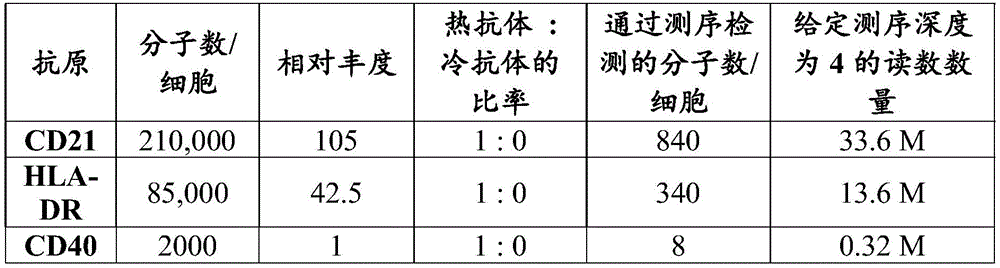
表3.使用热抗体和冷抗体进行实例蛋白质定量Table 3. Example protein quantification using hot and cold antibodies
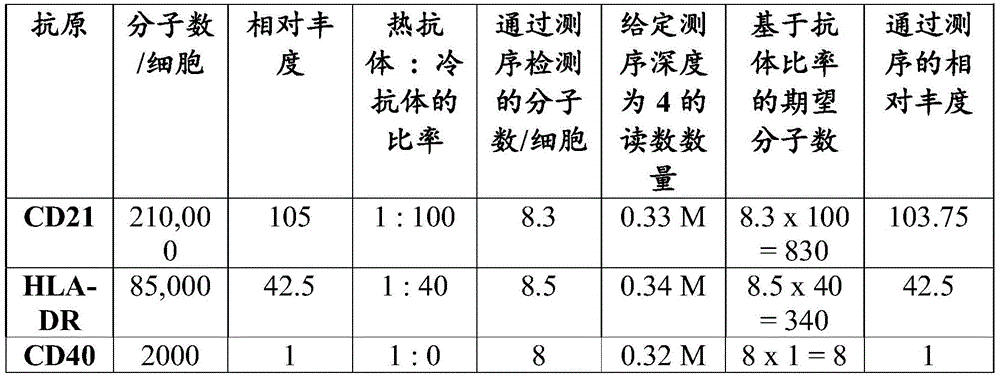
表3显示使用热抗体:冷抗体的混合物解析三种细胞表面标志物的相对表达水平所需的总读数是1百万读数。同样,当将热抗体:冷抗体的混合物用于定量三种细胞表面标志物的表达水平时,与表2中显示的定量结果相比(1百万读数对比4752万读数)需要仅读数数量的2%来实现所有的三种蛋白质标志物的最佳覆盖率(例如,测序深度为4)。使用具有较高百分比的冷抗体的混合物使高表达蛋白质分子标准化,这减少了低丰度蛋白质检测、参数数量和测序成本之间的权衡,使得该测定作为工具更具吸引力。Table 3 shows that the total number of reads required to resolve the relative expression levels of the three cell surface markers using a mixture of hot antibody:cold antibody is 1 million reads. Likewise, when the hot antibody:cold antibody mixture was used to quantify the expression levels of the three cell surface markers, only the number of reads was required compared to the quantitative results shown in Table 2 (1 million reads vs. 47.52 million reads). 2% to achieve optimal coverage for all three protein markers (eg, sequencing depth of 4). Using a mixture with a higher percentage of cold antibodies to normalize highly expressed protein molecules reduces the trade-off between low-abundance protein detection, number of parameters, and sequencing cost, making this assay more attractive as a tool.
总之,这些数据表明,使用热抗体:冷抗体的混合物,对于不同丰度的蛋白质靶(例如,抗原),可以实现具有所需覆盖率的测序数据中总读数的所需数量。Taken together, these data demonstrate that the desired number of total reads in the sequencing data with the desired coverage can be achieved for protein targets of different abundances (eg, antigens) using a mixture of hot antibody:cold antibody.
实例5Example 5
T细胞亚群的鉴定Identification of T cell subsets
该实例通过大规模平行单个细胞测序证明了蛋白质和mRNA含量的同时数字测量,以更好地鉴定T细胞亚群。This example demonstrates simultaneous digital measurement of protein and mRNA content by massively parallel single-cell sequencing to better identify T cell subsets.
已经将高通量单个细胞RNA测序用于描述复杂和异质细胞群及动态。然而,缺乏关于蛋白质表达的信息可以使鉴定通常由细胞表面标志物定义的细胞类型具有挑战性,因为mRNA和蛋白质表达可能不紧密相关。特别是T细胞含有相对低丰度的转录物,并且不同的T细胞亚群通常表现出高度相似的转录谱。该实例说明了通过测序使用寡核苷酸缀合的抗体测量蛋白质表达的方法,该方法能够同时检测单个细胞中的蛋白质和mRNA表达。High-throughput single-cell RNA sequencing has been used to characterize complex and heterogeneous cell populations and dynamics. However, the lack of information on protein expression can make identification of cell types often defined by cell surface markers challenging, as mRNA and protein expression may not be closely related. T cells in particular contain relatively low abundance of transcripts, and different T cell subsets often exhibit highly similar transcriptional profiles. This example illustrates a method for measuring protein expression by sequencing using oligonucleotide-conjugated antibodies, which enables simultaneous detection of protein and mRNA expression in a single cell.
使用BDTM Resolve(一种大规模平行单个细胞分析系统)在单个工作流程中捕获、扩增抗体特异性寡核苷酸并与mRNA一起进行测序。为证明该方法的功效,创建了包括许多常见T细胞标志物的寡核苷酸缀合的抗体组。将该组应用于人外周血单核细胞(PBMC)。通过寡核苷酸缀合的抗体对蛋白质表达的检测是高度敏感和特异的。并且蛋白质标志物测量的添加提供了更加明显且有力的单个细胞表达谱的聚类,尤其是在T细胞区室中,例如原始CD4与CD8T细胞的分离,以及原始T细胞与记忆T细胞的分离。特别地,鉴定了罕见的并在最近描述的T细胞亚群,干记忆T细胞。干记忆T细胞构成具有干细胞样特性的长效记忆T细胞群。Antibody-specific oligonucleotides were captured, amplified, and sequenced along with mRNA in a single workflow using BD ™ Resolve, a massively parallel single-cell analysis system. To demonstrate the efficacy of this approach, a panel of oligonucleotide-conjugated antibodies including many common T cell markers was created. This panel was applied to human peripheral blood mononuclear cells (PBMC). Detection of protein expression by oligonucleotide-conjugated antibodies is highly sensitive and specific. And the addition of protein marker measurements provided more pronounced and robust clustering of individual cell expression profiles, especially in T cell compartments, such as the separation of naive CD4 versus CD8 T cells, and the segregation of naive versus memory T cells. . In particular, a rare and recently described T cell subset, stem memory T cells, was identified. Stem memory T cells constitute a population of long-acting memory T cells with stem cell-like properties.
总之,数据显示通过大规模并行单个细胞测序进行的蛋白质和mRNA含量的同时数字测量可以将单个细胞转录谱分析和高参数蛋白质组学转化为进一步努力阐明复杂的生物系统,了解疾病状态和实现更有效的生物标志物发现。Taken together, the data show that simultaneous digital measurement of protein and mRNA content by massively parallel single-cell sequencing can translate single-cell transcriptional profiling and high-parameter proteomics into further efforts to elucidate complex biological systems, understand disease states and enable better Effective biomarker discovery.
实例6Example 6
对照颗粒Control particles
该实例表明生成包括具有不同序列的对照颗粒寡核苷酸的对照颗粒以及使用官能化对照颗粒以确定捕获效率。This example demonstrates the generation of control particles comprising control particle oligonucleotides with different sequences and the use of functionalized control particles to determine capture efficiency.
材料Material
BD CompBead Plus抗小鼠Ig(7.5um)颗粒集(51-9006274)BD CompBead Plus Anti-Mouse Ig (7.5um) Particle Set (51-9006274)
BD染色缓冲液(FBS)BD staining buffer (FBS)
程序program
1.在使用之前将Vortex BD CompBead Plus充分涡旋(至少1分钟)。1. Vortex BD CompBead Plus well before use (at least 1 minute).
2.向管中添加800uL染色缓冲液(表7显示染色缓冲液以及与具有不同丰度的五个序列的寡核苷酸缀合的CD147的组合物。图33A是显示染色缓冲液组合物的图)。2. Add 800 uL of staining buffer to the tube (Table 7 shows the composition of staining buffer and CD147 conjugated to oligonucleotides of five sequences with different abundances. Figure 33A is a graph showing staining buffer composition picture).
3.添加5个全滴(大约300uL)的CompBead Plus抗小鼠。3. Add 5 full drops (approximately 300uL) of CompBead Plus anti-mouse.
4.向管中添加20uL的以下染色混合物。涡旋4. Add 20uL of the following staining mix to the tube. vortex
5.在室温下避光孵育30分钟。5. Incubate for 30 minutes at room temperature in the dark.
6.以200g旋转珠粒10分钟。6. Spin the beads at 200 g for 10 minutes.
7.小心去除上清液并用1mL染色缓冲液重悬浮。7. Carefully remove the supernatant and resuspend with 1 mL of staining buffer.
8.以200g旋转珠粒10分钟。8. Spin the beads at 200 g for 10 minutes.
9.小心去除上清液并用1mL染色缓冲液重悬浮以生成官能化的CompBead储备溶液。9. Carefully remove supernatant and resuspend with 1 mL of staining buffer to generate functionalized CompBead stock solution.
10.对珠粒计数。10. Count the beads.
表7.染色混合物组合物Table 7. Dye Mixture Composition
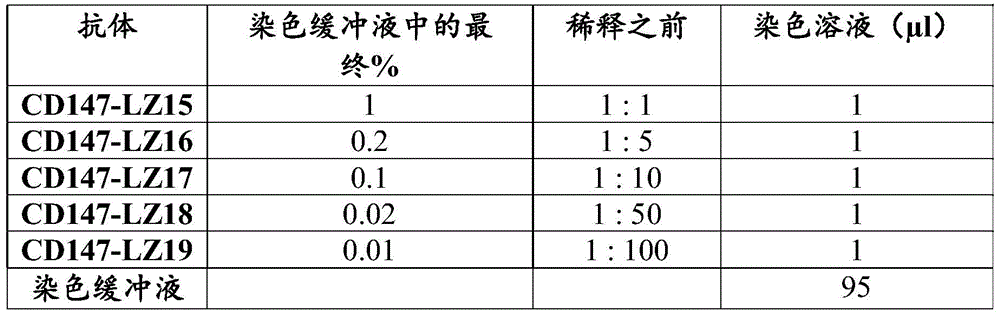
结果result
图34A-34B是血细胞计数器中细胞(图34A,白色圆圈)和对照颗粒(图34B,黑色圆圈)的明视野图像。图35A-35B是与荧光团相关联的寡核苷酸-缀合的抗体结合的对照颗粒的相差(图35A,10X)和荧光(图35B,10X)图像。荧光显微镜被用于确定5ul官能化的CompBead储备溶液含有约2000个细胞(总输入的4%),其中制得约400000个官能化的CompBead。Figures 34A-34B are brightfield images of cells (Figure 34A, white circles) and control particles (Figure 34B, black circles) in a hemocytometer. 35A-35B are phase contrast (FIG. 35A, 10X) and fluorescence (FIG. 35B, 10X) images of fluorophore-associated oligonucleotide-conjugated antibody-bound control particles. Fluorescence microscopy was used to determine that 5 ul of the functionalized CompBead stock solution contained approximately 2000 cells (4% of total input), of which approximately 400,000 functionalized CompBeads were made.
图36是显示被装载到盒的微孔中的细胞和颗粒的对照颗粒图像。可以伴随常规的解析实验使用CompBead。将522个官能化的CompBead添加至多个细胞中。在20000个细胞(包括对照颗粒)序列中,156个具有高于20的所有对照颗粒寡核苷酸总数。因此,156个对照颗粒是序列。图33B是显示具有五种不同的对照条形码序列(LZ15-LZ19)的对照颗粒寡核苷酸的数量的图,该数量与染色缓冲液中它们的丰度相关。Figure 36 is a control particle image showing cells and particles loaded into the microwells of the cassette. CompBead can be used with routine analytical experiments. 522 functionalized CompBeads were added to multiple cells. Of the 20,000 cell sequences (including control particles), 156 had more than 20 total oligonucleotides for all control particles. Therefore, 156 control particles are sequences. Figure 33B is a graph showing the number of control particle oligonucleotides with five different control barcode sequences (LZ15-LZ19) that correlate with their abundance in staining buffer.
总之,这些数据显示可以用寡核苷酸(例如,对照颗粒寡核苷酸)将颗粒(例如,CompBead Plus)官能化。官能化的颗粒可以与单个细胞测序工作流程一起使用,以确定捕获的和测序的颗粒的数量。Taken together, these data show that particles (eg, CompBead Plus) can be functionalized with oligonucleotides (eg, control particle oligonucleotides). Functionalized particles can be used with single-cell sequencing workflows to determine the number of captured and sequenced particles.
尽管本文已经披露了各种方面和实施例,但其他方面和实施例对本领域技术人员将是明显的。本文披露的各种方面和实施例用于说明的目的而并不意于限制由以下权利要求所指出的真实范围和精神。While various aspects and embodiments have been disclosed herein, other aspects and embodiments will be apparent to those skilled in the art. The various aspects and embodiments disclosed herein are for illustrative purposes and are not intended to limit the true scope and spirit as indicated by the following claims.
本领域技术人员将理解,对于本文披露的此过程和方法,以及其他过程和方法,在这些过程和方法中进行的功能可以按不同顺序实施。此外,概述的步骤和操作仅提供为实例,并且一些步骤和操作可以是任选的,合并为更少的步骤和操作,或扩展为另外的步骤和操作,而不减损披露的实施例的精华。Those of skill in the art will understand that for this, as well as other, processes and methods disclosed herein, the functions performed in these processes and methods may be performed in a different order. Furthermore, the outlined steps and operations are provided as examples only, and some steps and operations may be optional, combined into fewer steps and operations, or expanded into additional steps and operations without detracting from the essence of the disclosed embodiments .
关于本文中使用基本上任何复数和/或单数术语,在对于背景和/或应用适当的情况下,本领域技术人员可以从复数转换为单数和/或从单数转换为复数。为了清楚起见,可以在本文明确阐述各种单数/复数排列。With respect to the use of substantially any plural and/or singular term herein, one skilled in the art can convert from the plural to the singular and/or from the singular to the plural as appropriate for the context and/or application. Various singular/plural permutations may be expressly set forth herein for the sake of clarity.
本领域技术人员将理解,一般来说,本文使用的术语,尤其是所附权利要求书(例如,所附权利要求书的主体)中的术语,通常旨在作为“开放性的”术语(例如,术语“包括(including)”应解释为“包括但不限于(including but not limited to)”,术语“具有(having)”应解释为“具有至少(having at least)”,术语“包括(includes)”应解释为“包括但不限于(includes but is not limited to)”等)。本领域技术人员将进一步理解,如果预期到所介绍的权利要求陈述的特定数目,这样的预期将明确地陈述于权利要求中,并且在不存在这种陈述的情况下没有这种意图存在。例如,作为对理解的帮助,以下所附权利要求书可以包含介绍性短语“至少一个”和“一个或多个”的使用,以介绍权利要求陈述。然而,此类短语的使用不应解读为意味着由不定冠词“一个”或“一种”介绍权利要求陈述会将任何包含这种介绍的权利要求陈述的具体权利要求限制到包含仅一个这种陈述的实施例中,甚至当相同的权利要求包括介绍性短语“一个或多个”或“至少一个”以及不定冠词如“一个”或“一种”时也是如此(例如,“一个”和/或“一种”应解释为意指“至少一个”或“一个或多个”);这对于使用定冠词来介绍权利要求陈述同样适用。此外,即使明确地陈述了介绍的权利要求陈述的特定数目,本领域技术人员将认识到,这种陈述应解释为意指至少所陈述的数字(例如,仅陈述“两个陈述”而没有其他修饰词意指至少两个陈述、或两个或更多个陈述)。此外,在使用类似于“A、B和C等中的至少一个”的惯例的那些情况下,通常这种句法结构是在本领域技术人员将理解所述惯例的意义上预期(例如,“具有A、B和C中的至少一个的系统”将包括但不限于仅具有A,仅具有B,仅具有C,A和B一起,A和C一起,B和C一起,和/或A、B、和C一起等的系统)。在使用类似于“A、B或C等中的至少一个”的惯例的那些情况下,通常这种句法结构是在本领域技术人员将理解所述惯例的意义上预期(例如,“具有A、B或C中的至少一个的系统”将包括但不限于仅具有A,仅具有B,仅具有C,A和B一起,A和C一起,B和C一起,和/或A、B、和C一起等的系统)。本领域技术人员将进一步理解,实际上,无论在说明书、权利要求书还是在附图中,呈现两个或更多个替代术语的任何分离性词语和/或短语应被理解为考虑到包括术语之一、任一术语或两个术语的可能性。例如,短语“A或B”将被理解为包括“A”或“B”或“A和B”的可能性。Those of skill in the art will appreciate that terms used herein in general, and particularly terms in the appended claims (eg, the body of the appended claims), are generally intended to be "open-ended" terms (eg, , the term "including" should be interpreted as "including but not limited to", the term "having" should be interpreted as "having at least", the term "includes" )" should be interpreted as "includes but is not limited to" etc.). It will be further understood by those within the art that if a specific number of an introduced claim recitation is intended, such an intent will be explicitly recited in the claim, and in the absence of such recitation no such intent is present. For example, as an aid to understanding, the following appended claims may contain usage of the introductory phrases "at least one" and "one or more" to introduce claim recitations. However, use of such phrases should not be read to mean that introduction of a claim statement by the indefinite articles "a" or "an" would limit any specific claim containing such an introduction to a claim statement containing only one of these This is true even when the same claim includes the introductory phrase "one or more" or "at least one" as well as an indefinite article such as "a" or "an" (eg, "an" and/or "a" should be construed to mean "at least one" or "one or more"); the same applies to the use of the definite article to introduce claim statements. Furthermore, even if a specific number of an introduced claim recitation is expressly recited, one skilled in the art will recognize that such recitation should be construed to mean at least the recited number (eg, merely reciting "two recitations" and no other A modifier means at least two statements, or two or more statements). Furthermore, in those cases where a convention similar to "at least one of A, B, and C, etc." is used, typically such syntactic structures are expected in the sense that those skilled in the art would understand the convention (eg, "has A system of at least one of A, B, and C" shall include, but is not limited to, having A only, B only, C only, A and B together, A and C together, B and C together, and/or A, B , with C, etc. systems). In those cases where a convention like "at least one of A, B, or C, etc." is used, typically such syntactic structures are expected in the sense that those skilled in the art would understand the convention (eg, "with A, B, C, etc." A system of at least one of B or C" shall include, but is not limited to, having A only, B only, C only, A and B together, A and C together, B and C together, and/or A, B, and C and other systems). Those skilled in the art will further understand that, indeed, whether in the specification, claims, or drawings, any discrete word and/or phrase that presents two or more alternative terms should be construed to include the term The possibility of one, either term, or both terms. For example, the phrase "A or B" would be understood to include the possibilities of "A" or "B" or "A and B".
此外,当本披露的特征或方面以马库什组(Markush group)描述时,本领域技术人员将意识到本披露还由此以马库什组的任何单独的成员或成员子组描述。Furthermore, when features or aspects of the disclosure are described in terms of a Markush group, those skilled in the art will appreciate that the disclosure is also thus described in terms of any individual member or subgroup of members of the Markush group.
如本领域技术人员将理解的,出于任何和所有目的,如在提供书面描述方面,本文披露的所有范围还包括任何和所有可能的它的子范围和子范围组合。任何列出的范围都可以很容易地被识别为充分描述并使相同的范围能被分解为至少相等的一半,三分之一,四分之一,五分之一,十分之一等。作为非限制性示例,这里讨论的每个范围可以容易地分解为下三分之一,中三分之一和上三分之一等。如本领域技术人员还将理解的,所有语言,如“多至”、“至少”、等包括所陈述的数字,并且指代可以随后分解为如上讨论的子范围的范围。最后,如本领域技术人员将理解的,范围包括每个单独的成员。因此,例如,具有1-3个细胞的组是指具有1、2或3个细胞的组。类似地,具有1-5个细胞的组指代具有1、2、3、4或5个细胞的组,等等。As will be understood by those skilled in the art, for any and all purposes, such as in providing a written description, all ranges disclosed herein also include any and all possible sub-ranges and combinations of sub-ranges thereof. Any listed range can easily be identified as sufficiently described to enable the same range to be broken down into at least equal halves, thirds, quarters, fifths, tenths, etc. As a non-limiting example, each range discussed here can be easily broken down into a lower third, a middle third, an upper third, etc. As will also be understood by those of skill in the art, all language such as "up to," "at least," etc. includes the stated number and refers to a range that can be subsequently broken down into sub-ranges as discussed above. Finally, as will be understood by those skilled in the art, a range includes each individual member. Thus, for example, a group with 1-3 cells refers to a group with 1, 2 or 3 cells. Similarly, a group with 1-5 cells refers to a group with 1, 2, 3, 4, or 5 cells, and so on.
根据上文,应当理解,本文出于解释说明的目的已经描述了本披露的各种实施例,并且在不偏离本披露的范围和精神的条件下做出各种修改。因此本文披露的各种实施例并不意于限制由以下权利要求书所指出的真实范围和精神。From the foregoing, it should be understood that various embodiments of the disclosure have been described herein for purposes of illustration and that various modifications can be made without departing from the scope and spirit of the disclosure. Therefore, the various embodiments disclosed herein are not intended to limit the true scope and spirit as indicated by the following claims.
序列表sequence listing
<110> 赛卢拉研究公司<110> Cellula Research Corporation
贝克顿迪金森公司becton dickinson co.
克里斯蒂娜·范Christina Fan
克里斯蒂娜·张Christina Zhang
艾琳·夏姆Erin Shaym
奥拉夫·佐尔纳Olaf Zollner
尼坦杰里·班萨尔Nitangeli Bansal
詹姆斯·贾迪亚里James Jadiari
格雷琴·因博恩·拉姆Gretchen Imborn Ram
艾瑞克·延森Eric Jensen
于尔格·罗雷尔Jurgen Rohrer
布伦特·盖洛德Brent Gaylord
乔迪·马丁Jody Martin
杰森·G·维达尔Jason G. Vidal
<120> 使用具有条形码化的寡核苷酸序列的试剂测量蛋白质表达<120> Measurement of protein expression using reagents with barcoded oligonucleotide sequences
<130> BDCRI.025A<130> BDCRI.025A
<150> 62/399,795<150> 62/399,795
<151> 2016-09-26<151> 2016-09-26
<150> 62/464279<150> 62/464279
<151> 2017-02-27<151> 2017-02-27
<150> 62/515,952<150> 62/515,952
<151> 2017-06-06<151> 2017-06-06
<160> 7<160> 7
<170> PatentIn 版本 3.5<170> PatentIn Version 3.5
<210> 1<210> 1
<211> 20<211> 20
<212> DNA<212> DNA
<213> 人工序列<213> Artificial sequences
<220><220>
<223> 注意="对人工序列:合成寡核苷酸的描述"<223> Note="Description of Artificial Sequences: Synthetic Oligonucleotides"
<400> 1<400> 1
aaaaaaaaaa aaaaaaaaaa 20
<210> 2<210> 2
<211> 20<211> 20
<212> DNA<212> DNA
<213> 人工序列<213> Artificial sequences
<220><220>
<223> 注意="对人工序列:合成寡核苷酸的描述"<223> Note="Description of Artificial Sequences: Synthetic Oligonucleotides"
<400> 2<400> 2
tttttttttt tttttttttt 20
<210> 3<210> 3
<211> 95<211> 95
<212> DNA<212> DNA
<213> 人工序列<213> Artificial sequences
<220><220>
<223> 注意="对人工序列:合成寡核苷酸的描述"<223> Note="Description of Artificial Sequences: Synthetic Oligonucleotides"
<220><220>
<221> 5AmMC6<221> 5AmMC6
<222> (1)..(1)<222> (1)..(1)
<223> 5' 氨基修饰物C6<223> 5' Amino Modifier C6
<400> 3<400> 3
gttgtcaaga tgctaccgtt cagagtacgt ggagttggtg gcccgacccc gagcgctacg 60gttgtcaaga tgctaccgtt cagagtacgt ggagttggtg gcccgacccc gagcgctacg 60
agccccccgg aaaaaaaaaa aaaaaaaaaa aaaaa 95agccccccgg aaaaaaaaaa aaaaaaaaaa aaaaa 95
<210> 4<210> 4
<211> 200<211> 200
<212> DNA<212> DNA
<213> 人工序列<213> Artificial sequences
<220><220>
<223> 注意="对人工序列:合成寡核苷酸的描述"<223> Note="Description of Artificial Sequences: Synthetic Oligonucleotides"
<220><220>
<221> 5AmMC6<221> 5AmMC6
<222> (1)..(1)<222> (1)..(1)
<223> 5' 氨基修饰物C6<223> 5' Amino Modifier C6
<400> 4<400> 4
gttgtcaaga tgctaccgtt cagagctact gtccgaagtt accgtgtatc taccacgggt 60gttgtcaaga tgctaccgtt cagagctact gtccgaagtt accgtgtatc taccacgggt 60
ggtttttcga atccggaaaa gatagtaata agtgttttag ttggaataag tcgcaacttt 120ggtttttcga atccggaaaa gatagtaata agtgttttag ttggaataag tcgcaacttt 120
tggagacggt tacctctcaa tttttctgat ccgtaggccc cccgatctcg gcctcaaaaa 180tggagacggt tacctctcaa tttttctgat ccgtaggccc cccgatctcg gcctcaaaaa 180
aaaaaaaaaa aaaaaaaaaa 200
<210> 5<210> 5
<211> 25<211> 25
<212> DNA<212> DNA
<213> 人工序列<213> Artificial sequences
<220><220>
<223> 注意="对人工序列:合成寡核苷酸的描述"<223> Note="Description of Artificial Sequences: Synthetic Oligonucleotides"
<400> 5<400> 5
gttgtcaaga tgctaccgtt cagag 25gttgtcaaga tgctaccgtt cagag 25
<210> 6<210> 6
<211> 95<211> 95
<212> DNA<212> DNA
<213> 人工序列<213> Artificial sequences
<220><220>
<223> 注意="对人工序列:合成寡核苷酸的描述"<223> Note="Description of Artificial Sequences: Synthetic Oligonucleotides"
<400> 6<400> 6
gttgtcaaga tgctaccgtt cagagcccca tgtctagtac ctattggtcc cctatcctca 60gttgtcaaga tgctaccgtt cagagcccca tgtctagtac ctattggtcc cctatcctca 60
gattcgttta aaaaaaaaaa aaaaaaaaaa aaaaa 95gattcgttta aaaaaaaaaa aaaaaaaaaa aaaaa 95
<210> 7<210> 7
<211> 26<211> 26
<212> DNA<212> DNA
<213> 人工序列<213> Artificial sequences
<220><220>
<223> 注意="对人工序列:合成寡核苷酸的描述"<223> Note="Description of Artificial Sequences: Synthetic Oligonucleotides"
<400> 7<400> 7
tttttttttt tttttttttt tttttt 26tttttttttt tttttttttt tttttt 26
Claims (62)
Priority Applications (1)
| Application Number | Priority Date | Filing Date | Title |
|---|---|---|---|
| CN202210713090.3A CN115060911A (en) | 2016-09-26 | 2017-09-25 | Measurement of protein expression using reagents with barcoded oligonucleotide sequences |
Applications Claiming Priority (7)
| Application Number | Priority Date | Filing Date | Title |
|---|---|---|---|
| US201662399795P | 2016-09-26 | 2016-09-26 | |
| US62/399,795 | 2016-09-26 | ||
| US201762464279P | 2017-02-27 | 2017-02-27 | |
| US62/464,279 | 2017-02-27 | ||
| US201762515952P | 2017-06-06 | 2017-06-06 | |
| US62/515,952 | 2017-06-06 | ||
| PCT/US2017/053331 WO2018058073A2 (en) | 2016-09-26 | 2017-09-25 | Measurement of protein expression using reagents with barcoded oligonucleotide sequences |
Related Child Applications (1)
| Application Number | Title | Priority Date | Filing Date |
|---|---|---|---|
| CN202210713090.3A Division CN115060911A (en) | 2016-09-26 | 2017-09-25 | Measurement of protein expression using reagents with barcoded oligonucleotide sequences |
Publications (2)
| Publication Number | Publication Date |
|---|---|
| CN109791157A CN109791157A (en) | 2019-05-21 |
| CN109791157B true CN109791157B (en) | 2022-06-07 |
Family
ID=60043314
Family Applications (2)
| Application Number | Title | Priority Date | Filing Date |
|---|---|---|---|
| CN201780058799.1A Active CN109791157B (en) | 2016-09-26 | 2017-09-25 | Measuring protein expression using reagents with barcoded oligonucleotide sequences |
| CN202210713090.3A Pending CN115060911A (en) | 2016-09-26 | 2017-09-25 | Measurement of protein expression using reagents with barcoded oligonucleotide sequences |
Family Applications After (1)
| Application Number | Title | Priority Date | Filing Date |
|---|---|---|---|
| CN202210713090.3A Pending CN115060911A (en) | 2016-09-26 | 2017-09-25 | Measurement of protein expression using reagents with barcoded oligonucleotide sequences |
Country Status (12)
| Country | Link |
|---|---|
| US (7) | US11460468B2 (en) |
| EP (2) | EP4300099A3 (en) |
| JP (3) | JP7091348B2 (en) |
| KR (3) | KR102522023B1 (en) |
| CN (2) | CN109791157B (en) |
| AU (2) | AU2017331459B2 (en) |
| BR (1) | BR112019005900A2 (en) |
| CA (1) | CA3034924C (en) |
| ES (1) | ES2961743T3 (en) |
| IL (1) | IL265478B2 (en) |
| SG (1) | SG11201901733PA (en) |
| WO (1) | WO2018058073A2 (en) |
Families Citing this family (191)
| Publication number | Priority date | Publication date | Assignee | Title |
|---|---|---|---|---|
| US8835358B2 (en) | 2009-12-15 | 2014-09-16 | Cellular Research, Inc. | Digital counting of individual molecules by stochastic attachment of diverse labels |
| EP2739587B1 (en) | 2011-08-01 | 2020-05-27 | Denovo Sciences | Cell capture system |
| US10466160B2 (en) | 2011-08-01 | 2019-11-05 | Celsee Diagnostics, Inc. | System and method for retrieving and analyzing particles |
| US9404864B2 (en) | 2013-03-13 | 2016-08-02 | Denovo Sciences, Inc. | System for imaging captured cells |
| JP6375230B2 (en) | 2012-02-27 | 2018-08-15 | セルラー リサーチ, インコーポレイテッド | Compositions and kits for molecular counting |
| US11591637B2 (en) | 2012-08-14 | 2023-02-28 | 10X Genomics, Inc. | Compositions and methods for sample processing |
| US10752949B2 (en) | 2012-08-14 | 2020-08-25 | 10X Genomics, Inc. | Methods and systems for processing polynucleotides |
| CA2881685C (en) | 2012-08-14 | 2023-12-05 | 10X Genomics, Inc. | Microcapsule compositions and methods |
| US10273541B2 (en) | 2012-08-14 | 2019-04-30 | 10X Genomics, Inc. | Methods and systems for processing polynucleotides |
| US9951386B2 (en) | 2014-06-26 | 2018-04-24 | 10X Genomics, Inc. | Methods and systems for processing polynucleotides |
| US10323279B2 (en) | 2012-08-14 | 2019-06-18 | 10X Genomics, Inc. | Methods and systems for processing polynucleotides |
| US10400280B2 (en) | 2012-08-14 | 2019-09-03 | 10X Genomics, Inc. | Methods and systems for processing polynucleotides |
| US9701998B2 (en) | 2012-12-14 | 2017-07-11 | 10X Genomics, Inc. | Methods and systems for processing polynucleotides |
| US10829816B2 (en) | 2012-11-19 | 2020-11-10 | Apton Biosystems, Inc. | Methods of analyte detection |
| EP2931919B1 (en) | 2012-12-14 | 2019-02-20 | 10X Genomics, Inc. | Methods and systems for processing polynucleotides |
| US10533221B2 (en) | 2012-12-14 | 2020-01-14 | 10X Genomics, Inc. | Methods and systems for processing polynucleotides |
| US9752181B2 (en) | 2013-01-26 | 2017-09-05 | Denovo Sciences, Inc. | System and method for capturing and analyzing cells |
| EP2954104B1 (en) | 2013-02-08 | 2020-09-16 | 10X Genomics, Inc. | Polynucleotide barcode generation |
| US9707562B2 (en) | 2013-03-13 | 2017-07-18 | Denovo Sciences, Inc. | System for capturing and analyzing cells |
| US9856535B2 (en) | 2013-05-31 | 2018-01-02 | Denovo Sciences, Inc. | System for isolating cells |
| US10391490B2 (en) | 2013-05-31 | 2019-08-27 | Celsee Diagnostics, Inc. | System and method for isolating and analyzing cells |
| EP3039158B1 (en) | 2013-08-28 | 2018-11-14 | Cellular Research, Inc. | Massively parallel single cell analysis |
| DE202015009609U1 (en) | 2014-04-10 | 2018-08-06 | 10X Genomics, Inc. | Microfluidic system for the production of emulsions |
| JP2017522866A (en) | 2014-06-26 | 2017-08-17 | 10エックス ジェノミクス, インコーポレイテッド | Nucleic acid sequence analysis |
| EP4574974A3 (en) | 2014-06-26 | 2025-10-08 | 10x Genomics, Inc. | Methods of analyzing nucleic acids from individual cells or cell populations |
| US12312640B2 (en) | 2014-06-26 | 2025-05-27 | 10X Genomics, Inc. | Analysis of nucleic acid sequences |
| BR112017014902A2 (en) | 2015-01-12 | 2018-03-13 | 10X Genomics Inc | processes and systems for the preparation of nucleic acid sequencing libraries and libraries prepared using them |
| EP3256850B1 (en) | 2015-02-09 | 2025-07-09 | Slingshot Biosciences, Inc. | Hydrogel particles with tunable optical properties and methods for using the same |
| EP4286516A3 (en) | 2015-02-24 | 2024-03-06 | 10X Genomics, Inc. | Partition processing methods and systems |
| ES2836802T3 (en) | 2015-02-27 | 2021-06-28 | Becton Dickinson Co | Spatially addressable molecular barcodes |
| CN107406888A (en) | 2015-03-30 | 2017-11-28 | 赛卢拉研究公司 | Methods and compositions for combining barcoding |
| EP4582556A3 (en) | 2015-04-23 | 2025-10-08 | Becton, Dickinson and Company | Methods and compositions for whole transcriptome amplification |
| WO2017044574A1 (en) | 2015-09-11 | 2017-03-16 | Cellular Research, Inc. | Methods and compositions for nucleic acid library normalization |
| US11371094B2 (en) | 2015-11-19 | 2022-06-28 | 10X Genomics, Inc. | Systems and methods for nucleic acid processing using degenerate nucleotides |
| WO2017155967A1 (en) * | 2016-03-08 | 2017-09-14 | Diamond Nanotechnologies, Inc. | Generating a unique code from orientation information |
| US10822643B2 (en) | 2016-05-02 | 2020-11-03 | Cellular Research, Inc. | Accurate molecular barcoding |
| US10301677B2 (en) | 2016-05-25 | 2019-05-28 | Cellular Research, Inc. | Normalization of nucleic acid libraries |
| US10202641B2 (en) | 2016-05-31 | 2019-02-12 | Cellular Research, Inc. | Error correction in amplification of samples |
| US10640763B2 (en) | 2016-05-31 | 2020-05-05 | Cellular Research, Inc. | Molecular indexing of internal sequences |
| EP4300099A3 (en) | 2016-09-26 | 2024-03-27 | Becton, Dickinson and Company | Measurement of protein expression using reagents with barcoded oligonucleotide sequences |
| DK3929304T3 (en) * | 2016-12-16 | 2024-04-08 | Aratome Llc | MOLECULAR DETECTION BY LIGATION AMPLIFICATION |
| US10011872B1 (en) | 2016-12-22 | 2018-07-03 | 10X Genomics, Inc. | Methods and systems for processing polynucleotides |
| US10815525B2 (en) | 2016-12-22 | 2020-10-27 | 10X Genomics, Inc. | Methods and systems for processing polynucleotides |
| US10550429B2 (en) | 2016-12-22 | 2020-02-04 | 10X Genomics, Inc. | Methods and systems for processing polynucleotides |
| CN110214186B (en) | 2017-01-30 | 2023-11-24 | 10X基因组学有限公司 | Methods and systems for droplet-based single cell barcoding |
| EP3577232A1 (en) | 2017-02-01 | 2019-12-11 | Cellular Research, Inc. | Selective amplification using blocking oligonucleotides |
| US10995333B2 (en) | 2017-02-06 | 2021-05-04 | 10X Genomics, Inc. | Systems and methods for nucleic acid preparation |
| EP3620535A4 (en) * | 2017-05-02 | 2021-01-13 | The University of Tokyo | METHOD OF INTEGRAL DETECTION OF NON-DESTRUCTIVE MEASUREMENT INFORMATION AND INFORMATION RELATING TO THE GENOME OF A CELL |
| US20180340169A1 (en) | 2017-05-26 | 2018-11-29 | 10X Genomics, Inc. | Single cell analysis of transposase accessible chromatin |
| EP4230746A3 (en) | 2017-05-26 | 2023-11-01 | 10X Genomics, Inc. | Single cell analysis of transposase accessible chromatin |
| EP4345172A3 (en) | 2017-06-05 | 2024-07-03 | Becton, Dickinson and Company | Sample indexing for single cells |
| CN112980667B (en) | 2017-08-29 | 2024-09-17 | 伯乐实验室有限公司 | Systems and methods for isolating and analyzing cells |
| US20200217850A1 (en) * | 2017-09-15 | 2020-07-09 | Apton Biosystems, Inc. | Heterogeneous single cell profiling using molecular barcoding |
| WO2019099751A1 (en) | 2017-11-15 | 2019-05-23 | 10X Genomics, Inc. | Functionalized gel beads |
| US10829815B2 (en) | 2017-11-17 | 2020-11-10 | 10X Genomics, Inc. | Methods and systems for associating physical and genetic properties of biological particles |
| US11946095B2 (en) | 2017-12-19 | 2024-04-02 | Becton, Dickinson And Company | Particles associated with oligonucleotides |
| WO2019140432A1 (en) * | 2018-01-15 | 2019-07-18 | Hygieia Health Co., Limited | Systems, methods, compositions and devices for personalized nutrition formulation and delivery system |
| EP3752832A1 (en) | 2018-02-12 | 2020-12-23 | 10X Genomics, Inc. | Methods characterizing multiple analytes from individual cells or cell populations |
| CN112262218B (en) | 2018-04-06 | 2024-11-08 | 10X基因组学有限公司 | Systems and methods for quality control in single cell processing |
| US11365409B2 (en) | 2018-05-03 | 2022-06-21 | Becton, Dickinson And Company | Molecular barcoding on opposite transcript ends |
| US11773441B2 (en) | 2018-05-03 | 2023-10-03 | Becton, Dickinson And Company | High throughput multiomics sample analysis |
| WO2019217758A1 (en) | 2018-05-10 | 2019-11-14 | 10X Genomics, Inc. | Methods and systems for molecular library generation |
| GB201810571D0 (en) * | 2018-06-27 | 2018-08-15 | Cs Genetics Ltd | Reagents and methods for the analysis of circulating microparticles |
| US20200020419A1 (en) | 2018-07-16 | 2020-01-16 | Flagship Pioneering Innovations Vi, Llc. | Methods of analyzing cells |
| US20200032335A1 (en) | 2018-07-27 | 2020-01-30 | 10X Genomics, Inc. | Systems and methods for metabolome analysis |
| EP4471161A3 (en) | 2018-08-03 | 2025-03-12 | Becton, Dickinson and Company | Nuclei barcoding and capture in single cells |
| ES2945323T3 (en) * | 2018-08-17 | 2023-06-30 | Becton Dickinson Co | Barcoding by aptamers |
| EP3837545A1 (en) | 2018-08-17 | 2021-06-23 | F. Hoffmann-La Roche AG | In vitro transcytosis assay |
| IL317123A (en) | 2018-08-27 | 2025-01-01 | Regeneron Pharma | Use of Raman Spectroscopy in Downstream Purification |
| US11519033B2 (en) | 2018-08-28 | 2022-12-06 | 10X Genomics, Inc. | Method for transposase-mediated spatial tagging and analyzing genomic DNA in a biological sample |
| CN112912513A (en) * | 2018-08-28 | 2021-06-04 | 贝克顿迪金森公司 | Sample multiplexing using carbohydrate binding reagents and membrane permeability reagents |
| JP7670607B2 (en) | 2018-10-01 | 2025-04-30 | ベクトン・ディキンソン・アンド・カンパニー | Determination of 5' transcript sequence |
| WO2020092835A1 (en) * | 2018-10-31 | 2020-05-07 | Akoya Biosciences, Inc. | Methods and kits for detecting cells using oligonucleotide conjugated antibodies |
| EP3877520B1 (en) * | 2018-11-08 | 2025-03-19 | Becton, Dickson And Company | Whole transcriptome analysis of single cells using random priming |
| US11459607B1 (en) | 2018-12-10 | 2022-10-04 | 10X Genomics, Inc. | Systems and methods for processing-nucleic acid molecules from a single cell using sequential co-partitioning and composite barcodes |
| WO2020123309A1 (en) * | 2018-12-10 | 2020-06-18 | 10X Genomics, Inc. | Resolving spatial arrays by proximity-based deconvolution |
| US12529094B2 (en) | 2018-12-10 | 2026-01-20 | 10X Genomics, Inc. | Imaging system hardware |
| US11492660B2 (en) | 2018-12-13 | 2022-11-08 | Becton, Dickinson And Company | Selective extension in single cell whole transcriptome analysis |
| US11845983B1 (en) | 2019-01-09 | 2023-12-19 | 10X Genomics, Inc. | Methods and systems for multiplexing of droplet based assays |
| WO2020150356A1 (en) | 2019-01-16 | 2020-07-23 | Becton, Dickinson And Company | Polymerase chain reaction normalization through primer titration |
| WO2020154307A1 (en) * | 2019-01-22 | 2020-07-30 | Singular Genomics Systems, Inc. | Polynucleotide barcodes for multiplexed proteomics |
| WO2020154247A1 (en) | 2019-01-23 | 2020-07-30 | Cellular Research, Inc. | Oligonucleotides associated with antibodies |
| US20220290262A1 (en) * | 2019-01-25 | 2022-09-15 | Psomagen Inc. | Antibody-dna conjugates and hpv detection and treatment |
| CN114008214A (en) * | 2019-01-28 | 2022-02-01 | 贝克顿·迪金森公司 | Oligonucleotide-containing cellular component binding reagents and methods of use thereof |
| WO2020163789A1 (en) * | 2019-02-08 | 2020-08-13 | The Trustees Of Columbia University In The City Of New York | Single cell/exosome/vesicle protein profiling |
| US11851683B1 (en) | 2019-02-12 | 2023-12-26 | 10X Genomics, Inc. | Methods and systems for selective analysis of cellular samples |
| US11513113B2 (en) * | 2019-02-12 | 2022-11-29 | Pact Pharma, Inc. | Compositions and methods for identification of antigen specific T cells |
| EP3924506A1 (en) | 2019-02-14 | 2021-12-22 | Becton Dickinson and Company | Hybrid targeted and whole transcriptome amplification |
| WO2020172496A1 (en) * | 2019-02-21 | 2020-08-27 | Ding Qinxue | Method of removing non-specific binding signals using microparticles |
| WO2020190454A1 (en) | 2019-03-18 | 2020-09-24 | Cellular Research, Inc. | Precise delivery of components into fluids |
| CN113795591A (en) * | 2019-04-02 | 2021-12-14 | 使命生物公司 | Methods and systems for characterizing tumors and identifying tumor heterogeneity |
| US20200325522A1 (en) * | 2019-04-02 | 2020-10-15 | Mission Bio, Inc. | Method and systems to characterize tumors and identify tumor heterogeneity |
| US10633693B1 (en) | 2019-04-16 | 2020-04-28 | Celsee Diagnostics, Inc. | System and method for leakage control in a particle capture system |
| WO2020214642A1 (en) | 2019-04-19 | 2020-10-22 | Becton, Dickinson And Company | Methods of associating phenotypical data and single cell sequencing data |
| US11273439B2 (en) * | 2019-05-07 | 2022-03-15 | Bio-Rad Laboratories, Inc. | System and method for target material retrieval from microwells |
| WO2020227309A1 (en) | 2019-05-07 | 2020-11-12 | Bio-Rad Laboratories, Inc. | System and method for automated single cell processing |
| US11365441B2 (en) | 2019-05-22 | 2022-06-21 | Mission Bio, Inc. | Method and apparatus for simultaneous targeted sequencing of DNA, RNA and protein |
| EP3976820A1 (en) | 2019-05-30 | 2022-04-06 | 10X Genomics, Inc. | Methods of detecting spatial heterogeneity of a biological sample |
| US10956806B2 (en) * | 2019-06-10 | 2021-03-23 | International Business Machines Corporation | Efficient assembly of oligonucleotides for nucleic acid based data storage |
| KR20250084977A (en) | 2019-06-14 | 2025-06-11 | 바이오 래드 래버러토리스 인코오포레이티드 | System and method for automated single cell processing and analyses |
| CN114051534B (en) * | 2019-07-22 | 2025-02-21 | 贝克顿迪金森公司 | Single-cell chromatin immunoprecipitation sequencing assay |
| KR20220041875A (en) * | 2019-07-31 | 2022-04-01 | 바이오스크립 지노믹스, 인크. | single cell analysis |
| US12235262B1 (en) | 2019-09-09 | 2025-02-25 | 10X Genomics, Inc. | Methods and systems for single cell protein analysis |
| CA3156979A1 (en) * | 2019-10-05 | 2021-04-08 | Mission Bio, Inc. | Methods, systems and apparatus for copy number variations and single nucleotide variations simultaneously detected in single-cells |
| US11773436B2 (en) | 2019-11-08 | 2023-10-03 | Becton, Dickinson And Company | Using random priming to obtain full-length V(D)J information for immune repertoire sequencing |
| CN115605606A (en) * | 2019-11-25 | 2023-01-13 | 加州理工学院(Us) | Quantification of single-cell proteins by identification and quantitative separation (DUET) |
| JP7727628B2 (en) | 2019-12-03 | 2025-08-21 | アラマー バイオサイエンシーズ, インク. | Nucleic Acid Binding Immuno-Sandwich Assay (NULISA) |
| EP4069867B1 (en) | 2019-12-04 | 2025-08-27 | Becton, Dickinson and Company | Magnetic capture bead mediated molecular barcoding of nucleic acid targets in single particles and compositions for use in the same |
| WO2021146207A1 (en) | 2020-01-13 | 2021-07-22 | Becton, Dickinson And Company | Methods and compositions for quantitation of proteins and rna |
| US12365942B2 (en) | 2020-01-13 | 2025-07-22 | 10X Genomics, Inc. | Methods of decreasing background on a spatial array |
| CN115279919A (en) * | 2020-01-13 | 2022-11-01 | 贝克顿迪金森公司 | Cell capture using DU-containing oligonucleotides |
| WO2021146626A1 (en) * | 2020-01-15 | 2021-07-22 | Absci Llc | Activity-specific cell enrichment |
| US12405264B2 (en) | 2020-01-17 | 2025-09-02 | 10X Genomics, Inc. | Electrophoretic system and method for analyte capture |
| WO2021146636A1 (en) | 2020-01-17 | 2021-07-22 | Becton, Dickinson And Company | Methods and compositions for single cell secretomics |
| US20210230681A1 (en) | 2020-01-24 | 2021-07-29 | 10X Genomics, Inc. | Methods for spatial analysis using proximity ligation |
| WO2021155057A1 (en) | 2020-01-29 | 2021-08-05 | Becton, Dickinson And Company | Barcoded wells for spatial mapping of single cells through sequencing |
| EP4097248A1 (en) | 2020-01-31 | 2022-12-07 | Becton, Dickinson and Company | Mesophilic dna polymerase extension blockers |
| US11732300B2 (en) | 2020-02-05 | 2023-08-22 | 10X Genomics, Inc. | Increasing efficiency of spatial analysis in a biological sample |
| EP4103744A2 (en) * | 2020-02-12 | 2022-12-21 | Becton, Dickinson and Company | Intracellular abseq |
| US12399123B1 (en) | 2020-02-14 | 2025-08-26 | 10X Genomics, Inc. | Spatial targeting of analytes |
| WO2021173719A1 (en) | 2020-02-25 | 2021-09-02 | Becton, Dickinson And Company | Bi-specific probes to enable the use of single-cell samples as single color compensation control |
| US11504719B2 (en) | 2020-03-12 | 2022-11-22 | Bio-Rad Laboratories, Inc. | System and method for receiving and delivering a fluid for sample processing |
| US20230408514A1 (en) * | 2020-03-18 | 2023-12-21 | Chan Zuckerberg Biohub, Inc. | Single-cell combinatorial indexed cytometry sequencing |
| WO2021205453A1 (en) * | 2020-04-07 | 2021-10-14 | Yissum Research Development Company Of The Hebrew University Of Jerusalem Ltd. | Methods for nucleic acid detection |
| CN111471088B (en) * | 2020-04-21 | 2021-02-09 | 北京中科微盾生物科技有限责任公司 | Polypeptide for inhibiting SARS-COV-2 infection, composition and use thereof |
| WO2021231779A1 (en) | 2020-05-14 | 2021-11-18 | Becton, Dickinson And Company | Primers for immune repertoire profiling |
| US12416603B2 (en) | 2020-05-19 | 2025-09-16 | 10X Genomics, Inc. | Electrophoresis cassettes and instrumentation |
| WO2021243285A1 (en) * | 2020-05-29 | 2021-12-02 | Seer, Inc. | Systems and methods for rapid identification of proteins |
| WO2021247593A1 (en) | 2020-06-02 | 2021-12-09 | Becton, Dickinson And Company | Oligonucleotides and beads for 5 prime gene expression assay |
| US12265079B1 (en) | 2020-06-02 | 2025-04-01 | 10X Genomics, Inc. | Systems and methods for detecting analytes from captured single biological particles |
| AU2021288090A1 (en) | 2020-06-10 | 2023-01-19 | 10X Genomics, Inc. | Fluid delivery methods |
| US12435363B1 (en) | 2020-06-10 | 2025-10-07 | 10X Genomics, Inc. | Materials and methods for spatial transcriptomics |
| EP4139688A4 (en) * | 2020-06-18 | 2024-05-15 | The Chinese University Of Hong Kong | EFFICIENT ANTIBODY DNA BARCODING REAGENTS FOR MULTIPLEXED MOLECULAR IMAGING |
| US11932901B2 (en) | 2020-07-13 | 2024-03-19 | Becton, Dickinson And Company | Target enrichment using nucleic acid probes for scRNAseq |
| US12391940B2 (en) | 2020-07-31 | 2025-08-19 | Becton, Dickinson And Company | Single cell assay for transposase-accessible chromatin |
| US11434525B2 (en) | 2020-08-06 | 2022-09-06 | Singular Genomics Systems, Inc. | Spatial sequencing |
| WO2022032194A1 (en) | 2020-08-06 | 2022-02-10 | Singular Genomics Systems, Inc. | Methods for in situ transcriptomics and proteomics |
| CA3187378A1 (en) * | 2020-08-07 | 2022-02-10 | Mounir A. Koussa | Multiplexed analyte detection |
| EP4196581A4 (en) * | 2020-08-19 | 2024-05-29 | Encodia, Inc. | SEQUENTIAL CODING PROCESSES AND ASSOCIATED KITS |
| US20240027433A1 (en) * | 2020-09-15 | 2024-01-25 | Somalogic Operating Co., Inc. | Structure and methods for detection of sample analytes |
| EP4247969A1 (en) | 2020-11-17 | 2023-09-27 | Becton, Dickinson and Company | Combined analysis of cell-free nucleic acids and single cells for oncology diagnostics |
| WO2022109339A1 (en) | 2020-11-20 | 2022-05-27 | Becton, Dickinson And Company | Use of dextramer in single cell analysis |
| EP4247967A1 (en) | 2020-11-20 | 2023-09-27 | Becton, Dickinson and Company | Profiling of highly expressed and lowly expressed proteins |
| US20220178909A1 (en) | 2020-12-09 | 2022-06-09 | Becton, Dickinson And Company | Multiplexed single cell immunoassay |
| WO2022132206A1 (en) * | 2020-12-15 | 2022-06-23 | Becton, Dickinson And Company | Single cell secretome analysis |
| AU2021409136A1 (en) | 2020-12-21 | 2023-06-29 | 10X Genomics, Inc. | Methods, compositions, and systems for capturing probes and/or barcodes |
| EP4271837A4 (en) * | 2020-12-31 | 2025-10-15 | Tempus Ai Inc | SYSTEMS AND METHODS FOR THE DETECTION OF MULTI-MOLECULAR BIOMARKERS |
| CN113322254B (en) * | 2021-01-06 | 2022-05-20 | 南京诺唯赞生物科技股份有限公司 | Methods and tools for multi-target protein-DNA interaction |
| US20240230664A1 (en) * | 2021-01-08 | 2024-07-11 | Cz Biohub Sf, Llc | Bead-based assay for simultaneous detection of biomolecules |
| CN112725305B (en) * | 2021-01-13 | 2022-11-04 | 云南师范大学 | Heat-salt-sensitive inulinase mutant MutY119D and preparation method thereof |
| EP4294571B8 (en) | 2021-02-19 | 2024-07-10 | 10X Genomics, Inc. | Method of using a modular assay support device |
| WO2022195089A1 (en) * | 2021-03-19 | 2022-09-22 | Paris Sciences Et Lettres | Methods for the selective analysis of cells or organelles |
| EP4334706A4 (en) | 2021-05-05 | 2025-08-06 | Singular Genomics Systems Inc | Multiomic analysis device and methods of use thereof |
| EP4320271B1 (en) | 2021-05-06 | 2025-03-19 | 10X Genomics, Inc. | Methods for increasing resolution of spatial analysis |
| CN113234718B (en) * | 2021-05-15 | 2023-01-06 | 上海墨卓生物科技有限公司 | A bilayer microsphere with oligonucleotide sequences for single-cell sequencing |
| WO2022256345A1 (en) * | 2021-06-01 | 2022-12-08 | 10X Genomics, Inc. | Methods and systems for engineering antibodies, and antigen-binding fragments thereof, to have altered characteristics |
| CN113340873B (en) * | 2021-08-09 | 2021-10-19 | 北京市疾病预防控制中心 | A SERS System for Simultaneous Detection of Multiple Toxic Substances |
| US20240376522A1 (en) | 2021-08-30 | 2024-11-14 | Becton, Dickinson And Company | Template switch oligonucleotide (tso) for mrna 5' analysis |
| CN117897613A (en) | 2021-08-31 | 2024-04-16 | 贝克顿迪金森公司 | Multiplex proteomic analysis using oligonucleotide conjugated antibodies |
| WO2023034790A1 (en) | 2021-08-31 | 2023-03-09 | Becton, Dickinson And Company | Use of decoy polynucleotides in single cell multiomics |
| US20240360438A1 (en) | 2021-08-31 | 2024-10-31 | Becton, Dickinson And Company | Rna preservation and recovery from fixed cells |
| EP4396373B1 (en) | 2021-09-01 | 2025-12-10 | Becton, Dickinson and Company | Spatial multiomics using in situ reverse transcription |
| EP4679088A2 (en) | 2021-09-08 | 2026-01-14 | Becton, Dickinson and Company | Non-sequencing pcr-based method for detection of antibody-conjugated oligonucleotides |
| WO2023044307A1 (en) | 2021-09-14 | 2023-03-23 | Becton, Dickinson And Company | Full length single cell rna sequencing |
| KR102776030B1 (en) * | 2021-09-29 | 2025-03-04 | 고려대학교 산학협력단 | Dna barcode apparatus having positional information |
| EP4419707A1 (en) | 2021-11-10 | 2024-08-28 | 10X Genomics, Inc. | Methods, compositions, and kits for determining the location of an analyte in a biological sample |
| EP4444910A4 (en) | 2021-12-10 | 2025-11-05 | Bio Rad Laboratories Inc | COMPOSITIONS, METHOD AND SYSTEMS FOR SAMPLE PROCESSING WITH MORPHOLOGICALLY ADAPTABLE FUNCTIONALIZED PARTICLES |
| US20250066843A1 (en) | 2022-02-07 | 2025-02-27 | Becton, Dickinson And Company | Sorting of mrna and/or abseq containing barcoded beads by flow |
| JP2025506418A (en) | 2022-02-07 | 2025-03-11 | ベクトン・ディキンソン・アンド・カンパニー | Preparation of Nucleic Acids for Further Analysis of Their Sequences |
| US20250066761A1 (en) | 2022-02-08 | 2025-02-27 | Becton, Dickinson And Company | Reference beads for linking imaging and sequencing readouts with single-cell resolution |
| US20250136972A1 (en) | 2022-03-09 | 2025-05-01 | Becton, Dickinson And Company | Modified flow proxy assay prior to single-cell cite-seq |
| JP2025513397A (en) * | 2022-04-18 | 2025-04-24 | ベクトン・ディキンソン・アンド・カンパニー | High-throughput flow cytometric analysis of highly multiplexed samples using sample indexing with specific binding member-fluorescent conjugates - Patent Application 20070123333 |
| EP4512896A4 (en) | 2022-04-18 | 2025-10-15 | Univ Osaka | METHOD AND KIT FOR IDENTIFYING A MULTIFACTORIAL INTERACTION IN A BIOLOGICAL SAMPLE |
| JP2025516304A (en) | 2022-05-05 | 2025-05-27 | スリングショット バイオサイエンシーズ, インコーポレイテッド | Engineered particles as red blood cell mimics for hematology and compositions containing them - Patents.com |
| AU2023280490A1 (en) | 2022-06-02 | 2024-12-05 | Slingshot Biosciences, Inc. | Apoptotic cell mimic |
| CN115308417B (en) * | 2022-07-01 | 2024-10-01 | 厦门大学 | A SERS dual-protein on-site instant detection method for serum myocardial infarction markers |
| CN119563032A (en) * | 2022-07-18 | 2025-03-04 | 健达九州(北京)生物科技有限公司 | Detection composition and use thereof |
| WO2024064962A2 (en) * | 2022-09-23 | 2024-03-28 | Slingshot Biosciences, Inc. | Immuno-pcr and next generation sequencing for precise antigen quantitation |
| CN115662527B (en) * | 2022-10-26 | 2025-08-19 | 齐鲁工业大学(山东省科学院) | System and method for predicting probe molecule absorption spectrum of targeted pathogenic protein |
| WO2024097263A1 (en) | 2022-11-01 | 2024-05-10 | Becton, Dickinson And Company | Bead-based single cell secretome analysis |
| WO2024097718A1 (en) | 2022-11-02 | 2024-05-10 | Becton, Dickinson And Company | Polymerase mediated end modification of abseq |
| CN119998460A (en) | 2022-11-02 | 2025-05-13 | 贝克顿迪金森公司 | Applications for Peptide Nucleic Acid (PNA) Blockers |
| EP4638780A1 (en) | 2022-12-19 | 2025-10-29 | Becton, Dickinson and Company | Sorting method using barcoded chambers for single cell workflow |
| EP4673560A1 (en) * | 2023-02-28 | 2026-01-07 | Becton, Dickinson and Company | Dual indexing specific binding members for obtaining linked single cell cytometric and sequence data |
| WO2024215946A1 (en) * | 2023-04-11 | 2024-10-17 | Guardant Health, Inc. | Systems and methods for multiplexed detection of proteins in complex fluids |
| CN121152885A (en) | 2023-05-23 | 2025-12-16 | 贝克顿迪金森公司 | RNA detection and amplification method for single cell analysis on fixed cells |
| WO2024249961A1 (en) | 2023-06-01 | 2024-12-05 | Singular Genomics Systems, Inc. | Methods and probes for detecting polynucleotide sequences in cells and tissues |
| US12461007B2 (en) | 2023-08-29 | 2025-11-04 | Slingshot Biosciences, Inc. | CD34 stem cell mimics |
| CN116949044B (en) * | 2023-09-20 | 2023-12-12 | 北京炫景瑞医药科技有限公司 | Double-stranded oligonucleotide, conjugate comprising double-stranded oligonucleotide and application thereof |
| CN117554601B (en) * | 2024-01-12 | 2024-03-15 | 杉木(深圳)生物科技有限公司 | Detection data management method, device, equipment and storage medium |
| US20250382585A1 (en) | 2024-06-13 | 2025-12-18 | Nippon Becton Dickinson Company Ltd | Tumor and tissue preservation reagent |
Citations (5)
| Publication number | Priority date | Publication date | Assignee | Title |
|---|---|---|---|---|
| CN101001960A (en) * | 2003-06-27 | 2007-07-18 | 西北大学 | Detection of target analytes based on biological barcodes |
| EP2036989A1 (en) * | 2007-09-12 | 2009-03-18 | Institut Pasteur | Single cell based reporter assay to monitor gene expression patterns with high spatio-temporal resolution |
| WO2014204939A2 (en) * | 2013-06-17 | 2014-12-24 | Kim Lewis | Methods for quantitative determination of protein-nucleic acid interactions in complex mixtures |
| CN104520713A (en) * | 2012-03-30 | 2015-04-15 | 克拉里安特诊断服务公司 | Immunoflu0rescence and fluorescent-based nucleic acid analysis on a single sample |
| CN104812915A (en) * | 2012-10-22 | 2015-07-29 | 新加坡国立大学 | Assay for the parallel detection of biological material based on PCR |
Family Cites Families (555)
| Publication number | Priority date | Publication date | Assignee | Title |
|---|---|---|---|---|
| US4510244A (en) | 1980-04-17 | 1985-04-09 | The Board Of Trustees Of The Leland Stanford Jr. University | Cell labeling with antigen-coupled microspheres |
| US4725536A (en) | 1985-09-19 | 1988-02-16 | Genetics Institute, Inc. | Reagent polynucleotide complex with multiple target binding regions, and kit and methods |
| US6150517A (en) | 1986-11-24 | 2000-11-21 | Gen-Probe | Methods for making oligonucleotide probes for the detection and/or quantitation of non-viral organisms |
| JP2774121B2 (en) | 1987-07-31 | 1998-07-09 | ザ ボード オブ トラスティーズ オブ ザ リーランド スタンフォード ジュニア ユニバーシティ | Selective amplification of target polynucleotide sequence |
| US5149625A (en) | 1987-08-11 | 1992-09-22 | President And Fellows Of Harvard College | Multiplex analysis of DNA |
| US5124246A (en) | 1987-10-15 | 1992-06-23 | Chiron Corporation | Nucleic acid multimers and amplified nucleic acid hybridization assays using same |
| US5656731A (en) | 1987-10-15 | 1997-08-12 | Chiron Corporation | Nucleic acid-amplified immunoassay probes |
| WO1990001065A1 (en) | 1988-07-26 | 1990-02-08 | Genelabs Incorporated | Rna and dna amplification techniques |
| US6551784B2 (en) | 1989-06-07 | 2003-04-22 | Affymetrix Inc | Method of comparing nucleic acid sequences |
| US5871928A (en) | 1989-06-07 | 1999-02-16 | Fodor; Stephen P. A. | Methods for nucleic acid analysis |
| US5800992A (en) | 1989-06-07 | 1998-09-01 | Fodor; Stephen P.A. | Method of detecting nucleic acids |
| US5143854A (en) | 1989-06-07 | 1992-09-01 | Affymax Technologies N.V. | Large scale photolithographic solid phase synthesis of polypeptides and receptor binding screening thereof |
| US5424186A (en) | 1989-06-07 | 1995-06-13 | Affymax Technologies N.V. | Very large scale immobilized polymer synthesis |
| US6040138A (en) | 1995-09-15 | 2000-03-21 | Affymetrix, Inc. | Expression monitoring by hybridization to high density oligonucleotide arrays |
| US5925525A (en) | 1989-06-07 | 1999-07-20 | Affymetrix, Inc. | Method of identifying nucleotide differences |
| US6309822B1 (en) | 1989-06-07 | 2001-10-30 | Affymetrix, Inc. | Method for comparing copy number of nucleic acid sequences |
| US5744101A (en) | 1989-06-07 | 1998-04-28 | Affymax Technologies N.V. | Photolabile nucleoside protecting groups |
| US5200314A (en) | 1990-03-23 | 1993-04-06 | Chiron Corporation | Polynucleotide capture assay employing in vitro amplification |
| JP3164814B2 (en) | 1990-08-27 | 2001-05-14 | 科学技術振興事業団 | Preparation of homogenized cDNA library |
| WO1992010588A1 (en) | 1990-12-06 | 1992-06-25 | Affymax Technologies N.V. | Sequencing by hybridization of a target nucleic acid to a matrix of defined oligonucleotides |
| JPH04337446A (en) | 1991-05-15 | 1992-11-25 | Hitachi Ltd | Method and device for measuring fine grain and constant quantity method |
| US5981179A (en) | 1991-11-14 | 1999-11-09 | Digene Diagnostics, Inc. | Continuous amplification reaction |
| US5424413A (en) | 1992-01-22 | 1995-06-13 | Gen-Probe Incorporated | Branched nucleic acid probes |
| US5573905A (en) | 1992-03-30 | 1996-11-12 | The Scripps Research Institute | Encoded combinatorial chemical libraries |
| US5981176A (en) | 1992-06-17 | 1999-11-09 | City Of Hope | Method of detecting and discriminating between nucleic acid sequences |
| AU7212494A (en) | 1993-06-25 | 1995-01-17 | Affymax Technologies N.V. | Hybridization and sequencing of nucleic acids |
| US6087186A (en) | 1993-07-16 | 2000-07-11 | Irori | Methods and apparatus for synthesizing labeled combinatorial chemistry libraries |
| US5500356A (en) | 1993-08-10 | 1996-03-19 | Life Technologies, Inc. | Method of nucleic acid sequence selection |
| US6309823B1 (en) | 1993-10-26 | 2001-10-30 | Affymetrix, Inc. | Arrays of nucleic acid probes for analyzing biotransformation genes and methods of using the same |
| US5681697A (en) | 1993-12-08 | 1997-10-28 | Chiron Corporation | Solution phase nucleic acid sandwich assays having reduced background noise and kits therefor |
| US5714330A (en) | 1994-04-04 | 1998-02-03 | Lynx Therapeutics, Inc. | DNA sequencing by stepwise ligation and cleavage |
| US6495518B1 (en) | 1994-06-13 | 2002-12-17 | Vanderbilt University | Method for importing biologically active molecules into cells |
| GB2293238A (en) | 1994-09-13 | 1996-03-20 | Inceltec Ltd | Primers for replication and/or amplification reactions |
| US5604097A (en) | 1994-10-13 | 1997-02-18 | Spectragen, Inc. | Methods for sorting polynucleotides using oligonucleotide tags |
| US6013445A (en) | 1996-06-06 | 2000-01-11 | Lynx Therapeutics, Inc. | Massively parallel signature sequencing by ligation of encoded adaptors |
| US5846719A (en) | 1994-10-13 | 1998-12-08 | Lynx Therapeutics, Inc. | Oligonucleotide tags for sorting and identification |
| US5695934A (en) | 1994-10-13 | 1997-12-09 | Lynx Therapeutics, Inc. | Massively parallel sequencing of sorted polynucleotides |
| US6600996B2 (en) | 1994-10-21 | 2003-07-29 | Affymetrix, Inc. | Computer-aided techniques for analyzing biological sequences |
| ES2271944T3 (en) | 1994-10-28 | 2007-04-16 | Gen-Probe Incorporated | COMPOSITIONS AND METHODS FOR SIMULTANEOUS DETECTION AND QUANTIFICATION OF MULTIPLE SPECIFIC SEQUENCES OF NUCLEIC ACIDS. |
| ATE254965T1 (en) | 1995-04-25 | 2003-12-15 | Discovery Partners Internation | REMOTE PROGRAMMABLE MATRICES WITH STORAGE AND USES THEREOF |
| US5648245A (en) | 1995-05-09 | 1997-07-15 | Carnegie Institution Of Washington | Method for constructing an oligonucleotide concatamer library by rolling circle replication |
| US5968740A (en) | 1995-07-24 | 1999-10-19 | Affymetrix, Inc. | Method of Identifying a Base in a Nucleic Acid |
| US5763175A (en) | 1995-11-17 | 1998-06-09 | Lynx Therapeutics, Inc. | Simultaneous sequencing of tagged polynucleotides |
| US5854033A (en) | 1995-11-21 | 1998-12-29 | Yale University | Rolling circle replication reporter systems |
| US6613544B1 (en) | 1995-12-22 | 2003-09-02 | Amgen Inc. | Osteoprotegerin |
| US5962271A (en) | 1996-01-03 | 1999-10-05 | Cloutech Laboratories, Inc. | Methods and compositions for generating full-length cDNA having arbitrary nucleotide sequence at the 3'-end |
| US5830712A (en) | 1996-02-06 | 1998-11-03 | Allelix Biopharmaceuticals Inc. | Selective template deletion method |
| US6458530B1 (en) | 1996-04-04 | 2002-10-01 | Affymetrix Inc. | Selecting tag nucleic acids |
| AU730633B2 (en) | 1996-05-29 | 2001-03-08 | Phillip Belgrader | Detection of nucleic acid sequence differences using coupled ligase detection and polymerase chain reactions |
| JPH1021373A (en) | 1996-07-05 | 1998-01-23 | Fuji Photo Film Co Ltd | Picture analyzing device |
| US20020172953A1 (en) | 1996-07-29 | 2002-11-21 | Mirkin Chad A. | Movement of biomolecule-coated nanoparticles in an electric field |
| US7169556B2 (en) | 1996-07-29 | 2007-01-30 | Nanosphere, Inc. | Nanoparticles having oligonucleotides attached thereto and uses therefor |
| US6984491B2 (en) | 1996-07-29 | 2006-01-10 | Nanosphere, Inc. | Nanoparticles having oligonucleotides attached thereto and uses therefor |
| US6100029A (en) | 1996-08-14 | 2000-08-08 | Exact Laboratories, Inc. | Methods for the detection of chromosomal aberrations |
| US5935793A (en) | 1996-09-27 | 1999-08-10 | The Chinese University Of Hong Kong | Parallel polynucleotide sequencing method using tagged primers |
| US6124092A (en) | 1996-10-04 | 2000-09-26 | The Perkin-Elmer Corporation | Multiplex polynucleotide capture methods and compositions |
| US6117631A (en) | 1996-10-29 | 2000-09-12 | Polyprobe, Inc. | Detection of antigens via oligonucleotide antibody conjugates |
| US6046005A (en) | 1997-01-15 | 2000-04-04 | Incyte Pharmaceuticals, Inc. | Nucleic acid sequencing with solid phase capturable terminators comprising a cleavable linking group |
| EP0985142A4 (en) | 1997-05-23 | 2006-09-13 | Lynx Therapeutics Inc | System and apparaus for sequential processing of analytes |
| US6974669B2 (en) | 2000-03-28 | 2005-12-13 | Nanosphere, Inc. | Bio-barcodes based on oligonucleotide-modified nanoparticles |
| US6399334B1 (en) | 1997-09-24 | 2002-06-04 | Invitrogen Corporation | Normalized nucleic acid libraries and methods of production thereof |
| WO1999028505A1 (en) | 1997-12-03 | 1999-06-10 | Curagen Corporation | Methods and devices for measuring differential gene expression |
| US6265163B1 (en) | 1998-01-09 | 2001-07-24 | Lynx Therapeutics, Inc. | Solid phase selection of differentially expressed genes |
| US6787308B2 (en) | 1998-07-30 | 2004-09-07 | Solexa Ltd. | Arrayed biomolecules and their use in sequencing |
| WO2000014282A1 (en) | 1998-09-04 | 2000-03-16 | Lynx Therapeutics, Inc. | Method of screening for genetic polymorphism |
| US6480791B1 (en) | 1998-10-28 | 2002-11-12 | Michael P. Strathmann | Parallel methods for genomic analysis |
| US6197554B1 (en) | 1998-11-20 | 2001-03-06 | Shi-Lung Lin | Method for generating full-length cDNA library from single cells |
| US6436675B1 (en) | 1999-09-28 | 2002-08-20 | Maxygen, Inc. | Use of codon-varied oligonucleotide synthesis for synthetic shuffling |
| US20020019005A1 (en) | 1999-02-18 | 2002-02-14 | Arcaris, Inc. | Process for identification of genes encoding proteins having cell proliferation-promoting activity |
| US6629040B1 (en) | 1999-03-19 | 2003-09-30 | University Of Washington | Isotope distribution encoded tags for protein identification |
| CA2366459A1 (en) | 1999-03-26 | 2000-10-05 | Affymetrix, Inc. | Universal arrays |
| US6355431B1 (en) | 1999-04-20 | 2002-03-12 | Illumina, Inc. | Detection of nucleic acid amplification reactions using bead arrays |
| CA2644688C (en) | 1999-04-20 | 2012-11-13 | Kankyo Engineering Co., Ltd. | Method for determining a concentration of target nucleic acid molecules, nucleic acid probes for the method, and method for analysing data obtained by the method |
| US6372813B1 (en) | 1999-06-25 | 2002-04-16 | Motorola | Methods and compositions for attachment of biomolecules to solid supports, hydrogels, and hydrogel arrays |
| US6326148B1 (en) | 1999-07-12 | 2001-12-04 | The Regents Of The University Of California | Detection of copy number changes in colon cancer |
| US6440706B1 (en) | 1999-08-02 | 2002-08-27 | Johns Hopkins University | Digital amplification |
| JP2001078768A (en) | 1999-09-16 | 2001-03-27 | Otsuka Pharmaceut Co Ltd | Assay of gene expression |
| SE9903988D0 (en) | 1999-11-03 | 1999-11-03 | Amersham Pharm Biotech Ab | Method of analysis |
| US6489114B2 (en) | 1999-12-17 | 2002-12-03 | Bio Merieux | Process for labeling a ribonucleic acid, and labeled RNA fragments which are obtained thereby |
| WO2001048242A2 (en) | 1999-12-29 | 2001-07-05 | Mergen Ltd. | Methods for amplifying and detecting multiple polynucleotides on a solid phase support |
| US7022479B2 (en) | 2000-01-24 | 2006-04-04 | Compound Therapeutics, Inc. | Sensitive, multiplexed diagnostic assays for protein analysis |
| WO2001053539A1 (en) | 2000-01-24 | 2001-07-26 | Phylos, Inc. | Sensitive, multiplexed diagnostic assays for protein analysis |
| US6235483B1 (en) | 2000-01-31 | 2001-05-22 | Agilent Technologies, Inc. | Methods and kits for indirect labeling of nucleic acids |
| CA2399733C (en) | 2000-02-07 | 2011-09-20 | Illumina, Inc. | Nucleic acid detection methods using universal priming |
| US20050214825A1 (en) | 2000-02-07 | 2005-09-29 | John Stuelpnagel | Multiplex sample analysis on universal arrays |
| US20020072058A1 (en) | 2000-03-24 | 2002-06-13 | Voelker Leroy L. | Method for amplifying quinolone-resistance-determining-regions and identifying polymorphic variants thereof |
| EP1715063B1 (en) | 2000-03-29 | 2011-01-26 | LGC Limited | Hybridisation beacon and method of rapid sequence detection and discrimination |
| DK2278030T3 (en) | 2000-04-10 | 2017-07-24 | Taxon Biosciences Inc | METHODS OF RESEARCH AND GENETIC ANALYSIS OF POPULATIONS |
| US20030207300A1 (en) | 2000-04-28 | 2003-11-06 | Matray Tracy J. | Multiplex analytical platform using molecular tags |
| US7630063B2 (en) | 2000-08-02 | 2009-12-08 | Honeywell International Inc. | Miniaturized cytometer for detecting multiple species in a sample |
| US6511809B2 (en) | 2000-06-13 | 2003-01-28 | E. I. Du Pont De Nemours And Company | Method for the detection of an analyte by means of a nucleic acid reporter |
| US6531283B1 (en) | 2000-06-20 | 2003-03-11 | Molecular Staging, Inc. | Protein expression profiling |
| DE60131194T2 (en) | 2000-07-07 | 2008-08-07 | Visigen Biotechnologies, Inc., Bellaire | SEQUENCE PROVISION IN REAL TIME |
| EP1362121A2 (en) | 2000-08-11 | 2003-11-19 | Nanosphere, Inc. | Nanoparticles having oligonucleotides attached thereto and uses therefor |
| US6934408B2 (en) | 2000-08-25 | 2005-08-23 | Amnis Corporation | Method and apparatus for reading reporter labeled beads |
| EP1197552B1 (en) | 2000-08-25 | 2006-11-08 | Riken | Method of preparing normalized and/or subtracted cDNA |
| DE60131903T2 (en) | 2000-10-24 | 2008-11-27 | The Board of Trustees of the Leland S. Stanford Junior University, Palo Alto | DIRECT MULTIPLEX CHARACTERIZATION OF GENOMIC DNA |
| AU2002230593A1 (en) | 2000-12-08 | 2002-06-18 | Nanosphere, Inc. | Nanoparticles having oligonucleotides attached thereto and uses therefor |
| US20020142345A1 (en) | 2000-12-22 | 2002-10-03 | Nelsen Anita J. | Methods for encoding and decoding complex mixtures in arrayed assays |
| US20030049616A1 (en) | 2001-01-08 | 2003-03-13 | Sydney Brenner | Enzymatic synthesis of oligonucleotide tags |
| WO2002070684A2 (en) | 2001-01-11 | 2002-09-12 | Lion Bioscience Ag | Gene library for screening methods |
| US7645868B2 (en) | 2001-01-25 | 2010-01-12 | Luminex Molecular Diagnostics, Inc. | Families of non-cross-hybridizing polynucleotides for use as tags and tag complements, manufacture and use thereof |
| AU2002252279B2 (en) | 2001-03-09 | 2005-05-12 | Nugen Technologies, Inc. | Methods and compositions for amplification of RNA sequences |
| US7027932B2 (en) | 2001-03-21 | 2006-04-11 | Olympus Optical Co., Ltd. | Biochemical examination method |
| JP2005233974A (en) | 2001-03-21 | 2005-09-02 | Olympus Corp | Biochemical inspection method |
| JP4146239B2 (en) | 2001-03-28 | 2008-09-10 | ナノスフェアー インコーポレイテッド | Bio barcode based on oligonucleotide modified particles |
| WO2002083922A2 (en) | 2001-04-11 | 2002-10-24 | The Government Of The United States Of America, As Represented By The Secretary, Department Of Health & Human Services | Modified random primers for probe labeling |
| US20030170675A1 (en) | 2001-04-11 | 2003-09-11 | The Gov't Of The U.S Of America As Represented By The Secretary Of The Dept. Of Health & Human Serv. | Methods of manipulating nucleic acids |
| AUPR480901A0 (en) | 2001-05-04 | 2001-05-31 | Genomics Research Partners Pty Ltd | Diagnostic method for assessing a condition of a performance animal |
| CA2344599C (en) | 2001-05-07 | 2011-07-12 | Bioneer Corporation | Selective polymerase chain reaction of dna of which base sequence is completely unknown |
| US6905827B2 (en) | 2001-06-08 | 2005-06-14 | Expression Diagnostics, Inc. | Methods and compositions for diagnosing or monitoring auto immune and chronic inflammatory diseases |
| CA2450139A1 (en) | 2001-06-11 | 2002-12-19 | Illumina, Inc | Multiplexed detection methods |
| JP4244534B2 (en) | 2001-06-12 | 2009-03-25 | 横河電機株式会社 | Biochip |
| US7473767B2 (en) | 2001-07-03 | 2009-01-06 | The Institute For Systems Biology | Methods for detection and quantification of analytes in complex mixtures |
| US6830931B2 (en) | 2001-07-12 | 2004-12-14 | Automated Cell, Inc. | Method and apparatus for monitoring of proteins and cells |
| CA2463323C (en) | 2001-10-09 | 2010-12-21 | Nanosphere, Inc. | Nanoparticles having oligonucleotides attached thereto and uses therefor |
| AU2002360272A1 (en) | 2001-10-10 | 2003-04-22 | Superarray Bioscience Corporation | Detecting targets by unique identifier nucleotide tags |
| US20030077611A1 (en) | 2001-10-24 | 2003-04-24 | Sention | Methods and systems for dynamic gene expression profiling |
| US20030165935A1 (en) | 2001-11-21 | 2003-09-04 | Vann Charles S. | Digital assay |
| US20030175749A1 (en) | 2001-12-08 | 2003-09-18 | Jong-Yoon Chun | Annealing control primer and its uses |
| JP2005538929A (en) | 2002-01-16 | 2005-12-22 | ダイナル バイオテック エイエスエイ | Methods for isolating nucleic acids and proteins from a single sample |
| JP2005515792A (en) | 2002-01-29 | 2005-06-02 | グローバル ジェノミクス アクティエボラーグ | Methods and means for manipulating nucleic acids |
| KR20040105717A (en) | 2002-02-14 | 2004-12-16 | 이뮤니베스트 코포레이션 | Methods and algorithms for cell enumeration in a low-cost cytometer |
| US20030186251A1 (en) | 2002-04-01 | 2003-10-02 | Brookhaven Science Associates, Llc | Genome sequence tags |
| US20050175993A1 (en) | 2002-04-12 | 2005-08-11 | Chia-Lin Wei | Method for making full-length coding sequence cDNA libraries |
| US6808906B2 (en) | 2002-05-08 | 2004-10-26 | Rigel Pharmaceuticals, Inc. | Directionally cloned random cDNA expression vector libraries, compositions and methods of use |
| US20070178478A1 (en) | 2002-05-08 | 2007-08-02 | Dhallan Ravinder S | Methods for detection of genetic disorders |
| GB0212391D0 (en) | 2002-05-29 | 2002-07-10 | Axis Shield Asa | Assay |
| US9371559B2 (en) | 2002-06-20 | 2016-06-21 | The Regents Of The University Of California | Compositions for detection and analysis of polynucleotides using light harvesting multichromophores |
| US20050019776A1 (en) | 2002-06-28 | 2005-01-27 | Callow Matthew James | Universal selective genome amplification and universal genotyping system |
| US20040096368A1 (en) | 2002-06-28 | 2004-05-20 | Igen International, Inc. | Assay systems and components |
| US7192700B2 (en) | 2002-12-20 | 2007-03-20 | Orchid Cellmark Inc. | Methods and compositions for conducting primer extension and polymorphism detection reactions |
| AU2003276852A1 (en) | 2002-08-16 | 2004-03-03 | Clinical Microarrays, Inc. | Reading of fluorescent arrays |
| EP2316971A1 (en) | 2002-08-26 | 2011-05-04 | The Regents of the University of California | Methods and compositions for detection and analysis of polynucleotides using light harvesting multichromophores |
| DE60329853D1 (en) | 2002-09-03 | 2009-12-10 | Quanta Biosciences Inc | IMPROVED COMPOSITIONS AND METHODS FOR THE CDNA SYNTHESIS |
| US7361821B2 (en) | 2002-09-20 | 2008-04-22 | Intel Corporation | Controlled alignment of nanobarcodes encoding specific information for scanning probe microscopy (SPM) reading |
| WO2004031408A1 (en) | 2002-09-30 | 2004-04-15 | F.Hoffmann-La Roche Ag | Oligonucleotides for genotyping thymidylate synthase gene |
| WO2004040001A2 (en) | 2002-10-02 | 2004-05-13 | California Institute Of Technology | Microfluidic nucleic acid analysis |
| CA2505472A1 (en) | 2002-11-11 | 2004-05-27 | Affymetrix, Inc. | Methods for identifying dna copy number changes |
| US7822555B2 (en) | 2002-11-11 | 2010-10-26 | Affymetrix, Inc. | Methods for identifying DNA copy number changes |
| US7704687B2 (en) | 2002-11-15 | 2010-04-27 | The Johns Hopkins University | Digital karyotyping |
| EP1587940A4 (en) | 2002-12-20 | 2006-06-07 | Caliper Life Sciences Inc | Single molecule amplification and detection of dna |
| US20040214211A1 (en) | 2003-01-23 | 2004-10-28 | U.S. Genomics, Inc. | Methods for analyzing polymer populations |
| US7575865B2 (en) | 2003-01-29 | 2009-08-18 | 454 Life Sciences Corporation | Methods of amplifying and sequencing nucleic acids |
| US8206913B1 (en) | 2003-03-07 | 2012-06-26 | Rubicon Genomics, Inc. | Amplification and analysis of whole genome and whole transcriptome libraries generated by a DNA polymerization process |
| DE602004029560D1 (en) | 2003-03-07 | 2010-11-25 | Rubicon Genomics Inc | AMPLIFICATION AND ANALYSIS OF TOTAL GENOME AND TOTAL TRANSCRIPTIBLE LIBRARIES PRODUCED BY A DNA POLYMERIZATION PROCEDURE |
| US7269518B2 (en) | 2003-04-30 | 2007-09-11 | Agilent Technologies, Inc. | Chemical array reading |
| US20040259118A1 (en) | 2003-06-23 | 2004-12-23 | Macevicz Stephen C. | Methods and compositions for nucleic acid sequence analysis |
| US8048627B2 (en) | 2003-07-05 | 2011-11-01 | The Johns Hopkins University | Method and compositions for detection and enumeration of genetic variations |
| WO2005010209A2 (en) | 2003-07-24 | 2005-02-03 | Qiagen Gmbh | Method for the reverse transcription and/or amplification of nucleic acids |
| EP1670941A1 (en) | 2003-08-13 | 2006-06-21 | Affymetrix, Inc. | Methods and kits for preparing nucleic acid samples |
| GB0319332D0 (en) | 2003-08-16 | 2003-09-17 | Astrazeneca Ab | Amplification |
| US20050048498A1 (en) | 2003-08-29 | 2005-03-03 | Applera Corporation | Compositions, methods, and kits for assembling probes |
| US7341837B2 (en) | 2003-09-02 | 2008-03-11 | Lawton Robert L | Soluble analyte detection and amplification |
| US7354706B2 (en) | 2003-09-09 | 2008-04-08 | The Regents Of The University Of Colorado, A Body Corporate | Use of photopolymerization for amplification and detection of a molecular recognition event |
| EP1660674B1 (en) | 2003-09-10 | 2010-03-17 | Althea Technologies, Inc. | Expression profiling using microarrays |
| JP2007512811A (en) | 2003-11-10 | 2007-05-24 | インベスチゲン, インコーポレイテッド | Methods for preparing nucleic acids for detection |
| WO2005071110A2 (en) | 2004-01-23 | 2005-08-04 | Lingvitae As | Improving polynucleotide ligation reactions |
| CA2555377A1 (en) | 2004-02-12 | 2005-09-01 | Compass Genetics, Llc | Genetic analysis by sequence-specific sorting |
| US20100216153A1 (en) | 2004-02-27 | 2010-08-26 | Helicos Biosciences Corporation | Methods for detecting fetal nucleic acids and diagnosing fetal abnormalities |
| US7432055B2 (en) | 2004-03-05 | 2008-10-07 | Uchicago Argonne Llc | Dual phase multiplex polymerase chain reaction |
| WO2005111243A2 (en) | 2004-05-07 | 2005-11-24 | Cepheid | Multiplexed detection of biological agents |
| US20050250147A1 (en) | 2004-05-10 | 2005-11-10 | Macevicz Stephen C | Digital profiling of polynucleotide populations |
| AU2005252242A1 (en) | 2004-06-07 | 2005-12-22 | Irm Llc | Dispensing systems, software, and related methods |
| US20060035258A1 (en) | 2004-08-06 | 2006-02-16 | Affymetrix, Inc. | Methods for identifying DNA copy number changes |
| US20060041385A1 (en) | 2004-08-18 | 2006-02-23 | Bauer Kenneth D | Method of quantitating proteins and genes in cells using a combination of immunohistochemistry and in situ hybridization |
| US7713697B2 (en) | 2004-08-27 | 2010-05-11 | Gen-Probe Incorporated | Methods and kits for amplifying DNA |
| EP1794173B1 (en) | 2004-09-10 | 2010-08-04 | Human Genetic Signatures PTY Ltd | Amplification blocker comprising intercalating nucleic acids (ina) containing intercalating pseudonucleotides (ipn) |
| EP1647600A3 (en) | 2004-09-17 | 2006-06-28 | Affymetrix, Inc. (A US Entity) | Methods for identifying biological samples by addition of nucleic acid bar-code tags |
| US7435084B2 (en) | 2004-12-14 | 2008-10-14 | Align Technology, Inc. | System and methods for casting physical tooth model |
| KR20070105967A (en) | 2004-11-03 | 2007-10-31 | 아이리스 몰레큘라 다이아그노스틱스, 인코오포레이티드 | Homogeneous Analyte Detection |
| JP5420174B2 (en) | 2004-12-23 | 2014-02-19 | ジーイー・ヘルスケア・バイオサイエンス・コーポレイション | RNA amplification by ligation |
| EP1871527B1 (en) | 2004-12-23 | 2017-09-27 | Abbott Point of Care Inc. | Molecular diagnostics system |
| WO2006085616A1 (en) | 2005-02-10 | 2006-08-17 | Riken | Method for amplification of nucleotide sequence |
| US7393665B2 (en) | 2005-02-10 | 2008-07-01 | Population Genetics Technologies Ltd | Methods and compositions for tagging and identifying polynucleotides |
| US7407757B2 (en) | 2005-02-10 | 2008-08-05 | Population Genetics Technologies | Genetic analysis by sequence-specific sorting |
| WO2006099604A2 (en) | 2005-03-16 | 2006-09-21 | Compass Genetics, Llc | Methods and compositions for assay readouts on multiple analytical platforms |
| EP1861512A4 (en) | 2005-03-18 | 2009-12-09 | Fluidigm Corp | THERMAL REACTION DEVICE AND METHOD OF USE |
| US20060257902A1 (en) | 2005-03-25 | 2006-11-16 | Ambion, Inc. | Methods and compositions for depleting abundant RNA transcripts |
| US7695886B2 (en) | 2005-05-19 | 2010-04-13 | Fuji Xerox Co., Ltd. | Process for producing resin particle liquid dispersion for electrostatic image developing toner, electrostatic image developing toner and production process thereof |
| US20060263789A1 (en) | 2005-05-19 | 2006-11-23 | Robert Kincaid | Unique identifiers for indicating properties associated with entities to which they are attached, and methods for using |
| US8407013B2 (en) | 2005-06-07 | 2013-03-26 | Peter K. Rogan | AB initio generation of single copy genomic probes |
| US20070065844A1 (en) | 2005-06-08 | 2007-03-22 | Massachusetts Institute Of Technology | Solution-based methods for RNA expression profiling |
| US7796815B2 (en) | 2005-06-10 | 2010-09-14 | The Cleveland Clinic Foundation | Image analysis of biological objects |
| US20070020640A1 (en) | 2005-07-21 | 2007-01-25 | Mccloskey Megan L | Molecular encoding of nucleic acid templates for PCR and other forms of sequence analysis |
| US8486621B2 (en) | 2005-08-11 | 2013-07-16 | Cornell Research Foundation, Inc. | Nucleic acid-based matrixes |
| CN101263227A (en) | 2005-09-16 | 2008-09-10 | 454生命科学公司 | cDNA library preparation |
| WO2007044974A2 (en) | 2005-10-12 | 2007-04-19 | The Research Foundation Of State University Of New York | Absolute pcr quantification |
| EP1949070A4 (en) | 2005-11-01 | 2009-11-18 | Symyx Technologies Inc | Liquid dispensing for high-throughput experimentation |
| US7375211B2 (en) | 2005-11-18 | 2008-05-20 | Kou Zhong C | Method for detection and quantification of T-cell receptor Vβ repertoire |
| US20080070303A1 (en) | 2005-11-21 | 2008-03-20 | West Michael D | Methods to accelerate the isolation of novel cell strains from pluripotent stem cells and cells obtained thereby |
| US7636465B2 (en) | 2005-12-09 | 2009-12-22 | Cytyc Corporation | Cross-frame object reconstruction for image-based cytology applications |
| EP1987162A4 (en) | 2006-01-23 | 2009-11-25 | Population Genetics Technologi | Nucleic acid analysis using sequence tokens |
| US7537897B2 (en) | 2006-01-23 | 2009-05-26 | Population Genetics Technologies, Ltd. | Molecular counting |
| US8492098B2 (en) | 2006-02-21 | 2013-07-23 | The Trustees Of Tufts College | Methods and arrays for target analyte detection and determination of reaction components that affect a reaction |
| US20080038727A1 (en) | 2006-03-10 | 2008-02-14 | Applera Corporation | MicroRNA and Messenger RNA Detection on Arrays |
| US7880142B2 (en) | 2006-04-04 | 2011-02-01 | Sidec Technologies Ab | Extended electron tomography |
| US20080194414A1 (en) | 2006-04-24 | 2008-08-14 | Albert Thomas J | Enrichment and sequence analysis of genomic regions |
| WO2007136874A2 (en) | 2006-05-18 | 2007-11-29 | President And Fellows Of Harvard College | Genomic library construction |
| US7833716B2 (en) | 2006-06-06 | 2010-11-16 | Gen-Probe Incorporated | Tagged oligonucleotides and their use in nucleic acid amplification methods |
| CA2655272C (en) | 2006-06-14 | 2017-04-18 | Living Microsystems, Inc. | Rare cell analysis using sample splitting and dna tags |
| EP3536396B1 (en) | 2006-08-07 | 2022-03-30 | The President and Fellows of Harvard College | Fluorocarbon emulsion stabilizing surfactants |
| US8586006B2 (en) | 2006-08-09 | 2013-11-19 | Institute For Systems Biology | Organ-specific proteins and methods of their use |
| WO2008147428A1 (en) | 2006-10-05 | 2008-12-04 | Nanopoint, Inc. | Systems and methods for active microfluidic cell handling |
| JP5420414B2 (en) | 2006-10-06 | 2014-02-19 | シリゲン グループ リミテッド | Fluorescence methods and materials for directional biomarker signal amplification |
| WO2008057163A2 (en) | 2006-10-09 | 2008-05-15 | Carnegie Mellon University | Preparation of functional gel particles with a dual crosslink network |
| JP4896150B2 (en) | 2006-10-18 | 2012-03-14 | 大崎電気工業株式会社 | Electronic energy meter |
| US20100184152A1 (en) | 2006-10-23 | 2010-07-22 | Vladislav Sandler | Target-oriented whole genome amplification of nucleic acids |
| EP2082063B1 (en) | 2006-11-15 | 2014-05-07 | Biospherex LLC | Multitag sequencing and ecogenomics analysis |
| US8050476B2 (en) | 2006-11-22 | 2011-11-01 | General Electric Company | Heart rate demodulation of periodic movement in ultrasound data for object identification |
| EP3285067B1 (en) | 2006-12-14 | 2022-06-22 | Life Technologies Corporation | Apparatus for measuring analytes using fet arrays |
| WO2008087869A1 (en) | 2007-01-16 | 2008-07-24 | Olympus Corporation | Fluorescent signal analyzing apparatus and fluorescent signal analyzing method |
| US9063133B2 (en) | 2007-01-30 | 2015-06-23 | The Regents Of The University Of California | Methods and devices for biomolecular arrays |
| US20080269068A1 (en) | 2007-02-06 | 2008-10-30 | President And Fellows Of Harvard College | Multiplex decoding of sequence tags in barcodes |
| WO2008096318A2 (en) | 2007-02-09 | 2008-08-14 | Koninklijke Philips Electronics N.V. | Identification system |
| US8003312B2 (en) | 2007-02-16 | 2011-08-23 | The Board Of Trustees Of The Leland Stanford Junior University | Multiplex cellular assays using detectable cell barcodes |
| HUE028487T2 (en) | 2007-02-27 | 2016-12-28 | Sentoclone Int Ab | Detection of tumor cell multiplex using panel of agents associated with extracellular markers |
| US9029085B2 (en) | 2007-03-07 | 2015-05-12 | President And Fellows Of Harvard College | Assays and other reactions involving droplets |
| KR100882711B1 (en) | 2007-03-12 | 2009-02-06 | 성균관대학교산학협력단 | Uracil-DNA Glycosylase from Cyclobacter Spis HB147 Strains and Uses thereof |
| JP2008256428A (en) | 2007-04-03 | 2008-10-23 | Intec Systems Institute Inc | Method for detecting block position of microarray image |
| US20080268508A1 (en) | 2007-04-30 | 2008-10-30 | Sowlay Mohankumar R | Methods and kits for negative selection of desired nucleic acid sequences |
| US20080274458A1 (en) | 2007-05-01 | 2008-11-06 | Latham Gary J | Nucleic acid quantitation methods |
| US20090061513A1 (en) | 2007-05-15 | 2009-03-05 | Picovitro Ab | Cell sorting and cell cultivation methods |
| CN101720359A (en) | 2007-06-01 | 2010-06-02 | 454生命科学公司 | System and method for identifying individual samples from a multiplex mixture |
| EP2395113A1 (en) | 2007-06-29 | 2011-12-14 | Population Genetics Technologies Ltd. | Methods and compositions for isolating nucleic acid sequence variants |
| EP3136103B1 (en) | 2007-10-05 | 2018-08-29 | Affymetrix, Inc. | Highly multiplexed assays |
| CA2720747A1 (en) | 2008-02-21 | 2009-08-27 | Gentel Biosciences, Inc. | Substrates for multiplexed assays and uses thereof |
| US8687189B2 (en) | 2008-03-03 | 2014-04-01 | Ajjer, Llc | Analysis of arrays by laser induced breakdown spectroscopy |
| US8206925B2 (en) | 2008-04-14 | 2012-06-26 | Medical Diagnostic Laboratories, Llc | Splice variants of human IL-23 receptor (IL-23R) mRNA and use of a delta 9 isoform in predicting inflammatory bowel diseases |
| DE102008025656B4 (en) | 2008-05-28 | 2016-07-28 | Genxpro Gmbh | Method for the quantitative analysis of nucleic acids, markers therefor and their use |
| US20090298709A1 (en) | 2008-05-28 | 2009-12-03 | Affymetrix, Inc. | Assays for determining telomere length and repeated sequence copy number |
| WO2009148560A2 (en) | 2008-05-30 | 2009-12-10 | Board Of Regents, The Universtiy Of Texas System | Methods and compositions for nucleic acid sequencing |
| WO2010021936A1 (en) | 2008-08-16 | 2010-02-25 | The Board Of Trustees Of The Leland Stanford Junior University | Digital pcr calibration for high throughput sequencing |
| US8476013B2 (en) | 2008-09-16 | 2013-07-02 | Sequenom, Inc. | Processes and compositions for methylation-based acid enrichment of fetal nucleic acid from a maternal sample useful for non-invasive prenatal diagnoses |
| US9080211B2 (en) | 2008-10-24 | 2015-07-14 | Epicentre Technologies Corporation | Transposon end compositions and methods for modifying nucleic acids |
| US8835110B2 (en) | 2008-11-04 | 2014-09-16 | The Johns Hopkins University | DNA integrity assay (DIA) for cancer diagnostics, using confocal fluorescence spectroscopy |
| US8309306B2 (en) * | 2008-11-12 | 2012-11-13 | Nodality, Inc. | Detection composition |
| US8993245B2 (en) | 2008-11-21 | 2015-03-31 | Mediomics, Llc | Biosensor for detecting multiple epitopes on a target |
| US20100159533A1 (en) | 2008-11-24 | 2010-06-24 | Helicos Biosciences Corporation | Simplified sample preparation for rna analysis |
| US8492096B2 (en) | 2008-12-24 | 2013-07-23 | Boris Pasche | TGFBR1 expression modifies risk for colorectal cancer |
| EP3020830A1 (en) | 2009-01-20 | 2016-05-18 | The Board Of Trustees Of The Leland Stanford Junior University | Single cell gene expression for diagnosis, prognosis and identification of drug targets |
| US20100323348A1 (en) | 2009-01-31 | 2010-12-23 | The Regents Of The University Of Colorado, A Body Corporate | Methods and Compositions for Using Error-Detecting and/or Error-Correcting Barcodes in Nucleic Acid Amplification Process |
| SG172469A1 (en) | 2009-03-05 | 2011-08-29 | Daiichi Sankyo Co Ltd | Pyridine derivative |
| EP2230312A1 (en) | 2009-03-19 | 2010-09-22 | Helmholtz-Zentrum für Infektionsforschung GmbH | Probe compound for detecting and isolating enzymes and means and methods using the same |
| ES2706227T3 (en) | 2009-03-30 | 2019-03-27 | Illumina Inc | Analysis of gene expression in individual cells |
| US8691509B2 (en) | 2009-04-02 | 2014-04-08 | Fluidigm Corporation | Multi-primer amplification method for barcoding of target nucleic acids |
| WO2010127186A1 (en) | 2009-04-30 | 2010-11-04 | Prognosys Biosciences, Inc. | Nucleic acid constructs and methods of use |
| FR2945545B1 (en) | 2009-05-14 | 2011-08-05 | Univ Aix Marseille Ii | METHOD FOR DETECTION OF PROCARYOTE DNA EXTRACTED FROM A SAMPLE SAMPLE |
| WO2010131645A1 (en) | 2009-05-14 | 2010-11-18 | 和光純薬工業株式会社 | Method for synthesis of double-stranded dna corresponding to rna, and method for amplification of the dna |
| US8673627B2 (en) | 2009-05-29 | 2014-03-18 | Life Technologies Corporation | Apparatus and methods for performing electrochemical reactions |
| GB0909923D0 (en) | 2009-06-09 | 2009-07-22 | Oxford Gene Tech Ip Ltd | Picowell capture devices for analysing single cells or other particles |
| US20120058902A1 (en) | 2009-06-25 | 2012-03-08 | Livingston Robert J | Method of measuring adaptive immunity |
| SG177355A1 (en) | 2009-06-26 | 2012-02-28 | Sirigen Inc | Signal amplified biological detection with conjugated polymers |
| EP2449104B1 (en) | 2009-06-29 | 2014-06-04 | Luminex Corporation | Chimeric primers with hairpin conformations and methods of using same |
| US8330957B2 (en) | 2009-06-29 | 2012-12-11 | Hager Enviromental and Atmospheric Technologies, LLC | Device and method for quantification of gases in plumes by remote sensing |
| ES2562159T3 (en) | 2009-08-20 | 2016-03-02 | Population Genetics Technologies Ltd. | Compositions and methods for the rearrangement of molecular nucleic acid |
| US8936762B2 (en) | 2009-09-01 | 2015-01-20 | Trustees Of Boston University | High throughput multichannel reader and uses thereof |
| WO2011027268A2 (en) | 2009-09-01 | 2011-03-10 | Koninklijke Philips Electronics N.V. | Devices and methods for microarray selection |
| US9625454B2 (en) | 2009-09-04 | 2017-04-18 | The Research Foundation For The State University Of New York | Rapid and continuous analyte processing in droplet microfluidic devices |
| WO2011041308A1 (en) | 2009-09-30 | 2011-04-07 | Quest Diagnostics Investments Incorporated | Bcr-abl truncation mutations |
| US9315857B2 (en) | 2009-12-15 | 2016-04-19 | Cellular Research, Inc. | Digital counting of individual molecules by stochastic attachment of diverse label-tags |
| US8835358B2 (en) | 2009-12-15 | 2014-09-16 | Cellular Research, Inc. | Digital counting of individual molecules by stochastic attachment of diverse labels |
| EP2513341B1 (en) | 2010-01-19 | 2017-04-12 | Verinata Health, Inc | Identification of polymorphic sequences in mixtures of genomic dna by whole genome sequencing |
| EP2848703A1 (en) | 2010-01-19 | 2015-03-18 | Verinata Health, Inc | Simultaneous determination of aneuploidy and fetal fraction |
| ES2974909T3 (en) | 2010-01-19 | 2024-07-02 | Sirigen Ii Ltd | New reagents for targeted amplification of a biomarker signal |
| EP2529026B1 (en) | 2010-01-25 | 2013-11-13 | Rd Biosciences Inc. | Self-folding amplification of target nucleic acid |
| JP5934657B2 (en) | 2010-02-12 | 2016-06-15 | レインダンス テクノロジーズ, インコーポレイテッド | Digital specimen analysis |
| JP5901046B2 (en) | 2010-02-19 | 2016-04-06 | 国立大学法人 千葉大学 | Novel alternative splicing variant of OATP1B3 mRNA |
| WO2011106738A2 (en) | 2010-02-25 | 2011-09-01 | Fred Hutchinson Cancer Research Center | Use of tcr clonotypes as biomarkers for disease |
| WO2011123246A2 (en) | 2010-04-01 | 2011-10-06 | Illumina, Inc. | Solid-phase clonal amplification and related methods |
| SI2556171T1 (en) | 2010-04-05 | 2016-03-31 | Prognosys Biosciences, Inc. | Spatially encoded biological assays |
| WO2011143659A2 (en) | 2010-05-14 | 2011-11-17 | Fluidigm Corporation | Nucleic acid isolation methods |
| US8828688B2 (en) | 2010-05-27 | 2014-09-09 | Affymetrix, Inc. | Multiplex amplification methods |
| ES2960184T3 (en) | 2010-06-09 | 2024-03-01 | Keygene Nv | Combinatorial Sequence Barcoding for High-Throughput Screening |
| US20120004132A1 (en) | 2010-07-02 | 2012-01-05 | Affymetrix, Inc. | Detection of Nucleic Acids and Proteins |
| WO2012004834A1 (en) | 2010-07-07 | 2012-01-12 | 株式会社アドバンテスト | Testing device and testing method |
| EP2407242A1 (en) | 2010-07-13 | 2012-01-18 | Dublin City University | Direct clone analysis and selection technology |
| GB201011971D0 (en) | 2010-07-15 | 2010-09-01 | Olink Ab | Methods and product |
| US20120040843A1 (en) | 2010-08-12 | 2012-02-16 | Dublin City University | Centrifugal capture system |
| PT2623613T (en) | 2010-09-21 | 2016-10-11 | Population Genetics Tech Ltd | Increasing confidence of allele calls with molecular counting |
| EP2436766A1 (en) | 2010-09-29 | 2012-04-04 | Deutsches Krebsforschungszentrum | Means and methods for improved protein interaction screening |
| WO2012042374A2 (en) | 2010-10-01 | 2012-04-05 | Anssi Jussi Nikolai Taipale | Method of determining number or concentration of molecules |
| US20120088691A1 (en) | 2010-10-08 | 2012-04-12 | Gao Chen | Highly multiplexed real-time pcr using encoded microbeads |
| GB2512213B (en) | 2010-10-08 | 2015-02-11 | Harvard College | High-throughput single cell barcoding |
| US20130225623A1 (en) | 2010-10-27 | 2013-08-29 | Mount Sinai School Of Medicine | Methods of Treating Psychiatric or Neurological Disorders with MGLUR Antagonists |
| EP2646795B1 (en) | 2010-11-29 | 2019-02-20 | Dako Denmark A/S | Methods for analyzing images of specimens processed by a programmable quantitative assay |
| US9394511B2 (en) | 2010-12-05 | 2016-07-19 | Wenbin Jiang | Rapid single cell based parallel biological cell sorter |
| CA2858608C (en) | 2010-12-09 | 2020-03-10 | Akonni Biosystems | Sample analysis system |
| US20140057799A1 (en) | 2010-12-16 | 2014-02-27 | Gigagen | System and Methods for Massively Parallel Analysis of Nucleic Acids in Single Cells |
| EP2656263B1 (en) | 2010-12-22 | 2019-11-06 | Natera, Inc. | Methods for non-invasive prenatal paternity testing |
| US10241075B2 (en) | 2010-12-30 | 2019-03-26 | Life Technologies Corporation | Methods, systems, and computer readable media for nucleic acid sequencing |
| US20120196294A1 (en) | 2011-01-17 | 2012-08-02 | Life Technologies Corporation | Workflow for detection of ligands using nucleic acids |
| WO2012103154A1 (en) | 2011-01-24 | 2012-08-02 | Nugen Technologies, Inc. | Stem-loop composite rna-dna adaptor-primers: compositions and methods for library generation, amplification and other downstream manipulations |
| US20120190021A1 (en) | 2011-01-25 | 2012-07-26 | Aria Diagnostics, Inc. | Detection of genetic abnormalities |
| WO2012106385A2 (en) | 2011-01-31 | 2012-08-09 | Apprise Bio, Inc. | Methods of identifying multiple epitopes in cells |
| WO2012108864A1 (en) | 2011-02-08 | 2012-08-16 | Illumina, Inc. | Selective enrichment of nucleic acids |
| EP3736281A1 (en) | 2011-02-18 | 2020-11-11 | Bio-Rad Laboratories, Inc. | Compositions and methods for molecular labeling |
| US9012183B2 (en) | 2011-02-23 | 2015-04-21 | Board Of Regents, The University Of Texas System | Use of template switching for DNA synthesis |
| WO2012129363A2 (en) | 2011-03-24 | 2012-09-27 | President And Fellows Of Harvard College | Single cell nucleic acid detection and analysis |
| KR20120110431A (en) | 2011-03-29 | 2012-10-10 | 에스케이하이닉스 주식회사 | A semiconductor memory apparatus |
| GB201106254D0 (en) | 2011-04-13 | 2011-05-25 | Frisen Jonas | Method and product |
| HUE068153T2 (en) | 2011-04-15 | 2024-12-28 | Univ Johns Hopkins | Safe sequencing system |
| US8946389B2 (en) | 2011-04-25 | 2015-02-03 | University Of Washington | Compositions and methods for multiplex biomarker profiling |
| WO2012149042A2 (en) | 2011-04-25 | 2012-11-01 | Bio-Rad Laboratories, Inc. | Methods and compositions for nucleic acid analysis |
| DK3415619T3 (en) | 2011-04-28 | 2021-03-08 | Univ Leland Stanford Junior | IDENTIFICATION OF POLYNUCLEOTIDS ASSOCIATED WITH A SAMPLE |
| GB201108259D0 (en) | 2011-05-17 | 2011-06-29 | Cambridge Entpr Ltd | Gel beads in microfluidic droplets |
| EP2710172B1 (en) | 2011-05-20 | 2017-03-29 | Fluidigm Corporation | Nucleic acid encoding reactions |
| RU2670745C9 (en) | 2011-05-24 | 2018-12-13 | Бионтех Рна Фармасьютикалс Гмбх | Individualised vaccines for cancer |
| US9518292B2 (en) | 2011-05-26 | 2016-12-13 | Brandeis University | Methods for suppression PCR |
| US8841071B2 (en) | 2011-06-02 | 2014-09-23 | Raindance Technologies, Inc. | Sample multiplexing |
| US9752176B2 (en) | 2011-06-15 | 2017-09-05 | Ginkgo Bioworks, Inc. | Methods for preparative in vitro cloning |
| WO2012177639A2 (en) | 2011-06-22 | 2012-12-27 | Alnylam Pharmaceuticals, Inc. | Bioprocessing and bioproduction using avian cell lines |
| US20140147860A1 (en) | 2011-06-27 | 2014-05-29 | Life Technologies Corporation | Acoustic Cytometry Methods and Protocols |
| WO2013019075A2 (en) | 2011-08-01 | 2013-02-07 | 연세대학교산학협력단 | Method of preparing nucleic acid molecules |
| US10364464B2 (en) | 2011-08-08 | 2019-07-30 | The Broad Institute, Inc. | Compositions and methods for co-amplifying subsequences of a nucleic acid fragment sequence |
| JP5816486B2 (en) | 2011-08-18 | 2015-11-18 | オリンパス株式会社 | Fluorescence observation apparatus, fluorescence observation system, and fluorescence image processing method of fluorescence observation apparatus |
| DK2756098T3 (en) | 2011-09-16 | 2018-09-03 | Lexogen Gmbh | Process for Preparing a Library of Nucleic Acid Molecules |
| US9297047B2 (en) | 2011-10-24 | 2016-03-29 | Jennifer Furchak | Molecular beacon based assay for the detection of biomarkers for breast cancer metastasis |
| EP3467500B1 (en) | 2011-11-11 | 2021-05-12 | Eli N. Glezer | Co-binder assisted assay methods |
| KR101337094B1 (en) | 2011-11-30 | 2013-12-05 | 삼성에스디에스 주식회사 | Sequence Alignment Device and Method |
| EP3211100A1 (en) | 2011-12-22 | 2017-08-30 | Ibis Biosciences, Inc. | Amplification primers and methods |
| WO2013117595A2 (en) | 2012-02-07 | 2013-08-15 | Illumina Cambridge Limited | Targeted enrichment and amplification of nucleic acids on a support |
| WO2013120089A1 (en) | 2012-02-10 | 2013-08-15 | Raindance Technologies, Inc. | Molecular diagnostic screening assay |
| US10202628B2 (en) | 2012-02-17 | 2019-02-12 | President And Fellows Of Harvard College | Assembly of nucleic acid sequences in emulsions |
| WO2013126741A1 (en) | 2012-02-24 | 2013-08-29 | Raindance Technologies, Inc. | Labeling and sample preparation for sequencing |
| JP6375230B2 (en) | 2012-02-27 | 2018-08-15 | セルラー リサーチ, インコーポレイテッド | Compositions and kits for molecular counting |
| EP2820174B1 (en) | 2012-02-27 | 2019-12-25 | The University of North Carolina at Chapel Hill | Methods and uses for molecular tags |
| WO2013137737A1 (en) | 2012-03-16 | 2013-09-19 | Flexgen B.V. | Methods of creating and screening of dna encoded combinatorial libraries of chemical antibodies |
| US9803239B2 (en) | 2012-03-29 | 2017-10-31 | Complete Genomics, Inc. | Flow cells for high density array chips |
| EP2647426A1 (en) | 2012-04-03 | 2013-10-09 | Max-Planck-Gesellschaft zur Förderung der Wissenschaften e.V. | Replication of distributed nucleic acid molecules with preservation of their relative distribution through hybridization-based binding |
| MX354329B (en) | 2012-05-08 | 2018-02-27 | Adaptive Biotechnologies Corp | Compositions and method for measuring and calibrating amplification bias in multiplexed pcr reactions. |
| PT2850211T (en) | 2012-05-14 | 2021-11-29 | Irepertoire Inc | Method for increasing accuracy in quantitative detection of polynucleotides |
| US9840732B2 (en) | 2012-05-21 | 2017-12-12 | Fluidigm Corporation | Single-particle analysis of particle populations |
| US9617589B2 (en) | 2012-05-25 | 2017-04-11 | The University Of North Carolina At Chapel Hill | Microfluidic devices, solid supports for reagents and related methods |
| CA2875695C (en) | 2012-06-15 | 2022-11-15 | The Board Of Regents Of The University Of Texas System | High throughput sequencing of multiple transcripts of a single cell |
| SG11201408128WA (en) | 2012-06-15 | 2015-01-29 | Adaptive Biotechnologies Corp | Uniquely tagged rearranged adaptive immune receptor genes in a complex gene set |
| SG11201408478QA (en) | 2012-06-18 | 2015-02-27 | Nugen Technologies Inc | Compositions and methods for negative selection of non-desired nucleic acid sequences |
| US20150011396A1 (en) | 2012-07-09 | 2015-01-08 | Benjamin G. Schroeder | Methods for creating directional bisulfite-converted nucleic acid libraries for next generation sequencing |
| EP3243937A1 (en) | 2012-07-17 | 2017-11-15 | Counsyl, Inc. | System and methods for detecting genetic variation |
| US9695416B2 (en) | 2012-07-18 | 2017-07-04 | Siemens Healthcare Diagnostics Inc. | Method of normalizing biological samples |
| CA2878694A1 (en) | 2012-07-24 | 2014-01-30 | Sequenta, Inc. | Single cell analysis using sequence tags |
| EP4071253A1 (en) | 2012-07-26 | 2022-10-12 | Illumina, Inc. | Compositions and methods for the amplification of nucleic acids |
| EP3578669B1 (en) | 2012-08-08 | 2024-07-10 | F. Hoffmann-La Roche AG | Increasing dynamic range for identifying multiple epitopes in cells |
| CA2881685C (en) | 2012-08-14 | 2023-12-05 | 10X Genomics, Inc. | Microcapsule compositions and methods |
| US9951386B2 (en) | 2014-06-26 | 2018-04-24 | 10X Genomics, Inc. | Methods and systems for processing polynucleotides |
| US10400280B2 (en) | 2012-08-14 | 2019-09-03 | 10X Genomics, Inc. | Methods and systems for processing polynucleotides |
| US20140378345A1 (en) | 2012-08-14 | 2014-12-25 | 10X Technologies, Inc. | Compositions and methods for sample processing |
| US20140378322A1 (en) | 2012-08-14 | 2014-12-25 | 10X Technologies, Inc. | Compositions and methods for sample processing |
| US10273541B2 (en) | 2012-08-14 | 2019-04-30 | 10X Genomics, Inc. | Methods and systems for processing polynucleotides |
| US20150005199A1 (en) | 2012-08-14 | 2015-01-01 | 10X Technologies, Inc. | Compositions and methods for sample processing |
| US9701998B2 (en) | 2012-12-14 | 2017-07-11 | 10X Genomics, Inc. | Methods and systems for processing polynucleotides |
| US10221442B2 (en) | 2012-08-14 | 2019-03-05 | 10X Genomics, Inc. | Compositions and methods for sample processing |
| US10752949B2 (en) | 2012-08-14 | 2020-08-25 | 10X Genomics, Inc. | Methods and systems for processing polynucleotides |
| US20140378349A1 (en) | 2012-08-14 | 2014-12-25 | 10X Technologies, Inc. | Compositions and methods for sample processing |
| US20150005200A1 (en) | 2012-08-14 | 2015-01-01 | 10X Technologies, Inc. | Compositions and methods for sample processing |
| JP6197039B2 (en) | 2012-08-24 | 2017-09-13 | イェール ユニバーシティーYale University | High-throughput multiplex detection system, apparatus and method |
| EP3901280B1 (en) | 2012-10-17 | 2025-03-12 | 10x Genomics Sweden AB | Methods and product for optimising localised or spatial detection of gene expression in a tissue sample |
| WO2015160439A2 (en) | 2014-04-17 | 2015-10-22 | Adaptive Biotechnologies Corporation | Quantification of adaptive immune cell genomes in a complex mixture of cells |
| WO2014071361A1 (en) | 2012-11-05 | 2014-05-08 | Rubicon Genomics | Barcoding nucleic acids |
| EP2931919B1 (en) | 2012-12-14 | 2019-02-20 | 10X Genomics, Inc. | Methods and systems for processing polynucleotides |
| US9683230B2 (en) | 2013-01-09 | 2017-06-20 | Illumina Cambridge Limited | Sample preparation on a solid support |
| WO2014108850A2 (en) | 2013-01-09 | 2014-07-17 | Yeda Research And Development Co. Ltd. | High throughput transcriptome analysis |
| WO2014116729A2 (en) | 2013-01-22 | 2014-07-31 | The Board Of Trustees Of The Leland Stanford Junior University | Haplotying of hla loci with ultra-deep shotgun sequencing |
| EP2948252A1 (en) | 2013-01-24 | 2015-12-02 | SABIC Global Technologies B.V. | Microwell plate made from a polyester-polycarbonate |
| US10017761B2 (en) | 2013-01-28 | 2018-07-10 | Yale University | Methods for preparing cDNA from low quantities of cells |
| CN104969056B (en) | 2013-02-01 | 2018-05-01 | 贝克顿迪金森公司 | Assess the method and system of sample behavior in flow cytometer |
| EP2954104B1 (en) | 2013-02-08 | 2020-09-16 | 10X Genomics, Inc. | Polynucleotide barcode generation |
| CN105102696B (en) | 2013-02-08 | 2017-08-15 | 生物辐射实验室股份有限公司 | Affinity-Based Partitioning Assays for Target Molecule Detection |
| WO2014126937A1 (en) | 2013-02-14 | 2014-08-21 | The Board Of Trustees Of The Leland Stanford Junior University | Suspension arrays and multiplexed assays based thereon |
| US9621600B2 (en) | 2013-02-26 | 2017-04-11 | PortAura Group | Method and system for providing recommendations using location information |
| US20140274811A1 (en) | 2013-03-14 | 2014-09-18 | Lyle J. Arnold | Methods for Amplifying a Complete Genome or Transcriptome |
| US9255265B2 (en) | 2013-03-15 | 2016-02-09 | Illumina, Inc. | Methods for producing stranded cDNA libraries |
| US9816088B2 (en) | 2013-03-15 | 2017-11-14 | Abvitro Llc | Single cell bar-coding for antibody discovery |
| EP2970958B1 (en) | 2013-03-15 | 2017-12-06 | Lineage Biosciences, Inc. | Methods of sequencing the immune repertoire |
| US9328382B2 (en) | 2013-03-15 | 2016-05-03 | Complete Genomics, Inc. | Multiple tagging of individual long DNA fragments |
| WO2014145458A1 (en) | 2013-03-15 | 2014-09-18 | Arizona Board Of Regents On Behalf Of Arizona State University | Nucleic acid-tagged compositions and methods for multiplexed protein-protein interaction profiling |
| WO2014165762A1 (en) | 2013-04-05 | 2014-10-09 | Raindance Technologies, Inc. | Rare cell analysis after negative selection |
| AU2014256903B2 (en) | 2013-04-25 | 2020-09-24 | Firefly Bioworks, Inc. | Multiplexed analysis of target nucleic acids |
| WO2014179735A1 (en) | 2013-05-03 | 2014-11-06 | Cambrian Genomics, Inc. | Method and apparatus for producing sequence verified dna |
| EP2805769A1 (en) | 2013-05-24 | 2014-11-26 | European Molecular Biology Laboratory | Methods for nano-scale single cell analysis |
| EP3587585B1 (en) * | 2013-06-12 | 2021-03-24 | The General Hospital Corporation | Methods, kits, and systems for multiplexed detection of target molecules and uses thereof |
| WO2014201273A1 (en) | 2013-06-12 | 2014-12-18 | The Broad Institute, Inc. | High-throughput rna-seq |
| CN105849275B (en) | 2013-06-25 | 2020-03-17 | 普罗格诺西斯生物科学公司 | Method and system for detecting spatial distribution of biological targets in a sample |
| EP3467160A1 (en) | 2013-06-27 | 2019-04-10 | 10X Genomics, Inc. | Compositions and methods for sample processing |
| US9708657B2 (en) | 2013-07-01 | 2017-07-18 | Adaptive Biotechnologies Corp. | Method for generating clonotype profiles using sequence tags |
| US20160153973A1 (en) | 2013-07-09 | 2016-06-02 | Lucas David Smith | Device and method of rapid linker mediated label-based immunoassays |
| EP3039158B1 (en) | 2013-08-28 | 2018-11-14 | Cellular Research, Inc. | Massively parallel single cell analysis |
| US10395758B2 (en) | 2013-08-30 | 2019-08-27 | 10X Genomics, Inc. | Sequencing methods |
| CN105683397A (en) | 2013-09-04 | 2016-06-15 | 富鲁达公司 | Proximity assays for detecting nucleic acids and proteins in a single cell |
| GB201317301D0 (en) | 2013-09-30 | 2013-11-13 | Linnarsson Sten | Method for capturing and encoding nucleic acid from a plurality of single cells |
| DK3052658T3 (en) | 2013-09-30 | 2021-06-07 | Vesicode Ab | METHODS FOR PROFILING MOLECULE COMPLEXES USING PROCESS-DEPENDENT BAR CODING |
| EP3055676A1 (en) | 2013-10-07 | 2016-08-17 | Cellular Research, Inc. | Methods and systems for digitally counting features on arrays |
| ES2885191T3 (en) | 2013-10-17 | 2021-12-13 | Illumina Inc | Methods and compositions for preparing nucleic acid libraries |
| WO2015061719A1 (en) | 2013-10-25 | 2015-04-30 | Massachusetts Institute Of Technology | Method and apparatus for tracking cell identity |
| WO2015061844A1 (en) | 2013-10-30 | 2015-05-07 | The University Of Sydney | Assay to stratify cancer patients |
| WO2015070037A2 (en) | 2013-11-08 | 2015-05-14 | Prognosys Biosciences, Inc. | Polynucleotide conjugates and methods for analyte detection |
| WO2015103339A1 (en) | 2013-12-30 | 2015-07-09 | Atreca, Inc. | Analysis of nucleic acids associated with single cells using nucleic acid barcodes |
| US10450597B2 (en) | 2014-01-27 | 2019-10-22 | The General Hospital Corporation | Methods of preparing nucleic acids for sequencing |
| US20150218620A1 (en) | 2014-02-03 | 2015-08-06 | Integrated Dna Technologies, Inc. | Methods to capture and/or remove highly abundant rnas from a heterogenous rna sample |
| JP6608381B2 (en) | 2014-02-26 | 2019-11-20 | ヴェンタナ メディカル システムズ, インク. | Photoselective methods for biological sample analysis |
| CA2941612A1 (en) | 2014-03-05 | 2015-09-11 | Adaptive Biotechnologies Corporation | Methods using randomer-containing synthetic molecules |
| US20150298091A1 (en) | 2014-04-21 | 2015-10-22 | President And Fellows Of Harvard College | Systems and methods for barcoding nucleic acids |
| SG10201912516SA (en) | 2014-04-29 | 2020-02-27 | Illumina Inc | Multiplexed single cell gene expression analysis using template switch and tagmentation |
| US10975371B2 (en) | 2014-04-29 | 2021-04-13 | Illumina, Inc. | Nucleic acid sequence analysis from single cells |
| EP4512908A3 (en) | 2014-05-19 | 2025-03-26 | William Marsh Rice University | Allele-specific amplification using a composition of overlapping non-allele-specific primer and allele-specific blocker oligonucleotides |
| EP3161157B1 (en) | 2014-06-24 | 2024-03-27 | Bio-Rad Laboratories, Inc. | Digital pcr barcoding |
| EP4574974A3 (en) | 2014-06-26 | 2025-10-08 | 10x Genomics, Inc. | Methods of analyzing nucleic acids from individual cells or cell populations |
| JP2017522866A (en) | 2014-06-26 | 2017-08-17 | 10エックス ジェノミクス, インコーポレイテッド | Nucleic acid sequence analysis |
| US12398391B2 (en) | 2014-07-15 | 2025-08-26 | Qiagen Sciences, Llc | Semi-random barcodes for nucleic acid analysis |
| US11408024B2 (en) | 2014-09-10 | 2022-08-09 | Molecular Loop Biosciences, Inc. | Methods for selectively suppressing non-target sequences |
| NZ730044A (en) | 2014-09-15 | 2024-08-30 | Abvitro Llc | High-throughput nucleotide library sequencing |
| US9529672B2 (en) | 2014-09-25 | 2016-12-27 | Everspin Technologies Inc. | ECC word configuration for system-level ECC compatibility |
| AU2015331739B2 (en) | 2014-10-17 | 2021-12-02 | Illumina Cambridge Limited | Contiguity preserving transposition |
| JP2017537645A (en) | 2014-12-19 | 2017-12-21 | アプライズ バイオ, インコーポレイテッド | Method for identifying multiple epitopes in a selected subpopulation of cells |
| EP3248018B1 (en) | 2015-01-22 | 2020-01-08 | Becton, Dickinson and Company | Devices and systems for molecular barcoding of nucleic acid targets in single cells |
| WO2016118719A1 (en) | 2015-01-23 | 2016-07-28 | Qiagen Sciences, Llc | High multiplex pcr with molecular barcoding |
| EP4112744B1 (en) | 2015-02-04 | 2025-08-27 | The Regents of the University of California | Sequencing of nucleic acids via barcoding in discrete entities |
| MX2017010142A (en) | 2015-02-09 | 2017-12-11 | 10X Genomics Inc | Systems and methods for determining structural variation and phasing using variant call data. |
| US10697010B2 (en) | 2015-02-19 | 2020-06-30 | Becton, Dickinson And Company | High-throughput single-cell analysis combining proteomic and genomic information |
| US20160257993A1 (en) | 2015-02-27 | 2016-09-08 | Cellular Research, Inc. | Methods and compositions for labeling targets |
| ES2836802T3 (en) | 2015-02-27 | 2021-06-28 | Becton Dickinson Co | Spatially addressable molecular barcodes |
| US11873483B2 (en) * | 2015-03-11 | 2024-01-16 | The Broad Institute, Inc. | Proteomic analysis with nucleic acid identifiers |
| US20160266094A1 (en) | 2015-03-13 | 2016-09-15 | University Of Iowa Research Foundation | Cellular barcode |
| US20180073073A1 (en) | 2015-03-18 | 2018-03-15 | Cellular Research, Inc. | Methods and compositions for labeling targets and haplotype phasing |
| CN107406888A (en) | 2015-03-30 | 2017-11-28 | 赛卢拉研究公司 | Methods and compositions for combining barcoding |
| WO2016160965A1 (en) | 2015-03-30 | 2016-10-06 | Rubicon Genomics, Inc. | Methods and compositions for repair of dna ends by multiple enzymatic activities |
| WO2016168825A1 (en) | 2015-04-17 | 2016-10-20 | Centrillion Technology Holdings Corporation | Methods for performing spatial profiling of biological molecules |
| EP4582556A3 (en) | 2015-04-23 | 2025-10-08 | Becton, Dickinson and Company | Methods and compositions for whole transcriptome amplification |
| US9618871B2 (en) | 2015-04-28 | 2017-04-11 | Kyocera Document Solutions Inc. | Image forming apparatus |
| CN107922967B (en) | 2015-05-22 | 2022-04-19 | 西格马-奥尔德里奇有限责任公司 | Methods for next-generation genome walking and related compositions and kits |
| WO2016190795A1 (en) | 2015-05-28 | 2016-12-01 | Kaarel Krjutskov | Blocking oligonucleotides |
| US11124823B2 (en) | 2015-06-01 | 2021-09-21 | Becton, Dickinson And Company | Methods for RNA quantification |
| WO2017032808A1 (en) | 2015-08-24 | 2017-03-02 | Qiagen Gmbh | Method for generating a rna-sequencing library |
| SG10201912283RA (en) | 2015-08-28 | 2020-02-27 | Illumina Inc | Nucleic acid sequence analysis from single cells |
| WO2017044574A1 (en) | 2015-09-11 | 2017-03-16 | Cellular Research, Inc. | Methods and compositions for nucleic acid library normalization |
| IL258248B (en) | 2015-09-24 | 2022-07-01 | Abvitro Llc | Affinity-oligonucleotide conjugates and uses thereof |
| WO2017075265A1 (en) | 2015-10-28 | 2017-05-04 | The Broad Institute, Inc. | Multiplex analysis of single cell constituents |
| CA3004310A1 (en) | 2015-11-04 | 2017-05-11 | Atreca, Inc. | Combinatorial sets of nucleic acid barcodes for analysis of nucleic acids associated with single cells |
| EP3377890A4 (en) | 2015-11-18 | 2019-04-17 | Takara Bio USA, Inc. | SYSTEMS AND METHODS FOR COMBINING SAMPLES FROM MULTIPLE WELL DEVICES |
| US12297427B2 (en) | 2015-12-04 | 2025-05-13 | St. Jude Children's Research Hospital, Inc. | Cloning and expression system for T-cell receptors |
| WO2017117358A1 (en) | 2015-12-30 | 2017-07-06 | Bio-Rad Laboratories, Inc. | Digital protein quantification |
| US20170205404A1 (en) | 2016-01-19 | 2017-07-20 | General Electric Company | Multifunctional beads and methods of use for capturing rare cells |
| US20170260584A1 (en) | 2016-02-11 | 2017-09-14 | 10X Genomics, Inc. | Cell population analysis using single nucleotide polymorphisms from single cell transcriptomes |
| US12060412B2 (en) | 2016-03-21 | 2024-08-13 | The Broad Institute, Inc. | Methods for determining spatial and temporal gene expression dynamics in single cells |
| EP3436581B1 (en) | 2016-04-01 | 2020-10-14 | Baylor College of Medicine | Methods of whole transcriptome amplification |
| CN105886500B (en) * | 2016-04-05 | 2018-11-30 | 上海美吉生物医药科技有限公司 | A kind of universal antibody-oligonucleotide acid probe and kit |
| CN119574873A (en) * | 2016-05-02 | 2025-03-07 | Encodia公司 | Nucleic acid-encoded macromolecular analysis |
| US10822643B2 (en) | 2016-05-02 | 2020-11-03 | Cellular Research, Inc. | Accurate molecular barcoding |
| US20190161743A1 (en) | 2016-05-09 | 2019-05-30 | President And Fellows Of Harvard College | Self-Targeting Guide RNAs in CRISPR System |
| US10301677B2 (en) | 2016-05-25 | 2019-05-28 | Cellular Research, Inc. | Normalization of nucleic acid libraries |
| ES2979395T3 (en) | 2016-05-26 | 2024-09-25 | Becton Dickinson Co | Molecular tag count adjustment methods |
| TWI600309B (en) | 2016-05-28 | 2017-09-21 | Hon Hai Prec Ind Co Ltd | Angle adjusting mechanism |
| US10640763B2 (en) | 2016-05-31 | 2020-05-05 | Cellular Research, Inc. | Molecular indexing of internal sequences |
| US10202641B2 (en) | 2016-05-31 | 2019-02-12 | Cellular Research, Inc. | Error correction in amplification of samples |
| LT3263715T (en) | 2016-06-28 | 2020-06-25 | Hifibio | Method for transcriptome analysis of single cells |
| WO2018017949A1 (en) | 2016-07-22 | 2018-01-25 | Verily Life Sciences Llc | Quantitative massively parallel proteomics |
| US20190203270A1 (en) | 2016-07-24 | 2019-07-04 | Yeda Research And Development Co., Ltd. | Methods and kits for analyzing dna binding moieties attached to dna |
| AU2017302300B2 (en) * | 2016-07-27 | 2023-08-17 | The Board Of Trustees Of The Leland Stanford Junior University | Highly-multiplexed fluorescent imaging |
| US20180037942A1 (en) | 2016-08-03 | 2018-02-08 | Cellular Research, Inc. | Enzyme-independent molecular indexing |
| WO2018031631A1 (en) | 2016-08-10 | 2018-02-15 | President And Fellows Of Harvard College | Methods of de novo assembly of barcoded genomic dna fragments |
| EP4300099A3 (en) | 2016-09-26 | 2024-03-27 | Becton, Dickinson and Company | Measurement of protein expression using reagents with barcoded oligonucleotide sequences |
| EP3521425A4 (en) | 2016-09-29 | 2019-10-23 | FUJIFILM Corporation | Method for designing primers for multiplex pcr |
| JP6768815B2 (en) | 2016-09-29 | 2020-10-14 | 富士フイルム株式会社 | How to design primers for multiplex PCR |
| EP3519612B1 (en) | 2016-10-01 | 2022-04-06 | Berkeley Lights, Inc. | Dna barcode compositions and methods of in situ identification in a microfluidic device |
| SG11201903519UA (en) | 2016-10-19 | 2019-05-30 | 10X Genomics Inc | Methods and systems for barcoding nucleic acid molecules from individual cells or cell populations |
| US11142798B2 (en) | 2016-11-17 | 2021-10-12 | GenomiCare Biotechnology (Shanghai) Co. Ltd | Systems and methods for monitoring lifelong tumor evolution field of invention |
| EP3551768B1 (en) | 2016-12-12 | 2024-03-06 | Grail, LLC | Methods for tagging and amplifying rna template molecules for preparing sequencing libraries |
| US10011872B1 (en) | 2016-12-22 | 2018-07-03 | 10X Genomics, Inc. | Methods and systems for processing polynucleotides |
| US10550429B2 (en) | 2016-12-22 | 2020-02-04 | 10X Genomics, Inc. | Methods and systems for processing polynucleotides |
| US20190177800A1 (en) | 2017-12-08 | 2019-06-13 | 10X Genomics, Inc. | Methods and compositions for labeling cells |
| CA3046007A1 (en) | 2016-12-22 | 2018-06-28 | Guardant Health, Inc. | Methods and systems for analyzing nucleic acid molecules |
| GB201622222D0 (en) | 2016-12-23 | 2017-02-08 | Cs Genetics Ltd | Reagents and methods for molecular barcoding of nucleic acids of single cells |
| EP3568508A4 (en) | 2017-01-12 | 2020-12-16 | Massachusetts Institute Of Technology | METHODS OF ANALYSIS OF T-CELL RECEPTORS AND B-CELL RECEPTORS |
| US20180208975A1 (en) | 2017-01-20 | 2018-07-26 | Merck Sharp & Dohme Corp. | Assay for simultaneous genomic and proteomic analysis |
| CN110214186B (en) | 2017-01-30 | 2023-11-24 | 10X基因组学有限公司 | Methods and systems for droplet-based single cell barcoding |
| EP3577232A1 (en) | 2017-02-01 | 2019-12-11 | Cellular Research, Inc. | Selective amplification using blocking oligonucleotides |
| CN117887804A (en) | 2017-02-02 | 2024-04-16 | 纽约基因组研究中心公司 | Methods and compositions for identifying or quantifying targets in biological samples |
| WO2018170515A1 (en) | 2017-03-17 | 2018-09-20 | The Broad Institute, Inc. | Methods for identifying and modulating co-occurant cellular phenotypes |
| CN110446789A (en) | 2017-03-24 | 2019-11-12 | 赛卢拉研究公司 | The synthesis multiplet determined for multiplet |
| SG11201907762RA (en) | 2017-03-24 | 2019-10-30 | Nat Univ Singapore | Methods for multiplex detection of molecules |
| CA3064709A1 (en) | 2017-05-23 | 2018-11-29 | President And Fellows Of Harvard College | Multiplex end-tagging amplification of nucleic acids |
| CN111051526A (en) | 2017-05-23 | 2020-04-21 | 生捷科技控股公司 | Method for performing analysis of spatial distribution of biomolecules |
| CA3064205A1 (en) | 2017-05-26 | 2018-11-29 | Abvitro Llc | High-throughput polynucleotide library sequencing and transcriptome analysis |
| US20180340169A1 (en) | 2017-05-26 | 2018-11-29 | 10X Genomics, Inc. | Single cell analysis of transposase accessible chromatin |
| CA3065172A1 (en) | 2017-05-29 | 2018-12-06 | President And Fellows Of Harvard College | A method of amplifying single cell transcriptome |
| EP4345172A3 (en) | 2017-06-05 | 2024-07-03 | Becton, Dickinson and Company | Sample indexing for single cells |
| US20200217850A1 (en) | 2017-09-15 | 2020-07-09 | Apton Biosystems, Inc. | Heterogeneous single cell profiling using molecular barcoding |
| KR102702206B1 (en) | 2017-09-25 | 2024-09-02 | 프레드 허친슨 캔서 센터 | High-efficiency targeted in situ genome-wide profiling |
| ES2969957T3 (en) | 2017-09-25 | 2024-05-23 | Becton Dickinson Co | Immune Receptor Barcode Bug Fixes |
| WO2019076768A1 (en) | 2017-10-16 | 2019-04-25 | Tervisetehnoloogiate Arenduskeskus As | Method and kit for dna library preparation |
| US11702649B2 (en) | 2017-10-23 | 2023-07-18 | The Broad Institute, Inc. | Single cell cellular component enrichment from barcoded sequencing libraries |
| EP3710594B1 (en) | 2017-11-16 | 2023-07-19 | The Regents of The University of Colorado, A Body Corporate | Methods to measure functional heterogeneity among single cells |
| US11332736B2 (en) | 2017-12-07 | 2022-05-17 | The Broad Institute, Inc. | Methods and compositions for multiplexing single cell and single nuclei sequencing |
| WO2019113499A1 (en) | 2017-12-07 | 2019-06-13 | The Broad Institute, Inc. | High-throughput methods for identifying gene interactions and networks |
| WO2019113457A1 (en) | 2017-12-07 | 2019-06-13 | Massachusetts Institute Of Technology | Single cell analyses |
| EP3919626B1 (en) | 2017-12-08 | 2024-07-10 | 10X Genomics, Inc. | Methods and compositions for labeling cells |
| CN118818037A (en) | 2017-12-12 | 2024-10-22 | 10X基因组学有限公司 | Systems and methods for single cell processing |
| WO2019126789A1 (en) | 2017-12-22 | 2019-06-27 | 10X Genomics, Inc. | Systems and methods for processing nucleic acid molecules from one or more cells |
| ES2970286T3 (en) | 2018-01-05 | 2024-05-27 | Billiontoone Inc | Quality control templates to ensure validity of sequencing-based assays |
| CN112004920B (en) | 2018-02-05 | 2024-08-02 | 斯坦福大学托管董事会 | Systems and methods for multiplex measurement of single cells and pooled cells |
| EP3752832A1 (en) | 2018-02-12 | 2020-12-23 | 10X Genomics, Inc. | Methods characterizing multiple analytes from individual cells or cell populations |
| US12103004B2 (en) | 2018-03-12 | 2024-10-01 | Silicon Valley Scientific, Inc. | Method and apparatus for processing tissue and other samples encoding cellular spatial position information |
| US12275936B2 (en) | 2018-04-18 | 2025-04-15 | The Regents Of The University Of California | Method to connect chromatin accessibility and transcriptome |
| EP3784797A1 (en) | 2018-04-27 | 2021-03-03 | X Gen US Co. | Methods and compositions for preparing polynucleotides |
| US11773441B2 (en) | 2018-05-03 | 2023-10-03 | Becton, Dickinson And Company | High throughput multiomics sample analysis |
| US11365409B2 (en) | 2018-05-03 | 2022-06-21 | Becton, Dickinson And Company | Molecular barcoding on opposite transcript ends |
| CN110499251A (en) | 2018-05-17 | 2019-11-26 | 中国科学院大连化学物理研究所 | High-throughput multi-parameter analysis chip for single-cell-derived extracellular vesicles and its application |
| WO2020014303A1 (en) | 2018-07-11 | 2020-01-16 | X Gen Us Co. | Transposome enabled dna/rna-sequencing (ted rna-seq) |
| EP4471161A3 (en) | 2018-08-03 | 2025-03-12 | Becton, Dickinson and Company | Nuclei barcoding and capture in single cells |
| WO2020033164A1 (en) | 2018-08-08 | 2020-02-13 | Vanderbilt University | Systems and methods for simultaneous detection of antigens and antigen specific antibodies |
| ES2945323T3 (en) | 2018-08-17 | 2023-06-30 | Becton Dickinson Co | Barcoding by aptamers |
| CN112912513A (en) | 2018-08-28 | 2021-06-04 | 贝克顿迪金森公司 | Sample multiplexing using carbohydrate binding reagents and membrane permeability reagents |
| JP7670607B2 (en) | 2018-10-01 | 2025-04-30 | ベクトン・ディキンソン・アンド・カンパニー | Determination of 5' transcript sequence |
| EP3877520B1 (en) | 2018-11-08 | 2025-03-19 | Becton, Dickson And Company | Whole transcriptome analysis of single cells using random priming |
| US11492660B2 (en) | 2018-12-13 | 2022-11-08 | Becton, Dickinson And Company | Selective extension in single cell whole transcriptome analysis |
| ES3037438T3 (en) | 2018-12-17 | 2025-10-02 | Natera Inc | Methods for analysis of circulating cells |
| WO2020154247A1 (en) | 2019-01-23 | 2020-07-30 | Cellular Research, Inc. | Oligonucleotides associated with antibodies |
| CN114008214A (en) | 2019-01-28 | 2022-02-01 | 贝克顿·迪金森公司 | Oligonucleotide-containing cellular component binding reagents and methods of use thereof |
| EP3924506A1 (en) | 2019-02-14 | 2021-12-22 | Becton Dickinson and Company | Hybrid targeted and whole transcriptome amplification |
| WO2020214642A1 (en) | 2019-04-19 | 2020-10-22 | Becton, Dickinson And Company | Methods of associating phenotypical data and single cell sequencing data |
| WO2020219721A1 (en) | 2019-04-23 | 2020-10-29 | The Broad Institute, Inc. | Compositions and methods characterizing metastasis |
| SG10201904897UA (en) | 2019-05-30 | 2020-12-30 | Nat Univ Singapore | Method, structures and system for nucleic acid sequence topology assembly for multiplexed profiling of proteins. |
| US20220267759A1 (en) | 2019-07-12 | 2022-08-25 | New York Genome Center, Inc. | Methods and compositions for scalable pooled rna screens with single cell chromatin accessibility profiling |
| US20210039582A1 (en) | 2019-08-07 | 2021-02-11 | ZF Passive Safety Systems US Inc. | Airbag package with improved packaging |
| US11773436B2 (en) | 2019-11-08 | 2023-10-03 | Becton, Dickinson And Company | Using random priming to obtain full-length V(D)J information for immune repertoire sequencing |
| EP4339299B1 (en) | 2020-01-10 | 2025-08-27 | 10X Genomics, Inc. | Methods for determining a location of a target nucleic acid in a biological sample |
| WO2021146207A1 (en) | 2020-01-13 | 2021-07-22 | Becton, Dickinson And Company | Methods and compositions for quantitation of proteins and rna |
| CN115279919A (en) | 2020-01-13 | 2022-11-01 | 贝克顿迪金森公司 | Cell capture using DU-containing oligonucleotides |
| WO2021146636A1 (en) | 2020-01-17 | 2021-07-22 | Becton, Dickinson And Company | Methods and compositions for single cell secretomics |
| WO2021155057A1 (en) | 2020-01-29 | 2021-08-05 | Becton, Dickinson And Company | Barcoded wells for spatial mapping of single cells through sequencing |
| EP4097248A1 (en) | 2020-01-31 | 2022-12-07 | Becton, Dickinson and Company | Mesophilic dna polymerase extension blockers |
| EP4103744A2 (en) | 2020-02-12 | 2022-12-21 | Becton, Dickinson and Company | Intracellular abseq |
| WO2021168015A1 (en) | 2020-02-17 | 2021-08-26 | Universal Sequencing Technology Corporation | Methods of barcoding nucleic acid for detection and sequencing |
| CN116157533A (en) | 2020-02-21 | 2023-05-23 | 10X基因组学有限公司 | Capture Genetic Targets Using Hybridization |
| WO2021173719A1 (en) | 2020-02-25 | 2021-09-02 | Becton, Dickinson And Company | Bi-specific probes to enable the use of single-cell samples as single color compensation control |
| EP4114965A1 (en) | 2020-03-05 | 2023-01-11 | Biolegend, Inc. | Methods and compositions for detecting targets |
| WO2021231779A1 (en) | 2020-05-14 | 2021-11-18 | Becton, Dickinson And Company | Primers for immune repertoire profiling |
| WO2021247593A1 (en) | 2020-06-02 | 2021-12-09 | Becton, Dickinson And Company | Oligonucleotides and beads for 5 prime gene expression assay |
| US11932901B2 (en) | 2020-07-13 | 2024-03-19 | Becton, Dickinson And Company | Target enrichment using nucleic acid probes for scRNAseq |
| US20220010362A1 (en) | 2020-07-13 | 2022-01-13 | Becton, Dickinson And Company | cDNA SPIKE-IN CONTROL FOR SINGLE CELL ANALYSIS |
| US12391940B2 (en) | 2020-07-31 | 2025-08-19 | Becton, Dickinson And Company | Single cell assay for transposase-accessible chromatin |
| CN116529389A (en) | 2020-08-20 | 2023-08-01 | 贝克顿迪金森公司 | Blood cell lyser for isolating bacteria from blood cultures |
| EP4247969A1 (en) | 2020-11-17 | 2023-09-27 | Becton, Dickinson and Company | Combined analysis of cell-free nucleic acids and single cells for oncology diagnostics |
| EP4247967A1 (en) | 2020-11-20 | 2023-09-27 | Becton, Dickinson and Company | Profiling of highly expressed and lowly expressed proteins |
| WO2022109339A1 (en) | 2020-11-20 | 2022-05-27 | Becton, Dickinson And Company | Use of dextramer in single cell analysis |
| US20220178909A1 (en) | 2020-12-09 | 2022-06-09 | Becton, Dickinson And Company | Multiplexed single cell immunoassay |
| CN114015755B (en) | 2020-12-31 | 2024-03-01 | 中国科学院北京基因组研究所(国家生物信息中心) | Methods and kits for labeling nucleic acid molecules |
| CA3203805A1 (en) | 2021-01-08 | 2022-07-14 | Cellanome, Inc. | Devices and methods for analyzing biological samples |
| EP4347877A1 (en) | 2021-06-01 | 2024-04-10 | 10X Genomics, Inc. | Methods and compositions for analyte detection and probe resolution |
| US20240376522A1 (en) | 2021-08-30 | 2024-11-14 | Becton, Dickinson And Company | Template switch oligonucleotide (tso) for mrna 5' analysis |
| US20240360438A1 (en) | 2021-08-31 | 2024-10-31 | Becton, Dickinson And Company | Rna preservation and recovery from fixed cells |
| CN117897613A (en) | 2021-08-31 | 2024-04-16 | 贝克顿迪金森公司 | Multiplex proteomic analysis using oligonucleotide conjugated antibodies |
| WO2023034790A1 (en) | 2021-08-31 | 2023-03-09 | Becton, Dickinson And Company | Use of decoy polynucleotides in single cell multiomics |
| EP4396373B1 (en) | 2021-09-01 | 2025-12-10 | Becton, Dickinson and Company | Spatial multiomics using in situ reverse transcription |
| EP4679088A2 (en) | 2021-09-08 | 2026-01-14 | Becton, Dickinson and Company | Non-sequencing pcr-based method for detection of antibody-conjugated oligonucleotides |
-
2017
- 2017-09-25 EP EP23191518.2A patent/EP4300099A3/en active Pending
- 2017-09-25 WO PCT/US2017/053331 patent/WO2018058073A2/en not_active Ceased
- 2017-09-25 SG SG11201901733PA patent/SG11201901733PA/en unknown
- 2017-09-25 US US15/715,028 patent/US11460468B2/en active Active
- 2017-09-25 CN CN201780058799.1A patent/CN109791157B/en active Active
- 2017-09-25 BR BR112019005900-8A patent/BR112019005900A2/en unknown
- 2017-09-25 JP JP2019540515A patent/JP7091348B2/en active Active
- 2017-09-25 KR KR1020227004715A patent/KR102522023B1/en active Active
- 2017-09-25 AU AU2017331459A patent/AU2017331459B2/en active Active
- 2017-09-25 IL IL265478A patent/IL265478B2/en unknown
- 2017-09-25 ES ES17781265T patent/ES2961743T3/en active Active
- 2017-09-25 CN CN202210713090.3A patent/CN115060911A/en active Pending
- 2017-09-25 CA CA3034924A patent/CA3034924C/en active Active
- 2017-09-25 EP EP17781265.8A patent/EP3516400B1/en active Active
- 2017-09-25 KR KR1020237012325A patent/KR102638006B1/en active Active
- 2017-09-25 KR KR1020197011635A patent/KR102363716B1/en active Active
-
2018
- 2018-05-30 US US15/993,468 patent/US10338066B2/en active Active
-
2019
- 2019-07-01 US US16/459,444 patent/US11782059B2/en active Active
-
2020
- 2020-02-12 US US16/789,358 patent/US11467157B2/en active Active
-
2022
- 2022-06-15 JP JP2022096387A patent/JP7416858B2/en active Active
- 2022-08-22 US US17/821,449 patent/US20230125113A1/en active Pending
- 2022-08-29 US US17/822,948 patent/US20240019434A1/en active Pending
-
2023
- 2023-06-05 AU AU2023203512A patent/AU2023203512A1/en active Pending
- 2023-09-01 US US18/459,711 patent/US20240069019A1/en active Pending
-
2024
- 2024-01-04 JP JP2024000242A patent/JP7751670B2/en active Active
Patent Citations (5)
| Publication number | Priority date | Publication date | Assignee | Title |
|---|---|---|---|---|
| CN101001960A (en) * | 2003-06-27 | 2007-07-18 | 西北大学 | Detection of target analytes based on biological barcodes |
| EP2036989A1 (en) * | 2007-09-12 | 2009-03-18 | Institut Pasteur | Single cell based reporter assay to monitor gene expression patterns with high spatio-temporal resolution |
| CN104520713A (en) * | 2012-03-30 | 2015-04-15 | 克拉里安特诊断服务公司 | Immunoflu0rescence and fluorescent-based nucleic acid analysis on a single sample |
| CN104812915A (en) * | 2012-10-22 | 2015-07-29 | 新加坡国立大学 | Assay for the parallel detection of biological material based on PCR |
| WO2014204939A2 (en) * | 2013-06-17 | 2014-12-24 | Kim Lewis | Methods for quantitative determination of protein-nucleic acid interactions in complex mixtures |
Non-Patent Citations (9)
| Title |
|---|
| A high-complexity, multiplexed solution-phase assay for profiling protease activity on microarrays;Kozlov Igor A 等;《COMBINATORIAL CHEMISTRY & HIGH THROUGHPUT SCREENING》;20081231;第11卷(第1期);第24-35页 * |
| An Approach to Multiplexing an Immunosorbent Assay with Antibody−Oligonucleotide Conjugates;Han Ki-Cheol 等;《BIOCONJUGATE CHEMISTRY》;20101124;第21卷(第12期);第2190-2196页 * |
| Detection Methodology Based on Target Molecule-Induced Sequence-Specific Binding to a Single-Stranded Oligonucleotide;Lass-Napiorkowska Agnieszka 等;《ANALYTICAL CHEMISTRY》;20120307;第84卷(第7期);第3382-3389页 * |
| Multiplex protein detection with DNA readout via mass spectrometry;James Flanigon 等;《New Biotechnology》;20130131;第30卷(第2期);第153-158页 * |
| Photocleavable peptide-oligonucleotide conjugates for protein kinase assays by MALDI-TOF MS;Zhou Guangchang 等;《MOLECULAR BIOSYSTEMS》;20121231;第8卷(第9期);第2395-2404页 * |
| Proximity ligation assays: a recent addition to the proteomics toolbox;Weibrecht Irene 等;《EXPERT REVIEW OF PROTEOMICS》;20140109;第7卷(第3期);第401-409页 * |
| Selection of proteins with desired properties from natural proteome libraries using mRNA display;Cotten Steven W 等;《NATURE PROTOCOLS》;20110721;第6卷(第8期);第1163-1182页 * |
| Simple Method To Prepare Oligonucleotide-Conjugated Antibodies and Its Application in Multiplex Protein Detection in Single Cells;Gong Haibiao 等;《BIOCONJUGATE CHEMISTRY》;20151221;第27卷(第1期);第217-225页 * |
| Single-cell multiplexed profiling of protein-level changes induced by EGFR inhibitor gefitinib;Holcomb Ilona等;《CANCER RESEARCH》;20160731;第76卷;第1853页 * |
Also Published As
Similar Documents
| Publication | Publication Date | Title |
|---|---|---|
| JP7416858B2 (en) | Measuring protein expression using reagents with barcoded oligonucleotide sequences | |
| JP7733719B2 (en) | Nuclear barcoding and capture in single cells | |
| US11834715B2 (en) | Oligonucleotide-comprising cellular component-binding reagents and methods of using the same | |
| US20250136972A1 (en) | Modified flow proxy assay prior to single-cell cite-seq | |
| US20250066761A1 (en) | Reference beads for linking imaging and sequencing readouts with single-cell resolution | |
| WO2024249690A1 (en) | High-resolution extracellular vesicle mrna analysis |
Legal Events
| Date | Code | Title | Description |
|---|---|---|---|
| PB01 | Publication | ||
| PB01 | Publication | ||
| SE01 | Entry into force of request for substantive examination | ||
| SE01 | Entry into force of request for substantive examination | ||
| TA01 | Transfer of patent application right |
Effective date of registration: 20201222 Address after: New jersey, USA Applicant after: Becton, Dickinson and Co. Address before: California, USA Applicant before: Cellular Research, Inc. Applicant before: Becton, Dickinson and Co. |
|
| TA01 | Transfer of patent application right | ||
| GR01 | Patent grant | ||
| GR01 | Patent grant |