CN101720359A - System and method for identifying individual samples from a multiplex mixture - Google Patents
System and method for identifying individual samples from a multiplex mixture Download PDFInfo
- Publication number
- CN101720359A CN101720359A CN200880018420A CN200880018420A CN101720359A CN 101720359 A CN101720359 A CN 101720359A CN 200880018420 A CN200880018420 A CN 200880018420A CN 200880018420 A CN200880018420 A CN 200880018420A CN 101720359 A CN101720359 A CN 101720359A
- Authority
- CN
- China
- Prior art keywords
- sequence
- nucleic acid
- errors
- template
- uid
- Prior art date
- Legal status (The legal status is an assumption and is not a legal conclusion. Google has not performed a legal analysis and makes no representation as to the accuracy of the status listed.)
- Pending
Links
Images


Classifications
-
- C—CHEMISTRY; METALLURGY
- C12—BIOCHEMISTRY; BEER; SPIRITS; WINE; VINEGAR; MICROBIOLOGY; ENZYMOLOGY; MUTATION OR GENETIC ENGINEERING
- C12Q—MEASURING OR TESTING PROCESSES INVOLVING ENZYMES, NUCLEIC ACIDS OR MICROORGANISMS; COMPOSITIONS OR TEST PAPERS THEREFOR; PROCESSES OF PREPARING SUCH COMPOSITIONS; CONDITION-RESPONSIVE CONTROL IN MICROBIOLOGICAL OR ENZYMOLOGICAL PROCESSES
- C12Q1/00—Measuring or testing processes involving enzymes, nucleic acids or microorganisms; Compositions therefor; Processes of preparing such compositions
- C12Q1/68—Measuring or testing processes involving enzymes, nucleic acids or microorganisms; Compositions therefor; Processes of preparing such compositions involving nucleic acids
Landscapes
- Chemical & Material Sciences (AREA)
- Organic Chemistry (AREA)
- Life Sciences & Earth Sciences (AREA)
- Zoology (AREA)
- Wood Science & Technology (AREA)
- Proteomics, Peptides & Aminoacids (AREA)
- Health & Medical Sciences (AREA)
- Engineering & Computer Science (AREA)
- Microbiology (AREA)
- Immunology (AREA)
- Physics & Mathematics (AREA)
- Molecular Biology (AREA)
- Biotechnology (AREA)
- Biophysics (AREA)
- Analytical Chemistry (AREA)
- Biochemistry (AREA)
- Bioinformatics & Cheminformatics (AREA)
- General Engineering & Computer Science (AREA)
- General Health & Medical Sciences (AREA)
- Genetics & Genomics (AREA)
- Measuring Or Testing Involving Enzymes Or Micro-Organisms (AREA)
Abstract
Description
技术领域technical field
本发明涉及分子生物学和生物信息学领域。更具体而言,本发明涉及将有时也被称为多重识别子(MID)的独特识别子(UID)元件与一个或多个来自特定样本的核酸元件相关联,将来自该样本的关联元件与来自一个或多个其它样本的关联元件合并进入所述样本的多重混合物,并通过一般称为“测序”的技术所生成的数据识别每个识别子及其关联的样本。The invention relates to the fields of molecular biology and bioinformatics. More specifically, the present invention relates to associating a unique identifier (UID) element, sometimes referred to as a multiple identifier (MID), with one or more nucleic acid elements from a particular sample, linking the associated element from that sample with Associated elements from one or more other samples are incorporated into the multiplex mixture of said samples, and each identifier and its associated sample are identified by data generated by a technique commonly referred to as "sequencing."
背景技术Background technique
在本领域存在多种可应用于本发明的已知“测序”技术,例如,基于采用终止和大小分离技术的本领域普通技术人员公知的所谓Sanger测序法的技术。用于确定核酸样本中一个或多个核苷酸的一致性或序列组成的其它类别的有效高通量测序技术包括被称为“合成测序”(SBS)的技术、“杂交测序”(SBH)或“连接测序”(SBL)的技术。其中,SBS方法相对之前使用的测序方法提供了多种有用的优势,其包括,但不限于,以相对过往技术较低的成本大规模平行生成大容量的高质量序列信息。此处所用的术语“大规模平行”通常指从多个不同模板分子并行地同时生成序列信息,其中该单个模板分子或基本相同的模板分子群体被分离或划分并同时进行测序过程,该过程可包括一些反应的重复系列,从而生成代表每个模板分子的核酸组成的独立序列读取。换言之,该优点包括对与多个不同样本关联的多个核酸元件或样本内存在的不同核酸元件同时测序的能力。There are a variety of "sequencing" techniques known in the art that can be applied in the present invention, for example, techniques based on so-called Sanger sequencing that are well known to those of ordinary skill in the art using termination and size separation techniques. Other classes of efficient high-throughput sequencing techniques for determining the identity or sequence composition of one or more nucleotides in a nucleic acid sample include techniques known as "sequencing by synthesis" (SBS), "sequencing by hybridization" (SBH) Or "sequencing by ligation" (SBL) technology. Among them, the SBS method provides a variety of useful advantages over the previously used sequencing methods, including, but not limited to, massively parallel generation of high-quality sequence information with a large capacity at a relatively low cost compared with previous technologies. The term "massively parallel" as used herein generally refers to the parallel simultaneous generation of sequence information from a plurality of different template molecules, wherein the single template molecule or a population of substantially identical template molecules is separated or partitioned and subjected to a simultaneous sequencing process which can Repeated series of reactions are included to generate independent sequence reads representing the nucleic acid composition of each template molecule. In other words, this advantage includes the ability to simultaneously sequence multiple nucleic acid elements associated with multiple different samples or different nucleic acid elements present within a sample.
典型的SBS方法的实施方式包括逐步合成与模板核酸分子互补的单链多聚核苷酸分子,该模板核酸分子的核苷酸序列组成待测定。例如,SBS技术通常可通过向与模板分子的核酸种类在相应序列位置处互补的新生多聚核苷酸分子添加单个核酸(也称为核苷酸)种类进行。向该新生分子添加该核酸种类通常采用本领域已知的多种方法检测,该方法包括,但不限于被称为焦磷酸测序或荧光检测的方法,例如采用可逆终止子或能量转移标记包括荧光共振能量转移染料(FRET)的方法。典型地,该过程被重复直至完全(即,所有的序列位置被描述)或者合成与该模板互补的所需序列长度。A typical implementation of the SBS method involves the stepwise synthesis of a single-stranded polynucleotide molecule complementary to a template nucleic acid molecule whose nucleotide sequence composition is to be determined. For example, the SBS technique can generally be performed by adding a single nucleic acid (also called nucleotide) species to a nascent polynucleotide molecule that is complementary at a corresponding sequence position to the nucleic acid species of the template molecule. Addition of the nucleic acid species to the nascent molecule is typically detected using a variety of methods known in the art including, but not limited to, methods known as pyrosequencing or fluorescent detection, for example using reversible terminators or energy transfer labels including fluorescent Resonance Energy Transfer Dyes (FRET) method. Typically, this process is repeated until complete (ie, all sequence positions are described) or the desired length of sequence complementary to the template is synthesized.
此外,如上文所述,多个SBS的实施方式能够以大规模平行的方式进行测序操作。例如,SBS方法的一些实施方式用自动化实施与该制备和/或测序方法相关的一个或多个步骤或操作的仪器实施。一些仪器采用元件例如具有微孔的平板或者其它类型的微反应器构造,其提供同时在每一个微孔或微反应器中进行反应的能力。其它的SBS技术以及进行大规模平行测序的系统和方法的范例描述于美国专利6,274,320、6,258,568、6,210,891、7,211,390、7,244,559、7,264,929、7,335,762和7,323,305,其中每一个均在此为所有目的以全文引入作为参考;以及美国专利申请11/195,254,其在此为所有目的以全文引入作为参考。Furthermore, as described above, multiple SBS embodiments enable sequencing operations to be performed in a massively parallel fashion. For example, some embodiments of the SBS method are performed with an instrument that automates one or more steps or operations associated with the preparation and/or sequencing method. Some instruments employ elements such as plates with wells or other types of microreactor configurations that provide the ability to perform reactions in each microwell or microreactor simultaneously. Examples of other SBS techniques and systems and methods for performing massively parallel sequencing are described in U.S. Pat. and US Patent Application 11/195,254, which is hereby incorporated by reference in its entirety for all purposes.
在SBS的一些实施方式中,还需要生成每个模板核酸元件许多基本相同的拷贝,从而可以例如在一个或多个核苷酸种类被整合进入包含模板核酸分子拷贝的群体中的每个新生分子时提供更强的信号。本领域已知多种技术可以生成核酸分子拷贝,例如,采用被称为细菌载体进行的扩增,“滚环”扩增(描述于美国专利6,274,320和7,211,390,引入作为参考)、等温扩增技术以及聚合酶链式反应(PCR)方法,该技术的每一种均适用于本发明。一种特别适用于高通量应用的PCR技术是所谓乳滴PCR的方法。In some embodiments of SBS, it is also desirable to generate many substantially identical copies of each template nucleic acid element so that, for example, one or more nucleotide species can be integrated into each nascent molecule in a population comprising copies of the template nucleic acid molecule provide a stronger signal. A variety of techniques are known in the art for producing copies of nucleic acid molecules, for example, amplification using so-called bacterial vectors, "rolling circle" amplification (described in U.S. Patents 6,274,320 and 7,211,390, incorporated by reference), isothermal amplification techniques, and Polymerase chain reaction (PCR) methods, each of which are suitable for use in the present invention. A PCR technique particularly suitable for high-throughput applications is the method of so-called emulsion PCR.
乳滴PCR方法的典型实施方式包括生成两种不混溶的物质的稳定乳滴且其中一种物质分散在第二种物质中时不相互混合。该乳滴可包含悬浮于另一液体中的液滴,且有时被称为隔室、微胶囊、微反应器、微环境或本领域常用的其它名称。该液滴的大小范围可取决于该乳滴成分的组成和所采用的形成技术。所述的乳滴生成微环境,在该微环境中可进行化学反应,如PCR。例如,实施所需PCR反应所需的模板核酸和所有试剂可被胶囊化并化学隔离在乳液的液滴中。可采用该液滴执行PCR方法中典型的热循环操作,以扩增胶囊化的核酸模板,从而生成包含该模板核酸的多个基本相同拷贝的群。同样在本实施例中,部分或所有的所述液滴可进一步包封固体基质如珠子,以吸附核酸、试剂、标记物或其它目标分子。A typical implementation of the emulsion PCR method involves the generation of stable emulsion droplets of two immiscible substances in which one substance is dispersed in the second without mixing with each other. The emulsion droplets may comprise droplets suspended in another liquid, and are sometimes referred to as compartments, microcapsules, microreactors, microenvironments, or other names commonly used in the art. The droplet size range may depend on the composition of the emulsion droplet components and the formation technique employed. The emulsion droplets create microenvironments in which chemical reactions, such as PCR, can take place. For example, template nucleic acid and all reagents required to perform a desired PCR reaction can be encapsulated and chemically isolated in droplets of an emulsion. Thermal cycling typical of PCR methods can be performed with the droplets to amplify the encapsulated nucleic acid template to generate a population comprising multiple substantially identical copies of the template nucleic acid. Also in this embodiment, part or all of the droplets can be further encapsulated with a solid substrate such as beads to adsorb nucleic acids, reagents, markers or other target molecules.
可用于本发明的乳滴的实施方式可包括极高密度的液滴或微胶囊,其使得所述化学反应能以大规模平行方式实施。乳滴的其它范例及其在测序应用中的用途描述于美国专利申请10/861,930、10/866,392、10/767,899、11/045,678,其全文均在此针对所有目的引入作为参考。Embodiments of emulsion droplets that may be used in the present invention may include extremely high density droplets or microcapsules that allow the chemical reactions described to be performed in a massively parallel fashion. Other examples of emulsion droplets and their use in sequencing applications are described in US Patent Application Nos. 10/861,930, 10/866,392, 10/767,899, 11/045,678, the entire contents of which are hereby incorporated by reference for all purposes.
相关领域普通技术人员将能理解:此处所述的扩增和测序方法的大规模平行性质所提供的优点特别适合处理被称为“多重性”的样本。例如,多重性组合物可包含来自多个样本(例如来自多个个体的样本)的代表。可能有多种应用需要将多个样本合并进入单个多重性样本,其可在一个操作中处理,而非单独处理每个样本。因此,其结果通常包括大量节省试剂、人力以及仪器使用和成本,并明显节省所投入的处理时间。当单独样本数增加时,多重处理的上述优势变得更为显著。此外,多重处理已被应用于研究和诊断领域。例如,在多种应用中可能需要在扩增反应中采用单个多重性样本,并随后在单个测序运行中处理该扩增的多重组合物。Those of ordinary skill in the relevant arts will appreciate that the advantages afforded by the massively parallel nature of the amplification and sequencing methods described herein are particularly well-suited for handling so-called "multiplex" samples. For example, a multiplex composition can comprise representatives from multiple samples (eg, samples from multiple individuals). There may be a variety of applications that require combining multiple samples into a single multiplicity sample, which can be processed in one operation rather than processing each sample individually. Consequently, the result often includes substantial savings in reagents, manpower, and instrument usage and costs, as well as significant savings in invested processing time. The above advantages of multiprocessing become more pronounced as the number of individual samples increases. Furthermore, multiple processing has been applied in research and diagnostic fields. For example, in various applications it may be desirable to employ a single multiplexed sample in an amplification reaction and then process this amplified multiplexed composition in a single sequencing run.
然后与处理多重组合物相关的一个问题便是识别来源的每个样本和从所述样本衍生的模板分子生成的序列数据之间的关系。解决该问题的一个方案包括关联特异性识别每个模板分子与其来源的样本(sample of origin)的关系的识别子(如核酸序列)。该方案的一个优点在于所关联的核酸序列的序列信息嵌入在由该模板分子生成的序列数据中,并可进行生物信息学分析以关联该序列数据和其来源的样本。A problem associated with dealing with multiple compositions is then that of identifying the relationship between each sample of origin and the sequence data generated from the template molecules derived from said samples. One solution to this problem involves associating identifiers (such as nucleic acid sequences) that specifically identify the relationship of each template molecule to its sample of origin. An advantage of this approach is that the sequence information of the linked nucleic acid sequences is embedded in the sequence data generated by the template molecule, and bioinformatic analysis can be performed to correlate the sequence data with the sample from which it was derived.
之前的研究已经描述了通过与目标序列偶联的5′引物关联核酸序列识别子以进行多重处理。一个这样的研究是Binladen等人的研究(Binladen J,Gilbert MTP,Bollback JP,Panitz F,Bendixen C(2007)The use of codedPCR Primers Enables High-Throughput Sequencing of Multiple HomologAmplification Products by Parallel 454Sequencing.PLoS ONE 2(2):e197.doi:10.1371/journal.pone.0000197(2007年2月14日在线公开,其全文为所有目的在此引入作为参考)。如上所述,Binladen等人描述了将短序列识别子与在多重样本中待处理的目标序列关联并生成序列数据,该数据随后进行生物信息学分析以关联该短识别子和其来源的样本。然而,简单地将一般序列组合物的核酸识别子连接至模板核酸分子并在生成的序列数据中识别所述识别子的序列存在着局限。主要的问题在于由各种机制向该序列数据中引入错误。这些机制通常彼此联合作用,且通常不能从所述序列数据单独识别。因此,由于引入的错误,终端用户可能无法识别该序列数据与其来源的样本之间的联系,或者可能更糟的是无法识别已经出现的错误并将序列数据错误分配给不正确的来源的样本。Previous studies have described multiplexing by associating nucleic acid sequence identifiers with 5' primers coupled to target sequences. One such study is that of Binladen et al. (Binladen J, Gilbert MTP, Bollback JP, Panitz F, Bendixen C (2007) The use of codedPCR Primers Enables High-Throughput Sequencing of Multiple Homolog Amplification Products by Parallel ONE 454 Sequencing.PLoS 2): e197.doi:10.1371/journal.pone.0000197 (published online February 14, 2007, which is hereby incorporated by reference in its entirety for all purposes). As noted above, Binladen et al. Associates with the target sequence to be processed in multiple samples and generates sequence data which is then subjected to bioinformatics analysis to correlate the short identifier with the sample from which it was derived. However, the nucleic acid identifiers of the general sequence composition are simply concatenated to template nucleic acid molecules and to identify the sequence of said recognizers in the generated sequence data. The main problem is that errors are introduced into the sequence data by various mechanisms. These mechanisms usually act in conjunction with each other and usually cannot be derived from the Therefore, due to the errors introduced, the end user may fail to recognize the link between the sequence data and the sample from which it was derived, or possibly worse fail to recognize the error that has occurred and misassign the sequence data to a different source. A sample of the correct source.
尽管错误引入具有其他来源,但应考虑两种重要的错误引入来源。第一种是由测序操作引入的错误,部分情况下被称为“流式错误”。例如,流式错误可包括聚合酶错误,其包括通过聚合酶结合了不正确的核苷酸种类。测序操作还可引入被称为相同步的错误,其包括被称为“递延”和“不完全延伸”(相同步错误的组合有时被称为CAFIE错误)的那些。相同步错误及校正方法进一步描述于PCT申请US2007/004187,题为“System and Method forCorrecting Primer Extension Errors in Nucleic Acid Sequence Data”,提交于2007年2月15日,其全文为所有目的在此引入作为参考。Although there are other sources of error introduction, two important sources of error introduction should be considered. The first is errors introduced by sequencing operations, sometimes referred to as "flow errors". For example, flow errors can include polymerase errors, which include incorporation of incorrect nucleotide species by the polymerase. Sequencing operations can also introduce errors known as phase synchronizations, which include those known as "delays" and "incomplete extensions" (combinations of phase synchronization errors are sometimes referred to as CAFIE errors). Phase synchronization errors and correction methods are further described in PCT application US2007/004187, entitled "System and Method for Correcting Primer Extension Errors in Nucleic Acid Sequence Data", filed on February 15, 2007, the full text of which is hereby incorporated for all purposes as refer to.
第二种错误是来自独立于测序操作的处理如引物合成错误或者扩增错误。例如,为PCR合成的寡核苷酸引物可包含一个或多个本发明的UID元件,其中可在该引物/随后用作测序模板的UID元件的合成中引入错误。对该UID元件高度精确的测序可如实复制该序列数据中的合成错误。同样在本实施例中,在PCR方法中常用的聚合酶已知具有复制错误的量度,其中例如聚合酶每扩增10,000、100,000或1,000,000碱基可在复制中引入1个错误。The second type of error comes from processes independent of the sequencing operation, such as primer synthesis errors or amplification errors. For example, an oligonucleotide primer synthesized for PCR may comprise one or more UID elements of the invention, wherein errors may be introduced in the synthesis of the primer/UID element subsequently used as a template for sequencing. Highly accurate sequencing of this UID element faithfully reproduces synthetic errors in the sequence data. Also in this example, polymerases commonly used in PCR methods are known to have a measure of replication errors where, for example, a polymerase can introduce 1 error in replication per 10,000, 100,000, or 1,000,000 bases amplified.
因此,采用1)防止错误引入、2)可对引入错误进行检测和3)可校正该引入错误的独特识别子具有明显的优势。本发明解决了这些问题并提供了关联独特识别子的系统和方法,其提供更好的识别和鉴别特征,带来了改善的数据质量和实验效率。Therefore, there are clear advantages to employing a unique identifier that 1) prevents erroneous introduction, 2) enables the detection of the introduced error, and 3) allows the correction of the introduced error. The present invention addresses these issues and provides systems and methods of associating unique identifiers that provide better identification and identification features, resulting in improved data quality and experimental efficiency.
发明综述Summary of invention
本发明的实施方式涉及核酸序列的测定。更具体而言,本发明的实施方式涉及校正在核酸测序过程中获得的数据中的错误并将该核酸与其来源关联的方法和系统。Embodiments of the invention relate to the determination of nucleic acid sequences. More specifically, embodiments of the invention relate to methods and systems for correcting errors in data obtained during the sequencing of nucleic acids and associating the nucleic acids with their origin.
此处描述了用于识别模板核酸分子的来源的识别子元件(identifierelement)的实施方式,该识别子元件包含了核酸元件,该核酸元件包含了能够检测由该核酸元件生成的序列数据的引入错误并校正该引入错误(introduced error)的序列组成,其中该核酸元件被构建为与模板核酸分子的末端偶联并识别该模板核酸分子的来源。Described herein are embodiments of an identifier element for identifying the source of a template nucleic acid molecule, the identifier element comprising a nucleic acid element comprising an introduced error capable of detecting sequence data generated by the nucleic acid element And correct the sequence composition of the introduced error (introduced error), wherein the nucleic acid element is constructed to couple to the end of the template nucleic acid molecule and recognize the source of the template nucleic acid molecule.
此外还描述了识别模板核酸分子来源的方法的实施方式,该方法包括如下步骤:从模板核酸分子生成的序列数据识别第一识别子序列;检测该第一识别子序列中的引入错误;校正该第一识别子序列中的引入错误;将该校正的第一识别子序列与偶联至该模板分子的第一识别子元件相关联;并通过该校正的第一识别子序列与该第一识别子元件的关联识别该模板分子的来源。Also described are embodiments of a method of identifying the source of a template nucleic acid molecule, the method comprising the steps of: identifying a first recognizer sequence from sequence data generated from the template nucleic acid molecule; detecting an introduced error in the first recognizer sequence; correcting the Introduced errors in the first recognizer sequence; associating the corrected first recognizer sequence with the first recognizer element coupled to the template molecule; and through the corrected first recognizer sequence with the first recognizer The association of subelements identifies the source of the template molecule.
在一些执行方式中,该方法进一步包括如下步骤:从该模板核酸分子生成的该序列数据识别第二识别子序列;检测该第二识别子序列中的引入错误;校正该第二识别子序列中的该引入错误;将该校正的第二识别子序列与偶联至该模板核酸分子的第二识别子元件相关联;和采用该校正的第二识别子序列与该第二识别子元件的关联和该校正的第一识别子序列与该第一识别子元件的关联的组合识别该模板核酸分子的来源。In some implementations, the method further comprises the steps of: identifying a second recognizer sequence from the sequence data generated from the template nucleic acid molecule; detecting an introduced error in the second recognizer sequence; correcting an error in the second recognizer sequence of the introduced error; associating the corrected second recognizer sequence with the second recognizer element coupled to the template nucleic acid molecule; and employing the corrected second recognizer sequence to associate with the second recognizer element The combination of the corrected first recognizer sequence and the first recognizer element identifies the source of the template nucleic acid molecule.
此外描述了用于识别模板核酸分子的来源的试剂盒的实施方式,该试剂盒包含了一组核酸元件,每个核酸元件包含能够检测由每个核酸元件生成的序列数据的引入错误并校正该引入错误的特征序列组成,其中该核酸元件的每一个被构建为与模板核酸分子的末端偶联并识别该模板核酸分子的来源。Also described are embodiments of a kit for identifying the source of a template nucleic acid molecule, the kit comprising a set of nucleic acid elements, each comprising a nucleic acid element capable of detecting and correcting errors introduced into the sequence data generated by each nucleic acid element. A characteristic sequence composition of errors is introduced, wherein each of the nucleic acid elements is constructed to couple to an end of a template nucleic acid molecule and recognize the source of the template nucleic acid molecule.
此外描述了在系统存储器中储存了可执行代码的计算机的实施方式,其中该可执行代码执行识别模板核酸分子来源的方法,该方法包括如下步骤:从模板核酸分子生成的序列数据识别识别子序列;检测该识别子序列中的引入错误;将该校正的识别子序列与偶联至该模板分子的识别子元件相关联;和使用该校正的识别子序列与该识别子元件的关联识别该模板分子的来源。Also described are embodiments of a computer having executable code stored in system memory, wherein the executable code performs a method of identifying the origin of a template nucleic acid molecule, the method comprising the steps of: identifying an identifier sequence from sequence data generated from the template nucleic acid molecule ; detecting an introduced error in the recognizer sequence; associating the corrected recognizer sequence with a recognizer element coupled to the template molecule; and recognizing the template using the corrected recognizer sequence in association with the recognizer element The source of the molecule.
上述实施方式和执行方式并不一定彼此包含或排斥,并且可以任意不冲突的和可能的方式结合,而不论它们与相同或不同的实施方式或执行方式相关。对一个实施方式或执行方式的描述并非意图限制其它实施方式和/或执行方式。同样地,本说明书其它地方所述的一个或多个功能、步骤、操作或技术可在替代性的执行方式中与综述中所述的任意一个或多个功能、步骤、操作或技术相结合。因此,上述实施方式和执行方式仅作阐述,而非限制。The above-mentioned embodiments and implementations do not necessarily include or exclude each other, and can be combined in any non-conflicting and possible manner, regardless of whether they are related to the same or different implementations or implementations. The description of one embodiment or implementation is not intended to limit other implementations and/or implementations. Likewise, one or more functions, steps, operations or techniques described elsewhere in this specification may be combined in alternative implementations with any one or more functions, steps, operations or techniques described in the Summary. Therefore, the above embodiments and execution methods are only for illustration, not limitation.
附图说明Description of drawings
上文和进一步的特征将通过以下的具体描述结合附图被更为清晰的理解。在图中,类似的附图标记表示类似的结构、元件或方法步骤,且附图标记最左侧的数字表示所示元件首次出现的附图的编号(例如,元件160首次出现于图1)。然而,所有这些习惯仅仅意在具有代表性和示例性,而非进行限制。The above and further features will be more clearly understood through the following detailed description in conjunction with the accompanying drawings. In the figures, like reference numbers indicate similar structures, elements, or method steps, and the left-most digit(s) of a reference number indicate the number of the figure in which the indicated element first appears (e.g., element 160 first appears in FIG. 1 ) . However, all of these conventions are intended to be representative and exemplary only, and not limiting.
图1是可适用于本发明的测序仪器和计算机系统的一个实施方式的功能框图。Figure 1 is a functional block diagram of one embodiment of a sequencing instrument and computer system applicable to the present invention.
图2A是代表适用于包含UID组件的基因组文库的衔接子元件的一个实施方式的简图。Figure 2A is a diagram representing one embodiment of an adapter element suitable for use in a genomic library comprising a UID module.
图2B是代表适用于包含UID组件的扩增子的衔接子元件的一个实施方式的简图;且Figure 2B is a diagram representing one embodiment of an adapter element suitable for use in an amplicon comprising a UID module; and
图3是代表了表示不同序列组成的UID元件相容性的计算错误球(computed error balls)的一个实施方式的简图。Figure 3 is a diagram representing one embodiment of computed error balls representing the compatibility of UID elements of different sequence composition.
发明详述Detailed description of the invention
如下文将更为具体地描述,本发明的实施方式包括将以下称为UID元件的独特识别子与一个或多个来自样本的核酸分子相关联的系统和方法。该UID元件可防止序列数据中的引入错误,并能够检测和校正错误。此外,本发明包括将这些UID相关的核酸分子与(有时称为“标记的”)来自一个或多个其它样本的类似的UID相关的核酸分子合并和汇集,并对汇集样本中的每个核酸分子测序以生成每个核酸的序列数据。本发明进一步包括设计每个UID元件的序列组成并分析每个核酸的序列数据以识别内含的UID序列代码以及将所述代码与该样本名称相关联的系统和方法。As will be described in more detail below, embodiments of the invention include systems and methods for associating a unique identifier, hereinafter referred to as a UID element, with one or more nucleic acid molecules from a sample. The UID element prevents the introduction of errors in the sequence data and is capable of detecting and correcting errors. In addition, the invention includes merging and pooling these UID-associated nucleic acid molecules with (sometimes referred to as "labeled") similar UID-associated nucleic acid molecules from one or more other samples, and for each nucleic acid in the pooled sample Molecular sequencing to generate sequence data for each nucleic acid. The invention further includes systems and methods for designing the sequence composition of each UID element and analyzing the sequence data for each nucleic acid to identify the embedded UID sequence code and correlating said code with the sample name.
a.综述a.Summary
术语“流向图”和“热解图”在此可互换使用,通常指代表由SBS方法生成的序列数据的图。The terms "flow plot" and "pyrogram" are used interchangeably herein and generally refer to a plot representing sequence data generated by the SBS method.
此外,术语“读数”和“序列读数”在此可互换使用,通常指从单个核酸模板分子或从该模板核酸分子的多个基本相同的拷贝的群体获得的整个序列数据。Furthermore, the terms "read" and "sequence read" are used interchangeably herein and generally refer to the entirety of sequence data obtained from a single nucleic acid template molecule or from a population of multiple substantially identical copies of the template nucleic acid molecule.
此处所用的术语“运行”或“测序运行”一般表示在一个或多个模板核酸分子的测序操作中执行的一系列测序反应。The term "run" or "sequencing run" as used herein generally refers to a series of sequencing reactions performed in a sequencing operation of one or more template nucleic acid molecules.
此处所用的术语“流式(flow)”一般指向包含模板核酸分子的环境中添加溶液的连续或反复循环,其中该溶液可包含用于向新生分子添加的核苷酸种类或者可用于减少在先的核苷酸种类流式循环的遗留或噪音影响的其它试剂如缓冲液或酶。The term "flow" as used herein generally refers to a continuous or iterative cycle of adding a solution to an environment containing template nucleic acid molecules, where the solution may contain nucleotide species for addition to nascent molecules or may be used to reduce Other reagents such as buffers or enzymes that are carried over from the flow cycle of previous nucleotide species or affected by noise.
此处所用的术语“流式循环”一般指流式的连续系列,其中所述循环中核苷酸种类流动一次(即,一个流式循环可包括以T、A、C、G核苷酸种类的顺序依次添加,尽管其它序列组合也可认为是该定义的一部分)。该流式循环通常是在循环之间具有相同流式顺序的重复循环。As used herein, the term "flow cycle" generally refers to a continuous series of flows in which a nucleotide species flows once (i.e., a flow cycle may include T, A, C, G nucleotide species Sequences are added sequentially, although other sequence combinations may also be considered part of this definition). The streaming loop is typically a repeating loop with the same streaming order between loops.
此处所用的术语“读取长度”一般指可以被可靠测序的模板分子的长度上限。有多种因素可影响系统和/或工艺的读取长度,其包括但不限于模板核酸分子中的GC含量。The term "read length" as used herein generally refers to the upper limit of the length of a template molecule that can be reliably sequenced. There are various factors that can affect the read length of a system and/or process including, but not limited to, the GC content in the template nucleic acid molecule.
“新生分子”一般指通过模板依赖型DNA聚合酶结合与该模板分子中的相应核苷酸种类互补的核苷酸种类而被延长的DNA链。"Neomolecule" generally refers to a DNA strand that has been elongated by the incorporation of a nucleotide species that is complementary to the corresponding nucleotide species in the template molecule by a template-dependent DNA polymerase.
术语“模板核酸”、“模板分子”、“靶标核酸”或“靶标分子”一般指可作为测序反应对象生成序列数据或信息的核酸分子。The term "template nucleic acid", "template molecule", "target nucleic acid" or "target molecule" generally refers to a nucleic acid molecule that can be the subject of a sequencing reaction to generate sequence data or information.
此处所用的术语“核苷酸种类”一般指通常被结合进入新生核酸分子的包括嘌呤(腺嘌呤、鸟嘌呤)和嘧啶(胞嘧啶、尿嘧啶、胸腺嘧啶)的核酸单体的名称。The term "nucleotide species" as used herein generally refers to the designation of nucleic acid monomers including purines (adenine, guanine) and pyrimidines (cytosine, uracil, thymine) that are usually incorporated into nascent nucleic acid molecules.
此处所用的术语“单体重复”或“同聚物”一般指包含相同的核苷酸种类的两个或多个序列位置(即,重复的核苷酸种类)。The terms "monomeric repeat" or "homopolymer" as used herein generally refer to two or more sequence positions comprising the same nucleotide species (ie, repeated nucleotide species).
此处所用的术语“同种延伸”一般指延伸反应的关系或阶段,其中基本相同的模板分子的群中的每个成员在该反应中均匀地进行相同的延伸步骤。The term "homogeneous extension" as used herein generally refers to a relationship or stage of an extension reaction in which each member of a population of substantially identical template molecules uniformly undergoes the same extension step in the reaction.
此处所用的术语“完成效率”一般指在给定流式中正确延伸的新生分子的百分比。The term "completion efficiency" as used herein generally refers to the percentage of nascent molecules that are correctly extended in a given flow profile.
此处所用的术语“不完全延伸率”一般指未能正确延伸的新生分子数量相对所有新生分子数量的比例。The term "incomplete elongation rate" as used herein generally refers to the ratio of the number of nascent molecules that are not properly extended to the number of all nascent molecules.
此处所用的术语“基因组文库”或“鸟枪文库”一般指衍生自和/或代表有机体或个体整个基因组(即,基因组的所有区域)的分子的集合。The term "genomic library" or "shotgun library" as used herein generally refers to a collection of molecules derived from and/or representing the entire genome (ie, all regions of the genome) of an organism or individual.
此处所用的术语“扩增子”一般指选定的扩增产物,例如来自聚合酶链式反应或连接酶链式反应技术的产物。As used herein, the term "amplicon" generally refers to selected amplification products, such as those resulting from polymerase chain reaction or ligase chain reaction techniques.
此处所用的术语“keypass”或“keypass定位”一般指与已知位置中的模板核酸分子相关的核酸“关键元件”(即,通常包含在连接的衔接子元件中),其包含被用作从模板分子生成的序列数据的质量控制参照的已知序列组成。如果所述序列数据在正确的位置中包含了与关键元件相关的已知序列组成,则该序列数据通过了质量控制。As used herein, the term "keypass" or "keypass location" generally refers to a nucleic acid "key element" (i.e., typically contained in a ligated adapter element) that is associated with a template nucleic acid molecule in a known position, comprising elements used as Known sequence composition of the quality control reference for sequence data generated from template molecules. The sequence data passes quality control if it contains known sequence components associated with key elements in the correct positions.
此处所用的术语“平头末端”或“截短末端”一般指具有以一对互补核苷酸碱基种类终止的末端的线性双链核苷酸分子,其中一对平头末端始终适于彼此连接。The term "blunt end" or "truncated end" as used herein generally refers to a linear double-stranded nucleotide molecule having an end terminated by a pair of complementary nucleotide base species, wherein a pair of blunt ends are always suitable for ligation to each other .
下文一般描述了与样本的制备和处理、序列数据的生成以及序列数据的分析相关的系统和方法的一些示范性实施方式,其部分或全部适用于此处所述的本发明的实施方式。具体而言,描述了用于模板核酸分子的制备、模板分子的扩增、靶标特异性扩增子和/或基因组文库的生成的系统和方法、测序方法和仪器以及计算机系统的示范性实施方式。Some exemplary embodiments of systems and methods related to sample preparation and processing, generation of sequence data, and analysis of sequence data are generally described below, which are applicable in part or in whole to embodiments of the invention described herein. In particular, exemplary embodiments of systems and methods, sequencing methods and apparatus, and computer systems for preparation of template nucleic acid molecules, amplification of template molecules, generation of target-specific amplicons and/or genomic libraries are described .
在典型的实施方式中,来自实验或诊断样本的核酸分子必须从其原始形式被制备和处理成为适用于高通量测序的模板分子。该处理方法可随应用而不同,导致包含不同特征的模板分子。例如,在高通量测序的一些实施方式中,优选生成具有的序列或读取长度至少可供特定测序方法可准确生成序列数据的模板分子。在本实施例中,该长度可包括约25-30碱基对、约30-50碱基对、约50-100碱基对、约100-200碱基对、约200-300碱基对或约350-500碱基对的范围,或者为适合具体测序应用的其它长度。在一些实施方式中,来自样本(例如基因组样本)的核酸采用本领域普通技术人员已知的一系列方法进行片段化。在优选的实施方式中,采用将核酸随机片段化(即,不选择特定序列或区域)的方法,包括称为雾化或超声的方法。然而,可以理解,也可为了片段化目的而采用如以限制性核酸内切酶消化等其它片段化方法。同样在本实施例中,部分处理方法可采用本领域已知的大小选择方法,以选择所需长度的分离核酸片段。In typical implementations, nucleic acid molecules from experimental or diagnostic samples must be prepared and processed from their original form into template molecules suitable for high-throughput sequencing. This processing method can vary from application to application, resulting in template molecules comprising different characteristics. For example, in some embodiments of high-throughput sequencing, it is preferable to generate template molecules that have a sequence or read length at least such that a particular sequencing method can accurately generate sequence data. In this embodiment, the length may comprise about 25-30 base pairs, about 30-50 base pairs, about 50-100 base pairs, about 100-200 base pairs, about 200-300 base pairs, or In the range of about 350-500 base pairs, or other lengths suitable for specific sequencing applications. In some embodiments, nucleic acid from a sample (eg, a genomic sample) is fragmented using a range of methods known to those of ordinary skill in the art. In preferred embodiments, methods are employed that randomly fragment nucleic acids (ie, without selection of specific sequences or regions), including methods known as nebulization or sonication. However, it will be appreciated that other fragmentation methods, such as digestion with restriction endonucleases, may also be used for fragmentation purposes. Also in this example, a portion of the processing method may employ size selection methods known in the art to select isolated nucleic acid fragments of a desired length.
在一些实施方式中也优选将附加的功能性元件与每一个模板核酸分子关联。该元件可用于多种功能,其包括但不限于,用于扩增和/或测序方法的引物序列、质量控制元件、编码与来源或患者的样本关联的独特识别子或者其它功能性元件。例如,一些实施方式可将包含互补性序列组成的引导序列元件或区域与用于扩增和/或测序的引物序列相关联。此外,相同的元件可用于被称为“链选择”和核酸分子在固相基底上的固定化的过程。在本实施例中,两组引导序列区(以下称为引导序列A和引导序列B)可用于链选择,其中仅选择包含一个引导序列A拷贝和一个引导序列B拷贝的单链并包括作为制备的样本。相同的引导序列区域可用于扩增和固定化方法,其中,例如引导序列B可被固定化在固体基底上,并由此延伸扩增产物。It is also preferred in some embodiments to associate additional functional elements with each template nucleic acid molecule. This element can serve a variety of functions including, but not limited to, primer sequences for amplification and/or sequencing methods, quality control elements, encoding unique identifiers associated with samples from sources or patients, or other functional elements. For example, some embodiments may associate a leader sequence element or region comprising a complementary sequence composition with a primer sequence for amplification and/or sequencing. Furthermore, the same elements can be used for the process known as "strand selection" and the immobilization of nucleic acid molecules on solid substrates. In this example, two sets of leader sequence regions (hereinafter referred to as leader sequence A and leader sequence B) can be used for strand selection, wherein only a single strand containing one copy of leader sequence A and one copy of leader sequence B is selected and included as a preparation of samples. The same leader sequence region can be used for the amplification and immobilization methods, wherein for example the leader sequence B can be immobilized on a solid substrate and thereby extend the amplification product.
用于片段化、链选择以及功能性元件和衔接子添加的样本处理的其它实施例描述于2004年1月28日提交的题为“Method for preparingsingle-stranded DNA libraries”的美国专利申请10/767,894,以及2007年6月1日提交的题为“System and Method for Identification of IndividualSamples from a Multiplex Mixture”的美国临时申请60/941,381,两者分别在此为所有目的以全文引入作为参考。Additional examples of sample processing for fragmentation, strand selection, and addition of functional elements and adapters are described in U.S. Patent Application 10/767,894, filed January 28, 2004, entitled "Method for preparing single-stranded DNA libraries" , and U.S. Provisional Application 60/941,381, entitled "System and Method for Identification of Individual Samples from a Multiplex Mixture," filed June 1, 2007, each of which is hereby incorporated by reference in its entirety for all purposes.
业已描述用于实施模板核酸分子的扩增以生成基本相同的拷贝的群的系统和方法的各种范例。对普通技术人员显而易见的是,在SBS的一些实施方式中,当一个或多个核苷酸种类被整合进入每个与该模板分子的拷贝相关的新生分子时,需要生成每个核酸元件的多个拷贝以形成更强的信号。本领域已知多种技术可以生成核酸分子拷贝,例如,采用被称为细菌载体进行的扩增,“滚环”扩增(描述于美国专利6,274,320和7,211,390,引入作为参考)和聚合酶链式反应(PCR)方法,该技术的每一种均适用于本发明。一种特别适用于高通量应用的PCR技术包括被称为乳滴PCR的方法(也称为emPCRTM方法)。Various examples of systems and methods for performing amplification of template nucleic acid molecules to generate populations of substantially identical copies have been described. It will be apparent to those of ordinary skill that, in some embodiments of SBS, when one or more nucleotide species are incorporated into each nascent molecule associated with a copy of the template molecule, multiple copies of each nucleic acid element need to be generated. copies to form a stronger signal. A variety of techniques are known in the art for producing copies of nucleic acid molecules, for example, amplification using what are known as bacterial vectors, "rolling circle" amplification (described in U.S. Patents 6,274,320 and 7,211,390, incorporated by reference) and polymerase chain reaction (PCR) method, each of which is suitable for use in the present invention. One PCR technique particularly suited for high-throughput applications includes the method known as emulsion PCR (also known as the emPCR™ method).
典型的乳滴PCR方法的实施方式包括生成两种不混溶物质的稳定的乳滴,这两种物质生成可在其中进行反应的水滴。具体而言,适用于PCR方法的乳滴的水滴可包含第一液体(例如基于水的液体),其以可称为不连续相的形式悬浮或分散在另一液体(如基于油的液体)中。此外,一些乳滴实施方式可采用表面活性剂,其可稳定可特别用于特定处理方法如PCR的乳滴。表面活性剂的一些实施方式可包括非离子型表面活性剂如山梨糖醇酐单油酸酯(也称为SpanTM 80)、聚氧乙烯山梨糖醇酐单油酸酯(也称为TweenTM 80)、或者在一些优选的实施方式中为聚二甲基硅氧烷共聚醇(也称为
该乳滴的液滴也可被称为隔室、微胶囊、微反应器、微环境或相关领域常用的其它名称。该水滴的大小范围可取决于该乳滴成分或组合物的组成、其中包含的成分和所采用的形成技术。所述的乳滴生成了微环境,在该微环境中可进行化学反应,如PCR。例如,实施所需PCR反应所需的模板核酸和所有试剂可被胶囊化并化学隔离在乳液的液滴中。在一些实施方式中可采用其它的表面活性剂或其它稳定剂促进上述液滴的额外的稳定性。可采用该液滴执行PCR方法中典型的热循环操作,以扩增胶囊化的核酸模板,从而生成包含该模板核酸的多个基本相同拷贝的群体。在一些实施方式中,该液体中的群体可称为“克隆分离的”、“隔室化的”、“掩蔽的”、“包封的”或“局部化的”群。同样在本实施例中,一些或所有的所述液滴可进一步包封固体基质如珠子,以吸附模板或其它类型的核酸、试剂、标记物或其它目标分子。The droplets of the emulsion may also be referred to as compartments, microcapsules, microreactors, microenvironments or other names commonly used in the related field. The droplet size range may depend on the composition of the emulsion droplet composition or composition, the ingredients contained therein and the formation technique employed. The emulsion droplets create microenvironments in which chemical reactions such as PCR can take place. For example, template nucleic acid and all reagents required to perform a desired PCR reaction can be encapsulated and chemically isolated in droplets of an emulsion. Additional surfactants or other stabilizers may be employed in some embodiments to facilitate additional stability of the droplets as described above. Thermal cycling typical of PCR methods can be performed with the droplets to amplify the encapsulated nucleic acid template to generate a population comprising multiple substantially identical copies of the template nucleic acid. In some embodiments, the population in the fluid may be referred to as a "clonally isolated", "compartmented", "masked", "encapsulated" or "localized" population. Also in this embodiment, some or all of the droplets may further encapsulate a solid substrate such as beads for adsorption of templates or other types of nucleic acids, reagents, markers or other target molecules.
可用于本发明的乳滴的实施方式可包括极高密度的液滴或微胶囊,其使得所述化学反应以大规模平行方式实施。可用于扩增的乳滴及其在测序应用中的用途的其它范例描述于美国专利10/861,930、10/866,392、10/767,899、11/045,678,其全文均在此针对所有目的引入作为参考。Embodiments of emulsion droplets that may be used in the present invention may include extremely high density droplets or microcapsules that allow the chemical reactions described to be performed in a massively parallel fashion. Other examples of emulsion droplets that can be used for amplification and their use in sequencing applications are described in US Pat.
此外,所描述的用于生成测序用靶标特异性扩增子的示范性实施方式包括使用核酸引物组以扩增来自包含该靶标核酸的样本的选定靶标区域。此外,该样本可包含已知或可能含有序列变体的核酸分子群,且该引物可用于扩增和提供对样本中序列变体分布的观察。Additionally, the described exemplary embodiments for generating target-specific amplicons for sequencing include using a nucleic acid primer set to amplify a selected target region from a sample comprising the target nucleic acid. In addition, the sample may contain a population of nucleic acid molecules known or likely to contain sequence variants, and the primers may be used to amplify and provide insight into the distribution of sequence variants in the sample.
例如可进行通过对核酸样本中的复等位基因的特异性扩增和测序识别序列变体的方法。首先通过一对PCR引物扩增该核酸,该核酸经过设计来扩增围绕目标区域的区域或者该核酸群共有片段。随后该PCR反应的每一个产物(扩增子)在独立的反应容器如上述基于乳滴的容器中被单独地进一步扩增。对分别来自该第一扩增子群的一个成员的所得扩增子(此处称为第二扩增子)进行测序,且来自不同乳滴PCR扩增子的序列的集合被用于确定等位基因频率。For example, a method of identifying sequence variants by specific amplification and sequencing of multiple alleles in a nucleic acid sample can be performed. The nucleic acid is first amplified by a pair of PCR primers designed to amplify a region surrounding the region of interest or a segment common to the population of nucleic acids. Each product (amplicon) of the PCR reaction is then individually further amplified in a separate reaction vessel, such as the emulsion-based vessel described above. The resulting amplicons (referred to herein as second amplicons) each from one member of the first population of amplicons are sequenced, and the pool of sequences from the different emulsion PCR amplicons is used to determine the bit gene frequency.
所述靶标特异性扩增子和测序方法的一些优点包括比之前达到的更高的灵敏度水平。此外,采用高通量测序仪器的实施方式例如采用由454LifeSciences公司提供的被称为PicoTiterPlate
用于测序的靶标特异性扩增子的其它范例描述于2005年4月12日提交的题为“Methods for determining sequence variants using ultra-deepsequencing”的美国专利申请11/104,781,其全文为所有目的在此引入作为参考。Other examples of target-specific amplicons for sequencing are described in U.S. Patent Application 11/104,781, entitled "Methods for determining sequence variants using ultra-deepsequencing," filed April 12, 2005, the entirety of which is for all purposes at This is incorporated by reference.
此外,测序的实施方式可包括Sanger型技术、被称为polony的测序技术、纳米孔和其它单分子检测技术或者可逆终止子技术。如上所述,优选的技术可包括通过合成方法的测序。例如,一些SBS实施方式对核酸模板基本相同的拷贝群进行测序,并通常采用一种或多种经设计可对样本模板分子或与该样本分子连接的一个或多个衔接子的预定的互补性位置进行退火的寡核苷酸引物。该引物/模板复合物可在核酸聚合酶的存在下与核苷酸种类共存。如果该核苷酸种类与对应于直接邻近该寡核苷酸引物的3’端的该样品模板分子上序列位置的核酸种类互补,则该聚合酶将以该核苷酸种类延伸该引物。替代性地,在一些实施方式中该引物/模板复合物同时与多种目标核苷酸种类(典型的是A、G、C和T)共存,且与直接邻近该寡核苷酸引物的3’端的该样品模板分子上对应序列位置互补的核苷酸种类并入。在任意上述实施方式中,该核苷酸种类可被化学封闭(例如在3’-O位置)以阻止进一步延伸,并需要在下一轮合成之前去封闭。还可理解,向新生分子末端添加核苷酸种类的过程与上述向引物末端添加的过程基本相同。Additionally, embodiments of sequencing may include Sanger-type techniques, sequencing techniques known as polony, nanopore and other single-molecule detection techniques, or reversible terminator techniques. As noted above, preferred techniques may include sequencing by synthesis. For example, some SBS embodiments sequence a population of substantially identical copies of a nucleic acid template, typically employing one or more predetermined complementarities designed to match the sample template molecule or one or more adapters ligated to the sample molecule. position to anneal to the oligonucleotide primer. The primer/template complex can coexist with nucleotide species in the presence of a nucleic acid polymerase. If the nucleotide species is complementary to a nucleic acid species corresponding to a sequence position on the sample template molecule immediately adjacent the 3' end of the oligonucleotide primer, the polymerase will extend the primer with that nucleotide species. Alternatively, in some embodiments the primer/template complex co-exists with multiple target nucleotide species (typically A, G, C, and T) simultaneously and with 3 nucleotide species immediately adjacent to the oligonucleotide primer. The nucleotide species complementary to the corresponding sequence positions on the sample template molecule at the 'end are incorporated. In any of the above embodiments, the nucleotide species may be chemically blocked (e.g. at the 3'-O position) to prevent further extension and require deblocking prior to the next round of synthesis. It is also understood that the process of adding nucleotide species to the terminus of the nascent molecule is substantially the same as that described above for the terminus of the primer.
如上所述,核苷酸种类的结合可通过本领域已知的多种方法检测,例如,通过检测焦磷酸酯(PPi)的释放(范例描述于美国专利6,210,891、6,258,568和6,828,100,分别在此为所有目的以全文引入作为参考),或者通过与该核苷酸结合的可测标记物。可测标记物的部分范例包括但不限于质量标签和荧光或化学发光标记物。在典型的实施方式中,可通过如洗涤去除未结合的核苷酸。此外,在一些实施方式中,未结合的核苷酸可被酶催化降解,例如,通过腺苷三磷酸双磷酸酶降解,其描述于2007年6月28日提交的题为“System and Method For Adaptive Reagent Control in Nucleic AcidSequencing”的美国专利申请60/946,743,其全文为所有目的在此引入作为参考。在使用可测标记物的实施方式中,它们通常需要在随后的合成循环之前失活(例如,通过化学裂解或光漂白)。如上所述,该模板/聚合酶复合物的下一序列位置可随后被另一核苷酸种类或多个目标核苷酸种类所检索。核苷酸添加、延伸、信号获得以及洗涤的重复循环测定了模板链的核苷酸序列。继续本实施例,大量的基本相同的模板分子或其群(例如,103、104、105、106或107分子)通常可在任一测序反应中同时分析,从而形成可进行可靠检测的足够强的信号。As noted above, binding of nucleotide species can be detected by various methods known in the art, for example, by detecting the release of pyrophosphate (PPi) (examples are described in U.S. Pat. incorporated by reference in its entirety for all purposes), or by a detectable label bound to the nucleotide. Some examples of detectable labels include, but are not limited to, mass tags and fluorescent or chemiluminescent labels. In typical embodiments, unbound nucleotides are removed, eg, by washing. Furthermore, in some embodiments, unincorporated nucleotides can be enzymatically degraded, for example, by apyrase as described in a paper entitled "System and Method For Adaptive Reagent Control in Nucleic Acid Sequencing," U.S. Patent Application 60/946,743, the entirety of which is hereby incorporated by reference for all purposes. In embodiments where detectable labels are used, they typically need to be inactivated (eg, by chemical cleavage or photobleaching) prior to subsequent cycles of synthesis. As described above, the next sequence position of the template/polymerase complex can then be retrieved by another nucleotide species or nucleotide species of interest. Repeated cycles of nucleotide addition, extension, signal acquisition, and washing determine the nucleotide sequence of the template strand. Continuing with the present example, a large number of substantially identical template molecules or populations thereof (e.g., 103, 104, 105, 106, or 107 molecules) can typically be analyzed simultaneously in any one sequencing reaction, resulting in a sufficiently strong signal for reliable detection .
此外,在一些实施方式中,通过被称为“成双末端”的测序策略提高测序过程的读取长度能力和质量是有利的。例如,测序方法的部分实施方式在能够生成高质量和可靠读取的分子总长上具有限制。换言之,根据所采用的测序实施方式,可靠读取长度的序列位置总数可能不超过25、50、100或150个碱基。成双末端测序测量通过对每个分子末端(有时称为“标签”末端)单独测序延长可靠读取长度,该分子包含了每个末端由接头序列在中间连接的原始模板核酸分子的片段。该模板片段的原始位置关系已知,因此从该序列读取获得的数据可重新组合成为具有更长高质量读取长度的单次读取。成双末端测序实施方式的其它范例描述于2006年6月6日提交的题为“Paired endsequencing”美国专利申请11/448,462,以及2008年2月5日提交的题为“Paired end sequencing”美国专利申请60/026,319,其全文分别在此全部引用为所有目的作为参考。Furthermore, in some embodiments, it may be advantageous to increase the read length capability and quality of the sequencing process through a sequencing strategy known as "paired-end". For example, some embodiments of sequencing methods have limitations on the total length of molecules that can generate high quality and reliable reads. In other words, depending on the sequencing implementation employed, the total number of sequence positions for a reliable read length may not exceed 25, 50, 100, or 150 bases. Paired-end sequencing measures the extension of reliable read lengths by individually sequencing the ends (sometimes called "tag" ends) of each molecule comprising fragments of the original template nucleic acid molecule each end joined in the middle by an adapter sequence. The original positional relationship of the template fragments is known, so data obtained from the sequence reads can be recombined into single reads with longer high-quality read lengths. Other examples of paired-end sequencing implementations are described in U.S. Patent Application 11/448,462, filed June 6, 2006, entitled "Paired endsequencing," and U.S. Patent Application No. 11/448,462, filed February 5, 2008, entitled "Paired end sequencing" Application 60/026,319, each of which is hereby incorporated by reference in its entirety for all purposes.
可执行部分或所有上述方法的SBS装置的一些范例可包含一个或多个检测装置如电荷耦合装置(即,CCD照相机)、微观流体室或流式细胞、反应基底和/或泵和流量阀。以基于焦磷酸的测序为例,装置的实施方式可采用化学发光检测策略,其生成固有的低水平背景噪音。Some examples of SBS devices that can perform some or all of the methods described above can include one or more detection devices such as charge-coupled devices (ie, CCD cameras), microfluidic chambers or flow cells, reaction substrates, and/or pumps and flow valves. Using pyrophosphate-based sequencing as an example, embodiments of the device may employ a chemiluminescent detection strategy that generates inherently low levels of background noise.
在一些实施方式中,用于测序的反应基底可包括被称为PicoTiterPlate

此外,可采用自动化进行一个或多个样本制备过程的系统和方法,例如上述emPCRTM方法。例如,微观流体技术可用于为生成emPCR方法的乳滴、实施PCR热循环操作以及富集成功制备的核酸分子群以进行测序而提供低成本、一次性的溶液。用于样本制备的微观流体系统的范例描述于2007年5月4日提交的题为“System and Method for Microfluidic Control ofNucleic Acid amplification and Segregation”美国临时专利申请60/915,968,其在此为所有目的全文引入作为参考。Additionally, systems and methods for automating one or more sample preparation procedures, such as the emPCR™ method described above, may be employed. For example, microfluidic technology can be used to provide low-cost, disposable solutions for generating emulsion droplets for emPCR methods, performing PCR thermocycling operations, and enriching successfully prepared populations of nucleic acid molecules for sequencing. An example of a microfluidic system for sample preparation is described in U.S. Provisional Patent Application 60/915,968, entitled "System and Method for Microfluidic Control of Nucleic Acid amplification and Segregation," filed May 4, 2007, which is hereby incorporated in its entirety for all purposes Incorporated by reference.
此外,此处描述的本发明的实施方式的系统和方法可包括采用为在计算机系统上执行而储存的计算机可读介质而进行的一些设计、分析或其它操作的实施。例如,下文详细描述了几个实施方式以处理测得的信号和/或分析由SBS系统和方法生成的数据,其中该处理和分析实施方式在计算机系统上执行。Additionally, the systems and methods of embodiments of the invention described herein may include implementation of some design, analysis, or other operations using a computer-readable medium stored for execution on a computer system. For example, several embodiments are described in detail below to process measured signals and/or analyze data generated by SBS systems and methods, where the processing and analysis embodiments are executed on a computer system.
用于此处所述的本发明的计算机系统的示范性实施方式可包括任意类型的计算机平台,如工作站、个人电脑、服务器或任意其它现有或未来的计算机。计算机通常包括已知的组件,如处理器、操作系统、系统存储器、记忆存储设备、输入输出控制器、输入输出设备以及显示设备。相关领域普通技术人员将能理解,计算机可存在多种可能的配置或组件,并可包括高速缓冲存储器、数据备份单元以及许多其它的设备。Exemplary implementations of computer systems for the invention described herein may include any type of computer platform, such as a workstation, personal computer, server, or any other existing or future computer. A computer typically includes known components such as a processor, operating system, system memory, memory storage devices, input-output controllers, input-output devices, and display devices. Those of ordinary skill in the relevant art will appreciate that a computer can have many possible configurations or components, and can include cache memory, data backup units, and many other devices.
显示设备可包括能提供视觉信息的显示设备,该信息通常可被逻辑和/或物理地组织为一个像素阵列。还可包括界面控制器,其包含了用于提供输入和输出界面的多种已知的或未来的软件程序任意一个。例如,界面可包括一般称为的“图形用户界面”(通常被称为GUI),其向用户提供一个或多个图形表示。界面通常可接受通过相关领域普通技术人员已知的选择或输入手段所作的用户输入。Display devices may include display devices capable of presenting visual information, which information may generally be logically and/or physically organized as an array of pixels. An interface controller may also be included, containing any of a variety of known or future software programs for providing input and output interfaces. For example, an interface may include what is commonly referred to as a "graphical user interface" (commonly referred to as a GUI), which provides one or more graphical representations to a user. Interfaces typically accept user input through selection or input means known to those of ordinary skill in the relevant art.
在相同或替代的实施方式中,在计算机上的应用程序可采用包括被称为“命令行界面”(通常称为CLI)的界面。CLI通常在应用程序和用户之间提供基于文本的相互作用。典型地,命令行界面通过显示设备以文本行形式呈现输出并接受输入。例如,部分执行可包括相关领域普通技术人员已知的被称为“shell”,如Unix Shell,或者采用适应对象型编程结构的MicrosoftWindows Powershell,如Microsoft.NET框架。In the same or alternative embodiments, an application program on a computer may employ an interface including what is known as a "command line interface" (commonly referred to as a CLI). CLIs typically provide text-based interaction between applications and users. Typically, a command line interface presents output as lines of text and accepts input through a display device. For example, partial execution may include what is known as a "shell" known to those of ordinary skill in the relevant arts, such as the Unix Shell, or Microsoft Windows Powershell, such as the Microsoft .NET framework, which adapts object-based programming structures.
相关领域普通技术人员将理解界面可包括一种或多种GUI、CLI或其组合。Those of ordinary skill in the relevant art will appreciate that the interface may include one or more GUIs, CLIs, or combinations thereof.
处理器可包括市售的处理器,如由Intel Corporation制造的Centrino


处理器通常执行操作系统,后者可以是,例如,来自MicrosoftCorporation的Windows


系统存储器可包括多种已知的或未来的记忆存储设备的任意一种。其范例包括任意常见的随机存取存储器(RAM),磁性介质如永久性硬盘或带,光学介质如读写压缩光碟,或者其它记忆存储设备。记忆存储设备可包括多种已知的或未来的设备中的任意一种,包括压缩光碟驱动器、磁带驱动器、移动硬盘驱动器、USB或flash驱动器或者磁盘驱动器。这些类型的记忆存储设备可在程序存储介质(未示)读取和/或写入,该程序存储介质分别例如,光碟、磁带、移动硬盘、USB或flash驱动器或者软盘。任意这些或者其它已被使用或将要被开发的程序存储介质都可被视为计算机程序产品。可以理解,这些程序存储介质通常存储计算机软件程序和/或数据。计算机软件程序,也称为计算机控制逻辑,通常被储存在与记忆存储设备联用的系统存储器和/或程序存储设备中。System memory may include any of a variety of known or future memory storage devices. Examples include any common random access memory (RAM), magnetic media such as persistent hard drives or tape, optical media such as compact discs, or other memory storage devices. The memory storage device may comprise any of a variety of known or future devices, including compact disc drives, tape drives, removable hard drives, USB or flash drives, or magnetic disk drives. These types of memory storage devices can read from and/or write to program storage media (not shown) such as optical discs, magnetic tapes, removable hard drives, USB or flash drives, or floppy disks, respectively. Any of these or other program storage media used or ever developed may be considered a computer program product. It can be appreciated that these program storage media typically store computer software programs and/or data. Computer software programs, also known as computer control logic, are typically stored in system memory and/or program storage devices in conjunction with memory storage devices.
在一些实施方式中描述了计算机程序产品,该产品包含了计算机可用介质,该介质具有在其中储存的控制逻辑(计算机软件程序,包括程序代码)。该控制逻辑在由处理器执行时可使该处理器运行此处所述的功能。在其它实施方式中,部分功能主要在硬件中执行,通过例如硬件状态机器。通过执行硬件状体机器以运行此处所述的功能将对相关领域技术人员显而易见。In some embodiments a computer program product is described, comprising a computer usable medium having control logic (computer software program, including program code) stored therein. The control logic, when executed by a processor, causes the processor to perform the functions described herein. In other implementations, some of the functionality is performed primarily in hardware, eg through hardware state machines. It will be apparent to those skilled in the relevant art that it is possible to implement a hardware-like machine to perform the functions described herein.
输入输出控制器可包括任意的各种用于接收和处理来自用户(不管是人或机器)的信息的本地或远程的已知设备。这些设备包括,例如,调制解调器卡、无线卡、网络接口卡、声卡或者其它类型的用于任意各种已知输入设备的控制器。输出控制器可包括用于向用户(不管是人或机器)呈现信息的任意各种已知显示设备的本地或远程控制器。在此处所述的实施方式中,计算机的功能元件通过系统总线彼此通信。计算机的一些实施方式可采用网络或其它类型的远程通信与一些功能元件通信。Input output controllers may include any of a variety of known devices, local or remote, for receiving and processing information from a user, whether human or machine. These devices include, for example, modem cards, wireless cards, network interface cards, sound cards, or other types of controllers for any of a variety of known input devices. Output controllers may include local or remote controllers of any of a variety of known display devices for presenting information to a user, whether human or machine. In the embodiments described here, the functional elements of the computer communicate with each other via a system bus. Some implementations of computers may communicate with some functional elements using network or other types of remote communications.
对相关领域技术人员显而易见的是,仪器控制和/或数据处理应用程序如果在软件中执行,可被装载至系统存储器和/或记忆存储设备中,并从该系统存储器和/或记忆存储设备执行。仪器控制和/或数据处理应用程序的全部或部分还可存在于只读存储器或类似的记忆存储设备中,该种设备不需要该仪器控制和/或数据处理应用程序首先通过输入输出控制器装载。相关领域技术人员将能理解,仪器控制和/或数据处理应用程序或其部分可通过已知方式由处理器以对执行有利的方式装载至系统存储器或高速缓冲存储器或者两者。It will be apparent to those skilled in the relevant arts that instrument control and/or data processing applications, if implemented in software, can be loaded into and executed from system memory and/or memory storage devices . All or part of the instrument control and/or data processing application program may also reside in a read-only memory or similar memory storage device which does not require the instrument control and/or data processing application program to be first loaded via the input-output controller . Those skilled in the relevant art will appreciate that instrument control and/or data processing applications, or portions thereof, may be loaded by the processor into system memory or cache memory, or both, by known means in a manner that facilitates execution.
计算机还可包括储存在系统存储器中的一个或多个库文件、实验数据文件和互联网客户端。例如,实验数据可包括与一个或多个实验或测定相关的数据,例如测得的信号值,或者与一个或多个SBS实验或处理相关的其它值。此外,互联网客户端可包括能够通过网络从另一计算机获得远程服务的应用程序,并可例如包括一般称为的“网络浏览器”。在本实施例中,一些常用的网络浏览器包括可从Microsoft Corporation获得的Microsoft
网络可包括该领域普通技术人员公知的多种不同类型网络的一种或多种。例如,网络可包括局域或广域网络,其采用通常称为TCP/IP协议封包来进行通信。网络还可包括包含了互联计算机网络的全球系统,其通常被称为互联网,或者还可包括各种内部网架构。相关领域普通技术人员还可理解,网络环境中的一些用户喜欢采用被称为“防火墙”(有时也称为信息包过滤器或者边界保护设备)来控制进出硬件和/或软件系统的信息传递。例如,防火墙可包括硬件和软件元素或者其部分组合,并通常设计为执行用户(例如网络管理者等)适当设置的安全策略。The network may comprise one or more of a number of different types of networks known to those of ordinary skill in the art. For example, a network may include a local area or wide area network that communicates using packets of a protocol commonly referred to as TCP/IP. Networks may also include the global system of interconnected computer networks, commonly referred to as the Internet, or various intranet architectures. Those of ordinary skill in the relevant arts will also appreciate that some users in network environments prefer to employ what are known as "firewalls" (sometimes also called packet filters or perimeter protection devices) to control the flow of information to and from hardware and/or software systems. For example, a firewall may include hardware and software elements, or a partial combination thereof, and is typically designed to enforce security policies suitably set by a user (eg, a network administrator, etc.).
b.此处所述发明的实施方式b. Embodiments of the invention described herein
如上文所述,此处所述发明包括了将具有已知的和可识别的序列组成的UID元件的一个或多个实施方式与样本关联,并将该UID元件的实施方式与来自相关样本的模板核酸分子偶联。将来自一系列不同样本的与该UID偶联的模板核酸分子汇集进入单个“多重性”样本或组合物,该样本或组合物可随后被有效处理以对每个UID偶联模板核酸分子生成序列数据。每一个模板核酸分子的序列数据被去卷曲(de-convoluted)以识别偶联UID元件的序列组成并与识别的来源样本相关联。例如,多重性组合物可包含来自约384个样、约96个样本、约50个样本、约20个样本、约16个样本、约10个样本或其它数量样本的代表。每个样本可与研究环境中不同实验条件、处理、种类或个体相关联。类似的,每个样本可与诊断环境中的不同组织、细胞、个体、条件或治疗相关联。相关领域普通技术人员将能理解,上述列举的样本数量仅用于进行示范,因此不应视为限制。As noted above, the invention described herein involves associating one or more embodiments of a UID element having a known and identifiable sequence composition with a sample, and correlating the embodiment of the UID element with a sample from the associated sample. Template nucleic acid molecule coupling. The template nucleic acid molecules coupled to the UID from a series of different samples are pooled into a single "multiplex" sample or composition which can then be efficiently processed to generate a sequence for each UID-coupled template nucleic acid molecule data. The sequence data for each template nucleic acid molecule is de-convoluted to identify the sequence composition of the coupled UID elements and correlate with the identified source sample. For example, a multiplex composition can comprise representatives from about 384 samples, about 96 samples, about 50 samples, about 20 samples, about 16 samples, about 10 samples, or other numbers of samples. Each sample can be associated with a different experimental condition, treatment, species or individual in the research setting. Similarly, each sample can be associated with a different tissue, cell, individual, condition or treatment in a diagnostic setting. Those of ordinary skill in the relevant art will appreciate that the above-recited sample sizes are for demonstration purposes only and should not be considered limiting.
通常,采用系统和方法来处理样本,以生成序列数据并用于分析该序列数据。图1提供了测序仪器100的示范性实施例,其用于使用反应基底105(例如可包括上述的PTP
在优选的实施方式中,每个UID元件的序列组成可容易地识别,并可防止测序过程的引入错误。UID元件的一些实施方式包含核苷酸种类的独特序列组成,其与天然存在的序列具有最小的序列相似性。替代性地,UID元件的实施方式可包括与天然存在序列一定程度的序列相似性。In preferred embodiments, the sequence composition of each UID element is readily identifiable and prevents errors introduced by the sequencing process. Some embodiments of UID elements comprise a unique sequence composition of nucleotide species with minimal sequence similarity to naturally occurring sequences. Alternatively, embodiments of the UID element may include a degree of sequence similarity to naturally occurring sequences.
此外,在优选的实施方式中,每个UID元件的位置已知与该模板核酸分子和/或与该模板分子偶联的衔接子元件的某些特征相关。得到每个UID的已知位置可用于在序列数据中发现该UID元件,并分析该UID序列组成中可能的错误,随后与该来源的样本相关联。Furthermore, in preferred embodiments, the position of each UID element is known to correlate with certain characteristics of the template nucleic acid molecule and/or the adapter element coupled to the template molecule. Obtaining the known position of each UID can be used to find that UID element in the sequence data, and analyze possible errors in the sequence composition of the UID, and subsequently correlate with samples from that source.
例如,可作为与UID元件位置关系的锚的一些特征可包括,但不限于,模板分子的长度(即,该UID已知为从5′或3′端的多个序列位置)、可识别序列标记如关键元件(下文将更具体描述)和/或与UID元件邻近的一个或多个引物元件。在本实施例中,该关键和引物元件通常包含已知序列组成,该组成通常在该多重性组合物中不随样本而变化,并可被用作检索该UID元件的位置参考。由应用程序135实现的分析算法可在计算机130上执行,以分析生成的每个UID偶联模板的序列数据,从而识别更易于识别的关键和/或引物元件,并从这些位置推断以识别假定包含该UID元件序列的序列区域。应用程序135可随后处理该假定区域以及可能具有一定距离的侧翼区域的序列组成,从而主动识别该UID元件及其序列组成。For example, some features that may serve as anchors for positional relationships to UID elements may include, but are not limited to, the length of the template molecule (i.e., the UID is known to be multiple sequence positions from the 5' or 3' end), recognizable sequence markers, Such as key elements (described in more detail below) and/or one or more primer elements adjacent to the UID element. In this example, the key and primer elements typically comprise a known sequence composition that typically does not vary across samples in the multiplex composition and can be used as a positional reference for retrieving the UID element. Analysis algorithms implemented by
此外,如下文将更为具体描述,在一些实施方式中由每个关键和/或一个或多个引物元件生成的序列数据可进行分析以确定该测序运行中的相对错误率的量。该错误率的量可随后用于分析从该UID元件生成的序列数据。例如,如果该错误率过高并在预定的阈值以上,则可认为由该UID元件生成的该序列数据中存在着类似的错误率,因此该整个模板的序列数据将作为可疑数据被滤走。此外,在UID元件被偶联至线性模板分子的每一末端的实施方式中,可对每一末端确定错误率并进行不对称分析。重要的是,可理解,在一些实施方式中,特定的测序技术能够生成“长”读取长度(即,约100碱基对或更长),该序列数据中的错误率可能在5′端和3′端之间不同。Furthermore, as will be described in more detail below, in some embodiments the sequence data generated by each key and/or one or more primer elements can be analyzed to determine the magnitude of the relative error rate in the sequencing run. This error rate measure can then be used to analyze the sequence data generated from the UID element. For example, if the error rate is too high and above a predetermined threshold, it can be considered that there is a similar error rate in the sequence data generated by the UID element, so the sequence data of the entire template will be filtered out as suspicious data. Furthermore, in embodiments where the UID element is coupled to each end of the linear template molecule, error rates can be determined for each end and asymmetry analysis performed. Importantly, it is understood that, in some embodiments, a particular sequencing technology is capable of generating "long" read lengths (i.e., about 100 base pairs or longer) that the error rate in the sequence data may be at the 5' end and 3' ends are different.
在优选的实施方式中,UID元件与能在模板核酸分子末端可操作偶联的衔接子关联。在典型的高通量测序应用中需要该模板核酸分子呈线性,而衔接子可被偶联至每一端。图2A和2B提供了包含一个或多个UID元件的用于各种应用的衔接子组合物的实施方式的示范性实施例。然而,可以理解,对于不同的扩增和测序策略可采用各种衔接子结构。图2A提供了衔接子元件200的示范性实施例,其包含了适用于基因组文库扩增和测序的衔接子的实施方式。还可理解,该衔接子元件200还可适用于通过独立于此处所述衔接子元件的靶标特异性序列独立扩增的模板分子库。衔接子元件200包含多个组件,其包括引物205、关键207和UID 210。此外,图2B提供了适用于扩增子的扩增和测序的衔接子220的一个实施方式的示范性实施例。衔接子元件220包含多个与衔接子200(包括引物205、关键207和UID 210)类似的组件,并添加了靶标特异性元件225。可以理解,在图2A和2B中提供的组件的相对排列仅用于示范,不应视为限制。In preferred embodiments, the UID element is associated with an adapter that can be operably coupled at the end of the template nucleic acid molecule. In typical high-throughput sequencing applications, the template nucleic acid molecule is required to be linear, and adapters can be coupled to each end. Figures 2A and 2B provide exemplary examples of embodiments of adapter compositions comprising one or more UID elements for various applications. However, it will be appreciated that various adapter structures can be employed for different amplification and sequencing strategies. Figure 2A provides an exemplary embodiment of an
在一些替代性地实施方式中,该UID 210元件不与上述衔接子元件相关联。相反地,该UID 210元件可被认为是单独的元件,其可独立地偶联至已适应的模板分子,或者未适应的模板分子。该策略可在某些情况下用于避免与特定步骤或测定相关的副作用。例如,在一些实施方式中,在扩增步骤生成拷贝后,将该UID 210元件与基本相同的模板分子的每一个群连接是有利的。通过在扩增后将该UID元件与适应的模板分子偶联,可避免由该扩增方法引入的错误。在本实施例中,采用聚合酶的PCR扩增方法已知具有一定的引入错误率,其至少部分基于所用的聚合酶或聚合酶混合物(即,可包含被称为“高精度”聚合酶和具有“校正读取”能力的聚合酶的混合物的混合)类型和扩增周期数。In some alternative embodiments, the
还可理解,衔接子200或220的多个实施方式可用于每个模板分子,例如可制备在线性模板分子每一末端的衔接子200或220的一个实施方式以进行测序。然而,在一些实施方式中,在衔接子200或220中3′端的元件的位置排列可相对5′端的衔接子200或220中元件排列被逆转(即,衔接子220或220处于与图2A或2B中所示实施例的倒序排列)。例如,元件220的实施方式可被定位于多重性组合物中的扩增子库的基本每个模板分子的每一端,从而UID 210的2个实施方式将以组合方式用于识别,这将在下文更为详细地讨论。It is also understood that multiple embodiments of
引物205可包括引物种类(或引物对的引物),例如上述针对乳滴PCR实施方式所述的引物(即,引物A和引物B)。引物205还可包括同样如上所述的用于SBS测序反应的引物种类。此外,引物205可包括能够同时用于乳滴PCR和SBS测序过程的称为双重PCR/测序引物的引物。关键207可包括被称为“辨别关键序列”的序列,其指核苷酸种类的短序列,例如四个核苷酸种类(即,A、C、G、T)的组合。典型地,关键207可用于序列数据的质量控制,其中例如关键207可紧邻或接近引物205,并包括已知序列排列中四个核苷酸种类(即,TCAG)的每一个中的一个。因此,该测序方法的精确度应表现在关键207中四个核苷酸种类的每一个的序列数据中,并在4个核苷酸种类的每一个均被如实呈现时通过质量控制量度。例如,在由关键207生成的序列数据中出现的核苷酸种类之一的错误可表示与该核苷酸种类相关的测序过程的问题。这种错误可来自于测序仪器100的一个或多个组件的机械故障,试剂的低品质和供应,操作记录错误,或者可能发生的系统错误的其它来源。因此,如果在关键207中检测到了该种系统型错误,则针对该模板分子的运行所生成的序列数据可能无法通过质量测量指标,并通常将被去除。The
对于关键207的相同辨别序列可用于DNA片段的整个库,或者可替代性的将不同的序列组成与针对不同目的的库的部分相关联。与引物205和关键207相关的引物和关键元件的其它范例描述于美国专利申请10/767,894,其被引入作为参考。The same discriminative sequence for the key 207 can be used for the entire pool of DNA fragments, or alternatively different sequence compositions can be associated with portions of the pool for different purposes. Additional examples of primers and key elements related to
靶标特异性元件225包括特异性识别基因组区域的序列组成。例如,靶标特异性元件225可用作引物序列来扩增和生成用于测序的特异性靶向区域(例如在基因组、组织样本、异种细胞群或环境样本中发现的那些)的扩增子库。其可包括,例如,PCR产物、候选基因、突变热点、具有进化或医学意义的可变区域。它可被用于各种应用,例如全基因组扩增后采用可变或简并扩增引物进行全基因组测序。描述了具有双重引物的靶标特异性序列的用途的其它范例描述于2005年4月12日提交的题为“Methods for determiningsequence variants using ultra-deep sequencing”的美国专利申请11/104,781,其全文为所有目的在此引入作为参考。Target-
UID 210的一些实施方式可特别适用于多重性样本中相对少量的样本关联。具体而言,当多重性样本中仅有少量的待识别关联时,每个样本与UID210的特征执行相关联,该UID 210包含了彼此足够独特的序列组成,从而易于检测和校正引入错误。在一些实施方式中,相容性UID 210序列元件的群体被集合为“组”,这将在下文更具体描述。例如,一个UID 210元件的组可包括14个成员,其可用于独特识别多达14个与样本之间的关联,其中每个成员与单个样本相关联。Some embodiments of
可以理解,随着待识别关联的数量上升,要设计达到设计标准和所需特征的对每一个关联的UID 210的特征实施方式变得更困难。在这种情况下,可有利地使用多重性UID 210元件组合地将模板分子与其来源的样本进行独特关联,其中UID 210的一个实施方式可以定位在线性模板分子的每一端。例如,在从模板分子生成的序列数据和来源的样本之间待识别的关联数变得太大,以至于难以适应UID 210的给定必要设计参数和特征。具体而言,在许多实施方式中,当样本的数量要求相对设计标准(包括流式循环重复的特定数量以及由该UID元件占据的序列位置的数量)而言不理想的UID 210序列长度时,不希望采用针对每个关联的独特UID元件。在本实施例中,在生成“长”读取长度的测序技术的实施方式中,UID 210可包含多达10个序列位置。替代性地,测序技术的其它实施方式可生成约25-50序列位置的相对较短的读取长度,因此希望UID 210较短,从而优化针对该模板分子的读取长度。在本实施例中,UID 210可被设计为针对多达4个序列位置、多达6个序列位置或多达8个序列位置的短读取长度,这至少部分取决于应用。It can be appreciated that as the number of associations to be identified increases, it becomes more difficult to design a feature implementation for each associated
如上所述,同时适用于少量和大量关联的UID 210的设计和执行的实施方式是采用一“组”UID 210元件,其分别达到了优选设计标准和特征。在一些应用中,例如在具有准确的错误检测和校正特征的序列组成的UID 210元件的设计中,希望使用此处所述的“组”策略。例如将在下文更具体描述的,在组中的UID元件的序列组成必须彼此之间足够独特以进行错误检测和校正,从而限制可用于特定的组的相容性成员。然而,来自多重性组的UID 210成员可联合用于模板分子,其中每个组的成员定位于不同的相对位置并因此易于分析。As noted above, an embodiment suitable for both small and large numbers of associated
为了克服上述的大量待识别关联的问题,来自一个UID 210元件组的两个或更多个成员可以组合方式使用。例如,一个UID 210元件组可包含10、12、14或其它数量的具有10联体序列长度的成员。在一些实施方式中,两个UID 210元件可与每个模板分子相关联,并联合用于识别多达144个不同的关联(即,12个与元件1使用的UID成员乘以12个与元件2使用的UID成员得到144个可用于独特识别关联的UID元件1和2的可能组合)。In order to overcome the above-mentioned problem of a large number of associations to be identified, two or more members from a
相关领域普通技术人员将理解,可采用替代性的实施方式,其中每个与模板分子相关的UID 210元件可包括来自该组的UID成员总数的子集(即,使用该组成员的一部分)。换言之,在整组的12个成员中,在一个元件位置可仅使用8个。有多种理由使得需要使用UID成员子集,其中包括需要较少的待识别关联数量(即,较少的组合数量)、物理或实际实验条件(如设备或软件限制),或者在元件位置中的组中优选的UID成员的组合。例如,第一元件可采用组的全部12个UID成员,而第二元件可采用来自相同或不同组的8个UID成员的子集,从而得到96中可能组合。Those of ordinary skill in the relevant art will appreciate that alternative embodiments may be employed in which each
在组合策略中的UID 210元件可相对于该模板分子的位置被配置为多种位置排列。例如,组合使用2个UID 210元件来识别每个模板分子与其来源的样本的关联的策略可包括定位在线性模板分子每一端的UID元件(即,一个UID 210元件在5′端,另一个在3′端)。在本实施例中,每一个UID 210元件可与衔接子元件(例如上述讨论的靶标特异性扩增子或基因组文库测序测量中所用的衔接子200或220)相关联。因此,与该模板分子关联的序列数据将包括该扩增子每一端的UID元件的序列组成。该UID元件的组合可随后用于将该序列数据与该模板分子的来源的样本相关联。
在一些替代性实施方式中,UID 210元件可按上述方式在线性模板分子的每一端整合进入衔接子元件。然而,该模板分子的读取长度可大于该测序技术处理的能力。在这种情况下,该模板分子可从每一端独立测序(即,从每一端进行单独的测序运行),其中与末端关联的UID 210元件可采用单个UID 210识别子。In some alternative embodiments,
此外,在一些实施方式中可能需要在每个样本中分配一个以上的UID210元件,或者一个以上的UID 210元件组合。这种策略可提供能防止由各种来源(可包括UID 210元件本身)引入的可能的意外偏差的冗余(redundancy)。例如,具有模板分子群的样本可被细分为子样本,每一个子样本使用用于关联的区别性UID 210元件。在这种情况下,这种针来自样本的相同模板分子群的不同UID 210元件的冗余为识别正确关联或者该错误过大以致于不能正确识别可靠关联提供了更强信心。Additionally, in some embodiments it may be desirable to assign more than one
如上文总体指出,此处所述发明的实施方式包括为了识别模板分子及其生成的序列数据与来源的样本关联的目的而可操作地偶联至每个模板分子的一个或多个UID 210元件。UID元件的一个或多个实施方式可通过本领域已知的各种方法(包括但不限于连接技术)可操作地偶联至衔接子和模板分子的一个或多个组件。将核酸分子彼此连接的方法已为本领域公知,并包括采用针对被称为粘性末端和平头末端连接的连接酶。通过连接将衔接子元件偶联至模板分子的其它实施例描述于2004年1月28日提交的题为“Methodfor preparing single-stranded DNA libraries”的美国专利申请10/767,894,以及2008年2月27日提交的题为“System and Method for ImprovedProcessing of Nucleic Acids for Production of Sequencable Libraries”的美国临时申请60/031,779,两者分别在此为所有目的全文引入作为参考。例如,较大的模板核酸或全基因组DNA样本可通过机械(即,雾化、超声)或者酶催化手段(即,DNase I)被片段化,所得的每个片段的末端可被修饰(polished)以与衔接子元件相容(即,使用被称为外切核酸酶如BAL32核酸酶或绿豆核酸酶的酶进行修饰),且每个片段可被连接至一个或多个衔接子元件(即,使用T4DNA连接酶)。在本实施例中,每个衔接子元件通过例如衔接子的3′端和片段的5′端之间的选择性结合被定向连接至该片段。As generally noted above, embodiments of the invention described herein include one or
在一些实施方式中,UID 210元件可以试剂盒的形式提供给用户101,其中该试剂盒可包括包含了如图2A和2B所示结合的UID 210元件的衔接子。或者,该试剂盒可包括作为独立元件的UID 210,其能够使用户101根据需要进行结合。In some embodiments, the
如上所述,UID 210的实施方式应当包括一系列优选的特征或设计标准,其包括但不限于a)每个UID元件包含需要最小合成数或流式循环数的最小序列长度,b)每个UID元件具有序列差异性,c)每个UID元件都对引入错误具有耐受性,以及d)每个UID元件均不干扰扩增方法(例如PCR或克隆进入载体)。As noted above, implementations of
此外,UID元件设计的一些实施方式还可考虑核酸的物理特征或设计标准,其包括以下的一些或全部:i)选择UID序列组成以防止形成称为“发夹”(也称为“发夹环”或“茎环”)的结构和“引物二聚体”;ii)UID元件包含优选的熔解温度(即,40oC)和/或吉布斯自由能(即,ΔG截断为-1.5)特征。部分所需的特征及其对UID设计的影响的一些方面在下文中将更具体描述。In addition, some embodiments of UID element design may also take into account physical characteristics of the nucleic acid or design criteria, which include some or all of the following: i) selecting the UID sequence composition to prevent the formation of what are known as "hairpins" (also known as "hairpins"). loop" or "stem-loop") and "primer-dimer"; ii) the UID element contains preferred melting temperature (i.e., 40°C) and/or Gibbs free energy (i.e., ΔG cutoff of -1.5) features . Some aspects of some of the desired features and their impact on UID design are described in more detail below.
UID元件的一个重要特征是它应当包含满足其它特征要求的所需的最少碱基或序列位置数量。例如,每个UID元件应当包含独特识别模板分子/序列数据与来源的样本之间的所需数量的关联所要求的最小序列长度。所需数量的关联可包括识别与至少12个不同样本、至少96个不同样本、至少384个不同样本或未来可预期的更大数量的样本相关联的模板分子/序列数据。换言之,该UID的序列长度应当不长于必须长度,从而保留该模板分子的读取长度的位置数量(即,被称为“序列不动产”)。此外,该最小序列长度应当消耗或需要核苷酸种类组的最少量流式循环,从而为每个UID元件生成序列数据。使生成UID元件序列数据所需的核苷酸种类流式循环数量最小化在试剂成本、仪器使用(即,处理时间)、数据质量和读取长度上提供了优势。例如,每个额外的流式循环增加了引入CAFIE错误的可能性,并提高了试剂用量。在本实施例中,优选每个10联体UID元件仅需要5个核苷酸种类流式循环以生成每个UID元件的序列数据。An important feature of a UID element is that it should contain the minimum number of bases or sequence positions required to satisfy the other feature requirements. For example, each UID element should contain the minimum sequence length required to uniquely identify the required number of associations between the template molecule/sequence data and the sample of origin. The desired number of associations may include identifying template molecule/sequence data associated with at least 12 different samples, at least 96 different samples, at least 384 different samples, or a larger number of samples that can be expected in the future. In other words, the sequence length of the UID should be no longer than necessary in order to preserve the number of positions of the read length of the template molecule (ie, referred to as "sequence real estate"). Furthermore, this minimum sequence length should consume or require a minimum number of flow cycles for the set of nucleotide species to generate sequence data for each UID element. Minimizing the number of nucleotide species flow cycles required to generate UID element sequence data provides advantages in reagent cost, instrument usage (ie, processing time), data quality, and read length. For example, each additional flow cycle increases the likelihood of introducing CAFIE errors and increases reagent usage. In this embodiment, preferably only 5 nucleotide species flow cycles are required per 10-unit UID element to generate sequence data for each UID element.
另一重要的特征包括每个UID元件的序列差异性。此处所用的术语“序列差异性”一般指多个UID序列之间的可区分差异,从而使每个序列可容易地从作为比较对象的每一个其它的UID序列区分出来。具体而言,每个UID元件需要具有一定量的序列差异性,从而能够容易地检测引入错误并校正部分或所有的错误。此外,一般地优选每个UID元件不含重复的序列组成,且不应包含被限制性内切酶识别的序列组成。换言之,不希望UID元件包含具有相同核苷酸种类组成的连续单体。例如,每个UID元件的序列差异性的优选实施方式使得能够在10联体元件(即,总计10个序列位置)中检测多达3个具有引入错误的序列位置并校正多达2个具有引入错误的序列位置。普通技术人员将能理解,该引入错误可包括称为“插入”、“缺失”、“置换”或其一些组合(即,在相同序列位置的插入和缺失的组合将表现为置换,并将被算作单个错误事件)的错误。另外,错误检测和校正的水平将至少部分取决于该UID元件的序列长度。此外,在UID210之外(即,上游或下游)的引入错误将影响UID210序列组成的分析。这将在下文有关UID识别的序列数据解码或分析的内容中进一步讨论。Another important feature includes the sequence divergence of each UID element. The term "sequence divergence" as used herein generally refers to a distinguishable difference between a plurality of UID sequences such that each sequence is readily distinguishable from every other UID sequence with which it is compared. Specifically, each UID element needs to have a certain amount of sequence divergence so that introduced errors can be easily detected and some or all errors corrected. Furthermore, it is generally preferred that each UID element does not contain repetitive sequence components and should not contain sequence components recognized by restriction enzymes. In other words, it is not desirable for UID elements to comprise consecutive monomers with the same composition of nucleotide species. For example, preferred embodiments of sequence divergence per UID element enable detection of up to 3 sequence positions with introduced errors and correction of up to 2 sequence positions with introduced Wrong sequence position. Those of ordinary skill will appreciate that such introduced errors may include what are referred to as "insertions," "deletions," "substitutions," or some combination thereof (i.e., a combination of insertions and deletions at the same sequence position will appear as a substitution and will be count as a single error event). Additionally, the level of error detection and correction will depend, at least in part, on the sequence length of the UID element. Furthermore, errors introduced outside of UID 210 (ie, upstream or downstream) will affect the analysis of
其它所需的特征包括抵抗引物错误。例如,在核酸序列中单体重复例如该模板分子或其它序列元件的那些可引起序列读取中的错误。该错误可包括重复单体数量的过高或过低的表现或调用。因此需要该UID元件不以与相邻序列元件的邻近单体相同的核苷酸种类开始或结束(即,在序列元件或组件之间生成单体重复)。在本实施例中,相邻序列元件(如图2A和2B中所示的关键207)可以“G”核苷酸种类结束。因此,UID元件如UID 210不应以相同的“G”核苷酸种类开始,以避免从该重复的“G”种类引入错误的更高可能性。Other desirable features include resistance to primer errors. For example, monomeric repeats in a nucleic acid sequence, such as those of the template molecule or other sequence elements, can cause errors in sequence reading. The error may include representation or invocation of repeating monomer numbers that are too high or too low. It is therefore required that the UID element does not start or end with the same nucleotide species as adjacent monomers of adjacent sequence elements (ie, generating monomer repeats between sequence elements or modules). In this example, adjacent sequence elements (key 207 as shown in Figures 2A and 2B) may end in a "G" nucleotide species. Therefore, UID elements such as
在SBS情况中特别相关的另一错误来源包括被称为“递延”和“不完全延伸”作用(有时被称为CAFIE作用)的那些。例如,在来自样本的核苷酸分子的每个扩增群(即,从核酸分子模板扩增的基本相同拷贝的群)中的模板核酸分子的小部分丧失或失去与群中其它的模板核酸分子的位相同步性(即,与该模板分子的部分相关的反应可能在对该群的测序反应运行中其它模板分子之前或之后)。校正CAFIE错误的CAFIE机制和方法的其它描述进一步描述于2007年2月15日提交的PCT申请US2007/004187,题为“System and Method for Correcting Primer Extension Errors in NucleicAcid Sequence Data”,其全文为所有目的在此引入作为参考。Another source of error of particular relevance in the case of SBS includes those known as "deferred" and "incomplete extension" effects (sometimes referred to as CAFIE effects). For example, in each amplified population (i.e., a population of substantially identical copies amplified from a nucleic acid molecule template) of nucleotide molecules from a sample, a small portion of the template nucleic acid molecules is lost or lost to other template nucleic acid molecules in the population. Phase synchronicity of the molecules (ie, reactions associated with parts of the template molecule may precede or follow other template molecules in a sequencing reaction run of the population). Additional descriptions of CAFIE mechanisms and methods of correcting CAFIE errors are further described in PCT Application US2007/004187, filed February 15, 2007, entitled "System and Method for Correcting Primer Extension Errors in Nucleic Acid Sequence Data," the full text of which is for all purposes incorporated herein by reference.
此外,可以理解,一些类型的错误可能比其它类型以更高的频率发生和/或比其它类型的错误具有更严重的后果。例如,缺失错误可比置换错误具有更明显的影响。因此,可以有利地设计每个UID元件使其能更好地处理更频繁的或是更有害的错误类型。Furthermore, it will be appreciated that some types of errors may occur with greater frequency and/or have more severe consequences than other types of errors. For example, deletion errors can have a more pronounced impact than substitution errors. Thus, each UID element can be advantageously designed to better handle more frequent or more harmful types of errors.
如前所述,通常不想要随机地或是非选择性地设计UID元件的序列组成。两个不正确设计的UID元件和使用这种UID元件进行错误检测/校正中的问题的潜在性的示范性实施例显示于表1。As stated previously, random or non-selective design of the sequence composition of UID elements is generally not desired. Exemplary examples of two incorrectly designed UID elements and potential problems in error detection/correction using such UID elements are shown in Table 1.
表1:Table 1:
在表1的实施例中,如果UID元件1或2为原始序列元件,则显然表示为生成的UID序列的UID序列包含了错误(即,检测到至少一个错误的存在)。然而,不清楚在生成的UID序列的序列组成中UID元件1或UID元件2才是实际的UID元件,因为在生成序列中可产生任一种单个错误。换言之,可能在UID元件1中引入了一个错误从而在第二位置上将“C”核苷酸种类转换为“G”种类。也可能在UID元件2中引入了一个错误从而在第三位置上将“C”核苷酸种类转换为“T”种类。假设该序列信息,该错误被检测,但不可能推测到哪一个UID元件是原始元件,因此不能被校正。因此,无法明确形成该生成的UID序列与UID元件1或2的关联,因此与其中一个UID元件偶联的模板分子的来源的样本无法被识别,且可能需要排除所生成的序列信息。换言之,UID元件1和2的设计不足以彼此区分,已从所述的引入错误类型中收回。In the example of Table 1, if UID element 1 or 2 is an original sequence element, it is clear that the UID sequence represented as the generated UID sequence contains errors (ie, the presence of at least one error is detected). However, it is not clear whether UID element 1 or UID element 2 is the actual UID element in the sequence composition of the generated UID sequence, since either single error can be made in the generated sequence. In other words, an error may have been introduced in UID element 1 to switch the "C" nucleotide species to a "G" species at the second position. It is also possible that an error was introduced in UID element 2 to switch the "C" nucleotide species to a "T" species at the third position. Assuming the sequence information, the error is detected, but it is not possible to guess which UID element is the original element and therefore cannot be corrected. Therefore, the association of this generated UID sequence with UID elements 1 or 2 could not be unambiguously formed, thus the sample of origin of the template molecule coupled to one of the UID elements could not be identified and the generated sequence information might need to be excluded. In other words, the design of UID elements 1 and 2 is not sufficiently distinguishable from each other, withdrawn from the described type of introduced error.
在表2中进一步示范了较差的UID设计的潜在结果。The potential consequences of poor UID design are further demonstrated in Table 2.
表2:Table 2:
表2的实施例提供了潜在后果的更清楚的描绘,其中在UID元件1中第三位置的A核苷酸种类置换为G核苷酸种类的置换事件是PCR过程引入错误的最常见类型之一,这导致了与UID 210元件序列组成的完全匹配。因此,该种较差的UID 210设计形成了不可测的错误,这可能导致将该序列数据错误分配给来源的样本。The example in Table 2 provides a clearer picture of potential consequences, where the substitution event of an A nucleotide species in the third position in UID element 1 for a G nucleotide species is one of the most common types of errors introduced by the PCR process One, this resulted in an exact match with the sequence composition of
各种方法可用于设计包含了满足必需设计标准的序列组成的UID元件。同样,在图1中所示的应用程序135可用于通过此处所述的部分或所有方法来设计UID 210。例如,可采用“强力”法,该方法可在设定与该设计标准相关的参数时计算给定长度的每个可能的序列组成以及与其它序列组成的可能冲突。在本实施例中,可计算10联体UID元件的序列组成以检测多达3个具有引入错误的序列位置并校正多达2个具有引入错误的序列位置。Various methods can be used to design UID elements comprising sequence components satisfying the necessary design criteria. Equally,
可达到上述给定特征的最严格设计标准的UID210元件组的成员优选序列组成设计提出了计算上的挑战。本领域技术人员已知的数学方法可用于计算给定设计限制的组的成员的可能序列组成。例如,可在给定设计限制下计算序列组成的所有可能组合的数学转化,以生成所谓的“错误球”或“错误云(Error Clouds)”,从而确定每个UID元件与组中其它成员的潜在相容性。潜在UID元件的序列组成的相容性可形象地显示为不重叠的错误球。例如,图3示出了对包含了上述部分或所有设计特征(例如流式循环数和序列长度要求)的UID 310、UID 320、UID 330、UID 340和UID 350的计算错误球的所谓“空间势(space potential)”。如图3所示,UID 310、UID 320和UID 330的错误球不重叠,因此代表了相容性UID 210元件的序列组成。此外,UID 340与UID 320和UID 350重叠代表不相容的UID元件的序列组成。然而,UID340不与UID 310和UID 330重叠,因此表示对每个非重叠UID元件的相容性序列组成。Design of the preferred sequence composition of members of the UID210 set of elements that can meet the most stringent design criteria for the above given characteristics presents a computational challenge. Mathematical methods known to those skilled in the art can be used to calculate the likely sequence composition of members of a group given design constraints. For example, mathematical transformations of all possible combinations of sequence composition can be computed within given design constraints to generate so-called "error balls" or "error clouds" to determine the relationship between each UID element and the other members of the group. potential compatibility. The compatibility of the sequence composition of potential UID elements can be visualized as non-overlapping error balls. For example, Figure 3 shows the so-called "space" for computing error spheres for
替代性地,可采用更具计算效率的方法,该方法使用了本领域中称为“动态规划(Dynamic Programming)”的技术。此处所用的术语“动态规划”一般指解决问题的方法,该方法包括将子问题和最佳结构相重叠。动态规划技术通常比非演绎知识的方法(methods with no a priori knowledge)远具计算效率。Alternatively, a more computationally efficient approach may be employed, using a technique known in the art as "Dynamic Programming." The term "dynamic programming" as used herein generally refers to methods of problem solving that involve overlapping subproblems and optimal structures. Dynamic programming techniques are generally far more computationally efficient than methods with no a priori knowledge.
动态规划技术的一些实施方式包括为特征串(如核苷酸种类串)计算所谓的“最小编辑距离”。换言之,组中的每一个UID成员元件可被看做代表核酸种类组成的特征串。此处所用的术语“最小编辑距离”一般指将第一串改变为第二串所需的最小点突变数量。此外,此处所用的术语“点突变”一般指并且包括表示为串中一个特征至另一个特征的置换、串中的插入特征或者串中的缺失特征的串内位置上特征组成的变化。例如,可计算一组UID 210元件中每个潜在成员相对组中所有其它成员的最小编辑距离。随后可对该最小编辑距离进行比较,且根据、至少部分根据该组中与所有其它成员具有足够高的最小编辑距离的每个成员来选择该组UID 210元件的成员以达到指定的标准。计算最小编辑距离的系统和方法已为相关领域普通技术人员公知,并可以多种方法实行。Some embodiments of the dynamic programming technique include calculating the so-called "minimum edit distance" for a string of features (eg, a string of nucleotide species). In other words, each UID member element in the group can be regarded as representing a characteristic string composed of nucleic acid species. The term "minimum edit distance" as used herein generally refers to the minimum number of point mutations required to change a first string to a second string. Furthermore, the term "point mutation" as used herein generally refers to and includes a change in the composition of a feature at a position within a string expressed as a substitution of one feature in a string to another feature, an insertion of a feature in a string, or a deletion of a feature in a string. For example, the minimum edit distance of each potential member of a set of
此处所述发明的另一重要方面涉及分析序列数据以在该数据内“解码”或识别该UID 210序列元件。在一些实施方式中,可在作为应用程序135的计算机代码中执行算法,其处理每次运行的序列数据,识别UID 210并实施任意错误的检测或校正功能。应当认识到,该种在信息串中进行错误检测和校正的方法已被用于计算机领域,特别是电子储存和传输数据领域。例如,当数据通过网络传输或储存在电子介质中时,发生数据位从一种形式转变为另一种形式的“转换”问题。这种位转换问题代表与储存或传输数据完整性有关的问题,并且类似于此处所述的错误的置换类型。转换错误的检测和校正的方法描述于J.F.Wakerly,“Detection of unidirectional multiple errorsusing low cost arithmetic codes,”IEEE Trans.Comput.,第C-24卷,第210-212页,1975年2月;以及J.F.Wakerly,Error Detecting Codes,Self-Checking Circuits and Applications.Amsterdam,The Netherlands:North-Holland,1978,两者均在此为所有目的以全文引入作为参考。Another important aspect of the invention described herein relates to analyzing sequence data to "decode" or identify the
然而,上述的转换错误检测和校正的方法不适用于序列数据中的错误(更具体而言UID元件的错误)检测和校正问题。重要的是,序列数据中的问题要复杂得多,因为它处理置换和缺失的问题以及生成定相问题的置换并使得每个序列位置的信息的分析更为复杂。However, the methods of conversion error detection and correction described above are not applicable to the problem of error detection and correction in sequence data, more specifically errors of UID elements. Importantly, the problem is much more complex in sequence data, as it deals with substitutions and deletions as well as substitutions that generate phasing problems and complicate the analysis of information at each sequence position.
如上所述,UID 210可定位在相对其它容易识别的元件如引物205、关键207、该序列的5′或3′端等的已知位置。然而,正如在UID 210内的引入错误具有有害作用,在该UID 210元件的区域外的错误同样会影响识别每个UID 210元件的效率。此外,由UID 210限定区域外的错误的一些类型可导致和计算为在UID 210序列内的错误。例如,可发生插入事件,并体现在难以分析的之前的(即,上游的)UID 210元件序列数据。在本实施例中,插入事件可包括在包含TCAG序列组成的关键207的末端插入一个或多个G核苷酸类碱基,这可在序列位置处的核苷酸种类被“过度调用(overcalled)”时发生。然而,分析该数据的应用程序将无法得知这是一个插入事件,且不能排除在UID 210的第一序列位置由G核苷酸取代不同核苷酸种类的置换事件的可能性。换言之,在UID 210之外的错误将迫使该算法去判定这是改变了其应找寻的UID 210的第一序列位置的插入还是一个置换事件。As noted above,
继续上一实施例,算法或用户会在紧邻另一已知元件(如图2A和2B中所示的关键207)的位置寻找该UID 210元件,但在关键207和UID 210之间插入一个碱基通常会被分配为属于UID 210(计算为第一个插入错误)。此外,该算法或用户预期UID 210具有特定长度(即,10个序列位置)并由于该第一插入(计算为第二缺失错误)而截短实际UID元件的最后序列位置。因此,显然该UID区域外的错误对于发现和分析UID 210的序列组成具有重大影响。Continuing with the previous example, the algorithm or user would look for the
在一些实施方式中,在UID 210限定区域外的错误在新生分子3′末端会特别麻烦。例如,从5′到3′末端(即,向新生分子的3′末端添加核苷酸种类)的SBS测序的一些实施方式,当测序运行在3′端延伸时累计错误(例如上述CAFIE型错误)和引入错误速率将可能逐渐增高。因此,使用一定的假定而非严格的标准来识别UID 210可能更为实际和有效。同样如上所述,对5′端所用的假定可不同于对3′末端所用的假定,并被称为是“不对称的”。例如,可以假设在5′末端不会存在3个以上的序列位置错误,这与经验证据相符。然而,在本实施例中,由于在3′端发生错误的可能性上升,可以假设在3′末端不会出现4个以上的序列位置错误。由于在每一末端的可测错误的不对称差异,还可推断可校正错误的数量也不相同。在本实施例中,在5′末端的可校正错误可以是如上所述的2个序列位置,然而在3′末端的可校正错误可以仅是1个序列位置。同样,其它在3′末端采用的假定可能不适用于5′末端。这种假定可包括与UID 210紧邻的一个或多个“未调用”位置的存在。In some embodiments, errors outside the defined region of
在本实施例中,衔接子元件200或220的实施方式以图2A和2B所示的重复排列出现在模板核酸分子的3′末端(如上所述)。然而可以理解,本实施例涉及元件排列的差异,且与每个衔接子相关的元件不需要具有相同的组成(即,该3′端可包含第一UID元件的序列组成而5′端可包含具有不同序列组成的UID元件)。进一步可以理解,一些实施方式不一定会在每个衔接子的元件中包含相同组成(即,在5′端衔接子可包含UID 210元件而该衔接子在3′端则不包含,反之亦然)。同样,对于防止引入错误,可能存在引物元件205的序列质量固有的内部控制。例如,引物205的序列组成中引入错误将不利地影响该引物与其相应靶标的杂交质量,从而在PCR过程中不被扩增,并因此不出现在进行测序的模板分子群中。这种引物205的固有质量控制对于发现UID 210非常有用,因为引物205的序列组成已知,并可假定除了一些与测序相关的错误外基本没有错误。同样如上所述,关键207被用于质量控制目的,并且也可在相同的背景下被用作位置参照。因此,在本实施例中引物205和/或关键207可作为容易识别的参照锚定点,从而通过元件之间已知的位置关系识别UID 210。例如,用户或算法(例如由应用程序135执行的算法)可基于、至少部分基于该假定在紧邻关键207处或者在已知距离处寻找UID 210。In this example, embodiments of
此外,一旦用户或算法已经识别推定UID 210元件的序列组成,则可发生错误识别和校正步骤。此处所述发明的实施方式将推定UID 210元件的序列组成与组中的UID 210成员的序列组成进行比较。完全匹配时可与其来源的样本关联。如果未发现完全匹配,则可分析具有该推定序列的序列组成最接近的UID 210元件,从而确定可能发生的插入、缺失或置换错误。例如,与该推定UID 210元件最接近的UID 210元件被识别或者该推定UID 210元件被认为具有太多错误。在本实施例中,可在该推定UID 210元件的序列组成和UID 210组中所有成员或者选定成员的序列组成之间计算最小编辑距离。该最小编辑距离可采用检测多达3个序列位置错误并可能校正多达2个序列位置错误的参数进行计算。在本实施例中,在给定参数限制(即,检测/校正)下与该推定UID 210元件具有最近或最短的最小编辑距离的UID 210成员被指定为该推定UID 210元件的序列组成。此外,如果该最小编辑距离计算确定发生了3个序列位置错误,则该推定UID 210元件可被指定为不可用,且不与来源的样本相关联。Furthermore, once a user or an algorithm has identified the sequence composition of
本领域普通技术人员将能理解,当该UID 210元件被组合使用时,每个UID 210元件通常被独立地分析。然后识别的UID 210元件的组合可与已知的指定给来源的样本的组合进行比较,从而识别该序列数据与其特定的来源的样本之间的关联。Those of ordinary skill in the art will understand that when the
在优选的实施方式中,如上所述,可使用被储存以在计算机130上执行的应用程序135实施UID 210寻找算法。此外,相同或其它的应用程序可实施由该识别的UID 210的序列数据与来源的样本相关联,并通过界面向用户提供结果和/或将结果储存在电子介质上以供后续分析或使用的步骤。In a preferred embodiment, the
实施例1-考虑有限数量的设计限制的UID元件的设计Example 1 - Design of UID Elements Considering a Limited Number of Design Constraints
对潜在UID元件的序列组成的设计可在考虑检测、校正和发夹设计限制的基础上进行计算。The design of the sequence composition of potential UID elements can be calculated taking into account detection, correction, and hairpin design constraints.
首先为每个UID元件计算10个碱基对的序列长度,得到1,048,576个可能的元件。A sequence length of 10 base pairs was first calculated for each UID element, resulting in 1,048,576 possible elements.
然后,在可能的元件中选择不具有单体重复、仅需要5个或更少流式循环(20个流)、不以“G”核苷酸种类开始的UID元件,计算得到34,001个可能的元件。Then, selecting among possible elements UID elements that do not have monomeric repeats, require only 5 or fewer flow cycles (20 flows), and do not start with a "G" nucleotide species, the calculation yields 34,001 possible element.
后续步骤进行筛选以排除在40℃的温度下ΔG=-1.5的发夹,得到26,278个可能的元件。A subsequent step screened to exclude hairpins with ΔG = -1.5 at a temperature of 40°C, resulting in 26,278 possible elements.
最后,随机选择5,000个该种可能的元件以寻找可校正2个序列位置错误和检测3个序列位置错误的相容性组或群,得到:Finally, 5,000 possible elements of this kind are randomly selected to find a compatibility group or group that can correct 2 sequence position errors and detect 3 sequence position errors, and obtain:
32,999组12个元件32,999 groups of 12 elements
3,625组13个元件3,625 groups of 13 elements
24组14个元件24 groups of 14 elements
实施例2-用于创建UID序列元件的示范性计算机代码Example 2 - Exemplary Computer Code for Creating UID Sequence Elements
UIDCreate.java类文件使用以下三种技术中的一种运行搜索,包括:(1)基于错误云,(2)基于编辑距离,以及(3)基于编辑距离,以及带有使用“安全图(safety map)”的附加效率策略以预先计算编辑距离,这使得所述软件能够在测试候选选择之前有效地预先估计搜索。The UIDCreate.java class file runs searches using one of three techniques, including: (1) based on error clouds, (2) based on edit distance, and (3) based on edit distance, with map)" to precompute edit distances, which enables the software to efficiently preestimate searches before testing candidate selections.
package com.fourfivefour.amplicons;package com.fourfivefour.amplicons;
import java.util.ArrayList;import java.util.ArrayList;
import java.util.Arrays;import java.util.Arrays;
import java.util.Comparator;import java.util.Comparator;
import java.util.HashMap;import java.util.HashMap;
import java.util.HashSet;import java.util.HashSet;
import java.util.Iterator;import java.util.Iterator;
import java.util.List;import java.util.List;
import java.util.Map;import java.util.Map;
import java.util.Set;import java.util.Set;
public class UIDCreate {public class UIDCreate {
static int maxReportSize=0;static int maxReportSize=0;
public enum SearchType{ErrorCloud,EditDistance,public enum SearchType { ErrorCloud, EditDistance,
SafetyMapEditDistance;}SafetyMapEditDistance; }
/**/**
*驱动程序,其使用三种不同搜索方法中的一种来搜索给定组大小的* Drivers that use one of three different search methods to search for a given group size
*UID序列的相容组。** Compatibility group of UID sequence.
**
*@param candidateSequences 要从其中选择的序列组。*@param candidateSequences The sequence group to choose from.
*@param setSize 方案中序列的期望的数量。*@param setSize The desired number of sequences in the scheme.
*@param errsToCorrect 必须能够被校正以获取原始序列的*@param errsToCorrect must be able to be corrected to obtain the original sequence
* 错误的数量。* * The number of errors.
*@param errsToDetect 必须能够被检测但不需要被校正 *@param errsToDetect must be able to be detected but does not need to be corrected
* 的错误的数量。* The number of errors.
*@param searchType 使用的搜索策略。*@param searchType The search strategy to use.
*@return 所要求的组大小的序列组,*@return The sequence group of the requested group size,
* 其为候选序列的子集并且其可以根据错误 it is a subset of candidate sequences and it can be based on error
* 校正标准被区分。* Calibration standards are differentiated.
*/*/
public static Set<Sequence>searchCompatibleSet(Set<Sequence>public static Set<Sequence>searchCompatibleSet(Set<Sequence>
candidateSequences,candidateSequences,
int setSize,int errsToCorrect,int errsToDetect,SearchTypeint setSize, int errsToCorrect, int errsToDetect, SearchType
searchType){searchType){
if(errsTo Correct>errsToDetect){ if(errsToCorrect>errsToDetect){
throw new RuntimeException(″The numbers of errors to correct throw new RuntimeException(″The numbers of errors to correct
(″+errsToCorrect+(″+errsToCorrect+
″)must be<=the) Must be <= the
number to detect(″+errsToDetect+″)″);number to detect("+errsToDetect+")");
}}
List<Sequence>candidates=newList<Sequence>candidates=new
ArrayList<Sequence>(candidateSequences);ArrayList<Sequence>(candidateSequences);
switch(searchType){switch(searchType){
case ErrorCloud:case ErrorCloud:
return searchCompatibleSetUsingErrorClouds(candidates, return searchCompatibleSetUsingErrorClouds(candidates,
setSize,errsToCorrect,errsToDetect,new setSize, errsToCorrect, errsToDetect, new
HashMap<Sequence,List<Set<Sequence>>>());HashMap<Sequence, List<Set<Sequence>>>());
case EditDistance:case EditDistance:
return searchCompatibleSetUsingEditDistance(candidates, return searchCompatibleSetUsingEditDistance(candidates,
setSize,errsToCorrect,errsToDetect,new setSize, errsToCorrect, errsToDetect, new
HashSet<Sequence>()HashSet<Sequence>()
); ];
case SafetyMapEditDistance:case SafetyMapEditDistance:
returnreturn
searchCompatibleSetUsingSafetyMap(candidateSequences,searchCompatibleSetUsingSafetyMap(candidateSequences,
setSize,errsToCorrect,errsToDetect);setSize, errsToCorrect, errsToDetect);
default:default:
return null;return null;
}}
}}
/**/**
*返回表示当前搜索状态的字符串。** Returns a string representing the current search state.
**
*所得到的字符串对当前考虑下的序列的当前子集编码,其独立于被考**The resulting string encodes the current subset of the sequence currently under consideration, independent of the
*虑序列的顺序。通过追踪该字符串,可以确保恰好遇到的以不同*Consider the order of the sequence. By keeping track of this string, you can ensure that exactly the
*顺序表示的搜索空间的等价区域不被重复地搜索。* The equivalent region of the search space represented by the order is not searched repeatedly.
**
*@param currentState 定义当前搜索状态的序列组。*@param currentState defines the sequence group of the current search state.
*@return 对于序列组是唯一的、并且不依赖于**@return is unique to the sequence group and does not depend on *
它们的顺序的字符串。A string of their order.
*/*/
public static String searchStateString(Set<Sequence>currentState){public static String searchStateString(Set<Sequence>currentState){
Sequence []currentStateArray=currentState.toArray(new Seq uence [0]);Sequence [] currentStateArray = currentState.toArray(new Sequence [0]);
Arrays.sort(currentStateArray);Arrays. sort(currentStateArray);
StringBuffer sb=new StringBuffer();StringBuffer sb = new StringBuffer();
for(Sequence state:currentStateArray){for(Sequence state: currentStateArray){
sb.append(state.getSequence());sb.append(state.getSequence());
sb.append(′;′);sb.append(';');
}}
return sb.toString();return sb.toString();
}}
/**/**
*从候选组中,选择能够校正和检测期望数量的错误的相容序列的组。*From the candidate set, select the set of compatible sequences capable of correcting and detecting the desired number of errors.
**
*这种策略使用了序列对之间的预先计算的编辑距离以提前得知互相相* This strategy uses the pre-calculated edit distance between sequence pairs to know in advance
*容的序列。这种成对的信息形成相容对的“安全图”,其提供了更有* Sequence of contents. Such pairs of information form compatible pairs of "safety graphs" that provide more
*效的有关将来的知识,即在其它序列被加入到方案组中后,哪些*Effective knowledge about the future, that is, after other sequences are added to the solution group, which
*序列将仍然是相容的。*Sequences will still be compatible.
**
*@param candidateSequences要从其中选择的序列组。*@param candidateSequences The group of sequences to choose from.
*@param setSize 要生成的期望的组大小。*@param setSize The desired group size to generate.
*@param errsToCorrect 必须能够被校正的错误的数量。*@param errsToCorrect The number of errors that must be able to be corrected.
*@param errsToDetect 必须仅仅被检测的错误的数量。*@param errsToDetect The number of errors that must be detected only.
**
*@return 达到期望标准的序列的组。*@return The group of sequences that meet the desired criteria.
*/*/
public static Set<Sequence>searchCompatibleSetUsingSafetyMap(public static Set<Sequence>searchCompatibleSetUsingSafetyMap(
Set<Sequence>candidateSequences, Set<Sequence> candidateSequences,
int setSize,int errsToCorrect,int errsToDetect)int setSize, int errsToCorrect, int errsToDetect)
{{
Map<Sequence,Set<Sequence>>safetyMap=newMap<Sequence, Set<Sequence>>safetyMap=new
HashMap<Sequence,Set<Sequence>>();HashMap<Sequence, Set<Sequence>>();
/*在有太多的候选的情况下,安全图基于候选的子集计算。/* In case there are too many candidates, the security graph is calculated based on a subset of candidates.
*/*/
final int maxSubsetSize=3000;final int maxSubsetSize=3000;
Sequence[]fullSequenceList=candidateSequences.toArray(newSequence[]fullSequenceList=candidateSequences.toArray(new
Sequence[0]);Sequence[0]);
final int numSequencesToUse=final int numSequencesToUse=
Math.min(maxSubsetSize,candid ateSequences.size());Math.min(maxSubsetSize, candidateSequences.size());
/*可能使用序列的子集计算安全图。/* A security graph may be computed using a subset of the sequence.
*替代的/优选的实施方式可能会选择序列的随机子集而不仅仅是所*Alternative/preferred implementations may select a random subset of sequences rather than just all
*遇到的第一个numSequencesToUse。*The first numSequencesToUse encountered.
*/*/
for(int i=0;i<numSequencesToUse;i++){for(int i=0; i<numSequencesToUse; i++){
Set<Sequence>iSafety=new HashSet<Sequence>(); Set<Sequence>iSafety=new HashSet<Sequence>();
iSafety.add(fullSequenceList[i]);iSafety. add(fullSequenceList[i]);
safetyMap.put(fullSequenceList[i],iSafety);safetyMap. put(fullSequenceList[i], iSafety);
}}
/*建立安全图,保证每一序列对之间有足够的距离,从而直至来自一/*Establish a security graph to ensure that there is a sufficient distance between each sequence pair, so that until a
*个序列的错误检测和来自其他序列的错误校正的距离的序列将* The sequence of the distance of the error detection of one sequence and the error correction from the other sequence will be
*不可能重叠。*It is not possible to overlap.
*/*/
int safeDistance=errsToCorrect+errsToDetect+1;int safeDistance=errsToCorrect+errsToDetect+1;
for(int i=0;i<numSequencesToUse;i++){for(int i=0; i<numSequencesToUse; i++){
Set<Sequence>iSafety=safetyMap.get(fullSequenceList[i]); Set<Sequence>iSafety=safetyMap.get(fullSequenceList[i]);
for(int j=i+1;j<numSequencesToUse;j++){For(int j=i+1; j<numSequencesToUse; j++){
Set<Sequence>jSafety=safetyMap.get(fullSequenceList[j ]); Set<Sequence>jSafety=safetyMap.get(fullSequenceList[j]);
if(Library.minEditDistance(fullSequenceList[i],If(Library.minEditDistance(fullSequenceList[i],
fullSequenceList[j])fullSequenceList[j])
>=
safeDistance){safeDistance){
iSafety.add(fullSequenceList[j]);iSafety.add(fullSequenceList[j]);
jSafety.add(fullSequenceList[i]);jSafety. add(fullSequenceList[i]);
}}
}}
}}
//采用手头的安全图进行实际的搜索// Do the actual search with the security graph at hand
Return searchCompatibleSetUsingSafetyMap(safetyMap.keySet(),Return searchCompatibleSetUsingSafetyMap(safetyMap.keySet(),
setSize,errsToCorrect,errsToDetect, setSize, errsToCorrect, errsToDetect,
safetyMap,new HashSet<Sequence>(),new safetyMap, new HashSet<Sequence>(), new
HashSet<String>());HashSet<String>());
}}
/**/**
*从候选组中,选择能够校正和检测期望数量的错误的相容** From the candidate set, select compatible
*序列的组。* Groups of sequences.
**
*这种策略使用了序列对之间的预先计算的编辑距离以提前得知** This strategy uses the precomputed edit distance between sequence pairs to know in advance
*相互相容的序列。这种成对的信息形成相容对的“安全图”,**Mutually compatible sequences. This paired information forms a "safety graph" of compatible pairs,
*其提供了更有效的有关将来的知识,即在其它序列被加入到方案**It provides more efficient knowledge about the future, i.e. when other sequences are added to the scheme
*组中后,哪些序列将仍然是相容的。* After grouping, which sequences will still be compatible.
**
*@param candidateSequences要从其中选择的序列组。*@param candidateSequences The sequence group to choose from.
*@param setSize 要产生的期望的组大小。*@param setSize The desired group size to generate.
*@param errsToCorrect 必须能够被校正的错误的数量。*@param errsToCorrect The number of errors that must be able to be corrected.
*@param errsToDetect 必须仅仅被检测的错误的数量。*@param errsToDetect The number of errors that must only be detected.
*@param safetyMap 指示与任意给定的其他序列相容*@param safetyMap Indicates compatibility with any given other sequence
* 的序列的组的图。* A graph of groups of sequences.
*@param selectedSequences 目前为止,在部分的方案中选择的 *@param selectedSequences So far, selected in some schemes
* 序列的当前的组。* The current group of the sequence.
*@param searchStateHistory已经考虑过的序列的子集的历史。*@param searchStateHistory The history of the subset of sequences already considered.
**
*@return 达到期望标准的序列的组。*@return The group of sequences that meet the desired criteria.
*/*/
public static Set<Sequence>searchCompatibleSetUsingSafetyMap(public static Set<Sequence>searchCompatibleSetUsingSafetyMap(
Set<Sequence>candidateSequences,int setSize, Set<Sequence> candidateSequences, int setSize,
int errsToCorrect,int errsToDetect,int errsToCorrect, int errsToDetect,
Map<Sequence,Set<Sequence>>safetyMap, Map<Sequence, Set<Sequence>>safetyMap,
Set<Sequence>selectedSequences, Set<Sequence>selectedSequences,
Set<String>searchStateHistory){ Set<String>searchStateHistory){
String searchStateString=searchStateString(selectedSequences);String searchStateString = searchStateString(selectedSequences);
if(searchStateHistory.contains(searchStateString)){if(searchStateHistory. contains(searchStateString)){
/*该搜索的一些其他分支已经检查过了该区域,/* Some other branch of the search has already examined the region,
*所以不需要搜索两次 * So no need to search twice
*/*/
return null;return null;
}else{}else{
/*/*
*记录我们正在发起的在给定状态下的搜索**Record the searches we are initiating in a given state
*/*/
searchStateHistory.add(searchStateString);searchStateHistory.add(searchStateString);
}}
if(selectedSequences.size()>maxReportSize){if(selectedSequences.size()>maxReportSize){
//提供中间报告以示进度//Provide an intermediate report to show progress
maxReportSize=selectedSequences.size();maxReportSize = selectedSequences. size();
reportSet(selectedSequences);reportSet(selectedSequences);
}}
if(selectedSequences.size()>=setSize){if(selectedSequences.size()>=setSize){
return selectedSequences;return selectedSequences;
}}
if(selectedSequences.size()+candidateSequences.size()<setSize){if(selectedSequences.size()+candidateSequences.size()<setSize){
//如果没有足够的候选来填满所要求的组大小,//If there are not enough candidates to fill the requested group size,
//那么立即返回失败。//Then return failure immediately.
return null;return null;
}}
/*以仍然有效的最大数量的序列的相容选择来查找候选序列:/* Find candidate sequences with a consistent choice of the largest number of sequences still valid:
*/*/
final Map<Sequence,Integer>remainingSafetyMapSize=newHashMap<Sequence,Integer>();final Map<Sequence, Integer> remaining SafetyMapSize = newHashMap<Sequence, Integer>();
Sequence candidates[]=candidateSequences.toArray(newSequence candidates[]=candidateSequences.toArray(new
Sequence[0]);Sequence[0]);
for(Sequence sequence:candidates){ for (Sequence sequence: candidates) {
Set<Sequence>currentSafety=new Set<Sequence>currentSafety=new
HashSet<Sequence>(safetyMap.get(sequence));HashSet<Sequence>(safetyMap. get(sequence));
currentSafety.retainAll(candidateSequences);currentSafety. retainAll(candidateSequences);
remainingSafetyMapSize.put(sequence,currentSafety.size());RemainingSafetyMapSize.put(sequence, currentSafety.size());
}}
Comparator<Sequence>candidateSorter=newComparator<Sequence>candidateSorter=new
Comparator<Sequence>(){Comparator<Sequence>(){
public int compare(Sequence seq 1,Sequence seq2){ public int compare(Sequence seq 1, Sequence seq2){
int seq1Val=remainingSafetyMapSize.get(seq 1);int seq1Val=remainingSafetyMapSize.get(seq 1);
int seq2Val=remainingSafetyMapSize.get(seq2); int seq2Val = remaining SafetyMapSize.get(seq2);
if(seq1Val>seq2Val){ if(seq1Val>seq2Val){
return-1;return-1;
}else if(seq1Val<seq2Val){}else if(seq1Val<seq2Val){
return 1;return 1;
}else{}else{
return(seq1).compareTo(seq2);return(seq1). compareTo(seq2);
}}
}}
};};
Arrays.sort(candidates,candidateSorter);Arrays. sort(candidates, candidateSorter);
Set<Sequence>result=null;Set<Sequence>result=null;
finalint searchBreadth=10;finalint searchBreadth=10;
for(int i=0;i<candidates.length&&i<searchBreadth&&result==null;i++){for(int i=0; i<candidates.length&&i<searchBreadth&&result==null; i++){
Sequence nextCandidate=candidates[i];Sequence nextCandidate = candidates[i];
int numNextCompatible=int numNextCompatible=
FemainingSafetyMapSize.get(nextCandidate);FemainingSafetyMapSize.get(nextCandidate);
if(numNextCompatible==1){ if(numNextCompatible==1){
/*下一个候选仅仅与其自身相容,所以搜索完成/* The next candidate is only compatible with itself, so the search is complete
*/*/
break;break;
}else{}else{
Set<Sequence>nextCandidateSequences= Set<Sequence>nextCandidateSequences=
new HashSet<Sequence>(candidateSequences);new HashSet<Sequence>(candidateSequences);
nextCandidateSequences.retainAll(safetyMap.get(nextCandidate));nextCandidateSequences.retainAll(safetyMap.get(nextCandidate));
nextCandidateSequences.remove(nextCandidate); nextCandidateSequences. remove(nextCandidate);
Set<Sequence>nextSelectedSeqs=new Set<Sequence>nextSelectedSeqs=new
HashSet<Sequence>(selectedSequences);HashSet<Sequence>(selectedSequences);
nextSelectedSeqs.add(nextCandidate); nextSelectedSeqs.add(nextCandidate);
result=result=
searchCompatibleSetUsingSafetyMap(nextCandidateSequences,searchCompatibleSetUsingSafetyMap(nextCandidateSequences,
setSize,setSize,
errsToCorrect,errsToCorrect,
errsToDetect,errsToDetect,
safetyMap,safetyMap,
nextSelectedSeqs,nextSelectedSeqs,
searchStateHistory);searchStateHistory);
}}
}}
return result;return result;
}}
/**/**
*从给定输入序列的突变的指示的数量产生“错误云”序列组(Generate* Generates an "error cloud" sequence set from an indicated number of mutations given an input sequence (Generate
*the“error cloud”sequence sets out to the indicated number of*the "error cloud" sequence sets out to the indicated number of
*mutations of the given input sequence。*mutations of the given input sequence.
**
*该例程实现给定序列的所有可能突变的广度优先枚举,同时避免* This routine implements a breadth-first enumeration of all possible mutations for a given sequence while avoiding
*搜索空间的冗余、等价的子树。* Redundant, equivalent subtrees of the search space.
**
*@param inputSequence*@param inputSequence
* 要进行突变的序列。* Sequence to be mutated.
*@param numMutations*@param numMutations
* 要产生的突变的层(ply)的数量。* The number of mutated layers (ply) to generate.
*@return 突变的序列的组的列表,从而第i个列表元素表示突变*@return A list of groups of mutated sequences such that the ith list element represents the mutation
* 的序列的组,该突变的序列的组可能通过i次突变从原始* A group of sequences, the group of mutated sequences may be changed from the original by i times of mutation
* 序列得到,并且,进一步,不能从少于i次突变的原始序列* The sequence is obtained, and, further, cannot be obtained from the original sequence with fewer than i mutations
* 得到。* get.
*/*/
public static List<Set<Sequence>>generateErrorClouds(public static List<Set<Sequence>>generateErrorClouds(
Sequence inputSequence,int numMutations){Sequence inputSequence, int numMutations){
List<Set<Sequence>>mutationPlys=new ArrayList<Set<Sequence>>();List<Set<Sequence>> mutationPlys = new ArrayList<Set<Sequence>>();
//第0次突变层即原始序列自身://The 0th mutation layer is the original sequence itself:
Set<Sequence>initialPly=new HashSet<Sequence>();Set<Sequence>initialPly=new HashSet<Sequence>();
initialPly.add(inputSequence);initialPly.add(inputSequence);
mutationPlys.add(initialPly);mutationPlys.add(initialPly);
for(int ply=1;ply<=numMutations;ply++){for(int ply=1; ply<=numMutations; ply++){
Set<Sequence>lastPlySequences= Set<Sequence>lastPlySequences=
mutationPlys.get(ply-1);mutationPlys.get(ply-1);
Set<Sequence>nextPlyCandidates= Set<Sequence>nextPlyCandidates=
Sequence.generateSingleMutations(lastPlySequences);Sequence.generateSingleMutations(lastPlySequences);
Iterator<Sequence>candidateIter=Iterator<Sequence>candidateIter=
nextPlyCandidates.iterator();nextPlyCandidates. iterator();
/*移除任何出现在之前层中的候选(意味着它们可以通过更短的、/* Remove any candidates that appeared in the previous layer (meaning they can be passed by the shorter,
*更直接序列的突变得到)。* obtained by mutation of the more direct sequence).
*/*/
while(candidateIter.hasNext()){while(candidateIter.hasNext()){
Sequence candidate=candidateIter.next();Sequence candidate = candidateIter.next();
for(Set<Sequence>previousPly:mutationPlys){for(Set<Sequence>previousPly: mutationPlys){
if(previousPly.contains(candidate)){if(previousPly. contains(candidate)){
candidateIter.remove();candidateIter. remove();
break;break;
}}
}}
}}
//在这一点存留的候选表示下一个层// Candidates remaining at this point represent the next layer
mutationPlys.add(nextPlyCandidates);mutationPlys.add(nextPlyCandidates);
}}
return mutationPlys;return mutationPlys;
}}
/**/**
*验证给定的序列的集合以确保它们与关于期望数量的要校正和检*Validates a given set of sequences to ensure that they correspond to the desired number of corrected and detected
*测的错误是相容的。* Measured errors are compatible.
**
*如果每个序列的校正距离的错误云(the error cloud out to the* If the error cloud out to the corrected distance of each sequence (the error cloud out to the
*correction distance of either sequence)与另一序列的检测距离的*correction distance of either sequence) and the detection distance of another sequence
*错误云(the error cloud out to the detection distance of the other*Error cloud (the error cloud out to the detection distance of the other
*sequence)没有交集,那么这两个序列相容。*sequence) have no intersection, then the two sequences are compatible.
*如果序列集合中的所有序列对都相容,那么该集合自身是相容的。* If all sequence pairs in a set of sequences are consistent, then the set itself is consistent.
**
*这种相容性的定义逻辑上根据以下事实:当潜在的可观测的序列可以* This definition of consistency is logically based on the fact that when the underlying observable sequence can
*通过突变从集合中的一个以上的序列产生(由此防止执行确定的校正)* Generated by mutation from more than one sequence in the set (thus preventing deterministic corrections from being performed)
*并且如果该可观测序列在那些序列的任意一个的期望的错误校正距离* and if the observable sequence is within the expected error correction distance of any of those sequences
*内,那么就会存在不相容性。注意,在两个序列的错误检测距离内的*, then there will be an incompatibility. Note that within the error detection distance of the two sequences
*突变序列不是问题,这是由于无法预料能够校正这样的突变的序列(仅*Mutated sequences are not a problem, since sequences capable of correcting such mutations cannot be expected (only
*仅检测突变已经发生)。*Only detects that a mutation has occurred).
**
*@param sequences 要测试的序列的集合。*@param sequences The collection of sequences to test.
*@param errsToCorrect 要校正的错误的期望的数量。*@param errsToCorrect The desired number of errors to correct.
*@param errsToDetect 要检测的错误的期望的数量。*@param errsToDetect The desired number of errors to detect.
*@return 如果序列的集合相容那么返ture,否则返*@return Return true if the set of sequences is consistent, otherwise return
* 回false。* Return false.
*/*/
public static boolean validateCollection(Set<Sequence>sequences,public static boolean validateCollection(Set<Sequence>sequences,
intint
errsToCorrect,errsToCorrect,
intint
errsToDetect)errsToDetect)
{{
/*首先为每个序列产生错误云并且将独立的云级别分成两个组:那些/* First generate error clouds for each sequence and split the individual cloud levels into two groups: those
*在序列中心的“errsToCorrect”距离内的序列和那些到中心**Sequences within the "errsToCorrect" distance from the center of the sequence and those to the center
*“errsToDetect”距离内的序列。*Sequences within the "errsToDetect" distance.
*/*/
Map<Sequence,Set<Sequence>>correctLevelMap= Map<Sequence, Set<Sequence>>correctLevelMap=
new HashMap<Sequence,Set<Sequence>>();new HashMap<Sequence, Set<Sequence>>();
Map<Sequence,Set<Sequence>>detectLevelMap= Map<Sequence, Set<Sequence>>detectLevelMap=
new HashMap<Sequence,Set<Sequence>>();new HashMap<Sequence, Set<Sequence>>();
for(Sequence sequence:sequences){for(Sequence sequence:sequences){
List<Set<Sequence>>errorClouds= List<Set<Sequence>>errorClouds=
generateErrorClouds(sequence,errsToDetect);generateErrorClouds(sequence, errsToDetect);
Set<Sequence>errsToCorrectSequences=new Set<Sequence>errsToCorrectSequences=new
HashSet<Sequence>();HashSet<Sequence>();
for(int errLevel=0;errLevel<=errsToCorrect;errLevel++){For(int errLevel=0; errLevel<=errsToCorrect; errLevel++){
errsToCorrectSequences.addAll(errorClouds.get(errLevel));errsToCorrectSequences.addAll(errorClouds.get(errLevel));
}}
Set<Sequence>errsToDetectSequences= Set<Sequence>errsToDetectSequences=
new HashSet<Sequence>(errsToCorrectSequences);new HashSet<Sequence>(errsToCorrectSequences);
for(int errLevel=errsToCorrect+1;errLevel<=errsToDetect;For(int errLevel=errsToCorrect+1; errLevel<=errsToDetect;
errLevel++){errLevel++){
errsToDetectSequences.addAll(errorClouds.get(errLevel));errsToDetectSequences.addAll(errorClouds.get(errLevel));
}}
correctLevelMap.put(sequence,errsToCorrectSequences);correctLevelMap.put(sequence, errsToCorrectSequences);
detectLevelMap.put(sequence,errsToDetectSequences); detectLevelMap.put(sequence, errsToDetectSequences);
}}
/*验证一个序列的“errsToDetect”错误距离的突变(the mutations/*Verify a sequence for "errsToDetect" error distance mutations (the mutations
outtothe“errsToDetect”error distance)没有与另一outtothe "errsToDetect" error distance) is not related to another
*序列的“errsToCorrect”错误距离的任一突变(any of the mutations * Any of the mutations of the "errsToCorrect" error distance of the sequence
out to the“”errsToCorrect”error distance)相同。out to the ""errsToCorrect" error distance) same.
*/*/
Sequence seqList[]=sequences.toArray(new Sequence[0]);Sequence seqList[] = sequences.toArray(new Sequence[0]);
boolean foundOverlap=false;boolean foundOverlap = false;
for(int i=0;!foundOverlap & & i<seqList.length;i++){for(int i=0;!foundOverlap &&i<seqList.length; i++){
for(int j=0;!foundOverlap & & j<seqList.length;j++){for(int j=0;!foundOverlap &&j<seqList.length; j++){
if(i==j){If(i==j){
continue;continue;
}}
Set<Sequence>overlapSet= Set<Sequence>overlapSet=
newnew
HashSet<Sequence>(detectLevelMap.get(seqList[i]));HashSet<Sequence>(detectLevelMap. get(seqList[i]));
overlapSet.retainAll(correctLevelMap.get(seqList[j]));overlapSet.retainAll(correctLevelMap.get(seqList[j]));
foundOverlap=!overlapSet.isEmpty();foundOverlap=! overlapSet.isEmpty();
}}
}}
return!foundOverla p;return! foundOverlap;
}}
/**/**
*验证给定的序列的集合以确保它们关于期望数量的要校正和检测* Validate a given set of sequences to ensure they are correct and detectable with respect to the expected number
*的错误是相容的。* errors are compatible.
**
*如果每个序列的校正距离的错误云与其它序列的检测距离的校正云没*If the error cloud of the corrected distance of each series is different from the corrected cloud of the detection distance of other series
*有交集,那么两个序列相容。如果序列集合中的所有序列对都相容,*If there is an intersection, then the two sequences are compatible. If all sequence pairs in the sequence set are compatible,
*那么该集合自身是相容的。*Then the set itself is compatible.
**
*这种相容性的定义逻辑上根据以下事实:当潜在的可观测的序列可以* This definition of consistency is logically based on the fact that when the underlying observable sequence can
*通过突变从集合中的一个以上的序列得到(由此防止执行确定的校正)* Obtained by mutation from more than one sequence in the set (thus preventing deterministic corrections from being performed)
*并且如果该可观测序列在那些序列的任意一个的期望的错误校正距离* And if the observable sequence is within the expected error correction distance of any of those sequences
*内,那么就会存在不相容性。注意,在两个序列的错误检测距离内的*, then there will be an incompatibility. Note that within the error detection distance of the two sequences
*突变序列不是问题,这是由于无法预料能够校正这样的突变的序列(仅*Mutated sequences are not a problem, since sequences capable of correcting such mutations cannot be expected (only
*仅检测突变已经发生)。*Only detects that a mutation has occurred).
**
*该例程不创建实际的错误云进行计算,而是使用序列之间的最小编辑* This routine does not create an actual error cloud for calculation, but uses minimal edits between sequences
*距离以确保相容性。*Distance to ensure compatibility.
**
*@param sequences 要测试的序列的集合。*@param sequences A collection of sequences to test.
*@param errsToCorrect 要校正的错误的期望的数量。*@param errsToCorrect The desired number of errors to correct.
*@param errsToDetect 要检测的错误的期望的数量。*@param errsToDetect The desired number of errors to detect.
*@return 如果序列的集合相容则返回true,否则返回*@return Returns true if the set of sequences is compatible, otherwise returns
* false。* false.
*/*/
public static boolean validateCollectionUsingDistance(public static boolean validateCollectionUsingDistance(
Set<Sequence>sequences,Set<Sequence>sequences,
int errsToCorrect,int errsToDetect){int errsToCorrect, int errsToDetect){
Sequence seqList[]=sequences.toArray(new Sequence[0]);Sequence seqList[]=sequences.toArray(new Sequence[0]);
/*如果两个序列之间的最小距离比错误的总和大1,那么这两个序列/* If the minimum distance between two sequences is 1 greater than the sum of errors, then the two sequences
*的错误检测云和错误校正云不能重叠。* The error detection cloud and error correction cloud cannot overlap.
*/*/
int safeDistance=errsToCo rrect+errsToDetect+1;int safeDistance=errsToCorrect+errsToDetect+1;
for(int i=0;i<seqList.length;i++){For(int i=0; i<seqList.length; i++){
for(int j=i+1;j<seqList.length;j++){ for(int j=i+1; j<seqList.length; j++){
int ijDist=Library.minEditDistance(seqList[i],seqList[j]); int ijDist = Library.minEditDistance(seqList[i], seqList[j]);
if(ij Dist<safeDistance){ if(ij Dist<safeDistance){
System.out.println(″Validation failed,dist=″+ijDist+″for System.out.println(″Validation failed, dist=″+ijDist+″for
″+seqList[i]+″vs″+seqList[j]);"+seqList[i]+"vs"+seqList[j]);
return false;return false;
}}
}}
}}
return true;return true;
}}
/**/**
*从候选组中,选择能够校正和检测期望数量的错误的相容序列的组。*From the candidate set, select the set of compatible sequences capable of correcting and detecting the desired number of errors.
**
*这种策略使用序列对之间的编辑距离以确保它们以阻止错误检测/校** This strategy uses the edit distance between sequence pairs to ensure that they
*正的方式不重叠。这种技术比明确枚举和比较序列之间的错误云更有 *Positive modes do not overlap. This technique is more efficient than explicitly enumerating and comparing clouds of errors between sequences
*效。*effect.
**
*@param candidateSequences 要从中选择的序列组。*@param candidateSequences The sequence group to choose from.
*@param setSize 要产生的期望的组大小。*@param setSize The desired group size to generate.
*@param errsToCorrect 必须能够被修正的错误的数量。*@param errsToCorrect The number of errors that must be able to be corrected.
*@param errsToDetect 必须仅仅被检测的错误的数量。*@param errsToDetect The number of errors that must only be detected.
*@param currentSequences 指示当前所选择的候选的搜索状态。*@param currentSequences Indicates the search status of the currently selected candidates.
**
*@return 达到期望标准的序列的组。*@return The group of sequences that meet the desired criteria.
*/*/
public static Set<Sequence>searchCompatibleSetUsingEditDistance(public static Set<Sequence>searchCompatibleSetUsingEditDistance(
List<Sequence>candidateSequences,int setSize, List<Sequence>candidateSequences, int setSize,
int errsToCorrect,int errsToDetect,int errsToCorrect, int errsToDetect,
Set<Sequence>currentSequences){ Set<Sequence>currentSequences){
if(currentSequences.size()>maxReportSize){if(currentSequences. size()>maxReportSize){
/**/**
*提供中间等级报告以确保达到进度**Provide intermediate grade reports to ensure progress is achieved
*/*/
maxReportSize=currentSequences.size(); maxReportSize = currentSequences. size();
reportSet(currentSequences);reportSet(currentSequences);
}}
if(currentSequences.size()>=setSize){If(currentSequences.size()>=setSize){
return currentSequences;return currentSequences;
}}
/*如果两个序列之间的最小距离比错误的总和大1,那么这两个序列/* If the minimum distance between two sequences is 1 greater than the sum of errors, then the two sequences
*的错误检测云和错误校正云不能重叠。** The error detection cloud and error correction cloud cannot overlap.
*/*/
int safeDistance=errsToCorrect+errsToDetect+1;int safeDistance = errsToCorrect + errsToDetect + 1;
for(int nextIdx=0;nextIdx<candidateSequences.size();nextIdx++){for(int nextIdx=0; nextIdx<candidateSequences.size(); nextIdx++){
/*检查以查看nextSequence足以远离前缀方案中的所有其他序/* Check to see that nextSequence is sufficiently far from all other sequences in the prefix scheme
*列。 *List.
*/*/
Sequence nextSequence=candidateSequences.get(nextIdx);Sequence nextSequence = candidateSequences.get(nextIdx);
boolean overlappingClouds=false;boolean overlappingClouds=false;
for(Sequence currentSequence:currentSequences){for(Sequence currentSequence: currentSequences){
if(Library.minEditDistance(currentSequence,nextSequence)< if (Library.minEditDistance(currentSequence, nextSequence)<
safeDistance){safeDistance){
overlappingClouds=true;overlappingClouds=true;
break;Break;
}}
}}
if(!overlappingClouds){if(!overlappingClouds){
List<Sequence>remainingCandidates= List<Sequence>remainingCandidates=
candidateSequences.subList(nextIdx+1, candidateSequences.subList(nextIdx+1,
candidateSequences.size());candidateSequences. size());
currentSequences.add(nextSequence);currentSequences.add(nextSequence);
Set<Sequence>solution= Set<Sequence>solution=
searchCompatibleSetUsingEditDistance( searchCompatibleSetUsingEditDistance(
remainingCandidates,remainingCandidates,
setSize,errsToCorrect,errsToDetect, setSize, errsToCorrect, errsToDetect,
currentSequences);currentSequences);
if(solution==null){`` if(solution==null){
currentSequences.remove(nextSequence);currentSequences. remove(nextSequence);
}else{}else{
return solution;return solution;
}}
}}
}}
return null;return null;
}}
/**/**
*从候选组中,选择能够校正和检测期望数量的错误的相容序列的组。* From the candidate set, select the set of compatible sequences capable of correcting and detecting the desired number of errors.
**
*这种策略使用候选序列周围的“错误云”的明确枚举以确保它们以阻* This strategy uses an explicit enumeration of "error clouds" around candidate sequences to ensure that they
*止错误检测/校正的方式不重叠。这种技术对于大的错误云来说可能不** The ways to prevent error detection/correction do not overlap. This technique may not work for large error clouds
*是合适、有效或甚至实用的。** is suitable, effective or even practical.
**
*@param candidateSequences 要从中选择的序列组。*@param candidateSequences The sequence group to choose from.
*@param setSize 要产生的期望的组大小。*@param setSize The desired group size to generate.
*@param errsToCorrect 必须能够被校正的错误的数量。*@param errsToCorrect The number of errors that must be able to be corrected.
*@param errsToDetect 必须仅仅被检测的错误的数量。*@param errsToDetect The number of errors that must only be detected.
**
*@param currentErrorClouds 从当前所选择的候选和它们的对应的错 *@param currentErrorClouds from the currently selected candidates and their corresponding error
* 误云映射的搜索的状态。* Search status of mistakes cloud mapping.
*@return 达到期望标准的序列的组。*@return The group of sequences that meet the desired criteria.
*/*/
public static Set<Sequence>public static Set<Sequence>
searchCompatibleSetUsingErrorClouds(List<Sequence>searchCompatibleSetUsingErrorClouds(List<Sequence>
candida teSequences,candida teSequences,
intint
setSize,setSize,
intint
errsToCorrect,int errsToDetect,errsToCorrect, int errsToDetect,
Map<Sequence,List<Set<Sequence>>>currentErrorClouds){Map<Sequence, List<Set<Sequence>>>currentErrorClouds){
if(currentErrorClouds.size()>maxReportSize){If(currentErrorClouds. size()>maxReportSize){
/**/**
*提供中间等级报告以确保达到进度**Provide intermediate grade reports to ensure progress is achieved
*/*/
maxReportSize=currentErrorClouds.size(); maxReportSize = currentErrorClouds. size();
reportSet(currentErrorClouds.keySet());reportSet(currentErrorClouds. keySet());
}}
if(currentErrorClouds.size()>=setSize){If(currentErrorClouds.size()>=setSize){
return currentErrorClouds.keySet();return currentErrorClouds.keySet();
}}
for(int nextIdx=0;nextIdx<candidateSequences.size();nextIdx++)for(int nextIdx=0; nextIdx<candidateSequences.size(); nextIdx++)
{{
Sequence nextSequence=candidateSequences.get(nextIdx);Sequence nextSequence = candidateSequences.get(nextIdx);
List<Set<Sequence>>nextErrorCloud= List<Set<Sequence>>nextErrorCloud=
generateErrorClouds(nextSequence,errsToDetect);generateErrorClouds(nextSequence, errsToDetect);
/*/*
*检查以查看nextErrorCloud不与currentErrorClouds的任何** Check to see that nextErrorCloud does not match any of currentErrorClouds
*一个重叠,除了可能在errsToDetect目录中,其中它可仅仅与** An overlap, except possibly in the errsToDetect directory, where it can be used only with
*其他errsToDetect远处的云重叠。 *Other errsToDetect distant cloud overlap.
*/*/
boolean overlappingClouds=false;boolean overlappingClouds=false;
for(List<Set<Sequence>>currentClouds: for (List<Set<Sequence>>currentClouds:
currentErrorClouds.values()){currentErrorClouds. values()){
for(int currentErrorLevel=0;!overlappingCloudsfor(int currentErrorLevel=0; !overlappingClouds
& & currentErrorLevel<=errsToCorrect;& & currentErrorLevel <= errsToCorrect;
currentErrorLevel++){currentErrorLevel++){
for(int nextErrorLevel=0;!overlappingCloudsfor(int nextErrorLevel=0; !overlappingClouds
&& nextErrorLevel<=errsToDetect;&&nextErrorLevel<=errsToDetect;
nextErrorLevel++){nextErrorLevel++){
Set<Sequence>currentLevelErrorCloud= Set<Sequence>currentLevelErrorCloud=
currentClouds.get(currentErrorLevel);currentClouds. get(currentErrorLevel);
for(Sequence nextEFrorSequence:for(Sequence nextEFrorSequence:
nextErrorCloud.get(nextErrorLevel)){nextErrorCloud.get(nextErrorLevel)){
ifIf
(currentLevelErrorCloud.contains(nextErrorSequence)){(currentLevelErrorCloud. contains(nextErrorSequence)){
overlappingClouds=true;overlappingClouds=true;
break;break;
} }
} }
}}
}}
}}
/*/*
*检查以查看没有围绕当前代码的在错误范围内的错误云以仅仅* Check to see that there is no error cloud around the current code within the error range to just
*检测与在要校正的错误范围内的nextErrorClond云的重** Detect duplicates with nextErrorClond clouds that are within the range of errors to be corrected
*叠。*Stack.
*/*/
if(!overlappingClouds){if(!overlappingClouds){
for(List<Set<Sequence>>currentClouds: for (List<Set<Sequence>>currentClouds:
currentErrorClouds.values()){currentErrorClouds. values()){
for(int currentErrorLevel=errsToCorrect+1;for(int currentErrorLevel=errsToCorrect+1;
!overlappingClouds! overlapping Clouds
&& currentErrorLevel<=errsToDetect;&¤tErrorLevel<=errsToDetect;
currentErrorLevel++){currentErrorLevel++){
for(int nextErrorLevel=0;!overlappingCloudsfor(int nextErrorLevel=0; !overlappingClouds
& & nextErrorLevel<=& & nextErrorLevel<=
errsToCorrect;nextErrorLevel++){errsToCorrect; nextErrorLevel++){
Set<Sequence>currentLevelErrorCloudSet<Sequence>currentLevelErrorCloud
=currentClouds.get(currentErrorLevel);= currentClouds.get(currentErrorLevel);
for(Sequence nextErrorSequence:for(Sequence nextErrorSequence:
nextErrorCloud.get(nextErrorLevel)){nextErrorCloud.get(nextErrorLevel)){
ifIf
(currentLevelErrorCloud.contains(nextErrorSequence)){(currentLevelErrorCloud. contains(nextErrorSequence)){
overlappingClouds=true;overlappingClouds=true;
break;Break;
} }
} }
} }
} }
}}
}}
if(!overlappingClonds){if(!overlappingClonds){
List<Sequence>remainingCandidates= List<Sequence>remainingCandidates=
candidateSequences.subList(nextIdx+1, CandidateSequences.subList(nextIdx+1,
candidateSequences.size());candidateSequences. size());
currentErrorClouds.put(nextSequence,nextErrorClond); currentErrorClouds. put(nextSequence, nextErrorClond);
Set<Sequence>solution= Set<Sequence>solution=
searchCompatibleSetUsingErrorClouds(searchCompatibleSetUsingErrorClouds(
remainingCandidates,remainingCandidates,
setSize,errsToCorrect,setSize, errsToCorrect,
errsToDetect,currentE rrorClouds);errsToDetect, currentErrorClouds);
if(solution==null){ if(solution==null){
currentErrorClouds.remove(nextSequence);currentErrorClouds. remove(nextSequence);
}else{}else{
return solution;return solution;
}}
}}
}}
return null;return null;
}}
/**/**
*产生所有可能的流模式的集合,流模式将产出给定长度的序列,并且**Generate the set of all possible streaming patterns that will produce sequences of a given length, and
*没有单体重复、使用最多给定数量的流以及避免给定开始流作为模式* No singleton repetition, use up to a given number of streams, and avoid given start streams as patterns
*的第一正向流(first positive flow)。*The first positive flow.
**
*@param numBases 如果对于序列,给定的流向图(flowgram) *@param numBases If for a sequence, the given flow graph (flowgram)
* 被观测,应该被产出的调用的基的数量。 The number of bases of calls that should be output are observed.
*@param startFlow 递归调用该例程中的第一流的概念流索引。*@param startFlow Recursively calls the conceptual flow index of the first flow in this routine.
*@param maxFlow 可能由该模式消耗的流(正向或负向)的最大数*@param maxFlow the maximum number of flows (positive or negative) that may be consumed by this mode
* 量。 * quantity.
*@param avoidStartFlow 可能不是第一正向流的流。*@param avoidStartFlow may not be the first forward-flowing flow.
*@return 流模式的集合(字符串0和1表示达到期 *@return A collection of stream patterns (strings 0 and 1 indicate that the deadline has been reached
* 望标准的负向和正向流)。* See standard negative and positive flows).
*/*/
public static Set<String>generateCandidateFlowPatterns(int num Bases,public static Set<String>generateCandidateFlowPatterns(int num Bases,
int startFlow,int maxFlow,int avoidStartFlow){ int startFlow, int maxFlow, int avoidStartFlow){
Set<String>candidates=new HashSet<String>(); Set<String>candidates = new HashSet<String>();
if(numBases>0){`` if(numBases>0){
if(sta rtFlow==maxFlow){If(startFlow==maxFlow){
return candidates;return candidates;
}else{}else{
String zeroPrefix=″″;String zeroPrefix = "";
for(int flowSkip=0;flowSkip<(startFlow==0?4:3); for(int flowSkip=0; flowSkip<(startFlow==0? 4:3);
flowSkip++) {flowSkip++) {
int nextPositiveFlow=startFlow+flowSkip;int nextPositiveFlow=startFlow+flowSkip;
if(nextPositiveFlow<maxFlowIf(nextPositiveFlow<maxFlow
&&(startFlow>0||nextPositiveFlow!=&&(startFlow>0||nextPositiveFlow!=
avoidStartFlow)){avoidStartFlow)){
String currentPrefix=zeroPrefix+″1″;String currentPrefix=zeroPrefix+″1″;
for(String candidateSuffix:for(String candidateSuffix:
generateCandidateFlowPatterns(generateCandidateFlowPatterns(
numBases-1,nextPositiveFlow+1,numBases-1, nextPositiveFlow+1,
maxFlow,maxFlow,
avoidStartFlow)){AvoidStartFlow)){
candidates.add(currentPrefix+Candidates.add(currentPrefix+
candidateSuffix);candidateSuffix);
} }
} }
zeroPrefix+=″0″;zeroPrefix+="0";
}}
}}
}else{}else{
candidates.add(″″);Candidates. add(″″);
}}
return candidates;return candidates;
}}
/**/**
*基于给定流式顺序,使用最大数量的流周期,产生给定碱基内容长度**Based on a given flow order, use the maximum number of flow cycles to generate a given base content length
*的候选序列的组,从而没有序列以特定的碱基开始。*The set of candidate sequences such that no sequence starts with a specific base.
**
*@param numBases 每个候选序列应当具有的碱基的数量。*@param numBases The number of bases each candidate sequence should have.
*@param maxCycles 允许的最大数量的流式循环。*@param maxCycles The maximum number of streaming cycles allowed.
*@param flowOrder 用于测序的流式顺序。 *@param flowOrder The flow order used for sequencing.
*@param avoidStartBase 在序列的开始要避免的碱基。*@param avoidStartBase The base to avoid at the beginning of the sequence.
*@return 达到给定标准的序列的候选组。*@return The candidate set of sequences meeting the given criteria.
*/*/
public static Set<Sequence>generateCandidateSequences(int numBases,public static Set<Sequence>generateCandidateSequences(int numBases,
int maxCycles,int maxCycles,
String flowOrder,char avoidStartBase)String String flowOrder, char avoidStartBase)
{{
Set<String>candidateFlows=Set<String>candidateFlows=
generateCandidateFlowPatterns(numBases,generateCandidateFlowPatterns(numBases,
0,0,
maxCycles*4,maxCycles*4,
flowOrder.indexOf(avoidStartBase));flowOrder. indexOf(avoidStartBase));
Set<Sequence>candidateSequences=new HashSet<Sequence>();Set<Sequence>candidateSequences = new HashSet<Sequence>();
for(String flows:candidateFlows){for(String flows: candidateFlows){
Flowgram f=newFlowgram f=new
Flowgram(flowOrder,Flowgram.flowValueStringToFlowValues(flows));Flowgram(flowOrder, Flowgram. flowValueStringToFlowValues(flows));
candidateSequences.add(new Sequence(faseCall()));candidateSequences.add(new Sequence(faseCall()));
}}
/*/*
*在这里,通过一些分子生物的标准,例如形成发夹回转的倾向,可*Here, by some molecular biological criteria, such as the tendency to form hairpin turns, can be
*能进一步过滤候选序列* Can further filter candidate sequences
*/*/
return candidateSequences;return candidateSequences;
}}
/**/**
*假设默认流式顺序为TACG,生成序列的组的打印的表示。* Assuming the default streaming order is TACG, generate a printed representation of the sequence's groups.
**
*@param sequences要报告的序列的组。* @param sequences The group of sequences to report on.
*/*/
public static void reportSet(Set<Sequence>sequences){public static void reportSet(Set<Sequence>sequences){
reportSet(sequences,″TACG″);reportSet(sequences, "TACG");
}}
/**/**
*假定给定流式顺序,生成序列的组的打印的表示以及它们的概念流向* Assuming a given flow order, generate a printed representation of the sequence's groups and their conceptual flow
*图。 *picture.
**
*@param sequenceSet要报告的序列的组。* @param sequenceSet The group of sequences to report on.
*@param flowOrder 将要在测序中使用的流式顺序。 *@param flowOrder The flow order to be used in sequencing.
*/*/
public static void reportSet(Set<Sequence>sequenceSet,String flowOrder){public static void reportSet(Set<Sequence>sequenceSet, String flowOrder){
Sequence sequences[]=sequenceSet.toArray(new Sequence[0]);Sequence sequences[]=sequenceSet.toArray(new Sequence[0]);
Arrays.sort(sequences);Arrays. sort(sequences);
for(int i=0;i<sequences.length;i++){for(int i=0; i<sequences.length; i++){
System.out.println(″Sequence#″+(i+1)+″\t″System.out.println(″Sequence#″+(i+1)+″\t″
+new+new
Flowgram(flowOrder,sequences[i].getSequence()).getFlowValueString()+Flowgram(flowOrder, sequences[i].getSequence()).getFlowValueString()+
″\t″"\t"
+sequences[i].getSequence());+sequences[i].getSequence());
}}
System.out.println(″---------″);System.out.println(″---------″);
System.out.flush();System.out.flush();
}}
/**/**
*使用搜索代码以产生相容序列的组的例子,该相容序列的集合达到碱**Example of using a search code to generate a set of compatible sequences up to a base
*基组成的给定的设计标准、最大流的使用,以及能够校正和检测*Basic composition given design criteria, use of maximum flow, and ability to correct and detect
*错误。 *mistake.
**
*(@param args*(@param args
*/*/
public static void main(String[]args){public static void main(String[]args){
char fivePrimeAvoidBase =′G′;char fivePrimeAvoidBase = 'G';
final String flowOrder =″TACG″;final String flowOrder ="TACG";
final int uidBaseLength =10;final int uidBaseLength = 10;
finalint uidM axCycles =5;finalint uidMaxCycles = 5;
final int errorsToCorrect=2;final int errorsToCorrect=2;
final int errorsToDetect =3;final int errorsToDetect = 3;
final int desiredSetSize =12;final int desiredSetSize = 12;
System.out.println(″Computation Begun″);System.out.println("Computation Begin");
Set<Sequence>sequenceSet=Set<Sequence>sequenceSet=
generateCandidateSequences(uidBaseLength,generateCandidateSequences(uidBaseLength,
uidMaxCycles,uidMaxCycles,
flowOrd er,flowOrder,
fivePrimeAvoidBase); System.out.println(″Total candidate sequencess=″+sequenceSet.size()); fivePrimeAvoidBase); System.out.println(″Total candidate sequence=″+sequenceSet.size());
Set<Sequence>compatibleSequences=Set<Sequence>compatibleSequences=
searchCompatibleSet(sequenceSet,desiredSetSize, searchCompatibleSet(sequenceSet, desiredSetSize,
errorsToCorrect,errorsToDetect,errorsToCorrect, errorsToDetect,
SearchType.EditDistance);SearchType.EditDistance);
if(compatibleSequences==null){if(compatibleSequences==null){
System.out.println(″No solution″);System.out.println("No solution");
} else{} else{
reportSet(compatibleSequences,nowOrder);reportSet(compatibleSequences, nowOrder);
}}
}}
}}
应当理解提供的上述计算机代码是用于示例的目的,并且可以采用多种代替方法和代码结构。还应当理解,这里所提供的示例代码的目的不是作为单独的应用程序执行或者脱离附加的计算机代码或修改而完整地运行。It should be understood that the above computer code is provided for example purposes and that various alternative methods and code structures may be employed. It should also be understood that the sample code provided herein is not intended to be executed as a stand-alone application program or to function entirely without additional computer code or modifications.
实施例3-计算的UID序列、群ID和流向记载表Embodiment 3-calculated UID sequence, group ID and flow direction recording table
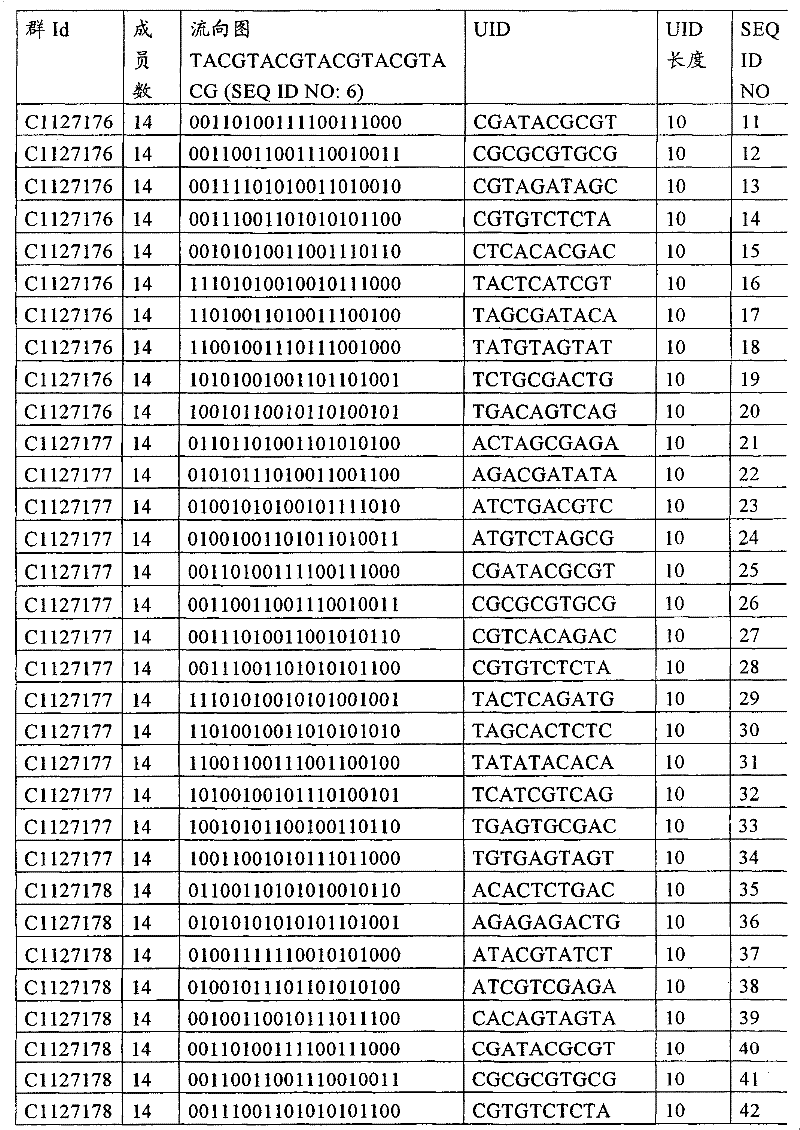
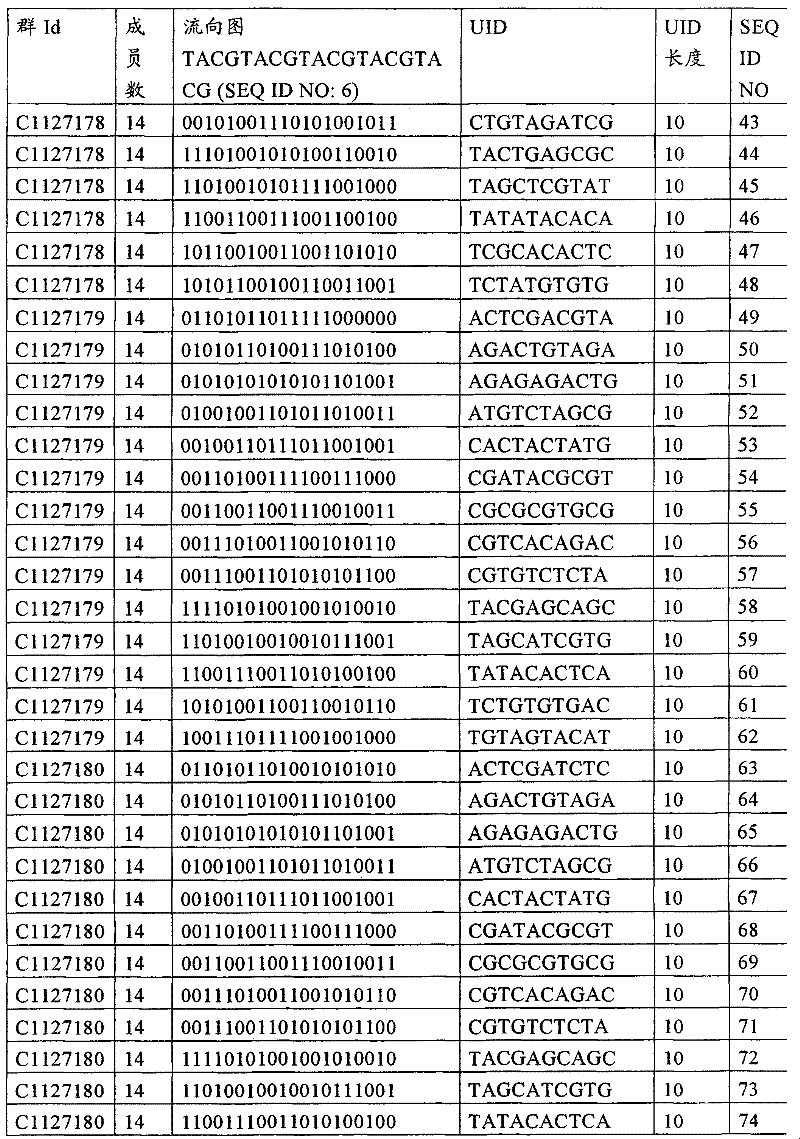

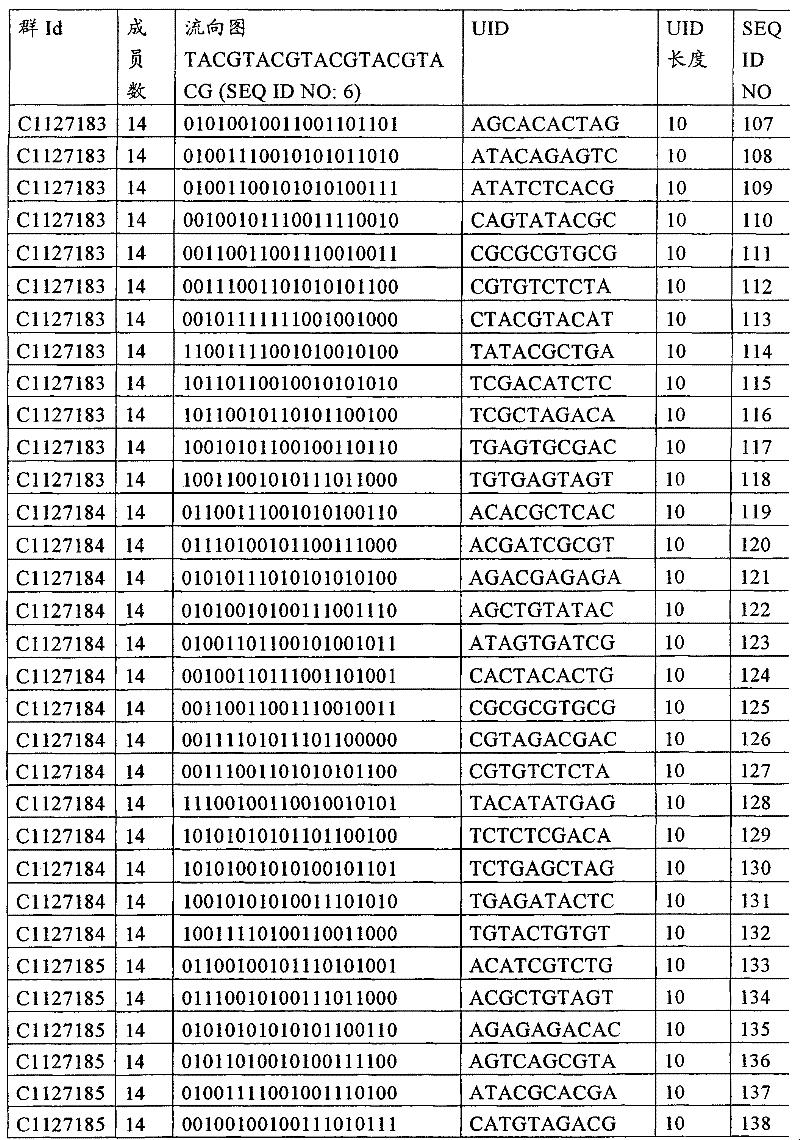
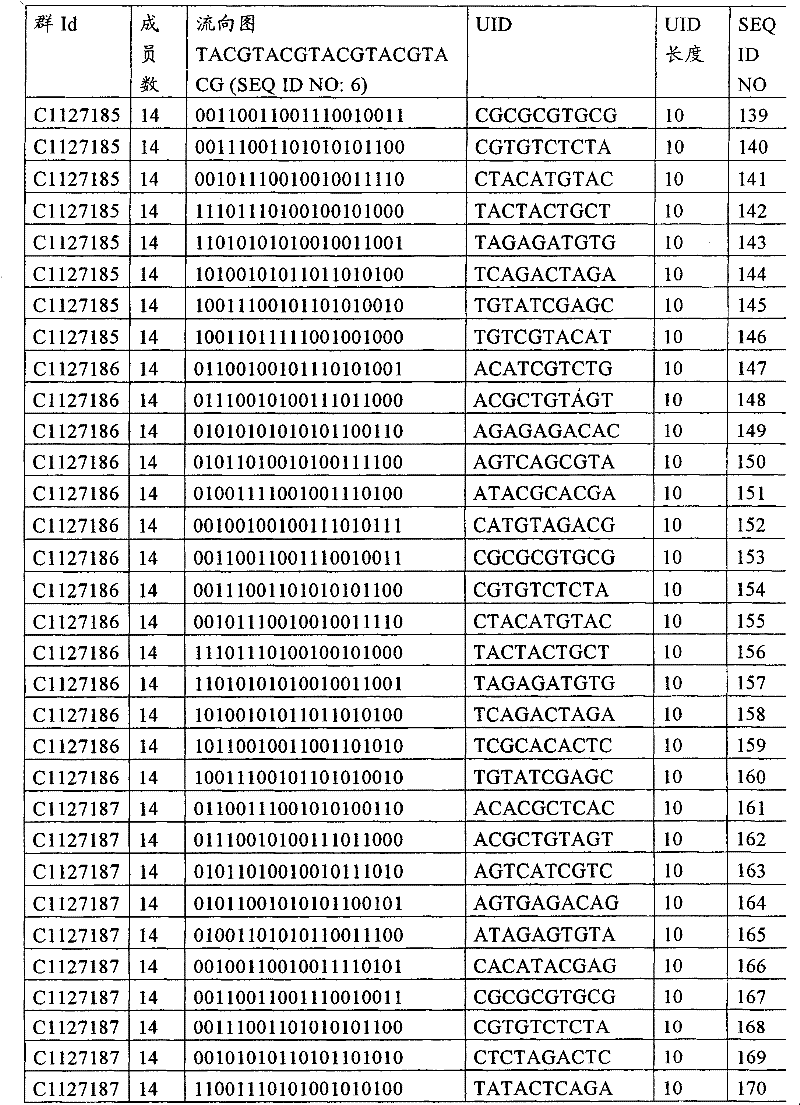
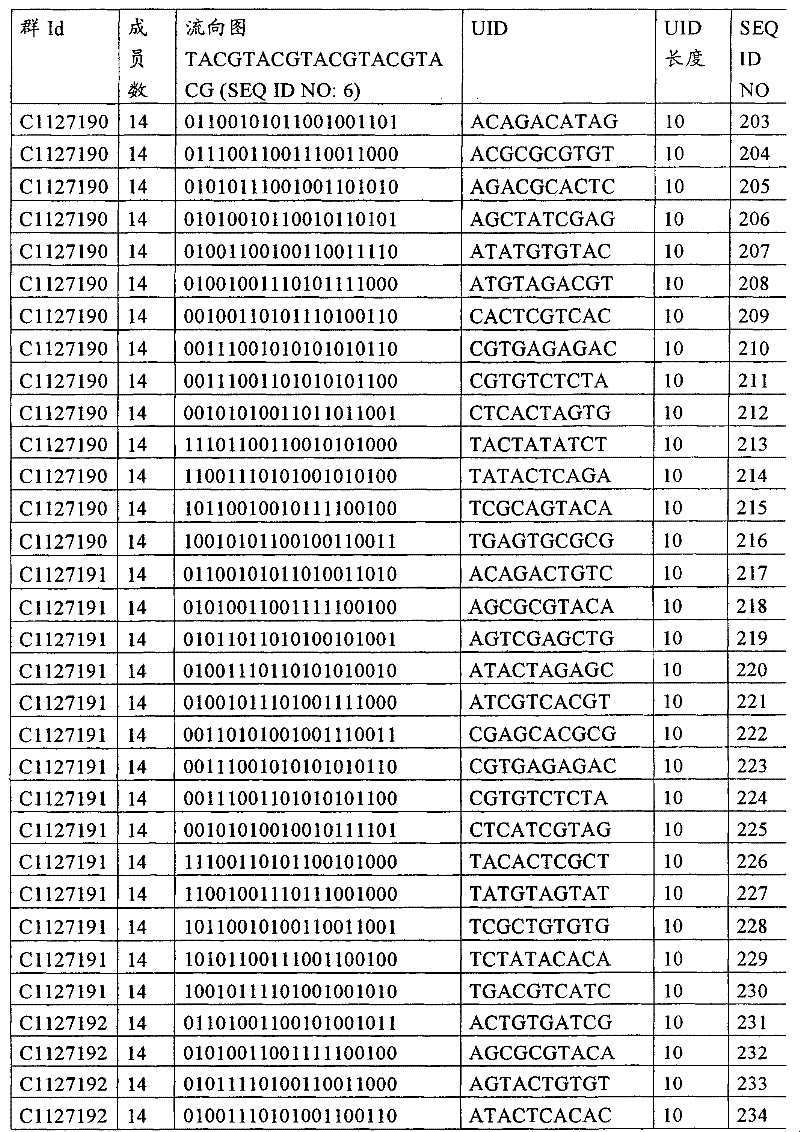
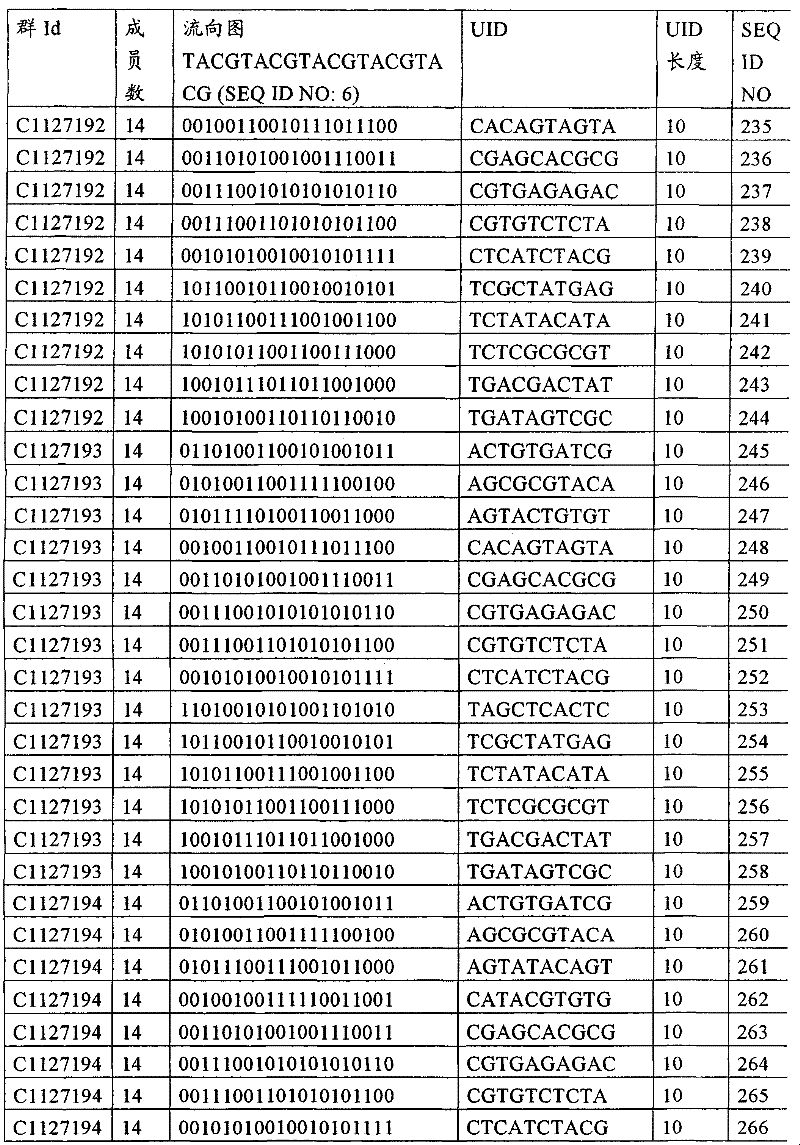
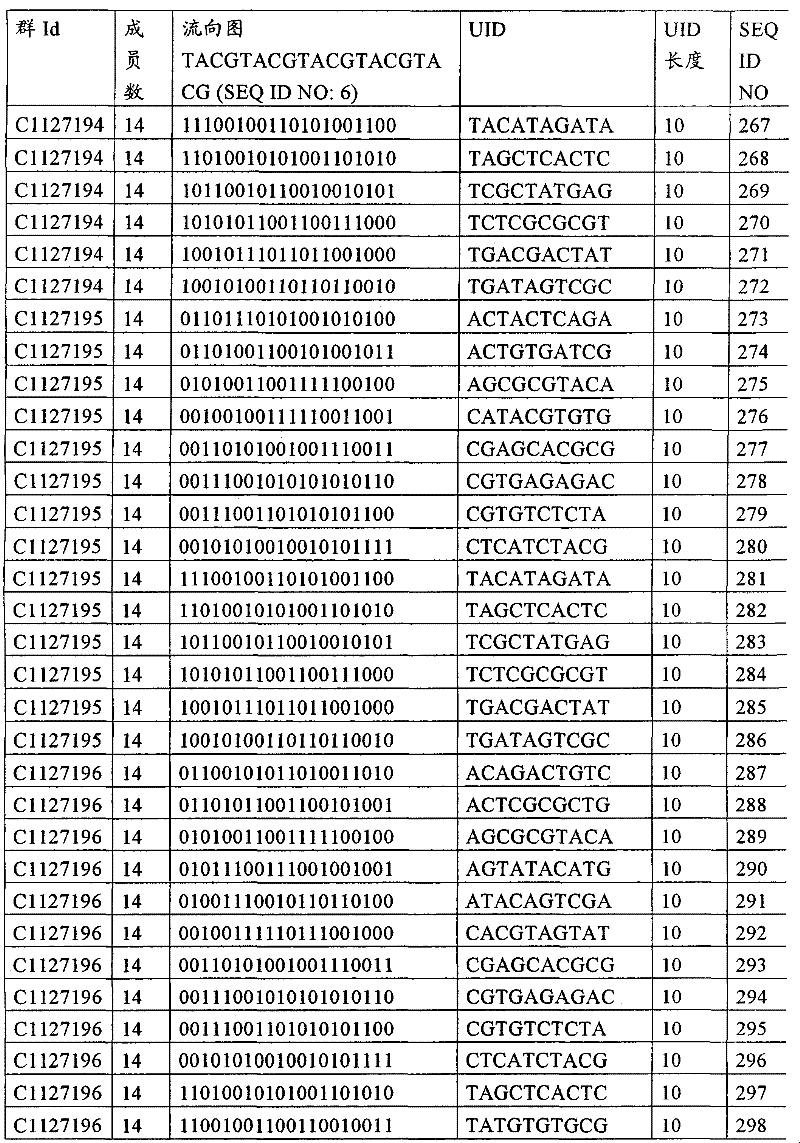
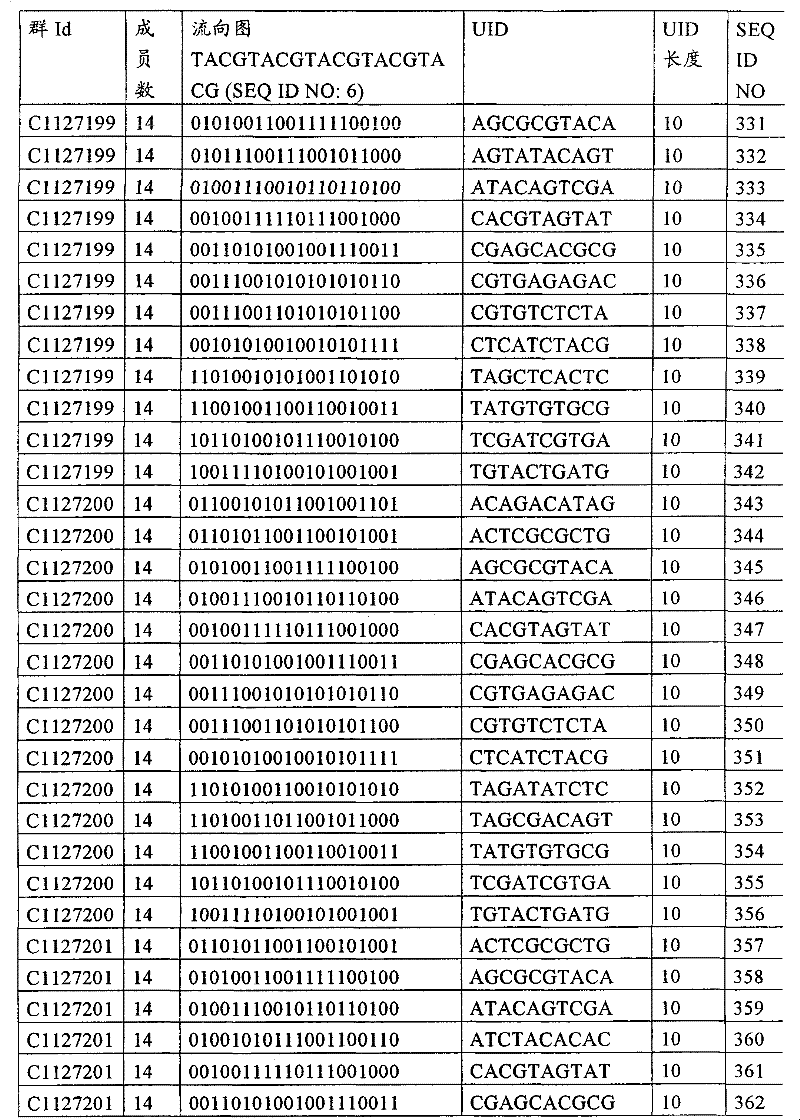
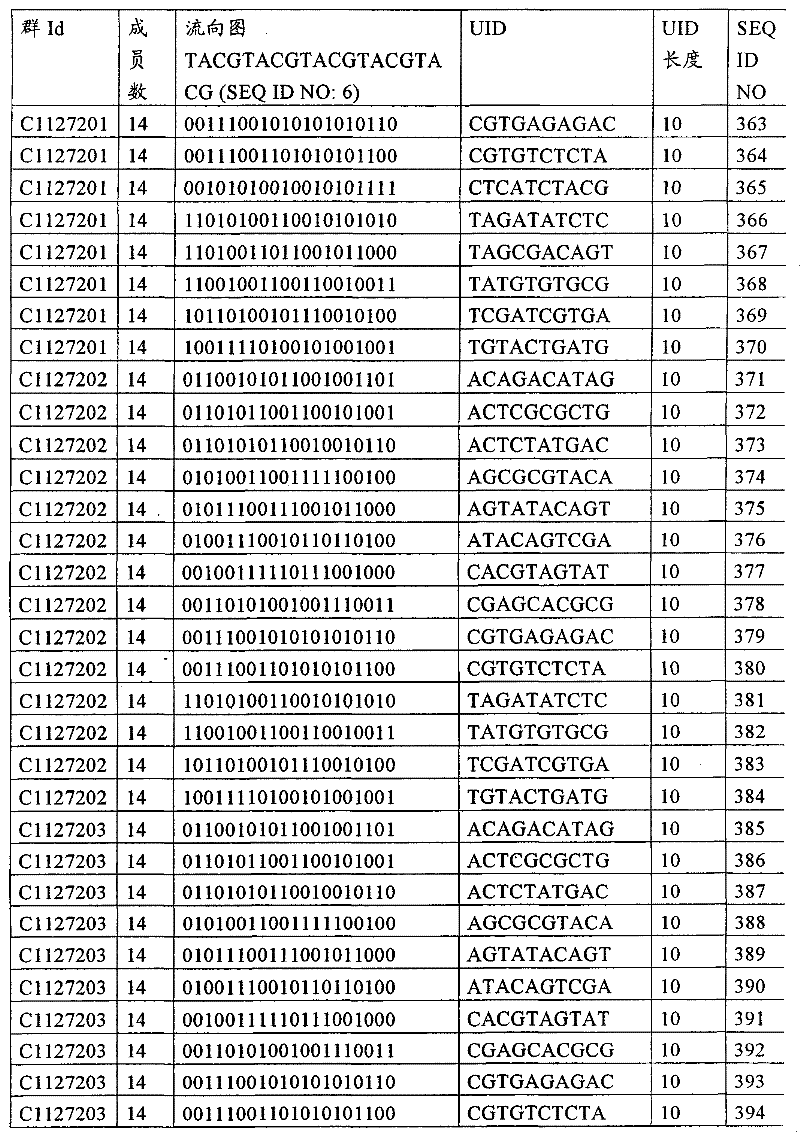
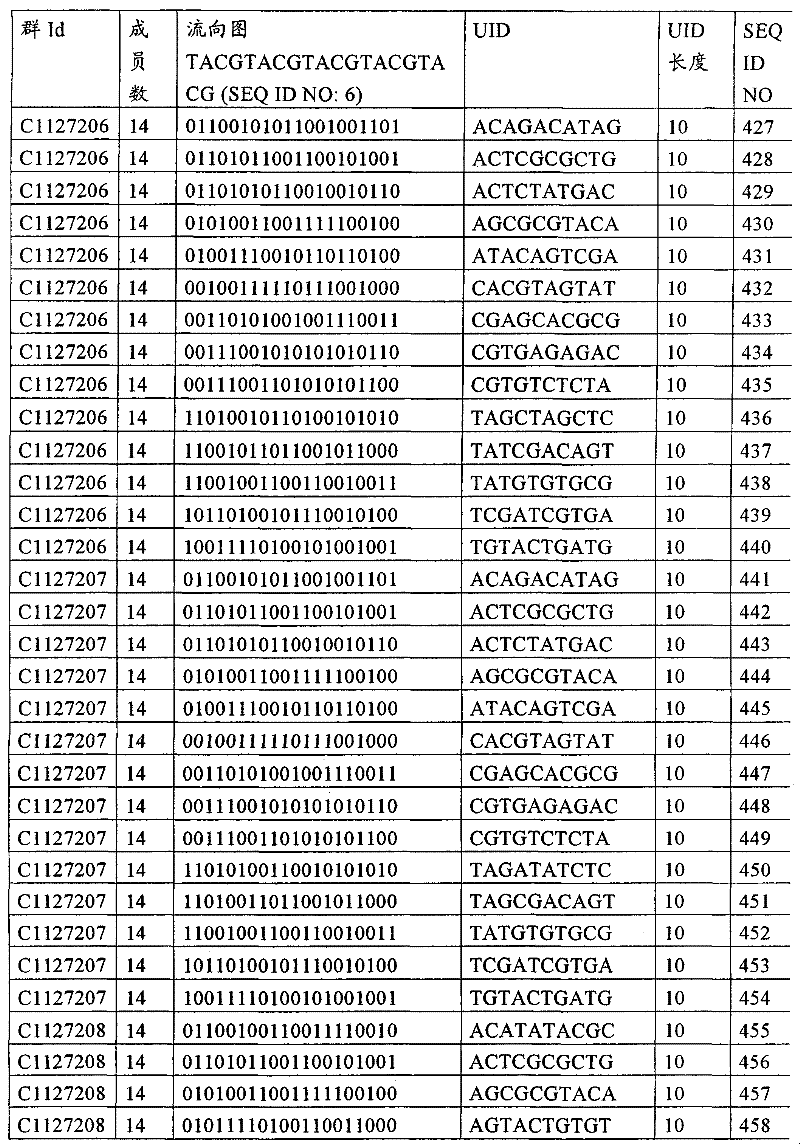
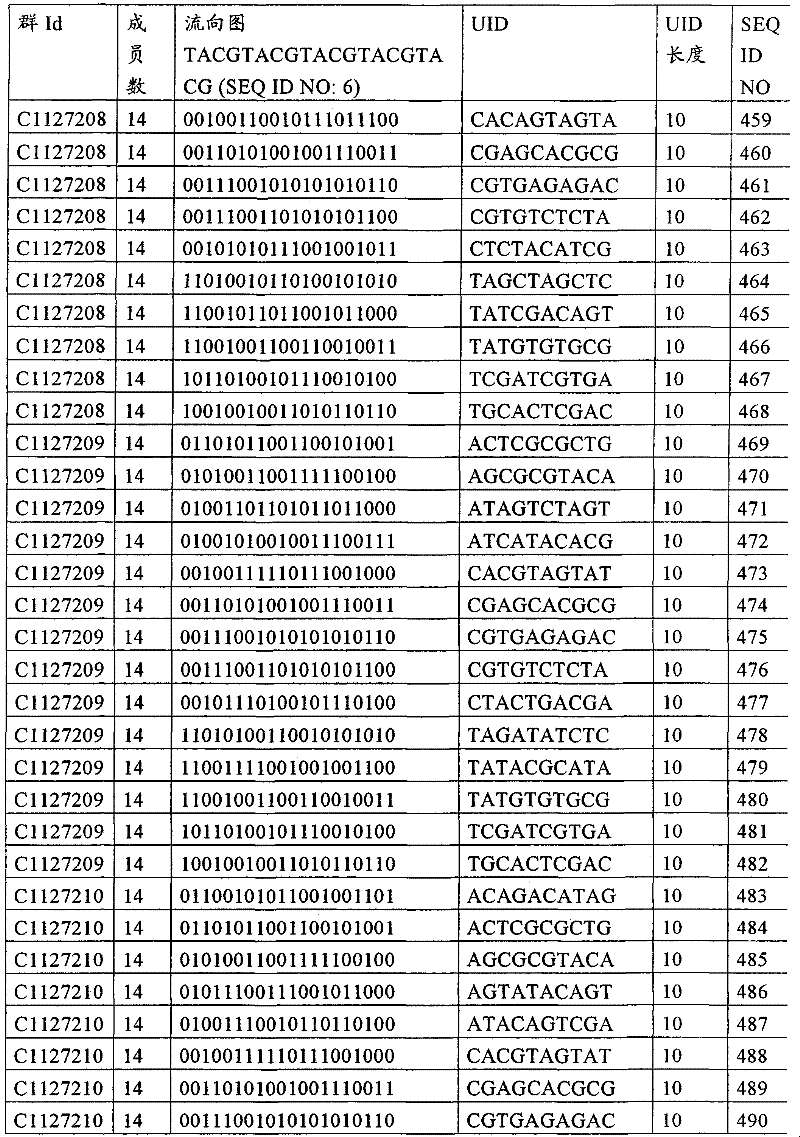

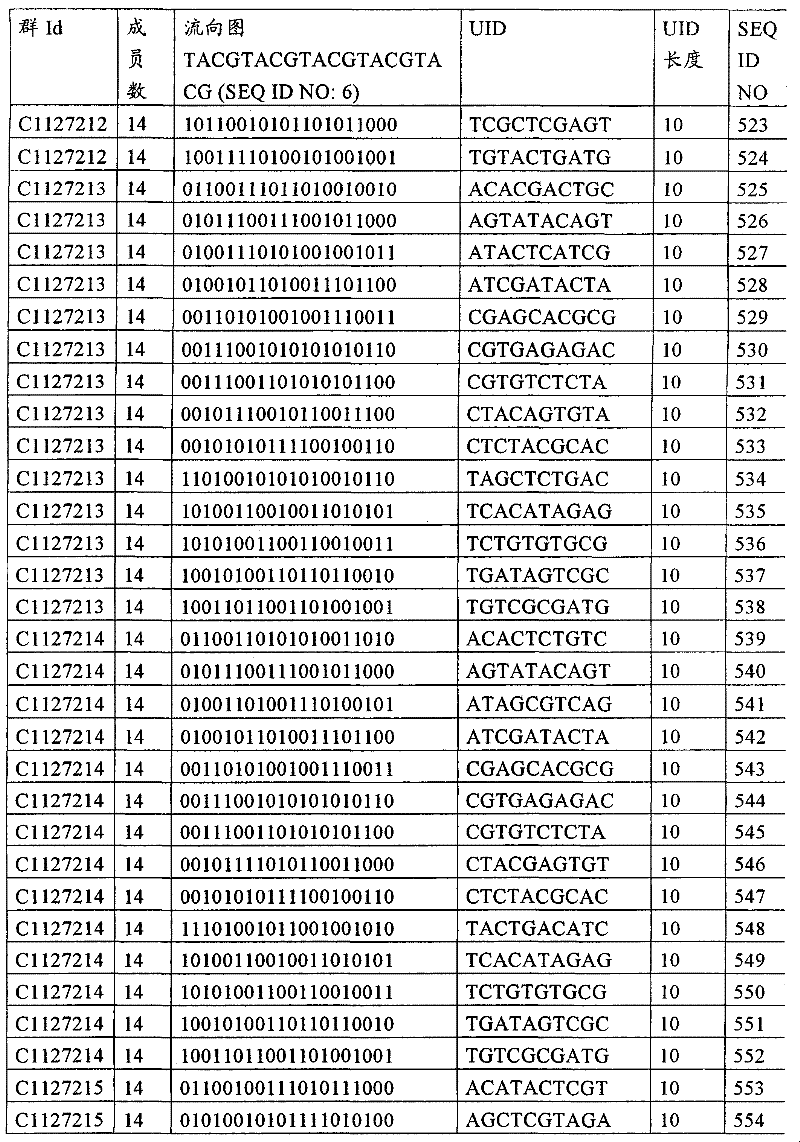


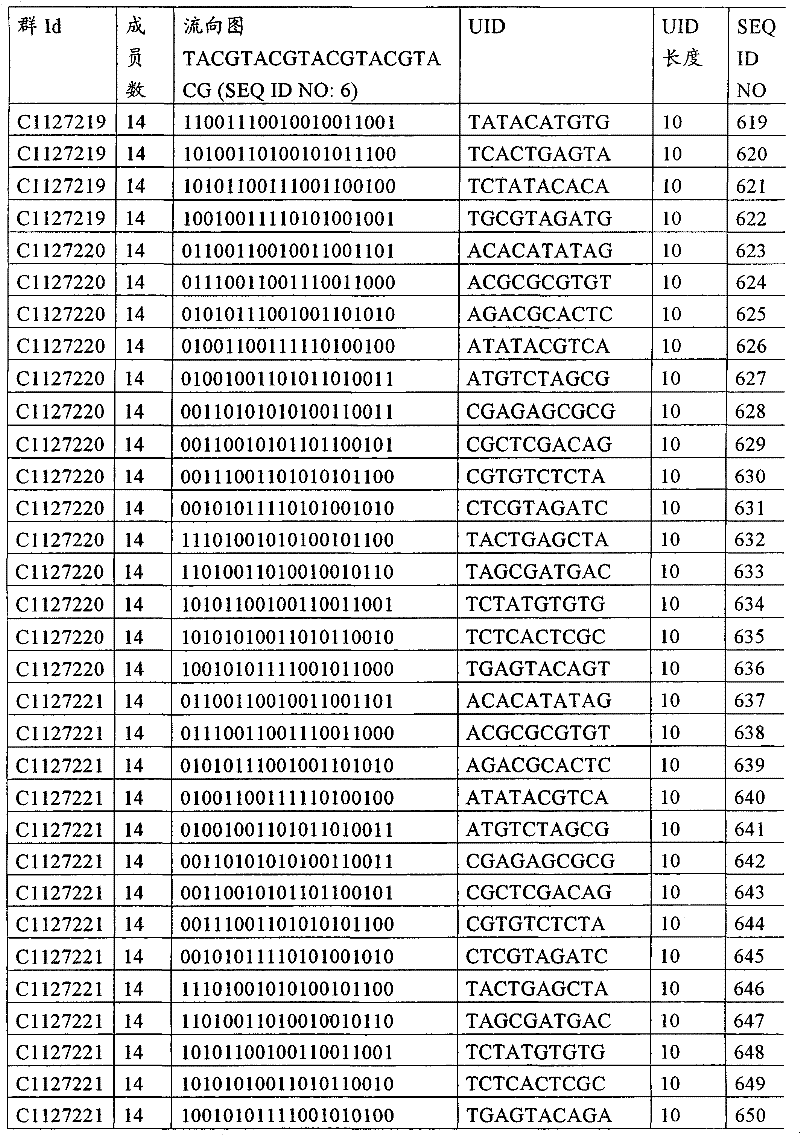


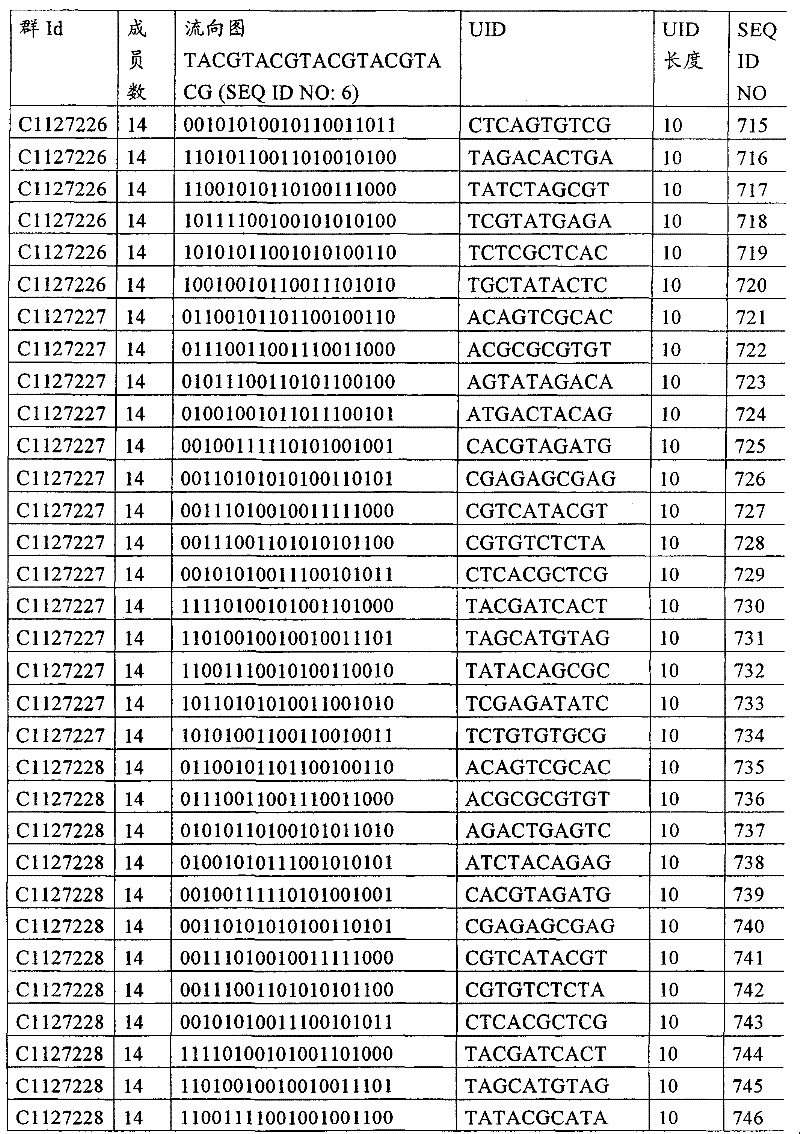
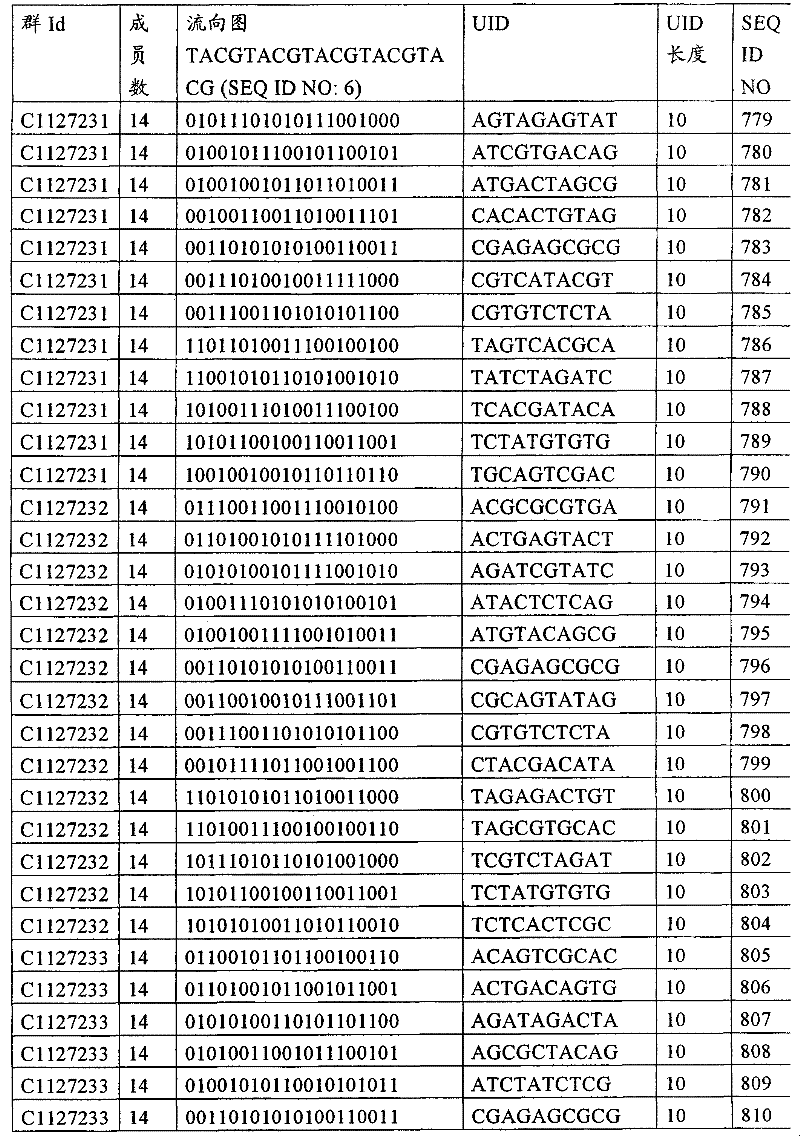
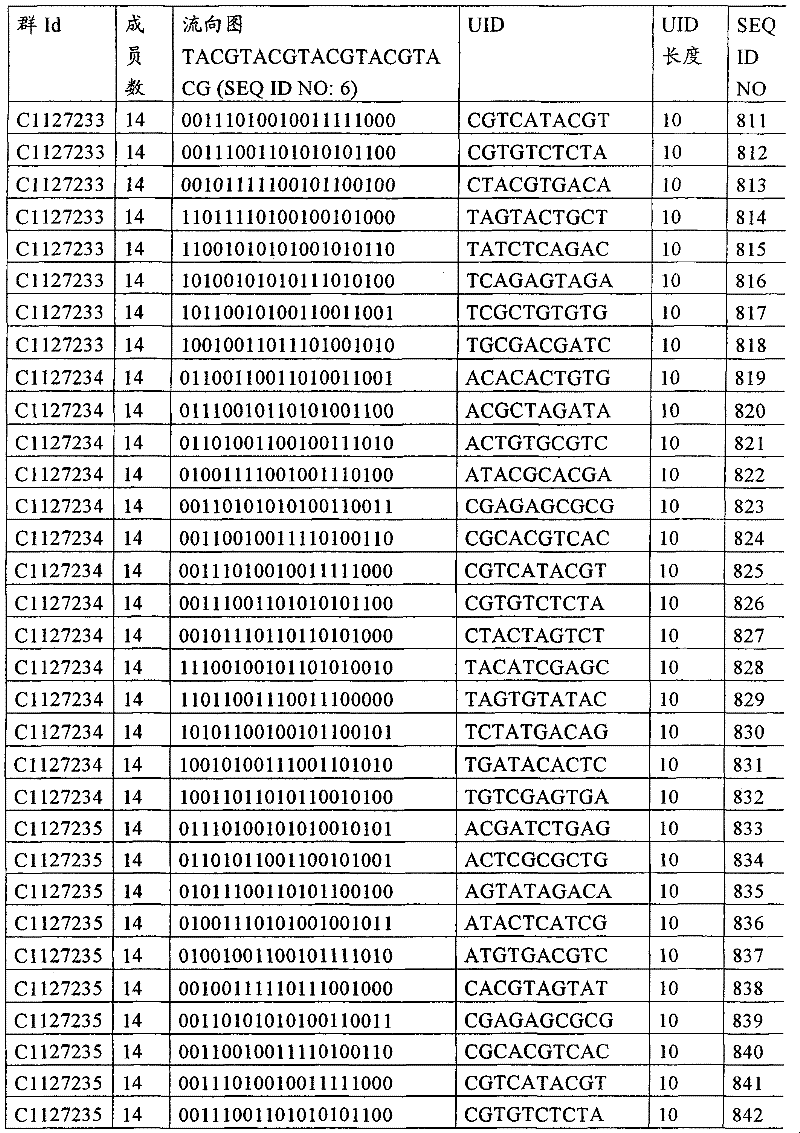
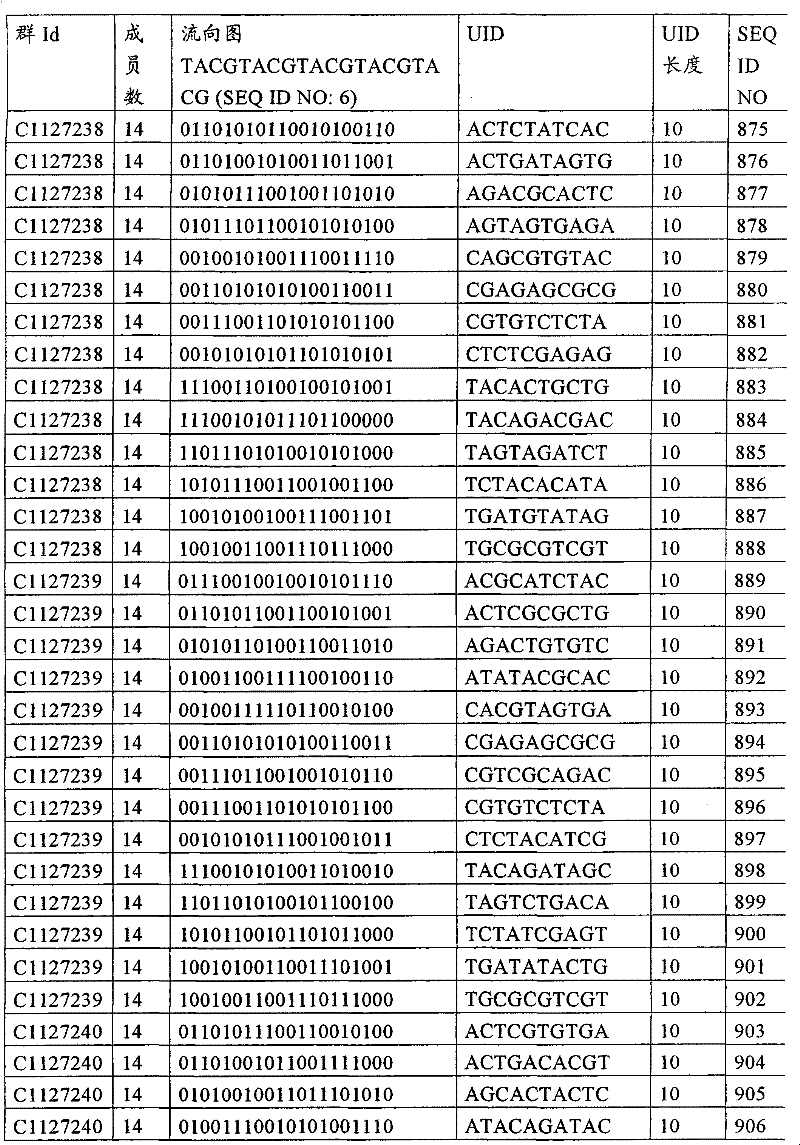

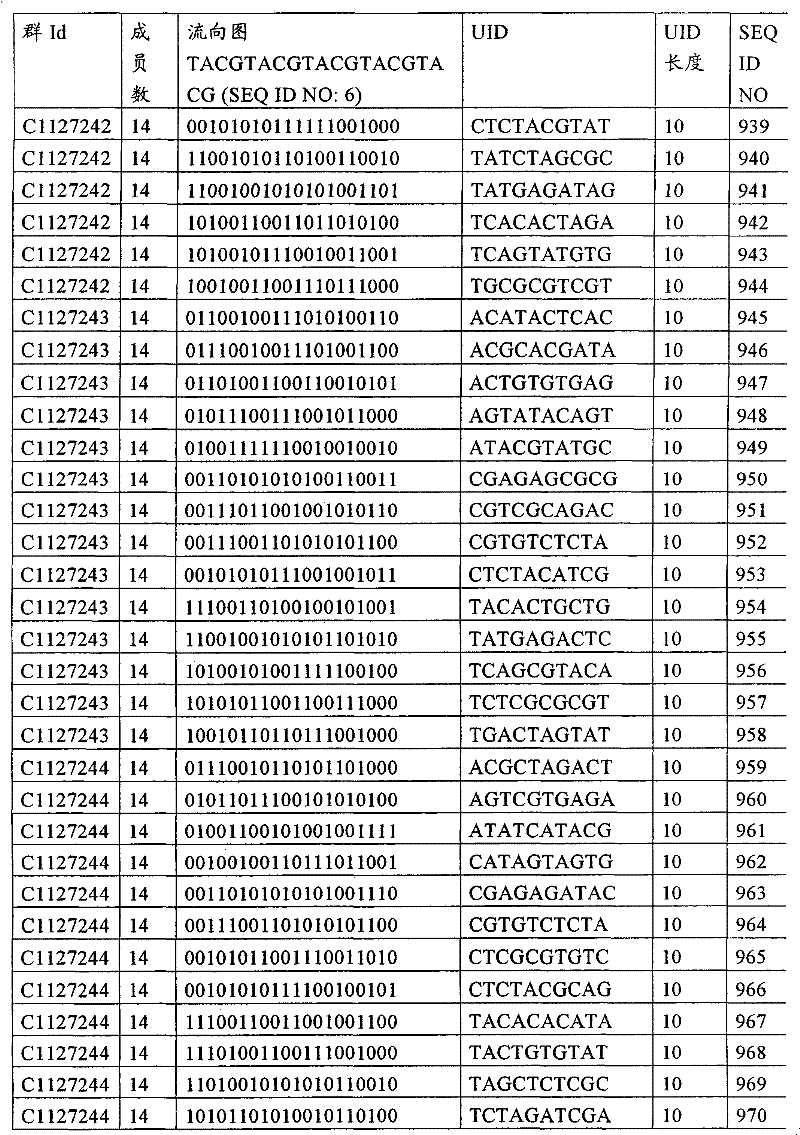
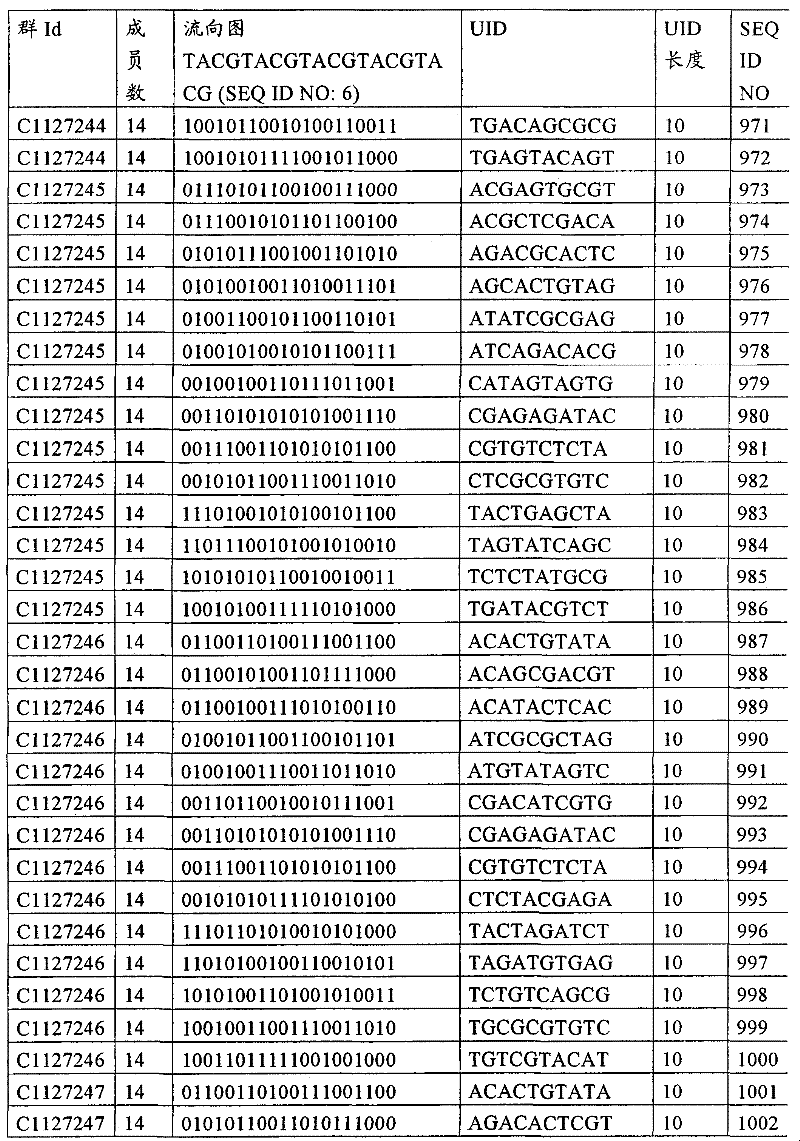

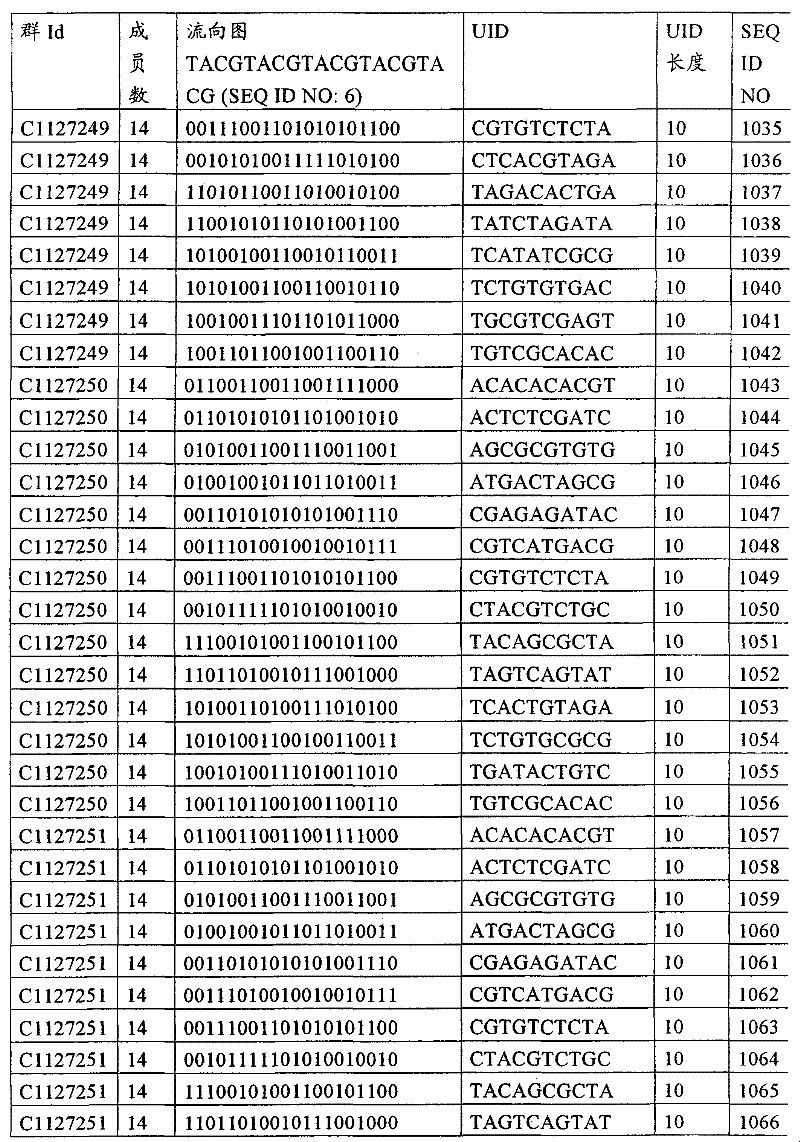
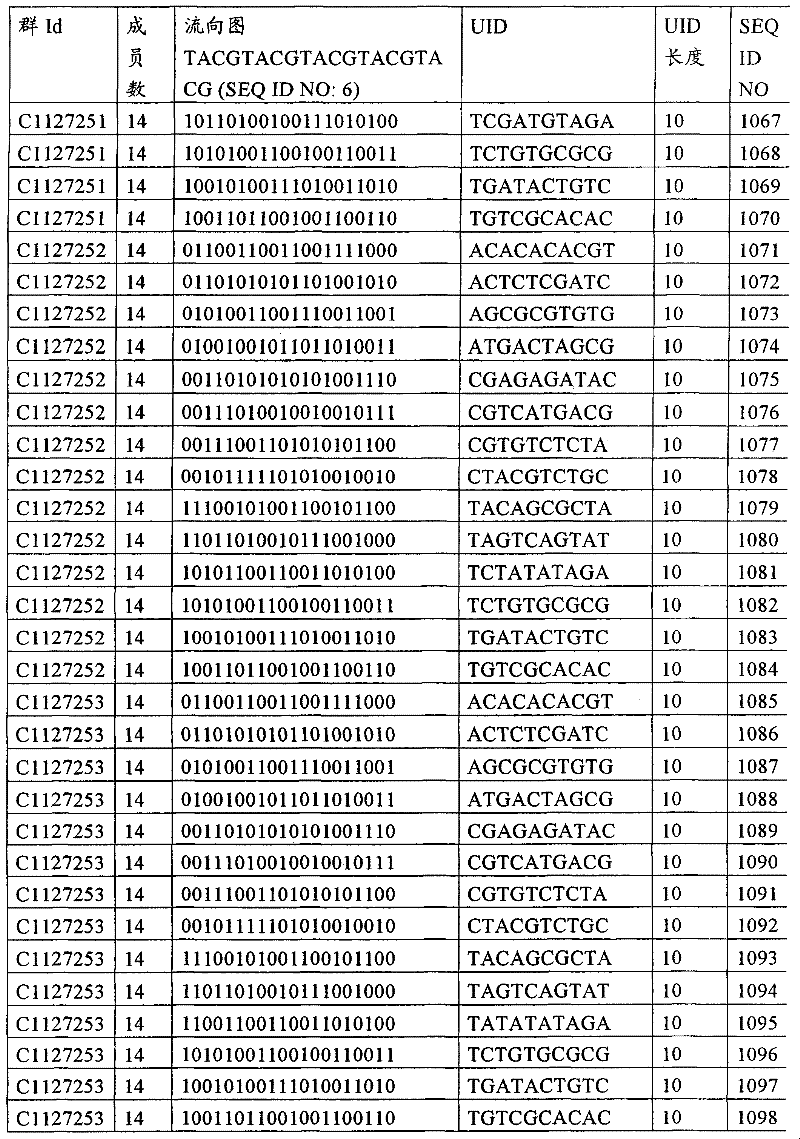
实施例4-用于表示和操作UID标识的核苷酸序列的示例计算机代码Example 4 - Example Computer Code for Representing and Manipulating UID-Identified Nucleotide Sequences
package com.fourfivefour.amplicons;package com.fourfivefour.amplicons;
import java.util.HashSet;import java.util.HashSet;
import java.util.Set;import java.util.Set;
/**/**
*在核苷酸序列上实现通用操作的代码* Codes for general operations on nucleotide sequences
**
**
**
*/*/
public class Sequence implements Comparable<Sequence>{public class Sequence implements Comparable<Sequence>{
private String sequence;private String sequence;
static final char possibleBases[]={′A′,′C′,′T′,′G′};static final char possibleBases[]={'A', 'C', 'T', 'G'};
public Sequence(String sequence){public Sequence(String sequence){
this.sequence=sequence.toUpperCase(); this.sequence = sequence.toUpperCase();
}}
public String getSequence(){public String getSequence(){
return sequence;return sequence;
}}
public int hashCode(){public int hashCode(){
return sequence.hashC ode();return sequence.hashCode();
}}
public boolean equals(Object obj){public boolean equals(Object obj){
return((this==obj)||Return((this==obj)||
((obj instanceof Sequence)&&((obj instanceof Sequence)&&
sequence.equals(((Sequence)obj).sequence)));sequence.equals(((Sequence)obj).sequence)));
}}
public int compareTo(Sequence obj){ public int compareTo(Sequence obj){
return sequence.compareTo(obj.sequence); return sequence. compareTo(obj. sequence);
}}
public String toString(){ public String toString(){
return sequence;return sequence;
}}
/**/**
*产生序列的所有单个碱基插入的组。**Generate the set of all single base insertions of the sequence.
**
*@return 表示序列的所有单个碱基插入的序列的组。 *@return Indicates the group of sequences with all single base insertions of the sequence.
*/*/
public Set<Sequence>generateSingleInsertions(){public Set<Sequence>generateSingleInsertions(){
Set<Sequence>insertions=new HashSet<Sequence>(); Set<Sequence>insertions = new HashSet<Sequence>();
int seqLen=sequence.length();int seqLen = sequence. length();
for(int insertIdx=0;insertIdx<=seqLen;insertIdx++){ for(int insertIdx=0; insertIdx<=seqLen; insertIdx++){
String prefixString=sequence.substring(0,insertIdx); String prefixString = sequence.substring(0, insertIdx);
String suffixString=sequence.substring(insertIdx,seqLen); String suffixString = sequence.substring(insertIdx, seqLen);
for(char insertBase:possibleBases){ for(char insertBase: possibleBases){
insertions.add(new Sequence(prefixString+insertBase+Insertions.add(new Sequence(prefixString+insertBase+
suffixString));suffixString));
}}
}}
return insertions;return insertions;
}}
/**/**
* 产生序列的所有单个碱基置换的组。** Generates a set of all single base substitutions for a sequence.
**
*@return 表示序列的所有单个碱基置换的序列的组。*@return represents the set of sequences with all single base substitutions of the sequence.
*/*/
public Set<Sequence>generateSingleSubstitutions(){public Set<Sequence>generateSingleSubstitutions(){
Set<Sequence>substitutions=new HashSet<Sequence>(); Set<Sequence>substitutions = new HashSet<Sequence>();
int seqLen=sequence.length();int seqLen = sequence. length();
for(int substBaseIdx=0;substBaseIdx<seqLen;substBaseIdx++)for(int substBaseIdx=0; substBaseIdx<seqLen; substBaseIdx++)
{{
String prefixString=String prefixString=
sequence.substring(0,substBaseIdx);sequence.substring(0,substBaseIdx);
String suffixString=String suffixString=
sequence.substring(substBaseIdx+1,seqLen);sequence.substring(substBaseIdx+1, seqLen);
char originalBase=char originalBase=
sequence.charAt(substBaseIdx);sequence.charAt(substBaseIdx);
for(char substBase:possibleBases){ for(char substBase: possibleBases){
if(substBase!=originalBase){If(substBase!=originalBase){
substitutions.add(Substitutions.add(
new Sequence(prefixString+substBase+New Sequence(prefixString+substBase+
suffixString)suffixString)
); ];
} }
}}
}}
return substitutions;return substitutions;
}}
/**/**
*产生序列的所有单个碱基缺失的组。**Generates the set of all single base deletions of the sequence.
**
*@return 表示序列的所有单个碱基缺失的序列的组。 *@return means the group of sequences in which all single bases of the sequence are missing.
*/*/
public Set<Sequence>generateSingleDeletions(){public Set<Sequence>generateSingleDeletions(){
Set<Sequence>deletions=new HashSet<Sequence>(); Set<Sequence>deletions = new HashSet<Sequence>();
int seqLen=sequence.length();int seqLen = sequence. length();
for(int deleteBaseIdx=0;deleteBaseIdx<seqLen; for(int deleteBaseIdx=0; deleteBaseIdx<seqLen;
deleteBaseIdx++){deleteBaseIdx++){
String prefixString=String prefixString=
sequence.substring(0,deleteBaseIdx);sequence.substring(0, deleteBaseIdx);
String suffixString=String suffixString=
sequence.substring(deleteBaseIdx+1,seqLen);sequence.substring(deleteBaseIdx+1, seqLen);
deletions.add(new Sequence(prefixString+suffixString)); deletions.add(new Sequence(prefixString+suffixString));
}}
return deletions;return deletions;
}}
/**/**
*从序列的输入组中的每一个序列开始,产生所有1-碱基突变。* From each sequence in the input set of sequences, generate all 1-base mutations.
**
*@param inputSeqs序列的输入组。* @param inputSeqs The input group of the sequence.
*@return 离序列的输入组中的每一个序列刚好一 * @return Exactly one sequence from each sequence in the input set of sequences
*个突变的序列的组。* Group of mutated sequences.
*/*/
public static Set<Sequence>generateSingleMutations(Set<Sequence> inputSeqs){public static Set<Sequence>generateSingleMutations(Set<Sequence> inputSeqs){
Set<Sequence>mutatedSequences=new HashSet<Sequence>();Set<Sequence>mutatedSequences = new HashSet<Sequence>();
for(Sequence inputSeq:inputSeqs){for(Sequence inputSeq: inputSeqs){
mutatedSequences.addAll(inputSeq.generateSingleDeletions());mutatedSequences.addAll(inputSeq.generateSingleDeletions());
mutatedSequences.addAll(inputSeq.generateSingleInsertions());mutatedSequences.addAll(inputSeq.generateSingleInsertions());
mutatedSequences.addAll(inputSeq.generateSingleSubstitutions());mutatedSequences.addAll(inputSeq.generateSingleSubstitutions());
}}
return mutatedSequences;return mutatedSequences;
}}
}}
如前所述,应当理解提供的上述计算机代码是用于示例的目的,并且可以采用多种替代方法和代码结构。还应当理解,这里所提供的示例代码的目的不是作为单独的应用程序执行或者脱离附加的计算机代码或修改而完整地运行。As previously stated, it should be understood that the above computer code is provided for example purposes and that various alternative methods and code structures may be employed. It should also be understood that the sample code provided herein is not intended to be executed as a stand-alone application program or to function entirely without additional computer code or modifications.
经过对各种实施例和实施方式的描述后,对相关领域的技术人员来说显而易见的是,前述仅通过例子的方式示出的内容仅仅是示例而不是限制。分配示出的实施例的各种功能元件中的功能的许多其他方案是可能的。任一元件的功能可以在替代实施例中通过各种方式实现。After describing various embodiments and implementations, it will be apparent to those skilled in the relevant art that the foregoing are shown by way of example only and are not limiting. Many other schemes of allocating the functionality among the various functional elements of the illustrated embodiments are possible. The functionality of any element may be accomplished in various ways in alternative embodiments.
Claims (49)
Applications Claiming Priority (3)
| Application Number | Priority Date | Filing Date | Title |
|---|---|---|---|
| US94138107P | 2007-06-01 | 2007-06-01 | |
| US60/941,381 | 2007-06-01 | ||
| PCT/US2008/006822 WO2008150432A1 (en) | 2007-06-01 | 2008-05-29 | System and meth0d for identification of individual samples from a multiplex mixture |
Publications (1)
| Publication Number | Publication Date |
|---|---|
| CN101720359A true CN101720359A (en) | 2010-06-02 |
Family
ID=40093994
Family Applications (1)
| Application Number | Title | Priority Date | Filing Date |
|---|---|---|---|
| CN200880018420A Pending CN101720359A (en) | 2007-06-01 | 2008-05-29 | System and method for identifying individual samples from a multiplex mixture |
Country Status (6)
| Country | Link |
|---|---|
| US (2) | US20090105959A1 (en) |
| EP (1) | EP2164985A4 (en) |
| JP (1) | JP2010528608A (en) |
| CN (1) | CN101720359A (en) |
| CA (1) | CA2689356A1 (en) |
| WO (1) | WO2008150432A1 (en) |
Cited By (1)
| Publication number | Priority date | Publication date | Assignee | Title |
|---|---|---|---|---|
| WO2018107481A1 (en) * | 2016-12-16 | 2018-06-21 | 深圳华大基因股份有限公司 | Gene tag for nucleic acid sample identification, kit, and application thereof |
Families Citing this family (316)
| Publication number | Priority date | Publication date | Assignee | Title |
|---|---|---|---|---|
| US7286115B2 (en) * | 2000-05-26 | 2007-10-23 | Tegic Communications, Inc. | Directional input system with automatic correction |
| US7030863B2 (en) | 2000-05-26 | 2006-04-18 | America Online, Incorporated | Virtual keyboard system with automatic correction |
| US7821503B2 (en) | 2003-04-09 | 2010-10-26 | Tegic Communications, Inc. | Touch screen and graphical user interface |
| US7750891B2 (en) | 2003-04-09 | 2010-07-06 | Tegic Communications, Inc. | Selective input system based on tracking of motion parameters of an input device |
| US7968287B2 (en) | 2004-10-08 | 2011-06-28 | Medical Research Council Harvard University | In vitro evolution in microfluidic systems |
| PL1712639T3 (en) | 2005-04-06 | 2009-02-27 | Maurice Stroun | Method for the diagnosis of cancer by detecting circulating DNA and RNA |
| WO2007081386A2 (en) | 2006-01-11 | 2007-07-19 | Raindance Technologies, Inc. | Microfluidic devices and methods of use |
| US9562837B2 (en) | 2006-05-11 | 2017-02-07 | Raindance Technologies, Inc. | Systems for handling microfludic droplets |
| EP2021113A2 (en) | 2006-05-11 | 2009-02-11 | Raindance Technologies, Inc. | Microfluidic devices |
| US8225203B2 (en) * | 2007-02-01 | 2012-07-17 | Nuance Communications, Inc. | Spell-check for a keyboard system with automatic correction |
| US8201087B2 (en) * | 2007-02-01 | 2012-06-12 | Tegic Communications, Inc. | Spell-check for a keyboard system with automatic correction |
| WO2008097559A2 (en) | 2007-02-06 | 2008-08-14 | Brandeis University | Manipulation of fluids and reactions in microfluidic systems |
| WO2008130623A1 (en) | 2007-04-19 | 2008-10-30 | Brandeis University | Manipulation of fluids, fluid components and reactions in microfluidic systems |
| CN101720359A (en) * | 2007-06-01 | 2010-06-02 | 454生命科学公司 | System and method for identifying individual samples from a multiplex mixture |
| US20090203086A1 (en) * | 2008-02-06 | 2009-08-13 | 454 Life Sciences Corporation | System and method for improved signal detection in nucleic acid sequencing |
| US7888034B2 (en) | 2008-07-01 | 2011-02-15 | 454 Life Sciences Corporation | System and method for detection of HIV tropism variants |
| EP4047367A1 (en) | 2008-07-18 | 2022-08-24 | Bio-Rad Laboratories, Inc. | Method for detecting target analytes with droplet libraries |
| US12038438B2 (en) | 2008-07-18 | 2024-07-16 | Bio-Rad Laboratories, Inc. | Enzyme quantification |
| US20100261189A1 (en) * | 2008-10-03 | 2010-10-14 | Roche Molecular Systems, Inc. | System and method for detection of HLA Variants |
| US9394567B2 (en) | 2008-11-07 | 2016-07-19 | Adaptive Biotechnologies Corporation | Detection and quantification of sample contamination in immune repertoire analysis |
| US9365901B2 (en) | 2008-11-07 | 2016-06-14 | Adaptive Biotechnologies Corp. | Monitoring immunoglobulin heavy chain evolution in B-cell acute lymphoblastic leukemia |
| EP4335932A3 (en) | 2008-11-07 | 2024-06-26 | Adaptive Biotechnologies Corporation | Methods of monitoring conditions by sequence analysis |
| US9528160B2 (en) | 2008-11-07 | 2016-12-27 | Adaptive Biotechnolgies Corp. | Rare clonotypes and uses thereof |
| US8628927B2 (en) | 2008-11-07 | 2014-01-14 | Sequenta, Inc. | Monitoring health and disease status using clonotype profiles |
| US8748103B2 (en) | 2008-11-07 | 2014-06-10 | Sequenta, Inc. | Monitoring health and disease status using clonotype profiles |
| US9506119B2 (en) | 2008-11-07 | 2016-11-29 | Adaptive Biotechnologies Corp. | Method of sequence determination using sequence tags |
| PL2387627T3 (en) | 2009-01-15 | 2016-10-31 | Adaptive immunity profiling and methods for generation of monoclonal antibodies | |
| US8407554B2 (en) * | 2009-02-03 | 2013-03-26 | Complete Genomics, Inc. | Method and apparatus for quantification of DNA sequencing quality and construction of a characterizable model system using Reed-Solomon codes |
| EP3415235B1 (en) | 2009-03-23 | 2025-11-12 | Bio-Rad Laboratories, Inc. | Manipulation of microfluidic droplets |
| ES2706227T3 (en) | 2009-03-30 | 2019-03-27 | Illumina Inc | Analysis of gene expression in individual cells |
| WO2010127186A1 (en) | 2009-04-30 | 2010-11-04 | Prognosys Biosciences, Inc. | Nucleic acid constructs and methods of use |
| JP2012531202A (en) | 2009-06-25 | 2012-12-10 | フレッド ハチンソン キャンサー リサーチ センター | How to measure adaptive immunity |
| ES2562159T3 (en) | 2009-08-20 | 2016-03-02 | Population Genetics Technologies Ltd. | Compositions and methods for the rearrangement of molecular nucleic acid |
| US8609339B2 (en) | 2009-10-09 | 2013-12-17 | 454 Life Sciences Corporation | System and method for emulsion breaking and recovery of biological elements |
| US9315857B2 (en) | 2009-12-15 | 2016-04-19 | Cellular Research, Inc. | Digital counting of individual molecules by stochastic attachment of diverse label-tags |
| US8835358B2 (en) | 2009-12-15 | 2014-09-16 | Cellular Research, Inc. | Digital counting of individual molecules by stochastic attachment of diverse labels |
| TWI439548B (en) * | 2009-12-23 | 2014-06-01 | Ind Tech Res Inst | Sequence calibration method and sequence calibration device |
| JP5934657B2 (en) | 2010-02-12 | 2016-06-15 | レインダンス テクノロジーズ, インコーポレイテッド | Digital specimen analysis |
| US9366632B2 (en) | 2010-02-12 | 2016-06-14 | Raindance Technologies, Inc. | Digital analyte analysis |
| US9399797B2 (en) | 2010-02-12 | 2016-07-26 | Raindance Technologies, Inc. | Digital analyte analysis |
| US10351905B2 (en) | 2010-02-12 | 2019-07-16 | Bio-Rad Laboratories, Inc. | Digital analyte analysis |
| SI2556171T1 (en) | 2010-04-05 | 2016-03-31 | Prognosys Biosciences, Inc. | Spatially encoded biological assays |
| US10787701B2 (en) | 2010-04-05 | 2020-09-29 | Prognosys Biosciences, Inc. | Spatially encoded biological assays |
| US20190300945A1 (en) | 2010-04-05 | 2019-10-03 | Prognosys Biosciences, Inc. | Spatially Encoded Biological Assays |
| US11322224B2 (en) * | 2010-05-18 | 2022-05-03 | Natera, Inc. | Methods for non-invasive prenatal ploidy calling |
| US10316362B2 (en) | 2010-05-18 | 2019-06-11 | Natera, Inc. | Methods for simultaneous amplification of target loci |
| EP3290529B1 (en) | 2010-06-11 | 2019-05-22 | Life Technologies Corporation | Alternative nucleotide flows in sequencing-by-synthesis methods |
| AU2011274642B2 (en) * | 2010-07-09 | 2015-05-21 | Cergentis B.V. | 3-d genomic region of interest sequencing strategies |
| PT2623613T (en) | 2010-09-21 | 2016-10-11 | Population Genetics Tech Ltd | Increasing confidence of allele calls with molecular counting |
| EP2622103B2 (en) | 2010-09-30 | 2022-11-16 | Bio-Rad Laboratories, Inc. | Sandwich assays in droplets |
| US10273540B2 (en) | 2010-10-27 | 2019-04-30 | Life Technologies Corporation | Methods and apparatuses for estimating parameters in a predictive model for use in sequencing-by-synthesis |
| US8666678B2 (en) | 2010-10-27 | 2014-03-04 | Life Technologies Corporation | Predictive model for use in sequencing-by-synthesis |
| EP2659408B1 (en) | 2010-12-29 | 2019-03-27 | Life Technologies Corporation | Time-warped background signal for sequencing-by-synthesis operations |
| US20130060482A1 (en) | 2010-12-30 | 2013-03-07 | Life Technologies Corporation | Methods, systems, and computer readable media for making base calls in nucleic acid sequencing |
| US10241075B2 (en) | 2010-12-30 | 2019-03-26 | Life Technologies Corporation | Methods, systems, and computer readable media for nucleic acid sequencing |
| EP3582224A1 (en) | 2010-12-30 | 2019-12-18 | Life Technologies Corporation | Models for analyzing data from sequencing-by-synthesis operations |
| EP3859011A1 (en) | 2011-02-11 | 2021-08-04 | Bio-Rad Laboratories, Inc. | Methods for forming mixed droplets |
| EP3736281A1 (en) | 2011-02-18 | 2020-11-11 | Bio-Rad Laboratories, Inc. | Compositions and methods for molecular labeling |
| WO2012129363A2 (en) | 2011-03-24 | 2012-09-27 | President And Fellows Of Harvard College | Single cell nucleic acid detection and analysis |
| US20120244523A1 (en) | 2011-03-25 | 2012-09-27 | 454 Life Sciences Corporation | System and Method for Detection of HIV Integrase Variants |
| EP3878975A1 (en) | 2011-04-08 | 2021-09-15 | Life Technologies Corporation | Phase-protecting reagent flow orderings for use in sequencing-by-synthesis |
| GB201106254D0 (en) | 2011-04-13 | 2011-05-25 | Frisen Jonas | Method and product |
| HUE068153T2 (en) | 2011-04-15 | 2024-12-28 | Univ Johns Hopkins | Safe sequencing system |
| US9487825B2 (en) * | 2011-05-13 | 2016-11-08 | Mount Sinai School Of Medicine | Pooled adapter strategy for reducing bias in small RNA characterization |
| US9556470B2 (en) | 2011-06-02 | 2017-01-31 | Raindance Technologies, Inc. | Enzyme quantification |
| US8658430B2 (en) | 2011-07-20 | 2014-02-25 | Raindance Technologies, Inc. | Manipulating droplet size |
| US10704164B2 (en) | 2011-08-31 | 2020-07-07 | Life Technologies Corporation | Methods, systems, computer readable media, and kits for sample identification |
| US20150087537A1 (en) | 2011-08-31 | 2015-03-26 | Life Technologies Corporation | Methods, Systems, Computer Readable Media, and Kits for Sample Identification |
| US10385475B2 (en) | 2011-09-12 | 2019-08-20 | Adaptive Biotechnologies Corp. | Random array sequencing of low-complexity libraries |
| US9279159B2 (en) | 2011-10-21 | 2016-03-08 | Adaptive Biotechnologies Corporation | Quantification of adaptive immune cell genomes in a complex mixture of cells |
| EP2788509B1 (en) | 2011-12-09 | 2018-07-11 | Adaptive Biotechnologies Corporation | Diagnosis of lymphoid malignancies and minimal residual disease detection |
| US9499865B2 (en) | 2011-12-13 | 2016-11-22 | Adaptive Biotechnologies Corp. | Detection and measurement of tissue-infiltrating lymphocytes |
| EP2820174B1 (en) | 2012-02-27 | 2019-12-25 | The University of North Carolina at Chapel Hill | Methods and uses for molecular tags |
| JP6375230B2 (en) | 2012-02-27 | 2018-08-15 | セルラー リサーチ, インコーポレイテッド | Compositions and kits for molecular counting |
| EP2820155B1 (en) | 2012-02-28 | 2017-07-26 | Population Genetics Technologies Ltd. | Method for attaching a counter sequence to a nucleic acid sample |
| EP3495503A1 (en) | 2012-03-05 | 2019-06-12 | President and Fellows of Harvard College | Systems and methods for epigenetic sequencing |
| ES2662128T3 (en) | 2012-03-05 | 2018-04-05 | Adaptive Biotechnologies Corporation | Determination of paired immune receptor chains from the frequency of matching subunits |
| MX354329B (en) | 2012-05-08 | 2018-02-27 | Adaptive Biotechnologies Corp | Compositions and method for measuring and calibrating amplification bias in multiplexed pcr reactions. |
| US9646132B2 (en) | 2012-05-11 | 2017-05-09 | Life Technologies Corporation | Models for analyzing data from sequencing-by-synthesis operations |
| US10192024B2 (en) | 2012-05-18 | 2019-01-29 | 454 Life Sciences Corporation | System and method for generation and use of optimal nucleotide flow orders |
| US20150011396A1 (en) | 2012-07-09 | 2015-01-08 | Benjamin G. Schroeder | Methods for creating directional bisulfite-converted nucleic acid libraries for next generation sequencing |
| CA2881685C (en) | 2012-08-14 | 2023-12-05 | 10X Genomics, Inc. | Microcapsule compositions and methods |
| US11591637B2 (en) | 2012-08-14 | 2023-02-28 | 10X Genomics, Inc. | Compositions and methods for sample processing |
| US9951386B2 (en) | 2014-06-26 | 2018-04-24 | 10X Genomics, Inc. | Methods and systems for processing polynucleotides |
| US10273541B2 (en) | 2012-08-14 | 2019-04-30 | 10X Genomics, Inc. | Methods and systems for processing polynucleotides |
| US10323279B2 (en) | 2012-08-14 | 2019-06-18 | 10X Genomics, Inc. | Methods and systems for processing polynucleotides |
| US10400280B2 (en) | 2012-08-14 | 2019-09-03 | 10X Genomics, Inc. | Methods and systems for processing polynucleotides |
| US10752949B2 (en) | 2012-08-14 | 2020-08-25 | 10X Genomics, Inc. | Methods and systems for processing polynucleotides |
| US10221442B2 (en) | 2012-08-14 | 2019-03-05 | 10X Genomics, Inc. | Compositions and methods for sample processing |
| US9701998B2 (en) | 2012-12-14 | 2017-07-11 | 10X Genomics, Inc. | Methods and systems for processing polynucleotides |
| US20160040229A1 (en) | 2013-08-16 | 2016-02-11 | Guardant Health, Inc. | Systems and methods to detect rare mutations and copy number variation |
| US10876152B2 (en) | 2012-09-04 | 2020-12-29 | Guardant Health, Inc. | Systems and methods to detect rare mutations and copy number variation |
| GB2533006B (en) | 2012-09-04 | 2017-06-07 | Guardant Health Inc | Systems and methods to detect copy number variation |
| US11913065B2 (en) | 2012-09-04 | 2024-02-27 | Guardent Health, Inc. | Systems and methods to detect rare mutations and copy number variation |
| US20160002731A1 (en) | 2012-10-01 | 2016-01-07 | Adaptive Biotechnologies Corporation | Immunocompetence assessment by adaptive immune receptor diversity and clonality characterization |
| US10329608B2 (en) | 2012-10-10 | 2019-06-25 | Life Technologies Corporation | Methods, systems, and computer readable media for repeat sequencing |
| EP3901280B1 (en) | 2012-10-17 | 2025-03-12 | 10x Genomics Sweden AB | Methods and product for optimising localised or spatial detection of gene expression in a tissue sample |
| WO2015160439A2 (en) | 2014-04-17 | 2015-10-22 | Adaptive Biotechnologies Corporation | Quantification of adaptive immune cell genomes in a complex mixture of cells |
| US10533221B2 (en) | 2012-12-14 | 2020-01-14 | 10X Genomics, Inc. | Methods and systems for processing polynucleotides |
| EP2931919B1 (en) | 2012-12-14 | 2019-02-20 | 10X Genomics, Inc. | Methods and systems for processing polynucleotides |
| EP2954104B1 (en) | 2013-02-08 | 2020-09-16 | 10X Genomics, Inc. | Polynucleotide barcode generation |
| US20140296080A1 (en) | 2013-03-14 | 2014-10-02 | Life Technologies Corporation | Methods, Systems, and Computer Readable Media for Evaluating Variant Likelihood |
| WO2014144092A1 (en) | 2013-03-15 | 2014-09-18 | Nugen Technologies, Inc. | Sequential sequencing |
| CN105849275B (en) | 2013-06-25 | 2020-03-17 | 普罗格诺西斯生物科学公司 | Method and system for detecting spatial distribution of biological targets in a sample |
| US9708657B2 (en) | 2013-07-01 | 2017-07-18 | Adaptive Biotechnologies Corp. | Method for generating clonotype profiles using sequence tags |
| US9926597B2 (en) | 2013-07-26 | 2018-03-27 | Life Technologies Corporation | Control nucleic acid sequences for use in sequencing-by-synthesis and methods for designing the same |
| EP2840148B1 (en) | 2013-08-23 | 2019-04-03 | F. Hoffmann-La Roche AG | Methods for nucleic acid amplification |
| EP2848698A1 (en) | 2013-08-26 | 2015-03-18 | F. Hoffmann-La Roche AG | System and method for automated nucleic acid amplification |
| EP3039158B1 (en) | 2013-08-28 | 2018-11-14 | Cellular Research, Inc. | Massively parallel single cell analysis |
| US10395758B2 (en) | 2013-08-30 | 2019-08-27 | 10X Genomics, Inc. | Sequencing methods |
| US11901041B2 (en) | 2013-10-04 | 2024-02-13 | Bio-Rad Laboratories, Inc. | Digital analysis of nucleic acid modification |
| US10410739B2 (en) | 2013-10-04 | 2019-09-10 | Life Technologies Corporation | Methods and systems for modeling phasing effects in sequencing using termination chemistry |
| EP3055676A1 (en) | 2013-10-07 | 2016-08-17 | Cellular Research, Inc. | Methods and systems for digitally counting features on arrays |
| US10947587B2 (en) | 2013-11-05 | 2021-03-16 | The Regents Of The University Of California | Single-cell forensic short tandem repeat typing within microfluidic droplets |
| CA2929596C (en) | 2013-11-13 | 2022-07-05 | Nugen Technologies, Inc. | Compositions and methods for identification of a duplicate sequencing read |
| US10927408B2 (en) | 2013-12-02 | 2021-02-23 | Personal Genome Diagnostics, Inc. | Method for evaluating minority variants in a sample |
| US9944977B2 (en) | 2013-12-12 | 2018-04-17 | Raindance Technologies, Inc. | Distinguishing rare variations in a nucleic acid sequence from a sample |
| US9824068B2 (en) | 2013-12-16 | 2017-11-21 | 10X Genomics, Inc. | Methods and apparatus for sorting data |
| EP3378952B1 (en) | 2013-12-28 | 2020-02-05 | Guardant Health, Inc. | Methods and systems for detecting genetic variants |
| CA2941612A1 (en) | 2014-03-05 | 2015-09-11 | Adaptive Biotechnologies Corporation | Methods using randomer-containing synthetic molecules |
| US10066265B2 (en) | 2014-04-01 | 2018-09-04 | Adaptive Biotechnologies Corp. | Determining antigen-specific t-cells |
| DE202015009609U1 (en) | 2014-04-10 | 2018-08-06 | 10X Genomics, Inc. | Microfluidic system for the production of emulsions |
| US12492429B2 (en) | 2014-04-21 | 2025-12-09 | Natera, Inc. | Detecting mutations and ploidy in chromosomal segments |
| US20150298091A1 (en) | 2014-04-21 | 2015-10-22 | President And Fellows Of Harvard College | Systems and methods for barcoding nucleic acids |
| EP3134541B1 (en) | 2014-04-21 | 2020-08-19 | Natera, Inc. | Detecting copy number variations (cnv) of chromosomal segments in cancer |
| EP4574974A3 (en) | 2014-06-26 | 2025-10-08 | 10x Genomics, Inc. | Methods of analyzing nucleic acids from individual cells or cell populations |
| JP2017522866A (en) | 2014-06-26 | 2017-08-17 | 10エックス ジェノミクス, インコーポレイテッド | Nucleic acid sequence analysis |
| US12312640B2 (en) | 2014-06-26 | 2025-05-27 | 10X Genomics, Inc. | Analysis of nucleic acid sequences |
| WO2016060974A1 (en) | 2014-10-13 | 2016-04-21 | Life Technologies Corporation | Methods, systems, and computer-readable media for accelerated base calling |
| CN114807307A (en) | 2014-10-29 | 2022-07-29 | 10X 基因组学有限公司 | Methods and compositions for sequencing target nucleic acids |
| ES2784343T3 (en) | 2014-10-29 | 2020-09-24 | Adaptive Biotechnologies Corp | Simultaneous, highly multiplexed detection of nucleic acids encoding paired adaptive immune receptor heterodimers from many samples |
| US9975122B2 (en) | 2014-11-05 | 2018-05-22 | 10X Genomics, Inc. | Instrument systems for integrated sample processing |
| US10246701B2 (en) | 2014-11-14 | 2019-04-02 | Adaptive Biotechnologies Corp. | Multiplexed digital quantitation of rearranged lymphoid receptors in a complex mixture |
| EP3498866A1 (en) | 2014-11-25 | 2019-06-19 | Adaptive Biotechnologies Corp. | Characterization of adaptive immune response to vaccination or infection using immune repertoire sequencing |
| BR112017014902A2 (en) | 2015-01-12 | 2018-03-13 | 10X Genomics Inc | processes and systems for the preparation of nucleic acid sequencing libraries and libraries prepared using them |
| US10697010B2 (en) | 2015-02-19 | 2020-06-30 | Becton, Dickinson And Company | High-throughput single-cell analysis combining proteomic and genomic information |
| JP2018505688A (en) | 2015-02-24 | 2018-03-01 | 10エックス ゲノミクス,インコーポレイテッド | Method for targeted nucleic acid sequence coverage (COVERAGE) |
| EP4286516A3 (en) | 2015-02-24 | 2024-03-06 | 10X Genomics, Inc. | Partition processing methods and systems |
| AU2016222788B2 (en) | 2015-02-24 | 2022-03-31 | Adaptive Biotechnologies Corp. | Methods for diagnosing infectious disease and determining HLA status using immune repertoire sequencing |
| ES2836802T3 (en) | 2015-02-27 | 2021-06-28 | Becton Dickinson Co | Spatially addressable molecular barcodes |
| CN107406888A (en) | 2015-03-30 | 2017-11-28 | 赛卢拉研究公司 | Methods and compositions for combining barcoding |
| EP3277294B1 (en) | 2015-04-01 | 2024-05-15 | Adaptive Biotechnologies Corp. | Method of identifying human compatible t cell receptors specific for an antigenic target |
| CA2982146A1 (en) | 2015-04-10 | 2016-10-13 | Spatial Transcriptomics Ab | Spatially distinguished, multiplex nucleic acid analysis of biological specimens |
| WO2016168584A1 (en) | 2015-04-17 | 2016-10-20 | President And Fellows Of Harvard College | Barcoding systems and methods for gene sequencing and other applications |
| EP4582556A3 (en) | 2015-04-23 | 2025-10-08 | Becton, Dickinson and Company | Methods and compositions for whole transcriptome amplification |
| CN107969138B (en) | 2015-05-14 | 2022-04-12 | 生命科技公司 | Barcode sequences and related systems and methods |
| US11124823B2 (en) | 2015-06-01 | 2021-09-21 | Becton, Dickinson And Company | Methods for RNA quantification |
| JP6847496B2 (en) * | 2015-08-06 | 2021-03-24 | エフ.ホフマン−ラ ロシュ アーゲーF. Hoffmann−La Roche Aktiengesellschaft | Target enrichment by single probe primer extension |
| US11302416B2 (en) | 2015-09-02 | 2022-04-12 | Guardant Health | Machine learning for somatic single nucleotide variant detection in cell-free tumor nucleic acid sequencing applications |
| US12540351B2 (en) | 2015-09-02 | 2026-02-03 | Guardant Health, Inc. | Identification of somatic mutations versus germline variants for cell-free DNA variant calling applications |
| US10647981B1 (en) | 2015-09-08 | 2020-05-12 | Bio-Rad Laboratories, Inc. | Nucleic acid library generation methods and compositions |
| WO2017044574A1 (en) | 2015-09-11 | 2017-03-16 | Cellular Research, Inc. | Methods and compositions for nucleic acid library normalization |
| US11371094B2 (en) | 2015-11-19 | 2022-06-28 | 10X Genomics, Inc. | Systems and methods for nucleic acid processing using degenerate nucleotides |
| KR20240161696A (en) | 2015-12-04 | 2024-11-12 | 10엑스 제노믹스, 인크. | Methods and compositions for nucleic acid analysis |
| SG11201805119QA (en) | 2015-12-17 | 2018-07-30 | Guardant Health Inc | Methods to determine tumor gene copy number by analysis of cell-free dna |
| EP3414341A4 (en) | 2016-02-11 | 2019-10-09 | 10X Genomics, Inc. | SYSTEMS, METHODS, AND MEDIA FOR ASSEMBLING NOVO OF GENOME SEQUENCE DATA OVERALL |
| SG11201808775PA (en) | 2016-04-07 | 2018-11-29 | Univ Leland Stanford Junior | Noninvasive diagnostics by sequencing 5-hydroxymethylated cell-free dna |
| US20190085406A1 (en) | 2016-04-14 | 2019-03-21 | Guardant Health, Inc. | Methods for early detection of cancer |
| US11384382B2 (en) | 2016-04-14 | 2022-07-12 | Guardant Health, Inc. | Methods of attaching adapters to sample nucleic acids |
| US10822643B2 (en) | 2016-05-02 | 2020-11-03 | Cellular Research, Inc. | Accurate molecular barcoding |
| US10619205B2 (en) | 2016-05-06 | 2020-04-14 | Life Technologies Corporation | Combinatorial barcode sequences, and related systems and methods |
| WO2017197343A2 (en) | 2016-05-12 | 2017-11-16 | 10X Genomics, Inc. | Microfluidic on-chip filters |
| WO2017197338A1 (en) | 2016-05-13 | 2017-11-16 | 10X Genomics, Inc. | Microfluidic systems and methods of use |
| US10301677B2 (en) | 2016-05-25 | 2019-05-28 | Cellular Research, Inc. | Normalization of nucleic acid libraries |
| ES2979395T3 (en) | 2016-05-26 | 2024-09-25 | Becton Dickinson Co | Molecular tag count adjustment methods |
| US10240196B2 (en) | 2016-05-27 | 2019-03-26 | Agilent Technologies, Inc. | Transposase-random priming DNA sample preparation |
| US10640763B2 (en) | 2016-05-31 | 2020-05-05 | Cellular Research, Inc. | Molecular indexing of internal sequences |
| US10202641B2 (en) | 2016-05-31 | 2019-02-12 | Cellular Research, Inc. | Error correction in amplification of samples |
| US10428325B1 (en) | 2016-09-21 | 2019-10-01 | Adaptive Biotechnologies Corporation | Identification of antigen-specific B cell receptors |
| EP4300099A3 (en) | 2016-09-26 | 2024-03-27 | Becton, Dickinson and Company | Measurement of protein expression using reagents with barcoded oligonucleotide sequences |
| WO2018064629A1 (en) | 2016-09-30 | 2018-04-05 | Guardant Health, Inc. | Methods for multi-resolution analysis of cell-free nucleic acids |
| US9850523B1 (en) | 2016-09-30 | 2017-12-26 | Guardant Health, Inc. | Methods for multi-resolution analysis of cell-free nucleic acids |
| CN117056774B (en) | 2016-11-08 | 2026-01-27 | 贝克顿迪金森公司 | Methods for cell marker classification |
| CN117594126A (en) | 2016-11-08 | 2024-02-23 | 贝克顿迪金森公司 | Method for classifying expression profiles |
| US10550429B2 (en) | 2016-12-22 | 2020-02-04 | 10X Genomics, Inc. | Methods and systems for processing polynucleotides |
| US10815525B2 (en) | 2016-12-22 | 2020-10-27 | 10X Genomics, Inc. | Methods and systems for processing polynucleotides |
| US10011872B1 (en) | 2016-12-22 | 2018-07-03 | 10X Genomics, Inc. | Methods and systems for processing polynucleotides |
| ES2961580T3 (en) | 2017-01-13 | 2024-03-12 | Cellular Res Inc | Hydrophilic coating of fluid channels |
| CN110214186B (en) | 2017-01-30 | 2023-11-24 | 10X基因组学有限公司 | Methods and systems for droplet-based single cell barcoding |
| US12264411B2 (en) | 2017-01-30 | 2025-04-01 | 10X Genomics, Inc. | Methods and systems for analysis |
| EP3577232A1 (en) | 2017-02-01 | 2019-12-11 | Cellular Research, Inc. | Selective amplification using blocking oligonucleotides |
| US10995333B2 (en) | 2017-02-06 | 2021-05-04 | 10X Genomics, Inc. | Systems and methods for nucleic acid preparation |
| US12492430B2 (en) | 2017-04-11 | 2025-12-09 | Tecan Genomics, Inc. | Library quantitation and qualification |
| EP4230746A3 (en) | 2017-05-26 | 2023-11-01 | 10X Genomics, Inc. | Single cell analysis of transposase accessible chromatin |
| US20180340169A1 (en) | 2017-05-26 | 2018-11-29 | 10X Genomics, Inc. | Single cell analysis of transposase accessible chromatin |
| EP4345172A3 (en) | 2017-06-05 | 2024-07-03 | Becton, Dickinson and Company | Sample indexing for single cells |
| EP3638786B1 (en) | 2017-06-15 | 2025-04-16 | Genome Research Limited | Duplex sequencing using direct repeat molecules |
| JPWO2019054445A1 (en) * | 2017-09-13 | 2020-12-17 | 大学共同利用機関法人情報・システム研究機構 | Transgenic plants, methods for producing transgenic plants, polynucleotides, polynucleotide clusters, vectors, and kits |
| US10837047B2 (en) | 2017-10-04 | 2020-11-17 | 10X Genomics, Inc. | Compositions, methods, and systems for bead formation using improved polymers |
| WO2019084043A1 (en) | 2017-10-26 | 2019-05-02 | 10X Genomics, Inc. | Methods and systems for nuclecic acid preparation and chromatin analysis |
| EP3700672B1 (en) | 2017-10-27 | 2022-12-28 | 10X Genomics, Inc. | Methods for sample preparation and analysis |
| WO2019099751A1 (en) | 2017-11-15 | 2019-05-23 | 10X Genomics, Inc. | Functionalized gel beads |
| US10829815B2 (en) | 2017-11-17 | 2020-11-10 | 10X Genomics, Inc. | Methods and systems for associating physical and genetic properties of biological particles |
| US11254980B1 (en) | 2017-11-29 | 2022-02-22 | Adaptive Biotechnologies Corporation | Methods of profiling targeted polynucleotides while mitigating sequencing depth requirements |
| WO2019108851A1 (en) | 2017-11-30 | 2019-06-06 | 10X Genomics, Inc. | Systems and methods for nucleic acid preparation and analysis |
| CN118818037A (en) | 2017-12-12 | 2024-10-22 | 10X基因组学有限公司 | Systems and methods for single cell processing |
| US11946095B2 (en) | 2017-12-19 | 2024-04-02 | Becton, Dickinson And Company | Particles associated with oligonucleotides |
| WO2019126789A1 (en) | 2017-12-22 | 2019-06-27 | 10X Genomics, Inc. | Systems and methods for processing nucleic acid molecules from one or more cells |
| EP3752832A1 (en) | 2018-02-12 | 2020-12-23 | 10X Genomics, Inc. | Methods characterizing multiple analytes from individual cells or cell populations |
| CA3091335A1 (en) | 2018-02-14 | 2019-08-22 | Bluestar Genomics, Inc. | Methods for the epigenetic analysis of dna, particularly cell-free dna |
| US11639928B2 (en) | 2018-02-22 | 2023-05-02 | 10X Genomics, Inc. | Methods and systems for characterizing analytes from individual cells or cell populations |
| WO2019169028A1 (en) | 2018-02-28 | 2019-09-06 | 10X Genomics, Inc. | Transcriptome sequencing through random ligation |
| CN112262218B (en) | 2018-04-06 | 2024-11-08 | 10X基因组学有限公司 | Systems and methods for quality control in single cell processing |
| US11773441B2 (en) | 2018-05-03 | 2023-10-03 | Becton, Dickinson And Company | High throughput multiomics sample analysis |
| US11365409B2 (en) | 2018-05-03 | 2022-06-21 | Becton, Dickinson And Company | Molecular barcoding on opposite transcript ends |
| WO2019217758A1 (en) | 2018-05-10 | 2019-11-14 | 10X Genomics, Inc. | Methods and systems for molecular library generation |
| US11932899B2 (en) | 2018-06-07 | 2024-03-19 | 10X Genomics, Inc. | Methods and systems for characterizing nucleic acid molecules |
| US11093547B2 (en) | 2018-06-19 | 2021-08-17 | Intel Corporation | Data storage based on encoded DNA sequences |
| WO2019246625A1 (en) | 2018-06-22 | 2019-12-26 | Bluestar Genomics, Inc. | Hydroxymethylation analysis of cell-free nucleic acid samples for assigning tissue of origin, and related methods of use |
| US11703427B2 (en) | 2018-06-25 | 2023-07-18 | 10X Genomics, Inc. | Methods and systems for cell and bead processing |
| US12188014B1 (en) | 2018-07-25 | 2025-01-07 | 10X Genomics, Inc. | Compositions and methods for nucleic acid processing using blocking agents |
| US20200032335A1 (en) | 2018-07-27 | 2020-01-30 | 10X Genomics, Inc. | Systems and methods for metabolome analysis |
| CN112703252B (en) | 2018-08-03 | 2024-09-10 | 10X基因组学有限公司 | Method and system for minimizing barcode exchange |
| WO2020041148A1 (en) | 2018-08-20 | 2020-02-27 | 10X Genomics, Inc. | Methods and systems for detection of protein-dna interactions using proximity ligation |
| US12065688B2 (en) | 2018-08-20 | 2024-08-20 | 10X Genomics, Inc. | Compositions and methods for cellular processing |
| US11519033B2 (en) | 2018-08-28 | 2022-12-06 | 10X Genomics, Inc. | Method for transposase-mediated spatial tagging and analyzing genomic DNA in a biological sample |
| EP3853383A1 (en) | 2018-09-19 | 2021-07-28 | Bluestar Genomics, Inc. | Cell-free dna hydroxymethylation profiles in the evaluation of pancreatic lesions |
| JP7670607B2 (en) | 2018-10-01 | 2025-04-30 | ベクトン・ディキンソン・アンド・カンパニー | Determination of 5' transcript sequence |
| CN113166796A (en) | 2018-10-04 | 2021-07-23 | 蓝星基因组股份有限公司 | Simultaneous sequencing-based analysis of proteins, ribosomes, and cell-free nucleic acids from a single biological sample |
| EP3877520B1 (en) | 2018-11-08 | 2025-03-19 | Becton, Dickson And Company | Whole transcriptome analysis of single cells using random priming |
| US11459607B1 (en) | 2018-12-10 | 2022-10-04 | 10X Genomics, Inc. | Systems and methods for processing-nucleic acid molecules from a single cell using sequential co-partitioning and composite barcodes |
| WO2020123309A1 (en) | 2018-12-10 | 2020-06-18 | 10X Genomics, Inc. | Resolving spatial arrays by proximity-based deconvolution |
| US11492660B2 (en) | 2018-12-13 | 2022-11-08 | Becton, Dickinson And Company | Selective extension in single cell whole transcriptome analysis |
| US11926867B2 (en) | 2019-01-06 | 2024-03-12 | 10X Genomics, Inc. | Generating capture probes for spatial analysis |
| US11649485B2 (en) | 2019-01-06 | 2023-05-16 | 10X Genomics, Inc. | Generating capture probes for spatial analysis |
| US12169198B2 (en) | 2019-01-08 | 2024-12-17 | 10X Genomics, Inc. | Systems and methods for sample analysis |
| US11845983B1 (en) | 2019-01-09 | 2023-12-19 | 10X Genomics, Inc. | Methods and systems for multiplexing of droplet based assays |
| WO2020150356A1 (en) | 2019-01-16 | 2020-07-23 | Becton, Dickinson And Company | Polymerase chain reaction normalization through primer titration |
| WO2020154247A1 (en) | 2019-01-23 | 2020-07-30 | Cellular Research, Inc. | Oligonucleotides associated with antibodies |
| ES3013495T3 (en) | 2019-01-31 | 2025-04-14 | Guardant Health Inc | Method for isolating and sequencing cell-free dna |
| US11851683B1 (en) | 2019-02-12 | 2023-12-26 | 10X Genomics, Inc. | Methods and systems for selective analysis of cellular samples |
| US11467153B2 (en) | 2019-02-12 | 2022-10-11 | 10X Genomics, Inc. | Methods for processing nucleic acid molecules |
| WO2020167866A1 (en) | 2019-02-12 | 2020-08-20 | 10X Genomics, Inc. | Systems and methods for transposon loading |
| US11584953B2 (en) | 2019-02-12 | 2023-02-21 | 10X Genomics, Inc. | Methods for processing nucleic acid molecules |
| US12305239B2 (en) | 2019-02-12 | 2025-05-20 | 10X Genomics, Inc. | Analysis of nucleic acid sequences |
| US12275993B2 (en) | 2019-02-12 | 2025-04-15 | 10X Genomics, Inc. | Analysis of nucleic acid sequences |
| WO2020167862A1 (en) | 2019-02-12 | 2020-08-20 | 10X Genomics, Inc. | Systems and methods for transfer of reagents between droplets |
| EP3924506A1 (en) | 2019-02-14 | 2021-12-22 | Becton Dickinson and Company | Hybrid targeted and whole transcriptome amplification |
| US11655499B1 (en) | 2019-02-25 | 2023-05-23 | 10X Genomics, Inc. | Detection of sequence elements in nucleic acid molecules |
| SG11202111242PA (en) | 2019-03-11 | 2021-11-29 | 10X Genomics Inc | Systems and methods for processing optically tagged beads |
| US11512346B2 (en) | 2019-03-14 | 2022-11-29 | Genome Research Limited | Method for sequencing a direct repeat |
| WO2020214642A1 (en) | 2019-04-19 | 2020-10-22 | Becton, Dickinson And Company | Methods of associating phenotypical data and single cell sequencing data |
| EP3976820A1 (en) | 2019-05-30 | 2022-04-06 | 10X Genomics, Inc. | Methods of detecting spatial heterogeneity of a biological sample |
| CN114051534B (en) | 2019-07-22 | 2025-02-21 | 贝克顿迪金森公司 | Single-cell chromatin immunoprecipitation sequencing assay |
| US12235262B1 (en) | 2019-09-09 | 2025-02-25 | 10X Genomics, Inc. | Methods and systems for single cell protein analysis |
| WO2021091611A1 (en) | 2019-11-08 | 2021-05-14 | 10X Genomics, Inc. | Spatially-tagged analyte capture agents for analyte multiplexing |
| WO2021092433A2 (en) | 2019-11-08 | 2021-05-14 | 10X Genomics, Inc. | Enhancing specificity of analyte binding |
| US11773436B2 (en) | 2019-11-08 | 2023-10-03 | Becton, Dickinson And Company | Using random priming to obtain full-length V(D)J information for immune repertoire sequencing |
| WO2021133842A1 (en) | 2019-12-23 | 2021-07-01 | 10X Genomics, Inc. | Compositions and methods for using fixed biological samples in partition-based assays |
| EP3891300B1 (en) | 2019-12-23 | 2023-03-29 | 10X Genomics, Inc. | Methods for spatial analysis using rna-templated ligation |
| WO2021146207A1 (en) | 2020-01-13 | 2021-07-22 | Becton, Dickinson And Company | Methods and compositions for quantitation of proteins and rna |
| US12365942B2 (en) | 2020-01-13 | 2025-07-22 | 10X Genomics, Inc. | Methods of decreasing background on a spatial array |
| US12405264B2 (en) | 2020-01-17 | 2025-09-02 | 10X Genomics, Inc. | Electrophoretic system and method for analyte capture |
| US11702693B2 (en) | 2020-01-21 | 2023-07-18 | 10X Genomics, Inc. | Methods for printing cells and generating arrays of barcoded cells |
| US11732299B2 (en) | 2020-01-21 | 2023-08-22 | 10X Genomics, Inc. | Spatial assays with perturbed cells |
| US20210230681A1 (en) | 2020-01-24 | 2021-07-29 | 10X Genomics, Inc. | Methods for spatial analysis using proximity ligation |
| US11821035B1 (en) | 2020-01-29 | 2023-11-21 | 10X Genomics, Inc. | Compositions and methods of making gene expression libraries |
| WO2021155057A1 (en) | 2020-01-29 | 2021-08-05 | Becton, Dickinson And Company | Barcoded wells for spatial mapping of single cells through sequencing |
| US12076701B2 (en) | 2020-01-31 | 2024-09-03 | 10X Genomics, Inc. | Capturing oligonucleotides in spatial transcriptomics |
| US11898205B2 (en) | 2020-02-03 | 2024-02-13 | 10X Genomics, Inc. | Increasing capture efficiency of spatial assays |
| US12059674B2 (en) | 2020-02-03 | 2024-08-13 | Tecan Genomics, Inc. | Reagent storage system |
| US12110541B2 (en) | 2020-02-03 | 2024-10-08 | 10X Genomics, Inc. | Methods for preparing high-resolution spatial arrays |
| US11732300B2 (en) | 2020-02-05 | 2023-08-22 | 10X Genomics, Inc. | Increasing efficiency of spatial analysis in a biological sample |
| US12129516B2 (en) | 2020-02-07 | 2024-10-29 | 10X Genomics, Inc. | Quantitative and automated permeabilization performance evaluation for spatial transcriptomics |
| US11835462B2 (en) | 2020-02-11 | 2023-12-05 | 10X Genomics, Inc. | Methods and compositions for partitioning a biological sample |
| US12449419B1 (en) | 2020-02-12 | 2025-10-21 | 10X Genomics, Inc. | Methods for detecting binding of peptide-MHC monomers to T cells |
| US12399123B1 (en) | 2020-02-14 | 2025-08-26 | 10X Genomics, Inc. | Spatial targeting of analytes |
| US12281357B1 (en) | 2020-02-14 | 2025-04-22 | 10X Genomics, Inc. | In situ spatial barcoding |
| US11891654B2 (en) | 2020-02-24 | 2024-02-06 | 10X Genomics, Inc. | Methods of making gene expression libraries |
| WO2021173719A1 (en) | 2020-02-25 | 2021-09-02 | Becton, Dickinson And Company | Bi-specific probes to enable the use of single-cell samples as single color compensation control |
| US11926863B1 (en) | 2020-02-27 | 2024-03-12 | 10X Genomics, Inc. | Solid state single cell method for analyzing fixed biological cells |
| US11768175B1 (en) | 2020-03-04 | 2023-09-26 | 10X Genomics, Inc. | Electrophoretic methods for spatial analysis |
| WO2021216708A1 (en) | 2020-04-22 | 2021-10-28 | 10X Genomics, Inc. | Methods for spatial analysis using targeted rna depletion |
| US11851700B1 (en) | 2020-05-13 | 2023-12-26 | 10X Genomics, Inc. | Methods, kits, and compositions for processing extracellular molecules |
| WO2021231779A1 (en) | 2020-05-14 | 2021-11-18 | Becton, Dickinson And Company | Primers for immune repertoire profiling |
| US12416603B2 (en) | 2020-05-19 | 2025-09-16 | 10X Genomics, Inc. | Electrophoresis cassettes and instrumentation |
| WO2021237087A1 (en) | 2020-05-22 | 2021-11-25 | 10X Genomics, Inc. | Spatial analysis to detect sequence variants |
| WO2021236929A1 (en) | 2020-05-22 | 2021-11-25 | 10X Genomics, Inc. | Simultaneous spatio-temporal measurement of gene expression and cellular activity |
| WO2021242834A1 (en) | 2020-05-26 | 2021-12-02 | 10X Genomics, Inc. | Method for resetting an array |
| US12265079B1 (en) | 2020-06-02 | 2025-04-01 | 10X Genomics, Inc. | Systems and methods for detecting analytes from captured single biological particles |
| CN116249785A (en) | 2020-06-02 | 2023-06-09 | 10X基因组学有限公司 | Spatial Transcriptomics for Antigen-Receptors |
| EP4025692A2 (en) | 2020-06-02 | 2022-07-13 | 10X Genomics, Inc. | Nucleic acid library methods |
| WO2021247593A1 (en) | 2020-06-02 | 2021-12-09 | Becton, Dickinson And Company | Oligonucleotides and beads for 5 prime gene expression assay |
| US12031177B1 (en) | 2020-06-04 | 2024-07-09 | 10X Genomics, Inc. | Methods of enhancing spatial resolution of transcripts |
| ES2981265T3 (en) | 2020-06-08 | 2024-10-08 | 10X Genomics Inc | Methods for determining a surgical margin and methods of using it |
| US12435363B1 (en) | 2020-06-10 | 2025-10-07 | 10X Genomics, Inc. | Materials and methods for spatial transcriptomics |
| AU2021288090A1 (en) | 2020-06-10 | 2023-01-19 | 10X Genomics, Inc. | Fluid delivery methods |
| EP4446430A3 (en) | 2020-06-10 | 2024-12-18 | 10X Genomics, Inc. | Methods for determining a location of an analyte in a biological sample |
| EP4450639B1 (en) | 2020-06-25 | 2025-10-15 | 10X Genomics, Inc. | Spatial analysis of dna methylation |
| US11981960B1 (en) | 2020-07-06 | 2024-05-14 | 10X Genomics, Inc. | Spatial analysis utilizing degradable hydrogels |
| US11761038B1 (en) | 2020-07-06 | 2023-09-19 | 10X Genomics, Inc. | Methods for identifying a location of an RNA in a biological sample |
| US12209280B1 (en) | 2020-07-06 | 2025-01-28 | 10X Genomics, Inc. | Methods of identifying abundance and location of an analyte in a biological sample using second strand synthesis |
| US11932901B2 (en) | 2020-07-13 | 2024-03-19 | Becton, Dickinson And Company | Target enrichment using nucleic acid probes for scRNAseq |
| US12391940B2 (en) | 2020-07-31 | 2025-08-19 | Becton, Dickinson And Company | Single cell assay for transposase-accessible chromatin |
| US11981958B1 (en) | 2020-08-20 | 2024-05-14 | 10X Genomics, Inc. | Methods for spatial analysis using DNA capture |
| AU2021345283B2 (en) | 2020-09-18 | 2024-12-19 | 10X Genomics, Inc. | Sample handling apparatus and image registration methods |
| US11926822B1 (en) | 2020-09-23 | 2024-03-12 | 10X Genomics, Inc. | Three-dimensional spatial analysis |
| US12480158B1 (en) | 2020-11-05 | 2025-11-25 | 10X Genomics, Inc. | Methods and systems for processing polynucleotides |
| US12084715B1 (en) | 2020-11-05 | 2024-09-10 | 10X Genomics, Inc. | Methods and systems for reducing artifactual antisense products |
| US11827935B1 (en) | 2020-11-19 | 2023-11-28 | 10X Genomics, Inc. | Methods for spatial analysis using rolling circle amplification and detection probes |
| EP4247967A1 (en) | 2020-11-20 | 2023-09-27 | Becton, Dickinson and Company | Profiling of highly expressed and lowly expressed proteins |
| WO2022132206A1 (en) | 2020-12-15 | 2022-06-23 | Becton, Dickinson And Company | Single cell secretome analysis |
| AU2021409136A1 (en) | 2020-12-21 | 2023-06-29 | 10X Genomics, Inc. | Methods, compositions, and systems for capturing probes and/or barcodes |
| US12398262B1 (en) | 2021-01-22 | 2025-08-26 | 10X Genomics, Inc. | Triblock copolymer-based cell stabilization and fixation system and methods of use thereof |
| EP4294571B8 (en) | 2021-02-19 | 2024-07-10 | 10X Genomics, Inc. | Method of using a modular assay support device |
| CN117015617B (en) | 2021-02-23 | 2025-04-04 | 10X基因组学有限公司 | Probe-based nucleic acid and protein analysis |
| WO2022198068A1 (en) | 2021-03-18 | 2022-09-22 | 10X Genomics, Inc. | Multiplex capture of gene and protein expression from a biological sample |
| EP4428246B1 (en) | 2021-04-14 | 2025-12-24 | 10X Genomics, Inc. | Methods of measuring mislocalization of an analyte |
| EP4320271B1 (en) | 2021-05-06 | 2025-03-19 | 10X Genomics, Inc. | Methods for increasing resolution of spatial analysis |
| EP4582555A3 (en) | 2021-06-03 | 2025-10-22 | 10X Genomics, Inc. | Methods, compositions, kits, and systems for enhancing analyte capture for spatial analysis |
| WO2023034489A1 (en) | 2021-09-01 | 2023-03-09 | 10X Genomics, Inc. | Methods, compositions, and kits for blocking a capture probe on a spatial array |
| US20230093253A1 (en) * | 2021-09-17 | 2023-03-23 | Illumina, Inc. | Automatically identifying failure sources in nucleotide sequencing from base-call-error patterns |
| EP4419707A1 (en) | 2021-11-10 | 2024-08-28 | 10X Genomics, Inc. | Methods, compositions, and kits for determining the location of an analyte in a biological sample |
| EP4305195A2 (en) | 2021-12-01 | 2024-01-17 | 10X Genomics, Inc. | Methods, compositions, and systems for improved in situ detection of analytes and spatial analysis |
| WO2023122033A1 (en) | 2021-12-20 | 2023-06-29 | 10X Genomics, Inc. | Self-test for pathology/histology slide imaging device |
| EP4684035A1 (en) | 2023-03-22 | 2026-01-28 | ClearNote Health, Inc. | Cell-free dna analysis in the detection and monitoring of pancreatic cancer using a combination of features |
Family Cites Families (27)
| Publication number | Priority date | Publication date | Assignee | Title |
|---|---|---|---|---|
| GB9620209D0 (en) * | 1996-09-27 | 1996-11-13 | Cemu Bioteknik Ab | Method of sequencing DNA |
| GB9626815D0 (en) * | 1996-12-23 | 1997-02-12 | Cemu Bioteknik Ab | Method of sequencing DNA |
| US5994068A (en) * | 1997-03-11 | 1999-11-30 | Wisconsin Alumni Research Foundation | Nucleic acid indexing |
| US6023540A (en) * | 1997-03-14 | 2000-02-08 | Trustees Of Tufts College | Fiber optic sensor with encoded microspheres |
| US6327410B1 (en) * | 1997-03-14 | 2001-12-04 | The Trustees Of Tufts College | Target analyte sensors utilizing Microspheres |
| DE69838521T2 (en) * | 1997-07-07 | 2008-05-21 | Medical Research Council | Method for increasing the concentration of nucleic acid molecules |
| EP2045334A1 (en) * | 1998-06-24 | 2009-04-08 | Illumina, Inc. | Decoding of array sensors with microspheres |
| GB9901475D0 (en) * | 1999-01-22 | 1999-03-17 | Pyrosequencing Ab | A method of DNA sequencing |
| US6355431B1 (en) * | 1999-04-20 | 2002-03-12 | Illumina, Inc. | Detection of nucleic acid amplification reactions using bead arrays |
| US7244559B2 (en) * | 1999-09-16 | 2007-07-17 | 454 Life Sciences Corporation | Method of sequencing a nucleic acid |
| US7211390B2 (en) * | 1999-09-16 | 2007-05-01 | 454 Life Sciences Corporation | Method of sequencing a nucleic acid |
| US6274320B1 (en) * | 1999-09-16 | 2001-08-14 | Curagen Corporation | Method of sequencing a nucleic acid |
| US6376191B1 (en) * | 2000-03-22 | 2002-04-23 | Mergen, Ltd. | Microarray-based analysis of polynucleotide sequence variations |
| US20030100995A1 (en) * | 2001-07-16 | 2003-05-29 | Affymetrix, Inc. | Method, system and computer software for variant information via a web portal |
| GB0127564D0 (en) * | 2001-11-16 | 2002-01-09 | Medical Res Council | Emulsion compositions |
| CA2513535C (en) * | 2003-01-29 | 2012-06-12 | 454 Corporation | Bead emulsion nucleic acid amplification |
| US7575865B2 (en) * | 2003-01-29 | 2009-08-18 | 454 Life Sciences Corporation | Methods of amplifying and sequencing nucleic acids |
| DE602004029560D1 (en) * | 2003-03-07 | 2010-11-25 | Rubicon Genomics Inc | AMPLIFICATION AND ANALYSIS OF TOTAL GENOME AND TOTAL TRANSCRIPTIBLE LIBRARIES PRODUCED BY A DNA POLYMERIZATION PROCEDURE |
| WO2005039389A2 (en) * | 2003-10-22 | 2005-05-06 | 454 Corporation | Sequence-based karyotyping |
| CA2553833C (en) * | 2004-01-28 | 2012-10-02 | 454 Corporation | Nucleic acid amplification with continuous flow emulsion |
| US20050227316A1 (en) * | 2004-04-07 | 2005-10-13 | Kosan Biosciences, Inc. | Synthetic genes |
| US20060228721A1 (en) * | 2005-04-12 | 2006-10-12 | Leamon John H | Methods for determining sequence variants using ultra-deep sequencing |
| CA2615323A1 (en) * | 2005-06-06 | 2007-12-21 | 454 Life Sciences Corporation | Paired end sequencing |
| CN101466847B (en) * | 2005-06-15 | 2014-02-19 | 考利达基因组股份有限公司 | Single-molecule arrays for genetic and chemical analysis |
| US7537897B2 (en) * | 2006-01-23 | 2009-05-26 | Population Genetics Technologies, Ltd. | Molecular counting |
| EP1987162A4 (en) * | 2006-01-23 | 2009-11-25 | Population Genetics Technologi | Nucleic acid analysis using sequence tokens |
| CN101720359A (en) * | 2007-06-01 | 2010-06-02 | 454生命科学公司 | System and method for identifying individual samples from a multiplex mixture |
-
2008
- 2008-05-29 CN CN200880018420A patent/CN101720359A/en active Pending
- 2008-05-29 JP JP2010510347A patent/JP2010528608A/en active Pending
- 2008-05-29 WO PCT/US2008/006822 patent/WO2008150432A1/en not_active Ceased
- 2008-05-29 US US12/156,242 patent/US20090105959A1/en not_active Abandoned
- 2008-05-29 EP EP08767943.7A patent/EP2164985A4/en not_active Withdrawn
- 2008-05-29 CA CA002689356A patent/CA2689356A1/en not_active Abandoned
-
2010
- 2010-05-05 US US12/800,043 patent/US20100267043A1/en not_active Abandoned
Cited By (2)
| Publication number | Priority date | Publication date | Assignee | Title |
|---|---|---|---|---|
| WO2018107481A1 (en) * | 2016-12-16 | 2018-06-21 | 深圳华大基因股份有限公司 | Gene tag for nucleic acid sample identification, kit, and application thereof |
| CN109996877A (en) * | 2016-12-16 | 2019-07-09 | 深圳华大基因股份有限公司 | A kind of gene label for nucleic acid sample identification, kit and application thereof |
Also Published As
| Publication number | Publication date |
|---|---|
| EP2164985A1 (en) | 2010-03-24 |
| US20090105959A1 (en) | 2009-04-23 |
| JP2010528608A (en) | 2010-08-26 |
| WO2008150432A1 (en) | 2008-12-11 |
| CA2689356A1 (en) | 2008-12-11 |
| US20100267043A1 (en) | 2010-10-21 |
| EP2164985A4 (en) | 2014-05-14 |
Similar Documents
| Publication | Publication Date | Title |
|---|---|---|
| CN101720359A (en) | System and method for identifying individual samples from a multiplex mixture | |
| JP2010528608A5 (en) | ||
| USRE46293E1 (en) | System and method for detection of HIV tropism variants | |
| US20200370202A1 (en) | Methods, systems, computer readable media, and kits for sample identification | |
| US20150051088A1 (en) | Next-generation sequencing libraries | |
| US20110129827A1 (en) | Methods for transcript analysis | |
| CN108138227A (en) | Suppression of errors in sequencing DNA fragments using redundant reads with Unique Molecular Index (UMI) | |
| JP2018513445A (en) | System and method for fading using structural variation identification and variant call data | |
| US20110287432A1 (en) | System and method for tailoring nucleotide concentration to enzymatic efficiencies in dna sequencing technologies | |
| US20150087537A1 (en) | Methods, Systems, Computer Readable Media, and Kits for Sample Identification | |
| CN107002120B (en) | Sequencing method | |
| CN110268474A (en) | Primer design for retrieval of stored polynucleotides | |
| KR20220142466A (en) | Methods and systems for determining fusion events | |
| CN113293205A (en) | Sequencing method | |
| Pavlovic et al. | Next-generation sequencing: The enabler and the way ahead | |
| CN102227507A (en) | System and method for detection of HIV integrase variants | |
| JP2021526857A (en) | Methods for Fingerprinting Biological Samples | |
| CN115867665A (en) | chimeric amplicon array sequencing | |
| US20220059187A1 (en) | Methods of detecting nucleic acid barcodes | |
| US20210241853A1 (en) | Systems and methods for index hopping filtering | |
| JP2025013900A (en) | Methods and systems for detecting allelic imbalance in cell-free nucleic acid samples - Patents.com | |
| WO2016134258A1 (en) | SYSTEMS AND METHODS FOR IDENTIFICATION AND USE OF SMALL RNAs | |
| CN106661613B (en) | Systems and methods for validating sequencing results | |
| Perdacher | Next-Generation Sequencing and its Applications in RNA-Seq |
Legal Events
| Date | Code | Title | Description |
|---|---|---|---|
| C06 | Publication | ||
| PB01 | Publication | ||
| C10 | Entry into substantive examination | ||
| SE01 | Entry into force of request for substantive examination | ||
| C12 | Rejection of a patent application after its publication | ||
| RJ01 | Rejection of invention patent application after publication |
Application publication date: 20100602 |