DE69838521T2 - Method for increasing the concentration of nucleic acid molecules - Google Patents
Method for increasing the concentration of nucleic acid molecules Download PDFInfo
- Publication number
- DE69838521T2 DE69838521T2 DE69838521T DE69838521T DE69838521T2 DE 69838521 T2 DE69838521 T2 DE 69838521T2 DE 69838521 T DE69838521 T DE 69838521T DE 69838521 T DE69838521 T DE 69838521T DE 69838521 T2 DE69838521 T2 DE 69838521T2
- Authority
- DE
- Germany
- Prior art keywords
- nucleic acid
- microcapsules
- dna
- gene
- activity
- Prior art date
- Legal status (The legal status is an assumption and is not a legal conclusion. Google has not performed a legal analysis and makes no representation as to the accuracy of the status listed.)
- Expired - Lifetime
Links
Classifications
-
- C—CHEMISTRY; METALLURGY
- C12—BIOCHEMISTRY; BEER; SPIRITS; WINE; VINEGAR; MICROBIOLOGY; ENZYMOLOGY; MUTATION OR GENETIC ENGINEERING
- C12N—MICROORGANISMS OR ENZYMES; COMPOSITIONS THEREOF; PROPAGATING, PRESERVING, OR MAINTAINING MICROORGANISMS; MUTATION OR GENETIC ENGINEERING; CULTURE MEDIA
- C12N15/00—Mutation or genetic engineering; DNA or RNA concerning genetic engineering, vectors, e.g. plasmids, or their isolation, preparation or purification; Use of hosts therefor
- C12N15/09—Recombinant DNA-technology
- C12N15/10—Processes for the isolation, preparation or purification of DNA or RNA
- C12N15/1034—Isolating an individual clone by screening libraries
- C12N15/1058—Directional evolution of libraries, e.g. evolution of libraries is achieved by mutagenesis and screening or selection of mixed population of organisms
-
- C—CHEMISTRY; METALLURGY
- C12—BIOCHEMISTRY; BEER; SPIRITS; WINE; VINEGAR; MICROBIOLOGY; ENZYMOLOGY; MUTATION OR GENETIC ENGINEERING
- C12N—MICROORGANISMS OR ENZYMES; COMPOSITIONS THEREOF; PROPAGATING, PRESERVING, OR MAINTAINING MICROORGANISMS; MUTATION OR GENETIC ENGINEERING; CULTURE MEDIA
- C12N15/00—Mutation or genetic engineering; DNA or RNA concerning genetic engineering, vectors, e.g. plasmids, or their isolation, preparation or purification; Use of hosts therefor
- C12N15/09—Recombinant DNA-technology
- C12N15/10—Processes for the isolation, preparation or purification of DNA or RNA
- C12N15/1034—Isolating an individual clone by screening libraries
- C12N15/1062—Isolating an individual clone by screening libraries mRNA-Display, e.g. polypeptide and encoding template are connected covalently
-
- C—CHEMISTRY; METALLURGY
- C12—BIOCHEMISTRY; BEER; SPIRITS; WINE; VINEGAR; MICROBIOLOGY; ENZYMOLOGY; MUTATION OR GENETIC ENGINEERING
- C12N—MICROORGANISMS OR ENZYMES; COMPOSITIONS THEREOF; PROPAGATING, PRESERVING, OR MAINTAINING MICROORGANISMS; MUTATION OR GENETIC ENGINEERING; CULTURE MEDIA
- C12N15/00—Mutation or genetic engineering; DNA or RNA concerning genetic engineering, vectors, e.g. plasmids, or their isolation, preparation or purification; Use of hosts therefor
- C12N15/09—Recombinant DNA-technology
- C12N15/10—Processes for the isolation, preparation or purification of DNA or RNA
- C12N15/1034—Isolating an individual clone by screening libraries
- C12N15/1075—Isolating an individual clone by screening libraries by coupling phenotype to genotype, not provided for in other groups of this subclass
-
- C—CHEMISTRY; METALLURGY
- C12—BIOCHEMISTRY; BEER; SPIRITS; WINE; VINEGAR; MICROBIOLOGY; ENZYMOLOGY; MUTATION OR GENETIC ENGINEERING
- C12Q—MEASURING OR TESTING PROCESSES INVOLVING ENZYMES, NUCLEIC ACIDS OR MICROORGANISMS; COMPOSITIONS OR TEST PAPERS THEREFOR; PROCESSES OF PREPARING SUCH COMPOSITIONS; CONDITION-RESPONSIVE CONTROL IN MICROBIOLOGICAL OR ENZYMOLOGICAL PROCESSES
- C12Q1/00—Measuring or testing processes involving enzymes, nucleic acids or microorganisms; Compositions therefor; Processes of preparing such compositions
- C12Q1/68—Measuring or testing processes involving enzymes, nucleic acids or microorganisms; Compositions therefor; Processes of preparing such compositions involving nucleic acids
- C12Q1/6811—Selection methods for production or design of target specific oligonucleotides or binding molecules
Landscapes
- Life Sciences & Earth Sciences (AREA)
- Chemical & Material Sciences (AREA)
- Health & Medical Sciences (AREA)
- Genetics & Genomics (AREA)
- Engineering & Computer Science (AREA)
- Organic Chemistry (AREA)
- Zoology (AREA)
- Wood Science & Technology (AREA)
- Bioinformatics & Cheminformatics (AREA)
- Biotechnology (AREA)
- General Engineering & Computer Science (AREA)
- Biomedical Technology (AREA)
- Biophysics (AREA)
- Biochemistry (AREA)
- Molecular Biology (AREA)
- Physics & Mathematics (AREA)
- Microbiology (AREA)
- General Health & Medical Sciences (AREA)
- Crystallography & Structural Chemistry (AREA)
- Bioinformatics & Computational Biology (AREA)
- Plant Pathology (AREA)
- Proteomics, Peptides & Aminoacids (AREA)
- Ecology (AREA)
- Analytical Chemistry (AREA)
- Immunology (AREA)
- Measuring Or Testing Involving Enzymes Or Micro-Organisms (AREA)
- Micro-Organisms Or Cultivation Processes Thereof (AREA)
- Preparation Of Compounds By Using Micro-Organisms (AREA)
- Medicines Containing Material From Animals Or Micro-Organisms (AREA)
- Manufacturing Of Micro-Capsules (AREA)
- Investigating Or Analysing Biological Materials (AREA)
- Enzymes And Modification Thereof (AREA)
- Control And Other Processes For Unpacking Of Materials (AREA)
- Saccharide Compounds (AREA)
- Immobilizing And Processing Of Enzymes And Microorganisms (AREA)
- Pinball Game Machines (AREA)
- Control Of Vending Devices And Auxiliary Devices For Vending Devices (AREA)
- Apparatus Associated With Microorganisms And Enzymes (AREA)
- Pharmaceuticals Containing Other Organic And Inorganic Compounds (AREA)
Abstract
Description
Die vorliegende Erfindung betrifft Verfahren zur Verwendung bei der in vitro-Evolution von molekularen Bibliotheken. Insbesondere betrifft die vorliegende Erfindung Verfahren zur Erhöhung der Konzentration von Nukleinsäuren, die Genprodukte codieren, wobei die Nukleinsäure und die Aktivität des codierten Genprodukts durch Kompartimentierung verknüpft sind.The The present invention relates to methods of use in the in vitro evolution of molecular libraries. In particular, it concerns The present invention A method for increasing the concentration of nucleic acids Encode gene products, wherein the nucleic acid and the activity of the encoded Gene product are linked by compartmentalization.
Die Evolution erfordert die Erzeugung von genetischer Diversität (Diversität bei der Nukleinsäure), gefolgt von der Selektion jener Nukleinsäuren, welche zu nützlichen Eigenschaften führen. Da die Nukleinsäure und die Aktivität des codierten Genprodukts eines Organismus körperlich verknüpft sind (wobei die Nukleinsäuren innerhalb der Zellen eingeschlossen sind, welche diese codieren), können mehrere Runden von Mutation und Selektion zu dem zunehmenden Überleben von Organismen mit steigender Fitness führen. Systeme zur schnellen Evolution von Nukleinsäuren oder Proteinen in vitro müssen diesen Prozess auf dem molekularen Niveau darin nachahmen, dass die Nukleinsäure und die Aktivität des codierten Genprodukts verknüpft sein müssen und die Aktivität des Genprodukts selektierbar sein muss.The Evolution requires the production of genetic diversity (diversity in the Nucleic acid), followed by the selection of those nucleic acids which are useful Properties lead. As the nucleic acid and the activity the encoded gene product of an organism are physically linked (where the nucleic acids are included within the cells which encode them), can several rounds of mutation and selection to increase survival of organisms with increasing fitness lead. Systems for fast Evolution of nucleic acids or proteins in vitro to imitate this process at the molecular level that the nucleic acid and the activity linked to the encoded gene product have to and the activity of the gene product must be selectable.
Jüngere Fortschritte in der Molekularbiologie haben ermöglicht, dass einige Moleküle entsprechend ihren Eigenschaften zusammen mit den Nukleinsäuren, die diese codieren, koselektiert werden können. Die selektierten Nukleinsäuren können anschließend zur weiteren Analyse oder Verwendung kloniert werden oder zusätzlichen Runden von Mutation und Selektion unterzogen werden.Younger progress in molecular biology have enabled some molecules accordingly their properties together with the nucleic acids that encode them can be. The selected nucleic acids can subsequently be cloned for further analysis or use or additional Rounds of mutation and selection are subjected.
Diesen Verfahren gemein ist die Schaffung großer Bibliotheken von Nukleinsäuren. Moleküle mit den gewünschten Eigenschaften (Aktivität) können durch Selektionsregimes, die im Hinblick auf die gewünschte Aktivität des codierten Genprodukts, wie z.B. eine gewünschte biochemische oder biologische Aktivität, z.B. Bindungsaktivität, selektieren, isoliert werden.this Common method is the creation of large libraries of nucleic acids. Molecules with the desired Properties (activity) can by selection regimes that are coded for the desired activity of the Gene product, e.g. a desired one biochemical or biological activity, e.g. Binding activity, select, be isolated.
Die Phagen-Display-Technologie war sehr erfolgreich, da diese ein Vehikel bereit stellt, welches die Selektion eines präsentierten Proteins erlaubt, indem sie die essentielle Verknüpfung zwischen der Nukleinsäure und der Aktivität des codierten Genprodukts liefert (Smith, 1985; Bass et al., 1990; McCafferty et al., 1990; für einen Überblick siehe Clack son und Wells, 1994). Filamentöse Phagenpartikel wirken als genetische Präsentationspakete mit Proteinen auf der Außenseite und den genetischen Elementen, welche diese codieren, auf der Innenseite. Die enge Verknüpfung zwischen der Nukleinsäure und der Aktivität des codierten Genprodukts ist ein Ergebnis des Zusammenbaus des Phagen innerhalb von Bakterien. Da einzelne Bakterien selten mehrfach infiziert sind, werden in den meisten Fällen all die Phagen, die von einem einzelnen Bakterium produziert werden, dasselbe genetische Element tragen und dasselbe Protein präsentieren.The Phage display technology has been very successful as it is a vehicle which allows the selection of a presented protein, by giving the essential link between the nucleic acid and the activity of the encoded gene product (Smith, 1985; Bass et al., 1990; McCafferty et al., 1990; For an overview see Clack son and Wells, 1994). Filamentous phage particles act as genetic presentation packages with proteins on the outside and the genetic elements that encode them on the inside. The close connection between the nucleic acid and the activity of the encoded gene product is a result of the assembly of the Phages within bacteria. Because individual bacteria rarely multiply infected, in most cases, all the phages that are infected by a single bacterium are produced, the same genetic Carry the element and present the same protein.
Jedoch beruht der Phagen-Display auf der Erzeugung von Nukleinsäurebibliotheken in vivo in Bakterien. Somit liegt die praktische Grenze für die Größe der Bibliothek, die von der Phagen-Display-Technologie erlaubt wird, in der Größenordnung von 107 bis 1011. selbst wenn man den Vorteil von λ-Phagen-Vektoren mit herausschneidbaren filamentösen Phagenreplikons nutzt. Die Technik ist vorwiegend auf die Selektion von Molekülen mit Bindungsaktivität angewandt worden. Eine kleine Anzahl von Proteinen mit katalytischer Aktivität ist ebenfalls unter Verwendung dieser Technik isoliert worden, jedoch war in keinem Fall die Selektion direkt auf die gewünschte katalytische Aktivität gerichtet, sondern entweder auf die Bindung an ein Analogon des Übergangszustands (Widersten und Mannervik, 1995) oder eine Reaktion mit einem Selbstmord-Inhibitor (Soumillion et al., 1994; Janda et al., 1997).However, the phage display relies on the generation of nucleic acid libraries in vivo in bacteria. Thus, the practical limit to the size of the library allowed by phage display technology is on the order of 10 7 to 10 11 . even taking advantage of λ phage vectors with excisable filamentous phage replicons. The technique has been applied primarily to the selection of molecules with binding activity. A small number of proteins with catalytic activity have also been isolated using this technique, but in no case was the selection directed directly to the desired catalytic activity, but either to binding to a transition state analog (Widersten and Mannervik, 1995) or a reaction with a suicide inhibitor (Soumillion et al., 1994, Janda et al., 1997).
Spezifische Peptidliganden sind im Hinblick auf die Bindung an Rezeptoren durch Affinitätsselektion unter Verwendung großer Bibliotheken von Peptiden, die mit dem C-Terminus des lac-Repressors Lacl verknüpft waren, selektiert worden (Cull et al., 1992). Wenn es in E. coli exprimiert wird, verknüpft das Repressorprotein körperlich den Liganden mit dem codierenden Plasmid, indem es an eine lac-Operatorsequenz auf dem Plasmid bindet.specific Peptide ligands are known for binding to receptors Affinity selection under Use large Libraries of peptides attached to the C terminus of the lac repressor Lacl linked were selected (Cull et al., 1992). If it is in E. coli is expressed the repressor protein physically the ligand with the coding plasmid by attaching to a lac operator sequence binds on the plasmid.
Von einem vollkommenen in vitro-Polysomen-Display-System wurde ebenfalls berichtet (Mattheakis et al., 1994), bei welchem naszierende Peptide körperlich über das Ribosom an der RNA befestigt werden, welche diese codiert.From a perfect in vitro polysome display system was also (Mattheakis et al., 1994), in which nascent peptides physically about that Ribosome are attached to the RNA encoding them.
Jedoch ist der Umfang der obigen Systeme auf die Selektion von Proteinen beschränkt und erlaubt darüber hinaus nicht die direkte Selektion im Hinblick auf Aktivitäten außer einer Bindung, z.B. katalytische oder regulatorische Aktivität.however the scope of the above systems is for the selection of proteins limited and allowed over it Not the direct selection for activities other than one Binding, e.g. catalytic or regulatory activity.
Die RNA-Selektion und Evolution in vitro (Ellington und Szostak, 1990), welche manchmal als SELEX (systematische Evolution von Liganden durch exponentielle Anreicherung) bezeichnet wird (Tuerk und Gold, 1990), erlaubt eine Selektion im Hinblick auf sowohl Bindung als auch chemische Aktivität, aber nur für Nukleinsäuren. Wenn die Selektion im Hinblick auf die Bindung erfolgt, wird ein Pool von Nukleinsäuren mit immobilisiertem Substrat inkubiert. Nicht bindende werden weggewaschen, dann werden die bindenden freigesetzt, amplifiziert, und der gesamte Prozess wird in iterativen Schritten wiederholt, um im Hinblick auf bessere Bindungssequenzen anzureichern. Dieses Verfahren kann ebenfalls angepasst werden, um eine Isolation von katalytischer RNA und DNA zu erlauben (Green und Szostak, 1992; für Übersichten siehe Chapman und Szostak, 1994; Joyce, 1994; Gold et al., 1995; Moore, 1995).The RNA selection and evolution in vitro (Ellington and Szostak, 1990), sometimes called SELEX (systematic evolution of ligands by exponential enrichment) (Tuerk and Gold, 1990), allows selection for both binding and chemical Activity, but only for Nucleic acids. When the selection is made in terms of binding, a Pool of nucleic acids incubated with immobilized substrate. Non-binding ones are washed away, then the binding is released, amplified, and the whole Process is repeated in iterative steps in order to to enrich for better binding sequences. This procedure can also be adapted to an isolation of catalytic RNA and DNA (Green and Szostak, 1992; for reviews see Chapman and Szostak, 1994; Joyce, 1994; Gold et al., 1995; Moore, 1995).
Jedoch ist die Selektion im Hinblick auf „katalytische" oder Bindungsaktivität unter Verwendung von SELEX nur möglich, da dasselbe Molekül die duale Rolle spielt, die genetische Information zu tragen und der Katalysator oder das bindende Molekül (Aptamer) zu sein. Wenn die Selektion im Hinblick auf „Autokatalyse" stattfindet, muss dasselbe Molekül ebenfalls die dritte Rolle spielen, ein Substrat zu sein. Da das genetische Element sowohl die Rolle des Substrats als auch des Katalysators spielen muss, ist eine Selektion nur für Ereignisse mit einer einzigen Umsetzung möglich. Da der „Katalysator" bei diesem Prozess selbst modifiziert wird, ist er definitionsgemäß kein richtiger Katalysator. Zusätzlich können Proteine nicht unter Verwendung des SELEX-Vorgangs selektiert werden. Der Bereich von Katalysatoren, Substraten und Reaktionen, welche selektiert werden können, ist daher eng beschränkt.however is the selection with regard to "catalytic" or binding activity under Use of SELEX only possible there the same molecule the dual role is to carry the genetic information and to be the catalyst or binding molecule (aptamer). If the Selection with regard to "autocatalysis" takes place same molecule also play the third role of being a substrate. Since that genetic element both the role of the substrate and the catalyst must play is a selection only for events with a single Implementation possible. Because the "catalyst" in this process By itself, it is by definition not a real catalyst. additionally can Proteins can not be selected using the SELEX process. The range of catalysts, substrates and reactions which can be selected is therefore limited.
Jene der obigen Verfahren, die iterative Runden von Mutation und Selektion erlauben, ahmen in vitro-Mechanismen nach, die gewöhnlich dem Prozess der Evolution zugeschrieben werden: iterative Variation, fortlaufende Selektion auf eine gewünschte Aktivität und Replikation. Jedoch hat keines der bisher entwickelten Verfahren Moleküle mit vergleichbarer Diversität und funktionaler Effizienz wie bei denen, die in der Natur gefunden werden, bereit gestellt. Zusätzlich gibt es keine von Menschen geschaffenen „Evolutions"-Systeme, welche sowohl Nukleinsäuren als auch Proteine entstehen lassen können, um den vollen Bereich an biochemischen und biologischen Aktivitäten zu verwirklichen (z.B. Bindungs-, katalytische und regulatorische Aktivitäten), und welche mehrere Prozesse kombinieren können, die zu einem gewünschten Produkt oder einer gewünschten Aktivität führen.Those the above methods, the iterative rounds of mutation and selection allow to mimic in vitro mechanisms that are usually associated with Process of evolution attributed to: iterative variation, continuous Selection to a desired activity and replication. However, none of the methods developed so far molecules with comparable diversity and functional efficiency like those found in nature be provided. additionally There are no man-made "evolutionary" systems that contain both nucleic acids and can also give rise to proteins to realize the full range of biochemical and biological activities (e.g., binding, catalytic, and regulatory activities), and which can combine several processes leading to one desired one Product or a desired one activity to lead.
Es gibt somit einen großen Bedarf für ein in vitro-System, welches die oben diskutierten Beschränkungen überwindet.It thus gives a big one Need for an in vitro system that overcomes the limitations discussed above.
Oberholzer et al (1995), Chemistry and Biology, Curent Biology, London, GB, Bd. 2 (10), Seiten 677-682 berichten von einer DNA-Synthese in Liposomen unter Verwendung der Polymerase-Kettenreaktion.Oberholzer et al (1995), Chemistry and Biology, Curent Biology, London, GB, Vol. 2 (10), pages 677-682 report DNA synthesis in liposomes using the polymerase chain reaction.
Oberholzer, Thomas, et al. (1995), Biochemical and Biophysical Research Communications, Bd. 207(1), Seiten 250-257 offenbaren eine enzymatische RNA-Replikation in selbst-reproduzierenden Vesikeln.Oberholzer, Thomas, et al. (1995), Biochemical and Biophysical Research Communications, Vol. 207 (1), pages 250-257 disclose enzymatic RNA replication in self-reproducing vesicles.
Walde et al. (1994), Journal of the American Chemical Society, Bd. 116(17), Seiten 7541-7547 offenbaren die enzymatische Synthese von Poly(adenylsäure) in Mizellen und selbst-reproduzierenden Vesikeln.Walde et al. (1994), Journal of the American Chemical Society, vol. 116 (17), Pages 7541-7547 disclose the enzymatic synthesis of poly (adenylic acid) in Micelles and self-replicating vesicles.
Die
KURZE BESCHREIBUNG DER ERFINDUNG UND DER OFFENBARUNGBRIEF DESCRIPTION OF THE INVENTION AND THE REVELATION
Gemäß einem ersten Aspekt der vorliegenden Erfindung wird ein Verfahren zur Erhöhung der Konzentration eines Nukleinsäuremoleküls bereit gestellt, wobei das Verfahren umfasst:
- (a) Bilden von wässrigen Mikrokapseln in einer Wasser-in-Öl-Emulsion, wobei die Mikrokapseln eine wässrige innere Phase umfassen, die als diskrete Tröpfchen in einer hydrophoben äußeren Phase suspendiert ist, und wobei eine Mehrzahl der Mikrokapseln ein Nukleinsäuremolekül und eine wässrige Lösung beinhaltet, die Komponenten umfasst, die für eine Nukleinsäureamplifikation in der wässrigen inneren Phase notwendig sind;
- (b) Amplifizieren des Nukleinsäuremoleküls in den Mikrokapseln, um weitere amplifizierte Kopien des Nukleinsäuremoleküls zu bilden; und
- (c) Anreichern im Hinblick auf die Nukleinsäure unter Verwendung einer Markierung, die mit der Nukleinsäure verknüpft ist.
- (a) forming aqueous microcapsules in a water-in-oil emulsion, wherein the microcapsules comprise an aqueous inner phase suspended as discrete droplets in a hydrophobic outer phase, and wherein a plurality of the microcapsules are a nucleic acid molecule and an aqueous solution which includes components necessary for nucleic acid amplification in the aqueous inner phase;
- (b) amplifying the nucleic acid molecule in the microcapsules to form further amplified copies of the nucleic acid molecule; and
- (c) enriching with respect to the nucleic acid using a label linked to the nucleic acid.
Ebenfalls wird als ein erster Aspekt der Offenbarung ein Verfahren zum Isolieren eines oder mehrerer genetischer Elemente, die ein Genprodukt mit einer gewünschten Aktivität codieren, bereit gestellt, welches die folgenden Schritte umfasst:
- (a) Kompartimentieren von genetischen Elementen in Mikrokapseln;
- (b) Exprimieren der genetischen Elemente, um deren entsprechende Genprodukte innerhalb der Mikrokapseln zu erzeugen;
- (c) Sortieren der genetischen Elemente, welche das Genprodukt (die Genprodukte) mit der gewünschten Aktivität erzeugen.
- (a) compartmentalizing genetic elements in microcapsules;
- (b) expressing the genetic elements to produce their corresponding gene products within the microcapsules;
- (c) sorting the genetic elements that produce the gene product (s) with the desired activity.
Die Mikrokapseln gemäß der vorliegenden Erfindung kompartimentieren genetische Elemente und Genprodukte in der Art, dass diese körperlich miteinander verknüpft bleiben. Überraschenderweise bleibt die Nukleinsäureexpression innerhalb der künstlichen Mikrokapseln möglich, was die Isolation der Nukleinsäure auf der Grundlage der Aktivität des Genprodukts, welches diese codiert, erlaubt.The Microcapsules according to the present invention Invention compartmentalize genetic elements and gene products in the way that these are physical linked together stay. Surprisingly remains the nucleic acid expression within the artificial Microcapsules possible, what the isolation of the nucleic acid on the basis of the activity of the gene product which encodes them.
Wie hierin verwendet ist ein genetisches Element ein Molekül oder molekulares Konstrukt, welches eine Nukleinsäure umfasst. Die genetischen Elemente der vorliegenden Erfindung können irgendeine Nukleinsäure (z.B. DNA, RNA oder irgendein künstliches oder natürliches Analogon von diesen) umfassen. Die Nukleinsäurekomponente des genetischen Elements kann darüber hinaus kovalent oder nicht kovalent mit einem oder mehreren Molekülen oder Strukturen, einschließlich Proteinen, chemischen Einheiten und Gruppen, Festphasenträgern wie z.B. magnetischen Kügelchen und dergleichen verknüpft sein. Diese Strukturen oder Moleküle können gestaltet werden, um bei der Sortierung und/oder Isolation des genetischen Elements, das ein Genprodukt mit der gewünschten Aktivität codiert, zu helfen.As used herein is a genetic element of a molecule or molecular Construct, which is a nucleic acid includes. The genetic elements of the present invention may be any nucleic acid (e.g., DNA, RNA or any artificial or natural Analog of these). The nucleic acid component of the genetic Elements can about it addition covalently or non-covalently with one or more molecules or Structures, including Proteins, chemical entities and groups, solid-phase carriers such as e.g. magnetic beads and the like linked be. These structures or molecules can be designed to work the sorting and / or isolation of the genetic element that a gene product with the desired activity coded to help.
Expression, wie hierin verwendet, wird in ihrer breitesten Bedeutung verwendet, so dass diese bedeutet, dass eine Nukleinsäure, die in dem genetischen Element enthalten ist, in ihr Genprodukt umgewandelt wird. Somit bezieht sich, wenn die Nukleinsäure DNA ist, die Expression auf die Transkription der DNA in RNA; wenn diese RNA für ein Protein codiert, kann sich Expression ebenfalls auf die Translation der RNA in Protein beziehen. Wenn die Nukleinsäure RNA ist, kann sich Expression auf die Replikation dieser RNA zu weiteren RNA-Kopien, die reverse Transkription der RNA in DNA und gegebenenfalls die Translation irgendeiner der erzeugten RNA-Spezies in Protein beziehen. Vorzugsweise wird daher die Expression durch einen oder mehrere Prozesse durchgeführt, die ausgewählt sind aus der Gruppe, bestehend aus Transkription, reverser Transkription, Replikation und Translation.expression, as used herein is used in its broadest sense so this means that a nucleic acid that is in the genetic Element is converted into its gene product. Consequently refers to when the nucleic acid DNA is expression based on the transcription of DNA into RNA; if this RNA for encoding a protein, expression may also be related to translation refer the RNA to protein. If the nucleic acid is RNA, expression may be on the replication of this RNA to further RNA copies that reverse Transcription of the RNA into DNA and optionally translation any of the generated RNA species in protein. Preferably Therefore, expression is performed by one or more processes that selected are from the group consisting of transcription, reverse transcription, Replication and translation.
Die Expression des genetischen Elements kann somit entweder zu DNA, RNA oder Protein oder einer Nukleinsäure oder einem Protein, das nicht natürliche Basen oder Aminosäuren enthält (dem Genprodukt), innerhalb der Mikrokapsel der Erfindung führen, so dass das Genprodukt innerhalb derselben Mikrokapsel eingeschlossen ist wie das genetische Element.The Expression of the genetic element can thus be either DNA, RNA or protein or a nucleic acid or a protein that not natural Bases or amino acids contains (the gene product) within the microcapsule of the invention that the gene product is enclosed within the same microcapsule is like the genetic element.
Das genetische Element und das Genprodukt, welches dadurch codiert wird, sind verknüpft, indem jedes genetische Element und das entsprechende Genprodukt, das von dem genetischen Element codiert wird, innerhalb derselben Mikrokapsel einschlossen sind. Auf diese Weise kann das Genprodukt in einer Mikrokapsel keine Änderung in irgendwelchen anderen Mikrokapseln verursachen.The genetic element and the gene product encoded thereby are linked, by including each genetic element and the corresponding gene product, that is encoded by the genetic element, within it Microcapsule are included. In this way, the gene product in a microcapsule no change in any other microcapsules cause.
Der Ausdruck „Mikrokapsel" wird hierin entsprechend der Bedeutung verwendet, die diesem im Stand der Technik normalerweise zukommt und die nachstehend weiter beschrieben wird. Im Wesentlichen ist jedoch eine Mikrokapsel ein künstliches Kompartiment, dessen abgrenzende Ränder den Austausch der Komponenten der molekularen Mechanismen, die hierin beschrieben werden, welche die Sortierung von genetischen Elementen gemäß der Funktion der Genprodukte, welche diese codieren, erlauben, beschränken.Of the The term "microcapsule" will be hereby accordingly the meaning normally used in the prior art and further described below. Essentially however, a microcapsule is an artificial compartment whose delimiting edges the replacement of the components of the molecular mechanisms described herein describing the sorting of genetic elements according to the function of the gene products which encode them.
Vorzugsweise sind die Mikrokapseln, welche in dem Verfahren der vorliegenden Erfindung verwendet werden, in der Lage, in sehr großer Anzahl erzeugt zu werden und dadurch eine Bibliothek genetischer Elemente, welche ein Repertoire von Genprodukten codiert, zu kompartimentieren.Preferably are the microcapsules used in the method of the present invention Invention can be used in very large numbers to be generated and thereby a library of genetic elements, which compartmentalizes a repertoire of gene products.
Gemäß einer bevorzugten Ausführungsform des ersten Aspekts der vorliegenden Offenbarung kann die Sortierung von genetischen Elementen in einer von im Wesentlichen vier Techniken durchgeführt werden.
- (I) Bei einer ersten Ausführungsform werden die Mikrokapseln entsprechend einer Aktivität des Genprodukts oder eines Derivats von diesem sortiert, welche die Mikrokapseln als Ganzes detektierbar macht. Dementsprechend stellt die Offenbarung ein Verfahren bereit, bei welchem ein Genprodukt mit der gewünschten Aktivität eine Änderung in der Mikrokapsel oder eine Modifikation von einem oder mehreren Molekülen innerhalb der Mikrokapsel induziert, welche es ermöglicht, dass die Mikrokapsel, welche das Genprodukt und das genetische Element, welches dieses codiert, enthält, sortiert werden. Bei dieser Ausführungsform werden daher die Mikrokapseln entsprechend der Aktivität des Genprodukts (der Genprodukte), das (die) von dem (den) darin enthaltenen genetischen Element(en) exprimiert wird (werden), voneinander physikalisch sortiert, was es möglich macht, selektiv auf Mikrokapseln, die Genprodukte mit der gewünschten Aktivität enthalten, anzureichern.
- (II) Bei einer zweiten Ausführungsform werden die genetischen Elemente nach dem Poolen der Mikrokapseln in einem oder mehreren gemeinsamen Kompartimenten sortiert. Bei dieser Ausführungsform modifiziert ein Genprodukt mit der gewünschten Aktivität das genetische Element, welches dieses codiert (und welches in derselben Mikrokapsel vorliegt), in einer solchen Weise, dass dieses in einem nachfolgenden Schritt selektierbar gemacht wird. Die Reaktionen werden gestoppt, und die Mikrokapseln werden dann aufgebrochen, so dass der gesamte Inhalt der einzelnen Mikrokapseln gepoolt wird. Die Selektion auf die modifizierten genetischen Elemente ermöglicht die Anreicherung der genetischen Elemente, welche das Genprodukt (die Genprodukte) mit der gewünschten Aktivität codieren. Dementsprechend liefert die vorliegende Offenbarung ein Verfahren, bei welchem in Schritt (b) das Genprodukt mit der gewünschten Aktivität das genetische Element, welches dieses codiert, modifiziert, um die Isolation des genetischen Elements zu ermöglichen. Man muss natürlich verstehen, dass die Modifikation direkt sein kann, indem diese durch die direkte Wirkung des Genprodukts auf das genetische Element verursacht wird, oder indirekt, wobei eine Reihe von Reaktionen, von denen das Genprodukt mit der gewünschten Aktivität an einer oder mehreren beteiligt ist, zu einer Modifikation des genetischen Elements führt.
- (III) Bei einer dritten Ausführungsform werden die genetischen Elemente nach dem Poolen der Mikrokapseln in einem oder mehreren gemeinsamen Kompartimenten sortiert. Bei dieser Ausführungsform induziert ein Gen mit einer gewünschten Aktivität eine Veränderung bei der Mikrokapsel, welche das Genprodukt und das genetische Element, welches dieses codiert, enthält. Diese Veränderung löst, wenn sie detektiert wird, die Modifikation des Gens innerhalb des Kompartiments aus. Die Reaktionen werden gestoppt, und die Mikrokapseln werden dann aufgebrochen, so dass der gesamte Inhalt der einzelnen Mikrokapseln gepoolt wird. Die Selektion auf die modifizierten genetischen Elemente ermöglicht die Anreicherung der genetischen Elemente, die das Genprodukt (die Genprodukte) mit der gewünschten Aktivität codieren. Dementsprechend liefert die Offenbarung ein Verfahren, wo in Schritt (b) das Genprodukt mit der gewünschten Aktivität eine Veränderung in dem Kompartiment induziert, welche detektiert wird und die Modifikation des genetischen Elements innerhalb des Kompartiments auslöst, so dass dessen Isolation ermöglicht wird. Man muss verstehen, dass die detektierte Veränderung in dem Kompartiment durch die direkte Wirkung des Genprodukts oder durch eine indirekte Wirkung verursacht werden kann, wobei eine Reihe von Reaktionen, von denen das Genprodukt mit der gewünschten Aktivität an einer oder mehreren beteiligt ist, zu der nachgewiesenen Veränderung führt.
- (IV) Bei einer vierten Ausführungsform können die genetischen Elemente über ein Mehrschrittverfahren, welches beispielsweise wenigstens zwei Schritte beinhaltet, sortiert werden, um die Exposition der genetischen Elemente an Bedingungen zu erlauben, welche zulassen, dass wenigstens zwei separate Reaktionen stattfinden. Wie Fachleuten auf dem Gebiet klar sein wird, muss der erste Mikroeinkapselungsschritt zu Bedingungen führen, welche die Expression der genetischen Elemente erlauben – sei es Transkription, Transkription und/oder Translation, Replikation oder dergleichen. Unter diesen Bedingungen kann es nicht möglich sein, im Hinblick auf eine bestimmte Aktivität des Genprodukts zu selektieren, da beispielsweise das Genprodukt unter diesen Bedingungen nicht aktiv ist oder da das Expressionssystem eine störende Aktivität enthält. Die Offenbarung liefert daher ein Verfahren, bei welchem Schritt (b) das Exprimieren der genetischen Elemente, um deren entsprechende Genprodukte innerhalb der Mikrokapseln zu erzeugen, das Verknüpfen der Genprodukte mit den genetischen Elementen, welche diese codieren, und das Isolieren der dadurch gebildeten Komplexe umfasst. Dieses ermöglicht, dass die genetischen Elemente und deren assoziierte Genprodukte aus den Kapseln isoliert wer den, bevor eine Sortierung entsprechend der Aktivität des Genprodukts stattfindet. Bei einer bevorzugten Ausführungsform werden die Komplexe vor dem Isolieren der genetischen Elemente, welche ein Genprodukt mit der gewünschten Aktivität codieren, einem weiteren Kompartimentierungsschritt unterzogen. Dieser weitere Kompartimentierungsschritt, welcher vorteilhaft in Mikrokapseln stattfindet, erlaubt die Durchführung von weiteren Reaktionen, unter anderen Bedingungen, in einer Umgebung, wo die genetischen Elemente und ihre entsprechenden Genprodukte körperlich verknüpft sind. Eine eventuelle Sortierung der genetischen Elemente kann gemäß Ausführungsform (I), (II) oder (III) oben durchgeführt werden.
- (I) In a first embodiment, the microcapsules are sorted according to an activity of the gene product or a derivative thereof which makes the microcapsules detectable as a whole. Accordingly, the disclosure provides a method in which a gene product having the desired activity induces a change in the microcapsule or a modification of one or more molecules within the microcapsule which allows the microcapsule containing the gene product and the genetic element that encodes this contains. In this embodiment, therefore, the microcapsules are physically sorted from each other according to the activity of the gene product (s) expressed by the genetic element (s) contained therein, making it possible selectively Microcapsules containing gene products with the desired activity to enrich.
- (II) In a second embodiment, after pooling the microcapsules, the genetic elements are sorted into one or more common compartments. In this embodiment, a gene product having the desired activity modifies the genetic element which encodes it (and which is present in the same microcapsule) in such a way as to make it selectable in a subsequent step. The reactions are stopped and the microcapsules are then broken up so that the entire contents of the individual microcapsules are pooled. Selection for the modified genetic elements allows enrichment of the genetic elements encoding the gene product (s) with the desired activity. Accordingly, the present disclosure provides a method wherein, in step (b), the gene product having the desired activity modifies the genetic element encoding it to facilitate isolation of the genetic element. It is to be understood, of course, that the modification may be direct, caused by the direct action of the gene product on the genetic element, or indirectly, involving a series of reactions of which the gene product having the desired activity participates in one or more , leads to a modification of the genetic element.
- (III) In a third embodiment, after pooling the microcapsules, the genetic elements are sorted into one or more common compartments. In this embodiment, a gene having a desired activity induces a change in the microcapsule containing the gene product and the genetic element encoding it. This change, when detected, triggers the modification of the gene within the compartment. The reactions are stopped and the microcapsules are then broken up so that the entire contents of the individual microcapsules are pooled. Selection for the modified genetic elements allows enrichment of the genetic elements encoding the gene product (s) with the desired activity. Accordingly, the disclosure provides a method where in step (b) the gene product having the desired activity induces a change in the compartment which is detected and triggers the modification of the genetic element within the compartment to allow its isolation. It must be understood that the detected change in the compartment may be caused by the direct action of the gene product or by an indirect effect, with a number of reactions involving the gene product having the desired activity at one or more of those detected Change leads.
- (IV) In a fourth embodiment, the genetic elements may be sorted via a multi-step process involving, for example, at least two steps to allow exposure of the genetic elements to conditions that allow at least two separate reactions to take place. As will be appreciated by those skilled in the art, the first microencapsulation step must result in conditions that permit expression of the genetic elements - be it transcription, transcription and / or translation, replication or the like. Under these conditions, it may not be possible to select for a particular activity of the gene product, for example because the gene product is not active under these conditions or because the expression system contains a disruptive activity. The disclosure therefore provides a method wherein step (b) comprises expressing the genetic elements to produce their corresponding gene products within the microcapsules, linking the gene products with the genetic elements that encode them, and isolating the complexes formed thereby , This allows the genetic elements and their associated gene products to be isolated from the capsules before sorting according to the activity of the gene product. In a preferred embodiment, the complexes are subjected to a further compartmentation step prior to isolating the genetic elements encoding a gene product having the desired activity. This further compartmentalization step, which advantageously takes place in microcapsules, permits the performance of further reactions, under other conditions, in an environment where the genetic elements and their corresponding gene products are physically linked. A possible sorting of the genetic elements can be carried out according to embodiment (I), (II) or (III) above.
Die „sekundäre Einkapselung" kann ebenfalls mit genetischen Elementen durchgeführt werden, die durch andere Mittel, wie z.B. durch Phagendisplay, Polysomendisplay, RNA-Peptid-Fusion oder lac-Repressor-Peptid-Fusion, mit Genprodukten verknüpft sind.The "secondary encapsulation" can also be used with carried out genetic elements obtained by other means, e.g. through phage display, polysome display, RNA-peptide fusion or lac repressor peptide fusion linked to gene products.
Das selektierte genetische Element(e) kann ebenfalls nachfolgenden, möglicherweise stringenteren Runden der Sortierung in iterativ wiederholten Schritten unterzogen werden, wobei das Verfahren der Offenbarung entweder insgesamt oder nur mit ausgewählten Schritten erneut angewendet wird. Durch geeignetes Maßschneidern der Bedingungen können genetische Elemente, die Genprodukte codieren, welche eine besser optimierte Aktivität haben, nach jeder Selektionsrunde isoliert werden.The selected genetic element (s) may also be subsequent, possibly more stringent Rounds of sorting in iteratively repeated steps, wherein the method of the disclosure is reapplied either overall or only with selected steps. By appropriately tailoring the conditions, genetic elements encoding gene products having better optimized activity can be isolated after each round of selection.
Zusätzlich können die genetischen Elemente, die nach einer ersten Runde der Sortierung isoliert wurden, einer Mutagenese unterzogen werden, bevor die Sortierung durch iterative Wiederholung der Schritte des Verfahrens der Offenbarung wie oben ausgeführt wiederholt wird. Nach jeder Runde der Mutagenese werden einige genetische Elemente in einer solchen Weise modifiziert worden sein, dass die Aktivität der Genprodukte erhöht wurde.In addition, the genetic elements after a first round of sorting were isolated, subjected to a mutagenesis before sorting by iteratively repeating the steps of the method of disclosure as stated above is repeated. After each round of mutagenesis, some genetic Elements have been modified in such a way that the activity of the gene products increased has been.
Darüber hinaus können die ausgewählten genetische Elemente in einen Expressionsvektor kloniert werden, um eine weitere Charakterisierung der genetischen Elemente und deren Produkte zu erlauben.Furthermore can the selected ones genetic elements are cloned into an expression vector, to further characterize the genetic elements and their To allow products.
Unter einem zweiten Aspekt stellt die Offenbarung ein Produkt bereit, wenn es entsprechend dem ersten Aspekt der Offenbarung selektiert wurde. Wie in diesem Zusammenhang verwendet, kann sich ein „Produkt auf ein Genprodukt, das nach der vorliegenden Offenbarung selektierbar ist, oder das genetische Element (oder die genetische Information, die darin enthalten ist) beziehen.Under In a second aspect, the disclosure provides a product, when selecting according to the first aspect of the disclosure has been. As used in this context, a "product to a gene product that is selectable according to the present disclosure is, or the genetic element (or genetic information, which is contained therein) relate.
Unter einem dritten Aspekt stellt die Offenbarung ein Verfahren zur Herstellung eines Genprodukts bereit, welches die folgenden Schritte umfasst:
- (a) Herstellen eines genetischen Elements, welches das Genprodukt codiert;
- (b) Kompartimentieren von genetischen Elementen in Mikrokapseln;
- (c) Exprimieren der genetischen Elemente, um deren entsprechende Genprodukte innerhalb der Mikrokapseln zu erzeugen;
- (d) Sortieren der genetischen Elemente, welche das Genprodukt(e) mit der gewünschten Aktivität erzeugen; und
- (e) Exprimieren des Genprodukts mit der gewünschten Aktivität.
- (a) preparing a genetic element encoding the gene product;
- (b) compartmentalizing genetic elements in microcapsules;
- (c) expressing the genetic elements to produce their corresponding gene products within the microcapsules;
- (d) sorting the genetic elements that produce the gene product (s) having the desired activity; and
- (e) expressing the gene product with the desired activity.
Gemäß dem dritten Aspekt umfasst Schritt (a) vorzugsweise die Herstellung eines Repertoires von genetischen Elementen, wobei jedes genetische Element ein potentiell verschiedenes Genprodukt codiert. Repertoires können durch herkömmliche Techniken erzeugt werden wie z.B. jene, die für die Erzeugung von Bibliotheken eingesetzt werden, die für eine Selektion durch Verfahren wie z.B. Phagendisplay gedacht sind. Genprodukte mit der gewünschten Aktivität können aus dem Repertoire gemäß der vorliegenden Offenbarung selektiert werden.According to the third Aspect, step (a) preferably comprises the preparation of a repertoire of genetic elements, each genetic element being a potential one various gene product encoded. Repertoires can be replaced by conventional Techniques are generated, such as those responsible for the creation of libraries be used for a selection by methods such as e.g. Phage display are thought. gene with the desired activity can from the repertoire according to the present Revelation be selected.
Unter einem vierten Aspekt stellt die Offenbarung ein Verfahren zum Screenen einer Verbindung oder von Verbindungen, die in der Lage sind, die Aktivität eines Genprodukts zu modulieren, bereit, welches die folgenden Schritte umfasst:
- (a) Herstellen eines Repertoires genetischer Elemente, die ein Genprodukt codieren;
- (b) Kompartimentieren der genetischen Elemente in Mikrokapseln;
- (c) Exprimieren der genetischen Elemente, um deren entsprechende Genprodukte innerhalb der Mikrokapseln zu erzeugen;
- (d) Sortieren der genetischen Elemente, welche das Genprodukt(e) mit der gewünschten Aktivität erzeugen; und
- (e) Kontaktieren eines Genprodukts mit der gewünschten Aktivität mit der Verbindung oder den Verbindungen und Überwachen der Modulation einer Aktivität des Genprodukts durch die Verbindung oder Verbindungen.
- (a) preparing a repertoire of genetic elements encoding a gene product;
- (b) compartmentalizing the genetic elements in microcapsules;
- (c) expressing the genetic elements to produce their corresponding gene products within the microcapsules;
- (d) sorting the genetic elements that produce the gene product (s) having the desired activity; and
- (e) contacting a gene product having the desired activity with the compound or compounds and monitoring the modulation of an activity of the gene product by the compound or compounds.
Vorteihafterweise umfasst das Verfahren weiterhin den folgenden Schritt:
- (f) Identifizieren der Verbindung oder Verbindungen, die in der Lage sind, die Aktivität des Genprodukts zu modulieren, und Synthetisieren der Verbindung oder Verbindungen.
- (f) identifying the compound or compounds capable of modulating the activity of the gene product and synthesizing the compound or compounds.
Dieses Selektionssystem kann so konfiguriert werden, dass auf RNA, DNA oder Proteinmoleküle mit katalytischer, regulatorischer oder Bindungsaktivität selektiert wird.This Selection system can be configured to target RNA, DNA or protein molecules selected with catalytic, regulatory or binding activity becomes.
KURZE BESCHREIBUNG DER FIGURENBRIEF DESCRIPTION OF THE FIGURES
Genselektion durch Kompartimentierung.Gene selection by compartmentalization.
- a Schematische Darstellung der Selektionsprozedur. In Schritt 1 wird eine in vitro-Transkriptions/Translationsreaktionsmischung, welche eine Bibliothek von genetischen Elementen enthält, die mit einem Substrat für die Reaktion, die selektiert wird, verknüpft sind, dispergiert, um eine Wasser-in-Öl-Emulsion zu bilden, wobei typischerweise ein genetisches Element pro wässrigem Kompartiment vorliegt. Die genetischen Elemente werden innerhalb ihrer Kompartimente transkribiert und translatiert (Schritt 2). Anschließend (Schritt 3) wandeln Proteine (oder RNAs) mit enzymatischen Aktivitäten das Substrat in ein Produkt um, das mit dem genetischen Element verknüpft bleibt. Eine Kompartimentierung verhindert die Modifikation von genetischen Elementen in anderen Kompartimenten. Als nächstes (Schritt 4) wird die Emulsion aufgebrochen, alle Reaktionen werden gestoppt und die wässrigen Kompartimente vereinigt. Genetische Elemente, welche mit dem Produkt verknüpft sind, werden selektiv angereichert, dann amplifiziert und entweder charakterisiert (Schritt 5) oder mit dem Substrat verknüpft und für weitere Selektionsrunden kompartimentiert (Schritt 6).a Schematic representation of the selection procedure. In step 1, an in vitro transcription / translation reaction mixture, which contains a library of genetic elements that with a substrate for the reaction, which is selected, is dispersed to one Water-in-oil emulsion typically one genetic element per aqueous Compartment is present. The genetic elements are within their compartments are transcribed and translated (step 2). Subsequently (Step 3) Convert proteins (or RNAs) with enzymatic activities Substrate into a product that remains linked to the genetic element. A compartmentalization prevents the modification of genetic Elements in other compartments. Next (step 4) is the Emulsion is broken, all reactions are stopped and the aqueous Compartments combined. Genetic elements associated with the product connected are selectively enriched, then amplified and either characterized (step 5) or linked to the substrate and for further Compartmentalized selection rounds (step 6).
- b Selektion im Hinblick auf targetspezifische DNA-Methylierung durch HaeIII-Methylase. Das Substrat ist ein DNA-Segment, das HaeIII-Restriktions/Modifikations-(R/M)-Stellen enthält. Genetische Elemente werden durch Bindung an Streptavidin-beschichtete magnetische Kügelchen isoliert und mit dem zugehörigen Restriktionsenzym HaeIII behandelt. Nur Nukleinsäuren mit methylierten R/M-Stellen sind resistent gegen eine Spaltung und werden anschließend durch PCR amplifiziert.b Selection for target-specific DNA methylation by HaeIII methylase. The substrate is a DNA segment containing HaeIII restriction / modification (R / M) sites. genetic Elements are formed by binding to streptavidin-coated magnetic globule isolated and with the associated restriction enzyme HaeIII treated. Only nucleic acids with methylated R / M sites are resistant to cleavage and afterwards amplified by PCR.
Tröpfchengrößenverteilung und Aktivitäten von DHFR und HaeIII-Methylase in Emulsionen: Größenverteilung der wässrigen Kompartimente in einer Emulsion, bestimmt durch Laserbeugung. In vitro-Transkriptions/Translationsreaktionsmischungen, welche DNA und Natriumdeoxycholat enthalten, werden durch Rühren oder Rühren gefolgt von einer Homogenisierung bei 6 k, 9,5 k oder 13,5 k Upm emulgiert. Die Größenverteilung der wässrigen Partikel wird durch den Prozentsatz des gesamten wässrigen Volumens gezeigt.Droplet size distribution and activities of DHFR and HaeIII methylase in emulsions: size distribution of aqueous Compartments in an emulsion, determined by laser diffraction. In In vitro transcription / translation reaction mixtures containing DNA and sodium deoxycholate are added by stirring or stirring followed by homogenization emulsified at 6 k, 9.5 k or 13.5 k rpm. The size distribution of the aqueous Particle is determined by the percentage of total aqueous Volume shown.
Die
Aktivität
von DHFR, die in situ durch Transkription und Translation ihres
Gens gebildet wurde (
Die
Aktivität
von HaeIII-Methylase, die in situ durch Transkription und Translation
ihres Gens gebildet wurde (
Selektionen im Hinblick auf HaeIII-DNA-Methylase.Selections for HaeIII DNA methylase.
- a Selektieren von M.HaeIII-Genen aus einem 1000fachen Überschuss von folA-Genen. Die Reaktionen wurden angesetzt mit 0,2 nM DIG-folA-3s-Biotin-DNA (entsprechend einem Durchschnitt von einem Gen pro Kompartiment), versetzt mit 0,2 pM DIG25542-M.HaeIII-3s-Biotin. Die Reaktionsmischungen wurden entweder durch Rühren emulgiert oder in Lösung belassen. Die DNA aus diesen Reaktionen wurde gewonnen, mit HaeIII (oder mit HhaI) verdaut und durch PCR amplifiziert. Diese DNA wurde weiter durch geschachtelte (nested) PCR mit den Primern LMB2-Nest und LMB3-Nest amplifiziert, und fünf Mikroliter von jeder geschachtelten PCR wurden auf einem 1,5% Agarosegel, das Ethidiumbromid enthielt, einer Elektrophorese unterzogen. Marker, ϕX174-HaeIII-Verdau; minus T7, keine T7-RNA-Polymerase; minus NadCh, kein Natriumdeoxycholat.a Selecting M.HaeIII genes from a 1000-fold excess of folA genes. The reactions were set up with 0.2 nM DIG-folA-3s-biotin DNA (corresponding to an average of one gene per compartment), supplemented with 0.2 μM DIG25542-M.HaeIII-3s-biotin. The reaction mixtures were either emulsified by stirring or left in solution. The DNA from these reactions was won digested with HaeIII (or with HhaI) and amplified by PCR. This DNA was further amplified by nested PCR with the primers LMB2-Nest and LMB3-Nest, and five microliters of each nested PCR were electrophoresed on a 1.5% agarose gel containing ethidium bromide. Marker, φX174 HaeIII digestion; minus T7, no T7 RNA polymerase; minus NadCh, no sodium deoxycholate.
- b Selektionen über zwei Runden. Reaktionen, die ein Molverhältnis von 1:104 bis 1:107 DIG-M.HaeIII-3s-Biotin:DIG-folA-3s-Biotin (bei 500 pM) enthalten, werden durch Rühren emulgiert. Die DNA aus diesen Reaktionen wird mit HaeIII verdaut und durch PCR mit den Primern LMB2-Biotin (SEQ ID NO: 9) und LMB3-DIG (SEQ ID NO: 10) amplifiziert. Die amplifizierte DNA aus der ersten Selektionsrunde mit den Verhältnissen 1:104 und 1:105 (bei 20 pM) und den Verhältnissen 1:106 und 1:107 (bei 500 pM) wird in eine zweite Selektionsrunde gegeben. Diese DNA wird weiter durch geschachtelte PCR mit den Primern LMB2-Nest und LMB3-Nest amplifiziert, und fünf Mikroliter der geschachtelten PCR aus jeder Selektionsrunde werden durch Gelelektrophorese wie oben analysiert (oberes Feld). Dieselbe DNA wurde in vitro translatiert, und die resultie rende Methylaseaktivität wurde gemessen. Die Ergebnisse werden als der Prozentsatz der methylierten Substrat-DNA angegeben (unteres Feld).b selections over two rounds. Reactions containing a molar ratio of 1:10 4 to 1:10 7 DIG-M.HaeIII-3s-biotin: DIG-folA-3s-biotin (at 500 pM) are emulsified by stirring. The DNA from these reactions is digested with HaeIII and amplified by PCR with the primers LMB2-Biotin (SEQ ID NO: 9) and LMB3-DIG (SEQ ID NO: 10). The amplified DNA from the first round of selection with the ratios 1:10 4 and 1:10 5 (at 20 pM) and the ratios 1:10 6 and 1:10 7 (at 500 pM) is placed in a second round of selection. This DNA is further amplified by nested PCR with the primers LMB2-Nest and LMB3-Nest, and five microliters of the nested PCR from each round of selection are analyzed by gel electrophoresis as above (upper panel). The same DNA was translated in vitro and the resulting methylase activity was measured. The results are expressed as the percentage of methylated substrate DNA (lower panel).
DETAILLIERTE BESCHREIBUNG DER ERFINDUNG UND DER OFFENBARUNGDETAILED DESCRIPTION THE INVENTION AND THE DISCLOSURE
(A) ALLGEMEINE BESCHREIBUNG(A) GENERAL DESCRIPTION
Die Mikrokapseln der vorliegenden Erfindung benötigen geeignete physikalische Eigenschaften, um die Durchführung der Erfindung zu erlauben.The Microcapsules of the present invention require appropriate physical Properties to carry to allow the invention.
Um sicher zu stellen, dass die genetischen Elemente und Genprodukte nicht zwischen den Mikrokapseln diffundieren können, muss zuerst der Inhalt jeder Mikrokapsel von dem Inhalt der umgebenden Mikrokapseln isoliert werden, so dass es über die Zeitskala des Experiments hinweg keinen oder einen geringen Austausch der genetischen Elemente und Genprodukte zwischen den Mikrokapseln gibt.Around to make sure that the genetic elements and gene products must not be able to diffuse between the microcapsules, first the content each microcapsule isolated from the contents of the surrounding microcapsules so be it over the time scale of the experiment no or little Exchange of genetic elements and gene products between the Microcapsules exist.
Zweitens erfordert das Verfahren der vorliegenden Offenbarung, dass es nur eine begrenzte Anzahl von genetischen Elementen pro Mikrokapsel gibt. Dieses stellt sicher, dass das Genprodukt eines einzelnen genetischen Elements von anderen genetischen Elementen isoliert wird. Somit wird die Kopplung zwischen genetischem Element und Genprodukt in hohem Maße spezifisch sein. Der Anreicherungsfaktor ist am größten mit im Durchschnitt einem oder weniger genetischen Elementen pro Mikrokapsel, wobei die Verknüpfung zwischen Nukleinsäure und der Aktivität des codierten Genprodukts so eng wie möglich ist, da das Genprodukt eines einzelnen genetischen Elements von den Produkten aller anderen genetischen Elemente isoliert sein wird. Jedoch kann sich, selbst wenn die theoretisch optimale Situation von im Durchschnitt einem einzigen genetischen Element oder weniger pro Mikrokapsel nicht verwendet wird, ein Verhältnis von 5, 10, 50, 100 oder 1000 oder mehr genetischen Elementen pro Mikrokapsel beim Sortieren einer großen Bibliothek als nützlich erweisen. Anschließende Runden der Sortierung, einschließlich erneuter Einkapselung mit anderer Verteilung der genetischen Elemente, wird eine stringentere Sortierung der genetischen Elemente erlauben. Vorzugsweise gibt es ein einziges genetisches Element oder weniger pro Mikrokapsel.Secondly The method of the present disclosure requires it only a limited number of genetic elements per microcapsule gives. This ensures that the gene product of a single genetic Element is isolated from other genetic elements. Consequently is the coupling between genetic element and gene product in high degree be specific. The enrichment factor is the largest with on average one or fewer genetic elements per microcapsule, the link between nucleic acid and the activity of the encoded gene product is as close as possible, since the gene product of a single genetic element of the products of all other genetic Elements will be isolated. However, even if that is theoretically possible optimal situation of on average a single genetic Element or less per microcapsule is not used, a ratio of 5, 10, 50, 100 or 1000 or more genetic elements per microcapsule when sorting a big one Library useful. subsequent Rounds of sorting, including re-encapsulation with different distribution of genetic elements, becomes a more stringent Allow sorting of genetic elements. Preferably there it is a single genetic element or less per microcapsule.
Drittens dürfen die Bildung und die Zusammensetzung der Mikrokapseln die Funktion der Maschinerie der Expression der genetischen Elemente und die Aktivität der Genprodukte nicht verbieten.thirdly allowed to the formation and the composition of the microcapsules the function the machinery of expression of the genetic elements and the activity do not ban the gene products.
Folglich muss jedes verwendete System zur Mikroeinkapselung diese Anforderungen erfüllen. Das geeignete System(e) kann in Abhängigkeit von der genauen Art der Anforderungen bei jeder Anwendung der Offenbarung variieren, wie dem Fachmann klar sein wird.consequently Any system used for microencapsulation must meet these requirements fulfill. The appropriate system (s) may vary depending on the exact type the requirements vary with each application of the disclosure, as will be apparent to those skilled in the art.
Eine große Vielzahl von Mikroeinkapselungsverfahren ist verfügbar (siehe Benita, 1996) und kann verwendet werden, um die Mikrokapseln, die gemäß der vorliegenden Erfindung verwendet werden, zu erzeugen. In der Tat sind mehr als 200 Mikroeinkapselungsverfahren in der Literatur festgestellt worden (Finch, 1993).A size Variety of microencapsulation processes is available (see Benita, 1996) and can be used to test the microcapsules according to the present Be used in the invention. In fact, more than 200 microencapsulation methods have been found in the literature (Finch, 1993).
Diese beinhalten membranumhüllte wässrige Vesikel wie z.B. Lipidvesikel (Liposomen) (New, 1990) und nicht ionische Tensidvesikel (van Hal et al., 1996). Dieses sind geschlossene membranöse Kapseln von einzelnen oder mehrfachen Doppelschichten von nicht kovalent zusammengesetzten Molekülen, wobei jede Doppelschicht durch ein wässriges Kompartiment von ihrem Nachbarn getrennt ist. In dem Fall von Liposomen ist die Membran aus Lipidmolekülen zusammengesetzt; diese sind gewöhnlich Phospholipide, aber Sterole wie z.B. Cholesterin können ebenfalls in die Membranen eingebaut werden (New, 1990). Eine Vielzahl von enzymkatalysierten biochemischen Reaktionen, einschließlich RNA- und DNA-Polymerisation, können innerhalb von Liposomen durchgeführt werden (Chakrabarti et al., 1994; Oberholzer et al., 1995a; Oberholzer et al., 1995b; Walde et al., 1994; Wick & Luisi, 1996).These include membrane-coated aqueous vesicles such as lipid vesicles (liposomes) (New, 1990) and nonionic surfactant vesicles (van Hal et al., 1996). These are closed membranous capsules of single or multiple bilayers of non-covalently assembled molecules, each bilayer being separated from its neighbor by an aqueous compartment. In the case of liposomes, the membrane is composed of lipid molecules; these are usually phospholipids, but sterols such as cholesterol can also be incorporated into the membranes (New, 1990). A variety of enzyme-catalyzed biochemical reactions, including RNA and DNA polymerization, can occur within Oberholzer et al., 1995a; Oberholzer et al., 1995b; Walde et al., 1994; Wick & Luisi, 1996).
Bei einem membranumhüllten Vesikelsystem liegt ein großer Teil der wässrigen Phase außerhalb der Vesikel und ist daher nicht kompartimentiert. Diese kontinuierliche, wässrige Phase sollte entfernt werden oder die biologischen Systeme in ihr inhibiert oder zerstört werden (beispielsweise durch Verdau von Nukleinsäuren mit DNase oder RNase), damit die Reaktionen auf die Mikrokapseln beschränkt werden (Luisi et al., 1987).at a membrane-covered Vesicle system is a big one Part of the aqueous Phase outside the vesicle and is therefore not compartmentalized. This continuous, aqueous Phase should be removed or the biological systems in it inhibited or destroyed (for example, by digesting nucleic acids with DNase or RNase), in order to limit the reactions to the microcapsules (Luisi et al., 1987).
Enzymkatalysierte biochemische Reaktionen wurden ebenfalls in Mikrokapseln, die durch eine Vielzahl von anderen Verfahren erzeugt wurden, nachgewiesen. Viele Enzyme sind in inversen mizellaren Lösungen aktiv (Bru & Walde, 1991; Bru & Walde, 1993; Creagh et al., 1993; Haber et al., 1993; Kumar et al., 1989; Luisi & B., 1987; Mao & Walde, 1991; Mao et al., 1992; Perez et al., 1992; Walde et al., 1994; Walde et al., 1993; Walde et al., 1988), wie z.B. das AOT-Isooctan-Wasser-System (Menger & Yamada, 1979).enzyme-catalyzed Biochemical reactions have also been reported in microcapsules a variety of other methods have been demonstrated. Many enzymes are active in inverse micellar solutions (Bru & Walde, 1991; Bru & Walde, 1993; Creagh et al., 1993; Haber et al., 1993; Kumar et al., 1989; Luisi & B., 1987; Mao & Walde, 1991; Mao et al., 1992; Perez et al., 1992; Walde et al., 1994; Walde et al., 1993; Walde et al., 1988), e.g. the AOT isooctane water system (Menger & Yamada, 1979).
Mikrokapseln können ebenfalls durch Grenzflächenpolymerisation und Grenzflächenkomplexierung erzeugt werden (Whateley, 1996). Mikrokapseln von dieser Sorte haben starre, nicht permeable Membranen oder semipermeable Membranen. Semipermeable Mikrokapseln, die von Cellulosenitratmembranen, Polyamidmembranen und Lipid-Polyamidmembranen begrenzt sind, können allesamt biochemische Reaktionen, die Multienzymsysteme beinhalten, unterstützen (Chang, 1987; Chang, 1992; Lim, 1984). Alginat/Polylysin-Mikrokapseln (Lim & Sun, 1980), welche unter sehr milden Bedingungen gebildet werden können, haben sich ebenfalls als sehr biokompatibel erwiesen, indem sie beispielsweise ein effektives Verfahren zur Einkapselung lebender Zellen und Gewebe bereitstellen (Chang, 1992; Sun et al., 1992).microcapsules can also by interfacial polymerization and interfacial complexing produced become (Whateley, 1996). Microcapsules of this sort have rigid, non-permeable membranes or semi-permeable membranes. semipermeable Microcapsules made of cellulose nitrate membranes, polyamide membranes and lipid-polyamide membranes are limited, all can be biochemical Reactions involving multi-enzyme systems support (Chang, , 1987; Chang, 1992; Lim, 1984). Alginate / polylysine microcapsules (Lim & Sun, 1980), which have to be formed under very mild conditions, too proven to be very biocompatible, for example, by being an effective Provide methods of encapsulating living cells and tissue (Chang, 1992; Sun et al., 1992).
Nicht membranöse Mikroeinkapselungssysteme, die auf einer Phasentrennung einer wässrigen Umgebung in einem kolloidalen System basieren, wie z.B. eine Emulsion, können ebenfalls verwendet werden.Not membranous Microencapsulation systems based on a phase separation of an aqueous Environment are based in a colloidal system, such. an emulsion, can also be used.
Vorzugsweise werden die Mikrokapseln der vorliegenden Erfindung aus Emulsionen, heterogenen Systemen von zwei nicht mischbaren flüssigen Phasen gebildet, wobei eine der Phasen in der anderen als Tröpfchen von mikroskopischer oder kolloidaler Größe dispergiert ist (Becher, 1957; Sherman, 1968; Lissant, 1974; Lissant, 1984).Preferably For example, the microcapsules of the present invention are made from emulsions, heterogeneous systems of two immiscible liquid phases formed, with one of the phases in the other than droplets of microscopic or colloidal size is dispersed (cup, 1957; Sherman, 1968; Lissant, 1974; Lissant, 1984).
Emulsionen können aus irgendeiner geeigneten Kombination von nicht mischbaren Flüssigkeiten erzeugt werden. Vorzugsweise weist die Emulsion der vorliegenden Erfindung Wasser (enthaltend die biochemischen Komponenten) als die Phase, die in der Form von fein verteilten Tröpfchen vorliegt (die disperse, innere oder diskontinuierliche Phase), und eine hydrophobe, nicht mischbare Flüssigkeit (ein „Öl") als die Matrix auf, in welcher diese Tröpfchen suspendiert sind (die nicht disperse, kontinuierliche oder äußere Phase). Solche Emulsionen werden „Wasser-in-Öl" (W/O) genannt. Dieses hat den Vorteil, dass die gesamte wässrige Phase, welche die biochemischen Komponenten enthält, in diskrete Tröpfchen (die innere Phase) kompartimentiert ist. Die äußere Phase, welche ein hydrophobes Öl ist, enthält im Allgemeinen keine der biochemischen Komponenten und ist daher inert.emulsions can from any suitable combination of immiscible liquids be generated. Preferably, the emulsion of the present Invention Water (containing the biochemical components) as the phase which is in the form of finely divided droplets (the disperse, internal or discontinuous phase), and a hydrophobic, immiscible liquid (an "oil") as the matrix on, in which these droplets are suspended (the non-dispersed, continuous or external phase). Such emulsions are called "water-in-oil" (W / O) has the advantage that the entire aqueous phase containing the biochemical Contains components, in discrete droplets (the inner phase) is compartmentalized. The outer phase, which is a hydrophobic oil, generally contains none of the biochemical components and is therefore inert.
Die Emulsion kann durch die Zugabe von einem oder mehreren oberflächenaktiven Mitteln (Tensiden) stabilisiert werden. Diese Tenside werden Emulgiermittel genannt und wirken an der Wasser/Öl-Grenzfläche, um eine Trennung der Phasen zu verhindern (oder wenigsten zu verzögern). Viele Öle und viele Emulgatoren können für die Erzeugung von Wasser-in-Öl-Emulsionen verwendet werden; eine neuere Zusammenstellung listete über 16.000 Tenside auf, von denen viele als Emulgiermittel verwendet werden (Ash und Ash, 1993). Geeignete Öle beinhalten leichtes weißes Mineralöl und nicht ionische Tenside (Schick, 1966) wie z.B. Sorbitanmonooleat (SpanTM80; ICI) und Polyoxyethylensorbitanmonooleat (TweenTM80; ICI).The emulsion can be stabilized by the addition of one or more surface active agents (surfactants). These surfactants are called emulsifiers and act at the water / oil interface to prevent (or at least delay) separation of the phases. Many oils and many emulsifiers can be used for the production of water-in-oil emulsions; a recent compilation listed over 16,000 surfactants, many of which are used as emulsifiers (Ash and Ash, 1993). Suitable oils include light white mineral oil and nonionic surfactants (Schick, 1966) such as sorbitan monooleate (Span ™ 80; ICI) and polyoxyethylene sorbitan monooleate (Tween ™ 80; ICI).
Die Verwendung anionischer Tenside kann ebenfalls nützlich sein. Geeignete Tenside beinhalten Natriumcholat und Natriumtaurocholat. Besonders bevorzugt ist Natriumdeoxycholat, vorzugsweise in einer Konzentration von 0,5% w/v oder niedriger. Die Aufnahme solcher Tenside kann in manchen Fällen die Expression der genetischen Elemente und/oder die Aktivität der Genprodukte erhöhen. Die Zugabe einiger anionischen Tenside zu einer nicht emulgierten Reaktionsmischung verhindert vollständig die Translation. Während der Emulgierung wird jedoch das Tensid von der wässrigen Phase in die Grenzfläche überführt, und die Aktivität wird wieder hergestellt. Die Zugabe eines anionischen Tensids zu den Mischungen, die emulgiert werden sollen, stellt sicher, dass die Reaktionen nur nach einer Kompartimentierung ablaufen.The Use of anionic surfactants may also be useful. Suitable surfactants include sodium cholate and sodium taurocholate. Especially preferred is sodium deoxycholate, preferably in a concentration of 0.5% w / v or lower. The inclusion of such surfactants may be in some make the expression of the genetic elements and / or the activity of the gene products increase. The addition of some anionic surfactants to a non-emulsified Reaction mixture completely prevents translation. During the emulsification However, the surfactant is from the aqueous Phase transferred to the interface, and the activity becomes restored. The addition of an anionic surfactant to the Mixtures that are to be emulsified ensure that the Reactions only occur after compartmentalization.
Die Erzeugung einer Emulsion erfordert im Allgemeinen die Anwendung von mechanischer Energie, um die Phasen zusammen zu erzwingen. Es gibt eine Vielzahl von Wegen, dieses zu tun, welche eine Vielzahl von mechanischen Vorrichtungen, einschließlich Rührern (wie z.B. magnetische Rührstäbchen, Propeller- und Turbinenrührer, Schaufelvorrichtungen und Wischer), Homogenisatoren (einschließlich Rotor-Stator-Homogenisatoren, Hochdruckventilhomogenisatoren und Strahlhomogenisatoren), Kolloidmühlen, Ultraschall- und „Membranemulgier"-Vorrichtungen, benutzen (Becher, 1957; Dickinson, 1994).The production of an emulsion generally requires the application of mechanical energy to force the phases together. There are a variety of ways to do this, which a variety of mechanical devices, including stirrers (such as magnetic stir bars, propeller and turbine stirrers, paddle devices and wipers), homogenizers (including rotor-stator homogenizers, high-pressure valve homogenizers and jet homogenizers), colloid mills, ultrasonic and "membrane emulsifier" devices , 1957, Dickinson, 1994).
Wässrige Mikrokapseln, die in Wasser-in-Öl-Emulsionen gebildet werden, sind im Allgemeinen stabil, bei einem geringfügigen, wenn überhaupt, Austausch von genetischen Elementen oder Genprodukte zwischen den Mikrokapseln. Zusätzlich haben wir gezeigt, dass mehrere biochemische Reaktionen in Emulsionsmikrokapseln ablaufen. Darüber hinaus sind komplizierte biochemische Prozesse, namentlich Gentranskription und Translation, ebenfalls in Emulsionsmikrokapseln aktiv. Es existiert die Technologie, Emulsionen mit Volumina bis hin zu industriellen Maßstäben von Tausenden von Litern zu erzeugen (Becher, 1957; Sherman, 1968; Lissant, 1974; Lissant, 1984).Aqueous microcapsules, in water-in-oil emulsions are generally stable, with a slight, if any, Exchange of genetic elements or gene products between the Microcapsules. additionally we have shown that several biochemical reactions in emulsion microcapsules expire. About that In addition, there are complicated biochemical processes, namely gene transcription and translation, also active in emulsion microcapsules. It exists the technology, emulsions with volumes up to industrial ones Scales of Thousands of liters (Becher, 1957; Sherman, 1968; Lissant, 1974; Lissant, 1984).
Die bevorzugte Mikrokapselgröße wird abhängig von den genauen Anforderungen irgendeines individuellen Selektionsprozesses, der gemäß der vorliegenden Erfindung durchgeführt werden soll, variieren. In allen Fällen wird es ein optimales Gleichgewicht zwischen der Größe der Genbibliothek, der benötigten Anreicherung und der benötigten Konzentration der Komponenten in den einzelnen Mikrokapseln geben, um eine effiziente Expression und Reaktivität der Genprodukte zu erreichen.The preferred microcapsule size is dependent the exact requirements of any individual selection process, the according to the present Invention performed should be, vary. In all cases it will be an optimal one Balance between the size of the gene library, the needed Enrichment and the needed Give concentration of the components in the individual microcapsules, to achieve efficient expression and reactivity of the gene products.
Die Prozesse der Expression müssen innerhalb von jeder einzelnen Mikrokapsel stattfinden, die von der vorliegenden Offenbarung bereit gestellt wird. Sowohl die in vitro-Transkription als auch die gekoppelte Transkription-Translation werden bei sub-nanomolaren DNA-Konzentrationen weniger effizient. Aufgrund der Anforderung, dass nur eine begrenzte Anzahl von DNA-Molekülen in jeder Mikrokapsel vorliegt, setzt dieses daher eine praktische Obergrenze für die mögliche Mikrokapselgröße. Vorzugsweise beträgt das mittlere Volumen der Mikrokapseln weniger als 5,2 × 10⁻¹⁶ m3 (entsprechend einer kugelförmigen Mikrokapsel mit einem Durchmesser von weniger als 10 μm), insbesondere weniger als 6,5 × 10⁻¹⁷ m3 (5 μm), noch bevorzugter ca. 4,2 × 10⁻¹⁸ m3 (2 μm) und Idealerweise ca. 9 × 10–18 m3 (2,6 μm).The processes of expression must occur within each individual microcapsule provided by the present disclosure. Both in vitro transcription and coupled transcription-translation become less efficient at sub-nanomolar DNA concentrations. Because of the requirement that only a limited number of DNA molecules be present in each microcapsule, this therefore sets a practical upper limit on the possible microcapsule size. Preferably, the mean volume of the microcapsules is less than 5.2 × 10 -16 m 3 (corresponding to a spherical microcapsule with a diameter of less than 10 μm), in particular less than 6.5 × 10 -17 m 3 (5 μm), more preferably about 4.2 x 10 -18 m 3 (2 μm), and ideally about 9 x 10 -18 m 3 (2.6 μm).
Die effektive DNA- oder RNA-Konzentration in den Mikrokapseln kann durch verschiedene Verfahren, die den Fachleuten auf dem Gebiet wohlbekannt sind, künstlich erhöht werden. Diese beinhalten z.B. die Zugabe von volumenausschließenden Chemikalien wie z.B. Polyethylenglycolen (PEG) und eine Vielzahl von Genamplifizierungstechniken, einschließlich einer Transkription unter Verwendung von RNA-Polymerasen einschließlich denen von beispielsweise Bakterien wie z.B. E. coli (Roberts, 1969; Blattner und Dahlberg, 1972; Roberts et al., 1975; Rosenberg et al., 1975), Eukaryoten (Weil et al., 1979; Manley et al., 1983) und einem Bakteriophagen wie z.B. T7, T3 und SP6 (Melton et al., 1984); der Polymerasekettenreaktion (PCR) (Saiki et al., 1988); Qβ-Replicase-Amplifikation (Miele et al., 1983; Cahill et al., 1991; Chetverin und Spirin, 1995; Katanaev et al., 1995); der Ligasekettenreaktion (LCR) (Landegren et al., 1988; Barany, 1991); und eines selbst unterhaltenden Sequenzreplikationssystems (Fahy et al., 1991) und der Strangaustauschamplifikation (Walker et al., 1992). Selbst Genamplifikationstechniken, die ein Thermocycling erfordern, wie z.B. PCR und LCR, könnten verwendet werden, wenn die Emulsionen und die in vitro-Transkriptions- oder gekoppelten Transkriptions-Translationssysteme thermostabil sind (beispielsweise könnten die gekoppelten Transkriptions-Translationssysteme aus einem thermostabilen Organismus wie z.B. Thermus aquaticus erzeugt werden).The effective DNA or RNA concentration in the microcapsules can be achieved by Various methods well known to those skilled in the art are, artificial elevated become. These include e.g. the addition of volume exclusion chemicals such as. Polyethylene glycols (PEG) and a variety of gene amplification techniques, including a transcription using RNA polymerases including those from, for example, bacteria such as e.g. E. coli (Roberts, 1969; and Dahlberg, 1972; Roberts et al., 1975; Rosenberg et al., 1975), Eukaryotes (Weil et al., 1979; Manley et al., 1983) and a bacteriophage such as. T7, T3 and SP6 (Melton et al., 1984); the polymerase chain reaction (PCR) (Saiki et al., 1988); QB replicase amplification (Miele et al., 1983; Cahill et al., 1991; Chetverine and spirin, 1995; Katanaev et al., 1995); Ligase Chain Reaction (LCR) (Landegren et al., 1988; Barany, 1991); and a self-sustaining sequence replication system (Fahy et al., 1991) and strand exchange amplification (Walker et al., 1992). Even gene amplification techniques involving thermocycling require, e.g. PCR and LCR, could be used if the emulsions and the in vitro transcriptional or coupled Transcriptional translation systems are thermostable (for example could the coupled transcriptional translation systems from a thermostable organism such as e.g. Thermus aquaticus produces become).
Ein Erhöhen der effektiven lokalen Nukleinsäurekonzentration ermöglicht, dass größere Mikrokapseln effektiv verwendet werden. Dieses erlaubt eine bevorzugte praktische Obergrenze für das Mikrokapselvolumen von ca. 5,2 × 10⁻¹⁶ m3 (entsprechend einer Kugel mit einem Durchmesser von 10 μm).Increasing the effective local nucleic acid concentration allows larger microcapsules to be used effectively. This allows a preferred practical upper limit on the microcapsule volume of about 5.2 × 10 -16 m 3 (corresponding to a sphere with a diameter of 10 μm).
Die Mikrokapselgröße muss hinreichend groß sein, um all die erforderlichen Komponenten der biochemischen Reaktionen, die innerhalb der Mikrokapsel auftreten müssen, aufzunehmen. Beispielsweise erfordern in vitro sowohl die Transkriptionsreaktionen als auch die gekoppelten Transkriptions-Translationsreaktionen eine Nukleosidtriphosphat-Gesamtkonzentration von ca. 2 mM.The Microcapsule size must be big enough all the necessary components of the biochemical reactions, which must occur within the microcapsule. For example require both the transcription reactions in vitro and the coupled transcription-translation reactions a total nucleoside triphosphate concentration of about 2 mM.
Um beispielsweise ein Gen zu einem einzelnen kurzen RNA-Molekül von 500 Basen in der Länge zu transkribieren, würde dieses ein Minimum von 500 Molekülen Nukleosidtriphosphat pro Mikrokapsel (8,33 × 10⁻²² Mole) erfordern. Um eine 2 mM Lösung zu bilden, muss diese Anzahl von Molekülen innerhalb einer Mikrokapsel mit einem Volumen von 4,17 × 10⁻¹⁹ Liter (4,17 × 10⁻²² m3, welche, wenn sie kugelförmig wäre, einen Durchmesser von 93 nm hätte) enthalten sein.For example, to transcribe a gene into a single short RNA molecule of 500 bases in length would require a minimum of 500 molecules of nucleoside triphosphate per microcapsule (8.33 x 10 -22 moles). To form a 2 mM solution, this number of molecules must be within a 4.17 × 10 -19 liter (4.17 × 10 -22 m 3) volume microcapsule which, if spherical, would have a diameter of 93 nm).
Weiterhin muss insbesondere in dem Fall von Reaktionen, die eine Translation beinhalten, darauf geachtet werden, dass die Ribosomen, die nötig sind, damit die Translation stattfindet, selbst ungefähr 20 nm im Durchmesser aufweisen. Daher ist die bevorzugte Untergrenze für Mikrokapseln ein Durchmesser von ungefähr 0,1 μm (100 nm).Furthermore, especially in the case of reactions involving translation, care must be taken that the ribosomes necessary for translation to take place are themselves about 20 nm in size Have diameter. Therefore, the preferred lower limit for microcapsules is about 0.1 μm (100 nm) in diameter.
Daher liegt das Volumen der Mikrokapseln vorzugsweise in der Größenordnung zwischen 5,2 × 10⁻²² m3 und 5,2 × 10⁻¹⁶ m3, was einer Kugel mit einem Durchmesser zwischen 0,1 μm und 10 μm entspricht, insbesondere zwischen ca. 5,2 × 10⁻¹⁹ m3 und 6,5 × 10⁻¹⁷ m3 (1 μm und 5 μm). Kugeldurchmesser von ca. 2,6 μm sind am vorteilhaftesten.Therefore, the volume of the microcapsules is preferably on the order of between 5.2 × 10 -22 m 3 and 5.2 × 10 -16 m 3 , which corresponds to a sphere with a diameter of between 0.1 μm and 10 μm, in particular between approx 5.2 × 10 -19 m 3 and 6.5 × 10 -17 m 3 (1 μm and 5 μm). Ball diameters of about 2.6 microns are the most advantageous.
Es ist kein bloßer Zufall, dass die bevorzugten Abmessungen der Kompartimente (Tröpfchen von 2,6 μm mittlerem Durchmesser) genau denen von Bakterien ähneln; z.B. sind Escherichia Stäbchen mit 1,1-1,5 × 2,0-6,0 μm, und Azotobacter sind ovale Zellen mit 1,5-2,0 μm Durchmesser. In ihrer einfachsten Form basiert die Darwinsche Evolution auf einem „ein Genotyp ein Phänotyp"-Mechanismus. Die Konzentration eines einzelnen kompartimentierten Gen oder Genoms fällt von 0,4 nM in einem Kompartiment von 2 μm Durchmesser auf 25 pM in einem Kompartiment von 5 μm Durchmesser. Die prokaryotische Transkriptions/Translationsmaschinerie hat sich in der Evolution entwickelt, um in Kompartimenten von ~1-2 μm Durchmesser zu arbeiten, wo einzelne Gene in ungefähr nanomolaren Konzentrationen vorliegen. Ein einzelnes Gen in einem Kompartiment von 2,6 μm Durchmesser liegt in einer Konzentration von 0,2 nM vor. Diese Genkonzentration ist hoch genug für eine effiziente Translation. Eine Kompartimentierung in einem solchen Volumen stellt ebenfalls sicher, dass selbst wenn nur ein einzelnes Molekül des Genprodukts gebildet wird, dieses mit ca. 0,2 nM vorliegt, was wichtig ist, wenn das Genprodukt eine modifizierende Aktivität für das genetische Element selbst haben soll. Das Volumen der Mikrokapsel sollte somit ausgewählt werden, indem man nicht nur die Anforderungen für die Transkription und Translation des genetischen Elements berücksichtigt, sondern ebenfalls die modifizierende Aktivität, die für das Genprodukt in dem Verfahren der Offenbarung benötigt wird.It is not a mere one Coincidentally, the preferred dimensions of the compartments (droplets of 2.6 μm mean Diameter) are similar to those of bacteria; e.g. are Escherichia rod with 1.1-1.5 × 2.0-6.0 μm, and Azotobacter are oval cells with 1.5-2.0 microns Diameter. In its simplest form Darwinian evolution is based on a "one Genotype a phenotype mechanism Concentration of a single compartmented gene or genome falls off 0.4 nM in a compartment of 2 μm diameter to 25 pM in one Compartment of 5 μm Diameter. The prokaryotic transcription / translation machinery has evolved in evolution to compartments of ~ 1-2 μm in diameter to work where individual genes in approximately nanomolar concentrations available. A single gene in a compartment of 2.6 μm in diameter is present in a concentration of 0.2 nM. This gene concentration is high enough for an efficient translation. A compartmentalization in such a Volume also ensures that even if only a single molecule the gene product is formed, this is present at about 0.2 nM, which is important if the gene product has a modifying activity for the genetic Element itself should have. The volume of the microcapsule should thus be selected by not just the requirements for transcription and translation of the genetic element, but also the modifying activity for the gene product in the process the revelation needed becomes.
Die Größe der Emulsionsmikrokapseln kann einfach variiert werden, indem die Emulgierbedingungen, die verwendet werden, um die Emulsion gemäß den Anforderungen des Selektionssystems zu bilden, maßgeschneidert werden. Je größer die Größe der Mikrokapsel, desto größer ist das Volumen, das benötigt wird, um eine vorgegebene Bibliothek genetischer Elemente einzukapseln, da der letztendlich begrenzende Faktor die Größe der Mikrokapsel und somit die Anzahl von Mikrokapseln, die pro Einheitsvolumen möglich ist, sein wird.The Size of emulsion microcapsules can simply be varied by changing the emulsification conditions, the used to make the emulsion according to the requirements of the selection system to form, tailor made become. The bigger the Size of the microcapsule, the bigger the volume that needs is used to encapsulate a given library of genetic elements, because the ultimate limiting factor is the size of the microcapsule and thus the number of microcapsules that is possible per unit volume will be.
Die Größe der Mikrokapseln wird nicht nur in Bezug auf die Anforderungen des Transkripitions/Translationssystems, sondern ebenfalls die des Selektionssystems, das für das genetische Element eingesetzt wird, ausgewählt. Somit können die Komponenten des Selektionssystems wie z.B. eines chemischen Modifikationssystems Reaktionsvolumina und/oder Reagenzienkonzentrationen erfordern, die für die Transkription/Translation nicht optimal sind. Wie hierin ausgeführt können solche Erfordernisse durch einen sekundären Wiedereinkapselungsschritt erfüllt werden; darüber hinaus können sie erfüllt werden, indem die Größe der Mikrokapsel ausgewählt wird, um die Transkription/Translation und Selektion als Ganzes zu maximieren. Eine empirische Bestimmung des optimalen Mikrokapselvolumens und der Reagenzienkonzentration, beispielsweise wie hierin ausgeführt, ist bevorzugt.The Size of the microcapsules not only in terms of the requirements of the transcription / translation system, but also those of the selection system, that for the genetic Element is inserted, selected. Thus, you can the components of the selection system, e.g. a chemical Modification system reaction volumes and / or reagent concentrations require that for the transcription / translation are not optimal. As stated herein, such may be Requirements by a secondary Re-encapsulation step fulfilled become; about that can out she fulfills by selecting the size of the microcapsule, to maximize transcription / translation and selection as a whole. An empirical determination of the optimal microcapsule volume and the reagent concentration, for example as set forth herein prefers.
Ein „genetisches Element" gemäß der vorliegenden Erfindung ist so, wie es oben beschrieben ist. Vorzugsweise ist ein genetisches Element ein Molekül oder Konstrukt, das ausgewählt wird aus der Gruppe, bestehend aus einem DNA-Molekül, einem RNA-Molekül, einem teilweise oder vollständig künstlichen Nukleinsäuremolekül, das aus ausschließlich synthetischen oder einer Mischung von natürlich vorkommenden und synthetischen Basen besteht, irgendeinem der vorstehenden, verknüpft mit einem Polypeptid, und irgendeinem der vorstehenden, verknüpft mit irgendeiner anderen Molekülgruppe oder einem Konstrukt. Vorteilhafterweise können die andere Molekülgruppe oder das Konstrukt ausgewählt werden aus der Gruppe, bestehend aus Nukleinsäuren, polymeren Substanzen, insbesondere Kügelchen, z.B. Polystyrolkügelchen, magnetischen Substanzen wie z.B. magnetischen Kügelchen, Markierungen wie z.B. Fluorophoren oder Isotopmarkierungen, chemischen Reagenzien, Bindungsmitteln wie z.B. Makrozyklen und dergleichen.A "genetic Element "according to the present Invention is as described above. Preferably a genetic element is a molecule or construct that is selected from the group consisting of a DNA molecule, an RNA molecule, a partially or completely artificial Nucleic acid molecule, which exclusively synthetic or a mixture of naturally occurring and synthetic Bases consists of any of the above associated with a polypeptide, and any of the above, linked to any other molecular group or a construct. Advantageously, the other molecular group or the construct selected are selected from the group consisting of nucleic acids, polymeric substances, especially beads, e.g. Polystyrene beads, magnetic substances such as e.g. magnetic beads, labels such as e.g. Fluorophores or isotope labels, chemical reagents, binding agents such as. Macrocycles and the like.
Der Nukleinsäureanteil des genetischen Elements kann geeignete regulatorische Sequenzen wie z.B. jene, die zur effizienten Expression des Genprodukts benötigt werden, z.B. Promotoren, Verstärker, Translationsstartsequenzen, Polyadenylierungssequenzen, Spleißstellen und dergleichen umfassen.Of the nucleic acid portion of the genetic element may be suitable regulatory sequences such as. those needed for efficient expression of the gene product, e.g. Promoters, amplifiers, Translation start sequences, polyadenylation sequences, splice sites and the like.
Wie aus dem Folgenden deutlich wird, ist in vielen Fällen das Polypeptid oder die andere Molekülgruppe oder das Konstrukt ein Ligand oder ein Substrat, welches direkt oder indirekt an das Genprodukt bindet oder damit reagiert, um das genetische Element zu markieren. Dieses erlaubt die Sortierung des genetischen Elements auf der Basis der Aktivität des Genprodukts.As will be apparent from the following, in many cases, the polypeptide or the other molecular group or the construct is a ligand or substrate directly or indirectly binds to or reacts with the gene product to mark genetic element. This allows the sorting of the genetic element based on the activity of the gene product.
Der Ligand oder das Substrat kann mit der Nukleinsäure durch eine Vielzahl von Mitteln verbunden werden, die für die Fachleute auf dem Gebiet offensichtlich sein werden (siehe z.B. Hermanson, 1996). Jede Markierung wird ausreichen, welche die anschließende Selektion des genetischen Elements erlaubt. Die Sortierung kann durch irgendein Verfahren erfolgen, welches eine bevorzugte Abtrennung, Amplifikation oder ein Überleben des markierten genetischen Elements erlaubt. Beispiele beinhalten eine Selektion durch Bin dung (einschließlich Techniken, die auf magnetischer Trennung basieren, z.B. unter Verwendung von DynabeadsTM) und durch eine Resistenz gegenüber einem Abbau (beispielsweise durch Nukleasen, einschließlich Restriktionsendonukleasen).The ligand or substrate can be joined to the nucleic acid by a variety of means which will be apparent to those skilled in the art (see, eg, Hermanson, 1996). Any label will suffice which allows the subsequent selection of the genetic element. Sorting may be by any method that allows for preferential separation, amplification or survival of the labeled genetic element. Examples include bin selection (including techniques based on magnetic separation, eg, using Dynabeads ™ ) and resistance to degradation (e.g., by nucleases, including restriction endonucleases).
Ein Weg, auf welchem das Nukleinsäuremolekül mit einem Liganden oder Substrat verknüpft werden kann, ist durch Biotinylierung. Diese kann durch PCR-Amplifikation mit einem 5'-Biotinylierungsprimer durchgeführt werden, so dass das Biotin und die Nukleinsäure kovalent verknüpft werden.One Weg, on which the nucleic acid molecule with a Ligand or substrate linked is by biotinylation. This can be done by PCR amplification with a 5 'biotinylation primer carried out so that the biotin and the nucleic acid are covalently linked.
Der Ligand oder das Substrat, die selektiert werden sollen, können durch eine Vielzahl von Mitteln, die für die Fachleute auf dem Gebiet offensichtlich sind, an der modifizierten Nukleinsäure befestigt werden. Eine biotinylierte Nukleinsäure kann an ein Polystyrol-Mikrokügelchen (0,035 bis 0,2 μm im Durchmesser) gekoppelt werden, das mit Avidin oder Streptavidin beschichtet ist, das daher mit sehr hoher Affinität die Nukleinsäure binden wird. Dieses Kügelchen kann durch irgendein geeignetes Verfahren wie z.B. durch Zugeben des biotinylierten Substrats oder durch kovalente Kopplung mit Substrat oder Ligand derivatisiert werden.Of the Ligand or the substrate to be selected can by a variety of means for the specialists in the field are obvious at the modified nucleic acid be attached. A biotinylated nucleic acid can be attached to a polystyrene microbead (0.035 to 0.2 μm in diameter) coupled with avidin or streptavidin which therefore binds the nucleic acid with very high affinity becomes. This bead can be determined by any suitable method, e.g. by adding of the biotinylated substrate or by covalent coupling with substrate or ligand derivatized.
Alternativ kann eine biotinylierte Nukleinsäure an Avidin oder Streptavidin gekoppelt werden, das mit einem großen Proteinmolekül wie z.B. Thyroglobulin (669 Kd) oder Ferritin (440 Kd) komplexiert ist. Dieser Komplex kann mit Substrat oder Ligand, z.B. durch kovalente Kopplung an die ε-Aminogruppe von Lysinen oder durch eine nicht kovalente Wechselwirkung wie z.B. Biotin-Avidin, derivatisiert werden. Das Substrat kann in einer Form vorliegen, die nicht mit dem genetischen Element verknüpft ist, aber eine inaktive „Markierung" enthält, die einen weiteren Schritt wie z.B. eine Photoaktivierung erfordert, um diese zu aktivieren (z.B. ein Biotinanaloges „im Käfig" (Sundberg et al., 1995; Pirrung und Huang, 1996)). Der Katalysator, der ausgewählt werden muss, wandelt dann das Substrat in Produkt um. Die „Markierung" könnte dann aktiviert werden und das „markierte" Substrat und/oder Produkt durch ein markierungsbindendes Molekül (z.B. Avidin oder Streptavidin), das mit der Nukleinsäure komplexiert ist, gebunden werden. Das Verhältnis von Substrat zu Produkt, das an der Nukleinsäure über die „Markierung" befestigt ist, wird daher das Verhältnis des Substrats und Produkts in Lösung widerspiegeln.alternative can be a biotinylated nucleic acid be coupled to avidin or streptavidin, which is linked to a large protein molecule, e.g. Thyroglobulin (669 Kd) or ferritin (440 Kd) is complexed. This complex can be treated with substrate or ligand, e.g. by covalent coupling the ε-amino group of lysines or by a non-covalent interaction, e.g. Biotin-avidin be derivatized. The substrate can be in one Form that is not linked to the genetic element, but contains an inactive "marker" that another step, e.g. requires photoactivation, to activate them (e.g., a "caged" biotin analogue (Sundberg et al., 1995; Pirrung et al Huang, 1996)). The catalyst that needs to be selected then converts the substrate into product. The "mark" could then be activated and the "marked" substrate and / or Product through a label-binding molecule (e.g., avidin or streptavidin), that with the nucleic acid complexed, bound. The ratio of substrate to product, the attached to the nucleic acid via the "label" is hence the ratio of the substrate and product in solution reflect.
Eine Alternative ist es, die Nukleinsäure an einen produktspezifischen Antikörper (oder ein anderes produktspezifisches Molekül) zu koppeln. Bei diesem Szenario liegt das Substrat (oder eines der Substrate) in jeder Mikrokapsel unverknüpft mit dem genetischen Element vor, weist aber eine molekulare „Markierung" auf (beispielsweise Biotin, DIG oder DNP). Wenn der Katalysator, der selektiert werden soll, das Substrat in Produkt umwandelt, behält das Produkt die „Markierung" bei und wird dann in der Mikrokapsel durch den produktspezifischen Antikörper eingefangen. Auf diesem Weg wird das genetische Element nur mit der „Markierung" assoziiert, wenn es ein Enzym codiert oder erzeugt, das in der Lage ist, Substrat in Produkt umzuwandeln.A Alternative is the nucleic acid to a product-specific antibody (or another product-specific antibody Molecule) to pair. In this scenario, the substrate (or one of the Substrates) in each microcapsule unlinked to the genetic element before, but has a molecular "marker" on (for example Biotin, DIG or DNP). When the catalyst to be selected When the substrate is converted to product, the product retains the "mark" and then becomes captured in the microcapsule by the product-specific antibody. In this way, the genetic element is only associated with the "mark", though it encodes or generates an enzyme that is capable of substrate convert to product.
Wenn alle Reaktionen gestoppt werden und die Mikrokapseln vereinigt werden, können die genetischen Elemente, die aktive Enzyme codieren, angereichert werden, indem ein Antikörper oder ein anderes Molekül, welches spezifisch an die „Markierung" bindet oder damit reagiert, verwendet wird. Auch wenn sowohl Substrate als auch Produkt die molekulare Markierung aufweisen, werden nur die genetischen Elemente, die aktives Genprodukt codieren, mit gereinigt.If all reactions are stopped and the microcapsules are pooled, can enriched the genetic elements that encode active enzymes Become an antibody or another molecule, which specifically binds to the "tag" or so reacts, is used. Although both substrates and product which have molecular marking, only the genetic Elements encoding active gene product, with purified.
Die Ausdrücke „Isolieren", „Sortieren" und „Selektieren" wie auch Variationen von diesen werden hierin verwendet. Isolation bezieht sich gemäß der vorliegenden Offenbarung auf den Prozess der Abtrennung einer Einheit von einer heterogenen Population, beispielsweise einer Mischung, so dass sie frei von wenigstens einer Substanz ist, mit welcher sie vor dem Isolationsprozess assoziiert war. In einer bevorzugten Ausführungsform bezieht sich Isolation auf die Reinigung einer Einheit im Wesentlichen bis zur Homogenität. Sortieren einer Einheit bezieht sich auf den Prozess des bevorzugten Isolierens gewünschter Einheiten gegenüber unerwünschten Einheiten. Insoweit wie dieses die Isolation der gewünschten Einheiten betrifft, sind die Ausdrücke „Isolieren" und „Sortieren" äquivalent. Das Verfahren der vorliegenden Offenbarung erlaubt das Sortieren von gewünschten genetischen Elementen aus Pools (Bibliotheken oder Repertoires) von genetischen Elementen, welche das gewünschte genetische Element enthalten. Selektieren wird verwendet, um sich auf den Prozess (einschließlich des Sortierprozesses) des Isolierens einer Einheit gemäß einer bestimmten Eigenschaft von dieser zu beziehen.The Expressions "Isolate", "Sort" and "Select" as well as variations of these are used herein. Isolation refers to the present invention Revelation on the process of separating a unit from one heterogeneous population, for example, a mixture, so they is free of at least one substance with which they are before Isolation process was associated. In a preferred embodiment Isolation essentially refers to the cleaning of a unit to homogeneity. Sorting a unit refers to the process of the preferred one Insulating desired Units opposite undesirable Units. As far as this, the isolation of the desired In terms of units, the terms "isolate" and "sort" are equivalent. The method of the present disclosure allows sorting of desired genetic elements from pools (libraries or repertoires) of genetic elements containing the desired genetic element. Select is used to refer to the process (including the Sorting process) of isolating a unit according to a to refer to certain property of this.
Bei einer in hohem Maße bevorzugten Anwendung ist das Verfahren der vorliegenden Offenbarung nützlich, um Bibliotheken genetischer Elemente zu sortieren. Die Offenbarung stellt demgemäß ein Verfahren gemäß vorhergehenden Aspekten der Offenbarung bereit, worin die genetischen Elemente aus einer Bibliothek von genetischen Elementen, die ein Repertoire von Genprodukten codieren, isoliert werden. Hierin werden die Ausdrü cke „Bibliothek", „Repertoire" und „Pool" entsprechend ihrer gewöhnlichen Bedeutung auf dem Gebiet der Technik verwendet, so dass eine Bibliothek von genetischen Elementen ein Repertoire von Genprodukten codiert. Im Allgemeinen werden Bibliotheken aus Pools von genetischen Elementen konstruiert und weisen Eigenschaften auf, die ein Sortieren erleichtern.at one to a great extent preferred application, the method of the present disclosure is useful to sort libraries of genetic elements. The revelation accordingly provides a method according to the preceding Aspects of the disclosure, wherein the genetic elements from a library of genetic elements that have a repertoire of gene products. Herein the expressions "library", "repertoire" and "pool" are used according to theirs ordinary Meaning used in the field of technology, so a library encoded by genetic elements a repertoire of gene products. In general, libraries are made up of pools of genetic elements Construct and have properties that facilitate sorting.
Die anfängliche Selektion eines genetischen Elements aus einer Bibliothek genetischer Elemente unter Verwendung der vorliegenden Offenbarung wird in den meisten Fällen das Screenen einer großen Anzahl von Varianten genetischer Elemente erfordern. Bibliotheken genetischer Elemente können auf einer Vielzahl von verschiedenen Wegen, einschließlich der folgenden, erzeugt werden.The initial Selection of a genetic element from a library of genetic Elements using the present disclosure will be described in U.S. Patent Nos. 4,149,866 and 5,629,837 most cases the screening of a big one Require number of variants of genetic elements. libraries genetic elements can in a variety of different ways, including the following, are generated.
Pools von natürlich vorkommenden genetischen Elementen können aus genomischer DNA oder cDNA kloniert werden (Sambrook et al., 1989); z.B. haben sich Phagen-Antikörper-Bibliotheken, die durch PCR-Amplifikation von Repertoires von Antikörpergenen aus immunisierten oder nicht immunisierten Spendern erzeugt wurden, als sehr erfolgreiche Quellen für funktionale Antikörperfragmente erwiesen (Winter et al., 1994; Hoogenboom, 1997). Bibliotheken von Genen können ebenfalls erzeugt werden, indem alle (siehe z.B. Smith, 1985; Parmley und Smith, 1988) oder ein Teil der Gene (siehe z.B. Lowman et al., 1991) oder Pools der Gene (siehe z.B. Nissim et al., 1994) durch ein randomisiertes oder dotiertes synthetisches Oligonukleotid codiert werden. Bibliotheken können ebenfalls erzeugt werden, indem Mutationen in ein genetisches Element oder einen Pool genetischer Elemente „zufällig" durch eine Vielzahl von Techniken in vivo eingeführt werden, einschließlich der Verwendung von „Mutatorstämmem" von Bakterien wie z.B. E. coli mutD5 (Liao et al., 1986; Yamagishi et al., 1990; Low et al., 1996); unter Verwendung des Antikörper-Hypermutationssystems von B-Lymphozyten (Yelamos et al., 1995). Zufällige Mutationen können ebenfalls sowohl in vivo als auch in vitro durch chemische Mutagene und ionisierende oder UV-Strahlung (siehe Friedberg et al., 1995) oder Einbau von mutagenen Basenanaloga (Freese, 1959; Zaccolo et al., 1996) eingeführt werden. „Zufällige" Mutationen können ebenfalls in vitro während der Polymerisation beispielsweise durch Verwendung von fehleranfälligen Polymerasen, in Gene eingeführt werden (Leung et al., 1989).pools of course occurring genetic elements may be derived from genomic DNA or cDNA are cloned (Sambrook et al., 1989); e.g. have phage antibody libraries, by PCR amplification of repertoires of antibody genes were generated from immunized or unimmunized donors, as very successful sources for functional antibody fragments proved (Winter et al., 1994, Hoogenboom, 1997). Libraries of Genes can also be generated by all (see, e.g., Smith, 1985; Parmley and Smith, 1988) or part of the genes (see, e.g., Lowman et al. 1991) or pools of genes (see, e.g., Nissim et al., 1994) a randomized or doped synthetic oligonucleotide are encoded. Libraries can also be generated by mutations in a genetic element or a pool of genetic elements "random" through a variety of techniques in introduced in vivo be inclusive the use of "mutator strains" of bacteria such as e.g. E. coli mutD5 (Liao et al., 1986; Yamagishi et al., 1990; Low et al., 1996); using the antibody hypermutation system of B lymphocytes (Yelamos et al., 1995). Random mutations can also both in vivo and in vitro by chemical mutagens and ionizing or UV radiation (see Friedberg et al., 1995) or incorporation of mutagenic Base analogues (Freese, 1959; Zaccolo et al., 1996). "Random" mutations can also during in vitro the polymerization, for example by using error-prone polymerases, introduced into genes (Leung et al., 1989).
Eine weitere Diversifizierung kann eingeführt werden, indem eine homologe Rekombination entweder in vivo (siehe Kowalczykowski et al., 1994) oder in vitro (Stemmer, 1994a; Stemmer, 1994b) verwendet wird.A Further diversification can be introduced by using a homologous Recombination either in vivo (see Kowalczykowski et al., 1994) or in vitro (Stemmer, 1994a, Stemmer, 1994b).
Gemäß einem weiteren Aspekt der vorliegenden Offenbarung wird daher ein Verfahren der in vitro-Evolution bereit gestellt, welches die folgenden Schritte umfasst:
- (a) Selektieren von einem oder mehreren genetischen Elementen aus einer Bibliothek genetischer Elemente gemäß der vorliegenden Offenbarung;
- (b) Mutieren des (der) selektierten genetischen Elements (Elemente), um eine weitere Bibliothek genetischer Elemente zu erzeugen, welche ein Repertoire an Genprodukten codiert; und
- (c) iteratives Wiederholen der Schritte (a) und (b), um ein Genprodukt mit einer verstärkten Aktivität zu erhalten.
- (a) selecting one or more genetic elements from a library of genetic elements according to the present disclosure;
- (b) mutating the selected genetic element (s) to create another library of genetic elements encoding a repertoire of gene products; and
- (c) iteratively repeating steps (a) and (b) to obtain a gene product having enhanced activity.
Mutationen können wie oben ausgeführt in das genetische Element (die genetischen Elemente) eingeführt werden.mutations can as stated above into the genetic element (the genetic elements).
Die genetischen Elemente gemäß der Offenbarung codieren vorteilhafterweise Enzyme, vorzugsweise von pharmakologischem oder industriellem Interesse, Aktivatoren oder Inhibitoren, insbesondere von biologischen Systemen, wie z.B. zellulären Signaltransduktionsmechanismen, Antikörper und Fragmente von diesen, andere Bindungsmittel, die für diagnostische und therapeutische Anwendungen geeignet sind. Unter einem bevorzugten Aspekt erlaubt daher die Offenbarung die Identifikation und Isolation von klinisch oder industriell nützlichen Produkten. Unter einem weiteren Aspekt der Offenbarung wird ein Produkt bereit gestellt, wenn es durch das Verfahren der Offenbarung isoliert wird.The genetic elements according to the disclosure advantageously encode enzymes, preferably of pharmacological or industrial interest, activators or inhibitors, in particular of biological systems, e.g. cellular signal transduction mechanisms, antibody and fragments of these, other binding agents that are diagnostic and therapeutic applications are suitable. Under a preferred Aspect therefore allows revelation identification and isolation of clinically or industrially useful Products. In another aspect of the disclosure, there is Product provided when passing through the process of disclosure is isolated.
Die Auswahl von geeigneten Einkapselungsbedingungen ist wünschenswert. Abhängig von der Komplexität und Größe der Bibliothek, die gescreent werden soll, kann es nützlich sein, die Einkapselungsprozedur so anzusetzen, dass 1 oder weniger als 1 genetisches Element pro Mikrokapsel eingekapselt wird. Dieses wird das größte Auflösungsvermögen liefern. Wenn die Bibliothek größer und/oder komplexer ist, kann dieses jedoch unpraktikabel sein; es kann bevorzugt sein, mehrere genetische Elemente zusammen einzukap seln und auf die wiederholte Anwendung des Verfahrens der Offenbarung zu vertrauen, um eine Sortierung der gewünschten Aktivität zu erreichen. Eine Kombination von Einkapselungsprozeduren kann verwendet werden, um die gewünschte Anreicherung zu erhalten.The selection of suitable encapsulation conditions is desirable. Depending on the complexity and size of the library being screened, it may be useful to set the encapsulation procedure to encapsulate 1 or less than 1 genetic element per microcapsule. This will provide the greatest resolution. However, if the library is larger and / or more complex, this can be impractical; it may be preferable to encapsulate several genetic elements together and to rely on the repeated application of the method of disclosure to obtain a sorting of the ge wanted to achieve activity. A combination of encapsulation procedures can be used to obtain the desired enrichment.
Theoretische Studien zeigen, dass es, je größer die Anzahl an Varianten von genetischen Elementen ist, die erzeugt wird, umso wahrscheinlicher ist, dass ein Molekül mit den gewünschten Eigenschaften erzeugt wird (siehe Perelson und Oster, 1979, für eine Beschreibung darüber, wie dieses auf Repertoires von Antikörpern zutrifft). Vor kurzem wurde ebenfalls praktisch bestätigt, dass größere Phagen-Antikörper-Repertoires tatsächlich mehr Antikörper mit besseren Bindungsaffinitäten als kleinere Repertoires hervorrufen (Griffiths et al., 1994). Um sicher zu stellen, dass seltene Varianten erzeugt werden und somit selektiert werden können, ist eine große Größe der Bibliothek wünschenswert. Somit ist die Verwendung von optimal kleinen Mikrokapseln vorteilhaft.theoretical Studies show that it, the bigger the Number of variants of genetic elements that is generated the more likely that a molecule with the desired Properties is generated (see Perelson and Oster, 1979, for a description about that, how this applies to repertoires of antibodies). Recently was also confirmed practically, that larger phage antibody repertoires indeed more antibodies with better binding affinities as smaller repertoires (Griffiths et al., 1994). Around to ensure that rare variants are generated and thus can be selected is a big one Size of the library desirable. Thus, the use of optimally small microcapsules is advantageous.
Das größte Repertoire, das bis heute unter Verwendung von Methoden erzeugt wurde, die einen in vivo-Schritt erfordern (Phagen-Display- und LacI-Systeme), war eine Phagen-Peptid-Bibliothek mit 1,6 × 10¹¹ Klonen, was die Fermentation von 15 Litern Bakterien erforderte (Fisch et al., 1996). SELEX-Experimente werden oft mit sehr großen Zahlen von Varianten durchgeführt (bis zu 1015).The largest repertoire produced to date using methods requiring an in vivo step (phage display and LacI systems) was a phage-peptide library with 1.6 x 10 11 clones, which was the Fermentation of 15 liters of bacteria required (Fisch et al., 1996). SELEX experiments are often performed with very large numbers of variants (up to 10 15 ).
Unter Verwendung der vorliegenden Offenbarung kann bei einem bevorzugten Mikrokapseldurchmesser von 2,6 μm eine Repertoiregröße von wenigstens 1011 selektiert werden, indem eine wässrige Phase von 1 ml in einer Emulsion von 20 ml verwendet wird.Using the present disclosure, for a preferred microcapsule diameter of 2.6 microns, a repertoire size of at least 10 11 can be selected by using a 1 ml aqueous phase in a 20 ml emulsion.
Zusätzlich zu den oben beschriebenen genetischen Elementen werden die Mikrokapseln gemäß der Offenbarung weitere Komponenten umfassen, die benötigt werden, damit der Sortierprozess stattfinden kann. Andere Komponenten des Systems werden beispielsweise jene umfassen, die zur Transkription und/oder Translation des genetischen Elements nötig sind. Diese werden für die Bedürfnisse eines spezifischen Systems aus den folgenden ausgewählt: einem geeigneten Puffer, einem in vitro-Transkriptions/Translationssystem und/oder einem in vitro-Translationssystem, enthaltend alle nötigen Bestandteile, Enzyme und Kofaktoren, RNA-Polymerase, Nukleotide, Nukleinsäuren (natürlich oder synthetisch), Transfer-RNAs, Ribosomen und Aminosäuren und die Sub strate der Reaktion von Interesse, um die Selektion des modifizierten Genprodukts zu erlauben.In addition to The above-described genetic elements become the microcapsules according to the disclosure include other components that are needed to allow the sorting process can take place. Other components of the system, for example include those necessary for the transcription and / or translation of the genetic Elements needed are. These will be for needs of a specific system selected from the following: a suitable buffer, an in vitro transcription / translation system and / or an in vitro translation system containing all the necessary components, Enzymes and cofactors, RNA polymerase, nucleotides, nucleic acids (natural or synthetic), transfer RNAs, ribosomes and amino acids and the sub strate of the reaction of interest to the selection of the modified To allow gene product.
Ein geeigneter Puffer wird ein solcher sein, in welchem all die gewünschten Komponenten des biologischen Systems aktiv sind, und wird daher von den Bedürfnissen jedes spezifischen Reaktionssystems abhängen. Puffer, die für biologische und/oder chemische Reaktionen geeignet sind, sind im Stand der Technik bekannt und Rezepte werden in verschiedenen Laborbüchern wie z.B. Sambrook et al., 1989 bereit gestellt.One suitable buffer will be one in which all the desired Components of the biological system are active, and therefore will from the needs depend on any specific reaction system. Buffers suitable for biological and / or chemical reactions are suitable, are known in the art and recipes are used in various laboratory books such as Sambrook et al., 1989.
Das in vitro-Translationssystem wird gewöhnlich einen Zellextrakt, typischerweise aus Bakterien (Zubay, 1973; Zubay, 1980; Lesley et al., 1991; Lesley, 1995), Kaninchenretikulozyten (Pelham und Jackson, 1976) oder Weizenkeim (Anderson et al., 1983), umfassen. Viele geeignete Systeme sind im Handel erhältlich (beispielsweise von Promega), einschließlich einiger, welche eine gekoppelte Transkription/Translation erlauben (alle bakteriellen Systeme und die Retikulozyten- und Weizenkeim-TNTTM-Extraktsysteme von Promega). Die Mischung der verwendeten Aminosäuren kann, wenn gewünscht, synthetische Aminosäuren beinhalten, um die mögliche Anzahl oder Varietät von Proteinen, die in der Bibliothek erzeugen werden, zu erhöhen. Dieses kann erreicht werden, indem tRNAs mit künstlichen Aminosäuren beladen werden und diese tRNAs für die in vitro-Translation der Proteine, die selektiert werden sollen, verwendet werden (Ellman et al., 1991; Renner, 1994; Mendel et al., 1995).The in vitro translation system is usually a cell extract, typically from bacteria (Zubay, 1973, Zubay, 1980, Lesley et al., 1991, Lesley, 1995), rabbit reticulocytes (Pelham and Jackson, 1976), or wheat germ (Anderson et al. 1983). Many suitable systems are commercially available (for example, from Promega), including some which allow coupled transcription / translation (all bacterial systems and the Reticulocyte and Wheat Germ TNT ™ extract systems from Promega). The mixture of amino acids used may, if desired, include synthetic amino acids to increase the potential number or variety of proteins that will be generated in the library. This can be accomplished by loading tRNAs with artificial amino acids and using these tRNAs for in vitro translation of the proteins to be selected (Ellman et al., 1991, Renner, 1994, Mendel et al., 1995). ,
Nach jeder Selektionsrunde kann die Anreicherung des Pools von genetischen Elementen im Hinblick auf jene, welche die Moleküle von Interesse codieren, durch nicht kompartimentierte in vitro-Transkription/Replikation oder gekoppelte Transkriptions/Translationsreaktionen getestet werden. Der selektierte Pool wird in einen geeigneten Plasmidvektor kloniert, und RNA oder rekombinantes Protein wird aus den einzelnen Klonen für eine weitere Reinigung und zum Testen erzeugt.To Each round of selection can enrich the pool of genetic Elements with respect to those which encode the molecules of interest, by non-compartmentalized in vitro transcription / replication or coupled transcription / translation reactions are tested. The selected pool is cloned into a suitable plasmid vector, and RNA or recombinant protein is extracted from each clone for another Cleaning and testing produced.
Die Offenbarung betrifft darüber hinaus ein Verfahren zur Erzeugung eines Genprodukts, sobald ein genetisches Element, welches das Genprodukt codiert, durch das Verfahren der Offenbarung sortiert wurde. Natürlich kann das genetische Element selbst direkt durch herkömmliche Mittel exprimiert werden, um das Genprodukt zu erzeugen. Jedoch können alternative Techniken eingesetzt werden, wie sie für die Fachleute auf dem Gebiet der Technik offensichtlich sein werden. Beispielsweise kann die genetische Information, die in das Genprodukt eingebaut ist, in einen geeigneten Expressionsvektor eingebaut werden und daraus exprimiert werden.The Revelation concerns about it In addition, a method for producing a gene product as soon as a genetic Element encoding the gene product by the method of Revelation was sorted. Naturally can the genetic element itself directly by conventional Means are expressed to produce the gene product. however can Alternative techniques are used as they apply to the professionals in the field of technology. For example can the genetic information that is incorporated into the gene product is to be incorporated into a suitable expression vector and be expressed from it.
Die Offenbarung beschreibt ebenfalls die Verwendung von herkömmlichen Screeningtechniken, um Verbindungen zu identifizieren, die in der Lage sind, mit den Genprodukten wechselzuwirken, die durch den ersten Aspekt der Offenbarung identifiziert wurden. Bei bevorzugten Ausführungsformen wird eine ein Genprodukt codierende Nukleinsäure in einen Vektor eingebaut und in geeignete Wirtszellen eingeführt, um transformierte Zelllinien zu erzeugen, die das Genprodukt exprimieren. Die resultierenden Zelllinien können dann für eine reproduzierbare qualitative und/oder quantitative Analyse der Wirkung(en) möglicher Arzneimittel, welche die Funktion des Genprodukts beeinflussen, erzeugt werden. So können das Genprodukt exprimierende Zellen zur Identifizierung von Verbindungen, insbesondere Verbindungen mit kleinem Molekulargewicht, eingesetzt werden, welche die Funktion des Genprodukts modulieren. Somit sind Wirtszellen, welche das Genprodukt exprimieren, nützlich zum Screenen von Arzneimitteln, und es ist eine weitere Aufgabe der vorliegenden Offenbarung, ein Verfahren zum Identifizieren von Verbindungen bereitzustellen, welche die Aktivität des Genprodukts modulieren, wobei das Verfahren das Exponieren von Zellen, die heterologe DNA, die ein Genprodukt codiert, enthalten, wobei die Zellen ein funktionales Genprodukt erzeugen, an wenigstens eine Verbindung oder eine Mischung von Verbindungen oder ein Signal, dessen Fähigkeit, die Aktivität des Genprodukts zu modulieren, bestimmt werden soll, und danach das Überwachen der Zellen im Hinblick auf Veränderungen, die durch die Modulation verursacht werden, umfasst. Ein solcher Test ermöglicht die Identifikation von Modulatoren wie z.B. Agonisten, Antagonisten und allosterischen Modulatoren des Genprodukts. Wie hierin verwendet bezieht sich eine Verbindung oder ein Signal, welches die die Aktivität eines Genprodukts moduliert, auf eine Verbindung, welche die Aktivität des Genprodukts in einer solchen Weise verändert, dass die Aktivität des Genprodukts in der Gegenwart der Verbindung oder des Signals verschieden ist (im Vergleich zu der Abwesenheit der Verbindung oder des Signals).The Revelation also describes the use of conventional ones Screening techniques to identify compounds present in the Are able to interact with the gene products by the first Aspect of the revelation were identified. In preferred embodiments For example, a nucleic acid encoding a gene product is incorporated into a vector and introduced into suitable host cells to transformed cell lines producing the gene product. The resulting Cell lines can then for one reproducible qualitative and / or quantitative analysis of the effect (s) potential Drugs that affect the function of the gene product, be generated. So can the gene product expressing cells to identify compounds, especially small molecular weight compounds are used, which modulate the function of the gene product. Thus, host cells, which express the gene product, useful for drug screening, and it is another object of the present disclosure To provide methods for identifying compounds which the activity of the gene product, the method comprising exposing Cells containing heterologous DNA encoding a gene product, wherein the cells produce a functional gene product, at least a compound or a mixture of compounds or a signal, its ability the activity of the gene product, and afterwards the monitoring the cells in terms of changes, which are caused by the modulation includes. Such a Test allows the identification of modulators such as e.g. Agonists, antagonists and allosteric modulators of the gene product. As used herein There is a connection or a signal indicating the activity of a person Gene product modulates, on a compound, the activity of the gene product changed in such a way that activity of the gene product in the presence of the compound or signal different (compared to the absence of the compound or the signal).
Auf Zellen basierende Screeningtests können entworfen werden, indem Zelllinien konstruiert werden, bei welchen die Expression eines Reporterproteins, d.h. eines leicht zu testenden Proteins wie z.B. b-Galactosidase, Chloramphenicolacetyltransferase (CAT) oder Luziferase, von dem Genprodukt abhängt. Ein solcher Test ermöglicht den Nachweis von Verbindungen, welche die Funktion des Genprodukts direkt modulieren, wie z.B. Ver bindungen, welche dem Genprodukt entgegenwirken, oder Verbindungen, die andere zelluläre Funktionen, die für die Aktivität des Genprodukts benötigt werden, inhibieren oder potenzieren.On Cell-based screening assays can be designed by: Cell lines are constructed in which the expression of a Reporter protein, i. an easily tested protein, e.g. b-galactosidase, chloramphenicol acetyltransferase (CAT) or luciferase, depends on the gene product. Such a test allows the detection of compounds affecting the function of the gene product directly modulate, e.g. Compounds which are the gene product counteract or compounds that have other cellular functions, the for the activity of the gene product needed become, inhibit or potentiate.
Die vorliegende Offenbarung stellt ebenfalls ein Verfahren bereit, um von dem Genprodukt abhängige Prozesse, die in Zellen auftreten, exogen zu beeinflussen. Ein rekombinantes Genprodukt erzeugende Wirtszellen, z.B. Säugetierzellen, können mit einer Testverbindung in Kontakt gebracht werden, und die modulierende Wirkung(en) von dieser können dann ausgewertet werden, indem die von dem Genprodukt vermittelte Antwort in der Gegenwart und Abwesenheit der Testverbindung verglichen wird oder indem die von dem Genprodukt vermittelte Antwort von Testzellen oder Kontrollzellen (d.h. Zellen, die das Genprodukt nicht exprimieren) mit dem Vorliegen der Verbindung in Bezug gesetzt wird.The The present disclosure also provides a method for processes dependent on the gene product, that occur in cells exogenously affecting. A recombinant Gene product producing host cells, e.g. Mammalian cells can interact with a test compound, and the modulating Effect (s) of this can then evaluated by the ones mediated by the gene product Compared response in the presence and absence of the test compound or by the response of test cells mediated by the gene product or control cells (i.e., cells that do not express the gene product) with is related to the presence of the connection.
Unter einem weiteren Aspekt betrifft die Offenbarung ein Verfahren zum Optimieren eines Produktionsprozesses, an welchem wenigstens ein Schritt beteiligt ist, der durch ein Polypeptid erleichtert wird. Beispielsweise kann der Schritt ein katalytischer Schritt sein, welcher durch ein Enzym erleichtert wird. Somit stellt die Offenbarung ein Verfahren zur Herstellung einer Verbindung oder von Verbindungen bereit, welches die folgenden Schritte umfasst:
- (a) Bereitstellen einer Synthesevorschrift, in welcher wenigstens ein Schritt durch ein Polypeptid erleichtert wird;
- (b) Herstellen von genetischen Elementen, welche Varianten des Polypeptids, welches diesen Schritt erleichtert, codieren;
- (c) Kompartimentieren der genetischen Elemente in Mikrokapseln;
- (d) Exprimieren der genetischen Elemente, um deren entsprechende Genprodukte innerhalb der Mikrokapseln zu erzeugen;
- (e) Sortieren der genetischen Elemente, welche ein Polypeptid-Genprodukt(e) mit der gewünschten Aktivität erzeugen; und
- (f) Herstellen der Verbindung oder Verbindungen unter Verwendung des Polypeptidgenprodukts, das in (e) identifiziert wurde, um den relevanten Schritt der Synthese zu erleichtern.
- (a) providing a synthetic prescription in which at least one step is facilitated by a polypeptide;
- (b) preparing genetic elements encoding variants of the polypeptide facilitating this step;
- (c) compartmentalizing the genetic elements in microcapsules;
- (d) expressing the genetic elements to produce their corresponding gene products within the microcapsules;
- (e) sorting the genetic elements that produce a polypeptide gene product (s) having the desired activity; and
- (f) preparing the compound or compounds using the polypeptide gene product identified in (e) to facilitate the relevant step of the synthesis.
Mittels der Offenbarung können Enzyme, die an der Herstellung einer Verbindung beteiligt sind, durch Selektion im Hinblick auf eine optimale Aktivität optimiert werden. Die Prozedur beinhaltet die Herstellung von Varianten des zu screenenden Polypeptids, welche einer Bibliothek von Polypeptiden wie einer solchen, auf welche hierin Bezug genommen wird, gleichen. Die Varianten können auf dieselbe Weise hergestellt werden wie die Bibliotheken, die an anderer Stelle hierin diskutiert wurden.through of the revelation Enzymes involved in the production of a compound optimized by selection for optimal activity become. The procedure involves the production of variants of the polypeptide to be screened which is a library of polypeptides such as those referred to herein. The variants can be made in the same way as the libraries that discussed elsewhere herein.
(B) SELEKTIONSPROZEDUREN(B) SELECTION PROCEDURES
Das System kann konfiguriert werden, um auf RNA, DNA oder Proteingenproduktmoleküle mit katalytischer, regulatorischer oder Bindungsaktivität zu selektieren.The System can be configured to target RNA, DNA, or protein gene product molecules with catalytic, to select regulatory or binding activity.
(i) AFFINITÄTSSELEKTION(i) AFFINITY SELECTION
Im Fall einer Selektion auf ein Genprodukt mit Affinität für einen spezifischen Liganden kann das genetische Element in der Mikrokapsel über den Liganden mit dem Genprodukt verknüpft werden. Nur Genprodukte mit Affinität für den Liganden werden daher an das genetische Element selbst binden, und daher werden nur genetische Elemente, die aktives Produkt produzieren, in dem Selektionsschritt zurückgehalten werden. Bei dieser Ausführungsform wird das genetische Element somit eine Nukleinsäure, die das Genprodukt codiert, verknüpft mit einem Liganden für das Genprodukt umfassen.in the Case of selection for a gene product with affinity for one specific ligand may be the genetic element in the microcapsule via the Ligands are linked to the gene product. Only gene products with affinity for the Ligands will therefore bind to the genetic element itself, and therefore, only genetic elements that produce active product become retained in the selection step become. In this embodiment the genetic element is thus a nucleic acid encoding the gene product, connected with a ligand for include the gene product.
Bei dieser Ausführungsform enthalten alle Genprodukte, die selektiert werden sollen, eine mutmaßliche Bindungsdomäne, auf welche selektiert werden soll, und ein gemeinsames Merkmal – eine Markierung. Das genetische Element in jeder Mikrokapsel ist körperlich mit dem Liganden verknüpft. Wenn das Genprodukt, das von dem genetischen Element erzeugt wird, Affinität für den Liganden aufweist, wird es an diesen binden und körperlich mit demselben genetischen Element, das dieses codiert, verknüpft werden, was dazu führt, dass das genetische Element „markiert" wird. Am Ende der Reaktion werden alle Mikrokapseln vereinigt, und alle genetischen Elemente und Genprodukte werden in einer Umgebung zusammen gepoolt. Die genetischen Elemente, die Genprodukte codieren, welche die gewünschte Bindung zeigen, können durch Affinitätsreinigung unter Verwendung eines Moleküls, das spezifisch an die „Markierung" bindet oder damit spezifisch reagiert, selektiert werden.at this embodiment contain all gene products to be selected, a putative binding domain which is to be selected, and a common feature - a marker. The genetic element in each microcapsule is physically linked to the ligand. If the gene product produced by the genetic element has affinity for the ligand it will bind to it and become physically associated with the same genetic Element that encodes this can be linked, which causes that the genetic element is "marked." At the end of the Reaction, all microcapsules are combined, and all genetic Elements and gene products are pooled together in an environment. The genetic elements that encode gene products showing the desired binding be able to show by affinity purification using a molecule, which binds specifically to the "tag" or so reacts specifically selected.
Bei einer alternativen Ausführungsform können genetische Elemente auf der Basis sortiert werden, dass das Genprodukt, welches an den Liganden bindet, den Liganden vor beispielsweise weiteren Bindungspartnern lediglich versteckt. Bei dieser Möglichkeit kann das genetische Element, statt dass es während eines Affinitätsreinigungsschrittes zurückgehalten wird, selektiv eluiert werden, während andere genetische Elemente gebunden werden.at an alternative embodiment can genetic elements are sorted on the basis that the gene product, which binds to the ligand, the ligand before, for example merely hiding further binding partners. With this possibility can be the genetic element, instead of it during an affinity purification step retained will be selectively eluted while other genetic elements are bound.
Bei einer alternativen Ausführungsform stellt die Offenbarung ein Verfahren bereit, wobei in Schritt (b) die Genprodukte an genetische Elemente, welche diese codieren, binden. Die Genprodukte zusammen mit den befestigten genetischen Elementen werden dann als eine Folge der Bindung eines Liganden an Genprodukte mit der gewünschten Aktivität sortiert. Beispielsweise können alle Genprodukte einen unveränderlichen Bereich, welcher kovalent oder nicht kovalent an das genetische Element bindet, und einen zweiten Bereich, welcher diversifiziert ist, um so die gewünschte Bindungsaktivität zu erzeugen, enthalten.at an alternative embodiment the disclosure provides a method wherein in step (b) the Gene products bind to genetic elements encoding them. The gene products together with the attached genetic elements are then as a consequence of the binding of a ligand to gene products with the desired activity sorted. For example, you can all gene products have a constant range, which covalently or noncovalently binds to the genetic element, and a second area which is diversified so as to desired binding activity to generate.
Die Sortierung durch Affinität ist abhängig von dem Vorliegen von zwei Mitgliedern eines Bindungspaares unter solchen Bedingungen, dass eine Bindung stattfinden kann. Jegliches Bindungspaar kann zu diesem Zweck verwendet werden. Wie hierin verwendet bezieht sich der Ausdruck Bindungspaar auf jegliches Paar von Molekülen, die in der Lage sind, aneinander zu binden. Beispiele für Bindungspaare, die in der vorliegenden Erfindung verwendet werden können, beinhalten ein Antigen und einen Antikörper oder ein Fragment von diesem, die in der Lage sind, das Antigen zu binden, das Paar Biotin-Avidin/Streptavidin (Savage et al., 1994), ein Calcium-abhängiges bindendes Polypeptid und einen Liganden dafür (z.B. Calmodulin und ein Calmodulin bindendes Peptid (Stofko et al., 1992; Montigiani et al., 1996)), Paare von Polypeptiden, die sich unter Bildung eines Leucin-Zippers zusammensetzen (Tripet et al., 1996), Histidine (typischerweise Hexahistidinpeptide) und chelatgebundenes Cu2+, Zn2+ und Ni2+ (z.B. Ni-NTA; Hochuli et al., 1987), RNA bindende und DNA bindende Proteine (Klug, 1995) einschließlich jener, die Zinkfingermotive enthalten (Klug und Schwabe, 1995), und DNA-Methyltransferasen (Anderson, 1993) und deren Nukleinsäurebindungsstellen.Sorting by affinity is dependent on the presence of two members of a binding pair under conditions such that binding can occur. Any binding pair can be used for this purpose. As used herein, the term binding pair refers to any pair of molecules capable of binding to one another. Examples of binding pairs that can be used in the present invention include an antigen and an antibody or fragment thereof capable of binding the antigen, biotin-avidin / streptavidin pair (Savage et al., 1994 ), a calcium dependent binding polypeptide and a ligand therefor (eg calmodulin and a calmodulin binding peptide (Stofko et al., 1992, Montigiani et al., 1996)), pairs of polypeptides that assemble to form a leucine zipper (Tripet et al., 1996), histidines (typically hexahistidine peptides) and chelated Cu 2+ , Zn 2+, and Ni 2+ (eg, Ni-NTA; Hochuli et al., 1987), RNA binding and DNA binding proteins (Klug, 1995), including those containing zinc finger motifs (Klug and Schwabe, 1995), and DNA methyltransferases (Anderson, 1993) and their nucleic acid binding sites.
(ii) KATALYSE(ii) CATALYSIS
Wenn
eine Selektion im Hinblick auf die Katalyse stattfindet, kann das
genetische Element in jeder Mikrokapsel das Substrat der Reaktion
umfassen. Wenn das genetische Element ein Genprodukt codiert, das
in der Lage ist, als ein Katalysator zu wirken, wird das Genprodukt
die Umwandlung des Substrats in das Produkt katalysieren. Daher
ist am Ende der Reaktion das genetische Element körperlich
mit dem Produkt der katalysierten Reaktion verknüpft. Wenn die Mikrokapseln
vereinigt werden und die Reaktanden gepoolt werden, können genetische
Elemente, die katalytische Moleküle
codieren, durch Selektieren auf irgendeine Eigenschaft, die für das Produkt
spezifisch ist, angereichert werden (
Beispielsweise kann die Anreicherung durch Affinitätsreinigung erfolgen, indem ein Molekül (z.B. ein Antikörper) verwendet wird, der spezifisch an das Produkt bindet. In gleicher Weise kann das Genprodukt die Wirkung haben, eine Nukleinsäurekomponente des genetischen Elements, z.B. durch Methylierung (oder Demethylierung) oder Mutation der Nukleinsäure, zu modifizieren, was diese resistent gegen oder anfällig für einen Angriff durch Nukleasen wie z.B. Restriktionsendonukleasen macht.For example the enrichment can be done by affinity purification by a molecule (e.g., an antibody) is used, which binds specifically to the product. In the same Way, the gene product may have the effect of a nucleic acid component of the genetic element, e.g. by methylation (or demethylation) or mutation of the nucleic acid, to modify what makes these resistant to or vulnerable to one Attack by nucleases, e.g. Restriction endonucleases makes.
Alternativ kann die Selektion indirekt durchgeführt werden, indem eine erste Reaktion mit nachfolgenden Reaktionen gekoppelt wird, die in derselben Mikrokapsel stattfinden. Es gibt zwei allgemeine Wege, auf welchen dieses durchgeführt werden kann. Erstens könnte das Produkt der ersten Reaktion mit einem Molekül umgesetzt werden oder von diesem gebunden werden, welches nicht mit dem Substrat der ersten Reaktion reagiert. Eine zweite, gekoppelte Reaktion wird nur in der Gegenwart des Produkts der ersten Reaktion ablaufen. Ein aktives genetisches Element kann dann durch Selektion auf die Eigenschaften des Produkts der zweiten Reaktion gereinigt werden.alternative The selection can be done indirectly by a first Coupled with subsequent reactions in the reaction Microcapsule take place. There are two general ways in which this performed can be. First, could the product of the first reaction can be reacted with a molecule or by which are not bound to the substrate of the first Reaction responds. A second, coupled reaction is only in the presence of the product of the first reaction. An active genetic element can then be selected by selection on the properties of the product of the second reaction.
Alternativ kann das Produkt der Reaktion, die selektiert wird, das Substrat oder ein Kofaktor für eine zweite enzymkatalysierte Reaktion sein. Das Enzym, um die zweite Reaktion zu katalysieren, kann entweder in situ in den Mikrokapseln translatiert werden oder vor der Mikroeinkapselung in die Reaktionsmischung eingebaut werden. Nur wenn die erste Reaktion abläuft, wird das gekoppelte Enzym ein selektierbares Produkt erzeugen.alternative For example, the product of the reaction that is selected may be the substrate or a cofactor for a second enzyme-catalyzed reaction. The enzyme to the second Catalytic reaction can occur either in situ in the microcapsules be translated or before microencapsulation in the reaction mixture to be built in. Only when the first reaction expires will the coupled enzyme produces a selectable product.
Dieses Konzept der Kopplung kann vervollkommnet werden, um multiple Enzyme einzubauen, von denen jedes als ein Substrat das Produkt der vorhergehenden Reaktion verwendet. Dieses erlaubt eine Selektion von Enzymen, die nicht mit einem immobilisierten Substrat reagieren werden. Es kann ebenfalls so gestaltet werden, dass es durch Signalamplifikation eine erhöhte Empfindlichkeit ergibt, wenn ein Produkt von einer Reaktion ein Katalysator oder ein Kofaktor für eine zweite Reaktion oder eine Reihe von Reaktionen ist, die zu einem selektierbaren Produkt führen (als Beispiel siehe Johannsson und Bates, 1988; Johannsson, 1991). Weiterhin kann ein Enzymkaskadensystem auf der Produktion eines Aktivators für ein Enzym oder der Zerstörung eines Enzyminhibitors basieren (siehe Mize et al., 1989). Die Kopplung hat ebenfalls den Vorteil, dass ein gemeinsames Selektionssystem für eine ganze Gruppe von Enzymen, welche dasselbe Produkt erzeugen, verwendet werden kann und die Selektion von komplizierten chemischen Transformationen, die nicht in einem einzigen Schritt durchgeführt werden können, erlaubt.This Concept of coupling can be perfected to multiple enzymes each of which as a substrate is the product of the preceding one Reaction used. This allows a selection of enzymes that do not react with an immobilized substrate. It can also be designed by signal amplification an increased Sensitivity results when a product undergoes a reaction Catalyst or a cofactor for is a second reaction or series of reactions that leads to a lead selectable product (see, for example, Johannsson and Bates, 1988, Johannsson, 1991). Farther can be an enzyme cascade system on the production of an activator for a Enzyme or destruction an enzyme inhibitor (see Mize et al., 1989). The coupling also has the advantage of having a common selection system for one whole group of enzymes that produce the same product can be and the selection of complicated chemical transformations, which can not be performed in a single step.
Ein solches Verfahren der Kopplung ermöglicht somit die Entwicklung neuer "metabolischer Stoffwechselwege" in vitro in einer schrittweisen Art, wobei zunächst ein Schritt und dann der nächste selektiert und verbessert wird. Die Selektionsstrategie basiert auf dem Endprodukt des Stoffwechselwegs, so dass alle früheren Schritte unabhängig oder nacheinander entwickelt werden können, ohne für jeden Schritt der Reaktion ein neues Selektionssystem einzurichten.One such method of coupling thus enables development new "metabolic Metabolic pathways "in in vitro in a stepwise manner, taking first a step and then the next is selected and improved. The selection strategy is based on the end product of the metabolic pathway, so all the previous steps independently or can be developed one after the other, without for everyone Step of the reaction to set up a new selection system.
Ausgedrückt in einer alternativen Weise wird ein Verfahren zum Isolieren eines oder mehrerer genetischer Elemente, die ein Genprodukt mit einer gewünschten katalytischen Aktivität codieren, bereit gestellt, welches die folgenden Schritte umfasst:
- (1) Exprimieren genetischer Elemente, um deren entsprechende Genprodukte zu ergeben;
- (2) Ermöglichen, dass die Genprodukte die Umwandlung eines Substrats in ein Produkt katalysieren, welches entsprechend der gewünschten Aktivität direkt selektierbar sein kann oder nicht;
- (3) gegebenenfalls Koppeln der ersten Reaktion an eine oder mehrere nachfolgende Reaktionen, wobei jede Reaktion durch das Produkt der vorhergehenden Reaktionen moduliert wird und zu der Erzeugung eines letzten, selektierbaren Produkts führt;
- (4) Verknüpfen des selektierbaren Produkts der Katalyse mit den genetischen Elementen, entweder durch: a) Koppeln eines Substrats an die genetischen Elemente in einer solchen Weise, dass das Produkt mit den genetischen Elementen assoziiert bleibt, oder b) Umsetzen oder Binden des selektierbaren Produkts mit den/an die genetischen Elemente(n) mittels einer geeigneten molekularen „Markierung", die an dem Substrat befestigt ist, welche an dem Produkt verbleibt, oder c) Koppeln des selektierbaren Produkts (nicht aber des Substrats) an die genetischen Elemente mittels einer produktsspezifischen Reaktion oder Wechselwirkung mit dem Produkt; und
- (5) Selektieren des Produkts der Katalyse, zusammen mit dem genetischen Element, an welches dieses gebunden ist, entweder mittels einer spezifischen Reaktion oder Wechselwirkung mit dem Produkt oder durch Affinitätsreinigung unter Verwendung einer geeigneten molekularen „Markierung", die an dem Produkt der Katalyse befestigt ist, wobei in den Schritten (1) bis (4) jedes genetische Element und das entsprechende Genprodukt innerhalb einer Mikrokapsel enthalten sind.
- (1) expressing genetic elements to give their corresponding gene products;
- (2) allowing the gene products to catalyze the conversion of a substrate into a product which may or may not be directly selectable according to the desired activity;
- (3) optionally coupling the first reaction to one or more subsequent reactions, each reaction being modulated by the product of the preceding reactions and resulting in the production of a final, selectable product;
- (4) linking the selectable product of catalysis to the genetic elements, either by: a) coupling a substrate to the genetic elements in such a way that the product remains associated with the genetic elements, or b) reacting or binding the selectable product with the genetic element (s) by means of a suitable molecular "tag" attached to the substrate remaining on the product, or c) coupling the selectable product (but not the substrate) to the genetic elements by means of a product-specific reaction or interaction with the product;
- (5) selecting the product of the catalysis, together with the genetic element to which it is attached, either by a specific reaction or interaction with the product or by affinity purification using a suitable molecular "tag" attached to the product of the catalysis wherein, in steps (1) to (4), each genetic element and the corresponding gene product are contained within a microcapsule.
(iii) REGULATION(iii) REGULATION
Ein ähnliches System kann verwendet werden, um auf regulatorische Eigenschaften von Enzymen zu selektieren.A similar System can be used to focus on regulatory properties to select from enzymes.
In dem Fall einer Selektion auf ein Regulatormolekül, welches als ein Aktivator oder Inhibitor eines biochemischen Prozesses wirkt, können die Komponenten des biochemischen Prozesses entweder in situ in jeder Mikrokapsel translatiert werden oder können vor der Mikroeinkapselung in die Reaktionsmischung eingebaut werden. Wenn das genetische Element, das selektiert wird, dazu dient, einen Aktivator zu codieren, kann die Selektion auf das Produkt der regulierten Reaktion wie oben in Verbindung mit der Katalyse beschrieben durchgeführt werden. Wenn ein Inhibitor gewünscht wird, kann die Selektion im Hinblick auf eine chemische Eigenschaft erfolgen, die für das Substrat der regulierten Reaktion spezifisch ist.In in the case of selection for a regulatory molecule which acts as an activator or inhibitor of a biochemical process, the Components of the biochemical process either in situ in each Microcapsule can be translated or pre-microencapsulated be incorporated into the reaction mixture. If the genetic element, which is selected, serves to encode an activator, the Selection for the product of the regulated reaction as above be carried out with catalysis described. If an inhibitor required can, is the selection with regard to a chemical property done for the substrate of the regulated reaction is specific.
Es wird daher ein Verfahren zum Sortieren eines oder mehrerer genetischer Elemente, die für ein Genprodukt codieren, das eine gewünschte regulatorische Aktivität zeigt, bereit gestellt, welches die folgenden Schritte umfasst:
- (1) Exprimieren genetischer Elemente, um deren entsprechende Genprodukte zu ergeben;
- (2) Ermöglichen, dass die Genprodukte eine biochemische Reaktion oder eine Folge von gekoppelten Reaktionen entsprechend der gewünschten Aktivität aktivieren oder inhibieren, in einer solchen Weise, dass die Erzeugung oder das Überleben eines selektierbaren Moleküls ermöglicht wird;
- (3) Verknüpfen des selektierbaren Moleküls mit den genetischen Elementen durch entweder: a) Befestigen des selektierbaren Moleküls oder des Substrats, von dem dieses abgeleitet ist, an den genetischen Elementen oder b) Umsetzen oder Binden des selektierbaren Produkts mit den/an die genetischen Elemente(n) mittels einer geeigneten molekularen „Markierung", die an dem Substrat befestigt ist, welche an dem Produkt verbleibt oder c) Koppeln des Produkts der Katalyse (nicht aber des Substrats) an die genetischen Elemente, mittels einer produktspezifischen Reaktion oder Wechselwirkung mit dem Produkt;
- (4) Selektieren des selektierbaren Produkts, zusammen mit dem genetischen Element, an welches dieses gebunden ist, entweder mittels einer spezifischen Reaktion oder Wechselwirkung mit dem selektierbaren Produkt oder durch Affinitätsreinigung unter Verwendung einer geeigneten molekularen „Markierung", die an dem Produkt der Katalyse befes tigt ist, wobei in den Schritten (1) bis (4) jedes genetische Element und das entsprechende Genprodukt innerhalb einer Mikrokapsel enthalten sind.
- (1) expressing genetic elements to give their corresponding gene products;
- (2) allowing the gene products to activate or inhibit a biochemical reaction or sequence of coupled reactions in accordance with the desired activity, in a manner that enables generation or survival of a selectable molecule;
- (3) linking the selectable molecule to the genetic elements by either: a) attaching the selectable molecule or substrate from which it is derived to the genetic elements; or b) reacting or binding the selectable product with the genetic element (s) (n) by means of a suitable molecular "tag" attached to the substrate which remains on the product or c) coupling the product of the catalysis (but not of the substrate) to the genetic elements by means of a product specific reaction or interaction with the Product;
- (4) selecting the selectable product, together with the genetic element to which it is attached, either by a specific reaction or interaction with the selectable product or by affinity purification using a suitable molecular "tag" attached to the product of the catalysis in steps (1) to (4), each genetic element and the corresponding gene product are contained within a microcapsule.
(iv) MIKROKAPSELSORTIERUNG(iv) MICROCAPSE SORTING
Die Offenbarung sorgt für die Sortierung von intakten Mikrokapseln, wo dieses durch die Sortierungstechniken, die eingesetzt werden, ermöglicht wird. Mikrokapseln können als solche sortiert werden, wenn die Veränderung, die durch das gewünschte Genprodukt hervorgerufen wird, entweder an der Oberfläche der Mikrokapsel stattfindet oder sich dort manifestiert oder außerhalb der Mikrokapsel nachweisbar ist. Die Veränderung kann durch die direkte Wirkung des Genprodukts oder indirekt hervorgerufen werden, wobei eine Reihe von Reaktionen, von denen das Genprodukt mit der gewünschten Aktivität an einer oder mehreren beteiligt ist, zu der Veränderung führt. Beispielsweise kann die Mikrokapsel so konfiguriert sein, dass das Genprodukt an ihrer Oberfläche zur Schau gestellt wird und somit für Reagenzien zugänglich ist. Wenn die Mikrokapsel eine membranöse Mikrokapsel ist, kann das Genprodukt auf die Membran der Mikrokapsel abzielen oder kann das Abzielen (targeting) eines Moleküls auf diese hervorrufen. Dieses kann beispielsweise erreicht werden, indem eine Membranlokalisationssequenz, wie jene, die von Membranproteinen abgeleitet sind, eingesetzt wird, welche den Einbau eines fusionierten oder verknüpften Moleküls in die Membran der Mikrokapsel begünstigen wird. Wo alternativ die Mikrokapsel durch Phasenaufteilung wie z.B. bei Wasser-in-Öl-Emulsionen gebildet wird, wird ein Molekül mit Teilen, welche in der extrakapsulären Phase besser löslich sind, diese derart anordnen, dass sie an der Grenze der Mikrokapsel vorliegen.The Revelation takes care of the sorting of intact microcapsules, where, by the sorting techniques, which are used allows becomes. Microcapsules can sorted as such, if the change caused by the desired gene product caused either takes place on the surface of the microcapsule or manifested there or detectable outside the microcapsule is. The change can be caused by the direct action of the gene product or indirectly be, taking a series of reactions, of which the gene product with the desired activity involved in one or more that leads to change. For example, the Microcapsule be configured so that the gene product on its surface Show is put and thus for Reagents accessible is. If the microcapsule is a membranous microcapsule, the Target gene product on the membrane of the microcapsule or can targeting (targeting) of a molecule to cause this. This can be achieved, for example, by having a membrane localization sequence, like those of membrane proteins are used, which incorporation of a fused or linked molecule in the membrane of the microcapsule will favor. Where else the microcapsule by phase partitioning, e.g. in water-in-oil emulsions is formed, becomes a molecule with parts that are more soluble in the extracapsular phase, arrange them so that they are present at the border of the microcapsule.
Bei einem bevorzugten Aspekt der Offenbarung wird jedoch die Mikrokapselsortierung auf Sortierungssysteme angewendet, welche auf einer Änderung bei den optischen Eigenschaften der Mikrokapsel, z.B. Absorptions- oder Emissionscharakteristika von dieser, z.B. einer Änderung bei den optischen Eigenschaften der Mikrokapsel, die aus einer Reaktion resultiert, die zu Veränderungen bei der Extinktion, Lumineszenz, Phosphoreszenz oder Fluoreszenz führt, die mit der Mikrokapsel assoziiert ist, beruhen. Alle solche Eigenschaften sind von dem Begriff „optisch" umfasst. In einem solchen Fall können Mikrokapseln durch Lumineszenz-, Fluoreszenz- oder Phosphoreszenz-aktivierte Sortierung sortiert werden. Bei einer in hohem Maße bevorzugten Ausführungsform wird eine durch Fluoreszenz aktivierte Sortierung eingesetzt, um Mikrokapseln zu sortieren, in welchen die Produktion eines Genprodukts mit einer gewünschten Aktivität von der Produktion eines fluoreszierenden Moleküls in der Zelle begleitet wird. Beispielsweise kann das Genprodukt selbst fluoreszierend, z.B. ein fluoreszierendes Protein wie z.B. GFP, sein. Alternativ kann das Genprodukt die Fluoreszenz eines anderen Moleküls induzieren oder modifizieren, indem es beispielsweise an dieses bindet oder damit reagiert.However, in a preferred aspect of the disclosure, the microcapsule sorting is applied to sorting systems based on a change in the optical properties of the microcapsule, eg absorption or emission characteristics thereof, eg a change in the optical properties of the microcapsule resulting from a reaction results in changes in absorbance, luminescence, phosphorescence or fluorescence associated with the microcapsule. All such properties are encompassed by the term "optical." In such a case, microcapsules may be sorted by luminescence-, fluorescence-, or phosphorescence-activated sorting In a highly preferred embodiment, fluorescence-activated sorting is used to add microcapsules in which the production of a gene product having a desired activity is accompanied by the production of a fluorescent molecule in the cell. For example, the gene product itself may be fluorescent, eg, a fluorescent protein such as GFP. Alternatively, the gene product may induce or modify the fluorescence of another molecule by, for example, binding to or reacting with it.
(v) MIKROKAPSELIDENTIFIKATION(v) MICROCAPSE IDENTIFICATION
Mikrokapseln können mit Hilfe einer Veränderung identifiziert werden, die durch das gewünschte Genprodukt hervorgerufen wird, welche entweder an der Oberfläche der Mikrokapsel auftritt oder sich dort manifestiert oder von außerhalb nachweisbar ist, wie in Abschnitt iii (Mikrokapselsortierung) beschrieben wird. Diese Änderung wird, wenn sie identifiziert wurde, verwendet, um die Modifikation des Gens innerhalb des Kompartiments auszulösen. Unter einem bevorzugten Aspekt der Offenbarung beruht die Identifikation der Mikrokapsel auf einer Veränderung bei den optischen Eigenschaften der Mikrokapsel, die aus einer Reaktion resultiert, die zu Lumineszenz, Phosphoreszenz oder Fluoreszenz innerhalb der Mikrokapsel führt. Die Modifikation des Gens innerhalb der Mikrokapseln würde durch die Identifikation der Lumineszenz, Phosphoreszenz oder Fluoreszenz ausgelöst. Beispielsweise kann die Identifikation der Lumineszenz, Phosphoreszenz oder Fluoreszenz den Beschuss des Kompartiments mit Photonen (oder anderen Partikeln oder Wellen) auslösen, was zu einer Modifikation des genetischen Elements führt. Eine ähnliche Prozedur wurde vorher für die schnelle Sortierung von Zellen beschrieben (Keij et al., 1994). Eine Modifikation des genetischen Elements kann beispielsweise aus der Kopplung einer molekularen „Markierung", die von einem Käfig einer photolabilen Schutzgruppe umgeben ist, an die genetischen Elemente folgen: der Beschuss mit Photonen einer geeigneten Wellenlänge führt zu der Entfernung des Käfigs. Danach werden alle Mikrokapseln vereinigt und die genetischen Elemente in einer Umgebung zusammen gepoolt. Genetische Elemente, die Genprodukte codieren, welche die gewünschte Aktivität zeigen, können durch Affinitätsreinigung unter Verwendung eines Moleküls, das spezifisch an die „Markierung" bindet oder spezifisch damit reagiert, selektiert werden.microcapsules can with the help of a change be identified, which is caused by the desired gene product which occurs either on the surface of the microcapsule or manifests itself there or is detectable from outside, such as in Section iii (Microcapsule sorting). This change If used, it will be used to modify it of the gene within the compartment. Under a preferred Aspect of the disclosure is based on the identification of the microcapsule on a change in the optical properties of the microcapsule resulting from a reaction resulting in luminescence, phosphorescence or fluorescence within the microcapsule leads. The modification of the gene within the microcapsules would by the identification of luminescence, phosphorescence or fluorescence triggered. For example, the identification of the luminescence, phosphorescence or fluorescence bombardment of the compartment with photons (or other particles or waves), resulting in a modification of the genetic element. A similar Procedure was previously for the rapid sorting of cells has been described (Keij et al., 1994). A modification of the genetic element can for example the coupling of a molecular "tag" that is derived from a cage of a photolabile protecting group is surrounded by the genetic elements follow: the bombardment with photons of a suitable wavelength leads to the Removal of the cage. After that all microcapsules are combined and the genetic elements pooled together in an environment. Genetic elements, the gene products encode which one you want activity be able to show by affinity purification using a molecule, which specifically binds to the "tag" or specific to react, to be selected.
(vi) MEHRSCHRITTPROZEDUR(vi) MULTI-STEP PROCEDURE
Es wird ebenfalls anerkannt werden, dass es gemäß der vorliegenden Offenbarung nicht für alle Prozesse der Transkription/Replikation und/oder Translation und Selektion nötig ist, in einem einzigen Schritt abzulaufen, wo alle Reaktionen in einer Mikrokapsel stattfin den. Die Selektionsprozedur kann zwei oder mehr Schritte umfassen. Zuerst kann die Transkription/Replikation und/oder Translation jedes genetischen Elements einer Bibliothek genetischer Elemente in einer ersten Mikrokapsel stattfinden. Jedes Genprodukt wird dann mit dem genetischen Element verknüpft, welches es codierte (welches in derselben Mikrokapsel vorliegt). Die Mikrokapseln werden dann aufgebrochen, und die genetischen Elemente, die an ihren entsprechenden Genprodukten befestigt sind, gegebenenfalls gereinigt. Alternativ können die genetischen Elemente an ihren entsprechenden Genprodukten befestigt werden, indem Verfahren verwendet werden, die nicht auf einer Einkapselung beruhen. Beispiele sind Phagen-Display (Smith, G.P., 1985), Polysomen-Display (Mattheakkis et al., 1994), RNA-Peptid-Fusion (Roberts und Szostak, 1997) oder lac-Repressor-Peptid-Fusion (Cull, et al., 1992).It It will also be appreciated that it is in accordance with the present disclosure not for all processes of transcription / replication and / or translation and selection necessary is to expire in a single step, where all reactions in a microcapsule stattfin the. The selection procedure can be two or more steps. First, the transcription / replication and / or translation of each genetic element of a library genetic elements take place in a first microcapsule. each Gene product is then linked to the genetic element which it coded (which is in the same microcapsule). The microcapsules are then broken up, and the genetic elements attached to their appropriate gene products are attached, optionally purified. Alternatively you can attached the genetic elements to their corresponding gene products Be used by procedures that are not based on encapsulation based. Examples are phage display (Smith, G.P., 1985), polysome display (Mattheakkis et al., 1994), RNA-peptide fusion (Roberts and Szostak, 1997) or lac repressor peptide fusion (Cull, et al., 1992).
In dem zweiten Schritt der Prozedur wird jedes gereinigte genetische Element, das an seinem Genprodukt befestigt ist, in eine zweite Mikrokapsel gegeben, die Komponenten der Reaktion, die selektiert werden soll, enthält. Diese Reaktion wird dann initiiert. Nach Abschluss der Reaktionen werden die Mikrokapseln wieder aufgebrochen, und die modifizierten genetischen Elemente werden selektiert. In dem Fall komplizierter mehrstufiger Reaktionen, an welchen viele einzelne Komponenten und Reaktionsschritte beteiligt sind, können einer oder mehrere dazwischen liegende Schritte zwischen dem anfänglichen Schritt der Erzeugung und Verknüpfung des Genprodukts mit dem genetischen Element und dem letzten Schritt der Erzeugung der selektierbaren Veränderung bei dem genetischen Element durchgeführt werden.In the second step of the procedure will be any purified genetic Element attached to its gene product into a second Given microcapsule, the components of the reaction that selects should be included. This reaction is then initiated. After completing the reactions the microcapsules are broken up again, and the modified ones genetic elements are selected. In the case of complicated multi-level Reactions involving many individual components and reaction steps may be involved or several intermediate steps between the initial one Step of generation and linking of the gene product with the genetic element and the last step the generation of the selectable change in the genetic Element performed become.
(vii) SELEKTION DURCH AKTIVIERUNG DER REPORTERGENEXPRESSION IN SITU(vii) SELECTION BY ACTIVATION OF THE REPORTER GENE EXPRESSION IN SITU
Das System kann so konfiguriert werden, dass die gewünschte Bindungs-, katalytische oder regulatorische Aktivität, die von einem genetischen Element codiert wird, direkt oder indirekt zu der Aktivierung der Expression eines „Reportergens" führt, das in allen Mikrokapseln vorliegt. Nur Genprodukte mit der gewünschten Aktivität aktivieren die Expression des Reportergens. Die Aktivität, die aus der Expression des Reportergens resultiert, erlaubt die Selektion des genetischen Elements (oder des Kompartiments, das dieses enthält) durch irgendeines der hierin beschriebenen Verfahren.The System can be configured to provide the desired binding, catalytic or regulatory activity, which is encoded by a genetic element, directly or indirectly leads to the activation of the expression of a "reporter gene", the present in all microcapsules. Only activate gene products with the desired activity the expression of the reporter gene. The activity resulting from the expression of the Reporter gene results allows the selection of the genetic element (or the compartment containing it) by any of the herein described method.
Beispielsweise kann die Aktivierung des Reportergens das Ergebnis einer Bindungsaktivität des Genprodukts in einer Weise, die analog ist zu dem „Zweihybrid-System" (Fields und Song, 1989), sein. Die Aktivierung kann ebenfalls aus dem Produkt einer Reaktion resultieren, die durch ein gewünschtes Genprodukt katalysiert wird. Beispielsweise könnte das Reaktionsprodukt ein transkriptionaler Inducer des Reportergens sein. Beispielsweise könnte Arabinose verwendet werden, um eine Transkription ausgehend von dem araBAD-Promoter zu induzieren. Die Aktivität des wünschenswerten Genprodukts könnte ebenfalls zu der Modifikation eines Transkriptionsfaktors führen, was zu der Expression des Reportergens führt. Wenn beispielsweise das gewünschte Genprodukt eine Kinase oder Phosphatase ist, kann die Phosphorylierung oder Dephosphorylierung eines Transkriptionsfaktors zu der Aktivierung der Expression des Reportergens führen.For example, activation of the reporter gene may be the result of binding activity of the gene The reaction may also result from the product of a reaction catalyzed by a desired gene product For example, arabinose could be used to induce transcription from the araBAD promoter The activity of the desirable gene product could also result in the modification of a transcription factor resulting in the expression of the reporter gene is a kinase or phosphatase, phosphorylation or dephosphorylation of a transcription factor may lead to the activation of expression of the reporter gene.
(viii) AMPLIFIKATION(viii) AMPLIFICATION
Gemäß einem weiteren Aspekt der vorliegenden Offenbarung umfasst das Verfahren den weiteren Schritt des Amplifizierens der genetischen Elemente. Die selektive Amplifikation kann als ein Mittel verwendet werden, um im Hinblick auf genetische Elemente, die das gewünschte Genprodukt codieren, anzureichern.According to one Another aspect of the present disclosure includes the method the further step of amplifying the genetic elements. Selective amplification can be used as a means with regard to genetic elements that contain the desired gene product code, enrich.
Bei all den obigen Konfigurationen kann das genetische Material, das in den genetischen Elementen enthalten ist, amplifiziert werden und der Prozess in iterativen Schritten wiederholt werden. Die Amplifikation kann durch die Polymerasekettenreaktion (Saiki et al., 1988) oder durch Verwendung einer Vielzahl von anderen Genamplifikationstechniken, einschließlich Qβ-Replicase-Amplifikation (Cahill, Foster und Mahan, 1991; Chetverin und Spirin, 1995; Katanaev, Kumasov und Spirin, 1995); der Ligase-Kettenreaktion (LCR) (Landegren et al., 1988; Barany, 1991); des selbst unterhaltenden Sequenzreplikationssystems (Fahy, Kwoh und Gingeras, 1991) und der Strangaustausch-Amplifikation (Walker et al., 1992) erfolgen.at In all the above configurations, the genetic material, the contained in the genetic elements are amplified and the process repeated in iterative steps. The amplification can by the polymerase chain reaction (Saiki et al., 1988) or by Using a variety of other gene amplification techniques, including QB replicase amplification (Cahill, Foster and Mahan, 1991; Chetverin and Spirin, 1995; Katanaev, Kumasov and Spirin, 1995); Ligase Chain Reaction (LCR) (Landegren et al., 1988; Barany, 1991); the self-entertaining sequence replication system (Fahy, Kwoh and Gingeras, 1991) and strand-exchange amplification (Walker et al., 1992).
(ix) KOMPARTIMENTIERUNG(ix) COMPARTMENTATION
Gemäß einem weiteren Aspekt der vorliegenden Offenbarung wird ein Verfahren zur Kompartimentierung eines genetischen Elements und Exprimierung des genetischen Elements, um sein Genprodukt innerhalb des Kompartiments zu bilden, bereit gestellt, welches die folgenden Schritte umfasst:
- (a) Bilden einer wässrigen Lösung, welche das genetische Element und die Komponenten, die nötig sind, um dieses zu exprimieren, um sein Genprodukt zu bilden, umfasst;
- (b) Mikroeinkapseln der Lösung, um so eine diskrete Mikrokapsel zu bilden, die das genetische Element umfasst; und
- (c) Exponieren der Mikrokapsel an Bedingungen, die geeignet sind, damit die Expression des genetischen Elements, um sein Genprodukt zu bilden, ablaufen kann.
- (a) forming an aqueous solution comprising the genetic element and the components necessary to express it to form its gene product;
- (b) microencapsulating the solution so as to form a discrete microcapsule comprising the genetic element; and
- (c) exposing the microcapsule to conditions suitable to allow expression of the genetic element to form its gene product.
Geeignete Mikroeinkapselungstechniken werden im Detail in der vorstehenden allgemeinen Beschreibung beschrieben.suitable Microencapsulation techniques are described in detail in the foregoing general description described.
Vorzugsweise wird eine Bibliothek von genetischen Elementen, die ein Repertoire von Genprodukten codieren, gemäß der Erfindung durch das oben beschriebene Verfahren eingekapselt und die genetischen Elemente exprimiert, um ihre entsprechenden Genprodukte zu erzeugen. Bei einer in hohem Maße bevorzugten Ausführungsform wird eine Mikroeinkapselung erreicht, indem eine Wasser-in-Öl-Emulsion der wässrigen Lösung, welche die genetischen Elemente umfasst, gebildet wird.Preferably becomes a library of genetic elements that have a repertoire of gene products according to the invention encapsulated by the method described above and the genetic Elements expressed to produce their corresponding gene products. At a high level preferred embodiment Microencapsulation is achieved by adding a water-in-oil emulsion the aqueous Solution, which comprises the genetic elements is formed.
Die Offenbarung stellt demgemäß ebenfalls eine Mikrokapsel bereit, die durch das oben angegebene Verfahren erhältlich ist.The Revelation accordingly also a microcapsule prepared by the procedure given above available is.
Verschiedene Aspekte und Ausführungsformen der vorliegenden Erfindung und der vorliegenden Offenbarung werden in den folgenden Beispielen dargestellt.Various Aspects and embodiments of the present invention and the present disclosure in the following examples.
BEISPIELEEXAMPLES
Beispiel 1.Example 1.
Die Produktion von wässrigen Mikrokapseln mit ungefähr 2 μm in einem Wasser-in-Öl-Emulsionssystem.The production of aqueous microcapsules of approximately 2 μm in one Water-in-oil emulsion system.
Mikrokapseln innerhalb des bevorzugten Größenbereichs der vorliegenden Erfindung können unter Verwendung eines Wasser-in-Öl-Emulsionssystems erzeugt werden.microcapsules within the preferred size range of the present invention produced using a water-in-oil emulsion system become.
Leichtes weißes Mineralöl (Sigma; M-3516) wird hierin als die kontinuierliche Phase verwendet, und die Emulsion wird durch die Emulgatoren Sorbitanmonooleat (Span 80, Fluka; 85548) und Polyoxyethylensorbitanmonooleat (Tween 80, Sigma Ultra; P-8074) und in manchen Fällen ebenfalls mit 0,5% w/v Natriumdeoxycholat (Fluka; 30970) stabilisiert.Light white mineral oil (Sigma; M-3516) is used herein as the continuous phase, and the emulsion is stabilized by the emulsifiers sorbitan monooleate (Span 80, Fluka, 85548) and polyoxyethylene sorbitan monooleate (Tween 80, Sigma Ultra, P-8074) and in some cases also 0.5% w / v sodium deoxycholate (Fluka, 30970).
Die Ölphase wird frisch hergestellt, indem 4,5% (v/v) Span 80 (Fluka) in Mineralöl (Sigma, #M-5904) gelöst werden, gefolgt von 0,5% (v/v) Tween 80 (SigmaUltra; #P-8074). Eisgekühlte in vitro-Reaktionsmischungen (50 μl) werden schrittweise (in 5 Aliquots von 10 μl über ~2 Minuten) zu 0,95 ml eisgekühlter Ölphase in einem 5 ml-Costar Biofreeze Vial (#2051) zugegeben, während mit einem Magnetstäbchen gerührt wird (8 × 3 mm mit einem Mittelring; Scientific Industries International, Loughborough, UK). Das Rühren (bei 1150 Upm) wird für 1 zusätzliche Minute auf Eis fortgesetzt. Bei einigen Emulsionen wird die wässrige Phase mit einem anionischen Tensid ergänzt – z.B. Natriumdeoxycholat, Natriumcholat, Natriumglycocholat und Natriumtaurocholat, typischerweise bis auf 0,5% (w/v).The oil phase is freshly prepared by adding 4.5% (v / v) Span 80 (Fluka) in mineral oil (Sigma, # M-5904) followed by 0.5% (v / v) Tween 80 (Sigma Ultra; # P-8074). Ice-cooled in vitro reaction mixtures (50 μl) are added gradually (in 5 aliquots of 10 μl over ~ 2 minutes) to 0.95 ml iced oil phase in a 5 ml Costar Biofreeze Vial (# 2051) was added while using a magnetic bar touched becomes (8 × 3 mm with a middle ring; Scientific Industries International, Loughborough, UK). Stirring (at 1150 rpm) will be for 1 additional Minute on ice continued. For some emulsions, the aqueous phase becomes supplemented with an anionic surfactant - e.g. sodium deoxycholate, Sodium cholate, sodium glycocholate and sodium taurocholate, typically down to 0.5% (w / v).
Wenn angegeben, wird die Emulsion weiter homogenisiert, indem ein Ultra-Turrax T25-Dispergierer (IKA), welcher mit einem Dispergierwerkzeug mit 8 mm Durchmesser ausgerüstet ist, für 1 Minute bei 8 k, 9 k oder 13,5 k Upm oder für 1 oder 5 Minuten bei 20 k Upm auf Eis verwendet wird. Dieses verringert die Mikrokapselgröße.If indicated, the emulsion is further homogenized by an Ultra-Turrax T25 disperser (IKA), which is equipped with a dispersing tool with 8 mm diameter, for 1 minute at 8k, 9k or 13.5k rpm or for 1 or 5 minutes at 20k Upm on ice is used. This reduces the microcapsule size.
Die Reaktionen können gequencht werden und die Emulsion kann aufgebrochen werden wie in den einzelnen Beispielen angegeben ist, indem bei 3.000 g für 5 Minuten abzentrifugiert wird und die Ölphase entfernt wird, was die konzentrierte Emulsion am Boden des Vials zurücklässt. Quenchpuffer (typischerweise 0,2 ml 25 μg/ml Hefe-RNA in W+B-Puffer: 1 M NaCl, 10 mM Tris-HCl, 1 mM EDTA pH 7,4) und 2 ml wassergesättigter Diethylether werden zugegeben und die Mischung wird gevortext, kurz zentrifugiert und die Etherphase entfernt. Die wässrige Phase wird mit Ether gewaschen und getrocknet (5 Minuten in einer Speedvac bei Umgebungstemperatur).The Reactions can be quenched and the emulsion can be broken up as in The individual examples given by at 3,000 g for 5 minutes is centrifuged and the oil phase what is removed is the concentrated emulsion at the bottom of the vial leaves. quench buffer (typically 0.2 ml 25 μg / ml Yeast RNA in W + B buffer: 1 M NaCl, 10 mM Tris-HCl, 1 mM EDTA pH 7.4) and 2 ml of water saturated Diethyl ether is added and the mixture is vortexed, briefly centrifuged and the ether phase removed. The aqueous phase is washed with ether Washed and dried (5 minutes in a Speedvac at ambient temperature).
Die
Größenverteilung
der wässrigen
Tröpfchen
in den Emulsionen wurde durch Laserbeugung bestimmt, indem ein Coulter
LS230-Partikelgrößenanalysator
verwendet wurde. Ein Aliquot der Emulsion, frisch verdünnt (1:10)
in Mineralöl,
wird zu der Mikrovolumenkammer, die gerührtes Mineralöl enthält, zugegeben. Die
Ergebnisse werden analysiert mit dem in das Instrument eingebauten
optischen Mie-Modell, wobei Brechungsindizes von 1,468 für Mineralöl und 1,350
für die
wässrige
Phase verwendet werden. Die Größenverteilung
der wässrigen
Tröpfchen
in der Emulsion ist in
Beispiel 2.Example 2.
Effiziente in vitro-Transkriptionsreaktionen, durchgeführt in den wässrigen Mikrokapseln einer Wasser-in-Öl-Emulsion.Efficient in vitro transcription reactions, carried out in the watery Microcapsules of a water-in-oil emulsion.
Um innerhalb jeder Mikrokapsel RNA ausgehend von DNA zu erzeugen, muss das einzige Molekül an DNA, das innerhalb jeder wässrigen Mikrokapsel des Systems vorliegt, effizient transkribiert werden. Hierin wird eine in vitro-Transkription innerhalb von Mikrokapseln demonstriert.Around Within each microcapsule, RNA must be generated from DNA the only molecule to DNA that is within each aqueous Microcapsule of the system is present, be transcribed efficiently. This is an in vitro transcription within microcapsules demonstrated.
Der katalytische Kern des selbstspleißenden Tetrahymena-Introns ist ein viel untersuchtes Ribozym, welches eine Vielzahl von Phosphoestertransferreaktionen katalysieren kann (Sag et al., 1986; Sag und Czech, 1986; Sag und Czech, 1986). Beispielsweise kann ein modifiziertes Tetrahymena-Intron, welchem der P1 Stem-loop von dem 5'-Ende fehlt und dem die 3'-Stem-loops P9.1 und P9.2 fehlen, als eine RNA-Ligase fungieren, welche effizient zwei oder mehrere Oligonukleotide, die an einem Matrizenstrang ausgerichtet (aligned) sind, zusammen spleißt (Green und Szostak, 1992).Of the catalytic core of the self-splicing Tetrahymena intron is a much-studied ribozyme that has a variety of phosphoester transfer reactions Sag and Czech, 1986; Sag and Czech, 1986). For example, a modified Tetrahymena intron, which lacks the P1 stem loop from the 5 'end and the 3' stem loops P9.1 and P9.2 are absent, acting as an RNA ligase, which efficiently two or more oligonucleotides aligned on a template strand (aligned), splices together (Green and Szostak, 1992).
DNA, welche das oben beschriebene Tetrahymena-Ribozym codiert, wird PCR-amplifiziert, indem die Primer P2T7Ba (welcher sich an die P2-Loop-Region anlagert und einen T7-RNA-Polymerasepromoter anhängt) und P9Fo (welcher sich an die P9-Loop-Region anlagert) verwendet werden. Dieses erzeugt ein DNA-Fragment mit 331 Basenpaaren, das den T7-RNA-Polymerasepromoter trägt. Dieses Fragment wird direkt gereinigt, indem Wizard PCR Preps (Promega) verwendet werden, und als die Matrize für eine in vitro-Transkriptionsreaktion unter Verwendung von T7-RNA-Polymerase verwendet.DNA, which encodes the Tetrahymena ribozyme described above is PCR amplified, by the primer P2T7Ba (which attaches to the P2 loop region and attaches a T7 RNA polymerase promoter) and P9Fo (which attached to the P9 loop region). This generates a 331 base pair DNA fragment containing the T7 RNA polymerase promoter wearing. This fragment is directly purified by Wizard PCR Preps (Promega) used as the template for an in vitro transcription reaction using T7 RNA polymerase.
Die in vitro-Transkription wird über eine Anfangsperiode von 10 Minuten getestet, während welcher die Reaktionsgeschwindigkeit im Wesentlichen linear ist (Chamberlin und Ring, 1973). Die Reaktionsbedingungen für die Transkription sind wie von Wyatt et al., 1991 beschrieben.The In vitro transcription will be over an initial period of 10 minutes during which the reaction rate is essentially linear (Chamberlin and Ring, 1973). The reaction conditions for transcription are as described by Wyatt et al., 1991.
Der Einbau von [γ–32P]-UTP wird verwendet, um das Fortschreiten der Reaktion zu testen.The incorporation of [γ -32 P] UTP is used to test the progress of the reaction.
Eine Transkriptionsreaktion wird in einem Volumen von 200 μl angesetzt und in 2 Aliquots unterteilt, die jeweils 3 × 10¹¹ Moleküle DNA (5 nM) enthalten. Ein 100 μl-Aliquot wird zu 2 ml leichtem Mineralöl von Sigma, das 4,5% Span 80 und 0,5% Tween 80 enthält, zugegeben und für 5 Minuten mit einem Ultra-Turrax T25-Dispergierer bei 20.000 Upm wie in Beispiel 1 homogenisiert. Auf der Basis des mittleren Mikrokapselvolumens bei diesen Emulsionen (2,8 × 10⁻¹⁹ m3 für einen Mikrokapseldurchmesser von 0,81 μm) würde die 100 μl-Reaktion in 3,6 × 10¹¹ Mikrokapseln unterteilt. Damit sollte es im Durchschnitt 1 Molekül DNA pro Mikrokapsel geben.A transcription reaction is set up in a volume of 200 μl and divided into 2 aliquots each containing 3 x 10 11 molecules of DNA (5 nM). A 100 μl aliquot is added to 2 ml of Sigma mineral oil containing 4.5% Span 80 and 0.5% Tween 80 and incubated for 5 minutes with an Ultra-Turrax T25 disperser at 20,000 rpm as in Example 1 homogenized. Based on the average microcapsule volume of these emulsions (2.8 x 10 -19 m 3 for a microcapsule diameter of 0.81 μm), the 100 μl reaction would be subdivided into 3.6 x 10 11 microcapsules. This should give on average 1 molecule of DNA per microcapsule.
Beide Aliquots werden in einem Wasserbad mit 37°C inkubiert. 0,5 ml-Proben der Emulsion werden sowohl vor dem Start der Inkubation als auch nach 10 Minuten entnommen und auf Eis gestellt. Ähnliche 25 μl-Proben werden zur selben Zeit aus den nicht emulgierten Kontrollreaktionen entnommen. Die Emulsionen werden aufgebrochen und die Reaktionen mit 0,5 ml EDTA (50 mM) und 2 ml wassergesättigtem Diethylether wie in Beispiel 1 beschrieben gestoppt. Dann werden 100 μl Lachssperma-DNA (500 μg/ml) in 20 mM EDTA zugegeben. Drei 100 μl-Aliquots werden dann sowohl aus den Emulsionen als auch den Kontrollen entnommen, und markierte RNA wird durch TCA-Fällung und Szintillationszählung getestet.Both Aliquots are incubated in a 37 ° C water bath. 0.5 ml samples of Emulsions are taken both before the start of the incubation and after Removed for 10 minutes and placed on ice. Similar 25 μl samples will be taken at the same time taken from the non-emulsified control reactions. The emulsions are disrupted and the reactions with 0.5 ml of EDTA (50 mM) and 2 ml water-saturated Diethyl ether as described in Example 1 stopped. Then be 100 μl salmon sperm DNA (500 μg / ml) in 20 mM EDTA. Three 100 μl aliquots are then both taken from the emulsions as well as the controls, and labeled RNA is made by TCA precipitation and scintillation counting tested.
Die Geschwindigkeit der Transkription wird als die Zunahme bei den in Säure wahrnehmbaren cpm über die 10 Minuten Inkubation bei 37°C genommen. In der nicht emulgierten Kontrollreaktion gibt es 442.000 cpm in Säure wahrnehmbares Material im Vergleich zu 147.000 cpm in der Emulsion. Damit beträgt die Geschwindigkeit der Transkription in der Emulsion 33% von der, die in der nicht emulgierten Kontrollreaktion gefunden wird.The Speed of transcription is called the increase in the in Acid perceptible cpm over the 10 minute incubation at 37 ° C taken. There are 442,000 cpm in the non-emulsified control reaction in acid perceptible material compared to 147,000 cpm in the emulsion. This is the rate of transcription in the emulsion is 33% of that, which is found in the non-emulsified control reaction.
Diese Prozedur zeigt daher, dass RNA effizient durch T7-RNA-Polymerase in den wässrigen Mikrokapseln einer Wasser-in-Öl-Emulsion synthetisiert werden kann.These Procedure therefore shows that RNA is efficiently produced by T7 RNA polymerase in the watery Microcapsules of a water-in-oil emulsion can be synthesized.
Beispiel 3.Example 3.
Effizient gekoppelte in vitro-Transkriptions/Translationsreaktionen, durchgeführt in den wässrigen Mikrokapseln einer Wasser-in-Öl-Emulsion.Efficiently coupled in vitro transcription / translation reactions, carried out in the watery Microcapsules of a water-in-oil emulsion.
Um Proteine zu synthetisieren, indem die Prozedur der vorliegenden Offenbarung verwendet wird, muss die Translation in den wässrigen Mikrokapseln der hierin beschriebenen Wasser-in-Öl-Emulsion aktiv sein.Around To synthesize proteins by following the procedure of the present Revelation is used, translation must be in the aqueous Microcapsules of the water-in-oil emulsion described herein.
Hier wird gezeigt, wie ein Protein (E. coli-Dihydrofolatreduktase) effizient aus DNA in den wässrigen Mikrokapseln eines Wasser-in-Öl-Emulsionssystems erzeugt werden kann, indem ein gekoppeltes Transkriptions/Translationssystem verwendet wird.Here is shown as a protein (E. coli dihydrofolate reductase) efficiently from DNA in the aqueous microcapsules a water-in-oil emulsion system can be generated by a coupled transcription / translation system is used.
Das E. coli folA-Gen, welches Dihydrofolatreduktase (DHFR) codiert, wird PCR-amplifiziert, indem die Oligonukleotide EDHFRFo und EDHFRBa verwendet werden. Diese DNA wird dann in den pGEM-4Z-Vektor (Promega), der mit HindIII und KpnI verdaut wurde, stromabwärts von sowohl dem lac-Promoter als auch dem T7-RNA-Polymerase-Promoter kloniert. Das Oligonukleotid EDHFRBa hängt die effiziente Phage T7-Gen 10-Translationsstartstelle stromaufwärts des DHFR-Startcodons an.The E. coli folA gene encoding dihydrofolate reductase (DHFR), is PCR amplified by the oligonucleotides EDHFRFo and EDHFRBa be used. This DNA is then inserted into the pGEM-4Z vector (Promega), digested with HindIII and KpnI, downstream of both the lac promoter and the T7 RNA polymerase promoter cloned. The oligonucleotide EDHFRBa hangs the efficient phage T7 gene 10 translation start site upstream of the DHFR start codons.
Die DNA-Sequenzierung identifiziert einen Klon, welcher die korrekte Nukleotidsequenz aufweist. Es wird gefunden, dass Bakterien, die mit diesem Klon (pGEM-folA) transformiert sind, aktive DHFR überexprimieren (angetrieben von dem lac-Promoter), wenn sie mit IPTG induziert werden.The DNA sequencing identifies a clone which is the correct one Has nucleotide sequence. It is found that bacteria that with this clone (pGEM-folA), overexpress active DHFR (driven by the lac promoter) when induced with IPTG become.
Das pGEM-folA-Plasmid wird dann PCR-amplifiziert, indem die Primer LMB2 und LMB3 unter den oben beschriebenen Bedingungen verwendet werden, um ein DNA-Fragment mit 649 bp zu erzeugen, das den T7-RNA-Polymerase-Promoter, die Phage T7-Gen 10-Translationsstartstelle und das folA-Gen trägt. Dieses PCR-Fragment wird direkt gereinigt, indem Wizard PCR Preps (Promega) verwendet werden, und verwendet, um ein prokaryotisches gekoppeltes in vitro-Transkriptions/Translationssystem zu programmieren, das für linear Matrizen entworfen wurde (Lesley, Brow und Burgess, 1991).The pGEM-folA plasmid is then PCR amplified using primers LMB2 and LMB3 are used under the conditions described above, to generate a 649 bp DNA fragment containing the T7 RNA polymerase promoter, the phage T7 gene 10 translation start site and the folA gene carries. This PCR fragment is purified directly by using Wizard PCR Preps (Promega) used, and used to a prokaryotic to program coupled in vitro transcription / translation system, that for linear matrices was designed (Lesley, Brow and Burgess, 1991).
Eine kommerzielle Präparation dieses Systems wird verwendet (E. coli S30 Extract System for Linear Templates; Promega), das mit T7-RNA-Polymerase ergänzt ist.A commercial preparation This system is used (E. coli S30 Extract System for Linear Templates; Promega) supplemented with T7 RNA polymerase.
Eine 300 μl-Translationsreaktion wird auf Eis angesetzt, die 3 × 10¹² Moleküle DNA enthält. T7-RNA-Polymerase (104 Einheiten) wird zugegeben, um die Transkription anzutreiben, und das translatierte Protein wird durch die Zugabe von [35S]-Methionin markiert. Ein 150 μl-Aliquot dieser Reaktion wird zu 2,85 ml leichtem Mineralöl von Sigma, das 4,5% Span 80 und 0,5% Tween 80 enthält, zugegeben und für 1 Minute mit einem Ultra-Turrax T25-Dispergierer bei 20.000 Upm wie in Beispiel 1 homogenisiert. Das andere Aliquot wird nicht emulgiert.A 300 μl translation reaction is set up on ice containing 3 × 10 12 molecules of DNA. T7 RNA polymerase (10 4 units) is added to drive transcription and the translated protein is labeled by the addition of [ 35 S] -methionine. A 150 μl aliquot of this reaction is added to 2.85 ml Sigma mineral oil containing 4.5% Span 80 and 0.5% Tween 80 and incubated for 1 minute with an Ultra-Turrax T25 disperser at 20,000 rpm homogenized as in Example 1. The other aliquot is not emulsified.
Auf der Basis des mittleren Mikrokapselvolumens bei den Emulsionen (1,1 × 10⁻¹⁸ m3 für eine Mikrokapsel mit einem Durchmesser von 1,29 μm) würde die 150 μl-Reaktion in 1,3 × 10¹¹ Mikrokapseln unterteilt. Damit sollte es im Durchschnitt ungefähr 11 Moleküle DNA pro Mikrokapsel geben.Based on the average microcapsule volume in the emulsions (1.1 x 10 -18 m 3 for a 1.29 μm diameter microcapsule), the 150 μl reaction would be subdivided into 1.3 x 10 11 microcapsules. That should give on average about 11 molecules of DNA per microcapsule.
Vier 0,5 ml-Aliquots werden aus der Emulsionsreaktionsmischung entnommen. Ein Aliquot wird unmittelbar auf Eis gestellt und die anderen drei werden in einem Wasserbad mit 25°C für 2 Stunden inkubiert, bevor sie auf Eis gestellt werden. Vier 25 μl-Proben werden ebenfalls aus der nicht emulgierten Reaktionsmischung entnommen; eine wird unmittelbar auf Eis gestellt und die anderen drei werden in einem Wasserbad mit 25°C für 2 Stunden inkubiert und dann auf Eis gestellt.Four 0.5 ml aliquots are taken from the emulsion reaction mixture. One aliquot is immediately placed on ice and the other three be in a water bath at 25 ° C for 2 hours incubated before being put on ice. Four 25 μl samples are also removed from the non-emulsified reaction mixture; one is immediately put on ice and the other three become in a water bath at 25 ° C for 2 hours incubated and then placed on ice.
Die Emulsionen werden in einer Mikrozentrifuge bei 13.000 Upm für 5 Minuten bei 4°C abzentrifugiert und das Mineralöl entfernt, was die konzentrierte (aber immer noch intakte) Emulsion am Boden des Röhrchens zurücklässt. Nach kurzem erneuten Abzentrifugieren und Entfernung von jeglichem weiteren Mineralöl wird die Emulsion aufgebrochen, und jegliche weitere Translation wird gestoppt, indem 100 μl Wasser, das 125 μg/ml Puromycin enthält, und 1 ml wassergesättigter Diethylether zugegeben werden. Diese Mischung wird gevortext und erneut in einer Mikrozentrifuge bei 13.000 Upm für 1 Minute bei 4°C abzentrifugiert. Der Ether und gelöstes Mineralöl werden dann durch Absaugen entfernt und die Extraktion mit einem weiteren 1 ml Ether wiederholt. Jeglicher verbleibende Ether wird durch Abzentrifugieren für 5 Minuten in einer Speedvac bei Raumtemperatur abgetrieben.The Emulsions are done in a microcentrifuge at 13,000 rpm for 5 minutes at 4 ° C centrifuged and the mineral oil removed what is the concentrated (but still intact) emulsion at the bottom of the tube leaves. To shortly recentrifugation and removal of any other Mineral oil is the emulsion breaks up, and any further translation becomes stopped by adding 100 μl Water, 125 μg / ml Contains puromycin, and 1 ml of water saturated Diethyl ether are added. This mixture is vortexed and centrifuged again in a microcentrifuge at 13,000 rpm for 1 minute at 4 ° C. The ether and dissolved mineral oil are then removed by aspiration and extraction with a repeated 1 ml of ether. Any remaining ether will by centrifuging for Driven off for 5 minutes in a Speedvac at room temperature.
100 μl Wasser, das 125 μg/ml Puromycin enthält, wird ebenfalls zu den 25 μl nicht emulgierter Kontrollreaktionen zugegeben. 25 μl von jeder der Proben werden dann mit Aceton ausgefällt und auf einem 20% SDS-PAGE-Gel entsprechend den Anleitungen, die von den Herstellern des in vitro-Transkriptions/Translationssystems (Promega) angegeben werden, laufen gelassen. Das Gel wird getrocknet und unter Verwendung eines Phosphorlmager (Molecular Dynamics) gescannt. Eine einzelne starke Bande wird mit dem erwarteten Molekulargewicht von DHFR (18 kd) bei sowohl den Reaktionen, die in Emul sionen durchgeführt wurden, als auch den Kontrollen beobachtet. Diese Bande wird genau quantifiziert.100 μl of water, the 125 μg / ml Contains puromycin, also becomes the 25 μl not emulsified control reactions added. 25 μl of each The samples are then precipitated with acetone and placed on a 20% SDS-PAGE gel according to the instructions provided by the manufacturers of the in vitro transcription / translation system (Promega), run. The gel is dried and scanned using a Phosphorlmager (Molecular Dynamics). A single strong band will be of the expected molecular weight DHFR (18 kd) in both the reactions carried out in emulsions, as well as the controls. This band is quantified exactly.
Bei den emulgierten Reaktionen beträgt die mittlere Fläche unter dem 18 kd-Peak 15.073 Einheiten, während die mittlere Fläche unter demselben Peak bei den nicht emulgierten Kontrollreaktionen 18.990 Einheiten beträgt. Damit wird bei den emulgierten Reaktionen die Menge an DHFR-Protein auf 79% von der berechnet, die bei den nicht emulgierten Kontrollreaktionen gefunden wird. Dieses zeigt daher, dass das Transkriptions/Translationssystem in dem Wasser-in-Öl-Emulsionssystem der vorliegenden Offenbarung funktionsfähig ist.at the emulsified reactions the middle area below the 18 kd peak 15,073 units, while the mean area below the same peak in the non-emulsified control reactions 18,990 Units is. Thus, in the emulsified reactions, the amount of DHFR protein becomes to 79% of that calculated in the non-emulsified control reactions Is found. This therefore demonstrates that the transcriptional / translational system in the water-in-oil emulsion system of the present disclosure.
Beispiel 4.Example 4.
Dihydrofolatreduktase, die unter Verwendung der gekoppelten in vitro-Transkriptions/Translationsreaktionen erzeugt wurde, ist aktiv.Dihydrofolate reductase using of coupled in vitro transcription / translation reactions was, is active.
Hier wird gezeigt, dass Protein (E. coli-Dihydrofolatreduktase) effizient in einer katalytisch aktiven Form durch gekoppelte Transkription/Translation des folA-Gens in den wässrigen Mikrokapseln eines Wasser-in-Öl-Emulsionssystems erzeugt werden kann. In diesem Test wird eine Emulsion, die Mikrokapseln unterhalb der optimalen Größe umfasst, verwendet; es wird gezeigt, dass die DHFR-Aktivität bei den größeren Mikrokapselgrößen höher ist.Here Protein (E. coli dihydrofolate reductase) is shown to be efficient in a catalytically active form by coupled transcription / translation of the folA gene in the aqueous Microcapsules of a water-in-oil emulsion system can be generated. In this test is an emulsion containing microcapsules includes below the optimal size, used; it is shown that the DHFR activity in the larger microcapsule sizes is higher.
175 μl Translationsreaktionen (unmarkiert) werden auf Eis angesetzt, die entweder 2 × 10¹¹, 6 × 10¹² oder 1,8 × 10¹² Moleküle der folA-Matrizen-DNA, die in Beispiel 3 verwendet wurde, oder keine DNA enthalten. T7-RNA-Polymerase (6 × 10³ Einheiten) wird zu jeder Reaktion zugegeben, um die Transkription anzutreiben.175 μl of translation reactions (unlabeled) are set up on ice containing either 2 × 10 11 , 6 × 10 12 or 1.8 × 10 12 molecules of the folA template DNA used in Example 3 or no DNA. T7 RNA polymerase (6 x 10 3 units) is added to each reaction to drive transcription.
Ein 100 μl-Aliquot jeder Reaktion wird zu 1,9 ml leichtem Mineralöl von Sigma, das 4,5% Span 80 und 0,5% Tween 80 enthält, zugegeben und für 1 Minute oder 5 Minuten mit einem Ultra-Turrax T25-Homogenisator, welcher mit einem Dispergierwerkzeug mit 8 mm Durchmesser ausgerüstet ist, bei 20.000 Upm wie in Beispiel 1 homogenisiert. Nach Homogenisation für 1 Minute beträgt der mittlere Durchmesser der Partikel (bezogen auf das Volumen) 1,30 μm (Median 1,28 μm). 98 Volumen-% der inneren (wässrigen) Phase liegen in Partikeln vor, die von 0,63 μm bis 2,12 μm variieren. Nach Homogenisation für 5 Minuten beträgt der mittlere Durchmesser der Mikrokapseln (bezogen auf das Volumen) 0,81 μm (Median 0,79 μm) und 98 Volumen-% der inneren (wässrigen) Phase liegen in Partikeln vor, die von 0,41 μm bis 1,38 μm variieren.A 100 μl aliquot of each reaction is added to 1.9 ml of Sigma mineral oil containing 4.5% Span 80 and 0.5% Tween 80 and incubated for 1 minute or 5 minutes with an Ultra-Turrax T25 homogenizer which is equipped with a dispersing tool with 8 mm diameter, at 20,000 rpm as in Bei game 1 homogenized. After homogenization for 1 minute, the mean diameter of the particles (by volume) is 1.30 μm (median 1.28 μm). 98% by volume of the inner (aqueous) phase are present in particles varying from 0.63 μm to 2.12 μm. After homogenization for 5 minutes, the mean diameter of the microcapsules (by volume) is 0.81 μm (median 0.79 μm) and 98% by volume of the internal (aqueous) phase are in particles of 0.41 μm vary to 1.38 microns.
Auf der Basis des mittleren Mikrokapselvolumens bei den 1 Minuten-Emulsionen (1,1 × 10⁻¹⁸ m3 für eine Mikrokapsel mit 1,299 μm Durchmesser) würde die 100 μl-Reaktion in 8,7 × 10¹⁰ Mikrokapseln unterteilt werden. Damit sollte es ungefähr 1,3, 3,9 oder 11,8 Moleküle DNA pro Mikrokapsel geben.Based on the average microcapsule volume in the 1 minute emulsions (1.1 x 10 -18 m 3 for a 1.299 μm diameter microcapsule), the 100 μl reaction would be subdivided into 8.7 x 10 10 microcapsules. This should give about 1.3, 3.9 or 11.8 molecules of DNA per microcapsule.
Auf der Basis des mittleren Mikrokapselvolumens bei den 5 Minuten-Emulsionen (2,8 × 10⁻¹⁹ m3 für eine Mikrokapsel mit 0,81 μm Durchmesser) würde die 100 μl-Reaktion in 3,6 × 10¹¹ Mikrokapseln unterteilt werden. Damit sollte es ungefähr 0,3, 1,0 oder 2,9 Moleküle DNA pro Mikrokapsel geben.Based on the average microcapsule volume in the 5 minute emulsions (2.8 x 10 -19 m 3 for a 0.81 μm diameter microcapsule), the 100 μl reaction would be subdivided into 3.6 x 10 11 microcapsules. This should give about 0.3, 1.0 or 2.9 molecules of DNA per microcapsule.
Die Emulsionen und die nicht emulgierte Reaktionsmischung werden in einem Wasserbad mit 25°C inkubiert. 0,5 ml-Proben der Emulsion werden unmittelbar vor dem Start der Inkubation und nach 2 Stunden entnommen und auf Eis gestellt. 25 μl-Proben werden zu denselben Zeiten aus den nicht emulgierten Kontrollreaktionen entnommen.The Emulsions and the non-emulsified reaction mixture are dissolved in a water bath at 25 ° C incubated. 0.5 ml samples of the emulsion are taken immediately before the start of the Incubated and removed after 2 hours and placed on ice. 25 μl samples be at the same times from the non-emulsified control reactions taken.
Die Emulsionen werden in einer Mikrozentrifuge bei 13.000 Upm für 5 min bei 4°C abzentrifugiert und das Mineralöl durch Absaugen entfernt, was die konzentrierte (aber immer noch intakte) Emulsion am Boden des Röhrchens zurücklässt. Nach kurzem erneuten Abzentrifugieren und Entfernung von jeglichem weiteren Mineralöl wird die Emulsion aufgebrochen, und jegliche weitere Translation wird gestoppt, indem 100 μl Puffer A (100 mM Imidazol pH 7,0, 10 mM β-Mercaptoethanol), der 125 μg/ml Puromycin enthält, und 1 ml wassergesättigter Diethylether zugegeben werden. Die Mischung wird gevortext und in einer Mikrozentrifuge bei 13.000 Upm für 1 min bei 4°C abzentrifugiert. Der Ether und gelöstes Mineralöl werden durch Absaugen entfernt, und die Extraktion wird mit einem weiteren 1 ml Ether wiederholt. Jeglicher verbleibende Ether wird durch Abzentrifugieren für 5 Minuten in einer Speedvac bei Raumtemperatur abgetrieben. 100 μl Puffer A, der (125 μg/ml) Puromycin enthält, wird ebenfalls zu den nicht emulgierten 25 μl-Kontrollreaktionen zugegeben.The Emulsions are carried out in a microcentrifuge at 13,000 rpm for 5 min at 4 ° C centrifuged and the mineral oil removed by suction, which is the most concentrated (but still intact) emulsion at the bottom of the tube leaves. To shortly re-centrifugation and removal of any other mineral oil is the Emulsion broken up, and any further translation is stopped, by adding 100 μl Buffer A (100 mM imidazole pH 7.0, 10 mM β-mercaptoethanol) containing 125 μg / ml puromycin contains and 1 ml of water saturated Diethyl ether are added. The mixture is vortexed and in a microcentrifuge at 13,000 rpm for 1 min at 4 ° C centrifuged. The ether and dissolved mineral oil are removed by aspiration, and the extraction is done with a repeated 1 ml of ether. Any remaining ether will by centrifuging for Driven off for 5 minutes in a Speedvac at room temperature. 100 μl buffer A, the (125 μg / ml) Contains puromycin, is also added to the non-emulsified 25 μl control reactions.
Die Dihydrofolatreduktaseaktivität wird durch spektrophotometrisches Überwachen der Oxidation von NADPH zu NADP bei 340 nm über einen Zeitverlauf von 10 Minuten getestet, wie von Williams et al., 1979; Ma et al., 1993 beschrieben wird. 10 μl jeder gequenchten in vitro-Translationsreaktion werden zu 150 μl Puffer A (100 mM Imidazol, pH 7,0, 10 mM β-Mercaptoethanol) und 20 μl 1 mM NADPH zugegeben. 20 μl Dihydrofolat (1 mM) (H2F) werden nach 1 Minute zugegeben und die Reaktion bei 340 nm unter Verwendung eines ThermoMax Mikroplattenlesegeräts (Molecular Devices) überwacht. Die Aktivität wird durch die Anfangsgeschwindigkeiten unter Bedingungen (νmax) von So>>KM berechnet. Die Hintergrundaktivität in dem S30-Extrakt wird von allen Proben abgezogen.The dihydrofolate reductase activity is assayed by spectrophotometrically monitoring the oxidation of NADPH to NADP at 340 nm over a 10 minute period as described by Williams et al., 1979; Ma et al., 1993. 10 μl of each quenched in vitro translation reaction is added to 150 μl buffer A (100 mM imidazole, pH 7.0, 10 mM β-mercaptoethanol) and 20 μl 1 mM NADPH. 20 μl of dihydrofolate (1 mM) (H 2 F) are added after 1 minute and the reaction monitored at 340 nm using a ThermoMax microplate reader (Molecular Devices). The activity is calculated by the initial velocities under conditions (ν max ) of So >> K M. The background activity in the S30 extract is subtracted from all samples.
Die DHFR-Aktivität, die in den Emulsionen erzeugt wird, wird aus der Differenz bei der Aktivität, die nach 0 Stunden und 2 Stunden Inkubation gemessen wird, entnommen. Keine Zunahme bei der NADPH-Oxidation trat zwischen den Proben nach 0 Stunden und 2 Stunden auf, wenn 0,1 μM Methotrexat (ein spezifischer Inhibitor der DHFR) zugegeben wurde, was zeigt, dass die gesamte Zunahme bei der NADPH-Oxidation, die beobachtet wird, auf DHFR beruht, die in den in vitro-Translationsreaktionen erzeugt wurde.The DHFR activity, which is produced in the emulsions is calculated from the difference in the Activity, taken after 0 hours and 2 hours of incubation. No increase in NADPH oxidation occurred between samples 0 hours and 2 hours if 0.1 μM methotrexate (a specific inhibitor the DHFR) was added, indicating that the overall increase in the NADPH oxidation observed is due to DHFR, which in generated in vitro translation reactions.
Bei der Verwendung einer Homogenisation von 1 Minute bei 20.000 Upm beträgt die DHFR-Aktivität, die in den Emulsionen mit 1,3 Molekülen DNA pro Mikrokapsel erzeugt wurde, 31% von der, die in den nicht emulgierten Kontrollreaktionen gefunden wurde; 45% mit 3,9 Molekülen DNA pro Mikrokapsel; und 84% mit 11,8 Molekülen DNA pro Mikrokapsel.at the use of a homogenization of 1 minute at 20,000 rpm is the DHFR activity, the in the emulsions with 1.3 molecules DNA per microcapsule was generated, 31% of that in the non-emulsified Control reactions were found; 45% with 3.9 molecules of DNA per microcapsule; and 84% with 11.8 molecules of DNA per microcapsule.
Bei der Verwendung einer Homogenisation von 5 Minuten bei 20.000 Upm beträgt die DHFR-Aktivität, die in den Emulsionen mit 0,3 Molekülen DNA pro Mikrokapsel erzeugt wurde, 7% von der, die in den nicht emulgierten Kontrollreaktionen gefunden wurde; 15% mit 1 Molekül DNA pro Mikrokapsel; und 35% mit 2,9 Molekülen DNA pro Mikrokapsel, im Durchschnitt.at using homogenization for 5 minutes at 20,000 rpm is the DHFR activity, the in the emulsions with 0.3 molecules DNA per microcapsule was produced, 7% of that in the non-emulsified Control reactions were found; 15% with 1 molecule of DNA per Microcapsule; and 35% with 2.9 molecules of DNA per microcapsule, im Average.
Unter der Annahme, dass die Wechselzahl von DHFR so ist, wie sie von Posner et al., 1996, beschrieben wird, entspricht dieses einer Ausbeute bei der höchsten DNA-Konzentration von 6,3 μg (340 pmol) DHFR pro 100 μl-Reaktion (nicht emulgierte Kontrolle), 1,98 μg (104 pmol) DHFR pro 100 μl-Reaktion (emulgiert für 1 min) oder 0,46 μg (24,8 pmol) DHFR pro 100 μl-Reaktion (emulgiert für 5 Minuten). Dieses entspricht 74 Molekülen DHFR pro Mikrokapsel bei den 1 Minuten-Emulsionen und 44 Molekülen pro Mikrokapsel bei den 5 Minuten-Emulsionen (unter der Annahme, dass alle Mikrokapseln von mittlerer Größe sind).Assuming that the turnover number of DHFR is as described by Posner et al., 1996, this corresponds to a yield at the highest DNA concentration of 6.3 μg (340 pmol) of DHFR per 100 μl reaction (non-emulsified control), 1.98 μg (104 pmol) of DHFR per 100 μl reaction (emulsified for 1 min) or 0.46 μg (24.8 pmol) of DHFR per 100 μl reaction (emulsified for 5 min). This corresponds to 74 molecules of DHFR per microcapsule in the 1 minute emulsions and 44 molecules per microcapsule in the 5 Minute emulsions (assuming all microcapsules are of medium size).
Die
DHFR-Aktivität,
die aus der gekoppelten Transkription/Translation der folA-Gene
resultiert, wird ebenfalls in den größeren Mikrokapseln gemessen,
welche allein durch Rühren
oder durch Rühren
gefolgt von einer weiteren Homogenisation mit einem Ultra-Turrax T25-Dispergierer
bei 8.000 Upm, 9.000 Upm oder 13.500 Upm für 1 Minute wie in Beispiel
1 beschrieben erzeugt wurden. Die Ergebnisse sind in
Beispiel 5.Example 5.
Verknüpfung eines immobilisierten Substrats mit einem genetischen Element über ein Protein mit hohem Molekulargewicht.shortcut an immobilized substrate having a genetic element over High molecular weight protein.
Um mehrere immobilisierte Substratmoleküle mit einem DNA-Fragment zu verknüpfen, welches das folA-Gen umfasst, wird das DNA-Fragment zuerst biotinyliert und dann an einen Komplex von Avidin mit Apoferritin gekoppelt. Apoferritin aus der Milz von Pferden ist ein großes, nahezu kugelförmiges Proteinmolekül mit 12,5 nm Durchmesser, welches daher mehrere Stellen bietet, die mit Substrat derivatisiert werden können (z.B. die ε-Aminogruppe von Oberflächenlysinen). Das pGEM-folA-Plasmid, welches DHFR von E. coli codiert, wird PCR-amplifiziert, indem die Primer LMB3 und 5'-biotinyliertes LMB2 (LMB2-Biotin) verwendet werden, um ein biotinyliertes DNA-Fragment mit 649 bp zu erzeugen, welches den T7-RNA-Polymerase-Promoter, die Phage T7-Gen 10-Translationsstartstelle und das folA-Gen trägt (siehe Beispiel 3). Die DNA wird radiomarkiert, indem die 500 μl-PCR-Reaktionsmischung mit 100 μCi [α-32P]dCTP (Amersham; 3000 Ci/mmol) ergänzt wird. Das biotinylierte PCR-Fragment wird direkt gereinigt, indem Wizard PCR Preps (Promega) verwendet werden, und die Konzentration wird spektrophotometrisch bestimmt. Der Prozentsatz an biotinylierter DNA wird durch Binden an Streptavidin M-280 Dynabeads (Dynal) und Szintillationszählung getestet. Es wird unter Verwendung dieser Technik bestimmt, dass 83% der DNA biotinyliert sind.To link multiple immobilized substrate molecules with a DNA fragment comprising the folA gene, the DNA fragment is first biotinylated and then coupled to a complex of avidin with apoferritin. Apferritin from the spleen of horses is a large, nearly spherical protein molecule with 12.5 nm diameter, which therefore provides several sites that can be derivatized with substrate (eg the ε-amino group of surface lysines). The pGEM-folA plasmid encoding DHFR from E. coli is PCR amplified using primers LMB3 and 5'-biotinylated LMB2 (LMB2-biotin) to generate a 649 bp biotinylated DNA fragment. which carries the T7 RNA polymerase promoter, the phage T7 gene 10 translation start site and the folA gene (see Example 3). The DNA is radiolabelled by supplementing the 500 μl PCR reaction mixture with 100 μCi [α- 32 P] dCTP (Amersham, 3000 Ci / mmol). The biotinylated PCR fragment is directly purified using Wizard PCR Preps (Promega) and the concentration is determined spectrophotometrically. The percentage of biotinylated DNA is tested by binding to streptavidin M-280 Dynabeads (Dynal) and scintillation counting. It is determined using this technique that 83% of the DNA is biotinylated.
Das maskierte Eisen wird aus einem kommerziellen Konjugat von Avidin und Ferritin (Avidin-Ferritin; ungefähr 1,1 Mol Ferritin pro Mol Avidin; Sigma) durch Dialyse über Nacht (4°C) einer Lösung von Avidin-Ferritin in PBS (1 mg/ml) gegen 0,12 M Thioglycolsäure, pH 4,25, gefolgt von 24 Stunden Dialyse gegen PBS (4°C) wie von Kadir und Moore, 1990 beschrieben, entfernt. Die Entfernung von Eisen wird durch Analyse der Extinktionsspektren überprüft (maskiertes Fe(III) absorbiert stark bei 310-360 nm).The Masked iron is made from a commercial conjugate of avidin and ferritin (avidin-ferritin, about 1.1 moles of ferritin per mole avidin; Sigma) by dialysis Night (4 ° C) a solution of avidin-ferritin in PBS (1 mg / ml) against 0.12 M thioglycolic acid, pH 4.25 followed by 24 hour dialysis against PBS (4 ° C) as of Kadir and Moore, 1990 described. The distance from Iron is checked by analysis of extinction spectra (masked Fe (III) absorbs strongly at 310-360 nm).
0,3 pmol radiomarkierte, biotinylierte DNA wird mit variierenden Molverhältnissen von Avidin-Apoferritin in PBS (Gesamtvolumen 9 μl) für 30 Minuten bei Raumtemperatur inkubiert. Ein 4,5 μl-Aliquot wird entnommen und der Prozentsatz von DNA, die mit Avidin-Apoferritin komplexiert ist, unter Verwendung des Bandenverschiebungstests auf einem 1,5% Agarosegel wie von Berman et al., 1987 beschrieben getestet. Das Gel wird dann getrocknet und unter Verwendung eines Phosphorlmager (Molecular Dynamics) gescannt. Der Prozentsatz an DNA, die nicht verschoben wird (d.h. nicht mit Avidin-Apoferritin komplexiert ist), beträgt 17% (1:1 Molverhältnis Avidin-Apoferritin:DNA), 15% (5:1 Molverhältnis Avidin-Apoferritin:DNA) oder 14% (25:1 Molverhältnis Avidin-Apoferritin:DNA). Dieses bedeutet, dass selbst bei einem Verhältnis von 1:1 von Avidin-Apoferritin:DNA praktisch die gesamte biotinylierte DNA gebunden ist. Keine Verschiebung der Banden wird beobachtet, wenn biotinylierte DNA mit Apoferritin gemischt wird oder wenn nicht biotinylierte DNA mit Avidin-Apoferritin gemischt wird.0.3 pmol radiolabelled, biotinylated DNA is obtained with varying molar ratios of avidin-apoferritin in PBS (total volume 9 μl) for 30 minutes at room temperature incubated. A 4.5 μl aliquot is taken and the percentage of DNA complexed with avidin-apoferritin is, using the band shift test on a 1.5% Agarose gel as described by Berman et al., 1987. The Gel is then dried and made using a Phosphorlmager Scanned (Molecular Dynamics). The percentage of DNA that is not is not complexed (i.e., not complexed with avidin-apoferritin), is 17% (1: 1 molar ratio Avidin-apoferritin: DNA), 15% (5: 1 avidin-apoferritin molar ratio: DNA) or 14% (25: 1 molar ratio Avidin-apoferritin: DNA). This means that even at one relationship of 1: 1 of avidin-apoferritin: DNA is virtually biotinylated throughout DNA is bound. No shift of the bands is observed when biotinylated DNA is mixed with apoferritin or not biotinylated DNA is mixed with avidin-apoferritin.
Die verbleibenden 4,5 μl DNA, die mit Avidin-Apoferritin komplexiert sind, werden als die Matrize für eine 25 μl-in vitro-Transkriptions/Translationsreaktion verwendet (E. coli S30 Extract System for Linear Templates; Promega). Nach 2 Stunden bei 25°C wird die Reaktion gestoppt, indem 100 μl Puffer A, der Puromycin (125 μg/ml) enthält, zugegeben werden. Die Dihydrofolatreduktaseaktivität wird wie oben getestet, indem spektrophotometrisch die Oxidation von NADPH zu NADP bei 340 nm über einen Zeitverlauf von 10 Minuten überwacht wird.The remaining 4.5 μl DNA complexed with avidin-apoferritin is considered to be the Die for one 25 μl in used in vitro transcription / translation reaction (E. coli S30 Extract System for Linear Templates; Promega). After 2 hours at 25 ° C is The reaction stopped by adding 100 μl Buffer A, Puromycin (125 μg / ml) contains be added. Dihydrofolate reductase activity will be like tested by spectrophotometrically the oxidation of NADPH to NADP at 340 nm is monitored over a period of 10 minutes.
10 μl von jeder in vitro-Translationsreaktion werden zu 150 μl Puffer A und 20 μl NADPH (1 mM) zugegeben. 20 μl Dihydrofolat (1 mM) (die Emulsionen wurden aufgebrochen und die Reaktionen wurden mit 0,5 ml EDTA (50 mM) und 2 ml wassergesättigtem Diethylether wie in Beispiel 1 beschrieben gestoppt) werden nach 1 Minute zugegeben und die Reaktion bei 340 nm unter Verwendung eines ThermoMax-Mikroplattenlesegeräts (Molecular Devices) überwacht. Es wird selbst bei dem höchsten Verhältnis Avidin-Apoferritin: DNA im Vergleich zu einer Kontrolle ohne zugegebenes Avidin-Apoferritin keine Differenz bei der DHFR-Aktivität gefunden. Dieses zeigt, dass die überwiegende Mehrheit der DNA komplexiert werden kann, ohne die Effizienz der in vitro-Translation zu beeinträchtigen.10 μl of each in vitro translation reaction is added to 150 μl buffer A and 20 μl NADPH (1 mM). 20 μl of dihydrofolate (1 mM) (the emulsions were disrupted and the reactions were stopped with 0.5 ml of EDTA (50 mM) and 2 ml of water-saturated diethyl ether as described in Example 1) after 1 minute and monitoring the reaction at 340 nm using a ThermoMax microplate reader (Molecular Devices). Even with the highest avidin-apoferritin: DNA ratio, there was no difference in DHFR activity compared to a control without added avidin-apoferritin. This shows that the vast majority of DNA can be complexed without affecting the efficiency of in vitro translation.
Beispiel 6.Example 6.
Sowohl die in vitro-Transkription-Translation als auch die DHFR-Aktivität sind in demselben System vereinbar.Both in vitro transcription-translation as well as the DHFR activity are compatible in the same system.
Um auf die Aktivität von DHFR zu selektieren, die in situ durch gekoppelte Transkription-Translation erzeugt wurde, müssen sowohl die Transkriptions-Translationsreaktion als auch die DHFR in demselben Puffersystem aktiv sein.Around on the activity of DHFR generated in situ by coupled transcription-translation was, must both the transcription-translation reaction and the DHFR be active in the same buffer system.
Ein direkter Test auf DHFR-Aktivität in einem vollständigen E. coli in vitro-Translationssystem, der auf der spektrophotometrischen Überwachung der Oxidation von NADPH zu NADP bei 340 nm basiert, ist aufgrund der Trübung der S30-Extrakte nicht praktikabel.One direct test for DHFR activity in a complete E. coli in vitro translation system based on spectrophotometric monitoring The oxidation of NADPH to NADP at 340 nm is due to the cloudiness the S30 extracts are not practical.
Jedoch ist es möglich, sicherzustellen, dass DHFR in demselben Puffersystem aktiv ist wie die in vitro-Translation. E. coli-DHFR wird durch IPTG-Induktion von Bakterien, welche das Plasmid pGEM-folA enthalten, erhalten und auf einer Methotrexat-Sepharose-Säule affinitätsgereinigt (Baccanari et al., 1977).however Is it possible, ensure that DHFR is active in the same buffer system as the in vitro translation. E. coli DHFR is induced by IPTG induction of bacteria containing the plasmid pGEM-folA and on a methotrexate Sepharose column affinity purified (Baccanari et al., 1977).
Die DHFR-Aktivität wird in Puffer A wie oben oder in einer in vitro-Translationsmischung verglichen, die vollständig ist, außer dass der S30-Dialysepuffer (Lesley 1995) (10 mM Tris-Acetat pH 8,0, 14 mM Magnesiumacetat, 60 mM Kaliumacetat, 1 mM DTT) die S30-Fraktion ersetzt. In jedem Fall beträgt das gesamte Reaktionsvolumen 200 μl, und die Konzentration von NADPH [und die Emulsionen wurden aufgebrochen und die Reaktionen wurden gestoppt mit 0,5 ml EDTA (50 mM) und 2 ml wassergesättigtem Diethylether wie in Beispiel 1 beschrieben] jeweils 0,1 mM. Die Reaktionen werden spektrophotometrisch bei 340 nm überwacht. Die Zugabe von 1,75 pmol (1,3 m Einheiten) E. coli-DHFR ergibt Anfangsraten von –25,77 mOD/min (in Puffer A) und –11,24 mOD/min (in Translationspuffer); somit ist die Reaktion zu 44% so effizient in dem Translationspuffer wie in einem optimierten Puffer (Puffer A).The DHFR activity is in buffer A as above or in an in vitro translation mixture compared that completely is, except that the S30 dialysis buffer (Lesley 1995) (10 mM Tris-acetate pH 8.0, 14 mM magnesium acetate, 60 mM potassium acetate, 1 mM DTT) replaced the S30 fraction. In any case the total reaction volume 200 μl, and the concentration of NADPH [and the emulsions were disrupted and the reactions were stopped with 0.5 ml of EDTA (50 mM) and 2 ml of water saturated Diethyl ether as described in Example 1] in each case 0.1 mM. The Reactions are monitored spectrophotometrically at 340 nm. The addition of 1.75 pmol (1.3 m units) of E. coli DHFR gives initial rates from -25.77 mOD / min (in buffer A) and -11.24 mOD / min (in translation buffer); thus, the reaction is 44% like that efficient in the translation buffer as in an optimized buffer (Buffer A).
Weiterhin verursacht das Vorliegen der Substrate von DHFR (NADPH und H2F) in einer Konzentration von 0,1 mM (entweder allein oder in Kombination) keinerlei Inhibition der Erzeugung von aktiver DHFR aus einer 2stündigen gekoppelten Transkriptions-Translationsreaktion.Furthermore, the presence of the substrates of DHFR (NADPH and H 2 F) at a concentration of 0.1 mM (either alone or in combination) does not cause any inhibition of the generation of active DHFR from a 2-hour coupled transcriptional-translation reaction.
Beispiel 7.Example 7.
Die Aktivität von DHFR auf einem genetischen Element, das ein immobilisiertes Dihydrofolatsubstrat enthält, führt zu der Bildung eines Tetrahydrofolatprodukts, das mit der Nukleinsäure, die DHFR codiert, verknüpft ist.The activity of DHFR on a genetic Element containing an immobilized dihydrofolate substrate leads to the Formation of a Tetrahydrofolatprodukts, with the nucleic acid, the DHFR coded, linked is.
Es wird ein Peptid synthetisiert, welches drei Glutaminsäuren, die über ihre γ-Carboxylate (unter Verwendung von N-Fluorenylmethoxycarbonyl-Glutaminsäure-α-Benzylester als einem Ausgangsmaterial) mit einem Lysin an dem Carboxyterminus verknüpft sind, und Biotin, das mit seiner ε-Aminogruppe verknüpft ist, indem veröffentlichte Verfahren (Krumdiek et al., 1980) modifiziert wurden, umfasst. Folsäure wird mit dem Aminoterminus verknüpft und die Benzyl- und Trifluoracetamid-Schutzgruppen durch alkalische Hydrolyse wie vorher beschrieben entfernt. Das Peptid wird durch Umkehrphasen-HPLC gereinigt und durch Massen- und UV-Spektroskopie charakterisiert. Dieses Folsäurepeptid wird chemisch zu dem entsprechenden Dihydrofolsäurepeptid (indem Dithionat und Ascorbinsäure verwendet werden) und dann zu dem entsprechenden Tetrahydrofolsäurepeptid reduziert (indem Natriumborhydrid verwendet wird), wobei veröffentlichte Verfahren (Zakrzewski et al., 1980) verwendet werden. Diese Transformationen werden durch UV-Spektroskopie charakterisiert.It a peptide is synthesized containing three glutamic acids via their γ-carboxylates (using N-fluorenylmethoxycarbonyl-glutamic acid α-benzyl ester as a starting material) with a lysine at the carboxy terminus connected and biotin, with its ε-amino group connected is published by Method (Krumdiek et al., 1980). Folic acid is linked to the amino terminus and the benzyl and trifluoroacetamide protecting groups by alkaline Hydrolysis removed as previously described. The peptide is going through Reverse phase HPLC purified by mass and UV spectroscopy characterized. This folic acid peptide becomes chemically the corresponding dihydrofolic acid peptide (in which dithionate and ascorbic acid used) and then to the corresponding tetrahydrofolic acid peptide reduced (by using sodium borohydride), where published Method (Zakrzewski et al., 1980). These transformations be by UV spectroscopy characterized.
Ein genetisches Element wird konstruiert, indem im Durchschnitt zwei bis drei Moleküle des Folsäurepeptids mit Avidin (oder Streptavidin) zusammen mit einem Molekül der DHFR-codierenden, PCR-amplifizierten DNA aus dem Plasmid pGEM-folA verknüpft werden, indem die Primer LMB2-Biotin (SEQ ID NO: 9) und LMB3 verwendet werden (siehe Beispiel 3). Die immobilisierte Folsäure wird chemisch zu Dihydrofolat reduziert, indem Dithionat und Ascorbinsäure verwendet werden, und durch Dialyse gegen Puffer A gereinigt. E. coli-DHFR wird durch IPTG-Induktion von Bakterien, die das Plasmid pGEM-folA enthalten, erhalten und auf einer Methotrexat-Sepharose-Säule affinitätsgereinigt. Es wird gezeigt, dass E. coli-DHFR mit der Dihydrofolsäure, die an diesem genetischen Element immobilisiert ist, reagiert, indem die Oxidation von NADPH zu NADP spektrophotometrisch überwacht wird, wobei 0-10 μM des Avidin-verknüpften Dihydrofolsäurepeptids und 0-50 μM NADPH verwendet werden. Damit ist am Ende dieser Reaktion das Produkt Tetrahydrofolat mit dem folA-Gen, welches für das Enzym (d.h. DHFR) codiert, das dessen Bildung katalysiert, verknüpft.A genetic element is constructed by linking, on average, two to three molecules of the folic acid peptide to avidin (or streptavidin) together with one molecule of the DHFR-encoding PCR amplified DNA from the plasmid pGEM-folA, using the primers LMB2-Biotin ( SEQ ID NO: 9) and LMB3 are used (see Example 3). The immobilized folic acid is chemically reduced to dihydrofolate using dithionate and ascorbic acid and purified by dialysis against buffer A. E. coli DHFR is obtained by IPTG induction of bacteria containing the plasmid pGEM-folA and affinity purified on a methotrexate-Sepharose column. It is shown that E. coli DHFR with the dihydrofol acid immobilized on this genetic element reacts by spectrophotometrically monitoring the oxidation of NADPH to NADP using 0-10 μM of the avidin-linked dihydrofolic acid peptide and 0-50 μM NADPH. Thus, at the end of this reaction, the product tetrahydrofolate is linked to the folA gene, which encodes the enzyme (ie DHFR) that catalyses its formation.
Um jene Gene zu isolieren, die an dem Tetrahydrofolatprodukt befestigt sind, gibt es zwei Ansätze. Der erste beinhaltet die Erzeugung von Phagen-Display-Antikörpern, die für Tetrahydrofolat spezifisch sind (Hoogenboom, 1997). Der zweite Ansatz basiert auf der Verwendung eines markierten Reagenzes, welches spezifisch mit dem immobilisierten Produkt, nicht aber mit dem Substrat, reagiert. Wir haben ein Molekül synthetisiert, welches aus einer Dinitrophenyl(DNP)-Markierung besteht, die über einem Spacer mit 14 Atomen mit Benzaldehyd verknüpft ist. Die Aldehydgruppe reagiert spezifisch mit Tetrahydrofolat, um ein kovalentes Addukt zu bilden (Kallen und Jencks, 1966), und eine Affinitätsreinigung kann durchgeführt werden, indem ein anti-DNP-Antikörper verwendet wird.Around to isolate those genes attached to the tetrahydrofolate product There are two approaches. The first involves the generation of phage display antibodies, the for tetrahydrofolate are specific (Hoogenboom, 1997). The second approach is based on the use of a labeled reagent which specifically with the immobilized product but not with the substrate. We have a molecule synthesized, which consists of a dinitrophenyl (DNP) tag, the above a spacer with 14 atoms is linked with benzaldehyde. The aldehyde group reacts specifically with tetrahydrofolate to form a covalent adduct to form (Kallen and Jencks, 1966), and an affinity purification can be done Become an anti-DNP antibody is used.
Beispiel 8.Example 8.
Ein alternatives Verfahren zur Selektion auf DHFR-AktivitätAn alternative method for selection on DHFR activity
Auf die DHFR-katalysierte Reaktion kann durch eine in situ-Kopplung mit einer zweiten Reaktion, die durch Hefealdehyddehydrogenase katalysiert wird, mit einem „markierten" Substrat selektiert werden.On the DHFR-catalyzed reaction can be achieved by in situ coupling with a second reaction catalyzed by yeast aldehyde dehydrogenase is selected with a "marked" substrate become.
Anstelle des Selektierens im Hinblick auf Gene, die mit einem der Produkte der DHFR-Reaktion (5,6,7,8-Tetrahydrofolat oder NADP+) verbunden sind, wird die DHFR-Reaktion mit einer zweiten Reaktion gekoppelt. Die Selektion wird in diesem Fall durch die Bildung des zweiten Produkts der DHFR-katalysierten Reaktion-Nicotinamidadenindinukleotidphosphat (NADP+) vermittelt.Instead of selecting for genes linked to one of the products of the DHFR reaction (5,6,7,8-tetrahydrofolate or NADP + ), the DHFR reaction is coupled with a second reaction. Selection in this case is mediated by the formation of the second product of the DHFR-catalyzed reaction nicotinamide adenine dinucleotide phosphate (NADP + ).
Die Reaktion, die wir zur Kopplung ausgewählt haben, wird durch Hefealdehyddehydrogenase (YAD; EC 1.2.1.5) katalysiert. Dieses Enzym verwendet entweder NAD+ oder NADP+ bei der Oxidation eines weiten Bereichs von aliphatischen und aromatischen Aldehyden zu ihren entsprechenden Carbonsäuren, was NADH oder NADPH in dem Prozess erzeugt. Die Reaktion hat den großen Vorteil, dass sie im Wesentlichen irreversibel ist – Dehydrogenasen (einschließlich DHFR und YAD) katalysieren nämlich nicht die Reduktion der Säure zurück zu dem Aldehyd. Da eine große Anzahl von Enzymen, die Redoxreaktionen katalysieren, NAD+ oder NADP+ erzeugen, kann die YAD-Reaktion ebenfalls bei der Selektion dieser Enzyme verwendet werden und ist nicht nur auf die Selektion auf Dihydrofolatreduktase beschränkt.The reaction we have selected for coupling is catalyzed by yeast aldehyde dehydrogenase (YAD; EC 1.2.1.5). This enzyme uses either NAD + or NADP + in the oxidation of a wide range of aliphatic and aromatic aldehydes to their corresponding carboxylic acids, producing NADH or NADPH in the process. The reaction has the great advantage of being essentially irreversible - namely, dehydrogenases (including DHFR and YAD) do not catalyze the reduction of the acid back to the aldehyde. Since a large number of enzymes catalyzing redox reactions produce NAD + or NADP + , the YAD reaction can also be used in the selection of these enzymes and is not limited to selection for dihydrofolate reductase alone.
Ein Pentaaldehydsubstrat wird synthetisiert und mit einer DNP (Dinitrophenyl)-Markierung über einen C20-Linker verknüpft (im Folgenden DNP-PA). Die Oxidation von DNP-PA zu der entsprechenden Säure (DNP-PC) wird durch HPLC verfolgt (Umkehrphasen-C18-Säule; H2O/CH3CN-Gradient + 0,1% Trifluoressigsäure; Retentionszeiten: DNP-PA, 5,0 min; DNP-PC, 4,26 min). Die Umwandlung von DNP-PA zu DNP-PC wird nur in Gegenwart von sowohl YAD als auch NADP+ beobachtet. Die Reaktionen werden ebenfalls spektrophotometrisch verfolgt; die Zunahme der Extinktion bei 340 nm zeigte, dass NADP+ gleichzeitig zu NADPH umgewandelt wird.A pentaaldehyde substrate is synthesized and linked to a DNP (dinitrophenyl) label via a C 20 linker (hereinafter DNP-PA). The oxidation of DNP-PA to the corresponding acid (DNP-PC) is monitored by HPLC (reverse phase C 18 column; H 2 O / CH 3 CN gradient + 0.1% trifluoroacetic acid; retention times: DNP-PA, 5 , 0 min; DNP-PC, 4.26 min). The conversion of DNP-PA to DNP-PC is observed only in the presence of both YAD and NADP + . The reactions are also monitored spectrophotometrically; the increase in absorbance at 340 nm showed that NADP + is simultaneously converted to NADPH.
Die gekoppelte DHFR-YAD-Reaktion wird verfolgt, indem derselbe HPLC-Test verwendet wird. Die anfängliche Reaktionsmischung enthielt die Substrate für DHFR – NADPH (50 μM) und 7,8-Dihydrofolat (H2F; 50 μM), YAD (Sigma, 0,5 Einheiten) und DNP-PA (50 μM) in Puffer pH 7,7 (100 mM Imidazol, 5 mM β-Mercaptoethanol und 25 mM KCl). Eine Umwandlung von DNP-PA zu DNP-PC wird beobachtet, wenn DHFR zu der obigen Reaktionsmischung zugegeben wird (DHFR 5 nM, 83 %; 1,25 nM, 14,5 % nach 32 min).The coupled DHFR-YAD reaction is monitored using the same HPLC assay. The initial reaction mixture contained the substrates for DHFR-NADPH (50 μM) and 7,8-dihydrofolate (H 2 F, 50 μM), YAD (Sigma, 0.5 units) and DNP-PA (50 μM) in pH 7 buffer , 7 (100 mM imidazole, 5 mM β-mercaptoethanol and 25 mM KCl). Conversion of DNP-PA to DNP-PC is observed when DHFR is added to the above reaction mixture (DHFR 5 nM, 83%, 1.25 nM, 14.5% after 32 min).
Die Konzentration von DHFR, die bei der kompartimentierten in vitro-Translation erhalten wird, ist in der Tat viel höher als 5 nM (siehe Beispiel 4). Die Umwandlung von DNP-PA zu DNP-PC ist vernachlässigbar in Abwesenheit von DHFR oder wenn Methotrexat (MTX) – ein potenter Inhibitor des Enzyms – vorliegt (10 μM). So ist die Bildung des sekundären Produkts, DNP-PC, daher mit dem Vorliegen der DHFR verknüpft.The Concentration of DHFR in compartmentalized in vitro translation is indeed much higher than 5 nM (see example 4). The conversion of DNP-PA to DNP-PC is negligible in Absence of DHFR or if methotrexate (MTX) - a potent Inhibitor of the enzyme - present (10 μM). Such is the formation of the secondary Products, DNP-PC, therefore linked to the presence of the DHFR.
Unter Verwendung dieser gekoppelten Reaktion können Proteine, die DHFR-Aktivität verleihen, selektiert werden durch: i) Verknüpfen der Gene mit Antikörpern, die spezifisch das Carboxylprodukt von DNP-PA binden, und ii) Isolieren dieser Gene durch Affinitätsreinigung unter Verwendung eines anti-DNP-Antikörpers.Under Use of this coupled reaction can confer proteins that confer DHFR activity be selected by: i) linking the genes to antibodies that specifically bind the carboxyl product of DNP-PA, and ii) isolate of these genes by affinity purification using an anti-DNP antibody.
Dieser Ansatz wird durch einen routinemäßigen Immunoassay demonstriert, welcher auf dem catELISA (Tawfik et al., 1993) basiert. Mikrotiterplatten werden mit anti-Kaninchen-Immunglobulinen (Sigma, 10 μg/Vertiefung) beschichtet, worauf polyklonales Kaninchenserum folgt, das spezifisch Glutarsäurederivate bindet (Tawfik et al., 1993), verdünnt 1:500 in Phosphatsalzpuffer + 1 mg/ml BSA). Die Platten werden gespült und mit BSA blockiert. Die oben beschriebenen gekoppelten Reaktionsmischungen werden in Tris/BSA-Puffer (50 mM Tris, 150 mM Natriumchlorid, 10 mg/ml BSA, pH 7,4) verdünnt und für 1 h inkubiert. Die Platte wird gespült, und ein anti-DNP-Antikörper (monoklonaler Maus-SPE21.11), der in demselben Puffer verdünnt ist (1:10.000), wird zugegeben und für eine Stunde inkubiert. Die Platte wird gespült und Peroxidase-markierter anti-Maus-Antikörper (Jackson) wird zugegeben, worauf ein Peroxidasesubstrat (BM Blue; Boehringer Mannheim) folgt. Ein spezifisches Signal wird nur in den Proben der gekoppelten Reaktionen, die DHFR (zusätzlich zu H2F, NADPH, YAD und DNP-PA) enthielten, beobachtet.This approach is demonstrated by a routine immunoassay based on the catELISA (Tawfik et al., 1993). Microtiter plates are incubated with anti-rabbit immunoglobulins (Sigma, 10 μg / well), followed by polyclonal rabbit serum specifically binding glutaric acid derivatives (Tawfik et al., 1993), diluted 1: 500 in phosphate saline buffer + 1 mg / ml BSA). The plates are rinsed and blocked with BSA. The coupled reaction mixtures described above are diluted in Tris / BSA buffer (50 mM Tris, 150 mM sodium chloride, 10 mg / ml BSA, pH 7.4) and incubated for 1 h. The plate is rinsed and an anti-DNP antibody (monoclonal mouse SPE21.11) diluted in the same buffer (1: 10,000) is added and incubated for one hour. The plate is rinsed and peroxidase-labeled anti-mouse antibody (Jackson) is added, followed by a peroxidase substrate (BM Blue, Boehringer Mannheim). A specific signal is observed only in the samples of the coupled reactions containing DHFR (in addition to H 2 F, NADPH, YAD and DNP-PA).
In hohem Maße spezifische anti-Carbonsäure-Antikörper (Tawfik et al., 1993) werden zur Selektion in zwei Formaten verwendet.In high degree specific anti-carboxylic acid antibodies (Tawfik et al., 1993) are used for selection in two formats.
Bei dem ersten wird der anti-Carbonsäure-Antikörper chemisch an einen Avidin (oder Streptavidin) mit höherem Molekulargewicht enthaltenden Komplex, wie z.B. der in Beispiel 5 beschriebene, gekoppelt. Biotinylierte DNA, welche DHFR codiert, wird über die Avidin-Biotin-Wechselwirkung wie in Beispiel 5 beschrieben an diesen Komplex gekoppelt. Dieser Komplex wird dann in einem kompartimentierten gekoppelten Transkriptions/Translationssystem verwendet, welches ebenfalls YAD und ein markiertes YAD-Substrat wie z.B. DNP-PA enthält. Wenn es DHFR-Aktivität in dem Kompartiment gibt, wird das DNP-PA in DNP-PC umgewandelt. Die anti-Carbonsäure-Antikörper, gekoppelt an die DNA über den Komplex mit hohem Molekulargewicht, werden nur DNP-PC-Moleküle und keine Aldehydmoleküle einfangen. DNA aus jenen Kompartimenten, die aktive DHFR enthalten (und damit aktive DHFR codieren, wenn es nur ein Molekül DNA pro Kompartiment gibt), werden dann affinitätsgereinigt, indem anti-DNP-Antikörper verwendet werden.at the first, the anti-carboxylic acid antibody becomes chemically containing avidin (or streptavidin) of higher molecular weight Complex, e.g. the one described in Example 5, coupled. biotinylated DNA encoding DHFR is transduced the avidin-biotin interaction as described in Example 5 on these Complex coupled. This complex is then compartmentalized coupled transcription / translation system used also YAD and a labeled YAD substrate such as e.g. Contains DNP-PA. If it has DHFR activity in the compartment, the DNP-PA is converted to DNP-PC. The anti-carboxylic acid antibodies, coupled to the DNA over the complex of high molecular weight, only DNP-PC molecules and no aldehyde molecules catch. DNA from those compartments containing active DHFR (and thus encode active DHFR, if there is only one molecule of DNA per Compartment) are then affinity purified using anti-DNP antibody become.
Bei dem zweiten Format werden mehrere Streptavidinmoleküle in einem Komplex mit hohem Molekulargewicht zusammen gekoppelt, welcher leicht an biotinylierte DNA, die DHFR codiert, gekoppelt werden kann (siehe Beispiel 5). Dieser Komplex wird in einem kompartimentierten gekoppelten Transkriptions/Translationssystem verwendet, welches ebenfalls YAD und ein YAD-Substrat wie z.B. MeNPOC-Biotin-Benzaldehyd enthält. Die Biotingruppe in MeNPOC-Biotin-Benzaldehyd ist „in einem Käfig eingeschlossen" („caged") (Sundberg et al., 1995; Pirrung und Huang, 1996), d.h., sie kann nicht durch Avidin oder Streptavidin gebunden werden, bis durch Bestrahlung mit Licht eine durch Licht entfernbare Nitrobenzylgruppe abgespalten wurde. Wenn es DHFR-Aktivität in dem Kompartiment gibt, wird der MeNPOC-Biotin-Benzaldehyd in MeNPOC-Biotin-Benzoesäure umgewandelt. Nachdem die kompartimentierte Reaktion eine Weile gelaufen ist, wird die Reaktion mit Licht bestrahlt und die Nitrobenzylgruppe entfernt, und die Verbindung wird an den Streptavidin-DNA-Komplex binden. DNA in jenen Kompartimenten, die aktive DHFR enthalten (und somit aktive DHFR codieren, wenn es nur ein Molekül DNA pro Kompartiment gibt), wird mit Biotin-Benzoesäure (anstelle von Biotin-Benzaldehyd) komplexiert und kann affinitätsgereinigt werden, indem immobilisierte anti-Benzoesäure-Antikörper verwendet werden.at In the second format several Streptavidinmoleküle in a High molecular weight complex coupled together, which is light can be coupled to biotinylated DNA encoding DHFR (see Example 5). This complex is coupled in a compartmentalized Transcriptional / translation system used, which is also YAD and a YAD substrate such as e.g. MeNPOC-biotin-benzaldehyde contains. The Biotin group in MeNPOC-biotin-benzaldehyde is "caged" (Sundberg et al. 1995; Pirrung and Huang, 1996), that is, they can not be avidin or streptavidin until bound by light irradiation a light removable nitrobenzyl group was cleaved off. If there is DHFR activity in the compartment, the MeNPOC-biotin-benzaldehyde is in MeNPOC-biotin-benzoic acid transformed. After the compartmentalized reaction ran for a while is, the reaction is irradiated with light and the nitrobenzyl group removed, and the compound is added to the streptavidin-DNA complex tie. DNA in those compartments containing active DHFR (and thus coding for active DHFR, if only one molecule of DNA per Compartment), with biotin-benzoic acid (instead of biotin-benzaldehyde) complexed and can be affinity purified be used by immobilized anti-benzoic acid antibodies.
Das Vorliegen von anderen Enzymen, welche die Oxidation von NAD+ oder NADP+ zu NADH oder NADPH in dem in vitro-Transkriptions/Translationssystem katalysieren können, kann es unter gewissen Umständen schwierig machen, dieses YAD-System zur Selektion direkt in dem kompartimentierten in vitro-Transkriptions/Translationssystem zu verwenden. In diesem Fall wird die Selektion durchgeführt, indem das früher beschriebene Zweischritt-Kompartimentierungssystem verwendet wird. Das heißt, die DHFR wird zuerst in Kompartimenten translatiert und dann mit der DNA in demselben Kompartiment mit Hilfe einer geeigneten Affinitätsmarkierung verknüpft. Die Emulsion wird aufgebrochen, der Inhalt der Kompartimente gepoolt und die DNA von den anderen Komponenten des Transkriptions/Translationssystems (einschließlich kontaminierender Oxidoreduktasen) weg affinitätsgereinigt, indem Antikörper verwendet werden, die für eine Digoxigenin„Markierung" spezifisch sind, die an einem Ende des DNA-Moleküls befestigt ist. Die gereinigten DNA-Moleküle, zusammen mit dem befestigten DHFR-Protein, werden dann in eine Reaktionsmischung gegeben, welche die Substrate für DHFR – NADPH (50 μM) und 7,8-Dihydrofolat (H2F; 50 μM), YAD (Sigma, 0,5 Einheiten) und DNP-PA (50 μM) in Puffer pH 7,7 (100 mM Imidazol, 5 mM β-Mercaptoethanol und 25 mM KCl) enthält, und die Reaktion wird erneut durch Emulgierung kompartimentiert, um nur eins oder höchstens einige Moleküle DNA pro Kompartiment zu ergeben. Anti-Carbonsäure-Antikörper (Tawfik et al., 1993) werden zur Selektion in jedem der zwei oben beschriebenen Formate verwendet.The presence of other enzymes that can catalyze the oxidation of NAD + or NADP + to NADH or NADPH in the in vitro transcription / translation system may in some circumstances make it difficult to select this YAD system directly in the compartmented in vitro To use transcription / translation system. In this case, the selection is performed using the two-step compartmentalization system described earlier. That is, the DHFR is first translated into compartments and then linked to the DNA in the same compartment by means of an appropriate affinity tag. The emulsion is disrupted, the contents of the compartments are pooled and the affinity purified from the other components of the transcription / translation system (including contaminating oxidoreductases) using antibodies specific for a digoxigenin "label" attached to one end of the DNA The purified DNA molecules, together with the attached DHFR protein, are then added to a reaction mixture containing the substrates for DHFR-NADPH (50 μM) and 7,8-dihydrofolate (H 2 F; 50 μM ), YAD (Sigma, 0.5 units) and DNP-PA (50 μM) in pH 7.7 buffer (100 mM imidazole, 5 mM β-mercaptoethanol and 25 mM KCl), and the reaction is again compartmentalized by emulsification to give only one or at most a few molecules of DNA per compartment Anti-carboxylic acid antibodies (Tawfik et al., 1993) are used for selection in any of the two formats described above.
Beispiel 9.Example 9.
Methylierung der genetischen Elemente durch GenprodukteMethylation of the genetic elements by gene products
DNA-Methyltransferasen, die durch in vitro-Transkription/Translation in den wässrigen Kompartimenten einer Wasser-in-Öl-Emulsion erzeugt wurden, methylieren die DNA-Moleküle, welche diese codieren, in den Kompartimenten.DNA methyltransferases, by in vitro transcription / translation in the aqueous Compartments of a water-in-oil emulsion methylated, the DNA molecules that encode them, in the compartments.
Das Selektieren von Proteinen mit Bindungs- oder katalytischen Aktivitäten unter Verwendung des hier beschriebenen Kompartimentierungssystems stellt zwei grundlegende Anforderungen: i) ein einzelnes Molekül an DNA (oder höchstens einige wenige Moleküle), welches die zu selektierenden Proteine codiert, wird in einer biologisch aktiven Form durch ein gekoppeltes Transkriptions/Translationssystem in den wässrigen Kompartimenten einer Wasser-in-Öl-Emulsion exprimiert; und ii) das zu selektierende Protein muss in der Lage sein, das genetische Element, das dieses codierte, in einer solchen Weise zu modifizieren, dass es in einem nachfolgenden Schritt selektierbar gemacht wird. In diesem Beispiel beschreiben wir eine Gruppe von Proteinen – DNA-Methyltransferasen (Typ II) – die effizient in den wässrigen Kompartimenten eines Wasser-in-Öl-Emulsionssystems erzeugt werden, indem ein gekoppeltes Transkriptions/Translationssystem verwendet wird. Weiterhin modifizieren die in vitro translatierten DNA-Methyltransferasen die DNA-Moleküle, welche diese codieren, effizient in situ in den wässrigen Kompartimenten, so dass sie selektiert und amplifiziert werden können. Die Targetstellen auf den DNA-Molekülen werden durch Methylierung eines Cytosins an der C5-Position modifiziert, was die Stellen resistent gegen eine Spaltung durch die zugehörige Restriktionsendonuklease macht (d.h. HhaI für M.HhaI, und HaeIII für M.HaeIII). Somit ist methylierte DNA gegenüber nicht methylierter DNA mittels ihrer Resistenz gegenüber einer Spaltung durch die Restriktionsendonuklease selektierbar.The Selecting proteins with binding or catalytic activities below Use of the compartmentalization system described here two basic requirements: i) a single molecule of DNA (or at most a few molecules), which encodes the proteins to be selected is expressed in a biological active form by a coupled transcription / translation system in the watery Compartments of a water-in-oil emulsion expressed; and ii) the protein to be selected must be able to the genetic element that encoded this in such a way modify it to be selectable in a subsequent step is done. In this example we describe a group of Proteins - DNA methyltransferases (Type II) - the efficient in the aqueous Compartments of a water-in-oil emulsion system be generated by a coupled transcription / translation system is used. Furthermore, the in vitro translated ones modify DNA methyltransferases the DNA molecules that encode them efficient in situ in the aqueous Compartments so that they can be selected and amplified. The Target sites on the DNA molecules are modified by methylation of a cytosine at the C5 position, which makes the sites resistant to cleavage by the associated restriction endonuclease makes (i.e., HhaI for M.HhaI, and HaeIII for M.HaeIII). Thus, methylated DNA is against unmethylated DNA by their resistance to a cleavage by the restriction endonuclease selectable.
Das Gen, welches M.HhaI codiert, wird durch PCR unter Verwendung der Oligonukleotide HhaI-Fo2S und HhaI-Bc direkt aus Haemophilus parahaemolyticus (ATCC 10014) amplifiziert. Das Gen, welches M.HaeIII codiert, wird durch PCR unter Verwendung der Oligonukleotide HaeIII-Fo2s und HaeIII-Bc (SEQ ID NO: 4) direkt aus Haemophilus influenzae (Biogruppe aegyptius) (ATCC 11116) amplifiziert. Beide PCR-Fragmente werden in den Vektor pGEM-4Z (Promega), welcher mit HindIII und KpnI verdaut wurde, stromabwärts des lac-Promoters und des T7-RNA-Polymerase-Promoters kloniert. Die Oligonukleotide HhaI-Bc und HaeIII-Bc (SEQ ID NO: 4) hängen die effiziente Phage T7-Gen 10-Translationsstartstelle stromaufwärts des Methyltransferasegen-Startcodons an. Das Oligonukleotid HhaI-Fo hängt eine HhaI-Methylierungs/Restriktionsstelle (M/R) und eine HaeIII (INotI)-Stelle an, welche als Substrate für M.HhaI bzw. M.HaeIII fungieren sollen. Das Oligo nukleotid HaeIII-Fo hängt eine NotI/HaeIII M/R-Stelle an, welche als ein Substrat für M.HaeIII fungiert (das M.HaeIII-Gen enthält bereits zwei innere HhaI M/R-Stellen). Eine DNA-Sequenzierung identifiziert Klone mit der korrekten Nukleotidsequenz.The Gene encoding M.HhaI is amplified by PCR using the Oligonucleotides HhaI-Fo2S and HhaI-Bc directly from Haemophilus parahaemolyticus (ATCC 10014). The gene encoding M.HaeIII becomes by PCR using the oligonucleotides HaeIII-Fo2s and HaeIII-Bc (SEQ ID NO: 4) directly from Haemophilus influenzae (aegyptius biology group) (ATCC 11116). Both PCR fragments are in the vector pGEM-4Z (Promega) digested with HindIII and KpnI, downstream of the lac promoter and the T7 RNA polymerase promoter. The oligonucleotides HhaI-Bc and HaeIII-Bc (SEQ ID NO: 4) depend on the efficient phage T7 gene 10-translation start site upstream of the methyltransferase gene start codon at. The oligonucleotide HhaI-Fo hangs a HhaI methylation / restriction site (M / R) and a HaeIII (INotI) office, which as substrates for M.HhaI or M.HaeIII should act. The oligo nucleotide HaeIII-Fo hangs one NotI / HaeIII M / R site, which serves as a substrate for M.HaeIII (contains the M.HaeIII gene already two inner HhaI M / R sites). A DNA sequencing identified Clones with the correct nucleotide sequence.
Die oben beschriebenen Plasmide pGEM-M.HhaI und pGEM-M.HaeIII werden durch PCR amplifiziert, indem wie oben die Primer LMB2-Biotin (SEQ ID NO: 9) und LMB3-DIG (SEQ ID NO: 10) verwendet werden, um entweder DIG-M.HhaI-Biotin mit 1167 Basenpaaren oder ein DIG-M.HaeIII-Biotin DNA-Fragment mit 1171 Basenpaaren zu erzeugen, die an einem Ende durch Biotin und dem anderen Ende durch Digoxigenin markiert sind und welche den T7-RNA-Polymerase-Promoter, die Phage T7-Gen 10-Translationsstartstelle, das Methyltransferasegen und M/R-Stellen von HaeIII und HhaI tragen. Die PCR-Fragmente werden jeweils unter Verwendung von Wizard PCR Preps (Promega) direkt gereinigt.The plasmids described above pGEM-M.HhaI and pGEM-M.HaeIII amplified by PCR by using the primers LMB2-biotin (SEQ ID NO: 9) and LMB3-DIG (SEQ ID NO: 10) can be used to either DIG-M.HhaI-biotin with 1167 base pairs or a DIG-M.HaeIII-biotin DNA fragment with 1171 base pairs to be generated at one end are labeled by biotin and the other end by digoxigenin and which are the T7 RNA polymerase promoter, the phage T7 gene 10 translation start site, carry the methyltransferase gene and M / R sites of HaeIII and HhaI. The PCR fragments are each made using Wizard PCR Preps (Promega) cleaned directly.
Die Gene, die für die gekoppelte in vitro-Transkription-Translation von M.EcoRI und M.EcoRV benötigt werden, werden durch PCR amplifiziert, indem die Plasmide pMB1 (Betlach et al., 1976) bzw. pLB1 (Bougueleret et al., 1984) als Matrizen, ein Rückwartsprimer, welcher die Phage T7-Gen 10-Translationsstartstelle und LMB3 stromaufwärts der Methyltransferasegen-Ribosomenbindungsstelle (EcoRI-Bc oder EcoRV-Bc) anhängt, und ein Vorwärtsprimer (EcoRI-Fo oder EcoRI-Fo), welcher LMB2 anhängt, verwendet werden. Diese Fragmente werden weiter durch PCR amplifiziert, indem die Primer LMB2-Biotin (SEQ ID NO: 9) und LMB3-DIG (SEQ ID NO: 10) wie oben beschrieben verwendet werden, um die DNA-Fragmente DIG-M.EcoRI-Biotin and DIG-M.EcoRV-Biotin zu erzeugen, welche den T7-RNA-Polymerase-Promoter, die Phage T7-Gen 10-Translationsstartstelle, das Methyltransferasegen und M/R-Stellen von EcoRI und EcoRV tragen. Diese PCR-Fragmente werden jeweils direkt unter Verwendung von Wizard PCR Preps (Promega) gereinigt.The Genes for the coupled in vitro transcription-translation of M.EcoRI and M.EcoRV needed, are amplified by PCR by using plasmids pMB1 (Betlach et al., 1976) and pLB1 (Bougueleret et al., 1984) as templates, a backward primer, which contains the phage T7 gene 10 translation start site and LMB3 upstream of the Methyltransferase gene ribosome binding site (EcoRI-Bc or EcoRV-Bc) appends, and a forward primer (EcoRI-Fo or EcoRI-Fo), which attaches to LMB2. These fragments are further amplified by PCR by using the primers LMB2-biotin (SEQ ID NO: 9) and LMB3-DIG (SEQ ID NO: 10) as described above used to construct the DNA fragments DIG-M.EcoRI-biotin and DIG-M.EcoRV-biotin generating the T7 RNA polymerase promoter, the phage T7 gene 10-translation start site, the methyltransferase gene and M / R sites of EcoRI and EcoRV. These PCR fragments are each direct purified using Wizard PCR Preps (Promega).
Die oben beschriebenen PCR-amplifizierten DNA-Methylasegene werden in einem prokaryotischen gekoppelten in vitro-Transkriptions/Translationssystem, das für lineare Matrizen entwickelt wurde (Lesley et al., 1991), exprimiert. Eine kommerzielle Präparation dieses Systems wird verwendet (E. coli S30 Extract System for Linear Templates; Promega), das mit T7-RNA-Polymerase und S-Adenosylmethionin (SAM) in einer Konzentration von 80 μM ergänzt ist.The PCR amplified DNA methylase genes described above are expressed in a prokaryotic coupled in vitro transcription / translation system designed for linear templates (Lesley et al., 1991). A commercial preparation of this system is used (E. coli S30 Extract Sys tem for Linear Templates; Promega) supplemented with T7 RNA polymerase and S-adenosylmethionine (SAM) at a concentration of 80 μM.
Die Methylierung wird getestet durch ein Messen der Resistenz der DNA-Fragmente, die mit DIG und Biotin markiert sind, gegen eine Spaltung durch das zugehörige Restriktionsenzym, wobei der DIG-Biotin-ELISA von Boehringer-Mannheim verwendet wird, oder mit radioaktiv markierten DNA-Fragmenten und Streptavidin-beschichteten magnetischen Kügelchen. In vitro-Reaktionsmischungen, die DIG-Biotin-markierte Fragmente enthalten, die wie nachstehend beschrieben in situ durch gekoppelte in vitro-Transkription-Translation umgesetzt wurden, werden in 1 × W&B-Puffer (1 M NaCl, 10 mM Tris, 1 mM EDTA, pH 7,4) + 0,1% Tween-20 (die Konzentration der DIG/Biotin-markierten DNA in dem Test liegt in dem Bereich von 0-250 pM) verdünnt und in mit Streptavidin beschichteten Mikrotiterplatten (hohe Kapazität) für 30-60 min inkubiert. Die Platte wird gespült (3mal 2 × W&B und schließlich mit 50 mM Tris pH 7,4 + 5 mM MgCl2), und die Restriktionsenzyme (NEB) werden zugegeben (10-50 Einheiten Enzym in 0,2 ml des entsprechenden Puffers) und bei 37°C für 3-12 Stunden inkubiert. Die Platte wird gespült, und mit Peroxidase verknüpfte anti-DIG-Antikörper (verdünnt 1:1.500 in PBS + 0,1% Tween-20 + 2 mg/ml BSA) werden für 40-60 min zugegeben, worauf das Peroxidasesubstrat (BM Blue; 70 μl/Vertiefung) folgt. Die Extinktion (bei 450 minus 650 nm) wird nach Quenchen mit 0,5 M H2SO4 (130 μl/Vertiefung) gemessen.Methylation is assayed by measuring the resistance of the DNA fragments labeled with DIG and biotin against cleavage by the associated restriction enzyme using the DIG biotin ELISA from Boehringer-Mannheim or with radiolabeled DNA. Fragments and streptavidin-coated magnetic beads. In vitro reaction mixtures containing DIG-biotin labeled fragments reacted in situ by coupled in vitro transcription-translation as described below are dissolved in 1X W & B buffer (1 M NaCl, 10 mM Tris, 1 mM EDTA , pH 7.4) + 0.1% Tween-20 (the concentration of DIG / biotin-labeled DNA in the assay is in the range of 0-250 pM) and diluted in streptavidin-coated microtiter plates (high capacity) for 30 Incubated for 60 min. The plate is rinsed (3 × 2 × W & B and finally with 50 mM Tris pH 7.4 + 5 mM MgCl 2 ) and the restriction enzymes (NEB) are added (10-50 units of enzyme in 0.2 ml of the appropriate buffer) and incubated at 37 ° C for 3-12 hours. The plate is rinsed, and peroxidase-linked anti-DIG antibodies (diluted 1: 1,500 in PBS + 0.1% Tween-20 + 2 mg / ml BSA) are added for 40-60 min, after which the peroxidase substrate (BM Blue 70 μl / well). The absorbance (at 450 minus 650 nm) is measured after quenching with 0.5 MH 2 SO 4 (130 μl / well).
Für den radioaktiven Test werden die oben beschriebenen Plasmide und PCR-Fragmente durch PCR amplifiziert, indem die Primer LMB2-Biotin (SEQ ID NO: 9) und LMB3 und α-P32-CTP verwendet werden, um P32-markierte DNA-Fragmente zu ergeben, die an einem Ende mit Biotin markiert sind und welche den T7-RNA-Polymerase-Promoter, die Phage T7-Gen 10-Translationsstartstelle, das Methyltransferasegen und die relevanten M/R-Stellen tragen. Diese PCR-Fragmente werden unter Verwendung von Wizard PCR Preps (Promega) direkt gereinigt. Reaktionsmischungen, welche die Biotin-P32-markierte DNA enthalten, die in situ durch gekoppelte in vitro-Transkription-Translation umgesetzt wurden, werden in 1 × W&B-Puffer + 0,1% Tween-20 verdünnt und mit Streptavidinbeschichteten magnetischen Kügelchen (Dynal, M-280; 1-5 × 10⁶ Kügelchen) für 30-60 min inkubiert. Die Kügelchen werden abgetrennt und gespült (3mal 2 × W&B + 0,1% Tween-20 + 3% BSA und schließlich mit 50 mM Tris pH 7,4 + 5 mM MgCl2). Die Restriktionsenzyme (NEB) werden zugegeben (10-50 Einheiten Enzym in 50-150 μl des entsprechenden Puffers) und bei 37° für 5-20 Stunden inkubiert. Der Überstand wird entfernt und die Kügelchen gespült und in 100 μl Wasser resuspendiert. Die Menge der radioaktiv markierten DNA auf den Kügelchen und in den Überständen wird durch Szintillation bestimmt.For the radioactive assay, the plasmids and PCR fragments described above are amplified by PCR using primers LMB2-biotin (SEQ ID NO: 9) and LMB3 and α-P 32 -CTP to construct P 32 -labeled DNA fragments which are labeled with biotin at one end and which carry the T7 RNA polymerase promoter, the phage T7 gene 10 translation start site, the methyltransferase gene and the relevant M / R sites. These PCR fragments are directly purified using Wizard PCR Preps (Promega). Reaction mixtures containing the biotin P 32 -labeled DNA reacted in situ by coupled in vitro transcription-translation are diluted in 1X W & B buffer + 0.1% Tween-20 and streptavidin-coated magnetic beads (Dynal , M-280, 1-5 x 10 6 beads) for 30-60 min. The beads are separated and rinsed (3x 2x W & B + 0.1% Tween-20 + 3% BSA and finally with 50mM Tris pH 7.4 + 5mM MgCl 2 ). The restriction enzymes (NEB) are added (10-50 units of enzyme in 50-150 μl of the appropriate buffer) and incubated at 37 ° for 5-20 hours. The supernatant is removed and the beads rinsed and resuspended in 100 μl of water. The amount of radiolabeled DNA on the beads and in the supernatants is determined by scintillation.
Alle vier hier beschriebenen Methylasen – M.HaeIII, M.HhaI, M.EcoRI und M.EcoRV – werden bei der gekoppelten in vitro-Transkription/Translation exprimiert und sind aktiv. Weiterhin kann die in vitro translatierte Methylase ihr eigenes Gen methylieren, was dieses so gegen eine Spaltung durch die zugehörige Methylase resistent macht (Selbstmethylierung). Beide Prozesse, die gekoppelte in vitro-Transkription-Translation des Methylasegens wie auch dessen Methylierung laufen in derselben Reaktionsmischung effizient ab. Insbesondere werden DNA-Fragmente (in Konzentrationen von 0,5 bis 10 nM), welche den T7-RNA-Polymerase-Promoter, die Phage T7-Gen 10-Translationsstartstelle, ein Methyltransferasegen und M/R-Stellen von allen vier Methylasen tragen, resistent gegen eine Spaltung durch die zugehörige Restriktionsendonuklease. Beispielsweise wird das DNA-Fragment, welches M.EcoRI-Methyltransferase codiert, resistent gegen eine Spaltung durch EcoRI (75-100% nach 20-90 Minuten bei 25°C), wenn es mit dem E. coli S30 Extract System for Linear Templates (Promega), SAM (80 μM) und T7-RNA-Polymerase inkubiert wird. Die Resistenz gegenüber einer Spaltung als eine Folge der Methylierung ist selektiv und spezifisch: unter denselben Bedingungen wird eine Resistenz gegenüber einer Spaltung durch HhaI oder M.EcoRV nicht beobachtet; darüber hinaus wird eine Resistenz gegenüber einer Spaltung durch EcoRI nicht beobachtet, wenn die Translation inhibiert wird (z.B. in der Gegenwart von Puromycin oder in der Abwesenheit von T7-RNA-Polymerase). Ähnliche Ergebnisse wurden erhalten, wenn das Überleben der Gene durch DIG-Biotin-ELISA oder mit Biotin-P32-markierten DNA-Fragmenten wie oben beschrieben getestet wird. Eine Methylierung in trans, d.h. von DNA-Fragmenten (außer denen, die für die zugehörige Methylase codieren), die M/R-Stellen anfügen, wird ebenfalls in dem E. coli S30 gekoppelten in vitro-Transkriptions-Translationssystem in der Gegenwart eines Gens, das für eine Methylase codiert, beobachtet.All four methylases described here - M.HaeIII, M.HhaI, M.EcoRI and M.EcoRV - are expressed in coupled in vitro transcription / translation and are active. Furthermore, the in vitro translated methylase can methylate its own gene, making it resistant to cleavage by the associated methylase (self-methylation). Both processes, the coupled in vitro transcription translation of the methylase gene as well as its methylation, proceed efficiently in the same reaction mixture. In particular, DNA fragments (in concentrations of 0.5 to 10 nM) carrying the T7 RNA polymerase promoter, the phage T7 gene 10 translation start site, a methyltransferase gene and M / R sites of all four methylases, resistant to cleavage by the associated restriction endonuclease. For example, the DNA fragment encoding M. EcoRI methyltransferase becomes resistant to cleavage by EcoRI (75-100% after 20-90 minutes at 25 ° C) when probed with the E. coli S30 Extract System for Linear Templates (Promega), SAM (80 μM) and T7 RNA polymerase is incubated. Resistance to cleavage as a consequence of methylation is selective and specific: under the same conditions, resistance to cleavage by HhaI or M.EcoRV is not observed; moreover, resistance to cleavage by EcoRI is not observed when translation is inhibited (eg in the presence of puromycin or in the absence of T7 RNA polymerase). Similar results were obtained when survival of the genes was tested by DIG biotin ELISA or biotin P 32 labeled DNA fragments as described above. Methylation in trans, ie, of DNA fragments (other than those coding for the associated methylase) that attach M / R sites also becomes in the E. coli S30 coupled in vitro transcriptional translation system in the presence of a gene , which codes for a methylase, observed.
Beide Prozesse, die gekoppelte in vitro-Transkription-Translation der Methylasegene wie auch deren Selbstmethylierung läuft effizient in den wässrigen Kompartimenten einer Wasser-in-Öl-Emulsion ab. Insbesondere werden DNA-Fragmente (bei Konzentrationen von 0,1-10 nM), welche den T7-RNA-Polymerase-Promoter, die Phage T7-Gen 10-Translationsstartstelle, das Methyltransferasegen (z.B. M.HhaI) und die M/R-Stellen von HaeIII, HhaI und EcoRI tragen, zu dem E. coli S30 Extract System for Linear Templates (Promega) in der Gegenwart von SAM (80 μM) und T7-RNA-Polymerase zugegeben. Die eisgekühlten Reaktionsmischungen werden durch Homogenisieren für 1 Minute mit einem Ultra-Turrax T25-Dispergierer bei 20.000 Upm wie in Beispiel 1 beschrieben emulgiert und bei 25°-30° für 0-180 min inkubiert. Die Reaktion wird gestoppt, und die wässrige Phase wird abgetrennt (siehe Beispiel 1), und die Methylierung der DIG-Biotin- oder Biotin-P32-markierten DNA-Fragmente wird wie oben beschrieben getestet. Eine Methylierung von bis zu 20% der kompartimentierten Gene gegenüber einer Spaltung durch HhaI wird nach 60-180 min Inkubation beobachtet. Keine Resistenz wird beobachtet, wenn die eiskalte Emulsion aufgebrochen wird, nachdem sie gerade hergestellt wurde, und die Reaktion durch Etherextraktion ('0 min') gequencht wird. Die Methylierung ist selektiv: unter denselben Bedingungen wird eine Resistenz gegenüber einer Spaltung durch HaeIII oder EcoRI nicht beobachtet. Darüber hinaus hat der Test mit P32-markierten DNA-Fragmenten gezeigt, dass die Selbstmethylierung von sowohl M.HaeIII als auch M.HhaI bei Konzentrationen von Genen abläuft, die einem Durchschnitt von weniger als einem Gen pro Kompartiment entsprechen (0,1-0,5 nM; siehe Beispiel 4). Somit laufen die gekoppelte in vitro-Transkription-Translation der Methylasegene wie auch deren Selbstmethylierung effizient ab, selbst wenn nur ein einzelnes genetisches Element in den wässrigen Kompartimenten der Wasser-in-Öl-Emulsion vorliegt.Both processes, the coupled in vitro transcription-translation of the methylase genes as well as their self-methylation proceeds efficiently in the aqueous compartments of a water-in-oil emulsion. In particular, DNA fragments (at concentrations of 0.1-10 nM) comprising the T7 RNA polymerase promoter, the phage T7 gene 10 translation start site, the methyltransferase gene (eg M.HhaI) and the M / R Sites of HaeIII, HhaI and EcoRI are added to the E. coli S30 Extract System for Linear Templates (Promega) in the presence of SAM (80 μM) and T7 RNA polymerase added. The ice-cooled reaction mixture are emulsified by homogenizing for 1 minute with an Ultra-Turrax T25 disperser at 20,000 rpm as described in Example 1 and incubated at 25 ° -30 ° for 0-180 min. The reaction is stopped and the aqueous phase is separated (see Example 1) and the methylation of the DIG-biotin or biotin-P 32 labeled DNA fragments is tested as described above. Methylation of up to 20% of the compartmented genes against cleavage by HhaI is observed after 60-180 min of incubation. No resistance is observed when the ice-cold emulsion is broken after it has just been prepared and the reaction is quenched by ether extraction ('0 min'). Methylation is selective: under the same conditions, resistance to cleavage by HaeIII or EcoRI is not observed. Moreover, the test with P 32 -labeled DNA fragments has shown that the self-methylation of both M.HaeIII and M.HhaI occurs at concentrations of genes corresponding to an average of less than one gene per compartment (0.1- 0.5 nM, see example 4). Thus, the coupled in vitro transcription translation of the methylase genes as well as their self-methylation proceeds efficiently, even if only a single genetic element is present in the aqueous compartments of the water-in-oil emulsion.
HaeIII-Methylaseaktivität, die aus
einer gekoppelten Transkription/Translation von M.HaeIII-Genen resultiert,
wird ebenfalls in den größeren Mikrokapseln
gemessen, die nur durch Rühren
und durch Rühren
gefolgt von einer weiteren Homogenisation mit einem Ultra-Turrax
T25-Dispergierer bei 8.000 Upm, 9.000 Upm oder 13.500 Upm für 1 Minute
wie in Beispiel 1 beschrieben erzeugt wurden. Die Ergebnisse sind
in
Beispiel 10.Example 10.
Genetische Elemente, die DNA-Methyltransferasen codieren, können nach deren Selbstmethylierung in den wässrigen Kompartimenten einer Wasser-in-Öl-Emulsion selektiert und amplifiziert werden.Genetic elements, the DNA methyltransferases can code after their self-methylation in the aqueous compartments of a Water-in-oil emulsion be selected and amplified.
Die Methylierung von Genen, die für DNA-Methylasen codieren, erlaubt, dass diese in einem nachfolgenden Schritt isoliert und amplifiziert werden. Die methylierte DNA ist selektierbar gegenüber nicht methylierter DNA mittels ihrer Resistenz gegen eine Restriktionsendonukleasespaltung. Somit können die genetischen Elemente, die nach Behandlung mit dem zugehörigen Restriktionsenzym intakt bleiben, durch PCR amplifiziert werden. Jedoch ist eine solche Selektion offensichtlich nicht erreichbar, wenn andere Gene, die dieselbe R/M-Stelle enthalten, aber nicht für die Methylase codieren, in derselben Reaktionsmischung vorliegen. Dieses beruht darauf, dass eine Kreuzmethylierung der nicht-Methylasegene (die in einem großen Überschuss vorliegen) diese resistent gegen eine Spaltung durch das zugehörige Restriktionsenzym und so durch PCR amplifizierbar machen wird. Unter diesen Bedingungen wird die Selektion von Genen, welche die Methylase codieren, nur möglich werden, wenn diese kompartimentiert sind – wenn nämlich nur eines oder wenige Gene in einem einzelnen Kompartiment vorliegen, so dass die Selbstmethylierung der vorherrschende Prozess in diesem Kompartiment ist. Eine Kreuzmethylierung wird vermieden, da nicht-Methylasegene, die in Kompartimenten vorliegen, die kein Methylasegen enthalten, unmethyliert bleiben werden.The Methylation of genes responsible for Encoding DNA methylases allows them to be in a subsequent Step isolated and amplified. The methylated DNA is selectable over unmethylated DNA by their resistance to restriction endonuclease cleavage. Thus, you can the genetic elements after treatment with the associated restriction enzyme remain intact, be amplified by PCR. However, such is one Selection apparently unavailable when other genes that contain the same R / M site but do not encode the methylase, in the same reaction mixture. This is based on that a cross-methylation of non-methylase genes (which in a large excess present) resistant to cleavage by the associated restriction enzyme and thus make it amplifiable by PCR. In these conditions the selection of genes encoding the methylase is only possible when they are compartmentalized - if only one or a few Genes are present in a single compartment, allowing self-methylation the predominant process in this compartment is. A cross methylation is avoided since non-methylase genes present in compartments which contain no methylase gene will remain unmethylated.
Die
Gene, die in dem Experiment verwendet werden, sind ein M.HaeIII-Fragment
mit 1194 Basenpaaren (DIG-M.HaeIII-3s-Biotin), das die Methylase
HaeIII codiert, und ein folA-Fragment mit 681 Basenpaaren (DIG folA-3s-Biotin),
das das Enzym Dihydrofolatreduktase (DHFR) codiert, das zusätzliche
HaeIII- und HhaI-Restriktions/Modifikationsstellen enthält (siehe
pGEM-4Z-3s
wird erzeugt, indem die Oligonukleotide HaeHha-P1 und HaeHha-Mi
(SEQ ID NO: 2) (Tabelle 1) annealt werden und diese in mit HindIII
und EcoRI geschnittenes pGEM-4Z (Promega) ligiert werden. Das M.HaeIII-Gen
wird durch PCR aus Haemophilus influenzae (Biogruppe aegyptius)
(ATCC 11116) amplifiziert, indem die Oligonukleotide HaeIII-FoNC
(SEQ ID NO: 3) und HaeIII-Bc (SEQ ID NO: 4) (Tabelle 1) verwendet
werden. Das folA-Gen wird aus Escherichia coli amplifiziert, indem
die Primer EDHFR-Fo (SEQ ID NO: 5) und EDHFR-Ba (SEQ ID NO: 6) (Tabelle
1) verwendet werden. Beide amplifizierten Gene werden mit HindIII und
KpnI verdaut und in pGEM-4Z-3s kloniert, was die Expressionsvektoren
pGEM-HaeIII-3s und pGEM-folA-3s erzeugt. DIG-M.HaeIII-3s- Biotin und DIG-folA-3s-Biotin
(siehe
Das
E. coli S30-Extraktsystem für
lineare DNA (Promega) wird verwendet, welches mit g3-Carrier-DNA
(10 nM), DNA-Fragmenten (DIG-M.HaeIII-3s-Biotin und DIG-M.folA-3s-Biotin in den unten
angegebenen Verhältnissen
und Konzentrationen), T7-RNA-Polymerase (104 Einheiten),
Natriumdeoxycholat (Fluka, 0,5% w/v; nur in emulgierten Reaktionen)
und S-Adenosylmethionin (NEB, 80 μM)
ergänzt
ist. Die Reaktionen werden angesetzt, indem die DNA-Fragmente DIG-M.HaeIII-3s-Biotin
und DIG-M.folA-3s-Biotin in einem Verhältnis von 1:103 und
bei einer Gesamtkonzentration von 200 pM (
Eine
einzige Runde der Selektion eines 1:1000-Verhältnisses von M.HaeIII-:folA-Genen
in der Emulsion führt
zu einem endgültigen
Genverhältnis
von ungefähr
1:1 (
Eine
Bande, welche den M.HaeIII-Genen entspricht, wird ebenfalls nach
einer einzigen Runde der Selektion ausgehend von M.HaeIII:folA-Verhältnissen
von 1:104 bis 1:105 (
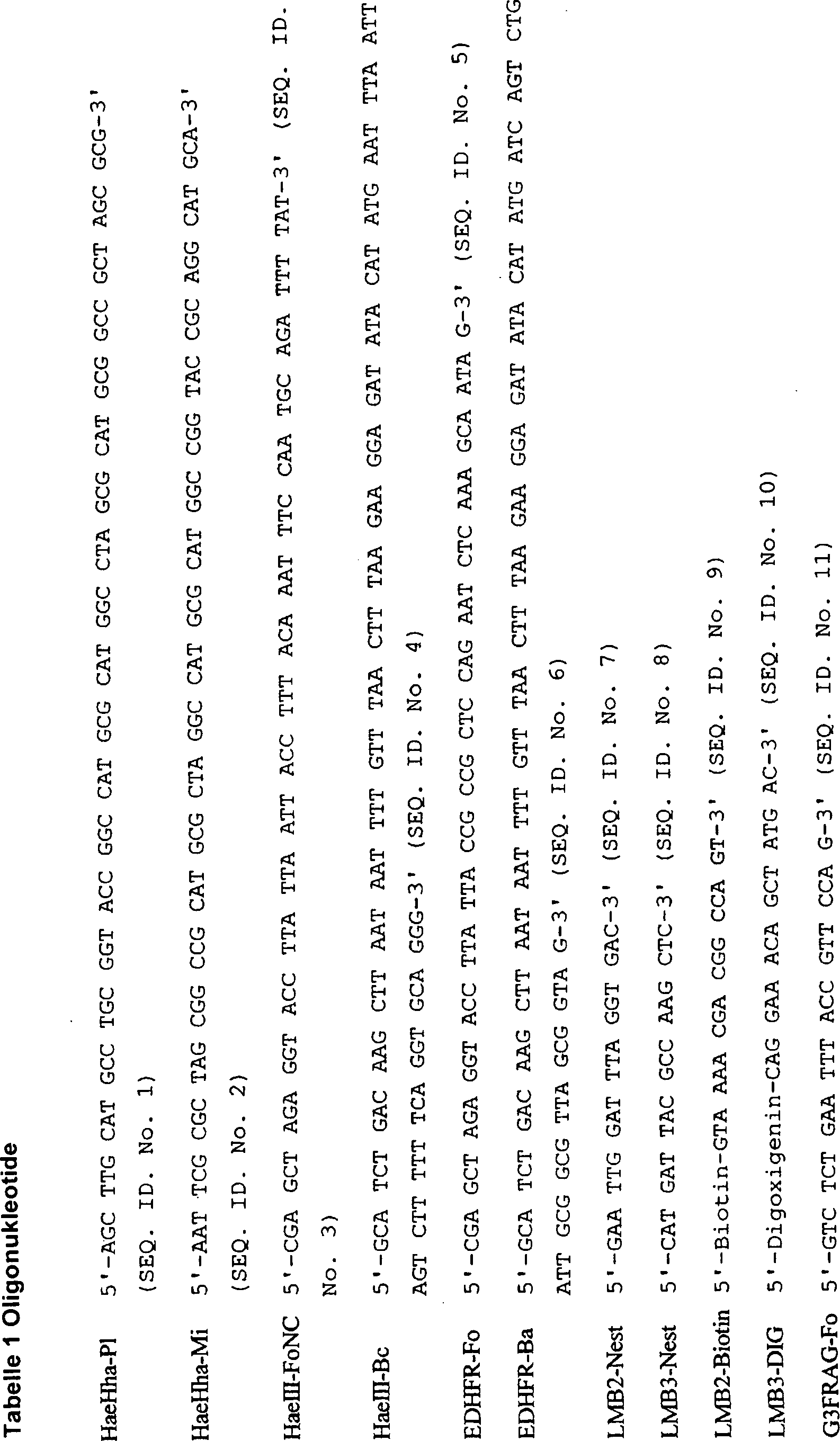
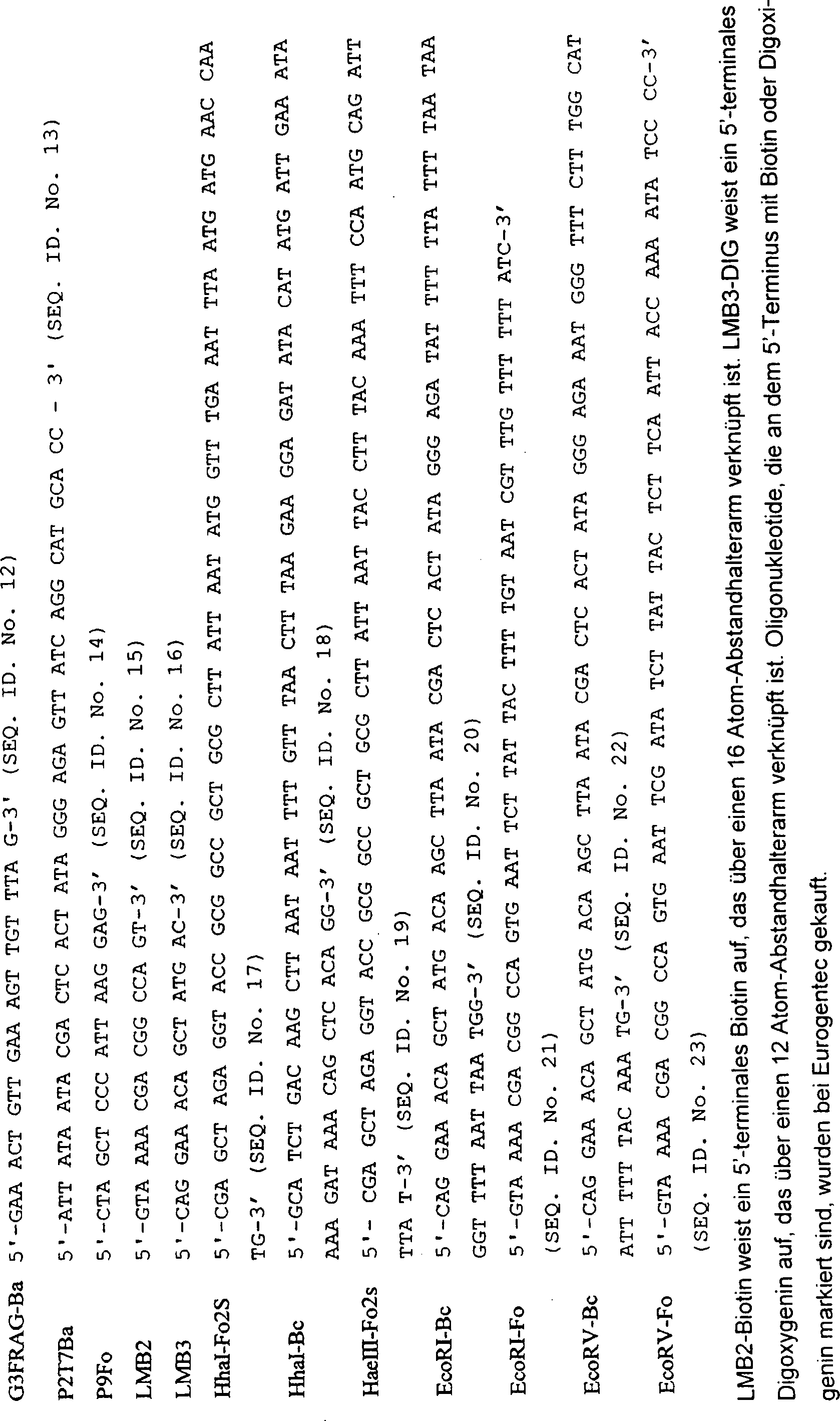
Referenzenreferences
- Anderson, C.W., Straus, J.W. und Dudock, B.S. (1983) Methods Enzymol, 101, 635-44.Anderson, C.W., Straus, J.W. and Dudock, B.S. (1983) Methods Enzymol, 101, 635-44.
- Anderson, J.E. (1993) Curr. Op. Struct. Biol., 3, 24-30.Anderson, J.E. (1993) Curr. Op. Struct. Biol., 3, 24-30.
- Ash, M. und Ash, I. (1993) Handbook of industrial surfactants. Gower, Aldershot. Baccanari, D.P., Averett, D., Briggs, C. und Burchall, J. (1977) Biochemistry, 16, 3566-72.Ash, M. and Ash, I. (1993) Handbook of industrial surfactants. Gower, Aldershot. Baccanari, D.P., Averett, D., Briggs, C. and Burchall, J. (1977) Biochemistry, 16, 3566-72.
- Barany, F. (1991) PCR Methods Applic., 1, 5-16.Barany, F. (1991) PCR Methods Appl., 1, 5-16.
- Bass, S., Greene, R. und Wells, J.A. (1990) Proteins, 8, 309-14.Bass, S., Greene, R. and Wells, J.A. (1990) Proteins, 8, 309-14.
- Becher, P. (1957) Emulsions: theory and practice. Reinhold, New York.Becher, P. (1957) Emulsions: theory and practice. Reinhold, New York.
- Benita, S., Herausg. (1996). Microencapsulation: methods and industrial applications. Drugs and pharmaceutical sciences. Herausgegeben von Swarbrick, J. New York: Marcel Dekker.Benita, S., ed. (1996). Microencapsulation: methods and industrial applications. Drugs and pharmaceutical sciences. edited by Swarbrick, J. New York: Marcel Dekker.
- Benner, S.A. (1994) Trends Biotechnol, 12, 158-63.Benner, S.A. (1994) Trends Biotechnol, 12, 158-63.
- Berman, J., Eisenberg, S. und Tye, B.K. (1987) Methods Enzymol, 155, 528-37.Berman, J., Eisenberg, S. and Tye, B.K. (1987) Methods Enzymol, 155, 528-37.
- Betlach, L., Hershfield, V., Chow, L., Brown, W., Goodman, H.M. & Boyer, H.W. (1976). A restriction endonuclease analysis of the bacterial plasmid controlling the EcoRI restriction and modification of DNA. Federation Proceedings 35, 2037-2043.Betlach, L., Hershfield, V., Chow, L., Brown, W., Goodman, H.M. & Boyer, H.W. (1976). A restriction endonuclease analysis of the bacterial plasmid controlling the EcoRI restriction and modification of DNA. Federation Proceedings 35, 2037-2043.
- Blattner, F.R. und Dahlberg, J.E. (1972) Nature New Biol, 237, 227-32.Blattner, F.R. and Dahlberg, J.E. (1972) Nature New Biol, 237, 227-32.
- Bougueleret, L., Schwarzstein, M., Tsugita, A. & Zabeau, M. (1984). Characterization of the genes coding for the Eco RV restriction and modification system of Escherichia coli. Nucleic Acids Res 12(8), 3659-76.Bougueleret, L., Schwarzstein, M., Tsugita, A. & Zabeau, M. (1984). Characterization of the genes coding for the Eco RV restriction and modification system of Escherichia coli. Nucleic Acids Res 12 (8), 3659-76.
- Bru, R. & Walde, P. (1991). Product inhibition of alpha-chymotrypsin in reverse micelles. Eur J Biochem 199(1), 95-103.Bru, R. & Walde, P. (1991). Product inhibition of alpha-chymotrypsin in reverse micelles. Eur J Biochem 199 (1), 95-103.
- Bru, R. & Walde, P. (1993). Catalytic activity of elastase in reverse micelles. Biochem Mol Biol Int 31(4), 685-92.Bru, R. & Walde, P. (1993). Catalytic activity of elastase in reverse micelles. Biochem Mol Biol Int 31 (4), 685-92.
- Cahill, P., Foster, K. und Mahan, D.E. (1991) Clin Chem, 37, 1482-5.Cahill, P., Foster, K. and Mahan, D.E. (1991) Clin Chem, 37, 1482-5.
- Chakrabarti, A.C., Breaker, R.R., Joyce, G.F. & Deamer, D.W. (1994). Production ofRNA by a polymerase protein encapsulated within phospholipid vesicles. J Mol Evol 39(6), 555-9.Chakrabarti, A.C., Breaker, R.R., Joyce, G.F. & Deamer, D.W. (1994). Production of RNA by a polymerase protein encapsulated within phospholipid vesicles. J Mol Evol 39 (6), 555-9.
- Chamberlin, M. und Ring, J. (1973) J Biol Chem, 248, 2235-2244.Chamberlin, M. and Ring, J. (1973) J Biol Chem, 248, 2235-2244.
- Chang, T.M. (1987). Recycling of NAD(P) by multienzyme systems immobilized by microencapsulation in artificial cells. Methods Enzymol 136(67), 67-82.Chang, T.M. (1987). Recycling of NAD (P) by multienzyme systems immobilized by microencapsulation in artificial cells. Methods Enzymol 136 (67), 67-82.
- Chang, T.M.S. (1992). Recent advances in artificial cells based on microencapsulation. in Microcapsules and nanoparticles in medicine and pharmacy (Donbrow, M., Herausg.), Seiten 323-339. CRC Press, Boca Raton, Florida.Chang, T.M.S. (1992). Recent advances in artificial cells based on microencapsulation. in Microcapsules and nanoparticles in medicine and pharmacy (Donbrow, M., Ed.), pp. 323-339. CRC Press, Boca Raton, Florida.
- Chapman, K.B. und Szostak, J.W. (1994) Curr. op. Struct. Biol., 4, 618-622.Chapman, K.B. and Szostak, J.W. (1994) Curr. op. Struct. Biol., 4, 618-622.
- Chetverin, A.B. und Spirin, AS. (1995) Prog Nucleic Acid Res Mol Biol, 51, 225-70.Chetverine, A.B. and spirin, AS. (1995) Prog Nucleic Acid Res Mol Biol, 51, 225-70.
- Clackson, T. und Wells, J.A. (1994) Trends Biotechnol, 12, 173-84.Clackson, T. and Wells, J.A. (1994) Trends Biotechnol, 12, 173-84.
- Creagh, A.L., Prausnitz, J.M. & Blanch, H.W. (1993). Structural and catalytic properties of enzymes in reverse micelles. Enzyme Microb Technol 15(5), 383-92.Creagh, A.L., Prausnitz, J.M. & Blanch, H.W. (1993). Structural and catalytic properties of enzymes in reverse micelles. enzymes Microb Technol 15 (5), 383-92.
- Cull, M.G., Miller, J.F. und Schatz, P.J. (1992) Proc Natl Acad Sci USA, 89, 1865-9.Cull, M.G., Miller, J.F. and Schatz, P.J. (1992) Proc Natl Acad Sci USA, 89, 1865-9.
- Dickinson, E. (1994) In Wedlock, D.J. (Herausg.), Emulsions and droplet size control. Butterworth-Heine-mann, Oxford, Vol. Seiten 191-257.Dickinson, E. (1994) In Wedlock, D.J. (Ed.), Emulsions and droplet size control. Butterworth-Heine-Mann, Oxford, Vol. Pages 191-257.
- Ellington, A.D. und Szostak, J.W. (1990) Nature, 346, 81822.Ellington, A.D. and Szostak, J.W. (1990) Nature, 346, 81822.
- Ellman, J., Mendel, D., Anthony, C.S., Noren, C.J. und Schultz, P.G. (1991) Methods Enzymol, 202, 301-36.Ellman, J., Mendel, D., Anthony, C.S., Noren, C.J. and Schultz, P. G. (1991) Methods Enzymol, 202, 301-36.
- Fahy, E., Kwoh, D.Y. und Gingeras, T.R. (1991) PCR Methods Appl, 1, 25-33.Fahy, E., Kwoh, D.Y. and Gingeras, T.R. (1991) PCR Methods Appl. 1, 25-33.
- Fields, S. & Song, O. (1989) A novel genetic system to detect protein-protein interactions. Nature 340, 245-6.Fields, S. & Song, O. (1989) A novel genetic system to detect protein-protein interactions. Nature 340, 245-6.
- Finch, C.A. (1993). Encapsulation and controlled release. Spec. Publ.-R. Soc. Chem. 138, 35.Finch, C.A. (1993). Encapsulation and controlled release. Spec. Publ.-R. Soc. Chem. 138, 35.
- Fisch, I., Kontermann, R.E., Finnern, R., Hartley, O., Soler, G.A., Griffiths, A.D. und Winter, G. (1996) Proc Natl Acad Sci U S A, 93, 7761-6.Fisch, I., Kontermann, R.E., Finnern, R., Hartley, O., Soler, G.A., Griffiths, A.D. and Winter, G. (1996) Proc Natl Acad Sci U S A, 93, 7761-6.
- Freese, E. (1959) J. Mol. Biol., 1, 87.Freese, E. (1959) J. Mol. Biol., 1, 87.
- Friedberg, E.C., Walker, G.C. und Siede, W. (1995) DNA repair and mutagenesis. ASM Press, Washington D.C.Friedberg, E.C., Walker, G.C. and Siede, W. (1995) DNA repair and mutagenesis. ASM Press, Washington D.C.
- Gold, L., Polisky, B., Uhlenbeck, O. und Yarus, M. (1995) Annu Rev Biochem, 64, 763-97.Gold, L., Polisky, B., Uhlenbeck, O. and Yarus, M. (1995) Annu Rev Biochem, 64, 763-97.
- Green, R. und Szostak, J.W. (1992) Science, 258, 1910-5.Green, R. and Szostak, J.W. (1992) Science, 258, 1910-5.
- Gregoriadis, G. (1976) Methods Enzymol, 44, 218-27.Gregoriadis, G. (1976) Methods Enzymol, 44, 218-27.
- Griffiths, A.D., Williams, S.C., Hartley, O., Tomlinson, I.M., Waterhouse, P., Crosby, W. L., Kontermann, R.E., Jones, P.T., Low, N.M., Allison, T.J. und et al. (1994) Embo J, 13, 3245-60.Griffiths, A.D., Williams, S.C., Hartley, O., Tomlinson, I.M., Waterhouse, P., Crosby, W.L., Kontermann, R.E., Jones, P.T., Low, N.M., Allison, T.J. and et al. (1994) Embo J, 13, 3245-60.
- Haber, J., Maslakiewicz, P., Rodakiewicz, N.J. & Walde, P. (1993). Activity and spectroscopic properties of bovine liver catalase in sodium bis(2-ethylhexyl)sulfosuccinate/isooctane reverse micelles. Eur J Biochem 217(2), 567-73.Haber, J., Maslakiewicz, P., Rodakiewicz, N.J. & Walde, P. (1993). Activity and spectroscopic properties of bovine liver catalase in sodium bis (2-ethylhexyl) sulfosuccinate / isooctane reverse micelles. Eur J Biochem 217 (2), 567-73.
- Hermanson, G.T. (1996) Bioconjugate techniques. Academic Press, San Diego.Hermanson, G.T. (1996) Bioconjugate techniques. Academic Press, San Diego.
- Hochuli, E., Dobeli, H. und Schacher, A. (1987) J Chromatogr, 411, 177-84.Hochuli, E., Dobeli, H. and Schacher, A. (1987) J. Chromatogr. 411, 177-84.
- Hoogenboom, H.R., et al., (1991) Nucl. Acids Res., 91, 4133-4137.Hoogenboom, H.R., et al., (1991) Nucl. Acids Res., 91, 4133-4137.
- Hoogenboom, H. R. (1997). Designing and optimizing library selection strategies for generating high-affinity antibodies. Trends Biotechnol. 15, 62-70.Hoogenboom, H.R. (1997). Designing and optimizing library selection Strategies for generating high-affinity antibodies. Trends Biotechnol. 15, 62-70.
- Hoogenboom, H.R. (1997) Trends Biotechnol., 15, 62-70.Hoogenboom, H.R. (1997) Trends Biotechnol., 15, 62-70.
- Janda, K.D., Lo, L.-C., Lo, C.-H.L., Sim, M., -M., Wang, R., Wong, C.-H. und Lerner, R.A. (1997) Science, 275, 945-948.Janda, K.D., Lo, L.-C., Lo, C.-H.L., Sim, M., -M., Wang, R., Wong, C.-H. and Lerner, R.A. (1997) Science, 275, 945-948.
- Johannsson, A. (1991) In Price, C.P. und Newman, D.J. (Herausg.), Heterogeneous enzyme immunoassays. Stockton Press, New York, Vol. Seiten 295-325.Johannsson, A. (1991) In Price, C.P. and Newman, D.J. (Eds.), Heterogeneous enzyme immunoassays. Stockton Press, New York, Vol. Pages 295-325.
- Johannsson, A. und Bates, D.L. (1988) In Kemeny, D.M. und Challacombe, S.i. (Herausg.), Amplification by second enzymes. John Wiley, Chichester, Vol. Seiten 85-106.Johannsson, A. and Bates, D.L. (1988) In Kemeny, D.M. and Challacombe, S.I. (Ed.), Amplification by second enzymes. John Wiley, Chichester, Vol. Pages 85-106.
- Joyce, G.F. (1994) Curr. op. Structural Biol., 4, 331-336.Joyce, G.F. (1994) Curr. Op. Structural Biol., 4, 331-336.
- Kadir, F.H. und Moore, G.R. (1990) Febs Lett, 276, 81-4.Kadir, F.H. and Moore, G.R. (1990) Febs Lett, 276, 81-4.
- Kallen, R.G. & Jencks, W.P. (1966). The mechanism of the condensation of formaldehyde with tetrahydrofolic acid. J. Biol. Chem. 241, 5851-5863.Kallen, R.G. & Jencks, W. P. (1966). The mechanism of the condensation of formaldehyde with tetrahydrofolic acid. J. Biol. Chem. 241, 5851-5863.
- Katanaev, V.L., Kumasov, O.V. und Spirin, A.S. (1995) Febs Lett, 359, 89-92.Katanaev, V.L., Kumasov, O.V. and Spirin, A.S. (1995) Febs Lett, 359, 89-92.
- Keij, J.F., Groenewegen, A.C. & Visser, J.W.M. (1994) High-speed photodamage cell sorting: An evaluation of the ZAPPER prototype. Methods in cell biology 42, 371-358.Keij, J.F., Groenewegen, A.C. & Visser, J.W.M. (1994) High-speed photodamage cell sorting: An evaluation of the ZAPPER prototype. Methods in cell biology 42, 371-358.
- Klug, A. (1995) Ann N Y Acad Sci, 758, 143-60.Klug, A. (1995) Ann N. Y Acad Sci, 758, 143-60.
- Klug, A. und Schwabe, J.W. (1995) Faseb T, 9, 597-604.Klug, A. and Schwabe, J.W. (1995) Faseb T, 9, 597-604.
- Kolb, V.A., Makeyev, E.V., Kommer, A. und Spirin, A.S.(1995) Biochem Cell Biol, 73, 1217-20.Kolb, V.A., Makeyev, E.V., Kommer, A. and Spirin, A.S. (1995) Biochem Cell Biol, 73, 1217-20.
- Kowalczykowski, S.C., Dixon, D.A., Eggleston, A.K., Lauder, S.D. und Rehrauer, W.M. (1994) Microbiol Rev, 58, 401-65.Kowalczykowski, S.C., Dixon, D.A., Eggleston, A.K., Lauder, S.D. and Rehrauer, W.M. (1994) Microbiol Rev., 58, 401-65.
- Krumdiek, C.L. & Baugh, C.M. (1980) Solid-phase synthesis of pteroylpolyglutamates. Methods Enzymol. Seiten 524-529.Krumdiek, C.L. & Baugh, CM. (1980) Solid-phase synthesis of pteroyl polyglutamates. Methods Enzymol. Pages 524-529.
- Kumar, A., Kumar, A. & Katiyar, S. S. (1989). Activity and kinetic characteristics of glutathione reductase in vitro in reverse micellar waterpool. Biochim Biophys Acta 996(1-2), 1-6.Kumar, A., Kumar, A. & Katiyar, S.S. (1989). Activity and kinetic characteristics of glutathione reductase in vitro in reverse micellar waterpool. Biochim Biophys Acta 996 (1-2), 1-6.
- Landegren, U., Kaiser, R., Sanders, J. und Hood, L. (1988) Science, 241, 1077-80.Landegren, U., Kaiser, R., Sanders, J. and Hood, L. (1988) Science, 241, 1077-80.
- Lesley, S. A., Brow, M. A. & Burgess, R. R. (1991). Use of in vitro protein synthesis from polymerase chain reaction-generated templates to study interaction of Escherichia coli transcription factors with core RNA polymerase and for epitope mapping of monoclonal antibodies. J Biol Chem 266(4), 2632-8.Lesley, S.A., Brow, M.A. & Burgess, R.R. (1991). Use of in vitro protein synthesis from polymerase chain reaction-generated templates to study interaction of Escherichia coli transcription factors with core RNA polymerase and epitope mapping of monoclonal antibodies. J Biol Chem 266 (4), 2632-8.
- Lesley, S.A. (1995) Methods Mol Biol, 37, 265-78.Lesley, S.A. (1995) Methods Mol Biol, 37, 265-78.
- Lesley, S.A., Brow, M.A. und Burgess, R.R. (1991) J Biol Chem, 266, 2632-8.Lesley, S.A., Brow, M.A. and Burgess, R.R. (1991) J. Biol. Chem. 266, 2632-8.
- Leung, D.W., Chen, E. und Goeddel, D.V. (1989) Technique, 1, 11-15.Leung, D.W., Chen, E. and Goeddel, D.V. (1989) Technique, 1, 11-15.
- Liao, H., McKenzie, T. und Hageman, R. (1986) Proc Natl Acad Sci U S A, 83, 576-80.Liao, H., McKenzie, T. and Hageman, R. (1986) Proc Natl Acad Sci U S A, 83, 576-80.
- Lim, F. & Sun, A.M. (1980). Microencapsulated islets as bioartificial endocrine pancreas. Science 210(4472), 908-10.Lim, F. & Sun, AT THE. (1980). Microencapsulated islets as bioartificial endocrine pancreas. Science 210 (4472), 908-10.
- Lim, F., Herausg. (1984). Biomedical applications of microencapsulation. Boca Raton, Florida: CRC Press.Lim, F., ed. (1984). Biomedical applications of microencapsulation. Boca Raton, Florida: CRC Press.
- Lissant, K.J., Herausg. Emulsions and emulsion technology. Surfactant Science New York: Marcel Dekker, 1974.Lissant, K.J., ed. Emulsions and emulsion technology. surfactant Science New York: Marcel Dekker, 1974.
- Lissant, K.J., Herausg. Emulsions and emulsion technology. Surfactant Science New York: Marcel Dekker, 1974.Lissant, K.J., ed. Emulsions and emulsion technology. surfactant Science New York: Marcel Dekker, 1974.
- Lissant, K.J., Herausg. Emulsions and emulsion technology. Surfactant Science New York: Marcel Dekker, 1984.Lissant, K.J., ed. Emulsions and emulsion technology. surfactant Science New York: Marcel Dekker, 1984.
- Low, N.M., Holliger, P.H. und Winter, G. (1996) J Mol Biol, 260, 359-68.Low, N.M., Holliger, P.H. and Winter, G. (1996) J. Mol Biol. 260, 359-68.
- Lowman, H.B., Bass, S.H., Simpson, N. und Wells, J.A. (1991) Biochemistry, 30, 10832-8.Lowman, H.B., Bass, S.H., Simpson, N., and Wells, J.A. (1991) Biochemistry, 30, 10832-8.
- Luisi, P.L. & B., S.-H. (1987). Activity and conformation of enzymes in reverse micellar solutions. Methods Enzymol 136(188), 188-216.Luisi, P.L. & B., S.-H. (1987). Activity and conformation of enzymes in reverse micellar solutions. Methods Enzymol 136 (188), 188-216.
- Ma, C., Kudlicki, W., Odom, O.W., Kramer, G. und Hardesty, B. (1993) Biochemistry, 32, 7939-45.Ma, C., Kudlicki, W., Odom, O.W., Kramer, G. and Hardesty, B. (1993) Biochemistry, 32, 7939-45.
- Magdassi, S., Frenkel, M., Carti, N. und Cazan, R. (1984) 97, 377-379. Manley, J.L., Fire, A., Samuels, M. und Sharp, P.A. (1983) Methods Enzymol, 101, 568-82.Magdassi, S., Frenkel, M., Carti, N. and Cazan, R. (1984) 97, 377-379. Manley, J.L., Fire, A., Samuels, M. and Sharp, P.A. (1983) Methods Enzymol, 101, 568-82.
- Mao, Q. & Walde, P. (1991). Substrate effects on the enzymatic activity of alphachymotrypsin in reverse micelles. Biochem Biophys Res Commun 178(3), 1105-12.Mao, Q. & Walde, P. (1991). Substrates effects on the enzymatic activity of alphachymotrypsin in reverse micelles. Biochem Biophys Res. Commun 178 (3), 1105-12.
- Mao, Q., Walde, P. & Luisi, P.L. (1992). Kinetic behaviour of alpha-chymotrypsin in reverse micelles. A stopped-flow study. Eur J Biochem 208(1), 165-70. Mattheakis, L.C., Bhatt, R.R. und Dower, W.J. (1994) Proc Natl Acad Sci USA, 91, 9022-6.Mao, Q., Walde, P. & Luisi, P. L. (1992). Kinetic behavior of alpha-chymotrypsin in reverse micelles. A stopped-flow study. Eur J Biochem 208 (1), 165-70. Mattheakis, L.C., Bhatt, R.R. and Dower, W.J. (1994) Proc Natl Acad Sci USA, 91, 9022-6.
- McCafferty, J., Griffiths, A.D., Winter, G. und Chiswell, D.J. (1990) Nature, 348, 552-4.McCafferty, J., Griffiths, A.D., Winter, G. and Chiswell, D.J. (1990) Nature, 348, 552-4.
- Melton, D.A., Krieg, P.A., Rebagliati, M.R., Maniatis, T., Zinn, K. und Green, M.R. (1984) Nucleic Acids Res, 12, 703556.Melton, D.A., Krieg, P.A., Rebagliati, M.R., Maniatis, T., Zinn, K. and Green, M.R. (1984) Nucleic Acids Res, 12, 703556.
- Mendel, D., Cornish, V.W. und Schultz, P.G. (1995) Annu Rev Biophys Biomol Struct, 24, 435-62.Mendel, D., Cornish, V.W. and Schultz, P.G. (1995) Annu Rev Biophys Biomol Struct, 24, 435-62.
- Menger, F.M. & Yamada, K. (1979). J. Am. Chem. Soc. 101, 6731-6734.Menger, F.M. & Yamada, K. (1979). J. Am. Chem. Soc. 101, 6731-6734.
- Miele, E.A., Mills, D.R. und Kramer, F.R. (1983) J Mol Biol, 171, 281-95.Miele, E.A., Mills, D.R. and Kramer, F.R. (1983) J Mol Biol, 171, 281-95.
- Mize, P.D., Hoke, R.A., Linn, C.P., Reardon, J.E. und Schulte, T.H. (1989) Anal Biochem, 179, 229-35.Mize, P.D., Hoke, R.A., Linn, C.P., Reardon, J.E. and Schulte, T.H. (1989) Anal. Biochem, 179, 229-35.
- Montigiani, S., Neri, G., Neri, P. und Neri, D. (1996) J Mol Biol, 258, 6-13.Montigiani, S., Neri, G., Neri, P. and Neri, D. (1996) J Mol Biol, 258, 6-13.
- Moore, M.J. (1995) Nature, 374, 766-7.Moore, M.J. (1995) Nature, 374, 766-7.
- New, R. R. C., Herausg. (1990). Liposomes: a practical approach. The practical appraoch series. Herausgegeben von Rickwood, D. & Hames, B. D. Oxford: Oxford University Press.New, R.R.C., Eds. (1990). Liposomes: a practical approach. The practical appraoch series. Edited by Rickwood, D. & Hames, B.D. Oxford: Oxford University Press.
- Nissim, A., Hoogenboom, H.R.I Tomlinson, I.M., Flynn, G., Midgley, C., Lane, D. und Winter, G. (1994) Embo J, 13, 692-8.Nissim, A., Hoogenboom, H.R.I Tomlinson, I.M., Flynn, G., Midgley, C., Lane, D. and Winter, G. (1994) Embo J, 13, 692-8.
- Oberholzer, T., Albrizio, M. & Luisi, P.L. (1995a). Polymerase chain reaction in liposomes. Chemistry and Biology 2, 677-682.Oberholzer, T., Albrizio, M. & Luisi, P. L. (1995a). Polymerase chain reaction in liposomes. Chemistry and Biology 2, 677-682.
- Oberholzer, T., Wick, R., Luisi, P. L. & Biebricher, C. K. (1995b). Enzymatic RNA replication in self-reproducing vesicles: an approach to a minimal cell. Biochem Biophys Res Commun 207(1), 250-7.Oberholzer, T., Wick, R., Luisi, P.L. & Biebricher, C.K. (1995b). Enzymatic RNA replication in self-reproducing vesicles: at approach to a minimal cell. Biochem Biophys Res Commun 207 (1), 250-7.
- Parmley, S.F. und Smith, G.P. (1988) Gene, 73, 305-18.Parmley, S.F. and Smith, G.P. (1988) Gene, 73, 305-18.
- Pelham, H.R. und Jackson, R.J. (1976) Eur J Biochem, 67, 247-56.Pelham, H.R. and Jackson, R.J. (1976) Eur J Biochem, 67, 247-56.
- Perelson, A.S. und Oster, G.F. (1979) J Theor Biol, 81, 64570.Perelson, A.S. and Oster, G.F. (1979) J Theor Biol, 81, 64570.
- Perez, G.M., Sanchez, F.A. & Garcia, C.F. (1992). Application of active-phase plot to the kinetic analysis of lipoxygenase in reverse micelles. Biochem J.Perez, G.M., Sanchez, F.A. & Garcia, C. F. (1992). Application of active-phase plot to the kinetic analysis of lipoxygenase in reverse micelles. Biochem J.
- Pirrung, M.C. und Huang, C.Y. (1996) Bioconjug Chem, 7, 31721.Pirrung, M.C. and Huang, C.Y. (1996) Bioconjug Chem. 7, 31721.
- Posner, B.A., Li, L., Bethell, R., Tsuji, T. und Benkovic, S.J. (1996) Biochemistry, 35, 1653-63.Posner, B.A., Li, L., Bethell, R., Tsuji, T. and Benkovic, S.J. (1996) Biochemistry, 35, 1653-63.
- Roberts, B.E., Gorecki, M., Mulligan, R.C., Danna, K.J., Rozenblatt, S. und Rich, A. (1975) Proc Natl Acad Sci U S A, 72, 1922-6.Roberts, B.E., Gorecki, M., Mulligan, R.C., Danna, K.J., Rozenblatt, S. and Rich, A. (1975) Proc Natl Acad Sci U S A, 72, 1922-6.
- Roberts, J.W. (1969) Nature, 224, 1168-74.Roberts, J.W. (1969) Nature, 224, 1168-74.
- Roberts, R. & Szostak, J. (1997) RNA-peptide fusions for the in vitro selection of peptides and proteins. Proc Natl Acad Sci USA 94, 12297-12302.Roberts, R. & Szostak, J. (1997) RNA-peptide fusion for the in vitro selection of peptides and proteins. Proc Natl Acad Sci USA 94, 12297-12302.
- Rosenberg, M., Weissman, S. und Decrombrugghe, B. (1975) J Biol Chem, 250, 4755-64.Rosenberg, M., Weissman, S. and Decrombrugghe, B. (1975) J Biol Chem, 250, 4755-64.
- Saiki, R.K., Gelfand, D.H., Stoffel, S., Scharf, S.J., Higuchi, R., Horn, G.T., Mullis, K.B. und Erlich, H.A. (1988) Science, 239, 487-91.Saiki, R.K., Gelfand, D.H., Stoffel, S., Scharf, S.J., Higuchi, R., Horn, G.T., Mullis, K.B. and Erlich, H.A. (1988) Science, 239, 487-91.
- Sambrook, J., Fritsch, E.F. und Maniatis, T. (1989) Molecular cloning: a laboratory manual. Cold Spring Harbor Laboratory Press, New York.Sambrook, J., Fritsch, E.F. and Maniatis, T. (1989) Molecular cloning: a laboratory manual. Cold Spring Harbor Laboratory Press, New York.
- Savage, M.D., Mattson, G., Desai, S., Nielander, G.W., Morgensen, S. und Conklin, E.J. (1994) Avidin-biotin chemistry: a handbook. Pierce Chemical Company, Rockford.Savage, M.D., Mattson, G., Desai, S., Nielander, G.W., Morgensen, S. and Conklin, E.J. (1994) Avidin-biotin chemistry: a handbook. Pierce Chemical Company, Rockford.
- Schick, M.J. (1966) Nonionic surfactants. Marcel Dekker, New York.Schick, M.J. (1966) Nonionic surfactants. Marcel Dekker, New York.
- Sherman, P. (1968) Emulsion science. Academic Press, London.Sherman, P. (1968) Emulsion science. Academic Press, London.
- Smith, G.P. (1985) Science, 228, 1315-7.Smith, G.P. (1985) Science, 228, 1315-7.
- Soumillion, P., Jaspers, L., Bouchet, M., Marchand, B.J., Winter, G. und Fastrez, J. (1994) J Mol Biol, 237, 415-22.Soumillion, P., Jaspers, L., Bouchet, M., Marchand, B.J., Winter, G. and Fastrez, J. (1994) J Mol Biol, 237, 415-22.
- Stemmer, W.P. (1994a) Nature, 370, 389-91.Stemmer, W.P. (1994a) Nature, 370, 389-91.
- Stemmer, W.P. (1994b) Proc Natl Acad Sci USA, 91, 10747-51.Stemmer, W.P. (1994b) Proc Natl Acad Sci USA, 91, 10747-51.
- Stofko, H.R., Carr, D.W. und Scott, J.D. (1992) Febs Lett, 302, 274-8.Stofko, H.R., Carr, D.W. and Scott, J.D. (1992) Febs Lett, 302, 274-8.
- Sun, A.M., Vasek, I. & Tai, I. (1992). Microencapsulation of living cells and tissues. In Microencapsulation and nanoparticles in medicine and pharmacy (Donbrow, M., Herausg.), Seiten 315-322. CRC Press, Boca Raton, Florida.Sun, A.M., Vasek, I. & Tai, I. (1992). Microencapsulation of living cells and tissues. In microencapsulation and nanoparticles in medicine and pharmacy (Donbrow, M., Ed.), Pages 315-322. CRC Press, Boca Raton, Florida.
- Sundberg, S.A., Barrett, R.W., Pirrung, M., Lu, A.L., Kiangsoontra, B. und Holmes, C.P. (1995) J. Am. Chem. Soc., 117, 12050-12057.Sundberg, S.A., Barrett, R.W., Pirrung, M., Lu, A.L., Kiangsoontra, B. and Holmes, C.P. (1995) J. Am. Chem. Soc., 117, 12050-12057.
- Tawfik, D.S., Green, B.S., Chap, R., Sela, M. & Eshhar, Z. (1993). catELISA: a facile general route to catalytic antibodies. Proc Natl Acad Sci USA 90(2), 373-7.Tawfik, D.S., Green, B.S., Chap, R., Sela, M. & Eshhar, Z. (1993). catELISA: a facile general route to catalytic antibodies. Proc Natl Acad Sci USA 90 (2), 373-7.
- Tokatlidis, K., Friguet, B., Deville, B.D., Baleux, F., Fedorov, A.N., Navon, A., Djavadi, O.L. und Goldberg, M.E. (1995) Philos Trans R Soc Lond B Biol Sci, 348, 89-95.Tokatlidis, K., Friguet, B., Deville, B.D., Baleux, F., Fedorov, A.N., Navon, A., Djavadi, O.L. and Goldberg, M.E. (1995) Philos Trans R Soc Lond B Biol Sci, 348, 89-95.
- Tripet, B., Yu, L., Bautista, D.L., Wong, W.Y., Irvin, R.T. und Hodges, R.S. (1996) Protein Engng., 9, 1029-1042.Tripet, B., Yu, L., Bautista, D.L., Wong, W.Y., Irvin, R.T. and Hodges, R.S. (1996) Protein Engng., 9, 1029-1042.
- Tuerk, C. und Gold, L. (1990) Science, 249, 505-10. van Hal, D.A., Bouwstra, J.A. & Junginger, H. E. (1996). Nonionic surfactant vesicles containing estradiol for topical application. In Microencapsulation: methods and industrial applications (Benita, S., Herausg.), Seiten 329-347. Marcel Dekker, New York.Tuerk, C. and Gold, L. (1990) Science, 249, 505-10. van Hal, D.A., Bouwstra, J.A. & Junginger, H.E. (1996). Nonionic surfactant vesicles containing estradiol for topical application. In Microencapsulation: methods and industrial applications (Benita, S., Ed.), pages 329-347. Marcel Dekker, New York.
- Walde, P., Goto, A., Monnard, P.-A., Wessicken, M. & Luisi, P. L. (1994). Oparin's reactions revisited: enzymatic synthesis of poly(adenylic acid) in micelles and selfreproducing vesicles. J. Am. Chem. Soc. 116, 7541-7547.Walde, P., Goto, A., Monnard, P.-A., Wessicken, M. & Luisi, P.L. (1994). Oparin's reactions revisited: enzymatic synthesis of poly (adenylic acid) in micelles and selfreproducing vesicles. J. Am. Chem. Soc. 116 7541-7547.
- Walde, P., Han, D. & Luisi, P.L. (1993). Spectroscopic and kinetic studies of lipases solubilized in reverse micelles. Biochemistry 32(15), 4029-34.Walde, P., Han, D. & Luisi, P. L. (1993). Solubilized and kinetic studies of lipases in reverse micelles. Biochemistry 32 (15), 4029-34.
- Walde, P., Peng, Q., Fadnavis, N.W., Battistel, E. & Luisi, P.L. (1988). Structure and activity of trypsin in reverse micelles. Eur J Biochem 173(2), 401-9.Walde, P., Peng, Q., Fadnavis, N.W., Battistel, E. & Luisi, P.L. (1988). Structure and activity of trypsin in reverse micelles. Eur J Biochem 173 (2), 401-9.
- Walker, G.T., Fraiser, M.S., Schram, J.L., Little, M.C., Nadeau, J.G. und Malinowski, D.P. (1992) Nucleic Acids Res, 20, 1691-6.Walker, G.T., Fraiser, M.S., Schram, J.L., Little, M.C., Nadeau, J.G. and Malinowski, D.P. (1992) Nucleic Acids Res, 20, 1691-6.
- Weil, P.A., Luse, D.S., Segall, J. und Roeder, R.G. (1979) Cell, 18, 469-84.Weil, P.A., Luse, D.S., Segall, J. and Roeder, R.G. (1979) Cell, 18, 469-84.
- Whateley, T. L. (1996). Microcapsules: preparation by interfacial polymerisation and interfacial complexation and their applications. In Microencapsulation: methods and industrial applications (Benita, S., Herausg.), Seiten 349-375. Marcel Dekker, New York.Whateley, T.L. (1996). Microcapsules: preparation by interfacial polymerization and interfacial complexation and their applications. In Microencapsulation: methods and industrial applications (Benita, S., ed.), Pages 349-375. Marcel Dekker, New York.
- Wick, R. & Luisi, P. L. (1996). Enzyme-containing liposomes can endogenously produce membrane-constituting lipids. Chem Biol 3(4), 277-85.Wick, R. & Luisi, P.L. (1996). Enzyme-containing liposomes can endogenously produce membrane-constituting lipids. Chem Biol 3 (4), 277-85.
- Widersten, M. und Mannervik,. B. (1995) J Mol Biol, 250, 115-22.Resist, M. and Mannervik ,. B. (1995) J Mol Biol, 250, 115-22.
- Williams, J.W., Morrison, J.F. und Duggleby, R.G. (1979) Biochemistry, 18, 2567-73.Williams, J.W., Morrison, J.F. and Duggleby, R.G. (1979) Biochemistry, 18, 2567-73.
- Winter, G., Griffiths, A.D., Hawkins, R.E. und Hoogenboom, H.R. (1994) Annu Rev Immunol, 12, 433-55.Winter, G., Griffiths, A.D., Hawkins, R.E. and Hoogenboom, H.R. (1994) Annu Rev Immunol, 12, 433-55.
- Wyatt, J.R.1 Chastain, M. und Puglisi, J.D. (1991) Biotechniques, 11, 764-9.Wyatt, J.R.1 Chastain, M. and Puglisi, J.D. (1991) Biotechniques, 11, 764-9.
- Yamagishi, J., Kawashima, H., Matsuo, N., Ohue, M., Yamayoshi, M., Fukui, T., Kotani, H., Furuta, R., Nakano, K. und Yamada, M. (1990) Protein Eng, 3, 713-9.Yamagishi, J., Kawashima, H., Matsuo, N., Ohue, M., Yamayoshi, M., Fukui, T., Kotani, H., Furuta, R., Nakano, K. and Yamada, M. (1990) Protein Eng, 3, 713-9.
- Yelamos, J., Klix, N., Goyenechea, B., Lozano, F., Chui, Y.L., Gonzalez, F.A., Pannell, R., Neuberger, M.S. und Milstein, C. (1995) Nature, 376, 225-9.Yelamos, J., Klix, N., Goyenechea, B., Lozano, F., Chui, Y.L., Gonzalez, F. A., Pannell, R., Neuberger, M.S. and Milstein, C. (1995) Nature, 376, 225-9.
- Zaccolo, M., Williams, D.M., Brown, D.M. und Gherardi, E. (1996) J Mol Biol, 255, 589-603.Zaccolo, M., Williams, D.M., Brown, D.M. and Gherardi, E. (1996) J Mol Biol, 255, 589-603.
- Zakrzewski, S.F. (1980) Preparation of tritiated dihydrofolic acid of high specific activity. Methods Enzymol. Seiten 539-.Zakrzewski, S.F. (1980) Preparation of tritiated dihydrofolic acid of high specific activity. Methods Enzymol. Pages 539-.
- Zaug, A.J. und Cech, T.R. (1986) Biochemistry, 25, 4478-82.Zaug, A.J. and Cech, T.R. (1986) Biochemistry, 25, 4478-82.
- Zaug, A.J. und Cech, T.R. (1986) Science, 231, 470-5.Zaug, A.J. and Cech, T.R. (1986) Science, 231, 470-5.
- Zaug, A.J., Been, M.D. und Cech, T.R. (1986) Nature, 324, 429-33.Zaug, A.J., Been, M.D. and Cech, T.R. (1986) Nature, 324, 429-33.
- Zubay, G. (1973) Annu Rev Genet, 7, 267-87.Zubay, G. (1973) Annu Rev Genet, 7, 267-87.
- Zubay, G. (1980) Methods Enzymol, 65, 856-77.Zubay, G. (1980) Methods Enzymol, 65, 856-77.
SEQUENZPROTOKOLL 

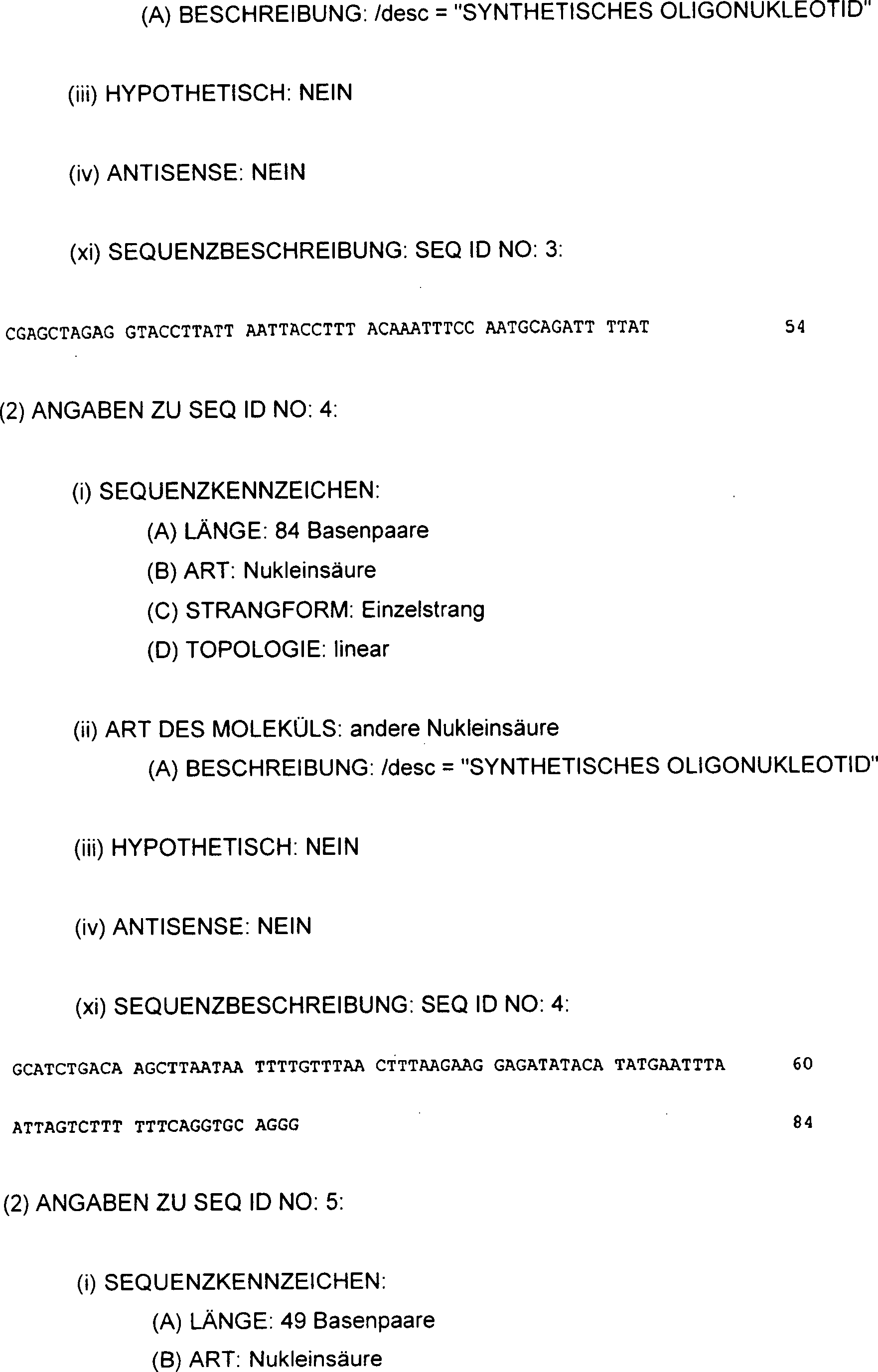
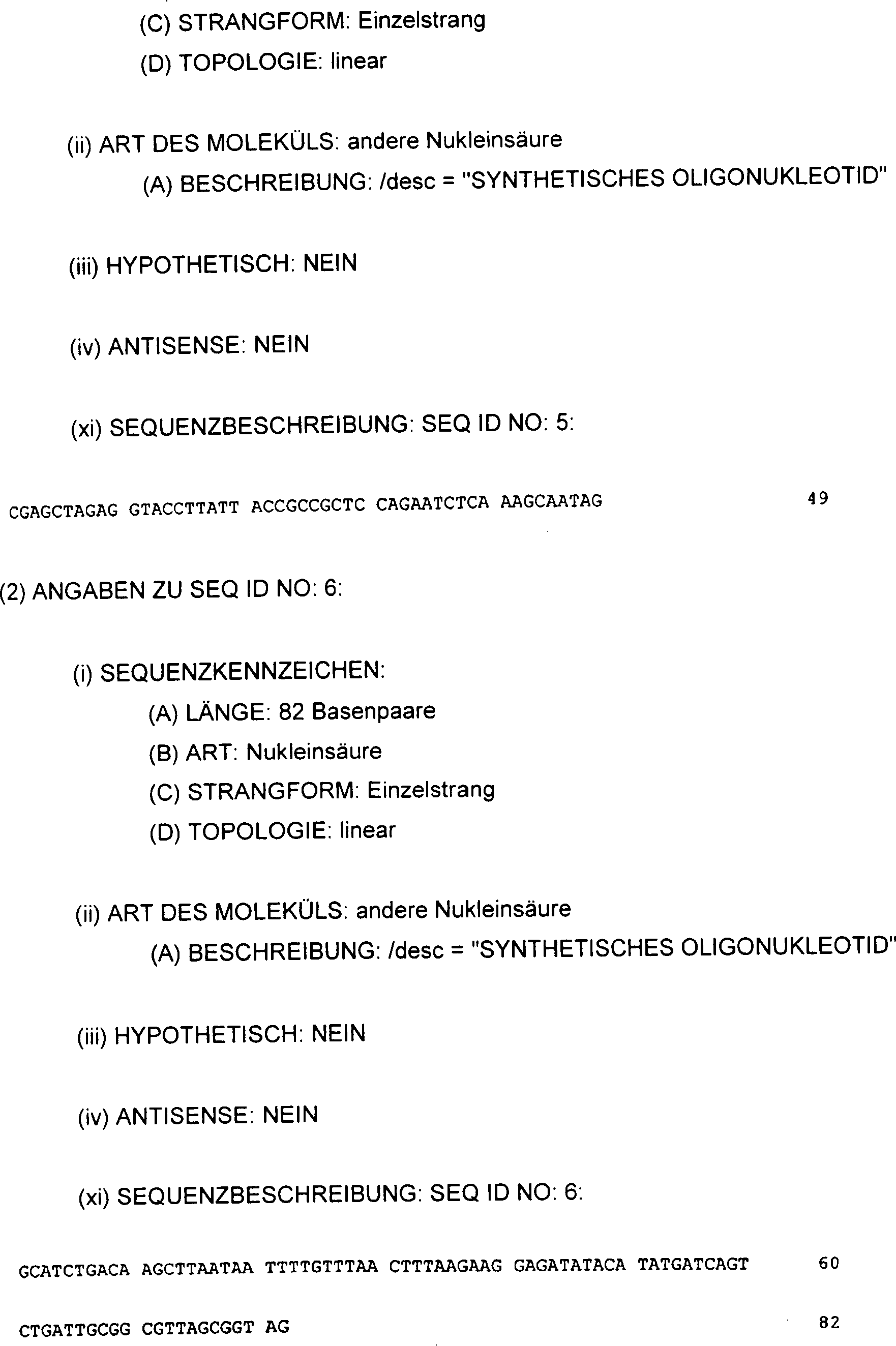

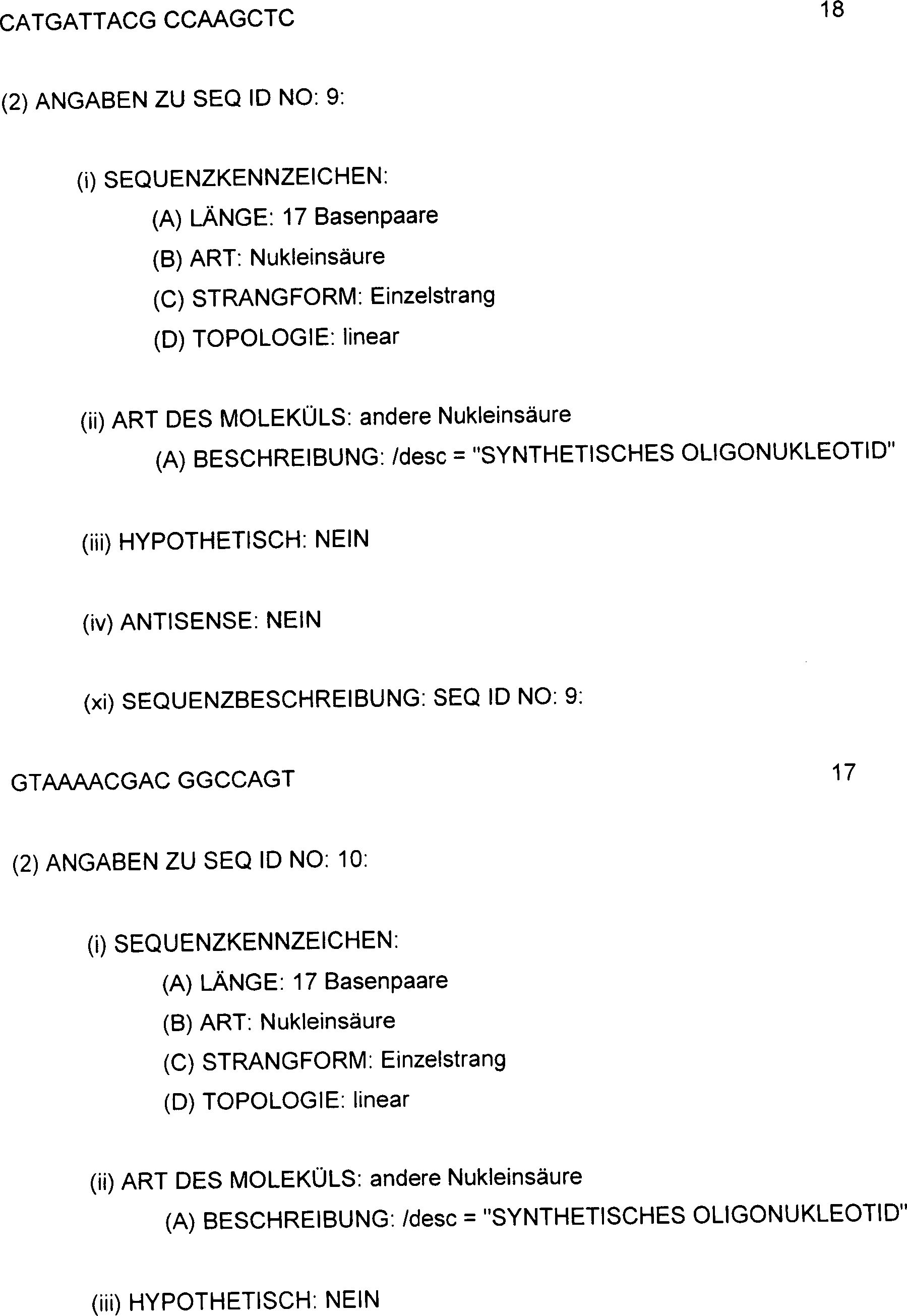


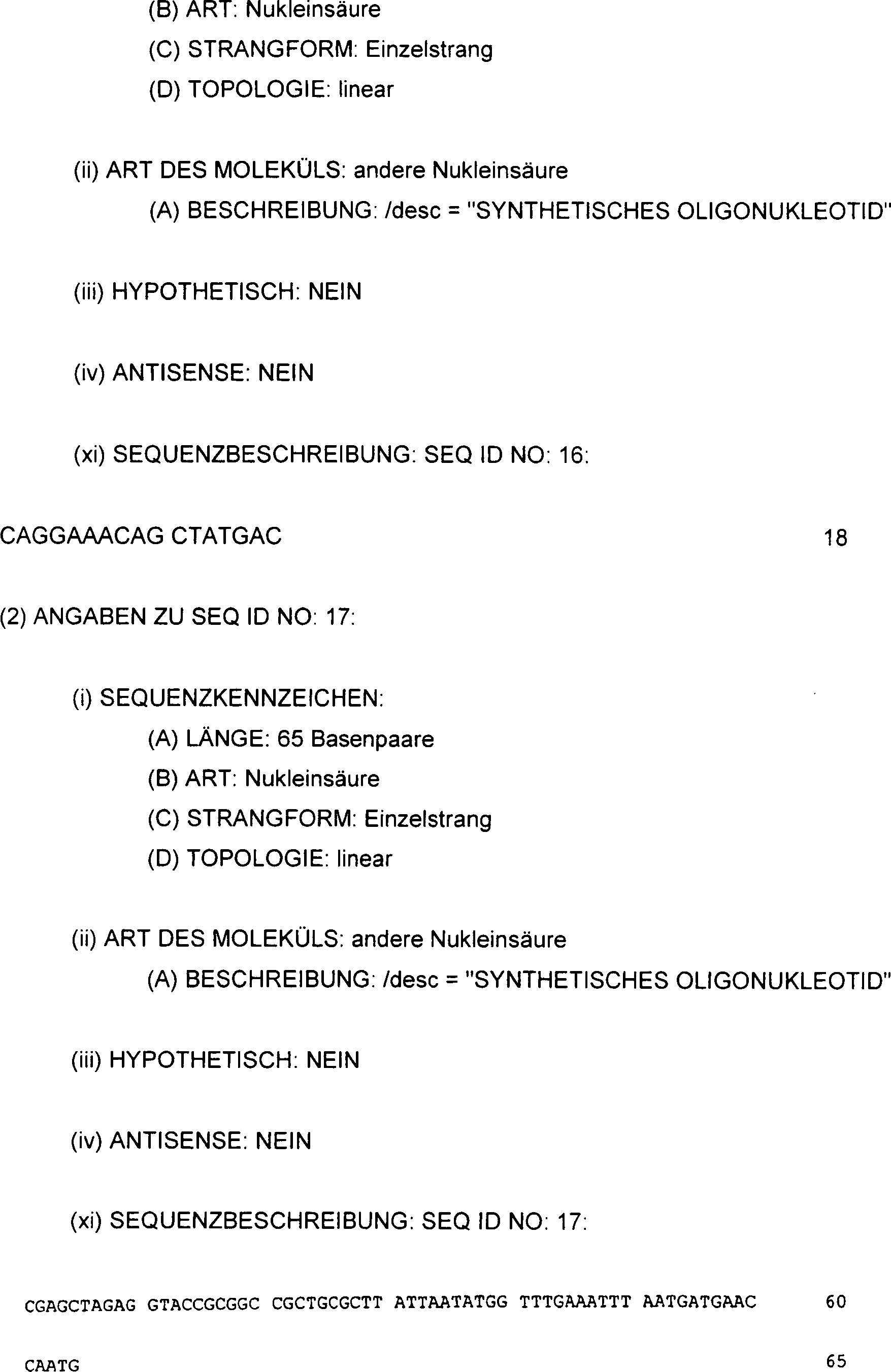
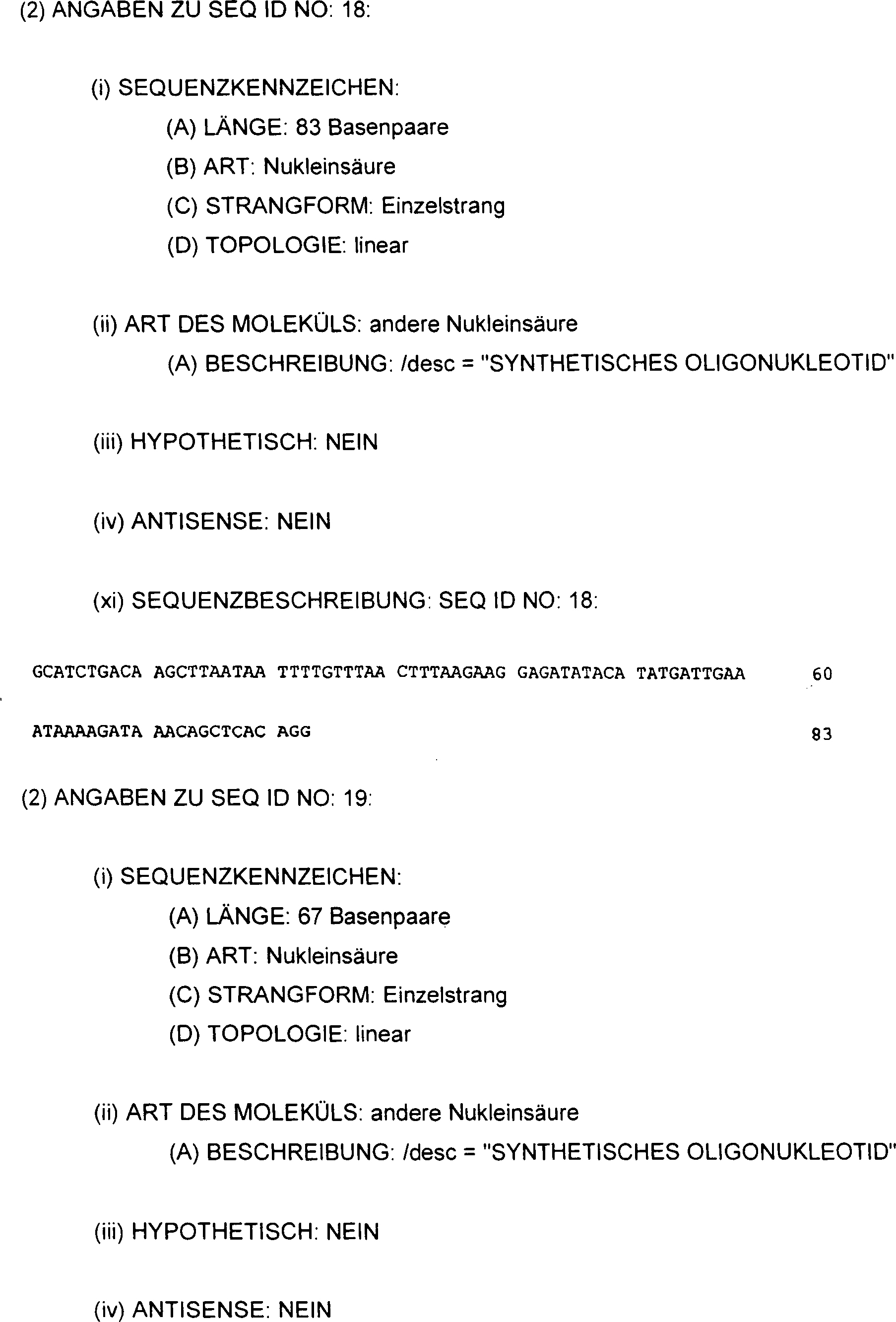
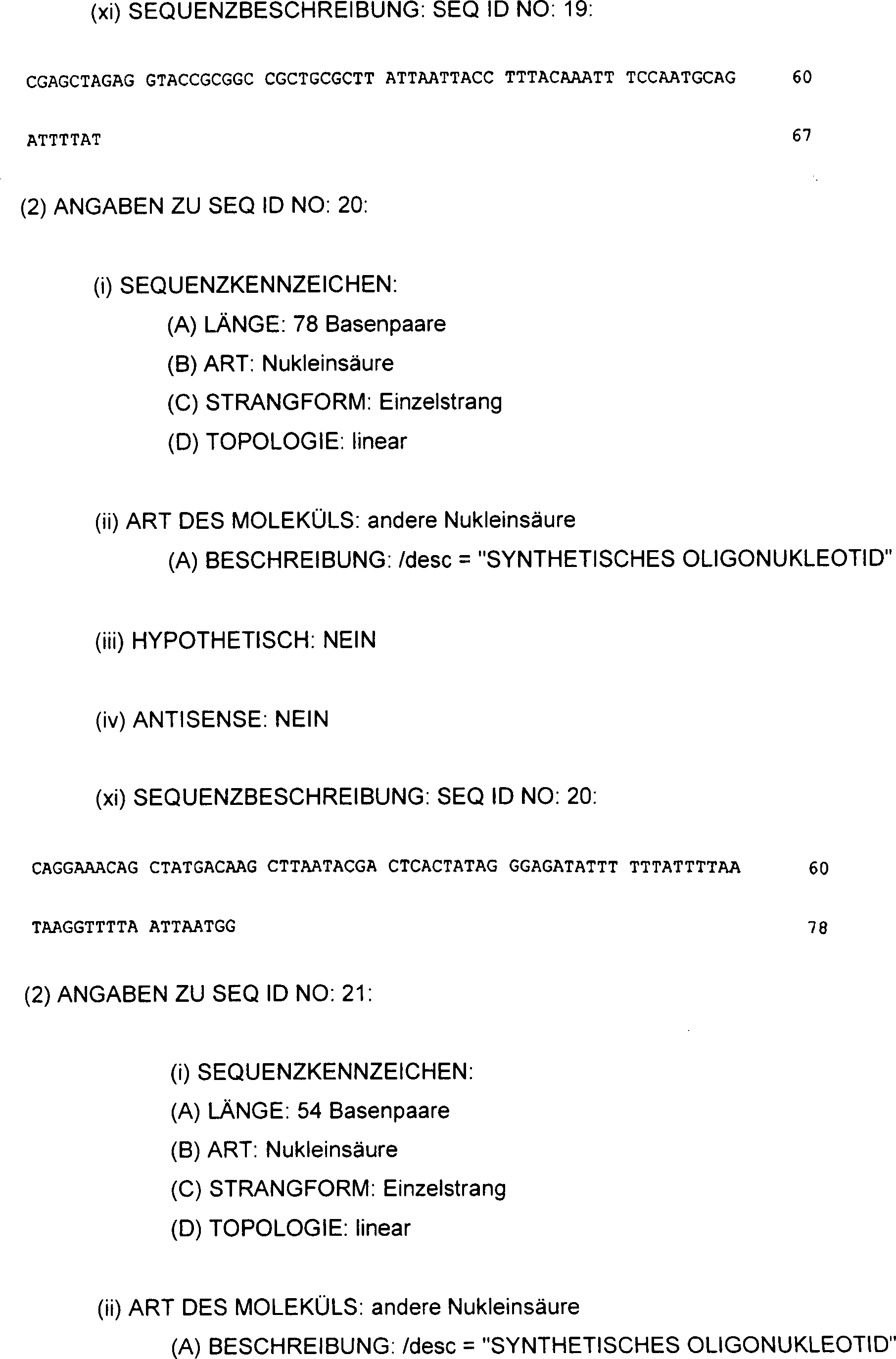
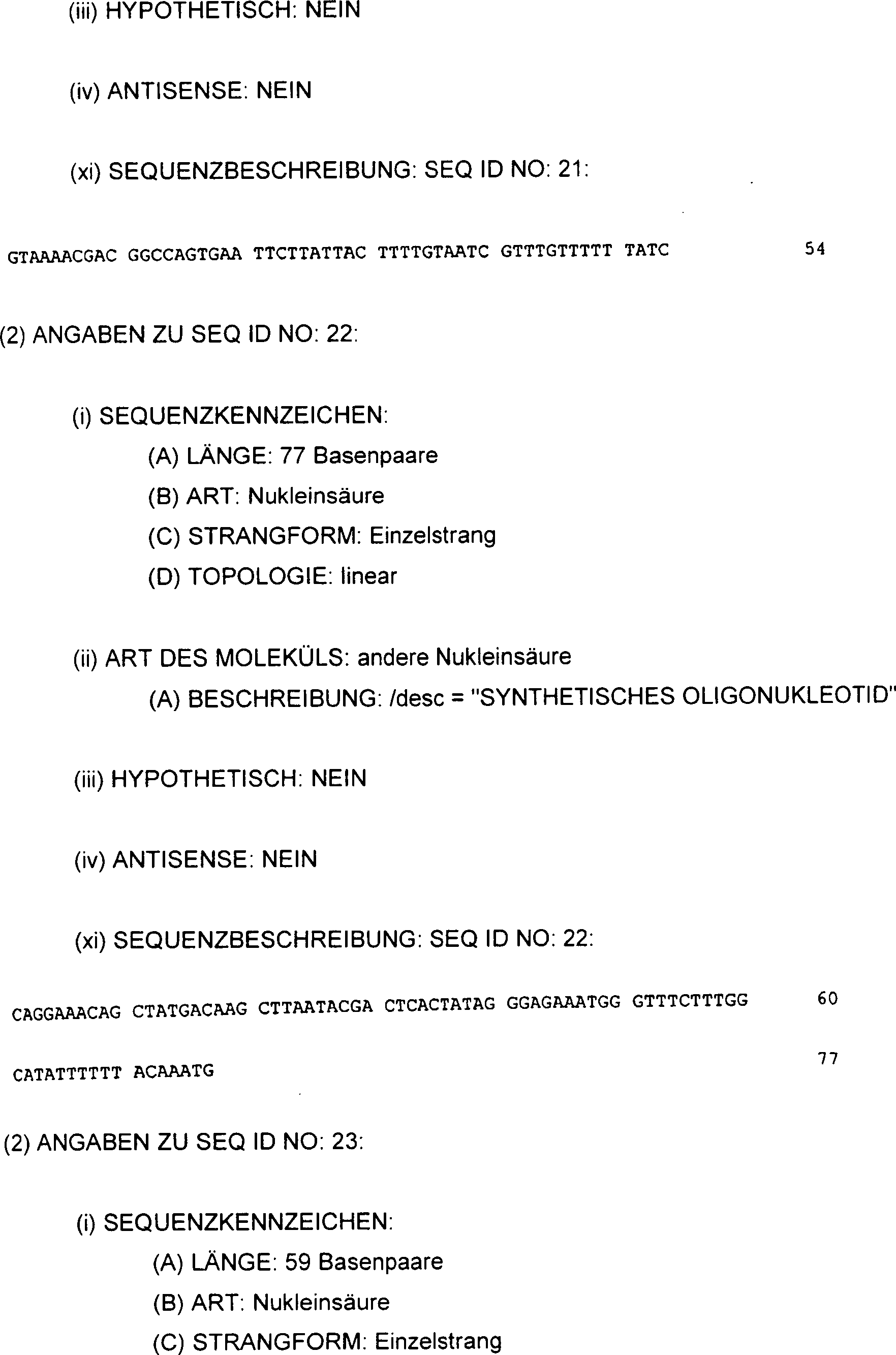
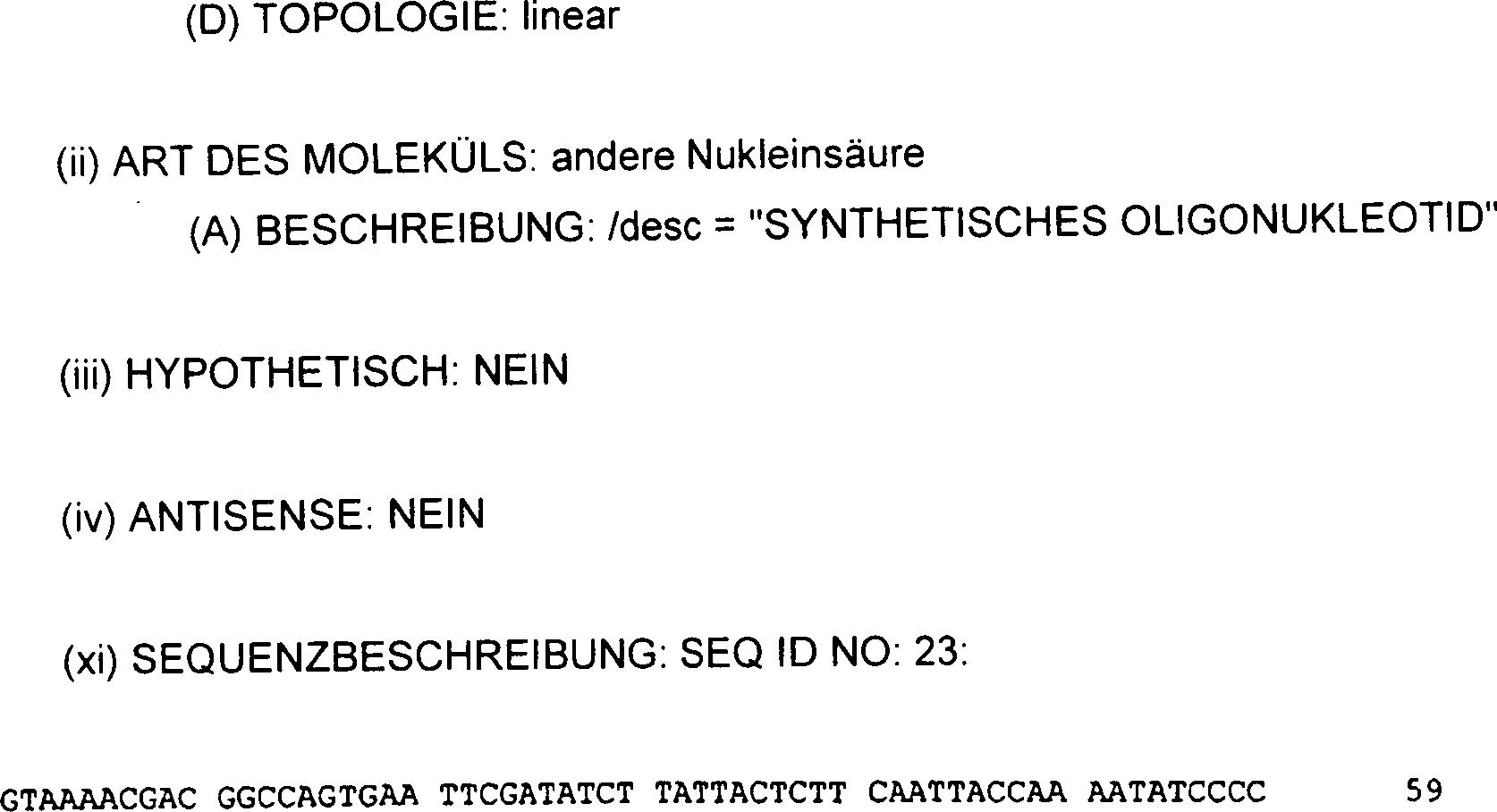
Claims (17)
Applications Claiming Priority (4)
| Application Number | Priority Date | Filing Date | Title |
|---|---|---|---|
| GBGB9714300.2A GB9714300D0 (en) | 1997-07-07 | 1997-07-07 | In vitro sorting method |
| GB9714300 | 1997-07-07 | ||
| GB9806393 | 1998-03-25 | ||
| GBGB9806393.6A GB9806393D0 (en) | 1998-03-25 | 1998-03-25 | In vitro sorting method |
Publications (2)
| Publication Number | Publication Date |
|---|---|
| DE69838521D1 DE69838521D1 (en) | 2007-11-15 |
| DE69838521T2 true DE69838521T2 (en) | 2008-05-21 |
Family
ID=26311843
Family Applications (4)
| Application Number | Title | Priority Date | Filing Date |
|---|---|---|---|
| DE69838521T Expired - Lifetime DE69838521T2 (en) | 1997-07-07 | 1998-06-29 | Method for increasing the concentration of nucleic acid molecules |
| DE69841997T Expired - Lifetime DE69841997D1 (en) | 1997-07-07 | 1998-06-29 | In vitro sorting method |
| DE69837453T Expired - Lifetime DE69837453T2 (en) | 1997-07-07 | 1998-06-29 | An in vitro sorting procedure |
| DE69826697T Expired - Lifetime DE69826697T2 (en) | 1997-07-07 | 1998-06-29 | IN VITRO SELECTION METHOD |
Family Applications After (3)
| Application Number | Title | Priority Date | Filing Date |
|---|---|---|---|
| DE69841997T Expired - Lifetime DE69841997D1 (en) | 1997-07-07 | 1998-06-29 | In vitro sorting method |
| DE69837453T Expired - Lifetime DE69837453T2 (en) | 1997-07-07 | 1998-06-29 | An in vitro sorting procedure |
| DE69826697T Expired - Lifetime DE69826697T2 (en) | 1997-07-07 | 1998-06-29 | IN VITRO SELECTION METHOD |
Country Status (13)
| Country | Link |
|---|---|
| US (7) | US6489103B1 (en) |
| EP (6) | EP1019496B1 (en) |
| JP (3) | JP4298912B2 (en) |
| AT (4) | ATE278013T1 (en) |
| AU (1) | AU736836B2 (en) |
| CA (3) | CA2295324C (en) |
| CY (1) | CY1111537T1 (en) |
| DE (4) | DE69838521T2 (en) |
| DK (3) | DK1496120T3 (en) |
| ES (4) | ES2294427T3 (en) |
| GB (1) | GB2342094B (en) |
| PT (2) | PT1801214E (en) |
| WO (1) | WO1999002671A1 (en) |
Families Citing this family (380)
| Publication number | Priority date | Publication date | Assignee | Title |
|---|---|---|---|---|
| US7262055B2 (en) | 1998-08-25 | 2007-08-28 | Gendaq Limited | Regulated gene expression in plants |
| US7285416B2 (en) | 2000-01-24 | 2007-10-23 | Gendaq Limited | Regulated gene expression in plants |
| US20030027126A1 (en) | 1997-03-14 | 2003-02-06 | Walt David R. | Methods for detecting target analytes and enzymatic reactions |
| US7622294B2 (en) | 1997-03-14 | 2009-11-24 | Trustees Of Tufts College | Methods for detecting target analytes and enzymatic reactions |
| EP3034626A1 (en) | 1997-04-01 | 2016-06-22 | Illumina Cambridge Limited | Method of nucleic acid sequencing |
| DE69838521T2 (en) | 1997-07-07 | 2008-05-21 | Medical Research Council | Method for increasing the concentration of nucleic acid molecules |
| AR021833A1 (en) | 1998-09-30 | 2002-08-07 | Applied Research Systems | METHODS OF AMPLIFICATION AND SEQUENCING OF NUCLEIC ACID |
| GB9900298D0 (en) * | 1999-01-07 | 1999-02-24 | Medical Res Council | Optical sorting method |
| AU2004242526B2 (en) * | 1999-01-07 | 2007-08-30 | United Kingdom Research And Innovation | Optical Sorting Method |
| CA2365981A1 (en) | 1999-03-24 | 2000-09-28 | Board Of Regents, The University Of Texas System | Linear and circular expression elements |
| GB9917027D0 (en) | 1999-07-20 | 1999-09-22 | Affibody Technology Sweeden Ab | In vitro selection and optional identification of polypeptides using solid support carriers |
| US6770441B2 (en) | 2000-02-10 | 2004-08-03 | Illumina, Inc. | Array compositions and methods of making same |
| GB0022458D0 (en) | 2000-09-13 | 2000-11-01 | Medical Res Council | Directed evolution method |
| AR031640A1 (en) | 2000-12-08 | 2003-09-24 | Applied Research Systems | ISOTHERMAL AMPLIFICATION OF NUCLEIC ACIDS IN A SOLID SUPPORT |
| JP4386641B2 (en) * | 2001-03-16 | 2009-12-16 | キアゲン ゲーエムベーハー | Nucleic acids stabilized against degradation |
| JP4838957B2 (en) * | 2001-05-02 | 2011-12-14 | 独立行政法人理化学研究所 | Protein production method using cell-free protein synthesis system |
| GB0114854D0 (en) * | 2001-06-18 | 2001-08-08 | Medical Res Council | Selective gene amplification |
| GB0115841D0 (en) | 2001-06-28 | 2001-08-22 | Medical Res Council | Ligand |
| US20040076966A1 (en) * | 2001-10-30 | 2004-04-22 | J. Brian Windsor | Method and system for the co-isolation of cognate DNA, RNA and protein sequences and method for screening co-isolates for defined activities |
| GB0127564D0 (en) * | 2001-11-16 | 2002-01-09 | Medical Res Council | Emulsion compositions |
| JP4359707B2 (en) | 2002-05-22 | 2009-11-04 | 独立行政法人理化学研究所 | Protein production method by cell-free protein synthesis system using thioredoxin fusion protein expression vector |
| AUPS298102A0 (en) * | 2002-06-13 | 2002-07-04 | Nucleics Pty Ltd | Method for performing chemical reactions |
| JP2006507921A (en) | 2002-06-28 | 2006-03-09 | プレジデント・アンド・フェロウズ・オブ・ハーバード・カレッジ | Method and apparatus for fluid dispersion |
| US20060002935A1 (en) | 2002-06-28 | 2006-01-05 | Domantis Limited | Tumor Necrosis Factor Receptor 1 antagonists and methods of use therefor |
| US9321832B2 (en) | 2002-06-28 | 2016-04-26 | Domantis Limited | Ligand |
| DK1534830T3 (en) | 2002-09-06 | 2011-02-14 | Isogenica Ltd | A vito-peptide expression library |
| GB0221053D0 (en) * | 2002-09-11 | 2002-10-23 | Medical Res Council | Single-molecule in vitro evolution |
| JP4441170B2 (en) | 2002-11-28 | 2010-03-31 | 独立行政法人理化学研究所 | Escherichia coli cell extract having mutation in S12 ribosomal protein and cell-free protein production method using the same |
| GB0228819D0 (en) * | 2002-12-11 | 2003-01-15 | British American Tobacco Co | Improvements relating to smoking articles |
| GB0230203D0 (en) | 2002-12-27 | 2003-02-05 | Domantis Ltd | Fc fusion |
| CA2513535C (en) | 2003-01-29 | 2012-06-12 | 454 Corporation | Bead emulsion nucleic acid amplification |
| US7575865B2 (en) | 2003-01-29 | 2009-08-18 | 454 Life Sciences Corporation | Methods of amplifying and sequencing nucleic acids |
| US7041481B2 (en) | 2003-03-14 | 2006-05-09 | The Regents Of The University Of California | Chemical amplification based on fluid partitioning |
| US20060078893A1 (en) * | 2004-10-12 | 2006-04-13 | Medical Research Council | Compartmentalised combinatorial chemistry by microfluidic control |
| GB0307403D0 (en) * | 2003-03-31 | 2003-05-07 | Medical Res Council | Selection by compartmentalised screening |
| GB0307428D0 (en) | 2003-03-31 | 2003-05-07 | Medical Res Council | Compartmentalised combinatorial chemistry |
| FI20030615A0 (en) * | 2003-04-24 | 2003-04-24 | Marko Virta | Nanoparticle for Bioaffinity Assays |
| CA2521862C (en) | 2003-04-10 | 2012-10-16 | President And Fellows Of Harvard College | Formation and control of fluidic species |
| CA2525120C (en) | 2003-05-14 | 2013-04-30 | Domantis Limited | A process for recovering polypeptides that unfold reversibly from a polypeptide repertoire |
| US8048627B2 (en) * | 2003-07-05 | 2011-11-01 | The Johns Hopkins University | Method and compositions for detection and enumeration of genetic variations |
| EP2662136A3 (en) | 2003-08-27 | 2013-12-25 | President and Fellows of Harvard College | Method for handling and mixing droplets |
| WO2005030957A1 (en) * | 2003-10-01 | 2005-04-07 | ETH Zürich | Method for in vitro evolution of polypeptides |
| GB0325653D0 (en) | 2003-11-03 | 2003-12-10 | Medical Res Council | CST emulsions |
| EP1691792A4 (en) * | 2003-11-24 | 2008-05-28 | Yeda Res & Dev | COMPOSITIONS AND METHODS FOR IN VITRO / I SORTING OF MOLECULAR AND CELLULAR BANKS |
| CA2553833C (en) | 2004-01-28 | 2012-10-02 | 454 Corporation | Nucleic acid amplification with continuous flow emulsion |
| US20050221339A1 (en) * | 2004-03-31 | 2005-10-06 | Medical Research Council Harvard University | Compartmentalised screening by microfluidic control |
| US7655470B2 (en) | 2004-10-29 | 2010-02-02 | University Of Chicago | Method for manipulating a plurality of plugs and performing reactions therein in microfluidic systems |
| US9477233B2 (en) | 2004-07-02 | 2016-10-25 | The University Of Chicago | Microfluidic system with a plurality of sequential T-junctions for performing reactions in microdroplets |
| GB0418651D0 (en) | 2004-08-20 | 2004-09-22 | Medical Res Council | Method |
| GB0419628D0 (en) | 2004-09-03 | 2004-10-06 | European Molecular Biology Lab Embl | Method for determining protein solubility |
| KR20070084069A (en) | 2004-10-08 | 2007-08-24 | 도만티스 리미티드 | Single domain antibody against TENF1 and method of using the same |
| US7968287B2 (en) | 2004-10-08 | 2011-06-28 | Medical Research Council Harvard University | In vitro evolution in microfluidic systems |
| WO2006051552A2 (en) * | 2004-11-15 | 2006-05-18 | Yeda Research And Development Co. Ltd. At The Weizmann Institute Of Science | Directed evolution and selection using in vitro compartmentalization |
| JP4868731B2 (en) | 2004-11-17 | 2012-02-01 | 独立行政法人理化学研究所 | Cell-free protein synthesis system derived from cultured mammalian cells |
| JP4787488B2 (en) | 2004-11-19 | 2011-10-05 | 独立行政法人理化学研究所 | Cell-free protein synthesis method using linear template DNA and cell extract therefor |
| EP2316977A1 (en) | 2005-02-01 | 2011-05-04 | AB Advanced Genetic Analysis Corporation | Reagents, methods and libraries for bead-based amflication |
| EP2233583A1 (en) | 2005-02-01 | 2010-09-29 | AB Advanced Genetic Analysis Corporation | Nucleic acid sequencing by performing successive cycles of duplex extension |
| WO2006096571A2 (en) | 2005-03-04 | 2006-09-14 | President And Fellows Of Harvard College | Method and apparatus for forming multiple emulsions |
| US20070054119A1 (en) * | 2005-03-04 | 2007-03-08 | Piotr Garstecki | Systems and methods of forming particles |
| US20060228721A1 (en) * | 2005-04-12 | 2006-10-12 | Leamon John H | Methods for determining sequence variants using ultra-deep sequencing |
| ATE474937T1 (en) * | 2005-04-29 | 2010-08-15 | Synthetic Genomics Inc | AMPLIFICATION AND CLONING OF INDIVIDUAL DNA MOLECULES USING ROLLING CIRCLE AMPLIFICATION |
| US20090233291A1 (en) * | 2005-06-06 | 2009-09-17 | 454 Life Sciences Corporation | Paired end sequencing |
| CA2615323A1 (en) | 2005-06-06 | 2007-12-21 | 454 Life Sciences Corporation | Paired end sequencing |
| CN101466847B (en) | 2005-06-15 | 2014-02-19 | 考利达基因组股份有限公司 | Single-molecule arrays for genetic and chemical analysis |
| US20090264299A1 (en) | 2006-02-24 | 2009-10-22 | Complete Genomics, Inc. | High throughput genome sequencing on DNA arrays |
| CA2618699C (en) | 2005-08-11 | 2012-10-02 | J. Craig Venter Institute, Inc. | In vitro recombination method |
| JP5033949B2 (en) * | 2005-08-12 | 2012-09-26 | 国立大学法人豊橋技術科学大学 | Electric emulsification method |
| WO2007024778A2 (en) * | 2005-08-22 | 2007-03-01 | Applera Corporation | Device, system and method for depositing processed immiscible-fluid-discrete-volumes |
| WO2007044245A2 (en) | 2005-10-07 | 2007-04-19 | Callida Genomics, Inc. | Self-assembled single molecule arrays and uses thereof |
| KR100828714B1 (en) | 2005-10-25 | 2008-05-09 | 주식회사 엘지화학 | Multiplex Amplification Method Using Ribonucleic Acid |
| EP1801212A1 (en) * | 2005-12-21 | 2007-06-27 | Eidgenössische Technische Hochschule Zürich | Selection of biocatalysts for chemical synthesis |
| WO2007081386A2 (en) | 2006-01-11 | 2007-07-19 | Raindance Technologies, Inc. | Microfluidic devices and methods of use |
| WO2007089541A2 (en) * | 2006-01-27 | 2007-08-09 | President And Fellows Of Harvard College | Fluidic droplet coalescence |
| JP5180845B2 (en) | 2006-02-24 | 2013-04-10 | カリダ・ジェノミックス・インコーポレイテッド | High-throughput genomic sequencing on DNA arrays |
| JP2009538123A (en) * | 2006-04-19 | 2009-11-05 | アプライド バイオシステムズ, エルエルシー | Reagents, methods and libraries for gel-free bead-based sequencing |
| US9562837B2 (en) | 2006-05-11 | 2017-02-07 | Raindance Technologies, Inc. | Systems for handling microfludic droplets |
| EP2021113A2 (en) * | 2006-05-11 | 2009-02-11 | Raindance Technologies, Inc. | Microfluidic devices |
| EP2636755A1 (en) * | 2006-05-26 | 2013-09-11 | AltheaDx Incorporated | Biochemical analysis of partitioned cells |
| EP3536396B1 (en) | 2006-08-07 | 2022-03-30 | The President and Fellows of Harvard College | Fluorocarbon emulsion stabilizing surfactants |
| US8399188B2 (en) | 2006-09-28 | 2013-03-19 | Illumina, Inc. | Compositions and methods for nucleotide sequencing |
| WO2008070352A2 (en) | 2006-10-27 | 2008-06-12 | Complete Genomics, Inc. | Efficient arrays of amplified polynucleotides |
| US7682791B2 (en) * | 2006-10-29 | 2010-03-23 | Macevicz Stephen C | Method of generating nested sets of double stranded DNA circles |
| WO2008070375A2 (en) | 2006-11-09 | 2008-06-12 | Complete Genomics, Inc. | Selection of dna adaptor orientation |
| WO2008093098A2 (en) | 2007-02-02 | 2008-08-07 | Illumina Cambridge Limited | Methods for indexing samples and sequencing multiple nucleotide templates |
| WO2008097559A2 (en) | 2007-02-06 | 2008-08-14 | Brandeis University | Manipulation of fluids and reactions in microfluidic systems |
| CN101617046A (en) * | 2007-02-23 | 2009-12-30 | 新英格兰生物实验室公司 | Selection and enrichment of proteins using in vitro compartmentalization |
| US9029085B2 (en) | 2007-03-07 | 2015-05-12 | President And Fellows Of Harvard College | Assays and other reactions involving droplets |
| US8617816B2 (en) * | 2007-03-16 | 2013-12-31 | 454 Life Sciences, A Roche Company | System and method for detection of HIV drug resistant variants |
| US7776927B2 (en) * | 2007-03-28 | 2010-08-17 | President And Fellows Of Harvard College | Emulsions and techniques for formation |
| WO2008130623A1 (en) | 2007-04-19 | 2008-10-30 | Brandeis University | Manipulation of fluids, fluid components and reactions in microfluidic systems |
| US7883265B2 (en) * | 2007-06-01 | 2011-02-08 | Applied Biosystems, Llc | Devices, systems, and methods for preparing emulsions |
| CN101720359A (en) * | 2007-06-01 | 2010-06-02 | 454生命科学公司 | System and method for identifying individual samples from a multiplex mixture |
| MX2009013137A (en) | 2007-06-06 | 2010-04-30 | Domantis Ltd | Methods for selecting protease resistant polypeptides. |
| CA2689389A1 (en) * | 2007-06-28 | 2009-01-08 | 454 Life Sciences Corporation | System and method for adaptive reagent control in nucleic acid sequencing |
| JP2010539982A (en) * | 2007-10-01 | 2010-12-24 | アプライド バイオシステムズ, エルエルシー | Chase ligation sequencing |
| EP2213747B1 (en) | 2007-11-05 | 2021-06-30 | Riken | Method for producing membrane protein |
| CN101918595A (en) | 2007-11-27 | 2010-12-15 | 人类遗传标记控股有限公司 | Enzymes for amplification and replication of bisulfite-modified nucleic acids |
| WO2009068649A2 (en) | 2007-11-30 | 2009-06-04 | Glaxo Group Limited | Antigen-binding constructs |
| US9797010B2 (en) | 2007-12-21 | 2017-10-24 | President And Fellows Of Harvard College | Systems and methods for nucleic acid sequencing |
| WO2009100080A1 (en) | 2008-02-04 | 2009-08-13 | Life Technologies Corporation | Composition and method for sequencing nucleic acid |
| US20090203086A1 (en) * | 2008-02-06 | 2009-08-13 | 454 Life Sciences Corporation | System and method for improved signal detection in nucleic acid sequencing |
| WO2009121804A1 (en) | 2008-03-31 | 2009-10-08 | Glaxo Group Limited | Drug fusions and conjugates |
| WO2009124296A2 (en) | 2008-04-04 | 2009-10-08 | Allopartis Biotechnologies, Inc. | Method of enhancing enzyme activity |
| GB0806562D0 (en) | 2008-04-10 | 2008-05-14 | Fermentas Uab | Production of nucleic acid |
| US7888034B2 (en) | 2008-07-01 | 2011-02-15 | 454 Life Sciences Corporation | System and method for detection of HIV tropism variants |
| WO2010003132A1 (en) | 2008-07-02 | 2010-01-07 | Illumina Cambridge Ltd. | Using populations of beads for the fabrication of arrays on surfaces |
| EP4047367A1 (en) | 2008-07-18 | 2022-08-24 | Bio-Rad Laboratories, Inc. | Method for detecting target analytes with droplet libraries |
| US12038438B2 (en) | 2008-07-18 | 2024-07-16 | Bio-Rad Laboratories, Inc. | Enzyme quantification |
| EP3216874A1 (en) | 2008-09-05 | 2017-09-13 | TOMA Biosciences, Inc. | Methods for stratifying and annotating cancer drug treatment options |
| WO2010033200A2 (en) | 2008-09-19 | 2010-03-25 | President And Fellows Of Harvard College | Creation of libraries of droplets and related species |
| US9132394B2 (en) | 2008-09-23 | 2015-09-15 | Bio-Rad Laboratories, Inc. | System for detection of spaced droplets |
| US9598725B2 (en) | 2010-03-02 | 2017-03-21 | Bio-Rad Laboratories, Inc. | Emulsion chemistry for encapsulated droplets |
| US12090480B2 (en) | 2008-09-23 | 2024-09-17 | Bio-Rad Laboratories, Inc. | Partition-based method of analysis |
| GB2502409B8 (en) | 2008-09-23 | 2014-10-15 | Bio Rad Laboratories | Droplet-based assay system |
| US12162008B2 (en) | 2008-09-23 | 2024-12-10 | Bio-Rad Laboratories, Inc. | Partition-based method of analysis |
| US9492797B2 (en) | 2008-09-23 | 2016-11-15 | Bio-Rad Laboratories, Inc. | System for detection of spaced droplets |
| US8951939B2 (en) | 2011-07-12 | 2015-02-10 | Bio-Rad Laboratories, Inc. | Digital assays with multiplexed detection of two or more targets in the same optical channel |
| US9156010B2 (en) | 2008-09-23 | 2015-10-13 | Bio-Rad Laboratories, Inc. | Droplet-based assay system |
| US8633015B2 (en) | 2008-09-23 | 2014-01-21 | Bio-Rad Laboratories, Inc. | Flow-based thermocycling system with thermoelectric cooler |
| US8709762B2 (en) | 2010-03-02 | 2014-04-29 | Bio-Rad Laboratories, Inc. | System for hot-start amplification via a multiple emulsion |
| US10512910B2 (en) | 2008-09-23 | 2019-12-24 | Bio-Rad Laboratories, Inc. | Droplet-based analysis method |
| US9417190B2 (en) | 2008-09-23 | 2016-08-16 | Bio-Rad Laboratories, Inc. | Calibrations and controls for droplet-based assays |
| US9764322B2 (en) | 2008-09-23 | 2017-09-19 | Bio-Rad Laboratories, Inc. | System for generating droplets with pressure monitoring |
| WO2011120024A1 (en) | 2010-03-25 | 2011-09-29 | Quantalife, Inc. | Droplet generation for droplet-based assays |
| US11130128B2 (en) | 2008-09-23 | 2021-09-28 | Bio-Rad Laboratories, Inc. | Detection method for a target nucleic acid |
| US8728764B2 (en) | 2008-10-02 | 2014-05-20 | Illumina Cambridge Limited | Nucleic acid sample enrichment for sequencing applications |
| US20100261189A1 (en) | 2008-10-03 | 2010-10-14 | Roche Molecular Systems, Inc. | System and method for detection of HLA Variants |
| US20100087325A1 (en) * | 2008-10-07 | 2010-04-08 | Illumina, Inc. | Biological sample temperature control system and method |
| WO2010048337A2 (en) | 2008-10-22 | 2010-04-29 | Illumina, Inc. | Preservation of information related to genomic dna methylation |
| US8486865B2 (en) | 2008-11-03 | 2013-07-16 | The Regents Of The University Of California | Methods for detecting modification resistant nucleic acids |
| US8628927B2 (en) | 2008-11-07 | 2014-01-14 | Sequenta, Inc. | Monitoring health and disease status using clonotype profiles |
| US8691510B2 (en) | 2008-11-07 | 2014-04-08 | Sequenta, Inc. | Sequence analysis of complex amplicons |
| US9528160B2 (en) | 2008-11-07 | 2016-12-27 | Adaptive Biotechnolgies Corp. | Rare clonotypes and uses thereof |
| US9365901B2 (en) | 2008-11-07 | 2016-06-14 | Adaptive Biotechnologies Corp. | Monitoring immunoglobulin heavy chain evolution in B-cell acute lymphoblastic leukemia |
| US8748103B2 (en) | 2008-11-07 | 2014-06-10 | Sequenta, Inc. | Monitoring health and disease status using clonotype profiles |
| EP4335932A3 (en) | 2008-11-07 | 2024-06-26 | Adaptive Biotechnologies Corporation | Methods of monitoring conditions by sequence analysis |
| US9506119B2 (en) | 2008-11-07 | 2016-11-29 | Adaptive Biotechnologies Corp. | Method of sequence determination using sequence tags |
| GB0822260D0 (en) | 2008-12-05 | 2009-01-14 | Merten Christoph | Assay |
| MX2011005874A (en) | 2008-12-05 | 2011-06-27 | Glaxo Group Ltd | Methods for selecting protease resistant polypeptides. |
| GB0822261D0 (en) | 2008-12-05 | 2009-01-14 | Merten Christoph | Assay |
| EP3587594B1 (en) | 2008-12-19 | 2022-04-13 | President and Fellows of Harvard College | Particle-assisted nucleic acid sequencing |
| WO2010075188A2 (en) | 2008-12-23 | 2010-07-01 | Illumina Inc. | Multibase delivery for long reads in sequencing by synthesis protocols |
| PL2387627T3 (en) | 2009-01-15 | 2016-10-31 | Adaptive immunity profiling and methods for generation of monoclonal antibodies | |
| US8581209B2 (en) * | 2009-01-29 | 2013-11-12 | Southwest Research Institute | Fluorescent monitoring of microcapsule oxidation |
| CA2750477A1 (en) | 2009-02-19 | 2010-08-26 | Stephen Duffield | Improved anti-tnfr1 polypeptides, antibody variable domains & antagonists |
| US20110305693A1 (en) | 2009-02-24 | 2011-12-15 | Glaxo Group Limited | Anitigen-binding constructs |
| WO2010097394A1 (en) | 2009-02-24 | 2010-09-02 | Glaxo Group Limited | Multivalent and/or multispecific rankl-binding constructs |
| CA2753287A1 (en) | 2009-02-24 | 2010-09-02 | Glaxo Group Limited | Antigen-binding constructs |
| EP2406003A2 (en) | 2009-03-13 | 2012-01-18 | President and Fellows of Harvard College | Scale-up of flow-focusing microfluidic devices |
| EP3415235B1 (en) | 2009-03-23 | 2025-11-12 | Bio-Rad Laboratories, Inc. | Manipulation of microfluidic droplets |
| GB0904957D0 (en) | 2009-03-23 | 2009-05-06 | Univ Erasmus Medical Ct | Tumour gene profile |
| NZ595344A (en) | 2009-03-27 | 2013-09-27 | Glaxo Group Ltd | Drug fusions and conjugates |
| US20100261230A1 (en) * | 2009-04-08 | 2010-10-14 | Applied Biosystems, Llc | System comprising dual-sided thermal cycler and emulsion pcr in pouch |
| WO2010129541A1 (en) * | 2009-05-04 | 2010-11-11 | Affomix Corporation | Emulsion selection of antibodies |
| JP2012531202A (en) | 2009-06-25 | 2012-12-10 | フレッド ハチンソン キャンサー リサーチ センター | How to measure adaptive immunity |
| JP2012532619A (en) | 2009-07-16 | 2012-12-20 | グラクソ グループ リミテッド | Antagonists, uses and methods for partially inhibiting TNFR1 |
| JP5099455B2 (en) * | 2009-07-16 | 2012-12-19 | 独立行政法人科学技術振興機構 | Method for selective amplification of RNA using emulsion |
| EP2940153B1 (en) | 2009-09-02 | 2020-05-13 | Bio-Rad Laboratories, Inc. | System for mixing fluids by coalescence of multiple emulsions |
| WO2011028764A2 (en) | 2009-09-02 | 2011-03-10 | President And Fellows Of Harvard College | Multiple emulsions created using jetting and other techniques |
| US8182994B2 (en) | 2009-09-15 | 2012-05-22 | Illumina Cambridge Limited | Centroid markers for image analysis of high denisty clusters in complex polynucleotide sequencing |
| MX2012003939A (en) | 2009-09-30 | 2012-07-30 | Glaxo Group Ltd | Drug fusions and conjugates with extended half life. |
| US8609339B2 (en) | 2009-10-09 | 2013-12-17 | 454 Life Sciences Corporation | System and method for emulsion breaking and recovery of biological elements |
| WO2011042564A1 (en) | 2009-10-09 | 2011-04-14 | Universite De Strasbourg | Labelled silica-based nanomaterial with enhanced properties and uses thereof |
| GB0918564D0 (en) | 2009-10-22 | 2009-12-09 | Plasticell Ltd | Nested cell encapsulation |
| EP3842150A1 (en) | 2009-10-27 | 2021-06-30 | President and Fellows of Harvard College | Droplet creation techniques |
| CA2777312A1 (en) | 2009-10-27 | 2011-05-05 | Inusha De Silva | Stable anti-tnfr1 polypeptides, antibody variable domains & antagonists |
| US8524450B2 (en) | 2009-10-30 | 2013-09-03 | Illumina, Inc. | Microvessels, microparticles, and methods of manufacturing and using the same |
| EP2333102A1 (en) * | 2009-12-14 | 2011-06-15 | Max-Planck-Gesellschaft zur Förderung der Wissenschaften e.V. | Method for identifying RNA ligands |
| WO2011079176A2 (en) | 2009-12-23 | 2011-06-30 | Raindance Technologies, Inc. | Microfluidic systems and methods for reducing the exchange of molecules between droplets |
| EP2523686A2 (en) | 2010-01-14 | 2012-11-21 | Glaxo Group Limited | Liver targeting domain antibodies |
| ES2596655T3 (en) | 2010-02-01 | 2017-01-11 | Illumina Inc. | Focusing procedures and optical systems and assemblies that use them |
| US9399797B2 (en) | 2010-02-12 | 2016-07-26 | Raindance Technologies, Inc. | Digital analyte analysis |
| JP5934657B2 (en) | 2010-02-12 | 2016-06-15 | レインダンス テクノロジーズ, インコーポレイテッド | Digital specimen analysis |
| US9366632B2 (en) | 2010-02-12 | 2016-06-14 | Raindance Technologies, Inc. | Digital analyte analysis |
| US10351905B2 (en) | 2010-02-12 | 2019-07-16 | Bio-Rad Laboratories, Inc. | Digital analyte analysis |
| WO2011112465A1 (en) | 2010-03-06 | 2011-09-15 | Illumina, Inc. | Systems, methods, and apparatuses for detecting optical signals from a sample |
| WO2011116154A2 (en) * | 2010-03-17 | 2011-09-22 | President And Fellows Of Harvard College | Melt emulsification |
| JP2013524169A (en) | 2010-03-25 | 2013-06-17 | クァンタライフ・インコーポレーテッド | Detection system for assay by droplet |
| EP2556170A4 (en) | 2010-03-25 | 2014-01-01 | Quantalife Inc | Droplet transport system for detection |
| WO2011135041A1 (en) | 2010-04-30 | 2011-11-03 | Roche Diagnostics Gmbh | System and method for purification and use of inorganic pyrophosphatase from aquifex aeolicus |
| WO2011143194A2 (en) | 2010-05-10 | 2011-11-17 | Life Technologies Corporation | System and method for processing a biological sample |
| US20110287432A1 (en) | 2010-05-21 | 2011-11-24 | 454 Life Science Corporation | System and method for tailoring nucleotide concentration to enzymatic efficiencies in dna sequencing technologies |
| US9650629B2 (en) | 2010-07-07 | 2017-05-16 | Roche Molecular Systems, Inc. | Clonal pre-amplification in emulsion |
| CN103153466B (en) | 2010-07-22 | 2016-04-13 | 基因细胞生物系统有限公司 | compound liquid pool |
| US9309556B2 (en) | 2010-09-24 | 2016-04-12 | The Board Of Trustees Of The Leland Stanford Junior University | Direct capture, amplification and sequencing of target DNA using immobilized primers |
| US20120077716A1 (en) | 2010-09-29 | 2012-03-29 | 454 Life Sciences Corporation | System and method for producing functionally distinct nucleic acid library ends through use of deoxyinosine |
| WO2012050920A1 (en) | 2010-09-29 | 2012-04-19 | Illumina, Inc. | Compositions and methods for sequencing nucleic acids |
| EP2622103B2 (en) | 2010-09-30 | 2022-11-16 | Bio-Rad Laboratories, Inc. | Sandwich assays in droplets |
| US20120322665A1 (en) | 2010-10-08 | 2012-12-20 | 454 Life Sciences Corporation | System and method for detection of hiv-1 clades and recombinants of the reverse transcriptase and protease regions |
| EP2633069B1 (en) | 2010-10-26 | 2015-07-01 | Illumina, Inc. | Sequencing methods |
| EP2633076B1 (en) | 2010-10-28 | 2016-07-27 | Life Technologies Corporation | Chemically-enhanced primer compositions, methods and kits |
| EP4016086A1 (en) | 2010-11-01 | 2022-06-22 | Bio-Rad Laboratories, Inc. | System for forming emulsions |
| WO2012074855A2 (en) | 2010-11-22 | 2012-06-07 | The Regents Of The University Of California | Methods of identifying a cellular nascent rna transcript |
| AU2011333738A1 (en) | 2010-11-24 | 2013-07-11 | Glaxo Group Limited | Multispecific antigen binding proteins targeting HGF |
| WO2012073045A2 (en) | 2010-12-03 | 2012-06-07 | Cyclogenix Ltd | Polypeptide scaffold |
| US8951781B2 (en) | 2011-01-10 | 2015-02-10 | Illumina, Inc. | Systems, methods, and apparatuses to image a sample for biological or chemical analysis |
| EP3859011A1 (en) | 2011-02-11 | 2021-08-04 | Bio-Rad Laboratories, Inc. | Methods for forming mixed droplets |
| US12097495B2 (en) | 2011-02-18 | 2024-09-24 | Bio-Rad Laboratories, Inc. | Methods and compositions for detecting genetic material |
| EP3736281A1 (en) | 2011-02-18 | 2020-11-11 | Bio-Rad Laboratories, Inc. | Compositions and methods for molecular labeling |
| CN103534360A (en) | 2011-03-18 | 2014-01-22 | 伯乐生命医学产品有限公司 | Multiplexed digital assays with combinatorial use of signals |
| US20120244523A1 (en) | 2011-03-25 | 2012-09-27 | 454 Life Sciences Corporation | System and Method for Detection of HIV Integrase Variants |
| WO2012136790A1 (en) | 2011-04-07 | 2012-10-11 | Glaxo Group Limited | Compositions comprising fusion proteins or conjugates with an improved half -life |
| WO2012136792A2 (en) | 2011-04-07 | 2012-10-11 | Glaxo Group Limited | Cck compositions |
| WO2012149042A2 (en) | 2011-04-25 | 2012-11-01 | Bio-Rad Laboratories, Inc. | Methods and compositions for nucleic acid analysis |
| GB201108259D0 (en) * | 2011-05-17 | 2011-06-29 | Cambridge Entpr Ltd | Gel beads in microfluidic droplets |
| CN103547362B (en) | 2011-05-23 | 2016-05-25 | 哈佛学院院长等 | Emulsion, comprise the control of multiple emulsion |
| US8841071B2 (en) | 2011-06-02 | 2014-09-23 | Raindance Technologies, Inc. | Sample multiplexing |
| US9556470B2 (en) | 2011-06-02 | 2017-01-31 | Raindance Technologies, Inc. | Enzyme quantification |
| ES2692894T3 (en) | 2011-06-08 | 2018-12-05 | Life Technologies Corporation | Design and development of new detergents for use in PCR systems |
| WO2012170907A2 (en) | 2011-06-08 | 2012-12-13 | Life Technologies Corporation | Polymerization of nucleic acids using proteins having low isoelectric points |
| EP3120923A3 (en) | 2011-07-06 | 2017-03-01 | President and Fellows of Harvard College | Article comprising a particle having a shell and a fluid |
| US8658430B2 (en) | 2011-07-20 | 2014-02-25 | Raindance Technologies, Inc. | Manipulating droplet size |
| EP2737089B1 (en) | 2011-07-29 | 2017-09-06 | Bio-rad Laboratories, Inc. | Library characterization by digital assay |
| KR20130023091A (en) * | 2011-08-26 | 2013-03-07 | (주)바이오니아 | Protein synthesis kit, protein expression and purification method using automatic purification apparatus |
| JP5924888B2 (en) * | 2011-08-26 | 2016-05-25 | 関東化學株式会社 | Nucleic acid extraction method, nucleic acid extraction reagent kit, and nucleic acid extraction reagent |
| US10385475B2 (en) | 2011-09-12 | 2019-08-20 | Adaptive Biotechnologies Corp. | Random array sequencing of low-complexity libraries |
| CA3104322C (en) | 2011-09-23 | 2023-06-13 | Illumina, Inc. | Methods and compositions for nucleic acid sequencing |
| US10152569B2 (en) | 2011-09-26 | 2018-12-11 | Gen-Probe Incorporated | Algorithms for sequence determinations |
| US10378051B2 (en) | 2011-09-29 | 2019-08-13 | Illumina Cambridge Limited | Continuous extension and deblocking in reactions for nucleic acids synthesis and sequencing |
| DE102011054101A1 (en) | 2011-09-30 | 2013-04-04 | Albert-Ludwigs-Universität Freiburg | Method for the spatial arrangement of sample fragments for amplification and immobilization for further derivatizations |
| US9279159B2 (en) | 2011-10-21 | 2016-03-08 | Adaptive Biotechnologies Corporation | Quantification of adaptive immune cell genomes in a complex mixture of cells |
| DE102011085473A1 (en) | 2011-10-28 | 2013-05-02 | Albert-Ludwigs-Universität Freiburg | Method for the identification of aptamers |
| WO2013070627A2 (en) | 2011-11-07 | 2013-05-16 | Illumina, Inc. | Integrated sequencing apparatuses and methods of use |
| GB201120711D0 (en) | 2011-12-01 | 2012-01-11 | Univ Erasmus Medical Ct | Method for classifying tumour cells |
| EP2788509B1 (en) | 2011-12-09 | 2018-07-11 | Adaptive Biotechnologies Corporation | Diagnosis of lymphoid malignancies and minimal residual disease detection |
| EP2788499B1 (en) | 2011-12-09 | 2016-01-13 | Illumina, Inc. | Expanded radix for polymeric tags |
| US9499865B2 (en) | 2011-12-13 | 2016-11-22 | Adaptive Biotechnologies Corp. | Detection and measurement of tissue-infiltrating lymphocytes |
| WO2013101896A1 (en) | 2011-12-30 | 2013-07-04 | Quest Diagnostics Investments Incorporated | Nucleic acid analysis using emulsion pcr |
| JP6141878B2 (en) | 2012-01-25 | 2017-06-07 | ジェンセル バイオシステムズ リミテッド | Biomolecule isolation |
| JP6196241B2 (en) | 2012-02-02 | 2017-09-13 | インベンラ, インコーポレイテッド | High-throughput screening of biologically active polypeptides |
| US20130217023A1 (en) | 2012-02-22 | 2013-08-22 | 454 Life Sciences Corporation | System And Method For Generation And Use Of Compact Clonally Amplified Products |
| ES2662128T3 (en) | 2012-03-05 | 2018-04-05 | Adaptive Biotechnologies Corporation | Determination of paired immune receptor chains from the frequency of matching subunits |
| NO2694769T3 (en) | 2012-03-06 | 2018-03-03 | ||
| US20130261984A1 (en) | 2012-03-30 | 2013-10-03 | Illumina, Inc. | Methods and systems for determining fetal chromosomal abnormalities |
| WO2013155531A2 (en) | 2012-04-13 | 2013-10-17 | Bio-Rad Laboratories, Inc. | Sample holder with a well having a wicking promoter |
| MX354329B (en) | 2012-05-08 | 2018-02-27 | Adaptive Biotechnologies Corp | Compositions and method for measuring and calibrating amplification bias in multiplexed pcr reactions. |
| US10192024B2 (en) | 2012-05-18 | 2019-01-29 | 454 Life Sciences Corporation | System and method for generation and use of optimal nucleotide flow orders |
| CA2878291A1 (en) | 2012-07-03 | 2014-01-09 | Sloan Kettering Institute For Cancer Research | Quantitative assessment of human t-cell repertoire recovery after allogeneic hematopoietic stem cell transplantation |
| US9977861B2 (en) | 2012-07-18 | 2018-05-22 | Illumina Cambridge Limited | Methods and systems for determining haplotypes and phasing of haplotypes |
| GB2539836B (en) | 2012-08-13 | 2017-03-29 | Univ California | Methods for detecting target nucleic acids in sample lysate droplets |
| US10752949B2 (en) | 2012-08-14 | 2020-08-25 | 10X Genomics, Inc. | Methods and systems for processing polynucleotides |
| US9951386B2 (en) | 2014-06-26 | 2018-04-24 | 10X Genomics, Inc. | Methods and systems for processing polynucleotides |
| US10273541B2 (en) | 2012-08-14 | 2019-04-30 | 10X Genomics, Inc. | Methods and systems for processing polynucleotides |
| US10400280B2 (en) | 2012-08-14 | 2019-09-03 | 10X Genomics, Inc. | Methods and systems for processing polynucleotides |
| US10221442B2 (en) | 2012-08-14 | 2019-03-05 | 10X Genomics, Inc. | Compositions and methods for sample processing |
| US10323279B2 (en) | 2012-08-14 | 2019-06-18 | 10X Genomics, Inc. | Methods and systems for processing polynucleotides |
| CA2881685C (en) | 2012-08-14 | 2023-12-05 | 10X Genomics, Inc. | Microcapsule compositions and methods |
| US11591637B2 (en) | 2012-08-14 | 2023-02-28 | 10X Genomics, Inc. | Compositions and methods for sample processing |
| US9701998B2 (en) | 2012-12-14 | 2017-07-11 | 10X Genomics, Inc. | Methods and systems for processing polynucleotides |
| NL2017959B1 (en) | 2016-12-08 | 2018-06-19 | Illumina Inc | Cartridge assembly |
| US20160002731A1 (en) | 2012-10-01 | 2016-01-07 | Adaptive Biotechnologies Corporation | Immunocompetence assessment by adaptive immune receptor diversity and clonality characterization |
| WO2015160439A2 (en) | 2014-04-17 | 2015-10-22 | Adaptive Biotechnologies Corporation | Quantification of adaptive immune cell genomes in a complex mixture of cells |
| CA2888042A1 (en) | 2012-11-27 | 2014-06-05 | Gencell Biosystems Ltd. | Handling liquid samples |
| EP2931919B1 (en) | 2012-12-14 | 2019-02-20 | 10X Genomics, Inc. | Methods and systems for processing polynucleotides |
| US10533221B2 (en) | 2012-12-14 | 2020-01-14 | 10X Genomics, Inc. | Methods and systems for processing polynucleotides |
| EP2954104B1 (en) | 2013-02-08 | 2020-09-16 | 10X Genomics, Inc. | Polynucleotide barcode generation |
| EP2970958B1 (en) | 2013-03-15 | 2017-12-06 | Lineage Biosciences, Inc. | Methods of sequencing the immune repertoire |
| US9708657B2 (en) | 2013-07-01 | 2017-07-18 | Adaptive Biotechnologies Corp. | Method for generating clonotype profiles using sequence tags |
| US9348897B2 (en) | 2013-08-07 | 2016-05-24 | Google Inc. | Method and system for providing scheduling suggestions |
| EP2840148B1 (en) | 2013-08-23 | 2019-04-03 | F. Hoffmann-La Roche AG | Methods for nucleic acid amplification |
| EP2848698A1 (en) | 2013-08-26 | 2015-03-18 | F. Hoffmann-La Roche AG | System and method for automated nucleic acid amplification |
| US10395758B2 (en) | 2013-08-30 | 2019-08-27 | 10X Genomics, Inc. | Sequencing methods |
| US11901041B2 (en) | 2013-10-04 | 2024-02-13 | Bio-Rad Laboratories, Inc. | Digital analysis of nucleic acid modification |
| EP3063129B1 (en) | 2013-10-25 | 2019-04-17 | Life Technologies Corporation | Novel compounds for use in pcr systems and applications thereof |
| US10088973B2 (en) * | 2013-11-08 | 2018-10-02 | Google Llc | Event scheduling presentation in a graphical user interface environment |
| US20160279068A1 (en) | 2013-11-08 | 2016-09-29 | President And Fellows Of Harvard College | Microparticles, methods for their preparation and use |
| US9944977B2 (en) | 2013-12-12 | 2018-04-17 | Raindance Technologies, Inc. | Distinguishing rare variations in a nucleic acid sequence from a sample |
| US9824068B2 (en) | 2013-12-16 | 2017-11-21 | 10X Genomics, Inc. | Methods and apparatus for sorting data |
| EP3090063B1 (en) | 2013-12-31 | 2019-11-06 | Bio-Rad Laboratories, Inc. | Method for detection of latent retrovirus |
| CN106029885A (en) | 2014-02-10 | 2016-10-12 | 基因细胞生物系统有限公司 | Composite liquid cell (clc) mediated nucleic acid library preparation device, and methods for using the same |
| CA2941612A1 (en) | 2014-03-05 | 2015-09-11 | Adaptive Biotechnologies Corporation | Methods using randomer-containing synthetic molecules |
| US10066265B2 (en) | 2014-04-01 | 2018-09-04 | Adaptive Biotechnologies Corp. | Determining antigen-specific t-cells |
| US11390921B2 (en) | 2014-04-01 | 2022-07-19 | Adaptive Biotechnologies Corporation | Determining WT-1 specific T cells and WT-1 specific T cell receptors (TCRs) |
| DE202015009609U1 (en) | 2014-04-10 | 2018-08-06 | 10X Genomics, Inc. | Microfluidic system for the production of emulsions |
| US12312640B2 (en) | 2014-06-26 | 2025-05-27 | 10X Genomics, Inc. | Analysis of nucleic acid sequences |
| EP4574974A3 (en) | 2014-06-26 | 2025-10-08 | 10x Genomics, Inc. | Methods of analyzing nucleic acids from individual cells or cell populations |
| JP2017522866A (en) | 2014-06-26 | 2017-08-17 | 10エックス ジェノミクス, インコーポレイテッド | Nucleic acid sequence analysis |
| JP2017526046A (en) | 2014-06-26 | 2017-09-07 | 10エックス ゲノミクス,インコーポレイテッド | Nucleic acid sequence assembly process and system |
| WO2015200717A2 (en) | 2014-06-27 | 2015-12-30 | The Regents Of The University Of California | Pcr-activated sorting (pas) |
| KR102538753B1 (en) | 2014-09-18 | 2023-05-31 | 일루미나, 인코포레이티드 | Methods and systems for analyzing nucleic acid sequencing data |
| WO2016053883A1 (en) | 2014-10-03 | 2016-04-07 | Life Technologies Corporation | Detection, identification, validation and enrichment of target nucleic acids |
| WO2016065056A1 (en) | 2014-10-22 | 2016-04-28 | The Regents Of The University Of California | High definition microdroplet printer |
| ES2784343T3 (en) | 2014-10-29 | 2020-09-24 | Adaptive Biotechnologies Corp | Simultaneous, highly multiplexed detection of nucleic acids encoding paired adaptive immune receptor heterodimers from many samples |
| CN114807307A (en) | 2014-10-29 | 2022-07-29 | 10X 基因组学有限公司 | Methods and compositions for sequencing target nucleic acids |
| US9975122B2 (en) | 2014-11-05 | 2018-05-22 | 10X Genomics, Inc. | Instrument systems for integrated sample processing |
| US10246701B2 (en) | 2014-11-14 | 2019-04-02 | Adaptive Biotechnologies Corp. | Multiplexed digital quantitation of rearranged lymphoid receptors in a complex mixture |
| EP3498866A1 (en) | 2014-11-25 | 2019-06-19 | Adaptive Biotechnologies Corp. | Characterization of adaptive immune response to vaccination or infection using immune repertoire sequencing |
| BR112017014902A2 (en) | 2015-01-12 | 2018-03-13 | 10X Genomics Inc | processes and systems for the preparation of nucleic acid sequencing libraries and libraries prepared using them |
| SG11201705425SA (en) | 2015-01-13 | 2017-08-30 | 10X Genomics Inc | Systems and methods for visualizing structural variation and phasing information |
| EP4112744B1 (en) | 2015-02-04 | 2025-08-27 | The Regents of the University of California | Sequencing of nucleic acids via barcoding in discrete entities |
| MX2017010142A (en) | 2015-02-09 | 2017-12-11 | 10X Genomics Inc | Systems and methods for determining structural variation and phasing using variant call data. |
| AU2016222788B2 (en) | 2015-02-24 | 2022-03-31 | Adaptive Biotechnologies Corp. | Methods for diagnosing infectious disease and determining HLA status using immune repertoire sequencing |
| EP4286516A3 (en) | 2015-02-24 | 2024-03-06 | 10X Genomics, Inc. | Partition processing methods and systems |
| JP2018505688A (en) | 2015-02-24 | 2018-03-01 | 10エックス ゲノミクス,インコーポレイテッド | Method for targeted nucleic acid sequence coverage (COVERAGE) |
| EP3271477B1 (en) | 2015-03-20 | 2020-06-24 | Novozymes A/S | Droplet-based selection by injection |
| CA3077811C (en) | 2015-03-24 | 2024-02-27 | Illumina, Inc. | Methods, carrier assemblies, and systems for imaging samples for biological or chemical analysis |
| EP3277294B1 (en) | 2015-04-01 | 2024-05-15 | Adaptive Biotechnologies Corp. | Method of identifying human compatible t cell receptors specific for an antigenic target |
| US20180355404A1 (en) | 2015-04-07 | 2018-12-13 | Novozymes A/S | Methods for selecting enzymes having lipase activity |
| CN107667177A (en) * | 2015-04-07 | 2018-02-06 | 诺维信公司 | Method for selecting the enzyme with enhancing activity |
| US10344336B2 (en) | 2015-06-09 | 2019-07-09 | Life Technologies Corporation | Methods, systems, compositions, kits, apparatus and computer-readable media for molecular tagging |
| CA3032514C (en) | 2015-07-31 | 2021-05-04 | Takehiro SHINODA | Method of producing membrane protein and utilization thereof |
| US10647981B1 (en) | 2015-09-08 | 2020-05-12 | Bio-Rad Laboratories, Inc. | Nucleic acid library generation methods and compositions |
| CA3001679A1 (en) | 2015-10-13 | 2017-04-20 | President And Fellows Of Harvard College | Systems and methods for making and using gel microspheres |
| US11371094B2 (en) | 2015-11-19 | 2022-06-28 | 10X Genomics, Inc. | Systems and methods for nucleic acid processing using degenerate nucleotides |
| KR20240161696A (en) | 2015-12-04 | 2024-11-12 | 10엑스 제노믹스, 인크. | Methods and compositions for nucleic acid analysis |
| EP3414341A4 (en) | 2016-02-11 | 2019-10-09 | 10X Genomics, Inc. | SYSTEMS, METHODS, AND MEDIA FOR ASSEMBLING NOVO OF GENOME SEQUENCE DATA OVERALL |
| EP3440207A1 (en) | 2016-04-07 | 2019-02-13 | Novozymes A/S | Methods for selecting enzymes having protease activity |
| EP3449045B1 (en) * | 2016-04-29 | 2022-03-23 | Bio-Rad Laboratories, Inc. | Digital polymerase fidelity assay |
| WO2017197343A2 (en) | 2016-05-12 | 2017-11-16 | 10X Genomics, Inc. | Microfluidic on-chip filters |
| WO2017197338A1 (en) | 2016-05-13 | 2017-11-16 | 10X Genomics, Inc. | Microfluidic systems and methods of use |
| WO2018031691A1 (en) | 2016-08-10 | 2018-02-15 | The Regents Of The University Of California | Combined multiple-displacement amplification and pcr in an emulsion microdroplet |
| US10428325B1 (en) | 2016-09-21 | 2019-10-01 | Adaptive Biotechnologies Corporation | Identification of antigen-specific B cell receptors |
| WO2018064116A1 (en) | 2016-09-28 | 2018-04-05 | Illumina, Inc. | Methods and systems for data compression |
| MY194951A (en) | 2016-10-14 | 2022-12-28 | Illumina Inc | Cartridge assembly |
| EP3889258A1 (en) | 2016-12-19 | 2021-10-06 | Editas Medicine, Inc. | Emulsion-based screening methods |
| AU2017382905A1 (en) | 2016-12-21 | 2019-07-04 | The Regents Of The University Of California | Single cell genomic sequencing using hydrogel based droplets |
| US10815525B2 (en) | 2016-12-22 | 2020-10-27 | 10X Genomics, Inc. | Methods and systems for processing polynucleotides |
| US10011872B1 (en) | 2016-12-22 | 2018-07-03 | 10X Genomics, Inc. | Methods and systems for processing polynucleotides |
| US10550429B2 (en) | 2016-12-22 | 2020-02-04 | 10X Genomics, Inc. | Methods and systems for processing polynucleotides |
| CN110214186B (en) | 2017-01-30 | 2023-11-24 | 10X基因组学有限公司 | Methods and systems for droplet-based single cell barcoding |
| US12264411B2 (en) | 2017-01-30 | 2025-04-01 | 10X Genomics, Inc. | Methods and systems for analysis |
| US10995333B2 (en) | 2017-02-06 | 2021-05-04 | 10X Genomics, Inc. | Systems and methods for nucleic acid preparation |
| GB201707143D0 (en) | 2017-05-04 | 2017-06-21 | Plasticell Ltd | Method for producing cells |
| WO2018213774A1 (en) | 2017-05-19 | 2018-11-22 | 10X Genomics, Inc. | Systems and methods for analyzing datasets |
| EP4230746A3 (en) | 2017-05-26 | 2023-11-01 | 10X Genomics, Inc. | Single cell analysis of transposase accessible chromatin |
| US20180340169A1 (en) | 2017-05-26 | 2018-11-29 | 10X Genomics, Inc. | Single cell analysis of transposase accessible chromatin |
| US10837047B2 (en) | 2017-10-04 | 2020-11-17 | 10X Genomics, Inc. | Compositions, methods, and systems for bead formation using improved polymers |
| WO2019076955A1 (en) | 2017-10-18 | 2019-04-25 | Novozymes A/S | Immunoassay for bio-active polypeptide stability |
| US10501739B2 (en) | 2017-10-18 | 2019-12-10 | Mission Bio, Inc. | Method, systems and apparatus for single cell analysis |
| US11634757B2 (en) | 2017-10-20 | 2023-04-25 | Stilla Technologies | Emulsions with improved stability |
| WO2019084043A1 (en) | 2017-10-26 | 2019-05-02 | 10X Genomics, Inc. | Methods and systems for nuclecic acid preparation and chromatin analysis |
| EP3700672B1 (en) | 2017-10-27 | 2022-12-28 | 10X Genomics, Inc. | Methods for sample preparation and analysis |
| WO2019099751A1 (en) | 2017-11-15 | 2019-05-23 | 10X Genomics, Inc. | Functionalized gel beads |
| US10829815B2 (en) | 2017-11-17 | 2020-11-10 | 10X Genomics, Inc. | Methods and systems for associating physical and genetic properties of biological particles |
| US11254980B1 (en) | 2017-11-29 | 2022-02-22 | Adaptive Biotechnologies Corporation | Methods of profiling targeted polynucleotides while mitigating sequencing depth requirements |
| WO2019108851A1 (en) | 2017-11-30 | 2019-06-06 | 10X Genomics, Inc. | Systems and methods for nucleic acid preparation and analysis |
| CN118818037A (en) | 2017-12-12 | 2024-10-22 | 10X基因组学有限公司 | Systems and methods for single cell processing |
| WO2019143622A1 (en) | 2018-01-19 | 2019-07-25 | Bio-Rad Laboratories, Inc. | Mutant dna polymerases |
| EP3752832A1 (en) | 2018-02-12 | 2020-12-23 | 10X Genomics, Inc. | Methods characterizing multiple analytes from individual cells or cell populations |
| US11639928B2 (en) | 2018-02-22 | 2023-05-02 | 10X Genomics, Inc. | Methods and systems for characterizing analytes from individual cells or cell populations |
| WO2019169028A1 (en) | 2018-02-28 | 2019-09-06 | 10X Genomics, Inc. | Transcriptome sequencing through random ligation |
| CN112262218B (en) | 2018-04-06 | 2024-11-08 | 10X基因组学有限公司 | Systems and methods for quality control in single cell processing |
| WO2019217758A1 (en) | 2018-05-10 | 2019-11-14 | 10X Genomics, Inc. | Methods and systems for molecular library generation |
| US11932899B2 (en) | 2018-06-07 | 2024-03-19 | 10X Genomics, Inc. | Methods and systems for characterizing nucleic acid molecules |
| US11703427B2 (en) | 2018-06-25 | 2023-07-18 | 10X Genomics, Inc. | Methods and systems for cell and bead processing |
| US12188014B1 (en) | 2018-07-25 | 2025-01-07 | 10X Genomics, Inc. | Compositions and methods for nucleic acid processing using blocking agents |
| US20200032335A1 (en) | 2018-07-27 | 2020-01-30 | 10X Genomics, Inc. | Systems and methods for metabolome analysis |
| CN112703252B (en) | 2018-08-03 | 2024-09-10 | 10X基因组学有限公司 | Method and system for minimizing barcode exchange |
| WO2020041148A1 (en) | 2018-08-20 | 2020-02-27 | 10X Genomics, Inc. | Methods and systems for detection of protein-dna interactions using proximity ligation |
| US12065688B2 (en) | 2018-08-20 | 2024-08-20 | 10X Genomics, Inc. | Compositions and methods for cellular processing |
| US11459607B1 (en) | 2018-12-10 | 2022-10-04 | 10X Genomics, Inc. | Systems and methods for processing-nucleic acid molecules from a single cell using sequential co-partitioning and composite barcodes |
| WO2020120442A2 (en) | 2018-12-13 | 2020-06-18 | Dna Script | Direct oligonucleotide synthesis on cells and biomolecules |
| US12169198B2 (en) | 2019-01-08 | 2024-12-17 | 10X Genomics, Inc. | Systems and methods for sample analysis |
| US11845983B1 (en) | 2019-01-09 | 2023-12-19 | 10X Genomics, Inc. | Methods and systems for multiplexing of droplet based assays |
| US11584953B2 (en) | 2019-02-12 | 2023-02-21 | 10X Genomics, Inc. | Methods for processing nucleic acid molecules |
| US12275993B2 (en) | 2019-02-12 | 2025-04-15 | 10X Genomics, Inc. | Analysis of nucleic acid sequences |
| US11467153B2 (en) | 2019-02-12 | 2022-10-11 | 10X Genomics, Inc. | Methods for processing nucleic acid molecules |
| US12305239B2 (en) | 2019-02-12 | 2025-05-20 | 10X Genomics, Inc. | Analysis of nucleic acid sequences |
| WO2020167866A1 (en) | 2019-02-12 | 2020-08-20 | 10X Genomics, Inc. | Systems and methods for transposon loading |
| US11851683B1 (en) | 2019-02-12 | 2023-12-26 | 10X Genomics, Inc. | Methods and systems for selective analysis of cellular samples |
| WO2020167862A1 (en) | 2019-02-12 | 2020-08-20 | 10X Genomics, Inc. | Systems and methods for transfer of reagents between droplets |
| US11655499B1 (en) | 2019-02-25 | 2023-05-23 | 10X Genomics, Inc. | Detection of sequence elements in nucleic acid molecules |
| SG11202111242PA (en) | 2019-03-11 | 2021-11-29 | 10X Genomics Inc | Systems and methods for processing optically tagged beads |
| US12465911B2 (en) | 2019-05-02 | 2025-11-11 | The Regents Of The University Of California | Laser-induced confocal microscope and microfluidic device for dielectrophoretic fluorescence-activated droplet sorting |
| US11365441B2 (en) | 2019-05-22 | 2022-06-21 | Mission Bio, Inc. | Method and apparatus for simultaneous targeted sequencing of DNA, RNA and protein |
| WO2021003255A1 (en) | 2019-07-01 | 2021-01-07 | Mission Bio | Method and apparatus to normalize quantitative readouts in single-cell experiments |
| US12235262B1 (en) | 2019-09-09 | 2025-02-25 | 10X Genomics, Inc. | Methods and systems for single cell protein analysis |
| US12449419B1 (en) | 2020-02-12 | 2025-10-21 | 10X Genomics, Inc. | Methods for detecting binding of peptide-MHC monomers to T cells |
| EP4104179B1 (en) | 2020-02-13 | 2026-01-28 | 10X Genomics, Inc. | Systems and methods for joint interactive visualization of gene expression and dna chromatin accessibility |
| US11851700B1 (en) | 2020-05-13 | 2023-12-26 | 10X Genomics, Inc. | Methods, kits, and compositions for processing extracellular molecules |
| US12084715B1 (en) | 2020-11-05 | 2024-09-10 | 10X Genomics, Inc. | Methods and systems for reducing artifactual antisense products |
| US12480158B1 (en) | 2020-11-05 | 2025-11-25 | 10X Genomics, Inc. | Methods and systems for processing polynucleotides |
| CA3204784A1 (en) | 2021-01-13 | 2022-07-21 | Alex Nemiroski | Surface structuring with colloidal assembly |
| US12398262B1 (en) | 2021-01-22 | 2025-08-26 | 10X Genomics, Inc. | Triblock copolymer-based cell stabilization and fixation system and methods of use thereof |
| CN117015617B (en) | 2021-02-23 | 2025-04-04 | 10X基因组学有限公司 | Probe-based nucleic acid and protein analysis |
| US20230215515A1 (en) | 2021-12-23 | 2023-07-06 | Illumina Software, Inc. | Facilitating secure execution of external workflows for genomic sequencing diagnostics |
| WO2023122363A1 (en) | 2021-12-23 | 2023-06-29 | Illumina Software, Inc. | Dynamic graphical status summaries for nucelotide sequencing |
| KR20240131386A (en) | 2021-12-29 | 2024-08-30 | 일루미나, 인코포레이티드 | Automatic switching of variant analysis model versions for genomic analysis applications |
| WO2023225488A1 (en) | 2022-05-16 | 2023-11-23 | Enkefalos Biosciences, Inc. | Blood-brain barrier translocating peptides and related molecules and methods of use thereof |
| US20240133892A1 (en) | 2022-09-27 | 2024-04-25 | Nautilus Subsidiary, Inc. | Polypeptide capture, in situ fragmentation and identification |
Family Cites Families (59)
| Publication number | Priority date | Publication date | Assignee | Title |
|---|---|---|---|---|
| US2747570A (en) * | 1954-05-19 | 1956-05-29 | Jobst Conrad | Means for assisting return circulation of fluids in an animal body |
| US3826249A (en) * | 1973-01-30 | 1974-07-30 | A Lee | Leg constricting apparatus |
| US3908642A (en) * | 1973-10-29 | 1975-09-30 | Pred Vinmont | Means for aerating and applying air pulsations within casts |
| US4206751A (en) * | 1978-03-31 | 1980-06-10 | Minnesota Mining And Manufacturing Company | Intermittent compression device |
| US4801529A (en) * | 1985-06-18 | 1989-01-31 | Brandeis University | Methods for isolating mutant microoganisms using microcapsules coated with indicator material |
| US5099030A (en) * | 1987-03-09 | 1992-03-24 | The Procter & Gamble Company | Novel compounds, pharmaceutical compositions, and methods for treating inflammation and pain |
| ATE168416T1 (en) * | 1989-10-05 | 1998-08-15 | Optein Inc | CELL-FREE SYNTHESIS AND ISOLATION OF GENES AND POLYPEPTIDES |
| ES2141088T3 (en) * | 1990-02-16 | 2000-03-16 | Hoffmann La Roche | IMPROVEMENTS IN THE SPECIFICITY AND CONVENIENCE OF THE REACTION IN THE POLYMERASE CHAIN. |
| ES2030639T1 (en) | 1990-09-21 | 1992-11-16 | Bioplex Medical B.V. | DEVICE FOR PLACING STYPTIC MATERIAL, IN CONCRETE IN A FIBROUS OR SPONJIFORM FORM ON PERFORATED BLOOD VESSELS, IN CONCRETE ARTERIES. |
| GB9107628D0 (en) * | 1991-04-10 | 1991-05-29 | Moonbrook Limited | Preparation of diagnostic agents |
| US5955341A (en) * | 1991-04-10 | 1999-09-21 | The Scripps Research Institute | Heterodimeric receptor libraries using phagemids |
| DE69228247T2 (en) * | 1991-08-10 | 1999-07-08 | Medical Research Council, London | Treatment of cell populations |
| DE69223980T2 (en) * | 1991-10-15 | 1998-05-28 | Multilyte Ltd | BINDING TEST USING A MARKED REAGENT |
| US5270170A (en) * | 1991-10-16 | 1993-12-14 | Affymax Technologies N.V. | Peptide library and screening method |
| US5413924A (en) * | 1992-02-13 | 1995-05-09 | Kosak; Kenneth M. | Preparation of wax beads containing a reagent for release by heating |
| DE4223169C1 (en) | 1992-07-10 | 1993-11-25 | Ferring Arzneimittel Gmbh | Process for the microencapsulation of water-soluble active substances |
| RU2048522C1 (en) * | 1992-10-14 | 1995-11-20 | Институт белка РАН | Method of nucleic acid copying, method of their expression and a medium for their realization |
| IL104384A (en) * | 1993-01-13 | 1996-11-14 | Yeda Res & Dev | Method for screening catalytic non-enzyme polypeptides and proteins |
| US5436149A (en) | 1993-02-19 | 1995-07-25 | Barnes; Wayne M. | Thermostable DNA polymerase with enhanced thermostability and enhanced length and efficiency of primer extension |
| CA2160878A1 (en) | 1993-04-19 | 1994-10-27 | Sandra Gertrude Mcelligott | Encapsulation of nucleic acids with conjugates that facilitate and target cellular uptake and gene expression |
| CA2160457A1 (en) * | 1993-04-19 | 1994-10-27 | Stuart A. Kauffman | Random chemistry for the generation of new compounds |
| AU8124694A (en) * | 1993-10-29 | 1995-05-22 | Affymax Technologies N.V. | In vitro peptide and antibody display libraries |
| DE4402038A1 (en) | 1994-01-25 | 1995-07-27 | Borries Horst Von | Blister pack |
| CA2190121A1 (en) | 1994-03-15 | 1995-09-21 | Edith Mathiowitz | Polymeric gene delivery system |
| US5508348A (en) * | 1994-08-12 | 1996-04-16 | The Research Foundation Of Suny | Inverted emulsion pathways to conductive polymers |
| US5680283A (en) | 1994-09-30 | 1997-10-21 | Kabushiki Kaisha Toshiba | Magnetic head and magnetic disk drive |
| US5824485A (en) | 1995-04-24 | 1998-10-20 | Chromaxome Corporation | Methods for generating and screening novel metabolic pathways |
| US5910408A (en) * | 1995-06-07 | 1999-06-08 | The General Hospital Corporation | Catalytic DNA having ligase activity |
| US5756122A (en) | 1995-06-07 | 1998-05-26 | Georgetown University | Liposomally encapsulated nucleic acids having high entrapment efficiencies, method of manufacturer and use thereof for transfection of targeted cells |
| DE69614768T2 (en) | 1995-06-14 | 2002-06-20 | Tonen Corp., Tokio/Tokyo | Emulsion splitting by microorganisms |
| AU6691496A (en) | 1995-08-01 | 1997-02-26 | Advanced Therapies, Inc. | Enhanced artificial viral envelopes for cellular delivery of therapeutic substances |
| DE19646372C1 (en) * | 1995-11-11 | 1997-06-19 | Evotec Biosystems Gmbh | Conjugates of polypeptide and encoding nucleic acid |
| GB9608540D0 (en) | 1996-04-25 | 1996-07-03 | Medical Res Council | Isolation of enzymes |
| US5876711A (en) * | 1996-05-31 | 1999-03-02 | Onyx Pharmaceuticals, Inc. | Methods and compositions for determining the tumor suppressor status of cells |
| US6083693A (en) | 1996-06-14 | 2000-07-04 | Curagen Corporation | Identification and comparison of protein-protein interactions that occur in populations |
| US5876771A (en) | 1996-06-20 | 1999-03-02 | Tetra Laval Holdings & Finance, Sa | Process and article for determining the residence time of a food particle |
| CA2236867A1 (en) | 1996-09-27 | 1998-04-02 | Icos Corporation | Method to identify compounds for disrupting protein/protein interactions |
| WO1998023733A2 (en) | 1996-11-27 | 1998-06-04 | University Of Washington | Thermostable polymerases having altered fidelity |
| US6310354B1 (en) | 1996-12-03 | 2001-10-30 | Erkki Soini | Method and a device for monitoring nucleic acid amplification reactions |
| RU2233878C2 (en) | 1997-01-21 | 2004-08-10 | Дзе Дженерал Хоспитал Корпорейшн | Method for selection of desirable protein and nucleic acid, agents for its realization |
| CA2196496A1 (en) | 1997-01-31 | 1998-07-31 | Stephen William Watson Michnick | Protein fragment complementation assay for the detection of protein-protein interactions |
| GB9703369D0 (en) * | 1997-02-18 | 1997-04-09 | Lindqvist Bjorn H | Process |
| US6023540A (en) | 1997-03-14 | 2000-02-08 | Trustees Of Tufts College | Fiber optic sensor with encoded microspheres |
| AU6571598A (en) | 1997-03-18 | 1998-10-12 | Chromaxome Corporation | Methods for screening compounds using encapsulated cells |
| US6048551A (en) * | 1997-03-27 | 2000-04-11 | Hilfinger; John M. | Microsphere encapsulation of gene transfer vectors |
| DE69838521T2 (en) * | 1997-07-07 | 2008-05-21 | Medical Research Council | Method for increasing the concentration of nucleic acid molecules |
| JP2981547B1 (en) | 1998-07-02 | 1999-11-22 | 農林水産省食品総合研究所長 | Cross-flow type microchannel device and method for producing or separating emulsion using the device |
| WO2000004139A1 (en) | 1998-07-17 | 2000-01-27 | Mirus Corporation | Micellar systems |
| GB9900298D0 (en) | 1999-01-07 | 1999-02-24 | Medical Res Council | Optical sorting method |
| GB9921155D0 (en) | 1999-09-08 | 1999-11-10 | Medical Res Council | Selection system |
| CN1189159C (en) | 2000-05-05 | 2005-02-16 | 欧莱雅 | Micro-capsule contg. water soluble beauty-care activity component water nuclear, and composition contg. same |
| GB0022458D0 (en) | 2000-09-13 | 2000-11-01 | Medical Res Council | Directed evolution method |
| US6936264B2 (en) | 2001-03-05 | 2005-08-30 | The Procter & Gamble Company | Delivery of reactive agents via multiple emulsions for use in shelf stable products |
| JP3570714B2 (en) | 2001-05-24 | 2004-09-29 | 株式会社リコー | Developer container and image forming apparatus |
| GB0114856D0 (en) | 2001-06-18 | 2001-08-08 | Medical Res Council | Selection by avidity capture |
| GB0127564D0 (en) | 2001-11-16 | 2002-01-09 | Medical Res Council | Emulsion compositions |
| GB0221053D0 (en) * | 2002-09-11 | 2002-10-23 | Medical Res Council | Single-molecule in vitro evolution |
| EP1587940A4 (en) | 2002-12-20 | 2006-06-07 | Caliper Life Sciences Inc | Single molecule amplification and detection of dna |
| CA2513535C (en) | 2003-01-29 | 2012-06-12 | 454 Corporation | Bead emulsion nucleic acid amplification |
-
1998
- 1998-06-29 DE DE69838521T patent/DE69838521T2/en not_active Expired - Lifetime
- 1998-06-29 AT AT98930958T patent/ATE278013T1/en not_active IP Right Cessation
- 1998-06-29 CA CA2295324A patent/CA2295324C/en not_active Expired - Lifetime
- 1998-06-29 ES ES04077211T patent/ES2294427T3/en not_active Expired - Lifetime
- 1998-06-29 DE DE69841997T patent/DE69841997D1/en not_active Expired - Lifetime
- 1998-06-29 EP EP98930958A patent/EP1019496B1/en not_active Expired - Lifetime
- 1998-06-29 EP EP04077102A patent/EP1496120B1/en not_active Expired - Lifetime
- 1998-06-29 DE DE69837453T patent/DE69837453T2/en not_active Expired - Lifetime
- 1998-06-29 EP EP07002417A patent/EP1801214B1/en not_active Expired - Lifetime
- 1998-06-29 ES ES07019329T patent/ES2402516T3/en not_active Expired - Lifetime
- 1998-06-29 WO PCT/GB1998/001889 patent/WO1999002671A1/en not_active Ceased
- 1998-06-29 JP JP2000502169A patent/JP4298912B2/en not_active Expired - Lifetime
- 1998-06-29 ES ES04077102T patent/ES2283936T3/en not_active Expired - Lifetime
- 1998-06-29 DE DE69826697T patent/DE69826697T2/en not_active Expired - Lifetime
- 1998-06-29 CA CA002584453A patent/CA2584453A1/en not_active Abandoned
- 1998-06-29 EP EP10184602A patent/EP2258846A3/en not_active Withdrawn
- 1998-06-29 DK DK04077102T patent/DK1496120T3/en active
- 1998-06-29 PT PT07002417T patent/PT1801214E/en unknown
- 1998-06-29 AU AU81231/98A patent/AU736836B2/en not_active Expired
- 1998-06-29 AT AT07002417T patent/ATE487790T1/en active
- 1998-06-29 EP EP07019329A patent/EP1908832B1/en not_active Revoked
- 1998-06-29 PT PT04077102T patent/PT1496120E/en unknown
- 1998-06-29 ES ES98930958T patent/ES2230701T3/en not_active Expired - Lifetime
- 1998-06-29 DK DK07002417.9T patent/DK1801214T3/en active
- 1998-06-29 CA CA2792122A patent/CA2792122C/en not_active Expired - Lifetime
- 1998-06-29 AT AT04077211T patent/ATE374815T1/en active
- 1998-06-29 GB GB9929447A patent/GB2342094B/en not_active Expired - Lifetime
- 1998-06-29 DK DK98930958T patent/DK1019496T3/en active
- 1998-06-29 EP EP04077211A patent/EP1482036B1/en not_active Revoked
- 1998-06-29 AT AT04077102T patent/ATE358177T1/en active
-
1999
- 1999-12-16 US US09/464,122 patent/US6489103B1/en not_active Expired - Lifetime
-
2002
- 2002-10-03 US US10/263,984 patent/US7138233B2/en not_active Expired - Lifetime
-
2004
- 2004-06-03 US US10/860,750 patent/US7252943B2/en not_active Expired - Lifetime
- 2004-06-04 US US10/861,930 patent/US7638276B2/en not_active Expired - Fee Related
-
2005
- 2005-02-17 JP JP2005041355A patent/JP4299255B2/en not_active Expired - Lifetime
-
2006
- 2006-09-08 US US11/518,094 patent/US7582446B2/en not_active Expired - Fee Related
-
2007
- 2007-03-09 JP JP2007060915A patent/JP4156009B2/en not_active Expired - Fee Related
- 2007-06-21 US US11/820,903 patent/US8367326B2/en not_active Expired - Fee Related
-
2011
- 2011-02-07 CY CY20111100136T patent/CY1111537T1/en unknown
-
2013
- 2013-01-03 US US13/733,473 patent/US9528106B2/en not_active Expired - Fee Related
Also Published As
Similar Documents
| Publication | Publication Date | Title |
|---|---|---|
| DE69838521T2 (en) | Method for increasing the concentration of nucleic acid molecules | |
| DE60035442T2 (en) | Optical sorting method | |
| US20070077572A1 (en) | Compositions and methods for in vitro sorting of molecular and cellular libraries | |
| ES2354480T3 (en) | IN VITRO CLASSIFICATION PROCEDURE. | |
| HK1115412A (en) | A method for increasing the concentration of a nucleic acid molecule |
Legal Events
| Date | Code | Title | Description |
|---|---|---|---|
| 8363 | Opposition against the patent |