CN101918595A - Enzymes for amplification and replication of bisulfite-modified nucleic acids - Google Patents
Enzymes for amplification and replication of bisulfite-modified nucleic acids Download PDFInfo
- Publication number
- CN101918595A CN101918595A CN2008801248079A CN200880124807A CN101918595A CN 101918595 A CN101918595 A CN 101918595A CN 2008801248079 A CN2008801248079 A CN 2008801248079A CN 200880124807 A CN200880124807 A CN 200880124807A CN 101918595 A CN101918595 A CN 101918595A
- Authority
- CN
- China
- Prior art keywords
- nucleic acid
- enzyme
- bisulfite
- treated
- dna
- Prior art date
- Legal status (The legal status is an assumption and is not a legal conclusion. Google has not performed a legal analysis and makes no representation as to the accuracy of the status listed.)
- Pending
Links
Images


Classifications
-
- C—CHEMISTRY; METALLURGY
- C12—BIOCHEMISTRY; BEER; SPIRITS; WINE; VINEGAR; MICROBIOLOGY; ENZYMOLOGY; MUTATION OR GENETIC ENGINEERING
- C12P—FERMENTATION OR ENZYME-USING PROCESSES TO SYNTHESISE A DESIRED CHEMICAL COMPOUND OR COMPOSITION OR TO SEPARATE OPTICAL ISOMERS FROM A RACEMIC MIXTURE
- C12P19/00—Preparation of compounds containing saccharide radicals
- C12P19/26—Preparation of nitrogen-containing carbohydrates
- C12P19/28—N-glycosides
- C12P19/30—Nucleotides
- C12P19/34—Polynucleotides, e.g. nucleic acids, oligoribonucleotides
-
- C—CHEMISTRY; METALLURGY
- C12—BIOCHEMISTRY; BEER; SPIRITS; WINE; VINEGAR; MICROBIOLOGY; ENZYMOLOGY; MUTATION OR GENETIC ENGINEERING
- C12N—MICROORGANISMS OR ENZYMES; COMPOSITIONS THEREOF; PROPAGATING, PRESERVING, OR MAINTAINING MICROORGANISMS; MUTATION OR GENETIC ENGINEERING; CULTURE MEDIA
- C12N9/00—Enzymes; Proenzymes; Compositions thereof; Processes for preparing, activating, inhibiting, separating or purifying enzymes
- C12N9/10—Transferases (2.)
- C12N9/12—Transferases (2.) transferring phosphorus containing groups, e.g. kinases (2.7)
- C12N9/1241—Nucleotidyltransferases (2.7.7)
- C12N9/1252—DNA-directed DNA polymerase (2.7.7.7), i.e. DNA replicase
-
- C—CHEMISTRY; METALLURGY
- C12—BIOCHEMISTRY; BEER; SPIRITS; WINE; VINEGAR; MICROBIOLOGY; ENZYMOLOGY; MUTATION OR GENETIC ENGINEERING
- C12Q—MEASURING OR TESTING PROCESSES INVOLVING ENZYMES, NUCLEIC ACIDS OR MICROORGANISMS; COMPOSITIONS OR TEST PAPERS THEREFOR; PROCESSES OF PREPARING SUCH COMPOSITIONS; CONDITION-RESPONSIVE CONTROL IN MICROBIOLOGICAL OR ENZYMOLOGICAL PROCESSES
- C12Q1/00—Measuring or testing processes involving enzymes, nucleic acids or microorganisms; Compositions therefor; Processes of preparing such compositions
- C12Q1/68—Measuring or testing processes involving enzymes, nucleic acids or microorganisms; Compositions therefor; Processes of preparing such compositions involving nucleic acids
- C12Q1/6844—Nucleic acid amplification reactions
- C12Q1/6848—Nucleic acid amplification reactions characterised by the means for preventing contamination or increasing the specificity or sensitivity of an amplification reaction
-
- C—CHEMISTRY; METALLURGY
- C12—BIOCHEMISTRY; BEER; SPIRITS; WINE; VINEGAR; MICROBIOLOGY; ENZYMOLOGY; MUTATION OR GENETIC ENGINEERING
- C12Q—MEASURING OR TESTING PROCESSES INVOLVING ENZYMES, NUCLEIC ACIDS OR MICROORGANISMS; COMPOSITIONS OR TEST PAPERS THEREFOR; PROCESSES OF PREPARING SUCH COMPOSITIONS; CONDITION-RESPONSIVE CONTROL IN MICROBIOLOGICAL OR ENZYMOLOGICAL PROCESSES
- C12Q1/00—Measuring or testing processes involving enzymes, nucleic acids or microorganisms; Compositions therefor; Processes of preparing such compositions
- C12Q1/68—Measuring or testing processes involving enzymes, nucleic acids or microorganisms; Compositions therefor; Processes of preparing such compositions involving nucleic acids
- C12Q1/6844—Nucleic acid amplification reactions
- C12Q1/6858—Allele-specific amplification
Landscapes
- Chemical & Material Sciences (AREA)
- Life Sciences & Earth Sciences (AREA)
- Organic Chemistry (AREA)
- Health & Medical Sciences (AREA)
- Wood Science & Technology (AREA)
- Engineering & Computer Science (AREA)
- Zoology (AREA)
- Molecular Biology (AREA)
- Bioinformatics & Cheminformatics (AREA)
- Genetics & Genomics (AREA)
- Chemical Kinetics & Catalysis (AREA)
- Microbiology (AREA)
- Proteomics, Peptides & Aminoacids (AREA)
- Biochemistry (AREA)
- General Engineering & Computer Science (AREA)
- General Health & Medical Sciences (AREA)
- Biotechnology (AREA)
- Biophysics (AREA)
- Analytical Chemistry (AREA)
- Physics & Mathematics (AREA)
- Immunology (AREA)
- Medicinal Chemistry (AREA)
- Biomedical Technology (AREA)
- General Chemical & Material Sciences (AREA)
- Measuring Or Testing Involving Enzymes Or Micro-Organisms (AREA)
Abstract
Description
技术领域technical field
本发明涉及酶在复制或扩增核酸,特别是经亚硫酸氢盐处理的核酸中的应用。The present invention relates to the use of enzymes for replicating or amplifying nucleic acids, especially bisulfite-treated nucleic acids.
背景技术Background technique
由于自动测序技术的发展,已经进行了大量工作来确定DNA的编码区,实现包括人基因组在内的许多动物基因组的完全测序。然而,多年来已经认识到基因组DNA的大部分是非编码的,且这些物质一度被认为是“无用”DNA。现在认为对DNA非编码区的分析对研究基因表达和功能是重要的。认为核酸特别是基因组DNA中的甲基化状况或模式对动物的基因表达和调控具有功能性或调节性作用。Due to the development of automated sequencing technologies, a great deal of work has been done to determine the coding regions of DNA, enabling the complete sequencing of many animal genomes, including the human genome. However, it has been recognized for many years that the majority of genomic DNA is non-coding, and this material was once considered "useless" DNA. Analysis of non-coding regions of DNA is now considered important for studying gene expression and function. The methylation status or pattern in nucleic acids, particularly genomic DNA, is believed to have a functional or regulatory effect on gene expression and regulation in animals.
已经表明,在单链DNA中,与以非常慢的速度将5-甲基胞嘧啶脱氨基为胸腺嘧啶相比,亚硫酸氢钠优先将胞嘧啶脱氨基为尿嘧啶(Shapiro,R.,DiFate,V.,and Welcher,M,(1974)J.Am.Chem.Soc.96:906-912)。这项观察结果成为Frommer等,1992(Frommer M,McDonald LE,Millar DS,Collis CM,Watt F,Grigg GW,Molloy PL and Paul CL.PNAS 89:1827-1831(1992))开发亚硫酸氢盐基因组测序方案的基础。总之,现在使用的这种方法包括以下一般步骤:DNA的碱变性;使用亚硫酸氢钠进行脱氨基;通过脱盐进行脱磺化,随后进行氢氧化钠处理、中和及脱盐。It has been shown that in single-stranded DNA, sodium bisulfite preferentially deaminates cytosine to uracil compared to deamination of 5-methylcytosine to thymine at a very slow rate (Shapiro, R., DiFate , V., and Welcher, M, (1974) J. Am. Chem. Soc. 96:906-912). This observation led to the development of the bisulfite genome by Frommer et al., 1992 (Frommer M, McDonald LE, Millar DS, Collis CM, Watt F, Grigg GW, Molloy PL and Paul CL. PNAS 89:1827-1831 (1992)). Fundamentals of sequencing protocols. In summary, the method now used involves the following general steps: alkaline denaturation of DNA; deamination using sodium bisulfite; desulfonation by desalting, followed by sodium hydroxide treatment, neutralization, and desalting.
亚硫酸氢盐修饰方法以及其已建立的变式方法的主要缺点之一是现已表明该方法导致84-96%的初始引入DNA发生降解(Grunau et al.Nucleic AcidsResearch 29(13)e65,(2001))。与此方法相关的高损失意味着在实践上很难成功地分析少量细胞的基因组甲基化状况,或成功地分析DNA已经处于部分降解状态的古老的保存标本。此外,由于现有方法固有的核酸降解,不可能按照与公立的人类基因组计划(International Human Genome SequencingConsortium,2001,Nature,409,860-921)或私人的CELERA测序计划(J CraigVenter et al.,2001,Science,291,1304-1351)所成功使用的相同方式,对生物体的完整基因组进行测序和装配,以确定其基因组范围上的甲基化谱,这是因为序列中有大量“空位(gap)”。One of the major disadvantages of the bisulfite modification method, as well as its established variants, is that it has been shown to result in degradation of 84-96% of the initially introduced DNA (Grunau et al. Nucleic Acids Research 29(13)e65, ( 2001)). The high losses associated with this method mean that it is practically difficult to successfully analyze the genomic methylation status of small numbers of cells, or to successfully analyze ancient preserved specimens whose DNA is already in a partially degraded state. Furthermore, due to the inherent nucleic acid degradation of existing methods, it is not possible to follow the same sequence as the public Human Genome Project (International Human Genome Sequencing Consortium, 2001, Nature, 409, 860-921) or the private CELERA sequencing project (J CraigVenter et al., 2001 , Science, 291, 1304-1351), the complete genome of an organism is sequenced and assembled to determine its genome-wide methylation profile, because there are a large number of "gap" in the sequence. )".
现在使用的亚硫酸氢盐方法的另一个缺点是通常只可扩增DNA的小片段。经验表明,通常可成功处理并扩增小于约500个碱基对(bp)。该现有技术不适用于新的分子生物学方法,例如长距离聚合酶链式反应(PCR),该长距离聚合酶链式反应使得扩增一般长达约50kb的大段未处理基因组DNA成为可能。目前,甚至不可能分析完整基因的甲基化状况,因为在哺乳动物基因组中大量基因的长度超过50kb。Another disadvantage of the currently used bisulfite method is that usually only small fragments of DNA can be amplified. Experience has shown that typically less than about 500 base pairs (bp) can be successfully processed and amplified. This prior art is not applicable to new molecular biology methods, such as the long-range polymerase chain reaction (PCR), which allows the amplification of large stretches of unprocessed genomic DNA, typically up to about 50 kb, to become possible. Currently, it is not even possible to analyze the methylation status of complete genes, since a large number of genes in mammalian genomes exceed 50 kb in length.
普遍使用的耐热聚合酶不能绕过在亚硫酸氢盐转换中产生的无碱基位点,且通常这引起扩增反应的停止(Sikorsky,J.A.,Primerano,D.A.,Fenger,T.W.and Denvir,J.(2004)Biochem.Biophys.Res.Commun.323,823-230)。此外,这些聚合酶也不能成功和有效地扩增含大加合物(bulky adduct)如磺酸盐基团(sulphonate group)的DNA。这需要在PCR扩增前在碱性介质中和高温下将亚硫酸氢盐转换的核酸的脱磺化,且这导致此方法期间所观察到的大部分核酸损伤和损失(Munson,K.,Clark,J.,Lamparska-Kupsik,K.and Smith,S.S.(2007)Nucl.Acids.Res.35(9),2893-2903)。此外,富含T的3碱基的基因组的高效产生(因在PCR扩增期间非甲基化的C被转换为U并随后转换为T,引起主要包括碱基A、T、G的基因组)导致很难使用目前可用的聚合酶,并引起延伸期间频繁滑动。在PCR扩增亚硫酸氢盐转换的DNA期间,所遇到的另一问题是单链模板包含一些聚合酶如古细菌DNA聚合酶,如Pfu、Pwo和Vent不能加工的尿嘧啶(Lasken,R.S.,Schuster,D.M.and Rashtchian,A.(1996)J.Biol.Chem.271(30),17692-17696)。因此,目前即便是为了观察相对小的基因(<4kb)的甲基化状况,PCR反应也不得不艰难地通过目的基因区域(D.SMillar,K.K Ow,C.L.Paul,P.J.Russell,P.L.Molloy,S.J.Clarke,1999,Oncogene,18(6):1313-24;Millar DS,Paul CL,Molloy PL,Clarke SJ.(2000).J Biol Chem;275(32):24893-9)。Ubiquitously used thermostable polymerases cannot bypass the abasic site created in bisulfite conversion, and often this causes the amplification reaction to stop (Sikorsky, J.A., Primerano, D.A., Fenger, T.W. and Denvir, J. (2004) Biochem. Biophys. Res. Commun. 323, 823-230). In addition, these polymerases cannot successfully and efficiently amplify DNA containing bulky adducts such as sulphonate groups. This requires desulfonation of bisulfite-converted nucleic acids in alkaline media and at elevated temperatures prior to PCR amplification, and this results in most of the nucleic acid damage and loss observed during this method (Munson, K., Clark, J., Lamparska-Kupsik, K. and Smith, S.S. (2007) Nucl. Acids. Res. 35(9), 2893-2903). In addition, efficient generation of a T-rich 3-base genome (due to conversion of unmethylated C to U and subsequently to T during PCR amplification, resulting in a genome consisting primarily of bases A, T, G) Makes it difficult to use currently available polymerases and causes frequent slippage during extension. Another problem encountered during PCR amplification of bisulfite-converted DNA is that the single-stranded template contains uracil, which some polymerases such as archaeal DNA polymerases, such as Pfu, Pwo and Vent, cannot process (Lasken, R.S. , Schuster, D.M. and Rashtchian, A. (1996) J. Biol. Chem. 271(30), 17692-17696). Therefore, at present, even in order to observe the methylation status of relatively small genes (<4kb), the PCR reaction also has to pass through the target gene region with difficulty (D.S Millar, K.K Ow, C.L.Paul, P.J.Russell, P.L.Molloy, S.J. Clarke, 1999, Oncogene, 18(6):1313-24; Millar DS, Paul CL, Molloy PL, Clarke SJ. (2000). J Biol Chem; 275(32):24893-9).
在一些情况下,在将RNA逆转录成cDNA并随后进行PCR之前,期望用亚硫酸氢盐修饰RNA。然而,RNA在脱磺化所需高温和pH下对降解更灵敏,且这导致灵敏度的进一步降低。这需要能够有效加工亚硫酸氢盐修饰的、处理的或转换的核酸的酶。In some cases, it is desirable to modify the RNA with bisulfite prior to reverse transcription of the RNA into cDNA and subsequent PCR. However, RNA is more sensitive to degradation at the high temperature and pH required for desulfonation, and this leads to a further decrease in sensitivity. This requires enzymes capable of efficiently processing bisulfite-modified, treated or converted nucleic acids.
发明内容Contents of the invention
本发明的发明人意外地发现可鉴别或修饰这样的酶,其能更有效地加工亚硫酸氢盐修饰或处理的核酸。The inventors of the present invention have unexpectedly discovered that enzymes can be identified or modified that more efficiently process bisulfite-modified or treated nucleic acids.
一般而言,本发明涉及新型或修饰的酶的应用,在基本相同的反应条件下,与目前可获得的酶如真细菌酶Taq聚合酶、Superscript III逆转录酶、Klenow外切聚合酶、Bst聚合酶或Bca聚合酶相比,所述酶能更有效地复制或扩增亚硫酸氢盐修饰或处理的核酸。In general, the present invention relates to the use of novel or modified enzymes that, under essentially the same reaction conditions, are compatible with currently available enzymes such as the eubacterial enzymes Taq polymerase, Superscript III reverse transcriptase, Klenow exopolymerase, Bst The enzyme is more efficient at replicating or amplifying bisulfite-modified or treated nucleic acids than Bca polymerase or Bca polymerase.
第一方面,本发明提供了酶用于复制或扩增亚硫酸氢盐修饰或处理的核酸的应用,其中在基本相同条件下,与天然Taq聚合酶相比,所述酶在复制或扩增核酸中更有效。In a first aspect, the present invention provides the use of an enzyme for replicating or amplifying a bisulfite-modified or treated nucleic acid, wherein the enzyme replicates or amplifies more efficiently than native Taq polymerase under substantially the same conditions. more effective in nucleic acids.
优选地,所述酶能够复制或扩增核酸,所述核酸为具有无碱基位点的核酸,具有大加合物如磺酸盐基团的核酸,基本上仅具有A、T、G和U碱基或基本上仅具有A、T和G碱基的核酸。Preferably, the enzyme is capable of replicating or amplifying nucleic acids, which are nucleic acids with abasic sites, nucleic acids with large adducts such as sulfonate groups, essentially only A, T, G and U bases or nucleic acids having essentially only A, T and G bases.
所述酶可为嗜热或嗜温聚合酶、逆转录酶、内切核酸酶,或其修饰或嵌合形式。The enzyme may be a thermophilic or mesophilic polymerase, reverse transcriptase, endonuclease, or a modified or chimeric form thereof.
优选地,所述酶选自EP 18012113中所述的酶(其中称为5D4)、HIV-RT和它们的修饰形式。Preferably, the enzyme is selected from the enzyme described in EP 18012113 (referred to therein as 5D4), HIV-RT and modified forms thereof.
适用于本发明的酶可使用公开于WO 99/02671、WO 00/40712、WO02/22869、WO 03/044187、WO 05/045和EP 18012113(Medical ResearchCouncil)中的修饰方法获得,上述文献通过引用并入本文。Enzymes suitable for use in the present invention can be obtained using the modification methods disclosed in WO 99/02671, WO 00/40712, WO 02/22869, WO 03/044187, WO 05/045 and EP 18012113 (Medical Research Council), which are incorporated by reference Incorporated into this article.
第二方面,本发明提供了用于复制或扩增亚硫酸氢盐处理的核酸的方法,包括:In a second aspect, the invention provides methods for replicating or amplifying bisulfite-treated nucleic acids comprising:
用亚硫酸氢盐处理核酸;和treating nucleic acids with bisulfite; and
使用酶来复制或扩增亚硫酸氢盐处理的核酸,所述酶在基本相同条件下,与天然Taq聚合酶相比,在复制或扩增亚硫酸氢盐处理的核酸中更有效。The bisulfite-treated nucleic acid is replicated or amplified using an enzyme that is more efficient at replicating or amplifying the bisulfite-treated nucleic acid than native Taq polymerase under substantially the same conditions.
优选地,亚硫酸氢盐处理使用亚硫酸氢钠或偏亚硫酸氢钠。Preferably, the bisulfite treatment uses sodium bisulfite or sodium metabisulfite.
优选地,亚硫酸氢盐处理基本上无脱磺化步骤。Preferably, the bisulfite treatment is substantially free of desulfonation steps.
优选地,此方法进一步包括在亚硫酸氢盐处理前的核酸变性。Preferably, the method further comprises denaturing the nucleic acid prior to the bisulfite treatment.
优选地,变性步骤通过提供碱性环境或加热所述核酸来进行。Preferably, the denaturing step is performed by providing an alkaline environment or heating the nucleic acid.
优选地,样品中任何甲基化的核苷酸保持不变,而未甲基化的核苷酸经亚硫酸氢盐处理被转换为尿嘧啶。Preferably, any methylated nucleotides in the sample remain unchanged, while unmethylated nucleotides are converted to uracil by bisulfite treatment.
优选地,此方法进一步包括将所述处理的核酸样品脱盐或分离所述处理的核酸样品。Preferably, the method further comprises desalting or isolating said processed nucleic acid sample.
优选地,所述酶能够复制或扩增核酸,所述核酸为具有无碱基位点的核酸,具有大加合物的核酸,基本上仅具有A、T、G和U碱基或基本上仅具有A、T和G碱基的核酸,所述大加合物包括磺酸盐基团。Preferably, the enzyme is capable of replicating or amplifying nucleic acids which are nucleic acids with abasic sites, nucleic acids with large adducts, essentially only A, T, G and U bases or essentially Nucleic acids having only A, T and G bases, the large adducts include sulfonate groups.
优选地,所述酶选自由嗜热聚合酶、嗜温聚合酶、逆转录酶、内切核酸酶以及它们的修饰和嵌合形式组成的组。Preferably, the enzyme is selected from the group consisting of thermophilic polymerases, mesophilic polymerases, reverse transcriptases, endonucleases and modified and chimeric forms thereof.
优选地,所述酶选自称为5D4的嵌合酶、HIV-RT和其修饰形式。Preferably, the enzyme is selected from the chimeric enzyme known as 5D4, HIV-RT and modified forms thereof.
优选地,所述酶是5D4或其修饰形式。Preferably, the enzyme is 5D4 or a modified form thereof.
优选地,所述酶是HIV-RT或其修饰形式。Preferably, the enzyme is HIV-RT or a modified form thereof.
优选地,所述方法进一步包括加工或分析所处理的核酸,以确定核苷酸序列、甲基化状况,鉴定核酸来源,或检测微生物。Preferably, the method further comprises processing or analyzing the treated nucleic acid to determine the nucleotide sequence, methylation status, identify the source of the nucleic acid, or detect the microorganism.
优选地,亚硫酸氢盐处理的核酸的扩增通过聚合酶链式反应(PCR)、逆转录酶PCR、qPCR、等温扩增或信号扩增进行。Preferably, amplification of the bisulfite-treated nucleic acid is performed by polymerase chain reaction (PCR), reverse transcriptase PCR, qPCR, isothermal amplification or signal amplification.
优选地,所述处理的核酸包括亚硫酸氢盐修饰的DNA、亚硫酸氢盐修饰的RNA、或亚硫酸氢盐处理的DNA和亚硫酸氢盐修饰的RNA的组合。Preferably, the treated nucleic acid comprises bisulfite-modified DNA, bisulfite-modified RNA, or a combination of bisulfite-treated DNA and bisulfite-modified RNA.
第三方面,本发明提供了用于复制或扩增亚硫酸氢盐处理的核酸的方法,包括:In a third aspect, the invention provides methods for replicating or amplifying bisulfite-treated nucleic acids comprising:
核酸样品的变性;Denaturation of nucleic acid samples;
用亚硫酸氢盐试剂处理所述核酸样品,和温育所述样品以形成处理的核酸样品,其中所述样品中任何甲基化的核苷酸保持不变,而未甲基化的核苷酸被转换为其它形式;Treating the nucleic acid sample with a bisulfite reagent, and incubating the sample to form a treated nucleic acid sample, wherein any methylated nucleotides in the sample remain unchanged and unmethylated nucleosides Acids are converted into other forms;
将所述处理的核酸样品脱盐或分离所述处理的核酸样品;和desalting or isolating said processed nucleic acid sample; and
使用能力上更有效的酶以有效地加工亚硫酸氢盐修饰或处理的核酸以扩增、逆转录、消化,或酶促加工亚硫酸氢盐修饰的核酸。Enzymes that are more efficient in capacity to efficiently process bisulfite-modified or treated nucleic acids are used to amplify, reverse transcribe, digest, or enzymatically process bisulfite-modified nucleic acids.
所述方法可进一步包括:The method may further include:
加工或分析所述处理的核酸,以确定核苷酸序列或甲基化状况。The processed nucleic acid is processed or analyzed to determine nucleotide sequence or methylation status.
亚硫酸氢盐处理的核酸的扩增可通过任何适合的方法,如聚合酶链式反应(PCR)、逆转录酶PCR、qPCR、等温扩增或信号扩增进行。Amplification of bisulfite-treated nucleic acids can be performed by any suitable method, such as polymerase chain reaction (PCR), reverse transcriptase PCR, qPCR, isothermal amplification, or signal amplification.
优选地,所述变性步骤通过提供碱性环境或加热所述核酸样品来进行。Preferably, said denaturing step is performed by providing an alkaline environment or heating said nucleic acid sample.
优选地,所述处理的核酸包括亚硫酸氢盐修饰的DNA、亚硫酸氢盐修饰的RNA、或亚硫酸氢盐处理的DNA和亚硫酸氢盐修饰的RNA的组合。Preferably, the treated nucleic acid comprises bisulfite-modified DNA, bisulfite-modified RNA, or a combination of bisulfite-treated DNA and bisulfite-modified RNA.
所述样品可获得自组织、器官、细胞、微生物、生物样品或环境样品。优选地,所述组织或器官选自脑、结肠、泌尿生殖系统、肺、肾脏、造血系统、乳房、胸腺、睾丸、卵巢、子宫及其混合物。优选地,所述微生物选自细菌、病毒、真菌、原生动物、类病毒或其混合物。优选地,所述生物样品选自由血液、尿液、粪便、精液、脑脊髓液、灌洗液或其混合物组成的组。The sample may be obtained from a tissue, organ, cell, microorganism, biological sample or environmental sample. Preferably, said tissue or organ is selected from the group consisting of brain, colon, genitourinary system, lung, kidney, hematopoietic system, breast, thymus, testis, ovary, uterus and mixtures thereof. Preferably, the microorganism is selected from bacteria, viruses, fungi, protozoa, viroids or mixtures thereof. Preferably, said biological sample is selected from the group consisting of blood, urine, feces, semen, cerebrospinal fluid, lavage fluid or mixtures thereof.
不同于现有方法,所述方法使用下述酶,包括但不限于嗜热和嗜温聚合酶、逆转录酶和内切核酸酶,其与目前可获得的酶相比特异地具有更高的能力以加工亚硫酸氢盐修饰的核酸。类似地,与标准的酶如Taq聚合酶、Superscript III逆转录酶、Klenow外切聚合酶、Bst聚合酶或Bca聚合酶相比,所述酶具有更强的功能以绕过无碱基位点,DNA上大加合物如磺酸盐基团,以及更有效地作用于3碱基基因组,不过也可产生其它修饰。能够加工带有磺酸盐基团的核酸的新型酶的产生将不需要在亚硫酸氢盐修饰后对核酸脱磺化,并因此消除了现有方法中所见的核酸损伤和损失,以及节省时间。此外,使用绕过无碱基位点能力更强的聚合酶将能够使PCR反应更有效,并可比使用目前可用的标准酶产生更长的PCR产物。Unlike existing methods, the method uses enzymes including, but not limited to, thermophilic and mesophilic polymerases, reverse transcriptases, and endonucleases, which specifically have a higher capacity than currently available enzymes To process bisulfite-modified nucleic acids. Similarly, the enzymes are more functional to bypass abasic sites than standard enzymes such as Taq polymerase, Superscript III reverse transcriptase, Klenow exopolymerase, Bst polymerase or Bca polymerase , large adducts on DNA such as sulfonate groups, and more efficiently on 3-base genomes, although other modifications can also be produced. The generation of new enzymes capable of processing nucleic acids bearing sulfonate groups would eliminate the need for desulfonation of nucleic acids following bisulfite modification and thus eliminate the nucleic acid damage and loss seen in existing methods, as well as saving time. In addition, the use of polymerases that are more capable of bypassing abasic sites will enable more efficient PCR reactions and produce longer PCR products than using currently available standard enzymes.
优选地,所述亚硫酸氢盐是亚硫酸氢钠,其是在水存在下将胞嘧啶修饰为尿嘧啶的试剂。Preferably, the bisulfite is sodium bisulfite, which is a reagent that modifies cytosine to uracil in the presence of water.
亚硫酸氢钠(NaHSO3)易于与胞嘧啶的5,6-双键反应以形成磺化的胞嘧啶反应中间产物,其易于脱氨基,且在水存在下引起尿嘧啶磺化。需要时,磺酸盐基团可在温和碱性条件下去除,导致尿嘧啶的形成。因此,可能全部未保护的胞嘧啶将被转换为尿嘧啶。然而,任何甲基化的胞嘧啶因受到甲基化的保护而不能被亚硫酸氢盐转化。Sodium bisulfite (NaHSO 3 ) readily reacts with the 5,6-double bond of cytosine to form a sulfonated cytosine reaction intermediate, which is readily deaminated and causes sulfonation of uracil in the presence of water. When desired, the sulfonate group can be removed under mildly basic conditions, resulting in the formation of uracil. Therefore, it is possible that all unprotected cytosines will be converted to uracils. However, any methylated cytosines are protected from bisulfite conversion by methylation.
与未处理的核酸相比,DNA的亚硫酸氢盐处理导致具有较少胞嘧啶总数的修饰的核酸,其中任何未甲基化的胞嘧啶(C)将被转换为尿嘧啶(U)。因此,未甲基化的亚硫酸氢盐处理的核酸将基本上包含碱基腺嘌呤(A)、鸟嘌呤(G)、胸腺嘧啶(T)和尿嘧啶(U),但仍与相应未处理的核酸具有基本相同的碱基总数。如果该处理的核酸通过如PCR进行扩增,则核酸的简化形式基本上仅由碱基腺嘌呤(A)、鸟嘌呤(G)和胸腺嘧啶(T)形成。Bisulfite treatment of DNA results in a modified nucleic acid with a lower total number of cytosines, where any unmethylated cytosine (C) will be converted to uracil (U), compared to untreated nucleic acid. Thus, an unmethylated bisulfite-treated nucleic acid will essentially contain the bases adenine (A), guanine (G), thymine (T) and uracil (U), but still correspond to the corresponding untreated Nucleic acids have substantially the same total number of bases. If the processed nucleic acid is amplified by, for example, PCR, the reduced form of the nucleic acid is formed substantially only of the bases adenine (A), guanine (G) and thymine (T).
对于含胞嘧啶的双链DNA,亚硫酸氢盐处理导致两种核酸(每条互补链一种),各含碱基腺嘌呤、鸟嘌呤、胸腺嘧啶和尿嘧啶。两种核酸产生自双链DNA的两条单链。两种核酸可不具有胞嘧啶,但仍与原始未处理的DNA分子具有相同总数的碱基和序列长度。重要地是,两种处理的核酸彼此不互补,且形成用作扩增的顶和底链模板。链的一种或多种可用作扩增或进一步加工的标靶。在处理的核酸扩增期间,顶(或底)链中的尿嘧啶被核酸相应扩增产物中的胸腺嘧啶替代。随着扩增继续,顶链(和/或底链,如果扩增)将被稀释,因此每条新的互补链将仅具有碱基腺嘌呤、鸟嘌呤、胸腺嘧啶。For double-stranded DNA containing cytosine, bisulfite treatment results in two nucleic acids (one for each complementary strand), each containing the bases adenine, guanine, thymine, and uracil. Both nucleic acids are produced from the two single strands of double-stranded DNA. Both nucleic acids can have no cytosines and still have the same total number of bases and sequence length as the original unprocessed DNA molecule. Importantly, the two processed nucleic acids are non-complementary to each other and form top and bottom strand templates that are used for amplification. One or more of the strands can be used as targets for amplification or further processing. During amplification of the processed nucleic acid, uracil in the top (or bottom) strand is replaced by thymine in the corresponding amplification product of the nucleic acid. As amplification continues, the top strand (and/or bottom strand, if amplified) will be diluted so each new complementary strand will only have the bases adenine, guanine, thymine.
第四方面,本发明提供了酶用于复制或扩增亚硫酸氢盐处理的核酸的应用,所述酶选自由5D4或其修饰形式、HIV-RT逆转录酶或其修饰形式组成的组。In a fourth aspect, the present invention provides the use of an enzyme selected from the group consisting of 5D4 or a modified form thereof, HIV-RT reverse transcriptase or a modified form thereof, for replicating or amplifying bisulfite-treated nucleic acids.
优选地,亚硫酸氢盐处理基本上无脱磺化步骤。Preferably, the bisulfite treatment is substantially free of desulfonation steps.
除非文章内容另有需要,否则在本说明书全文中术语“包含(包括)”应被理解为含有指定的元素、整体或步骤,或者元素组、整体组或步骤组,但不排除其它元素、整体或步骤,或者元素组、整体组或步骤组。Unless the content of the article requires otherwise, the term "comprising (comprising)" throughout this specification should be understood as containing specified elements, integers or steps, or groups of elements, integers or steps, but not excluding other elements, integers or steps, or groups of elements, wholes, or steps.
包含在本说明书中的文献、法规、材料、装置或物品等的任何讨论都仅出于提供本发明内容的目的。不能认为由于以上任一项内容或所有内容在本申请的各项权利要求的优先权日之前已在澳大利亚存在,就认定这些内容构成部分现有技术的基础或者是本发明相关领域的普遍常识。Any discussion of documents, statutes, materials, devices or articles contained in this specification is for the purpose of providing a context for the present invention only. It should not be taken as an admission that, because any or all of the above matter existed in Australia before the priority date of each claim of this application, it forms part of the basis of prior art or was common general knowledge in the field relevant to the present invention.
为了更清楚地理解本发明,将参考以下附图和实施例对优选实施方案进行阐述。For a clearer understanding of the present invention, preferred embodiments will be described with reference to the following figures and examples.
附图说明Description of drawings
图1显示了用Taq聚合酶(泳道1、4和7)、Dpo4聚合酶(泳道2、5和8)和杂合聚合酶(泳道3、6和9)对(图A)脱磺化的和(图B)未脱磺化的亚硫酸氢盐处理的DNA进行PCR扩增,得到所期望的结果。10pg亚硫酸氢盐处理的DNA使用产生200bp(泳道1-3)、500bp(泳道4-6)或2000bp(泳道7-9)扩增子的引物扩增。Figure 1 shows the desulfonation of (Panel A) with Taq polymerase (
图2显示了所期望的逆转录效率结果。32p-标记的cDNA在以下条件下合成:20μl反应体系,所示温度下持续60分钟,使用Superscript III(图2A和图2C)和嵌合逆转录酶(B和D),1.3kb、2.5kb、4kb、6.5kb和10kb总RNA中每个为0.25μg的混合物,Superscript III缓冲液中200单位的每种RT和0.5μg随机六聚物。对RNA进行亚硫酸氢盐修饰和脱磺化(图2A和图2B)或未脱磺化(C和D)。将cDNA产物在1.4%碱性凝胶上进行电泳并曝光于X射线胶卷上。Figure 2 shows the expected reverse transcription efficiency results. 32p -labeled cDNA was synthesized under the following conditions: 20 μl reaction, 60 minutes at the indicated temperature, using Superscript III (Figure 2A and Figure 2C) and chimeric reverse transcriptase (B and D), 1.3 kb, 2.5 0.25 μg each of kb, 4 kb, 6.5 kb and 10 kb total RNA mix, 200 units of each RT and 0.5 μg random hexamers in Superscript III buffer. RNA was bisulfite-modified and desulfonated (Figure 2A and Figure 2B) or not desulfonated (C and D). The cDNA products were electrophoresed on a 1.4% alkaline gel and exposed to X-ray film.
图3显示了使用HIV-RT逆转录酶扩增亚硫酸氢盐处理的RNA的结果。泳道1:在76℃下脱磺化0分钟;泳道2:在76℃下脱磺化1分钟;泳道3:在76℃下脱磺化2分钟;泳道4:在76℃下脱磺化5分钟;泳道5:在76℃下脱磺化10分钟;泳道6:在76℃下脱磺化15分钟;泳道7:在76℃下脱磺化15分钟(对照逆转录酶);泳道8:RT阴性对照;泳道9:PCR阴性对照。Figure 3 shows the results of amplification of bisulfite-treated RNA using HIV-RT reverse transcriptase. Lane 1: Desulfonation at 76°C for 0 minutes; Lane 2: Desulfonation at 76°C for 1 minute; Lane 3: Desulfonation at 76°C for 2 minutes; Lane 4: Desulfonation at 76°C for 5 minutes min; lane 5: desulfonation at 76°C for 10 min; lane 6: desulfonation at 76°C for 15 min; lane 7: desulfonation at 76°C for 15 min (control reverse transcriptase); lane 8: RT negative control; Lane 9: PCR negative control.
图4显示了在Taq和5D4酶之间的PCR扩增效率的比较。Figure 4 shows a comparison of PCR amplification efficiency between Taq and 5D4 enzymes.
具体实施方式Detailed ways
酶enzyme
最近开发的技术区室化自我复制(compartmentalised self-replication)(CSR)或体外区室化(in vitro compartmentalisation)(IVC)是可被操作来产生具有特异特征的新酶的一种技术(Tawfik,D.S and Griffiths,A.D.(1998)NatureBiotech.16,652-656;Ghadessy,F.J.,Ong,J.L.and Holliger,P.(2001)PNAS.98(8),4552-4557;d’Abbadie,M.,Hofreiter,M.,Vaisman,A.,Loakes,D.,Gasparutto,D.,Cadet,J.,Woodgate,R.,Paabo,S.and Holliger,P.(2007)NatureBiotech.25(8),939-943)。此外,在生命的全部三界中发现的新酶如聚合酶的DinB家族(Boudsocq,F.,Iwai,S.,Hanaoka,F.and Woodgate,R.(2001)Nucl.Acids.Res.29,(22),4607-4616)已经被报道具有新性质,其至今仅被用于扩增古老的DNA,且可用于复制或扩增亚硫酸氢盐处理的核酸。A recently developed technique compartmentalized self-replication (CSR) or in vitro compartmentalization (IVC) is a technique that can be manipulated to generate new enzymes with specific characteristics (Tawfik, D.S and Griffiths, A.D. (1998) Nature Biotech.16, 652-656; Ghadessy, F.J., Ong, J.L. and Holliger, P. (2001) PNAS.98(8), 4552-4557; d'Abbadie, M., Hofreiter , M., Vaisman, A., Loakes, D., Gasparutto, D., Cadet, J., Woodgate, R., Paabo, S. and Holliger, P. (2007) NatureBiotech.25(8), 939- 943). Furthermore, new enzymes such as the DinB family of polymerases (Boudsocq, F., Iwai, S., Hanaoka, F. and Woodgate, R. (2001) Nucl. Acids. Res. 29, ( 22), 4607-4616) have been reported to have new properties, which so far have only been used to amplify ancient DNA, and can be used to replicate or amplify bisulfite-treated nucleic acids.
适用于本发明的酶的实例可使用公开于WO 99/02671、WO 00/40712、WO 02/22869、WO 03/044187、WO 05/045和EP 18012113(Medical ResearchCouncil)中的修饰方法获得,上述文献通过引用并入本文。Examples of enzymes suitable for use in the present invention can be obtained using the modification methods disclosed in WO 99/02671, WO 00/40712, WO 02/22869, WO 03/044187, WO 05/045 and EP 18012113 (Medical Research Council), above Documents are incorporated herein by reference.
EP 18012113中公开了大量修饰的酶,它们是用在本发明中的潜在候选物,或被进一步修饰以开发或增强对亚硫酸氢盐处理的核酸的活性。酶包括被称为2F3、1A10、1A9、2F12、1C2、2G6、1A8、2F11、2H4、2H9、1B12、2H2、1C8、2H10X、3A10、3B5、3B6、3B8、3B10、3C12、3D1、4D1和5D4的酶。本发明的发明人已经发现酶5D4特别适用于本发明。A number of modified enzymes are disclosed in EP 18012113 which are potential candidates for use in the present invention, or which have been further modified to exploit or enhance activity towards bisulfite-treated nucleic acids. Enzymes include enzymes known as 2F3, 1A10, 1A9, 2F12, 1C2, 2G6, 1A8, 2F11, 2H4, 2H9, 1B12, 2H2, 1C8, 2H10X, 3A10, 3B5, 3B6, 3B8, 3B10, 3C12, 3D1, 4D1, and 5D4 enzymes. The inventors of the present invention have found that the enzyme 5D4 is particularly suitable for use in the present invention.
各种诱变和/或重组技术可用于产生突变的/杂合的酶。易错PCR诱变(Zaccolo,M.and Gherardi,E.(1999)J.Mol.Biol.285,775-783)、交错延伸法(StEP;Zhao,H.,Giver,L.,Shao,Z.Afftholter,J.A.and Arnold,F.H.(1998)Nature biotech.16,258-261)和分子育种(d’Abbadie,M.,Hofreiter,M.,Vaisman,A.,Loakes,D.,Gasparutto,D.,Cadet,J.,Woodgate,R.,Paabo,S.and Holliger,P.(2007)Nature Biotech.25(8),939-943)是合适技术的实例,但也可使用其它技术。Various mutagenesis and/or recombinant techniques can be used to generate mutant/hybrid enzymes. Error-prone PCR mutagenesis (Zaccolo, M. and Gherardi, E. (1999) J. Mol. Biol. 285, 775-783), staggered extension method (StEP; Zhao, H., Giver, L., Shao, Z Afftholter, J.A. and Arnold, F.H. (1998) Nature biotech.16, 258-261) and molecular breeding (d'Abbadie, M., Hofreiter, M., Vaisman, A., Loakes, D., Gasparutto, D. , Cadet, J., Woodgate, R., Paabo, S. and Holliger, P. (2007) Nature Biotech. 25(8), 939-943) are examples of suitable techniques, although other techniques may also be used.
易错PCR诱变是PCR反应期间突变序列的随机方法,其中将嘧啶(6-(2-脱氧-β-D-呋喃核糖基)-3,4-二氢-8H-嘧啶并-[4,5-c][1,2]噁嗪-7-酮;dP)的三磷酸盐衍生物和嘌呤(8-氧代-2′-脱氧鸟苷;8-oxodG)核苷类似物用在体外DNA合成反应中并起诱变剂作用。通常将所用引物生物素化(或进行不同标记)以能从野生型DNA中纯化出突变的PCR产物,使得可根据所需特性来克隆和筛选突变的序列,并使其随后经历更多轮的诱变和筛选。此步骤产生更高频率的氨基酸残基取代,至少比那些之前达到的频率高一个数量级。Error-prone PCR mutagenesis is a random method of mutating sequences during a PCR reaction in which pyrimidine (6-(2-deoxy-β-D-ribofuranosyl)-3,4-dihydro-8H-pyrimido-[4, Triphosphate derivatives of 5-c][1,2]oxazin-7-one; dP) and purine (8-oxo-2′-deoxyguanosine; 8-oxodG) nucleoside analogues used in vitro In DNA synthesis reaction and acts as a mutagen. The primers used are usually biotinylated (or differently labeled) to enable purification of the mutated PCR product from wild-type DNA, allowing the mutated sequence to be cloned and screened for desired properties and then subjected to further rounds of Mutagenesis and screening. This step produces a higher frequency of amino acid residue substitutions, at least an order of magnitude higher than those previously achieved.
交错延伸法(StEP)合并了PCR形式中模板序列的体外诱变和重组。模板序列由共同的侧翼引物所引发,并经历具有极短退火和延伸步骤的PCR循环。短延伸时间导致每轮期间不完全的引物延伸。在随后循环中,增长的片段基于序列互补性与不同模版退火并进一步延伸,这有效地导致不同基因间的重组。此过程继续进行直到制得全长序列,且轻微调整延伸时间使交换基因片段的长度得到一定控制。The staggered extension method (StEP) incorporates in vitro mutagenesis and recombination of template sequences in a PCR format. The template sequences are primed with common flanking primers and subjected to PCR cycles with very short annealing and extension steps. Short extension times lead to incomplete primer extension during each round. In subsequent cycles, the growing fragment anneals to a different template based on sequence complementarity and is further extended, which effectively leads to recombination between different genes. This process is continued until full-length sequences are obtained, with slight adjustments in the extension time to provide some control over the length of the exchanged gene segments.
已经表明分子育种比单独的随机诱变步骤更适于耐损伤聚合酶的选择。此步骤使用StEP合并来自不同生物体的各种聚合酶片段。这产生可随后对所需特征进行测试的各种嵌合聚合酶。此方法也适用于产生其它嵌合酶,如逆转录酶、内切核酸酶等。Molecular breeding has been shown to be more suitable for selection of damage-tolerant polymerases than random mutagenesis steps alone. This step uses StEP to combine fragments of various polymerases from different organisms. This produces a variety of chimeric polymerases that can then be tested for desired characteristics. This method is also applicable to the generation of other chimeric enzymes, such as reverse transcriptases, endonucleases, etc.
用于亚硫酸氢盐修饰的核酸的目的酶包括但不限于嗜热和嗜温DNA聚合酶(如Taq、Pfu、Tth、Tfl、Pfx、Pfx50TM、Tko、Bst、Bca、Deep VentTM、PhusionTM、ABV、U1Tima、DyNAzyme EXTTM、Therminator、polκ、polIV、Dbh、Dpo4和Dpo4类酶、DNA I、DNA I聚合酶Klenow片段、Klenow外切、Phi 29、T4和T7DNA聚合酶),逆转录酶(如AMV RT、M-MuLV RT、ThermoX RTM、Thermoscript RTM、Superscript III),和内切核酸酶(如内切核酸酶III、IV、V、VIII、T7内切核酸酶I、hOGG1、UDG、Fpg、USER),和其突变体或嵌合体。Enzymes of interest for bisulfite-modified nucleic acids include, but are not limited to, thermophilic and mesophilic DNA polymerases (e.g., Taq, Pfu, Tth, Tfl, Pfx, Pfx50 ™ , Tko, Bst, Bca, Deep Vent TM , Phusion TM , ABV, U1Tima, DyNAzyme EXT TM , Therminator, pol κ , polIV, Dbh, Dpo4 and Dpo4 class enzymes, DNA I, DNA I polymerase Klenow fragment, Klenow exocut, Phi 29, T4 and T7 DNA polymerase), reverse transcriptase (such as AMV RT, M-MuLV RT, ThermoX R TM , Thermoscript R TM , Superscript III), and endonuclease (such as endonuclease III, IV, V, VIII, T7 Nuclease I, hOGG1, UDG, Fpg, USER), and mutants or chimeras thereof.
具有更强加工亚硫酸氢盐修饰的DNA或RNA能力的适用于本发明的新酶可使用上述技术中的一种或多种,或这些技术的组合,或诱变和/或重组的其它适合技术,或通过从不同细菌物种分离新型聚合酶如聚合酶的DinB家族来制备(Boudsocq,F.,Iwai,S.,Hanaoka,F.and Woodgate,R.(2001)Nucl.Acids.Res.29,(22),4607-4616),其已显示出具有独特的性质,此性质在使用亚硫酸氢盐处理的核酸样品时很有用。特别地,但不排它,以嗜热和嗜温聚合酶、逆转录酶和内切核酸酶为目标。来自同类或不同类酶的两种或多种酶将经历重组以产生大量突变的/杂合的酶。将筛选杂合的酶,且将选择显示出高加工性和对DNA损伤高耐受性的那些酶并进一步检验。试验的选择将取决于所检验酶的类型。例如,聚合酶活性的试验可通过PCR和将“新”酶扩增野生型和亚硫酸氢盐修饰的模版的能力与亲本聚合酶的此能力进行比较此时,将选择显示扩增亚硫酸氢盐修饰的DNA能力更强的克隆来用于进一步多轮重组和再选择,直到产生这样的一种或多种聚合酶,所述聚合酶与亲本聚合酶相比,显示出能有效将亚硫酸氢盐转换的DNA扩增至更好的水平,同时显示出令人满意的可加工性和热稳定性水平。亚硫酸氢盐修饰的核酸可以是或不是脱磺化的。Novel enzymes suitable for use in the present invention with greater ability to process bisulfite-modified DNA or RNA may use one or more of the techniques described above, or a combination of these techniques, or other suitable methods of mutagenesis and/or recombination technology, or prepared by isolating novel polymerases such as the DinB family of polymerases from different bacterial species (Boudsocq, F., Iwai, S., Hanaoka, F. and Woodgate, R. (2001) Nucl.Acids.Res.29 , (22), 4607-4616), which have been shown to have unique properties useful when using bisulfite-treated nucleic acid samples. In particular, but not exclusively, thermophilic and mesophilic polymerases, reverse transcriptases and endonucleases are targeted. Two or more enzymes from the same or different classes of enzymes will undergo recombination to produce a multitude of mutated/hybrid enzymes. Hybrid enzymes will be screened and those showing high processability and high tolerance to DNA damage will be selected and tested further. The choice of assay will depend on the type of enzyme being examined. For example, polymerase activity can be assayed by PCR and comparing the ability of the "new" enzyme to amplify wild-type and bisulfite-modified templates with that of the parental polymerase. At this point, selection will be made showing amplification of bisulfite. Salt-modified DNA is more competently cloned for further rounds of recombination and reselection until one or more polymerases are produced that demonstrate the ability to convert sulfurous acid efficiently compared to the parental polymerase Hydrogen-salt-converted DNA was amplified to a better level while showing satisfactory levels of processability and thermostability. Bisulfite-modified nucleic acids may or may not be desulfonated.
两种不同酶的嵌合体可有利于扩增亚硫酸氢盐修饰的DNA的实例是热稳定聚合酶Taq和Dpo4类酶的重组,所述热稳定聚合酶Taq具有高可加工性但对DNA损伤,所述Dpo4类酶具有低可加工性但能够复制通过若干类DNA损伤,包括无碱基位点和大加合物(McDonald,J.P.,Hall,A.,Gasparutto,D.,Cadet,J.,Ballantyne,J.and Woodgate,R.(2006)34(4),1102-1111)。聚合酶、逆转录酶、内切核酸酶、DNA改性酶和其它酶的任何组合可使用这些技术重组在一起,且本发明涵盖了它们在加工亚硫酸氢盐转换的核酸中的应用。An example where a chimera of two different enzymes can be beneficial for the amplification of bisulfite-modified DNA is the recombination of the thermostable polymerase Taq, which has high processability but is sensitive to DNA damage, and the Dpo4 class of enzymes. , the Dpo4 class of enzymes has low processibility but is able to replicate through several types of DNA damage, including abasic sites and large adducts (McDonald, J.P., Hall, A., Gasparutto, D., Cadet, J. , Ballantyne, J. and Woodgate, R. (2006) 34(4), 1102-1111). Any combination of polymerases, reverse transcriptases, endonucleases, DNA modifying enzymes, and other enzymes can be recombined together using these techniques, and the invention encompasses their use in processing bisulfite-converted nucleic acids.
应用application
本发明提供了利用此类酶的方法,所述酶具有更强的能力来加工亚硫酸氢盐修饰的核酸。此类方法的优点在于它们可鉴定酶的新阵列,其能够例如但不限于改进PCR扩增效率并增加亚硫酸氢盐修饰的DNA的扩增子长度,和对亚硫酸氢盐修饰的DNA进行有效的逆转录和/或一步逆转录PCR。本发明的方法提供简化的步骤,由此亚硫酸氢盐修饰的核酸可使用共同的分子生物学技术操作,而无需将样品脱磺化,这相对于已知方法将极大地改进产率并保持较高分子量DNA。与亚硫酸氢盐修饰技术联合的这些酶将能够成功分析少量细胞、保存核酸和大段核酸或整个基因中基因组的甲基化状况,全部这些到现在为止是不可能的。The present invention provides methods for utilizing such enzymes with their enhanced ability to process bisulfite-modified nucleic acids. The advantage of such methods is that they can identify new arrays of enzymes that enable, for example, but not limited to, improved PCR amplification efficiency and increased amplicon length of bisulfite-modified DNA, and the ability of bisulfite-modified DNA to Efficient reverse transcription and/or one-step reverse transcription PCR. The method of the present invention provides simplified steps whereby bisulfite-modified nucleic acids can be manipulated using common molecular biology techniques without the need for desulfonation of the sample, which will greatly improve yield and maintain Higher molecular weight DNA. These enzymes combined with bisulfite modification technology will enable the successful analysis of the methylation status of the genome in small numbers of cells, preserved nucleic acids and large stretches of nucleic acids, or entire genes, all of which were not possible until now.
本文所用术语“更有效的活性”或“更高活性”是指在基本相同的反应条件下,与目前所用的标准酶如Taq聚合酶、Superscript III逆转录酶、Klenow外切聚合酶、Bst聚合酶或Bca聚合酶相比,根据本发明的分离的酶可更有效地加工亚硫酸氢盐修饰的核酸,且错误较少或基本无错误。The term "more efficient activity" or "higher activity" as used herein means that under substantially the same reaction conditions, it is more effective than currently used standard enzymes such as Taq polymerase, Superscript III reverse transcriptase, Klenow exopolymerase, Bst polymerase The isolated enzyme according to the present invention can process bisulfite-modified nucleic acids more efficiently with fewer or substantially no errors compared to Bca polymerase or Bca polymerase.
亚硫酸氢盐修饰的样品可包括DNA,或RNA,或DNA和RNA的组合。A bisulfite-modified sample may comprise DNA, or RNA, or a combination of DNA and RNA.
样品可从组织、细胞制备,或可为任何生物学样品,如血液、尿液、粪便、精液、脑脊髓液、灌洗液,来自如脑、结肠、泌尿生殖系统、肺、肾脏、造血系统、乳房、胸腺、睾丸、卵巢、子宫等来源的细胞或组织,来自胚胎细胞系或胚外细胞系的组织、环境样品、植物、微生物,所述微生物包括细菌、胞内寄生物、病毒、真菌、原生动物、类病毒等。适用于通过本发明处理的最佳描述的哺乳动物细胞类型总结在B.Alberts et al.,1989,TheMolecular Biology of the Cell,2nd Edition,Garland Publishing Inc New York andLondon,pp 995-997中。Samples can be prepared from tissue, cells, or can be any biological sample such as blood, urine, feces, semen, cerebrospinal fluid, lavage fluid, from e.g. brain, colon, genitourinary system, lung, kidney, hematopoietic system , breast, thymus, testis, ovary, uterus, etc., tissues from embryonic or extraembryonic cell lines, environmental samples, plants, microorganisms, including bacteria, intracellular parasites, viruses, fungi , protozoa, viroids, etc. The best described mammalian cell types suitable for treatment by the present invention are summarized in B. Alberts et al., 1989, The Molecular Biology of the Cell, 2nd Edition, Garland Publishing Inc New York and London, pp 995-997.
来自人、动物、植物、细菌、真菌和病毒来源的样品DNA中5-甲基胞嘧啶残基的分析意在包括从受精至死后48小时内的所有细胞、组织和器官的所有生命周期阶段,以及可源自组织学来源的样品如显微镜载玻片样品,整块包埋的样品,或者从合成或天然表面或从液体提取的样品。Analysis of 5-methylcytosine residues in DNA from samples of human, animal, plant, bacterial, fungal and viral origin is intended to include all life cycle stages of all cells, tissues and organs from fertilization to 48 hours after death , and samples that may be derived from histological sources such as microscope slide samples, samples embedded en bloc, or samples extracted from synthetic or natural surfaces or from fluids.
分析包括健康(WHO定义的健康)个体的细胞、组织和器官,以及来自患病个体的细胞、组织和器官之间天然存在的变异。此意义上的疾病包括在Harrison’s Principles of Internal Medicine,第12版,由Jean D Wilson等编著,McGraw Hill Inc,以及之后的版本中描述或提及的全部人类疾病、痛苦、不适和异常;以及在OMIM中描述的全部疾病、痛苦、不适和异常((OnlineMendelian Inheritance in Man,www.ncbi.gov),但强调死亡的主因,即恶性肿瘤(癌)、缺血性心脏病、脑血管疾病、慢性阻塞性肺病、肺炎和流感、动脉的疾病(包括动脉粥样硬化和主动脉瘤)、糖尿病和中枢神经系统疾病,以及社会性衰弱病症(socially debilitating conditions)如焦虑、压力相关的神经精神病症和肥胖,和由染色体数异常或染色体重排引起的全部病症(涉及常染色体以及性染色体的异倍性、复制、缺陷、易位和插入),以及线粒体基因组的类似异常。The analysis included naturally occurring variation between cells, tissues and organs from healthy (healthy as defined by WHO) individuals, as well as cells, tissues and organs from diseased individuals. Illness in this sense includes all human ailments, afflictions, ailments and abnormalities described or referred to in Harrison's Principles of Internal Medicine, 12th ed., edited by Jean D Wilson et al., McGraw Hill Inc, and later editions; and in All diseases, afflictions, discomforts, and abnormalities described in OMIM ((OnlineMendelian Inheritance in Man, www.ncbi.gov), but with emphasis on major causes of death, ie malignancy (cancer), ischemic heart disease, cerebrovascular disease, chronic Obstructive pulmonary disease, pneumonia and influenza, arterial disease (including atherosclerosis and aortic aneurysm), diabetes and central nervous system disease, and socially debilitating conditions such as anxiety, stress-related neuropsychiatric disorders and Obesity, and all disorders resulting from abnormalities in chromosome number or chromosomal rearrangements involving aneuploidies, duplications, defects, translocations, and insertions of autosomes and sex chromosomes, and similar abnormalities of the mitochondrial genome.
正常或患病个体可来自(i)不同种族划分和进化谱系的人群;(ii)品系和地理的隔离种;(iii)亚种;(iv)相同或不同性别的双胞胎或更多胎;(v)由普通配对方法、人工授精、胚胎干细胞法克隆或核(来自体细胞或生殖系核)转移克隆产生的个体,或由线粒体或其它细胞器官输入或修饰产生的个体;(vi)由转基因敲除、敲入或敲减法产生的个体(或体内、离体、或基因活性被瞬时或永久改变的任何方法,所述方法如RNAi、核酶、转座子活化、药物或小分子方法学、肽核酸(PNA)、插入核酸(INA)、阿卓糖核酸(ANA)、己糖醇核酸(HNA)、锁核酸(LNA)、环己烷核酸(Cyclohexanyl Nucleic Acid)(CAN)等,或基于核酸的类缀合物,包括但不限于特洛伊肽)的个体,或在怀孕、正常或异位的任何时期的个体。Normal or diseased individuals may be from (i) populations of different ethnic divisions and evolutionary lineages; (ii) strains and geographic isolates; (iii) subspecies; (iv) twins or more of the same or different sex; ( v) Individuals produced by ordinary pairing methods, artificial insemination, embryonic stem cell cloning, or nuclear (from somatic or germline nuclear) transfer cloning, or individuals produced by input or modification of mitochondria or other cell organs; (vi) by transgenes Individuals generated by knock-out, knock-in, or knock-down (or in vivo, ex vivo, or any method by which gene activity is transiently or permanently altered, such as RNAi, ribozyme, transposon activation, drug, or small molecule methodology , peptide nucleic acid (PNA), insertion nucleic acid (INA), altrose nucleic acid (ANA), hexitol nucleic acid (HNA), locked nucleic acid (LNA), cyclohexane nucleic acid (Cyclohexanyl Nucleic Acid) (CAN), etc., or Nucleic acid-based conjugates, including but not limited to Troy peptides), or individuals at any stage of pregnancy, normal or ectopic.
分析还包括来自原核或真核生物体和病毒DNA或RNA(或其组合)中的5-甲基胞嘧啶和胞嘧啶残基,其与胞外或胞内模式的人类疾病相关,在正常改变体系和患病体系中,用于诊断学和疾病状态监测或确定,和治疗学上改变以下疾病的变化参数和基础机制:The analysis also included 5-methylcytosine and cytosine residues in DNA or RNA (or combinations thereof) from prokaryotic or eukaryotic organisms and viruses that are associated with human disease in extracellular or intracellular modes, altered in normal In systemic and diseased systems, for diagnostic and disease state monitoring or determination, and therapeutically altering parameters and underlying mechanisms of the following diseases:
(i)遗传性疾病;(i) hereditary disease;
(ii)由环境诱因(生物或非生物起源)引起的非遗传性或表观遗传性疾病(此意义上的环境也包括在怀孕全部时期,或在生育和不育处理情况下生物体本身内部的环境);(ii) non-genetic or epigenetic diseases caused by environmental causes (biotic or abiotic origin) (environment in this sense also includes during the whole period of pregnancy, or within the organism itself in case of fertility and sterility treatments environment of);
(iii)对遗传或非遗传性疾病的倾向,包括由“朊病毒”类因子、暴露于压力变化和失重、或辐射作用所引起的结果;(iii) predisposition to genetic or non-genetic disease, including results from "prion" type agents, exposure to pressure changes and weightlessness, or the effects of radiation;
(iv)在全部细胞类型、组织、器官系统和生物网络的老化过程中5-甲基胞嘧啶改变,包括年龄相关的抑郁、疼痛、神经精神性和神经退行性病症,和更年期前和更年期后病症(包括两种性别中生育力降低);(iv) 5-methylcytosine changes during aging in all cell types, tissues, organ systems, and biological networks, including age-related depression, pain, neuropsychiatric and neurodegenerative disorders, and pre- and post-menopause Conditions (including reduced fertility in both sexes);
(v)在癌症中5-甲基胞嘧啶改变(包括在具有因DNA扩增、缺失、重排、易位和插入事件引起的异常核型的细胞中的变化),和它们在不同细胞周期现象中的变化或改变(包括昼夜节律、光周期、睡眠、记忆和“时差”对细胞周期的影响);(v) 5-methylcytosine alterations in cancer (including changes in cells with abnormal karyotypes due to DNA amplification, deletion, rearrangement, translocation, and insertion events), and their progression through different cell cycle Changes or alterations in phenomena (including circadian rhythm, photoperiod, sleep, memory, and "jet lag" effects on the cell cycle);
(vi)在最广义定义的代谢网络中的5-甲基胞嘧啶改变,其来自这样的合子,所述合子经过胚胎发生、胎儿发育、出生、青年、成年和老年(包括由低氧、缺氧、任何类型辐射(离子化或非离子化,或由于化疗治疗、来自邻近自然源如岩石或来自军事或政府资助活动的“放射性沉降物”的高海拔暴露辐射)、应激、线粒体、细胞核或器官基因组间不平衡引起的代谢作用);(vi) 5-methylcytosine alterations in the most broadly defined metabolic network from zygotes that progress through embryogenesis, fetal development, birth, youth, adulthood, and old age (including those caused by hypoxia, hypoxia, Oxygen, radiation of any type (ionizing or non-ionizing, or radiation due to chemotherapy treatment, high-altitude exposure from nearby natural sources such as rocks, or "fallout" from military or government-sponsored activities), stress, mitochondria, nucleus or metabolic effects caused by imbalances between organ genomes);
(vii)5-甲基胞嘧啶改变,其是由于在分子、细胞、组织、器官和整个生物体水平上响应蛋白质、多肽、肽和DNA、RNA、PNA、INA、ANA、HNA、LNA、CNA等,或肽适配体(包括具有翻译后添加物、翻译后裂解产物、翻译后修饰物(如内含子和外显子,泛素化和降解产物)的任何肽适配体;涉及学习、脑生长和细胞死亡的含稀有天然氨基酸的蛋白质、多肽和肽以及单个稀有氨基酸,如D-丝氨酸;药物、生物药剂、化学实体(其中化学实体和生物药剂的定义与G.Ashton,2001,Nature Biotechnology 19,307-3111的定义相同))、代谢物、新盐、前药、现有化合物的酯、疫苗、抗原、聚酮、非核糖体肽、维生素和任何天然来源的分子(如植物源的环巴胺);(vii) 5-methylcytosine changes due to response to proteins, polypeptides, peptides and DNA, RNA, PNA, INA, ANA, HNA, LNA, CNA at molecular, cellular, tissue, organ and whole organism levels etc., or peptide aptamers (including any peptide aptamer with post-translational additions, post-translational cleavage products, post-translational modifications such as introns and exons, ubiquitination and degradation products); involving learning Proteins, polypeptides and peptides containing rare natural amino acids and single rare amino acids, such as D-serine, for brain growth and cell death; drugs, biological agents, chemical entities (the definitions of chemical entities and biological agents are the same as those of G.Ashton, 2001, Nature Biotechnology 19, 307-3111 have the same definition)), metabolites, new salts, prodrugs, esters of existing compounds, vaccines, antigens, polyketides, non-ribosomal peptides, vitamins and molecules of any natural origin (such as plant source of cyclopamine);
(viii)5-甲基胞嘧啶或胞嘧啶改变,其是由于在分子、细胞、组织、器官和整个生物体水平上响应单链或双链的RNA和DNA病毒,所述病毒是外源的,或在如内源转座子或逆转座子(SINES和LINES)中被在内部活化;(viii) 5-methylcytosine or cytosine alterations due to response to single- or double-stranded RNA and DNA viruses at the molecular, cellular, tissue, organ, and whole organism levels, which are foreign , or are activated internally in, for example, endogenous transposons or retrotransposons (SINES and LINES);
(ix)5-甲基胞嘧啶改变,其是由于在分子、细胞、组织、器官和整个生物体水平上响应基因源或非基因源(含或不含内含子)的RNA转录本的逆转录拷贝;(ix) 5-methylcytosine alterations due to reversion of RNA transcripts in response to genogenic or nongenic origin (with or without introns) at the molecular, cellular, tissue, organ and whole organism level record copy;
(x)5-甲基胞嘧啶改变,其是由于在分子、细胞、组织、器官和整个生物体水平上响应:(a)DNA、RNA、PNA、INA、ANA、HNA、LNA、CNA等(或DNA、RNA、PNA、INA、ANA、HNA、LNA、CAN、全部组合中任何的适配体);包括在怀孕之前、期间和之后在包括血液和脑脊液的全部流体以及母性液体中循环的DNA、RNA、PNA、INA、ANA、HNA、LNA、CAN和类似分子,(b)缀合生物分子的组合,所述缀合生物分子是肽和核酸的嵌合体;或天然分子如胆固醇部分、激素和核酸的嵌合体;和(x) 5-methylcytosine changes due to response at molecular, cellular, tissue, organ and whole organism levels: (a) DNA, RNA, PNA, INA, ANA, HNA, LNA, CNA, etc. ( or DNA, RNA, PNA, INA, ANA, HNA, LNA, CAN, any aptamer in combination); includes DNA that circulates in all fluids including blood and cerebrospinal fluid, as well as maternal fluids, before, during, and after pregnancy , RNA, PNA, INA, ANA, HNA, LNA, CAN, and similar molecules, (b) combinations of conjugated biomolecules that are chimeras of peptides and nucleic acids; or natural molecules such as cholesterol moieties, hormones and nucleic acid chimeras; and
(xi)5-甲基胞嘧啶改变,其是由于人和动物源的干细胞(体内、离体或与新环境或天然和合成底物(或其组合)有关)响应上述(i)至(X)中任何变化所引起。(xi) 5-methylcytosine changes due to stem cells of human and animal origin (in vivo, ex vivo or in relation to novel environments or natural and synthetic substrates (or combinations thereof)) in response to (i) to (X) above ) caused by any change in .
修饰的核酸modified nucleic acid
可使用任何适于获得核酸材料的方法。实例包括但不限于商购的DNA、RNA试剂盒或试剂、工作站、含蛋白酶试剂的标准细胞裂解缓冲液,和本领域技术人员熟知的有机提取方法。Any method suitable for obtaining nucleic acid material may be used. Examples include, but are not limited to, commercially available DNA, RNA kits or reagents, workstations, standard cell lysis buffers containing protease reagents, and organic extraction methods well known to those skilled in the art.
此方法可在反应容器中进行。反应容器可为任何适合的容器,如试管、平板、毛细管、孔、离心管、微离心管、载玻片、盖玻片、珠子、膜或任何适合的表面。此方法通常在一个反应容器中进行,以降低核酸样品降解或损失的可能性。This method can be carried out in a reaction vessel. The reaction vessel can be any suitable container, such as a test tube, plate, capillary, well, centrifuge tube, microcentrifuge tube, glass slide, coverslip, bead, membrane, or any suitable surface. This method is usually performed in a reaction vessel to reduce the possibility of degradation or loss of the nucleic acid sample.
通常,通过加入碱如NaOH来向样品提供碱性环境。如果核酸材料是RNA,使用加热代替碱,以产生无二级结构的单链材料。提供碱性环境,以将双链核酸分子变性为分子易于与亚硫酸氢盐试剂反应的状态。然而,应理解,可加入或使用任何其它变性方法如热处理或其它适合的碱或变性剂,如KOH和任何其它碱。Typically, a basic environment is provided to the sample by adding a base such as NaOH. If the nucleic acid material is RNA, heat is used instead of base to produce single-stranded material with no secondary structure. Provides an alkaline environment to denature double-stranded nucleic acid molecules to a state where the molecules are susceptible to reaction with bisulfite reagents. However, it should be understood that any other denaturing method such as heat treatment or other suitable base or denaturant such as KOH and any other base may be added or used.
亚硫酸氢盐处理bisulfite treatment
通常,亚硫酸氢盐试剂是偏亚硫酸氢钠。亚硫酸氢盐试剂使胞嘧啶碱基磺化,从而获得磺酸胞嘧啶(cytosine sulphonate),随后通过磺酸胞嘧啶的水解脱氨基获得磺酸尿嘧啶(uracil sulphonate)。然而,可理解,任何其它适合的亚硫酸氢盐试剂可使用,例如亚硫酸盐或乙酸盐离子(参见Shapiro,R.,DiFate,V.,and Welcher,M,(1974)J.Am.Chem.Soc.96:906-912)。Typically, the bisulfite reagent is sodium metabisulfite. The bisulfite reagent sulfonates the cytosine base to give cytosine sulphonate, which is subsequently deaminated by hydrolysis to give uracil sulphonate. However, it is understood that any other suitable bisulfite reagent can be used, such as sulfite or acetate ions (see Shapiro, R., DiFate, V., and Welcher, M, (1974) J.Am. Chem. Soc. 96:906-912).
与磺化试剂的温育可在低于7的pH以及有利于形成尿嘧啶磺酸盐基团的温度下进行。低于7的pH最适用于进行磺化反应,由此将胞嘧啶碱基转化成磺酸胞嘧啶,随后转化为磺酸尿嘧啶。然而,如果需要,这些方法可在7以上的pH下通过磺化反应进行。Incubation with the sulfonating reagent may be performed at a pH below 7 and at a temperature favorable for the formation of uracil sulfonate groups. A pH below 7 is optimal for carrying out the sulfonation reaction whereby a cytosine base is converted to cytosine sulfonate and subsequently to uracil sulfonate. However, these methods can be carried out by sulfonation at pH above 7 if desired.
磺化反应可在能够增强亚硫酸氢盐反应的添加剂存在下进行。适合的添加剂的实例包括但不限于醌醇、尿素、DTT和甲氧胺。在这些试剂中,醌醇为还原剂。尿素和甲氧胺是为改进亚硫酸氢盐反应效率而加入的试剂。此外,DTT可用在反应中以防止RNA被内源核糖核酸酶降解。可理解,还可提供其他添加剂或试剂以辅助所述亚硫酸氢盐反应。磺化反应导致核酸样品中的甲基化胞嘧啶保持不变,而未甲基化的胞嘧啶被转换为尿嘧啶。The sulfonation reaction can be carried out in the presence of additives capable of enhancing the bisulfite reaction. Examples of suitable additives include, but are not limited to, quinol, urea, DTT, and methoxyamine. Among these reagents, quinols are reducing agents. Urea and methoxyamine are reagents added to improve the efficiency of the bisulfite reaction. Additionally, DTT can be used in the reaction to prevent RNA degradation by endogenous ribonucleases. It will be appreciated that other additives or reagents may also be provided to aid in the bisulfite reaction. The sulfonation reaction causes methylated cytosines in the nucleic acid sample to remain unchanged, while unmethylated cytosines are converted to uracil.
运行很好的反应条件如下。将待处理的DNA或其它核酸制成20μl体积,且通过用2.2μl新鲜制备的3M氢氧化钠(BDH AnalaR#10252.4X)溶液在37℃下温育15分钟来变性。氢氧化钠浓度和温育时间可根据需要调节,以确保完成模板核酸的变性。加入220μl新鲜制备的3M偏亚硫酸氢钠溶液(BDHAnalaR#10356.4D)pH 5.0(该pH可通过添加10M氢氧化钠(BDH AnalaR#10252.4X)来调节到),以及12μl 100mM的醌醇溶液(BDH AnalaR#103122E)。所添加的醌醇的浓度可以是约10mM至500mM范围内的任何值,这根据试验确定。随后将溶液涡旋混合,并覆盖208μl矿物油(Sigma,分子生物等级M-5904)。随后将样品在适合温度下温育充分的时间,以获得用于完全亚硫酸氢盐转换的时间,如在80℃下温育45分钟。本领域技术人员可以理解,只要反应条件适合于核酸的磺化,可改变上述体积、浓度,以及温育时间和温度。Reaction conditions that worked well were as follows. The DNA or other nucleic acid to be processed was made up in a volume of 20 μl and denatured by incubating with 2.2 μl of freshly prepared 3M sodium hydroxide (BDH AnalaR #10252.4X) solution for 15 minutes at 37°C. The sodium hydroxide concentration and incubation time can be adjusted as needed to ensure complete denaturation of the template nucleic acid. Add 220 μl freshly prepared 3M sodium metabisulfite solution (BDHAnalaR#10356.4D) pH 5.0 (the pH can be adjusted by adding 10M sodium hydroxide (BDH AnalaR#10252.4X)), and 12 μl 100mM quinol solution ( BDH AnalaR#103122E). The concentration of quinol added can be anywhere from about 10 mM to 500 mM, as determined experimentally. The solution was then vortex mixed and overlaid with 208 μl of mineral oil (Sigma, Molecular Biology grade M-5904). The samples are then incubated at a suitable temperature for a sufficient time to achieve complete bisulfite conversion, such as 45 minutes at 80°C. Those skilled in the art can understand that as long as the reaction conditions are suitable for the sulfonation of nucleic acid, the above volume, concentration, incubation time and temperature can be changed.
将转换的核酸随后通过使用脱盐柱,如根据生产商说明书使用Zymo-Spin I柱来脱盐,或通过沉淀来脱盐。为了沉淀,将样品稀释,使得抑制随后反应的盐不与磺化的核酸共沉淀。将盐浓度稀释至小于约1M。通常稀释步骤使用水或缓冲液进行,从而将盐浓度降低至低于约0.5M。例如,通常将盐浓度稀释至小于约1mM至约1M,特别是小于约0.5M,小于约0.4M,小于约0.3M,小于约0.2M,小于约0.1M,小于约50mM,小于约20mM,小于约10mM,或者,如果需要,甚至可小于约1mM。本领域技术人员能很容易地测定减少盐与核酸沉淀的适合的稀释度,从而能够实施随后的步骤,并使对所述核酸样品的进一步净化或处理缩减至最小限度。稀释通常在水中进行稀释,但也可在任何适合的缓冲液,例如Tris/EDTA或其它生物缓冲液中进行,前提是此缓冲液不明显沉淀核酸,或导致盐与核酸一起明显沉淀以至于抑制后续反应。通常沉淀使用沉淀剂如醇进行。用于沉淀核酸的示例性醇可选自异丙醇、乙醇或任何其它适合的醇。The converted nucleic acids are then desalted by using a desalting column, such as a Zymo-Spin I column according to the manufacturer's instructions, or by precipitation. For precipitation, the sample is diluted such that salts that inhibit subsequent reactions do not co-precipitate with the sulfonated nucleic acids. Dilute the salt concentration to less than about 1M. Typically the dilution step is performed using water or a buffer to reduce the salt concentration below about 0.5M. For example, the salt concentration is usually diluted to less than about 1 mM to about 1M, especially less than about 0.5M, less than about 0.4M, less than about 0.3M, less than about 0.2M, less than about 0.1M, less than about 50mM, less than about 20mM, Less than about 10 mM, or, if desired, even less than about 1 mM. Those skilled in the art can readily determine the appropriate dilution to reduce salt and nucleic acid precipitation, thereby enabling subsequent steps to be performed and further cleanup or manipulation of the nucleic acid sample to be minimized. Dilution is usually done in water, but can be done in any suitable buffer, such as Tris/EDTA or other biological buffer, provided that the buffer does not significantly precipitate the nucleic acid, or cause salt to precipitate significantly with the nucleic acid so as to inhibit follow-up response. Typically precipitation is performed using a precipitating agent such as alcohol. Exemplary alcohols for precipitating nucleic acids may be selected from isopropanol, ethanol, or any other suitable alcohol.
使用能处理含大加合物如磺酸盐基团的DNA的酶将消除对亚硫酸氢盐转换的核酸进行脱磺化的需要。因为在亚硫酸氢盐转换方法期间,在脱磺化步骤时观察到大部分核酸损伤和损失,所以相对于之前已知的方法,能够省略或改进此步骤将极大地改进产率并保持较高分子量DNA。然而,会有仍需要将亚硫酸氢盐修饰的核酸脱磺化的情况,且这可使用下述标准方法或改进的方法进行。The use of enzymes capable of processing DNA containing large adducts such as sulfonate groups would eliminate the need for desulfonation of bisulfite converted nucleic acids. Since most of the nucleic acid damage and loss is observed at the desulfonation step during the bisulfite conversion process, being able to omit or modify this step will greatly improve and keep the yield high relative to previously known methods molecular weight DNA. However, there will be instances where it is still desirable to desulfonate bisulfite-modified nucleic acids, and this can be done using the standard or modified methods described below.
脱磺化步骤可通过将沉淀的经处理核酸的pH调节至最大到约12.5来进行。暴露于碱性环境有助于促进之前暴露于酸性pH所诱导的DNA中脱嘌呤位点处的链断裂。因此,使碱性pH的处理最少化以避免链断裂。此步骤可使用适合的缓冲剂或碱性试剂在约pH 10.5-11.5下有效地进行。适合的缓冲剂或碱性试剂的实例包括具有pH 7.0-12.5的缓冲剂。本领域技术人员可以理解,适合的缓冲剂或碱性试剂可选自大量已知可获得的缓冲剂和碱性试剂。The desulfonation step can be performed by adjusting the pH of the precipitated treated nucleic acid to a maximum of about 12.5. Exposure to an alkaline environment helps to promote strand breaks at apurinic sites in DNA induced by previous exposure to acidic pH. Therefore, handling at alkaline pH was minimized to avoid chain scission. This step can be effectively performed at about pH 10.5-11.5 using a suitable buffer or alkaline reagent. Examples of suitable buffers or alkaline agents include buffers having a pH of 7.0-12.5. Those skilled in the art will appreciate that suitable buffers or alkaline agents can be selected from a large number of buffers and alkaline agents known to be available.
脱磺化步骤的温度范围从室温至约96℃,且时间可从2分钟变化至96小时,这取决于所使用条件。本领域技术人员可以容易地确定适合于进行脱磺化反应的时间和温度。也可使用低于室温的温度,只要增加温育时间以进行充分脱磺化。因此,温育步骤可在约10℃、约20℃、约22℃、约25℃、约30℃、约35℃、约37℃、约40℃、约45℃、约50℃、约55℃、约60℃、约65℃、约70℃、约75℃、约76℃、约80℃、约85℃、约90℃、约95℃和约96℃下进行。进行脱磺化反应的特别有用的温度在约75至95℃的温度范围内。The temperature of the desulfonation step ranges from room temperature to about 96°C, and the time can vary from 2 minutes to 96 hours, depending on the conditions used. A person skilled in the art can readily determine the appropriate time and temperature for carrying out the desulfonation reaction. Temperatures below room temperature can also be used as long as the incubation time is increased to allow for sufficient desulfonation. Thus, the incubation step can be at about 10°C, about 20°C, about 22°C, about 25°C, about 30°C, about 35°C, about 37°C, about 40°C, about 45°C, about 50°C, about 55°C , about 60°C, about 65°C, about 70°C, about 75°C, about 76°C, about 80°C, about 85°C, about 90°C, about 95°C and about 96°C. A particularly useful temperature for carrying out the desulfonation reaction is in the temperature range of about 75 to 95°C.
本发明提供了表征甲基化核酸的方法。此方法可对核酸样品进行有效的磺化(和需要时的脱磺化步骤)。然而,应理解,如本文的公开,磺化或脱磺化步骤均不需要进行彻底,只要足以随后表征核酸的甲基化即可。本领域技术人员能很容易地测定是否这些步骤应当进行至接近完全,或者不完全反应是否足以进行所需分析。例如,当使用少量细胞或少量核酸样品时,通常需要进行更完全的反应。在表征较大量的核酸样品时,可进行不太完全的反应,但仍可提供足以进行随后核酸样品甲基化状况分析的反应产物。The present invention provides methods for characterizing methylated nucleic acids. This method allows for efficient sulfonation (and desulfonation steps when required) of nucleic acid samples. However, it should be understood that neither the sulfonation nor desulfonation steps need be performed to be exhaustive, as disclosed herein, only sufficient to subsequently characterize the methylation of the nucleic acid. Those skilled in the art can readily determine whether these steps should be carried out to near completion, or whether an incomplete reaction is sufficient for the desired analysis. For example, when working with small numbers of cells or small nucleic acid samples, it is often desirable to perform more complete reactions. When characterizing a larger number of nucleic acid samples, a less complete reaction may be performed, but still provide sufficient reaction product for subsequent analysis of the methylation status of the nucleic acid sample.
本发明提供了利用此类酶的方法,所述酶具有更强的能力来充分加工亚硫酸氢盐修饰的核酸。如本文公开,这些酶可用在基因组甲基化状况的分析中以测量细胞、组织或生物体的状态,或用于测定核酸给定区域的序列。本发明的结果提供了优于当前用于加工甲基化核酸的酶的若干优点。此类方法的优点在于它们可提供酶的新阵列,其能够例如但不限于改进PCR扩增效率并增加亚硫酸氢盐修饰的DNA的扩增子长度,和对亚硫酸氢盐修饰的RNA进行有效的逆转录和/或一步逆转录PCR。此类酶将具有更强的能力来加工在亚硫酸氢盐修饰期间产生的无碱基位点、磺酸盐基团和3碱基基因组,以及其它核酸损伤位点,且也能绕过其它大加合物,例如但不限于插入核酸。The present invention provides methods for utilizing such enzymes with their enhanced ability to fully process bisulfite-modified nucleic acids. As disclosed herein, these enzymes can be used in the analysis of the methylation status of the genome to measure the state of a cell, tissue or organism, or to determine the sequence of a given region of a nucleic acid. The results of the present invention provide several advantages over enzymes currently used to process methylated nucleic acids. The advantage of such methods is that they can provide new arrays of enzymes that enable, for example, but not limited to, improved PCR amplification efficiency and increased amplicon length for bisulfite-modified DNA, and for bisulfite-modified RNA. Efficient reverse transcription and/or one-step reverse transcription PCR. Such enzymes would have a greater ability to process abasic sites, sulfonate groups, and 3-mer genomes created during bisulfite modification, as well as other sites of nucleic acid damage, and would also be able to bypass other Large adducts such as but not limited to intercalated nucleic acids.
本发明的方法也可用于检测或诊断微生物,参见WO 2006/058393′Methods for simplifying microbial nucleic acids by chemical modification ofcytosine′和WO 2006/066353′Detection of Human Papilloma virus′(HumanGenetic Signatures Pty Ltd,Australia),它们通过引用并入本文。The method of the present invention can also be used to detect or diagnose microorganisms, see WO 2006/058393 'Methods for simplifying microbial nucleic acids by chemical modification of cytosine' and WO 2006/066353 'Detection of Human Papilloma virus' (HumanGenetic Signatures Pty Ltd, Australia), They are incorporated herein by reference.
本发明的方法提供简化的步骤,由此亚硫酸氢盐修饰的核酸可使用共同的分子生物学技术操作,而无需将样品脱磺化,或使用更温和方法脱磺化。因为在脱磺化步骤时可观察到大部分核酸损伤和损失,所以相对于之前已知的方法,能够忽略或改进此步骤将极大地改进产率并保持较高分子量DNA。这些酶将能够成功分析少量细胞、保存核酸和大段核酸或整个基因的甲基化状况,或能够测定临床样品中DNA或RNA中少量传染性因子的存在与否,全部这些到现在为止是不可能的。The methods of the invention provide simplified steps whereby bisulfite-modified nucleic acids can be manipulated using common molecular biology techniques without the need for desulfonation of the sample, or using milder methods for desulfonation. Since most nucleic acid damage and loss is observed at the desulfonation step, being able to omit or modify this step would greatly improve yield and maintain higher molecular weight DNA relative to previously known methods. These enzymes will be able to successfully analyze the methylation status of small numbers of cells, preserved nucleic acids and large stretches of nucleic acids or entire genes, or be able to determine the presence or absence of small amounts of infectious agents in DNA or RNA in clinical samples, all of which until now have not been possible. possible.
因此,本发明的方法提供了其它优点,即允许使用更少量的起始样品并对甲基化进行有效表征。用于确定样品甲基化状况的方法可在测试样品和对照样品中平行地进行,使得可相对于参比样品来比较并测定样品的甲基化状况。例如,可比较样品来测定是否在一般或特定位点处甲基化增加或降低。如本文所讨论,此类测定方法可用于诊断和/或确定疾病的预后。此方法可进一步包括如在诊断实施中报告样品的甲基化状况。Thus, the method of the present invention provides the additional advantage of allowing the use of smaller amounts of starting sample and efficient characterization of methylation. The method for determining the methylation status of a sample can be performed in parallel on a test sample and a control sample such that the methylation status of the sample can be compared and determined relative to the reference sample. For example, samples can be compared to determine whether methylation has increased or decreased at general or specific sites. As discussed herein, such assays can be used to diagnose and/or determine the prognosis of a disease. The method may further comprise reporting the methylation status of the sample as in diagnostic practice.
应理解,本发明所用的组分可以以有效加工亚硫酸氢盐修饰的核酸的试剂盒方式来提供。It is understood that the components used in the present invention may be provided in a kit for efficient processing of bisulfite-modified nucleic acids.
应用对亚硫酸氢盐修饰的核酸进行更好加工的工程化酶的实施方式以非限制性形式描述如下。Embodiments employing engineered enzymes for better processing of bisulfite-modified nucleic acids are described below in non-limiting form.
实施例Example
方法和试剂Methods and Reagents
化学品可如下获得:乙醇来自Aldrich(St.Louis MO;200 proof E702-3);异丙醇来自Sigma(St.Louis MO;99%+Sigma I-9516);矿物油来自Sigma(M-5904);醌醇来自BDH(AnalaR#103122E);3M的乙酸钠溶液来自Sigma(S-7899);氯化钠来自Sigma(ACS试剂S9888);和氢氧化钠来自BDH(AnalaR#10252.4X);偏亚硫酸氢钠来自BDH(AnalaR#10356);二乙醚来自Sigma(St.Louis MO;309958);己烷来自Sigma(St.Louis MO;650420);Luria肉汤来自Oxoid(Liverpool;CM0996B);氯化镁来自Sigma(St.Louis MO;63069);矿物油来自Sigma(M-5904);氯化钾来自Sigma(St.Louis MO;60142);Span 80来自Fluka(Buchs CH;85548);盐酸四环素来自Sigma(St.Louis MO;T8032);Triton X-100来自Sigma(St.Louis MO;93426);三羟甲基氨基甲烷盐酸盐来自Sigma(St.Louis MO;T5941);Tween 80来自Sigma(St.Louis MO;P8074)。Chemicals were obtained as follows: ethanol from Aldrich (St.Louis MO; 200 proof E702-3); isopropanol from Sigma (St.Louis MO; 99%+Sigma I-9516); mineral oil from Sigma (M-5904 ); quinol from BDH (AnalaR #103122E); 3M sodium acetate solution from Sigma (S-7899); sodium chloride from Sigma (ACS reagent S9888); and sodium hydroxide from BDH (AnalaR #10252.4X); Sodium bisulfite was from BDH (AnalaR#10356); diethyl ether was from Sigma (St.Louis MO; 309958); hexane was from Sigma (St.Louis MO; 650420); Luria broth was from Oxoid (Liverpool; CM0996B); from Sigma (St. Louis MO; 63069); mineral oil from Sigma (M-5904); potassium chloride from Sigma (St. Louis MO; 60142); Span 80 from Fluka (Buchs CH; 85548); tetracycline hydrochloride from Sigma (St.Louis MO; T8032); Triton X-100 from Sigma (St.Louis MO; 93426); Tris hydrochloride from Sigma (St.Louis MO; T5941); Tween 80 from Sigma (St.Louis MO; T5941); .Louis MO; P8074).
酶/试剂可如下获得:dNTPs来自Promega(Madison WI;C1145);糖原来自Roche(Indianapolis IN;#10 901 393 001);tRNA来自Roche(Indianapolis IN;#10 109 495 001);不含DNA酶的RNA酶来自Roche(Castle Hill NSW;11 119915 001);SalI来自New England Biolabs(Beverly MA;#R0138L,20单位/μl);XbaI来自New England Biolabs(Beverly MA;#R0145L,20单位/μl);和DNA标记物来自Sigma(直接上样的PCR低梯度100-1000bp,Sigma D-3687和100-10Kb,Sigma D-7058);EcoR1来自Roche(Indianapolis IN;#87930626,10单位/μl);HindIII来自Biolabs(Beverly MA;#R01045,10单位/μl);PCR通用混合物来自Promega(Madison WI;#M7505)和DNA标记物来自Sigma(直接上样的PCR低梯度100-1000bp,Sigma D-3687和100-10Kb,Sigma D-7058)。Enzymes/reagents are available as follows: dNTPs from Promega (Madison WI; C1145); glycogen from Roche (Indianapolis IN; #10 901 393 001); tRNA from Roche (Indianapolis IN; #10 109 495 001); DNase free RNase was from Roche (Castle Hill NSW; 11 119915 001); SalI was from New England Biolabs (Beverly MA; #R0138L, 20 units/μl); XbaI was from New England Biolabs (Beverly MA; #R0145L, 20 units/μl) and DNA markers from Sigma (PCR low gradient 100-1000bp for direct loading, Sigma D-3687 and 100-10Kb, Sigma D-7058); EcoR1 from Roche (Indianapolis IN; #87930626, 10 units/μl); HindIII was from Biolabs (Beverly MA; #R01045, 10 units/μl); PCR Universal Mix was from Promega (Madison WI; #M7505) and DNA markers were from Sigma (PCR low gradient 100-1000bp for direct loading, Sigma D-3687 and 100-10Kb, Sigma D-7058).
溶液如下:(1)10mM Tris/0.1M EDTA,pH 7.0-12.5;(2)3M NaOH(50ml水中6g;BDHAnalaR#10252.4X);(3)3M偏亚硫酸氢盐(7.6g,在含416μl10N NaOH的20ml水中(BDH AnalaR#10356.4D));(4)100mM醌醇(50ml水中0.55g;BDH AnalaR#103122E);(5)50X TAE凝胶电泳缓冲液(242g Trizma碱、57.1ml冰乙酸、37.2g EDTA和水至1L);(6)5X琼脂糖凝胶上样缓冲液(1ml1%溴酚蓝(Sigma B6131)、1ml二甲苯蓝(Sigma X-4126)、3.2ml甘油(Sigma G6279)、8μl 0.5M EDTA pH 8.0、200μl 50X TAE缓冲液和水至10ml);和(7)1x Taq缓冲液(50mM KCl、10mM Tris-HCl,pH 9.0、0.1%Triton X-100、1.5mM MgCl2)。The solutions were as follows: (1) 10mM Tris/0.1M EDTA, pH 7.0-12.5; (2) 3M NaOH (6g in 50ml water; BDHAnalaR#10252.4X); (3) 3M metabisulfite (7.6g, in 416μl 10N NaOH in 20ml water (BDH AnalaR#10356.4D)); (4) 100mM quinol (0.55g in 50ml water; BDH AnalaR#103122E); (5) 50X TAE gel electrophoresis buffer (242g Trizma base, 57.1ml glacial acetic acid , 37.2g EDTA and water to 1L); (6) 5X agarose gel loading buffer (1ml 1% bromophenol blue (Sigma B6131), 1ml xylene blue (Sigma X-4126), 3.2ml glycerol (Sigma G6279 ), 8μl 0.5M EDTA pH 8.0, 200μl 50X TAE buffer and water to 10ml); and (7) 1x Taq buffer (50mM KCl, 10mM Tris-HCl, pH 9.0, 0.1% Triton X-100, 1.5mM MgCl 2 ).
用亚硫酸氢盐处理核酸Nucleic acid treatment with bisulfite
用亚硫酸氢盐处理核酸的示例性方法描述如下,且可用于产生本发明酶扩增或复制用的模板核酸。此方法成功地导致保留基本全部的被处理的DNA。应理解可改变样品或试剂的体积或量。Exemplary methods of treating nucleic acids with bisulfite are described below and can be used to generate template nucleic acids for amplification or replication by the enzymes of the invention. This method successfully resulted in the retention of substantially all of the processed DNA. It is understood that the volume or amount of sample or reagent may be varied.
向20μl体积的2μg核酸中加入2.2μl 3M NaOH(50ml水中6g,新鲜制备)。此步骤将双链核酸分子变性为单链形式,这是因为亚硫酸氢盐试剂优选与单链分子反应。将混合物在37℃下温育15分钟。在室温以上的温度下温育可用于改进变性效率。To 2 μg of nucleic acid in a volume of 20 μl was added 2.2 μl of 3M NaOH (6 g in 50 ml of water, freshly prepared). This step denatures double-stranded nucleic acid molecules to their single-stranded form, since bisulfite reagents react preferentially with single-stranded molecules. The mixture was incubated at 37°C for 15 minutes. Incubation at temperatures above room temperature can be used to improve denaturation efficiency.
在温育后,连续加入20μl 3M偏亚硫酸氢钠(3.35g,在含320μl10NNaOH的4.68ml水中;BDH AnalaR#10356.4D;新鲜制备)和12μl 100mM醌醇(50ml水中0.55g,BDHAnalaR#103122E;新鲜制备)。醌醇是还原剂,且有助于降低试剂的氧化。也可使用其它还原剂,如二硫苏糖醇(DTT)、巯基乙醇、醌(氢醌),或其它适合的还原剂。同样地,也可加入增强反应的添加剂,如甲氧胺或尿素。将样品用200μl防止试剂挥发或氧化的矿物油覆盖,但这不是必需的。随后将样品在80℃下温育45分钟。也可使用25℃至90℃的其它温度,以及从5分钟至8小时,或更长的温育时长。After incubation, 20 μl of 3M sodium metabisulfite (3.35 g in 4.68 ml of water containing 320 μl of 10 N NaOH; BDH AnalaR #10356.4D; freshly prepared) and 12 μl of 100 mM quinol (0.55 g in 50 ml of water, BDH AnalaR #103122E; freshly prepared). Quinols are reducing agents and help reduce oxidation of reagents. Other reducing agents may also be used, such as dithiothreitol (DTT), mercaptoethanol, quinone (hydroquinone), or other suitable reducing agents. Likewise, reaction enhancing additives such as methoxyamine or urea may also be added. Samples were overlaid with 200 μl of mineral oil to prevent volatilization or oxidation of the reagents, but this is not required. Samples were then incubated at 80°C for 45 minutes. Other temperatures from 25°C to 90°C, and incubation times from 5 minutes to 8 hours, or longer, can also be used.
在用偏亚硫酸氢钠处理后,将油去除,且如果核酸浓度低,加入2μl糖原(20mg/ml;Roche#10 901 393 001)或tRNA(Roche#10 109 495 001)。这些添加剂是任选的,且当核酸以低浓度存在时,可用于改进通过与目标核酸共沉淀获得的核酸的产率。通常,将糖原用在DNA的沉淀中,将tRNA用作RNA的助沉淀剂,不过也可使用其它助沉淀剂。After treatment with sodium metabisulfite, the oil was removed and if the nucleic acid concentration was low, 2 μl of glycogen (20 mg/ml; Roche #10 901 393 001 ) or tRNA (Roche #10 109 495 001 ) was added. These additives are optional and can be used to improve the yield of nucleic acid obtained by co-precipitation with target nucleic acid when the nucleic acid is present in low concentration. Typically, glycogen is used in the precipitation of DNA and tRNA is used as an aid in the precipitation of RNA, although other aids can also be used.
将亚硫酸氢盐修饰的核酸随后通过使用脱盐旋转柱,如根据生产商说明书使用Zymo-spin柱(Zymo#C1003)来脱盐。或者,样品可通过异丙醇沉淀,如下:将800μl水加入样品中,混合,并随后加入1ml异丙醇。水或缓冲液将反应容器中亚硫酸氢盐的浓度降低至盐不与感兴趣的目标核酸一起沉淀的水平。将样品再混合并在4℃下放置60分钟,不过在有效引起核酸沉淀的前提下,可使用其它温育温度和时长。将样品以15,000xg在4℃下离心10至15分钟,并将沉淀物(pellet)用70%EtOH清洗。此清洗处理可清除与核酸一起沉淀的任何残余盐。Bisulfite-modified nucleic acids are then desalted by using a desalting spin column, such as a Zymo-spin column (Zymo #C1003) according to the manufacturer's instructions. Alternatively, samples can be precipitated by isopropanol as follows: 800 μl of water are added to the sample, mixed, and then 1 ml of isopropanol is added. The water or buffer reduces the concentration of bisulfite in the reaction vessel to a level at which the salt does not precipitate with the target nucleic acid of interest. Samples were remixed and incubated at 4°C for 60 minutes, although other incubation temperatures and lengths can be used as long as they are effective to cause nucleic acid precipitation. Samples were centrifuged at 15,000 xg for 10 to 15 minutes at 4°C, and the pellet was washed with 70% EtOH. This wash removes any residual salts that precipitated with the nucleic acids.
将沉淀物干燥并随后重悬在合适体积的缓冲液或水中,这取决于下步应用。如果需要脱磺化,发现在TE缓冲液(10mM Tris、0.1mM EDTA,pH 10.5)中重悬并在95℃下温育20分钟特别有助于DNA样品的脱磺化。也可使用pH 7.0-12.5的缓冲液,且可将样品在37℃至95℃下温育1分钟至96小时,以根据需要促进核酸脱磺化至使用者可接受的水平。The pellet is dried and then resuspended in an appropriate volume of buffer or water, depending on the application. If desulfonation is desired, resuspension in TE buffer (10mM Tris, 0.1mM EDTA, pH 10.5) and incubation at 95°C for 20 minutes was found to be particularly helpful for desulfonation of DNA samples. Buffers at pH 7.0-12.5 may also be used, and samples may be incubated at 37°C to 95°C for 1 minute to 96 hours, as needed to facilitate desulfonation of nucleic acids to levels acceptable to the user.
上述方法可通过用一种或多种限制性酶消化来进行。两种独立的限制性酶消化建立在与下述相同的DNA样品上。消化选用的酶取决于待扩增的序列。例如,消化2μg基因组DNA要使用20μl体积的EcoRI在37℃下持续1小时。此步骤用于将基因组DNA消化为比基因组DNA更易受到亚硫酸氢盐转换作用的较小片段。超声波降解或物理力也可用于将DNA剪切为较小片段。根据DNA片段的所需大小选择超声波的强度和超声波的长度。如上所述,单独的消化反应通过如用HindIII消化2μg基因组DNA来进行。可选择这些或其它适合的限制性酶来用于预处理消化。如上所述,将消化的DNA用偏亚硫酸氢盐处理。The above methods can be performed by digestion with one or more restriction enzymes. Two independent restriction enzyme digests were set up on the same DNA samples as described below. The enzyme chosen for digestion depends on the sequence to be amplified. For example, to digest 2 μg of genomic DNA use EcoRI in a volume of 20 μl for 1 hour at 37°C. This step is used to digest the genomic DNA into smaller fragments that are more susceptible to bisulfite conversion than the genomic DNA. Sonication or physical force can also be used to shear DNA into smaller fragments. Select the intensity of sonication and the length of sonication according to the desired size of the DNA fragment. A separate digestion reaction is performed, eg, by digesting 2 μg of genomic DNA with HindIII, as described above. These or other suitable restriction enzymes can be selected for pretreatment digestion. Digested DNA was treated with metabisulfite as described above.
酶的产生和利用Enzyme Production and Utilization
如何产生在扩增亚硫酸氢盐转换的DNA中使用的热稳定性DNA聚合酶的实例被给出以说明此技术,且其根据d’Abbadie et al(d’Abbadie,M.,Hofreiter,M.,Vaisman,A.,Loakes,D.,Gasparutto,D.,Cadet,J.,Woodgate,R.,Paabo,S.and Holliger,P.(2007)Nature Biotech.25(8),939-943)进行,其适用于专一产生下述加工亚硫酸氢盐修饰的核酸能力较高的酶。An example of how to generate a thermostable DNA polymerase for use in amplifying bisulfite-converted DNA is given to illustrate this technique, and it is based on d'Abbadie et al (d'Abbadie, M., Hofreiter, M. ., Vaisman, A., Loakes, D., Gasparutto, D., Cadet, J., Woodgate, R., Paabo, S. and Holliger, P. (2007) Nature Biotech.25(8), 939-943 ), which is suitable for the specific production of enzymes with higher ability to process bisulfite-modified nucleic acids as described below.
使用具有旁侧XbaI和SalI限制性位点的基因特异性引物,分别将DNA聚合酶基因Taq和Dpo4从嗜热水生菌(Thermus aquaticus,登录号J04639)和硫磺矿硫化叶菌(Sulfolobus solfataricus,登录号N002754)扩增。将纯化的PCR产物克隆到预消化的pASK75中,并将构建体转化入大肠杆菌(E.coli)并表达,参见Ghadessy et al.,(Ghadessy,F.J et al.,PNAS(1998),98,(8),4552-4557)和Skerra(Skerra,A.(1994)Gene,151,131-135的方法,其通过引用并入本文。为了纯化,将Taq和Dpo4克隆通过经由引物引入的N末端6个组氨酸亚克隆,如上表达,并裂解和根据制造商说明书使用Ni-NTA旋转柱(Qiagen,#31014)纯化。Using gene-specific primers with flanking XbaI and SalI restriction sites, the DNA polymerase genes Taq and Dpo4 were isolated from Thermophysis aquaticus (Thermus aquaticus, accession number J04639) and Sulfolobus solfataricus, respectively. accession number N002754) amplified. The purified PCR product was cloned into predigested pASK75, and the construct was transformed into Escherichia coli (E.coli) and expressed, see Ghadessy et al., (Ghadessy, F.J et al., PNAS (1998), 98, (8), 4552-4557) and the method of Skerra (Skerra, A. (1994) Gene, 151, 131-135, which is incorporated herein by reference. For purification, Taq and Dpo4 clones were passed through the N-terminus introduced via primers Six histidine subclones, expressed as above, were lysed and purified using Ni-NTA spin columns (Qiagen, #31014) according to the manufacturer's instructions.
使用分子育种以产生两种酶的嵌合体。简而言之,使用类似于旁侧区的引物将相同浓度的两种聚合酶基因循环40次(94℃,30秒;55℃,1秒)。短退火/延伸时间导致每轮期间不完全的引物延伸。在随后循环中,增长的片段基于序列互补性与不同模版退火并进一步延伸,这有效地导致不同基因间的重组。进行此方法直至制的全长序列,且可需要更多或更少的循环。微调延伸次数对可被交换的基因片段的长度产生一些控制,且可改变成与此处给出的次数不同。随后将产物根据制造商说明书使用QIAquick凝胶提取试剂盒(Qiagen,#28706)进行凝胶纯化,再扩增并克隆入pASK75以产生杂合的聚合酶文库。Molecular breeding was used to generate chimeras of the two enzymes. Briefly, the same concentration of both polymerase genes was cycled 40 times (94°C, 30 sec; 55°C, 1 sec) using primers similar to the flanking regions. Short annealing/extension times lead to incomplete primer extension during each round. In subsequent cycles, the growing fragment anneals to a different template based on sequence complementarity and is further extended, which effectively leads to recombination between different genes. This method is performed up to the full-length sequence produced, and more or fewer cycles may be required. Fine-tuning the number of extensions gives some control over the length of gene segments that can be swapped and can be varied from the number given here. The product was then gel purified using the QIAquick Gel Extraction Kit (Qiagen, #28706) according to the manufacturer's instructions, reamplified and cloned into pASK75 to generate a hybrid polymerase library.
随后将乳化和区室化自我复制反应(CSRs)按照d’Abbadie et al(2007)使用匹配的引物、含无碱基位点的引物、脱磺化的亚硫酸氢盐转换的引物,或未脱磺化的亚硫酸氢盐转换的引物,或它们的组合进行。CSRs通过在94℃循环5分钟,随后在94℃进行20个循环,每个持续循环1分钟,在50℃持续1分钟和在72℃持续8分钟来进行。5分钟的初始变性使含杂合聚合酶的细菌细胞破裂,所述杂合聚合酶随后被释放到水环境中。如果酶有活性,这实现了聚合酶的自我复制。无活性的酶将不能自我复制,将不被选用于随后的轮次,并因此被从基因池中去除。Emulsification and compartmentalized self-replicating reactions (CSRs) were subsequently performed following d'Abbadie et al (2007) using matched primers, primers containing abasic sites, desulfonated bisulfite-converted primers, or untreated Desulfonation is performed with the bisulfite-converted primers, or their combination. CSRs were performed by cycling at 94°C for 5 min, followed by 20 cycles of 94°C for 1 min each, 50°C for 1 min and 72°C for 8 min. The initial denaturation of 5 minutes disrupts the bacterial cells containing the hybrid polymerase, which is then released into the aqueous environment. This enables self-replication of the polymerase if the enzyme is active. Inactive enzymes will not be able to replicate themselves, will not be selected for subsequent rounds, and are therefore removed from the gene pool.
为了回收反应混合物,将乳液进行溶剂提取,且将纯化的选择产物再扩增并再克隆,并随后对它们通过PCR从如上(或脱磺化或未脱磺化)产生的亚硫酸氢盐修饰的DNA中扩增各种大小产物的能力进行筛选,所述PCR使用含10pg模板DNA、0.2mM dNTPs、1μM引物的1x Taq缓冲液,在94℃下循环5分钟,随后在94℃下进行30个循环,每个循环持续1分钟;在55℃下持续1分钟;在68至72℃下持续30秒至2分钟,这取决于所期望的产物大小。假设将来自选择轮次1和2的克隆进行StEP洗牌(shuffled),并与上述亲本聚合酶基因回交。重组、再克隆、再筛选和再选择继续,直到产生比亲本酶具有更强扩增亚硫酸氢盐修饰的DNA能力的一种或多种酶。特别地,与亲本聚合酶相比,优势体现在有能力更有效、更大量地产生扩增子,产生更大的扩增子,和/或从未脱磺化的亚硫酸氢盐处理的DNA产生扩增子。To recover the reaction mixture, the emulsion was subjected to solvent extraction, and the purified selection products were reamplified and recloned, and they were subsequently modified by PCR from the bisulfite generated as above (either desulfonated or not). PCR was screened for the ability to amplify products of various sizes in DNA using 1x Taq buffer containing 10 pg template DNA, 0.2 mM dNTPs, 1 μM primers, cycled at 94°C for 5 minutes, followed by 30 minutes at 94°C. cycles of 1 minute each; 1 minute at 55°C; 30 seconds to 2 minutes at 68 to 72°C, depending on the desired product size. Clones from
可获得的各种诱变和/或重组技术可用于产生在扩增或复制亚硫酸氢盐修饰的核酸能力上被特异增强的多种突变的/嵌合的酶,包括但不限于嗜热和嗜温聚合酶、逆转录酶和内切核酸酶。此外,新发现的酶如聚合酶的DinB家族(如来自硫磺矿硫化叶菌的Dpo4)可展现出更强地扩增亚硫酸氢盐修饰的DNA的能力,而无需进一步诱变或重组。Various mutagenesis and/or recombinant techniques available can be used to generate a variety of mutant/chimeric enzymes specifically enhanced in their ability to amplify or replicate bisulfite-modified nucleic acids, including but not limited to thermophilic and Mesophilic polymerases, reverse transcriptases and endonucleases. In addition, newly discovered enzymes such as the DinB family of polymerases (such as Dpo4 from Sulfolobus solfataricus) may demonstrate a greater ability to amplify bisulfite-modified DNA without further mutagenesis or recombination.
图1例示与亲本聚合酶相比,通过新型聚合酶(根据它们在加工亚硫酸氢盐转换的核酸上的能力选择)得到所期望的结果。与亲本聚合酶相比,杂合的/突变的酶将显示在扩增脱磺化的亚硫酸氢盐修饰的DNA上更强的能力,且更够扩增加大的扩增子,且还能够从亲本聚合酶不能扩增的未脱磺化的模板中扩增。Figure 1 illustrates the desired results obtained by novel polymerases, selected for their ability to process bisulfite-converted nucleic acids, compared to the parental polymerase. Compared to the parental polymerase, the hybrid/mutant enzyme will show a greater ability to amplify desulfonated bisulfite-modified DNA, be more capable of amplifying enlarged amplicons, and be able to Amplifies from undesulphonated templates that cannot be amplified by the parental polymerase.
图2例示与亲本逆转录酶相比,通过新型逆转录酶(根据它们在加工转换的核酸上的能力选择)得到的结果。与可获得的转录酶相比,新型转录酶将能够更有效地复制各种大小的脱磺化的亚硫酸氢盐转换的RNA模板,且还能够从亲本逆转录酶不能复制的未脱磺化的模板中复制。Figure 2 illustrates the results obtained with novel reverse transcriptases, selected for their ability to process converted nucleic acids, compared to the parent reverse transcriptase. The novel transcriptase will be able to replicate desulfonated bisulfite-converted RNA templates of various sizes more efficiently than available transcriptases, and will also be able to replicate non-desulphonated bisulfite-converted RNA templates from parental reverse transcriptases that cannot copied from the template.
实验experiment
HIV-RT酶HIV-RT enzyme
HCV RNA使用QiAmp UltraSens(Qiagen)病毒试剂盒根据制造商说明书从
通过亚硫酸氢盐转换RNA。Conversion of RNA by bisulfite.
将3.3g亚硫酸氢盐(Sigma 59000500g;批次号116K0761)溶解在5mlXceed试剂1中。将试剂在80℃下加热直到完全溶解,冷却。Dissolve 3.3 g of bisulfite (Sigma 59000500 g; Lot No. 116K0761 ) in 5 ml of
将0.11g氢醌(Merck 8.22333.0250;批次号K36100033 702)溶解在10ml不含核酸酶的水中。Dissolve 0.11 g of hydroquinone (Merck 8.22333.0250; batch number K36100033 702) in 10 ml of nuclease-free water.
将5μl RNA与220μl亚硫酸氢盐试剂和12μl醌醇在PCR管中混合,并在PCR仪中在70℃下温育20分钟。
将800.μl不含核酸酶的水与2μl glycoblue(Ambion AM9515;批次号0705003)一起加入,将样品充分混合,随后加入1ml异丙醇,并将样品在4℃下温育1小时。800.μl of nuclease-free water was added together with 2 μl of glycoblue (Ambion AM9515; batch number 0705003), the sample was mixed well, then 1 ml of isopropanol was added, and the sample was incubated at 4°C for 1 hour.
将RNA通过在4℃下以16000xg离心20分钟来沉淀。RNA was pelleted by centrifugation at 16000 xg for 20 minutes at 4°C.
弃去上清,并使用70%乙醇在温和涡旋混合下清洗沉淀。将样品以16000xg在4℃下离心7分钟。Discard the supernatant and wash the pellet with 70% ethanol with gentle vortexing. Samples were centrifuged at 16000 xg for 7 minutes at 4°C.
弃去上清,并将沉淀风干数分钟。The supernatant was discarded, and the pellet was air-dried for several minutes.
将沉淀重悬在70μl脱磺化缓冲液(Xceed试剂5),并在PCR仪中在76℃下脱磺化0至15分钟。The pellet was resuspended in 70 μl of desulfonation buffer (Xceed reagent 5) and desulfonated in a PCR machine at 76° C. for 0 to 15 minutes.
将RNA冷却,随后加入2μl预混母液,对于每份反应,此预混母液包含以下成分:Allow the RNA to cool before adding 2 μl of a master mix containing the following ingredients for each reaction:
10μl转换的RNA10 μl converted RNA
1μl 10mM dNTPS1 μl 10mM dNTPS
1μl随机H引物(300ng/μl)1 μl random H primer (300ng/μl)
将样品在65℃下加热5分钟,然后在冰上放置至少1分钟。加入7μl预混母液,对于每份反应,此预混母液包含以下成分:Samples were heated at 65 °C for 5 min and then placed on ice for at least 1 min. Add 7 μl master mix containing the following ingredients for each reaction:
HIV-RT 对照RT HIV-RT vs. RT
2μl 10xHIV-RT缓冲液 4μl 5x FS缓冲液2 μl 10x HIV-
1μl HIV-RT(1U/μl) 1μl 0.1M DTT1μl HIV-RT(1U/μl) 1μl 0.1M DTT
1μl RNA酶OUT 1μl Superscript III1μl RNase OUT 1μl Superscript III
4μl水 1μl RNA酶OUT4
将样品混合,并进行如下的逆转录:25℃持续2分钟,27℃持续2分钟,29℃持续2分钟,31℃持续2分钟,33℃持续2分钟,35℃持续2分钟,37℃持续30分钟,45℃持续10分钟,50℃持续10分钟,70℃持续5分钟,随后在15℃浸泡。Samples were mixed and reverse transcription was performed as follows: 25°C for 2 minutes, 27°C for 2 minutes, 29°C for 2 minutes, 31°C for 2 minutes, 33°C for 2 minutes, 35°C for 2 minutes, 37°C for 2 minutes 30 minutes, 45°C for 10 minutes, 50°C for 10 minutes, 70°C for 5 minutes, followed by soaking at 15°C.
取出5μl cDNA用于PCR分析,每份反应包含以下组分:Take 5 μl of cDNA for PCR analysis, each reaction contains the following components:
36.5μl Promega预混母液36.5μl Promega master mix
1.0μl F1引物(100ng/μl)1.0μl F1 primer (100ng/μl)
1μl R0引物(100ng/μl)1μl R0 primer (100ng/μl)
6.5μl水6.5 μl water
提示:引物是在橙色盒中以“Herbert”标记的RNA引物Note: Primers are RNA primers labeled "Herbert" in orange boxes
循环条件如下:The loop conditions are as follows:
95℃,3分钟95°C, 3 minutes
95℃,10秒95°C, 10 seconds
52℃,1分钟40x52°C, 40x in 1 minute
68℃,1分钟68°C, 1 minute
68℃,7分钟68°C, 7 minutes
从图3中可见,HIV-RT能够复制亚硫酸氢盐处理的RNA而无需额外的脱磺化步骤。As can be seen in Figure 3, HIV-RT was able to replicate bisulfite-treated RNA without an additional desulfonation step.
5D4酶5D4 enzyme
亚硫酸氢盐转换反应bisulfite conversion reaction
将1μg模板材料制成终体积20μl。通过加入2μl 3M NaOH将模板在37℃下变性15分钟。随后根据MethylEasy Xceed亚硫酸氢盐转换试剂盒(HumanGenetic Signatures,Sydney,Australia)将DNA用亚硫酸氢盐处理。为了脱磺化,将转换的DNA在80℃下加热20分钟,随后在-20℃储存备用。将未脱磺化的亚硫酸氢盐处理的DNA重悬在水中(代替来自MethylEasy试剂盒的试剂#5)并立即使用。1 μg of template material was made up to a final volume of 20 μl. Templates were denatured at 37°C for 15 minutes by adding 2 μl of 3M NaOH. DNA was then treated with bisulfite according to the MethylEasy Xceed Bisulfite Conversion Kit (HumanGenetic Signatures, Sydney, Australia). For desulfonation, the converted DNA was heated at 80°C for 20 min and then stored at -20°C until use. Undesulphonated bisulfite-treated DNA was resuspended in water (instead of
引物延伸反应primer extension reaction
制备50μl体积的反应,其包含2μl 100μM模板寡核苷酸、2μl 2.5μMCy3标记的寡核苷酸、5μl聚合酶缓冲液、4μl dNTPs(每种625μM得到终浓度50μM)和蒸馏水至49μl。Prepare a 50 μl volume reaction containing 2 μl 100 μM template oligonucleotide, 2 μl 2.5 μM Cy3-labeled oligonucleotide, 5 μl polymerase buffer, 4 μl dNTPs (625 μM each for a final concentration of 50 μM) and distilled water to 49 μl.
BStemp35’-TAGCACCCTAGCCAGCTAGCTGGGTATAGTGAGTGGTATTA(SEQ ID NO:1)BStemp35'-TAGCACCCTAGCCAGCTAGCTGGGTATAGTGAGTGGTATTA (SEQ ID NO: 1)
BStempC85’-CCCCCCCCTGGGTATAGTGAGTGGTATTA(SEQ ID NO:2)BStempC85'-CCCCCCCCTGGGTATAGTGAGTGGTATTA (SEQ ID NO: 2)
引物5’-7C6C5CTATACCCA(SEQ ID NO:3)Primer 5'-7C6C5CTATACCCA (SEQ ID NO: 3)
7=Cy37 = Cy3
6=LNAT6 = LNAT
5-=LNAA5-=LNAA
(CTCACTATACCC(SEQ ID NO:4))(CTCACTATACCC (SEQ ID NO: 4))
将样品加热至85℃,持续2分钟,并随后缓慢冷却至40℃,持续1分钟。随后将样品加热至55℃,持续1分钟,并随后加入1μl每种酶的1/10稀释液,并将样品温育适合的时间。通过加入50μl 8M尿素,50mM EDTA来终止反应。The sample was heated to 85°C for 2 minutes and then slowly cooled to 40°C for 1 minute. The samples were then heated to 55°C for 1 min and then 1 μl of a 1/10 dilution of each enzyme was added and the samples were incubated for the appropriate time. The reaction was stopped by adding 50 μl of 8M urea, 50 mM EDTA.
将样品随后加热至95℃,持续2分钟,随后在冰上骤冷。将10μl样品在20%变性丙烯酰胺凝胶上以30W电泳3小时。随后在Typoon成像器上记录荧光。The samples were then heated to 95°C for 2 minutes and then quenched on ice. 10 μl of samples were electrophoresed on a 20% denaturing acrylamide gel at 30W for 3 hours. Fluorescence was subsequently recorded on a Typoon imager.
PCR扩增PCR amplification
制备终反应体积25μl的扩增反应,其包含2.5μl X10 SuperTaq缓冲液、1μl10mM dNTP、1μl 100ng/μl的每条引物、0.5μl SuperTaq(Cambio Ltd,Cambridge,United Kingdom)和18μl蒸馏水。加入1μl模板。Amplification reactions were prepared with a final reaction volume of 25 μl containing 2.5 μl X10 SuperTaq buffer, 1 μl 10 mM dNTPs, 1 μl 100 ng/μl of each primer, 0.5 μl SuperTaq (Cambio Ltd, Cambridge, United Kingdom) and 18 μl distilled water. Add 1 μl template.
引物Primer
F1 5’-GAGGTTTGGAAGTTTTATTTTATT (SEQ ID NO:5)F1 5'-GAGGTTTGGAAGTTTTATTTTATT (SEQ ID NO: 5)
R1 5’-TAACTTATCATCAAAATAAAC (SEQ ID NO:6)R1 5'-TAACTTATCATCAAAATAAAC (SEQ ID NO: 6)
R3 5’-TATACTACCTCAAAAATATAAATA (SEQ ID NO:7)R3 5'-TATACTACCTCAAAAATATAAATA (SEQ ID NO: 7)
R5 5’-AAAAATCCTTACAAAACTTATAAC (SEQ ID NO:8)R5 5'-AAAAATCCTTACAAAAACTTATAAC (SEQ ID NO: 8)
模板质粒Tgo由Vitor Pinheiro(MRC实验室)提供。Template plasmid Tgo was provided by Vitor Pinheiro (MRC Laboratories).
扩增在MJ Research PTC-200(PTC200)DNA Engine Thermal Cycler PCR上,使用如下PCR程序进行:The amplification was carried out on the MJ Research PTC-200 (PTC200) DNA Engine Thermal Cycler PCR using the following PCR program:
94℃1分钟30秒94°C for 1 minute and 30 seconds
94℃20秒94°C for 20 seconds
45℃30秒,重复24次45°C for 30 seconds, repeat 24 times
68℃1分钟68°C for 1 minute
将PCR产物溶解在含溴化乙锭的1.5%琼脂糖凝胶中。The PCR product was dissolved in a 1.5% agarose gel containing ethidium bromide.
表1显示使用6种聚合酶和部分脱磺化的BStemp3模板的引物延伸反应的结果。从表1中可见,部分复制全长磺化的亚硫酸氢盐处理的模板的酶仅是Taq聚合酶、5D4和3A10酶。酶14、5D4、3A10、E10和Tgo全部通过区室化自我复制(CSR)产生,并定义在EP 18012113(Medical Research Council)中。因此选择5D4进一步表征。Table 1 shows the results of primer extension reactions using 6 polymerases and partially desulfonated BStemp3 templates. As can be seen in Table 1, the only enzymes that partially replicated the full-length sulfonated bisulfite-treated templates were Taq polymerase, 5D4 and 3A10 enzymes. Enzymes 14, 5D4, 3A10, E10 and Tgo are all produced by compartmentalized self-replication (CSR) and are defined in EP 18012113 (Medical Research Council). 5D4 was therefore chosen for further characterization.
表1使用脱磺化和磺化的亚硫酸氢盐处理的模板对多种突变的聚合酶进行引物延伸分析。Table 1 Primer extension assays for various mutant polymerases using desulfonated and sulfonated bisulfite-treated templates.
Tgo-L=粗溶解产物Tgo-L = crude lysate
Tgo-P=纯化的酶Tgo-P = purified enzyme
表2显示使用对照(C)、脱磺化的(D)和磺化的(S)亚硫酸氢盐处理的BStemp3模板的随时间推移的引物延伸实验。结果显示,即使在如1分钟这样短的时间后,修饰的5D4酶仍能够从磺化的模板产生全长产物。在15分钟后,5D4已经完成磺化模板的复制,而野生型Taq聚合酶仍显示多个停止,表示此酶未有效地加工磺化的模板。有趣地,5D4似乎比Taq聚合酶更有效地复制脱磺化材料。Table 2 shows primer extension experiments over time using control (C), desulfonated (D) and sulfonated (S) bisulfite-treated BStemp3 templates. The results showed that the modified 5D4 enzyme was able to generate full-length product from the sulfonated template even after as short a time as 1 minute. After 15 minutes, 5D4 had completed replication of the sulfonated template, while wild-type Taq polymerase still showed multiple stops, indicating that the enzyme was not efficiently processing the sulfonated template. Interestingly, 5D4 appears to replicate desulfonated material more efficiently than Taq polymerase.
表2使用脱磺化的和磺化的亚硫酸氢盐处理的模板以及Taq聚合酶和5D4的随时间推移的引物延伸。Table 2 Primer extension over time using desulfonated and sulfonated bisulfite-treated templates with Taq polymerase and 5D4.

-无全长产物产生- No full-length product produced
+低水平的全长产物+Low level of full-length product
++大量的全长产物++ a large number of full-length products
+++全部产物是全长产物+++All products are full-length products
表3显示在C8模板上进行的5分钟引物延伸反应的结果。此外,能够看出,在复制含脱磺化和磺化目标的一系列C的能力方面,5D4酶优于Taq聚合酶。确实5D4完全复制模板,而野生型Taq聚合酶又产生多个停止。Table 3 shows the results of the 5 min primer extension reaction performed on the C8 template. Furthermore, it can be seen that the 5D4 enzyme outperforms the Taq polymerase in its ability to replicate a series of Cs containing desulfonated and sulfonated targets. Indeed 5D4 completely replicates the template whereas wild-type Taq polymerase in turn produces multiple stops.
表3使用聚C8硫酸氢盐处理的脱磺化和磺化的模板,比较5D4和Taq聚合酶。Table 3 Comparison of 5D4 and Taq polymerases using poly-C8 bisulfate-treated desulfonated and sulfonated templates.
-表示在凝胶上未观察到带。- indicates that no bands were observed on the gel.
+/-表示观察到极弱的停止。+/- indicates that very weak stopping was observed.
+多个阻断产物(blockage product)。+Multiple blocking products.
++多个大阻断物。++ Multiple large blockers.
+++强停止产物。+++ Strong stop product.
表4显示与被磺化的C模板阻断的Taq聚合酶相比,5D4的保真度和更强的绕过磺化DNA损伤的能力。Table 4 shows the fidelity and greater ability of 5D4 to bypass sulfonated DNA damage compared to Taq polymerase blocked by sulfonated C templates.
NB在亚硫酸氢盐处理后,C残基转换成U,其随后被聚合酶作为T复制,因此如果酶显示出100%保真度,聚合酶应仅将A加入至正在延长的链中。NB After bisulfite treatment, the C residue is converted to U, which is then replicated by the polymerase as a T, so the polymerase should only add A to the growing chain if the enzyme shows 100% fidelity.
表4使用聚C8亚硫酸氢盐处理的脱磺化和磺化的模板,比较5D4和Taq聚合酶的可加工性。Table 4 compares the processability of 5D4 and Taq polymerases using poly-C8 bisulfite-treated desulfonated and sulfonated templates.

在PCR反应中比较Taq聚合酶和5D4,结果显示在图4中。条件如下:Taq polymerase and 5D4 were compared in PCR reactions and the results are shown in Figure 4. The conditions are as follows:
模板:亚硫酸氢盐处理的Tgo质粒Template: Bisulfite-treated Tgo plasmid
引物:组1扩增250bp片段Primers: Set 1 to amplify a 250bp fragment
组2扩增600bp片段
组3扩增1050bp片段
94℃-20秒94℃-20 seconds
45℃-30秒;25个循环45℃-30 seconds; 25 cycles
68℃-1分钟68℃-1 minute
图4显示使用亚硫酸氢盐处理的DNA在标准PCR反应中通过5D4完成改进的扩增。此酶也能复制250bp磺化的模板,如箭头中所见。Figure 4 shows the improved amplification achieved by 5D4 in a standard PCR reaction using bisulfite-treated DNA. This enzyme is also capable of replicating a 250 bp sulfonated template, as seen in the arrow.
本领域技术人员可以理解,在不偏离广泛阐述的本发明的精神或范围的前提下,可以对具体实施方案中所示的本发明进行多种改变和/或改进。因此,在所有方面考虑,本发明的实施方案都是说明性的而非限制性的。It will be appreciated by those skilled in the art that various changes and/or modifications may be made to the invention shown in the specific embodiments without departing from the spirit or scope of the invention as broadly set forth. Accordingly, the embodiments of the present invention are, in all respects, illustrative and not restrictive.

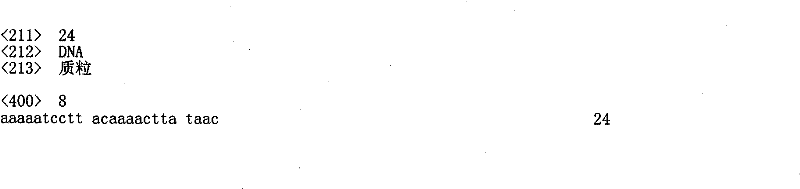
Claims (21)
Applications Claiming Priority (3)
| Application Number | Priority Date | Filing Date | Title |
|---|---|---|---|
| AU2007906490A AU2007906490A0 (en) | 2007-11-27 | Enzymes for Amplification and Copying bisulphite Modified Nucleic Acids | |
| AU2007906490 | 2007-11-27 | ||
| PCT/AU2008/001751 WO2009067743A1 (en) | 2007-11-27 | 2008-11-27 | Enzymes for amplification and copying bisulphite modified nucleic acids |
Publications (1)
| Publication Number | Publication Date |
|---|---|
| CN101918595A true CN101918595A (en) | 2010-12-15 |
Family
ID=40677940
Family Applications (1)
| Application Number | Title | Priority Date | Filing Date |
|---|---|---|---|
| CN2008801248079A Pending CN101918595A (en) | 2007-11-27 | 2008-11-27 | Enzymes for amplification and replication of bisulfite-modified nucleic acids |
Country Status (7)
| Country | Link |
|---|---|
| US (1) | US8685675B2 (en) |
| EP (1) | EP2215250B1 (en) |
| JP (1) | JP5431351B2 (en) |
| CN (1) | CN101918595A (en) |
| AU (1) | AU2008329549B2 (en) |
| CA (1) | CA2706740C (en) |
| WO (1) | WO2009067743A1 (en) |
Families Citing this family (10)
| Publication number | Priority date | Publication date | Assignee | Title |
|---|---|---|---|---|
| CA2537810C (en) | 2003-09-04 | 2012-12-18 | Human Genetic Signatures Pty Ltd | Nucleic acid detection assay |
| WO2006058393A1 (en) * | 2004-12-03 | 2006-06-08 | Human Genetic Signatures Pty Ltd | Methods for simplifying microbial nucleic acids by chemical modification of cytosines |
| WO2006125267A1 (en) * | 2005-05-26 | 2006-11-30 | Human Genetic Signatures Pty Ltd | Isothermal strand displacement amplification using primers containing a non-regular base |
| CN101292046B (en) * | 2005-09-14 | 2013-03-13 | 人类遗传标记控股有限公司 | Assay for a health state |
| CN101918595A (en) | 2007-11-27 | 2010-12-15 | 人类遗传标记控股有限公司 | Enzymes for amplification and replication of bisulfite-modified nucleic acids |
| EP2215035A4 (en) * | 2007-12-05 | 2011-12-14 | Human Genetic Signatures Pty | Bisulphite treatment of rna |
| US20110003700A1 (en) * | 2007-12-20 | 2011-01-06 | Human Genetic Signatures Pty Ltd. | Elimination of contaminants associated with nucleic acid amplification |
| US20130337451A1 (en) * | 2010-12-27 | 2013-12-19 | Wako Pure Chemical Industries, Ltd. | Method for detecting methylated cytosine |
| ES2613743T3 (en) | 2011-09-07 | 2017-05-25 | Human Genetic Signatures Pty Ltd | Molecular detection assay |
| US20150099670A1 (en) * | 2013-10-07 | 2015-04-09 | Weiwei Li | Method of preparing post-bisulfite conversion DNA library |
Citations (5)
| Publication number | Priority date | Publication date | Assignee | Title |
|---|---|---|---|---|
| US5124327A (en) * | 1991-09-06 | 1992-06-23 | Merck & Co., Inc. | HIV reverse transcriptase |
| WO2004096825A1 (en) * | 2003-05-02 | 2004-11-11 | Human Genetic Signatures Pty Ltd | Treatment of nucleic acid |
| WO2005113760A2 (en) * | 2004-05-20 | 2005-12-01 | The Government Of The United States Of America, Represented By The Secretary Of The Department Of Health And Human Services | Thermostable y-family polymerases and chimeras |
| EP1801213A2 (en) * | 2003-11-03 | 2007-06-27 | Medical Research Council | Polymerase |
| WO2007106802A2 (en) * | 2006-03-14 | 2007-09-20 | Siemens Healthcare Diagnostics Inc. | Method for linear amplification of bisulfite converted dna |
Family Cites Families (93)
| Publication number | Priority date | Publication date | Assignee | Title |
|---|---|---|---|---|
| DE3439938A1 (en) * | 1984-11-02 | 1986-05-15 | Bayer Ag, 5090 Leverkusen | METHOD FOR PRODUCING LOW MOLECULAR DIGLYCIDYL ETHER OF TWO-VALUE PHENOLS |
| US5750338A (en) | 1986-10-23 | 1998-05-12 | Amoco Corporation | Target and background capture methods with amplification for affinity assays |
| US5585481A (en) | 1987-09-21 | 1996-12-17 | Gen-Probe Incorporated | Linking reagents for nucleotide probes |
| US5175273A (en) | 1988-07-01 | 1992-12-29 | Genentech, Inc. | Nucleic acid intercalating agents |
| AU7579991A (en) | 1990-02-20 | 1991-09-18 | Gilead Sciences, Inc. | Pseudonucleosides and pseudonucleotides and their polymers |
| EP0540693B1 (en) | 1990-07-24 | 1999-01-20 | F. Hoffmann-La Roche Ag | THE REDUCTION OF NON-SPECIFIC AMPLIFICATION DURING $i(IN VITRO) NUCLEIC ACID AMPLIFICATION USING MODIFIED NUCLEIC ACID BASES |
| WO1994010335A2 (en) | 1992-10-09 | 1994-05-11 | Amoco Corporation | Assay methods |
| US5473060A (en) | 1993-07-02 | 1995-12-05 | Lynx Therapeutics, Inc. | Oligonucleotide clamps having diagnostic applications |
| US6156501A (en) | 1993-10-26 | 2000-12-05 | Affymetrix, Inc. | Arrays of modified nucleic acid probes and methods of use |
| WO1995021271A1 (en) | 1994-02-07 | 1995-08-10 | Molecular Tool, Inc. | Ligase/polymerase-mediated genetic bit analysistm of single nucleotide polymorphisms and its use in genetic analysis |
| SE9400522D0 (en) | 1994-02-16 | 1994-02-16 | Ulf Landegren | Method and reagent for detecting specific nucleotide sequences |
| FR2737223B1 (en) | 1995-07-24 | 1997-09-12 | Bio Merieux | METHOD OF AMPLIFYING NUCLEIC ACID SEQUENCES BY MOVEMENT USING CHIMERIC PRIMERS |
| US5994066A (en) | 1995-09-11 | 1999-11-30 | Infectio Diagnostic, Inc. | Species-specific and universal DNA probes and amplification primers to rapidly detect and identify common bacterial pathogens and associated antibiotic resistance genes from clinical specimens for routine diagnosis in microbiology laboratories |
| DE19612684A1 (en) | 1996-03-29 | 1997-10-02 | Gsf Forschungszentrum Umwelt | New use of extremely thermophilic DNA polymerases |
| SE9601676D0 (en) | 1996-04-30 | 1996-04-30 | Ulf Landegren | Improved probing of specific mucleic acids |
| AU730633B2 (en) | 1996-05-29 | 2001-03-08 | Phillip Belgrader | Detection of nucleic acid sequence differences using coupled ligase detection and polymerase chain reactions |
| US6017704A (en) | 1996-06-03 | 2000-01-25 | The Johns Hopkins University School Of Medicine | Method of detection of methylated nucleic acid using agents which modify unmethylated cytosine and distinguishing modified methylated and non-methylated nucleic acids |
| US5786146A (en) | 1996-06-03 | 1998-07-28 | The Johns Hopkins University School Of Medicine | Method of detection of methylated nucleic acid using agents which modify unmethylated cytosine and distinguishing modified methylated and non-methylated nucleic acids |
| JP4913270B2 (en) | 1996-12-30 | 2012-04-11 | ザ ジョンズ ホプキンズ ユニバーシティ スクール オブ メディスン | Compositions and methods for restoring normal patterns of imprinting to cells |
| DE69838521T2 (en) | 1997-07-07 | 2008-05-21 | Medical Research Council | Method for increasing the concentration of nucleic acid molecules |
| GB9717061D0 (en) | 1997-08-13 | 1997-10-15 | Tepnel Medical Ltd | Amplification of nucleic acids |
| NZ503765A (en) | 1997-09-12 | 2002-04-26 | Exiqon As | Bi-cyclic and tri-cyclic nucleotide analogues |
| GB9806253D0 (en) | 1998-03-25 | 1998-05-20 | Tepnel Medical Ltd | Amplification of nucleic acids |
| GB9900298D0 (en) | 1999-01-07 | 1999-02-24 | Medical Res Council | Optical sorting method |
| DE19905082C1 (en) | 1999-01-29 | 2000-05-18 | Epigenomics Gmbh | Identification of methylation patterns of cytosine in genome DNA comprises chemical treatment to produce different base pairing behavior between cytosine and 5-methylcytosine |
| US6410231B1 (en) | 1999-02-26 | 2002-06-25 | Incyte Genomics, Inc. | SNP detection |
| US6951722B2 (en) | 1999-03-19 | 2005-10-04 | Takara Bio Inc. | Method for amplifying nucleic acid sequence |
| US6331393B1 (en) | 1999-05-14 | 2001-12-18 | University Of Southern California | Process for high-throughput DNA methylation analysis |
| US6420106B1 (en) | 1999-06-09 | 2002-07-16 | Quantovir Ab | Method and kit for early cancer prediction |
| DE19935749C2 (en) | 1999-07-28 | 2003-06-26 | Epigenomics Ag | Process for the characterization of nucleic acid fragments |
| US6692918B2 (en) | 1999-09-13 | 2004-02-17 | Nugen Technologies, Inc. | Methods and compositions for linear isothermal amplification of polynucleotide sequences |
| ATE272722T1 (en) | 1999-11-12 | 2004-08-15 | Epigenomics Ag | METHOD FOR CONTROLLABLY PERFORMING COMPLEX PCR AMPLIFICATIONS |
| DE19957827C2 (en) | 1999-11-25 | 2003-06-12 | Epigenomics Ag | Use of an oligomer array with PNA and / or DNA oligomers on a surface |
| DE19959691A1 (en) | 1999-12-06 | 2001-08-16 | Epigenomics Ag | Method for the parallel detection of the methylation state of genomic DNA |
| EP1130113A1 (en) | 2000-02-15 | 2001-09-05 | Johannes Petrus Schouten | Multiplex ligation dependent amplification assay |
| DE10010281B4 (en) | 2000-02-25 | 2005-03-10 | Epigenomics Ag | Ligase / polymerase method for the detection of cytosine methylation in DNA samples |
| WO2001064864A2 (en) | 2000-02-28 | 2001-09-07 | Maxygen, Inc. | Single-stranded nucleic acid template-mediated recombination and nucleic acid fragment isolation |
| AU2001276330B2 (en) | 2000-04-06 | 2006-08-31 | Epigenomics Ag | Diagnosis of diseases associated with apoptosis |
| GB0022458D0 (en) | 2000-09-13 | 2000-11-01 | Medical Res Council | Directed evolution method |
| US6521411B2 (en) | 2000-09-28 | 2003-02-18 | Transgenomic, Inc. | Method and system for the preparation of cDNA |
| IE20000887A1 (en) | 2000-11-03 | 2002-12-11 | Univ College Cork Nat Univ Ie | Method for the amplification and optional characterisation of nucleic acids |
| AUPR142500A0 (en) | 2000-11-13 | 2000-12-07 | Human Genetic Signatures Pty Ltd | A peptide nucleic acid-based assay for the detection of specific nucleic acid sequences |
| DE10061348C2 (en) | 2000-12-06 | 2002-10-24 | Epigenomics Ag | Method for the quantification of cytosine methylations in complex amplified genomic DNA |
| US20020142397A1 (en) | 2000-12-22 | 2002-10-03 | Philippe Collas | Methods for altering cell fate |
| KR20030071854A (en) | 2001-02-06 | 2003-09-06 | 다카라 바이오 가부시키가이샤 | Amplified nucleic acids and immobilized products thereof |
| DE10112515B4 (en) | 2001-03-09 | 2004-02-12 | Epigenomics Ag | Method for the detection of cytosine methylation patterns with high sensitivity |
| GB0113118D0 (en) | 2001-05-31 | 2001-07-18 | Intercytex Ltd | Stem Cells |
| CA2492007A1 (en) | 2001-07-15 | 2003-01-30 | Keck Graduate Institute | Amplification of nucleic acid fragments using nicking agents |
| JPWO2003016569A1 (en) | 2001-08-20 | 2004-12-02 | タカラバイオ株式会社 | Nucleic acid amplification method |
| GB0127564D0 (en) | 2001-11-16 | 2002-01-09 | Medical Res Council | Emulsion compositions |
| EP1319718A1 (en) | 2001-12-14 | 2003-06-18 | Keygene N.V. | High throughput analysis and detection of multiple target sequences |
| EP1468007A2 (en) | 2001-12-18 | 2004-10-20 | Human Genetic Signatures PTY Ltd. | Pseudonucleotide comprising an intercalator |
| US20060014144A1 (en) | 2001-12-18 | 2006-01-19 | Christensen Ulf B | Pseudonucleotide comprising an intercalator |
| US7932070B2 (en) | 2001-12-21 | 2011-04-26 | Agilent Technologies, Inc. | High fidelity DNA polymerase compositions and uses therefor |
| US6960436B2 (en) | 2002-02-06 | 2005-11-01 | Epigenomics Ag | Quantitative methylation detection in DNA samples |
| IE20020544A1 (en) | 2002-06-28 | 2003-12-31 | Univ College Cork Nat Univ Ie | Method for the characterisation of nucleic acid molecules |
| SE0202867D0 (en) | 2002-09-27 | 2002-09-27 | Pyrosequencing Ab | New sequencing method |
| AU2002951899A0 (en) | 2002-10-04 | 2002-10-24 | Macquarie University | Random drift mutagenesis |
| AU2003900368A0 (en) | 2003-01-24 | 2003-02-13 | Human Genetic Signatures Pty Ltd | Assay for nucleic acid molecules |
| EP1443052A1 (en) | 2003-01-29 | 2004-08-04 | Roche Diagnostics GmbH | Improved method for bisulfite treatment of nucleic acid |
| WO2004067545A1 (en) | 2003-01-29 | 2004-08-12 | Roche Diagnostics Gmbh | Improved method for bisulfite treatment |
| US20040203004A1 (en) | 2003-04-10 | 2004-10-14 | Bernard Hans Ulrich | Diagnostic apparatus and method |
| AU2003901834A0 (en) | 2003-04-17 | 2003-05-01 | Clearcoll Pty Ltd | Cross-linked polysaccharide compositions |
| US7799525B2 (en) | 2003-06-17 | 2010-09-21 | Human Genetic Signatures Pty Ltd. | Methods for genome amplification |
| DE10331107B3 (en) | 2003-07-04 | 2004-12-02 | Epigenomics Ag | Detecting cytosine methylation in DNA, useful e.g. for diagnosis of cancer, comprises using a cytidine deaminase selective for unmethylated residues, and detecting presence or amount of deaminated residues |
| CA2537810C (en) | 2003-09-04 | 2012-12-18 | Human Genetic Signatures Pty Ltd | Nucleic acid detection assay |
| CA2539703C (en) | 2003-09-25 | 2011-06-07 | Third Wave Technologies, Inc. | Detection of human papilloma virus (hpv) utilizing invasive cleavage structure assays |
| JP4435174B2 (en) | 2003-12-02 | 2010-03-17 | エフ.ホフマン−ラ ロシュ アーゲー | Improved method of bisulfite treatment. |
| EP1715037B1 (en) | 2003-12-10 | 2010-02-17 | Takara Bio Inc. | Method of amplifying nucleic acid |
| US20050136417A1 (en) | 2003-12-19 | 2005-06-23 | Affymetrix, Inc. | Amplification of nucleic acids |
| US20050196792A1 (en) | 2004-02-13 | 2005-09-08 | Affymetrix, Inc. | Analysis of methylation status using nucleic acid arrays |
| WO2006028496A2 (en) | 2004-02-20 | 2006-03-16 | Applera Corporation | Lesion repair polymerase compositions |
| CA2902980A1 (en) | 2004-03-08 | 2005-09-29 | Rubicon Genomics, Inc. | Methods and compositions for generating and amplifying dna libraries for sensitive detection and analysis of dna methylation |
| US8168777B2 (en) | 2004-04-29 | 2012-05-01 | Human Genetic Signatures Pty. Ltd. | Bisulphite reagent treatment of nucleic acid |
| US7361465B2 (en) | 2004-09-07 | 2008-04-22 | Applera Corporation | Methods and compositions for tailing and amplifying RNA |
| EP1794173B1 (en) | 2004-09-10 | 2010-08-04 | Human Genetic Signatures PTY Ltd | Amplification blocker comprising intercalating nucleic acids (ina) containing intercalating pseudonucleotides (ipn) |
| WO2006058393A1 (en) | 2004-12-03 | 2006-06-08 | Human Genetic Signatures Pty Ltd | Methods for simplifying microbial nucleic acids by chemical modification of cytosines |
| CA2592078A1 (en) | 2004-12-23 | 2006-06-29 | Human Genetic Signatures Pty Ltd | Detection of human papilloma virus |
| ATE547537T1 (en) * | 2005-04-15 | 2012-03-15 | Epigenomics Ag | METHOD FOR DETERMINING DNA METHYLATION IN BLOOD OR URINE SAMPLES |
| CA2606296C (en) | 2005-04-15 | 2019-05-21 | Epigenomics Ag | Methods and nucleic acids for analyses of cellular proliferative disorders |
| WO2006125267A1 (en) | 2005-05-26 | 2006-11-30 | Human Genetic Signatures Pty Ltd | Isothermal strand displacement amplification using primers containing a non-regular base |
| US20070020639A1 (en) | 2005-07-20 | 2007-01-25 | Affymetrix, Inc. | Isothermal locus specific amplification |
| CN101292046B (en) | 2005-09-14 | 2013-03-13 | 人类遗传标记控股有限公司 | Assay for a health state |
| EP1801212A1 (en) | 2005-12-21 | 2007-06-27 | Eidgenössische Technische Hochschule Zürich | Selection of biocatalysts for chemical synthesis |
| ES2546848T3 (en) | 2006-03-10 | 2015-09-29 | Epigenomics Ag | A method to identify a biological sample for methylation analysis |
| US20080050738A1 (en) | 2006-05-31 | 2008-02-28 | Human Genetic Signatures Pty Ltd. | Detection of target nucleic acid |
| WO2008109945A1 (en) | 2007-03-12 | 2008-09-18 | Human Genetic Signatures Pty Ltd | Analysis of ribonucleic acid |
| CA2680426A1 (en) | 2007-03-16 | 2008-09-25 | Human Genetic Signatures Pty Ltd | Assay for gene expression |
| WO2008135512A2 (en) * | 2007-05-02 | 2008-11-13 | Jerzy Paszkowski | Dna amplification method |
| CN101918595A (en) | 2007-11-27 | 2010-12-15 | 人类遗传标记控股有限公司 | Enzymes for amplification and replication of bisulfite-modified nucleic acids |
| EP2215035A4 (en) | 2007-12-05 | 2011-12-14 | Human Genetic Signatures Pty | Bisulphite treatment of rna |
| US20110003700A1 (en) | 2007-12-20 | 2011-01-06 | Human Genetic Signatures Pty Ltd. | Elimination of contaminants associated with nucleic acid amplification |
| US20120021461A1 (en) | 2009-01-21 | 2012-01-26 | Human Genetic Signatures Pty. Ltd. | Isothermal strand displacement amplification |
-
2008
- 2008-11-27 CN CN2008801248079A patent/CN101918595A/en active Pending
- 2008-11-27 AU AU2008329549A patent/AU2008329549B2/en active Active
- 2008-11-27 US US12/744,305 patent/US8685675B2/en active Active
- 2008-11-27 JP JP2010535174A patent/JP5431351B2/en not_active Expired - Fee Related
- 2008-11-27 CA CA2706740A patent/CA2706740C/en active Active
- 2008-11-27 EP EP08853330A patent/EP2215250B1/en active Active
- 2008-11-27 WO PCT/AU2008/001751 patent/WO2009067743A1/en not_active Ceased
Patent Citations (5)
| Publication number | Priority date | Publication date | Assignee | Title |
|---|---|---|---|---|
| US5124327A (en) * | 1991-09-06 | 1992-06-23 | Merck & Co., Inc. | HIV reverse transcriptase |
| WO2004096825A1 (en) * | 2003-05-02 | 2004-11-11 | Human Genetic Signatures Pty Ltd | Treatment of nucleic acid |
| EP1801213A2 (en) * | 2003-11-03 | 2007-06-27 | Medical Research Council | Polymerase |
| WO2005113760A2 (en) * | 2004-05-20 | 2005-12-01 | The Government Of The United States Of America, Represented By The Secretary Of The Department Of Health And Human Services | Thermostable y-family polymerases and chimeras |
| WO2007106802A2 (en) * | 2006-03-14 | 2007-09-20 | Siemens Healthcare Diagnostics Inc. | Method for linear amplification of bisulfite converted dna |
Non-Patent Citations (2)
| Title |
|---|
| RAIZIS ET AL: "A Bisulfite Method of 5-Metnylcytosine Mapping That Mininizes Template Degradation", 《ANALYTICAL BIOCHEMISTRY》 * |
| TADAYOSHI BESSHO ET AL: "Blockage of polymerase-catalyzed DNA chain elongation by chemically modified cytosine residues in templates and the release of blockage for readthrough", 《NUCLEIC ACIDS RESEARCH》 * |
Also Published As
| Publication number | Publication date |
|---|---|
| CA2706740C (en) | 2017-01-17 |
| US20100304386A1 (en) | 2010-12-02 |
| US8685675B2 (en) | 2014-04-01 |
| CA2706740A1 (en) | 2009-06-04 |
| AU2008329549A1 (en) | 2009-06-04 |
| EP2215250A4 (en) | 2011-01-05 |
| AU2008329549B2 (en) | 2013-08-22 |
| WO2009067743A1 (en) | 2009-06-04 |
| JP2011504726A (en) | 2011-02-17 |
| EP2215250A1 (en) | 2010-08-11 |
| JP5431351B2 (en) | 2014-03-05 |
| EP2215250B1 (en) | 2013-02-27 |
Similar Documents
| Publication | Publication Date | Title |
|---|---|---|
| JP5431351B2 (en) | Enzymes for amplifying and copying bisulfite modified nucleic acids | |
| US20250092449A1 (en) | Method for highly sensitive dna methylation analysis | |
| EP1620452B1 (en) | Treatment of nucleic acid | |
| US20110003700A1 (en) | Elimination of contaminants associated with nucleic acid amplification | |
| ES2917175T3 (en) | Selective degradation of wild-type DNA and enrichment of mutant alleles using nuclease | |
| KR20230116944A (en) | Use of high-temperature-resistant cas protein, and method and reagent kit for detecting target nucleic acid molecule | |
| US8168777B2 (en) | Bisulphite reagent treatment of nucleic acid | |
| WO2023114090A2 (en) | Signal boost cascade assay | |
| JP2023519782A (en) | Methods of targeted sequencing | |
| CN101883747A (en) | Bisulfite treatment of RNA | |
| ES2693133T3 (en) | Nucleic acid amplification method using allele-specific reactive primer | |
| CN115362266A (en) | PHI29 mutant and use thereof | |
| AU2019402925B2 (en) | Methods for improving polynucleotide cluster clonality priority | |
| US10954542B2 (en) | Size selection of RNA using poly(A) polymerase | |
| CN119790163A (en) | Ambient temperature nucleic acid amplification and detection | |
| US20260043073A1 (en) | Ambient temperature nucleic acid amplification and detection | |
| AU2004234019B2 (en) | Treatment of nucleic acid |
Legal Events
| Date | Code | Title | Description |
|---|---|---|---|
| C06 | Publication | ||
| PB01 | Publication | ||
| C10 | Entry into substantive examination | ||
| SE01 | Entry into force of request for substantive examination | ||
| C12 | Rejection of a patent application after its publication | ||
| RJ01 | Rejection of invention patent application after publication |
Application publication date: 20101215 |