CN103534360A - Multiplexed digital assays with combinatorial use of signals - Google Patents
Multiplexed digital assays with combinatorial use of signals Download PDFInfo
- Publication number
- CN103534360A CN103534360A CN201280023708.8A CN201280023708A CN103534360A CN 103534360 A CN103534360 A CN 103534360A CN 201280023708 A CN201280023708 A CN 201280023708A CN 103534360 A CN103534360 A CN 103534360A
- Authority
- CN
- China
- Prior art keywords
- targets
- target
- fluorophore
- probe
- signals
- Prior art date
- Legal status (The legal status is an assumption and is not a legal conclusion. Google has not performed a legal analysis and makes no representation as to the accuracy of the status listed.)
- Pending
Links
Images


Classifications
-
- C—CHEMISTRY; METALLURGY
- C12—BIOCHEMISTRY; BEER; SPIRITS; WINE; VINEGAR; MICROBIOLOGY; ENZYMOLOGY; MUTATION OR GENETIC ENGINEERING
- C12Q—MEASURING OR TESTING PROCESSES INVOLVING ENZYMES, NUCLEIC ACIDS OR MICROORGANISMS; COMPOSITIONS OR TEST PAPERS THEREFOR; PROCESSES OF PREPARING SUCH COMPOSITIONS; CONDITION-RESPONSIVE CONTROL IN MICROBIOLOGICAL OR ENZYMOLOGICAL PROCESSES
- C12Q1/00—Measuring or testing processes involving enzymes, nucleic acids or microorganisms; Compositions therefor; Processes of preparing such compositions
- C12Q1/68—Measuring or testing processes involving enzymes, nucleic acids or microorganisms; Compositions therefor; Processes of preparing such compositions involving nucleic acids
- C12Q1/6844—Nucleic acid amplification reactions
- C12Q1/686—Polymerase chain reaction [PCR]
-
- C—CHEMISTRY; METALLURGY
- C12—BIOCHEMISTRY; BEER; SPIRITS; WINE; VINEGAR; MICROBIOLOGY; ENZYMOLOGY; MUTATION OR GENETIC ENGINEERING
- C12Q—MEASURING OR TESTING PROCESSES INVOLVING ENZYMES, NUCLEIC ACIDS OR MICROORGANISMS; COMPOSITIONS OR TEST PAPERS THEREFOR; PROCESSES OF PREPARING SUCH COMPOSITIONS; CONDITION-RESPONSIVE CONTROL IN MICROBIOLOGICAL OR ENZYMOLOGICAL PROCESSES
- C12Q1/00—Measuring or testing processes involving enzymes, nucleic acids or microorganisms; Compositions therefor; Processes of preparing such compositions
- C12Q1/68—Measuring or testing processes involving enzymes, nucleic acids or microorganisms; Compositions therefor; Processes of preparing such compositions involving nucleic acids
- C12Q1/6844—Nucleic acid amplification reactions
- C12Q1/6851—Quantitative amplification
-
- G—PHYSICS
- G16—INFORMATION AND COMMUNICATION TECHNOLOGY [ICT] SPECIALLY ADAPTED FOR SPECIFIC APPLICATION FIELDS
- G16B—BIOINFORMATICS, i.e. INFORMATION AND COMMUNICATION TECHNOLOGY [ICT] SPECIALLY ADAPTED FOR GENETIC OR PROTEIN-RELATED DATA PROCESSING IN COMPUTATIONAL MOLECULAR BIOLOGY
- G16B20/00—ICT specially adapted for functional genomics or proteomics, e.g. genotype-phenotype associations
-
- G—PHYSICS
- G16—INFORMATION AND COMMUNICATION TECHNOLOGY [ICT] SPECIALLY ADAPTED FOR SPECIFIC APPLICATION FIELDS
- G16B—BIOINFORMATICS, i.e. INFORMATION AND COMMUNICATION TECHNOLOGY [ICT] SPECIALLY ADAPTED FOR GENETIC OR PROTEIN-RELATED DATA PROCESSING IN COMPUTATIONAL MOLECULAR BIOLOGY
- G16B20/00—ICT specially adapted for functional genomics or proteomics, e.g. genotype-phenotype associations
- G16B20/20—Allele or variant detection, e.g. single nucleotide polymorphism [SNP] detection
-
- G—PHYSICS
- G16—INFORMATION AND COMMUNICATION TECHNOLOGY [ICT] SPECIALLY ADAPTED FOR SPECIFIC APPLICATION FIELDS
- G16B—BIOINFORMATICS, i.e. INFORMATION AND COMMUNICATION TECHNOLOGY [ICT] SPECIALLY ADAPTED FOR GENETIC OR PROTEIN-RELATED DATA PROCESSING IN COMPUTATIONAL MOLECULAR BIOLOGY
- G16B25/00—ICT specially adapted for hybridisation; ICT specially adapted for gene or protein expression
-
- G—PHYSICS
- G16—INFORMATION AND COMMUNICATION TECHNOLOGY [ICT] SPECIALLY ADAPTED FOR SPECIFIC APPLICATION FIELDS
- G16B—BIOINFORMATICS, i.e. INFORMATION AND COMMUNICATION TECHNOLOGY [ICT] SPECIALLY ADAPTED FOR GENETIC OR PROTEIN-RELATED DATA PROCESSING IN COMPUTATIONAL MOLECULAR BIOLOGY
- G16B25/00—ICT specially adapted for hybridisation; ICT specially adapted for gene or protein expression
- G16B25/20—Polymerase chain reaction [PCR]; Primer or probe design; Probe optimisation
-
- G—PHYSICS
- G16—INFORMATION AND COMMUNICATION TECHNOLOGY [ICT] SPECIALLY ADAPTED FOR SPECIFIC APPLICATION FIELDS
- G16B—BIOINFORMATICS, i.e. INFORMATION AND COMMUNICATION TECHNOLOGY [ICT] SPECIALLY ADAPTED FOR GENETIC OR PROTEIN-RELATED DATA PROCESSING IN COMPUTATIONAL MOLECULAR BIOLOGY
- G16B5/00—ICT specially adapted for modelling or simulations in systems biology, e.g. gene-regulatory networks, protein interaction networks or metabolic networks
-
- G—PHYSICS
- G06—COMPUTING OR CALCULATING; COUNTING
- G06F—ELECTRIC DIGITAL DATA PROCESSING
- G06F17/00—Digital computing or data processing equipment or methods, specially adapted for specific functions
- G06F17/10—Complex mathematical operations
-
- G—PHYSICS
- G06—COMPUTING OR CALCULATING; COUNTING
- G06F—ELECTRIC DIGITAL DATA PROCESSING
- G06F17/00—Digital computing or data processing equipment or methods, specially adapted for specific functions
- G06F17/10—Complex mathematical operations
- G06F17/11—Complex mathematical operations for solving equations, e.g. nonlinear equations, general mathematical optimization problems
-
- G—PHYSICS
- G06—COMPUTING OR CALCULATING; COUNTING
- G06F—ELECTRIC DIGITAL DATA PROCESSING
- G06F17/00—Digital computing or data processing equipment or methods, specially adapted for specific functions
- G06F17/10—Complex mathematical operations
- G06F17/11—Complex mathematical operations for solving equations, e.g. nonlinear equations, general mathematical optimization problems
- G06F17/12—Simultaneous equations, e.g. systems of linear equations
Landscapes
- Life Sciences & Earth Sciences (AREA)
- Health & Medical Sciences (AREA)
- Chemical & Material Sciences (AREA)
- Physics & Mathematics (AREA)
- Engineering & Computer Science (AREA)
- Bioinformatics & Cheminformatics (AREA)
- Biotechnology (AREA)
- Biophysics (AREA)
- General Health & Medical Sciences (AREA)
- Molecular Biology (AREA)
- Genetics & Genomics (AREA)
- Proteomics, Peptides & Aminoacids (AREA)
- Organic Chemistry (AREA)
- Bioinformatics & Computational Biology (AREA)
- Evolutionary Biology (AREA)
- Theoretical Computer Science (AREA)
- Spectroscopy & Molecular Physics (AREA)
- Medical Informatics (AREA)
- Analytical Chemistry (AREA)
- Wood Science & Technology (AREA)
- Zoology (AREA)
- Chemical Kinetics & Catalysis (AREA)
- Immunology (AREA)
- General Engineering & Computer Science (AREA)
- Microbiology (AREA)
- Biochemistry (AREA)
- Physiology (AREA)
- Measuring Or Testing Involving Enzymes Or Micro-Organisms (AREA)
- Apparatus Associated With Microorganisms And Enzymes (AREA)
Abstract
Description
优先权申请的交叉引用Cross Reference to Priority Application
本申请基于并依照35U.S.C.§119(e)要求于2011年3月18日提交的美国临时专利申请序列号61/454,373的利益,该专利申请为了所有目的通过引用被全部并入本文。This application is based on and claims the benefit of US Provisional Patent Application Serial No. 61/454,373, filed March 18, 2011, which is hereby incorporated by reference in its entirety for all purposes, based on and pursuant to 35 U.S.C. § 119(e).
交叉引用cross reference
本申请为了所有目的通过引用全部合并下述材料:2006年5月9日发布的美国专利号7,041,481;2010年7月8日出版的美国专利公开号2010/0173394A1;2011年9月29日出版的PCT专利申请公开号WO2011/120006A1;2011年9月29日出版的PCT专利申请公开号WO2011/120024A1;2011年11月1日提交的美国专利申请序列号13/287,120;2011年7月12日提交的美国临时专利申请序列号61/507,082;2011年7月20日提交的美国临时专利申请序列号61/510,013;以及JosephR.Lakowicz的“PRINCIPLESOFFLUORESCENCESPECTROSCOPY”(1999年,第二版)。This application incorporates by reference the following materials in their entirety for all purposes: U.S. Patent No. 7,041,481, issued May 9, 2006; U.S. Patent Publication No. 2010/0173394A1, published July 8, 2010; PCT Patent Application Publication No. WO2011/120006A1; PCT Patent Application Publication No. WO2011/120024A1, published September 29, 2011; U.S. Patent Application Serial No. 13/287,120, filed November 1, 2011; filed July 12, 2011 US Provisional Patent Application Serial No. 61/507,082; US Provisional Patent Application Serial No. 61/510,013, filed July 20, 2011; and "PRINCIPLESOFFLUORESCENCESPECTROSCOPY" (1999, 2nd ed.) by Joseph R. Lakowicz.
介绍introduce
数字分析通常依赖于检测样本中的分析物的单独拷贝的存在或活动的能力。在示例性数字分析中,样品被分成通常具有相等体积的一组分块,每一个分块包含平均约小于分析物的一个拷贝。如果分析物的拷贝随机地分布在分块中,则一些分块将不会包含拷贝,其它分块仅包含一个拷贝,以及如果分块的数目足够大,又一些其它应该包含两个拷贝、三个拷贝以及甚至更多数量的拷贝。基于分块中的分析物的给定平均浓度,在分块中发现确切地0、1、2、3或更多个拷贝的概率由泊松分布描述。相反,分块中的分析物的平均浓度可以根据在分块中找到给定数量的拷贝的概率来估计。Digital analysis typically relies on the ability to detect the presence or activity of individual copies of an analyte in a sample. In an exemplary digital assay, a sample is divided into a set of blocks of generally equal volume, each block containing on average about less than one copy of the analyte. If the copies of the analyte are randomly distributed among the blocks, some blocks will contain no copies, others only one copy, and still others should contain two copies, three copies if the number of blocks is large enough. copies and even greater numbers of copies. Based on a given mean concentration of analyte in a bin, the probability of finding exactly 0, 1, 2, 3 or more copies in a bin is described by a Poisson distribution. Instead, the average concentration of an analyte in a bin can be estimated from the probability of finding a given number of copies in a bin.
可以在数字分析中测量没有发现拷贝的概率和发现一个或多个拷贝的概率的估计。每个分块可以被测试以确定该分块是否是包含分析物的至少一个拷贝的阳性分块,或者是不包含分析物的拷贝的阴性分块。在分块中发现没有拷贝的概率可以由阴性的所测试的分块的分数(“阴性分数”)近似,而找到至少一个拷贝的概率可以由阳性的所测试的分块的分数(“阳性分数”)近似。阳性分数或阴性分数然后可以在泊松方程中使用以确定分块中的分析物的浓度。Estimates of the probability of finding no copies and the probability of finding one or more copies can be measured in digit analysis. Each segment can be tested to determine whether the segment is a positive segment comprising at least one copy of the analyte, or a negative segment comprising no copies of the analyte. The probability of finding no copies in a block can be approximated by the fraction of tested blocks that are negative ("negative score"), while the probability of finding at least one copy can be approximated by the fraction of tested blocks that are positive ("positive score"). ")approximate. The positive or negative scores can then be used in a Poisson equation to determine the concentration of the analyte in the bin.
数字分析常常依赖于分块中的核酸靶的扩增以实现分析物的单个拷贝的探测。扩增可以通过聚合酶链式反应(PCR)来进行,以实现数字PCR分析。扩增的靶可以是分析物本身或在形成分块之前或之后产生的分析物的替代物。靶的扩增可以用反应中包括的荧光探针来被光学地检测。特别是,探针可以包括染料,其提供指示靶是否被扩增的荧光信号。Digital analysis often relies on the amplification of nucleic acid targets in blocks to enable detection of single copies of the analyte. Amplification can be performed by polymerase chain reaction (PCR) to enable digital PCR analysis. The amplified target may be the analyte itself or a surrogate for the analyte produced before or after forming the fraction. Amplification of the target can be detected optically with fluorescent probes included in the reaction. In particular, the probe may include a dye that provides a fluorescent signal indicating whether the target has been amplified.
数字PCR分析可以被多重化以允许检测在每个分块内的两个或更多的不同靶。靶的扩增可以通过利用以不同染料标记的靶特异性探针来区分,这产生在不同的检测通道中,即,在发射(和/或激发)的不同波长或波长区域(“颜色”)处检测的荧光。如果用于数字PCR分析的检测器可区别地测量由R种不同的染料发射的荧光,那么分析能够有效地测量R个不同的靶。然而,具有多个检测通道的检测多种颜色的仪器比具有较少的检测通道的那些仪器更昂贵。此外,增加可区分的染料的数目是昂贵的,并且超过某一数量会变得不切实际。另一方面,许多应用——尤其是其中样品是有限的——可极大地受益于更高程度的多重化。Digital PCR assays can be multiplexed to allow detection of two or more different targets within each block. Amplification of a target can be distinguished by utilizing target-specific probes labeled with different dyes, which result in different detection channels, i.e., at different wavelengths or wavelength regions of emission (and/or excitation) ("colors") Fluorescence detected at . If a detector for a digital PCR assay can differentially measure the fluorescence emitted by R different dyes, then the assay can efficiently measure R different targets. However, instruments that detect multiple colors with multiple detection channels are more expensive than those with fewer detection channels. Furthermore, increasing the number of distinguishable dyes is expensive and beyond a certain amount becomes impractical. On the other hand, many applications—especially where samples are limited—could greatly benefit from a higher degree of multiplexing.
需要一种新方法来提高数字分析的多重水平。A new approach is needed to increase the multiplicity of digital analytics.
概述overview
本公开提供一种用于通过信号的组合使用来在较大数量的靶上执行多重数字分析的系统,包括方法、装置和合成物。The present disclosure provides a system, including methods, devices, and compositions, for performing multiplexed digital analysis on a larger number of targets through the combined use of signals.
附图简述Brief description of the drawings
图1是根据本公开的方面的执行数字分析的示例性方法的流程图。FIG. 1 is a flowchart of an exemplary method of performing digital analysis according to aspects of the present disclosure.
图2是根据本公开的方面的用于执行图1的数字分析的示例性系统的示意图。2 is a schematic diagram of an example system for performing the digital analysis of FIG. 1 in accordance with aspects of the present disclosure.
图3是根据本公开的方面的一对靶和相应的探针的示意图,探针能够在数字扩增分析中通过所发射的光来报告靶扩增的存在或不存在,所发射的光可被检测以产生每个靶的专用信号。3 is a schematic diagram of a pair of targets and corresponding probes capable of reporting the presence or absence of target amplification in a digital amplification assay by emitting light that can be used in accordance with aspects of the present disclosure. are detected to generate a dedicated signal for each target.
图4是根据本公开的方面的相应的专用信号的一对示例性曲线,专用信号可以在液滴中执行的数字扩增分析中通过检测从图3的探针发射的光而生成,每个信号从在相同的时间间隔上从含有液滴的流体流检测的光产生。4 is a pair of exemplary plots of corresponding dedicated signals that can be generated by detecting light emitted from the probes of FIG. 3 in a digital amplification assay performed in a droplet, each according to aspects of the present disclosure. Signals are generated from light detected over the same time intervals from the fluid stream containing the droplets.
图5是根据本公开的方面的图3的靶对的拷贝如何分布在液滴中的示意图,在图4中,光基于图4的相应专用信号的强度从液滴被探测到。5 is a schematic diagram of how copies of the target pair of FIG. 3 are distributed in a droplet, in FIG. 4, from which light is detected based on the intensity of the corresponding dedicated signal of FIG. 4, according to aspects of the present disclosure.
图6是根据本公开的方面的三个靶和相应的示例性探针的示意图,探针能够在数字扩增分析中通过所发射的光报告靶扩增的存在或不存在,所发射的光可以被检测以生成一对复合信号。6 is a schematic diagram of three targets and corresponding exemplary probes capable of reporting the presence or absence of target amplification in a digital amplification assay by emitted light, according to aspects of the present disclosure. can be detected to generate a pair of composite signals.
图7是根据本公开的方面的一对复合信号的一对示例性曲线,复合信号可以在液滴中执行的数字扩增分析中通过检测来自图6的三个探针的荧光发射而生成,所发射的光从含有液滴的流体流在相同的时间间隔上在两个不同的波长区域中被检测。7 is a pair of exemplary plots of a pair of composite signals that can be generated by detecting fluorescence emissions from the three probes of FIG. 6 in a digital amplification assay performed in a droplet, according to aspects of the present disclosure, The emitted light from the fluid stream containing the droplets is detected in two different wavelength regions over the same time interval.
图8是根据本公开的方面的图6的三个靶的拷贝如何分布在液滴中的示意图,光基于图7的相应复合信号的强度在图7中从液滴被探测到。8 is a schematic diagram of how copies of the three targets of FIG. 6 are distributed in a droplet from which light is detected based on the intensity of the corresponding composite signal of FIG. 7 according to aspects of the present disclosure.
图9A是根据本公开的方面的图6的第三靶和能够经由所发射的光报告第三靶扩增的存在或不存在的另一示例性探针配置的示意图,该探针配置可以在数字扩增分析中结合图6的第一和第二靶探针使用以只产生代表三个靶的扩增的一对复合信号。9A is a schematic diagram of the third target of FIG. 6 and another exemplary probe configuration capable of reporting the presence or absence of amplification of the third target via emitted light, according to aspects of the present disclosure. The combination of the first and second target probes of Figure 6 was used in the digital amplification assay to generate only one pair of composite signals representing the amplification of the three targets.
图9B是根据本公开的方面的图6的第三靶和对第三靶特定的另一示例性探针配置的示意图,该探针配置可以在数字扩增分析中结合图6的第一靶和第二靶探针来使用以只产生代表三个靶的一对复合信号。9B is a schematic diagram of the third target of FIG. 6 and another exemplary probe configuration specific to the third target that can bind the first target of FIG. 6 in a digital amplification assay according to aspects of the present disclosure and a second target probe to generate only one pair of composite signals representing the three targets.
图10是根据本公开的方面的图6的第三靶和能够经由所发射的光报告第三靶扩增的存在或不存在的又一示例性探针配置的示意图,该探针配置可以在数字扩增分析中结合图6的第一和第二靶探针使用以只产生代表三个靶的扩增的一对复合信号。10 is a schematic diagram of the third target of FIG. 6 and yet another exemplary probe configuration capable of reporting the presence or absence of amplification of the third target via emitted light, according to aspects of the disclosure. The combination of the first and second target probes of Figure 6 was used in the digital amplification assay to generate only one pair of composite signals representing the amplification of the three targets.
图11是根据本公开的方面的三个靶和相应示例性引物的示意图,引物能够在数字扩增分析中只使用两个探针来报告三个靶的扩增。11 is a schematic diagram of three targets and corresponding exemplary primers capable of reporting amplification of three targets in a digital amplification assay using only two probes, according to aspects of the present disclosure.
图12是根据本公开的方面的图6的第三靶和能够在数字扩增分析中仅使用两个探针来报告三个靶的扩增的另一示例性探针和引物配置的示意图。12 is a schematic diagram of the third target of FIG. 6 and another exemplary probe and primer configuration capable of reporting amplification of three targets using only two probes in a digital amplification assay, according to aspects of the present disclosure.
图13是根据本公开的方面的图6的三个靶以及能够在数字扩增分析中使用两个探针来报告三个靶的扩增的仅有两个探针的又一示例性配置的示意图。13 is a diagram of the three targets of FIG. 6 and yet another exemplary configuration of only two probes capable of reporting amplification of the three targets using two probes in a digital amplification assay, according to aspects of the present disclosure. schematic diagram.
图14是根据本公开的方面的包含一对未链接的靶T1和T2的片段群体的示意图。14 is a schematic representation of a fragment population comprising a pair of unlinked targets T1 and T2 according to aspects of the present disclosure.
图15是根据本公开的方面的如在图14中获取的片段群体的示意图,但这对靶在相同的单独片段上总是彼此链接。Figure 15 is a schematic representation of the segment population as captured in Figure 14, but the pair of targets are always linked to each other on the same individual segment, according to aspects of the present disclosure.
图16是根据本公开的方面的如在图14中获取的片段群体的示意图,但这对靶在群体中仅部分地相互链接。Figure 16 is a schematic diagram of the population of fragments as captured in Figure 14, but the pair of targets are only partially linked to each other in the population, according to aspects of the present disclosure.
图17是根据本公开的方面的用在数字扩增分析中的一组示例性多标记探针的示意性表示。17 is a schematic representation of an exemplary set of multi-labeled probes for use in digital amplification assays according to aspects of the present disclosure.
图18是根据本公开的方面的模板分子的示意图,该模板分子在多标记探针分子存在的情况下在靶扩增期间通过DNA聚合酶复制,并通过聚合酶描绘探针降解以从探针分子的荧光团分离猝灭剂。18 is a schematic diagram of a template molecule that is replicated by a DNA polymerase during target amplification in the presence of multi-labeled probe molecules and depicts probe degradation by the polymerase to remove from the probe according to aspects of the present disclosure. Molecular fluorophore separation quencher.
图19是根据本公开的方面的液滴强度的示例性二维直方图,其示出在使用单标记和双标记探针的组合执行的三个靶的多重数字扩增分析中可获得的簇,每一个探针被标有FAM、VIC或FAM和VIC。19 is an exemplary two-dimensional histogram of droplet intensities showing clusters obtainable in a multiplex digital amplification analysis of three targets performed using a combination of single- and dual-labeled probes, according to aspects of the present disclosure. , each probe is labeled FAM, VIC or FAM and VIC.
图20是根据本公开的方面的液滴强度的另一示例性二维直方图,示出了可以在图19的分析中获得的簇,靶-3-阳性液滴的簇和靶-1+2阳性液滴的簇之间以部分分辨率区分。20 is another exemplary two-dimensional histogram of droplet intensities showing clusters that can be obtained in the analysis of FIG. 19 , clusters of target-3-positive droplets and target-1+ in accordance with aspects of the present disclosure. Clusters of 2 positive droplets are distinguished at fractional resolution.
图21是根据本公开的方面的液滴强度的示例性二维强度直方图,其示出可在仅使用多标记FAM、VIC探针执行的数字扩增分析中得到的簇。21 is an exemplary two-dimensional intensity histogram of droplet intensity showing clusters obtainable in digital amplification analysis performed using only multilabeled FAM, VIC probes, according to aspects of the present disclosure.
图22是根据本公开的方面的液滴强度的另一示例性二维强度直方图,其示出如在图21中执行的数字扩增分析中得到的簇,但是除了多标记FAM、VIC探针以外,分析还可以使用单标记FAM或VIC探针对来补充。22 is another exemplary two-dimensional intensity histogram of droplet intensity showing clusters as obtained in the digital amplification analysis performed in FIG. In addition to needles, the analysis can be supplemented with single-labeled FAM or VIC probe pairs.
详细描述A detailed description
本公开提供一种用于通过信号的组合使用在更大数量的靶上执行多重数字分析的系统,包括方法、装置和合成物。该方法可以被描述为基于颜色的多重化方法。The present disclosure provides a system, including methods, devices, and compositions, for performing multiplexed digital analysis on a larger number of targets through the combined use of signals. This method can be described as a color-based multiplexing method.
提供了执行多重数字扩增分析的方法,例如PCR分析。在这个方法中,在分块中扩增超过R个靶。可以产生R个信号。信号可以代表在来自分块的R个不同的波长区域中检测到的光,其中R≥2。在分块中的每个靶的平均水平可以基于R个信号来计算,所计算的水平考虑到在相同的单独分块中的不同靶的同时存在,如果有的话。Methods of performing multiplex digital amplification analysis, such as PCR analysis, are provided. In this approach, more than R targets are amplified in a block. R signals may be generated. The signal may represent light detected in R different wavelength regions from the bins, where R > 2. The average level of each target in a block can be calculated based on the R signals, the calculated level taking into account the co-presence of different targets in the same individual block, if any.
提供执行多重数字扩增分析的另一种方法。在该方法中,超过R个靶可以在液滴中被扩增。可以产生R个信号,信号表示在来自液滴的R个不同的波长区域内检测到的光,其中R≥2。超过R个靶中的每个的平均水平可以通过找到对一组联立方程的解来计算。Provides an alternative method to perform multiplex digital amplification analysis. In this method, more than R targets can be amplified in a droplet. R signals may be generated representing light detected in R different wavelength regions from the droplet, where R > 2. The average level over each of the R targets can be calculated by finding the solution to a set of simultaneous equations.
提供执行多重数字扩增分析的又一种方法。在该方法中,R个靶可以在液滴中被扩增。可以产生R个信号,其中R≥2,信号表示在来自液滴的R个不同的波长区域内检测到的光。每一信号可报告至少两个靶的不同组合的扩增。液滴中的每个靶的平均水平可以基于R个信号来计算,而不针对每个信号确定所述至少两个靶中的哪一个对这样的信号在单独扩增阳性液滴中扩增。Yet another method of performing multiplex digital amplification analysis is provided. In this method, R targets can be amplified in a droplet. R signals may be generated, where R > 2, signals representing light detected in R different wavelength regions from the droplet. Each signal can report the amplification of a different combination of at least two targets. The average level of each target in the droplet may be calculated based on the R signals without determining for each signal which of the at least two targets was amplified in the individually amplified positive droplet for such signal.
提供一种合成物。合成物可以包括含有探针的液滴。探针可以包括寡核苷酸、第一荧光团、第二荧光团和能量转移部分。能量转移部分可以是第一和第二荧光团中的一个或两个的猝灭剂和/或能量转移伙伴。A composition is provided. Compositions may include droplets containing probes. A probe can include an oligonucleotide, a first fluorophore, a second fluorophore, and an energy transfer moiety. The energy transfer moiety can be a quencher and/or an energy transfer partner for one or both of the first and second fluorophores.
本公开的另外的方面将在下面的章节中被介绍:(I)系统概述,和(II)实例。Additional aspects of the disclosure will be presented in the following sections: (I) System Overview, and (II) Examples.
I.系统概述I. System overview
图1示出了执行数字分析的示例性方法40的流程图。可以以任何适当的顺序以及以任何合适的组合执行对方法40给出的步骤。此外,步骤可以与本公开的任何其它合适的步骤、方面和/特征组合和/或被本公开的任何其它合适的步骤、方面和/特征修改。FIG. 1 shows a flowchart of an exemplary method 40 of performing digital analysis. The steps presented for method 40 may be performed in any suitable order and in any suitable combination. Furthermore, steps may be combined with and/or modified by any other suitable steps, aspects and/features of the present disclosure.
样品可以被制备用于分析,这在42被指示。样品的制备可包括样品的任何适当的操作例如收集、稀释、浓缩、纯化、冷冻干燥、冷冻、萃取、与一种或多种分析试剂的组合和至少一个初步反应的执行以使样品准备好分析中的一个或多个反应、或其任何组合等。样品的制备可以包括使得样品变得能胜任一个或多个反应例如一个或多个酶催化反应和/或结合反应的随后执行。A sample can be prepared for analysis, which is indicated at 42 . Preparation of a sample may include any suitable manipulation of the sample such as collection, dilution, concentration, purification, lyophilization, freezing, extraction, combination with one or more analytical reagents and performance of at least one preliminary reaction to prepare the sample for analysis One or more of the reactions, or any combination thereof, etc. Preparation of a sample may include rendering the sample amenable to subsequent performance of one or more reactions, such as one or more enzyme-catalyzed reactions and/or binding reactions.
在一些实施方式中,样品的制备可以包括组合样品与试剂,用于扩增和用于报告扩增是否发生。这种试剂可以包括靶的引物(例如,每个靶的正向引物和反向引物)、用于检测靶的扩增的指示器(例如,探针)、dNTP和/或NTP、至少一种酶(例如,聚合酶、连接酶、逆转录酶或其组合,它们中的每一个可以是或可以不是热稳定的)的任何组合等。相应地,样品的制备可以使样品(或者其分块)变得能够扩增样品(或者其分块)中的一个或多个靶,如果存在的化。In some embodiments, sample preparation can include combining the sample with reagents for amplification and for reporting whether amplification occurred. Such reagents may include primers for the targets (e.g., forward and reverse primers for each target), indicators (e.g., probes) for detecting amplification of the targets, dNTPs and/or NTPs, at least one Any combination of enzymes (eg, polymerase, ligase, reverse transcriptase, or combinations thereof, each of which may or may not be thermostable), and the like. Accordingly, the preparation of the sample may render the sample (or a fraction thereof) capable of amplifying one or more targets, if present, in the sample (or a fraction thereof).
样品可分成分块,这在44被指示。样品的分离可以涉及将样品的任何合适的部分或全部分布到分块。每个分块可以是和/或包括与其它分块的流体体积隔离的流体体积。分块可以通过载体流体例如乳液的连续相、通过固相例如容器的至少一个壁或其组合等而彼此隔离。在一些实施方式中,分块可以是布置在连续相中的液滴,使得液滴和连续相共同形成乳液。The sample can be divided into chunks, which is indicated at 44 . Separation of a sample may involve distributing any suitable portion or all of the sample into fractions. Each segment may be and/or include a fluid volume isolated from the fluid volumes of other segments. Fragments may be separated from each other by a carrier fluid such as a continuous phase of an emulsion, by a solid phase such as at least one wall of a container, a combination thereof, or the like. In some embodiments, the segments can be droplets disposed in the continuous phase such that the droplets and the continuous phase together form an emulsion.
分块可以通过任何合适的程序以任何合适的方式形成,以及具有任何合适的特性。例如,分块可以使用具有液滴生成器的流体分配器例如吸管通过样品的搅动(例如,摇动、搅拌、超声处理等)等而形成。因此,分块可以连续地、并行地或批量地形成。分块可以具有一个或多个任何合适的体积。分块可以具有实质上均匀的体积,或者可以具有不同的体积。具有实质上相同的体积的示例性分块为单分散液滴。分块的示例性体积包括小于约100、10或1μL、小于约100、10或1nL、或小于约100、10、或1pL等的平均体积。The blocks may be formed by any suitable procedure, in any suitable manner, and have any suitable characteristics. For example, chunks can be formed by agitation (eg, shaking, stirring, sonication, etc.) of the sample, etc., using a fluid dispenser, such as a pipette, with a droplet generator. Thus, chunks can be formed continuously, in parallel, or in batches. Segments may have one or more of any suitable volume. The segments may be of substantially uniform volume, or may be of varying volume. Exemplary segments having substantially the same volume are monodisperse droplets. Exemplary volumes of segments include average volumes of less than about 100, 10, or 1 μL, less than about 100, 10, or 1 nL, or less than about 100, 10, or 1 pL, etc.
分块在形成时可以有在分块中执行一个或多个反应的能力。可选地,在分块形成之后,一种或多种试剂可以被添加到分块,以使它们变得有反应的能力。试剂可以通过任何适当的机构例如流体分配器、液滴的融合等被添加。在宏流体或微流体环境中,任何试剂可以与分块(或体相样品)组合。A block may be formed with the ability to perform one or more reactions in the block. Optionally, one or more reagents may be added to the blocks after they are formed to render them reactive. Reagents may be added by any suitable mechanism such as fluid dispensers, fusion of droplets, and the like. Any reagent can be combined with a block (or bulk sample) in a macrofluidic or microfluidic environment.
可以在分块中执行一个或多个反应,这在46被指示。所执行的每个反应可仅在分块的子集例如小于分块的约1/2、1/4或1/10等中选择性地(和/或实质上)发生。反应可以涉及在反应中可以例如是模板和/或反应物(例如,基板)和/或结合伙伴的靶。反应可在包含靶的至少一个拷贝的分块中选择性地发生(或选择性地不发生)。One or more reactions may be performed in blocks, which are indicated at 46 . Each reaction performed may selectively (and/or substantially) occur only in a subset of the tiles, eg, less than about 1/2, 1/4, or 1/10, etc., of the tiles. A reaction may involve a target that may be, for example, a template and/or reactant (eg, substrate) and/or a binding partner in the reaction. The reaction can selectively occur (or selectively not occur) in the block comprising at least one copy of the target.
反应可以是或可以不是酶催化反应。在一些实例中,反应可以是扩增反应,例如聚合酶链式反应和/或连接酶链式反应。相应地,在分块中可以同时执行多个靶的多个扩增反应。A reaction may or may not be an enzyme catalyzed reaction. In some examples, the reaction can be an amplification reaction, such as a polymerase chain reaction and/or a ligase chain reaction. Accordingly, multiple amplification reactions for multiple targets can be performed simultaneously in a block.
执行反应可包括使分块遭受促进反应的发生的一个或多个条件。条件可以包括在高于室温的温度下加热分块和/或孵育分块。在一些实例中,条件可包括使分块热循环以促进聚合酶链式反应和/或连接酶链式反应。Performing the reaction may include subjecting the segment to one or more conditions that facilitate the occurrence of the reaction. Conditions may include heating the block and/or incubating the block at a temperature above room temperature. In some examples, conditions can include thermal cycling the blocks to facilitate polymerase chain reaction and/or ligase chain reaction.
可以产生代表从分块检测到的光的R个信号,这在48被指示。R个信号可以是2、3、4或更多个信号。在一些实例中,对应于每个信号的光可以用不同的传感器检测,和/或对应于至少两个信号的光可以在不同的时间使用相同的传感器检测。R个信号可以对应于在相应彼此不同的波长区域中检测到的光。每个波长区域可以以分块被照亮(例如,利用激发光)的波长或波长范围和/或来自分块的光(例如,所发射的光)被检测到的波长或波长范围为特征。探测到的光可以是从一个或多个荧光团发射的光。R signals representing light detected from the bins may be generated, indicated at 48 . The R signals can be 2, 3, 4 or more signals. In some examples, light corresponding to each signal can be detected with a different sensor, and/or light corresponding to at least two signals can be detected at different times using the same sensor. The R signals may correspond to light detected in respectively different wavelength regions from each other. Each wavelength region may be characterized by a wavelength or range of wavelengths at which the segment is illuminated (eg, with excitation light) and/or a wavelength or range of wavelengths at which light (eg, emitted light) from the segment is detected. The detected light may be light emitted from one or more fluorophores.
可在不同的检测通道中产生R个信号中的每个。相应地,R个信号可在R个检测通道中产生。Each of the R signals may be generated in a different detection channel. Accordingly, R signals can be generated in R detection channels.
每个信号可以是复合信号,其代表两个、三个、四个或更多个反应/分析以及因此代表反应/分析的两个、三个、四个或更多个靶。复合信号可包括两个或多个整体信号部分,其中每个信号部分表示不同的反应/分析和靶。对复合信号之一本身的分析,而不利用来自其它复合信号的数据,可以(或可以不)允许估计复合信号所代表的两个或更多靶的共同浓度但不是单独浓度。替代地,如下文进一步描述的,复合信号一起的分析允许计算每个靶的浓度。(术语“估计”和“计算”可互换地使用。)Each signal may be a composite signal representing two, three, four or more reactions/analyses and thus two, three, four or more targets of a reaction/analysis. A composite signal may comprise two or more integral signal parts, where each signal part represents a different reaction/analysis and target. Analysis of one of the composite signals itself, without utilizing data from the other composite signal, may (or may not) allow estimation of the common concentration but not the individual concentrations of the two or more targets represented by the composite signal. Alternatively, as described further below, analysis of the composite signal together allows calculation of the concentration of each target. (The terms "estimate" and "calculate" are used interchangeably.)
R个复合信号(和/或R个检测通道)可以表示多于R个反应和/或靶,反应/分析和靶的数量取决于配置。例如,这R个信号可以是或包括两个复合信号(任意地称为α和β),其共同表示三个反应/分析和/或三个靶(任意地称为1、2和3),每个复合信号表示两个反应/分析/靶的不同组合(例如,α的靶1和2和β的靶1和3)。可选地,如果每个复合信号表示多达四个反应/分析/靶的不同组合(例如,α的靶1、2、3和4;β的靶2、4、5和6;γ的靶3、4、6和7),这R个信号可以是三个复合信号(任意地称为α、β和γ),其共同表示多至7个反应/分析/靶(1到7)。如果每个复合信号表示多达8个反应/分析/靶的不同组合,这R个信号可以是四个复合信号,其表示多达十五个反应/分析/靶。The R composite signals (and/or R detection channels) may represent more than R reactions and/or targets, the number of reactions/analyses and targets depending on the configuration. For example, the R signals may be or include two composite signals (arbitrarily referred to as α and β) which together represent three reactions/analyses and/or three targets (arbitrarily referred to as 1, 2 and 3), Each composite signal represents a different combination of two reactions/analyses/targets (eg, targets 1 and 2 for alpha and targets 1 and 3 for beta). Optionally, if each composite signal represents a different combination of up to four reactions/analyses/targets (e.g., targets 1, 2, 3, and 4 for alpha;
更一般地,2R-1个靶可以用R个复合信号(或波长区域)来分析。为了在R个波长区域内分析2R-1个靶,每个靶可以由不同于每个其它靶的波长区域或波长区域的组合表示。当所有波长区域单独地和以所有可能的组合被利用时,一组2R-1个靶可以被表示和分析。More generally, 2R -1 targets can be analyzed with R composite signals (or wavelength regions). To analyze 2 R −1 targets in R wavelength regions, each target may be represented by a different wavelength region or combination of wavelength regions than every other target. When all wavelength regions are utilized individually and in all possible combinations, a set of 2R -1 targets can be represented and analyzed.
每个复合信号可以基于检测到的从分块中的一个或多个探针发射的光而产生。一个或多个探针可以报告信号所表示的两个或多个特定反应中的至少一个是否在分块中发生,以及因此对应于两个或多个特定反应的两个或多个特定靶中的至少一个的至少一个拷贝是否存在于分块中。对应于探针的复合信号的强度可以被分析以确定特定反应中的至少一个是否发生以及特定靶中的一个的至少一个拷贝是否存在。根据至少一个特定反应是发生还是不发生(例如,高于阈值程度)和特定靶中的至少一个是存在于每个单独的分块中还是不存在于每个单独的分块,强度可在分块当中变化。Each composite signal can be generated based on detected light emitted from one or more probes in the tile. One or more probes can report whether at least one of the two or more specific reactions represented by the signal occurs in the bin, and thus in the two or more specific targets corresponding to the two or more specific reactions. Whether at least one copy of at least one of the exists in the block. The intensity of the complex signal corresponding to the probes can be analyzed to determine whether at least one of the specific reactions occurs and at least one copy of one of the specific targets is present. Depending on whether at least one specific response occurs or does not occur (e.g., above a threshold level) and whether at least one of the specific targets is present or absent in each individual segment, the intensities can be determined in fractions. changes in the block.
复合信号代表的探针可以包括不同的荧光团。换句话说,从不同的荧光团发射的光可被探测到在特定的波长区域的复合信号的两个不同的组成部分处产生。可选地或另外,相同的荧光团可包括在复合信号所代表的至少两个靶的一个探针或两个或多个探针中。在一些情况下,相同的荧光团可包括在复合信号所代表的每个靶的探针中。The probes represented by the composite signal may include different fluorophores. In other words, light emitted from different fluorophores can be detected at specific wavelength regions resulting in two distinct components of the composite signal. Alternatively or additionally, the same fluorophore may be included in one probe or in two or more probes of at least two targets represented by the composite signal. In some cases, the same fluorophore may be included in the probes for each target represented by the composite signal.
每个探针可以包括核酸(例如,寡核苷酸)和至少一个荧光团。具有不同的寡核苷酸序列和/或不同的荧光团(或荧光团组合)的不同的探针可以用于产生信号的至少两个不同的组成部分。可选地或另外,相同的探针可以用作至少复合信号所代表的至少两个不同的靶(例如,见实例3-5)的指示器。在一些情况下,相同的探针可用作复合信号所代表的每个靶的指示器。Each probe can include a nucleic acid (eg, an oligonucleotide) and at least one fluorophore. Different probes with different oligonucleotide sequences and/or different fluorophores (or combinations of fluorophores) can be used to generate at least two different components of the signal. Alternatively or additionally, the same probe can be used as an indicator of at least two different targets represented by at least the composite signal (eg, see Examples 3-5). In some cases, the same probe can be used as an indicator for each target represented by the composite signal.
对于信号或相应的波长区域所代表的反应/分析/靶,从每个分块检测的复合信号和分块本身可以被分类为阳性的或阴性的。分类可以基于信号的强度。如果信号/分块被分类为阳性,则信号所代表的反应/分析中的至少一个被视为已经发生,且信号所代表的靶的至少一个的至少一个拷贝被视为存在于分块中。相反,如果信号/分块被分类为阴性,则信号所代表的反应/分析中没有一个被视作已经发生,且没有信号所代表的任何靶的拷贝被视作存在于分块中。The composite signal detected from each bin and the bin itself can be classified as positive or negative for the reaction/analysis/target represented by the signal or corresponding wavelength region. Classification can be based on the strength of the signal. If a signal/block is classified as positive, at least one of the reactions/analyses represented by the signal is considered to have occurred and at least one copy of at least one of the targets represented by the signal is considered to be present in the block. Conversely, if a signal/block is classified as negative, none of the reactions/assays represented by the signal are considered to have occurred, and no copies of any target represented by the signal are considered to be present in the block.
复合信号共同允许通过每个检测通道中的靶的不同组合的表示来估计靶浓度。因此,当每个靶存在而在分块中没有任何其它靶时,每个靶可以在波长区域中产生唯一靶识别特征。例如,一些靶如果单独存在于分块中则可选择性地改变仅仅一个波长区域的信号强度。其它的靶如果单独存在于分块中则可选择性地改变波长区域中的两个的唯一组合的信号强度,又一些其它靶可以选择性地改变波长区域中的三个的唯一组合的信号强度,依此类推,任选地达到波长区域/检测通道的数量。Together, the composite signal allows estimation of target concentration through the representation of different combinations of targets in each detection channel. Thus, each target can generate a unique target identification signature in the wavelength region when it is present without any other targets in the tile. For example, some targets may selectively alter the signal strength of only one wavelength region if present alone in a tile. Still other targets may selectively alter the signal strength of a unique combination of two of the wavelength regions if present alone in a tile, yet still other targets may selectively alter the signal strength of a unique combination of three of the wavelength regions , and so on, optionally up to the number of wavelength regions/detection channels.
分块的分数可以具有不同靶的同时存在,其中这些分块中的每一个在相同的单独分块中含有两个或多个靶中的每一个的拷贝。此外,这些分块中的每个都可以包含两个或多个不同靶中的每一个的拷贝,对于特定分块,不同靶可以共同产生与不存在于该分块中的靶的识别特征相同的识别特征。然而,含有两个或多个不同靶的分块的分数通过在稀释状态中工作可以(或可以不)被保持为相对低,稀释状态比如是在分块形成时,小于分块的二分之一、五分之一或十分之一等包含多于一个靶分子。在任何情况下,如下所述,浓度的适当估计可以考虑代表同一靶或不同靶的两个或多个靶分子在相同的单独分块中的出现。可选地,如果在足够稀释的状态中工作,对于浓度的期望准确度,每分块两个或多个靶分子的出现可能足够稀疏以忽略。Fractions of blocks may have the co-existence of different targets, where each of these blocks contains two or more copies of each of the targets in the same single block. In addition, each of these blocks may contain two or more copies of each of different targets that, for a particular block, may co-produce the same identifying signature as a target not present in that block. identifying features. However, the fraction of blocks containing two or more different targets may (or may not) be kept relatively low by working in a diluted state, such as less than half of the blocks at the time of block formation. One, fifth or tenth, etc. comprise more than one target molecule. In any case, as described below, a suitable estimate of the concentration may take into account the occurrence of two or more target molecules representing the same target or different targets in the same separate fraction. Alternatively, if working in a sufficiently dilute state, the occurrence of two or more target molecules per bin may be sparse enough to be ignored for the desired accuracy of concentration.
可以针对每一信号确定阳性的分块的数量,这在50被指示。例如,可以单独地针对每个信号或通道确定(例如,计数)仅对于每个特定的复合信号或相应的波长区域/检测通道为阳性的分块的数量(即,每个通道的数量)。另外,可以为信号或通道的每个组合单独地确定(例如,计数)只对于复合信号或相应的波长区域的每个特定的组合(或至少一个组合或两个或多个组合中的每一个)为阳性的分块的数量(即,每一组合的数量,且特别是对应于特定靶的每个组合)。The number of positive blocks, indicated at 50, can be determined for each signal. For example, the number of bins that are positive only for each specific composite signal or corresponding wavelength region/detection channel (ie, number per channel) can be determined (eg, counted) for each signal or channel individually. Alternatively, each combination of signals or channels may be determined (eg, counted) separately for each specific combination (or at least one combination or each of two or more combinations) of the composite signal or corresponding wavelength regions. ) is positive for the number of blocks (ie, the number of each combination, and in particular each combination corresponding to a particular target).
可以确定对于单独每个信号和对于每个信号组合为阳性的分块的不同分数。每个信号或信号组合的分数可以通过使在50确定的信号/组合的分块的数量除以信号被检测到的分块的总数目来确定。可以对分块的总数量进行计数或估计。Different fractions of blocks that are positive for each signal alone and for each combination of signals can be determined. The score for each signal or combination of signals may be determined by dividing the number of bins of signal/combination determined at 50 by the total number of bins in which the signal was detected. The total number of chunks can be counted or estimated.
可以计算每个靶的水平,这在52被指示。该水平可以是平均水平,例如,每分块靶的分子的平均浓度。通常,如果从在波长区域中的R个信号检测到分块,则可以计算出超过R个靶(例如,多达2R-1个靶)中的每一个的平均水平。每个靶的水平可以基于对于单独每个信号和信号组合为阳性的分块的相应数量而计算。计算可以基于在分块中有泊松分布的每个靶的拷贝。例如可以通过找到对一系列联立方程(可互换地称为一组联立方程)的解来计算浓度,每个方程具有相同的变量。联立方程可以是线性方程。可选地或另外,每个方程可以含有至少2R-1个变量。可以通过也称为数值近似的数值分析来找到解。计算平均靶水平的另外方面在本说明书中的其它地方例如在实例6和7中被描述。Levels for each target can be calculated, indicated at 52 . The level may be an average level, eg, an average concentration of molecules of the target per fraction. In general, if blocking is detected from R signals in the wavelength region, an average level for each of over R targets (eg, up to 2 R −1 targets) can be calculated. The level of each target can be calculated based on the corresponding number of bins that are positive for each signal individually and in combination of signals. The calculation can be based on the copies of each target having a Poisson distribution in the blocks. Concentration can be calculated, for example, by finding a solution to a series of simultaneous equations (interchangeably referred to as a set of simultaneous equations), each equation having the same variables. Simultaneous equations can be linear equations. Alternatively or additionally, each equation may contain at least 2 R -1 variables. The solution can be found by numerical analysis, also known as numerical approximation. Additional aspects of calculating average target levels are described elsewhere in this specification, eg, in Examples 6 and 7.
图2示出了用于执行图1的数字分析的示例性系统60。系统60可包括分割组件例如液滴生成器62(“DG”)、热孵育组件例如热循环仪64(“TC”)、检测组件(检测器)66(“DET”)以及数据处理组件(处理器)68(“PROC”)或其任何组合等。数据处理组件可以是控制器或可以包括在控制器中,该控制器与组件通信并控制组件的任何适当的组合的操作。组件之间的箭头指示任选的移动或传送,例如流体(例如,乳液的连续相)和/或分块(例如,液滴)或信号/数据的移动或传送。组件的任何合适的组合可以操作地相互连接,和/或组件中的一个或多个可以不连接至其它组件,使得材料/数据被手动传送。FIG. 2 illustrates an example system 60 for performing the digital analysis of FIG. 1 . System 60 may include segmentation components such as droplet generator 62 ("DG"), thermal incubation components such as thermal cycler 64 ("TC"), detection components (detectors) 66 ("DET"), and data processing components (processing device) 68 (“PROC”) or any combination thereof, etc. A data processing component may be, or may be included in, a controller that communicates with the components and controls the operation of any suitable combination of components. Arrows between components indicate optional movement or transfer, such as movement or transfer of fluid (eg, continuous phase of an emulsion) and/or partitioning (eg, liquid droplets) or signals/data. Any suitable combination of components may be operatively connected to each other, and/or one or more of the components may not be connected to other components, such that material/data is transferred manually.
系统60可以如下操作。液滴生成器62可以形成布置于载体流体例如连续相中的液滴。液滴可使用热循环仪64热循环以促进液滴中的靶的扩增。复合信号可以使用检测器66从液滴中被检测到。信号可由处理器68处理来计算靶的水平。System 60 may operate as follows. Droplet generator 62 may form droplets disposed in a carrier fluid, such as a continuous phase. The droplets can be thermally cycled using a thermal cycler 64 to facilitate amplification of targets in the droplets. The composite signal can be detected from the droplet using detector 66 . The signal can be processed by processor 68 to calculate the target level.
可以适合于本文所公开的方法和系统的样品制备、液滴产生、分析,试剂、反应、热循环和检测和数据处理等的另外的方面在下面和在交叉引用下在上面所列出的文档中被描述,这些文档通过引用被并入本文,特别是2010年7月8日公布的美国专利申请号2010/0173394A1;2011年9月29日公开的PCT专利申请公开号WO2011/120006A1;2011年9月29日公开的PCT专利申请公开号WO2011/120024A1;以及2011年11月1日提交的美国专利申请号13/287,120。Additional aspects of sample preparation, droplet generation, analysis, reagents, reactions, thermal cycling and detection and data processing, etc. that may be adapted to the methods and systems disclosed herein are in the documents listed below and under cross-reference described in, which documents are incorporated herein by reference, in particular, U.S. Patent Application No. 2010/0173394A1, published July 8, 2010; PCT Patent Application Publication No. WO2011/120006A1, published September 29, 2011; 2011 PCT Patent Application Publication No. WO2011/120024A1, published September 29; and US Patent Application No. 13/287,120, filed November 1, 2011.
II.实例II. Examples
本章提供了涉及用于执行多重数字分析的方法和合成物的本公开的所选择的方面和实施方式。方面和实施方式为了举例说明而被包括,而不是用来限制或限定本公开的整个范围。This chapter provides selected aspects and embodiments of the disclosure that relate to methods and compositions for performing multiplexed digital analysis. The aspects and implementations are included for purposes of illustration, not limitation or definition of the full scope of the disclosure.
实例1.使用专用信号和复合信号的数字扩增分析 Example 1. Digital Amplification Analysis Using Dedicated and Composite Signals
本实例比较和对比利用(i)两个靶的一对专用信号(参见附图3-5)和(ii)三个靶的一对复合信号(见附图6-8)的示例性数字扩增分析。这里所解释的原理可以扩展到2R-1个靶的R个信号。This example compares and contrasts exemplary digital amplification using (i) a pair of dedicated signals for two targets (see Figures 3-5) and (ii) a pair of composite signals for three targets (see Figures 6-8). Added analysis. The principles explained here can be extended to R signals for 2R -1 targets.
图3示出了一对核酸靶80、82(“靶1”和“靶2”)和相应的探针84、86(“探针1”和“探针2”),探针可以用来产生专用信号用于在数字扩增分析中的每个靶的扩增。每个探针可以包括寡核苷酸88、90、荧光团92、94和淬灭剂96。荧光团和猝灭剂相关于和/或连接于寡核苷酸,例如共价连接。探针此外或可选地可以包括用于DNA双链体的小沟的结合部分(小沟结合剂),DNA双链体可接合到寡核苷酸,且可起作用来允许在探针中使用的更短的寡核苷酸。探针可以为TaqMan探针、分子信标探针、蝎形探针和锁核酸探针等。Figure 3 shows a pair of nucleic acid targets 80, 82 ("Target 1" and "Target 2") and
通过主要或至少实质上专门杂交到两个靶中的仅仅一个的扩增所产生的扩增子,每个寡核苷酸可以提供靶特异性。在98示意性地示出了寡核苷酸杂交到其相应的靶/扩增子。Each oligonucleotide can provide target specificity by an amplicon produced by amplification that hybridizes predominantly, or at least substantially exclusively, to only one of the two targets. Hybridization of oligonucleotides to their corresponding targets/amplicons is schematically shown at 98 .
荧光团92和94可以光学地彼此区别开,如每个荧光团的不同的阴影图案示意性示出的。例如,荧光团可以具有不同的吸收光谱和/或吸收最大值,和/或不同的发射光谱和/或发射最大值。用于检测的波长区域的适当选择允许荧光团被区分。换句话说,用于每个波长区域的激发光的波长或波长带和/或由传感器接收和感测的用于波长区域的所发射的光的波长或波长带在检测通道中提供了来自荧光团中的仅仅一个的光的选择性检测。可以是适当的示例性的荧光团包括FAM、VIC、HEX、ROX、TAMRA和JOE等。Fluorophores 92 and 94 can be optically distinguished from each other, as schematically shown by the different hatching patterns for each fluorophore. For example, fluorophores may have different absorption spectra and/or absorption maxima, and/or different emission spectra and/or emission maxima. Proper selection of the wavelength region used for detection allows fluorophores to be differentiated. In other words, the wavelengths or wavelength bands of the excitation light for each wavelength region and/or the wavelengths or wavelength bands of emitted light for the wavelength regions received and sensed by the sensor are provided in the detection channel from the fluorescent light. Selective detection of light from only one of the clusters. Exemplary fluorophores that may be suitable include FAM, VIC, HEX, ROX, TAMRA, and JOE, among others.
淬灭剂96配置成以接近度相关的方式淬灭荧光团92或94所产生的信号。当相关的寡核苷酸88或90结合到扩增的靶以增大荧光团和猝灭剂之间的分离距离时或者当在靶扩增期间探针被割开时,等等,从荧光团检测的光可以增加。在一些情况下,猝灭剂可以用能够使用荧光团92或94进行能量转移的荧光团代替或补充。
图4示出了在液滴中执行的对靶1和靶2的示例性数字扩增分析中收集的数据的一对示例性曲线102、104。每个曲线标出专用信号106(“信号1”)或信号108(“信号2”),其表示从相应的探针84、86(和/或其一个或多个改性(例如,分裂)产物)探测的光(见图3)。每个专用信号从在相同时间段内从含有液滴和流过通道的检查区域的流体流检测的光产生。信号1报告靶1是否存在于每个液滴中,且信号2报告靶2是否存在于每个靶中。特别是,如果信号1(或者信号2)的强度增加到高于阈值110,则靶1(或靶2)被视为在对应液滴中存在(和被扩增)。在本图中,每个液滴——不管对于每个靶是阴性的还是阳性的——产生在基线信号之上的信号强度的增加,这形成可辨认的峰值112。相应地,每个信号的强度可以随着液滴的存在或不存在和随着对应靶的存在或不存在而变化。Figure 4 shows an exemplary pair of plots 102, 104 of data collected in an exemplary digital amplification analysis of Target 1 and Target 2 performed in a droplet. Each curve marks a dedicated signal 106 ("Signal 1") or signal 108 ("Signal 2"), which represents the product) detected light (see Figure 3). Each dedicated signal is generated from light detected over the same time period from the fluid flow containing the droplet and the fluid flow through the channel under examination. Signal 1 reports whether target 1 is present in each droplet, and signal 2 reports whether target 2 is present in each droplet. In particular, if the intensity of Signal 1 (or Signal 2 ) increases above the threshold 110 , Target 1 (or Target 2 ) is considered to be present (and amplified) in the corresponding droplet. In this figure, each droplet—whether negative or positive for each target—produces an increase in signal intensity above the baseline signal, which forms a recognizable peak 112 . Accordingly, the intensity of each signal may vary with the presence or absence of a droplet and with the presence or absence of the corresponding target.
在液滴中,在这里,每个靶出现在大约0.2的平均水平(或频率)处。换句话说,每个靶平均每五个液滴被扩增和检测大约一次。因此,包含两个靶的液滴的预期频率是两个液滴频率的乘积,或约0.04(每25个液滴中有1个)。与这种频率相一致的,对这两个靶均为阳性的液滴在此处分析的二十个液滴上仅出现一次,并由在曲线102、104中的在114围绕液滴的信号峰值延伸的虚线框指示。In the droplets, here, each target occurs at an average level (or frequency) of about 0.2. In other words, each target was amplified and detected approximately once in every five droplets on average. Thus, the expected frequency of a droplet containing both targets is the product of the two droplet frequencies, or approximately 0.04 (1 in 25 droplets). Consistent with this frequency, droplets that are positive for both targets appear only once on the twenty droplets analyzed here and are represented by the signal surrounding the droplet at 114 in the curves 102, 104 The dotted box indicates peak extension.
图5示意性表示在与图4的液滴信号峰值相对应并以与图4的液滴信号峰值相同的顺序的一组液滴116中的靶1和2的分布。对于信号1为阳性的液滴比如在118处指示的液滴根据荧光团92被加阴影,而对于信号2为阳性的液滴比如在120处指示的液滴根据荧光团94被加阴影(见图3)。包含靶1和靶2的双阳性液滴122被加双阴影并由虚线框114指示。FIG. 5 schematically represents the distribution of targets 1 and 2 in a set of
图6分别示出了三个靶80、82和140以及对应的示例性探针84、86和142,这些探针可以用来在数字扩增分析中产生三个靶的一对复合信号。靶和探针中的两个,即,靶80和82(靶1和靶2)和探针84和86(探针1和探针2)与图3-5所示的和所使用的靶和探针相同。靶140(靶3)和其对应的探针142(探针3)可被引入到图3-5的多重分析中以增加多重化的水平和从分析中可提取的靶信息的量,而不增加探测通道的数量。Figure 6 shows three
靶3的扩增由探针3报告。探针包括相对于靶1和2特别杂交到靶3(和/或其扩增子)的寡核苷酸144。探针可以使用单独地存在于用于报告相应的靶1和靶2的扩增的探针1和探针2中的相同的荧光团(92、94)被双标记。三个靶的探针可被选择成允许在仅两个检测通道而不是三个检测通道中的靶扩增的检测,三个检测通道对每个靶的专用检测通道的使用是必需的。实例2-5描述可适于增加的多重化的水平的其它示例性探针配置。Amplification of
图7示出了可在一对波长区域/检测通道中检测到的一对复合信号156和158的一对示例性曲线152和154。任意表示为α和β的复合信号表示在液滴中执行的数字扩增分析中从图6的三个探针检测到的光。每个复合信号从在相同的时间内从含有液滴的流体流检测到的光产生。为了简化表示,靶1和靶2以相同频率且在相同液滴中存在,如在图4和5中的。FIG. 7 shows an exemplary pair of
每个复合信号α或β(156或158)表示一对靶。信号α(曲线152)具有每个液滴的强度,其指示液滴对于第一对靶,即,靶1和靶3中的至少一个成员是阳性的还是阴性的。信号β(曲线154)具有每个液滴的强度,其指示液滴对于不同的第二对靶,即,靶2和靶3中的至少一个成员是阳性的或阴性的。因此,所分析的每个复合信号可能独自不提供关于这对靶的给定成员多么频繁地存在于液滴中的信息。Each composite signal α or β (156 or 158) represents a pair of targets. Signal a (curve 152 ) has an intensity per droplet that indicates whether the droplet is positive or negative for at least one member of the first pair of targets, ie, target 1 and
组合地分析的复合信号提供关于靶频率的附加信息,该频率不能从相互隔离的复合信号中推导。当每个靶存在而在液滴中不存在其它靶时,每个靶单独地产生不同于每个其它靶的识别特征的信号识别特征。在液滴中的靶1的识别特征在160被指示:对信号α为阳性而对信号β为阴性。在液滴中的靶2的识别特征在162被指示:对信号α为阴性,而对信号β为阳性。此外,在液滴中的靶3的识别特征在164由虚线框概述:对信号α和信号β均为阳性。最后,在液滴中的靶1、2和3均不存在的识别特征在166被指示:对信号α和信号β均为阴性。The composite signals analyzed in combination provide additional information about the target frequency, which cannot be deduced from the composite signals in isolation from each other. When each target is present in the absence of other targets in the droplet, each target individually produces a signal identification signature that is distinct from the identification signature of every other target. The identifying features of target 1 in the droplet are indicated at 160: positive for signal a and negative for signal β. The identifying features of target 2 in the droplet are indicated at 162: negative for signal a and positive for signal β. Furthermore, the identifying features of
图8示意性地表示与图7的液滴信号峰值相对应的并以与图7的液滴信号峰值相同的顺序的一组液滴168中的靶1、2和3的分布。仅对于信号α为阳性的单阳性液滴比如在118指示的液滴根据荧光团92被加阴影,对于信号β为阳性的液滴例如在120指示的液滴根据荧光团94被加阴影(见图6)。每个双阳性液滴170被加双阴影并由虚线框164指示。FIG. 8 schematically represents the distribution of
在160和162指示的单阳性识别特征将相应的液滴118、120明确地识别为分别包含靶1或靶2的至少一个拷贝和没有靶3的拷贝。相应地,每种类型的单阳性液滴的数量可以以与液滴的总数的比率用于计算靶1和靶2的平均水平。然而,如果液滴含有多个靶分子,则这种估计可能不足够精确,因为估计忽略含有靶1和/或靶2但具有靶3的识别特征的任何液滴。这些液滴可以产生相同的靶3的识别特征,同时包含靶1+2、靶1+3或靶2+3。如果每个靶的浓度足够低,则含有至少两个不同靶的液滴的频率可以被忽略和/或忽视。在这里,靶1、2和3的浓度高到足以以每20个液滴平均仅仅产生具有两个靶1和2的约一个液滴(见图4和5)。相应地,双阳性液滴170中的一个预期包含这两个靶1和2,而另外两个双阳性液滴预期包含靶3。The single positive recognition features indicated at 160 and 162 unambiguously identify the
不必知道每个双阳性液滴的靶组成。替代地,知道具有每个靶识别特征的液滴的频率就足够了。然后使用泊松统计来计算每个靶的平均水平。在一些情况下可通过例如数字地找到对一系列联立方程的解以获得最佳拟合或通过封闭式方法等来执行计算。It is not necessary to know the target composition of each double positive droplet. Alternatively, it is sufficient to know the frequency of droplets with each target's identifying signature. Poisson statistics were then used to calculate the average level for each target. Computations may in some cases be performed by, for example, numerically finding the solution to a series of simultaneous equations to obtain the best fit or by closed-form methods or the like.
实例2.复合信号的示例性靶特异性探针 Example 2. Exemplary target-specific probes for composite signals
这个实例描述了附加的示例性靶特异性探针,其可以在任何适当的多重数字分析中被利用;参见附图9A、9B和10。这里所解释的原理可以扩展到任意数目的信号和/或靶。This example describes additional exemplary target-specific probes that can be utilized in any suitable multiplex digital assay; see Figures 9A, 9B and 10. The principles explained here can be extended to any number of signals and/or targets.
图9A、9B和10示出了图6的第三靶140和探针180、182(探针3A和3B)的其它示例性探针配置,每个探针对靶3(和/或其扩增子)是特异性的。探针3A和3B可以一起使用来取代图6的探针3,并结合图6的探针1和探针2在数字扩增分析中仅产生靶1到3的一对复合信号。9A, 9B and 10 illustrate other exemplary probe configurations for the
一个探针(例如,探针3A)可以包括荧光团92,而另一个探针(例如,探针3B)可以包括荧光团94。相应地,探针3A所发射的光可以在与来自图6的探针1的光相同的检测通道中被检测,而探针3B所发射的光可以在与探针2相同的检测通道中被检测。One probe (eg, probe 3A) can include a
图9A和9B示出了特别结合到靶3的不同位置的探针3A和3B。探针可以结合到在靶的同一条链上的不重叠的(或只部分重叠的)位置(图9A)。可选地,探针可以结合到靶3的相对链(图9B)。Figures 9A and 9B show probes 3A and 3B specifically binding to different locations of
图10示出了能够结合到靶3(和/或其扩增子)的相同位置的探针3A和3B。每个探针可含有相同的寡核苷酸144,并因此不同仅是连接到寡核苷酸144的特定的荧光团(92或94)。这个实例的探针可以以任何适当的比率或任何一组不同的比率混合用于多重分析。Figure 10 shows probes 3A and 3B capable of binding to the same location of target 3 (and/or its amplicon). Each probe may contain the
实例3.复合信号的示例性加尾引物和共享探针 Example 3. Exemplary tailing primers and shared probes for composite signals
该实例描述了能够产生复合信号的示例性共享探针和形成共享探针的结合位置的示例性加尾引物;见图11。这里所解释的原理可以扩展到任意合适数目的复合信号和/或靶。This example depicts exemplary shared probes capable of generating a composite signal and exemplary tailed primers that form the binding sites of the shared probes; see FIG. 11 . The principles explained here can be extended to any suitable number of composite signals and/or targets.
图11示出了在数字扩增分析中的三个靶80、82和140(即,图6的靶1至3)和相应的引物,引物使得仅用两个探针,即,探针190(探针A)和探针192(探针B)就能够分析三个靶。探针A和探针B可以包括相应的荧光团和猝灭剂(例如,见图3)。Fig. 11 shows three
靶1可以用一对正向和反向引物194、196扩增。正向引物194可以是具有与靶1的区域互补的3结合部分198和不与靶1的区域互补的5′尾部分200的加尾引物。尾部可以将探针A的结合位置引入到在202由虚线指示的所产生的扩增子中,使得探针A(如图6的探针1)可报告靶1的扩增。Target 1 can be amplified with a pair of forward and reverse primers 194,196.
靶2可以用一对正向和反向引物204、206扩增。反向引物206可以与靶1的正向引物194类似地被构造,3′结合部分与靶2的区域互补,而5′尾部分207则不。尾部分可以将探针B的结合位置引入到所产生的扩增子中,使得探针B(如图6的探针2)可以报告靶2的扩增。Target 2 can be amplified with a pair of forward and reverse primers 204,206. Reverse primer 206 can be constructed similarly to target 1
靶3可以使用一对正向和反向引物208、210扩增。两个引物都可以与正向引物194类似地被构造,3′结合部分与靶3的区域互补,而5′尾部分则不。引物208和210的尾部分200和207可以将探针A和B的相应的结合位置引入到扩增产物中,使得探针A和探针B(如图6的探针3)的组合报告靶3的扩增。
实例4.启用共享探针的示例性连接策略Example 4. Exemplary Connection Policy to Enable Shared Probes
该实例描述一种示例性连接策略以实现共享探针的使用;见图12。这里所解释的原理可以扩展到任何数量的复合信号和/或靶。This example describes an exemplary linking strategy to enable the use of shared probes; see FIG. 12 . The principles explained here can be extended to any number of composite signals and/or targets.
图12示出了图6的靶3(在140)和另一种示例性探针和引物配置,该配置能够在数字扩增分析中仅使用图6的探针1和2(在84和86)分析图6的靶1至3。下面示出的连接、延伸和消化步骤可以以任何适当的顺序和在提供靶3的样本分离成分块之前或之后被执行。Figure 12 shows target 3 of Figure 6 (at 140) and another exemplary probe and primer configuration that enables the use of only probes 1 and 2 of Figure 6 (at 84 and 86) in a digital amplification assay. ) to analyze targets 1 to 3 of FIG. 6 . The ligation, extension and digestion steps shown below may be performed in any suitable order and before or after fractionation of the sample providing the
模板220(和/或其互补链和/或扩增子)可以设计成结合探针1和2中的每一个。Template 220 (and/or its complement and/or amplicon) can be designed to bind each of probes 1 and 2.
模板220还可以设计成经由模板的相对的端部区域222、224结合到靶3的相邻区域。(模板可以被描述为一种分子倒置“探针”,但通常不连接到荧光团)。模板的5′和3′末端在结合到靶3时可以通过连接而彼此直接连接或可以在模板的对齐的5′和3′末端之间形成一个或多个核苷酸的间隙226。在模板连接以形成闭环前,间隙可以通过延伸模板的3′末端来闭合,同时结合于靶3。在连接和可选的延伸之后,未能连接(并且因此没有发现用于结合的靶3的拷贝)的模板的拷贝可能被外切核酸酶降解。模板的连接的拷贝可以抵抗这种降解,使得连接的模板分子的数目对应于靶3分子的数目。The
连接的模板220(和/或其互补链)可以提供用于结合至少一个引物228(或230)的一个或多个位置。引物可通过滚环扩增来扩增连接的模板。可选地或另外,一对引物228、230(正向和反向)可以被包括以产生一系列扩增。在一些实施方式中,在用引物228、230扩增之前,连接的模板220可通过在预定位置232处的分裂来线性化。在任何情况下,分块中的靶3的存在都由该实施方式中的探针1和探针2的组合报告。The ligated template 220 (and/or its complementary strand) may provide one or more sites for binding at least one primer 228 (or 230). Primers can amplify the ligated template by rolling circle amplification. Alternatively or additionally, a pair of
实例5.具有多靶特异性的示例性共享探针Example 5. Exemplary shared probes with multi-target specificity
该实例描述了示例性共享探针,每一个共享探针都能够结合到两个不同靶的序列区域;参见图13。这里所解释的原理可以扩展到任何数目的复合信号和/或靶。This example describes exemplary shared probes, each capable of binding to sequence regions of two different targets; see FIG. 13 . The principles explained here can be extended to any number of composite signals and/or targets.
图13示出了由具有多靶特异性的探针结合的靶80、82、140(即,靶1-3)。特别是,探针240(探针1/3)包括能够结合到存在于靶1中的序列区域和存在于靶3中的另一序列区域的寡核苷酸242。另外,另一探针244(探针2/3)包括能够结合到存在于靶2中的序列区域和存在于靶3中的另一序列区域的寡核苷酸246。Figure 13 shows the
实例6.在数字扩增中增加多重化水平而没有额外的检测通道 Example 6. Increasing the level of multiplexing in digital amplification without additional detection channels
这个实例描述了一种用于增加多重数字扩增分析的多重化水平的示例性方法。This example describes an exemplary method for increasing the level of multiplexing in multiplex digital amplification assays.
A.介绍A. Introduction
同时测量数字扩增系统的每个分块内的多个靶(多重化)的能力通常被检测方法限制。通常人们测量荧光来将分块分类为阳性(如果所测量的荧光高)或阴性(如果所测量的荧光低)。一些化学物质例如TaqMan允许通过利用使用不同的染料标记的靶特异性探针来同时测量几个靶。如果检测器可以测量由R个不同的染料发射的荧光,那么数字扩增系统能够有效地测量R个不同的靶。通常,能够检测更多的颜色的仪器比那些能够检测较少的颜色的仪器更昂贵。增加可检测的染料的数目是昂贵的,并且超出某个数目是不切实际的。另一方面,许多应用——尤其是其中样品被限制——可极大地受益于更高程度的多重化。The ability to simultaneously measure multiple targets (multiplexing) within each block of a digital amplification system is generally limited by the detection method. Typically one measures fluorescence to classify blocks as positive (if the measured fluorescence is high) or negative (if the measured fluorescence is low). Some chemistries such as TaqMan allow simultaneous measurement of several targets by utilizing target-specific probes labeled with different dyes. If the detector can measure the fluorescence emitted by R different dyes, then the digital amplification system can efficiently measure R different targets. Typically, instruments capable of detecting more colors are more expensive than those capable of detecting fewer colors. Increasing the number of detectable dyes is expensive and impractical beyond a certain number. On the other hand, many applications—especially where samples are limited—could greatly benefit from a higher degree of multiplexing.
该实例提出了一种方法,给出能够检测多种颜色的仪器,该方法可在不需要对仪器的检测光学器件的任何改变的情况下急剧地增加同时测量的靶的数目。设计分析的标准方法是,根据从具有单一染料的单个探针产生的荧光评估给定的靶。因此,如果仪器能够检测两种颜色,例如从染料FAM和VIC发射的光,我们通过用阳性FAM信号对分块的数目计数来测量一个靶的浓度,并通过用阳性VIC信号对分块的数目计数来测量另一个靶的浓度。This example presents a method that, given an instrument capable of detecting multiple colors, can dramatically increase the number of simultaneously measured targets without requiring any changes to the instrument's detection optics. The standard approach to designing assays is to evaluate a given target based on the fluorescence generated from a single probe with a single dye. Therefore, if the instrument is capable of detecting two colors, such as light emitted from the dyes FAM and VIC, we measure the concentration of a target by counting the number of blocks with a positive FAM signal, and by counting the number of blocks with a positive VIC signal. Count to measure the concentration of another target.
人们可以设计同时在多个通道上产生荧光的分析。如果在具有大量分块的数字扩增平台上被处理,那么这些分析可以与单通道分析一起被多重化,并且可以通过用两个通道上的荧光对分块的数目计数来测量。One can design assays that generate fluorescence on multiple channels simultaneously. If processed on a digital amplification platform with a large number of tiles, these analyzes can be multiplexed with single channel analysis and can be measured by counting the number of tiles with fluorescence on both channels.
B.使用两种颜色FAM-VIC检测的实例B. Example of FAM-VIC detection using two colors
假定我们正在观看两个不相关的位点(靶1和靶2)并给出某个数目的仅FAM阳性液滴以及某个数目的仅VIC阳性液滴,我们可估计出我们预期多少FAM-VIC双阳性液滴。如果我们在低浓度下操作,该数目应该很小并可以以简单的方式被计算出。Assuming we are looking at two unrelated sites (Target 1 and Target 2) and given a certain number of FAM-only positive droplets and a certain number of VIC-only positive droplets, we can estimate how much FAM- VIC double positive droplets. If we are operating at low concentrations, this number should be small and can be calculated in a simple manner.
如果我们设立了第三种分析(靶3)使得它具有两个附加探针—一个用FAM标记而一个用VIC标记,则我们可按照与预期相比我们有多少过量的FAM-VIC双阳性液滴来估计该第三靶位点的浓度。这将减小总精度,但不多,且基本上根本不减小,如果我们在稀释状态(即,液滴的总数目远大于阳性液滴的数目)下操作。以下是可以用来确定过量的FAM-VIC双阳性液滴(或其它分块)的浓度的算法的实例。If we set up a third assay (Target 3) such that it has two additional probes - one labeled with FAM and one labeled with VIC, then we can sort by how much excess FAM-VIC double positives we have compared to expected Drop to estimate the concentration of this third target site. This will reduce the overall accuracy, but not by much, and basically not at all, if we operate in the diluted regime (ie, the total number of droplets is much larger than the number of positive droplets). The following is an example of an algorithm that can be used to determine the concentration of excess FAM-VIC double positive droplets (or other partitions).
使用相同染料标记的多个探针将增加阴性液滴的荧光,这可能在极端情况下提出挑战——如果阴性液滴的荧光开始接近阳性液滴的荧光。该挑战可通过使用足够可靠的分析来被有效地处理。人们还可以使用公共探针(例如,参见实例3-5)并完全避免阴性荧光的升高。对于上述实例,我们可以考虑通过利用加尾引物或锁核酸探针来使用靶1和靶3的公共FAM探针和靶2和靶3的公共VIC探针。Using multiple probes labeled with the same dye will increase the fluorescence of the negative droplet, which can pose a challenge in extreme cases—if the fluorescence of the negative droplet begins to approach that of the positive droplet. This challenge can be effectively addressed by using sufficiently reliable analysis. One can also use common probes (eg, see Examples 3-5) and avoid the rise of negative fluorescence entirely. For the above example, we can consider using a common FAM probe for target 1 and
C.额外的考虑因素C. Additional Considerations
当人们使用四种或更多种颜色时,人们从该方法中获得更大的优势。如果人们有四种颜色可供选择,那么有两种颜色的六种组合。与单独颜色一起,这将给出总共十个指示器。如果我们继续并使用一组三种颜色,我们将获得13个指示器。People gain greater advantage from this method when they use four or more colors. If people have four colors to choose from, then there are six combinations of two colors. Together with individual colors this will give a total of ten indicators. If we go ahead and use a set of three colors, we get 13 indicators.
使用该多色方案的优点随着较高数目的分块变得更加更明显。因为这个原因,当结合数字扩增例如液滴中的数字PCR的最近的实现时,该方法具有特别效用,其中可以以容易的和成本有效的方式来产生数千或数百万个分块。The advantage of using this multicolor scheme becomes more pronounced with higher numbers of tiles. For this reason, the method is of particular utility when combined with recent implementations of digital amplification such as digital PCR in droplets, where thousands or millions of tiles can be produced in an easy and cost-effective manner.
可采用几种分析方案同时以多种颜色来评估靶。人们可以设计多标记探针,例如单个探针可以用在相同分子上的(例如,参见图6)上的FAM和VIC来标记。作为另一个实例,相同的寡核苷酸可以单独地用FAM和VIC标记以产生相同探针的FAM标记的版本和VIC标记的版本,并且然后这两种版本混合(例如,参见图9B)。在其它情况下,例如对于TaqMan分析,两个探针可以设计成结合到相同的扩增子链的不同区域(例如,参见图9A)。可选地,探针可以结合到扩增子的相对链(例如,参见图10),其可以将染料定位成远离猝灭剂,并且便于从结合探针增加荧光。Targets can be evaluated in multiple colors simultaneously using several assay protocols. One can design multi-labeled probes, eg a single probe can be labeled with FAM and VIC on the same molecule (see eg Figure 6). As another example, the same oligonucleotide can be labeled separately with FAM and VIC to generate a FAM-labeled and VIC-labeled version of the same probe, and the two versions are then mixed (eg, see Figure 9B). In other cases, such as for TaqMan assays, two probes can be designed to bind to different regions of the same amplicon strand (see, eg, Figure 9A). Alternatively, probes can bind to opposing strands of the amplicon (eg, see Figure 10), which can position the dye away from the quencher and facilitate increased fluorescence from bound probes.
该方法是一般的,并且可以与一系列化学物质——包括连接链式反应、分子信标、蝎形探针、分子倒置探针等——一起使用。The method is general and can be used with a range of chemistries including ligation chain reactions, molecular beacons, scorpion probes, molecular inversion probes, and more.
D.用于估计过量的FAM-VIC液滴的数学方法D. Mathematical method for estimating excess FAM-VIC droplets
以下是可用来估计联合的FAM-VIC种类的浓度的算法的实例(例如,图6-8的靶3)。The following is an example of an algorithm that can be used to estimate the concentration of the combined FAM-VIC species (eg,
1.得到FAM与VIC计数的2x2表。1. Get a 2x2 table of FAM and VIC counts.
2.计算不同的FAM和联合的FAM-VIC的浓度,好像有1个种类一样。2. Calculate the concentrations of the different FAMs and the combined FAM-VIC as if there were 1 species.
3.计算不同的VIC和联合的FAM-VIC的浓度,好像有1个种类一样。3. Calculate the concentrations of the different VICs and combined FAM-VICs as if there were 1 species.
4.试验联合的FAM-VIC的不同浓度(从其可以发现不同的FAM和不同的VIC的浓度),并找出概率表(表1)与观察到的计数的最佳拟合。4. Experiment with different concentrations of combined FAM-VIC (from which concentrations of different FAM and different VIC can be found) and find the best fit of the probability table (Table 1 ) to the observed counts.
表1Table 1
E.算法的MATLAB实现E. MATLAB implementation of the algorithm
下面是算法的MATLAB实现的实例。注意,该算法可以以简单的方式扩展到高级多重法。Below is an example of a MATLAB implementation of the algorithm. Note that this algorithm can be extended to advanced multimethods in a straightforward manner.
%考虑DNA片段的三种类型:FAM-Vic一起、Fam片段、Vic片段。我们观察一些概率(在FAM-VIC综合图表中的计数),并且目的是推断出浓度。首先让我们向前进行。给出浓度,计算计数。然后完成反向,我们简单地试验不同的浓度值并选择给出实际计数的一个浓度值。%Consider three types of DNA fragments: FAM-Vic together, Fam fragment, Vic fragment. We observe some probabilities (counts in the FAM-VIC composite chart), and aim to infer concentrations. Let's move forward first. Given the concentration, calculate the count. Then to do the reverse, we simply experiment with different concentration values and choose the one that gives actual counts.
N=20000;N=20000;
A=10000;A=10000;
B=20000;B=20000;
AB=10000;%连接在一起AB=10000; % connect together
cA=A/N;cA=A/N;
cB=B/N;cB=B/N;
cAB=AB/N;cAB=AB/N;
fprintf(1,'%f%f%f\n',cAB,cA,cB);fprintf(1, '%f%f%f\n', cAB, cA, cB);
pA=1-exp(-cA);pA=1-exp(-cA);
pB=1-exp(-cB);pB=1-exp(-cB);
pAB=1-exp(-cAB);pAB=1-exp(-cAB);
%A是综合图表中的X,B是综合图表中的Y%A is X in the composite chart and B is Y in the composite chart
p(2,1)=(1-pA)*(1-pB)*(1-pAB);%左下方p(2,1)=(1-pA)*(1-pB)*(1-pAB);% bottom left
p(2,2)=pA*(1-pB)*(1-pAB);%右下方p(2,2)=pA*(1-pB)*(1-pAB);% bottom right
p(1,1)=(1-pA)*pB*(1-pAB);%左上方p(1,1)=(1-pA)*pB*(1-pAB); % top left
p(1,2)=1-p(2,1)-p(2,2)-p(1,1);%右上方p(1,2)=1-p(2,1)-p(2,2)-p(1,1); % top right
disp(round(p*N));disp(round(p*N));
%也直接计算临界值% also calculates the critical value directly
cAorAB=(A+AB)/N;%=c_A+c_AB;cAorAB=(A+AB)/N; %=c_A+c_AB;
cBorAB=(B+AB)/N;%=c_B+c_AB;cBorAB=(B+AB)/N; %=c_B+c_AB;
pAorAB=1-exp(-cAorAB);%也可以从p计算pAorAB=1-exp(-cAorAB); % can also be calculated from p
pBorAB=1-exp(-cBorAB);pBorAB=1-exp(-cBorAB);
%反向% reverse
H=p*N;%我们得到一些命中项H=p*N; % we get some hits
%H=[08000;20000];%H=[08000;20000];
%计算概率%Calculated Probability
estN=sum(H(:));estN = sum(H(:));
i_p=H/estN;i_p=H/estN;
i_pAorAB=i_p(1,2)+i_p(2,2);i_pAorAB=i_p(1,2)+i_p(2,2);
i_pBorAB=i_p(1,1)+i_p(1,2);i_pBorAB=i_p(1,1)+i_p(1,2);
i_cAorAB=-log(1-i_pAorAB);i_cAorAB=-log(1-i_pAorAB);
i_cBorAB=-log(1-i_pBorAB);i_cBorAB=-log(1-i_pBorAB);
maxVal=min(i_cAorAB,i_cBorAB);maxVal = min(i_cAorAB, i_cBorAB);
delta=maxVal/1000;delta=maxVal/1000;
errArr=[];errArr = [];
gcABArr=[];gcABArr = [];
forgcAB=0:delta:maxValforgcAB=0:delta:maxVal
gcA=i_cAorAB-gcAB;gcA=i_cAorAB-gcAB;
gcB=i_cBorAB-gcAB;gcB=i_cBorAB-gcAB;
gpA=1-exp(-gcA);gpA=1-exp(-gcA);
gpB=1-exp(-gcB);gpB=1-exp(-gcB);
gpAB=1-exp(-gcAB);gpAB=1-exp(-gcAB);
gp(2,1)=(1-gpA)*(1-gpB)*(1-gpAB);%左下方gp(2,1)=(1-gpA)*(1-gpB)*(1-gpAB);% bottom left
gp(2,2)=gpA*(1-gpB)*(1-gpAB);%右下方gp(2, 2)=gpA*(1-gpB)*(1-gpAB);% bottom right
gp(1,1)=(1-gpA)*gpB*(1-gpAB);%左上方gp(1,1)=(1-gpA)*gpB*(1-gpAB); % top left
gp(1,2)=1-gp(2,1)-gp(2,2)-gp(1,1);%右上方gp(1,2)=1-gp(2,1)-gp(2,2)-gp(1,1); % top right
gH=gp*estN;gH=gp*estN;
err=sqrt(sum((H(:)-gH(:)).^2));err = sqrt(sum((H(:)-gH(:)).^2));
errArr=[errArr;err];errArr = [errArr; err];
gcABArr=[gcABArr;gcAB];gcABArr = [gcABArr; gcAB];
endend
figure,plot(gcABArr,errArr);figure, plot(gcABArr, errArr);
minidx=find(errArr==min(errArr(:)));minidx = find(errArr == min(errArr(:)));
minidx=minidx(1);minidx = minidx(1);
estAB=gcABArr(minidx);estAB = gcABArr(minidx);
estA=i_cAorAB-estAB;estA=i_cAorAB-estAB;
estB=i_cBorAB-estAB;estB=i_cBorAB-estAB;
fprintf(1,'%f%f%f\n',estAB,estA,estB);fprintf(1, '%f%f%f\n', estAB, estA, estB);
gpA=1-exp(-estA);gpA=1-exp(-estA);
gpB=1-exp(-estB);gpB=1-exp(-estB);
gpAB=1-exp(-estAB);gpAB=1-exp(-estAB);
gp(2,1)=(1-gpA)*(1-gpB)*(1-gpAB);%左下方gp(2,1)=(1-gpA)*(1-gpB)*(1-gpAB);% bottom left
gp(2,2)=gpA*(1-gpB)*(1-gpAB);%右下方gp(2, 2)=gpA*(1-gpB)*(1-gpAB);% bottom right
gp(1,1)=(1-gpA)*gpB*(1-gpAB);%左上方gp(1,1)=(1-gpA)*gpB*(1-gpAB); % top left
gp(1,2)=1-gp(2,1)-gp(2,2)-gp(1,1);%右上方gp(1,2)=1-gp(2,1)-gp(2,2)-gp(1,1); % top right
gH=gp*estN;gH=gp*estN;
disp(round(gH));disp(round(gH));
%使用仿真确认结果% Confirm the result using simulation
numMolA=round(estA*estN);numMolA = round(estA*estN);
numMolB=round(estB*estN);numMolB = round(estB*estN);
numMolAB=round(estAB*estN);numMolAB = round(estAB*estN);
A=unique(randsample(estN,numMolA,1));A = unique(randsample(estN, numMolA, 1));
B=unique(randsample(estN,numMolB,1));B = unique(randsample(estN, numMolB, 1));
AB=unique(randsample(estN,numMolAB,1));AB = unique(randsample(estN, numMolAB, 1));
U=1:estN;U=1:estN;
notA=setdiff(U,A);notA = setdiff(U,A);
notB=setdiff(U,B);notB = setdiff(U,B);
notAB=setdiff(U,AB);notAB = setdiff(U,AB);
AorBorAB=union(A,union(B,AB));AorBorAB = union(A, union(B, AB));
none=setdiff(U,AorBorAB);none = setdiff(U,AorBorAB);
simcount(2,1)=length(none);simcount(2, 1) = length(none);
simcount(2,2)=length(intersect(A,intersect(notB,notAB)));simcount(2, 2) = length(intersect(A, intersect(notB, notAB)));
simcount(1,1)=length(intersect(B,intersect(notA,notAB)));simcount(1, 1) = length(intersect(B, intersect(notA, notAB)));
simcount(1,2)=length(AorBorAB)-simcount(2,2)-simcount(1,1);simcount(1, 2) = length(AorBorAB) - simcount(2, 2) - simcount(1, 1);
disp(simcount);disp(simcount);
实例7.用于计算DNA片段或用于数字扩增多重化的算法 Example 7. Algorithms for Counting DNA Fragments or for Digital Amplification Multiplexing
该实例描述了一种用来计算DNA片段的水平和/或多重扩增分析中的靶的水平的示例性算法。This example describes an exemplary algorithm for calculating the levels of DNA fragments and/or the levels of targets in a multiplex amplification assay.
A.介绍A. Introduction
1.完全成碎片的靶1. Completely fragmented target
考虑分别对应于两种染料FAM和VIC的两个DNA靶T1和T2。让T1和T2总是在分离的DNA片段上,如图14中示意性所示的。让具有T1和T2靶的DNA片段的数目分别为M1和M2。Consider two DNA targets T1 and T2 corresponding to the two dyes FAM and VIC, respectively. Let T1 and T2 always be on separate DNA fragments as schematically shown in FIG. 14 . Let the numbers of DNA fragments with T1 and T2 targets be M1 and M2, respectively.
让FAM和VIC阳性分块的计数分别为N1和N2。注意,N1和N2将分别小于M1和M2,因为在分块中可以有多个DNA片段。让分块的总数目为N。我们将把数字扩增分块简单地称为分块。在这种情况下,我们可预期看到列于表2中的分块的计数。Let the counts of FAM and VIC positive blocks be N1 and N2, respectively. Note that N1 and N2 will be smaller than M1 and M2 respectively, since there can be multiple DNA fragments in a chunk. Let the total number of blocks be N. We will refer to digital augmentation chunking simply as chunking. In this case, we can expect to see the block counts listed in Table 2.
表2Table 2
如果我们将看到分块是FAM阳性的概率表示为p1=N1/N,并且将看到分块是VIC阳性的概率表示为p2=N2/N,那么概率表由表3给出。If we denote the probability of seeing a block as FAM positive as p1 = N1/N, and the probability of seeing a block as VIC positive as p2 = N2/N, then the probability table is given by Table 3.
表3table 3
这种情况下,我们可以说100%片段存在。In this case we can say that 100% fragment exists.
我们可以如下分别计算T1和T2分子的数目M1和M2,其中(其中log=loge):We can calculate the numbers M1 and M2 of T1 and T2 molecules respectively as follows, where (where log=log e ):
M1=-Nlog(1–p1)M1=-Nlog(1–p1)
M2=-Nlog(1–p2)M2=-Nlog(1–p2)
(给出N个数字分块,其中P是阳性的,分子的数目是(Given N number blocks, where P is positive, the number of numerators is
M=-Nlog(1–P/N).)M=-Nlog(1–P/N).)
2.没有片段2. No Snippets
现在考虑另一个极端情况。靶T1和T2总是被发现一起在相同的DNA片段上(例如,见图15)。它们被连接,或许因为它们的位点在染色体的相同部分上是彼此非常接近的,并且染色体的片段在DNA隔离期间不分离位置。因此,N1=N2。预期计数和概率分别列于表4和5中。Now consider another extreme case. Targets T1 and T2 were always found together on the same DNA segment (eg see Figure 15). They are linked, perhaps because their sites are very close to each other on the same part of the chromosome, and segments of the chromosome do not separate positions during DNA segregation. Therefore, N1=N2. Expected counts and probabilities are listed in Tables 4 and 5, respectively.
表4Table 4
表5table 5
在这种情况下,我们可以说0%片段存在。In this case we can say that 0% fragments exist.
我们可以如下计算出T1和T2分子的数目,其中p1=N1/N:We can calculate the number of T1 and T2 molecules as follows, where p1=N1/N:
M1=-Nlog(1–p1)M1=-Nlog(1–p1)
M2=-Nlog(1–p1)M2=-Nlog(1–p1)
3.部分片段3. Partial fragment
在中间的情况下,其中靶一起在一些片段上,但也会在分离的片段上,然后我们有部分片段(例如,见图16)。In the intermediate case, where the targets are together on some fragments, but also on separate fragments, then we have partial fragments (see Figure 16, for example).
假设我们有连接的T1和T2片段的M3个分子、分离的T1片段的M1个分子和分离的T2片段的M2个分子。Suppose we have M3 molecules of linked T1 and T2 fragments, M1 molecules of separated T1 fragments, and M2 molecules of separated T2 fragments.
我们可以做出分块的计数的表(表6)。We can make a table of the counts of the chunks (Table 6).
表6Table 6
4.问题陈述4. Problem statement
我们如何可以发现分子的数目M1、M2和M3,并从而得到片段的大小?例如,如果M1=M2=M3,那么我们可以说有50%的片段,因为50%的连接的分子被分割成分离的片段,而50%保持完整。How can we find the numbers M1, M2 and M3 of the molecules and thus the sizes of the fragments? For example, if M1=M2=M3, then we can say that there are 50% fragments, since 50% of the linked molecules are fragmented into separate fragments, while 50% remain intact.
B.使用很少的颜色多重化对许多靶的PCRB. PCR for Many Targets Using Few Color Multiplexes
我们有提供对上述问题的解决方案的算法,并且有对该算法的另一个有趣的应用。使用这个算法和通过使用靶T1的FAM探针、靶T2的VIC探针、以及靶T3的彼此靠近放置的FAM和VIC探针,我们可以通过使用两种颜色实现3个靶的多重化。基本上,我们得到第三种颜色用于“自由”使用该算法。We have an algorithm that provides a solution to the above problem, and another interesting application of this algorithm. Using this algorithm and by using the FAM probe of target T1, the VIC probe of target T2, and the FAM and VIC probes of target T3 placed close to each other, we can achieve multiplexing of 3 targets by using two colors. Basically, we get a third color for "freedom" using the algorithm.
现在考虑如果有3种染料的情况。因此,我们将有8个观察到的计数的2x2x2表。Now consider the situation if there are 3 dyes. So we will have a 2x2x2 table of 8 observed counts.
有七种不同种类的靶:T1、T2、T3、T12、T23、T13和T123。在此处,例如T12意指被扩增以产生由染料1和染料2探针结合的扩增子的靶,并且T123意指被扩增以产生由含有全部三种染料的一个或多个探针结合的扩增子的靶,并且对于其它的靶是同样的。There are seven different classes of targets: T1, T2, T3, T12, T23, T13 and T123. Here, for example, T12 means a target that is amplified to generate amplicons bound by dye 1 and dye 2 probes, and T123 means a target that is amplified to generate amplicons bound by one or more probes containing all three dyes. Targets for bound amplicons, and the same for other targets.
如果我们有4种染料,那么我们将有24=16个计数,并且我们现在可以多重化24-1=15个靶基因的定量。一般,使用R种颜色,我们有2R个观察到的计数,并且我们可以有2R-1个靶。If we had 4 dyes, then we would have 2 4 = 16 counts, and we can now multiplex the quantification of 2 4 -1 = 15 target genes. In general, using R colors, we have 2R observed counts, and we can have 2R -1 targets.
C.对2种染料和3个靶的解决方案C. Solutions for 2 dyes and 3 targets
假设我们给出列于表7中的计数。Suppose we give the counts listed in Table 7.
表7Table 7
考虑以下三种情况:Consider the following three scenarios:
1.我们去掉VIC,好像VIC根本无法被看到一样。1. We remove the VIC as if the VIC cannot be seen at all.
2.我们去掉FAM,好像FAM根本无法被看到一样。2. We remove FAM, as if FAM cannot be seen at all.
3.我们考虑FAM和VIC,好像它们仅是一种颜色。3. We consider FAM and VIC as if they were only one color.
我们将有以下的三种观察:We will have the following three observations:
1.去掉VIC:我们将能够一起且无差别地看到T1或T12,好像有一个靶一样。它给出了T1和T12的分子的总数,好像有一个靶种类一样。1. Remove VIC: We will be able to see T1 or T12 together and indiscriminately, as if there is one target. It gives the total number of molecules for T1 and T12 as if there was one target species.
2.去掉FAM:我们将能够无差别地对T2或T12计数,好像有一个靶一样。它给出了T2和T12的分子的总数,好像有一个靶种类一样。2. Remove FAM: We will be able to count T2 or T12 indiscriminately, as if there is a target. It gives the total number of molecules of T2 and T12 as if there was a target species.
3.无差别地考虑FAM和VIC:我们将能够无差别地对T1、T2或T12计数。它给出了T1、T2和T12的分子的总数,好像有一个靶种类一样。3. Consider FAM and VIC indiscriminately: We will be able to count T1, T2 or T12 indiscriminately. It gives the total number of molecules of T1, T2 and T12 as if there was one target species.
这允许我们列出3个未知数的3个方程。我们可以以表格的形式示出这三种情况。This allows us to formulate 3 equations for 3 unknowns. We can show these three cases in tabular form.
表8Table 8

三个未知数M1、M2和M12的三个线性方程是:The three linear equations for the three unknowns M1, M2 and M12 are:
我们对上述方程求解以得到M1、M2和M12的值。We solve the above equations to obtain the values of M1, M2 and M12.
然后我们可以如下计算以%的片段的大小:We can then calculate the size of the fragment in % as follows:
M=(M1+M2)/2M=(M1+M2)/2
F=M/(M+M12)*100F=M/(M+M12)*100
D.算法步骤D. Algorithm steps
现在我们使用表9的输入清楚地写下算法的步骤。Now we clearly write down the steps of the algorithm using the inputs from Table 9.
表9Table 9
算法:algorithm:
步骤1.计算三个实体: Step 1. Calculate three entities:
M1or12=-N.log(1–N1/N)M 1or12 = -N.log(1–N1/N)
M2or12=-N.log(1–N2/N)M 2or12 =-N.log(1–N2/N)
M1or2or12=-N.log(1–(N01+N10+N11)/N)M 1or2or12 =-N.log(1–(N01+N10+N11)/N)
步骤2.对以下线性方程求解: Step 2. Solve the following linear equation:
步骤3.计算片段的大小。
M=(M1+M2)/2M=(M1+M2)/2
F=M/(M+M12)*100F=M/(M+M12)*100
步骤4.根据浓度和阳性计数的预期数目计算置信区间。为了计算F的置信区间,我们注意到它是两个随机变量的比。随后,我们应用技术来估计F的两个随机变量的比的置信区间。 Step 4. Confidence intervals are calculated based on the concentration and the expected number of positive counts. To calculate the confidence interval for F, we note that it is the ratio of two random variables. Subsequently, we apply the technique to estimate a confidence interval for the ratio of two random variables in F.
输出是M1、M2和F以及它们的置信区间。The output is M1, M2 and F and their confidence intervals.
E.可选的解决方案的概述E. Overview of Alternative Solutions
现在我们依据客观标准的优化提出对部分片段的问题的解决方案。首先让我们做出以下的表格。根据在分块中我们有什么类型的分子,我们将有分块的相应的FAM和VIC颜色。We now propose a solution to the problem of partial fragments based on optimization of objective criteria. First let's make the following table. Depending on what type of molecule we have in the tile, we will have the corresponding FAM and VIC color of the tile.
表10将分子映射到分块颜色。Table 10 maps molecules to block colors.
表10Table 10
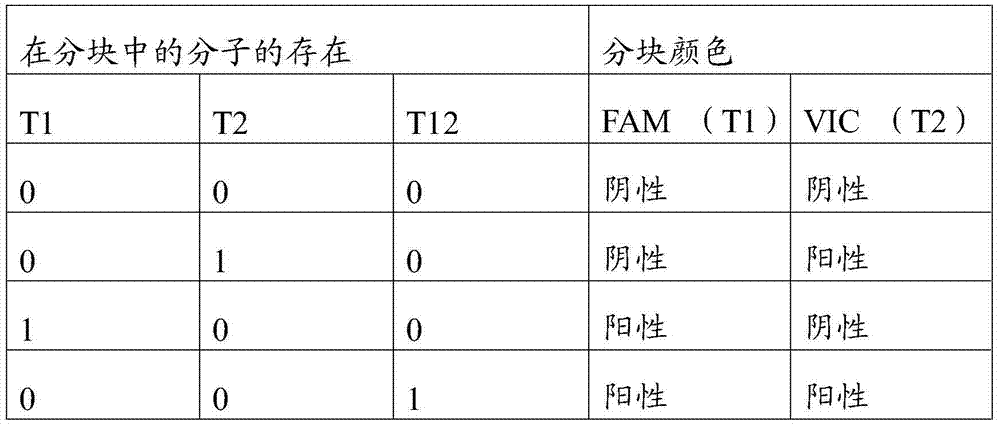

假设我们做出M1、M2和M12的“猜测”。我们可使用逆方程来计算分块具有T1、T2或T12靶的拷贝的概率:Suppose we make "guesses" of M1, M2, and M12. We can use the inverse equation to calculate the probability that a block has a copy of a T1, T2 or T12 target:
p12=1–exp(-M12/N)p12=1–exp(-M12/N)
p1=1–exp(-M1/N)p1=1–exp(-M1/N)
p2=1–exp(-M2/N).p2=1–exp(-M2/N).
根据这些概率,我们可以计算如表11所示的预测的计数。From these probabilities, we can calculate the predicted counts shown in Table 11.
表11Table 11
上述的概率可以使用表10被填写,表10将分子的存在映射到分块颜色。The probabilities described above can be filled in using Table 10, which maps the presence of molecules to block colors.
如果我们的“猜测”是正确的,那么预测的计数将与我们预期的计数紧密地“匹配”。因此,在上述客观标准下的需要被最小化的优化算法也可以用来解决该问题。If our "guess" is correct, the predicted count will closely "match" our expected count. Therefore, an optimization algorithm whose needs are minimized under the above objective criteria can also be used to solve this problem.
M1、M2、M12=最佳猜测=预测的计数和实际计数的最小偏差。M1, M2, M12 = best guess = smallest deviation of predicted and actual counts.
然后我们可以如下计算以%的片段的大小:We can then calculate the size of the fragment in % as follows:
M=(M1+M2)/2M=(M1+M2)/2
F=M/(M+M12)*100。F=M/(M+M12)*100.
F.对3种染料和7个靶的解决方案F. Solutions for 3 dyes and 7 targets
为了解决更多数目的染料的问题,我们需要更多的方程,因为有更多的未知数。对于3种染料和7个靶,我们需要7个方程来找到这7个靶的浓度。To solve the problem for a larger number of dyes, we need more equations because there are more unknowns. For 3 dyes and 7 targets, we need 7 equations to find the concentrations of these 7 targets.
我们有表12,其具有分块的计数的23=8行,取决于哪些染料是阳性的。We have Table 12 with 2 3 =8 rows of counts binned, depending on which dyes are positive.
用D1、D2和D3表示这三种染料。These three dyes are denoted by D1, D2 and D3.
表12Table 12
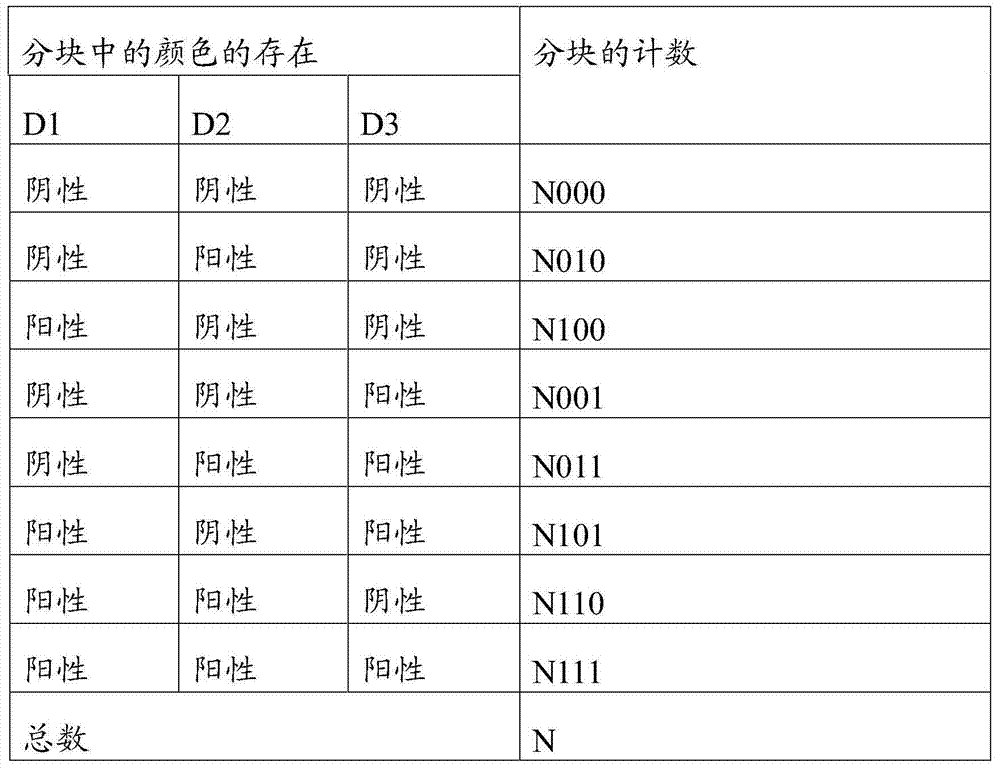
考虑表13Consider Table 13
表13Table 13
*注意,对于第5行,我们也可以检测{T2、T23}或{T12、T123},且对于第6行,我们可以检测{T3、T23},而对于第7行,我们可以检测{T3、T13}和{T23、T123}。这种选择并不重要,且都导致相同的结果。*Note that for
在行5、6和7中我们做出3个递归调用。In
例如,在行5中,我们实际上求解2种染料D1和D2、具有3个靶的情况:{T1,T13}作为一个靶,{T2,T23}作为第二个靶,{T12,T123}作为第三个连接的靶。For example, in
类似地,在行6和7中,我们做出递归调用来求解2种染料和3个靶的比较简单的问题。Similarly, in lines 6 and 7 we make recursive calls to solve the simpler problem of 2 dyes and 3 targets.
方程的系统看起来如下:The system of equations looks like this:
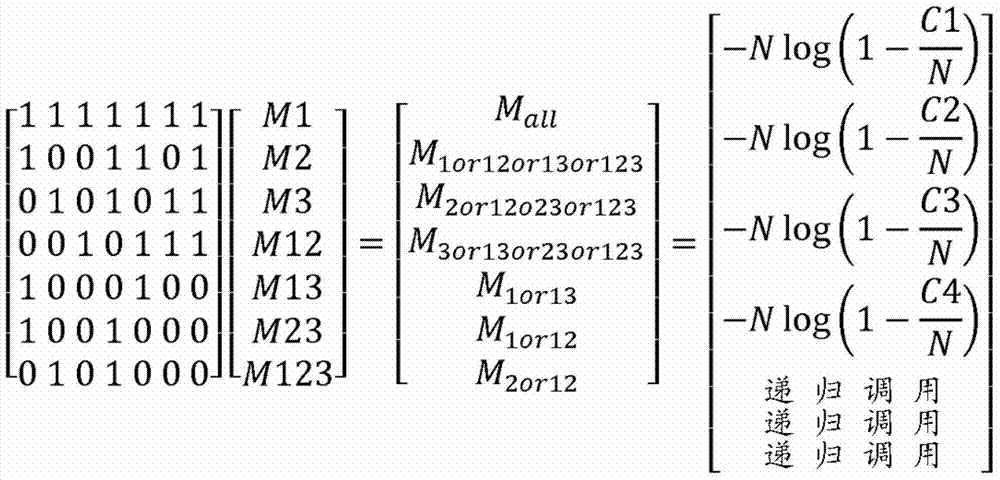
上述线性方程的系统可以被求解以找到7个靶的浓度。The above system of linear equations can be solved to find the concentrations of the 7 targets.
G.R种染料和2R-1个靶GR dyes and 2 R -1 targets
现在我们给出将该算法一般化为任意数目的染料的步骤。这是递归算法。由于我们有对当R=2时的情况的解决方案,我们可通过递归来解出任何数目的R。We now give the steps to generalize this algorithm to any number of dyes. This is a recursive algorithm. Since we have a solution for the case when R=2, we can solve for any number of R by recursion.
输入:enter:
对于R种染料,我们得到对分块中的颜色的存在或不存在的所有可能组合的具有2R行的分块的计数的表。For R dyes, we get a table with counts of bins of 2 R rows for all possible combinations of the presence or absence of a color in a bin.
算法:algorithm:
步骤1.建立2R–1个线性方程的系统。为了获得这些方程,考虑使一些颜色不可见的不同方式。也考虑当所有的颜色是不能区分的时的情况,其给出了第一行。可以表明,我们可以得到2R–1个靶浓度(未知数)的2R–1个方程。当我们使某些颜色不可见时,然后我们将问题简化为具有较少的颜色的情况,其可以被递归地求解,一直至当有2种染料和3个靶时的情况。 Step 1. Build a system of 2 R -1 linear equations. To obtain these equations, consider different ways of making some colors invisible. Consider also the case when all colors are indistinguishable, which gives the first row. It can be shown that we can obtain 2 R −1 equations for 2 R −1 target concentrations (unknowns). When we make some colors invisible, then we reduce the problem to the case with fewer colors, which can be solved recursively, up to the case when there are 2 dyes and 3 targets.
步骤2.对方程求解。 Step 2. Solve the equation.
步骤3.根据浓度和阳性计数的预期的数目来计算置信区间。
输出:output:
2R–1个靶的浓度连同置信区间。 2R - Concentration of 1 target together with confidence interval.
实例8.多标记探针 Example 8. Multiple Labeled Probes
这个实例描述了示例性的多标记探针和在多重数字扩增分析中使用探针的方法;见图17-22。多标记探针可以用于在第一章中和实例6和7中描述的基于颜色的多重分析。可选地或另外,多标记探针可以用于如在于2011年7月12日提交的美国临时专利申请序列号61/507,082和于2011年7月20日提交的美国临时专利申请序列号61/510,013中描述的基于强度的多重化,这些专利申请通过引用被引入本文。This example describes exemplary multi-labeled probes and methods of using the probes in a multiplex digital amplification assay; see Figures 17-22. Multiple labeled probes can be used in the color-based multiplex assays described in Chapter 1 and in Examples 6 and 7. Alternatively or additionally, multi-labeled probes can be used as in U.S. Provisional Patent Application Serial No. 61/507,082 filed on July 12, 2011 and U.S. Provisional Patent Application Serial No. 61/082 filed on July 20, 2011. 510,013, which are incorporated herein by reference.
典型的5'核酸酶分析(TaqMan)探针具有单个荧光团和猝灭剂或两个荧光体,其中第二个荧光体用来通过FRET(例如,TAMRA“猝灭剂”)来猝灭第一个荧光团。荧光团和猝灭剂通常连接到寡核苷酸探针的5'-和3'-大部分碱基/核苷酸。Typical 5' nuclease assay (TaqMan) probes have a single fluorophore and quencher or two fluorophores where the second fluorophore is used to quench the first fluorophore by FRET (eg, TAMRA "quencher"). a fluorophore. Fluorophores and quenchers are usually attached to the 5'- and 3'-most bases/nucleotides of the oligonucleotide probe.
寡核苷酸合成化学物质允许荧光团被添加到探针的内部核苷酸/碱基。将多个荧光团连接到一个寡核苷酸探针允许产生更宽范围的探针,这可以用来增强多重化能力。将多个荧光体放置在一个探针上的能力允许因而得到的发射荧光被“调整”以实现比通过单个荧光团可能的更多的荧光识别特征。探针光谱通常是包括多个荧光团的复合的结果。对于可谐振或以其它方式相互作用的荧光团,荧光团的接近度和位置(内部或末端标记)将允许额外的调节可能性。多个荧光团(或猝灭剂)不同是不必要的。同一荧光体的多个分子的添加也可以允许在每探针基础上不同的荧光输出。对于一些应用,可能是有益的是,将猝灭剂放置在寡核苷酸的5'端上使得探针降解除去猝灭剂,但是留下连接在寡核苷酸的其余部分上的其它的荧光团。通过这种方式,当猝灭剂被分裂掉时,从探针得到相同的信号,但是每个探针都可以具有不同的识别标记(例如,探针1-FAM、探针2-FAM+Cy3、探针3-FAM+HEX、探针4-FAM+FAM等)。Oligonucleotide synthesis chemistry allows fluorophores to be added to the internal nucleotides/bases of the probe. Attaching multiple fluorophores to a single oligonucleotide probe allows for the generation of a wider range of probes, which can be used to enhance multiplexability. The ability to place multiple fluorophores on one probe allows the resulting emitted fluorescence to be "tuned" to achieve more fluorescent recognition features than possible with a single fluorophore. Probe spectra are often the result of complexes involving multiple fluorophores. For fluorophores that can resonate or otherwise interact, the proximity and position of the fluorophore (internal or terminally labeled) will allow for additional tuning possibilities. Multiple fluorophores (or different quenchers) are not necessary. Addition of multiple molecules of the same fluorophore may also allow for different fluorescence output on a per-probe basis. For some applications, it may be beneficial to place the quencher on the 5' end of the oligonucleotide so that degradation of the probe removes the quencher, but leaves the other attached to the remainder of the oligonucleotide. Fluorophore. In this way, when the quencher is cleaved, the same signal is obtained from the probes, but each probe can have a different recognition label (e.g., probe 1-FAM, probe 2-FAM+Cy3 , probe 3-FAM+HEX, probe 4-FAM+FAM, etc.).
该方法也可应用于其它靶分子的多重化。尽管靶核酸的检测显然是极大地所关注的领域,但也可能将这个概念应用到其它类型的探针(例如,蛋白质靶的抗体探针)。This method can also be applied to multiplexing of other target molecules. Although the detection of target nucleic acids is clearly an area of great interest, it is also possible to apply this concept to other types of probes (eg, antibody probes of protein targets).
图17示出了未标记的寡核苷酸(A)和含有寡核苷酸的一组示例性多标记探针(B-G)的示意图。每个实心圆和空心圆分别表示连接到寡核苷酸的猝灭剂(也称为猝灭剂部分)和荧光团。F1至F4识别结构上不同的荧光团。寡核苷酸可以具有任何合适的长度,例如5至500、10至200、或15至100个核苷酸等。Figure 17 shows a schematic of an unlabeled oligonucleotide (A) and an exemplary set of multi-labeled probes (B-G) containing the oligonucleotide. Each solid and open circle represents a quencher (also known as a quencher moiety) and a fluorophore, respectively, attached to an oligonucleotide. F1 to F4 recognize structurally distinct fluorophores. Oligonucleotides may be of any suitable length, eg, 5 to 500, 10 to 200, or 15 to 100 nucleotides, etc.
图17的多标记探针如下:B)在相应的内部和3′端位置处具有5′猝灭剂和荧光团(F1和F2)的寡核苷酸;C)在3′和多个内部位置处具有5′猝灭剂部分和荧光团(F1至F4)的寡核苷酸;D)在3′和多个内部位置处具有5′猝灭剂部分和荧光团(3XF1、F2)的寡核苷酸;E)在3′和内部位置处具有5′猝灭剂部分和内部猝灭剂部分加上荧光团的寡核苷酸;F)在3′和内部位置处具有5′猝灭剂部分和荧光团的寡核苷酸,在荧光团间具有更大的间隔;以及G)在5′端和内部位置处具有荧光团且在3′端位置处具有猝灭剂的寡核苷酸。The multi-labeled probes of Figure 17 are as follows: B) oligonucleotides with 5′ quenchers and fluorophores (F1 and F2) at corresponding internal and 3′ terminal positions; C) 3′ and multiple internal Oligonucleotides with 5′ quencher moieties and fluorophores (F1 to F4) at positions; D) Oligonucleotides with 5′ quencher moieties and fluorophores at 3′ and multiple internal positions (3XF1, F2) Oligonucleotides; E) Oligonucleotides with 5' quencher moieties at 3' and internal positions and internal quencher moieties plus fluorophores; F) 5' quencher moieties at 3' and internal positions Oligonucleotides with a quencher moiety and a fluorophore, with greater spacing between the fluorophores; and G) Oligonucleotides with a fluorophore at the 5′ and internal positions and a quencher at the 3′ position glycosides.
图18示出了在靶扩增期间的探针分子的猝灭剂和荧光团的分离。模板分子被示为在存在示例性多标记探针分子(图17B)的情况下通过DNA聚合酶被复制(互补地)。A)聚合酶正在延伸位于探针结合位置上游的核酸链。B)聚合酶的5′核酸酶活性从探针除去5′-大部分核苷酸(在该实例中包括猝灭剂),允许猝灭剂和荧光团部分地分离。C)聚合酶继续从探针除去5′-核苷酸直到探针的结合变得不稳定,并且剩余的探针片段从模板链分离。多个荧光团仍然可以在探针片段中彼此连接,但与猝灭剂分离。Figure 18 shows the separation of the quencher and fluorophore of the probe molecule during target amplification. Template molecules are shown replicated (complementarily) by DNA polymerase in the presence of an exemplary multi-labeled probe molecule (Figure 17B). A) The polymerase is extending the nucleic acid strand upstream of the probe binding site. B) The 5' nuclease activity of the polymerase removes the 5'-most nucleotides (including the quencher in this example) from the probe, allowing partial separation of the quencher and fluorophore. C) The polymerase continues to remove 5'-nucleotides from the probe until the binding of the probe becomes unstable and the remaining probe fragments detach from the template strand. Multiple fluorophores can still be attached to each other in the probe fragment, but separated from the quencher.
图19示出了液滴强度的示例性二维直方图,其示出了可以在使用单标记和双标记探针的组合执行的三个靶的多重数字扩增分析中获得的液滴簇,每一个探针都用FAM、VIC、或FAM和VIC标记。在此处由靶-3阳性产生的液滴簇没有从靶1和靶2的双阳性液滴分离。Figure 19 shows an exemplary two-dimensional histogram of droplet intensities showing droplet clusters that can be obtained in a multiplex digital amplification analysis of three targets performed using a combination of single-labeled and dual-labeled probes, Each probe is labeled with FAM, VIC, or FAM and VIC. Here droplet clusters generated from target-3 positivity were not separated from target-1 and target-2 double-positive droplets.
图20示出了可以在图19的分析中获得的液滴强度的另一示例性二维直方图,靶-3-阳性液滴的簇与靶-1+2-阳性液滴的簇之间以部分分辨率区分。Figure 20 shows another exemplary two-dimensional histogram of droplet intensities that can be obtained in the analysis of Figure 19, between clusters of target-3-positive droplets and clusters of target-1+2-positive droplets Distinguished by partial resolution.
可以选择检测器光学器件尤其是激发光源和光学滤波器以优化簇的分离。例如,两个簇可在第一波长条件下可实质上重叠(难以分离),但在第二波长条件下实质上不重叠。具有分光光度计光栅或可互换的滤波器组的检测器可提供在波长选择方面的更大的灵活性。Detector optics, especially the excitation light source and optical filters, can be chosen to optimize separation of clusters. For example, two clusters may be substantially overlapping (difficult to separate) at a first wavelength, but substantially non-overlapping at a second wavelength. Detectors with spectrophotometer gratings or interchangeable filter sets can provide greater flexibility in wavelength selection.
图21示出了液滴强度的示例性二维直方图,其说明了可以在仅用多标记探针执行的数字扩增分析中获得的数据点的两个簇。Figure 21 shows an exemplary two-dimensional histogram of droplet intensity illustrating two clusters of data points that can be obtained in a digital amplification analysis performed with only multi-labeled probes.
图22示出了液滴强度的另一示例性二维直方图,其说明了可以在如在图21中执行的数字扩增分析中获得的数据点的各种簇,但是除了多标记探针(用于测量靶3扩增)以外,分析使用一对单标记探针(用于测量靶1和靶2扩增)被补充。当结合不同水平的探针和/或结合具有在两个(或多个)检测通道中的不同的光谱重叠的不同的荧光体时,将多个荧光体放置在相同的寡核苷酸上可能是更有利的。图22的实例示出了与仅FAM和仅VIC探针相比具有略高一点的荧光的双荧光体探针,但是它可以更高或更低(或相同)。如果大约相同(或不同),本文所公开的基于颜色的多重化方法可以有利地用来确定平均靶水平。Figure 22 shows another exemplary two-dimensional histogram of droplet intensities illustrating the various clusters of data points that can be obtained in a digital amplification analysis as performed in Figure 21, but in addition to the multi-labeled probe (for measuring
几种化学物质可产生本文所公开的多标记探针,包括标记的脱氧核苷酸、点击化学物质和各种其它联结子化学物质。探针可以通过由寡核苷酸的供应商的定制合成产生。描述用于内部荧光团合并的示例性合成路线的参考文献在下面列出并通过引用被并入本文。Several chemistries can generate the multi-labeled probes disclosed herein, including labeled deoxynucleotides, click chemistries, and various other linker chemistries. Probes can be produced by custom synthesis by suppliers of oligonucleotides. References describing exemplary synthetic routes for internal fluorophore incorporation are listed below and incorporated herein by reference.
HaralambidisJ.、ChaiM.和TregearG.W.(1987)的“Preparationofbase-modifiednucleosidesfornon-radioactivelabelattachmentandtheirincorporationintosyntheticoligodeoxyribonucleotides”。(NucleicAcidsRes.15,4857–4876)。Haralambidis J., Chai M. and Tregear G.W. (1987) "Preparation of base-modified nucleosides for non-radioactive label attachment and their incorporation into tosyntheticoligodeoxyribonucleotides". (Nucleic Acids Res. 15, 4857–4876).
RandolphJ.B.和WaggonerA.S.(1997)的“Specificityandfluorescencebrightnessofmultiply-labelledfluorescenceDNAprobes”。(NucleicAcidsResearch;25:2923-2929)。"Specificity and fluorescence brightness of multiply-labelled fluorescence DNA probes" by Randolph J.B. and Waggoner A.S. (1997). (Nucleic Acids Research; 25:2923-2929).
BrumbaughJ.A.、MiddendorfL.R.、GroneD.L.和RuthJ.L.的Proc.Natl.Acad.Sci.(USA1988;85:5610-5614)。Proc. Natl. Acad. Sci. by Brumbaugh J.A., Middendorf L.R., Grone D.L. and Ruth J.L. (USA 1988; 85:5610-5614).
SinghD.、VijayantiK.、GaneshK.N.(1990)的“Oligonucleotides,part5+:synthesisandfluorescencestudiesofDNAoligomersd(AT)5containingadeniedscovalentlylinkedatC-8withdansylfluorophore”(NucleicAcidsRes;18:3339-3345)。Singh D., Vijayanti K., Ganesh K.N. (1990) "Oligonucleotides,
TaeSeokSeo、ZengminLi、HameerRuparel和JingyueJu(2003)的“ClickChemistrytoConstructFluorescentOligonucleotidesforDNASequencing”。(J.Org.Chem.;68:609-612)。"Click Chemistry to Construct Fluorescent Oligonucleotides for DNA Sequencing" by TaeSeokSeo, ZengminLi, HameerRuparel, and JingyueJu (2003). (J. Org. Chem.; 68:609-612).
实例9.所选择的实施方式 Example 9. Selected implementations
该实例描述了与组合使用信号进行数字分析有关的所选择的方面和实施方式,其没有限制地被呈现为一系列编号的段落。这些段落中的每一个都可以以任何合适的方式与一个或多个其它段落组合和/或与来自在本公开的其它地方的公开组合。下面的一些段落明确地参考并进一步限制其它的段落,没有限制地提供一些合适的组合的实例。This example describes selected aspects and embodiments related to the combined use of signals for digital analysis, presented without limitation as a series of numbered paragraphs. Each of these paragraphs may be combined in any suitable manner with one or more other paragraphs and/or with disclosure from elsewhere in this disclosure. Some of the following passages explicitly reference and further limit other passages, providing without limitation examples of some suitable combinations.
A1.一种执行数字分析的方法,该方法包括:(a)产生代表从样品的多个分块中的每一个检测的光的R个信号;和(b)基于R个信号如何在分块当中相对于彼此变化来估计在分块中的多于R个不同的靶的浓度。A1. A method of performing digital analysis comprising: (a) generating R signals representing light detected from each of a plurality of subtiles of a sample; where the concentrations of more than R different targets in a block are estimated relative to each other.
B1.一种执行多于R个靶的数字分析的方法,该方法包括:(a)将样品分成分块;(b)产生代表从分块检测的光的R个信号;以及(c)基于R个信号估计在分块中的多于R个靶的浓度。B1. A method of performing digital analysis of more than R targets, the method comprising: (a) dividing a sample into blocks; (b) generating R signals representing light detected from the blocks; and (c) based on The R signals estimate the concentration of more than R targets in the bin.
B2.段落B1的方法,其中R个信号中的至少一个独立于R个信号中的每个其它信号报告在每个分块中的靶的存在或不存在。B2. The method of paragraph B1, wherein at least one of the R signals reports the presence or absence of the target in each block independently of every other of the R signals.
B3.段落B1或B2的方法,其中R个信号中的每个独立于R个信号中的每个其它信号报告在每个分块中的不同靶的存在或不存在。B3. The method of paragraph B1 or B2, wherein each of the R signals reports the presence or absence of a different target in each block independently of every other of the R signals.
B4.段落B1至B3中的任一项的方法,其中R个信号中的两个或多个的组合共同报告在每个分块中的R+1个靶的存在或不存在。B4. The method of any of paragraphs B1 to B3, wherein a combination of two or more of the R signals collectively reports the presence or absence of R+1 targets in each block.
B5.段落B1至B4中的任一项的方法,还包括确定只对R个信号的每一个为阳性的分块的数量和对R个信号中的两个或多个的至少一个组合为阳性的分块的数目。B5. The method of any of paragraphs B1 to B4, further comprising determining the number of subblocks that are positive for only each of the R signals and are positive for at least one combination of two or more of the R signals The number of chunks.
B6.段落B5的方法,其中估计浓度的步骤包括如果每一个靶都具有在分块当中的泊松分布则估计共同地对应于阳性的所确定的数目的多于R个靶中的每一个的浓度的步骤。B6. The method of paragraph B5, wherein the step of estimating the concentration comprises estimating the concentration of each of the determined number of more than R targets that collectively correspond to being positive if each target has a Poisson distribution among the bins Concentration steps.
B7.段落B1至B6中的任一项的方法,其中估计的步骤包括找到对一组联立方程的解的步骤,并且其中每一个方程都具有相同的变量。B7. The method of any of paragraphs B1 to B6, wherein the step of estimating includes the step of finding a solution to a set of simultaneous equations, and wherein each equation has the same variables.
B8.段落B7的方法,其中联立方程是线性方程。B8. The method of paragraph B7, wherein the simultaneous equations are linear equations.
B9.段落B7或B8的方法,其中解通过数值分析来获得。B9. The method of paragraph B7 or B8, wherein the solution is obtained by numerical analysis.
B10.段落B7至B9中的任一项的方法,其中找到解的步骤包括找到对至少2R-1个方程的解的步骤。B10. The method of any of paragraphs B7 to B9, wherein the step of finding solutions comprises the step of finding solutions to at least 2 R −1 equations.
B11.段落B7至B10中的任一项的方法,其中每一个方程基于具有在分块当中的泊松分布的每一个靶的拷贝。B11. The method of any of paragraphs B7 to B10, wherein each equation is based on a copy of each target having a Poisson distribution among the blocks.
B12.段落B1至B11中的任一项的方法,其中所述R个信号中的每一个都是包括对应于单独分块中的不同靶的存在或不存在的两个或多个整体信号部分的复合信号。B12. The method of any of paragraphs B1 to B11, wherein each of the R signals is composed of two or more integral signal portions corresponding to the presence or absence of different targets in separate blocks composite signal.
B13.段落B1至B12中的任一项的方法,其中分离样品的步骤形成的分块的每分块平均浓度小于多于R个靶中的每一个的约一个拷贝。B13. The method of any of paragraphs B1 to B12, wherein the step of isolating the sample forms fractions having an average concentration per fraction of less than about one copy of each of the more than R targets.
B14.段落B1至B13中的任一项的方法,其中分离样品的步骤针对多于R个靶中的每一个形成不包含靶的拷贝的一个或多个分块。B14. The method of any of paragraphs B1 to B13, wherein the step of isolating the sample forms, for each of the more than R targets, one or more partitions that do not contain a copy of the target.
B15.段落B1至B14中的任一项的方法,其中分块是液滴。B15. The method of any of paragraphs B1 to B14, wherein the partitions are droplets.
B16.段落B1至B15中的任一项的方法,其中R个信号中的每一个都代表检测到的荧光发射。B16. The method of any of paragraphs B1 to B15, wherein each of the R signals represents a detected fluorescence emission.
B17.段落B1至B16中的任一项的方法,还包括在产生R个靶的步骤之前在一个或多个分块中执行扩增反应的步骤。B17. The method of any of paragraphs B1 to B16, further comprising the step of performing the amplification reaction in one or more blocks prior to the step of generating the R targets.
B18.段落B17的方法,其中执行扩增反应的步骤包括对分块进行热循环的步骤。B18. The method of paragraph B17, wherein the step of performing the amplification reaction comprises the step of thermal cycling the block.
B19.段落B1至B18中的任一项的方法,其中每一个靶都是核酸。B19. The method of any of paragraphs B1 to B18, wherein each target is a nucleic acid.
B20.段落B1至B19中的任一项的方法,其中所述分块包括报告在单独分块中的第一靶分子的存在或不存在的第一探针、报告在单独分块中的第二靶分子的存在或不存在的第二探针,以及报告在单独分块中的第三靶分子的存在或不存在的至少一个第三探针。B20. The method of any of paragraphs B1 to B19, wherein the chunking comprises a first probe reporting the presence or absence of a first target molecule in a separate chunk, a first probe reporting in a separate chunk, A second probe for the presence or absence of two target molecules, and at least one third probe for reporting the presence or absence of a third target molecule in a separate block.
B21.权利要求B20的方法,其中至少一个第三探针是单个第三探针。B21. The method of claim B20, wherein at least one third probe is a single third probe.
B22.段落B1至B19中的任一项所述的方法,其中分块包括报告在单独分块中的第一靶分子的存在或不存在的第一探针、报告在单独分块中的第二靶分子的存在或不存在的第二探针,并且其中第一和第二探针共同报告在单独分块中的第三靶分子的存在或不存在。B22. The method of any one of paragraphs B1 to B19, wherein chunking includes a first probe that reports the presence or absence of a first target molecule in a separate chunk, a first probe that reports in a separate chunk. Two second probes for the presence or absence of the target molecule, and wherein the first and second probes together report the presence or absence of a third target molecule in a separate block.
B23.段落B1至B22中的任一项所述的方法,其中R个信号中的每一个都至少主要代表从不同的荧光团检测的光。B23. The method of any of paragraphs B1 to B22, wherein each of the R signals is at least predominantly representative of light detected from a different fluorophore.
B24.段落B1至B23中的任一项的方法,其中分块都具有实质上相同的体积。B24. The method of any of paragraphs B1 to B23, wherein the segments all have substantially the same volume.
B25.段落B1至B24中的任一项所述的方法,其中多于R个靶中的至少一个是其它R个靶中的至少两个的连接版本。B25. The method of any of paragraphs B1 to B24, wherein at least one of the more than R targets is a ligated version of at least two of the other R targets.
C1.一种执行数字分析的方法,该方法包括:(a)将样品分成分块,每个分块都能够扩增多于R个靶,如果靶存在于该分块中;(b)产生代表从分块检测的光的R个信号,其中对于多于R个靶中的至少一个靶,在至少一个靶的分块中的扩增选择性地改变R个信号中的仅仅一个信号,并且其中对于多于R个靶中的至少一个其它靶,在至少一个其它靶的分块中的扩增协调地改变信号中的两个或多个;以及(c)基于所产生的R个信号估计多于R个靶中的每一个的浓度。C1. A method of performing a digital analysis comprising: (a) dividing a sample into fractions each capable of amplifying more than R targets, if the target is present in the fraction; (b) generating R signals representing light detected from the bins, wherein for at least one of more than R targets, amplification in a bin of the at least one target selectively alters only one of the R signals, and wherein for at least one other target of the more than R targets, amplification in a block of the at least one other target coordinately changes two or more of the signals; and (c) estimates based on the R signals generated The concentration of each of more than R targets.
C2.段落C1的方法,其中扩增的步骤包括在产生步骤之前对分块进行热循环的步骤。C2. The method of paragraph C1, wherein the step of amplifying includes the step of thermal cycling the block prior to the step of producing.
C3.段落C1或C2的方法,其中R个信号代表从穿过检查区域运送液滴的流体检测的光。C3. The method of paragraph C1 or C2, wherein the R signals represent light detected from the fluid transporting the droplet through the examination region.
C4.段落C1至C3中的任一项的方法,其中产生步骤包括产生表示所检测的光的不同波长和/或波长范围的两个或多个信号。C4. The method of any of paragraphs C1 to C3, wherein the generating step includes generating two or more signals representing different wavelengths and/or wavelength ranges of the detected light.
C5.段落C1至C4中的任一项的方法,其中产生步骤包括产生代表由使用两个或多个信号中的每一个的不同的波长或波长范围照射产生的所检测的光的相同波长范围的两个或多个信号的步骤。C5. The method of any of paragraphs C1 to C4, wherein the step of generating comprises generating the same wavelength range representing the detected light produced by illumination using a different wavelength or wavelength range of each of the two or more signals The steps of two or more signals.
D1.一种执行多重数字扩增分析的方法,该方法包括:(a)扩增在分块中的多于R个靶;(b)产生代表在R个不同的波长区域中从分块检测的光的R个信号,其中R≥2;并且(c)基于R个信号计算分块中的每一个靶的平均水平,其中计算出的水平考虑到在相同的单独分块中的不同靶的同时存在,如果有的话。例如,如果T表示靶的数量,则T>R。D1. A method of performing multiplex digital amplification analysis comprising: (a) amplifying more than R targets in a tile; (b) generating representative detections from the tile in R different wavelength regions R signals of the light of , where R ≥ 2; and (c) calculate an average level for each target in the tile based on the R signals, where the calculated level takes into account the different targets in the same individual tile Both exist, if any. For example, if T represents the number of targets, then T>R.
D2.段落D1的方法,其中每个靶的扩增单独地通过与其它靶中的任一个不同的信号或信号的组合来报告。D2. The method of paragraph D1, wherein amplification of each target is reported individually by a different signal or combination of signals than any of the other targets.
D3.段落D1或D2的方法,其中信号中的每一个都报告靶中的至少两个的不同组合的扩增。D3. The method of paragraph D1 or D2, wherein each of the signals reports amplification of a different combination of at least two of the targets.
D4.段落D3的方法,其中分块是液滴,该方法还包括针对每个信号确定呈现至少两个靶中的任一个的扩增的液滴的数量的步骤,并且其中计算步骤基于针对R个信号中的每一个确定的数量。D4. The method of paragraph D3, wherein the tiles are droplets, the method further comprising the step of determining, for each signal, the number of amplified droplets presenting either of the at least two targets, and wherein the calculating step is based on R A certain amount for each of the signals.
D5.段落D1至D4中的任一项的方法,其中计算步骤包括找到对一组联立方程的解的步骤。D5. The method of any of paragraphs D1 to D4, wherein the computing step includes the step of finding a solution to a set of simultaneous equations.
D6.段落D5的方法,其中有T个靶,其中找到解的步骤包括找到对T个联立方程的解的步骤,并且其中R<T≤2R-1。D6. The method of paragraph D5, wherein there are T targets, wherein the step of finding a solution comprises the step of finding a solution to T simultaneous equations, and wherein R<T≤2 R −1 .
D7.段落D5或D6的方法,其中解通过数值分析来获得。D7. The method of paragraph D5 or D6, wherein the solution is obtained by numerical analysis.
D8.段落D1至D7中的任一项的方法,其中有三个靶,并且其中代表光的信号在扩增期间从与结合到相应的靶的扩增子的探针相关联的两个荧光团检测到。D8. The method of any of paragraphs D1 to D7, wherein there are three targets, and wherein signals representing light are generated during amplification from two fluorophores associated with probes of amplicons bound to the respective targets detected.
D9.段落D8的方法,其中两个荧光团是VIC和FAM。D9. The method of paragraph D8, wherein the two fluorophores are VIC and FAM.
D10.段落D8或D9的方法,其中分块包含三个靶中的第一个的第一探针、三个靶中的第二个的第二探针、以及三个靶中的第三个的第三探针,并且其中第一探针仅用VIC标记,第二探针仅用FAM标记,第三探针用VIC和FAM标记。D10. The method of paragraph D8 or D9, wherein the block comprises a first probe of a first of three targets, a second probe of a second of three targets, and a third of three targets and wherein the first probe is labeled only with VIC, the second probe is labeled only with FAM, and the third probe is labeled with both VIC and FAM.
D11.段落D10的方法,其中所述第三探针包括不用VIC标记的FAM标记探针和不用FAM标记的VIC标记探针。D11. The method of paragraph D10, wherein the third probe comprises a FAM-labeled probe that is not labeled with VIC and a VIC-labeled probe that is not labeled with FAM.
D12.段落D1至D11中的任一项的方法,其中平均水平是浓度。D12. The method of any of paragraphs D1 to D11, wherein the average level is concentration.
D13.段落D1至D12中的任一项的方法,其中计算平均水平的步骤包括为每一个类型的靶确定扩增阳性分块的总数的步骤和确定分块的总数的步骤。D13. The method of any of paragraphs D1 to D12, wherein the step of calculating the average level includes the steps of determining the total number of amplified positive blocks and the steps of determining the total number of blocks for each type of target.
D14.段落D1至D13中的任一项的方法,还包括在分块当中分配多于R个靶的拷贝使得一些分块包含给定靶的多于一个拷贝的步骤。D14. The method of any of paragraphs D1 to D13, further comprising the step of distributing more than R copies of the target among the chunks such that some chunks contain more than one copy of a given target.
D15.段落D1至D13中的任一项的方法,其中有至少四个靶。D15. The method of any of paragraphs D1 to D13, wherein there are at least four targets.
E1.一种执行多重数字扩增分析的方法,该方法包括:(a)扩增在液滴中的多于R个靶;(b)产生代表在来自液滴的R个不同的波长范围中检测的光的R个信号,其中R≥2;并且(c)通过找到对一系列联立方程的解来计算多于R个靶中的每一个的平均水平。例如,如果T表示靶的数目,那么T>R。E1. A method of performing multiplex digital amplification analysis, the method comprising: (a) amplifying more than R targets in a droplet; (b) generating representations in R different wavelength ranges from the droplet R signals of light detected, where R > 2; and (c) computing the average level for each of the more than R targets by finding solutions to a series of simultaneous equations. For example, if T represents the number of targets, then T>R.
E2.段落E1的方法,其中每个靶的扩增单独地通过与其它靶中的任一个不同的信号或信号的组合来报告。E2. The method of paragraph E1, wherein amplification of each target is reported individually by a different signal or combination of signals than any of the other targets.
E3.段落E1至E2中的任一项的方法,其中信号中的每一个都报告靶中的至少两个的不同组合的扩增。E3. The method of any of paragraphs E1 to E2, wherein each of the signals reports amplification of a different combination of at least two of the targets.
E4.段落E3的方法,还包括确定对由每个信号报告的至少两个靶中的任何一个为扩增阳性的液滴的总数的步骤,并且其中计算步骤基于针对R个信号中的每一个确定的总数。E4. The method of paragraph E3, further comprising the step of determining the total number of droplets that are amplified positive for any of the at least two targets reported by each signal, and wherein the step of calculating is based on the step of calculating for each of the R signals determined total.
E5.段落E1至E4中的任一项的方法,其中有T个靶,其中计算步骤包括找到对T个联立方程的解的步骤,并且其中R<T≤2R-1。E5. The method of any of paragraphs E1 to E4, wherein there are T targets, wherein the computing step includes the step of finding solutions to T simultaneous equations, and wherein R<T≤2 R −1 .
E6.段落E1至E5中的任一项的方法,其中解通过数值分析来获得。E6. The method of any of paragraphs E1 to E5, wherein the solution is obtained by numerical analysis.
E7.段落E1至E6中的任一项的方法,其中水平考虑到在相同的单独液滴中的不同的靶的任何同时存在。E7. The method of any of paragraphs E1 to E6, wherein the levels take into account any simultaneous presence of different targets in the same individual droplet.
F1.一种执行多重数字扩增分析的方法,该方法包括:(a)扩增在液滴中的多于R个靶;(b)产生代表在R个不同的波长范围中从液滴检测的光的R个信号,其中R≥2,并且信号中的每一个都报告靶中的至少两个的不同组合的扩增;并且(c)基于R个信号计算在液滴中的每一个靶的平均水平,而不对每个信号确定至少两个靶中的哪一个在对这样的信号的单独扩增阳性液滴中扩增。例如,如果T表示靶的数目,那么T>R。F1. A method of performing multiplex digital amplification analysis, the method comprising: (a) amplifying more than R targets in a droplet; (b) generating representatives detected from the droplet in R different wavelength ranges R signals of light, where R ≥ 2, and each of the signals reports the amplification of a different combination of at least two of the targets; and (c) based on the R signals, calculates for each target in the droplet without determining for each signal which of the at least two targets was amplified in a droplet that was individually amplified positive for such a signal. For example, if T represents the number of targets, then T>R.
F2.段落F1的方法,还包括确定对由每个信号报告的至少两个靶中的任一个为扩增阳性的液滴的总数的步骤,并且其中计算步骤基于针对R个信号中的每一个所确定的总数。F2. The method of paragraph F1, further comprising the step of determining the total number of droplets that are amplified positive for any of the at least two targets reported by each signal, and wherein the step of calculating is based on the step of calculating for each of the R signals the determined total.
F3.段落F1或F2的方法,其中计算步骤包括找到对一组联立方程的解的步骤。F3. The method of paragraph F1 or F2, wherein the computing step includes the step of finding a solution to a set of simultaneous equations.
G1.一种合成物包括:含有探针的液滴,该探针包括寡核苷酸、第一荧光团、第二荧光团以及能量转移部分,其中能量转移部分是猝灭剂和/或第一和第二荧光团中的一个或两个的能量转移伙伴。G1. A composition comprising: a droplet containing a probe comprising an oligonucleotide, a first fluorophore, a second fluorophore, and an energy transfer moiety, wherein the energy transfer moiety is a quencher and/or a second fluorophore Energy transfer partners for one or both of the first and second fluorophores.
G2.段落G1的合成物,其中第一荧光团、第二荧光团以及能量转移部分每个共价地连接到寡核苷酸。G2. The composition of paragraph G1, wherein the first fluorophore, the second fluorophore, and the energy transfer moiety are each covalently linked to the oligonucleotide.
G3.段落G1至G2的合成物,还包括含有探针并布置在载流流体中的多个液滴。G3. The composition of paragraphs G1 to G2, further comprising a plurality of droplets comprising the probe and disposed in a carrier fluid.
G4.段落G1至G3中的任一项的合成物,其中液滴含有模板分子和能够扩增模板分子的至少一个区域的扩增试剂,并且其中探针能够结合到通过模板分子的区域的扩增产生的扩增子。G4. The composition of any of paragraphs G1 to G3, wherein the droplets contain a template molecule and an amplification reagent capable of amplifying at least one region of the template molecule, and wherein the probe is capable of binding to the amplifying agent passing through the region of the template molecule. Amplified amplicons.
G5.段落G1至G4中的任一项的合成物,其中所述探针是第一探针,并且其中所述液滴还包括包含所述第一荧光团或所述第二荧光团而不是包含所述第一荧光团和所述第二荧光团的第二探针。G5. The composition of any of paragraphs G1 to G4, wherein said probe is a first probe, and wherein said droplet further comprises said first fluorophore or said second fluorophore instead of A second probe comprising the first fluorophore and the second fluorophore.
G6.段落G1至G5中的任一项的合成物,其中能量转移部分是在寡核苷酸的5′-端连接到核苷酸的猝灭剂。G6. The composition of any of paragraphs G1 to G5, wherein the energy transfer moiety is a quencher attached to the nucleotide at the 5'-end of the oligonucleotide.
G7.段落G1至G6中的任一项的合成物,其中第一荧光团、第二荧光团以及能量转移部分中的每一个被连接到寡核苷酸的不同核苷酸。G7. The composition of any of paragraphs G1 to G6, wherein each of the first fluorophore, the second fluorophore, and the energy transfer moiety is attached to a different nucleotide of the oligonucleotide.
G8.段落G7的合成物,其中一对第一荧光团、第二荧光团以及能量转移部分连接到寡核苷酸的相同核苷酸。G8. The composition of paragraph G7, wherein a pair of the first fluorophore, the second fluorophore, and the energy transfer moiety are attached to the same nucleotide of the oligonucleotide.
G9.段落G1至G8中的任一项的合成物,其中第一荧光团、第二荧光团以及能量转移部分中的至少一个通过第一荧光团、第二荧光团以及能量转移部分中的另一个连接到寡核苷酸的核苷酸。G9. The composition of any of paragraphs G1 to G8, wherein at least one of the first fluorophore, the second fluorophore, and the energy transfer moiety passes through the other of the first fluorophore, the second fluorophore, and the energy transfer moiety A nucleotide attached to an oligonucleotide.
G10.段落G1至G9中的任一项的合成物,其中荧光团或猝灭剂连接到寡核苷酸的5′-端,其中荧光团或猝灭剂连接到寡核苷酸的3′-端,并且其中荧光团或猝灭剂连接到在5′-端和3′-端中间的核苷酸。G10. The composition of any one of paragraphs G1 to G9, wherein the fluorophore or quencher is attached to the 5'-end of the oligonucleotide, wherein the fluorophore or quencher is attached to the 3' of the oligonucleotide -end, and wherein the fluorophore or quencher is attached to the nucleotide intermediate the 5'-end and the 3'-end.
G11.段落G1至G10中的任一项的合成物,其中第一荧光团、第二荧光团以及能量转移部分中的一个或多个连接到布置在寡核苷酸的5′-端和3′-端中间的一个或多个内部核苷酸。G11. The composition of any one of paragraphs G1 to G10, wherein one or more of the first fluorophore, the second fluorophore, and the energy transfer moiety are attached to the 5'-end and 3 One or more internal nucleotides in the middle of the '-terminus.
上面阐述的内容可包括具有独立效用的多个不同的发明。虽然这些发明中的每一个在优选的形式中被公开,但是如这里所述和示出的特定实施方式不应在限制的意义上被考虑,因为很多变化是可能的。发明的主题包括本文公开的各种元素、特征、功能和/或特性的所有新颖而非明显的组合和子组合。下列权利要求特别指出被视为新颖的和非明显的组合及子组合。体现在特征、功能、元件和/或特性的其它组合和子组合中的发明可在从本申请或相关申请要求优先权的申请中被主张。这样的权利要求不管是否指向不同的发明或相同的发明且不管与原始权利要求相比是否在范围上更宽、更窄、相等或不同都被视为包括在本公开的发明的主题内。此外,所标识的元素的顺序指示器例如第一、第二或第三指示器用于区分开元素,且不指示这样的元素的特定位置或顺序,除非另外特别说明。What has been set forth above may encompass multiple distinct inventions with independent utility. While each of these inventions has been disclosed in a preferred form, the particular embodiments as described and illustrated herein should not be considered in a limiting sense, as many variations are possible. The subject matter of the inventions includes all novel and non-obvious combinations and subcombinations of the various elements, features, functions and/or properties disclosed herein. The following claims particularly point out combinations and subcombinations which are regarded as novel and non-obvious. Inventions embodied in other combinations and subcombinations of features, functions, elements, and/or properties may be claimed in applications claiming priority from this or a related application. Such claims, whether directed to a different invention or the same invention and whether broader, narrower, equal, or different in scope to the original claims, are also regarded as included within the subject matter of the inventions disclosed herein. Furthermore, order indicators such as first, second or third indicators for identified elements are used to distinguish elements and do not indicate a specific position or order of such elements unless specifically stated otherwise.
Claims (36)
Applications Claiming Priority (3)
| Application Number | Priority Date | Filing Date | Title |
|---|---|---|---|
| US201161454373P | 2011-03-18 | 2011-03-18 | |
| US61/454,373 | 2011-03-18 | ||
| PCT/US2012/029712 WO2012129187A1 (en) | 2011-03-18 | 2012-03-19 | Multiplexed digital assays with combinatorial use of signals |
Publications (1)
| Publication Number | Publication Date |
|---|---|
| CN103534360A true CN103534360A (en) | 2014-01-22 |
Family
ID=46879708
Family Applications (1)
| Application Number | Title | Priority Date | Filing Date |
|---|---|---|---|
| CN201280023708.8A Pending CN103534360A (en) | 2011-03-18 | 2012-03-19 | Multiplexed digital assays with combinatorial use of signals |
Country Status (7)
| Country | Link |
|---|---|
| US (2) | US9222128B2 (en) |
| EP (1) | EP2686449B1 (en) |
| JP (1) | JP2014509865A (en) |
| CN (1) | CN103534360A (en) |
| AU (1) | AU2012231098B2 (en) |
| CA (1) | CA2830443C (en) |
| WO (1) | WO2012129187A1 (en) |
Cited By (7)
| Publication number | Priority date | Publication date | Assignee | Title |
|---|---|---|---|---|
| CN105936930A (en) * | 2015-03-04 | 2016-09-14 | 松下知识产权经营株式会社 | DNA detection method and DNA detection device |
| CN105969655A (en) * | 2015-03-10 | 2016-09-28 | 松下知识产权经营株式会社 | Method for analyzing multiple nucleic acid targets |
| CN109477131A (en) * | 2016-03-15 | 2019-03-15 | 雅培分子公司 | Method and system for multi-trial processing and analysis |
| CN111575403A (en) * | 2020-04-17 | 2020-08-25 | 重庆大学 | A high-throughput digital PCR kit and detection method for detecting RNA virus nucleic acid |
| CN114134210A (en) * | 2021-12-01 | 2022-03-04 | 艾普拜生物科技(苏州)有限公司 | Reclassification analysis method for fluorescent channel overlapping region signals in digital PCR multi-target gene detection |
| CN114761538A (en) * | 2019-12-06 | 2022-07-15 | 伯乐实验室有限公司 | Sample processing barcoded bead compositions, methods, preparations, and systems |
| US12465910B2 (en) | 2021-12-10 | 2025-11-11 | Bio-Rad Laboratories, Inc. | Compositions, methods, and systems for sample processing with morphology-adjustable functionalized particles |
Families Citing this family (62)
| Publication number | Priority date | Publication date | Assignee | Title |
|---|---|---|---|---|
| US9921154B2 (en) | 2011-03-18 | 2018-03-20 | Bio-Rad Laboratories, Inc. | Multiplexed digital assays |
| US9598725B2 (en) | 2010-03-02 | 2017-03-21 | Bio-Rad Laboratories, Inc. | Emulsion chemistry for encapsulated droplets |
| GB2502409B8 (en) | 2008-09-23 | 2014-10-15 | Bio Rad Laboratories | Droplet-based assay system |
| WO2011120024A1 (en) | 2010-03-25 | 2011-09-29 | Quantalife, Inc. | Droplet generation for droplet-based assays |
| US9417190B2 (en) | 2008-09-23 | 2016-08-16 | Bio-Rad Laboratories, Inc. | Calibrations and controls for droplet-based assays |
| US10512910B2 (en) | 2008-09-23 | 2019-12-24 | Bio-Rad Laboratories, Inc. | Droplet-based analysis method |
| US12162008B2 (en) | 2008-09-23 | 2024-12-10 | Bio-Rad Laboratories, Inc. | Partition-based method of analysis |
| US8709762B2 (en) | 2010-03-02 | 2014-04-29 | Bio-Rad Laboratories, Inc. | System for hot-start amplification via a multiple emulsion |
| US8951939B2 (en) | 2011-07-12 | 2015-02-10 | Bio-Rad Laboratories, Inc. | Digital assays with multiplexed detection of two or more targets in the same optical channel |
| US9156010B2 (en) | 2008-09-23 | 2015-10-13 | Bio-Rad Laboratories, Inc. | Droplet-based assay system |
| US11130128B2 (en) | 2008-09-23 | 2021-09-28 | Bio-Rad Laboratories, Inc. | Detection method for a target nucleic acid |
| US9492797B2 (en) | 2008-09-23 | 2016-11-15 | Bio-Rad Laboratories, Inc. | System for detection of spaced droplets |
| US9764322B2 (en) | 2008-09-23 | 2017-09-19 | Bio-Rad Laboratories, Inc. | System for generating droplets with pressure monitoring |
| US8633015B2 (en) | 2008-09-23 | 2014-01-21 | Bio-Rad Laboratories, Inc. | Flow-based thermocycling system with thermoelectric cooler |
| US9132394B2 (en) | 2008-09-23 | 2015-09-15 | Bio-Rad Laboratories, Inc. | System for detection of spaced droplets |
| US12090480B2 (en) | 2008-09-23 | 2024-09-17 | Bio-Rad Laboratories, Inc. | Partition-based method of analysis |
| EP2940153B1 (en) | 2009-09-02 | 2020-05-13 | Bio-Rad Laboratories, Inc. | System for mixing fluids by coalescence of multiple emulsions |
| JP5934657B2 (en) | 2010-02-12 | 2016-06-15 | レインダンス テクノロジーズ, インコーポレイテッド | Digital specimen analysis |
| US9399797B2 (en) | 2010-02-12 | 2016-07-26 | Raindance Technologies, Inc. | Digital analyte analysis |
| EP2556170A4 (en) | 2010-03-25 | 2014-01-01 | Quantalife Inc | Droplet transport system for detection |
| JP2013524169A (en) | 2010-03-25 | 2013-06-17 | クァンタライフ・インコーポレーテッド | Detection system for assay by droplet |
| EP4016086A1 (en) | 2010-11-01 | 2022-06-22 | Bio-Rad Laboratories, Inc. | System for forming emulsions |
| US12097495B2 (en) | 2011-02-18 | 2024-09-24 | Bio-Rad Laboratories, Inc. | Methods and compositions for detecting genetic material |
| WO2012149042A2 (en) | 2011-04-25 | 2012-11-01 | Bio-Rad Laboratories, Inc. | Methods and compositions for nucleic acid analysis |
| EP2737089B1 (en) | 2011-07-29 | 2017-09-06 | Bio-rad Laboratories, Inc. | Library characterization by digital assay |
| EP2739587B1 (en) | 2011-08-01 | 2020-05-27 | Denovo Sciences | Cell capture system |
| US10466160B2 (en) | 2011-08-01 | 2019-11-05 | Celsee Diagnostics, Inc. | System and method for retrieving and analyzing particles |
| JP6255353B2 (en) | 2012-02-03 | 2017-12-27 | カリフォルニア インスティチュート オブ テクノロジー | Signal encoding and decoding in multiplex biochemical assays |
| WO2013155531A2 (en) | 2012-04-13 | 2013-10-17 | Bio-Rad Laboratories, Inc. | Sample holder with a well having a wicking promoter |
| EP2880184B1 (en) | 2012-08-03 | 2021-03-31 | California Institute of Technology | Multiplexing and quantification in pcr with reduced hardware and requirements |
| US9701998B2 (en) | 2012-12-14 | 2017-07-11 | 10X Genomics, Inc. | Methods and systems for processing polynucleotides |
| US10323279B2 (en) | 2012-08-14 | 2019-06-18 | 10X Genomics, Inc. | Methods and systems for processing polynucleotides |
| CA2881685C (en) | 2012-08-14 | 2023-12-05 | 10X Genomics, Inc. | Microcapsule compositions and methods |
| US10400280B2 (en) | 2012-08-14 | 2019-09-03 | 10X Genomics, Inc. | Methods and systems for processing polynucleotides |
| US11591637B2 (en) | 2012-08-14 | 2023-02-28 | 10X Genomics, Inc. | Compositions and methods for sample processing |
| US9970052B2 (en) | 2012-08-23 | 2018-05-15 | Bio-Rad Laboratories, Inc. | Digital assays with a generic reporter |
| US10533221B2 (en) | 2012-12-14 | 2020-01-14 | 10X Genomics, Inc. | Methods and systems for processing polynucleotides |
| US9217175B2 (en) * | 2013-02-01 | 2015-12-22 | Bio-Rad Laboratories, Inc. | Multiplexed digital assay with specific and generic reporters |
| CN105102696B (en) * | 2013-02-08 | 2017-08-15 | 生物辐射实验室股份有限公司 | Affinity-Based Partitioning Assays for Target Molecule Detection |
| EP2954104B1 (en) * | 2013-02-08 | 2020-09-16 | 10X Genomics, Inc. | Polynucleotide barcode generation |
| WO2014146025A1 (en) * | 2013-03-15 | 2014-09-18 | Bio-Rad Laboratories, Inc. | Digital assays with associated targets |
| EP2971117B1 (en) * | 2013-03-15 | 2018-08-08 | Bio-Rad Laboratories, Inc. | Multiplexed digital assay for variant and normal forms of a gene of interest |
| US9896717B2 (en) | 2013-05-09 | 2018-02-20 | Bio-Rad Laboratories, Inc. | Magnetic immuno digital PCR assay |
| US9556475B2 (en) | 2013-08-12 | 2017-01-31 | Bio-Rad Laboratories, Inc. | Amplification reporter with base-pairing oligomers |
| EP4574974A3 (en) | 2014-06-26 | 2025-10-08 | 10x Genomics, Inc. | Methods of analyzing nucleic acids from individual cells or cell populations |
| US12312640B2 (en) | 2014-06-26 | 2025-05-27 | 10X Genomics, Inc. | Analysis of nucleic acid sequences |
| US10066263B2 (en) | 2016-06-17 | 2018-09-04 | California Institute Of Technology | Nucleic acid reactions and related methods and compositions |
| EP4039829B1 (en) * | 2017-06-28 | 2024-03-20 | ChromaCode, Inc. | Multiplexed fluorometric measurements with droplet pcr systems |
| CN112980667B (en) | 2017-08-29 | 2024-09-17 | 伯乐实验室有限公司 | Systems and methods for isolating and analyzing cells |
| EP4462123A3 (en) | 2017-09-27 | 2025-02-12 | Bio-Rad Laboratories, Inc. | Digital affinity linkage assay |
| WO2019079125A2 (en) | 2017-10-19 | 2019-04-25 | Bio-Rad Laboratories, Inc. | Digital amplification assays with unconventional and/or inverse changes in photoluminescence |
| EP3781710A4 (en) | 2018-04-17 | 2022-01-05 | Chromacode, Inc. | MULTIPLEX ANALYSIS METHODS AND SYSTEMS |
| US12203129B2 (en) | 2018-07-03 | 2025-01-21 | ChromaCode, Inc. | Formulations and signal encoding and decoding methods for massively multiplexed biochemical assays |
| US10633693B1 (en) | 2019-04-16 | 2020-04-28 | Celsee Diagnostics, Inc. | System and method for leakage control in a particle capture system |
| US11273439B2 (en) | 2019-05-07 | 2022-03-15 | Bio-Rad Laboratories, Inc. | System and method for target material retrieval from microwells |
| WO2020227309A1 (en) | 2019-05-07 | 2020-11-12 | Bio-Rad Laboratories, Inc. | System and method for automated single cell processing |
| US20220403374A1 (en) * | 2019-09-03 | 2022-12-22 | Flexomics, Llc | Optically readable barcodes and systems and methods for characterizing molecular interactions |
| US11060141B1 (en) | 2019-12-23 | 2021-07-13 | Stilla Technologies | Multiplex drop-off digital polymerase chain reaction methods |
| CN111218501A (en) * | 2020-03-05 | 2020-06-02 | 新羿制造科技(北京)有限公司 | Nucleic acid quantitative detection kit based on multiplex digital PCR with dual fluorescent probes |
| EP4453246A4 (en) | 2021-12-20 | 2025-12-24 | Countable Labs Inc | VERIFICATION AND DIGITAL QUANTIFICATION OF MULTIPLE GOALS |
| WO2024243009A2 (en) * | 2023-05-19 | 2024-11-28 | Bio-Rad Laboratories, Inc. | Linkage assay |
| WO2026024666A1 (en) * | 2024-07-22 | 2026-01-29 | Abbott Laboratories | Systems and methods for digital detection assays |
Citations (2)
| Publication number | Priority date | Publication date | Assignee | Title |
|---|---|---|---|---|
| WO2010036352A1 (en) * | 2008-09-23 | 2010-04-01 | Quantalife, Inc | Droplet-based assay system |
| US20100248385A1 (en) * | 2004-06-17 | 2010-09-30 | University Of Florida Research Foundation, Inc. | Multi-acceptor molecular probes and applications thereof |
Family Cites Families (266)
| Publication number | Priority date | Publication date | Assignee | Title |
|---|---|---|---|---|
| US3575220A (en) | 1968-08-12 | 1971-04-20 | Scientific Industries | Apparatus for dispensing liquid sample |
| BR7500831A (en) | 1974-02-11 | 1975-12-02 | Fmc Corp | GAS BUBBLE SEPARATING APPLIANCE GAS TRANSMISSION BODY FOR USE IN THE PROCESS APPLIANCE FOR THE MANUFACTURING OF THAT BODY AND FOR DIFFUSING FINE GAS BUBBLES INTO A BODY OF LIQUID |
| US4051025A (en) | 1976-09-29 | 1977-09-27 | The United States Of America As Represented By The Department Of Health, Education And Welfare | Preparative countercurrent chromatography with a slowly rotating helical tube array |
| US4201691A (en) | 1978-01-16 | 1980-05-06 | Exxon Research & Engineering Co. | Liquid membrane generator |
| GB2040443B (en) | 1978-12-07 | 1983-01-12 | English Electric Co Ltd | Optical particle size analyser |
| US4283262A (en) | 1980-07-01 | 1981-08-11 | Instrumentation Laboratory Inc. | Analysis system |
| GB2097692B (en) | 1981-01-10 | 1985-05-22 | Shaw Stewart P D | Combining chemical reagents |
| US4399219A (en) | 1981-01-29 | 1983-08-16 | Massachusetts Institute Of Technology | Process for isolating microbiologically active material |
| US4636075A (en) | 1984-08-22 | 1987-01-13 | Particle Measuring Systems, Inc. | Particle measurement utilizing orthogonally polarized components of a laser beam |
| US4948961A (en) | 1985-08-05 | 1990-08-14 | Biotrack, Inc. | Capillary flow device |
| US5225332A (en) | 1988-04-22 | 1993-07-06 | Massachusetts Institute Of Technology | Process for manipulation of non-aqueous surrounded microdroplets |
| US5055390A (en) | 1988-04-22 | 1991-10-08 | Massachusetts Institute Of Technology | Process for chemical manipulation of non-aqueous surrounded microdroplets |
| DE69002767T2 (en) | 1989-06-22 | 1994-03-17 | Atta | FLUORINE AND PHOSPHORUS AMPHIPHILIC MOLECULES WITH SURFACE-ACTIVE PROPERTIES. |
| GB8917963D0 (en) | 1989-08-05 | 1989-09-20 | Scras | Apparatus for repeated automatic execution of a thermal cycle for treatment of biological samples |
| GB9016163D0 (en) | 1990-07-24 | 1990-09-05 | Cemu Bioteknik | Chemical method |
| KR100236506B1 (en) | 1990-11-29 | 2000-01-15 | 퍼킨-엘머시터스인스트루먼츠 | Apparatus for polymerase chain reaction |
| US5270183A (en) | 1991-02-08 | 1993-12-14 | Beckman Research Institute Of The City Of Hope | Device and method for the automated cycling of solutions between two or more temperatures |
| US5994056A (en) | 1991-05-02 | 1999-11-30 | Roche Molecular Systems, Inc. | Homogeneous methods for nucleic acid amplification and detection |
| EP0519338B1 (en) | 1991-06-20 | 1996-08-28 | F. Hoffmann-La Roche Ag | Improved methods for nucleic acid amplification |
| US5422277A (en) | 1992-03-27 | 1995-06-06 | Ortho Diagnostic Systems Inc. | Cell fixative composition and method of staining cells without destroying the cell surface |
| US5587128A (en) | 1992-05-01 | 1996-12-24 | The Trustees Of The University Of Pennsylvania | Mesoscale polynucleotide amplification devices |
| US5637469A (en) | 1992-05-01 | 1997-06-10 | Trustees Of The University Of Pennsylvania | Methods and apparatus for the detection of an analyte utilizing mesoscale flow systems |
| US5639423A (en) | 1992-08-31 | 1997-06-17 | The Regents Of The University Of Calfornia | Microfabricated reactor |
| EP0636413B1 (en) | 1993-07-28 | 2001-11-14 | PE Corporation (NY) | Nucleic acid amplification reaction apparatus and method |
| US5538667A (en) | 1993-10-28 | 1996-07-23 | Whitehill Oral Technologies, Inc. | Ultramulsions |
| US5538848A (en) | 1994-11-16 | 1996-07-23 | Applied Biosystems Division, Perkin-Elmer Corp. | Method for detecting nucleic acid amplification using self-quenching fluorescence probe |
| JP2909216B2 (en) | 1994-04-29 | 1999-06-23 | パーキン‐エルマー コーポレイション | Real-time detection device for nucleic acid amplification products |
| US5972716A (en) | 1994-04-29 | 1999-10-26 | The Perkin-Elmer Corporation | Fluorescence monitoring device with textured optical tube and method for reducing background fluorescence |
| EP0695941B1 (en) | 1994-06-08 | 2002-07-31 | Affymetrix, Inc. | Method and apparatus for packaging a chip |
| US5555191A (en) | 1994-10-12 | 1996-09-10 | Trustees Of Columbia University In The City Of New York | Automated statistical tracker |
| FI100859B (en) | 1994-10-14 | 1998-03-13 | Bjarne Holmbom | Method and apparatus for performing on-line flow extraction of extractable components in liquids |
| US5585069A (en) | 1994-11-10 | 1996-12-17 | David Sarnoff Research Center, Inc. | Partitioned microelectronic and fluidic device array for clinical diagnostics and chemical synthesis |
| FR2733766B1 (en) | 1995-05-03 | 1997-06-06 | Rhone Poulenc Rorer Sa | SCHIZOPHRENIA DIAGNOSIS METHOD |
| US5856174A (en) | 1995-06-29 | 1999-01-05 | Affymetrix, Inc. | Integrated nucleic acid diagnostic device |
| US20020022261A1 (en) | 1995-06-29 | 2002-02-21 | Anderson Rolfe C. | Miniaturized genetic analysis systems and methods |
| US6057149A (en) | 1995-09-15 | 2000-05-02 | The University Of Michigan | Microscale devices and reactions in microscale devices |
| US6130098A (en) | 1995-09-15 | 2000-10-10 | The Regents Of The University Of Michigan | Moving microdroplets |
| US20020068357A1 (en) | 1995-09-28 | 2002-06-06 | Mathies Richard A. | Miniaturized integrated nucleic acid processing and analysis device and method |
| US6562605B1 (en) | 1995-11-13 | 2003-05-13 | Genencor International, Inc. | Extraction of water soluble biomaterials from fluids using a carbon dioxide/surfactant mixture |
| US5736314A (en) | 1995-11-16 | 1998-04-07 | Microfab Technologies, Inc. | Inline thermo-cycler |
| WO1997036681A1 (en) | 1996-04-03 | 1997-10-09 | The Perkin-Elmer Corporation | Device and method for multiple analyte detection |
| NZ333346A (en) | 1996-06-28 | 2000-03-27 | Caliper Techn Corp | High-throughput screening assay systems in microscale fluidic devices |
| EP0909385B1 (en) | 1996-06-28 | 2008-09-10 | Caliper Life Sciences, Inc. | Method of transporting fluid samples within a microfluidic channel |
| US7026468B2 (en) | 1996-07-19 | 2006-04-11 | Valentis, Inc. | Process and equipment for plasmid purification |
| US6558916B2 (en) | 1996-08-02 | 2003-05-06 | Axiom Biotechnologies, Inc. | Cell flow apparatus and method for real-time measurements of patient cellular responses |
| GB9621357D0 (en) | 1996-10-12 | 1996-12-04 | Central Research Lab Ltd | Heating apparatus |
| US7268179B2 (en) | 1997-02-03 | 2007-09-11 | Cytonix Corporation | Hydrophobic coating compositions, articles coated with said compositions, and processes for manufacturing same |
| EP3034626A1 (en) | 1997-04-01 | 2016-06-22 | Illumina Cambridge Limited | Method of nucleic acid sequencing |
| DE69824716D1 (en) | 1997-04-01 | 2004-07-29 | Manteia S A | METHOD FOR SEQUENCING NUCLEIC ACIDS |
| US6391622B1 (en) | 1997-04-04 | 2002-05-21 | Caliper Technologies Corp. | Closed-loop biochemical analyzers |
| US6143496A (en) | 1997-04-17 | 2000-11-07 | Cytonix Corporation | Method of sampling, amplifying and quantifying segment of nucleic acid, polymerase chain reaction assembly having nanoliter-sized sample chambers, and method of filling assembly |
| WO1998052691A1 (en) | 1997-05-16 | 1998-11-26 | Alberta Research Council | Microfluidic system and methods of use |
| JP3120453B2 (en) | 1997-06-19 | 2000-12-25 | トヨタ自動車株式会社 | Method for holding and reacting microdroplets |
| US5912945A (en) | 1997-06-23 | 1999-06-15 | Regents Of The University Of California | X-ray compass for determining device orientation |
| DE69838521T2 (en) | 1997-07-07 | 2008-05-21 | Medical Research Council | Method for increasing the concentration of nucleic acid molecules |
| US5980936A (en) | 1997-08-07 | 1999-11-09 | Alliance Pharmaceutical Corp. | Multiple emulsions comprising a hydrophobic continuous phase |
| ATE294860T1 (en) | 1997-09-16 | 2005-05-15 | Egea Biosciences Llc | METHODS FOR COMPLETE CHEMICAL SYNTHESIS AND ASSEMBLY OF GENES AND GENOMES |
| US6833242B2 (en) | 1997-09-23 | 2004-12-21 | California Institute Of Technology | Methods for detecting and sorting polynucleotides based on size |
| US6540895B1 (en) | 1997-09-23 | 2003-04-01 | California Institute Of Technology | Microfabricated cell sorter for chemical and biological materials |
| US6074725A (en) | 1997-12-10 | 2000-06-13 | Caliper Technologies Corp. | Fabrication of microfluidic circuits by printing techniques |
| EP1059873B1 (en) | 1998-03-04 | 2006-08-16 | Visx Incorporated | System for laser treatment of presbyopia |
| US6175669B1 (en) | 1998-03-30 | 2001-01-16 | The Regents Of The Universtiy Of California | Optical coherence domain reflectometry guidewire |
| JP3081880B2 (en) | 1998-03-30 | 2000-08-28 | 農林水産省食品総合研究所長 | Microsphere continuous manufacturing equipment |
| US6384915B1 (en) | 1998-03-30 | 2002-05-07 | The Regents Of The University Of California | Catheter guided by optical coherence domain reflectometry |
| JP3012608B1 (en) | 1998-09-17 | 2000-02-28 | 農林水産省食品総合研究所長 | Microchannel device and method for producing emulsion using the same |
| US6146103A (en) | 1998-10-09 | 2000-11-14 | The Regents Of The University Of California | Micromachined magnetohydrodynamic actuators and sensors |
| US6637463B1 (en) | 1998-10-13 | 2003-10-28 | Biomicro Systems, Inc. | Multi-channel microfluidic system design with balanced fluid flow distribution |
| US6176609B1 (en) | 1998-10-13 | 2001-01-23 | V & P Scientific, Inc. | Magnetic tumble stirring method, devices and machines for mixing in vessels |
| US6086740A (en) | 1998-10-29 | 2000-07-11 | Caliper Technologies Corp. | Multiplexed microfluidic devices and systems |
| US6261431B1 (en) | 1998-12-28 | 2001-07-17 | Affymetrix, Inc. | Process for microfabrication of an integrated PCR-CE device and products produced by the same |
| GB9900298D0 (en) | 1999-01-07 | 1999-02-24 | Medical Res Council | Optical sorting method |
| US6522407B2 (en) | 1999-01-22 | 2003-02-18 | The Regents Of The University Of California | Optical detection dental disease using polarized light |
| US6326083B1 (en) | 1999-03-08 | 2001-12-04 | Calipher Technologies Corp. | Surface coating for microfluidic devices that incorporate a biopolymer resistant moiety |
| US6303343B1 (en) | 1999-04-06 | 2001-10-16 | Caliper Technologies Corp. | Inefficient fast PCR |
| US6964846B1 (en) | 1999-04-09 | 2005-11-15 | Exact Sciences Corporation | Methods for detecting nucleic acids indicative of cancer |
| US6357907B1 (en) | 1999-06-15 | 2002-03-19 | V & P Scientific, Inc. | Magnetic levitation stirring devices and machines for mixing in vessels |
| US6977145B2 (en) | 1999-07-28 | 2005-12-20 | Serono Genetics Institute S.A. | Method for carrying out a biochemical protocol in continuous flow in a microreactor |
| ATE419384T1 (en) | 1999-07-28 | 2009-01-15 | Merck Serono Biodevelopment | FLOW MICROREACTOR IN WHICH LOCAL TEMPERATURE CYCLES ACTION ON A FLOWING SAMPLE |
| US6440706B1 (en) | 1999-08-02 | 2002-08-27 | Johns Hopkins University | Digital amplification |
| US6524456B1 (en) | 1999-08-12 | 2003-02-25 | Ut-Battelle, Llc | Microfluidic devices for the controlled manipulation of small volumes |
| DE19964337B4 (en) | 1999-10-01 | 2004-09-16 | Agilent Technologies, Inc. (n.d.Ges.d.Staates Delaware), Palo Alto | Microfluidic microchip with bendable suction tube |
| AU4714201A (en) | 1999-12-07 | 2001-06-18 | Exact Sciences Corporation | Supracolonic aerodigestive neoplasm detection |
| ATE340025T1 (en) | 2000-01-06 | 2006-10-15 | Caliper Life Sciences Inc | APPARATUS AND METHODS FOR HIGH-THROUGHPUT SAMPLING AND ANALYSIS |
| US20020151040A1 (en) | 2000-02-18 | 2002-10-17 | Matthew O' Keefe | Apparatus and methods for parallel processing of microvolume liquid reactions |
| US20020058329A1 (en) | 2000-02-18 | 2002-05-16 | Sharat Singh | Multiple-site reaction device and method |
| JP3282619B2 (en) | 2000-03-22 | 2002-05-20 | 住友電装株式会社 | Wire harness bending test method and wire bending test apparatus |
| US7279146B2 (en) | 2003-04-17 | 2007-10-09 | Fluidigm Corporation | Crystal growth devices and systems, and methods for using same |
| EP1286913A2 (en) | 2000-05-24 | 2003-03-05 | Micronics, Inc. | Microfluidic concentration gradient loop |
| US7351376B1 (en) | 2000-06-05 | 2008-04-01 | California Institute Of Technology | Integrated active flux microfluidic devices and methods |
| US6466713B2 (en) | 2000-08-18 | 2002-10-15 | The Regents Of The University Of California | Optical fiber head for providing lateral viewing |
| US6773566B2 (en) | 2000-08-31 | 2004-08-10 | Nanolytics, Inc. | Electrostatic actuators for microfluidics and methods for using same |
| WO2002022878A1 (en) | 2000-09-14 | 2002-03-21 | Caliper Technologies Corp. | Microfluidic devices and methods for performing temperature mediated reactions |
| AU2001290879A1 (en) | 2000-09-15 | 2002-03-26 | California Institute Of Technology | Microfabricated crossflow devices and methods |
| KR100649342B1 (en) | 2000-10-30 | 2006-11-27 | 시쿼넘, 인코포레이티드 | Method and apparatus for delivering submicroliter volumes onto a substrate |
| KR100435921B1 (en) | 2000-12-29 | 2004-06-12 | 주식회사 태평양 | A stable water-in-oil-in-water multiple emulsion system by hydrodynamic dual stabilization and a method thereof |
| EP1385950B1 (en) | 2001-01-19 | 2008-07-02 | Centocor, Inc. | Computer-directed assembly of a polynucleotide encoding a target polypeptide |
| US7567596B2 (en) | 2001-01-30 | 2009-07-28 | Board Of Trustees Of Michigan State University | Control system and apparatus for use with ultra-fast laser |
| DE60211857T2 (en) | 2001-02-23 | 2006-12-21 | Japan Science And Technology Agency, Kawaguchi | METHOD FOR PRODUCING AN EMULSION AND DEVICE THEREFOR |
| US6949176B2 (en) | 2001-02-28 | 2005-09-27 | Lightwave Microsystems Corporation | Microfluidic control using dielectric pumping |
| US7270786B2 (en) | 2001-03-28 | 2007-09-18 | Handylab, Inc. | Methods and systems for processing microfluidic samples of particle containing fluids |
| US7010391B2 (en) | 2001-03-28 | 2006-03-07 | Handylab, Inc. | Methods and systems for control of microfluidic devices |
| US6575188B2 (en) | 2001-07-26 | 2003-06-10 | Handylab, Inc. | Methods and systems for fluid control in microfluidic devices |
| US7192557B2 (en) | 2001-03-28 | 2007-03-20 | Handylab, Inc. | Methods and systems for releasing intracellular material from cells within microfluidic samples of fluids |
| EP1384022A4 (en) | 2001-04-06 | 2004-08-04 | California Inst Of Techn | AMPLIFICATION OF NUCLEIC ACID USING MICROFLUIDIC DEVICES |
| US6793723B2 (en) | 2001-05-10 | 2004-09-21 | Pitney Bowes Inc. | Homogeneous photosensitive optically variable ink compositions for ink jet printing |
| US20030049659A1 (en) | 2001-05-29 | 2003-03-13 | Lapidus Stanley N. | Devices and methods for isolating samples into subsamples for analysis |
| NZ530037A (en) | 2001-06-12 | 2006-03-31 | Keryx Biopharmaceuticals Inc | Use of glycosaminoglycans for the treatment of HIV-associated nephropathy |
| US6905885B2 (en) | 2001-06-12 | 2005-06-14 | The Regents Of The University Of California | Portable pathogen detection system |
| US6808683B2 (en) | 2001-09-25 | 2004-10-26 | Cytonome, Inc. | Droplet dispensing system |
| CA2451614C (en) | 2001-06-25 | 2011-01-04 | Georgia Tech Research Corporation | Dual resonance energy transfer nucleic acid probes |
| US6797257B2 (en) | 2001-06-26 | 2004-09-28 | The Board Of Trustees Of The University Of Illinois | Paramagnetic polymerized protein microspheres and methods of preparation thereof |
| US6573490B2 (en) | 2001-06-28 | 2003-06-03 | Valeo Electrical Systems, Inc. | Interleaved mosaic imaging rain sensor |
| US20030032172A1 (en) | 2001-07-06 | 2003-02-13 | The Regents Of The University Of California | Automated nucleic acid assay system |
| US7297778B2 (en) | 2001-07-25 | 2007-11-20 | Affymetrix, Inc. | Complexity management of genomic DNA |
| US20030027150A1 (en) | 2001-08-03 | 2003-02-06 | Katz David A. | Method of haplotyping and kit therefor |
| AUPR707101A0 (en) | 2001-08-16 | 2001-09-06 | Corbett Research Pty Ltd | Continuous flow thermal device |
| US7094379B2 (en) | 2001-10-24 | 2006-08-22 | Commissariat A L'energie Atomique | Device for parallel and synchronous injection for sequential injection of different reagents |
| KR100442836B1 (en) | 2001-11-10 | 2004-08-02 | 삼성전자주식회사 | System and method for circulating biochemical fluidic solutions around closed two or more temperature zones of chambers |
| GB0127564D0 (en) | 2001-11-16 | 2002-01-09 | Medical Res Council | Emulsion compositions |
| JP4355210B2 (en) | 2001-11-30 | 2009-10-28 | フルイディグム コーポレイション | Microfluidic device and method of using microfluidic device |
| US7198897B2 (en) | 2001-12-19 | 2007-04-03 | Brandeis University | Late-PCR |
| US20030170698A1 (en) | 2002-01-04 | 2003-09-11 | Peter Gascoyne | Droplet-based microfluidic oligonucleotide synthesis engine |
| JP2005515792A (en) * | 2002-01-29 | 2005-06-02 | グローバル ジェノミクス アクティエボラーグ | Methods and means for manipulating nucleic acids |
| US20030180765A1 (en) | 2002-02-01 | 2003-09-25 | The Johns Hopkins University | Digital amplification for detection of mismatch repair deficient tumor cells |
| EP1485204B1 (en) | 2002-02-22 | 2006-02-08 | Biodot, Inc. | Method and apparatus for dispersing reagent droplets below a fluid surface using non-contact dispensing |
| ATE397096T1 (en) | 2002-03-20 | 2008-06-15 | Innovativebio Biz | CONTROLLED PERMEABILITY MICROCapsules CONTAINING A NUCLEIC ACID AMPLIFICATION REACTION MIXTURE AND THEIR USE AS A REACTION VESSEL FOR PARALLEL REACTIONS |
| US7312085B2 (en) | 2002-04-01 | 2007-12-25 | Fluidigm Corporation | Microfluidic particle-analysis systems |
| US7993266B2 (en) | 2002-04-26 | 2011-08-09 | Lawrence Livermore National Security, Llc | Early detection of contagious diseases |
| EP2302389B1 (en) | 2002-05-09 | 2018-01-24 | The University of Chicago | Device and method for pressure-driven plug transport and reaction |
| FR2841063B1 (en) | 2002-06-18 | 2004-09-17 | Commissariat Energie Atomique | DEVICE FOR DISPLACING SMALL VOLUMES OF LIQUID ALONG A MICRO-CATENARY BY ELECTROSTATIC FORCES |
| JP2006507921A (en) | 2002-06-28 | 2006-03-09 | プレジデント・アンド・フェロウズ・オブ・ハーバード・カレッジ | Method and apparatus for fluid dispersion |
| US6794671B2 (en) | 2002-07-17 | 2004-09-21 | Particle Sizing Systems, Inc. | Sensors and methods for high-sensitivity optical particle counting and sizing |
| US20040038385A1 (en) | 2002-08-26 | 2004-02-26 | Langlois Richard G. | System for autonomous monitoring of bioagents |
| US7188731B2 (en) | 2002-08-26 | 2007-03-13 | The Regents Of The University Of California | Variable flexure-based fluid filter |
| WO2004040001A2 (en) | 2002-10-02 | 2004-05-13 | California Institute Of Technology | Microfluidic nucleic acid analysis |
| US20060094108A1 (en) | 2002-12-20 | 2006-05-04 | Karl Yoder | Thermal cycler for microfluidic array assays |
| CA2521999A1 (en) | 2002-12-20 | 2004-09-02 | Biotrove, Inc. | Assay apparatus and method using microfluidic arrays |
| US20050042639A1 (en) | 2002-12-20 | 2005-02-24 | Caliper Life Sciences, Inc. | Single molecule amplification and detection of DNA length |
| EP1587940A4 (en) | 2002-12-20 | 2006-06-07 | Caliper Life Sciences Inc | Single molecule amplification and detection of dna |
| CA2513535C (en) | 2003-01-29 | 2012-06-12 | 454 Corporation | Bead emulsion nucleic acid amplification |
| WO2004071638A2 (en) | 2003-02-11 | 2004-08-26 | Regents Of The University Of California, The | Microfluidic devices and method for controlled viscous shearing and formation of amphiphilic vesicles |
| US7041481B2 (en) | 2003-03-14 | 2006-05-09 | The Regents Of The University Of California | Chemical amplification based on fluid partitioning |
| EP3511693B1 (en) | 2003-03-28 | 2022-08-24 | Inguran, LLC | Apparatus for detecting the breakoff point of a droplet generation system |
| US8828663B2 (en) | 2005-03-18 | 2014-09-09 | Fluidigm Corporation | Thermal reaction device and method for using the same |
| US7604965B2 (en) | 2003-04-03 | 2009-10-20 | Fluidigm Corporation | Thermal reaction device and method for using the same |
| DE10315640A1 (en) | 2003-04-04 | 2004-10-14 | Ignatov, Konstantin | Process for the controlled release of components into a solution |
| DE602004028837D1 (en) | 2003-07-03 | 2010-10-07 | Univ New Jersey Med | GENES AS DIAGNOSTIC TOOLS FOR AUTISM |
| US7629123B2 (en) | 2003-07-03 | 2009-12-08 | University Of Medicine And Dentistry Of New Jersey | Compositions and methods for diagnosing autism |
| US8048627B2 (en) | 2003-07-05 | 2011-11-01 | The Johns Hopkins University | Method and compositions for detection and enumeration of genetic variations |
| EP1654527A4 (en) | 2003-08-01 | 2012-01-04 | Ge Healthcare Bio Sciences Ab | RESONANCE OPTICAL ANALYSIS UNIT |
| EP2662136A3 (en) | 2003-08-27 | 2013-12-25 | President and Fellows of Harvard College | Method for handling and mixing droplets |
| WO2005023091A2 (en) | 2003-09-05 | 2005-03-17 | The Trustees Of Boston University | Method for non-invasive prenatal diagnosis |
| US20050277125A1 (en) | 2003-10-27 | 2005-12-15 | Massachusetts Institute Of Technology | High-density reaction chambers and methods of use |
| US7141537B2 (en) | 2003-10-30 | 2006-11-28 | 3M Innovative Properties Company | Mixture of fluorinated polyethers and use thereof as surfactant |
| ES2355242T3 (en) | 2003-12-05 | 2011-03-24 | Beatrice And Samuel A. Seaver Foundation | PROCEDURE FOR EVALUATION OF GENETIC RISK RELATING TO AUTISM. |
| US8293471B2 (en) | 2004-01-28 | 2012-10-23 | Marshall University Research Corporation | Apparatus and method for a continuous rapid thermal cycle system |
| CA2553833C (en) | 2004-01-28 | 2012-10-02 | 454 Corporation | Nucleic acid amplification with continuous flow emulsion |
| WO2005075683A1 (en) | 2004-02-03 | 2005-08-18 | Postech Foundation | High throughput device for performing continuous-flow reactions |
| KR100552706B1 (en) | 2004-03-12 | 2006-02-20 | 삼성전자주식회사 | Nucleic Acid Amplification Method and Apparatus |
| CN100431679C (en) | 2004-03-23 | 2008-11-12 | 独立行政法人科学技术振兴机构 | Method and device for generating tiny droplets |
| US7432106B2 (en) | 2004-03-24 | 2008-10-07 | Applied Biosystems Inc. | Liquid processing device including gas trap, and system and method |
| EP2439285B1 (en) | 2004-03-31 | 2019-05-08 | The General Hospital Corporation | Method to determine responsiveness of cancer to epidermal growth factor receptor targeting treatments |
| US20050221279A1 (en) | 2004-04-05 | 2005-10-06 | The Regents Of The University Of California | Method for creating chemical sensors using contact-based microdispensing technology |
| HU227246B1 (en) | 2004-04-30 | 2010-12-28 | Szegedi Biolog Koezpont | Use of genes as molecular markers in diagnosis of schizophrenia and diagnostic kit |
| WO2005110395A1 (en) | 2004-05-19 | 2005-11-24 | University Of South Carolina | System and device for magnetic drug targeting with magnetic drug carrier particles |
| ATE425264T1 (en) | 2004-06-29 | 2009-03-15 | Hoffmann La Roche | ASSOCIATION OF SNPS IN PPAR GAMMA WITH OSTEOPOROSIS |
| US20080268436A1 (en) | 2004-08-20 | 2008-10-30 | Jubao Duan | Schizophrenia, Schizoaffective Disorder and Bipolar Disorder Susceptibility Gene Mutation and Applications to Their Diagnosis and Treatment |
| WO2006027757A2 (en) | 2004-09-09 | 2006-03-16 | Institut Curie | Microfluidic device using a collinear electric field |
| US7968287B2 (en) | 2004-10-08 | 2011-06-28 | Medical Research Council Harvard University | In vitro evolution in microfluidic systems |
| WO2006047787A2 (en) | 2004-10-27 | 2006-05-04 | Exact Sciences Corporation | Method for monitoring disease progression or recurrence |
| US8951746B2 (en) | 2004-11-05 | 2015-02-10 | Southwest Research Institute | Method and devices for screening cervical cancer |
| US20090098044A1 (en) | 2004-11-15 | 2009-04-16 | Australian Nuclear Science And Technology Organisation | Solid particles from controlled destabilisation of microemulsions |
| US20060166223A1 (en) | 2005-01-26 | 2006-07-27 | Reed Michael W | DNA purification and analysis on nanoengineered surfaces |
| US7423751B2 (en) | 2005-02-08 | 2008-09-09 | Northrop Grumman Corporation | Systems and methods for use in detecting harmful aerosol particles |
| CN101193905B (en) | 2005-02-11 | 2014-06-25 | 纪念斯隆-凯特林癌症中心 | Methods and compositions for detecting a drug resistant EGFR mutant |
| WO2006096571A2 (en) | 2005-03-04 | 2006-09-14 | President And Fellows Of Harvard College | Method and apparatus for forming multiple emulsions |
| KR20100099333A (en) | 2005-03-05 | 2010-09-10 | 주식회사 씨젠 | Methods Using Bispecific Oligonucleotides and Bispecific Oligonucleotides |
| WO2006099579A2 (en) | 2005-03-16 | 2006-09-21 | Applera Corporation | Compositions and methods for clonal amplification and analysis of polynucleotides |
| US20070048756A1 (en) | 2005-04-18 | 2007-03-01 | Affymetrix, Inc. | Methods for whole genome association studies |
| DE102005037401B4 (en) | 2005-08-08 | 2007-09-27 | MAX-PLANCK-Gesellschaft zur Förderung der Wissenschaften e.V. | Formation of an emulsion in a fluidic microsystem |
| WO2007038670A2 (en) | 2005-09-30 | 2007-04-05 | Perlegen Sciences, Inc. | Methods and compositions for screening and treatment of disorders of blood glucose regulation |
| WO2007081386A2 (en) | 2006-01-11 | 2007-07-19 | Raindance Technologies, Inc. | Microfluidic devices and methods of use |
| US7976795B2 (en) | 2006-01-19 | 2011-07-12 | Rheonix, Inc. | Microfluidic systems |
| WO2007089541A2 (en) | 2006-01-27 | 2007-08-09 | President And Fellows Of Harvard College | Fluidic droplet coalescence |
| SI1981995T2 (en) | 2006-02-02 | 2019-08-30 | The Board Of Trustees Of The Leland Stanford Junior University | Non-invasive fetal genetic screening by digital analysis |
| ATE523244T1 (en) | 2006-02-07 | 2011-09-15 | Stokes Bio Ltd | LIQUID BRIDGE SYSTEM AND METHOD |
| US20100304446A1 (en) | 2006-02-07 | 2010-12-02 | Stokes Bio Limited | Devices, systems, and methods for amplifying nucleic acids |
| EP1991357B1 (en) | 2006-02-07 | 2016-09-14 | Stokes Bio Limited | A microfluidic analysis system |
| WO2007120745A2 (en) | 2006-04-11 | 2007-10-25 | Optiscan Biomedical Corporation | Noise reduction for analyte detection system |
| US8492168B2 (en) | 2006-04-18 | 2013-07-23 | Advanced Liquid Logic Inc. | Droplet-based affinity assays |
| US7815871B2 (en) | 2006-04-18 | 2010-10-19 | Advanced Liquid Logic, Inc. | Droplet microactuator system |
| US7816121B2 (en) | 2006-04-18 | 2010-10-19 | Advanced Liquid Logic, Inc. | Droplet actuation system and method |
| EP2021113A2 (en) | 2006-05-11 | 2009-02-11 | Raindance Technologies, Inc. | Microfluidic devices |
| US7608399B2 (en) | 2006-06-26 | 2009-10-27 | Blood Cell Storage, Inc. | Device and method for extraction and analysis of nucleic acids from biological samples |
| EP1881079A1 (en) | 2006-07-20 | 2008-01-23 | Pangaea Biotech, S.A. | Method for the detection of EGFR mutations in blood samples |
| EP3536396B1 (en) | 2006-08-07 | 2022-03-30 | The President and Fellows of Harvard College | Fluorocarbon emulsion stabilizing surfactants |
| WO2008024114A1 (en) | 2006-08-24 | 2008-02-28 | Genizon Biosciences Inc. | Genemap of the human genes associated with schizophrenia |
| EP1912067A1 (en) | 2006-10-12 | 2008-04-16 | Eppendorf Array Technologies S.A. | Method for quantification of a target compound obtained from a biological sample upon chips |
| WO2008052138A2 (en) | 2006-10-25 | 2008-05-02 | The Regents Of The University Of California | Inline-injection microdevice and microfabricated integrated dna analysis system using same |
| WO2008070074A2 (en) | 2006-12-04 | 2008-06-12 | Pgxhealth Llc | Genetic markers of schizophrenia |
| US20080176237A1 (en) | 2006-12-07 | 2008-07-24 | Biocept, Inc. | Non-invasive prenatal genetic screen |
| US8262900B2 (en) | 2006-12-14 | 2012-09-11 | Life Technologies Corporation | Methods and apparatus for measuring analytes using large scale FET arrays |
| US8338166B2 (en) | 2007-01-04 | 2012-12-25 | Lawrence Livermore National Security, Llc | Sorting, amplification, detection, and identification of nucleic acid subsequences in a complex mixture |
| US8228657B2 (en) | 2007-01-17 | 2012-07-24 | University Of Rochester | Frequency-addressable apparatus and methods for actuation of liquids |
| WO2008109878A2 (en) | 2007-03-07 | 2008-09-12 | California Institute Of Technology | Testing device |
| US9029085B2 (en) | 2007-03-07 | 2015-05-12 | President And Fellows Of Harvard College | Assays and other reactions involving droplets |
| CA2679091A1 (en) | 2007-03-08 | 2008-09-18 | Abdelmajid Belouchi | Genemap of the human genes associated with schizophrenia |
| US7776927B2 (en) | 2007-03-28 | 2010-08-17 | President And Fellows Of Harvard College | Emulsions and techniques for formation |
| JP5666763B2 (en) | 2007-04-11 | 2015-02-12 | 味の素株式会社 | Water-in-oil emulsion composition |
| US8951732B2 (en) | 2007-06-22 | 2015-02-10 | Advanced Liquid Logic, Inc. | Droplet-based nucleic acid amplification in a temperature gradient |
| WO2009011808A1 (en) | 2007-07-13 | 2009-01-22 | President And Fellows Of Harvard College | Droplet-based selection |
| US20100086913A1 (en) | 2007-07-30 | 2010-04-08 | Roche Molecular Systems, Inc. | Methods of Identification Using Methylation of CPG |
| US20090053719A1 (en) | 2007-08-03 | 2009-02-26 | The Chinese University Of Hong Kong | Analysis of nucleic acids by digital pcr |
| EP2198293B1 (en) | 2007-09-07 | 2012-01-18 | Fluidigm Corporation | Copy number variation determination, methods and systems |
| CN102124125A (en) | 2007-10-16 | 2011-07-13 | 霍夫曼-拉罗奇有限公司 | High resolution, high throughput hla genotyping by clonal sequencing |
| US7807920B2 (en) | 2007-10-30 | 2010-10-05 | Opel, Inc. | Concentrated solar photovoltaic module |
| US8603566B2 (en) | 2007-12-20 | 2013-12-10 | University Of Massachusetts | Cross-linked biopolymers, related compounds and methods of use |
| JP5224801B2 (en) | 2007-12-21 | 2013-07-03 | キヤノン株式会社 | Nucleic acid amplification equipment |
| US8367370B2 (en) | 2008-02-11 | 2013-02-05 | Wheeler Aaron R | Droplet-based cell culture and cell assays using digital microfluidics |
| US20090220434A1 (en) | 2008-02-29 | 2009-09-03 | Florida State University Research Foundation | Nanoparticles that facilitate imaging of biological tissue and methods of forming the same |
| US8062903B2 (en) | 2008-03-03 | 2011-11-22 | University Of Washington | Droplet compartmentalization for chemical separation and on-line sampling |
| US9487822B2 (en) | 2008-03-19 | 2016-11-08 | Fluidigm Corporation | Method and apparatus for determining copy number variation using digital PCR |
| US9011777B2 (en) | 2008-03-21 | 2015-04-21 | Lawrence Livermore National Security, Llc | Monodisperse microdroplet generation and stopping without coalescence |
| DK2279405T3 (en) | 2008-05-13 | 2014-01-13 | Advanced Liquid Logic Inc | Drip actuator devices, systems and methods |
| EP2313520B1 (en) | 2008-07-04 | 2014-08-27 | Decode Genetics EHF | Copy number variations predictive of risk of schizophrenia |
| EP4047367A1 (en) | 2008-07-18 | 2022-08-24 | Bio-Rad Laboratories, Inc. | Method for detecting target analytes with droplet libraries |
| US8256931B2 (en) | 2008-07-24 | 2012-09-04 | Seward George H | Achromatic homogenizer and collimator for LEDs |
| JP2011530305A (en) | 2008-08-12 | 2011-12-22 | ストークス バイオ リミテッド | Method for digital PCR |
| US9180453B2 (en) | 2008-08-15 | 2015-11-10 | University Of Washington | Method and apparatus for the discretization and manipulation of sample volumes |
| WO2010021936A1 (en) | 2008-08-16 | 2010-02-25 | The Board Of Trustees Of The Leland Stanford Junior University | Digital pcr calibration for high throughput sequencing |
| US8383345B2 (en) | 2008-09-12 | 2013-02-26 | University Of Washington | Sequence tag directed subassembly of short sequencing reads into long sequencing reads |
| WO2010033200A2 (en) | 2008-09-19 | 2010-03-25 | President And Fellows Of Harvard College | Creation of libraries of droplets and related species |
| US9156010B2 (en) | 2008-09-23 | 2015-10-13 | Bio-Rad Laboratories, Inc. | Droplet-based assay system |
| US20120171683A1 (en) | 2010-03-02 | 2012-07-05 | Ness Kevin D | Analysis of fragmented genomic dna in droplets |
| US8709762B2 (en) | 2010-03-02 | 2014-04-29 | Bio-Rad Laboratories, Inc. | System for hot-start amplification via a multiple emulsion |
| US9598725B2 (en) | 2010-03-02 | 2017-03-21 | Bio-Rad Laboratories, Inc. | Emulsion chemistry for encapsulated droplets |
| US8633015B2 (en) | 2008-09-23 | 2014-01-21 | Bio-Rad Laboratories, Inc. | Flow-based thermocycling system with thermoelectric cooler |
| US20130084572A1 (en) | 2011-09-30 | 2013-04-04 | Quantalife, Inc. | Calibrations and controls for droplet-based assays |
| US20130059754A1 (en) | 2011-09-01 | 2013-03-07 | Bio-Rad Laboratories, Inc. | Digital assays with reduced measurement uncertainty |
| US9132394B2 (en) | 2008-09-23 | 2015-09-15 | Bio-Rad Laboratories, Inc. | System for detection of spaced droplets |
| US8951939B2 (en) | 2011-07-12 | 2015-02-10 | Bio-Rad Laboratories, Inc. | Digital assays with multiplexed detection of two or more targets in the same optical channel |
| WO2011120024A1 (en) | 2010-03-25 | 2011-09-29 | Quantalife, Inc. | Droplet generation for droplet-based assays |
| US20130017551A1 (en) | 2011-07-13 | 2013-01-17 | Bio-Rad Laboratories, Inc. | Computation of real-world error using meta-analysis of replicates |
| US20100304978A1 (en) | 2009-01-26 | 2010-12-02 | David Xingfei Deng | Methods and compositions for identifying a fetal cell |
| US8039215B2 (en) * | 2009-03-10 | 2011-10-18 | Roche Molecular Systems, Inc. | Multiplex quantitative nucleic acid amplification and melting assay |
| EP3415235B1 (en) | 2009-03-23 | 2025-11-12 | Bio-Rad Laboratories, Inc. | Manipulation of microfluidic droplets |
| US20100261230A1 (en) | 2009-04-08 | 2010-10-14 | Applied Biosystems, Llc | System comprising dual-sided thermal cycler and emulsion pcr in pouch |
| EP2940153B1 (en) | 2009-09-02 | 2020-05-13 | Bio-Rad Laboratories, Inc. | System for mixing fluids by coalescence of multiple emulsions |
| ES2709123T3 (en) | 2009-09-21 | 2019-04-15 | Akonni Biosystems | Method and device for magnetic lysis |
| WO2011042564A1 (en) | 2009-10-09 | 2011-04-14 | Universite De Strasbourg | Labelled silica-based nanomaterial with enhanced properties and uses thereof |
| EP2488656B1 (en) | 2009-10-15 | 2015-06-03 | Ibis Biosciences, Inc. | Multiple displacement amplification |
| US8835358B2 (en) | 2009-12-15 | 2014-09-16 | Cellular Research, Inc. | Digital counting of individual molecules by stochastic attachment of diverse labels |
| WO2011079176A2 (en) | 2009-12-23 | 2011-06-30 | Raindance Technologies, Inc. | Microfluidic systems and methods for reducing the exchange of molecules between droplets |
| JP5934657B2 (en) | 2010-02-12 | 2016-06-15 | レインダンス テクノロジーズ, インコーポレイテッド | Digital specimen analysis |
| US9399797B2 (en) | 2010-02-12 | 2016-07-26 | Raindance Technologies, Inc. | Digital analyte analysis |
| JP2013524169A (en) | 2010-03-25 | 2013-06-17 | クァンタライフ・インコーポレーテッド | Detection system for assay by droplet |
| EP2556170A4 (en) | 2010-03-25 | 2014-01-01 | Quantalife Inc | Droplet transport system for detection |
| EP2622103B2 (en) | 2010-09-30 | 2022-11-16 | Bio-Rad Laboratories, Inc. | Sandwich assays in droplets |
| EP4016086A1 (en) | 2010-11-01 | 2022-06-22 | Bio-Rad Laboratories, Inc. | System for forming emulsions |
| WO2012109604A1 (en) | 2011-02-11 | 2012-08-16 | Raindance Technologies, Inc. | Thermocycling device for nucleic acid amplification and methods of use |
| EP3859011A1 (en) | 2011-02-11 | 2021-08-04 | Bio-Rad Laboratories, Inc. | Methods for forming mixed droplets |
| EP3736281A1 (en) | 2011-02-18 | 2020-11-11 | Bio-Rad Laboratories, Inc. | Compositions and methods for molecular labeling |
| US8841071B2 (en) | 2011-06-02 | 2014-09-23 | Raindance Technologies, Inc. | Sample multiplexing |
| US9556470B2 (en) | 2011-06-02 | 2017-01-31 | Raindance Technologies, Inc. | Enzyme quantification |
| US8658430B2 (en) | 2011-07-20 | 2014-02-25 | Raindance Technologies, Inc. | Manipulating droplet size |
| EP2737089B1 (en) | 2011-07-29 | 2017-09-06 | Bio-rad Laboratories, Inc. | Library characterization by digital assay |
-
2012
- 2012-03-19 CN CN201280023708.8A patent/CN103534360A/en active Pending
- 2012-03-19 JP JP2014501171A patent/JP2014509865A/en active Pending
- 2012-03-19 EP EP12760944.4A patent/EP2686449B1/en active Active
- 2012-03-19 WO PCT/US2012/029712 patent/WO2012129187A1/en not_active Ceased
- 2012-03-19 AU AU2012231098A patent/AU2012231098B2/en active Active
- 2012-03-19 CA CA2830443A patent/CA2830443C/en active Active
- 2012-03-19 US US13/424,304 patent/US9222128B2/en active Active
-
2015
- 2015-12-28 US US14/981,134 patent/US20160108464A1/en not_active Abandoned
Patent Citations (2)
| Publication number | Priority date | Publication date | Assignee | Title |
|---|---|---|---|---|
| US20100248385A1 (en) * | 2004-06-17 | 2010-09-30 | University Of Florida Research Foundation, Inc. | Multi-acceptor molecular probes and applications thereof |
| WO2010036352A1 (en) * | 2008-09-23 | 2010-04-01 | Quantalife, Inc | Droplet-based assay system |
Non-Patent Citations (1)
| Title |
|---|
| DUBE S ET AL.: "Mathematical analysis of copy number variation in a dna sample using digital pcr on a nanofluidic device", 《PLOS ONE》, vol. 3, no. 8, 6 August 2008 (2008-08-06), pages 1 - 9 * |
Cited By (8)
| Publication number | Priority date | Publication date | Assignee | Title |
|---|---|---|---|---|
| CN105936930A (en) * | 2015-03-04 | 2016-09-14 | 松下知识产权经营株式会社 | DNA detection method and DNA detection device |
| CN105969655A (en) * | 2015-03-10 | 2016-09-28 | 松下知识产权经营株式会社 | Method for analyzing multiple nucleic acid targets |
| CN109477131A (en) * | 2016-03-15 | 2019-03-15 | 雅培分子公司 | Method and system for multi-trial processing and analysis |
| CN109477131B (en) * | 2016-03-15 | 2022-08-16 | 雅培分子公司 | Method and system for multiple test processing and analysis |
| CN114761538A (en) * | 2019-12-06 | 2022-07-15 | 伯乐实验室有限公司 | Sample processing barcoded bead compositions, methods, preparations, and systems |
| CN111575403A (en) * | 2020-04-17 | 2020-08-25 | 重庆大学 | A high-throughput digital PCR kit and detection method for detecting RNA virus nucleic acid |
| CN114134210A (en) * | 2021-12-01 | 2022-03-04 | 艾普拜生物科技(苏州)有限公司 | Reclassification analysis method for fluorescent channel overlapping region signals in digital PCR multi-target gene detection |
| US12465910B2 (en) | 2021-12-10 | 2025-11-11 | Bio-Rad Laboratories, Inc. | Compositions, methods, and systems for sample processing with morphology-adjustable functionalized particles |
Also Published As
| Publication number | Publication date |
|---|---|
| CA2830443A1 (en) | 2012-09-27 |
| EP2686449A1 (en) | 2014-01-22 |
| US9222128B2 (en) | 2015-12-29 |
| JP2014509865A (en) | 2014-04-24 |
| WO2012129187A1 (en) | 2012-09-27 |
| EP2686449A4 (en) | 2015-02-11 |
| EP2686449B1 (en) | 2020-11-18 |
| CA2830443C (en) | 2021-11-16 |
| US20160108464A1 (en) | 2016-04-21 |
| AU2012231098B2 (en) | 2016-09-29 |
| AU2012231098A1 (en) | 2013-10-03 |
| US20120329664A1 (en) | 2012-12-27 |
Similar Documents
| Publication | Publication Date | Title |
|---|---|---|
| CN103534360A (en) | Multiplexed digital assays with combinatorial use of signals | |
| US12503727B2 (en) | Digital assays with a generic reporter | |
| CN105074060B (en) | The multiple numerical analysis excluded using data of the calculating horizontal for target | |
| AU2014238108B2 (en) | Digital assays with a generic reporter | |
| US12454720B2 (en) | Methods and systems for multiplex analysis | |
| US11618919B2 (en) | Ultrasensitive micro RNA quantification | |
| EP4619541A1 (en) | Data analysis method for multiplex digital pcr using color-combination |
Legal Events
| Date | Code | Title | Description |
|---|---|---|---|
| C06 | Publication | ||
| PB01 | Publication | ||
| C10 | Entry into substantive examination | ||
| SE01 | Entry into force of request for substantive examination | ||
| C02 | Deemed withdrawal of patent application after publication (patent law 2001) | ||
| WD01 | Invention patent application deemed withdrawn after publication |
Application publication date: 20140122 |