DE102008025656B4 - Method for the quantitative analysis of nucleic acids, markers therefor and their use - Google Patents
Method for the quantitative analysis of nucleic acids, markers therefor and their use Download PDFInfo
- Publication number
- DE102008025656B4 DE102008025656B4 DE102008025656.0A DE102008025656A DE102008025656B4 DE 102008025656 B4 DE102008025656 B4 DE 102008025656B4 DE 102008025656 A DE102008025656 A DE 102008025656A DE 102008025656 B4 DE102008025656 B4 DE 102008025656B4
- Authority
- DE
- Germany
- Prior art keywords
- rat
- tag
- tes
- polynucleotide
- nucleic acid
- Prior art date
- Legal status (The legal status is an assumption and is not a legal conclusion. Google has not performed a legal analysis and makes no representation as to the accuracy of the status listed.)
- Active
Links
- 150000007523 nucleic acids Chemical class 0.000 title claims abstract description 218
- 102000039446 nucleic acids Human genes 0.000 title claims abstract description 204
- 108020004707 nucleic acids Proteins 0.000 title claims abstract description 204
- 238000000034 method Methods 0.000 title claims abstract description 80
- 238000004445 quantitative analysis Methods 0.000 title description 3
- 102000040430 polynucleotide Human genes 0.000 claims abstract description 89
- 108091033319 polynucleotide Proteins 0.000 claims abstract description 89
- 239000002157 polynucleotide Substances 0.000 claims abstract description 89
- 230000003321 amplification Effects 0.000 claims abstract description 54
- 238000003199 nucleic acid amplification method Methods 0.000 claims abstract description 54
- 239000002299 complementary DNA Substances 0.000 claims description 88
- 108020004414 DNA Proteins 0.000 claims description 79
- 102000004190 Enzymes Human genes 0.000 claims description 79
- 108090000790 Enzymes Proteins 0.000 claims description 79
- 239000003550 marker Substances 0.000 claims description 54
- 239000012634 fragment Substances 0.000 claims description 50
- 108020004999 messenger RNA Proteins 0.000 claims description 40
- 108091008146 restriction endonucleases Proteins 0.000 claims description 32
- 230000029087 digestion Effects 0.000 claims description 22
- 108090000623 proteins and genes Proteins 0.000 claims description 20
- 102000004169 proteins and genes Human genes 0.000 claims description 12
- 229960002685 biotin Drugs 0.000 claims description 11
- 239000011616 biotin Substances 0.000 claims description 11
- 230000011987 methylation Effects 0.000 claims description 11
- 238000007069 methylation reaction Methods 0.000 claims description 11
- 238000010367 cloning Methods 0.000 claims description 8
- 101100480944 Rattus norvegicus Tes gene Proteins 0.000 claims description 7
- 238000012408 PCR amplification Methods 0.000 claims description 4
- 108091023037 Aptamer Proteins 0.000 claims description 3
- 230000007515 enzymatic degradation Effects 0.000 claims description 2
- 230000006862 enzymatic digestion Effects 0.000 claims description 2
- 239000013615 primer Substances 0.000 description 67
- 238000009482 thermal adhesion granulation Methods 0.000 description 64
- 108091034117 Oligonucleotide Proteins 0.000 description 56
- 239000000523 sample Substances 0.000 description 43
- 108091032973 (ribonucleotides)n+m Proteins 0.000 description 37
- 239000000203 mixture Substances 0.000 description 34
- 239000007790 solid phase Substances 0.000 description 33
- 238000011002 quantification Methods 0.000 description 27
- 239000000243 solution Substances 0.000 description 25
- JLCPHMBAVCMARE-UHFFFAOYSA-N [3-[[3-[[3-[[3-[[3-[[3-[[3-[[3-[[3-[[3-[[3-[[5-(2-amino-6-oxo-1H-purin-9-yl)-3-[[3-[[3-[[3-[[3-[[3-[[5-(2-amino-6-oxo-1H-purin-9-yl)-3-[[5-(2-amino-6-oxo-1H-purin-9-yl)-3-hydroxyoxolan-2-yl]methoxy-hydroxyphosphoryl]oxyoxolan-2-yl]methoxy-hydroxyphosphoryl]oxy-5-(5-methyl-2,4-dioxopyrimidin-1-yl)oxolan-2-yl]methoxy-hydroxyphosphoryl]oxy-5-(6-aminopurin-9-yl)oxolan-2-yl]methoxy-hydroxyphosphoryl]oxy-5-(6-aminopurin-9-yl)oxolan-2-yl]methoxy-hydroxyphosphoryl]oxy-5-(6-aminopurin-9-yl)oxolan-2-yl]methoxy-hydroxyphosphoryl]oxy-5-(6-aminopurin-9-yl)oxolan-2-yl]methoxy-hydroxyphosphoryl]oxyoxolan-2-yl]methoxy-hydroxyphosphoryl]oxy-5-(5-methyl-2,4-dioxopyrimidin-1-yl)oxolan-2-yl]methoxy-hydroxyphosphoryl]oxy-5-(4-amino-2-oxopyrimidin-1-yl)oxolan-2-yl]methoxy-hydroxyphosphoryl]oxy-5-(5-methyl-2,4-dioxopyrimidin-1-yl)oxolan-2-yl]methoxy-hydroxyphosphoryl]oxy-5-(5-methyl-2,4-dioxopyrimidin-1-yl)oxolan-2-yl]methoxy-hydroxyphosphoryl]oxy-5-(6-aminopurin-9-yl)oxolan-2-yl]methoxy-hydroxyphosphoryl]oxy-5-(6-aminopurin-9-yl)oxolan-2-yl]methoxy-hydroxyphosphoryl]oxy-5-(4-amino-2-oxopyrimidin-1-yl)oxolan-2-yl]methoxy-hydroxyphosphoryl]oxy-5-(4-amino-2-oxopyrimidin-1-yl)oxolan-2-yl]methoxy-hydroxyphosphoryl]oxy-5-(4-amino-2-oxopyrimidin-1-yl)oxolan-2-yl]methoxy-hydroxyphosphoryl]oxy-5-(6-aminopurin-9-yl)oxolan-2-yl]methoxy-hydroxyphosphoryl]oxy-5-(4-amino-2-oxopyrimidin-1-yl)oxolan-2-yl]methyl [5-(6-aminopurin-9-yl)-2-(hydroxymethyl)oxolan-3-yl] hydrogen phosphate Polymers Cc1cn(C2CC(OP(O)(=O)OCC3OC(CC3OP(O)(=O)OCC3OC(CC3O)n3cnc4c3nc(N)[nH]c4=O)n3cnc4c3nc(N)[nH]c4=O)C(COP(O)(=O)OC3CC(OC3COP(O)(=O)OC3CC(OC3COP(O)(=O)OC3CC(OC3COP(O)(=O)OC3CC(OC3COP(O)(=O)OC3CC(OC3COP(O)(=O)OC3CC(OC3COP(O)(=O)OC3CC(OC3COP(O)(=O)OC3CC(OC3COP(O)(=O)OC3CC(OC3COP(O)(=O)OC3CC(OC3COP(O)(=O)OC3CC(OC3COP(O)(=O)OC3CC(OC3COP(O)(=O)OC3CC(OC3COP(O)(=O)OC3CC(OC3COP(O)(=O)OC3CC(OC3COP(O)(=O)OC3CC(OC3COP(O)(=O)OC3CC(OC3CO)n3cnc4c(N)ncnc34)n3ccc(N)nc3=O)n3cnc4c(N)ncnc34)n3ccc(N)nc3=O)n3ccc(N)nc3=O)n3ccc(N)nc3=O)n3cnc4c(N)ncnc34)n3cnc4c(N)ncnc34)n3cc(C)c(=O)[nH]c3=O)n3cc(C)c(=O)[nH]c3=O)n3ccc(N)nc3=O)n3cc(C)c(=O)[nH]c3=O)n3cnc4c3nc(N)[nH]c4=O)n3cnc4c(N)ncnc34)n3cnc4c(N)ncnc34)n3cnc4c(N)ncnc34)n3cnc4c(N)ncnc34)O2)c(=O)[nH]c1=O JLCPHMBAVCMARE-UHFFFAOYSA-N 0.000 description 20
- 239000002773 nucleotide Substances 0.000 description 18
- 125000003729 nucleotide group Chemical group 0.000 description 18
- 239000000047 product Substances 0.000 description 18
- 238000012163 sequencing technique Methods 0.000 description 18
- LFQSCWFLJHTTHZ-UHFFFAOYSA-N Ethanol Chemical compound CCO LFQSCWFLJHTTHZ-UHFFFAOYSA-N 0.000 description 17
- 238000003752 polymerase chain reaction Methods 0.000 description 17
- 238000002360 preparation method Methods 0.000 description 15
- 102000004594 DNA Polymerase I Human genes 0.000 description 14
- 108010017826 DNA Polymerase I Proteins 0.000 description 14
- 238000004458 analytical method Methods 0.000 description 14
- 238000005520 cutting process Methods 0.000 description 14
- 230000014509 gene expression Effects 0.000 description 13
- 108010090804 Streptavidin Proteins 0.000 description 12
- 230000015572 biosynthetic process Effects 0.000 description 12
- 230000004048 modification Effects 0.000 description 11
- 238000012986 modification Methods 0.000 description 11
- YBJHBAHKTGYVGT-ZKWXMUAHSA-N (+)-Biotin Chemical compound N1C(=O)N[C@@H]2[C@H](CCCCC(=O)O)SC[C@@H]21 YBJHBAHKTGYVGT-ZKWXMUAHSA-N 0.000 description 10
- 238000006243 chemical reaction Methods 0.000 description 10
- 230000000295 complement effect Effects 0.000 description 10
- 238000003786 synthesis reaction Methods 0.000 description 10
- 235000002020 sage Nutrition 0.000 description 9
- PHTQWCKDNZKARW-UHFFFAOYSA-N isoamylol Chemical compound CC(C)CCO PHTQWCKDNZKARW-UHFFFAOYSA-N 0.000 description 8
- 239000006249 magnetic particle Substances 0.000 description 8
- 102000040650 (ribonucleotides)n+m Human genes 0.000 description 7
- 238000003776 cleavage reaction Methods 0.000 description 7
- 239000002245 particle Substances 0.000 description 7
- 230000007017 scission Effects 0.000 description 7
- 238000005406 washing Methods 0.000 description 7
- HEDRZPFGACZZDS-UHFFFAOYSA-N Chloroform Chemical compound ClC(Cl)Cl HEDRZPFGACZZDS-UHFFFAOYSA-N 0.000 description 6
- 108020004635 Complementary DNA Proteins 0.000 description 6
- 102000053602 DNA Human genes 0.000 description 6
- 102100031780 Endonuclease Human genes 0.000 description 6
- 238000004873 anchoring Methods 0.000 description 6
- 238000010804 cDNA synthesis Methods 0.000 description 6
- 238000003196 serial analysis of gene expression Methods 0.000 description 6
- 108020005544 Antisense RNA Proteins 0.000 description 5
- 108010042407 Endonucleases Proteins 0.000 description 5
- 102000003960 Ligases Human genes 0.000 description 5
- 108090000364 Ligases Proteins 0.000 description 5
- 101710086015 RNA ligase Proteins 0.000 description 5
- 108091023040 Transcription factor Proteins 0.000 description 5
- 102000040945 Transcription factor Human genes 0.000 description 5
- 235000020958 biotin Nutrition 0.000 description 5
- 210000004027 cell Anatomy 0.000 description 5
- 239000003184 complementary RNA Substances 0.000 description 5
- 238000001502 gel electrophoresis Methods 0.000 description 5
- 238000004128 high performance liquid chromatography Methods 0.000 description 5
- 238000004519 manufacturing process Methods 0.000 description 5
- 108091027963 non-coding RNA Proteins 0.000 description 5
- 102000042567 non-coding RNA Human genes 0.000 description 5
- 239000012071 phase Substances 0.000 description 5
- 239000002243 precursor Substances 0.000 description 5
- 125000002924 primary amino group Chemical group [H]N([H])* 0.000 description 5
- USFZMSVCRYTOJT-UHFFFAOYSA-N Ammonium acetate Chemical compound N.CC(O)=O USFZMSVCRYTOJT-UHFFFAOYSA-N 0.000 description 4
- 108091028732 Concatemer Proteins 0.000 description 4
- KCXVZYZYPLLWCC-UHFFFAOYSA-N EDTA Chemical compound OC(=O)CN(CC(O)=O)CCN(CC(O)=O)CC(O)=O KCXVZYZYPLLWCC-UHFFFAOYSA-N 0.000 description 4
- 108060002716 Exonuclease Proteins 0.000 description 4
- 206010028980 Neoplasm Diseases 0.000 description 4
- ISWSIDIOOBJBQZ-UHFFFAOYSA-N Phenol Chemical compound OC1=CC=CC=C1 ISWSIDIOOBJBQZ-UHFFFAOYSA-N 0.000 description 4
- 108010065868 RNA polymerase SP6 Proteins 0.000 description 4
- FAPWRFPIFSIZLT-UHFFFAOYSA-M Sodium chloride Chemical compound [Na+].[Cl-] FAPWRFPIFSIZLT-UHFFFAOYSA-M 0.000 description 4
- 101710137500 T7 RNA polymerase Proteins 0.000 description 4
- 201000011510 cancer Diseases 0.000 description 4
- 238000012512 characterization method Methods 0.000 description 4
- 230000002255 enzymatic effect Effects 0.000 description 4
- 102000013165 exonuclease Human genes 0.000 description 4
- 238000001114 immunoprecipitation Methods 0.000 description 4
- 238000002372 labelling Methods 0.000 description 4
- 125000002467 phosphate group Chemical group [H]OP(=O)(O[H])O[*] 0.000 description 4
- 238000010839 reverse transcription Methods 0.000 description 4
- QKNYBSVHEMOAJP-UHFFFAOYSA-N 2-amino-2-(hydroxymethyl)propane-1,3-diol;hydron;chloride Chemical compound Cl.OCC(N)(CO)CO QKNYBSVHEMOAJP-UHFFFAOYSA-N 0.000 description 3
- 229920002527 Glycogen Polymers 0.000 description 3
- 108091028043 Nucleic acid sequence Proteins 0.000 description 3
- 230000008901 benefit Effects 0.000 description 3
- 238000010790 dilution Methods 0.000 description 3
- 239000012895 dilution Substances 0.000 description 3
- 238000010195 expression analysis Methods 0.000 description 3
- 229940096919 glycogen Drugs 0.000 description 3
- UYTPUPDQBNUYGX-UHFFFAOYSA-N guanine Chemical class O=C1NC(N)=NC2=C1N=CN2 UYTPUPDQBNUYGX-UHFFFAOYSA-N 0.000 description 3
- 238000010348 incorporation Methods 0.000 description 3
- 239000000463 material Substances 0.000 description 3
- 230000008569 process Effects 0.000 description 3
- 238000012175 pyrosequencing Methods 0.000 description 3
- 238000010008 shearing Methods 0.000 description 3
- 239000006228 supernatant Substances 0.000 description 3
- 238000002604 ultrasonography Methods 0.000 description 3
- 239000013598 vector Substances 0.000 description 3
- 230000004544 DNA amplification Effects 0.000 description 2
- 108090000626 DNA-directed RNA polymerases Proteins 0.000 description 2
- 102000004163 DNA-directed RNA polymerases Human genes 0.000 description 2
- -1 Locked nucleotide acids Chemical class 0.000 description 2
- 108700011259 MicroRNAs Proteins 0.000 description 2
- 101500006448 Mycobacterium bovis (strain ATCC BAA-935 / AF2122/97) Endonuclease PI-MboI Proteins 0.000 description 2
- 206010033128 Ovarian cancer Diseases 0.000 description 2
- 206010061535 Ovarian neoplasm Diseases 0.000 description 2
- 108010092799 RNA-directed DNA polymerase Proteins 0.000 description 2
- 101001040754 Rattus norvegicus Guanine nucleotide-binding protein-like 3 Proteins 0.000 description 2
- 239000002253 acid Substances 0.000 description 2
- 238000013459 approach Methods 0.000 description 2
- 239000011324 bead Substances 0.000 description 2
- 239000012472 biological sample Substances 0.000 description 2
- 239000003153 chemical reaction reagent Substances 0.000 description 2
- OPTASPLRGRRNAP-UHFFFAOYSA-N cytosine Chemical compound NC=1C=CNC(=O)N=1 OPTASPLRGRRNAP-UHFFFAOYSA-N 0.000 description 2
- 238000004925 denaturation Methods 0.000 description 2
- 230000036425 denaturation Effects 0.000 description 2
- 238000011161 development Methods 0.000 description 2
- 238000010828 elution Methods 0.000 description 2
- 230000007613 environmental effect Effects 0.000 description 2
- 238000009396 hybridization Methods 0.000 description 2
- 238000011534 incubation Methods 0.000 description 2
- 230000000977 initiatory effect Effects 0.000 description 2
- 238000003780 insertion Methods 0.000 description 2
- 230000037431 insertion Effects 0.000 description 2
- 239000011159 matrix material Substances 0.000 description 2
- 238000002156 mixing Methods 0.000 description 2
- 230000007110 pathogen host interaction Effects 0.000 description 2
- 238000006366 phosphorylation reaction Methods 0.000 description 2
- 239000013612 plasmid Substances 0.000 description 2
- 229920002401 polyacrylamide Polymers 0.000 description 2
- 238000006116 polymerization reaction Methods 0.000 description 2
- 238000011158 quantitative evaluation Methods 0.000 description 2
- 238000011084 recovery Methods 0.000 description 2
- 230000035945 sensitivity Effects 0.000 description 2
- 239000011780 sodium chloride Substances 0.000 description 2
- 239000007787 solid Substances 0.000 description 2
- 230000031068 symbiosis, encompassing mutualism through parasitism Effects 0.000 description 2
- 210000001519 tissue Anatomy 0.000 description 2
- 230000002103 transcriptional effect Effects 0.000 description 2
- BUHVIAUBTBOHAG-FOYDDCNASA-N (2r,3r,4s,5r)-2-[6-[[2-(3,5-dimethoxyphenyl)-2-(2-methylphenyl)ethyl]amino]purin-9-yl]-5-(hydroxymethyl)oxolane-3,4-diol Chemical compound COC1=CC(OC)=CC(C(CNC=2C=3N=CN(C=3N=CN=2)[C@H]2[C@@H]([C@H](O)[C@@H](CO)O2)O)C=2C(=CC=CC=2)C)=C1 BUHVIAUBTBOHAG-FOYDDCNASA-N 0.000 description 1
- VLEIUWBSEKKKFX-UHFFFAOYSA-N 2-amino-2-(hydroxymethyl)propane-1,3-diol;2-[2-[bis(carboxymethyl)amino]ethyl-(carboxymethyl)amino]acetic acid Chemical compound OCC(N)(CO)CO.OC(=O)CN(CC(O)=O)CCN(CC(O)=O)CC(O)=O VLEIUWBSEKKKFX-UHFFFAOYSA-N 0.000 description 1
- 102000002260 Alkaline Phosphatase Human genes 0.000 description 1
- 108020004774 Alkaline Phosphatase Proteins 0.000 description 1
- 241000894006 Bacteria Species 0.000 description 1
- 108020004513 Bacterial RNA Proteins 0.000 description 1
- LSNNMFCWUKXFEE-UHFFFAOYSA-M Bisulfite Chemical compound OS([O-])=O LSNNMFCWUKXFEE-UHFFFAOYSA-M 0.000 description 1
- 101100119767 Caenorhabditis elegans fat-4 gene Proteins 0.000 description 1
- 101100468762 Caenorhabditis elegans ric-3 gene Proteins 0.000 description 1
- 102000012410 DNA Ligases Human genes 0.000 description 1
- 108010061982 DNA Ligases Proteins 0.000 description 1
- 102000004533 Endonucleases Human genes 0.000 description 1
- 241000588724 Escherichia coli Species 0.000 description 1
- 101000674745 Escherichia coli Type III restriction-modification enzyme EcoP15I Res subunit Proteins 0.000 description 1
- 102100036263 Glutamyl-tRNA(Gln) amidotransferase subunit C, mitochondrial Human genes 0.000 description 1
- 101001001786 Homo sapiens Glutamyl-tRNA(Gln) amidotransferase subunit C, mitochondrial Proteins 0.000 description 1
- 108010085220 Multiprotein Complexes Proteins 0.000 description 1
- 102000007474 Multiprotein Complexes Human genes 0.000 description 1
- 101150103623 NOTCH3 gene Proteins 0.000 description 1
- 238000000636 Northern blotting Methods 0.000 description 1
- 102000005650 Notch Receptors Human genes 0.000 description 1
- 108010070047 Notch Receptors Proteins 0.000 description 1
- 101710124239 Poly(A) polymerase Proteins 0.000 description 1
- 239000013616 RNA primer Substances 0.000 description 1
- 238000002105 Southern blotting Methods 0.000 description 1
- LSNNMFCWUKXFEE-UHFFFAOYSA-N Sulfurous acid Chemical compound OS(O)=O LSNNMFCWUKXFEE-UHFFFAOYSA-N 0.000 description 1
- 108020000999 Viral RNA Proteins 0.000 description 1
- 241000700605 Viruses Species 0.000 description 1
- 230000004075 alteration Effects 0.000 description 1
- 230000001580 bacterial effect Effects 0.000 description 1
- 108010028263 bacteriophage T3 RNA polymerase Proteins 0.000 description 1
- 230000006287 biotinylation Effects 0.000 description 1
- 238000007413 biotinylation Methods 0.000 description 1
- 239000008366 buffered solution Substances 0.000 description 1
- 239000006227 byproduct Substances 0.000 description 1
- 230000015556 catabolic process Effects 0.000 description 1
- 230000001413 cellular effect Effects 0.000 description 1
- YTRQFSDWAXHJCC-UHFFFAOYSA-N chloroform;phenol Chemical compound ClC(Cl)Cl.OC1=CC=CC=C1 YTRQFSDWAXHJCC-UHFFFAOYSA-N 0.000 description 1
- 238000002487 chromatin immunoprecipitation Methods 0.000 description 1
- 230000002759 chromosomal effect Effects 0.000 description 1
- 210000000349 chromosome Anatomy 0.000 description 1
- 238000010276 construction Methods 0.000 description 1
- 238000007796 conventional method Methods 0.000 description 1
- 229940104302 cytosine Drugs 0.000 description 1
- 230000007423 decrease Effects 0.000 description 1
- 230000003247 decreasing effect Effects 0.000 description 1
- 238000006731 degradation reaction Methods 0.000 description 1
- 238000012217 deletion Methods 0.000 description 1
- 230000037430 deletion Effects 0.000 description 1
- 230000030609 dephosphorylation Effects 0.000 description 1
- 238000006209 dephosphorylation reaction Methods 0.000 description 1
- 201000010099 disease Diseases 0.000 description 1
- 208000037265 diseases, disorders, signs and symptoms Diseases 0.000 description 1
- 238000001035 drying Methods 0.000 description 1
- 230000000694 effects Effects 0.000 description 1
- 238000001962 electrophoresis Methods 0.000 description 1
- 238000005516 engineering process Methods 0.000 description 1
- 238000006872 enzymatic polymerization reaction Methods 0.000 description 1
- 230000001973 epigenetic effect Effects 0.000 description 1
- ZMMJGEGLRURXTF-UHFFFAOYSA-N ethidium bromide Chemical compound [Br-].C12=CC(N)=CC=C2C2=CC=C(N)C=C2[N+](CC)=C1C1=CC=CC=C1 ZMMJGEGLRURXTF-UHFFFAOYSA-N 0.000 description 1
- 229960005542 ethidium bromide Drugs 0.000 description 1
- 210000003527 eukaryotic cell Anatomy 0.000 description 1
- 238000011156 evaluation Methods 0.000 description 1
- 238000011049 filling Methods 0.000 description 1
- 238000013467 fragmentation Methods 0.000 description 1
- 238000006062 fragmentation reaction Methods 0.000 description 1
- 238000011223 gene expression profiling Methods 0.000 description 1
- 238000012165 high-throughput sequencing Methods 0.000 description 1
- 229910052739 hydrogen Inorganic materials 0.000 description 1
- 239000001257 hydrogen Substances 0.000 description 1
- 238000009434 installation Methods 0.000 description 1
- 230000010354 integration Effects 0.000 description 1
- 208000032839 leukemia Diseases 0.000 description 1
- 238000007169 ligase reaction Methods 0.000 description 1
- 238000005259 measurement Methods 0.000 description 1
- 230000007246 mechanism Effects 0.000 description 1
- 239000002679 microRNA Substances 0.000 description 1
- 238000002493 microarray Methods 0.000 description 1
- 238000001921 nucleic acid quantification Methods 0.000 description 1
- 230000001575 pathological effect Effects 0.000 description 1
- 230000026731 phosphorylation Effects 0.000 description 1
- 230000037452 priming Effects 0.000 description 1
- 238000012545 processing Methods 0.000 description 1
- 230000035755 proliferation Effects 0.000 description 1
- 230000000644 propagated effect Effects 0.000 description 1
- 238000000746 purification Methods 0.000 description 1
- 239000011541 reaction mixture Substances 0.000 description 1
- 238000003753 real-time PCR Methods 0.000 description 1
- 230000001105 regulatory effect Effects 0.000 description 1
- 238000011160 research Methods 0.000 description 1
- 238000000926 separation method Methods 0.000 description 1
- 238000010186 staining Methods 0.000 description 1
- 210000002784 stomach Anatomy 0.000 description 1
- 238000012360 testing method Methods 0.000 description 1
- 238000013518 transcription Methods 0.000 description 1
- 230000035897 transcription Effects 0.000 description 1
- 235000011178 triphosphate Nutrition 0.000 description 1
- 239000001226 triphosphate Substances 0.000 description 1
- UNXRWKVEANCORM-UHFFFAOYSA-N triphosphoric acid Chemical compound OP(O)(=O)OP(O)(=O)OP(O)(O)=O UNXRWKVEANCORM-UHFFFAOYSA-N 0.000 description 1
Images


Classifications
-
- C—CHEMISTRY; METALLURGY
- C12—BIOCHEMISTRY; BEER; SPIRITS; WINE; VINEGAR; MICROBIOLOGY; ENZYMOLOGY; MUTATION OR GENETIC ENGINEERING
- C12Q—MEASURING OR TESTING PROCESSES INVOLVING ENZYMES, NUCLEIC ACIDS OR MICROORGANISMS; COMPOSITIONS OR TEST PAPERS THEREFOR; PROCESSES OF PREPARING SUCH COMPOSITIONS; CONDITION-RESPONSIVE CONTROL IN MICROBIOLOGICAL OR ENZYMOLOGICAL PROCESSES
- C12Q1/00—Measuring or testing processes involving enzymes, nucleic acids or microorganisms; Compositions therefor; Processes of preparing such compositions
- C12Q1/68—Measuring or testing processes involving enzymes, nucleic acids or microorganisms; Compositions therefor; Processes of preparing such compositions involving nucleic acids
- C12Q1/6844—Nucleic acid amplification reactions
- C12Q1/6851—Quantitative amplification
-
- C—CHEMISTRY; METALLURGY
- C12—BIOCHEMISTRY; BEER; SPIRITS; WINE; VINEGAR; MICROBIOLOGY; ENZYMOLOGY; MUTATION OR GENETIC ENGINEERING
- C12Q—MEASURING OR TESTING PROCESSES INVOLVING ENZYMES, NUCLEIC ACIDS OR MICROORGANISMS; COMPOSITIONS OR TEST PAPERS THEREFOR; PROCESSES OF PREPARING SUCH COMPOSITIONS; CONDITION-RESPONSIVE CONTROL IN MICROBIOLOGICAL OR ENZYMOLOGICAL PROCESSES
- C12Q2600/00—Oligonucleotides characterized by their use
- C12Q2600/158—Expression markers
Landscapes
- Chemical & Material Sciences (AREA)
- Life Sciences & Earth Sciences (AREA)
- Organic Chemistry (AREA)
- Engineering & Computer Science (AREA)
- Zoology (AREA)
- Wood Science & Technology (AREA)
- Proteomics, Peptides & Aminoacids (AREA)
- Health & Medical Sciences (AREA)
- Biophysics (AREA)
- Chemical Kinetics & Catalysis (AREA)
- Immunology (AREA)
- Microbiology (AREA)
- Molecular Biology (AREA)
- Analytical Chemistry (AREA)
- Physics & Mathematics (AREA)
- Biotechnology (AREA)
- Biochemistry (AREA)
- Bioinformatics & Cheminformatics (AREA)
- General Engineering & Computer Science (AREA)
- General Health & Medical Sciences (AREA)
- Genetics & Genomics (AREA)
- Measuring Or Testing Involving Enzymes Or Micro-Organisms (AREA)
Abstract
Verfahren zur quantitativen Bestimmung von Nukleinsäuren in einer Probe dadurch gekennzeichnet, dass a) Nukleinsäurekonstrukte, enthaltend – mindestens eine kennzeichnende Polynukleotiddomäne einer, in einer Probe vorhandenen Nukleinsäure, die quantitativ bestimmt werden soll und – mindestens eine artifizielle Polynukleotiddomaine mit zufälliger Sequenz und – mindestens eine Primer- oder Polymerasebindungsstelle, wobei jeweils eine kennzeichnende Polynukleotiddomäne und mindestens eine Polynukleotiddomäne mit zufälliger Sequenz eine charakteristische Domänenkombination bilden die von mindestens einer Primer- oder Polymerasebindungsstelle flankiert wird, in Anwesenheit einer Polymerase amplifiziert werden und b) nach der Amplifikation zumindest die Sequenz der Polynukleotiddomänen mit zufälliger Sequenz und eines Teils der kennzeichnenden Polynukleotiddomäne ermittelt werden, wobei zur quantitativen Bestimmung der in der Probe vorhandenen Nukleinsäure sequenzidentische oder sequenzidentische und sequenzähnliche Kombinationen einer kennzeichnenden Polynukleotiddomäne und einer Polynukleotiddomäne mit zufälliger Sequenz als Kopien einer kennzeichnenden Polynukleotiddomäne der ursprünglich in der Probe vorhandenen Nukleinsäure identifiziert werden können.Method for the quantitative determination of nucleic acids in a sample, characterized in that a) nucleic acid constructs comprising - at least one characteristic polynucleotide domain of a nucleic acid present in a sample to be determined quantitatively and - at least one artificial polynucleotide domain having a random sequence and - at least one primer - or polymerase binding site, wherein each a characteristic polynucleotide domain and at least one random sequence polynucleotide domain form a characteristic domain combination flanked by at least one primer or polymerase binding site, amplified in the presence of a polymerase and b) after amplification at least the sequence of the polynucleotide domains with random Sequence and a portion of the characteristic Polynukleotiddomäne be determined, wherein the quantitative determination of the nucleic acid present in the sample sequence identical e or sequence-identical and sequence-like combinations of a polynucleotide characteristic domain and a random sequence polynucleotide domain can be identified as copies of a characteristic polynucleotide domain of the nucleic acid originally present in the sample.
Description
Die Erfindung betrifft ein Verfahren zur quantitativen Bestimmung von Nukleinsäuren in einer Probe, insbesondere zur quantitativen Bestimmung von Gentranskripten, genomischer DNA oder genomischen Nukleinsäureabschnitten, wie z. B. DNA, RNA, mRNA, cDNA, microRNA, non-codingRNA, Aptamer-DNA und -RNA, sowie die Bereitstellung von Markern zur Durchführung der Analyseverfahren.The invention relates to a method for the quantitative determination of nucleic acids in a sample, in particular for the quantitative determination of gene transcripts, genomic DNA or genomic nucleic acid segments, such as. DNA, RNA, mRNA, cDNA, microRNA, non-coding RNA, aptamer DNA and RNA, as well as providing markers for carrying out the analysis methods.
Die Quantifizierung von Nukleinsäuren hat große wissenschaftliche und kommerzielle Bedeutung in allen Bereichen der Lebenswissenschaften. So ist zum einen wichtig zu wissen, welche Genprodukte (z. B. für Proteine kodierende und nicht-kodierende RNA) wie häufig vorkommen (Genexpression-Studien), zum anderen wie die Transkription reguliert wird, z. B. durch epigenetische Eigenschaften der genomischen DNA. Zudem ist die Bestimmung der Häufigkeit von Kopien von Genabschnitten zur Karyotypisierung eine wichtige Diagnosemöglichkeit von Krankheiten wie z. B. Krebs.The quantification of nucleic acids has great scientific and commercial significance in all areas of the life sciences. On the one hand, it is important to know which gene products (for example, proteins encoding and non-coding RNA) occur as frequently (gene expression studies), and how transcription is regulated, eg. By epigenetic properties of the genomic DNA. In addition, the determination of the frequency of copies of gene sections for karyotyping is an important diagnostic tool for diseases such. Cancer.
Dieser Bedarf hat zur Entwicklung verschiedener Verfahren geführt, die in der Regel entweder auf der unspezifischen Messung der Gesamtmenge aller oder bestimmter Nukleinsäuren durch z. B. photometrische Methoden (Gesamt-RNA oder DNA) beruhen, oder es sollen eine Vielzahl verschiedener Nukleinsäure-Moleküle bestimmter Sequenz individuell quantifiziert werden. Die dazu verwendeten Methoden können grundsätzlich in 2 Gruppen eingeteilt werden: Die erste Gruppe bilden Verfahren, die schon bekannte oder anderweitig charakterisierte Sequenzen quantifizieren können. Sie basieren in der Regel auf der Bindung der zu quantifizierenden Nukleinsäuren an bekannte oder anderweitig charakterisierte Sequenzen, die an eine feste Oberfläche gebunden sind. Beispiele sind alle Formen des Southern-Blots, Northern-Blots oder sogenannte DNA- oder RNA-Micro-Arrays (Chips).This need has led to the development of various methods, which are usually either on the nonspecific measurement of the total amount of all or certain nucleic acids by z. B. photometric methods (total RNA or DNA) are based, or it should be a variety of different nucleic acid molecules of specific sequence individually quantified. The methods used can basically be divided into 2 groups: The first group form methods that can quantify already known or otherwise characterized sequences. They are usually based on the binding of the nucleic acids to be quantified to known or otherwise characterized sequences bound to a solid surface. Examples are all forms of Southern blots, Northern blots or so-called DNA or RNA micro-arrays (chips).
Die zweite Gruppe bilden Verfahren, die auf der Quantifizierung der Nukleinsäuren durch Sequenzierung möglichst vieler individueller Nukleinsäure-Moleküle und Auszählen der sequenzierten Moleküle im Gemisch beruhen. Da in der Regel mehr Nukleinsäuremoleküle im Gemisch vorhanden sind, als sequenziert werden, wird so die relative Häufigkeit einer Nukleinsäure bestimmter Sequenz im Gemisch erhalten.The second group are methods based on the quantification of the nucleic acids by sequencing as many individual nucleic acid molecules as possible and counting the sequenced molecules in the mixture. Since more nucleic acid molecules are generally present in the mixture than are sequenced, the relative abundance of a nucleic acid of specific sequence in the mixture is thus obtained.
Die hier vorgestellte Erfindung verbessert die Sicherheit und Genauigkeit der Quantifizierung von Nukleinsäuren durch nahezu alle auf Sequenzierung und Auszählung basierenden Verfahren. Darunter fallen sowohl so genannte „Tag”-basierte Verfahren, wobei der Tag ein für die Nukleinsäure möglichst repräsentatives Teilstück darstellt, anhand dessen die Nukleinsäure identifiziert werden kann, als auch Verfahren, bei der die Anzahl kompletter DNA- und RNA-Moleküle wie etwa die von Viren bestimmt wird.The invention presented herein improves the safety and accuracy of quantification of nucleic acids by virtually all methods based on sequencing and enumeration. These include both so-called "tag" -based methods, wherein the tag represents a fragment as representative as possible of the nucleic acid, by means of which the nucleic acid can be identified, as well as methods in which the number of complete DNA and RNA molecules such as is determined by viruses.
Sequenz-basierte, quantitative Verfahren finden aufgrund der Entwicklung von Techniken zur gleichzeitigen Sequenzierung von Hunderttausenden bis Millionen von Nukleinsäure-Molekülen, immer breitere Anwendung und ersetzten qualitative, Array-basierten Verfahren in vielen Bereichen. Deshalb wird die Sequenz-basierte Quantifizierung in Zukunft einen immer höheren Stellenwert erhalten. Eine Liste der wichtigsten Sequenz-basierten Quantifizierungsmethoden für Nukleinsäuren findet sich in S. M. Wang (2007) Understanding SAGE data, Trends in Genetics 23: 42–50. Im Einzelnen gehören dazu:
- – ”Serial analysis of gene expression” (SAGE, V. E. Velculescu et al., Serial analysis of gene expression, Science 270 (1995), pp. 484–487,
US-Patent 5,695,937 - – ”LongSAGE” (S. Saha et al., Using the transcriptome to annotate the genome, Nat. Biotechnol. 20 (2002), pp. 508–512) wurde entwickelt um die Spezifität der nur 14 Bp langen SAGE-tags zu erhöhen, indem hier durch Verwendendung eines anderen Typ-II-Restriktionsenzyms (MmeI) 21 Bp lange tags generiert werden. Dadurch wird die Zuordnung zu genomischen oder EST-Sequenzen verbessert. Die Quantifizierung mit dem SAGE-Verfahren und insbesondere mit der LongSAGE ist problematisch, so ist es z. B. oft nötig vermehrungsbedingte Verfälschungen der Quantifizierung durch biostatistische Analyseverfahren (z. B. Emmersen, J. et al., BMC Bioinformatics 2007, 8: 92) zu beheben. Diese Verfahren beruhen jedoch auf statistischen Annahmen und können daher die tatsächliche relative Häufigkeit der Tags in einer Probe nur ungefähr abschätzen.
- – ”SuperSAGE” (H. Matsumura et al., Gene expression analysis of plant host-pathogen interactions by SuperSAGE, Proc. Natl. Acad. Sci. U.S.A. 100 (2003), pp. 15718–15723) bringt durch Verwendung des Typ-III-Restriktionsenzyms EcoP15I als Tagging-Enzyme 25–27 Bp lange Tags hervor, die neben der weiter verbesserten Zuordnung zu anderen Sequenzen weitere Vorteile besitzen.
- – ”Cap analysis gene expression” (CAGE, T. Shiraki et al., Cap analysis gene expression for high-throughput analysis of transcriptional starting point and identification of promoter usage, Proc. Natl. Acad. Sci. U.S.A. 100 (2003), pp. 15776–15781) wurde entwickelt, um Transcript-Initiationssequenzen und Promotoren zu identifizieren. Bei dem Verfahren werden 21 Bp lange Fragmente isoliert und sequenziert, die direkt an die 5'-CAP-Sequenz einer mRNA anschließen.
- – ”Gene identification signature” (GIS, C. L. Wei et al., 5' Long serial analysis of gene expression (LongSAGE) and 3' LongSAGE for transcriptome characterization and genome annotation, Proc. Natl. Acad. Sci. U.S.A. 101 (2004), pp. 11701–11706) dient dazu, gleichzeitig die 5'- und 3'-Enden von mRNAs zu bestimmen. GIS-Tags sind 20 Bp lang und können dazu verwendet werden, die Enden eines Gens im Genom zu identifizieren.
- – „Digitale Karyotypisierund” DK; (T. L. Wang et al., Digital karyotyping, Proc. Natl. Acad. Sci. U.S.A. 99 (2002), pp. 16156–16161) adaptiert das LongSAGE-Protokoll um 21 Bp-tags aus genomischer DNA zu gewinnen. Damit lässt sich die krankhafte 'Vermehrung oder der Verlust bestimmter Chromosomenabschnitte sowie Insertionen und Fremd-DNA z. B. in Krebszellen genau bestimmen (J. T. Park et al., Notch3 gene amplification in ovarian cancer, Cancer Res. 66 (2006), pp. 6312–6318).
- – „Methylierungsspezifisches Digitales Karyotypisieren” (MSDK) (Min Hu et al., Methylation-specific digital karyotyping Nature Protocols 1, – 1621–1636 (2006)) wendet das Prinzip des Digital Karyotyping für die quantitative Bestimmung unterschiedlicher Methylierungszustände zweier Proben an.
- – ”Paired-end ditag” (C. L. Wei et al., A global map of p53 transcription-factor binding sites in the human genome, Cell. 124 (2006), pp. 207–219) zielt darauf ab, Protein-bindende Sequenzen im Genom zu identifizieren. Dabei wird das Prinzip von GIS dazu verwendet, Tags von beiden Enden eines DNA-Fragments zu isolieren und zu quantifizieren, die an ein bestimmtes Protein (z. B. einen Transkriptionsfaktor) gebunden sind, das zusammen mit der gebundenen DNA durch Immuno-Präzipitation spezifisch aus dem Protein-DNA-Gemisch gefällt wird. Paired-end ditag wurde verwendet, um p53-Bindestellen im Menschgenom zu identifizieren.
- – Metagenomische Analysen verfolgen das Ziel, die Zusammensetzung einer komplexen Mischung von Organsimen zu ermitteln Dabei werden dieselben Verfahren wie bei der Digitalen Karyotypisierung verwendet Krause et al., Phylogenetic classification of short environmental DNA fragments, Nucleic Acids Res. 2008 April; 36(7): 2230–2239.
- "Serial analysis of gene expression" (SAGE, VE Velculescu et al., Serial analysis of gene expression, Science 270 (1995), pp. 484-487,
U.S. Patent 5,695,937 - Saha et al., Using the transcriptome to annotate the genome, Nat. Biotechnol., 20 (2002), pp. 508-512) was developed to increase the specificity of the 14-bp SAGE tags by generating 21 bp tags by using another type II restriction enzyme (MmeI). This improves the association with genomic or EST sequences. The quantification with the SAGE method and especially with the LongSAGE is problematic, so it is z. Often necessary to eliminate proliferation due to multiplication by biostatistical analysis methods (eg Emmersen, J. et al., BMC Bioinformatics 2007, 8: 92). However, these methods are based on statistical assumptions and therefore can only approximate the actual relative frequency of the tags in a sample.
- "SuperSAGE" (H. Matsumura et al., Gene expression analysis of plant host-pathogen interactions by SuperSAGE, Proc. Natl. Acad Sci., USA 100 (2003), pp. 15718-15723) teaches by using the type III restriction enzyme EcoP15I tagging enzymes 25-27 bp long tags that have other advantages in addition to the further improved assignment to other sequences.
- "Cap analysis gene expression" (CAGE, T. Shiraki et al., Cap analysis gene expression for high-throughput analysis of transcriptional starting point and identification of promoter usage, Proc. Natl. Acad Sci., USA 100 (2003), pp. 15776-15781) was developed to identify transcript initiation sequences and promoters. The process isolates and sequences 21 bp fragments that directly attach to the 5 'CAP sequence of an mRNA.
- "Gene identification signature" (GIS, CL Wei et al., 5 'Long serial analysis of gene expression (LongSAGE) and 3' LongSAGE for transcriptome characterization and genome annotation, Proc. Natl. Acad Sci., USA 101 (2004) , pp. 11701-11706) serves to simultaneously determine the 5 'and 3' ends of mRNAs. GIS tags are 20 bp in length and can be used to identify the ends of a gene in the genome.
- - "Digital Karyotyping and"DK; (TL Wang et al., Digital karyotyping, Proc Natl Acad Sci., USA 99 (2002), pp. 16156-16161) adapted the LongSAGE protocol to recover 21 bp tags from genomic DNA. Thus, the pathological 'propagation or loss of certain chromosome sections as well as insertions and foreign DNA z. In cancer cells (JT Park et al., Notch Gene Amplification in Ovarian Cancer, Cancer Res. 66 (2006), pp. 6312-6318).
- - "Methylation-specific digital karyotyping" (MSDK) (Min Hu et al., Methylation-specific digital
karyotyping Nature Protocols 1, 1621-1636 (2006)) applies the principle of digital karyotyping for the quantitative determination of different methylation states of two samples. - "Paired-end ditag" (CL Wei et al., A global map of p53 transcription-factor binding sites in the human genome, Cell 124 (2006), pp. 207-219) aims to provide protein-binding sequences to identify in the genome. In doing so, the principle of GIS is used to isolate and quantify tags from both ends of a DNA fragment bound to a particular protein (eg, a transcription factor) specific to the bound DNA by immunoprecipitation is precipitated from the protein-DNA mixture. Paired-end ditag was used to identify p53 binding sites in the human genome.
- - Metagenomic analyzes aim to determine the composition of a complex mixture of organisms using the same methods as Digital Karyotyping Krause et al., Phylogenetic classification of short environmental DNA fragments, Nucleic Acids Res. 2008 April; 36 (7): 2230-2239.
Auch in
In allen beschriebenen Verfahren reicht die zur Verfügung stehende Menge an Nukleinsäuren einer Probe meist nicht für alle nachfolgenden Analysen aus. Darum ist vor der Analyse fast immer eine Vermehrung des Materials notwendig.In all described methods, the available amount of nucleic acids of a sample usually does not suffice for all subsequent analyzes. Therefore, before the analysis almost always an increase of the material is necessary.
Beispielsweise benötigen hochparallele Sequenzierverfahren (z. B. das „454” Picoliter Verfahren von Roche Diagnostics, Deutschland, oder das Solexa-Pyrosequenzierverfahren der Firma Illumina, Inc., San Diego, USA) 5–3000 ng DNA. Zudem benötigen beide Verfahren spezifische Sequenzen (Adapter) an beiden Enden der zu sequenzierenden Nukleinsäure, die als Primerbindungsstelle dienen. Um das Vorhandensein dieser spezifischen Sequenzen an allen zu sequenzierenden Molekülen zu gewährleisten, wird die Polymerase-Kettenreaktion (PCR) benutzt, wobei Oligonukleotide die den Adaptersequenzen komplementär sind, als Primer Verwendung finden. Auch für eine Klonierung der Fragmente ist oft ihre vorhergehende Amplifikation notwendig.For example, highly parallel sequencing methods (eg, the "454" picoliter method of Roche Diagnostics, Germany, or the Solexa pyrosequencing method of Illumina, Inc., San Diego, USA) require 5-3000 ng of DNA. In addition, both methods require specific sequences (adapters) at both ends of the nucleic acid to be sequenced, which serve as a primer binding site. To ensure the presence of these specific sequences on all molecules to be sequenced, the polymerase chain reaction (PCR) is used, with oligonucleotides complementary to the adapter sequences being used as primers. Also for a cloning of the fragments often their previous amplification is necessary.
Die Amplifikation, z. B. mittels PCR, birgt jedoch die Gefahr, dass bestimmte Nukleinsäuren präferentiell vermehrt werden. So werden kürzere Nukleinsäuren bevorzugt, aber auch die individuelle Basenabfolge kann die Effizienz der Amplifikation beeinflussen. Dadurch kann die relative Häufigkeit einer Nukleinsäure in einer Nukleinsäurepopulation vor und nach der Amplifikation stark voneinander abweichen.The amplification, z. As by PCR, but carries the risk that certain nucleic acids are preferentially increased. Thus, shorter nucleic acids are preferred, but also the individual base sequence can influence the efficiency of the amplification. As a result, the relative abundance of a nucleic acid in a nucleic acid population before and after amplification may differ greatly.
Die Quantifizierung von Nukleinsäure-Zusammensetzungen wird zudem häufig, wie etwa bei der Quantifizierung von Expressed-Sequenced Tags (ESTs), auch ohne vorherige PCR-Amplifikation z. B. nach einer Klonierung der Nukleinsäuren durchgeführt. Auch hierbei kann aufgrund unterschiedlicher Fitness individueller Bakterien und aufgrund von Effekten der Nukleinsäuren auf das Wachstum der transformierten Zellen eine Verfälschung der ursprünglichen Zusammensetzung der Nukleinsäurepopulation entstehen. The quantification of nucleic acid compositions is also often, such as in the quantification of Expressed-Sequenced Tags (ESTs), even without prior PCR amplification z. B. carried out after cloning of the nucleic acids. Again, due to different fitness of individual bacteria and due to effects of the nucleic acids on the growth of the transformed cells, a falsification of the original composition of the nucleic acid population arise.
Aufgabe der vorliegenden Erfindung war es nun ein einfaches Verfahren zur Verfügung zu stellen, bei dem die während der Vermehrung der zu quantifizierenden Nukleinsäuren in einer Probe auftretenden Verfälschungen der Nukleinsäure-Zusammensetzungen besser erkannt und bei einer quantitativen Auswertung korrigiert werden können.It was an object of the present invention to provide a simple method in which the adulterations of the nucleic acid compositions occurring in a sample during the multiplication of the nucleic acids to be quantified can be better recognized and corrected in a quantitative evaluation.
Die Aufgabe wird dadurch gelöst, dass alle Nukleinsäuren eines Nukleinsäuregemischs, egal ob doppelsträngige oder einzelsträngige, vor der Amplifikation mit einem „Random Tag” (RAT) versehen werden, der aus einem Gemisch aus synthetischen Oligonukleotiden stammt, wobei das Gemisch genügend RATs mit unterschiedlichen Sequenzen enthält um zu gewährleisten, dass die entstehenden Random-Tag-Nukleinsäuren(RAT-NS)-Kombinationen praktisch einzigartig sind. Die Methoden, wie die Nukleinsären vor der Amplifikation mit einem RAT versehen werden können, können sehr unterschiedlich sein. Nach einer Sequenzierung können die RAT-Nukleinsäure-Kombinationen ermittelt werden, es entsteht ein Datensatz mit den individuellen Sequenzinformationen der RAT-NS. RAT-Nukleinsäure-Kombinationen, die mehr als einmal oder mindestens häufiger als statistisch wahrscheinlich vorkommen sind somit als Kopien erkennbar. Eliminiert man alle Kopien aus dem Datensatz, so ergibt sich die ursprüngliche Zusammensetzung des Nukleinsäuregemischs vor der Amplifikation.The object is achieved by providing all nucleic acids of a nucleic acid mixture, whether double-stranded or single-stranded, with a "Random Tag" (RAT) prior to amplification, which originates from a mixture of synthetic oligonucleotides, the mixture having sufficient RATs with different sequences To ensure that the resulting random tag nucleic acid (RAT-NS) combinations are virtually unique. The ways in which the nucleic acids can be provided with a RAT prior to amplification can be very different. After sequencing, the RAT nucleic acid combinations can be determined, resulting in a record with the individual sequence information of the RAT-NS. RAT nucleic acid combinations that occur more than once, or at least more frequently than statistically likely, are thus recognizable as copies. If all copies are eliminated from the data set, the original composition of the nucleic acid mixture before the amplification results.
Folglich ist der Gegenstand der vorliegenden Erfindung ein Verfahren zur quantitativen Bestimmungen von Nukleinsäuren (Nukleinsäurepopulation) in einer Probe bei dem
- a) Nukleinsäurekonstrukte, enthaltend
- – mindestens eine kennzeichnende Polynukleotiddomäne (TAG) einer, in einer Probe vorhandenen Nukleinsäure, die quantitativ bestimmt werden soll und
- – mindestens eine artifizielle Polynukleotiddomaine mit zufälliger Sequenz („Random-Tag” oder abgekürzt RAT) und
- – mindestens einer Primer- oder Polymerasebindungsstelle (PB) wobei jeweils eine kennzeichnende Polynukleotiddomäne (TAG) und mindestens eine Polynukleotiddomäne mit zufälliger Sequenz (RAT) eine charakteristische Domänenkombination (TAG-RAT-Kombination) bilden, die von mindestens einer Polymerase- oder Primerbindungstelle (PB) flankiert wird, in Anwesenheit einer Polymerase amplifiziert werden und
- b) nach der Amplifikation zumindest die Sequenz der Polynukleotiddomänen mit zufälliger Sequenz (RAT) und zumindest eines Teils der kennzeichnenden Polynukleotiddomäne (TAG) ermittelt werden, wobei zur quantitativen Bestimmung der in der Probe vorhandenen Nukleinsäure sequenzidentische und gegebenenfalls zusätzlich sequenzähnliche Kombinationen einer kennzeichnenden Polynukleotiddomäne (TAG) und einer Polynukleotiddomäne mit zufälliger Sequenz (RAT) als Kopien einer kennzeichnenden Polynukleotiddomäne (TAG) der ursprünglich in der Probe vorhandenen Nukleinsäure identifiziert werden können.
- a) nucleic acid constructs containing
- At least one characteristic polynucleotide domain (TAG) of a nucleic acid present in a sample which is to be quantitatively determined, and
- At least one random sequence random polynucleotide domain ("random tag" or RAT for short) and
- - At least one primer or polymerase binding site (PB) wherein each a characteristic polynucleotide domain (TAG) and at least one polynucleotide random sequence (RAT) form a characteristic domain combination (TAG-RAT combination) of at least one polymerase or primer binding site (PB ), be amplified in the presence of a polymerase and
- b) after amplification at least the sequence of polynucleotide random sequence domains (RAT) and at least part of the characteristic polynucleotide domain (TAG) are determined, wherein for the quantitative determination of the nucleic acid present in the sample, sequence-identical and optionally additional sequence-like combinations of a characteristic polynucleotide domain (TAG ) and a random sequence polynucleotide (RAT) domain as copies of a characteristic polynucleotide domain (TAG) of the nucleic acid originally present in the sample.
Als „Nukleinsäure” im Sinne der vorliegenden Erfindung werden die quantitativ zu bestimmenden Nukleinsäuren verstanden, die in einer Probe vorliegen. Die zu bestimmenden Nukleinsäuren können in der Probe sowohl einzelsträngig als auch doppelsträngig vorliegen. Dabei handelt es sich um DNAs und RNAs, insbesondere um mRNAs, microRNAs, rRNA und nicht kodierende RNAs sowie deren, durch reverse Transkription erzeugte cDNAs, die für eine Genexpressionsanalyse und eine Analyse der nicht-codierenden RNAs herangezogen werden können. Zudem umfasst der Begriff „Nukleinsäure” auch Aptamer-DNA und -RNA bzw. Fragmente genomischer DNA, die insbesondere auch methyliert sein kann. Weiter zielt die Erfindung auf die Quantifizierung von durch Immunpräzipitation gewonnenen DNA Fragmenten und von Fragmenten, die durch Digital Karyotyping und Methylation-Specific Digital Karyotyping quantifiziert werden. Ebenso verbessert die Erfindung die Quantifizierung von DNA-Fragmenten für metagenomische Analysen sowie zur Analyse von Fragmenten aus subtraktiven DNA-Bibliotheken. Ebenfalls fallen unter den Begriff „Nukleinsäuren” einzel- oder doppelsträngige Polynukleotide künstlichen (synthetischen) Ursprungs, darunter auch solche, deren Phosphat-Gruppen durch andere Atome ersetzt bzw. deren Basen modifiziert wurden und die mittels Polymerisation amplifizierbar und die sequenzierbar sind.For the purposes of the present invention, "nucleic acid" means the nucleic acids to be quantitatively determined which are present in a sample. The nucleic acids to be determined can be present in the sample both single-stranded and double-stranded. These are DNAs and RNAs, in particular mRNAs, microRNAs, rRNA and non-coding RNAs and their reverse-transcribed cDNAs which can be used for gene expression analysis and analysis of non-coding RNAs. In addition, the term "nucleic acid" also includes aptamer DNA and RNA or fragments of genomic DNA, which may in particular also be methylated. Further, the invention is directed to the quantitation of immunoprecipitated DNA fragments and fragments quantified by Digital Karyotyping and Methylation-Specific Digital Karyotyping. Likewise, the invention improves the quantification of DNA fragments for metagenomic analysis as well as for the analysis of fragments from subtractive DNA libraries. Also included within the term "nucleic acids" are single or double stranded polynucleotides of artificial (synthetic) origin, including those whose phosphate groups have been replaced by other atoms or whose bases have been modified and which are amplifiable by polymerization and which are sequenceable.
Als „Primer- oder Polymerasebindungsstelle (PB)” wird eine Nukleinsäure bekannter Sequenz bezeichnet, die bevorzugt als Bindestelle für einen Primer z. B. für die PCR dienen kann, wobei die Amplifikation unter Verwendung der entsprechenden Primer und Polymerasen durch enzymatische Polymerisation erfolgt. Weiterhin können auch bekannte Sequenzen für eine Polymeraseanbindung zur Initiation einer enzymatischen Amplifikation benutzt werden, wie sie z. B. in bekannten Plasmiden oder anderen Vektoren bereits enthalten sind. In einem solchen Fall kann, unter Verwendung einer Insertionssequenz, der Einbau der RAT-TAG-Kombinationen in einen Vektor erfolgen, wodurch ein Nukleinsäurekonstrukt im Sinne der vorliegenden Erfindung entsteht, dass durch Klonierung vermehrt werden kann. Bei der Polymerasebindungsstelle kann es sich z. B. um eine Promotorsequenz für eine RNA-Polymerase, etwa um SP6 oder T7-RNA-Polymerase handeln, wobei von der Bindungsstelle aus eine lineare Amplifikation des Nukleinsäure-Konstrukts durch die entsprechende Polymerase erfolgen kann.A "primer or polymerase binding site (PB)" is a nucleic acid of known sequence, which is preferably used as a binding site for a primer z. B. can serve for the PCR, wherein the amplification is carried out using the corresponding primer and polymerases by enzymatic polymerization. Furthermore, known sequences for a polymerase connection for the initiation of an enzymatic amplification can be used as z. B. already included in known plasmids or other vectors. In such a case, using an insertion sequence, the incorporation of the RAT-TAG combinations into a vector can be carried out, whereby a nucleic acid construct according to the present invention is formed, which can be propagated by cloning. At the polymerase binding site, it may be z. Example, to act as a promoter sequence for an RNA polymerase, such as SP6 or T7 RNA polymerase, wherein from the binding site of a linear amplification of the nucleic acid construct can be carried out by the corresponding polymerase.
Unter einer „kennzeichnenden Polynukleotiddomäne”, wird ein sogenannter „TAG” verstanden, nämlich eine Nukleinsäuredomäne deren Sequenz kennzeichnend für eine in der Probe vorkommende und quantitativ zu bestimmende Nukleinsäure ist. Welcher Teil einer Nukleinsäure als kennzeichnende Polynukleotiddomäne ausgewählt wird ist prinzipiell frei wählbar, solange die einzelnen TAGs einer bestimmten, in der Probe vorliegenden Nukleinsäure zugeordnet werden können. Ist diese Zuordnung nicht eindeutig, können weitere Verfahren angewendet werden, um diese Eindeutigkeit zu gewährleisten, z. B. mit Real time PCR mit spezifischen Primern. Als TAG können z. B. konservierte Teile einer Gensequenz genutzt werden, bevorzugt werden aber kennzeichnende Polynukleotiddomänen mit einer ausreichenden Sequenzlänge benutzt. Bevorzugt sollten die kennzeichnenden Polynukleotiddomänen eine Sequenzlänge von mindestens 8 Nukleotiden, bevorzugt von mindestens 12 Nukleotiden, besonders bevorzugt von mindestens 15 Nukleotiden besitzen. Eine kennzeichnende Polynukleotiddomäne kann dabei auch die gesamte zu bestimmende Nukleinsäure sein. Bevorzugt sollte die Domäne allerdings eine Länge von 50 Nukleotiden, bevorzugt von 35 Nukleotiden, insbesondere von 27 Nukleotiden nicht übersteigen. Dabei können auch längere, kennzeichnende Polynukleotiddomänen in ein Nukleinsäurekonstrukt eingebaut werden, wobei es allerdings häufig ausreicht, nur einen Teil dieser Sequenz im Anschluss an eine Amplifizierung der Konstrukte zu bestimmen.A "characteristic polynucleotide domain" is understood to be a so-called "TAG", namely a nucleic acid domain whose sequence is characteristic of a nucleic acid occurring in the sample and to be quantitatively determined. Which part of a nucleic acid is selected as a characteristic polynucleotide domain is in principle freely selectable, as long as the individual TAGs can be assigned to a specific nucleic acid present in the sample. If this assignment is not clear, further procedures can be used to ensure this uniqueness, eg. B. with real-time PCR with specific primers. As a tag z. For example, conserved portions of a gene sequence may be utilized, but preferred polynucleotide domains having a sufficient sequence length are preferred. Preferably, the characteristic polynucleotide domains should have a sequence length of at least 8 nucleotides, preferably of at least 12 nucleotides, more preferably of at least 15 nucleotides. A characteristic polynucleotide domain may also be the entire nucleic acid to be determined. However, the domain should preferably not exceed a length of 50 nucleotides, preferably of 35 nucleotides, in particular of 27 nucleotides. In this case, longer, characteristic Polynukleotiddomänen be incorporated into a nucleic acid construct, but it is often sufficient to determine only a portion of this sequence following an amplification of the constructs.
Eine „Polynukleotiddomäne mit zufälliger Sequenz” im Sinne der vorliegenden Erfindung ist ein synthetisch hergestellter (artifizieller) „Random Tag” (RAT), dessen Sequenz eine eindeutige Markierung der kennzeichnenden Polynukleotiddomäne zulässt. Die RATs werden üblicherweise kommerziell durch eine „statistische” Verknüpfung der einzelnen Nukleotide hergestellt. Es wird dabei eine Mischung aus RATs erhalten, wobei die Wahrscheinlichkeit des Vorliegens von RATs mit gleicher Sequenz bei steigender Sequenzlänge und mit abnehmender Anzahl an RAT-Molekülen in der Mischung sinkt. Die so hergestellten Polynukleotiddomänen besitzen eine zufällige Sequenz im Sinne der Erfindung. Aufwendiger ist die Herstellung von RATs mit einer bekannten Sequenz, wobei so RATs hergestellt werden können, deren Sequenz garantiert einmalig ist. Auch solche RATs stellen eine „zufällige Sequenz” im Sinne der vorliegenden Erfindung dar. Auch können RATs aus einer Mischung bekannter, unterschiedlicher Sequenzen hergestellt werden.For the purposes of the present invention, a "random sequence polynucleotide domain" is a synthetically produced (random) "Random Tag" (RAT) whose sequence permits unambiguous labeling of the characteristic polynucleotide domain. The RATs are usually prepared commercially by a "statistical" linkage of the individual nucleotides. A mixture of RATs is thereby obtained, whereby the probability of having RATs of the same sequence decreases with increasing sequence length and with decreasing number of RAT molecules in the mixture. The Polynukleotiddomänen thus prepared have a random sequence in the context of the invention. More elaborate is the preparation of RATs with a known sequence, whereby RATs can be produced whose sequence is guaranteed to be unique. Such RATs also constitute a "random sequence" in the sense of the present invention. RATs can also be prepared from a mixture of known, different sequences.
Einzelsträngige RATs können als Oligonukletide hergestellt oder erworben werden. Zur Herstellung von doppelsträngigen RATs werden bevorzugt einzelsträngige Oligonukleotide mit einer zufälligen Sequenz (RAT) und einem bekannten Sequenzanteil verwendet, wobei der bekannte Sequenzanteil am 3'-Ende des einzelsträngigen Oligonukleotides liegt. An den bekannten Sequenzanteil werden Oligonukleotide mit komplementärer Sequenz als Primer hybridisiert und mit Hilfe einer Polymerase (z. B. mit dem so genannten Klenow-Fragment der DNA-Polymerase I) in ein doppelsträngiges Olignukleotid überführt, dass einen doppelträngigen RAT enthält. Reine doppelstränge RATs ohne weitere Domänen können Integration einer Tagging-Enzym-Site und einer Primerbindungsstelle erzeugt werden, wobei nach Zweitstrangsynthese mit Hilfe des Tagging-Enzyms der RAT abgespalten wird. Weiterhin kann der einzelsträngige RAT bevorzugt an einem Ende mit einer bekannten Sequenz versehen werden, die bestimmte Polynukleotiddomänen wie eine Tagging-Enzym-Site, Restriktionssite, Ligationsstelle etc. enthalten kann. Am anderen Ende des RAT wird dann bevorzugt eine Primerbindungsstelle eingefügt, die auch zur Synthese des Doppelstranges mit dem Klenow Fragment herangezogen werden kann. Um RATs mit geeigneten Ligationsstellen (LS) zu versehen, die zu überhängenden Restriktiosschnittstellen komplemtär sind, können Oligonukleotide die eine Primerbindungsstelle gefolgt von einem RAT und der entsprechenden Restriktionsschnittstelle gefolgt von einem weiteren RAT und einer weiteren Primerbindungsstelle enthalten, hergestellt werden. Es wird ein Konstrukt mit folgendem Aufbau erhalten: PB-RAT-Restriktionsschnittstelle-RAT-PB. Nach der Erzeugung des doppelsträngigen Konstruktes werden die Oligonukleotide mit dem entsprechenden Restriktionsenzym verdaut, es werden aus einem Oligonukleotid jeweils zwei RATs erthalten die mit überstehenden Enden für die Ligation modifiziert sind.Single-stranded RATs can be made or purchased as oligonucleotides. Single-stranded oligonucleotides having a random sequence (RAT) and a known sequence portion are preferably used for the preparation of double-stranded RATs, the known sequence portion being at the 3 'end of the single-stranded oligonucleotide. Oligonucleotides with a complementary sequence are hybridized to the known sequence portion as primers and converted by means of a polymerase (eg with the so-called Klenow fragment of DNA polymerase I) into a double-stranded oligonucleotide containing a double-stranded RAT. Pure double-stranded RATs without further domains can be generated integrating a tagging enzyme site and a primer binding site, after which the RAT is cleaved after second strand synthesis with the aid of the tagging enzyme. Furthermore, the single-stranded RAT may preferably be provided at one end with a known sequence which may contain certain polynucleotide domains such as a tagging enzyme site, restriction site, ligation site, etc. At the other end of the RAT then preferably a primer binding site is inserted, which can also be used for the synthesis of the double strand with the Klenow fragment. To provide RATs with appropriate ligation sites (LS) that are complementary to overhanging restriction sites, oligonucleotides containing a primer binding site followed by a RAT and the corresponding restriction site followed by another RAT and another primer binding site can be prepared. A construct is obtained having the following structure: PB-RAT restriction cleavage site RAT-PB. After generation of the double-stranded construct, the oligonucleotides are digested with the appropriate restriction enzyme, there will be two RATs from an oligonucleotide each modified with protruding ends for ligation.
Außerdem können die RATs durch Hybridisierung zweier aus einer Zufallskombination bestehenden einzelsträngigen Oligonukleotiden hergestellt werden, die unter stringenten Bedingungen miteinander hybrdisiert werden. Bei RATs die aus bekannten Sequenzen aufgebaut sind, ist dies die bevorzugte Methode.In addition, the RATs can be prepared by hybridization of two random single-stranded oligonucleotides hybridized under stringent conditions. For RATs constructed from known sequences, this is the preferred method.
Als „Nukleinsäurekonstrukte” werden Polynukleotide verstanden, die zumindest eine kennzeichenende Polynukleotiddomäne, die für eine in der Probe enthaltene und quantitativ zu bestimmende Nukleinsäure kennzeichnend ist (TAG), eine Polynukleotiddomäne, mit einer zufälligen Sequenz (RAT) und mindestens einer Primer- oder Polymerase-Bindungsstelle (PB) enthalten. Darüber hinaus können weitere Polynukleotiddomänen in den Nukleinsäurekonstrukten enthalten sein, wie z. B. Linkersequenzen, Ligationsstellen (LS), Restriktionsenzymschnittstellen oder Tagging-Enzym-Bindungsstellen (TES). In einer bevorzugten Abfolge der Polynukleotiddomänen sind die kennzeichnende Polynukleotiddomäne (TAG) und die Polynukleotiddomäne mit zufälliger Sequenz (RAT) kovalent miteinander verknüpft. Die Verknüpfung kann durch direkte Ligation der einzelnen Domänen erfolgen. Alternativ können die einzelnen Domänen auch über Linkersequenzen miteinander verbunden werden, wobei sich die Linkersequenz durch die Ligation von korrespondierenden, überhängenden Enden ergibt. Die miteinander verknüpften TAG- und RAT-Domänen werden schließlich durch mindestens eine Primer- oder PolymeraseBindungsstelle (PB) ergänzt, die bevorzugt kovalent, entweder an die kennzeichnende Polynukleotiddomäne (TAG) oder an die Polynukleotiddomäne mit zufälliger Sequenz (RAT) gebunden ist. In einer bevorzugten Ausführungsform liegen die TAG-Domäne und die RAT-Domäne flankiert von zwei verschiedenen Primerbindungsstellen (PB, PB') vor. Neben einer direkten Verknüpfung der Primer- oder Polymerasebindungsstellen mit den jeweiligen Enden der TAG-RAT-Domänenkombination kann auch eine Verknüpfung über einen Polynukleotidlinker in Frage kommen. Auch die Primer- oder Polymerasebindungsstellen (PBs) können durch Ligation in die Nukleinsäurekonstrukte eingebunden werden. Alternativ können TAGs aber insbesondere auch RATs eingesetzt werden, die schon im Vorfeld mit einer Primerbindungsstelle (PB) versehen sind. "Nucleic acid constructs" are polynucleotides which have at least one identifying polynucleotide domain which is characteristic of a nucleic acid contained in the sample and to be quantitatively determined (TAG), a polynucleotide domain with a random sequence (RAT) and at least one primer or polymerase Binding site (PB). In addition, further Polynukleotiddomänen may be included in the nucleic acid constructs, such as. Linker sequences, ligation sites (LS), restriction enzyme sites or tagging enzyme binding sites (TES). In a preferred sequence of polynucleotide domains, the tagging polynucleotide domain (TAG) and the random sequence polynucleotide domain (RAT) are covalently linked together. The link can be made by direct ligation of the individual domains. Alternatively, the individual domains can also be linked together via linker sequences, the linker sequence resulting from the ligation of corresponding, overhanging ends. The interlinked TAG and RAT domains are eventually supplemented by at least one primer or polymerase binding site (PB), which is preferably covalently attached to either the tagging polynucleotide domain (TAG) or the random sequence polynucleotide domain (RAT). In a preferred embodiment, the TAG domain and the RAT domain are flanked by two different primer binding sites (PB, PB '). In addition to a direct linkage of the primer or polymerase binding sites with the respective ends of the TAG-RAT domain combination, a linkage via a polynucleotide linker can also be considered. The primer or polymerase binding sites (PBs) can also be incorporated into the nucleic acid constructs by ligation. Alternatively, TAGs but in particular RATs can be used, which are already provided in advance with a Primerbindungsstelle (PB).
In einer alternativen Ausführungsform können die zur enzymatischen Amplifikation vorbereiteten Nukleinsäurefragmente neben mindestens einer kennzeichnenden Polynukleotiddomäne (TAG) auch zwei oder mehr Polynukleotiddomänen mit zufälliger Sequenz (RATs) enthalten. Dabei können ein, zwei oder mehr Kombinationen aus einem TAG und einem RAT in einem Nukleinsäurekonstrukt enthalten sein. Die Orientierung der TAG-RAT-Kombinationen im Konstrukt spielt dabei keine Rolle. Weiterhin können einzelne TAG-RAT-Kombinationen unabhängig voneinander von einer Primer- oder Polymerase-Bindungsstelle (PB) flankiert vorliegen. Möglich ist allerdings auch, dass zwei Primer-Bindungsstellen (PBs) alle TAG-RAT-Kombinationen in einem Nukleinsäurekonstrukt einschließen bzw. eine Primer- oder Polymerase-Bindungsstelle (PB) an einem Ende der TAG-RAT-Kombinationen liegt.In an alternative embodiment, the nucleic acid fragments prepared for enzymatic amplification may contain, in addition to at least one characteristic polynucleotide domain (TAG), also two or more random sequence polynucleotide domains (RATs). One, two or more combinations of a TAG and a RAT can be contained in a nucleic acid construct. The orientation of the TAG-RAT combinations in the construct does not matter. Furthermore, individual TAG-RAT combinations may be independently flanked by a primer or polymerase binding site (PB). However, it is also possible that two primer binding sites (PBs) include all TAG-RAT combinations in a nucleic acid construct or a primer or polymerase binding site (PB) at one end of the TAG-RAT combinations.
So sind insbesondere Nukleinsäurekonstrukte mit folgender Polynukleotiddomänenabfolge von besonderem Interesse:
- a) PB-TAG-RAT
- b) PB-RAT-TAG
- c) PB-TAG-RAT-PB'
- d) PB-RAT-TAG-RAT
- e) PB-RAT-TAG-RAT-PB'
- f) PB-RAT-TAG-TAG-RAT
- g) PB-RAT-(TAG)n-PB; mit n = 2 bis 50, bevorzugt mit n = 2 bis 10
- h) PB-RAT-(TAG)n-RAT-PB; mit n = 2 bis 50, bevorzugt mit n = 2 bis 10
- i) PB-RAT-(TAG)n; mit n = 2 bis 50, bevorzugt mit n = 2 bis 10
- j) PB-RAT-TAG-RAT-TAG
- k) PB-TAG-RAT-TAG-RAT
- l) PB-RAT-TAG-RAT-TAG-PB'
- m) PB-(RAT-TAG)n-PB'; mit n = 3 bis 50, bevorzugt mit n = 3 bis 10
- n) PB-RAT-TAG-PB'-PB''-RAT-TAG-PB'''
- so) PB-RAT-TAG-PB'-PB''-RAT-TAG-PB'''-PB''''-RAT-TAG-PB'''''
- p) PB-RAT-TAG-PB'-(PB-RAT-TAG-PB')n-PB-TAG-RAT-PB'; mit n = 0 bis 10 (PB, PB', PB'', PB''', PB'''', PB''''' = Primerbindungsstellen, wobei die Primerbindungsstellen bevorzugt unterschiedliche Sequenzen haben aber auch die gleiche Sequenz besitzen können.)
- a) PB TAG COUNCIL
- b) PB-RAT-TAG
- c) PB-TAG-RAT-PB '
- d) PB COUNCIL COUNCIL
- e) PB-RAT-TAG-RAT-PB '
- f) PB COUNCIL TAG TAG COUNCIL
- g) PB-RAT (TAG) n -PB; with n = 2 to 50, preferably with n = 2 to 10
- h) PB-RAT- (TAG) n -RAT-PB; with n = 2 to 50, preferably with n = 2 to 10
- i) PB-RAT- (TAG) n ; with n = 2 to 50, preferably with n = 2 to 10
- j) PB-RAT-TAG-RAT-TAG
- k) PB TAG COUNCIL TAG COUNCIL
- l) PB-RAT-TAG-RAT-TAG-PB '
- m) PB (RAT-TAG) n -PB '; with n = 3 to 50, preferably with n = 3 to 10
- n) PB-RAT-TAG-PB'-PB '' - RAT-TAG-PB '''
- so) PB-RAT-TAG-PB'-PB '' - RAT-TAG-PB '''-PB''''-RAT-TAG-PB'''''
- p) PB-RAT-TAG-PB '- (PB-RAT-TAG-PB') n -PB-TAG-RAT-PB '; with n = 0 to 10 (PB, PB ', PB'',PB''', PB '''', PB '''''= primer binding sites, wherein the primer binding sites preferably have different sequences but may also have the same sequence .)
Dabei sind Nukleinsäurekonstrukte gemäß den Ausführungsformen a) b) c) e) und g) und h) besonders bevorzugt im Sinne der vorliegenden Erfindung.Nucleic acid constructs according to embodiments a) b) c) e) and g) and h) are particularly preferred in the context of the present invention.
Nukleinsäurekonstrukte können einzel- oder doppelsträngig vorliegen, wobei bei einzelsträngigen Nukleinsäurekonstrukten unter einer Primer-Bindungsstelle auch eine Sequenz verstanden wird, die einer Primer-Bindungsstelle auf dem Gegenstrang entspricht, während in einem doppelsträngigen Nukleinsäurekonstrukt sowohl die Primer-Bindungsstelle als auch deren korrespondierende Sequenz auf dem Gegenstrang enthalten ist.Nucleic acid constructs can be single-stranded or double-stranded, with single-stranded nucleic acid constructs under a primer binding site also understood as a sequence corresponding to a primer binding site on the complementary strand, while in a double-stranded nucleic acid construct, both the primer binding site and its corresponding sequence on the Contra strand is included.
Die Nukleinsäurekonstrukte dienen als Matrizen (Templates) für deren enzymatische Amplifikation durch eine Polymerase. The nucleic acid constructs serve as templates for their enzymatic amplification by a polymerase.
Die Nukleinsäurekonstrukte können auch weitere Oligonukleotiddomänen enthalten, wie z. B. Linker, Ligationsstellen, Restriktionssites und Tagging-Enzym Bindungsstellen (TES).The nucleic acid constructs may also contain other oligonucleotide domains, such as. Linker, ligation sites, restriction sites and tagging enzyme binding sites (TES).
In einer weiteren bevorzugten Ausführungsform enthält das Nukleinsäurekonstrukt oder Vorstufen diese Konstruktes eine oder mehrere Bindungsstellen für ein Tagging-Enzym (TE). Eine Tagging-Enzym-Site (TES) stellt eine Bindungsstelle für ein entfernt von seiner Erkennungstelle schneidendes Typ-II oder Typ-III Restriktionsenzym, bevorzugt für EcoP15I, MmeI oder BsmfI, dar. Durch Einsatz eines Tagging-Enzyms können insbesondere Nukleinsäurefragmente mit einer definierten Länge erzeugt werden, die als kennzeichnende Nukleotid-Domäne (TAG) dient. Die Tagging-Enzym-Site (TES) ist so einzubauen, dass der benötigte TAG auch nach der enzymatischen Spaltung im Nukleinsäurekonstrukt bzw. in einer Konstruktvorstufe enthalten ist. Bevorzugt liegt die Bindungsstelle für ein Tagging-Enzym (TES) am distalen Ende zur PB-Sequenz des RAT, die Einbindung der TES in ein Nukleinsäurekonstrukt bzw. in eine entsprechende Konstruktvorstufe erfolgt somit bevorzugt in der Domänenabfolge „PB-RAT-TES-Nukleinsäure”. Das Produkt der späteren Spaltung des Nukleinsäurekonstrukts mit dem TE ist daher ein Polynukleotid mit der Domänen-Abfolge PB-RAT-TES-TAG. Alternativ kann aber auch zuerst der TAG mit Hilfe des Tagging-Enzyms erzeugt werden und danach wird der RAT an einem beliebigen Ende der TES-TAG-Domänenabfolge angebunden. Wird z. B. EcoP15I als Tagging-Enzym verwendet, ist die Anwesenheit zweier Kopf an Kopf orientierter Erkennungsstellen (Tagging-Enzym-Sites) mit der Sequenz CAGCAG nötig, welche die Schnittstelle des Tagging-Enzyms einschließen und bevorzugt in einem Abstand von weniger 3000 Bp liegen. Die bevorzugte Domänen-Abfolge ist daher im Falle der Verwendung eines Typ III Restriktionsenzyms, wie EcoP15I, „PB-RAT-TES-Nukleinsäure-TES”. Das Produkt der späteren Spaltung des Nukleinsäurekonstrukts mit EcoP15I als TE sind daher ein Polynukleotid mit der Dömänen-Abfolge PB-RAT-TES-TAG, und ein Polynukleotid mit der Domänen-Abfolge TES-Tag, von denen das PB-RAT-TES-TAG-Konstrukt bevorzugt für die Charakterisierung der Nukleinsäure verwendetet wird. Ein großer Vorteil bei der Verwendung von EcoP15I ist, dass besonders lange TAGs mit 25–27 Basenpaaren erhalten werden.In a further preferred embodiment, the nucleic acid construct or precursors of this construct contains one or more binding sites for a tagging enzyme (TE). A Tagging Enzyme Site (TES) represents a binding site for a type II or type III restriction enzyme cleaving away from its recognition site, preferably for EcoP15I, MmeI or BsmfI. By using a tagging enzyme, it is possible in particular to have nucleic acid fragments with a defined Length that serves as the identifying nucleotide domain (TAG). The Tagging Enzyme Site (TES) must be installed in such a way that the TAG required, even after the enzymatic cleavage, is contained in the nucleic acid construct or in a construct precursor. Preferably, the binding site for a tagging enzyme (TES) at the distal end of the PB sequence of the RAT, the integration of TES in a nucleic acid construct or in a corresponding construct precursor is thus preferably in the domain sequence "PB-RAT-TES nucleic acid" , The product of the subsequent cleavage of the nucleic acid construct with the TE is therefore a polynucleotide with the domain sequence PB-RAT-TES-TAG. Alternatively, however, the TAG can be generated first with the aid of the tagging enzyme and then the RAT is attached at any end of the TES-TAG domain sequence. If z. For example, when EcoP15I is used as a tagging enzyme, it requires the presence of two head-to-head tagging enzyme sites with the sequence CAGCAG, which include the tagging enzyme interface, preferably at a distance of less than 3000 bp. The preferred domain sequence is therefore in the case of using a type III restriction enzyme, such as EcoP15I, "PB-RAT-TES nucleic acid TES". The product of the subsequent cleavage of the nucleic acid construct with EcoP15I as TE is therefore a polynucleotide with the domain sequence PB-RAT-TES-TAG, and a polynucleotide with the domain sequence TES-tag, of which the PB-RAT-TES-TAG Construct is preferably used for the characterization of the nucleic acid. A major advantage of using EcoP15I is that particularly long TAGs of 25-27 base pairs are obtained.
In einer anderen, bevorzugten Anwendungsform werden beide Enden des zu charakterisierenden Nukleinsäuremoleküls mit gleichen oder verschiedenen PB-RAT-TES-Konstrukten versehen. Die Spaltung des Konstrukts mit dem TE resultiert dann in zwei Molekülen mit der Domänen-Abfolge PB-RAT-TES-TAG, wobei die PB und TES-Domänen gleiche oder unterschiedliche Sequenz haben können. In diesem Fall können zwei PB-RAT-TES-TAG-Konstrukte zur Charakterisierung des Nukleinsäuremoleküls verwendet werden.In another preferred embodiment, both ends of the nucleic acid molecule to be characterized are provided with the same or different PB-RAT-TES constructs. Cleavage of the construct with the TE then results in two molecules with the PB-RAT-TES-TAG domain sequence, where the PB and TES domains may have the same or different sequence. In this case, two PB-RAT-TES-TAG constructs can be used to characterize the nucleic acid molecule.
Nach Schneiden mit dem entsprechenden Tagging-Enzym können dann weitere Polynukleotiddomänen, wie z. B: RATs und PBs, an den erhaltenen TAG angebunden werden, so dass sich in den resultierenden Nukleinsäurekonstrukten, die folgenden besonders bevorzugten Domänenabfolgen ergeben:
- a') PB-TES-TAG-RAT
- a'') PB-TAG-TES-RAT
- b') PB-RAT-TAG-TES
- b'') PB-RAT-TES-TAG
- c') PB-TAG-TES-RAT-PB'
- c'') PB-TES-TAG-RAT-PB'
- d') PB-RAT-TAG-TES-RAT
- d'') PB-RAT-TES-TAG-RAT
- e') PB-RAT-TAG-TES-RAT-PB'
- e'') PB-RAT-TES-TAG-RAT-PB'
- f') PB-RAT-(TES)m-TAG-TAG-(TES)m-RAT;
mit m = 0
oder 1 unabhängig voneinander für jedes m, wobei mindestens ein m = 1 ist - g') PB-RAT-TES-TAG-RAT-TAG
- g'') PB-RAT-TAG-TES-RAT-TAG
- k') PB-TES-TAG-RAT-TAG-RAT
- k'') PB-TAG-TES-RAT-TAG-RAT
- k''') PB-TAG-RAT-TES-TAG-RAT
- k'''') PB-TAG-RAT-TAG-TES-RAT
- l') PB-RAT-TES-TAG-RAT-TAG-PB'
- l'') PB-RAT-TAG-TES-RAT-TAG-PB'
- l'''') PB-RAT-TA-RAT-TES-TAG-PB'
- l'''') PB-RAT-TAG-RAT-TAG-TES-PB'
- m') PB-(RAT-(TES)m-TAG)n-PB';
mit n = 3 bis 50, bevorzugt mit n = 3 bis 10 und m = 0
oder 1 unabhängig voneinander für jedes m, - n') PB-RAT-(TES)m-TAG-(TES)m-PB'-PB''-RAT-(TES)m-TAG-(TES)m-PB'''; mit m = 0
oder 1 für jedes m unabhängig voneinander, wobei mindestens ein m = 1 ist, - o') PB-RAT-(TES)m-TAG-(TES)m-PB'-PB''-RAT-(TES)m-TAG-(TES)m-PB'''-PB''''-RAT-(TES)m-TAG-(TES)m-PB''''';
mit m = 0
oder 1 für jedes m unabhängig voneinander, wobei mindestens ein m = 1 ist, - p') PB-RAT-(TES)m-TAG-(TES)m-PB'-(PB-RAT-(TES)m-TAG-(TES)m-PB')n-PB-(TES)m-TAG-(TES)m-RAT-PB'
mit n = 0 bis 10 und mit m = 0
oder 1 für jedes m unabhängig voneinander, wobei mindestens ein m = 1 ist, (PB, PB', PB'', PB''', PB'''', PB''''' = Primerbindungsstellen, wobei die Primerbindungsstellen bevorzugt unterschiedliche Sequenzen haben aber auch die gleiche Sequenz besitzen können.)
- a ') PB TES TAG COUNCIL
- a '') PB TAG TES COUNCIL
- b ') PB-RAT-TAG-TES
- b '') PB-RAT-TES-TAG
- c ') PB-TAG-TES-RAT-PB'
- c '') PB-TES-TAG-RAT-PB '
- d ') PB-RAT-TAG-TES-RAT
- d '') PB-RAT-TES-TAG-RAT
- e ') PB-RAT-TAG-TES-RAT-PB'
- e '') PB-RAT-TES-TAG-RAT-PB '
- f ') PB-RAT- (TES) m -TAG-TAG- (TES) m -RAT; with m = 0 or 1 independently for each m, where at least one m = 1
- g ') PB-RAT-TES-TAG-RAT-TAG
- g '') PB-RAT-TAG-TES-RAT-TAG
- k ') PB TES TAG COUNCIL TAG COUNCIL
- k '') PB-TAG-TES-RAT-TAG-RAT
- k ''') PB-TAG-RAT-TES-TAG-RAT
- k '''') PB-TAG-RAT-TAG-TES-RAT
- l ') PB-RAT-TES-TAG-RAT-TAG-PB'
- l '') PB-RAT-TAG-TES-RAT-TAG-PB '
- l '''') PB-RAT-TA-RAT-TES-TAG-PB '
- l '''') PB-RAT-TAG-RAT-TAG-TES-PB '
- m ') PB- (RAT- (TES) m -TAG) n -PB'; with n = 3 to 50, preferably with n = 3 to 10 and m = 0 or 1, independently for each m,
- n ') PB-RAT- (TES) m -TAG- (TES) m -PB'-PB "RAT- (TES) m -TAG- (TES) m -PB'''; with m = 0 or 1 for each m independently of each other, where at least one m = 1,
- o ') PB-RAT- (TES) m -TAG- (TES) m -PB'-PB''- RAT- (TES) m -TAG- (TES) m -PB''' - PB '''' -RAT- (TES) m -TAG- (TES) m -PB '''''; with m = 0 or 1 for each m independently of each other, where at least one m = 1,
- p ') PB-RAT- (TES) m -TAG- (TES) m -PB' - (PB-RAT- (TES) m -TAG- (TES) m -PB ') n -PB- (TES) m TAG- (TES) m -RAT-PB 'with n = 0 to 10 and with m = 0 or 1 for each m independently, where at least one m = 1, (PB, PB', PB '', PB ''',PB'''',PB''''' = primer binding sites, wherein the primer binding sites preferably have different sequences but may also have the same sequence.)
Die Herstellung der Nukleinsäurekonstrukte kann über zirkuläre Nukleinsäurekonstruktvorstufen erfolgen, wobei bevorzugt mindestens ein Ende einer Nukleinsäure mit einem Marker und gegebenenfalls das andere Ende ebenfalls mit einem Marker bzw. Adapter modifiziert werden und dann die Zirkularisierung erfolgt. Bevorzugt besitzt mindestens einer der vorhandenen Marker oder Adapter auch eine Tagging-Enzymbindungsstelle (TES), besonders bevorzugt sind zwei TES vorhanden, insbesondere für das Tagging-Enzym EcoP15I, das auf beiden Seiten des zirkularen Konstruktes einen TAG abschneidet wodurch ein lineares Nukleinsäurekonstrukt im Sinne der vorliegenden Erfindung entsteht, dass zwei TAGs an beiden Enden enthält.The preparation of the nucleic acid constructs can be carried out via circular Nukleinsäurekonstruktvorstufen, wherein preferably at least one end of a nucleic acid with a marker and optionally the other end are also modified with a marker or adapter and then the circularization takes place. Preferably, at least one of the existing markers or adapters also has a tagging enzyme binding site (TES), particularly preferably two TES are present, in particular for the tagging enzyme EcoP15I, which cuts off a TAG on both sides of the circular construct whereby a linear nucleic acid construct according to present invention provides that contains two TAGs at both ends.
Weitere bevorzugte Nukleinsäurekonstrukte, die z. B. aus zirkulären Konstruktvorstufen erzeugt werden können und die insbesondere für die gleichzeitige Quantifizierung beider Enden von Nukleinsäuremolekülen von Interesse sind, weil sie es erlauben, die Herkunft der TAGs vom gleichen Molekül zu erkennen, sind
- q) TAG-TES-RAT-PB-RAT-TES
- r) TAG-TES-RAT-PB-PB'-RAT-TES
- s) PB''-TAG-TES-RAT-PB-RAT-TAG
- t) PB''-TAG-TES-RAT-PB-RAT-TAG-PB' oder
- u) PB''-TAG-TES-RAT-PB-PB'-RAT-TAG-PB'''
- v) TAG-RAT-PB-RAT
- w) TAG-RAT-PB-PB'-RAT
- x) PB''-TAG-RAT-PB-RAT-TAG
- y) PB''-TAG-RAT-PB-RAT-TAG-PB'
- z) PB'-TAG-RAT-PB- PB'-RAT-TAG-PB'''
- aa) PB-TAG-RAT-TAG
- bb) PB-TAG-RAT-TAG-PB' (PB, PB', PB'', PB''' = Primerbindungsstellen, wobei die Primerbindungsstellen bevorzugt unterschiedliche Sequenzen haben aber auch die gleiche Sequenz besitzen können.)
- q) TAG-TES-RAT-PB-RAT-TES
- r) TAG-TES-RAT-PB-PB'-RAT-TES
- s) PB '' - TAG-TES-RAT-PB-RAT-TAG
- t) PB '' - TAG-TES-RAT-PB-RAT-TAG-PB 'or
- u) PB '' - TAG-TES-RAT-PB-PB'-RAT-TAG-PB '''
- v) TAG-RAT-PB-RAT
- w) TAG-RAT-PB-PB'-RAT
- x) PB '' - TAG-RAT-PB-RAT-TAG
- y) PB '' - TAG-RAT-PB-RAT-TAG-PB '
- z) PB'-TAG-RAT-PB-PB'-RAT-TAG-PB '''
- aa) PB-TAG-RAT-TAG
- bb) PB-TAG-RAT-TAG-PB '(PB, PB', PB '', PB '''= primer binding sites, wherein the primer binding sites preferably have different sequences but may also have the same sequence.)
Alle in der vorliegenden Erfindungsbeschreibung dargestellten Nukleinsäurekonstrukte können neben den erfindungsgemäßen Domänenabfolgen weitere Sequenzabschnitte, wie z. B. Linker, Restriktionssites, Ligationsstellen etc. besitzen, die allerdings in der Regel nicht explizit in der Domänenabfolge der Konstrukte genannt werden.All nucleic acid constructs shown in the present invention description, in addition to the domain sequences according to the invention further sequence sections, such as. As linkers, restriction sites, ligation sites, etc., which, however, are not usually called explicitly in the domain sequence of the constructs.
Die Polynukleotiddomänen mit zufälliger Sequenz (RAT) sind zur Markierung von kennzeichnenden Polynukleotiddomänen (TAGs) geeignet. Unter einem „Marker” werden folglich Polynukleotide verstanden, die eine Primerbindungsstelle und einen RAT enthalten, aber keinen TAG. Zudem können Marker weitere Olignukleotiddomänen enthalten wie z. B. Tagging-Enzymbindungsstellen (TES) und Linker- und Ligationsstellen (LS). Eine Ligationsstelle ist das für eine Ligation vorgesehene Ende des Markers, das sich distal zur PB befindet.The random sequence polynucleotide domains (RAT) are useful for labeling of characteristic polynucleotide domains (TAGs). Thus, a "marker" is understood to mean polynucleotides that contain a primer binding site and a RAT, but no TAG. In addition, markers may contain other Olignukleotiddomänen such. Tagging enzyme binding sites (TES) and linker and ligation sites (LS). A ligation site is the ligation end of the marker that is distal to the PB.
Für die Herstellung der zur Amplifikation vorgesehenen Nukleinsäurekonstrukte ist es weiterhin sinnvoll, neben den Markern auch bestimmte Olignukleotiddomänen in einem „Adapter” zusammenzufassen. Adapter im Sinne der vorliegenden Erfindung sind immer mit einer Primerbindungsstelle versehen und können weitere Oligonukleotiddomänen insbesondere Tagging-Enzymbindungsstellen, Linker bzw. Ligationsstellen, aber keine RATs oder TAGs enthalten.For the preparation of the intended for amplification nucleic acid constructs, it is also useful to summarize in addition to the markers and certain Olignukleotiddomänen in an "adapter". Adapters for the purposes of the present invention are always provided with a primer binding site and may contain further oligonucleotide domains, in particular tagging enzyme binding sites, linkers or ligation sites, but not RATs or TAGs.
Die Marker und Adapter enthalten bevorzugt unterschiedliche Primerbindungsstellen, die bei den hochparallelen Sequenzierverfahren nach den Herstellerangaben bevorzugt verwendet werden sollen. Diese liegen an den distal zum TAG gelegenen Enden der Marker oder Adapter.The markers and adapters preferably contain different primer binding sites, which should preferably be used in the highly parallel sequencing methods according to the manufacturer's instructions. These are located at the ends of the markers or adapters distal to the TAG.
Die einzelnen Oligonukleotiddomänen, wie z. B. PB, TAG und RAT, bzw. die Marker oder Adapter können mit den nach dem Stand der Technik üblichen Verfahren zudem mit weiteren bekannten Modifikationen versehen sein, die z. B.
- – das Binden an eine feste Phase ermöglichen, etwa durch Biotinylierung der Oligonukleotide und Bindung an eine mit Streptavidin versehene feste Phase, oder „Fänger-Sequenzen” enthalten. Als „Fänger-Nukleotidsequenzen” können Sequenzen genutzt werden, die z. B. an einer festen Phase gebunden sind und mit ihren korrespondierenden Gegensträngen, die sich in Lösung befinden,, hybridisieren können,
- – die Ligation an einer Seite eines Oligonukleotids verhindern, wie z. B. Amino-C7 Modifikationen oder „Reverse Nukleotide (Nukleotide, mit 3'-5-Orientierung anstatt 5'-3'-Orientierung”), wobei das vor Ligation zu schützende Ende das distal zum TAG gelegene Ende des Markers oder Adapters ist,
- – die Ligation an einer Seite eines Oligonukleotids ermöglichen oder erleichtern, z. B. durch Phosphorylierung des 5' Endes des entsprechenden Oligonukleotids, oder z. B. durch die Erzeugung von überhängenden Restriktionsschnittstellen („sticky ends”),
- – die Hybridisierung erleichtern bzw. die Dehybridisierung des Doppelstrangs erschweren, z. B. durch die Verwendung von „Locked nucleotide acids”.
- – Restriktionsschnittstellen beinhalten
- Enable binding to a solid phase, such as by biotinylation of the oligonucleotides and binding to a streptavidin-containing solid phase, or contain "capture sequences". As "capture nucleotide sequences" sequences can be used, the z. B. are bound to a solid phase and can hybridize with their corresponding counterparts, which are in solution ,,
- Prevent ligation on one side of an oligonucleotide, such as. Amino-C7 modifications or "reverse nucleotides (nucleotides with 3'-5 orientation rather than 5'-3 'orientation"), where the end to be protected from ligation is the end of the marker or adapter distal to the TAG,
- Enable or facilitate ligation on one side of an oligonucleotide, e.g. B. by phosphorylation of the 5 'end of the corresponding oligonucleotide, or z. By the generation of overhanging restriction sites ("sticky ends"),
- - facilitate hybridization or hamper the dehybridization of the duplex, z. B. by the use of "Locked nucleotide acids".
- - Contain restriction sites
Diese Modifikationen können in die einzelstränigen Oligonukleotide integriert werden. Adapter können mit komplementären Oligonukleotiden zu doppelsträngigen Oligonukleotiden hybrdisiert werden. Marker können gegebenenfalls ebenso hergestellt werden, bevorzugt wird der Marker jedoch durch den Einsatz einer Polymerase, insbesondere durch das Klenow Fragment der DNA-Polymerase I wie zuvor beschrieben doppelsträngig hergestellt.These modifications can be integrated into the single-stranded oligonucleotides. Adapters can be hybridized with complementary oligonucleotides to double-stranded oligonucleotides. If desired, markers can likewise be prepared, but the marker is preferably prepared by the use of a polymerase, in particular by the Klenow fragment of DNA polymerase I, as described above, in double-stranded form.
Mit Hilfe von Markern können Nukleinsäurefragmente mit einer Sequenz, die für eine in der Probe vorkommenden Nukleinsäure kennzeichnend ist (TAG), eindeutig gekennzeichnet werden, d. h. jede RAT-TAG Kombination ist mit großer Wahrscheinlichkeit einzigartig. Um eine solche eindeutige Kennzeichnung vorzunehmen, sollte die Nukleinsäuredomäne mit zufälliger Sequenz (RAT) bevorzugt lang genug sein, um im Verhältnis zur Anzahl der in der Probe vorkommenden Nukleinsäuren, einen Überschuss an Markern mit unterschiedlichen RATs bereitstellen zu können. Bevorzugt werden RATs enthaltende Marker mit mehr als der doppelten Menge bezogen auf die zu markierenden Nukleinsäurefragmente oder Nukleinsäuren eingesetzt. Im Einzellfall kann aber auch eine Markeranzahl ausreichen, die der zu bestimmenden Nukleinsäureanzahl entspricht, insbesondere wenn sich alle RATs garantiert in ihrer Sequenz unterscheiden. Bevorzugte Sequenzlängen für die in den Nukleinsäurefragmenten enthaltenen RATs sind zwischen 2 und 100 Nukleotiden, besser zwischen 4 und 50 Nukleotiden, besonders bevorzugte RATs besitzen eine Gesamtlänge zwischen 4 und 15 Nukleotiden. Die gesamte zufällige Sequenz kann dabei in einer Markerdomäne enthalten sein oder sich auf mehrere Markerdomänen bzw. auf Domänen unterschiedlicher Marker in einem Nukleinsäurekonstrukt aufteilen. Mit den beschriebenen Gesamtlängen der Nukleinsäuredomänen mit zufälliger Sequenz (RATs) lässt sich theoretisch eine große Anzahl von Markern mit unterschiedlichen RATs erzeugen, wobei das verwendete Markerensemble üblicherweise nur einen kleinen Teil der sich aus der Sequenzlänge ergebenden denkbaren RATs enthält, so dass die Wahrscheinlichkeit, dass zufällig sequenzidentische RATs in zwei Markern auftreten, sehr gering ist. Folglich kann die Sequenzlänge der RATs der Anzahl der zu markierenden, kennzeichnenden Nukleinsäurefragmente individuell angepasst werden. So werden z. B. für eine Genexpressionsanalysen, bei der die in einer Gewebeprobe enthaltenen mRNAs quantitativ bestimmt werden sollen, bevorzugt Markermischungen mit über 102 Markern, besonders bevorzugt zwischen 104 und 108 Markern eingesetzt.With the help of markers, nucleic acid fragments with a sequence which is characteristic for a nucleic acid occurring in the sample (TAG) can be clearly identified, ie each RAT-TAG combination is in all likelihood unique. To make such a unique identification, the random sequence nucleic acid domain (RAT) should preferably be long enough to provide an excess of labels with different RATs relative to the number of nucleic acids present in the sample. Preferably, RAT-containing markers are used with more than twice the amount based on the nucleic acid fragments or nucleic acids to be labeled. In individual cases, however, a number of markers corresponding to the nucleic acid number to be determined may be sufficient, in particular if all RATs are guaranteed to differ in their sequence. Preferred sequence lengths for the RATs contained in the nucleic acid fragments are between 2 and 100 nucleotides, more preferably between 4 and 50 nucleotides, particularly preferred RATs have a total length between 4 and 15 nucleotides. The entire random sequence can be contained in a marker domain or can be divided into several marker domains or domains of different markers in a nucleic acid construct. With the described total lengths of the random sequence nucleic acid domains (RATs), theoretically a large number of markers with different RATs can be generated, whereby the marker ensemble used usually only contains a small part of the conceivable RATs resulting from the sequence length, so that the probability that random sequence-identical RATs occur in two markers is very low. Thus, the sequence length of the RATs can be tailored to the number of identifying nucleic acid fragments to be labeled. So z. B. for a gene expression analyzes in which the mRNAs contained in a tissue sample to be determined quantitatively, preferably marker mixtures with over 10 2 markers, more preferably between 10 4 and 10 8 markers used.
Selbst wenn einzelne Marker tatsächlich identische RATs enthalten sollten, verfälschen diese die quantitative Bestimmung nur, wenn sie mit einem sequenzgleichen oder sequenzähnlichen TAG verknüpft werden sollten. Da alle individuellen TAG-RAT-Kombination für die individuellen, in der Probe vorkommenden und quantitativ zu bestimmenden Nukleinsäuren in einer zur Amplifikation vorbereiteten Mischung nur einmal vorhanden sein sollten, können sequenzidentische Kombinationen einer kennzeichnenden Polynukleotiddomäne (TAG) und einer Polynukleotiddomäne mit zufälliger Sequenz (RAT) folglich als Kopien einer kennzeichnenden Polynukleotiddomäne einer ursprünglich in der Probe vorhandenen Nukleinsäure identifiziert werden.Even if individual markers indeed contain identical RATs, they only distort the quantitative determination if they are to be linked to a sequence-like or sequence-like TAG. Since all individual TAG-RAT combination should be present only once for the individual nucleic acids to be probed and quantified in a mixture prepared for amplification, sequence-identical combinations of a characteristic polynucleotide domain (TAG) and a random sequence polynucleotide domain (RAT ) are thus identified as copies of a distinctive polynucleotide domain of a nucleic acid originally present in the sample.
Da während der Amplifikation der Nukleinsäurekonstrukte auch Polymerisationsfehler auftreten können bzw. auch die Bestimmung der Nukleinsäuresequenz nicht frei von Fehlern ist, ist es vorteilhaft auch sequenzähnliche RAT-TAG-Kombinationen bei der Auswertung zu eliminieren. Was als „sequenzähnliche” Kombinationen gilt, kann im Prinzip frei festgelegt werden.Since during the amplification of the nucleic acid constructs also polymerization errors can occur or even the determination of the nucleic acid sequence is not free from errors, it is advantageous to eliminate also sequence-like RAT-TAG combinations in the evaluation. What is considered "sequence-like" combinations can in principle be freely defined.
Wie häufig solche Fehler auftreten hängt von der Länge der TAGs und RATs, den Amplifikationsbedingungen und der Sequenzierungsmethode ab. Als „sequenzähnliche” Kopien werden bevorzugt RAT-TAG-Sequenzen gesehen, die auf 10 Nukleotide maximal eine (1) Abweichung aufweisen, bevorzugt werden als sequenzähnliche Kopie RAT-TAG-Kombinationen definiert, die auf 15 oder 20 Nukleotide nicht mehr als eine Abweichung besitzen. So sollten z. B. sequenzähnliche RAT-TAG-Kombinationen mit einer Sequenzlänge von 40 Basenpaaren maximal 4 Sequenzabweichungen besitzen sofern unter fehlertolerierenden Bedingungen gearbeitet wird. Sofern Amplifikationsfehler und Sequenzierungsfehler weitgehend eliminiert werden können, ist es vorteilhaft die Fehlergrenze für „sequenzähnliche” RAT-TAG-Kombinationen zu senken.How frequently such errors occur depends on the length of the TAGs and RATs, the amplification conditions, and the sequencing method. As "sequence-like" copies, preference is given to RAT-TAG Seen sequences having at most one (1) deviation at 10 nucleotides, preferably RAT-TAG combinations are defined as a sequence-like copy which have no more than one deviation on 15 or 20 nucleotides. So should z. B. sequence-like RAT-TAG combinations with a sequence length of 40 base pairs have a maximum of 4 sequence deviations if working under fault-tolerant conditions. If amplification errors and sequencing errors can be largely eliminated, it is advantageous to lower the error limit for "sequence-like" RAT-TAG combinations.
Die den TAG enthaltende Nukleinsäure liegt bevorzugt doppelsträngig, z. B. als cDNA oder DNA, vor und wird im Anschluss an das oder die doppelsträngigen Konstrukt(e) (Marker, Adapter) ligiert. Für eine lineare Amplifikation von RNA, kann die zu amplifizierende Nukleinsäure jedoch auch einzelsträngig vorliegen. Einzelsträngige RNA kann mithilfe von RNA-Ligase z. B. der T4 RNA-Ligase vor einer Amplifikation mit Markern versehen werden.The nucleic acid containing the TAG is preferably double-stranded, e.g. B. as cDNA or DNA, before and is ligated following the or the double-stranded construct (s) (markers, adapters). However, for linear amplification of RNA, the nucleic acid to be amplified may also be single-stranded. Single-stranded RNA can be generated with the help of RNA ligase z. B. the T4 RNA ligase be provided prior to amplification with markers.
Im Folgenden werden einige Strategien zur Herstellung der Nukleinsäurekonstrukte aus doppelsträngiger DNA beschrieben. Aufgrund des modularen Charakters der einzelnen Verfahrensschritte zur Herstellung der Konstrukte können analog auch Nukleinsäurekonstrukte mit anderen Domänenabfolgen erzeugt bzw. gleiche Nukleinsäurekonstrukte mit einer alternativen Abfolge von Verfahrensschritten erhalten werden.In the following, some strategies for the preparation of nucleic acid constructs from double-stranded DNA are described. Due to the modular nature of the individual process steps for the preparation of the constructs, nucleic acid constructs with other domain sequences can also be generated analogously or identical nucleic acid constructs can be obtained with an alternative sequence of process steps.
Die einzelnen Verfahrensschritte, die zur Herstellung der Nukleinsäurekonstrukte vorteilhaft sind, sind
- – die Anbindung von einzel- oder doppelsträngigen Oligonukleotiden, insbesondere von Markern und Adaptern, oder der Nukleinsäuren an eine feste Phase, sowie deren Abspaltung
- – die Ligation der einzelnen Marker, Adapter und der Nukleinsäuren und
- – der Verdau von Nukleinsäuresträngen mit einem Restriktions- und/oder Tagging-Enzym
- - The connection of single- or double-stranded oligonucleotides, in particular of markers and adapters, or the nucleic acids to a solid phase, and their cleavage
- The ligation of the individual markers, adapters and the nucleic acids and
- - The digestion of nucleic acid strands with a restriction and / or tagging enzyme
In einer bevorzugten Ausführungsform zur Erzeugung quantitativ zu bestimmender, doppelsträngiger Nukleinsäurekonstrukte enthaltend z. B. TAGs aus cDNA bzw. genomischer DNA, werden die doppelsträngigen Nukleinsäuren mit einem Marker oder Adapter versehen, der an eine feste Phase gebunden werden kann.In a preferred embodiment for generating quantitatively to be determined, double-stranded nucleic acid constructs containing z. As TAGs from cDNA or genomic DNA, the double-stranded nucleic acids are provided with a marker or adapter, which can be bound to a solid phase.
Das Binden an eine feste Phase hat den Vorteil, dass z. B. nicht ligierte oder nicht benötigte Nukleinsäuren nach einem Restriktionsverdau entfernt werden können oder benötigte Nukleinsäuren von der festen Phase abgenommen werden können. Die Bindung der Nukleinsäuren an eine feste Phase ist für manche Verfahren allerdings auch verzichtbar.The binding to a solid phase has the advantage that z. B. ligated or unneeded nucleic acids can be removed after a restriction digestion or required nucleic acids can be removed from the solid phase. The binding of the nucleic acids to a solid phase is, however, dispensable for some methods.
Bevorzugt sind Marker oder Adapter hierzu biotinyliert und können an eine Streptavidin-gekoppelte feste Phase gebunden werden. Die zu untersuchenden Nukleinsäuren eines Gemischs können mit solchen Markern oder Adaptern ligiert werden, die am entgegengesetzten Ende des zur Ligation vorgesehenen Endes (Ligationsstelle = LS) biotinyliert sind. Dies kann z. B. nach Verdau der zu quantifizierenden DNA, mit einem Restriktionsenzym an eine Restriktionsschnittstelle oder auch an glatte Enden der Nukleinsäure geschehen. Biotinlylierte Marker oder Adapter können bei cDNA bevorzugt auch durch die Verwendung biotinlyierter einzelsträngiger Oligonukleotide geschehen, die am 3'-Ende eine Poly-T-Sequenz besitzen und durch Erst- und Zweitstrangsynthese beginnend am 3' Ende der cDNA integriert werden (als 3'-Ende der cDNA wird das dem 3'-Ende der mRNA entsprechende Ende verstanden. Es ist durch eine Oligo-A/T-Domäne charakterisiert).Preferably, markers or adapters are biotinylated for this purpose and can be bound to a streptavidin-coupled solid phase. The nucleic acids of a mixture to be examined can be ligated with markers or adapters which are biotinylated at the opposite end of the end intended for ligation (ligation site = LS). This can be z. B. after digestion of the DNA to be quantified, done with a restriction enzyme to a restriction site or to blunt ends of the nucleic acid. Biotin-glycated markers or adapters may also be used in cDNA preferably by the use of biotinized single-stranded oligonucleotides which have a poly-T-sequence at the 3 'end and are integrated by first and second strand synthesis beginning at the 3' end of the cDNA (as 3'-end). The end of the cDNA is understood to correspond to the end corresponding to the 3 'end of the mRNA, characterized by an oligo A / T domain).
In einer bevorzugten Ausführungsform erfolgt der Verdau der Nukleinsäure (cDNA, DNA) mit einem oder mehreren häufig schneidenden Restriktionsenzymen. Häufig schneidende Restriktionsenzyme sind z. B. NlaIII, Hsp92II, FatI, BfaI, MaeI, XspI, HpyCH4IV, MaeII, TaiI, TscI, AluI, TaqI, BfuCI, Bsp143I, BstENII, DpnII, Kzo9I, MboI, NdeII, Sau3AI, BstKTI oder Csp6I. Diese Enzyme erzeugen Nukleinsäurefragmente mit einer durchschnittlichen Länge von 200 bis 300 Basenpaaren. Die quantitativ zu bestimmenden Nukleinsäuren des Gemischs können vor oder nach diesem Verdau z. B. nach Ligation mit biotinylierten Markern oder Adaptern an eine feste Phase gebunden werden. Alternativ zum Verdau können die zu bestimmenden Nukleinsäuren des Gemischs vor Binden an die feste Phase durch Scheren zerkleinert werden. Nicht an die feste Phase gebundenen Fragmente können durch Waschen entfernt werden.In a preferred embodiment, the digestion of the nucleic acid (cDNA, DNA) is carried out with one or more frequently cutting restriction enzymes. Frequently cutting restriction enzymes are e.g. NlaIII, Hsp92II, FatI, BfaI, MaeI, XspI, HpyCH4IV, MaeII, TaiI, TscI, AluI, TaqI, BfuCI, Bsp143I, BstENII, DpnII, Kzo9I, MboI, NdeII, Sau3AI, BstKTI or Csp61. These enzymes produce nucleic acid fragments with an average length of 200 to 300 base pairs. The quantitatively determined nucleic acids of the mixture can be before or after this digestion z. B. after ligation with biotinylated markers or adapters are bound to a solid phase. As an alternative to digestion, the nucleic acids of the mixture to be determined can be comminuted by shearing before binding to the solid phase. Non-solid phase bound fragments can be removed by washing.
Die gebundenen Fragmente können bevorzugt durch Ligation erneut mit einem Marker oder Adapter, der nicht biotinyliert sein sollte, versehen werden. Wurden die quantitativ zu bestimmenden Nukleinsäuren zuvor mit einem Restriktionsenzym verdaut, so können Marker oder Adapter mit den der Restriktionsschnittstelle entsprechenden Enden versehen werden und mit den verdauten, quantitativ zu bestimmenden Nukleinsäuren ligiert werden. Das andere Ende der Adapter oder Marker kann vor Ligation geschützt werden z. B. durch den Einbau einer Amino C7-Modifikation im distal zur LS befindlichen Ende des Markers oder Adapters. Nach mechanischem Scheren können die quantitativ zu bestimmenden Nukleinsäuren nach Auffüllen oder Entfernen von überstehenden Einzelstrangenden („sticky ends”), z. B. mit dem Klenow Fragment, ebenfalls mit nicht-biotinylierten, passenden Markern oder Adaptern versehen werden.The bound fragments may preferably be re-ligated with a marker or adapter that should not be biotinylated. Were the quantitatively determined nucleic acids previously digested with a restriction enzyme, markers or adapters may be provided with the ends corresponding to the restriction site and ligated with the digested, quantitatively determined nucleic acids. The other end of the adapters or markers can be protected from ligation e.g. B. by the incorporation of an amino C7 modification located distal to the LS end of the marker or adapter. After mechanical shearing, the nucleic acids to be quantitatively determined after filling or removal of protruding sticky ends, z. B. with the Klenow fragment, also provided with non-biotinylated, appropriate markers or adapters.
Die quantitativ zu bestimmenden Nukleinsäuren des Gemischs liegen hiernach bevorzugt in der Form:
PB-TAG-RAT-PB',
PB-RAT-TAG-RAT oder
PB-RAT-TAG-RAT-PB'
vor und können z. B. mit PCR amplifizert und z. B. mit hochparallelen Sequenziermethoden sequenziert werden.The nucleic acids of the mixture to be quantitatively determined are hereafter preferably in the form:
PB-DAY-RAT PB '
PB COUNCIL TAG COUNCIL or
PB-RAT DAY-RAT PB '
before and can z. B. amplified with PCR and z. B. be sequenced with highly parallel sequencing methods.
Zur quantitativen Anaylse der Genexpression reicht es in der Regel aus, die cDNA-Enden (Torres T. T. et al., Gene expression profiling by massively parallel sequencing, Genome Res. 2008 18: 172–177) als TAGs zu verwenden. Dazu werden mRNAs z. B. unter Verwendung eines biotinylierten Poly-T-Primers (PB1 = Adapter) in eine cDNA umgewandelt und an eine feste Phase gebunden. Danach erfolgt der Verdau mit einem häufig schneidenden Restriktionsenzym (Anchoring Enzyme). Im Anschluss erfolgt die Ligation mit einem PB'-RAT-Marker enthaltend eine zweite Primerbindungsstelle (PB2), worin das distal zur Ligationsstelle befindliche Ende vor Ligation geschützt ist. Das erhaltene Nukleinsäurekonstrukt ist folglich PB2-RAT-TAG-PB1. Die erhaltenen Nukleinsäurekonstrukte werden mittels PCR amplifiziert und im Anschluss sequenziert.For quantitative analysis of gene expression, it is generally sufficient to use the cDNA ends (Torres T.T. et al., Gene expression profiling by massively parallel sequencing, Genome Res. 2008 18: 172-177) as TAGs. For this mRNAs z. B. converted into a cDNA using a biotinylated poly-T primer (PB1 = adapter) and bound to a solid phase. Thereafter, the digestion is carried out with a frequently cutting restriction enzyme (anchoring enzymes). This is followed by ligation with a PB'-RAT marker containing a second primer binding site (PB2), wherein the distal end of the ligation site is protected from ligation. The resulting nucleic acid construct is thus PB2-RAT-TAG-PB1. The resulting nucleic acid constructs are amplified by means of PCR and subsequently sequenced.
Eine weitere Möglichkeit für hochparallele Sequenzierverfahren besonders geeignete Nukleinsäurekonstrukte zu erhalten, ist die Verwendung von biotinylierten Markern oder Adaptern, deren Bindung an eine feste Strepdavidin-Phase und die Gewinnung einzelsträngiger Konstrukte nach Denaturierung. Die Marker oder Adapter sind distal zur Primerbindungsstelle 5'-posphoryliert und am Ende an dem die Primerbindungsstelle liegt vor Ligation geschützt, z. B. mit einer Amino-C7-Modifikation. Die für die Pyrosequenzierung besonders geeigneten Konstrukte c, d und e werden dadurch erhalten, dass der TAG, der z. B. eine cDNA bzw. ein genomisches DNA-Fragment sein kann, mit Markern und Adaptern ligiert wird, z. B. über spezifische Restriktionsschnittstellen oder glatte Enden (blunt-ends), wobei einer der Einzelstränge des aus zwei Einzelsträngen aufgebauten Markers, z. B. PB-RAT-LS oder Adapters, z. B. PB'-LS, biotinyliert ist. Nach einer Ligation entstehen zusätzlich die unerwünschten Nebenprodukte PB'-TAG-PB sowie PB-RAT-TAG-RAT-PB. Diese sind nun entweder an beiden Strängen biotinyliert oder überhaupt nicht biotinyliert. Nach Binden an eine Streptavidin-Phase werden zunächst die ungebundenen Fragmente durch Waschen entfernt. Denaturiert man nun die doppelsträngigen Konstrukte, so bleiben die Fragmente mit zwei biotinylierten Adaptern an der festen Phase. Lediglich diejenigen Nukleinsäurekonstrukte, mit der gewünschten Formation gehen als Einzelstrang in Lösung und können so gewonnen werden. Die einzelsträngigen Konstrukte können mit Hilfe einer Polymerase wieder doppelsträngig erzeugt werden. Dieses Verfahren ist vielseitig einsetzbar und kann im Prinzip für alle doppelsträngigen DNA-Nukleotide verwendet werden.Another possibility for highly parallel sequencing methods to obtain particularly suitable nucleic acid constructs is the use of biotinylated markers or adapters, their binding to a strepdavidin solid phase and the recovery of single-stranded constructs after denaturation. The markers or adapters are 5'-posphorylated distal to the primer binding site and at the end of which the primer binding site is protected from ligation, e.g. With an amino C7 modification. The particularly suitable for pyrosequencing constructs c, d and e are obtained by the TAG, the z. B. may be a cDNA or a genomic DNA fragment, ligated with markers and adapters, for. B. via specific restriction sites or blunt ends (blunt ends), wherein one of the individual strands of the built-up of two single strands marker, z. PB-RAT-LS or adapters, e.g. B. PB'-LS, is biotinylated. After ligation, the unwanted by-products PB'-TAG-PB and PB-RAT-TAG-RAT-PB additionally arise. These are now either biotinylated on both strands or not biotinylated at all. After binding to a streptavidin phase, the unbound fragments are first removed by washing. If the double-stranded constructs are now denatured, the fragments with two biotinylated adapters remain on the solid phase. Only those nucleic acid constructs with the desired formation go as a single strand in solution and can be obtained in this way. The single-stranded constructs can be generated again double-stranded using a polymerase. This method is versatile and can be used in principle for all double-stranded DNA nucleotides.
Gewinnung von TAGs durch Verwendung eines Tagging Enzyms:Obtaining TAGs by Using a Tagging Enzyme:
1) Gewinnung eines mit einem RAT versehenen Tags einer cDNA:1) Obtaining a Ratified Tag of a cDNA:
In einer weiteren Ausführungsform werden die quantitativ zu bestimmenenden Nukleinsäuren eines Gemischs wie zuvor beschrieben mit Nukleinsäurekonstrukten versehen (Markern und Adaptern), die eine Tagging-Enzym-Bindungsstelle (TES) enthalten und an einem Ende an ein Biotin-Molekül gebunden sind (z. B. TES-RAT-PB-Biotin). Damit lassen sich die Nukleinsäuren nun an eine feste Phase, z. B. Streptavidin-gekoppelte magnetische Partikel ”magnetic beads” oder ”beads”, binden. Nach dem Verdau mit einem oder mehreren häufig schneidenden Restriktionsenzymen oder Scheren kann das Konstrukt nachdem es an eine feste Phase gebunden wurde mit einem Tagging-Enzym, wie z. B. BsmFI oder MmeI geschnitten werden.In a further embodiment, the nucleic acids of a mixture to be quantitatively determined are, as described above, provided with nucleic acid constructs (markers and adapters) which contain a tagging enzyme binding site (TES) and are bound at one end to a biotin molecule (e.g. TES-RAT-PB-biotin). Thus, the nucleic acids can now be attached to a solid phase, for. B. streptavidin-coupled magnetic particles "magnetic beads" or "beads" bind. After digestion with one or more frequently cutting restriction enzymes or scissors, the construct, after being bound to a solid phase, can be treated with a tagging enzyme, such as an enzyme. B. BsmFI or MmeI be cut.
An dieser Stelle sei erwähnt, dass Fragmente, die durch ein Tagging-Enzym abgespalten werden eine gleiche Länge haben, sofern die verwendeten Marker und Adapter ebenfalls von gleicher Länge waren und bei allen Molekülen die gleiche Abfolge von Domänen vorliegt, wie dies gemäß der vorliegenden Erfindung bevorzugt der Fall ist. Die durch das Tagging-Enzym abgespaltenen Nukleinsäurefragmente können somit einfach anhand der Größe, z. B. elektrophoretisch oder per HPLC, getrennt und isoliert werden. Auch nach einer Ligation mit einem Marker oder Adapter von bestimmter Größe können die Ligationsprodukte anhand der Größe isoliert werden. Auch die entsprechenden spezifischen Amplifikationsprodukte können so isoliert werden.It should be noted that fragments which are cleaved off by a tagging enzyme have the same length, provided that the markers and adapters used were also of equal length and the same sequence of domains is present for all molecules, as in accordance with the present invention preferably the case. The cleaved by the tagging enzyme nucleic acid fragments can thus be easily determined by the size, z. B. electrophoretically or by HPLC, separated and isolated. Even after ligation with a marker or adapter of a certain size, the ligation products can be determined to be isolated in size. Also, the corresponding specific amplification products can be isolated.
Sofern ein TypIII-Enzym wie etwa EcoP15I als Tagging-Enzym verwendet wird, muss vorher noch ein Adapter oder Marker enthaltend eine zweite TES an das freie Ende der an die feste Phase fixierten Nukleinsäurestränge ligiert werden. Nach dem Verdau mit dem Tagging-Enzym und dem Entfernen der abgespaltenen, nicht an die feste Phase gebundenen Produkte können etwaige überstehende Enden z. B. mit dem Klenow Fragment, aufgefüllt bzw. mit einer Einzelstrang-spezifischen Exonuklease abgespalten werden, damit die Tagging-Enzym-Schnittstelle glatte Enden („blunt ends”) besitzt. Dann können Marker oder Adapter an den fixierten Nukleinsäurestrang gebunden werden. Alternativ dazu können mit „sticky ends” versehene Adapter oder Marker verwendet werden, die dem durch das Tagging-Enzym entstehenden Ende komplementär sind.If a type III enzyme such as EcoP15I is used as the tagging enzyme, an adapter or marker containing a second TES must first be ligated to the free end of the nucleic acid strands fixed to the solid phase. After digestion with the tagging enzyme and removal of the cleaved, not bound to the solid phase products may any protruding ends z. B. with the Klenow fragment, filled or cleaved with a single-strand-specific exonuclease, so that the tagging enzyme interface has blunt ends. Then, markers or adapters may be bound to the fixed nucleic acid strand. Alternatively, adapters or markers provided with "sticky ends" may be used which are complementary to the end produced by the tagging enzyme.
Es entstehen bevorzugt, je nach Positionierung des Markers oder Adapters die Produkte
PB-TAG-TES-RAT-PB'
oder PB-RAT-TAG-TES-RAT-PB'It is preferable, depending on the positioning of the marker or adapter, the products
PB-DAY-TES-RAT PB '
or PB-RAT-TAG-TES-RAT-PB '
Nukleinsäurekonstrukte können sowohl unter Verwendung einer festen Phase als auch in Lösung hergestellt werden. In einer bevorzugten Ausführungsform werden dazu die in einer Probe enthaltenen Nukleinsäuren oder Nukleinsäurefragmente an beiden Enden mit Markern oder Adaptern ligiert. Die Enden können vorher durch ein Restriktionsenzym definiert werden und mit passenden Markern oder Adaptern versehen werden. Das erhaltene Konstrukt weist die folgende Domänenabfolge auf:
PB-Nukleinsäure-PB
oder:
PB-RAT-Nukleinsäure-RAT-PBNucleic acid constructs can be prepared using both a solid phase and in solution. In a preferred embodiment, the nucleic acids or nucleic acid fragments contained in a sample are ligated at both ends with markers or adapters for this purpose. The ends may be previously defined by a restriction enzyme and provided with appropriate markers or adapters. The construct obtained has the following domain sequence:
PB-nucleic acid-PB
or:
PB-RAT nucleic acid-RAT PB
Verdaut man dieses Konstrukt mit einem häufig schneidenden Enzym, entstehen in vielen Fällen weitere Schnittstellen in der Nukleinsäure. Diese können für die Ligation eines weitern Adapters oder Markers verwendet werden. Es entstehen die Produkte:
PB-RAT-TAG-PB
oder
PB-TAG-RAT-PBIf one digests this construct with a frequently cutting enzyme, in many cases further interfaces develop in the nucleic acid. These can be used for the ligation of another adapter or marker. The products are created:
PB-RAT DAY-PB
or
PB-DAY-RAT PB
Werden im ersten Schritt Adpater oder Marker eingesetzt, die Tagging-Enzym Erkennungsstellen enthalten, entsteht:
PB-RAT-TES-Nukleinsäure-TES-RAT-PB'
oder:
PB-TES-Nukleinsäure-TES-PB'If, in the first step, adapters or markers containing tagging enzyme recognition sites are used, the following results:
PB-RAT-TES-nucleic acid-TES-RAT PB '
or:
PB-TES-nucleic acid-TES-PB '
Danach können von den erhaltenen Nukleinsäuresträngen nach Verdau mit dem Tagging-Enzym jeweils zwei Nukleinsäurefragmente enthaltend einen TAG aus der Nukleinsäure abgespalten werden. Bevorzugt werden an die Schnittstellen der Tagging-Enzyme ein Marker oder Adapter angebunden. Es werden neben anderen folgende Nukleinsäurekonstrukte entstehen, die anhand ihrer Größe mittels z. B. Gelelektrophorese oder HPLC isoliert werden können:
PB-RAT-TES-TAG-PB'
und
PB'-RAT-TES-TAG-PB
oder:
PB-TES-TAG-RAT-PB'
und
PB'-TES-TAG-RAT-PBThereafter, two nucleic acid fragments containing one TAG can be cleaved from the nucleic acid strands obtained after digestion with the tagging enzyme. Preferably, a marker or adapter is attached to the interfaces of the tagging enzymes. There will be, among others, the following nucleic acid constructs, which are determined by means of z. B. gel electrophoresis or HPLC can be isolated:
PB-RAT TES TAG PB '
and
PB'-RAT TES TAG PB
or:
PB-TES-DAY-RAT PB '
and
PB' TES TAG-RAT PB
Durch das Entstehen jeweils zweier Nukleinsäurekonstrukte je in der Probe enthaltener Nukleinsäure wird eine interne Kontrolle bei der quantitativen Bestimmung der Nukleinsäuren möglich.The emergence of two nucleic acid constructs per nucleic acid contained in the sample makes possible an internal control in the quantitative determination of the nucleic acids.
Man erkennt, dass die zur Amplifikation benötigten Nukleinsäurekonstrukte, die die charakteristischen TAG-RAT-Kombinationen enthalten, auf vielfältige Weise erzeugt werden können. Der Aufbau der Nukleinsäurekonstrukte kann dabei in modularer Weise erfolgen, so können z. B. die einzelnen Verfahrensschritte zur Anbindung bzw. Erzeugung einzelner Polynukleotide mit den unterschiedlichen funktionellen Domänen (TAG, RAT, PB, TES) einfach kombiniert werden, um die gewünschten Nukleinsäurekonstrukte zu erhalten. Dadurch ist das erfindungsgemäße Verfahren vielfältig einsetzbar und nicht auf eine bestimmte Prozessierung der in der Probe enthaltenen Nukleinsäuren beschränkt.It can be seen that the nucleic acid constructs required for the amplification, which contain the characteristic TAG-RAT combinations, can be generated in a variety of ways. The structure of the nucleic acid constructs can be carried out in a modular manner, so z. B. the individual process steps for the connection or generation of individual polynucleotides with the different functional domains (TAG, RAT, PB, TES) are simply combined to obtain the desired nucleic acid constructs. Thereby the method according to the invention can be used in a variety of ways and is not restricted to a specific processing of the nucleic acids contained in the sample.
Die einzelnen, modular anwendbaren Verfahrensschritte werden im Folgenden beispielhaft näher erläutert.The individual, modular applicable method steps are explained in more detail below by way of example.
1. Vorbereitung einer RNA-haltigen Probe zur Herstellung von cDNA-TAGs:1. Preparation of an RNA-containing Sample for the Production of cDNA TAGs:
Mit Hilfe eines handelsüblichen Kits z. B. mit Trizol reagent (Invitrogen Corp., Carlsbad, USA) wird Gesamt-RNA aus einer biologischen Probe gewonnen. Aus der Gesamt-RNA wird mit einem handelsüblichen Kit, z. B. ”Oligtex-Midi-Kit” (Qiagen N. V., Venlo, Niederlande) die mRNA isoliert. Die cDNA wird durch reverse Transkription unter Verwendung eines 5'-biotinylierten Poly-T-Oligonukleotides, z. B. mit dem „cDNA synthesis system”, (Invitrogen Corp.), hergestellt. Das Produkt wird zu einer doppelsträngigen DNA konvertiert („cDNA synthesis system”, Invitrogen Corp.) und in einem geeigneten Puffer gelöst. In einer besonders bevorzugten Variante des Verfahrens soll der verwendete Poly-T-Oligonukleotid die Erkennungssequenz für EcoP15I CAGCAG bzw. CTGCTG enthalten z. B. 5'-Biotin-PB-CAGCAGTTTTTTTTTTTTTTTTT-3' (SEQ ID No. 1).With the help of a commercial kit z. For example, with Trizol reagent (Invitrogen Corp., Carlsbad, USA), total RNA is recovered from a biological sample. From the total RNA is with a commercial kit, eg. B. "Oligtex-Midi-Kit" (Qiagen N.V., Venlo, Netherlands) the mRNA isolated. The cDNA is synthesized by reverse transcription using a 5'-biotinylated poly-T oligonucleotide, e.g. With the "cDNA synthesis system" (Invitrogen Corp.). The product is converted to a double-stranded DNA ("cDNA synthesis system", Invitrogen Corp.) and dissolved in a suitable buffer. In a particularly preferred variant of the method, the poly-T oligonucleotide used should contain the recognition sequence for EcoP15I CAGCAG or CTGCTG z. B. 5'-biotin-PB-CAGCAGTTTTTTTTTTTTTTTTT-3 '(SEQ ID No. 1).
2. Enzymatischer Verdau von in der Probe vorhanden Nukleinsäuren:2. Enzymatic digestion of nucleic acids present in the sample:
Doppelsträngige DNA wird in einer Reaktionslösung mit einem häufig schneidenden Restriktionsenzym („Anchoring-Enzym”), z. B. NlaIII, in gepufferter Lösung verdaut. Nach dem Verdau wird die erhaltene DNA extrahiert, mit Alkohol präzipitiert und in einem geeigneten Puffer aufgenommen. Hiernach wird die DNA-Lösung mit Streptavidin-beschichteten Partikeln versetzt. Die Partikel werden bei Raumtemperatur in geeignetem Puffer inkubiert, um eine Bindung der biotinylierten cDNA mit den Strepatvidin-beschichteten Partikeln zu ermöglichen. Die an die Partikel gebundene DNA wird gewaschen und in einem geeigneten Puffer aufgenommen.Double-stranded DNA is incubated in a reaction solution with a frequently cleaving restriction enzyme ("anchoring enzyme"), e.g. B. NlaIII digested in buffered solution. After digestion, the DNA obtained is extracted, precipitated with alcohol and taken up in a suitable buffer. Thereafter, the DNA solution is mixed with streptavidin-coated particles. The particles are incubated at room temperature in a suitable buffer to allow binding of the biotinylated cDNA with the strepatvidin-coated particles. The DNA bound to the particles is washed and taken up in a suitable buffer.
3) Herstellung und Ligation von Polynukleotid-Domänen, Adaptern und Markern:3) Preparation and Ligation of Polynucleotide Domains, Adapters, and Markers:
Adapter werden aus zwei komplementären einzelsträngigen Oligonukleotiden zusammengesetzt. Die beiden einzelsträngigen Oligonukleotide werden in einem geeigneten Puffer gelöst und miteinander zu einem Doppelstrang hybridisiert. Der Marker enthaltend den RAT wird ebenfalls zunächst einzelsträngig synthetisiert und von dieser Matrize wie zuvor beschrieben mit Hilfe des Klenow Fragments ein Doppelstrang synthetisiert. Adapter und Marker sind vor einer ungewollten Ligation auf der distal zur LS befindlichen Seite durch den Einbau von z. B. einer Amino-C7-Modifikation der 3' Seite des entsprechenden Oligos geschützt, während an der Ligationsstelle durch 5'-Phosphorylierung die Ligation ermöglicht wird. Der doppelsträngige Marker oder Adapter kann nun mit einer Ligase, z. B. T4-Ligase (Invitrogen Corp.) in einem geeigneten Puffer kovalent mit einem 3'-Ende eines anderen Polynukleotids bzw. einer Nukleinsäure aus der Probe oder eines Fragmentes davon, das den TAG enthält und an eine feste Phase gebunden sein kann, verknüpft werden. Sofern Marker und Adapter ligiert werden sollen, werden diese bevorzugt in einer ausreichend großen Menge zugegeben, so dass alle freien Enden der aufzubauenden Nukleinsäurestränge auch mit den Polynukleotiden ligiert werden.Adapters are composed of two complementary single-stranded oligonucleotides. The two single-stranded oligonucleotides are dissolved in a suitable buffer and hybridized together to form a double strand. The marker containing the RAT is also first synthesized single-stranded and synthesized from this template as described above using the Klenow fragment a double strand. Adapters and markers are before an unwanted ligation on the distal side to the LS side by the installation of z. B. an amino C7 modification of the 3 'side of the corresponding oligos protected, while at the ligation site by 5'-phosphorylation ligation is enabled. The double-stranded marker or adapter can now be ligated with a ligase, e.g. For example, T4 ligase (Invitrogen Corp.) can be covalently linked in a suitable buffer to a 3 'end of another polynucleotide or nucleic acid from the sample or fragment thereof containing the TAG and bound to a solid phase become. If markers and adapters are to be ligated, they are preferably added in a sufficiently large amount so that all free ends of the nucleic acid strands to be constructed are also ligated with the polynucleotides.
4) Schneiden mit dem Tagging Enzym:4) Cutting with the tagging enzyme:
In einem geeigneten Puffer werden die mit einem eine TES enthaltenden Adapter oder Marker versehenen, zu quantifizierenden Nukleotide mit einem Tagging-Enzym, z. B. BsmFI, MmeI, EcoP15I, inkubiert. Die abgespaltenen Nukleinsäurefragmente werden entweder nach Elektrophorese oder HPLC isoliert, oder sind (bei Einsatz entsprechender Marker oder Adapter) an eine feste Phase gebunden. Sollen an die Tagging-Enzym-Schnittstelle weitere Marker bzw. Adapter angebunden werden und ist die Schnittstelle keine glatte Schnittstelle, kann das überhängende Ende aufgefüllt bzw. mit einer Exonuklease abgespalten werden. Dazu kann z. B. das Klenow-Fragment der DNA-Polymerase I verwendet werden.In a suitable buffer are provided with an adapter or marker containing a TES to be quantified nucleotides with a tagging enzyme, eg. B. BsmFI, MmeI, EcoP15I, incubated. The cleaved nucleic acid fragments are either isolated by electrophoresis or HPLC, or are bound (using appropriate markers or adapters) to a solid phase. If additional markers or adapters are to be attached to the tagging enzyme interface and the interface is not a smooth interface, the overhanging end can be filled in or cleaved off with an exonuclease. This can z. As the Klenow fragment of DNA polymerase I can be used.
5) Amplifikation:5) Amplification:
Zur Vervielfältigung der Nukleinsäurekonstrukte werden bevorzugt PCR-basierte Amplifizierungsverfahren verwendet. Alternativ können auch eindirektionale Amplifizierungs- oder Klonierungsverfahren zur Vervielfältigung der Nukleinsäurekonstrukte eingesetzt werden.For amplification of the nucleic acid constructs preferably PCR-based amplification methods are used. Alternatively, one-directional amplification or cloning methods for amplifying the nucleic acid constructs can also be used.
6) Sequenzierung: 6) Sequencing:
Die Sequenz individueller, durch Amplifikation erhaltener Nukleinsäurefragmente in einer Mischung wird bevorzugt durch geeignete Sequenzierverfahren bestimmt. Solche Verfahren werden kommerziell angeboten, z. B. „454”-Picoliter Verfahren, mit dem GSFLX-System (Roche Diagnostics, Deutschland,), Solexa-Verfahren, (Illumina Inc., San Diego USA); SOLid-Verfahren (Applied Biosystems Inc, Foster City; USA); HeliScopeTM Single Molecule Sequencer, (Helicos Corp., Cambridge, USA). Mit diesen Methoden können heute schon bis zu mehreren Millionen Sequenzen parallel sequenziert werden. Dabei kann eine Mischung aus amplifizierten Nukleinsäurekonstrukten ohne weitere Auftrennung bzw. ohne zwischengeschalteten Klonierungsschritt parallel sequenziert werden. Allerdings ist auch möglich, die erhaltenen Nukleinsäurefragmente zu Konkatemeren zusammenzufügen, die im Anschluss kloniert, aufgearbeitet und mit herkömmlichen Verfahren (z. B. nach Sanger) sequenziert werden können.The sequence of individual nucleic acid fragments obtained by amplification in a mixture is preferably determined by suitable sequencing methods. Such methods are commercially available, for. B. "454" -Picoliter method, with the GSFLX system (Roche Diagnostics, Germany), Solexa method, (Illumina Inc., San Diego USA); SOLID method (Applied Biosystems Inc, Foster City, USA); HeliScope ™ Single Molecule Sequencer, (Helicos Corp., Cambridge, USA). With these methods, up to several million sequences can be sequenced in parallel today. In this case, a mixture of amplified nucleic acid constructs can be sequenced in parallel without further separation or without intervening cloning step. However, it is also possible to combine the resulting nucleic acid fragments into concatemers, which can subsequently be cloned, worked up and sequenced by conventional methods (eg according to Sanger).
Da die quantitative Auswertung der erzeugten Nukleinsäurekonstrukte durch Sequenzierung erfolgt, sollte der zu sequenzierende Teil der Konstrukte in einer bevorzugten Ausführungsform eine Länge von 400 Nukleotiden nicht übersteigen. Bevorzugte Nukleinsäurekonstrukte besitzen daher eine Länge zwischen 15 und 150 Basenpaaren, besonders bevorzugt zwischen 25 und 75 Basenpaaren. Allerdings können auch längere Sequenzen bis hin zu den gesamten Nukleinsäuresequenzen sequenziert werden.Since the quantitative evaluation of the nucleic acid constructs produced is done by sequencing, in a preferred embodiment, the portion of the constructs to be sequenced should not exceed a length of 400 nucleotides. Preferred nucleic acid constructs therefore have a length between 15 and 150 base pairs, more preferably between 25 and 75 base pairs. However, even longer sequences can be sequenced down to the entire nucleic acid sequences.
Kurze Beschreibung der Abbildungen, die beispielhaft einzelne mögliche Ausführungsformen der Erfindung verdeutlichen:Brief description of the figures, which illustrate by way of example individual possible embodiments of the invention:
In
Die im Folgenden beschriebenen Anwendungen der Erfindung belegen die vielfältigen Verwendungsmöglichkeiten der Erfindung. Im Detail beschrieben werden:
- 1) RAT-Markierung von Nukleinsäuren vor ihrer Vermehrung durch Lineare Amplifikation:
- 2) Konstrukte für die Quantifizierung von cDNA,
- 2.1.) Konstrukte für die Quantifizierung von 3-Enden von cDNA,
- 2.2.) Konstrukte für die Quantifizierung von 5'-Enden von cDNA,
- 2.3.) Konstrukte für die gleichzeitige Quantifizierung von 5'- und 3'-Enden von cDNAs,
- 2.4.) Konstrukte für die gleichzeitige Quantifizierung von 3'- und 5'-Enden der gleichen cDNA mit Hilfe einer Zirkularisierungsmethode,
- 3) Konstrukte für die Quantifizierung von cDNA, die nicht aus Poly-A-haltiger RNA hergestellt wurde,
- 4) Konstrukte für die Quantifizierung von Fragmenten genomischer DNA,
- 4.1.) Konstrukte für die Quantifizierung von zuvor mit Bisulfit umgesetzter genomischer DNA,
- 4.2.) Konstrukte für die Quantifizierung beider Enden von Fragmenten genomischer DNA mit Hilfe einer Zirkularisierungsmethode.
- 1) RAT labeling of nucleic acids before their amplification by linear amplification:
- 2) constructs for the quantification of cDNA,
- 2.1.) Constructs for the quantification of 3-ends of cDNA,
- 2.2.) Constructs for the quantification of 5 'ends of cDNA,
- 2.3.) Constructs for the simultaneous quantitation of 5 'and 3' ends of cDNAs,
- 2.4.) Constructs for the simultaneous quantification of 3'- and 5'-ends of the same cDNA by means of a circularization method,
- 3) constructs for the quantitation of cDNA that was not made from poly A-containing RNA,
- 4) constructs for the quantification of fragments of genomic DNA,
- 4.1.) Constructs for the quantification of previously reacted with bisulfite genomic DNA,
- 4.2.) Constructs for the quantitation of both ends of fragments of genomic DNA using a circularization method.
1) RAT-Markierung von Nukleinsäuren vor ihrer Vermehrung durch lineare Amplifikation:1) RAT labeling of nucleic acids before their amplification by linear amplification:
Ziel der „linearen Amplifikation” ist es, Nukleinsäuren so zu vermehren, z. B. um genügend Material für eine Genexpressionsstudie zu erhalten, dass die verhältnismäßige Zusammensetzung einer Nukleinsäure-Probe bewahrt bleibt. Hierzu existieren verschiedene Methoden. So wird etwa zunächst, z. B. aus einer mRNA, an die ein einzelsträngiger Marker enthaltend einen RAT, gebunden wurde, antisense RNA (aRNA) mit Hilfe der T7- oder SP6-RNA-Polymerase (
2) Konstrukte für die Quantifizierung von cDNA2) Constructs for the quantification of cDNA
Die lineare Amplifikation ist keine notwendige Voraussetzung für die Quantifizierung von cDNAs, die aus mRNA mit einem 3'-Poly-A-Ende hergestellt wurden. Sie bietet sich jedoch an, wenn die mRNA nur in geringen Mengen vorhanden ist. Daher werden zunächst Konstrukte beschrieben, welche die lineare Amplifikation der cDNA über einen RNA-Schritt ermöglichen. Im Weiteren werden dann Verfahren beschrieben, die von in genügend großen Mengen vorliegenden Nukleinsäuren ausgehen, seien diese durch Amplifikation erzeugt oder nicht. Danach werden beispielhaft Verfahren beschrieben, welche die Quantifizierung von kennzeichnenden Nukleinsäuredomänen (TAGs) aus Nukleinsäuren unter Verwendung von RATs ermöglichen.Linear amplification is not a necessary prerequisite for the quantification of cDNAs made from mRNA with a 3 'poly A end. However, it is useful if the mRNA is only present in small amounts. Therefore, first, constructs are described which allow the linear amplification of the cDNA via an RNA step. In the following, methods are described which start from nucleic acids present in sufficiently large amounts, whether these are produced by amplification or not. Thereafter, by way of example, methods are described which enable the quantification of characteristic nucleic acid domains (TAGs) from nucleic acids using RATs.
2.1. Konstrukte für die Quantifizierung von 3'-Enden von cDNA2.1. Constructs for the quantification of 3 'ends of cDNA
Zur Amplifikation wird die mRNA zunächst mit Hilfe eines Oligo-dT-haltigen Primers in cDNA umgewandelt. Für die spätere Amplifikation mit einer Polymerase, wie z. B. der SP6-, T3- oder T7-RNA-Polymerase, enthält dieser Primer auch die Promotorsequenz für die Polymerase. Die spätere, doppelsträngige cDNA hat dann die Domänenstruktur ”cDNA-Oligo-A/T-Promotor”. Veränderungen der Nukleinsäure-Zusammensetzung können erkannt werden, wenn zwischen dem Promotor und der zu amplifizierenden DNA ein RAT integriert wird. Die resultierende Domänenstruktur ist in diesem Fall
”cDNA-Oligo-A/T-RAT-Promotor”,
wobei die T7-Promotor-Sequenz auch gleichzeitig als Primerbindungsstelle dienen kann. Es kann allerdings auch eine separate Primerbindungsstelle (PB) neben dem Promoter (Polymerasebindungsstelle) eingebaut werden, so dass die folgende Domänenstruktur erhalten wird:
”cDNA-Oligo-A/T-RAT-PB-Promotor”,For amplification, the mRNA is first converted into cDNA using an oligo-dT-containing primer. For later amplification with a polymerase such. As the SP6, T3 or T7 RNA polymerase, this primer also contains the promoter sequence for the polymerase. The later, double-stranded cDNA then has the domain structure "cDNA oligo A / T promoter". Changes in the nucleic acid composition can be detected when a RAT is integrated between the promoter and the DNA to be amplified. The resulting domain structure is in this case
"CDNA oligo-A / T-RAT promoter"
wherein the T7 promoter sequence can also simultaneously serve as a primer binding site. However, it is also possible to incorporate a separate primer binding site (PB) next to the promoter (polymerase binding site) to give the following domain structure:
"CDNA oligo-A / T-RAT PB promoter"
Für die Quantifizierung ohne vorhergehende direkte Amplifikation z. B. mit Hilfe einer Polymerase, wie z. B. der SP6-, T3 oder T7-Polymerase wird ein Konstrukt gewählt, das statt des jeweiligen Promotors eine Primer-Bindungsstelle (PB) und/oder eine TES enthält. Eine entsprechende Domänenstrukturen ist dann:
cDNA-Oligo-A/T-TES-RAT-PBFor quantification without previous direct amplification z. B. using a polymerase such. As the SP6, T3 or T7 polymerase, a construct is selected which contains a primer binding site (PB) and / or a TES instead of the respective promoter. A corresponding domain structure is then:
cDNA oligo A / T-TES-RAT PB
Die beiden folgenden bevorzugten Verfahren können ebenfalls verwendet werden, um TAGs zu quantifizieren, die von den 3'-Enden einer cDNA gewonnen wurden, die den Poly-A-Teil enthalten.The following two preferred methods can also be used to quantify TAGs derived from the 3 'ends of a cDNA containing the poly A moiety.
Für die Quantifizierung von cDNA-Enden in einem bevorzugten Verfahren wird mRNA mit einem Poly-T enthaltenden Marker Poly-T-RAT-PB-Biotin mittels Erst- und Zweitstrangsynthese in cDNA umgeschrieben. Die cDNA wird danach mit einem oder mehreren häufig schneidenden Enzymen (Anchoring Enzyme) verdaut. Die Marker-haltigen Fragmente werden dann an eine Streptavidin-modifizierte Matrix wie z. B. magnetische Partikel gebunden. Die nicht gebundenen Fragmente werden durch Waschen entfernt. Es folgt die Ligation mit einem Adapter enthaltend eine Ligationsstelle am distal zur Primerbindungsstelle gelegenen Ende, die durch eine Amino-C7-Modifikation vor Ligation geschützt ist, wobei die überhängenden Enden für die Ligation genutzt werden. Nach Entfernen der nicht ligierten Adapter können die erhaltenen Nukleinsäurekonstrukte amplifiziert und sequenziert werden. Alternativ kann auch in dem oben beschriebenen Verfahren anstelle des Adapters ein Marker verwendet werden. In diesem Fall ist es nicht notwendig, die mRNA mit einem RAT enthaltenden Poly-T-Oligonukleotid umzuschreiben.For the quantification of cDNA ends in a preferred method mRNA is transcribed with a poly-T-containing marker poly-T-RAT-PB-biotin by first and second strand synthesis in cDNA. The cDNA is then digested with one or more frequently cutting enzymes (anchoring enzymes). The marker-containing fragments are then added to a streptavidin-modified matrix such. B. bound magnetic particles. The unbound fragments are removed by washing. Following is ligation with an adapter containing a ligation site at the distal end of the primer binding site, which is protected from ligation by an amino C7 modification, with the overhanging ends used for ligation. After removal of the non-ligated adapters, the resulting nucleic acid constructs can be amplified and sequenced. Alternatively, a marker can also be used instead of the adapter in the method described above. In this case, it is not necessary to rewrite the mRNA with a RAT-containing poly-T oligonucleotide.
Eines der bevorzugten Verfahren zur quantitativen Untersuchung der Genexpression wird als „SuperTAG” Verfahren bezeichnet. Dazu wird mRNA unter Verwendung eines 3' biotinylierten Poly-T Oligonukleotids, mit einer EcoP15I-Bindungsstelle (EcoP15ITES) vor der Poly-T Sequenz in cDNA umgeschrieben. Danach erfolgt der Verdau mit einem häufig schneidenden Restriktionsenzym (Anchoring Enzyme), z. B. mit NlaIII. Die geschnittene cDNA wird durch die Biotin-Gruppe an Streptavidin-beschichtete magnetische Partikel gebunden. Alternativ können die Oligo-dT bereits vor der cDNA-Synthese an die Partikel gebunden sein oder der Verdau mit dem Anchoring Enzyme erst nach Binden an die Partikel stattfinden. Die nicht gebundenen Fragmente werden durch Waschen entfernt. Im nächsten Schritt erfolgt die Ligation mit einem doppelsträngigen PB'-EcoP15ITES Oligonukleotid (Adapter). Die erhaltenen Nukleinsäurestränge werden dann mit EcoP15I inkubiert und die abgespaltenen Fragmente nach einer Gelelektrophorese isoliert. Die Adapter-TAG Konstrukte können nun mit einem Marker ligiert werden. Die erhaltenen Nukleinsäurekonstrukte besitzen die folgende Domänenabfolge:
PB'-EcoP15ITES-TAG-RAT-PB.One of the preferred methods for quantitatively studying gene expression is referred to as the "SuperTAG" method. For this purpose, mRNA is transcribed into cDNA using a 3 'biotinylated poly-T oligonucleotide, with an EcoP15I binding site (EcoP15ITES) in front of the poly-T sequence. Thereafter, the digestion with a frequently cutting restriction enzyme (anchoring enzymes), z. With NlaIII. The cut cDNA is bound by the biotin group to streptavidin-coated magnetic particles. Alternatively, the oligo-dT may be bound to the particles prior to cDNA synthesis, or the digestion with the anchoring enzymes may take place only after binding to the particles. The unbound fragments are removed by washing. In the next step, ligation is performed with a double-stranded PB'-EcoP15ITES oligonucleotide (adapter). The resulting nucleic acid strands are then incubated with EcoP15I and the cleaved fragments are isolated after gel electrophoresis. The adapter TAG constructs can now be ligated with a marker. The resulting nucleic acid constructs have the following domain sequence:
PB'-EcoP15ITES DAY-RAT PB.
Im Anschluss erfolgen eine PCR-Amplifikation und die Sequenzierung der amplifizierten Konstrukte.This is followed by PCR amplification and sequencing of the amplified constructs.
2.2. Konstrukte für die Quantifizierung von 5'-Enden von cDNA2.2. Constructs for the quantitation of 5 'ends of cDNA
Für die genaue Quantifizierung der 5'-Enden von cDNAs können RATs an der 5' CAP-Sequenz der mRNA angebracht werden, Die 5'-CAP-Sequenz besteht aus einem Guanin-Nukleotid, das durch eine ungewöhnliche 5'- zu 5'-Triphosphat-Bindung an die mRNA gebunden ist. Zur Anbindung eines RAT kann z. B analog zur Herstellung von Voll-Längen-cDNA verfahren werden (Clepet et al. Improved full-length cDNA production based on RNA tagging by T4 DNA-Ligase. Nucleic Acids Research, 2004, Vol. 32, No. 1 e6). Dabei werden RNAs z. B. mit „Alkaline Phosphatase” behandelt. Transkripte mit intakter 5'-CAP-Sequenz werden von diesen Enzymen nicht dephosphoryliert, während gebrochene mRNA-Moleküle und nicht-codierende RNA, die eine solche CAP-Sequenz nicht besitzen, dephosphoryliert werden und statt der Phosphat-Gruppe mit einer 5'-OH Gruppe enden, an welche die RNA-Polymerase keine RNA-Oligonukleotide anbinden kann. Im zweiten Schritt wird dann die CAP-Sequenz enzymatisch entfernt, wobei die 5'-Phosphatgruppe frei wird, die dann für die Ligation eines RNA-Oligonukleotids zur Verfügung steht. Dieses Oligonukleotid bekannter Sequenz dient später als Primerbindungsstelle (PB) für die Zweitstrang-Synthese der cDNA. Um in dieses Konstrukt einen RAT einzufügen, sollte die Sequenz des RNA-Oligonukleotids so gewählt werden, dass das spätere RNA-Konstrukt die Domänenfolge 5'-PB-RAT-mRNA-3' besitzt. Wahlweise kann in dieses Konstrukt eine (T7-Polymerase-)Promotorsequenz eingefügt werden, die dann als Polymerasebindungsstelle und gleichzeitig als Primer-Bindestelle (PB) dienen kann, Die entsprechende Domänenstruktur ist dann
'5'-(T7)Promotor-RAT-mRNA-3'For accurate quantitation of the 5 'ends of cDNAs, RATs can be attached to the 5' CAP sequence of the mRNA. The 5 'CAP sequence consists of a guanine nucleotide that is characterized by an unusual 5' to 5 ' Triphosphate binding is bound to the mRNA. To connect a RAT z. B analogous to the preparation of full-length cDNA (Clepet et al., Improved full-length cDNA production based on RNA tagging by T4 DNA ligase, Nucleic Acids Research, 2004, Vol 32, No. 1 e6). This RNAs z. B. treated with "alkaline phosphatase". Transcripts with intact 5'-CAP sequence are not dephosphorylated by these enzymes, whereas broken mRNA molecules and non-coding RNA that do not have such a CAP sequence are dephosphorylated and substituted with a 5'-OH instead of the phosphate group End group to which the RNA polymerase can not bind RNA oligonucleotides. In the second step, the CAP sequence is then enzymatically removed, releasing the 5 'phosphate group, which is then available for ligation of an RNA oligonucleotide. This oligonucleotide of known sequence later serves as a primer binding site (PB) for the second strand synthesis of the cDNA. In order to insert a RAT into this construct, the sequence of the RNA oligonucleotide should be chosen such that the later RNA construct has the domain sequence 5'-PB-RAT mRNA-3 '. Optionally, a (T7 polymerase) promoter sequence can be inserted into this construct which can then serve as a polymerase binding site and simultaneously as a primer binding site (PB). The corresponding domain structure is then
'5' - (T7) promoter-RAT mRNA 3 '
Eine andere Methode um das 5' Ende einer RNA mit einem Primer zu versehen, ist die Verwendung des „Switch Mechanism At the 5'-end of Reverse Transcript” (SMART, TAKARA, Seta Otsu, Japan). Hierbei entsteht bei der Erststrang-Synthese der cDNA ein von der Reversen Transkiptase gebildeter, aus mehreren (meist drei) Cytosin-Basen bestehender Überhang auf der 3'-Seite des neu entstandenen DNA-Strangs (siehe dazu auch
Für viele Zwecke reicht es aus, lediglich einen TAG vom 5'-Ende einer cDNA zu gewinnen, der dann zur Quantifizierung der ursprünglichen mRNA dienen kann. Dazu wird wie oben beschrieben ein Nukleinsäurekonstrukt enthaltend zumindest eine PB (oder eine Promotorsequenz, wie z. B. von SP6, T3 oder T7), einen RAT und eine TES an die nach der Dephosphorylierung und Entfernung der CAP-site frei werdende 5'-Phosphatgruppe gebunden. Das entsprechende einzelsträngige RNA-Konstrukt hat dann bevorzugt die Form
5'-Biotin-PB/Promotor-RAT-TES-mRNA.For many purposes, it is sufficient to recover only one TAG from the 5 'end of a cDNA, which can then serve to quantitate the original mRNA. For this, as described above, a nucleic acid construct containing at least one PB (or a promoter sequence, such as of SP6, T3 or T7), a RAT and a TES to the 5'- after the dephosphorylation and removal of the CAP site Bound phosphate group. The corresponding single-stranded RNA construct then preferably has the form
5'-biotin-PB / promoter RAT TES mRNA.
Gleichzeitig kann an die Poly-A-Sequenz des 3'-Ende der mRNA ein DNA-Konstrukt, das eine Poly-T-Sequenz enthält, durch „Wasserstoffbrückenbildung” zwischen der Poly-A- und der Oligo-T-Sequenz des Konstrukts gebunden werden. Dieses Konstrukt enthält zumindest eine Oligo-T-Domäne, kann aber auch aus weiteren Domänen bestehen (siehe unten). Ausgehend von diesem doppelsträngigen Ende erfolgt dann die Reverse Transkription, an die sich die Zweitstrangsynthese anschließt. Das entstehende, doppelsträngige Produkt hat dann die Domänenstruktur
5'-Biotin-PB/Promotor-RAT-TES-cDNA-Oligo-A/T-3'
und kann über die Biotin-Gruppe an eine feste Phase gebunden werden. Wenn die TES die Erkennungssequenz eines Typ-II-Restriktionsenzyms handelt, kann das Produkt sofort damit geschnitten werden. Während der nicht gebundene Teil der cDNA weggewaschen werden kann, bleibt an die feste Phase ein Konstrukt mit der Domänen-Abfolge
5'-Biotin-PB/Promotor-RAT-TES-TAG.-3'
gebunden, wobei der TAG, der in diesem Fall eine definierte Länge hat, die cDNA charakterisiert.Simultaneously, to the poly-A sequence of the 3 'end of the mRNA, a DNA construct containing a poly-T sequence can be linked by "hydrogen bonding" between the poly A and oligo T sequences of the construct become. This construct contains at least one oligo-T domain, but may also consist of other domains (see below). Starting from this double-stranded end, the reverse transcription follows, followed by the second-strand synthesis. The resulting double-stranded product then has the domain structure
5'-biotin-PB / promoter RAT-TES cDNA oligo A / T-3 '
and can be bound to a solid phase via the biotin group. If the TES is the recognition sequence of a type II restriction enzyme, the product can be cut immediately. While the unbound portion of the cDNA can be washed away, the solid-phase construct remains in a domain-order construct
5'-biotin-PB / promoter RAT-TES-day.-3 '
bound, wherein the TAG, which in this case has a defined length, characterizes the cDNA.
Alternativ dazu kann ein TAG auch im Sinne der Erfindung durch mechanische Zerkleinerung der cDNA oder Behandlung mit einer unspezifischen Endo- oder Exonuklease gewonnen werden. Er besitzt dann allerdings nicht per Definition eine definierte Länge. In diesem Fall entfällt die Notwendigkeit, eine TES-Domäne in das Konstrukt einzuführen. Es reicht die Domänen-Abfolge
5'-Biotin-PB/Promotor-RAT-TAG,
um die cDNA zu charakterisieren.Alternatively, a TAG can also be obtained in the sense of the invention by mechanical comminution of the cDNA or treatment with a nonspecific endo- or exonuclease. However, he does not have a defined length by definition. In this case, there is no need to introduce a TES domain into the construct. It suffices the domain sequence
5'-biotin-PB / promoter RAT DAY,
to characterize the cDNA.
An die nach Verdau oder Zerkleinerung frei werdenden 3'-Enden kann eine weitere Primerbindungsstelle (PB), ein Adapter oder Marker gebunden werden. Dieses Konstrukt, das im Falle der Verwendung eines Tagging-Enzyms eine definierte Länge hat, kann dann durch Amplifikation, ausgehend von den beiden darin enthaltenen PBs, vermehrt werden.An additional primer binding site (PB), adapter or marker can be bound to the 3 'ends released after digestion or comminution. This construct, which has a defined length in the case of using a tagging enzyme, can then be amplified by amplification starting from the two PBs contained therein.
Wenn es sich bei dem Tagging-Enzym um eine TypIII-Endonuklease wie etwa EcoP15I handelt, wird an die Schnittstelle des Restriktionsenzyms bzw. an das durch die unspezifische Endonuklease oder die mechanische Zerkleinerung entstehende freie Ende, das distal zur Biotin-Gruppe liegt, bevorzugt ein Konstrukt, das eine PB plus eine TES enthält so angefügt, dass ein Konstrukt der Form
5'-Biotin-PB/Promotor-TAG-TES-PB-3'
entsteht. Zusätzlich kann auch hier ein RAT eingefügt werden. Das Konstrukt hat dann die Form:
5'-Biotin-PB/Promotor-TAG-TES-RAT-PB-3'When the tagging enzyme is a type III endonuclease, such as EcoP15I, the restriction enzyme site or the free end distal to the biotin group formed by the nonspecific endonuclease or mechanical disruption is preferred Construct that contains a PB plus a TES attached so that construct a shape
5'-biotin-PB / promoter TAG-TES-PB-3 '
arises. In addition, an RAT can also be added here. The construct then has the form:
5'-biotin-PB / promoter TAG-TES-RAT PB-3 '
Solche Konstrukte können mittels PCR amplifiziert, anhand ihrer definierten Größe identifiziert und isoliert werden (Gelektrophorese, HPLC).Such constructs can be amplified by PCR, identified by their defined size and isolated (gel electrophoresis, HPLC).
In einer besonders bevorzugten Ausführungsform des Herstellungsverfahrens werden als feste Phase bevorzugt Streptavidin-beschichtete, magnetische Partikel verwendet. Auch Streptavidin-beschichtete Reaktionsgefäße sind eine bevorzugte Alternative. Das Partikel-gebundene Ende der erzeugten Nukleinsäurestränge ist gegen eine Ligationsreaktion zu schützten.In a particularly preferred embodiment of the preparation process, streptavidin-coated magnetic particles are preferably used as the solid phase. Streptavidin-coated reaction vessels are also a preferred alternative. The particle-bound end of the generated nucleic acid strands is to be protected against a ligation reaction.
2.3.) Konstrukte für die gleichzeitige Quantifizierung von 5'- und 3'-Enden von cDNAs2.3.) Constructs for the simultaneous quantitation of 5 'and 3' ends of cDNAs
Oben beschrieben Konstrukte von der Form:
5'-Biotin-PB/T7-Promotor-RAT-TES-cDNA-Oligo-A/T-3' oder andere, schon beschriebene Konstrukte erlauben es prinzipiell, lediglich einen TAG von einem der cDNA-Enden zu gewinnen. In speziellen Fällen wird jedoch die Gewinnung zweier TAGs vom 5'- und 3'-Ende der gleichen cDNA gewünscht, die damit als solche erkannt werden können. Dazu wird bevorzugt ein zirkuläres Produkt der Form
5'-PB-cDNA-Oligo-A/T-PB'-3'
hergestellt, wobei PB und PB' bevorzugt nicht die gleiche Sequenz haben. Nachdem PB und PB' an die Enden der cDNA gebunden wurden, können die so mit bekannten Sequenzen versehenen cDNA-Enden durch Ligation ihrer PB-Enden unter geeigneten Bedingungen zu einem zirkulären Molekül umgestaltet werden. Diese zirkulären Moleküle können jetzt durch PCR ausgehend von den PB-Domänen vermehrt werden. Um die ursprüngliche Zusammensetzung der cDNA-Population mit Hilfe von RATs ermitteln zu können, kann mindestens ein Ende mit einem Marker versehen werden der eine PB-Domäne enthält. Dies kann über die CAP-Site und/oder das Poly-A-Ende erfolgen, wie oben beschrieben, wobei vor der Zirkularisierung an das 5'-Ende der cDNA nach dem oben beschriebenen Entfernung der CAP-Site ein Konstrukt der Form
5'-PB-RAT-cDNA-3'
gebildet wird. Am 3'-Ende wird ein Konstrukt der Form
5'-cDNA-Oligo-A/T-PB'-3'
oder
5'-cDNA-Oligo-A/T-RAT'-PB'-3'
gebildet. PB und PB' können dabei sowohl komplementäre, überhängende Einzelstrangenden haben, die sich besonders für eine Zirkularisation eigenen, als auch glatte Enden besitzen. Die Ligation zur Zirkularisierung der Moleküle erfolgt bevorzugt in genügend großer Verdünnung, so dass die Wahrscheinlichkeit, dass ein Ende des gleichen cDNA-Moleküls dem anderen Ende näher ist als ein beliebiges Ende eines anderen Moleküls, ausreichend groß ist. Aus den so zirkularisierten Molekülen können dann entweder enzymatisch oder durch mechanische Zerkleinerung Konstrukte gewonnen werden, die einen TAG von jedem Ende des Moleküls enthalten. Sie haben dann die Form:
5'-TAG-RAT-PB-PB'-RAT'-TAG-3'Constructs of the form described above:
5'-biotin PB / T7 promoter RAT-TES cDNA oligo A / T-3 'or other constructs already described allow, in principle, only one TAG from one of the cDNA ends to be obtained. In special cases, however desired the recovery of two TAGs from the 5 'and 3' end of the same cDNA, which can thus be recognized as such. For this purpose, a circular product of the mold is preferred
5'-PB cDNA oligo A / T-PB'-3 '
wherein PB and PB 'preferably do not have the same sequence. After PB and PB 'have been attached to the ends of the cDNA, the cDNA ends thus provided with known sequences can be converted into a circular molecule by ligation of their PB ends under suitable conditions. These circular molecules can now be amplified by PCR from the PB domains. In order to be able to determine the original composition of the cDNA population by means of RATs, at least one end can be provided with a marker which contains a PB domain. This can be done via the CAP site and / or the poly A end as described above, wherein prior to circularization to the 5 'end of the cDNA after the above-described removal of the CAP site, a construct of the form
5'-PB-RAT cDNA-3 '
is formed. At the 3'-end becomes a construct of the form
5'-cDNA oligo A / T-PB'-3 '
or
5'-cDNA oligo A / T-RAT'-PB'-3 '
educated. PB and PB 'can have both complementary, overhanging single stranded parts, which have their own particular, as well as smooth ends for a circularization. The ligation for circularization of the molecules is preferably done in sufficiently high dilution that the probability that one end of the same cDNA molecule is closer to the other end than any other end of another molecule is sufficiently large. From the so-circularized molecules, then, either enzymatically or by mechanical comminution, constructs can be obtained which contain a TAG from each end of the molecule. They then have the form:
5'-TAG-RAT PB-PB'-RAT'-TAG-3 '
Durch Anfügen zweier PBs an die Enden dieses Konstrukts entstehen Konstrukte der Form
1) 5'-PB''-TAG-RAT-PB-PB'-RAT-TAG-PB'''-3',
oder, je nachdem welches 3'-Konstrukt verwendet wurde
2) 5'-PB''-TAG-RAT-PB-PB'-TAG-PB'''-3',
das ausgehend von PB'' und PB''' amplifiziert und dann sequenziert werden kann, wobei PB'' und PB''' bevorzugt aber nicht notwendigerweise ungleiche Sequenzen haben.By attaching two PBs to the ends of this construct, constructs of shape are created
1) 5'-PB '' - TAG-RAT-PB-PB'-RAT-TAG-PB '''-3',
or, depending on which 3 'construct was used
2) 5'-PB '' - TAG-RAT-PB-PB'-TAG-PB '''-3',
which can be amplified from PB '' and PB '''and then sequenced, with PB''andPB''' preferably but not necessarily having unequal sequences.
Um Konstrukte definierter Länge zu erhalten, kann eine Größenselektion z. B. über HPLC oder Gelelektrophorese erfolgen, oder es können ein oder mehrere Tagging-Enzyme verwendet werden.To obtain constructs of defined length, a size selection z. By HPLC or gel electrophoresis, or one or more tagging enzymes can be used.
Für die Verwendung von Typ-II-Enzymen wird das 5'-Ende der cDNA mit einem Konstrukt der Form
5'-TES-(CAP-Site)-cDNA-3'
oder
5'-PB-TES-(CAP-Site)-cDNA-3'
versehen, wobei die TES bevorzugt zusammen mit der PB Teil eines Adapters ist.For the use of type II enzymes, the 5'-end of the cDNA with a construct of the form
5'-TES (CAP-site) cDNA 3 '
or
5'-PB-TES (CAP-site) cDNA 3 '
provided, wherein the TES is preferably part of an adapter together with the PB.
3) Konstrukte für die Quantifizierung von cDNA, die nicht aus Poly-A-haltiger RNA hergestellt wurden3) Constructs for the quantification of cDNA not prepared from poly A-containing RNA
Viele RNA-Moleküle in eukaryotischen Zellen sowie nahezu alle bakteriellen und viralen RNAs enthalten, anders als Protein-codierende eukaryotische mRNAs, keine 3'-Poly-A-Sequenz. Um sie zu quantifizieren, werden sie bevorzugt zunächst mit einem einzel- oder doppelsträngigen RNA-Oligonukleotid bekannter Sequenz ligert, das später als Primerbindestelle dienen kann. Einzelsträngige Oligonkleotide können mit Hilfe von Einzelstrang- RNA-Ligasen, z. B. mit der T4-RNA-Ligase dadurch gezielt an die 5'- oder an die 3'-Seite einer einzelsträngigen Nukleinsäure ligiert werden, indem z. B. ein Ende des Oligonukleotids vor Ligation geschützt wird, während das 5'-Ende phosphoryliert werden kann. Somit kann ein einen RAT und eine PB enthaltendes Oligonukleotid (Marker und Adapter) gezielt an beide Enden einer RNA ligiert werden. So können RATs z. B. an nicht-proteincodierende RNA ligiert werden und diese im Anschluss daran in DNA umgeschrieben, amplifiziert und sequenziert werden. Entsprechende Konstrukte haben die Domänenabfolge:
5'-PB-RAT-RNA-PB-Amino-C7-3',
oder
5'-PB-RNA-RAT-PB-Amino-C7-3',
wobei alle Moleküle einzelsträngig sind, bzw. PBs auch als doppelsträngige RNA vorliegen können. Alternativ zur Ligation mittels RNA Ligasen kann die RNA mit Hilfe einer Poly(A)-Polymerase künstlich mit einem Poly-A-Strang am 3' Ende der RNA versehen werden.Many RNA molecules in eukaryotic cells as well as almost all bacterial and viral RNAs, unlike protein-encoding eukaryotic mRNAs, do not contain a 3 'poly A sequence. To quantify them, they are preferably first ligated with a single or double-stranded RNA oligonucleotide of known sequence, which can later serve as a primer binding site. Single-stranded oligonucleotides can be isolated by single-stranded RNA ligases, e.g. B. with the T4 RNA ligase thereby targeted to the 5 'or to the 3' side of a single-stranded nucleic acid are ligated by z. B. one end of the oligonucleotide is protected from ligation, while the 5 'end can be phosphorylated. Thus, an oligonucleotide (marker and adapter) containing a RAT and a PB can be selectively ligated to both ends of an RNA. So RATs z. B. are ligated to non-protein coding RNA and these are subsequently transcribed into DNA, amplified and sequenced. Corresponding constructs have the domain sequence:
5'-PB-RAT RNA-PB-amino-C7-3 '
or
5'-PB-RNA-RAT PB-amino-C7-3 '
wherein all molecules are single-stranded, or PBs may also be present as double-stranded RNA. As an alternative to ligation using RNA ligases, the RNA can be artificially provided with a poly-A strand at the 3 'end of the RNA by means of a poly (A) polymerase.
Nach Einfügen der Poly-A-Sequenz und Umwandlung in eine doppelsträngige cDNA können auch solche RNAs mit den gleichen Konstrukten wie oben für die mRNAs beschrieben, quantifiziert werden. Da nicht für Proteine codierende RNAs in der Regel keine CAP-Struktur besitzen, kann allerdings nicht schon verfahrenstechnisch zwischen Voll-Längen-RNAs und gebrochenen Molekülen unterschieden werden. After inserting the poly A sequence and converting it into a double-stranded cDNA, such RNAs can also be quantified with the same constructs as described above for the mRNAs. However, since RNAs that do not encode proteins generally do not have a CAP structure, it is not possible to differentiate between full-length RNAs and fractional molecules in terms of process technology.
4) Konstrukte für die Quantifizierung von Fragmenten genomischer DNA4) Constructs for quantification of fragments of genomic DNA
4.1.) Konstrukte für die Quantifizierung von Bereichen genomischer DNA: Chromatin-Immuno-Precipitation, Digitales Karyotyping, Methylation-Spezific Digital Karyotyping, Metagenomics4.1.) Constructs for Quantifying Regions of Genomic DNA: Chromatin Immuno Precipitation, Digital Karyotyping, Methylation-Specific Digital Karyotyping, Metagenomics
Ein Verfahren zur quantitativen Bestimmung von DNA-Proteinbindungen basiert auf einer Vorbereitung der Probe durch Immuno-Präzipitation. Solche Verfahren werden häufig für die Bestimmung der Bindestellen für Transkriptionsfaktoren verwendet. Dabei wird z. B. genomische DNA, die nicht von gebundenen Proteinen befreit ist, enzymatisch mit einem Restriktionsenzym oder einer unspezifisch schneidenden Endonuklease verdaut oder anderweitig (z. B. durch Ultraschall) zerkleinert. Die DNA/Protein Komplexe werden durch Immuno-Präzipitation mit einem Antikörper gegen ein bestimmtes Protein (e. g. einen Transkriptionsfaktor) ausgefällt. Die mitpräzipitierte, an das Protein gebundene DNA wird von allen Proteinen befreit und mit oder ohne Tagging Enzym in eine mittels RATs quantifizierbare Form gebracht. Dazu werden Marker und gegebenenfalls Adapter mit den Enden der präziptierten DNA-Fragmente ligiert, die enthaltenen Nukleinsäurekonstrukte werden amplifiziert und im Anschluss sequenziert. Als Ergebnis wird die Menge an Kopien einer bestimmten genomischen DNA-Sequenz, z. B. in einer Gewebeprobe, erhalten, an die oder in deren Nähe ein Protein gebunden war.A method for quantitative determination of DNA-protein binding is based on sample preparation by immunoprecipitation. Such methods are often used for the determination of the binding sites for transcription factors. This z. For example, genomic DNA that has not been released from bound proteins may be digested enzymatically with a restriction enzyme or nonspecifically-cutting endonuclease, or otherwise minced (eg, by ultrasound). The DNA / protein complexes are precipitated by immunoprecipitation with an antibody to a particular protein (e g., A transcription factor). The precipitated, bound to the protein DNA is freed from all proteins and brought with or without tagging enzyme in a quantifiable by RATs form. For this purpose, markers and optionally adapters are ligated with the ends of the preciptified DNA fragments, the nucleic acid constructs contained are amplified and subsequently sequenced. As a result, the amount of copies of a particular genomic DNA sequence, e.g. In a tissue sample, to which or near which a protein was bound.
Das „Digitale Karyotypisieren (DK) ermöglicht die Quantifizierung von kurzen DNA-Abschnitten im Genom. Die Technik dient dazu, chromosomale Veränderungen, Vervielfältigungen und Deletionen zu untersuchen und die Anwesenheit von Fremd-DNA festzustellen. Hierbei wird die zu untersuchende DNA zunächst mit einem (methylierungsinsensitiven) Restriktionsenzym verdaut. Nun können biotinylierte Marker oder Adapter ligiert werden. Die Probe wird hiernach mit einem zweiten, häufig schneidenden (methylierungsinsensitiven) Restriktionsenzym verdaut und an die entstehenden Schnittstellen Marker oder Adapter ligiert. Die entstehenden Konstrukten müssen mit mindestens einem Marker versehen sein und können so amplifiziert und sequenziert werden.Digital karyotyping (DK) allows the quantification of short DNA segments in the genome. The technique is used to study chromosomal alterations, duplications and deletions and to detect the presence of foreign DNA. Here, the DNA to be examined is first digested with a (methylationinsensitive) restriction enzyme. Now biotinylated markers or adapters can be ligated. The sample is then digested with a second, frequently cutting (methylation-insensitive) restriction enzyme and ligated to the resulting interface marker or adapter. The resulting constructs must be provided with at least one marker and can thus be amplified and sequenced.
Sind Marker oder Adapter mit TES ausgestattet kann ein Tagging Enzym verwendet werden und nach Binden an eine feste Phase entweder die gebundene oder die nicht gebundene Marker-TAG bzw. Adapter-TAG Kombination gereinigt werden und mit einem weiteren Marker oder Adapter versehen werden, so dass je ein Marker mit einem Adapter (oder einem Marker) einen TAG einschließt. Sind Marker und Adapter mit einer TES, insbesondere für EcoP15I versehen wie dies in einer bevorzugen Version vorgesehen ist, so können zudem gebundene und nicht-gebundene Marker-TAG und Adapter-TAG Kombinationen miteinander ligiert werden, so dass zwei TAGs von Marker und/oder Adapter eingeschlossen werden.If markers or adapters are equipped with TES, a tagging enzyme can be used and, after binding to a solid phase, either the bound or unbound Marker-TAG or Adapter-TAG combination can be purified and provided with another marker or adapter such that each marker with an adapter (or marker) includes a tag. If markers and adapters are provided with a TES, in particular for EcoP15I, as provided in a preferred version, it is also possible for ligated and unbound marker TAG and adapter TAG combinations to be ligated together, so that two TAGs of marker and / or Adapter included.
Methylierungsspezifische digitale Karyotypisierung (MSDK): Diese Technik dient dazu, den Methylierungszustand einer genomischen DNA zu untersuchen. Hierzu wird das bei DK verwendete erste Enzym mit einem methylierungssensitiven Enzym ersetzt. Dieses kann nur nicht-methylierte Erkennungssequenzen schneiden. Die restlichen Schritte sind analog zum DK. Je nach Methylierungszustand entstehen so unterschiedliche TAGs aus einer Probe.Methylation Specific Digital Karyotyping (MSDK): This technique is used to study the methylation state of genomic DNA. For this purpose, the first enzyme used at DK is replaced with a methylation-sensitive enzyme. This can only cut unmethylated recognition sequences. The remaining steps are analogous to the DK. Depending on the state of methylation, different TAGs are generated from one sample.
Im Folgenden wird eine besonders bevorzugte Variante des DK beschrieben, die den Einsatz des Tagging-Enzyms EcoP15I einschließt, um Nukleinsäurekonstrukte zur quantitativen Bestimmung von genomischer DNA gemäß dem erfindungsgemäßen Verfahrenherzustellen.In the following, a particularly preferred variant of the DK is described, which includes the use of the tagging enzyme EcoP15I, to produce nucleic acid constructs for the quantitative determination of genomic DNA according to the method of the invention.
Zur Analyse von genomischen DNA-Fragmenten durch DK, für Metagenomics-Anwendungen bzw. nach Immuno-Präzipitation, wird in einer bevorzugten Methode die DNA wie zuvor beschrieben zunächst mit einem oder mehreren Restriktionsenzymen verdaut. Für die Analyse von aus Immuno-präzipitiertem Material stammender DNA kann diese auch z. B. durch Scherung oder Ultraschall mechanisch zerkleinert werden.For the analysis of genomic DNA fragments by DK, for metagenomics applications or after immunoprecipitation, in a preferred method, the DNA is first digested with one or more restriction enzymes as described above. For the analysis of DNA derived from immunoprecipitated material, this can also be used for. B. mechanically sheared by shearing or ultrasound.
Die erhaltenen DNA-Fragmente werden hiernach mit einem biotinylierten Oligonukleotid 1 (Adapter oder Marker) ligiert, das distal zum biotinylierten Ende eine Schnittsequenz für ein Restriktionsenzym besitzt, wobei nach dem Restriktionsverdau mit dem entsprechenden Enzym Ligationsstelle (LS1) mit einem überhängenden Einzeslstrangende entsteht. Für eine Ligation mit mechanisch zerkleinerter DNA werden Oligonukleotide (Marker oder Adapter) mit glatten Enden verwendet. Die Enden der zerkleinerten DNA werden vor der Ligation mit dem Klenow Fragment ebenfalls geglättet. Weiterhin enthält der Adapter am biotinylierten Ende eine Primerbindungsstelle (PB1). Für den Einsatz von EcoP15I als Tagging-Enzym muss das Oligonukleotid 1 zudem die Sequenz 5'-CAGCAG'-3' (TES) vor der Ligationsstelle tragen. Nach Binden an eine Streptavidin-modifizierte feste Phase und Waschen zur Entfernung von ungebundenen Fragmenten wird mit einem weiteren Enzym verdaut. Bevorzugt werden dazu Restriktionsenzyme, die möglichst viele Restriktionsschnittstellen in der zu analysierenden DNA aufweisen, wie z. B. NlaIII, DpnII, Taq1, FatI, Sau3A, MboI etc. verwendet. An die neue Restriktionsschnittstelle wird ein weiteres Oligonukleotid (Oligonukleotid 2) mit an die gebundene DNA ligiert. Das Oligonukleotid 2 enthält eine weitere Erkennungssequenz für das Restriktionsenzym EcoP15I (5'-CTGCTG-3' (TES)) gefolgt von einer Restriktionsenzymschnittstelle, aus der nach Restriktionsverdau eine Ligationsstelle (LS2) hervorgeht. Die Ligation erfolgt mit den, durch den Verdau mit dem entsprechenden häufig schneidenden Restriktionsenzym entstehenden Ligationsstellen der DNA. Oligonukleotid 2 ist zudem am distal zur LS befindlichen Ende vor Ligation geschützt, z. B. durch eine Amino-C7 Modifikation.The DNA fragments obtained are then ligated with a biotinylated oligonucleotide 1 (adapter or marker) which has a restriction enzyme cut sequence distal to the biotinylated end, resulting in ligation site (LS1) with an overhanging single stranded sequence after restriction digestion with the appropriate enzyme. For ligation with mechanically minced DNA, blunt ended oligonucleotides (markers or adapters) are used. The ends of the minced DNA are also blunted prior to ligation with the Klenow fragment. Furthermore, the adapter contains at the biotinylated end a primer binding site (PB1). For the use of EcoP15I as a tagging enzyme, the
Durch die beschriebenen Verfahrensschritte entsteht das folgende Produkt:
5'-CTGCTG-LS2-Nukleinsäure-LS1-CAGCAG-PB1-3'-(feste Phase)The described process results in the following product:
5'-CTGCTG-LS2 nucleic acid-LS1-CAGCAG-PB1-3 '- (solid phase)
Nach Verdau mit dem Tagging-Enzym EcoP15I entstehen 25–27 Bp lange TAGs. Diese können nun mit einem weiteren Oligonukleotid 3 ligiert werden. Dieses Oligonukleotid hat den Aufbau RAT-PB2, wobei eine Ligation nur über das freie Ende des RAT erfolgt, da das freie Ende des PB2 vor einer Ligation, z. B. durch eine Amino-C7 Modifikation, geschützt ist. Nach Waschen der festen Phase werden die gebundenen Nukleinsäurekonstrukte von der festen Phase abgelöst, es entsteht folgendes zur Hochdurchsatz-Sequenzierung besonders geeignete Konstrukt:
PB2-RAT-TAG-LS1-CAGCAG-PB1.After digestion with the tagging enzyme EcoP15I, 25-27 bp TAGs are generated. These can now be ligated with another
PB2-RAT DAY-LS1 CAGCAG-PB1.
Alternativ oder zusätzlich kann der RAT auch im PB1 enthaltenden Oligonukleotid 1 integriert werden, es entsteht das Produkt PB2-TAG-LS1-CAGCAG-RAT-PB1 bzw. PB2-RAT-TAG-LS1-CAGCAG-RAT-PB1.Alternatively or additionally, the RAT can also be integrated in the
Nach der Herstellung des Zweitstrangs mit einer Polymerase kann durch den Verdau mit einem für die Restriktionsschnittstelle spezifischen Enzym ein Linker hergestellt werden, der die für die Restriktionsschnittstelle typischen Basenüberhänge hat und somit die Ligation mit einer Schnittstelle mit komplementären Basenüberhängen ermöglicht. Alternativ kann die Ligation auch mit Nukleinsäurefragmenten mit glatten Schnittstellen erfolgen. So ist insbesondere die direkte Verknüpfung eines RATs mit einem TAG ohne die Zwischenschaltung eines Linkers möglich. Prinzipiell kann durch Einführung von Restriktionsschnittstellen über eine Linkersequenz, die zur Erzeugung von überhängenden Schnittstellen dienen, der Einbau von Polynukleotiden in die Nukleinsäurekonstrukte in der gewünschten Orientierung erreicht werden.After preparation of the second strand with a polymerase, digestion with an enzyme specific for the restriction site can produce a linker which has the base overhangs typical of the restriction site and thus allows ligation with an interface with complementary base overhangs. Alternatively, ligation can also be done with nucleic acid fragments with smooth interfaces. In particular, the direct linking of a RAT to a TAG is possible without the interposition of a linker. In principle, by introducing restriction sites via a linker sequence which serve to generate overhanging interfaces, the incorporation of polynucleotides into the nucleic acid constructs in the desired orientation can be achieved.
Der Abbau kann mechanisch, z. B. mittels Scherkräften, physikalisch, z. B. mittels Ultraschall oder bevorzugt durch enzymatischen Abbau erfolgen.The degradation can mechanically, z. B. by means of shear forces, physically, z. B. by ultrasound or preferably by enzymatic degradation.
4.2.) Konstrukte für die Quantifizierung beider Enden von Fragmenten genomischer DNA mit Hilfe einer Zirkularisierungsmethode4.2.) Constructs for the quantitation of both ends of fragments of genomic DNA using a circularization method
Wie bereits erwähnt, ist es oft gewünscht, von beiden Enden eines Nukleinsäuremoleküls einer genomischen DNA je einen TAG zu gewinnen, um beide Enden zu quantifizieren. Zur Fragmentierung der genomischen DNA kann diese entweder mit Restriktionsenzymen, unspezifischen Endo- oder Exonukleasen oder durch mechanische Zerkleinerung in kleinere Fragmente beliebiger Größe zerlegt werden. Nach Bindung dieser linearen Moleküle an die bereits erwähnten Konstrukte der Form (1) TES-RAT-PB-RAT-TES oder (2) TES-RAT-PB-PB'-RAT-TES können die Moleküle zirkularisiert und danach amplifiziert werden, wenn die Fragmente eine bestimmte Größe nicht überschreiten.As mentioned earlier, it is often desirable to obtain one TAG from each end of a nucleic acid molecule of a genomic DNA to quantitate both ends. For fragmentation of the genomic DNA, this can be broken down into smaller fragments of any size either with restriction enzymes, nonspecific endo- or exonucleases or by mechanical comminution. After binding of these linear molecules to the previously mentioned constructs of the form (1) TES-RAT-PB-RAT-TES or (2) TES-RAT-PB-PB'-RAT-TES, the molecules can be circularized and then amplified, if the fragments do not exceed a certain size.
Diese Reaktionen können an einer festen Phase oder bevorzugt in Lösung stattfinden. Für die Bindung an eine feste Phase bietet sich die Modifikation eines oder beider TES durch eine Biotin-Gruppe an.These reactions can take place on a solid phase or preferably in solution. For the binding to a solid phase, the modification of one or both TES by a biotin group offers.
Die Amplifikation des zirkulären Moleküls geht dabei von den Primerbindungsstellen (PB) aus, wobei bei (1) die Primer zumindest teilweise komplementär zueinander und zu je einem Strang der PB sind. Bei (2) handelt es sich um zwei verschiedene Primerbindungsstellen und die von den daran bindenden Primern ausgehende Amplifikation erfolgt gegenläufig. In beiden Fällen entstehen zirkuläre Moleküle, die nach dem Schnitt mit dem TE die Domänen-Abfolge
TAG-TES-RAT-PB-RAT-TAG
bzw.
TAG-TES-RAT-PB-PB'-RAT-TAG
besitzen. Es ist oft sinnvoll (z. B. für eine gerichtete Sequenzierung oder Klonierung), an eines oder beide Enden dieser Konstrukte eine oder zwei weitere Domänen bestehend aus einem oder zwei Adapter(n), ein oder zwei Linker(n) oder einer oder zwei Primer-Bindungsstelle(n) zu binden, so dass dann z. B. Konstrukte mit der in s) bis v) dargestellten Domänen-Folge entstehen:
- cc) PB''-TAG-TES-RAT-PB-RAT-TAG
- dd) PB''-TAG-TES-RAT-PB-RAT-TAG-PB''
- ee) PB''-TAG-TES-RAT-PB-PB'-RAT-TAG-PB'' und
- ff) PB''-TAG-TES-RAT-PB-PB'-RAT-TAG-PB'''
TAG-TES-RAT PB-RAT DAY
respectively.
TAG-TES-RAT PB PB'-RAT DAY
have. It is often useful (e.g., for directed sequencing or cloning) to have one or both ends of these constructs one or two more domains consisting of one or two adapters, one or two linkers, or one or two To bind primer binding site (s), so then z. B. constructs with the domain sequence shown in s) to v) arise:
- cc) PB '' - TAG-TES-RAT-PB-RAT-TAG
- dd) PB '' - TAG-TES-RAT-PB-RAT-TAG-PB ''
- ee) PB '' - TAG-TES-RAT-PB-PB'-RAT-TAG-PB '' and
- ff) PB '' - TAG-TES-RAT-PB-PB'-RAT-TAG-PB '''
Ausführungsbeispiele:EXAMPLES
Beispiel 1: Verwendung von RATs für die Quantifizierung von mRNAs.Example 1: Use of RATs for Quantification of mRNAs.
In Folgenden wird die Verwendung der RATs für die Quantifizierung von mRNAs in einem bevorzugten Verfahren beispielhaft beschrieben. Dazu wird die mRNA zunächst in eine cDNA umgeschrieben. Dann wird von praktisch jedem cDNA-Molekül ein TAG gewonnen, der mit einem Marker enthaltend einen RAT versehen ist. Das erhaltene Nukleinsäurekonstrukt wird dann amplifiziert und sequenziert.In the following, the use of the RATs for the quantification of mRNAs in a preferred method is described by way of example. For this purpose, the mRNA is first transcribed into a cDNA. Then, from virtually every cDNA molecule, a TAG is obtained which is provided with a marker containing a RAT. The resulting nucleic acid construct is then amplified and sequenced.
cDNA-Synthese mit einem oligo-dT Primer:cDNA synthesis with an oligo-dT primer:
Mit Hilfe eines handelsüblichen Kits mit Trizol Reagenz (Invitrogen Inc.) wird etwa 1 mg Gesamt-RNA aus einer biologischen Probe (einer MVV Leukemiezelllinie) gewonnen. Aus der Gesamt-RNA werden mit einem handelsüblichen Kit (”Oligtex-Midi-Kit”, Qiagen N. V.) 5 μg mRNA isoliert. Die cDNA wird im Anschluss mit dem „cDNA synthesis system”, (Invitrogen Corp.) hergestellt, wobei das folgende, am 5' Ende biotinyliertes Oligonukleotid verwendet wird, dieses enthält die Erkennungssequnz für EcoP15I CAGCAG: 
Das Produkt wird dann zu einer doppelsträngigen DNA konvertiert (cDNA synthesis system”, Invitrogen Corp.) und in 20 μl LoTE Puffer (3 mM Tris-HCl, pH 7.5, 0.2 mM EDTA) gelöst.The product is then converted to a double-stranded DNA (cDNA synthesis system, Invitrogen Corp.) and dissolved in 20 μl of LoTE buffer (3 mM Tris-HCl, pH 7.5, 0.2 mM EDTA).
Verdau mit dem Anchoring Enzym DpnII:Digestion with the anchoring enzyme DpnII:
Die doppelsträngige cDNA (20 μl) wird in einer 200 μl Reaktionslösung mit 50 Units DpnII (New England BioLabs Inc, Ipswich, UK; NEB) mitgelieferten Puffer bei 37°C für 90 Minuten verdaut, Nach dem Verdau wird die cDNA zur Entfernung des Enzyms mit TE-equilibriertem Phenol/Chlorophorm/Isoamylalkohol (25:24:1, pH = 8,0) extrahiert, mit Ethanol präzipitiert und in 100 μl LoTE Puffer gelöst. 300 μl Streptavidin-beschichtete magnetische Partikel (MP; Dynabeads M279, Dynal Biotech GmbH, Hamburg, DE) werden mit 200 μl 1 × B&W Lösung (5 mM Tris-HCl, pH 7.5, 0.5 mM EDTA, 1 M NaCl) gewaschen, wobei nach Zugabe der B&W Lösung der „Magnetic Particel Capturer (MPC; Promega GmbH, Mannheim DE) benutz wird, um die magnetischen Partikel an der Gefäßwand zu halten und die B&W-Lösung auszutauschen. Zur cDNA (100 μl) werden hiernach 100 μl 2 × B&W Lösung (10 mM Tris-HCl, pH 7.5, 1 mM EDTA, 2 M NaCl) gegeben und die 1 × B&W-Lösung der MP mit der cDNA-Lösung ersetzt. Die MPs werden hiernach zur Bindung der biotinylierten cDNA mit den Strepatvidin-MPs unter Rotation für 30 Minuten bei Raumtemperatur inkubiert. Mit Hilfe eines Mageneten werden die MPs, an die die DpnII-verdaute cDNA gebunden ist 2 × mit 200 μl B&W-Lösung gewaschen und in 200 μl LowTE rückgelöst.The double-stranded cDNA (20 μl) is digested in a 200 μl reaction solution containing 50 units of DpnII (New England BioLabs Inc., Ipswich, UK; NEB) at 37 ° C for 90 minutes. After digestion, the cDNA is used to remove the enzyme extracted with TE-equilibrated phenol / chloroform / isoamyl alcohol (25: 24: 1, pH = 8.0), precipitated with ethanol and dissolved in 100 μl of LoTE buffer. 300 μl of streptavidin-coated magnetic particles (MP, Dynabeads M279, Dynal Biotech GmbH, Hamburg, DE) are washed with 200
Adapter-Ligation:Adapter Ligation:
An die gebundene DNA wird ein Adapter ligiert, der die Erkennungssequenz für das Tagging-Enzym enthält. Dieser ist aus den folgenden einzelsträngigen Oligonukleotiden A und B zusammengesetzt: Oligonukleotid B enthält eine Amino-C7-Modifikation am 3' Ende, um eine ungewollte Ligation an dieser Stelle zu verhindern und ist am 5' Ende phosphoryliert, um die Ligation auf dieser Seite zu ermöglichen. Der mit der Amino-C7-Modifikation geschütze Teil des 5'-Endes des später doppelsträngigen Linkers dient als Primer-Stelle für die spätere Pyrosequenzier-Reaktion mit dem Solexa-Verfahren.To the bound DNA is ligated an adapter containing the recognition sequence for the tagging enzyme. This is composed of the following single-stranded oligonucleotides A and B: Oligonucleotide B contains an amino C7 modification at the 3 'end to prevent unwanted ligation at this site and is phosphorylated at the 5' end to allow ligation on this side enable. The amino-C7 modified part of the 5'-end of the later double-stranded linker serves as a primer site for the subsequent pyrosequencing reaction with the Solexa method.
Dazu werden die beiden Einzelstränge des Oligonukleotid-Adapters 
Ligase-Reaktion:Ligase reaction:
Folgender Ligationsansatz wird hergestellt:
6 μl 5 × Ligase Buffer (Invitrogen, Corp.)
+5 μl Linker (100 μM)
+17 μl H2O
= 28 μlThe following ligation batch is prepared:
6
+5 μl of linker (100 μM)
+17 μl H2O
= 28 μl
Das LoTE des MP + cDNA-Ansatzes wird durch den 28 μl Ligations-Ansatz ersetzt. Die MP werden vorsichtig gemischt, für 2 Minuten auf 50°C erhitzt und 15 Minuten bei Raumtemperatur abgekühlt. 2 μl T4-Ligase (5 U/μl, Invitrogen, Corp.) werden zu dem Ligationsansatz gegeben und die Probe bei 16°C für 2 Stunden inkubiert, alle 20 Minuten wir die Probe vorsichtig gemischt. Nach der Ligationsreaktion werden die nicht-gebundenen Linker von den MP durch 3-maliges waschen mit 300 μl 1 × B&W entfernt. Die MPs werden in ein neues Gefäß überführt und erneut 1 × mit 300 μl 1 × B&W und anschließend 2 × mit 1 × NEB4-Puffer (New England Biolabs, Inc., NEB) gewaschen und in 300 μl NEB4-Puffer aufgenommen.The LoTE of the MP + cDNA approach is replaced by the 28 μl ligation mixture. The MPs are mixed gently, heated to 50 ° C for 2 minutes, and cooled at room temperature for 15 minutes. 2 μl of T4 ligase (5 U / μl, Invitrogen, Corp.) are added to the ligation batch and the sample is incubated at 16 ° C for 2 hours, every 20 minutes we gently mix the sample. After the ligation reaction, the unbound linkers are removed from the MP by washing 3 times with 300 μl 1X B & W. The MPs are transferred to a new tube and washed once more with 300
Schneiden mit dem Tagging-Enzym:Cutting with the tagging enzyme:
Folgender Reaktionsansatz wird vorbereitet:
10 μl 10 × Puffer NEB3
10 μl 10 mM ATP (NEB)
2 μl EcoP15I (NEB)
1 μl 100 × BSA (NEB) 77 μl H2O
= 100 μlThe following reaction preparation is prepared:
10 μl of 10X buffer NEB3
10 μl 10 mM ATP (NEB)
2 μl of EcoP15I (NEB)
1 μl 100X BSA (NEB) 77 μl H 2 O
= 100 μl
Die 300 μl NEB3-Puffer des MP + cDNA + Linker-Ansatzes wird durch den 100 μl Reaktionsansatz ersetzt. Die Probe wird bei 37°C eine Stunde bei mehrmaligem vorsichtigen Mischen inkubiert. Mithilfe des MPC werden die MP an der Gefäßwand festgehalten, während der Überstand abgenommen und in ein neues Gefäß überführt werden kann. Der Überstand enthält die Linker-TAGs von 52 bp Länge (Linker + TAG). Die Linker-TAG-Fragmente im 100 μl Überstand werden im Verhältnis 1 zu 1 mit Phenol/Chlorophorm/Isoamylalkohol (25:24:1, pH = 8,0) Lösung extrahiert, mit 500 μl Ethanol + 67 μl 7.5 M NH4OAc + 2 μl Glycogen (NEB) präzipitiert. Nach Inkubation bei –20°C für 8 h wird die Probe 30 Minuten bei 4°C und 13.000 g zentrifugiert, zwei mal mit 70%-igem Ethanol gewaschen, getrocknet und in 20 μl LoTE Puffer gelöst.The 300 μl NEB3 buffer of the MP + cDNA + linker mixture is replaced by the 100 μl reaction mixture. The sample is incubated at 37 ° C for one hour with repeated careful mixing. Using the MPC, the MPs are held to the vessel wall, while the supernatant can be removed and transferred to a new vessel. The supernatant contains the linker TAGs of 52 bp length (linker + TAG). The linker TAG fragments in 100 μl of supernatant are diluted 1: 1 with phenol / chlorophorm / Isoamyl alcohol (25: 24: 1, pH = 8.0) solution, precipitated with 500 μl ethanol + 67 μl 7.5 M NH4OAc + 2 μl glycogen (NEB). After incubation at -20 ° C. for 8 h, the sample is centrifuged for 30 minutes at 4 ° C. and 13,000 g, washed twice with 70% ethanol, dried and dissolved in 20 μl of LoTE buffer.
Herstellung glatt-endender „blunting” der Adapter-TAG Fragmente:Making smooth-ending "blunting" of Adapter TAG fragments:
Durch Schnitt mit EcoP15I entstehen Adapter-TAG-Fragmente mit überstehenden 5'-Enden. Um daran später einen RAT-enthaltenden Marker mit glatten Enden anzuliegieren werden die Enden geglättet (blunting). Die blunting-Reaktion findet in 50 μl 1 × NEBuffer 2 (New England Biolabs, Inc.) mit 33 μM dNTP, 5 units Polymerase I, Large (Klenow) Fragment (New England Biolabs Inc.), bei 25°C und mit einer 15 minütigen Inkubationszeit statt. Die Probe wird hiernach mit LoTE auf 200 μl aufgefüllt und mit Phenol/Chlorophorm/Isoamylalkohol (25:24:1, pH = 8,0) Lösung extrahiert, mit 1000 μl Ethanol + 133 μl 7.5 M NH4OAc + 2 μl Glycogen (NEB) präzipitiert und in 10 μl LoTE gelöst.Sectioning with EcoP15I results in adapter TAG fragments with protruding 5 'ends. To later apply a RAT-containing marker with blunt ends, the ends are blunted. The blunting reaction is performed in 50 μl of 1X NEBuffer 2 (New England Biolabs, Inc.) with 33 μM dNTP, 5 units of Polymerase I, Large (Klenow) fragment (New England Biolabs Inc.) at 25 ° C and with a 15 minutes incubation period. The sample is then made up to 200 μl with LoTE and extracted with phenol / chloroform / isoamyl alcohol (25: 24: 1, pH = 8.0) solution with 1000 μl ethanol + 133 μl 7.5 M NH4OAc + 2 μl glycogen (NEB) precipitated and dissolved in 10 μl of LoTE.
Herstellung und Ligation mit dem RAT-enthaltenden Marker:Preparation and ligation with the RAT-containing marker:
Der einzelsträngige Marker mit folgender Sequenz: 

5 μl RAT A (10 μM)
5 μl RAT B (10 μM)
1 μl dNTPs (10 mM each)
5 μl 10 × NEBuffer 2 (New England Biolabs Inc.)
1 μl Klenow Fragment (New England Biolabs Inc.)
+ 33 μl H2O
= 50 μl
5 μl RAT A (10 μM)
5 μl RAT B (10 μM)
1 μl dNTPs (10 mM each)
5 μl 10X NEBuffer 2 (New England Biolabs Inc.)
1 μl Klenow fragment (New England Biolabs Inc.)
+ 33 μl H 2 O
= 50 μl
Der doppelsträngige, den RAT-enthaltende Marker wird mittels Phenol-Chlorophorm gereinigt, mit Ethanol präzipitiert gewaschen und nach Trocknen in 50 μl H2O aufgenommen.The double-stranded RAT-containing marker is purified by phenol-chloroform, washed with ethanol and taken up in 50 μl H 2 O after drying.
Die Ligation mit dem Adaper-TAG-Konstrukt findet unter folgenden Bedingungen statt:
10 μl TAG-Lösung in LoTE
1 μl 0,1 mM Marker
4 μl 5 × Ligation Buffer (Invitrogen, Inc.)
2 μl T4-Ligase (Invitrogen, Inc.)
3 μl H2O
= 20 μlLigation with the Adaper-TAG construct takes place under the following conditions:
10 μl TAG solution in LoTE
1 μl of 0.1 mM marker
4
2 μl T4 ligase (Invitrogen, Inc.)
3 μl H 2 O
= 20 μl
Der Ansatz wird bei 16°C für 2 Stunden inkubiert. Die Probe wird hiernach auf 200 μl mit LoTE aufgefüllt und mit Phenol/Chlorophorm/Isoamylalkohol (25:24:1, pH = 8,0) Lösung extrahiert, mit 1000 μl Ethanol + 133 μl 7.5 M NH4OAc + 2 μl Glykogen (NEB) präzipitiert und in 10 μl LoTE gelöst.The batch is incubated at 16 ° C for 2 hours. The sample is then made up to 200 μl with LoTE and extracted with phenol / chloroform / isoamyl alcohol (25: 24: 1, pH = 8.0) solution with 1000 μl ethanol + 133 μl 7.5 M NH4OAc + 2 μl glycogen (NEB) precipitated and dissolved in 10 μl of LoTE.
PCR-Amplifikation:PCR amplification:
Zunächst wird mit verschiedenen Verdünnungen der Linker-TAG-RAT-Ligationsansatz eine PCR mit 25 Zyklen durchgeführt, um die am besten für die Amplifikation geeignete Konzentration zu ermitteln. Die PCR-Reaktionsansätze zu je 20 μl werden für zur initialen Denaturierung der Templat-DNA für 2 Minuten bei 98°C inkubiertt, es folgen 25 Zyklen mit 98°C für 15 Sekunden, gefolgt von 15 Sekunden bei 60°C und abschließend 15 Sekunden bei 72°C. Als Polymerase wird die Phusion-Polymerase (Finzymes, Finnland) benutzt.First, with various dilutions of the linker TAG-RAT ligation batch, a 25-cycle PCR is performed to determine the most suitable concentration for amplification. The 20 μl PCR reactions are incubated for 2 min at 98 ° C for initial denaturation of the template DNA, followed by 25 cycles of 98 ° C for 15 sec followed by 15 sec at 60 ° C and finally 15 sec at 72 ° C. The polymerase used is the phusion polymerase (Finzymes, Finland).
Als Primer wurden verwendetAs primers were used
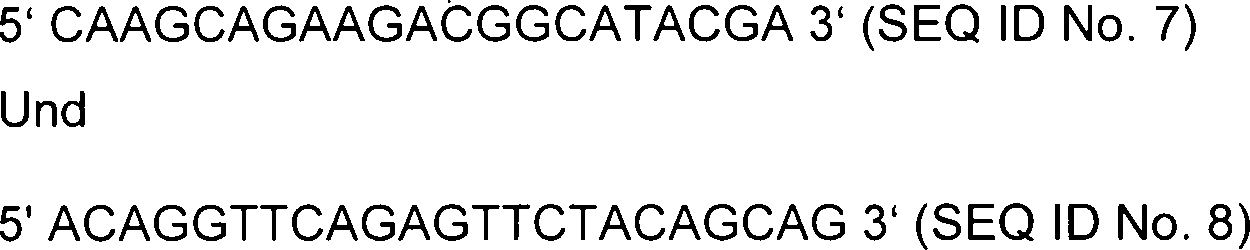
Die PCR-Produkte werden auf ein 8% iges Polyacrylamidgel aufgetragen. Nach Färben mit Ethidiumbromid und Visualisieren unter UV-Licht wird eine 79 Bp Marker-Adapter-TAG Bande im Gel sichtbar. Danach wird für präparative Zwecke ein 200 μl PCR-Ansatz mit derjenigen Verdünnung durchgeführt, welche die beste Amplifikation ergab.The PCR products are applied to an 8% polyacrylamide gel. After staining with ethidium bromide and visualizing under UV light, a 79 bp marker adapter TAG band is visible in the gel. After that For preparative purposes, a 200 μl PCR mix is run at the dilution which gave the best amplification.
Reinigung der Linker-TAG-RAT Fragmente:Purification of Linker TAG RAT Fragments:
Die Produkte der präparativen PCR werden erneut auf ein 8% iges Polyacrylamidgel aufgetragen und das Gelstück mit der 79 Basenpaar (Bp) Bande mit einem Skalpell herausgeschnitten. In einem 1,5 ml Eppendorf-Gefäß wird das Gelstück mit einem Pistill zerkleinert und in 500 μl einer Elutionslösung (0,5 % NH4OAc, 2 mM EDTA 0,1% SDS) über Nacht bei 37°C inkubiert. Das eluierte RAT-Linker-TAG-Konstrukt wird anschließend mit Ethanol aus der Elutionslösung gefällt, 2 × mit 70% Ethanol gewaschen, getrocknet und in 10 μl LoTE rückgelöst.The products of the preparative PCR are reapplied to an 8% polyacrylamide gel and the gel piece with the 79 base pair (bp) band excised with a scalpel. In a 1.5 ml Eppendorf tube the gel piece is minced with a pestle and incubated in 500 μl of an elution solution (0.5% NH4OAc, 2 mM EDTA 0.1% SDS) overnight at 37 ° C. The eluted RAT-linker-TAG construct is then precipitated with ethanol from the elution solution, washed twice with 70% ethanol, dried and redissolved in 10 μl of LoTE.
Die Konzentration und Qualität des PCR Produktes wird mit einer Gelelektrophorese bestimmt. Zum Test wird ein Aliquot des gereinigten RAT-Linker-TAG-Konstrukts in den pGEM®-T Easy Vektor (Promega) ligiert, in den E. coli-Stamm DH5alpha transformiert, weiße-Kolonien selektiert und 5–10 RAT-Linker-TAG-Konstrukte enthaltende Plasmide mit dem Sanger-Verfahren sequenziert. Sieben der dabei erhaltenen, typischen Sequenzen mit unterschiedlichen PB-RAT-TAG-LS-TES-PB'-Konstrukten sind unten aufgelistet. Jeder TAG ist eindeutig mit einem RAT markiert. Die RAT-Domänen der Konstrukte sind dabei fett markiert, die TAG-Domänen kursiv dargestellt. Klon 1 


Mit Hilfe einer BLAST-Recherche mit dem RAT-TAG Konstrukt in GenBank konnten die einzelnen TAGs jeweils einem bestimmten humanen Gen zugeordnet werden (Tabelle 1): Tabelle 1: Tabellarische Zusammenstellung der Ergebnisse der BLAST-Recherche 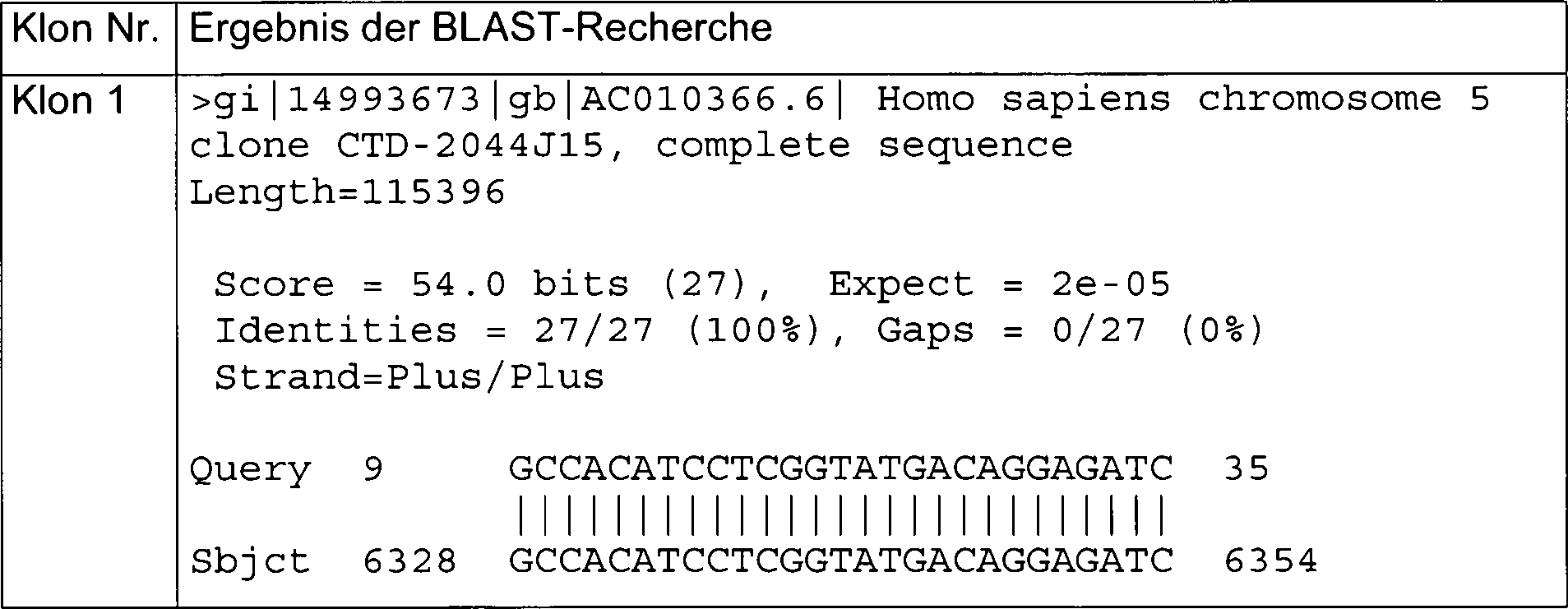
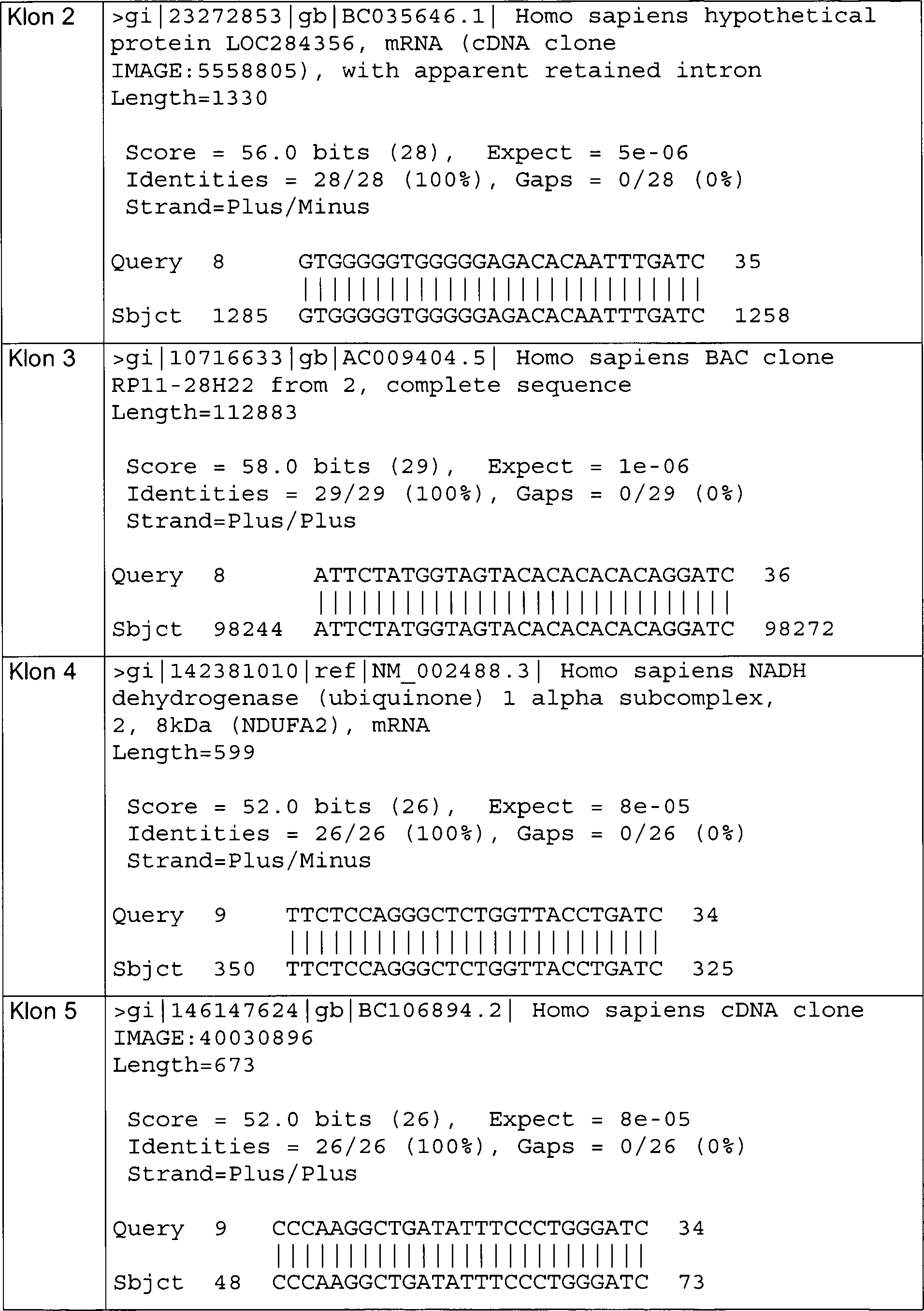

Es folgt ein Sequenzprotokoll nach WIPO St. 25.This is followed by a sequence protocol according to WIPO St. 25. Dieses kann von der amtlichen Veröffentlichungsplattform des DPMA heruntergeladen werden.This can be downloaded from the official publication platform of the DPMA.
Claims (14)
Priority Applications (2)
| Application Number | Priority Date | Filing Date | Title |
|---|---|---|---|
| DE102008025656.0A DE102008025656B4 (en) | 2008-05-28 | 2008-05-28 | Method for the quantitative analysis of nucleic acids, markers therefor and their use |
| PCT/EP2009/003709 WO2009152928A2 (en) | 2008-05-28 | 2009-05-26 | Method for the quantitative analysis of nucleic acids, markers therefor and their use |
Applications Claiming Priority (1)
| Application Number | Priority Date | Filing Date | Title |
|---|---|---|---|
| DE102008025656.0A DE102008025656B4 (en) | 2008-05-28 | 2008-05-28 | Method for the quantitative analysis of nucleic acids, markers therefor and their use |
Publications (2)
| Publication Number | Publication Date |
|---|---|
| DE102008025656A1 DE102008025656A1 (en) | 2009-12-03 |
| DE102008025656B4 true DE102008025656B4 (en) | 2016-07-28 |
Family
ID=41253846
Family Applications (1)
| Application Number | Title | Priority Date | Filing Date |
|---|---|---|---|
| DE102008025656.0A Active DE102008025656B4 (en) | 2008-05-28 | 2008-05-28 | Method for the quantitative analysis of nucleic acids, markers therefor and their use |
Country Status (2)
| Country | Link |
|---|---|
| DE (1) | DE102008025656B4 (en) |
| WO (1) | WO2009152928A2 (en) |
Cited By (2)
| Publication number | Priority date | Publication date | Assignee | Title |
|---|---|---|---|---|
| US9567645B2 (en) | 2013-08-28 | 2017-02-14 | Cellular Research, Inc. | Massively parallel single cell analysis |
| US11845986B2 (en) | 2016-05-25 | 2023-12-19 | Becton, Dickinson And Company | Normalization of nucleic acid libraries |
Families Citing this family (207)
| Publication number | Priority date | Publication date | Assignee | Title |
|---|---|---|---|---|
| US9506119B2 (en) | 2008-11-07 | 2016-11-29 | Adaptive Biotechnologies Corp. | Method of sequence determination using sequence tags |
| EP4335932A3 (en) | 2008-11-07 | 2024-06-26 | Adaptive Biotechnologies Corporation | Methods of monitoring conditions by sequence analysis |
| US8628927B2 (en) | 2008-11-07 | 2014-01-14 | Sequenta, Inc. | Monitoring health and disease status using clonotype profiles |
| PL2387627T3 (en) | 2009-01-15 | 2016-10-31 | Adaptive immunity profiling and methods for generation of monoclonal antibodies | |
| WO2010127186A1 (en) | 2009-04-30 | 2010-11-04 | Prognosys Biosciences, Inc. | Nucleic acid constructs and methods of use |
| JP2012531202A (en) | 2009-06-25 | 2012-12-10 | フレッド ハチンソン キャンサー リサーチ センター | How to measure adaptive immunity |
| US9315857B2 (en) | 2009-12-15 | 2016-04-19 | Cellular Research, Inc. | Digital counting of individual molecules by stochastic attachment of diverse label-tags |
| US8835358B2 (en) | 2009-12-15 | 2014-09-16 | Cellular Research, Inc. | Digital counting of individual molecules by stochastic attachment of diverse labels |
| US20190300945A1 (en) | 2010-04-05 | 2019-10-03 | Prognosys Biosciences, Inc. | Spatially Encoded Biological Assays |
| SI2556171T1 (en) | 2010-04-05 | 2016-03-31 | Prognosys Biosciences, Inc. | Spatially encoded biological assays |
| US10787701B2 (en) | 2010-04-05 | 2020-09-29 | Prognosys Biosciences, Inc. | Spatially encoded biological assays |
| PT2623613T (en) | 2010-09-21 | 2016-10-11 | Population Genetics Tech Ltd | Increasing confidence of allele calls with molecular counting |
| WO2012042374A2 (en) * | 2010-10-01 | 2012-04-05 | Anssi Jussi Nikolai Taipale | Method of determining number or concentration of molecules |
| EP3461914A1 (en) | 2010-10-22 | 2019-04-03 | Cold Spring Harbor Laboratory | Varietal counting of nucleic acids for obtaining genomic copy number information |
| GB201106254D0 (en) | 2011-04-13 | 2011-05-25 | Frisen Jonas | Method and product |
| HUE068153T2 (en) | 2011-04-15 | 2024-12-28 | Univ Johns Hopkins | Safe sequencing system |
| EP2710172B1 (en) * | 2011-05-20 | 2017-03-29 | Fluidigm Corporation | Nucleic acid encoding reactions |
| SMT202100154T1 (en) | 2012-02-17 | 2021-05-07 | Hutchinson Fred Cancer Res | COMPOSITIONS AND METHODS TO PRECISELY IDENTIFY MUTATIONS |
| JP6375230B2 (en) * | 2012-02-27 | 2018-08-15 | セルラー リサーチ, インコーポレイテッド | Compositions and kits for molecular counting |
| EP2820174B1 (en) | 2012-02-27 | 2019-12-25 | The University of North Carolina at Chapel Hill | Methods and uses for molecular tags |
| EP2820155B1 (en) | 2012-02-28 | 2017-07-26 | Population Genetics Technologies Ltd. | Method for attaching a counter sequence to a nucleic acid sample |
| ES2662128T3 (en) | 2012-03-05 | 2018-04-05 | Adaptive Biotechnologies Corporation | Determination of paired immune receptor chains from the frequency of matching subunits |
| MX354329B (en) | 2012-05-08 | 2018-02-27 | Adaptive Biotechnologies Corp | Compositions and method for measuring and calibrating amplification bias in multiplexed pcr reactions. |
| PT2850211T (en) * | 2012-05-14 | 2021-11-29 | Irepertoire Inc | Method for increasing accuracy in quantitative detection of polynucleotides |
| US10400280B2 (en) | 2012-08-14 | 2019-09-03 | 10X Genomics, Inc. | Methods and systems for processing polynucleotides |
| CA2881685C (en) | 2012-08-14 | 2023-12-05 | 10X Genomics, Inc. | Microcapsule compositions and methods |
| US10323279B2 (en) | 2012-08-14 | 2019-06-18 | 10X Genomics, Inc. | Methods and systems for processing polynucleotides |
| US9701998B2 (en) | 2012-12-14 | 2017-07-11 | 10X Genomics, Inc. | Methods and systems for processing polynucleotides |
| US11591637B2 (en) | 2012-08-14 | 2023-02-28 | 10X Genomics, Inc. | Compositions and methods for sample processing |
| GB2533006B (en) | 2012-09-04 | 2017-06-07 | Guardant Health Inc | Systems and methods to detect copy number variation |
| US11913065B2 (en) | 2012-09-04 | 2024-02-27 | Guardent Health, Inc. | Systems and methods to detect rare mutations and copy number variation |
| US10876152B2 (en) | 2012-09-04 | 2020-12-29 | Guardant Health, Inc. | Systems and methods to detect rare mutations and copy number variation |
| US20160040229A1 (en) | 2013-08-16 | 2016-02-11 | Guardant Health, Inc. | Systems and methods to detect rare mutations and copy number variation |
| EP3901280B1 (en) | 2012-10-17 | 2025-03-12 | 10x Genomics Sweden AB | Methods and product for optimising localised or spatial detection of gene expression in a tissue sample |
| WO2015160439A2 (en) | 2014-04-17 | 2015-10-22 | Adaptive Biotechnologies Corporation | Quantification of adaptive immune cell genomes in a complex mixture of cells |
| ES2886507T5 (en) | 2012-10-29 | 2024-11-15 | Univ Johns Hopkins | Pap test for ovarian and endometrial cancers |
| US10533221B2 (en) | 2012-12-14 | 2020-01-14 | 10X Genomics, Inc. | Methods and systems for processing polynucleotides |
| EP2954104B1 (en) | 2013-02-08 | 2020-09-16 | 10X Genomics, Inc. | Polynucleotide barcode generation |
| US10227584B2 (en) * | 2013-02-20 | 2019-03-12 | Emory University | Methods of sequencing nucleic acids in mixtures and compositions related thereto |
| EP2970958B1 (en) | 2013-03-15 | 2017-12-06 | Lineage Biosciences, Inc. | Methods of sequencing the immune repertoire |
| CN105849275B (en) | 2013-06-25 | 2020-03-17 | 普罗格诺西斯生物科学公司 | Method and system for detecting spatial distribution of biological targets in a sample |
| US9708657B2 (en) | 2013-07-01 | 2017-07-18 | Adaptive Biotechnologies Corp. | Method for generating clonotype profiles using sequence tags |
| US10395758B2 (en) | 2013-08-30 | 2019-08-27 | 10X Genomics, Inc. | Sequencing methods |
| EP3055676A1 (en) | 2013-10-07 | 2016-08-17 | Cellular Research, Inc. | Methods and systems for digitally counting features on arrays |
| US10927408B2 (en) | 2013-12-02 | 2021-02-23 | Personal Genome Diagnostics, Inc. | Method for evaluating minority variants in a sample |
| US9824068B2 (en) | 2013-12-16 | 2017-11-21 | 10X Genomics, Inc. | Methods and apparatus for sorting data |
| EP3378952B1 (en) | 2013-12-28 | 2020-02-05 | Guardant Health, Inc. | Methods and systems for detecting genetic variants |
| CA2941612A1 (en) | 2014-03-05 | 2015-09-11 | Adaptive Biotechnologies Corporation | Methods using randomer-containing synthetic molecules |
| US10066265B2 (en) | 2014-04-01 | 2018-09-04 | Adaptive Biotechnologies Corp. | Determining antigen-specific t-cells |
| US12312640B2 (en) | 2014-06-26 | 2025-05-27 | 10X Genomics, Inc. | Analysis of nucleic acid sequences |
| EP4574974A3 (en) | 2014-06-26 | 2025-10-08 | 10x Genomics, Inc. | Methods of analyzing nucleic acids from individual cells or cell populations |
| JP2017522866A (en) | 2014-06-26 | 2017-08-17 | 10エックス ジェノミクス, インコーポレイテッド | Nucleic acid sequence analysis |
| ES2784343T3 (en) | 2014-10-29 | 2020-09-24 | Adaptive Biotechnologies Corp | Simultaneous, highly multiplexed detection of nucleic acids encoding paired adaptive immune receptor heterodimers from many samples |
| US10246701B2 (en) | 2014-11-14 | 2019-04-02 | Adaptive Biotechnologies Corp. | Multiplexed digital quantitation of rearranged lymphoid receptors in a complex mixture |
| BR112017014902A2 (en) | 2015-01-12 | 2018-03-13 | 10X Genomics Inc | processes and systems for the preparation of nucleic acid sequencing libraries and libraries prepared using them |
| US10697010B2 (en) | 2015-02-19 | 2020-06-30 | Becton, Dickinson And Company | High-throughput single-cell analysis combining proteomic and genomic information |
| AU2016222788B2 (en) | 2015-02-24 | 2022-03-31 | Adaptive Biotechnologies Corp. | Methods for diagnosing infectious disease and determining HLA status using immune repertoire sequencing |
| ES2836802T3 (en) | 2015-02-27 | 2021-06-28 | Becton Dickinson Co | Spatially addressable molecular barcodes |
| CN107406888A (en) | 2015-03-30 | 2017-11-28 | 赛卢拉研究公司 | Methods and compositions for combining barcoding |
| EP3277294B1 (en) | 2015-04-01 | 2024-05-15 | Adaptive Biotechnologies Corp. | Method of identifying human compatible t cell receptors specific for an antigenic target |
| CA2982146A1 (en) | 2015-04-10 | 2016-10-13 | Spatial Transcriptomics Ab | Spatially distinguished, multiplex nucleic acid analysis of biological specimens |
| EP4582556A3 (en) | 2015-04-23 | 2025-10-08 | Becton, Dickinson and Company | Methods and compositions for whole transcriptome amplification |
| US11124823B2 (en) | 2015-06-01 | 2021-09-21 | Becton, Dickinson And Company | Methods for RNA quantification |
| US11286531B2 (en) | 2015-08-11 | 2022-03-29 | The Johns Hopkins University | Assaying ovarian cyst fluid |
| WO2017044574A1 (en) | 2015-09-11 | 2017-03-16 | Cellular Research, Inc. | Methods and compositions for nucleic acid library normalization |
| US11371094B2 (en) | 2015-11-19 | 2022-06-28 | 10X Genomics, Inc. | Systems and methods for nucleic acid processing using degenerate nucleotides |
| SG11201805119QA (en) | 2015-12-17 | 2018-07-30 | Guardant Health Inc | Methods to determine tumor gene copy number by analysis of cell-free dna |
| EP3414341A4 (en) | 2016-02-11 | 2019-10-09 | 10X Genomics, Inc. | SYSTEMS, METHODS, AND MEDIA FOR ASSEMBLING NOVO OF GENOME SEQUENCE DATA OVERALL |
| US10822643B2 (en) | 2016-05-02 | 2020-11-03 | Cellular Research, Inc. | Accurate molecular barcoding |
| ES2979395T3 (en) | 2016-05-26 | 2024-09-25 | Becton Dickinson Co | Molecular tag count adjustment methods |
| US10202641B2 (en) | 2016-05-31 | 2019-02-12 | Cellular Research, Inc. | Error correction in amplification of samples |
| US10640763B2 (en) | 2016-05-31 | 2020-05-05 | Cellular Research, Inc. | Molecular indexing of internal sequences |
| US10428325B1 (en) | 2016-09-21 | 2019-10-01 | Adaptive Biotechnologies Corporation | Identification of antigen-specific B cell receptors |
| EP4300099A3 (en) | 2016-09-26 | 2024-03-27 | Becton, Dickinson and Company | Measurement of protein expression using reagents with barcoded oligonucleotide sequences |
| CN117056774B (en) | 2016-11-08 | 2026-01-27 | 贝克顿迪金森公司 | Methods for cell marker classification |
| CN117594126A (en) | 2016-11-08 | 2024-02-23 | 贝克顿迪金森公司 | Method for classifying expression profiles |
| US10815525B2 (en) | 2016-12-22 | 2020-10-27 | 10X Genomics, Inc. | Methods and systems for processing polynucleotides |
| US10550429B2 (en) | 2016-12-22 | 2020-02-04 | 10X Genomics, Inc. | Methods and systems for processing polynucleotides |
| ES2961580T3 (en) | 2017-01-13 | 2024-03-12 | Cellular Res Inc | Hydrophilic coating of fluid channels |
| CA3198931A1 (en) | 2017-01-20 | 2018-07-26 | Sequenom, Inc. | Methods for non-invasive assessment of genetic alterations |
| CN110214186B (en) | 2017-01-30 | 2023-11-24 | 10X基因组学有限公司 | Methods and systems for droplet-based single cell barcoding |
| US12264411B2 (en) | 2017-01-30 | 2025-04-01 | 10X Genomics, Inc. | Methods and systems for analysis |
| EP3577232A1 (en) | 2017-02-01 | 2019-12-11 | Cellular Research, Inc. | Selective amplification using blocking oligonucleotides |
| US10995333B2 (en) | 2017-02-06 | 2021-05-04 | 10X Genomics, Inc. | Systems and methods for nucleic acid preparation |
| US11584958B2 (en) | 2017-03-31 | 2023-02-21 | Grail, Llc | Library preparation and use thereof for sequencing based error correction and/or variant identification |
| EP4345172A3 (en) | 2017-06-05 | 2024-07-03 | Becton, Dickinson and Company | Sample indexing for single cells |
| SG11202001010UA (en) | 2017-08-07 | 2020-03-30 | Univ Johns Hopkins | Methods and materials for assessing and treating cancer |
| US10837047B2 (en) | 2017-10-04 | 2020-11-17 | 10X Genomics, Inc. | Compositions, methods, and systems for bead formation using improved polymers |
| WO2019084043A1 (en) | 2017-10-26 | 2019-05-02 | 10X Genomics, Inc. | Methods and systems for nuclecic acid preparation and chromatin analysis |
| EP3700672B1 (en) | 2017-10-27 | 2022-12-28 | 10X Genomics, Inc. | Methods for sample preparation and analysis |
| WO2019099751A1 (en) | 2017-11-15 | 2019-05-23 | 10X Genomics, Inc. | Functionalized gel beads |
| US11254980B1 (en) | 2017-11-29 | 2022-02-22 | Adaptive Biotechnologies Corporation | Methods of profiling targeted polynucleotides while mitigating sequencing depth requirements |
| WO2019108851A1 (en) | 2017-11-30 | 2019-06-06 | 10X Genomics, Inc. | Systems and methods for nucleic acid preparation and analysis |
| CN118818037A (en) | 2017-12-12 | 2024-10-22 | 10X基因组学有限公司 | Systems and methods for single cell processing |
| US11946095B2 (en) | 2017-12-19 | 2024-04-02 | Becton, Dickinson And Company | Particles associated with oligonucleotides |
| WO2019126789A1 (en) | 2017-12-22 | 2019-06-27 | 10X Genomics, Inc. | Systems and methods for processing nucleic acid molecules from one or more cells |
| EP3752832A1 (en) | 2018-02-12 | 2020-12-23 | 10X Genomics, Inc. | Methods characterizing multiple analytes from individual cells or cell populations |
| US11639928B2 (en) | 2018-02-22 | 2023-05-02 | 10X Genomics, Inc. | Methods and systems for characterizing analytes from individual cells or cell populations |
| WO2019169028A1 (en) | 2018-02-28 | 2019-09-06 | 10X Genomics, Inc. | Transcriptome sequencing through random ligation |
| CN112262218B (en) | 2018-04-06 | 2024-11-08 | 10X基因组学有限公司 | Systems and methods for quality control in single cell processing |
| US11773441B2 (en) | 2018-05-03 | 2023-10-03 | Becton, Dickinson And Company | High throughput multiomics sample analysis |
| US11365409B2 (en) | 2018-05-03 | 2022-06-21 | Becton, Dickinson And Company | Molecular barcoding on opposite transcript ends |
| WO2019217758A1 (en) | 2018-05-10 | 2019-11-14 | 10X Genomics, Inc. | Methods and systems for molecular library generation |
| US11932899B2 (en) | 2018-06-07 | 2024-03-19 | 10X Genomics, Inc. | Methods and systems for characterizing nucleic acid molecules |
| US11703427B2 (en) | 2018-06-25 | 2023-07-18 | 10X Genomics, Inc. | Methods and systems for cell and bead processing |
| US12188014B1 (en) | 2018-07-25 | 2025-01-07 | 10X Genomics, Inc. | Compositions and methods for nucleic acid processing using blocking agents |
| US20200032335A1 (en) | 2018-07-27 | 2020-01-30 | 10X Genomics, Inc. | Systems and methods for metabolome analysis |
| CN112703252B (en) | 2018-08-03 | 2024-09-10 | 10X基因组学有限公司 | Method and system for minimizing barcode exchange |
| US12065688B2 (en) | 2018-08-20 | 2024-08-20 | 10X Genomics, Inc. | Compositions and methods for cellular processing |
| WO2020041148A1 (en) | 2018-08-20 | 2020-02-27 | 10X Genomics, Inc. | Methods and systems for detection of protein-dna interactions using proximity ligation |
| US11519033B2 (en) | 2018-08-28 | 2022-12-06 | 10X Genomics, Inc. | Method for transposase-mediated spatial tagging and analyzing genomic DNA in a biological sample |
| JP7670607B2 (en) | 2018-10-01 | 2025-04-30 | ベクトン・ディキンソン・アンド・カンパニー | Determination of 5' transcript sequence |
| EP3877520B1 (en) | 2018-11-08 | 2025-03-19 | Becton, Dickson And Company | Whole transcriptome analysis of single cells using random priming |
| US11459607B1 (en) | 2018-12-10 | 2022-10-04 | 10X Genomics, Inc. | Systems and methods for processing-nucleic acid molecules from a single cell using sequential co-partitioning and composite barcodes |
| WO2020123309A1 (en) | 2018-12-10 | 2020-06-18 | 10X Genomics, Inc. | Resolving spatial arrays by proximity-based deconvolution |
| US11492660B2 (en) | 2018-12-13 | 2022-11-08 | Becton, Dickinson And Company | Selective extension in single cell whole transcriptome analysis |
| US11926867B2 (en) | 2019-01-06 | 2024-03-12 | 10X Genomics, Inc. | Generating capture probes for spatial analysis |
| US11649485B2 (en) | 2019-01-06 | 2023-05-16 | 10X Genomics, Inc. | Generating capture probes for spatial analysis |
| US12169198B2 (en) | 2019-01-08 | 2024-12-17 | 10X Genomics, Inc. | Systems and methods for sample analysis |
| US11845983B1 (en) | 2019-01-09 | 2023-12-19 | 10X Genomics, Inc. | Methods and systems for multiplexing of droplet based assays |
| WO2020150356A1 (en) | 2019-01-16 | 2020-07-23 | Becton, Dickinson And Company | Polymerase chain reaction normalization through primer titration |
| WO2020154247A1 (en) | 2019-01-23 | 2020-07-30 | Cellular Research, Inc. | Oligonucleotides associated with antibodies |
| US11584953B2 (en) | 2019-02-12 | 2023-02-21 | 10X Genomics, Inc. | Methods for processing nucleic acid molecules |
| WO2020167862A1 (en) | 2019-02-12 | 2020-08-20 | 10X Genomics, Inc. | Systems and methods for transfer of reagents between droplets |
| US11467153B2 (en) | 2019-02-12 | 2022-10-11 | 10X Genomics, Inc. | Methods for processing nucleic acid molecules |
| US12305239B2 (en) | 2019-02-12 | 2025-05-20 | 10X Genomics, Inc. | Analysis of nucleic acid sequences |
| WO2020167866A1 (en) | 2019-02-12 | 2020-08-20 | 10X Genomics, Inc. | Systems and methods for transposon loading |
| US11851683B1 (en) | 2019-02-12 | 2023-12-26 | 10X Genomics, Inc. | Methods and systems for selective analysis of cellular samples |
| US12275993B2 (en) | 2019-02-12 | 2025-04-15 | 10X Genomics, Inc. | Analysis of nucleic acid sequences |
| EP3924506A1 (en) | 2019-02-14 | 2021-12-22 | Becton Dickinson and Company | Hybrid targeted and whole transcriptome amplification |
| US11655499B1 (en) | 2019-02-25 | 2023-05-23 | 10X Genomics, Inc. | Detection of sequence elements in nucleic acid molecules |
| SG11202111242PA (en) | 2019-03-11 | 2021-11-29 | 10X Genomics Inc | Systems and methods for processing optically tagged beads |
| WO2020214642A1 (en) | 2019-04-19 | 2020-10-22 | Becton, Dickinson And Company | Methods of associating phenotypical data and single cell sequencing data |
| EP3976820A1 (en) | 2019-05-30 | 2022-04-06 | 10X Genomics, Inc. | Methods of detecting spatial heterogeneity of a biological sample |
| CN114051534B (en) | 2019-07-22 | 2025-02-21 | 贝克顿迪金森公司 | Single-cell chromatin immunoprecipitation sequencing assay |
| US12235262B1 (en) | 2019-09-09 | 2025-02-25 | 10X Genomics, Inc. | Methods and systems for single cell protein analysis |
| US11773436B2 (en) | 2019-11-08 | 2023-10-03 | Becton, Dickinson And Company | Using random priming to obtain full-length V(D)J information for immune repertoire sequencing |
| WO2021091611A1 (en) | 2019-11-08 | 2021-05-14 | 10X Genomics, Inc. | Spatially-tagged analyte capture agents for analyte multiplexing |
| WO2021092433A2 (en) | 2019-11-08 | 2021-05-14 | 10X Genomics, Inc. | Enhancing specificity of analyte binding |
| CN110804655B (en) * | 2019-11-15 | 2023-06-02 | 康美华大基因技术有限公司 | Absolute quantification method for metagenome |
| EP3891300B1 (en) | 2019-12-23 | 2023-03-29 | 10X Genomics, Inc. | Methods for spatial analysis using rna-templated ligation |
| WO2021133842A1 (en) | 2019-12-23 | 2021-07-01 | 10X Genomics, Inc. | Compositions and methods for using fixed biological samples in partition-based assays |
| WO2021146207A1 (en) | 2020-01-13 | 2021-07-22 | Becton, Dickinson And Company | Methods and compositions for quantitation of proteins and rna |
| US12365942B2 (en) | 2020-01-13 | 2025-07-22 | 10X Genomics, Inc. | Methods of decreasing background on a spatial array |
| US12405264B2 (en) | 2020-01-17 | 2025-09-02 | 10X Genomics, Inc. | Electrophoretic system and method for analyte capture |
| US11732299B2 (en) | 2020-01-21 | 2023-08-22 | 10X Genomics, Inc. | Spatial assays with perturbed cells |
| US11702693B2 (en) | 2020-01-21 | 2023-07-18 | 10X Genomics, Inc. | Methods for printing cells and generating arrays of barcoded cells |
| US20210230681A1 (en) | 2020-01-24 | 2021-07-29 | 10X Genomics, Inc. | Methods for spatial analysis using proximity ligation |
| WO2021155057A1 (en) | 2020-01-29 | 2021-08-05 | Becton, Dickinson And Company | Barcoded wells for spatial mapping of single cells through sequencing |
| US11821035B1 (en) | 2020-01-29 | 2023-11-21 | 10X Genomics, Inc. | Compositions and methods of making gene expression libraries |
| US12076701B2 (en) | 2020-01-31 | 2024-09-03 | 10X Genomics, Inc. | Capturing oligonucleotides in spatial transcriptomics |
| US12110541B2 (en) | 2020-02-03 | 2024-10-08 | 10X Genomics, Inc. | Methods for preparing high-resolution spatial arrays |
| US11898205B2 (en) | 2020-02-03 | 2024-02-13 | 10X Genomics, Inc. | Increasing capture efficiency of spatial assays |
| US11732300B2 (en) | 2020-02-05 | 2023-08-22 | 10X Genomics, Inc. | Increasing efficiency of spatial analysis in a biological sample |
| US12129516B2 (en) | 2020-02-07 | 2024-10-29 | 10X Genomics, Inc. | Quantitative and automated permeabilization performance evaluation for spatial transcriptomics |
| US11835462B2 (en) | 2020-02-11 | 2023-12-05 | 10X Genomics, Inc. | Methods and compositions for partitioning a biological sample |
| US12449419B1 (en) | 2020-02-12 | 2025-10-21 | 10X Genomics, Inc. | Methods for detecting binding of peptide-MHC monomers to T cells |
| AU2021219794A1 (en) | 2020-02-14 | 2022-09-08 | The Johns Hopkins University | Methods and materials for assessing nucleic acids |
| US12281357B1 (en) | 2020-02-14 | 2025-04-22 | 10X Genomics, Inc. | In situ spatial barcoding |
| US12399123B1 (en) | 2020-02-14 | 2025-08-26 | 10X Genomics, Inc. | Spatial targeting of analytes |
| US11891654B2 (en) | 2020-02-24 | 2024-02-06 | 10X Genomics, Inc. | Methods of making gene expression libraries |
| WO2021173719A1 (en) | 2020-02-25 | 2021-09-02 | Becton, Dickinson And Company | Bi-specific probes to enable the use of single-cell samples as single color compensation control |
| US11926863B1 (en) | 2020-02-27 | 2024-03-12 | 10X Genomics, Inc. | Solid state single cell method for analyzing fixed biological cells |
| US11768175B1 (en) | 2020-03-04 | 2023-09-26 | 10X Genomics, Inc. | Electrophoretic methods for spatial analysis |
| WO2021216708A1 (en) | 2020-04-22 | 2021-10-28 | 10X Genomics, Inc. | Methods for spatial analysis using targeted rna depletion |
| US11851700B1 (en) | 2020-05-13 | 2023-12-26 | 10X Genomics, Inc. | Methods, kits, and compositions for processing extracellular molecules |
| WO2021231779A1 (en) | 2020-05-14 | 2021-11-18 | Becton, Dickinson And Company | Primers for immune repertoire profiling |
| US12416603B2 (en) | 2020-05-19 | 2025-09-16 | 10X Genomics, Inc. | Electrophoresis cassettes and instrumentation |
| WO2021237087A1 (en) | 2020-05-22 | 2021-11-25 | 10X Genomics, Inc. | Spatial analysis to detect sequence variants |
| WO2021236929A1 (en) | 2020-05-22 | 2021-11-25 | 10X Genomics, Inc. | Simultaneous spatio-temporal measurement of gene expression and cellular activity |
| WO2021242834A1 (en) | 2020-05-26 | 2021-12-02 | 10X Genomics, Inc. | Method for resetting an array |
| US12265079B1 (en) | 2020-06-02 | 2025-04-01 | 10X Genomics, Inc. | Systems and methods for detecting analytes from captured single biological particles |
| CN116249785A (en) | 2020-06-02 | 2023-06-09 | 10X基因组学有限公司 | Spatial Transcriptomics for Antigen-Receptors |
| EP4025692A2 (en) | 2020-06-02 | 2022-07-13 | 10X Genomics, Inc. | Nucleic acid library methods |
| WO2021247593A1 (en) | 2020-06-02 | 2021-12-09 | Becton, Dickinson And Company | Oligonucleotides and beads for 5 prime gene expression assay |
| US12031177B1 (en) | 2020-06-04 | 2024-07-09 | 10X Genomics, Inc. | Methods of enhancing spatial resolution of transcripts |
| ES2981265T3 (en) | 2020-06-08 | 2024-10-08 | 10X Genomics Inc | Methods for determining a surgical margin and methods of using it |
| AU2021288090A1 (en) | 2020-06-10 | 2023-01-19 | 10X Genomics, Inc. | Fluid delivery methods |
| EP4446430A3 (en) | 2020-06-10 | 2024-12-18 | 10X Genomics, Inc. | Methods for determining a location of an analyte in a biological sample |
| US12435363B1 (en) | 2020-06-10 | 2025-10-07 | 10X Genomics, Inc. | Materials and methods for spatial transcriptomics |
| EP4450639B1 (en) | 2020-06-25 | 2025-10-15 | 10X Genomics, Inc. | Spatial analysis of dna methylation |
| US12209280B1 (en) | 2020-07-06 | 2025-01-28 | 10X Genomics, Inc. | Methods of identifying abundance and location of an analyte in a biological sample using second strand synthesis |
| US11761038B1 (en) | 2020-07-06 | 2023-09-19 | 10X Genomics, Inc. | Methods for identifying a location of an RNA in a biological sample |
| US11981960B1 (en) | 2020-07-06 | 2024-05-14 | 10X Genomics, Inc. | Spatial analysis utilizing degradable hydrogels |
| US11932901B2 (en) | 2020-07-13 | 2024-03-19 | Becton, Dickinson And Company | Target enrichment using nucleic acid probes for scRNAseq |
| US12391940B2 (en) | 2020-07-31 | 2025-08-19 | Becton, Dickinson And Company | Single cell assay for transposase-accessible chromatin |
| US11981958B1 (en) | 2020-08-20 | 2024-05-14 | 10X Genomics, Inc. | Methods for spatial analysis using DNA capture |
| AU2021345283B2 (en) | 2020-09-18 | 2024-12-19 | 10X Genomics, Inc. | Sample handling apparatus and image registration methods |
| US11926822B1 (en) | 2020-09-23 | 2024-03-12 | 10X Genomics, Inc. | Three-dimensional spatial analysis |
| US12084715B1 (en) | 2020-11-05 | 2024-09-10 | 10X Genomics, Inc. | Methods and systems for reducing artifactual antisense products |
| US12480158B1 (en) | 2020-11-05 | 2025-11-25 | 10X Genomics, Inc. | Methods and systems for processing polynucleotides |
| US11827935B1 (en) | 2020-11-19 | 2023-11-28 | 10X Genomics, Inc. | Methods for spatial analysis using rolling circle amplification and detection probes |
| EP4247967A1 (en) | 2020-11-20 | 2023-09-27 | Becton, Dickinson and Company | Profiling of highly expressed and lowly expressed proteins |
| WO2022132206A1 (en) | 2020-12-15 | 2022-06-23 | Becton, Dickinson And Company | Single cell secretome analysis |
| AU2021409136A1 (en) | 2020-12-21 | 2023-06-29 | 10X Genomics, Inc. | Methods, compositions, and systems for capturing probes and/or barcodes |
| US12398262B1 (en) | 2021-01-22 | 2025-08-26 | 10X Genomics, Inc. | Triblock copolymer-based cell stabilization and fixation system and methods of use thereof |
| EP4294571B8 (en) | 2021-02-19 | 2024-07-10 | 10X Genomics, Inc. | Method of using a modular assay support device |
| CN117015617B (en) | 2021-02-23 | 2025-04-04 | 10X基因组学有限公司 | Probe-based nucleic acid and protein analysis |
| WO2022198068A1 (en) | 2021-03-18 | 2022-09-22 | 10X Genomics, Inc. | Multiplex capture of gene and protein expression from a biological sample |
| EP4428246B1 (en) | 2021-04-14 | 2025-12-24 | 10X Genomics, Inc. | Methods of measuring mislocalization of an analyte |
| EP4320271B1 (en) | 2021-05-06 | 2025-03-19 | 10X Genomics, Inc. | Methods for increasing resolution of spatial analysis |
| EP4582555A3 (en) | 2021-06-03 | 2025-10-22 | 10X Genomics, Inc. | Methods, compositions, kits, and systems for enhancing analyte capture for spatial analysis |
| WO2023034489A1 (en) | 2021-09-01 | 2023-03-09 | 10X Genomics, Inc. | Methods, compositions, and kits for blocking a capture probe on a spatial array |
| EP4419707A1 (en) | 2021-11-10 | 2024-08-28 | 10X Genomics, Inc. | Methods, compositions, and kits for determining the location of an analyte in a biological sample |
| EP4305195A2 (en) | 2021-12-01 | 2024-01-17 | 10X Genomics, Inc. | Methods, compositions, and systems for improved in situ detection of analytes and spatial analysis |
| WO2023122033A1 (en) | 2021-12-20 | 2023-06-29 | 10X Genomics, Inc. | Self-test for pathology/histology slide imaging device |
| WO2025011736A1 (en) | 2023-07-07 | 2025-01-16 | Genxpro Gmbh | A METHOD FOR AN IN VITRO DIAGNOSIS, PROGNOSIS, STAGING AND/OR TREATMENT MONITORING OF A NEURODEGENERATIVE DISEASE, NEUROLOGICAL DISEASE OR AMYLOID β-RELATED DISEASE |
Citations (6)
| Publication number | Priority date | Publication date | Assignee | Title |
|---|---|---|---|---|
| WO2004015085A2 (en) * | 2002-08-09 | 2004-02-19 | California Institute Of Technology | Method and compositions relating to 5’-chimeric ribonucleic acids |
| WO2005111242A2 (en) * | 2004-05-10 | 2005-11-24 | Parallele Bioscience, Inc. | Digital profiling of polynucleotide populations |
| WO2006003721A1 (en) * | 2004-07-02 | 2006-01-12 | Kabushiki Kaisha Dnaform | Method for preparing sequence tags |
| US20070172854A1 (en) * | 2005-12-13 | 2007-07-26 | Iwate Prefectural Government | Gene expression analysis using array with immobilized tags of more than 25 bp (SuperSAGE-Array) |
| US20070172873A1 (en) * | 2006-01-23 | 2007-07-26 | Sydney Brenner | Molecular counting |
| US20080108804A1 (en) * | 2006-11-02 | 2008-05-08 | Kabushiki Kaisha Dnaform | Method for modifying RNAS and preparing DNAS from RNAS |
Family Cites Families (2)
| Publication number | Priority date | Publication date | Assignee | Title |
|---|---|---|---|---|
| US5695937A (en) | 1995-09-12 | 1997-12-09 | The Johns Hopkins University School Of Medicine | Method for serial analysis of gene expression |
| US6132997A (en) | 1999-05-28 | 2000-10-17 | Agilent Technologies | Method for linear mRNA amplification |
-
2008
- 2008-05-28 DE DE102008025656.0A patent/DE102008025656B4/en active Active
-
2009
- 2009-05-26 WO PCT/EP2009/003709 patent/WO2009152928A2/en not_active Ceased
Patent Citations (6)
| Publication number | Priority date | Publication date | Assignee | Title |
|---|---|---|---|---|
| WO2004015085A2 (en) * | 2002-08-09 | 2004-02-19 | California Institute Of Technology | Method and compositions relating to 5’-chimeric ribonucleic acids |
| WO2005111242A2 (en) * | 2004-05-10 | 2005-11-24 | Parallele Bioscience, Inc. | Digital profiling of polynucleotide populations |
| WO2006003721A1 (en) * | 2004-07-02 | 2006-01-12 | Kabushiki Kaisha Dnaform | Method for preparing sequence tags |
| US20070172854A1 (en) * | 2005-12-13 | 2007-07-26 | Iwate Prefectural Government | Gene expression analysis using array with immobilized tags of more than 25 bp (SuperSAGE-Array) |
| US20070172873A1 (en) * | 2006-01-23 | 2007-07-26 | Sydney Brenner | Molecular counting |
| US20080108804A1 (en) * | 2006-11-02 | 2008-05-08 | Kabushiki Kaisha Dnaform | Method for modifying RNAS and preparing DNAS from RNAS |
Non-Patent Citations (4)
| Title |
|---|
| GOWDA, M. [u.a.]: Robust analysis of 5'-transcript ends (5'-Rate): a novel technique for transcriptome analysis and genome annotation. Nucleic Acids Res. (2006) 34 (19), e126, 1-9 * |
| MATSUMURA, H. [u.a.]: SuperSAGE. Cellular Microbiology (2005) 7 (11) 11-18 * |
| MEYER, M. [u.a.]: Parallel tagged sequencing on the 454 platform. Nat. Protoc. (2008) 3 (2) 267-78 (elektronisch veröffentlicht am 31.01.2008) * |
| WONG, K.K. [u.a.]: Use of tagged random hexamer amplification (TRHA) to clone and sequence minute quantities of DNA-application to a 18 kb plasmid isolated from Sphingomonas F199. Nucleic Acids Res. (1996) 24 (19) 3778-3783 * |
Cited By (3)
| Publication number | Priority date | Publication date | Assignee | Title |
|---|---|---|---|---|
| US9567645B2 (en) | 2013-08-28 | 2017-02-14 | Cellular Research, Inc. | Massively parallel single cell analysis |
| US9598736B2 (en) | 2013-08-28 | 2017-03-21 | Cellular Research, Inc. | Massively parallel single cell analysis |
| US11845986B2 (en) | 2016-05-25 | 2023-12-19 | Becton, Dickinson And Company | Normalization of nucleic acid libraries |
Also Published As
| Publication number | Publication date |
|---|---|
| WO2009152928A2 (en) | 2009-12-23 |
| DE102008025656A1 (en) | 2009-12-03 |
| WO2009152928A3 (en) | 2010-02-25 |
Similar Documents
| Publication | Publication Date | Title |
|---|---|---|
| DE102008025656B4 (en) | Method for the quantitative analysis of nucleic acids, markers therefor and their use | |
| DE69621507T2 (en) | Method for molecular indexing of genes using restriction enzymes | |
| EP0743367B1 (en) | Gene expression analysis | |
| DE60025850T2 (en) | PROCESS FOR THE PRODUCTION OF OLIGONUCLEOTIDES, IN PARTICULAR FOR THE DETECTION OF AMPLIFIED RESTRICTION FRAGMENTS OBTAINED BY AFLP | |
| DE69913092T2 (en) | Microassay for serial analysis of gene expression and applications thereof | |
| DE69331786T2 (en) | A REPRESENTATIVE TREATMENT OF DNA ANALYSIS | |
| DE69825240T2 (en) | PROCESS FOR SUBTRACTIVE HYBRIDIZATION AND DIFFERENTIAL ANALYSIS | |
| DE69011101T2 (en) | METHODS FOR IN VITRO-DNA AMPLIFICATION, FOR GENOMIC CLONING AND FOR GENE-MAPPING. | |
| DE10056802B4 (en) | Method for the detection of methylation conditions for toxicological diagnostics | |
| DE69900592T2 (en) | METHOD FOR THE SPECIFIC AMPLIFICATION OF A NUCLEIC ACID | |
| DE60213803T2 (en) | HAPPIER MAPPING | |
| WO2001062961A1 (en) | Ligase/polymerase method for detecting cytosine methylation in dna samples | |
| AT502823B1 (en) | POLYNUCLEOTIDE AMPLIFICATION | |
| DE19920611A1 (en) | Modifying, cloning or amplifying cDNA comprises performing first strand synthesis in the presence of magnesium and manganese ions | |
| DE19806431C1 (en) | New method for the identification and characterization of mRNA molecules | |
| EP1960537A1 (en) | Process for determining the genotype from a biological sample containing nucleic acids of different individuals | |
| US20250163407A1 (en) | Methods selectively depleting nucleic acid using rnase h | |
| DE69326230T2 (en) | INSERTION ELEMENTS AND AMPLIFICABLE NUCLEIC ACIDS | |
| DE60318315T2 (en) | NUCLEIC ACID REPRODUCTIVE METHOD | |
| WO2003022986A2 (en) | Identification and quantification of nucleic acids by the production and serial sequencing of sequence tags having a uniform length | |
| DE102005048503B4 (en) | Method for controlling the section-wise enzymatic nucleic acid amplification via incomplete complementary strands | |
| WO2002046457A2 (en) | Method for encoding hybridization probes | |
| DE60109002T2 (en) | Method for the detection of transcribed genomic DNA sequences | |
| DE602004008916T2 (en) | METHOD FOR PRODUCING A GENE EXPRESSION PROFILE | |
| DE10246384A1 (en) | Fractionating nucleic acid into sequence-specific subgroups, useful for e.g. displaying DNA fragment subsets, by treatment with type IIs restriction enzyme, attaching adapter then selective amplification |
Legal Events
| Date | Code | Title | Description |
|---|---|---|---|
| OM8 | Search report available as to paragraph 43 lit. 1 sentence 1 patent law | ||
| ON | Later submitted papers | ||
| R012 | Request for examination validly filed | ||
| R012 | Request for examination validly filed |
Effective date: 20150317 |
|
| R016 | Response to examination communication | ||
| R018 | Grant decision by examination section/examining division | ||
| R020 | Patent grant now final |