CN107922967B - Methods for next-generation genome walking and related compositions and kits - Google Patents
Methods for next-generation genome walking and related compositions and kits Download PDFInfo
- Publication number
- CN107922967B CN107922967B CN201680042969.2A CN201680042969A CN107922967B CN 107922967 B CN107922967 B CN 107922967B CN 201680042969 A CN201680042969 A CN 201680042969A CN 107922967 B CN107922967 B CN 107922967B
- Authority
- CN
- China
- Prior art keywords
- sequence
- universal
- dna
- primer
- adaptor
- Prior art date
- Legal status (The legal status is an assumption and is not a legal conclusion. Google has not performed a legal analysis and makes no representation as to the accuracy of the status listed.)
- Active
Links
Images


Classifications
-
- C—CHEMISTRY; METALLURGY
- C12—BIOCHEMISTRY; BEER; SPIRITS; WINE; VINEGAR; MICROBIOLOGY; ENZYMOLOGY; MUTATION OR GENETIC ENGINEERING
- C12Q—MEASURING OR TESTING PROCESSES INVOLVING ENZYMES, NUCLEIC ACIDS OR MICROORGANISMS; COMPOSITIONS OR TEST PAPERS THEREFOR; PROCESSES OF PREPARING SUCH COMPOSITIONS; CONDITION-RESPONSIVE CONTROL IN MICROBIOLOGICAL OR ENZYMOLOGICAL PROCESSES
- C12Q1/00—Measuring or testing processes involving enzymes, nucleic acids or microorganisms; Compositions therefor; Processes of preparing such compositions
- C12Q1/68—Measuring or testing processes involving enzymes, nucleic acids or microorganisms; Compositions therefor; Processes of preparing such compositions involving nucleic acids
- C12Q1/6844—Nucleic acid amplification reactions
- C12Q1/6853—Nucleic acid amplification reactions using modified primers or templates
- C12Q1/6855—Ligating adaptors
-
- C—CHEMISTRY; METALLURGY
- C12—BIOCHEMISTRY; BEER; SPIRITS; WINE; VINEGAR; MICROBIOLOGY; ENZYMOLOGY; MUTATION OR GENETIC ENGINEERING
- C12Q—MEASURING OR TESTING PROCESSES INVOLVING ENZYMES, NUCLEIC ACIDS OR MICROORGANISMS; COMPOSITIONS OR TEST PAPERS THEREFOR; PROCESSES OF PREPARING SUCH COMPOSITIONS; CONDITION-RESPONSIVE CONTROL IN MICROBIOLOGICAL OR ENZYMOLOGICAL PROCESSES
- C12Q1/00—Measuring or testing processes involving enzymes, nucleic acids or microorganisms; Compositions therefor; Processes of preparing such compositions
- C12Q1/68—Measuring or testing processes involving enzymes, nucleic acids or microorganisms; Compositions therefor; Processes of preparing such compositions involving nucleic acids
-
- C—CHEMISTRY; METALLURGY
- C40—COMBINATORIAL TECHNOLOGY
- C40B—COMBINATORIAL CHEMISTRY; LIBRARIES, e.g. CHEMICAL LIBRARIES
- C40B20/00—Methods specially adapted for identifying library members
- C40B20/04—Identifying library members by means of a tag, label, or other readable or detectable entity associated with the library members, e.g. decoding processes
-
- C—CHEMISTRY; METALLURGY
- C12—BIOCHEMISTRY; BEER; SPIRITS; WINE; VINEGAR; MICROBIOLOGY; ENZYMOLOGY; MUTATION OR GENETIC ENGINEERING
- C12Q—MEASURING OR TESTING PROCESSES INVOLVING ENZYMES, NUCLEIC ACIDS OR MICROORGANISMS; COMPOSITIONS OR TEST PAPERS THEREFOR; PROCESSES OF PREPARING SUCH COMPOSITIONS; CONDITION-RESPONSIVE CONTROL IN MICROBIOLOGICAL OR ENZYMOLOGICAL PROCESSES
- C12Q2600/00—Oligonucleotides characterized by their use
- C12Q2600/156—Polymorphic or mutational markers
-
- C—CHEMISTRY; METALLURGY
- C12—BIOCHEMISTRY; BEER; SPIRITS; WINE; VINEGAR; MICROBIOLOGY; ENZYMOLOGY; MUTATION OR GENETIC ENGINEERING
- C12Q—MEASURING OR TESTING PROCESSES INVOLVING ENZYMES, NUCLEIC ACIDS OR MICROORGANISMS; COMPOSITIONS OR TEST PAPERS THEREFOR; PROCESSES OF PREPARING SUCH COMPOSITIONS; CONDITION-RESPONSIVE CONTROL IN MICROBIOLOGICAL OR ENZYMOLOGICAL PROCESSES
- C12Q2600/00—Oligonucleotides characterized by their use
- C12Q2600/16—Primer sets for multiplex assays
Landscapes
- Chemical & Material Sciences (AREA)
- Organic Chemistry (AREA)
- Life Sciences & Earth Sciences (AREA)
- Health & Medical Sciences (AREA)
- Zoology (AREA)
- Wood Science & Technology (AREA)
- Engineering & Computer Science (AREA)
- Proteomics, Peptides & Aminoacids (AREA)
- Molecular Biology (AREA)
- Biochemistry (AREA)
- Analytical Chemistry (AREA)
- Chemical Kinetics & Catalysis (AREA)
- General Engineering & Computer Science (AREA)
- Biotechnology (AREA)
- Immunology (AREA)
- Microbiology (AREA)
- Bioinformatics & Cheminformatics (AREA)
- General Health & Medical Sciences (AREA)
- Genetics & Genomics (AREA)
- Biophysics (AREA)
- Physics & Mathematics (AREA)
- General Chemical & Material Sciences (AREA)
- Medicinal Chemistry (AREA)
- Measuring Or Testing Involving Enzymes Or Micro-Organisms (AREA)
Abstract
本文提供用于通过下一代测序方法鉴定罕见和/或未知DNA序列的方法。将分离的双链(ds)、单链(ss)和/或ds/ss DNA片段化并将片段修正、磷酸化以及必要时加尾。片段化可为酶促的或机械的。将通用衔接头序列连接至每一片段,其中衔接头可具有无5'磷酸的上链、–H代替–OH的3'和/或与加至修正片段的任何碱基互补的3'额外碱基。连接物可然后用作模板用于使用与衔接头序列互补的正向引物和靶向片段序列的反向引物扩增。这些方法产生的组合物和适合于进行这些方法的试剂盒也在本文中描述。Provided herein are methods for identifying rare and/or unknown DNA sequences by next-generation sequencing methods. The separated double-stranded (ds), single-stranded (ss) and/or ds/ss DNA is fragmented and the fragments are corrected, phosphorylated and, if necessary, tailed. Fragmentation can be enzymatic or mechanical. A universal adaptor sequence is ligated to each fragment, where the adaptor can have a 5' phosphate-free top strand, -H in place of -OH 3', and/or 3' extra bases complementary to any bases added to the corrected fragment base. The linker can then be used as a template for amplification using a forward primer complementary to the adapter sequence and a reverse primer targeting the fragment sequence. Compositions resulting from these methods and kits suitable for carrying out these methods are also described herein.
Description
技术领域technical field
本公开内容描述用于测序核酸,和更具体地,用于下一代测序的方法和试剂盒。还公开通过本文所述的方法产生的组合物。The present disclosure describes methods and kits for sequencing nucleic acids, and more specifically, next-generation sequencing. Compositions produced by the methods described herein are also disclosed.
背景技术Background technique
该部分提供与本公开内容相关的背景信息,其不一定是现有技术。This section provides background information related to the present disclosure which is not necessarily prior art.
基因组步移(genome walking)是一种有用的基于临近序列的知识识别和扩增特定的目前未知的DNA序列的方法。参见,例如,Arnold & Hodgson (1991) PCR Methods & Apps. 1:39–42。Genome walking is a useful method for identifying and amplifying specific, currently unknown DNA sequences based on knowledge of adjacent sequences. See, eg, Arnold & Hodgson (1991) PCR Methods & Apps . 1:39-42.
Xu等人(2013) Sci. Reports 3:3465报道通过改进基因组步移的基本技术以包括基因组片段化接着用5'衔接头为片段加帽以允许片段的半巢氏聚合酶链反应(PCR),可使这些技术更特异、有效和可重现。Xu et al. (2013) Sci. Reports 3:3465 reported that by improving the basic technique of genome walking to include genome fragmentation followed by capping the fragments with 5' adapters to allow semi-nested polymerase chain reaction (PCR) of the fragments , making these techniques more specific, efficient and reproducible.
下一代测序可从更大的序列库识别出罕见突变。Schmitt等人(2012) Proc. Natl. Acad. Sci. USA 109:14508–13.Next-generation sequencing identifies rare mutations from larger sequence libraries. Schmitt et al. (2012) Proc. Natl. Acad. Sci. USA 109:14508–13.
当使用下一代测序方法时,必需利用某一些索引方案(indexing scheme)以能够辨别起始模板中存在的突变与复制过程期间不完美拷贝引入的突变。Fu等人(2014) Proc. Natl. Acad. Sci. USA 111:1891–96。例如,通过为起始模板材料建立条码(barcoding),可能确定哪些低频率突变存在于原始样品中,以及哪些在扩增过程期间作为拷贝错误引入。When using next-generation sequencing methods, it is necessary to utilize some indexing scheme to be able to distinguish between mutations present in the starting template and those introduced by imperfect copies during the replication process. Fu et al. (2014) Proc. Natl. Acad. Sci. USA 111:1891-96. For example, by creating a barcoding for the starting template material, it is possible to determine which low frequency mutations were present in the original sample and which were introduced as copy errors during the amplification process.
发明内容SUMMARY OF THE INVENTION
该部分提供本公开内容的一般概述,不是其全部范围或所有其特征的全面的公开内容。This section provides a general overview of the disclosure, and is not a comprehensive disclosure of its full scope or all of its features.
一般而言,本文所述方法和试剂盒减少测序给定数目的核苷酸所需要的引物总数,使得可能在给定反应中分析更大数目的序列,因此使更精细程度的序列特异性成为可能。换言之,本文所述的方法和试剂盒可用于在更大的相关序列群中以比用现有技术测序方法和工具所可能的更精确的分辨率检测低频率序列。这些方法和试剂盒可用于产生本文所述的组合物。In general, the methods and kits described herein reduce the total number of primers required to sequence a given number of nucleotides, making it possible to analyze a larger number of sequences in a given reaction, thus enabling a finer degree of sequence specificity . In other words, the methods and kits described herein can be used to detect low frequency sequences in a larger population of related sequences with a more precise resolution than is possible with prior art sequencing methods and tools. These methods and kits can be used to produce the compositions described herein.
在一个实施方案中,本公开内容提供包含多个多核苷酸的组合物,其各自包含天然序列和通用衔接头序列。所述天然序列包含目的序列和天然序列引发结构域,所述通用衔接头序列包含5'-3'衔接头引发结构域和,任选地,由1-20个核苷酸组成的条码结构域,其中通用衔接头序列位于距目的序列的5'末端固定的距离。In one embodiment, the present disclosure provides a composition comprising a plurality of polynucleotides, each comprising a native sequence and a universal adaptor sequence. The native sequence comprises a sequence of interest and a native sequence priming domain, the universal adapter sequence comprises a 5'-3' adapter priming domain and, optionally, a barcode domain consisting of 1-20 nucleotides , where the universal adapter sequence is located a fixed distance from the 5' end of the sequence of interest.
在另一个实施方案中,提供用于拷贝目的序列的方法。所述方法包括扩增多个模板多核苷酸,其各自包含天然序列和在至少一个末端上的通用衔接头序列,其中所述天然序列包含目的序列,并且通用衔接头序列包含5'-3'衔接头引发结构域和,任选地,由1-20个核苷酸组成的条码结构域,其中通用衔接头序列位于距目的序列的5'末端固定的距离,以致通用衔接头序列和目的序列之间的核苷酸序列定义识别序列,其对于给定的模板和其子代扩增子是独特的,并且其中扩增用包括与通用衔接头序列的衔接头引发结构域的至少10 bp同一的通用引物和与目的序列下游的天然序列的区域互补的第一反向引物的引物对引发。In another embodiment, a method for copying a sequence of interest is provided. The method comprises amplifying a plurality of template polynucleotides, each comprising a native sequence and a universal adaptor sequence on at least one end, wherein the native sequence comprises the sequence of interest, and the universal adaptor sequence comprises 5'-3' An adaptor priming domain and, optionally, a barcode domain consisting of 1-20 nucleotides, wherein the universal adaptor sequence is located at a fixed distance from the 5' end of the sequence of interest, such that the universal adaptor sequence and the sequence of interest The nucleotide sequence between defines a recognition sequence that is unique to a given template and its progeny amplicons, and wherein the amplification uses at least 10 bp identical to the adapter priming domain comprising the universal adapter sequence Primers are primed with a primer pair of a universal primer and a first reverse primer complementary to a region of the native sequence downstream of the sequence of interest.
在又一个实施方案中,提供包括DNA聚合酶、DNA连接酶和多个通用衔接头多核苷酸的试剂盒,其中各通用衔接头多核苷酸在反向链上包含3'修饰以使3'末端不可延伸,并且各通用衔接头多核苷酸包含所有通用衔接头多核苷酸所共有的引发序列和任选地,由1-20个核苷酸组成的条码结构域。In yet another embodiment, a kit is provided comprising a DNA polymerase, a DNA ligase, and a plurality of universal adaptor polynucleotides, wherein each universal adaptor polynucleotide comprises a 3' modification on the reverse strand such that the 3' The ends are not extendable, and each universal adaptor polynucleotide contains a primer sequence common to all universal adaptor polynucleotides and, optionally, a barcode domain consisting of 1-20 nucleotides.
附图说明Description of drawings
本文所描述的附图仅用于所选择的实施方案而非所有可能的实施方式的说明性目的,并且不意在限制本公开内容的范围。The drawings described herein are for illustrative purposes only of selected embodiments and not all possible implementations, and are not intended to limit the scope of the present disclosure.
图1显示用于本文所述方法的示例性通用衔接头序列和两个示例性引物的结构。Figure 1 shows the structures of exemplary universal adapter sequences and two exemplary primers for use in the methods described herein.
图2显示未连接的过量通用衔接头序列可在扩增前通过用3'-5'单链特异性外切核酸酶消化从系统移除的机制。在图中,“T”表示胸腺嘧啶。该核酸酶处理步骤消除对将过量通用衔接头分子纯化出系统的需求。Figure 2 shows the mechanism by which unligated excess universal adapter sequences can be removed from the system by digestion with 3'-5' single-strand specific exonuclease prior to amplification. In the figure, "T" represents thymine. This nuclease treatment step eliminates the need to purify excess universal adaptor molecules out of the system.
图3说明示例性的本文所述方法的工作流程。Figure 3 illustrates the workflow of an exemplary method described herein.
图4说明条码结构域连同目的序列定义独特的识别序列的原理。Figure 4 illustrates the principle by which barcode domains together with sequences of interest define unique recognition sequences.
图5显示下表2中所呈现的与通用衔接头连接之后的dCT值。Figure 5 shows the dCT values presented in Table 2 below after ligation with the universal adaptor.
图6显示独特的扩增子组分的实施方案。Figure 6 shows an embodiment of a unique amplicon component.
图7显示具有或不具连接的衔接头序列(+/-连接酶)的标明的基因靶的Ct值。Figure 7 shows Ct values for the indicated gene targets with or without ligated adapter sequences (+/- ligase).
定义definition
术语“条码结构域”或“条码序列”指天然序列或模板多核苷酸中不存在的并且用于分子识别的独特序列。The term "barcode domain" or "barcode sequence" refers to a unique sequence that is not present in the native sequence or template polynucleotide and is used for molecular recognition.
如本文所使用的,“识别序列”指多核苷酸的上游末端处的通用衔接头序列和目的序列之间的序列。在其中通用衔接头序列包含条码结构域的实施方案中,识别序列还包含条码结构域,并且因此可称为“条码识别序列”。可包含条码结构域的识别序列提供分子识别。As used herein, "recognition sequence" refers to the sequence between the universal adaptor sequence at the upstream end of a polynucleotide and the sequence of interest. In embodiments in which the universal adaptor sequence comprises a barcode domain, the recognition sequence also comprises a barcode domain, and thus may be referred to as a "barcode recognition sequence." A recognition sequence that may comprise a barcode domain provides molecular recognition.
“引发结构域”或“引发序列”指具有游离3'末端的核苷酸序列,互补的核苷酸可添加到游离3'末端上。A "priming domain" or "priming sequence" refers to a nucleotide sequence having a free 3' end to which complementary nucleotides can be added.
如本文所使用的,“目的序列”意指在给定的测序程序中分析和/或检查的序列。任何序列可定义或包含目的序列。目的序列的非限制性实例包括单核苷酸多态性(SNP)、插入或缺失突变(INDEL)、多重串联重复(MTR)、多核酸多态性、核糖体RNA序列、同源异型框结构域序列、tRNA序列或其它诸如此类的。目的序列可为单个碱基或一串碱基。当目的序列包含超过一个碱基时,条码结构域与目的序列之间的距离可从目的序列内的任何碱基测量,只要对于所有识别序列以相同的方式测量即可。As used herein, "sequence of interest" means a sequence that is analyzed and/or examined in a given sequencing program. Any sequence can define or encompass the sequence of interest. Non-limiting examples of sequences of interest include single nucleotide polymorphisms (SNPs), insertion or deletion mutations (INDELs), multiple tandem repeats (MTRs), polynucleotide polymorphisms, ribosomal RNA sequences, homeobox structures domain sequences, tRNA sequences, or the like. The sequence of interest can be a single base or a series of bases. When the sequence of interest contains more than one base, the distance between the barcode domain and the sequence of interest can be measured from any base within the sequence of interest, as long as it is measured the same way for all recognition sequences.
术语“上游”和“下游”指相对于双链(ds) DNA分子的正向链定义的位置。序列“上游”存在于比“下游序列”更靠近正向链的5'末端(因此更靠近反向链的3'末端)的位置处,“下游”序列更靠近正向链的3'末端(因此也更靠近反向链的5'末端)。The terms "upstream" and "downstream" refer to positions defined relative to the forward strand of a double-stranded (ds) DNA molecule. The sequence "upstream" exists at a position closer to the 5' end of the forward strand (and therefore closer to the 3' end of the reverse strand) than the "downstream sequence", which is closer to the 3' end of the forward strand ( therefore also closer to the 5' end of the reverse strand).
如本文所使用的,术语“通用衔接头”指包含引发结构域的多核苷酸,其中引发结构域为给定反应中的许多或所有通用衔接头分子所共有。在某些实施方案中,通用衔接头也可包含条码结构域,其可在不同的通用衔接头分子之间不同。As used herein, the term "universal adaptor" refers to a polynucleotide comprising a priming domain that is common to many or all of the universal adaptor molecules in a given reaction. In certain embodiments, the universal adaptor may also comprise a barcode domain, which may vary between different universal adaptor molecules.
如本文所使用的,术语“互补”或“互补性”指通过经由特异性氢键的碱基配对形成双链核酸。碱基配对可为标准的Watson-Crick碱基配对(例如,A与T配对,G与C配对)。碱基配对也可为Hoogsteen或反向Hoogsteen氢键合。如果仅一些碱基对具有完美匹配的互补性,则两个核酸之间的互补性可为部分的,并且可表述为百分比(例如,约65%、70%、75%、80%、85%、90%、95%等)。如果两个核酸的所有碱基对完美匹配(即,%A=%T,%G=%C),互补性也可为完全的(即,100%)。As used herein, the term "complementary" or "complementarity" refers to the formation of a double-stranded nucleic acid by base pairing via specific hydrogen bonds. The base pairing can be standard Watson-Crick base pairing (eg, A pairs with T, G pairs with C). Base pairing can also be Hoogsteen or reverse Hoogsteen hydrogen bonding. Complementarity between two nucleic acids can be partial if only some base pairs have perfectly matched complementarity, and can be expressed as a percentage (eg, about 65%, 70%, 75%, 80%, 85%) , 90%, 95%, etc.). Complementarity can also be complete (ie, 100%) if all base pairs of the two nucleic acids are perfectly matched (ie, %A=%T, %G=%C).
简并序列包含至少一个简并核苷酸。简并核苷酸为可与结构上不同的核苷酸实施相同功能或产生相同输出的核苷酸。简并核苷酸可具有2倍简并性(即,其可为两种核苷酸之一)、3倍简并性(即,其可为3种核苷酸之一)或4倍简并性(即,其可为4种核苷酸之一,A或C或G或T)。具有3倍简并性的核苷酸包括“B”(可为C或G或T)、“D”(可为A或G或T)、“H”(可为A或C或T)和“V”(可为A或C或G)。具有2倍简并性的核苷酸包括“K”(可为G或T)、“M”(可为A或C)、“R”(可为A或G)、“Y”(可为C或T)、“S”(可为C或G)和“W”(可为A或T)。A degenerate sequence contains at least one degenerate nucleotide. A degenerate nucleotide is a nucleotide that can perform the same function or produce the same output as a structurally different nucleotide. A degenerate nucleotide can be 2-fold degenerate (ie, it can be one of two nucleotides), 3-fold degenerate (ie, it can be one of 3 nucleotides), or 4-fold degeneracy Concurrent (ie, it can be one of the 4 nucleotides, A or C or G or T). Nucleotides with 3-fold degeneracy include "B" (may be C or G or T), "D" (may be A or G or T), "H" (may be A or C or T) and "V" (can be A or C or G). Nucleotides with 2-fold degeneracy include "K" (can be G or T), "M" (can be A or C), "R" (can be A or G), "Y" (can be A or G) C or T), "S" (can be C or G), and "W" (can be A or T).
发明详述Detailed description of the invention
本文所述方法、试剂盒和组合物可用于分析任何类型的和来自任何源,例如动物、植物、细菌、病毒、真菌或合成制备的核酸。例如,靶核酸可为天然存在的DNA或RNA、重组分子、基因组DNA (gDNA)或cDNA。进一步地,靶核酸可为细胞基因组的特定部分,例如内含子、调节区域、等位基因、变体或突变。用于本文所述方法的模板核苷酸可从整个基因组或任何部分的基因组,以及从多个基因组的混合物组装。在某些实施方案中,模板多核苷酸可从环境分离物组装;环境样品的非限制性实例包括土壤样品、来自水体例如池塘或河口的样品、污水样品、表面拭子,例如来自医院等。在一些实施方案中,靶核酸可为mRNA、tRNA、rRNA、核酶、反义RNA或siRNA。模板核苷酸可为任何长度,例如至少约25、50、100、500、1000、2500、5000或10000 bp,大于10000 bp,或完整的染色体。The methods, kits and compositions described herein can be used to analyze nucleic acids of any type and from any source, such as animals, plants, bacteria, viruses, fungi or synthetically prepared. For example, the target nucleic acid can be naturally occurring DNA or RNA, recombinant molecules, genomic DNA (gDNA) or cDNA. Further, the target nucleic acid can be a specific portion of a cell's genome, such as an intron, regulatory region, allele, variant or mutation. Template nucleotides for use in the methods described herein can be assembled from the entire genome or any portion of the genome, as well as from mixtures of multiple genomes. In certain embodiments, template polynucleotides can be assembled from environmental isolates; non-limiting examples of environmental samples include soil samples, samples from water bodies such as ponds or estuaries, sewage samples, surface swabs, such as from hospitals, and the like. In some embodiments, the target nucleic acid can be mRNA, tRNA, rRNA, ribozyme, antisense RNA, or siRNA. Template nucleotides can be of any length, eg, at least about 25, 50, 100, 500, 1000, 2500, 5000, or 10000 bp, greater than 10000 bp, or a complete chromosome.
相对于现有技术,本文所述方法、试剂盒和组合物具有许多优点。例如,本文所述方法组合Arnold & Hodgson’s (1991) “Vectorette”型扩增策略(特异性引物延伸之后通用引物模板合成)与下一代测序衔接头/连接策略的优点。The methods, kits and compositions described herein have many advantages over the prior art. For example, the methods described herein combine the advantages of Arnold & Hodgson's (1991) "Vectorette" type amplification strategy (universal primer template synthesis followed by specific primer extension) with the next generation sequencing adapter/ligation strategy.
此外,本文所述方法使得可能消化而非纯化掉干扰的衔接头序列。该优点对于涉及分子条形编码(molecular barcoding)的应用特别突出,这是因为如果不将其去除,过量条码衔接头可在扩增期间用作引物,因此破坏从使用条码寻求的恰好的益处。为此在扩增前移除条码衔接头是必需的。尽管使用珠或柱纯化在本领域中常见,这些策略具有从样品丧失极其罕见的序列的风险。另外,这样的纯化步骤对于自动化工作流程困难或麻烦,通常在过程中需要广泛的人为干预并且使高通量机器人工作方案复杂化。本文所述方法、试剂盒和组合物使得可能酶促消化,其仅靶向未连接的衔接头而不损失有价值的模板分子,因此促进自动化。Furthermore, the methods described herein make it possible to digest, rather than purify, interfering adapter sequences. This advantage is particularly pronounced for applications involving molecular barcoding because, if not removed, excess barcode adapters can be used as primers during amplification, thus destroying the very benefits sought from the use of barcodes. For this it is necessary to remove barcode adapters prior to amplification. Although purification using beads or columns is common in the art, these strategies run the risk of losing extremely rare sequences from the sample. Additionally, such purification steps are difficult or cumbersome to automate workflows, often requiring extensive human intervention in the process and complicating high-throughput robotic work protocols. The methods, kits and compositions described herein enable enzymatic digestion that targets only unligated adaptors without loss of valuable template molecules, thus facilitating automation.
本文所述的组合物可任选包含识别序列,其由任选的衔接头条码序列和条码结构域序列与目的序列之间的(界标(landmark))序列的组合构成,所述衔接头条码序列位于距目的序列界标距离处。界标距离范围可为1个核苷酸到几百个核苷酸,例如1-50个核苷酸、约50-100个核苷酸、约100-200个核苷酸或约200-500个核苷酸。从该条码序列和界标序列的组合形成的独特的分子识别序列使得可能以同等的分子识别从一组实质上更短的条码取得任何给定数目的独特的识别序列。例如具有8个简并碱基衔接头的100 bp片段需要11或12个简并碱基,忽略界标距离。在其它实施方案中,所述组合物包含由界标序列构成的识别序列。包含界标序列的核苷酸的长度和序列提供独特的分子识别。The compositions described herein may optionally comprise a recognition sequence consisting of an optional adaptor barcode sequence and a combination of a (landmark) sequence between the barcode domain sequence and the sequence of interest, the adaptor barcode sequence Located at a distance from the destination sequence landmark. Landmark distances can range from 1 nucleotide to several hundred nucleotides, such as 1-50 nucleotides, about 50-100 nucleotides, about 100-200 nucleotides, or about 200-500 nucleotides Nucleotides. The unique molecular recognition sequence formed from the combination of this barcode sequence and the landmark sequence makes it possible to obtain any given number of unique recognition sequences from a set of substantially shorter barcodes with equivalent molecular recognition. For example, a 100 bp fragment with 8 degenerate base adapters requires 11 or 12 degenerate bases, ignoring landmark distances. In other embodiments, the composition comprises a recognition sequence consisting of a landmark sequence. The length and sequence of nucleotides comprising landmark sequences provide unique molecular identification.
尽管在本领域中在给定管内进行指数扩增接着在同一管中进行线性扩增以产生单链扩增子是常规的,本文所述方法可还包括—在某些实施方案中—在单管中线性扩增接着在同一管中指数扩增。以这种方式,多个直接的模板拷贝可在指数扩增的拷贝之前产生,导致相同条码编码的序列起源于同一母本分子的更大置信度。Although it is routine in the art to perform exponential amplification in a given tube followed by linear amplification in the same tube to generate a single-stranded amplicon, the methods described herein may further include - in certain embodiments - in a single Linear amplification in a tube is followed by exponential amplification in the same tube. In this way, multiple direct template copies can be produced before exponentially amplified copies, resulting in greater confidence that sequences encoded by the same barcode originate from the same parent molecule.
聚合酶链反应方法polymerase chain reaction method
用于通过PCR扩增目的序列的方法在本文中描述,其中将多个天然的片段多核苷酸附加在多个通用衔接头多核苷酸上。各通用衔接头包含所有通用衔接头多核苷酸所共有的衔接头引发结构域和任选地包含给定的核苷酸序列和数目,例如1-20个核苷酸的条码结构域。条码结构域一般为简并的(即,包含至少一个简并核苷酸)。条码结构域传达信息,其可用于识别起源于给定模板分子的一系列扩增子。由于通用衔接头附加到其天然片段分子,当存在时,条码结构域将会位于距天然片段内目的序列给定的距离(即,界标距离)。该距离可为1个核苷酸至几百个核苷酸。跨越衔接头(或衔接头的条码)至目的序列的距离的核苷酸序列可称为界标序列。条码结构域和界标序列的长度和序列的组合定义识别序列,其具有大于90%的概率——例如,大于91%、大于92%、大于93%、大于94%、大于95%、大于96%、大于97%、大于98%、大于99%或大于99.9%——在扩增反应中为分子独特的。因此,反应中带有给定识别序列的所有扩增子可以可靠地理解为起源于基于最初的连接事件(将衔接头或给定的衔接头内的条码结构域放置在距天然片段内的目的序列给定的距离)获得该识别序列的共有模板。模板然后使用包括至少一个与通用衔接头的衔接头引发序列互补的引物的引物对扩增。Methods for amplifying a sequence of interest by PCR are described herein, wherein a plurality of native fragment polynucleotides are appended to a plurality of universal adaptor polynucleotides. Each universal adaptor comprises an adaptor priming domain common to all universal adaptor polynucleotides and optionally a barcode domain of a given nucleotide sequence and number, eg, 1-20 nucleotides. Barcode domains are generally degenerate (ie, comprise at least one degenerate nucleotide). The barcode domains convey information that can be used to identify a series of amplicons originating from a given template molecule. Since the universal adaptor is attached to its native fragment molecule, when present, the barcode domain will be located at a given distance (ie, a landmark distance) from the sequence of interest within the native fragment. This distance can range from 1 nucleotide to several hundred nucleotides. A nucleotide sequence that spans the distance of the adaptor (or the adaptor's barcode) to the sequence of interest can be referred to as a landmark sequence. The combination of the length and sequence of the barcode domain and landmark sequences defines a sequence that is identified with greater than 90% probability - eg, greater than 91%, greater than 92%, greater than 93%, greater than 94%, greater than 95%, greater than 96% , greater than 97%, greater than 98%, greater than 99%, or greater than 99.9%—molecularly unique in the amplification reaction. Therefore, all amplicons in a reaction with a given recognition sequence can be reliably understood as originating from a purpose based on the initial ligation event (placement of the adaptor or barcode domain within a given adaptor within a distance from the native fragment) sequence given distance) to obtain a consensus template for the recognition sequence. The template is then amplified using a primer pair that includes at least one primer complementary to the adaptor priming sequence of the universal adaptor.
例如,图2和3说明本文所述方法的样品实施方案的工作流程。如图2中所示,当未连接的通用衔接头的两条链通过互补碱基配对保持在一起时,双链结构抵抗ExoI消化,ExoI的核酸酶活性对ssDNA特异。然而,一旦衔接头的双链解链分开,上链(top strand)变得对ExoI消化敏感,这是因为其3'末端是可接近的。即使在解链后,图2中通用衔接头的下链(bottom strand)仍可保持对ExoI消化不敏感,这是因为其3'末端修饰。同时,已经连接至天然片段的通用衔接头(连接物(ligatamer))对ExoI消化不敏感,因为通用衔接头与双链体DNA的连接导致稳定的双链体衔接头-模板连接物。因此,使用解链温度允许至少一些衔接头寡核苷酸解离的衔接头提供方便的方法,在扩增前使用3'-5'单链特异性外切核酸酶(例如ExoI)从模板库去除衔接头,以减少未连接的通用衔接头分子的非特异性扩增。For example, Figures 2 and 3 illustrate the workflow of a sample embodiment of the methods described herein. As shown in Figure 2, when the two strands of the unligated universal adaptor are held together by complementary base pairing, the double-stranded structure resists digestion by ExoI, whose nuclease activity is specific for ssDNA. However, once the double strands of the adaptor melt apart, the top strand becomes susceptible to ExoI digestion because its 3' end is accessible. Even after melting, the bottom strand of the universal adaptor in Figure 2 can remain insensitive to ExoI digestion due to its 3' end modification. At the same time, universal adaptors (ligatamers) that have been ligated to native fragments are not susceptible to ExoI digestion, since ligation of universal adaptors to duplex DNA results in stable duplex adaptor-template junctions. Therefore, the use of adapters whose melting temperature allows dissociation of at least some of the adapter oligonucleotides provides a convenient method to use a 3'-5' single-stranded specific exonuclease (eg ExoI) from a template library prior to amplification Adapters are removed to reduce non-specific amplification of unligated universal adapter molecules.
接着转至图3,可以看到天然片段(1)连接至通用衔接头(2),建立具有3'末端封闭的模板分子(3)。用3'-5'单链特异性外切核酸酶(未示出)消化以去除未连接的通用衔接头分子之后,对天然片段序列内的序列特异的引物(4)的引物延伸可产生包含目的序列的双链模板,其然后可被扩增(5)用于测序和进一步分析。在特异性引物延伸后,采用通用引物通过PCR产生双链模板。磷酸化的特异性引物可促进NGS反向衔接头的连接。Turning next to Figure 3, it can be seen that the native fragment (1) is ligated to a universal adaptor (2), creating a template molecule (3) with a 3' end block. After digestion with a 3'-5' single-strand-specific exonuclease (not shown) to remove unligated universal adaptor molecules, primer extension of the sequence-specific primer (4) within the native fragment sequence can generate a primer containing A double-stranded template for the sequence of interest, which can then be amplified (5) for sequencing and further analysis. After extension of specific primers, double-stranded templates were generated by PCR using universal primers. Phosphorylated specific primers facilitate ligation of NGS reverse adapters.
如本文所描述的方法可用不同的引物对结构进行。在一些实施方案中,引物对包括与目的序列下游的序列互补的反向引物。在其它实施方案中,扩增涉及多个引物对,其每一对的正向引物与通用衔接头的引发序列互补,而多个反向引物各自与一个或多个天然片段内的一个或多个目的位置的下游序列互补。The methods as described herein can be performed with different primer pair structures. In some embodiments, the primer pair includes a reverse primer complementary to a sequence downstream of the sequence of interest. In other embodiments, the amplification involves multiple primer pairs, the forward primer of each pair being complementary to the priming sequence of the universal adaptor, and the multiple reverse primers each being complementary to one or more of the one or more native fragments. complementary to the downstream sequence of the target position.
本公开内容还提供包括超过一组的扩增步骤的方法,其中第一组步骤涉及一组引物,并且后续一组或多组步骤涉及另外的反向引物,其各自与早期扩增的反向引物的上游区域互补,但仍在目的序列下游。在某些实施方案中,一个后续扩增步骤中的反向引物(或多个反向引物)携带(或各自携带) 5'测序标签。在某些实施方案中,早期扩增步骤中使用的反向引物的解链温度比正向引物的解链温度大,例如,至少约2℃、至少约5℃、至少约7℃、至少约10℃、至少约12℃或至少约15℃。The present disclosure also provides methods that include more than one set of amplification steps, wherein a first set of steps involves one set of primers, and a subsequent set or sets of steps involve additional reverse primers, each reversed to an earlier amplification The upstream region of the primer is complementary but still downstream of the sequence of interest. In certain embodiments, the reverse primer (or reverse primers) in a subsequent amplification step carries (or each carries) a 5' sequencing tag. In certain embodiments, the melting temperature of the reverse primer used in the early amplification step is greater than the melting temperature of the forward primer, eg, at least about 2°C, at least about 5°C, at least about 7°C, at least about 10°C, at least about 12°C, or at least about 15°C.
通用衔接头序列可通过任何本领域熟知的方法连接到天然片段。例如,在某些实施方案中通用衔接头通过使用连接酶连接而连接到天然片段。在其它实施方案中,通用衔接头通过引物延伸附加到天然片段。Universal adaptor sequences can be ligated to native fragments by any method well known in the art. For example, in certain embodiments universal adaptors are ligated to native fragments by ligation using a ligase. In other embodiments, the universal adaptor is attached to the native fragment by primer extension.
本文方法中使用的通用衔接头可以以多种方式设计。在某些实施方案中通用衔接头包含5'正向链突出端,任选地其中反向链的3'末端经修饰为不可延伸的,例如用氢代替羟基、用乙酸或磷酸基团或用不配对的核苷酸。在某些实施方案中,通用衔接头为平端的,例如正向链的3'末端。在其它实施方案中,通用衔接头在正向链的3'末端或反向链的5'末端上具有至少一个不配对的碱基。在某些实施方案中,正向链的5'末端经修饰为不可连接的,例如用羟基替代磷酸。The universal adapters used in the methods herein can be designed in a number of ways. In certain embodiments the universal adaptor comprises a 5' forward strand overhang, optionally wherein the 3' terminus of the reverse strand is modified to be non-extendable, eg, with a hydrogen instead of a hydroxyl group, with an acetate or phosphate group, or with unpaired nucleotides. In certain embodiments, the universal adaptor is blunt ended, eg, the 3' end of the forward strand. In other embodiments, the universal adaptor has at least one unpaired base on the 3' end of the forward strand or the 5' end of the reverse strand. In certain embodiments, the 5' end of the forward strand is modified to be unlinkable, eg, replacing a phosphate with a hydroxyl group.
目的序列可为天然片段多核苷酸的核苷酸或核苷酸串。在某些实施方案中目的序列位于突变内或为突变。在某些实施方案中目的序列位于单核苷酸多态性(SNP)内或为单核苷酸多态性(SNP)。在某些实施方案中目的序列位于插入或缺失(INDEL)内或为插入或缺失(INDEL)。The sequence of interest can be a nucleotide or string of nucleotides of a native fragment polynucleotide. In certain embodiments the sequence of interest is within or is a mutation. In certain embodiments the sequence of interest is located within or is a single nucleotide polymorphism (SNP). In certain embodiments the sequence of interest is within an insertion or deletion (INDEL) or is an insertion or deletion (INDEL).
上述方法可进一步包括扩增前从系统去除未连接的通用衔接头多核苷酸,例如通过用3'-5'单链特异性外切核酸酶例如ExoI消化。在某些实施方案中,扩增使用“小载体(vectorette)”类型基因组步移程序,与Arnold & Hodgson (1991)中描述的方法相似。The above method may further comprise removing unligated universal adaptor polynucleotides from the system prior to amplification, eg, by digestion with a 3'-5' single-strand specific exonuclease, eg, ExoI. In certain embodiments, amplification uses a "vectorette" type genome walking procedure, similar to the method described in Arnold & Hodgson (1991).
可用于所述方法中的天然片段不限于任何具体源或任何具体制备物。在某些实施方案中,天然片段来自片段化的基因组DNA,例如通过酶促消化或通过物理剪切方法例如超声或气蚀(cavetation)片段化的DNA。在其它实施方案中,天然片段为从一种或多种生物体的所有或部分转录组产生的cDNA。Natural fragments that can be used in the methods are not limited to any particular source or any particular preparation. In certain embodiments, native fragments are derived from fragmented genomic DNA, eg, DNA fragmented by enzymatic digestion or by physical shearing methods such as sonication or cavetation. In other embodiments, native fragments are cDNAs produced from all or part of the transcriptome of one or more organisms.
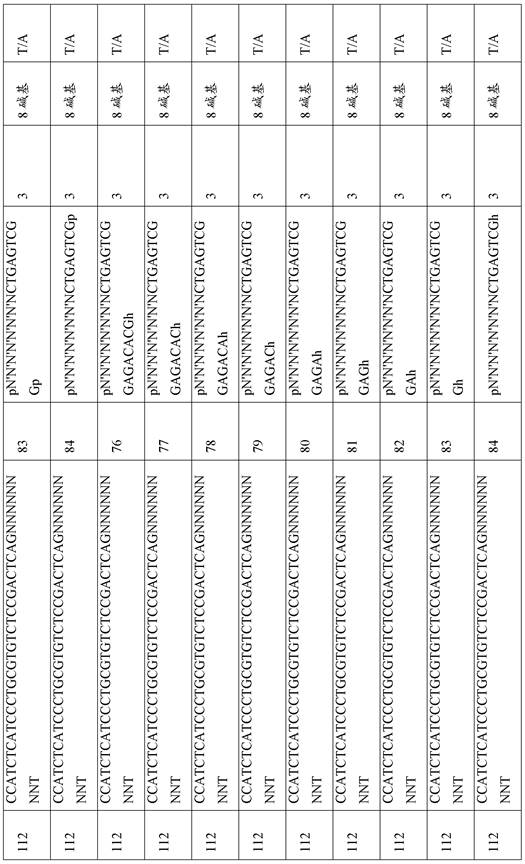
同样地,衔接头引发序列可选自本领域已知的各个序列。在某些实施方案中,衔接头引发序列选自表4所包含的组。Likewise, adapter priming sequences can be selected from various sequences known in the art. In certain embodiments, the adapter priming sequence is selected from the group contained in Table 4.
作为非限制性的实例,如本文所描述的PCR方法可包括将多个通用衔接头序列连接到多个天然序列多核苷酸。另外或替代地,所述方法可包括延伸第一反向引物和形成与包含衔接头序列的引物延伸产物互补的正向链。另外或替代地,所述方法可包括在扩增之前用3'-5'单链特异性外切核酸酶处理连接产物。在某些实施方案中外切核酸酶处理可在引物延伸前发生,而在其它实施方案中引物延伸在外切核酸酶处理前发生。另外或替代地,所述方法可包括用包括通用引物和第二反向引物的引物对扩增扩增子,所述第二反向引物与同第一反向引物互补的区域上游的序列互补。As a non-limiting example, PCR methods as described herein can include ligating a plurality of universal adapter sequences to a plurality of native sequence polynucleotides. Additionally or alternatively, the method can include extending the first reverse primer and forming a forward strand complementary to the primer extension product comprising the adaptor sequence. Additionally or alternatively, the method may comprise treating the ligation product with a 3'-5' single-strand specific exonuclease prior to amplification. In certain embodiments, exonuclease treatment can occur prior to primer extension, while in other embodiments primer extension occurs prior to exonuclease treatment. Additionally or alternatively, the method may comprise amplifying the amplicon with a primer pair comprising a universal primer and a second reverse primer that is complementary to a sequence upstream of a region complementary to the first reverse primer .
在某些实施方案中,用于本文所述方法中的至少一个衔接头多核苷酸在5'末端羟基化和/或用选自氢、磷酸、乙酸或一个或多个不配对的核苷酸的修饰在3'末端修饰。In certain embodiments, at least one adaptor polynucleotide used in the methods described herein is hydroxylated at the 5' end and/or with one or more unpaired nucleotides selected from the group consisting of hydrogen, phosphate, acetate, or The modification is modified at the 3' end.
在某些实施方案中,第二反向引物包含5'测序标签。In certain embodiments, the second reverse primer comprises a 5' sequencing tag.
在某些实施方案中,模板多核苷酸包括片段化的基因组DNA。在其它实施方案中,模板多核苷酸包括cDNA。In certain embodiments, the template polynucleotide comprises fragmented genomic DNA. In other embodiments, the template polynucleotide comprises cDNA.
在某些实施方案中,第一反向引物的解链温度比通用引物的解链温度高,例如,至少约2℃、至少约5℃、至少约7℃、至少约10℃、至少约12℃或至少约15℃。In certain embodiments, the melting temperature of the first reverse primer is higher than the melting temperature of the universal primer, eg, at least about 2°C, at least about 5°C, at least about 7°C, at least about 10°C, at least about 12°C °C or at least about 15 °C.
在具体的实施方案中,如下提供用于扩增目的序列的方法:血液样品从患者提取并且所有gDNA从样品分离和纯化。将分离和纯化的gDNA用选择的内切核酸酶消化,并通过使片段平端化然后在片段的各个3'末端加上单个腺苷酸突出端而将片段末端-修正(end-polished)。将多个通用衔接头分子加至片段混合物中,连同T4 DNA连接酶和ATP。合适的时间间隔后,将连接物用ExoI外切核酸酶消化。外切核酸酶然后加热灭活(例如,80℃ 20分钟,95℃ 2分钟)。将热稳定的DNA聚合酶和多个引物加入混合物中。这些引物之一与通用衔接头分子上的引发序列互补,而其它各自与目的序列下游的已知序列互补。与已知下游序列互补的引物所有均具有解链温度约65℃,而与衔接头序列互补的引物具有解链温度60℃。在10轮65℃退火和72℃延伸后,另外10轮扩增以60℃退火运行。然后将另一组反向引物加入,用作相对于第一组反向引物的“巢式”引物。这些巢式引物可具有60℃-65℃之间的解链温度。然后的引物在其5'末端包含测序标签。另外的10-20轮扩增以在60℃退火进行,接着测序扩增产物。不同分子种类在最初(扩增前)的模板库中的相对流行可基于与各目的变体序列相关的独特识别序列的数目推断。In a specific embodiment, a method for amplifying a sequence of interest is provided as follows: a blood sample is extracted from a patient and all gDNA is isolated and purified from the sample. The isolated and purified gDNA was digested with an endonuclease of choice, and the fragments were end-polished by blunting the fragments and then adding a single adenylate overhang to each 3' end of the fragments. Multiple universal adaptor molecules were added to the fragment mixture, along with T4 DNA ligase and ATP. After a suitable time interval, the ligation was digested with ExoI exonuclease. The exonuclease is then heat inactivated (eg, 80°C for 20 minutes, 95°C for 2 minutes). A thermostable DNA polymerase and multiple primers are added to the mixture. One of these primers is complementary to the priming sequence on the universal adaptor molecule, while the others are each complementary to a known sequence downstream of the sequence of interest. Primers complementary to known downstream sequences all had melting temperatures of about 65°C, while primers complementary to adapter sequences had melting temperatures of 60°C. After 10 rounds of 65°C annealing and 72°C extension, another 10 rounds of amplification were run with 60°C annealing. Another set of reverse primers is then added to serve as "nested" primers relative to the first set of reverse primers. These nested primers can have melting temperatures between 60°C-65°C. The primers then contain sequencing tags at their 5' ends. An additional 10-20 rounds of amplification were performed with annealing at 60°C, followed by sequencing of the amplification products. The relative prevalence of different molecular species in the original (pre-amplification) template library can be inferred based on the number of unique recognition sequences associated with each variant of interest sequence.
核苷酸组合物Nucleotide composition
本公开内容还提供用本文所述方法产生的组合物。这些组合物包括多个扩增子多核苷酸,其各自包含天然序列和通用衔接头序列,其中天然序列包含目的序列和天然序列引发结构域,并且通用衔接头序列包含衔接头引发结构域和,任选地,由1-20个核苷酸组成的条码结构域。通用衔接头序列位于距目的序列5'末端固定的距离处,以致通用衔接头序列与目的序列之间的核苷酸序列一起定义识别序列。在其中通用衔接头序列包含条码结构域的实施方案中,识别序列还包含条码结构域(参见图6)。The present disclosure also provides compositions produced by the methods described herein. These compositions include a plurality of amplicon polynucleotides, each comprising a native sequence and a universal adaptor sequence, wherein the native sequence includes a sequence of interest and a native sequence priming domain, and the universal adaptor sequence includes an adaptor priming domain and, Optionally, a barcode domain consisting of 1-20 nucleotides. The universal adaptor sequence is located at a fixed distance from the 5' end of the sequence of interest such that the universal adaptor sequence together with the nucleotide sequence between the sequence of interest defines the recognition sequence. In embodiments in which the universal adaptor sequence comprises a barcode domain, the recognition sequence also comprises a barcode domain (see Figure 6).
如图6中所表示的,这些组合物包括多个扩增子多核苷酸,其各自起源于当通用衔接头多核苷酸附加到包含目的序列的天然片段时建立的初始模板分子。一旦组合物内的各个扩增子组已被测序,各扩增子组的识别序列将会由用户确定,然后用户能够计算—基于与各目的序列相关的不同识别序列的数目—给定基因组和/或转录组中各个目的位置的每一处不同序列排列的相对流行。As represented in Figure 6, these compositions include a plurality of amplicon polynucleotides, each derived from an initial template molecule established when a universal adaptor polynucleotide is appended to a native fragment comprising the sequence of interest. Once the individual sets of amplicons within the composition have been sequenced, the identity sequences for each set of amplicons will be determined by the user, who can then calculate—based on the number of distinct identity sequences associated with each sequence of interest—for a given genome and and/or relative prevalence of each different sequence arrangement at each target location in the transcriptome.
在某些实施方案中,个体扩增子具有彼此不同的两个末端。例如,在某些实施方案中每一扩增子的正向链5'末端的10个核苷酸和正向链3'末端的10个核苷酸具有不超过90%的同一性,例如不超过85%的同一性、不超过80%的同一性、不超过75%的同一性、不超过70%的同一性、不超过65%的同一性、不超过60%的同一性或不超过50%的同一性。在某些实施方案中,给定扩增子组中所有共享衍生自同一初始模板分子的识别序列的概率大于90%——例如,大于91%、大于92%、大于93%、大于94%、大于95%、大于96%、大于97%、大于98%、大于99%或大于99.9%。In certain embodiments, individual amplicons have two ends that are different from each other. For example, in certain embodiments the 10 nucleotides at the 5' end of the forward strand and the 10 nucleotides at the 3' end of the forward strand of each amplicon have no more than 90% identity, eg, no more than 85% identical, up to 80% identical, up to 75% identical, up to 70% identical, up to 65% identical, up to 60% identical, or up to 50% identical identity. In certain embodiments, the probability of all sharing a recognition sequence derived from the same initial template molecule in a given set of amplicons is greater than 90%—eg, greater than 91%, greater than 92%, greater than 93%, greater than 94%, Greater than 95%, greater than 96%, greater than 97%, greater than 98%, greater than 99%, or greater than 99.9%.
本文所述组合物可包含一个或多个未延伸的引物。在某些实施方案中,这些引物包括与通用衔接头的引发序列互补的一个或多个引物和与位于目的序列下游的天然片段区域互补的引物。The compositions described herein can include one or more unextended primers. In certain embodiments, these primers include one or more primers complementary to the priming sequence of the universal adaptor and primers complementary to the native fragment region located downstream of the sequence of interest.
在某些实施方案中,所述组合物不包含大量未附加到天然片段分子的通用衔接头序列。在某些实施方案中,所述组合物不包含任何未附加到天然片段分子的通用衔接头序列。In certain embodiments, the composition does not comprise a large number of universal adaptor sequences that are not attached to the native fragment molecule. In certain embodiments, the composition does not comprise any universal adaptor sequence that is not attached to the native fragment molecule.
在某些实施方案中,所述组合物包含至少两个与同一天然片段序列的不同部分互补的反向引物序列,任选其中至少这两个反向引物之一具有比正向引物的解链温度大至少约2℃、至少约5℃、至少约7℃、至少约10℃、至少约12℃或至少约15℃的解链温度。In certain embodiments, the composition comprises at least two reverse primer sequences that are complementary to different portions of the same native fragment sequence, optionally wherein at least one of the two reverse primers has a melting point compared to the forward primer The temperature is greater than the melting temperature of at least about 2°C, at least about 5°C, at least about 7°C, at least about 10°C, at least about 12°C, or at least about 15°C.
作为非限制性实例,如本文所描述的组合物可包含核苷酸序列与衔接头引发结构域互补的通用引物和/或核苷酸序列与天然序列的区域互补的引物。引发结构域意指引物杂交的核苷酸序列或与提供的引物同一的核苷酸序列。As non-limiting examples, compositions as described herein may comprise universal primers having nucleotide sequences complementary to the primer domains of the adaptors and/or primers having nucleotide sequences complementary to regions of the native sequence. The priming domain means the nucleotide sequence to which the primer hybridizes or the nucleotide sequence identical to the primer provided.
组合物中的至少一个多核苷酸可在5'末端羟基化,和/或用选自氢、磷酸、乙酸和不配对的核苷酸的修饰在3'末端修饰。At least one polynucleotide in the composition can be hydroxylated at the 5' end and/or at the 3' end with a modification selected from the group consisting of hydrogen, phosphate, acetate, and unpaired nucleotides.
扩增产物可为通用序列和天然序列之间的扩增的结果。在其它实施方案中,扩增产物可为5'和3'通用衔接头序列之间扩增的结果。The amplification product may be the result of amplification between the universal sequence and the native sequence. In other embodiments, the amplification product may be the result of amplification between the 5' and 3' universal adapter sequences.
在某些实施方案中,简并分子概率和目的序列的潜在距离的乘积超过连接事件的数目。In certain embodiments, the product of the probability of degenerate molecules and the potential distance of the sequence of interest exceeds the number of ligation events.
一旦天然片段已经连接至通用衔接头,给定模板分子与另一个模板只是偶然的同一的概率由1÷[F/(Xn × L)]给出,其中F为起始天然序列片段的数目,X为条码结构域的每一位置处的简并核苷酸的数目,n为条码结构域的简并核苷酸位置的数目,L为起始天然序列片段的长度。因此,换言之,如果组合物中的两个分子共享识别序列,其极不可能起源于不同的模板分子。Once the native fragments have been ligated to the universal adaptor, the probability that a given template molecule is identical to another template only by chance is given by 1÷[F/( Xn × L)], where F is the number of starting native sequence fragments , X is the number of degenerate nucleotides at each position of the barcode domain, n is the number of degenerate nucleotide positions of the barcode domain, and L is the length of the starting native sequence fragment. Thus, in other words, if two molecules in a composition share a recognition sequence, it is highly unlikely that they originated from different template molecules.
在某些实施方案中,起始天然序列片段的长度高度统一。在其它实施方案中,起始天然序列片段的长度是多样化的。当长度多样化时,多样化可起因于DNA分离后片段化,例如酶促片段化或机械片段化。在某些实施方案中,组合物内的模板分子可起因于通用衔接头序列与随机片段化的DNA的连接。In certain embodiments, the starting native sequence fragments are highly uniform in length. In other embodiments, the starting native sequence fragments are varied in length. When diversifying in length, the diversification may result from fragmentation of DNA after isolation, such as enzymatic or mechanical fragmentation. In certain embodiments, the template molecule within the composition may result from the ligation of a universal adaptor sequence to randomly fragmented DNA.
试剂盒Reagent test kit
用于实施上述方法的试剂盒也在本文中公开。如本文所描述的试剂盒可包含一些或所有用于实施上述方法所必需的组分。例如,如本文所描述的试剂盒可包含以下的一种或多种:引物、通用衔接头分子、连接酶、3'-5'单链特异性外切核酸酶例如ExoI、DNA聚合酶、反转录酶、连接酶缓冲液、PCR缓冲液、dNTPs、MgCl2、无核酸酶管和吸头以及伴随相应的反应缓冲液的限制性内切核酸酶。Kits for practicing the above methods are also disclosed herein. Kits as described herein may contain some or all of the components necessary for carrying out the above-described methods. For example, a kit as described herein may comprise one or more of the following: primers, universal adaptor molecules, ligases, 3'-5' single-strand specific exonuclease such as ExoI, DNA polymerase, reverse Transcriptase, ligase buffer, PCR buffer, dNTPs, MgCl2 , nuclease-free tubes and tips, and restriction endonucleases with corresponding reaction buffers.
作为非限制性实例,如本文所描述的试剂盒可包含DNA聚合酶、DNA连接酶和多个通用衔接头多核苷酸,其中各通用衔接头多核苷酸在反向链上包含3'修饰以使3'末端不可延伸,并且其中各通用衔接头多核苷酸包含所有通用衔接头多核苷酸所共有的引发序列和任选地,由1-20个核苷酸组成的条码结构域。条码结构域可为简并的。As a non-limiting example, a kit as described herein can comprise a DNA polymerase, a DNA ligase, and a plurality of universal adaptor polynucleotides, wherein each universal adaptor polynucleotide comprises a 3' modification on the reverse strand to The 3' end is rendered non-extendable, and wherein each universal adaptor polynucleotide comprises a primer sequence common to all universal adaptor polynucleotides and, optionally, a barcode domain consisting of 1-20 nucleotides. Barcode domains can be degenerate.
所述试剂盒可进一步包含用于实施本文所述方法所需要的各种任选组分,并且普通技术人员可确定这样的必需组分。这样的组分的非限制性实例包括:3'-5'单链特异性外切核酸酶、无核酸酶的聚合酶缓冲液、无核酸酶的连接酶缓冲液、与至少10 bp引发序列互补的通用引物和其任何组合。The kit can further comprise various optional components required for carrying out the methods described herein, and such necessary components can be determined by one of ordinary skill. Non-limiting examples of such components include: 3'-5' single-strand specific exonuclease, nuclease-free polymerase buffer, nuclease-free ligase buffer, complementary to at least 10 bp priming sequence of universal primers and any combination thereof.
3'修饰可为可防止聚合酶延伸的任何已知修饰。在某些实施方案中,3'修饰选自氢、磷酸、乙酸和不配对的核苷酸。另外或替代地,各通用衔接头可在至少一个末端为平的。另外或替代地,衔接头多核苷酸可为部分双链和部分单链的,其中正向链在5'末端包含不配对的突出端。另外或替代地,衔接头多核苷酸的正向链可包含适于连接至制备的天然序列的3'末端。另外或替代地,通用衔接头多核苷酸的正向链可包含与天然序列的3'末端互补的3'末端。另外或替代地,通用衔接头多核苷酸的正向链可包含与天然序列的5'末端互补的5'末端。另外或替代地,衔接头多核苷酸的正向和反向链可包含至少一个平端。例如,通用衔接头多核苷酸的反向链包含5'磷酸。The 3' modification can be any known modification that prevents extension by the polymerase. In certain embodiments, the 3' modification is selected from the group consisting of hydrogen, phosphate, acetate, and unpaired nucleotides. Additionally or alternatively, each universal adapter may be blunt at at least one end. Additionally or alternatively, the adaptor polynucleotide may be partially double-stranded and partially single-stranded, wherein the forward strand contains an unpaired overhang at the 5' end. Additionally or alternatively, the forward strand of the adaptor polynucleotide may comprise a 3' end suitable for ligation to the prepared native sequence. Additionally or alternatively, the forward strand of the universal adaptor polynucleotide may comprise a 3' end complementary to the 3' end of the native sequence. Additionally or alternatively, the forward strand of the universal adaptor polynucleotide may comprise a 5' end complementary to the 5' end of the native sequence. Additionally or alternatively, the forward and reverse strands of the adapter polynucleotide may comprise at least one blunt end. For example, the reverse strand of a universal adaptor polynucleotide contains a 5' phosphate.
在某些实施方案中,所述试剂盒包含与所有衔接头多核苷酸所共有的至少部分衔接头多核苷酸序列同一的通用引物。In certain embodiments, the kits comprise universal primers that are identical in sequence to at least a portion of the adaptor polynucleotides common to all adaptor polynucleotides.
在某些实施方案中,所述试剂盒包含与所有衔接头多核苷酸所共有的衔接头多核苷酸部分的全长序列同一的通用引物。In certain embodiments, the kit comprises universal primers that are identical to the full-length sequence of the adapter polynucleotide portion common to all adapter polynucleotides.
在具体的实施方案中,所述试剂盒包含:包含表4所含的分类的通用衔接头和引物分子的管、1管与衔接头分子互补的引物寡聚物、T4 DNA连接酶、具有ATP的连接酶缓冲液、ExoI外切核酸酶、热稳定的DNA聚合酶、Klenow聚合酶、dATP、dNTPs和MgCl2。In a specific embodiment, the kit comprises: a tube comprising universal adaptor and primer molecules as classified in Table 4, 1 tube of primer oligomer complementary to the adaptor molecule, T4 DNA ligase, with ATP ligase buffer, ExoI exonuclease, thermostable DNA polymerase, Klenow polymerase, dATP, dNTPs and MgCl2 .
引物primer
任何寡核苷酸序列均可用作本文所述方法、试剂盒和组合物中的引物。用于本文所述方法、试剂盒和组合物的引物可包含至少约10——例如,至少15、至少20、至少25或至少30——至约50 bp。这样的引物可为DNA、RNA或其组合。此外,引物可包含修饰的磷酸-糖骨架。引物包含与待扩增的任一模板序列的连接位点互补的序列。例如与衔接头分子互补的引物可包括表4中包含的那些。引物可使用常规核酸合成技术而合成制备。例如,引物可经由标准亚磷酰胺技术利用核酸合成仪合成。这样的合成仪,例如,从AppliedBiosystems, Inc. (Foster City, California)可得。Any oligonucleotide sequence can be used as a primer in the methods, kits and compositions described herein. Primers for use in the methods, kits, and compositions described herein can comprise at least about 10—eg, at least 15, at least 20, at least 25, or at least 30—to about 50 bp. Such primers can be DNA, RNA, or a combination thereof. In addition, primers may contain modified phosphate-sugar backbones. Primers contain sequences complementary to the ligation sites of either template sequence to be amplified. For example, primers complementary to adaptor molecules may include those contained in Table 4. Primers can be prepared synthetically using conventional nucleic acid synthesis techniques. For example, primers can be synthesized via standard phosphoramidite techniques using a nucleic acid synthesizer. Such synthesizers are available, for example, from Applied Biosystems, Inc. (Foster City, California).
如果用户希望分离和分析本文所述组合物内的特定扩增子,可将引物,例如,用生物素或半抗原(haptan)或荧光团标记,以帮助后续捕获或纯化。引物也可用放射性同位素,例如H3或P32标记。另外,引物可在其5'末端携带非退火序列,例如所谓的测序标签,用于后续扩增或杂交步骤。If the user wishes to isolate and analyze specific amplicons within the compositions described herein, primers can be labeled, eg, with biotin or haptans or fluorophores, to aid in subsequent capture or purification. Primers can also be labeled with radioisotopes such as H3 or P32 . Additionally, primers may carry non-annealing sequences at their 5' ends, such as so-called sequencing tags, for subsequent amplification or hybridization steps.
通用衔接头多核苷酸Universal adaptor polynucleotide
用于本文所述方法、试剂盒和组合物的通用衔接头序列必须包含至少给定反应中的许多或所有通用衔接头分子所共有的引发结构域序列。在某些实施方案中,通用衔接头还可包含条码结构域,其可在不同的通用衔接头分子之间不同。通用衔接头序列可包含从5'至3',通用引发结构域和,任选地,条码结构域。条码结构域序列一般为简并的。在某些实施方案中,简并条码结构域包含1-20个简并核苷酸。在其它实施方案中,条码结构域不是简并的。在某些实施方案中,通用衔接头适于与固体载体束缚的引物和/或探针杂交。在某些实施方案中,固定的通用序列可适于与捕获结构杂交。Universal adaptor sequences for use in the methods, kits and compositions described herein must contain at least a priming domain sequence common to many or all of the universal adaptor molecules in a given reaction. In certain embodiments, the universal adaptor may also comprise a barcode domain, which may vary between different universal adaptor molecules. The universal adaptor sequence may comprise from 5' to 3', a universal priming domain and, optionally, a barcode domain. Barcode domain sequences are generally degenerate. In certain embodiments, the degenerate barcode domain comprises 1-20 degenerate nucleotides. In other embodiments, the barcode domains are not degenerate. In certain embodiments, universal adapters are suitable for hybridization to solid support-bound primers and/or probes. In certain embodiments, the immobilized universal sequence can be adapted to hybridize to the capture structure.
通用衔接头中的引发结构域可为单一序列或多个序列,并且可为任何长度。作为非限制性实例,引发序列可为至少10、至少15、至少20、至少25、至少30、至少35、至少40或至少45 bp长。作为非限制性实例,引发序列可不超过100、不超过90、不超过80、不超过70、不超过60、不超过50、不超过45、不超过40、不超过35、不超过30、不超过25、不超过20或不超过15 bp长。例如,用于本文所述方法、试剂盒和组合物的引发序列可为15-25 bp长。引发结构域序列的非限制性实例包括表4中示出的那些。The priming domain in a universal adaptor can be a single sequence or multiple sequences, and can be of any length. As non-limiting examples, the priming sequence can be at least 10, at least 15, at least 20, at least 25, at least 30, at least 35, at least 40, or at least 45 bp long. As non-limiting examples, the priming sequence may be no more than 100, no more than 90, no more than 80, no more than 70, no more than 60, no more than 50, no more than 45, no more than 40, no more than 35, no more than 30, no more than 30 25. No more than 20 or no more than 15 bp long. For example, priming sequences for use in the methods, kits and compositions described herein can be 15-25 bp in length. Non-limiting examples of priming domain sequences include those shown in Table 4.
条码结构域长度可为任何数目的核苷酸,并且可为任何次序的核苷酸。例如,条码长度可为1、2、3、4、5、6、7、8、9、10、11、12、13、14、15、16、17、18、19或20个核苷酸。条码序列传达关于给定扩增子的祖先谱系的信息。由于本文所述组合物和方法中分子祖先的身份通过独特的识别序列确定,并且由于条码仅为识别序列的一部分,因此给定反应中的各通用衔接头序列不一定具有独特的条码。条码序列产生独特的分子识别序列的原理在图4中说明。在图4的背景下,“n”表示大于0的整数。例如,n可为1-20的整数。“N”表示选自腺苷(A)、鸟苷(G)、胸苷(T)和胞苷(C)的任何核苷酸碱基。“L”表示目的序列处的界标,例如SNP。L可为距nN的任何距离。结果,nN加插入nN和L之间的序列的组合定义识别序列,其在4n×D中仅有一次机会与另一个独立构建的识别序列不能明确区分,其中D为nN和L之间的核苷酸碱基的数目。例如,当D为100时,对于n为1-12的分子独特性在下表中显示:The barcode domains can be any number of nucleotides in length, and can be in any order of nucleotides. For example, a barcode can be 1, 2, 3, 4, 5, 6, 7, 8, 9, 10, 11, 12, 13, 14, 15, 16, 17, 18, 19, or 20 nucleotides in length. The barcode sequence conveys information about the ancestral lineage of a given amplicon. Since the identity of the molecular ancestors in the compositions and methods described herein is determined by a unique recognition sequence, and since barcodes are only part of a recognition sequence, each universal adapter sequence in a given reaction does not necessarily have a unique barcode. The principle by which barcode sequences generate unique molecular recognition sequences is illustrated in FIG. 4 . In the context of Figure 4, "n" represents an integer greater than zero. For example, n can be an integer from 1-20. "N" represents any nucleotide base selected from the group consisting of adenosine (A), guanosine (G), thymidine (T) and cytidine (C). "L" denotes a landmark at the sequence of interest, eg, a SNP. L can be any distance from nN. As a result, the combination of nN plus a sequence inserted between nN and L defines a recognition sequence that is indistinguishable from another independently constructed recognition sequence with only one chance in 4n × D, where D is the number between nN and L. The number of nucleotide bases. For example, when D is 100, molecular uniqueness for n is 1-12 is shown in the following table:
给定反应中的不同通用衔接头分子可共享共有的引发序列,而具有不同长度的条码结构域。条码结构域一般位于引发序列的下游。在一些实施方案中引发序列和条码结构域一起解释通用衔接头分子的全长,而在其它实施方案中通用衔接头可在引发序列和条码结构域以外包含额外的序列。Different universal adaptor molecules in a given reaction may share a common priming sequence, but have barcode domains of different lengths. The barcode domain is generally located downstream of the priming sequence. In some embodiments the primer sequence and barcode domain together account for the full length of the universal adaptor molecule, while in other embodiments the universal adaptor may comprise additional sequences in addition to the primer sequence and barcode domain.
天然片段多核苷酸native fragment polynucleotide
用于本文所述方法和组合物的模板分子由至少通用衔接头序列和天然片段序列的组合构成,任选组合额外的序列。用于本文所述方法和组合物的天然片段多核苷酸可衍生自任何源或多个源。作为非限制性实例,天然片段可衍生自人个体、环境分离物或作物植物。在某些实施方案中,天然片段包括片段化的基因组DNA。在其它实施方案中,天然片段包括cDNA。使DNA片段化的技术为本领域所熟知,包括用一种或多种内切核酸酶消化和机械手段。天然片段可为任何长度。例如,天然片段可为至少20 bp、至少100 bp、至少500 bp、至少1000 bp、至少5000 bp或至少10000 bp长。作为非限制性实例,天然片段可不超过100 kbp、不超过90 kbp、不超过80 kbp、不超过70 kbp、不超过60 kbp、不超过50 kbp、不超过40kbp、不超过30 kbp、不超过20 kbp或不超过10 kbp长。Template molecules for use in the methods and compositions described herein consist of at least a combination of universal adaptor sequences and native fragment sequences, optionally in combination with additional sequences. Native fragment polynucleotides for use in the methods and compositions described herein can be derived from any source or sources. As non-limiting examples, native fragments can be derived from human individuals, environmental isolates, or crop plants. In certain embodiments, native fragments include fragmented genomic DNA. In other embodiments, the native fragment includes cDNA. Techniques for fragmenting DNA are well known in the art and include digestion with one or more endonucleases and mechanical means. Native fragments can be of any length. For example, a native fragment can be at least 20 bp, at least 100 bp, at least 500 bp, at least 1000 bp, at least 5000 bp, or at least 10000 bp long. As non-limiting examples, native fragments may be no more than 100 kbp, no more than 90 kbp, no more than 80 kbp, no more than 70 kbp, no more than 60 kbp, no more than 50 kbp, no more than 40 kbp, no more than 30 kbp, no more than 20 kbp kbp or not more than 10 kbp long.
天然片段可通过本领域普通技术人员所知的许多方法中的任一种连接到通用衔接头。例如,在一些实施方案中天然片段通过用合适的连接酶连接附加到通用衔接头。用于这样的应用的连接酶为普通技术人员所熟知。普通技术人员将会理解如果打算连接,则在连接到通用衔接头之前进行所谓的片段化模板的“末端修正”步骤可为有利的。这样的末端修正可任选包括步骤例如平端化和/或磷酸化和/或向一个或另一个末端添加不配对的核苷酸以建立所谓的与通用衔接头序列的相反末端互补的“粘性末端”。在一些实施方案中,通用衔接头序列可通过引物延伸的方式附加到天然片段。Native fragments can be ligated to universal adaptors by any of a number of methods known to those of ordinary skill in the art. For example, in some embodiments native fragments are attached to a universal adaptor by ligation with a suitable ligase. Ligase enzymes for such applications are well known to those of ordinary skill. One of ordinary skill will appreciate that if ligation is intended, it may be advantageous to perform a so-called "end revision" step of the fragmented template prior to ligation to a universal adaptor. Such end revisions may optionally include steps such as blunt endization and/or phosphorylation and/or addition of unpaired nucleotides to one or the other end to create so-called "sticky ends" complementary to the opposite end of the universal adaptor sequence ". In some embodiments, the universal adapter sequence can be appended to the native fragment by means of primer extension.
单管聚合酶链反应single-tube polymerase chain reaction
除了上文描述的模板和引物以外,通过聚合酶链反应扩增将需要热稳定的聚合酶。这样的聚合酶为本领域技术人员所熟知,例如Ward等人的美国专利号7,972,828中所描述的热稳定聚合酶,其全部内容通过引用结合到本文中。In addition to the templates and primers described above, amplification by polymerase chain reaction will require a thermostable polymerase. Such polymerases are well known to those of skill in the art, such as the thermostable polymerases described in US Patent No. 7,972,828 to Ward et al., the entire contents of which are incorporated herein by reference.
本文所述方法的单个不同步骤可各自在单独和不同的容器,例如聚丙烯PCR管中进行。在其它实施方案中,超过一个步骤可在给定管中进行。在某些实施方案中,本文所述方法的所有步骤可在单管中进行。The individual distinct steps of the methods described herein can each be performed in separate and distinct containers, such as polypropylene PCR tubes. In other embodiments, more than one step can be performed in a given tube. In certain embodiments, all steps of the methods described herein can be performed in a single tube.
在本文所述方法的所谓“单管”实施方案中,天然片段DNA连同连接酶、聚合酶、3'-5'单链特异性外切核酸酶、引物、dNTPs和聚合酶链反应所需的所有其它成分一起加入管中。在这样的实施方案中,成分可任选包括荧光染料,例如N,N-二甲基-N'-[4-[(E)-(3-甲基-1,3-苯并噻唑-2-亚基)甲基]-1-苯基喹啉-1-鎓-2-基]-N'-丙基-丙烷-1,3-二胺(SYBR® Green),以跟踪dsDNA扩增子的渐进形成。与本文所述方法、试剂盒和组合物一起使用的扩增方法可为非定量的、半定量的或定量的,如给定应用所需要的。普通技术人员将容易地理解如何优化扩增策略以达到期需的定量或半定量结果。In the so-called "single-tube" embodiment of the methods described herein, the native fragment DNA is required along with ligase, polymerase, 3'-5' single-strand specific exonuclease, primers, dNTPs, and polymerase chain reaction All other ingredients are added to the tube together. In such embodiments, the ingredients may optionally include fluorescent dyes, such as N,N-dimethyl-N'-[4-[(E)-(3-methyl-1,3-benzothiazole-2 -subunit)methyl]-1-phenylquinolin-1-onium-2-yl]-N'-propyl-propane-1,3-diamine ( SYBR® Green) to track dsDNA amplicons gradual formation. Amplification methods for use with the methods, kits, and compositions described herein can be non-quantitative, semi-quantitative, or quantitative, as desired for a given application. One of ordinary skill will readily understand how to optimize the amplification strategy to achieve the desired quantitative or semi-quantitative results.
扩增可使用巢式引物在一系列渐进步骤中进行。在单管实施方案中,设计最下游的反向引物以具有比正向引物更高的解链温度可为有利的。这样,一个或多个第一轮的引物延伸可以在更高—因此更严格特异—的退火温度发生。该反向引物的高温度延伸可以以线性或指数方式发生。这样,过量的通用衔接头可在指数扩增之前从系统去除,而不需纯化步骤。后续轮的扩增然后可以以较低的退火温度和以指数方式进行。在某些实施方案中,上游和下游反向引物的解链温度可相差至少约2℃、至少约5℃、至少约7℃、至少约10℃、至少约12℃或至少约15℃。Amplification can be performed in a series of progressive steps using nested primers. In single tube embodiments, it may be advantageous to design the most downstream reverse primer to have a higher melting temperature than the forward primer. In this way, one or more first rounds of primer extension can occur at higher - and therefore more stringently specific - annealing temperatures. High temperature extension of the reverse primer can occur linearly or exponentially. In this way, excess universal adapters can be removed from the system prior to exponential amplification without purification steps. Subsequent rounds of amplification can then proceed exponentially with lower annealing temperatures. In certain embodiments, the melting temperatures of the upstream and downstream reverse primers may differ by at least about 2°C, at least about 5°C, at least about 7°C, at least about 10°C, at least about 12°C, or at least about 15°C.
诊断方法diagnosis method
本文所述方法、试剂盒和组合物可用于检测用于疾病诊断的突变。在某些实施方案中,疾病发生在作物植物或动物中,例如农场动物、宠物或人。在具体的实施方案中,本文所述方法、试剂盒和组合物可用于在人中检测肿瘤。待检测的肿瘤可为任何类型,例如,良性肿瘤、前恶性肿瘤或恶性(即,癌性)肿瘤。特别地,由于本文所述方法、试剂盒和组合物的增强的在更加流行的基因模式背景之中检测低频率基因模式的能力,可能在非常早的阶段,当具有这样的致癌特征模式的细胞在给定的患者样品,例如血液样品中仅构成所有细胞的非常小的部分时,检测指示肿瘤形成的特征基因模式。例如,致癌特征模式可在仅1/104、1/106、1/109、1/1012或1/1015细胞中存在。类似地,致癌模式可从循环的无细胞DNA测量。The methods, kits and compositions described herein can be used to detect mutations for disease diagnosis. In certain embodiments, the disease occurs in crop plants or animals, such as farm animals, pets, or humans. In specific embodiments, the methods, kits and compositions described herein can be used to detect tumors in humans. The tumor to be detected can be of any type, eg, a benign tumor, a premalignant tumor, or a malignant (ie, cancerous) tumor. In particular, due to the enhanced ability of the methods, kits and compositions described herein to detect low frequency gene patterns in the context of more prevalent gene patterns, it may be possible at a very early stage when cells with such an oncogenic signature pattern In a given patient sample, such as a blood sample, characteristic gene patterns indicative of tumor formation are detected when only a very small fraction of all cells are formed. For example, an oncogenic signature pattern may be present in only 1/10 4 , 1/10 6 , 1/10 9 , 1/10 12 or 1/10 15 cells. Similarly, oncogenic patterns can be measured from circulating cell-free DNA.
农业应用agricultural application
本文所述的方法、试剂盒和组合物也可用于农业育种程序。例如,本文所述方法、试剂盒和组合物可用于测定杂交育种之后给定性状的进入。The methods, kits and compositions described herein can also be used in agricultural breeding programs. For example, the methods, kits and compositions described herein can be used to determine entry of a given trait following cross-breeding.
环境监测Environmental monitoring
本文所述方法、试剂盒和组合物也可用于监测给定环境的生物群系(biome)。例如,本文所述方法、试剂盒和组合物可用于测定池塘、河流、下水道或水库中各种微生物的相对流行。另外,本文所述方法、试剂盒和组合物可用于监测工业环境,例如发酵桶或酿造容器中不同微生物的相对流行。The methods, kits and compositions described herein can also be used to monitor the biome of a given environment. For example, the methods, kits and compositions described herein can be used to determine the relative prevalence of various microorganisms in ponds, rivers, sewers or reservoirs. Additionally, the methods, kits and compositions described herein can be used to monitor the relative prevalence of different microorganisms in industrial environments, such as fermenters or brewing vessels.
实施例Example
无进一步的描述,相信本领域普通技术人员使用前面的描述和下面的说明性实施例能够制造和利用本文所述的组合物以及实践所要求保护的方法。因此下列工作实施例特别地指出本发明的代表性实施方案,一些为优选的,并且不应解释为以任何方式限制本公开内容的其余部分。Without further description, it is believed that one of ordinary skill in the art, using the foregoing description and the following illustrative examples, can make and utilize the compositions described herein and practice the claimed methods. The following working examples therefore specifically point out representative embodiments of the invention, some preferred, and should not be construed as limiting the remainder of this disclosure in any way.
实施例1Example 1
用于如本文所描述的方法、试剂盒或组合物的一个示例性和说明性的通用衔接头在图1中示出。在该说明性的实例中,“N”表示用于连接至天然片段的一个粘性碱基或一组粘性碱基。不配对的N可用于帮助将通用衔接头序列连接到天然片段分子。“P”表示5'磷酸。“X”可为对3'末端的任何不可延伸的修饰,包括,例如,错配的碱基、3'磷酸、3'乙酸、–H替代3' –OH,等。“Y”可为对5'末端的任何不可连接的修饰,例如,–OH替代磷酸。“Z”可为对5'末端的任何不可连接的修饰。Z可与Y相同或不同。An exemplary and illustrative universal adaptor for use in a method, kit or composition as described herein is shown in FIG. 1 . In this illustrative example, "N" represents a sticky base or set of sticky bases for ligation to the native fragment. Unpaired Ns can be used to assist in ligating universal adaptor sequences to native fragment molecules. "P" represents 5' phosphate. "X" can be any non-extendable modification to the 3' terminus, including, for example, mismatched bases, 3' phosphates, 3' acetates, -H in place of 3'-OH, and the like. "Y" can be any non-ligable modification to the 5' end, eg, -OH instead of phosphate. "Z" can be any non-ligable modification to the 5' end. Z can be the same or different from Y.
实施例2Example 2
将来自样品的总gDNA用HpyCH4V (NEB, Ipswitch, Massachusetts)消化。将片段用末端修复和加A尾试剂盒(例如,KAPA® Hyper试剂盒;Wilmington, Massachusetts)末端修复。结果为带多个dA尾的gDNA Hpy片段。然后将这些gDNA片段用通用衔接头多核苷酸在DNA连接酶存在或不存在下孵育,接着用与通用衔接头序列互补的正向引物和多个与gDNA内的多个序列互补的21个不同的反向引物进行聚合酶链反应(PCR)。Total gDNA from samples was digested with HpyCH4V (NEB, Ipswitch, Massachusetts). Fragments are end-repaired with an end-repair and A-tailing kit (eg, KAPA® Hyper kit; Wilmington, Massachusetts). The result is a gDNA Hpy fragment with multiple dA tails. These gDNA fragments were then incubated with a universal adaptor polynucleotide in the presence or absence of DNA ligase, followed by a forward primer complementary to the universal adaptor sequence and multiple 21 different sequences complementary to multiple sequences within the gDNA The reverse primer was used for polymerase chain reaction (PCR).
这21个引物组中的19个从连接的模板产生具有预期产物大小的扩增子。这19个中的16个为单一产物扩增子。21个引物组中仅3个用非连接模板产生扩增子产物。Nineteen of these 21 primer sets produced amplicons of the expected product size from the ligated template. 16 of these 19 were single product amplicons. Only 3 of the 21 primer sets produced amplicon products with non-ligated templates.
实施例3Example 3
将来自样品的总gDNA Covaris片段化至大约150 bp。将片段用末端修复和加A尾试剂盒(例如,KAPA® Hyper试剂盒;Wilmington, Massachusetts)末端修复。结果为带多个dA尾的gDNA片段。然后将这些gDNA片段用通用衔接头多核苷酸在DNA连接酶存在下孵育,接着用与通用衔接头序列互补的正向引物和多个与gDNA内的多个序列互补的22个不同的反向引物进行聚合酶链反应(PCR)。Total gDNA Covaris from samples were fragmented to approximately 150 bp. Fragments are end-repaired with an end-repair and A-tailing kit (eg, KAPA® Hyper kit; Wilmington, Massachusetts). The result is a gDNA fragment with multiple dA tails. These gDNA fragments were then incubated with a universal adaptor polynucleotide in the presence of DNA ligase, followed by a forward primer complementary to the universal adaptor sequence and multiple 22 different reverses complementary to multiple sequences within the gDNA The primers were subjected to polymerase chain reaction (PCR).
所有22个引物组从连接模板产生具有预期多个产物大小的扩增子。All 22 primer sets produced amplicons with the expected multiple product sizes from the ligated template.
实施例4Example 4
一系列通用衔接头分子从表1中所示的序列通过组合、变性和缓慢冷却等摩尔量的上链(top strand)序列与每一下链(bottom strand)序列制备。将下面的双链体衔接头用或不用ExoI外切核酸酶在37℃在PCR缓冲液中孵育。然后将孵育的样品在Bioanalyzer(Agilent Tech., Santa Clara, California)上分析。下链上的“p”指示磷酸。在包含ExoI的每一样品中上链被成功消化。A series of universal adaptor molecules were prepared from the sequences shown in Table 1 by combining, denaturing and slowly cooling equimolar amounts of the top strand sequence and each bottom strand sequence. The following duplex adapters were incubated with or without ExoI exonuclease in PCR buffer at 37°C. The incubated samples were then analyzed on a Bioanalyzer (Agilent Tech., Santa Clara, California). The "p" on the bottom chain indicates phosphate. The upper strand was successfully digested in every sample containing ExoI.

表1的通用衔接头然后连接至模板检验序列。再次,将每一连接物的样品在37℃在PCR缓冲液中用或不用ExoI孵育,接着定量PCR (qPCR)扩增。PCR使用对通用衔接头序列特异的正向引物或用对检验序列特异的正向引物进行。在所有扩增反应中反向引物对检验序列特异。对于各通用衔接头结构,用通用正向引物和检验序列特异性正向引物获得的Ct值之间的差异指示连接效率。图5显示从每一这些反应得到的dCt值(u/f,r – f/r)。如可以看到的,对于衔接头#3-7,连接效率基本相等。dCt值在用ExoI处理的连接物和未处理的连接物之间相同。The universal adapters of Table 1 were then ligated to template verification sequences. Again, samples of each linker were incubated at 37°C in PCR buffer with or without ExoI, followed by quantitative PCR (qPCR) amplification. PCR is performed using forward primers specific for universal adapter sequences or with forward primers specific for test sequences. The reverse primer was specific for the test sequence in all amplification reactions. For each universal adapter structure, the difference between the Ct values obtained with the universal forward primer and the test sequence-specific forward primer is indicative of ligation efficiency. Figure 5 shows the dCt values (u/f, r - f/r) obtained from each of these reactions. As can be seen, the ligation efficiencies are substantially equal for adapters #3-7. The dCt values were the same between the ExoI-treated and untreated linkers.
这些数据显示具有截短的下链的通用衔接头能够在20℃高度有效地连接,甚至当衔接头双链体长度短至7 bp时。所有双链体衔接头均在37℃用ExoI可消化,而3'磷酸保护的连接物完全抵抗ExoI消化。These data show that universal adapters with truncated lower strands are capable of highly efficient ligation at 20°C, even when the adapter duplexes are as short as 7 bp in length. All duplex adapters were digestible with ExoI at 37°C, while the 3' phosphate-protected linkers were completely resistant to ExoI digestion.
实施例5Example 5
检验序列模板在下表2中指示的循环温度下通过qPCR扩增。使用对通用衔接头特异的多个正向引物,对于每一反应一个。这些正向引物各具有不同的长度以及相应地不同的解链温度,范围从54.9℃-68.5℃。对照反应包含对检验序列模板特异的正向引物,具有解链温度70℃。所有反应使用相同的反向引物,其对检验序列模板内的序列特异并且具有解链温度70℃。来自这些反应的Ct值在表2中示出。The test sequence templates were amplified by qPCR at the cycling temperatures indicated in Table 2 below. Use multiple forward primers specific for the universal adapter, one for each reaction. These forward primers each have different lengths and correspondingly different melting temperatures, ranging from 54.9°C to 68.5°C. The control reaction contained a forward primer specific for the test sequence template with a melting temperature of 70°C. All reactions used the same reverse primer, which was specific for the sequence within the test sequence template and had a melting temperature of 70°C. The Ct values from these reactions are shown in Table 2.

如可从表2中的数据看到的,很明显通过配对正向和反向引物以致反向引物具有比正向引物足够高的解链温度,可能优化引物对以使得两步过程成为可能,其中线性延伸反应首先在高温运行,接着在较低的温度指数扩增。换言之,可能在包含两种引物的反应中进行从天然片段至连接的通用衔接头的线性扩增,接着通用和天然序列引物之间的指数扩增。As can be seen from the data in Table 2, it is clear that by pairing the forward and reverse primers such that the reverse primer has a sufficiently higher melting temperature than the forward primer, it is possible to optimize the primer pair to enable a two-step process, The linear extension reaction is run first at high temperature, followed by exponential amplification at lower temperature. In other words, it is possible to perform linear amplification from the native fragment to the ligated universal adapter, followed by exponential amplification between the universal and native sequence primers, in a reaction comprising both primers.
为了进一步检验该单管方法,另一组qPCR反应用表2程序中使用的同一引物组运行。该运行包括20个循环94℃/72℃,接着20个94℃/60℃/72℃循环。该qPCR运行产生下表3中所示的“1st Ct”数据。将完全相同的反应混合物组平行运行,持续2×20个循环的 94℃/60℃/72℃。该运行产生下表3中所示的“2nd Ct”数据。表3的“dCt”列显示对于各引物对1st和2nd Ct数据之间的差异。在1st Ct反应组中对于线性第一个步骤然后指数第二个步骤,将预期dCt为大约3-4。这样的dCt值表明“1st Ct” qPCR的前20个循环仅涉及线性扩增,而大(>7) dCt值表明“1st Ct” qPCR涉及线性和指数或者指数扩增。如可以看到的,线性扩增产生于在“1st Ct”迭代的前20个循环期间具有解链温度<60℃的引物。递降PCR可使得能够以两个引物之间的解链温度的最小优化进行单管应用。To further test this single-tube approach, another set of qPCR reactions was run with the same primer set used in the procedure in Table 2. The run consisted of 20 cycles of 94°C/72°C followed by 20 cycles of 94°C/60°C/72°C. This qPCR run yielded the "1 st Ct" data shown in Table 3 below. Identical sets of reaction mixtures were run in parallel for 2 x 20 cycles of 94°C/60°C/72°C. This run produced the "2 nd Ct" data shown in Table 3 below. The "dCt" column of Table 3 shows the difference between the 1 st and 2 nd Ct data for each primer pair. A dCt of about 3-4 would be expected for a linear first step followed by an exponential second step in a 1 st Ct reaction set. Such dCt values indicate that the first 20 cycles of "1 st Ct" qPCR involve only linear amplification, while large (>7) dCt values indicate that "1 st Ct" qPCR involves both linear and exponential or exponential amplification. As can be seen, linear amplification results from primers with melting temperatures < 60°C during the first 20 cycles of the "1 st Ct" iteration. Descending PCR can enable single-tube applications with minimal optimization of the melting temperature between the two primers.




实施例6Example 6
血液样品从含有尚未检测到的肿瘤的患者收集。患者血液中的肿瘤DNA的频率显著小于正常DNA,在每104个正常基因组中1个癌症基因组的数量级。无细胞DNA从血液样品分离。将分离的DNA末端修正,并将通用衔接头序列连接到修正的片段。片段使用对通用衔接头序列特异的正向引物和对各种已知的癌症突变下游的序列特异的反向引物混合物通过PCR扩增。基于一个或多个这些检验的序列中癌症特征突变的特异性和准确检测,恶性癌症的存在情况在非常早的阶段检测。Blood samples were collected from patients with undetected tumors. The frequency of tumor DNA in patient blood was significantly less than normal DNA, on the order of 1 cancer genome per 104 normal genomes. Cell-free DNA is isolated from blood samples. The isolated DNA was end-corrected, and the universal adaptor sequence was ligated to the corrected fragment. Fragments were amplified by PCR using a mixture of forward primers specific for the universal adapter sequence and reverse primer mixtures specific for sequences downstream of various known cancer mutations. Based on the specific and accurate detection of cancer signature mutations in one or more of these tested sequences, the presence of malignant cancer is detected at a very early stage.
实施例7Example 7
将负荷新引入的转基因性状的植物与商业种子生产商的商业种质杂交。多倍体子代从该杂交产生并从幼苗收集子叶剪下物。gDNA从各剪下物分离并片段化。将片段末端修正。将通用衔接头序列连接至修正的片段,PCR使用对通用衔接头序列特异的正向引物和对性状序列特异的反向引物进行。来自具有和不具有该性状的各幼苗的片段的相对流行指示各幼苗中性状等位基因的拷贝数,使得未来的杂交可相应优化。Plants loaded with the newly introduced transgenic trait were crossed with commercial germplasm from commercial seed producers. Polyploid progeny were produced from this cross and cotyledon cuttings were collected from seedlings. gDNA was isolated from each clip and fragmented. Correct fragment ends. The universal adaptor sequence was ligated to the corrected fragment and PCR was performed using a forward primer specific for the universal adaptor sequence and a reverse primer specific for the trait sequence. The relative prevalence of fragments from each seedling with and without the trait is indicative of the copy number of the trait allele in each seedling so that future crosses can be optimized accordingly.
实施例8Example 8
在一周期间每天从休闲海滩收集水样品。从样品过滤微生物并从各滤液分离总DNA。将DNA片段化并将片段末端修正。将通用衔接头序列连接至修正的片段。片段使用对通用衔接头特异的正向引物和对各种病原体特异的反向引物通过PCR分析。每一样品中每一病原体的相对流行基于来自各引物对的扩增子库中独特的识别序列的数目测定。以这种方式,随时间跟踪该海滩不同病原体物种频率的消长变化。Water samples were collected from recreational beaches daily during the week. Microorganisms were filtered from the samples and total DNA was isolated from each filtrate. Fragment the DNA and correct the ends of the fragments. The universal adapter sequence was ligated to the corrected fragment. Fragments were analyzed by PCR using forward primers specific for the universal adapter and reverse primers specific for various pathogens. The relative prevalence of each pathogen in each sample was determined based on the number of unique recognition sequences in the amplicon pool from each primer pair. In this way, the ebb and flow of the frequency of different pathogen species on this beach was tracked over time.
实施例9Example 9
循环无细胞DNA使用循环核酸分离试剂盒(例如,Qiagen)从10 mL人血浆分离在50μL洗脱缓冲液中。将5 μL分离的DNA按照制造商的方法使用来自市售下一代测序文库制备试剂盒(KAPA Hyper Prep Kit,Kapabiosystems)末端修复和加A尾。使用来自Kapa试剂盒的连接组分进行与末端修复的DNA的衔接头连接(+/-连接酶),用ACACTCTTTCCCTACACGACGCTCTTCCGATCT (SEQ ID NO:1)+[Phos]GAUCGGAAG[Phos]构成的衔接头替代推荐的Y衔接头。递降qPCRs在通用引物ACACTCTTTCCCTACACGACGCTC (SEQ ID NO:114)和下表5中列出的特异性引物之间进行(0.2 μM通用,0.2 μM特异性,1×SYBR Green Jumpstart TaqReadimix)。循环参数为94℃/15 sec,72℃/15 sec 20个循环,每循环降0.3℃,接着94℃/15 sec,65℃/15 sec,72℃/15 sec 39个循环。结果在下表5和图7中示出。+和-连接酶反应之间大△Cts指示通用和特异性引物之间的扩增。Circulating cell-free DNA is isolated from 10 mL of human plasma in 50 μL of elution buffer using a circulating nucleic acid isolation kit (eg, Qiagen). 5 μL of isolated DNA was end-repaired and A-tailed using a library preparation kit from a commercially available next-generation sequencing (KAPA Hyper Prep Kit, Kapabiosystems) according to the manufacturer's protocol. Adapter ligation to end-repaired DNA was performed using the ligation component from the Kapa kit (+/- ligase), with an adapter consisting of ACACTCTTTCCCTACACGACGCTCTTCCGATCT (SEQ ID NO: 1) + [Phos]GAUCGGAAG[Phos] instead recommended the Y connector. Descending qPCRs were performed between the universal primer ACACTCTTTCCCTACACGACGCTC (SEQ ID NO: 114) and the specific primers listed in Table 5 below (0.2 μM universal, 0.2 μM specific, 1×SYBR Green Jumpstart TaqReadimix). Cycling parameters were 20 cycles of 94°C/15 sec, 72°C/15 sec, 0.3°C drop per cycle, followed by 39 cycles of 94°C/15 sec, 65°C/15 sec, and 72°C/15 sec. The results are shown in Table 5 below and FIG. 7 . Large ΔCts between + and - ligase reactions indicate amplification between universal and specific primers.


本申请中提及的所有参考文献、专利和专利申请通过引用以其整体结合到本文中。如本公开内容和权利要求中所使用的,单数形式“一个”、“一种”和“所述”包括复数形式,除非上下文另有明确规定。如在短语例如“A和/或B”中使用的术语“和/或”在本文中意在包括“A和B”、“A或B”、“A”和“B”。当要求保护的方法、试剂盒和组合物已经在本文中通过参考各种特定的材料、程序和实例描述和说明时,应理解本发明不限于为了该目的选择的材料和程序的具体组合。这样的细节的许多变化可为隐含的,如本领域技术人员所理解的。说明书和实施例意在仅视为示例性的。本发明的真实范围和精神由所附权利要求书指示。All references, patents and patent applications mentioned in this application are hereby incorporated by reference in their entirety. As used in this disclosure and the claims, the singular forms "a," "an," and "the" include plural referents unless the context clearly dictates otherwise. The term "and/or" as used in phrases such as "A and/or B" is intended herein to include "A and B," "A or B," "A," and "B." While the claimed methods, kits and compositions have been described and illustrated herein by reference to various specific materials, procedures and examples, it is to be understood that the invention is not limited to the specific combination of materials and procedures selected for this purpose. Many variations of such details may be implied, as understood by those skilled in the art. The description and examples are intended to be regarded as exemplary only. The true scope and spirit of the invention is indicated by the appended claims.
序列表 sequence listing
<110> 西格马-奥尔德里奇有限责任公司<110> Sigma-Aldridge LLC
B. 沃德 B. Ward
<120> 用于下一代基因组步移的方法以及相关的组合物和试剂盒<120> Methods and related compositions and kits for next-generation genome walking
<130> 47497-545884<130> 47497-545884
<150> US 62/165,627<150> US 62/165,627
<151> 2015-05-22<151> 2015-05-22
<160> 137<160> 137
<170> PatentIn version 3.5<170> PatentIn version 3.5
<210> 1<210> 1
<211> 33<211> 33
<212> DNA<212> DNA
<213> 人工序列<213> Artificial sequences
<220><220>
<223> 合成的<223> Synthetic
<400> 1<400> 1
acactctttc cctacacgac gctcttccga tct 33acactctttc cctacacgac gctcttccga tct 33
<210> 2<210> 2
<211> 10<211> 10
<212> DNA<212> DNA
<213> 人工序列<213> Artificial sequences
<220><220>
<223> 合成的<223> Synthetic
<400> 2<400> 2
gatcggaaga 10
<210> 3<210> 3
<211> 11<211> 11
<212> DNA<212> DNA
<213> 人工序列<213> Artificial sequences
<220><220>
<223> 合成的<223> Synthetic
<400> 3<400> 3
gatcggaaga g 11gatcggaagag 11
<210> 4<210> 4
<211> 12<211> 12
<212> DNA<212> DNA
<213> 人工序列<213> Artificial sequences
<220><220>
<223> 合成的<223> Synthetic
<400> 4<400> 4
gatcggaaga gc 12gatcggaaga gc 12
<210> 5<210> 5
<211> 13<211> 13
<212> DNA<212> DNA
<213> 人工序列<213> Artificial sequences
<220><220>
<223> 合成的<223> Synthetic
<400> 5<400> 5
gatcggaaga gch 13
<210> 6<210> 6
<211> 12<211> 12
<212> DNA<212> DNA
<213> 人工序列<213> Artificial sequences
<220><220>
<223> 合成的<223> Synthetic
<400> 6<400> 6
gatcggaaga gd 12gatcggaaga gd 12
<210> 7<210> 7
<211> 11<211> 11
<212> DNA<212> DNA
<213> 人工序列<213> Artificial sequences
<220><220>
<223> 合成的<223> Synthetic
<400> 7<400> 7
gatcggaaga h 11gatcggaagah 11
<210> 8<210> 8
<211> 10<211> 10
<212> DNA<212> DNA
<213> 人工序列<213> Artificial sequences
<220><220>
<223> 合成的<223> Synthetic
<400> 8<400> 8
gatcggaagb 10
<210> 9<210> 9
<211> 14<211> 14
<212> DNA<212> DNA
<213> 人工序列<213> Artificial sequences
<220><220>
<223> 合成的<223> Synthetic
<400> 9<400> 9
gatcggaaga gchv 14gatcggaaga gchv 14
<210> 10<210> 10
<211> 13<211> 13
<212> DNA<212> DNA
<213> 人工序列<213> Artificial sequences
<220><220>
<223> 合成的<223> Synthetic
<400> 10<400> 10
gatcggaaga gdh 13
<210> 11<210> 11
<211> 12<211> 12
<212> DNA<212> DNA
<213> 人工序列<213> Artificial sequences
<220><220>
<223> 合成的<223> Synthetic
<400> 11<400> 11
gatcggaaga hd 12gatcggaaga hd 12
<210> 12<210> 12
<211> 11<211> 11
<212> DNA<212> DNA
<213> 人工序列<213> Artificial sequences
<220><220>
<223> 合成的<223> Synthetic
<400> 12<400> 12
gatcggaagb h 11gatcggaagb h 11
<210> 13<210> 13
<211> 10<211> 10
<212> DNA<212> DNA
<213> 人工序列<213> Artificial sequences
<220><220>
<223> 合成的<223> Synthetic
<400> 13<400> 13
gatcggaahb 10
<210> 14<210> 14
<211> 14<211> 14
<212> DNA<212> DNA
<213> 人工序列<213> Artificial sequences
<220><220>
<223> 合成的<223> Synthetic
<220><220>
<221> misc_feature<221> misc_feature
<222> (14)..(14)<222> (14)..(14)
<223> n是a, c, g或t<223> n is a, c, g or t
<400> 14<400> 14
gatcggaaga gchn 14gatcggaaga gchn 14
<210> 15<210> 15
<211> 13<211> 13
<212> DNA<212> DNA
<213> 人工序列<213> Artificial sequences
<220><220>
<223> 合成的<223> Synthetic
<220><220>
<221> misc_feature<221> misc_feature
<222> (13)..(13)<222> (13)..(13)
<223> n是a, c, g或t<223> n is a, c, g or t
<400> 15<400> 15
gatcggaaga gdn 13
<210> 16<210> 16
<211> 12<211> 12
<212> DNA<212> DNA
<213> 人工序列<213> Artificial sequences
<220><220>
<223> 合成的<223> Synthetic
<220><220>
<221> misc_feature<221> misc_feature
<222> (12)..(12)<222> (12)..(12)
<223> n是a, c, g或t<223> n is a, c, g or t
<400> 16<400> 16
gatcggaaga hn 12gatcggaagahn 12
<210> 17<210> 17
<211> 11<211> 11
<212> DNA<212> DNA
<213> 人工序列<213> Artificial sequences
<220><220>
<223> 合成的<223> Synthetic
<220><220>
<221> misc_feature<221> misc_feature
<222> (11)..(11)<222> (11)..(11)
<223> n是a, c, g或t<223> n is a, c, g or t
<400> 17<400> 17
gatcggaagb n 11gatcggaagb n 11
<210> 18<210> 18
<211> 10<211> 10
<212> DNA<212> DNA
<213> 人工序列<213> Artificial sequences
<220><220>
<223> 合成的<223> Synthetic
<220><220>
<221> misc_feature<221> misc_feature
<222> (10)..(10)<222> (10)..(10)
<223> n是a, c, g或t<223> n is a, c, g or t
<400> 18<400> 18
gatcggaahn 10
<210> 19<210> 19
<211> 41<211> 41
<212> DNA<212> DNA
<213> 人工序列<213> Artificial sequences
<220><220>
<223> 合成的<223> Synthetic
<220><220>
<221> misc_feature<221> misc_feature
<222> (33)..(40)<222> (33)..(40)
<223> n是a, c, g或t<223> n is a, c, g or t
<400> 19<400> 19
acactctttc cctacacgac gctcttccga tcnnnnnnnn t 41acactctttc cctacacgac gctcttccga tcnnnnnnnn t 41
<210> 20<210> 20
<211> 20<211> 20
<212> DNA<212> DNA
<213> 人工序列<213> Artificial sequences
<220><220>
<223> 合成的<223> Synthetic
<220><220>
<221> misc_feature<221> misc_feature
<222> (1)..(8)<222> (1)..(8)
<223> n是a, c, g或t<223> n is a, c, g or t
<400> 20<400> 20
nnnnnnnnga tcggaagagc 20
<210> 21<210> 21
<211> 19<211> 19
<212> DNA<212> DNA
<213> 人工序列<213> Artificial sequences
<220><220>
<223> 合成的<223> Synthetic
<220><220>
<221> misc_feature<221> misc_feature
<222> (1)..(8)<222> (1)..(8)
<223> n是a, c, g或t<223> n is a, c, g or t
<400> 21<400> 21
nnnnnnnnga tcggaagag 19nnnnnnnnga tcggaagag 19
<210> 22<210> 22
<211> 18<211> 18
<212> DNA<212> DNA
<213> 人工序列<213> Artificial sequences
<220><220>
<223> 合成的<223> Synthetic
<220><220>
<221> misc_feature<221> misc_feature
<222> (1)..(8)<222> (1)..(8)
<223> n是a, c, g或t<223> n is a, c, g or t
<400> 22<400> 22
nnnnnnnnga tcggaaga 18nnnnnnnnga tcggaaga 18
<210> 23<210> 23
<211> 17<211> 17
<212> DNA<212> DNA
<213> 人工序列<213> Artificial sequences
<220><220>
<223> 合成的<223> Synthetic
<220><220>
<221> misc_feature<221> misc_feature
<222> (1)..(8)<222> (1)..(8)
<223> n是a, c, g或t<223> n is a, c, g or t
<400> 23<400> 23
nnnnnnnnga tcggaag 17nnnnnnnnga tcggaag 17
<210> 24<210> 24
<211> 16<211> 16
<212> DNA<212> DNA
<213> 人工序列<213> Artificial sequences
<220><220>
<223> 合成的<223> Synthetic
<220><220>
<221> misc_feature<221> misc_feature
<222> (1)..(8)<222> (1)..(8)
<223> n是a, c, g或t<223> n is a, c, g or t
<400> 24<400> 24
nnnnnnnnga tcggaa 16nnnnnnnnga tcggaa 16
<210> 25<210> 25
<211> 21<211> 21
<212> DNA<212> DNA
<213> 人工序列<213> Artificial sequences
<220><220>
<223> 合成的<223> Synthetic
<220><220>
<221> misc_feature<221> misc_feature
<222> (1)..(8)<222> (1)..(8)
<223> n是a, c, g或t<223> n is a, c, g or t
<400> 25<400> 25
nnnnnnnnga tcggaagagc h 21nnnnnnnnga tcggaagagc h 21
<210> 26<210> 26
<211> 20<211> 20
<212> DNA<212> DNA
<213> 人工序列<213> Artificial sequences
<220><220>
<223> 合成的<223> Synthetic
<220><220>
<221> misc_feature<221> misc_feature
<222> (1)..(8)<222> (1)..(8)
<223> n是a, c, g或t<223> n is a, c, g or t
<400> 26<400> 26
nnnnnnnnga tcggaagagd 20
<210> 27<210> 27
<211> 19<211> 19
<212> DNA<212> DNA
<213> 人工序列<213> Artificial sequences
<220><220>
<223> 合成的<223> Synthetic
<220><220>
<221> misc_feature<221> misc_feature
<222> (1)..(8)<222> (1)..(8)
<223> n是a, c, g或t<223> n is a, c, g or t
<400> 27<400> 27
nnnnnnnnga tcggaagah 19nnnnnnnnga tcggaagah 19
<210> 28<210> 28
<211> 18<211> 18
<212> DNA<212> DNA
<213> 人工序列<213> Artificial sequences
<220><220>
<223> 合成的<223> Synthetic
<220><220>
<221> misc_feature<221> misc_feature
<222> (1)..(8)<222> (1)..(8)
<223> n是a, c, g或t<223> n is a, c, g or t
<400> 28<400> 28
nnnnnnnnga tcggaagb 18nnnnnnnnga tcggaagb 18
<210> 29<210> 29
<211> 17<211> 17
<212> DNA<212> DNA
<213> 人工序列<213> Artificial sequences
<220><220>
<223> 合成的<223> Synthetic
<220><220>
<221> misc_feature<221> misc_feature
<222> (1)..(8)<222> (1)..(8)
<223> n是a, c, g或t<223> n is a, c, g or t
<400> 29<400> 29
nnnnnnnnga tcggaah 17nnnnnnnnga tcggaah 17
<210> 30<210> 30
<211> 22<211> 22
<212> DNA<212> DNA
<213> 人工序列<213> Artificial sequences
<220><220>
<223> 合成的<223> Synthetic
<220><220>
<221> misc_feature<221> misc_feature
<222> (1)..(8)<222> (1)..(8)
<223> n是a, c, g或t<223> n is a, c, g or t
<400> 30<400> 30
nnnnnnnnga tcggaagagc hv 22nnnnnnnnga tcggaagagc hv 22
<210> 31<210> 31
<211> 21<211> 21
<212> DNA<212> DNA
<213> 人工序列<213> Artificial sequences
<220><220>
<223> 合成的<223> Synthetic
<220><220>
<221> misc_feature<221> misc_feature
<222> (1)..(8)<222> (1)..(8)
<223> n是a, c, g或t<223> n is a, c, g or t
<400> 31<400> 31
nnnnnnnnga tcggaagagd h 21nnnnnnnnga tcggaagagd h 21
<210> 32<210> 32
<211> 20<211> 20
<212> DNA<212> DNA
<213> 人工序列<213> Artificial sequences
<220><220>
<223> 合成的<223> Synthetic
<220><220>
<221> misc_feature<221> misc_feature
<222> (1)..(8)<222> (1)..(8)
<223> n是a, c, g或t<223> n is a, c, g or t
<400> 32<400> 32
nnnnnnnnga tcggaagahd 20
<210> 33<210> 33
<211> 19<211> 19
<212> DNA<212> DNA
<213> 人工序列<213> Artificial sequences
<220><220>
<223> 合成的<223> Synthetic
<220><220>
<221> misc_feature<221> misc_feature
<222> (1)..(8)<222> (1)..(8)
<223> n是a, c, g或t<223> n is a, c, g or t
<400> 33<400> 33
nnnnnnnnga tcggaagbh 19nnnnnnnnga tcggaagbh 19
<210> 34<210> 34
<211> 18<211> 18
<212> DNA<212> DNA
<213> 人工序列<213> Artificial sequences
<220><220>
<223> 合成的<223> Synthetic
<220><220>
<221> misc_feature<221> misc_feature
<222> (1)..(8)<222> (1)..(8)
<223> n是a, c, g或t<223> n is a, c, g or t
<400> 34<400> 34
nnnnnnnnga tcggaahb 18nnnnnnnnga tcggaahb 18
<210> 35<210> 35
<211> 22<211> 22
<212> DNA<212> DNA
<213> 人工序列<213> Artificial sequences
<220><220>
<223> 合成的<223> Synthetic
<220><220>
<221> misc_feature<221> misc_feature
<222> (1)..(8)<222> (1)..(8)
<223> n是a, c, g或t<223> n is a, c, g or t
<220><220>
<221> misc_feature<221> misc_feature
<222> (22)..(22)<222> (22)..(22)
<223> n是a, c, g或t<223> n is a, c, g or t
<400> 35<400> 35
nnnnnnnnga tcggaagagc hn 22nnnnnnnnga tcggaagagc hn 22
<210> 36<210> 36
<211> 21<211> 21
<212> DNA<212> DNA
<213> 人工序列<213> Artificial sequences
<220><220>
<223> 合成的<223> Synthetic
<220><220>
<221> misc_feature<221> misc_feature
<222> (1)..(8)<222> (1)..(8)
<223> n是a, c, g或t<223> n is a, c, g or t
<220><220>
<221> misc_feature<221> misc_feature
<222> (21)..(21)<222> (21)..(21)
<223> n是a, c, g或t<223> n is a, c, g or t
<400> 36<400> 36
nnnnnnnnga tcggaagagd n 21nnnnnnnnga tcggaagagd n 21
<210> 37<210> 37
<211> 20<211> 20
<212> DNA<212> DNA
<213> 人工序列<213> Artificial sequences
<220><220>
<223> 合成的<223> Synthetic
<220><220>
<221> misc_feature<221> misc_feature
<222> (1)..(8)<222> (1)..(8)
<223> n是a, c, g或t<223> n is a, c, g or t
<220><220>
<221> misc_feature<221> misc_feature
<222> (20)..(20)<222> (20)..(20)
<223> n是a, c, g或t<223> n is a, c, g or t
<400> 37<400> 37
nnnnnnnnga tcggaagahn 20
<210> 38<210> 38
<211> 19<211> 19
<212> DNA<212> DNA
<213> 人工序列<213> Artificial sequences
<220><220>
<223> 合成的<223> Synthetic
<220><220>
<221> misc_feature<221> misc_feature
<222> (1)..(8)<222> (1)..(8)
<223> n是a, c, g或t<223> n is a, c, g or t
<220><220>
<221> misc_feature<221> misc_feature
<222> (19)..(19)<222> (19)..(19)
<223> n是a, c, g或t<223> n is a, c, g or t
<400> 38<400> 38
nnnnnnnnga tcggaagbn 19nnnnnnnnga tcggaagbn 19
<210> 39<210> 39
<211> 18<211> 18
<212> DNA<212> DNA
<213> 人工序列<213> Artificial sequences
<220><220>
<223> 合成的<223> Synthetic
<220><220>
<221> misc_feature<221> misc_feature
<222> (1)..(8)<222> (1)..(8)
<223> n是a, c, g或t<223> n is a, c, g or t
<220><220>
<221> misc_feature<221> misc_feature
<222> (18)..(18)<222> (18)..(18)
<223> n是a, c, g或t<223> n is a, c, g or t
<400> 39<400> 39
nnnnnnnnga tcggaahn 18nnnnnnnnga tcggaahn 18
<210> 40<210> 40
<211> 30<211> 30
<212> DNA<212> DNA
<213> 人工序列<213> Artificial sequences
<220><220>
<223> 合成的<223> Synthetic
<400> 40<400> 40
ccatctcatc cctgcgtgtc tccgactcag 30ccatctcatc cctgcgtgtc tccgactcag 30
<210> 41<210> 41
<211> 16<211> 16
<212> DNA<212> DNA
<213> 人工序列<213> Artificial sequences
<220><220>
<223> 合成的<223> Synthetic
<400> 41<400> 41
ctgagtcgga gacacg 16ctgagtcgga gacacg 16
<210> 42<210> 42
<211> 15<211> 15
<212> DNA<212> DNA
<213> 人工序列<213> Artificial sequences
<220><220>
<223> 合成的<223> Synthetic
<400> 42<400> 42
ctgagtcgga gacac 15ctgagtcgga gacac 15
<210> 43<210> 43
<211> 14<211> 14
<212> DNA<212> DNA
<213> 人工序列<213> Artificial sequences
<220><220>
<223> 合成的<223> Synthetic
<400> 43<400> 43
ctgagtcgga gaca 14ctgagtcgga gaca 14
<210> 44<210> 44
<211> 13<211> 13
<212> DNA<212> DNA
<213> 人工序列<213> Artificial sequences
<220><220>
<223> 合成的<223> Synthetic
<400> 44<400> 44
ctgagtcgga gac 13
<210> 45<210> 45
<211> 12<211> 12
<212> DNA<212> DNA
<213> 人工序列<213> Artificial sequences
<220><220>
<223> 合成的<223> Synthetic
<400> 45<400> 45
ctgagtcgga ga 12ctgagtcgga ga 12
<210> 46<210> 46
<211> 11<211> 11
<212> DNA<212> DNA
<213> 人工序列<213> Artificial sequences
<220><220>
<223> 合成的<223> Synthetic
<400> 46<400> 46
ctgagtcgga g 11ctgagtcgga g 11
<210> 47<210> 47
<211> 10<211> 10
<212> DNA<212> DNA
<213> 人工序列<213> Artificial sequences
<220><220>
<223> 合成的<223> Synthetic
<400> 47<400> 47
ctgagtcgga 10
<210> 48<210> 48
<211> 17<211> 17
<212> DNA<212> DNA
<213> 人工序列<213> Artificial sequences
<220><220>
<223> 合成的<223> Synthetic
<400> 48<400> 48
ctgagtcgga gacacgd 17ctgagtcgga gacacgd 17
<210> 49<210> 49
<211> 16<211> 16
<212> DNA<212> DNA
<213> 人工序列<213> Artificial sequences
<220><220>
<223> 合成的<223> Synthetic
<400> 49<400> 49
ctgagtcgga gacach 16ctgagtcgga gacach 16
<210> 50<210> 50
<211> 15<211> 15
<212> DNA<212> DNA
<213> 人工序列<213> Artificial sequences
<220><220>
<223> 合成的<223> Synthetic
<400> 50<400> 50
ctgagtcgga gacad 15ctgagtcgga gacad 15
<210> 51<210> 51
<211> 14<211> 14
<212> DNA<212> DNA
<213> 人工序列<213> Artificial sequences
<220><220>
<223> 合成的<223> Synthetic
<400> 51<400> 51
ctgagtcgga gacb 14ctgagtcgga gacb 14
<210> 52<210> 52
<211> 13<211> 13
<212> DNA<212> DNA
<213> 人工序列<213> Artificial sequences
<220><220>
<223> 合成的<223> Synthetic
<400> 52<400> 52
ctgagtcgga gad 13ctgagtcgga gad 13
<210> 53<210> 53
<211> 12<211> 12
<212> DNA<212> DNA
<213> 人工序列<213> Artificial sequences
<220><220>
<223> 合成的<223> Synthetic
<400> 53<400> 53
ctgagtcgga gb 12ctgagtcgga gb 12
<210> 54<210> 54
<211> 11<211> 11
<212> DNA<212> DNA
<213> 人工序列<213> Artificial sequences
<220><220>
<223> 合成的<223> Synthetic
<400> 54<400> 54
ctgagtcgga h 11ctgagtcgga h 11
<210> 55<210> 55
<211> 10<211> 10
<212> DNA<212> DNA
<213> 人工序列<213> Artificial sequences
<220><220>
<223> 合成的<223> Synthetic
<400> 55<400> 55
ctgagtcggb 10
<210> 56<210> 56
<211> 18<211> 18
<212> DNA<212> DNA
<213> 人工序列<213> Artificial sequences
<220><220>
<223> 合成的<223> Synthetic
<400> 56<400> 56
ctgagtcgga gacacgdb 18ctgagtcgga gacacgdb 18
<210> 57<210> 57
<211> 17<211> 17
<212> DNA<212> DNA
<213> 人工序列<213> Artificial sequences
<220><220>
<223> 合成的<223> Synthetic
<400> 57<400> 57
ctgagtcgga gacachd 17ctgagtcgga gacachd 17
<210> 58<210> 58
<211> 16<211> 16
<212> DNA<212> DNA
<213> 人工序列<213> Artificial sequences
<220><220>
<223> 合成的<223> Synthetic
<400> 58<400> 58
ctgagtcgga gacadh 16ctgagtcgga gacadh 16
<210> 59<210> 59
<211> 15<211> 15
<212> DNA<212> DNA
<213> 人工序列<213> Artificial sequences
<220><220>
<223> 合成的<223> Synthetic
<400> 59<400> 59
ctgagtcgga gacbd 15ctgagtcgga gacbd 15
<210> 60<210> 60
<211> 14<211> 14
<212> DNA<212> DNA
<213> 人工序列<213> Artificial sequences
<220><220>
<223> 合成的<223> Synthetic
<400> 60<400> 60
ctgagtcgga gadb 14ctgagtcgga gadb 14
<210> 61<210> 61
<211> 13<211> 13
<212> DNA<212> DNA
<213> 人工序列<213> Artificial sequences
<220><220>
<223> 合成的<223> Synthetic
<400> 61<400> 61
ctgagtcgga gbd 13
<210> 62<210> 62
<211> 12<211> 12
<212> DNA<212> DNA
<213> 人工序列<213> Artificial sequences
<220><220>
<223> 合成的<223> Synthetic
<400> 62<400> 62
ctgagtcgga hb 12ctgagtcgga hb 12
<210> 63<210> 63
<211> 11<211> 11
<212> DNA<212> DNA
<213> 人工序列<213> Artificial sequences
<220><220>
<223> 合成的<223> Synthetic
<400> 63<400> 63
ctgagtcggb h 11ctgagtcggb h 11
<210> 64<210> 64
<211> 10<211> 10
<212> DNA<212> DNA
<213> 人工序列<213> Artificial sequences
<220><220>
<223> 合成的<223> Synthetic
<400> 64<400> 64
ctgagtcghb 10
<210> 65<210> 65
<211> 18<211> 18
<212> DNA<212> DNA
<213> 人工序列<213> Artificial sequences
<220><220>
<223> 合成的<223> Synthetic
<220><220>
<221> misc_feature<221> misc_feature
<222> (18)..(18)<222> (18)..(18)
<223> n是a, c, g或t<223> n is a, c, g or t
<400> 65<400> 65
ctgagtcgga gacacgdn 18ctgagtcgga gacacgdn 18
<210> 66<210> 66
<211> 17<211> 17
<212> DNA<212> DNA
<213> 人工序列<213> Artificial sequences
<220><220>
<223> 合成的<223> Synthetic
<220><220>
<221> misc_feature<221> misc_feature
<222> (17)..(17)<222> (17)..(17)
<223> n是a, c, g或t<223> n is a, c, g or t
<400> 66<400> 66
ctgagtcgga gacachn 17ctgagtcgga gacachn 17
<210> 67<210> 67
<211> 16<211> 16
<212> DNA<212> DNA
<213> 人工序列<213> Artificial sequences
<220><220>
<223> 合成的<223> Synthetic
<220><220>
<221> misc_feature<221> misc_feature
<222> (16)..(16)<222> (16)..(16)
<223> n是a, c, g或t<223> n is a, c, g or t
<400> 67<400> 67
ctgagtcgga gacadn 16ctgagtcgga gacadn 16
<210> 68<210> 68
<211> 15<211> 15
<212> DNA<212> DNA
<213> 人工序列<213> Artificial sequences
<220><220>
<223> 合成的<223> Synthetic
<220><220>
<221> misc_feature<221> misc_feature
<222> (15)..(15)<222> (15)..(15)
<223> n是a, c, g或t<223> n is a, c, g or t
<400> 68<400> 68
ctgagtcgga gacbn 15ctgagtcgga gacbn 15
<210> 69<210> 69
<211> 14<211> 14
<212> DNA<212> DNA
<213> 人工序列<213> Artificial sequences
<220><220>
<223> 合成的<223> Synthetic
<220><220>
<221> misc_feature<221> misc_feature
<222> (14)..(14)<222> (14)..(14)
<223> n是a, c, g或t<223> n is a, c, g or t
<400> 69<400> 69
ctgagtcgga gadn 14ctgagtcgga gadn 14
<210> 70<210> 70
<211> 13<211> 13
<212> DNA<212> DNA
<213> 人工序列<213> Artificial sequences
<220><220>
<223> 合成的<223> Synthetic
<220><220>
<221> misc_feature<221> misc_feature
<222> (13)..(13)<222> (13)..(13)
<223> n是a, c, g或t<223> n is a, c, g or t
<400> 70<400> 70
ctgagtcgga gbn 13
<210> 71<210> 71
<211> 12<211> 12
<212> DNA<212> DNA
<213> 人工序列<213> Artificial sequences
<220><220>
<223> 合成的<223> Synthetic
<220><220>
<221> misc_feature<221> misc_feature
<222> (12)..(12)<222> (12)..(12)
<223> n是a, c, g或t<223> n is a, c, g or t
<400> 71<400> 71
ctgagtcgga hn 12ctgagtcgga hn 12
<210> 72<210> 72
<211> 11<211> 11
<212> DNA<212> DNA
<213> 人工序列<213> Artificial sequences
<220><220>
<223> 合成的<223> Synthetic
<220><220>
<221> misc_feature<221> misc_feature
<222> (11)..(11)<222> (11)..(11)
<223> n是a, c, g或t<223> n is a, c, g or t
<400> 72<400> 72
ctgagtcggb n 11ctgagtcggb n 11
<210> 73<210> 73
<211> 10<211> 10
<212> DNA<212> DNA
<213> 人工序列<213> Artificial sequences
<220><220>
<223> 合成的<223> Synthetic
<220><220>
<221> misc_feature<221> misc_feature
<222> (10)..(10)<222> (10)..(10)
<223> n是a, c, g或t<223> n is a, c, g or t
<400> 73<400> 73
ctgagtcghn 10
<210> 74<210> 74
<211> 31<211> 31
<212> DNA<212> DNA
<213> 人工序列<213> Artificial sequences
<220><220>
<223> 合成的<223> Synthetic
<400> 74<400> 74
ccatctcatc cctgcgtgtc tccgactcag t 31ccatctcatc cctgcgtgtc tccgactcag t 31
<210> 75<210> 75
<211> 38<211> 38
<212> DNA<212> DNA
<213> 人工序列<213> Artificial sequences
<220><220>
<223> 合成的<223> Synthetic
<220><220>
<221> misc_feature<221> misc_feature
<222> (31)..(38)<222> (31)..(38)
<223> n是a, c, g或t<223> n is a, c, g or t
<400> 75<400> 75
ccatctcatc cctgcgtgtc tccgactcag nnnnnnnn 38ccatctcatc cctgcgtgtc tccgactcag nnnnnnnn 38
<210> 76<210> 76
<211> 24<211> 24
<212> DNA<212> DNA
<213> 人工序列<213> Artificial sequences
<220><220>
<223> 合成的<223> Synthetic
<220><220>
<221> misc_feature<221> misc_feature
<222> (1)..(8)<222> (1)..(8)
<223> n是a, c, g或t<223> n is a, c, g or t
<400> 76<400> 76
nnnnnnnnct gagtcggaga cacg 24nnnnnnnnct gagtcggaga cacg 24
<210> 77<210> 77
<211> 23<211> 23
<212> DNA<212> DNA
<213> 人工序列<213> Artificial sequences
<220><220>
<223> 合成的<223> Synthetic
<220><220>
<221> misc_feature<221> misc_feature
<222> (1)..(8)<222> (1)..(8)
<223> n是a, c, g或t<223> n is a, c, g or t
<400> 77<400> 77
nnnnnnnnct gagtcggaga cac 23nnnnnnnnct gagtcggaga cac 23
<210> 78<210> 78
<211> 22<211> 22
<212> DNA<212> DNA
<213> 人工序列<213> Artificial sequences
<220><220>
<223> 合成的<223> Synthetic
<220><220>
<221> misc_feature<221> misc_feature
<222> (1)..(8)<222> (1)..(8)
<223> n是a, c, g或t<223> n is a, c, g or t
<400> 78<400> 78
nnnnnnnnct gagtcggaga ca 22
<210> 79<210> 79
<211> 21<211> 21
<212> DNA<212> DNA
<213> 人工序列<213> Artificial sequences
<220><220>
<223> 合成的<223> Synthetic
<220><220>
<221> misc_feature<221> misc_feature
<222> (1)..(8)<222> (1)..(8)
<223> n是a, c, g或t<223> n is a, c, g or t
<400> 79<400> 79
nnnnnnnnct gagtcggaga c 21nnnnnnnnct gagtcggaga c 21
<210> 80<210> 80
<211> 20<211> 20
<212> DNA<212> DNA
<213> 人工序列<213> Artificial sequences
<220><220>
<223> 合成的<223> Synthetic
<220><220>
<221> misc_feature<221> misc_feature
<222> (1)..(8)<222> (1)..(8)
<223> n是a, c, g或t<223> n is a, c, g or t
<400> 80<400> 80
nnnnnnnnct gagtcggaga 20
<210> 81<210> 81
<211> 19<211> 19
<212> DNA<212> DNA
<213> 人工序列<213> Artificial sequences
<220><220>
<223> 合成的<223> Synthetic
<220><220>
<221> misc_feature<221> misc_feature
<222> (1)..(8)<222> (1)..(8)
<223> n是a, c, g或t<223> n is a, c, g or t
<400> 81<400> 81
nnnnnnnnct gagtcggag 19nnnnnnnnct gagtcggag 19
<210> 82<210> 82
<211> 18<211> 18
<212> DNA<212> DNA
<213> 人工序列<213> Artificial sequences
<220><220>
<223> 合成的<223> Synthetic
<220><220>
<221> misc_feature<221> misc_feature
<222> (1)..(8)<222> (1)..(8)
<223> n是a, c, g或t<223> n is a, c, g or t
<400> 82<400> 82
nnnnnnnnct gagtcgga 18nnnnnnnnct gagtcgga 18
<210> 83<210> 83
<211> 17<211> 17
<212> DNA<212> DNA
<213> 人工序列<213> Artificial sequences
<220><220>
<223> 合成的<223> Synthetic
<220><220>
<221> misc_feature<221> misc_feature
<222> (1)..(8)<222> (1)..(8)
<223> n是a, c, g或t<223> n is a, c, g or t
<400> 83<400> 83
nnnnnnnnct gagtcgg 17nnnnnnnnct gagtcgg 17
<210> 84<210> 84
<211> 16<211> 16
<212> DNA<212> DNA
<213> 人工序列<213> Artificial sequences
<220><220>
<223> 合成的<223> Synthetic
<220><220>
<221> misc_feature<221> misc_feature
<222> (1)..(8)<222> (1)..(8)
<223> n是a, c, g或t<223> n is a, c, g or t
<400> 84<400> 84
nnnnnnnnct gagtcg 16nnnnnnnnct gagtcg 16
<210> 85<210> 85
<211> 25<211> 25
<212> DNA<212> DNA
<213> 人工序列<213> Artificial sequences
<220><220>
<223> 合成的<223> Synthetic
<220><220>
<221> misc_feature<221> misc_feature
<222> (1)..(8)<222> (1)..(8)
<223> n是a, c, g或t<223> n is a, c, g or t
<400> 85<400> 85
nnnnnnnnct gagtcggaga cacgd 25nnnnnnnnct gagtcggaga cacgd 25
<210> 86<210> 86
<211> 24<211> 24
<212> DNA<212> DNA
<213> 人工序列<213> Artificial sequences
<220><220>
<223> 合成的<223> Synthetic
<220><220>
<221> misc_feature<221> misc_feature
<222> (1)..(8)<222> (1)..(8)
<223> n是a, c, g或t<223> n is a, c, g or t
<400> 86<400> 86
nnnnnnnnct gagtcggaga cach 24nnnnnnnnct gagtcggaga cach 24
<210> 87<210> 87
<211> 23<211> 23
<212> DNA<212> DNA
<213> 人工序列<213> Artificial sequences
<220><220>
<223> 合成的<223> Synthetic
<220><220>
<221> misc_feature<221> misc_feature
<222> (1)..(8)<222> (1)..(8)
<223> n是a, c, g或t<223> n is a, c, g or t
<400> 87<400> 87
nnnnnnnnct gagtcggaga cad 23nnnnnnnnct gagtcggaga cad 23
<210> 88<210> 88
<211> 22<211> 22
<212> DNA<212> DNA
<213> 人工序列<213> Artificial sequences
<220><220>
<223> 合成的<223> Synthetic
<220><220>
<221> misc_feature<221> misc_feature
<222> (1)..(8)<222> (1)..(8)
<223> n是a, c, g或t<223> n is a, c, g or t
<400> 88<400> 88
nnnnnnnnct gagtcggaga cb 22
<210> 89<210> 89
<211> 21<211> 21
<212> DNA<212> DNA
<213> 人工序列<213> Artificial sequences
<220><220>
<223> 合成的<223> Synthetic
<220><220>
<221> misc_feature<221> misc_feature
<222> (1)..(8)<222> (1)..(8)
<223> n是a, c, g或t<223> n is a, c, g or t
<400> 89<400> 89
nnnnnnnnct gagtcggaga d 21nnnnnnnnct gagtcggaga d 21
<210> 90<210> 90
<211> 20<211> 20
<212> DNA<212> DNA
<213> 人工序列<213> Artificial sequences
<220><220>
<223> 合成的<223> Synthetic
<220><220>
<221> misc_feature<221> misc_feature
<222> (1)..(8)<222> (1)..(8)
<223> n是a, c, g或t<223> n is a, c, g or t
<400> 90<400> 90
nnnnnnnnct gagtcggagb 20
<210> 91<210> 91
<211> 19<211> 19
<212> DNA<212> DNA
<213> 人工序列<213> Artificial sequences
<220><220>
<223> 合成的<223> Synthetic
<220><220>
<221> misc_feature<221> misc_feature
<222> (1)..(8)<222> (1)..(8)
<223> n是a, c, g或t<223> n is a, c, g or t
<400> 91<400> 91
nnnnnnnnct gagtcggah 19nnnnnnnnct gagtcggah 19
<210> 92<210> 92
<211> 18<211> 18
<212> DNA<212> DNA
<213> 人工序列<213> Artificial sequences
<220><220>
<223> 合成的<223> Synthetic
<220><220>
<221> misc_feature<221> misc_feature
<222> (1)..(8)<222> (1)..(8)
<223> n是a, c, g或t<223> n is a, c, g or t
<400> 92<400> 92
nnnnnnnnct gagtcggb 18nnnnnnnnct gagtcggb 18
<210> 93<210> 93
<211> 17<211> 17
<212> DNA<212> DNA
<213> 人工序列<213> Artificial sequences
<220><220>
<223> 合成的<223> Synthetic
<220><220>
<221> misc_feature<221> misc_feature
<222> (1)..(8)<222> (1)..(8)
<223> n是a, c, g或t<223> n is a, c, g or t
<400> 93<400> 93
nnnnnnnnct gagtcgh 17nnnnnnnnct gagtcgh 17
<210> 94<210> 94
<211> 26<211> 26
<212> DNA<212> DNA
<213> 人工序列<213> Artificial sequences
<220><220>
<223> 合成的<223> Synthetic
<220><220>
<221> misc_feature<221> misc_feature
<222> (1)..(8)<222> (1)..(8)
<223> n是a, c, g或t<223> n is a, c, g or t
<400> 94<400> 94
nnnnnnnnct gagtcggaga cacgdb 26nnnnnnnnct gagtcggaga cacgdb 26
<210> 95<210> 95
<211> 25<211> 25
<212> DNA<212> DNA
<213> 人工序列<213> Artificial sequences
<220><220>
<223> 合成的<223> Synthetic
<220><220>
<221> misc_feature<221> misc_feature
<222> (1)..(8)<222> (1)..(8)
<223> n是a, c, g或t<223> n is a, c, g or t
<400> 95<400> 95
nnnnnnnnct gagtcggaga cachd 25nnnnnnnnct gagtcggaga cachd 25
<210> 96<210> 96
<211> 24<211> 24
<212> DNA<212> DNA
<213> 人工序列<213> Artificial sequences
<220><220>
<223> 合成的<223> Synthetic
<220><220>
<221> misc_feature<221> misc_feature
<222> (1)..(8)<222> (1)..(8)
<223> n是a, c, g或t<223> n is a, c, g or t
<400> 96<400> 96
nnnnnnnnct gagtcggaga cadh 24nnnnnnnnct gagtcggaga cadh 24
<210> 97<210> 97
<211> 23<211> 23
<212> DNA<212> DNA
<213> 人工序列<213> Artificial sequences
<220><220>
<223> 合成的<223> Synthetic
<220><220>
<221> misc_feature<221> misc_feature
<222> (1)..(8)<222> (1)..(8)
<223> n是a, c, g或t<223> n is a, c, g or t
<400> 97<400> 97
nnnnnnnnct gagtcggaga cbd 23nnnnnnnnct gagtcggaga cbd 23
<210> 98<210> 98
<211> 22<211> 22
<212> DNA<212> DNA
<213> 人工序列<213> Artificial sequences
<220><220>
<223> 合成的<223> Synthetic
<220><220>
<221> misc_feature<221> misc_feature
<222> (1)..(8)<222> (1)..(8)
<223> n是a, c, g或t<223> n is a, c, g or t
<400> 98<400> 98
nnnnnnnnct gagtcggaga db 22
<210> 99<210> 99
<211> 21<211> 21
<212> DNA<212> DNA
<213> 人工序列<213> Artificial sequences
<220><220>
<223> 合成的<223> Synthetic
<220><220>
<221> misc_feature<221> misc_feature
<222> (1)..(8)<222> (1)..(8)
<223> n是a, c, g或t<223> n is a, c, g or t
<400> 99<400> 99
nnnnnnnnct gagtcggagb d 21nnnnnnnnct gagtcggagb d 21
<210> 100<210> 100
<211> 20<211> 20
<212> DNA<212> DNA
<213> 人工序列<213> Artificial sequences
<220><220>
<223> 合成的<223> Synthetic
<220><220>
<221> misc_feature<221> misc_feature
<222> (1)..(8)<222> (1)..(8)
<223> n是a, c, g或t<223> n is a, c, g or t
<400> 100<400> 100
nnnnnnnnct gagtcggahb 20
<210> 101<210> 101
<211> 19<211> 19
<212> DNA<212> DNA
<213> 人工序列<213> Artificial sequences
<220><220>
<223> 合成的<223> Synthetic
<220><220>
<221> misc_feature<221> misc_feature
<222> (1)..(8)<222> (1)..(8)
<223> n是a, c, g或t<223> n is a, c, g or t
<400> 101<400> 101
nnnnnnnnct gagtcggbh 19nnnnnnnnct gagtcggbh 19
<210> 102<210> 102
<211> 18<211> 18
<212> DNA<212> DNA
<213> 人工序列<213> Artificial sequences
<220><220>
<223> 合成的<223> Synthetic
<220><220>
<221> misc_feature<221> misc_feature
<222> (1)..(8)<222> (1)..(8)
<223> n是a, c, g或t<223> n is a, c, g or t
<400> 102<400> 102
nnnnnnnnct gagtcghb 18nnnnnnnnct gagtcghb 18
<210> 103<210> 103
<211> 26<211> 26
<212> DNA<212> DNA
<213> 人工序列<213> Artificial sequences
<220><220>
<223> 合成的<223> Synthetic
<220><220>
<221> misc_feature<221> misc_feature
<222> (1)..(8)<222> (1)..(8)
<223> n是a, c, g或t<223> n is a, c, g or t
<220><220>
<221> misc_feature<221> misc_feature
<222> (26)..(26)<222> (26)..(26)
<223> n是a, c, g或t<223> n is a, c, g or t
<400> 103<400> 103
nnnnnnnnct gagtcggaga cacgdn 26nnnnnnnnct gagtcggaga cacgdn 26
<210> 104<210> 104
<211> 25<211> 25
<212> DNA<212> DNA
<213> 人工序列<213> Artificial sequences
<220><220>
<223> 合成的<223> Synthetic
<220><220>
<221> misc_feature<221> misc_feature
<222> (1)..(8)<222> (1)..(8)
<223> n是a, c, g或t<223> n is a, c, g or t
<220><220>
<221> misc_feature<221> misc_feature
<222> (25)..(25)<222> (25)..(25)
<223> n是a, c, g或t<223> n is a, c, g or t
<400> 104<400> 104
nnnnnnnnct gagtcggaga cachn 25nnnnnnnnct gagtcggaga cachn 25
<210> 105<210> 105
<211> 24<211> 24
<212> DNA<212> DNA
<213> 人工序列<213> Artificial sequences
<220><220>
<223> 合成的<223> Synthetic
<220><220>
<221> misc_feature<221> misc_feature
<222> (1)..(8)<222> (1)..(8)
<223> n是a, c, g或t<223> n is a, c, g or t
<220><220>
<221> misc_feature<221> misc_feature
<222> (24)..(24)<222> (24)..(24)
<223> n是a, c, g或t<223> n is a, c, g or t
<400> 105<400> 105
nnnnnnnnct gagtcggaga cadn 24nnnnnnnnct gagtcggaga cadn 24
<210> 106<210> 106
<211> 23<211> 23
<212> DNA<212> DNA
<213> 人工序列<213> Artificial sequences
<220><220>
<223> 合成的<223> Synthetic
<220><220>
<221> misc_feature<221> misc_feature
<222> (1)..(8)<222> (1)..(8)
<223> n是a, c, g或t<223> n is a, c, g or t
<220><220>
<221> misc_feature<221> misc_feature
<222> (23)..(23)<222> (23)..(23)
<223> n是a, c, g或t<223> n is a, c, g or t
<400> 106<400> 106
nnnnnnnnct gagtcggaga cbn 23nnnnnnnnct gagtcggaga cbn 23
<210> 107<210> 107
<211> 22<211> 22
<212> DNA<212> DNA
<213> 人工序列<213> Artificial sequences
<220><220>
<223> 合成的<223> Synthetic
<220><220>
<221> misc_feature<221> misc_feature
<222> (1)..(8)<222> (1)..(8)
<223> n是a, c, g或t<223> n is a, c, g or t
<220><220>
<221> misc_feature<221> misc_feature
<222> (22)..(22)<222> (22)..(22)
<223> n是a, c, g或t<223> n is a, c, g or t
<400> 107<400> 107
nnnnnnnnct gagtcggaga dn 22nnnnnnnnct gagtcggaga dn 22
<210> 108<210> 108
<211> 21<211> 21
<212> DNA<212> DNA
<213> 人工序列<213> Artificial sequences
<220><220>
<223> 合成的<223> Synthetic
<220><220>
<221> misc_feature<221> misc_feature
<222> (1)..(8)<222> (1)..(8)
<223> n是a, c, g或t<223> n is a, c, g or t
<220><220>
<221> misc_feature<221> misc_feature
<222> (21)..(21)<222> (21)..(21)
<223> n是a, c, g或t<223> n is a, c, g or t
<400> 108<400> 108
nnnnnnnnct gagtcggagb n 21nnnnnnnnct gagtcggagb n 21
<210> 109<210> 109
<211> 20<211> 20
<212> DNA<212> DNA
<213> 人工序列<213> Artificial sequences
<220><220>
<223> 合成的<223> Synthetic
<220><220>
<221> misc_feature<221> misc_feature
<222> (1)..(8)<222> (1)..(8)
<223> n是a, c, g或t<223> n is a, c, g or t
<220><220>
<221> misc_feature<221> misc_feature
<222> (20)..(20)<222> (20)..(20)
<223> n是a, c, g或t<223> n is a, c, g or t
<400> 109<400> 109
nnnnnnnnct gagtcggahn 20nnnnnnnnct gagtcggahn 20
<210> 110<210> 110
<211> 19<211> 19
<212> DNA<212> DNA
<213> 人工序列<213> Artificial sequences
<220><220>
<223> 合成的<223> Synthetic
<220><220>
<221> misc_feature<221> misc_feature
<222> (1)..(8)<222> (1)..(8)
<223> n是a, c, g或t<223> n is a, c, g or t
<220><220>
<221> misc_feature<221> misc_feature
<222> (19)..(19)<222> (19)..(19)
<223> n是a, c, g或t<223> n is a, c, g or t
<400> 110<400> 110
nnnnnnnnct gagtcggbn 19nnnnnnnnct gagtcggbn 19
<210> 111<210> 111
<211> 18<211> 18
<212> DNA<212> DNA
<213> 人工序列<213> Artificial sequences
<220><220>
<223> 合成的<223> Synthetic
<220><220>
<221> misc_feature<221> misc_feature
<222> (1)..(8)<222> (1)..(8)
<223> n是a, c, g或t<223> n is a, c, g or t
<220><220>
<221> misc_feature<221> misc_feature
<222> (18)..(18)<222> (18)..(18)
<223> n是a, c, g或t<223> n is a, c, g or t
<400> 111<400> 111
nnnnnnnnct gagtcghn 18nnnnnnnnct gagtcghn 18
<210> 112<210> 112
<211> 39<211> 39
<212> DNA<212> DNA
<213> 人工序列<213> Artificial sequences
<220><220>
<223> 合成的<223> Synthetic
<220><220>
<221> misc_feature<221> misc_feature
<222> (31)..(38)<222> (31)..(38)
<223> n是a, c, g或t<223> n is a, c, g or t
<400> 112<400> 112
ccatctcatc cctgcgtgtc tccgactcag nnnnnnnnt 39ccatctcatc cctgcgtgtc tccgactcag nnnnnnnnt 39
<210> 113<210> 113
<211> 32<211> 32
<212> DNA<212> DNA
<213> 人工序列<213> Artificial sequences
<220><220>
<223> 合成的<223> Synthetic
<400> 113<400> 113
acactctttc cctacacgac gctcttccga tc 32acactctttc cctacacgac gctcttccga
<210> 114<210> 114
<211> 24<211> 24
<212> DNA<212> DNA
<213> 人工序列<213> Artificial sequences
<220><220>
<223> 合成的<223> Synthetic
<400> 114<400> 114
acactctttc cctacacgac gctc 24acactctttc cctacacgac gctc 24
<210> 115<210> 115
<211> 25<211> 25
<212> DNA<212> DNA
<213> Homo sapiens<213> Homo sapiens
<400> 115<400> 115
agtaaaaata ggtgattttg gtcta 25agtaaaaata ggtgattttg gtcta 25
<210> 116<210> 116
<211> 22<211> 22
<212> DNA<212> DNA
<213> Homo sapiens<213> Homo sapiens
<400> 116<400> 116
ccactgtccc tagatacttc ca 22ccactgtccc tagatacttc
<210> 117<210> 117
<211> 20<211> 20
<212> DNA<212> DNA
<213> Homo sapiens<213> Homo sapiens
<400> 117<400> 117
gcctccagac ttaaagatgg 20
<210> 118<210> 118
<211> 13<211> 13
<212> DNA<212> DNA
<213> Homo sapiens<213> Homo sapiens
<400> 118<400> 118
acgctgcgga ggc 13
<210> 119<210> 119
<211> 15<211> 15
<212> DNA<212> DNA
<213> Homo sapiens<213> Homo sapiens
<400> 119<400> 119
ttccgcaccc agcag 15ttccgcaccc agcag 15
<210> 120<210> 120
<211> 15<211> 15
<212> DNA<212> DNA
<213> Homo sapiens<213> Homo sapiens
<400> 120<400> 120
cacctccacc gtgca 15cacctccacc gtgca 15
<210> 121<210> 121
<211> 13<211> 13
<212> DNA<212> DNA
<213> Homo sapiens<213> Homo sapiens
<400> 121<400> 121
ggggaccagg ggc 13
<210> 122<210> 122
<211> 17<211> 17
<212> DNA<212> DNA
<213> Homo sapiens<213> Homo sapiens
<400> 122<400> 122
gtcaaggcac tcttgcc 17gtcaaggcac tcttgcc 17
<210> 123<210> 123
<211> 23<211> 23
<212> DNA<212> DNA
<213> Homo sapiens<213> Homo sapiens
<400> 123<400> 123
gacatgatga gatcttcctg tat 23gacatgatga gatcttcctg tat 23
<210> 124<210> 124
<211> 28<211> 28
<212> DNA<212> DNA
<213> Homo sapiens<213> Homo sapiens
<400> 124<400> 124
aagtcacttc attaaattaa gaagagtt 28aagtcacttc attaaattaa gaagagtt 28
<210> 125<210> 125
<211> 18<211> 18
<212> DNA<212> DNA
<213> Homo sapiens<213> Homo sapiens
<400> 125<400> 125
ccgagcttag cagctagg 18ccgagcttag cagctagg 18
<210> 126<210> 126
<211> 24<211> 24
<212> DNA<212> DNA
<213> Homo sapiens<213> Homo sapiens
<400> 126<400> 126
ggaatatttc tcattcccag atta 24ggaatatttc tcattcccag atta 24
<210> 127<210> 127
<211> 18<211> 18
<212> DNA<212> DNA
<213> Homo sapiens<213> Homo sapiens
<400> 127<400> 127
gcgccacaaa gagacatt 18gcgccacaaa gagacatt 18
<210> 128<210> 128
<211> 23<211> 23
<212> DNA<212> DNA
<213> Homo sapiens<213> Homo sapiens
<400> 128<400> 128
atagaaaatc tttctcctgc tca 23atagaaaatc tttctcctgc tca 23
<210> 129<210> 129
<211> 18<211> 18
<212> DNA<212> DNA
<213> Homo sapiens<213> Homo sapiens
<400> 129<400> 129
catttttgtt gtccagcc 18catttttgtt gtccagcc 18
<210> 130<210> 130
<211> 15<211> 15
<212> DNA<212> DNA
<213> Homo sapiens<213> Homo sapiens
<400> 130<400> 130
gcctttcctg cagcc 15gcctttcctg cagcc 15
<210> 131<210> 131
<211> 29<211> 29
<212> DNA<212> DNA
<213> Homo sapiens<213> Homo sapiens
<400> 131<400> 131
atgttaatga tctttttctt tatttaaaa 29atgttaatga tctttttctt tatttaaaa 29
<210> 132<210> 132
<211> 19<211> 19
<212> DNA<212> DNA
<213> Homo sapiens<213> Homo sapiens
<400> 132<400> 132
cttgaacatc ccctcagac 19cttgaacatc ccctcagac 19
<210> 133<210> 133
<211> 13<211> 13
<212> DNA<212> DNA
<213> Homo sapiens<213> Homo sapiens
<400> 133<400> 133
ggcccagcgt cca 13
<210> 134<210> 134
<211> 17<211> 17
<212> DNA<212> DNA
<213> Homo sapiens<213> Homo sapiens
<400> 134<400> 134
gttgagaacc agccctg 17gttgagaacc agccctg 17
<210> 135<210> 135
<211> 15<211> 15
<212> DNA<212> DNA
<213> Homo sapiens<213> Homo sapiens
<400> 135<400> 135
ccttggggca gacca 15ccttggggca gacca 15
<210> 136<210> 136
<211> 26<211> 26
<212> DNA<212> DNA
<213> Homo sapiens<213> Homo sapiens
<400> 136<400> 136
ggacatttat ttgtaccttc tgtaat 26ggacatttat ttgtaccttc tgtaat 26
<210> 137<210> 137
<211> 16<211> 16
<212> DNA<212> DNA
<213> Homo sapiens<213> Homo sapiens
<400> 137<400> 137
cacccaggta gttgcg 16cacccaggta gttgcg 16
Claims (28)


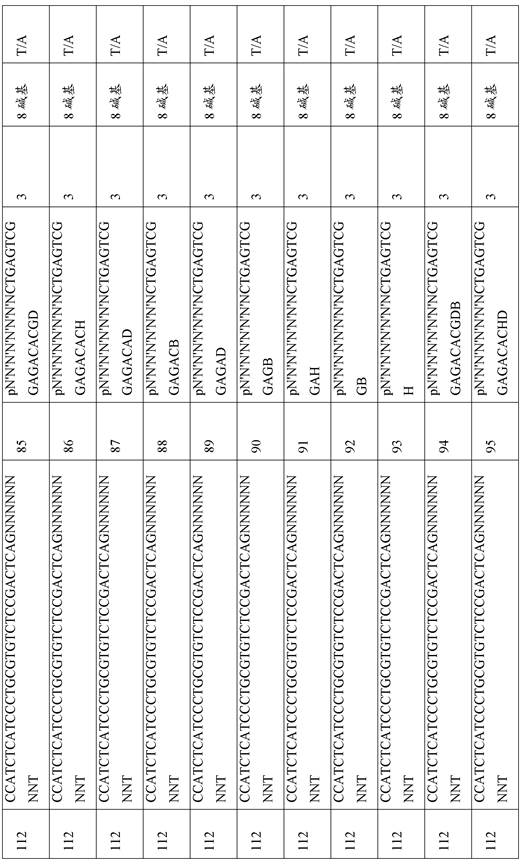


Applications Claiming Priority (3)
| Application Number | Priority Date | Filing Date | Title |
|---|---|---|---|
| US201562165627P | 2015-05-22 | 2015-05-22 | |
| US62/165627 | 2015-05-22 | ||
| PCT/US2016/033506 WO2016191272A1 (en) | 2015-05-22 | 2016-05-20 | Methods for next generation genome walking and related compositions and kits |
Publications (2)
| Publication Number | Publication Date |
|---|---|
| CN107922967A CN107922967A (en) | 2018-04-17 |
| CN107922967B true CN107922967B (en) | 2022-04-19 |
Family
ID=57393642
Family Applications (1)
| Application Number | Title | Priority Date | Filing Date |
|---|---|---|---|
| CN201680042969.2A Active CN107922967B (en) | 2015-05-22 | 2016-05-20 | Methods for next-generation genome walking and related compositions and kits |
Country Status (6)
| Country | Link |
|---|---|
| US (3) | US10988802B2 (en) |
| EP (1) | EP3298171A4 (en) |
| JP (2) | JP2018516569A (en) |
| CN (1) | CN107922967B (en) |
| AU (1) | AU2016268089B2 (en) |
| WO (1) | WO2016191272A1 (en) |
Families Citing this family (37)
| Publication number | Priority date | Publication date | Assignee | Title |
|---|---|---|---|---|
| US8835358B2 (en) | 2009-12-15 | 2014-09-16 | Cellular Research, Inc. | Digital counting of individual molecules by stochastic attachment of diverse labels |
| JP6375230B2 (en) | 2012-02-27 | 2018-08-15 | セルラー リサーチ, インコーポレイテッド | Compositions and kits for molecular counting |
| EP3039158B1 (en) | 2013-08-28 | 2018-11-14 | Cellular Research, Inc. | Massively parallel single cell analysis |
| ES2836802T3 (en) | 2015-02-27 | 2021-06-28 | Becton Dickinson Co | Spatially addressable molecular barcodes |
| CN107406888A (en) | 2015-03-30 | 2017-11-28 | 赛卢拉研究公司 | Methods and compositions for combining barcoding |
| EP4582556A3 (en) | 2015-04-23 | 2025-10-08 | Becton, Dickinson and Company | Methods and compositions for whole transcriptome amplification |
| CN107922967B (en) | 2015-05-22 | 2022-04-19 | 西格马-奥尔德里奇有限责任公司 | Methods for next-generation genome walking and related compositions and kits |
| WO2017044574A1 (en) | 2015-09-11 | 2017-03-16 | Cellular Research, Inc. | Methods and compositions for nucleic acid library normalization |
| US10301677B2 (en) | 2016-05-25 | 2019-05-28 | Cellular Research, Inc. | Normalization of nucleic acid libraries |
| US10640763B2 (en) | 2016-05-31 | 2020-05-05 | Cellular Research, Inc. | Molecular indexing of internal sequences |
| US10202641B2 (en) | 2016-05-31 | 2019-02-12 | Cellular Research, Inc. | Error correction in amplification of samples |
| US11708574B2 (en) * | 2016-06-10 | 2023-07-25 | Myriad Women's Health, Inc. | Nucleic acid sequencing adapters and uses thereof |
| GB201615486D0 (en) * | 2016-09-13 | 2016-10-26 | Inivata Ltd | Methods for labelling nucleic acids |
| EP4300099A3 (en) | 2016-09-26 | 2024-03-27 | Becton, Dickinson and Company | Measurement of protein expression using reagents with barcoded oligonucleotide sequences |
| BR112019013391A2 (en) * | 2016-12-28 | 2020-03-03 | Quest Diagnostics Investments Llc | NUCLEIC ACID ADAPTER, E, METHOD FOR DETECTION OF A MUTATION IN A DOUBLE TAPE CIRCULATING TUMORAL DNA (CTDNA) MOLECULE. |
| EP3577232A1 (en) | 2017-02-01 | 2019-12-11 | Cellular Research, Inc. | Selective amplification using blocking oligonucleotides |
| EP4345172A3 (en) | 2017-06-05 | 2024-07-03 | Becton, Dickinson and Company | Sample indexing for single cells |
| US11365409B2 (en) | 2018-05-03 | 2022-06-21 | Becton, Dickinson And Company | Molecular barcoding on opposite transcript ends |
| US11773441B2 (en) | 2018-05-03 | 2023-10-03 | Becton, Dickinson And Company | High throughput multiomics sample analysis |
| JP7670607B2 (en) | 2018-10-01 | 2025-04-30 | ベクトン・ディキンソン・アンド・カンパニー | Determination of 5' transcript sequence |
| EP3877520B1 (en) | 2018-11-08 | 2025-03-19 | Becton, Dickson And Company | Whole transcriptome analysis of single cells using random priming |
| US11492660B2 (en) | 2018-12-13 | 2022-11-08 | Becton, Dickinson And Company | Selective extension in single cell whole transcriptome analysis |
| WO2020154247A1 (en) | 2019-01-23 | 2020-07-30 | Cellular Research, Inc. | Oligonucleotides associated with antibodies |
| EP3924506A1 (en) | 2019-02-14 | 2021-12-22 | Becton Dickinson and Company | Hybrid targeted and whole transcriptome amplification |
| CN114051534B (en) | 2019-07-22 | 2025-02-21 | 贝克顿迪金森公司 | Single-cell chromatin immunoprecipitation sequencing assay |
| US11773436B2 (en) | 2019-11-08 | 2023-10-03 | Becton, Dickinson And Company | Using random priming to obtain full-length V(D)J information for immune repertoire sequencing |
| WO2021146207A1 (en) | 2020-01-13 | 2021-07-22 | Becton, Dickinson And Company | Methods and compositions for quantitation of proteins and rna |
| WO2021155057A1 (en) | 2020-01-29 | 2021-08-05 | Becton, Dickinson And Company | Barcoded wells for spatial mapping of single cells through sequencing |
| WO2021173719A1 (en) | 2020-02-25 | 2021-09-02 | Becton, Dickinson And Company | Bi-specific probes to enable the use of single-cell samples as single color compensation control |
| WO2021231779A1 (en) | 2020-05-14 | 2021-11-18 | Becton, Dickinson And Company | Primers for immune repertoire profiling |
| WO2021247593A1 (en) | 2020-06-02 | 2021-12-09 | Becton, Dickinson And Company | Oligonucleotides and beads for 5 prime gene expression assay |
| US11932901B2 (en) | 2020-07-13 | 2024-03-19 | Becton, Dickinson And Company | Target enrichment using nucleic acid probes for scRNAseq |
| US12391940B2 (en) | 2020-07-31 | 2025-08-19 | Becton, Dickinson And Company | Single cell assay for transposase-accessible chromatin |
| EP4247967A1 (en) | 2020-11-20 | 2023-09-27 | Becton, Dickinson and Company | Profiling of highly expressed and lowly expressed proteins |
| WO2022132206A1 (en) | 2020-12-15 | 2022-06-23 | Becton, Dickinson And Company | Single cell secretome analysis |
| KR20240007765A (en) * | 2021-05-16 | 2024-01-16 | 젠에디트바이오 리미티드 | Methods for enriching target nucleic acids, identifying off-targets and evaluating gene editing efficiency |
| KR20220156468A (en) * | 2021-05-18 | 2022-11-25 | 온코닉 테라퓨틱스 주식회사 | An anticancer drug for treating cancers resistant to PARP inhibitor |
Family Cites Families (11)
| Publication number | Priority date | Publication date | Assignee | Title |
|---|---|---|---|---|
| US7972828B2 (en) | 2006-12-19 | 2011-07-05 | Sigma-Aldrich Co. | Stabilized compositions of thermostable DNA polymerase and anionic or zwitterionic detergent |
| KR101190726B1 (en) * | 2009-07-07 | 2012-10-12 | 한국생명공학연구원 | Method for Cloning of Unknown DNA Sequences Adjacent to Known Sequence |
| JP2013511285A (en) * | 2009-11-23 | 2013-04-04 | スイフト・バイオサイエンシズ・インコーポレイテツド | Device for extending single-stranded target molecules |
| US8835358B2 (en) | 2009-12-15 | 2014-09-16 | Cellular Research, Inc. | Digital counting of individual molecules by stochastic attachment of diverse labels |
| WO2012012037A1 (en) | 2010-07-19 | 2012-01-26 | New England Biolabs, Inc. | Oligonucleotide adaptors: compositions and methods of use |
| US20120077716A1 (en) * | 2010-09-29 | 2012-03-29 | 454 Life Sciences Corporation | System and method for producing functionally distinct nucleic acid library ends through use of deoxyinosine |
| HUE068153T2 (en) | 2011-04-15 | 2024-12-28 | Univ Johns Hopkins | Safe sequencing system |
| WO2013096839A1 (en) * | 2011-12-22 | 2013-06-27 | Somagenics, Inc. | Methods of constructing small rna libraries and their use for expression profiling of target rnas |
| EP2828218B9 (en) | 2012-03-20 | 2021-04-07 | University Of Washington Through Its Center For Commercialization | Methods of lowering the error rate of massively parallel dna sequencing using duplex consensus sequencing |
| CN104736722B (en) * | 2012-05-21 | 2018-08-07 | 斯克利普斯研究所 | Sample preparation method |
| CN107922967B (en) | 2015-05-22 | 2022-04-19 | 西格马-奥尔德里奇有限责任公司 | Methods for next-generation genome walking and related compositions and kits |
-
2016
- 2016-05-20 CN CN201680042969.2A patent/CN107922967B/en active Active
- 2016-05-20 EP EP16800544.5A patent/EP3298171A4/en not_active Withdrawn
- 2016-05-20 JP JP2017560773A patent/JP2018516569A/en active Pending
- 2016-05-20 AU AU2016268089A patent/AU2016268089B2/en active Active
- 2016-05-20 WO PCT/US2016/033506 patent/WO2016191272A1/en not_active Ceased
- 2016-05-20 US US15/575,711 patent/US10988802B2/en active Active
-
2021
- 2021-03-22 US US17/208,538 patent/US11795501B2/en active Active
- 2021-06-23 JP JP2021104286A patent/JP2021168659A/en active Pending
-
2023
- 2023-09-20 US US18/470,603 patent/US20240068020A1/en active Pending
Also Published As
| Publication number | Publication date |
|---|---|
| JP2021168659A (en) | 2021-10-28 |
| CN107922967A (en) | 2018-04-17 |
| US20190136305A1 (en) | 2019-05-09 |
| EP3298171A4 (en) | 2018-10-31 |
| US10988802B2 (en) | 2021-04-27 |
| US11795501B2 (en) | 2023-10-24 |
| US20240068020A1 (en) | 2024-02-29 |
| WO2016191272A1 (en) | 2016-12-01 |
| US20210207207A1 (en) | 2021-07-08 |
| JP2018516569A (en) | 2018-06-28 |
| AU2016268089B2 (en) | 2021-09-23 |
| AU2016268089A1 (en) | 2017-11-30 |
| EP3298171A1 (en) | 2018-03-28 |
Similar Documents
| Publication | Publication Date | Title |
|---|---|---|
| CN107922967B (en) | Methods for next-generation genome walking and related compositions and kits | |
| US12270070B2 (en) | Single stranded circular DNA libraries for circular consensus sequencing | |
| US10102337B2 (en) | Digital measurements from targeted sequencing | |
| US8986958B2 (en) | Methods for generating target specific probes for solution based capture | |
| JP6525473B2 (en) | Compositions and methods for identifying replicate sequencing leads | |
| CN110139931B (en) | Methods and compositions for phased sequencing | |
| WO2010030683A1 (en) | Methods of generating gene specific libraries | |
| CN111100911A (en) | Method for amplifying target nucleic acid | |
| CN105121664A (en) | Methods of sequencing nucleic acids in mixtures and compositions related thereto | |
| CN104093890A (en) | Compositions and methods for targeted nucleic acid sequence enrichment and efficient library generation | |
| CN106661636A (en) | Preparation of adapter-ligated amplicons | |
| HK40114910A (en) | Methods and compositions for phased sequencing | |
| HK40013260B (en) | Methods and compositions for phased sequencing |
Legal Events
| Date | Code | Title | Description |
|---|---|---|---|
| PB01 | Publication | ||
| PB01 | Publication | ||
| SE01 | Entry into force of request for substantive examination | ||
| SE01 | Entry into force of request for substantive examination | ||
| GR01 | Patent grant | ||
| GR01 | Patent grant |