CN103492378A - Novel pesticidal pyrazole compounds - Google Patents
Novel pesticidal pyrazole compounds Download PDFInfo
- Publication number
- CN103492378A CN103492378A CN201280018530.8A CN201280018530A CN103492378A CN 103492378 A CN103492378 A CN 103492378A CN 201280018530 A CN201280018530 A CN 201280018530A CN 103492378 A CN103492378 A CN 103492378A
- Authority
- CN
- China
- Prior art keywords
- compounds
- alkyl
- formula
- compound
- methyl
- Prior art date
- Legal status (The legal status is an assumption and is not a legal conclusion. Google has not performed a legal analysis and makes no representation as to the accuracy of the status listed.)
- Granted
Links
- 0 *C(*)([n]1ncc(C(N(*)C2=CC=[U]N=C2)O)*1*)S Chemical compound *C(*)([n]1ncc(C(N(*)C2=CC=[U]N=C2)O)*1*)S 0.000 description 1
Classifications
-
- A—HUMAN NECESSITIES
- A01—AGRICULTURE; FORESTRY; ANIMAL HUSBANDRY; HUNTING; TRAPPING; FISHING
- A01N—PRESERVATION OF BODIES OF HUMANS OR ANIMALS OR PLANTS OR PARTS THEREOF; BIOCIDES, e.g. AS DISINFECTANTS, AS PESTICIDES OR AS HERBICIDES; PEST REPELLANTS OR ATTRACTANTS; PLANT GROWTH REGULATORS
- A01N43/00—Biocides, pest repellants or attractants, or plant growth regulators containing heterocyclic compounds
- A01N43/48—Biocides, pest repellants or attractants, or plant growth regulators containing heterocyclic compounds having rings with two nitrogen atoms as the only ring hetero atoms
- A01N43/56—1,2-Diazoles; Hydrogenated 1,2-diazoles
-
- A—HUMAN NECESSITIES
- A01—AGRICULTURE; FORESTRY; ANIMAL HUSBANDRY; HUNTING; TRAPPING; FISHING
- A01N—PRESERVATION OF BODIES OF HUMANS OR ANIMALS OR PLANTS OR PARTS THEREOF; BIOCIDES, e.g. AS DISINFECTANTS, AS PESTICIDES OR AS HERBICIDES; PEST REPELLANTS OR ATTRACTANTS; PLANT GROWTH REGULATORS
- A01N43/00—Biocides, pest repellants or attractants, or plant growth regulators containing heterocyclic compounds
- A01N43/48—Biocides, pest repellants or attractants, or plant growth regulators containing heterocyclic compounds having rings with two nitrogen atoms as the only ring hetero atoms
- A01N43/58—1,2-Diazines; Hydrogenated 1,2-diazines
-
- A—HUMAN NECESSITIES
- A01—AGRICULTURE; FORESTRY; ANIMAL HUSBANDRY; HUNTING; TRAPPING; FISHING
- A01N—PRESERVATION OF BODIES OF HUMANS OR ANIMALS OR PLANTS OR PARTS THEREOF; BIOCIDES, e.g. AS DISINFECTANTS, AS PESTICIDES OR AS HERBICIDES; PEST REPELLANTS OR ATTRACTANTS; PLANT GROWTH REGULATORS
- A01N43/00—Biocides, pest repellants or attractants, or plant growth regulators containing heterocyclic compounds
- A01N43/72—Biocides, pest repellants or attractants, or plant growth regulators containing heterocyclic compounds having rings with nitrogen atoms and oxygen or sulfur atoms as ring hetero atoms
- A01N43/74—Biocides, pest repellants or attractants, or plant growth regulators containing heterocyclic compounds having rings with nitrogen atoms and oxygen or sulfur atoms as ring hetero atoms five-membered rings with one nitrogen atom and either one oxygen atom or one sulfur atom in positions 1,3
- A01N43/78—1,3-Thiazoles; Hydrogenated 1,3-thiazoles
-
- A—HUMAN NECESSITIES
- A01—AGRICULTURE; FORESTRY; ANIMAL HUSBANDRY; HUNTING; TRAPPING; FISHING
- A01N—PRESERVATION OF BODIES OF HUMANS OR ANIMALS OR PLANTS OR PARTS THEREOF; BIOCIDES, e.g. AS DISINFECTANTS, AS PESTICIDES OR AS HERBICIDES; PEST REPELLANTS OR ATTRACTANTS; PLANT GROWTH REGULATORS
- A01N43/00—Biocides, pest repellants or attractants, or plant growth regulators containing heterocyclic compounds
- A01N43/72—Biocides, pest repellants or attractants, or plant growth regulators containing heterocyclic compounds having rings with nitrogen atoms and oxygen or sulfur atoms as ring hetero atoms
- A01N43/80—Biocides, pest repellants or attractants, or plant growth regulators containing heterocyclic compounds having rings with nitrogen atoms and oxygen or sulfur atoms as ring hetero atoms five-membered rings with one nitrogen atom and either one oxygen atom or one sulfur atom in positions 1,2
-
- C—CHEMISTRY; METALLURGY
- C07—ORGANIC CHEMISTRY
- C07D—HETEROCYCLIC COMPOUNDS
- C07D401/00—Heterocyclic compounds containing two or more hetero rings, having nitrogen atoms as the only ring hetero atoms, at least one ring being a six-membered ring with only one nitrogen atom
- C07D401/02—Heterocyclic compounds containing two or more hetero rings, having nitrogen atoms as the only ring hetero atoms, at least one ring being a six-membered ring with only one nitrogen atom containing two hetero rings
- C07D401/12—Heterocyclic compounds containing two or more hetero rings, having nitrogen atoms as the only ring hetero atoms, at least one ring being a six-membered ring with only one nitrogen atom containing two hetero rings linked by a chain containing hetero atoms as chain links
-
- C—CHEMISTRY; METALLURGY
- C07—ORGANIC CHEMISTRY
- C07D—HETEROCYCLIC COMPOUNDS
- C07D401/00—Heterocyclic compounds containing two or more hetero rings, having nitrogen atoms as the only ring hetero atoms, at least one ring being a six-membered ring with only one nitrogen atom
- C07D401/14—Heterocyclic compounds containing two or more hetero rings, having nitrogen atoms as the only ring hetero atoms, at least one ring being a six-membered ring with only one nitrogen atom containing three or more hetero rings
-
- C—CHEMISTRY; METALLURGY
- C07—ORGANIC CHEMISTRY
- C07D—HETEROCYCLIC COMPOUNDS
- C07D403/00—Heterocyclic compounds containing two or more hetero rings, having nitrogen atoms as the only ring hetero atoms, not provided for by group C07D401/00
- C07D403/02—Heterocyclic compounds containing two or more hetero rings, having nitrogen atoms as the only ring hetero atoms, not provided for by group C07D401/00 containing two hetero rings
- C07D403/12—Heterocyclic compounds containing two or more hetero rings, having nitrogen atoms as the only ring hetero atoms, not provided for by group C07D401/00 containing two hetero rings linked by a chain containing hetero atoms as chain links
-
- C—CHEMISTRY; METALLURGY
- C07—ORGANIC CHEMISTRY
- C07D—HETEROCYCLIC COMPOUNDS
- C07D405/00—Heterocyclic compounds containing both one or more hetero rings having oxygen atoms as the only ring hetero atoms, and one or more rings having nitrogen as the only ring hetero atom
- C07D405/14—Heterocyclic compounds containing both one or more hetero rings having oxygen atoms as the only ring hetero atoms, and one or more rings having nitrogen as the only ring hetero atom containing three or more hetero rings
-
- C—CHEMISTRY; METALLURGY
- C07—ORGANIC CHEMISTRY
- C07D—HETEROCYCLIC COMPOUNDS
- C07D409/00—Heterocyclic compounds containing two or more hetero rings, at least one ring having sulfur atoms as the only ring hetero atoms
- C07D409/14—Heterocyclic compounds containing two or more hetero rings, at least one ring having sulfur atoms as the only ring hetero atoms containing three or more hetero rings
-
- C—CHEMISTRY; METALLURGY
- C07—ORGANIC CHEMISTRY
- C07D—HETEROCYCLIC COMPOUNDS
- C07D411/00—Heterocyclic compounds containing two or more hetero rings, at least one ring having oxygen and sulfur atoms as the only ring hetero atoms
- C07D411/14—Heterocyclic compounds containing two or more hetero rings, at least one ring having oxygen and sulfur atoms as the only ring hetero atoms containing three or more hetero rings
-
- C—CHEMISTRY; METALLURGY
- C07—ORGANIC CHEMISTRY
- C07D—HETEROCYCLIC COMPOUNDS
- C07D417/00—Heterocyclic compounds containing two or more hetero rings, at least one ring having nitrogen and sulfur atoms as the only ring hetero atoms, not provided for by group C07D415/00
- C07D417/14—Heterocyclic compounds containing two or more hetero rings, at least one ring having nitrogen and sulfur atoms as the only ring hetero atoms, not provided for by group C07D415/00 containing three or more hetero rings
Landscapes
- Organic Chemistry (AREA)
- Chemical & Material Sciences (AREA)
- Life Sciences & Earth Sciences (AREA)
- Environmental Sciences (AREA)
- Agronomy & Crop Science (AREA)
- Engineering & Computer Science (AREA)
- Dentistry (AREA)
- General Health & Medical Sciences (AREA)
- Wood Science & Technology (AREA)
- Zoology (AREA)
- Plant Pathology (AREA)
- Pest Control & Pesticides (AREA)
- Health & Medical Sciences (AREA)
- Plural Heterocyclic Compounds (AREA)
- Agricultural Chemicals And Associated Chemicals (AREA)
- Pharmaceuticals Containing Other Organic And Inorganic Compounds (AREA)
- Pretreatment Of Seeds And Plants (AREA)
- Catching Or Destruction (AREA)
- Nitrogen Condensed Heterocyclic Rings (AREA)
- Organic Low-Molecular-Weight Compounds And Preparation Thereof (AREA)
Abstract
本发明涉及新的式(I)的吡唑,其中各变量如发明描述中所定义;一种防治无脊椎动物害虫的方法,一种保护植物繁殖材料和/或由其生长的植物的方法,包含至少一种本发明化合物的植物繁殖材料,和一种农业组合物。 The present invention relates to a new pyrazole of formula (I), wherein each variable is as defined in the description of the invention; a method for controlling invertebrate pests; a method for protecting plant propagation material and/or plants growing therefrom; plant propagation material comprising at least one compound of the present invention; and an agricultural composition.
Description
Description of the invention
The present invention relates to novel pyrazoles of formula I and stereoisomers, salts, tautomers and N-oxides thereof:
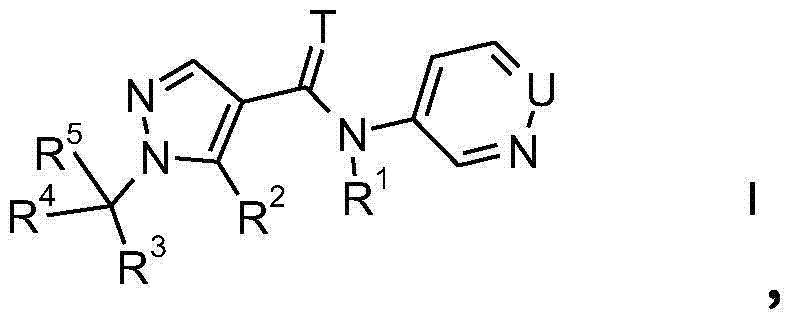
wherein,
u is N or CH;
t is O or S;
R1is H, C1-C2Alkyl or C1-C2alkoxy-C1-C2An alkyl group;
R2is CH3Or a halomethyl group;
R3is C2-C6Alkyl radical, C1-C6Haloalkyl, C1-C2alkoxy-C1-C2Alkyl radical, C2-C6Alkenyl and C2-C6Alkynyl, C3-C6Cycloalkyl radical, C5-C6Cycloalkenyl radical, C1-C6Alkoxy, CN, NO2Or S (O)nRbWherein the C atom may be unsubstituted or partially or completely substituted by RaSubstitution;
Rais halogen, CN, NO2、C1-C2Alkyl radical, C1-C2Haloalkyl, C1-C4Alkoxy radical, C1-C2Haloalkoxy or S (O)nRbWherein n is 0, 1 or 2;
Rbis hydrogen, C1-C2Alkyl radical, C1-C2Haloalkyl, C3-C6Cycloalkyl or C1-C4An alkoxy group,
R4is C1-C4Alkyl or para R3The mentioned groups;
R5is H or to R4The mentioned groups;
R3and R4May together form a 3-to 6-membered carbocyclic or heterocyclic ring which may contain 1 or 2 members selected from N-RcO and S, wherein S may be oxidized, the carbocyclic or heterocyclic ring may be substituted with RaSubstitution;
Rcis hydrogen, C1-C2Alkyl radical, C1-C2Haloalkyl, C1-C2Alkylcarbonyl or C1-C2An alkoxycarbonyl group.
Furthermore, the present invention relates to processes and intermediates for preparing pyrazoles of formula I, as well as to active compound combinations comprising the same, to compositions comprising the same and to the use thereof for combating invertebrate pests. Furthermore, the invention relates to methods of applying such compounds.
Further embodiments of the invention are apparent from the claims, description and examples. It is to be understood that the features of the inventive subject matter mentioned above and those yet to be explained below can be applied not only in the respective given combination but also in other combinations without departing from the scope of the invention.
WO2009/027393, WO2010/034737, WO2010/034738 and WO2010/112177 describe N-aryl amide derivatives derived from pyrazole carboxylic acids. These compounds are mentioned to be useful for combating invertebrate pests.
Invertebrate pests and in particular arthropods and nematodes destroy growing and harvested crops and attack wooden dwelling and commercial structures, causing large economic losses to food supply and property. There remains a need for new agents for combating invertebrate pests, such as insects, arachnids and nematodes. It is therefore an object of the present invention to provide compounds which have good pesticidal activity and show a broad spectrum of activity against a large number of different invertebrate pests, in particular against pests which are difficult to control, such as insects.
It has been found that these objects are achieved by the compounds of the formula I as defined at the outset and their stereoisomers, salts, tautomers and N-oxides, in particular their agriculturally suitable salts.
One embodiment of the present invention relates to compounds of formula I, wherein U is CH. These compounds correspond to formula i.a.
Another embodiment of the invention relates to compounds of formula I, wherein U is N. These compounds correspond to formula I.B.
The compounds of the invention may be prepared according to standard methods of organic chemistry in a similar manner to the synthetic routes described in WO2009/027393 and WO2010/034737, for example according to the following synthetic routes:
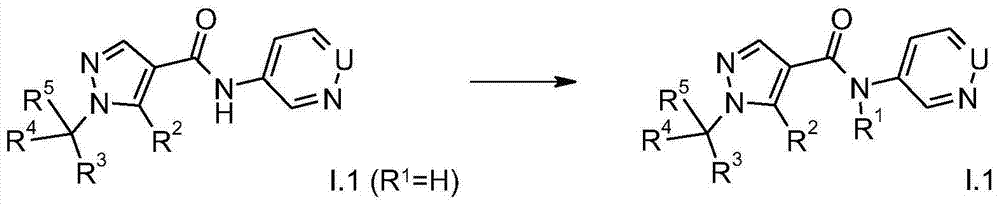
compounds of the formula I in which T is O (formula I.1) can be prepared, for example, by reacting the activated pyrazolecarboxylic acid derivative II with 3-aminopyridine or 4-aminopyridazine of the formula III (for example Houben-Weyl: "Methoden der organisn. Chemie" [ Methods of Organic Chemistry ], Georg-Thieme-Verlag, Stuttgart, New York1985, Vol. E5, p. 941 to p. 1045).

Activated pyrazolecarboxylic acid derivatives II are preferably halides, activated esters, anhydrides, nitrides, e.g.chlorides, fluorides, bromides, p-nitrophenyl esters, pentafluorophenyl esters, N-hydroxysuccinimide, hydroxybenzotriazol-1-yl esters.
In the formulae II and III, these radicals have the meanings mentioned above for formula I, in particular the preferred meanings mentioned, X being a suitable leaving group, for example halogen, N3P-nitrophenoxy or pentafluorophenoxy and the like.
A compound of formula I.1 (wherein R1Other than hydrogen) also by reacting the amide I.1 (where R is1Is hydrogen) is alkylated. The alkylation can be carried out under standard conditions known from the literature.
The compound of formula I may mutexist in two isomeric forms and the compound of formula I.B may mutexist in three isomeric forms, thus formula I encompasses both tautomers T-a and T-B, and for formula I.B also T-C:

for clarity, it is referred to throughout the specification as only isomer T-a, but its description also covers disclosure of other isomers.
Isomer T-C can be obtained by compound I.B.1 (wherein R is1Hydrogen) is alkylated. The reaction can be carried out in a manner analogous to the N-alkylation of known pyridazines. N-alkylation of pyridazines is known in the literature and can be found, for example, in: chem.soc., Perkin trans. vol.1, page 401 (1988) and j.org.chem. vol.46, page 2467 (1981).

Compounds of the formula I in which T is S (formula I.2) can be prepared, for example, by reacting a compound of the formula I.1 with 2, 4-bis (4-methoxyphenyl) -1,3,2, 4-dithiadiphosphohexane or PS according to the process described in Synthesis2003, page 19295And reacting to prepare the compound.
Compounds II and III are known in the art or are commercially available or can be prepared by methods known from the literature (cf. WO 05/040169; WO 08/074824; Journal of Fluorine chemistry132(11), p. 995 (2011)).
The N-oxides of the compounds of the formula I can be prepared by oxidation of the compounds I according to standard methods for preparing heteroaromatic N-oxides, for example by the methods described in Journal of Organometallic Chemistry1989, 370, 17-31.
If an individual compound cannot be prepared via the above-described route, it can be prepared by derivatization of other compounds I or by known modifications of the synthetic route. For example, in individual cases, certain compounds I can advantageously be prepared from other compounds I by ester hydrolysis, amidation, esterification, ether cleavage, olefination, reduction, oxidation, and the like.
The reaction mixture can be worked up in a known manner, for example by mixing with water, separating the phases and, where appropriate, purifying the crude product by chromatography, for example on alumina or silica gel. Some of the intermediates and end products can be obtained in the form of colorless or light brown viscous oils, which are removed from or purified from the volatile components under reduced pressure and at moderately elevated temperatures. If the intermediates and final products are obtained in solid form, they can be purified by recrystallization or trituration.
The term "compound of the invention" or "compound of formula I" encompasses the compounds as defined herein as well as stereoisomers, salts, tautomers or N-oxides thereof. The term "compound of the present invention" is to be understood as being equivalent to the term "compound of the present invention" and thus also includes stereoisomers, salts, tautomers or N-oxides thereof.
The group attached to the backbone of formula I may contain one or more chiral centers. In this case, formula I exists in different enantiomeric or diastereomeric forms, depending on the substituent. The present invention relates to each of the possible stereoisomers of formula I, i.e. to single enantiomers or diastereomers and mixtures thereof.
The compounds of formula I may be amorphous or may exist in one or more different crystalline states (polymorphs), which may have different macroscopic properties (e.g. stability) or show different biological properties (e.g. activity). The present invention relates to amorphous and crystalline compounds of formula I, mixtures of different crystalline states of the corresponding compounds I, and amorphous or crystalline salts thereof.
Salts of the compounds of the formula I are preferably agriculturally useful salts. It may be formed in a conventional manner, for example, by reacting a compound of formula I, if it has a basic functional group, with an acid of the anion.
Agriculturally useful salts of the compounds of formula I encompass in particular the acid addition salts of those acids whose cations and anions, respectively, have no adverse effect on the pesticidal action of the compounds of formula I.
The anion of the acid addition salt is selected from chloride, bromide, fluoride, hydrogen sulfate, dihydrogen phosphate, hydrogen phosphate, nitrate, hydrogen carbonate, hexafluorosilicate, hexafluorophosphate, benzoate and C1-C4The anion of an alkanoic acid (preferably formate, acetate, propionate, and butyrate). Which can be formed by reacting a compound of formula I with an acid of the corresponding anion, preferably hydrochloric acid, hydrobromic acid, sulfuric acid, phosphoric acid or nitric acid.
The term "N-oxide" includes any compound of formula I having at least one tertiary nitrogen atom oxidized to an N-oxide moiety.
The organic moieties mentioned in the definitions of the above variables (for example the term halogen) are collective terms for each enumeration of the members of each group. Prefix Cn-CmIn each case representing the possible number of carbon atoms in the radical.
The term "halogen" denotes in each case fluorine, bromine, chlorine or iodine, especially fluorine, chlorine or bromine.
The term "alkyl" as used herein and in the alkyl moieties of alkoxy, alkylcarbonyl, alkylthio, alkylsulfinyl, alkylsulfonyl and alkoxyalkyl denotes in each case a straight-chain or branched alkyl radical which usually has from 1 to 6 carbon atoms, preferably from 1 to 4 carbon atoms and in particular from 1 to 3 carbon atoms. Examples of alkyl are methyl, ethyl, n-propyl, isopropyl, n-butyl, 2-butyl, isobutyl, tert-butyl, n-pentyl, 1-methylbutyl, 2-methylbutyl, 3-methylbutyl, 2-dimethylpropyl, 1-ethylpropyl, n-hexyl, 1-dimethylpropyl, 1, 2-dimethylpropyl, 1-methylpentyl, 2-methylpentyl, 3-methylpentyl, 4-methylpentyl, 1-dimethylbutyl, 1, 2-dimethylbutyl, 1, 3-dimethylbutyl, 2-dimethylbutyl, 2, 3-dimethylbutyl, 3-dimethylbutyl, 1-ethylbutyl, 2-ethylbutyl, 1, 2-trimethylpropyl, 1,2, 2-trimethylpropyl, 1-ethyl-1-methylpropyl and 1-ethyl-2-methylpropyl.
The term "haloalkyl" as used herein and in the haloalkyl moieties of haloalkoxy, haloalkylthiohaloalkylcarbonyl, haloalkylsulfonyl and haloalkylsulfinyl denotes in each case a straight-chain or branched alkyl group, usually having from 1 to 6 carbon atoms, frequently from 1 to 4 carbon atoms, wherein the hydrogen atoms of the group are partly or completely replaced by halogen atoms. Preferably the haloalkyl moiety is selected from C1-C2Haloalkyl, especially C1-C2Fluoroalkyl groups such as fluoromethyl, difluoromethyl, trifluoromethyl, 1-fluoroethyl, 2, 2-difluoroethyl, 2,2, 2-trifluoroethyl, pentafluoroethyl and the like.
The term "alkoxy" as used herein denotes in each case a straight-chain or branched alkyl radical which is bonded via an oxygen atom and generally has from 1 to 6 carbon atoms, preferably from 1 to 4 carbon atoms. Examples of alkoxy groups are methoxy, ethoxy, n-propoxy, isopropoxy, n-butoxy, 2-butoxy, isobutoxy, tert-butoxy and the like.
The term "cycloalkyl" as used herein and in the cycloalkyl moieties of cycloalkoxy and cycloalkylmethyl denotes in each case a monocyclic cycloaliphatic radical having typically from 3 to 6 carbon atoms, such as cyclopropyl, cyclobutyl, cyclopentyl and cyclohexyl.
The term "alkenyl" as used herein denotes in each case a monounsaturated hydrocarbon radical which usually has from 2 to 6, preferably from 2 to 4, carbon atoms, for example, vinyl group, allyl group (2-propen-1-yl group), 1-propen-1-yl group, 2-propen-2-yl group, methallyl group (2-methylprop-2-en-1-yl group), 2-buten-1-yl group, 3-buten-1-yl group, 2-penten-1-yl group, 3-penten-1-yl group, 4-penten-1-yl group, 1-methylbut-2-en-1-yl group, 2-ethylprop-2-en-1-yl group and the like.
The term "alkynyl" as used herein denotes in each case a monounsaturated hydrocarbon radical having in general 2 to 6, preferably 2 to 4, carbon atoms, such as, for example, ethynyl, propargyl (2-propyn-1-yl), 1-propyn-1-yl, 1-methylpropan-2-yn-1-yl), 2-butyn-1-yl, 3-butyn-1-yl, 1-pentyn-1-yl, 3-pentyn-1-yl, 4-pentyn-1-yl, 1-methylbut-2-yn-1-yl, 1-ethylprop-2-yn-1-yl and the like.
The term "alkoxyalkyl" as used herein refers to an alkyl group typically containing 1 to 2 carbon atoms, wherein 1 carbon atom carries an alkoxy group as defined above typically containing 1 or 2 carbon atoms. Example is CH2OCH3、CH2-OC2H52- (methoxy) ethyl and 2- (ethoxy) ethyl.
The term "heterocyclyl" generally includes 5-or 6-membered, especially 6-membered, monocyclic heterocyclic non-aromatic groups. Heterocyclic non-aromatic groups typically contain 1,2 or 3 heteroatoms selected from N, O and S as ring members, wherein the S atom as a ring member may be S, SO or SO2The form exists.
Examples of 5-or 6-membered heterocyclic groups include saturated or unsaturated, non-aromatic heterocycles, such as oxirane, oxetanyl, thietanyl-S-oxide (S-oxothietanyl), thietanyl-S-dioxide (S-dioxothietanyl), pyrrolidinyl, pyrrolinyl, pyrazolinyl, tetrahydrofuranyl, dihydrofuranyl, 1, 3-dioxolanyl, thietanyl, S-oxothietanyl, S-dioxothietanyl, dihydrothienyl, S-oxodihydrothienyl, S-dioxodihydrothienyl, dihydrothienyl,oxazolidinyl group,Oxazolinyl, thiazolinyl, oxathiacyclopentyl, piperidinyl, piperazinyl, pyranyl, dihydropyranyl, tetrahydropyranyl, 1, 3-bis Alkyl and 1, 4-di
 Alkyl, thiopyranyl, S-oxothiopyranyl, S-dioxothiopyranyl, thiochromanyl, S-oxothiochromanyl, S-dioxothiochromanyl, tetrahydrothiopyranyl, S-oxotetrahydrothiopyranyl, S-dioxotetrahydrothiopyranyl, morpholinyl, thiomorpholinyl, S-oxothiomorpholinyl, S-dioxothiomorpholinyl, thiazinyl and the like. Examples of heterocycles which also contain 1 or 2 carbonyl groups as ring members include pyrrolidin-2-one, pyrrolidin-2, 5-dione, imidazolidin-2-one, imidazolidine-2-one, and,Oxazolidin-2-one, thiazolidin-2-one, and the like.
Particularly preferred embodiments of the intermediates correspond, with regard to the variables, to those of the radicals of the formula I.
In a particular embodiment, the variables of the compounds of the formula I have the following meanings, which are, individually and in combination with one another, particular embodiments of the compounds of the formula I:
in a preferred embodiment of the compounds of formula I, U is CH. These compounds correspond to formula i.a.
In another embodiment of the compounds of formula I, U is N. These compounds correspond to formula I.B.
In a first preferred embodiment of formula I, T is O. These compounds correspond to formula i.1.
In another embodiment of formula I, T is S. These compounds correspond to formula i.2.
In a first embodiment, R1Is H.
In another embodiment, R1Is C1-C2Alkyl, preferably CH3。
In another embodiment, R1Is CH2CH3。
In another embodiment, R1Is C1-C2alkoxy-C1-C2Alkyl, preferably C1-C2Alkoxymethyl, especially CH2OCH3。
In a first embodiment, R2Is CH3。
In another embodiment, R2Is halomethyl, preferably fluoromethyl, especially CHF2Or CF3。
In a first preferred embodiment, R3Is C2-C6Alkyl, preferably C2-C4Alkyl, especially CH2CH3Or C (CH)3)3。
In another preferred embodiment, R3Is C1-C6Haloalkyl, preferably C1-C2Alkyl, more preferably methyl, such as CHF2Or CF3Especially CF3。
In another preferred embodiment, R3Is C1-C2alkoxy-C1-C2Alkyl, preferably C1-C2Alkoxymethyl, especially CH2OCH3。
In another preferred embodiment, R3Is C3-C6Cycloalkyl, preferably cyclopropyl, which is unsubstituted or substituted, preferably by halogen or cyano. The substituent is preferably located at the 1-position or 2, 2-position.
In a first preferred embodiment, R4Is C1-C4Alkyl, preferably C1-C2Alkyl, especially CH3。
In another preferred embodiment, R4Is C1-C6Haloalkyl, preferably C1-C2Alkyl, especially halomethyl, e.g. CF3。
In another embodiment, R4Is C3-C6Cycloalkyl, preferably cyclopropyl, which may be substituted, preferably by halogen or cyano. The substituent is preferably located at the 1-position or 2, 2-position.
In a first preferred embodiment, R5Is hydrogen.
In another preferred embodiment, R5Is CN or NO2Preferably CN.
In another preferred embodiment, R5Is C1-C4Alkyl, preferably C1-C2Alkyl, especially CH3。
In another embodiment, R3And R4Forming a 5-or 6-membered saturated carbocyclic ring, e.g. cyclopentyl or cyclohexyl, unsubstituted or substituted by one or more radicals RaAnd (4) substitution. These RaThe radical is preferably halogen, cyano or halomethyl.
In another embodiment, R3And R4Form a 5-or 6-membered saturated heterocycle containing 1 or 2, preferably 1, member selected from N-RcO and S, wherein S may be oxidised, the heterocycle being unsubstituted or substituted by one or more radicals RdAnd (4) substitution.
RcPreferably represents C1-C2Alkyl, especially CH3(ii) a Or C1-C2Alkylcarbonyl, especially acetyl.
The heterocycle is preferably unsubstituted.
In one embodiment, from R3And R4The heterocycle formed represents the group H:
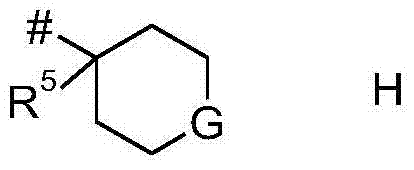
wherein G is N-RcO, S, S (= O) or SO2And # represents a bond to the pyrazole moiety.
Another embodiment relates to compounds of formula I (excluding racemic compounds), wherein T is O, R1Is H, C1-C2Alkyl or CH2OCH3,R2Is CH3、CHF2Or CF3,R3Is CF3Or cyclopropyl, R4Is CH3And R is5Is H.
Especially in view of their use, preference is given to the compounds of the formula I compiled in the table below, which correspond to the formula I.1. Furthermore, each of the groups mentioned for a substituent in the table is a particularly preferred aspect of said substituent per se (independent of the combination in which the group is mentioned).
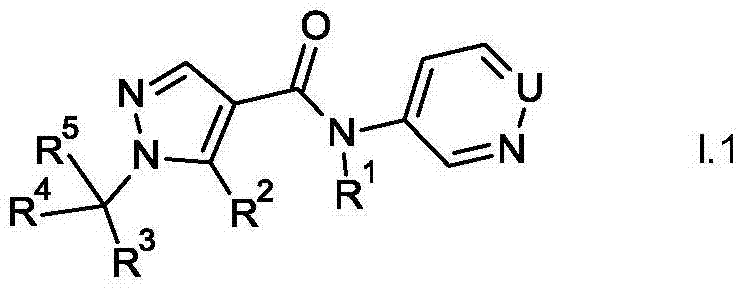
TABLE 1
A compound of the formula I.1, wherein U is CH, R1Is H, R2Is CH3And R is3、R4And R5Corresponds in each case to a row of Table A for the compounds
TABLE 2
Compounds of the formula I.1, in which U is N, R1Is H, R2Is CH3And R is3、R4And R5Corresponds in each case to a row of Table A for the compounds
TABLE 3
A compound of the formula I.1, wherein U is CH, R1Is H, R2Is CHF2And R is3、R4And R5Corresponds in each case to a row of Table A for the compounds
TABLE 4
Compounds of the formula I.1, in which U is N, R1Is H, R2Is CHF2And R is3、R4And R5Corresponds in each case to a row of Table A for the compounds
TABLE 5
A compound of the formula I.1, wherein U is CH, R1Is H, R2Is CF3And R is3、R4And R5Corresponds in each case to a row of Table A for the compounds
TABLE 6
Compounds of the formula I.1, in which U is N, R1Is H, R2Is CF3And R is3、R4And R5Corresponds in each case to a row of Table A for the compounds
TABLE 7
A compound of the formula I.1, wherein U is CH, R1And R2Is CH3And R is3、R4And R5Corresponds in each case to a row of Table A for the compounds
TABLE 8
Compounds of the formula I.1, in which U is N, R1And R2Is CH3And R is3、R4And R5Corresponds in each case to a row of Table A for the compounds
TABLE 9
A compound of the formula I.1, wherein U is CH, R1Is CH3,R2Is CHF2And R is3、R4And R5Corresponds in each case to a row of Table A for the compounds
Watch 10
Compounds of the formula I.1, in which U is N, R1Is CH3,R2Is CHF2And R is3、R4And R5Corresponds in each case to a row of Table A for the compounds
TABLE 11
A compound of the formula I.1, wherein U is CH, R1Is CH3,R2Is CF3And R is3、R4And R5Corresponds in each case to a row of Table A for the compounds
TABLE 12
Compounds of the formula I.1, in which U is N, R1Is CH3,R2Is CF3And R is3、R4And R5Corresponds in each case to a row of Table A for the compounds
Watch 13
A compound of the formula I.1, wherein U is CH, R1Is CH2CH3,R2Is CH3And R is3、R4And R5Corresponds in each case to a row of Table A for the compounds
TABLE 14
Compounds of the formula I.1, in which U is N, R1Is CH2CH3,R2Is CH3And R is3、R4And R5In each case for the compoundIn one case corresponding to a row of table a
Watch 15
A compound of the formula I.1, wherein U is CH, R1Is CH2CH3,R2Is CHF2And R is3、R4And R5Corresponds in each case to a row of Table A for the compounds
TABLE 16
Compounds of the formula I.1, in which U is N, R1Is CH2CH3,R2Is CHF2And R is3、R4And R5Corresponds in each case to a row of Table A for the compounds
TABLE 17
A compound of the formula I.1, wherein U is CH, R1Is CH2CH3,R2Is CF3And R is3、R4And R5Corresponds in each case to a row of Table A for the compounds
Watch 18
Compounds of the formula I.1, in which U is N, R1Is CH2CH3,R2Is CF3And R is3、R4And R5Corresponds in each case to a row of Table A for the compounds
Watch 19
A compound of the formula I.1, wherein U is CH, R1Is CH2OCH3,R2Is CH3And R is3、R4And R5Corresponds in each case to a row of Table A for the compounds
Watch 20
Compounds of the formula I.1, in which U is N, R1Is CH2OCH3,R2Is CH3And R is3、R4And R5In combination ofIn each case corresponding to a row of Table A
TABLE 21
A compound of the formula I.1, wherein U is CH, R1Is CH2OCH3,R2Is CHF2And R is3、R4And R5Corresponds in each case to a row of Table A for the compounds
TABLE 22
Compounds of the formula I.1, in which U is N, R1Is CH2OCH3,R2Is CHF2And R is3、R4And R5Corresponds in each case to a row of Table A for the compounds
TABLE 23
A compound of the formula I.1, wherein U is CH, R1Is CH2OCH3,R2Is CF3And R is3、R4And R5Corresponds in each case to a row of Table A for the compounds
Watch 24
Compounds of the formula I.1, in which U is N, R1Is CH2OCH3,R2Is CF3And R is3、R4And R5Corresponds in each case to a row of Table A for the compounds
TABLE 25
A compound of the formula I.1, wherein U is CH, R1Is CH2OCH2CH3,R2Is CH3And R is3、R4And R5Corresponds in each case to a row of Table A for the compounds
Watch 26
Compounds of the formula I.1, in which U is N, R1Is CH2OCH2CH3,R2Is CH3And R is3、R4And R5Corresponds in each case to a row of Table A for the compounds
Watch 27
A compound of the formula I.1, wherein U is CH, R1Is CH2OCH2CH3,R2Is CHF2And R is3、R4And R5Corresponds in each case to a row of Table A for the compounds
Watch 28
Compounds of the formula I.1, in which U is N, R1Is CH2OCH2CH3,R2Is CHF2And R is3、R4And R5Corresponds in each case to a row of Table A for the compounds
Watch 29
A compound of the formula I.1, wherein U is CH, R1Is CH2OCH2CH3,R2Is CF3And R is3、R4And R5Corresponds in each case to a row of Table A for the compounds
Watch 30
Compounds of the formula I.1, in which U is N, R1Is CH2OCH2CH3,R2Is CF3And R is3、R4And R5Corresponds in each case to a row of Table A for the compounds
TABLE A
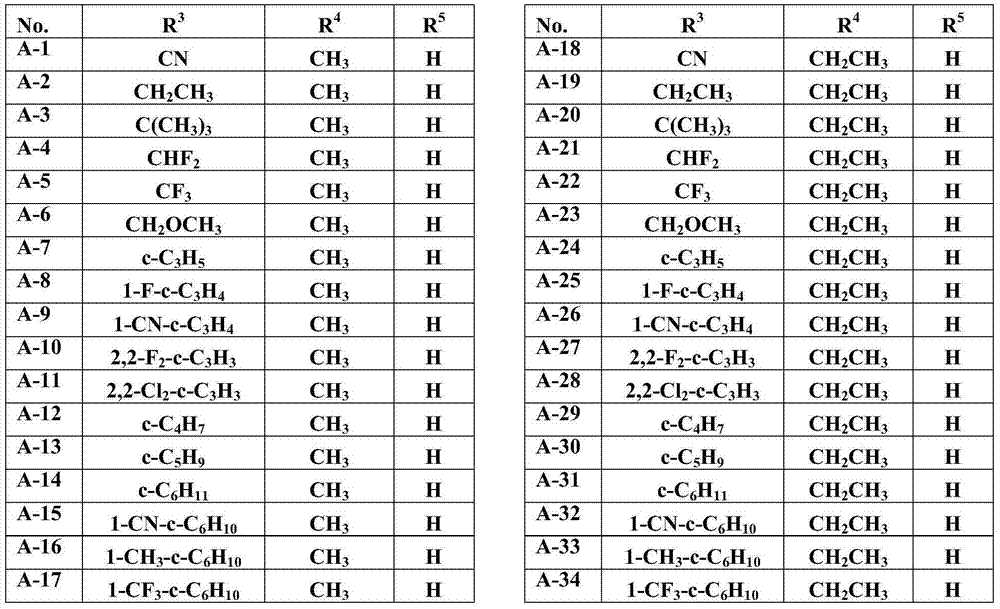


Due to their excellent activity, the compounds of the invention are useful for controlling invertebrate pests.
Accordingly, the present invention also provides a method for controlling invertebrate pests which comprises treating the pests, their food supply, their habitat or their breeding ground with a pesticidally effective amount of a compound or a composition of the invention as defined above; or a cultivated plant, plant propagation material (e.g., seed), soil, area, material, or environment in which the pest is growing or is likely to grow; or materials, cultivated plants, plant propagation material (e.g. seeds), soils, surfaces or spaces to be protected from pest attack or infestation.
The present invention also relates to a method for protecting growing plants from attack or infestation by invertebrate pests, preferably by insect populations, which method comprises contacting the plants, or the soil or water in which the plants are growing or may grow, with a pesticidally effective amount of at least one compound of the invention (including stereoisomers, salts, tautomers or N-oxides thereof) or a composition of the invention.
Preferably, the method of the present invention is for protecting plant propagation material (e.g. seeds) and plants grown therefrom from attack or infestation by invertebrate pests and comprises treating the plant propagation material (e.g. seeds) with a pesticidally effective amount of a compound of the present invention as defined above or with a pesticidally effective amount of an agricultural composition as defined above and below. The method of the invention is not limited to the protection of "substrates" (plants, plant propagation material, soil material, etc.) which have been treated according to the invention, and thus also has a prophylactic effect (e.g. protection) on plants grown from the treated plant propagation material (e.g. seeds), wherein the plant itself has not been treated.
For the purposes of the present invention, an "invertebrate pest" is preferably selected from arthropods and nematodes, more preferably from harmful insects, arachnids and nematodes, and even more preferably from insects, acarids and nematodes. Within the meaning of the present invention, "invertebrate pests" are most preferably insects.
The compounds according to the invention, including their salts, stereoisomers and tautomers, are particularly suitable for effective control of arthropod pests, such as arachnids, polypodactyls (myriapede) and insects, and nematodes, in particular insects. It is particularly suitable for effectively controlling or controlling the following pests:
lepidopteran insects (Lepidoptera), such as black cutworm (Agrotis ypsilon), black cutworm (Agrotis segetum), wood bollworm (Alabama argillaceae), velvet bean moth (Anticarsia gemmatalis), Argyresthia conjuella, Phlebia punctata (Autographa californica), inchworm (Bupalus piniarius), cacoconia murrina, Capuarictoria, Chemicalia brumata, spruce cabbage caterpillar (Choristoneura kura), Choristoneura occidentalis, Chinesota dichotoma, Chirataria viridis (Cirphis uniipunculata), codia punctata (Cydia pomifera), Trichoplusia pinus (Dindina), Hellebia punctata (Hedera) and Grapholitha calis punctata (Ebenaria), Grapholitura heterosporeana punctata (Hedera), Helicornia punctifera ostrinia (Hepialus punctifera), Grapholidocarpus punctifera (Hedera, Grapholidia punctifera), Helicosa (Grapholitha calis), Helicotina litura heterochaeta), Helicotina (Grapholitha calis (Heplophora), Helicornia), Helicotina (Hepialus maydis) and Grapholitha calis (Hedyma niponaria), Helicornia (Helicornia), Helicotina (Helicornia), Helicornia (Grapholitha californica (Helicornia), Helicotina (Helicornia), Helicornia (Helicornia), Helicornia (Grapholitha calis (, Apple moth (Hypomeutaminales), tomato moth (Keifiria lycopersicella), Lambda fischeriana, beet armyworm (Laphygma exigua), coffee leaf miner (Leucoptera coffeella), leaf miner (Leucoptera scitella), Lithocolletis blancardella, grape berry leaf roller (Lobesia botana), beet webworm (Loxostegia stictica), gypsy moth (Lymantriapart), yellow mantle moth (Lymantria monadactyla), peach leaf miner (Lymantria serotina), yellow brown curtain moth (Maliosoma neraria), cabbage moth (Mamestra briica), yellow poison citrus fruit (Orgypsychia), yellow brown moth (Spirochaeta), cabbage moth (cabbage loopa), cabbage moth (cabbage loopia), cabbage moth (cabbage looperia), cabbage moth (cabbage looper), cabbage moth (cabbage looperia), cabbage moth (cabbage looper), cabbage moth (cabbage looper), cabbage moth (cabbage loopa), cabbage looper), cabbage moth (cabbage looper), cabbage moth (cabbage looper), cabbage moth (cabbage looper), cabbage moth (cabbage looper), cabbage moth (cabbage looper), cabbage moth (looper), cabbage loop, Spodoptera frugiperda (Spodoptera frugiperda), Spodoptera litura (Spodoptera litura), thamatopoea pitycopapa, Trichoplusia virida (Tortrix viridana), Trichoplusia ni (Trichoplusia ni), and zeiraphtheracanadensis;
beetles (Coleoptera), such as narrow-leaved beetles (Agrilus sinulatus), straight-stripped click beetles (Agriotes linereasons), dark-coloured click beetles (Agriotes obstrurus), Amphimuriussolstolitis, Anisandrus dispar, Gossypium mexicanum (Anthonomus grandis), apple flower elephant (Anthonomus pomorum), Aphthonia ehydrodae, Athohaleuroides, Cryptodium betaine (Atomaria lineea), bark beetles (Blastopharia longissima), bark beetles (Bruchera grandiflora), bark beetles (Castanophycus nigra), yellow beetle (Castanophycus nigra), yellow beetles (Castanophycus nigra), yellow beetle (European cabbage beetle), yellow beetle (European red beetle, yellow beetle (European red beetle), yellow beetle (European red beetle, yellow beetle (yellow beetle, yellow beetles (yellow beetles, yellow, Tobacco flea beetles (Epitrix urtipennis), cotton gray Mongolian variety (Eutinobiothrix brasiliensis), European pine bark weevil (Hyperbius abortus), Egyptian alfalfa leaf weevil (Hyperabrenunennis), alfalfa leaf weevil (Hypera potrichia), spruce bark beetle (Ipsypogaphus), tobacco yellow beetle (Lema bifilaria), black horned mud beetle (Lemameophilus), potato leaf beetle (Leptinotarsa decemlineata), Limonica californicus, rice water weevil (Lissophorus oryzae), Melanotus communis, rape pollen beetle (Meliges aeus), large gill turtle (Melolohalitus giganteus), the plant diseases are selected from the group consisting of menisci gomphus (Melothha mellontha), mud beetles on rice (Oulema oryzae), black ear elephant of grape (Ortiorrhhus sulcatus), root weevil of strawberry (Otiorrhhus ovatus), mustard beetle (Phaedon cochleariae), leaf weevil of pear (Phyllobius pyri), Phyllotreta chrysophtala, leaf gill beetle (Phyllophaga), garden golden tortoise (Phyllothrita horchia), soybean mild foot beetle (Phyllotreemorum), yellow striped flea beetle (Phyllotreta striolata), Japanese cockchafer (Popilia japonica), pea leaf weevil (Sitona lineatus) and phyllaria (Sinaria gracilia);
flies, mosquitoes (Diptera)), such as Aedes aegypti (Aedes aegypti), Aedes albopictus (Aedes albopictus), Aedes spinosa (Aedes vexans), Drosophila mexicana (Anastrephaudens), Anopheles quinquefolius (Anopheles maculipennis), Anopheles crustis, Anopheles leucotrichum (Anopheles albomarginianus), Anopheles gambiae (Anopheles gambiae), Anopheles freeboni, Anopheles quina (Anopheles leucotrichum), Anopheles yus (Anopheles leucotrichum), Anopheles minimus (Anopheles minimus), Anopheles tetranyeles (Anopheles dylaceae dreimacus), Anopheles rubellus virginalis (Callica virgina), Chrysopheles neralis (Ceratodes ia terreus (Ceratopteria), Cuora (Cuora), Cuora melanogaster fly (Cuora), Cuora (Cuora), Cuora grandis (Cuora), Cuora (Culicia melanogaster fly (Culicia), Culicia (Culicia), Culicia (Culicia odorifera), Culicia (Culicia), Culicia (Culicia), Culicia), Culicia (Culicia ), Culicia kamura (Culicia kamura), Cu, Melon flies (Dacus cucurbitae), olive flies (Dacus oleae), rape leaf gall flies (Dasineura brassicae), Delia indica (Delia asiatica), wheat field flies (Delia coarctata), gray field flies (Delia platura), cabbage field flies (Deliarius), Dermatobia hominis, small hair toilet flies (Fanniia canniculata), Geomoza triputa, horse flies (Gasterophilus intestinalis), barbed flies (Glossina morsitalis), hairy flies (Glossina palis), Glossina fusca, colloidal flies (Glossina tachinoides), Haematobia irrita, plosis, Hippocampus (Hippocampus), housefly larvae (Lucilia), Lucilia (Lucilia) and Lucilia (Lucilia), Lucilia (Lucilia) flies, Lucilia (Lucilia) are, Luciliaris, Lucilia (Lucilia) and Lucilia (Lucilia) are, Lucilis, Lucilia (Lucilia) and Lucilia (Lucilia) are included in the present, Lucilia (Lucilia) and Lucilis, Lucilia (Lucilis, Lucilia (Lucilia) are included in the present, Lucilia (Lucilia) of the present, Lucilia (Lucilia, Lucilis, Lucilia (Lucilia) and Lucilis, Lucilia (Lucilis, Lucilia) and Lucilia, Lucilis, Lucilia (Lucilia) of the same, Lucilia (Lucili, European straw flies (Oscinella freit), Ficus carina (Pegomyca hysocyami), Allium fistulosa (Phorbia antia), Raphanus sativus (Phorbiabasic), Meloidogous flies (Phorbia coarctata), Chrysopa argentes (Phomopora argentides), Psopophora columbiae (Psilus carotovora), Psopophora discorea (Psilus praecox), Prosimulum mixtum (Prosium), Prunus cerasus (Rhagoletiscus cerasus), Malus pumilus (Rhagoguensis pomonella), Sarcophaga rubra (Sarcophaga odorifera), Sarcophaga (Sarcophaga), Simulium vitatum, Stachys (Stachys gallis gallica), Tachyta (Tachyta nubilatus), Tachys bovis (Tachysolenii), Tachyta indica (Tachyta indica), and Tachyta indica (Tachysolenos aurantifolia);
thrips (Thysanoptera), such as Frankliniella occidentalis (Dichlorothrips corbeti), Dichlorothrips ssp, Frankliniella fusca (Frankliniella fusca), Frankliniella occidentalis (Frankliniella occidentalis), Frankliniella orientalis (Frankliniella tritici), Frankliniella platycodonis (Scirothricinus citri), Thrips oryzae (Thrips oryzae), Frankliniella palmi (Thrips palmi) and Frankliniella tabaci (Thrips tabaci),
termite (Isoptera), such as Calotermes flaviolis, Leucotermes flavipes, Heteropteromes aureus, Pseudopterogous termites Retentis, Pseudopterogous termites Eurotidis, Pseudopterogous termites Sanguinea, Pseudopterogous termites Grassei, Terminalia natalensis, and Pseudopterogous Termite Taiwan (Coptotermes formosanus),
blattaria (Blattaria) -Blattaea, such as German cockroach (Blattaria germanica), Blattaria asahinae, Periplaneta americana (Periplaneta americana), Blatta japonica (Periplaneta japonica), Blatta fusca (Periplaneta brunnea), Periplaneta americana (Periplaneta nigra), Blatta nigra (Periplaneta nigra), Blatta australiana (Periplaneta australiana), and Blatta orientalis (Blattarialis),
bed bugs, aphids, leafhoppers, whiteflies, lepidoptera, cicadas (Hemiptera), such as green plant bugs (Acrosteronum hirae), corn long bugs (Blissus leucopterus), blind black spot bugs (Cyrtopeltis nottus), cotton red bugs (Dysdercus cingulatus), Dysdercus lucidus, wheat flathead bugs (Eurygaster integriceps), tobacco bugs (Euschistosigmentatris), red bell root bugs (Leptophytylopus), American grass bugs (Lygus lineolaris), blind grass (Lygus pratensis), green rice green bugs (Neravaria), beet pseudosorosis (Piropularis), apple aphid (Aphis viridis), apple aphid (Aphis, apple aphid), apple aphid (apple aphid), apple aphid (apple aphid), apple aphid (apple aphid), apple aphid, Bemisia argentea (Bemisia argentea), Bremia divaricata (Brachyuraea cardui), Bremia pruni (Brachyuraea helicoptersis), Bremia pruni (Brachyuraea hemiphyllorum), Bremia persicae (Brachyuraea persica), Bremia pruni (Brachybotrys hepiali), Catytophorus horni, Cerosira gossypii, Phyllospora ceros (Chaetophyceae), Phyllophora gallinarum (Chaetophyceae), Phyllophora theophylla (Cryptomyces rimosus), Phyllophora glauca (Phaseolus glauca) (Dreyphysalis nasius), Phyllophora sprengi (Dreyphysa nodemanniana), Phyllophysa globosa (Dreyphyceae), Phyllophys rhizocauli (Dyphyceae), Phyllophora grandis (Phyllophora grandis), Phyllophora viridula (Phyllophora nigra), Phyllophora grandis (Phyllophora grandis), Phyllophora grandis (Phyllophora), Phyllophora grandis), Phyllophora viridis, Phyllophora (Phyllophora), Phyllophora nicola (Phyllophora), Phyllophora grandis), Phyllophora nicola (Phyllophora), Phyllophora grandis), Phyllophora nicola (Phyllophora), Phyllophora viride (Phyllophora), Phyllophora), Phyllophora grandis), Phyllophora viride (Phyllophora), Phyllophora nicola (Phyllophora ), Phyllophora (Phyllophora), Phyllophora grandis, Rice planthopper (Nilaparvata lugens), cysticercosis cantonensis (Pemphigus busarius), plant hopper (persicaria saccharicida), aphid neglectum (Phorodon humuli), Psylla malorum (psylamoli), Psylla pirillus (Psylla piri), aphid graminearum (rhodomorphus ascophyllus), aphid zeae (rhodoaphium maidis), aphid graminearum (rhodomorphus), aphid graminifolium (rhodophyum padi), tubular aphid of grass (rhodophyum constrictum), sapphire mala, sappapapaphilus mali, Schizaphis graminis (Schizaphis minuta), schinensis, trichophyma citri, trichophyma aurantiacae (trichoderma), citrus grandis (trichoderma viride), citrus grandis (citrus grandis, citrus grandis (citrus grandis);
ants, bees, wasps, saw flies (Hymenoptera)), such as Sinkiang leaf bees (Athalia rosae), cut leaf ants (Atta cephalotes), Atta capiguara, Atta cephalophalotes, Atta laevigata, Atta robusta, Atta sexdens, Atta texana, Anthemis lapachapos (Crematoplaster), Hoplocpa minuta, Hoplocpa testudinea, brown hair ants (Lasius nigrer), yellow house ants (Monomorium pharaonis), tropical fire ants (Solenopsis geminata), red fire ants (Solenopsis virica) black fire ants (Solenopsis nigrichia), southern fire ants (Solenopsis xylaria), red fire ants (Poommiaceae), Paraphylla, Vespera, Vespertiliota, Vespera, Vespula muralis, Vespertiliota;
cricket, grasshopper, locust (Orthoptera), such as cricket (achetamestica), mole cricket (gryllopa Gryllotalpa), Locusta migratoria (Locusta migoritia), bimaculate black locust (Melanoplus bivittatus), red foot black locust (Melanoplus femurirbum), menoplus mexicanus mezopus (Melanoplus mezopus mexicanus), migratory black locust (Melanoplus sanguiipes), meinoplus nigra (Melanoplus spinuguipes), red stripe black locust (nodakebia), Locusta americana (schizophylla americana), Locusta (schanosarcinoma gra), Locusta (malacopsis), Locusta grasseriana (hypopharyata), Locusta migratoria (hypopharyata), locustus pacifica (pacifica), Locusta grassland grasshopper, Locusta (grassland), Locusta pacifica (grassland), Locusta arabidophyllus (pacifica), Locusta grassland (pacific grassland), Locusta);
fleas (Siphonaptera), for example cat fleas (Ctenocephalides felis), dog fleas (Ctenocephalides canis), rat fleas (Xenopsylla cheopis), scrapie fleas (Pulexirritans), skin penetrating fleas (Tunga pendants) and diseased fleas (Nosopropylus fasciatus), clothes (Thysanum), for example Chlamydomonas occidentalis (Lepisma saccharana) and blotch (Thermobia domitheca),
scytalidium (Chilopoda), for example Scutigera coleoptrata (Scutigera coleoptrata),
copepods (dipopoda), such as the genus narcoeus,
earbud (Dermaptera), such as auricularia (forficula auricularia), lice (phyllaptera), such as human head lice (Pediculus humanus carpitis), human body lice (Pediculus humanus coproricus), pubic lice (Pthirus pubis), bovine blood lice (haemanthus euratus), pig blood lice (haemantouus suis), bovine jaw lice (linoghus vitii), Bovicola bovis, chicken lice (Menopon gallinare), menathus stramineus and solenoptes carpillatus;
from the order of the Collelmbola (springtail), e.g. the genus Onychiurus (Onychiurus)
The compounds of the invention (including salts, stereoisomers and tautomers thereof) are particularly useful for controlling insects, preferably sucking or piercing insects, for example insects from the order thysanoptera, diptera and hemiptera, especially the genera:
from the order of thysanoptera: frankliniella fusca, Frankliniella alfalfa, Frankliniella orientalis, Frankliniella platycodi, thrips oryzae, thrips palmi and Frankliniella tabaci.
The order of Diptera: such as Aedes aegypti, Aedes albopictus, Aedes discordata, Drosophila mexicana, Anopheles quinquefolius, Anopheles crucians, Anopheles albus, Anopheles gambiensis, Anopheles freeborni, Anopheles latus, Anopheles yunnanensis, Anopheles lutea, Oreophilus erythropolis, Ceratophilus mediterraneae, Chrysopheles atacus, Chrysopheles atrophilus, Kaolian Kazukikuchii, Chrysopheles hominis, Chrysopheles cinella, Chrysopheles atrophycus, Chrysopheles hominus, Chrysopheles oculogus, Chrysopheles atrophilus, Rhinococcus kakkeri, Chrysopheles hominicus, Culisa, Culisata taurus, Culista indica, Cultita, Lucilia, Lucifera indica, Lucif, Lycoria petolaris, Mansonia titillanus, Meloidogyne, Calophylla, Calomya fall, Musca stabila, Musca ovis, Opomya florum, European straw fly, Hymenon spring fly, Allium fistulosum, Raphanus sativus, Meloidogyne, Chrysopa, Psorophora columbiae, Daucus carota, Psorophora discolor, Prosimulum mixum, Pseudocerasus cerasus, apple fruit fly, Sarcophaga, Simulium vitatum, stable fly (Stomoxys calcutirans), Tabanus atratus, Tabanus rubripes and Tabanussumis, Tipula oleracea and Aedes Europelus.
Hemiptera (especially aphids): acyrthosporin onobrychis, Aphis citricola, Aphidius latturtii, beet aphid, strawberry aphid, apple aphid, cotton aphid, North American tea bamboo basket seed aphid, Schindyla aphid, leaf curl aphid, elderberry aphid, pea aphid, Nephophora solanacearum, Bremia minor, Lipophyta littoralis, Bremia persicae, Brachyuraea praeruptorum, cabbage aphid, Capitophorus hornii, Cerosiphae gossypii, Adenopsis virens, Phylloceros pulcherrima, Phytophagoides virginosa, Phytophagoides alpinus, Phyllostachys spruce, Phyllostachys citri, Dysabula corticostatus, euplophysum euplostis, Phyllosphaera, Phytophagoides major, Phytophagoides farinachus, Phytophagoides major, Phytophagoides major, Aphis gramineae, Phytophagoides, Aphis gramineae, Aphis graminearia, Aphis graminis, Phytophus, Aphis graminis, apple aphid of the SinoTanah, Sappaphis mala, Sappaphis mali, Schizoneura lanuginosa, Amycolato avenae, Bemisia albuginea, Trionyx citricola and Rhizobolus vitis.
The compounds of the present invention (including salts, stereoisomers, and tautomers thereof) are particularly useful for controlling insects of the order hemiptera and thysanoptera.
The present invention further provides an agricultural composition for combating invertebrate pests, comprising an amount of at least one compound according to the invention and at least one inert liquid and/or solid agronomically acceptable carrier having a pesticidal effect, and if desired at least one surfactant.
The composition may comprise a single active compound according to the invention or a mixture of several active compounds according to the invention. The compositions of the invention may comprise individual isomers or mixtures of isomers or salts as well as individual tautomers or mixtures of tautomers.
The mixtures according to the invention can be used directly, in the form of their formulations or in the use forms prepared therefrom, for example in the following forms, by means of spraying, atomizing, dusting, scattering or pouring: directly sprayable solutions, powders, suspensions or dispersions, emulsions, oil dispersions, pastes, dustable products, materials for spreading or granules. The form of use depends entirely on the intended purpose; it is intended to ensure that the active compounds according to the invention are in each case distributed as finely as possible.
The Formulations are prepared in a known manner (for a review see, for example, US3,060,084; EP-A707445 (liquid concentrates); Browning, "Aggloration", Chemical Engineering, 1967, 12.4. days, 147-48; Perry's Chemical Engineering's Handbook, 4 th edition, McGraw-Hill, New York, 1963, pages 8 to 57 and subsequent pages; WO 91/13546; US4,172,714; US4,144,050; US3,920,442; US5,180,587; US5,232,701; US5,208,030; GB2,095,558; US3,299,566; Klemenman, Weed Control as a Science, John Wiley and Sons, New York, 1961; Handce et al, Weed Control Handbook, 8 th edition, Blackatio publications, Oxford, Moxmelt and Moluy, 1989, Molubelu, German, Chemical Engineering, European Verlag, European Verticine, German, plant, German, plant, if emulsifiers, surfactants and dispersants, preservatives, antifoams, antifreeze agents are required, colorants and/or binders and/or gelling agents are optionally also incorporated for seed treatment formulations.
Suitable solvents/carriers are (for example):
solvents such as water, aromatic solvents (e.g. Solvesso products, xylene, etc.), paraffins (e.g. mineral fractions), alcohols (e.g. methanol, butanol, pentanol, benzyl alcohol), ketones (e.g. cyclohexanone, γ -butyrolactone), pyrrolidones (N-methylpyrrolidone (NMP), N-octylpyrrolidone NOP), acetates (ethylene glycol diacetate), alkyl lactates, lactones (e.g. g-butyrolactone), glycols, fatty acid dimethylamides, fatty acids and fatty acid esters, triglycerides, oils of vegetable or animal origin and modified oils (e.g. alkylated vegetable oils). In principle, mixtures of solvents can also be used.
Carriers, for example ground natural minerals and ground synthetic minerals, for example silica gel, finely divided silicic acid, silicates, talc, kaolin, magnesia clay (attacalay), limestone, lime, chalk, bole, loess, clay, dolomite, diatomaceous earth, calcium sulfate and magnesium sulfate, magnesium oxide, ground synthetic materials; fertilizers, for example, ammonium sulfate, ammonium phosphate, ammonium nitrate, urea; and products of vegetable origin, such as cereal flour, bark flour, wood flour and nut shell flour; cellulose powder and other solid carriers.
Suitable emulsifiers are nonionic and anionic emulsifiers (e.g. polyoxyethylene fatty alcohol ethers, alkylsulfonates and arylsulfonates).
Examples of dispersants are lignin sulfite waste liquor and methyl cellulose.
Suitable surfactants are lignosulfonic acid, naphthalenesulfonic acid, phenolsulfonic acid, dibutylnaphthalenesulfonic acid, alkylarylsulfonates, alkylsulfates, alkylsulfonates, fatty alcohol sulfates, alkali metal, alkaline earth metal and ammonium salts of fatty acids and sulfated fatty alcohol glycol ethers, and condensates of sulfonated naphthalene and naphthalene derivatives with formaldehyde, condensates of naphthalene or of naphthalenesulfonic acid with phenol and formaldehyde, polyoxyethylene octylphenyl ether, ethoxylated isooctylphenol, octylphenol, nonylphenol, alkylphenyl polyglycol ethers, tributylphenyl polyglycol ether, tristearylphenyl polyglycol ether, alkylaryl polyether alcohols, alcohol and fatty alcohol/ethylene oxide condensates, ethoxylated castor oil, polyoxyethylene alkyl ethers, ethoxylated polyoxypropylene, lauryl alcohol polyglycol ether acetal, sorbitol esters.
Anti-freeze agents such as glycerin, ethylene glycol, propylene glycol, and bactericides may also be added to the formulation.
Suitable antifoams are, for example, antifoams based on silicon stearate or magnesium stearate.
Suitable preservatives are, for example, dichlorophene and benzyl alcohol hemiformal.
Suitable thickeners are compounds which impart a pseudoplastic flow behavior to the formulation, i.e. a high viscosity at rest and a low viscosity during the stirring phase. In this connection, mention may be made, for example, of commercial thickeners based on polysaccharides, such as Xanthan(from Kelco )、
)、 23(RhonePoulenc) or
 (from R.T.Vanderbilt) or organo-layered silicates, e.g.
 (from Engelhardt). Defoamers suitable for the dispersions of the invention are, for example, silicone emulsions (e.g.from Rhodia)
 SRE, Wacker or
 ) Long chain alcohols, fatty acids, organofluorine compounds, and mixtures thereof. Biocides may be added to stabilize the compositions of the present invention against microbial attack. Suitable biocides are, for example, based on isothiazolones, for example under the trade mark Avecia (or Arch)
 Or by Thor Chemie and
 RS and Rohm&Has the order of HaasMK, a compound sold as MK. Suitable antifreeze agents are organic polyols, for example ethylene glycol, propylene glycol or glycerol. These substances are generally used in amounts of up to 10% by weight, based on the total amount of active compound composition. If appropriate, the active compound compositions according to the invention may comprise from 1% to 5% by weight, based on the total amount of formulation prepared, of a buffer in order to adjust the pH, the amount and type of buffer used depending on the chemical properties of the active compound. Examples of buffers are alkali metal salts of weak inorganic or organic acids such as phosphoric acid, boric acid, acetic acid, propionic acid, citric acid, fumaric acid, tartaric acid, oxalic acid and succinic acid.
Substances suitable for preparing directly sprayable solutions, emulsions, pastes or oil dispersions are mineral oil fractions having medium to high boiling points, such as kerosene or diesel oil; in addition coal tar and oils of vegetable or animal origin; aliphatic, cyclic and aromatic hydrocarbons, such as toluene, xylene, paraffin, tetralin, alkylated naphthalenes or derivatives thereof; methanol, ethanol, propanol, butanol, cyclohexanol, cyclohexanone, isophorone; strongly polar solvents, such as dimethyl sulfoxide, N-methylpyrrolidone and water.
Powders, materials for spreading and dustable products can be prepared by mixing or simultaneously grinding the active substance with a solid carrier.
Particles, such as coated particles, impregnated particles, and homogeneous particles, can be prepared by combining the active compound with a solid support. Examples of solid carriers are mineral earths, such as silica gel, silicates, talc, kaolin, magnesia clay, limestone, lime, chalk, bole, loess, clay, dolomite, diatomaceous earth, calcium sulfate, magnesium oxide, ground synthetic materials; fertilizers, such as ammonium sulfate, ammonium phosphate, ammonium nitrate, urea; and products of vegetable origin, such as cereal flour, bark meal, wood flour and nut shell flour; cellulose powder and other solid carriers.
Typically, the formulation (i.e. the composition of the invention) comprises from 0.01 to 95% by weight, preferably from 0.1 to 90% by weight of active ingredient. The purity of the active ingredient used is from 90% to 100%, preferably from 95% to 100% (according to NMR spectrum).
For seed treatment, the respective formulations can be diluted 2 to 10 times so that the concentration by weight of active compound in the ready-to-use preparation is from 0.01 to 60% by weight, preferably from 0.1 to 40% by weight.
The following are examples of formulations:
1. product diluted with water. For seed treatment, these products, diluted or undiluted, can be applied to the seed.
A) Water soluble concentrate (SL, LS)
10 parts by weight of active compound are dissolved in 90 parts by weight of water or water-soluble solvent. Alternatively, a wetting agent or other adjuvant may be added. After dilution with water, the active compound is dissolved, whereby a formulation with 10% (w/w) of active compound is obtained.
B) Dispersion Concentrate (DC)
20 parts by weight of active compound are dissolved in 70 parts by weight of cyclohexanone and 10 parts by weight of dispersant (e.g. polyvinylpyrrolidone) are added. Dilution with water gives a dispersion, from which a formulation with 20% (w/w) of active compound is obtained.
C) Emulsifiable Concentrates (EC)
15 parts by weight of active compound are dissolved in 7 parts by weight of xylene and calcium dodecylbenzenesulfonate and ethoxylated castor oil (in each case 5 parts by weight) are added. Dilution with water gives an emulsion, from which a formulation with 15% (w/w) of active compound is obtained.
D) Emulsion (EW, EO, ES)
25 parts by weight of active compound are dissolved in 35 parts by weight of xylene and calcium dodecylbenzenesulfonate and ethoxylated castor oil (in each case 5 parts by weight) are added. The mixture is introduced into 30 parts by weight of water by means of an emulsifying machine (for example Ultraturrax) and made into a homogeneous emulsion. Dilution with water gives an emulsion, from which a formulation with 25% (w/w) of active compound is obtained.
E) Suspension (SC, OD, FS)
In a stirred ball mill, 20 parts by weight of active compound are comminuted and 10 parts by weight of dispersant, wetting agent and 70 parts by weight of water or organic solvent are added to give a fine suspension of active compound. Dilution with water gives a stable suspension of the active compound, whereby a formulation with 20% (w/w) of the active compound is obtained.
F) Water dispersible granule and Water soluble granule (WG, SG)
50 parts by weight of active compound are finely ground and 50 parts by weight of dispersing and wetting agents are added and made into water-dispersible or water-soluble granules by means of mechanical devices (e.g. extruders, spray towers, fluidized beds). Dilution with water gives a stable dispersion or solution of the active compound, whereby a formulation with 50% (w/w) of the active compound is obtained.
G) Water-dispersible powders and water-soluble powders (WP, SP, SS, WS)
75 parts by weight of active compound are ground in a rotor-stator mill, and 25 parts by weight of dispersant, wetting agent and silica gel are added. Dilution with water gives a stable dispersion or solution of the active compound, whereby a formulation with 75% (w/w) of the active compound is obtained.
H) Gel Formulation (GF)
In a stirred ball mill, 20 parts by weight of the active compound are pulverized and 10 parts by weight of a dispersant, 1 part by weight of a gelling agent wetting agent and 70 parts by weight of water or an organic solvent are added to give a fine suspension of the active compound. Dilution with water gives a stable suspension of the active compound, whereby a formulation with 20% (w/w) of the active compound is obtained.
2. Product that can be applied without dilution for foliar application. For seed treatment purposes, these products, diluted or undiluted, can be applied to seeds.
I) Dustable powder (DP, DS)
5 parts by weight of active compound are finely ground and mixed thoroughly with 95 parts by weight of finely divided kaolin. This gives a dustable product with 5% (w/w) active compound.
J) Granules (GR, FG, GG, MG)
0.5 parts by weight of active compound are finely ground and combined with 95.5 parts by weight of carrier, whereby a formulation with 0.5% (w/w) of active compound is obtained. Current processes are extrusion, spray drying or fluidized bed. This results in a granule that can be applied without dilution for foliar application.
K) ULV solutions (UL)
10 parts by weight of active compound are dissolved in 90 parts by weight of organic solvent, for example xylene. This gives a product with 10% (w/w) active compound, which can be applied undiluted for foliar application.
Aqueous use forms can be prepared from emulsion concentrates, pastes or wettable powders (sprayable powders, oil dispersions) by adding water. To prepare emulsions, pastes or oil dispersions, these substances can be homogenized in water, either directly or in the form of solutions in oils or solvents, with the aid of wetting, adhesion, dispersing or emulsifying agents. Alternatively, concentrates comprising the active substance, wetting agent, viscosity-increasing agent, dispersing or emulsifying agent and, where appropriate, solvent or oil can be prepared and these concentrates are suitable for dilution with water.
The concentration of the active ingredient in the ready-to-use product can vary within a relatively wide range. Typically, these concentrations are from 0.0001% to 10%, preferably from 0.01% to 1%.
Active ingredients can also be used successfully in the ultra-low-volume process (ULV), wherein formulations comprising more than 95% by weight of active ingredient can be applied, or even additive-free active ingredients can be applied.
In the methods and uses of the invention, the compounds of the invention may be used with other active ingredients, for example with other pesticides, insecticides, herbicides, fertilizers (e.g. ammonium nitrate, urea, potash and perphosphates), phytotoxins and plant growth regulators, safeners and nematicides. These additional ingredients can be used in succession or in combination with the above-described compositions, if appropriate with the addition of further ingredients immediately before use (tank mix). For example, the plants may be sprayed with the composition of the invention before or after treatment with the other active ingredients.
The following list of insecticides that can be used with the compounds of the present invention and with which a potential synergistic effect can be produced, is intended to illustrate possible combinations, without imposing any limitation:
m.1. organic (thio) phosphate compounds: acephate (acephate), azamethiphos (azamethiphos), ethylvalophos (azinphos-ethyl), valophos (azinphos-methyl), chlorophosphorus oxychloride (chlorophenoxyfos), chlorfenvinphos (chlorofenvinphos), chlorthiophosphorus chloride (chloroEphos), chlorpyrifos (chlorpyrifos), chlorpyrifos-methyl, coumaphos (coumaphos), cyanophos (cyanophos), demeton-S-methyl, diazinon (diazinon), dichlorvos (dichlorvos/DDVP), chlorothieron (dichlorophos), dimethoate (dimethomorph), methorphan (dimethomorph)inphos), disulfoton (disulfoton), EPN, ethion (ethion), ethoprophos (ethoprophos), vazaphos (famchur), fenamiphos (fenamiphos), fenitrothion (fenitrothion), fenthion (fenthion), fluoxathion (flupyrzophos), fosthiazate (fosthiazate), heptenophos (hepenophos), isothiophos (ethiophos) Triazophos (isoxathion), malathion (malathion), triazophos (mecarbam), methamidophos (methamidophos), methidathion (methidathion), mepinylphos (mevinphos), monocrotophos (monocrotophos), naled (naled), omethoate (omethoate), oxydemethon-methyl (oxydemethon-methyl), penta-hexa (parathion), methylparathion (parathion-methyl), phenthoate (phorate), phorate (phosphate), phorate (phos), phosmet (phosmet), phosmet (phospho), phosphamide (phosphamidon), phoxim (phoxim), chlorfenapyr (pirifos-methyl), profenofos (profenofos), baraphos (propetataphos), prothiochions (prothiochos), pyraclofos (pyraclofos), pyridaphenthion (pyridaphenthion), quinalphos (quinalphos), sulfotep (sulfotep), butylpyrimidine phos (tebutipimfos), temephos (temephos), terbufos (terbufos), methidathion (tetrachlorvinphos), methylthiofenphos (thiomethon), triazophos (triazophos), trichlorphon (trichlorfon), and aphidophos (vamidothion);
m.2. carbamate compound: aldicarb, alanycarb, Bendiocarb (benfuracarb), benfuracarb (benfuracarb), carbosulfan (butocarboxim), butoxycarb (butoxycarb), carbaryl (carbaryl), carbofuran (carbofuran), carbosulfan (carbosulfan), bendiocarb (ethiofencarb), fenobucarb (fenobucarb), amitraz (formanate), furacarb (furathiocarb), isoprocarb (isoprocarb), methiocarb (methiocarb), methomyl (methomyl), metolcarb), oxamyl (oxamyl), pirimicarb (pirimicarb), propoxur (propafeur), thiodicarb (thiodicarb), jubax (methiocarb), methiocarb (trimethacarb), xmicarb (trimethacarb), propoxur (propafeur), thiodicarb (thiodicarb), bendiocarb (methocarb), methocarb (methocarb), thifenx (methocarb), trimethacarb (trimethacarb), and (trimethacarb),Methiocarb (xylcarb), triazamate (triazamate);
m.3. pyrethroid compounds: cyfluthrin (acrinathrin), allethrin (allethrin), d-allethrin (d-cis-trans allethrin), d-trans allethrin (d-transallethrin), bifenthrin (bifenthrin), bioallethrin (bioallethrin), 2-cyclopentenyl bioallethrin (bioallethrin S-cyclopropenyl), bioresmethrin (bioresmethrin), cycloprothrin (cycloprothrin), cyfluthrin (cyfluthrin), cyfluthrin (beta-cyfluthrin), (RS) cyfluthrin (cyhalothrin), cyfluthrin (lambda-cyhalothrin), cyfluthrin (gamma-cyhalothrin), cypermethrin (cyfluthrin), cyfluthrin (cyhalothrin), cyhalothrin (beta-cyhalothrin), cyhalothrin (cyhalothrin), cyhalothrin (cyhalothrin), cyhalothrin (cyhalothri, Empenthrin (empenthrin), esfenvalerate (esfenvalerate), ethofenprox (etofenprox), fenpropathrin (fenpropathrin), fenpropathrin (fenvalerate), flucythrinate (fluythrinate), flumethrin (fluethrin), tau-fluvalinate (tau-fluvalinate), bifenthrin (halfenprox), imidacloprid (imiprothrin), metofluthrin (methofluthrin), permethrin (permethrin), phenothrin (phenothrin), prallethrin (prallethrin), proffluthrin (profluthrin), pyrethrin (pyrethrin), pyrethrum (pyrethrum), tetramethrin (resmethrin), silate (silafluthrin), tefluthrin (tefluthrin), tetramethrin (tetramethrin);
m.4. juvenile hormone mimics: mongolian 512(hydroprene), methoprene (kinoprene), methoprene (methoprene), fenoxycarb (fenoxycarb), pyriproxyfen (pyriproxyfen);
m.5. nicotinic acid receptor agonist/antagonist compounds: acetamiprid, bensultap, cartap hydrochloride, clothianidin, dinotefuran, imidacloprid, thiamethoxam, nitenpyram, nicotine, spinosad 105 (allosteric agonist), spinetoram (allosteric agonist), thiacloprid, thiocyclam, dimehypo (thiocyclam), and AKD 1022;
m.6. gaba-gated chloride channel antagonist compounds: chlordane (chlordane), endosulfan (endosulfan), lindane (gamma-HCH (lindane)); ethiprole (ethiprole), fipronil (fipronil), pyrafluprole, pyriprole;
m.7. chloride channel activators: abamectin (abamectin), emamectin benzoate, milbemectin, lepimectin;
m.8.meti I compounds: fenazaquin (fenazaquin), fenpyroximate (fenpyroximate), pyriminostrobin (pyrimidifen), pyridaben (pyridaben), tebufenpyrad (tebufenpyrad), tolfenpyrad (tolfenpyrad), pyriminostrobin (flufenerim), rotenone (rotenone);
METI II and III Compounds: acequinocyl, fluyprim, hydramethylnon;
m.10. oxidative phosphorylation decoupling agents: chlorfenapyr (chlorfenapyr), Dinitrophenol (DNOC);
m.11. oxidative phosphorylation inhibitors: azocyclotin (azocyclotin), cyhexatin (cyclohexadin), diafenthiuron (diafenbutin), fenbutatin oxide (fenbutatin oxide), propargite (propargite), tetradifon (tetradifon);
m.12. molt disruptor: cyromazine, chromafenozide, halofenozide, methoxyfenozide, and tebufenozide;
m.13. synergist: synergistic ethers (piperonyl butoxide), defoliant phosphines (tribufos);
m.14. sodium channel blocker compounds: indoxacarb (indoxacarb), metaflumizone (metaflumizone);
m.15. fumigants: methyl bromide (methyl bromide), chloropicrin (chloropicrin), sulfuryl fluoride (sulfuryl fluoride);
m.16. selective feeding blockers: cryolite (cryolite), pymetrozine (pymetrozine), flonicamid (flonicamid);
m.17. mite growth inhibitors: clofentezine (cloventezine), hexythiazox (hexythiazox), and teben Oxazole (etoxazole);
m.18. chitin synthesis inhibitors: buprofezin (buprofezin), bistrifluron (bistrifluron), chlorfluazuron (chlorofluazuron), diflubenzuron (diflubenzuron), flucycloxuron (flucycloxuron), flufenoxuron (flufenoxuron), hexaflumuron (hexaflumuron), fluoroproprione (lufenuron), novaluron (novaluron), novaluron (noviflumon), teflubenzuron (teflubenzuron), chlorfluazuron (triflumuron);
m.19. lipid biosynthesis inhibitors: spirodiclofen (spirodiclofen), spiromesifen (spiromesifen), spirotetramat (spirotetramat);
octopamineergic agonists (octapaminergic agonists): amitraz (amitraz);
m.21. Ryanodine (Ryanodine) receptor modulators: flubendiamide (flubendiamide) and the phthalimide compounds (R) -, (S) -3-chloro-N1- { 2-methyl-4- [1,2,2, 2-tetrafluoro-1- (trifluoromethyl) ethyl ] phenyl } -N2- (1-methyl-2-methylsulfonylethyl) phthalimide (M21.1);
m.22. iso Oxazoline compounds: 4- [5- (3, 5-dichlorophenyl) -5-trifluoromethyl-4, 5-dihydroDifferent from each other
 Azol-3-yl]-2-methyl-N-pyridin-2-ylmethyl-benzamide (M22.1), 4- [5- (3, 5-dichlorophenyl) -5-trifluoromethyl-4, 5-dihydroiso
 Azol-3-yl]-2-methyl-N- (2,2, 2-trifluoroethyl) benzamide (M22.2), 4- [5- (3, 5-dichlorophenyl) -5-trifluoromethyl-4, 5-dihydroisoi
 Azol-3-yl]-2-methyl-N- [ (2,2, 2-trifluoroethylcarbamoyl) methyl group]Benzamide (M22.3), 4- [5- (3, 5-dichlorophenyl) -5-trifluoromethyl-4, 5-dihydroiso
 Azol-3-yl]Naphthalene-1-carboxylic acid [ (2,2, 2-trifluoroethylcarbamoyl) methyl group]Amide (M22.4), 4- [5- (3, 5-dichlorophenyl) -5-trifluoromethyl-4, 5-dihydroiso
 Azol-3-yl]-N- [ (methoxyimino) methyl group]-2-methylbenzamide (M22.5), 4- [5- (3-chloro-5-trifluoromethylphenyl) -5-trifluoromethyl-4, 5-dihydroiso
 Azol-3-yl]-2-methyl-N- [ (2,2, 2-trifluoroethylcarbamoyl) methyl group]Benzamide (M22.6), 4- [5- (3-chloro-5-trifluoromethylphenyl) -5-trifluoromethyl-4, 5-dihydroisoiAzol-3-yl]Naphthalene-1-carboxylic acid [ (2,2, 2-trifluoroethylcarbamoyl) methyl group]Amide (M22.7) and 5- [5- (3, 5-dichloro-4-fluorophenyl) -5-trifluoromethyl-4, 5-dihydroisof
 Azol-3-yl]-2-[1,2,4]Triazol-1-ylbenzonitrile (M22.8);
m.23. Anthranilamide (Anthranilamide) compounds: chlorantraniliprole (chloranthranilpole), cyantraniliprole (cyantraniliprole), 5-bromo-2- (3-chloropyridin-2-yl) -2H-pyrazole-3-carboxylic acid [ 4-cyano-2- (1-cyclopropylethylcarbamoyl) -6-methylphenyl ] amide (M23.1), 5-bromo-2- (3-chloropyridin-2-yl) -2H-pyrazole-3-carboxylic acid [ 2-chloro-4-cyano-6- (1-cyclopropylethylcarbamoyl) phenyl ] amide (M23.2), 5-bromo-2- (3-chloropyridin-2-yl) -2H-pyrazole-3-carboxylic acid [ 2-bromo-4-cyano-6- (1-cyclopropylethylcarbamoyl) Formyl) phenyl ] amide (M23.3), 5-bromo-2- (3-chloropyridin-2-yl) -2H-pyrazole-3-carboxylic acid [ 2-bromo-4-chloro-6- (1-cyclopropylethylcarbamoyl) phenyl ] amide (M23.4), 5-bromo-2- (3-chloropyridin-2-yl) -2H-pyrazole-3-carboxylic acid [2, 4-dichloro-6- (1-cyclopropylethylcarbamoyl) phenyl ] amide (M23.5), 5-bromo-2- (3-chloropyridin-2-yl) -2H-pyrazole-3-carboxylic acid [ 4-chloro-2- (1-cyclopropylethylcarbamoyl) -6-methylphenyl ] amide (M23.6) N '- (2- { [ 5-bromo-2- (3-chloropyridin-2-yl) -2H-pyrazole-3-carbonyl ] amino } -5-chloro-3-methylbenzoyl) hydrazinecarboxylic acid methyl ester (M23.7), N' - (2- { [ 5-bromo-2- (3-chloropyridin-2-yl) -2H-pyrazole-3-carbonyl ] amino } -5-chloro-3-methylbenzoyl) -N '-methylhydrazinecarboxylic acid methyl ester (M23.8), N' - (2- { [ 5-bromo-2- (3-chloropyridin-2-yl) -2H-pyrazole-3-carbonyl ] amino } -5-chloro-3-methylbenzoyl) -methyl N, N ' -dimethylhydrazinecarboxylate (M23.9), methyl N ' - (3, 5-dibromo-2- { [ 5-bromo-2- (3-chloropyridin-2-yl) -2H-pyrazole-3-carbonyl ] amino } benzoyl) hydrazinecarboxylate (M23.10), methyl N ' - (3, 5-dibromo-2- { [ 5-bromo-2- (3-chloropyridin-2-yl) -2H-pyrazole-3-carbonyl ] amino } benzoyl) -N ' -methylhydrazinecarboxylate (M23.11) and N ' - (3, 5-dibromo-2- { [ 5-bromo-2- (3-chloropyridin-2-yl) -2H-pyrazole-3-carbonyl ] amino } benzoyl) -methyl N, N' -dimethylhydrazinecarboxylate (M23.12);
m.24. malononitrile compound: 2- (2,2,3,3,4,4,5, 5-octafluoropentyl) -2- (3,3, 3-trifluoropropyl) malononitrile (CF)2HCF2CF2CF2CH2C(CN)2CH2CH2CF3) (M24.1) and 2- (2,2,3,3,4,4,5, 5-octafluoropentyl) -2- (3,3,4,4, 4-pentafluorobutyl) malononitrile (CF)2HCF2CF2CF2CH2C(CN)2-CH2CH2CF2CF3)(M24.2);
A.25. A microbial interference agent: bacillus thuringiensis israelensis, Bacillus sphaericus, Bacillus thuringiensis aszawai, Bacillus thuringiensis kurstaki, Bacillus thuringiensis subsp tenella, Bacillus thuringiensis tenebrius;
m.26. aminofuranone compounds: 4- { [ (6-bromopyridin-3-yl) methyl ] (2-fluoroethyl) amino } furan-2 (5H) -one (M26.1), 4- { [ (6-fluoropyridin-3-yl) methyl ] (2, 2-difluoroethyl) amino } furan-2 (5H) -one (M26.2), 4- { [ (2-chloro-1, 3-thiazol-5-yl) methyl ] (2-fluoroethyl) amino } furan-2 (5H) -one (M26.3), 4- { [ (6-chloropyridin-3-yl) methyl ] (2-fluoroethyl) amino } furan-2 (5H) -one (M26.4), 4- { [ (6-chloropyridin-3-yl) methyl ] (2, 2-Difluoroethyl) amino } furan-2 (5H) -one (M26.5), 4- { [ (6-chloro-5-fluoropyridin-3-yl) methyl ] (methyl) amino } furan-2 (5H) -one (M26.6), 4- { [ (5, 6-dichloropyridin-3-yl) methyl ] (2-fluoroethyl) amino } furan-2 (5H) -one (M26.7), 4- { [ (6-chloro-5-fluoropyridin-3-yl) methyl ] (cyclopropyl) amino } furan-2 (5H) -one (M26.8), 4- { [ (6-chloropyridin-3-yl) methyl ] (cyclopropyl) amino } furan-2 (5H) -one (M26.9) and 4- { [ (6-chloropyridin-3-yl) methyl ] (methyl 26.9) ) Amino } furan-2 (5H) -one (M26.10);
m.27. various compounds: aluminium phosphide (aluminium phosphide), sulphadiazine (amidoflumet), benclothiaz, benzoximate (benzoximate), bifenazate (bifenazate), borax, bromopropylate (bromopropylate), cyanide, cyenopyrafen, cyflufenamate (cyfluetofen), fenacet (chinomethionate), dicofol (dicofol), fluoroacetate, phosphine, pyridalyl (pyrifluquinazone), pyrifluquinazon, sulphur, organosulphur compounds, potassium antimonate (tartromote), sulfaflor, N-R '-2, 2-dihalo-1-R' -cyclopropanecarboxamide-2- (2, 6-dichloro-alpha, alpha-trifluoro-p-tolyl) hydrazone or N-R '-2, 2-bis (R' -2- (2, 6-dichloro-alpha, alpha-trifluoro-p-tolyl) hydrazone or N-R '-2, 2' -bis (R '-2- (2, 6-dichloro-alpha, alpha-chloro-tolyl) propanamide-2- (2, 6-dichloro-alpha, alpha-chloro-tolyl) hydrazone, wherein R' is methyl bromide, r '' is hydrogen or methyl and R '' 'is methyl or ethyl), 4-but-2-ynyloxy-6- (3, 5-dimethylpiperidin-1-yl) -2-fluoropyrimidine (M27.1), cyclopropaneacetic acid 1,1' - [ (3S,4R,4aR,6S,6aS,12R,12aS,12bS) -4- [ [ (2-cyclopropylacetyl) oxy ] methyl ] -1,3,4,4a,5,6,6a,12,12a,12 b-decahydro-12-hydroxy-4, 6a,12 b-trimethyl-11-oxo-9- (3-pyridyl) -2H, 11H-naphtho [2,1-b ] pyrano [3,4-e ] pyran-3, 6-diyl ] ester (M27.2) and 8- (2-cyclopropylmethoxy-4-trifluoromethylphenoxy) -3- (6-trifluoromethylpyridazin-3-yl) -3-azabicyclo [3.2.1] octane (M27.3).
Commercially available compounds of group M can be found, inter alia, in Pesticide Manual, 13 th edition, British crop Protection Council (2003).
Paraoxon (Paraoxon) and its preparation are described in Farm Chemicals Handbook, vol 88, Meister publishing company, 2001. Fluorofos (Flupyrazofos) has been described in Pesticides science54, 1988, pages 237 to 243 and US 4822779. AKD1022 and its preparation have been described in US 6300348. M21.1 is known from WO 2007/101540. Different from each other Oxazolines M22.1 to M22.8 have been described, for example, in WO2005/085216, WO2007/079162, WO2007/026965, WO2009/126668 and WO 2009/051956. Anthranilamides M23.1 to M23.6 have been described in WO2008/72743 and WO200872783, those M23.7 to M23.12 have been described in WO 2007/043677. Malononitrile M24.1 and M24.2 have been described in WO02/089579, WO02/090320, WO02/090321, WO04/006677, WO05/068423, WO05/068432 and WO 05/063694. M26.1 to M6.10 have been described, for example, in WO 2007/115644. M27.1 is described, for example, in JP 2006131529. Organosulfur compounds have been described in WO 2007060839. M27.2 has been described in WO2008/66153 and WO 2008/108491. M27.3 has been described in JP 2008/115155.
The following list of active substances F which can be used in conjunction with the compounds of the present invention is intended to illustrate possible combinations but is not limited thereto:
F.I) respiratory inhibitors
a) Inhibitors of Complex III at Qo site (e.g., strobilurins)
Strobilurins: azoxystrobin (azoxystrobin), strobilurin (coumoxystrobin), coumoxystrobin (coumoxystrobin), dimoxystrobin (dimoxystrobin), enestrobin (enestrobin), enestroburin (enestrobin), fluoxastrobin (fluoxastrobin), kresoxim-methyl (kresoxim-methyl), metominostrobin (methamidocontrast), orysastrobin (orysastrobin), picoxystrobin (picoxystrobin), pyraclostrobin (pyraclostrobin), pyraclostrobin (pyraoxystrobin), pyraclostrobin (pyrazoxystrobin), pyraclostrobin (pyraoxystrobin), pyribencarb, picoxystrobin (triclopyrocarb)/chlorocarb, trifloxystrobin (trifloxystrobinotropron), 2- [2- (2, 5-dimethylphenoxymethyl) phenyl ] -3-methoxyacrylate and 2- (2, 6-N-2-methoxyiminomethyl) -acetamide;


i-2) inhibitors of Complex II (e.g. carboxamides):
carboxanilides: benoxanil (benodanil), bixafen, boscalid (boscalid), carboxin (carboxin), furoxamide (fenfuram), fenhexamid (fenhexamid), fluopyram (flupyram), flutolanil (flutolanil), furametpyr (furametpyr), isopyrazam, isotianil (isotianil), metamifop (mepronil), oxycarboxin (Oxycarboxin), penflufen, penthiopyrad (penthiopyrad), sedaxane, phylloquat phthalein (tecloftalam), fluxapyroxamide (thifluzamide), tiadinil (tiadinil), 2-amino-4-methylthiazole-5-carboxanilide, N- (3',4',5' -trifluorobiphenyl-2-yl) -3-difluoromethyl-1H-1-methyl-1H-4-carboxamide, N- (3',4',5' -trifluorobiphenyl-2-yl) -3-difluoromethyl-1H-methyl-1H-carboxamide, N- (3' -difluoromethyl) -4-methyl-pyrazole-1H-4-methyl-pyrazole-4-methyl-1H-4-pyrazole-4-methyl-4-pyrazole Amide and N- (2- (1,3, 3-trimethylbutyl) phenyl) -1, 3-dimethyl-5-fluoro-1H-pyrazole-4-carboxamide;
f.i-3) inhibitors of complex III at the Qi site: cyazofamid (cyazofamid), amisulbrom;
F.I-4) other respiratory inhibitors (Complex I, decoupling agent)
Difluoroforest (diflumetorim), tetrachloronitrobenzene (tecnazen), pyrizone (ferimzone), ametoctradin, silthiopham (silthiofam);
nitrophenyl derivatives: binacryl, dinobuton, dinocap, fluazinam, ethacryl, and iprodione; an organometallic compound: triphenyltin-based salts, such as fentin-acetate, fentin chloride or fentin hydroxide;
F.II) sterol biosynthesis inhibitors (SBI fungicides)
II-1) C14 demethylase inhibitors (DMI fungicides, e.g. triazoles, imidazoles) triazoles: azaconazole, bitertanol, bromuconazole, cyproconazole, Ether azole (difenoconazole), diniconazole (diniconazole), diniconazole M (diniconazole-M), epoxiconazole (epoxiconazole), fenbuconazole (fenbuconazole), fluquinconazole (fluquinconazole), flusilazole (flusilazole), flutriafol (flutriafol), hexaconazole (hexaconazole), imibenconazole (imazazol), ipconazole (ipconazole), metconazole (metconazole), myclobutanil), paclobutrazol (paclobutrazol), penconazole (penconazole), propiconazole (propiconazole), prothioconazole (prothioconazole), simeconazole (simeconazole), tebuconazole (tebuconazole), tetraconazole (tetraconazole), triticonazole (triticonazole);
imidazoles: imazalil (imazalil), pefurazoate (pefurazoate), oxpoconazole, prochloraz (prochloraz), triflumizole (triflumizole);
pyrimidines, pyridines and piperazines: isopimanol (fenarimol), nuarimol, pyribenzoxim (pyrifenox), triforine (triforine);
F.II-2) delta 14-reductase inhibitors (amines, e.g. morpholines, piperidines)
Morpholines: 4-dodecyl-2, 6-dimethylmorpholine (aldimorph), dodemorph (dodemorph), dodemorph acetate (dodemorph-acetate), fenpropimorph (fenpropimorph), tridemorph (tridemorph);
piperidines: fenpropidin (fenpropidin), Pink-Powerein (pipalin);
spiroxamine: screw thread Metallocenes (spiroxamines);
II-3) 3-ketoreductase inhibitors: hydroxyacetanilides: fenhexamid (fenhexamid);
F.III) inhibitors of nucleic acid synthesis
III-1) RNA, DNA Synthesis
Phenylamide or acylamino acid fungicides: benalaxyl (benalaxyl), benalaxyl-M, kiralaxyl, metalaxyl (metalaxyl), metalaxyl-M (mefenoxam), furoylamide (ofarace), Oxadixyl (oxadixyl);
different from each other Azoles and isothiazolinones: hymexazole, isothiazolinone(s) ((s))octhilinone);
III-2) DNA topoisomerase inhibitors: oxolinic acid (oxolinic acid);
III-3) nucleotide metabolizing enzymes (e.g. adenylate deaminase)
Hydroxy (2-amino) pyrimidines: sulfopyrimethanil (bupirimate);
F.IV) cell division and/or cytoskeleton inhibitors
IV-1) Tubulin inhibitors: benzimidazoles and thiophanates (thiophanate): benomyl (benomyl), carbendazim (carbendazim), fuberidazole (fuberidazole), thiabendazole (thiabendazole), thiophanate-methyl (thiophanate methyl);
triazolopyrimidines: 5-chloro-7- (4-methylpiperidin-1-yl) -6- (2,4, 6-trifluorophenyl) - [1,2,4] triazolo [1,5a ] pyrimidine;
IV-2) other cell division inhibitors
Benzamides and phenylacetamides: diethofencarb (diethofencarb), ethaboxam (ethaboxam), pencycuron (pencycuron), fluopicolide (fluopicolide), zoxamide (zoxamide);
iv-3) actin inhibitors: benzophenones: metrafenone (metrafenone);
F.V) amino acid and protein synthesis inhibitors
F.V-1) methionine synthesis inhibitors (anilinopyrimidines)
Anilinopyrimidines: cyprodinil (cyprodinil), mepanipyrim (mepanipyrim), triclopyr (nitrapyrin), pyrimethanil (pyrimethanil);
F.V-2) protein synthesis inhibitors (anilinopyrimidines)
Antibiotics: blasticidin (blastcidin-S), kasugamycin (kasugamycin), kasugamycin hydrate (kasugamycin hydrate), milomycin (mildimycin), streptomycin (streptamycin), oxytetracycline (oxytetracycline), polyoxin (polyoxine), validamycin (validamycin a);
F.VI) inhibitors of signalling
VI-1) MAP/histidine kinase inhibitors (e.g. anilinopyrimidines)
Dicarboximides: fluorofenamide (Fluoroimide), iprodione (iprodione), procymidone (procymidone) and vinclozolin (vinclozolin);
phenylpyrroles: fenpiclonil (fenpiclonil) and fluorineBacteria (fluoxonil);
VI-2) inhibitors of G protein: quinolines: quinoxyfen (quinoxyfen);
f.vii) lipid and membrane synthesis inhibitors;
VII-1) inhibitors of phospholipid biosynthesis:
organic phosphorus compounds: kefir (edifenphos), iprobenfos (iprobenfos) and pyrazofos (pyrazophos);
dithiole ring type: isoprothiolane (isoprothiolane);
VII-2) lipid peroxidation:
aromatic hydrocarbons: niclosamide (dicloran), quintozene (quintozene), tetrachloronitrobenzene (tecnazene), tolclofos-methyl, biphenyl, chloroneb (chloroneb), chlorazol (ethidizole);
VII-3) Carboxylic acid amides (CAA fungicides)
Cinnamic acid or mandelic acid amide: dimethomorph (dimethomorph), flumorph (flumorph), mandipropamid (mandipropamid), pyrimorph (pyrimorph);
valinamide carbamates: benthiavalicarb (benthiavalicarb), iprovalicarb, pyribencarb, valifenate, and 4-fluorophenyl-N- (1- (1- (4-cyanophenyl) ethanesulfonyl) but-2-yl) carbamate;
VII-4) Compounds and fatty acids influencing cell Membrane Permeability
Carbamate ester: baiweiling (propamocarb), propamocarb hydrochloride (propamocarb-hydrochloride);
VIII) inhibitors with a multi-site action
VIII-1) inorganic active substances: bordeaux mixture, copper acetate, copper hydroxide, copper oxychloride (copper oxydichloride), basic copper sulfate, sulfur;
viii-2) thio-and dithiocarbamate salts: ferbam, mancozeb, maneb, metam, sulbactam, metiram, propineb, thiram, zineb, ziram;
VIII-3) organic chlorine compounds (e.g. phthalimides, sulfonamides, chloronitriles):
benomyl (anilazine), chlorothalonil (chlorothalonil), captafol (captafol), captan (captan), folpet (folpet), dichlofluanid (dichlorfluanid), dichlorophen (dichlorphen), flusulfamide (flusulfamide), hexachlorobenzene (hexachlorobenzene), pentachlorophenol (pentachlorophenol) and salts thereof, tetrachlorophthalide (phthalide), tolyfluanid (tolyfluanid), N- (4-chloro-2-nitrophenyl) -N-ethyl-4-methylbenzenesulfonamide;
VIII-4) guanidines: guanidine, dodine (dodine), dodine free base, biguanide salts (guazatine), guazatine-acetate, iminoctadine triacetate (iminoctadine), dioctadeguazatine (albesilate);
VIII-5) anthraquinones: dithianon (dithianon);
F.IX) cell wall synthesis inhibitors
Ix-1) glucan synthesis inhibitors: validamycin (validamycin), polyoxin (polyoxin b);
IX-2) Melanin Synthesis inhibitors: pyroquilon (pyroquilon), tricyclazole (tricyclazole), chlorocyclopropylamide (carpropamide), dicloromethride (diclomet), fenhexamide (fenoxanil);
F.X) plant defense inducer
F.X-1) salicylic acid pathway: thiadiazolyl (acibenzolar-S-methyl);
F.X-2) others: probenazole (probenazole), isotianil (isotianil), tiadinil (tiadinil), and prohexadione-calcium (prohexadione-calcium);
phosphonic acid esters: phycophyta phosphorus (fosetyl), fosetyl-aluminum (fosetyl-aluminum), phosphorous acid and salts thereof;
xi) unknown mode of action: bronopol (bronopol), Dermatopterin (chinomethion), cyflufenamid (cyflufenamid), cymoxanil (cymoxanil), dazomet (dazomet), Prochloraz (debacarb), Dictamen (diclomezine), difenzoquat (difenzoquat), difenzoquat methyl sulfate (difenzoquat-methyl sulfate), diphenylamine, Flurbinide (fluethovir), flusulfamide (flusulfamide), flutianil, sulfocarb (methasulfocarb), oxine-copper (oxy-copper), proquine (proquinazid), tebufloquin (tebufloquin), phylloquat (tecloftalam), triazoxide (triazoxide), 2-butoxy-6-iodo-3-propylbenzopyran-4-one, N- (cyclopropylmethoxyimino- (6-difluorophenyl-2, 3-fluorophenyl) -4' - (2-chlorophenyl) -3-4-fluorophenoxy) -acetamide, 5-dimethylphenyl) -N-ethyl-N-methylcarbamamidine, N '- (4- (4-fluoro-3-trifluoromethyl-phenoxy) -2, 5-dimethylphenyl) -N-ethyl-N-methylcarbamamidine, N' - (2-methyl-5-trifluoromethyl-4- (3-trimethylsilylpropoxy) phenyl) -N-ethyl-N-methylcarbamamidine, n' - (5-difluoromethyl-2-methyl-4- (3-trimethylsilylpropoxy) phenyl) -N-ethyl-N-methylmethacmidine, 2- {1- [2- (5-methyl-3-trifluoromethylpyrazol-1-yl) ethyl.Acyl radical]Piperidin-4-yl } thiazole-4-carboxylic acid methyl- (1,2,3, 4-tetrahydronaphthalen-1-yl) amide, 2- {1- [2- (5-methyl-3-trifluoromethylpyrazol-1-yl) acetyl]Piperidin-4-yl } thiazole-4-carboxylic acid methyl- (R) -1,2,3, 4-tetrahydronaphthalen-1-ylamide, 6-tert-butyl-8-fluoro-2, 3-dimethylquinolin-4-yl methoxyacetate and N-methyl-2- {1- [ (5-methyl-3-trifluoromethyl-1H-pyrazol-1-yl) acetyl]Piperidin-4-yl } -N- [ (1R) -1,2,3, 4-tetrahydronaphthalen-1-yl]-4 Thiazolecarboxamide, 3- [5- (4-chlorophenyl) -2, 3-dimethyliso Oxazolidin-3-yl]Pyridine, pyrisoxazole (pyrisoxazole), S-allyl 5-amino-2-isopropyl-3-oxo-4-o-tolyl-2, 3-dihydropyrazole-1-thiocarbamate, N- (6-methoxypyridin-3-yl) cyclopropanecarboxamide, 5-chloro-1- (4, 6-dimethoxypyrimidin-2-yl) -2-methyl-1H-benzimidazole, 2- (4-chlorophenyl) -N- [4- (3, 4-dimethoxyphenyl) iso-benzimidazole
 Azol-5-yl]-2-prop-2-ynyloxyacetamide;
xi) growth regulators:
abscisic acid (abscisic acid), alachlor (amidinochloride), pyrimethanil (ancymidol), benzylaminopurine (6-benzylaminopurine), brassinolide (brassinolide), deferipramine (butralin), chlormequat cation (chlormequat chloride), choline chloride (chloline chloride), cyclanilide (cyclanilide), butyryl hydrazine (daminozide), diurex (dikegulac), thionine (dimethipin), 2, 6-dimethylpyridine (2, 6-dimethypuridine), ethephon (ethephon), fluquinacrine (fluquinacrine), flurprimol (flupridone), fluquinate (fluthiacet), piruride (forfebrile), nonacetic acid (amidochloride), benzalkonin (amidon), benzalkonin (benzathine), benzoxide (isol), benzoquinone (isoxathion), benzoquinone (isoxamide (isoxathion), benzoguanidium (isoxate (isoxathion), benzoquinone (isoxathion (3, benzoxabenazol-6-yl acetate (isoxathionine (isoxatilin), benzalkonin (isoxathion, benzoxathion (isoxathion) (isoxathion, benzoxathion, benzoxathionine (isoxathion-3-6-methyl-6-p) (xanthate (isothionine, xanthate (isothionine-p), xanthene (isoxabenazol-6-one), xanthylic acid (isothionine (isoxabenazol, Propyl jasmonate (propylhydrojasmon), thidiazuron (thiazuron), imazalil (triphenol), phosphorous (tributylphosphorous trithioate), 2,3, 5-triiodobenzoic acid, trinexapac-ethyl (trinexapac-ethyl), and uniconazole;
XII) biocontrol agents
Antifungal biocontrol agents: bacillus subtilis strain with NRRL designation B-21661 (e.g., from AgraQuest, Inc., USA.)
 MAX and
 ASO), a strain of Bacillus pumilus (Bacillus pumilus) with NRRL number B-30087 (e.g. from agrequest, inc., USA)
 And
And plus), ultramarinium minutiae (e.g. BOTRY-ZEN, a product from BotriZen ltd. in new zealand), chitosan (e.g. ARMOUR-ZEN, from BotriZen ltd. in new zealand).
Invertebrate pests (also referred to as "animal pests", i.e., insects, arachnids and nematodes), plants, soil or water in which plants are growing or may grow may be contacted with the compounds of the invention or compositions comprising the same by any application method known in the art. Thus, "contacting" includes both direct contact (applying the compound/composition directly to the invertebrate pest or to the plant-typically to the foliage, stems or roots of the plant) and indirect contact (applying the compound/composition to the locus of the invertebrate pest or the plant).
The compounds of the invention or the pesticidal compositions comprising them are useful for protecting growing plants and crops from attack or infestation by animal pests (especially insects, acarids or arachnids) by contacting the plants/crops with a pesticidally effective amount of a compound of the invention. The term "crop" refers to growing crops and harvested crops.
The compounds according to the invention and the compositions comprising them are of particular importance for controlling a large number of insects on various cultivated plants, such as cereals, root crops, oil crops, vegetables, spice crops, ornamentals, for example durum and other wheat, barley, oats, rye, maize (fodder and sugar maize/sweet and fodder maize), soybean, oil crops, crucifers, cotton, sunflowers, bananas, rice, oilseed rape, turnip rape, sugar beet, fodder beet, eggplant, potatoes, grasses, turf, fodder grass, tomatoes, leeks, pumpkins, cabbage, arum lettuce, peppers, cucumbers, melons, Brassica (Brassica), melons, beans, peas, garlic, onions, carrots, tuber plants such as potatoes, sugar cane, tobacco, grapes, petunia, geranium/geranium, Pansy and impatiens balsamina seed.
The compounds of the invention are used directly or in the form of compositions by treating the insects or the plants, plant propagation material such as seeds, soil, surfaces, materials or spaces to be protected from insect attack with an insecticidally effective amount of the active compounds. Application can be carried out before and after infestation of the plant, plant propagation material, such as seeds, soil, surfaces, materials or spaces by insects.
Furthermore, invertebrate pests can be controlled by contacting a pesticidally effective amount of a compound of the invention with the target pest, its food supply, habitat, breeding grounds or their locus. Thus, the application can be carried out before or after the locus, growing crop or harvested crop is infested with pests.
The compounds of the present invention can also be applied prophylactically to a location where pests are expected to be present.
The compounds of the invention can also be used for protecting growing plants from attack or infestation by pests by contacting the plant with a pesticidally effective amount of a compound of the invention. Thus, "contacting" includes both direct contact (applying the compound/composition directly to the pest and/or plant-typically to the plant foliage, stems or roots) and indirect contact (applying the compound/composition to the pest and/or plant locus).
By "locus" is meant a habitat, breeding ground, plant, seed, soil, area, material or environment in which the pests or parasites are growing or may grow.
Generally, a "pesticidally effective amount" refers to the amount of active ingredient required to obtain an observable effect on growth, including necrotic, dead, retarded, prophylactic and ablative effects, destructive effects or effects that reduce the appearance and activity of the target organism. The pesticidally effective amount may vary for the various compounds/compositions used in the present invention. The pesticidally effective amount of the composition will also vary depending on the prevailing conditions such as the desired pesticidal effect and duration, the weather, the target species, the locus, the mode of application and the like.
In the case of soil treatment or application to the habitation or nest of pests, the amount of active ingredient is 0.0001-500g/100m2Preferably 0.001-20g/100m2。
Customary application rates in the protection of materials are, for example, from 0.01 to 1000g of active compound/m2The material to be treated is preferably 0.1 to 50g/m2。
The insecticidal compositions used in the impregnation of the material generally contain from 0.001 to 95% by weight, preferably from 0.1 to 45% by weight, more preferably from 1 to 25% by weight, of at least one repellent and/or insecticide.
For use in the treatment of crops, the active ingredients of the invention may be applied at a rate of from 0.1 to 4000g/ha, desirably from 25 to 600g/ha, more desirably from 50 to 500 g/ha.
The compounds of the invention are effective by contact (via soil, glass, walls, bed nets, carpets, plant parts or animal parts) and uptake (bait or plant parts).
The compounds of the present invention may also be applied to combat non-crop insect pests such as ants, termites, wasps, flies, mosquitoes, crickets or cockroaches. For use against such non-crop pests, it is preferred to use the compounds of the invention in bait compositions.
The bait may be a liquid, solid or semi-solid formulation (e.g., a gel). The solid bait can be made in various shapes and forms suitable for the respective application, such as granules, blocks, sticks, tablets. The liquid bait can be filled into various devices to ensure proper application, such as open containers, spray devices, droplet supplies, or evaporation sources. Gels can be based on aqueous or oily bases and can be formulated according to specific requirements in terms of viscosity, moisture retention or ageing characteristics.
The bait used in the composition is a product that is attractive enough to stimulate insects such as ants, termites, wasps, flies, mosquitoes, crickets, etc., or cockroaches to eat it. The attraction can be modulated by the use of feeding stimulants or sex pheromones. Food stimulants are for example not exhaustively selected from animal and/or plant proteins (meat-, fish-or blood meals, insect parts, egg yolk), fats and oils of animal and/or plant origin or mono-, oligo-or polyorganosaccharides, especially sucrose, lactose, fructose, dextrose, glucose, starch, pectin or even molasses or honey. Fresh or decaying parts of fruits, crops, plants, animals, insects or specific parts thereof may also be used as feeding stimulants. Sex pheromones are known to be more insect-specific. Specific pheromones are described in the literature and are known to those skilled in the art.
For use in bait compositions, typical levels of active ingredient are from 0.001 to 15% by weight, desirably from 0.001 to 5% by weight of active ingredient.
Formulations of the compounds of the invention, such as aerosols (e.g., in spray cans), oil sprays or pump sprays, are highly suitable for use by non-professional users to control pests such as flies, fleas, ticks, mosquitoes or cockroaches. The aerosol formulation preferably consists of: an active compound; solvents such as lower alcohols (e.g. methanol, ethanol, propanol, butanol), ketones (e.g. acetone, methyl ethyl ketone), paraffins with a boiling range of about 50 to 250 ℃ (e.g. kerosene), dimethylformamide, N-methylpyrrolidone, dimethyl sulfoxide, aromatic hydrocarbons such as toluene, xylene, water; in addition, auxiliaries, for example emulsifiers such as sorbitol monooleate, oleyl ethoxylates with 3 to 7mol of ethylene oxide, fatty alcohol ethoxylates, aromatic oils such as essential oils, esters of medium fatty acids with lower alcohols, aromatic carbonyl compounds; if appropriate stabilizers such as sodium benzoate, amphoteric surfactants, lower epoxides, triethyl orthoformate and, if desired, propellants such as propane, butane, nitrogen, compressed air, dimethyl ether, carbon dioxide, nitrous oxide or mixtures of these gases.
Oil spray formulations differ from aerosol formulations in that no propellant is used.
For use in spray compositions, the active ingredient is present in an amount of from 0.001 to 80% by weight, preferably from 0.01 to 50% by weight, most preferably from 0.01 to 15% by weight.
The compounds of the invention and their corresponding compositions may also be used in mosquito and fumigant pads, cigarette packs, evaporator plates or long-effect evaporators, as well as moth paper, moth pads or other heat-independent evaporator systems.
Methods of using the compounds of the present invention and their corresponding compositions to control infectious diseases transmitted by insects (e.g., malaria, dengue and yellow fever, lymphatic filariasis, and leishmaniasis) also include treating surfaces of sheds and houses, air spraying and impregnating curtains, tents, clothing, bedding, tsetse fly nets, and the like. The insecticidal composition applied to the fibers, fabrics, knits, nonwovens, netting or foils and tarpaulins preferably comprises a mixture comprising an insecticide, optionally a repellent and at least one binder. Suitable repellents are, for example, N, N-diethyl-m-toluamide (DEET), N, N-Diethylphenylacetamide (DEPA), 1- (3-cyclohexan-1-ylcarbonyl) -2-methylpiperidine, (2-hydroxymethylcyclohexyl) acetolactone, 2-ethyl-1, 3-hexanediol, ethiprole, Methylneodecanoamide (MNDA), pyrethroids which are not used for insect control, such as { (+/-) -3-allyl-2-methyl-4-oxocyclopent-2- (+) -alkenyl- (+) -trans-chrysanthemate (Esbiothrin), repellents derived from or identical to plant extracts, such as 1, 8-terpenadiene, eugenol, (+) -Eucamalol (1), (-) -1-epi-Eucamalol, or crude plant extracts from plants such as Eucalyptus globulus Labill (Eucalyptus maculata), Vitex rotundifolia (Vitex rotundifolia), Cymbopogan martini (Cymbopogan citratus), Cymbopogan citronella (Cymbopogan citratus), Cymbopogan nardus (Cymbopogon nartdus). Suitable binders are for example polymers and copolymers of monomers selected from: vinyl esters of aliphatic acids (e.g.vinyl acetate and vinyl versatate), acrylic and methacrylic esters of alcohols, such as butyl acrylate, 2-ethylhexyl acrylate and methyl acrylate, monoethylenically and diolefinically unsaturated hydrocarbons, such as styrene, and aliphatic dienes, such as butadiene.
The impregnation of curtains and bedding is usually carried out by dipping the textile material into an emulsion or dispersion of the insecticide or spraying them onto the bedding.
The compounds of the present invention and compositions thereof can be used to protect wooden materials such as trees, guard rails, crossties, etc., and buildings such as houses, auxiliary buildings, factories, but also building materials, furniture, leather, fibers, vinyl products, wires and cables, etc., from ants and/or termites, and to prevent ants and termites from damaging crops or humans (e.g., when pests invade houses and public facilities). The compound of the present invention is not only applied to the surface of the surrounding soil or the soil under the floor to protect the wooden material, but also applied to the surface of piled products such as under-floor concrete, pavilion posts, beams, plywood, furniture and the like, wooden products such as particle boards, half boards (half boards) and the like and vinyl products such as coated electric wires, vinyl sheets, heat insulating materials such as styrene foam and the like. In the application for preventing ants from damaging crops or humans, the ant control agent of the present invention is applied to crops or surrounding soil, or directly to the nest of ants, etc.
The compounds of the present invention are therefore suitable for treating plant propagation material, in particular seeds, to protect it against insect pests, in particular soil insect pests, and to protect the roots and shoots of the resulting plants against soil pests and foliar insects.
The compounds of the present invention are particularly useful for protecting seeds from soil pests and for protecting the roots and shoots of the resulting plants from soil pests and foliar insects. The resulting plant is preferably protected from roots and shoots. More preferably, the resulting plant's shoots are protected against sucking insects, with protection against aphids being most preferred.
Thus, the present invention includes a method for protecting seeds from insects, especially soil insects, and for protecting the roots and shoots of seedlings from insects, especially soil and foliar insects, comprising contacting the seeds with a compound of the present invention, including salts thereof, prior to sowing and/or after pregermination. Particularly preferred is a method wherein the roots and shoots of the plant are protected, more preferred is a method wherein the plant shoots are protected from piercing and sucking insects, most preferred is a method wherein the plant shoots are protected from aphids.
The term seed includes all kinds of seeds and plant propagules including, but not limited to, true seeds, seed sections (seed pieces), shoots, bulbs, fruits, tubers, grains, cuttings (cut shoots), and the like, and in preferred embodiments refers to true seeds.
The term seed treatment includes all suitable seed treatment techniques known in the art, such as seed dressing, seed coating, seed dusting, seed soaking and seed pelleting.
The invention also includes seeds coated with or containing the active compounds.
The term "coated with and/or containing" generally means that the active ingredient is predominantly on the surface of the propagation product at the time of application, but that a greater or lesser portion of the ingredient may penetrate into the propagation product, depending on the method of application. When the propagation product is (re) planted, it may absorb the active ingredient.
Suitable seeds are those of cereals, root crops, oil crops, vegetables, spice crops, ornamentals, for example durum and other wheat, barley, oats, rye, maize (fodder and sugar corn/sweet and fodder corn), soybean, oil crops, cruciferae, cotton, sunflower, banana, rice, oilseed rape, turnip rape, sugar beet, fodder beet, eggplant, potato, grass, turf, fodder grass, tomato, leek, squash, cabbage, spiny lettuce, pepper, cucumber, melon, Brassica (Brassica), melon, bean, pea, garlic, onion, carrots, tubers such as potatoes, sugar cane, tobacco, grapes, petunia, geranium/geranium, pansy and impatiens.
Furthermore, the active compounds can also be used for the treatment of seeds of plants which are resistant to the action of herbicides or fungicides or insecticides as a result of breeding, including genetic engineering methods.
For example, the active compounds can be used for the treatment of plants which are resistant to herbicides from the group of sulfonylureas, imidazolinones, glufosinate-ammonium or glyphosate isopropylamine salts and similar active substances (see, for example, EP-A242236, EP-A242246, WO92/00377, EP-A257993, U.S. Pat. No. 5,013,659) or seeds of transgenic crops such as cotton, which are capable of producing Bacillus thuringiensis toxins (Bt toxins) to render the plants resistant to certain pests (EP-A142924, EP-A193259).
Furthermore, the active compounds can also be used for the treatment of seeds of plants having modified properties compared with existing plants, which may be produced, for example, by conventional breeding methods and/or mutants or by recombinant procedures. For example, numerous situations have been described in which crop plants are modified recombinantly for the modification of starch synthesized in plants (for example WO92/11376, WO92/14827, WO91/19806), or transgenic plants with modified fatty acid composition (WO 91/13972).
The seed treatment application of the active compounds is carried out by spraying or dusting the seeds before sowing the plants and before the emergence of the plants.
Compositions which are particularly useful for seed treatment are, for example:
a soluble concentrate (SL, LS)
D emulsion (EW, EO, ES)
E suspension (SC, OD, FS)
F Water-dispersible granule and Water-soluble granule (WG, SG)
G Water-dispersible powder and Water-soluble powder (WP, SP, WS)
H Gel Formulation (GF)
I dustable powder (DP, DS)
Conventional seed treatment formulations include, for example, flowable concentrate FS, solution LS, dry treatment powder DS, water dispersible powder WS for slurry treatment, water soluble powder SS, emulsion ES and EC, and gel formulation GF. These formulations can be applied to the seed with or without dilution. The application to the seed is carried out before sowing, directly on the seed or after the seed has pregerminated.
In a preferred embodiment, the FS formulation is used for seed treatment. FS formulations may generally comprise from 1 to 800g/l of active ingredient, from 1 to 200g/l of surfactant, from 0 to 200g/l of antifreeze, from 0 to 400g/l of binder, from 0 to 200g/l of pigment and up to 1 liter of solvent, preferably water.
Particularly preferred FS formulations of the compounds according to the invention for seed treatment generally comprise from 0.1 to 80% by weight (1 to 800g/l) of active ingredient, from 0.1 to 20% by weight (1 to 200g/l) of at least one surfactant, for example 0.05 to 5% by weight of wetting agent and 0.5 to 15% by weight of dispersing agent, up to 20% by weight, for example 5-20% of an anti-freeze agent, 0-15% by weight, for example 1-15% by weight, of a pigment and/or dye, 0-40% by weight, e.g. 1-40 wt% binder (binder/adhesive), optionally up to 5 wt%, e.g. 0.1-5 wt% thickener, optionally 0.1-2% defoamer and optionally preservatives such as biocides, antioxidants etc., for example in an amount of from 0.01 to 1% by weight, and up to 100% by weight of filler/carrier.
The seed treatment formulation may additionally comprise a binder and optionally a colorant.
A binder may be added to improve the adhesion of the active substance on the seed after treatment. Suitable binders are alkylene oxide, such as ethylene oxide or propylene oxide homo-and copolymers, polyvinyl acetate, polyvinyl alcohol, polyvinylpyrrolidone and copolymers thereof, ethylene-vinyl acetate copolymers, acrylic homo-and copolymers, polyvinylamine, polyvinylamide and polyethyleneimine, polysaccharides, such as cellulose, sodium cellulosate and starch, polyolefin homo-and copolymers, such as olefin/maleic anhydride copolymers, polyurethanes, polyesters, polystyrene homo-and copolymers.
Optionally, colorants may also be included in the formulation. Suitable colorants or dyes for the seed treatment formulation are rhodamine B, c.i. pigment red 112, c.i. solvent red 1, pigment blue 15:4, pigment blue 15:3, pigment blue 15:2, pigment blue 15:1, pigment blue 80, pigment yellow 1, pigment yellow 13, pigment red 112, pigment red 48:2, pigment red 48:1, pigment red 57:1, pigment red 53:1, pigment orange 43, pigment orange 34, pigment orange 5, pigment green 36, pigment green 7, pigment white 6, pigment brown 25, basic violet 10, basic violet 49, acid red 51, acid red 52, acid red 14, acid blue 9, acid yellow 23, basic red 10, basic red 108.
An example of a gelling agent is carrageen
In seed treatment, the application rate of the compounds according to the invention is generally from 0.1g to 10kg per 100kg of seeds, preferably from 1g to 5kg per 100kg of seeds, more preferably from 1g to 1000g per 100kg of seeds, in particular from 1g to 200g per 100kg of seeds.
Accordingly, the present invention also relates to seeds comprising a compound of the invention as defined herein, including agriculturally useful salts thereof. The amount of the compounds of the invention, including their agriculturally useful salts, varies generally from 0.1g to 10kg per 100kg of seeds, preferably from 1g to 5kg per 100kg of seeds, in particular from 1g to 1000g per 100kg of seeds. For special crops such as lettuce, the application rate may be higher.
In principle, methods which can be used for treating the seed are all suitable seed treatment techniques known in the art, in particular seed dressing techniques, such as seed coating (e.g. seed pelleting), seed dusting and seed imbibition (e.g. seed soaking). Herein, "seed treatment" refers to all methods of contacting seeds and the compounds of the present invention with each other, and "dressing" refers to a seed treatment method that provides an amount of the compounds of the present invention to the seeds, i.e. it results in seeds comprising the compounds of the present invention. In principle, the seed may be treated at any time after the seed is harvested until the seed is sown. The seed may be treated using, for example, a "seed box" method immediately prior to planting the seed or during planting of the seed. However, the treatment may also be carried out in the form of a dressing treatment (for example) several weeks or months (for example up to 12 months) before planting the seed, wherein no significant decrease in efficacy is observed.
The treatment of the unsown seeds can be conveniently carried out. The term "unsown seed" as used herein is intended to include seed at any stage from the time the seed is harvested to the time the seed is sown in the ground for plant germination and growth.
In particular, a procedure is followed in the treatment in which the seeds are mixed in a suitable apparatus (for example a mixing apparatus for mixing solids or solid/liquid mixing partners) with the desired amount of the seed treatment formulation, untreated or previously diluted with water, until the composition is homogeneously distributed over the seeds. This is followed, if appropriate, by a drying step.
Examples
A. Preparation examples
The starting materials were appropriately varied and the procedures given in the synthetic examples below were used to obtain further compounds I. The compounds obtained in this way are listed in the table below together with the physical data.
The products shown below are characterized by: melting point determination, NMR spectroscopy or mass ([ m/z ]) or residence time (RT; [ min ]) by HPLC-MS or HPLC spectroscopy.
HPLC-MS = high performance liquid chromatography coupled with mass spectrometry; HPLC method:
the method comprises the following steps: RP-18 column (from Merck KgaA, Germany) Speed ROD), 50 × 4.6 mm; mobile phase: acetonitrile +0.1% trifluoroacetic acid (TFA)/water +0.1% TFA, using a gradient from 5:95 to 100:0 over 5 minutes at 40 ℃. The flow rate was 1.8 ml/min.
The method 2 comprises the following steps: phenomenex Kinetex1.7 μm XB-C18100A; 50X 2.1 mm; mobile phase: a: water +0.1% trifluoroacetic acid (TFA); b: acetonitrile +0.1% TFA; gradient: 5% to 100% B in 1.50 minutes; 100% B0.20min; flowing: 0.8ml/min to 1.0ml/min in 1.50 minutes at 60 ℃. MS: quadrupole electrospray ionization, 80V (positive ion mode).
The method 3 comprises the following steps: column:IA5 μm-250 × 4.6 mm; mobile phase: heptane/dichloromethane/ethanol/diethylamine 50/50/1/0.1; flowing: 1 ml/min; and (3) detection: UV280 nm; at 25 ℃.
The method 4 comprises the following steps: column: IC5 μm-250 × 4.6 mm; mobile phase: ethanol/methanol 50/50; flowing: 0.7 ml/min; and (3) detection: UV280 nm; at 25 ℃.
Example 1: preparation of 5-methyl-1- (2,2, 2-trifluoro-1-trifluoromethylethyl) -1H-pyrazole-4-carboxylic acid pyridazin-4-ylamide [ I-34]
398mg of 5-methyl-1- [2,2, 2-trifluoro-1- (trifluoromethyl) ethyl group at 0 deg.C]Pyrazole-4-carbonyl chloride in 10ml CH2Cl2To the solution in (1) was added dropwise 185mg of pyridazin-4-amine and 750mg of triethylamine in 30ml of CH2Cl2The solution of (1). The mixture was stirred at 20 ℃ to 25 ℃ for about 68h, diluted with 25ml ethyl acetate, and saturated NH 3X 15ml4Washed with aqueous Cl solution over MgSO4Dried and evaporated. By flash Chromatography (CH)2Cl2MeOH) to yield 160mg of the title compound (90% pure). HPLC-MS (method 1): RT2.278min, m/z MH]+354.1。
Example 2: preparation of N, 5-dimethyl-N-pyridazin-4-yl-1- [2,2, 2-trifluoro-1- (trifluoromethyl) ethyl ] pyrazole-4-carboxamide [ I-38]
300mg of 5-methyl-1- [2,2, 2-trifluoro-1- (trifluoromethyl) ethyl at 20 ℃ to 25 ℃]Pyrazole-4-carboxylic acid, 127mg of N-methylpyridazin-4-amine, 710mg of O- (7-azabenzotriazol-1-yl) -N, N, N ', N' -tetramethylurea Hexafluorophosphate [ HATU ]]And a mixture of 220mg triethylamine in 30ml THF was stirred for about 24h, then evaporated. The residue was taken up in 21ml of CH2Cl2In (1), washed with 3X 14ml of water and Na2SO4Dried and then evaporated. By flash Chromatography (CH)2Cl2MeOH) to yield 130mg of the title compound (90% pure).
HPLC-MS (method 1): RT2.271min, m/z [ MH]+368.1。
Example 3: the separation of enantiomers I-381 from I-382 is carried out by preparative chromatography under the following conditions: column: AD-H5 μm-250 × 30 mm; mobile phase: carbon dioxide/ethanol 90/10; flowing: 120 ml/min; and (3) detection: UV280 nm; back pressure: 150 bar; temperature: at 25 ℃.
2g of crude material I-377 yielded 978mg of (+) -enantiomer I-381 and 972mg of (-) -enantiomer I-382, each >99% ee.
Example 4: the separation of enantiomers I-383 and I-384 was carried out by preparative chromatography under the following conditions: IC5 μm-250 × 30 mm; mobile phase: carbon dioxide/ethanol 70/30; flowing: 120 ml/min; and (3) detection: UV280 nm; back pressure: 150 bar; temperature: at 25 ℃.
2g of crude material I-373 yielded 864mg of (+) -enantiomer I-383(98.4% ee) and 898mg of (-) -enantiomer I-384(98.0% ee).
TABLE I-Compounds of formula I (isomer T-A)


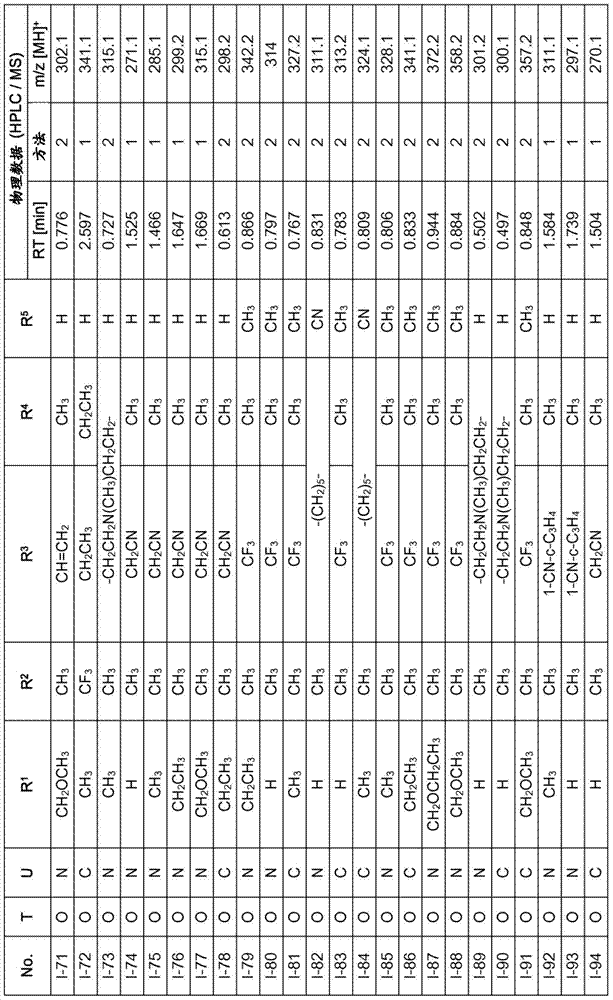
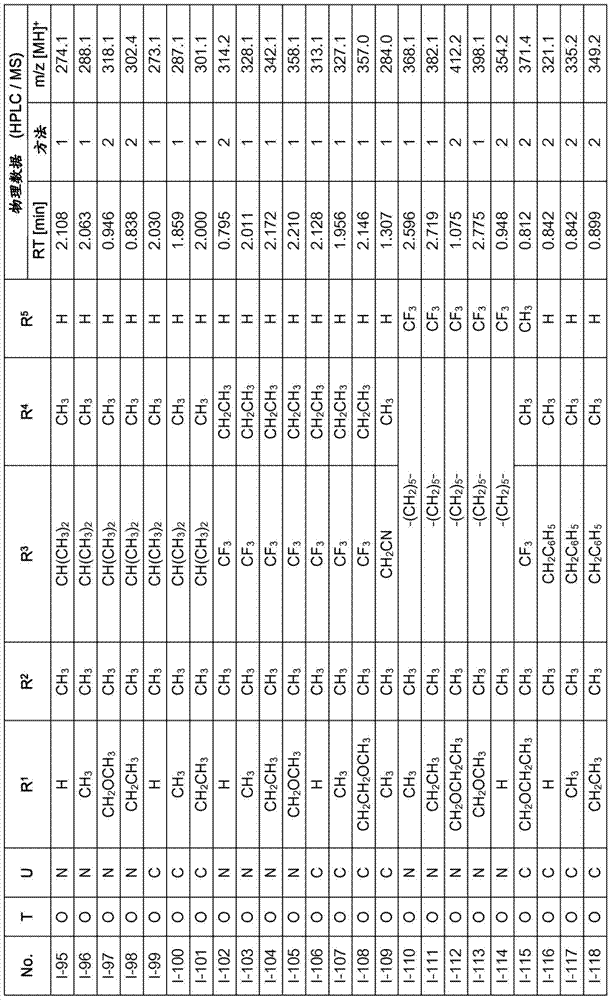


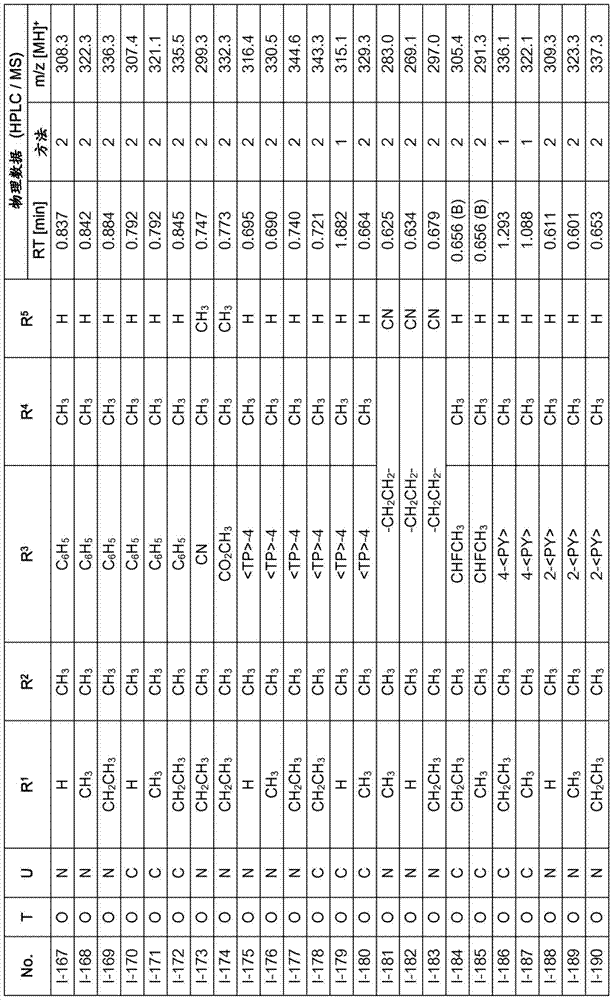

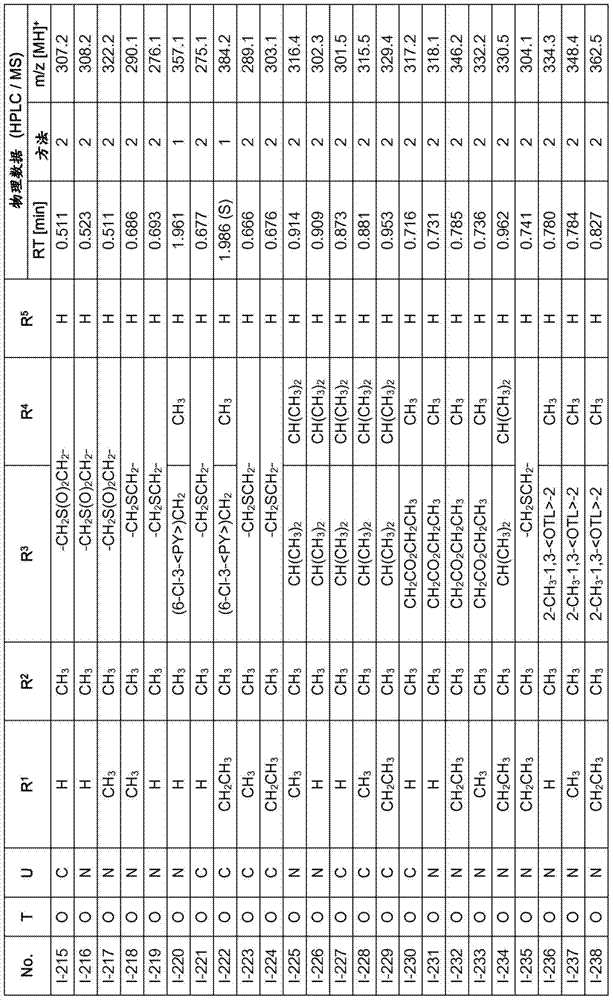


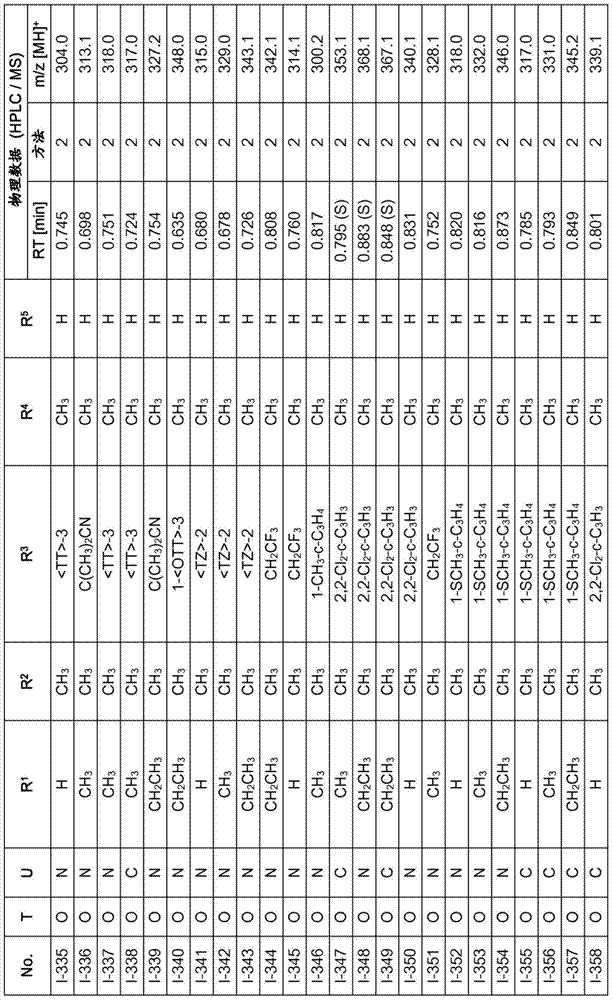
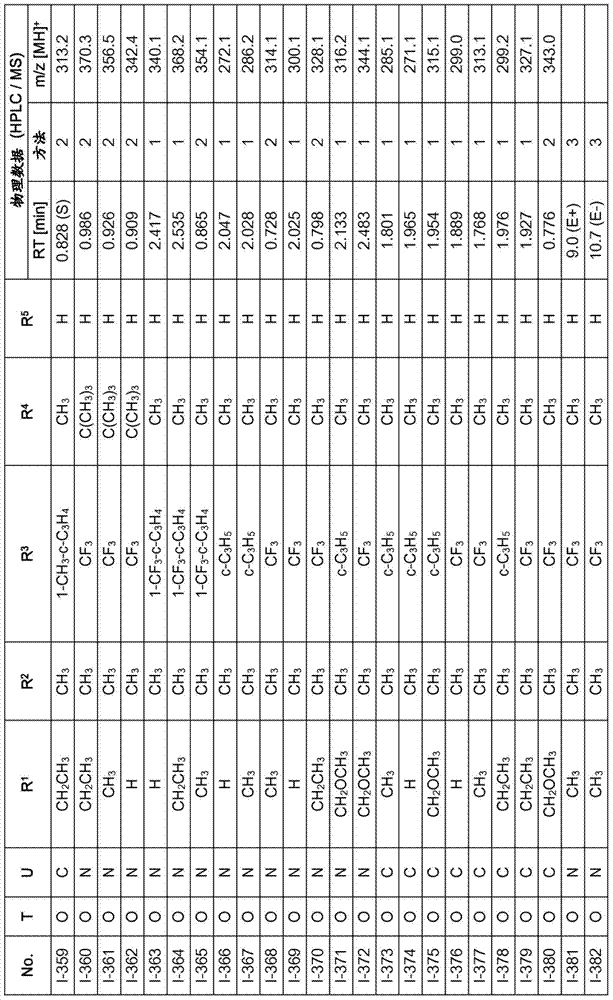
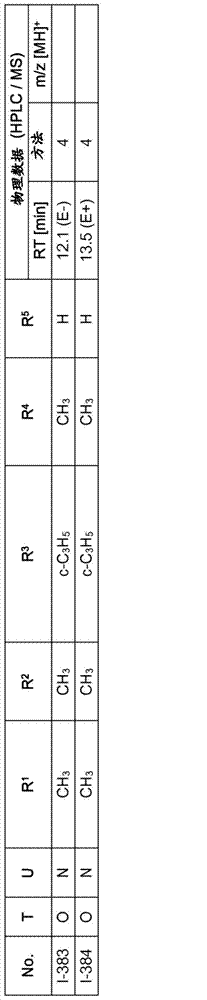
Abbreviations:
< DOT >: dioxothietanyl
< OTT >: oxothienylbutyl
< TP >: tetrahydropyranyl group
< DT >: dithianyl radical
< PY >: pyridyl radical
< TT >: thiocyclobutyl
< OTL >: oxathiacyclopentyl
< TN >: thienyl radical
< TZ >: thiazolyl group
(A) And (B): diastereomers A and B, respectively
(S): trifluoroacetic acid salt
(E +): (+) -enantiomer
(E-): (-) -enantiomer
B. Biological examples
The activity of the compounds of formula I of the present invention can be confirmed and evaluated in the biological assays described below.
If not otherwise stated, the test solutions were prepared as follows:
the active compound is dissolved in 1:1 (v: v) distilled water at the desired concentration: in a mixture of acetone. Test solutions were prepared on the day of use and typically at ppm (wt/vol) concentrations.
B.1 cowpea aphid (Aphis craccivora)
Potted cowpea plants at various stages with 100 + 150 aphids scored were sprayed after pest population was recorded. Population reduction was assessed after 24, 72 and 120 hours.
In this test, compounds I-1, I-2, I-3, I-4, I-5, I-6, I-7, I-8, I-9, I-10, I-11, I-12, I-13, I-14, I-15, I-16, I-17, I-18, I-19, I-20, I-21, I-22, I-23, I-24, I-25, I-26, I-27, I-28, I-29, I-30, I-31, I-32, I-33, I-34, I-35, I-36, I-37, I-38, I-39, I-40, I-13, I-18, I-41, I-42, I-43, I-44, I-45, I-46, I-47, I-48, I-50, I-51, I-52, I-53, I-54, I-55, I-56, I-57, I-58, I-59, I-60, I-61, I-62, I-63, I-64, I-65, I-66, I-67, I-68, I-69, I-70, I-71, I-72, I-74, I-75, I-76, I-77, I-78, I-79, I-80, I-81, I-82, I-83, I-84, I-85, I-80, I-81, I-82, I-83, I-84, I-80, I-86, I-87, I-88, I-91, I-92, I-93, I-94, I-95, I-96, I-97, I-98, I-99, I-100, I-101, I-102, I-103, I-104, I-105, I-106, I-107, I-108, I-109, I-110, I-111, I-112, I-113, I-114, I-115, I-116, I-117, I-118, I-119, I-120, I-121, I-122, I-123, I-124, I-125, I-126, I-127, I-128, I-129, I-130, I-120, I-131, I-132, I-133, I-134, I-135, I-136, I-137, I-138, I-139, I-140, I-141, I-142, I-143, I-144, I-145, I-146, I-147, I-148, I-149, I-150, I-151, I-152, I-153, I-154, I-155, I-156, I-157, I-158, I-159, I-160, I-161, I-162, I-163, I-164, I-166, I-167, I-168, I-169, I-170, I-171, I-172, I-173, I-174, I-175, I-176, I-177, I-178, I-179, I-180, I-181, I-182, I-183, I-184, I-185, I-186, I-187, I-188, I-189, I-190, I-191, I-192, I-193, I-194, I-195, I-196, I-197, I-198, I-199, I-200, I-201, I-202, I-203, I-204, I-205, I-211, I-212, I-214, I-215, I-216, I-218, I-219, I-220, I-221, I-222, I-223, I-224, I-220, I-221, I-222, I-223, I-224, I-223, I-181, I-182, I-183, I-185, I-230, I-231, I-232, I-233, I-235, I-236, I-237, I-238, I-239, I-240, I-241, I-244, I-245, I-246, I-247, I-249, I-250, I-251, I-252, I-253, I-254, I-255, I-256, I-257, I-258, I-259, I-260, I-261, I-262, I-263, I-264, I-265, I-266, I-267, I-268, I-269, I-270, I-271, I-272, I-273, I-274, I-275, I-276, I-266, I-277, I-278, I-279, I-280, I-281, I-282, I-283, I-284, I-285, I-286, I-287, I-288, I-289, I-290, I-291, I-292, I-293, I-294, I-295, I-296, I-297, I-298, I-299, I-300, I-301, I-302, I-303, I-304, I-305, I-306, I-307, I-308, I-309, I-310, I-311, I-312, I-313, I-314, I-315, I-316, I-317, I-366, I-367, I-283, I-368, I-369, I-370, I-371, I-372, I-373, I-374, I-375, I-376, I-377, I-378, I-379, I-380, I-381, I-382, I-383, and I-384 exhibited a mortality of at least 75% at 500 ppm.
B.2 Aphis gossypii (Aphis gossypii, mixed life)
The active compound is formulated as a 10,000ppm solution in cyclohexanone, supplied in 1.3ml In the tube. These tubes were inserted into an automatic electrostatic atomizer equipped with an atomizing nozzle and were used as stock solutions for spraying water at a rate of 1:1 (volume: volume) water: a lower concentration of the dilution was made in acetone. Adding a nonionic surfactantIncluded in the solution at 0.01% (v/v) volume.
Prior to treatment, cotton plants at the cotyledon stage were infested with aphids by placing heavily infested leaves from the main aphid population on top of each cotyledon. Aphids were transferred overnight to achieve 80-100 aphid infestations per plant and host leaves were removed. The infested plants were then sprayed by an automatic electrostatic plant sprayer fitted with an atomizing nozzle. Plants were dried in a sprayer fume hood, removed from the sprayer, and then maintained in a growth chamber under fluorescent light for a24 hour period at 25 ℃ and 20-40% relative humidity. After 5 days, the mortality on the treated plants was determined relative to the mortality of aphids on untreated control plants.
In this test, compounds I-1, I-4, I-5, I-6, I-7, I-9, I-10, I-11, I-12, I-13, I-14, I-15, I-16, I-17, I-18, I-20, I-21, I-22, I-23, I-24, I-26, I-27, I-28, I-29, I-30, I-31, I-32, I-33, I-35, I-36, I-38, I-39, I-42, I-43, I-44, I-45, I-46, I-47, I-48, I-51, I-36, I-38, I-39, I-42, I-43, I-44, I-45, I-46, I-47, I-48, I-51, I-16, I-7, I-23, I-60, I-61, I-62, I-63, I-64, I-66, I-67, I-75, I-76, I-77, I-78, I-79, I-80, I-81, I-83, I-85, I-87, I-88, I-90, I-91, I-92, I-93, I-94, I-95, I-96, I-97, I-98, I-99, I-100, I-101, I-102, I-103, I-104, I-105, I-106, I-107, I-109, I-112, I-114, I-115, I-116, I-117, I-118, I-119, I-120, I-121, I-125, I-129, I-131, I-133, I-134, I-135, I-136, I-137, I-138, I-140, I-141, I-142, I-143, I-144, I-145, I-147, I-148, I-149, I-150, I-151, I-152, I-155, I-157, I-166, I-167, I-168, I-169, I-170, I-173, I-174, I-181, I-182, I-183, I-184, I-185, I-186, I-188, I-189, I-190, I-191, I-134, I-192, I-193, I-195, I-196, I-197, I-198, I-199, I-200, I-201, I-202, I-203, I-204, I-205, I-211, I-212, I-232, I-233, I-238, I-265, I-271, I-277, I-290, i-300, I-302, I-307, I-366, I-367, I-368, I-369, I-370, I-371, I-372, I-373, I-374, I-375, I-376, I-377, I-378, I-379, I-380, I-381, I-382, I-383, and I-384 exhibited a mortality of at least 75% at 10 ppm.
B.3 whitefly (Bemisia argentifolii, imago)
The active compound is formulated as a 10,000ppm solution in cyclohexanone, supplied in 1.3mlIn the tube. These tubes were inserted into an automatic electrostatic atomizer equipped with an atomizing nozzle and were used as stock solutions for spraying water at a rate of 1:1 (volume: volume) water: a lower concentration of the dilution was made in acetone. Adding a nonionic surfactant Included in the solution at 0.01% (v/v) volume.
Cotton plants at the cotyledon stage (1 plant/pot) were sprayed by an automatic electrostatic plant sprayer fitted with an atomizing nozzle. The plants were dried in a sprayer fume hood and then removed from the sprayer. Each pot was placed in a plastic cup and 10-12 whitefly adults (about 3 to 5 days old) were introduced. 0.6cm non-toxic Using an aspirator and attached to a protective pipette tip The tube (R-3603) collects insects. The tip containing the collected insects is then gently inserted into the soil containing the treated plant, allowing the insects to climb out of the tip onto the foliage for feeding. The cups were covered with a reusable sieve lid (150 micron mesh polyester mesh, PeCap, from Tetko corporation). Test plants were maintained in the growth chamber for 3 days at 25 ℃ and 20-40% relative humidity, avoiding direct exposure to fluorescent lamps (24 hour photoperiod) to prevent heat entrapment within the cup. Mortality was assessed 3 days after treatment and compared to untreated control plants.
In this test, compounds I-4, I-5, I-6, I-7, I-8, I-9, I-10, I-11, I-12, I-13, I-14, I-18, I-20, I-21, I-22, I-23, I-24, I-27, I-28, I-29, I-30, I-31, I-32, I-33, I-35, I-39, I-43, I-46, I-61, I-63, I-67, I-68, I-76, I-79, I-85, I-87, I-88, I-90, I-91, I-92, I-23, I-79, I-85, I-88, I-90, I-91, I-11, I-23, I-27, I-28, I-29, I-30, I-93, I-94, I-96, I-97, I-98, I-102, I-103, I-104, I-105, I-109, I-113, I-115, I-128, I-129, I-133, I-135, I-137, I-138, I-139, I-142, I-143, I-144, I-145, I-146, I-148, I-149, I-153, I-155, I-157, I-167, I-168, I-169, I-173, I-177, I-181, I-182, I-183, I-184, I-188, I-190, I-198, I-201, I-202, I-204, I-238, I-260, I-266, I-277, I-292, I-366, I-367, I-368, I-369, I-370, I-371, I-372, I-376, I-377, I-379, and I-380 exhibited a mortality of at least 75% at 10 ppm.
B.4 nest vegetable tailed aphid (catch aphid, Megoura vicia)
In a 3:1 (vol: vol) water: the active compounds were formulated in DMSO at different formulated compound concentrations.
Bean leaf discs were placed in a container filled with 0.8% agar and 2.5ppm OPUSTMIn a microtiter plate. Leaf discs were sprayed with 2.5 μ l of test solution and 5-8 adult aphids were placed in microtiter plates, which were then blocked and kept under fluorescent light for 6 days at 23 ± 1 ℃ and 50 ± 5% relative humidity. Mortality was assessed based on surviving and reproducing aphids. The aphids were then assessed visually for mortality and fecundity.
In this test, compounds I-1, I-2, I-3, I-4, I-5, I-6, I-7, I-8, I-9, I-10, I-11, I-12, I-13, I-14, I-15, I-16, I-17, I-18, I-19, I-20, I-21, I-22, I-23, I-24, I-25, I-26, I-27, I-28, I-29, I-30, I-31, I-32, I-33, I-34, I-35, I-36, I-38, I-41, I-42, I-43, I-30, I-31, I-32, I-33, I-34, I-35, I-36, I-38, I-41, I-42, I-11, I-13, I-44, I-45, I-46, I-47, I-48, I-49, I-50, I-51, I-52, I-53, I-54, I-55, I-57, I-58, I-59, I-60, I-61, I-62, I-63, I-64, I-65, I-66, I-67, I-68, I-69, I-70, I-71, I-72, I-74, I-75, I-76, I-77, I-78, I-79, I-80, I-81, I-82, I-83, I-84, I-85, I-86, I-87, I-88, I-91, I-92, I-93, I-94, I-95, I-96, I-97, I-98, I-99, I-100, I-101, I-102, I-103, I-104, I-105, I-106, I-107, I-108, I-109, I-112, I-113, I-114, I-115, I-116, I-117, I-118, I-119, I-120, I-121, I-122, I-123, I-124, I-125, I-126, I-127, I-128, I-129, I-130, I-131, I-132, I-133, I-134, I-135, I-136, I-137, I-138, I-140, I-141, I-142, I-143, I-144, I-145, I-146, I-152, I-154, I-155, I-156, I-157, I-158, I-159, I-161, I-162, I-163, I-164, I-165, I-166, I-173, I-174, I-181, I-182, I-183, I-184, I-185, I-194, I-195, I-196, I-197, I-218, I-219, I-220, I-221, I-222, I-223, I-224, I-225, I-226, I-227, I-228, I-229, I-230, I-231, I-232, I-233, I-234, I-242, I-244, I-245, I-246, I-247, I-248, I-256, I-270, I-271, I-272, I-273, I-274, I-275, I-289, I-304, I-305, I-306, I-307, I-308, I-309, I-311, I-312, I-366, I-367, I-368, I-369, I-370, I-371, I-372, I-373, I-374, I-375, I-376, I-377, I-378, I-379, I-380, I-381, I-382, I-383, and I-384 showed a mortality of at least 75% at 2500 ppm.
B.5 Green peach aphid (Myzus persicae)
The active compound is formulated as a 10,000ppm solution in cyclohexanone, supplied in 1.3ml In the tube. These tubes were inserted into an automatic electrostatic sprayer fitted with an automatic nozzle and used as stock solution for spraying water at a rate of 1:1 (volume: volume) water: a lower concentration of the dilution was made in acetone. Adding a nonionic surfactantIncluded in the solution at 0.01% (v/v) volume.
The first true leaf stage bell pepper plants were infested by placing heavily infested leaves from the main population on top of the treated plants prior to treatment. Aphids were transferred overnight to achieve 30-50 aphids per plant and host leaves were removed. The infested plants were then sprayed by an automatic electrostatic plant sprayer fitted with an atomizing nozzle. Plants were dried in a sprayer fume hood, removed, and then maintained in a growth chamber under fluorescent light for a24 hour light period at 25 ℃ and 20-40% relative humidity. After 5 days, the mortality on the treated plants was determined relative to the mortality of aphids on the control plants.
In this assay, compounds I-1, I-2, I-4, I-5, I-6, I-7, I-8, I-9, I-10, I-11, I-12, I-13, I-14, I-15, I-16, I-17, I-18, I-19, I-20, I-21, I-22, I-23, I-24, I-27, I-28, I-29, I-30, I-31, I-32, I-33, I-34, I-35, I-36, I-37, I-38, I-39, I-42, I-43, I-44, I-45, I-34, I-35, I-36, I-37, I-38, I-39, I-42, I-43, I-44, I-45, I-6, I-7, I-46, I-47, I-48, I-50, I-60, I-61, I-62, I-63, I-64, I-66, I-67, I-69, I-71, I-74, I-75, I-76, I-77, I-78, I-79, I-80, I-81, I-82, I-83, I-84, I-85, I-86, I-87, I-88, I-89, I-90, I-91, I-92, I-93, I-94, I-95, I-96, I-97, I-98, I-99, I-100, I-101, I-102, I-103, I-93, I-94, I-95, I-96, I-97, I-98, I-99, I-100, I-101, I-102, I-103, I-104, I-105, I-106, I-107, I-108, I-109, I-110, I-111, I-112, I-114, I-115, I-116, I-117, I-118, I-120, I-121, I-124, I-125, I-126, I-127, I-128, I-129, I-130, I-131, I-132, I-133, I-134, I-135, I-136, I-137, I-138, I-140, I-141, I-142, I-143, I-144, I-145, I-146, I-147, I-148, I-149, I-150, I-151, I-152, I-153, I-155, I-157, I-167, I-168, I-169, I-170, I-173, I-174, I-176, I-177, I-181, I-183, I-184, I-185, I-186, I-188, I-189, I-190, I-191, I-192, I-193, I-194, I-195, I-196, I-197, I-198, I-199, I-200, I-201, I-202, I-203, I-204, I-205, I-211, I-212, I-232, I-238, I-251, I-265, I-266, I-271, I-170, I-204, I-205, I-211, I-212, I-232, I-238, I-251, I-265, I-266, I-271, I-277, I-284, I-288, I-290, I-291, I-292, I-293, I-300, I-302, I-303, I-307, I-366, I-367, I-368, I-369, I-370, I-371, I-372, I-373, I-374, I-375, I-376, I-377, I-378, I-379, I-380, I-381, I-382, I-383, and I-384 show a mortality of at least 75% at 10 ppm.
B.6 Mexico boll elephant (Anthonomonus grandis)
In a 3:1 (vol: vol) water: compounds were formulated in DMSO.
To evaluate the control of the walrus mexicana (Anthonomus grandis), the test unit consisted of a 24-well microtiter plate containing the insect diet and 20-30 eggs of the walrus mexicana. Different concentrations of formulated compound were sprayed onto the insect diet in amounts of 20 μ Ι using a custom micro-sprayer, repeated twice. After application, microtiter plates were incubated for 5 days at 23. + -. 1 ℃ and 50. + -. 5% relative humidity. The mortality of eggs and larvae was then visually assessed.
In this test, compounds I-67, I-85, I-92, I-94, I-95, I-96, I-98, I-102, I-104, I-113, I-127, I-132, I-137, I-143, I-182, I-374, I-377, and I-380 exhibited at least 75% mortality at 2500ppm compared to untreated controls.
B.7 Rice planthopper (Nilaparvata lugens)
The rice seedlings were cleaned and washed for 24 hours before spraying. In a 1:1 (vol: vol) water: the active compound was formulated in acetone and 0.1% (v/v) surfactant (EL620) was added. Potted rice seedlings were sprayed with 5ml of the test solution, air dried, placed in cages and inoculated with 10 adults. The treated rice plants were maintained at 28-29 ℃ and 50-60% relative humidity. Percent mortality was recorded after 72 hours.
In this test, compounds I-8, I-9, I-10, I-11, I-25, I-29, I-35, I-62, I-63, I-68, I-113, I-141, I-143, I-199, I-204, I-245, I-312 and I-371 showed a mortality of at least 75% at 500ppm compared to untreated controls.
B.8 orchid thrips (Dichromothrips corbeti)
The active compound was formulated as 1:1 (vol.: vol.) water: acetone solution. Surfactant (Alkamuls EL620) was added at a rate of 0.1% (v/v). The orchid petals are cleaned, washed and air dried before spraying. The petals were immersed in the test solution for 3 seconds, air dried, placed inside a resealable plastic and inoculated with 20 adults. The treated petals are kept inside a holding chamber at 28-29 ℃ and 50-60% relative humidity. Percent mortality was recorded after 72 hours.
In this assay, compounds I-4, I-35, I-39, I-43, I-78, I-83, I-86, I-94, I-95, I-96, I-107, I-109, I-115, I-132, I-133, I-142, I-143, I-146, I-154, I-158, I-168, I-184, I-186, I-187, I-189, I-191, I-193, I-198, I-201, I-202, I-203, I-204, I-205, I-278, I-279, I-280, I-281, I-297, I-298, I-299, I-115, I-300, I-305, I-306, I-308, I-310, I-370 and I-373 showed at least 75% mortality at 500 ppm.
B.9 Black tail leafhopper (Rice green leaf hopper, Nephotettix virescens)
The rice seedlings were cleaned and washed for 24 hours before spraying. In a 1:1 (vol: vol) water: the active compound was formulated in acetone and 0.1% v/v surfactant (EL620) was added. Potted rice seedlings were sprayed with 5ml of the test solution, air dried, placed in cages and inoculated with 10 adults. The treated rice plants were maintained at 28-29 ℃ and 50-60% relative humidity. Percent mortality was recorded after 72 hours.
In this test, compounds I-7, I-8, I-10, I-11, I-32, I-33, I-63, I-79, I-113 and I-199 showed at least 75% mortality at 500ppm compared to untreated controls.
B.10 Plutella xylostella (Plutella xylostella)
In a 1:1 (vol: vol) water: the active compounds were formulated in acetone and 0.1% (v/v) Alkamuls EL620 surfactant. Leaf disks of 6cm cabbage leaves were immersed in the test solution for 3 seconds and allowed to air dry in Petri plates aligned with wetted filter paper. Leaf discs were inoculated with 10 third instar larvae and maintained at 25-27 ℃ and 50-60% humidity for 3 days. Mortality was assessed 72h after treatment.
The beneficial activity of the compounds of the invention is demonstrated by the following comparative experiments over structurally similar compounds known in the prior art:
these tables show% mortality compared to untreated controls.
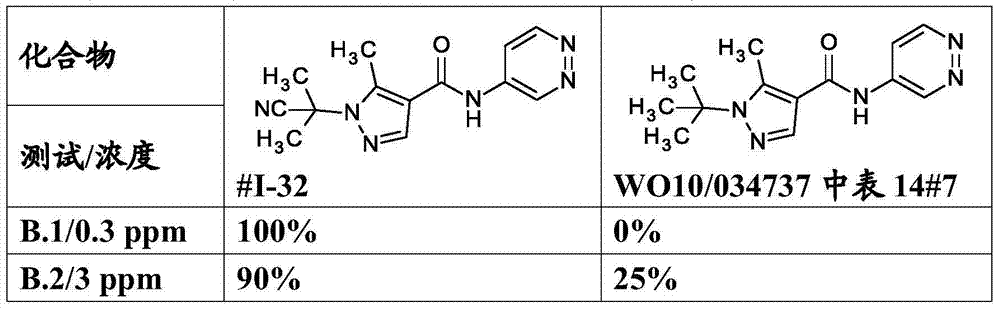


*)FD = feeding impairment (feeding dam)


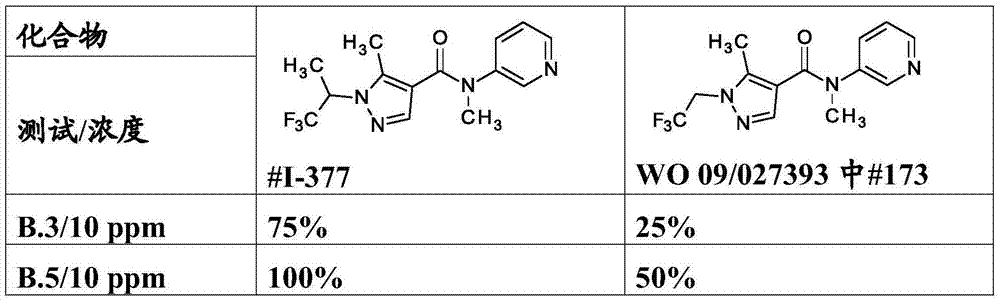

Claims (15)
Applications Claiming Priority (3)
| Application Number | Priority Date | Filing Date | Title |
|---|---|---|---|
| US201161477620P | 2011-04-21 | 2011-04-21 | |
| US61/477,620 | 2011-04-21 | ||
| PCT/EP2012/056875 WO2012143317A1 (en) | 2011-04-21 | 2012-04-16 | Novel pesticidal pyrazole compounds |
Publications (2)
| Publication Number | Publication Date |
|---|---|
| CN103492378A true CN103492378A (en) | 2014-01-01 |
| CN103492378B CN103492378B (en) | 2016-09-28 |
Family
ID=45952568
Family Applications (1)
| Application Number | Title | Priority Date | Filing Date |
|---|---|---|---|
| CN201280018530.8A Active CN103492378B (en) | 2011-04-21 | 2012-04-16 | Parasite killing pyrazole compound |
Country Status (26)
| Country | Link |
|---|---|
| US (2) | US9198422B2 (en) |
| EP (1) | EP2699563B3 (en) |
| JP (1) | JP5937199B2 (en) |
| KR (1) | KR101911974B1 (en) |
| CN (1) | CN103492378B (en) |
| AR (1) | AR086474A1 (en) |
| AU (1) | AU2012244846B2 (en) |
| BR (1) | BR112013024708B1 (en) |
| CA (1) | CA2830138C (en) |
| CL (1) | CL2013002747A1 (en) |
| DK (1) | DK2699563T6 (en) |
| EA (1) | EA024737B1 (en) |
| ES (1) | ES2574414T7 (en) |
| HR (1) | HRP20160639T4 (en) |
| HU (1) | HUE029354T2 (en) |
| IL (1) | IL228345A (en) |
| ME (1) | ME02449B (en) |
| MX (1) | MX354349B (en) |
| PL (1) | PL2699563T6 (en) |
| PT (1) | PT2699563T (en) |
| RS (1) | RS54848B2 (en) |
| SI (1) | SI2699563T2 (en) |
| TW (1) | TWI600651B (en) |
| UA (1) | UA110825C2 (en) |
| WO (1) | WO2012143317A1 (en) |
| ZA (1) | ZA201308600B (en) |
Cited By (11)
| Publication number | Priority date | Publication date | Assignee | Title |
|---|---|---|---|---|
| CN109640663A (en) * | 2016-08-30 | 2019-04-16 | 巴斯夫欧洲公司 | The method for preventing and treating the pest in modified plant |
| CN109843875A (en) * | 2016-11-04 | 2019-06-04 | 巴斯夫欧洲公司 | The method for purifying pyrazoles pyridazine class |
| CN112616845A (en) * | 2020-12-21 | 2021-04-09 | 青岛滕润翔检测评价有限公司 | Pesticide composition containing pyrazole formamide insecticide and application thereof |
| CN113272296A (en) * | 2019-01-11 | 2021-08-17 | 巴斯夫欧洲公司 | Crystalline forms of 1- (1, 2-dimethylpropyl) -N-ethyl-5-methyl-N-pyridazin-4-yl-pyrazole-4-carboxamide |
| CN114521563A (en) * | 2022-02-23 | 2022-05-24 | 山东垄喜植物有限公司 | Insecticidal composition containing fluxapyroxad and abamectin or emamectin benzoate |
| CN116831129A (en) * | 2023-06-29 | 2023-10-03 | 陕西上格之路生物科学有限公司 | A kind of insecticidal composition containing acetamiprid |
| CN117099787A (en) * | 2023-04-01 | 2023-11-24 | 上海沪联生物药业(夏邑)股份有限公司 | Insecticidal composition containing oxazine amide and D-limonene and application thereof |
| CN117136958A (en) * | 2023-04-13 | 2023-12-01 | 上海沪联生物药业(夏邑)股份有限公司 | A pesticide insecticide containing chlorantraniliprole and tebuconazole |
| CN117204437A (en) * | 2023-08-07 | 2023-12-12 | 陕西康禾立丰生物科技药业有限公司 | A kind of insecticide containing acetamiprid and pentamiprid and its application |
| CN119101038A (en) * | 2023-10-16 | 2024-12-10 | 山东省联合农药工业有限公司 | Pyridazine compounds and preparation methods and uses thereof |
| WO2025167934A1 (en) * | 2024-02-06 | 2025-08-14 | 青岛清原化合物有限公司 | Pyrazole amide compound and use thereof |
Families Citing this family (135)
| Publication number | Priority date | Publication date | Assignee | Title |
|---|---|---|---|---|
| WO2012061039A2 (en) | 2010-10-25 | 2012-05-10 | Vanderbilt University | Compositions for inhibition of insect host sensing |
| AU2012254032B2 (en) | 2011-05-06 | 2017-02-23 | Vanderbilt University | Compositions for inhibition of insect sensing |
| WO2013156318A1 (en) * | 2012-04-16 | 2013-10-24 | Basf Se | Substituted pesticidal pyrazole compounds |
| ES2800288T3 (en) | 2012-06-20 | 2020-12-29 | Basf Se | Pesticide mixtures comprising a pyrazole compound |
| WO2014063929A1 (en) * | 2012-10-23 | 2014-05-01 | Basf Se | Substituted pesticidal pyrazole compounds |
| WO2014108286A1 (en) | 2013-01-09 | 2014-07-17 | Basf Se | Process for the preparation of substituted oxiranes and triazoles |
| CA2916777A1 (en) | 2013-07-08 | 2015-01-15 | BASF Agro B.V. | Compositions comprising a triazole compound and a biopesticide |
| WO2015055497A1 (en) | 2013-10-16 | 2015-04-23 | Basf Se | Substituted pesticidal pyrazole compounds |
| WO2015114106A1 (en) * | 2014-01-31 | 2015-08-06 | Basf Se | Pyrazoles for controlling invertebrate pests |
| MX375960B (en) * | 2014-07-31 | 2025-03-06 | Basf Se | PROCESS FOR THE PREPARATION OF PYRAZOLES. |
| EP3204390B1 (en) | 2014-10-06 | 2019-06-05 | Basf Se | Substituted pyrimidinium compounds for combating animal pests |
| BR112017009513A2 (en) | 2014-11-06 | 2018-02-06 | Basf Se | use of a heterobicyclic compound, use of compounds i, compounds, agricultural or veterinary composition, method for pest control or control, method for crop and seed protection |
| CN107207443A (en) | 2015-02-06 | 2017-09-26 | 巴斯夫欧洲公司 | It is used as the pyrazole compound of nitrification inhibitor |
| WO2016128239A1 (en) | 2015-02-11 | 2016-08-18 | Basf Se | Pesticidal mixture comprising a pyrazole compound and a biopesticide |
| EP3255990B1 (en) | 2015-02-11 | 2020-06-24 | Basf Se | Pesticidal mixture comprising a pyrazole compound, an insecticide and a fungicide |
| WO2016128240A1 (en) | 2015-02-11 | 2016-08-18 | Basf Se | Pesticidal mixture comprising a pyrazole compound and two fungicides |
| AU2016238305B2 (en) | 2015-03-25 | 2020-10-08 | Vanderbilt University | Binary compositions as disruptors of ORco-mediated odorant sensing |
| WO2016162371A1 (en) | 2015-04-07 | 2016-10-13 | Basf Agrochemical Products B.V. | Use of an insecticidal carboxamide compound against pests on cultivated plants |
| WO2016170130A1 (en) | 2015-04-22 | 2016-10-27 | Basf Se | Molluscicide and bait composition comprising a molluscicide |
| AU2016260784B2 (en) | 2015-05-11 | 2020-03-12 | Basf Se | Process for preparing 4-amino-pyridazines |
| JP6806981B2 (en) | 2015-05-12 | 2021-01-06 | ビーエイエスエフ・ソシエタス・エウロパエアBasf Se | Thioether compounds as nitrification inhibitors |
| WO2016198611A1 (en) | 2015-06-11 | 2016-12-15 | Basf Se | N-(thio)acylimino heterocyclic compounds |
| WO2016198613A1 (en) | 2015-06-11 | 2016-12-15 | Basf Se | N-(thio)acylimino compounds |
| EP3111763A1 (en) * | 2015-07-02 | 2017-01-04 | BASF Agro B.V. | Pesticidal compositions comprising a triazole compound |
| AU2016287098A1 (en) | 2015-07-02 | 2018-01-25 | BASF Agro B.V. | Pesticidal compositions comprising a triazole compound |
| WO2017011466A1 (en) * | 2015-07-13 | 2017-01-19 | Zwiebel Laurence J | Thermal volatilization of orco agonists |
| WO2017016883A1 (en) | 2015-07-24 | 2017-02-02 | Basf Se | Process for preparation of cyclopentene compounds |
| MY195938A (en) | 2015-08-13 | 2023-02-27 | Basf Se | Nanoqueous Pesticide Suspension Comprising a Water Soluble Solvent, an Inorganic Thickener, and an Alkoxylate |
| EP3334277B2 (en) | 2015-08-13 | 2024-02-28 | Basf Se | Nonaqueous pesticide suspension comprising a water soluble solvent, an inorganic thickener, and an alkoxylate |
| US11142514B2 (en) | 2015-10-02 | 2021-10-12 | Basf Se | Imino compounds with a 2-chloropyrimidin-5-yl substituent as pest-control agents |
| CN113303339A (en) | 2015-11-30 | 2021-08-27 | 巴斯夫欧洲公司 | Mixture of cis-jasmone and bacillus amyloliquefaciens |
| AU2017216082B2 (en) * | 2016-02-02 | 2020-12-03 | Basf Se | Catalytic hydrogenation process for preparing pyrazoles |
| BR112018068034A2 (en) | 2016-03-09 | 2019-01-08 | Basf Se | spiro compounds of formula I, composition, agricultural composition to combat animal pests, method of control or control of invertebrate pests, method of protecting plants, seeds and use of compounds |
| WO2017153218A1 (en) | 2016-03-11 | 2017-09-14 | Basf Se | Method for controlling pests of plants |
| PE20181898A1 (en) | 2016-04-01 | 2018-12-11 | Basf Se | BICYCLE COMPOUNDS |
| WO2017198588A1 (en) | 2016-05-18 | 2017-11-23 | Basf Se | Capsules comprising benzylpropargylethers for use as nitrification inhibitors |
| EP3329777A1 (en) | 2016-11-30 | 2018-06-06 | Basf Se | Pesticidal mixtures |
| KR20190092539A (en) | 2016-12-16 | 2019-08-07 | 바스프 에스이 | Insecticide compound |
| WO2018139560A1 (en) | 2017-01-26 | 2018-08-02 | 三井化学アグロ株式会社 | Pyridone compound and bactericide for agricultural and horticultural use, which uses said compound as active ingredient |
| LT3582617T (en) * | 2017-02-14 | 2022-08-25 | Basf Se | STABLE COMPOSITION OF PESTICIDE PYRIDAZINEPYRAZOLAMIDES |
| WO2018162312A1 (en) | 2017-03-10 | 2018-09-13 | Basf Se | Spirocyclic derivatives |
| WO2018166855A1 (en) | 2017-03-16 | 2018-09-20 | Basf Se | Heterobicyclic substituted dihydroisoxazoles |
| KR102596592B1 (en) | 2017-03-28 | 2023-10-31 | 바스프 에스이 | insecticidal compounds |
| CN110461854A (en) | 2017-03-31 | 2019-11-15 | 巴斯夫欧洲公司 | Process for the preparation of chiral 2,3-dihydrothiazolo[3,2-A]pyrimidine-4-onium compounds |
| CA3059702A1 (en) | 2017-04-10 | 2018-10-18 | Mitsui Chemicals Agro, Inc. | Pyridone compounds and agricultural and horticultural fungicides containing the same as active ingredients |
| WO2018190350A1 (en) | 2017-04-10 | 2018-10-18 | 三井化学アグロ株式会社 | Pyridone compound, and agricultural and horticultural fungicide having this as active component |
| MY190386A (en) | 2017-04-11 | 2022-04-20 | Mitsui Chemicals Agro Inc | Pyridone compounds and agricultural and horticultural fungicides containing the same as active ingredients |
| WO2018192793A1 (en) | 2017-04-20 | 2018-10-25 | Basf Se | Substituted rhodanine derivatives |
| EP3615530B1 (en) | 2017-04-26 | 2021-04-14 | Basf Se | Substituted succinimide derivatives as pesticides |
| CN110546152B (en) | 2017-05-10 | 2023-09-08 | 巴斯夫欧洲公司 | bicyclic pesticide compounds |
| WO2018224455A1 (en) | 2017-06-07 | 2018-12-13 | Basf Se | Substituted cyclopropyl derivatives |
| JP7157738B2 (en) | 2017-06-08 | 2022-10-20 | 三井化学アグロ株式会社 | Pyridone compound and agricultural and horticultural fungicide containing the same as an active ingredient |
| EP3638677A1 (en) | 2017-06-16 | 2020-04-22 | Basf Se | Mesoionic imidazolium compounds and derivatives for combating animal pests |
| EP3642203A1 (en) | 2017-06-19 | 2020-04-29 | Basf Se | Substituted pyrimidinium compounds and derivatives for combating animal pests |
| EP4602918A3 (en) | 2017-06-23 | 2025-10-15 | Basf Se | Pesticidal mixtures comprising a pyrazole compound |
| WO2018234488A1 (en) | 2017-06-23 | 2018-12-27 | Basf Se | SUBSTITUTED CYCLOPROPYL DERIVATIVES |
| WO2019042932A1 (en) | 2017-08-31 | 2019-03-07 | Basf Se | Method of controlling rice pests in rice |
| EP3453706A1 (en) | 2017-09-08 | 2019-03-13 | Basf Se | Pesticidal imidazole compounds |
| US11399543B2 (en) | 2017-10-13 | 2022-08-02 | Basf Se | Substituted 1,2,3,5-tetrahydroimidazo[1,2-a]pyrimidiniumolates for combating animal pests |
| WO2019121143A1 (en) | 2017-12-20 | 2019-06-27 | Basf Se | Substituted cyclopropyl derivatives |
| UA127604C2 (en) | 2017-12-21 | 2023-11-01 | Басф Се | PESTICIDE COMPOUNDS |
| AU2019211978B2 (en) | 2018-01-09 | 2024-08-22 | Basf Se | Silylethynyl hetaryl compounds as nitrification inhibitors |
| WO2019137995A1 (en) | 2018-01-11 | 2019-07-18 | Basf Se | Novel pyridazine compounds for controlling invertebrate pests |
| PE20211753A1 (en) | 2018-02-28 | 2021-09-06 | Basf Se | USE OF ALCOXYPYRAZOLES AS NITRIFICATION INHIBITORS |
| WO2019166558A1 (en) | 2018-02-28 | 2019-09-06 | Basf Se | Use of pyrazole propargyl ethers as nitrification inhibitors |
| KR102730587B1 (en) | 2018-02-28 | 2024-11-14 | 바스프 에스이 | Use of N-functionalized alkoxy pyrazole compounds as nitrification inhibitors |
| WO2019175713A1 (en) | 2018-03-14 | 2019-09-19 | Basf Corporation | New catechol molecules and their use as inhibitors to p450 related metabolic pathways |
| WO2019175712A1 (en) | 2018-03-14 | 2019-09-19 | Basf Corporation | New uses for catechol molecules as inhibitors to glutathione s-transferase metabolic pathways |
| WO2019185413A1 (en) | 2018-03-27 | 2019-10-03 | Basf Se | Pesticidal substituted cyclopropyl derivatives |
| KR102727205B1 (en) | 2018-05-15 | 2024-11-06 | 바스프 에스이 | Mixtures containing benzpyrimoxane and oxazosulpirin, uses thereof and methods of application thereof |
| WO2019224092A1 (en) | 2018-05-22 | 2019-11-28 | Basf Se | Pesticidally active c15-derivatives of ginkgolides |
| WO2020002472A1 (en) | 2018-06-28 | 2020-01-02 | Basf Se | Use of alkynylthiophenes as nitrification inhibitors |
| PL3826983T3 (en) | 2018-07-23 | 2024-09-09 | Basf Se | Use of substituted 2-thiazolines as nitrification inhibitors |
| CN112424147B (en) | 2018-07-23 | 2023-06-30 | 巴斯夫欧洲公司 | Use of substituted thiazolidine compounds as nitrification inhibitors |
| US12114658B2 (en) | 2018-07-25 | 2024-10-15 | Mitsui Chemicals Crop & Life Solutions, Inc. | Compounds having a nitrogen-containing unsaturated six-membered ring and agricultural and horticultural fungicides containing the same as active ingredients |
| EP3613736A1 (en) | 2018-08-22 | 2020-02-26 | Basf Se | Substituted glutarimide derivatives |
| EP3628157A1 (en) | 2018-09-28 | 2020-04-01 | Basf Se | Method of controlling insecticide resistant insects and virus transmission to plants |
| EP3628158A1 (en) | 2018-09-28 | 2020-04-01 | Basf Se | Pesticidal mixture comprising a mesoionic compound and a biopesticide |
| EP3628156A1 (en) | 2018-09-28 | 2020-04-01 | Basf Se | Method for controlling pests of sugarcane, citrus, rapeseed, and potato plants |
| AU2019348280A1 (en) | 2018-09-28 | 2021-04-22 | Basf Se | Method of controlling pests by seed treatment application of a mesoionic compound or mixture thereof |
| EP3643705A1 (en) | 2018-10-24 | 2020-04-29 | Basf Se | Pesticidal compounds |
| US12459934B2 (en) | 2018-11-28 | 2025-11-04 | Basf Se | Pesticidal compounds |
| WO2020126591A1 (en) | 2018-12-18 | 2020-06-25 | Basf Se | Substituted pyrimidinium compounds for combating animal pests |
| KR20210131350A (en) | 2019-02-20 | 2021-11-02 | 바스프 에스이 | Pesticide Mixtures Containing Pyrazole Compounds |
| CN113795147A (en) * | 2019-05-03 | 2021-12-14 | 巴斯夫欧洲公司 | Stabilization of suspension concentrates by ethoxylated glycerol triricinoleate |
| BR112021019416A2 (en) | 2019-05-29 | 2021-12-07 | Basf Se | Compounds, composition, methods of protecting crops and combating, controlling, preventing or protecting against infestations, non-therapeutic method of treating infested animals, seed and use |
| EP3769623A1 (en) | 2019-07-22 | 2021-01-27 | Basf Se | Mesoionic imidazolium compounds and derivatives for combating animal pests |
| EP3766879A1 (en) | 2019-07-19 | 2021-01-20 | Basf Se | Pesticidal pyrazole derivatives |
| JP7641962B2 (en) | 2019-11-26 | 2025-03-07 | ビーエーエスエフ ソシエタス・ヨーロピア | Stabilization of zincpropylidaz suspensions with triethylammonium chloride. |
| US12497370B2 (en) | 2019-12-18 | 2025-12-16 | Elanco Tiergesundheit Ag | Isoxazoline derivatives |
| JP7785003B2 (en) | 2019-12-23 | 2025-12-12 | ビーエーエスエフ ソシエタス・ヨーロピア | Enzyme-enhanced root uptake of pesticide compounds. |
| WO2021170463A1 (en) | 2020-02-28 | 2021-09-02 | BASF Agro B.V. | Methods and uses of a mixture comprising alpha-cypermethrin and dinotefuran for controlling invertebrate pests in turf |
| BR112022021631A2 (en) | 2020-04-28 | 2022-12-06 | Basf Se | COMPOUNDS, COMPOSITION, METHODS TO COMBAT OR CONTROL INVERTEBRATE PEST, TO PROTECT GROWING PLANTS AND TO TREAT OR PROTECT AN ANIMAL, SEED AND USE OF A COMPOUND |
| EP3909950A1 (en) | 2020-05-13 | 2021-11-17 | Basf Se | Heterocyclic compounds for the control of invertebrate pests |
| CN112362627B (en) * | 2020-11-12 | 2023-06-06 | 贵州师范学院 | Fluorescent probe for detecting multocaryum in water and preparation method and application thereof |
| EP4288398A1 (en) | 2021-02-02 | 2023-12-13 | Basf Se | Synergistic action of dcd and alkoxypyrazoles as nitrification inhibitors |
| EP4288417A4 (en) * | 2021-02-04 | 2025-04-09 | Aurigene Oncology Limited | SUBSTITUTED PYRAZOLYL COMPOUNDS AS MALT-1 INHIBITORS |
| EP4043444A1 (en) | 2021-02-11 | 2022-08-17 | Basf Se | Substituted isoxazoline derivatives |
| WO2022200364A1 (en) | 2021-03-25 | 2022-09-29 | Syngenta Crop Protection Ag | Insect, acarina and nematode pest control |
| JP2024517342A (en) | 2021-05-14 | 2024-04-19 | シンジェンタ クロップ プロテクション アクチェンゲゼルシャフト | Seed treatment composition |
| US20240260577A1 (en) | 2021-05-14 | 2024-08-08 | Syngenta Crop Protection Ag | Insect, acarina and nematode pest control |
| US20240270658A1 (en) | 2021-05-21 | 2024-08-15 | Basf Se | Use of an N-Functionalized Alkoxy Pyrazole Compound as Nitrification Inhibitor |
| US20240351959A1 (en) | 2021-05-21 | 2024-10-24 | Basf Se | Use of ethynylpyridine compounds as nitrification inhibitors |
| CN117500374A (en) | 2021-06-11 | 2024-02-02 | 巴斯夫欧洲公司 | Water-dispersible granules of acetamiprid |
| CA3223077A1 (en) | 2021-06-21 | 2022-12-29 | Barbara Nave | Metal-organic frameworks with pyrazole-based building blocks |
| WO2022268815A1 (en) | 2021-06-24 | 2022-12-29 | Syngenta Crop Protection Ag | Insect, acarina and nematode pest control |
| WO2022268813A1 (en) | 2021-06-24 | 2022-12-29 | Syngenta Crop Protection Ag | Insect, acarina and nematode pest control |
| WO2023280999A1 (en) | 2021-07-07 | 2023-01-12 | Syngenta Crop Protection Ag | Insect, acarina and nematode pest control |
| EP4119547A1 (en) | 2021-07-12 | 2023-01-18 | Basf Se | Triazole compounds for the control of invertebrate pests |
| EP4140986A1 (en) | 2021-08-23 | 2023-03-01 | Basf Se | Pyrazine compounds for the control of invertebrate pests |
| EP4140995A1 (en) | 2021-08-27 | 2023-03-01 | Basf Se | Pyrazine compounds for the control of invertebrate pests |
| EP4151631A1 (en) | 2021-09-20 | 2023-03-22 | Basf Se | Heterocyclic compounds for the control of invertebrate pests |
| US20240389596A1 (en) | 2021-09-23 | 2024-11-28 | Syngenta Crop Protection Ag | Insect, acarina and nematode pest control |
| CN117082979B (en) * | 2021-12-08 | 2025-12-16 | 江苏龙灯化学有限公司 | Insecticidal composition containing pyrazole compound and use thereof |
| EP4194453A1 (en) | 2021-12-08 | 2023-06-14 | Basf Se | Pyrazine compounds for the control of invertebrate pests |
| WO2023105065A1 (en) | 2021-12-10 | 2023-06-15 | Syngenta Crop Protection Ag | Insect, acarina and nematode pest control |
| EP4198033A1 (en) | 2021-12-14 | 2023-06-21 | Basf Se | Heterocyclic compounds for the control of invertebrate pests |
| EP4198023A1 (en) | 2021-12-16 | 2023-06-21 | Basf Se | Pesticidally active thiosemicarbazone compounds |
| WO2023152045A1 (en) | 2022-02-11 | 2023-08-17 | Basf Se | Use of dimpropyridaz for reducing viral and bacterial transmission |
| EP4238971A1 (en) | 2022-03-02 | 2023-09-06 | Basf Se | Substituted isoxazoline derivatives |
| WO2023203066A1 (en) | 2022-04-21 | 2023-10-26 | Basf Se | Synergistic action as nitrification inhibitors of dcd oligomers with alkoxypyrazole and its oligomers |
| CA3250199A1 (en) | 2022-04-25 | 2023-11-02 | Basf Se | An emulsifiable concentrate having a (substituted) benzaldehyde-based solvent system |
| AU2023317620A1 (en) | 2022-08-02 | 2025-02-13 | Basf Se | Pyrazolo pesticidal compounds |
| EP4342885A1 (en) | 2022-09-20 | 2024-03-27 | Basf Se | N-(3-(aminomethyl)-phenyl)-5-(4-phenyl)-5-(trifluoromethyl)-4,5-dihydroisoxazol-3-amine derivatives and similar compounds as pesticides |
| EP4389210A1 (en) | 2022-12-21 | 2024-06-26 | Basf Se | Heteroaryl compounds for the control of invertebrate pests |
| CN120676862A (en) | 2023-02-03 | 2025-09-19 | 巴斯夫欧洲公司 | Use of oxaziclomefone for reducing or preventing bacterial transmission |
| EP4455137A1 (en) | 2023-04-24 | 2024-10-30 | Basf Se | Pyrimidine compounds for the control of invertebrate pests |
| EP4467535A1 (en) | 2023-05-25 | 2024-11-27 | Basf Se | Lactam pesticidal compounds |
| EP4488269A1 (en) | 2023-07-06 | 2025-01-08 | Basf Se | Triazole compounds for the control of invertebrate pests |
| EP4488270A1 (en) | 2023-07-06 | 2025-01-08 | Basf Se | Triazole compounds for the control of invertebrate pests |
| EP4488273A1 (en) | 2023-07-06 | 2025-01-08 | Basf Se | Triazole compounds for the control of invertebrate pests |
| WO2025117659A1 (en) | 2023-11-29 | 2025-06-05 | Basf Corporation | Insecticide delivery by nanocarriers |
| EP4574819A1 (en) | 2023-12-22 | 2025-06-25 | Basf Se | Diazinone compounds for the control of invertebrate pests |
| WO2025242699A1 (en) | 2024-05-22 | 2025-11-27 | Basf Se | Method for improving rainfastness of an agrochemical active ingredient |
| WO2026002763A1 (en) | 2024-06-26 | 2026-01-02 | Basf Se | Pesticidal mixtures and applications of beauveria bassiana and dimpropyridaz |
Citations (3)
| Publication number | Priority date | Publication date | Assignee | Title |
|---|---|---|---|---|
| WO2010034737A1 (en) * | 2008-09-24 | 2010-04-01 | Basf Se | Pyrazole compounds for controlling invertebrate pests |
| CN101835377A (en) * | 2007-08-27 | 2010-09-15 | 巴斯夫欧洲公司 | Pyrazole compounds for controlling invertebrate pests |
| US20100305124A1 (en) * | 2009-04-03 | 2010-12-02 | Bayer Cropscience Ag | Acylated Aminopyridine and Aminopyridazine Insecticides |
Family Cites Families (47)
| Publication number | Priority date | Publication date | Assignee | Title |
|---|---|---|---|---|
| US3060084A (en) | 1961-06-09 | 1962-10-23 | Du Pont | Improved homogeneous, readily dispersed, pesticidal concentrate |
| US3299566A (en) | 1964-06-01 | 1967-01-24 | Olin Mathieson | Water soluble film containing agricultural chemicals |
| US4144050A (en) | 1969-02-05 | 1979-03-13 | Hoechst Aktiengesellschaft | Micro granules for pesticides and process for their manufacture |
| US3920442A (en) | 1972-09-18 | 1975-11-18 | Du Pont | Water-dispersible pesticide aggregates |
| US4172714A (en) | 1976-12-20 | 1979-10-30 | E. I. Du Pont De Nemours And Company | Dry compactible, swellable herbicidal compositions and pellets produced therefrom |
| GB2095558B (en) | 1981-03-30 | 1984-10-24 | Avon Packers Ltd | Formulation of agricultural chemicals |
| BR8404834A (en) | 1983-09-26 | 1985-08-13 | Agrigenetics Res Ass | METHOD TO GENETICALLY MODIFY A PLANT CELL |
| BR8600161A (en) | 1985-01-18 | 1986-09-23 | Plant Genetic Systems Nv | CHEMICAL GENE, HYBRID, INTERMEDIATE PLASMIDIO VECTORS, PROCESS TO CONTROL INSECTS IN AGRICULTURE OR HORTICULTURE, INSECTICIDE COMPOSITION, PROCESS TO TRANSFORM PLANT CELLS TO EXPRESS A PLANTINIDE TOXIN, PRODUCED BY CULTURES, UNITED BY BACILLA |
| ATE57390T1 (en) | 1986-03-11 | 1990-10-15 | Plant Genetic Systems Nv | PLANT CELLS OBTAINED BY GENOLOGICAL TECHNOLOGY AND RESISTANT TO GLUTAMINE SYNTHETASE INHIBITORS. |
| US5013659A (en) | 1987-07-27 | 1991-05-07 | E. I. Du Pont De Nemours And Company | Nucleic acid fragment encoding herbicide resistant plant acetolactate synthase |
| IL83348A (en) | 1986-08-26 | 1995-12-08 | Du Pont | Nucleic acid fragment encoding herbicide resistant plant acetolactate synthase |
| KR900003088B1 (en) | 1988-03-26 | 1990-05-07 | 재단법인 한국화학연구소 | 5-hydroxypyrazole derivatives |
| US5180587A (en) | 1988-06-28 | 1993-01-19 | E. I. Du Pont De Nemours And Company | Tablet formulations of pesticides |
| ZW13690A1 (en) | 1989-08-30 | 1990-11-21 | Aeci Ltd | Active ingredient dosage device |
| AU651335B2 (en) | 1990-03-12 | 1994-07-21 | E.I. Du Pont De Nemours And Company | Water-dispersible or water-soluble pesticide granules from heat-activated binders |
| EP0472722B1 (en) | 1990-03-16 | 2003-05-21 | Calgene LLC | Dnas encoding plant desaturases and their uses |
| ATE212670T1 (en) | 1990-06-18 | 2002-02-15 | Monsanto Technology Llc | INCREASED STARCH CONTENT IN PLANTS |
| WO1992000377A1 (en) | 1990-06-25 | 1992-01-09 | Monsanto Company | Glyphosate tolerant plants |
| EP0480679B1 (en) | 1990-10-11 | 1996-09-18 | Sumitomo Chemical Company Limited | Pesticidal composition |
| SE467358B (en) | 1990-12-21 | 1992-07-06 | Amylogene Hb | GENETIC CHANGE OF POTATISE BEFORE EDUCATION OF AMYLOPECT TYPE STARCH |
| DE4104782B4 (en) | 1991-02-13 | 2006-05-11 | Bayer Cropscience Gmbh | Novel plasmids containing DNA sequences that cause changes in carbohydrate concentration and carbohydrate composition in plants, as well as plants and plant cells containing these plasmids |
| DE4322211A1 (en) | 1993-07-03 | 1995-01-12 | Basf Ag | Aqueous, multi-phase, stable ready-to-use formulation for crop protection agents and processes for their preparation |
| DE19613334A1 (en) | 1996-04-03 | 1997-10-09 | Bayer Ag | Means for controlling parasitic insects and mites on humans |
| JP2003026510A (en) | 2001-05-09 | 2003-01-29 | Sumitomo Chem Co Ltd | Malononitrile compounds and their pest control applications |
| DE60309874T2 (en) | 2002-07-17 | 2007-03-15 | Sumitomo Chemical Co., Ltd. | MALONSAUERENITRILE COMPOUNDS AND THEIR USE AS PESTICIDES |
| KR100726672B1 (en) * | 2003-04-30 | 2007-06-11 | 한국화학연구원 | Pyrazole derivatives and preparation method thereof |
| MXPA06003150A (en) | 2003-09-17 | 2006-08-31 | Johnson & Johnson | Fused heterocyclic compounds. |
| EP1697311B1 (en) | 2003-12-26 | 2011-10-26 | Sumitomo Chemical Company, Limited | Nitrile compound and its use in pest control |
| ES2367647T3 (en) | 2004-01-16 | 2011-11-07 | Sumitomo Chemical Company Limited | MALONONITRILE COMPOUND AND USE OF IT. |
| ZA200604414B (en) | 2004-01-16 | 2007-11-28 | Sumitomo Chemical Co | Malononitrile compound as pesticides |
| CN102558082B (en) | 2004-03-05 | 2015-09-30 | 日产化学工业株式会社 | Isoxazoline-substituted benzamide compound prepare intermediate |
| JP2006131529A (en) | 2004-11-05 | 2006-05-25 | Sumitomo Chemical Co Ltd | Pest control composition |
| AU2006285613B2 (en) | 2005-09-02 | 2011-11-17 | Nissan Chemical Corporation | Isoxazoline-substituted benzamide compound and harmful organism-controlling agent |
| DK1937664T3 (en) | 2005-10-14 | 2011-07-18 | Sumitomo Chemical Co | Hydrazide compound and pesticide use of the same |
| CN101312944B (en) | 2005-11-22 | 2013-03-06 | 住友化学株式会社 | Organosulfur compounds and their use as arthropodicides |
| TWI412322B (en) | 2005-12-30 | 2013-10-21 | Du Pont | Isoxazolines for controlling invertebrate pests |
| DE102006015197A1 (en) | 2006-03-06 | 2007-09-13 | Bayer Cropscience Ag | Active ingredient combination with insecticidal properties |
| DE102006015467A1 (en) | 2006-03-31 | 2007-10-04 | Bayer Cropscience Ag | New cyclic enamine ketone derivatives useful for controlling pests, especially insects |
| ES2379928T3 (en) | 2006-11-30 | 2012-05-07 | Meiji Seika Kaisha Ltd. | Pest Control Agent |
| JP5449669B2 (en) | 2006-12-14 | 2014-03-19 | 石原産業株式会社 | Pest control composition |
| JP2009001541A (en) | 2006-12-15 | 2009-01-08 | Ishihara Sangyo Kaisha Ltd | Method for producing anthranilamide compound using new pyrazole compound as intermediate |
| GB0625594D0 (en) | 2006-12-21 | 2007-01-31 | Smithkline Beecham Corp | Compounds |
| JP5313869B2 (en) | 2007-03-08 | 2013-10-09 | Meiji Seikaファルマ株式会社 | Pest control composition |
| JP2008115155A (en) | 2007-04-06 | 2008-05-22 | Nippon Soda Co Ltd | Pest-controlling agent composition and pest-controlling method |
| WO2009051956A2 (en) | 2007-10-16 | 2009-04-23 | E. I. Du Pont De Nemours And Company | Pyrazole-substituted isoxazoline insecticides |
| TWI583664B (en) | 2008-04-09 | 2017-05-21 | 杜邦股份有限公司 | Carbonyl compound and preparation method thereof |
| ES2710701T3 (en) | 2008-09-24 | 2019-04-26 | Basf Se | Pyrazole compounds for the control of invertebrate pests |
-
2012
- 2012-04-16 AU AU2012244846A patent/AU2012244846B2/en active Active
- 2012-04-16 CA CA2830138A patent/CA2830138C/en active Active
- 2012-04-16 PT PT127137586T patent/PT2699563T/en unknown
- 2012-04-16 DK DK12713758.6T patent/DK2699563T6/en active
- 2012-04-16 KR KR1020137030471A patent/KR101911974B1/en active Active
- 2012-04-16 JP JP2014505581A patent/JP5937199B2/en active Active
- 2012-04-16 RS RS20160393A patent/RS54848B2/en unknown
- 2012-04-16 CN CN201280018530.8A patent/CN103492378B/en active Active
- 2012-04-16 HR HRP20160639TT patent/HRP20160639T4/en unknown
- 2012-04-16 ME MEP-2016-113A patent/ME02449B/en unknown
- 2012-04-16 UA UAA201313394A patent/UA110825C2/en unknown
- 2012-04-16 PL PL12713758.6T patent/PL2699563T6/en unknown
- 2012-04-16 ES ES12713758T patent/ES2574414T7/en active Active
- 2012-04-16 EP EP12713758.6A patent/EP2699563B3/en active Active
- 2012-04-16 EA EA201301185A patent/EA024737B1/en not_active IP Right Cessation
- 2012-04-16 SI SI201230602T patent/SI2699563T2/en unknown
- 2012-04-16 WO PCT/EP2012/056875 patent/WO2012143317A1/en not_active Ceased
- 2012-04-16 BR BR112013024708A patent/BR112013024708B1/en active IP Right Grant
- 2012-04-16 MX MX2013010493A patent/MX354349B/en active IP Right Grant
- 2012-04-16 HU HUE12713758A patent/HUE029354T2/en unknown
- 2012-04-16 US US14/112,619 patent/US9198422B2/en active Active
- 2012-04-20 AR ARP120101382A patent/AR086474A1/en active IP Right Grant
- 2012-04-20 TW TW101114261A patent/TWI600651B/en active
-
2013
- 2013-09-11 IL IL228345A patent/IL228345A/en active IP Right Grant
- 2013-09-25 CL CL2013002747A patent/CL2013002747A1/en unknown
- 2013-11-18 ZA ZA2013/08600A patent/ZA201308600B/en unknown
-
2015
- 2015-11-03 US US14/931,146 patent/US9439427B2/en active Active
Patent Citations (3)
| Publication number | Priority date | Publication date | Assignee | Title |
|---|---|---|---|---|
| CN101835377A (en) * | 2007-08-27 | 2010-09-15 | 巴斯夫欧洲公司 | Pyrazole compounds for controlling invertebrate pests |
| WO2010034737A1 (en) * | 2008-09-24 | 2010-04-01 | Basf Se | Pyrazole compounds for controlling invertebrate pests |
| US20100305124A1 (en) * | 2009-04-03 | 2010-12-02 | Bayer Cropscience Ag | Acylated Aminopyridine and Aminopyridazine Insecticides |
Cited By (16)
| Publication number | Priority date | Publication date | Assignee | Title |
|---|---|---|---|---|
| CN109640663A (en) * | 2016-08-30 | 2019-04-16 | 巴斯夫欧洲公司 | The method for preventing and treating the pest in modified plant |
| CN109843875A (en) * | 2016-11-04 | 2019-06-04 | 巴斯夫欧洲公司 | The method for purifying pyrazoles pyridazine class |
| CN113272296A (en) * | 2019-01-11 | 2021-08-17 | 巴斯夫欧洲公司 | Crystalline forms of 1- (1, 2-dimethylpropyl) -N-ethyl-5-methyl-N-pyridazin-4-yl-pyrazole-4-carboxamide |
| CN112616845A (en) * | 2020-12-21 | 2021-04-09 | 青岛滕润翔检测评价有限公司 | Pesticide composition containing pyrazole formamide insecticide and application thereof |
| CN112616845B (en) * | 2020-12-21 | 2025-07-29 | 青岛滕润翔检测评价有限公司 | Pesticide composition containing pyrazole formamide pesticide and application thereof |
| CN114521563B (en) * | 2022-02-23 | 2023-12-08 | 山东垄喜植物有限公司 | Insecticidal composition containing oxazine and abamectin or emamectin benzoate |
| CN114521563A (en) * | 2022-02-23 | 2022-05-24 | 山东垄喜植物有限公司 | Insecticidal composition containing fluxapyroxad and abamectin or emamectin benzoate |
| CN117099787A (en) * | 2023-04-01 | 2023-11-24 | 上海沪联生物药业(夏邑)股份有限公司 | Insecticidal composition containing oxazine amide and D-limonene and application thereof |
| CN117136958A (en) * | 2023-04-13 | 2023-12-01 | 上海沪联生物药业(夏邑)股份有限公司 | A pesticide insecticide containing chlorantraniliprole and tebuconazole |
| CN116831129A (en) * | 2023-06-29 | 2023-10-03 | 陕西上格之路生物科学有限公司 | A kind of insecticidal composition containing acetamiprid |
| CN117204437A (en) * | 2023-08-07 | 2023-12-12 | 陕西康禾立丰生物科技药业有限公司 | A kind of insecticide containing acetamiprid and pentamiprid and its application |
| CN117204437B (en) * | 2023-08-07 | 2025-07-11 | 陕西康禾立丰生物科技药业有限公司 | A kind of insecticide containing methoxazole and pyraclostrobin and application thereof |
| CN119101038A (en) * | 2023-10-16 | 2024-12-10 | 山东省联合农药工业有限公司 | Pyridazine compounds and preparation methods and uses thereof |
| WO2025082385A1 (en) * | 2023-10-16 | 2025-04-24 | 山东省联合农药工业有限公司 | Pyridazine compound, and preparation method therefor and use thereof |
| CN119101038B (en) * | 2023-10-16 | 2025-10-28 | 山东智荟检测科技有限公司 | Pyridazine compound and preparation method and application thereof |
| WO2025167934A1 (en) * | 2024-02-06 | 2025-08-14 | 青岛清原化合物有限公司 | Pyrazole amide compound and use thereof |
Also Published As
Similar Documents
| Publication | Publication Date | Title |
|---|---|---|
| CN103492378B (en) | Parasite killing pyrazole compound | |
| AU2018241628B2 (en) | Pyrimidinium compounds and their mixtures for combating animal pests | |
| US9474277B2 (en) | Pyrazole compound and pesticidal mixtures comprising a pyrazole compound | |
| ES2461618T3 (en) | Pyridazine compounds for the control of invertebrate pests | |
| AU2020281064A1 (en) | Bicyclic compounds | |
| CN110191639B (en) | Substituted sulfonamides for combating animal pests | |
| CN103269589A (en) | Pesticidal active mixtures comprising pyrazole compounds | |
| CN106414426A (en) | N-acylimino heterocyclic compounds | |
| CN102574817A (en) | Aminoquinazoline compounds for combating invertebrate pests | |
| UA125047C2 (en) | Bicyclic pesticidal compounds |
Legal Events
| Date | Code | Title | Description |
|---|---|---|---|
| C06 | Publication | ||
| PB01 | Publication | ||
| C10 | Entry into substantive examination | ||
| SE01 | Entry into force of request for substantive examination | ||
| C14 | Grant of patent or utility model | ||
| GR01 | Patent grant |