CN102791738A - Antibodies that preferentially bind to human CSF1R extracellular domain 4 and uses thereof - Google Patents
Antibodies that preferentially bind to human CSF1R extracellular domain 4 and uses thereof Download PDFInfo
- Publication number
- CN102791738A CN102791738A CN2010800634882A CN201080063488A CN102791738A CN 102791738 A CN102791738 A CN 102791738A CN 2010800634882 A CN2010800634882 A CN 2010800634882A CN 201080063488 A CN201080063488 A CN 201080063488A CN 102791738 A CN102791738 A CN 102791738A
- Authority
- CN
- China
- Prior art keywords
- seq
- chain variable
- variable domain
- district
- csf
- Prior art date
- Legal status (The legal status is an assumption and is not a legal conclusion. Google has not performed a legal analysis and makes no representation as to the accuracy of the status listed.)
- Granted
Links
Images


Classifications
-
- C—CHEMISTRY; METALLURGY
- C07—ORGANIC CHEMISTRY
- C07K—PEPTIDES
- C07K16/00—Immunoglobulins [IGs], e.g. monoclonal or polyclonal antibodies
- C07K16/18—Immunoglobulins [IGs], e.g. monoclonal or polyclonal antibodies against material from animals or humans
- C07K16/28—Immunoglobulins [IGs], e.g. monoclonal or polyclonal antibodies against material from animals or humans against receptors, cell surface antigens or cell surface determinants
- C07K16/2866—Immunoglobulins [IGs], e.g. monoclonal or polyclonal antibodies against material from animals or humans against receptors, cell surface antigens or cell surface determinants against receptors for cytokines, lymphokines, interferons
-
- C—CHEMISTRY; METALLURGY
- C07—ORGANIC CHEMISTRY
- C07K—PEPTIDES
- C07K16/00—Immunoglobulins [IGs], e.g. monoclonal or polyclonal antibodies
- C07K16/18—Immunoglobulins [IGs], e.g. monoclonal or polyclonal antibodies against material from animals or humans
- C07K16/28—Immunoglobulins [IGs], e.g. monoclonal or polyclonal antibodies against material from animals or humans against receptors, cell surface antigens or cell surface determinants
-
- A—HUMAN NECESSITIES
- A61—MEDICAL OR VETERINARY SCIENCE; HYGIENE
- A61K—PREPARATIONS FOR MEDICAL, DENTAL OR TOILETRY PURPOSES
- A61K39/00—Medicinal preparations containing antigens or antibodies
- A61K39/395—Antibodies; Immunoglobulins; Immune serum, e.g. antilymphocytic serum
-
- A—HUMAN NECESSITIES
- A61—MEDICAL OR VETERINARY SCIENCE; HYGIENE
- A61P—SPECIFIC THERAPEUTIC ACTIVITY OF CHEMICAL COMPOUNDS OR MEDICINAL PREPARATIONS
- A61P19/00—Drugs for skeletal disorders
- A61P19/08—Drugs for skeletal disorders for bone diseases, e.g. rachitism, Paget's disease
-
- A—HUMAN NECESSITIES
- A61—MEDICAL OR VETERINARY SCIENCE; HYGIENE
- A61P—SPECIFIC THERAPEUTIC ACTIVITY OF CHEMICAL COMPOUNDS OR MEDICINAL PREPARATIONS
- A61P19/00—Drugs for skeletal disorders
- A61P19/08—Drugs for skeletal disorders for bone diseases, e.g. rachitism, Paget's disease
- A61P19/10—Drugs for skeletal disorders for bone diseases, e.g. rachitism, Paget's disease for osteoporosis
-
- A—HUMAN NECESSITIES
- A61—MEDICAL OR VETERINARY SCIENCE; HYGIENE
- A61P—SPECIFIC THERAPEUTIC ACTIVITY OF CHEMICAL COMPOUNDS OR MEDICINAL PREPARATIONS
- A61P29/00—Non-central analgesic, antipyretic or antiinflammatory agents, e.g. antirheumatic agents; Non-steroidal antiinflammatory drugs [NSAID]
-
- A—HUMAN NECESSITIES
- A61—MEDICAL OR VETERINARY SCIENCE; HYGIENE
- A61P—SPECIFIC THERAPEUTIC ACTIVITY OF CHEMICAL COMPOUNDS OR MEDICINAL PREPARATIONS
- A61P35/00—Antineoplastic agents
-
- A—HUMAN NECESSITIES
- A61—MEDICAL OR VETERINARY SCIENCE; HYGIENE
- A61P—SPECIFIC THERAPEUTIC ACTIVITY OF CHEMICAL COMPOUNDS OR MEDICINAL PREPARATIONS
- A61P35/00—Antineoplastic agents
- A61P35/04—Antineoplastic agents specific for metastasis
-
- A—HUMAN NECESSITIES
- A61—MEDICAL OR VETERINARY SCIENCE; HYGIENE
- A61P—SPECIFIC THERAPEUTIC ACTIVITY OF CHEMICAL COMPOUNDS OR MEDICINAL PREPARATIONS
- A61P37/00—Drugs for immunological or allergic disorders
-
- A—HUMAN NECESSITIES
- A61—MEDICAL OR VETERINARY SCIENCE; HYGIENE
- A61K—PREPARATIONS FOR MEDICAL, DENTAL OR TOILETRY PURPOSES
- A61K39/00—Medicinal preparations containing antigens or antibodies
- A61K2039/505—Medicinal preparations containing antigens or antibodies comprising antibodies
-
- C—CHEMISTRY; METALLURGY
- C07—ORGANIC CHEMISTRY
- C07K—PEPTIDES
- C07K2317/00—Immunoglobulins specific features
- C07K2317/20—Immunoglobulins specific features characterized by taxonomic origin
- C07K2317/21—Immunoglobulins specific features characterized by taxonomic origin from primates, e.g. man
-
- C—CHEMISTRY; METALLURGY
- C07—ORGANIC CHEMISTRY
- C07K—PEPTIDES
- C07K2317/00—Immunoglobulins specific features
- C07K2317/20—Immunoglobulins specific features characterized by taxonomic origin
- C07K2317/24—Immunoglobulins specific features characterized by taxonomic origin containing regions, domains or residues from different species, e.g. chimeric, humanized or veneered
-
- C—CHEMISTRY; METALLURGY
- C07—ORGANIC CHEMISTRY
- C07K—PEPTIDES
- C07K2317/00—Immunoglobulins specific features
- C07K2317/30—Immunoglobulins specific features characterized by aspects of specificity or valency
- C07K2317/31—Immunoglobulins specific features characterized by aspects of specificity or valency multispecific
-
- C—CHEMISTRY; METALLURGY
- C07—ORGANIC CHEMISTRY
- C07K—PEPTIDES
- C07K2317/00—Immunoglobulins specific features
- C07K2317/50—Immunoglobulins specific features characterized by immunoglobulin fragments
- C07K2317/56—Immunoglobulins specific features characterized by immunoglobulin fragments variable (Fv) region, i.e. VH and/or VL
-
- C—CHEMISTRY; METALLURGY
- C07—ORGANIC CHEMISTRY
- C07K—PEPTIDES
- C07K2317/00—Immunoglobulins specific features
- C07K2317/50—Immunoglobulins specific features characterized by immunoglobulin fragments
- C07K2317/56—Immunoglobulins specific features characterized by immunoglobulin fragments variable (Fv) region, i.e. VH and/or VL
- C07K2317/565—Complementarity determining region [CDR]
-
- C—CHEMISTRY; METALLURGY
- C07—ORGANIC CHEMISTRY
- C07K—PEPTIDES
- C07K2317/00—Immunoglobulins specific features
- C07K2317/50—Immunoglobulins specific features characterized by immunoglobulin fragments
- C07K2317/56—Immunoglobulins specific features characterized by immunoglobulin fragments variable (Fv) region, i.e. VH and/or VL
- C07K2317/567—Framework region [FR]
-
- C—CHEMISTRY; METALLURGY
- C07—ORGANIC CHEMISTRY
- C07K—PEPTIDES
- C07K2317/00—Immunoglobulins specific features
- C07K2317/60—Immunoglobulins specific features characterized by non-natural combinations of immunoglobulin fragments
- C07K2317/62—Immunoglobulins specific features characterized by non-natural combinations of immunoglobulin fragments comprising only variable region components
- C07K2317/622—Single chain antibody (scFv)
-
- C—CHEMISTRY; METALLURGY
- C07—ORGANIC CHEMISTRY
- C07K—PEPTIDES
- C07K2317/00—Immunoglobulins specific features
- C07K2317/70—Immunoglobulins specific features characterized by effect upon binding to a cell or to an antigen
- C07K2317/73—Inducing cell death, e.g. apoptosis, necrosis or inhibition of cell proliferation
-
- C—CHEMISTRY; METALLURGY
- C07—ORGANIC CHEMISTRY
- C07K—PEPTIDES
- C07K2317/00—Immunoglobulins specific features
- C07K2317/70—Immunoglobulins specific features characterized by effect upon binding to a cell or to an antigen
- C07K2317/76—Antagonist effect on antigen, e.g. neutralization or inhibition of binding
-
- C—CHEMISTRY; METALLURGY
- C07—ORGANIC CHEMISTRY
- C07K—PEPTIDES
- C07K2317/00—Immunoglobulins specific features
- C07K2317/90—Immunoglobulins specific features characterized by (pharmaco)kinetic aspects or by stability of the immunoglobulin
- C07K2317/92—Affinity (KD), association rate (Ka), dissociation rate (Kd) or EC50 value
Landscapes
- Health & Medical Sciences (AREA)
- Chemical & Material Sciences (AREA)
- Organic Chemistry (AREA)
- Medicinal Chemistry (AREA)
- Life Sciences & Earth Sciences (AREA)
- General Health & Medical Sciences (AREA)
- Immunology (AREA)
- Animal Behavior & Ethology (AREA)
- Pharmacology & Pharmacy (AREA)
- Public Health (AREA)
- Veterinary Medicine (AREA)
- Nuclear Medicine, Radiotherapy & Molecular Imaging (AREA)
- General Chemical & Material Sciences (AREA)
- Chemical Kinetics & Catalysis (AREA)
- Physical Education & Sports Medicine (AREA)
- Rheumatology (AREA)
- Bioinformatics & Cheminformatics (AREA)
- Engineering & Computer Science (AREA)
- Molecular Biology (AREA)
- Proteomics, Peptides & Aminoacids (AREA)
- Genetics & Genomics (AREA)
- Biochemistry (AREA)
- Biophysics (AREA)
- Orthopedic Medicine & Surgery (AREA)
- Pain & Pain Management (AREA)
- Oncology (AREA)
- Microbiology (AREA)
- Mycology (AREA)
- Epidemiology (AREA)
- Peptides Or Proteins (AREA)
- Medicines Containing Antibodies Or Antigens For Use As Internal Diagnostic Agents (AREA)
- Micro-Organisms Or Cultivation Processes Thereof (AREA)
- Preparation Of Compounds By Using Micro-Organisms (AREA)
Abstract
Description
本发明涉及针对人CSF-1R的抗体(抗CSF-1R抗体),它们的生产方法,含有所述抗体的药物组合物,及其用途。The present invention relates to antibodies against human CSF-1R (anti-CSF-1R antibodies), methods for their production, pharmaceutical compositions containing said antibodies, and uses thereof.
发明背景Background of the invention
自1986年起就知道人CSF-1受体(CSF-1R;集落刺激因子1受体;同义词:M-CSF受体;巨噬细胞集落刺激因子1受体,Fms原癌基因,c-fms,SEQID NO:62)(Coussens,L.,等人,Nature 320(1986)277-280)。CSF-1R是一种生长因子且由c-fms原癌基因编码(综述见例如Roth,P.,和Stanley,E.R.,Curr.Top.Microbiol.Immunol.181(1992)141-67)。The human CSF-1 receptor has been known since 1986 (CSF-1R; colony-
CSF-1R是CSF-1(集落刺激因子1,也称作M-CSF,巨噬细胞集落刺激因子)的受体且介导此细胞因子的生物学效应(Sherr,C.J.,等人,Cell 41(1985)665-676)。集落刺激因子-1受体(CSF-1R)(也称作c-fms)的克隆第一次记载于Roussel,M.F.,等人,Nature 325(1987)549-552。在该出版物中,显示了CSF-1R具有依赖于该蛋白的C端尾中的变化(包括抑制性酪氨酸969磷酸化的丧失,其结合Cbl并由此调节受体下调)的转化潜力(Lee,P.S.,等人,Embo J.18(1999)3616-3628)。最近,鉴定出CSF-1R的第二种配体,称作白介素-34(IL-34)(Lin,H.,等人,Science 320(2008)807-811)。CSF-1R is the receptor for CSF-1 (
细胞因子CSF-1(集落刺激因子1,也称作M-CSF,巨噬细胞)在细胞外作为二硫化物连接的同二聚体找到(Stanley,E.R.,等人,Journal of CellularBiochemistry 21(1983)151-159;Stanley,E.R.,等人,Stem Cells 12 Suppl.1(1995)15-24)。The cytokine CSF-1 (colony-
CSF-1R信号传导的主要生物学效应是造血前体细胞至巨噬细胞谱系(包括破骨细胞)的分化、增殖、迁移、和存活。CSF-1R的活化由其配体CSF-1(M-CSF)和IL-34介导。CSF-1(M-CSF)对CSF-1R的结合诱导同二聚体的形成和激酶通过酪氨酸磷酸化的活化(Li,W.,等人,EMBO Journal.10(1991)277-288;Stanley,E.R.,等人,Mol.Reprod.Dev.46(1997)4-10)。The major biological effects of CSF-IR signaling are differentiation, proliferation, migration, and survival of hematopoietic precursor cells to the macrophage lineage, including osteoclasts. Activation of CSF-1R is mediated by its ligands CSF-1 (M-CSF) and IL-34. Binding of CSF-1 (M-CSF) to CSF-1R induces homodimer formation and activation of the kinase through tyrosine phosphorylation (Li, W., et al., EMBO Journal. 10 (1991) 277-288 ; Stanley, E.R., et al., Mol. Reprod. Dev. 46 (1997) 4-10).
生物学活性同二聚体CSF-1在CSF-1受体胞外域(CSF-1R-ECD)的亚域D1至D3内结合CSF-1R。CSF-1R-ECD包含五个免疫球蛋白样亚域(命名为D1至D5)。胞外域(CSF-1R-ECD)的亚域D4至D5不涉及CSF-1结合(Wang,Z.,等人,Molecular and Cellular Biology 13(1993)5348-5359)。亚域D4涉及二聚化(Yeung,Y-G.,等人,Molecular&Cellular Proteomics 2(2003)1143-1155;Pixley,F.J.,等人,Trends Cell Biol 14(2004)628-638)。Biologically active homodimeric CSF-1 binds CSF-1R within subdomains D1 to D3 of the CSF-1 receptor extracellular domain (CSF-1R-ECD). CSF-1R-ECD contains five immunoglobulin-like subdomains (designated D1 to D5). Subdomains D4 to D5 of the extracellular domain (CSF-1R-ECD) are not involved in CSF-1 binding (Wang, Z., et al., Molecular and Cellular Biology 13 (1993) 5348-5359). Subdomain D4 is involved in dimerization (Yeung, Y-G., et al., Molecular & Cellular Proteomics 2 (2003) 1143-1155; Pixley, F.J., et al., Trends Cell Biol 14 (2004) 628-638).
别的信号传导由分别连接PI3K/AKT和Ras/MAPK途径的PI3K之p85亚基和Grb2介导。这两种重要信号传导途径能调节增殖、存活和凋亡。其它结合磷酸化CSF-1R胞内域的信号传导分子包括STAT1、STAT3、PLCy、和Cb1(Bourette,R.P.和Rohrschneider,L.R.,Growth Factors 17(2000)155-166)。Additional signaling is mediated by the p85 subunit of PI3K and Grb2 linking the PI3K/AKT and Ras/MAPK pathways, respectively. These two important signaling pathways regulate proliferation, survival and apoptosis. Other signaling molecules that bind phosphorylated CSF-1R intracellular domain include STAT1, STAT3, PLCy, and Cb1 (Bourette, R.P. and Rohrschneider, L.R., Growth Factors 17 (2000) 155-166).
CSF-1R信号传导在免疫应答中、在骨再建中及在生殖系统中具有生理学作用。已经显示了CSF-1(Pollard,J.W.,Mol.Reprod.Dev.46(1997)54-61)或CSF-1R(Dai,X.M.,等人,Blood 99(2002)111-120)任一敲除的动物具有骨石化、造血、组织巨噬细胞、和生殖表型,与CSF-1R在各种细胞类型中的作用一致。CSF-1R signaling has physiological roles in the immune response, in bone remodeling, and in the reproductive system. Knockdown of either CSF-1 (Pollard, J.W., Mol. Reprod. Dev. 46 (1997) 54-61) or CSF-1R (Dai, X.M., et al., Blood 99 (2002) 111-120) has been shown animals had osteopetrosis, hematopoiesis, tissue macrophages, and reproductive phenotypes, consistent with a role for CSF-1R in various cell types.
Sherr,C.J.,等人,Blood 73(1989)1786-1793涉及一些针对CSF-1R的抗体,它们抑制CSF-1活性(参见Sherr,C.J.等人,Blood 73(1989)1786-1793)。Ashmun,R.A.,等人,Blood 73(1989)827-837涉及CSF-1R抗体。Lenda,D.,等人,Journal of Immunology 170(2003)3254-3262涉及CSF-1缺陷小鼠中降低的巨噬细胞募集,增殖,和活化,导致肾炎症期间降低的管凋亡。Kitaura,H.,等人,Journal of Dental Research 87(2008)396-400提及一种抗CSF-1抗体,其抑制正牙牙齿移动。WO 2001/030381提及CSF-1活性抑制剂,包括反义核苷酸和抗体,虽然仅仅披露CSF-1反义核苷酸。WO2004/045532涉及通过CSF-1拮抗剂的转移和骨丢失预防和转移癌治疗,仅仅披露拮抗性抗CSF-1抗体。WO 2005/046657涉及通过抗CSF-1抗体对炎性肠病的治疗。US 2002/0141994涉及集落刺激因子的抑制剂。WO 2006/096489涉及通过抗CSF-1抗体对类风湿性关节炎的治疗。WO 2009/026303和WO2009/112245涉及某些抗CSF-1R抗体,它们在胞外域(CSF-1R-ECD)的头三个亚域(D1至D3)内结合CSF-1R。Sherr, C.J., et al., Blood 73 (1989) 1786-1793 relates to antibodies against CSF-1R which inhibit CSF-1 activity (see Sherr, C.J. et al., Blood 73 (1989) 1786-1793). Ashmun, R.A., et al., Blood 73 (1989) 827-837 relate to CSF-1R antibodies. Lenda, D., et al., Journal of Immunology 170 (2003) 3254-3262 implicate reduced macrophage recruitment, proliferation, and activation in CSF-1-deficient mice, leading to reduced tube apoptosis during renal inflammation. Kitaura, H., et al., Journal of Dental Research 87 (2008) 396-400 refer to an anti-CSF-1 antibody that inhibits orthodontic tooth movement. WO 2001/030381 mentions inhibitors of CSF-1 activity, including antisense nucleotides and antibodies, although only CSF-1 antisense nucleotides are disclosed. WO2004/045532 relates to prevention of metastasis and bone loss and treatment of metastatic cancer by CSF-1 antagonists, only disclosing antagonistic anti-CSF-1 antibodies. WO 2005/046657 relates to the treatment of inflammatory bowel disease by anti-CSF-1 antibodies. US 2002/0141994 relates to inhibitors of colony stimulating factors. WO 2006/096489 relates to the treatment of rheumatoid arthritis by anti-CSF-1 antibodies. WO 2009/026303 and WO2009/112245 relate to certain anti-CSF-1R antibodies that bind CSF-1R within the first three subdomains (D1 to D3) of the extracellular domain (CSF-1R-ECD).
发明概述Summary of the invention
本发明包含一种结合人CSF-1R的抗体,特征在于该抗体以1:50或更低的比率结合人CSF-1R片段delD4(SEQ ID NO:65)和人CSF-1R胞外域(SEQ IDNO:64)。The present invention comprises an antibody binding to human CSF-1R, characterized in that the antibody binds to human CSF-1R fragment delD4 (SEQ ID NO: 65) and human CSF-1R extracellular domain (SEQ ID NO ) at a ratio of 1:50 or less :64).
本发明进一步包含依照本发明的抗体,特征在于The invention further comprises antibodies according to the invention, characterized in that
a)重链可变域为SEQ ID NO:7且轻链可变域为SEQ ID NO:8;a) the heavy chain variable domain is SEQ ID NO: 7 and the light chain variable domain is SEQ ID NO: 8;
b)重链可变域为SEQ ID NO:15且轻链可变域为SEQ ID NO:16;b) the heavy chain variable domain is SEQ ID NO: 15 and the light chain variable domain is SEQ ID NO: 16;
c)重链可变域为SEQ ID NO:75且轻链可变域为SEQ ID NO:76;c) the heavy chain variable domain is SEQ ID NO:75 and the light chain variable domain is SEQ ID NO:76;
d)重链可变域为SEQ ID NO:83且轻链可变域为SEQ ID NO:84;d) the heavy chain variable domain is SEQ ID NO:83 and the light chain variable domain is SEQ ID NO:84;
或其人源化形式。or its humanized form.
本发明进一步包含依照本发明的抗体,特征在于The invention further comprises antibodies according to the invention, characterized in that
a)重链可变域为SEQ ID NO:7且轻链可变域为SEQ ID NO:8;a) the heavy chain variable domain is SEQ ID NO: 7 and the light chain variable domain is SEQ ID NO: 8;
b)重链可变域为SEQ ID NO:15且轻链可变域为SEQ ID NO:16;b) the heavy chain variable domain is SEQ ID NO: 15 and the light chain variable domain is SEQ ID NO: 16;
或其人源化形式。or its humanized form.
在一个实施方案中,依照本发明的抗体特征在于In one embodiment, the antibody according to the invention is characterized in that
a)重链可变域为SEQ ID NO:23且轻链可变域为SEQ ID NO:24,或a) the heavy chain variable domain is SEQ ID NO: 23 and the light chain variable domain is SEQ ID NO: 24, or
b)重链可变域为SEQ ID NO:31且轻链可变域为SEQ ID NO:32,或b) the heavy chain variable domain is SEQ ID NO: 31 and the light chain variable domain is SEQ ID NO: 32, or
c)重链可变域为SEQ ID NO:39且轻链可变域为SEQ ID NO:40,或c) the heavy chain variable domain is SEQ ID NO:39 and the light chain variable domain is SEQ ID NO:40, or
d)重链可变域为SEQ ID NO:47且轻链可变域为SEQ ID NO:48,或d) the heavy chain variable domain is SEQ ID NO:47 and the light chain variable domain is SEQ ID NO:48, or
e)重链可变域为SEQ ID NO:55且轻链可变域为SEQ ID NO:56。e) The heavy chain variable domain is SEQ ID NO:55 and the light chain variable domain is SEQ ID NO:56.
本发明进一步包含依照本发明的抗体,特征在于The invention further comprises antibodies according to the invention, characterized in that
a)重链可变域包含CDR3区SEQ ID NO:1、CDR2区SEQ ID NO:2、和CDR1区SEQ ID NO:3,且轻链可变域包含CDR3区SEQ ID NO:4、CDR2区SEQ IDNO:5、和CDR1区SEQ ID NO:6,或a) The heavy chain variable domain includes CDR3 region SEQ ID NO: 1, CDR2 region SEQ ID NO: 2, and CDR1 region SEQ ID NO: 3, and the light chain variable domain includes CDR3 region SEQ ID NO: 4, CDR2 region SEQ ID NO:5, and CDR1 region SEQ ID NO:6, or
b)重链可变域包含CDR3区SEQ ID NO:9、CDR2区SEQ ID NO:10、和CDR1区SEQ ID NO:11,且轻链可变域包含CDR3区SEQ ID NO:12、CDR2区SEQID NO:13、和CDR1区SEQ ID NO:14,或b) The heavy chain variable domain includes CDR3 region SEQ ID NO: 9, CDR2 region SEQ ID NO: 10, and CDR1 region SEQ ID NO: 11, and the light chain variable domain includes CDR3 region SEQ ID NO: 12, CDR2 region SEQ ID NO:13, and CDR1 region SEQ ID NO:14, or
c)重链可变域包含CDR3区SEQ ID NO:17、CDR2区SEQ ID NO:18、和CDR1区SEQ ID NO:19,且轻链可变域包含CDR3区SEQ ID NO:20、CDR2区SEQID NO:21、和CDR1区SEQ ID NO:22,或c) The heavy chain variable domain includes CDR3 region SEQ ID NO: 17, CDR2 region SEQ ID NO: 18, and CDR1 region SEQ ID NO: 19, and the light chain variable domain includes CDR3 region SEQ ID NO: 20, CDR2 region SEQ ID NO:21, and CDR1 region SEQ ID NO:22, or
d)重链可变域包含CDR3区SEQ ID NO:25、CDR2区SEQ ID NO:26、和CDR1区SEQ ID NO:27,且轻链可变域包含CDR3区SEQ ID NO:28、CDR2区SEQID NO:29、和CDR1区SEQ ID NO:30,或d) The heavy chain variable domain includes CDR3 region SEQ ID NO: 25, CDR2 region SEQ ID NO: 26, and CDR1 region SEQ ID NO: 27, and the light chain variable domain includes CDR3 region SEQ ID NO: 28, CDR2 region SEQ ID NO:29, and CDR1 region SEQ ID NO:30, or
e)重链可变域包含CDR3区SEQ ID NO:33、CDR2区SEQ ID NO:34、和CDR1区SEQ ID NO:35,且轻链可变域包含CDR3区SEQ ID NO:36、CDR2区SEQID NO:37、和CDR1区SEQ ID NO:38,或e) The heavy chain variable domain includes CDR3 region SEQ ID NO: 33, CDR2 region SEQ ID NO: 34, and CDR1 region SEQ ID NO: 35, and the light chain variable domain includes CDR3 region SEQ ID NO: 36, CDR2 region SEQ ID NO:37, and CDR1 region SEQ ID NO:38, or
f)重链可变域包含CDR3区SEQ ID NO:41、CDR2区SEQ ID NO:42、和CDR1区SEQ ID NO:43,且轻链可变域包含CDR3区SEQ ID NO:44、CDR2区SEQID NO:45、和CDR1区SEQ ID NO:46,或f) The heavy chain variable domain includes CDR3 region SEQ ID NO:41, CDR2 region SEQ ID NO:42, and CDR1 region SEQ ID NO:43, and the light chain variable domain includes CDR3 region SEQ ID NO:44, CDR2 region SEQ ID NO:45, and CDR1 region SEQ ID NO:46, or
g)重链可变域包含CDR3区SEQ ID NO:49、CDR2区SEQ ID NO:50、和CDR1区SEQ ID NO:51,且轻链可变域包含CDR3区SEQ ID NO:52、CDR2区SEQID NO:53、和CDR1区SEQ ID NO:54,或g) The heavy chain variable domain includes CDR3 region SEQ ID NO: 49, CDR2 region SEQ ID NO: 50, and CDR1 region SEQ ID NO: 51, and the light chain variable domain includes CDR3 region SEQ ID NO: 52, CDR2 region SEQ ID NO:53, and CDR1 region SEQ ID NO:54, or
h)重链可变域包含CDR3区SEQ ID NO:69、CDR2区SEQ ID NO:70、和CDR1区SEQ ID NO:71,且轻链可变域包含CDR3区SEQ ID NO:72、CDR2区SEQID NO:73、和CDR1区SEQ ID NO:74,或h) The heavy chain variable domain includes CDR3 region SEQ ID NO:69, CDR2 region SEQ ID NO:70, and CDR1 region SEQ ID NO:71, and the light chain variable domain includes CDR3 region SEQ ID NO:72, CDR2 region SEQ ID NO:73, and CDR1 region SEQ ID NO:74, or
i)重链可变域包含CDR3区SEQ ID NO:77、CDR2区SEQ ID NO:78、和CDR1区SEQ ID NO:79,且轻链可变域包含CDR3区SEQ ID NO:80、CDR2区SEQID NO:81、和CDR1区SEQ ID NO:82。i) The heavy chain variable domain includes CDR3 region SEQ ID NO:77, CDR2 region SEQ ID NO:78, and CDR1 region SEQ ID NO:79, and the light chain variable domain includes CDR3 region SEQ ID NO:80, CDR2 region SEQ ID NO:81, and CDR1 region SEQ ID NO:82.
优选地,依照本发明的抗体属于人IgG1亚类或人IgG4亚类。Preferably, the antibody according to the invention is of the human IgG1 subclass or of the human IgG4 subclass.
本发明的又一个实施方案是一种药物组合物,其包含依照本发明的抗体。Yet another embodiment of the present invention is a pharmaceutical composition comprising an antibody according to the present invention.
本发明进一步包含依照本发明的抗体制造用于治疗CSF-1R介导的疾病的药物的用途。The present invention further comprises the use of the antibody according to the present invention for the manufacture of a medicament for the treatment of CSF-1R mediated diseases.
本发明进一步包含依照本发明的抗体制造用于治疗癌症的药物的用途。The present invention further comprises the use of the antibody according to the present invention for the manufacture of a medicament for the treatment of cancer.
本发明进一步包含依照本发明的抗体制造用于治疗骨丢失的药物的用途。The invention further comprises the use of an antibody according to the invention for the manufacture of a medicament for the treatment of bone loss.
本发明进一步包含依照本发明的抗体制造用于治疗转移的药物的用途。The present invention further comprises the use of the antibody according to the present invention for the manufacture of a medicament for the treatment of metastasis.
本发明进一步包含依照本发明的抗体制造用于治疗炎性疾病的药物的用途。The present invention further comprises the use of the antibody according to the present invention for the manufacture of a medicament for the treatment of inflammatory diseases.
本发明进一步包含依照本发明的抗体,其用于治疗CSF-1R介导的疾病。The invention further comprises antibodies according to the invention for use in the treatment of CSF-1R mediated diseases.
本发明进一步包含依照本发明的抗体,其用于治疗癌症。The invention further comprises an antibody according to the invention for use in the treatment of cancer.
本发明进一步包含依照本发明的抗体,其用于治疗骨丢失。The invention further comprises an antibody according to the invention for use in the treatment of bone loss.
本发明进一步包含依照本发明的抗体,其用于治疗转移。The invention further comprises an antibody according to the invention for use in the treatment of metastasis.
本发明进一步包含依照本发明的抗体,其用于治疗炎性疾病。The invention further comprises antibodies according to the invention for use in the treatment of inflammatory diseases.
本发明的又一个实施方案是一种编码依照本发明的抗体的核酸,特征在于Yet another embodiment of the invention is a nucleic acid encoding an antibody according to the invention, characterized in that
a)重链可变域包含CDR3区SEQ ID NO:1、CDR2区SEQ ID NO:2、和CDR1区SEQ ID NO:3,且轻链可变域包含CDR3区SEQ ID NO:4、CDR2区SEQ IDNO:5、和CDR1区SEQ ID NO:6,或a) The heavy chain variable domain includes CDR3 region SEQ ID NO: 1, CDR2 region SEQ ID NO: 2, and CDR1 region SEQ ID NO: 3, and the light chain variable domain includes CDR3 region SEQ ID NO: 4, CDR2 region SEQ ID NO:5, and CDR1 region SEQ ID NO:6, or
b)重链可变域包含CDR3区SEQ ID NO:9、CDR2区SEQ ID NO:10、和CDR1区SEQ ID NO:11,且轻链可变域包含CDR3区SEQ ID NO:12、CDR2区SEQID NO:13、和CDR1区SEQ ID NO:14,或b) The heavy chain variable domain includes CDR3 region SEQ ID NO: 9, CDR2 region SEQ ID NO: 10, and CDR1 region SEQ ID NO: 11, and the light chain variable domain includes CDR3 region SEQ ID NO: 12, CDR2 region SEQ ID NO:13, and CDR1 region SEQ ID NO:14, or
c)重链可变域包含CDR3区SEQ ID NO:17、CDR2区SEQ ID NO:18、和CDR1区SEQ ID NO:19,且轻链可变域包含CDR3区SEQ ID NO:20、CDR2区SEQID NO:21、和CDR1区SEQ ID NO:22,或c) The heavy chain variable domain includes CDR3 region SEQ ID NO: 17, CDR2 region SEQ ID NO: 18, and CDR1 region SEQ ID NO: 19, and the light chain variable domain includes CDR3 region SEQ ID NO: 20, CDR2 region SEQ ID NO:21, and CDR1 region SEQ ID NO:22, or
d)重链可变域包含CDR3区SEQ ID NO:25、CDR2区SEQ ID NO:26、和CDR1区SEQ ID NO:27,且轻链可变域包含CDR3区SEQ ID NO:28、CDR2区SEQID NO:29、和CDR1区SEQ ID NO:30,或d) The heavy chain variable domain includes CDR3 region SEQ ID NO: 25, CDR2 region SEQ ID NO: 26, and CDR1 region SEQ ID NO: 27, and the light chain variable domain includes CDR3 region SEQ ID NO: 28, CDR2 region SEQ ID NO:29, and CDR1 region SEQ ID NO:30, or
e)重链可变域包含CDR3区SEQ ID NO:33、CDR2区SEQ ID NO:34、和CDR1区SEQ ID NO:35,且轻链可变域包含CDR3区SEQ ID NO:36、CDR2区SEQID NO:37、和CDR1区SEQ ID NO:38,或e) The heavy chain variable domain includes CDR3 region SEQ ID NO: 33, CDR2 region SEQ ID NO: 34, and CDR1 region SEQ ID NO: 35, and the light chain variable domain includes CDR3 region SEQ ID NO: 36, CDR2 region SEQ ID NO:37, and CDR1 region SEQ ID NO:38, or
f)重链可变域包含CDR3区SEQ ID NO:41、CDR2区SEQ ID NO:42、和CDR1区SEQ ID NO:43,且轻链可变域包含CDR3区SEQ ID NO:44、CDR2区SEQID NO:45、和CDR1区SEQ ID NO:46,或f) The heavy chain variable domain includes CDR3 region SEQ ID NO:41, CDR2 region SEQ ID NO:42, and CDR1 region SEQ ID NO:43, and the light chain variable domain includes CDR3 region SEQ ID NO:44, CDR2 region SEQ ID NO:45, and CDR1 region SEQ ID NO:46, or
g)重链可变域包含CDR3区SEQ ID NO:49、CDR2区SEQ ID NO:50、和CDR1区SEQ ID NO:51,且轻链可变域包含CDR3区SEQ ID NO:52、CDR2区SEQID NO:53、和CDR1区SEQ ID NO:54,或g) The heavy chain variable domain includes CDR3 region SEQ ID NO: 49, CDR2 region SEQ ID NO: 50, and CDR1 region SEQ ID NO: 51, and the light chain variable domain includes CDR3 region SEQ ID NO: 52, CDR2 region SEQ ID NO:53, and CDR1 region SEQ ID NO:54, or
h)重链可变域包含CDR3区SEQ ID NO:69、CDR2区SEQ ID NO:70、和CDR1区SEQ ID NO:71,且轻链可变域包含CDR3区SEQ ID NO:72、CDR2区SEQID NO:73、和CDR1区SEQ ID NO:74,或h) The heavy chain variable domain includes CDR3 region SEQ ID NO:69, CDR2 region SEQ ID NO:70, and CDR1 region SEQ ID NO:71, and the light chain variable domain includes CDR3 region SEQ ID NO:72, CDR2 region SEQ ID NO:73, and CDR1 region SEQ ID NO:74, or
i)重链可变域包含CDR3区SEQ ID NO:77、CDR2区SEQ ID NO:78、和CDR1区SEQ ID NO:79,且轻链可变域包含CDR3区SEQ ID NO:80、CDR2区SEQID NO:81、和CDR1区SEQ ID NO:82。i) The heavy chain variable domain includes CDR3 region SEQ ID NO:77, CDR2 region SEQ ID NO:78, and CDR1 region SEQ ID NO:79, and the light chain variable domain includes CDR3 region SEQ ID NO:80, CDR2 region SEQ ID NO:81, and CDR1 region SEQ ID NO:82.
本发明的又一个实施方案是编码依照本发明的抗体的核酸,特征在于Yet another embodiment of the invention is a nucleic acid encoding an antibody according to the invention, characterized in that
a)重链可变域为SEQ ID NO:7且轻链可变域为SEQ ID NO:8;a) the heavy chain variable domain is SEQ ID NO: 7 and the light chain variable domain is SEQ ID NO: 8;
b)重链可变域为SEQ ID NO:15且轻链可变域为SEQ ID NO:16;b) the heavy chain variable domain is SEQ ID NO: 15 and the light chain variable domain is SEQ ID NO: 16;
c)重链可变域为SEQ ID NO:75且轻链可变域为SEQ ID NO:76;c) the heavy chain variable domain is SEQ ID NO:75 and the light chain variable domain is SEQ ID NO:76;
d)重链可变域为SEQ ID NO:83且轻链可变域为SEQ ID NO:84;d) the heavy chain variable domain is SEQ ID NO:83 and the light chain variable domain is SEQ ID NO:84;
或其人源化形式。or its humanized form.
本发明的又一个实施方案是编码依照本发明的抗体的核酸,特征在于Yet another embodiment of the invention is a nucleic acid encoding an antibody according to the invention, characterized in that
a)重链可变域为SEQ ID NO:23且轻链可变域为SEQ ID NO:24,或a) the heavy chain variable domain is SEQ ID NO: 23 and the light chain variable domain is SEQ ID NO: 24, or
b)重链可变域为SEQ ID NO:31且轻链可变域为SEQ ID NO:32,或b) the heavy chain variable domain is SEQ ID NO: 31 and the light chain variable domain is SEQ ID NO: 32, or
c)重链可变域为SEQ ID NO:39且轻链可变域为SEQ ID NO:40,或c) the heavy chain variable domain is SEQ ID NO:39 and the light chain variable domain is SEQ ID NO:40, or
d)重链可变域为SEQ ID NO:47且轻链可变域为SEQ ID NO:48,或d) the heavy chain variable domain is SEQ ID NO:47 and the light chain variable domain is SEQ ID NO:48, or
e)重链可变域为SEQ ID NO:55且轻链可变域为SEQ ID NO:56。e) The heavy chain variable domain is SEQ ID NO:55 and the light chain variable domain is SEQ ID NO:56.
本发明进一步提供含有依照本发明的核酸,能够在原核或真核宿主细胞中表达所述核酸的表达载体,及含有此类载体,用于重组生产依照本发明的抗体的宿主细胞。The present invention further provides expression vectors containing nucleic acids according to the present invention capable of expressing said nucleic acids in prokaryotic or eukaryotic host cells, and host cells containing such vectors for recombinant production of antibodies according to the present invention.
本发明进一步包含原核或真核宿主细胞,其包含依照本发明的载体。The invention further comprises prokaryotic or eukaryotic host cells comprising a vector according to the invention.
本发明进一步包含一种用于生产依照本发明的重组人或人源化抗体的方法,特征在于在原核或真核宿主细胞中表达依照本发明的核酸并自所述细胞或细胞培养物上清液回收所述抗体。本发明进一步包含通过此类重组方法获得的抗体。The present invention further comprises a method for producing a recombinant human or humanized antibody according to the present invention, characterized in that the nucleic acid according to the present invention is expressed in a prokaryotic or eukaryotic host cell and obtained from said cell or cell culture supernatant The antibody was recovered from the solution. The invention further encompasses antibodies obtained by such recombinant methods.
依照本发明的抗体对需要CSF-1R靶向疗法的患者显示好处。依照本发明的抗体针对不依赖配体的和依赖配体的增殖显示有效抗增殖活性且因此在癌症和转移的治疗中尤其有用。Antibodies according to the invention show benefit for patients in need of CSF-1R targeted therapy. Antibodies according to the invention show potent anti-proliferative activity against ligand-independent and ligand-dependent proliferation and are therefore particularly useful in the treatment of cancer and metastasis.
本发明进一步提供一种用于治疗患有癌症的患者的方法,包括对诊断为具有此类疾病(且因此需要此类疗法)的患者施用有效量的依照本发明的抗体。该抗体优选在药物组合物中施用。The invention further provides a method for treating a patient suffering from cancer comprising administering to a patient diagnosed with such disease (and thus in need of such therapy) an effective amount of an antibody according to the invention. The antibody is preferably administered in a pharmaceutical composition.
本发明的又一个实施方案是一种用于治疗患有癌症的患者的方法,特征在于对该患者施用依照本发明的抗体。Yet another embodiment of the invention is a method for treating a patient suffering from cancer, characterized in that the patient is administered an antibody according to the invention.
令人惊讶地,已经发现了使用人CSF-1R-ECD的D4亚域被删除的人CSF-1R片段delD4(SEQ ID NO:65),能选择出依照本发明的新抗CSF-1R抗体。这些抗体显示有价值的特性,像对通过逆转录病毒经全长野生型CSF-1R(SEQ ID NO:62)或突变型CSF-1R L301S Y969F(SEQ ID NO:63)任一的表达载体感染的NIH 3T3细胞卓越的依赖配体的细胞生长抑制和同时不依赖配体的细胞生长抑制,其中突变型CSF-1R重组细胞能够不依赖CSF-1配体而形成球状体。而且,依照本发明的抗体抑制人和猕猴(二者)巨噬细胞分化,正如它们抑制人和猕猴单核细胞的存活。Surprisingly, it has been found that using the human CSF-1R fragment delD4 (SEQ ID NO:65) in which the D4 subdomain of human CSF-1R-ECD is deleted, novel anti-CSF-1R antibodies according to the invention can be selected. These antibodies display valuable properties, such as being resistant to retroviral infection by expression vectors for either the full-length wild-type CSF-1R (SEQ ID NO:62) or the mutant CSF-1R L301S Y969F (SEQ ID NO:63) NIH 3T3 cells exhibited remarkable ligand-dependent and simultaneous ligand-independent cell growth inhibition, in which mutant CSF-1R recombinant cells were able to form spheroids independent of CSF-1 ligand. Furthermore, the antibodies according to the invention inhibit (both) human and macaque macrophage differentiation, just as they inhibit the survival of human and macaque monocytes.
发明详述Detailed description of the invention
本发明包含一种结合人CSF-1R的抗体,特征在于该抗体以1:50或更低的比率结合人CSF-1R片段delD4(包含胞外亚域D1-D3和D5)(SEQ ID NO:65)和人CSF-1R胞外域(CSF-1R-ECD)(包含胞外亚域D1-D5)(SEQ ID NO:64)。The present invention comprises an antibody binding to human CSF-1R, characterized in that the antibody binds to human CSF-1R fragment delD4 (comprising extracellular subdomains D1-D3 and D5) at a ratio of 1:50 or lower (SEQ ID NO: 65) and human CSF-1R ectodomain (CSF-1R-ECD) (comprising extracellular subdomains D1-D5) (SEQ ID NO:64).
本发明进一步包含一种依照本发明的抗体,特征在于包含CDR3区SEQID NO:1、SEQ ID NO:9、SEQ ID NO:23、SEQ ID NO:31、SEQ ID NO:39、SEQ ID NO:47或SEQ ID NO:55作为重链可变域CDR3区。The present invention further comprises an antibody according to the present invention, characterized in that it comprises a CDR3 region SEQ ID NO: 1, SEQ ID NO: 9, SEQ ID NO: 23, SEQ ID NO: 31, SEQ ID NO: 39, SEQ ID NO: 47 or SEQ ID NO:55 as heavy chain variable domain CDR3 region.
本发明进一步包含依照本发明的抗体,特征在于The invention further comprises antibodies according to the invention, characterized in that
a)重链可变域为SEQ ID NO:7且轻链可变域为SEQ ID NO:8;a) the heavy chain variable domain is SEQ ID NO: 7 and the light chain variable domain is SEQ ID NO: 8;
b)重链可变域为SEQ ID NO:15且轻链可变域为SEQ ID NO:16;b) the heavy chain variable domain is SEQ ID NO: 15 and the light chain variable domain is SEQ ID NO: 16;
或其人源化形式。or its humanized form.
本发明进一步包含依照本发明的抗体,特征在于The invention further comprises antibodies according to the invention, characterized in that
a)重链可变域为SEQ ID NO:7且轻链可变域为SEQ ID NO:8;a) the heavy chain variable domain is SEQ ID NO: 7 and the light chain variable domain is SEQ ID NO: 8;
b)重链可变域为SEQ ID NO:15且轻链可变域为SEQ ID NO:16;b) the heavy chain variable domain is SEQ ID NO: 15 and the light chain variable domain is SEQ ID NO: 16;
c)重链可变域为SEQ ID NO:75且轻链可变域为SEQ ID NO:76;c) the heavy chain variable domain is SEQ ID NO:75 and the light chain variable domain is SEQ ID NO:76;
d)重链可变域为SEQ ID NO:83且轻链可变域为SEQ ID NO:84;d) the heavy chain variable domain is SEQ ID NO:83 and the light chain variable domain is SEQ ID NO:84;
或其人源化形式。or its humanized form.
本发明进一步包含依照本发明的抗体,特征在于The invention further comprises antibodies according to the invention, characterized in that
重链可变域为SEQ ID NO:7且轻链可变域为SEQ ID NO:8,或其人源化形式。The heavy chain variable domain is SEQ ID NO:7 and the light chain variable domain is SEQ ID NO:8, or a humanized form thereof.
在一个实施方案中,依照本发明的抗体特征在于In one embodiment, the antibody according to the invention is characterized in that
a)重链可变域为SEQ ID NO:23且轻链可变域为SEQ ID NO:24,或a) the heavy chain variable domain is SEQ ID NO: 23 and the light chain variable domain is SEQ ID NO: 24, or
b)重链可变域为SEQ ID NO:31且轻链可变域为SEQ ID NO:32,或b) the heavy chain variable domain is SEQ ID NO: 31 and the light chain variable domain is SEQ ID NO: 32, or
c)重链可变域为SEQ ID NO:39且轻链可变域为SEQ ID NO:40,或c) the heavy chain variable domain is SEQ ID NO:39 and the light chain variable domain is SEQ ID NO:40, or
d)重链可变域为SEQ ID NO:47且轻链可变域为SEQ ID NO:48,或d) the heavy chain variable domain is SEQ ID NO:47 and the light chain variable domain is SEQ ID NO:48, or
e)重链可变域为SEQ ID NO:55且轻链可变域为SEQ ID NO:56。e) The heavy chain variable domain is SEQ ID NO:55 and the light chain variable domain is SEQ ID NO:56.
在一个实施方案中,依照本发明的抗体特征在于In one embodiment, the antibody according to the invention is characterized in that
a)重链可变域为SEQ ID NO:23且轻链可变域为SEQ ID NO:24,或a) the heavy chain variable domain is SEQ ID NO: 23 and the light chain variable domain is SEQ ID NO: 24, or
b)重链可变域为SEQ ID NO:31且轻链可变域为SEQ ID NO:32,或b) the heavy chain variable domain is SEQ ID NO: 31 and the light chain variable domain is SEQ ID NO: 32, or
c)重链可变域为SEQ ID NO:39且轻链可变域为SEQ ID NO:40,或c) the heavy chain variable domain is SEQ ID NO:39 and the light chain variable domain is SEQ ID NO:40, or
d)重链可变域为SEQ ID NO:47且轻链可变域为SEQ ID NO:48。d) The heavy chain variable domain is SEQ ID NO:47 and the light chain variable domain is SEQ ID NO:48.
在一个实施方案中,依照本发明的抗体特征在于In one embodiment, the antibody according to the invention is characterized in that
重链可变域为SEQ ID NO:23且轻链可变域为SEQ ID NO:24。The heavy chain variable domain is SEQ ID NO:23 and the light chain variable domain is SEQ ID NO:24.
在一个实施方案中,依照本发明的抗体特征在于In one embodiment, the antibody according to the invention is characterized in that
重链可变域为SEQ ID NO:31且轻链可变域为SEQ ID NO:32。The heavy chain variable domain is SEQ ID NO:31 and the light chain variable domain is SEQ ID NO:32.
在一个实施方案中,依照本发明的抗体特征在于In one embodiment, the antibody according to the invention is characterized in that
重链可变域为SEQ ID NO:39且轻链可变域为SEQ ID NO:40。The heavy chain variable domain is SEQ ID NO:39 and the light chain variable domain is SEQ ID NO:40.
在一个实施方案中,依照本发明的抗体特征在于In one embodiment, the antibody according to the invention is characterized in that
重链可变域为SEQ ID NO:47且轻链可变域为SEQ ID NO:48。The heavy chain variable domain is SEQ ID NO:47 and the light chain variable domain is SEQ ID NO:48.
本发明进一步包含依照本发明的抗体,特征在于The invention further comprises antibodies according to the invention, characterized in that
重链可变域为SEQ ID NO:15且轻链可变域为SEQ ID NO:16;或其人源化形式。The heavy chain variable domain is SEQ ID NO: 15 and the light chain variable domain is SEQ ID NO: 16; or a humanized form thereof.
本发明进一步包含依照本发明的抗体,特征在于The invention further comprises antibodies according to the invention, characterized in that
重链可变域为SEQ ID NO:75且轻链可变域为SEQ ID NO:76;或其人源化形式。The heavy chain variable domain is SEQ ID NO:75 and the light chain variable domain is SEQ ID NO:76; or a humanized form thereof.
本发明进一步包含依照本发明的抗体,特征在于The invention further comprises antibodies according to the invention, characterized in that
重链可变域为SEQ ID NO:83且轻链可变域为SEQ ID NO:84;或其人源化形式。The heavy chain variable domain is SEQ ID NO: 83 and the light chain variable domain is SEQ ID NO: 84; or a humanized form thereof.
本发明进一步包含依照本发明的抗体,特征在于The invention further comprises antibodies according to the invention, characterized in that
a)重链可变域包含CDR3区SEQ ID NO:1、CDR2区SEQ ID NO:2、和CDR1区SEQ ID NO:3,且轻链可变域包含CDR3区SEQ ID NO:4、CDR2区SEQ IDNO:5、和CDR1区SEQ ID NO:6,或a) The heavy chain variable domain includes CDR3 region SEQ ID NO: 1, CDR2 region SEQ ID NO: 2, and CDR1 region SEQ ID NO: 3, and the light chain variable domain includes CDR3 region SEQ ID NO: 4, CDR2 region SEQ ID NO:5, and CDR1 region SEQ ID NO:6, or
b)重链可变域包含CDR3区SEQ ID NO:9、CDR2区SEQ ID NO:10、和CDR1区SEQ ID NO:11,且轻链可变域包含CDR3区SEQ ID NO:12、CDR2区SEQID NO:13、和CDR1区SEQ ID NO:14,或b) The heavy chain variable domain includes CDR3 region SEQ ID NO: 9, CDR2 region SEQ ID NO: 10, and CDR1 region SEQ ID NO: 11, and the light chain variable domain includes CDR3 region SEQ ID NO: 12, CDR2 region SEQ ID NO:13, and CDR1 region SEQ ID NO:14, or
c)重链可变域包含CDR3区SEQ ID NO:17、CDR2区SEQ ID NO:18、和CDR1区SEQ ID NO:19,且轻链可变域包含CDR3区SEQ ID NO:20、CDR2区SEQID NO:21、和CDR1区SEQ ID NO:22,或c) The heavy chain variable domain includes CDR3 region SEQ ID NO: 17, CDR2 region SEQ ID NO: 18, and CDR1 region SEQ ID NO: 19, and the light chain variable domain includes CDR3 region SEQ ID NO: 20, CDR2 region SEQ ID NO:21, and CDR1 region SEQ ID NO:22, or
d)重链可变域包含CDR3区SEQ ID NO:25、CDR2区SEQ ID NO:26、和CDR1区SEQ ID NO:27,且轻链可变域包含CDR3区SEQ ID NO:28、CDR2区SEQID NO:29、和CDR1区SEQ ID NO:30,或d) The heavy chain variable domain includes CDR3 region SEQ ID NO: 25, CDR2 region SEQ ID NO: 26, and CDR1 region SEQ ID NO: 27, and the light chain variable domain includes CDR3 region SEQ ID NO: 28, CDR2 region SEQ ID NO:29, and CDR1 region SEQ ID NO:30, or
e)重链可变域包含CDR3区SEQ ID NO:33、CDR2区SEQ ID NO:34、和CDR1区SEQ ID NO:35,且轻链可变域包含CDR3区SEQ ID NO:36、CDR2区SEQID NO:37、和CDR1区SEQ ID NO:38,或e) The heavy chain variable domain includes CDR3 region SEQ ID NO: 33, CDR2 region SEQ ID NO: 34, and CDR1 region SEQ ID NO: 35, and the light chain variable domain includes CDR3 region SEQ ID NO: 36, CDR2 region SEQ ID NO:37, and CDR1 region SEQ ID NO:38, or
f)重链可变域包含CDR3区SEQ ID NO:41、CDR2区SEQ ID NO:42、和CDR1区SEQ ID NO:43,且轻链可变域包含CDR3区SEQ ID NO:44、CDR2区SEQID NO:45、和CDR1区SEQ ID NO:46,或f) The heavy chain variable domain includes CDR3 region SEQ ID NO:41, CDR2 region SEQ ID NO:42, and CDR1 region SEQ ID NO:43, and the light chain variable domain includes CDR3 region SEQ ID NO:44, CDR2 region SEQ ID NO:45, and CDR1 region SEQ ID NO:46, or
g)重链可变域包含CDR3区SEQ ID NO:49、CDR2区SEQ ID NO:50、和CDR1区SEQ ID NO:51,且轻链可变域包含CDR3区SEQ ID NO:52、CDR2区SEQID NO:53、和CDR1区SEQ ID NO:54。g) The heavy chain variable domain includes CDR3 region SEQ ID NO: 49, CDR2 region SEQ ID NO: 50, and CDR1 region SEQ ID NO: 51, and the light chain variable domain includes CDR3 region SEQ ID NO: 52, CDR2 region SEQ ID NO:53, and CDR1 region SEQ ID NO:54.
本发明进一步包含依照本发明的抗体,特征在于The invention further comprises antibodies according to the invention, characterized in that
a)重链可变域包含CDR3区SEQ ID NO:1、CDR2区SEQ ID NO:2、和CDR1区SEQ ID NO:3,且轻链可变域包含CDR3区SEQ ID NO:4、CDR2区SEQ IDNO:5、和CDR1区SEQ ID NO:6,或a) The heavy chain variable domain includes CDR3 region SEQ ID NO: 1, CDR2 region SEQ ID NO: 2, and CDR1 region SEQ ID NO: 3, and the light chain variable domain includes CDR3 region SEQ ID NO: 4, CDR2 region SEQ ID NO:5, and CDR1 region SEQ ID NO:6, or
b)重链可变域包含CDR3区SEQ ID NO:9、CDR2区SEQ ID NO:10、和CDR1区SEQ ID NO:11,且轻链可变域包含CDR3区SEQ ID NO:12、CDR2区SEQID NO:13、和CDR1区SEQ ID NO:14,或b) The heavy chain variable domain includes CDR3 region SEQ ID NO: 9, CDR2 region SEQ ID NO: 10, and CDR1 region SEQ ID NO: 11, and the light chain variable domain includes CDR3 region SEQ ID NO: 12, CDR2 region SEQ ID NO:13, and CDR1 region SEQ ID NO:14, or
c)重链可变域包含CDR3区SEQ ID NO:17、CDR2区SEQ ID NO:18、和CDR1区SEQ ID NO:19,且轻链可变域包含CDR3区SEQ ID NO:20、CDR2区SEQID NO:21、和CDR1区SEQ ID NO:22,或c) The heavy chain variable domain includes CDR3 region SEQ ID NO: 17, CDR2 region SEQ ID NO: 18, and CDR1 region SEQ ID NO: 19, and the light chain variable domain includes CDR3 region SEQ ID NO: 20, CDR2 region SEQ ID NO:21, and CDR1 region SEQ ID NO:22, or
d)重链可变域包含CDR3区SEQ ID NO:25、CDR2区SEQ ID NO:26、和CDR1区SEQ ID NO:27,且轻链可变域包含CDR3区SEQ ID NO:28、CDR2区SEQID NO:29、和CDR1区SEQ ID NO:30,或d) The heavy chain variable domain includes CDR3 region SEQ ID NO: 25, CDR2 region SEQ ID NO: 26, and CDR1 region SEQ ID NO: 27, and the light chain variable domain includes CDR3 region SEQ ID NO: 28, CDR2 region SEQ ID NO:29, and CDR1 region SEQ ID NO:30, or
e)重链可变域包含CDR3区SEQ ID NO:33、CDR2区SEQ ID NO:34、和CDR1区SEQ ID NO:35,且轻链可变域包含CDR3区SEQ ID NO:36、CDR2区SEQID NO:37、和CDR1区SEQ ID NO:38,或e) The heavy chain variable domain includes CDR3 region SEQ ID NO: 33, CDR2 region SEQ ID NO: 34, and CDR1 region SEQ ID NO: 35, and the light chain variable domain includes CDR3 region SEQ ID NO: 36, CDR2 region SEQ ID NO:37, and CDR1 region SEQ ID NO:38, or
f)重链可变域包含CDR3区SEQ ID NO:41、CDR2区SEQ ID NO:42、和CDR1区SEQ ID NO:43,且轻链可变域包含CDR3区SEQ ID NO:44、CDR2区SEQID NO:45、和CDR1区SEQ ID NO:46,或f) The heavy chain variable domain includes CDR3 region SEQ ID NO:41, CDR2 region SEQ ID NO:42, and CDR1 region SEQ ID NO:43, and the light chain variable domain includes CDR3 region SEQ ID NO:44, CDR2 region SEQ ID NO:45, and CDR1 region SEQ ID NO:46, or
g)重链可变域包含CDR3区SEQ ID NO:49、CDR2区SEQ ID NO:50、和CDR1区SEQ ID NO:51,且轻链可变域包含CDR3区SEQ ID NO:52、CDR2区SEQID NO:53、和CDR1区SEQ ID NO:54,或g) The heavy chain variable domain includes CDR3 region SEQ ID NO: 49, CDR2 region SEQ ID NO: 50, and CDR1 region SEQ ID NO: 51, and the light chain variable domain includes CDR3 region SEQ ID NO: 52, CDR2 region SEQ ID NO:53, and CDR1 region SEQ ID NO:54, or
h)重链可变域包含CDR3区SEQ ID NO:69、CDR2区SEQ ID NO:70、和CDR1区SEQ ID NO:71,且轻链可变域包含CDR3区SEQ ID NO:72、CDR2区SEQID NO:73、和CDR1区SEQ ID NO:74,或h) The heavy chain variable domain includes CDR3 region SEQ ID NO:69, CDR2 region SEQ ID NO:70, and CDR1 region SEQ ID NO:71, and the light chain variable domain includes CDR3 region SEQ ID NO:72, CDR2 region SEQ ID NO:73, and CDR1 region SEQ ID NO:74, or
i)重链可变域包含CDR3区SEQ ID NO:77、CDR2区SEQ ID NO:78、和CDR1区SEQ ID NO:79,且轻链可变域包含CDR3区SEQ ID NO:80、CDR2区SEQID NO:81、和CDR1区SEQ ID NO:82。i) The heavy chain variable domain includes CDR3 region SEQ ID NO:77, CDR2 region SEQ ID NO:78, and CDR1 region SEQ ID NO:79, and the light chain variable domain includes CDR3 region SEQ ID NO:80, CDR2 region SEQ ID NO:81, and CDR1 region SEQ ID NO:82.
在一个实施方案中,依照本发明的抗体特征在于In one embodiment, the antibody according to the invention is characterized in that
a)重链可变域包含CDR3区SEQ ID NO:69、CDR2区SEQ ID NO:70、和CDR1区SEQ ID NO:71,且轻链可变域包含CDR3区SEQ ID NO:72、CDR2区SEQID NO:73、和CDR1区SEQ ID NO:74,或a) The heavy chain variable domain includes CDR3 region SEQ ID NO:69, CDR2 region SEQ ID NO:70, and CDR1 region SEQ ID NO:71, and the light chain variable domain includes CDR3 region SEQ ID NO:72, CDR2 region SEQ ID NO:73, and CDR1 region SEQ ID NO:74, or
b)重链可变域包含CDR3区SEQ ID NO:77、CDR2区SEQ ID NO:78、和CDR1区SEQ ID NO:79,且轻链可变域包含CDR3区SEQ ID NO:80、CDR2区SEQID NO:81、和CDR1区SEQ ID NO:82。b) The heavy chain variable domain includes CDR3 region SEQ ID NO:77, CDR2 region SEQ ID NO:78, and CDR1 region SEQ ID NO:79, and the light chain variable domain includes CDR3 region SEQ ID NO:80, CDR2 region SEQ ID NO:81, and CDR1 region SEQ ID NO:82.
在一个实施方案中,依照本发明的抗体特征在于In one embodiment, the antibody according to the invention is characterized in that
a)重链可变域包含CDR3区SEQ ID NO:17、CDR2区SEQ ID NO:18、和CDR1区SEQ ID NO:19,且轻链可变域包含CDR3区SEQ ID NO:20、CDR2区SEQID NO:21、和CDR1区SEQ ID NO:22,或a) The heavy chain variable domain includes CDR3 region SEQ ID NO: 17, CDR2 region SEQ ID NO: 18, and CDR1 region SEQ ID NO: 19, and the light chain variable domain includes CDR3 region SEQ ID NO: 20, CDR2 region SEQ ID NO:21, and CDR1 region SEQ ID NO:22, or
b)重链可变域包含CDR3区SEQ ID NO:25、CDR2区SEQ ID NO:26、和CDR1区SEQ ID NO:27,且轻链可变域包含CDR3区SEQ ID NO:28、CDR2区SEQID NO:29、和CDR1区SEQ ID NO:30,或b) The heavy chain variable domain includes CDR3 region SEQ ID NO:25, CDR2 region SEQ ID NO:26, and CDR1 region SEQ ID NO:27, and the light chain variable domain includes CDR3 region SEQ ID NO:28, CDR2 region SEQ ID NO:29, and CDR1 region SEQ ID NO:30, or
c)重链可变域包含CDR3区SEQ ID NO:33、CDR2区SEQ ID NO:34、和CDR1区SEQ ID NO:35,且轻链可变域包含CDR3区SEQ ID NO:36、CDR2区SEQID NO:37、和CDR1区SEQ ID NO:38,或c) The heavy chain variable domain includes CDR3 region SEQ ID NO: 33, CDR2 region SEQ ID NO: 34, and CDR1 region SEQ ID NO: 35, and the light chain variable domain includes CDR3 region SEQ ID NO: 36, CDR2 region SEQ ID NO:37, and CDR1 region SEQ ID NO:38, or
d)重链可变域包含CDR3区SEQ ID NO:41、CDR2区SEQ ID NO:42、和CDR1区SEQ ID NO:43,且轻链可变域包含CDR3区SEQ ID NO:44、CDR2区SEQID NO:45、和CDR1区SEQ ID NO:46,或d) The heavy chain variable domain includes CDR3 region SEQ ID NO:41, CDR2 region SEQ ID NO:42, and CDR1 region SEQ ID NO:43, and the light chain variable domain includes CDR3 region SEQ ID NO:44, CDR2 region SEQ ID NO:45, and CDR1 region SEQ ID NO:46, or
e)重链可变域包含CDR3区SEQ ID NO:49、CDR2区SEQ ID NO:50、和CDR1区SEQ ID NO:51,且轻链可变域包含CDR3区SEQ ID NO:52、CDR2区SEQID NO:53、和CDR1区SEQ ID NO:54。e) The heavy chain variable domain includes CDR3 region SEQ ID NO: 49, CDR2 region SEQ ID NO: 50, and CDR1 region SEQ ID NO: 51, and the light chain variable domain includes CDR3 region SEQ ID NO: 52, CDR2 region SEQ ID NO:53, and CDR1 region SEQ ID NO:54.
在一个实施方案中,依照本发明的抗体特征在于In one embodiment, the antibody according to the invention is characterized in that
a)重链可变域包含CDR3区SEQ ID NO:17、CDR2区SEQ ID NO:18、和CDR1区SEQ ID NO:19,且轻链可变域包含CDR3区SEQ ID NO:20、CDR2区SEQID NO:21、和CDR1区SEQ ID NO:22,或a) The heavy chain variable domain includes CDR3 region SEQ ID NO: 17, CDR2 region SEQ ID NO: 18, and CDR1 region SEQ ID NO: 19, and the light chain variable domain includes CDR3 region SEQ ID NO: 20, CDR2 region SEQ ID NO:21, and CDR1 region SEQ ID NO:22, or
b)重链可变域包含CDR3区SEQ ID NO:25、CDR2区SEQ ID NO:26、和CDR1区SEQ ID NO:27,且轻链可变域包含CDR3区SEQ ID NO:28、CDR2区SEQID NO:29、和CDR1区SEQ ID NO:30,或b) The heavy chain variable domain includes CDR3 region SEQ ID NO:25, CDR2 region SEQ ID NO:26, and CDR1 region SEQ ID NO:27, and the light chain variable domain includes CDR3 region SEQ ID NO:28, CDR2 region SEQ ID NO:29, and CDR1 region SEQ ID NO:30, or
c)重链可变域包含CDR3区SEQ ID NO:33、CDR2区SEQ ID NO:34、和CDR1区SEQ ID NO:35,且轻链可变域包含CDR3区SEQ ID NO:36、CDR2区SEQID NO:37、和CDR1区SEQ ID NO:38,或c) The heavy chain variable domain includes CDR3 region SEQ ID NO: 33, CDR2 region SEQ ID NO: 34, and CDR1 region SEQ ID NO: 35, and the light chain variable domain includes CDR3 region SEQ ID NO: 36, CDR2 region SEQ ID NO:37, and CDR1 region SEQ ID NO:38, or
d)重链可变域包含CDR3区SEQ ID NO:41、CDR2区SEQ ID NO:42、和CDR1区SEQ ID NO:43,且轻链可变域包含CDR3区SEQ ID NO:44、CDR2区SEQID NO:45、和CDR1区SEQ ID NO:46。d) The heavy chain variable domain includes CDR3 region SEQ ID NO:41, CDR2 region SEQ ID NO:42, and CDR1 region SEQ ID NO:43, and the light chain variable domain includes CDR3 region SEQ ID NO:44, CDR2 region SEQ ID NO:45, and CDR1 region SEQ ID NO:46.
在一个实施方案中,依照本发明的抗体特征在于In one embodiment, the antibody according to the invention is characterized in that
重链可变域包含CDR3区SEQ ID NO:17、CDR2区SEQ ID NO:18、和CDR1区SEQ ID NO:19,且轻链可变域包含CDR3区SEQ ID NO:20、CDR2区SEQID NO:21、和CDR1区SEQ ID NO:22。The heavy chain variable domain includes CDR3 region SEQ ID NO: 17, CDR2 region SEQ ID NO: 18, and CDR1 region SEQ ID NO: 19, and the light chain variable domain includes CDR3 region SEQ ID NO: 20, CDR2 region SEQ ID NO :21, and CDR1 region SEQ ID NO:22.
在一个实施方案中,依照本发明的抗体特征在于In one embodiment, the antibody according to the invention is characterized in that
重链可变域包含CDR3区SEQ ID NO:25、CDR2区SEQ ID NO:26、和CDR1区SEQ ID NO:27,且轻链可变域包含CDR3区SEQ ID NO:28、CDR2区SEQID NO:29、和CDR1区SEQ ID NO:30。The heavy chain variable domain includes CDR3 region SEQ ID NO: 25, CDR2 region SEQ ID NO: 26, and CDR1 region SEQ ID NO: 27, and the light chain variable domain includes CDR3 region SEQ ID NO: 28, CDR2 region SEQ ID NO :29, and CDR1 region SEQ ID NO:30.
在一个实施方案中,依照本发明的抗体特征在于In one embodiment, the antibody according to the invention is characterized in that
重链可变域包含CDR3区SEQ ID NO:33、CDR2区SEQ ID NO:34、和CDR1区SEQ ID NO:35,且轻链可变域包含CDR3区SEQ ID NO:36、CDR2区SEQID NO:37、和CDR1区SEQ ID NO:38。The heavy chain variable domain includes CDR3 region SEQ ID NO:33, CDR2 region SEQ ID NO:34, and CDR1 region SEQ ID NO:35, and the light chain variable domain includes CDR3 region SEQ ID NO:36, CDR2 region SEQ ID NO :37, and CDR1 region SEQ ID NO:38.
在一个实施方案中,依照本发明的抗体特征在于In one embodiment, the antibody according to the invention is characterized in that
重链可变域包含CDR3区SEQ ID NO:41、CDR2区SEQ ID NO:42、和CDR1区SEQ ID NO:43,且轻链可变域包含CDR3区SEQ ID NO:44、CDR2区SEQID NO:45、和CDR1区SEQ ID NO:46。The heavy chain variable domain includes CDR3 region SEQ ID NO:41, CDR2 region SEQ ID NO:42, and CDR1 region SEQ ID NO:43, and the light chain variable domain includes CDR3 region SEQ ID NO:44, CDR2 region SEQ ID NO :45, and CDR1 region SEQ ID NO:46.
在一个实施方案中,结合人CSF-1R,特征在于以1:50或更低的比率结合人CSF-1R片段delD4(SEQ ID NO:65)和人CSF-1R-ECD(SEQ ID NO:64)的抗体进一步特征在于不结合人CSF-1R片段D1-D3(SEQ ID NO:66)。In one embodiment, binding to human CSF-1R is characterized by binding to human CSF-1R fragment delD4 (SEQ ID NO:65) and human CSF-1R-ECD (SEQ ID NO:64) at a ratio of 1:50 or less ) antibody is further characterized in that it does not bind to human CSF-1R fragment D1-D3 (SEQ ID NO:66).
术语“抗体”涵盖各种形式的抗体,包括但不限于完整抗体、抗体片段、人抗体、人源化抗体、嵌合抗体、T细胞表位消减抗体、和别的遗传工程抗体,只要依照本发明的特征性特性得到保留。“抗体片段”包含全长抗体的一部分,优选其可变域,或至少其抗原结合位点。抗体片段的例子包括双抗体、单链抗体分子、和自抗体片段形成的多特异性抗体。scFv抗体例如记载于Houston,J.S.,Methods in Enzymol.203(1991)46-88。另外,抗体片段包含单链多肽,其具有结合CSF-1R的VH域(即能够与VL域一起装配)或结合CSF-1R的VL域(即能够与VH域一起装配)装配成功能性抗原结合位点并由此提供该特性的特征。The term "antibody" encompasses various forms of antibodies, including but not limited to whole antibodies, antibody fragments, human antibodies, humanized antibodies, chimeric antibodies, T-cell epitope-depleted antibodies, and other genetically engineered The characteristic properties of the invention are preserved. An "antibody fragment" comprises a portion of a full-length antibody, preferably its variable domain, or at least its antigen-binding site. Examples of antibody fragments include diabodies, single chain antibody molecules, and multispecific antibodies formed from antibody fragments. scFv antibodies are described, for example, in Houston, JS, Methods in Enzymol. 203 (1991) 46-88. Alternatively, antibody fragments comprise single-chain polypeptides that have CSF-1R-binding VH domains (i.e., capable of assembling with VL domains) or successfully assembled CSF-1R-binding VL domains (i.e., capable of assembling with VH domains) A competent antigen-binding site and thus provides a feature of this property.
如本文中使用的,术语“单克隆抗体”或“单克隆抗体组合物”指单一氨基酸组成的抗体分子的制备物。As used herein, the term "monoclonal antibody" or "monoclonal antibody composition" refers to a preparation of antibody molecules composed of a single amino acid.
术语“嵌合抗体”指通常通过重组DNA技术制备的,包含来自小鼠的可变区,即结合区和自不同来源或物种衍生的恒定区的至少一部分的单克隆抗体。包含小鼠可变区和人恒定区的嵌合抗体是尤其优选的。此类大鼠/人嵌合抗体是表达的包含编码大鼠免疫球蛋白可变区的DNA区段和编码人免疫球蛋白恒定区的DNA区段的免疫球蛋白基因的产物。本发明涵盖的“嵌合抗体”的其它形式是那些其中类或亚类已经相对于初始抗体修饰或改变的。此类“嵌合”抗体也称作“类转换抗体”。用于生成嵌合抗体的方法涉及本领域现在公知的常规重组DNA和基因转染技术。参见例如Morrison,S.L.,等人,Proc.Natl.Acad Sci.USA 81(1984)6851-6855;US 5,202,238和US 5,204,244。The term "chimeric antibody" refers to a monoclonal antibody comprising at least a portion of a mouse-derived variable region, ie, a binding region, and a constant region derived from a different source or species, usually produced by recombinant DNA techniques. Chimeric antibodies comprising mouse variable regions and human constant regions are especially preferred. Such rat/human chimeric antibodies are the product of expressed immunoglobulin genes comprising DNA segments encoding rat immunoglobulin variable regions and DNA segments encoding human immunoglobulin constant regions. Other forms of "chimeric antibodies" contemplated by the invention are those in which the class or subclass has been modified or changed relative to the original antibody. Such "chimeric" antibodies are also referred to as "class switched antibodies". Methods for generating chimeric antibodies involve conventional recombinant DNA and gene transfection techniques now well known in the art. See eg Morrison, S.L., et al., Proc. Natl. Acad Sci. USA 81 (1984) 6851-6855; US 5,202,238 and US 5,204,244.
术语“人源化”抗体指其中框架或“互补决定区”(CDR)已经修饰成包含特异性与亲本免疫球蛋白不同的免疫球蛋白的CDR的抗体。在一个优选的实施方案中,将鼠CDR嫁接入人抗体的框架区以制备“人源化抗体”。参见例如Riechmann,L.,等人,Nature 332(1988)323-327;及Neuberger,M.S.,等人,Nature 314(1985)268-270。任选地,可以通过别的突变来修饰框架区。而且,可以通过一处或多处突变来修饰CDR以生成依照本发明的抗体,例如通过基于分子建模的诱变,如记载于Riechmann,L.,等人,Nature332(1988)323-327及Queen,C.,等人,Proc.Natl.Acad.Sci.USA 86(1989)10029-10033,或其它。特别优选的CDR对应于那些呈现识别上文为嵌合抗体所述的抗原的序列的。依照本发明的抗体(其例如是小鼠起源的)的人源化形式指基于小鼠抗体序列,其中VH和VL通过标准技术(包括CDR嫁接和任选随后框架区和CDR中某些氨基酸的诱变)人源化的抗体。优选地,此类人源化形式是与人恒定区(见例如序列SEQ ID NO:57-61)嵌合化的。The term "humanized" antibody refers to an antibody in which the framework or "complementarity determining regions" (CDRs) have been modified to comprise the CDRs of an immunoglobulin with a specificity different from that of the parent immunoglobulin. In a preferred embodiment, the murine CDRs are grafted into the framework regions of human antibodies to produce "humanized antibodies". See eg Riechmann, L., et al., Nature 332 (1988) 323-327; and Neuberger, MS, et al., Nature 314 (1985) 268-270. Optionally, the framework regions can be modified by additional mutations. Furthermore, the CDRs may be modified by one or more mutations to generate antibodies according to the invention, for example by mutagenesis based on molecular modeling, as described in Riechmann, L., et al., Nature 332 (1988) 323-327 and Queen, C., et al., Proc. Natl. Acad. Sci. USA 86 (1989) 10029-10033, or others. Particularly preferred CDRs correspond to those exhibiting sequences that recognize the antigens described above for chimeric antibodies. A humanized form of an antibody according to the invention (which is e.g. of mouse origin) refers to a sequence based on a mouse antibody in which the VH and VL are determined by standard techniques including CDR grafting and optionally subsequent framework regions and some of the CDRs. amino acid mutagenesis) humanized antibody. Preferably, such humanized forms are chimerized with human constant regions (see eg sequences SEQ ID NO: 57-61).
本发明涵盖的“人源化抗体”的其它形式是那些其中恒定区已经相对于初始抗体额外修饰或改变以生成依照本发明的特性的,尤其在C1q结合和/或Fc受体(FcR)结合方面。Other forms of "humanized antibodies" encompassed by the invention are those in which the constant regions have been additionally modified or altered relative to the original antibody to generate the properties according to the invention, especially in terms of C1q binding and/or Fc receptor (FcR) binding aspect.
在下面的实施例中,术语“Mab”或“muMab”指鼠单克隆抗体,诸如Mab 2F11或Mab 2E10,而术语“hMab”指此类鼠抗体的人源化单克隆型式,诸如hMab 2F11-c11、hMab 2F11-d8、hMab 2F11-e7、hMab 2F11-f12、等。In the following examples, the term "Mab" or "muMab" refers to a murine monoclonal antibody, such as Mab 2F11 or Mab 2E10, while the term "hMab" refers to a humanized monoclonal version of such a murine antibody, such as hMab 2F11- c11, hMab 2F11-d8, hMab 2F11-e7, hMab 2F11-f12, etc.
如本文中使用的,术语“人抗体”意图包括具有自人种系免疫球蛋白序列衍生的可变和恒定区的抗体。人抗体是本领域现有技术中熟知的(vanDijk,M.A.,和van de Winkel,J.G.,Curr.Opin.Chem.Biol.5(2001)368-374)。人抗体也可在转基因动物(例如小鼠)中生成,该转基因动物能够在免疫时生成人抗体全集或选集,没有内源免疫球蛋白生成。在此类种系突变型小鼠中转移人种系免疫球蛋白基因系列会导致在抗原攻击时生成人抗体(参见例如Jakobovits,A.,等人,Proc.Natl.Acad.Sci.USA 90(1993)2551-2555;Jakobovits,A.,等人,Nature 362(1993)255-258;Brueggemann,M.,等人,Year Immunol.7(1993)33-40)。人抗体也可在噬菌体展示文库中生成(Hoogenboom,H.R.,和Winter,G.J.Mol.Biol.227(1992)381-388;Marks,J.D.,等人,J.Mol.Biol.222(1991)581-597)。Cole等人,和Boerner等人的技术也可用于制备人单克隆抗体(Cole,S.P.C.,等人,Monoclonal Antibodiesand Cancer Therapy,Alan R.Liss,p.77(1985);及Boerner,P.,等人,J.Immunol.147(1991)86-95)。正如关于依照本发明的嵌合和人源化抗体早就提及的,如本文中使用的,术语“人抗体”也包含恒定区中经过修饰以生成依照本发明的特性的此类抗体,尤其在C1q结合和/或FcR结合方面,例如通过“类转换”即Fc部分的改变或突变(例如自IgG1至IgG4和/或IgG1/IgG4突变)。As used herein, the term "human antibody" is intended to include antibodies having variable and constant regions derived from human germline immunoglobulin sequences. Human antibodies are well known in the art (van Dijk, M.A., and van de Winkel, J.G., Curr. Opin. Chem. Biol. 5 (2001) 368-374). Human antibodies can also be produced in transgenic animals (such as mice) that are capable of producing a repertoire or a selection of human antibodies upon immunization, without endogenous immunoglobulin production. Transfer of the human germline immunoglobulin gene series in such germline mutant mice results in the production of human antibodies upon antigen challenge (see e.g. Jakobovits, A., et al., Proc. Natl. Acad. Sci. USA 90( 1993) 2551-2555; Jakobovits, A., et al., Nature 362 (1993) 255-258; Brueggemann, M., et al., Year Immunol. 7 (1993) 33-40). Human antibodies can also be generated in phage display libraries (Hoogenboom, H.R., and Winter, G.J. Mol. Biol. 227 (1992) 381-388; Marks, J.D., et al., J. Mol. Biol. 222 (1991) 581-388; 597). The techniques of Cole et al., and Boerner et al. can also be used to prepare human monoclonal antibodies (Cole, S.P.C., et al., Monoclonal Antibodies and Cancer Therapy, Alan R. Liss, p. 77 (1985); and Boerner, P., et al. People, J. Immunol. 147 (1991) 86-95). As mentioned earlier with respect to chimeric and humanized antibodies according to the invention, the term "human antibody" as used herein also encompasses such antibodies which have been modified in the constant regions to produce the properties according to the invention, especially In terms of CIq binding and/or FcR binding, eg by "class switching", ie a change or mutation of the Fc part (eg from IgGl to IgG4 and/or IgGl/IgG4 mutations).
如本文中使用的,术语“重组人抗体”意图包括所有通过重组手段制备、表达、创建或分离的人抗体,诸如自宿主细胞诸如NS0或CHO细胞或自对于使用转染入宿主细胞中的重组表达载体表达的人免疫球蛋白基因或抗体为转基因的动物(例如小鼠)分离的抗体。此类重组人抗体具有重排形式的可变和恒定区。依照本发明的重组人抗体已经进行体内体细胞超突变。如此,重组抗体的VH和VL区的氨基酸序列是如下的序列,虽然自人种系VH和VL序列衍生及与人种系VH和VL序列有关,但是在体内可以不天然存在于人抗体种系集合内。As used herein, the term "recombinant human antibody" is intended to include all human antibodies prepared, expressed, created or isolated by recombinant means, such as from host cells such as NSO or CHO cells or from recombinant antibodies transfected into host cells for use. The human immunoglobulin gene or antibody expressed by the expression vector is an antibody isolated from a transgenic animal (such as a mouse). Such recombinant human antibodies have the variable and constant regions in rearranged form. Recombinant human antibodies according to the invention have been subjected to somatic hypermutation in vivo. Thus, the amino acid sequences of the VH and VL regions of a recombinant antibody are sequences that, while derived from and related to human germline VH and VL sequences, may not naturally occur in vivo in the human antibody germline within the set.
另外,依照本发明的抗体包括如下的抗体,其具有“保守序列修饰”,不影响或改变上文所述依照本发明的抗体的特征的核苷酸和氨基酸序列修饰。可以通过本领域已知的标准技术来引入修饰,诸如定点诱变和PCR介导的诱变。保守氨基酸替代包括将某个氨基酸残基用具有相似侧链的氨基酸残基替换。本领域已经定义了具有相似侧链的氨基酸残基家族。这些家族包括具有碱性侧链(例如赖氨酸、精氨酸、组氨酸)、酸性侧链(例如天冬氨酸、谷氨酸)、不带电荷的侧链(例如甘氨酸、天冬酰胺、谷氨酰胺、丝氨酸、苏氨酸、酪氨酸、半胱氨酸、色氨酸)、非极性侧链(例如丙氨酸、缬氨酸、亮氨酸、异亮氨酸、脯氨酸、苯丙氨酸、甲硫氨酸)、β-分支侧链(例如苏氨酸、缬氨酸、异亮氨酸)和芳香族侧链(例如酪氨酸、苯丙氨酸、色氨酸、组氨酸)的氨基酸。如此,优选地,人抗CSF-1R抗体中的预测非必需氨基酸残基可以用来自相同侧链家族的另一种氨基酸残基替换。In addition, antibodies according to the present invention include antibodies having "conservative sequence modifications", nucleotide and amino acid sequence modifications that do not affect or alter the characteristics of the antibodies according to the present invention described above. Modifications can be introduced by standard techniques known in the art, such as site-directed mutagenesis and PCR-mediated mutagenesis. Conservative amino acid substitutions involve replacing an amino acid residue with an amino acid residue with a similar side chain. Families of amino acid residues having similar side chains have been defined in the art. These families include those with basic side chains (e.g. lysine, arginine, histidine), acidic side chains (e.g. aspartic acid, glutamic acid), uncharged side chains (e.g. glycine, aspartic acid) amides, glutamine, serine, threonine, tyrosine, cysteine, tryptophan), non-polar side chains (e.g. alanine, valine, leucine, isoleucine, proline, phenylalanine, methionine), beta-branched side chains (e.g. threonine, valine, isoleucine) and aromatic side chains (e.g. tyrosine, phenylalanine , tryptophan, histidine) amino acids. Thus, preferably, a predicted non-essential amino acid residue in a human anti-CSF-1R antibody may be replaced with another amino acid residue from the same side chain family.
可以基于分子建模通过诱变来实施氨基酸替代,如记载于Riechmann,L.,等人,Nature 332(1988)323-327及Queen,C.,等人,Proc.Natl.Acad.Sci.USA 86(1989)10029-10033。Amino acid substitutions can be performed by mutagenesis based on molecular modeling as described in Riechmann, L., et al., Nature 332 (1988) 323-327 and Queen, C., et al., Proc. Natl. Acad. Sci. USA 86 (1989) 10029-10033.
自1986年起就知道人CSF-1R(CSF-1受体;同义词:M-CSF受体;巨噬细胞集落刺激因子1受体,Fms原癌基因,c-fms,SEQ ID NO:22)(Coussens,L.,等人,Nature 320(1986)277-280)。CSF-1R是一种生长因子且由c-fms原癌基因编码(综述见例如Roth,P.和Stanley,E.R.,Curr.Top.Microbiol.Immunol.181(1992)141-67)。Human CSF-1R (CSF-1 receptor; synonym: M-CSF receptor; macrophage colony-stimulating
CSF-1R是CSF-1(巨噬细胞集落刺激因子,也称作M-CSF)IL-34的受体且介导这些细胞因子的生物学效应(Sherr,C.J.,等人,Cell 41(1985)665-676及Lin,H.,等人,Science 320(2008)807-811)。集落刺激因子-1受体(也称作c-fms)的克隆第一次记载于Roussel,M.F.,等人,Nature 325(1987)549-552。在该出版物中,显示了CSF-1R具有依赖于该蛋白的C端尾中的变化(包括抑制性酪氨酸969磷酸化的丧失,其结合Cbl并由此调节受体下调)的转化潜力(Lee,P.S.,等人,Embo J.18(1999)3616-3628)。CSF-1R is the receptor for CSF-1 (macrophage colony-stimulating factor, also known as M-CSF) IL-34 and mediates the biological effects of these cytokines (Sherr, C.J., et al., Cell 41 (1985 ) 665-676 and Lin, H., et al., Science 320 (2008) 807-811). The cloning of the colony stimulating factor-1 receptor (also known as c-fms) was first described by Roussel, M.F., et al., Nature 325 (1987) 549-552. In this publication, it is shown that CSF-1R has a transforming potential that is dependent on changes in the protein's C-terminal tail, including loss of phosphorylation of the inhibitory tyrosine 969, which binds Cbl and thereby regulates receptor downregulation (Lee, P.S., et al., Embo J. 18 (1999) 3616-3628).
CSF-1R是一种单链,跨膜受体酪氨酸激酶(RTK)及含有免疫球蛋白(Ig)基序的RTK家族的成员,特征在于该受体的胞外域(ECD)中5个重复的Ig样亚域D1-D5(Wang,Z.,等人,Molecular and Cellular Biology 13(1993)5348-5359)。人CSF-1R胞外域(CSF-1R-ECD)(SEQ ID NO:64)包含所有五个胞外Ig样亚域D1-D5。人CSF-1R片段delD4(SEQ ID NO:65)包含胞外Ig样亚域D1-D3和D5,但是缺失D4亚域。人CSF-1R片段D1-D3(SEQ ID NO:66)包含各个亚域D 1-D3。列出了没有信号肽MGSGPGVLLL LLVATAWHGQG(SEQ ID NO:67)的序列。CSF-1R is a single-chain, transmembrane receptor tyrosine kinase (RTK) and member of the RTK family containing immunoglobulin (Ig) motifs, characterized by five of the extracellular domains (ECD) of the receptor Repeated Ig-like subdomains D1-D5 (Wang, Z., et al., Molecular and Cellular Biology 13 (1993) 5348-5359). Human CSF-1R ectodomain (CSF-1R-ECD) (SEQ ID NO:64) contains all five extracellular Ig-like subdomains D1-D5. Human CSF-1R fragment delD4 (SEQ ID NO:65) contains extracellular Ig-like subdomains D1-D3 and D5, but lacks the D4 subdomain. Human CSF-1R fragment D1-D3 (SEQ ID NO:66) comprises each subdomain D1-D3. The sequence without the signal peptide MGSGPGVLLL LLVATAWHGQG (SEQ ID NO: 67) is listed.
胞内蛋白质酪氨酸激酶域被独特的插入域中断,该插入域也存在于其它相关RTK III类家族成员中,包括血小板衍生生长因子受体(PDGFR)、干细胞生长因子受体(c-Kit)和fins样细胞因子受体(FLT3)。不管这个生长因子受体家族中的结构同源性,它们具有截然不同的组织特异性功能。The intracellular protein tyrosine kinase domain is interrupted by a unique insertion domain that is also present in other related RTK class III family members, including platelet-derived growth factor receptor (PDGFR), stem cell growth factor receptor (c-Kit ) and fins-like cytokine receptor (FLT3). Despite the structural homology within this family of growth factor receptors, they have distinct tissue-specific functions.
CSF-1R主要在单核细胞谱系的细胞上及在雌性生殖道和胎盘中表达。另外,已经报告了皮肤中的Langerhans细胞(一个平滑肌细胞子集)(Inaba,T.,等人,J.Biol.Chem.267(1992)5693-5699)、B细胞(Baker,A.H.,等人,Oncogene 8(1993)371-378)和小胶质细胞(Sawada,M.,等人,BrainRes.509(1990)119-124)中的CSF-1R表达。已知具有突变型人CSF-1R(SEQID NO:23)的细胞增殖不依赖配体刺激。CSF-1R is mainly expressed on cells of the monocytic lineage and in the female reproductive tract and placenta. In addition, Langerhans cells (a subset of smooth muscle cells) in the skin have been reported (Inaba, T., et al., J. Biol. Chem. 267 (1992) 5693-5699), B cells (Baker, A.H., et al. , Oncogene 8 (1993) 371-378) and CSF-1R expression in microglia (Sawada, M., et al., BrainRes. 509 (1990) 119-124). Cells with mutant human CSF-1R (SEQ ID NO:23) are known to proliferate independently of ligand stimulation.
如本文中使用的,“结合人CSF-1R”或“特异性结合人CSF-1R”指抗体在35°C以KD值1.0x10⁻⁸mol/l或更低(在一个实施方案中,在35°C以KD值1.0x10-9mol/l或更低)的结合亲和力特异性结合人CSF-1R抗原。结合亲和力在35°C用标准结合测定法测定,诸如表面等离振子共振技术(
如本文中使用的,通过实施例4中描述的表面等离振子共振测定法(Biacore测定法)测量“对人CSF-1R片段delD4(SEQ ID NO:65)和对人CSF-1R胞外域(SEQ ID NO:64)的结合”。分别将人CSF-1R片段delD4(SEQID NO:65)或人CSF-1R胞外域(SEQ ID NO:64)捕捉至表面(各自至分开的表面)并添加测试抗体(各自在分开的测量中)并测定各自结合信号(响应单位(RU))。减去参照信号(空白表面)。如果非结合性测试抗体的信号略微低于0,那么将该数值设置为0。然后,确定各自结合信号(对人CSF-1R片段delD4的结合信号(RU)/对人CSF-1R胞外域(CSF-1R-ECD)的结合信号(RU))的比值。依照本发明的抗体具有1:50或更低,优选1:100或更低的结合信号比(RU(delD4)/RU(CSF-1R-ECD)(包括的下限为0(例如如果RU为0,那么比值为0:50或0:100))。As used herein, "to human CSF-1R fragment delD4 (SEQ ID NO: 65) and to human CSF-1R ectodomain ( combination of SEQ ID NO:64). Human CSF-1R fragment delD4 (SEQ ID NO:65) or human CSF-1R ectodomain (SEQ ID NO:64) were captured to surfaces (each to a separate surface) and test antibodies were added (each in a separate measurement) And the respective binding signals (response units (RU)) were measured. Subtract the reference signal (blank surface). If the signal of the non-binding test antibody was slightly below 0, then this value was set to 0. Then, the ratio of the respective binding signals (binding signal (RU) to human CSF-1R fragment delD4/binding signal (RU) to human CSF-1R extracellular domain (CSF-1R-ECD)) was determined. The antibody according to the present invention has a binding signal ratio (RU(delD4)/RU(CSF-1R-ECD) of 1:50 or less, preferably 1:100 or less (the lower limit included is 0 (e.g. if RU is 0 , then the ratio is 0:50 or 0:100)).
这意味着此类依照本发明的抗CSF-1R抗体不结合人CSF-1R片段delD4(像抗CCR5抗体m<CCR5>Pz03.1C5(于2004年8月18日作为DSM ACC 2683保藏于DSMZ))且对于对人CSF-1R片段delD4的结合具有抗CCR5抗体m<CCR5>Pz03.1C5的范围中的结合信号,其在实施例4所示表面等离振子共振(BIAcore)测定法中低于20RU(响应单位),优选低于10RU。This means that such anti-CSF-1R antibodies according to the invention do not bind human CSF-1R fragment delD4 (like the anti-CCR5 antibody m<CCR5>Pz03.1C5 (deposited at DSMZ on 18.08.2004 as DSM ACC 2683) ) and had a binding signal in the range of the anti-CCR5 antibody m<CCR5>Pz03.1C5 for binding to human CSF-1R fragment delD4, which was lower than 20RU (Response Unit), preferably less than 10RU.
术语“结合人CSF-1R片段D1-D3”指通过表面等离振子共振测定法(Biacore测定法)进行的结合亲和力测定。将测试抗体捕捉至表面,添加人CSF-1R片段D1-D3(SEQ ID NO:66),并测定各自结合亲和力。术语“不结合人CSF-1R片段D1-D3”表示在此类测定法中,检测到的信号在不超过背景信号的1.2倍的范围中,且因此检测不到显著的结合及无法测定结合亲和力(见实施例10)。The term "binding to human CSF-1R fragments D1-D3" refers to binding affinity determination by surface plasmon resonance assay (Biacore assay). The test antibody was captured to the surface, human CSF-1R fragment D1-D3 (SEQ ID NO:66) was added, and the respective binding affinities were determined. The term "does not bind to human CSF-1R fragments D1-D3" means that in such assays the detected signal is in the range of no more than 1.2 times the background signal and therefore no significant binding can be detected and no binding affinity can be determined (See Example 10).
本发明的一个实施方案是用于选择依照本发明的抗体的筛选方法,包括下述步骤:One embodiment of the invention is a screening method for selecting antibodies according to the invention comprising the steps of:
a)通过表面等离振子共振测定法(Biacore测定法)测定抗CSF-1R抗体对人CSF-1R片段delD4(SEQ ID NO:65)和对人CSF-1R胞外域(CSF-1R-ECD)(SEQ ID NO:64)的结合信号(响应单位(RU))。a) Detection of anti-CSF-1R antibody against human CSF-1R fragment delD4 (SEQ ID NO:65) and human CSF-1R extracellular domain (CSF-1R-ECD) by surface plasmon resonance assay (Biacore assay) (SEQ ID NO:64) binding signal (response units (RU)).
b)选择结合信号比值(人CSF-1R片段delD4/人CSF-1R胞外域(CSF-1R-ECD))为50:1或更低的抗体。b) Select an antibody with a binding signal ratio (human CSF-1R fragment delD4/human CSF-1R extracellular domain (CSF-1R-ECD)) of 50:1 or lower.
在一个实施方案中,该测定在25°C实施。In one embodiment, the assay is performed at 25°C.
在一个实施方案中,作为额外的步骤,该筛选方法包括测量抗CSF-1R抗体对人CSF-1R片段D1-D3(SEQ ID NO:66)(D1-D3)的结合并选择显示出不结合所述片段的抗体。In one embodiment, as an additional step, the screening method comprises measuring the binding of anti-CSF-1R antibodies to human CSF-1R fragments D1-D3 (SEQ ID NO: 66) (D1-D3) and selecting for antibodies exhibiting no binding Antibodies to said fragments.
术语“表位”表示人CSF-1R中能够特异性结合抗体的蛋白质决定簇。表位通常由分子诸如氨基酸或糖侧链的化学活性表面聚组组成,而且表位通常具有特定的三维结构特征,以及特定的电荷特征。构象性和非构象性表位的区别在于对前者而非后者的结合在变性溶剂存在下丧失。优选地,依照本发明的抗体特异性结合天然的CSF-1R和变性的CSF-1R。The term "epitope" refers to a protein determinant in human CSF-IR that is capable of specifically binding an antibody. Epitopes usually consist of chemically active surface groupings of molecules such as amino acids or sugar side chains, and epitopes usually have specific three-dimensional structural characteristics, as well as specific charge characteristics. Conformational and non-conformational epitopes are distinguished in that binding to the former but not the latter is lost in the presence of denaturing solvents. Preferably, the antibodies according to the invention specifically bind native CSF-1R and denatured CSF-1R.
如本文中使用的,“可变域”(轻链的可变域(VL),重链的可变域(VH))表示轻和重链域对中的每一个,它们直接涉及抗体对抗原的结合。可变轻和重链域具有相同的整体结构,而且每个域包含四个框架(FR)区,它们的序列是广泛保守的,由三个“高变区”(或互补决定区,CDR)连接。框架区采取β-片层构象,而且CDR可以形成连接β-片层结构的环。每条链中的CDR通过框架区保持其三维结构,并且与来自另一条链的CDR一起形成抗原结合位点。抗体的重和轻链CDR3区在依照本发明的抗体的结合特异性/亲和力中发挥特别重要的作用,而且因此提供本发明的又一个目的。As used herein, "variable domain" (variable domain of the light chain (V L ), variable domain of the heavy chain (V H )) means each of the pair of light and heavy chain domains, which are directly involved in the antibody Binding to antigens. The variable light and heavy chain domains have the same overall structure, and each domain contains four framework (FR) regions whose sequences are widely conserved, composed of three "hypervariable regions" (or complementarity determining regions, CDRs) connect. The framework regions adopt a β-sheet conformation, and the CDRs can form loops connecting the β-sheet structures. The CDRs in each chain maintain their three-dimensional structure through the framework regions and, together with the CDRs from the other chain, form an antigen-binding site. The heavy and light chain CDR3 regions of antibodies play a particularly important role in the binding specificity/affinity of antibodies according to the invention and thus provide a further object of the invention.
术语“抗体的抗原结合部分”在本文中使用时指抗体中负责抗原结合的氨基酸残基。抗体的抗原结合部分包含来自“互补决定区”或“CDR”的氨基酸残基。“框架”或“FR”区是可变域中那些与本文中定义的高变区残基不同的区。因此,抗体的轻和重链可变域自N至C端包含域FR1、CDR1、FR2、CDR2、FR3、CDR3、和FR4。尤其地,重链的CDR3是对抗原结合贡献最大且限定抗体特性的区。CDR和FR区依照Kabat等人,Sequences of Proteins ofImmunological Interest,第5版,Public Health Service,National Institutes ofHealth,Bethesda,MD(1991)的标准定义和/或那些来自“高变环”的残基来确定。The term "antigen-binding portion of an antibody" as used herein refers to the amino acid residues of an antibody that are responsible for antigen-binding. The antigen-binding portion of an antibody comprises amino acid residues from "complementarity determining regions" or "CDRs." "Framework" or "FR" regions are those regions of a variable domain that differ in residues from the hypervariable regions as defined herein. Thus, the light and heavy chain variable domains of an antibody comprise, from N to C-terminus, the domains FR1, CDR1, FR2, CDR2, FR3, CDR3, and FR4. In particular, CDR3 of the heavy chain is the region that contributes most to antigen binding and defines antibody properties. CDR and FR regions were defined according to the standard of Kabat et al., Sequences of Proteins of Immunological Interest, 5th edition, Public Health Service, National Institutes of Health, Bethesda, MD (1991) and/or those residues from "hypervariable loops" Sure.
如本文中使用的,术语“核酸”或“核酸分子”意图包括DNA分子和RNA分子。核酸分子可以是单链的或双链的,但是优选是双链DNA。As used herein, the term "nucleic acid" or "nucleic acid molecule" is intended to include DNA molecules and RNA molecules. Nucleic acid molecules can be single-stranded or double-stranded, but are preferably double-stranded DNA.
如本本申请内使用的,术语“氨基酸”表示天然存在的羧基α-氨基酸组,包括丙氨酸(三字母代码:ala,单字母代码:A)、精氨酸(arg,R)、天冬酰胺(asn,N)、天冬氨酸(asp,D)、半胱氨酸(cys,C)、谷氨酰胺(gln,Q)、谷氨酸(glu,E)、甘氨酸(gly,G)、组氨酸(his,H)、异亮氨酸(ile,I)、亮氨酸(leu,L)、赖氨酸(lys,K)、甲硫氨酸(met,M)、苯丙氨酸(phe,F)、脯氨酸(pro,P)、丝氨酸(ser,S)、苏氨酸(thr,T)、色氨酸(trp,W)、酪氨酸(tyr,Y)、和缬氨酸(val,V)。As used within this application, the term "amino acid" refers to the group of naturally occurring carboxy alpha-amino acids, including alanine (three-letter code: ala, one-letter code: A), arginine (arg, R), aspartame Amide (asn, N), aspartic acid (asp, D), cysteine (cys, C), glutamine (gln, Q), glutamic acid (glu, E), glycine (gly, G ), histidine (his, H), isoleucine (ile, I), leucine (leu, L), lysine (lys, K), methionine (met, M), phenyl Alanine (phe, F), proline (pro, P), serine (ser, S), threonine (thr, T), tryptophan (trp, W), tyrosine (tyr, Y ), and valine (val, V).
在一个实施方案中,依照本发明的抗体抑制CSF-1结合CSF-1R。在一个实施方案中,具有200ng/ml或更低的IC50,在一个实施方案中,具有50ng/ml或更低的IC50。可以如实施例2中所示测定对CSF-1结合CSF-1R的抑制的IC50。In one embodiment, an antibody according to the invention inhibits the binding of CSF-1 to CSF-1R. In one embodiment, has an IC50 of 200 ng/ml or less, and in one embodiment, has an IC50 of 50 ng/ml or less. The IC50 for inhibition of CSF-1 binding to CSF-1R can be determined as shown in Example 2.
在一个实施方案中,依照本发明的抗体抑制CSF-1诱导的CSF-1R磷酸化(在NIH3T3-CSF-1R重组细胞中)。In one embodiment, an antibody according to the invention inhibits CSF-1 induced phosphorylation of CSF-1R (in NIH3T3-CSF-1R recombinant cells).
在一个实施方案中,具有800ng/ml或更低的IC50,在一个实施方案中,具有600ng/ml或更低的IC50,在一个实施方案中,具有250ng/ml或更低的IC50。可以如实施例3中所示测定CSF-1诱导的CSF-1R磷酸化的IC50。In one embodiment, has an IC50 of 800 ng/ml or less, in one embodiment, has an IC50 of 600 ng/ml or less, in one embodiment, has an IC50 of 250 ng/ml or less. The IC50 of CSF-1-induced phosphorylation of CSF-1R can be determined as shown in Example 3.
在一个实施方案中,依照本发明的抗体抑制表达人CSF-1R(SEQ ID NO:62)的重组NIH3T3细胞的生长。在一个实施方案中,具有10μg/ml或更低的IC50,在一个实施方案中,具有5μg/ml或更低的IC50,在一个实施方案中,具有2μg/ml或更低的IC50。在一个实施方案中,具有10μg/ml或更低的IC30,在一个实施方案中,具有5μg/ml或更低的IC30,在一个实施方案中,具有2μg/ml或更低的IC30。如实施例5中所示测定IC50值、IC30值或%生长抑制。In one embodiment, an antibody according to the invention inhibits the growth of recombinant NIH3T3 cells expressing human CSF-1R (SEQ ID NO: 62). In one embodiment, has an IC50 of 10 μg/ml or less, in one embodiment, has an IC50 of 5 μg/ml or less, in one embodiment, has an IC50 of 2 μg/ml or less. In one embodiment, has an IC30 of 10 μg/ml or less, in one embodiment, has an IC30 of 5 μg/ml or less, in one embodiment, has an IC30 of 2 μg/ml or less. IC50 values, IC30 values or % growth inhibition were determined as indicated in Example 5.
在一个实施方案中,依照本发明的抗体抑制表达人突变型CSF-1R L301SY969F(SEQ ID NO:63)的重组NIH3T3细胞的生长。在一个实施方案中,具有15μg/ml或更低的IC50,在一个实施方案中,具有10μg/ml或更低的IC50。在一个实施方案中,具有10μg/ml或更低的IC30,在一个实施方案中,具有5μg/ml(ng/ml)或更低的IC50;在一个实施方案中,具有2μg/ml或更低的IC50。如实施例5中所示测定IC50值、IC30值或%生长抑制。In one embodiment, an antibody according to the invention inhibits the growth of recombinant NIH3T3 cells expressing human mutant CSF-1R L301SY969F (SEQ ID NO: 63). In one embodiment, has an IC50 of 15 μg/ml or less, in one embodiment, has an IC50 of 10 μg/ml or less. In one embodiment, having an IC30 of 10 μg/ml or less, in one embodiment, having an IC50 of 5 μg/ml (ng/ml) or less; in one embodiment, having an IC50 of 2 μg/ml or less IC50. IC50 values, IC30 values or % growth inhibition were determined as indicated in Example 5.
在一个实施方案中,依照本发明的抗体将BeWo肿瘤细胞(ATCCCCL-98)的生长抑制65%或更多(在10μg/ml的抗体浓度;而且与抗体缺失下相比)。如实施例8中所示测定%生长抑制。例如,Mab 2F11显示70%的对BeWo肿瘤细胞的生长抑制。In one embodiment, an antibody according to the invention inhibits the growth of BeWo tumor cells (ATCCCCL-98) by 65% or more (at an antibody concentration of 10 μg/ml; and compared to the absence of the antibody). % growth inhibition was determined as indicated in Example 8. For example, Mab 2F11 showed 70% growth inhibition of BeWo tumor cells.
在一个实施方案中,依照本发明的抗体抑制人和猕猴(二者)巨噬细胞分化(通过实施例7和8中所示对人和猕猴单核细胞的存活的抑制来表示)。在一个实施方案中,依照本发明的抗体以0.15μg/ml或更低的IC50,在一个实施方案中,以0.10μg/ml或更低的IC50抑制人单核细胞的存活。如实施例7中所示测定对人单核细胞的存活的抑制。在一个实施方案中,依照本发明的抗体将猕猴单核细胞的存活抑制80%或更多,在一个实施方案中,90%或更多(在5μg/ml的抗体浓度;而且与抗体缺失下相比)。如实施例8中所示测定对人单核细胞的存活的抑制。In one embodiment, the antibodies according to the invention inhibit (both) human and macaque macrophage differentiation (as represented by the inhibition of the survival of human and macaque monocytes shown in Examples 7 and 8). In one embodiment, an antibody according to the invention inhibits the survival of human monocytes with an IC50 of 0.15 μg/ml or less, in one embodiment with an IC50 of 0.10 μg/ml or less. Inhibition of survival of human monocytes was determined as shown in Example 7. In one embodiment, an antibody according to the invention inhibits the survival of macaque monocytes by 80% or more, in one
本发明的又一个实施方案是用于生成针对CSF-1R的抗体的方法,特征在于将编码依照本发明的结合人CSF-1R的人IgG1类抗体的重链的核酸(所述经修饰核酸)和编码所述抗体的轻链的核酸的序列插入表达载体中,将所述载体插入真核宿主细胞中,表达编码的蛋白质并自宿主细胞或上清液回收。Yet another embodiment of the present invention is a method for producing an antibody against CSF-1R, characterized in that the nucleic acid encoding the heavy chain of a human IgG1 class antibody that binds to human CSF-1R according to the present invention (the modified nucleic acid) and the nucleic acid sequence encoding the light chain of the antibody are inserted into an expression vector, the vector is inserted into a eukaryotic host cell, the encoded protein is expressed and recovered from the host cell or supernatant.
优选地,通过重组手段来生成依照本发明的抗体。因此,优选地,抗体是分离的单克隆抗体。此类重组方法是本领域现有技术中广泛知道的,而且包括原核和真核细胞中的蛋白质表达及随后分离抗体多肽和通常纯化至药学可接受纯度。为了蛋白质表达,通过标准方法将编码轻和重链或其片段的核酸插入表达载体中。在适宜的原核或真核宿主细胞中实施表达,像CHO细胞、NS0细胞、SP2/0细胞、HEK293细胞、COS细胞、酵母、或大肠杆菌细胞,并自细胞(上清液或细胞,在裂解后)回收抗体。Preferably, the antibodies according to the invention are produced by recombinant means. Thus, preferably, the antibody is an isolated monoclonal antibody. Such recombinant methods are widely known in the art and include protein expression in prokaryotic and eukaryotic cells followed by isolation and usually purification of the antibody polypeptide to a pharmaceutically acceptable purity. For protein expression, nucleic acids encoding the light and heavy chains or fragments thereof are inserted into expression vectors by standard methods. Expression is carried out in suitable prokaryotic or eukaryotic host cells, like CHO cells, NSO cells, SP2/0 cells, HEK293 cells, COS cells, yeast, or E. coli cells, and from cells (supernatant or cells, after lysing after) to recover the antibody.
抗体的重组生成是本领域现有技术中公知的,而且记载于例如综述性论文Makrides,S.C.,Protein Expr.Purif.17(1999)183-202;Geisse,S.,等人,Protein Expr.Purif.8(1996)271-282;Kaufman,R.J.,Mol.Biotechnol.16(2000)151-161;Werner,R.G.,Drug Res.48(1998)870-880。Recombinant production of antibodies is well known in the art and described, for example, in the review papers Makrides, S.C., Protein Expr. Purif. 17 (1999) 183-202; Geisse, S., et al., Protein Expr. Purif. .8 (1996) 271-282; Kaufman, R.J., Mol. Biotechnol. 16 (2000) 151-161; Werner, R.G., Drug Res. 48 (1998) 870-880.
抗体可以存在于完整细胞中、细胞溶胞物中、或部分纯化的或实质性纯的形式。通过标准技术,包括碱/SDS处理、CsCl成带、柱层析、琼脂糖凝胶电泳、和本领域公知的其它技术实施纯化,以消除其它细胞成分或其它污染物,例如其它细胞核酸或蛋白质。参见Ausubel,F.,等人编,Current Protocolsin Molecular Biology,Greene Publishing and Wiley Interscience,New York(1987)。Antibodies may be present in intact cells, in cell lysates, or in partially purified or substantially pure form. Purification is performed by standard techniques, including base/SDS treatment, CsCl banding, column chromatography, agarose gel electrophoresis, and other techniques known in the art to eliminate other cellular components or other contaminants, such as other cellular nucleic acids or proteins . See Ausubel, F., et al., eds., Current Protocols in Molecular Biology, Greene Publishing and Wiley Interscience, New York (1987).
NS0细胞中的表达记载于例如Barnes,L.M.,等人,Cytotechnology 32(2000)109-123;及Barnes,L.M.,等人,Biotech.Bioeng.73(2001)261-270。瞬时表达记载于例如Durocher,Y.,等人,Nucl.Acids.Res.30(2002)E9。可变域的克隆记载于Orlandi,R.,等人,Proc.Natl.Acad.Sci.USA 86(1989)3833-3837;Carter,P.,等人,Proc.Natl.Acad.Sci.USA 89(1992)4285-4289;及Norderhaug,L.,等人,J.Immunol.Methods 204(1997)77-87。一种优选的瞬时表达系统(HEK 293)记载于Schlaeger,E.-J.,和Christensen,K.,Cytotechnology 30(1999)71-83及Schlaeger,E.-J.,J.Immunol.Methods 194(1996)191-199。Expression in NSO cells is described eg in Barnes, L.M., et al., Cytotechnology 32 (2000) 109-123; and Barnes, L.M., et al., Biotech. Bioeng. 73 (2001) 261-270. Transient expression is described eg in Durocher, Y., et al., Nucl. Acids. Res. 30 (2002) E9. Cloning of variable domains is described in Orlandi, R., et al., Proc. Natl. Acad. Sci. USA 86 (1989) 3833-3837; Carter, P., et al., Proc. Natl. Acad. Sci. USA 89 (1992) 4285-4289; and Norderhaug, L., et al., J. Immunol. Methods 204 (1997) 77-87. A preferred transient expression system (HEK 293) is described in Schlaeger, E.-J., and Christensen, K., Cytotechnology 30 (1999) 71-83 and Schlaeger, E.-J., J. Immunol. Methods 194 (1996) 191-199.
适合于原核生物的控制序列包括例如启动子、任选的操纵基因序列、和核糖体结合位点。已知真核细胞利用启动子、增强子和聚腺苷酸化信号。Control sequences suitable for prokaryotes include, for example, a promoter, an optional operator sequence, and a ribosome binding site. Eukaryotic cells are known to utilize promoters, enhancers and polyadenylation signals.
在将核酸放置在与另一种核酸序列的功能性关系中时,它是“可操作连接的”。例如,若前序列或分泌前导的DNA以参与多肽分泌的前蛋白表达,则它与多肽的DNA可操作连接;若启动子或增强子影响序列的转录,则它与编码序列可操作连接;或者若核糖体结合位点定位为使得便于翻译,则它与编码序列可操作连接。一般而言,“可操作连接的”意指所连接的DNA序列是连续的,而且在分泌前导的情况中,是连续的且在读码框中。然而,增强子不必是连续的。通过在方便的限制性位点处的连接来实现连接。若不存在此类位点,则依照常规的实践使用合成的寡核苷酸衔接头或接头。A nucleic acid is "operably linked" when it is placed into a functional relationship with another nucleic acid sequence. For example, the DNA of a presequence or secretory leader is operably linked to the DNA of a polypeptide if it expresses a preprotein involved in the secretion of the polypeptide; it is operably linked to a coding sequence if a promoter or enhancer affects the transcription of the sequence; or A ribosome binding site is operably linked to a coding sequence if it is positioned such that it facilitates translation. Generally, "operably linked" means that the DNA sequences being linked are contiguous, and, in the case of a secretory leader, contiguous and in reading frame. However, enhancers need not be contiguous. Linking is accomplished by ligation at convenient restriction sites. If no such sites exist, synthetic oligonucleotide adapters or linkers are used in accordance with conventional practice.
通过常规免疫球蛋白纯化规程,诸如例如蛋白A-Sepharose、羟磷灰石层析、凝胶电泳、透析、或亲和层析,恰当地将单克隆抗体与培养液分开。使用常规规程,容易分离编码单克隆抗体的DNA和RNA及测序。杂交瘤细胞可充当此类DNA和RNA的来源。一旦分离,可以将该DNA插入表达载体中,然后将该表达载体转染入不另外生成免疫球蛋白蛋白质的宿主细胞(诸如HEK 293细胞、CHO细胞、或骨髓瘤细胞)中,以获得该宿主细胞中重组单克隆抗体的合成。The monoclonal antibodies are suitably separated from the culture medium by conventional immunoglobulin purification procedures such as, for example, Protein A-Sepharose, hydroxyapatite chromatography, gel electrophoresis, dialysis, or affinity chromatography. DNA and RNA encoding the monoclonal antibodies are readily isolated and sequenced using routine procedures. Hybridoma cells can serve as a source of such DNA and RNA. Once isolated, the DNA can be inserted into an expression vector, which is then transfected into a host cell that does not otherwise produce immunoglobulin protein (such as HEK 293 cells, CHO cells, or myeloma cells) to obtain the host Synthesis of recombinant monoclonal antibodies in cells.
如本文中使用的,表述“细胞”、“细胞系”、和“细胞培养物”可互换使用,而且所有此类名称包括后代。如此,词语“转化子”和“经转化细胞”包括原代受试细胞及自其衍生的培养物,不管转移的次数。还理解,由于有意的或无意的突变,所有后代的DNA内容可以不是精确相同的。包括具有在初始转化细胞所筛选的相同功能或生物学活性的变异后代。As used herein, the expressions "cell," "cell line," and "cell culture" are used interchangeably, and all such designations include progeny. Thus, the words "transformant" and "transformed cell" include the primary subject cell and cultures derived therefrom, regardless of the number of transfers. It is also understood that the DNA content of all progeny may not be exactly the same due to deliberate or inadvertent mutations. Variant progeny having the same function or biological activity screened for in the originally transformed cell are included.
抗体的“Fc部分”不直接涉及抗体对抗原的结合,但是展现出多种效应器功能。“抗体的Fc部分”是熟练技术人员公知的术语,而且基于木瓜蛋白酶对抗体的切割定义。根据其重链恒定区的氨基酸序列,抗体或免疫球蛋白分成类:IgA、IgD、IgE、IgG和IgM,并且这些中的数种可以进一步分成亚类(同种型),例如IgG1、IgG2、IgG3、和IgG4、IgA1、和IgA2。依照重链恒定区,不同类的免疫球蛋白分别称作α、δ、ε、γ、和μ。抗体的Fc部分直接涉及基于补体激活、C1q结合和Fc受体结合的ADCC(抗体依赖性细胞介导的细胞毒性)和CDC(补体依赖性细胞毒性)。补体激活(CDC)是通过补体因子C1q结合大多数IgG抗体亚类的Fc部分启动的。虽然抗体对补体系统的影响依赖于某些条件,但是对C1q的结合是由Fc部分中的限定结合位点引起的。此类结合位点是本领域现有技术中已知的,而且记载于例如Boackle,R.J.,等人,Nature 282(1979)742-743,Lukas,T.J.,等人,J.Immunol.127(1981)2555-2560,Brunhouse,R.,和Cebra,J.J.,Mol.Immunol.16(1979)907-917,Burton,D.R.,等人,Nature 288(1980)338-344,Thommesen,J.E.,等人,Mol.Immunol.37(2000)995-1004,Idusogie,E.E.,等人,J.Immunol.164(2000)4178-4184,Hezareh,M.,等人,J.Virology 75(2001)12161-12168,Morgan,A.,等人,Immunology 86(1995)319-324,EP 0307434。此类结合位点是例如L234、L235、D270、N297、E318、K320、K322、P331和P329(依照Kabat,E.A.的EU索引的编号方式,参见下文)。亚类IgG1、IgG2和IgG3的抗体通常显示补体激活及C1q和C3结合,而IgG4不激活补体系统,而且不结合C1q和C3。The "Fc portion" of an antibody is not directly involved in binding of the antibody to antigen, but exhibits various effector functions. "Fc portion of an antibody" is a term well known to the skilled artisan and is defined based on the cleavage of an antibody by papain. Depending on the amino acid sequence of the constant region of their heavy chains, antibodies or immunoglobulins are divided into classes: IgA, IgD, IgE, IgG, and IgM, and several of these can be further divided into subclasses (isotypes), such as IgG1, IgG2, IgG3, and IgG4, IgAl, and IgA2. According to the heavy chain constant regions, the different classes of immunoglobulins are called alpha, delta, epsilon, gamma, and mu, respectively. The Fc portion of an antibody is directly involved in ADCC (antibody-dependent cell-mediated cytotoxicity) and CDC (complement-dependent cytotoxicity) based on complement activation, C1q binding, and Fc receptor binding. Complement activation (CDC) is initiated by the binding of complement factor C1q to the Fc portion of most IgG antibody subclasses. Binding to C1q is caused by a defined binding site in the Fc portion, although the effect of the antibody on the complement system is dependent on certain conditions. Such binding sites are known in the art and described, for example, in Boackle, R.J., et al., Nature 282 (1979) 742-743, Lukas, T.J., et al., J. Immunol.127 (1981 ) 2555-2560, Brunhouse, R., and Cebra, J.J., Mol. Immunol.16 (1979) 907-917, Burton, D.R., et al., Nature 288 (1980) 338-344, Thommesen, J.E., et al., Mol. Immunol. 37 (2000) 995-1004, Idusogie, E.E., et al., J. Immunol. 164 (2000) 4178-4184, Hezareh, M., et al., J. Virology 75 (2001) 12161-12168, Morgan, A., et al., Immunology 86 (1995) 319-324, EP 0307434. Such binding sites are eg L234, L235, D270, N297, E318, K320, K322, P331 and P329 (numbering according to the EU index of Kabat, E.A., see below). Antibodies of the subclasses IgG1, IgG2, and IgG3 usually show complement activation and C1q and C3 binding, whereas IgG4 does not activate the complement system and does not bind C1q and C3.
在一个实施方案中,依照本发明的抗体包含自人起源衍生的Fc部分和优选地,人恒定区的所有其它部分。如本文中使用的,术语“自人起源衍生的Fc部分”表示如下的Fc部分,其是属于亚类IgG1、IgG2、IgG3或IgG4的人抗体的Fc部分,优选来自人IgG1亚类的Fc部分、来自人IgG1亚类的突变型Fc部分(优选具有L234A+L235A上的突变)、来自人IgG4亚类的Fc部分或来自人IgG4亚类的突变型Fc部分(优选具有S228P上的突变)。最优选人重链恒定区SEQ ID NO:58(人IgG1亚类)、SEQ ID NO:59(具有突变L234A和L235A的人IgG1亚类)、SEQ ID NO:60(人IgG4亚类)、或SEQ ID NO:61(具有突变S228P的人IgG4亚类)。In one embodiment, an antibody according to the invention comprises an Fc part derived from human origin and preferably all other parts of the human constant region. As used herein, the term "Fc part derived from human origin" means an Fc part which is the Fc part of a human antibody belonging to the subclass IgG1, IgG2, IgG3 or IgG4, preferably an Fc part from the human IgG1 subclass , a mutant Fc part from human IgG1 subclass (preferably with a mutation at L234A+L235A), an Fc part from human IgG4 subclass or a mutant Fc part from human IgG4 subclass (preferably with a mutation at S228P). Most preferably the human heavy chain constant region is SEQ ID NO:58 (human IgG1 subclass), SEQ ID NO:59 (human IgG1 subclass with mutations L234A and L235A), SEQ ID NO:60 (human IgG4 subclass), or SEQ ID NO: 61 (human IgG4 subclass with mutation S228P).
优选地,依照本发明的抗体属于人IgG1亚类或人IgG4亚类。在一个实施方案中,依照本发明的抗体属于人IgG1亚类。在一个实施方案中,依照本发明的抗体属于人IgG4亚类。Preferably, the antibody according to the invention is of the human IgG1 subclass or of the human IgG4 subclass. In one embodiment, the antibody according to the invention is of the human IgG1 subclass. In one embodiment, the antibody according to the invention is of the human IgG4 subclass.
在一个实施方案中,依照本发明的抗体特征在于恒定链是人起源的。此类恒定链是本领域现有技术公知的,而且记载于例如Kabat,E.A.,(参见例如Johnson,G.和Wu,T.T.,Nucleic Acids Res.28(2000)214-218)。例如,一种有用的人重链恒定区包含氨基酸序列SEQ ID NO:58。例如,一种有用的人轻链恒定区包含κ轻链恒定区氨基酸序列SEQ ID NO:57。In one embodiment, the antibody according to the invention is characterized in that the invariant chain is of human origin. Such invariant chains are well known in the art and described eg in Kabat, E.A., (see eg Johnson, G. and Wu, T.T., Nucleic Acids Res. 28 (2000) 214-218). For example, one useful human heavy chain constant region comprises the amino acid sequence of SEQ ID NO:58. For example, a useful human light chain constant region comprises the amino acid sequence of a kappa light chain constant region of SEQ ID NO:57.
本发明的另一个方面是结合人CSF-1R的抗体,特征在于Another aspect of the invention is an antibody that binds to human CSF-1R, characterized in that
a)重链可变域为SEQ ID NO:7且轻链可变域为SEQ ID NO:8,a) the heavy chain variable domain is SEQ ID NO: 7 and the light chain variable domain is SEQ ID NO: 8,
b)重链可变域为SEQ ID NO:15且轻链可变域为SEQ ID NO:16;b) the heavy chain variable domain is SEQ ID NO: 15 and the light chain variable domain is SEQ ID NO: 16;
或其人源化形式。or its humanized form.
本发明的另一个方面是结合人CSF-1R的抗体,特征在于Another aspect of the invention is an antibody that binds to human CSF-1R, characterized in that
a)重链可变域为SEQ ID NO:7且轻链可变域为SEQ ID NO:8,a) the heavy chain variable domain is SEQ ID NO: 7 and the light chain variable domain is SEQ ID NO: 8,
b)重链可变域为SEQ ID NO:15且轻链可变域为SEQ ID NO:16;b) the heavy chain variable domain is SEQ ID NO: 15 and the light chain variable domain is SEQ ID NO: 16;
c)重链可变域为SEQ ID NO:75且轻链可变域为SEQ ID NO:76;c) the heavy chain variable domain is SEQ ID NO:75 and the light chain variable domain is SEQ ID NO:76;
d)重链可变域为SEQ ID NO:83且轻链可变域为SEQ ID NO:84;d) the heavy chain variable domain is SEQ ID NO:83 and the light chain variable domain is SEQ ID NO:84;
或其人源化形式。or its humanized form.
本发明的另一个方面是结合人CSF-1R的抗体,特征在于Another aspect of the invention is an antibody that binds to human CSF-1R, characterized in that
重链可变域为SEQ ID NO:7且轻链可变域为SEQ ID NO:8,或其人源化形式。The heavy chain variable domain is SEQ ID NO:7 and the light chain variable domain is SEQ ID NO:8, or a humanized form thereof.
本发明的另一个方面是结合人CSF-1R的抗体,特征在于Another aspect of the invention is an antibody that binds to human CSF-1R, characterized in that
a)重链可变域为SEQ ID NO:23且轻链可变域为SEQ ID NO:24,或a) the heavy chain variable domain is SEQ ID NO: 23 and the light chain variable domain is SEQ ID NO: 24, or
b)重链可变域为SEQ ID NO:31且轻链可变域为SEQ ID NO:32,或b) the heavy chain variable domain is SEQ ID NO: 31 and the light chain variable domain is SEQ ID NO: 32, or
c)重链可变域为SEQ ID NO:39且轻链可变域为SEQ ID NO:40,或c) the heavy chain variable domain is SEQ ID NO:39 and the light chain variable domain is SEQ ID NO:40, or
d)重链可变域为SEQ ID NO:47且轻链可变域为SEQ ID NO:48,或d) the heavy chain variable domain is SEQ ID NO:47 and the light chain variable domain is SEQ ID NO:48, or
e)重链可变域为SEQ ID NO:55且轻链可变域为SEQ ID NO:56。e) The heavy chain variable domain is SEQ ID NO:55 and the light chain variable domain is SEQ ID NO:56.
本发明的另一个方面是结合人CSF-1R的抗体,特征在于Another aspect of the invention is an antibody that binds to human CSF-1R, characterized in that
a)重链可变域为SEQ ID NO:23且轻链可变域为SEQ ID NO:24,或a) the heavy chain variable domain is SEQ ID NO: 23 and the light chain variable domain is SEQ ID NO: 24, or
b)重链可变域为SEQ ID NO:31且轻链可变域为SEQ ID NO:32,或b) the heavy chain variable domain is SEQ ID NO: 31 and the light chain variable domain is SEQ ID NO: 32, or
c)重链可变域为SEQ ID NO:39且轻链可变域为SEQ ID NO:40,或c) the heavy chain variable domain is SEQ ID NO:39 and the light chain variable domain is SEQ ID NO:40, or
d)重链可变域为SEQ ID NO:47且轻链可变域为SEQ ID NO:48。d) The heavy chain variable domain is SEQ ID NO:47 and the light chain variable domain is SEQ ID NO:48.
本发明的另一个方面是结合人CSF-1R的抗体,特征在于Another aspect of the invention is an antibody that binds to human CSF-1R, characterized in that
重链可变域为SEQ ID NO:23且轻链可变域为SEQ ID NO:24,或The heavy chain variable domain is SEQ ID NO: 23 and the light chain variable domain is SEQ ID NO: 24, or
本发明的另一个方面是结合人CSF-1R的抗体,特征在于Another aspect of the invention is an antibody that binds to human CSF-1R, characterized in that
重链可变域为SEQ ID NO:31且轻链可变域为SEQ ID NO:32。The heavy chain variable domain is SEQ ID NO:31 and the light chain variable domain is SEQ ID NO:32.
本发明的另一个方面是结合人CSF-1R的抗体,特征在于Another aspect of the invention is an antibody that binds to human CSF-1R, characterized in that
重链可变域为SEQ ID NO:39且轻链可变域为SEQ ID NO:40。The heavy chain variable domain is SEQ ID NO:39 and the light chain variable domain is SEQ ID NO:40.
本发明的另一个方面是结合人CSF-1R的抗体,特征在于Another aspect of the invention is an antibody that binds to human CSF-1R, characterized in that
重链可变域为SEQ ID NO:47且轻链可变域为SEQ ID NO:48。The heavy chain variable domain is SEQ ID NO:47 and the light chain variable domain is SEQ ID NO:48.
本发明的另一个方面是结合人CSF-1R的抗体,特征在于Another aspect of the invention is an antibody that binds to human CSF-1R, characterized in that
重链可变域为SEQ ID NO:15且轻链可变域为SEQ ID NO:16,或其人源化形式。The heavy chain variable domain is SEQ ID NO: 15 and the light chain variable domain is SEQ ID NO: 16, or a humanized form thereof.
本发明的另一个方面是结合人CSF-1R的抗体,特征在于Another aspect of the invention is an antibody that binds to human CSF-1R, characterized in that
重链可变域为SEQ ID NO:75且轻链可变域为SEQ ID NO:76;The heavy chain variable domain is SEQ ID NO:75 and the light chain variable domain is SEQ ID NO:76;
或其人源化形式。or its humanized form.
本发明的另一个方面是结合人CSF-1R的抗体,特征在于Another aspect of the invention is an antibody that binds to human CSF-1R, characterized in that
重链可变域为SEQ ID NO:83且轻链可变域为SEQ ID NO:84;The heavy chain variable domain is SEQ ID NO:83 and the light chain variable domain is SEQ ID NO:84;
或其人源化形式。or its humanized form.
本发明的另一个方面是结合人CSF-1R的抗体,特征在于Another aspect of the invention is an antibody that binds to human CSF-1R, characterized in that
a)重链可变域包含CDR3区SEQ ID NO:1、CDR2区SEQ ID NO:2、和CDR1区SEQ ID NO:3,且轻链可变域包含CDR3区SEQ ID NO:4、CDR2区SEQ ID NO:5、和CDR1区SEQ ID NO:6,或a) The heavy chain variable domain includes CDR3 region SEQ ID NO: 1, CDR2 region SEQ ID NO: 2, and CDR1 region SEQ ID NO: 3, and the light chain variable domain includes CDR3 region SEQ ID NO: 4, CDR2 region SEQ ID NO:5, and CDR1 region SEQ ID NO:6, or
b)重链可变域包含CDR3区SEQ ID NO:9、CDR2区SEQ ID NO:10、和CDR1区SEQ ID NO:11,且轻链可变域包含CDR3区SEQ ID NO:12、CDR2区SEQ ID NO:13、和CDR1区SEQ ID NO:14,或b) The heavy chain variable domain includes CDR3 region SEQ ID NO: 9, CDR2 region SEQ ID NO: 10, and CDR1 region SEQ ID NO: 11, and the light chain variable domain includes CDR3 region SEQ ID NO: 12, CDR2 region SEQ ID NO:13, and CDR1 region SEQ ID NO:14, or
c)重链可变域包含CDR3区SEQ ID NO:17、CDR2区SEQ ID NO:18、和CDR1区SEQ ID NO:19,且轻链可变域包含CDR3区SEQ ID NO:20、CDR2区SEQ ID NO:21、和CDR1区SEQ ID NO:22,或c) The heavy chain variable domain includes CDR3 region SEQ ID NO: 17, CDR2 region SEQ ID NO: 18, and CDR1 region SEQ ID NO: 19, and the light chain variable domain includes CDR3 region SEQ ID NO: 20, CDR2 region SEQ ID NO:21, and CDR1 region SEQ ID NO:22, or
d)重链可变域包含CDR3区SEQ ID NO:25、CDR2区SEQ ID NO:26、和CDR1区SEQ ID NO:27,且轻链可变域包含CDR3区SEQ ID NO:28、CDR2区SEQ ID NO:29、和CDR1区SEQ ID NO:30,或d) The heavy chain variable domain includes CDR3 region SEQ ID NO: 25, CDR2 region SEQ ID NO: 26, and CDR1 region SEQ ID NO: 27, and the light chain variable domain includes CDR3 region SEQ ID NO: 28, CDR2 region SEQ ID NO:29, and CDR1 region SEQ ID NO:30, or
e)重链可变域包含CDR3区SEQ ID NO:33、CDR2区SEQ ID NO:34、和CDR1区SEQ ID NO:35,且轻链可变域包含CDR3区SEQ ID NO:36、CDR2区SEQ ID NO:37、和CDR1区SEQ ID NO:38,或e) The heavy chain variable domain includes CDR3 region SEQ ID NO: 33, CDR2 region SEQ ID NO: 34, and CDR1 region SEQ ID NO: 35, and the light chain variable domain includes CDR3 region SEQ ID NO: 36, CDR2 region SEQ ID NO:37, and CDR1 region SEQ ID NO:38, or
f)重链可变域包含CDR3区SEQ ID NO:41、CDR2区SEQ ID NO:42、和CDR1区SEQ ID NO:43,且轻链可变域包含CDR3区SEQ ID NO:44、CDR2区SEQ ID NO:45、和CDR1区SEQ ID NO:46,f) The heavy chain variable domain includes CDR3 region SEQ ID NO:41, CDR2 region SEQ ID NO:42, and CDR1 region SEQ ID NO:43, and the light chain variable domain includes CDR3 region SEQ ID NO:44, CDR2 region SEQ ID NO:45, and CDR1 region SEQ ID NO:46,
g)重链可变域包含CDR3区SEQ ID NO:49、CDR2区SEQ ID NO:50、和CDR1区SEQ ID NO:51,且轻链可变域包含CDR3区SEQ ID NO:52、CDR2区SEQ ID NO:53、和CDR1区SEQ ID NO:54,g) The heavy chain variable domain includes CDR3 region SEQ ID NO: 49, CDR2 region SEQ ID NO: 50, and CDR1 region SEQ ID NO: 51, and the light chain variable domain includes CDR3 region SEQ ID NO: 52, CDR2 region SEQ ID NO:53, and CDR1 region SEQ ID NO:54,
h)重链可变域包含CDR3区SEQ ID NO:69、CDR2区SEQ ID NO:70、和CDR1区SEQ ID NO:71,且轻链可变域包含CDR3区SEQ ID NO:72、CDR2区SEQ ID NO:73、和CDR1区SEQ ID NO:74,或h) The heavy chain variable domain includes CDR3 region SEQ ID NO:69, CDR2 region SEQ ID NO:70, and CDR1 region SEQ ID NO:71, and the light chain variable domain includes CDR3 region SEQ ID NO:72, CDR2 region SEQ ID NO:73, and CDR1 region SEQ ID NO:74, or
i)重链可变域包含CDR3区SEQ ID NO:77、CDR2区SEQ ID NO:78、和CDR1区SEQ ID NO:79,且轻链可变域包含CDR3区SEQ ID NO:80、CDR2区SEQ ID NO:81、和CDR1区SEQ ID NO:82。i) The heavy chain variable domain includes CDR3 region SEQ ID NO:77, CDR2 region SEQ ID NO:78, and CDR1 region SEQ ID NO:79, and the light chain variable domain includes CDR3 region SEQ ID NO:80, CDR2 region SEQ ID NO:81, and CDR1 region SEQ ID NO:82.
本发明的另一个方面是结合人CSF-1R的抗体,特征在于Another aspect of the invention is an antibody that binds to human CSF-1R, characterized in that
a)重链可变域包含CDR3区SEQ ID NO:17、CDR2区SEQ ID NO:18、和CDR1区SEQ ID NO:19,且轻链可变域包含CDR3区SEQ ID NO:20、CDR2区SEQ ID NO:21、和CDR1区SEQ ID NO:22,或a) The heavy chain variable domain includes CDR3 region SEQ ID NO: 17, CDR2 region SEQ ID NO: 18, and CDR1 region SEQ ID NO: 19, and the light chain variable domain includes CDR3 region SEQ ID NO: 20, CDR2 region SEQ ID NO:21, and CDR1 region SEQ ID NO:22, or
b)重链可变域包含CDR3区SEQ ID NO:25、CDR2区SEQ ID NO:26、和CDR1区SEQ ID NO:27,且轻链可变域包含CDR3区SEQ ID NO:28、CDR2区SEQ ID NO:29、和CDR1区SEQ ID NO:30,或b) The heavy chain variable domain includes CDR3 region SEQ ID NO:25, CDR2 region SEQ ID NO:26, and CDR1 region SEQ ID NO:27, and the light chain variable domain includes CDR3 region SEQ ID NO:28, CDR2 region SEQ ID NO:29, and CDR1 region SEQ ID NO:30, or
c)重链可变域包含CDR3区SEQ ID NO:33、CDR2区SEQ ID NO:34、和CDR1区SEQ ID NO:35,且轻链可变域包含CDR3区SEQ ID NO:36、CDR2区SEQ ID NO:37、和CDR1区SEQ ID NO:38,或c) The heavy chain variable domain includes CDR3 region SEQ ID NO: 33, CDR2 region SEQ ID NO: 34, and CDR1 region SEQ ID NO: 35, and the light chain variable domain includes CDR3 region SEQ ID NO: 36, CDR2 region SEQ ID NO:37, and CDR1 region SEQ ID NO:38, or
d)重链可变域包含CDR3区SEQ ID NO:41、CDR2区SEQ ID NO:42、和CDR1区SEQ ID NO:43,且轻链可变域包含CDR3区SEQ ID NO:44、CDR2区SEQ ID NO:45、和CDR1区SEQ ID NO:46,或d) The heavy chain variable domain includes CDR3 region SEQ ID NO:41, CDR2 region SEQ ID NO:42, and CDR1 region SEQ ID NO:43, and the light chain variable domain includes CDR3 region SEQ ID NO:44, CDR2 region SEQ ID NO:45, and CDR1 region SEQ ID NO:46, or
e)重链可变域包含CDR3区SEQ ID NO:49、CDR2区SEQ ID NO:50、和CDR1区SEQ ID NO:51,且轻链可变域包含CDR3区SEQ ID NO:52、CDR2区SEQ ID NO:53、和CDR1区SEQ ID NO:54。e) The heavy chain variable domain includes CDR3 region SEQ ID NO: 49, CDR2 region SEQ ID NO: 50, and CDR1 region SEQ ID NO: 51, and the light chain variable domain includes CDR3 region SEQ ID NO: 52, CDR2 region SEQ ID NO:53, and CDR1 region SEQ ID NO:54.
本发明的另一个方面是结合人CSF-1R的抗体,特征在于Another aspect of the invention is an antibody that binds to human CSF-1R, characterized in that
a)重链可变域包含CDR3区SEQ ID NO:17、CDR2区SEQ ID NO:18、和CDR1区SEQ ID NO:19,且轻链可变域包含CDR3区SEQ ID NO:20、CDR2区SEQ ID NO:21、和CDR1区SEQ ID NO:22,或a) The heavy chain variable domain includes CDR3 region SEQ ID NO: 17, CDR2 region SEQ ID NO: 18, and CDR1 region SEQ ID NO: 19, and the light chain variable domain includes CDR3 region SEQ ID NO: 20, CDR2 region SEQ ID NO:21, and CDR1 region SEQ ID NO:22, or
b)重链可变域包含CDR3区SEQ ID NO:25、CDR2区SEQ ID NO:26、和CDR1区SEQ ID NO:27,且轻链可变域包含CDR3区SEQ ID NO:28、CDR2区SEQ ID NO:29、和CDR1区SEQ ID NO:30,或b) The heavy chain variable domain includes CDR3 region SEQ ID NO:25, CDR2 region SEQ ID NO:26, and CDR1 region SEQ ID NO:27, and the light chain variable domain includes CDR3 region SEQ ID NO:28, CDR2 region SEQ ID NO:29, and CDR1 region SEQ ID NO:30, or
c)重链可变域包含CDR3区SEQ ID NO:33、CDR2区SEQ ID NO:34、和CDR1区SEQ ID NO:35,且轻链可变域包含CDR3区SEQ ID NO:36、CDR2区SEQ ID NO:37、和CDR1区SEQ ID NO:38,或c) The heavy chain variable domain includes CDR3 region SEQ ID NO: 33, CDR2 region SEQ ID NO: 34, and CDR1 region SEQ ID NO: 35, and the light chain variable domain includes CDR3 region SEQ ID NO: 36, CDR2 region SEQ ID NO:37, and CDR1 region SEQ ID NO:38, or
d)重链可变域包含CDR3区SEQ ID NO:41、CDR2区SEQ ID NO:42、和CDR1区SEQ ID NO:43,且轻链可变域包含CDR3区SEQ ID NO:44、CDR2区SEQ ID NO:45、和CDR1区SEQ ID NO:46。d) The heavy chain variable domain includes CDR3 region SEQ ID NO:41, CDR2 region SEQ ID NO:42, and CDR1 region SEQ ID NO:43, and the light chain variable domain includes CDR3 region SEQ ID NO:44, CDR2 region SEQ ID NO:45, and CDR1 region SEQ ID NO:46.
本发明的另一个方面是结合人CSF-1R的抗体,特征在于Another aspect of the invention is an antibody that binds to human CSF-1R, characterized in that
重链可变域包含CDR3区SEQ ID NO:17、CDR2区SEQ ID NO:18、和CDR1区SEQ ID NO:19,且轻链可变域包含CDR3区SEQ ID NO:20、CDR2区SEQ ID NO:21、和CDR1区SEQ ID NO:22。The heavy chain variable domain includes CDR3 region SEQ ID NO: 17, CDR2 region SEQ ID NO: 18, and CDR1 region SEQ ID NO: 19, and the light chain variable domain includes CDR3 region SEQ ID NO: 20, CDR2 region SEQ ID NO:21, and CDR1 region SEQ ID NO:22.
本发明的另一个方面是结合人CSF-1R的抗体,特征在于Another aspect of the invention is an antibody that binds to human CSF-1R, characterized in that
重链可变域包含CDR3区SEQ ID NO:25、CDR2区SEQ ID NO:26、和CDR1区SEQ ID NO:27,且轻链可变域包含CDR3区SEQ ID NO:28、CDR2区SEQ ID NO:29、和CDR1区SEQ ID NO:30。The heavy chain variable domain includes CDR3 region SEQ ID NO:25, CDR2 region SEQ ID NO:26, and CDR1 region SEQ ID NO:27, and the light chain variable domain includes CDR3 region SEQ ID NO:28, CDR2 region SEQ ID NO:29, and CDR1 region SEQ ID NO:30.
本发明的另一个方面是结合人CSF-1R的抗体,特征在于Another aspect of the invention is an antibody that binds to human CSF-1R, characterized in that
重链可变域包含CDR3区SEQ ID NO:33、CDR2区SEQ ID NO:34、和CDR1区SEQ ID NO:35,且轻链可变域包含CDR3区SEQ ID NO:36、CDR2区SEQ ID NO:37、和CDR1区SEQ ID NO:38。The heavy chain variable domain includes CDR3 region SEQ ID NO:33, CDR2 region SEQ ID NO:34, and CDR1 region SEQ ID NO:35, and the light chain variable domain includes CDR3 region SEQ ID NO:36, CDR2 region SEQ ID NO:37, and CDR1 region SEQ ID NO:38.
本发明的另一个方面是结合人CSF-1R的抗体,特征在于Another aspect of the invention is an antibody that binds to human CSF-1R, characterized in that
重链可变域包含CDR3区SEQ ID NO:41、CDR2区SEQ ID NO:42、和CDR1区SEQ ID NO:43,且轻链可变域包含CDR3区SEQ ID NO:44、CDR2区SEQ ID NO:45、和CDR1区SEQ ID NO:46。The heavy chain variable domain includes CDR3 region SEQ ID NO:41, CDR2 region SEQ ID NO:42, and CDR1 region SEQ ID NO:43, and the light chain variable domain includes CDR3 region SEQ ID NO:44, CDR2 region SEQ ID NO:45, and CDR1 region SEQ ID NO:46.
本发明包含用于治疗需要治疗的患者的方法,特征在于对该患者施用治疗有效量的依照本发明的抗体。The invention comprises a method for treating a patient in need thereof, characterized in that a therapeutically effective amount of an antibody according to the invention is administered to the patient.
本发明包含依照本发明的抗体用于治疗的用途。The invention comprises the use of an antibody according to the invention for therapy.
本发明的一个优选实施方案是本发明的CSF-1R抗体,其用于治疗“CSF-1R介导的疾病”,或本发明的CSF-1R抗体,其用于制备治疗“CSF-1R介导的疾病”的药物,可以如下描述:A preferred embodiment of the present invention is the CSF-1R antibody of the present invention, which is used for the treatment of "CSF-1R-mediated disease", or the CSF-1R antibody of the present invention, which is used for the preparation of the treatment of "CSF-1R-mediated disease". diseases" can be described as follows:
CSF-1R信号传导有可能通过3种独特机制涉及肿瘤生长和转移。第一种是在源自雌性生殖系统(乳房/乳腺、卵巢、子宫内膜、宫颈)的肿瘤细胞中找到CSF配体和受体的表达(Scholl,S.M.,等人,J.Natl.Cancer Inst.86(1994)120-126;Kacinski,B.M.,Mol.Reprod.Dev.46(1997)71-74;Ngan,H.Y.,等人,Eur.J.Cancer 35(1999)1546-1550;Kirma,N.,等人,Cancer Res 67(2007)1918-1926),而且该表达与乳腺癌异种移植物生长以及乳腺癌患者中的较差预后有关。在一项研究中测试的急性髓细胞性白血病、慢性髓细胞性白血病和脊髓发育不良患者的约10-20%中看到CSF-1R中的两处点突变,而且发现突变之一破坏受体周转(Ridge,S.A.,等人,Proc.Natl.Acad.SciUSA 87(1990)1377-1380)。然而,没能在稍后的研究中确认突变的发生率(Abu-Duhier,F.M.,等人,Br.J.Haematol.120(2003)464-470)。还在一些肝细胞癌(Yang,D.H.,等人,Hepatobiliary Pancreat.Dis.Int.3(2004)86-89)和特发性骨髓纤维变性(Abu-Duhier,F.M.,等人,Br.J.Haematol.120(2003)464-470)病例中发现突变。最近,在自髓单核母细胞性白血病患者衍生的GDM-1细胞系中鉴定出CSF-1R中的Y571D突变(Chase,A.,等人,Leukemia 23(2009)358-364)。CSF-1R signaling is likely involved in tumor growth and metastasis through 3 unique mechanisms. The first is to find expression of CSF ligands and receptors in tumor cells originating from the female reproductive system (breast/mammary gland, ovary, endometrium, cervix) (Scholl, S.M., et al., J. Natl. Cancer Inst .86 (1994) 120-126; Kacinski, B.M., Mol. Reprod. Dev. 46 (1997) 71-74; Ngan, H.Y., et al., Eur. J. Cancer 35 (1999) 1546-1550; Kirma, N ., et al., Cancer Res 67 (2007) 1918-1926), and this expression is associated with breast cancer xenograft growth and poorer prognosis in breast cancer patients. Two point mutations in CSF-1R were seen in about 10-20% of patients with acute myeloid leukemia, chronic myeloid leukemia and myelodysplasia tested in one study, and one of the mutations was found to disrupt the receptor Turnover (Ridge, S.A., et al., Proc. Natl. Acad. SciUSA 87 (1990) 1377-1380). However, the incidence of mutations could not be confirmed in later studies (Abu-Duhier, F.M., et al., Br. J. Haematol. 120 (2003) 464-470). Also in some hepatocellular carcinomas (Yang, D.H., et al., Hepatobiliary Pancreat. Dis. Int. 3 (2004) 86-89) and idiopathic myelofibrosis (Abu-Duhier, F.M., et al., Br.J. Mutations were found in cases of Haematol. 120 (2003) 464-470). Recently, the Y571D mutation in CSF-1R was identified in a GDM-1 cell line derived from a myelomonocytic leukemia patient (Chase, A., et al., Leukemia 23 (2009) 358-364).
色素沉着绒毛结节性滑膜炎(PVNS)和腱鞘巨细胞瘤(TGCT)可以因使M-CSF基因与胶原基因COL6A3融合并导致M-CSF过表达的易位而发生(West,R.B.,等人,Proc.Natl.Acad.Sci.USA 103(2006)690-695)。有人提出景观效应(landscape effect)负责由受表达M-CSF的细胞吸引的单核细胞组成的所致肿瘤块。TGCT是较小的肿瘤,能相对容易地自指(主要发生处)切除。PVNS更具攻击性,因为它能在大关节中重现,而且不易通过手术来控制。Pigmented villonodular synovitis (PVNS) and tenosynovial giant cell tumor (TGCT) can occur as a result of a translocation that fuses the M-CSF gene to the collagen gene COL6A3 and results in M-CSF overexpression (West, R.B., et al. People, Proc. Natl. Acad. Sci. USA 103 (2006) 690-695). It has been suggested that a landscape effect is responsible for the resulting tumor mass consisting of monocytes attracted to M-CSF-expressing cells. TGCTs are small tumors that can be resected relatively easily on their own (primary origin). PVNS is more aggressive because it can reproduce in large joints and is not easily controlled surgically.
第二种机制基于阻断骨中的转移位点处经由M-CSF/CSF-1R的信号传导,其诱导破骨细胞发生、骨再吸收和溶骨性骨损害。乳腺癌、多发性骨髓瘤和肺癌是已经发现转移至骨并引起溶骨性骨病导致骨骼并发症的癌症的例子。由肿瘤细胞和基质释放的M-CSF与受体活化剂核因子κ-B配体-RANKL合作诱导造血髓样单核细胞祖先分化成成熟破骨细胞。在此过程中,M-CSF通过给予破骨细胞以存活信号来起许可因子的作用(Tanaka,S.,等人,J.Clin.Invest.91(1993)257-263)。在破骨细胞分化和成熟期间用抗CSF-1R抗体抑制CSF-1R活性有可能预防转移性疾病中引起溶骨性疾病及有关骨骼相关事件的破骨细胞活性失衡。虽然乳腺癌、肺癌和多发性骨髓瘤通常导致溶骨性损害,但是在前列腺癌中,转移至骨最初具有成骨细胞性外观,其中升高的骨形成活性产生与正常骨的典型层状结构不同的“编织骨”。在疾病进展期间,骨损害展示显著的溶骨成分以及高血清水平的骨再吸收,而且提示抗再吸收疗法可能是有用的。二膦酸盐已经显示出抑制溶骨性损害形成及减少骨骼相关事件数目(只在具有激素不应性转移性前列腺癌的男性中),但是在这点上,它们对成骨细胞损害的效果是有争议的,而且二膦酸盐至今未显示在预防骨转移或激素响应性前列腺癌中是有益的。抗再吸收剂在混合型溶骨/成骨细胞前列腺癌中的效果仍在进行临床研究(Choueiri,M.B.,等人,CancerMetastasis Rev.25(2006)601-609;Vessella,R.L.和Corey,E.,Clin.CancerRes.12(20Pt 2)(2006)6285s-6290s)。The second mechanism is based on blocking signaling via M-CSF/CSF-IR at metastatic sites in bone, which induces osteoclastogenesis, bone resorption and osteolytic bone lesions. Breast cancer, multiple myeloma, and lung cancer are examples of cancers that have been found to metastasize to bone and cause osteolytic bone disease leading to skeletal complications. M-CSF released by tumor cells and stroma cooperates with the receptor activator of nuclear factor kappa-B ligand-RANKL to induce differentiation of hematopoietic myeloid monocyte progenitors into mature osteoclasts. In this process, M-CSF acts as a permissive factor by giving survival signals to osteoclasts (Tanaka, S., et al., J. Clin. Invest. 91 (1993) 257-263). Inhibition of CSF-1R activity during osteoclast differentiation and maturation with anti-CSF-1R antibodies has the potential to prevent imbalances in osteoclast activity that cause osteolytic disease and related bone-related events in metastatic disease. While breast, lung, and multiple myeloma typically result in osteolytic lesions, in prostate cancer, metastases to bone initially have an osteoblastic appearance in which elevated bone-forming activity produces a lamellar structure typical of normal bone Different "woven bones". During disease progression, bone lesions exhibit a pronounced osteolytic component as well as high serum levels of bone resorption, and it is suggested that antiresorptive therapy may be useful. Bisphosphonates have been shown to inhibit osteolytic lesion formation and reduce the number of bone-related events (only in men with hormone-refractory metastatic prostate cancer), but at this point their effect on osteoblastic damage is controversial, and bisphosphonates have so far not been shown to be beneficial in preventing bone metastases or hormone-responsive prostate cancer. The effect of antiresorptive agents in mixed osteolytic/osteogenic prostate cancer is still under clinical investigation (Choueiri, M.B., et al., Cancer Metastasis Rev. 25 (2006) 601-609; Vessella, R.L. and Corey, E. , Clin. Cancer Res. 12 (20Pt 2) (2006) 6285s-6290s).
第三种机制基于最近在乳腺癌、前列腺癌、卵巢癌和宫颈癌的实体瘤中找到的肿瘤相关巨噬细胞(TAM)与较差的预后有关联的观察结果(Bingle,L.,等人,J.Pathol.196(2002)254-265;Pollard,J.W.,Nat.Rev.Cancer 4(2004)71-78)。巨噬细胞被M-CSF和其它趋化因子募集至肿瘤。然后巨噬细胞可经由分泌血管发生性因子、蛋白酶和其它生长因子和细胞因子来促进肿瘤进展,而且可通过抑制CSF-1R信号传导来阻断。最近,Zins等人(Zins,K.,等人,Cancer Res.67(2007)1038-1045)显示了肿瘤坏死因子α(TNFα)、M-CSF或二者组合的siRNA的表达会在小鼠异种移植物模型中在肿瘤内注射相应siRNA后将肿瘤生长降低34%到50%。由人SW620细胞分泌的靶向TNFα的siRNA降低小鼠M-CSF水平并导致肿瘤中的巨噬细胞减少。另外,用针对M-CSF的抗原结合片段处理MCF7肿瘤异种移植物在与化疗剂组合给予时确实导致40%肿瘤生长抑制,逆转对化疗剂的抗性及改善小鼠存活(Paulus,P.,等人,Cancer Res.66(2006)4349-4356)。A third mechanism is based on the recent observation that tumor-associated macrophages (TAMs) are associated with poorer prognosis in solid tumors of the breast, prostate, ovary, and cervix (Bingle, L., et al. , J. Pathol. 196 (2002) 254-265; Pollard, J.W., Nat. Rev. Cancer 4 (2004) 71-78). Macrophages are recruited to tumors by M-CSF and other chemokines. Macrophages can then promote tumor progression by secreting angiogenic factors, proteases and other growth factors and cytokines, and this can be blocked by inhibiting CSF-1R signaling. Recently, Zins et al. (Zins, K., et al., Cancer Res. 67 (2007) 1038-1045) showed that expression of siRNA for tumor necrosis factor alpha (TNFα), M-CSF, or a combination of both Intratumoral injection of the corresponding siRNA reduced tumor growth by 34% to 50% in xenograft models. siRNA targeting TNFα secreted by human SW620 cells decreased M-CSF levels in mice and resulted in decreased macrophages in tumors. In addition, treatment of MCF7 tumor xenografts with antigen-binding fragments directed against M-CSF did result in 40% inhibition of tumor growth, reversal of resistance to chemotherapeutics, and improved survival of mice when administered in combination with chemotherapeutics (Paulus, P., et al., Cancer Res. 66 (2006) 4349-4356).
TAM是慢性炎症和癌症之间出现的联系的唯一例子。炎症和癌症之间的联系有别的证据,如许多慢性病与升高的癌症风险有关,在慢性炎症位点处发生癌症,在许多癌症中发现炎症的化学介导物;消除炎症的细胞或化学介导物则抑制实验性癌症的发生,而且长期使用抗炎剂降低一些癌症的风险。许多炎性状况存在与癌症的联系,其中有幽门螺旋杆菌(H.pylori)诱导的胃炎对于胃癌,血吸虫病对于膀胱癌,HHVX对于卡波西(Kaposi)氏肉瘤,子宫内膜异位对于卵巢癌和前列腺炎对于前列腺癌(Balkwill,F.,等人,Cancer Cell 7(2005)211-217)。巨噬细胞是慢性炎症中的关键细胞且有差异地响应其微环境。有两类巨噬细胞被认为是连续的功能状态的极端:M1巨噬细胞涉及1型反应。这些反应涉及微生物产物引起的激活及因此对致病性微生物的杀伤,产生反应氧中介物。另一个极端是M2巨噬细胞,其涉及2型反应,促进细胞增殖,调节炎症和适应性免疫及促进组织重塑、血管发生和修复(Mantovani,A.,等人,Trends Immunol.25(2004)677-686)。导致瘤形成建立的慢性炎症通常与M2巨噬细胞有关。介导炎性反应的一种关键细胞因子是TNFα,顾名思义能在高剂量刺激抗肿瘤免疫和出血性坏死,但最近还发现由肿瘤细胞表达且起肿瘤促进物的作用(Zins,K.,等人,Cancer Res.67(2007)1038-1045;Balkwill,F.,Cancer Metastasis Rev.25(2006)409-416)。仍然需要更好地了解巨噬细胞关于肿瘤的具体作用,包括对其功能的潜在空间和时间依赖性及与特定肿瘤类型的关联。TAMs are the only example of an emerging link between chronic inflammation and cancer. There is other evidence for the link between inflammation and cancer, as many chronic diseases are associated with increased cancer risk, cancer occurs at sites of chronic inflammation, chemical mediators of inflammation are found in many cancers; cells or chemicals that eliminate inflammation The mediator suppressed the development of experimental cancers, and long-term use of anti-inflammatory agents reduced the risk of some cancers. A number of inflammatory conditions have links to cancer, including H. pylori-induced gastritis for gastric cancer, schistosomiasis for bladder cancer, HHVX for Kaposi's sarcoma, endometriosis for ovarian Carcinoma and prostatitis for prostate cancer (Balkwill, F., et al., Cancer Cell 7 (2005) 211-217). Macrophages are key cells in chronic inflammation and respond differentially to their microenvironment. Two classes of macrophages are considered extremes of a continuum of functional states: M1 macrophages are involved in
如此,本发明的一个实施方案是本发明的CSF-1R抗体,用于治疗癌症。如本文中使用的,术语“癌症”可以是例如肺癌、非小细胞肺(NSCL)癌、支气管肺泡细胞肺癌、骨癌、胰腺癌、皮肤癌、头颈癌、皮肤或眼内黑素瘤、子宫癌、卵巢癌、直肠癌、肛门区癌、胃癌、胃的癌症、结肠癌、乳腺癌、子宫的癌症、输卵管癌、子宫内膜癌、宫颈癌、阴道癌、阴门癌、何杰金(Hodgkin)氏病、食管癌、小肠癌、内分泌系统癌、甲状腺癌、甲状旁腺癌、肾上腺癌、软组织肉瘤、尿道癌、阴茎癌、前列腺癌、膀胱癌、肾或输尿管癌、肾细胞癌、肾盂癌、间皮瘤、肝细胞癌、胆囊癌、中枢神经系统(CNS)新生物、脊柱轴肿瘤、脑干胶质瘤、多形性成胶质细胞瘤、星形细胞瘤、施旺细胞瘤、室管膜瘤、髓母细胞瘤、脑脊膜瘤、鳞状细胞癌、垂体腺瘤、淋巴瘤、淋巴细胞性白血病,包括任何上述癌症的顽固形式,或一种或多种上述癌症的组合。优选地,此类癌症是乳腺癌、卵巢癌、宫颈癌、肺癌或前列腺癌。优选地,此类癌症进一步特征在于CSF-1或CSF-1R表达或过表达。本发明的又一个实施方案是本发明的CSF-1R抗体,用于同时治疗原发性肿瘤和新转移。Thus, one embodiment of the invention is a CSF-IR antibody of the invention for use in the treatment of cancer. As used herein, the term "cancer" may be, for example, lung cancer, non-small cell lung (NSCL) cancer, bronchoalveolar cell lung cancer, bone cancer, pancreatic cancer, skin cancer, head and neck cancer, skin or intraocular melanoma, uterine cancer, ovarian cancer, rectal cancer, anal region cancer, stomach cancer, cancer of the stomach, colon cancer, breast cancer, cancer of the uterus, fallopian tube cancer, endometrial cancer, cervical cancer, vaginal cancer, vaginal cancer, Hodgkin ) disease, esophageal cancer, small bowel cancer, endocrine system cancer, thyroid cancer, parathyroid cancer, adrenal gland cancer, soft tissue sarcoma, urethral cancer, penile cancer, prostate cancer, bladder cancer, kidney or ureter cancer, renal cell carcinoma, renal pelvis Carcinoma, Mesothelioma, Hepatocellular Carcinoma, Gallbladder Cancer, Central Nervous System (CNS) Neoplasm, Spinal Axis Tumor, Brainstem Glioma, Glioblastoma Multiforme, Astrocytoma, Schwann Cell Tumor , ependymoma, medulloblastoma, meningioma, squamous cell carcinoma, pituitary adenoma, lymphoma, lymphocytic leukemia, including recalcitrant forms of any of the above cancers, or one or more of the above cancers combination. Preferably, such cancer is breast cancer, ovarian cancer, cervical cancer, lung cancer or prostate cancer. Preferably, such cancers are further characterized by CSF-1 or CSF-1R expression or overexpression. Yet another embodiment of the invention is the CSF-IR antibody of the invention for use in the simultaneous treatment of primary tumors and new metastases.
如此,本发明的另一个方面是本发明的CSF-1R抗体,用于治疗牙周炎、组织细胞增多病X、骨质疏松症、佩吉特(Paget)氏骨病(PDB)、癌症治疗所致骨丢失、假体周围骨质溶解、糖皮质激素诱导的骨质疏松、类风湿性关节炎、银屑病关节炎、骨关节炎、炎性关节病(inflammatory arthridities)、和炎症。Thus, another aspect of the invention is a CSF-1R antibody of the invention for use in the treatment of periodontitis, histiocytosis X, osteoporosis, Paget's disease of bone (PDB), cancer treatment Bone loss, periprosthetic osteolysis, glucocorticoid-induced osteoporosis, rheumatoid arthritis, psoriatic arthritis, osteoarthritis, inflammatory arthritis, and inflammation.
Rabello,D.,等人,Biochem.Biophys.Res.Commun.347(2006)791-796证明了CSF1基因中的SNP展现与攻击性牙周炎(由于牙槽骨的再吸收引起牙丧失的一种牙周组织炎性疾病)的正关联。Rabello, D., et al., Biochem. Biophys. Res. Commun. 347 (2006) 791-796 demonstrate that SNP expression in the CSF1 gene is associated with aggressive periodontitis, a form of tooth loss due to alveolar bone resorption. periodontal tissue inflammatory disease).
组织细胞增多病X(也称作朗格汉斯(Langerhans)氏细胞组织细胞增多病,LCH)是朗格汉斯树突细胞(其表现出在骨和额外的骨LCH损伤中分化成破骨细胞)的一种增殖性疾病。朗格汉斯细胞衍生自循环中的单核细胞。发现在血清和损伤中测量到的升高的M-CSF水平与疾病严重性有关联(daCosta,C.E.,等人,J.Exp.Med.201(2005)687-693)。该疾病主要发生于儿科患者群,而且在该疾病变成系统性或复发时不得不用化疗来治疗。Histiocytosis X (also known as Langerhans cell histiocytosis, LCH) are Langerhans dendritic cells (which appear to differentiate into osteoclasts in bone and additional bone LCH lesions cell) is a proliferative disease. Langerhans cells are derived from circulating monocytes. Elevated M-CSF levels measured in serum and lesions were found to correlate with disease severity (daCosta, C.E., et al., J. Exp. Med. 201 (2005) 687-693). The disease occurs mainly in the pediatric patient population and has to be treated with chemotherapy when the disease becomes systemic or recurs.
骨质疏松的病理生理学是由形成骨的成骨细胞损失和破骨细胞依赖性骨再吸收升高介导的。支持性数据记载于Cenci等人,显示了抗M-CSF抗体注射在切除了卵巢的小鼠中保持骨密度且抑制骨再吸收(Cenci,S.,等人,J.Clin.Invest.105(2000)1279-1287)。最近,鉴定出雌激素缺乏所致绝经后骨丢失之间的一种潜在联系,而且发现生成TNFα的T细胞的存在影响骨代谢(Roggia,C.,等人,Minerva Med.95(2004)125-132)。一种可能的机制是在体内TNFα对M-CSF的诱导。M-CSF在TNF-α诱导的破骨细胞发生中的重要作用得到了下述效果的证实,即针对M-CSF的抗体在小鼠中阻断TNFα诱导的骨质溶解,由此使得CSF-1R信号传导的抑制剂成为炎性关节炎的潜在靶物(Kitaura,H.,等人,J.Clin.Invest.115(2005)3418-3427)。The pathophysiology of osteoporosis is mediated by loss of bone-forming osteoblasts and increased osteoclast-dependent bone resorption. Supporting data are presented in Cenci et al., showing that anti-M-CSF antibody injection preserves bone density and inhibits bone resorption in ovariectomized mice (Cenci, S., et al., J. Clin. Invest. 105( 2000) 1279-1287). Recently, a potential link between estrogen deficiency-induced postmenopausal bone loss was identified and the presence of TNFα-producing T cells was found to affect bone metabolism (Roggia, C., et al., Minerva Med. 95 (2004) 125 -132). One possible mechanism is the induction of M-CSF by TNFα in vivo. The important role of M-CSF in TNF-α-induced osteoclastogenesis was demonstrated by the effect that antibodies against M-CSF blocked TNF-α-induced osteolysis in mice, thereby allowing CSF- Inhibitors of 1R signaling emerge as potential targets for inflammatory arthritis (Kitaura, H., et al., J. Clin. Invest. 115 (2005) 3418-3427).
佩吉特氏骨病(PDB)是骨质疏松之后第二位最常见的骨代谢病症,其中骨周转升高的灶性异常导致并发症诸如骨痛、畸形、病理性骨折和耳聋。已经鉴定了四种基因中的突变调节正常破骨细胞功能且使个体易患PDB及相关病症:编码核因子(NF)κB的受体激活物(RANK)-(破骨细胞功能的关键调节物)的TNFRSF11A中的插入突变,编码骨保护素(RANK配体的的诱饵受体)的TNFRSF11B的失活突变,编码NFκB途径中的一种重要支架蛋白的隔离体(sequestosome)1基因(SQSTM1)的突变,和含缬酪肽蛋白(VCP)基因中的突变。此基因编码VCP,其在使NFκB抑制剂靶向蛋白酶体所致降解中具有作用(Daroszewska,A.和Ralston,S.H.,Nat.Clin.Pract.Rheumatol.2(2006)270-277)。靶向CSF-1R抑制剂提供机会来间接阻断RANKL信号传导的失调及对当前使用的二膦酸盐添加另外的治疗选项。Paget's disease of bone (PDB) is the second most common bone metabolic disorder after osteoporosis, in which focal abnormalities of increased bone turnover lead to complications such as bone pain, deformity, pathological fractures and deafness. Mutations in four genes have been identified that regulate normal osteoclast function and predispose individuals to PDB and related disorders: encoding receptor activator of nuclear factor (NF) kappa B (RANK) - (key regulator of osteoclast function ), an insertion mutation in TNFRSF11A, an inactivating mutation in TNFRSF11B encoding osteoprotegerin (the decoy receptor for RANK ligand), the
癌症治疗诱导的骨丢失(尤其是在乳腺癌和前列腺癌患者中)是靶向CSF-1R抑制剂能预防骨丢失的另一种适应证(Lester,J.E.,等人,Br.J.Cancer94(2006)30-35)。随着早期乳腺癌的预后改善,辅助疗法的长期后果变得更加重要,因为一些疗法(包括化疗、照射、芳香酶抑制剂和卵巢切除)通过降低骨矿物质密度而影响骨代谢,导致骨质疏松及相关骨折风险升高(Lester,J.E.,等人,Br.J.Cancer 94(2006)30-35)。与乳腺癌中的辅助芳香酶抑制剂疗法等同的是前列腺癌中的雄激素消融疗法,其导致骨矿物质密度损失和骨质疏松相关骨折风险显著升高(Stoch,S.A.,等人,J.Clin.Endocrinol.Metab.86(2001)2787-2791)。Cancer therapy-induced bone loss, especially in breast and prostate cancer patients, is another indication that targeting CSF-1R inhibitors can prevent bone loss (Lester, J.E., et al., Br.J.Cancer94( 2006) 30-35). As prognosis improves in early breast cancer, the long-term consequences of adjuvant therapy become more important, as some therapies (including chemotherapy, radiation, aromatase inhibitors, and oophorectomy) affect bone metabolism by reducing bone mineral density, leading to Increased risk of loosening and associated fractures (Lester, J.E., et al., Br. J. Cancer 94 (2006) 30-35). The equivalent of adjuvant aromatase inhibitor therapy in breast cancer is androgen ablation therapy in prostate cancer, which results in a loss of bone mineral density and a markedly increased risk of osteoporosis-related fractures (Stoch, S.A., et al., J. Clin. Endocrinol. Metab. 86 (2001) 2787-2791).
CSF-1R信号传导的靶向抑制在其它适应证中以及在靶定细胞类型包括破骨细胞和巨噬细胞(例如治疗响应类风湿性关节炎所致关节置换术的特定并发症)时可能是有益的。假体周骨丢失及因此假体松动所致植入失败是关节置换术的一种主要并发症,而且需要反复手术,给患者个人和保健系统带来较高的社会经济负担。至今,没有批准的药物疗法来预防或抑制假体周骨质溶解(Drees,P.,等人,Nat.Clin.Pract.Rheumatol.3(2007)165-171)。Targeted inhibition of CSF-1R signaling may be of interest in other indications and when targeting cell types including osteoclasts and macrophages (e.g., treatment in response to specific complications of joint replacement surgery in rheumatoid arthritis) benefit. Periprosthetic bone loss and consequent implant failure due to prosthetic loosening is a major complication of joint replacement surgery and requires repeated surgeries, with a high socioeconomic burden on the individual patient and the healthcare system. To date, there is no approved drug therapy to prevent or inhibit periprosthetic osteolysis (Drees, P., et al., Nat. Clin. Pract. Rheumatol. 3 (2007) 165-171).
糖皮质激素诱导的骨质疏松(GIOP)是另一种适应证,其中CSF-1R抑制剂能预防因各种状况(例如慢性阻塞性肺病、哮喘和类风湿性关节炎)而给予长期使用糖皮质类固醇后的骨丢失(Guzman-Clark,J.R.,等人,ArthritisRheum.57(2007)140-146;Feldstein,A.C.,等人,Osteoporos.Int.16(2005)2168-2174)。Glucocorticoid-induced osteoporosis (GIOP) is another indication where CSF-1R inhibitors prevent long-term use of glucocorticoids for various conditions such as COPD, asthma, and rheumatoid arthritis. Bone loss after corticosteroids (Guzman-Clark, J.R., et al., Arthritis Rheum. 57 (2007) 140-146; Feldstein, A.C., et al., Osteoporos. Int. 16 (2005) 2168-2174).
类风湿性关节炎、银屑病关节炎和炎性关节病本身是CSF-1R信号传导抑制剂的潜在适应证,原因在于它们由巨噬细胞成分组成及不同程度的骨破坏(Ritchlin,C.T.,等人,J.Clin.Invest.111(2003)821-831)。骨关节炎和类风湿性关节炎是由巨噬细胞在结缔组织中积累和巨噬细胞浸润入滑液(这至少部分是由M-CSF介导的)引起的炎性自身免疫病。Campbell,I.,K.,等人,J.Leukoc.Biol.68(2000)144-150证明了M-CSF在体外由人关节组织细胞(软骨细胞、滑液成纤维细胞)生成,而且发现于类风湿性关节炎患者的滑液,提示它有助于滑膜组织增殖和巨噬细胞浸润,这与该疾病的发病机制有关。抑制CSF-1R信号传导有可能控制关节中的巨噬细胞数目及减轻来自有关骨破坏的疼痛。为了使不利影响最小化及进一步了解CSF-1R信号传导在这些适应证中的影响,一种方法是特异性抑制CSF-1R,而不靶向无数的其它激酶,诸如Raf激酶。Rheumatoid arthritis, psoriatic arthritis, and inflammatory joint disease are themselves potential indications for CSF-1R signaling inhibitors because of their macrophage component and varying degrees of bone destruction (Ritchlin, C.T., et al., J. Clin. Invest. 111 (2003) 821-831). Osteoarthritis and rheumatoid arthritis are inflammatory autoimmune diseases caused by the accumulation of macrophages in connective tissue and the infiltration of macrophages into synovial fluid (which is at least in part mediated by M-CSF). Campbell, I., K., et al., J.Leukoc.Biol.68 (2000) 144-150 demonstrated that M-CSF was produced by human joint tissue cells (chondrocytes, synovial fibroblasts) in vitro, and found that in the synovial fluid of patients with rheumatoid arthritis, suggesting that it contributes to synovial tissue proliferation and macrophage infiltration, which is involved in the pathogenesis of the disease. Inhibition of CSF-1R signaling has the potential to control macrophage numbers in joints and alleviate pain from associated bone destruction. To minimize adverse effects and further understand the impact of CSF-1R signaling in these indications, one approach is to specifically inhibit CSF-1R without targeting a myriad of other kinases, such as Raf kinases.
最近的文献报告将升高的循环M-CSF与慢性冠状动脉病中的动脉粥样硬化进展和较差的预后关联起来(Saitoh,T.,等人,J.Am.Coll.Cardiol.35(2000)655-665;Ikonomidis,I.,等人,Eur.Heart.J.26(2005)p.1618-1624);M-CSF通过帮助形成表达CSF-1R且代表初始斑的泡沫细胞(摄入了氧化型LDL的巨噬细胞)来影响动脉粥样硬化过程(Murayama,T.,等人,Circulation99(1999)1740-1746)。Recent literature reports associate elevated circulating M-CSF with atherosclerotic progression and poorer prognosis in chronic coronary artery disease (Saitoh, T., et al., J. Am. Coll. Cardiol. 35( 2000) 655-665; Ikonomidis, I., et al., Eur. Heart. J. 26 (2005) p.1618-1624); M-CSF contributes to the formation of foam cells expressing CSF-1R and representing initial plaques (Photograph macrophages that incorporate oxidized LDL) to affect the atherosclerotic process (Murayama, T., et al., Circulation99 (1999) 1740-1746).
在激活的小胶质中发现M-CSF和CSF-1R的表达和信号传导。小胶质(即中枢神经系统的驻留巨噬细胞)可被多种损伤激活,包括感染和外伤。M-CSF被认为是脑中炎症应答的一种关键调节物,而且M-CSF水平在HIV-1、脑炎、阿尔茨海默(Alzheimer)氏病(AD)和脑瘤中升高。小胶质增生(microgliosis)(作为通过M-CSF/CSF-1R的自分泌信号传导的后果)导致对炎性细胞因子和氮氧化物释放的诱导,如通过例如使用实验性神经元损害模型证明的(Hao,A.J.,等人,Neuroscience 112(2002)889-900;Murphy,G.M.,Jr.,等人,J.Biol.Chem.273(1998)20967-20971)。发现CSF-1R表达升高的小胶质在AD中及在AD的淀粉样前体蛋白V717F转基因小鼠模型的中包围斑(Murphy,G.M.,Jr.,等人,Am.J.Pathol.157(2000)895-904)。另一方面脑中小胶质较少的op/op小鼠导致与正常对照相比A-β的小纤维沉积和神经元损失,提示小胶质确实在op/op小鼠中的AD缺失的发生中具有神经保护功能(Kaku,M.,等人,Brain Res.Brain Res.Protoc.12(2003)104-108)。Expression and signaling of M-CSF and CSF-1R were found in activated microglia. Microglia, the central nervous system's resident macrophages, can be activated by a variety of insults, including infection and trauma. M-CSF is considered a key regulator of inflammatory responses in the brain, and M-CSF levels are elevated in HIV-1, encephalitis, Alzheimer's disease (AD) and brain tumors. Microgliosis (as a consequence of autocrine signaling through M-CSF/CSF-1R) leads to induction of inflammatory cytokine and nitroxide release, as demonstrated by e.g. using experimental neuronal damage models (Hao, A.J., et al., Neuroscience 112 (2002) 889-900; Murphy, G.M., Jr., et al., J. Biol. Chem. 273 (1998) 20967-20971). Microglia with elevated CSF-1R expression were found to surround plaques in AD and in an amyloid precursor protein V717F transgenic mouse model of AD (Murphy, G.M., Jr., et al., Am. J. Pathol. 157 (2000) 895-904). On the other hand op/op mice with fewer microglia in the brain resulted in small fibril deposition of A-β and neuronal loss compared to normal controls, suggesting that microglia are indeed responsible for the AD loss in op/op mice has neuroprotective function in (Kaku, M., et al., Brain Res. Brain Res. Protoc. 12 (2003) 104-108).
M-CSF和CSF-1R的表达和信号传导与炎性肠病(IBD)有关(WO2005/046657)。术语“炎性肠病”指严重的、慢性的肠道病症,特征在于胃肠道中多个位点处的慢性炎症,而且具体包括溃疡性结肠炎(UC)和克罗恩(Crohn)氏病。Expression and signaling of M-CSF and CSF-1R are associated with inflammatory bowel disease (IBD) (WO2005/046657). The term "inflammatory bowel disease" refers to a serious, chronic intestinal disorder characterized by chronic inflammation at multiple sites in the gastrointestinal tract, and specifically includes ulcerative colitis (UC) and Crohn's disease .
本发明包含结合人CSF-1R的抗体,特征在于上文所述表位结合特性或在于上文所述氨基酸序列和氨基酸序列片段,用于治疗癌症。The invention comprises antibodies binding to human CSF-1R, characterized by the epitope binding properties described above or by the amino acid sequences and amino acid sequence fragments described above, for use in the treatment of cancer.
本发明包含结合人CSF-1R的抗体,特征在于上文所述表位结合特性或在于上文所述氨基酸序列和氨基酸序列片段,用于治疗骨丢失。The present invention comprises antibodies binding to human CSF-1R, characterized by the above-described epitope binding properties or by the above-described amino acid sequences and amino acid sequence fragments, for use in the treatment of bone loss.
本发明包含结合人CSF-1R的抗体,特征在于上文所述表位结合特性或在于上文所述氨基酸序列和氨基酸序列片段,用于预防或治疗转移。The invention comprises antibodies binding to human CSF-1R, characterized by the above-mentioned epitope binding properties or by the above-mentioned amino acid sequences and amino acid sequence fragments, for the prevention or treatment of metastasis.
本发明包含结合人CSF-1R的抗体,特征在于上文所述表位结合特性或在于上文所述氨基酸序列和氨基酸序列片段,用于治疗炎性疾病。The present invention comprises antibodies binding to human CSF-1R, characterized by the above-mentioned epitope binding properties or by the above-mentioned amino acid sequences and amino acid sequence fragments, for the treatment of inflammatory diseases.
本发明包含抗体(特征在于包含结合人CSF-1R的抗体,其特征在于上文所述表位结合特性或在于上文所述氨基酸序列和氨基酸序列片段)用于治疗癌症或用于制备治疗癌症的药物的用途。The present invention comprises antibodies (characterized by comprising antibodies binding to human CSF-1R, characterized by the above-mentioned epitope binding properties or by the above-mentioned amino acid sequences and amino acid sequence fragments) for the treatment of cancer or for the preparation of use of the drug.
本发明包含抗体(特征在于包含结合人CSF-1R的抗体,其特征在于上文所述表位结合特性或在于上文所述氨基酸序列和氨基酸序列片段)用于治疗骨丢失或用于制备治疗骨丢失的药物的用途。The present invention comprises antibodies (characterized by comprising antibodies binding to human CSF-1R, characterized by the above-mentioned epitope binding properties or by the above-mentioned amino acid sequences and amino acid sequence fragments) for the treatment of bone loss or for the preparation of therapeutic The use of drugs for bone loss.
本发明包含抗体(特征在于包含结合人CSF-1R的抗体,其特征在于上文所述表位结合特性或在于上文所述氨基酸序列和氨基酸序列片段)用于预防或治疗转移或用于制备预防或治疗转移的药物的用途。The invention comprises antibodies (characterized by comprising antibodies binding to human CSF-1R, characterized by the above-mentioned epitope-binding properties or by the above-mentioned amino acid sequences and amino acid sequence fragments) for the prevention or treatment of metastasis or for the preparation of Use of drugs to prevent or treat metastasis.
本发明包含抗体(特征在于包含结合人CSF-1R的抗体,其特征在于上文所述表位结合特性或在于上文所述氨基酸序列和氨基酸序列片段)用于治疗炎性疾病或用于制备治疗炎性疾病的药物的用途。The present invention comprises antibodies (characterized by comprising antibodies binding to human CSF-1R, characterized by the above-mentioned epitope binding properties or by the above-mentioned amino acid sequences and amino acid sequence fragments) for the treatment of inflammatory diseases or for the preparation of Use of a drug for the treatment of an inflammatory disease.
本发明的又一个实施方案是用于生产针对CSF-1R的抗体的方法,特征在于将编码依照本发明的结合人CSF-1R的人IgG1类抗体的重链的核酸(所述经修饰核酸)和编码所述抗体的轻链的核酸的序列插入表达载体中,将所述载体插入真核宿主细胞中,表达并自宿主细胞或上清液回收编码的蛋白质。Still another embodiment of the present invention is a method for producing an antibody against CSF-1R, characterized in that the nucleic acid encoding the heavy chain of the human IgG1 class antibody that binds to human CSF-1R according to the present invention (the modified nucleic acid) and the nucleic acid sequence encoding the light chain of the antibody are inserted into an expression vector, the vector is inserted into a eukaryotic host cell, the encoded protein is expressed and the encoded protein is recovered from the host cell or supernatant.
优选通过重组手段来生产依照本发明的抗体。此类方法是现有技术广泛知道的,而且包括原核和真核细胞中的蛋白质表达,随后分离抗体多肽且通常纯化至药学可接受纯度。为了蛋白质表达,通过标准方法将编码轻和重链或其片段的核酸插入表达载体中。在适宜的原核或真核宿主细胞中实施表达,诸如CHO细胞、NS0细胞、SP2/0细胞、HEK293细胞、COS细胞、酵母、或大肠杆菌细胞,并自细胞(自上清液或在细胞裂解后)回收抗体。Antibodies according to the invention are preferably produced by recombinant means. Such methods are widely known in the art and include expression of the protein in prokaryotic and eukaryotic cells, followed by isolation and usually purification of the antibody polypeptide to a pharmaceutically acceptable purity. For protein expression, nucleic acids encoding the light and heavy chains or fragments thereof are inserted into expression vectors by standard methods. Expression is carried out in suitable prokaryotic or eukaryotic host cells, such as CHO cells, NSO cells, SP2/0 cells, HEK293 cells, COS cells, yeast, or E. coli cells, and from cells (from supernatant or in cell lysates) after) to recover the antibody.
抗体的重组生产是现有技术公知的,而且记载于例如综述性论文Makrides,S.C.,Protein Expr.Purif.17(1999)183-202;Geisse,S.,等人,Protein Expr.Purif.8(1996)271-282;Kaufman,R.J.,Mol.Biotechnol.16(2000)151-161;Werner,R.G.,Drug Res.48(1998)870-880。Recombinant production of antibodies is well known in the art and is described, for example, in the review papers Makrides, S.C., Protein Expr. Purif. 17 (1999) 183-202; Geisse, S., et al., Protein Expr. Purif. 8 ( 1996) 271-282; Kaufman, R.J., Mol. Biotechnol. 16 (2000) 151-161; Werner, R.G., Drug Res. 48 (1998) 870-880.
抗体可以存在于完整细胞中、细胞裂解物中、或部分纯化的或实质性纯的形式。通过标准技术实施纯化以消除其它细胞成分或其它污染物,例如其它细胞核酸或蛋白质,标准技术包括碱/SDS处理、CsCl成带、柱层析、琼脂糖凝胶电泳、和本领域公知的其它技术。参见Ausubel,F.,等人,ed.CurrentProtocols in Molecular Biology,Greene Publishing and Wiley Interscience,NewYork(1987)。Antibodies may be present in intact cells, in cell lysates, or in partially purified or substantially pure form. Purification to eliminate other cellular components or other contaminants, such as other cellular nucleic acids or proteins, is performed by standard techniques including alkali/SDS treatment, CsCl banding, column chromatography, agarose gel electrophoresis, and others known in the art. technology. See Ausubel, F., et al., ed. Current Protocols in Molecular Biology, Greene Publishing and Wiley Interscience, New York (1987).
NS0细胞中的表达记载于例如Barnes,L.M.,等人,Cytotechnology 32(2000)109-123;Barnes,L.M.,等人,Biotech.Bioeng.73(2001)261-270。瞬时表达记载于例如Durocher,Y.,等人,Nucl.Acids.Res.30(2002)E9。可变域的克隆记载于Orlandi,R.,等人,Proc.Natl.Acad.Sci.USA 86(1989)3833-3837;Carter,P.,等人,Proc.Natl.Acad.Sci.USA 89(1992)4285-4289;Norderhaug,L.,等人,J.Immunol.Methods 204(1997)77-87。一种优选的瞬时表达系统(HEK 293)记载于Schlaeger,E.-J.和Christensen,K.,Cytotechnology 30(1999)71-83,及Schlaeger,E.-J.,J.Immunol.Methods 194(1996)191-199。Expression in NSO cells is described eg in Barnes, L.M., et al., Cytotechnology 32 (2000) 109-123; Barnes, L.M., et al., Biotech. Bioeng. 73 (2001) 261-270. Transient expression is described eg in Durocher, Y., et al., Nucl. Acids. Res. 30 (2002) E9. Cloning of variable domains is described in Orlandi, R., et al., Proc. Natl. Acad. Sci. USA 86 (1989) 3833-3837; Carter, P., et al., Proc. Natl. Acad. Sci. USA 89 (1992) 4285-4289; Norderhaug, L., et al., J. Immunol. Methods 204 (1997) 77-87. A preferred transient expression system (HEK 293) is described in Schlaeger, E.-J. and Christensen, K., Cytotechnology 30 (1999) 71-83, and Schlaeger, E.-J., J. Immunol. Methods 194 (1996) 191-199.
通过本领域已知的多种技术来制备编码抗CSF-1R抗体氨基酸序列变体的核酸分子。这些方法包括但不限于自天然来源分离(在天然存在氨基酸序列变体的情况中)或通过对先前制备的变体或非变体形式的人源化抗CSF-1R抗体进行的寡核苷酸介导的(或定点)诱变、PCR诱变、和盒式诱变来制备。Nucleic acid molecules encoding anti-CSF-1R antibody amino acid sequence variants are prepared by a variety of techniques known in the art. These methods include, but are not limited to, isolation from natural sources (in the case of naturally occurring amino acid sequence variants) or by performing oligonucleotides on previously prepared variant or non-variant forms of humanized anti-CSF-1R antibodies. Mediated (or site-directed) mutagenesis, PCR mutagenesis, and cassette mutagenesis.
将依照本发明的重和轻链可变域与启动子、翻译起始、恒定区、3′非翻译区、聚腺苷酸化、和翻译终止的序列组合以形成表达载体构建物。可以将重和轻链表达构建物组合入单一载体中,共转染,序贯转染,或分开转染入宿主细胞中,然后融合以形成表达双链的单一宿主细胞。The heavy and light chain variable domains according to the invention are combined with sequences for promoter, translation initiation, constant region, 3' untranslated region, polyadenylation, and translation termination to form an expression vector construct. The heavy and light chain expression constructs can be combined into a single vector, co-transfected, sequentially transfected, or separately transfected into host cells and then fused to form a single host cell expressing both chains.
在另一个方面,本发明提供含有一种或一组本发明的单克隆抗体或其抗原结合部分,与药学可接受载体一起配制的组合物,例如药物组合物。In another aspect, the invention provides compositions, such as pharmaceutical compositions, comprising one or a panel of monoclonal antibodies or antigen-binding portions thereof of the invention formulated together with a pharmaceutically acceptable carrier.
如本文中使用的,“药学可接受载体”包括任何和所有生理学相容的溶剂、分散介质、涂层、抗细菌和抗真菌剂、等张和吸收/再吸收延迟剂、等等。优选地,载体适合于注射或输注。As used herein, "pharmaceutically acceptable carrier" includes any and all solvents, dispersion media, coatings, antibacterial and antifungal agents, isotonic and absorption/resorption delaying agents, and the like that are physiologically compatible. Preferably, the carrier is suitable for injection or infusion.
可以通过本领域已知的多种方法来施用本发明的组合物。正如技术人员会领会的,施用的路径和/或模式会随期望的结果而变化。Compositions of the invention can be administered by a variety of methods known in the art. As the skilled artisan will appreciate, the route and/or mode of administration will vary with the desired result.
药学可接受载体包括无菌水溶液或分散体和用于制备无菌可注射溶液或分散体的无菌粉末。此类介质和药剂对药学活性物质的使用是本领域已知的。在水之外,载体可以是例如等张缓冲盐水溶液。Pharmaceutically acceptable carriers include sterile aqueous solutions or dispersions and sterile powders for the preparation of sterile injectable solutions or dispersion. The use of such media and agents for pharmaceutically active substances is known in the art. In addition to water, the carrier can be, for example, isotonic buffered saline solution.
不管选择的施用路径,通过本领域技术人员知道的常规方法将可以以合适水合形式使用的本发明的化合物和/或本发明的药物组合物配制成药学可接受剂量形式。Regardless of the route of administration chosen, the compounds of the invention and/or the pharmaceutical compositions of the invention, which may be used in suitably hydrated form, are formulated into pharmaceutically acceptable dosage forms by conventional methods known to those skilled in the art.
本发明的药物组合物中活性组分的实际剂量水平可以变化以获得对特定患者、组合物、和施用模式有效实现期望治疗响应,对患者没有毒性的活性组分量(有效量)。选择的剂量水平会取决于多种药动学因素,包括采用的本发明特定组合物或其酯、盐或酰胺的活性、施用路径、施用时间、采用的特定化合物的排泄速率、与采用的特定组合物组合使用的其它药物、化合物和/或材料、治疗的患者的年龄、性别、重量、状况、一般健康和在先医学史、及医学领域公知的类似因素。Actual dosage levels of the active ingredients in the pharmaceutical compositions of this invention may be varied to obtain an amount of active ingredient effective to achieve the desired therapeutic response in a particular patient, composition, and mode of administration, without being toxic to the patient (effective amount). The selected dosage level will depend on a variety of pharmacokinetic factors, including the activity of the particular composition of the invention employed, or its ester, salt, or amide, the route of administration, the time of administration, the rate of excretion of the particular compound employed, and the particular compound employed. Other drugs, compounds and/or materials used in combination with the composition, age, sex, weight, condition, general health and prior medical history of the patient being treated, and similar factors well known in the medical art.
本发明包含依照本发明的抗体用于治疗患有癌症(尤其是结肠、肺或胰腺癌)的患者的用途。The invention comprises the use of an antibody according to the invention for the treatment of a patient suffering from cancer, especially colon, lung or pancreatic cancer.
本发明还包含一种用于治疗患有此类疾病的患者的方法。The invention also encompasses a method for treating a patient suffering from such a disease.
本发明进一步提供一种用于制备包含有效量的依照本发明的抗体以及药学可接受载体的药物组合物的方法及依照本发明的抗体对此类方法的用途。The present invention further provides a method for the preparation of a pharmaceutical composition comprising an effective amount of an antibody according to the invention and a pharmaceutically acceptable carrier and the use of an antibody according to the invention for such a method.
本发明进一步提供有效量的依照本发明的抗体用于制备药物制剂的用途,优选地,与药学可接受载体一起,用于治疗患有癌症的患者。The present invention further provides the use of an effective amount of an antibody according to the present invention for the preparation of a pharmaceutical formulation, preferably together with a pharmaceutically acceptable carrier, for the treatment of a patient suffering from cancer.
本发明还提供有效量的依照本发明的抗体用于制备药物制剂的用途,优选地,与药学可接受载体一起,用于治疗患有癌症的患者。The present invention also provides the use of an effective amount of the antibody according to the present invention for the preparation of a pharmaceutical preparation, preferably together with a pharmaceutically acceptable carrier, for treating a patient suffering from cancer.
提供下面的实施例、序列表和附图来帮助理解本发明,所附权利要求书列出本发明的真实范围。本领域技术人员理解,可以在所列规程中进行更改而不偏离本发明的精神。The following Examples, Sequence Listing and Figures are provided to aid in the understanding of the invention and the true scope of the invention is set forth in the appended claims. Those skilled in the art appreciate that changes may be made in the procedures set forth without departing from the spirit of the invention.
序列表说明Description of sequence listing
SEQ ID NO:1 重链CDR3,Mab 2F11SEQ ID NO: 1 heavy chain CDR3, Mab 2F11
SEQ ID NO:2 重链CDR2,Mab 2F11SEQ ID NO: 2 heavy chain CDR2, Mab 2F11
SEQ ID NO:3 重链CDR1,Mab 2F11SEQ ID NO:3 heavy chain CDR1, Mab 2F11
SEQ ID NO:4 轻链CDR3,Mab 2F11SEQ ID NO:4 light chain CDR3, Mab 2F11
SEQ ID NO:5 轻链CDR2,Mab 2F11SEQ ID NO:5 light chain CDR2, Mab 2F11
SEQ ID NO:6 轻链CDR1,Mab 2F11SEQ ID NO:6 light chain CDR1, Mab 2F11
SEQ ID NO:7 重链可变域,Mab 2F11SEQ ID NO:7 heavy chain variable domain, Mab 2F11
SEQ ID NO:8 轻链可变域,Mab 2F11SEQ ID NO:8 light chain variable domain, Mab 2F11
SEQ ID NO:9 重链CDR3,Mab 2E10SEQ ID NO:9 heavy chain CDR3, Mab 2E10
SEQ ID NO:10 重链CDR2,Mab 2E10SEQ ID NO:10 heavy chain CDR2, Mab 2E10
SEQ ID NO:11 重链CDR1,Mab 2E10SEQ ID NO: 11 heavy chain CDR1, Mab 2E10
SEQ ID NO:12 轻链CDR3,Mab 2E10SEQ ID NO:12 light chain CDR3, Mab 2E10
SEQ ID NO:13 轻链CDR2,Mab 2E10SEQ ID NO:13 light chain CDR2, Mab 2E10
SEQ ID NO:14 轻链CDR1,Mab 2E10SEQ ID NO:14 light chain CDR1, Mab 2E10
SEQ ID NO:15 重链可变域,Mab 2E10SEQ ID NO:15 heavy chain variable domain, Mab 2E10
SEQ ID NO:16 轻链可变域,Mab 2E10SEQ ID NO:16 light chain variable domain, Mab 2E10
SEQ ID NO:17 重链CDR3,hMab 2F11-c11SEQ ID NO:17 heavy chain CDR3, hMab 2F11-c11
SEQ ID NO:18 重链CDR2,hMab 2F11-c11SEQ ID NO:18 heavy chain CDR2, hMab 2F11-c11
SEQ ID NO:19 重链CDR1,hMab 2F11-c11SEQ ID NO:19 heavy chain CDR1, hMab 2F11-c11
SEQ ID NO:20 轻链CDR3,hMab 2F11-c11SEQ ID NO:20 light chain CDR3, hMab 2F11-c11
SEQ ID NO:21 轻链CDR2,hMab 2F11-c11SEQ ID NO:21 light chain CDR2, hMab 2F11-c11
SEQ ID NO:22 轻链CDR1,hMab 2F11-c11SEQ ID NO:22 light chain CDR1, hMab 2F11-c11
SEQ ID NO:23 重链可变域,hMab 2F11-c11SEQ ID NO:23 heavy chain variable domain, hMab 2F11-c11
SEQ ID NO:24 轻链可变域,hMab 2F11-c11SEQ ID NO:24 Light chain variable domain, hMab 2F11-c11
SEQ ID NO:25 重链CDR3,hMab 2F11-d8SEQ ID NO:25 heavy chain CDR3, hMab 2F11-d8
SEQ ID NO:26 重链CDR2,hMab 2F11-d8SEQ ID NO:26 heavy chain CDR2, hMab 2F11-d8
SEQ ID NO:27 重链CDR1,hMab 2F11-d8SEQ ID NO:27 heavy chain CDR1, hMab 2F11-d8
SEQ ID NO:28 轻链CDR3,hMab 2F11-d8SEQ ID NO:28 light chain CDR3, hMab 2F11-d8
SEQ ID NO:29 轻链CDR2,hMab 2F11-d8SEQ ID NO:29 light chain CDR2, hMab 2F11-d8
SEQ ID NO:30 轻链CDR1,hMab 2F11-d8SEQ ID NO:30 light chain CDR1, hMab 2F11-d8
SEQ ID NO:31 重链可变域,hMab 2F11-d8SEQ ID NO:31 heavy chain variable domain, hMab 2F11-d8
SEQ ID NO:32 轻链可变域,hMab 2F11-d8SEQ ID NO:32 Light chain variable domain, hMab 2F11-d8
SEQ ID NO:33 重链CDR3,hMab 2F11-e7SEQ ID NO:33 heavy chain CDR3, hMab 2F11-e7
SEQ ID NO:34 重链CDR2,hMab 2F11-e7SEQ ID NO:34 heavy chain CDR2, hMab 2F11-e7
SEQ ID NO:35 重链CDR1,hMab 2F11-e7SEQ ID NO:35 heavy chain CDR1, hMab 2F11-e7
SEQ ID NO:36 轻链CDR3,hMab 2F11-e7SEQ ID NO:36 light chain CDR3, hMab 2F11-e7
SEQ ID NO:37 轻链CDR2,hMab 2F11-e7SEQ ID NO:37 light chain CDR2, hMab 2F11-e7
SEQ ID NO:38 轻链CDR1,hMab 2F11-e7SEQ ID NO:38 light chain CDR1, hMab 2F11-e7
SEQ ID NO:39 重链可变域,hMab 2F11-e7SEQ ID NO:39 Heavy chain variable domain, hMab 2F11-e7
SEQ ID NO:40 轻链可变域,hMab 2F11-e7SEQ ID NO:40 Light chain variable domain, hMab 2F11-e7
SEQ ID NO:41 重链CDR3,hMab 2F11-f12SEQ ID NO:41 heavy chain CDR3, hMab 2F11-f12
SEQ ID NO:42 重链CDR2,hMab 2F11-f12SEQ ID NO:42 heavy chain CDR2, hMab 2F11-f12
SEQ ID NO:43 重链CDR1,hMab 2F11-f12SEQ ID NO:43 heavy chain CDR1, hMab 2F11-f12
SEQ ID NO:44 轻链CDR3,hMab 2F11-f12SEQ ID NO:44 light chain CDR3, hMab 2F11-f12
SEQ ID NO:45 轻链CDR2,hMab 2F11-f12SEQ ID NO:45 light chain CDR2, hMab 2F11-f12
SEQ ID NO:46 轻链CDR1,hMab 2F11-f12SEQ ID NO:46 light chain CDR1, hMab 2F11-f12
SEQ ID NO:47 重链可变域,hMab 2F11-f12SEQ ID NO:47 heavy chain variable domain, hMab 2F11-f12
SEQ ID NO:48 轻链可变域,hMab 2F11-f12SEQ ID NO:48 Light chain variable domain, hMab 2F11-f12
SEQ ID NO:49 重链CDR3,hMab 2F11-g1SEQ ID NO:49 heavy chain CDR3, hMab 2F11-g1
SEQ ID NO:50 重链CDR2,hMab 2F11-g1SEQ ID NO:50 heavy chain CDR2, hMab 2F11-g1
SEQ ID NO:51 重链CDR1,hMab 2F11-g1SEQ ID NO:51 heavy chain CDR1, hMab 2F11-g1
SEQ ID NO:52 轻链CDR3,hMab 2F11-g1SEQ ID NO:52 light chain CDR3, hMab 2F11-g1
SEQ ID NO:53 轻链CDR2,hMab 2F11-g1SEQ ID NO:53 light chain CDR2, hMab 2F11-g1
SEQ ID NO:54 轻链CDR1,hMab 2F11-g1SEQ ID NO:54 light chain CDR1, hMab 2F11-g1
SEQ ID NO:55 重链可变域,hMab 2F11-g1SEQ ID NO:55 heavy chain variable domain, hMab 2F11-g1
SEQ ID NO:56 轻链可变域,hMab 2F11-g1SEQ ID NO:56 Light chain variable domain, hMab 2F11-g1
SEQ ID NO:57 人κ轻链恒定区SEQ ID NO:57 Human kappa light chain constant region
SEQ ID NO:58 自IgG1衍生的人重链恒定区SEQ ID NO:58 Human heavy chain constant region derived from IgG1
SEQ ID NO:59 L234A和L235A上突变的自IgG1衍生的人重链恒定区SEQ ID NO:59 Human heavy chain constant region derived from IgG1 mutated at L234A and L235A
SEQ ID NO:60 自IgG4衍生的人重链恒定区SEQ ID NO:60 Human heavy chain constant region derived from IgG4
SEQ ID NO:61 S228P上突变的自IgG4衍生的人重链恒定区IgG4-derived human heavy chain constant region mutated at SEQ ID NO:61 S228P
SEQ ID NO:62 人野生型CSF-1R(wt CSF-1R)SEQ ID NO:62 Human wild-type CSF-1R (wt CSF-1R)
SEQ ID NO:63 人突变型CSF-1R L301S Y969FSEQ ID NO:63 human mutant CSF-1R L301S Y969F
SEQ ID NO:64 人CSF-1R胞外域SEQ ID NO:64 human CSF-1R extracellular domain
SEQ ID NO:65 人CSF-1R片段delD4SEQ ID NO:65 human CSF-1R fragment delD4
SEQ ID NO:66 人CSF-1R片段D1-D3SEQ ID NO:66 human CSF-1R fragment D1-D3
SEQ ID NO:67 信号肽SEQ ID NO:67 signal peptide
SEQ ID NO:68 引物SEQ ID NO:68 Primer
SEQ ID NO:69 重链CDR3,Mab 1G10SEQ ID NO:69 heavy chain CDR3, Mab 1G10
SEQ ID NO:70 重链CDR2,Mab 1G10SEQ ID NO:70 heavy chain CDR2, Mab 1G10
SEQ ID NO:71 重链CDR1,Mab 1G10SEQ ID NO:71 heavy chain CDR1, Mab 1G10
SEQ ID NO:72 轻链CDR3,Mab 1G10SEQ ID NO:72 light chain CDR3, Mab 1G10
SEQ ID NO:73 轻链CDR2,Mab 1G10SEQ ID NO:73 light chain CDR2, Mab 1G10
SEQ ID NO:74 轻链CDR1,Mab 1G10SEQ ID NO:74 light chain CDR1, Mab 1G10
SEQ ID NO:75 重链可变域,Mab 1G10SEQ ID NO:75 heavy chain variable domain, Mab 1G10
SEQ ID NO:76 轻链可变域,Mab 1G10SEQ ID NO:76 light chain variable domain, Mab 1G10
SEQ ID NO:77 重链CDR3,Mab 2H7SEQ ID NO:77 heavy chain CDR3, Mab 2H7
SEQ ID NO:78 重链CDR2,Mab 2H7SEQ ID NO:78 heavy chain CDR2, Mab 2H7
SEQ ID NO:79 重链CDR1,Mab 2H7SEQ ID NO:79 heavy chain CDR1, Mab 2H7
SEQ ID NO:80 轻链CDR3,Mab 2H7SEQ ID NO:80 light chain CDR3, Mab 2H7
SEQ ID NO:81 轻链CDR2,Mab 2H7SEQ ID NO:81 light chain CDR2, Mab 2H7
SEQ ID NO:82 轻链CDR1,Mab 2H7SEQ ID NO:82 light chain CDR1, Mab 2H7
SEQ ID NO:83 重链可变域,Mab 2H7SEQ ID NO:83 heavy chain variable domain, Mab 2H7
SEQ ID NO:84 轻链可变域,Mab 2H7SEQ ID NO:84 Light chain variable domain, Mab 2H7
提供下面的实施例、序列表和附图来帮助理解本发明,所附权利要求书列出本发明的真实范围。本领域技术人员理解,可以在所列规程中进行更改而不偏离本发明的精神。The following Examples, Sequence Listing and Figures are provided to aid in the understanding of the invention and the true scope of the invention is set forth in the appended claims. Those skilled in the art appreciate that changes may be made in the procedures set forth without departing from the spirit of the invention.
附图说明 Description of drawings
图1 10μg/ml浓度的不同抗CSF-1R单克隆抗体的处理下对3D培养物中BeWo肿瘤细胞的生长抑制。Figure 1 The growth inhibition of BeWo tumor cells in 3D cultures under the treatment of different anti-CSF-1R monoclonal antibodies at 10 μg/ml concentration.
X轴:与细胞的ATP含量(CellTiterGlo测定法)对应的存活力标准化均值相对光单位(RLU)。X-axis: Viability normalized mean relative light units (RLU) corresponding to the ATP content of the cells (CellTiterGlo assay).
Y轴:测试探针:极限培养基(0.5%FBS),小鼠IgG1(mIgG1,10μg/ml),小鼠IgG2a(mIgG2a 10μg/ml),仅CSF-1,Mab 2F11,Mab 2E10,Mab 2H7,Mab 1G10和SC 2-4A5。Y-axis: Test probes: minimal medium (0.5% FBS), mouse IgG1 (mIgG1, 10μg/ml), mouse IgG2a (mIgG2a 10μg/ml), CSF-1 only, Mab 2F11, Mab 2E10, Mab 2H7 , Mab 1G10 and SC 2-4A5.
用依照本发明的抗CSF-1R抗体观察到最高的对CSF-1诱导的生长的抑制。The highest inhibition of CSF-1 induced growth was observed with anti-CSF-1R antibodies according to the invention.
图2a 不同抗CSF-1R抗体对固定化人CSF-1R片段delD4(包含胞外亚域D1-D3和D5)(SEQ ID NO:65)的结合的Biacore传感图(y轴:结合信号,以响应单位(RU)计,基线=0RU,x轴:时间,以秒(s)计):虽然抗体Mab 3291和sc 2-4A5清楚地显示结合此delD4片段,依照本发明的抗体例如Mab 2F11和Mab 2E10不结合CSF-1R片段delD4。对照抗CCR5抗体m<CCR5>Pz03.1C5也不结合CSF-1R片段delD4。Figure 2a Biacore sensorgram (y-axis: binding signal, In response units (RU), baseline = 0 RU, x-axis: time in seconds (s): While antibodies Mab 3291 and sc 2-4A5 clearly show binding to this delD4 fragment, antibodies according to the invention such as Mab 2F11 and Mab 2E10 do not bind CSF-1R fragment delD4. The control anti-CCR5 antibody m<CCR5>Pz03.1C5 also did not bind CSF-1R fragment delD4.
图2b 不同抗CSF-1R抗体对固定化人CSF-1R胞外域(CSF-1R-ECD)(包含胞外亚域D1–D5)(SEQ ID NO:64)的结合的Biacore传感图(y轴:结合信号,以响应单位(RU)计,基线=0RU,x轴:时间,以秒(s)计):所有抗CSF-1R抗体显示结合CSF-1R-ECD。对照抗CCR5抗体m<CCR5>Pz03.1C5不结合CSF-1R-ECD。Figure 2b Biacore sensorgram (y) of binding of different anti-CSF-1R antibodies to immobilized human CSF-1R extracellular domain (CSF-1R-ECD) (including extracellular subdomain D1–D5) (SEQ ID NO:64) Axis: binding signal in response units (RU), baseline = 0 RU, x-axis: time in seconds (s): All anti-CSF-1R antibodies showed binding to CSF-1R-ECD. The control anti-CCR5 antibody m<CCR5>Pz03.1C5 did not bind CSF-1R-ECD.
图2c 不同抗CSF-1R抗体对固定化人CSF-1R片段delD4(包含胞外亚域D1–D3和D5)(SEQ ID NO:65)的结合的Biacore传感图(y轴:结合信号,以响应单位(RU)计,基线=0RU,x轴:时间,以秒(s)计):Mab 1G10、Mab 2H7和人源化hMab 2F11-e7不结合CSF-1R片段delD4。对照抗CCR5抗体m<CCR5>Pz03.1C5也不结合CSF-1R片段delD4。Fig. 2c Biacore sensorgram (y-axis: binding signal, In response units (RU), baseline=0 RU, x-axis: time in seconds (s): Mab 1G10, Mab 2H7 and humanized hMab 2F11-e7 do not bind CSF-1R fragment delD4. The control anti-CCR5 antibody m<CCR5>Pz03.1C5 also did not bind CSF-1R fragment delD4.
图2d 不同抗CSF-1R抗体对固定化人CSF-1R胞外域(CSF-1R-ECD)(包含the胞外亚域D1–D5)(SEQ ID NO:64)的结合的Biacore传感图(y轴:结合信号,以响应单位(RU)计,基线=0RU,x轴:时间,以秒(s)计):所有抗CSF-1R抗体Mab 1G10、Mab 2H7和人源化hMab 2F11-e7显示结合CSF-1R-ECD。对照抗CCR5抗体m<CCR5>Pz03.1C5不结合CSF-1R-ECD。Figure 2d The Biacore sensorgram of the binding of different anti-CSF-1R antibodies to the immobilized human CSF-1R extracellular domain (CSF-1R-ECD) (comprising the extracellular subdomain D1–D5) (SEQ ID NO:64) ( y-axis: binding signal in response units (RU), baseline = 0 RU, x-axis: time in seconds (s): all anti-CSF-1R antibodies Mab 1G10, Mab 2H7 and humanized hMab 2F11-e7 Shown to bind CSF-1R-ECD. The control anti-CCR5 antibody m<CCR5>Pz03.1C5 did not bind CSF-1R-ECD.
图2e 不同抗CSF-1R抗体对固定化人CSF-1R片段delD4(包含胞外亚域D1–D3和D5)(SEQ ID NO:65)的结合的Biacore传感图(y轴:结合信号,以响应单位(RU)计,基线=0RU,x轴:时间,以秒(s)计):所有抗CSF-1R抗体1.2.SM、CXIIG6、ab10676和MAB3291显示结合CSF-1R片段delD4。对照抗CCR5抗体m<CCR5>Pz03.1C5也不结合CSF-1R片段delD4。Fig. 2e Biacore sensorgram (y-axis: binding signal, In response units (RU), baseline=0 RU, x-axis: time in seconds (s): All anti-CSF-1R antibodies 1.2.SM, CXIIG6, ab10676 and MAB3291 showed binding to CSF-1R fragment delD4. The control anti-CCR5 antibody m<CCR5>Pz03.1C5 also did not bind CSF-1R fragment delD4.
图2f 不同抗CSF-1R抗体对固定化人CSF-1R胞外域(CSF-1R-ECD)(包含胞外亚域D1–D5)(SEQ ID NO:64)的结合的Biacore传感图(y轴:结合信号,以响应单位(RU)计,基线=0RU,x轴:时间,以秒(s)计):所有抗CSF-1R抗体1.2.SM,CXIIG6,ab10676和MAB3291显示结合CSF-1R-ECD。对照抗CCR5抗体m<CCR5>Pz03.1C5不结合CSF-1R-ECD。Fig. 2f Biacore sensorgram (y) of binding of different anti-CSF-1R antibodies to immobilized human CSF-1R extracellular domain (CSF-1R-ECD) (comprising extracellular subdomain D1–D5) (SEQ ID NO:64) Axis: binding signal in response units (RU), baseline = 0 RU, x-axis: time in seconds (s): all anti-CSF-1R antibodies 1.2.SM, CXIIG6, ab10676 and MAB3291 showed binding to CSF-1R -ECD. The control anti-CCR5 antibody m<CCR5>Pz03.1C5 did not bind CSF-1R-ECD.
图3a-d 应用不同剂量的依照本发明的抗CSF-1R抗体后猕猴中的CSF-1水平Figure 3a-d CSF-1 levels in rhesus monkeys after application of different doses of anti-CSF-1R antibodies according to the present invention
图4 体内功效-乳腺癌BT20异种移植物中依照本发明的抗CSF-1R抗体所致肿瘤生长抑制Figure 4 In vivo efficacy - tumor growth inhibition by anti-CSF-1R antibodies according to the invention in breast cancer BT20 xenografts
实施例1Example 1
生成抗CSF-1R抗体的杂交瘤细胞系的产生Generation of hybridoma cell lines producing anti-CSF-1R antibodies
NMRI小鼠的免疫规程Immunization protocol for NMRI mice
利用电穿孔用编码huCSF-1R之胞外域的表达载体pDisplayTM(Invitrogen,USA)免疫NMRI小鼠。每只小鼠用100μg DNA免疫4次。当发现抗huCSF-1R的血清滴度足够时,在融合前4天和3天另外用200μl PBS中的50μg的huCSF-1R ECD/huCSF-1R ECDhuFc嵌合体1∶1混合物对小鼠进行静脉内(i.v.)增强免疫一次。NMRI mice were immunized with the expression vector pDisplay ™ (Invitrogen, USA) encoding the extracellular domain of huCSF-1R by electroporation. Each mouse was immunized 4 times with 100 μg DNA. When serum titers against huCSF-1R were found to be sufficient, mice were additionally treated intravenously with 50 μg of a huCSF-1R ECD/huCSF-1R ECDhuFc chimera 1:1 mixture in 200 μl PBS 4 and 3 days before fusion. (iv) Boost immunity once.
抗原特异性ELISAantigen-specific ELISA
通过抗原特异性ELISA测定受免疫小鼠的血清中的抗CSF-1R滴度。Anti-CSF-1R titers in sera of immunized mice were determined by antigen-specific ELISA.
用0.1mg/ml生物素化的抗Fcγ(Jackson ImmunoResearch.,Cat.No.109-066-098)将0.3μg/ml huCSF 1R-huFc嵌合体(可溶性胞外域)捕捉到链霉亲合素板(MaxiSorb;MicroCoat,DE,Cat.No.11974998/MC1099)上,然后加入1/800稀释于PBS/0.05%Tween20/0.5%BSA中的辣根过氧化物酶(HRP)-缀合的F(ab’)2抗小鼠IgG(GE Healthcare,UK,Cat.No.NA9310V)。将来自所有取血(tap)的血清1/40稀释于PBS/0.05%Tween20/0.5%BSA并系列稀释至1/1638400。将稀释后的血清加入孔中。取血前的(pre-tap)血清用作阴性对照。从500ng/ml至0.25ng/ml的小鼠抗人CSF-1R Mab3291(R&DSystems,UK)系列稀释液用作阳性对照。将所有组分一起保温1.5小时。将孔用PBST(PBS/0.2%Tween20)清洗6次,然后用新鲜制备的
杂交瘤产生hybridoma production
可基于产生杂交瘤的标准方案将小鼠淋巴细胞分离并用PEG与小鼠骨髓瘤细胞系融合。然后针对抗原特异抗体的产生筛选所产生的杂交瘤。例如,用50%PEG将来自受免疫小鼠之脾衍生淋巴细胞的单细胞悬浮液与Ag8非分泌性小鼠骨髓瘤细胞P3X63Ag8.653(ATCC,CRL-1580)融合。将细胞以大约104接种于平底96孔微量滴定板,然后在选择性培养基上保温约两周。然后通过针对人抗CSF-1R单克隆IgM和IgG抗体的ELISA筛选各个孔。一旦出现广泛的杂交瘤生长,就将分泌抗体的杂交瘤重接种,再次筛选,然后若对于人IgG,抗CSF-1R单克隆抗体仍然是阳性的,则可通过FACS进行亚克隆。然后将稳定的亚克隆体外培养以在组织培养基中产生抗体供表征。可通过如实施例4中所述测定抗CSF-1R抗体对人CSF-1R片段delD4和对人CSF-1R胞外域(CSF-1R-ECD)的结合以及如实施例5中所述在用抗CSF-1R单克隆抗体处理的条件下测定对以野生型CSF-1R(配体依赖性信号传导)或突变型CSF-1R L301S Y969F(配体不依赖性信号传导)转染的NIH3T3细胞的生长抑制来选择依照本发明的抗体。Mouse lymphocytes can be isolated and PEG fused to a mouse myeloma cell line based on standard protocols for hybridoma generation. The resulting hybridomas are then screened for the production of antigen-specific antibodies. For example, single cell suspensions of spleen-derived lymphocytes from immunized mice were fused with Ag8 non-secreting mouse myeloma cells P3X63Ag8.653 (ATCC, CRL-1580) with 50% PEG. Cells were seeded at approximately 104 in flat-bottomed 96-well microtiter plates and incubated on selective medium for approximately two weeks. Individual wells were then screened by ELISA against human anti-CSF-IR monoclonal IgM and IgG antibodies. Once extensive hybridoma growth occurs, antibody-secreting hybridomas are replated, screened again, and then subcloned by FACS if still positive for anti-CSF-1R mAb for human IgG. Stable subclones are then cultured in vitro to produce antibodies in tissue culture medium for characterization. Binding of anti-CSF-1R antibodies to human CSF-1R fragment delD4 and to human CSF-1R extracellular domain (CSF-1R-ECD) can be determined as described in Example 4 and by using anti-CSF-1R antibodies as described in Example 5. Growth of NIH3T3 cells transfected with wild-type CSF-1R (ligand-dependent signaling) or mutant CSF-1R L301S Y969F (ligand-independent signaling) was measured under conditions treated with CSF-1R monoclonal antibody Inhibition is used to select antibodies according to the invention.
杂交瘤的培养Hybridoma culture
将所产生的muMAb杂交瘤在补充有2mM L-谷氨酰胺(GIBCO-Cat.No.35050-038)、1mM丙酮酸钠(GIBCO-Cat.No.11360-039)、1xNEAA(GIBCO-Cat.No.11140-035)、10%FCS(PAA-Cat.No.A15-649)、1xPenStrep(Roche-Cat.No.1074440)、1xNutridoma CS(Roche-Cat.No.1363743)、50μM巯基乙醇(GIBCO-Cat.No.31350-010)和50U/ml小鼠IL-6(Roche-Cat.No.1444581)的RPMI 1640(PAN-Cat.No.PO4-17500)中于37°C和5%CO2进行培养。所产生小鼠抗体中的一些已被人源化(例如Mab 2F11)并重组表达。The resulting muMAb hybridomas were supplemented with 2 mM L-glutamine (GIBCO-Cat. No. 35050-038), 1 mM sodium pyruvate (GIBCO-Cat. No. 11360-039), 1xNEAA (GIBCO-Cat. No.11140-035), 10%FCS (PAA-Cat.No.A15-649), 1xPenStrep (Roche-Cat.No.1074440), 1xNutridoma CS (Roche-Cat.No.1363743), 50μM mercaptoethanol (GIBCO -Cat.No.31350-010) and 50U/ml mouse IL-6 (Roche-Cat.No.1444581) in RPMI 1640 (PAN-Cat.No.PO4-17500) at 37°C and 5% CO 2 for cultivation. Some of the mouse antibodies produced have been humanized (e.g. Mab 2F11) and expressed recombinantly.
实施例2Example 2
对CSF-1结合CSF-1R的抑制(ELISA)Inhibition of CSF-1 binding to CSF-1R (ELISA)
通过建立此测定法以便首先使得抗CSF-1R抗体结合CSF-1R-ECD,随后检测不与受体结合的配体,可测试取代配体的抗体和二聚化抑制物抗CSF-1R抗体二者。在384孔微量滴定板(MicroCoat,DE,Cat.No.464718)上于室温进行测试。在每一保温步骤之后平板均用PBST清洗3次。By setting up this assay to first allow an anti-CSF-1R antibody to bind to CSF-1R-ECD, followed by detection of a ligand that does not bind to the receptor, it is possible to test both an antibody that replaces the ligand and an anti-CSF-1R antibody that is a dimerization inhibitor. By. Assays were performed at room temperature in 384-well microtiter plates (MicroCoat, DE, Cat. No. 464718). Plates were washed 3 times with PBST after each incubation step.
开始,用0.5mg/ml山羊F(ab')2生物素化抗Fcγ(Jackson ImmunoResearch.,Cat.No.109-006-170)包被平板1小时(h)。Initially, plates were coated with 0.5 mg/ml goat F(ab') 2 biotinylated anti-Fcγ (Jackson ImmunoResearch., Cat. No. 109-006-170) for 1 hour (h).
此后将孔用补充有0.2%


表1:对CSF-1/CSF-1R相互作用的抑制的IC50计算值Table 1: Calculated IC50 values for inhibition of CSF-1/CSF-1R interaction
实施例3Example 3
对NIH3T3-CSF-1R重组细胞中CSF-1-诱导之CSF-1R磷酸化的抑制Inhibition of CSF-1-induced CSF-1R phosphorylation in NIH3T3-CSF-1R recombinant cells
4.5x10³个用全长CSF-1R的表达载体以逆转录病毒方式感染的NIH 3T3细胞在DMEM(PAA Cat.No.E15-011)、2mM L-谷氨酰胺(Sigma,Cat.No.G7513)、2mM丙酮酸钠、1x非必需氨基酸、10%FKS(PAA,Cat.No.A15-649)和100μg/ml PenStrep(Sigma,Cat.No.P4333[10mg/ml])中培养至它们达到汇合。此后用补充有亚硒酸钠[5ng/ml](Sigma,Cat.No.S9133)、运铁蛋白[10μg/ml](Sigma,Cat.No.T8158)、BSA[400μg/ml](RocheDiagnostics GmbH,Cat.No.10735078)、4mM L-谷氨酰胺(Sigma,Cat.No.G7513)、2mM丙酮酸钠(Gibco,Cat.No.11360)、1x非必需氨基酸(Gibco,Cat:11140-035)、2-巯基乙醇[0,05mM](Merck,Cat.No.M7522)、100μg/ml和PenStrep(Sigma,Cat.No.P4333)的无血清DMEM培养液(PAA Cat.No.E15-011)清洗细胞并在30μl相同培养基中保温16小时以使受体上调。将10μl的已稀释抗CSR-1R抗体加至细胞中1.5小时。然后用10μl的100ng/mlhuM-CSF-1(Biomol Cat.No.60530)刺激细胞5分钟。保温后,去除上清液,将细胞用80μl的冰冷PBS漂洗2次并加入50μl新鲜配制的冰冷裂解缓冲液(150mM NaCl/20mM Tris pH 7.5/1mM EDTA/1mM EGTA/1%TritonX-100/1片蛋白酶抑制剂片剂(Roche Diagnostics GmbH,Cat.No.1836170)每10ml缓冲液/10μl/ml磷酸酶抑制剂鸡尾酒1(Sigma,Cat.No.P-2850,100x储液)/10μl/ml蛋白酶抑制剂1(Sigma,Cat.No.P-5726,100x储液)/10μl/ml 1M NaF)。冰置30分钟后,将平板在平板摇床上剧烈振荡3分钟,然后以2200rpm离心10分钟(Heraeus Megafuge 10)。4.5x10 3 NIH 3T3 cells retrovirally infected with full-length CSF-1R expression vector in DMEM (PAA Cat.No.E15-011), 2mM L-glutamine (Sigma, Cat.No.G7513 ), 2mM sodium pyruvate, 1x non-essential amino acids, 10% FKS (PAA, Cat.No.A15-649) and 100μg/ml PenStrep (Sigma, Cat.No.P4333 [10mg/ml]) until they reach confluence. Thereafter, supplemented with sodium selenite [5ng/ml] (Sigma, Cat.No.S9133), transferrin [10μg/ml] (Sigma, Cat.No.T8158), BSA [400μg/ml] (RocheDiagnostics GmbH , Cat.No.10735078), 4mM L-glutamine (Sigma, Cat.No.G7513), 2mM sodium pyruvate (Gibco, Cat.No.11360), 1x non-essential amino acid (Gibco, Cat:11140-035 ), 2-mercaptoethanol [0,05mM] (Merck, Cat.No.M7522), 100μg/ml and PenStrep (Sigma, Cat.No.P4333) serum-free DMEM medium (PAA Cat.No.E15-011 ) to wash the cells and incubate in 30 μl of the same medium for 16 hours to allow receptor upregulation. 10 [mu]l of diluted anti-CSR-1R antibody was added to the cells for 1.5 hours. Cells were then stimulated with 10 μl of 100 ng/ml huM-CSF-1 (Biomol Cat. No. 60530) for 5 minutes. After incubation, remove the supernatant, rinse the cells twice with 80 μl of ice-cold PBS and add 50 μl of freshly prepared ice-cold lysis buffer (150 mM NaCl/20 mM Tris pH 7.5/1 mM EDTA/1 mM EGTA/1% TritonX-100/1 Tablets Protease inhibitor tablets (Roche Diagnostics GmbH, Cat. No. 1836170) per 10 ml buffer/10 μl/ml Phosphatase inhibitor cocktail 1 (Sigma, Cat. No. P-2850, 100x stock solution)/10 μl/ml Protease Inhibitor 1 (Sigma, Cat. No. P-5726, 100x stock solution)/10 μl/ml 1M NaF). After 30 minutes on ice, the plate was shaken vigorously on a plate shaker for 3 minutes and then centrifuged at 2200 rpm for 10 minutes (Heraeus Megafuge 10).
用ELISA分析细胞裂解物中磷酸化的和总的CSF-1受体的存在。使用来自R&D Systems(Cat.No.DYC3268-2)的试剂盒依照供应商的说明书检测磷酸化的受体。为了检测总的CSF-1R,用试剂盒中所包含的捕捉抗体将10μl的裂解物固定化在平板上。之后加入1:750稀释的生物素化抗CSF-1R抗体BAF329(R&D Systems)和1∶1000稀释的链霉亲合素-HRP缀合物。60分钟后将平板用新鲜配制的
表2:对CSF-1受体磷酸化的抑制的IC50计算值。Table 2: Calculated IC50 values for inhibition of CSF-1 receptor phosphorylation.
实施例4Example 4
抗CSF-1R抗体对人CSF-1R片段delD4和对人CSF-1R胞外域(CSF-1R-ECD)之结合的测定Determination of Binding of Anti-CSF-1R Antibodies to Human CSF-1R Fragment delD4 and to Human CSF-1R Extracellular Domain (CSF-1R-ECD)
SEQ ID NO:64之人CSF-1R胞外域(CSF-1R-ECD)(包含胞外亚域D1–D5,hCSF-1R-ECD)的制备:Preparation of human CSF-1R extracellular domain (CSF-1R-ECD) (comprising extracellular subdomains D1–D5, hCSF-1R-ECD) of SEQ ID NO:64:
pCMV-preS-Fc-hCSF-1R-ECD(7836bp)编码人CSF-1R之完整ECD(SEQID NO:64),其C-末端与PreScission蛋白酶切割位点融合,随后是人IgG1的第100-330位氨基酸和6xHis标签,在CMV启动子的控制之下。为了建立BamHI限制性位点,已通过在第一个M之后插入氨基酸G和S改变了天然信号肽。pCMV-preS-Fc-hCSF-1R-ECD (7836bp) encodes the complete ECD of human CSF-1R (SEQ ID NO:64), whose C-terminus is fused to a PreScission protease cleavage site, followed by positions 100-330 of human IgG1 amino acid and 6xHis tag, under the control of the CMV promoter. To create a BamHI restriction site, the native signal peptide has been altered by inserting amino acids G and S after the first M.
SEQ ID NO:65之人CSF-1R片段delD4(包含胞外亚域D1–D3和D5,hCSF-1R-delD4)的制备:Preparation of human CSF-1R fragment delD4 (comprising extracellular subdomains D1–D3 and D5, hCSF-1R-delD4) of SEQ ID NO:65:
通过Stratagene QuikChange XL定点诱变方案从pCMV-preS-Fc-hCSF-1R-ECD克隆hCSF1R-delD4-V1-PreSc-hFc-His,使用具有序列CACCTCCATGTTCTTCCGGTACCCCCCAGAGGTAAG(SEQ ID NO:68)的delD4-for作为正向引物而具有反向互补序列的delD4-rev作为反向引物。用BioTechniques 26(1999)680中公布的方案变化来在常规Stratagene方案之前的三个循环中在分开的反应中延伸这两个引物:hCSF1R-delD4-V1-PreSc-hFc-His was cloned from pCMV-preS-Fc-hCSF-1R-ECD by the Stratagene QuikChange XL site-directed mutagenesis protocol using delD4-for with the sequence CACCTCCATGTTCTTCCGGTACCCCCAGAGGTAAG (SEQ ID NO: 68) as positive delD4-rev with reverse complementary sequence was used as reverse primer. A variation of the protocol published in BioTechniques 26 (1999) 680 was used to extend the two primers in separate reactions in three cycles preceding the conventional Stratagene protocol:
依照制造商的指南建立两份分开的50μl反应混合物,每一份含有10ng质粒pCMV-preS-Fc-hCS F1R-ECD作为模板以及10pM的引物delD4-for或delD4-rev之一,以及试剂盒所提供的0.5μl Pfu DNA聚合酶。进行三个PCR循环95°C 30秒钟/55°C 60秒钟/68°C 8分钟,然后将这两种反应混合物各25μl在一新的管中合并,然后加入0.5μl新鲜的Pfu DNA聚合酶。如Stratagene在试剂盒指南中所详列的进行18个温度循环的常规PCR方案,随后用试剂盒所提供的Dpn1限制酶最终消化2小时。用Cel II和Not I消化来检测携带删除的克隆并通过测序证实。Set up two separate 50 μl reaction mixtures according to the manufacturer's instructions, each containing 10 ng of plasmid pCMV-preS-Fc-hCS F1R-ECD as a template and 10 pM of one of the primers delD4-for or delD4-rev, and the kit's 0.5 μl of Pfu DNA polymerase provided. Perform three PCR cycles of 95°C for 30 seconds/55°C for 60 seconds/68°C for 8 minutes, then combine 25 μl of each of these two reaction mixtures in a new tube, and then add 0.5 μl of fresh Pfu DNA polymerase. A conventional PCR protocol of 18 temperature cycles was performed as detailed by Stratagene in the kit guide, followed by a final digestion of 2 hours with the Dpn1 restriction enzyme provided with the kit. Clones carrying deletions were detected with Cel II and Not I digestion and confirmed by sequencing.
依照制造商的说明书通过在Hek293FreeStyle悬浮细胞系统(Invitrogen)中进行瞬时转染制备蛋白质。1周后过滤500ml上清液并加载至1ml HiTrapMabSelect Xtra(GE healthcare)蛋白A柱(0.2ml/min)上。首先用PBS然后用50mM Tris/150mM NaCl/1mM EDTA/pH 7.3清洗柱子。将稀释于375μl相同缓冲液中的75μl PreScission蛋白酶(GE#27-0843-01)加载到柱子上并关闭柱子在4°C转动保温过夜。将柱子安装到1ml GSTrap FF柱(GE helthcare)的顶端,洗脱目的蛋白(0.2ml/min,0.2ml级分)。将合并的级分通过3kNanosep离心超滤从1.8ml浓缩至0.4ml并在PBS中经过S200HR SEC进行层析(0.5ml/min)。Proteins were prepared by transient transfection in the Hek293FreeStyle suspension cell system (Invitrogen) according to the manufacturer's instructions. After 1 week, 500ml of the supernatant was filtered and loaded onto a 1ml HiTrapMabSelect Xtra (GE healthcare) Protein A column (0.2ml/min). The column was washed first with PBS and then with 50mM Tris/150mM NaCl/1mM EDTA/pH 7.3. 75 μl of PreScission protease (GE #27-0843-01 ) diluted in 375 μl of the same buffer was loaded onto the column and incubated overnight at 4°C with rotation closed. Install the column on top of a 1ml GSTrap FF column (GE healthcare) to elute the target protein (0.2ml/min, 0.2ml fraction). The pooled fractions were concentrated from 1.8ml to 0.4ml by 3k Nanosep centrifugal ultrafiltration and chromatographed by S200HR SEC in PBS (0.5ml/min).
在两个级分中作为二聚物分子(合并1,V=1.5ml;c=0.30mg/ml;在SDSPAGE上的表观质量是83kDa,还原62kDa)以及作为单体(合并2,V=1.4ml;c=0.25mg/ml,在SDS PAGE上的表观质量是62kDa)获得人CSF-1R片段delD4。将二聚形式用于所有实验中。In both fractions as a dimer molecule (
抗CSF-1R抗体对人CSF-1R片段delD4和对人CSF-1R胞外域(CSF-1R-ECD)之结合的测定(结合信号作为响应单位(RU):Determination of binding of anti-CSF-1R antibodies to human CSF-1R fragment delD4 and to human CSF-1R extracellular domain (CSF-1R-ECD) (binding signal as response unit (RU):
仪器:Biacore T100(GE Healthcare)Instrument: Biacore T100 (GE Healthcare)
软件:T100控制,版本2.0.1 Software: T100 Control, Version 2.0.1
T100评估,版本2.0.2T100 Evaluation, Version 2.0.2
测定格式芯片:CM5Assay Format Chip: CM5
温度:25°CTemperature: 25°C
通过胺偶联固定化CSF-1R片段。为了比较依照本发明的不同抗CSF-1R抗体的结合,注射一个浓度的测试抗体。抗CSF-1R Mab3291(R&D-Systems)和SC 2-4A5(Santa Cruz Biotechnology,US-还可参见Sherr,C.J.等人,Blood73(1989)1786-1793)用作参照对照,抗CCR5 m<CCR5>Pz03.1C5(2004年8月18日以DSM ACC 2683保藏于DSMZ)作为阴性对照,所有均处于与本发明抗CSF-1R抗体相同的条件之下。The CSF-1R fragment was immobilized by amine coupling. In order to compare the binding of different anti-CSF-1R antibodies according to the invention, one concentration of the test antibody was injected. Anti-CSF-1R Mab3291 (R&D-Systems) and SC 2-4A5 (Santa Cruz Biotechnology, US - see also Sherr, C.J. et al., Blood73 (1989) 1786-1793) were used as reference controls, anti-CCR5 m<CCR5> Pz03.1C5 (deposited at DSMZ under DSM ACC 2683 on August 18, 2004) was used as a negative control, all under the same conditions as the anti-CSF-1R antibody of the present invention.
CSF-1R片段的胺偶联Amine coupling of CSF-1R fragment
依照制造商的说明书进行标准的胺偶联:运行缓冲液:PBS-T(Roche:11666789+0.05%Tween20:11332465),通过EDC/NHS混合物活化,以流速10μl/min注射人CSF-1R片段delD4(包含胞外亚域D1–D3和D5)(SEQ IDNO:65)和人CSF-1R胞外域(CSF-1R-ECD)(包含胞外亚域D1-D5)(SEQID NO:64)600秒;稀释于偶联缓冲液NaAc pH 5.0中,c=10μg/mL;通过注射1M乙醇胺封闭最终残余的活化羧基。Standard amine coupling was performed according to the manufacturer's instructions: Running buffer: PBS-T (Roche: 11666789 + 0.05% Tween20: 11332465), activated by EDC/NHS mixture, injected with human CSF-1R fragment delD4 at a flow rate of 10 μl/min (comprising extracellular subdomains D1–D3 and D5) (SEQ ID NO:65) and human CSF-1R ectodomain (CSF-1R-ECD) (comprising extracellular subdomains D1-D5) (SEQ ID NO:64) 600 sec ; dilute in coupling buffer NaAc pH 5.0, c=10 μg/mL; block final residual activated carboxyl groups by injecting 1M ethanolamine.
在25°C<CSF-1R>Mab 2F11、Mab 2E10、Mab 3291和sc2-4A5和其它抗CSF-1R抗体对人CSF-1R片段delD4和人CSF-1R胞外域(CSF-1R-ECD)的结合<CSF-1R> Mab 2F11, Mab 2E10, Mab 3291 and sc2-4A5 and other anti-CSF-1R antibodies against human CSF-1R fragment delD4 and human CSF-1R extracellular domain (CSF-1R-ECD) at 25°C combine
运行缓冲液:PBS-T(Roche:11666789+0.05%Tween20:11332465)Running buffer: PBS-T (Roche: 11666789+0.05%Tween20: 11332465)
分析物样品:Analyte sample:
通过以流速30μL/min注射浓度c=10nM的分析物来对结合进行测量。(在第二个实验中是针对Mab 1G10、Mab 2H7和人源化hMab 2F11-e7)每次注射时长是700秒,随后是180秒的解离期。每个循环后用50mM NaOH进行最后的再生,接触时间60秒,流速30μL/min。Binding was measured by injecting analyte at a concentration c = 10 nM at a flow rate of 30 μL/min. (Mab 1G10, Mab 2H7 and humanized hMab 2F11-e7 in the second experiment) Each injection was 700 s long, followed by a dissociation period of 180 s. A final regeneration was performed with 50 mM NaOH after each cycle, with a contact time of 60 s and a flow rate of 30 μL/min.
以注射结束后10秒的报告点测量信号。扣除参照信号(来自空白参照流动室(只用EDC/NHS和乙醇胺处理))以得到结合信号(作为RU)。若非结合抗体的结合信号稍微低于0(Mab 2F11=-3;Mab 2E10=-2;Mab 1G10=-6,Mab 2H7=-9;及人源化hMab 2F11-e7=-7),则将所述数值设为0。Signal was measured at a reporting point 10 seconds after the end of injection. The reference signal (from a blank reference flow cell (treated with EDC/NHS and ethanolamine only)) was subtracted to obtain the bound signal (as RU). If the binding signal of the non-bound antibody is slightly below zero (Mab 2F11=-3; Mab 2E10=-2; Mab 1G10=-6, Mab 2H7=-9; and humanized hMab 2F11-e7=-7), the The value is set to 0.
表3a:在25°C<CSF-1R>MAb对人CSF-1R片段delD4和CSF-1R-ECD的结合及比例,通过SPR测量Table 3a: Binding and ratio of <CSF-1R> MAb to human CSF-1R fragment delD4 and CSF-1R-ECD at 25°C, measured by SPR

Mab 2F11和Mab 2E10显示了结合人CSF-1R胞外域(CSF-1R-ECD)(见图2b);不过未检测到对CSF-1R片段delD4的结合(见图2a)。Mab 2F11 and Mab 2E10 showed binding to the human CSF-1R extracellular domain (CSF-1R-ECD) (see Figure 2b); however, binding to the CSF-1R fragment delD4 was not detected (see Figure 2a).
Sc2-4A5和MAB3291显示出结合CSF-1R-ECD和del D4(见图2b和2a)。Sc2-4A5 and MAB3291 were shown to bind CSF-1R-ECD and del D4 (see Figures 2b and 2a).
因此抗CSF1R抗体Mab 2F11和Mab 2E10对CSF1R片段delD4/对CSF-1R-ECD的结合比例明显低于1:50(=0.02),而MAB3291和Sc2-4A5的结合比例分别是1.61和1.50,并且远高于1:50(=0.02)。阴性对照抗体m<CCR5>Pz03.1C5未显示任何结合(如所预期的)。Therefore, the binding ratio of anti-CSF1R antibodies Mab 2F11 and Mab 2E10 to CSF1R fragment delD4/to CSF-1R-ECD was significantly lower than 1:50 (=0.02), while the binding ratios of MAB3291 and Sc2-4A5 were 1.61 and 1.50, respectively, and Much higher than 1:50 (=0.02). The negative control antibody m<CCR5>Pz03.1C5 did not show any binding (as expected).
Mab 1G10、Mab 2H7和人源化hMab 2F11-e7显示出结合人CSF-1R胞外域(CSF-1R-ECD)(见图2d);不过未检测到对CSF-1R片段delD4的结合。(见图2c)。因此抗CSF1R抗体Mab 1G10、Mab 2H7和人源化hMab 2F11-e7对CSF1R片段delD4/对CSF-1R-ECD的结合比例明显低于1:50(=0.02)。Mab 1G10, Mab 2H7, and humanized hMab 2F11-e7 were shown to bind the human CSF-1R extracellular domain (CSF-1R-ECD) (see Figure 2d); however, binding to the CSF-1R fragment delD4 was not detected. (See Figure 2c). Therefore, the binding ratio of anti-CSF1R antibodies Mab 1G10, Mab 2H7 and humanized hMab 2F11-e7 to CSF1R fragment delD4/to CSF-1R-ECD was significantly lower than 1:50 (=0.02).
在进一步的实验中调查了抗CSF-1R抗体1.2.SM(WO2009026303中所述的配体置换性CSF-1R抗体)、CXIIG6(WO 2009/112245中所述的配体置换性CSF-1R抗体)、山羊多克隆抗CSF-1R抗体ab10676(abcam)。抗CSF-1R抗体Mab3291(R&D-Systems)用作参照对照。抗CCR5m<CCR5>Pz03.1C5(2004年8月18日以DSM ACC 2683保藏于DSMZ)用作阴性对照。Anti-CSF-1R antibody 1.2.SM (ligand-displaced CSF-1R antibody described in WO2009026303), CXIIG6 (ligand-displaced CSF-1R antibody described in WO 2009/112245) was investigated in further experiments , Goat polyclonal anti-CSF-1R antibody ab10676 (abcam). Anti-CSF-1R antibody Mab3291 (R&D-Systems) was used as a reference control. Anti-CCR5m<CCR5>Pz03.1C5 (deposited at DSMZ on 18.08.2004 as DSM ACC 2683) was used as negative control.
表3b:在25°C<CSF-1R>MAb对人CSF-1R片段delD4和CSF-1R-ECD的结合及比例,通过SPR测量Table 3b: Binding and ratio of <CSF-1R> MAb to human CSF-1R fragment delD4 and CSF-1R-ECD at 25°C, measured by SPR
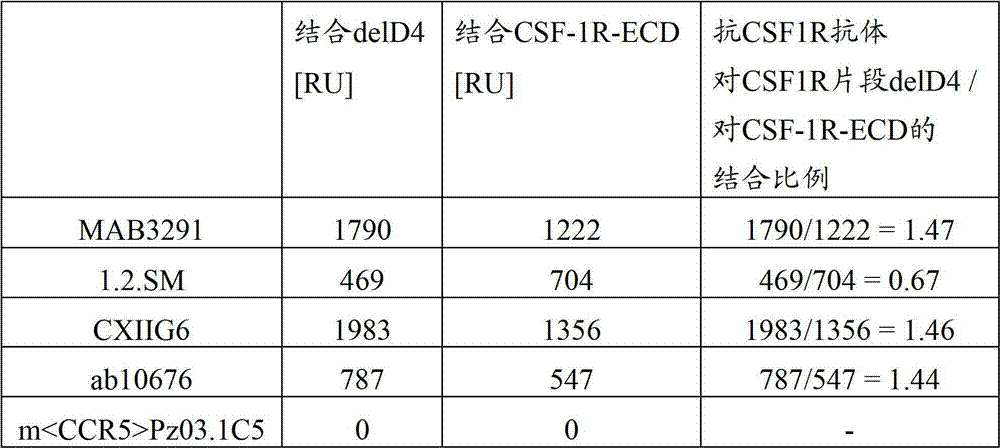
1.2.SM、CXIIG6、ab10676和MAB3291显示出结合CSF-1R-ECD和del D4(见图2f和2e)。1.2.SM, CXIIG6, ab10676 and MAB3291 were shown to bind CSF-1R-ECD and del D4 (see Figures 2f and 2e).
1.2.SM、CXIIG6、ab10676和MAB3291的结合比例远高于1:50(=0.02)。阴性对照抗体m<CCR5>Pz03.1C5未显示出任何结合(如所预期的)。1.2. The binding ratio of SM, CXIIG6, ab10676 and MAB3291 is much higher than 1:50 (=0.02). The negative control antibody m<CCR5>Pz03.1C5 did not show any binding (as expected).
实施例5Example 5
在用抗CSF-1R单克隆抗体处理下对3D培养中的NIH3T3-CSF-1R重组细胞的生长抑制(CellTiterGlo测定法)Growth inhibition of NIH3T3-CSF-1R recombinant cells in 3D culture under treatment with anti-CSF-1R monoclonal antibody (CellTiterGlo assay)
用全长野生型CSF-1R(SEQ ID NO:62)或突变型CSF-1R L301S Y969F(SEQ ID NO:63)的表达载体经逆转录病毒感染的NIH 3T3细胞在poly-HEMA(聚甲基丙烯酸-2-羟乙酯(poly(2-hydroxyethylmethacrylate)))(Polysciences,Warrington,PA,USA))包被(以防止粘附至塑料表面)的平皿上培养于补充有2mM L-谷氨酰胺、2mM丙酮酸钠和非必需氨基酸和10%胎牛血清(Sigma,Taufkrchen,Germany)的DMEM高葡萄糖培养基(PAA,Pasching,Austria)中。细胞接种于用5ng/ml亚硒酸钠、10mg/ml运铁蛋白、400μg/ml BSA和0.05mM 2-巯基乙醇替换血清的培养基中。在用100ng/ml huCSF-1(Biomol,Hamburg,Germany)处理时,表达wtCSF-1R的细胞形成三维生长的密集椭球体,被称为停泊独立的特性。这些椭球体近似于原位实体肿瘤的三维结构和组织。突变型CSF-1R重组细胞能够不依赖于CSF-1配体而形成椭球体。在不同浓度的抗体存在下将椭球体培养物保温3天以测定IC50(细胞生存能力被50%抑制的浓度)。用CellTiterGlo测定法通过测量细胞的ATP含量来检测细胞的生存能力。NIH 3T3 cells infected with retrovirus with the expression vector of full-length wild-type CSF-1R (SEQ ID NO:62) or mutant CSF-1R L301S Y969F (SEQ ID NO:63) in poly-HEMA (polymethyl Acrylate-2-hydroxyethylmethacrylate (poly(2-hydroxyethylmethacrylate)) (Polysciences, Warrington, PA, USA)) coated (to prevent adhesion to the plastic surface) plate cultured in supplemented with 2mM L-glutamine , 2 mM sodium pyruvate and non-essential amino acids and 10% fetal bovine serum (Sigma, Taufkrchen, Germany) in DMEM high glucose medium (PAA, Pasching, Austria). Cells were seeded in medium replaced with serum 5 ng/ml sodium selenite, 10 mg/ml transferrin, 400 μg/ml BSA and 0.05 mM 2-mercaptoethanol. Upon treatment with 100 ng/ml huCSF-1 (Biomol, Hamburg, Germany), cells expressing wtCSF-1R formed dense spheroids that grew three-dimensionally, a property known as docking independence. These spheroids approximate the three-dimensional structure and organization of solid tumors in situ. Mutant CSF-1R recombinant cells can form spheroids independently of CSF-1 ligand. Spheroid cultures were incubated for 3 days in the presence of different concentrations of antibody to determine IC50 (concentration at which cell viability is inhibited by 50%). Cell viability was detected by measuring the ATP content of cells with the CellTiterGlo assay.
表5a:Table 5a:

参照对照Mab R&D-Systems 3291未显示对突变型CSF-1R重组细胞增殖的抑制。The reference control Mab R&D-
在进一步的实验中调查了依照本发明的抗CSF-1R抗体hMab 2F11-e7和抗CSF-1R抗体1.2.SM(WO2009026303中所述的配体置换性CSF-1R抗体)、CXIIG6(WO 2009/112245中所述的配体置换性CSF-1R抗体)、山羊多克隆抗CSF-1R抗体ab10676(abcam)、和SC 2-4A5(Santa Cruz Biotechnology,US-还可参见Sherr,C.J.等人,Blood 73(1989)1786-1793)。Anti-CSF-1R antibody hMab 2F11-e7 according to the present invention and anti-CSF-1R antibody 1.2.SM (ligand-displacing CSF-1R antibody described in WO2009026303), CXIIG6 (WO 2009/ Ligand-displaced CSF-1R antibody described in 112245), goat polyclonal anti-CSF-1R antibody ab10676 (abcam), and SC 2-4A5 (Santa Cruz Biotechnology, US—see also Sherr, C.J. et al., Blood 73 (1989) 1786-1793).
在不同浓度的抗体存在下将椭球体培养物保温3天以测定IC30(细胞生存能力被30%抑制的浓度)。最大浓度是20μg/ml。用CellTiterGlo测定法通过测量细胞的ATP含量来检测细胞的生存能力。Spheroid cultures were incubated for 3 days in the presence of different concentrations of antibody to determine IC30 (concentration at which cell viability is inhibited by 30%). The maximum concentration is 20 μg/ml. Cell viability was detected by measuring the ATP content of cells with the CellTiterGlo assay.
表5b:Table 5b:

实施例6Example 6
在用抗CSF-1R单克隆抗体处理下对3D培养中的BeWo肿瘤细胞的生长抑制(CellTiterGlo-测定法)Growth Inhibition of BeWo Tumor Cells in 3D Culture under Treatment with Anti-CSF-1R Monoclonal Antibody (CellTiterGlo-Assay)
将BeWo绒毛膜癌细胞(ATCC CCL-98)培养于补充有10%FBS(Sigma)和2mM L-谷氨酰胺的F12K培养基(Sigma,Steinheim,Germany)中。将5x10⁴个细胞/孔接种于装有补充了0.5%FBS和5%BSA之F12K培养基的96孔poly-HEMA(聚甲基丙稀酸-2-羟乙酯)包被的平板中。伴随地加入200ng/mlhuCSF-1和10μg/ml不同抗CSF-1R单克隆抗体并保温6天。用CellTiterGlo测定法通过以相对光单位(RLU)测量细胞的ATP含量来检测细胞的生存能力。当用不同抗CSF-1R抗体(10μg/ml)处理BeWo椭球体培养物时,观察到了对CSF-1诱导的生长的抑制。为了计算抗体介导的抑制作用,从所有样品中减去未刺激BeWo细胞的RLU均值。CSF-1刺激细胞的RLU均值任意设置为100%。将用CSF-1刺激和用抗CSF-1R抗体处理的细胞的RLU均值计算为CSF-1刺激RLU的百分率。表6显示了在用抗CSF-1R单克隆抗体处理下对3D培养中的BeWo肿瘤细胞的生长抑制的计算数据;图1a和b描述了标准化RLU均值。BeWo choriocarcinoma cells (ATCC CCL-98) were cultured in F12K medium (Sigma, Steinheim, Germany) supplemented with 10% FBS (Sigma) and 2 mM L-glutamine. 5x10⁴ cells/well were seeded in 96-well poly-HEMA (poly-2-hydroxyethylmethacrylate) coated plates in F12K medium supplemented with 0.5% FBS and 5% BSA. 200 ng/ml huCSF-1 and 10 μg/ml different anti-CSF-1R monoclonal antibodies were added concomitantly and incubated for 6 days. Cell viability was detected with the CellTiterGlo assay by measuring the ATP content of cells in relative light units (RLU). Inhibition of CSF-1-induced growth was observed when BeWo spheroid cultures were treated with different anti-CSF-1R antibodies (10 μg/ml). To calculate antibody-mediated inhibition, the mean RLU of unstimulated BeWo cells was subtracted from all samples. The mean RLU of CSF-1-stimulated cells was arbitrarily set as 100%. The mean RLU of cells stimulated with CSF-1 and treated with anti-CSF-1R antibody was calculated as the percentage of CSF-1 stimulated RLU. Table 6 shows calculated data for growth inhibition of BeWo tumor cells in 3D culture under treatment with anti-CSF-1R monoclonal antibody; Figures 1 a and b depict normalized RLU means.
表6:Table 6:
实施例7Example 7
在用抗CSF-1R单克隆抗体处理下对人巨噬细胞分化的抑制(CellTiterGlo测定法)Inhibition of Human Macrophage Differentiation under Treatment with Anti-CSF-1R Monoclonal Antibody (CellTiterGlo Assay)
用RosetteSepTM人单核细胞富集鸡尾酒(Stemcell Tech.-Cat.No.15028)从外周血中分离人单核细胞。将富集的单核细胞群在37°C和5%CO2的增湿气氛中接种于96孔微量滴定板(2.5x10⁴个细胞/孔)内补充了10%FCS(GIBCO-Cat.No.011-090014M)、4mM L-谷氨酰胺(GIBCO-Cat.No.25030)和1x PenStrep(Roche Cat.No.1074440)的100μl RPMI 1640(Gibco-Cat.No.31870)中。当在培养基中加入150ng/ml huCSF-1时,可观察到清楚地分化成粘附性巨噬细胞。此分化通过添加抗CSF-1R抗体可被抑制。此外,单核细胞的生存受影响并可通过CellTiterGlo(CTG)分析进行分析。从抗体处理对单核细胞生存的浓度依赖性抑制,计算IC50(见表7)。Human monocytes were isolated from peripheral blood using RosetteSep ™ Human Monocyte Enrichment Cocktail (Stemcell Tech.-Cat. No. 15028). The enriched monocyte populations were seeded in 96-well microtiter plates ( 2.5x10⁴ cells/ well ) supplemented with 10% FCS (GIBCO-Cat.No. .011-090014M), 4 mM L-glutamine (GIBCO-Cat. No. 25030) and 1x PenStrep (Roche Cat. No. 1074440) in 100 μl RPMI 1640 (Gibco-Cat. No. 31870). When 150 ng/ml huCSF-1 was added to the medium, a clear differentiation into adherent macrophages was observed. This differentiation can be inhibited by adding anti-CSF-1R antibody. In addition, the survival of monocytes is affected and can be analyzed by CellTiterGlo (CTG) assay. IC50 was calculated from the concentration-dependent inhibition of monocyte survival by antibody treatment (see Table 7).
表7:Table 7:
在分开的测试中,系列人源化形式的Mab 2F11,例如hMab 2F11-c11、hMab 2F11-d8、hMab 2F11-e7、hMab 2F11-f12,显示了0.07μg/ml(hMab2F11-c11)、0.07μg/ml(hMab 2F11-d8)、0.04μg/ml(hMab 2F11-e7)和0.09μg/ml(hMab 2F11-f12)的IC50值。In separate tests, a series of humanized forms of Mab 2F11, such as hMab 2F11-c11, hMab 2F11-d8, hMab 2F11-e7, hMab 2F11-f12, showed 0.07 μg/ml (hMab2F11-c11), 0.07 μg /ml (hMab 2F11-d8), 0.04 μg/ml (hMab 2F11-e7) and 0.09 μg/ml (hMab 2F11-f12) IC50 values.
实施例8Example 8
在用抗CSF-1R单克隆抗体处理下对猕猴巨噬细胞分化的抑制(CellTiterGlo测定法)Inhibition of macaque macrophage differentiation under treatment with anti-CSF-1R monoclonal antibody (CellTiterGlo assay)
用CD14微珠非人灵长类动物试剂盒(Miltenyi Biotec-Cat.No.130-091-097)依照制造商的说明从外周血中分离猕猴单核细胞。将富集的单核细胞群在37°C和5%CO2的增湿气氛中接种于96孔微量滴定板(1-3x10⁴个细胞/孔)内补充有10%FCS(GIBCO-Cat.No.011-090014M)、4mM L-谷氨酰胺(GIBCO-Cat.No.25030)和1x PenStrep(Roche Cat.No.1074440)的100μl RPMI 1640(Gibco-Cat.No.31870)中。当在培养基中加入150ng/mlhuCSF-1时,可观察到清楚地分化成粘附性巨噬细胞。此分化通过添加抗CSF-1R抗体可被抑制。此外,单核细胞的生存受影响并可通过CellTiterGlo(CTG)分析进行分析。在浓度5μg/ml抗体处理下分析生存能力(见表8)。Cynomolgus monocytes were isolated from peripheral blood using the CD14 Microbeads Non-Human Primate Kit (Miltenyi Biotec-Cat. No. 130-091-097) according to the manufacturer's instructions. Enriched monocyte populations were seeded in 96-well microtiter plates ( 1-3x10⁴ cells/ well ) supplemented with 10% FCS (GIBCO-Cat. No.011-090014M), 4mM L-glutamine (GIBCO-Cat.No.25030) and 1x PenStrep (Roche Cat.No.1074440) in 100μl RPMI 1640 (Gibco-Cat.No.31870). When 150 ng/ml huCSF-1 was added to the medium, a clear differentiation into adherent macrophages was observed. This differentiation can be inhibited by adding anti-CSF-1R antibody. In addition, the survival of monocytes is affected and can be analyzed by CellTiterGlo (CTG) assay. Viability was analyzed under antibody treatment at a concentration of 5 μg/ml (see Table 8).
表8:Table 8:
*四次实验的均值(3次实验用鼠的,1次实验用嵌合的mAb)*Mean of four experiments (3 experiments with mouse, 1 experiment with chimeric mAb)
**只用鼠mAb的两次实验的均值**Average of two experiments with mouse mAb only
实施例9Example 9
抗CSF-1R抗体对人CSF-1R的结合亲和力的测定Determination of Binding Affinity of Anti-CSF-1R Antibodies to Human CSF-1R
仪器:
芯片: CM5(Biacore BR-1006-68)Chip: CM5 (Biacore BR-1006-68)
偶联: 胺偶联Coupling: amine coupling
缓冲液: PBS(Biacore BR-1006-72),pH 7.4,35°CBuffer: PBS (Biacore BR-1006-72), pH 7.4, 35°C
为了亲和力测量,将36μg/ml抗小鼠Fcγ抗体(来自山羊,JacksonImmuno Reasearch JIR115-005-071)偶联至芯片表面上以捕捉针对CSF-1R的抗体。以溶液中不同浓度添加人CSF-1R胞外域(CSF-1R-ECD)(包含胞外亚域D1–D5)(SEQ ID NO:64)(R&D-Systems 329-MR或亚克隆的pCMV-presS-HisAvitag-hCSF-1R-ECD)。通过在35°C 1.5分钟的CSF-1R注射测量结合;通过在35°C用缓冲液清洗芯片表面10分钟来测量解离。为了计算动力学参数使用了Langmuir 1:1模型。For affinity measurement, 36 μg/ml anti-mouse Fcγ antibody (from goat, Jackson Immuno Research JIR115-005-071) was coupled to the chip surface to capture antibody against CSF-1R. Human CSF-1R ectodomain (CSF-1R-ECD) (comprising extracellular subdomains D1–D5) (SEQ ID NO:64) (R&D-Systems 329-MR or subcloned pCMV-presS) was added at different concentrations in solution -HisAvitag-hCSF-1R-ECD). Binding was measured by CSF-IR injection for 1.5 min at 35°C; dissociation was measured by washing the chip surface with buffer for 10 min at 35°C. For calculation of kinetic parameters the Langmuir 1:1 model was used.
表9:Table 9:
通过SPR测量的亲和力数据Affinity data measured by SPR
在使用CSF-1R ECD的分开的Biacore结合测定中(数据未显示),显示了抗体Mab 2F11和Mab 2E10与抗体Ab SC-2-4A5的一些竞争。不过Mab2F11/Mab 2E10不结合人CSF-1R片段delD4,而Ab SC-2-4A5结合此delD4片段(见实施例4和图2a)。因此Mab 2F11/Mab 2E10的结合区显然不同于AbSC-2-4A5的结合区,但可能位于邻近的区域内。在此类竞争测定法中,抗体Mab 2F11和Mab 2E10二者均不与来自R&D-Systems的Mab3291竞争(数据未显示)。In a separate Biacore binding assay using CSF-1R ECD (data not shown), some competition of antibodies Mab 2F11 and Mab 2E10 with antibody Ab SC-2-4A5 was shown. However Mab2F11/Mab 2E10 does not bind human CSF-1R fragment delD4 whereas Ab SC-2-4A5 binds this delD4 fragment (see Example 4 and Figure 2a). The binding region of Mab 2F11/Mab 2E10 is therefore clearly different from that of AbSC-2-4A5, but may be located in a neighboring region. Neither antibodies Mab 2F11 nor Mab 2E10 competed with Mab3291 from R&D-Systems in such competition assays (data not shown).
实施例10Example 10
抗CSF-1R抗体对人CSF-1R片段D1-D3的结合的测定Determination of Binding of Anti-CSF-1R Antibodies to Human CSF-1R Fragments D1-D3
仪器:Biacore T100(GE Healthcare)Instrument: Biacore T100 (GE Healthcare)
软件:T100控制,版本1.1.11 Software: T100 Control, Version 1.1.11
B3000评估,版本4.01B3000 Evaluation, Version 4.01
Scrubber,版本2.0aScrubber, version 2.0a
测定格式芯片:CM5-芯片Assay Format Chip: CM5-Chip
通过胺偶联的捕捉分子捕捉针对CSF-1R的抗体。利用单循环动力学注射5个逐渐增加之浓度的人CSF-1R片段D1-D3(SEQ ID NO:66)。将人CSF-1R片段D1-D3亚克隆入pCMV-presS-HisAvitag表达载体中。Antibodies against CSF-1R were captured by amine-coupled capture molecules. Five increasing concentrations of human CSF-1R fragment D1-D3 (SEQ ID NO:66) were injected using single cycle kinetics. Human CSF-1R fragment D1-D3 was subcloned into pCMV-presS-HisAvitag expression vector.
将抑制配体-受体相互作用的抗CSF-1R SC 2-4A5(Santa CruzBiotechnology,US;Sherr,C.J.等人,Blood 73(1989)1786-1793)和Mab 3291(R&D-Systems)用作参照对照。Anti-CSF-1R SC 2-4A5 (Santa Cruz Biotechnology, US; Sherr, C.J. et al., Blood 73 (1989) 1786-1793) and Mab 3291 (R&D-Systems), which inhibit ligand-receptor interactions, were used as references control.
捕捉分子:抗小鼠Fcγ抗体(来自山羊,Jackson Immuno ReasearchJIR115-005-071)针对依照本发明的抗体和R&D-Systems对照Mab 3291,而抗大鼠Fcγ抗体(来自山羊,Jackson Immuno Reasearch JIR112-005-071)针对参照对照抗CSF-1R SC 2-4A5。Capture molecules: anti-mouse Fcγ antibody (from goat, Jackson Immuno Research JIR115-005-071) against the antibody according to the invention and R&D-
捕捉分子的胺偶联Amine coupling of capture molecules
依照制造商说明书进行标准胺偶联:运行缓冲液:HBS-N缓冲液,用EDC/NHS混合物活化,目标是2000RU的配体密度;将捕捉抗体稀释于偶联缓冲液NaAc pH 4.5中,c=10μg/mL;通过注射1M乙醇胺封闭最终残余的活化羧基。Standard amine coupling was performed according to the manufacturer's instructions: Running buffer: HBS-N buffer, activated with EDC/NHS mixture, targeting a ligand density of 2000 RU; dilute capture antibody in coupling buffer NaAc pH 4.5, c = 10 μg/mL; final residual activated carboxyl groups were blocked by injection of 1 M ethanolamine.
在37°C人CSF-1R片段D1-D3结合MAb<CSF-1R>的动力学表征Kinetic Characterization of Human CSF-1R Fragment D1-D3 Binding to MAb<CSF-1R> at 37°C
运行缓冲液:PBS(Biacore BR-1006-72)Running buffer: PBS (Biacore BR-1006-72)
在流动室2至4上捕捉Mab<CSF-1R>:流速20μL/min,接触时间90秒,c(Ab<CSF-1R>)=50nM,用运行缓冲液+1mg/mL BSA稀释;Capture Mab<CSF-1R> on
分析物样品:Analyte sample:
以30μL/min的流速通过5次连续注射浓度c=7.8、31.25、125、500和2000nM的分析物来测量单循环动力学,无再生。每次注射是30秒时长,随后是用于头四次注射的120秒解离期,及最终用于最高浓度(=最后一次注射)的1200秒解离期。Single-cycle kinetics were measured by five consecutive injections of analyte at concentrations c = 7.8, 31.25, 125, 500 and 2000 nM at a flow rate of 30 μL/min without regeneration. Each injection was 30 seconds long, followed by a dissociation period of 120 seconds for the first four injections and finally a dissociation period of 1200 seconds for the highest concentration (=last injection).
在每一循环后用10mM甘氨酸pH 1.5(Biacore BR-1003-54)进行最后的再生,接触时间60秒,流速30μL/min。A final regeneration was performed after each cycle with 10 mM glycine pH 1.5 (Biacore BR-1003-54) with a contact time of 60 s and a flow rate of 30 μL/min.
通过使用通常的双重参照(对照参照:分析物对捕捉分子的结合;流动室:亚域CSF-1R浓度“0”作为空白)及用模型“滴定动力学1:1结合负荷物(draft)”的计算来计算动力学参数。By using the usual double referencing (control reference: binding of analyte to capture molecule; flow cell: subdomain CSF-1R concentration "0" as blank) and using the model "titration kinetics 1:1 binding to the load (draft)" to calculate the kinetic parameters.
表10:Table 10:
通过SPR测量的关于人CSF-1R片段D1-D3结合的亲和力数据Affinity data on human CSF-1R fragment D1-D3 binding measured by SPR
抗体Mab 2F11、Mab 2E10和Mab 1G10显示出不结合人CSF-1R片段D1-D3。Antibodies Mab 2F11, Mab 2E10 and Mab 1G10 were shown not to bind human CSF-1R fragments D1-D3.
参照对照Ab SC-2-4A5也不结合人CSF-1R片段D1-D3。Reference control Ab SC-2-4A5 also did not bind human CSF-1R fragments D1-D3.
参照对照Mab R&D-Systems 3291显示出结合人CSF-1R片段D1-D3。Reference control Mab R&D-
实施例11Example 11
猕猴中CSF-1R抑制期间CSF-1的水平升高Levels of CSF-1 are elevated during CSF-1R inhibition in macaques
血清CSF-1水平提供了抗人CSF-1R二聚化抑制物hMab 2F11-e7之CSF-1R中和活性的药效标志。对每一剂量组(1和10mg/kg)一只雄性和一只雌性猕猴静脉内施用抗CSF1R抗体hMab 2F11-e7。在处理之前(用药前)、用药后2、24、48、72、96、168小时以及另外再两周的每周收集血液样品,供分析CSF-1水平。用商品化的ELISA试剂盒(
施用hMab 2F11-e7诱导CSF-1显著升高约1000倍,这取决于持续48小时(1mg/kg)或15天(10mg/kg)施用的剂量。因此,与配体置换性抗体相反,针对CSF-1R的二聚化抑制物提供的优势在于不直接与显著上调的配体竞争对受体的结合。Administration of hMab 2F11-e7 induced a significant ~1000-fold increase in CSF-1, depending on the dose administered for 48 hours (1 mg/kg) or 15 days (10 mg/kg). Thus, in contrast to ligand-displacing antibodies, dimerization inhibitors directed against CSF-IR offer the advantage of not directly competing with significantly upregulated ligands for binding to the receptor.
实施例12Example 12
体内功效–在SCID米色小鼠中乳腺癌BT20异种移植物肿瘤细胞中抗CSF-1R抗体的肿瘤生长抑制作用In Vivo Efficacy – Tumor Growth Inhibitory Effect of Anti-CSF-1R Antibody in Breast Cancer BT20 Xenograft Tumor Cells in SCID Beige Mice
人乳腺癌细胞系BT-20表达人CSF-1R但没有CSF-1表达(Sapi,E.等人,Cancer Res 59(1999)5578-5585)。由于小鼠衍生CSF-1不能活化肿瘤细胞上的人CSF-1R,经由渗透压微泵(ALZET,Cupertino,CA)以2μg/天的速率提供连续的CSF-1输注补充重组人CSF-1(Biomol,Hamburg,Germany)(Martin,T.A.,Carcinogenesis 24(2003)1317-1323)。The human breast cancer cell line BT-20 expresses human CSF-1R but not CSF-1 (Sapi, E. et al., Cancer Res 59 (1999) 5578-5585). Since mouse-derived CSF-1 was unable to activate human CSF-1R on tumor cells, continuous CSF-1 infusion was provided at a rate of 2 μg/day to supplement recombinant human CSF-1 via an osmotic minipump (ALZET, Cupertino, CA). (Biomol, Hamburg, Germany) (Martin, T.A., Carcinogenesis 24 (2003) 1317-1323).
为了将干扰CSF-1R二聚化之抗体的功效与配体置换性CSF-1R抗体进行直接比较,我们在BT-20异种移植物模型中测试了嵌合抗CSF-1R Mab 2F11(干扰CSF-1R二聚化的抗体)和1.2.SM(WO2009026303中所述的配体置换性CSF-1R抗体)。To directly compare the efficacy of antibodies that interfere with CSF-1R dimerization with ligand-displaced CSF-1R antibodies, we tested the chimeric anti-CSF-1R Mab 2F11 (CSF-1R disruptor) in the BT-20 xenograft model. 1R dimerized antibody) and 1.2.SM (ligand-displaced CSF-1R antibody described in WO2009026303).
给SCID米色小鼠(Charles River,Sulzfeld,Germany)皮下共注射1x10⁷个细胞的BT-20细胞(ATCC HTB-19)和100μl的Matrigel。在平均肿瘤体积100mm3时随机化日开始动物的处理。用在20mM组氨酸、140mM NaCl pH6.0缓冲液中的各抗体(见图4)每周腹膜内(i.p.)处理小鼠一次。在分级日开始并且随后在整个处理期期间每周两次用测径器测量肿瘤尺寸。依照NCI方案计算肿瘤体积(肿瘤重量=1/2ab2,其中“a”和“b”分别是肿瘤的长和短直径)。SCID beige mice (Charles River, Sulzfeld, Germany) were co-injected subcutaneously with 1x10⁷ cells of BT-20 cells (ATCC HTB-19) and 100 μl of Matrigel. Treatment of animals began on the day of randomization when the mean tumor volume was 100 mm3 . Mice were treated weekly intraperitoneally (ip) with the respective antibodies in 20 mM histidine, 140 mM NaCl pH 6.0 buffer (see Figure 4). Tumor size was measured with calipers starting on the day of grading and then twice weekly throughout the treatment period. Tumor volumes were calculated according to the NCI protocol (tumor weight = 1/2ab2, where "a" and "b" are the long and short diameters of the tumor, respectively).
肿瘤生长分析如图4中所示。嵌合抗CSF-1R Mab 2F11对肿瘤细胞上人CSF-1R的抑制作用就统计学而言在介导肿瘤生长抑制上比抗CSF-1R抗体1.2.SM(WO2009026303中所述的CSF-1R抗体)更有效。Tumor growth analysis is shown in FIG. 4 . Chimeric anti-CSF-1R Mab 2F11 inhibits human CSF-1R on tumor cells statistically more effectively than anti-CSF-1R antibody 1.2.SM in mediating tumor growth inhibition (CSF-1R antibody described in WO2009026303 )More effective.
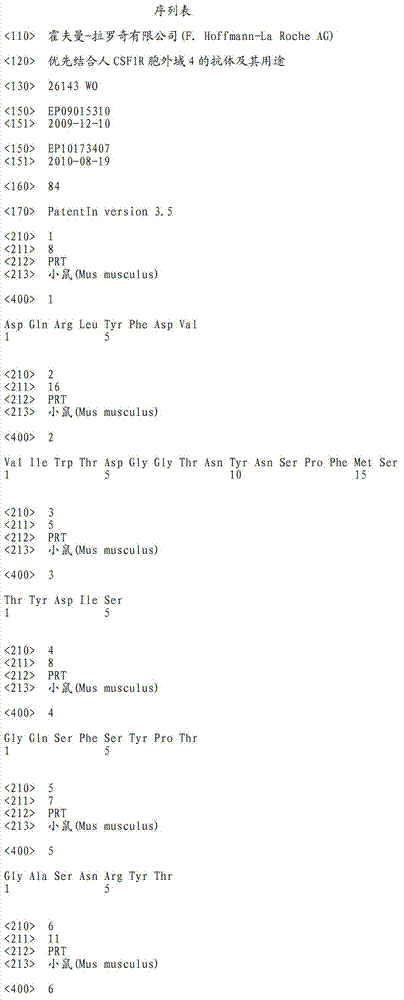

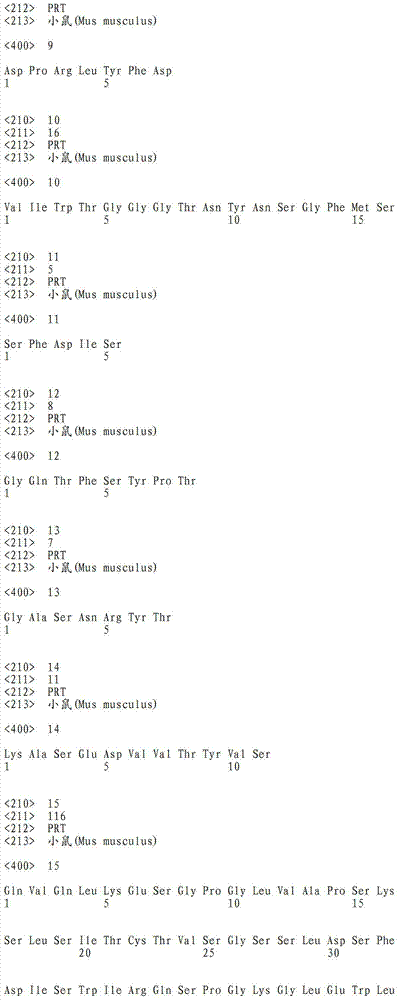
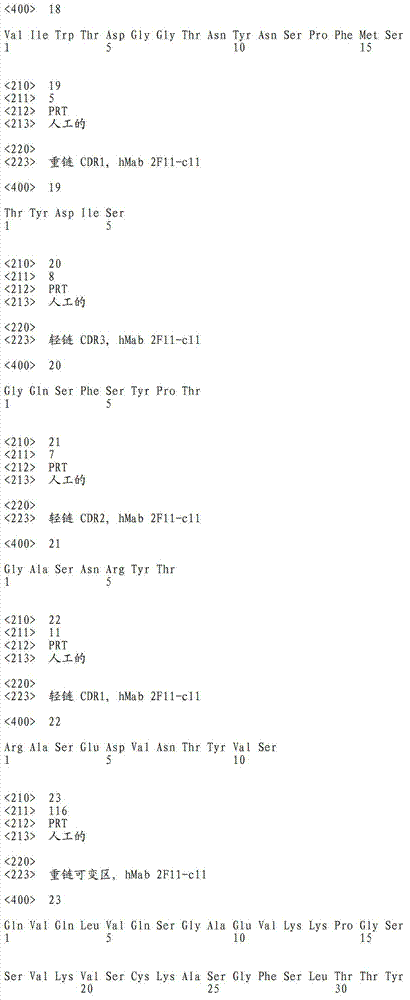
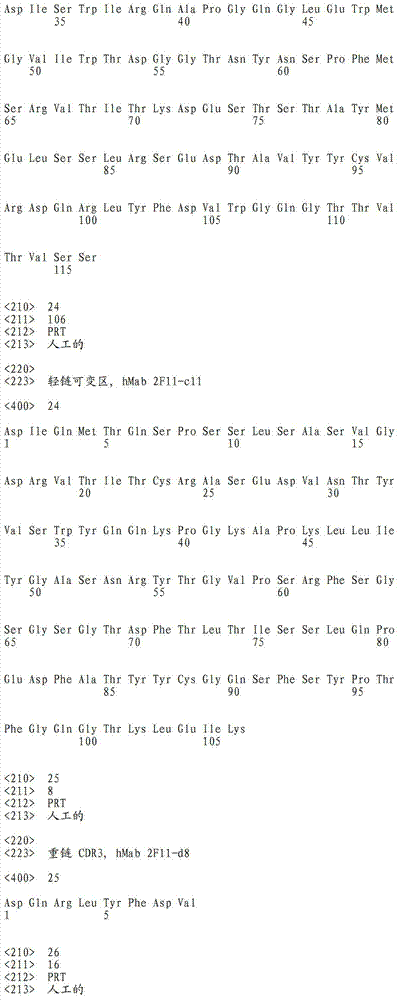
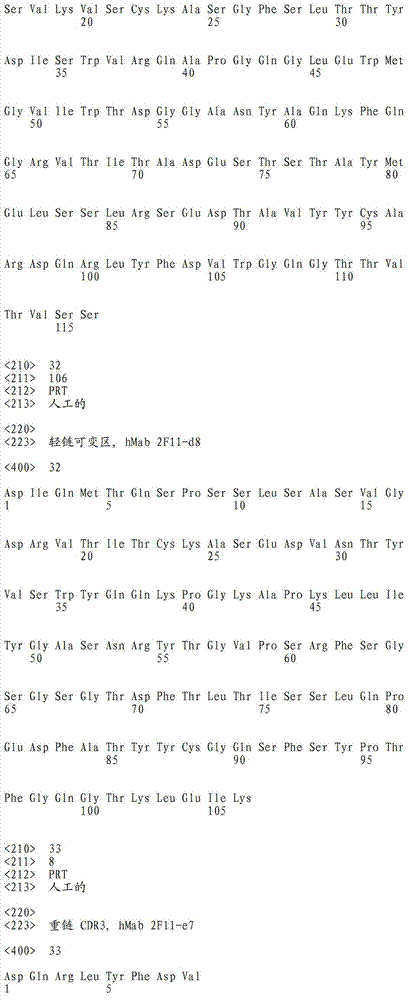

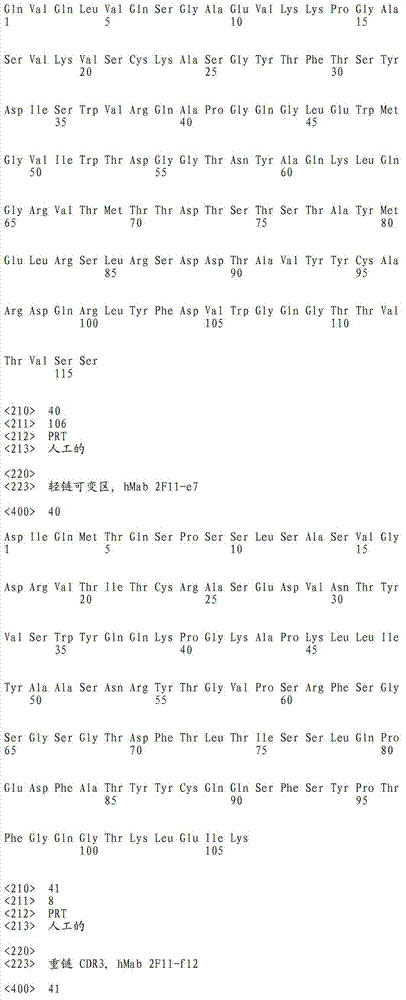
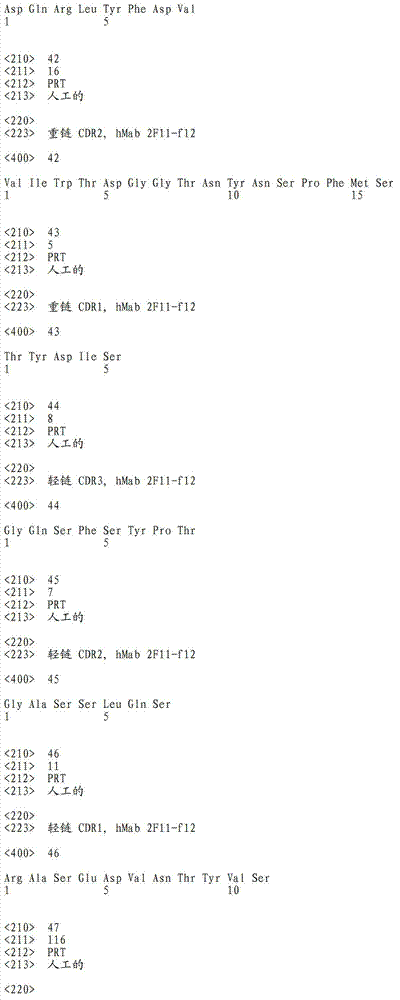

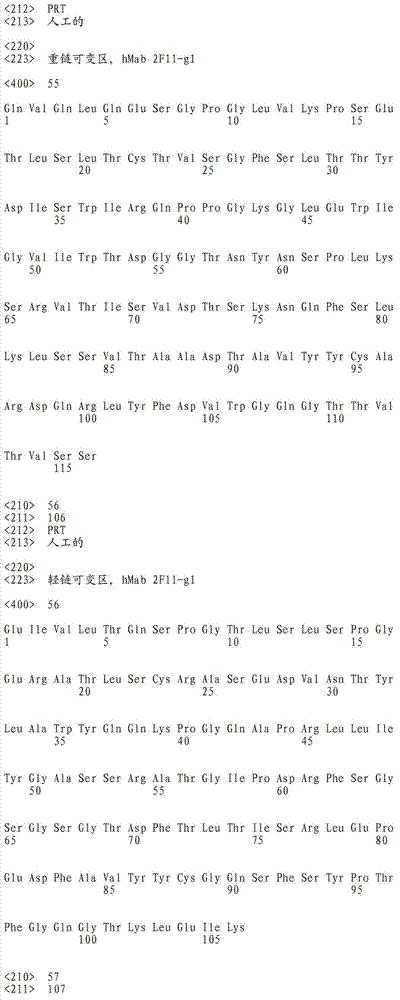

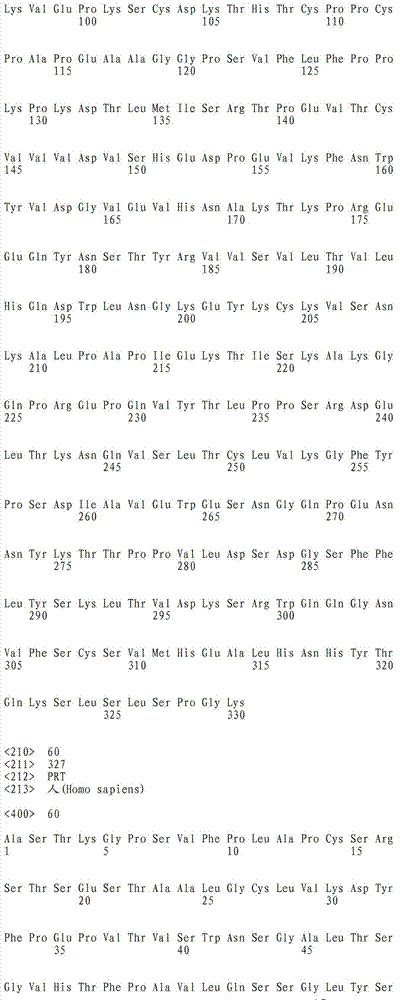
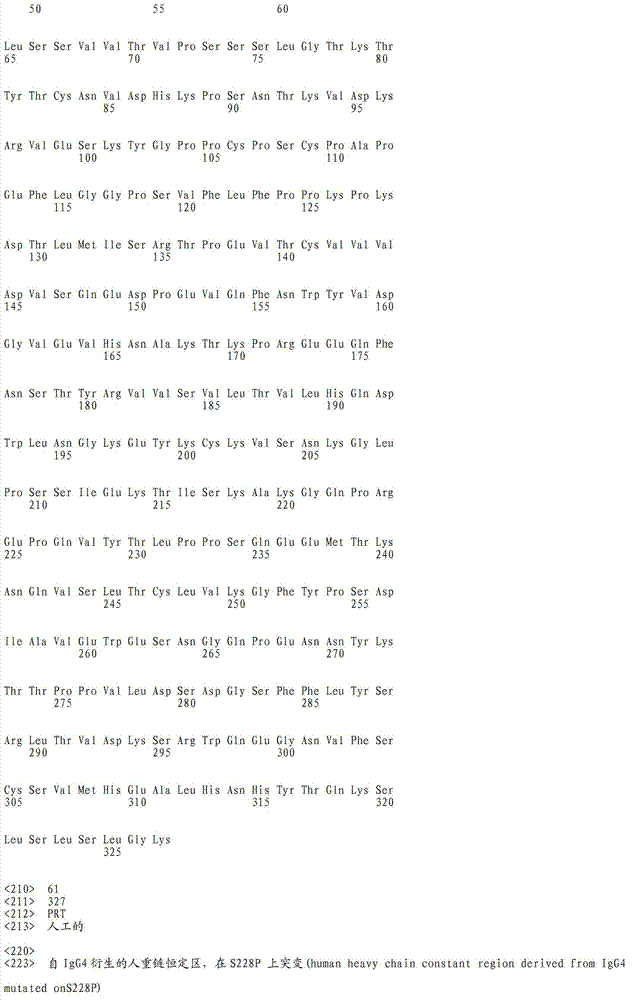

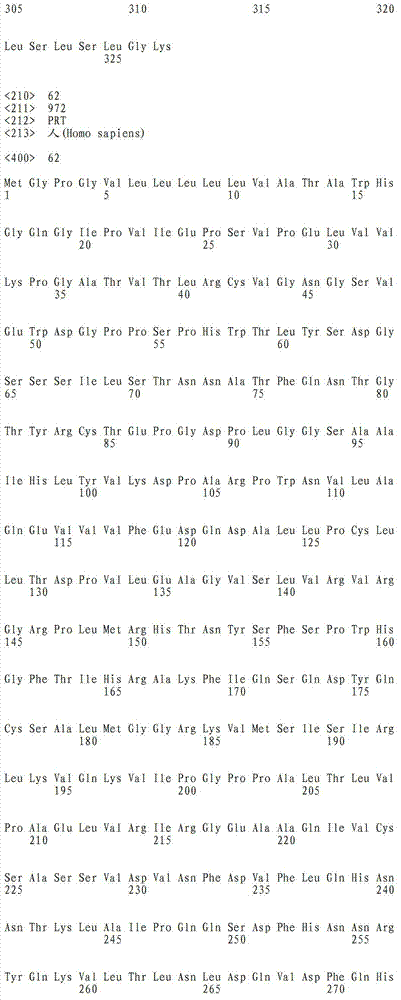
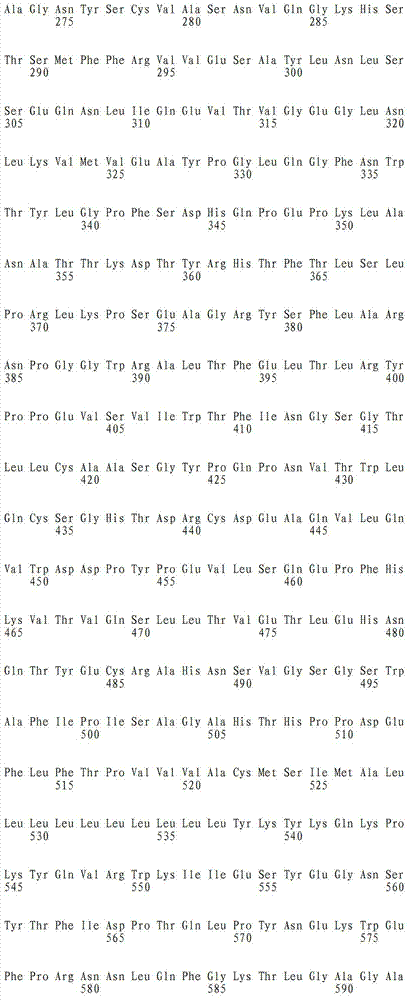

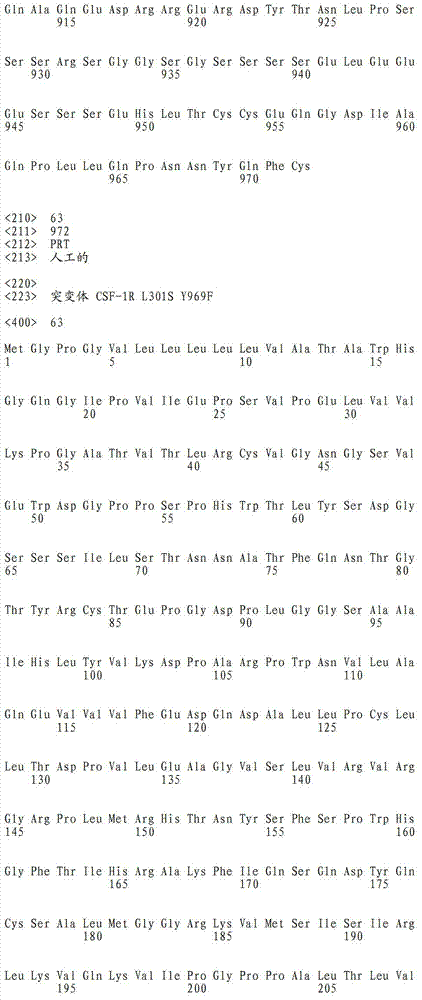
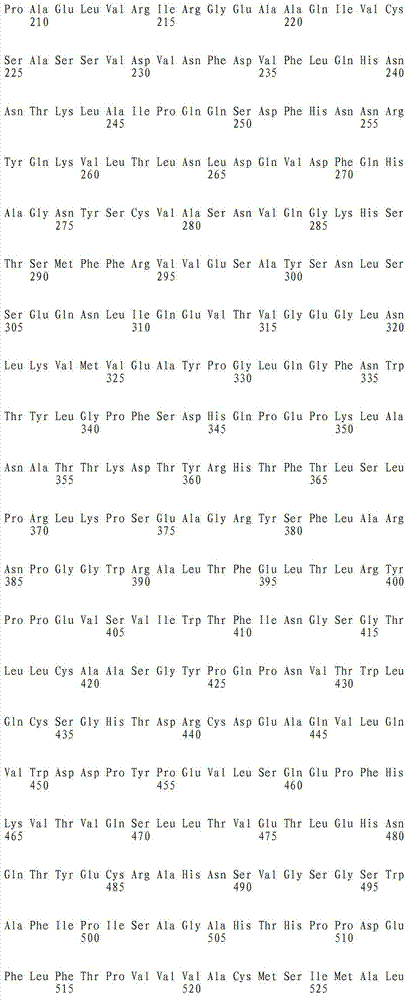


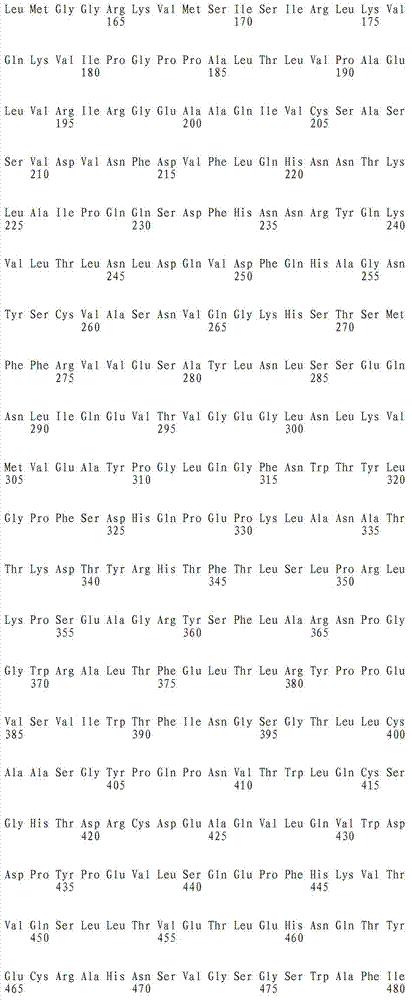
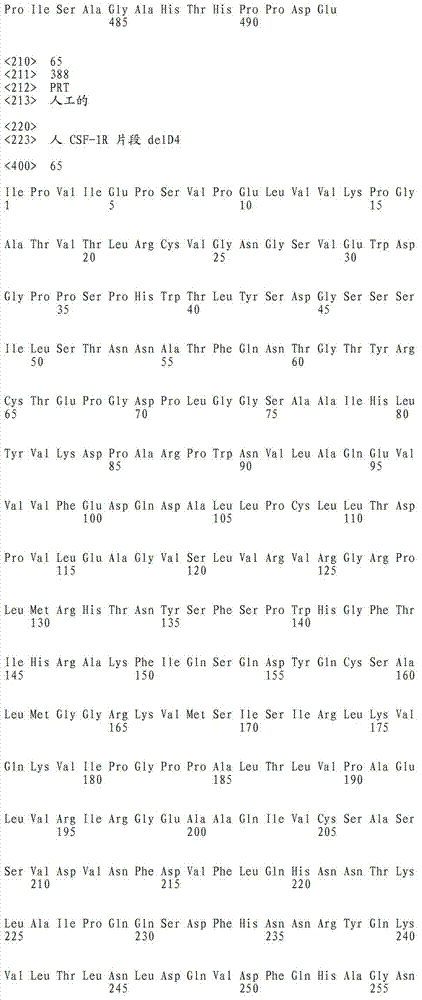


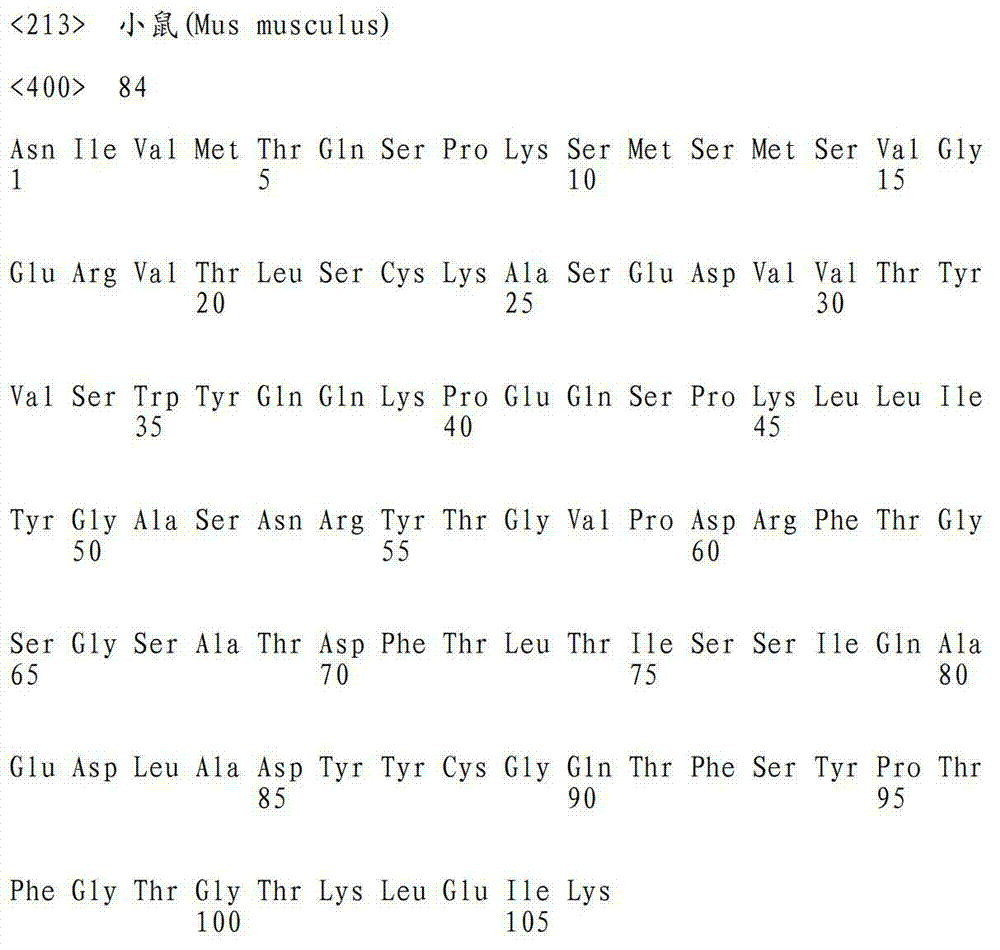
Claims (27)
Priority Applications (1)
| Application Number | Priority Date | Filing Date | Title |
|---|---|---|---|
| CN201510673059.1A CN105218672A (en) | 2009-12-10 | 2010-12-07 | Preferentially in conjunction with the antibody and uses thereof of people CSF1R extracellular domain 4 |
Applications Claiming Priority (5)
| Application Number | Priority Date | Filing Date | Title |
|---|---|---|---|
| EP09015310 | 2009-12-10 | ||
| EP09015310.7 | 2009-12-10 | ||
| EP10173407 | 2010-08-19 | ||
| EP10173407.7 | 2010-08-19 | ||
| PCT/EP2010/069090 WO2011070024A1 (en) | 2009-12-10 | 2010-12-07 | Antibodies binding preferentially human csf1r extracellular domain 4 and their use |
Related Child Applications (1)
| Application Number | Title | Priority Date | Filing Date |
|---|---|---|---|
| CN201510673059.1A Division CN105218672A (en) | 2009-12-10 | 2010-12-07 | Preferentially in conjunction with the antibody and uses thereof of people CSF1R extracellular domain 4 |
Publications (2)
| Publication Number | Publication Date |
|---|---|
| CN102791738A true CN102791738A (en) | 2012-11-21 |
| CN102791738B CN102791738B (en) | 2015-10-07 |
Family
ID=43735019
Family Applications (2)
| Application Number | Title | Priority Date | Filing Date |
|---|---|---|---|
| CN201510673059.1A Pending CN105218672A (en) | 2009-12-10 | 2010-12-07 | Preferentially in conjunction with the antibody and uses thereof of people CSF1R extracellular domain 4 |
| CN201080063488.2A Active CN102791738B (en) | 2009-12-10 | 2010-12-07 | Antibodies that preferentially bind to human CSF1R extracellular domain 4 and uses thereof |
Family Applications Before (1)
| Application Number | Title | Priority Date | Filing Date |
|---|---|---|---|
| CN201510673059.1A Pending CN105218672A (en) | 2009-12-10 | 2010-12-07 | Preferentially in conjunction with the antibody and uses thereof of people CSF1R extracellular domain 4 |
Country Status (36)
| Country | Link |
|---|---|
| US (10) | US8999327B2 (en) |
| EP (2) | EP2510010B1 (en) |
| JP (3) | JP5677451B2 (en) |
| KR (1) | KR101434070B1 (en) |
| CN (2) | CN105218672A (en) |
| AR (1) | AR079333A1 (en) |
| AU (2) | AU2010329934B2 (en) |
| BR (1) | BR112012013717B1 (en) |
| CA (1) | CA2780692C (en) |
| CL (1) | CL2012001547A1 (en) |
| CO (1) | CO6541621A2 (en) |
| CR (1) | CR20120215A (en) |
| CY (1) | CY1117331T1 (en) |
| DK (2) | DK2949670T3 (en) |
| EC (1) | ECSP12011964A (en) |
| ES (2) | ES2722300T3 (en) |
| HK (1) | HK1219739A1 (en) |
| HR (2) | HRP20160131T1 (en) |
| HU (2) | HUE044179T2 (en) |
| IL (1) | IL219595A (en) |
| LT (1) | LT2949670T (en) |
| MA (1) | MA34780B1 (en) |
| MX (2) | MX2012006553A (en) |
| MY (1) | MY159679A (en) |
| NZ (1) | NZ599516A (en) |
| PE (1) | PE20121398A1 (en) |
| PH (1) | PH12012500881A1 (en) |
| PL (2) | PL2949670T3 (en) |
| PT (2) | PT2510010E (en) |
| RS (2) | RS58693B1 (en) |
| RU (1) | RU2565541C2 (en) |
| SG (1) | SG181589A1 (en) |
| SI (2) | SI2510010T1 (en) |
| TW (1) | TWI422388B (en) |
| WO (1) | WO2011070024A1 (en) |
| ZA (1) | ZA201203782B (en) |
Cited By (8)
| Publication number | Priority date | Publication date | Assignee | Title |
|---|---|---|---|---|
| CN104995213A (en) * | 2013-04-22 | 2015-10-21 | 霍夫曼-拉罗奇有限公司 | Combination therapy of antibodies against human CSF-1R and TLR9 agonists |
| CN105658236A (en) * | 2013-08-30 | 2016-06-08 | Ucb生物制药私人有限公司 | Antibodies |
| CN107709365A (en) * | 2015-04-13 | 2018-02-16 | 戊瑞治疗有限公司 | cancer combination therapy |
| CN112822999A (en) * | 2018-09-13 | 2021-05-18 | 豪夫迈·罗氏有限公司 | CSF-1R antibody formulations |
| CN113966230A (en) * | 2019-12-24 | 2022-01-21 | 宝船生物医药科技(上海)有限公司 | anti-CSF 1R molecules and uses thereof |
| US11498968B2 (en) | 2016-12-22 | 2022-11-15 | Hoffmann-La Roche Inc. | Treatment of tumors with an anti-CSF-1R antibody in combination with an anti-PD-L1 antibody after failure of anti-PD-L1/PD1 treatment |
| US11512133B2 (en) | 2013-09-12 | 2022-11-29 | Hoffmann-La Roche Inc. | Methods for treating colon cancer or inhibiting cell proliferation by administering a combination of antibodies against human CSF-1R and antibodies against human PD-L1 |
| US11542335B2 (en) | 2016-08-25 | 2023-01-03 | Hoffmann-La Roche Inc. | Method of treating cancer in a patient by administering an antibody which binds colony stimulating factor-1 receptor (CSF-1R) |
Families Citing this family (268)
| Publication number | Priority date | Publication date | Assignee | Title |
|---|---|---|---|---|
| HUE044179T2 (en) | 2009-12-10 | 2019-10-28 | Hoffmann La Roche | Antibodies binding preferentially human csf1r extracellular domain 4 and their use |
| EP2542588A1 (en) | 2010-03-05 | 2013-01-09 | F. Hoffmann-La Roche AG | Antibodies against human csf-1r and uses thereof |
| US9169323B2 (en) | 2010-03-05 | 2015-10-27 | Hoffmann-La Roche Inc. | Antibodies against human CSF-1R |
| NZ603193A (en) | 2010-05-04 | 2014-07-25 | Five Prime Therapeutics Inc | Antibodies that bind csf1r |
| JP2014520873A (en) | 2011-07-18 | 2014-08-25 | ザ ユニバーシティ オブ メルボルン | Use of c-Fms antagonists |
| HK1200032A1 (en) * | 2011-10-21 | 2015-07-31 | Transgene Sa | Modulation of macrophage activation |
| BR112014012624A2 (en) * | 2011-12-15 | 2018-10-09 | F Hoffmann-La Roche Ag | antibodies, pharmaceutical composition, nucleic acid, expression vectors, host cell, method for producing a recombinant antibody and use of the antibody |
| AR090263A1 (en) * | 2012-03-08 | 2014-10-29 | Hoffmann La Roche | COMBINED ANTIBODY THERAPY AGAINST HUMAN CSF-1R AND USES OF THE SAME |
| HK1208233A1 (en) * | 2012-05-11 | 2016-02-26 | 戊瑞治疗有限公司 | Methods of treating conditions with antibodies that bind colony stimulating factor 1 receptor (csf1r) |
| US20130302322A1 (en) | 2012-05-11 | 2013-11-14 | Five Prime Therapeutics, Inc. | Methods of treating conditions with antibodies that bind colony stimulating factor 1 receptor (csf1r) |
| HK1212214A1 (en) | 2012-08-31 | 2016-06-10 | 戊瑞治疗有限公司 | Methods of treating conditions with antibodies that bind colony stimulating factor 1 receptor (csf1r) |
| EP2892558B1 (en) | 2012-09-07 | 2019-04-10 | The Trustees Of Dartmouth College | Vista modulators for diagnosis and treatment of cancer |
| SG11201502827RA (en) * | 2012-11-09 | 2015-05-28 | Transgene Sa | Modulation of monocytes, or precursors thereof, differentiation |
| US9856316B2 (en) | 2013-04-12 | 2018-01-02 | Morphosys Ag | Antibodies targeting M-CSF |
| CA2934953C (en) | 2013-12-24 | 2022-09-20 | Bristol-Myers Squibb Company | Substituted pyrido[3,2-b]indoyl compounds and pharmaceutical compositions thereof as anticancer agents |
| SI3712174T1 (en) * | 2013-12-24 | 2022-06-30 | Janssen Pharmaceutica Nv | VISTA antibodies and particles |
| PT3151921T (en) | 2014-06-06 | 2019-11-21 | Bristol Myers Squibb Co | ANTIBODIES AGAINST GLUCOCORTICOID-INDUCED TUMOR NECROSIS FACTOR RECEIVER AND USES OF THE SAME |
| RU2016149812A (en) | 2014-06-06 | 2018-07-17 | Флексус Байосайенсиз, Инк. | IMMUNO REGULATORY MEANS |
| BR112016029460A2 (en) | 2014-06-23 | 2017-10-24 | Five Prime Therapeutics Inc | Methods To Treat Rheumatoid Arthritis |
| EA036261B1 (en) | 2014-10-29 | 2020-10-20 | Файв Прайм Терапьютикс, Инк. | Combination therapy for cancer |
| HRP20210809T8 (en) | 2014-10-29 | 2021-09-17 | Bicyclerd Limited | Bicyclic peptide ligands specific for mt1-mmp |
| AR102537A1 (en) | 2014-11-05 | 2017-03-08 | Flexus Biosciences Inc | IMMUNOMODULATING AGENTS |
| CA2964276A1 (en) | 2014-11-05 | 2016-05-12 | Flexus Biosciences, Inc. | Immunoregulatory agents |
| UY36390A (en) | 2014-11-05 | 2016-06-01 | Flexus Biosciences Inc | MODULATING COMPOUNDS OF INDOLAMINE ENZYME 2,3-DIOXYGENASE (IDO), ITS SYNTHESIS METHODS AND PHARMACEUTICAL COMPOSITIONS CONTAINING THEM |
| DK3221363T3 (en) | 2014-11-21 | 2020-08-10 | Bristol Myers Squibb Co | ANTIBODIES TO CD73 AND USES THEREOF |
| EP3237447B1 (en) | 2014-12-22 | 2020-12-02 | Five Prime Therapeutics, Inc. | Anti-csf1r antibodies for treating pvns |
| TW201630907A (en) | 2014-12-22 | 2016-09-01 | 必治妥美雅史谷比公司 | TGF[beta]R antagonists |
| MA40662B1 (en) | 2014-12-23 | 2020-12-31 | Bristol Myers Squibb Co | Antibodies against tigit |
| WO2016127052A1 (en) | 2015-02-05 | 2016-08-11 | Bristol-Myers Squibb Company | Cxcl11 and smica as predictive biomarkers for efficacy of anti-ctla4 immunotherapy |
| ES2789331T3 (en) | 2015-03-02 | 2020-10-26 | Rigel Pharmaceuticals Inc | TGF-beta inhibitors |
| HK1247922A1 (en) | 2015-04-03 | 2018-10-05 | Bristol-Myers Squibb Company | Inhibitors of indoleamine 2,3-dioxygenase for the treatment of cancer |
| WO2016162505A1 (en) | 2015-04-08 | 2016-10-13 | F-Star Biotechnology Limited | Her2 binding agent therapies |
| ES2815683T3 (en) | 2015-05-11 | 2021-03-30 | Bristol Myers Squibb Co | Tricyclic compounds as antineoplastic agents |
| WO2016183115A1 (en) | 2015-05-12 | 2016-11-17 | Bristol-Myers Squibb Company | 5h-pyrido[3,2-b]indole compounds as anticancer agents |
| US9725449B2 (en) | 2015-05-12 | 2017-08-08 | Bristol-Myers Squibb Company | Tricyclic compounds as anticancer agents |
| BR112017024899A2 (en) | 2015-05-21 | 2018-11-13 | Harpoon Therapeutics, Inc. | trispecific binding proteins and methods of use. |
| DK3303396T5 (en) | 2015-05-29 | 2024-10-07 | Bristol Myers Squibb Co | ANTIBODIES AGAINST OX40 AND USES THEREOF |
| RU2018102575A (en) * | 2015-06-24 | 2019-07-25 | Ф. Хоффманн-Ля Рош Аг | ANTIBODIES AGAINST HUMAN CSF-1R, INTENDED FOR USE FOR THE INDUCTION OF LYMPHOCYTOSIS IN LYMPHOMAS OR LEUKOSIS |
| EP3108897A1 (en) | 2015-06-24 | 2016-12-28 | F. Hoffmann-La Roche AG | Antibodies against human csf-1r for use in inducing lymphocytosis in lymphomas or leukemias |
| KR20180021833A (en) | 2015-06-29 | 2018-03-05 | 더 락커펠러 유니버시티 | Antibodies to CD40 with enhanced agonist activity |
| WO2017019757A1 (en) | 2015-07-28 | 2017-02-02 | Bristol-Myers Squibb Company | Tgf beta receptor antagonists |
| JP2018525415A (en) | 2015-08-25 | 2018-09-06 | ブリストル−マイヤーズ スクイブ カンパニーBristol−Myers Squibb Company | TGF beta receptor antagonist |
| EP3349794A4 (en) * | 2015-09-16 | 2019-07-31 | Ablexis, LLC | ANTI-CD115 ANTIBODIES |
| CN108884147B (en) | 2015-09-23 | 2024-02-27 | 百时美施贵宝公司 | Fibronectin-based scaffold molecules that bind glypican 3 |
| CN108738324B (en) | 2015-11-19 | 2022-06-21 | 百时美施贵宝公司 | Anti-glucocorticoid-induced tumor necrosis factor receptor (GITR) antibodies and uses thereof |
| WO2017106291A1 (en) | 2015-12-15 | 2017-06-22 | Bristol-Myers Squibb Company | Cxcr4 receptor antagonists |
| IL295230A (en) | 2016-03-04 | 2022-10-01 | Bristol Myers Squibb Co | Combination therapy with anti-cd73 antibodies |
| EP3442579A4 (en) | 2016-04-15 | 2019-12-18 | Immunext Inc. | ANTI-HUMAN ANTI-VISTA ANTIBODIES AND USES THEREOF |
| SG11201808821WA (en) | 2016-04-18 | 2018-11-29 | Celldex Therapeutics Inc | Agonistic antibodies that bind human cd40 and uses thereof |
| CN105820250B (en) * | 2016-04-29 | 2019-04-30 | 中国人民解放军第四军医大学 | A kind of anti-BASIGIN humanized antibody and its application |
| JP2019522627A (en) | 2016-05-04 | 2019-08-15 | ブリストル−マイヤーズ スクイブ カンパニーBristol−Myers Squibb Company | Indoleamine 2,3-dioxygenase inhibitor and method of use thereof |
| KR20190004742A (en) | 2016-05-04 | 2019-01-14 | 브리스톨-마이어스 스큅 컴퍼니 | Inhibitors of indoleamine 2,3-dioxygenase and methods of use thereof |
| CN109414420A (en) | 2016-05-04 | 2019-03-01 | 百时美施贵宝公司 | The inhibitor and its application method of indole amine 2,3-dioxygenase |
| JP2019516682A (en) | 2016-05-04 | 2019-06-20 | ブリストル−マイヤーズ スクイブ カンパニーBristol−Myers Squibb Company | Indoleamine 2,3-dioxygenase inhibitors and methods of use thereof |
| CN109415320A (en) | 2016-05-04 | 2019-03-01 | 百时美施贵宝公司 | The inhibitor and its application method of indole amine 2,3-dioxygenase |
| US11623958B2 (en) | 2016-05-20 | 2023-04-11 | Harpoon Therapeutics, Inc. | Single chain variable fragment CD3 binding proteins |
| WO2017210335A1 (en) | 2016-06-01 | 2017-12-07 | Bristol-Myers Squibb Company | Imaging methods using 18f-radiolabeled biologics |
| JP6683020B2 (en) | 2016-06-01 | 2020-04-15 | 株式会社デンソー | Electric power conversion device and electric power steering device using the same |
| SG11201810509PA (en) | 2016-06-20 | 2018-12-28 | Kymab Ltd | Anti-pd-l1 antibodies |
| BR112019000431A2 (en) | 2016-07-14 | 2019-07-09 | Bristol-Myers Squibb Company | antibodies against tim3 and their uses |
| WO2018017633A1 (en) | 2016-07-21 | 2018-01-25 | Bristol-Myers Squibb Company | TGF Beta RECEPTOR ANTAGONISTS |
| JP2019528301A (en) | 2016-08-26 | 2019-10-10 | ブリストル−マイヤーズ スクイブ カンパニーBristol−Myers Squibb Company | Indoleamine 2,3-dioxygenase inhibitors and methods of use thereof |
| JP2019528300A (en) | 2016-08-26 | 2019-10-10 | ブリストル−マイヤーズ スクイブ カンパニーBristol−Myers Squibb Company | Indoleamine 2,3-dioxygenase inhibitors and methods of use thereof |
| JP2018047147A (en) * | 2016-09-23 | 2018-03-29 | 株式会社三共 | Slot machine |
| JP2018047145A (en) * | 2016-09-23 | 2018-03-29 | 株式会社三共 | Slot machine |
| JP2018047144A (en) * | 2016-09-23 | 2018-03-29 | 株式会社三共 | Slot machine |
| JP2018047146A (en) * | 2016-09-23 | 2018-03-29 | 株式会社三共 | Slot machine |
| JP2018061577A (en) * | 2016-10-11 | 2018-04-19 | 株式会社三共 | Slot machine |
| US10660909B2 (en) | 2016-11-17 | 2020-05-26 | Syntrix Biosystems Inc. | Method for treating cancer using chemokine antagonists |
| US10961239B2 (en) | 2017-01-05 | 2021-03-30 | Bristol-Myers Squibb Company | TGF beta receptor antagonists |
| CA3047600A1 (en) | 2017-01-20 | 2018-07-26 | Arcus Biosciences, Inc. | Azolopyrimidine for the treatment of cancer-related disorders |
| WO2018183366A1 (en) | 2017-03-28 | 2018-10-04 | Syndax Pharmaceuticals, Inc. | Combination therapies of csf-1r or csf-1 antibodies and a t-cell engaging therapy |
| TWI788340B (en) | 2017-04-07 | 2023-01-01 | 美商必治妥美雅史谷比公司 | Anti-icos agonist antibodies and uses thereof |
| CA3058944A1 (en) | 2017-04-19 | 2018-10-25 | Elstar Therapeutics, Inc. | Multispecific molecules and uses thereof |
| CA3059939A1 (en) | 2017-04-21 | 2018-10-25 | Kyn Therapeutics | Indole ahr inhibitors and uses thereof |
| US11066392B2 (en) | 2017-05-12 | 2021-07-20 | Bristol-Myers Squibb Company | Inhibitors of indoleamine 2,3-dioxygenase and methods of their use |
| CA3063359A1 (en) | 2017-05-12 | 2018-11-15 | Harpoon Therapeutics, Inc. | Mesothelin binding proteins |
| EP3634417B1 (en) | 2017-05-17 | 2023-07-12 | Arcus Biosciences, Inc. | Quinazoline-pyrazole derivatives for the treatment of cancer-related disorders |
| WO2018213665A1 (en) | 2017-05-19 | 2018-11-22 | Syndax Pharmaceuticals, Inc. | Combination therapies |
| EP3644993B1 (en) | 2017-06-30 | 2023-08-02 | Bristol-Myers Squibb Company | Amorphous and crystalline forms of ido inhibitors |
| CN110997691B (en) | 2017-07-28 | 2023-11-07 | 百时美施贵宝公司 | Cyclic dinucleotides as anticancer agents |
| WO2019025811A1 (en) | 2017-08-04 | 2019-02-07 | Bicycletx Limited | Bicyclic peptide ligands specific for cd137 |
| WO2019036657A1 (en) | 2017-08-17 | 2019-02-21 | Kyn Therapeutics | Ahr inhibitors and uses thereof |
| WO2019046498A1 (en) | 2017-08-31 | 2019-03-07 | Bristol-Myers Squibb Company | Cyclic dinucleotides as anticancer agents |
| ES2904317T3 (en) | 2017-08-31 | 2022-04-04 | Bristol Myers Squibb Co | Cyclic dinucleotides as anticancer agents |
| US11667663B2 (en) | 2017-08-31 | 2023-06-06 | Bristol-Myers Squibb Company | Cyclic dinucleotides as anticancer agents |
| JP2020535119A (en) | 2017-09-13 | 2020-12-03 | ファイヴ プライム セラピューティクス インク | Combination therapy of anti-CSF1R and anti-PD-1 antibody for pancreatic cancer |
| US11358948B2 (en) | 2017-09-22 | 2022-06-14 | Kymera Therapeutics, Inc. | CRBN ligands and uses thereof |
| IL273432B (en) | 2017-09-22 | 2022-09-01 | Kymera Therapeutics Inc | Protein degraders and uses thereof |
| WO2019074824A1 (en) | 2017-10-09 | 2019-04-18 | Bristol-Myers Squibb Company | Inhibitors of indoleamine 2,3-dioxygenase and methods of their use |
| WO2019074822A1 (en) | 2017-10-09 | 2019-04-18 | Bristol-Myers Squibb Company | Inhibitors of indoleamine 2,3-dioxygenase and methods of their use |
| US11230601B2 (en) | 2017-10-10 | 2022-01-25 | Tilos Therapeutics, Inc. | Methods of using anti-lap antibodies |
| WO2019074887A1 (en) | 2017-10-10 | 2019-04-18 | Bristol-Myers Squibb Company | Cyclic dinucleotides as anticancer agents |
| IL315737A (en) | 2017-10-13 | 2024-11-01 | Harpoon Therapeutics Inc | B cell maturation antigen binding proteins |
| KR102425983B1 (en) | 2017-10-13 | 2022-07-29 | 하푼 테라퓨틱스, 인크. | Trispecific Proteins and Methods of Use |
| CN111406063B (en) | 2017-10-16 | 2023-09-15 | 百时美施贵宝公司 | Cyclic dinucleotides as anticancer agents |
| EP3704159A1 (en) | 2017-11-01 | 2020-09-09 | Bristol-Myers Squibb Company | Immunostimulatory agonistic antibodies for use in treating cancer |
| EP3707138B1 (en) | 2017-11-06 | 2022-07-13 | Bristol-Myers Squibb Company | Isofuranone compounds useful as hpk1 inhibitors |
| CN111406112A (en) | 2017-11-30 | 2020-07-10 | 豪夫迈·罗氏有限公司 | Process for culturing mammalian cells |
| WO2019113464A1 (en) | 2017-12-08 | 2019-06-13 | Elstar Therapeutics, Inc. | Multispecific molecules and uses thereof |
| IL315310A (en) | 2017-12-26 | 2024-10-01 | Kymera Therapeutics Inc | IRAK joints and used in them |
| CN111788227B (en) | 2017-12-27 | 2025-02-25 | 百时美施贵宝公司 | Anti-CD40 antibodies and uses thereof |
| WO2019136112A1 (en) | 2018-01-05 | 2019-07-11 | Bristol-Myers Squibb Company | Inhibitors of indoleamine 2,3-dioxygenase and methods of their use |
| US12129297B2 (en) | 2018-01-12 | 2024-10-29 | Bristol-Myers Squibb Company | Antibodies against TIM3 and uses thereof |
| EP3737675A4 (en) | 2018-01-12 | 2022-01-05 | Kymera Therapeutics, Inc. | CRBN LIGANDS AND USES THEREOF |
| WO2019140380A1 (en) | 2018-01-12 | 2019-07-18 | Kymera Therapeutics, Inc. | Protein degraders and uses thereof |
| CN108276495B (en) * | 2018-01-24 | 2022-03-18 | 博生吉医药科技(苏州)有限公司 | NK92MI cell and T cell modified by targeted CSF1R chimeric antigen receptor and preparation method and application thereof |
| EP3743095A1 (en) | 2018-01-26 | 2020-12-02 | Celldex Therapeutics, Inc. | Methods of treating cancer with dendritic cell mobilizing agents |
| CN111867581B (en) | 2018-01-29 | 2023-12-26 | 默克专利股份有限公司 | GCN2 inhibitors and their uses |
| SG11202006701TA (en) | 2018-01-29 | 2020-08-28 | Merck Patent Gmbh | Gcn2 inhibitors and uses thereof |
| US10519187B2 (en) | 2018-02-13 | 2019-12-31 | Bristol-Myers Squibb Company | Cyclic dinucleotides as anticancer agents |
| WO2019161054A1 (en) | 2018-02-16 | 2019-08-22 | Arcus Biosciences, Inc. | Dosing with an azolopyrimidine compound |
| WO2019165315A1 (en) | 2018-02-23 | 2019-08-29 | Syntrix Biosystems Inc. | Method for treating cancer using chemokine antagonists alone or in combination |
| MX2020008791A (en) | 2018-02-23 | 2021-01-08 | Bicycletx Ltd | Multimeric bicyclic peptide ligands. |
| EP3762013A4 (en) | 2018-03-05 | 2022-05-11 | The Schepens Eye Research Institute, Inc. | TREATMENT OF GLAUCOMA AND OPTICAL NEUROPATHY BY TARGETING COLONY-STIMULATING FACTORS |
| MX2020009290A (en) | 2018-03-05 | 2020-09-28 | Arcus Biosciences Inc | Arginase inhibitors. |
| WO2019173587A1 (en) | 2018-03-08 | 2019-09-12 | Bristol-Myers Squibb Company | Cyclic dinucleotides as anticancer agents |
| CA3092589A1 (en) | 2018-03-21 | 2019-09-26 | Five Prime Therapeutics, Inc. | Antibodies binding to vista at acidic ph |
| US11242393B2 (en) | 2018-03-23 | 2022-02-08 | Bristol-Myers Squibb Company | Antibodies against MICA and/or MICB and uses thereof |
| TWI853807B (en) | 2018-03-28 | 2024-09-01 | 美商必治妥美雅史谷比公司 | Interleukin-2/interleukin-2 receptor alpha fusion proteins and methods of use |
| JP2021521182A (en) | 2018-04-12 | 2021-08-26 | ブリストル−マイヤーズ スクイブ カンパニーBristol−Myers Squibb Company | Combination therapy of CD73 antagonist and PD-1 / PD-L1 axis antagonist |
| EP3781162A1 (en) | 2018-04-16 | 2021-02-24 | Arrys Therapeutics, Inc. | Ep4 inhibitors and use thereof |
| US11180531B2 (en) | 2018-06-22 | 2021-11-23 | Bicycletx Limited | Bicyclic peptide ligands specific for Nectin-4 |
| WO2020006018A1 (en) | 2018-06-27 | 2020-01-02 | Bristol-Myers Squibb Company | Substituted naphthyridinone compounds useful as t cell activators |
| US11866430B2 (en) | 2018-06-27 | 2024-01-09 | Bristol-Myers Squibb Company | Naphthyridinone compounds useful as T cell activators |
| WO2020010177A1 (en) | 2018-07-06 | 2020-01-09 | Kymera Therapeutics, Inc. | Tricyclic crbn ligands and uses thereof |
| EP3817822A4 (en) | 2018-07-06 | 2022-07-27 | Kymera Therapeutics, Inc. | PROTEIN DEGRADING AGENTS AND THEIR USES |
| SG11202100096XA (en) | 2018-07-09 | 2021-02-25 | Five Prime Therapeutics Inc | Antibodies binding to ilt4 |
| MX2021000213A (en) | 2018-07-11 | 2021-03-25 | Five Prime Therapeutics Inc | Antibodies binding to vista at acidic ph. |
| JP7522720B2 (en) | 2018-07-18 | 2024-07-25 | アーカス バイオサイエンシズ インコーポレイティド | Solid forms of azolopyrimidine compounds |
| CN109096397B (en) * | 2018-07-18 | 2019-04-16 | 博奥信生物技术(南京)有限公司 | A kind of anti-human CSF-1R monoclonal antibody and application |
| US12145927B2 (en) | 2018-07-23 | 2024-11-19 | Bristol-Myers Squibb Company | Inhibitors of indoleamine 2,3-dioxygenase and methods of their use |
| US12059420B2 (en) | 2018-07-23 | 2024-08-13 | Bristol-Myers Squibb Company | Inhibitors of indoleamine 2,3-dioxygenase and methods of their use |
| US10959986B2 (en) | 2018-08-29 | 2021-03-30 | Bristol-Myers Squibb Company | Inhibitors of indoleamine 2,3-dioxygenase and methods of their use |
| US11253525B2 (en) | 2018-08-29 | 2022-02-22 | Bristol-Myers Squibb Company | Inhibitors of indoleamine 2,3-dioxygenase and methods of their use |
| EP3846793B1 (en) | 2018-09-07 | 2024-01-24 | PIC Therapeutics, Inc. | Eif4e inhibitors and uses thereof |
| US12195544B2 (en) | 2018-09-21 | 2025-01-14 | Harpoon Therapeutics, Inc. | EGFR binding proteins and methods of use |
| EP3856771A4 (en) | 2018-09-25 | 2022-06-29 | Harpoon Therapeutics, Inc. | Dll3 binding proteins and methods of use |
| EP3856350A1 (en) | 2018-09-27 | 2021-08-04 | Marengo Therapeutics, Inc. | Csf1r/ccr2 multispecific antibodies |
| TW202035445A (en) | 2018-10-10 | 2020-10-01 | 美商帝洛斯療法股份有限公司 | Anti-lap antibody variants and uses thereof |
| JP7520003B2 (en) | 2018-11-16 | 2024-07-22 | ブリストル-マイヤーズ スクイブ カンパニー | Anti-NKG2A Antibodies and Uses Thereof |
| ES3034676T3 (en) | 2018-11-16 | 2025-08-21 | Arcus Biosciences Inc | Inhibitors of arg1 and/or arg2 |
| CA3119773A1 (en) | 2018-11-30 | 2020-06-04 | Kymera Therapeutics, Inc. | Irak degraders and uses thereof |
| US20220016168A1 (en) | 2018-12-11 | 2022-01-20 | Celldex Therapeutics, Inc. | Methods of using cd27 antibodies as conditioning treatment for adoptive cell therapy |
| GB201820295D0 (en) | 2018-12-13 | 2019-01-30 | Bicyclerd Ltd | Bicyclic peptide ligands specific for MT1-MMP |
| GB201820325D0 (en) | 2018-12-13 | 2019-01-30 | Bicyclerd Ltd | Bicyclic peptide ligands specific for psma |
| GB201820288D0 (en) | 2018-12-13 | 2019-01-30 | Bicycle Tx Ltd | Bicycle peptide ligaands specific for MT1-MMP |
| EP3670659A1 (en) | 2018-12-20 | 2020-06-24 | Abivax | Biomarkers, and uses in treatment of viral infections, inflammations, or cancer |
| EP3897849A1 (en) | 2018-12-21 | 2021-10-27 | BicycleTx Limited | Bicyclic peptide ligands specific for pd-l1 |
| US12453738B2 (en) | 2019-03-12 | 2025-10-28 | Arcus Biosciences, Inc. | Treatment of oncogene-driven cancers |
| CN113795264A (en) | 2019-03-19 | 2021-12-14 | 瓦尔希伯伦私人肿瘤研究基金会 | Combination therapy for cancer with Omomyc and antibodies that bind PD-1 or CTLA-4 |
| KR20210144821A (en) | 2019-03-29 | 2021-11-30 | 아르커스 바이오사이언시즈 인코포레이티드 | Cancer treatment method using the identified adenosine fingerprint |
| WO2020201753A1 (en) | 2019-04-02 | 2020-10-08 | Bicycletx Limited | Bicycle toxin conjugates and uses thereof |
| CN120574283A (en) | 2019-04-05 | 2025-09-02 | 凯麦拉医疗公司 | STAT degraders and their uses |
| US20230295087A1 (en) | 2019-05-13 | 2023-09-21 | Bristol-Myers Squibb Company | AGONISTS OF ROR GAMMAt |
| US12012374B2 (en) | 2019-05-13 | 2024-06-18 | Bristol-Myers Squibb Company | Agonists of ROR GAMMAt |
| TW202108559A (en) | 2019-05-31 | 2021-03-01 | 美商醫肯納腫瘤學公司 | Tead inhibitors and uses thereof |
| WO2020251972A1 (en) | 2019-06-10 | 2020-12-17 | Kymera Therapeutics, Inc. | Smarca degraders and uses thereof |
| WO2021026179A1 (en) | 2019-08-06 | 2021-02-11 | Bristol-Myers Squibb Company | AGONISTS OF ROR GAMMAt |
| WO2021024020A1 (en) | 2019-08-06 | 2021-02-11 | Astellas Pharma Inc. | Combination therapy involving antibodies against claudin 18.2 and immune checkpoint inhibitors for treatment of cancer |
| AR119821A1 (en) | 2019-08-28 | 2022-01-12 | Bristol Myers Squibb Co | SUBSTITUTED PYRIDOPYRIMIDINOL COMPOUNDS USEFUL AS T-CELL ACTIVATORS |
| WO2021050964A1 (en) | 2019-09-13 | 2021-03-18 | Nimbus Saturn, Inc. | Hpk1 antagonists and uses thereof |
| BR112022004831A2 (en) | 2019-09-19 | 2022-06-07 | Bristol Myers Squibb Co | Antibodies that bind to seen at acidic pH |
| WO2021058718A1 (en) | 2019-09-26 | 2021-04-01 | Roche Diagnostics Gmbh | Anti-csf-1r antibody |
| US12514927B2 (en) | 2019-10-30 | 2026-01-06 | Duke University | Immunotherapy with combination therapy comprising an immunotoxin |
| BR112022009514A2 (en) | 2019-11-19 | 2022-08-16 | Bristol Myers Squibb Co | COMPOUNDS USEFUL AS HELIOS PROTEIN INHIBITORS |
| CA3159071A1 (en) | 2019-11-26 | 2021-06-03 | Tamar I. ROSENBAUM | Salts/cocrystals of (r)-n-(4-chlorophenyl)-2-((1s,4s)-4-(6-fluoroquinolin-4-yl)cyclohexyl)propanamide |
| JP2023502531A (en) | 2019-11-26 | 2023-01-24 | イケナ オンコロジー, インコーポレイテッド | Polymorphic carbazole derivatives and uses thereof |
| EP4076524A4 (en) | 2019-12-17 | 2023-11-29 | Kymera Therapeutics, Inc. | IRAQ DEGRADATION AGENTS AND THEIR USES |
| JP2023509366A (en) | 2019-12-17 | 2023-03-08 | カイメラ セラピューティクス, インコーポレイテッド | IRAK dissolving agents and their uses |
| AR120823A1 (en) | 2019-12-23 | 2022-03-23 | Bristol Myers Squibb Co | SUBSTITUTED BICYCLIC COMPOUNDS USEFUL AS T-CELL ACTIVATORS |
| ES3038401T3 (en) | 2019-12-23 | 2025-10-13 | Bristol Myers Squibb Co | Substituted quinazolinyl compounds useful as t cell activators |
| CN115297931A (en) | 2019-12-23 | 2022-11-04 | 凯麦拉医疗公司 | SMARCA degrading agents and uses thereof |
| MX2022007130A (en) | 2019-12-23 | 2022-07-11 | Bristol Myers Squibb Co | SUBSTITUTED PIPERAZINE DERIVATIVES USEFUL AS T CELL ACTIVATORS. |
| AU2020414688A1 (en) | 2019-12-23 | 2022-08-18 | Bristol-Myers Squibb Company | Substituted quinolinonyl piperazine compounds useful as T cell activators |
| JP7677976B2 (en) | 2019-12-23 | 2025-05-15 | ブリストル-マイヤーズ スクイブ カンパニー | Substituted Heteroaryl Compounds Useful as T Cell Activators - Patent application |
| BR112022013494A2 (en) | 2020-01-07 | 2022-09-13 | Hifibio Hk Ltd | ANTI-GALECTIN-9 ANTIBODY AND USES THEREOF |
| TW202146393A (en) | 2020-03-03 | 2021-12-16 | 美商皮克醫療公司 | Eif4e inhibitors and uses thereof |
| US20230140384A1 (en) | 2020-03-09 | 2023-05-04 | Bristol-Myers Squibb Company | Antibodies to cd40 with enhanced agonist activity |
| US12528785B2 (en) | 2020-03-19 | 2026-01-20 | Kymera Therapeutics, Inc. | MDM2 degraders and uses thereof |
| WO2021188769A1 (en) | 2020-03-19 | 2021-09-23 | Arcus Biosciences, Inc. | Tetralin and tetrahydroquinoline compounds as inhibitors of hif-2alpha |
| TW202140441A (en) | 2020-03-23 | 2021-11-01 | 美商必治妥美雅史谷比公司 | Substituted oxoisoindoline compounds |
| GB202005274D0 (en) | 2020-04-09 | 2020-05-27 | Univ Surrey | Monocyte |
| WO2021207449A1 (en) | 2020-04-09 | 2021-10-14 | Merck Sharp & Dohme Corp. | Affinity matured anti-lap antibodies and uses thereof |
| WO2021231732A1 (en) | 2020-05-15 | 2021-11-18 | Bristol-Myers Squibb Company | Antibodies to garp |
| CR20220611A (en) | 2020-06-02 | 2023-06-07 | Arcus Biosciences Inc | ANTI-TIGIT ANTIBODIES |
| TW202210483A (en) | 2020-06-03 | 2022-03-16 | 美商凱麥拉醫療公司 | Crystalline forms of irak degraders |
| US20230250110A1 (en) | 2020-06-03 | 2023-08-10 | Kymera Therapeutics, Inc. | Deuterated irak degraders and uses thereof |
| CN115942977A (en) | 2020-06-17 | 2023-04-07 | 艾库斯生物科学有限公司 | Crystalline forms of CD73 inhibitors and uses thereof |
| US20250262293A1 (en) | 2020-07-07 | 2025-08-21 | BioNTech SE | Therapeutic rna for hpv-positive cancer |
| EP4188374A4 (en) | 2020-07-30 | 2024-08-14 | Kymera Therapeutics, Inc. | Methods of treating mutant lymphomas |
| CA3189761A1 (en) | 2020-08-03 | 2022-02-10 | Gemma Mudd | Peptide-based linkers |
| MX2023001588A (en) | 2020-08-17 | 2023-05-03 | Bicycletx Ltd | Bicycle conjugates specific for nectin-4 and uses thereof. |
| CN117015531A (en) | 2020-12-02 | 2023-11-07 | 医肯纳肿瘤学公司 | TEAD inhibitors and their uses |
| WO2022120353A1 (en) | 2020-12-02 | 2022-06-09 | Ikena Oncology, Inc. | Tead inhibitors and uses thereof |
| WO2022135667A1 (en) | 2020-12-21 | 2022-06-30 | BioNTech SE | Therapeutic rna for treating cancer |
| TW202245808A (en) | 2020-12-21 | 2022-12-01 | 德商拜恩迪克公司 | Therapeutic rna for treating cancer |
| WO2022135666A1 (en) | 2020-12-21 | 2022-06-30 | BioNTech SE | Treatment schedule for cytokine proteins |
| TW202241891A (en) | 2020-12-30 | 2022-11-01 | 美商凱麥拉醫療公司 | Irak degraders and uses thereof |
| US20250186539A2 (en) | 2021-01-11 | 2025-06-12 | Bicycletx Limited | Methods for treating cancer |
| BR112023015584A2 (en) | 2021-02-02 | 2023-10-24 | Liminal Biosciences Ltd | GPR84 ANTAGONISTS AND USES THEREOF |
| EP4288427A1 (en) | 2021-02-02 | 2023-12-13 | Liminal Biosciences Limited | Gpr84 antagonists and uses thereof |
| US20240109899A1 (en) | 2021-02-04 | 2024-04-04 | Bristol-Myers Squibb Company | Benzofuran compounds as sting agonists |
| CN117120090A (en) | 2021-02-12 | 2023-11-24 | 林伯士萨顿公司 | HPK1 antagonists and uses thereof |
| US12171768B2 (en) | 2021-02-15 | 2024-12-24 | Kymera Therapeutics, Inc. | IRAK4 degraders and uses thereof |
| MX2023009178A (en) | 2021-02-15 | 2023-08-21 | Kymera Therapeutics Inc | Irak4 degraders and uses thereof. |
| WO2022187856A1 (en) | 2021-03-05 | 2022-09-09 | Nimbus Saturn, Inc. | Hpk1 antagonists and uses thereof |
| WO2022197641A1 (en) | 2021-03-15 | 2022-09-22 | Rapt Therapeutics, Inc. | 1h-pyrazolo[3,4-d]pyrimidin-6-yl-amine derivatives as hematopoietic progenitor kinase 1 (hpk1) modulators and/or inhibitors for the treatment of cancer and other diseases |
| EP4313989A4 (en) | 2021-03-29 | 2025-03-05 | Nimbus Saturn, Inc. | HPK1 ANTAGONISTS AND THEIR USES |
| JP2024514530A (en) | 2021-04-02 | 2024-04-02 | ザ リージェンツ オブ ザ ユニバーシティ オブ カリフォルニア | Antibodies against truncated CDCP1 and uses thereof |
| AU2022253450A1 (en) | 2021-04-05 | 2023-11-16 | Bristol-Myers Squibb Company | Pyridinyl substituted oxoisoindoline compounds for the treatment of cancer |
| SMT202500281T1 (en) | 2021-04-06 | 2025-09-12 | Bristol Myers Squibb Co | Pyridinyl substituted oxoisoindoline compounds |
| KR20240007155A (en) | 2021-04-09 | 2024-01-16 | 님버스 클리오, 인코포레이티드 | CBL-B modulators and their uses |
| WO2022221866A1 (en) | 2021-04-16 | 2022-10-20 | Ikena Oncology, Inc. | Mek inhibitors and uses thereof |
| IL308314A (en) | 2021-05-07 | 2024-01-01 | Kymera Therapeutics Inc | Cdk2 degraders and uses thereof |
| JP2024521706A (en) | 2021-05-21 | 2024-06-04 | アーカス バイオサイエンシーズ,インコーポレーテッド | AXL Compound |
| JP2024521712A (en) | 2021-05-21 | 2024-06-04 | アーカス バイオサイエンシーズ,インコーポレーテッド | AXL Inhibitor Compounds |
| CA3225254A1 (en) | 2021-07-13 | 2023-01-19 | BioNTech SE | Multispecific binding agents against cd40 and cd137 in combination therapy for cancer |
| WO2023017159A1 (en) | 2021-08-13 | 2023-02-16 | Ludwig-Maximilians-Universität München | Anti-csf1r car expressing lymphocytes for targeted tumor therapy |
| US12234231B2 (en) | 2021-08-25 | 2025-02-25 | PIC Therapeutics, Inc. | EIF4E inhibitors and uses thereof |
| JP2024532276A (en) | 2021-08-25 | 2024-09-05 | ピク セラピューティクス, インコーポレイテッド | eIF4E inhibitors and uses thereof |
| TW202333802A (en) | 2021-10-11 | 2023-09-01 | 德商拜恩迪克公司 | Therapeutic rna for lung cancer |
| IL312348A (en) | 2021-10-29 | 2024-06-01 | Arcus Biosciences Inc | Inhibitors of hif-2alpha and methods of use thereof |
| AR127505A1 (en) | 2021-10-29 | 2024-01-31 | Kymera Therapeutics Inc | IRAQ-4 DEGRADERS AND SYNTHESIS THEREOF |
| US12454573B2 (en) * | 2021-11-02 | 2025-10-28 | Synox Therapeutics UK Limited | Dosages of emactuzumab |
| WO2023114984A1 (en) | 2021-12-17 | 2023-06-22 | Ikena Oncology, Inc. | Tead inhibitors and uses thereof |
| WO2023147594A2 (en) | 2022-01-31 | 2023-08-03 | Kymera Therapeutics, Inc. | Irak degraders and uses thereof |
| WO2023150186A1 (en) | 2022-02-01 | 2023-08-10 | Arvinas Operations, Inc. | Dgk targeting compounds and uses thereof |
| WO2023173053A1 (en) | 2022-03-10 | 2023-09-14 | Ikena Oncology, Inc. | Mek inhibitors and uses thereof |
| WO2023173057A1 (en) | 2022-03-10 | 2023-09-14 | Ikena Oncology, Inc. | Mek inhibitors and uses thereof |
| WO2023211889A1 (en) | 2022-04-25 | 2023-11-02 | Ikena Oncology, Inc. | Polymorphic compounds and uses thereof |
| US20250179176A1 (en) | 2022-05-02 | 2025-06-05 | Arcus Biosciences, Inc. | Anti-tigit antibodies and uses of the same |
| TW202404581A (en) | 2022-05-25 | 2024-02-01 | 美商醫肯納腫瘤學公司 | Mek inhibitors and uses thereof |
| EP4554680A1 (en) | 2022-07-15 | 2025-05-21 | Arcus Biosciences, Inc. | Inhibitors of hpk1 and methods of use thereof |
| US20260028336A1 (en) | 2022-07-20 | 2026-01-29 | Arcus Biosciences, Inc. | Cbl-b inhibitors and methods of use thereof |
| KR20250056924A (en) | 2022-08-02 | 2025-04-28 | 리미널 바이오사이언시스 리미티드 | Substituted pyridone GPR84 antagonists and uses thereof |
| KR20250057801A (en) | 2022-08-02 | 2025-04-29 | 리미널 바이오사이언시스 리미티드 | Aryl-triazolyl and related GPR84 antagonists and uses thereof |
| CN120019047A (en) | 2022-08-02 | 2025-05-16 | 里米诺生物科学有限公司 | Heteroaryl carboxamides and related GPR84 antagonists and their uses |
| EP4568950A1 (en) | 2022-08-08 | 2025-06-18 | Bristol-Myers Squibb Company | Substituted tetrazolyl compounds useful as t cell activators |
| EP4568963A1 (en) | 2022-08-09 | 2025-06-18 | Bristol-Myers Squibb Company | Tertiary amine substituted bicyclic compounds useful as t cell activators |
| WO2024081385A1 (en) | 2022-10-14 | 2024-04-18 | Arcus Biosciences, Inc. | Hpk1 inhibitors and methods of use thereof |
| EP4604920A1 (en) | 2022-10-20 | 2025-08-27 | Arcus Biosciences, Inc. | Lyophilized formulations of cd73 compounds |
| WO2024112894A1 (en) | 2022-11-22 | 2024-05-30 | PIC Therapeutics, Inc. | Eif4e inhibitors and uses thereof |
| IL321098A (en) | 2022-12-14 | 2025-07-01 | Astellas Pharma Europe Bv | Combination therapy involving bispecific binding agents binding to cldn18.2 and cd3 and immune checkpoint inhibitors |
| WO2024156672A1 (en) | 2023-01-25 | 2024-08-02 | F. Hoffmann-La Roche Ag | Antibodies binding to csf1r and cd3 |
| WO2024233360A1 (en) | 2023-05-05 | 2024-11-14 | Arcus Biosciences, Inc. | Cbl-b inhibitors and methods of use thereof |
| CN121057732A (en) | 2023-05-08 | 2025-12-02 | 百时美施贵宝公司 | Substituted phenyl oxazolone compounds |
| WO2024238787A1 (en) | 2023-05-17 | 2024-11-21 | Syndax Pharmaceuticals, Inc. | Methods of treating chronic graft-versus-host disease-related bronchiolitis obliterans syndrome using an anti-colony stimulating factor 1 receptor antibody |
| WO2024243502A1 (en) | 2023-05-25 | 2024-11-28 | Arcus Biosciences, Inc. | Cbl-b inhibitors and methods of use thereof |
| WO2024249540A1 (en) | 2023-05-31 | 2024-12-05 | Bristol-Myers Squibb Company | Substituted oxazolone compound for decreasing levels of ikzf1-4 proteins |
| AU2024285766A1 (en) | 2023-06-07 | 2026-01-08 | Bristol-Myers Squibb Company | Spirocyclic substituted oxoisoindolinyl piperidine-2,6-dione compound |
| CN120865251A (en) | 2023-06-23 | 2025-10-31 | 凯麦拉医疗公司 | IRAK degradation agent and application thereof |
| WO2025030002A2 (en) | 2023-08-02 | 2025-02-06 | Arvinas Operations, Inc. | Dgk targeting compounds and uses thereof |
| AR133696A1 (en) | 2023-09-02 | 2025-10-22 | Bristol Myers Squibb Co | SUBSTITUTED PHENYL OXOOXAZOLYL PIPERIDINADIONE COMPOUNDS |
| WO2025064197A1 (en) | 2023-09-02 | 2025-03-27 | Bristol-Myers Squibb Company | Substituted azetidinyl oxoisoindolinyl piperidine-2,6-dione compounds |
| EP4587429A1 (en) | 2023-09-13 | 2025-07-23 | Bristol-Myers Squibb Company | Substituted oxoisoindolinyl piperidine-2,6-dione compounds |
| TW202517260A (en) | 2023-10-06 | 2025-05-01 | 美商阿克思生物科學有限公司 | Cbl-b inhibitors and methods of use thereof |
| WO2025096488A1 (en) | 2023-10-31 | 2025-05-08 | Bristol-Myers Squibb Company | Ubiquitin specific processing protease 1 (usp1) compounds |
| WO2025096494A1 (en) | 2023-10-31 | 2025-05-08 | Bristol-Myers Squibb Company | Ubiquitin specific processing protease 1 (usp1) compounds |
| WO2025096539A1 (en) | 2023-10-31 | 2025-05-08 | Bristol-Myers Squibb Company | Ubiquitin specific processing protease 1 (usp1) compounds |
| WO2025096487A1 (en) | 2023-10-31 | 2025-05-08 | Bristol-Myers Squibb Company | Ubiquitin specific processing protease 1 (usp1) compounds |
| WO2025096489A1 (en) | 2023-10-31 | 2025-05-08 | Bristol-Myers Squibb Company | Ubiquitin specific processing protease 1 (usp1) compounds |
| WO2025096505A1 (en) | 2023-10-31 | 2025-05-08 | Bristol-Myers Squibb Company | Ubiquitin specific processing protease 1 (usp1) compounds |
| WO2025120867A1 (en) | 2023-12-08 | 2025-06-12 | Astellas Pharma Inc. | Combination therapy involving bispecific binding agents binding to cldn18.2 and cd3 and anti-vegfr2 antibodies |
| TW202541837A (en) | 2023-12-08 | 2025-11-01 | 日商安斯泰來製藥公司 | Combination therapy involving bispecific binding agents binding to cldn18.2 and cd3 and agents stabilizing or increasing expression of cldn18.2 |
| WO2025120866A1 (en) | 2023-12-08 | 2025-06-12 | Astellas Pharma Inc. | Combination therapy involving bispecific binding agents binding to cldn18.2 and cd3 and agents stabilizing or increasing expression of cldn18.2 |
| WO2025226767A1 (en) | 2024-04-24 | 2025-10-30 | Bristol-Myers Squibb Company | Substituted 3-(5-(6-aminopyridin-2-yl)-4-fluoro-1-oxoisoindolin-2-yl)piperidine-2,6-dione compounds for use in the treatment of cancer |
| WO2026006759A1 (en) | 2024-06-28 | 2026-01-02 | Arcus Biosciences, Inc. | Pharmaceutical compositions, dosage forms, and methods of making and using same |
Citations (2)
| Publication number | Priority date | Publication date | Assignee | Title |
|---|---|---|---|---|
| WO2009026303A1 (en) * | 2007-08-21 | 2009-02-26 | Amgen Inc. | Human c-fms antigen binding proteins |
| WO2009112245A1 (en) * | 2008-03-14 | 2009-09-17 | Transgene S.A. | Antibody against the csf-1 r |
Family Cites Families (57)
| Publication number | Priority date | Publication date | Assignee | Title |
|---|---|---|---|---|
| WO1988007089A1 (en) | 1987-03-18 | 1988-09-22 | Medical Research Council | Altered antibodies |
| US5204244A (en) | 1987-10-27 | 1993-04-20 | Oncogen | Production of chimeric antibodies by homologous recombination |
| US5202238A (en) | 1987-10-27 | 1993-04-13 | Oncogen | Production of chimeric antibodies by homologous recombination |
| US5770701A (en) | 1987-10-30 | 1998-06-23 | American Cyanamid Company | Process for preparing targeted forms of methyltrithio antitumor agents |
| US5606040A (en) | 1987-10-30 | 1997-02-25 | American Cyanamid Company | Antitumor and antibacterial substituted disulfide derivatives prepared from compounds possessing a methyl-trithio group |
| US5208020A (en) | 1989-10-25 | 1993-05-04 | Immunogen Inc. | Cytotoxic agents comprising maytansinoids and their therapeutic use |
| CA2026147C (en) | 1989-10-25 | 2006-02-07 | Ravi J. Chari | Cytotoxic agents comprising maytansinoids and their therapeutic use |
| WO1993025687A1 (en) | 1992-06-09 | 1993-12-23 | Chiron Corporation | Crystallization of m-csf |
| ATE139900T1 (en) | 1992-11-13 | 1996-07-15 | Idec Pharma Corp | THERAPEUTIC USE OF CHIMERIC AND LABELED ANTIBODIES AGAINST HUMAN B LYMPHOCYTE RESTRICTED DIFFERENTIATION ANTIGEN FOR THE TREATMENT OF B CELL LYMPHOMA |
| US5635483A (en) | 1992-12-03 | 1997-06-03 | Arizona Board Of Regents Acting On Behalf Of Arizona State University | Tumor inhibiting tetrapeptide bearing modified phenethyl amides |
| US5780588A (en) | 1993-01-26 | 1998-07-14 | Arizona Board Of Regents | Elucidation and synthesis of selected pentapeptides |
| UA40577C2 (en) | 1993-08-02 | 2001-08-15 | Мерк Патент Гмбх | Bispecific antigen molecule for lysis of tumor cells, method for preparing of bispecific antigen molecule, monoclonal antibody (variants), pharmaceutical preparation, pharmaceutical kit for lysis of tumor cells (variants), method of lysis of tumor cells |
| US5773001A (en) | 1994-06-03 | 1998-06-30 | American Cyanamid Company | Conjugates of methyltrithio antitumor agents and intermediates for their synthesis |
| US5712374A (en) | 1995-06-07 | 1998-01-27 | American Cyanamid Company | Method for the preparation of substantiallly monomeric calicheamicin derivative/carrier conjugates |
| US5714586A (en) | 1995-06-07 | 1998-02-03 | American Cyanamid Company | Methods for the preparation of monomeric calicheamicin derivative/carrier conjugates |
| JPH0967400A (en) | 1995-08-31 | 1997-03-11 | Toray Ind Inc | Monoclonal antibody, hybridoma producing the same antibody and its utilization |
| EP0977991A4 (en) | 1997-03-03 | 2004-12-15 | Bristol Myers Squibb Co | Monoclonal antibodies to human cd6 |
| ATE319745T1 (en) | 1997-05-21 | 2006-03-15 | Biovation Ltd | METHOD FOR PRODUCING NON-IMMUNOGENIC PROTEINS |
| CA2304354A1 (en) | 1997-10-02 | 1999-04-15 | Max-Planck-Gesellschaft Zur Forderung Der Wissenschaften E.V. | Methods for the modulation of neovascularization and/or the growth of collateral arteries and/or other arteries from preexisting arteriolar connections |
| EP1223980B1 (en) | 1999-10-28 | 2003-05-21 | Hofbauer, Reinhold | Use of csf-1 inhibitors |
| DK1242438T3 (en) | 1999-12-29 | 2007-02-12 | Immunogen Inc | Cytotoxic agents comprising modified doxorubicins and daunorubicins and their therapeutic use |
| US7108852B2 (en) | 2000-03-20 | 2006-09-19 | Warner-Lambert Company Llc | Methods of treating inflammation using antibodies to M-CSF |
| AU2003291002A1 (en) | 2002-11-15 | 2004-06-15 | Chiron Corporation | Methods for preventing and treating cancer metastasis and bone loss associated with cancer metastasis |
| GB0325836D0 (en) | 2003-11-05 | 2003-12-10 | Celltech R&D Ltd | Biological products |
| PT2489364E (en) | 2003-11-06 | 2015-04-16 | Seattle Genetics Inc | Monomethylvaline compounds conjugated to antibodies |
| AU2005267062C1 (en) | 2004-07-22 | 2013-01-17 | Five Prime Therapeutics, Inc. | Compositions and methods of use for MGD-CSF in disease treatment |
| AR054428A1 (en) | 2005-03-08 | 2007-06-27 | Pharmacia & Upjohn Co Llc | COMPOSITIONS OF ANTIBODIES ANTI FACTOR OF COLOGNE OF MACROFAGOS (ANTI-M-CSF) THAT HAVE LOWER LEVELS OF ENDOTOXIN |
| WO2007075326A2 (en) | 2005-12-09 | 2007-07-05 | Seattle Genetics, Inc. | Methods of using cd40 binding agents |
| EP1984024A2 (en) | 2006-01-05 | 2008-10-29 | Novartis AG | Methods for preventing and treating cancer metastasis and bone loss associated with cancer metastasis |
| US20070280935A1 (en) | 2006-04-07 | 2007-12-06 | Bernd Bohrmann | Antibody that recognizes phosphorylated peptides |
| EP2079305A4 (en) | 2006-12-12 | 2010-01-27 | Idera Pharmaceuticals Inc | Synthetic agonists of tlr9 |
| CN101636412A (en) | 2007-03-30 | 2010-01-27 | 霍夫曼-拉罗奇有限公司 | Compositions of labeled and unlabeled monoclonal antibodies |
| AU2008262384B9 (en) | 2007-06-05 | 2014-11-27 | Yale University | Inhibitors of receptor tyrosine kinases and methods of use thereof |
| US8470977B2 (en) | 2008-03-14 | 2013-06-25 | Transgene S.A. | Antibody against the CSF-1R |
| CN102046660A (en) | 2008-03-26 | 2011-05-04 | 塞勒兰特治疗公司 | Immunoglobulin and/or toll-like receptor proteins associated with myelogenous haematological proliferative disorders and uses thereof |
| EP4331604B9 (en) | 2008-12-09 | 2025-07-23 | F. Hoffmann-La Roche AG | Anti-pd-l1 antibodies and their use to enhance t-cell function |
| HUE028537T2 (en) | 2009-04-20 | 2016-12-28 | Kyowa Hakko Kirin Co Ltd | Antibody containing igg2 having amino acid mutation introduced therein |
| CA2778714C (en) | 2009-11-24 | 2018-02-27 | Medimmune Limited | Targeted binding agents against b7-h1 |
| HUE044179T2 (en) | 2009-12-10 | 2019-10-28 | Hoffmann La Roche | Antibodies binding preferentially human csf1r extracellular domain 4 and their use |
| US9169323B2 (en) | 2010-03-05 | 2015-10-27 | Hoffmann-La Roche Inc. | Antibodies against human CSF-1R |
| EP2542588A1 (en) | 2010-03-05 | 2013-01-09 | F. Hoffmann-La Roche AG | Antibodies against human csf-1r and uses thereof |
| TWI426920B (en) | 2010-03-26 | 2014-02-21 | Hoffmann La Roche | Bispecific, bivalent anti-VEGF/anti-ANG-2 antibody |
| AR080698A1 (en) | 2010-04-01 | 2012-05-02 | Imclone Llc | ANTIBODY OR FRAGMENT OF THE SAME THAT SPECIFICALLY LINKS THE VARIOUS OF HUMAN CSF -1R, PHARMACEUTICAL COMPOSITION THAT INCLUDES IT, ITS USE FOR THE MANUFACTURE OF A USEFUL MEDICINAL PRODUCT FOR THE TREATMENT OF CANCER AND METHOD TO DETERMINE IF A BASED SUBJECT MATTER AND |
| NZ603193A (en) | 2010-05-04 | 2014-07-25 | Five Prime Therapeutics Inc | Antibodies that bind csf1r |
| JP5798404B2 (en) | 2010-08-31 | 2015-10-21 | 日東電工株式会社 | Adhesive tape for electrode plate protection |
| JP2014520873A (en) | 2011-07-18 | 2014-08-25 | ザ ユニバーシティ オブ メルボルン | Use of c-Fms antagonists |
| HK1200032A1 (en) | 2011-10-21 | 2015-07-31 | Transgene Sa | Modulation of macrophage activation |
| BR112014012624A2 (en) | 2011-12-15 | 2018-10-09 | F Hoffmann-La Roche Ag | antibodies, pharmaceutical composition, nucleic acid, expression vectors, host cell, method for producing a recombinant antibody and use of the antibody |
| CA2861122A1 (en) | 2012-02-06 | 2013-08-15 | Genentech, Inc. | Compositions and methods for using csf1r inhibitors |
| AR090263A1 (en) | 2012-03-08 | 2014-10-29 | Hoffmann La Roche | COMBINED ANTIBODY THERAPY AGAINST HUMAN CSF-1R AND USES OF THE SAME |
| US20130302322A1 (en) | 2012-05-11 | 2013-11-14 | Five Prime Therapeutics, Inc. | Methods of treating conditions with antibodies that bind colony stimulating factor 1 receptor (csf1r) |
| HK1208233A1 (en) | 2012-05-11 | 2016-02-26 | 戊瑞治疗有限公司 | Methods of treating conditions with antibodies that bind colony stimulating factor 1 receptor (csf1r) |
| SG11201500459UA (en) | 2012-07-24 | 2015-03-30 | Hitachi Metals Ltd | Target material and method of producing the same |
| HK1212214A1 (en) | 2012-08-31 | 2016-06-10 | 戊瑞治疗有限公司 | Methods of treating conditions with antibodies that bind colony stimulating factor 1 receptor (csf1r) |
| SG11201502827RA (en) | 2012-11-09 | 2015-05-28 | Transgene Sa | Modulation of monocytes, or precursors thereof, differentiation |
| AR095882A1 (en) | 2013-04-22 | 2015-11-18 | Hoffmann La Roche | ANTIBODY COMBINATION THERAPY AGAINST HUMAN CSF-1R WITH A TLR9 AGONIST |
| AR097584A1 (en) | 2013-09-12 | 2016-03-23 | Hoffmann La Roche | ANTIBODY COMBINATION THERAPY AGAINST HUMAN CSF-1R AND ANTIBODIES AGAINST HUMAN PD-L1 |
-
2010
- 2010-12-07 HU HUE15168902 patent/HUE044179T2/en unknown
- 2010-12-07 PT PT107949364T patent/PT2510010E/en unknown
- 2010-12-07 PH PH1/2012/500881A patent/PH12012500881A1/en unknown
- 2010-12-07 AU AU2010329934A patent/AU2010329934B2/en active Active
- 2010-12-07 PL PL15168902T patent/PL2949670T3/en unknown
- 2010-12-07 RS RS20190530A patent/RS58693B1/en unknown
- 2010-12-07 HR HRP20160131TT patent/HRP20160131T1/en unknown
- 2010-12-07 ES ES15168902T patent/ES2722300T3/en active Active
- 2010-12-07 RU RU2012128651/10A patent/RU2565541C2/en active
- 2010-12-07 MY MYPI2012002592A patent/MY159679A/en unknown
- 2010-12-07 NZ NZ599516A patent/NZ599516A/en unknown
- 2010-12-07 EP EP10794936.4A patent/EP2510010B1/en active Active
- 2010-12-07 ES ES10794936.4T patent/ES2557454T3/en active Active
- 2010-12-07 SG SG2012042313A patent/SG181589A1/en unknown
- 2010-12-07 CA CA2780692A patent/CA2780692C/en active Active
- 2010-12-07 MX MX2012006553A patent/MX2012006553A/en active IP Right Grant
- 2010-12-07 HU HUE10794936A patent/HUE026201T2/en unknown
- 2010-12-07 MA MA34923A patent/MA34780B1/en unknown
- 2010-12-07 DK DK15168902.3T patent/DK2949670T3/en active
- 2010-12-07 LT LTEP15168902.3T patent/LT2949670T/en unknown
- 2010-12-07 KR KR1020127017818A patent/KR101434070B1/en active Active
- 2010-12-07 SI SI201031097T patent/SI2510010T1/en unknown
- 2010-12-07 SI SI201031886T patent/SI2949670T1/en unknown
- 2010-12-07 CN CN201510673059.1A patent/CN105218672A/en active Pending
- 2010-12-07 WO PCT/EP2010/069090 patent/WO2011070024A1/en not_active Ceased
- 2010-12-07 JP JP2012542522A patent/JP5677451B2/en active Active
- 2010-12-07 TW TW099142677A patent/TWI422388B/en active
- 2010-12-07 BR BR112012013717A patent/BR112012013717B1/en active IP Right Grant
- 2010-12-07 DK DK10794936.4T patent/DK2510010T3/en active
- 2010-12-07 US US12/962,445 patent/US8999327B2/en active Active
- 2010-12-07 RS RS20160074A patent/RS54596B1/en unknown
- 2010-12-07 EP EP15168902.3A patent/EP2949670B1/en active Active
- 2010-12-07 PT PT15168902T patent/PT2949670T/en unknown
- 2010-12-07 PE PE2012000793A patent/PE20121398A1/en active IP Right Grant
- 2010-12-07 CN CN201080063488.2A patent/CN102791738B/en active Active
- 2010-12-07 PL PL10794936T patent/PL2510010T3/en unknown
- 2010-12-09 AR ARP100104542A patent/AR079333A1/en active IP Right Grant
-
2012
- 2012-04-26 CR CR20120215A patent/CR20120215A/en unknown
- 2012-05-03 IL IL219595A patent/IL219595A/en active IP Right Grant
- 2012-05-23 ZA ZA2012/03782A patent/ZA201203782B/en unknown
- 2012-05-30 CO CO12090413A patent/CO6541621A2/en unknown
- 2012-06-07 MX MX2014008680A patent/MX353706B/en unknown
- 2012-06-08 CL CL2012001547A patent/CL2012001547A1/en unknown
- 2012-06-08 EC ECSP12011964 patent/ECSP12011964A/en unknown
-
2013
- 2013-03-25 HK HK16107619.8A patent/HK1219739A1/en unknown
-
2014
- 2014-10-29 US US14/527,097 patent/US9499624B2/en active Active
- 2014-12-25 JP JP2014262097A patent/JP2015120697A/en active Pending
-
2015
- 2015-03-06 US US14/640,202 patent/US9499626B2/en active Active
- 2015-03-06 US US14/640,183 patent/US9499625B2/en active Active
- 2015-08-12 AU AU2015213308A patent/AU2015213308B2/en active Active
-
2016
- 2016-02-18 CY CY20161100138T patent/CY1117331T1/en unknown
- 2016-10-13 US US15/292,710 patent/US9663580B2/en active Active
-
2017
- 2017-02-08 JP JP2017021279A patent/JP2017123850A/en active Pending
- 2017-04-17 US US15/489,519 patent/US9879085B2/en active Active
- 2017-12-21 US US15/849,743 patent/US10072087B2/en active Active
-
2018
- 2018-01-19 US US15/875,530 patent/US10077314B1/en active Active
- 2018-08-06 US US16/055,947 patent/US10287358B2/en active Active
-
2019
- 2019-03-25 US US16/362,962 patent/US20190300614A1/en not_active Abandoned
- 2019-04-24 HR HRP20190762TT patent/HRP20190762T1/en unknown
Patent Citations (2)
| Publication number | Priority date | Publication date | Assignee | Title |
|---|---|---|---|---|
| WO2009026303A1 (en) * | 2007-08-21 | 2009-02-26 | Amgen Inc. | Human c-fms antigen binding proteins |
| WO2009112245A1 (en) * | 2008-03-14 | 2009-09-17 | Transgene S.A. | Antibody against the csf-1 r |
Non-Patent Citations (1)
| Title |
|---|
| PATEL SHARMILA ET AL.: "Colony-stimulating factor-1 receptor inhibitors for the treatment of cancer and inflammatory disease.", 《CURRENT TOPICS IN MEDICINAL CHEMISTRY》 * |
Cited By (10)
| Publication number | Priority date | Publication date | Assignee | Title |
|---|---|---|---|---|
| CN104995213A (en) * | 2013-04-22 | 2015-10-21 | 霍夫曼-拉罗奇有限公司 | Combination therapy of antibodies against human CSF-1R and TLR9 agonists |
| CN105658236A (en) * | 2013-08-30 | 2016-06-08 | Ucb生物制药私人有限公司 | Antibodies |
| CN105658236B (en) * | 2013-08-30 | 2021-03-19 | Ucb生物制药私人有限公司 | Antibodies |
| US11512133B2 (en) | 2013-09-12 | 2022-11-29 | Hoffmann-La Roche Inc. | Methods for treating colon cancer or inhibiting cell proliferation by administering a combination of antibodies against human CSF-1R and antibodies against human PD-L1 |
| CN107709365A (en) * | 2015-04-13 | 2018-02-16 | 戊瑞治疗有限公司 | cancer combination therapy |
| US11542335B2 (en) | 2016-08-25 | 2023-01-03 | Hoffmann-La Roche Inc. | Method of treating cancer in a patient by administering an antibody which binds colony stimulating factor-1 receptor (CSF-1R) |
| US11498968B2 (en) | 2016-12-22 | 2022-11-15 | Hoffmann-La Roche Inc. | Treatment of tumors with an anti-CSF-1R antibody in combination with an anti-PD-L1 antibody after failure of anti-PD-L1/PD1 treatment |
| CN112822999A (en) * | 2018-09-13 | 2021-05-18 | 豪夫迈·罗氏有限公司 | CSF-1R antibody formulations |
| CN113966230A (en) * | 2019-12-24 | 2022-01-21 | 宝船生物医药科技(上海)有限公司 | anti-CSF 1R molecules and uses thereof |
| CN113966230B (en) * | 2019-12-24 | 2022-06-07 | 宝船生物医药科技(上海)有限公司 | anti-CSF 1R molecules and uses thereof |
Also Published As
Similar Documents
| Publication | Publication Date | Title |
|---|---|---|
| CN102791738B (en) | Antibodies that preferentially bind to human CSF1R extracellular domain 4 and uses thereof | |
| CN104159921B (en) | Antibody for people CSF-1R and application thereof | |
| HK1176361B (en) | Antibodies binding preferentially human csf1r extracellular domain 4 and their use |
Legal Events
| Date | Code | Title | Description |
|---|---|---|---|
| C06 | Publication | ||
| PB01 | Publication | ||
| C10 | Entry into substantive examination | ||
| SE01 | Entry into force of request for substantive examination | ||
| REG | Reference to a national code |
Ref country code: HK Ref legal event code: DE Ref document number: 1176361 Country of ref document: HK |
|
| C14 | Grant of patent or utility model | ||
| GR01 | Patent grant | ||
| REG | Reference to a national code |
Ref country code: HK Ref legal event code: GR Ref document number: 1176361 Country of ref document: HK |