WO2017027645A1 - Cyclic di-nucleotide compounds as sting agonists - Google Patents
Cyclic di-nucleotide compounds as sting agonists Download PDFInfo
- Publication number
- WO2017027645A1 WO2017027645A1 PCT/US2016/046442 US2016046442W WO2017027645A1 WO 2017027645 A1 WO2017027645 A1 WO 2017027645A1 US 2016046442 W US2016046442 W US 2016046442W WO 2017027645 A1 WO2017027645 A1 WO 2017027645A1
- Authority
- WO
- WIPO (PCT)
- Prior art keywords
- alkyl
- group
- alkynyl
- alkenyl
- haloalkyl
- Prior art date
- Legal status (The legal status is an assumption and is not a legal conclusion. Google has not performed a legal analysis and makes no representation as to the accuracy of the status listed.)
- Ceased
Links
- 0 CC(C1C2=CC=C(*)C1)N=CN=C2N Chemical compound CC(C1C2=CC=C(*)C1)N=CN=C2N 0.000 description 22
- ALXOPEICXPGDQT-UHFFFAOYSA-N CC(C(C1)C2=NC=C1C(C)=C)N=CN=C2N Chemical compound CC(C(C1)C2=NC=C1C(C)=C)N=CN=C2N ALXOPEICXPGDQT-UHFFFAOYSA-N 0.000 description 1
- ZWOMPTCIQCODLP-UHFFFAOYSA-N CC(C(C=C1)=C)=C1/C(/N)=N\C=C Chemical compound CC(C(C=C1)=C)=C1/C(/N)=N\C=C ZWOMPTCIQCODLP-UHFFFAOYSA-N 0.000 description 1
- ZUUATEXYIWSYKJ-UHFFFAOYSA-N CC(C)(C)OC(CCOCCOCCOCCN(C)C)=O Chemical compound CC(C)(C)OC(CCOCCOCCOCCN(C)C)=O ZUUATEXYIWSYKJ-UHFFFAOYSA-N 0.000 description 1
- RPGHBBONJSIBQD-UHFFFAOYSA-N CC(CC=CN=C1N)C(C)=C1N Chemical compound CC(CC=CN=C1N)C(C)=C1N RPGHBBONJSIBQD-UHFFFAOYSA-N 0.000 description 1
- MPXFPBKDUBHNTR-WMZJFQQLSA-N CC(N=C(N)NC1=O)=C1/N=C\C=C Chemical compound CC(N=C(N)NC1=O)=C1/N=C\C=C MPXFPBKDUBHNTR-WMZJFQQLSA-N 0.000 description 1
- LBJPFNAAQHCYAP-VXXTVXJKSA-N CCCOC([C@@H](COC)O[C@H]1C(C)C(C)C=C)C1O Chemical compound CCCOC([C@@H](COC)O[C@H]1C(C)C(C)C=C)C1O LBJPFNAAQHCYAP-VXXTVXJKSA-N 0.000 description 1
- GGMCDQWVYHFSLE-RNJXMRFFSA-N C[C@@H]1O[C@H](COC)C[C@@H]1C=O Chemical compound C[C@@H]1O[C@H](COC)C[C@@H]1C=O GGMCDQWVYHFSLE-RNJXMRFFSA-N 0.000 description 1
- KUNKEOACJDPSKS-ACZMJKKPSA-N C[C@@H]1O[C@H](COC)C[C@@H]1O Chemical compound C[C@@H]1O[C@H](COC)C[C@@H]1O KUNKEOACJDPSKS-ACZMJKKPSA-N 0.000 description 1
- IDMLXPYSMIAAML-UHFFFAOYSA-N Cc(ncnc1N)c1N Chemical compound Cc(ncnc1N)c1N IDMLXPYSMIAAML-UHFFFAOYSA-N 0.000 description 1
- KVQSOQLVMIITNT-VQVVDHBBSA-N N#CCCOP(O)OC[C@H]1OCCCCC1 Chemical compound N#CCCOP(O)OC[C@H]1OCCCCC1 KVQSOQLVMIITNT-VQVVDHBBSA-N 0.000 description 1
Classifications
-
- A—HUMAN NECESSITIES
- A61—MEDICAL OR VETERINARY SCIENCE; HYGIENE
- A61K—PREPARATIONS FOR MEDICAL, DENTAL OR TOILETRY PURPOSES
- A61K39/00—Medicinal preparations containing antigens or antibodies
- A61K39/39—Medicinal preparations containing antigens or antibodies characterised by the immunostimulating additives, e.g. chemical adjuvants
-
- A—HUMAN NECESSITIES
- A61—MEDICAL OR VETERINARY SCIENCE; HYGIENE
- A61P—SPECIFIC THERAPEUTIC ACTIVITY OF CHEMICAL COMPOUNDS OR MEDICINAL PREPARATIONS
- A61P35/00—Antineoplastic agents
-
- C—CHEMISTRY; METALLURGY
- C07—ORGANIC CHEMISTRY
- C07H—SUGARS; DERIVATIVES THEREOF; NUCLEOSIDES; NUCLEOTIDES; NUCLEIC ACIDS
- C07H19/00—Compounds containing a hetero ring sharing one ring hetero atom with a saccharide radical; Nucleosides; Mononucleotides; Anhydro-derivatives thereof
- C07H19/02—Compounds containing a hetero ring sharing one ring hetero atom with a saccharide radical; Nucleosides; Mononucleotides; Anhydro-derivatives thereof sharing nitrogen
- C07H19/04—Heterocyclic radicals containing only nitrogen atoms as ring hetero atom
- C07H19/16—Purine radicals
- C07H19/20—Purine radicals with the saccharide radical esterified by phosphoric or polyphosphoric acids
-
- C—CHEMISTRY; METALLURGY
- C07—ORGANIC CHEMISTRY
- C07H—SUGARS; DERIVATIVES THEREOF; NUCLEOSIDES; NUCLEOTIDES; NUCLEIC ACIDS
- C07H19/00—Compounds containing a hetero ring sharing one ring hetero atom with a saccharide radical; Nucleosides; Mononucleotides; Anhydro-derivatives thereof
- C07H19/02—Compounds containing a hetero ring sharing one ring hetero atom with a saccharide radical; Nucleosides; Mononucleotides; Anhydro-derivatives thereof sharing nitrogen
- C07H19/04—Heterocyclic radicals containing only nitrogen atoms as ring hetero atom
- C07H19/23—Heterocyclic radicals containing two or more heterocyclic rings condensed among themselves or condensed with a common carbocyclic ring system, not provided for in groups C07H19/14 - C07H19/22
-
- C—CHEMISTRY; METALLURGY
- C07—ORGANIC CHEMISTRY
- C07H—SUGARS; DERIVATIVES THEREOF; NUCLEOSIDES; NUCLEOTIDES; NUCLEIC ACIDS
- C07H21/00—Compounds containing two or more mononucleotide units having separate phosphate or polyphosphate groups linked by saccharide radicals of nucleoside groups, e.g. nucleic acids
-
- C—CHEMISTRY; METALLURGY
- C07—ORGANIC CHEMISTRY
- C07H—SUGARS; DERIVATIVES THEREOF; NUCLEOSIDES; NUCLEOTIDES; NUCLEIC ACIDS
- C07H21/00—Compounds containing two or more mononucleotide units having separate phosphate or polyphosphate groups linked by saccharide radicals of nucleoside groups, e.g. nucleic acids
- C07H21/02—Compounds containing two or more mononucleotide units having separate phosphate or polyphosphate groups linked by saccharide radicals of nucleoside groups, e.g. nucleic acids with ribosyl as saccharide radical
-
- C—CHEMISTRY; METALLURGY
- C07—ORGANIC CHEMISTRY
- C07H—SUGARS; DERIVATIVES THEREOF; NUCLEOSIDES; NUCLEOTIDES; NUCLEIC ACIDS
- C07H21/00—Compounds containing two or more mononucleotide units having separate phosphate or polyphosphate groups linked by saccharide radicals of nucleoside groups, e.g. nucleic acids
- C07H21/04—Compounds containing two or more mononucleotide units having separate phosphate or polyphosphate groups linked by saccharide radicals of nucleoside groups, e.g. nucleic acids with deoxyribosyl as saccharide radical
-
- A—HUMAN NECESSITIES
- A61—MEDICAL OR VETERINARY SCIENCE; HYGIENE
- A61K—PREPARATIONS FOR MEDICAL, DENTAL OR TOILETRY PURPOSES
- A61K31/00—Medicinal preparations containing organic active ingredients
- A61K31/70—Carbohydrates; Sugars; Derivatives thereof
- A61K31/7042—Compounds having saccharide radicals and heterocyclic rings
- A61K31/7052—Compounds having saccharide radicals and heterocyclic rings having nitrogen as a ring hetero atom, e.g. nucleosides, nucleotides
- A61K31/706—Compounds having saccharide radicals and heterocyclic rings having nitrogen as a ring hetero atom, e.g. nucleosides, nucleotides containing six-membered rings with nitrogen as a ring hetero atom
-
- A—HUMAN NECESSITIES
- A61—MEDICAL OR VETERINARY SCIENCE; HYGIENE
- A61K—PREPARATIONS FOR MEDICAL, DENTAL OR TOILETRY PURPOSES
- A61K31/00—Medicinal preparations containing organic active ingredients
- A61K31/70—Carbohydrates; Sugars; Derivatives thereof
- A61K31/7042—Compounds having saccharide radicals and heterocyclic rings
- A61K31/7052—Compounds having saccharide radicals and heterocyclic rings having nitrogen as a ring hetero atom, e.g. nucleosides, nucleotides
- A61K31/706—Compounds having saccharide radicals and heterocyclic rings having nitrogen as a ring hetero atom, e.g. nucleosides, nucleotides containing six-membered rings with nitrogen as a ring hetero atom
- A61K31/7064—Compounds having saccharide radicals and heterocyclic rings having nitrogen as a ring hetero atom, e.g. nucleosides, nucleotides containing six-membered rings with nitrogen as a ring hetero atom containing condensed or non-condensed pyrimidines
-
- A—HUMAN NECESSITIES
- A61—MEDICAL OR VETERINARY SCIENCE; HYGIENE
- A61K—PREPARATIONS FOR MEDICAL, DENTAL OR TOILETRY PURPOSES
- A61K31/00—Medicinal preparations containing organic active ingredients
- A61K31/70—Carbohydrates; Sugars; Derivatives thereof
- A61K31/7042—Compounds having saccharide radicals and heterocyclic rings
- A61K31/7052—Compounds having saccharide radicals and heterocyclic rings having nitrogen as a ring hetero atom, e.g. nucleosides, nucleotides
- A61K31/706—Compounds having saccharide radicals and heterocyclic rings having nitrogen as a ring hetero atom, e.g. nucleosides, nucleotides containing six-membered rings with nitrogen as a ring hetero atom
- A61K31/7064—Compounds having saccharide radicals and heterocyclic rings having nitrogen as a ring hetero atom, e.g. nucleosides, nucleotides containing six-membered rings with nitrogen as a ring hetero atom containing condensed or non-condensed pyrimidines
- A61K31/7076—Compounds having saccharide radicals and heterocyclic rings having nitrogen as a ring hetero atom, e.g. nucleosides, nucleotides containing six-membered rings with nitrogen as a ring hetero atom containing condensed or non-condensed pyrimidines containing purines, e.g. adenosine, adenylic acid
-
- A—HUMAN NECESSITIES
- A61—MEDICAL OR VETERINARY SCIENCE; HYGIENE
- A61K—PREPARATIONS FOR MEDICAL, DENTAL OR TOILETRY PURPOSES
- A61K31/00—Medicinal preparations containing organic active ingredients
- A61K31/70—Carbohydrates; Sugars; Derivatives thereof
- A61K31/7042—Compounds having saccharide radicals and heterocyclic rings
- A61K31/7052—Compounds having saccharide radicals and heterocyclic rings having nitrogen as a ring hetero atom, e.g. nucleosides, nucleotides
- A61K31/706—Compounds having saccharide radicals and heterocyclic rings having nitrogen as a ring hetero atom, e.g. nucleosides, nucleotides containing six-membered rings with nitrogen as a ring hetero atom
- A61K31/7064—Compounds having saccharide radicals and heterocyclic rings having nitrogen as a ring hetero atom, e.g. nucleosides, nucleotides containing six-membered rings with nitrogen as a ring hetero atom containing condensed or non-condensed pyrimidines
- A61K31/7076—Compounds having saccharide radicals and heterocyclic rings having nitrogen as a ring hetero atom, e.g. nucleosides, nucleotides containing six-membered rings with nitrogen as a ring hetero atom containing condensed or non-condensed pyrimidines containing purines, e.g. adenosine, adenylic acid
- A61K31/708—Compounds having saccharide radicals and heterocyclic rings having nitrogen as a ring hetero atom, e.g. nucleosides, nucleotides containing six-membered rings with nitrogen as a ring hetero atom containing condensed or non-condensed pyrimidines containing purines, e.g. adenosine, adenylic acid having oxo groups directly attached to the purine ring system, e.g. guanosine, guanylic acid
-
- A—HUMAN NECESSITIES
- A61—MEDICAL OR VETERINARY SCIENCE; HYGIENE
- A61K—PREPARATIONS FOR MEDICAL, DENTAL OR TOILETRY PURPOSES
- A61K31/00—Medicinal preparations containing organic active ingredients
- A61K31/70—Carbohydrates; Sugars; Derivatives thereof
- A61K31/7084—Compounds having two nucleosides or nucleotides, e.g. nicotinamide-adenine dinucleotide, flavine-adenine dinucleotide
Definitions
- the present disclosure relates to cyclic di-nucleotide compounds and derivatives thereof that may be useful as STING (Stimulator of Interferon Genes) agonists that activate the STING pathway.
- STING Stimulator of Interferon Genes
- the present disclosure also relates to processes for the synthesis and to uses of such cyclic di-nucleotide compounds.
- the immune system has evolved to recognize and neutralize different types of threats in order to maintain the homeostasis of the host, and it is generally broken down into two arms: adaptive and innate.
- the adaptive immune system is specialized to recognize antigens not naturally expressed in the host as foreign and to mount an anti-antigen response through the coordinated actions of many leukocyte subsets.
- the hallmark of adaptive immune responses is their ability to provide "memory" or long-lasting immunity against the encountered antigen. While this specific and long-lasting effect is critical to host health and survival, the adaptive immune response requires time to generate a full-blown response.
- the innate immune system compensates for this time delay and is specialized to act quickly against different insults or danger signals. It provides the first line of defense against bacteria, viruses, parasites and other infectious threats, but it also responds strongly to certain danger signals associated with cellular or tissue damage.
- the innate immune system has no antigen specificity but does respond to a variety of effector mechanisms. Opsonization, phagocytosis, activation of the complement system, and production of soluble bioactive molecules such as cytokines or chemokines are all mechanisms by which the innate immune system mediates its response. By responding to these damage-associated molecular patterns (DAMPs) or pathogen-associated molecular patterns (PAMPs) described above, the innate immune system is able to provide broad protection against a wide range of threats to the host.
- DAMPs damage-associated molecular patterns
- PAMPs pathogen-associated molecular patterns
- cytosolic DNA and RNA are among these PAMPs and DAMPs. It has recently been demonstrated that the main sensor for cytosolic DNA is cGAS (cyclic GMP-AMP synthase). Upon recognition of cytosolic DNA, cGAS catalyzes the generation of the cyclic- dinucleotide 2' -3' cGAMP, an atypical second messenger that strongly binds to the ER- transmembrane adaptor protein STING. A conformational change is undergone by cGAMP- bound STING, which translocates to a perinuclear compartment and induces the activation of critical transcription factors IRF-3 and NF- ⁇ . This leads to a strong induction of type I interferons and production of pro-inflammatory cytokines such as IL-6, TNF-a and IFN- ⁇ .
- cGAS cyclic GMP-AMP synthase
- type I interferons and pro-inflammatory cytokines on various cells of the immune system has been very well established.
- these molecules strongly potentiate T cell activation by enhancing the ability of dendritic cells and macrophages to uptake, process, present and cross-present antigens to T cells.
- the T cell stimulatory capacity of these antigen-presenting cells is augmented by the up-regulation of critical co-stimulatory molecules, such as CD80 or CD86.
- type I interferons can rapidly engage their cognate receptors and trigger the activation of interferon-responsive genes that can significantly contribute to adaptive immune cell activation.
- type I interferons are shown to have antiviral activities by directly inhibiting human hepatitis B virus and hepatitis C virus replication, and by stimulating immune responses to virally infected cells.
- Compounds that can induce type I interferon production are used in vaccines, where they act as adjuvants, enhancing specific immune responses to antigens and minimizing side effects by reducing dosage and broadening the immune response.
- interferons and compounds that can induce interferon production, have potential use in the treatment of human cancers. Such molecules are potentially useful as anti- cancer agents with multiple pathways of activity. Interferons can inhibit human tumor cell proliferation directly and may be synergistic with various approved chemotherapeutic agents. Type I interferons can significantly enhance anti-tumor immune responses by inducing activation of both the adaptive and innate immune cells. Finally, tumor invasiveness may be inhibited by interferons by modulating enzyme expression related to tissue remodeling.
- the present disclosure relates to novel cyclic di-nucleotide compounds of general formula (II), general formula ( ⁇ ), and/or general formula ( ⁇ ").
- the present disclosure relates to compounds having the general structural formula (II):
- Embodiments of the disclosure include compounds of general formula (II), compounds of general formula ( ⁇ ), and/or compounds of general formula ( ⁇ "), and pharmaceutically acceptable salts, hydrates, solvates, or prodrugs thereof, as well as synthesis and isolation of compounds of general formula (II), compounds of general formula ( ⁇ ), and/or compounds of general formula ( ⁇ ), and pharmaceutically acceptable salts, hydrates, solvates, or prodrugs thereof.
- Uses of compounds of general formula (II), compounds of general formula ( ⁇ ), and/or compounds of general formula ( ⁇ " are also disclosed.
- the present disclosure includes compounds of general formula (II), compounds of general formula ( ⁇ ), and/or compounds of general formula ( ⁇ ") above, and pharmaceutically acceptable salts, hydrates, solvates, or prodrugs thereof. These compounds and their
- a first embodiment of the disclosure relates to cyclic di-nucleotide compounds of general formula (II):
- R 1 and R la are each independently selected from the group consisting of H, F, CI, Br, I, OH, CN, N 3 , Ci-C 6 alkyl, C 2 -C 6 alkenyl, C 2 -C 6 alkynyl, Ci-C 6 haloalkyl, C 2 -C 6 haloalkenyl, C 2 -C 6 haloalkynyl, -0-Ci-C 6 alkyl, -0-C 2 -C 6 alkenyl, and -0-C 2 -C 6 alkynyl, where said R 1 and R la Ci-C 6 alkyl, C 2 -C 6 alkenyl, C 2 -C 6 alkynyl, Ci-C 6 haloalkyl, C 2 -C
- R 4 and R 4a are each independently selected from the group consisting of H, F, CI, Br, I, OH, CN, N 3 , Ci-C 6 alkyl, C 2 -C 6 alkenyl, C 2 -C 6 alkynyl, Ci-C 6 haloalkyl, C 2 -C 6 haloalkenyl, C 2 -C 6 haloalkynyl, -0-Ci-C 6 alkyl, -0-C 2 -C 6 alkenyl, and -0-C 2 -C 6 alkynyl, where said R 4 and R 4a Ci-C 6 alkyl, C 2 -C 6 alkenyl, C 2 -C 6 alkynyl, Ci-C 6 haloalkyl, C 2
- R 6 and R 6a are each independently selected from the group consisting of H, F, CI, Br, I, OH, CN, N 3 , Ci-C 6 alkyl, C 2 -C 6 alkenyl, C 2 -C 6 alkynyl, Ci-C 6 haloalkyl, C 2 -C 6 haloalkenyl, C 2 -C 6 haloalkynyl, -0-Ci-C 6 alkyl, -0-C 2 -C 6 alkenyl, and -0-C 2 -C 6 alkynyl, where said R 6 and R 6a Ci-C 6 alkyl, C 2 -C 6 alkenyl, C 2 -C 6 alkynyl, Ci-C 6 haloalkyl, C 2
- alkyl is optionally substituted by 0 to 3 substituents independently selected from the group consisting of OH, -O-Ci-C 20 alkyl,-S-C(0)Ci-C 6 alkyl, and C(0)OCi-C 6 alkyl; optionally R 3a and R 6a are connected to form -0-Ci-C 6 alkylene, -0-C 2 -C 6 alkenylene, or -0-C 2 -C 6 alkynylene, such that where R 3a and R 6a are connected to form -0-Ci-C 6 alkylene, -0-C 2 -C 6 alkenylene, or -0-C 2 -C 6 alkynylene, said O is bound at the R 3a position; optionally R 3a and R 4a are connected to form Ci-C 6 alkylene, C 2 -C 6 alkenylene, C 2 -C 6 alkynylene, -0-Ci-C 6 alkylene, -0-C 2 -C 6 al
- X and X l are each O, and X c and X cl are each OH or SH, X d and X dl are each O, R 1 and R la are each H, R 2 is H, R 6 and R 6a are each H, R 7 and R 7a are each H, R 8 and R 8a are each H, and
- Base 1 and Base 2 are each selected from the group consisting of , , and are not both selected from the group consisting of H, F and OH. That is, when Y and Y a are each O, X a and X al are each O, X and X l are each O, and X c and X cl are each OH or SH, X d and X dl are each O, R 1 and R la are each H, R 2 is H, R 6 and R 6a are each H, R and R 7a are each H, R 8 and R 8a are each H, and Base 1 and Base 2 are each selected from the group
- R 5 and R 3a consisting of either only one of R 5 and R 3a is selected from the group consisting of H, F, and OH, or neither R 5 and R 3a is selected from the group consisting of H, F, and OH.
- R 1 and R la are each H
- R 2 is H
- R 6 and R 6a are each H
- R 7 and R 7a are each H
- R 8 and R 8a iu is.
- Base 1 and Base 2 are each selected from the group consisting of , R 5 and R 3a are not both selected from the group consisting of H, Ci-C 6 alkyl, C 2 -C 6 alkenyl, C 2 -C 6 alkynyl, where said Ci-C 6 alkyl, C 2 -C 6 alkenyl and C 2 -C 6 alkynyl are substituted by 0 to 3 substituents selected from the group consisting of F, CI, Br, I and OH.
- Base 1 and Base 2 are each selected one of X c and X cl is SR 9 .
- Base 1 and Base 2 are each independently selected from the group consisting of
- Base 1 and Base 2 are each independently selected from the group consisting of
- R 5 and R 3a are not both selected from the group consisting of OH, -0-Ci-C 6 alkyl, -O-C2-C6 alkenyl, and -0-C 2 -
- R 3a -0-Ci-C 6 alkyl, -0-C 2 -C 6 alkenyl, and -0-C 2 -C 6 alkynyl are substituted by 0 to 3 substituents selected from the group consisting of F, CI, Br, I, OH, CN, and N 3 .
- Y and Y a are each independently selected from the group consisting of -0-, -S-, -S0 2 -, -CH 2 -, and -CF 2 -.
- all other groups are as provided in the general formula (II) of the first embodiment above or in the first aspect described above.
- X a and X al are each independently selected from the group consisting of O and S.
- all other groups are as provided in the general formula (II) of the first embodiment above or in the first through second aspects described above.
- X and X l are each independently selected from the group consisting of O and S.
- all other groups are as provided in the general formula (II) of the first embodiment above or in the first through third aspects described above.
- X c and X cl are each independently selected from
- each R 9 C 1 -C 20 alkyl is optionally substituted by 0 to 3 substituents independently selected from the group consisting of OH, -O-Ci-C 20 alkyl,-S-C(0)Ci-C 6 alkyl, and C(0)OCi-C 6 alkyl.
- X d and X dl are each independently selected from the group consisting of O and S.
- all other groups are as provided in the general formula (II) of the first embodiment above or in the first through fifth aspects described above.
- R 1 and R la are each H.
- all other groups are as provided in the general formula (II) of the first embodiment above or in the first through sixth aspects described above.
- R 2 and R 2a are each independently selected from the group consisting of H, F, CI, Br, I, OH, N 3 , Ci-C 6 alkyl, and Ci-C 6 haloalkyl, where said R 2 and R 2a Ci-C 6 alkyl or Ci-C 6 haloalkyl are substituted by 0 to 3 substituents selected from the group consisting of F, CI, Br, I, OH, CN, and N 3 .
- R 2 and R 2a are each independently selected from the group consisting of H, F, CI, Br, I, OH, CN, N 3 , CF 3 , CH 3 , CH 2 OH, and CH 2 CH 3 .
- all other groups are as provided in the general formula (II) of the first embodiment above or in the first through seventh aspects described above.
- R 3a is selected from the group consisting H, F, CI, Br, I, OH, N 3 , Ci-C 6 alkyl, and Ci-C 6 haloalkyl, where said R 3a Ci-C 6 alkyl or Ci-C 6 haloalkyl are substituted by 0 to 3 substituents selected from the group consisting of F, CI, Br, I, OH, CN, and N 3 .
- R 3a are each independently selected from the group consisting of H, F, CI, Br, I, OH, CN, N 3 , CF 3 , CH 3 , CH 2 OH, and CH 2 CH 3 .
- all other groups are as provided in the general formula (II) of the first embodiment above or in the first through eighth aspects described above.
- R 4 and R 4a are each independently selected from the group consisting of H, F, CI, Br, I, OH, N 3 , Ci-C 6 alkyl, and Ci-C 6 haloalkyl, where said R 4 and R 4a Ci-C 6 alkyl or Ci-C 6 haloalkyl are substituted by 0 to 3 substituents selected from the group consisting of F, CI, Br, I, OH, CN, and N 3 .
- R 4 and R 4a are each independently selected from the group consisting of H, F, CI, Br, I, OH, CN, N 3 , CF 3 , CH 3 , CH 2 OH, and CH 2 CH 3 .
- R 5 is selected from the group consisting of H, F, CI, Br, I, OH, N 3 , Ci-C 6 alkyl, and Ci-C 6 haloalkyl, where said R 5 Ci-C 6 alkyl or Ci-C 6 haloalkyl are substituted by 0 to 3 substituents selected from the group consisting of F, CI, Br, I, OH, CN, and N 3 .
- R 5 are each independently selected from the group consisting of H, F, CI, Br, I, OH, CN, N 3 , CF 3 , CH 3 , CH 2 OH, and CH 2 CH 3 .
- all other groups are as provided in the general formula (II) of the first embodiment above or in the first through tenth aspects described above.
- R 6 and R 6a are each independently selected from the group consisting of H, F, CI, Br, I, OH, Ci-C 6 alkyl, C 2 -C 6 alkenyl, and C 2 -C 6 alkynyl.
- all other groups are as provided in the general formula (II) of the first embodiment above or in the first through eleventh aspects described above.
- R 7 and R 7a are each H.
- all other groups are as provided in the general formula (II) of the first embodiment above or in the first through twelfth aspects described above.
- R 8 and R 8a are each H.
- all other groups are as provided in the general formula (II) of the first embodiment above or in the first through thirteenth aspects described above.
- R la and R 3a are connected to form Ci-C 6 alkylene, C 2 -C 6 alkenylene, C 2 -C 6 alkynylene, -0-Ci-C 6 alkylene, -0-C 2 -C 6 alkenylene, or -0-C 2 -C 6 alkynylene, such that where R la and R 3a are connected to form -0-Ci-C 6 alkylene,
- R 2a and R 3a are connected to form Ci-C 6 alkylene, C 2 -C 6 alkenylene, C 2 -C 6 alkynylene, -0-Ci-C 6 alkylene, -0-C 2 -C 6 alkenylene, or -0-C 2 -C 6 alkynylene, such that where R 2a and R 3a are connected to form -0-Ci-C 6 alkylene, -0-C 2 -C 6 alkenylene, or -0-C 2 -C 6 alkynylene, said O is bound at the R 3a position.
- all other groups are as provided in the general formula (II) of the first embodiment above or in the first through fifteenth aspects described above.
- R 3a and R 6a are connected to form
- R 4 and R 5 are connected by Ci-C 6 alkylene, -0-Ci-C 6 alkylene, -O-C2-C6 alkenylene, or -O-C2-C6 alkynylene, such that where R 4 and R 5 are connected to form -0-Ci-C 6 alkylene, -0-C 2 -C 6 alkenylene, or -0-C 2 -C 6 alkynylene, said O is bound at the R 5 position.
- all other groups are as provided in the general formula (II) of the first embodiment above or in the first through seventeenth aspects described above.
- R 5 and R 6 are connected to form -0-Ci-C 6 alkylene, -0-C 2 -C 6 alkenylene, or -0-C 2 -C 6 alkynylene, such that where R 5 and R 6 are connected to form -0-Ci-C 6 alkylene, -0-C 2 -C 6 alkenylene, or -0-C 2 -C 6 alkynylene, said O is bound at the R 5 position.
- all other groups are as provided in the general formula (II) of the first embodiment above or in the first through eighteenth aspects described above.
- R 7 and R 8 are connected to form Ci-C 6 alkylene, C 2 -C 6 alkenylene, or C 2 -C 6 alkynylene.
- all other groups are as provided in the general formula (II) of the first embodiment above or in the first through nineteenth aspects described above.
- R 7a and R 8a are connected to form Ci-C 6 alkylene, C 2 -C 6 alkenylene, or C 2 -C 6 alkynylene.
- all other groups are as provided in the general formula (II) of the first embodiment above or in the first through twentieth aspects described above.
- the compound of formula (II) is a compound of formula (Ha):
- Base and Base 2 each may be independently substituted by 0-3 substituents R 10 , where each R 10 is independently selected from the group consisting of F, CI, I, Br, OH, SH, NH 2 , Ci -3 alkyl, C 3-6 cycloalkyl, 0(Ci -3 alkyl), 0(C 3-6 cycloalkyl), S(Ci -3 alkyl), S(C 3-6 cycloalkyl), NH(Ci -3 alkyl), NH(C 3-6 cycloalkyl), N(Ci -3 alkyl) 2 , and NH(C 3-6 cycloalkyl) 2 ;
- R 10 is independently selected from the group consisting of F, CI, I, Br, OH, SH, NH 2 , Ci -3 alkyl, C 3-6 cycloalkyl, 0(Ci -3 alkyl), 0(C 3-6 cycloalkyl), S(Ci -3 alkyl), S
- R 3a is selected from the group consisting of H, F, CI, Br, I, OH, CN, N 3 , Ci-C 6 alkyl, and Ci-C 6 haloalkyl, where said R 3a Ci-C 6 alkyl or Ci-C 6 haloalkyl are substituted by 0 to 3 substituents selected from the group consisting of F, CI, Br, I, and OH;
- R 4 and R 4a are selected from the group consisting of H, F, CI, Br, I, OH, CN, N 3 , Ci-C 6 alkyl, and Ci-C 6 haloalkyl, where said R 4 Ci-C 6 alkyl or Ci-C 6 haloalkyl are substituted by 0 to 3 substituents selected from the group consisting of F, CI, Br, I, and OH;
- R 5 is selected from the group consisting of H, F, CI, Br, I, and OH;
- each R 9 C 2 -C 3 alkyl is optionally substituted by 1 to 2 substituents independently selected from the group consisting of OH, -O-Ci-C 20 alkyl, -S-C(0)Ci-C 6 alkyl, and C(0)OCi-C 6 alkyl; optionally R 3a and R 4a are connected to form Ci-C 6 alkylene, C 2 -C 6 alkenylene, C 2 -C 6 alkynylene, -0-Ci-C 6 alkylene, -0-C 2 -C 6 alkenylene, or -0-C 2 -C 6 alkynylene, such that where R 3a and R 4a are connected to form -0-Ci-C 6 alkylene, -0-C 2 -C 6 alkenylene, or -0-C 2 -C 6 alkynylene, said O is bound at the R 3a position; and optionally R 4 and R 5 are connected to form are connected to form Ci-C 6 alkylene, C 2
- a twenty-third aspect of the first embodiment relates to a pharmaceutical composition, said pharmaceutical composition comprising (a) a compound according to any one of general formula (II) of the first embodiment above or in the first through twenty-second aspects described above or a pharmaceutically acceptable salt, hydrate, solvate, or prodrug thereof; and (b) a pharmaceutically acceptable carrier.
- a twenty-fourth aspect of the first embodiment relates to methods of inducing an immune response in a subject, comprising administering a therapeutically effective amount of a compound according to any one of general formula (II) of the first embodiment above or in the first through twenty-second aspects described above or a pharmaceutically acceptable salt, hydrate, solvate, or prodrug thereof to the subject.
- a twenty-fifth aspect of the first embodiment relates to methods of inducing an immune response in a subject, comprising administering a therapeutically effective amount of a composition according to the twenty -third aspect described above to the subject.
- a twenty-sixth aspect of the first embodiment relates to methods of inducing a STING- dependent type I interferon production in a subject, comprising administering a therapeutically effective amount of a compound according to any one of general formula (II) of the first embodiment above or in the first through twenty-second aspects described above or a
- a twenty-seventh aspect of the first embodiment relates to methods of inducing a STING-dependent type I interferon production in a subject, comprising administering a therapeutically effective amount of a composition according to the twenty -third aspect described above to the subject.
- a twenty-eighth aspect of the first embodiment relates to methods of inducing a STING- dependent cytokine production in a subject, comprising administering a therapeutically effective amount of a compound according to any one of general formula (II) of the first embodiment above or in the first through twenty-second aspects described above or a pharmaceutically acceptable salt, hydrate, solvate, or prodrug thereof to the subject.
- a twenty-ninth aspect of the first embodiment relates to methods of inducing a STING- dependent cytokine production in a subject, comprising administering a therapeutically effective amount of a composition according to the twenty -third aspect described above to the subject.
- a second embodiment of the disclosure relates to cyclic di-nucleotide compounds of general formula ( ⁇ ):
- Y and Y a are each independently selected from the group consisting of -O- and -S-;
- X a and X a are each independently selected from the group consisting of O, and S;
- X and X l are each independently selected from the group consisting of O, and S;
- X c and X cl are each independently selected from the group consisting of OR 9 , SR 9 , and NR 9 R 9 ;
- R 3A Ci-C 6 alkyl, C 2 -C 6 alkenyl, C 2 -C 6 alkynyl, Ci-C 6 haloalkyl, C 2 -C 6 haloalkenyl, C 2 -C 6 haloalkynyl, -0-Ci-C 6 alkyl, -0-C 2 -C 6 alkenyl, and -0-C 2 -C 6 alkynyl are substituted by 0 to 3 substituents selected from the group consisting of F, CI, Br, I, OH, CN, and N 3 ; R 4 and R 4A are each independently selected from the group consisting of H, F, CI, Br, I, OH, CN, N 3 , Ci-C 6 alkyl, C 2 -C 6 alkenyl, C 2 -C 6 alkynyl, Ci-C 6 haloalkyl, C 2 -C 6
- R 6 and R 6A are each independently selected from the group consisting of H, F, CI, Br, I, OH, CN, N 3 , Ci-C 6 alkyl, C 2 -C 6 alkenyl, C 2 -C 6 alkynyl, Ci-C 6 haloalkyl, C 2 -C 6 haloalkenyl, C 2 -C 6 haloalkynyl, -0-Ci-C 6 alkyl, -0-C 2 -C 6 alkenyl, and
- R 6 and R 6A Ci-C 6 alkyl, C 2 -C 6 alkenyl, C 2 -C 6 alkynyl, Ci-C 6 haloalkyl, C 2 -C 6 haloalkenyl, C 2 -C 6 haloalkynyl, -0-Ci-C 6 alkyl, -0-C 2 -C 6 alkenyl, and
- R 7 and R 7A are each independently selected from the group consisting of H, F, CI, Br, I, OH, CN, N 3 , Ci-C 6 alkyl, C 2 -C 6 alkenyl, C 2 -C 6 alkynyl, Ci-C 6 haloalkyl, C 2 -C 6 haloalkenyl, C 2 -C 6 haloalkynyl, -0-Ci-C 6 alkyl, -0-C 2 -C 6 alkenyl, and -0-C 2 -C 6 alkynyl, where said R 7 and R 7A Ci-C 6 alkyl, C 2 -C 6 alkenyl, C 2 -C 6 alkynyl, Ci-C 6 haloalkyl, C 2
- each R 9 Ci-C 2 o alkyl is optionally substituted by 0 to 3 substituents independently selected from the group consisting of OH, -0-Ci-C 2 o alkyl, -S-C(0)Ci-C 6 alkyl, and C(0)OCi-C 6 alkyl; optionally R 3a and R 6a are connected to form -0-Ci-C 6 alkylene, -0-C 2 -C 6 alkenylene, or -0-C 2 -C 6 alkynylene, such that where R 3a and R 6a are connected to form -0-Ci-C 6 alkylene, -0-C 2 -C 6 alkenylene, or -0-C 2 -C 6 alkynylene, said O is bound at the R 3a position; optionally R 3a and R 4a are connected to form Ci-C 6 alkylene, C 2 -C 6 alkenylene, C 2 -C 6 alkynylene, -0-Ci-C 6 alkylene
- Y and Y a are each O
- X a and X al are each O
- X and X l are each O
- X c and X cl are each OH or SH
- X d and X dl are each O
- R 1 and R la are each H
- R 2 is H
- R 6 and R 6a are each H
- R 7 and R 7a are each H
- R 8 and R 8a are each H
- ase 1 and Base 2 are each selected from the group consisting of , and are not both selected from the group consisting of H, F and OH.
- Y and Y a are each O
- X : and X al are each O
- X and X l are each O
- X c and X cl are each OH
- X d and X dl are each O or S
- R 1 and R la are each H
- R 2 is H
- R 6 and R 6a are each H
- R 7 and R 7a are each H
- Base 1 and Base 2 are each selected from the group consisting of , R 5 and R 3a are not both selected from the group consisting of H, Ci-C 6 alkyl, C 2 -C 6 alkenyl, C 2 -C 6 alkynyl, where said Ci-C 6 alkyl, C 2 -C 6 alkenyl and C 2 -C 6 alkynyl are substituted by 0 to 3 substituents selected from the group consisting of F, CI, Br, I and OH.
- R 2a is F and R 5 is F, at least one of X c and X cl is SR 9 .
- R 10 substituents R 10 , where each R 10 is independently selected from the group consisting of F, CI, I, Br, OH, SH, H 2 , Ci -3 alkyl, C 3-6 cycloalkyl, 0(Ci -3 alkyl), 0(C 3-6 cycloalkyl), S(Ci -3 alkyl), S(C 3-6 cycloalkyl), H(Ci -3 alkyl), NH(C 3-6 cycloalkyl), N(Ci -3 alkyl) 2 , and N(C 3-6 cycloalkyl) 2 .
- Base 1 and Base 2 are each independently selected from the group consisting of F, CI, I, Br, OH, SH, H 2 , Ci -3 alkyl, C 3-6 cycloalkyl, 0(Ci -3 alkyl), 0(C 3-6 cycloalkyl), S(Ci -3 alkyl), S(C 3-6 cycloalkyl), H
- each R 10 is independently selected from the group consisting of F, CI, I, Br, OH, SH, H 2 , Ci -3 alkyl, C 3-6 cycloalkyl, 0(Ci -3 alkyl), 0(C 3-6 cycloalkyl), S(Ci -3 alkyl), S(C 3-6 cycloalkyl), H(Ci -3 alkyl), H(C 3-6 cycloalkyl), N(Ci -3 alkyl) 2 , and N(C 3-6 cycloalkyl) 2 .
- Base 1 and Base 2 are each independently selected
- Base 2 each may be independently substituted by 0-3 substituents R 10 , where each R 10 is independently selected from the group consisting of F, CI, I, Br, OH, SH, H 2 , Ci -3 alkyl, C 3-6 cycloalkyl, 0(Ci -3 alkyl), 0(C 3-6 cycloalkyl), S(Ci -3 alkyl), S(C 3-6 cycloalkyl), H(Ci -3 alkyl), H(C 3-6 cycloalkyl), N(C 1-3 alkyl) 2 , and N(C 3-6 cycloalkyl) 2 .
- R 10 is independently selected from the group consisting of F, CI, I, Br, OH, SH, H 2 , Ci -3 alkyl, C 3-6 cycloalkyl, 0(Ci -3 alkyl), 0(C 3-6 cycloalkyl), S(Ci -3 alkyl), S(C 3-6 cycloal
- X c and X cl are each independently selected from the group consisting of OR 9 and SR 9 , where each R 9 is independently selected from the
- each R Ci-C 2 o alkyl is optionally substituted by 0 to 3 substituents independently selected from the group consisting of OH, -O-Ci-C 20 alkyl,-S-C(0)Ci-C 6 alkyl, and C(0)OCi-C 6 alkyl.
- substituents independently selected from the group consisting of OH, -O-Ci-C 20 alkyl,-S-C(0)Ci-C 6 alkyl, and C(0)OCi-C 6 alkyl.
- X c and X cl are each independently selected from the group consisting of
- X c and X cl are each independently selected from the group consisting of OR y and SR y In all instances of this aspect, all other groups are as provided in the general formula ( ⁇ ) of the second embodiment above or in the first aspect described above.
- R 1 and R la are each H.
- all other groups are as provided in the general formula ( ⁇ ) of the second embodiment above or in the first through second aspects described above.
- R 2 and R 2a are each independently selected from the group consisting of H, F, CI, I, Br, OH, N 3 , Ci-C 6 alkyl, and Ci-C 6 haloalkyl, where said R 2 and R 2a Ci-C 6 alkyl or Ci-C 6 haloalkyl are substituted by 0 to 3 substituents selected from the group consisting of F, CI, Br, I, OH, CN, and N 3 .
- R 2 and R 2a are each independently selected from the group consisting of H, F, CI, I, Br, OH, CN, N 3 , CF 3 , CH 3 , CH 2 OH, and CH 2 CH 3 .
- all other groups are as provided in the general formula ( ⁇ ) of the second embodiment above or in the first through third aspects described above.
- R 3a is selected from the group consisting H, F, CI, Br, I, OH, CN, NH 2 , N 3 , Ci-C 6 alkyl, and Ci-C 6 haloalkyl, where said R 3a Ci-C 6 alkyl or Ci-C 6 haloalkyl are substituted by 0 to 3 substituents selected from the group consisting of F, CI, Br, I, OH, CN, and N 3 .
- R 3a is selected from the group consisting of H, F, CI, Br, I, OH, CN, NH 2 , N 3 , CF 3 , CH 3 , CH 2 OH, and CH 2 CH 3 .
- R 3a is selected from NH 2 and N 3 .
- all other groups are as provided in the general formula ( ⁇ ) of the second embodiment above or in the first through fourth aspects described above.
- R 4 and R 4a are each independently selected from the group consisting of H, F, CI, I, Br, OH, N 3 , Ci-C 6 alkyl, and Ci-C 6 haloalkyl, where said R 4 and R 4a Ci-C 6 alkyl or Ci-C 6 haloalkyl are substituted by 0 to 3 substituents selected from the group consisting of F, CI, Br, I, OH, CN, and N 3 .
- R 4 and R 4a are each independently selected from the group consisting of H, F, CI, I, Br, OH, CN, N 3 , CF 3 , CH 3 , CH 2 OH, and CH 2 CH 3 .
- R 4 and R 4a are each F.
- all other groups are as provided in the general formula ( ⁇ ) of the second embodiment above or in the first through fifth aspects described above.
- R 5 is selected from the group consisting of H, F, CI, Br, I, OH, NH 2 , N 3 , Ci-C 6 alkyl, and Ci-C 6 haloalkyl, where said R 5 Ci-C 6 alkyl or
- Ci-C 6 haloalkyl are substituted by 0 to 3 substituents selected from the group consisting of F, CI, Br, I, OH, CN, NR 9 R 9 , and N 3 .
- R 5 are each independently selected from the group consisting of H, F, CI, I, Br, OH, CN, N 3 , CF 3 , CH 3 , CH 2 OH, and CH 2 CH 3 .
- R 5 is selected from H 2 and N 3 .
- all other groups are as provided in the general formula ( ⁇ ) of the second embodiment above or in the first through sixth aspects described above.
- R 6 and R 6a are each independently selected from the group consisting of H, F, CI, I, Br, OH, Ci-C 6 alkyl, C 2 -C 6 alkenyl, and C 2 -C 6 alkynyl.
- all other groups are as provided in the general formula ( ⁇ ) of the second embodiment above or in the first through seventh aspects described above.
- R 7 and R 7a are each independently selected from the group consisting of H and Ci-C 6 alkyl.
- R 7 and R 7a are each independently selected from the group consisting of H and CH 3 .
- R 7a is CH 3 .
- R 7 and R 7a are each H.
- all other groups are as provided in the general formula ( ⁇ ) of the second embodiment above or in the first through eighth aspects described above.
- R 8 and R 8a are each independently selected from the group consisting of H and Ci-C 6 alkyl. In particular instances, R 8 and R 8a are each independently selected from the group consisting of H and CH 3 . In more particular instances,
- R is CH 3 .
- R and R are each H.
- all other groups are as provided in the general formula ( ⁇ ) of the second embodiment above or in the first through ninth aspects described above.
- R la and R 3a are connected to form Ci-C 6 alkylene, C 2 -C 6 alkenylene, C 2 -C 6 alkynylene, -0-Ci-C 6 alkylene, -0-C 2 -C 6 alkenylene, or -0-C 2 -C 6 alkynylene, such that where R la and R 3a are connected to form -0-Ci-C 6 alkylene, -0-C 2 -C 6 alkenylene, or -0-C 2 -C 6 alkynylene, said O is bound at the R 3a position.
- all other groups are as provided in the general formula ( ⁇ ) of the second embodiment above or in the first through tenth aspects described above.
- R 2a and R 3a are connected to form Ci-C 6 alkylene, C 2 -C 6 alkenylene, C 2 -C 6 alkynylene, -0-Ci-C 6 alkylene, -0-C 2 -C 6 alkenylene, or -0-C 2 -C 6 alkynylene, such that where R 2a and R 3a are connected to form -0-Ci-C 6 alkylene, -0-C 2 -C 6 alkenylene, or -0-C 2 -C 6 alkynylene, said O is bound at the R 3a position.
- all other groups are as provided in the general formula ( ⁇ ) of the second embodiment above or in the first through eleventh aspects described above.
- R 3a and R 6a are connected to form -0-Ci-C 6 alkylene, -0-C 2 -C 6 alkenylene, and -0-C 2 -C 6 alkynylene, such that where R 3a and R 6a are connected to form -0-Ci-C 6 alkylene, -0-C 2 -C 6 alkenylene, or -0-C 2 -C 6 alkynylene, said O is bound at the R 3a position.
- all other groups are as provided in the general formula ( ⁇ ) of the second embodiment above or in the first through eleventh aspects described above.
- R 4 and R 5 are connected by Ci-C 6 alkylene, -0-Ci-C 6 alkylene, -0-C 2 -C 6 alkenylene, or -0-C 2 -C 6 alkynylene, such that where R 4 and R 5 are connected to form -0-Ci-C 6 alkylene, -0-C 2 -C 6 alkenylene, or -0-C 2 -C 6 alkynylene, said O is bound at the R 5 position.
- all other groups are as provided in the general formula ( ⁇ ) of the second embodiment above or in the first through eleventh aspects described above.
- R 5 and R 6 are connected to form
- R 7 and R 8 are connected to form Ci-C 6 alkylene, C 2 -C 6 alkenylene, or C 2 -C 6 alkynylene.
- all other groups are as provided in the general formula ( ⁇ ) of the second embodiment above or in the first through eleventh aspects described above.
- R 7a and R 8a are connected to form Ci-C 6 alkylene, C 2 -C 6 alkenylene, or C 2 -C 6 alkynylene.
- all other groups are as provided in the general formula ( ⁇ ) of the second embodiment above or in the first through eleventh aspects described above.
- each R 8 and R 8a are each H; each R 9 is independently selected from the group consisting of H,
- alkyl is optionally substituted by 1 to 2 substituents independently selected from the group consisting of OH, -O-Ci-C 20 alkyl,-S-C(0)Ci-C 6 alkyl, and C(0)OCi-C 6 alkyl; optionally R 3a and R 6a are connected to form -0-Ci-C 6 alkyl ene, -0-C 2 -C 6 alkenyl ene, and -0-C 2 -C 6 alkynylene, such that where R 3a and R 6a are connected to form -0-Ci-C 6 alkylene, -0-C 2 -C 6 alkenyl ene, or -0-C 2 -C 6 alkynylene, said O is bound at the R 3a position or optionally R 4 and R 5 are connected by Ci-C 6 alkylene, -0-Ci-C 6 alkylene, -0-C 2 -C 6 alkenyl ene, or -0-C 2 -C 6 al
- R 5 and R 3a are not both OH.
- all other groups are as provided in the general formula ( ⁇ ) of the second embodiment above.
- the compound of formula ( ⁇ ) is a compound of formula (H'a):
- Base 2 each may be independently substituted by 0-3 substituents R 10 , where each R 10 is independently selected from the group consisting of F, CI, I, Br, OH, SH, H 2 , Ci -3 alkyl, C 3-6 cycloalkyl, 0(Ci -3 alkyl), 0(C 3-6 cycloalkyl), S(Ci -3 alkyl), S(C 3-6 cycloalkyl), H(Ci -3 alkyl), H(C 3-6 cycloalkyl), N(C 1-3 alkyl) 2 , and N(C 3-6 cycloalkyl) 2 ;
- X c and X cl are each independently selected from the group consisting of OR 9 , SR 9 , and NR 9 R 9 ;
- R 3a is selected from the group consisting of H, F, CI, Br, I, OH, CN, NH 2 , N 3 , Ci-C 6 alkyl, and Ci-C 6
- each R 9 C 2 -C 3 alkyl is optionally substituted by 1 to 2 substituents independently selected from the group consisting of OH, -0-Ci-C 2 o alkyl, -S-C(0)Ci-C 6 alkyl, and C(0)OCi-C 6 alkyl; optionally R 3a and R 4a are connected to form Ci-C 6 alkylene, C 2 -C 6 alkenylene, C 2 -C 6 alkynylene, -0-Ci-C 6 alkylene, -0-C 2 -C 6 alkenylene, or -0-C 2 -C 6 alkynylene, such that where R 3a and R 4a are connected to form -0-Ci-C 6 alkylene, -0-C 2 -C 6 alkenylene, or -0-C 2 -C 6 alkynylene, said O is bound at the R 5 position; and optionally R 4 and R 5 are connected to form are connected to form Ci-C 6 alkylene, C 2
- a twentieth aspect of the second embodiment relates to a pharmaceutical composition, said pharmaceutical composition comprising (a) a compound according to any one of general formula ( ⁇ ) of the second embodiment above or in the first through nineteenth aspects described above or a pharmaceutically acceptable salt, hydrate, solvate, or prodrug thereof; and (b) a pharmaceutically acceptable carrier.
- a twenty-first aspect of the second embodiment relates to methods of inducing an immune response in a subject, comprising administering a therapeutically effective amount of a compound according to any one of general formula ( ⁇ ) of the second embodiment above or in the first through nineteenth aspects described above or a pharmaceutically acceptable salt, hydrate, solvate, or prodrug thereof to the subject.
- a twenty-second aspect of the second embodiment relates to methods of inducing an immune response in a subject, comprising administering a therapeutically effective amount of a composition according to the twentieth aspect described above or a pharmaceutically acceptable salt, hydrate, solvate, or prodrug thereof to the subject.
- a twenty -third aspect of the second embodiment relates to methods of inducing a STING-dependent type I interferon production in a subject, comprising administering a therapeutically effective amount of a compound according to any one of general formula ( ⁇ ) of the second embodiment above or in the first through nineteenth aspects described above or a pharmaceutically acceptable salt, hydrate, solvate, or prodrug thereof to the subject.
- a twenty-fourth aspect of the second embodiment relates to methods of inducing a STING-dependent type I interferon production in a subject, comprising administering a therapeutically effective amount of a composition according to the twentieth aspect described above to the subject.
- a twenty-fifth aspect of the second embodiment relates to methods of inducing a STING- dependent cytokine production in a subject, comprising administering a therapeutically effective amount of a compound according to any one of general ( ⁇ ) of the second embodiment above or in the first through nineteenth aspects described above or a pharmaceutically acceptable salt, hydrate, solvate, or prodrug thereof to the subject.
- a twenty-sixth aspect of the second embodiment relates to methods of inducing a STING-dependent cytokine production in a subject, comprising administering a therapeutically effective amount of a composition according to the twentieth aspect described above to the subject.
- a third embodiment of the disclosure relates to cyclic di-nucleotide compounds of general formula (IF):
- Base are each independently selected from the group consisting of
- R 6a is H
- Base 1 and Base 2 are each selected from the group consisting , and , either only one of R 5 and R 3a is selected from the group consisting of H, F, and OH, or neither R 5 and R 3a is selected from the group consisting of H, F, and OH.
- Y and Y a are each O
- X a and X al are each O
- X and X l are each O
- X c and X cl are each OH
- X d and X dl are each O or S
- R 1 and R la are each H
- R 2 is H
- R 6 and R 6a are each H
- R 7 and R 7a are each H
- R 8 and R 8a are each H
- Base 2 are each selected from the group consisting , and , R 5 and R 3a are not both selected from the group consisting of H, Ci-C 6 alkyl,
- Ci-C 6 alkyl, C 2 -C 6 alkenyl and C 2 -C 6 alkynyl are substituted by 0 to 3 substituents selected from the group consisting of F, CI, Br, I and OH.
- R 2a is F and R 5 is F, at least one of X c and X cl is SR 9 .
- a first aspect of the third embodiment relates to a pharmaceutical composition, said pharmaceutical composition comprising (a) a compound according to any one of general formula ( ⁇ ) of the third embodiment or a pharmaceutically acceptable salt, hydrate, solvate, or prodrug thereof; and (b) a pharmaceutically acceptable carrier.
- a second aspect of the third embodiment relates to methods of inducing an immune response in a subject, comprising administering a therapeutically effective amount of a compound according to general formula ( ⁇ ) of the third embodiment above or a
- a third aspect of the third embodiment relates to methods of inducing an immune response in a subject, comprising administering a therapeutically effective amount of a composition according to the first aspect described above to the subject.
- a fourth aspect of the third embodiment relates to methods of inducing a STING- dependent type I interferon production in a subject, comprising administering a therapeutically effective amount of a compound according general formula ( ⁇ ) of the third embodiment above or a pharmaceutically acceptable salt, hydrate, solvate, or prodrug thereof to the subject.
- a fifth aspect of the third embodiment relates to methods of inducing a STING- dependent type I interferon production in a subject, comprising administering a therapeutically effective amount of a composition according to the second aspect described above to the subject.
- a sixth aspect of the third embodiment relates to methods of inducing a STING- dependent cytokine production in a subject, comprising administering a therapeutically effective amount of a compound according to general formula ( ⁇ ) of the third embodiment above or a pharmaceutically acceptable salt, hydrate, solvate, or prodrug thereof to the subject.
- a seventh aspect of the third embodiment relates to methods of inducing a STING- dependent cytokine production in a subject, comprising administering a therapeutically effective amount of a composition according to the second aspect described above to the subject.
- the compound is selected from the roup consisting of
- the compound is selected from the group consistin ljg of
- R are each selected independently from each other.
- the compound of the disclosure is selected from the exemplary species depicted in Examples 1 through 34 shown below.
- a pharmaceutical composition comprising an effective amount of a compound of general formula (II) or a compound of general formula ( ⁇ ), or a compound of general formula ( ⁇ "), or a pharmaceutically acceptable salt, hydrate, solvate, or prodrug thereof, and a
- a second therapeutic agent selected from the group consisting of STING agonist compounds, anti-viral compounds, antigens, adjuvants, CTLA-4 and PD-1 pathway antagonists and other immunomodulatory agents, lipids, liposomes, peptides, anti -cancer and chemotherapeutic agents.
- a pharmaceutical combination that is (i) a compound of general formula (II) or a compound of general formula ( ⁇ ), or a compound of general formula ( ⁇ "), or a
- a second therapeutic agent selected from the group consisting of STING agonist compounds, anti-viral compounds, antigens, adjuvants, CTLA-4 and PD-1 pathway antagonists and other
- a method of inducing an immune response in a patient which comprises administering to the subject an effective amount of a a compound of general formula (II) or a compound of general formula ( ⁇ ), or a compound of general formula ( ⁇ "), or a
- composition of (f) A method of inducing an immune response in a patient, which comprises administering to the subject an effective amount of a composition of (a), a composition of (b) or a combination of (c).
- a method of inducing STING-dependent type I interferon production in a patient which comprises administering to the subject an effective amount of a a compound of general formula (II) or a compound of general formula ( ⁇ ), or a compound of general formula ( ⁇ ").
- a method of inducing STING-dependent type I interferon production in a patient which comprises administering to the subject an effective amount of a composition of (a), a composition of (b) or a combination of (c).
- (k) A method of treating a cell proliferation disorder in a subject, said method comprising administering a therapeutically effective amount of a compound of general formula (II) or a compound of general formula ( ⁇ ), or a compound of general formula ( ⁇ "), or a pharmaceutically acceptable salt, hydrate, solvate, or prodrug thereof to the subject;
- a method of treating a cell proliferation disorder in a subject comprising administering a therapeutically effective amount of a pharmaceutical composition of (a), a composition of (b) or a combination of (c) to the subject.
- the present disclosure also includes a compound of the present disclosure for use (i) in,
- the compounds of the present disclosure can optionally be employed in combination with one or more second therapeutic agents selected from STING agonist compounds, anti-viral compounds, antigens, adjuvants, CTLA-4 and PD-1 pathway antagonists and other
- immunomodulatory agents lipids, liposomes, peptides, anti -cancer and chemotherapeutic agents.
- Additional embodiments of the disclosure include the pharmaceutical compositions, combinations and methods set forth in (a)-(n) above and the uses set forth in the preceding paragraph, wherein the compound of the present disclosure employed therein is a compound of one of the embodiments, aspects, classes, sub-classes, or features of the compounds described above.
- the compound may optionally be used in the form of a pharmaceutically acceptable salt, hydrate, solvate, or prodrug as appropriate.
- compositions and methods provided as (a) through (n) above are understood to include all embodiments of the compounds, including such embodiments as result from combinations of embodiments.
- subject refers to an animal, preferably a mammal, such as a human being, male or female, that has been the object of treatment, observation, or experiment.
- a subject also refers to one or more of cows, sheep, goats, horses, dogs, cats, rabbits, rats, mice, fish, and birds. In embodiments, the subject is human.
- immune response relates to any one or more of the following: specific immune response, non-specific immune response, both specific and non-specific response, innate response, primary immune response, adaptive immunity, secondary immune response, memory immune response, immune cell activation, immune cell proliferation, immune cell differentiation, and cytokine expression.
- the compound of general formula (II), compound of general formula ( ⁇ ), or compound of general formula ( ⁇ "), or pharmaceutically acceptable salt, hydrate, solvate, or prodrug thereof is administered in conjunction with one or more additional therapeutic agents including vaccines intended to stimulate an immune response to one or more predetermined anti-viral compounds, antigens, adjuvants, CTLA-4 and PD-1 pathway antagonists and other immunomodulatory agents, lipids, liposomes, peptides, anti-cancer and chemotherapeutic agents, etc.
- additional therapeutic agents including vaccines intended to stimulate an immune response to one or more predetermined anti-viral compounds, antigens, adjuvants, CTLA-4 and PD-1 pathway antagonists and other immunomodulatory agents, lipids, liposomes, peptides, anti-cancer and chemotherapeutic agents, etc.
- the compound of general formula (II), compound of general formula ( ⁇ ), or compound of general formula ( ⁇ "), or a pharmaceutically acceptable salt, hydrate, solvate, or prodrug thereof is administered in conjunction with one or more additional compositions including vaccines intended to stimulate an immune response to one or more predetermined anti-viral compounds, antigens, adjuvants, CTLA-4 and PD-1 pathway antagonists and other immunomodulatory agents, lipids, liposomes, peptides, anti -cancer and chemotherapeutic agents, etc.
- alkyl refers to a monovalent straight or branched chain, saturated aliphatic hydrocarbon radical having a number of carbon atoms in the specified range.
- Ci -6 alkyl (or “Ci-C 6 alkyl”) refers to any of the hexyl alkyl and pentyl alkyl isomers as well as n-, iso-, sec- and tert-butyl, n- and iso-propyl, ethyl, and methyl.
- C 1-4 alkyl refers to n-, iso-, sec- and tert-butyl, n- and isopropyl, ethyl, and methyl.
- alkylene refers to a bivalent straight chain, saturated aliphatic hydrocarbon radical having a number of carbon atoms in the specified range.
- alkenyl refers to a monovalent straight or branched chain, unsaturated aliphatic hydrocarbon radical having a number of carbon atoms in the specified range and including one or more double bond.
- alkenylene refers to a bivalent straight chain, unsaturated aliphatic hydrocarbon radical having a number of carbon atoms in the specified range and including one or more double bond.
- alkynyl refers to a monovalent straight or branched chain, unsaturated aliphatic hydrocarbon radical having a number of carbon atoms in the specified range and including one or more triple bond.
- alkynylene refers to a bivalent straight chain, unsaturated aliphatic hydrocarbon radical having a number of carbon atoms in the specified range and including one or more triple bond.
- halogen refers to fluorine, chlorine, bromine, and iodine
- haloalkyl refers to an alkyl group as defined above in which one or more of the hydrogen atoms have been replaced with a halogen.
- haloalkyl refers to a Ci to C 6 linear or branched alkyl group as defined above with one or more halogen substituents.
- fluoroalkyl has an analogous meaning except the halogen substituents are restricted to fluoro.
- Suitable fluoroalkyls include the series (CH 2 )o- 4 CF 3 (i.e., trifluoromethyl, 2,2,2-trifluoroethyl, 3,3,3-trifluoro-n-propyl, etc.).
- haloalkenyl refers to an alkenyl group as defined above in which one or more of the hydrogen atoms have been replaced with a halogen.
- haloalkynyl refers to an alkynyl group as defined above in which one or more of the hydrogen atoms have been replaced with a halogen.
- spirocycle or "spirocyclic ring” refers to a pendant cyclic group formed by substituents on a single atom.
- a spirocycle may be formed by R 4 and R 5 .
- one or more item includes a single item selected from the list as well as mixtures of two or more items selected from the list.
- the atoms may exhibit their natural isotopic abundances, or one or more of the atoms may be artificially enriched in a particular isotope having the same atomic number, but an atomic mass or mass number different from the atomic mass or mass number predominantly found in nature.
- the present disclosure is meant to include all suitable isotopic variations of the compounds of general formula (II), compounds of general formula ( ⁇ ), and compounds of general formula ( ⁇ ").
- different isotopic forms of hydrogen (H) include protium (1H) and deuterium ( 2 H). Protium is the predominant hydrogen isotope found in nature.
- Enriching for deuterium may afford certain therapeutic advantages, such as increasing in vivo half-life or reducing dosage requirements, or may provide a compound useful as a standard for characterization of biological samples.
- Isotopically-enriched compounds within general formula (II) can be prepared without undue experimentation by conventional techniques well known to those skilled in the art or by processes analogous to those described in the Schemes and Examples herein using appropriate isotopically-enriched reagents and/or intermediates.
- the compounds are isotopically enriched with deuterium.
- one or more of R 1 , R la , R 2 , R 2a , R 3a , R 4 , R 4a , R 5 , R 6 , R 6a , R 7 , R 7a , R 8 , R 8a , R 9 , and R 10 may be deuterium.
- a straight line at a chiral center includes both (R) and (S) stereoisomers and mixtures thereof. Also, unless otherwise specified (e.g., 100% purified compound), reference to a particular stereochemistry at a position provides a compound having the indicated
- Absolute stereochemistry may be determined by X-ray crystallography of crystalline products or crystalline intermediates, which are derivatized, if necessary, with a reagent containing a stereogenic center of known configuration.
- absolute stereochemistry may be determined by Vibrational Circular Dichroism (VCD) spectroscopy analysis.
- VCD Vibrational Circular Dichroism
- the present invention includes all such isomers, as well as salts, solvates (which includes hydrates) and solvated salts of such racemates, enantiomers, diastereomers and tautomers and mixtures thereof.
- compositions for treating patients can be used with compounds for treating patients.
- Non-pharmaceutical salts may, however, be useful in the preparation of intermediate compounds.
- Suitable salts are suitable for administration to a patient, preferably, a human.
- Suitable salts include acid addition salts that may, for example, be formed by mixing a solution of a compound with a solution of a pharmaceutically acceptable acid such as
- hydrochloric acid sulfuric acid, acetic acid, trifluoroacetic acid, or benzoic acid.
- Compounds carrying an acidic moiety can be mixed with suitable pharmaceutically acceptable salts to provide, for example, alkali metal salts (e.g., sodium or potassium salts), alkaline earth metal salts (e.g., calcium or magnesium salts), and salts formed with suitable organic ligands such as quaternary ammonium salts.
- suitable pharmaceutically acceptable salts to provide, for example, alkali metal salts (e.g., sodium or potassium salts), alkaline earth metal salts (e.g., calcium or magnesium salts), and salts formed with suitable organic ligands such as quaternary ammonium salts.
- suitable pharmaceutically acceptable esters can be employed to modify the solubility or hydrolysis characteristics of the compound.
- Compounds described herein having therapeutic applications can be administered to a patient for the purpose of inducing an immune response, inducing a STING-dependent cytokine production and/or inducing anti-tumor activity.
- administration and variants thereof (e.g., “administering" a compound) means providing the compound to the individual in need of treatment.
- administering When a compound is provided in combination with one or more other active agents (e.g., antiviral agents useful for treating HCV infection or anti-tumor agents for treating cancers), "administration" and its variants are each understood to include concurrent and sequential provision of the compound or salt and other agents.
- active agents e.g., antiviral agents useful for treating HCV infection or anti-tumor agents for treating cancers
- the compounds disclosed herein are STING agonists and inhibitors of viral replication. These compounds are potentially useful in treating diseases or disorders including, but not limited to, cell proliferation disorders, such as cancer.
- Cell-proliferation disorders include, but are not limited to, cancer.
- cancers include, but are not limited to, Acute Lymphoblastic Leukemia; Acute Myeloid
- Osteosarcoma/Malignant Fibrous Histiocytoma Brain Stem Glioma; Brain Tumor, Cerebellar Astrocytoma; Brain Tumor, Cerebral Astrocytoma/Malignant Glioma; Brain Tumor,
- Neuroectodermal Tumors Brain Tumor, Visual Pathway and Hypothalamic Glioma; Breast Cancer; Bronchial Adenomas/Carcinoids; Carcinoid Tumor; Carcinoid Tumor, Gastrointestinal; Carcinoma, Adrenocortical; Carcinoma, Islet Cell; Central Nervous System Lymphoma, Primary; Cerebral Astrocytoma/Malignant Glioma; Cervical Cancer; Chronic Lymphocytic
- Trophoblastic Tumor Glioma, Childhood Brain Stem; Glioma, Childhood Visual Pathway and Hypothalamic; Hairy Cell Leukemia; Head and Neck Cancer; Hepatocellular (Liver) Cancer; Hodgkin's Lymphoma; Hypopharyngeal Cancer; Hypothalamic and Visual Pathway Glioma; Intraocular Melanoma; Islet Cell Carcinoma (Endocrine Pancreas); Kaposi's Sarcoma; Kidney Cancer; Laryngeal Cancer; Leukemia, Acute Lymphoblastic; Leukemia, Acute Myeloid;
- Leukemia Chronic Lymphocytic; Leukemia, Chronic Myelogenous; Leukemia, Hairy Cell; Lip and Oral Cavity Cancer; Liver Cancer; Lung Cancer, Non-Small Cell; Lung Cancer, Small Cell; Lymphoblastic Leukemia; Lymphoma, AIDS- Related; Lymphoma, Central Nervous System (Primary); Lymphoma, Cutaneous T-Cell; Lymphoma, Hodgkin's; Lymphoma, Hodgkin's During Pregnancy; Lymphoma, Non-Hodgkin's; Lymphoma, Primary Central Nervous System; Macroglobulinemia, Waldenstrom's; Male Breast Cancer; Malignant Mesothelioma; Malignant Thymoma; Medulloblastoma, Childhood; Melanoma; Melanoma, Intraocular; Merkel Cell Carcinoma; Mesothelioma, Malignant; Metastatic Squamous Neck Cancer with Occult Primary;
- Neoplasm/Multiple Myeloma Pleuropulmonary Blastoma; Pregnancy and Breast Cancer;
- Pregnancy and Hodgkin's Lymphoma Pregnancy and Non-Hodgkin's Lymphoma; Primary Central Nervous System Lymphoma; Primary Liver Cancer; Prostate Cancer; Rectal Cancer; Renal Cell (Kidney) Cancer; Renal Pelvis and Ureter, Transitional Cell Cancer; Retinoblastoma; Rhabdomyosarcoma; Salivary Gland Cancer; Sarcoma, Ewing's Family of Tumors; Sarcoma, Kaposi's; Sarcoma (Osteosarcoma)/Malignant Fibrous Histiocytoma of Bone; Sarcoma, Soft Tissue; Sezary Syndrome; Skin Cancer; Skin Cancer (Melanoma); Skin Carcinoma, Merkel Cell; Small Cell Lung Cancer; Small Intestine Cancer; Soft Tissue Sarcoma; Squamous Neck Cancer with Occult Primary, Metastatic; Stomach (Gastric) Cancer; Supratentorial Primitive
- T- Cell Lymphoma Cutaneous; Testicular Cancer; Thymoma, Malignant; Thyroid Cancer; Transitional Cell Cancer of the Renal Pelvis and Ureter;
- Trophoblastic Tumor Gestational; Ureter and Renal Pelvis, Transitional Cell Cancer; Urethral Cancer; Uterine Sarcoma; Vaginal Cancer; Visual Pathway and Hypothalamic Glioma; Vulvar Cancer; Waldenstrom's Macro globulinemia; and Wilms' Tumor.
- the cancer is brain cancer, such as an astrocytic tumor (e.g., pilocytic astrocytoma, subependymal giant-cell astrocytoma, diffuse astrocytoma, pleomorphic xanthoastrocytoma, anaplastic astrocytoma, astrocytoma, giant cell glioblastoma, glioblastoma, secondary glioblastoma, primary adult glioblastoma, and primary pediatric glioblastoma);
- an astrocytic tumor e.g., pilocytic astrocytoma, subependymal giant-cell astrocytoma, diffuse astrocytoma, pleomorphic xanthoastrocytoma, anaplastic astrocytoma, astrocytoma, giant cell glioblastoma, glioblastoma, secondary glioblastoma, primary adult glioblasto
- oligodendroglial tumor e.g., oligodendroglioma, and anaplastic oligodendroglioma
- oligoastrocytic tumor e.g., oligoastrocytoma, and anaplastic oligoastrocytoma
- ependymoma e.g., myxopapillary ependymoma, and anaplastic ependymoma
- medulloblastoma primitive neuroectodermal tumor, schwannoma, meningioma, atypical meningioma, anaplastic
- the brain cancer is glioma, glioblastoma multiforme, paraganglioma, or suprantentorial primordial neuroectodermal tumors (sP ET).
- the cancer is leukemia, such as acute myeloid leukemia (AML), myelodysplastic syndrome (MDS), chronic myelogenous leukemia (CML), myeloproliferative neoplasm (MPN), post-MPN AML, post-MDS AML, del(5q)-associated high risk MDS or AML, blast-phase chronic myelogenous leukemia, angioimmunoblastic lymphoma, and acute lymphoblastic leukemia.
- AML acute myeloid leukemia
- MDS myelodysplastic syndrome
- CML chronic myelogenous leukemia
- MPN myeloproliferative neoplasm
- post-MPN AML post-MPN AML
- post-MDS AML post-MDS AML
- del(5q)-associated high risk MDS or AML blast-phase chronic myelogenous leukemia
- angioimmunoblastic lymphoma angioimmuno
- the cancer is skin cancer, including melanoma.
- the cancer is prostate cancer, breast cancer, thyroid cancer, colon cancer, or lung cancer.
- the cancer is sarcoma, including central chondrosarcoma, central and periosteal chondroma, and fibrosarcoma.
- the cancer is cholangiocarcinoma.
- treatment and “treating” refer to all processes wherein there may be a slowing, interrupting, arresting, controlling, or stopping of the progression of a disease or disorder described herein. The terms do not necessarily indicate a total elimination of all disease or disorder symptoms.
- administering should be understood to include providing a compound described herein, or a pharmaceutically acceptable salt, hydrate, solvate, or prodrug thereof, and compositions of the foregoing to a subject.
- the amount of a compound administered to a subject is an amount sufficient to induce an immune response and/or to induce STING-dependent type I interferon production in the subject.
- the amount of a compound can be an "effective amount” or "therapeutically effective amount,” wherein the subject compound is administered in an amount that will elicit, respectively, a biological or medical (i.e., intended to treat) response of a tissue, system, animal or human that is being sought by a researcher, veterinarian, medical doctor or other clinician.
- An effective amount does not necessarily include considerations of toxicity and safety related to the administration of a compound.
- An effective amount of a compound will vary with the particular compound chosen (e.g., considering the potency, efficacy, and/or half-life of the compound); the route of administration chosen; the condition being treated; the severity of the condition being treated; the age, size, weight, and physical condition of the subject being treated; the medical history of the subject being treated; the duration of the treatment; the nature of a concurrent therapy; the desired therapeutic effect; and like factors and can be routinely determined by the skilled artisan.
- the compounds disclosed herein may be administered by any suitable route including oral and parenteral administration.
- Parenteral administration is typically by injection or infusion and includes intravenous, intramuscular, and subcutaneous injection or infusion.
- the compounds disclosed herein may be administered once or according to a dosing regimen wherein a number of doses are administered at varying intervals of time for a given period of time. For example, doses may be administered one, two, three, or four times per day. Doses may be administered until the desired therapeutic effect is achieved or indefinitely to maintain the desired therapeutic effect. Suitable dosing regimens for a compound disclosed herein depend on the pharmacokinetic properties of that compound, such as absorption, distribution and half-life which can be determined by a skilled artisan.
- suitable dosing regimens including the duration such regimens are administered, for a compound disclosed herein depend on the disease or condition being treated, the severity of the disease or condition, the age and physical condition of the subject being treated, the medical history of the subject being treated, the nature of concurrent therapy, the desired therapeutic effect, and like factors within the knowledge and expertise of the skilled artisan. It will be further understood by such skilled artisans that suitable dosing regimens may require adjustment given an individual subject's response to the dosing regimen or over time as the individual subject needs change. Typical daily dosages may vary depending upon the particular route of administration chosen.
- One embodiment of the present disclosure provides for a method of treating a cell proliferation disorder comprising administration of a therapeutically effective amount of a compound of general formula (II), a compound of general formula ( ⁇ ), or a compound of general formula ( ⁇ ") to a subject in need of treatment thereof.
- the cell proliferation disorder is cancer.
- the cancer is brain cancer, leukemia, skin cancer, prostate cancer, thyroid cancer, colon cancer, lung cancer or sarcoma.
- the cancer is selected from the group consisting of glioma, glioblastoma multiforme, paraganglioma, suprantentorial primordial neuroectodermal tumors, acute myeloid leukemia, myelodysplastic syndrome, chronic myelogenous leukemia, melanoma, breast, prostate, thyroid, colon, lung, central chondrosarcoma, central and periosteal chondroma tumors, fibrosarcoma, and
- the compound may be useful in a method of inducing an immune response and/or inducing STING- dependent type I interferon production in a subject, such as a mammal in need of such inhibition, comprising administering an effective amount of the compound to the subject.
- a pharmaceutical composition comprising at least one compound of general formula (II), compound of general formula ( ⁇ ), and/or compound of general formula (IF), or a pharmaceutically acceptable salt, hydrate, solvate, or prodrug thereof, for use in potential treatment to induce an immune response and/or to induce STING-dependent type I interferon production.
- the disease or disorder to be treated is a cell proliferation disorder.
- the cell proliferation disorder is cancer.
- the cancer is brain cancer, leukemia, skin cancer, breast, prostate cancer, thyroid cancer, colon cancer, lung cancer, or sarcoma.
- the cancer is glioma, glioblastoma multiforme, paraganglioma, suprantentorial primordial neuroectodermal tumors, acute myeloid leukemia, myelodysplastic syndrome, chronic myelogenous leukemia, melanoma, breast, prostate, thyroid, colon, lung, central chondrosarcoma, central and periosteal chondroma tumors, fibrosarcoma, and/or cholangiocarcinoma.
- Compositions are glioma, glioblastoma multiforme, paraganglioma, suprantentorial primordial neuroectodermal tumors, acute myeloid leukemia, myelodysplastic syndrome, chronic myelogenous leukemia, melanoma, breast, prostate, thyroid, colon, lung, central chondrosarcoma, central and periosteal chondroma tumors, fibrosarcoma, and/or cholangiocarcinoma
- composition as used herein is intended to encompass a dosage form comprising a specified compound in a specified amount, as well as any dosage form which results, directly or indirectly, from combination of a specified compound in a specified amount. Such term is intended to encompass a dosage form comprising a compound of general formula (II), a compound of general formula ( ⁇ ), and/or a compound of general formula (IF), or a pharmaceutically acceptable salt, hydrate, solvate, or prodrug thereof, and one or more pharmaceutically acceptable carriers or excipients. Accordingly, the compositions of the present disclosure encompass any composition made by admixing a compound of the present disclosure and one or more pharmaceutically acceptable carrier or excipients. By “pharmaceutically acceptable”, it is meant the carriers or excipients are compatible with the compound disclosed herein and with other ingredients of the composition.
- the compounds can be administered by means that produces contact of the active agent with the agent's site of action. They can be administered by conventional means available for use in conjunction with pharmaceuticals, either as individual therapeutic agents or in a combination of therapeutic agents. They can be administered alone, but typically are administered with a pharmaceutical carrier selected on the basis of the chosen route of administration and standard pharmaceutical practice.
- composition comprising a compound of general formula (II), a compound of general formula ( ⁇ ), and/or a compound of general formula (IF), or a pharmaceutically acceptable salt thereof, and one or more pharmaceutically acceptable carriers or excipients.
- the composition may be prepared and packaged in bulk form wherein an effective amount of a compound of the disclosure can be extracted and then given to a subject, such as with powders or syrups.
- the composition may be prepared and packaged in unit dosage form wherein each physically discrete unit contains an effective amount of a compound of general formula (II), a compound of general formula ( ⁇ ), and/or a compound of general formula (IF).
- dosage forms include those adapted for (1) oral administration, such as tablets, capsules, caplets, pills, troches, powders, syrups, elixirs, suspensions, solutions, emulsions, sachets, and cachets; and (2) parenteral administration, such as sterile solutions, suspensions, and powders for reconstitution.
- suitable pharmaceutically acceptable carriers or excipients will vary depending upon the particular dosage form chosen.
- suitable pharmaceutically acceptable carriers or excipients may be chosen for a particular function that they may serve in the composition. For example, certain
- pharmaceutically acceptable carriers or excipients may be chosen for their ability to facilitate the production of uniform dosage forms. Certain pharmaceutically acceptable carriers or excipients may be chosen for their ability to facilitate the production of stable dosage forms. Certain pharmaceutically acceptable carriers or excipients may be chosen for their ability to facilitate the carrying or transporting of a compound disclosed herein, once administered to the subject, from one organ or portion of the body to another organ or another portion of the body. Certain pharmaceutically acceptable carriers or excipients may be chosen for their ability to enhance patient compliance.
- Suitable pharmaceutically acceptable excipients include the following types of excipients: diluents, lubricants, binders, disintegrants, fillers, glidants, granulating agents, coating agents, wetting agents, solvents, co-solvents, suspending agents, emulsifiers, sweeteners, flavoring agents, flavor masking agents, coloring agents, anti -caking agents, hemectants, chelating agents, plasticizers, viscosity increasing agents, antioxidants, preservatives, stabilizers, surfactants, and buffering agents.
- pharmaceutically acceptable carriers and excipients in appropriate amounts for the use in the disclosure.
- pharmaceutically acceptable carriers and excipients there are a number of resources available to the skilled artisan, which describe pharmaceutically acceptable carriers and excipients and may be useful in selecting suitable pharmaceutically acceptable carriers and excipients. Examples include Remington's Pharmaceutical Sciences (Mack Publishing Company), The Handbook of Pharmaceutical
- compositions of the disclosure are prepared using techniques and methods known to those skilled in the art. Some methods commonly used in the art are described in Remington's Pharmaceutical Sciences (Mack Publishing Company).
- the disclosure is directed to a solid oral dosage form such as a tablet or capsule comprising an effective amount of a compound of the disclosure and a diluent or filler.
- Suitable diluents and fillers include lactose, sucrose, dextrose, mannitol, sorbitol, starch (e.g., corn starch, potato starch, and pre-gelatinized starch), cellulose and its derivatives, (e.g., microcrystalline cellulose), calcium sulfate, and dibasic calcium phosphate.
- the oral solid dosage form may further comprise a binder.
- Suitable binders include starch (e.g., corn starch, potato starch, and pre-gelatinized starch) gelatin, acacia, sodium alginate, alginic acid, tragacanth, guar gum, povidone, and cellulose and its derivatives (e.g., microcrystalline cellulose).
- the oral solid dosage form may further comprise a disintegrant.
- disintegrants include crospovidone, sodium starch glycolate, croscarmelose, alginic acid, and sodium carboxymethyl cellulose.
- the oral solid dosage form may further comprise a lubricant. Suitable lubricants include stearic acid, magnesium stearate, calcium stearate, and talc.
- dosage unit formulations for oral administration can be any suitable dosage unit formulations for oral administration.
- composition can also be prepared to prolong or sustain the release as, for example, by coating or embedding particulate material in polymers, wax, or the like.
- the compounds disclosed herein may also be coupled with soluble polymers as targetable drug carriers.
- soluble polymers can include polyvinylpyrrolidone, pyrancopolymer, polyhydroxypropylmethacrylamidephenol, polyhydroxyethylaspartamidephenol, or
- the compounds of the disclosure may be coupled to a class of biodegradable polymers useful in achieving controlled release of a drug, for example polylactic acid, polepsilon caprolactone, polyhydroxy butyric acid, polyorthoesters, polyacetals, polydihydropyrans, polycyanacrylates and cross- linked or amphipathic block copolymers of hydrogels.
- biodegradable polymers useful in achieving controlled release of a drug, for example polylactic acid, polepsilon caprolactone, polyhydroxy butyric acid, polyorthoesters, polyacetals, polydihydropyrans, polycyanacrylates and cross- linked or amphipathic block copolymers of hydrogels.
- the disclosure is directed to a liquid oral dosage form.
- Oral liquids such as solution, syrups and elixirs can be prepared in dosage unit form so that a given quantity contains a predetermined amount of a compound disclosed herein.
- Syrups can be prepared by dissolving the compound of the disclosure in a suitably flavored aqueous solution; while elixirs are prepared through the use of a non-toxic alcoholic vehicle.
- Suspensions can be formulated by dispersing a compound disclosed herein in a non-toxic vehicle.
- Solubilizers and emulsifiers such as ethoxylated isostearyl alcohols and polyoxy ethylene sorbitol ethers, preservatives, flavor additives such as peppermint oil or other natural sweeteners or saccharin or other artificial sweeteners and the like can also be added.
- compositions for parenteral are directed to compositions for parenteral
- compositions adapted for parenteral administration include aqueous and nonaqueous sterile injection solutions which may contain anti-oxidants, buffers, bacteriostats, and solutes that render the formulation isotonic with the blood of the intended recipient; and aqueous and non-aqueous sterile suspensions that may include suspending agents and thickening agents.
- the compositions may be presented in unit-dose or multi-dose containers, for example sealed ampoules and vials, and may be stored in a freeze dried (lyophilized) condition requiring only the addition of the sterile liquid carrier, for example water for injections, immediately prior to use.
- Extemporaneous injection solutions and suspensions may be prepared from sterile powders, granules and tablets.
- the compounds of general formula (II), compounds of general formula ( ⁇ ), and/or compounds of general formula ( ⁇ "), or pharmaceutically acceptable salt, hydrate, solvate, or prodrug thereof, may be administered in combination with one or more additional therapeutic agents.
- one or more a compound of general formula (II), compound of general formula ( ⁇ ), or compound of general formula ( ⁇ "), or pharmaceutically acceptable salt, hydrate, solvate, or prodrug thereof, and the one or more additional therapeutic agents may be co- adminstered.
- the additional therapeutic agent(s) may be administered in a single dosage form with the compound of general formula (II), compound of general formula ( ⁇ ), or compound of general formula ( ⁇ "), or pharmaceutically acceptable salt, hydrate, solvate, or prodrug thereof, or the additional therapeutic agent(s) may be administered in separate dosage form(s) from the dosage form containing the compound of general formula (II), compound of general formula ( ⁇ ), or compound of general formula ( ⁇ "), or pharmaceutically acceptable salt, hydrate, solvate, or prodrug thereof.
- the additional therapeutic agent(s) may be one or more agents selected from the group consisting of STING agonist compounds, anti-viral compounds, antigens, adjuvants, anti-cancer agents, CTLA-4, LAG-3 and PD-1 pathway antagonists, lipids, peptides, cytotoxic agents, chemotherapeutic agents, immunomodulatory cell lines, checkpoint inhibitors, vascular endothelial growth factor (VEGF) receptor inhibitors, topoisomerase II inhibitors, smoothen inhibitors, alkylating agents, anti-tumor antibiotics, anti-metabolites, retinoids, and
- immunomodulatory agents including but not limited to anti-cancer vaccines. It will be understood the descriptions of the above additional therapeutic agents may be overlapping. It will also be understood that the treatment combinations are subject to optimization, and it is understood that the best combination to use of the compounds of general formula (II), compounds of general formula ( ⁇ ), or compounds of general formula ( ⁇ ") and one or more additional therapeutic agents will be determined based on the individual patient needs.
- a compound disclosed herein may be used in combination with one or more other active agents, including but not limited to, other anti-cancer agents that are used in the prevention, treatment, control, amelioration, or reduction of risk of a particular disease or condition (e.g., cell proliferation disorders).
- a compound disclosed herein is combined with one or more other anti-cancer agents for use in the prevention, treatment, control amelioration, or reduction of risk of a particular disease or condition for which the compounds disclosed herein are useful.
- Such other active agents may be administered, by a route and in an amount commonly used therefor, contemporaneously or sequentially with a compound of the present disclosure.
- compositions of the present disclosure include those that also contain one or more other active ingredients, in addition to a compound disclosed herein.
- a compound disclosed herein may be administered either simultaneously with, or before or after, one or more other therapeutic agent(s).
- a compound disclosed herein may be administered separately, by the same or different route of administration, or together in the same pharmaceutical composition as the other agent(s).
- Products provided as combinations may include a composition comprising a compound of general formula (II), compound of general formula ( ⁇ ), or compound of general formula ( ⁇ "), or pharmaceutically acceptable salt, hydrate, solvate, or prodrug thereof, and one or more other active agent(s) together in the same pharmaceutical composition, or may include a composition comprising a compound of general formula (II), compound of general formula ( ⁇ ), or compound of general formula ( ⁇ "), or pharmaceutically acceptable salt, hydrate, solvate, or prodrug thereof, and a composition comprising one or more other therapeutic agent(s) in separate form, e.g. in the form of a kit or in any form designed to enable separate administration either concurrently or on separate dosing schedules.
- the weight ratio of a compound disclosed herein to a second active agent may be varied and will depend upon the effective dose of each agent. Generally, an effective dose of each will be used. Combinations of a compound disclosed herein and other active agents will generally also be within the aforementioned range, but in each case, an effective dose of each active agent should be used. In such combinations, the compound disclosed herein and other active agents may be administered separately or in conjunction. In addition, the administration of one element may be prior to, concurrent to, or subsequent to the administration of other agent(s).
- this disclosure provides a composition
- a composition comprising a compound of general formula (II), compound of general formula ( ⁇ ), or compound of general formula ( ⁇ "), or pharmaceutically acceptable salt, hydrate, solvate, or prodrug thereof, and at least one other therapeutic agent as a combined preparation for simultaneous, separate or sequential use in therapy.
- the therapy is the treatment of a cell proliferation disorder, such as cancer.
- the disclosure provides a kit comprising two or more separate pharmaceutical compositions, at least one of which contains a compound of general formula (II), compound of general formula ( ⁇ ), or compound of general formula ( ⁇ "), or pharmaceutically acceptable salt, hydrate, solvate, or prodrug thereof.
- the kit comprises means for separately retaining said compositions, such as a container, divided bottle, or divided foil packet.
- An example of such a kit is a blister pack, as typically used for the packaging of tablets, capsules, and the like.
- kits of this disclosure may be used for administration of different dosage forms, for example, oral and parenteral, for administration of the separate compositions at different dosage intervals, or for titration of the separate compositions against one another.
- a kit of the disclosure typically comprises directions for administration.
- Disclosed herein is a use of a compound of general formula (II), compound of general formula ( ⁇ ), or compound of general formula ( ⁇ "), or pharmaceutically acceptable salt, hydrate, solvate, or prodrug thereof, for treating a cell proliferation disorder, wherein the medicament is prepared for administration with another active agent.
- the disclosure also provides the use of another active agent for treating a cell proliferation disorder, wherein the medicament is administered with a compound of general formula (II).
- the disclosure also provides the use of a compound of general formula (II), compound of general formula ( ⁇ ), or compound of general formula ( ⁇ "), or pharmaceutically acceptable salt, hydrate, solvate, or prodrug thereof, for treating a cell proliferation disorder, wherein the patient has previously (e.g., within 24 hours) been treated with another active agent.
- the disclosure also provides the use of another therapeutic agent for treating a cell proliferation disorder, wherein the patient has previously (e.g., within 24 hours) been treated with a compound of general formula (II), compound of general formula ( ⁇ ), or compound of general formula ( ⁇ "), or pharmaceutically acceptable salt, hydrate, solvate, or prodrug thereof.
- the second agent may be applied a week, several weeks, a month, or several months after the administration of a compound disclosed herein.
- STING agonist compounds that may be used in combination with the compounds of general formula (II), compounds of general formula ( ⁇ ), and compounds of general formula ( ⁇ ") disclosed herein include but are not limited to cyclic di-nucleotide compounds.
- Anti-viral compounds that may be used in combination with the compounds of general formula (II), compounds of general formula ( ⁇ ), and compounds of general formula ( ⁇ ") disclosed herein include hepatitis B virus (HBV) inhibitors, hepatitis C virus (HCV) protease inhibitors, HCV polymerase inhibitors, HCV NS4A inhibitors, HCV NS5 A inhibitors, HCV NS5b inhibitors, and human immunodeficiency virus (HIV) inhibitors.
- HBV hepatitis B virus
- HCV hepatitis C virus
- HCV polymerase inhibitors HCV polymerase inhibitors
- HCV NS4A inhibitors HCV NS5 A inhibitors
- HCV NS5b inhibitors human immunodeficiency virus
- Antigens and adjuvants that may be used in combination with the compounds of general formula (II), compounds of general formula ( ⁇ ), and compounds of general formula ( ⁇ ") disclosed herein include B7 costimulatory molecule, interleukin-2, interferon-y, GM-CSF, CTLA-4 antagonists, OX-40/0X-40 ligand, CD40/CD40 ligand, sargramostim, levamisol, vaccinia virus, Bacille Calmette-Guerin (BCG), liposomes, alum, Freund's complete or incomplete adjuvant, detoxified endotoxins, mineral oils, surface active substances such as lipolecithin, pluronic polyols, polyanions, peptides, and oil or hydrocarbon emulsions.
- BCG Bacille Calmette-Guerin
- Adjuvants such as aluminum hydroxide or aluminum phosphate, can be added to increase the ability of the vaccine to trigger, enhance, or prolong an immune response.
- Additional materials such as cytokines, chemokines, and bacterial nucleic acid sequences, like CpG, a toll-like receptor (TLR) 9 agonist as well as additional agonists for TLR 2, TLR 4, TLR 5, TLR 7, TLR 8, TLR9, including lipoprotein, LPS, monophosphoryllipid A, lipoteichoic acid, imiquimod, resiquimod, and in addition retinoic acid-inducible gene I (RIG-I) agonists such as poly I:C, used separately or in combination with the described compositions are also potential adjuvants.
- TLR toll-like receptor
- CLTA-4 and PD-1 pathways are important negative regulators of immune response.
- Activated T-cells upregulate CTLA-4, which binds on antigen-presenting cells and inhibits T-cell stimulation, IL-2 gene expression, and T-cell proliferation; these anti-tumor effects have been observed in mouse models of colon carcinoma, metastatic prostate cancer, and metastatic melanoma.
- PD-1 binds to active T-cells and suppresses T-cell activation; PD-1 antagonists have demonstrated anti-tumor effects as well.
- CTLA-4 and PD-1 pathway antagonists that may be used in combination with the compounds of general formula (II) disclosed herein include ipilimumab, tremelimumab, nivolumab, pembrolizumab, CT-011, AMP -224, and MDX-1106.
- PD-1 antagonist or "PD-1 pathway antagonist” means any chemical compound or biological molecule that blocks binding of PD-Ll expressed on a cancer cell to PD-1 expressed on an immune cell (T-cell, B-cell, or NKT-cell) and preferably also blocks binding of PD-L2 expressed on a cancer cell to the immune-cell expressed PD-1.
- Alternative names or synonyms for PD-1 and its ligands include: PDCDl, PDl, CD279, and SLEB2 for PD-1; PDCDILI, PDLl, B7H1, B7-4, CD274, and B7-H for PD-Ll; and PDCDl L2, PDL2, B7-DC, Btdc, and CD273 for PD-L2.
- the PD-1 antagonist blocks binding of human PD-Ll to human PD-1, and preferably blocks binding of both human PD-Ll and PD-L2 to human PD-1.
- Human PD-1 amino acid sequences can be found in NCBI Locus No. : NP 005009.
- Human PD-Ll and PD-L2 amino acid sequences can be found in NCBI Locus No.: NP 054862 and NP_079515, respectively.
- PD-1 antagonists useful in any of the treatment method, medicaments and uses of the present disclosure include a monoclonal antibody (mAb), or antigen binding fragment thereof, which specifically binds to PD-1 or PD-Ll, and preferably specifically binds to human PD-1 or human PD-Ll .
- the mAb may be a human antibody, a humanized antibody, or a chimeric antibody and may include a human constant region.
- the human constant region is selected from the group consisting of IgGl, IgG2, IgG3, and IgG4 constant regions, and in preferred embodiments, the human constant region is an IgGl or IgG4 constant region.
- the antigen binding fragment is selected from the group consisting of Fab, Fab'-SH, F(ab') 2 , scFv, and Fv fragments.
- Specific anti -human PD-Ll mAbs useful as the PD-1 antagonist in the treatment method, medicaments and uses of the present disclosure include MPDL3280A, BMS-936559,
- MEDI4736 MSB0010718C
- immune-adhesion molecules that specifically bind to PD-1 are described in PCT International Patent Application Publication Nos. WO2010/027827 and WO2011/066342.
- AMP-224 also known as B7-DCIg
- B7-DCIg a PD-L2-FC fusion protein and binds to human PD-1.
- cytotoxic agents that may be used in combination with the comounds of general formula (II), compounds of general formula ( ⁇ ), and compounds of general formula ( ⁇ "), or pharmaceutically acceptable salts, hydrates, solvates, or prodrugs thereof include, but are not limited to, arsenic trioxide (sold under the tradename TRISENOX ® ), asparaginase (also known as L-asparaginase, and Erwinia L-asparaginase, sold under the tradenames ELSPAR ® and
- Chemotherapeutic agents that may be used in combination with the compounds of general formula (II), compounds of general formula ( ⁇ ), and compounds of general formula ( ⁇ "), or pharmaceutically acceptable salts, hydrates, solvates, or prodrugs thereof, disclosed herein include abiraterone acetate, altretamine, anhydrovinblastine, auristatin, bexarotene, bicalutamide, BMS 184476, 2,3,4,5, 6-pentafluoro-N-(3-fluoro-4-methoxyphenyl)benzene sulfonamide, bleomycin, N,N-dimethyl-L-valyl-L-valyl-N-methyl-L-valyl-L-proly- 1-Lproline- tbutylamide, cachectin, cemadotin, chlorambucil, cyclophosphamide, 3',4'-didehydro-4'deoxy-8'- norvin-caleukoblastine
- vascular endothelial growth factor (VEGF) receptor inhibitors include, but are not limited to, bevacizumab (sold under the trademark AVASTIN by Genentech/Roche), axitinib (described in PCT International Patent Publication No.
- topoisomerase II inhibitors include but are not limited to, etoposide (also known as VP- 16 and Etoposide phosphate, sold under the tradenames TOPOSAR, VEPESID, and ETOPOPHOS), and teniposide (also known as VM-26, sold under the tradename VUMON).
- etoposide also known as VP- 16 and Etoposide phosphate, sold under the tradenames TOPOSAR, VEPESID, and ETOPOPHOS
- teniposide also known as VM-26, sold under the tradename VUMON
- alkylating agents include but are not limited to, 5-azacytidine (sold under the trade name VIDAZA), decitabine (sold under the trade name of DECOGEN), temozolomide (sold under the trade names TEMOD AR and TEMOD AL by Schering-Plough/Merck), dactinomycin (also known as actinomycin-D and sold under the tradename COSMEGEN), melphalan (also known as L-PAM, L-sarcolysin, and phenylalanine mustard, sold under the tradename ALKERAN), altretamine (also known as hexamethylmelamine (HMM), sold under the tradename HEXALEN), carmustine (sold under the tradename BCNU), bendamustine (sold under the tradename TREANDA), busulfan (sold under the tradenames BUSULFEX ® and
- MYLERAN ® carboplatin (sold under the tradename PARAPLATIN ® ), lomustine (also known as CCNU, sold under the tradename CEENU ® ), cisplatin (also known as CDDP, sold under the tradenames PLATINOL ® and PLATINOL®-AQ), chlorambucil (sold under the tradename
- LEUKERAN ® cyclophosphamide (sold under the tradenames CYTOXAN ® and NEOSAR®), dacarbazine (also known as DTIC, DIC and imidazole carboxamide, sold under the tradename DTIC-DOME®), altretamine (also known as hexamethylmelamine (HMM) sold under the tradename HEXALEN ® ), ifosfamide (sold under the tradename IFEX ® ), procarbazine (sold under the tradename MATULANE ® ), mechlorethamine (also known as nitrogen mustard, mustine and mechloroethamine hydrochloride, sold under the tradename MUSTARGEN®), streptozocin (sold under the tradename ZANOSAR ® ), thiotepa (also known as thiophosphoamide, TESPA and TSPA, and sold under the tradename THIOPLEX®.
- DTIC-DOME® dacarbazine
- anti-tumor antibiotics include, but are not limited to, doxorubicin (sold under the tradenames ADRIAMYCIN ® and RUBEX ® ), bleomycin (sold under the tradename LENOXANE®), daunorubicin (also known as dauorubicin hydrochloride, daunomycin, and rubidomycin hydrochloride, sold under the tradename CERUBIDINE®), daunorubicin liposomal (daunorubicin citrate liposome, sold under the tradename DAUNOXOME ® ), mitoxantrone (also known as DHAD, sold under the tradename NOVANTRONE®), epirubicin (sold under the tradename ELLENCETM), idarubicin (sold under the tradenames IDAMYCIN , IDAMYCIN PFS ), and mitomycin C (sold under the tradename MUTAMYCIN®).
- doxorubicin sold under the
- anti-metabolites include, but are not limited to, claribine (2- chlorodeoxyadenosine, sold under the tradename LEUSTATIN®), 5-fluorouracil (sold under the tradename ADRUCIL ® ), 6-thioguanine (sold under the tradename PURINETHOL ® ), pemetrexed
- methotrexate also known as amethopterin, methotrexate sodium (MTX), sold under the tradenames RHEUMATREX ® and TREXALLTM
- pentostatin sold under the tradename NIPENT®
- retinoids examples include, but are not limited to, alitretinoin (sold under the tradename PANRETIN ® ), tretinoin (all-trans retinoic acid, also known as ATRA, sold under the tradename VESANOID ® ), Isotretinoin (13-c/s-retinoic acid, sold under the tradenames
- ORATANE® ORATANE®, ISOTRET ® , and SOTRET ®
- bexarotene sold under the tradename TARGRETIN®
- the individual compounds described in the Examples herein are defined as STFNG agonists by demonstrating binding to the STING protein with an EC 50 of 20uM or less in the STFNG Biochemical [3H]cGAMP Competition Assay and demonstrating interferon production with a 20% or greater luminescence induction at 30uM in the IFN- ⁇ secretion in the THP1 cell assay.
- the ability of compounds to bind STFNG is quantified by the ability to compete with tritiated cGAMP ligand for human STFNG receptor membrane using a radioactive filter-binding assay.
- the binding assay employs STFNG receptor obtained from Hi-Five cell membranes overexpressing full-length HAQ STFNG prepared in-house and tritiated cGAMP ligand also purified in-house.
- CD 3 OD Deuterium-enriched methyl alcohol, deuterium-enriched methanol
- Ci Curie a non-standard unit of radioactivity
- ICi 3.7> ⁇ 10 10 Bq, where Bq is Becquerel, the SI unit of radioactivity, equivalent to 1 disintegration per second (dps)
- Step 1 N-(9-( (2R, 3S, 4S, 5R)-4-fIuoro-3-hvdroxy-5-(7rvdroxymethyl)tetrahvdrofuran-2-yl)-6-oxo-
- Step 2 N-(9-( (2R 3S, 4S, 5R)-5-( (bis(4-methoxyphenyl) (phenyl)methoxy)methyl)-4-fluoro-3- hydroxytetrahydrofuran-2-yl)-6-oxo-6,9-dihydro-lH ⁇ urin-2-yl)isobutyramide
- N-(9-((2R,3S,4S,5R)-4-fluoro-3-hydroxy-5-(hydroxymethyl)tetrahydrofuran-2-yl)-6-oxo- 6,9-dihydro-lH-purin-2-yl)isobutyramide (1.30g, 3.66mmol) was co-evaporated with pyridine (3x lOmL) and re-dissolved in pyridine (26mL). To the solution at 0-5°C was added DMTrCI (l -36g, 4.02mmol). It was stirred at rt for 3h and then concentrated.
- Step 1 (2R3SAR,5R)-5-((bis(4-methoxyphenyl)(phenyl)methoxy)methyl)-4-fluoro-2-(2- isobutyramido-6-oxo-L 6-dihydro-9H-purin-9-yl)tetrahydrofm (2-cyanoethyl)
- Step 1 ( (2R 3R 4S, 5R)-5-(5-amino- 7-oxo-6, 7-dihydro-3H-f 1, 2,31triazolo[ 4, 5-dlpyrimidin-3-yl)- 4- benzoyloxy)-3-fIuorotetrahydrofuran-2-yl)methyl benzoate
- Step 2 ((2R,3R,4S,5R)-4-(benzoyloxy)-3-fIuoro-5-(5-isobutyramido-7-oxo-6, 7-dihydro-3H- [ 1, 2, 3]triazolo[ 4, 5-dJpyrimidm-3-yl)tetrahydrofuran-2-yl)methyl benzoate
- Step 1 N-(9-( (2R, 3R, 4S, 5R)-3, 4-dihydroxy-5-(hydroxymethyl)tetrahydrothiophen-2-yl)-6-oxo- 6,9-dihydro-lH-purin-2-yl)isobutyramide
- Step 2 N-(9-( (2R 3R 4S, 5R)-5-((bis(4-methoxyphenyl)(phenyl)methoxy)methyl)-3, 4- dihydroxytetrahydrothiophen-2-yl)-6-oxo-6,9-dihydro-lH- ⁇
- Step 3 N-(9-( (2R 3R 4S, 5R)-5-((bis(4-methoxyphenyl)(phenyl)methoxy)methyl)-4-((tert- buMdimethylsilyl)oxy)-3-hydroxytetrahydrothiophen-2-yl)-6-oxo
- Step 4 (2R 3R 4S,5R)-5-((bis(4-methoxyphenyl)(phenyl)methoxy)methyl)-4-((tert- bu1yldimethylsilyl)oxy)-2-(2 sobu1yramido-6-oxo-l,6-dihydro-9H ⁇ urin-9- yl)tetrahydrothiophen-3-yl phenyl phosphonate and (2R,3S,4R,5R)-2-((bis(4- methoxyphenyl)(phenyl)methoxy)methyl)-4-((tert-buMdimethylsilyl)oxy)-5-(2-isobutyramido-6- oxo-1, 6-dihydro-9H-purm-9-yl)tetrahydrothiophen-3-yl phenyl phosphonate
- the title compound was prepared according to published procedures (Bulletin of the Korean Chemical Society 2004, 25(2), 243-248 and Nucleosides, Nucleotides & Nucleic Acids 2005 24(10-12), 1707-1727).
- Step 1 N-(9-( (2R, 3R, 5S)-3-hvdroxy-5-(hvdroxymethyl)tetrahydrofuran-2-yl)-9H-purin-6- yDbenzamide
- Step 2 N-(9-((2R3R5S)-5-((bis(4-methoxyphenyl)(phenyl)methoxy)methyl)-3- hvdroxytetrahvdrofuran-2-yl)-9H-purin-6-yl)benzamide
- N-(9-((2R,3R,5S)-3-hydroxy-5-(hydroxymethyl)tetrahydrofuran-2-yl)-9H-purin-6- yl)benzamide (1.43g, 4.02mmol) was co-evaporated with pyridine (3xl0mL) and re-dissolved in pyridine (4mL). To the mixture at 0°C was added DMTrCl (1.50g, 4.43mmol), and it was stirred at rt for 17h. Then, the mixture was concentrated, and the residue was purified by silica gel column chromatography and eluted with 0-10% MeOH in CH 2 C1 2 (1% Et 3 ) to give the product.
- Step 4 (2R 3R, 5S)-2-( 6-benzamido-9H-purin-9-yl)-5-(hydroxymethyl)tetrahydrofuran-3-yl phosphonate
- Step 5 (2R 3R 5S)-2-(6-benzamido-9H-purin-9-yl)-5-((((((2R.3R.4R.5R)-4-((tert- but ⁇ ldimethylsilyl)oxy)-5-(hydroxymethyl)-2-(2 so
- Step 6 (2R 3R.5S)-2-(6-benzamido-9H-Ourin-9-yl)-5-(((((((2R.3R.4R.5R)-4-((tert- bu1yldimethylsilyl)oxy)-5-(hydroxymethyl)-2-(2 sobu1ym
- Step 7 OR.6R.8R.9R.14S.16R 18R)-16-(6-benzamido-9H-vurin-9-yl)-18-((tert- but ⁇ ldimethylsilyl)oxy)-ll-(2-cyanoethoxy)-8-(2 sob
- Step 8 (lR.6R.8R.9R.14S.16R.18R)-16-(6-benzamido-9H-purin-9-yl)-18-((tert- butyldimethylsilyl)oxy)-l 1 -(2-cyanoethoxy)-8-(2-isobutyramido-6-oxo-l , 6-dihydro-9H-purin-9- yl)-2, 4, 7,10, 12, 15-hexaoxa-3, 1 l-diphosphatricyclo[ 12.2. l.l 69 ]octadecan-3-olate 3, 11 -dioxide
- Step 9 OR.6S.8R.9R.14R.16R.17R)-16-(2-amino-6-oxo-l.6-dihydro-9H-purin-9-yl)-8-(6- amino-9H-purin-9-yl)-l 7-((tert-butyldimethylsilyl)oxy)-2, 4, 7, 10, 12, 15-hexaoxa-3, 11- diphosphatricycloi 12.2.1 A 6 ' 9 1 octadecane-3 ,1 l-bis(olate) 3,11-dioxide
- Step 10 2-amino-9-((lR 6R 8R.9R.14S.16R.18R)-16-(6-amino-9H-purin-9-yl)-3.11.18- trihydroxy-3, 1 l-dioxido-2, 4, 7, 10, 12, 15-hexaoxa-3 ,1 l-diphosphatricyclof 12.2.1.1 6 ' 9 1 octadecan- 8-yl)-l,9-dihydro- -purin-6-one
- Examples 2 through 8 were prepared according to procedures analogous to those outlined in Example 1 above using the appropriate monomers, decribed as Preparations or as obtained from commercial sources, in the coupling step.
- Step 1 (2R 3R 5S)-2-(6-benzamido-9H-vurin-9-yl)-5-((((((2R.3S 4R 5R)-5-((bis(4- methoxyphenyl)(phenyl)methoxy)methyl)-4-fluoro-2-(24sobuty ⁇
- Step 2 (2R 3R 5S)-2-(6-benzamido-9H-purin-9-yl)-5-((((((2R.3S.4R 5R)-5-((bis(4- methoxyphenyl)(phenyl)methoxy)methyl)-4-fluoro-2-(24sobuty ⁇ purin-9-yl)tetrahydrofuran-3-yl)oxy)(2-cyanoethoxy)phosphoryl)oxy)meth ⁇
- Step 3 (2R, 3R 5S)-2-(6-benzamido-9H-purin-9-yl)-5-((((2-cyanoethoxy)(((2R 3S 4R 5R)-4- fluoro-5-(hydroxymethyl)-2-(2 sobutyramido-6-oxo-L 6-dihy
- Step 4 (lR, 6R, 8R, 9S.14S.16R, 18R)-16-(6-benzamido-9H-purin-9-yl)-ll-(2-cyanoethoxy)-18- fluoro-8-(2-isobutyramido-6-oxo-l, 6-dihydro-9H-purin-9-yl)-2, 4, 7,10, 12, 15-hexaoxa-3, 11- diphosphatricyclo 69 ]octadecan-3-olate 11-oxide
- Step 5 (lR, 6R, 8R, 9S.14S.16R.18R)-16-(6-benzamido-9H-purin-9-yl)-l l-(2-cyanoethoxy)-18- fluoro-8-(2-isobutyramido-6-oxo-l, 6-dihydro-9H-purin-9-yl)-2, 4, 7,10, 12, 15-hexaoxa-3, 11- diphosphatricyclo 6 ' 9 1 octadecan-3-olate 3,11-dioxide
- Step 6 2-amino-9-((lR.6R.8R.9S.14S.16R.18R)-16-(6-amino-9H-purin-9-yl)-18-fliioro-3.11- dihydroxy-3,] l-dioxido-2.4.7.10.12.15-hexaoxa-3.11-diphosphatricyclof 12.2.1.1 6 ' 9 1 octadecan-8- yl)-l,9-dihydro-6H- urin-6-one
- Examples 10 through 13 were prepared according to procedures analogous to those outlined in Example 9 above using the appropriate monomers, decribed as Preparations or as obtained from commercial sources, in the coupling step.
- Example 14 2-amino-9-r R,6R,8R,9R,14R,16R,17R,18RV16-f6-amino-9H-purin-9-vn- 17,18-dihvdroxy-3,ll-dioxido-3,ll-disulfanyl-2,4,7,10,12,15-hexaoxa-3,ll- diphosphatricvclo[12.2.1.1 ' 9 loctadec-8-yll-l,9-dihydro-6H-purin-6-one (Diastereomer 1)
- Step 3 (2R 3R 4R 5R)-2-(6-benzamido-9H-Ourin-9-yl)-5-((((((2R 3R 4R 5R)-5-((bis(4- methoxyphenyl)(phenyl)methoxy)methyl)-4-(( ⁇ QX ⁇ -butyld ⁇
- Step 4 (2R, 3R, 4R, 5R)-2-( 6-benzamido-9H-purin-9-yl)-4-( tert-butyldimethylsilyl)oxy)-5- ((((( ((2R 3R 4R 5R)-4-((tert-butyldimethylsilyl)oxy)-5-(hydroxym
- Step 5 OR.6R 8R 9R 14R.16R.17R.18R)-17.18-bis ⁇ ftert-butyl(dimethyl)silylJoxy ⁇ -l l-(2- cyanoethoxy)-8- ⁇ 2-[(2-methylpropanoyl)amino]-6-oxo
- Step 6 Diastereomers OR, 6R.8R.9R, 14R.16R, 17R 18R)-17, 18-bisiftert- butyl(dimethyl)silylj 'oxy ⁇ -l l-(2-cyanoethoxy)-8- ⁇ 2-[(2-methylpropanoyl)amino] -6-oxo-l , 6- dihydro-9H-purin-9-yft-16- ⁇ 6-[ (phenylcarbonyl)amino]-9H-purin-9-yl ⁇ -2, 4, 7, 10, 12, 15-hexaoxa- 3, 11-diphosphatricyclof 12.2.1.1 6 9 loctadecane-3-thiolate 3-oxide 11-sulfide (AA1) and
- AA1 LCMS (ES, m/z): 1 162.32 [M + H] + .
- AA2 LCMS (ES, m/z): 1 162.32 [M + H] + .
- Step 7 Piaster omers (lR.6R.8R.9R.14R.16R.17R.18R)-17, 18-bis ⁇ itQxt- butyl(dimethyl)silyli Oxy ⁇ -8-f2-f(2-methylpropanoyl)aminol '-6-oxo-l , 6-dihydro-9H-purin-9-yl ⁇ - 16- ⁇ 6-[ (phenylcarbonyl)amino]-9H-purin-9-yl ⁇ -2, 4, 7, 10, 12, 15-hexaoxa-3, 11- diphosphatricyclo[l 2.2.1 ' . l 69 ]octadecane-3, 1 l-bis(thiolate) 3, 11-dioxide (
- Step 8 2-amino-9-i(lR.6R 8R 9R 14R 16R 17R 18R)-16-(6-amino-9H-purin-9-yl)-l 7.18- bis ⁇ [tert-butyl(dimethyl)silyl]oxy ⁇ -3, 1 l-dioxido-3,1 l-disulfanyl-2, 4, 7,10, 12, 15-hexaoxa-3,l 1- diphosphatricyclof 12.2.1.1 69 loctadec-8-yll-l,9-dihydro-6H-purin-6-one
- Step 8 2-amino-9-i(lR.6R 8R.9R.14R 16R 17R.18R)-16-(6-amino-9H-purin-9-yl)-l 7.18- dihydroxy-3,1 l-dioxido-3, ll-disulfanyl-2, 4, 7, 10, 12, 15-hexaoxa-3, 11- diphosphatricvclo 69 ]octadec-8-yll-l,9-dihvdro-6H-purin-6-one
- Example 15 2-amino-9-r R,6R,8R,9R,14R,16R,17R,18RV16-f6-amino-9H-purin-9-vn- 17,18-dihvdroxy-3,ll-dioxido-3,ll-disulfanyl-2,4,7,10,12,15-hexaoxa-3,ll- diphosphatricvclo[12.2.1.1 ' 9 loctadec-8-yll-l,9-dihydro-6H-purin-6-one (Diastereomer 2)
- Step 1 2-amino-9-f(lR.6R.8R.9R.14R.16R.17R.18R)-16-(6-amino-9H-vurin-9-yl)-l 7, 18- bis ⁇ [tert-butyl(dimethyl)silylloxyl-3, 1 l-dioxido-3,1 l-disulfanyl-2, 4, 7,10, 12, 15-hexaoxa-3 1- diphosphatricyclo[ 69 ]octadec-8-yl]-l,9-dihydro-6H-purin-6-one
- Step 2 2-amino-9-i(lR.6R 8R 9R 14R 16R 17R.18R)-16-(6-amino-9H-purin-9-yl)-l 7.18- dihydroxy-3, 11 -dioxido-3, 1 l-disulfanyl-2, 4, 7, 10, 12, 15-hexaoxa-3, 11- diphosphatricyclo 69 loctadec-8-yll-l,9-dihyd -6H-purin-6-one
- Example 16 2-amino-9-r R,6R,8R,9R,14R,16R,17R,18RV16-f6-amino-9H-purin-9-vn- 17,18-dihvdroxy-3,ll-dioxido-3,ll-disulfanyl-2,4,7,10,12,15-hexaoxa-3,ll- diphosphatricvclo[12.2.1.1 ' 9 loctadec-8-yll-l,9-dihydro-6H-purin-6-one (Diastereomer 3)
- Step 1 Diastereomers N- ⁇ 9-f(lR 6R 8R.9R.14R.16R.17R.18R)-17, 18-bistftert- butyl(dimethyl)silyl]oxy ⁇ -16-f2-f(2-methylpropanoyl)amino]-6-oxo
- Step 2 2-amino-9-f(lR.6R.8R.9R.14R.16R.17R.18R)-16-(6-amino-9H-vurin-9-yl)-l 7, 18- bis ⁇ [tert-butyl(dimethyl)silylloxyl-3, 1 l-dioxido-3,1 l-disulfanyl-2, 4, 7,10, 12, 15-hexaoxa-3,l 1- diphosphatricyclo 69 ]octadec-8-yl]-l, -dihydro-6H-purin-6-one
- Step 3 2-amino-9-i(lR.6R 8R 9R 14R 16R 17R 18R)-16-(6-amino-9H-purin-9-yl)-l 7.18- dihydroxy-3, 11 -dioxido-3, 1 l-disulfanyl-2, 4, 7, 10, 12, 15-hexaoxa-3, 11- diphosphatricyclo 69 loctadec-8-yll-l,9-dihyd -6H-purin-6-one
- Example 17 2-amino-9-r R,6R,8R,9R,14R,16R,17R,18RV16-f6-amino-9H-purin-9-vn- 17,18-dihvdroxy-3,ll-dioxido-3,ll-disulfanyl-2,4,7,10,12,15-hexaoxa-3,ll- diphosphatricvclo[12.2.1.1 ' 9 loctadec-8-yll-l,9-dihydro-6H-purin-6-one (Diastereomer 4)
- Step 1 2-amino-9-f(lR.6R.8R.9R.14R.16R.17R.18R)-16-(6-amino-9H-purin-9-yl)-l 7, 18- bis ⁇ [tert-butyl(dimethyl)silylloxyl-3, 1 l-dioxido-3,1 l-disulfanyl-2, 4, 7,10, 12, 15-hexaoxa-3 1- diphosphatricvclo 69 ]octadec-8-yll-l, -dihvdro-6H-purin-6-one
- Step 2 2-amino-9-i(lR.6R 8R 9R 14R 16R 17R 18R)-16-(6-amino-9H-purin-9-yl)-l 7.18- dihydroxy-3,1 l-dioxido-3, 1 l-disulfanyl-2, 4, 7, 10, 12, 15-hexaoxa-3, 11- diphosphatricycloi 12.2.1.1 6 ' 9 1 octadec-8-yll -1 , 9-dihyd -6H-purin-6-one
- Step 1 (2R,3R,4R,5S)-4-azido-2-(6-benzamido-9H-purin-9-yl)-5-((bis(4- methoxyphenyl)(phenyl)methoxy)methyl)tetrahydrofuran-3-yl phenyl phosphonate
- Step 2 (2R 3R 4R 5S)-4-azido-2-( 6-benzamido-9H-purin-9-yl)-5-( fbis(4- methoxyphenyl)(phenyl)methoxy)methyl)tetrahy phosphonate
- Step 3 (2R, 3R, 4R, 5S)-4-azido-2-( 6-benzamido-9H-purin-9-yl)-5-(hydroxymethyl)- tetrahydrofuran-3-yl phosphonate
- Step 5 (2R 3R 4R 5S)-4-azido-2-(6-benzamido-9H-purin-9- ⁇ l)-5-((((((2R 3S.4R 5R)-5-((bis(4- methoxyphenyl)(phenyl)methoxy)methyl)-4-fluoro-2-(2 sobu1yra
- Step 7 (1R 6R.8R.9S.14S.16R.17R.18R)-17-azido-16-(6-benzamido-9H-purin-9-yl)-l l-(2- cyanoethoxy)-18-fluoro-8-(2-isobutyramido-6-oxo-l, 6-dihydro-9H-purin-9-yl)-2, 4, 7, 10, 12, 15- hexaoxa-3, 1 l-diphosphatricyclo[ 12.2.1.1 6 ' 9 Joctadecan-3-olate 11 -sulfide
- Step 8 (1R 6R 8R 9S.14S.16R.17R.18R)-17-azido-16-(6-benzamido-9H-vurin-9-yl)-l l-(2- cvanoethoxy)-18-fiuoro-8-(2-isobutyramido-6-oxo-l, 6-dihydro-9H-purin-9-yl)-2, 4, 7, 10, 12, 15-
- Step 9 (1R.6R.8R.9S.14S.16R.17R.18R)-17-azido-16-(6-benzamido-9H-purin-9-yl)-18-fluoro-8- (2-isobutyramido-6-oxo-l, 6-dihydro-9H-purin-9-yl)-2, 4, 7, 10, 12, 15-hexaoxa-3 1- diphosphatricyclof 12.2.1.1 6 ' 9 J octadecane-3, 1 l-bis(olate) 3, 11 -disulfide (152-9-A),
- Step 10 2-amino-9-i(lR.6R 8R.9S.14S.16R 17R.18R)-16-(6-amino-9H-purin-9-yl)-l 7-azido-18- fIuoro-3, 11 -dihydroxy-3, 1 l-disulfido-2, 4, 7, 10, 12, 15-hexaoxa-3, 11- diphosphatricvclo[12.2 .l 69 ]octadec-8-yll-l,9-dihvdro-6H-purin-6-one (Piaster omer 1)
- Example 19 2-amino-9-[(lR,6R,8R,9S,14S, 16R,17R, 18R)-16-(6-amino-9H-purin-9-yl)- 17-azido- 18-fluoro-3 , 11 -dihydroxy-3 , 11 -di sulfido-2,4, 7, 10, 12,15 -hexaoxa-3 , 11- diphosphatricyclo[12.2.1.1 6 ' 9 ]octadec-8-yl]-l,9-dihydro-6H-purin-6-one (Diastereomer 2):
- Example 21 2-amino-9-[(lR,6R,8R,9S,14S, 16R,17R, 18R)-16-(6-amino-9H-purin-9-yl)- 17-azido- 18-fluoro-3 , 11 -dihydroxy-3 , 11 -di sulfido-2,4, 7, 10, 12,15 -hexaoxa-3 , 11- diphosphatricyclo[12.2.1.1 6 ' 9 ]octadec-8-yl]-l,9-dihydro-6H-purin-6-one (Diastereomer 4).
- Examples 22 to 24 were prepared according to procedures analogous to those outlined in Examples 18 to 21 above using the appropriate monomers, decribed as Preparations or as obtained from commercial sources, in the coupling step. Table 3
- reaction mixture was allowed to warm to ambient temperature and left to stir at the same temperature for lh, quenched with cold water (l .OmL), and the mixture was filtered and concentrated.
- the product was purified by flash column chromatography on 40gram silica gel using a gradient solvent system with MeOH and 1% triethylamine in CH 2 CI 2 .
- Step 2 9.9'-i(lR.6R.8R.9R 14R 16R 17R 18R)-17, 18-bis ⁇ itert-butyl(dimethyl)silylloxy ⁇ -3.11- dioxido-3, 1 l-disulfanyl-2, 4, 7, 10, 12, 15-hexaoxa-3, 1 l-diphosphatricyclo[ 12.2.1.1 6 ' 9 1 octadecane- 8, 16-diyllbis(2-amino-l ,9-dihydro-6H-purin-6-one) (CC-1) and 9,9'- f(lR 6R 8R.9R.14R.16R.17R.18R)-17.18-bis ⁇ itert-butyl(dimethyl)silylloxy ⁇ -3.11 -dioxido-3.11- disulfanyl-2, 4, 7,10, 12, 15-hexaoxa-3,l l-diphosphatricyclo[ 12.2.1. l
- Step 3 9.9'-f(lR.6R.8R.9R 14R 16R 17R 18R)-17, 18-dihydroxy-3.11 -dioxido-3.11-disulfanyl- 2.4. 7.10.12.15-hexaoxa-3.1 l-diphosphatricyclo[ 12.2.1. l 69 ]octadecane-8.16-diyl]bis(2-amino- l,9-dihydro-6 -purin-6-one) (Diastereomer 1)
- Example 27 as shown in Table 4 below, was prepared according to procedures analogous to those outlined in Examples 25 and 26 above using the appropriate monomers, decribed as Preparations or as obtained from commercial sources, in the coupling step.
- Examples 28 and 29 9,9'-fqR,6R,8R,9R,14R,16R,17S,18SV3,ll,17,18-tetrahvdroxy-3,ll- disulfido-2,4,10,12-tetraoxa-7,15-dithia-3,ll-diphosphatricyclo[12.2.1.1 ' 9 loctadecane-8,16- diyl)bisf2-amino-l,9-dihydro-6H-purin-6-one) (Diastereomers 1 and 2)
- Step 1 (1R 6R 8R 9R.14R.16R.17S.18S)-17, 18-bis((tert-butyldimethylsilyl)oxy)-8J6-bis(2- isobutyramido-6-oxo-l ' , 6-dihydro-9H-purin-9-yl)-2, 4, 10, 12-tetraoxa- 7, 15-dithia-3, 11- diphosphatricycloi 12.2.1 A 6 ' 9 1 octadecane-3 ,1 l-bis(olate)
- Step 2 OR.6R 8R 9R 14R.16R.17S.18S)-17, 18-bis((tert-butyldimethylsilyl)oxy)-8.16-bis(2- isobutyramido-6-oxo-l ' , 6-dihydro-9H-purin-9-yl)-2, 4, 10, 12-tetraoxa- 7, 15-dithia-3, 11- diphosphatricyclo[ 12.2.1 A 6 ' 9 ] octadecane-3 ,1 l-bis(olate) 3,11-disulfide
- Step 3 (1R 6R.8R.9R.14R.16R.17S. J8S)-8.16-bis(2-amino-6-oxo-l.6-dihydro-9H-purin-9-yl)- 17, 18-bis( ( tert-butyldimethylsilyl)oxy)-2, 4, 10, 12-tetraoxa- 7, 15-dithia-3, 11- diphosphatri 6 ' 9 1 octadecane-3 ,1 l-bis(olate) 3,11-disulfide
- Step 4 9.9'-((lR.6R.8R.9R.14R 16R 17S.18S)-3.11.17.18-tetrahydroxy-3. ll-disulfido-2.4.10.12- tetraoxa-7.15-dithia-3.1 l-diphosphatricyclo[ 12.2.
- Step 1 N.N'-MIS.6R.8R.9S.14R.16R.17S.18S)-17.18-difluoro-3.1 l-dioxido-3.11-disulfanyl- 2, 4, 7,10, 12, 15-hexaoxa-3, 1 l-diphosphatricyclo[ 12.2.1.1 6 ' 9 Joctadecane-8, 16-diyl]bis( 6-oxo- 1, 6- dihydro-9H-purine-9,2-diyl) ⁇ bis(2-methylpropanamide)
- reaction mixture was allowed to warm to ambient temperature and left to stir at the same temperature for lh, quenched with cold water (l .OmL), and the mixture was filtered and concentrated to furnish crude N,N'- ⁇ [(l S,6R,8R,9S,14R,16R,17S, 18S)-17,18-difluoro-3, l 1- dioxido-3,l l-disulfanyl -2,4,7, 10, 12,15-hexaoxa-3, l l-diphosphatricyclo[12.2.1.
- Step 2 9.9'- f OS.6R.8R.9S.14R 16R 17S.18S)-17.18-difluoro-3.1 l-dioxido-3.11-disulfanyl-
- Example 31 as shown in Table 5 below, was prepared according to procedures analogous to those outlined in Example 30 above using the appropriate monomers, decribed as Preparations or as obtained from commercial sources, in the coupling step.
- Example 32 2-amino-9-r R,6S,8R,9R,14R,16R,17R,18RV18-amino-16-f6-amino-9H- purin-9-yl)-3,ll,17-trihvdroxy-3,ll-dioxido-2,4,7,10,12,15-hexaoxa-3,ll- diphosphatricvclo[12.2.1.1 ' 9 loctadec-8-yll-l,9-dihydro-6H-purin-6-one
- Step 1 2-amino-9-f(lR, 6S.8R.9R, 14R, 16R, 17R.18R)-18-amino-16-(6-amino-9H-vurin-9-yl)- 3, 11, 17-trihydroxy-3J l-dioxido-2, 4, 7, 10, 12, 15-hexaoxa-3, 1 l-diphosphatricyclo[ 12.2. l. l 6 ' 9 ]- octadec-8-yl] -1 ,9-dihydro-6H-purin-6-one
- Examples 33 and 34 as shown in Table 5 below, were prepared according to procedures analogous to those outlined in Example 32 above from the starting compound ("St. Cmpd.") specified.
- the individual compounds described in the Examples are defined as STING agonists by demonstrating binding to the STING protein with an EC 50 of 20uM or less in the STING
- a recombinant DNA vector was chemically synthesized to express the truncated human cGAS enzyme (residues 161-522). To aid in expression and purification, the amino terminus contains a hexahistidine tag, SUMO tag and TEV cleavage site. The recombinant enzyme was overexpressed in ROSETTATM 2(DE3) Single Competent Cells (Novagen). Affinity purification was carried out using HIS-Select HF Nickel Affinity Gel (Sigma) followed by size exclusion chromatography using a Hi-Load 26/60 SUPERDEX200 prep grade column (GE Healthcare). Fractions were pooled, concentrated, flash frozen in liquid nitrogen and stored at -80°C until needed for research applications.
- the ability of compounds to bind STING is quantified by their ability to compete with tritiated cGAMP ligand for human STING receptor membrane using a radioactive filter-binding assay.
- the binding assay employs STING receptor obtained from Trichoplusia ni cell membranes (T.ni; Expression Systems, cat # 94-002F, www, expressi onsystems .com)
- the basic HAQ STING filtration assay protocol is as follows:
- the compounds were serially titrated by the Hamilton STARPlus CORE in a 96-well plate (Greiner, # 651201) using a 1 :3 ten-point dose response format. After compound preparation, a 2.2ug/ml working concentration of STING membrane (SEQ. ID. No. 1) was prepared by diluting concentrated membrane into assay buffer (lx PBS; Invitrogen #
- the percent activity for each compound concentration was calculated by measuring the amount of remaining radioactivity.
- the plot of percent activity versus the log of compound concentration was fit with a 4-parameter dose response equation to calculate EC50 values.
- STING virus was generated using an insect cell baculovirus system. Spodoptera frugiperda S/21 cells (Kempbio, Inc.) were diluted to 5e5 cells/ml in Sf-900II SFM media
- PI cultures were counted using a ViCell XR (Beckman Coulter Life Sciences # 383556) to confirm infection had occurred (cell size >3 ⁇ larger than uninfected cells and viability approximately 85-95%).
- Cultures were harvested in 50mL conical tubes and centrifuged at 2000xg for lOmin at 4°C. The PI viral supernatants were poured off into clean 50ml centrifuge tubes, and the remaining PI cell pellets were used to generate Baculovirus Infected Insect Cells (BIICs) according to in-house validated SOP.
- BIICs Baculovirus Infected Insect Cells
- Cryopreservation media containing Sf-900II SFM media with 10% heat inactivated FBS, 10% DMSO (Sigma #D2650), and 5 ⁇ g/ml gentamicin was prepared in-house and sterilized through 0.22 ⁇ filter immediately prior to use.
- PI cell pellets were resuspended to a density of 2e7 cells/ml and aliquoted into cryovials (lmL per vial). Cryovials were placed in Mr. Frosty cell freezers O/N at -80°C and transferred to liquid nitrogen for long term storage the following day.
- P2 viral stock 0.5mL of the PI viral supernatant was added to 50mL uninfected S/21 cells (seeded the day prior to infection at a density of 5xl0 5 cells/mL to allow for one overnight doubling) in Sf-900II SFM media containing 5 ⁇ g/mL gentamicin. These cells were incubated at 27°C for 3d while shaking at 1 lOrpm before harvesting P2 stock with centrifugation at 2000xg for lOmin at 4°C. The P2 viral supernatants were poured off and discarded, while the P2 cell pellets were used to generate P2 BIICs following the same protocol described above. The baculovirus generation protocol has been validated to consistently produce P1/P2 BIICs with titers of 2e9 pfu/mL (2e7 cells/mLxlOO pfu/cell).
- P1/P2 BIICs were amplified overnight by adding thawed BIICs to S/21 cells seeded at a density of 1.0xl0 6 cells/mL.
- the volume of BIIC used to infect the culture was calculated using an assumed BIIC titer of 2e9 pfu/ml to achieve an MOI of 10 in the overnight amplification. After culturing overnight, the cells were counted on a ViCell XR to confirm infection had occurred (cell size >3 ⁇ larger than uninfected cells and viability approximately 80-90%).
- Lysis buffer [25mM HEPES pH 7.5, lOmM MgCl 2 , 20mM KC1, (Benzonase 1 : 5000, Complete Protease Inhibitor tab/50mL)] was added to the pellet of cells expressing full-length STING (HAQ) prepared above at 5mL Lysis buffer/g of cell pellet. The pellet was resuspended and dounced twenty times using a Wheaton Dounce Homogenizer to disrupt the cell membrane. Homogenized lysate was then passed through the emulsiflex-C5 microfluidizer at a pressure close to 5000PSI.
- the resuspended pellet was centrifuged at 36,000rpm (100,000xg) in a 45Ti rotor in the ultra-high speed centrifuge for 45min, 4°C. The supernatant was removed.
- the pellet then was resuspended in wash buffer [(25mM HEPES pH7.5, ImM MgCl 2 , 20mM KC1, 1M NaCl (Complete Protease Inhibitor tab/50mL)] at a volume of 50mL pellet/centrifuge tube.
- the pellet/wash buffer mixture was then homogenized, using a glass homogenizer on ice (20 strokes), followed by centrifugation at 36,000rpm for 45min at 4°C. The supernatant was removed.
- the wash step was repeated once more.
- the resulting membrane was resuspended in 20mM HEPES pH 7.5, 500mM NaCl, 10% glycerol, EDTA-free Protease Inhibitors
- the ability of compounds to bind STING is quantified by their ability to compete with tritiated cGAMP ligand for human STING receptor membrane using a radioactive filter-binding assay.
- the binding assay employs STING receptor obtained from Trichoplusia ni cell membranes (T.ni; Expression Systems, cat # 94-002F, www.expressionsystems.com)
- the basic WT STING filtration assay protocol is as follows:
- 16nM of [ 3 H] c-GAMP ligand was prepared by diluting into assay buffer, and 50uL of this working stock was manually added to each well of the assay plate. After ligand addition, 2uL of either titrated test compound, DMSO control (Sigma # 276855), or cold cGAMP control (prepared in-house) was added to the appropriate wells using a Biomek FX. The serially titrated compound was prepared on a Hamilton STARPlus CORE in a 96-well plate (Greiner, # 651201) using a 1 :3 ten-point dose response format. Following compound addition, a 2.2ug/ml working concentration of STING membrane (SEQ. ID. No.
- the filter plates were then dried at 55°C for 30min using a pressurized VWR oven before 30uL of Ultima GoldF scintillate was added to each well. Tritium levels for each reaction well were then measured using a PerkinElmer TopCount plate reader.
- the percent activity for each compound concentration was calculated by measuring the amount of remaining radioactivity.
- the plot of percent activity versus the log of compound concentration was fit with a 4-parameter dose response equation to calculate EC 50 values.
- STING virus was generated using an insect cell baculovirus system. Spodoptera frugiperda S/21 cells (Kempbio, Inc.) were diluted to 5e5 cells/ml in Sf-900II SFM media (LifeTechnol ogies # 10902088) without antibiotics. The cell suspension was added to each well of a treated 6-well plate (2mL per well, le6 cells total), and the cells were allowed to adhere for at least 30min.
- a lmL co-transfection mix was assembled by combining 500ng of WT STING[STF G(l-379)H232R-gg-AviTag-gs-HRV3C-HIS8/pBACl] (Genewiz custom synthesis) with lmL Sf-900II SFM media containing 10 ⁇ Cellfectin® II Reagent (Invitrogen # 10362100) and lOOng viral backbone BestBac 2.0, v-cath/chiA Deleted Linearized Baculovirus DNA (Expression Systems # 91-002). The transfection mixtures were allowed to incubate for 30min.
- PI viral stocks 0.5mL of P0 viral supernatant was added to 50mL uninfected Sf21 cells (seeded the day prior to infection at a density of 5xl0 5 cells/mL to allow for one overnight doubling) in Sf-900II SFM media containing 5 ⁇ g/mL gentamicin (Invitrogen #15710072). The infected cells were then incubated at 27°C for 3d while shaking at 1 lOrpm (ATR Biotech Multitron Infors HT #AJ118).
- PI cultures were counted using a ViCell XR (Beckman Coulter Life Sciences # 383556) to confirm infection had occurred (cell size >3 ⁇ larger than uninfected cells and viability approximately 85-95%).
- Cultures were harvested in 50mL conical tubes and centrifuged at 2000xg for lOmin at 4°C. The PI viral supernatants were poured off into clean 50ml centrifuge tubes, and the remaining PI cell pellets were used to generate Baculovirus Infected Insect Cells (BIICs) according to in-house validated SOP.
- BIICs Baculovirus Infected Insect Cells
- Cryopreservation media containing Sf-900II SFM media with 10% heat inactivated FBS, 10% DMSO (Sigma #D2650), and 5 ⁇ g/ml gentamicin was prepared in-house and sterilized through 0.22 ⁇ filter immediately prior to use.
- PI cell pellets were resuspended to a density of 2e7 cells/ml and aliquoted into cryovials (lmL per vial). Cryovials were placed in Mr. Frosty cell freezers O/N at -80°C and transferred to liquid nitrogen for long term storage the following day.
- P2 viral stock 0.5mL of the PI viral supernatant was added to 50mL uninfected S/2I cells (seeded the day prior to infection at a density of 5xl0 5 cells/mL to allow for one overnight doubling) in Sf-900II SFM media containing 5 ⁇ g/mL gentamicin. These cells were incubated at 27°C for 3d while shaking at 1 lOrpm before harvesting P2 stock with centrifugation at 2000xg for lOmin at 4°C. The P2 viral supernatants were poured off and discarded, while the P2 cell pellets were used to generate P2 BIICs following the same protocol described above.
- the baculovirus generation protocol has been validated to consistently produce P1/P2 BIICs with titers of 2e9 pfu/mL (2e7 cells/mLxlOO pfu/cell). Full-Length STING WT) Expression
- P1/P2 BIICs were amplified overnight by adding thawed BIICs to Sf21 cells seeded at a density of l .OxlO 6 cells/mL.
- the volume of BIIC used to infect the culture was calculated using an assumed BIIC titer of 2e9 pfu/ml to achieve an MOI of 10 in the overnight amplification. After culturing overnight, the cells were counted on a ViCell XR to confirm infection had occurred (cell size >3 ⁇ larger than uninfected cells and viability approximately 80-90%).
- the pellet then was resuspended in wash buffer [(25mM HEPES pH 7.5, ImM MgCl 2 , 20mM KC1, 1M NaCl (Complete Protease Inhibitor tab/50mL)] at a volume of 50mL/pellet/centrifuge tube.
- wash buffer [(25mM HEPES pH 7.5, ImM MgCl 2 , 20mM KC1, 1M NaCl (Complete Protease Inhibitor tab/50mL)] at a volume of 50mL/pellet/centrifuge tube.
- the pellet/W ash buffer mixture was then homogenized, using a glass homogenizer on ice (20 strokes), followed by centrifugation at 36,000rpm for 45min at 4°C. The supernatant was removed.
- the wash step was repeated once more.
- the resulting membrane was resuspended in 20mM HEPES pH 7.5, 500mM NaCl, 10% glyce
- Example 37 IFN- ⁇ secretion in THP1 cell culture (5 )
- a Labcyte Echo 550 acoustic dispenser was used to transfer 120nL of compound dissolved in DMSO into the wells of an empty, sterile 384-well microplate, (Corning, Cat. No. 3712).
- THP1 cells American Type Culture Collection, Cat. No. TIB202
- Recovery Medium Life Technologies, Cat. No. 12648-010
- the assay was started by dispensing 40 ⁇ of the previously prepared cell suspension into the wells of the plate containing compounds. After 5h incubation at 37°C, 5% C0 2 in a humidified atmosphere, the plate of cells and compounds was centrifuged at 200xg for 5min at RT. From each well, 5 ⁇ of supernatant was transferred into corresponding wells of a white 384-well plate (Perkin Elmer, Cat. No. 6005620). To these supernatant-containing wells was added 10 ⁇ of 5x Anti-Analyte Acceptor beads (50 ⁇ g/mL of AlphaLISA HiBlock Buffer) and incubated for 30min at RT while shaking on an orbital plate shaker.
- 5x Anti-Analyte Acceptor beads 50 ⁇ g/mL of AlphaLISA HiBlock Buffer
- the plot of percent effect versus the log of compound concentration was fit with a 4-parameter concentration response equation to calculate EC 50 values.
- the test compounds were tested at concentrations 30000, 10000, 3333, 1111, 370.4, 123.4, 41.2, 13.7, 4.6, and 1.5nM with 0.3% residual DMSO.
- the control compound, cGAMP was tested at concentrations 100000, 33333, 11111, 3704, 1235, 412, 137, 46, and 15nM with 0.3% residual DMSO.
Landscapes
- Chemical & Material Sciences (AREA)
- Health & Medical Sciences (AREA)
- Life Sciences & Earth Sciences (AREA)
- Organic Chemistry (AREA)
- Molecular Biology (AREA)
- Biochemistry (AREA)
- General Health & Medical Sciences (AREA)
- Engineering & Computer Science (AREA)
- Biotechnology (AREA)
- Genetics & Genomics (AREA)
- Animal Behavior & Ethology (AREA)
- Pharmacology & Pharmacy (AREA)
- Veterinary Medicine (AREA)
- Medicinal Chemistry (AREA)
- Public Health (AREA)
- Epidemiology (AREA)
- General Chemical & Material Sciences (AREA)
- Chemical Kinetics & Catalysis (AREA)
- Mycology (AREA)
- Microbiology (AREA)
- Immunology (AREA)
- Nuclear Medicine, Radiotherapy & Molecular Imaging (AREA)
- Pharmaceuticals Containing Other Organic And Inorganic Compounds (AREA)
- Saccharide Compounds (AREA)
- Medicines Containing Antibodies Or Antigens For Use As Internal Diagnostic Agents (AREA)
Abstract
A class of polycyclic compounds of general formula (II), of general formula (II'), or of general formula (II"), wherein Base1, Base2, Y, Ya, Xa, Xa1, Xb, Xb1, Xc, Xc1, Xd, Xd1, R1, R1a, R2, R2a, R3a, R4, R4a, R5, R6, R6a, R7, R7a, R8, and R8a are defined herein, that may be useful as inductors of type I interferon production, specifically as STING active agents, are provided. Also provided are processes for the synthesis and use of compounds.
Description
TITLE OF THE APPLICATION
CYCLIC DI-NUCLEOTIDE COMPOUNDS AS STING AGONISTS
FIELD OF THE INVENTION
The present disclosure relates to cyclic di-nucleotide compounds and derivatives thereof that may be useful as STING (Stimulator of Interferon Genes) agonists that activate the STING pathway. The present disclosure also relates to processes for the synthesis and to uses of such cyclic di-nucleotide compounds. BACKGROUND OF THE INVENTION
The immune system has evolved to recognize and neutralize different types of threats in order to maintain the homeostasis of the host, and it is generally broken down into two arms: adaptive and innate. The adaptive immune system is specialized to recognize antigens not naturally expressed in the host as foreign and to mount an anti-antigen response through the coordinated actions of many leukocyte subsets. The hallmark of adaptive immune responses is their ability to provide "memory" or long-lasting immunity against the encountered antigen. While this specific and long-lasting effect is critical to host health and survival, the adaptive immune response requires time to generate a full-blown response.
The innate immune system compensates for this time delay and is specialized to act quickly against different insults or danger signals. It provides the first line of defense against bacteria, viruses, parasites and other infectious threats, but it also responds strongly to certain danger signals associated with cellular or tissue damage. The innate immune system has no antigen specificity but does respond to a variety of effector mechanisms. Opsonization, phagocytosis, activation of the complement system, and production of soluble bioactive molecules such as cytokines or chemokines are all mechanisms by which the innate immune system mediates its response. By responding to these damage-associated molecular patterns (DAMPs) or pathogen-associated molecular patterns (PAMPs) described above, the innate immune system is able to provide broad protection against a wide range of threats to the host.
Free cytosolic DNA and RNA are among these PAMPs and DAMPs. It has recently been demonstrated that the main sensor for cytosolic DNA is cGAS (cyclic GMP-AMP synthase). Upon recognition of cytosolic DNA, cGAS catalyzes the generation of the cyclic- dinucleotide 2' -3' cGAMP, an atypical second messenger that strongly binds to the ER- transmembrane adaptor protein STING. A conformational change is undergone by cGAMP-
bound STING, which translocates to a perinuclear compartment and induces the activation of critical transcription factors IRF-3 and NF-κΒ. This leads to a strong induction of type I interferons and production of pro-inflammatory cytokines such as IL-6, TNF-a and IFN-γ.
The importance of type I interferons and pro-inflammatory cytokines on various cells of the immune system has been very well established. In particular, these molecules strongly potentiate T cell activation by enhancing the ability of dendritic cells and macrophages to uptake, process, present and cross-present antigens to T cells. The T cell stimulatory capacity of these antigen-presenting cells is augmented by the up-regulation of critical co-stimulatory molecules, such as CD80 or CD86. Finally, type I interferons can rapidly engage their cognate receptors and trigger the activation of interferon-responsive genes that can significantly contribute to adaptive immune cell activation.
From a therapeutic perspective, type I interferons are shown to have antiviral activities by directly inhibiting human hepatitis B virus and hepatitis C virus replication, and by stimulating immune responses to virally infected cells. Compounds that can induce type I interferon production are used in vaccines, where they act as adjuvants, enhancing specific immune responses to antigens and minimizing side effects by reducing dosage and broadening the immune response.
In addition, interferons, and compounds that can induce interferon production, have potential use in the treatment of human cancers. Such molecules are potentially useful as anti- cancer agents with multiple pathways of activity. Interferons can inhibit human tumor cell proliferation directly and may be synergistic with various approved chemotherapeutic agents. Type I interferons can significantly enhance anti-tumor immune responses by inducing activation of both the adaptive and innate immune cells. Finally, tumor invasiveness may be inhibited by interferons by modulating enzyme expression related to tissue remodeling.
In view of the potential of type I interferons and type I interferon-inducing compounds as anti-viral and anti-cancer agents, there remains a need for new agents that can induce potent type I interferon production. With the growing body of data demonstrating that the cGAS-STING cytosolic DNA sensory pathway has a significant capacity to induce type I interferons, the development of STING activating agents is rapidly taking an important place in today's anti- tumor therapy landscape.
SUMMARY OF THE INVENTION
The present disclosure relates to novel cyclic di-nucleotide compounds of general formula (II), general formula (ΙΓ), and/or general formula (Π"). In particular, the present disclosure relates to compounds having the general structural formula (II):
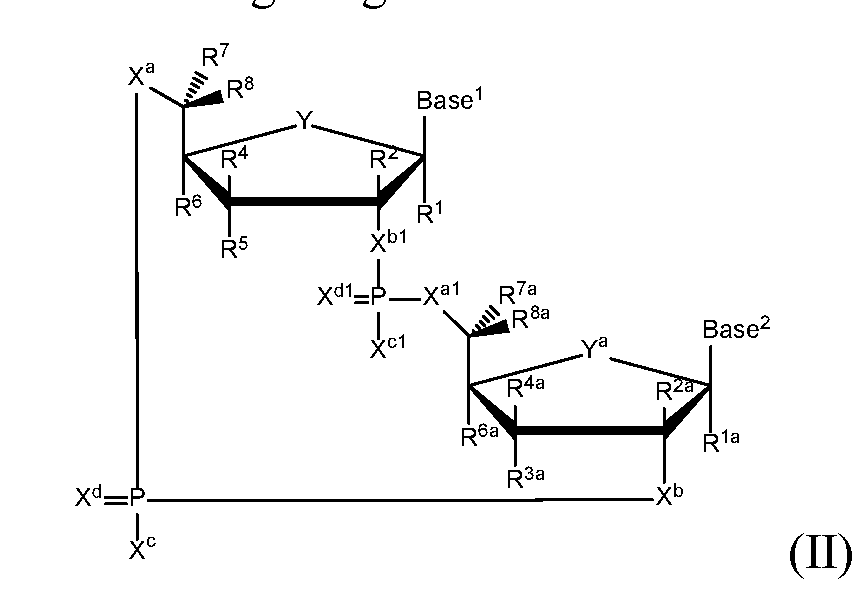
or pharmaceutically acceptable salts, hydrates, solvates, or prodrugs thereof, as described herein. The present disclosure also relates to compounds having general structural formula (ΙΓ):
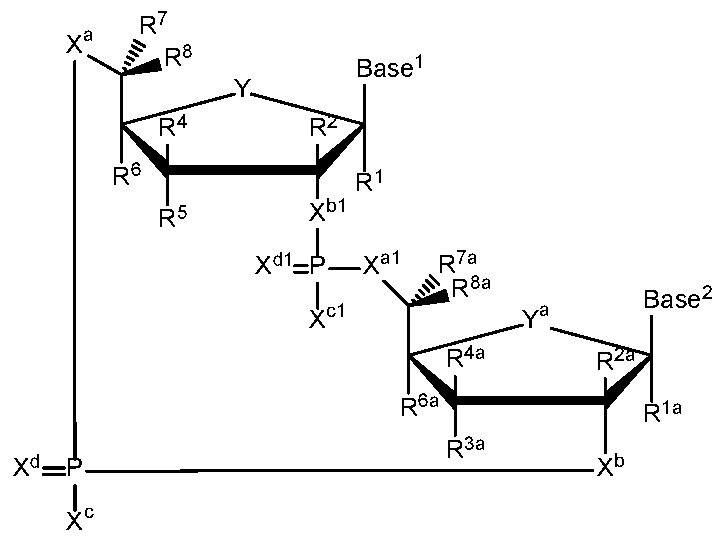
or pharmaceutically acceptable salts, hydrates, solvates, or prodrugs thereof, as described herein. The present disclosure also relates to compounds having general structural formula (ΙΓ'):

or pharmaceutically acceptable salts, hydrates, solvates, or prodrugs thereof, as described herein.
Embodiments of the disclosure include compounds of general formula (II), compounds of general formula (ΙΓ), and/or compounds of general formula (Π"), and pharmaceutically acceptable salts, hydrates, solvates, or prodrugs thereof, as well as synthesis and isolation of compounds of general formula (II), compounds of general formula (ΙΓ), and/or compounds of
general formula (ΙΓ), and pharmaceutically acceptable salts, hydrates, solvates, or prodrugs thereof. Uses of compounds of general formula (II), compounds of general formula (ΙΓ), and/or compounds of general formula (Π") are also disclosed.
Other embodiments, aspects and features of the present disclosure are either further described in or will be apparent from the ensuing description, examples and appended claims.
DETAILED DESCRIPTION OF THE INVENTION
The present disclosure includes compounds of general formula (II), compounds of general formula (ΙΓ), and/or compounds of general formula (Π") above, and pharmaceutically acceptable salts, hydrates, solvates, or prodrugs thereof. These compounds and their
pharmaceutically acceptable salts, hydrates, solvates, and/or prodrugs are useful as agents to induce interferon production.
A first embodiment of the disclosure relates to cyclic di-nucleotide compounds of general formula (II):


and Base2 each may be independently substituted by 0-3 substituents R10, where each R10 is independently selected from the group consisting of F, CI, I, Br, OH, SH, H2, Ci-3 alkyl, C3-6 cycloalkyl, 0(Ci-3 alkyl), 0(C3-6 cycloalkyl), S(Ci-3 alkyl), S(C3-6 cycloalkyl), H(Ci-3 alkyl), H(C3-6 cycloalkyl), N(C1-3 alkyl)2, and NH(C3-6 cycloalkyl)2; Y and Ya are each independently selected from the group consisting of -0-, -S-, -S02-, -CH2-, and -CF2-; Xa and Xal are each independently selected from the group consisting of O, C, and S; X and X l are each independently selected from the group consisting of O, C, and S; Xc and Xcl are each
independently selected from the group consisting of O", S", OR9, and NR9R9; Xd and Xdl are each independently selected from the group consisting of O and S; R1 and Rla are each independently selected from the group consisting of H, F, CI, Br, I, OH, CN, N3, Ci-C6 alkyl, C2-C6 alkenyl,
C2-C6 alkynyl, Ci-C6 haloalkyl, C2-C6 haloalkenyl, C2-C6 haloalkynyl, -0-Ci-C6 alkyl, -0-C2-C6 alkenyl, and -0-C2-C6 alkynyl, where said R1 and Rla Ci-C6 alkyl, C2-C6 alkenyl, C2-C6 alkynyl, Ci-C6 haloalkyl, C2-C6 haloalkenyl, C2-C6 haloalkynyl, -0-Ci-C6 alkyl, -0-C2-C6 alkenyl, and -0-C2-C6 alkynyl are substituted by 0 to 3 substituents selected from the group consisting of F, CI, Br, I, OH, CN, and N3; R2 and R2a are each independently selected from the group consisting of H, F, CI, Br, I, OH, CN, N3, Ci-C6 alkyl, C2-C6 alkenyl, C2-C6 alkynyl, Ci-C6 haloalkyl, C2-C6 haloalkenyl, C2-C6 haloalkynyl, -0-Ci-C6 alkyl, -0-C2-C6 alkenyl, and -0-C2-C6 alkynyl, where said R2 and R2a Ci-C6 alkyl, C2-C6 alkenyl, C2-C6 alkynyl, Ci-C6 haloalkyl, C2-C6 haloalkenyl, C2-C6 haloalkynyl, -0-Ci-C6 alkyl, -0-C2-C6 alkenyl, and -0-C2-C6 alkynyl are substituted by 0 to 3 substituents selected from the group consisting of F, CI, Br, I, OH, CN, and N3; R3a is selected from the group consisting of H, F, CI, Br, I, OH, CN, N3, Ci-C6 alkyl, C2-C6 alkenyl, C2-C6 alkynyl, Ci-C6 haloalkyl, C2-C6 haloalkenyl, C2-C6 haloalkynyl, -0-Ci-C6 alkyl, -0-C2-C6 alkenyl, and -0-C2-C6 alkynyl, where said R3a Ci-C6 alkyl, C2-C6 alkenyl, C2-C6 alkynyl, Ci-C6 haloalkyl, C2-C6 haloalkenyl, C2-C6 haloalkynyl, -0-Ci-C6 alkyl, -0-C2-C6 alkenyl, and
-0-C2-C6 alkynyl are substituted by 0 to 3 substituents selected from the group consisting of F, CI, Br, I, OH, CN, and N3; R4 and R4a are each independently selected from the group consisting of H, F, CI, Br, I, OH, CN, N3, Ci-C6 alkyl, C2-C6 alkenyl, C2-C6 alkynyl, Ci-C6 haloalkyl, C2-C6 haloalkenyl, C2-C6 haloalkynyl, -0-Ci-C6 alkyl, -0-C2-C6 alkenyl, and -0-C2-C6 alkynyl, where said R4 and R4a Ci-C6 alkyl, C2-C6 alkenyl, C2-C6 alkynyl, Ci-C6 haloalkyl, C2-C6 haloalkenyl, C2-C6 haloalkynyl, -0-Ci-C6 alkyl, -0-C2-C6 alkenyl, and -0-C2-C6 alkynyl are substituted by 0 to 3 substituents selected from the group consisting of F, CI, Br, I, OH, CN, and N3; R5 is selected from the group consisting of H, F, CI, Br, I, OH, CN, N3, Ci-C6 alkyl, C2-C6 alkenyl, C2-C6 alkynyl, Ci-C6 haloalkyl, C2-C6 haloalkenyl, C2-C6 haloalkynyl, -0-Ci-C6 alkyl, -0-C2-C6 alkenyl, and -0-C2-C6 alkynyl, where said R5 Ci-C6 alkyl, C2-C6 alkenyl, C2-C6 alkynyl, Ci-C6 haloalkyl, C2-C6 haloalkenyl, C2-C6 haloalkynyl, -0-Ci-C6 alkyl, -0-C2-C6 alkenyl, and
-0-C2-C6 alkynyl are substituted by 0 to 3 substituents selected from the group consisting of F, CI, Br, I, OH, CN, and N3; R6 and R6a are each independently selected from the group consisting of H, F, CI, Br, I, OH, CN, N3, Ci-C6 alkyl, C2-C6 alkenyl, C2-C6 alkynyl, Ci-C6 haloalkyl, C2-C6 haloalkenyl, C2-C6 haloalkynyl, -0-Ci-C6 alkyl, -0-C2-C6 alkenyl, and -0-C2-C6 alkynyl, where said R6 and R6a Ci-C6 alkyl, C2-C6 alkenyl, C2-C6 alkynyl, Ci-C6 haloalkyl, C2-C6 haloalkenyl, C2-C6 haloalkynyl, -0-Ci-C6 alkyl, -0-C2-C6 alkenyl, and -0-C2-C6 alkynyl are substituted by 0 to 3 substituents selected from the group consisting of F, CI, Br, I, OH, CN, and N3; R7 and R7a are each independently selected from the group consisting of H, F, CI, Br, I, OH, CN, N3, Ci-C6
alkyl, C2-C6 alkenyl, C2-C6 alkynyl, Ci-C6 haloalkyl, C2-C6 haloalkenyl, C2-C6 haloalkynyl, -0-Ci-C6 alkyl, -0-C2-C6 alkenyl, and -0-C2-C6 alkynyl, where said R7 and R7a Ci-C6 alkyl, C2-C6 alkenyl, C2-C6 alkynyl, Ci-C6 haloalkyl, C2-C6 haloalkenyl, C2-C6 haloalkynyl, -0-Ci-C6 alkyl, -0-C2-C6 alkenyl, and -0-C2-C6 alkynyl are substituted by 0 to 3 substituents selected from the group consisting of F, CI, Br, I, OH, CN, and N3; R8 and R8a are each independently selected from the group consisting of H, F, CI, Br, I, OH, CN, N3, Ci-C6 alkyl, C2-C6 alkenyl, C2-C6 alkynyl, Ci-C6 haloalkyl, C2-C6 haloalkenyl, C2-C6 haloalkynyl, -0-Ci-C6 alkyl, -0-C2-C6 alkenyl, and -0-C2-C6 alkynyl, where said R8 and R8a Ci-C6 alkyl, C2-C6 alkenyl, C2-C6 alkynyl, Ci-C6 haloalkyl, C2-C6 haloalkenyl, C2-C6 haloalkynyl, -0-Ci-C6 alkyl, -0-C2-C6 alkenyl, and -0-C2-C6 alkynyl are substituted by 0 to 3 substituents selected from the group consisting of F,
9 is independently selected from the group consisting of H,

alkyl is optionally substituted by 0 to 3 substituents independently selected from the group consisting of OH, -O-Ci-C20 alkyl,-S-C(0)Ci-C6 alkyl, and C(0)OCi-C6 alkyl; optionally R3a and R6a are connected to form -0-Ci-C6 alkylene, -0-C2-C6 alkenylene, or -0-C2-C6 alkynylene, such that where R3a and R6a are connected to form -0-Ci-C6 alkylene, -0-C2-C6 alkenylene, or -0-C2-C6 alkynylene, said O is bound at the R3a position; optionally R3a and R4a are connected to form Ci-C6 alkylene, C2-C6 alkenylene, C2-C6 alkynylene, -0-Ci-C6 alkylene, -0-C2-C6 alkenylene, or -0-C2-C6 alkynylene, such that where R3a and R4a are connected to form -0-Ci-C6 alkylene, -0-C2-C6 alkenylene, or -0-C2-C6 alkynylene, said O is bound at the R3a position; optionally R4 and R5 are connected to form are connected to form Ci-C6 alkylene, C2-C6 alkenylene, C2-C6 alkynylene, -0-Ci-C6 alkylene, -0-C2-C6 alkenylene, or -0-C2-C6 alkynylene, such that where R4 and R5 are connected to form -0-Ci-C6 alkylene, -0-C2-C6 alkenylene, or -0-C2-C6 alkynylene, said O is bound at the R5 position; optionally R5 and R6 are connected to form -0-Ci-C6 alkylene, -0-C2-C6 alkenylene, or -0-C2-C6 alkynylene, such that where R5 and R6 are connected to form -0-Ci-C6 alkylene, -0-C2-C6 alkenylene, or -0-C2-C6 alkynylene, said O is bound at the R5 position; optionally R7 and R8 are connected to form Ci-C6 alkylene, C2-C6 alkenylene, or C2-C6 alkynylene; and optionally R7a and R8a are connected to form Ci-C6 alkylene, C2-C6 alkenylene, or C2-C6 alkynylene.
In specific aspects of this embodiment, when Y and Ya are each O, Xa and Xal are each
O, X and X l are each O, and Xc and Xcl are each OH or SH, Xd and Xdl are each O, R1 and Rla
are each H, R2 is H, R6 and R6a are each H, R7 and R7a are each H, R8 and R8a are each H, and
Base1 and Base2 are each selected from the group consisting of
 , , and
 are not both selected from the group consisting of H, F and OH. That is, when Y and Ya are each O, Xa and Xal are each O, X and X l are each O, and Xc and Xcl are each OH or SH, Xd and Xdl are each O, R1 and Rla are each H, R2 is H, R6 and R6a are each H, R and R7a are each H, R8 and R8a are each H, and Base1 and Base2 are each selected from the group
consisting of
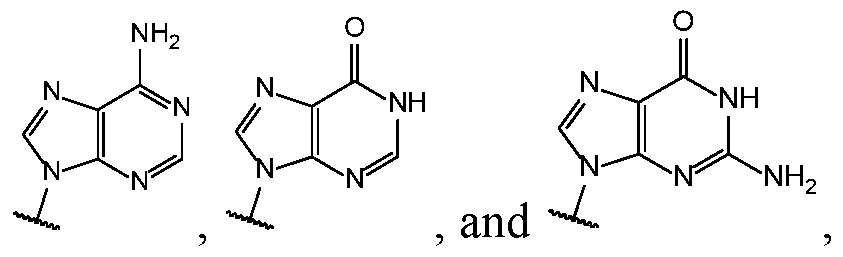 either only one of R5 and R3a is selected from the group consisting of H, F, and OH, or neither R5 and R3a is selected from the group consisting of H, F, and OH. In further instances of these aspects, when Y and Ya are each O, Xa and Xal are each O, X and X l are each O, and Xc and Xcl are each OH, Xd and Xdl are each O or S, R1 and Rla are each H, R2 is H, R6 and R6a are each H, R7 and R7a are each H, R8 and R 8a iu is.
are each H, and Base1 and Base2 are each selected from the group consisting of

 , R5 and R3a are not both selected from the group consisting of H, Ci-C6 alkyl, C2-C6 alkenyl, C2-C6 alkynyl, where said Ci-C6 alkyl, C2-C6 alkenyl and C2-C6 alkynyl are substituted by 0 to 3 substituents selected from the group consisting of F, CI, Br, I and OH.
In further specific aspects of this embodiment, when Base1 and Base2 are each selected
 one of Xc and Xcl is SR9.

particular instances, Base1 and Base2 are each independently selected from the group consisting

particular instances, Base1 and Base2 are each independently selected from the group consisting
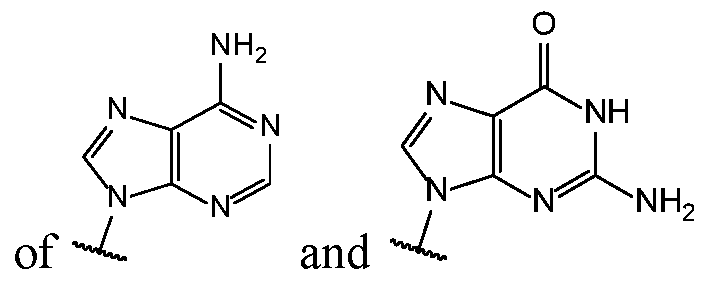
In specific aspects of this embodiment, when Y and Ya are each O and Base1 and Base2
are each selected from the group consisting of
 and , R5 and R3a are not both selected from the group consisting of OH, -0-Ci-C6 alkyl, -O-C2-C6 alkenyl, and -0-C2-
C6 alkynyl, and where said R5 -0-Ci-C6 alkyl, -O-C2-C6 alkenyl, and -O-C2-C6 alkynyl and said
R3a -0-Ci-C6 alkyl, -0-C2-C6 alkenyl, and -0-C2-C6 alkynyl are substituted by 0 to 3 substituents selected from the group consisting of F, CI, Br, I, OH, CN, and N3.
In a second aspect of the first embodiment, Y and Ya are each independently selected from the group consisting of -0-, -S-, -S02-, -CH2-, and -CF2-. In this aspect, all other groups are as provided in the general formula (II) of the first embodiment above or in the first aspect described above.
In a third aspect of the first embodiment, Xa and Xal are each independently selected from the group consisting of O and S. In this aspect, all other groups are as provided in the
general formula (II) of the first embodiment above or in the first through second aspects described above.
In a fourth aspect of the first embodiment, X and X l are each independently selected from the group consisting of O and S. In this aspect, all other groups are as provided in the general formula (II) of the first embodiment above or in the first through third aspects described above.
In a fifth aspect of the first embodiment, Xc and Xcl are each independently selected from

where each R9 C1-C20 alkyl is optionally substituted by 0 to 3 substituents independently selected from the group consisting of OH, -O-Ci-C20 alkyl,-S-C(0)Ci-C6 alkyl, and C(0)OCi-C6 alkyl.
f
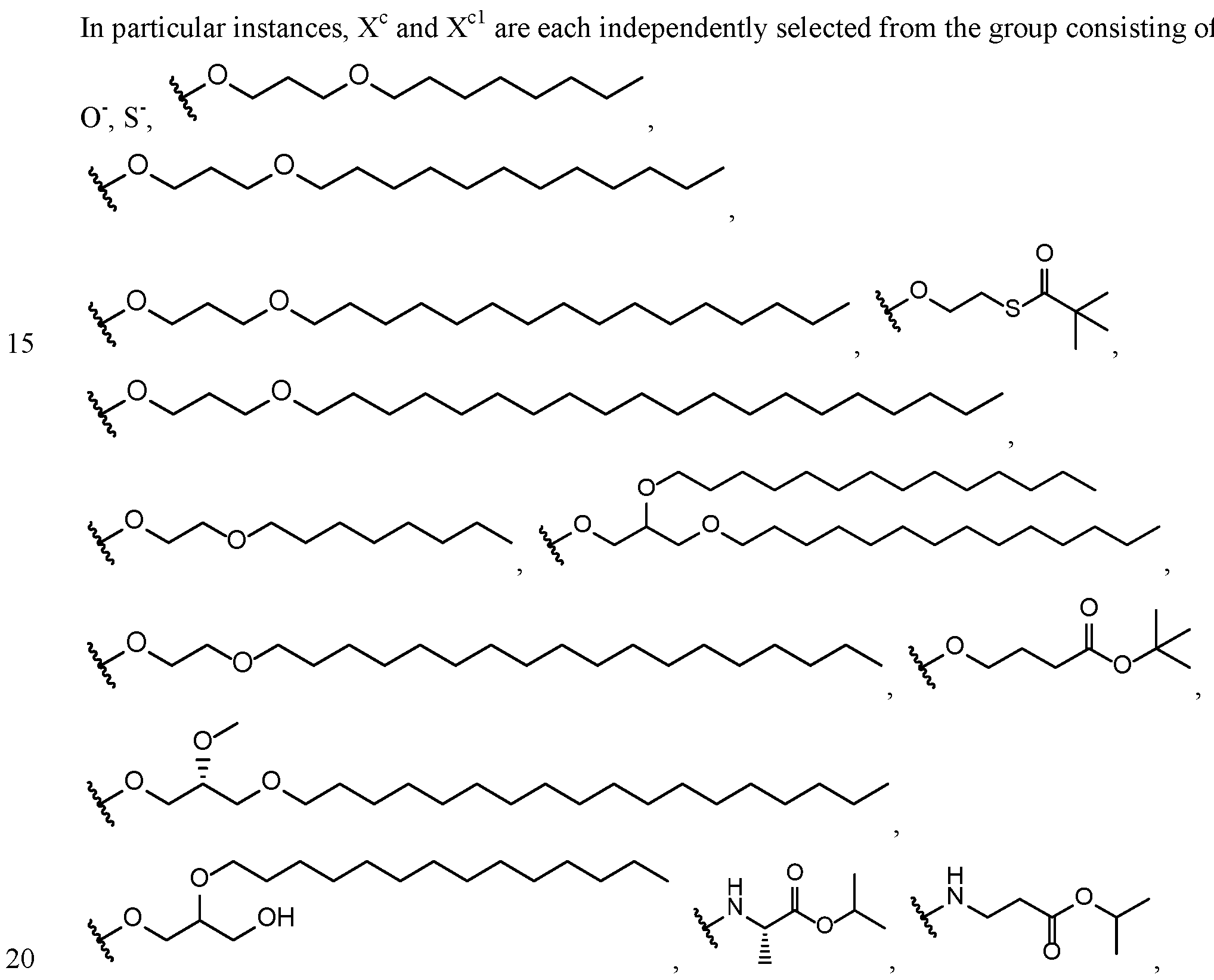

In a sixth aspect of the first embodiment, Xd and Xdl are each independently selected from the group consisting of O and S. In this aspect, all other groups are as provided in the general formula (II) of the first embodiment above or in the first through fifth aspects described above.
In a seventh aspect of the first embodiment, R1 and Rla are each H. In this aspect, all other groups are as provided in the general formula (II) of the first embodiment above or in the first through sixth aspects described above.
In an eighth aspect of the first embodiment, R2 and R2a are each independently selected from the group consisting of H, F, CI, Br, I, OH, N3, Ci-C6 alkyl, and Ci-C6 haloalkyl, where said R2 and R2a Ci-C6 alkyl or Ci-C6 haloalkyl are substituted by 0 to 3 substituents selected from the group consisting of F, CI, Br, I, OH, CN, and N3. In particular instances, R2 and R2a are each independently selected from the group consisting of H, F, CI, Br, I, OH, CN, N3, CF3, CH3, CH2OH, and CH2CH3. In this aspect, all other groups are as provided in the general formula (II) of the first embodiment above or in the first through seventh aspects described above.
In a ninth aspect of the first embodiment, R3a is selected from the group consisting H, F, CI, Br, I, OH, N3, Ci-C6 alkyl, and Ci-C6 haloalkyl, where said R3a Ci-C6 alkyl or Ci-C6 haloalkyl are substituted by 0 to 3 substituents selected from the group consisting of F, CI, Br, I, OH, CN, and N3. In particular instances, R3a are each independently selected from the group consisting of H, F, CI, Br, I, OH, CN, N3, CF3, CH3, CH2OH, and CH2CH3. In this aspect, all other groups are as provided in the general formula (II) of the first embodiment above or in the first through eighth aspects described above.
In a tenth aspect of the first embodiment, R4 and R4a are each independently selected from the group consisting of H, F, CI, Br, I, OH, N3, Ci-C6 alkyl, and Ci-C6 haloalkyl, where said R4 and R4a Ci-C6 alkyl or Ci-C6 haloalkyl are substituted by 0 to 3 substituents selected from the group consisting of F, CI, Br, I, OH, CN, and N3. In particular instances, R4 and R4a are each independently selected from the group consisting of H, F, CI, Br, I, OH, CN, N3, CF3, CH3, CH2OH, and CH2CH3. In this aspect, all other groups are as provided in the general formula (II) of the first embodiment above or in the first through ninth aspects described above.
In an eleventh aspect of the first embodiment, R5 is selected from the group consisting of H, F, CI, Br, I, OH, N3, Ci-C6 alkyl, and Ci-C6 haloalkyl, where said R5 Ci-C6 alkyl or Ci-C6 haloalkyl are substituted by 0 to 3 substituents selected from the group consisting of F, CI, Br, I, OH, CN, and N3. In particular instances, R5 are each independently selected from the group consisting of H, F, CI, Br, I, OH, CN, N3, CF3, CH3, CH2OH, and CH2CH3. In this aspect, all other groups are as provided in the general formula (II) of the first embodiment above or in the first through tenth aspects described above.
In a twelfth aspect of the first embodiment, R6 and R6a are each independently selected from the group consisting of H, F, CI, Br, I, OH, Ci-C6 alkyl, C2-C6 alkenyl, and C2-C6 alkynyl. In this aspect, all other groups are as provided in the general formula (II) of the first embodiment above or in the first through eleventh aspects described above.
In a thirteenth aspect of the first embodiment, R7 and R7a are each H. In this aspect, all other groups are as provided in the general formula (II) of the first embodiment above or in the first through twelfth aspects described above.
In a fourteenth aspect of the first embodiment, R8 and R8a are each H. In this aspect, all other groups are as provided in the general formula (II) of the first embodiment above or in the first through thirteenth aspects described above.
In a fifteenth aspect of the first embodiment, Rla and R3a are connected to form Ci-C6 alkylene, C2-C6 alkenylene, C2-C6 alkynylene, -0-Ci-C6 alkylene, -0-C2-C6 alkenylene, or -0-C2-C6 alkynylene, such that where Rla and R3a are connected to form -0-Ci-C6 alkylene,
-0-C2-C6 alkenylene, or -0-C2-C6 alkynylene, said O is bound at the R3a position. In this aspect, all other groups are as provided in the general formula (II) of the first embodiment above or in the first through fourteenth aspects described above.
In a sixteenth aspect of the first embodiment, R2a and R3a are connected to form Ci-C6 alkylene, C2-C6 alkenylene, C2-C6 alkynylene, -0-Ci-C6 alkylene, -0-C2-C6 alkenylene, or -0-C2-C6 alkynylene, such that where R2a and R3a are connected to form -0-Ci-C6 alkylene, -0-C2-C6 alkenylene, or -0-C2-C6 alkynylene, said O is bound at the R3a position. In this aspect, all other groups are as provided in the general formula (II) of the first embodiment above or in the first through fifteenth aspects described above.
In a seventeenth aspect of the first embodiment, R3a and R6a are connected to form
-0-Ci-C6 alkylene, -0-C2-C6 alkenylene, and -0-C2-C6 alkynylene, such that where R3a and R6a are connected to form -0-Ci-C6 alkylene, -0-C2-C6 alkenylene, or -0-C2-C6 alkynylene, said O is bound at the R3a position. In this aspect, all other groups are as provided in the general
formula (II) of the first embodiment above or in the first through sixteenth aspects described above.
In an eighteenth aspect of the first embodiment, R4 and R5 are connected by Ci-C6 alkylene, -0-Ci-C6 alkylene, -O-C2-C6 alkenylene, or -O-C2-C6 alkynylene, such that where R4 and R5 are connected to form -0-Ci-C6 alkylene, -0-C2-C6 alkenylene, or -0-C2-C6 alkynylene, said O is bound at the R5 position. In this aspect, all other groups are as provided in the general formula (II) of the first embodiment above or in the first through seventeenth aspects described above.
In a nineteenth aspect of the first embodiment, R5 and R6 are connected to form -0-Ci-C6 alkylene, -0-C2-C6 alkenylene, or -0-C2-C6 alkynylene, such that where R5 and R6 are connected to form -0-Ci-C6 alkylene, -0-C2-C6 alkenylene, or -0-C2-C6 alkynylene, said O is bound at the R5 position. In this aspect, all other groups are as provided in the general formula (II) of the first embodiment above or in the first through eighteenth aspects described above.
In a twentieth aspect of the first embodiment, R7 and R8 are connected to form Ci-C6 alkylene, C2-C6 alkenylene, or C2-C6 alkynylene. In this aspect, all other groups are as provided in the general formula (II) of the first embodiment above or in the first through nineteenth aspects described above.
In a twenty-first aspect of the first embodiment, R7a and R8a are connected to form Ci-C6 alkylene, C2-C6 alkenylene, or C2-C6 alkynylene. In this aspect, all other groups are as provided in the general formula (II) of the first embodiment above or in the first through twentieth aspects described above.
In a twenty-second aspect of the first embodiment, the compound of formula (II) is a compound of formula (Ha):
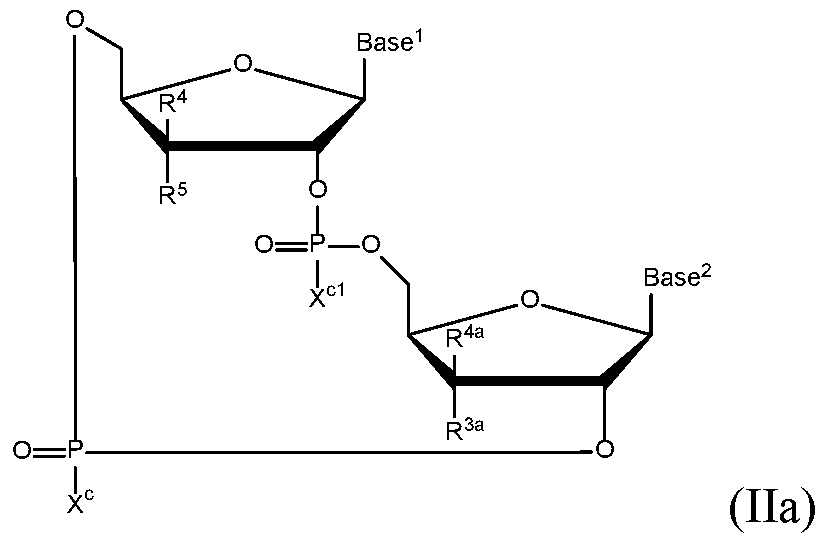
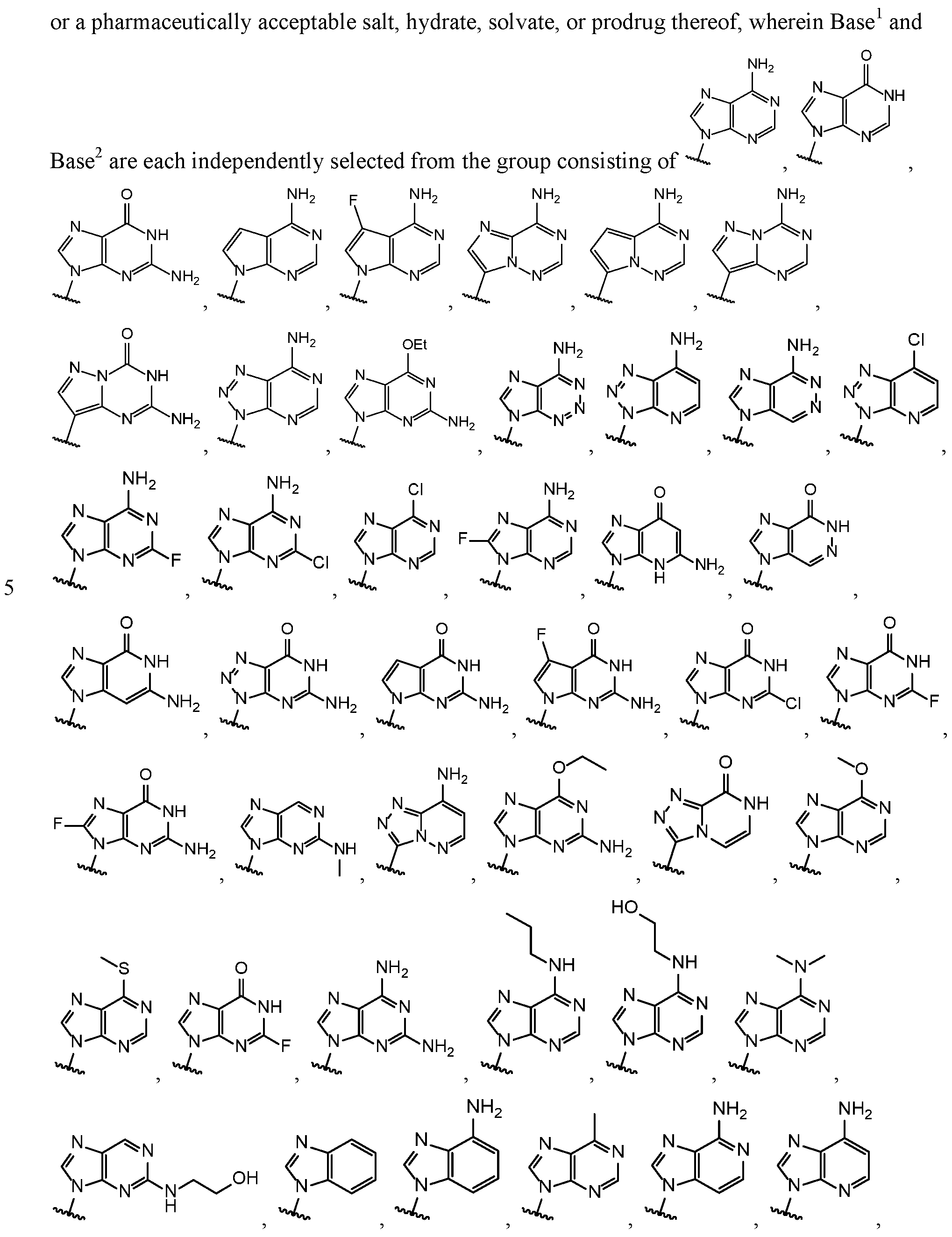

independently selected from the group consisting of O", S", OR9, and NR9R9; R3a is selected from the group consisting of H, F, CI, Br, I, OH, CN, N3, Ci-C6 alkyl, and Ci-C6 haloalkyl, where said R3a Ci-C6 alkyl or Ci-C6 haloalkyl are substituted by 0 to 3 substituents selected from the group consisting of F, CI, Br, I, and OH; R4 and R4a are selected from the group consisting of H, F, CI, Br, I, OH, CN, N3, Ci-C6 alkyl, and Ci-C6 haloalkyl, where said R4 Ci-C6 alkyl or Ci-C6 haloalkyl are substituted by 0 to 3 substituents selected from the group consisting of F, CI, Br, I, and OH; R5 is selected from the group consisting of H, F, CI, Br, I, OH, CN, N3, Ci-C6 alkyl, and Ci-C6 haloalkyl, where said R5 Ci-C6 alkyl or Ci-C6 haloalkyl are substituted by 0 to 3 substituents selected from the group consisting of F, CI, Br, I, and OH; each R9 is independently selected from the group consisting of H, C2-C3 alkyl,


A twenty-fourth aspect of the first embodiment relates to methods of inducing an immune response in a subject, comprising administering a therapeutically effective amount of a compound according to any one of general formula (II) of the first embodiment above or in the first through twenty-second aspects described above or a pharmaceutically acceptable salt, hydrate, solvate, or prodrug thereof to the subject.
A twenty-fifth aspect of the first embodiment relates to methods of inducing an immune response in a subject, comprising administering a therapeutically effective amount of a composition according to the twenty -third aspect described above to the subject.
A twenty-sixth aspect of the first embodiment relates to methods of inducing a STING- dependent type I interferon production in a subject, comprising administering a therapeutically effective amount of a compound according to any one of general formula (II) of the first embodiment above or in the first through twenty-second aspects described above or a
pharmaceutically acceptable salt, hydrate, solvate, or prodrug thereof to the subject.
A twenty-seventh aspect of the first embodiment relates to methods of inducing a STING-dependent type I interferon production in a subject, comprising administering a therapeutically effective amount of a composition according to the twenty -third aspect described above to the subject.
A twenty-eighth aspect of the first embodiment relates to methods of inducing a STING- dependent cytokine production in a subject, comprising administering a therapeutically effective amount of a compound according to any one of general formula (II) of the first embodiment above or in the first through twenty-second aspects described above or a pharmaceutically acceptable salt, hydrate, solvate, or prodrug thereof to the subject.
A twenty-ninth aspect of the first embodiment relates to methods of inducing a STING- dependent cytokine production in a subject, comprising administering a therapeutically effective amount of a composition according to the twenty -third aspect described above to the subject.
A second embodiment of the disclosure relates to cyclic di-nucleotide compounds of general formula (ΙΓ):

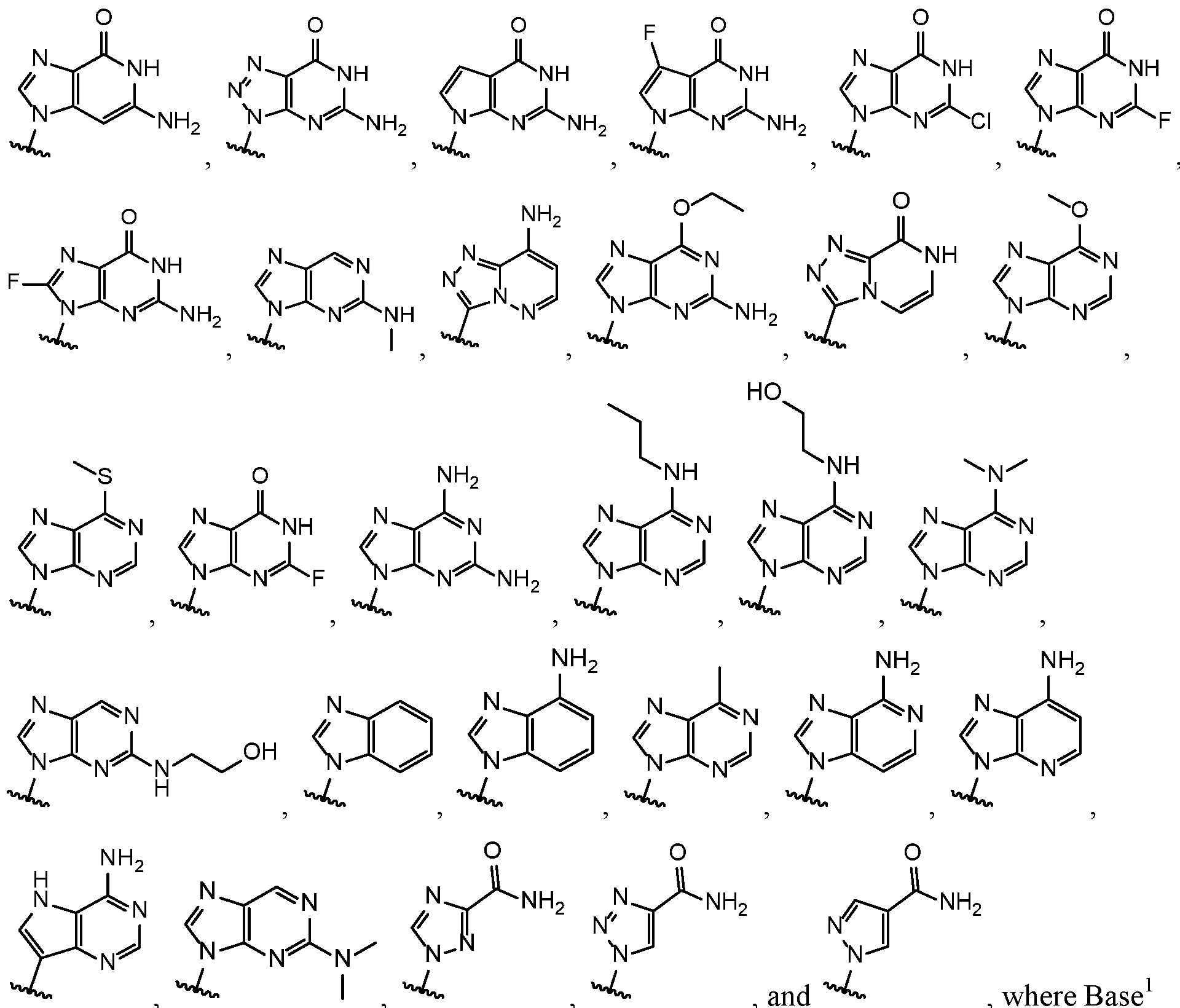
-0-C2-C6 alkynyl, where said R3A Ci-C6 alkyl, C2-C6 alkenyl, C2-C6 alkynyl, Ci-C6 haloalkyl, C2-C6 haloalkenyl, C2-C6 haloalkynyl, -0-Ci-C6 alkyl, -0-C2-C6 alkenyl, and -0-C2-C6 alkynyl are substituted by 0 to 3 substituents selected from the group consisting of F, CI, Br, I, OH, CN, and N3; R4 and R4A are each independently selected from the group consisting of H, F, CI, Br, I, OH, CN, N3, Ci-C6 alkyl, C2-C6 alkenyl, C2-C6 alkynyl, Ci-C6 haloalkyl, C2-C6 haloalkenyl, C2-C6 haloalkynyl, -0-Ci-C6 alkyl, -0-C2-C6 alkenyl, and -0-C2-C6 alkynyl, where said R4 and R4A Ci-C6 alkyl, C2-C6 alkenyl, C2-C6 alkynyl, Ci-C6 haloalkyl, C2-C6 haloalkenyl, C2-C6 haloalkynyl, -0-Ci-C6 alkyl, -0-C2-C6 alkenyl, and -0-C2-C6 alkynyl are substituted by 0 to 3 substituents selected from the group consisting of F, CI, Br, I, OH, CN, and N3; R5 is selected from the group consisting of H, F, CI, Br, I, OH, CN, NH2, N3, Ci-C6 alkyl, C2-C6 alkenyl, C2-C6 alkynyl, Ci-C6 haloalkyl, C2-C6 haloalkenyl, C2-C6 haloalkynyl, -0-Ci-C6 alkyl, -0-C2-C6 alkenyl, and -0-C2-C6 alkynyl, where said R5 Ci-C6 alkyl, C2-C6 alkenyl, C2-C6 alkynyl, Ci-C6 haloalkyl, C2-C6 haloalkenyl, C2-C6 haloalkynyl, -0-Ci-C6 alkyl, -0-C2-C6 alkenyl, and
-0-C2-C6 alkynyl are substituted by 0 to 3 substituents selected from the group consisting of F, CI, Br, I, OH, CN, NRV, and N3; R6 and R6A are each independently selected from the group consisting of H, F, CI, Br, I, OH, CN, N3, Ci-C6 alkyl, C2-C6 alkenyl, C2-C6 alkynyl, Ci-C6 haloalkyl, C2-C6 haloalkenyl, C2-C6 haloalkynyl, -0-Ci-C6 alkyl, -0-C2-C6 alkenyl, and
-0-C2-C6 alkynyl, where said R6 and R6A Ci-C6 alkyl, C2-C6 alkenyl, C2-C6 alkynyl, Ci-C6 haloalkyl, C2-C6 haloalkenyl, C2-C6 haloalkynyl, -0-Ci-C6 alkyl, -0-C2-C6 alkenyl, and
-0-C2-C6 alkynyl are substituted by 0 to 3 substituents selected from the group consisting of F, CI, Br, I, OH, CN, and N3; R7 and R7A are each independently selected from the group consisting of H, F, CI, Br, I, OH, CN, N3, Ci-C6 alkyl, C2-C6 alkenyl, C2-C6 alkynyl, Ci-C6 haloalkyl, C2-C6 haloalkenyl, C2-C6 haloalkynyl, -0-Ci-C6 alkyl, -0-C2-C6 alkenyl, and -0-C2-C6 alkynyl, where said R7 and R7A Ci-C6 alkyl, C2-C6 alkenyl, C2-C6 alkynyl, Ci-C6 haloalkyl, C2-C6 haloalkenyl, C2-C6 haloalkynyl, -0-Ci-C6 alkyl, -0-C2-C6 alkenyl, and -0-C2-C6 alkynyl are substituted by 0
to 3 substituents selected from the group consisting of F, CI, Br, I, OH, CN, and N3; R and R a are each independently selected from the group consisting of H, F, CI, Br, I, OH, CN, N3, Ci-C6 alkyl, C2-C6 alkenyl, C2-C6 alkynyl, Ci-C6 haloalkyl, C2-C6 haloalkenyl, C2-C6 haloalkynyl, -0-Ci-C6 alkyl, -0-C2-C6 alkenyl, and -0-C2-C6 alkynyl, where said R8 and R8a Ci-C6 alkyl, C2-C6 alkenyl, C2-C6 alkynyl, Ci-C6 haloalkyl, C2-C6 haloalkenyl, C2-C6 haloalkynyl, -0-Ci-C6 alkyl, -0-C2-C6 alkenyl, and -0-C2-C6 alkynyl are substituted by 0 to 3 substituents selected from the group consisting of F, CI, Br, I, OH, 9 is independently selected from the group consisting of H, Ci-C2o alkyl,


In specific aspects of this embodiment, when Y and Ya are each O, Xa and Xal are each O, X and X l are each O, and Xc and Xcl are each OH or SH, Xd and Xdl are each O, R1 and Rla are each H, R2 is H, R6 and R6a are each H, R7 and R7a are each H, R8 and R8a are each H, and
ase1 and Base2 are each selected from the group consisting of
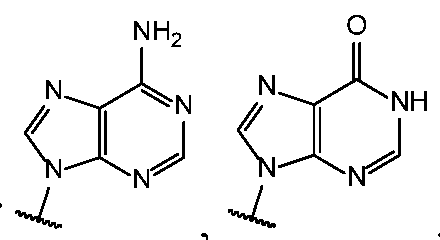 , and
, and
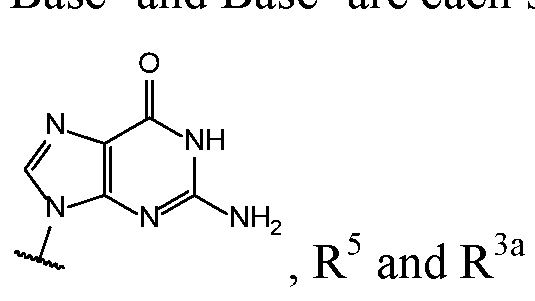 are not both selected from the group consisting of H, F and OH. That is, when Y and Ya are each O, Xa and Xal are each O, X and X l are each O, and Xc and Xcl are each OH or SH, Xd and Xdl are each O, R1 and Rla are each H, R2 is H, R6 and R6a are each H, R and R7a are each H R8 nd R8a are each H and Base1 and Base2 are each selected from the rou
 from the group consisting of H, F, and OH, or neither R5 and R3a is selected from the group consisting of H, F, and OH. In further instances of these aspects, when Y and Ya are each O, X: and Xal are each O, X and X l are each O, and Xc and Xcl are each OH, Xd and Xdl are each O or S, R1 and Rla are each H, R2 is H, R6 and R6a are each H, R7 and R7a are each H, R8 and R8a
are each H, and Base1 and Base2 are each selected from the group consisting of
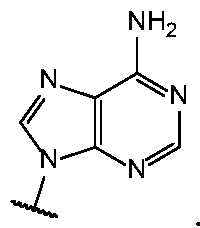
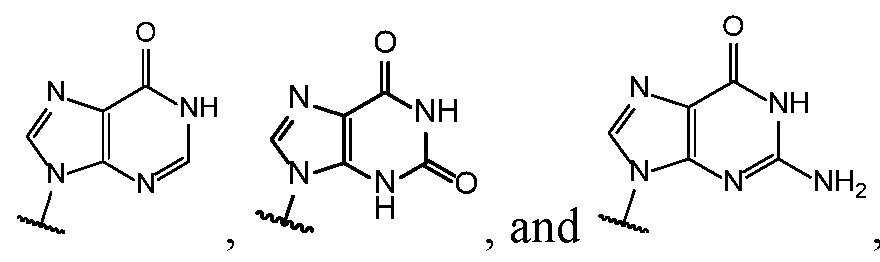 , R5 and R3a are not both selected from the group consisting of H, Ci-C6 alkyl, C2-C6 alkenyl, C2-C6 alkynyl, where said Ci-C6 alkyl, C2-C6 alkenyl and C2-C6 alkynyl are substituted by 0 to 3 substituents selected from the group consisting of F, CI, Br, I and OH.
In further specific as ects of this embodiment, when Base1 and Base2 are each selected
from the group consisting of
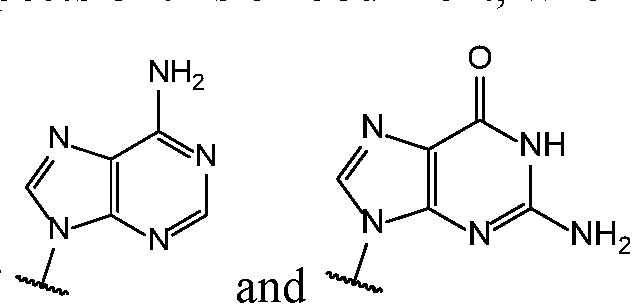 and , and R2a is F and R5 is F, at least one of Xc and Xcl is SR9.

substituents R10, where each R10 is independently selected from the group consisting of F, CI, I, Br, OH, SH, H2, Ci-3 alkyl, C3-6 cycloalkyl, 0(Ci-3 alkyl), 0(C3-6 cycloalkyl), S(Ci-3 alkyl), S(C3-6 cycloalkyl), H(Ci-3 alkyl), NH(C3-6 cycloalkyl), N(Ci-3 alkyl)2, and N(C3-6 cycloalkyl)2. In particular instances, Base1 and Base2 are each independently selected from the group

from the group consisting of
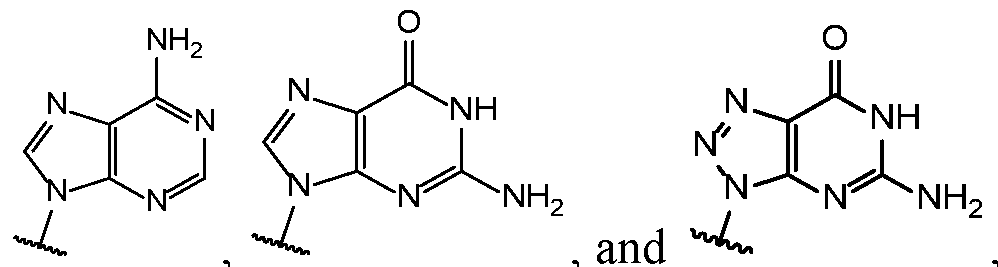 , , and , where Base1 and
Base2 each may be independently substituted by 0-3 substituents R10, where each R10 is independently selected from the group consisting of F, CI, I, Br, OH, SH, H2, Ci-3 alkyl, C3-6 cycloalkyl, 0(Ci-3 alkyl), 0(C3-6 cycloalkyl), S(Ci-3 alkyl), S(C3-6 cycloalkyl), H(Ci-3 alkyl),
H(C3-6 cycloalkyl), N(C1-3 alkyl)2, and N(C3-6 cycloalkyl)2. In this aspect, all other groups are as provided in the general formula (ΙΓ) of the second embodiment above.
In a second aspect of the second embodiment, Xc and Xcl are each independently selected from the group consisting of OR9 and SR9, where each R9 is independently selected from the
group consisting of H, Ci-C2o alkyl,
 and
and
where each R Ci-C2o alkyl is optionally substituted by 0 to 3 substituents independently selected from the group consisting of OH, -O-Ci-C20 alkyl,-S-C(0)Ci-C6 alkyl, and C(0)OCi-C6 alkyl. In particular instances, Xc and Xcl are each independently selected from the group consisting of


In a third aspect of the second embodiment, R1 and Rla are each H. In this aspect, all other groups are as provided in the general formula (ΙΓ) of the second embodiment above or in the first through second aspects described above.
In a fourth aspect of the second embodiment, R2 and R2a are each independently selected from the group consisting of H, F, CI, I, Br, OH, N3, Ci-C6 alkyl, and Ci-C6 haloalkyl, where said R2 and R2a Ci-C6 alkyl or Ci-C6 haloalkyl are substituted by 0 to 3 substituents selected from the group consisting of F, CI, Br, I, OH, CN, and N3. In particular instances, R2 and R2a are each independently selected from the group consisting of H, F, CI, I, Br, OH, CN, N3, CF3, CH3, CH2OH, and CH2CH3. In this aspect, all other groups are as provided in the general formula (ΙΓ) of the second embodiment above or in the first through third aspects described above.
In a fifth aspect of the second embodiment, R3a is selected from the group consisting H, F, CI, Br, I, OH, CN, NH2, N3, Ci-C6 alkyl, and Ci-C6 haloalkyl, where said R3a Ci-C6 alkyl or Ci-C6 haloalkyl are substituted by 0 to 3 substituents selected from the group consisting of F, CI, Br, I, OH, CN, and N3. In particular instances, R3a is selected from the group consisting of H, F, CI, Br, I, OH, CN, NH2, N3, CF3, CH3, CH2OH, and CH2CH3. In even more particular instances, R3a is selected from NH2 and N3. In this aspect, all other groups are as provided in the general formula (ΙΓ) of the second embodiment above or in the first through fourth aspects described above.
In a sixth aspect of the second embodiment, R4 and R4a are each independently selected from the group consisting of H, F, CI, I, Br, OH, N3, Ci-C6 alkyl, and Ci-C6 haloalkyl, where said R4 and R4a Ci-C6 alkyl or Ci-C6 haloalkyl are substituted by 0 to 3 substituents selected from the group consisting of F, CI, Br, I, OH, CN, and N3. In particular instances, R4 and R4a are each independently selected from the group consisting of H, F, CI, I, Br, OH, CN, N3, CF3, CH3, CH2OH, and CH2CH3. In even more particular instances, R4 and R4a are each F. In this aspect, all other groups are as provided in the general formula (ΙΓ) of the second embodiment above or in the first through fifth aspects described above.
In a seventh aspect of the second embodiment, R5 is selected from the group consisting of H, F, CI, Br, I, OH, NH2, N3, Ci-C6 alkyl, and Ci-C6 haloalkyl, where said R5 Ci-C6 alkyl or
Ci-C6 haloalkyl are substituted by 0 to 3 substituents selected from the group consisting of F, CI, Br, I, OH, CN, NR9R9, and N3. In particular instances, R5 are each independently selected from the group consisting of H, F, CI, I, Br, OH, CN, N3, CF3, CH3, CH2OH, and CH2CH3. In even
more particular instances, R5 is selected from H2 and N3. In this aspect, all other groups are as provided in the general formula (ΙΓ) of the second embodiment above or in the first through sixth aspects described above.
In an eighth aspect of the second embodiment, R6 and R6a are each independently selected from the group consisting of H, F, CI, I, Br, OH, Ci-C6 alkyl, C2-C6 alkenyl, and C2-C6 alkynyl. In this aspect, all other groups are as provided in the general formula (ΙΓ) of the second embodiment above or in the first through seventh aspects described above.
In a ninth aspect of the second embodiment, R7 and R7a are each independently selected from the group consisting of H and Ci-C6 alkyl. In particular instances, R7 and R7a are each independently selected from the group consisting of H and CH3. In more particular instances, R7a is CH3. In additional instances, R7 and R7a are each H. In this aspect, all other groups are as provided in the general formula (ΙΓ) of the second embodiment above or in the first through eighth aspects described above.
In a tenth aspect of the second embodiment, R8 and R8a are each independently selected from the group consisting of H and Ci-C6 alkyl. In particular instances, R8 and R8a are each independently selected from the group consisting of H and CH3. In more particular instances,
83. 8 83.
R is CH3. In additional instances, R and R are each H. In this aspect, all other groups are as provided in the general formula (ΙΓ) of the second embodiment above or in the first through ninth aspects described above.
In an eleventh aspect of the second embodiment, Rla and R3a are connected to form Ci-C6 alkylene, C2-C6 alkenylene, C2-C6 alkynylene, -0-Ci-C6 alkylene, -0-C2-C6 alkenylene, or -0-C2-C6 alkynylene, such that where Rla and R3a are connected to form -0-Ci-C6 alkylene, -0-C2-C6 alkenylene, or -0-C2-C6 alkynylene, said O is bound at the R3a position. In this aspect, all other groups are as provided in the general formula (ΙΓ) of the second embodiment above or in the first through tenth aspects described above.
In a twelfth aspect of the second embodiment, R2a and R3a are connected to form Ci-C6 alkylene, C2-C6 alkenylene, C2-C6 alkynylene, -0-Ci-C6 alkylene, -0-C2-C6 alkenylene, or -0-C2-C6 alkynylene, such that where R2a and R3a are connected to form -0-Ci-C6 alkylene, -0-C2-C6 alkenylene, or -0-C2-C6 alkynylene, said O is bound at the R3a position. In this aspect, all other groups are as provided in the general formula (ΙΓ) of the second embodiment above or in the first through eleventh aspects described above.
In a thirteenth aspect of the second embodiment, R3a and R6a are connected to form -0-Ci-C6 alkylene, -0-C2-C6 alkenylene, and -0-C2-C6 alkynylene, such that where R3a and R6a
are connected to form -0-Ci-C6 alkylene, -0-C2-C6 alkenylene, or -0-C2-C6 alkynylene, said O is bound at the R3a position. In this aspect, all other groups are as provided in the general formula (ΙΓ) of the second embodiment above or in the first through eleventh aspects described above.
In a fourteenth aspect of the second embodiment, R4 and R5 are connected by Ci-C6 alkylene, -0-Ci-C6 alkylene, -0-C2-C6 alkenylene, or -0-C2-C6 alkynylene, such that where R4 and R5 are connected to form -0-Ci-C6 alkylene, -0-C2-C6 alkenylene, or -0-C2-C6 alkynylene, said O is bound at the R5 position. In this aspect, all other groups are as provided in the general formula (ΙΓ) of the second embodiment above or in the first through eleventh aspects described above.
In a fifteenth aspect of the second embodiment, R5 and R6 are connected to form
-0-Ci-C6 alkylene, -0-C2-C6 alkenylene, or -0-C2-C6 alkynylene, such that where R5 and R6 are connected to form -0-Ci-C6 alkylene, -0-C2-C6 alkenylene, or -0-C2-C6 alkynylene, said O is bound at the R5 position. In this aspect, all other groups are as provided in the general formula (ΙΓ) of the second embodiment above or in the first through eleventh aspects described above.
In a sixteenth aspect of the second embodiment, R7 and R8 are connected to form Ci-C6 alkylene, C2-C6 alkenylene, or C2-C6 alkynylene. In this aspect, all other groups are as provided in the general formula (ΙΓ) of the second embodiment above or in the first through eleventh aspects described above.
In a seventeenth aspect of the second embodiment, R7a and R8a are connected to form Ci-C6 alkylene, C2-C6 alkenylene, or C2-C6 alkynylene. In this aspect, all other groups are as provided in the general formula (ΙΓ) of the second embodiment above or in the first through eleventh aspects described above.
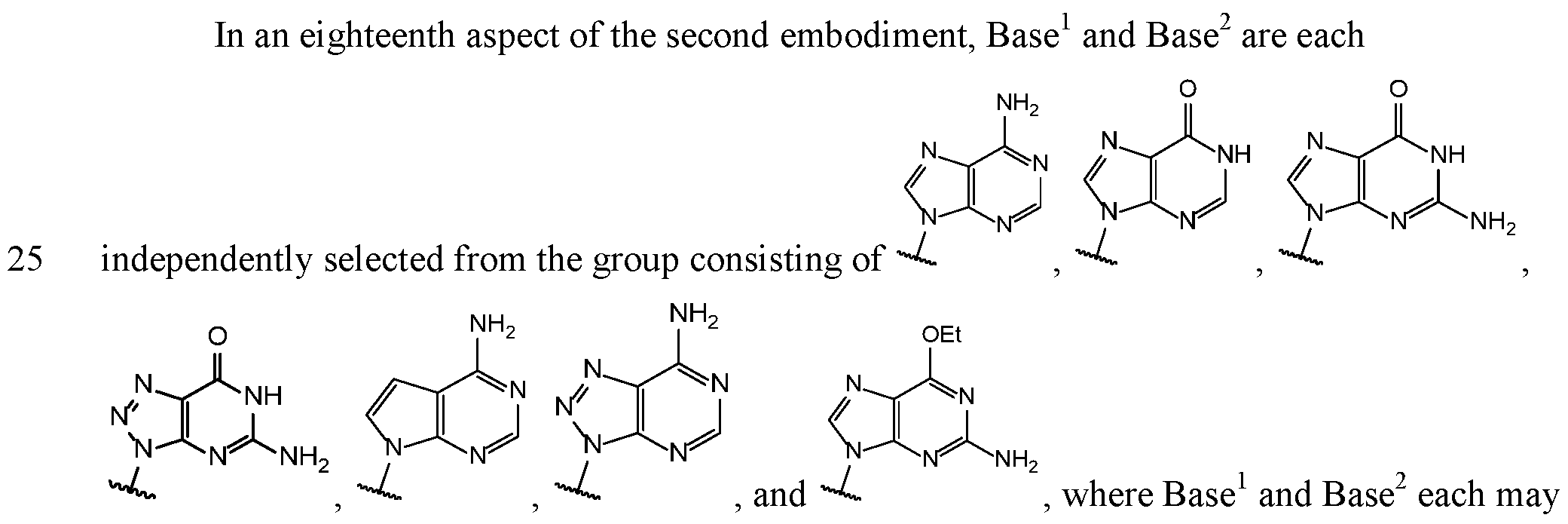
be independently substituted by 0-3 substituents R , where each R is independently selected from the group consisting of F, CI, I, Br, OH, SH, H2, Ci-3 alkyl, C3-6 cycloalkyl, 0(Ci-3 alkyl),
0(C3-6 cycloalkyl), S(Ci-3 alkyl), S(C3-6 cycloalkyl), NH(Ci-3 alkyl), NH(C3-6 cycloalkyl), N(Ci-3 alkyl)2, and N(C3-6 cycloalkyl)2; Y and Ya are each independently selected from the group consisting of -O- and -S-; Xa and Xal are each independently selected from the group consisting of O and S; X and X l are each independently selected from the group consisting of O and S; Xc and Xcl are each independently selected from the group consisting of OR9, SR9, and NR9R9; Xd and Xdl are each independently selected from the group consisting of O and S; R1 and Rla are each H; R2 and R2a are each independently selected from the group consisting of H, F, CI, Br, I, OH, N3, Ci-C6 alkyl, and Ci-C6 haloalkyl, where said R2 and R2a Ci-C6 alkyl or Ci-C6 haloalkyl are substituted by 0 to 3 substituents selected from the group consisting of F, CI, Br, I, OH, CN, and N3; R3 is selected from the group consisting of H, F, CI, Br, I, OH, CN, N3, Ci-C6 alkyl, and Ci-C6 haloalkyl, where said R3a Ci-C6 alkyl or Ci-C6 haloalkyl are substituted by 0 to 3 substituents selected from the group consisting of F, CI, Br, I, OH, CN, and N3; R4 and R4a are each independently selected from the group consisting of H, Ci-C6 alkyl, and Ci-C6 haloalkyl, where said R4 and R4a Ci-C6 alkyl or Ci-C6 haloalkyl are substituted by 0 to 3 substituents selected from the group consisting of F, CI, Br, I, OH, CN, and N3; R5 is selected from the group consisting of H, F, CI, Br, I, OH, NH2, N3, Ci-C6 alkyl, and Ci-C6 haloalkyl, where said R5 Ci-C6 alkyl or Ci-C6 haloalkyl are substituted by 0 to 3 substituents selected from the group consisting of F, CI, Br, I, OH, CN, NRV, and N3; R6 and R6a are each independently selected from the group consisting of H, F, CI, Br, I, OH, Ci-C6 alkyl, C2-C6 alkenyl, C2-C6 alkynyl, and Ci-C6 haloalkyl, where said R6 and R6a Ci-C6 alkyl or Ci-C6 haloalkyl are substituted by 0 to 3 substituents selected from the group consisting of F, CI, Br, I, OH, CN, and N3; R7 and R7a are
8 and R8a are each H; each R9 is independently selected from the group consisting of H,

alkyl is optionally substituted by 1 to 2 substituents independently selected from the group consisting of OH, -O-Ci-C20 alkyl,-S-C(0)Ci-C6 alkyl, and C(0)OCi-C6 alkyl; optionally R3a and R6a are connected to form -0-Ci-C6 alkyl ene, -0-C2-C6 alkenyl ene, and -0-C2-C6 alkynylene, such that where R3a and R6a are connected to form -0-Ci-C6 alkylene, -0-C2-C6 alkenyl ene, or -0-C2-C6 alkynylene, said O is bound at the R3a position or optionally R4 and R5 are connected by Ci-C6 alkylene, -0-Ci-C6 alkylene, -0-C2-C6 alkenyl ene, or -0-C2-C6 alkynylene, such that where R4 and R5 are connected to form -0-Ci-C6 alkylene, -0-C2-C6 alkenylene, or -0-C2-C6 alkynylene, said O is bound at the R5 position. In specific instances of
this aspect in which Y and Ya are each O and Base1 and Base2 are each selected from the group
consisting of
 and , R5 and R3a are not both OH. In all instances of this aspect, all other groups are as provided in the general formula (ΙΓ) of the second embodiment above.
In a nineteenth aspect of the second embodiment, the compound of formula (ΙΓ) is a compound of formula (H'a):
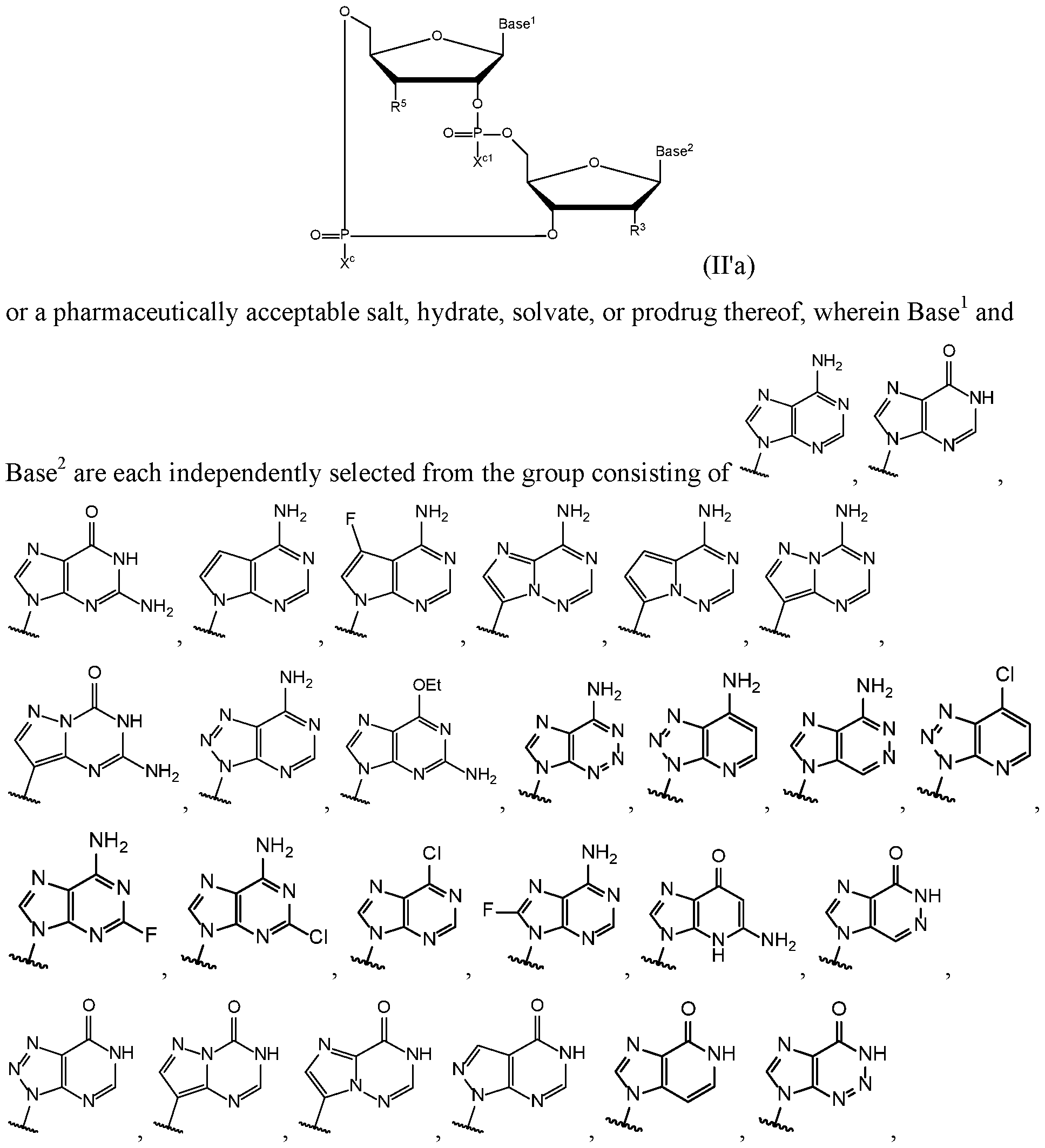

and Base2 each may be independently substituted by 0-3 substituents R10, where each R10 is independently selected from the group consisting of F, CI, I, Br, OH, SH, H2, Ci-3 alkyl, C3-6 cycloalkyl, 0(Ci-3 alkyl), 0(C3-6 cycloalkyl), S(Ci-3 alkyl), S(C3-6 cycloalkyl), H(Ci-3 alkyl), H(C3-6 cycloalkyl), N(C1-3 alkyl)2, and N(C3-6 cycloalkyl)2; Xc and Xcl are each independently selected from the group consisting of OR9, SR9, and NR9R9; R3a is selected from the group consisting of H, F, CI, Br, I, OH, CN, NH2, N3, Ci-C6 alkyl, and Ci-C6 haloalkyl, where said R3
Ci-C6 alkyl or Ci-C6 haloalkyl are substituted by 0 to 3 substituents selected from the group consisting of F, CI, Br, I, and OH; R4 and R4a are selected from the group consisting of H, F, CI, Br, I, OH, CN, N3, Ci-C6 alkyl, and Ci-C6 haloalkyl, where said R4 Ci-C6 alkyl or Ci-C6 haloalkyl are substituted by 0 to 3 substituents selected from the group consisting of F, CI, Br, I, and OH; R5 is selected from the group consisting of H, F, CI, Br, I, OH, CN, NH2, N3, Ci-C6 alkyl, and Ci-C6 haloalkyl, where said R5 Ci-C6 alkyl or Ci-C6 haloalkyl are substituted by 0 to 3 substituents selected from the group consisting of F, CI, Br, I, and OH; each R9 is independently selected from the group consisting of H, C2-C3 alkyl,


A twentieth aspect of the second embodiment relates to a pharmaceutical composition, said pharmaceutical composition comprising (a) a compound according to any one of general formula (ΙΓ) of the second embodiment above or in the first through nineteenth aspects described above or a pharmaceutically acceptable salt, hydrate, solvate, or prodrug thereof; and (b) a pharmaceutically acceptable carrier.
A twenty-first aspect of the second embodiment relates to methods of inducing an immune response in a subject, comprising administering a therapeutically effective amount of a compound according to any one of general formula (ΙΓ) of the second embodiment above or in the first through nineteenth aspects described above or a pharmaceutically acceptable salt, hydrate, solvate, or prodrug thereof to the subject.
A twenty-second aspect of the second embodiment relates to methods of inducing an immune response in a subject, comprising administering a therapeutically effective amount of a composition according to the twentieth aspect described above or a pharmaceutically acceptable salt, hydrate, solvate, or prodrug thereof to the subject.
A twenty -third aspect of the second embodiment relates to methods of inducing a STING-dependent type I interferon production in a subject, comprising administering a therapeutically effective amount of a compound according to any one of general formula (ΙΓ) of the second embodiment above or in the first through nineteenth aspects described above or a pharmaceutically acceptable salt, hydrate, solvate, or prodrug thereof to the subject.
A twenty-fourth aspect of the second embodiment relates to methods of inducing a STING-dependent type I interferon production in a subject, comprising administering a therapeutically effective amount of a composition according to the twentieth aspect described above to the subject.
A twenty-fifth aspect of the second embodiment relates to methods of inducing a STING- dependent cytokine production in a subject, comprising administering a therapeutically effective amount of a compound according to any one of general (ΙΓ) of the second embodiment above or in the first through nineteenth aspects described above or a pharmaceutically acceptable salt, hydrate, solvate, or prodrug thereof to the subject.
A twenty-sixth aspect of the second embodiment relates to methods of inducing a STING-dependent cytokine production in a subject, comprising administering a therapeutically effective amount of a composition according to the twentieth aspect described above to the subject.
A third embodiment of the disclosure relates to cyclic di-nucleotide compounds of general formula (IF):

Base are each independently selected from the group consisting of
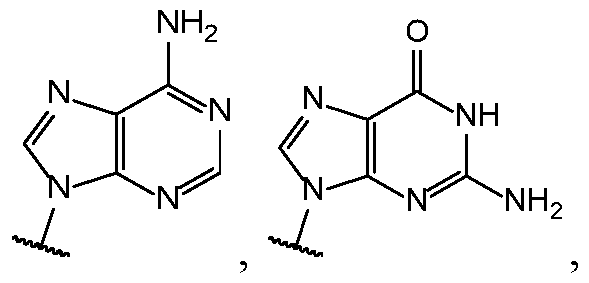
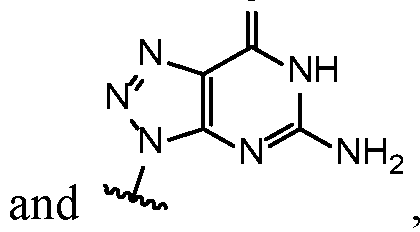
In specific aspects of this embodiment, when Y is O, Xc and Xcl are each OH or SH, Xd and Xdl are each O, R6a is H, and Base1 and Base2 are each selected from the group consisting of
 , , and , R5 and R3a are not both selected from the group consisting of H, F and OH. That is, when Y is O, Xc and Xcl are each OH or SH, Xd and Xdl are
each O, R6a is H, and Base1 and Base2 are each selected from the group consisting

 , and , either only one of R5 and R3a is selected from the group consisting of H, F, and OH, or neither R5 and R3a is selected from the group consisting of H, F, and OH. Additionally, in specific instances, when Y and Ya are each O, Xa and Xal are each O, X and X l are each O, and Xc and Xcl are each OH, Xd and Xdl are each O or S, R1 and Rla are each H, R2 is H, R6 and R6a are each H, R7 and R7a are each H, R8 and R8a are each H, and Base1
and Base2 are each selected from the group consisting , and
 , R5 and R3a are not both selected from the group consisting of H, Ci-C6 alkyl,
C2-C6 alkenyl, C2-C6 alkynyl, where said Ci-C6 alkyl, C2-C6 alkenyl and C2-C6 alkynyl are substituted by 0 to 3 substituents selected from the group consisting of F, CI, Br, I and OH.
In further specific aspects of this embodiment, when Base1 and Base2 are each selected
from the group consisting
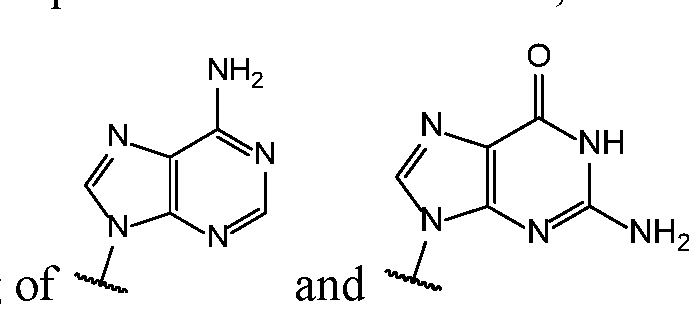 , and R2a is F and R5 is F, at least one of Xc and Xcl is SR9.
A first aspect of the third embodiment relates to a pharmaceutical composition, said pharmaceutical composition comprising (a) a compound according to any one of general formula (ΙΓ) of the third embodiment or a pharmaceutically acceptable salt, hydrate, solvate, or prodrug thereof; and (b) a pharmaceutically acceptable carrier.
A second aspect of the third embodiment relates to methods of inducing an immune response in a subject, comprising administering a therapeutically effective amount of a compound according to general formula (ΙΓ) of the third embodiment above or a
pharmaceutically acceptable salt, hydrate, solvate, or prodrug thereof to the subject.
A third aspect of the third embodiment relates to methods of inducing an immune response in a subject, comprising administering a therapeutically effective amount of a composition according to the first aspect described above to the subject.
A fourth aspect of the third embodiment relates to methods of inducing a STING- dependent type I interferon production in a subject, comprising administering a therapeutically effective amount of a compound according general formula (ΙΓ) of the third embodiment above or a pharmaceutically acceptable salt, hydrate, solvate, or prodrug thereof to the subject.
A fifth aspect of the third embodiment relates to methods of inducing a STING- dependent type I interferon production in a subject, comprising administering a therapeutically effective amount of a composition according to the second aspect described above to the subject.
A sixth aspect of the third embodiment relates to methods of inducing a STING- dependent cytokine production in a subject, comprising administering a therapeutically effective amount of a compound according to general formula (ΙΓ) of the third embodiment above or a pharmaceutically acceptable salt, hydrate, solvate, or prodrug thereof to the subject.
A seventh aspect of the third embodiment relates to methods of inducing a STING- dependent cytokine production in a subject, comprising administering a therapeutically effective amount of a composition according to the second aspect described above to the subject.
In an additional embodiment, the compound is selected from the roup consisting of

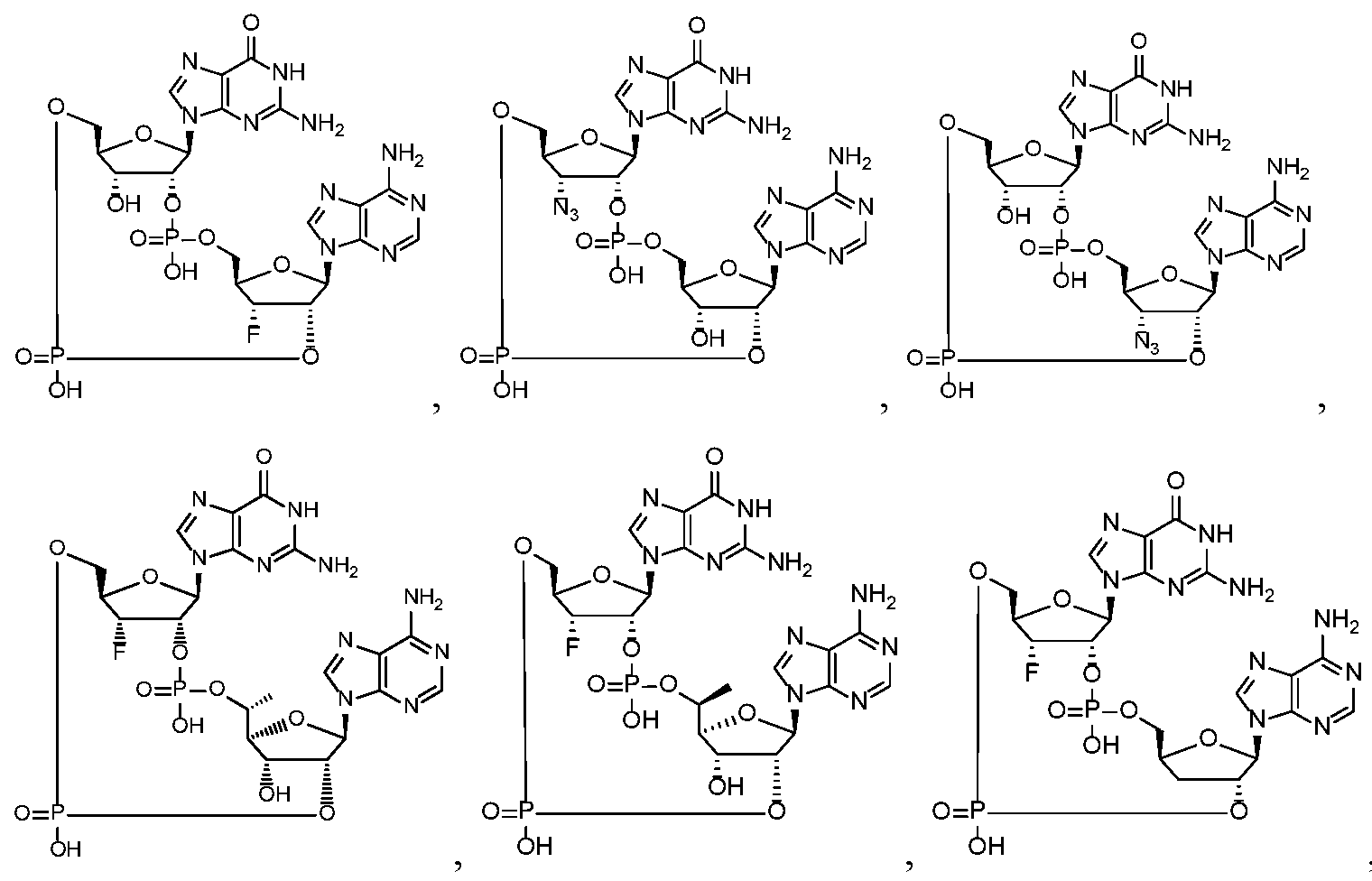

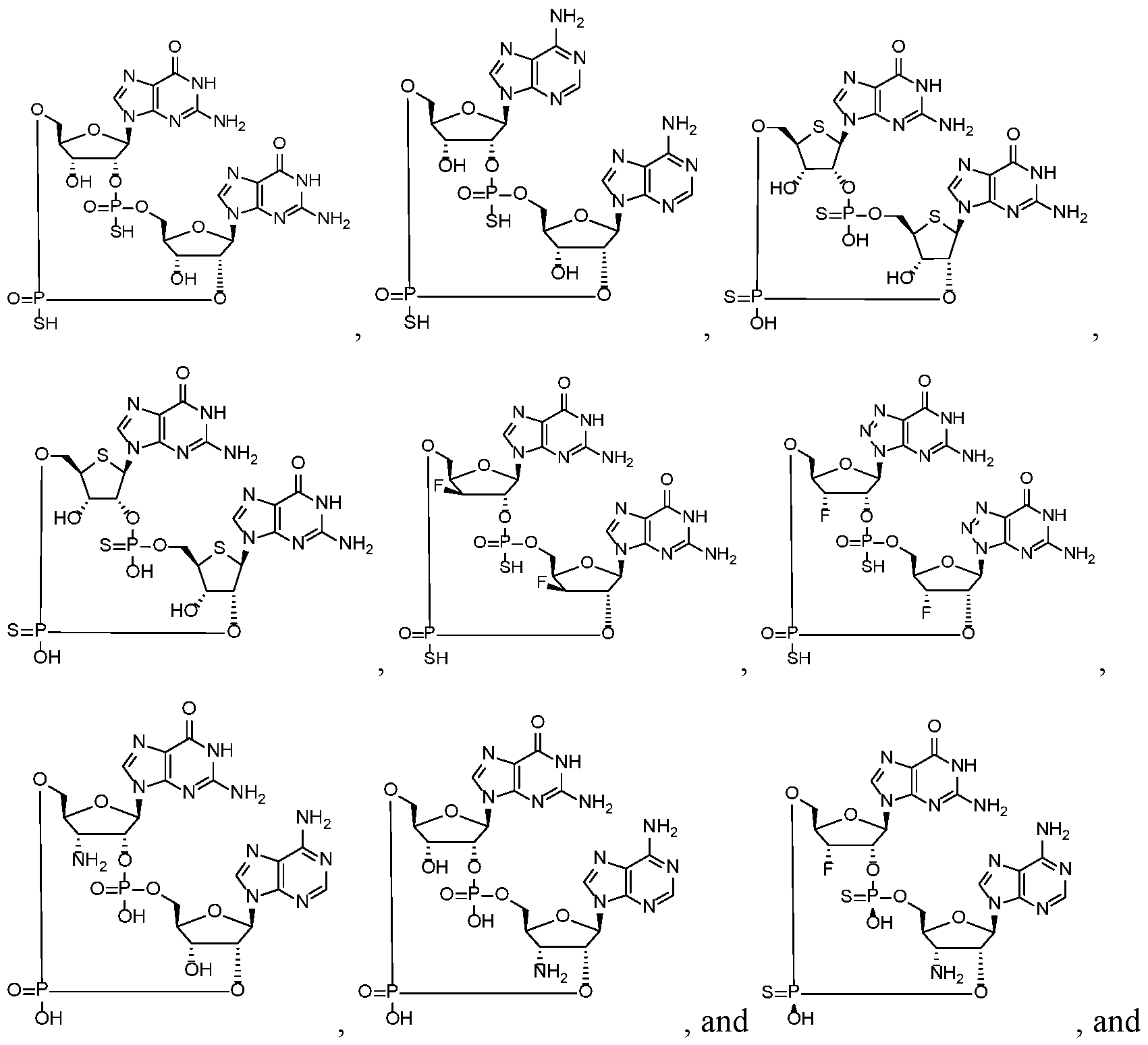
harmaceutically acceptable salts, hydrates, solvates i,, or prodrugs thereof. In particular aspects, the compound is selected from the group consistin ljg of
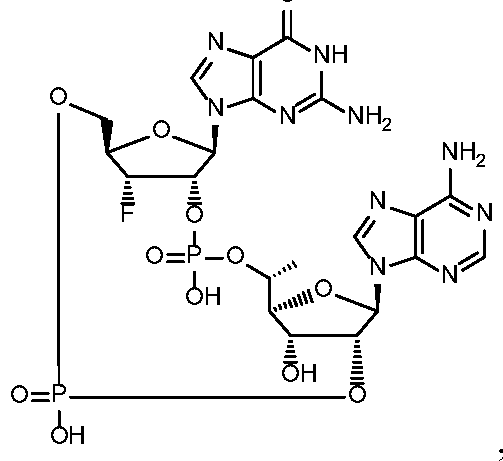

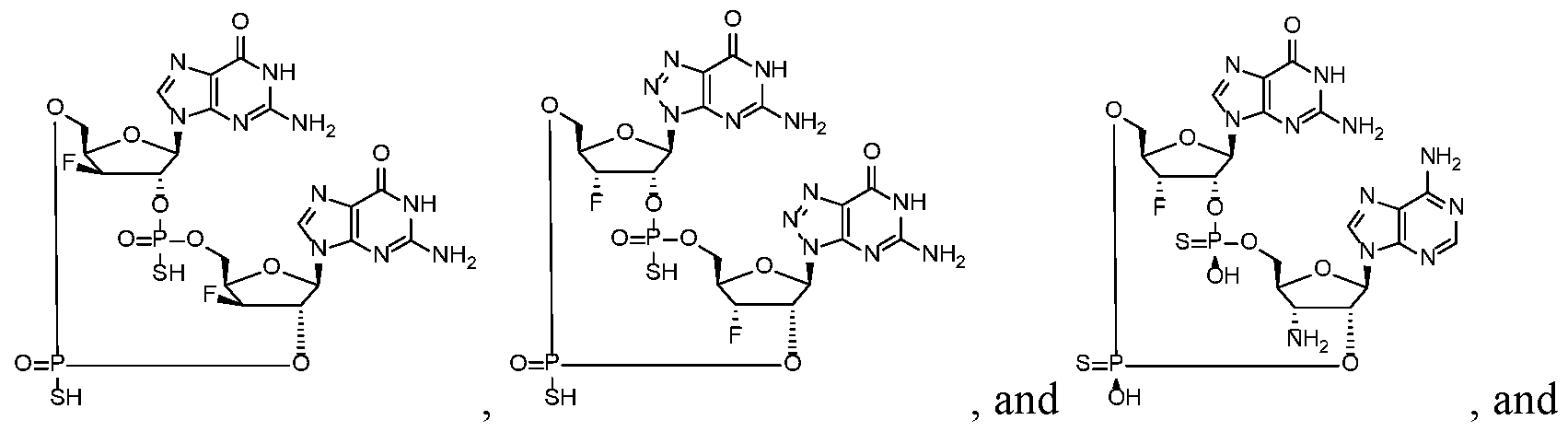
pharmaceutically acceptable salts, hydrates, solvates, or prodrugs thereof.
In another embodiment, for the compounds of general formula (II), compounds of general formula (ΙΓ) and compounds of general formula (Π"), variables Base1, Base2, Y, Ya, Xa,
Xal, X , X l, Xc, Xcl, X*, Xdl, R1, Rla, R2, R2a, R3a, R4, R4a, R5, R6, R6a, R7, R7a, R8, R8a, R9, and
R are each selected independently from each other.
In another embodiment of the disclosure, the compound of the disclosure is selected from the exemplary species depicted in Examples 1 through 34 shown below.
Other embodiments of the present disclosure include the following:
(a) A pharmaceutical composition comprising an effective amount of a compound of general formula (II) or a compound of general formula (ΙΓ), or a compound of general formula (Π"), or a pharmaceutically acceptable salt, hydrate, solvate, or prodrug thereof, and a
pharmaceutically acceptable carrier.
(b) The pharmaceutical composition of (a), further comprising a second therapeutic agent selected from the group consisting of STING agonist compounds, anti-viral compounds, antigens, adjuvants, CTLA-4 and PD-1 pathway antagonists and other immunomodulatory agents, lipids, liposomes, peptides, anti -cancer and chemotherapeutic agents.
(c) A pharmaceutical combination that is (i) a compound of general formula (II) or a compound of general formula (ΙΓ), or a compound of general formula (Π"), or a
pharmaceutically acceptable salt, hydrate, solvate, or prodrug thereof, and (ii) a second therapeutic agent selected from the group consisting of STING agonist compounds, anti-viral compounds, antigens, adjuvants, CTLA-4 and PD-1 pathway antagonists and other
immunomodulatory agents, lipids, liposomes, peptides, anti-cancer and chemotherapeutic agents; wherein the a compound of general formula (II) or compound of general formula (ΙΓ), or compound of general formula (Π"), or a pharmaceutically acceptable salt, hydrate, solvate, or prodrug thereof, and the second therapeutic agent are each employed in an amount that renders the combination effective for inducing an immune response in a patient.
(e) A method of inducing an immune response in a patient, which comprises administering to the subject an effective amount of a a compound of general formula (II) or a compound of general formula (ΙΓ), or a compound of general formula (Π"), or a
pharmaceutically acceptable salt, hydrate, solvate, or prodrug thereof.
(f) A method of inducing an immune response in a patient, which comprises administering to the subject an effective amount of a composition of (a), a composition of (b) or a combination of (c).
(g) A method of inducing STING-dependent type I interferon production in a patient, which comprises administering to the subject an effective amount of a a compound of general formula (II) or a compound of general formula (ΙΓ), or a compound of general formula (Π").
(h) A method of inducing STING-dependent type I interferon production in a patient, which comprises administering to the subject an effective amount of a composition of (a), a composition of (b) or a combination of (c).
(i) A method of inducing STING-dependent cytokine production in a patient, which comprises administering to the subject an effective amount of a compound of general formula
(II) or a compound of general formula (ΙΓ), or a compound of general formula (Π"), or a pharmaceutically acceptable salt, hydrate, solvate, or prodrug thereof.
(j) A method of inducing STING-dependent cytokine production in a patient, which comprises administering to the subject an effective amount of a composition of (a), a
composition of (b) or a combination of (c).
(k) A method of treating a cell proliferation disorder in a subject, said method comprising administering a therapeutically effective amount of a compound of general formula (II) or a compound of general formula (ΙΓ), or a compound of general formula (Π"), or a pharmaceutically acceptable salt, hydrate, solvate, or prodrug thereof to the subject;
(1) The method of (k), wherein the cell proliferation disorder is cancer.
(m). A method of treating a cell proliferation disorder in a subject, said method comprising administering a therapeutically effective amount of a pharmaceutical composition of (a), a composition of (b) or a combination of (c) to the subject.
(n) The method of (m), wherein the cell proliferation disorder is cancer.
The present disclosure also includes a compound of the present disclosure for use (i) in,
(ii) as a medicament for, or (iii) in the preparation of a medicament for: (a) inducing an immune response in a patient, or (b) inducing a STING-dependent cytokine production in a patient. In these uses, the compounds of the present disclosure can optionally be employed in combination
with one or more second therapeutic agents selected from STING agonist compounds, anti-viral compounds, antigens, adjuvants, CTLA-4 and PD-1 pathway antagonists and other
immunomodulatory agents, lipids, liposomes, peptides, anti -cancer and chemotherapeutic agents.
Additional embodiments of the disclosure include the pharmaceutical compositions, combinations and methods set forth in (a)-(n) above and the uses set forth in the preceding paragraph, wherein the compound of the present disclosure employed therein is a compound of one of the embodiments, aspects, classes, sub-classes, or features of the compounds described above. In all of these embodiments, the compound may optionally be used in the form of a pharmaceutically acceptable salt, hydrate, solvate, or prodrug as appropriate.
In the embodiments of the compound provided above, it is to be understood that each embodiment may be combined with one or more other embodiments, to the extent that such a combination provides a stable compound and is consistent with the description of the
embodiments. It is further to be understood that the embodiments of compositions and methods provided as (a) through (n) above are understood to include all embodiments of the compounds, including such embodiments as result from combinations of embodiments.
The term "subject" (alternatively referred to herein as "patient") as used herein refers to an animal, preferably a mammal, such as a human being, male or female, that has been the object of treatment, observation, or experiment. A subject also refers to one or more of cows, sheep, goats, horses, dogs, cats, rabbits, rats, mice, fish, and birds. In embodiments, the subject is human.
As used herein, the term "immune response" relates to any one or more of the following: specific immune response, non-specific immune response, both specific and non-specific response, innate response, primary immune response, adaptive immunity, secondary immune response, memory immune response, immune cell activation, immune cell proliferation, immune cell differentiation, and cytokine expression. In certain embodiments, the compound of general formula (II), compound of general formula (ΙΓ), or compound of general formula (Π"), or pharmaceutically acceptable salt, hydrate, solvate, or prodrug thereof, is administered in conjunction with one or more additional therapeutic agents including vaccines intended to stimulate an immune response to one or more predetermined anti-viral compounds, antigens, adjuvants, CTLA-4 and PD-1 pathway antagonists and other immunomodulatory agents, lipids, liposomes, peptides, anti-cancer and chemotherapeutic agents, etc. In certain embodiments, the compound of general formula (II), compound of general formula (ΙΓ), or compound of general formula (Π"), or a pharmaceutically acceptable salt, hydrate, solvate, or prodrug thereof, is
administered in conjunction with one or more additional compositions including vaccines intended to stimulate an immune response to one or more predetermined anti-viral compounds, antigens, adjuvants, CTLA-4 and PD-1 pathway antagonists and other immunomodulatory agents, lipids, liposomes, peptides, anti -cancer and chemotherapeutic agents, etc.
Compounds
The term "alkyl" refers to a monovalent straight or branched chain, saturated aliphatic hydrocarbon radical having a number of carbon atoms in the specified range. Thus, for example, "Ci-6 alkyl" (or "Ci-C6 alkyl") refers to any of the hexyl alkyl and pentyl alkyl isomers as well as n-, iso-, sec- and tert-butyl, n- and iso-propyl, ethyl, and methyl. As another example, "C1-4 alkyl" refers to n-, iso-, sec- and tert-butyl, n- and isopropyl, ethyl, and methyl.
As used herein, the term "alkylene" refers to a bivalent straight chain, saturated aliphatic hydrocarbon radical having a number of carbon atoms in the specified range.
As used herein, the term "alkenyl" refers to a monovalent straight or branched chain, unsaturated aliphatic hydrocarbon radical having a number of carbon atoms in the specified range and including one or more double bond.
As used herein, the term "alkenylene" refers to a bivalent straight chain, unsaturated aliphatic hydrocarbon radical having a number of carbon atoms in the specified range and including one or more double bond.
As used herein, the term "alkynyl" refers to a monovalent straight or branched chain, unsaturated aliphatic hydrocarbon radical having a number of carbon atoms in the specified range and including one or more triple bond.
As used herein, the term "alkynylene" refers to a bivalent straight chain, unsaturated aliphatic hydrocarbon radical having a number of carbon atoms in the specified range and including one or more triple bond.
The term "halogen" (or "halo") refers to fluorine, chlorine, bromine, and iodine
(alternatively referred to as fluoro, chloro, bromo, and iodo or F, CI, Br, and I).
The term "haloalkyl" refers to an alkyl group as defined above in which one or more of the hydrogen atoms have been replaced with a halogen. Thus, for example, "Ci-6 haloalkyl" (or "Ci-C6 haloalkyl") refers to a Ci to C6 linear or branched alkyl group as defined above with one or more halogen substituents. The term "fluoroalkyl" has an analogous meaning except the halogen substituents are restricted to fluoro. Suitable fluoroalkyls include the series (CH2)o-4CF3 (i.e., trifluoromethyl, 2,2,2-trifluoroethyl, 3,3,3-trifluoro-n-propyl, etc.).
As used herein, the term "haloalkenyl" refers to an alkenyl group as defined above in which one or more of the hydrogen atoms have been replaced with a halogen.
As used herein, the term "haloalkynyl" refers to an alkynyl group as defined above in which one or more of the hydrogen atoms have been replaced with a halogen.
As used herein, the term "spirocycle" or "spirocyclic ring" refers to a pendant cyclic group formed by substituents on a single atom. For example, in general formula (II), a spirocycle may be formed by R4 and R5.
Unless expressly stated to the contrary, all ranges cited herein are inclusive; i.e., the range includes the values for the upper and lower limits of the range as well as all values in between. As an example, temperature ranges, percentages, ranges of equivalents, and the like described herein include the upper and lower limits of the range and any value in the continuum there between. Numerical values provided herein, and the use of the term "about", may include variations of ± 1%, ± 2%, ±3%, ± 4%, ± 5%, ± 10%, ± 15%, and ± 20% and their numerical equivalents.
As used herein, the term "one or more" item includes a single item selected from the list as well as mixtures of two or more items selected from the list.
In the compounds of general formula (II), compounds of general formula (ΙΓ), and compounds of general formula (Π"), the atoms may exhibit their natural isotopic abundances, or one or more of the atoms may be artificially enriched in a particular isotope having the same atomic number, but an atomic mass or mass number different from the atomic mass or mass number predominantly found in nature. The present disclosure is meant to include all suitable isotopic variations of the compounds of general formula (II), compounds of general formula (ΙΓ), and compounds of general formula (Π"). For example, different isotopic forms of hydrogen (H) include protium (1H) and deuterium (2H). Protium is the predominant hydrogen isotope found in nature. Enriching for deuterium may afford certain therapeutic advantages, such as increasing in vivo half-life or reducing dosage requirements, or may provide a compound useful as a standard for characterization of biological samples. Isotopically-enriched compounds within general formula (II) can be prepared without undue experimentation by conventional techniques well known to those skilled in the art or by processes analogous to those described in the Schemes and Examples herein using appropriate isotopically-enriched reagents and/or intermediates.
In particular embodiments of the compounds of general formula (II), compounds of general formula (ΙΓ), and compounds of general formula (Π"), the compounds are isotopically
enriched with deuterium. In aspects of these embodiments, one or more of R1, Rla, R2, R2a, R3a, R4, R4a, R5, R6, R6a, R7, R7a, R8, R8a, R9, and R10 may be deuterium.
As shown in the general structural formulas and the structures of specific compounds as provided herein, a straight line at a chiral center includes both (R) and (S) stereoisomers and mixtures thereof. Also, unless otherwise specified (e.g., 100% purified compound), reference to a particular stereochemistry at a position provides a compound having the indicated
stereochemistry, but does not exclude the presence of stereoisomers having different
stereochemistry at the indicated position.
Recitation or depiction of a specific compound in the claims (i.e., a species) without a specific stereoconfiguration designation, or with such a designation for less than all chiral centers, is intended to encompass the racemate, racemic mixtures, each individual enantiomer, a diastereoisomeric mixture and each individual diastereomer of the compound where such forms are possible due to the presence of one or more asymmetric centers. The separation of a mixture of stereoisomers can be carried out at an intermediate step during the synthesis of a compound of general formula (II), a compound of general formula (ΙΓ), and/or a compound of general formula (Π"), or it can be done on a final racemic product. Absolute stereochemistry may be determined by X-ray crystallography of crystalline products or crystalline intermediates, which are derivatized, if necessary, with a reagent containing a stereogenic center of known configuration. Alternatively, absolute stereochemistry may be determined by Vibrational Circular Dichroism (VCD) spectroscopy analysis. The present invention includes all such isomers, as well as salts, solvates (which includes hydrates) and solvated salts of such racemates, enantiomers, diastereomers and tautomers and mixtures thereof.
Those skilled in the art will recognize that chiral compounds, and in particular sugars, can be drawn in a number of different ways that are equivalent. Those skilled in the art will further recognize that the identity and regiochemical position of the substituents on ribose can vary widely and that the same prinicples of steroechemical equivalence apply regardless of substituent. Non-limiting examples of such equivalence include those exemplified below.
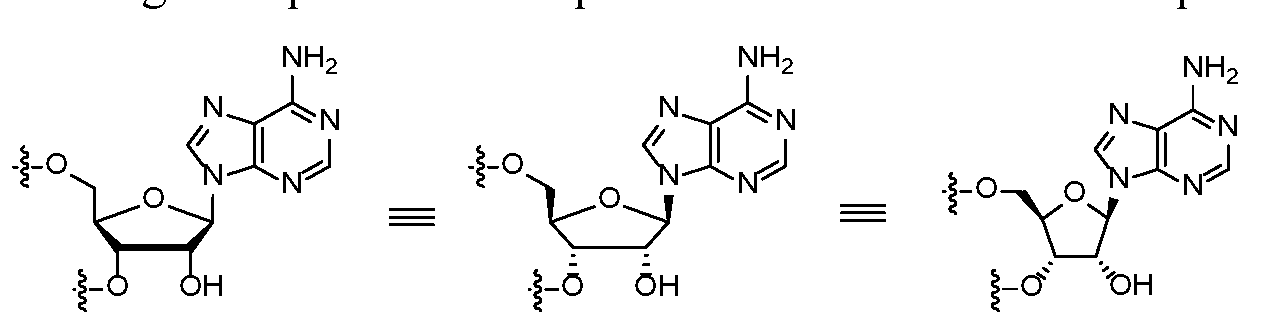

Salts
Compounds described herein having appropriate functional groups can be provided as salts. Examples of such compounds are described herein by reference to possible salts. Such reference is for illustration only. Additional embodiments include salts of any compounds described herein having suitable groups.
Pharmaceutically acceptable salts can be used with compounds for treating patients.
Non-pharmaceutical salts may, however, be useful in the preparation of intermediate compounds.
Pharmaceutically acceptable salts are suitable for administration to a patient, preferably, a human. Suitable salts include acid addition salts that may, for example, be formed by mixing a solution of a compound with a solution of a pharmaceutically acceptable acid such as
hydrochloric acid, sulfuric acid, acetic acid, trifluoroacetic acid, or benzoic acid. Compounds carrying an acidic moiety can be mixed with suitable pharmaceutically acceptable salts to provide, for example, alkali metal salts (e.g., sodium or potassium salts), alkaline earth metal salts (e.g., calcium or magnesium salts), and salts formed with suitable organic ligands such as quaternary ammonium salts. Also, in the case of an acid (-COOH) or alcohol group being present, pharmaceutically acceptable esters can be employed to modify the solubility or hydrolysis characteristics of the compound.
Methods of Preparing Compounds
Several methods for preparing the compounds of general formula (II), compounds of general formula (ΙΓ), and compounds of general formula (Π"), or pharmaceutically acceptable salts, hydrates, solvates, or prodrugs thereof, are described in the following Schemes and
Examples. Starting materials and intermediates are purchased from commercial sources, made from known procedures, or are otherwise illustrated. In some cases the order of carrying out the steps of the reaction schemes may be varied to facilitate the reaction or to avoid unwanted reaction products.
One method for the preparation of examples of general formula (II) of the disclosure is detailed in Scheme 3. The sequence starts with modified ribo-nucleoside with a nucleobase of
which amino group was appropriately protected with an alkyl or phenyl carbonyl group, and H- phosphonate functionality at 2'-0 position. It was treated with modified ribo-nucleoside with a nucleobase of which amino group was appropriately protected with an alkyl or phenyl carbonyl group, a phosphoramidite functionality at 2'-0 position and DMTr ether at 5'-0 position in acetonitrile. The product was immediately thioated with (E)-N,N-dimethyl-N'-(3-thioxo-3H- l,2,4-dithiazol-5-yl) formimidamide. Then, DMTr ether was removed under acidic condition. Using 2-chloro-5,5-dimethyl-l,3,2-dioxaphosphinane 2-oxide as a coupling reagent, the resulting 5'-hydroxyl group was reacted with 2'-H-phosphonate of fully protected first modified ribo- nucleoside to give cyclized product. It was immediately thioated with 3H-benzo[c][l,2]dithiol- 3 -one. Treatment with t-butylamine and methylamine plus fluoride anion in case silyl protection was used provided the desired cyclic dinucleotide diphosphorothioate 3F.

Compounds described herein having therapeutic applications, such as the compounds of general formula (II), the compounds of general formula (ΙΓ), and the compounds of general formula (IF), and the compounds of the Examples 1 through 34, can be administered to a patient for the purpose of inducing an immune response, inducing a STING-dependent cytokine production and/or inducing anti-tumor activity. The term "administration" and variants thereof (e.g., "administering" a compound) means providing the compound to the individual in need of treatment. When a compound is provided in combination with one or more other active agents (e.g., antiviral agents useful for treating HCV infection or anti-tumor agents for treating cancers), "administration" and its variants are each understood to include concurrent and sequential provision of the compound or salt and other agents.
The compounds disclosed herein are STING agonists and inhibitors of viral replication. These compounds are potentially useful in treating diseases or disorders including, but not limited to, cell proliferation disorders, such as cancer.
Cell-proliferation disorders include, but are not limited to, cancer. Examples of such cancers include, but are not limited to, Acute Lymphoblastic Leukemia; Acute Myeloid
Leukemia; Adrenocortical Carcinoma; AIDS-Related Lymphoma; AIDS-Related Malignancies; Anal Cancer; Astrocytoma; Bile Duct Cancer; Bladder Cancer; Bone Cancer,
Osteosarcoma/Malignant Fibrous Histiocytoma; Brain Stem Glioma; Brain Tumor, Cerebellar Astrocytoma; Brain Tumor, Cerebral Astrocytoma/Malignant Glioma; Brain Tumor,
Ependymoma; Brain Tumor, Medulloblastoma; Brain Tumor, Supratentorial Primitive
Neuroectodermal Tumors; Brain Tumor, Visual Pathway and Hypothalamic Glioma; Breast Cancer; Bronchial Adenomas/Carcinoids; Carcinoid Tumor; Carcinoid Tumor, Gastrointestinal; Carcinoma, Adrenocortical; Carcinoma, Islet Cell; Central Nervous System Lymphoma, Primary; Cerebral Astrocytoma/Malignant Glioma; Cervical Cancer; Chronic Lymphocytic
Leukemia; Chronic Myelogenous Leukemia; Chronic Myeloproliferative Disorders; Clear Cell Sarcoma of Tendon Sheaths; Colon Cancer; Colorectal Cancer; Cutaneous T-Cell Lymphoma; Endometrial Cancer; Ependymoma; Epithelial Cancer, Ovarian; Esophageal Cancer; Esophageal Cancer; Ewing's Family of Tumors; Extracranial Germ Cell Tumor; Extrahepatic Bile Duct Cancer; Eye Cancer, Intraocular Melanoma; Eye Cancer, Retinoblastoma; Gallbladder Cancer; Gastric (Stomach) Cancer; Gastrointestinal Carcinoid Tumor; Germ Cell Tumor, Extracranial, Childhood; Germ Cell Tumor, Extragonadal; Germ Cell Tumor, Ovarian; Gestational
Trophoblastic Tumor; Glioma, Childhood Brain Stem; Glioma, Childhood Visual Pathway and
Hypothalamic; Hairy Cell Leukemia; Head and Neck Cancer; Hepatocellular (Liver) Cancer; Hodgkin's Lymphoma; Hypopharyngeal Cancer; Hypothalamic and Visual Pathway Glioma; Intraocular Melanoma; Islet Cell Carcinoma (Endocrine Pancreas); Kaposi's Sarcoma; Kidney Cancer; Laryngeal Cancer; Leukemia, Acute Lymphoblastic; Leukemia, Acute Myeloid;
Leukemia, Chronic Lymphocytic; Leukemia, Chronic Myelogenous; Leukemia, Hairy Cell; Lip and Oral Cavity Cancer; Liver Cancer; Lung Cancer, Non-Small Cell; Lung Cancer, Small Cell; Lymphoblastic Leukemia; Lymphoma, AIDS- Related; Lymphoma, Central Nervous System (Primary); Lymphoma, Cutaneous T-Cell; Lymphoma, Hodgkin's; Lymphoma, Hodgkin's During Pregnancy; Lymphoma, Non-Hodgkin's; Lymphoma, Primary Central Nervous System; Macroglobulinemia, Waldenstrom's; Male Breast Cancer; Malignant Mesothelioma; Malignant Thymoma; Medulloblastoma, Childhood; Melanoma; Melanoma, Intraocular; Merkel Cell Carcinoma; Mesothelioma, Malignant; Metastatic Squamous Neck Cancer with Occult Primary; Multiple Endocrine Neoplasia Syndrome, Childhood; Multiple Myeloma/Plasma Cell Neoplasm; Mycosis Fungoides; Myelodysplastic Syndromes; Myelogenous Leukemia, Chronic; Myeloid Leukemia; Myeloma, Multiple; Myeloproliferative Disorders, Chronic; Nasal Cavity and
Paranasal Sinus Cancer; Nasopharyngeal Cancer; Neuroblastoma; Non-Hodgkin's Lymphoma; Non-Small Cell Lung Cancer; Oral Cancer; Oral Cavity and Lip Cancer; Oropharyngeal Cancer; steosarcoma/Malignant Fibrous Histiocytoma of Bone; Ovarian Epithelial Cancer; Ovarian Germ Cell Tumor; Ovarian Low Malignant Potential Tumor; Pancreatic Cancer; Paranasal Sinus and Nasal Cavity Cancer; Parathyroid Cancer; Penile Cancer; Pheochromocytoma; Pineal and Supratentorial Primitive Neuroectodermal Tumors; Pituitary Tumor; Plasma Cell
Neoplasm/Multiple Myeloma; Pleuropulmonary Blastoma; Pregnancy and Breast Cancer;
Pregnancy and Hodgkin's Lymphoma; Pregnancy and Non-Hodgkin's Lymphoma; Primary Central Nervous System Lymphoma; Primary Liver Cancer; Prostate Cancer; Rectal Cancer; Renal Cell (Kidney) Cancer; Renal Pelvis and Ureter, Transitional Cell Cancer; Retinoblastoma; Rhabdomyosarcoma; Salivary Gland Cancer; Sarcoma, Ewing's Family of Tumors; Sarcoma, Kaposi's; Sarcoma (Osteosarcoma)/Malignant Fibrous Histiocytoma of Bone; Sarcoma, Soft Tissue; Sezary Syndrome; Skin Cancer; Skin Cancer (Melanoma); Skin Carcinoma, Merkel Cell; Small Cell Lung Cancer; Small Intestine Cancer; Soft Tissue Sarcoma; Squamous Neck Cancer with Occult Primary, Metastatic; Stomach (Gastric) Cancer; Supratentorial Primitive
Neuroectodermal Tumors; T- Cell Lymphoma, Cutaneous; Testicular Cancer; Thymoma, Malignant; Thyroid Cancer; Transitional Cell Cancer of the Renal Pelvis and Ureter;
Trophoblastic Tumor, Gestational; Ureter and Renal Pelvis, Transitional Cell Cancer; Urethral
Cancer; Uterine Sarcoma; Vaginal Cancer; Visual Pathway and Hypothalamic Glioma; Vulvar Cancer; Waldenstrom's Macro globulinemia; and Wilms' Tumor.
In one embodiment, the cancer is brain cancer, such as an astrocytic tumor (e.g., pilocytic astrocytoma, subependymal giant-cell astrocytoma, diffuse astrocytoma, pleomorphic xanthoastrocytoma, anaplastic astrocytoma, astrocytoma, giant cell glioblastoma, glioblastoma, secondary glioblastoma, primary adult glioblastoma, and primary pediatric glioblastoma);
oligodendroglial tumor (e.g., oligodendroglioma, and anaplastic oligodendroglioma);
oligoastrocytic tumor (e.g., oligoastrocytoma, and anaplastic oligoastrocytoma); ependymoma (e.g., myxopapillary ependymoma, and anaplastic ependymoma); medulloblastoma; primitive neuroectodermal tumor, schwannoma, meningioma, atypical meningioma, anaplastic
meningioma; and pituitary adenoma. In another embodiment, the brain cancer is glioma, glioblastoma multiforme, paraganglioma, or suprantentorial primordial neuroectodermal tumors (sP ET).
In another embodiment, the cancer is leukemia, such as acute myeloid leukemia (AML), myelodysplastic syndrome (MDS), chronic myelogenous leukemia (CML), myeloproliferative neoplasm (MPN), post-MPN AML, post-MDS AML, del(5q)-associated high risk MDS or AML, blast-phase chronic myelogenous leukemia, angioimmunoblastic lymphoma, and acute lymphoblastic leukemia.
In one embodiment, the cancer is skin cancer, including melanoma. In another embodiment, the cancer is prostate cancer, breast cancer, thyroid cancer, colon cancer, or lung cancer. In another embodiment, the cancer is sarcoma, including central chondrosarcoma, central and periosteal chondroma, and fibrosarcoma. In another embodiment, the cancer is cholangiocarcinoma.
As used herein, the terms "treatment" and "treating" refer to all processes wherein there may be a slowing, interrupting, arresting, controlling, or stopping of the progression of a disease or disorder described herein. The terms do not necessarily indicate a total elimination of all disease or disorder symptoms.
The terms "administration of and or "administering" a compound should be understood to include providing a compound described herein, or a pharmaceutically acceptable salt, hydrate, solvate, or prodrug thereof, and compositions of the foregoing to a subject.
The amount of a compound administered to a subject is an amount sufficient to induce an immune response and/or to induce STING-dependent type I interferon production in the subject. In an embodiment, the amount of a compound can be an "effective amount" or "therapeutically
effective amount," wherein the subject compound is administered in an amount that will elicit, respectively, a biological or medical (i.e., intended to treat) response of a tissue, system, animal or human that is being sought by a researcher, veterinarian, medical doctor or other clinician. An effective amount does not necessarily include considerations of toxicity and safety related to the administration of a compound.
An effective amount of a compound will vary with the particular compound chosen (e.g., considering the potency, efficacy, and/or half-life of the compound); the route of administration chosen; the condition being treated; the severity of the condition being treated; the age, size, weight, and physical condition of the subject being treated; the medical history of the subject being treated; the duration of the treatment; the nature of a concurrent therapy; the desired therapeutic effect; and like factors and can be routinely determined by the skilled artisan.
The compounds disclosed herein may be administered by any suitable route including oral and parenteral administration. Parenteral administration is typically by injection or infusion and includes intravenous, intramuscular, and subcutaneous injection or infusion.
The compounds disclosed herein may be administered once or according to a dosing regimen wherein a number of doses are administered at varying intervals of time for a given period of time. For example, doses may be administered one, two, three, or four times per day. Doses may be administered until the desired therapeutic effect is achieved or indefinitely to maintain the desired therapeutic effect. Suitable dosing regimens for a compound disclosed herein depend on the pharmacokinetic properties of that compound, such as absorption, distribution and half-life which can be determined by a skilled artisan. In addition, suitable dosing regimens, including the duration such regimens are administered, for a compound disclosed herein depend on the disease or condition being treated, the severity of the disease or condition, the age and physical condition of the subject being treated, the medical history of the subject being treated, the nature of concurrent therapy, the desired therapeutic effect, and like factors within the knowledge and expertise of the skilled artisan. It will be further understood by such skilled artisans that suitable dosing regimens may require adjustment given an individual subject's response to the dosing regimen or over time as the individual subject needs change. Typical daily dosages may vary depending upon the particular route of administration chosen.
One embodiment of the present disclosure provides for a method of treating a cell proliferation disorder comprising administration of a therapeutically effective amount of a compound of general formula (II), a compound of general formula (ΙΓ), or a compound of
general formula (Π") to a subject in need of treatment thereof. In one embodiment, the cell proliferation disorder is cancer.
In one embodiment, the cancer is brain cancer, leukemia, skin cancer, prostate cancer, thyroid cancer, colon cancer, lung cancer or sarcoma. In another embodiment the cancer is selected from the group consisting of glioma, glioblastoma multiforme, paraganglioma, suprantentorial primordial neuroectodermal tumors, acute myeloid leukemia, myelodysplastic syndrome, chronic myelogenous leukemia, melanoma, breast, prostate, thyroid, colon, lung, central chondrosarcoma, central and periosteal chondroma tumors, fibrosarcoma, and
cholangiocarcinoma.
In one embodiment, disclosed herein is the use of a compound of general formula (II), compound of general formula (ΙΓ), and/or compound of general formula (IF), or a
pharmaceutically acceptable salt, hydrate, solvate, or prodrug thereof, in a therapy. The compound may be useful in a method of inducing an immune response and/or inducing STING- dependent type I interferon production in a subject, such as a mammal in need of such inhibition, comprising administering an effective amount of the compound to the subject.
In one embodiment, disclosed herein is a pharmaceutical composition comprising at least one compound of general formula (II), compound of general formula (ΙΓ), and/or compound of general formula (IF), or a pharmaceutically acceptable salt, hydrate, solvate, or prodrug thereof, for use in potential treatment to induce an immune response and/or to induce STING-dependent type I interferon production.
In one embodiment, disclosed herein is the use of a compound of general formula (II), compound of general formula (ΙΓ), and/or compound of general formula (IF), or a
pharmaceutically acceptable salt, hydrate, solvate, or prodrug thereof, in the manufacture of a medicament for the treatment to induce an immune response and/or to induce STING-dependent type I interferon production. In one embodiment, the disease or disorder to be treated is a cell proliferation disorder. In another embodiment, the cell proliferation disorder is cancer. In another embodiment, the cancer is brain cancer, leukemia, skin cancer, breast, prostate cancer, thyroid cancer, colon cancer, lung cancer, or sarcoma. In another embodiment, the cancer is glioma, glioblastoma multiforme, paraganglioma, suprantentorial primordial neuroectodermal tumors, acute myeloid leukemia, myelodysplastic syndrome, chronic myelogenous leukemia, melanoma, breast, prostate, thyroid, colon, lung, central chondrosarcoma, central and periosteal chondroma tumors, fibrosarcoma, and/or cholangiocarcinoma.
Compositions
The term "composition" as used herein is intended to encompass a dosage form comprising a specified compound in a specified amount, as well as any dosage form which results, directly or indirectly, from combination of a specified compound in a specified amount. Such term is intended to encompass a dosage form comprising a compound of general formula (II), a compound of general formula (ΙΓ), and/or a compound of general formula (IF), or a pharmaceutically acceptable salt, hydrate, solvate, or prodrug thereof, and one or more pharmaceutically acceptable carriers or excipients. Accordingly, the compositions of the present disclosure encompass any composition made by admixing a compound of the present disclosure and one or more pharmaceutically acceptable carrier or excipients. By "pharmaceutically acceptable", it is meant the carriers or excipients are compatible with the compound disclosed herein and with other ingredients of the composition.
For the purpose of inducing an immune response and/or inducing a STING-dependent type I interferon production, the compounds, optionally in the form of a salt, hydrate, solvate, or prodrug, can be administered by means that produces contact of the active agent with the agent's site of action. They can be administered by conventional means available for use in conjunction with pharmaceuticals, either as individual therapeutic agents or in a combination of therapeutic agents. They can be administered alone, but typically are administered with a pharmaceutical carrier selected on the basis of the chosen route of administration and standard pharmaceutical practice.
In one embodiment, disclosed herein is a composition comprising a compound of general formula (II), a compound of general formula (ΙΓ), and/or a compound of general formula (IF), or a pharmaceutically acceptable salt thereof, and one or more pharmaceutically acceptable carriers or excipients. The composition may be prepared and packaged in bulk form wherein an effective amount of a compound of the disclosure can be extracted and then given to a subject, such as with powders or syrups. Alternatively, the composition may be prepared and packaged in unit dosage form wherein each physically discrete unit contains an effective amount of a compound of general formula (II), a compound of general formula (ΙΓ), and/or a compound of general formula (IF).
The compounds disclosed herein and a pharmaceutically acceptable carrier or excipient(s) will typically be formulated into a dosage form adapted for administration to a subject by a desired route of administration. For example, dosage forms include those adapted for (1) oral administration, such as tablets, capsules, caplets, pills, troches, powders, syrups,
elixirs, suspensions, solutions, emulsions, sachets, and cachets; and (2) parenteral administration, such as sterile solutions, suspensions, and powders for reconstitution. Suitable pharmaceutically acceptable carriers or excipients will vary depending upon the particular dosage form chosen. In addition, suitable pharmaceutically acceptable carriers or excipients may be chosen for a particular function that they may serve in the composition. For example, certain
pharmaceutically acceptable carriers or excipients may be chosen for their ability to facilitate the production of uniform dosage forms. Certain pharmaceutically acceptable carriers or excipients may be chosen for their ability to facilitate the production of stable dosage forms. Certain pharmaceutically acceptable carriers or excipients may be chosen for their ability to facilitate the carrying or transporting of a compound disclosed herein, once administered to the subject, from one organ or portion of the body to another organ or another portion of the body. Certain pharmaceutically acceptable carriers or excipients may be chosen for their ability to enhance patient compliance.
Suitable pharmaceutically acceptable excipients include the following types of excipients: diluents, lubricants, binders, disintegrants, fillers, glidants, granulating agents, coating agents, wetting agents, solvents, co-solvents, suspending agents, emulsifiers, sweeteners, flavoring agents, flavor masking agents, coloring agents, anti -caking agents, hemectants, chelating agents, plasticizers, viscosity increasing agents, antioxidants, preservatives, stabilizers, surfactants, and buffering agents.
A skilled artisan possesses the knowledge and skill in the art to select suitable
pharmaceutically acceptable carriers and excipients in appropriate amounts for the use in the disclosure. In addition, there are a number of resources available to the skilled artisan, which describe pharmaceutically acceptable carriers and excipients and may be useful in selecting suitable pharmaceutically acceptable carriers and excipients. Examples include Remington's Pharmaceutical Sciences (Mack Publishing Company), The Handbook of Pharmaceutical
Additives (Gower Publishing Limited), and The Handbook of Pharmaceutical Excipients (the American Pharmaceutical Association and the Pharmaceutical Press).
The compositions of the disclosure are prepared using techniques and methods known to those skilled in the art. Some methods commonly used in the art are described in Remington's Pharmaceutical Sciences (Mack Publishing Company).
In one embodiment, the disclosure is directed to a solid oral dosage form such as a tablet or capsule comprising an effective amount of a compound of the disclosure and a diluent or filler. Suitable diluents and fillers include lactose, sucrose, dextrose, mannitol, sorbitol, starch
(e.g., corn starch, potato starch, and pre-gelatinized starch), cellulose and its derivatives, (e.g., microcrystalline cellulose), calcium sulfate, and dibasic calcium phosphate. The oral solid dosage form may further comprise a binder. Suitable binders include starch (e.g., corn starch, potato starch, and pre-gelatinized starch) gelatin, acacia, sodium alginate, alginic acid, tragacanth, guar gum, povidone, and cellulose and its derivatives (e.g., microcrystalline cellulose). The oral solid dosage form may further comprise a disintegrant. Suitable
disintegrants include crospovidone, sodium starch glycolate, croscarmelose, alginic acid, and sodium carboxymethyl cellulose. The oral solid dosage form may further comprise a lubricant. Suitable lubricants include stearic acid, magnesium stearate, calcium stearate, and talc.
Where appropriate, dosage unit formulations for oral administration can be
microencapsulated. The composition can also be prepared to prolong or sustain the release as, for example, by coating or embedding particulate material in polymers, wax, or the like.
The compounds disclosed herein may also be coupled with soluble polymers as targetable drug carriers. Such polymers can include polyvinylpyrrolidone, pyrancopolymer, polyhydroxypropylmethacrylamidephenol, polyhydroxyethylaspartamidephenol, or
polyethyleneoxidepolylysine substituted with palmitoyl residues. Furthermore, the compounds of the disclosure may be coupled to a class of biodegradable polymers useful in achieving controlled release of a drug, for example polylactic acid, polepsilon caprolactone, polyhydroxy butyric acid, polyorthoesters, polyacetals, polydihydropyrans, polycyanacrylates and cross- linked or amphipathic block copolymers of hydrogels.
In one embodiment, the disclosure is directed to a liquid oral dosage form. Oral liquids such as solution, syrups and elixirs can be prepared in dosage unit form so that a given quantity contains a predetermined amount of a compound disclosed herein. Syrups can be prepared by dissolving the compound of the disclosure in a suitably flavored aqueous solution; while elixirs are prepared through the use of a non-toxic alcoholic vehicle. Suspensions can be formulated by dispersing a compound disclosed herein in a non-toxic vehicle. Solubilizers and emulsifiers such as ethoxylated isostearyl alcohols and polyoxy ethylene sorbitol ethers, preservatives, flavor additives such as peppermint oil or other natural sweeteners or saccharin or other artificial sweeteners and the like can also be added.
In one embodiment, the disclosure is directed to compositions for parenteral
administration. Compositions adapted for parenteral administration include aqueous and nonaqueous sterile injection solutions which may contain anti-oxidants, buffers, bacteriostats, and solutes that render the formulation isotonic with the blood of the intended recipient; and aqueous
and non-aqueous sterile suspensions that may include suspending agents and thickening agents. The compositions may be presented in unit-dose or multi-dose containers, for example sealed ampoules and vials, and may be stored in a freeze dried (lyophilized) condition requiring only the addition of the sterile liquid carrier, for example water for injections, immediately prior to use. Extemporaneous injection solutions and suspensions may be prepared from sterile powders, granules and tablets.
Combinations
The compounds of general formula (II), compounds of general formula (ΙΓ), and/or compounds of general formula (Π"), or pharmaceutically acceptable salt, hydrate, solvate, or prodrug thereof, may be administered in combination with one or more additional therapeutic agents. In embodiments, one or more a compound of general formula (II), compound of general formula (ΙΓ), or compound of general formula (Π"), or pharmaceutically acceptable salt, hydrate, solvate, or prodrug thereof, and the one or more additional therapeutic agents may be co- adminstered. The additional therapeutic agent(s) may be administered in a single dosage form with the compound of general formula (II), compound of general formula (ΙΓ), or compound of general formula (Π"), or pharmaceutically acceptable salt, hydrate, solvate, or prodrug thereof, or the additional therapeutic agent(s) may be administered in separate dosage form(s) from the dosage form containing the compound of general formula (II), compound of general formula (ΙΓ), or compound of general formula (Π"), or pharmaceutically acceptable salt, hydrate, solvate, or prodrug thereof. The additional therapeutic agent(s) may be one or more agents selected from the group consisting of STING agonist compounds, anti-viral compounds, antigens, adjuvants, anti-cancer agents, CTLA-4, LAG-3 and PD-1 pathway antagonists, lipids, peptides, cytotoxic agents, chemotherapeutic agents, immunomodulatory cell lines, checkpoint inhibitors, vascular endothelial growth factor (VEGF) receptor inhibitors, topoisomerase II inhibitors, smoothen inhibitors, alkylating agents, anti-tumor antibiotics, anti-metabolites, retinoids, and
immunomodulatory agents including but not limited to anti-cancer vaccines. It will be understood the descriptions of the above additional therapeutic agents may be overlapping. It will also be understood that the treatment combinations are subject to optimization, and it is understood that the best combination to use of the compounds of general formula (II), compounds of general formula (ΙΓ), or compounds of general formula (Π") and one or more additional therapeutic agents will be determined based on the individual patient needs.
A compound disclosed herein may be used in combination with one or more other active agents, including but not limited to, other anti-cancer agents that are used in the prevention, treatment, control, amelioration, or reduction of risk of a particular disease or condition (e.g., cell proliferation disorders). In one embodiment, a compound disclosed herein is combined with one or more other anti-cancer agents for use in the prevention, treatment, control amelioration, or reduction of risk of a particular disease or condition for which the compounds disclosed herein are useful. Such other active agents may be administered, by a route and in an amount commonly used therefor, contemporaneously or sequentially with a compound of the present disclosure.
When a compound disclosed herein is used contemporaneously with one or more other active agents, a composition containing such other active agents in addition to the compound disclosed herein is contemplated. Accordingly, the compositions of the present disclosure include those that also contain one or more other active ingredients, in addition to a compound disclosed herein. A compound disclosed herein may be administered either simultaneously with, or before or after, one or more other therapeutic agent(s). A compound disclosed herein may be administered separately, by the same or different route of administration, or together in the same pharmaceutical composition as the other agent(s).
Products provided as combinations may include a composition comprising a compound of general formula (II), compound of general formula (ΙΓ), or compound of general formula (Π"), or pharmaceutically acceptable salt, hydrate, solvate, or prodrug thereof, and one or more other active agent(s) together in the same pharmaceutical composition, or may include a composition comprising a compound of general formula (II), compound of general formula (ΙΓ), or compound of general formula (Π"), or pharmaceutically acceptable salt, hydrate, solvate, or prodrug thereof, and a composition comprising one or more other therapeutic agent(s) in separate form, e.g. in the form of a kit or in any form designed to enable separate administration either concurrently or on separate dosing schedules.
The weight ratio of a compound disclosed herein to a second active agent may be varied and will depend upon the effective dose of each agent. Generally, an effective dose of each will be used. Combinations of a compound disclosed herein and other active agents will generally also be within the aforementioned range, but in each case, an effective dose of each active agent should be used. In such combinations, the compound disclosed herein and other active agents may be administered separately or in conjunction. In addition, the administration of one element may be prior to, concurrent to, or subsequent to the administration of other agent(s).
In one embodiment, this disclosure provides a composition comprising a compound of general formula (II), compound of general formula (ΙΓ), or compound of general formula (Π"), or pharmaceutically acceptable salt, hydrate, solvate, or prodrug thereof, and at least one other therapeutic agent as a combined preparation for simultaneous, separate or sequential use in therapy. In one embodiment, the therapy is the treatment of a cell proliferation disorder, such as cancer.
In one embodiment, the disclosure provides a kit comprising two or more separate pharmaceutical compositions, at least one of which contains a compound of general formula (II), compound of general formula (ΙΓ), or compound of general formula (Π"), or pharmaceutically acceptable salt, hydrate, solvate, or prodrug thereof. In one embodiment, the kit comprises means for separately retaining said compositions, such as a container, divided bottle, or divided foil packet. An example of such a kit is a blister pack, as typically used for the packaging of tablets, capsules, and the like.
A kit of this disclosure may be used for administration of different dosage forms, for example, oral and parenteral, for administration of the separate compositions at different dosage intervals, or for titration of the separate compositions against one another. To assist with compliance, a kit of the disclosure typically comprises directions for administration.
Disclosed herein is a use of a compound of general formula (II), compound of general formula (ΙΓ), or compound of general formula (Π"), or pharmaceutically acceptable salt, hydrate, solvate, or prodrug thereof, for treating a cell proliferation disorder, wherein the medicament is prepared for administration with another active agent. The disclosure also provides the use of another active agent for treating a cell proliferation disorder, wherein the medicament is administered with a compound of general formula (II).
The disclosure also provides the use of a compound of general formula (II), compound of general formula (ΙΓ), or compound of general formula (Π"), or pharmaceutically acceptable salt, hydrate, solvate, or prodrug thereof, for treating a cell proliferation disorder, wherein the patient has previously (e.g., within 24 hours) been treated with another active agent. The disclosure also provides the use of another therapeutic agent for treating a cell proliferation disorder, wherein the patient has previously (e.g., within 24 hours) been treated with a compound of general formula (II), compound of general formula (ΙΓ), or compound of general formula (Π"), or pharmaceutically acceptable salt, hydrate, solvate, or prodrug thereof. The second agent may be applied a week, several weeks, a month, or several months after the administration of a compound disclosed herein.
STING agonist compounds that may be used in combination with the compounds of general formula (II), compounds of general formula (ΙΓ), and compounds of general formula (Π") disclosed herein include but are not limited to cyclic di-nucleotide compounds.
Anti-viral compounds that may be used in combination with the compounds of general formula (II), compounds of general formula (ΙΓ), and compounds of general formula (Π") disclosed herein include hepatitis B virus (HBV) inhibitors, hepatitis C virus (HCV) protease inhibitors, HCV polymerase inhibitors, HCV NS4A inhibitors, HCV NS5 A inhibitors, HCV NS5b inhibitors, and human immunodeficiency virus (HIV) inhibitors.
Antigens and adjuvants that may be used in combination with the compounds of general formula (II), compounds of general formula (ΙΓ), and compounds of general formula (Π") disclosed herein include B7 costimulatory molecule, interleukin-2, interferon-y, GM-CSF, CTLA-4 antagonists, OX-40/0X-40 ligand, CD40/CD40 ligand, sargramostim, levamisol, vaccinia virus, Bacille Calmette-Guerin (BCG), liposomes, alum, Freund's complete or incomplete adjuvant, detoxified endotoxins, mineral oils, surface active substances such as lipolecithin, pluronic polyols, polyanions, peptides, and oil or hydrocarbon emulsions.
Adjuvants, such as aluminum hydroxide or aluminum phosphate, can be added to increase the ability of the vaccine to trigger, enhance, or prolong an immune response. Additional materials, such as cytokines, chemokines, and bacterial nucleic acid sequences, like CpG, a toll-like receptor (TLR) 9 agonist as well as additional agonists for TLR 2, TLR 4, TLR 5, TLR 7, TLR 8, TLR9, including lipoprotein, LPS, monophosphoryllipid A, lipoteichoic acid, imiquimod, resiquimod, and in addition retinoic acid-inducible gene I (RIG-I) agonists such as poly I:C, used separately or in combination with the described compositions are also potential adjuvants.
CLTA-4 and PD-1 pathways are important negative regulators of immune response. Activated T-cells upregulate CTLA-4, which binds on antigen-presenting cells and inhibits T-cell stimulation, IL-2 gene expression, and T-cell proliferation; these anti-tumor effects have been observed in mouse models of colon carcinoma, metastatic prostate cancer, and metastatic melanoma. PD-1 binds to active T-cells and suppresses T-cell activation; PD-1 antagonists have demonstrated anti-tumor effects as well. CTLA-4 and PD-1 pathway antagonists that may be used in combination with the compounds of general formula (II) disclosed herein include ipilimumab, tremelimumab, nivolumab, pembrolizumab, CT-011, AMP -224, and MDX-1106.
"PD-1 antagonist" or "PD-1 pathway antagonist" means any chemical compound or biological molecule that blocks binding of PD-Ll expressed on a cancer cell to PD-1 expressed on an immune cell (T-cell, B-cell, or NKT-cell) and preferably also blocks binding of PD-L2
expressed on a cancer cell to the immune-cell expressed PD-1. Alternative names or synonyms for PD-1 and its ligands include: PDCDl, PDl, CD279, and SLEB2 for PD-1; PDCDILI, PDLl, B7H1, B7-4, CD274, and B7-H for PD-Ll; and PDCDl L2, PDL2, B7-DC, Btdc, and CD273 for PD-L2. In any of the treatment method, medicaments and uses of the present disclosure in which a human individual is being treated, the PD-1 antagonist blocks binding of human PD-Ll to human PD-1, and preferably blocks binding of both human PD-Ll and PD-L2 to human PD-1. Human PD-1 amino acid sequences can be found in NCBI Locus No. : NP 005009. Human PD-Ll and PD-L2 amino acid sequences can be found in NCBI Locus No.: NP 054862 and NP_079515, respectively.
PD-1 antagonists useful in any of the treatment method, medicaments and uses of the present disclosure include a monoclonal antibody (mAb), or antigen binding fragment thereof, which specifically binds to PD-1 or PD-Ll, and preferably specifically binds to human PD-1 or human PD-Ll . The mAb may be a human antibody, a humanized antibody, or a chimeric antibody and may include a human constant region. In some embodiments, the human constant region is selected from the group consisting of IgGl, IgG2, IgG3, and IgG4 constant regions, and in preferred embodiments, the human constant region is an IgGl or IgG4 constant region. In some embodiments, the antigen binding fragment is selected from the group consisting of Fab, Fab'-SH, F(ab')2, scFv, and Fv fragments.
Examples of mAbs that bind to human PD-1, and useful in the treatment method, medicaments and uses of the present disclosure, are described in U.S. Patent Nos. US7488802, US7521051, US8008449, US8354509, and US8168757, PCT International Patent Application Publication Nos. WO2004/004771, WO2004/072286, and WO2004/056875, and U.S. Patent Application Publication No. US2011/0271358.
Examples of mAbs that bind to human PD-Ll, and useful in the treatment method, medicaments and uses of the present disclosure, are described in PCT International Patent
Application Nos. WO2013/019906 and WO2010/077634 Al and in U.S. Patent No. US8383796. Specific anti -human PD-Ll mAbs useful as the PD-1 antagonist in the treatment method, medicaments and uses of the present disclosure include MPDL3280A, BMS-936559,
MEDI4736, MSB0010718C, and an antibody that comprises the heavy chain and light chain variable regions of SEQ ID NO:24 and SEQ ID NO:21, respectively, of WO2013/019906.
Other PD-1 antagonists useful in any of the treatment method, medicaments, and uses of the present disclosure include an immune-adhesion that specifically binds to PD-1 or PD-Ll, and preferably specifically binds to human PD-1 or human PD-Ll, e.g., a fusion protein containing
the extracellular or PD-1 binding portion of PD-L1 or PD-L2 fused to a constant region such as an Fc region of an immunoglobulin molecule. Examples of immune-adhesion molecules that specifically bind to PD-1 are described in PCT International Patent Application Publication Nos. WO2010/027827 and WO2011/066342. Specific fusion proteins useful as the PD-1 antagonist in the treatment method, medicaments, and uses of the present disclosure include AMP-224 (also known as B7-DCIg), which is a PD-L2-FC fusion protein and binds to human PD-1.
Examples of cytotoxic agents that may be used in combination with the comounds of general formula (II), compounds of general formula (ΙΓ), and compounds of general formula (Π"), or pharmaceutically acceptable salts, hydrates, solvates, or prodrugs thereof include, but are not limited to, arsenic trioxide (sold under the tradename TRISENOX®), asparaginase (also known as L-asparaginase, and Erwinia L-asparaginase, sold under the tradenames ELSPAR® and
KlDROLASE®).
Chemotherapeutic agents that may be used in combination with the compounds of general formula (II), compounds of general formula (ΙΓ), and compounds of general formula (Π"), or pharmaceutically acceptable salts, hydrates, solvates, or prodrugs thereof, disclosed herein include abiraterone acetate, altretamine, anhydrovinblastine, auristatin, bexarotene, bicalutamide, BMS 184476, 2,3,4,5, 6-pentafluoro-N-(3-fluoro-4-methoxyphenyl)benzene sulfonamide, bleomycin, N,N-dimethyl-L-valyl-L-valyl-N-methyl-L-valyl-L-proly- 1-Lproline- tbutylamide, cachectin, cemadotin, chlorambucil, cyclophosphamide, 3',4'-didehydro-4'deoxy-8'- norvin-caleukoblastine, docetaxol, doxetaxel, cyclophosphamide, carboplatin, carmustine, cisplatin, cryptophycin, cyclophosphamide, cytarabine, dacarbazine (DTIC), dactinomycin, daunorubicin, decitabine dolastatin, doxorubicin (adriamycin), etoposide, 5-fluorouracil, finasteride, flutamide, hydroxyurea and hydroxyureataxanes, ifosfamide, liarozole, lonidamine, lomustine (CCNU), MDV3100, mechlorethamine (nitrogen mustard), melphalan, mivobulin isethionate, rhizoxin, sertenef, streptozocin, mitomycin, methotrexate, taxanes, nilutamide, nivolumab, onapristone, paclitaxel, pembrolizumab, prednimustine, procarbazine, RPR109881, stramustine phosphate, tamoxifen, tasonermin, taxol, tretinoin, vinblastine, vincristine, vindesine sulfate, and vinflunine.
Examples of vascular endothelial growth factor (VEGF) receptor inhibitors include, but are not limited to, bevacizumab (sold under the trademark AVASTIN by Genentech/Roche), axitinib (described in PCT International Patent Publication No. WO01/002369), Brivanib Alaninate ((S)-((R)-l-(4-(4-Fluoro-2-methyl-lH-indol-5-yloxy)-5-methylpyrrolo[2, l- f][l,2,4]triazin-6-yloxy)propan-2-yl)2-aminopropanoate, also known as BMS-582664),
motesanib (N-(2, 3 -dihydro-3 ,3 -dimethyl - 1 H-indol-6-yl)-2- [(4-pyridinylmethyl)amino] -3 - pyridinecarboxamide. and described in PCT International Patent Application Publication No. WO02/068470), pasireotide (also known as SO 230, and described in PCT International Patent Publication No. WO02/010192), and sorafenib (sold under the tradename NEXAVAR).
Examples of topoisomerase II inhibitors, include but are not limited to, etoposide (also known as VP- 16 and Etoposide phosphate, sold under the tradenames TOPOSAR, VEPESID, and ETOPOPHOS), and teniposide (also known as VM-26, sold under the tradename VUMON).
Examples of alkylating agents, include but are not limited to, 5-azacytidine (sold under the trade name VIDAZA), decitabine (sold under the trade name of DECOGEN), temozolomide (sold under the trade names TEMOD AR and TEMOD AL by Schering-Plough/Merck), dactinomycin (also known as actinomycin-D and sold under the tradename COSMEGEN), melphalan (also known as L-PAM, L-sarcolysin, and phenylalanine mustard, sold under the tradename ALKERAN), altretamine (also known as hexamethylmelamine (HMM), sold under the tradename HEXALEN), carmustine (sold under the tradename BCNU), bendamustine (sold under the tradename TREANDA), busulfan (sold under the tradenames BUSULFEX® and
MYLERAN®), carboplatin (sold under the tradename PARAPLATIN®), lomustine (also known as CCNU, sold under the tradename CEENU®), cisplatin (also known as CDDP, sold under the tradenames PLATINOL® and PLATINOL®-AQ), chlorambucil (sold under the tradename
LEUKERAN®), cyclophosphamide (sold under the tradenames CYTOXAN® and NEOSAR®), dacarbazine (also known as DTIC, DIC and imidazole carboxamide, sold under the tradename DTIC-DOME®), altretamine (also known as hexamethylmelamine (HMM) sold under the tradename HEXALEN®), ifosfamide (sold under the tradename IFEX®), procarbazine (sold under the tradename MATULANE®), mechlorethamine (also known as nitrogen mustard, mustine and mechloroethamine hydrochloride, sold under the tradename MUSTARGEN®), streptozocin (sold under the tradename ZANOSAR®), thiotepa (also known as thiophosphoamide, TESPA and TSPA, and sold under the tradename THIOPLEX®.
Examples of anti-tumor antibiotics include, but are not limited to, doxorubicin (sold under the tradenames ADRIAMYCIN® and RUBEX®), bleomycin (sold under the tradename LENOXANE®), daunorubicin (also known as dauorubicin hydrochloride, daunomycin, and rubidomycin hydrochloride, sold under the tradename CERUBIDINE®), daunorubicin liposomal (daunorubicin citrate liposome, sold under the tradename DAUNOXOME®), mitoxantrone (also known as DHAD, sold under the tradename NOVANTRONE®), epirubicin (sold under the
tradename ELLENCE™), idarubicin (sold under the tradenames IDAMYCIN , IDAMYCIN PFS ), and mitomycin C (sold under the tradename MUTAMYCIN®).
Examples of anti-metabolites include, but are not limited to, claribine (2- chlorodeoxyadenosine, sold under the tradename LEUSTATIN®), 5-fluorouracil (sold under the tradename ADRUCIL®), 6-thioguanine (sold under the tradename PURINETHOL®), pemetrexed
(sold under the tradename ALIMTA®), cytarabine (also known as arabinosylcytosine (Ara-C), sold under the tradename CYTOSAR-U®), cytarabine liposomal (also known as Liposomal Ara-C, sold under the tradename DEPOCYT™), decitabine (sold under the tradename DACOGEN®), hydroxyurea (sold under the tradenames HYDREA®, DROXIA™ and MYLOCEL™), fludarabine (sold under the tradename FLUDARA®), floxuridine (sold under the tradename FUDR®), cladribine (also known as 2-chlorodeoxyadenosine (2-CdA) sold under the tradename
LEUSTATIN™), methotrexate (also known as amethopterin, methotrexate sodium (MTX), sold under the tradenames RHEUMATREX® and TREXALL™), and pentostatin (sold under the tradename NIPENT®).
Examples of retinoids include, but are not limited to, alitretinoin (sold under the tradename PANRETIN®), tretinoin (all-trans retinoic acid, also known as ATRA, sold under the tradename VESANOID®), Isotretinoin (13-c/s-retinoic acid, sold under the tradenames
ACCUTANE®, AMNESTEEM®, CLARAVIS®, CLARUS®, DECUTAN®, ISOTANE®, IZOTECH®,
ORATANE®, ISOTRET®, and SOTRET®), and bexarotene (sold under the tradename TARGRETIN®).
Activity: STING Biochemical HIcGAMP Competition Assay
The individual compounds described in the Examples herein are defined as STFNG agonists by demonstrating binding to the STING protein with an EC50 of 20uM or less in the STFNG Biochemical [3H]cGAMP Competition Assay and demonstrating interferon production with a 20% or greater luminescence induction at 30uM in the IFN-β secretion in the THP1 cell assay.
The ability of compounds to bind STFNG is quantified by the ability to compete with tritiated cGAMP ligand for human STFNG receptor membrane using a radioactive filter-binding assay. The binding assay employs STFNG receptor obtained from Hi-Five cell membranes overexpressing full-length HAQ STFNG prepared in-house and tritiated cGAMP ligand also purified in-house.
ABBREVIATIONS
1H - MR Proton nuclear magnetic resonance spectroscopy
19F-NMR 19F nuclear magnetic resonance spectroscopy
31P- MR 31P nuclear magnetic resonance spectroscopy
A Angstrom
ABz 6-N-benzoyladenine
aq Aqueous
Ar Argon
ATP Adenosine 5 '-triphosphate
Bz Benzoyl
CD3OD Deuterium-enriched methyl alcohol, deuterium-enriched methanol
CHCI3 Tri chl orom ethane
Ci Curie, a non-standard unit of radioactivity; ICi = 3.7>< 1010Bq, where Bq is Becquerel, the SI unit of radioactivity, equivalent to 1 disintegration per second (dps)
C02 Carbon dioxide
d Doublet
d Day(s)
D20 Deuterium-enriched water
DCA Dichloroacetic acid
DCM, CH2C12 Dichloromethane
ddd Doublet of doublet of doublet
ddt Doublet of doublet of triplet
DDTT (E)-N,N-dimethyl-N'-(3-thioxo-3H-l,2,4-dithiazol-5-yl)formimidamide
DMA N,N-dimethylacetamide
DMF N,N-dimethylformamide
DMOCP 2-chloro-5,5-dimethyl-l,3,2-dioxaphosphineane 2-oxide
DMSO Dimethyl sulfoxide
DMTr 4,4'-dimethoxytrityl
DMTrCl 4,4'-dimethoxytrityl chloride
dq Doublet of quartet
EC 50 half maximal effective concentration, concentration of a drug, antibody or toxicant that induces a response halfway between the baseline and maximum after a specified exposure time
eq Equivalents
ES Electron spray
Et Ethyl
Et20 Diethyl ether
Et3SiH Triethylsilane
EtOAc Ethyl acetate
EtOH Ethyl alcohol, ethanol
g Gram
GTP Guanosine 5 '-triphosphate
h Hour
H20 Water
HEPES 2-[4-(2~hydroxyethyi)piperazin-l -yljethanesulfonic acid, a zwitterionic organic chemical buffering agent
hept Heptet
Hex Hexanes
HF-Pyr Hydrogen fluoride - pyridine complex
HPLC High performance liquid chromatography
Hz Hertz
ITP Inosine 5 '-triphosphate
J MR Coupling constant
LCMS Liquid chromatography - mass spectroscopy
m Multiplet
M Molar, moles per liter
mCi Millicurie
Me Methyl
MeCN, ACN Acetonitrile
Me H2 Methylamine
mg Milligram
MgCl2 Magnesium chloride
MHz Megahertz
min Minute(s)
mL,ml Milliliter
mM Millimole per liter
mmol Millimole
MOI Multiplicity of infection
MPLC Medium pressure liquid chromatography
MTBE Methyl t-butyl ether, methyl tertiary butyl ether
Na2S04 Sodium sulfate
NaCl Sodium chloride
NaHC03 Sodium bicarbonate
NaHS03 Sodium bisulfite
NaOH Sodium hydroxide
ng Nanogram(s)
H4HC03 Ammonium bicarbonate
H4OH Ammonium hydroxide
nL Nanoliter
nm Nanometer
nM Nanomolar
P205 Phosphorus pentoxide
Prep-HPLC Preparative high performance liquid chromatography
Py Pyridine
q Quartet
RPM, rpm Revolutions per minute
RT, rt Room temperature, approximately 25°C
s Singlet
sat Saturated
t Triplet
TBS t-Butyldimethylsilyl
TMA Trimethylamine
TEA, Et3N Tri ethyl amine
TFA Trifluoroacetic acid
THF Tetrahydrofuran
TLC Thin layer chromatography
TMSC1 Trimethylsilyl chloride
TR Retention time
TrisCl Tris(hydroxymethyl)aminom ethane hydrochloride
v/v Volume/volume
Emission wavelength
Excitation wavelength
Microgram
μί, uL Microliter
uM, uM Micromolar
Preparation 1 : N-( 9-(T2R,3S,4S,5RV5-( (bis( 4-methoxyphenylK phenvnmethoxy)methvn-4- fluoro-3-hvdroxytetrahvdrofuran-2-yl)-6-oxo-6,9-dihydro-lH-purin-2-yl)isobutyramide

F OH
Step 1: N-(9-( (2R, 3S, 4S, 5R)-4-fIuoro-3-hvdroxy-5-(7rvdroxymethyl)tetrahvdrofuran-2-yl)-6-oxo-
6,9-dihydro-lH-purin-2-yl)isobutyramide
H

To a suspension of 2-amino-9-((2R,3S,4S,5R)-4-fluoro-3-hydroxy-5- (hydroxymethyl)tetrahydrofuran-2-yl)-l,9-dihydro-6H-purin-6-one (Carbosynth catalog #
D10826, 1.50g, 5.26mmol) in pyridine (30mL) at 0-5°C was added TMSC1 (2.86g, 26.3mmol), and the mixture was stirred at rt for 30min. Then, isobutyric anhydride (2.50g, 15.8mmol) was added dropwise, and it was stirred for an additional 2h. Then, MeOH (5.3mL) was added. After 5min, H4OH (10.5mL) was added dropwise, and stirring was continued for 30min. The reaction mixture was concentrated under reduced pressure, and MeOH (2mL) in CH2C12 (18mL) was added to the residue. Insolubles were filtered off, and the filtrate was concentrated and purified by flash column chromatography with 2-10% MeOH in CH2C12 to give the product. LCMS (ES, m/z): 356.1 [M + H]+. 1H- MR: (400MHz, DMSO-i¾): δ 12.11 (s, 1H), 11.68 (s, 1H), 8.28 (s, 1H), 5.98 (d, J= 6.1HZ, 1H), 5.85 (d, J= 8.0HZ, 1H), 5.24 (t, J= 5.4HZ, 1H), 5.14
(d, J= 4.1HZ, 0.5H), 5.01 (d, J= 4.2HZ, 0.5H), 4.87-4.69 (m, 1H), 4.26 (t, J= 4.4HZ, 0.5H), 4.19 (t, J= 4.4HZ, 0.5H), 3.61 (t, J= 4.9HZ, 2H), 2.77 (hept, J= 6.8HZ, 1H), 1.13 (d, J = 6.7HZ, 6H). 19F-NMR: (376MHz, DMSO-i¾): δ -197.5 (s).
Step 2: N-(9-( (2R 3S, 4S, 5R)-5-( (bis(4-methoxyphenyl) (phenyl)methoxy)methyl)-4-fluoro-3- hydroxytetrahydrofuran-2-yl)-6-oxo-6,9-dihydro-lH^urin-2-yl)isobutyramide

N-(9-((2R,3S,4S,5R)-4-fluoro-3-hydroxy-5-(hydroxymethyl)tetrahydrofuran-2-yl)-6-oxo- 6,9-dihydro-lH-purin-2-yl)isobutyramide (1.30g, 3.66mmol) was co-evaporated with pyridine (3x lOmL) and re-dissolved in pyridine (26mL). To the solution at 0-5°C was added DMTrCI (l -36g, 4.02mmol). It was stirred at rt for 3h and then concentrated. CH2C12 (40mL, with 1% Et3N) was added, and it was washed with sat aq NaHC03 (15mL), water (lOmL) and brine (lOmL). The organic solution was dried (Na2S04), concentrated and purified by silica gel column chromatography using 0-10% MeOH in CH2C12 (1% Et3N) to give the product. LCMS (ES, m/z): 656.2 [M - H]". 1H- MR: (400MHz, DMSO-i4) : δ 12.10 (s, 1H), 11.61 (s, 1H), 8.14 (s, 1H), 7.40-7.31 (m, 2H), 7.31-7.19 (m, 7H), 6.89-6.78 (m, 4H), 6.08 (d, J= 6.1Hz, 1H), 5.87 (d, J= 7.3Hz, 1H), 5.23 (dd, J= 4.1, 1.8Hz, 1H), 5.10 (d, J= 4.4Hz, 1H), 4.96 (dq, J= 22.4, 5.9Hz, 1H), 4.30 (dt, J= 26.1, 4.6Hz, 1H), 3.74 (d, J= 1.1Hz, 6H), 3.39 (dd, J= 10.6, 5.7Hz, 1H), 3.22 (dd, J = 10.6, 3.8Hz, 1H), 2.76 (p, J= 6.8Hz, 1H), 1.13 (d, J= 6.8Hz, 6H). 19F-NMR: (376MHz, DMSO-i/6) : δ -198.1 (s, IF).
Preparation 2: (2R,3S,4R,5R)-5-^bisH-methoxyphenyl)(phenyl)methoxy)methyl)-4-fluoro- 2-(2-isobutyramido-6-oxo-l,6-dihvdro-9H-purin-9-yl)tetrahydrofuran-3-yl (2-cyanoethyl) diisopropylphosphoramidite

Step 1: (2R3SAR,5R)-5-((bis(4-methoxyphenyl)(phenyl)methoxy)methyl)-4-fluoro-2-(2- isobutyramido-6-oxo-L 6-dihydro-9H-purin-9-yl)tetrahydrofm (2-cyanoethyl)
diisopropylphosphoramidite

To a mixture of N-(9-((2R,3S,4S,5R)-5-((bis(4-methoxyphenyl)(phenyl)methoxy)- methyl)-4-fluoro-3-hydroxytetrahydrofuran-2-yl)-6-oxo-6,9-dihydro-lH-purin-2-yl)- isobutyramide (2. lg, 3.19mmol) in MeCN (30mL) under Ar was added pyridine trifluoroacetate (0.678g, 3.51mmol), followed by 3-((bis(diisopropylamino)phosphino)oxy)-propanenitrile
(1.16g, 3.83mmol) in MeCN (2mL), which was added dropwise with stirring at 0°C over lOmin. Then, the mixture was stirred at 20°C for 5h. TLC/LCMS indicated complete conversion to desired product. The resulting mixture was diluted with a solution of 2% TEA in CHC13 (300mL) and washed successively with aq NaHC03 (3xl00mL), H20 (2x lOOmL) and brine (2x100ml). The organic layer was dried over anhydrous Na2S04 and concentrated. The crude residue was purified by flash column chromatography with 10% DCM in EtOAc/hexane (2/3) to give crude product. The residue was dissolved in CHC13 (20mL) and precipitated in hexane (500mL). The precipitate was filtered, and the residue was washed successively with H20 (2xl00mL), and brine (2x100ml). The organic layer was dried over anhydrous Na2S04 and concentrated. The residue was dissolved in MTBE (20mL) and precipitated in hexane (500mL). The precipitate was filtered to yield the title compound. LCMS (ES, m/z): 856.9 [M - H]". 1H NMR (400MHz, OMSO-d6) δ 12.07 (s, 1H), 11.55 (s, 1H), 8.08 (d, J = 4.2Hz, 1H), 7.38 - 7.16 (m, 10H), 6.83 (ddd, J= 8.9, 6.2, 2.1Hz, 5H), 5.99 (t, J= 6.8Hz, 1H), 5.19 - 5.12 (m, 1H), 4.39 (d, J= 5.2Hz, 1H), 3.71 (s, 8H), 3.59 - 3.35 (m, 3H), 3.26 (dd, J = 10.3, 3.5Hz, 1H), 2.79 - 2.66 (m, 2H), 1.26 - 1.00 (m, 18H), 0.88 - 0.70 (m, 4H). 19F NMR (376MHz, OMSO-d6) δ -195.78, - 197.06. 31P NMR (162MHz, OMSO-d6) δ 151.57, 151.53, 151.37, 151.33.
Preparation 3: N-f3-^2R,3S,4S,5R)-5-^bisf4-methoxyphenyl)fphenyl)methoxy)methyl)-4- fluoro-3-hvdroxytetrahvdrofuran-2-yl)-7-oxo-6,7-dihydro-3H-[l,2,31triazolo[4,5- dl pyrimidin-5-yl)isobutyramide
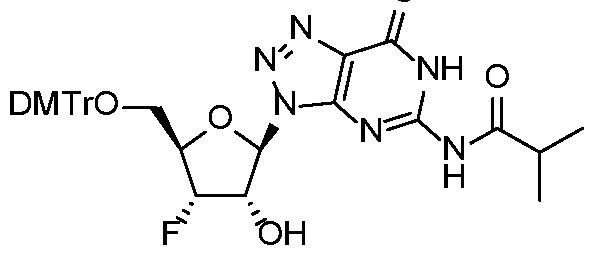
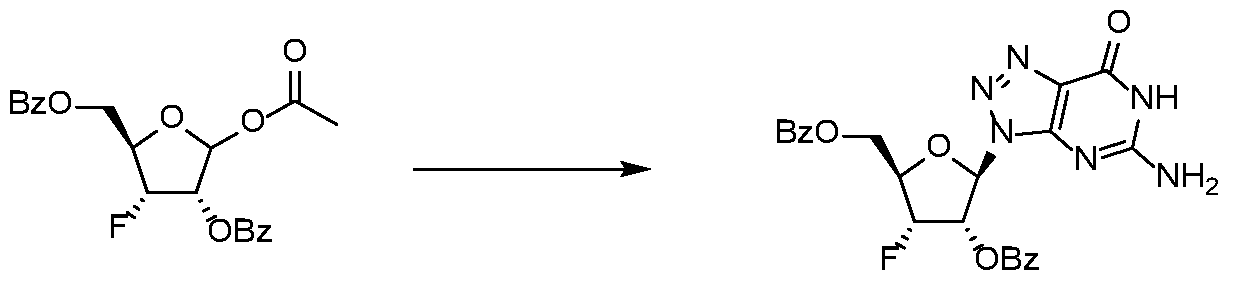
To a suspension of 8-azaguanine (5.14g, 33.8mmol) in anhydrous CH3CN (lOOmL) at rt was added dropwise (E)-trimethylsilyl N-(trimethylsilyl)acetimidate (16.53mL, 67.6mmol) then the mixture was stirred at 70°C for 2h. The reaction was cooled to rt and a solution of
((2R,3R,4S)-5-acetoxy-4-(benzoyloxy)-3-fluorotetrahydrofuran-2-yl)methyl benzoate (6.8g, 16.90mmol) in anhydrous CH3CN (20mL) was added followed by dropwise addition of tin(IV) chloride (67.6mL, 67.6mmol). The homogeneous solution was stirred at 70°C for 2h. The reaction was cooled to rt and concentrated. The residue was dissolved in EtOAc (lOOOmL) and neutralized by pouring into saturated aq NaHC03 (500mL). The organic layer was separated, and the aq layer was extracted with EtOAc (4x500mL). The organic layers were combined and washed with water (3x700mL), brine, dried over anhydrous sodium sulfate, filtered, and concentrated to afford title compound without further purification. LCMS (ES, m/z): 495.3 [M +
H]+.
Step 2: ((2R,3R,4S,5R)-4-(benzoyloxy)-3-fIuoro-5-(5-isobutyramido-7-oxo-6, 7-dihydro-3H- [ 1, 2, 3]triazolo[ 4, 5-dJpyrimidm-3-yl)tetrahydrofuran-2-yl)methyl benzoate
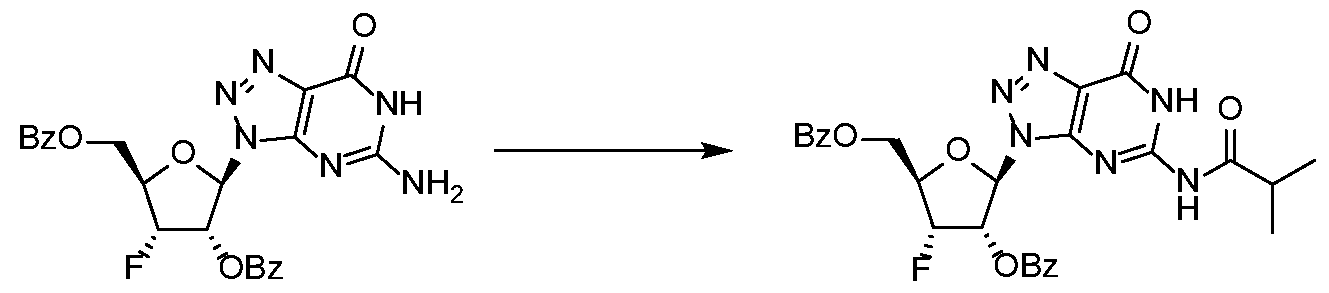
To a solution of ((2R,3R,4S,5R)-5-(5-amino-7-oxo-6,7-dihydro-3H-[l,2,3]triazolo[4,5- d]pyrimidin-3-yl)-4-(benzoyloxy)-3-fluorotetrahydrofuran-2-yl)methyl benzoate (8g,
16.18mmol) from Step 1 in anhydrous DMA (40mL) at rt was added dropwise isobutyric anhydride (4.02mL, 24.27mmol). The mixture was stirred at 140°C for 4h. The reaction was cooled and diluted with EtOAc (600mL), washed with sat aq H4C1 (4x500mL), brine, dried over anhydrous sodium sulfate, filtered and concentrated. The crude product was purified by MPLC (220g silica gel, eluting with a gradient of 100% hexanes to 100% ethyl acetate) to afford ((2R,3R,4S,5R)-4-(benzoyloxy)-3-fluoro-5-(5-isobutyramido-7-oxo-6,7-dihydro-3H- [l,2,3]triazolo[4,5-d]pyrimidin-3-yl)tetrahydrofuran-2-yl)methyl benzoate. LCMS (ES, m/z): 565.3 [M + H]+.
Step 3: N-(3-((2R,3S,4S,5R)-4-fluoro-3-hvdroxy-5-(hvdroxymethyl)tetrahvdro^
6, 7-dihydro-3H-f 1,2,3 Jtriazolof 4, 5-dl yrimidin-5-yl)isobutyramide

To a solution of ((2R,3R,4S,5R)-4-(benzoyloxy)-3-fluoro-5-(5-isobutyramido-7-oxo-6,7- dihydro-3H-[l,2,3]triazolo[4,5-d]pyrimidin-3-yl)tetrahydrofuran-2-yl)methyl benzoate (6g,
10.63mmol) in THF (20mL), CH3OH (16mL), and water (4mL) at 0°C was added 5N aq NaOH (4.89mL, 24.45mmol) and stirred for lh. The reaction was neutralized with formic acid
(1.223mL, 31.9mmol). The solvent was removed, and the residue was purified by MPLC (120g silica gel, eluting with a gradient of 100% CH2C12 to 20% CH30H/CH2C12) to afford N-(3- ((2R,3S,4S,5R)-4-fluoro-3-hydroxy-5-(hydroxymethyl)tetrahydrofuran-2-yl)-7-oxo-6,7-dihydro- 3H-[l,2,3]triazolo[4,5-d]pyrimidin-5-yl)isobutyramide. LCMS (ES, m/z): 357.2 [M + H]+. Step 4: N-(3-((2R,3S,4S,5R)-5-((bis(4-methoxyphenyl)(phenyl)methoxy)methv
hydroxytetrahydrofuran-2-yl)-7-oxo-6, 7-dihydro-3H-f 1, 2, 3]triazolo[ 4, 5-d]pyrimidin-5- yPisobutyramide
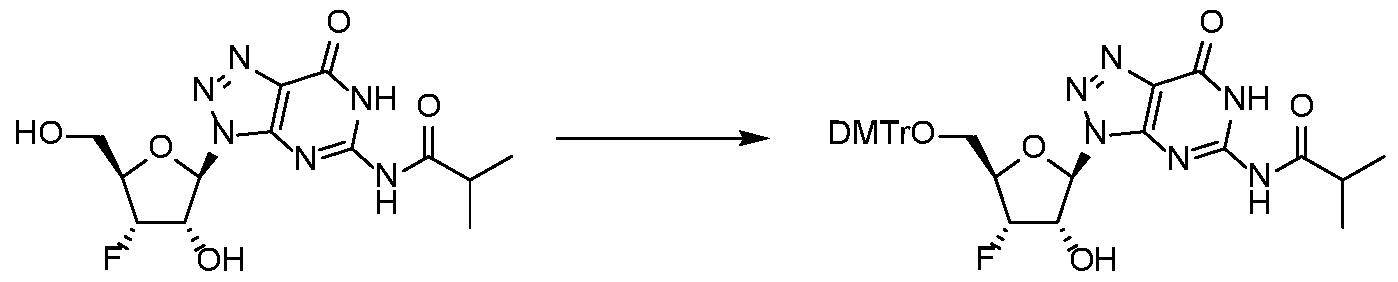
To a solution of N-(3-((2R,3S,4S,5R)-4-fluoro-3-hydroxy-5-(hydroxymethyl) tetrahydrofuran-2-yl)-7-oxo-6,7-dihydro-3H-[l,2,3]triazolo[4,5-d]pyrimidin-5-yl)isobutyramide (3g, 8.42mmol) in anhydrous pyridine (40mL) at 0°C was added 4,4'-dimethoxytrityl chloride (3.42g, 10. lOmmol). The ice bath was removed, and the reaction mixture was allowed to reach RT and was stirred for 2h. The mixture was diluted with EtOAc (400mL), washed with sat aq NaHC03 (lOOmL), water (3xl00mL), brine, and dried over anhydrous sodium sulfate, filtered and concentrated. The crude product was purified by MPLC (120g silica gel, eluting with a gradient of 100% CH2C12 to 15% CH3OH/CH2CH2 to afford N-(3-((2R,3S,4S,5R)-5-((bis(4- methoxyphenyl)(phenyl)methoxy)methyl)-4-fluoro-3-hydroxytetrahydrofuran-2-yl)-7-oxo-6,7- dihydro-3H-[l,2,3]triazolo[4,5-d]pyrimidin-5-yl)isobutyramide. LCMS (ES, m/z): 659.3
[M+H]+.
Preparation 4: 9-{5-0-[bisf4-methoxyphenyl)fphenyl)methyll-3-deoxy-3-fluoro-B-D- xylofuranosyl}-2-[f2-methylpropanoyl)aminol-l,9-dihvdro-6H-purin-6-one

The title compound was prepared according to published procedures {Tetrahedron Letters, 1989, 30(24), 3171-3174).
Preparation 5: f2R,3R.,4S,5R)-5-^bisH-methoxyphenyl)fphenyl)methoxy)methyl)-4-^tert- butyldimethylsilyl)oxy)-2-f2-isobutyramido-6-oxo-l,6-dihydro-9H-purin-9- yl)tetrahvdrothiophen-3-yl phosphonate

Step 1: N-(9-( (2R, 3R, 4S, 5R)-3, 4-dihydroxy-5-(hydroxymethyl)tetrahydrothiophen-2-yl)-6-oxo- 6,9-dihydro-lH-purin-2-yl)isobutyramide

2-amino-9-((2R,3R,4S,5R)-3,4-dihydroxy-5-(hydroxymethyl)tetrahydrothiophen-2-yl)- l,9-dihydro-6H-purin-6-one (1.7g, 5.7mmol) was co-evaporated with pyridine (3x5mL) and then re-dissolved in pyridine (34mL). To the mixture at 0°C was added chlorotrimethylsilane (4.32g, 39.8mmol) dropwise. It was stirred at rt for lh and then cooled to 0°C again. Isobutyric anhydride (1.348g, 8.52mmol) was added dropwise, and it was stirred at rt for 3h. It was quenched by the addition of water (8.5mL). After 5min, H4OH (ca. 29%, 17mL) was added, and the mixture was stirred for 30min. It was concentrated and purified by column
chromatography and eluted with 1 to 30% MeOH in CH2C12 to give the product. LCMS (ES, m/z): 396.9 [M + H]+. 1H- MR (400MHz, DMSO-i¾): δ 9.52 (br s, 2 H), 8.39 (s, 1H), 5.79 (d, J = 7.1Hz, 1H), 5.59 (s, 1H), 5.40 (s, 1H), 5.22 (s, 1H), 4.55 (d, J = 6.7Hz, 1H), 4.21 (s, 1H), 3.77
(t, J= 9.3Hz, 1H), 3.61 (s, 1H), 3.30 (dt, J= 6.4, 3.3Hz, 1H), 2.78 (p, J= 6.9Hz, 1H), 1.13 (d, J = 6.8Hz, 6H).
Step 2: N-(9-( (2R 3R 4S, 5R)-5-((bis(4-methoxyphenyl)(phenyl)methoxy)methyl)-3, 4- dihydroxytetrahydrothiophen-2-yl)-6-oxo-6,9-dihydro-lH-^

To a mixture of N-(9-((2R,3R,4S,5R)-3,4-dihydroxy-5-(hydroxymethyl)- tetrahydrothiophen-2-yl)-6-oxo-6,9-dihydro-lH-purin-2-yl)isobutyramide (480mg, 1.299mmol) in pyridine (lOmL) was added 4,4'-(chloro(phenyl)methylene)-bis(methoxybenzene) (484mg, 1.43mmol). It was stirred at rt for 16h and then concentrated. The crude was purified by column chromatography on silica gel and eluted with 1 to 30% MeOH in CH2CI2 (containing 1% Et3 ) to give the product. LCMS (ES, m/z): 672.2 [M + H]+. 1H- MR (400MHz, DMSO-i¾ + D20): δ 8.08 (s, 1H), 7.39 (d, J= 7.2Hz, 2H), 7.32 (t, J= 7.6Hz, 2H), 7.26 (dt, J= 9.1, 3.3Hz, 5H), 6.94-6.87 (m, 4H), 5.75 (d, J= 5.9Hz, 1H), 4.39 (dd, J= 5.9, 3.5Hz, 1H), 4.14 (t, J= 3.9Hz, 1H), 3.74 (s, 6H), 3.49-3.37 (m, 2H), 3.33 (dd, J= 14.5, 7.3Hz, 1H), 2.87-2.67 (m, 1H), 1.11 (dd, J = 6.8, 1.6Hz, 6H).
Step 3: N-(9-( (2R 3R 4S, 5R)-5-((bis(4-methoxyphenyl)(phenyl)methoxy)methyl)-4-((tert- buMdimethylsilyl)oxy)-3-hydroxytetrahydrothiophen-2-yl)-6-oxo
ylHsobutyramide and N-(9-( (2R, 3R, 4S, 5R)-5-( (bis(4-methoxyphenyl) (phenyl)methoxy)methyl)-3- ((tert-butyldimethylsilyl)oxy)-4-hydroxytetrahydrothiophen-2-yl)
ylHsobutyramide

To a solution of N-(9-((2R,3R,4S,5R)-5-((bis(4-methoxyphenyl)(phenyl)- methoxy)methyl)-3,4-dihydroxytetrahydrothiophen-2-yl)-6-oxo-6,9-dihydro-lH-purin-2- yl)isobutyramide (580 mg, 0.863mmol) in DMF (5mL) at rt was added lH-imidazole (147 mg, 2.16mmol) and tert-butylchlorodimethylsilane (156 mg, 1.04mmol). After 6h, the mixture was diluted with EtOAc (50mL) and washed with sat aq NaHC03 (2x20mL) and brine (20mL). It
was dried (Na2S04), concentrated, and purified by reverse phase (CI 8) chromatography and eluted with 0 to 95% ACN in water to give the products. LCMS (ES, m/z): 786.3 [M + H]+. Step 4: (2R 3R 4S,5R)-5-((bis(4-methoxyphenyl)(phenyl)methoxy)methyl)-4-((tert- bu1yldimethylsilyl)oxy)-2-(2 sobu1yramido-6-oxo-l,6-dihydro-9H^urin-9- yl)tetrahydrothiophen-3-yl phenyl phosphonate and (2R,3S,4R,5R)-2-((bis(4- methoxyphenyl)(phenyl)methoxy)methyl)-4-((tert-buMdimethylsilyl)oxy)-5-(2-isobutyramido-6- oxo-1, 6-dihydro-9H-purm-9-yl)tetrahydrothiophen-3-yl phenyl phosphonate

To a solution of a mixture of N-(9-((2R,3R,4S,5R)-5-((bis(4-methoxyphenyl)(phenyl)- methoxy)methyl)-4-((tert-butyldimethylsilyl)oxy)-3-hydroxytetrahydrothiophen-2-yl)-6-oxo-6,9- dihydro-lH-purin-2-yl)isobutyramide and N-(9-((2R,3R,4S,5R)-5-((bis(4-methoxyphenyl) (phenyl)methoxy)methyl)-3-((tert-butyldimethylsilyl)oxy)-4-hydroxytetrahydrothiophen-2-yl)-6- oxo-6,9-dihydro-lH-purin-2-yl)isobutyramide (220mg, 0.280mmol) in pyridine (2mL) at 0°C was added diphenyl phosphonate (98mg, 0.420mmol). The resulting mixture was stirred at rt for 20min. It was used in the reaction step without purification. LCMS (ES, m/z): 926.2 [M + H]+. Step 5: ammonium (2R3R4S,5R)-5-((bis(4-methoxyphenyl)(phenyl)methoxy)methyl)-4-((tert- bu1yldimethylsilyl)oxy)-2-(2 sobu1yramido-6-oxo-l,6-dihydro-9H^urin-9- yl)tetrahydrothiophen-3-yl phosphonate

To the reaction mixture from Step 4 at 0°C was added Et3N (0.28mL, 2.0mmol) and water (0.28mL). It was stirred at rt for 30min. It was concentrated, and the residue was partitioned between CH2C12 (40mL) and aq NaHC03 (5%, 30mL). The organic layer was washed with aq NaHC03 (5%, 2x30mL), dried (Na2S04), concentrated and purified by silica gel
column chromatography using 0-10% MeOH in CHC13 containing 1% Et3N to give a mixture. The mixture was further purified by Prep-HPLC (XBridge Shield RP18 OBD Column, 19x150 mm) and eluted with 46 to 79% ACN in aq H4HC03 (lOmM) over 7min to give the product. LCMS (ES, m/z): 850.2 [M + H]+. 1H- MR (400MHz, CD3OD): δ 8.18 (s, 1H), 7.68 (s, 0.5H), 7.59-7.49 (m, 2H), 7.45-7.36 (m, 4H), 7.37-7.30 (m, 2H), 7.28-7.22 (m, 1H), 6.95-6.87 (m, 4H), 6.16-6.07 (m, 2H), 4.88-4.87 (m, 1H), 4.69 (dd, J = 7.3, 3.3Hz, 1H), 3.81 (s, 6H), 3.51 (dd, J = 4.9, 1.9Hz, 2H), 3.37 (s, 1H), 2.67 (p, J = 6.9Hz, 1H), 1.21 (dd, J= 6.9, 0.9Hz, 6H), 0.77 (s, 9H), 0.01 (s, 3H), -0.28 (s, 3H). 31P- MR (162MHz, DMSO-i¾): δ -0.74 (s, IP). Preparation 6: 9-{3-azido-5-0-[bisH-methoxyphenyl)fphenyl)methyll-3-deoxy-B-D- ribofuranosyl}-2-[f2-methylpropanoyl)aminol-l,9-dihydro-6H-purin-6-one

The title compound was prepared according to published procedures {Nucleosides, Nucleotides & Nucleic Acids 2005, 24(10-12), 1707-1727).
Preparation 7: 9-{3-azido-5-6 bisH-methoxyphenyl)(phenyl)methyll-3-deoxy-B-D- ribofuranosyl}-N-(phenylcarbonyl)-9H-purin-6-amine
z

The title compound was prepared according to published procedures (Bulletin of the Korean Chemical Society 2004, 25(2), 243-248 and Nucleosides, Nucleotides & Nucleic Acids 2005 24(10-12), 1707-1727).
Preparation 8: qR,3R,4R,5R)-2-f6-benzamido-9H-purin-9-vn-5- bisf4- methoxyphenyl)fphenyl)methoxy)methyl)-4-^tert-butyldimethylsilyl)oxy)tetrahvdrofuran- 3-yl hydrogen phosphonate
z

The title compound was prepared according to published procedures {Tetrahedron, 1992, 48(15), 3209-3226).
The Preparations below were used as shown or were further modified through additional synthetic manipulations analogous to those described in Preparations 1 - 9.
Preparation 9: (2R,3R,4S,5RV2-(6-amino-9H-purin-9-vn-5-((R - hvdroxyethyl)tetrahvdrofuran-3,4-dio

The title compound was prepared according to published procedures {Bioorganicheskaya Khimiya 1989, 75(7), 969-975).
Preparation 10: (2R,3R,4S,5RV2-(6-amino-9H-purin-9-vn-5-((S - hvdroxyethyl)tetrahvdrofuran-3,4-diol

The title compound was prepared according to published procedures {Bioorganicheskaya Khimiya 1989, 75(7), 969-975).
Preparation 11 : ( 2R,3S,4R,5RV2-( 6-amino-9H-purin-9-vn-4-fluoro-5-
(hvdroxymethyl)tetrahvdrofuran-3-ol

The title compound was prepared according to published procedures (Bioorganic & Medicinal Chemistry, 2004, 72, 475-487). Preparation 12: N-f9-fqS,3R,4R,5S)-4-hvdroxy-l-fhvdroxymethvn-2,6- dioxabicvclo[3.2.01heptan-3-yl)-6-oxo-6,9-dihydro-lH-purin-2-yl)isobutyramide

The title compound was prepared according to published procedures (Tetrahedron, 2002, 55, 3039-3049).
The following experimental procedures detail the preparation of specific examples of the instant disclosure. The compounds of the examples are drawn in their neutral forms in the procedures and tables below. In some cases, the compounds were isolated as salts depending on the method used for their final purification and/or intrinsic molecular properties. The examples are for illustrative purposes only and are not intended to limit the scope of the instant disclosure in any way.
EXAMPLES Example 1: 2-amino-9-r R,6R,8R,9R,14S,16R,18RV16-f6-amino-9H-purin-9-vn-3,ll,18- trihvdroxy-3,ll-dioxido-2,4,7,10,12,15-hexaoxa-3,ll-diphosphatricvclo[12.2.1.1 '9loctadec- 8-yll-l,9-dihydro-6H-purin-6-one
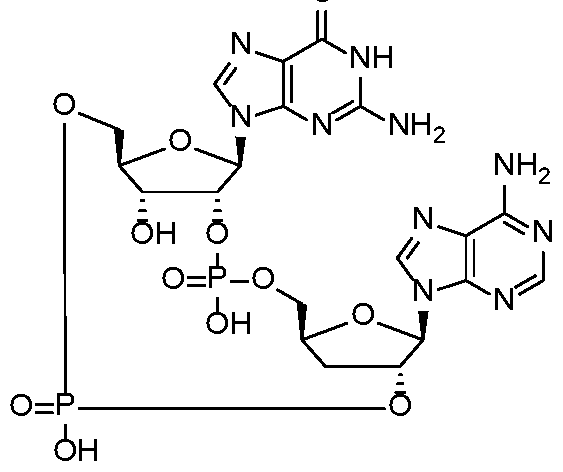
Step 1: N-(9-( (2R, 3R, 5S)-3-hvdroxy-5-(hvdroxymethyl)tetrahydrofuran-2-yl)-9H-purin-6- yDbenzamide
z

To a suspension of 3'-deoxyadenosine (2.5g, lOmmol) in pyridine (40mL) at 0°C was added chlorotrimethylsilane (5.43g, 50.0mmol). The mixture was stirred at rt for 30min. Then, the reaction mixture was cooled to 0°C, and benzoyl chloride (2.1 lg, 15.0mmol) was added dropwise. The reaction mixture was stirred at rt for 6h. Then, water (lOmL) and H4OH (ca 29%, 20mL) were added, and the mixture was stirred at rt for 15min. It was concentrated and purified by silica gel column chromatography using 0-10% MeOH in CH2CI2 to give the product. LCMS (ES, m/z): 354.0 [M - H]". 1H- MR (400MHz, OMSO-d6): δ 11.21 (s, 1H), 8.77 (s, 1H), 8.75 (s, 1H), 8.13-8.00 (m, 2H), 7.66 (t, J = 7.3Hz, 1H), 7.56 (t, J = 7.6Hz, 2H), 6.06 (d, J = 1.9Hz, 1H), 5.79 (d, J = 4.1Hz, 1H), 5.11 (t, J = 5.4Hz, 1H), 4.67 (dp, J = 5.1, 2.6Hz, 1H), 4.43 (ddt, J = 9.5, 6.8, 3.7Hz, 1H), 3.75 (ddd, J = 12.0, 5.4, 3.3Hz, 1H), 3.57 (ddd, J = 12.1, 5.5, 3.9Hz, 1H), 2.31 (ddd, J = 13.2, 9.2, 5.6Hz, 1H), 1.96 (ddd, J = 13.1, 6.1, 2.6Hz, 1H).
Step 2: N-(9-((2R3R5S)-5-((bis(4-methoxyphenyl)(phenyl)methoxy)methyl)-3- hvdroxytetrahvdrofuran-2-yl)-9H-purin-6-yl)benzamide
z

OH OH
N-(9-((2R,3R,5S)-3-hydroxy-5-(hydroxymethyl)tetrahydrofuran-2-yl)-9H-purin-6- yl)benzamide (1.43g, 4.02mmol) was co-evaporated with pyridine (3xl0mL) and re-dissolved in pyridine (4mL). To the mixture at 0°C was added DMTrCl (1.50g, 4.43mmol), and it was stirred at rt for 17h. Then, the mixture was concentrated, and the residue was purified by silica gel
column chromatography and eluted with 0-10% MeOH in CH2C12 (1% Et3 ) to give the product. LCMS (ES, m/z): 658.1 [M + H]+. 1H- MR (400MHz, CD3OD): δ 8.72 (s, 1H), 8.58 (s, 1H), 8.10 (dd, J = 7.3, 1.7Hz, 2H), 7.72-7.65 (m, 1H), 7.59 (dd, J = 8.4, 7.0Hz, 2H), 7.45-7.39 (m, 2H), 7.33-7.17 (m, 7H), 6.87-6.78 (m, 4H), 6.18 (d, J = 1.4Hz, 1H), 5.01-4.93 (m, 1H), 4.70 (dd, J = 8.5, 5.0Hz, 1H), 3.76 (s, 6H), 3.44 (dd, J = 10.6, 2.9Hz, 1H), 3.38 (dd, J = 10.7, 4.7Hz, 1H), 2.55 (ddd, J = 13.5, 9.9, 5.4Hz, 1H), 2.14-2.06 (m, 1H).
Step 3: (2R3R5S)-2-(6-benzamido-9H^urin-9-yl)-5-((bis(4-methoxyphenyl)(pheny
methyl)tetrahydrofuran-3-yl phosphonate

To a solution of N-(9-((2R,3R,5S)-5-((bis(4-methoxyphenyl)(phenyl)methoxy)methyl)-3- hydroxytetrahydrofuran-2-yl)-9H-purin-6-yl)benzamide (0.43g, 0.65mmol) in pyridine (3mL) at rt was added diphenyl phosphonate (1.06g, 4.55mmol). After 15min, water (0.15mL) and Et3N (0.15mL) were added, and it was stirred for 15min. Then, the solution was concentrated, and the residue was partitioned between CH2C12 (15mL with 1% Et3N) and aq NaHC03 (5%, lOmL). The organic layer was washed with aq NaHC03 (5%, 2xl0mL), dried (Na2S04), concentrated, and purified by silica gel column chromatography using 0-10% MeOH in CH2C12 (1% Et3N) to give the product. LCMS (ES, m/z): 722.1 [M + H]+. 1H- MR (400MHz, CD3OD): δ 8.70 (s, 1H), 8.60 (s, 1H), 8.19-8.04 (m, 2H), 7.75-7.64 (m, 1.5H), 7.59 (t, J= 7.6Hz, 2H), 7.43-7.34 (m, 2H), 7.34-7.12 (m, 7H), 6.79 (dd, J= 9.0, 7.3Hz, 4H), 6.36 (d, J= 1.3Hz, 1H), 6.13 (s, 0.5H), 5.59-5.45 (m, 1H), 4.70 (dd, J= 9.2, 4.9Hz, 1H), 3.77 (d, J= 2.8Hz, 6H), 3.44-3.36 (m, 2H), 3.11 (q, J= 7.3Hz, 12H), 2.87-2.71 (m, 1H), 2.34 (dd, J= 13.5, 5.9Hz, 1H), 1.28 (t, J= 7.3Hz, 18H). 31P- MR (162MHz, CD3OD): δ 3.15 (s), 0.89 (s).
Step 4: (2R 3R, 5S)-2-( 6-benzamido-9H-purin-9-yl)-5-(hydroxymethyl)tetrahydrofuran-3-yl phosphonate

Step 5: (2R 3R 5S)-2-(6-benzamido-9H-purin-9-yl)-5-((((((2R.3R.4R.5R)-4-((tert- but\ldimethylsilyl)oxy)-5-(hydroxymethyl)-2-(2 so
yl)tetrahydrofuran-3-yl)oxy)(2-cyanoethoxy)phosphanyl)oxy)methyl)tetrahydrofuran-3-yl phosphonate

The crude from Step 4 was co-evaporated with ACN (3x5mL), re-dissolved in ACN
(3mL) under Ar, and dried by adding activated 4A molecular sieve (150mg). (2R,3R,4R,5R)-5- ((bis(4-methoxyphenyl)(phenyl)methoxy)methyl)-4-((tert-butyldimethylsilyl)oxy)-2-(2- isobutyramido-6-oxo-l,6-dihydro-9H-purin-9-yl)tetrahydrofuran-3-yl (2-cyanoethyl) diisopropylphosphoramidite (0.71 lg, 0.733mmol) was co-evaporated with ACN (3x5mL), re- dissolved in ACN (3mL), and dried by adding activated 4A molecular sieve (150mg). After 30min, it was added to the previously prepared mixture containing (2R,3R,5S)-2-(6-benzamido- 9H-purin-9-yl)-5-(hydroxym ethyl )tetrahydrofuran-3-yl phosphonate. It was stirred at rt for 20min. The reaction mixture was used in the next reaction step without purification. LCMS (ES, m/z): 984.1 [M + H]+.
Step 6: (2R 3R.5S)-2-(6-benzamido-9H-Ourin-9-yl)-5-((((((2R.3R.4R.5R)-4-((tert- bu1yldimethylsilyl)oxy)-5-(hydroxymethyl)-2-(2 sobu1ym
yl)tetrahydrofuran-3-yl)oxy)(2-cyanoethoxy)phosphoryl)oxy)m
hydrogen phosphonate
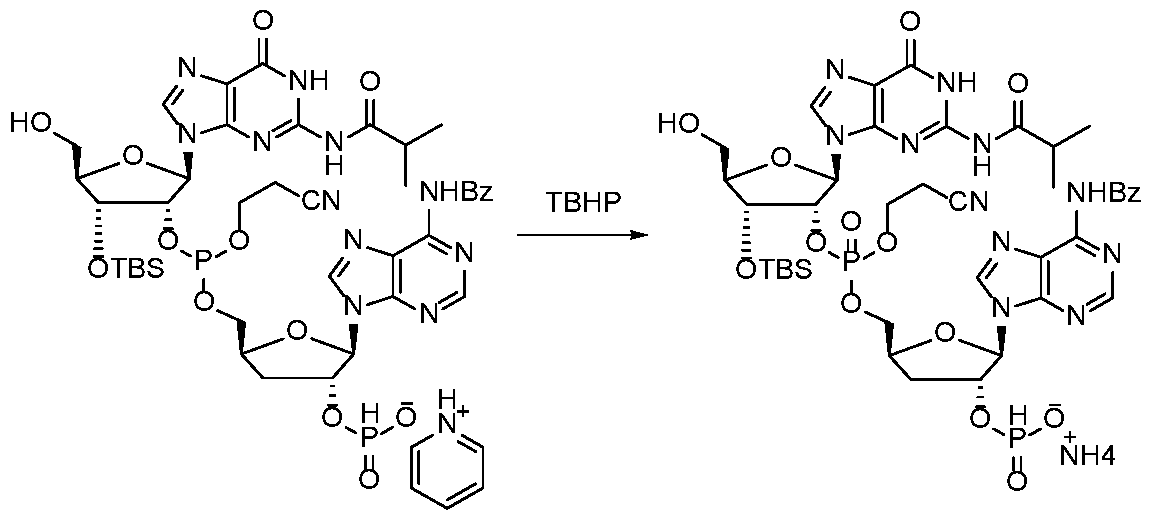
To the reaction mixture at rt from Step 5 was added tert-butyl hydroperoxide in decane solution (5.5M, 0.32mL, 1.7mmol) over 2min, and the resulting mixture was stirred for lh.
Then, it was cooled at 0°C, and treated with a solution of Na2S203 5H20 (500mg) in H20 (5mL). Insolubles were filtered off, and the filtrate was concentrated and purified by reverse phase (CI 8) chromatography and eluted with 0 to 95% ACN in aq H4HCO3 (5mM) to give the product. LCMS (ES, m/z): 1002.0 [M+H]+. 31P- MR (162MHz, CD3OD): δ 3.27-3.22 (m), -2.31—2.51 (m).
Step 7: OR.6R.8R.9R.14S.16R 18R)-16-(6-benzamido-9H-vurin-9-yl)-18-((tert- but\ldimethylsilyl)oxy)-ll-(2-cyanoethoxy)-8-(2 sob
yl)-2, 4, 7,10, 12, 15-hexaoxa-S, 1 l-diphosphatricyclo[ 12.2. l.l69]octadecan-3-olate 11 -oxide

(2R,3R,5S)-2-(6-benzamido-9H-purin-9-yl)-5-((((((2R,3R,4R,5R)-4-((tert- butyldimethylsilyl)oxy)-5-(hydroxymethyl)-2-(2-isobutyramido-6-oxo-l,6-dihydro-9H-purin-9- yl)tetrahydrofuran-3 -yl)oxy)(2-cyanoethoxy)phosphoryl)oxy)methyl)tetrahydrofuran-3 -yl hydrogen phosphonate, ammonia salt (170mg, 0.17mmol) was co-evaporated with pyridine (4x3mL) and then, dissolved in CH2C12 (12mL). This solution was then added to diphenyl phosphorochloridate (0.7mL, 3.4mmol) in pyridine (12mL) at -40°C over 20min. The resulting mixture was maintained at the same temperature for 20min. The reaction mixture was used in the next reaction step directly. LCMS (ES, m/z): 984.2 [M + H]+.
Step 8: (lR.6R.8R.9R.14S.16R.18R)-16-(6-benzamido-9H-purin-9-yl)-18-((tert- butyldimethylsilyl)oxy)-l 1 -(2-cyanoethoxy)-8-(2-isobutyramido-6-oxo-l , 6-dihydro-9H-purin-9- yl)-2, 4, 7,10, 12, 15-hexaoxa-3, 1 l-diphosphatricyclo[ 12.2. l.l69]octadecan-3-olate 3, 11 -dioxide

To the mixture from Step 7 at 0°C was added I2 in pyridine/water (3%, 9/1, 2.5mL) over 5min. It was stirred at rt for 30min. Then, the reaction mixture was slowly poured into a solution of Na2S2C"3 5H20 (650mg) in water (lOmL). After 5min, the mixture was concentrated. The residue was purified by reverse phase (CI 8) chromatography and eluted with 0 to 95% ACN in aq H4HCO3 (5mM) to give the product. LCMS (ES, m/z): 1000.3 [M + H]+. 31P- MR (162MHz, CD3OD): δ -0.73,-1.32 (2s, 1P),-1.60,-3.96 (2s, IP).
Step 9: OR.6S.8R.9R.14R.16R.17R)-16-(2-amino-6-oxo-l.6-dihydro-9H-purin-9-yl)-8-(6- amino-9H-purin-9-yl)-l 7-((tert-butyldimethylsilyl)oxy)-2, 4, 7, 10, 12, 15-hexaoxa-3, 11- diphosphatricycloi 12.2.1 A6'91 octadecane-3 ,1 l-bis(olate) 3,11-dioxide
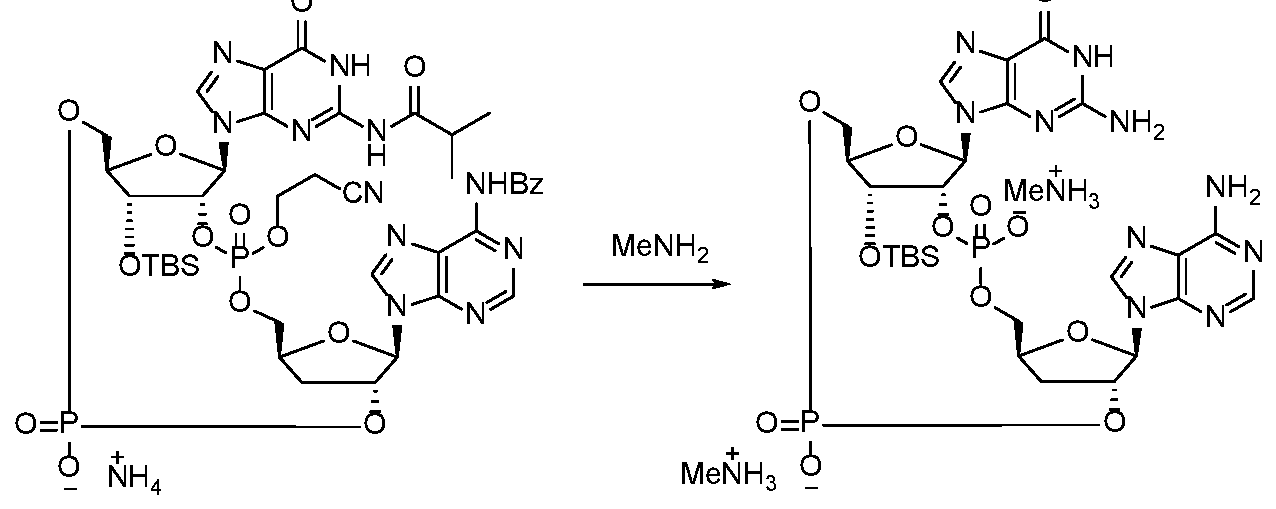
(lR,6R,8R,9R, 14S,16R, 18R)-16-(6-benzamido-9H-purin-9-yl)-18-((tert- butyldimethylsilyl)oxy)-l l-(2-cyanoethoxy)-8-(2-isobutyramido-6-oxo-l,6-dihydro-9H-purin-9- yl)-2,4,7, 10,12, 15-hexaoxa-3,l l-diphosphatricyclo[12.2.1.16'9]octadecan-3-olate 3,11-dioxide (120mg, 0.12mmol) was dissolved in a solution of Me H2 in EtOH (30%, 12mL), and it was stirred at rt for 6h. The solution was concentrated, and the residue was used in the next step without purification. LCMS (ES, m/z): 773.3 [M + H]+.
Step 10: 2-amino-9-((lR 6R 8R.9R.14S.16R.18R)-16-(6-amino-9H-purin-9-yl)-3.11.18- trihydroxy-3, 1 l-dioxido-2, 4, 7, 10, 12, 15-hexaoxa-3 ,1 l-diphosphatricyclof 12.2.1.16'91 octadecan- 8-yl)-l,9-dihydro- -purin-6-one

The crude from Step 9 was suspended in pyridine (2.5mL), and triethylamine (1.2g,
12mmol) and triethylamine trihydrofluoride (482mg, 3.0mmol) were added. The mixture was heated at 50°C for 6h. Then, it was concentrated and purified by prep-HPLC (T3 Prep Column, 19x250 mm) and eluted with 0 to 12% ACN in aq H4HCO3 (50mM) to give the product. LCMS (ES, m/z): 657.0 [M - H]". 1H- MR (400MHz, D20): δ 8.16 (s, 1H), 8.07 (s, 1H), 7.79 (s, 1H), 6.08 (d, J = 7.0Hz, 1H), 5.93 (d, J = 8.3Hz, 1H), 5.31-5.24 (m, 2H), 4.69-4.59 (m, 2H), 4.39 (s, 1H), 4.16-4.09 (m, 1H), 4.08-3.98 (m, 3H), 2.70 (q, J = 10.9, 10.3Hz, 1H), 2.53 (dd, J = 13.1, 7.1Hz, 1H). 31P- MR (162MHz, D20): δ -0.79 (s), -1.94 (s).
Examples 2 through 8, as shown in Table 1 below, were prepared according to procedures analogous to those outlined in Example 1 above using the appropriate monomers, decribed as Preparations or as obtained from commercial sources, in the coupling step.
Table 1


i H y ro-6H-pu n-6-one
Example 9: 2-amino-9-r R,6R,8R,9S,14S,16R,18RV16-f6-amino-9H-purin-9-vn-18-fluoro-
3,ll-dihvdroxy-3,ll-dioxido-2,4,7,10,12,15-hexaoxa-3,ll-diphosphatricvclori2.2.1.1 '91 octadec-8-yll-l,9-dihydro-6H-purin-6-one

Step 1: (2R 3R 5S)-2-(6-benzamido-9H-vurin-9-yl)-5-((((((2R.3S 4R 5R)-5-((bis(4- methoxyphenyl)(phenyl)methoxy)methyl)-4-fluoro-2-(24sobuty^
purin-9-yl)tetrahydrofuran-3-yl)oxy)(2-cym
yl phosphonate

(2R,3S,4R,5R)-5-((bis(4-methoxyphenyl)(phenyl)methoxy)methyl)-4-fluoro-2-(2- isobutyramido-6-oxo-l,6-dihydro-9H-purin-9-yl)tetrahydrofuran-3-yl (2-cyanoethyl) diisopropylphosphoramidite (0.25g, 0.30mmol) was co-evaporated with ACN (3x3 mL), re- dissolved in ACN (3mL) under Ar, and dried by adding activated 4A molecular sieve (50mg). Crude (2R,3R,5S)-2-(6-benzamido-9H-purin-9-yl)-5-(hydroxymethyl)-tetrahydrofuran-3-yl phosphonate (0.5g, ~0.3mmol, with excess pyridinium 2,2-dichloroacetate salt) was co- evaporated with ACN (3x5mL), re-dissolved in ACN (5mL), and dried by adding activated 4A molecular sieve (50mg). After 30min, it was added to the previously prepared mixture containing (2R,3 S,4R,5R)-5-((bis(4-methoxyphenyl)(phenyl)methoxy)methyl)-4-fluoro-2-(2- isobutyramido-6-oxo-l,6-dihydro-9H-purin-9-yl)tetrahydrofuran-3-yl (2-cyanoethyl) diisopropylphosphoramidite. The resulting mixture was stirred at rt for 30min. The reaction mixture was used for the next step without purification. LCMS (ES, m/z): 1174.3 [M - H]". Step 2: (2R 3R 5S)-2-(6-benzamido-9H-purin-9-yl)-5-((((((2R.3S.4R 5R)-5-((bis(4- methoxyphenyl)(phenyl)methoxy)methyl)-4-fluoro-2-(24sobuty^
purin-9-yl)tetrahydrofuran-3-yl)oxy)(2-cyanoethoxy)phosphoryl)oxy)meth^
yl phosphonate

To the reaction mixture from Stepl at rt was added tert-butyl hydroperoxide in decane (5.5M, 0.191mL, 1.05mmol) over lmin, and the resulting mixture was stirred for lh. Then, it was cooled in an ice bath, and treated with a solution of Na2S2C>3 5H20 (400mg) in water (5mL). The solids formed were filtered off, and the filtrate was concentrated under reduced pressure to give the crude product. LCMS (ES, m/z): 1190.3 [M - H]".
Step 3: (2R, 3R 5S)-2-(6-benzamido-9H-purin-9-yl)-5-((((2-cyanoethoxy)(((2R 3S 4R 5R)-4- fluoro-5-(hydroxymethyl)-2-(2 sobutyramido-6-oxo-L 6-dihy
3-yl)oxy)phosphoryl)oxy)methyl)tetrahydrofuran-3-yl phosphonate

To a solution of the crude from Step 2 in CH2C12 (4.5mL) at rt was added water (54mg, 3.0mmol) and 2,2-dichloroacetic acid in CH2C12 (0.6M, 4.50mL, 2.70mmol) over 2min, and the resulting mixture was stirred for lOmin. Then, triethylsilane (lOmL) was added, and stirring was continued for lh. Pyridine (0.9mL) was added, and the mixture was stirred for lOmin. It was concentrated and purified by reverse phase (AQ CI 8) chromatography and eluted with 0 to 95% ACN in aq H4HCO3 (0.04%) to give the product. LCMS (ES, m/z): 890.2 [M+H]+. 1H- MR (400MHz, CD3OD): δ 8.74 (2s, 1H), 8.50 (2s, 1H), 8.30 (2s, 1H), 8.16-8.08 (m, 2H), 7.72-7.64 (m, 1.5H), 7.59-7.56 (m, 2H), 6.34 (s, 0.5H), 6.27-6.09 (m, 2H), 5.62-5.19 (m, 3H), 4.69 (m,
1H), 4.47-4.25 (m, 3H), 4.23-4.03 (m, 2H), 3.79 (m, 2H), 2.87-2.78 (m, 1H), 2.78-2.66 (m, 2H), 2.39 (m, 1H), 1.27-1.16 (m, 6H). 31P-NMR: (162MHz, CD3OD): δ 3.14 (s, IP); -2.96, -3.05 (2 s, IP).
Step 4: (lR, 6R, 8R, 9S.14S.16R, 18R)-16-(6-benzamido-9H-purin-9-yl)-ll-(2-cyanoethoxy)-18- fluoro-8-(2-isobutyramido-6-oxo-l, 6-dihydro-9H-purin-9-yl)-2, 4, 7,10, 12, 15-hexaoxa-3, 11- diphosphatricyclo 69]octadecan-3-olate 11-oxide

To pyridine (lOmL) at -40°C under Ar was added diphenyl phosphorochloridate (484mg,
1.80mmol) and a solution of (2R,3R,5S)-2-(6-benzamido-9H-purin-9-yl)-5-((((2-cyanoethoxy) (((2R,3S,4R,5R)-4-fluoro-5-(hydroxymethyl)-2-(2-isobutyramido-6-oxo-l,6-dihydro-9H-purin- 9-yl)tetrahydrofuran-3 -yl)oxy)phosphoryl)oxy)methyl)tetrahydrofuran-3 -yl phosphonate (80mg, 0.090 mmol, co-evaporated with pyridine 3x3mL) in CH2CI2 (lOmL) dropwise over 20min. The resulting mixture was stirred at -40°C for 40min. It was used in the next reaction step without purification. LCMS (ES, m/z): 872.2 [M + H]+.
Step 5: (lR, 6R, 8R, 9S.14S.16R.18R)-16-(6-benzamido-9H-purin-9-yl)-l l-(2-cyanoethoxy)-18- fluoro-8-(2-isobutyramido-6-oxo-l, 6-dihydro-9H-purin-9-yl)-2, 4, 7,10, 12, 15-hexaoxa-3, 11- diphosphatricyclo 6'91 octadecan-3-olate 3,11-dioxide

To the reaction mixture from Step 4 at rt was added I2 in pyridine/water (3%, 9/1, 3mL) dropwise over 5min, and the mixture was stirred for lh. Then, the reaction mixture was cooled in an ice bath, and Na2S203 5H20 (0.3g) in water (lmL) was added. After 5min, the reaction mixture was concentrated, and the residue was purified by reverse phase (CI 8) chromatography and eluted with 0 to 95% ACN in aq H4HCO3 (5mM) to give the product. LCMS (ES, m/z): 888.1 [M + H]+.
Step 6: 2-amino-9-((lR.6R.8R.9S.14S.16R.18R)-16-(6-amino-9H-purin-9-yl)-18-fliioro-3.11- dihydroxy-3,] l-dioxido-2.4.7.10.12.15-hexaoxa-3.11-diphosphatricyclof 12.2.1.16'91 octadecan-8- yl)-l,9-dihydro-6H- urin-6-one
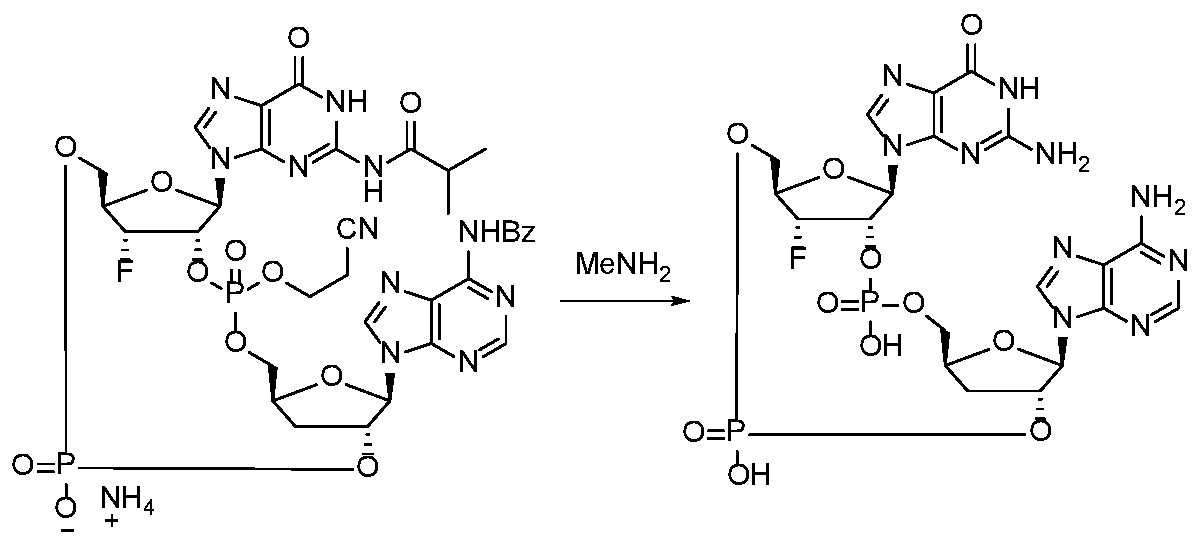
(lR,6R,8R,9S,14S, 16R,18R)-16-(6-benzamido-9H-purin-9-yl)-l l-(2-cyanoethoxy)-18- fluoro-8-(2 sobutyramido-6-oxo-l,6-dihydro-9H-purin-9-yl)-2,4,7,10, 12,15-hexaoxa-3,l l- diphosphatricyclo[12.2.1.16'9]octadecan-3-olate 3, 11-dioxide (240mg, O. l lmmol) was dissolved in Me H2 in EtOH (30%, lOmL), and it was stirred at rt for 3h. Then, it was concentrated and purified by Prep-HPLC (T3 Prep Column, 19 mmx250 mm) and eluted with ACN in aq
H4HCO3 (50mM) to give the product. LCMS (ES, m/z): 659.1 [M - H]". 1H- MR (400MHz, D20): 5 8.12 (s, 1H), 8.08 (s, 1H), 7.81 (s, 1H), 6.10 (d, J= 6.9Hz, 1H), 6.03 (d, J= 8.4Hz, 1H), 5.56 (d, J= 3.4Hz, 0.5H), 5.49-5.40 (m, 1H), 5.37 (dd, J= 8.3, 4.4Hz, 0.5H), 5.21 (q, J= 8.2Hz, 1H), 4.70-4.62 (m, 2H), 4.28-4.17 (m, 1H), 4.17-4.03 (m, 3H), 2.76 (q, J = 10.8, 10.4Hz, 1H), 2.54 (dd, J= 13.1, 7.0Hz, 1H). 31P- MR (162MHz, D20): δ -1.45 (s), -2.13 (s).
Examples 10 through 13, as shown in Table 2 below, were prepared according to procedures analogous to those outlined in Example 9 above using the appropriate monomers, decribed as Preparations or as obtained from commercial sources, in the coupling step.
Table 2


Example 14: 2-amino-9-r R,6R,8R,9R,14R,16R,17R,18RV16-f6-amino-9H-purin-9-vn- 17,18-dihvdroxy-3,ll-dioxido-3,ll-disulfanyl-2,4,7,10,12,15-hexaoxa-3,ll- diphosphatricvclo[12.2.1.1 '9loctadec-8-yll-l,9-dihydro-6H-purin-6-one (Diastereomer 1)

Step 1: (2R RAR,5R)-2-(6-benzamido-9H-purin-9-yl)-4-((tert-butyldimeth^
(hydroxymethyl)tetrahydrofuran-3-yl phosphonate
z

oxo-l, 6-dihydro-9H-purin-9-yl)tetrahydrofuran-3-yl)oxy)(2-cyanoethoxy)phosphanyl)oxy) methyl)-4-((tert-butyldimethylsilyl)oxy)tetrahydrofuran-3-yl phosphonate

To a stirred solution of (2R,3R,4R,5R)-2-(6-benzamido-9H-purin-9-yl)-4-((fert- butyldimethylsilyl)oxy)-5-(hydroxymethyl)tetrahydrofuran-3-yl phosphonate (1.28g, 2.32mmol) in MeCN (10ml) under Ar was added activated 4A molecular sieve (50mg), and the mixture was stirred at RT over 3h. (2R,3R,4R,5R)-5-((bis(4-methoxyphenyl)(phenyl)methoxy) methyl)-4- ((tert-butyldimethylsilyl)oxy)-2-(2-isobutyramido-6-oxo-l,6-dihydro-9H-purin-9- yl)tetrahydrofuran-3-yl (2-cyanoethyl) diisopropylphosphoramidite (2.93g, 3.02mmol) was co- evaporated with dry MeCN (three times, 5mL each) and then re-dissolved in MeCN (lOmL) and dried by adding activated 4A molecular sieve (50mg). After 30min, the solution containing phosphoramidite was transferred into the solution of the dried phosphonate and activated 4A molecular sieve by syringe under Ar. After lOmin, the desired product was observed by LCMS and TLC. The reaction mixture was used for the next reaction step directly. LC-MS: (ES, m/z) 1418.57 [M + H]+.
Step 3: (2R 3R 4R 5R)-2-(6-benzamido-9H-Ourin-9-yl)-5-((((((2R 3R 4R 5R)-5-((bis(4- methoxyphenyl)(phenyl)methoxy)methyl)-4-((\QX\-butyld^
oxo-L 6-dihydro-9H-purin-9-yl)tetrahydrofuran-3-yl)oxy)(2-cy
oxy)methyl)-4-((tert-butyldimethylsilyl)oxy)tetrahydrofuran-3-yl phosphonate

To the reaction mixture containing the crude product of the previous step was added (£)- N.N-dimethyl-N'^S-thioxo-SH-l^^-dithiazol-S-y formimidamide (0.525g, 2.56mmol) in one portion, and the resulting mixture was stirred at RT for 30min. TLC and LCMS indicated completion of reaction. The reaction mixture was concentrated under reduced pressure and was used in the next step without purification. LCMS (ES, m/z): 1450.64 [M + H]+.
Step 4: (2R, 3R, 4R, 5R)-2-( 6-benzamido-9H-purin-9-yl)-4-( tert-butyldimethylsilyl)oxy)-5- (((( ((2R 3R 4R 5R)-4-((tert-butyldimethylsilyl)oxy)-5-(hydroxym
oxo-l, 6-dihydro-9H-purin-9-yl)tetrahydrofuran-3-yl)oxy)(2-cy
methyl)tetrahydrofuran-3-yl phosphonate

To a solution of the product of Step 3 (2.04g, 1.4mmol) in DCM (20ml) and H20 (0.254ml, 14.08mmol) was added 2,2-dichloroacetic acid (1.60g, 12.39mmol) in DCM (6% DC A in DCM). The resulting solution was stirred at RT for 30min. TLC/LCMS indicated completion of the reaction. Then, Et3SiH (10ml) was added. The resulting solution was stirred for 2h at RT. Then, pyridine (0.64g) was added. The resulting solution was concentrated under reduced pressure and was used for the next step without purification. LCMS (ES, m/z): 1148.27 [M + H]+.
Step 5: OR.6R 8R 9R 14R.16R.17R.18R)-17.18-bis{ftert-butyl(dimethyl)silylJoxy}-l l-(2- cyanoethoxy)-8-{2-[(2-methylpropanoyl)amino]-6-oxo
[ (phenylcarbonyl)amino]-9H-purin-9-yl}-2, 4, 7,10, 12, 15-hexaoxa-3, 11-diphosphatricyclo
[ 12.2.1.16'91 octadecan-3-olate 11-sulfide

The crude sample from Step 4 (600mg, 0.523mmol) was co-evaporated with dry pyridine (2mL each, three times) and then re-dissolved in dry pyridine (6ml). To the solution under Ar, was added 2-chloro-5,5-dimethyl-l,3,2-dioxaphosphinane 2-oxide (338mg, 1.830mmol) at RT in one portion. After 30min, the desired product was observed from LCMS as major product. The reaction mixture was used in the next step directly. LCMS (ES, m/z): 1 130.26 [M + H]+.
Step 6: Diastereomers OR, 6R.8R.9R, 14R.16R, 17R 18R)-17, 18-bisiftert- butyl(dimethyl)silylj 'oxy}-l l-(2-cyanoethoxy)-8-{2-[(2-methylpropanoyl)amino] -6-oxo-l , 6- dihydro-9H-purin-9-yft-16-{6-[ (phenylcarbonyl)amino]-9H-purin-9-yl}-2, 4, 7, 10, 12, 15-hexaoxa- 3, 11-diphosphatricyclof 12.2.1.16 9 loctadecane-3-thiolate 3-oxide 11-sulfide (AA1) and
(lR, 6R.8R.9R.14R, 16R, 17R.18R)-17.18-bis{[\vcX-biityl(dimethyl)silylloxy}-l l-(2-cyanoethoxy)- 8-{2-[(2-methylpropanoyl)amino] -6-oxo-l, 6-dihydro-9H-purin-9-yl}-16-{6- [ (phenylcarbonyl)amino]-9H-purin-9-yl}-2, 4, 7, 10, 12, 15-hexaoxa-3, 11- diphosphatricyclof 12.2.1.16 9 loctadecane-3-thiolate 3-oxide 11-sulfide (AA2)

To the solution from Step 5 was added H20 (0.329mL, 18.3mmol) and 3H- benzo[c][l,2]dithiol-3-one (147mg, 0.874mmol). The resulting mixture was stirred at RT for 40min. TLC and LCMS indicated completion of the reaction. The reaction mixture was poured into aq NaHC03 (2.7g NaHC03 in lOOmL H20) and stirred for 5min. The resulting mixture was extracted with EtOAc (30mlx3), and the organic layers were combined. It was concentrated and was purified by preparative TLC developed with 10% MeOH in DCM to give the desired products AA1 (Rf = 0.5) and AA2 (Rf = 0.3). AA1 : LCMS (ES, m/z): 1 162.32 [M + H]+. AA2: LCMS (ES, m/z): 1 162.32 [M + H]+.
Step 7: Piaster omers (lR.6R.8R.9R.14R.16R.17R.18R)-17, 18-bis{itQxt- butyl(dimethyl)silyli Oxy}-8-f2-f(2-methylpropanoyl)aminol '-6-oxo-l , 6-dihydro-9H-purin-9-yl}- 16-{6-[ (phenylcarbonyl)amino]-9H-purin-9-yl}-2, 4, 7, 10, 12, 15-hexaoxa-3, 11- diphosphatricyclo[l 2.2.1 '. l69]octadecane-3, 1 l-bis(thiolate) 3, 11-dioxide (BB1) and
OR.6R.8R.9R.14R.16R.17R.18R)-17.18-bis{itQrt-butyl(dimethyl)silylloxy}-8-{2-i(2- methylpropanoyl)amino) '-6-oxo-l , 6-dihydro-9H-purin-9-yl}-l 6-{6-[(phenylcarbonyl)aminol -9H- purin-9-yl}-2, 4, 7,10, 12, 15-hexaoxa-3, 1 l-diphosphatricyclo[ 12.2. l.l69]octadecane-3,l 1- bis(thio -dioxide (BB2)

To a solution of crude Compound AA1 (300mg, 0.258mmol) from the previous step in MeCN (1.3ml) under Ar was added 2-methylpropan-2-amine (1.29ml, 12.17mmol), and the resulting mixture was stirred for 30min. After the reaction completed, the volatile components were removed under reduced pressure. The residue was purified by reverse phase prep-HPLC (X-Bridge BEH130 Prep C18) and eluted with 30 to 70% MeCN in aq NH4HCO3 (lOmM) over 8min to give compound diastereomers BB1 (TR = 7.57min) and BB2 (TR = 5.77min). BB1: LCMS (ES, /// r): 1109.26 [M + H]+. BB2: LCMS (ES, m/z): 1109.26 [M + H]+.
Step 8: 2-amino-9-i(lR.6R 8R 9R 14R 16R 17R 18R)-16-(6-amino-9H-purin-9-yl)-l 7.18- bis{[tert-butyl(dimethyl)silyl]oxy}-3, 1 l-dioxido-3,1 l-disulfanyl-2, 4, 7,10, 12, 15-hexaoxa-3,l 1- diphosphatricyclof 12.2.1.169 loctadec-8-yll-l,9-dihydro-6H-purin-6-one

To a solution of Compound BB1 from Step 7 (81mg, 0.073mmol) in EtOH (3ml), 30% methylamine (909mg, 29.3mmol) was added. The resulting solution was stirred for 3h. LCMS
indicated completion of reaction. It was concentrated and used directly for the next step. LCMS (ES, m/z): 935.06 [M + H]+.
Step 8: 2-amino-9-i(lR.6R 8R.9R.14R 16R 17R.18R)-16-(6-amino-9H-purin-9-yl)-l 7.18- dihydroxy-3,1 l-dioxido-3, ll-disulfanyl-2, 4, 7, 10, 12, 15-hexaoxa-3, 11- diphosphatricvclo 69]octadec-8-yll-l,9-dihvdro-6H-purin-6-one

To the crude product from Step 8 (68mg, 0.073mmol) in pyridine (1ml) were added TEA (737mg, 7.29mmol) and trimethylamine trihydrofluoride (587mg, 3.64mmol). The resulting mixture was stirred at 50°C. After 5h, LCMS indicated completion of the reaction. Volatile components were evaporated under reduced pressure. The residue was purified by reverse phase prep-HPLC and eluted with aq H4HCO3 (50mM) over Imin to give the desired product. LCMS (ES, m/z): 705.10 [M - H]". H- MR (400MHz, D20): δ 8.11 (s, 1H), 8.07 (s, 1H), 7.77 (s, 1H), 6.23 (d, J= 8Hz, 1H), 5.94 (d, J= 8.4Hz, 1H), 5.24 (m, 1H), 5.18 (m, 1H), 4.89 (d, J= 4Hz, 1H), 4.84 (d, J = 4Hz, 1H), 4.52 (d, J = 3.6Hz, 1H), 4.45 (d, J= 3.6Hz, 1H), 4.36 (m, 2H), 4.04 (m, 2H). 31P- MR (121MHz, O20, ppm): δ 52.01 (s, IP), 50.97 (s, IP).
Example 15: 2-amino-9-r R,6R,8R,9R,14R,16R,17R,18RV16-f6-amino-9H-purin-9-vn- 17,18-dihvdroxy-3,ll-dioxido-3,ll-disulfanyl-2,4,7,10,12,15-hexaoxa-3,ll- diphosphatricvclo[12.2.1.1 '9loctadec-8-yll-l,9-dihydro-6H-purin-6-one (Diastereomer 2)


To a solution of Compound BB2 from Example 14, Step 7 (76mg, 0.069mmol) in EtOH
(3ml), was added 30% methylamine (85mg, 27.5mmol). The resulting solution was stirred for 3h. LCMS indicated completion of reaction. The solution was concentrated and used directly for the next step. LCMS (ES, m/z): 935.06 [M + H]+.
Step 2: 2-amino-9-i(lR.6R 8R 9R 14R 16R 17R.18R)-16-(6-amino-9H-purin-9-yl)-l 7.18- dihydroxy-3, 11 -dioxido-3, 1 l-disulfanyl-2, 4, 7, 10, 12, 15-hexaoxa-3, 11- diphosphatricyclo 69loctadec-8-yll-l,9-dihyd -6H-purin-6-one

To the crude product from Step 1 (64mg, 0.069mmol) in pyridine (1ml) were added TEA (694mg, 6.86mmol) and trimethylamine trihydrofluoride (553mg, 3.43mmol). The resulting mixture was stirred at 50°C. After 5h, LCMS indicated completion of the reaction. Volatile components were evaporated under reduced pressure. The residue was purified by reverse phase prep-HPLC (X-Bridge BEH130 Prep C18) and eluted with 75 to 90% MeCN in aq NH4HC03 (50mM) over 13min to give the desired product. LCMS (ES, m/z): 705.10 [M - H]". H-NMR (400MHz, D20): δ 8.46 (s, 1H), 8.08 (s, 1H), 7.79 (s, 1H), 6.22 (d, J = 8Hz, 1H), 5.90 (d, J = 8Hz, 1H), 5.30 (m, 1H), 5.17 (m, 1H), 4.84 (d, J = 3.6Hz, 1H), 4.55 (d, J= 3.6Hz, 1H), 4.48 (s, 1H), 4.42 (s, 1H), 4.33 (d, J=7.2Hz, 1H), 4.13 (m, 2H), 4.03 (d, J=11.6Hz, 1H). 31P-NMR (121MHz, O20, ppm): δ 56.18 (s, IP), 51.21 (s, IP).
Example 16: 2-amino-9-r R,6R,8R,9R,14R,16R,17R,18RV16-f6-amino-9H-purin-9-vn- 17,18-dihvdroxy-3,ll-dioxido-3,ll-disulfanyl-2,4,7,10,12,15-hexaoxa-3,ll- diphosphatricvclo[12.2.1.1 '9loctadec-8-yll-l,9-dihydro-6H-purin-6-one (Diastereomer 3)

Step 1: Diastereomers N-{9-f(lR 6R 8R.9R.14R.16R.17R.18R)-17, 18-bistftert- butyl(dimethyl)silyl]oxy}-16-f2-f(2-methylpropanoyl)amino]-6-oxo
3,1 l-dioxido-3, 1 l-disulfanyl-2, 4, 7, 10, 12, 15-hexaoxa-S ,11-diphosphatricyclof 12.2.1.16'9 J octadec-8-yll-9H-purin-6-yl}benzamide (BB3) and N-{9-f(lR 6R 8R 9R 14R.16R.17R.18R)- 17, 18-bis{[tert-butyl(dimethyl)silyl]oxy}-16-{2-[ (2-methylpropanoyl)amino] -6-oxo-l , 6-dihydro-
9H-purin-9-yl}-3, 1 l-dioxido-3,1 l-disulfanyl-2, 4, 7,10, 12, 15-hexaoxa-3,l 1-

To a solution of crude AA2 (200mg, 0.172mmol) from Example 14, Step 6 in MeCN (0.8ml) under Ar was added 2-methylpropan-2-amine (0.860ml, 8.1 lmmol), and the resulting mixture was stirred for 30min. After the reaction has gone to completion, the volatile components were removed under reduced pressure. The residue was purified by reverse phase prep-HPLC and eluted with 10 to 50% MeCN in aq NH4HC03 (20mM) over 15min to give diastereomers BB3 (TR = 11.92min) and BB4 (TR = 7.88min). BB3: LCMS (ES, m/z): 1109.26 [M + H]+. BB4: LCMS (ES, m/z): 1109.26 [M + H]+.
Step 2: 2-amino-9-f(lR.6R.8R.9R.14R.16R.17R.18R)-16-(6-amino-9H-vurin-9-yl)-l 7, 18- bis{[tert-butyl(dimethyl)silylloxyl-3, 1 l-dioxido-3,1 l-disulfanyl-2, 4, 7,10, 12, 15-hexaoxa-3,l 1- diphosphatricyclo 69]octadec-8-yl]-l, -dihydro-6H-purin-6-one

To a solution of Compound BB3 from the previous step (61mg, 0.055mmol) in EtOH
(2.5ml), 30% methylamine (684mg, 22.0mmol) was added. The resulting solution was stirred for 3h. LCMS indicated completion of reaction, and the product was concentrated and used directly for the next step. LCMS (ES, m/z): 935.06 [M + H]+.
Step 3: 2-amino-9-i(lR.6R 8R 9R 14R 16R 17R 18R)-16-(6-amino-9H-purin-9-yl)-l 7.18- dihydroxy-3, 11 -dioxido-3, 1 l-disulfanyl-2, 4, 7, 10, 12, 15-hexaoxa-3, 11- diphosphatricyclo 69loctadec-8-yll-l,9-dihyd -6H-purin-6-one

To the crude product from Step 2 (51.5mg, 0.055mmol) in pyridine (1ml) were added TEA (559mg, 5.52mmol) and trimethylamine trihydrofluoride (445mg, 2.76mmol). The resulting mixture was stirred at 50°C. After 5h, LCMS indicated completion of the reaction. Volatile components were evaporated under reduced pressure. The residue was purified by reverse phase prep-HPLC (X-Bridge BEH130 Prep C18) and eluted with aq. H4HCO3 (50mM) over lmin to give the desired product. LCMS (ES, m/z): 705.10 [M - H]". H-NMR (400MHz, D20): δ 8.16 (s, 1H), 7.99 (s, 1H), 7.95 (s, 1H), 6.19 (d, J=7.8Hz, 1H), 5.94 (d, J= 8.4Hz, 1H), 5.17 (m, 2H), 4.77 (d, J= 3.3Hz, 1H), 4.61 (d, J = 3.9Hz, 1H), 4.28-4.49 (m, 3H), 4.03-4.08 (m, 3H). 31P- MR (121MHz, O20, ppm): δ 55.71 (s, IP), 52.64 (s, IP).
Example 17: 2-amino-9-r R,6R,8R,9R,14R,16R,17R,18RV16-f6-amino-9H-purin-9-vn- 17,18-dihvdroxy-3,ll-dioxido-3,ll-disulfanyl-2,4,7,10,12,15-hexaoxa-3,ll- diphosphatricvclo[12.2.1.1 '9loctadec-8-yll-l,9-dihydro-6H-purin-6-one (Diastereomer 4)

Step 1: 2-amino-9-f(lR.6R.8R.9R.14R.16R.17R.18R)-16-(6-amino-9H-purin-9-yl)-l 7, 18- bis{[tert-butyl(dimethyl)silylloxyl-3, 1 l-dioxido-3,1 l-disulfanyl-2, 4, 7,10, 12, 15-hexaoxa-3 1- diphosphatricvclo 69]octadec-8-yll-l, -dihvdro-6H-purin-6-one

To a solution of Compound BB4 from Example 16, Step 1 (30mg, 0.027mmol) in EtOH (1.5ml), 30% methylamine (337mg, 10.84mmol) was added. The resulting solution was stirred for 3h. LCMS indicated completion of reaction. It was concentrated and used directly for the next step. LCMS (ES, m/z): 935.06 [M + H]+.
Step 2: 2-amino-9-i(lR.6R 8R 9R 14R 16R 17R 18R)-16-(6-amino-9H-purin-9-yl)-l 7.18- dihydroxy-3,1 l-dioxido-3, 1 l-disulfanyl-2, 4, 7, 10, 12, 15-hexaoxa-3, 11- diphosphatricycloi 12.2.1.16'91 octadec-8-yll -1 , 9-dihyd -6H-purin-6-one

Examples 18, 19, 20, 21: 2-amino-9-rqR,6R,8R,9S,14S,16R,17R,18RV16-f6-amino-9H- purin-9-yl)-17-azido-18-fluoro-3,ll-dihydroxy-3,ll-disulfido-2,4,7,10,12,15-hexaoxa-3,ll- diphosphatricvclo[12.2.1.1 '9loctadec-8-yll-l,9-dihydro-6H-purin-6-one (Diastereomers 1, 2, 3, and 4)

Step 1: (2R,3R,4R,5S)-4-azido-2-(6-benzamido-9H-purin-9-yl)-5-((bis(4- methoxyphenyl)(phenyl)methoxy)methyl)tetrahydrofuran-3-yl phenyl phosphonate

Step 2: (2R 3R 4R 5S)-4-azido-2-( 6-benzamido-9H-purin-9-yl)-5-( fbis(4- methoxyphenyl)(phenyl)methoxy)methyl)tetrahy phosphonate

To the reaction mixture from Step lat rt was added water (1.4mL) and Et3N (1.4mL) dropwise. After 20min, it was concentrated, and the residue was partitioned between CH2C12 (lOOmL, with 1% Et3N) and aq NaHC03 (5%, 40mL). The organic layer was washed with aq NaHC03 (5%, 40mL) and brined (50mL), dried (Na2S04), and concentrated. The residue was purified by silica gel chromatography and eluted with 0 to 7.6% MeOH in CH2C12 (containing 1% Et3N) to give the product. LCMS (ES, m/z): 763.3 [M + H]+. 1H- MR (400MHz, CD3OD): δ 8.63 (s, 1H), 8.56 (s, 1H), 8.07 (d, J = 7.7Hz, 2H), 7.77-7.60 (m, 1.5H), 7.54 (t, J= 7.6Hz, 2H), 7.36 (d, J= 7.6Hz, 2H), 7.26-7.14 (m, 7H), 6.77 (dd, J= 8.1, 4.4Hz, 4H), 6.31 (d, J= 3.7Hz, 1H), 6.08 (s, 0.5H), 5.79 (dt, J= 9.7, 4.2Hz, 1H), 4.85-4.78 (m, 1H), 4.26 (q, J= 4.3Hz, 1H), 3.73 (s, 6H), 3.44 (ddd, J = 33.6, 10.8, 3.9Hz, 2H), 3.13 (q, J= 7.3Hz, 7H), 1.26 (t, J= 7.3Hz, 12H). 31P- MR (162MHz, CD3OD): δ 3.14 (s, IP).
Step 3: (2R, 3R, 4R, 5S)-4-azido-2-( 6-benzamido-9H-purin-9-yl)-5-(hydroxymethyl)- tetrahydrofuran-3-yl phosphonate

To a solution of (2R,3R,4R,5S)-4-azido-2-(6-benzamido-9H-purin-9-yl)-5-((bis(4- methoxyphenyl)(phenyl)methoxy)methyl)tetrahydrofuran-3-yl phosphonate (811mg, 0.94mmol) in CH2C12 (9mL) at rt was added water (O. lmL) and dichloroacetic acid in CH2C12 (0.6M, 1 lmL,
6.6mmol). The mixture was stirred at rt for lOmin. Then, Et3SiH (26.5mL) was added, and it was stirred further for lh. Pyridine (1.28mL) was added to the reaction, it was concentrated, and the residue was used for next step without purification. LCMS (ES, m/z): 461.1 [M + H]+. Step 4: (2R 3R 4R 5S)-4-azido-2-(6-benzamido-9H-purin-9-\l)-5-((((((2R 3S 4R 5R)-5-((bis(4- methoxyphenyl)(phenyl)methoxy)methyl)-4-fluoro-2-(2 sobutyra
purm-9-yl)tetrahvdrofuran-3-yl)oxy)(2-cvanoethoxy)phosph
yl phosphonate
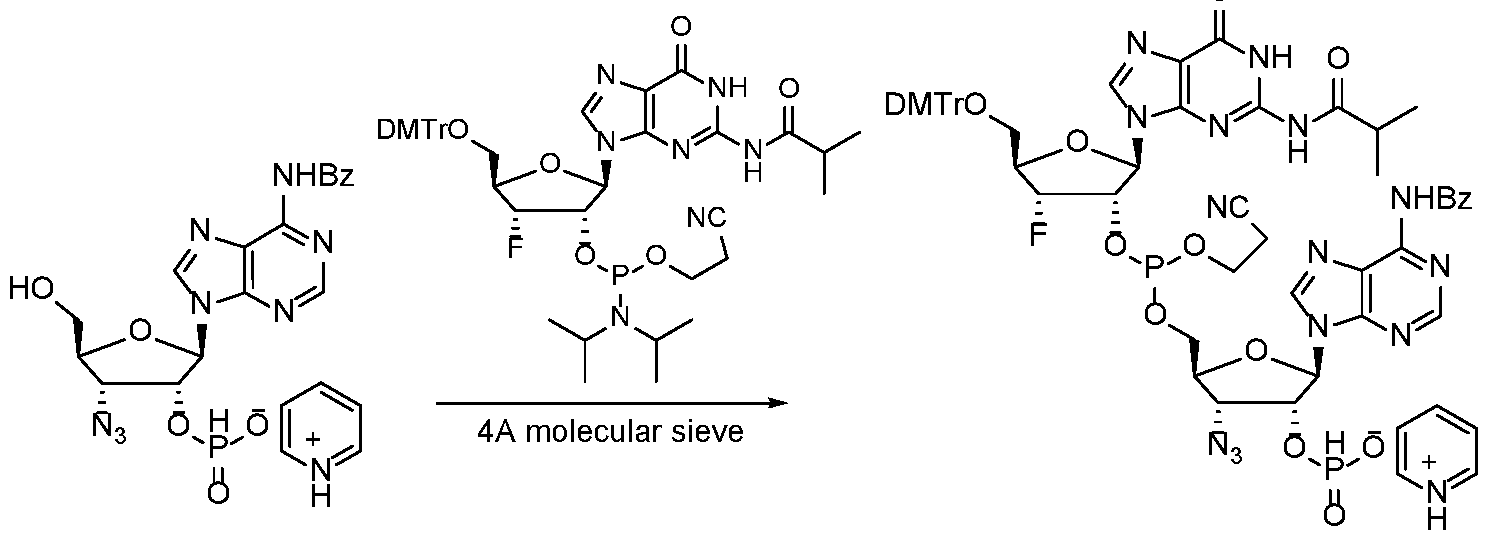
(2R,3S,4R,5R)-5-((bis(4-methoxyphenyl)(phenyl)methoxy)methyl)-4-fluoro-2-(2- isobutyramido-6-oxo-l,6-dihydro-9H-purin-9-yl)tetrahydrofuran-3-yl (2-cyanoethyl) diisopropylphosphoramidite (887mg, 1.03mmol) was co-evaporated with ACN (3x3mL), re- dissolved in ACN (3mL) under Ar, and dried by adding activated 4A molecular sieve (150mg). (2R,3R,4R,5S)-4-azido-2-(6-benzamido-9H-purin-9-yl)-5-(hydroxymethyl)tetrahydrofuran-3-yl phosphonate (crude, 2g, ~0.94mmol) was co-evaporated with ACN (3x5mL) and then re- dissolved in ACN (5mL) under Ar, and dried by adding activated 4A molecular sieve (150mg). After 30min, it was added to the previously prepared mixture containing (2R,3S,4R,5R)-5- ((bis(4-methoxyphenyl)(phenyl)methoxy)methyl)-4-fluoro-2-(2-isobutyramido-6-oxo-l,6- dihydro-9H-purin-9-yl)tetrahydrofuran-3-yl (2-cyanoethyl) diisopropylphosphoramidite. The reaction mixture was used in the next reaction step without purification. LCMS (ES, m/z): 1215.2 [M - H]".
Step 5: (2R 3R 4R 5S)-4-azido-2-(6-benzamido-9H-purin-9-\l)-5-((((((2R 3S.4R 5R)-5-((bis(4- methoxyphenyl)(phenyl)methoxy)methyl)-4-fluoro-2-(2 sobu1yra
purm-9-yl)tetrahydrofuran-3-yl)oxy)(2-cyanoe
tetrahydrofuran-3-yl phosphonate

To the mixture from Step 4 at rt was added (Z^-^N-dimethyl-jV^S-thioxo-SH- 1,2,4- dithiazol-5-yl)formimidamide (212mg, 1.03mmol), and it was stirred for 30min. Then, the reaction was concentrated, and the residue was used for the next reaction step without purification. LCMS (ES, m/z): 1247.2 [M - H]".
Step 6: (2R 3R 4R 5S)-4-azido-2-( 6-benzamido-9H-purin-9-yl)-5-( ( ((2-cyanoethoxy)-
((( 2R 3S, 4R, 5R)-4-fluoro-5-(hydroxymethyl)-2-(2-isobutyramido-6-oxo-l, 6-dihydro-9H-purin-9- yl)tetrahydrofuran-3-yl)oxy)phosphorothioyl)oxy)methyl)tetra
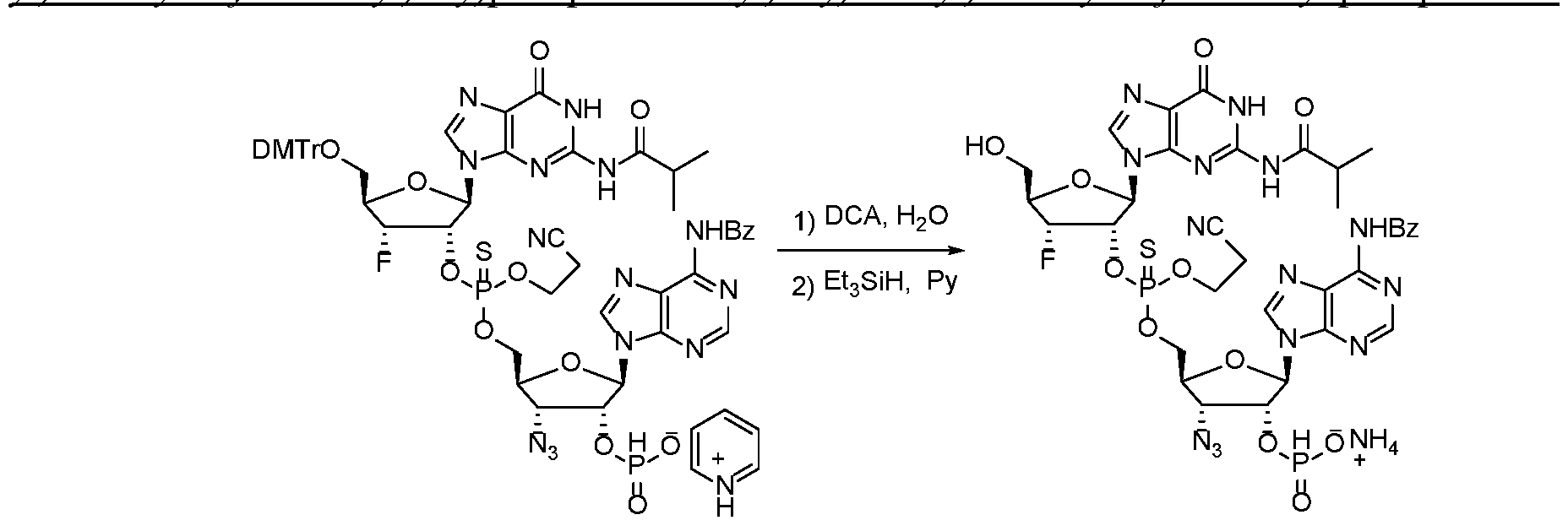
To a solution of (2R,3R,4R,5S)-4-azido-2-(6-benzamido-9H-purin-9-yl)-5-
((((((2R,3S,4R,5R)-5-((bis(4-methoxyphenyl)(phenyl)methoxy)methyl)-4-fluoro-2-(2- isobutyramido-6-oxo-l,6-dihydro-9H-purin-9-yl)tetrahydrofuran-3-yl)oxy)(2- cyanoethoxy)phosphorothioyl)oxy)methyl)tetrahydrofuran-3-yl phosphonate (4g, crude, ~0.94mmol) in CH2C12 (9mL) was added water (0.18mL) and 2,2-dichloroacetic acid in CH2C12 (0.6M, 1 l .OmL, 6.65mmol). After 15min, tri ethyl silane (26.5mL) was added, and stirring was continued for additional 2h. Then, pyridine (1.28mL) was added, and it was concentrated. The residue was purified by reverse phase chromatography (CI 8) and eluted with 0 to 95% ACN in aq NH4HCO3 (0.04%) to give the product. LCMS (ES, m/z): 947.2 [M + H]+. 1H-NMR
(400MHz, CD3OD): δ 8.76-8.71 (m, 1H), 8.56, 8.44 (2 s, 1H), 8.33, 8.29 (2 s, 1H), 8.21-8.07 (m, 2H), 7.72-7.63 (m, 1.5H), 7.61-7.55 (m, 2H), 6.37-6.19 (m, 2H), 6.08-5.92 (m, 0.5H), 5.69-5.53 (m, 2H), 5.43-5.24 (m, 1H), 4.76, 4.61 (dt, J= 5.4Hz, 1H), 4.53-4.30 (m, 3H), 4.27-4.21 (m,
3H), 4.12-3.88 (m, 1H), 2.85 (t, J= 5.9Hz, 1H), 2.79- 2.55 (m, 3H), 1.27-1.15 (m, 6H). 31P- MR (162MHz, CD3OD): δ 67.98, 67.47 (2 s, IP); 3.07, 2.96 (2 s, IP).
Step 7: (1R 6R.8R.9S.14S.16R.17R.18R)-17-azido-16-(6-benzamido-9H-purin-9-yl)-l l-(2- cyanoethoxy)-18-fluoro-8-(2-isobutyramido-6-oxo-l, 6-dihydro-9H-purin-9-yl)-2, 4, 7, 10, 12, 15- hexaoxa-3, 1 l-diphosphatricyclo[ 12.2.1.16'9 Joctadecan-3-olate 11 -sulfide
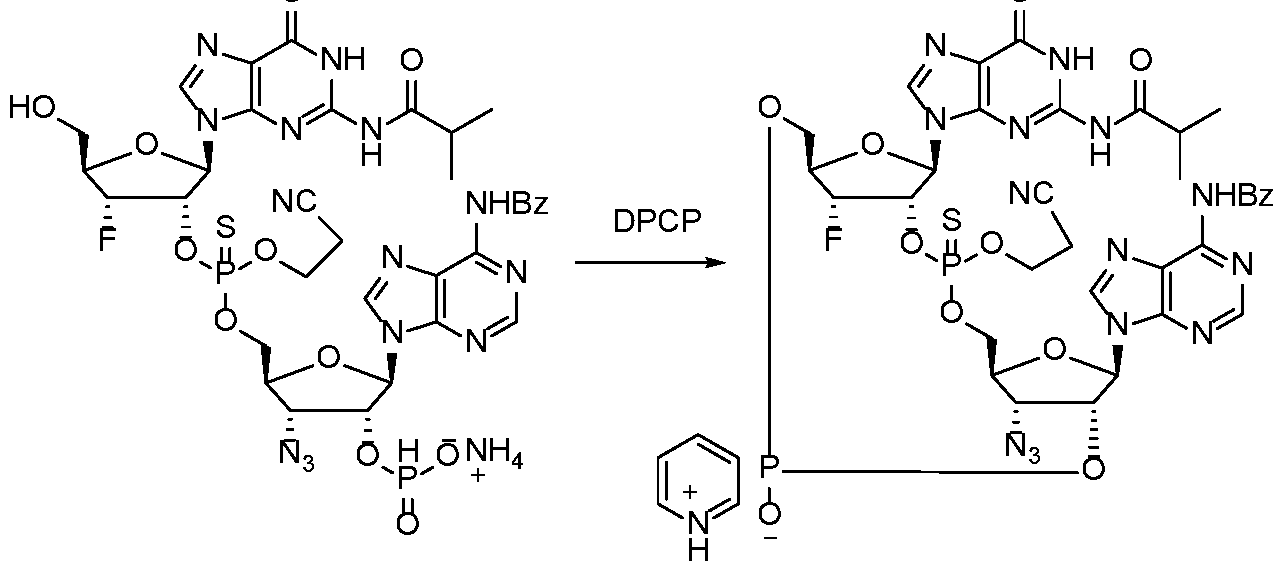
To pyridine (41mL) under Ar at -40°C was added diphenyl phosphorochloridate (2.2g, 8.2mmol). To the solution at -40°C was added a solution of (2R,3R,4R,5S)-4-azido-2-(6- benzamido-9H-purin-9-yl)-5-((((2-cyanoethoxy)(((2R,3S,4R,5R)-4-fluoro-5-(hydroxymethyl)-2- (2-isobutyramido-6-oxo- 1 ,6-dihydro-9H-purin-9-yl)tetrahydrofuran-3 -yl)oxy)phosphorothioyl)- oxy)methyl)tetrahydrofuran-3-yl phosphonate (390mg, 0.41mmol, co-evaporated with pyridine 3x5mL) in CH2C12 (41mL) dropwise over 20min. It was stirred at -40°C for 20min. The reaction mixture was used for the next reaction step immediately without purification. LCMS (ES, m/z): 929.1 [M + H]+.
Step 8: (1R 6R 8R 9S.14S.16R.17R.18R)-17-azido-16-(6-benzamido-9H-vurin-9-yl)-l l-(2- cvanoethoxy)-18-fiuoro-8-(2-isobutyramido-6-oxo-l, 6-dihydro-9H-purin-9-yl)-2, 4, 7, 10, 12, 15-

To the reaction mixture from Step 7 at -40°C was added 3H-benzo[c][l,2]dithiol-3-one (103mg, 0.615mmol) and water (117μ1, 6.49mmol). After stirring at rt for 40min, the mixture was concentrated under reduced pressure. The residue was purified by reverse phase
chromatography (C18) and eluted with 0 to 95% ACN in aq H4HCO3 (0.04%) to give the product. LCMS (ES, m/z): 961.1 [M + H]+. 1H- MR (400MHz, CD3OD): δ 8.70-8.05 (m, 5H), 7.80-7.52 (m, 3H), 6.48-6.17 (m, 2H), 5.96-5.67 (m, 2H), 5.67-5.49 (m, 1H), 4.76 (dd, J = 26.0, 3.3Hz, 1H), 4.64-4.23 (m, 6H), 4.23-3.73 (m, 2H), 3.04-2.33 (m, 3H), 1.27-0.82 (m, 6H). 31P- MR (162MHz, CD3OD) δ 64.70-63.97 (m, IP), 54.94, 54.31 (2 s).
Step 9: (1R.6R.8R.9S.14S.16R.17R.18R)-17-azido-16-(6-benzamido-9H-purin-9-yl)-18-fluoro-8- (2-isobutyramido-6-oxo-l, 6-dihydro-9H-purin-9-yl)-2, 4, 7, 10, 12, 15-hexaoxa-3 1- diphosphatricyclof 12.2.1.16'9 J octadecane-3, 1 l-bis(olate) 3, 11 -disulfide (152-9-A),
OR.6R.8R.9S.14S.16R.17R.18R)-17-azido-16-(6-benzamido-9H-purin-9-yl)-18-fluoro-8-(2- isobutyramido-6-oxo-l , 6-dihydro-9H-purin-9-yl)-2, 4, 7, 10, 12, 15-hexaoxa-3, 11- diphosphatricyclof 12.2.1 A6'91 octadecane-3 , 1 l-bis(olate) 3, 11 -disulfide (152-9-B),
(1R 6R.8R 9S.14S.16R.17R.18R)-17-azido-16-(6-benzamido-9H-purin-9-yl)-18-fluoro-8-(2- isobutyramido-6-oxo-l , 6-dihydro-9H-purin-9-yl)-2, 4, 7, 10, 12, 15-hexaoxa-3, 11- diphosphatricyclof 12.2.1.16 91 octadecane-3, 1 l-bis(olate) 3, 11 -disulfide (152-9-C), and
(1R 6R.8R 9S.14S.16R.17R.18R)-17-azido-16-(6-benzamido-9H-purin-9-yl)-18-fluoro-8-(2- isobutyramido-6-oxo-l , 6-dihydro-9H-purin-9-yl)-2, 4, 7, 10, 12, 15-hexaoxa-3, 11-

To a suspension of (lR,6R,8R,9S, 14S, 16R, 17R, 18R)-17-azido-16-(6-benzamido-9H- purin-9-yl)-l l-(2-cyanoethoxy)-18-fluoro-8-(2-isobutyramido-6-oxo-l,6-dihydro-9H-purin-9- yl)-2,4,7, 10, 12, 15-hexaoxa-3, l l-diphosphatricyclo[12.2.1.16'9]octadecan-3-olate 3, 1 1-disulfide (200mg, 0.2mmol) in ACN (2mL) under Ar was added tert-butylamine (2mL), and the mixture was stirred for 0.5h. Then, it was concentrated, and the residue was purified by preparative-
HPLC (T3 Prep C18 Column, 19mmx250mm) and eluted with 18 to 32% ACN in water (0.05% TFA) over 25min. Fractions with the desired mass were neutralized with H4OH (25%) and then concentrated to give the following four diastereomeric products:
(lR,6R,8R,9S,14S, 16R,17R, 18R)-17-azido-16-(6-benzamido-9H-purin-9-yl)-18-fluoro- 8-(2-isobutyramido-6-oxo-l,6-dihydro-9H-purin-9-yl)-2,4,7, 10,12, 15-hexaoxa-3,l l- diphosphatricyclo[12.2.1.16'9]octadecane-3,l l-bis(olate) 3,11-disulfide (152-9-A). TR:
14.47min. LCMS (ES, m/z): 908.0 [M + H]+. 1H- MR: (400MHz, CD3OD): δ 9.36 (s, 1H), 8.98 (s, 1H), 8.75 (s, 1H), 8.15 (d, J= 7.6Hz, 2H), 7.69 (t, J= 7.4Hz, 1H), 7.61 (t, J= 7.6Hz, 2H), 6.42 (d, J = 8.2Hz, 1H), 6.25 (d, J= 8.4Hz, 1H), 5.57 (q, J = 7.3, 6.0Hz, 2H), 5.44 (d, J = 3.4Hz, 1H), 4.71 (d, J= 4.9Hz, 1H), 4.64 (d, J= 27.4Hz, 1H), 4.36-4.28 (m, 3H), 4.24-4.13 (m, 2H), 2.78-2.68 (m, 1H), 1.20 (dd, J= 12.0, 6.8Hz, 6H). 31P- MR: (162MHz, CD3OD): δ 58.64 (s, IP), 58.19 (s, IP).
(lR,6R,8R,9S,14S, 16R,17R, 18R)-17-azido-16-(6-benzamido-9H-purin-9-yl)-18-fluoro- 8-(2 -isobutyramido-6-oxo-l,6-dihydro-9H-purin-9-yl)-2,4,7, 10, 12, 15-hexaoxa-3, 11- diphosphatricyclo[12.2.1.16'9]octadecane-3,l l-bis(olate) 3,11-disulfide (152-9-B). TR:
15.80min. LCMS (ES, m/z): 908.0 [M + H]+. 1H- MR: (400MHz, CD3OD): δ 9.26 (s, 1H), 8.67 (s, 1H), 8.38 (s, 1H), 8.21-8.09 (m, 2H), 7.70-7.62 (m, 1H), 7.58 (dd, J = 8.3, 6.8Hz, 2H), 6.36 (d, J= 8.3Hz, 1H), 6.13 (d, J= 8.1Hz, 1H), 5.63-5.40 (m, 3H), 4.77 (d, J = 4.8Hz, 1H), 4.70- 4.56 (m, 1H), 4.29 (t, J= 3.6Hz, 3H), 4.21-4.03 (m, 2H), 2.50-2.39 (m, 1H), 1.07 (d, J= 6.9Hz, 3H), 0.93 (d, J = 6.8Hz, 3H). 31P- MR: (162MHz, CD3OD): δ 58.61 (s, IP), 55.52 (s, IP).
(lR,6R,8R,9S,14S, 16R,17R, 18R)-17-azido-16-(6-benzamido-9H-purin-9-yl)-18-fluoro- 8-(2-isobutyramido-6-oxo-l,6-dihydro-9H-purin-9-yl)-2,4,7, 10,12, 15-hexaoxa-3,l l- diphosphatricyclo[12.2.1.16'9]octadecane-3,l l-bis(olate) 3,11-disulfide (152-9-C). TR:
17.80min. LCMS (ES, m/z): 908.0 [M + H]+. 1H- MR: (400MHz, CD3OD): δ 8.94 (s, 1H), 8.85 (s, 1H), 8.65 (s, 1H), 8.07 (d, J= 7.7Hz, 2H), 7.75-7.49 (m, 3H), 6.32 (d, J= 8.1Hz, 1H), 6.17 (d, J= 8.6Hz, 1H), 5.76-4.60 (m, 7H), 4.35-3.98 (m, 3H), 2.57-2.54 (m, 1H), 1.13 (t, J = 7.4Hz, 6H). 31P- MR: (162MHz, CD3OD): δ 58.33 (s, IP), 57.18 (s, IP).
(lR,6R,8R,9S,14S, 16R,17R, 18R)-17-azido-16-(6-benzamido-9H-purin-9-yl)-18-fluoro- 8-(2-isobutyramido-6-oxo-l,6-dihydro-9H-purin-9-yl)-2,4,7, 10,12, 15-hexaoxa-3,l l- diphosphatricyclo[12.2.1.16'9]octadecane-3,l l-bis(olate) 3,11-disulfide (152-9-D). TR:
20.97min). LCMS (ES, m/z): 908.0 [M + H]+. 1H- MR: (400MHz, CD3OD): δ 8.85 (s, 1H), 8.66 (s, 1H), 8.41 (s, 1H), 8.20-8.10 (m, 2H), 7.70-7.62 (m, 1H), 7.57 (dd, J= 8.2, 6.8Hz, 2H), 6.34 (d, J= 8.3Hz, 1H), 6.13 (d, J= 8.4Hz, 1H), 5.64 (dd, J= 53.0, 3.3Hz, 1H), 5.55-5.38 (m,
2H), 4.80 (d, J = 5.1Hz, 2H), 4.60 (dq, J= 26.5, 2.3Hz, 1H), 4.37-4.25 (m, 2H), 4.24-4.14 (m, 2H), 4.07 (ddd, J = 12.2, 5.9, 1.7Hz, 1H), 2.51 (p, J= 6.9Hz, 1H), 1.07 (d, J= 6.8Hz, 3H), 0.96 (d, J= 6.8Hz, 3H). 31P-NMR: (162MHz, CD3OD): δ 56.96 (s, IP), 55.74 (s, IP).
Step 10: 2-amino-9-i(lR.6R 8R.9S.14S.16R 17R.18R)-16-(6-amino-9H-purin-9-yl)-l 7-azido-18- fIuoro-3, 11 -dihydroxy-3, 1 l-disulfido-2, 4, 7, 10, 12, 15-hexaoxa-3, 11- diphosphatricvclo[12.2 .l69]octadec-8-yll-l,9-dihvdro-6H-purin-6-one (Piaster omer 1)

(lR,6R,8R,9S,14S, 16R,17R, 18R)-17-azido-16-(6-benzamido-9H-purin-9-yl)-18-fluoro- 8-(2-isobutyramido-6-oxo-l,6-dihydro-9H-purin-9-yl)-2,4,7, 10,12, 15-hexaoxa-3,l l- diphosphatricyclo[12.2.1.16'9]octadecane-3,l l-bis(olate) 3,11-disulfide (152-9-A)(~300mg) was dissolved in a solution of Me H2 in EtOH (30%, 15mL). The resulting solution was stirred at rt for 3h. It was concentrated, and the residue was purified by reverse phase (AQ CI 8)
chromatography and eluted with 0 to 95% ACN in aq H4HC03 (50 mM) to give the product, Example 18. LCMS (ES, m/z): 732.2 [M - H]". 1H- MR: (400MHz, D20): δ 8.21 (s, 2H), 8.09 (s, 2H), 7.79 (s, 2H), 6.10 (d, J = 8.4Hz, 1H), 5.97 (d, J = 8.8Hz, 1H), 5.67 (dd, J = 52.5, 3.5Hz, 1H), 5.31-5.22 (m, 2H), 4.91 (d, J = 5.2Hz, 1H), 4.75-4.64 (m, 1H), 4.56 (s, 2H), 4.40-4.36 (m, 1H), 4.33-4.28 (m, 1H), 4.12-4.03 (m, 2H). 19F-NMR: (376MHz, D20): δ -194.75 (s). 31P- MR: (162MHz, D20): δ 54.02 (s, IP), 52.90 (s, IP).
The other diastereomeric products of Step 9 were each independently treated in an analogous manner to that described immediately above in Step 10 to provide the following products:
Example 19: 2-amino-9-[(lR,6R,8R,9S,14S, 16R,17R, 18R)-16-(6-amino-9H-purin-9-yl)- 17-azido- 18-fluoro-3 , 11 -dihydroxy-3 , 11 -di sulfido-2,4, 7, 10, 12,15 -hexaoxa-3 , 11- diphosphatricyclo[12.2.1.16'9]octadec-8-yl]-l,9-dihydro-6H-purin-6-one (Diastereomer 2):
Prepared from (lR,6R,8R,9S,14S, 16R, 17R,18R)-17-azido-16-(6-benzamido-9H-purin-9-yl)-18- fluoro-8-(2-isobutyramido-6-oxo-l,6-dihydro-9H-purin-9-yl)-2,4,7,10, 12,15-hexaoxa-3,l l- diphosphatricyclo[12.2.1.16'9]octadecane-3,l l-bis(olate) 3,11-disulfide (152-9-B). LCMS (ES,
m/z): 732.0 [M - H]". 1H- MR: (400MHz, D20): δ 8.33 (s, 1H), 8.16 (s, 1H), 8.10 (s, 1H), 6.15 (d, J = 8.1Hz, 1H), 6.02 (d, J = 8.5Hz, 1H), 5.61 (dd, J = 52.4, 3.5Hz, 1H), 5.22-5.06 (m, 2H), 4.68-4.61 (m, 2H), 4.44 (s, 1H), 4.32-5-4.27 (m, 1H), 4.19-4.05 (m, 3H). 19F-NMR: (376MHz, D20): δ -195.02 (s). 31P-NMR: (162MHz, D20): δ 55.74 (s, IP), 54.52 (s, IP).
Example 20: 2-amino-9-[(lR,6R,8R,9S,14S, 16R,17R, 18R)-16-(6-amino-9H-purin-9-yl)-
17-azido- 18-fluoro-3 , 11 -dihydroxy-3 , 11 -di sulfido-2,4, 7, 10, 12,15 -hexaoxa-3 , 11- diphosphatricyclo[12.2.1.16'9]octadec-8-yl]-l,9-dihydro-6H-purin-6-one (Diastereomer 3).
Prepared from (lR,6R,8R,9S,14S, 16R, 17R,18R)-17-azido-16-(6-benzamido-9H-purin-9-yl)-18- fluoro-8-(2-isobutyramido-6-oxo-l,6-dihydro-9H-purin-9-yl)-2,4,7,10, 12,15-hexaoxa-3,l l- diphosphatricyclo[12.2.1.16'9]octadecane-3,l l-bis(olate) 3,11-disulfide (152-9-C). LCMS (ES, m/z): 732.0 [M - H]". 1H- MR: (400MHz, D20): δ 8.74 (s, 1H), 8.21 (s, 1H), 7.98 (s, 1H), 6.19 (d, J = 8.1Hz, 1H), 6.04 (d, J = 8.3Hz, 1H), 5.42 (dd, J = 53.0, 3.6Hz, 1H), 5.34-5.18 (m, 2H), 4.83 (d, J = 5.0Hz, 1H), 4.67 (d, J = 2.4Hz, 1H), 4.52 (s, 1H), 4.32 (dd, J = 9.9, 5.5Hz, 1H), 4.24- 4.07 (m, 3H). 19F-NMR: (376MHz, D20): δ -196.09 (s). 31P- MR: (162MHz, D20): δ 56.21 (s, IP), 53.63 (s, IP).
Example 21 : 2-amino-9-[(lR,6R,8R,9S,14S, 16R,17R, 18R)-16-(6-amino-9H-purin-9-yl)- 17-azido- 18-fluoro-3 , 11 -dihydroxy-3 , 11 -di sulfido-2,4, 7, 10, 12,15 -hexaoxa-3 , 11- diphosphatricyclo[12.2.1.16'9]octadec-8-yl]-l,9-dihydro-6H-purin-6-one (Diastereomer 4).
Prepared from (lR,6R,8R,9S,14S, 16R, 17R,18R)-17-azido-16-(6-benzamido-9H-purin-9-yl)-18- fluoro-8-(2-isobutyramido-6-oxo-l,6-dihydro-9H-purin-9-yl)-2,4,7,10, 12,15-hexaoxa-3,l l- diphosphatricyclo[12.2.1.16'9]octadecane-3,l l-bis(olate) 3,11-disulfide (152-9-D). LCMS (ES, m/z): 732.0 [M - H]". 1H- MR: (400MHz, D20): δ 8.86 (s, 1H), 8.40 (s, 1H), 8.23 (s, 1H), 6.21 (d, J = 8.2Hz, 1H), 6.07 (d, J = 8.4Hz, 1H), 5.52-5.34 (m, 1H), 5.24-5.17 (m, 1H), 5.05-4.97 (m, 1H), 4.67-4.65 (m, 2H), 4.42 (s, 1H), 4.21-4.04 (m, 4H). 19F- MR: (376MHz, D20): δ -196.43 (s). 31P- MR: (162MHz, D20): δ 56.80 (s, IP), 56.65 (s, IP).
Examples 22 to 24, as shown in Table 3 below, were prepared according to procedures analogous to those outlined in Examples 18 to 21 above using the appropriate monomers, decribed as Preparations or as obtained from commercial sources, in the coupling step.
Table 3
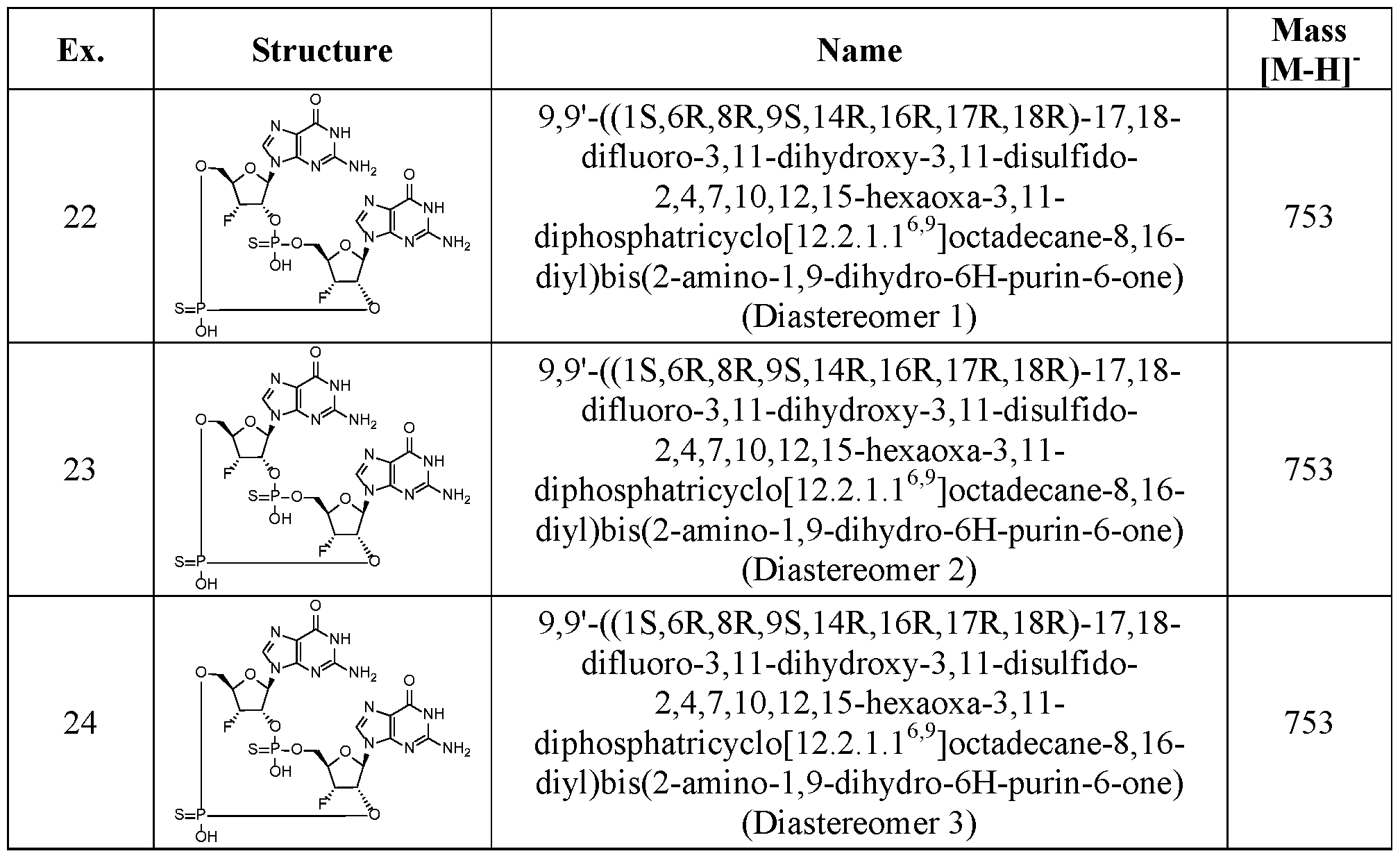
Examples 25 and 26: 9,9'-rqR,6R,8R,9R,14R,16R,17R,18RV17,18-dihvdroxy-3,ll-dioxido- 3,ll-disulfanyl-2,4,7,10,12,15-hexaoxa-3,ll-diphosphatricvclo[12.2.1.1 '9l-octadecane-8,16- diyllbisf2-amino-l,9-dihydro-6H-purin-6-one) (Diastereomers 1 and 2)

7: N.N'-iiflR.6R.8R.9R.14R.16R.17R.18R)-17.18-bis{[tert-butyl(dimethyl)silylloxyl-3.11- dioxido-3, 1 l-disulfanyl-2, 4, 7, 10, 12, 15-hexaoxa-3, 1 l-diphosphatricyclof 12.2.1.16'91 octadecane- 8, 16-diyl]bis(6-oxo- -dihydro-9H-purine-9,2-diyl)}bis(2-methylpropanamide)

Step 2: 9.9'-i(lR.6R.8R.9R 14R 16R 17R 18R)-17, 18-bis{itert-butyl(dimethyl)silylloxy}-3.11- dioxido-3, 1 l-disulfanyl-2, 4, 7, 10, 12, 15-hexaoxa-3, 1 l-diphosphatricyclo[ 12.2.1.16'91 octadecane- 8, 16-diyllbis(2-amino-l ,9-dihydro-6H-purin-6-one) (CC-1) and 9,9'- f(lR 6R 8R.9R.14R.16R.17R.18R)-17.18-bis{itert-butyl(dimethyl)silylloxy}-3.11 -dioxido-3.11- disulfanyl-2, 4, 7,10, 12, 15-hexaoxa-3,l l-diphosphatricyclo[ 12.2.1. l6 9]octadecane-8, 16- diyllbis(2-amino-l,9-dihydro-6H- urin-6- -2)

To N,N'-{ [(1R,6R,8R,9R, 14R, 16R, 17R, 18R)-17, 18-bis{ [tert-butyl(dimethyl)silyl]oxy } - 3,l l-dioxido-3,l l-disulfanyl-2,4,7,10, 12,15-hexaoxa-3,l l-diphosphatricyclo[12.2.1.16'9]- octadecane-8,16-diyl]bis(6-oxo-l,6-dihydro-9H-purine-9,2-diyl)}bis(2-methylpropanamide) (167mg, 0.153mmol) was added a 33 wt. % methylamine solution in absolute ethanol (1.84mL, 14.8mmol), the reaction mixture was left to stir at ambient temperature for 18h. The reaction mixture was concentrated, and the product was purified by preparative reverse phase HPLC (Waters SunFire C18 OBD Prep Column, IOOA, 5μιη, 19mmx 150mm, [Waters Part#
186002568]) and eluted with 30 to 100% ACN in water (lOOmM triethylammonium acetate)
over 15min. Fractions with the desired mass were collected and then lyophilized to provide two diastereomeric products:
9,9'-[(lR,6R,8R,9R, 14R, 16R, 17R, 18R)- 17, 18-bis{ [fert-butyl(dimethyl)silyl]oxy }-3, 11 - dioxido-3,1 l-disulfanyl -2,4,7, 10, 12,15-hexaoxa-3, l l-diphosphatricyclo[12.2.1. l6'9]octadecane- 8,16-diyl]bis(2-amino-l,9-dihydro-6H-purin-6-one) (Diastereomer 1, CC-1). TR: l l . lOmin. LCMS (ES, m/z): 949 [M - H]".
9,9'-[(lR,6R,8R,9R, 14R, 16R, 17R, 18R)- 17, 18-bis{ [fert-butyl(dimethyl)silyl]oxy }-3, 11 - dioxido-3, 1 l-disulfanyl -2,4,7, 10, 12,15-hexaoxa-3, l l-diphosphatricyclo[12.2.1. l6'9]octadecane- 8, 16-diyl]bis(2-amino-l,9-dihydro-6H-purin-6-one) (Diastereomer 2, CC-2). TR: 12.00min. LCMS (ES, m/z): 949 [M - H]".
Step 3: 9.9'-f(lR.6R.8R.9R 14R 16R 17R 18R)-17, 18-dihydroxy-3.11 -dioxido-3.11-disulfanyl- 2.4. 7.10.12.15-hexaoxa-3.1 l-diphosphatricyclo[ 12.2.1. l69]octadecane-8.16-diyl]bis(2-amino- l,9-dihydro-6 -purin-6-one) (Diastereomer 1)

To a stirred solution of 9,9'-[(lR,6R,8R,9R,14R,16R, 17R, 18R)-17,18-bis{[tert- butyl(dimethyl)silyl]oxy}-3,l l-dioxido-3,l l-disulfanyl-2,4,7, 10,12, 15-hexaoxa-3,l l- diphosphatricyclo[12.2.1.16'9]octadecane-8,16-diyl]bis(2-amino-l,9-dihydro-6H-purin-6-one) (CC-1, 8mg, 0.007mmol) in pyridine (0.6mL) was added triethylamine (0.36mL, 2.58mmol), followed by triethylamine trihydrofluoride (0.12mL, 0.74mmol) at ambient temperature. The reaction mixture was heated to 55°C and left to stir at the same temperature for 22h. The reaction mixture was cooled to ambient temperature, quenched with lOOmM aq
triethylammonium acetate (2.0mL) at 0°C, and the mixture was filtered and lyophilyzed. The product was purified using mass-directed reverse phase FIPLC with a Waters SunFire CI 8 OBD Prep Column, ΙΟθΑ, 5μπι, 19mmx 150mm, [Waters Part# 186002568] using a gradient solvent system with MeCN and lOOmM aq triethylammonium acetate. Lyophilization of the product fractions furnished Example 25, 9,9'-[(lR,6R,8R,9R,14R,16R,17R,18R)-17,18-dihydroxy-3,l 1- dioxido-3,1 l-disulfanyl -2,4,7, 10, 12,15-hexaoxa-3, l l-diphosphatricyclo-[12.2.1. l6'9]octadecane- 8,16-diyl]bis(2-amino-l,9-dihydro-6H-purin-6-one) (Diastereomer 1). LCMS (ES, m/z): 721 [M
- H]". 1H NMR (500MHz, OMSO-d6): δ 10.54 (s, 1H), 10.53 (s, 1H), 8.98 (s, 1H), 7.59 (s, 1H), 7.56 (s, 1H), 6.43 (s, 2H), 6.37 (s, 2H), 6.17 (s, 1H), 5.91 (s, 1 H), 5.89 (s, 1H), 5.24 (s, 1H), 5.01 (t, J= 4.0Hz, 1H), 4.93 (t, J= 4.0Hz, 1H), 4.60 (s, 1H), 4.42 (s, 1H), 4.25 (t, J= 8.5Hz, 1H), 4.20 (s, 2H), 3.92 (m, 1H), 3.85 (d, J= 10.6Hz, 1H), 3.72 (d, J = 11.1Hz, 1H), 3.52 (m, 1H). 31P NMR: (202MHz, DMSO-i4): δ 56.2 (s), 47.6 (s).
The other diastereomeric product of Step 2, 9,9'-[(lR,6R,8R,9R,14R,16R, 17R,18R)- 17, 18-bis{ [fert-butyl(dimethyl)silyl]oxy }-3, 11 -dioxido-3, 11 -disulfanyl -2,4,7, 10, 12, 15-hexaoxa- 3,l l-diphosphatricyclo[12.2.1.16'9]octadecane-8,16-diyl]bis(2-amino-l,9-dihydro-6H-purin-6- one) (CC-2), was independently treated in an analogous manner to that described immediately above in Step 3 to provide Example 26, 9,9'-[(lR,6R,8R,9R, 14R, 16R, 17R,18R)-17,18- dihydroxy-3, 1 l-dioxido-3,1 l-disulfanyl-2,4,7, 10, 12,15-hexaoxa-3, l 1-diphosphatricyclo- [12.2.1.16'9]-octadecane-8,16-diyl]bis(2-amino-l,9-dihydro-6H-purin-6-one) (Diastereomer 2). LCMS (ES, m/z): 721 [M - H]". 1H NMR (500MHz, DMSO-i4): δ 10.53 (s, 2H), 7.65 (s, 2H), 6.45 (s, 4H), 5.89 (d, J = 8.5Hz, 2 H), 5.30 (s, 2H), 4.93 (t, J= 4.0Hz, 2H), 4.58 (s, 2H), 4.23 (t, J= 8.5Hz, 2H), 4.19 (s, 2H), 3.73 (d, J = 11.4Hz, 2H). 31P NMR: (202MHz, DMSO-i¾): δ 47.9 (s).
Example 27, as shown in Table 4 below, was prepared according to procedures analogous to those outlined in Examples 25 and 26 above using the appropriate monomers, decribed as Preparations or as obtained from commercial sources, in the coupling step.
Table 4
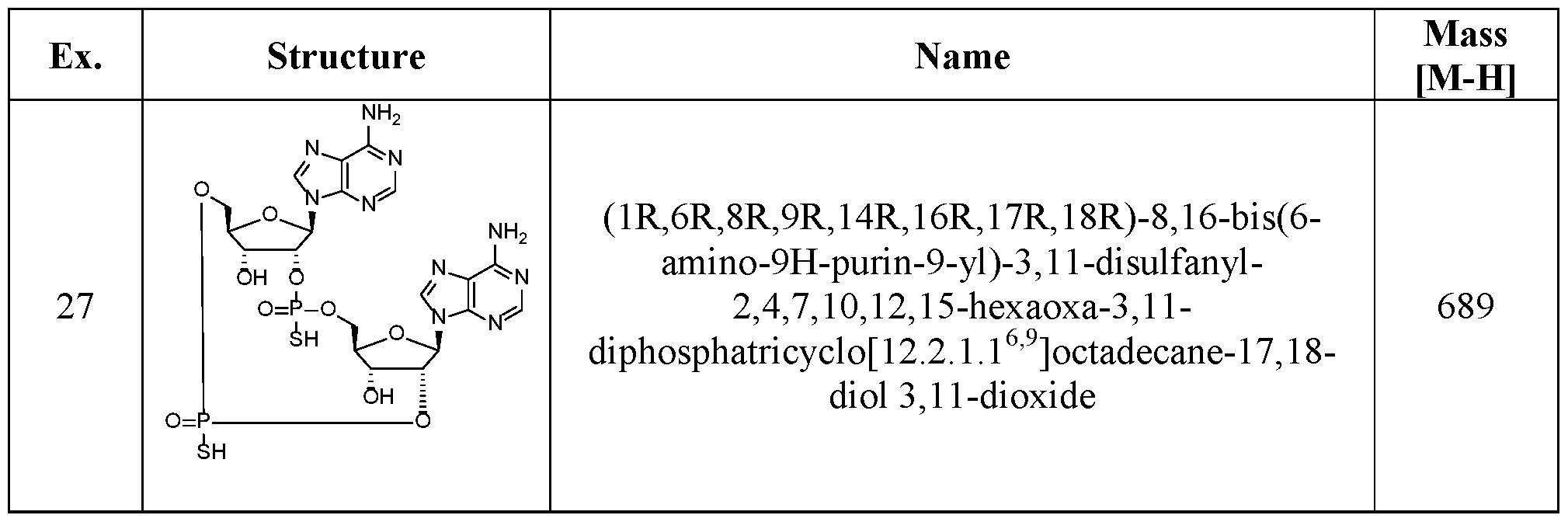
Examples 28 and 29: 9,9'-fqR,6R,8R,9R,14R,16R,17S,18SV3,ll,17,18-tetrahvdroxy-3,ll- disulfido-2,4,10,12-tetraoxa-7,15-dithia-3,ll-diphosphatricyclo[12.2.1.1 '9loctadecane-8,16- diyl)bisf2-amino-l,9-dihydro-6H-purin-6-one) (Diastereomers 1 and 2)

Step 1: (1R 6R 8R 9R.14R.16R.17S.18S)-17, 18-bis((tert-butyldimethylsilyl)oxy)-8J6-bis(2- isobutyramido-6-oxo-l ', 6-dihydro-9H-purin-9-yl)-2, 4, 10, 12-tetraoxa- 7, 15-dithia-3, 11- diphosphatricycloi 12.2.1 A6'91 octadecane-3 ,1 l-bis(olate)
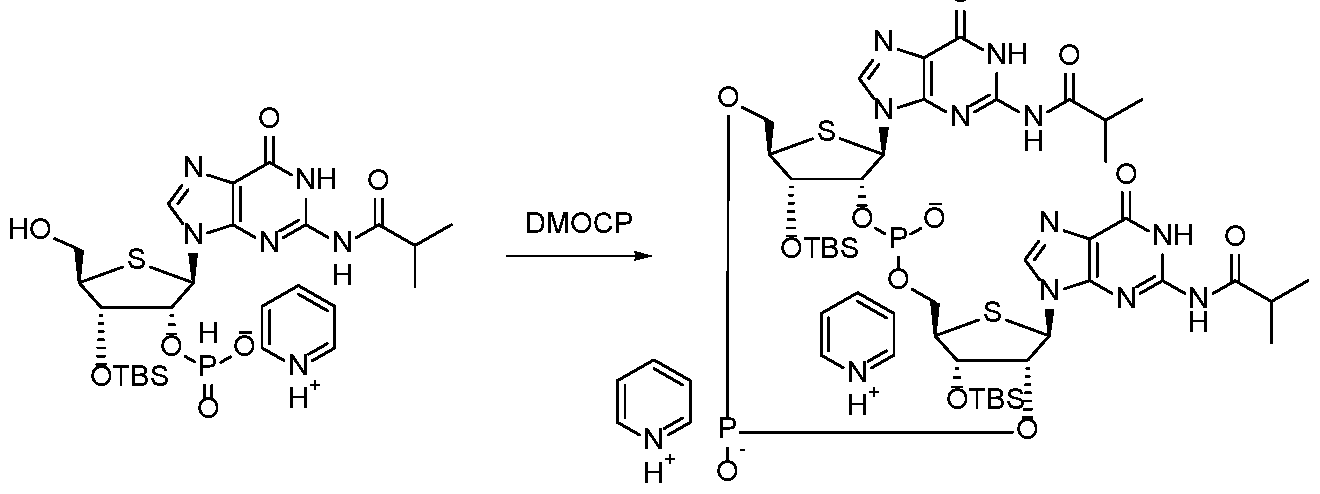
To a solution of (2R,3R,4S,5R)-4-((tert-butyldimethylsilyl)oxy)-5-(hydroxymethyl)-2-(2- isobutyramido-6-oxo-l,6-dihydro-9H-purin-9-yl)tetrahydrothiophen-3-yl hydrogen phosphonate (300mg, 0.620mmol) in pyridine (lmL) at 0°C was added 2-chloro-5,5-dimethyl-l,3,2- dioxaphosphinane 2-oxide (2.29g, 12.4mmol). The resulting solution was stirred at rt for lh. The reaction mixture was used for the next reaction step without purification. LCMS (ES, m/z): 1059.3 [M + H]+.
Step 2: OR.6R 8R 9R 14R.16R.17S.18S)-17, 18-bis((tert-butyldimethylsilyl)oxy)-8.16-bis(2- isobutyramido-6-oxo-l ', 6-dihydro-9H-purin-9-yl)-2, 4, 10, 12-tetraoxa- 7, 15-dithia-3, 11- diphosphatricyclo[ 12.2.1 A6'9 ] octadecane-3 ,1 l-bis(olate) 3,11-disulfide
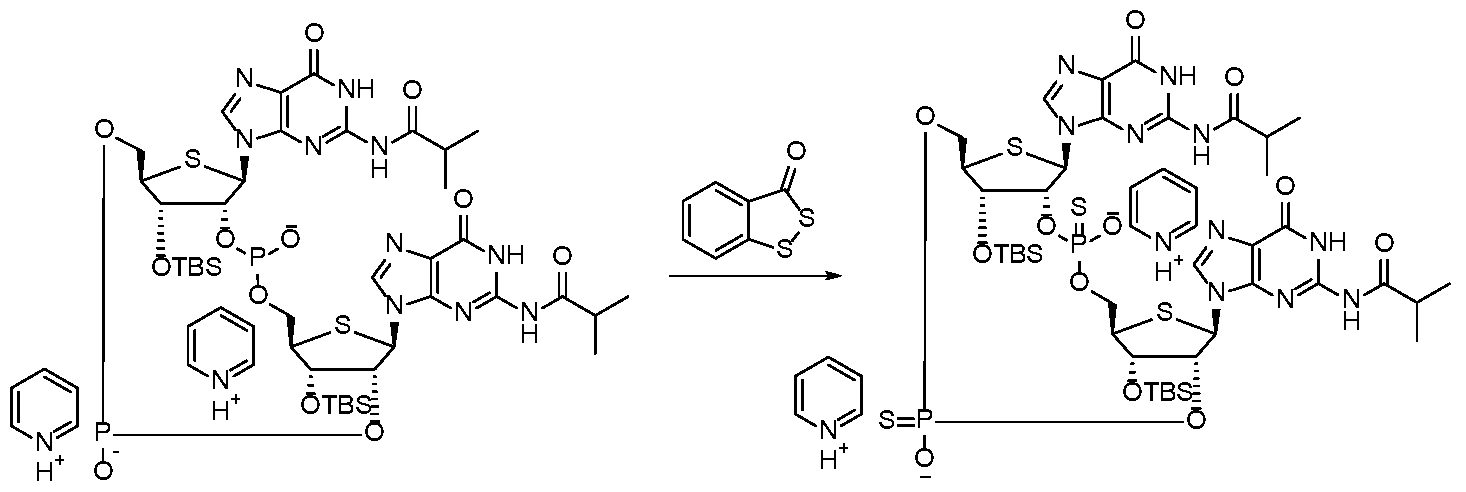
Step 3: (1R 6R.8R.9R.14R.16R.17S. J8S)-8.16-bis(2-amino-6-oxo-l.6-dihydro-9H-purin-9-yl)- 17, 18-bis( ( tert-butyldimethylsilyl)oxy)-2, 4, 10, 12-tetraoxa- 7, 15-dithia-3, 11- diphosphatri 6'91 octadecane-3 ,1 l-bis(olate) 3,11-disulfide

The crude from Step 2 was dissolved in methylamine in ethanol (30%, 6mL), and it was stirred at rt for lh. Then, volatile components were removed under reduced pressure to give crude product.
Step 4: 9.9'-((lR.6R.8R.9R.14R 16R 17S.18S)-3.11.17.18-tetrahydroxy-3. ll-disulfido-2.4.10.12- tetraoxa-7.15-dithia-3.1 l-diphosphatricyclo[ 12.2. l.l69]octadecane-8.16-diyl)bis(2-amino-1.9- dihydro-6H-purin-6-one) (Diastereomerl, L-006164026-001 J) and 9,9'- ((1R.6R.8R.9R.14R.16R.17S.18S)-3.11.17.18-tetrahydroxy-3.1 l-disulfido-2.4.10.12-tetraoxa- 7, 15-dithia-3.1 l-diphosphatricyclo[ 12.2.1. l6 9]octadecane-8.16-diyl)bis(2-amino-l ,9-dihydro- 6H-purin-6-one) (Piaster eomer 2, L-006162098-00 lJ)

To the crude from Step 3 at rt was added pyridine (2mL), triethylamine (627mg,
6.20mmol) and triethylamine trihydrofluoride (250mg, 1.55mmol). The resulting solution was stirred at 60°C for 16h. Then, it was cooled to rt, and acetone (30mL) and Me3SiOEt (2mL) were added. After lOmin, solids were collected by filtration and washed with acetone (5x5mL) The solid was purified by Prep-HPLC (Atlantis Prep T3 OBD Column, 19x250mm) and eluted
with 5 to 15% ACN in aq H4HCO3 (10 mM) over 15min to give, after concentration, two diastereomeric products.
The first product (TR = 9.18min) was purified further by Prep-HPLC (XBridge Prep Phenyl OBD Column, 19x250mm) eluting with 3 to 10% ACN in aq NH4HCO3 (10 mM) over 16min to give Example 28: 9,9'-((lR,6R,8R,9R,14R,16R,17S, 18S)-3, l 1,17,18-tetrahydroxy- 3,l l-disulfido-2,4,10, 12-tetraoxa-7, 15-dithia-3,l l-diphosphatricyclo[12.2.1.16'9]octadecane- 8,16-diyl)bis(2-amino-l,9-dihydro-6H-purin-6-one) (Diastereomer 1, L-006164026-001J): TR: 14.90min. LCMS (ES, m/z): 755.0 [M + H]+. 1H-NMR: (400MHz, D20): δ 7.87 (s, 2H), 5.90- 5.88 (m, 2H), 5.57-5.55 (m, 4H), 4.70-4.50 (m, 2H), 4.13-4.03 (m, 2H), 3.56-3.49 (m, 2H). 31P- NMR: (121MHz, D20): 5 53.68 (s).
The second product (TR = 10.52min) was purified further by Prep-HPLC (XBridge Prep Phenyl OBD Column, 19x250mm) eluting with 2 to 7% MECN in aq NH4HCO3 (10 mM) over 16min to give Example 29: 9,9'-((lR,6R,8R,9R, 14R, 16R, 17S, 18S)-3, 11 , 17, 18-tetrahydroxy- 3,l l-disulfido-2,4,10, 12-tetraoxa-7, 15-dithia-3,l l-diphosphatricyclo[12.2.1.16'9]octadecane- 8,16-diyl)bis(2-amino-l,9-dihydro-6H-purin-6-one) (Diastereomer 2, L-006162098-001J): TR: 7.87min. LCMS (ES, m/z): 755.0 [M + H]+. 1H-NMR (400MHz, D20): δ 7.85 (s, 2H), 5.89- 5.88 (m, 2H), 5.52-5.50 (m, 4H), 4.60-4.56 (m, 2H), 4.04-3.98 (m, 2H), 3.59-3.50 (m, 2H). 31P- NMR: (121MHz, D20): δ 57.82 (s), 54.23 (s) Example 30: 9,9'-rqS,6R,8R,9S,14R,16R,17S,18SV17,18-difluoro-3,ll-dioxido-3,ll- disulfanyl-2,4,7,10,12,15-hexaoxa-3,ll-diphosphatricvclo[12.2.1.1 '9loctadecane-8,16- diyllbisf2-amino-l,9-dihydro-6H-purin-6-one)
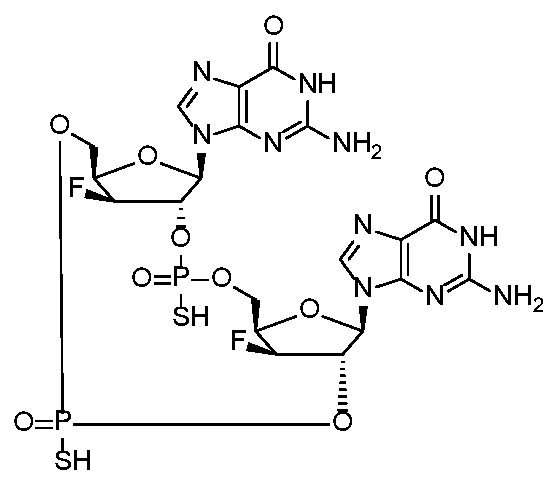
Step 1: N.N'-MIS.6R.8R.9S.14R.16R.17S.18S)-17.18-difluoro-3.1 l-dioxido-3.11-disulfanyl- 2, 4, 7,10, 12, 15-hexaoxa-3, 1 l-diphosphatricyclo[ 12.2.1.16'9 Joctadecane-8, 16-diyl]bis( 6-oxo- 1, 6- dihydro-9H-purine-9,2-diyl)\bis(2-methylpropanamide)
- I l l -

To a stirred solution of 9-{3-deoxy-3-fluoro-2-0-[hydroxy(oxido)- -phosphanyl]-b-D- xylofuranosyl}-2-[(2-methylpropanoyl)amino]-l,9-dihydro-6H-purin-6-one, pyridine salt (200mg, 0.401mmol) in pyridine (7.5mL) was added a solution of 2,4,6- triisopropylbenzenesulfonyl chloride (608mg, 2.01mmol) in pyridine (2.5mL) dropwise over lmin under argon at 0°C, followed by addition of sulfur (77mg, 2.41mmol) in one portion. The reaction mixture was allowed to warm to ambient temperature and left to stir at the same temperature for lh, quenched with cold water (l .OmL), and the mixture was filtered and concentrated to furnish crude N,N'-{[(l S,6R,8R,9S,14R,16R,17S, 18S)-17,18-difluoro-3, l 1- dioxido-3,l l-disulfanyl -2,4,7, 10, 12,15-hexaoxa-3, l l-diphosphatricyclo[12.2.1. l6'9]octadecane- 8,16-diyl]bis(6-oxo-l,6-dihydro-9H-purine-9,2-diyl)}bis(2-methylpropanamide), which was used for the next reaction step directly. LCMS (ES, m/z): 867 [M + H]+.
Step 2: 9.9'- f OS.6R.8R.9S.14R 16R 17S.18S)-17.18-difluoro-3.1 l-dioxido-3.11-disulfanyl-
2.4. 7,10, 12, 15-hexaoxa-3, 1 l-diphosphatricyclo[ 12.2.1. l69]octadecane-8, 16-diyl]bis(2-amino- 1, 9-dihydro-6H-purin-6-one)

To N,N'-{ [(1R,6R,8R,9R, 14R, 16R, 17R, 18R)-17, 18-bis{ [tert-butyl(dimethyl)silyl]oxy}- 3,l l-dioxido-3,l l-disulfanyl-2,4,7,10, 12,15-hexaoxa-3,l l-diphosphatricyclo[12.2.1.16'9]- octadecane-8,16-diyl]bis(6-oxo-l,6-dihydro-9H-purine-9,2-diyl)}bis(2-methylpropanamide) (214mg, 0.201mmol) was added a 33 wt. % methylamine solution in absolute ethanol (2.40mL, 19.3mmol), the reaction mixture was left to stir at ambient temperature for 18h. The reaction mixture was concentrated, and the product was purified using mass-directed reverse phase HPLC with a Waters SunFire C18 OBD Prep Column, ΙΟθΑ, 5μιη, 19mmxl50mm, [Waters Part#
186002568] using a gradient solvent system with MeCN and lOOmM aq triethylammonium acetate. Lyophilization of the product fractions furnished 9,9'-[(lR,6R,8R,9R, 14R, 16R, 17R, 18R)-17, 18-bis{ [fert-butyl(dime
hexaoxa-3 , 1 1 -diphosphatricyclo[ 12.2.1.16'9]octadecane-8, 16-diyl]bis(2-amino- 1 ,9-dihydro-6H- purin-6-one). LCMS (ES, m/z): 725 [M - H]". 1H MR (500MHz, DMSO-i4): δ 10.65 (s, 2H), 7.51 (s, 2H), 6.63 (s, 4H), 6.55 (s, 2H), 5.89 (s, 2 H), 5.24 (d, J= 50.6Hz, 2H), 4.99 (t, J= 8.8Hz, 2H), 4.72 (t, J= 12.6Hz, 2H), 4.19 (dd, J= 29.5, 7.2Hz, 2H), 4.19 (s, 2H), 3.96 (m, 2H). 31P NMR: (202MHz, DMSO-i¾): δ 55.4 (s). 19F MR: (470MHz, DMSO-i¾): δ -202.3 (dddd).
Example 31, as shown in Table 5 below, was prepared according to procedures analogous to those outlined in Example 30 above using the appropriate monomers, decribed as Preparations or as obtained from commercial sources, in the coupling step.
Table 5
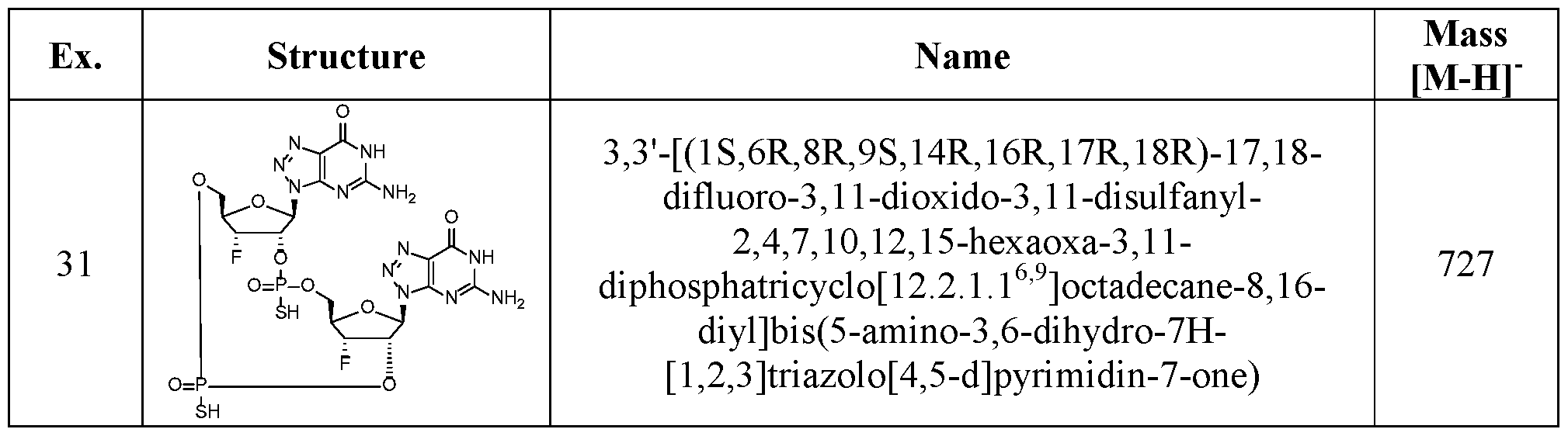
Example 32: 2-amino-9-r R,6S,8R,9R,14R,16R,17R,18RV18-amino-16-f6-amino-9H- purin-9-yl)-3,ll,17-trihvdroxy-3,ll-dioxido-2,4,7,10,12,15-hexaoxa-3,ll- diphosphatricvclo[12.2.1.1 '9loctadec-8-yll-l,9-dihydro-6H-purin-6-one
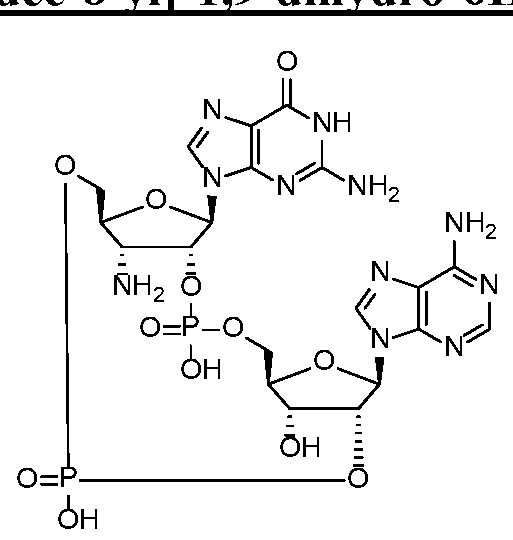
Step 1: 2-amino-9-f(lR, 6S.8R.9R, 14R, 16R, 17R.18R)-18-amino-16-(6-amino-9H-vurin-9-yl)- 3, 11, 17-trihydroxy-3J l-dioxido-2, 4, 7, 10, 12, 15-hexaoxa-3, 1 l-diphosphatricyclo[ 12.2. l. l6'9]- octadec-8-yl] -1 ,9-dihydro-6H-purin-6-one
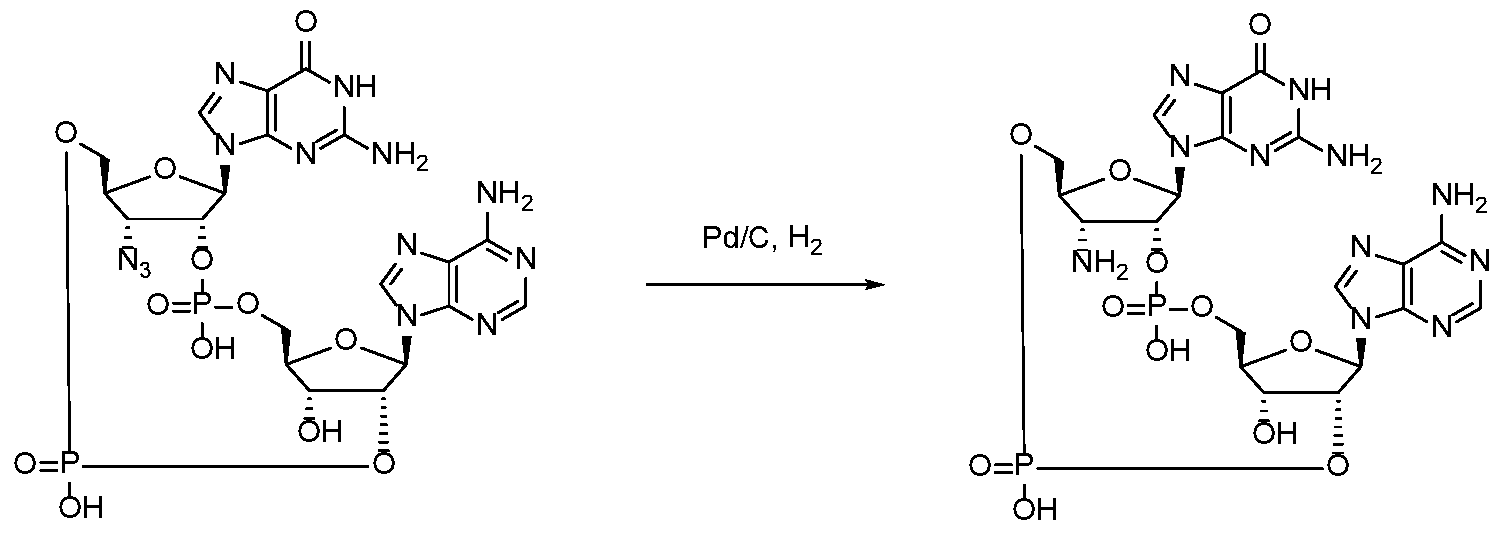
To a stirred solution of 2-amino-9-[(lR,6S,8R,9R,14R,16R,17R,18R)-16-(6-amino-9H- purin-9-yl)- 18-azido-3 , 11,17-trihydroxy-3 , 11 -dioxido-2,4,7, 10, 12, 15-hexaoxa-3 ,11- diphosphatricyclo[12.2.1.16'9]octadec-8-yl]-l,9-dihydro-6H-purin-6-one, (4.0mg, 0.0055mmol), as prepared in Example 5, in absolute ethanol (l .OmL) and deionized water (l .OmL) was added palladium on carbon (l .Omg, 10 wt.% loading) in one portion under argon at RT. The reaction vessel was then flushed with hydrogen gas and attached to a hydrogen gas balloon. The reaction mixture was left to stir for 48h, filtered, and concentrated to afford the title compound. LCMS (ES, m/z): 672 [M - H]". (600MHz, DMSO-i¾) δ 13.40 (s, 1H), 8.12 (s, 1H), 7.99 (s, 1H), 7.74 (s, 1H), 7.36 (br, 2H), 6.43 (br, 2H), 6.14 (d, J= 8.3Hz, 1H), 6.07 (d, J= 8.5Hz, 1H), 5.03 (t, J = 6.0Hz, 1H), 4.89 (dd, J= 8.2, 4.1Hz, lH), 4.54 (d, J= 2.9Hz, 1H), 4.28 (s, 1H), 4.19 (s, 1H), 4.09 (dd, J = 10.5, 5.0Hz, 1H), 4.07 - 4.02 (m, 1H), 3.94 (d, J= 4.1Hz, 1H), 3.84 (d, J= 11.2Hz, 1H), 3.76 (d, J= 11.2Hz, 1H). 31P MR: (202MHz, DMSO-i¾): δ -1.9 (s), -1.6 (s).
Examples 33 and 34, as shown in Table 5 below, were prepared according to procedures analogous to those outlined in Example 32 above from the starting compound ("St. Cmpd.") specified.
Table 5

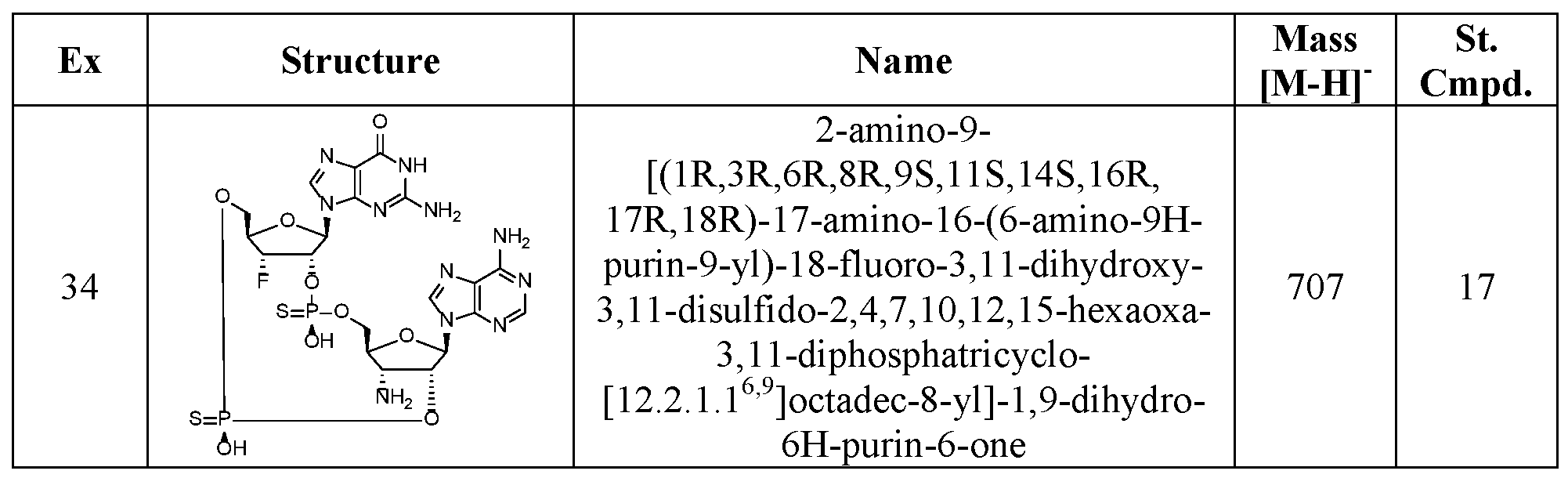
BIOLOGICAL EVALUATION
The individual compounds described in the Examples are defined as STING agonists by demonstrating binding to the STING protein with an EC50 of 20uM or less in the STING
Biochemical [3H]cGAMP Competition Assay (using either HAQ or wild type (WT) STING) and demonstrating interferon production with a 5% or greater luminescence induction at 30uM in the IFN-β secretion in the THP1 cell assay. The methods below describe each of these assays. r3Hl-cGAMP Synthesis
2.3mL of buffer solution containing 80mM tris CI, 200mM MgCl2 and 20mM NaCl followed by 0.32mL of a lOmM aq solution of GTP was added to a plastic 50mL AMICON tube. A solution of [3H]ATP (21Ci/mmol, 45mCi) in 0.5mL H20 was then added followed by lmL of a lmg/mL solution of DNA (Herring testes activator DNA, Sigma, #D6898) and 53uL of a 47mM solution of cGAS enzyme. Additional H20 was added to bring the total volume to lOmL.
The reaction was stirred for 2h at 37°C and then added directly to an Amicon Ultra- 15 10K centrifuge tube and spun for lh at 4,000g. The collected solution was then purified on a semi-prep Mono Q column using the following mobile phases:
A: 0.05M TrisCl pH 8.5 adjusted with 1M NaOH
B: 0.05M TrisCl, 0.5M NaCl pH 8.5 adjusted with 1M NaOH
Gradient: 100% A for 5min followed by a linear gradient to 50:50 (A:B) over 25min, 3mL/min, 254nm.
The collected product fractions were pooled and adjusted to a total volume of 30mL with buffer A. A total yield of 15.5mCi of [3H]cGAMP was isolated at a radiochemical purity of 98.0% at a specific activity of 21.5Ci/mmol.
cGAS Enzyme
A recombinant DNA vector was chemically synthesized to express the truncated human cGAS enzyme (residues 161-522). To aid in expression and purification, the amino terminus contains a hexahistidine tag, SUMO tag and TEV cleavage site. The recombinant enzyme was overexpressed in ROSETTA™ 2(DE3) Single Competent Cells (Novagen). Affinity purification was carried out using HIS-Select HF Nickel Affinity Gel (Sigma) followed by size exclusion chromatography using a Hi-Load 26/60 SUPERDEX200 prep grade column (GE Healthcare). Fractions were pooled, concentrated, flash frozen in liquid nitrogen and stored at -80°C until needed for research applications.
Example 35: 3H-cGAMP filtration binding assay (HAQ STING)
The ability of compounds to bind STING is quantified by their ability to compete with tritiated cGAMP ligand for human STING receptor membrane using a radioactive filter-binding assay. The binding assay employs STING receptor obtained from Trichoplusia ni cell membranes (T.ni; Expression Systems, cat # 94-002F, www, expressi onsystems .com)
overexpressing full-length HAQ STING prepared in-house and tritiated cGAMP ligand also purified in-house.
The basic HAQ STING filtration assay protocol is as follows:
The compounds were serially titrated by the Hamilton STARPlus CORE in a 96-well plate (Greiner, # 651201) using a 1 :3 ten-point dose response format. After compound preparation, a 2.2ug/ml working concentration of STING membrane (SEQ. ID. No. 1) was prepared by diluting concentrated membrane into assay buffer (lx PBS; Invitrogen #
SH30028.02) and douncing 7x using a manual tissue homogenizer (Wheaton, # 357546). 148uL of prepared membrane was then manually added to each well of a 96-well deep-well
polypropylene plate (Fisher Scientific, # 12-566-121). Following membrane addition, 2uL of either titrated test compound, DMSO control (Sigma # 276855), or cold cGAMP control (prepared in-house) was added to the appropriate wells using a Biomek FX. Compound and membrane then preincubated for 60min at RT to allow compound binding to equilibrate.
Following equilibration, 8nM of [3H] c-GAMP ligand was prepared by diluting into assay buffer, and 50uL of this working stock was then manually added to each well of the assay plate. Plates were then incubated at RT for 60min, and the contents of each assay plate were then filtered through a 96-well GF/B filter plate (PerkinElmer, # 6005250) using a TomTec Machlll Cell
Harvester equipped with 20mM HEPES buffer (Fisher Scientific, # BP299500). The filter plates were then dried at 55°C for 30min using a pressurized VWR oven before 30uL of Ultima GoldF scintillate was added to each well. Tritium levels for each reaction well were then measured using a PerkinElmer TopCount plate reader.
After normalization to controls, the percent activity for each compound concentration was calculated by measuring the amount of remaining radioactivity. The plot of percent activity versus the log of compound concentration was fit with a 4-parameter dose response equation to calculate EC50 values.
The final reaction conditions were:
Component Volume (uL) Final Concentration
STING membrane 148 1.5ug/ml
3H-cGAMP 50 2.0nM
Low Control (cold cGAMP) 2 lOuM
Test compound/DMSO 2 lOuM
Compound concentrations tested were 20.000, 637.00, 2.200, 0.740, 0.247, 0.082, 0.027,
0.009, 0.003, and Ο.ΟΟΙμΜ with 1.0% residual DMSO.
Full-Length STING (ΉΑΟ) Virus Generation
STING virus was generated using an insect cell baculovirus system. Spodoptera frugiperda S/21 cells (Kempbio, Inc.) were diluted to 5e5 cells/ml in Sf-900II SFM media
(LifeTechnologies # 10902088) without antibiotics. The cell suspension was added to each well of a treated 6-well plate (2mL per well, le6 cells total), and the cells were allowed to adhere for at least 30min. Meanwhile, a lmL co-transfection mix was assembled by combining 500ng of HAQ STING [STING(l-379)R71H,G230A,H232R,R293Q-GG-AviTag-GS-HRV3C- HIS8/pBACl] DNA (Genewiz custom synthesis) with lmL Sf-900II SFM media containing
ΙΟμί Cellfectin® II Reagent (Invitrogen # 10362100) and lOOng viral backbone BestBac 2.0, v- cath/chiA Deleted Linearized Baculovirus DNA (Expression Systems # 91-002). The transfection mixtures were allowed to incubate for 30min. After incubation, media was gently removed from the adhered cells in the 6-well plate, the lmL transfection mixtures were added (lmL per well), and the plate was placed in a humidified incubator at 27°C. The following day, lmL Sf-900II SFM media (no antibiotics) was added to each well of the 6-well plate. After media addition, the cells were allowed to incubate with DNA (SEQ. ID. No. 2) at 27°C for 5-7 days to generate the P0 viral stock. To generate PI viral stocks, 0.5mL of P0 viral supernatant
was added to 50mL uninfected S/21 cells (seeded the day prior to infection at a density of 5xl05 cells/mL to allow for one overnight doubling) in Sf-900II SFM media containing 5μg/mL gentamicin (Invitrogen #15710072). The infected cells were then incubated at 27°C for 3d while shaking at 1 lOrpm (ATR Biotech Multitron Infors HT #AJ118). On day 3, PI cultures were counted using a ViCell XR (Beckman Coulter Life Sciences # 383556) to confirm infection had occurred (cell size >3μπι larger than uninfected cells and viability approximately 85-95%). Cultures were harvested in 50mL conical tubes and centrifuged at 2000xg for lOmin at 4°C. The PI viral supernatants were poured off into clean 50ml centrifuge tubes, and the remaining PI cell pellets were used to generate Baculovirus Infected Insect Cells (BIICs) according to in-house validated SOP. Cryopreservation media containing Sf-900II SFM media with 10% heat inactivated FBS, 10% DMSO (Sigma #D2650), and 5μg/ml gentamicin was prepared in-house and sterilized through 0.22μΜ filter immediately prior to use. PI cell pellets were resuspended to a density of 2e7 cells/ml and aliquoted into cryovials (lmL per vial). Cryovials were placed in Mr. Frosty cell freezers O/N at -80°C and transferred to liquid nitrogen for long term storage the following day. To generate P2 viral stock, 0.5mL of the PI viral supernatant was added to 50mL uninfected S/21 cells (seeded the day prior to infection at a density of 5xl05 cells/mL to allow for one overnight doubling) in Sf-900II SFM media containing 5μg/mL gentamicin. These cells were incubated at 27°C for 3d while shaking at 1 lOrpm before harvesting P2 stock with centrifugation at 2000xg for lOmin at 4°C. The P2 viral supernatants were poured off and discarded, while the P2 cell pellets were used to generate P2 BIICs following the same protocol described above. The baculovirus generation protocol has been validated to consistently produce P1/P2 BIICs with titers of 2e9 pfu/mL (2e7 cells/mLxlOO pfu/cell).
Full-Length STING (HAQ) Expression
To generate STING membranes, P1/P2 BIICs were amplified overnight by adding thawed BIICs to S/21 cells seeded at a density of 1.0xl06cells/mL. The volume of BIIC used to infect the culture was calculated using an assumed BIIC titer of 2e9 pfu/ml to achieve an MOI of 10 in the overnight amplification. After culturing overnight, the cells were counted on a ViCell XR to confirm infection had occurred (cell size >3μπι larger than uninfected cells and viability approximately 80-90%). The volume of infected S/21 cells from the overnight amplification used to infect the large-scale expression of Trichoplusia ni (T.ni; Expression Systems, cat # 94- 002F, www. expressi onsystems. com) seeded at a density of 1.0x10⁶ in cell media (ESF921 SFM containing 5μg/mL gentamicin) at MOI = 2.0 was calculated based on (100 pfu/infected S/21
cell). The cells were allowed to express for 48h at 27°C before harvesting the cell pellet, by centrifugation at 3,400xg for lOmin at 4°C. T. ni cells were counted on a ViCell XR to confirm infection had occurred (cell size >3μπι larger than uninfected cells and viability approximately 80-90%) prior to harvest.
Full-Length STING (HAQ) Membrane Generation
Buffer stock reagents:
1) 1 M HEPES pH 7.5, Teknova, Cat#H1035
2) 5 M NaCl, Sigma Aldrich, Cat#S5150-lL
3) KC1, Sigma Aldrich, Cat#319309-500ML
4) Complete EDTA-free protease inhibitor tablets, Roche Diagnostics, Cat#l 1873580001
5) Benzonase, Universal Nuclease, Pierce, Cat#88702
Lysis buffer [25mM HEPES pH 7.5, lOmM MgCl2, 20mM KC1, (Benzonase 1 : 5000, Complete Protease Inhibitor tab/50mL)] was added to the pellet of cells expressing full-length STING (HAQ) prepared above at 5mL Lysis buffer/g of cell pellet. The pellet was resuspended and dounced twenty times using a Wheaton Dounce Homogenizer to disrupt the cell membrane. Homogenized lysate was then passed through the emulsiflex-C5 microfluidizer at a pressure close to 5000PSI. The resuspended pellet was centrifuged at 36,000rpm (100,000xg) in a 45Ti rotor in the ultra-high speed centrifuge for 45min, 4°C. The supernatant was removed. The pellet then was resuspended in wash buffer [(25mM HEPES pH7.5, ImM MgCl2, 20mM KC1, 1M NaCl (Complete Protease Inhibitor tab/50mL)] at a volume of 50mL pellet/centrifuge tube. The pellet/wash buffer mixture was then homogenized, using a glass homogenizer on ice (20 strokes), followed by centrifugation at 36,000rpm for 45min at 4°C. The supernatant was removed. The wash step was repeated once more. The resulting membrane was resuspended in 20mM HEPES pH 7.5, 500mM NaCl, 10% glycerol, EDTA-free Protease Inhibitors
(ltablet/50mL). The protein concentration was measured by Bradford assay (Bio-Rad Protein Assay, Cat# 500-0006), and protein enrichment was determined by SDS-PAGE and confirmed by Western blot. The resuspended membranes were stored at -80°C.
Full-Length HAQ STING [STING(l-379)R71H,G230A,H232R,R293Q-GG-AviTag-GS-HRV3C- HIS8] Amino Acid Sequence:
MPHSSLHPSIPCPRGHGAQKAALVLLSACLVTLWGLGEPPEHTLRYLVLHLASLQLGLL LNGVCSLAEELHHIHSRYRGSYWRTVRACLGCPLRRGALLLLSIYFYYSLPNAVGPPFT WMLALLGLSQALNILLGLKGLAPAEISAVCEKG FNVAHGLAWSYYIGYLRLILPELQA RIRTYNQHYN LLRGAVSQRLYILLPLDCGVPDNLSMADPNIRFLDKLPQQTADRAGIK DRVYSNSIYELLENGQRAGTCVLEYATPLQTLFAMSQYSQAGFSREDRLEQAKLFCQTL EDIL AD APES QNNCRLIAYQEP ADD S SF SLS QEVLRHLRQEEKEEVT VGSLKTS AVP ST ST MSQEPELLISGMEKPLPLRTDFSGGGL DIFEAQKIEWHEGSLEVLFQGPHHHHHHHH
(SEQ. ID. No. 1) Full-length HAQ [STING(l-379JR71H, G230A,H232R,R293Q-GG-AviTag-GS-HRV3C- HIS8/pBACl] PlasmidDNA Sequence:
GGAACGGCTCCGCCCACTATTAATGAAATTAAAAATTCCAATTTTAAAAAACGCAG CAAGAGAAACATTTGTATGAAAGAATGCGTAGAAGGAAAGAAAAATGTCGTCGAC ATGCTGAACAACAAGATTAATATGCCTCCGTGTATAAAAAAAATATTGAACGATTTG AAAGAAAAC AATGTACCGCGCGGCGGTATGTACAGGAAGAGGTTTATACTAAACTG TTACATTGCAAACGTGGTTTCGTGTGCCAAGTGTGAAAACCGATGTTTAATCAAGGC TCTGACGCATTTCTACAACCACGACTCCAAGTGTGTGGGTGAAGTCATGCATCTTTT A ATC A A ATC CC A AGATGTGT AT A A AC C AC C A A AC TGC C A A A A A ATGA A A AC TGTC G ACAAGCTCTGTCCGTTTGCTGGCAACTGCAAGGGTCTCAATCCTATTTGTAATTATTG AATAATAAAACAATTATAAATGCTAAATTTGTTTTTTATTAACGATACAAACCAAAC GCAACAAGAACATTTGTAGTATTATCTATAATTGAAAACGCGTAGTTATAATCGCTG AGGTAATATTTAAAATCATTTTCAAATGATTCACAGTTAATTTGCGACAATATAATT TTATTTTCACATAAACTAGACGCCTTGTCGTCTTCTTCTTCGTATTCCTTCTCTTTTTC ATTTTTCTCTTCATAAAAATTAACATAGTTATTATCGTATCCATATATGTATCTATCG TATAGAGTAAATTTTTTGTTGTCATAAATATATATGTCTTTTTTAATGGGGTGTATAG TACCGCTGCGCATAGTTTTTCTGTAATTTACAACAGTGCTATTTTCTGGTAGTTCTTC GGAGTGTGTTGCTTTAATTATTAAATTTATATAATCAATGAATTTGGGATCGTCGGTT TTGTACAATATGTTGCCGGCATAGTACGCAGCTTCTTCTAGTTCAATTACACCATTTT TTAGCAGCACCGGATTAACATAACTTTCCAAAATGTTGTACGAACCGTTAAACAAAA ACAGTTCACCTCCCTTTTCTATACTATTGTCTGCGAGCAGTTGTTTGTTGTTAAAAAT AACAGCCATTGTAATGAGACGCACAAACTAATATCACAAACTGGAAATGTCTATCA ATATATAGTTGCTGATCAGATCTGATCATGGAGATAATTAAAATGATAACCATCTCG CAAATAAATAAGTATTTTACTGTTTTCGTAACAGTTTTGTAATAAAAAAACCTATAA
ATATAGGATCCATGCCCCACTCCAGCCTGCATCCATCCATCCCGTGTCCCAGGGGTC ACGGGGCCCAGAAGGCAGCCTTGGTTCTGCTGAGTGCCTGCCTGGTGACCCTTTGGG GGCTAGGAGAGCCACCAGAGCACACTCTCCGGTACCTGGTGCTCCACCTAGCCTCCC TGCAGCTGGGACTGCTGTTAAACGGGGTCTGCAGCCTGGCTGAGGAGCTGCACCAC ATCCACTCCAGGTACCGGGGCAGCTACTGGAGGACTGTGCGGGCCTGCCTGGGCTG CCCCCTCCGCCGTGGGGCCCTGTTGCTGCTGTCCATCTATTTCTACTACTCCCTCCCA AATGCGGTCGGCCCGCCCTTCACTTGGATGCTTGCCCTCCTGGGCCTCTCGCAGGCA CTGAACATCCTCCTGGGCCTCAAGGGCCTGGCCCCAGCTGAGATCTCTGCAGTGTGT GAAAAAGGGAATTTCAACGTGGCCCATGGGCTGGCATGGTCATATTACATCGGATA TCTGCGGCTGATCCTGCC AGAGCTCC AGGCCCGGATTCGAACTT AC AATC AGC ATT A CAACAACCTGCTACGGGGTGCAGTGAGCCAGCGGCTGTATATTCTCCTCCCATTGGA CTGTGGGGTGCCTGATAACCTGAGTATGGCTGACCCCAACATTCGCTTCCTGGATAA ACTGCCCCAGCAGACCGCTGACCGTGCTGGCATCAAGGATCGGGTTTACAGCAACA GCATCTATGAGCTTCTGGAGAACGGGCAGCGGGCGGGCACCTGTGTCCTGGAGTAC GCCACCCCCTTGC AGACTTTGTTTGCCATGTCAC AATAC AGTC AAGCTGGCTTTAGC CGGGAGGATAGGCTTGAGCAGGCCAAACTCTTCTGCCAGACACTTGAGGACATCCT GGCAGATGCCCCTGAGTCTCAGAACAACTGCCGCCTCATTGCCTACCAGGAACCTGC AGATGACAGCAGCTTCTCGCTGTCCCAGGAGGTTCTCCGGCACCTGCGGCAGGAGG AAAAGGAAGAGGTTACTGTGGGCAGCTTGAAGACCTCAGCGGTGCCCAGTACCTCC ACGATGTCCCAAGAGCCTGAGCTCCTCATCAGTGGAATGGAAAAGCCCCTCCCTCTC CGCACGGATTTCTCTGGCGGTGGCCTGAACGACATCTTCGAAGCCCAGAAAATCGA ATGGCATGAAGGCAGCCTGGAAGTGCTGTTCCAGGGCCCACACCACCATCATCACC ATCACCATTAATGAGCGGCCGCACTCGAGCACCACCACCACCACCACTAACCTAGG TAGCTGAGCGCATGCAAGCTGATCCGGGTTATTAGTACATTTATTAAGCGCTAGATT CTGTGCGTTGTTGATTTACAGACAATTGTTGTACGTATTTTAATAATTCATTAAATTT ATAATCTTTAGGGTGGTATGTTAGAGCGAAAATCAAATGATTTTCAGCGTCTTTATA TCTGAATTTAAATATTAAATCCTCAATAGATTTGTAAAATAGGTTTCGATTAGTTTCA AACAAGGGTTGTTTTTCCGAACCGATGGCTGGACTATCTAATGGATTTTCGCTCAAC GCCACAAAACTTGCCAAATCTTGTAGCAGCAATCTAGCTTTGTCGATATTCGTTTGT GTTTTGTTTTGTAATAAAGGTTCGACGTCGTTCAAAATATTATGCGCTTTTGTATTTC TTTCATCACTGTCGTTAGTGTACAATTGACTCGACGTAAACACGTTAAATAGAGCTT GGACATATTTAACATCGGGCGTGTTAGCTTTATTAGGCCGATTATCGTCGTCGTCCC AACCCTCGTCGTTAGAAGTTGCTTCCGAAGACGATTTTGCCATAGCCACACGACGCC
TATTAATTGTGTCGGCTAACACGTCCGCGATCAAATTTGTAGTTGAGCTTTTTGGAAT TATTTCTGATTGCGGGCGTTTTTGGGCGGGTTTCAATCTAACTGTGCCCGATTTTAAT TCAGACAACACGTTAGAAAGCGATGGTGCAGGCGGTGGTAACATTTCAGACGGCAA ATCTACTAATGGCGGCGGTGGTGGAGCTGATGATAAATCTACCATCGGTGGAGGCG CAGGCGGGGCTGGCGGCGGAGGCGGAGGCGGAGGTGGTGGCGGTGATGCAGACGG CGGTTTAGGCTCAAATGTCTCTTTAGGCAACACAGTCGGCACCTCAACTATTGTACT GGTTTCGGGCGCCGTTTTTGGTTTGACCGGTCTGAGACGAGTGCGATTTTTTTCGTTT CTAATAGCTTCCAACAATTGTTGTCTGTCGTCTAAAGGTGCAGCGGGTTGAGGTTCC GTCGGCATTGGTGGAGCGGGCGGCAATTCAGACATCGATGGTGGTGGTGGTGGTGG AGGCGCTGGAATGTTAGGC ACGGGAGAAGGTGGTGGCGGCGGTGCCGCCGGTAT AA TTTGTTCTGGTTTAGTTTGTTCGCGCACGATTGTGGGCACCGGCGCAGGCGCCGCTG GCTGCACAACGGAAGGTCGTCTGCTTCGAGGCAGCGCTTGGGGTGGTGGCAATTCA ATATTATAATTGGAATACAAATCGTAAAAATCTGCTATAAGCATTGTAATTTCGCTA TCGTTTACCGTGCCGATATTTAACAACCGCTCAATGTAAGCAATTGTATTGTAAAGA GATTGTCTCAAGCTCGGATCGATCCCGC ACGCCGATAACAAGCCTTTTC ATTTTTACT ACAGCATTGTAGTGGCGAGACACTTCGCTGTCGTCGAGGTTTAAACGCTTCCTCGCT CACTGACTCGCTGCGCTCGGTCGTTCGGCTGCGGCGAGCGGTATCAGCTCACTCAAA GGCGGTAATACGGTTATCCACAGAATCAGGGGATAACGCAGGAAAGAACATGTGAG CAAAAGGCCAGCAAAAGGCCAGGAACCGTAAAAAGGCCGCGTTGCTGGCGTTTTTC CATAGGCTCCGCCCCCCTGACGAGCATCACAAAAATCGACGCTCAAGTCAGAGGTG GCGAAACCCGACAGGACTATAAAGATACCAGGCGTTTCCCCCTGGAAGCTCCCTCG TGCGCTCTCCTGTTCCGACCCTGCCGCTTACCGGATACCTGTCCGCCTTTCTCCCTTC GGGAAGCGTGGCGCTTTCTCATAGCTCACGCTGTAGGTATCTCAGTTCGGTGTAGGT CGTTCGCTCCAAGCTGGGCTGTGTGCACGAACCCCCCGTTCAGCCCGACCGCTGCGC CTTATCCGGTAACTATCGTCTTGAGTCCAACCCGGTAAGACACGACTTATCGCCACT GGCAGCAGCCACTGGTAACAGGATTAGCAGAGCGAGGTATGTAGGCGGTGCTACAG AGTTCTTGAAGTGGTGGCCTAACTACGGCTACACTAGAAGGACAGTATTTGGTATCT GCGCTCTGCTGAAGCCAGTTACCTTCGGAAAAAGAGTTGGTAGCTCTTGATCCGGCA AACAAACCACCGCTGGTAGCGGTGGTTTTTTTGTTTGCAAGCAGCAGATTACGCGCA GAAAAAAAGGATCTCAAGAAGATCCTTTGATCTTTTCTACGGGGTCTGACGCTCAGT GGAACGAAAACTCACGTTAAGGGATTTTGGTCATGAGATTATCAAAAAGGATCTTC ACCTAGATCCTTTTAAATTAAAAATGAAGTTTTAAATCAATCTAAAGTATATATGAG TAAACTTGGTCTGACAGTTACCAATGCTTAATCAGTGAGGCACCTATCTCAGCGATC
TGTCTATTTCGTTCATCCATAGTTGCCTGACTCCCCGTCGTGTAGATAACTACGATAC GGGAGGGCTTACCATCTGGCCCCAGTGCTGCAATGATACCGCGAGACCCACGCTCA CCGGCTCCAGATTTATCAGCAATAAACCAGCCAGCCGGAAGGGCCGAGCGCAGAAG TGGTCCTGCAACTTTATCCGCCTCCATCCAGTCTATTAATTGTTGCCGGGAAGCTAG AGTAAGTAGTTCGCCAGTTAATAGTTTGCGCAACGTTGTTGCCATTGCTACAGGCAT CGTGGTGTCACGCTCGTCGTTTGGTATGGCTTCATTCAGCTCCGGTTCCCAACGATCA AGGCGAGTTACATGATCCCCCATGTTGTGCAAAAAAGCGGTTAGCTCCTTCGGTCCT CCGATCGTTGTCAGAAGTAAGTTGGCCGCAGTGTTATCACTCATGGTTATGGCAGCA CTGCATAATTCTCTTACTGTCATGCCATCCGTAAGATGCTTTTCTGTGACTGGTGAGT ACTC AACC AAGTC ATTCTGAGAATAGTGT ATGCGGCGACCGAGTTGCTCTTGCCCGG CGTCAATACGGGATAATACCGCGCCACATAGCAGAACTTTAAAAGTGCTCATCATTG GAAAACGTTCTTCGGGGCGAAAACTCTCAAGGATCTTACCGCTGTTGAGATCCAGTT CGATGTAACCCACTCGTGCACCCAACTGATCTTCAGCATCTTTTACTTTCACCAGCGT TTCTGGGTGAGCAAAAACAGGAAGGCAAAATGCCGCAAAAAAGGGAATAAGGGCG ACACGGAAATGTTGAATACTCATACTCTTCCTTTTTCAATATTATTGAAGC ATTTATC AGGGTTATTGTCTCATGAGCGGATACATATTTGAATGTATTTAGAAAAATAAACAAA TAGGGGTTCCGCGCACATTTCCCCGAAAAGTGCCACCTGACGCGCCCTGTAGCGGCG CATTAAGCGCGGCGGGTGTGGTGGTTACGCGCAGCGTGACCGCTACACTTGCCAGC GCCCTAGCGCCCGCTCCTTTCGCTTTCTTCCCTTCCTTTCTCGCCACGTTCGCCGGCTT TCCCCGTCAAGCTCTAAATCGGGGGCTCCCTTTAGGGTTCCGATTTAGTGCTTTACG GCACCTCGACCCCAAAAAACTTGATTAGGGTGATGGTTCACGTAGTGGGCCATCGCC CTGATAGACGGTTTTTCGCCCTTTGACGTTGGAGTCCACGTTCTTTAATAGTGGACTC TTGTTCCAAACTGGAACAACACTCAACCCTATCTCGGTCTATTCTTTTGATTTATAAG GGATTTTGCCGATTTCGGCCTATTGGTTAAAAAATGAGCTGATTTAACAAAAATTTA ACGCGAATTTTAACAAAATATTAACGTTTACAATTTCCCATTCGCCATTCAGGCTGC GCAACTGTTGGGAAGGGCGATCGGTGCGGGCCTCTTCGCTATTACGCCA
(SEQ. ID. No. 2)
Certain compounds of the disclosure were evaluated in HAQ STING in vitro binding assay as described above. The following table tabulates the biological data for these compounds as EC50 values.
Table 6: 3H-cGAMP filtration binding assay for HAQ STING
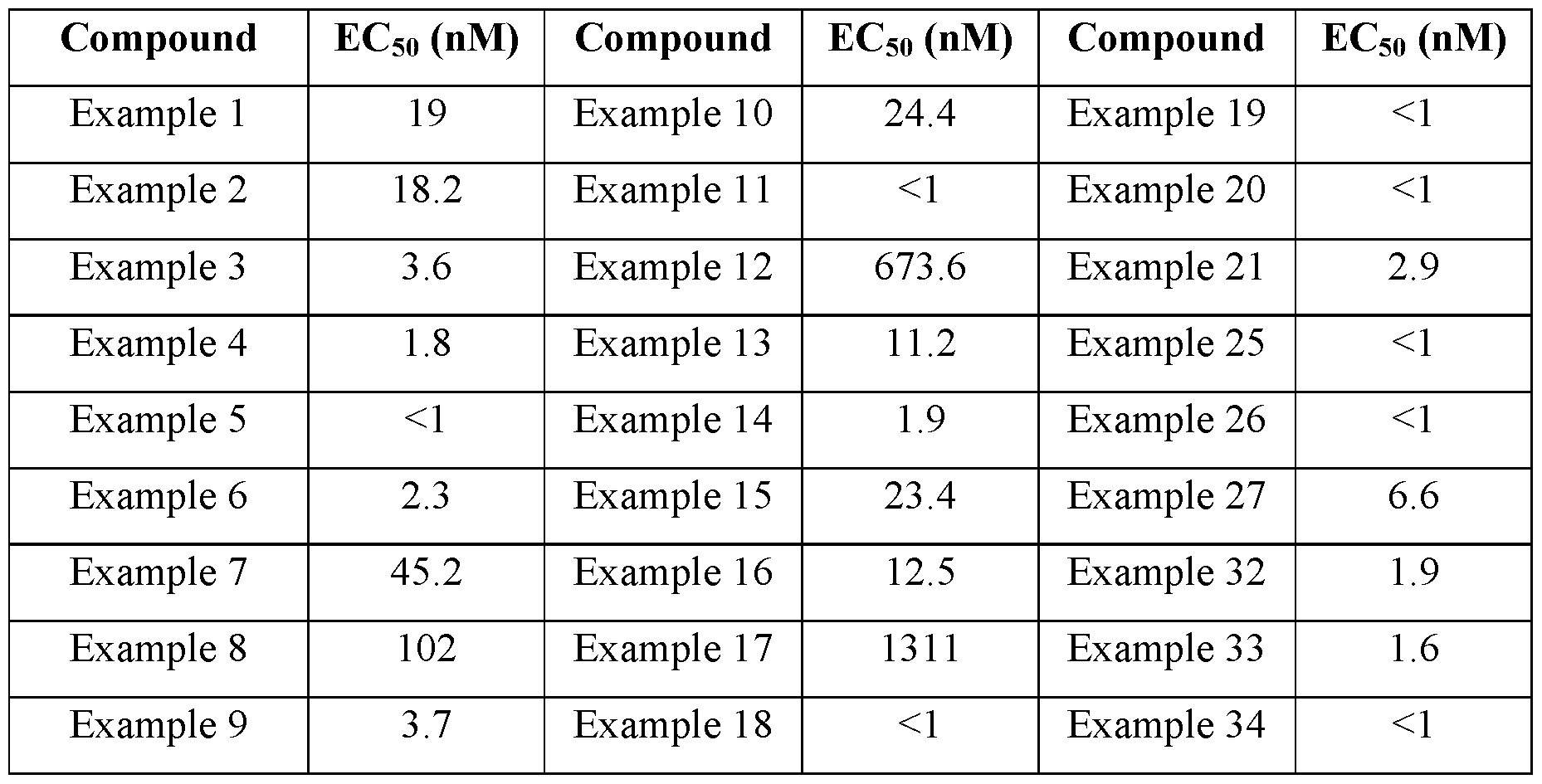
Example 36: 3H-cGAMP filtration binding assay (WT STING)
The ability of compounds to bind STING is quantified by their ability to compete with tritiated cGAMP ligand for human STING receptor membrane using a radioactive filter-binding assay. The binding assay employs STING receptor obtained from Trichoplusia ni cell membranes (T.ni; Expression Systems, cat # 94-002F, www.expressionsystems.com)
overexpressing full-length WT STING prepared in-house and tritiated cGAMP ligand also purified in-house.
The basic WT STING filtration assay protocol is as follows:
16nM of [3H] c-GAMP ligand was prepared by diluting into assay buffer, and 50uL of this working stock was manually added to each well of the assay plate. After ligand addition, 2uL of either titrated test compound, DMSO control (Sigma # 276855), or cold cGAMP control (prepared in-house) was added to the appropriate wells using a Biomek FX. The serially titrated compound was prepared on a Hamilton STARPlus CORE in a 96-well plate (Greiner, # 651201) using a 1 :3 ten-point dose response format. Following compound addition, a 2.2ug/ml working concentration of STING membrane (SEQ. ID. No. 3) was prepared by diluting concentrated membrane into assay buffer (lx PBS; Invitrogen # SH30028.02) and douncing 7x using a manual tissue homogenizer (Wheaton, # 357546). 148uL of this prepared membrane was then manually added to each well of a 96-well deep-well polypropylene plate (Fisher Scientific, # 12- 566-121). Compound, ligand, and membrane then incubated for 60min at RT before the contents
of each assay plate were filtered through a 96-well GF/B filter plate (PerkinElmer, # 6005250) using a TomTec Machlll Cell Harvester equipped with 20mM HEPES buffer (Fisher Scientific, # BP299500). The filter plates were then dried at 55°C for 30min using a pressurized VWR oven before 30uL of Ultima GoldF scintillate was added to each well. Tritium levels for each reaction well were then measured using a PerkinElmer TopCount plate reader.
After normalization to controls, the percent activity for each compound concentration was calculated by measuring the amount of remaining radioactivity. The plot of percent activity versus the log of compound concentration was fit with a 4-parameter dose response equation to calculate EC50 values.
The final reaction conditions were:
Component Volume (uL) Final Concentration
STING membrane 148 1.5ug/ml
3H-cGAMP 50 4.0nM
Low Control (cold cGAMP) 2 lOuM
Test compound/DMSO 2 lOuM
Compound concentrations tested were 20.000, 637.00, 2.200, 0.740, 0.247, 0.082, 0.027, 0.009, 0.003, and Ο.ΟΟΙμΜ with 1.0% residual DMSO.
Full-Length STING fWD Virus Generation
STING virus was generated using an insect cell baculovirus system. Spodoptera frugiperda S/21 cells (Kempbio, Inc.) were diluted to 5e5 cells/ml in Sf-900II SFM media (LifeTechnol ogies # 10902088) without antibiotics. The cell suspension was added to each well of a treated 6-well plate (2mL per well, le6 cells total), and the cells were allowed to adhere for at least 30min. Meanwhile, a lmL co-transfection mix was assembled by combining 500ng of WT STING[STF G(l-379)H232R-gg-AviTag-gs-HRV3C-HIS8/pBACl] (Genewiz custom synthesis) with lmL Sf-900II SFM media containing 10μΕ Cellfectin® II Reagent (Invitrogen # 10362100) and lOOng viral backbone BestBac 2.0, v-cath/chiA Deleted Linearized Baculovirus DNA (Expression Systems # 91-002). The transfection mixtures were allowed to incubate for 30min. After incubation, media was gently removed from the adhered cells in the 6-well plate, the lmL transfection mixtures were added (lmL per well), and the plate was placed in a humidified incubator at 27°C. The following day, lmL Sf-900II SFM media (no antibiotics) was added to each well of the 6-well plate. After media addition, the cells were allowed to incubate with DNA [(SEQ. ID. No. 4) and linearized viral backbone BestBac 2.0] at 27°C for 5-7 days to
generate the PO viral stock. To generate PI viral stocks, 0.5mL of P0 viral supernatant was added to 50mL uninfected Sf21 cells (seeded the day prior to infection at a density of 5xl05 cells/mL to allow for one overnight doubling) in Sf-900II SFM media containing 5μg/mL gentamicin (Invitrogen #15710072). The infected cells were then incubated at 27°C for 3d while shaking at 1 lOrpm (ATR Biotech Multitron Infors HT #AJ118). On day 3, PI cultures were counted using a ViCell XR (Beckman Coulter Life Sciences # 383556) to confirm infection had occurred (cell size >3μπι larger than uninfected cells and viability approximately 85-95%). Cultures were harvested in 50mL conical tubes and centrifuged at 2000xg for lOmin at 4°C. The PI viral supernatants were poured off into clean 50ml centrifuge tubes, and the remaining PI cell pellets were used to generate Baculovirus Infected Insect Cells (BIICs) according to in-house validated SOP. Cryopreservation media containing Sf-900II SFM media with 10% heat inactivated FBS, 10% DMSO (Sigma #D2650), and 5μg/ml gentamicin was prepared in-house and sterilized through 0.22μΜ filter immediately prior to use. PI cell pellets were resuspended to a density of 2e7 cells/ml and aliquoted into cryovials (lmL per vial). Cryovials were placed in Mr. Frosty cell freezers O/N at -80°C and transferred to liquid nitrogen for long term storage the following day. To generate P2 viral stock, 0.5mL of the PI viral supernatant was added to 50mL uninfected S/2I cells (seeded the day prior to infection at a density of 5xl05 cells/mL to allow for one overnight doubling) in Sf-900II SFM media containing 5μg/mL gentamicin. These cells were incubated at 27°C for 3d while shaking at 1 lOrpm before harvesting P2 stock with centrifugation at 2000xg for lOmin at 4°C. The P2 viral supernatants were poured off and discarded, while the P2 cell pellets were used to generate P2 BIICs following the same protocol described above. The baculovirus generation protocol has been validated to consistently produce P1/P2 BIICs with titers of 2e9 pfu/mL (2e7 cells/mLxlOO pfu/cell). Full-Length STING WT) Expression
To generate STING membranes, P1/P2 BIICs were amplified overnight by adding thawed BIICs to Sf21 cells seeded at a density of l .OxlO6 cells/mL. The volume of BIIC used to infect the culture was calculated using an assumed BIIC titer of 2e9 pfu/ml to achieve an MOI of 10 in the overnight amplification. After culturing overnight, the cells were counted on a ViCell XR to confirm infection had occurred (cell size >3μπι larger than uninfected cells and viability approximately 80-90%). The volume of infected S/21 cells from the overnight amplification used to infect the large-scale expression of Trichoplusia ni (T.ni; Expression Systems, cat # 94- 002F, www . express) cmsystem s. com) seeded at a density of 1.0x10⁶ in cell media (ESF921 SFM
containing 5μg/mL gentamicin) at MOI = 2.0 was calculated based on (lOOpfu/infected Sf21 cell). The cells were allowed to express for 48h at 27°C before harvesting the cell pellet, by centrifugation at 3,400xg for lOmin at 4°C. T. ni cells were counted on a ViCell XR to confirm infection had occurred (cell size >3μπι larger than uninfected cells and viability approximately 80-90%) prior to harvest.
Full-Length STING (WT) Membrane Generation
Buffer stock reagents:
1) 1 M HEPES pH 7.5, Teknova, Cat#H1035
2) 5 M NaCl, Sigma Aldrich, Cat#S5150-lL
3) KC1, Sigma Aldrich, Cat#319309-500ML
4) Complete EDTA-free protease inhibitor tablets, Roche Diagnostics, Cat#l 1873580001
5) Benzonase, Universal Nuclease, Pierce, Cat#88702 Lysis buffer [25mM HEPES pH 7.5, lOmM MgCl2, 20mM KC1, (Benzonase 1 : 5000,
Complete Protease Inhibitor tab/50mL)] was added to the pellet of cells expressing full-length STING (WT) prepared above at 5mL Lysis buffer/g of cell pellet. The pellet was resuspended and dounced twenty times using a Wheaton Dounce Homogenizer to disrupt the cell membrane. Homogenized lysate was then passed through the emulsiflex-C5 microfluidizer at a pressure close to 5000PSI. The resuspended pellet was centrifuged at 36,000rpm (100,000xg) in a 45Ti rotor in the ultra-high speed centrifuge for 45min, 4°C. The supernatant was removed. The pellet then was resuspended in wash buffer [(25mM HEPES pH 7.5, ImM MgCl2, 20mM KC1, 1M NaCl (Complete Protease Inhibitor tab/50mL)] at a volume of 50mL/pellet/centrifuge tube. The pellet/W ash buffer mixture was then homogenized, using a glass homogenizer on ice (20 strokes), followed by centrifugation at 36,000rpm for 45min at 4°C. The supernatant was removed. The wash step was repeated once more. The resulting membrane was resuspended in 20mM HEPES pH 7.5, 500mM NaCl, 10% glycerol, EDTA-free Protease Inhibitors
(ltablet/50mL). The protein concentration was measured by Bradford assay (Bio-Rad Protein Assay, Cat# 500-0006), and protein enrichment was determined by SDS-PAGE and confirmed by Western blot. The resuspended membranes were stored at -80°C.
Full-Length STING WT [STING(l-379)H232R-gg-AviTag-gs-HRV3C-HIS8] Amino Acid Sequence:
MPHSSLHPSIPCPRGHGAQKAALVLLSACLVTLWGLGEPPEHTLRYLVLHLASLQLGLL LNGVCSLAEELRHIHSRYRGSYWRTVRACLGCPLRRGALLLLSIYFYYSLPNAVGPPFT WMLALLGLSQALNILLGLKGLAPAEISAVCEKG FNVAHGLAWSYYIGYLRLILPELQA RIRTYNQHYN LLRGAVSQRLYILLPLDCGVPDNLSMADPNIRFLDKLPQQTGDRAGIK DRV YSNS IYELLENGQRAGTC VLE Y ATPLQ TLF AM S Q YS Q AGF SREDRLEQ AKLFCRTL EDIL AD APES QNNCRLI A YQEP ADD S SF SL S QE VLRHLRQEEKEE VT VGSLKT S A VP S T S T MSQEPELLISGMEKPLPLRTDFSGGGL DIFEAQKIEWHEGSLEVLFQGPHHHHHHHH
(SEQ. ID. No. 3) Full-length WT STING [STING(l-379)H232R-gg-AviTag-gs-HRV3C-HIS8/pBACl] plasmid sequence:
GGAACGGCTCCGCCCACTATTAATGAAATTAAAAATTCCAATTTTAAAAAACGCAG CAAGAGAAACATTTGTATGAAAGAATGCGTAGAAGGAAAGAAAAATGTCGTCGAC ATGCTGAACAACAAGATTAATATGCCTCCGTGTATAAAAAAAATATTGAACGATTTG AAAGAAAAC AATGTACCGCGCGGCGGTATGTACAGGAAGAGGTTTATACTAAACTG TTACATTGCAAACGTGGTTTCGTGTGCCAAGTGTGAAAACCGATGTTTAATCAAGGC TCTGACGCATTTCTACAACCACGACTCCAAGTGTGTGGGTGAAGTCATGCATCTTTT A ATC A A ATC CC A AGATGTGT AT A A AC C AC C A A AC TGC C A A A A A ATGA A A AC TGTC G ACAAGCTCTGTCCGTTTGCTGGCAACTGCAAGGGTCTCAATCCTATTTGTAATTATTG AATAATAAAACAATTATAAATGTCAAATTTGTTTTTTATTAACGATACAAACCAAAC GCAACAAGAACATTTGTAGTATTATCTATAATTGAAAACGCGTAGTTATAATCGCTG AGGTAATATTTAAAATCATTTTCAAATGATTCACAGTTAATTTGCGACAATATAATT TTATTTTCACATAAACTAGACGCCTTGTCGTCTTCTTCTTCGTATTCCTTCTCTTTTTC ATTTTTCTCTTCATAAAAATTAACATAGTTATTATCGTATCCATATATGTATCTATCG TATAGAGTAAATTTTTTGTTGTCATAAATATATATGTCTTTTTTAATGGGGTGTATAG TACCGCTGCGCATAGTTTTTCTGTAATTTACAACAGTGCTATTTTCTGGTAGTTCTTC GGAGTGTGTTGCTTTAATTATTAAATTTATATAATCAATGAATTTGGGATCGTCGGTT TTGTACAATATGTTGCCGGCATAGTACGCAGCTTCTTCTAGTTCAATTACACCATTTT TTAGCAGCACCGGATTAACATAACTTTCCAAAATGTTGTACGAACCGTTAAACAAAA ACAGTTCACCTCCCTTTTCTATACTATTGTCTGCGAGCAGTTGTTTGTTGTTAAAAAT AACAGCCATTGTAATGAGACGCACAAACTAATATCACAAACTGGAAATGTCTATCA ATATATAGTTGCTGATCAGATCTGATCATGGAGATAATTAAAATGATAACCATCTCG CAAATAAATAAGTATTTTACTGTTTTCGTAACAGTTTTGTAATAAAAAAACCTATAA
ATATAGGATCCATGCCCCACTCCAGCCTGCATCCATCCATCCCGTGTCCCAGGGGTC ACGGGGCCCAGAAGGCAGCCTTGGTTCTGCTGAGTGCCTGCCTGGTGACCCTTTGGG GGCTAGGAGAGCCACCAGAGCACACTCTCCGGTACCTGGTGCTCCACCTAGCCTCCC TGCAGCTGGGACTGCTGTTAAACGGGGTCTGCAGCCTGGCTGAGGAGCTGCGCCAC ATCCACTCCAGGTACCGGGGCAGCTACTGGAGGACTGTGCGGGCCTGCCTGGGCTG CCCCCTCCGCCGTGGGGCCCTGTTGCTGCTGTCCATCTATTTCTACTACTCCCTCCCA AATGCGGTCGGCCCGCCCTTCACTTGGATGCTTGCCCTCCTGGGCCTCTCGCAGGCA CTGAACATCCTCCTGGGCCTCAAGGGCCTGGCCCCAGCTGAGATCTCTGCAGTGTGT GAAAAAGGGAATTTCAACGTGGCCCATGGGCTGGCATGGTCATATTACATCGGATA TCTGCGGCTGATCCTGCC AGAGCTCC AGGCCCGGATTCGAACTT AC AATC AGC ATT A CAACAACCTGCTACGGGGTGCAGTGAGCCAGCGGCTGTATATTCTCCTCCCATTGGA CTGTGGGGTGCCTGATAACCTGAGTATGGCTGACCCCAACATTCGCTTCCTGGATAA ACTGCCCCAGCAGACCGGTGACCGTGCTGGCATCAAGGATCGGGTTTACAGCAACA GCATCTATGAGCTTCTGGAGAACGGGCAGCGGGCGGGCACCTGTGTCCTGGAGTAC GCC ACCCCCTTGCAGACTTTGTTTGCCATGTCAC AATAC AGTC AAGCTGGCTTTAGC CGGGAGGATAGGCTTGAGCAGGCCAAACTCTTCTGCCGGACACTTGAGGACATCCT GGCAGATGCCCCTGAGTCTCAGAACAACTGCCGCCTCATTGCCTACCAGGAACCTGC AGATGACAGCAGCTTCTCGCTGTCCCAGGAGGTTCTCCGGCACCTGCGGCAGGAGG AAAAGGAAGAGGTTACTGTGGGCAGCTTGAAGACCTCAGCGGTGCCCAGTACCTCC ACGATGTCCCAAGAGCCTGAGCTCCTCATCAGTGGAATGGAAAAGCCCCTCCCTCTC CGCACGGATTTCTCTGGCGGTGGCCTGAACGACATCTTCGAAGCCCAGAAAATCGA ATGGCATGAAGGCAGCCTGGAAGTGCTGTTCCAGGGCCCACACCACCATCATCACC ATCACCATTAATGAGCGGCCGCACTCGAGCACCACCACCACCACCACTAACCTAGG TAGCTGAGCGCATGCAAGCTGATCCGGGTTATTAGTACATTTATTAAGCGCTAGATT CTGTGCGTTGTTGATTTACAGACAATTGTTGTACGTATTTTAATAATTCATTAAATTT ATAATCTTTAGGGTGGTATGTTAGAGCGAAAATCAAATGATTTTCAGCGTCTTTATA TCTGAATTTAAATATTAAATCCTCAATAGATTTGTAAAATAGGTTTCGATTAGTTTCA AACAAGGGTTGTTTTTCCGAACCGATGGCTGGACTATCTAATGGATTTTCGCTCAAC GCCACAAAACTTGCCAAATCTTGTAGCAGCAATCTAGCTTTGTCGATATTCGTTTGT GTTTTGTTTTGTAATAAAGGTTCGACGTCGTTCAAAATATTATGCGCTTTTGTATTTC TTTCATCACTGTCGTTAGTGTACAATTGACTCGACGTAAACACGTTAAATAGAGCTT GGACATATTTAACATCGGGCGTGTTAGCTTTATTAGGCCGATTATCGTCGTCGTCCC AACCCTCGTCGTTAGAAGTTGCTTCCGAAGACGATTTTGCCATAGCCACACGACGCC
TATTAATTGTGTCGGCTAACACGTCCGCGATCAAATTTGTAGTTGAGCTTTTTGGAAT TATTTCTGATTGCGGGCGTTTTTGGGCGGGTTTCAATCTAACTGTGCCCGATTTTAAT TCAGACAACACGTTAGAAAGCGATGGTGCAGGCGGTGGTAACATTTCAGACGGCAA ATCTACTAATGGCGGCGGTGGTGGAGCTGATGATAAATCTACCATCGGTGGAGGCG CAGGCGGGGCTGGCGGCGGAGGCGGAGGCGGAGGTGGTGGCGGTGATGCAGACGG CGGTTTAGGCTCAAATGTCTCTTTAGGCAACACAGTCGGCACCTCAACTATTGTACT GGTTTCGGGCGCCGTTTTTGGTTTGACCGGTCTGAGACGAGTGCGATTTTTTTCGTTT CTAATAGCTTCCAACAATTGTTGTCTGTCGTCTAAAGGTGCAGCGGGTTGAGGTTCC GTCGGCATTGGTGGAGCGGGCGGCAATTCAGACATCGATGGTGGTGGTGGTGGTGG AGGCGCTGGAATGTTAGGC ACGGGAGAAGGTGGTGGCGGCGGTGCCGCCGGTAT AA TTTGTTCTGGTTTAGTTTGTTCGCGCACGATTGTGGGCACCGGCGCAGGCGCCGCTG GCTGCACAACGGAAGGTCGTCTGCTTCGAGGCAGCGCTTGGGGTGGTGGCAATTCA ATATTATAATTGGAATACAAATCGTAAAAATCTGCTATAAGCATTGTAATTTCGCTA TCGTTTACCGTGCCGATATTTAACAACCGCTCAATGTAAGCAATTGTATTGTAAAGA GATTGTCTCAAGCTCGGATCGATCCCGC ACGCCGATAACAAGCCTTTTC ATTTTTACT ACAGCATTGTAGTGGCGAGACACTTCGCTGTCGTCGAGGTTTAAACGCTTCCTCGCT CACTGACTCGCTGCGCTCGGTCGTTCGGCTGCGGCGAGCGGTATCAGCTCACTCAAA GGCGGTAATACGGTTATCCACAGAATCAGGGGATAACGCAGGAAAGAACATGTGAG CAAAAGGCCAGCAAAAGGCCAGGAACCGTAAAAAGGCCGCGTTGCTGGCGTTTTTC CATAGGCTCCGCCCCCCTGACGAGCATCACAAAAATCGACGCTCAAGTCAGAGGTG GCGAAACCCGACAGGACTATAAAGATACCAGGCGTTTCCCCCTGGAAGCTCCCTCG TGCGCTCTCCTGTTCCGACCCTGCCGCTTACCGGATACCTGTCCGCCTTTCTCCCTTC GGGAAGCGTGGCGCTTTCTCATAGCTCACGCTGTAGGTATCTCAGTTCGGTGTAGGT CGTTCGCTCCAAGCTGGGCTGTGTGCACGAACCCCCCGTTCAGCCCGACCGCTGCGC CTTATCCGGTAACTATCGTCTTGAGTCCAACCCGGTAAGACACGACTTATCGCCACT GGCAGCAGCCACTGGTAACAGGATTAGCAGAGCGAGGTATGTAGGCGGTGCTACAG AGTTCTTGAAGTGGTGGCCTAACTACGGCTACACTAGAAGGACAGTATTTGGTATCT GCGCTCTGCTGAAGCCAGTTACCTTCGGAAAAAGAGTTGGTAGCTCTTGATCCGGCA AACAAACCACCGCTGGTAGCGGTGGTTTTTTTGTTTGCAAGCAGCAGATTACGCGCA GAAAAAAAGGATCTCAAGAAGATCCTTTGATCTTTTCTACGGGGTCTGACGCTCAGT GGAACGAAAACTCACGTTAAGGGATTTTGGTCATGAGATTATCAAAAAGGATCTTC ACCTAGATCCTTTTAAATTAAAAATGAAGTTTTAAATCAATCTAAAGTATATATGAG TAAACTTGGTCTGACAGTTACCAATGCTTAATCAGTGAGGCACCTATCTCAGCGATC
TGTCTATTTCGTTCATCCATAGTTGCCTGACTCCCCGTCGTGTAGATAACTACGATAC GGGAGGGCTTACCATCTGGCCCCAGTGCTGCAATGATACCGCGAGACCCACGCTCA CCGGCTCCAGATTTATCAGCAATAAACCAGCCAGCCGGAAGGGCCGAGCGCAGAAG TGGTCCTGCAACTTTATCCGCCTCCATCCAGTCTATTAATTGTTGCCGGGAAGCTAG AGTAAGTAGTTCGCCAGTTAATAGTTTGCGCAACGTTGTTGCCATTGCTACAGGCAT CGTGGTGTCACGCTCGTCGTTTGGTATGGCTTCATTCAGCTCCGGTTCCCAACGATCA AGGCGAGTTACATGATCCCCCATGTTGTGCAAAAAAGCGGTTAGCTCCTTCGGTCCT CCGATCGTTGTCAGAAGTAAGTTGGCCGCAGTGTTATCACTCATGGTTATGGCAGCA CTGCATAATTCTCTTACTGTCATGCCATCCGTAAGATGCTTTTCTGTGACTGGTGAGT ACTC AACC AAGTC ATTCTGAGAATAGTGT ATGCGGCGACCGAGTTGCTCTTGCCCGG CGTCAATACGGGATAATACCGCGCCACATAGCAGAACTTTAAAAGTGCTCATCATTG GAAAACGTTCTTCGGGGCGAAAACTCTCAAGGATCTTACCGCTGTTGAGATCCAGTT CGATGTAACCCACTCGTGCACCCAACTGATCTTCAGCATCTTTTACTTTCACCAGCGT TTCTGGGTGAGCAAAAACAGGAAGGCAAAATGCCGCAAAAAAGGGAATAAGGGCG ACACGGAAATGTTGAATACTCATACTCTTCCTTTTTCAATATTATTGAAGC ATTTATC AGGGTTATTGTCTCATGAGCGGATACATATTTGAATGTATTTAGAAAAATAAACAAA TAGGGGTTCCGCGCACATTTCCCCGAAAAGTGCCACCTGACGCGCCCTGTAGCGGCG CATTAAGCGCGGCGGGTGTGGTGGTTACGCGCAGCGTGACCGCTACACTTGCCAGC GCCCTAGCGCCCGCTCCTTTCGCTTTCTTCCCTTCCTTTCTCGCCACGTTCGCCGGCTT TCCCCGTCAAGCTCTAAATCGGGGGCTCCCTTTAGGGTTCCGATTTAGTGCTTTACG GCACCTCGACCCCAAAAAACTTGATTAGGGTGATGGTTCACGTAGTGGGCCATCGCC CTGATAGACGGTTTTTCGCCCTTTGACGTTGGAGTCCACGTTCTTTAATAGTGGACTC TTGTTCCAAACTGGAACAACACTCAACCCTATCTCGGTCTATTCTTTTGATTTATAAG GGATTTTGCCGATTTCGGCCTATTGGTTAAAAAATGAGCTGATTTAACAAAAATTTA ACGCGAATTTTAACAAAATATTAACGTTTACAATTTCCCATTCGCCATTCAGGCTGC GCAACTGTTGGGAAGGGCGATCGGTGCGGGCCTCTTCGCTATTACGCCA
(SEQ. ID. No. 4)
Certain compounds of the disclosure were evaluated in WT STING in vitro binding assay as described above. The following table tabulates the biological data for these compounds as EC50 values.
Table 7: 3H-cGAMP filtration binding assay for WT STING

Example 37: IFN-β secretion in THP1 cell culture (5 )
The ability of compounds to stimulate the secretion of interferon-beta from THP1 cells was measured using a human IFN-β AlphaLISA kit (Perkin Elmer, Cat. No. AL265F). The basic protocol is as follows:
A Labcyte Echo 550 acoustic dispenser was used to transfer 120nL of compound dissolved in DMSO into the wells of an empty, sterile 384-well microplate, (Corning, Cat. No. 3712). THP1 cells (American Type Culture Collection, Cat. No. TIB202) previously frozen in Recovery Medium (Life Technologies, Cat. No. 12648-010) were thawed and immediately diluted 10-fold into 37°C assay medium (RPMI 1640 + L-Glutamine & phenol red, Life
Technologies, Cat. No. 11875-085; 0.5% heat inactivated fetal bovine serum, Sigma Aldrich, Cat. No. F4135; lmM Sodium Pyruvate, Life Technologies, Cat. No. 11360-070; lx nonessential amino acids; Life Technologies, Cat. No. 11140-050). The cell viability and count was ascertained using a Beckman Coulter V-Cell XR cell counter. The cells suspension was centrifuged at 200xg for 5min at RT. Cells were resuspended to a density of 0.8xl06/mL in 37°C assay medium. Subsequent liquid transfers were performed using either a Matrix electronic multichannel pipette or an Agilent Bravo Automated Liquid Handling Platform.
The assay was started by dispensing 40μΕ of the previously prepared cell suspension into the wells of the plate containing compounds. After 5h incubation at 37°C, 5% C02 in a humidified atmosphere, the plate of cells and compounds was centrifuged at 200xg for 5min at RT. From each well, 5μΕ of supernatant was transferred into corresponding wells of a white 384-well plate (Perkin Elmer, Cat. No. 6005620). To these supernatant-containing wells was added 10μΕ of 5x Anti-Analyte Acceptor beads (50μg/mL of AlphaLISA HiBlock Buffer) and incubated for 30min at RT while shaking on an orbital plate shaker. To each well was added 10μΕ of 5x Biotinylated Antibody Anti-analyte (5nM in AlphaLISA HiBlock Buffer) and
incubated on an orbital plate shaker for 60min at RT or overnight at 4°C. To each well was added 25 μΙ_, of 2x SA-Donor beads (8C^g/mL in AlphaLISA HiBlock Buffer) and incubated for 30-45min at RT in the dark while shaking on an orbital plate shaker. The plate was then read on a Perkin Elmer Envision (λεχ = 680nm, sm = 570nm). The percent effect of the AlphaLISA signal at each compound concentration was calculated based on 30uM cGAMP positive controls and 0.3% DMSO negative controls. The plot of percent effect versus the log of compound concentration was fit with a 4-parameter concentration response equation to calculate EC50 values. The test compounds were tested at concentrations 30000, 10000, 3333, 1111, 370.4, 123.4, 41.2, 13.7, 4.6, and 1.5nM with 0.3% residual DMSO. The control compound, cGAMP was tested at concentrations 100000, 33333, 11111, 3704, 1235, 412, 137, 46, and 15nM with 0.3% residual DMSO.
Compounds of the disclosure were evaluated for IFN-β secretion in THP1 cell culture as described above. The following table tabulates the biological data for these compounds as percent activation relative to 2'3'-cGAMP at the 30μΜ concentration.
Table 8: IFN-β secretion in THP1 cell culture (5h)

It will be appreciated that various of the above-discussed and other features and functions, or alternatives thereof, may be desirably combined into many other different systems
or applications. Also that various presently unforeseen or unanticipated alternatives, modifications, variations or improvements therein may be subsequently made by those skilled in the art which are also intended to be encompassed by the following claims.
Claims
WHAT IS CLAIMED IS:
1. A compound of formula (II):
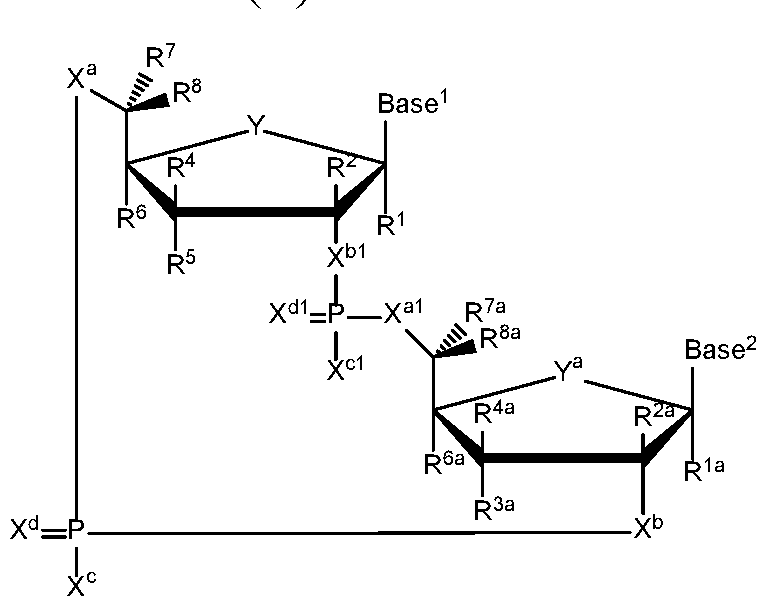
harmaceutically acceptable salt, hydrate, solvate, or prodrug thereof, wherein


and Base2 each may be independently substituted by 0-3 substituents R10, where each R10 is independently selected from the group consisting of F, CI, I, Br, OH, SH, H2, Ci-3 alkyl, C3-6 cycloalkyl, 0(Ci-3 alkyl), 0(C3-6 cycloalkyl), S(Ci-3 alkyl), S(C3-6 cycloalkyl), H(Ci-3 alkyl), H(C3-6 cycloalkyl), N(Ci-3 alkyl)2, and N(C3-6 cycloalkyl)2;
Y and Ya are each independently selected from the group consisting of -0-, -S-, -S02-, -CH2-, and -CF2-;
Xa and Xal are each independently selected from the group consisting of O, C, and S;
X and X l are each independently selected from the group consisting of O, C, and S; Xc and Xcl are each independently selected from the group consisting of O", S", OR9, and RV;
Xd and Xdl are each independently selected from the group consisting of O and S;
R^nd R13 are each independently selected from the group consisting of H, F, CI, Br, I,
OH, CN, N3, Ci-C6 alkyl, C2-C6 alkenyl, C2-C6 alkynyl, Ci-C6 haloalkyl, C2-C6 haloalkenyl, C2-C6 haloalkynyl, -0-Ci-C6 alkyl, -0-C2-C6 alkenyl, and -0-C2-C6 alkynyl, where said R1 and Rla Ci-C6 alkyl, C2-C6 alkenyl, C2-C6 alkynyl, Ci-C6 haloalkyl, C2-C6 haloalkenyl, C2-C6 haloalkynyl, -0-Ci-C6 alkyl, -0-C2-C6 alkenyl, and -0-C2-C6 alkynyl are substituted by 0 to 3 substituents selected from the group consisting of F, CI, Br, I, OH, CN, and N3;
R2 and R2a are each independently selected from the group consisting of H, F, CI, Br, I, OH, CN, N3, Ci-C6 alkyl, C2-C6 alkenyl, C2-C6 alkynyl, Ci-C6 haloalkyl, C2-C6 haloalkenyl, C2-C6 haloalkynyl, -0-Ci-C6 alkyl, -0-C2-C6 alkenyl, and -0-C2-C6 alkynyl, where said R2 and R2a Ci-C6 alkyl, C2-C6 alkenyl, C2-C6 alkynyl, Ci-C6 haloalkyl, C2-C6 haloalkenyl, C2-C6
haloalkynyl, -0-Ci-C6 alkyl, -0-C2-C6 alkenyl, and -0-C2-C6 alkynyl are substituted by 0 to 3 substituents selected from the group consisting of F, CI, Br, I, OH, CN, and N3;
R3a is selected from the group consisting of H, F, CI, Br, I, OH, CN, N3, Ci-C6 alkyl, C2-C6 alkenyl, C2-C6 alkynyl, Ci-C6 haloalkyl, C2-C6 haloalkenyl, C2-C6 haloalkynyl,
-0-Ci-C6 alkyl, -0-C2-C6 alkenyl, and -0-C2-C6 alkynyl, where said R3a Ci-C6 alkyl, C2-C6 alkenyl, C2-C6 alkynyl, Ci-C6 haloalkyl, C2-C6 haloalkenyl, C2-C6 haloalkynyl, -0-Ci-C6 alkyl, -0-C2-C6 alkenyl, and -0-C2-C6 alkynyl are substituted by 0 to 3 substituents selected from the group consisting of F, CI, Br, I, OH, CN, and N3;
R4 and R4a are each independently selected from the group consisting of H, F, CI, Br, I, OH, CN, N3, Ci-C6 alkyl, C2-C6 alkenyl, C2-C6 alkynyl, Ci-C6 haloalkyl, C2-C6 haloalkenyl,
C2-C6 haloalkynyl, -0-Ci-C6 alkyl, -0-C2-C6 alkenyl, and -0-C2-C6 alkynyl, where said R4 and R4a Ci-C6 alkyl, C2-C6 alkenyl, C2-C6 alkynyl, Ci-C6 haloalkyl, C2-C6 haloalkenyl, C2-C6 haloalkynyl, -0-Ci-C6 alkyl, -0-C2-C6 alkenyl, and -0-C2-C6 alkynyl are substituted by 0 to 3 substituents selected from the group consisting of F, CI, Br, I, OH, CN, and N3;
R5 is selected from the group consisting of H, F, CI, Br, I, OH, CN, N3, Ci-C6 alkyl,
C2-C6 alkenyl, C2-C6 alkynyl, Ci-C6 haloalkyl, C2-C6 haloalkenyl, C2-C6 haloalkynyl, -0-Ci-C6 alkyl, -0-C2-C6 alkenyl, and -0-C2-C6 alkynyl, where said R5 Ci-C6 alkyl, C2-C6 alkenyl, C2-C6 alkynyl, Ci-C6 haloalkyl, C2-C6 haloalkenyl, C2-C6 haloalkynyl, -0-Ci-C6 alkyl, -0-C2-C6 alkenyl, and -0-C2-C6 alkynyl are substituted by 0 to 3 substituents selected from the group consisting of F, CI, Br, I, OH, CN, and N3;
R6 and R6a are each independently selected from the group consisting of H, F, CI, Br, I, OH, CN, N3, Ci-C6 alkyl, C2-C6 alkenyl, C2-C6 alkynyl, Ci-C6 haloalkyl, C2-C6 haloalkenyl, C2-C6 haloalkynyl, -0-Ci-C6 alkyl, -0-C2-C6 alkenyl, and -0-C2-C6 alkynyl, where said R6 and R6a Ci-C6 alkyl, C2-C6 alkenyl, C2-C6 alkynyl, Ci-C6 haloalkyl, C2-C6 haloalkenyl, C2-C6 haloalkynyl, -0-Ci-C6 alkyl, -0-C2-C6 alkenyl, and -0-C2-C6 alkynyl are substituted by 0 to 3 substituents selected from the group consisting of F, CI, Br, I, OH, CN, and N3;
R7 and R7a are each independently selected from the group consisting of H, F, CI, Br, I, OH, CN, N3, Ci-C6 alkyl, C2-C6 alkenyl, C2-C6 alkynyl, Ci-C6 haloalkyl, C2-C6 haloalkenyl, C2-C6 haloalkynyl, -0-Ci-C6 alkyl, -0-C2-C6 alkenyl, and -0-C2-C6 alkynyl, where said R7 and R7a Ci-C6 alkyl, C2-C6 alkenyl, C2-C6 alkynyl, Ci-C6 haloalkyl, C2-C6 haloalkenyl, C2-C6 haloalkynyl, -0-Ci-C6 alkyl, -0-C2-C6 alkenyl, and -0-C2-C6 alkynyl are substituted by 0 to 3 substituents selected from the group consisting of F, CI, Br, I, OH, CN, and N3;
R and R a are each independently selected from the group consisting of H, F, CI, Br, I, OH, CN, N3, Ci-C6 alkyl, C2-C6 alkenyl, C2-C6 alkynyl, Ci-C6 haloalkyl, C2-C6 haloalkenyl, C2-C6 haloalkynyl, -0-Ci-C6 alkyl, -0-C2-C6 alkenyl, and -0-C2-C6 alkynyl, where said R8 and R8a Ci-C6 alkyl, C2-C6 alkenyl, C2-C6 alkynyl, Ci-C6 haloalkyl, C2-C6 haloalkenyl, C2-C6 haloalkynyl, -0-Ci-C6 alkyl, -0-C2-C6 alkenyl, and -0-C2-C6 alkynyl are substituted by 0 to 3 substituents selected from the group consisting of F, CI, Br, I, OH, CN, and N3;
each R9 is independently selected from the group consisting of H, Ci-C2o alkyl,

optionally R3a and R6a are connected to form -0-Ci-C6 alkylene, -0-C2-C6 alkenylene, or -0-C2-C6 alkynyl ene, such that where R3a and R6a are connected to form -0-Ci-C6 alkylene, -0-C2-C6 alkenylene, or -0-C2-C6 alkynylene, said O is bound at the R3a position;
optionally R3a and R4a are connected to form Ci-C6 alkylene, C2-C6 alkenylene, C2-C6 alkynylene, -0-Ci-C6 alkylene, -0-C2-C6 alkenylene, or -0-C2-C6 alkynylene, such that where R3a and R4a are connected to form -0-Ci-C6 alkylene, -0-C2-C6 alkenylene, or -0-C2-C6 alkynylene, said O is bound at the R3a position;
optionally R4 and R5 are connected to form are connected to form Ci-C6 alkylene, C2-C6 alkenylene, C2-C6 alkynylene, -0-Ci-C6 alkylene, -0-C2-C6 alkenylene, or -0-C2-C6 alkynylene, such that where R4 and R5 are connected to form -0-Ci-C6 alkylene, -0-C2-C6 alkenylene, or -0-C2-C6 alkynylene, said O is bound at the R5 position;
optionally R5 and R6 are connected to form -0-Ci-C6 alkylene, -0-C2-C6 alkenylene, or -0-C2-C6 alkynylene, such that where R5 and R6 are connected to form -0-Ci-C6 alkylene, -0-C2-C6 alkenylene, or -0-C2-C6 alkynylene, said O is bound at the R5 position;
optionally R7 and R8 are connected to form Ci-C6 alkylene, C2-C6 alkenylene, or C2-C6 alkynylene; and
optionally R7a and R8a are connected to form Ci-C6 alkylene, C2-C6 alkenylene, or C2-C6 alkynylene; and
providing that when Y and Ya are each O, Xa and Xal are each O, X and X l are each O, and Xc and Xcl are each OH or SH, Xd and Xdl are each O, R1 and Rla are each H, R2 is H, R6 and R6a are each H, R7 and R7a are each H, R8 and R8a are each H, and Base1 and Base2 are each
selected from the group consisting of
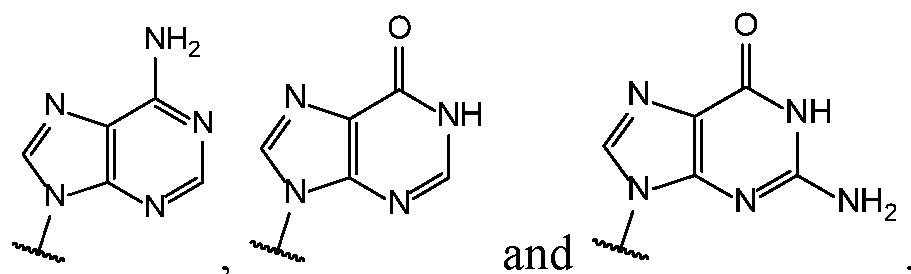
are not both selected from the group consisting of H, F and OH.
2. The compound according to claim 1, wherein the compound of formula (II) is a compound of formula (Ha):

or a pharmaceutically acceptable salt, hydrate, solvate, or prodrug thereof, wherein

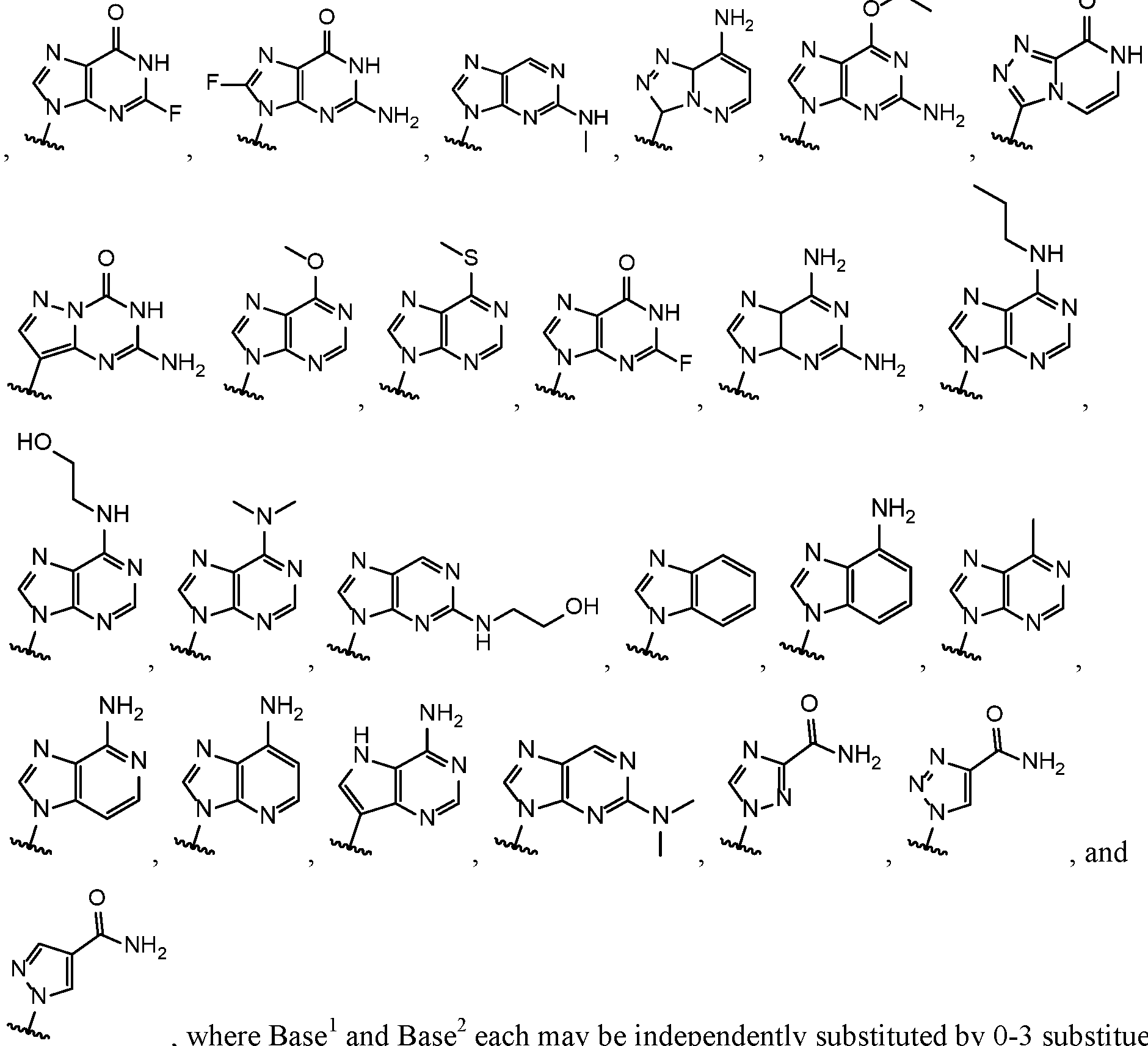
R10, where each R10 is independently selected from the group consisting of F, CI, I, Br, OH, SH, H2, Ci-3 alkyl, C3-6 cycloalkyl, 0(Ci-3 alkyl), 0(C3-6 cycloalkyl), S(Ci-3 alkyl), S(C3-6 cycloalkyl), H(Ci-3 alkyl), H(C3-6 cycloalkyl), N(Ci-3 alkyl)2, and N(C3-6 cycloalkyl)2;
Xc and Xcl are each independently selected from the group consisting of O", S", OR9, and R9R9;
R3a is selected from the group consisting of H, F, CI, Br, I, OH, CN, N3, Ci-C6 alkyl, and Ci-C6 haloalkyl, where said R3a Ci-C6 alkyl or Ci-C6 haloalkyl are substituted by 0 to 3 substituents selected from the group consisting of F, CI, Br, I, and OH;
R4 and R4a are selected from the group consisting of H, F, CI, Br, I, OH, CN, N3, Ci-C6 alkyl, and Ci-C6 haloalkyl, where said R4 Ci-C6 alkyl or Ci-C6 haloalkyl are substituted by 0 to 3 substituents selected from the group consisting of F, CI, Br, I, and OH;
R5 is selected from the group consisting of H, F, CI, Br, I, OH, CN, N3, Ci-C6 alkyl, and Ci-C6 haloalkyl, where said R5 Ci-C6 alkyl or Ci-C6 haloalkyl are substituted by 0 to 3 substituents selected from the group consisting of F, CI, Br, I, and OH;
9 is independently selected from the group consisting of H, C2-C3 alkyl,

optionally R3a and R4a are connected to form Ci-C6 alkylene, C2-C6 alkenylene, C2-C6 alkynylene, -0-Ci-C6 alkylene, -0-C2-C6 alkenylene, or -0-C2-C6 alkynylene, such that where R3a and R4a are connected to form -0-Ci-C6 alkylene, -0-C2-C6 alkenylene, or -0-C2-C6 alkynylene, said O is bound at the R5 position; and
optionally R4 and R5 are connected to form are connected to form Ci-C6 alkylene, C2-C6 alkenylene, C2-C6 alkynylene, -0-Ci-C6 alkylene, -0-C2-C6 alkenylene, or -0-C2-C6 alkynylene, such that where R4 and R5 are connected to form -0-Ci-C6 alkylene, -0-C2-C6 alkenylene, or -O- C2-C6 alkynylene, said O is bound at the R5 position.
3. A pharmaceutical composition, said pharmaceutical composition comprising:
(a) a compound according to any one of claim 1 and claim 2 or a pharmaceutically acceptable salt, hydrate, solvate, or prodrug thereof; and
(b) a pharmaceutically acceptable carrier.
4. A method of inducing an immune response in a subject, said method comprising:
(a) administering a therapeutically effective amount of a compound according to any one of claim 1 and claim 2 to the subject.
5. A method of inducing an immune response in a subject, said method comprising:
(a) administering a therapeutically effective amount of a pharmaceutical composition according to claim 3 to the subject.
6. A method of inducing a STF G-dependent type I interferon production in a subject, said method comprising:
(a) administering a therapeutically effective amount of a compound according to any one of claim 1 and claim 2 to the subject.
7. A method of inducing a STING-dependent type I interferon production in a subject, said method comprising:
(a) administering a therapeutically effective amount of a pharmaceutical composition according to claim 3 to the subject.
8. A compound of formula (ΙΓ):


and Base2 each may be independently substituted by 0-3 substituents R10, where each R10 is independently selected from the group consisting of F, CI, I, Br, OH, SH, H2, Ci-3 alkyl, C3-6
cycloalkyl, 0(d-3 alkyl), 0(C3-6 cycloalkyl), S(Ci-3 alkyl), S(C3-6 cycloalkyl), H(Ci-3 alkyl), H(C3-6 cycloalkyl), N(Ci-3 alkyl)2, and N(C3-6 cycloalkyl)2;
Y and Ya are each independently selected from the group consisting of -O- and -S-; Xa and Xal are each independently selected from the group consisting of O, and S; X and X l are each independently selected from the group consisting of O, and S;
Xc and Xcl are each independently selected from the group consisting of OR9, SR9, and RV;
Xd and Xdl are each independently selected from the group consisting of O and S;
R1 and Rla are each independently selected from the group consisting of H, F, CI, Br, I, OH, CN, N3, Ci-C6 alkyl, C2-C6 alkenyl, C2-C6 alkynyl, Ci-C6 haloalkyl, C2-C6 haloalkenyl,
C2-C6 haloalkynyl, -0-Ci-C6 alkyl, -0-C2-C6 alkenyl, and -0-C2-C6 alkynyl, where said R1 and Rla Ci-C6 alkyl, C2-C6 alkenyl, C2-C6 alkynyl, Ci-C6 haloalkyl, C2-C6 haloalkenyl, C2-C6 haloalkynyl, -0-Ci-C6 alkyl, -0-C2-C6 alkenyl, and -0-C2-C6 alkynyl are substituted by 0 to 3 substituents selected from the group consisting of F, CI, Br, I, OH, CN, and N3;
R2 and R2a are each independently selected from the group consisting of H, F, CI, Br, I,
OH, CN, N3, Ci-C6 alkyl, C2-C6 alkenyl, C2-C6 alkynyl, Ci-C6 haloalkyl, C2-C6 haloalkenyl, C2-C6 haloalkynyl, -0-Ci-C6 alkyl, -0-C2-C6 alkenyl, and -0-C2-C6 alkynyl, where said R2 and R2a Ci-C6 alkyl, C2-C6 alkenyl, C2-C6 alkynyl, Ci-C6 haloalkyl, C2-C6 haloalkenyl, C2-C6 haloalkynyl, -0-Ci-C6 alkyl, -0-C2-C6 alkenyl, and -0-C2-C6 alkynyl are substituted by 0 to 3 substituents selected from the group consisting of F, CI, Br, I, OH, CN, and N3;
R3a is selected from the group consisting of H, F, CI, Br, I, OH, CN, NH2, N3, Ci-C6 alkyl, C2-C6 alkenyl, C2-C6 alkynyl, Ci-C6 haloalkyl, C2-C6 haloalkenyl, C2-C6 haloalkynyl, -0-Ci-C6 alkyl, -0-C2-C6 alkenyl, and -0-C2-C6 alkynyl, where said R3a Ci-C6 alkyl, C2-C6 alkenyl, C2-C6 alkynyl, Ci-C6 haloalkyl, C2-C6 haloalkenyl, C2-C6 haloalkynyl, -0-Ci-C6 alkyl, -0-C2-C6 alkenyl, and -0-C2-C6 alkynyl are substituted by 0 to 3 substituents selected from the group consisting of F, CI, Br, I, OH, CN, and N3;
R4 and R4a are each independently selected from the group consisting of H, F, CI, Br, I, OH, CN, N3, Ci-C6 alkyl, C2-C6 alkenyl, C2-C6 alkynyl, Ci-C6 haloalkyl, C2-C6 haloalkenyl, C2-C6 haloalkynyl, -0-Ci-C6 alkyl, -0-C2-C6 alkenyl, and -0-C2-C6 alkynyl, where said R4 and R4a Ci-C6 alkyl, C2-C6 alkenyl, C2-C6 alkynyl, Ci-C6 haloalkyl, C2-C6 haloalkenyl, C2-C6 haloalkynyl, -0-Ci-C6 alkyl, -0-C2-C6 alkenyl, and -0-C2-C6 alkynyl are substituted by 0 to 3 substituents selected from the group consisting of F, CI, Br, I, OH, CN, and N3;
R5 is selected from the group consisting of H, F, CI, Br, I, OH, CN, H2, N3, Ci-C6 alkyl, C2-C6 alkenyl, C2-C6 alkynyl, Ci-C6 haloalkyl, C2-C6 haloalkenyl, C2-C6 haloalkynyl, -0-Ci-C6 alkyl, -0-C2-C6 alkenyl, and -0-C2-C6 alkynyl, where said R5 Ci-C6 alkyl, C2-C6 alkenyl, C2-C6 alkynyl, Ci-C6 haloalkyl, C2-C6 haloalkenyl, C2-C6 haloalkynyl, -0-Ci-C6 alkyl, -0-C2-C6 alkenyl, and -0-C2-C6 alkynyl are substituted by 0 to 3 substituents selected from the group consisting of F, CI, Br, I, OH, CN, NR9R9, and N3;
R6 and R6a are each independently selected from the group consisting of H, F, CI, Br, I, OH, CN, N3, Ci-C6 alkyl, C2-C6 alkenyl, C2-C6 alkynyl, Ci-C6 haloalkyl, C2-C6 haloalkenyl, C2-C6 haloalkynyl, -0-Ci-C6 alkyl, -0-C2-C6 alkenyl, and -0-C2-C6 alkynyl, where said R6 and R6a Ci-C6 alkyl, C2-C6 alkenyl, C2-C6 alkynyl, Ci-C6 haloalkyl, C2-C6 haloalkenyl, C2-C6 haloalkynyl, -0-Ci-C6 alkyl, -0-C2-C6 alkenyl, and -0-C2-C6 alkynyl are substituted by 0 to 3 substituents selected from the group consisting of F, CI, Br, I, OH, CN, and N3;
R7 and R7a are each independently selected from the group consisting of H, F, CI, Br, I, OH, CN, N3, Ci-C6 alkyl, C2-C6 alkenyl, C2-C6 alkynyl, Ci-C6 haloalkyl, C2-C6 haloalkenyl, C2-C6 haloalkynyl, -0-Ci-C6 alkyl, -0-C2-C6 alkenyl, and -0-C2-C6 alkynyl, where said R7 and R7a Ci-C6 alkyl, C2-C6 alkenyl, C2-C6 alkynyl, Ci-C6 haloalkyl, C2-C6 haloalkenyl, C2-C6 haloalkynyl, -0-Ci-C6 alkyl, -0-C2-C6 alkenyl, and -0-C2-C6 alkynyl are substituted by 0 to 3 substituents selected from the group consisting of F, CI, Br, I, OH, CN, and N3;
R and R a are each independently selected from the group consisting of H, F, CI, Br, I, OH, CN, N3, Ci-C6 alkyl, C2-C6 alkenyl, C2-C6 alkynyl, Ci-C6 haloalkyl, C2-C6 haloalkenyl,
C2-C6 haloalkynyl, -0-Ci-C6 alkyl, -0-C2-C6 alkenyl, and -0-C2-C6 alkynyl, where said R8 and R8a Ci-C6 alkyl, C2-C6 alkenyl, C2-C6 alkynyl, Ci-C6 haloalkyl, C2-C6 haloalkenyl, C2-C6 haloalkynyl, -0-Ci-C6 alkyl, -0-C2-C6 alkenyl, and -0-C2-C6 alkynyl are substituted by 0 to 3 substituents selected from the group consisting of F, CI, Br, I, OH, CN, and N3;
9 is independently selected from the group consisting of H, Ci-C2o alkyl,

optionally R3a and R6a are connected to form -0-Ci-C6 alkylene, -0-C2-C6 alkenylene, or -0-C2-C6 alkynyl ene, such that where R3a and R6a are connected to form -0-Ci-C6 alkylene, -0-C2-C6 alkenylene, or -0-C2-C6 alkynylene, said O is bound at the R3a position;
optionally R a and R a are connected to form Ci-C6 alkylene, C2-C6 alkenylene, C2-C6 alkynylene, -0-Ci-C6 alkylene, -0-C2-C6 alkenylene, or -0-C2-C6 alkynylene, such that where R3a and R4a are connected to form -0-Ci-C6 alkylene, -0-C2-C6 alkenylene, or -0-C2-C6 alkynylene, said O is bound at the R3a position;
optionally R4 and R5 are connected to form are connected to form Ci-C6 alkylene, C2-C6 alkenylene, C2-C6 alkynylene, -0-Ci-C6 alkylene, -0-C2-C6 alkenylene, or -0-C2-C6 alkynylene, such that where R4 and R5 are connected to form -0-Ci-C6 alkylene, -0-C2-C6 alkenylene, or -0-C2-C6 alkynylene, said O is bound at the R5 position;
optionally R5 and R6 are connected to form -0-Ci-C6 alkylene, -0-C2-C6 alkenylene, or -0-C2-C6 alkynylene, such that where R5 and R6 are connected to form -0-Ci-C6 alkylene, -0-C2-C6 alkenylene, or -0-C2-C6 alkynylene, said O is bound at the R5 position;
optionally R7 and R8 are connected to form Ci-C6 alkylene, C2-C6 alkenylene, or C2-C6 alkynylene; and
optionally R7a and R8a are connected to form Ci-C6 alkylene, C2-C6 alkenylene, or C2-C6 alkynylene; and
providing that when Y and Ya are each O, Xa and Xal are each O, X and X l are each O, and Xc and Xcl are each OH or SH, Xd and Xdl are each O, R1 and Rla are each H, R2 is H, R6 and R6a are each H R7 and R7a are each H R8 and R8a are each H and Base1 and Base2 are each
 are not both selected from the group consisting of H, F and OH.
9. The compound according to claim 8, wherein the compound of formula (ΙΓ) is a compound of formula (H'a)

or a pharmaceutically acceptable salt, hydrate, solvate, or prodrug thereof, wherein
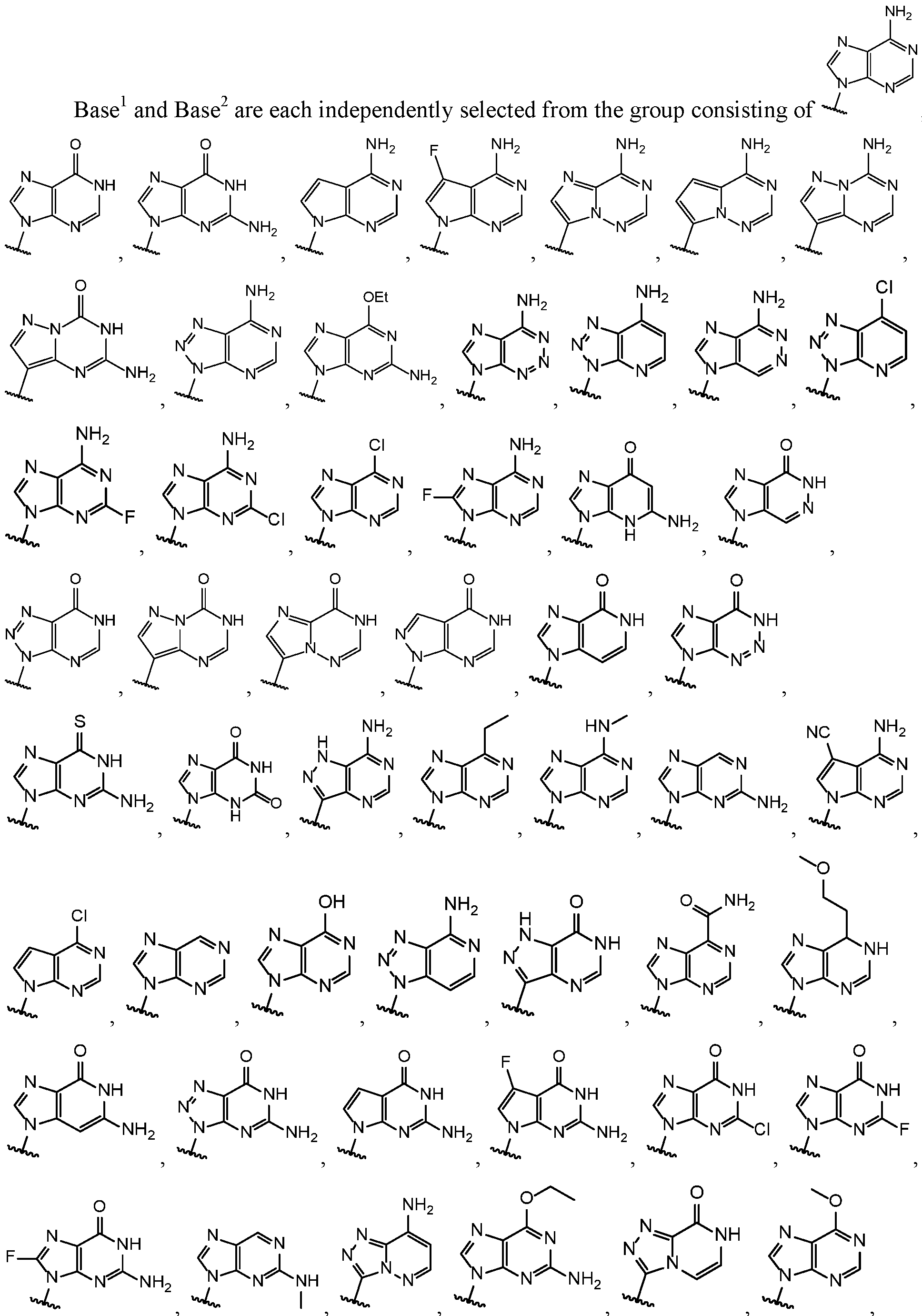
- 147 -
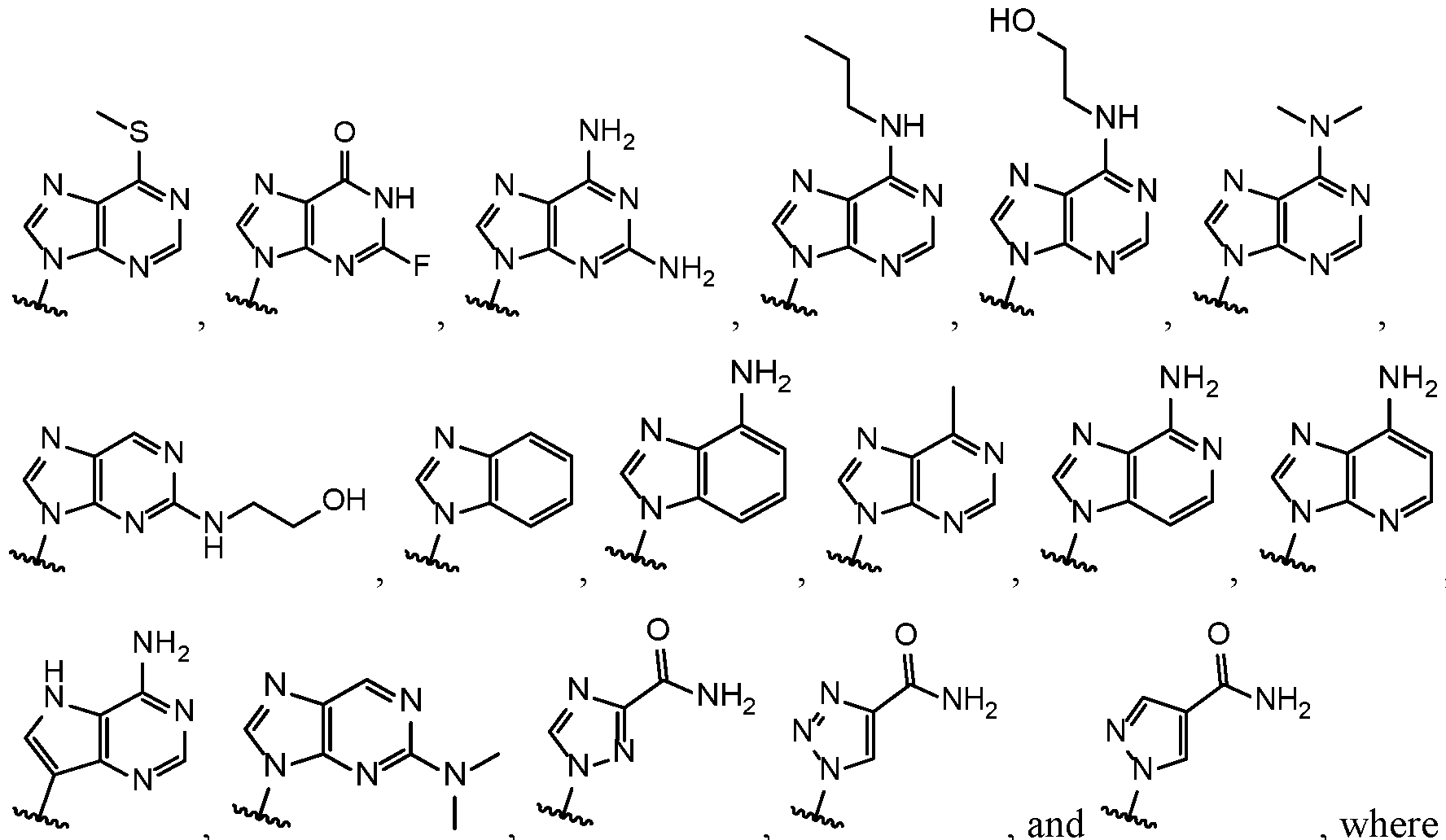
and Base2 each may be independently substituted by 0-3 substituents R10, where each R10 is independently selected from the group consisting of F, CI, I, Br, OH, SH, H2, Ci-3 alkyl, C3-6 cycloalkyl, 0(Ci-3 alkyl), 0(C3-6 cycloalkyl), S(Ci-3 alkyl), S(C3-6 cycloalkyl), H(Ci-3 alkyl), H(C3-6 cycloalkyl), N(Ci-3 alkyl)2, and N(C3-6 cycloalkyl)2;
Xc and Xcl are each independently selected from the group consisting of OR9, SR9, and RV;
R3a is selected from the group consisting of H, F, CI, Br, I, OH, CN, H2, N3, Ci-C6 alkyl, and Ci-C6 haloalkyl, where said R3a Ci-C6 alkyl or Ci-C6 haloalkyl are substituted by 0 to 3 substituents selected from the group consisting of F, CI, Br, I, and OH;
R4 and R4a are selected from the group consisting of H, F, CI, Br, I, OH, CN, N3, Ci-C6 alkyl, and Ci-C6 haloalkyl, where said R4 Ci-C6 alkyl or Ci-C6 haloalkyl are substituted by 0 to 3 substituents selected from the group consisting of F, CI, Br, I, and OH;
R5 is selected from the group consisting of H, F, CI, Br, I, OH, CN, NH2, N3, Ci-C6 alkyl, and Ci-C6 haloalkyl, where said R5 Ci-C6 alkyl or Ci-C6 haloalkyl are substituted by 0 to 3 substituents selected from the group consisting of F, CI, Br, I, and OH;
9 is independently selected from the group consisting of H, C2-C3 alkyl,

optionally R3a and R4a are connected to form Ci-C6 alkyl ene, C2-C6 alkenylene, C2-C6 alkynylene, -0-Ci-C6 alkylene, -O-C2-C6 alkenylene, or -O-C2-C6 alkynylene, such that where R3a and R4a are connected to form -0-Ci-C6 alkylene, -0-C2-C6 alkenylene, or -0-C2-C6 alkynylene, said O is bound at the R5 position; and
optionally R4 and R5 are connected to form are connected to form Ci-C6 alkylene, C2-C6 alkenylene, C2-C6 alkynylene, -0-Ci-C6 alkylene, -O-C2-C6 alkenylene, or -O-C2-C6 alkynylene, such that where R4 and R5 are connected to form -0-Ci-C6 alkylene, -0-C2-C6 alkenylene, or -O- C2-C6 alkynylene, said O is bound at the R5 position.
10. The compound according to claim 8, or a pharmaceutically acceptable salt, hydrate, solvate, or prodrug thereof, wherein
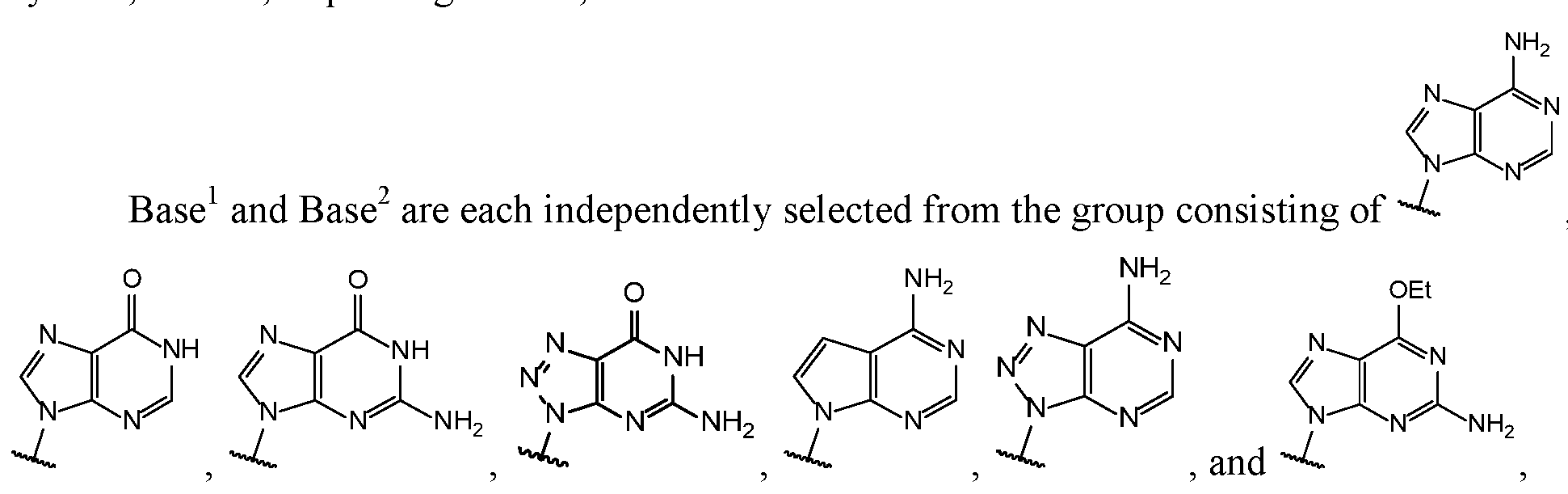
where Base1 and Base2 each may be independently substituted by 0-3 substituents R10, where each R is independently selected from the group consisting of F, CI, I, Br, OH, SH, H2, Ci-3 alkyl, C3-6 cycloalkyl, 0(Ci-3 alkyl), 0(C3-6 cycloalkyl), S(Ci-3 alkyl), S(C3-6 cycloalkyl), NH(d. 3 alkyl), H(C3-6 cycloalkyl), N(Ci-3 alkyl)2, and N(C3-6 cycloalkyl)2;
Y and Ya are each independently selected from the group consisting of -O- and -S-;
Xa and Xal are each independently selected from the group consisting of O and S;
X and X l are each independently selected from the group consisting of O and S;
Xc and Xcl are each independently selected from the group consisting of SR9, OR9, and R9R9;
Xd and Xdl are each independently selected from the group consisting of O and S;
R1 and Rla are each H;
R2 and R2a are each independently selected from the group consisting of H, F, CI, Br, I, OH, N3, Ci-C6 alkyl, and Ci-C6 haloalkyl, where said R2 and R2a Ci-C6 alkyl or Ci-C6 haloalkyl
are substituted by 0 to 3 substituents selected from the group consisting of F, CI, Br, I, OH, CN, and N3;
R3a is selected from the group consisting of H, F, CI, Br, I, OH, CN, N3, Ci-C6 alkyl, and Ci-C6 haloalkyl, where said R3a Ci-C6 alkyl or Ci-C6 haloalkyl are substituted by 0 to 3 substituents selected from the group consisting of F, CI, Br, I, OH, CN, and N3;
R4 and R4a are each independently selected from the group consisting of H, F, CI, Br, I, OH, Ci-C6 alkyl, and Ci-C6 haloalkyl, where said R4 and R4a Ci-C6 alkyl or Ci-C6 haloalkyl are substituted by 0 to 3 substituents selected from the group consisting of F, CI, Br, I, OH, CN, and N3;
R5 is selected from the group consisting of H, F, CI, Br, I, OH, NH2, N3, Ci-C6 alkyl, and Ci-C6 haloalkyl, where said R5 Ci-C6 alkyl or Ci-C6 haloalkyl are substituted by 0 to 3 substituents selected from the group consisting of F, CI, Br, I, OH, CN, and N3;
R3a and R5 are not both selected from the group consisting of: OH, Ci-C6 alkyl substituted with OH, or Ci-C6 haloalkyl substituted with OH; and
R6 and R6a are each independently selected from the group consisting of H, F, CI, Br, I, OH, Ci-C6 alkyl, C2-C6 alkenyl, C2-C6 alkynyl, and Ci-C6 haloalkyl, where said R6 and R6a Ci-C6 alkyl or Ci-C6 haloalkyl are substituted by 0 to 3 substituents selected from the group consisting of F, CI, Br, I, OH, CN, and N3;
R7 and R7a are each H;
R8 and R8a are each H;
each R9 is independently selected from the group consisting of H, C2-C3 alkyl,

optionally R3a and R6a are connected to form -0-Ci-C6 alkylene, -0-C2-C6 alkenylene, and -0-C2-C6 alkynylene, such that where R3a and R6a are connected to form -0-Ci-C6 alkylene, -0-C2-C6 alkenylene, or -0-C2-C6 alkynylene, said O is bound at the R3a position; and
optionally R4 and R5 are connected by Ci-C6 alkylene, -0-Ci-C6 alkylene, -0-C2-C6 alkenylene, or -0-C2-C6 alkynylene, such that where R4 and R5 are connected to form -0-Ci-C6 alkylene, -0-C2-C6 alkenylene, or -0-C2-C6 alkynylene, said O is bound at the R5 position.
11. A compound of formula (II") :

or a pharmaceutically acceptable salt, hydrate, solvate, or prodrug thereof, wherein 1 and Base2 are each independently selected from the group consisting of

 Base1 and Base2 each may be independently substituted by 0-3 substituents R10, where each R10 is independently selected from the group consisting of F, CI, I, Br, OH, SH, H2, Ci-3 alkyl, C3-6 cycloalkyl, 0(Ci-3 alkyl), 0(C3-6 cycloalkyl), S(Ci-3 alkyl), S(C3-6 cycloalkyl), H(Ci-3 alkyl), H(C3-6 cycloalkyl), N(Ci-3 alkyl)2, and N(C3-6 cycloalkyl)2;
Y and Ya are each independently selected from the group consisting of -O- and -S-;
Xc and Xcl are each independently selected from the group consisting of SR9 and OR9; Xd and Xdl are each independently selected from the group consisting of O and S; R3a is selected from the group consisting of H, F, OH, CN, H2, and N3;
R4 and R4a are each independently selected from the group consisting of H, F, and OH; R5 is selected from the group consisting of H, F, OH, H2, and N3;
R3a and R5 are not both selected from the group consisting of: OH, Ci-C6 alkyl substituted with OH, or Ci-C6 haloalkyl substituted with OH;
R7a is selected from the group consisting of H and Ci-C6 alkyl;
R8a is selected from the group consisting of H and Ci-C6 alkyl; and
each R9 is independently selected from the group consisting of H and Ci-C3 alkyl.
A compound selected from the group consisting of:

- 152 -


pharmaceutically acceptable salts, hydrates, solvates, or prodrugs thereof.
13. The compound according to claim 12, wherein the compound is selected from the group consisting of:
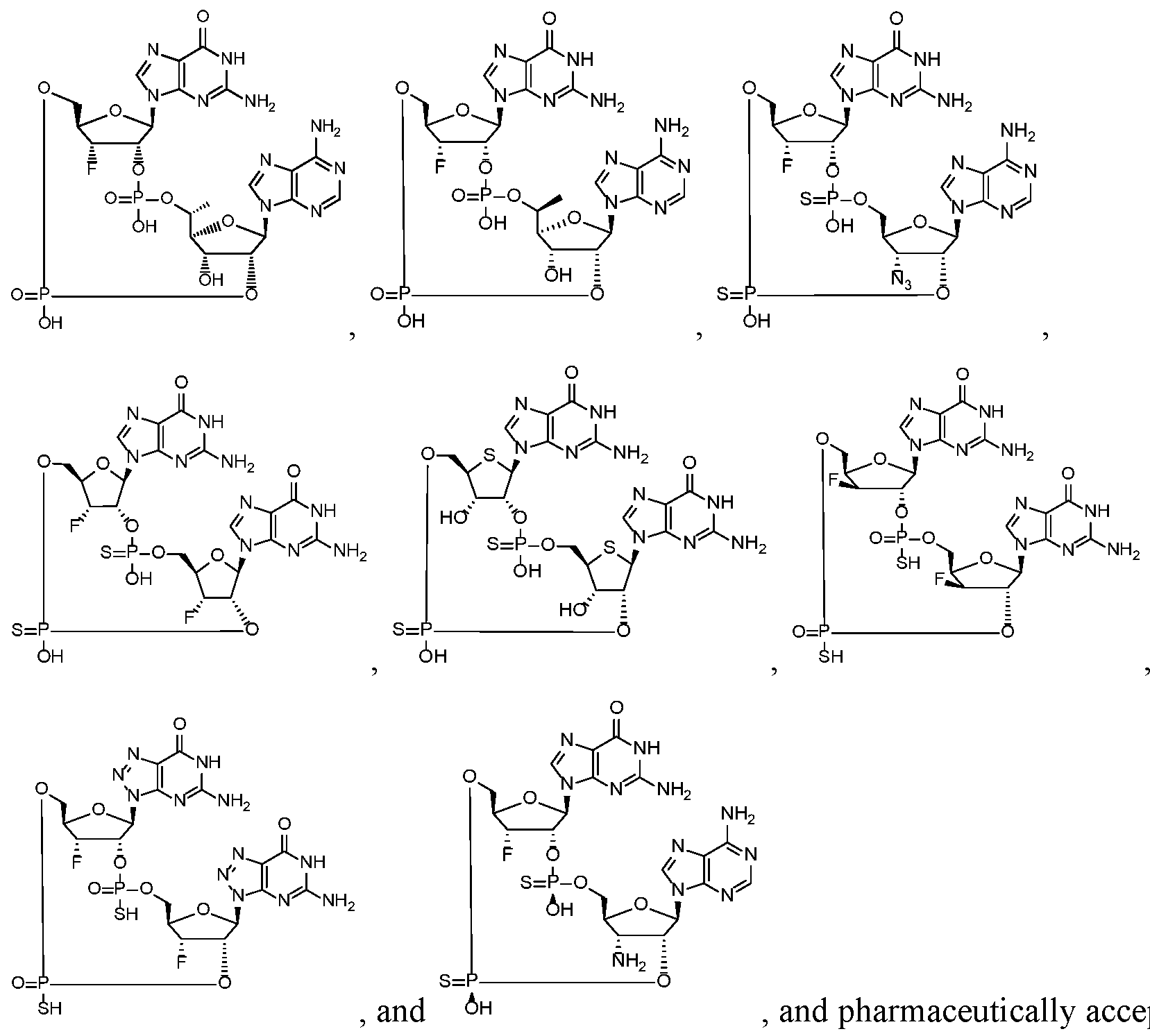
14. A pharmaceutical composition, said pharmaceutical composition comprising:
(a) a compound according to any one of claims 8 to 13 or a pharmaceutically acceptable salt, hydrate, solvate, or prodrug thereof; and
(b) a pharmaceutically acceptable carrier.
15. A method of inducing an immune response in a subject, said method comprising:
(a) administering a therapeutically effective amount of a compound according one of claims 8 to 13 to the subject.
16. A method of inducing an immune response in a subject, said method comprising:
(a) administering a therapeutically effective amount of a pharmaceutical composition according to claim 14 to the subject.
17. A method of inducing a STING-dependent type I interferon production in a subject, said method comprising:
(a) administering a therapeutically effective amount of a compound according to any one of claims 8 to 13 to the subject.
18. A method of inducing a STING-dependent type I interferon production in a subject, said method comprising:
(a) administering a therapeutically effective amount of a pharmaceutical composition according to claim 14 to the subject.
19. A method of treating a cell proliferation disorder in a subject, said method comprising administering a therapeutically effective amount of a compound according to any one of claims 8 to 13 to the subject.
20. The method of claim 19, wherein the cell proliferation disorder is cancer.
21. A method of treating a cell proliferation disorder in a subject, said method comprising administering a therapeutically effective amount of a pharmaceutical composition according to claim 14 to the subject.
22. The method of claim 21, wherein the cell proliferation disorder is cancer.
Priority Applications (2)
| Application Number | Priority Date | Filing Date | Title |
|---|---|---|---|
| US15/752,144 US10738074B2 (en) | 2015-08-13 | 2016-08-11 | Cyclic di-nucleotide compounds as STING agonists |
| EP16835872.9A EP3344644B1 (en) | 2015-08-13 | 2016-08-11 | Cyclic di-nucleotide compounds as sting agonists |
Applications Claiming Priority (6)
| Application Number | Priority Date | Filing Date | Title |
|---|---|---|---|
| US201562204677P | 2015-08-13 | 2015-08-13 | |
| US62/204,677 | 2015-08-13 | ||
| US201562268723P | 2015-12-17 | 2015-12-17 | |
| US62/268,723 | 2015-12-17 | ||
| US201662356125P | 2016-06-29 | 2016-06-29 | |
| US62/356,125 | 2016-06-29 |
Publications (1)
| Publication Number | Publication Date |
|---|---|
| WO2017027645A1 true WO2017027645A1 (en) | 2017-02-16 |
Family
ID=56741193
Family Applications (2)
| Application Number | Title | Priority Date | Filing Date |
|---|---|---|---|
| PCT/US2016/046442 Ceased WO2017027645A1 (en) | 2015-08-13 | 2016-08-11 | Cyclic di-nucleotide compounds as sting agonists |
| PCT/US2016/046444 Ceased WO2017027646A1 (en) | 2015-08-13 | 2016-08-11 | Cyclic di-nucleotide compounds as sting agonists |
Family Applications After (1)
| Application Number | Title | Priority Date | Filing Date |
|---|---|---|---|
| PCT/US2016/046444 Ceased WO2017027646A1 (en) | 2015-08-13 | 2016-08-11 | Cyclic di-nucleotide compounds as sting agonists |
Country Status (29)
| Country | Link |
|---|---|
| US (4) | US10106574B2 (en) |
| EP (2) | EP3334745B1 (en) |
| JP (1) | JP6596146B2 (en) |
| KR (2) | KR102271750B1 (en) |
| CN (1) | CN108137641B (en) |
| AU (1) | AU2016304899B2 (en) |
| BR (1) | BR112018002757A8 (en) |
| CA (1) | CA2995365C (en) |
| CL (1) | CL2018000385A1 (en) |
| CO (1) | CO2018001425A2 (en) |
| CR (1) | CR20180101A (en) |
| DO (1) | DOP2018000046A (en) |
| EA (1) | EA034786B1 (en) |
| GE (2) | GEP20207182B (en) |
| HK (1) | HK1249109A1 (en) |
| IL (1) | IL257142B (en) |
| JO (1) | JOP20200224A1 (en) |
| MA (1) | MA42608A (en) |
| MX (1) | MX2018001814A (en) |
| NI (1) | NI201800025A (en) |
| PE (1) | PE20180688A1 (en) |
| PH (1) | PH12018500299A1 (en) |
| SG (1) | SG10202010609QA (en) |
| SV (1) | SV2018005632A (en) |
| TN (1) | TN2018000023A1 (en) |
| TW (1) | TWI696629B (en) |
| UA (1) | UA123701C2 (en) |
| WO (2) | WO2017027645A1 (en) |
| ZA (1) | ZA201800442B (en) |
Cited By (126)
| Publication number | Priority date | Publication date | Assignee | Title |
|---|---|---|---|---|
| US9718848B2 (en) | 2015-12-03 | 2017-08-01 | Glaxosmithkline Intellectual Property Development Limited | Compounds |
| EP3250573A1 (en) * | 2015-01-29 | 2017-12-06 | GlaxoSmithKline Intellectual Property Development Limited | Cyclic dinucleotides useful for the treatment of inter alia cancer |
| WO2018020476A1 (en) | 2016-07-29 | 2018-02-01 | Aduro Biotech Holdings, Europe B.V. | Anti-pd-1 antibodies |
| WO2018025178A1 (en) | 2016-08-02 | 2018-02-08 | Aduro Biotech Holdings, Europe B.V. | Antibodies against human ctla-4 |
| WO2018065360A1 (en) | 2016-10-07 | 2018-04-12 | Biolog Life Science Institute Forschungslabor Und Biochemica-Vertrieb Gmbh | Cyclic dinucleotides containing benzimidazole, method for the production of same, and use of same to activate stimulator of interferon genes (sting)-dependent signaling pathways |
| WO2018100558A2 (en) | 2016-12-01 | 2018-06-07 | Takeda Pharmaceutical Company Limited | Cyclic dinucleotide |
| WO2018118664A1 (en) * | 2016-12-20 | 2018-06-28 | Merck Sharp & Dohme Corp. | Combinations of pd-1 antagonists and cyclic dinucleotide sting agonists for cancer treatment |
| WO2018152450A1 (en) | 2017-02-17 | 2018-08-23 | Eisai R&D Management Co., Ltd. | Cyclic di-nucleotides compounds for the treatment of cancer |
| WO2018172206A1 (en) | 2017-03-22 | 2018-09-27 | Boehringer Ingelheim International Gmbh | Modified cyclic dinucleotide compounds |
| WO2018190719A2 (en) | 2017-04-13 | 2018-10-18 | Aduro Biotech Holdings, Europe B.V. | Anti-sirp alpha antibodies |
| WO2018189382A1 (en) | 2017-04-14 | 2018-10-18 | Solstice Biologics, Ltd. | Immunomodulating polynucleotides, antibody conjugates thereof, and methods of their use |
| US10106574B2 (en) | 2015-08-13 | 2018-10-23 | Merck Sharp & Dohme Corp. | Cyclic di-nucleotide compounds as sting agonists |
| WO2018198076A1 (en) | 2017-04-28 | 2018-11-01 | Aduro Biotech, Inc. | Bis 2'-5'-rr-(3'f-a)(3'f-a) cyclic dinucleotide compound and uses thereof |
| WO2018198084A1 (en) * | 2017-04-27 | 2018-11-01 | Lupin Limited | Cyclic di-nucleotide compounds with tricyclic nucleobases |
| WO2018200812A1 (en) | 2017-04-28 | 2018-11-01 | Novartis Ag | Antibody conjugates comprising sting agonist |
| WO2018208667A1 (en) * | 2017-05-12 | 2018-11-15 | Merck Sharp & Dohme Corp. | Cyclic di-nucleotide compounds as sting agonists |
| EP3431484A1 (en) * | 2017-07-21 | 2019-01-23 | Ludwig-Maximilians-Universität München | A fluorescent cyclic dinucleotide and its use in methods of identifying substances having an ability to modulate the cgas/sting pathway |
| WO2019043634A2 (en) | 2017-08-30 | 2019-03-07 | Beijing Xuanyi Pharmasciences Co., Ltd. | Cyclic di-nucleotides as stimulator of interferon genes modulators |
| WO2019084060A1 (en) | 2017-10-24 | 2019-05-02 | Silverback Therapeutics, Inc. | Conjugates and methods of use thereof for selective delivery of immune-modulatory agents |
| WO2019092660A1 (en) | 2017-11-10 | 2019-05-16 | Takeda Pharmaceutical Company Limited | Sting modulator compounds, and methods of making and using |
| WO2019160884A1 (en) * | 2018-02-13 | 2019-08-22 | Bristol-Myers Squibb Company | Cyclic dinucleotides as anticancer agents |
| US10414747B2 (en) | 2016-10-04 | 2019-09-17 | Merck Sharp & Dohme Corp. | Benzo[b]thiophene compounds as sting agonists |
| WO2019180683A1 (en) | 2018-03-23 | 2019-09-26 | Takeda Pharmaceutical Company Limited | Sting modulator compounds with sulfamate linkages, and methods of making and using |
| US20190292216A1 (en) * | 2013-05-03 | 2019-09-26 | The Regents Of The University Of California | Cyclic Di-Nucleotide Induction of Type I Interferon |
| WO2019183578A1 (en) | 2018-03-23 | 2019-09-26 | Codiak Biosciences, Inc. | Extracellular vesicles comprising sting-agonist |
| WO2019185476A1 (en) | 2018-03-27 | 2019-10-03 | Boehringer Ingelheim International Gmbh | Modified cyclic dinucleotide compounds |
| WO2019185477A1 (en) | 2018-03-27 | 2019-10-03 | Boehringer Ingelheim International Gmbh | Cyclic dinucleotide compounds containing 2-aza-hypoxanthine or 6h-pytazolo[1,5-d][1,2,4]triazin-7-one as sting agonists |
| WO2019193533A1 (en) | 2018-04-06 | 2019-10-10 | Institute Of Organic Chemistry And Biochemistry Ascr, V.V.I. | 2'2'-cyclic dinucleotides |
| WO2019195063A1 (en) | 2018-04-03 | 2019-10-10 | Merck Sharp & Dohme Corp. | Aza-benzothiophene compounds as sting agonists |
| WO2019193543A1 (en) | 2018-04-06 | 2019-10-10 | Institute Of Organic Chemistry And Biochemistry Ascr, V.V.I. | 3'3'-cyclic dinucleotides |
| WO2019193542A1 (en) | 2018-04-06 | 2019-10-10 | Institute Of Organic Chemistry And Biochemistry Ascr, V.V.I. | 2'3'-cyclic dinucleotides |
| WO2019195124A1 (en) | 2018-04-03 | 2019-10-10 | Merck Sharp & Dohme Corp. | Benzothiophenes and related compounds as sting agonists |
| US10449211B2 (en) | 2015-03-10 | 2019-10-22 | Aduro Biotech, Inc. | Compositions and methods for activating “stimulator of interferon gene”—dependent signalling |
| US10450341B2 (en) | 2014-06-04 | 2019-10-22 | Glaxosmithkline Intellectual Property Development Limited | Cyclic di-nucleotides as modulators of STING |
| WO2019211799A1 (en) | 2018-05-03 | 2019-11-07 | Institute Of Organic Chemistry And Biochemistry Ascr, V.V.I. | 2'3'-cyclic dinucleotide analogue comprising a cyclopentanyl modified nucleotide |
| WO2019232392A1 (en) | 2018-06-01 | 2019-12-05 | Eisai R&D Management Co., Ltd. | Methods for the treatment of bladder cancer |
| US10519188B2 (en) | 2016-03-18 | 2019-12-31 | Immunesensor Therapeutics, Inc. | Cyclic di-nucleotide compounds and methods of use |
| WO2020012337A1 (en) | 2018-07-10 | 2020-01-16 | Novartis Ag | 3-(5-amino-1-oxoisoindolin-2-yl)piperidine-2,6-dione derivatives and their use in the treatment of i karos family zinc finger 2 (ikzf2)-dependent diseases |
| WO2020041720A1 (en) | 2018-08-24 | 2020-02-27 | Codiak Biosciences, Inc. | Extracellular vesicles targeting dendritic cells and uses thereof |
| WO2020050406A1 (en) | 2018-09-06 | 2020-03-12 | 第一三共株式会社 | Novel cyclic dinucleotide derivative and antibody-drug conjugate thereof |
| WO2020056008A1 (en) | 2018-09-12 | 2020-03-19 | Silverback Therapeutics, Inc. | Compositions for the treatment of disease with immune stimulatory conjugates |
| WO2020057546A1 (en) | 2018-09-21 | 2020-03-26 | 上海迪诺医药科技有限公司 | Cyclic dinucleotide analogue, pharmaceutical composition thereof, and application |
| US10604542B2 (en) | 2016-01-11 | 2020-03-31 | Innate Tumor Immunity, Inc. | Cyclic dinucleotides for treating conditions associated with sting activity such as cancer |
| WO2020092617A1 (en) | 2018-10-31 | 2020-05-07 | Novartis Ag | Dc-sign antibody conjugates comprising sting agonists |
| WO2020089815A1 (en) | 2018-10-31 | 2020-05-07 | Novartis Ag | Antibody conjugates comprising sting agonist |
| WO2020092633A1 (en) | 2018-10-30 | 2020-05-07 | Vanderbilt University | Graft copolymers, methods of forming graft copolymers, and methods of use thereof |
| WO2020128972A1 (en) | 2018-12-20 | 2020-06-25 | Novartis Ag | Dosing regimen and pharmaceutical combination comprising 3-(1-oxoisoindolin-2-yl)piperidine-2,6-dione derivatives |
| CN111344297A (en) * | 2017-10-10 | 2020-06-26 | 百时美施贵宝公司 | Cyclic dinucleotides as anticancer agents |
| US10696985B1 (en) | 2016-06-06 | 2020-06-30 | Vanderbilt University | Reversibly crosslinked endosomolytic polymer vesicles for cytosolic drug delivery |
| WO2020165833A1 (en) | 2019-02-15 | 2020-08-20 | Novartis Ag | 3-(1-oxo-5-(piperidin-4-yl)isoindolin-2-yl)piperidine-2,6-dione derivatives and uses thereof |
| WO2020165834A1 (en) | 2019-02-15 | 2020-08-20 | Novartis Ag | Substituted 3-(1-oxoisoindolin-2-yl)piperidine-2,6-dione derivatives and uses thereof |
| WO2020178769A1 (en) | 2019-03-07 | 2020-09-10 | Institute Of Organic Chemistry And Biochemistry Ascr, V.V.I. | 2'3'-cyclic dinucleotides and prodrugs thereof |
| WO2020178770A1 (en) | 2019-03-07 | 2020-09-10 | Institute Of Organic Chemistry And Biochemistry Ascr, V.V.I. | 3'3'-cyclic dinucleotides and prodrugs thereof |
| WO2020178768A1 (en) | 2019-03-07 | 2020-09-10 | Institute Of Organic Chemistry And Biochemistry Ascr, V.V.I. | 3'3'-cyclic dinucleotide analogue comprising a cyclopentanyl modified nucleotide as sting modulator |
| WO2020191361A2 (en) | 2019-03-21 | 2020-09-24 | Codiak Biosciences, Inc. | Extracellular vesicles for vaccine delivery |
| WO2020191377A1 (en) | 2019-03-21 | 2020-09-24 | Codiak Biosciences, Inc. | Extracellular vesicle conjugates and uses thereof |
| WO2020205688A1 (en) | 2019-04-04 | 2020-10-08 | Merck Sharp & Dohme Corp. | Inhibitors of histone deacetylase-3 useful for the treatment of cancer, inflammation, neurodegeneration diseases and diabetes |
| WO2020227159A2 (en) | 2019-05-03 | 2020-11-12 | Flagship Pioneering Innovations V, Inc. | Methods of modulating immune activity |
| WO2020227421A1 (en) | 2019-05-09 | 2020-11-12 | Aligos Therapeutics, Inc. | Modified cyclic dinucleoside compounds as sting modulators |
| EP3585379A4 (en) * | 2017-02-21 | 2020-12-02 | Board of Regents, The University of Texas System | CYCLIC DINUCLEOTIDES AS AGONISTS OF THE STIMULATOR OF INTERFERON-DEPENDENT SIGNALING |
| US10875872B2 (en) | 2018-07-31 | 2020-12-29 | Incyte Corporation | Heteroaryl amide compounds as sting activators |
| WO2021003445A1 (en) | 2019-07-03 | 2021-01-07 | Codiak Biosciences, Inc. | Extracellular vesicles targeting t cells and uses thereof |
| US10912766B2 (en) | 2016-06-29 | 2021-02-09 | Bristol-Myers Squibb Company | [1,2,4]triazolo[1,5-A]pyridinyl substituted indole compounds |
| WO2021030251A1 (en) | 2019-08-12 | 2021-02-18 | Purinomia Biotech, Inc. | Methods and compositions for promoting and potentiating t-cell mediated immune responses through adcc targeting of cd39 expressing cells |
| US10947227B2 (en) | 2018-05-25 | 2021-03-16 | Incyte Corporation | Tricyclic heterocyclic compounds as sting activators |
| WO2021062058A1 (en) | 2019-09-25 | 2021-04-01 | Codiak Biosciences, Inc. | Sting agonist comprising exosomes for treating neuroimmunological disorders |
| WO2021062060A1 (en) | 2019-09-25 | 2021-04-01 | Codiak Biosciences, Inc. | Sting agonist comprising exosomes combined with il-12 displaying exosomes for treating a tumour |
| WO2021062317A1 (en) | 2019-09-25 | 2021-04-01 | Codiak Biosciences, Inc. | Extracellular vesicle compositions |
| WO2021062290A1 (en) | 2019-09-25 | 2021-04-01 | Codiak Biosciences, Inc. | Methods of producing extracellular vesicles |
| US10966999B2 (en) | 2017-12-20 | 2021-04-06 | Institute Of Organic Chemistry And Biochemistry Ascr, V.V.I. | 3′3′ cyclic dinucleotides with phosphonate bond activating the sting adaptor protein |
| WO2021067644A1 (en) | 2019-10-01 | 2021-04-08 | Silverback Therapeutics, Inc. | Combination therapy with immune stimulatory conjugates |
| WO2021074695A1 (en) | 2019-10-16 | 2021-04-22 | Avacta Life Sciences Limited | PD-L1 INHIBITOR - TGFβ INHIBITOR BISPECIFIC DRUG MOIETIES. |
| US11008344B2 (en) | 2018-07-31 | 2021-05-18 | Incyte Corporation | Tricyclic heteroaryl compounds as STING activators |
| WO2021113679A1 (en) | 2019-12-06 | 2021-06-10 | Mersana Therapeutics, Inc. | Dimeric compounds as sting agonists |
| US11033635B2 (en) | 2019-07-19 | 2021-06-15 | Immunesensor Therapeutics, Inc. | Antibody-STING agonist conjugates and their use in immunotherapy |
| US11033569B2 (en) | 2016-07-06 | 2021-06-15 | Sperovie Biosciences, Inc. | Compounds,Compositions, and methods for the treatment of disease |
| WO2021123996A1 (en) | 2019-12-20 | 2021-06-24 | Novartis Ag | Uses of anti-tgf-beta antibodies and checkpoint inhibitors for the treatment of proliferative diseases |
| EP3675859A4 (en) * | 2017-08-31 | 2021-06-30 | Sperovie Biosciences, Inc. | Compounds, compositions, and methods for the treatment of disease |
| US11098077B2 (en) | 2016-07-05 | 2021-08-24 | Chinook Therapeutics, Inc. | Locked nucleic acid cyclic dinucleotide compounds and uses thereof |
| WO2021168274A1 (en) | 2020-02-21 | 2021-08-26 | Silverback Therapeutics, Inc. | Nectin-4 antibody conjugates and uses thereof |
| US11110106B2 (en) | 2018-10-29 | 2021-09-07 | Venenum Biodesign, LLC | Sting agonists for treating bladder cancer and solid tumors |
| WO2021177438A1 (en) | 2020-03-06 | 2021-09-10 | 第一三共株式会社 | Antibody-drug conjugate including novel cyclic dinucleotide derivative |
| WO2021189047A2 (en) | 2020-03-20 | 2021-09-23 | Codiak Biosciences, Inc. | Extracellular vesicles for therapy |
| WO2021206158A1 (en) | 2020-04-10 | 2021-10-14 | 小野薬品工業株式会社 | Method of cancer therapy |
| US11161864B2 (en) | 2018-10-29 | 2021-11-02 | Venenum Biodesign, LLC | Sting agonists |
| WO2021232019A1 (en) | 2020-05-15 | 2021-11-18 | Immunesensor Therapeutics, Inc. | Sting agonist combination treatments with immune checkpoint inhibitors |
| JP2021532172A (en) * | 2018-07-10 | 2021-11-25 | スペロヴィー バイオサイエンシズ,インコーポレーテッド | Compounds, compositions and methods for treating diseases |
| WO2021237100A1 (en) | 2020-05-21 | 2021-11-25 | Codiak Biosciences, Inc. | Methods of targeting extracellular vesicles to lung |
| US11203610B2 (en) | 2017-12-20 | 2021-12-21 | Institute Of Organic Chemistry And Biochemistry Ascr, V.V.I. | 2′3′ cyclic dinucleotides with phosphonate bond activating the sting adaptor protein |
| WO2021260528A1 (en) | 2020-06-23 | 2021-12-30 | Novartis Ag | Dosing regimen comprising 3-(1-oxoisoindolin-2-yl)piperidine-2,6-dione derivatives |
| WO2022006327A1 (en) | 2020-07-01 | 2022-01-06 | Silverback Therapeutics, Inc. | Anti-asgr1 antibody conjugates and uses thereof |
| WO2022029573A1 (en) | 2020-08-03 | 2022-02-10 | Novartis Ag | Heteroaryl substituted 3-(1-oxoisoindolin-2-yl)piperidine-2,6-dione derivatives and uses thereof |
| WO2022050300A1 (en) | 2020-09-02 | 2022-03-10 | 第一三共株式会社 | NOVEL ENDO-β-N-ACETYLGLUCOSAMINIDASE |
| US11285131B2 (en) | 2017-08-04 | 2022-03-29 | Merck Sharp & Dohme Corp. | Benzo[b]thiophene STING agonists for cancer treatment |
| WO2022066883A1 (en) | 2020-09-23 | 2022-03-31 | Codiak Biosciences, Inc. | Extracellular vesicles comprising kras antigens and uses thereof |
| WO2022066898A2 (en) | 2020-09-23 | 2022-03-31 | Codiak Biosciences, Inc. | Methods of producing extracellular vesicles |
| US11312772B2 (en) | 2017-08-04 | 2022-04-26 | Merck Sharp & Dohme Corp. | Combinations of PD-1 antagonists and benzo [b] thiophene STING agonists for cancer treatment |
| WO2022083584A1 (en) | 2020-10-20 | 2022-04-28 | 泰励生物科技(上海)有限公司 | Multifunctional cyclic dinucleotide and use thereof |
| WO2022133288A1 (en) | 2020-12-17 | 2022-06-23 | Trustees Of Tufts College | Fap-activated radiotheranostics, and uses related thereto |
| US11453697B1 (en) | 2015-08-13 | 2022-09-27 | Merck Sharp & Dohme Llc | Cyclic di-nucleotide compounds as sting agonists |
| WO2022215011A1 (en) | 2021-04-07 | 2022-10-13 | Novartis Ag | USES OF ANTI-TGFβ ANTIBODIES AND OTHER THERAPEUTIC AGENTS FOR THE TREATMENT OF PROLIFERATIVE DISEASES |
| US11472830B2 (en) | 2016-11-25 | 2022-10-18 | Janssen Biotech, Inc. | Cyclic dinucleotides as sting agonists |
| WO2022234003A1 (en) | 2021-05-07 | 2022-11-10 | Avacta Life Sciences Limited | Cd33 binding polypeptides with stefin a protein |
| WO2022243846A1 (en) | 2021-05-18 | 2022-11-24 | Novartis Ag | Combination therapies |
| EP3946370A4 (en) * | 2019-03-29 | 2023-01-04 | Merck Sharp & Dohme LLC | STABLE FORMULATIONS OF CYCLIC DINUCLEOTIDE STING AGONIST COMPOUNDS AND METHODS OF USE THEREOF |
| WO2023004440A2 (en) | 2021-07-23 | 2023-01-26 | Immunesensor Therapeutics, Inc. | Sting agonist combination treatments with cytokines |
| US11584774B2 (en) | 2017-09-11 | 2023-02-21 | F-star Therapeutics, Inc. | Compounds, compositions, and methods for the treatment of disease |
| US11596692B1 (en) | 2018-11-21 | 2023-03-07 | Incyte Corporation | PD-L1/STING conjugates and methods of use |
| WO2023056468A1 (en) | 2021-09-30 | 2023-04-06 | Codiak Biosciences, Inc. | Extracellular vesicle comprising cholesterol tagged sting-agonist |
| WO2023057567A1 (en) | 2021-10-07 | 2023-04-13 | Avacta Life Sciences Limited | Pd-l1 binding affimers |
| US11685761B2 (en) | 2017-12-20 | 2023-06-27 | Merck Sharp & Dohme Llc | Cyclic di-nucleotide compounds as sting agonists |
| US11691990B2 (en) | 2018-08-16 | 2023-07-04 | Eisai R&D Management Co., Ltd | Salts of compounds and crystals thereof |
| US11707531B2 (en) | 2017-09-11 | 2023-07-25 | F-star Therapeutics, Inc. | Compounds, compositions, and methods for the treatment of disease |
| US11725024B2 (en) | 2020-11-09 | 2023-08-15 | Takeda Pharmaceutical Company Limited | Antibody drug conjugates |
| WO2023167238A1 (en) | 2022-03-02 | 2023-09-07 | 第一三共株式会社 | METHOD FOR PRODUCING Fc-CONTAINING MOLECULE |
| WO2023176863A1 (en) | 2022-03-16 | 2023-09-21 | 第一三共株式会社 | Chemically-modified oligonucleotide having rnai activity |
| WO2023176862A1 (en) | 2022-03-16 | 2023-09-21 | 第一三共株式会社 | siRNA FOR SUPPRESSING EXPRESSION OF TRANSFERRIN RECEPTOR-2 |
| US11795463B2 (en) | 2020-02-28 | 2023-10-24 | Tallac Therapeutics, Inc. | Transglutaminase-mediated conjugation |
| WO2023218243A1 (en) | 2022-05-12 | 2023-11-16 | Avacta Life Sciences Limited | Lag-3/pd-l1 binding fusion proteins |
| RU2809547C2 (en) * | 2018-09-06 | 2023-12-12 | Даити Санкио Компани, Лимитед | New cyclic dinucleotide derivative and its antibody-drug conjugate |
| WO2024048490A1 (en) | 2022-08-29 | 2024-03-07 | 第一三共株式会社 | Antibody-drug conjugate including mutant fc region |
| US11939343B2 (en) | 2019-08-02 | 2024-03-26 | Mersana Therapeutics, Inc. | Sting agonist compounds and methods of use |
| WO2024201004A1 (en) | 2023-03-24 | 2024-10-03 | Prostate Cancer Research | Combinatorial il-15 therapy |
| US12129267B2 (en) | 2019-01-07 | 2024-10-29 | Incyte Corporation | Heteroaryl amide compounds as sting activators |
| US12156870B2 (en) | 2020-04-02 | 2024-12-03 | Mersana Therapeutics, Inc. | Antibody drug conjugates comprising sting agonists |
| US12257265B2 (en) | 2019-01-10 | 2025-03-25 | Shenzhen Ying Biopharmaceutical Co., Ltd | Cyclic dinucleotide prodrug molecule, preparation method therefor and application thereof |
Families Citing this family (93)
| Publication number | Priority date | Publication date | Assignee | Title |
|---|---|---|---|---|
| KR20150095668A (en) | 2012-12-13 | 2015-08-21 | 아두로 바이오테크, 인코포레이티드 | Compositions comprising cyclic purine dinucleotides having defined stereochemistries and methods for their preparation and use |
| JP2016524593A (en) * | 2013-04-29 | 2016-08-18 | メモリアル スローン−ケタリング キャンサー センター | Compositions and methods for altering second messenger signaling |
| US9724408B2 (en) | 2013-05-18 | 2017-08-08 | Aduro Biotech, Inc. | Compositions and methods for activating stimulator of interferon gene-dependent signalling |
| US10906930B2 (en) | 2015-10-28 | 2021-02-02 | Chinook Therapeutics, Inc. | Compositions and methods for activating “stimulator of interferon gene”-dependent signalling |
| CR20200045A (en) | 2016-04-07 | 2020-03-11 | Glaxosmithkline Ip Dev Ltd | Heterocyclic amides useful as protein modulators |
| BR112019004042A2 (en) | 2016-08-30 | 2019-05-28 | Dana-Farber Cancer Institute, Inc. | drug release compositions and uses thereof |
| US20190345191A1 (en) | 2016-08-31 | 2019-11-14 | Innate Tumor Immunity, Inc. | Cyclic dinucleotide analogs for treating conditions associated with sting (stimulator of interferon genes) activity |
| US10537590B2 (en) * | 2016-09-30 | 2020-01-21 | Boehringer Ingelheim International Gmbh | Cyclic dinucleotide compounds |
| US10662416B2 (en) | 2016-10-14 | 2020-05-26 | Precision Biosciences, Inc. | Engineered meganucleases specific for recognition sequences in the hepatitis B virus genome |
| JP2018090562A (en) * | 2016-12-01 | 2018-06-14 | 武田薬品工業株式会社 | Cyclic dinucleotide |
| WO2018118665A1 (en) * | 2016-12-20 | 2018-06-28 | Merck Sharp & Dohme Corp. | Cyclic dinucleotide sting agonists for cancer treatment |
| ES2891326T3 (en) * | 2017-01-27 | 2022-01-27 | Janssen Biotech Inc | Cyclic dinucleotides as STING agonists |
| US11492367B2 (en) | 2017-01-27 | 2022-11-08 | Janssen Biotech, Inc. | Cyclic dinucleotides as sting agonists |
| WO2018232217A1 (en) * | 2017-06-16 | 2018-12-20 | William Marsh Rice University | Hydrogel delivery of sting immunotherapy for treatment of cancer |
| WO2019046498A1 (en) * | 2017-08-31 | 2019-03-07 | Bristol-Myers Squibb Company | Cyclic dinucleotides as anticancer agents |
| ES2904317T3 (en) * | 2017-08-31 | 2022-04-04 | Bristol Myers Squibb Co | Cyclic dinucleotides as anticancer agents |
| US11667663B2 (en) * | 2017-08-31 | 2023-06-06 | Bristol-Myers Squibb Company | Cyclic dinucleotides as anticancer agents |
| US12178851B2 (en) * | 2017-10-05 | 2024-12-31 | Glaxosmithkline Intellectual Property Development Limited | Methods for administering STING agonists |
| CN111406063B (en) * | 2017-10-16 | 2023-09-15 | 百时美施贵宝公司 | Cyclic dinucleotides as anticancer agents |
| EA038805B1 (en) * | 2017-11-21 | 2021-10-21 | Такеда Фармасьютикал Компани Лимитед | Cyclic dinucleotides as sting (stimulator of interferon genes) agonists |
| EP3724205B1 (en) * | 2017-12-15 | 2022-06-22 | Janssen Biotech, Inc. | Cyclic dinucleotides as sting agonists |
| EP3505527A1 (en) * | 2017-12-29 | 2019-07-03 | Invivogen | Cyclic dinucleotides for cytokine induction |
| WO2019136118A2 (en) * | 2018-01-04 | 2019-07-11 | Academia Sinica | Cell-associating immunologic adjuvants for treatment enhancement |
| EP3755331B1 (en) * | 2018-02-21 | 2026-01-28 | The Scripps Research Institute | Agonists of stimulator of interferon genes (sting) for use in the treatment of cancer |
| US10836769B2 (en) | 2018-02-26 | 2020-11-17 | Gilead Sciences, Inc. | Substituted pyrrolizine compounds and uses thereof |
| WO2019173587A1 (en) * | 2018-03-08 | 2019-09-12 | Bristol-Myers Squibb Company | Cyclic dinucleotides as anticancer agents |
| WO2019195658A1 (en) | 2018-04-05 | 2019-10-10 | Dana-Farber Cancer Institute, Inc. | Sting levels as a biomarker for cancer immunotherapy |
| US10870691B2 (en) | 2018-04-05 | 2020-12-22 | Gilead Sciences, Inc. | Antibodies and fragments thereof that bind hepatitis B virus protein X |
| TW201945388A (en) | 2018-04-12 | 2019-12-01 | 美商精密生物科學公司 | Optimized engineered meganucleases having specificity for a recognition sequence in the hepatitis B virus genome |
| CN110407879A (en) * | 2018-04-28 | 2019-11-05 | 杭州星鳌生物科技有限公司 | The chemical composition of TXS-WX class compound, preparation method and its application in antitumor |
| CN108892700B (en) * | 2018-05-27 | 2020-07-07 | 杭州星鳌生物科技有限公司 | Novel anti-tumor compound and application thereof in preparing anti-tumor medicine |
| WO2020028097A1 (en) | 2018-08-01 | 2020-02-06 | Gilead Sciences, Inc. | Solid forms of (r)-11-(methoxymethyl)-12-(3-methoxypropoxy)-3,3-dimethyl-8-0x0-2,3,8,13b-tetrahydro-1h-pyrido[2,1-a]pyrrolo[1,2-c] phthalazine-7-c arboxylic acid |
| KR102658602B1 (en) | 2018-10-31 | 2024-04-19 | 길리애드 사이언시즈, 인코포레이티드 | Substituted 6-azabenzimidazole compounds with HPK1 inhibitory activity |
| EP4371987B9 (en) | 2018-10-31 | 2025-11-26 | Gilead Sciences, Inc. | Substituted 6-azabenzimidazole compounds as hpk1 inhibitors |
| WO2020117625A1 (en) * | 2018-12-07 | 2020-06-11 | Merck Sharp & Dohme Corp. | Cyclic di-nucleotide compounds as sting agonists |
| US20220024964A1 (en) * | 2018-12-07 | 2022-01-27 | Merck Sharp & Dohme Corp. | Cyclic Di-Nucleotide Compounds as STING Agonists |
| US20220033435A1 (en) * | 2018-12-07 | 2022-02-03 | Merck Sharp & Dohme Corp. | Cyclic Di-Nucleotide Compounds as STING Agonists |
| WO2020135715A1 (en) * | 2018-12-29 | 2020-07-02 | 上海济煜医药科技有限公司 | Compound for tumor immunity and application thereof |
| EP3917971A4 (en) | 2019-01-28 | 2022-11-30 | University of Rhode Island Board of Trustees | PHLIP®-MEDIATED INTRACELLULAR DELIVERY OF IMMUNOSTIMULATORY COMPOUNDS |
| KR102907028B1 (en) | 2019-02-13 | 2026-01-05 | 피티씨 테라퓨틱스, 인크. | Thioeno[3,2-B]pyridin-7-amine compound for the treatment of familial dysautonomia |
| US12398140B2 (en) | 2019-02-13 | 2025-08-26 | Ptc Therapeutics, Inc. | Substituted pyrrolo [2,3-d]pyrimidines for treating familial dysautonomia |
| US12233356B2 (en) | 2019-03-21 | 2025-02-25 | Lonza Sales Ag | Process for preparing extracellular vesicles |
| TWI751517B (en) | 2019-04-17 | 2022-01-01 | 美商基利科學股份有限公司 | Solid forms of a toll-like receptor modulator |
| TW202210480A (en) | 2019-04-17 | 2022-03-16 | 美商基利科學股份有限公司 | Solid forms of a toll-like receptor modulator |
| CN119770674A (en) | 2019-05-10 | 2025-04-08 | 武田药品工业株式会社 | Antibody Drug Conjugates |
| WO2020237025A1 (en) | 2019-05-23 | 2020-11-26 | Gilead Sciences, Inc. | Substituted exo-methylene-oxindoles which are hpk1/map4k1 inhibitors |
| WO2020263830A1 (en) | 2019-06-25 | 2020-12-30 | Gilead Sciences, Inc. | Flt3l-fc fusion proteins and methods of use |
| EP3993834A1 (en) | 2019-07-05 | 2022-05-11 | Tambo, Inc. | Trans-cyclooctene bioorthogonal agents and uses in cancer and immunotherapy |
| TW202114710A (en) * | 2019-07-25 | 2021-04-16 | 英屬開曼群島商百濟神州有限公司 | Cyclic dinucleotides as sting agonists |
| EP4017476A1 (en) | 2019-08-19 | 2022-06-29 | Gilead Sciences, Inc. | Pharmaceutical formulations of tenofovir alafenamide |
| US20220305048A1 (en) | 2019-08-26 | 2022-09-29 | Dana-Farber Cancer Institute, Inc. | Use of heparin to promote type 1 interferon signaling |
| CA3149557A1 (en) | 2019-09-30 | 2021-04-08 | Scott J. Balsitis | Hbv vaccines and methods treating hbv |
| WO2021113765A1 (en) | 2019-12-06 | 2021-06-10 | Precision Biosciences, Inc. | Optimized engineered meganucleases having specificity for a recognition sequence in the hepatitis b virus genome |
| US12251449B2 (en) | 2019-12-19 | 2025-03-18 | William Marsh Rice University | Synthetic multidomain peptide biomaterials that inhibit inducible nitric oxide synthase |
| CN118598916A (en) | 2020-02-18 | 2024-09-06 | 吉利德科学公司 | Antiviral compounds |
| TWI883391B (en) | 2020-02-18 | 2025-05-11 | 美商基利科學股份有限公司 | Antiviral compounds |
| TWI775313B (en) | 2020-02-18 | 2022-08-21 | 美商基利科學股份有限公司 | Antiviral compounds |
| EP4117717A1 (en) | 2020-03-13 | 2023-01-18 | Codiak BioSciences, Inc. | Extracellular vesicles for treating neurological disorders |
| AR121620A1 (en) | 2020-03-20 | 2022-06-22 | Gilead Sciences Inc | 4-C-SUBSTITUTED-2-HALO-2-DEOXIADENOSINE NUCLEOSIDE PRODRUGS AND METHODS OF PREPARATION AND USE THEREOF |
| CN112778310B (en) | 2020-04-20 | 2025-05-30 | 中国科学院上海药物研究所 | Application of nucleoside analogs or combination preparations containing nucleoside analogs in antiviral treatment |
| WO2021216572A1 (en) | 2020-04-20 | 2021-10-28 | Massachusetts Institute Of Technology | Lipid compositions for delivery of sting agonist compounds and uses thereof |
| WO2021228832A1 (en) | 2020-05-11 | 2021-11-18 | Erytech Pharma | Red cell extracellular vesicles (rcevs) containing cargoes and methods of use and production thereof |
| WO2021236859A1 (en) * | 2020-05-22 | 2021-11-25 | Merck Sharp & Dohme Corp. | Synthesis of fluorinated nucleotides |
| CN111793101B (en) * | 2020-07-17 | 2022-09-30 | 四川大学 | Process for the synthesis of C-nucleoside compounds |
| ES3054072T3 (en) | 2020-08-07 | 2026-01-29 | Gilead Sciences Inc | Prodrugs of phosphonamide nucleotide analogues and their pharmaceutical use |
| US20230256109A1 (en) | 2020-08-07 | 2023-08-17 | Tambo, Inc. | Trans-Cyclooctene Bioorthogonal Agents and Uses in Cancer and Immunotherapy |
| US20230287032A1 (en) * | 2020-08-14 | 2023-09-14 | Merck Sharp & Dohme Llc | Synthesis of fluorinated nucleotides |
| EP4217087A2 (en) | 2020-09-23 | 2023-08-02 | Codiak BioSciences, Inc. | Process for preparing extracellular vesicles |
| WO2022066928A2 (en) | 2020-09-23 | 2022-03-31 | Codiak Biosciences, Inc. | Process for preparing extracellular vesicles |
| EP4228681A1 (en) | 2020-10-14 | 2023-08-23 | Boehringer Ingelheim International GmbH | Combination of a sting agonist and a complex comprising a cell penetrating peptide, a cargo and a tlr peptide agonist |
| CN115160392B (en) * | 2020-10-20 | 2026-01-30 | 泰励生物科技(上海)有限公司 | Multifunctional cyclic dinucleotides and their uses |
| KR102466750B1 (en) * | 2020-10-23 | 2022-11-15 | 아주대학교산학협력단 | Pharmaceutical composition comprising indolizine derivative for activating stimulator of interferon gene dependent signalling |
| WO2022204269A1 (en) * | 2021-03-25 | 2022-09-29 | The Regents Of The University Of Michigan | Cyclic dinucleotide conjugates and related methods of use thereof |
| US20240182511A1 (en) * | 2021-04-09 | 2024-06-06 | Merck Sharp & Dohme Llc | Novel forms of cyclic dinucleotide compounds |
| CN117120444A (en) | 2021-04-16 | 2023-11-24 | 吉利德科学公司 | Method for preparing carboside using amides |
| US20240218009A1 (en) * | 2021-04-21 | 2024-07-04 | Merck Sharp & Dohme Llc | Novel forms of cyclic dinucleotide compounds |
| JP2024518558A (en) | 2021-05-13 | 2024-05-01 | ギリアード サイエンシーズ, インコーポレイテッド | Combination of TLR8 Modulating Compounds with Anti-HBV siRNA Therapeutics |
| WO2022245671A1 (en) | 2021-05-18 | 2022-11-24 | Gilead Sciences, Inc. | Methods of using flt3l-fc fusion proteins |
| US11932634B2 (en) | 2021-06-23 | 2024-03-19 | Gilead Sciences, Inc. | Diacylglycerol kinase modulating compounds |
| EP4359413A1 (en) | 2021-06-23 | 2024-05-01 | Gilead Sciences, Inc. | Diacylglyercol kinase modulating compounds |
| US11976072B2 (en) | 2021-06-23 | 2024-05-07 | Gilead Sciences, Inc. | Diacylglycerol kinase modulating compounds |
| WO2022271659A1 (en) | 2021-06-23 | 2022-12-29 | Gilead Sciences, Inc. | Diacylglyercol kinase modulating compounds |
| EP4137499A1 (en) | 2021-08-17 | 2023-02-22 | Ustav organicke chemie a biochemie AV CR, v.v.i. | 7-substituted 7-deazaadenine-containing 2,3 -cyclic dinucleotides |
| JP7719954B2 (en) | 2021-08-18 | 2025-08-06 | ギリアード サイエンシーズ, インコーポレイテッド | Phospholipid compounds and methods for producing and using same |
| CN114249786A (en) * | 2021-12-29 | 2022-03-29 | 上海彩迩文生化科技有限公司 | Preparation and application of nucleoside intermediate containing N, N-diacyl structure |
| US20240002414A1 (en) * | 2022-06-29 | 2024-01-04 | Si Group, Inc. | Method of Making a Phosphite Ester |
| CN116675779B (en) * | 2023-05-26 | 2024-07-09 | 山东大学 | Short peptide targeting Src kinase and application thereof in systemic fungal infection |
| WO2025140587A1 (en) * | 2023-12-27 | 2025-07-03 | 上海迪诺医药科技有限公司 | Cyclic dinucleotide compound, conjugate thereof, and use thereof |
| CN118027100B (en) * | 2024-03-07 | 2024-07-05 | 凯莱英生命科学技术(天津)有限公司 | Synthesis method of N2-iBu-guanine-(S)-GNA phosphoramidite monomer |
| US20250345389A1 (en) | 2024-05-13 | 2025-11-13 | Gilead Sciences, Inc. | Combination therapies |
| WO2025240246A1 (en) | 2024-05-13 | 2025-11-20 | Gilead Sciences, Inc. | Combination therapies with ribavirin |
| US20250345390A1 (en) | 2024-05-13 | 2025-11-13 | Gilead Sciences, Inc. | Combination therapies |
| WO2025240242A1 (en) | 2024-05-13 | 2025-11-20 | Gilead Sciences, Inc. | Combination therapies with ribavirin |
Citations (21)
| Publication number | Priority date | Publication date | Assignee | Title |
|---|---|---|---|---|
| WO2001002369A2 (en) | 1999-07-02 | 2001-01-11 | Agouron Pharmaceuticals, Inc. | Indazole compounds and pharmaceutical compositions for inhibiting protein kinases, and methods for their use |
| WO2002010192A2 (en) | 2000-08-01 | 2002-02-07 | Novartis Ag | Somatostatin analogues |
| WO2002068470A2 (en) | 2001-02-26 | 2002-09-06 | Pharma Pacific Pty Ltd | Interferon-alpha induced gene |
| WO2004004771A1 (en) | 2002-07-03 | 2004-01-15 | Ono Pharmaceutical Co., Ltd. | Immunopotentiating compositions |
| WO2004056875A1 (en) | 2002-12-23 | 2004-07-08 | Wyeth | Antibodies against pd-1 and uses therefor |
| WO2004072286A1 (en) | 2003-01-23 | 2004-08-26 | Ono Pharmaceutical Co., Ltd. | Substance specific to human pd-1 |
| US20060040887A1 (en) * | 2004-03-15 | 2006-02-23 | Karaolis David K | Method for stimulating the immune, inflammatory or neuroprotective response |
| US20080286296A1 (en) * | 2005-11-08 | 2008-11-20 | Thomas Ebensen | Cyclic-Dinucleotides and Its Conjugates as Adjuvants and Their Uses in Pharmaceutical Compositions |
| WO2010027827A2 (en) | 2008-08-25 | 2010-03-11 | Amplimmune, Inc. | Targeted costimulatory polypeptides and methods of use to treat cancer |
| WO2010077634A1 (en) | 2008-12-09 | 2010-07-08 | Genentech, Inc. | Anti-pd-l1 antibodies and their use to enhance t-cell function |
| WO2011066342A2 (en) | 2009-11-24 | 2011-06-03 | Amplimmune, Inc. | Simultaneous inhibition of pd-l1/pd-l2 |
| US8008449B2 (en) | 2005-05-09 | 2011-08-30 | Medarex, Inc. | Human monoclonal antibodies to programmed death 1 (PD-1) and methods for treating cancer using anti-PD-1 antibodies alone or in combination with other immunotherapeutics |
| US20110271358A1 (en) | 2008-09-26 | 2011-11-03 | Dana-Farber Cancer Institute, Inc. | Human anti-pd-1, pd-l1, and pd-l2 antibodies and uses therefor |
| US8168757B2 (en) | 2008-03-12 | 2012-05-01 | Merck Sharp & Dohme Corp. | PD-1 binding proteins |
| US8354509B2 (en) | 2007-06-18 | 2013-01-15 | Msd Oss B.V. | Antibodies to human programmed death receptor PD-1 |
| WO2013019906A1 (en) | 2011-08-01 | 2013-02-07 | Genentech, Inc. | Methods of treating cancer using pd-1 axis binding antagonists and mek inhibitors |
| US8383796B2 (en) | 2005-07-01 | 2013-02-26 | Medarex, Inc. | Nucleic acids encoding monoclonal antibodies to programmed death ligand 1 (PD-L1) |
| US20140206640A1 (en) * | 2011-04-13 | 2014-07-24 | Merck Sharp & Dohme Corp. | 2'-azido substituted nucleoside derivatives and methods of use thereof for the treatment of viral diseases |
| WO2014179335A1 (en) * | 2013-04-29 | 2014-11-06 | Memorial Sloan Kettering Cancer Center | Compositions and methods for altering second messenger signaling |
| US20150056224A1 (en) * | 2013-05-18 | 2015-02-26 | Aduro Biotech, Inc. | Compositions and methods for activating stimulator of interferon gene-dependent signalling |
| WO2015074145A1 (en) * | 2013-11-22 | 2015-05-28 | Brock University | Use of fluorinated cyclic dinucleotides as oral vaccine adjuvants |
Family Cites Families (45)
| Publication number | Priority date | Publication date | Assignee | Title |
|---|---|---|---|---|
| US6310224B1 (en) | 2001-01-19 | 2001-10-30 | Arco Chemical Technology, L.P. | Epoxidation catalyst and process |
| RS50236B (en) | 2001-01-22 | 2009-07-15 | Merck & Co.Inc., | NUCLEOSIDE DERIVATIVES AS INVESTORS OF RNA-DEPENDENT RNA VIRAL POLYMERASES |
| WO2005005450A1 (en) * | 2003-07-15 | 2005-01-20 | Mitsui Chemicals, Inc. | Method of synthesizing cyclic bisdinucleoside |
| US7326986B2 (en) | 2006-01-06 | 2008-02-05 | International Business Machines Corporation | Trench memory |
| WO2010047774A2 (en) | 2008-10-20 | 2010-04-29 | The Texas A & M University System | Inhibitors of mycobacterium tuberculosis malate synthase, methods of marking and uses thereof |
| CN102301359B (en) | 2009-01-29 | 2015-07-01 | 惠普开发有限公司 | Providing An Indication Of Change At A User Interface Device Over A Network Between Computers |
| CN104507538B (en) | 2012-06-08 | 2018-04-06 | 艾杜罗生物科技公司 | Compositions and methods for cancer immunotherapy |
| WO2014009941A1 (en) | 2012-07-12 | 2014-01-16 | Abdol Salam Gihleb | Automatic motorcycle break-in apparatus |
| CN103840995B (en) | 2012-11-26 | 2017-10-24 | 华为技术有限公司 | IP message processing methods, device and network system |
| KR20150095668A (en) | 2012-12-13 | 2015-08-21 | 아두로 바이오테크, 인코포레이티드 | Compositions comprising cyclic purine dinucleotides having defined stereochemistries and methods for their preparation and use |
| WO2014099941A1 (en) | 2012-12-19 | 2014-06-26 | Idenix Pharmaceuticals, Inc. | 4'-fluoro nucleosides for the treatment of hcv |
| CN110201155A (en) | 2012-12-19 | 2019-09-06 | 得克萨斯州立大学董事会 | The drug targeting of the ring dinucleotides signal path of mammal |
| JP2016518140A (en) | 2013-05-03 | 2016-06-23 | ザ リージェンツ オブ ザ ユニバーシティ オブ カリフォルニア | Cyclic dinucleotide derivatization of type I interferon |
| EP2996472B1 (en) * | 2013-05-18 | 2019-03-27 | Aduro Biotech, Inc. | Compositions and methods for inhibiting "stimulator of interferon gene" dependent signalling |
| US9549944B2 (en) | 2013-05-18 | 2017-01-24 | Aduro Biotech, Inc. | Compositions and methods for inhibiting “stimulator of interferon gene”—dependent signalling |
| WO2015017652A1 (en) | 2013-07-31 | 2015-02-05 | Memorial Sloan-Kettering Cancer Center | Sting crystals and modulators |
| WO2015077354A1 (en) | 2013-11-19 | 2015-05-28 | The University Of Chicago | Use of sting agonist as cancer treatment |
| US9315523B2 (en) | 2013-12-06 | 2016-04-19 | Rutgers, The State University Of New Jersey | Cyclic dinucleosides |
| WO2015143712A1 (en) | 2014-03-28 | 2015-10-01 | Merck Sharp & Dohme Corp. | 4'-substituted nucleoside reverse transcriptase inhibitors |
| EP3131914B1 (en) | 2014-04-16 | 2023-05-10 | Idenix Pharmaceuticals LLC | 3'-substituted methyl or alkynyl nucleosides for the treatment of hcv |
| CN103908468B (en) | 2014-04-21 | 2017-02-08 | 上海捌加壹医药科技有限公司 | Application of cyclic dinucleotide cGAMP in preparing anti-tumor medicaments |
| MX2016015928A (en) * | 2014-06-04 | 2017-03-20 | Glaxosmithkline Ip Dev Ltd | Cyclic di-nucleotides as modulators of sting. |
| WO2015189117A1 (en) | 2014-06-12 | 2015-12-17 | Bayer Pharma Aktiengesellschaft | Heterobicyclically substituted 4-oxobutane acid derivatives and use thereof |
| US10010607B2 (en) | 2014-09-16 | 2018-07-03 | Institut Curie | Method for preparing viral particles with cyclic dinucleotide and use of said particles for inducing immune response |
| EP3233191A1 (en) | 2014-12-16 | 2017-10-25 | Invivogen | Combined use of a chemotherapeutic agent and a cyclic dinucleotide for cancer treatment |
| WO2016096174A1 (en) * | 2014-12-16 | 2016-06-23 | Invivogen | Fluorinated cyclic dinucleotides for cytokine induction |
| WO2016100261A2 (en) | 2014-12-17 | 2016-06-23 | Lipogen Llc | Method of treating cancer with cgamp or cgasmp |
| GB2534573A (en) | 2015-01-27 | 2016-08-03 | Bae Systems Plc | Reactive materials |
| GB201501462D0 (en) * | 2015-01-29 | 2015-03-18 | Glaxosmithkline Ip Dev Ltd | Novel compounds |
| JP6692826B2 (en) | 2015-03-10 | 2020-05-13 | アドゥロ バイオテック,インク. | Compositions and methods for activation of "interferon gene stimulator" dependent signaling |
| TW201717968A (en) | 2015-07-14 | 2017-06-01 | 春季銀行製藥公司 | Compounds and compositions that induce RIG-I and other pattern recognition receptors |
| AU2016293866A1 (en) | 2015-07-16 | 2017-12-14 | Sonavex, Inc. | Microcavity-containing polymeric medical devices for enhanced ultrasonic echogenicity |
| US10844051B2 (en) | 2015-07-22 | 2020-11-24 | The Royal Institution For The Advancement Of Learning/Mcgill University | Substituted oxazoles for the treatment of cancer |
| UA123701C2 (en) | 2015-08-13 | 2021-05-19 | Мерк Шарп І Доум Корп. | Cyclic di-nucleotide compounds as sting agonists |
| US9809597B2 (en) | 2015-08-20 | 2017-11-07 | The Board Of Trustees Of The Leland Stanford Junior University | Ganciclovir derivatives for modulating innate and adaptive immunity and for use in immunotherapy |
| US10906930B2 (en) * | 2015-10-28 | 2021-02-02 | Chinook Therapeutics, Inc. | Compositions and methods for activating “stimulator of interferon gene”-dependent signalling |
| ES2863225T3 (en) | 2015-12-03 | 2021-10-11 | Glaxosmithkline Ip Dev Ltd | Purine cyclic dinucleotides as modulators of sting |
| WO2017100305A2 (en) | 2015-12-07 | 2017-06-15 | Opi Vi - Ip Holdco Llc | Composition of antibody construct-agonist conjugates and methods of use thereof |
| US10723756B2 (en) | 2016-01-11 | 2020-07-28 | Innate Tumor Immunity Inc. | Cyclic dinucleotides for treating conditions associated with STING activity such as cancer |
| EP3402801B1 (en) | 2016-01-11 | 2025-08-06 | Innate Tumor Immunity, Inc. | Cyclic dinucleotides for treating conditions associated with sting activity such as cancer |
| EP3429596B1 (en) | 2016-03-18 | 2022-08-31 | Immune Sensor, LLC | Cyclic di-nucleotide compounds and methods of use |
| CR20200045A (en) | 2016-04-07 | 2020-03-11 | Glaxosmithkline Ip Dev Ltd | Heterocyclic amides useful as protein modulators |
| WO2017175156A1 (en) | 2016-04-07 | 2017-10-12 | Glaxosmithkline Intellectual Property Development Limited | Heterocyclic amides useful as protein modulators |
| MA45244A (en) | 2016-06-13 | 2019-04-17 | Cancer Research Tech Ltd | SUBSTITUTED PYRIDINES USED AS DNMT1 INHIBITORS |
| WO2018009466A1 (en) | 2016-07-05 | 2018-01-11 | Aduro Biotech, Inc. | Locked nucleic acid cyclic dinucleotide compounds and uses thereof |
-
2016
- 2016-08-11 UA UAA201802407A patent/UA123701C2/en unknown
- 2016-08-11 KR KR1020207027731A patent/KR102271750B1/en not_active Expired - Fee Related
- 2016-08-11 MX MX2018001814A patent/MX2018001814A/en unknown
- 2016-08-11 GE GEAP201614726A patent/GEP20207182B/en unknown
- 2016-08-11 JP JP2018506609A patent/JP6596146B2/en not_active Expired - Fee Related
- 2016-08-11 CA CA2995365A patent/CA2995365C/en active Active
- 2016-08-11 US US15/234,182 patent/US10106574B2/en active Active
- 2016-08-11 MA MA042608A patent/MA42608A/en unknown
- 2016-08-11 US US15/752,144 patent/US10738074B2/en active Active
- 2016-08-11 CN CN201680059485.9A patent/CN108137641B/en not_active Expired - Fee Related
- 2016-08-11 PE PE2018000235A patent/PE20180688A1/en unknown
- 2016-08-11 WO PCT/US2016/046442 patent/WO2017027645A1/en not_active Ceased
- 2016-08-11 EP EP16754372.7A patent/EP3334745B1/en active Active
- 2016-08-11 EP EP16835872.9A patent/EP3344644B1/en active Active
- 2016-08-11 TN TNP/2018/000023A patent/TN2018000023A1/en unknown
- 2016-08-11 CR CR20180101A patent/CR20180101A/en unknown
- 2016-08-11 KR KR1020187006715A patent/KR102222186B1/en not_active Expired - Fee Related
- 2016-08-11 GE GEAP202014726A patent/GEAP202014726A/en unknown
- 2016-08-11 BR BR112018002757A patent/BR112018002757A8/en active Search and Examination
- 2016-08-11 WO PCT/US2016/046444 patent/WO2017027646A1/en not_active Ceased
- 2016-08-11 TW TW105125657A patent/TWI696629B/en not_active IP Right Cessation
- 2016-08-11 SG SG10202010609QA patent/SG10202010609QA/en unknown
- 2016-08-11 HK HK18108840.5A patent/HK1249109A1/en unknown
- 2016-08-11 EA EA201890450A patent/EA034786B1/en not_active IP Right Cessation
- 2016-08-11 AU AU2016304899A patent/AU2016304899B2/en not_active Ceased
-
2018
- 2018-01-22 ZA ZA2018/00442A patent/ZA201800442B/en unknown
- 2018-01-24 IL IL257142A patent/IL257142B/en active IP Right Grant
- 2018-02-01 US US15/886,568 patent/US10759825B2/en active Active
- 2018-02-01 US US15/886,578 patent/US10766919B2/en active Active
- 2018-02-09 PH PH12018500299A patent/PH12018500299A1/en unknown
- 2018-02-12 NI NI201800025A patent/NI201800025A/en unknown
- 2018-02-12 CL CL2018000385A patent/CL2018000385A1/en unknown
- 2018-02-13 CO CONC2018/0001425A patent/CO2018001425A2/en unknown
- 2018-02-13 DO DO2018000046A patent/DOP2018000046A/en unknown
- 2018-02-13 SV SV2018005632A patent/SV2018005632A/en unknown
-
2020
- 2020-09-10 JO JOP/2020/0224A patent/JOP20200224A1/en unknown
Patent Citations (23)
| Publication number | Priority date | Publication date | Assignee | Title |
|---|---|---|---|---|
| WO2001002369A2 (en) | 1999-07-02 | 2001-01-11 | Agouron Pharmaceuticals, Inc. | Indazole compounds and pharmaceutical compositions for inhibiting protein kinases, and methods for their use |
| WO2002010192A2 (en) | 2000-08-01 | 2002-02-07 | Novartis Ag | Somatostatin analogues |
| WO2002068470A2 (en) | 2001-02-26 | 2002-09-06 | Pharma Pacific Pty Ltd | Interferon-alpha induced gene |
| WO2004004771A1 (en) | 2002-07-03 | 2004-01-15 | Ono Pharmaceutical Co., Ltd. | Immunopotentiating compositions |
| US7521051B2 (en) | 2002-12-23 | 2009-04-21 | Medimmune Limited | Methods of upmodulating adaptive immune response using anti-PD-1 antibodies |
| US7488802B2 (en) | 2002-12-23 | 2009-02-10 | Wyeth | Antibodies against PD-1 |
| WO2004056875A1 (en) | 2002-12-23 | 2004-07-08 | Wyeth | Antibodies against pd-1 and uses therefor |
| WO2004072286A1 (en) | 2003-01-23 | 2004-08-26 | Ono Pharmaceutical Co., Ltd. | Substance specific to human pd-1 |
| US20060040887A1 (en) * | 2004-03-15 | 2006-02-23 | Karaolis David K | Method for stimulating the immune, inflammatory or neuroprotective response |
| US8008449B2 (en) | 2005-05-09 | 2011-08-30 | Medarex, Inc. | Human monoclonal antibodies to programmed death 1 (PD-1) and methods for treating cancer using anti-PD-1 antibodies alone or in combination with other immunotherapeutics |
| US8383796B2 (en) | 2005-07-01 | 2013-02-26 | Medarex, Inc. | Nucleic acids encoding monoclonal antibodies to programmed death ligand 1 (PD-L1) |
| US20080286296A1 (en) * | 2005-11-08 | 2008-11-20 | Thomas Ebensen | Cyclic-Dinucleotides and Its Conjugates as Adjuvants and Their Uses in Pharmaceutical Compositions |
| US8354509B2 (en) | 2007-06-18 | 2013-01-15 | Msd Oss B.V. | Antibodies to human programmed death receptor PD-1 |
| US8168757B2 (en) | 2008-03-12 | 2012-05-01 | Merck Sharp & Dohme Corp. | PD-1 binding proteins |
| WO2010027827A2 (en) | 2008-08-25 | 2010-03-11 | Amplimmune, Inc. | Targeted costimulatory polypeptides and methods of use to treat cancer |
| US20110271358A1 (en) | 2008-09-26 | 2011-11-03 | Dana-Farber Cancer Institute, Inc. | Human anti-pd-1, pd-l1, and pd-l2 antibodies and uses therefor |
| WO2010077634A1 (en) | 2008-12-09 | 2010-07-08 | Genentech, Inc. | Anti-pd-l1 antibodies and their use to enhance t-cell function |
| WO2011066342A2 (en) | 2009-11-24 | 2011-06-03 | Amplimmune, Inc. | Simultaneous inhibition of pd-l1/pd-l2 |
| US20140206640A1 (en) * | 2011-04-13 | 2014-07-24 | Merck Sharp & Dohme Corp. | 2'-azido substituted nucleoside derivatives and methods of use thereof for the treatment of viral diseases |
| WO2013019906A1 (en) | 2011-08-01 | 2013-02-07 | Genentech, Inc. | Methods of treating cancer using pd-1 axis binding antagonists and mek inhibitors |
| WO2014179335A1 (en) * | 2013-04-29 | 2014-11-06 | Memorial Sloan Kettering Cancer Center | Compositions and methods for altering second messenger signaling |
| US20150056224A1 (en) * | 2013-05-18 | 2015-02-26 | Aduro Biotech, Inc. | Compositions and methods for activating stimulator of interferon gene-dependent signalling |
| WO2015074145A1 (en) * | 2013-11-22 | 2015-05-28 | Brock University | Use of fluorinated cyclic dinucleotides as oral vaccine adjuvants |
Non-Patent Citations (8)
| Title |
|---|
| BIOORGANIC & MEDICINAL CHEMISTRY, vol. 12, 2004, pages 475 - 487 |
| BIOORGANICHESKAYA KHIMIYA, vol. 75, no. 7, 1989, pages 969 - 975 |
| BULLETIN OF THE KOREAN CHEMICAL SOCIETY, vol. 25, no. 2, 2004, pages 243 - 248 |
| NUCLEOSIDES, NUCLEOTIDES & NUCLEIC ACIDS, vol. 24, no. 10-12, 2005, pages 1707 - 1727 |
| See also references of EP3344644A4 |
| TETRAHEDRON LETTERS, vol. 30, no. 24, 1989, pages 3171 - 3174 |
| TETRAHEDRON, vol. 48, no. 15, 1992, pages 3209 - 3226 |
| TETRAHEDRON, vol. 58, 2002, pages 3039 - 3049 |
Cited By (208)
| Publication number | Priority date | Publication date | Assignee | Title |
|---|---|---|---|---|
| US20190292216A1 (en) * | 2013-05-03 | 2019-09-26 | The Regents Of The University Of California | Cyclic Di-Nucleotide Induction of Type I Interferon |
| US11873319B2 (en) | 2013-05-03 | 2024-01-16 | The Regents Of The University Of California | Cyclic di-nucleotide induction of type I interferon |
| US10450341B2 (en) | 2014-06-04 | 2019-10-22 | Glaxosmithkline Intellectual Property Development Limited | Cyclic di-nucleotides as modulators of STING |
| EP3250573A1 (en) * | 2015-01-29 | 2017-12-06 | GlaxoSmithKline Intellectual Property Development Limited | Cyclic dinucleotides useful for the treatment of inter alia cancer |
| US10047115B2 (en) | 2015-01-29 | 2018-08-14 | Glaxosmithkline Intellectual Property Development Limited | Cyclic dinucleotides useful for the treatment of inter alia cancer |
| US10449211B2 (en) | 2015-03-10 | 2019-10-22 | Aduro Biotech, Inc. | Compositions and methods for activating “stimulator of interferon gene”—dependent signalling |
| US11040053B2 (en) | 2015-03-10 | 2021-06-22 | Chinook Therapeutics, Inc. | Compositions and methods for activating “stimulator of interferon gene”13 dependent signalling |
| US10759825B2 (en) | 2015-08-13 | 2020-09-01 | Merck Sharp & Dohme Corp. | Cyclic di-nucleotide compounds as STING agonists |
| US11453697B1 (en) | 2015-08-13 | 2022-09-27 | Merck Sharp & Dohme Llc | Cyclic di-nucleotide compounds as sting agonists |
| US10106574B2 (en) | 2015-08-13 | 2018-10-23 | Merck Sharp & Dohme Corp. | Cyclic di-nucleotide compounds as sting agonists |
| US10738074B2 (en) | 2015-08-13 | 2020-08-11 | Merck Sharp & Dohme Corp. | Cyclic di-nucleotide compounds as STING agonists |
| US10766919B2 (en) | 2015-08-13 | 2020-09-08 | Merck Sharp & Dohme Corp. | Cyclic di-nucleotide compounds as sting agonists |
| US10364266B2 (en) | 2015-12-03 | 2019-07-30 | Glaxosmithkline Intellectual Property Development Limited | Compounds |
| US10730907B2 (en) | 2015-12-03 | 2020-08-04 | Glaxosmithkline Intellectual Property Development Limited | Compounds |
| US9994607B2 (en) | 2015-12-03 | 2018-06-12 | Glaxosmithkline Intellectual Property Development Limited | Compounds |
| US9718848B2 (en) | 2015-12-03 | 2017-08-01 | Glaxosmithkline Intellectual Property Development Limited | Compounds |
| US11505571B2 (en) | 2016-01-11 | 2022-11-22 | Innate Tumor Immunity, Inc. | Compounds and compositions for treating conditions associated with sting activity |
| US10961270B2 (en) | 2016-01-11 | 2021-03-30 | Innate Tumor Immunity, Inc. | Compounds and compositions for treating conditions associated with sting activity |
| US10604542B2 (en) | 2016-01-11 | 2020-03-31 | Innate Tumor Immunity, Inc. | Cyclic dinucleotides for treating conditions associated with sting activity such as cancer |
| US10519188B2 (en) | 2016-03-18 | 2019-12-31 | Immunesensor Therapeutics, Inc. | Cyclic di-nucleotide compounds and methods of use |
| US11299512B2 (en) | 2016-03-18 | 2022-04-12 | Immunesensor Therapeutics, Inc. | Cyclic di-nucleotide compounds and methods of use |
| US10696985B1 (en) | 2016-06-06 | 2020-06-30 | Vanderbilt University | Reversibly crosslinked endosomolytic polymer vesicles for cytosolic drug delivery |
| US10912766B2 (en) | 2016-06-29 | 2021-02-09 | Bristol-Myers Squibb Company | [1,2,4]triazolo[1,5-A]pyridinyl substituted indole compounds |
| USRE49880E1 (en) | 2016-06-29 | 2024-03-26 | Bristol-Myers Squibb Company | [1,2,4]triazolo[1,5-a]pyridinyl substituted indole compounds |
| USRE49931E1 (en) | 2016-06-29 | 2024-04-23 | Bristol-Myers Squibb Company | [1,2,4]triazolo[1,5-a]pyridinyl substituted indole compounds |
| USRE49893E1 (en) | 2016-06-29 | 2024-04-02 | Bristol-Myers Squibb Company | [1,2,4]triazolo[1,5-a]pyridinyl substituted indole compounds |
| US11098077B2 (en) | 2016-07-05 | 2021-08-24 | Chinook Therapeutics, Inc. | Locked nucleic acid cyclic dinucleotide compounds and uses thereof |
| US11033569B2 (en) | 2016-07-06 | 2021-06-15 | Sperovie Biosciences, Inc. | Compounds,Compositions, and methods for the treatment of disease |
| US11744845B2 (en) | 2016-07-06 | 2023-09-05 | F-star Therapeutics, Inc. | Compounds,compositions, and methods for the treatment of disease |
| US10494436B2 (en) | 2016-07-29 | 2019-12-03 | Aduro Biotech Holdings, Europe B.V. | Anti-PD-1 antibodies |
| WO2018020476A1 (en) | 2016-07-29 | 2018-02-01 | Aduro Biotech Holdings, Europe B.V. | Anti-pd-1 antibodies |
| US10808030B2 (en) | 2016-08-02 | 2020-10-20 | Aduro Biotech Holdings, Europe B.V. | Anti-HCTLA-4 antibodies |
| WO2018025178A1 (en) | 2016-08-02 | 2018-02-08 | Aduro Biotech Holdings, Europe B.V. | Antibodies against human ctla-4 |
| US10703738B2 (en) | 2016-10-04 | 2020-07-07 | Merck Sharp & Dohme Corp. | Benzo[b]thiophene compounds as STING agonists |
| US10730849B2 (en) | 2016-10-04 | 2020-08-04 | Merck Sharp & Dohme Corp. | Benzo[b]thiophene compounds as STING agonists |
| US10414747B2 (en) | 2016-10-04 | 2019-09-17 | Merck Sharp & Dohme Corp. | Benzo[b]thiophene compounds as sting agonists |
| WO2018065360A1 (en) | 2016-10-07 | 2018-04-12 | Biolog Life Science Institute Forschungslabor Und Biochemica-Vertrieb Gmbh | Cyclic dinucleotides containing benzimidazole, method for the production of same, and use of same to activate stimulator of interferon genes (sting)-dependent signaling pathways |
| US11472830B2 (en) | 2016-11-25 | 2022-10-18 | Janssen Biotech, Inc. | Cyclic dinucleotides as sting agonists |
| US10980825B2 (en) | 2016-12-01 | 2021-04-20 | Takeda Pharmaceutical Company Limited | Cyclic dinucleotide |
| US11666594B2 (en) | 2016-12-01 | 2023-06-06 | Takeda Pharmaceutical Company Limited | Antibody-drug conjugates comprising a cyclic dinucleotide |
| US12171777B2 (en) | 2016-12-01 | 2024-12-24 | Takeda Pharmaceutical Company Limited | Methods of making a cyclic dinucleotide |
| WO2018100558A2 (en) | 2016-12-01 | 2018-06-07 | Takeda Pharmaceutical Company Limited | Cyclic dinucleotide |
| EP3868384A1 (en) | 2016-12-01 | 2021-08-25 | Takeda Pharmaceutical Company Limited | Cyclic dinucleotides as sting (stimulator of interferon genes) agonists |
| WO2018118664A1 (en) * | 2016-12-20 | 2018-06-28 | Merck Sharp & Dohme Corp. | Combinations of pd-1 antagonists and cyclic dinucleotide sting agonists for cancer treatment |
| US10618930B2 (en) | 2017-02-17 | 2020-04-14 | Eisai R&D Management Co., Ltd. | Compounds for the treatment of cancer |
| WO2018152453A1 (en) | 2017-02-17 | 2018-08-23 | Eisai R&D Management Co., Ltd. | Cyclic di-nucleotides derivative for the treatment of cancer |
| US10246480B2 (en) | 2017-02-17 | 2019-04-02 | Eisai R&D Management Co., Ltd. | Compounds for the treatment of cancer |
| EP4008403A1 (en) | 2017-02-17 | 2022-06-08 | Eisai R&D Management Co., Ltd. | Cyclic di-nucleotides compounds for the treatment of cancer |
| US11339188B2 (en) | 2017-02-17 | 2022-05-24 | Eisai R&D Management Co., Ltd. | Compounds for the treatment of cancer |
| WO2018152450A1 (en) | 2017-02-17 | 2018-08-23 | Eisai R&D Management Co., Ltd. | Cyclic di-nucleotides compounds for the treatment of cancer |
| EP3585379A4 (en) * | 2017-02-21 | 2020-12-02 | Board of Regents, The University of Texas System | CYCLIC DINUCLEOTIDES AS AGONISTS OF THE STIMULATOR OF INTERFERON-DEPENDENT SIGNALING |
| US11400108B2 (en) | 2017-02-21 | 2022-08-02 | Board Of Regents, The University Of Texas System | Cyclic dinucleotides as agonists of stimulator of interferon gene dependent signalling |
| US12036231B2 (en) | 2017-02-21 | 2024-07-16 | Board Of Regents, The University Of Texas System | Cyclic dinucleotides as agonists of stimulator of interferon gene dependent signalling |
| WO2018172206A1 (en) | 2017-03-22 | 2018-09-27 | Boehringer Ingelheim International Gmbh | Modified cyclic dinucleotide compounds |
| WO2018190719A2 (en) | 2017-04-13 | 2018-10-18 | Aduro Biotech Holdings, Europe B.V. | Anti-sirp alpha antibodies |
| WO2018189382A1 (en) | 2017-04-14 | 2018-10-18 | Solstice Biologics, Ltd. | Immunomodulating polynucleotides, antibody conjugates thereof, and methods of their use |
| US12351598B2 (en) | 2017-04-14 | 2025-07-08 | Tallac Therapeutics, Inc. | Immunomodulating polynucleotides, antibody conjugates thereof, and methods of their use |
| WO2018198084A1 (en) * | 2017-04-27 | 2018-11-01 | Lupin Limited | Cyclic di-nucleotide compounds with tricyclic nucleobases |
| WO2018200812A1 (en) | 2017-04-28 | 2018-11-01 | Novartis Ag | Antibody conjugates comprising sting agonist |
| WO2018198076A1 (en) | 2017-04-28 | 2018-11-01 | Aduro Biotech, Inc. | Bis 2'-5'-rr-(3'f-a)(3'f-a) cyclic dinucleotide compound and uses thereof |
| US10975114B2 (en) | 2017-04-28 | 2021-04-13 | Chinook Therapeutics, Inc. | Bis 2′-5′-RR-(3′F-A)(3′F-A) cyclic dinucleotide compound and uses thereof |
| US11466047B2 (en) | 2017-05-12 | 2022-10-11 | Merck Sharp & Dohme Llc | Cyclic di-nucleotide compounds as sting agonists |
| WO2018208667A1 (en) * | 2017-05-12 | 2018-11-15 | Merck Sharp & Dohme Corp. | Cyclic di-nucleotide compounds as sting agonists |
| EP3431484A1 (en) * | 2017-07-21 | 2019-01-23 | Ludwig-Maximilians-Universität München | A fluorescent cyclic dinucleotide and its use in methods of identifying substances having an ability to modulate the cgas/sting pathway |
| US11285131B2 (en) | 2017-08-04 | 2022-03-29 | Merck Sharp & Dohme Corp. | Benzo[b]thiophene STING agonists for cancer treatment |
| US11312772B2 (en) | 2017-08-04 | 2022-04-26 | Merck Sharp & Dohme Corp. | Combinations of PD-1 antagonists and benzo [b] thiophene STING agonists for cancer treatment |
| US11773132B2 (en) | 2017-08-30 | 2023-10-03 | Beijing Xuanyi Pharmasciences Co., Ltd. | Cyclic di-nucleotides as stimulator of interferon genes modulators |
| WO2019043634A2 (en) | 2017-08-30 | 2019-03-07 | Beijing Xuanyi Pharmasciences Co., Ltd. | Cyclic di-nucleotides as stimulator of interferon genes modulators |
| US11638716B2 (en) | 2017-08-31 | 2023-05-02 | F-star Therapeutics, Inc. | Compounds, compositions, and methods for the treatment of disease |
| EP3675859A4 (en) * | 2017-08-31 | 2021-06-30 | Sperovie Biosciences, Inc. | Compounds, compositions, and methods for the treatment of disease |
| US12187761B2 (en) | 2017-09-11 | 2025-01-07 | Invox Pharma Limited | Compounds, compositions, and methods for the treatment of disease |
| US11584774B2 (en) | 2017-09-11 | 2023-02-21 | F-star Therapeutics, Inc. | Compounds, compositions, and methods for the treatment of disease |
| US12390668B2 (en) | 2017-09-11 | 2025-08-19 | Invox Pharma Limited | Compounds, compositions, and methods for the treatment of disease |
| US11707531B2 (en) | 2017-09-11 | 2023-07-25 | F-star Therapeutics, Inc. | Compounds, compositions, and methods for the treatment of disease |
| CN111344297A (en) * | 2017-10-10 | 2020-06-26 | 百时美施贵宝公司 | Cyclic dinucleotides as anticancer agents |
| CN111344297B (en) * | 2017-10-10 | 2023-10-20 | 百时美施贵宝公司 | Cyclic dinucleotides as anticancer agents |
| WO2019084060A1 (en) | 2017-10-24 | 2019-05-02 | Silverback Therapeutics, Inc. | Conjugates and methods of use thereof for selective delivery of immune-modulatory agents |
| WO2019092660A1 (en) | 2017-11-10 | 2019-05-16 | Takeda Pharmaceutical Company Limited | Sting modulator compounds, and methods of making and using |
| US12054512B2 (en) | 2017-11-10 | 2024-08-06 | Takeda Pharmaceutical Company Limited | Sting modulator compounds, and methods of making and using |
| US11542293B2 (en) | 2017-11-10 | 2023-01-03 | Takeda Pharmaceutical Company Limited | Sting modulator compounds, and methods of making and using |
| US10966999B2 (en) | 2017-12-20 | 2021-04-06 | Institute Of Organic Chemistry And Biochemistry Ascr, V.V.I. | 3′3′ cyclic dinucleotides with phosphonate bond activating the sting adaptor protein |
| US11203610B2 (en) | 2017-12-20 | 2021-12-21 | Institute Of Organic Chemistry And Biochemistry Ascr, V.V.I. | 2′3′ cyclic dinucleotides with phosphonate bond activating the sting adaptor protein |
| US11685761B2 (en) | 2017-12-20 | 2023-06-27 | Merck Sharp & Dohme Llc | Cyclic di-nucleotide compounds as sting agonists |
| CN111902420A (en) * | 2018-02-13 | 2020-11-06 | 百时美施贵宝公司 | Cyclic dinucleotides as anticancer agents |
| WO2019160884A1 (en) * | 2018-02-13 | 2019-08-22 | Bristol-Myers Squibb Company | Cyclic dinucleotides as anticancer agents |
| CN111902420B (en) * | 2018-02-13 | 2024-02-02 | 百时美施贵宝公司 | Cyclic dinucleotides as anticancer agents |
| US11339185B2 (en) | 2018-02-13 | 2022-05-24 | Bristol-Myers Squibb Company | Cyclic dinucleotides as anticancer agents |
| US10519187B2 (en) | 2018-02-13 | 2019-12-31 | Bristol-Myers Squibb Company | Cyclic dinucleotides as anticancer agents |
| EP4242212A2 (en) | 2018-03-23 | 2023-09-13 | Takeda Pharmaceutical Company Limited | Sting modulator compounds with sulfamate linkages, and methods of making and using |
| WO2019183578A1 (en) | 2018-03-23 | 2019-09-26 | Codiak Biosciences, Inc. | Extracellular vesicles comprising sting-agonist |
| WO2019180683A1 (en) | 2018-03-23 | 2019-09-26 | Takeda Pharmaceutical Company Limited | Sting modulator compounds with sulfamate linkages, and methods of making and using |
| WO2019185477A1 (en) | 2018-03-27 | 2019-10-03 | Boehringer Ingelheim International Gmbh | Cyclic dinucleotide compounds containing 2-aza-hypoxanthine or 6h-pytazolo[1,5-d][1,2,4]triazin-7-one as sting agonists |
| WO2019185476A1 (en) | 2018-03-27 | 2019-10-03 | Boehringer Ingelheim International Gmbh | Modified cyclic dinucleotide compounds |
| US10793557B2 (en) | 2018-04-03 | 2020-10-06 | Merck Sharp & Dohme Corp. | Sting agonist compounds |
| WO2019195124A1 (en) | 2018-04-03 | 2019-10-10 | Merck Sharp & Dohme Corp. | Benzothiophenes and related compounds as sting agonists |
| WO2019195063A1 (en) | 2018-04-03 | 2019-10-10 | Merck Sharp & Dohme Corp. | Aza-benzothiophene compounds as sting agonists |
| US11702430B2 (en) | 2018-04-03 | 2023-07-18 | Merck Sharp & Dohme Llc | Aza-benzothiophene compounds as STING agonists |
| WO2019193533A1 (en) | 2018-04-06 | 2019-10-10 | Institute Of Organic Chemistry And Biochemistry Ascr, V.V.I. | 2'2'-cyclic dinucleotides |
| WO2019193543A1 (en) | 2018-04-06 | 2019-10-10 | Institute Of Organic Chemistry And Biochemistry Ascr, V.V.I. | 3'3'-cyclic dinucleotides |
| US11292812B2 (en) | 2018-04-06 | 2022-04-05 | Institute Of Organic Chemistry And Biochemistry Ascr, V.V.I. | 3′3′-cyclic dinucleotides |
| WO2019193542A1 (en) | 2018-04-06 | 2019-10-10 | Institute Of Organic Chemistry And Biochemistry Ascr, V.V.I. | 2'3'-cyclic dinucleotides |
| US11149052B2 (en) | 2018-04-06 | 2021-10-19 | Institute Of Organic Chemistry And Biochemistry Ascr, V.V.I. | 2′3′-cyclic dinucleotides |
| WO2019211799A1 (en) | 2018-05-03 | 2019-11-07 | Institute Of Organic Chemistry And Biochemistry Ascr, V.V.I. | 2'3'-cyclic dinucleotide analogue comprising a cyclopentanyl modified nucleotide |
| US10947227B2 (en) | 2018-05-25 | 2021-03-16 | Incyte Corporation | Tricyclic heterocyclic compounds as sting activators |
| US11713317B2 (en) | 2018-05-25 | 2023-08-01 | Incyte Corporation | Tricyclic heterocyclic compounds as sting activators |
| US12251394B2 (en) | 2018-06-01 | 2025-03-18 | Eisai R&D Management Co., Ltd. | Methods for the treatment of bladder cancer |
| WO2019232392A1 (en) | 2018-06-01 | 2019-12-05 | Eisai R&D Management Co., Ltd. | Methods for the treatment of bladder cancer |
| CN112512531B (en) * | 2018-06-01 | 2024-04-09 | 卫材R&D管理有限公司 | Methods for the treatment of bladder cancer |
| CN112512531A (en) * | 2018-06-01 | 2021-03-16 | 卫材R&D管理有限公司 | Methods for treatment of bladder cancer |
| JP7440504B2 (en) | 2018-07-10 | 2024-02-28 | エフ-スター・セラピューティクス・インコーポレイテッド | Compounds, compositions and methods for treating diseases |
| EP3820477A4 (en) * | 2018-07-10 | 2022-07-13 | Sperovie Biosciences, Inc. | Compounds, compositions, and methods for the treatment of disease |
| JP2021532172A (en) * | 2018-07-10 | 2021-11-25 | スペロヴィー バイオサイエンシズ,インコーポレーテッド | Compounds, compositions and methods for treating diseases |
| WO2020012337A1 (en) | 2018-07-10 | 2020-01-16 | Novartis Ag | 3-(5-amino-1-oxoisoindolin-2-yl)piperidine-2,6-dione derivatives and their use in the treatment of i karos family zinc finger 2 (ikzf2)-dependent diseases |
| US12291548B2 (en) | 2018-07-10 | 2025-05-06 | Sperovie Biosciences, Inc. | Compounds, compositions, and methods for the treatment of disease |
| US11912722B2 (en) | 2018-07-31 | 2024-02-27 | Incyte Corporation | Tricyclic heteroaryl compounds as sting activators |
| US10875872B2 (en) | 2018-07-31 | 2020-12-29 | Incyte Corporation | Heteroaryl amide compounds as sting activators |
| US11427597B2 (en) | 2018-07-31 | 2022-08-30 | Incyte Corporation | Heteroaryl amide compounds as sting activators |
| US11008344B2 (en) | 2018-07-31 | 2021-05-18 | Incyte Corporation | Tricyclic heteroaryl compounds as STING activators |
| US11691990B2 (en) | 2018-08-16 | 2023-07-04 | Eisai R&D Management Co., Ltd | Salts of compounds and crystals thereof |
| WO2020041720A1 (en) | 2018-08-24 | 2020-02-27 | Codiak Biosciences, Inc. | Extracellular vesicles targeting dendritic cells and uses thereof |
| KR20230122685A (en) | 2018-09-06 | 2023-08-22 | 다이이찌 산쿄 가부시키가이샤 | Novel cyclic dinucleotide derivative and antibody-drug conjugate thereof |
| RU2809547C2 (en) * | 2018-09-06 | 2023-12-12 | Даити Санкио Компани, Лимитед | New cyclic dinucleotide derivative and its antibody-drug conjugate |
| KR20210057066A (en) | 2018-09-06 | 2021-05-20 | 다이이찌 산쿄 가부시키가이샤 | Novel Cyclic Dinucleotide Derivatives and Antibody Drug Conjugates |
| KR20250078590A (en) | 2018-09-06 | 2025-06-02 | 다이이찌 산쿄 가부시키가이샤 | Novel cyclic dinucleotide derivative and antibody-drug conjugate thereof |
| US12370263B2 (en) | 2018-09-06 | 2025-07-29 | Daiichi Sankyo Company, Limited | Cyclic dinucleotide derivative based antibody-drug conjugates |
| WO2020050406A1 (en) | 2018-09-06 | 2020-03-12 | 第一三共株式会社 | Novel cyclic dinucleotide derivative and antibody-drug conjugate thereof |
| KR20230028589A (en) | 2018-09-06 | 2023-02-28 | 다이이찌 산쿄 가부시키가이샤 | Novel cyclic dinucleotide derivative and antibody-drug conjugate thereof |
| EP4524154A2 (en) | 2018-09-06 | 2025-03-19 | Daiichi Sankyo Company, Limited | Antibody-drug conjugates of cyclic dinucleotide derivatives |
| WO2020056008A1 (en) | 2018-09-12 | 2020-03-19 | Silverback Therapeutics, Inc. | Compositions for the treatment of disease with immune stimulatory conjugates |
| WO2020057546A1 (en) | 2018-09-21 | 2020-03-26 | 上海迪诺医药科技有限公司 | Cyclic dinucleotide analogue, pharmaceutical composition thereof, and application |
| US12152051B2 (en) | 2018-09-21 | 2024-11-26 | Shanghai De Novo Pharmatech Co., Ltd. | Cyclic dinucleotide analogue, pharmaceutical composition thereof, and application |
| US11161864B2 (en) | 2018-10-29 | 2021-11-02 | Venenum Biodesign, LLC | Sting agonists |
| US11110106B2 (en) | 2018-10-29 | 2021-09-07 | Venenum Biodesign, LLC | Sting agonists for treating bladder cancer and solid tumors |
| US11883420B2 (en) | 2018-10-29 | 2024-01-30 | Venenum Biodesign, LLC | Sting agonists for treating bladder cancer and solid tumors |
| WO2020092633A1 (en) | 2018-10-30 | 2020-05-07 | Vanderbilt University | Graft copolymers, methods of forming graft copolymers, and methods of use thereof |
| WO2020092617A1 (en) | 2018-10-31 | 2020-05-07 | Novartis Ag | Dc-sign antibody conjugates comprising sting agonists |
| WO2020089815A1 (en) | 2018-10-31 | 2020-05-07 | Novartis Ag | Antibody conjugates comprising sting agonist |
| US11596692B1 (en) | 2018-11-21 | 2023-03-07 | Incyte Corporation | PD-L1/STING conjugates and methods of use |
| WO2020128972A1 (en) | 2018-12-20 | 2020-06-25 | Novartis Ag | Dosing regimen and pharmaceutical combination comprising 3-(1-oxoisoindolin-2-yl)piperidine-2,6-dione derivatives |
| US12129267B2 (en) | 2019-01-07 | 2024-10-29 | Incyte Corporation | Heteroaryl amide compounds as sting activators |
| US12257265B2 (en) | 2019-01-10 | 2025-03-25 | Shenzhen Ying Biopharmaceutical Co., Ltd | Cyclic dinucleotide prodrug molecule, preparation method therefor and application thereof |
| WO2020165833A1 (en) | 2019-02-15 | 2020-08-20 | Novartis Ag | 3-(1-oxo-5-(piperidin-4-yl)isoindolin-2-yl)piperidine-2,6-dione derivatives and uses thereof |
| WO2020165834A1 (en) | 2019-02-15 | 2020-08-20 | Novartis Ag | Substituted 3-(1-oxoisoindolin-2-yl)piperidine-2,6-dione derivatives and uses thereof |
| US12318403B2 (en) | 2019-03-07 | 2025-06-03 | Institute Of Organic Chemistry And Biochemistry Ascr, V.V.I. | 2′3′-cyclic dinucleotides and prodrugs thereof |
| WO2020178769A1 (en) | 2019-03-07 | 2020-09-10 | Institute Of Organic Chemistry And Biochemistry Ascr, V.V.I. | 2'3'-cyclic dinucleotides and prodrugs thereof |
| US11766447B2 (en) | 2019-03-07 | 2023-09-26 | Institute Of Organic Chemistry And Biochemistry Ascr, V.V.I. | 3′3′-cyclic dinucleotide analogue comprising a cyclopentanyl modified nucleotide as sting modulator |
| WO2020178770A1 (en) | 2019-03-07 | 2020-09-10 | Institute Of Organic Chemistry And Biochemistry Ascr, V.V.I. | 3'3'-cyclic dinucleotides and prodrugs thereof |
| WO2020178768A1 (en) | 2019-03-07 | 2020-09-10 | Institute Of Organic Chemistry And Biochemistry Ascr, V.V.I. | 3'3'-cyclic dinucleotide analogue comprising a cyclopentanyl modified nucleotide as sting modulator |
| WO2020191361A2 (en) | 2019-03-21 | 2020-09-24 | Codiak Biosciences, Inc. | Extracellular vesicles for vaccine delivery |
| WO2020191377A1 (en) | 2019-03-21 | 2020-09-24 | Codiak Biosciences, Inc. | Extracellular vesicle conjugates and uses thereof |
| US12502427B2 (en) | 2019-03-21 | 2025-12-23 | Lonza Sales Ag | Extracellular vesicles for vaccine delivery |
| EP3946370A4 (en) * | 2019-03-29 | 2023-01-04 | Merck Sharp & Dohme LLC | STABLE FORMULATIONS OF CYCLIC DINUCLEOTIDE STING AGONIST COMPOUNDS AND METHODS OF USE THEREOF |
| WO2020205688A1 (en) | 2019-04-04 | 2020-10-08 | Merck Sharp & Dohme Corp. | Inhibitors of histone deacetylase-3 useful for the treatment of cancer, inflammation, neurodegeneration diseases and diabetes |
| WO2020227159A2 (en) | 2019-05-03 | 2020-11-12 | Flagship Pioneering Innovations V, Inc. | Methods of modulating immune activity |
| WO2020227421A1 (en) | 2019-05-09 | 2020-11-12 | Aligos Therapeutics, Inc. | Modified cyclic dinucleoside compounds as sting modulators |
| US11787833B2 (en) | 2019-05-09 | 2023-10-17 | Aligos Therapeutics, Inc. | Modified cyclic dinucleoside compounds as sting modulators |
| WO2021003445A1 (en) | 2019-07-03 | 2021-01-07 | Codiak Biosciences, Inc. | Extracellular vesicles targeting t cells and uses thereof |
| US11213592B2 (en) | 2019-07-19 | 2022-01-04 | Immunesensor Therapeutics, Inc. | Antibody-sting agonist conjugates and their use in immunotherapy |
| US12311030B2 (en) | 2019-07-19 | 2025-05-27 | Immunesensor Therapeutics, Inc. | Antibody-sting agonist conjugates and their use in immunotherapy |
| US11033635B2 (en) | 2019-07-19 | 2021-06-15 | Immunesensor Therapeutics, Inc. | Antibody-STING agonist conjugates and their use in immunotherapy |
| US11939343B2 (en) | 2019-08-02 | 2024-03-26 | Mersana Therapeutics, Inc. | Sting agonist compounds and methods of use |
| WO2021030251A1 (en) | 2019-08-12 | 2021-02-18 | Purinomia Biotech, Inc. | Methods and compositions for promoting and potentiating t-cell mediated immune responses through adcc targeting of cd39 expressing cells |
| WO2021062058A1 (en) | 2019-09-25 | 2021-04-01 | Codiak Biosciences, Inc. | Sting agonist comprising exosomes for treating neuroimmunological disorders |
| WO2021062060A1 (en) | 2019-09-25 | 2021-04-01 | Codiak Biosciences, Inc. | Sting agonist comprising exosomes combined with il-12 displaying exosomes for treating a tumour |
| WO2021062317A1 (en) | 2019-09-25 | 2021-04-01 | Codiak Biosciences, Inc. | Extracellular vesicle compositions |
| WO2021062290A1 (en) | 2019-09-25 | 2021-04-01 | Codiak Biosciences, Inc. | Methods of producing extracellular vesicles |
| WO2021067644A1 (en) | 2019-10-01 | 2021-04-08 | Silverback Therapeutics, Inc. | Combination therapy with immune stimulatory conjugates |
| WO2021074695A1 (en) | 2019-10-16 | 2021-04-22 | Avacta Life Sciences Limited | PD-L1 INHIBITOR - TGFβ INHIBITOR BISPECIFIC DRUG MOIETIES. |
| WO2021113679A1 (en) | 2019-12-06 | 2021-06-10 | Mersana Therapeutics, Inc. | Dimeric compounds as sting agonists |
| WO2021123996A1 (en) | 2019-12-20 | 2021-06-24 | Novartis Ag | Uses of anti-tgf-beta antibodies and checkpoint inhibitors for the treatment of proliferative diseases |
| US11179473B2 (en) | 2020-02-21 | 2021-11-23 | Silverback Therapeutics, Inc. | Nectin-4 antibody conjugates and uses thereof |
| WO2021168274A1 (en) | 2020-02-21 | 2021-08-26 | Silverback Therapeutics, Inc. | Nectin-4 antibody conjugates and uses thereof |
| US12364768B2 (en) | 2020-02-21 | 2025-07-22 | Araris Biotech Ag | Nectin-4 antibody conjugates and uses thereof |
| US11795463B2 (en) | 2020-02-28 | 2023-10-24 | Tallac Therapeutics, Inc. | Transglutaminase-mediated conjugation |
| US11920136B2 (en) | 2020-02-28 | 2024-03-05 | Tallac Therapeutics, Inc. | Transglutaminase-mediated conjugation |
| KR20220151630A (en) | 2020-03-06 | 2022-11-15 | 다이이찌 산쿄 가부시키가이샤 | Antibody Drug Conjugates Containing Novel Cyclic Dinucleotide Derivatives |
| WO2021177438A1 (en) | 2020-03-06 | 2021-09-10 | 第一三共株式会社 | Antibody-drug conjugate including novel cyclic dinucleotide derivative |
| WO2021189047A2 (en) | 2020-03-20 | 2021-09-23 | Codiak Biosciences, Inc. | Extracellular vesicles for therapy |
| US12440576B2 (en) | 2020-04-02 | 2025-10-14 | Mersana Therapeutics, Inc. | Antibody drug conjugates comprising sting agonists |
| US12156870B2 (en) | 2020-04-02 | 2024-12-03 | Mersana Therapeutics, Inc. | Antibody drug conjugates comprising sting agonists |
| WO2021206158A1 (en) | 2020-04-10 | 2021-10-14 | 小野薬品工業株式会社 | Method of cancer therapy |
| WO2021232019A1 (en) | 2020-05-15 | 2021-11-18 | Immunesensor Therapeutics, Inc. | Sting agonist combination treatments with immune checkpoint inhibitors |
| WO2021237100A1 (en) | 2020-05-21 | 2021-11-25 | Codiak Biosciences, Inc. | Methods of targeting extracellular vesicles to lung |
| WO2021260528A1 (en) | 2020-06-23 | 2021-12-30 | Novartis Ag | Dosing regimen comprising 3-(1-oxoisoindolin-2-yl)piperidine-2,6-dione derivatives |
| US11541126B1 (en) | 2020-07-01 | 2023-01-03 | Silverback Therapeutics, Inc. | Anti-ASGR1 antibody TLR8 agonist comprising conjugates and uses thereof |
| WO2022006327A1 (en) | 2020-07-01 | 2022-01-06 | Silverback Therapeutics, Inc. | Anti-asgr1 antibody conjugates and uses thereof |
| WO2022029573A1 (en) | 2020-08-03 | 2022-02-10 | Novartis Ag | Heteroaryl substituted 3-(1-oxoisoindolin-2-yl)piperidine-2,6-dione derivatives and uses thereof |
| WO2022050300A1 (en) | 2020-09-02 | 2022-03-10 | 第一三共株式会社 | NOVEL ENDO-β-N-ACETYLGLUCOSAMINIDASE |
| WO2022066883A1 (en) | 2020-09-23 | 2022-03-31 | Codiak Biosciences, Inc. | Extracellular vesicles comprising kras antigens and uses thereof |
| WO2022066898A2 (en) | 2020-09-23 | 2022-03-31 | Codiak Biosciences, Inc. | Methods of producing extracellular vesicles |
| EP4242218A4 (en) * | 2020-10-20 | 2024-06-19 | Tyligand Bioscience (Shanghai) Limited | MULTIFUNCTIONAL CYCLIC DINUCLEOTIDE AND ITS USE |
| WO2022083584A1 (en) | 2020-10-20 | 2022-04-28 | 泰励生物科技(上海)有限公司 | Multifunctional cyclic dinucleotide and use thereof |
| US11725024B2 (en) | 2020-11-09 | 2023-08-15 | Takeda Pharmaceutical Company Limited | Antibody drug conjugates |
| US12221460B2 (en) | 2020-11-09 | 2025-02-11 | Takeda Pharmaceutical Company Limited | Antibody drug conjugates |
| WO2022133288A1 (en) | 2020-12-17 | 2022-06-23 | Trustees Of Tufts College | Fap-activated radiotheranostics, and uses related thereto |
| WO2022215011A1 (en) | 2021-04-07 | 2022-10-13 | Novartis Ag | USES OF ANTI-TGFβ ANTIBODIES AND OTHER THERAPEUTIC AGENTS FOR THE TREATMENT OF PROLIFERATIVE DISEASES |
| WO2022234003A1 (en) | 2021-05-07 | 2022-11-10 | Avacta Life Sciences Limited | Cd33 binding polypeptides with stefin a protein |
| WO2022243846A1 (en) | 2021-05-18 | 2022-11-24 | Novartis Ag | Combination therapies |
| WO2023004440A2 (en) | 2021-07-23 | 2023-01-26 | Immunesensor Therapeutics, Inc. | Sting agonist combination treatments with cytokines |
| WO2023056468A1 (en) | 2021-09-30 | 2023-04-06 | Codiak Biosciences, Inc. | Extracellular vesicle comprising cholesterol tagged sting-agonist |
| WO2023057567A1 (en) | 2021-10-07 | 2023-04-13 | Avacta Life Sciences Limited | Pd-l1 binding affimers |
| WO2023167238A1 (en) | 2022-03-02 | 2023-09-07 | 第一三共株式会社 | METHOD FOR PRODUCING Fc-CONTAINING MOLECULE |
| WO2023176863A1 (en) | 2022-03-16 | 2023-09-21 | 第一三共株式会社 | Chemically-modified oligonucleotide having rnai activity |
| WO2023176862A1 (en) | 2022-03-16 | 2023-09-21 | 第一三共株式会社 | siRNA FOR SUPPRESSING EXPRESSION OF TRANSFERRIN RECEPTOR-2 |
| WO2023218243A1 (en) | 2022-05-12 | 2023-11-16 | Avacta Life Sciences Limited | Lag-3/pd-l1 binding fusion proteins |
| KR20250054799A (en) | 2022-08-29 | 2025-04-23 | 다이이찌 산쿄 가부시키가이샤 | Antibody drug conjugates comprising a mutant Fc region |
| WO2024048490A1 (en) | 2022-08-29 | 2024-03-07 | 第一三共株式会社 | Antibody-drug conjugate including mutant fc region |
| WO2024201004A1 (en) | 2023-03-24 | 2024-10-03 | Prostate Cancer Research | Combinatorial il-15 therapy |
Also Published As
Similar Documents
| Publication | Publication Date | Title |
|---|---|---|
| EP3344644B1 (en) | Cyclic di-nucleotide compounds as sting agonists | |
| EP3621624B1 (en) | Cyclic di-nucleotide compounds as sting agonists | |
| US11685761B2 (en) | Cyclic di-nucleotide compounds as sting agonists | |
| EP3724205B1 (en) | Cyclic dinucleotides as sting agonists | |
| WO2020117624A1 (en) | Cyclic di-nucleotide compounds as sting agonists | |
| EP3891164A1 (en) | Cyclic di-nucleotide compounds as sting agonists | |
| EP3891165A1 (en) | Cyclic di-nucleotide compounds as sting agonists | |
| US11453697B1 (en) | Cyclic di-nucleotide compounds as sting agonists | |
| RU2776060C2 (en) | Cyclic dinucleotides as sting agonists |
Legal Events
| Date | Code | Title | Description |
|---|---|---|---|
| 121 | Ep: the epo has been informed by wipo that ep was designated in this application |
Ref document number: 16835872 Country of ref document: EP Kind code of ref document: A1 |
|
| WWE | Wipo information: entry into national phase |
Ref document number: 15752144 Country of ref document: US |
|
| NENP | Non-entry into the national phase |
Ref country code: DE |
|
| WWE | Wipo information: entry into national phase |
Ref document number: 2016835872 Country of ref document: EP |