TW201802615A - Exposure apparatus, exposure method, and component manufacturing method - Google Patents
Exposure apparatus, exposure method, and component manufacturing methodInfo
- Publication number
- TW201802615A TW201802615A TW106129977A TW106129977A TW201802615A TW 201802615 A TW201802615 A TW 201802615A TW 106129977 A TW106129977 A TW 106129977A TW 106129977 A TW106129977 A TW 106129977A TW 201802615 A TW201802615 A TW 201802615A
- Authority
- TW
- Taiwan
- Prior art keywords
- aforementioned
- measurement
- substrate
- optical system
- read head
- Prior art date
Links
Classifications
-
- G—PHYSICS
- G03—PHOTOGRAPHY; CINEMATOGRAPHY; ANALOGOUS TECHNIQUES USING WAVES OTHER THAN OPTICAL WAVES; ELECTROGRAPHY; HOLOGRAPHY
- G03F—PHOTOMECHANICAL PRODUCTION OF TEXTURED OR PATTERNED SURFACES, e.g. FOR PRINTING, FOR PROCESSING OF SEMICONDUCTOR DEVICES; MATERIALS THEREFOR; ORIGINALS THEREFOR; APPARATUS SPECIALLY ADAPTED THEREFOR
- G03F7/00—Photomechanical, e.g. photolithographic, production of textured or patterned surfaces, e.g. printing surfaces; Materials therefor, e.g. comprising photoresists; Apparatus specially adapted therefor
- G03F7/70—Microphotolithographic exposure; Apparatus therefor
- G03F7/70216—Mask projection systems
- G03F7/70258—Projection system adjustments, e.g. adjustments during exposure or alignment during assembly of projection system
-
- G—PHYSICS
- G03—PHOTOGRAPHY; CINEMATOGRAPHY; ANALOGOUS TECHNIQUES USING WAVES OTHER THAN OPTICAL WAVES; ELECTROGRAPHY; HOLOGRAPHY
- G03F—PHOTOMECHANICAL PRODUCTION OF TEXTURED OR PATTERNED SURFACES, e.g. FOR PRINTING, FOR PROCESSING OF SEMICONDUCTOR DEVICES; MATERIALS THEREFOR; ORIGINALS THEREFOR; APPARATUS SPECIALLY ADAPTED THEREFOR
- G03F7/00—Photomechanical, e.g. photolithographic, production of textured or patterned surfaces, e.g. printing surfaces; Materials therefor, e.g. comprising photoresists; Apparatus specially adapted therefor
- G03F7/20—Exposure; Apparatus therefor
-
- G—PHYSICS
- G03—PHOTOGRAPHY; CINEMATOGRAPHY; ANALOGOUS TECHNIQUES USING WAVES OTHER THAN OPTICAL WAVES; ELECTROGRAPHY; HOLOGRAPHY
- G03F—PHOTOMECHANICAL PRODUCTION OF TEXTURED OR PATTERNED SURFACES, e.g. FOR PRINTING, FOR PROCESSING OF SEMICONDUCTOR DEVICES; MATERIALS THEREFOR; ORIGINALS THEREFOR; APPARATUS SPECIALLY ADAPTED THEREFOR
- G03F7/00—Photomechanical, e.g. photolithographic, production of textured or patterned surfaces, e.g. printing surfaces; Materials therefor, e.g. comprising photoresists; Apparatus specially adapted therefor
- G03F7/70—Microphotolithographic exposure; Apparatus therefor
- G03F7/70058—Mask illumination systems
- G03F7/70141—Illumination system adjustment, e.g. adjustments during exposure or alignment during assembly of illumination system
-
- G—PHYSICS
- G03—PHOTOGRAPHY; CINEMATOGRAPHY; ANALOGOUS TECHNIQUES USING WAVES OTHER THAN OPTICAL WAVES; ELECTROGRAPHY; HOLOGRAPHY
- G03F—PHOTOMECHANICAL PRODUCTION OF TEXTURED OR PATTERNED SURFACES, e.g. FOR PRINTING, FOR PROCESSING OF SEMICONDUCTOR DEVICES; MATERIALS THEREFOR; ORIGINALS THEREFOR; APPARATUS SPECIALLY ADAPTED THEREFOR
- G03F7/00—Photomechanical, e.g. photolithographic, production of textured or patterned surfaces, e.g. printing surfaces; Materials therefor, e.g. comprising photoresists; Apparatus specially adapted therefor
- G03F7/70—Microphotolithographic exposure; Apparatus therefor
- G03F7/70216—Mask projection systems
- G03F7/70341—Details of immersion lithography aspects, e.g. exposure media or control of immersion liquid supply
-
- G—PHYSICS
- G03—PHOTOGRAPHY; CINEMATOGRAPHY; ANALOGOUS TECHNIQUES USING WAVES OTHER THAN OPTICAL WAVES; ELECTROGRAPHY; HOLOGRAPHY
- G03F—PHOTOMECHANICAL PRODUCTION OF TEXTURED OR PATTERNED SURFACES, e.g. FOR PRINTING, FOR PROCESSING OF SEMICONDUCTOR DEVICES; MATERIALS THEREFOR; ORIGINALS THEREFOR; APPARATUS SPECIALLY ADAPTED THEREFOR
- G03F7/00—Photomechanical, e.g. photolithographic, production of textured or patterned surfaces, e.g. printing surfaces; Materials therefor, e.g. comprising photoresists; Apparatus specially adapted therefor
- G03F7/70—Microphotolithographic exposure; Apparatus therefor
- G03F7/70216—Mask projection systems
- G03F7/70358—Scanning exposure, i.e. relative movement of patterned beam and workpiece during imaging
-
- G—PHYSICS
- G03—PHOTOGRAPHY; CINEMATOGRAPHY; ANALOGOUS TECHNIQUES USING WAVES OTHER THAN OPTICAL WAVES; ELECTROGRAPHY; HOLOGRAPHY
- G03F—PHOTOMECHANICAL PRODUCTION OF TEXTURED OR PATTERNED SURFACES, e.g. FOR PRINTING, FOR PROCESSING OF SEMICONDUCTOR DEVICES; MATERIALS THEREFOR; ORIGINALS THEREFOR; APPARATUS SPECIALLY ADAPTED THEREFOR
- G03F7/00—Photomechanical, e.g. photolithographic, production of textured or patterned surfaces, e.g. printing surfaces; Materials therefor, e.g. comprising photoresists; Apparatus specially adapted therefor
- G03F7/70—Microphotolithographic exposure; Apparatus therefor
- G03F7/70483—Information management; Active and passive control; Testing; Wafer monitoring, e.g. pattern monitoring
- G03F7/70605—Workpiece metrology
- G03F7/70616—Monitoring the printed patterns
-
- G—PHYSICS
- G03—PHOTOGRAPHY; CINEMATOGRAPHY; ANALOGOUS TECHNIQUES USING WAVES OTHER THAN OPTICAL WAVES; ELECTROGRAPHY; HOLOGRAPHY
- G03F—PHOTOMECHANICAL PRODUCTION OF TEXTURED OR PATTERNED SURFACES, e.g. FOR PRINTING, FOR PROCESSING OF SEMICONDUCTOR DEVICES; MATERIALS THEREFOR; ORIGINALS THEREFOR; APPARATUS SPECIALLY ADAPTED THEREFOR
- G03F7/00—Photomechanical, e.g. photolithographic, production of textured or patterned surfaces, e.g. printing surfaces; Materials therefor, e.g. comprising photoresists; Apparatus specially adapted therefor
- G03F7/70—Microphotolithographic exposure; Apparatus therefor
- G03F7/70483—Information management; Active and passive control; Testing; Wafer monitoring, e.g. pattern monitoring
- G03F7/70605—Workpiece metrology
- G03F7/70681—Metrology strategies
- G03F7/70683—Mark designs
-
- G—PHYSICS
- G03—PHOTOGRAPHY; CINEMATOGRAPHY; ANALOGOUS TECHNIQUES USING WAVES OTHER THAN OPTICAL WAVES; ELECTROGRAPHY; HOLOGRAPHY
- G03F—PHOTOMECHANICAL PRODUCTION OF TEXTURED OR PATTERNED SURFACES, e.g. FOR PRINTING, FOR PROCESSING OF SEMICONDUCTOR DEVICES; MATERIALS THEREFOR; ORIGINALS THEREFOR; APPARATUS SPECIALLY ADAPTED THEREFOR
- G03F7/00—Photomechanical, e.g. photolithographic, production of textured or patterned surfaces, e.g. printing surfaces; Materials therefor, e.g. comprising photoresists; Apparatus specially adapted therefor
- G03F7/70—Microphotolithographic exposure; Apparatus therefor
- G03F7/70483—Information management; Active and passive control; Testing; Wafer monitoring, e.g. pattern monitoring
- G03F7/70605—Workpiece metrology
- G03F7/706835—Metrology information management or control
-
- G—PHYSICS
- G03—PHOTOGRAPHY; CINEMATOGRAPHY; ANALOGOUS TECHNIQUES USING WAVES OTHER THAN OPTICAL WAVES; ELECTROGRAPHY; HOLOGRAPHY
- G03F—PHOTOMECHANICAL PRODUCTION OF TEXTURED OR PATTERNED SURFACES, e.g. FOR PRINTING, FOR PROCESSING OF SEMICONDUCTOR DEVICES; MATERIALS THEREFOR; ORIGINALS THEREFOR; APPARATUS SPECIALLY ADAPTED THEREFOR
- G03F7/00—Photomechanical, e.g. photolithographic, production of textured or patterned surfaces, e.g. printing surfaces; Materials therefor, e.g. comprising photoresists; Apparatus specially adapted therefor
- G03F7/70—Microphotolithographic exposure; Apparatus therefor
- G03F7/70483—Information management; Active and passive control; Testing; Wafer monitoring, e.g. pattern monitoring
- G03F7/70605—Workpiece metrology
- G03F7/706843—Metrology apparatus
- G03F7/706845—Calibration, e.g. tool-to-tool calibration, beam alignment, spot position or focus
-
- G—PHYSICS
- G03—PHOTOGRAPHY; CINEMATOGRAPHY; ANALOGOUS TECHNIQUES USING WAVES OTHER THAN OPTICAL WAVES; ELECTROGRAPHY; HOLOGRAPHY
- G03F—PHOTOMECHANICAL PRODUCTION OF TEXTURED OR PATTERNED SURFACES, e.g. FOR PRINTING, FOR PROCESSING OF SEMICONDUCTOR DEVICES; MATERIALS THEREFOR; ORIGINALS THEREFOR; APPARATUS SPECIALLY ADAPTED THEREFOR
- G03F7/00—Photomechanical, e.g. photolithographic, production of textured or patterned surfaces, e.g. printing surfaces; Materials therefor, e.g. comprising photoresists; Apparatus specially adapted therefor
- G03F7/70—Microphotolithographic exposure; Apparatus therefor
- G03F7/70691—Handling of masks or workpieces
- G03F7/70716—Stages
- G03F7/70725—Stages control
-
- G—PHYSICS
- G03—PHOTOGRAPHY; CINEMATOGRAPHY; ANALOGOUS TECHNIQUES USING WAVES OTHER THAN OPTICAL WAVES; ELECTROGRAPHY; HOLOGRAPHY
- G03F—PHOTOMECHANICAL PRODUCTION OF TEXTURED OR PATTERNED SURFACES, e.g. FOR PRINTING, FOR PROCESSING OF SEMICONDUCTOR DEVICES; MATERIALS THEREFOR; ORIGINALS THEREFOR; APPARATUS SPECIALLY ADAPTED THEREFOR
- G03F7/00—Photomechanical, e.g. photolithographic, production of textured or patterned surfaces, e.g. printing surfaces; Materials therefor, e.g. comprising photoresists; Apparatus specially adapted therefor
- G03F7/70—Microphotolithographic exposure; Apparatus therefor
- G03F7/70691—Handling of masks or workpieces
- G03F7/70758—Drive means, e.g. actuators, motors for long- or short-stroke modules or fine or coarse driving
-
- G—PHYSICS
- G03—PHOTOGRAPHY; CINEMATOGRAPHY; ANALOGOUS TECHNIQUES USING WAVES OTHER THAN OPTICAL WAVES; ELECTROGRAPHY; HOLOGRAPHY
- G03F—PHOTOMECHANICAL PRODUCTION OF TEXTURED OR PATTERNED SURFACES, e.g. FOR PRINTING, FOR PROCESSING OF SEMICONDUCTOR DEVICES; MATERIALS THEREFOR; ORIGINALS THEREFOR; APPARATUS SPECIALLY ADAPTED THEREFOR
- G03F7/00—Photomechanical, e.g. photolithographic, production of textured or patterned surfaces, e.g. printing surfaces; Materials therefor, e.g. comprising photoresists; Apparatus specially adapted therefor
- G03F7/70—Microphotolithographic exposure; Apparatus therefor
- G03F7/70691—Handling of masks or workpieces
- G03F7/70775—Position control, e.g. interferometers or encoders for determining the stage position
-
- G—PHYSICS
- G03—PHOTOGRAPHY; CINEMATOGRAPHY; ANALOGOUS TECHNIQUES USING WAVES OTHER THAN OPTICAL WAVES; ELECTROGRAPHY; HOLOGRAPHY
- G03F—PHOTOMECHANICAL PRODUCTION OF TEXTURED OR PATTERNED SURFACES, e.g. FOR PRINTING, FOR PROCESSING OF SEMICONDUCTOR DEVICES; MATERIALS THEREFOR; ORIGINALS THEREFOR; APPARATUS SPECIALLY ADAPTED THEREFOR
- G03F7/00—Photomechanical, e.g. photolithographic, production of textured or patterned surfaces, e.g. printing surfaces; Materials therefor, e.g. comprising photoresists; Apparatus specially adapted therefor
- G03F7/70—Microphotolithographic exposure; Apparatus therefor
- G03F7/70691—Handling of masks or workpieces
- G03F7/70783—Handling stress or warp of chucks, masks or workpieces, e.g. to compensate for imaging errors or considerations related to warpage of masks or workpieces due to their own weight
-
- G—PHYSICS
- G03—PHOTOGRAPHY; CINEMATOGRAPHY; ANALOGOUS TECHNIQUES USING WAVES OTHER THAN OPTICAL WAVES; ELECTROGRAPHY; HOLOGRAPHY
- G03F—PHOTOMECHANICAL PRODUCTION OF TEXTURED OR PATTERNED SURFACES, e.g. FOR PRINTING, FOR PROCESSING OF SEMICONDUCTOR DEVICES; MATERIALS THEREFOR; ORIGINALS THEREFOR; APPARATUS SPECIALLY ADAPTED THEREFOR
- G03F7/00—Photomechanical, e.g. photolithographic, production of textured or patterned surfaces, e.g. printing surfaces; Materials therefor, e.g. comprising photoresists; Apparatus specially adapted therefor
- G03F7/70—Microphotolithographic exposure; Apparatus therefor
- G03F7/708—Construction of apparatus, e.g. environment aspects, hygiene aspects or materials
- G03F7/7085—Detection arrangement, e.g. detectors of apparatus alignment possibly mounted on wafers, exposure dose, photo-cleaning flux, stray light, thermal load
-
- G—PHYSICS
- G03—PHOTOGRAPHY; CINEMATOGRAPHY; ANALOGOUS TECHNIQUES USING WAVES OTHER THAN OPTICAL WAVES; ELECTROGRAPHY; HOLOGRAPHY
- G03F—PHOTOMECHANICAL PRODUCTION OF TEXTURED OR PATTERNED SURFACES, e.g. FOR PRINTING, FOR PROCESSING OF SEMICONDUCTOR DEVICES; MATERIALS THEREFOR; ORIGINALS THEREFOR; APPARATUS SPECIALLY ADAPTED THEREFOR
- G03F9/00—Registration or positioning of originals, masks, frames, photographic sheets or textured or patterned surfaces, e.g. automatically
- G03F9/70—Registration or positioning of originals, masks, frames, photographic sheets or textured or patterned surfaces, e.g. automatically for microlithography
- G03F9/7003—Alignment type or strategy, e.g. leveling, global alignment
- G03F9/7019—Calibration
-
- G—PHYSICS
- G03—PHOTOGRAPHY; CINEMATOGRAPHY; ANALOGOUS TECHNIQUES USING WAVES OTHER THAN OPTICAL WAVES; ELECTROGRAPHY; HOLOGRAPHY
- G03F—PHOTOMECHANICAL PRODUCTION OF TEXTURED OR PATTERNED SURFACES, e.g. FOR PRINTING, FOR PROCESSING OF SEMICONDUCTOR DEVICES; MATERIALS THEREFOR; ORIGINALS THEREFOR; APPARATUS SPECIALLY ADAPTED THEREFOR
- G03F9/00—Registration or positioning of originals, masks, frames, photographic sheets or textured or patterned surfaces, e.g. automatically
- G03F9/70—Registration or positioning of originals, masks, frames, photographic sheets or textured or patterned surfaces, e.g. automatically for microlithography
- G03F9/7088—Alignment mark detection, e.g. TTR, TTL, off-axis detection, array detector, video detection
-
- H10P76/2041—
Landscapes
- Physics & Mathematics (AREA)
- General Physics & Mathematics (AREA)
- Engineering & Computer Science (AREA)
- Multimedia (AREA)
- Health & Medical Sciences (AREA)
- Environmental & Geological Engineering (AREA)
- Epidemiology (AREA)
- Public Health (AREA)
- Exposure And Positioning Against Photoresist Photosensitive Materials (AREA)
- Exposure Of Semiconductors, Excluding Electron Or Ion Beam Exposure (AREA)
- Container, Conveyance, Adherence, Positioning, Of Wafer (AREA)
- Length Measuring Devices By Optical Means (AREA)
- Condensed Matter Physics & Semiconductors (AREA)
- Manufacturing & Machinery (AREA)
- Computer Hardware Design (AREA)
- Microelectronics & Electronic Packaging (AREA)
- Power Engineering (AREA)
- Optical Transform (AREA)
Abstract
在載台(WST)之驅動中,藉由編碼器系統之至少各一個X編碼器與Y編碼器之三個編碼器(Enc1,Enc2及Enc3)測量載台(WST)在移動面內的位置資訊,並藉由控制裝置,以在切換前後維持載台(WST)在移動面內之位置的方式,將用於測量載台(WST)在移動面內之位置之編碼器,從編碼器(Enc1,Enc2及Enc3)切換至編碼器(Enc4,Enc2及Enc3)。因此,即使進行用於載台之位置控制之編碼器的切換,亦能在切換前後維持載台在移動面內的位置,正確地進行連續銜接。 In the drive of the stage (WST), the position of the stage (WST) in the moving plane is measured by three encoders (Enc1, Enc2 and Enc3) of at least one X encoder and Y encoder of the encoder system. Information, and by using the control device to maintain the position of the stage (WST) in the moving plane before and after switching, the encoder used to measure the position of the stage (WST) in the moving plane will be replaced by the encoder ( Enc1, Enc2 and Enc3) switch to encoders (Enc4, Enc2 and Enc3). Therefore, even if the encoder for position control of the carrier is switched, the position of the carrier in the moving surface can be maintained before and after the switching, and continuous connection can be performed correctly.
Description
本發明,係關於移動體驅動方法及移動體驅動系統、圖案形成方法及圖案形成裝置、曝光方法及裝置、以及元件製造方法,更詳言之,係關於在移動面內驅動移動體之移動體驅動方法及移動體驅動系統、利用該移動體驅動方法之圖案形成方法及具備該移動體驅動系統之圖案形成裝置、利用該移動體驅動方法之曝光方法及具備該移動體驅動系統之曝光裝置、以及利用該圖案形成方法之元件製造方法。 The present invention relates to a moving body driving method and a moving body driving system, a pattern forming method and a pattern forming device, an exposure method and device, and a component manufacturing method. More specifically, the present invention relates to a moving body that drives a moving body within a moving surface. A driving method and a moving body driving system, a pattern forming method using the moving body driving method and a pattern forming device provided with the moving body driving system, an exposure method using the moving body driving method, and an exposure device provided with the moving body driving system, And a device manufacturing method using the pattern forming method.
以往,在製造半導體元件、液晶顯示元件等之微型元件(電子元件)的微影製程中,較常使用步進重複方式之縮小投影曝光裝置(所謂步進器)、步進掃描方式之縮小投影曝光裝置(所謂掃描步進器(亦稱掃描器))等。 In the past, in the lithography process for manufacturing micro-elements (electronic components) such as semiconductor elements and liquid crystal display elements, the step-and-repeat mode reduction projection exposure device (the so-called stepper) and the step-and-scan mode reduction projection are more commonly used. An exposure device (a so-called scanning stepper (also called a scanner)) and the like.
此種曝光裝置,為了將標線片(或光罩)之圖案轉印於晶圓上之複數個照射區域,保持晶圓之晶圓載台係藉由例如線性馬達等驅動於XY二維方向。特別是掃描步進器,不僅可驅動晶圓載台,亦可將標線片載台藉由線性馬達等在既定動程驅動於掃描方向。標線片載台或晶圓載台之測量,一般係使用長期測量值之穩定性良好、具高分析能力之雷射干涉儀。 In this exposure device, in order to transfer the pattern of the reticle (or photomask) to a plurality of irradiation areas on the wafer, the wafer stage holding the wafer is driven in a two-dimensional direction of XY by, for example, a linear motor. In particular, the scanning stepper can not only drive the wafer stage, but also drive the reticle stage in the scanning direction at a predetermined stroke by a linear motor or the like. The measurement of reticle stage or wafer stage is generally a laser interferometer with good long-term measurement stability and high analysis capability.
然而,因半導體元件之高積體化所伴隨之圖案之微細化,而越來越被要求須有更高精度之載台位置控制,目前,因雷射干涉儀之光束光路上之環境氣氛之溫度搖晃導致之測量值短期變動,係占了重疊精度相當大的比重。 However, due to the miniaturization of the pattern accompanying the high integration of semiconductor devices, more and more precise position control of the stage is required. At present, due to the ambient atmosphere in the beam path of the laser interferometer, The short-term changes in the measured values caused by temperature fluctuations account for a considerable proportion of overlapping accuracy.
另一方面,作為使用於測量載台位置之雷射干涉儀以外的測量裝置雖有編碼器,但由於編碼器係使用標尺,因此該標尺欠缺機械性長期穩定性(格子間距之偏移、固定位置偏移、熱膨脹等),與雷射干涉儀相較,有欠缺測量值之線性,長期穩定性差的缺點。 On the other hand, although encoders are used as measurement devices other than laser interferometers used to measure the position of the stage, because the encoders use a scale, the scale lacks mechanical long-term stability (shift and fixed grid spacing, fixed Position offset, thermal expansion, etc.), compared with laser interferometers, have the disadvantages of lack of linearity of measured values and poor long-term stability.
有鑑於上述雷射干涉儀與編碼器之缺點,已有提出各種併用雷射干涉儀與編碼器(使用繞射格子之位置檢測感測器),來測量載台位置的裝置(參照專利文獻1,2等)。 In view of the shortcomings of the laser interferometer and encoder described above, various devices have been proposed that use a laser interferometer and an encoder (a position detection sensor using a diffraction grid) to measure the position of a stage (see Patent Document 1). , 2 etc.).
又,習知之編碼器之測量分析能力,雖與干涉儀相較較差,但最近係出現了測量分析能力與雷射干涉儀相同程度以上的編碼器(參照例如專利文獻3等),將上述雷射干涉儀與編碼器組合之技術日漸受到矚目。 In addition, although the measurement and analysis capabilities of conventional encoders are inferior to those of interferometers, recently there have been encoders with the same level of measurement and analysis capabilities as laser interferometers (see, for example, Patent Document 3). The technology of radio interferometer and encoder combination is getting more and more attention.
因此,例如使用編碼器測量保持晶圓二維移動之曝光裝置之晶圓載台在移動面內的位置時,為了避免該晶圓載台過度之大型化,必須使用複數個編碼器,以在晶圓載台之移動中切換用於控制之編碼器,亦即須在複數個編碼器間進行連續銜接。然而,若考量到例如於晶圓載台配置有光柵的情形,即可容易地想像到,欲在在晶圓載台之移動中、特別是使晶圓載台沿特定路徑正確地二維移動,並在複數個編碼器間進行連續銜接,並非易事。 Therefore, for example, when an encoder is used to measure the position of the wafer stage of the exposure device that keeps the wafer moving two-dimensionally, in order to avoid excessive enlargement of the wafer stage, a plurality of encoders must be used to The encoder used for control is switched during the movement of the station, that is, continuous connection must be performed between a plurality of encoders. However, if a grating is arranged on the wafer stage, for example, it can be easily imagined that during the movement of the wafer stage, in particular, the wafer stage is moved two-dimensionally correctly along a specific path, and Continuous connection between multiple encoders is not easy.
又,因反覆連續銜接動作而在連續銜接時產生之誤差的累積,會隨時間之經過使晶圓載台之位置誤差擴大,其結果亦有導致曝光精度(重疊精度)惡化之虞。 In addition, the accumulation of errors during continuous connection caused by repeated continuous connection operations will increase the position error of the wafer stage with the passage of time. As a result, the exposure accuracy (overlap accuracy) may deteriorate.
另一方面可考量到一點,即並不一定需要使用編碼器系統在晶圓載台可疑動之範圍全區,測量晶圓載台的位置。 On the other hand, it can be considered that it is not necessary to use an encoder system to measure the position of the wafer stage in the entire area where the wafer stage is suspicious.
此外,編碼器之讀頭之檢測訊號、亦即受光元件之光電轉換訊號等之電氣訊號在電線中的傳播速度係有限,供編碼器之檢測訊號傳播之電線的長度,一般係數m至10m,很少超過10m。若考量到以光速在此種長度之 電線中進行訊號傳播,則隨著此傳播導致之延遲時間之影響則係無法忽視的等級。 In addition, the transmission speed of electrical signals such as the detection signal of the encoder's read head, that is, the photoelectric conversion signal of the light-receiving element, in the wire is limited. The length of the wire for the detection signal of the encoder to propagate is generally m to 10m. Rarely exceed 10m. If we consider the speed of light at this length When the signal is transmitted in the wire, the effect of the delay time caused by this transmission is a level that cannot be ignored.
〔專利文獻1〕日本特開2002-151405號公報 [Patent Document 1] Japanese Patent Laid-Open No. 2002-151405
〔專利文獻2〕日本特開2004-101362號公報 [Patent Document 2] Japanese Patent Laid-Open No. 2004-101362
〔專利文獻3〕日本特開2005-308592號公報 [Patent Document 3] Japanese Patent Laid-Open No. 2005-308592
本發明係有鑑於上述情形而完成,從第1觀點觀之,為一種第1移動體驅動方法,係用以在包含彼此正交之第1軸及第2軸的移動面內驅動移動體,其包含:測量步驟,係使用包含複數個編碼器之編碼器系統的至少兩個編碼器,測量該移動體在該移動面內的位置資訊,該編碼器具有對光柵照射檢測光並接收來自該光柵之檢測光的讀頭;以及切換步驟,係以在切換前後維持該移動體在該移動面內之位置的方式,將用於該移動體之位置控制之編碼器的至少一個切換至另一編碼器。 The present invention has been made in view of the above circumstances, and from a first perspective, it is a first moving body driving method for driving a moving body in a moving surface including a first axis and a second axis orthogonal to each other. It includes a measuring step of measuring position information of the moving body in the moving surface by using at least two encoders of an encoder system including a plurality of encoders, the encoder having a detection light on a grating and receiving the light from the grating. A reading head for detecting light of a grating; and a switching step of switching at least one of the encoders for position control of the moving body to another in a manner of maintaining the position of the moving body within the moving surface before and after the switching. Encoder.
藉此,係在移動體之驅動中,使用編碼器系統之至少兩個編碼器測量移動體在移動面內的位置資訊,並以在切換前後維持移動體在該移動面內之位置的方式,將用於移動體之位置控制之編碼器,從該至少兩個編碼器中之任一編碼器切換至另一編碼器。因此,即使進行用於移動體之位置控制之編碼器的切換,亦能在切換前後維持移動體在移動面內的位置,正確地進行連續銜接。藉此,可一邊在複數個編碼器間進行連續銜接,一邊正確地使移動體沿既定路徑二維移動。 In this way, in the driving of the moving body, at least two encoders of the encoder system are used to measure the position information of the moving body in the moving surface, and to maintain the position of the moving body in the moving surface before and after switching, The encoder for position control of the moving body is switched from any one of the at least two encoders to another encoder. Therefore, even if the encoder for position control of the moving body is switched, the position of the moving body in the moving surface can be maintained before and after the switching, and continuous connection can be performed correctly. This makes it possible to accurately move the moving body two-dimensionally along a predetermined path while continuously connecting the plurality of encoders.
本發明從第2觀點觀之,為一種第2移動體驅動方法,係在移動面內驅動移動體,其包含:擷取步驟,係在將該移動體驅動於該移動面內之既定方向時,以既定控制取樣間隔擷取與包含複數個讀頭之編碼器系統之至少一個讀頭的檢測訊號對應的測量資料,該複數個讀頭係用以測量該移動體在該移動面內的位置資訊;驅動步驟,係根據包含最後擷取之最新測量 資料與至少一個資料前之資料的過去測量資料的複數個資料、以及因該檢測訊號於傳播路徑中之傳播所導致之延遲時間的資訊來驅動該移動體,以修正因該檢測訊號之傳播所導致之測量延遲而造成之該讀頭的測量誤差。 Viewed from a second perspective, the present invention is a second method for driving a moving body, which drives a moving body within a moving surface, and includes an extraction step when driving the moving body in a predetermined direction within the moving surface. To acquire measurement data corresponding to the detection signals of at least one read head of an encoder system including a plurality of read heads at a predetermined control sampling interval, the plurality of read heads being used to measure the position of the mobile body in the moving plane Information; driving steps based on the latest measurements including the last acquisition A plurality of data of past measurement data of the data and at least one data before the data, and information of a delay time caused by the propagation of the detection signal in the propagation path to drive the mobile body to modify the transmission result of the detection signal The resulting measurement delay results in measurement errors of the read head.
藉此,在將該移動體驅動於移動面內之既定方向時,以既定控制取樣間隔擷取與用以測量移動體在移動面內之位置資訊之編碼器系統之至少一個讀頭的檢測訊號對應的測量資料,並根據包含最後擷取之最新測量資料與至少一個資料前(一控制取樣間隔前)之資料的過去測量資料的複數個資料、以及因檢測訊號於傳播路徑中之傳播所導致之延遲時間的資訊來驅動移動體,以修正因檢測訊號之傳播所導致之測量延遲而造成之該讀頭的測量誤差。因此,不會受到因編碼器讀頭之檢測訊號於傳播路徑中之傳播所導致之測量延遲的影響,將移動體以高精度驅動於所欲方向。 Thereby, when the moving body is driven in a predetermined direction in the moving surface, the detection signal of at least one reading head of the encoder system for acquiring and measuring the position information of the moving body in the moving surface at a predetermined control sampling interval is acquired. Corresponding measurement data, and based on the plurality of data of the past measurement data including the latest measurement data acquired last and data before at least one data (before a control sampling interval), and caused by the propagation of the detection signal in the propagation path The information of the delay time is used to drive the moving body to correct the measurement error of the read head caused by the measurement delay caused by the propagation of the detection signal. Therefore, it will not be affected by the measurement delay caused by the propagation of the detection signal of the encoder read head in the propagation path, and the mobile body will be driven in the desired direction with high accuracy.
本發明從第3觀點觀之,為一種圖案形成方法,其包含:將物體裝載於可在移動面內移動之移動體上的步驟;以及為了於該物體形成圖案而藉由本發明之第1、第2移動體驅動方法來驅動該移動體的步驟。 Viewed from a third aspect, the present invention is a pattern forming method, which includes a step of mounting an object on a movable body that can be moved within a moving surface, and using the first and first aspects of the present invention to form a pattern on the object. The second moving body driving method is a step of driving the moving body.
藉此,能將圖案形成於使用本發明之第1、第2移動體驅動方法中之任一方法驅動之移動體上所裝載的物體,以於物體上形成所欲圖案。 Thereby, a pattern can be formed on the object mounted on the moving body driven by any one of the first and second moving body driving methods of the present invention to form a desired pattern on the object.
本發明從第4觀點觀之,為一種包含圖案形成步驟之第1元件製造方法,其中:係在該圖案形成步驟中,使用本發明之圖案形成方法來於基板上形成圖案。 The fourth aspect of the present invention is a first element manufacturing method including a pattern forming step, in which the pattern forming method of the present invention is used to form a pattern on a substrate in the pattern forming step.
本發明從第5觀點觀之,為一種第1曝光方法,係藉由能量束之照射將圖案形成於物體,其中:係使用本發明之第1、第2移動體驅動方法中之任一方法驅動裝載該物體的移動體,以使該能量束與該物體相對移動。 Viewed from a fifth aspect, the present invention is a first exposure method in which a pattern is formed on an object by irradiation of an energy beam, wherein any one of the first and second moving body driving methods of the present invention is used. The moving body carrying the object is driven to move the energy beam relative to the object.
藉此,能使用本發明之第1、第2移動體驅動方法中之任一方法以良好精度驅動裝載該物體之移動體,以使照射於物體之能量束與該物體相對移動,如此,可藉由掃描曝光將所欲圖案形成於物體上。 Thereby, any one of the first and second moving body driving methods of the present invention can be used to drive the moving body carrying the object with good accuracy, so that the energy beam irradiated on the object moves relative to the object. A desired pattern is formed on the object by scanning exposure.
本發明從第6觀點觀之,為一種第2曝光方法,係依序更換在移動面內移動之移動體上的物體,依序對更換後之物體進行曝光以於各物體上分別形成圖案,其中:係每在該移動體上更換物體時,使用在包含曝光位置之既定有效區域內測量該移動體在該移動面內之位置資訊的編碼器系統的至少三個編碼器,再次開始該移動體在該移動面內之位置控制。 Viewed from a sixth perspective, the present invention is a second exposure method, which sequentially replaces objects on a moving body moving within a moving surface, sequentially exposes the replaced objects to form a pattern on each object, Among them: each time an object is changed on the moving body, at least three encoders using an encoder system that measures position information of the moving body within the moving surface within a predetermined effective area including the exposure position, and restarts the movement The position of the body in the moving plane is controlled.
藉此,係每在該移動體上更換物體時,使用在有效區域內測量移動體在移動面內之位置資訊的編碼器系統的至少三個編碼器,再次開始移動體在該移動面內之位置控制。如此,在每此更換物體時,移動體之位置誤差即被消除,即不會隨著時間之經過使移動體之位置誤差擴大。因此,能在包含曝光位置之既定有效區域內,藉由編碼器系統以良好精度長期測量移動體在移動面內之位置資訊,藉此能長期維持曝光精度。 Therefore, every time an object is changed on the moving body, at least three encoders of the encoder system that measure the position information of the moving body in the moving surface within the effective area are used to start the moving body in the moving surface again. Position control. In this way, every time the object is replaced, the position error of the moving body is eliminated, that is, the position error of the moving body will not be enlarged with the passage of time. Therefore, the position information of the moving body in the moving surface can be measured with good accuracy for a long time by the encoder system in a predetermined effective area including the exposure position, thereby maintaining the long-term exposure accuracy.
本發明從第7觀點觀之,為一種第3移動體驅動方法,係在移動面內驅動移動體,其包含:隨時擷取包含複數個編碼器之編碼器系統之各編碼器的輸出,且將從用於該移動體之位置控制之編碼器切換至用於該移動體之位置控制之另一編碼器的動作,與該移動體之位置控制時點同步執行的步驟,複數個編碼器,係分別具有對光柵照射檢測光並接收來自該光柵之檢測光的讀頭,用以測量該移動體在該移動面內的位置資訊。 Viewed from a seventh perspective, the present invention is a third method for driving a moving body, which drives a moving body within a moving surface, and includes: capturing the output of each encoder of an encoder system including a plurality of encoders at any time, and The step of switching from the encoder used for the position control of the mobile body to another encoder used for the position control of the mobile body, which is performed synchronously with the time point of the position control of the mobile body, is a plurality of encoders. The read heads respectively irradiate the grating with detection light and receive the detection light from the grating to measure the position information of the moving body in the moving surface.
藉此,係在移動體之驅動中,隨時擷取編碼器系統之各編碼器的輸出,且將從用於移動體之位置控制之編碼器切換至用於該移動體之位置控制之另一編碼器的動作,與移動體之位置控制時點同步執行。如此,不須以高速進行編碼器之切換,亦不需要用以進行該切換之高精度硬體,可謀求成本之減低。 In this way, in the driving of the moving body, the output of each encoder of the encoder system is captured at any time, and the encoder used for the position control of the moving body is switched to another for the position control of the moving body. The motion of the encoder is executed in synchronization with the position control point of the moving body. In this way, it is not necessary to switch the encoder at high speed, nor does it need high-precision hardware for performing the switch, which can reduce the cost.
本發明從第8觀點觀之,為一種第4移動體驅動方法,係用以在包含彼此正交之第1軸及第2軸的移動面內驅動移動體,其包含:測量步驟,係使用包含複數個編碼器之編碼器系統的至少一個編碼器,測量該移動體 在該移動面內的位置資訊,該複數個編碼器,分別具有對光柵照射檢測光並接收來自該光柵之檢測光的讀頭;排程步驟,係根據該移動體之移動路徑將用於該移動體之位置控制之編碼器從任意編碼器切換至另一編碼器、作為該切換對象之編碼器的組合及切換時點予以排程;以及切換步驟,係根據該排程之內容,從該任意編碼器切換至另一編碼器。 Viewed from an eighth aspect, the present invention is a fourth moving body driving method for driving a moving body in a moving surface including a first axis and a second axis that are orthogonal to each other. The method includes a measurement step and is used. At least one encoder of an encoder system including a plurality of encoders, measuring the moving body The position information in the moving surface, the plurality of encoders each have a read head that irradiates the grating with detection light and receives the detection light from the grating; the scheduling step is based on the moving path of the moving body to be used for the The encoder for position control of a moving body is switched from an arbitrary encoder to another encoder, the combination of encoders as the switching target, and the timing of the switch are scheduled; and the switching step is based on the content of the schedule, from the arbitrary The encoder switches to another encoder.
藉此,可根據移動體之移動路徑將用於該移動體之位置控制之編碼器從任意編碼器切換至另一編碼器、作為該切換對象之編碼器的組合及切換時點予以排程。接著,在移動體之移動中,使用編碼器系統之至少一個編碼器測量移動體在移動面內的位置資訊,並根據上述排程之內容,從任意編碼器切換至另一編碼器。藉此,可對應移動體之目標軌道、進行合適之編碼器的切換。 Thereby, according to the moving path of the moving body, the encoder used for position control of the moving body can be switched from an arbitrary encoder to another encoder, and the combination of the encoders as the switching object can be scheduled. Then, in the movement of the moving body, at least one encoder of the encoder system is used to measure the position information of the moving body in the moving surface, and according to the content of the above schedule, it is switched from any encoder to another encoder. This makes it possible to switch the appropriate encoder in accordance with the target track of the moving body.
本發明從第9觀點觀之,為一種第1移動體驅動系統,係用以在包含彼此正交之第1軸及第2軸的移動面內驅動移動體,其具備:編碼器系統,具有複數個編碼器,該複數個編碼器,分別具有向光柵照射檢測光並接收來自該光柵之檢測光的讀頭,且包含用於測量該移動體在平行於該第1軸之方向之位置資訊的第1編碼器;以及控制裝置,係使用該編碼器系統之至少一個編碼器測量該移動體在該移動面內的位置資訊,且以在切換前後維持該移動體在該移動面內之位置的方式,將用於測量該移動體在該移動面內之位置資訊之編碼器的至少一個切換至另一編碼器。 Viewed from a ninth viewpoint, the present invention is a first moving body driving system for driving a moving body in a moving surface including a first axis and a second axis orthogonal to each other. The driving system includes an encoder system having A plurality of encoders, each of which has a read head that irradiates detection light to the grating and receives detection light from the grating, and contains position information for measuring the position of the moving body in a direction parallel to the first axis A first encoder; and a control device that uses at least one encoder of the encoder system to measure position information of the moving body in the moving surface, and maintains the position of the moving body in the moving surface before and after switching. Method, at least one of the encoders for measuring the position information of the mobile body in the moving plane is switched to another encoder.
藉此,係在移動體之驅動中,使用至少包含各一個編碼器系統之第1編碼器與該第2編碼器之至少兩個編碼器測量移動體在移動面內的位置資訊,並藉由控制裝置,以在切換前後維持移動體在移動面內之位置的方式,將用於測量移動體在移動面內之位置資訊的編碼器,從該至少兩個編碼器中之任一編碼器切換至另一編碼器。因此,即使進行用於移動體之位置控制之編碼器的切換,亦能在切換前後維持移動體在移動面內的位置,正確 地進行連續銜接。藉此,可一邊在複數個編碼器間進行連續銜接,一邊正確地使移動體沿既定路徑二維移動。 In this way, in the driving of the moving body, at least two encoders including at least one encoder system and at least two encoders of the second encoder are used to measure the position information of the moving body in the moving plane, and The control device switches the encoder for measuring the position information of the moving body in the moving surface from one of the at least two encoders so as to maintain the position of the moving body in the moving surface before and after switching. To another encoder. Therefore, even if the encoder for position control of the moving body is switched, the position of the moving body in the moving surface can be maintained before and after the switching, which is correct. Continuous connection. This makes it possible to accurately move the moving body two-dimensionally along a predetermined path while continuously connecting the plurality of encoders.
本發明從第10觀點觀之,為一種第2移動體驅動系統,係在移動面內驅動移動體,其具備:編碼器系統,包含用以測量該移動體在該移動面內之位置資訊的複數個讀頭;以及控制裝置,係在將該移動體驅動於該移動面內之既定方向時,以既定控制取樣間隔擷取與該編碼器系統之至少一個讀頭的檢測訊號對應的測量資料,且根據包含最後擷取之最新測量資料與至少一個資料前之資料的過去測量資料的複數個資料、以及因該檢測訊號於傳播路徑中之傳播所導致之延遲時間的資訊來驅動該移動體,以修正因該檢測訊號之傳播所導致之測量延遲而造成之該讀頭的測量誤差。 Viewed from a tenth aspect, the present invention is a second moving body driving system for driving a moving body in a moving surface, and the encoder system includes an encoder system including information for measuring position information of the moving body in the moving surface. A plurality of read heads; and a control device for acquiring measurement data corresponding to a detection signal of at least one read head of the encoder system at a predetermined control sampling interval when the mobile body is driven in a predetermined direction within the moving surface And drives the mobile body based on the plurality of data of the past measurement data including the latest measurement data acquired last and the data before at least one data, and the delay time caused by the propagation of the detection signal in the propagation path. To correct the measurement error of the read head caused by the measurement delay caused by the propagation of the detection signal.
藉此,在藉由控制裝置將移動體驅動於移動面內之既定方向時,以既定控制取樣間隔擷取與編碼器系統之至少一個讀頭的檢測訊號對應的測量資料,並根據包含最後擷取之最新測量資料與至少一個資料前之資料的過去測量資料的複數個資料、以及因檢測訊號於傳播路徑中之傳播所導致之延遲時間的資訊來驅動移動體,以修正因檢測訊號之傳播所導致之測量延遲而造成之該讀頭的測量誤差。因此,不會受到因編碼器讀頭之檢測訊號於傳播路徑中之傳播所導致之測量延遲的影響,將移動體以高精度驅動於所欲方向。 Therefore, when the moving body is driven in a predetermined direction in the moving surface by the control device, the measurement data corresponding to the detection signal of at least one read head of the encoder system is acquired at a predetermined control sampling interval, and according to the final acquisition, A plurality of data obtained from the latest measurement data and past measurement data of at least one data before, and information on the delay time caused by the propagation of the detection signal in the propagation path to drive the mobile body to correct the propagation of the detection signal The measurement delay caused by the measurement error caused by the read head. Therefore, it will not be affected by the measurement delay caused by the propagation of the detection signal of the encoder read head in the propagation path, and the mobile body will be driven in the desired direction with high accuracy.
本發明從第11觀點觀之,為一種第3移動體驅動系統,係用以在移動面內驅動移動體,其具備:編碼器系統,包含用以測量該移動體在該移動面內之位置資訊的複數個讀頭;干涉儀系統,用以測量該移動體在該移動面內之位置資訊;處理裝置,係將該移動體驅動於既定方向,且在該驅動中以既定取樣時點對該編碼器系統之複數個讀頭同時擷取各讀頭之檢測訊號與該干涉儀系統的檢測訊號,並執行延遲時間取得處理,以根據兩檢測訊號,以該干涉儀系統之檢測訊號為基準取得該複數個讀頭各自之檢測訊 號於傳播路徑中之傳播所導致之延遲時間的資訊;以及控制裝置,係根據與該編碼器系統之該複數個讀頭各自之檢測訊號對應的測量資料、以及該複數個讀頭各自之該延遲時間的資訊,驅動該移動體。 Viewed from an eleventh viewpoint, the present invention is a third moving body driving system for driving a moving body in a moving surface, and the encoder system includes an encoder system for measuring a position of the moving body in the moving surface. Multiple read heads of information; interferometer system for measuring the position information of the moving body in the moving surface; processing device for driving the moving body in a predetermined direction, and in the drive, the The plurality of read heads of the encoder system simultaneously capture the detection signals of each read head and the detection signal of the interferometer system, and perform a delay time acquisition process to obtain the detection signals based on the two detection signals and the detection signals of the interferometer system. Detection information of each of the plurality of read heads Information about the delay time caused by the propagation of the signal in the propagation path; and the control device, based on the measurement data corresponding to the detection signals of the plurality of read heads of the encoder system, and each of the plurality of read heads The delay time information drives the moving body.
藉此,係藉由處理裝置,將移動體驅動於既定方向,且在該驅動中以既定取樣時點對編碼器系統之複數個讀頭同時擷取各讀頭之檢測訊號與干涉儀系統的檢測訊號,並執行延遲時間取得處理,以根據兩檢測訊號,以干涉儀系統之檢測訊號為基準取得該複數個讀頭各自之檢測訊號於傳播路徑中之傳播所導致之延遲時間的資訊。藉此,處理裝置本身,能以干涉儀系統之檢測訊號為基準取得複數個讀頭各自之延遲時間的資訊。接著,藉由控制裝置,係根據與編碼器系統之複數個讀頭各自之檢測訊號對應的測量資料、以及所取得之複數個讀頭各自之該延遲時間的資訊,驅動該移動體。藉此,即使於各讀頭之該延遲時間不同,亦不會受到該複數個讀頭間之延遲時間不同的影響,能使用編碼器系統之各編碼器以良好精度驅動移動體。 Therefore, the processing device is used to drive the moving body in a predetermined direction, and the plurality of read heads of the encoder system are simultaneously captured at a predetermined sampling time point in the drive to detect the detection signals of each read head and the detection of the interferometer system And perform delay time acquisition processing to obtain the delay time information caused by the propagation of the detection signals of the plurality of read heads in the propagation path based on the two detection signals and the detection signals of the interferometer system as a reference. With this, the processing device itself can obtain the respective delay time information of the plurality of read heads based on the detection signal of the interferometer system. Then, the moving body is driven by the control device based on the measurement data corresponding to the detection signals of the plurality of read heads of the encoder system and the obtained delay time information of the plurality of read heads. Thereby, even if the delay time is different between the read heads, it is not affected by the delay time difference between the plurality of read heads, and each encoder of the encoder system can be used to drive the moving body with good accuracy.
本發明從第12觀點觀之,為一種第1圖案形成裝置,其具備:移動體,用以裝載物體且可保持該物體在移動面內移動;以及本發明之第1至第3移動體驅動系統中之任一個,係驅動該移動體以於該物體形成圖案。 Viewed from a twelfth aspect, the present invention is a first pattern forming apparatus including: a moving body for holding an object and holding the object to move within a moving surface; and driving of the first to third moving bodies of the present invention Either of the systems drives the moving body to pattern the object.
藉此,可藉由圖案化裝置,將圖案形成於藉由本發明之第1至第3移動體驅動系統中之任一系統驅動之移動體上的物體,而於物體上以良好精度形成所欲圖案。 Thereby, a patterning device can be used to form an object on a moving object driven by any one of the first to third moving object driving systems of the present invention, and to form a desired object on the object with good accuracy. pattern.
本發明從第13觀點觀之,為一種第1曝光裝置,係藉由能量束之照射將圖案形成於物體,其具備:圖案化裝置,係對該物體照射該能量束;以及本發明之第1至第3移動體驅動系統之任一項;以該移動體驅動系統驅動裝載該物體的移動體,以使該能量束與該物體相對移動。 Viewed from a thirteenth aspect, the present invention is a first exposure apparatus for forming a pattern on an object by irradiation of an energy beam, and comprising: a patterning device for irradiating the object with the energy beam; and the first aspect of the present invention Any one of the first to third moving body driving systems; the moving body carrying the object is driven by the moving body driving system so that the energy beam and the object are relatively moved.
藉此,能使用本發明之第1至第3移動體驅動系統中之任一個驅動裝 載該物體之移動體,以使從圖案化裝置照射於物體之能量束與該物體相對移動,如此,可藉由掃描曝光將所欲圖案形成於物體上。 This makes it possible to use any one of the first to third moving body drive systems of the present invention. The moving body carrying the object causes the energy beam irradiated on the object from the patterning device to move relative to the object, so that a desired pattern can be formed on the object by scanning exposure.
本發明從第14觀點觀之,為一種第2曝光裝置,係依序更換在移動面內移動之移動體上的物體,依序對更換後之物體進行曝光以分別於各物體上形成圖案,其具備:編碼器系統,包含至少三個編碼器,其可在包含曝光位置之既定有效區域內測量該移動體在該移動面內的位置資訊;以及控制裝置,係每在該移動體上更換物體時,使用該編碼器系統的至少三個編碼器,再次開始該移動體在該移動面內之位置控制。 Viewed from a fourteenth perspective, the present invention is a second exposure device that sequentially replaces objects on a moving body moving within a moving surface, sequentially exposes the replaced objects to form a pattern on each object, It has: an encoder system including at least three encoders that can measure the position information of the moving body in the moving surface within a predetermined effective area including the exposure position; and a control device that is replaced every time on the moving body When an object is used, at least three encoders of the encoder system are used to restart the position control of the moving body within the moving surface.
藉此,藉由控制裝置每在該移動體上更換物體時,使用在有效區域內測量移動體在移動面內之位置資訊的編碼器系統的至少三個編碼器,再次開始移動體在該移動面內之位置控制。如此,在每此更換物體時,移動體之位置誤差即被消除,即不會隨著時間之經過使移動體之位置誤差擴大。因此,能在包含曝光位置之既定有效區域內,藉由編碼器系統以良好精度長期測量移動體在移動面內之位置資訊,藉此能長期維持曝光精度。 With this, each time the control device changes an object on the moving body, at least three encoders of the encoder system that measure the position information of the moving body in the moving surface within the effective area are used to start the moving body again during the movement. In-plane position control. In this way, every time the object is replaced, the position error of the moving body is eliminated, that is, the position error of the moving body will not be enlarged with the passage of time. Therefore, the position information of the moving body in the moving surface can be measured with good accuracy for a long time by the encoder system in a predetermined effective area including the exposure position, thereby maintaining the long-term exposure accuracy.
本發明從第15觀點觀之,為一種第4移動體驅動系統,係在移動面內驅動移動體,其具備:編碼器系統,具有複數個編碼器,該複數個編碼器,分別具有向光柵照射檢測光並接收來自該光柵之檢測光的讀頭,用以測量該移動體在該移動面內之位置資訊;以及控制裝置,係隨時擷取該編碼器系統之各編碼器的輸出,且將從用於該移動體之位置控制之編碼器切換至用於該移動體之位置控制之另一編碼器的動作,與該移動體之位置控制時點同步執行。 Viewed from a fifteenth viewpoint, the present invention is a fourth moving body driving system for driving a moving body in a moving plane. The driving system includes an encoder system having a plurality of encoders, and the plurality of encoders each have an encoder. A read head that irradiates detection light and receives detection light from the grating to measure position information of the moving body in the moving surface; and a control device that captures the output of each encoder of the encoder system at any time, and The action of switching from the encoder used for the position control of the mobile body to another encoder used for the position control of the mobile body is performed synchronously with the time point of the position control of the mobile body.
藉此,係在移動體之驅動中,藉由控制裝置隨時擷取編碼器系統之各編碼器的輸出,且將從用於移動體之位置控制之編碼器切換至用於移動體之位置控制之另一編碼器的動作,與移動體之位置控制時點同步執行。如此,不須以高速進行編碼器之切換,亦不需要用以進行該切換之高精度硬 體,可謀求成本之減低。 In this way, in the driving of the moving body, the output of each encoder of the encoder system is captured by the control device at any time, and the encoder from the position control of the moving body is switched to the position control of the moving body. The motion of the other encoder is performed in synchronization with the position control point of the moving body. In this way, it is not necessary to switch the encoder at high speed, nor does it need high-precision hardware for the switch. Can reduce costs.
本發明從第16觀點觀之,為一種第5移動體驅動系統,係用以在包含彼此正交之第1軸及第2軸的移動面內驅動移動體,其包含:編碼器系統,包含複數個編碼器,該複數個編碼器,分別具有向光柵照射檢測光並接收來自該光柵之檢測光的讀頭,用以測量該移動體在該移動面內之位置資訊;以及控制裝置,係根據該移動體之移動路徑,將用於該移動體之位置控制之編碼器從該編碼器系統之任意編碼器切換至另一編碼器、作為切換對象之編碼器的組合及切換時點予以排程。 Viewed from a sixteenth viewpoint, the present invention is a fifth moving body driving system for driving a moving body in a moving surface including a first axis and a second axis orthogonal to each other. The driving system includes an encoder system including A plurality of encoders each having a read head that irradiates the grating with detection light and receives the detection light from the grating to measure position information of the moving body in the moving surface; and a control device, According to the moving path of the moving body, the encoder used for the position control of the moving body is switched from any encoder of the encoder system to another encoder, the combination of the encoders as the switching object, and the switching time point are scheduled .
藉此,可藉由控制裝置,根據移動體之移動路徑將用於移動體之位置控制之編碼器從編碼器系統之任意編碼器切換至另一編碼器、作為切換對象之編碼器的組合及切換時點予以排程。接著,在移動體之移動中,使用編碼器系統之至少一個編碼器測量移動體在移動面內的位置資訊,並根據上述排程之內容,從任意編碼器切換至另一編碼器。藉此,可對應移動體之目標軌道、進行合適之編碼器的切換。 Thereby, the control device can switch the encoder for position control of the mobile body from an arbitrary encoder of the encoder system to another encoder according to the moving path of the mobile body, the combination of the encoders as the switching object, and Schedule when switching. Then, in the movement of the moving body, at least one encoder of the encoder system is used to measure the position information of the moving body in the moving surface, and according to the content of the above schedule, it is switched from any encoder to another encoder. This makes it possible to switch the appropriate encoder in accordance with the target track of the moving body.
本發明從第17觀點觀之,為一種第2圖案形成裝置,其具備:移動體,可裝載物體,並保持該物體在移動面內移動;以及本發明之第4、第5移動體驅動系統中之任一個,係驅動該物體以於該物體形成圖案。 Viewed from a seventeenth aspect, the present invention is a second pattern forming apparatus including a moving body capable of loading an object and holding the object to move within a moving surface, and fourth and fifth moving body driving systems of the present invention. Either of these drives the object so that the object forms a pattern.
藉此,可藉由圖案化裝置,將圖案形成於藉由本發明之第4、第5移動體驅動系統中之任一系統驅動之移動體上的物體,而於物體上以良好精度形成所欲圖案。 Thereby, a patterning device can be used to form an object on a moving object driven by any of the fourth and fifth moving object driving systems of the present invention, and to form a desired object on the object with good accuracy. pattern.
本發明從第18觀點觀之,為一種第3曝光裝置,係藉由能量束之照射將圖案形成於物體,其具備:圖案化裝置,係對該物體照射該能量束;以及本發明之第4、第5移動體驅動系統中之任一個;以該移動體驅動系統驅動裝載該物體的移動體,以使該能量束與該物體相對移動。 Viewed from an eighteenth aspect of the present invention, the present invention is a third exposure device that forms a pattern on an object by irradiation of an energy beam, and includes: a patterning device that irradiates the object with the energy beam; and 4. Any of the fifth moving body driving systems; the moving body carrying the object is driven by the moving body driving system so that the energy beam and the object are relatively moved.
藉此,能使用本發明之第4、第5移動體驅動系統中之任一個以良好精 度驅動裝載該物體之移動體,以使從圖案化裝置照射於物體之能量束與該物體相對移動,如此,可藉由掃描曝光將所欲圖案形成於物體上。 This makes it possible to use any of the fourth and fifth moving body drive systems of the present invention with good precision. The moving body carrying the object is driven by degrees, so that the energy beam irradiated on the object from the patterning device is moved relative to the object, so that a desired pattern can be formed on the object by scanning exposure.
本發明從第19觀點觀之,為一種第4曝光裝置,係以能量束使物體曝光,其具備:移動體,係保持該物體,至少可移動於在既定平面內正交之第1及第2方向;編碼器系統,係於保持該物體之該移動體之一面設有格子部與讀頭單元之其中一方,另一方則與該移動體之一面對向設置,藉由該讀頭單元之複數個讀頭中與該格子部對向之讀頭,測量該移動體在該既定平面內之位置資訊;以及控制裝置,係隨著該移動體之移動而切換用於該測量的讀頭時,根據以該切換前之讀頭測量之位置資訊、以及該移動體在不同於該第1及第2方向之方向的位置資訊,決定待以該切換後之讀頭測量的位置資訊。 Viewed from a 19th viewpoint, the present invention is a fourth exposure device that exposes an object with an energy beam, and includes a moving body that holds the object and can move at least first and first orthogonal to each other in a predetermined plane. 2 directions; encoder system, one of the moving body holding the object is provided with one of the grid part and the reading head unit, and the other is facing the one of the moving body, and the reading unit Among the plurality of read heads, the read head facing the grid portion measures the position information of the mobile body in the predetermined plane; and the control device switches the read head used for the measurement as the mobile body moves. At this time, the position information to be measured by the read head after the switch is determined based on the position information measured by the read head before the switch and the position information of the mobile body in a direction different from the first and second directions.
藉此,可在隨著移動體之移動而用於測量移動體位置之讀頭的切換前後維持移動體之位置,順利地進行讀頭之切換。藉此,能一邊在複數個讀頭間進行切換,一邊在至少既定平面內正確地使移動體二維移動,進而以良好精度使移動體上之物體曝光。 Thereby, the position of the moving body can be maintained before and after the switching of the reading head for measuring the position of the moving body as the moving body moves, and the switching of the reading head can be performed smoothly. Thereby, while switching between a plurality of read heads, it is possible to accurately move the mobile body two-dimensionally in at least a predetermined plane, and further to expose an object on the mobile body with good accuracy.
本發明從第20觀點觀之,為一種第5曝光裝置,係以能量束使物體曝光,其具備:移動體,係保持該物體,至少可移動於在既定平面內正交之第1及第2方向;編碼器系統,係於保持該物體之該移動體之一面設有格子部與讀頭單元之其中一方,另一方則與該移動體之一面對向設置,藉由該讀頭單元之複數個讀頭中與該格子部對向之讀頭,測量該移動體在該既定平面內之位置資訊;以及控制裝置,係在該移動體之移動中將用於該測量之讀頭切換至另一讀頭,持續該測量,且根據以該另一讀頭測量之該編碼器系統的測量資訊、以及該移動體在不同於該切換時之該第1及第2方向之方向的位置資訊,控制該移動體在該既定平面內的位置。 Viewed from a twentieth aspect, the present invention is a fifth exposure device that exposes an object with an energy beam, and includes a moving body that holds the object and can move at least first and first orthogonal to each other in a predetermined plane. 2 directions; encoder system, one of the moving body holding the object is provided with one of the grid part and the reading head unit, and the other is facing the one of the moving body, and the reading unit Among the plurality of read heads, the read head facing the grid portion measures the position information of the mobile body in the predetermined plane; and the control device is used to switch the read head used for the measurement during the movement of the mobile body. To the other read head, the measurement is continued, and according to the measurement information of the encoder system measured with the other read head, and the position of the moving body in a direction different from the first and second directions at the time of the switching Information to control the position of the mobile body in the predetermined plane.
藉此,能一邊在複數個讀頭間進行切換,一邊在至少既定平面內正確 地使移動體二維移動,進而以良好精度使移動體上之物體曝光。 Thereby, it is possible to switch between a plurality of read heads and at the same time be accurate in at least a predetermined plane. The moving body is moved two-dimensionally, and then the objects on the moving body are exposed with good accuracy.
本發明從第21觀點觀之,為一種第6曝光裝置,係以能量束使物體曝光,其具備:移動體,係保持該物體,至少可移動於在既定平面內正交之第1及第2方向;編碼器系統,係於保持該物體之該移動體之一面設有格子部與讀頭單元之其中一方,另一方則與該移動體之一面對向設置,藉由該讀頭單元之複數個讀頭中與該格子部對向之至少三個讀頭,測量該移動體在該第1方向、該第2方向、以及該既定平面內之旋轉方向的位置資訊;以及控制裝置,係在該移動體之移動中,將用於該測量之三個讀頭切換成至少一個不同的三個讀頭,持續該測量,且在該切換時,根據以該切換前之三個讀頭測量之位置資訊,決定待以與該切換前之三個讀頭不同之該切換後之三個讀頭的至少一個讀頭測量的位置資訊。 Viewed from a 21st viewpoint, the present invention is a sixth exposure device that exposes an object with an energy beam. The exposure device includes a moving body that holds the object and can move at least first and first orthogonal in a predetermined plane. 2 directions; encoder system, one of the moving body holding the object is provided with one of the grid part and the reading head unit, and the other is facing the one of the moving body, and the reading unit At least three read heads of the plurality of read heads facing the grid portion, measuring position information of the moving body in the first direction, the second direction, and a rotation direction in the predetermined plane; and a control device, During the movement of the mobile body, the three read heads used for the measurement are switched to at least one different three read heads, and the measurement is continued, and according to the three read heads before the switch, The measured position information determines the position information to be measured by at least one of the three read heads after the switch, which is different from the three read heads before the switch.
藉此,可在隨著移動體之移動而用於測量移動體位置之讀頭的切換前後維持移動體在既定面內之位置(包含既定面內之旋轉),順利地進行讀頭之切換。藉此,能一邊在複數個讀頭間進行切換,一邊在至少既定平面內正確地使移動體二維移動,進而以良好精度使移動體上之物體曝光。 Thereby, the position of the moving body in the predetermined plane (including the rotation in the predetermined plane) can be maintained before and after the switching of the reading head for measuring the position of the moving body as the moving body moves, and the reading head can be smoothly switched. Thereby, while switching between a plurality of read heads, it is possible to accurately move the mobile body two-dimensionally in at least a predetermined plane, and further to expose an object on the mobile body with good accuracy.
本發明從第22觀點觀之,為一種第7曝光裝置,係以能量束使物體曝光,其具備:移動體,係保持該物體,至少可移動於在既定平面內正交之第1及第2方向;編碼器系統,係於保持該物體之該移動體之一面設有格子部與讀頭單元之其中一方,另一方則與該移動體之一面對向設置,藉由該讀頭單元之複數個讀頭中與該格子部對向之讀頭,測量該移動體在該既定平面內的位置資訊;以及控制裝置,根據用於測量該位置資訊之讀頭在與該既定平面平行之面內的位置資訊、以及該編碼器系統的測量資訊,控制該移動體在該既定平面內的位置。 Viewed from a 22nd viewpoint, the present invention is a seventh exposure device that exposes an object with an energy beam, and includes a moving body that holds the object and can be moved at least in the first and the first orthogonal to a predetermined plane. 2 directions; encoder system, one of the moving body holding the object is provided with one of the grid part and the reading head unit, and the other is facing the one of the moving body, and the reading unit Among the plurality of read heads, the read head facing the grid portion measures the position information of the mobile body in the predetermined plane; and the control device, according to the read head for measuring the position information, is parallel to the predetermined plane. The position information in the plane and the measurement information of the encoder system control the position of the moving body in the predetermined plane.
藉此,即不會受到編碼器系統之測量誤差(因用於測量位置資訊之讀頭在與既定平面平行之面內之位置的偏移(例如從設計上之位置的偏移)所導 致)的影響,可至少既定平面內正確地使移動體二維移動,進而以良好精度使移動體上之物體曝光。 In this way, it will not be guided by the measurement error of the encoder system (due to the deviation of the position of the read head used to measure the position information in a plane parallel to the predetermined plane (such as the deviation from the design position). The effect is to at least move the moving body two-dimensionally within a predetermined plane, and then expose the object on the moving body with good accuracy.
本發明從第23觀點觀之,為一種第8曝光裝置,係以能量束使物體曝光,其具備:移動體,係保持該物體,至少可移動於在既定平面內正交之第1及第2方向;編碼器系統,係於保持該物體之該移動體之一面設有格子部與讀頭單元之其中一方,另一方則與該移動體之一面對向設置,藉由該讀頭單元之複數個讀頭中與該格子部對向之讀頭,測量該移動體在該既定平面內的位置資訊;以及控制裝置,係測量該讀頭單元之複數個讀頭在與該既定平面平行之面內的位置資訊,並根據所測量之位置資訊、以及該編碼器系統的測量資訊,控制該移動體在該既定平面內的位置。 Viewed from a 23rd viewpoint, the present invention is an eighth exposure device that exposes an object with an energy beam. The exposure device includes a moving body that holds the object and can move at least first and first orthogonal to each other in a predetermined plane. 2 directions; encoder system, one of the moving body holding the object is provided with one of the grid part and the reading head unit, and the other is facing the one of the moving body, and the reading unit Among the plurality of read heads, the read heads facing the grid portion measure position information of the moving body in the predetermined plane; and the control device measures that the plurality of read heads of the read head unit are parallel to the predetermined plane Position information in the plane, and control the position of the mobile body in the predetermined plane according to the measured position information and the measurement information of the encoder system.
藉此,可至少既定平面內正確地使移動體二維移動,進而以良好精度使移動體上之物體曝光。 Thereby, the moving body can be accurately moved two-dimensionally at least in a predetermined plane, and the objects on the moving body can be exposed with good accuracy.
本發明從第24觀點觀之,為一種第3曝光方法,係以能量束使物體曝光,其中:係將該物體裝載於至少可移動於在既定平面內正交之第1及第2方向的移動體;使用編碼器系統測量該移動體之位置資訊,該編碼器系統,係於裝載該物體之該移動體之一面設有格子部與讀頭單元之其中一方,另一方則與該移動體之一面對向設置,藉由該讀頭單元之複數個讀頭中與該格子部對向之讀頭,測量該移動體在該既定平面內的位置資訊;係隨著該移動體之移動而切換用於該測量的讀頭時,根據以該切換前之讀頭測量之位置資訊、以及該移動體在不同於該第1及第2方向之方向的位置資訊,決定待以該切換後之讀頭測量的位置資訊。 Viewed from a twenty-fourth perspective, the present invention is a third exposure method that exposes an object with an energy beam, wherein the object is mounted in a first and second direction that can be moved at least in orthogonal directions in a predetermined plane. Moving body; using an encoder system to measure the position information of the moving body, the encoder system is provided with one of a grid portion and a reading unit on one side of the moving body on which the object is mounted, and the other side is connected to the moving body One of them is face-to-face, and the position information of the moving body in the predetermined plane is measured by the reading heads facing the grid portion among the plurality of reading heads of the reading head unit; as the moving body moves When switching the read head used for the measurement, it is decided to wait for the switch after the switch based on the position information measured with the read head before the switch and the position information of the moving body in directions different from the first and second directions. Position information measured by the read head.
藉此,可在隨著移動體之移動而用於測量移動體位置之讀頭的切換前後維持移動體之位置,順利地進行讀頭之切換。藉此,能一邊在複數個讀頭間進行切換,一邊在至少既定平面內正確地使移動體二維移動,進而以良好精度使移動體上之物體曝光。 Thereby, the position of the moving body can be maintained before and after the switching of the reading head for measuring the position of the moving body as the moving body moves, and the switching of the reading head can be performed smoothly. Thereby, while switching between a plurality of read heads, it is possible to accurately move the mobile body two-dimensionally in at least a predetermined plane, and further to expose an object on the mobile body with good accuracy.
本發明從第25觀點觀之,為一種第4曝光方法,係以能量束使物體曝光,其中:係將該物體裝載於至少可移動於在既定平面內正交之第1及第2方向的移動體;使用編碼器系統測量該移動體之位置資訊,該編碼器系統,係於裝載該物體之該移動體之一面設有格子部與讀頭單元之其中一方,另一方則與該移動體之一面對向設置,藉由該讀頭單元之複數個讀頭中與該格子部對向之讀頭,測量該移動體在該既定平面內的位置資訊;在該移動體之移動中將用於該測量之讀頭切換至另一讀頭,持續該測量,且根據以該另一讀頭測量之該編碼器系統的測量資訊、以及該移動體在不同於該切換時之該第1及第2方向之方向的位置資訊,控制該移動體在該既定平面內的位置。 Viewed from a 25th viewpoint, the present invention is a fourth exposure method that exposes an object with an energy beam, wherein the object is mounted in a first and second direction that can be moved at least in orthogonal directions in a predetermined plane. Moving body; using an encoder system to measure the position information of the moving body, the encoder system is provided with one of a grid portion and a reading unit on one side of the moving body on which the object is mounted, and the other side is connected to the moving body One of them is face-to-face, and the position information of the moving body in the predetermined plane is measured by the reading heads facing the grid portion among the plurality of reading heads of the reading head unit; The read head used for the measurement is switched to another read head, the measurement is continued, and according to the measurement information of the encoder system measured with the other read head, and the first And position information in the direction of the second direction to control the position of the mobile body in the predetermined plane.
藉此,能一邊在複數個讀頭間進行切換,一邊在至少既定平面內正確地使移動體二維移動,進而以良好精度使移動體上之物體曝光。 Thereby, while switching between a plurality of read heads, it is possible to accurately move the mobile body two-dimensionally in at least a predetermined plane, and further to expose an object on the mobile body with good accuracy.
本發明從第26觀點觀之,為一種第5曝光方法,係以能量束使物體曝光,其中:係將該物體裝載於至少可移動於在既定平面內正交之第1及第2方向的移動體;使用編碼器系統測量該移動體之位置資訊,該編碼器系統,係於裝載該物體之該移動體之一面設有格子部與讀頭單元之其中一方,另一方則與該移動體之一面對向設置,藉由該讀頭單元之複數個讀頭中與該格子部對向之至少三個讀頭,測量該移動體在該第1方向、該第2方向、以及該既定平面內之旋轉方向的位置資訊;在該移動體之移動中,將用於該測量之三個讀頭切換成至少一個不同的三個讀頭,持續該測量,且在該切換時,根據以該切換前之三個讀頭測量之位置資訊,決定待以與該切換前之三個讀頭不同之該切換後之三個讀頭的至少一個讀頭測量的位置資訊。 Viewed from a twenty-sixth viewpoint, the present invention is a fifth exposure method that exposes an object with an energy beam, wherein the object is mounted in at least one first and second directions that can be moved at least orthogonally in a predetermined plane. Moving body; using an encoder system to measure the position information of the moving body, the encoder system is provided with one of a grid portion and a reading unit on one side of the moving body on which the object is mounted, and the other side is connected to the moving body One of them is face-to-face, and at least three of the plurality of read heads of the read head unit are opposed to the grid portion, and the moving body is measured in the first direction, the second direction, and the predetermined direction. Position information in the direction of rotation in the plane; during the movement of the mobile body, the three read heads used for the measurement are switched to at least one different three read heads, and the measurement is continued, and according to the The position information measured by the three read heads before the switch determines the position information to be measured by at least one of the three read heads after the switch, which is different from the three read heads before the switch.
藉此,可在隨著移動體之移動而用於測量移動體位置之讀頭的切換前後維持移動體在既定面內之位置(包含既定面內之旋轉),順利地進行讀頭之 切換。藉此,能一邊在複數個讀頭間進行切換,一邊在至少既定平面內正確地使移動體二維移動,進而以良好精度使移動體上之物體曝光。 With this, the position of the moving body within the predetermined plane (including the rotation in the predetermined plane) can be maintained before and after the switching of the reading head for measuring the position of the moving body as the moving body moves, and the reading head can be smoothly performed. Switch. Thereby, while switching between a plurality of read heads, it is possible to accurately move the mobile body two-dimensionally in at least a predetermined plane, and further to expose an object on the mobile body with good accuracy.
本發明從第27觀點觀之,為一種第6曝光方法,係以能量束使物體曝光,其中:係將該物體裝載於至少可移動於在既定平面內正交之第1及第2方向的移動體;根據編碼器系統的測量資訊、以及用於測量該位置資訊之讀頭在與該既定平面平行之面內的位置資訊,控制該移動體在該既定平面內的位置,該編碼器系統,係於保持該物體之該移動體之一面設有格子部與讀頭單元之其中一方,另一方則與該移動體之一面對向設置,藉由該讀頭單元之複數個讀頭中與該格子部對向之讀頭,測量該移動體在該既定平面內的位置資訊。 Viewed from a 27th viewpoint, the present invention is a sixth exposure method that exposes an object with an energy beam, wherein the object is mounted in a first and second direction that can be moved at least in orthogonal directions in a predetermined plane. Moving body; controlling the position of the moving body in the predetermined plane according to the measurement information of the encoder system and the position information of a read head for measuring the position information in a plane parallel to the predetermined plane, the encoder system , One of the moving body holding the object is provided with one of a grid portion and a reading head unit, and the other is arranged facing one of the moving bodies, and the reading head unit includes a plurality of reading heads. A read head facing the grid portion measures position information of the moving body in the predetermined plane.
藉此,即不會受到編碼器系統之測量誤差(因用於測量位置資訊之讀頭在與既定平面平行之面內之位置的偏移(例如從設計上之位置的偏移)所導致)的影響,可至少既定平面內正確地使移動體二維移動,進而以良好精度使移動體上之物體曝光。 In this way, it will not be affected by the measurement error of the encoder system (caused by the deviation of the position of the read head used to measure the position information in a plane parallel to the predetermined plane (such as the deviation from the design position)) Can at least accurately move the moving body two-dimensionally in at least a predetermined plane, and then expose the object on the moving body with good accuracy.
本發明從第28觀點觀之,為一種第7曝光方法,係以能量束使物體曝光,其中:係將該物體裝載於至少可移動於在既定平面內正交之第1及第2方向的移動體;係測量編碼器系統之讀頭單元之複數個讀頭在與該既定平面平行之面內的位置資訊,該編碼器系統,係於裝載該物體之該移動體之一面設有格子部與讀頭單元之其中一方,另一方則與該移動體之一面對向設置,藉由該讀頭單元之複數個讀頭中與該格子部對向之讀頭,測量該移動體在該既定平面內的位置資訊;根據所測量之位置資訊與該編碼器系統之測量資訊,控制該移動體在該既定平面內的位置。 Viewed from a 28th point of view, the present invention is a seventh exposure method that exposes an object with an energy beam, wherein the object is mounted in a first and second direction that can be moved at least in orthogonal directions in a predetermined plane. Moving body; measuring position information of a plurality of reading heads of a reading unit of an encoder system in a plane parallel to the predetermined plane; the encoder system is provided with a grid portion on one side of the moving body on which the object is loaded One of the read head units is facing the other, and the other side faces one of the moving bodies. With a plurality of read heads of the read head unit facing the grid portion of the read head, the moving body is measured in the Position information in a predetermined plane; according to the measured position information and measurement information of the encoder system, control the position of the mobile body in the predetermined plane.
藉此,可至少既定平面內正確地使移動體二維移動,進而以良好精度使移動體上之物體曝光。 Thereby, the moving body can be accurately moved two-dimensionally at least in a predetermined plane, and the objects on the moving body can be exposed with good accuracy.
本發明從第29觀點觀之,為一種第2元件製造方法,係包含微影步驟, 其中:該微影步驟中,係使用本發明第3至7曝光方法中任一曝光方法,使裝載於該移動體上之感應物體曝光,以將圖案形成於該感應物體上。 Viewed from a 29th viewpoint, the present invention is a second device manufacturing method including a lithography step. Wherein, in the lithography step, any one of the exposure methods of the third to seventh exposure methods of the present invention is used to expose the sensing object loaded on the moving body to form a pattern on the sensing object.
5‧‧‧液體供應裝置 5‧‧‧ liquid supply device
6‧‧‧液體回收裝置 6‧‧‧Liquid recovery device
8‧‧‧局部液浸裝置 8‧‧‧ local liquid immersion device
10‧‧‧照明系統 10‧‧‧lighting system
11‧‧‧標線片載台驅動系統 11‧‧‧Reticle stage drive system
12‧‧‧底座 12‧‧‧ base
14‧‧‧液浸區域 14‧‧‧ liquid immersion area
15‧‧‧移動鏡 15‧‧‧mobile mirror
16,18‧‧‧Y干涉儀 16,18‧‧‧Y interferometer
17a,17b,19a,19b‧‧‧反射面 17a, 17b, 19a, 19b
20‧‧‧主控制裝置 20‧‧‧Main control device
28‧‧‧板體 28‧‧‧ plate
28a‧‧‧第1撥液區域 28a‧‧‧The first liquid repellent area
28b‧‧‧第2撥液區域 28b‧‧‧ 2nd liquid repellent area
28b1‧‧‧第1部分區域 28b 1 ‧‧‧Part 1 Area
28b2‧‧‧第2部分區域 28b 2 ‧‧‧Part 2 Area
30‧‧‧測量板 30‧‧‧ measuring board
31A‧‧‧液體供應管 31A‧‧‧Liquid supply tube
31B‧‧‧液體回收管 31B‧‧‧Liquid recovery tube
32‧‧‧嘴單元 32‧‧‧mouth unit
34‧‧‧記憶體 34‧‧‧Memory
36‧‧‧框體 36‧‧‧Frame
37,38‧‧‧光柵線 37,38‧‧‧Raster line
39X1,39X2‧‧‧X標尺 39X 1 , 39X 2 ‧‧‧X scale
39Y1,39Y2‧‧‧Y標尺 39Y 1 , 39Y 2 ‧‧‧Y scale
40‧‧‧鏡筒 40‧‧‧ lens barrel
41A,41B‧‧‧板狀構件 41A, 41B ‧‧‧ Plate-shaped member
42‧‧‧安裝構件 42‧‧‧Mounting components
43A,43B‧‧‧Z干涉儀 43A, 43B‧‧‧Z interferometer
44‧‧‧受光系統 44‧‧‧ light receiving system
45‧‧‧空間像測量裝置 45‧‧‧ aerial image measuring device
46‧‧‧CD桿 46‧‧‧CD
47A,47B‧‧‧減震器 47A, 47B‧‧‧ shock absorber
47A,48B‧‧‧制動器機構 47A, 48B‧‧‧Brake mechanism
49A,49B‧‧‧開閉器 49A, 49B‧‧‧Shutter
50‧‧‧載台裝置 50‧‧‧stage device
51A,51B‧‧‧開口 51A, 51B‧‧‧Open
52‧‧‧基準光柵 52‧‧‧ reference grating
54‧‧‧支撐構件 54‧‧‧ support member
561~564‧‧‧臂 56 1 ~ 56 4 ‧‧‧arm
581~584‧‧‧真空墊 58 1 ~ 58 4 ‧‧‧vacuum pad
601~604‧‧‧旋轉驅動機構 60 1 ~ 60 4 ‧‧‧Rotary drive mechanism
62A~62D‧‧‧讀頭單元 62A ~ 62D‧‧‧Read head unit
64‧‧‧Y讀頭 64‧‧‧Y read head
64a‧‧‧照射系統 64a‧‧‧irradiation system
64b‧‧‧光學系統 64b‧‧‧optical system
64c‧‧‧受光系統 64c‧‧‧light receiving system
64y1,64y2‧‧‧Y讀頭 64y 1 , 64y 2 ‧‧‧Y Read head
66‧‧‧X讀頭 66‧‧‧X read head
68‧‧‧調整裝置 68‧‧‧ adjusting device
70A,70C‧‧‧Y線性編碼器 70A, 70C‧‧‧Y linear encoder
70B,70D‧‧‧X線性編碼器 70B, 70D‧‧‧X linear encoder
70E,70F‧‧‧Y軸線性編碼器 70E, 70F‧‧‧Y axis linear encoder
72a~72d‧‧‧Z感測器 72a ~ 72d‧‧‧Z sensor
741,1~742,6‧‧‧Z感測器 74 1,1 ~ 74 2,6 ‧‧‧Z sensor
761,1~762,6‧‧‧Z感測器 76 1,1 ~ 76 2,6 ‧‧‧Z sensor
78‧‧‧局部空調系統 78‧‧‧ Local air conditioning system
80,81‧‧‧X軸固定件 80,81‧‧‧X-axis fixing parts
82,84,83,85‧‧‧Y軸可動件 82,84,83,85‧‧‧Y-axis moving parts
86,87‧‧‧Y軸固定件 86,87‧‧‧Y-axis fixing parts
90a‧‧‧照射系統 90a‧‧‧irradiation system
90b‧‧‧受光系統 90b‧‧‧light receiving system
91,92‧‧‧載台本體 91,92‧‧‧the base of the platform
94‧‧‧照度不均感測器 94‧‧‧illumination sensor
96‧‧‧空間像測量器 96‧‧‧ aerial image measuring device
98‧‧‧波面像差測量器 98‧‧‧ Wavefront Aberration Measuring Device
99‧‧‧感測器群 99‧‧‧ Sensor Group
100‧‧‧曝光裝置 100‧‧‧ exposure device
116‧‧‧標線片干涉儀 116‧‧‧ reticle interferometer
118‧‧‧干涉儀系統 118‧‧‧ interferometer system
124‧‧‧載台驅動系統 124‧‧‧stage drive system
126,130‧‧‧X干涉儀 126,130‧‧‧X interferometer
142,143‧‧‧固定構件 142,143‧‧‧Fixed components
144A,145A‧‧‧發光部 144A, 145A‧‧‧Light-emitting department
144B,145B‧‧‧受光部 144B, 145B‧‧‧Light receiving section
191‧‧‧前端透鏡 191‧‧‧Front lens
AL1‧‧‧第一對準系統 AL1‧‧‧First alignment system
AL21~AL24‧‧‧第二對準系統 AL2 1 ~ AL2 4 ‧‧‧Second alignment system
AS‧‧‧照射區域 AS‧‧‧ Irradiated area
AX‧‧‧光軸 AX‧‧‧ Optical axis
B41,B42,B51,B52‧‧‧測距光束 B4 1 , B4 2 , B5 1 , B5 2 ‧‧‧ ranging beam
CL,LL‧‧‧中心線 CL, LL‧‧‧Centerline
CT‧‧‧上下動銷 CT‧‧‧Up and down pin
FM‧‧‧基準標記 FM‧‧‧ fiducial mark
IA‧‧‧曝光區域 IA‧‧‧Exposure area
IAR‧‧‧照明區域 IAR‧‧‧lighting area
IBX1,IBX2,IBY1,IBY2‧‧‧測距光束 IBX1, IBX2, IBY1, IBY2
IL‧‧‧照明用光 IL‧‧‧lighting light
L2a,L2b‧‧‧透鏡 L2a, L2b‧‧‧ lens
LB‧‧‧雷射光束 LB‧‧‧laser beam
LB1,LB2‧‧‧光束 LB 1 , LB 2 ‧‧‧ Beam
LD‧‧‧半導體雷射 LD‧‧‧semiconductor laser
LP‧‧‧裝載位置 LP‧‧‧ Loading position
Lq‧‧‧液體 Lq‧‧‧Liquid
LH,LV‧‧‧直線 LH, LV‧‧‧Straight
M‧‧‧光罩 M‧‧‧Photomask
MTB‧‧‧測量台 MTB‧‧‧Measuring Table
MST‧‧‧測量載台 MST‧‧‧Measuring stage
O‧‧‧旋轉中心 O‧‧‧ rotation center
PBS‧‧‧偏光分光器 PBS‧‧‧ Polarizing Beamsplitter
PL‧‧‧投影光學系統 PL‧‧‧ projection optical system
PU‧‧‧投影單元 PU‧‧‧ Projection Unit
R‧‧‧標線片 R‧‧‧ reticle
R1a,R1b,R2a,R2b‧‧‧反射鏡 R1a, R1b, R2a, R2b‧‧‧Mirrors
RG‧‧‧反射型繞射光柵 RG‧‧‧Reflective Diffraction Grating
RST‧‧‧標線片載台 RST‧‧‧Reticle Stage
SL‧‧‧空間像測量狹縫圖案 SL‧‧‧ Space image measurement slit pattern
UP‧‧‧卸載位置 UP‧‧‧ unload location
W‧‧‧晶圓 W‧‧‧ Wafer
WP1a,WP1b‧‧‧λ/4板 WP1a, WP1b‧‧‧λ / 4 plate
WTB‧‧‧晶圓台 WTB‧‧‧Wafer Table
WST‧‧‧晶圓載台 WST‧‧‧ Wafer Stage
圖1,係顯示一實施形態之曝光裝置的概略構成圖。 FIG. 1 is a schematic configuration diagram showing an exposure apparatus according to an embodiment.
圖2,係顯示圖1之載台裝置的俯視圖。 FIG. 2 is a plan view showing the stage device of FIG. 1.
圖3,係顯示圖1之曝光裝置所具備之各種測量裝置(編碼器、對準系統、多點AF系統、Z感測器等)配置的俯視圖。 FIG. 3 is a plan view showing the arrangement of various measurement devices (encoder, alignment system, multipoint AF system, Z sensor, etc.) included in the exposure device of FIG. 1.
圖4(A),係顯示晶圓載台之俯視圖,圖4(B),係顯示晶圓載台之一部分截面的概略側視圖。 FIG. 4 (A) is a plan view showing a wafer stage, and FIG. 4 (B) is a schematic side view showing a section of a part of the wafer stage.
圖5(A),係顯示測量載台之俯視圖,圖5(B),係顯示測量載台之一部分截面的概略側視圖。 FIG. 5 (A) is a plan view showing a measurement stage, and FIG. 5 (B) is a schematic side view showing a section of a part of the measurement stage.
圖6,係顯示一實施形態之曝光裝置之控制系統主要構成的方塊圖。 FIG. 6 is a block diagram showing a main configuration of a control system of an exposure apparatus according to an embodiment.
圖7(A),係顯示編碼器構成例的圖,圖7(B),係顯示使用伸長延伸於格子RG周期方向之截面形狀的雷射光束LB來作為檢測光。 FIG. 7 (A) is a diagram showing an example of the configuration of an encoder, and FIG. 7 (B) is a diagram showing the use of a laser beam LB having a cross-sectional shape extending in the periodic direction of the grid RG as the detection light.
圖8(A),係顯示因移動面而散射之光所承受之多普勒效應的圖,圖8(B),係用以說明編碼器讀頭內之光束相對反射型繞射格子之入射光、繞射光的關係。 Figure 8 (A) is a diagram showing the Doppler effect experienced by light scattered by a moving surface, and Figure 8 (B) is used to explain the incidence of the light beam in the encoder read head against the reflective diffraction grid The relationship between light and diffracted light.
圖9(A),係顯示即使於編碼器之讀頭與標尺之間產生在非測量方向之相對運動時計數值亦不會變化之情形的圖,圖9(B),係顯示於編碼器之讀頭與標尺之間產生在非測量方向之相對運動時測量值變化之情形一例的圖。 Fig. 9 (A) is a diagram showing a situation where the count value does not change even when a relative movement in a non-measurement direction occurs between the reading head and the scale of the encoder, and Fig. 9 (B) is shown in the encoder An example of a situation where the measured value changes when the relative movement between the reading head and the scale is in a non-measurement direction.
圖10(A)~圖10(D),係用以說明於讀頭與標尺之間產生在非測量方向之相對運動時,編碼器之測量值變化之情形與測量值不變化之情形的圖。 Figures 10 (A) ~ 10 (D) are diagrams used to explain the situation where the measured value of the encoder changes and the situation where the measured value does not change when the relative movement between the read head and the scale is in a non-measurement direction. .
圖11(A)及圖11(B),係說明用以取得修正資訊之動作的圖,該修正資訊係用以修正因往非測量方向之讀頭與標尺之相對運動而產生之編碼器(第 1編號之編碼器)的測量誤差。 Fig. 11 (A) and Fig. 11 (B) are diagrams for explaining the action for obtaining correction information, which is used to correct the encoder generated by the relative movement of the reading head and the scale in a non-measurement direction ( First 1 number of encoders).
圖12,係顯示縱搖量θ x=a時編碼器相對Z位置變化之測量誤差的圖表。 FIG. 12 is a graph showing the measurement error of the relative Z position change of the encoder when the pitch amount θ x = a.
圖13,係說明用以取得修正資訊之動作的圖,該修正資訊係用以修正因往非測量方向之讀頭與標尺之相對運動而產生之編碼器(第2編號之編碼器)的測量誤差。 FIG. 13 is a diagram illustrating an operation for obtaining correction information for correcting the measurement of the encoder (the second encoder) caused by the relative movement of the reading head and the scale in a non-measurement direction. error.
圖14,係用以說明讀頭位置之校正處理的圖。 FIG. 14 is a diagram for explaining correction processing of the read head position.
圖15,係用以說明用以求出阿貝偏差量之校正處理的圖。 FIG. 15 is a diagram for explaining a correction process for obtaining an Abbe deviation amount.
圖16,係用以說明以複數個讀頭測量同一標尺上之複數個測量點時產生之不良情形的圖。 FIG. 16 is a diagram for explaining a bad situation generated when a plurality of reading heads are used to measure a plurality of measurement points on the same scale.
圖17,係用以說明測量標尺凹凸之方法的圖(其1)。 FIG. 17 is a diagram (No. 1) for explaining a method for measuring unevenness of a scale.
圖18(A)~(D),係用以說明測量標尺凹凸之方法的圖(其2)。 18 (A) to (D) are diagrams (No. 2) for explaining a method for measuring the unevenness of a scale.
圖19,係用以說明標尺之格子間距修正資訊及格子變形之修正資訊之取得動作的圖。 FIG. 19 is a diagram for explaining the operation of obtaining the grid pitch correction information and the grid deformation correction information of the scale.
圖20,係說明用以求出隨著各Y讀頭之檢測訊號在電線中之傳播導致之延遲時間的方法。 FIG. 20 is a diagram for explaining a method for determining a delay time due to the propagation of a detection signal of each Y-reading head in a wire.
圖21,係說明因各讀頭之檢測訊號在電線中之傳播所導致之測量延遲而造成之編碼器測量誤差的修正方法一例。 FIG. 21 illustrates an example of a method for correcting an encoder measurement error due to a measurement delay caused by the propagation of a detection signal of each read head in a wire.
圖22(A)及圖22(B),係說明將修正完畢之編碼器之測量值轉換成晶圓載台WST之位置的具體方法。 FIG. 22 (A) and FIG. 22 (B) illustrate a specific method for converting the measured value of the corrected encoder into the position of the wafer stage WST.
圖23(A)及圖23(B),係說明分別包含配置成陣列狀之複數個讀頭之編碼器對晶圓台在XY平面內之位置測量及讀頭間之測量值連續銜接。 FIG. 23 (A) and FIG. 23 (B) illustrate the continuous measurement of the position of the wafer stage in the XY plane and the measurement values between the read heads by the encoders each including a plurality of read heads arranged in an array.
圖24(A)~圖24(E),係說明編碼器切換之步驟的圖。 Figures 24 (A) to 24 (E) are diagrams illustrating the steps of the encoder switching.
圖25,係說明用於控制晶圓載台WST在XY平面內之位置之編碼器之切換處理的圖。 FIG. 25 is a diagram illustrating an encoder switching process for controlling the position of the wafer stage WST in the XY plane.
圖26,概念式地顯示晶圓載台的位置控制、編碼器之計數值之擷取、以及編碼器切換的時點。 FIG. 26 conceptually shows the position control of the wafer stage, the acquisition of the count value of the encoder, and the timing of the encoder switching.
圖27,係顯示對晶圓載台上之晶圓進行步進掃描方式之曝光的狀態下晶圓載台及測量載台的狀態。 FIG. 27 shows the states of the wafer stage and the measurement stage in a state where the wafer on the wafer stage is exposed in a step-and-scan manner.
圖28,係顯示曝光結束後,從晶圓載台與測量載台分離之狀態移行至兩載台彼此接觸之狀態後一刻之兩載台的狀態。 FIG. 28 shows the state of the two stages immediately after the exposure is completed, and the state shifts from the state where the wafer stage and the measurement stage are separated to the state where the two stages are in contact with each other.
圖29,係顯示一邊保持晶圓台與測量台在Y軸方向之位置關係、一邊使測量載台往-Y方向移動且使晶圓載台往卸載位置移動時兩載台的狀態。 FIG. 29 shows the states of the two stages when the measurement stage is moved to the -Y direction and the wafer stage is moved to the unloading position while maintaining the positional relationship between the wafer stage and the measurement stage in the Y-axis direction.
圖30,係顯示測量載台在到達將進行Sec-BCHK(時距)之位置時晶圓載台與測量載台的狀態。 FIG. 30 shows the states of the wafer stage and the measurement stage when the measurement stage reaches a position where Sec-BCHK (time interval) will be performed.
圖31,係與進行Sec-BCHK(時距)同時將晶圓載台從卸載位置移動至裝載位置時晶圓載台與測量載台的狀態。 FIG. 31 shows the states of the wafer stage and the measurement stage when the wafer stage is moved from the unloading position to the loading position while performing Sec-BCHK (time interval).
圖32,係顯示測量載台往最佳並列待機位置移動、晶圓裝載於晶圓台上時晶圓載台與測量載台的狀態。 FIG. 32 shows the states of the wafer stage and the measurement stage when the measurement stage is moved to the optimal parallel standby position and the wafer is loaded on the wafer stage.
圖33,係顯示測量載台在最佳並列待機位置待機中、晶圓載台往進行Pri-BCHK前半之處理之位置移動時兩載台的狀態。 FIG. 33 shows the state of the two stages when the measurement stage is in standby at the optimal parallel standby position and the wafer stage is moved to a position where the first half of the processing of Pri-BCHK is performed.
圖34,係使用對準系統AL1,AL22,AL23,來同時檢測附設於三個第一對準照射區域之對準標記時晶圓載台與測量載台的狀態。 FIG. 34 shows the states of the wafer stage and the measurement stage when the alignment systems AL1, AL2 2 , and AL2 3 are used to simultaneously detect the alignment marks attached to the three first alignment irradiation areas.
圖35,係顯示進行聚焦校正前半之處理時晶圓載台與測量載台的狀態。 FIG. 35 shows the states of the wafer stage and the measurement stage during the first half of the focus correction process.
圖36,係使用對準系統AL1,AL21~AL24,來同時檢測附設於五個第二對準照射區域之對準標記時晶圓載台與測量載台的狀態。 FIG. 36 shows the states of the wafer stage and the measurement stage when the alignment systems AL1, AL2 1 to AL2 4 are used to simultaneously detect the alignment marks attached to the five second alignment irradiation areas.
圖37,係在進行Pri-BCHK後半之處理及聚焦校正後半之處理之至少一者時晶圓載台與測量載台的狀態。 FIG. 37 shows the states of the wafer stage and the measurement stage when at least one of the processing of the second half of the Pri-BCHK and the processing of the second half of the focus correction is performed.
圖38,係使用對準系統AL1,AL21~AL24,來同時檢測附設於五個第三對準照射區域之對準標記時晶圓載台與測量載台的狀態。 FIG. 38 shows the states of the wafer stage and the measuring stage when the alignment systems AL1, AL2 1 to AL2 4 are used to simultaneously detect the alignment marks attached to the five third alignment irradiation areas.
圖39,係使用對準系統AL1,AL22,AL23,來同時檢測附設於五個第二對準照射區域之對準標記時晶圓載台與測量載台的狀態。 FIG. 39 shows the states of the wafer stage and the measurement stage when the alignment systems AL1, AL2 2 and AL2 3 are used to simultaneously detect the alignment marks attached to the five second alignment irradiation areas.
圖40,係顯示對焦匹配結束時晶圓載台與測量載台的狀態。 FIG. 40 shows the states of the wafer stage and the measurement stage when the focus matching is completed.
圖41,係用以說明元件製造方法之實施形態的流程圖。 FIG. 41 is a flowchart for explaining an embodiment of a device manufacturing method.
圖42,係用以顯示圖41之步驟204之具體例的流程圖。 FIG. 42 is a flowchart showing a specific example of step 204 in FIG. 41.
以下,根據圖1~圖40說明本發明之一實施形態。 Hereinafter, an embodiment of the present invention will be described with reference to FIGS. 1 to 40.
圖1係概略顯示一實施形態之曝光裝置100的構成。此曝光裝置100,係步進掃描方式之掃描型曝光裝置、亦即所謂掃描機。如後述般,本實施形態中係設有投影光學系統PL,以下,將與此投影光學系統PL之光軸AX平行之方向設為Z軸方向、將在與該Z軸方向正交之面內標線片與晶圓相對掃描的方向設為Y軸方向、將與Z軸及Y軸正交之方向設為X軸方向,且將繞X軸、Y軸、及Z軸之旋轉(傾斜)方向分別設為θ x、θ y、及θ z方向。 FIG. 1 schematically shows the configuration of an exposure apparatus 100 according to an embodiment. The exposure apparatus 100 is a scanning exposure apparatus of a step-and-scan method, which is also called a scanner. As will be described later, a projection optical system PL is provided in this embodiment. Hereinafter, a direction parallel to the optical axis AX of the projection optical system PL will be referred to as the Z-axis direction, and will be in a plane orthogonal to the Z-axis direction. The relative scanning direction of the reticle and the wafer is set to the Y-axis direction, the direction orthogonal to the Z-axis and the Y-axis is set to the X-axis direction, and the rotation (tilt) about the X-axis, Y-axis, and Z-axis is set. The directions are θ x, θ y, and θ z directions.
曝光裝置100,包含:照明系統10;標線片載台RST,係保持該照明系統10之曝光用照明用光(以下稱為「照明光」或「曝光用光」)IL所照明的標線片R;投影單元PU,係包含用以使從標線片R射出之照明光IL投射於晶圓W上的投影光學系統PL;載台裝置50,係具有晶圓載台WST及測量載台MST;以及上述裝置之控制系統等。於晶圓載台WST上裝載有晶圓W。 The exposure device 100 includes: an illumination system 10; a reticle stage RST, which maintains a reticle illuminated by the illumination light for exposure (hereinafter referred to as "illumination light" or "exposure light") IL of the illumination system 10 Sheet R; projection unit PU includes a projection optical system PL for projecting illumination light IL emitted from the reticle R on a wafer W; stage device 50 includes a wafer stage WST and a measurement stage MST ; And the control system of the above devices. A wafer W is mounted on the wafer stage WST.
照明系統10,例如特開2001-313250號公號(對應美國專利申請公開第2003/0025890號說明書)等所揭示,其包含光源、具有包含光學積分器等之照度均一化光學系統、標線片遮簾等(均未圖示)的照明光學系統。該照明系統10,係籍由照明光(曝光用光)IL,以大致均一之照度來照明被標線片遮簾(遮罩系統)規定之標線片R上的狹縫狀照明區域。此處,作為一例,係 使用ArF準分子雷射光(波長193nm)來作為照明光IL。又,作為光學積分器,係可使用例如複眼透鏡、棒狀積分器(內面反射型積分器)或繞射光學元件等。 The lighting system 10 is disclosed in, for example, Japanese Patent Application Laid-Open No. 2001-313250 (corresponding to US Patent Application Publication No. 2003/0025890) and the like, which includes a light source, an illumination uniformity optical system including an optical integrator, and a reticle. Illumination optical systems such as blinds (not shown). The illumination system 10 illuminates the slit-shaped illumination area on the reticle R defined by the reticle curtain (mask system) with illuminating light (exposure light) IL with substantially uniform illuminance. Here, as an example, the system As the illumination light IL, an ArF excimer laser light (wavelength 193 nm) was used. As the optical integrator, for example, a fly-eye lens, a rod-shaped integrator (internal reflection type integrator), or a diffractive optical element can be used.
於標線片載台RST上例如籍由真空吸附固定有標線片R,該標線片R係於其圖案面(圖1之下面)形成有電路圖案等。標線片載台RST,能籍由包含例如線性馬達等之標線片載台驅動系統11(在圖1未圖示、參照圖6)而在XY平面內微幅驅動,且能以指定之掃描速度驅動於既定掃描方向(指圖1之圖面內左右方向的Y軸方向)。 On the reticle stage RST, for example, a reticle R is fixed by vacuum suction, and the reticle R is formed with a circuit pattern on the pattern surface (bottom of FIG. 1). The reticle stage RST can be driven slightly in the XY plane by a reticle stage driving system 11 (not shown in Fig. 1 and Fig. 6) including, for example, a linear motor, and can be specified by The scanning speed is driven in a predetermined scanning direction (referring to the Y-axis direction in the left-right direction in the drawing plane of FIG. 1).
標線片載台RST在移動面內之位置資訊(包含θ z方向之旋轉資訊),係藉由標線片雷射干涉儀(以下稱為「標線片干涉儀」)116,透過移動鏡15(實際上,係設有具有與Y軸方向正交之反射面的Y移動鏡、以及具有與X軸方向正交之反射面的X移動鏡)例如以0.5~1nm左右之分析能力隨時檢測。標線片干涉儀116之測量值,係傳送至主控制裝置20(於圖1未圖示,參照圖6),主控制裝置20,即根據標線片干涉儀116之測量值算出標線片載台RST在X軸方向、Y軸方向及θ z方向的位置,且籍由根據該計算結果控制標線片載台驅動系統11,來控制標線片載台RST之位置(及速度)。此外,亦可對標線片載台RST之端面進行鏡面加工來形成反射面(相當於移動鏡15之反射面),以代替移動鏡15。又,標線片干涉儀116亦可測量標線片載台RST在Z軸、θ x及θ y方向之至少一個方向的位置資訊。 The position information of the reticle stage RST in the moving plane (including the rotation information in the θ z direction) is transmitted through a moving mirror by a reticle laser interferometer (hereinafter referred to as a "reticle interferometer") 116 15 (Actually, a Y-moving mirror with a reflecting surface orthogonal to the Y-axis direction and an X-moving mirror with a reflecting surface orthogonal to the X-axis direction) are detected at any time with an analysis capability of about 0.5 to 1 nm . The measurement value of the reticule interferometer 116 is transmitted to the main control device 20 (not shown in FIG. 1 and refer to FIG. 6). The main control device 20 calculates the reticule based on the measurement value of the reticule interferometer 116. The position of the stage RST in the X-axis direction, the Y-axis direction, and the θ z direction, and the position (and speed) of the reticle stage RST is controlled by controlling the reticle stage driving system 11 based on the calculation results. In addition, the end surface of the reticle stage RST may be mirror-processed to form a reflecting surface (equivalent to the reflecting surface of the moving mirror 15) instead of the moving mirror 15. The reticle interferometer 116 may also measure position information of the reticle stage RST in at least one of the Z-axis, θ x, and θ y directions.
投影單元PU,係配置於標線片載台RST之圖1下方。投影單元PU,包含:鏡筒40;以及投影光學系統PL,具有由以既定位置關係保持於該鏡筒40內之複數個光學元件。作為投影光學系統PL,例如係使用沿與Z軸方向平行之光軸AX排列之複數個透鏡(透鏡元件)所構成的折射光學系統。投影光學系統PL,例如係兩側遠心且具有既定投影倍率(例如1/4倍、1/5倍、或1/8倍等)。藉此,當以來自照明系統10之照明光IL來照明照 明區域IAR時,籍由通過投影光學系統PL之第1面(物體面)與其圖案面大致配置成一致之標線片R的照明光IL,使該照明區域IAR內之標線片的電路圖案縮小像(電路圖案之一部分縮小像)透過投影光學系統PL(投影單元PU)及液體Lq(參照圖1)形成於區域(曝光區域)IA;該區域IA係與配置於其第2面(像面)側、表面塗布有光阻(感光劑)之晶圓W上的前述照明區域IAR共軛。接著,藉由標線片載台RST與晶圓載台WST之同步驅動,使標線片相對照明區域IAR(照明光IL)移動於掃描方向(Y軸方向),且使晶圓W相對曝光區域(照明用光IL)移動於掃描方向(Y軸方向),藉此對晶圓W上之一個照射區域(區劃區域)進行掃描曝光,以將標線片之圖案轉印於該照射區域。亦即,本實施形態中,係藉由照明系統10、標線片及投影光學系統PL將圖案生成於晶圓W上,藉由照明光IL對晶圓W上之感應層(光阻層)之曝光將該圖案形成於晶圓W上。此處雖未圖示,但投影單元PU係透過防振機構搭載於以三支支柱支持之鏡筒固定座,但例如亦可如國際公開第2006/038952號小冊子所揭示,將投影單元PU懸吊支撐於配置在投影單元PU上方之未圖示主框架構件、或懸吊支撐於配置標線片載台RST之底座構件等。 The projection unit PU is arranged below the reticle stage RST in FIG. 1. The projection unit PU includes a lens barrel 40 and a projection optical system PL having a plurality of optical elements held in the lens barrel 40 in a predetermined positional relationship. The projection optical system PL is, for example, a refractive optical system configured by using a plurality of lenses (lens elements) arranged along an optical axis AX parallel to the Z-axis direction. The projection optical system PL is, for example, telecentric on both sides and has a predetermined projection magnification (for example, 1/4 times, 1/5 times, or 1/8 times, etc.). Thereby, when the illumination light IL from the illumination system 10 is used to illuminate the illumination In the bright area IAR, the circuit pattern of the reticle in the illuminated area IAR is illuminated by the illumination light IL passing through the reticle R where the first surface (object surface) of the projection optical system PL and its pattern surface are arranged substantially in line. The reduced image (a reduced image of a part of the circuit pattern) is formed in the area (exposure area) IA through the projection optical system PL (projection unit PU) and the liquid Lq (see FIG. 1); the area IA is arranged on the second surface (image The aforementioned illuminated area IAR on the wafer W coated with a photoresist (photosensitizer) is conjugated. Next, the reticle stage RST and the wafer stage WST are driven synchronously to move the reticle to the illumination area IAR (illumination light IL) in the scanning direction (Y-axis direction), and to make the wafer W relative to the exposure area (Illumination light IL) is moved in the scanning direction (Y-axis direction), thereby scanning and exposing an irradiation area (area area) on the wafer W to transfer the pattern of the reticle to the irradiation area. That is, in this embodiment, the pattern is generated on the wafer W by the illumination system 10, the reticle, and the projection optical system PL, and the induction layer (photoresist layer) on the wafer W is illuminated by the illumination light IL. The pattern is formed on the wafer W by exposure. Although not shown here, the projection unit PU is mounted on a lens barrel mount supported by three pillars through a vibration-proof mechanism, but for example, the projection unit PU can be suspended as disclosed in International Publication No. 2006/038952. It is hung and supported on a main frame member (not shown) arranged above the projection unit PU, or it is hung and supported on a base member on which the reticle stage RST is arranged.
又,本實形形態之曝光裝置100,由於係進行適用液浸法的曝光,因此於作為構成投影光學系統PL之最靠像面側(晶圓W側)之光學元件、此處為透鏡(以下亦稱「前端透鏡」)191,係設有構成局部液浸裝置8一部分之嘴單元32來包圍用以保持該透鏡191之鏡筒40之下端部周圍。本實施形態中,嘴單元32係如圖1所示其下端面與前端透鏡191之下端面設定成大致同一面高。又,嘴單元32,具備液體Lq之供應口及回收口,與晶圓W對向配置且設有回收口之下面,以及分別與液體供應管31A及液體回收管31B連接之供應流路及回收流路。液體供應管31A與液體回收管31B,如圖3所示,在俯視時(從上方觀看)係相對X軸方向及Y軸方向傾斜45°,相對 通過投影光學系統PL之光軸AX之Y軸方向的直線LV配置成對稱。 In addition, since the exposure apparatus 100 of this solid form performs exposure using a liquid immersion method, it is an optical element which is the most image side (wafer W side) constituting the projection optical system PL, and here is a lens ( Hereinafter, also referred to as a "front-end lens") 191, a mouth unit 32 constituting a part of the local liquid immersion device 8 is provided to surround the lower end portion of the lens barrel 40 for holding the lens 191. In this embodiment, as shown in FIG. 1, the lower end surface of the nozzle unit 32 is set to be approximately the same height as the lower end surface of the front lens 191. Further, the nozzle unit 32 includes a supply port and a recovery port for liquid Lq, a lower surface disposed opposite to the wafer W and provided with a recovery port, and a supply flow path and a recovery connected to the liquid supply pipe 31A and the liquid recovery pipe 31B, respectively. Flow path. As shown in FIG. 3, the liquid supply pipe 31A and the liquid recovery pipe 31B are inclined at 45 ° with respect to the X-axis direction and the Y-axis direction in a plan view (viewed from above). The straight lines LV passing in the Y-axis direction of the optical axis AX of the projection optical system PL are arranged symmetrically.
於液體供應管31A,連接有其一端連接於液體供應裝置5(圖1中未圖示、參照圖6)之未圖示供應管的另一端,於液體回收管31B,連接有其一端連接於液體回收裝置6(圖1中未圖示、參照圖6)之未圖示回收管的另一端。 One end of the liquid supply pipe 31A is connected to the other end of an unillustrated supply pipe connected to the liquid supply device 5 (not shown in FIG. 1 and FIG. 6), and one end of the liquid recovery pipe 31B is connected to The other end of the non-illustrated recovery tube of the liquid recovery device 6 (not shown in FIG. 1, see FIG. 6).
液體供應裝置5,係包含液體槽、加壓泵、溫度控制裝置、以及用以控制液體對液體供應管31A之供應及停止的閥等。該閥最好係使用例如不僅可進行液體之供應及停止、亦能調整流量的流量控制閥。前述溫度控制裝置,係將液體槽內之液體溫度調整至收納有曝光裝置之處理室(未圖示)內之溫度同樣程度。此外,供應液體之槽、加壓泵、溫度控制裝置、閥等,曝光裝置100不需全部具備,亦能將其至少一部分由設有曝光裝置100之工廠內的設備來代替。 The liquid supply device 5 includes a liquid tank, a pressure pump, a temperature control device, and a valve for controlling the supply and stop of liquid to the liquid supply pipe 31A. The valve is preferably a flow control valve that can not only supply and stop the liquid, but also adjust the flow rate. The temperature control device adjusts the temperature of the liquid in the liquid tank to the same degree as the temperature in the processing chamber (not shown) in which the exposure device is stored. In addition, the exposure device 100 does not need to have all the tanks, pressure pumps, temperature control devices, valves, etc. that supply liquid, and at least a part of them can be replaced by equipment in the factory where the exposure device 100 is installed.
液體回收裝置6,係包含液體之槽及吸引泵、以及透過液體回收管31B控制液體之回收及停止的閥等。該閥最好係使用與液體供應裝置5之閥相同的流量控制閥。此外,回收液體之槽、吸引泵、閥等,曝光裝置100不需全部具備,亦能將其至少一部分由設有曝光裝置100之工廠內的設備來代替。 The liquid recovery device 6 includes a liquid tank, a suction pump, and a valve that controls the recovery and stop of the liquid through the liquid recovery pipe 31B. The valve is preferably a flow control valve similar to the valve of the liquid supply device 5. In addition, the exposure device 100 need not have all the tanks, suction pumps, valves, and the like for recovering the liquid, and at least a part of them can be replaced by equipment in the factory where the exposure device 100 is installed.
本實施形態中,作為上述液體,係使用可使ArF準分子雷射光(波長193nm之光)透射的純水(以下除特別必要情況外,僅記述為「水」)。純水,具有在半導體製造工廠等能容易地大量獲得且對晶圓上之光阻及光學透鏡等無不良影響的優點。 In the present embodiment, as the liquid, pure water that transmits ArF excimer laser light (light having a wavelength of 193 nm) is used (hereinafter, only "water" will be described unless it is particularly necessary). Pure water has the advantage that it can be easily obtained in large quantities in semiconductor manufacturing plants, etc., and has no adverse effect on the photoresist on the wafer and the optical lens.
水對ArF準分子雷射光之折射率n為大致1.44。於該水中,照明光IL之波長,係縮短至193nm×1/n=約134nm。 The refractive index n of water to the ArF excimer laser light is approximately 1.44. In this water, the wavelength of the illumination light IL is shortened to 193 nm × 1 / n = about 134 nm.
液體供應裝置5及液體回收裝置6分別具備控制器,各控制器籍由主控制裝置20來控制(參照圖6)。液體供應裝置5之控制器,係根據來自主 控制器20之指令,以既定開度開啟連接於液體供應管31A的閥,透過液體供應管31A、供應流路、以及供應口將水Lq供應至前端透鏡191與晶圓W之間。又,此時,液體回收裝置6之控制器,係根據來自主控制器20之指令,以既定開度開啟連接於液體回收管31B的閥,透過回收口、回收流路、以及液體回收管31B,從前端透鏡191與晶圓W之間將水Lq回收至液體回收裝置6(液體槽)內部。此時,主控制裝置20,係對液體供應裝置5之控制器、液體回收裝置6之控制器發出指令,以使供應至前端透鏡191與晶圓W間的水Lq量與回收之水Lq量恆相等。據此,使前端透鏡191與晶圓W間之水Lq(參照圖1)保持一定量。此時,保持於前端透鏡191與晶圓W之間的水Lq係隨時更換。 The liquid supply device 5 and the liquid recovery device 6 each include a controller, and each controller is controlled by the main control device 20 (see FIG. 6). The controller of the liquid supply device 5 is The controller 20 instructs to open the valve connected to the liquid supply pipe 31A at a predetermined opening degree, and supplies water Lq between the front lens 191 and the wafer W through the liquid supply pipe 31A, the supply flow path, and the supply port. At this time, the controller of the liquid recovery device 6 opens the valve connected to the liquid recovery pipe 31B at a predetermined opening degree according to a command from the main controller 20, and passes through the recovery port, the recovery flow path, and the liquid recovery pipe 31B. The water Lq is recovered from between the front lens 191 and the wafer W into the liquid recovery device 6 (liquid tank). At this time, the main control device 20 issues instructions to the controller of the liquid supply device 5 and the controller of the liquid recovery device 6 so that the amount of water Lq supplied between the front-end lens 191 and the wafer W and the amount of recovered water Lq Constant equal. Accordingly, the water Lq (see FIG. 1) between the front-end lens 191 and the wafer W is kept constant. At this time, the water Lq held between the front lens 191 and the wafer W is replaced at any time.
從上述說明可清楚得知,本實施形態之局部液浸裝置8,係包含嘴單元32、液體供應裝置5、液體回收裝置6、液體供應管31A及液體回收管31B等。局部液浸裝置8,可藉由嘴單元32,以液體Lq充滿前端透鏡191與晶圓W之間,以形成包含光路空間之局部液浸空間(相當於液浸區域14)。因此,嘴單元32亦稱為液浸空間形成構件或containment member(confinement member)等。此外,局部液浸裝置8之一部分、例如至少嘴單元32,亦可懸吊支撐於用以保持投影單元PU之主框架(包含前述之鏡筒固定座),或亦可設於與主框架不同之框架構件。或者,當如前所述將投影單元PU懸吊支撐時,雖亦可將投影單元PU與嘴單元32一體懸吊支撐,但本實施形態中,係將嘴單元32設於與投影單元PU獨立懸吊支撐之測量框架。此情況下,亦可不懸吊支撐投影單元PU。 As is clear from the above description, the local liquid immersion device 8 according to this embodiment includes a nozzle unit 32, a liquid supply device 5, a liquid recovery device 6, a liquid supply pipe 31A, a liquid recovery pipe 31B, and the like. The local liquid immersion device 8 can fill the space between the front-end lens 191 and the wafer W with the liquid Lq through the nozzle unit 32 to form a local liquid immersion space (equivalent to the liquid immersion area 14) including the optical path space. Therefore, the nozzle unit 32 is also called a liquid immersion space forming member, a containment member (confinement member), or the like. In addition, a part of the local liquid immersion device 8, such as at least the mouth unit 32, may be suspended and supported on a main frame (including the aforementioned lens barrel fixing seat) for holding the projection unit PU, or may be provided differently from the main frame Its frame members. Alternatively, when the projection unit PU is suspended and supported as described above, although the projection unit PU and the mouth unit 32 may also be integrally suspended and supported, in this embodiment, the mouth unit 32 is provided independently of the projection unit PU. Measurement frame for suspension support. In this case, the projection unit PU may be supported without being suspended.
此外,即使測量載台MST位於投影單元PU下方時,亦能與上述同樣地將水充滿於後述測量台與前端透鏡191之間。 In addition, even when the measurement stage MST is located below the projection unit PU, water can be filled between the measurement stage and the front-end lens 191 described later in the same manner as described above.
又,上述說明中,作為一例,雖分別設有各一個液體供應管(嘴)與液體回收管(嘴),但並不限於此,只要在考量與周圍構件之關係下亦能進行配置 的話,亦可採用例如國際公開第99/49504號小冊子所揭示之具有多數個嘴之構成。又,亦能將例如嘴單元32之下面配置成較前端透鏡191之射出面更接近投影光學系統PL之像面(亦即晶圓)附近,或除了前端透鏡191之像面側之光路以外,於前端透鏡191之物體面側的光路空間亦以液體充滿。扼要言之,只要係至少能將液體供應至構成投影光學系統PL之最下端之光學構件(前端透鏡)191與晶圓W之間的構成,該構成可為任意者。例如,本實施形態之曝光裝置,亦能適用在揭示於國際公開第2004/053955號小冊子之液浸機構或歐洲專利公開第1420298號公報的液浸機構等。 In the above description, as an example, although a liquid supply pipe (nozzle) and a liquid recovery pipe (nozzle) are respectively provided, the present invention is not limited to this, and can be arranged under consideration of the relationship with the surrounding members. If so, a structure having a plurality of mouths as disclosed in the pamphlet of International Publication No. 99/49504 may also be adopted. In addition, for example, the lower surface of the mouth unit 32 can be arranged closer to the image plane (ie, wafer) of the projection optical system PL than the exit surface of the front lens 191, or other than the optical path on the image plane side of the front lens 191. The optical path space on the object surface side of the front lens 191 is also filled with liquid. In short, the configuration may be any structure as long as it is capable of supplying liquid to at least the optical member (front-end lens) 191 and the wafer W constituting the lowermost end of the projection optical system PL. For example, the exposure apparatus of this embodiment can also be applied to a liquid immersion mechanism disclosed in International Publication No. 2004/053955 pamphlet or a liquid immersion mechanism disclosed in European Patent Publication No. 1420298.
回到圖1,載台裝置50,具備;晶圓載台WST及測量載台MST,係配置於底座12上方;干涉儀系統118(參照圖6),包含測量此等載台WST、MST之位置資訊的Y干涉儀16、18;後述之編碼器系統,係在曝光時等用以測量晶圓載台WST之位置資訊;以及載台驅動系統124(參照圖6),係驅動載台WST、MST等。 Returning to FIG. 1, the stage device 50 includes: a wafer stage WST and a measurement stage MST, which are arranged above the base 12; and an interferometer system 118 (see FIG. 6), which includes measuring the positions of these stages WST and MST Information Y interferometers 16, 18; the encoder system described below is used to measure the position information of the wafer stage WST during exposure, etc .; and the stage driving system 124 (see FIG. 6) is used to drive the stage WST, MST Wait.
於晶圓載台WST、測量載台MST各自之底面之複數處,設有未圖示之非接觸軸承、例如真空預壓型空氣靜壓軸承(以下稱為「空氣墊」)。籍由從此等空氣墊往底座12上面噴出之加壓空氣的靜壓,使晶圓載台WST、測量載台MST透過數μm程度之間隙以非接觸方式支撐於底座12的上方。又,載台WST、MST,係可藉由載台驅動系統124而獨立驅動於既定平面(XY平面)內之Y軸方向(圖1之紙面內左右方向)及X軸方向(圖1之紙面正交方向)的二維方向。 Non-contact non-illustrated bearings, such as vacuum preloading type air static pressure bearings (hereinafter referred to as "air cushions"), are provided at a plurality of bottom surfaces of the wafer stage WST and the measurement stage MST. By the static pressure of the pressurized air sprayed from the air cushions onto the base 12, the wafer stage WST and the measurement stage MST are supported on the base 12 in a non-contact manner through a gap of several μm . In addition, the stage WST and MST can be independently driven by the stage driving system 124 in the Y-axis direction (the left-right direction on the paper surface in FIG. 1) and the X-axis direction (the paper surface in FIG. 1) in a predetermined plane (XY plane). Orthogonal direction).
進一步詳述之,如圖2之俯視圖所示,於地面上,延伸於Y軸方向之一對Y軸固定件86,87隔著底座12分別配置於X軸方向之一側與另一側。Y軸固定件86,87例如由內裝有永久磁石群之磁極單元構成,該永久磁石群係由沿Y軸方向以既定間隔交互配置之複數組N極磁石與S極磁石構成。於Y軸固定件86,87,各兩個之Y軸可動件82,84及83,85係設置成 分別以非接觸方式卡合的狀態。亦即,合計四個之Y軸可動件82,84,83,85,係呈插入於XZ截面為U字型之Y軸固定件86或87之內部空間的狀態,分別透過未圖示空氣墊例如透過數μm程度之間隙來以非接觸方式支撐於所對應的Y軸固定件86或87。各Y軸可動件82,84,83,85,例如係由內裝有沿Y軸方向相距既定間隔所配置之電樞線圈的電樞元件單元所構成。亦即,本實施形態中,係以電樞元件單元所構成之Y軸可動件82,84與磁極單元所構成之Y軸固定件86,來分別構成移動線圈型的Y軸線性馬達。同樣地,以Y軸可動件83,85與Y軸固定件87,分別構成移動線圈型之Y軸線性馬達。以下,將上述四個Y軸線性馬達分別使用與各可動件82,84,83,85相同的符號來適當稱為Y軸線性馬達82、Y軸線性馬達84、Y軸線性馬達83及Y軸線性馬達85。 To further elaborate, as shown in the top view of FIG. 2, on the ground, a pair of Y-axis fixing members 86, 87 extending in the Y-axis direction are respectively disposed on one side and the other side of the X-axis direction via the base 12. The Y-axis fixing members 86 and 87 are composed of, for example, a magnetic pole unit in which a permanent magnet group is installed. The permanent magnet group is composed of a complex array of N-pole magnets and S-pole magnets arranged alternately at predetermined intervals along the Y-axis direction. On the Y-axis fixing members 86, 87, two Y-axis movable members 82, 84, and 83, 85 are respectively provided in a state of being engaged in a non-contact manner. That is, a total of four Y-axis movable members 82, 84, 83, 85 are inserted into the internal space of the Y-axis fixing member 86 or 87 with a U-shaped XZ cross-section, and each passes through an air cushion (not shown). For example, a gap of several μm is used to support the corresponding Y-axis fixing member 86 or 87 in a non-contact manner. Each of the Y-axis movable members 82, 84, 83, 85 is composed of, for example, an armature element unit including armature coils arranged at a predetermined interval in the Y-axis direction. That is, in the present embodiment, the Y-axis linear motors of the moving coil type are constituted by the Y-axis movable members 82 and 84 composed of the armature element units and the Y-axis fixing members 86 composed of the magnetic pole units. Similarly, the Y-axis movable members 83 and 85 and the Y-axis fixing member 87 constitute a Y-axis linear motor of a moving coil type, respectively. Hereinafter, the four Y-axis linear motors are appropriately referred to as the Y-axis linear motor 82, Y-axis linear motor 84, Y-axis linear motor 83, and Y axis by using the same symbols as the movable members 82, 84, 83, and 85, respectively. Sex motor 85.
上述四個Y軸線性馬達中,兩個Y軸線性馬達82,83之可動件82,83,係分別固定於延伸於X軸方向之X軸固定件80長邊方向的一端與另一端。又,剩餘之兩個Y軸線性馬達84,85之可動件84,85,係固定於延伸於X軸方向之X軸固定件81的一端與另一端。據此,X軸固定件80,81,即可藉由各一對之Y軸線性馬達82,83,84,85分別沿Y軸被驅動。 Among the four Y-axis linear motors, the movable members 82 and 83 of the two Y-axis linear motors 82 and 83 are respectively fixed to one end and the other end of the X-axis fixing member 80 extending in the X-axis direction. In addition, the movable members 84 and 85 of the remaining two Y-axis linear motors 84 and 85 are fixed to one end and the other end of the X-axis fixing member 81 extending in the X-axis direction. Accordingly, the X-axis fixing members 80 and 81 can be driven along the Y-axis by the Y-axis linear motors 82, 83, 84, and 85 of each pair, respectively.
各X軸固定件80,81,例如係由分別內裝有沿X軸方向相距既定間隔配置之電樞線圈的電樞元件單元所構成。 Each of the X-axis fixing members 80 and 81 is composed of, for example, an armature element unit each including an armature coil arranged at a predetermined interval in the X-axis direction.
一X軸固定件81,係設置成插入形成於載台本體91(構成晶圓載台WST一部分,圖2中未圖示,參照圖1)之未圖示開口的狀態。於該載台本體91之上述開口內部例如設有具永久磁石群的磁極單元,該永久磁石群係由沿X軸方向以既定間隔且交互配置之複數組N極磁石與S極磁石構成。以該磁極單元與X軸固定件來構成用以將載台本體91驅動於X軸方向之動磁型X軸線性馬達。同樣地,另一X軸固定件80,係設置成插入形成於載台本體92(構成測量載台MST,圖2中未圖示,參照圖1)之未圖示開口的狀態。於 該載台本體92之上述開口內部設有與晶圓載台WST側載台本體91側)同樣的磁極單元。以該磁極單元與X軸固定件80來構成用以將測量載台MST驅動於X軸方向之動磁型X軸線性馬達。 An X-axis fixing member 81 is provided in a state in which an unillustrated opening formed in the stage body 91 (which constitutes a part of the wafer stage WST, which is not shown in FIG. 2 and referred to in FIG. 1) is inserted. Inside the above-mentioned opening of the stage body 91, for example, a magnetic pole unit having a permanent magnet group is formed. The permanent magnet group is composed of a complex array of N-pole magnets and S-pole magnets arranged alternately at predetermined intervals along the X-axis direction. The magnetic pole unit and the X-axis fixture constitute a moving magnetic X-axis linear motor for driving the stage body 91 in the X-axis direction. Similarly, the other X-axis fixing member 80 is provided in a state where an unillustrated opening formed in the stage body 92 (which constitutes the measuring stage MST, which is not shown in FIG. 2 and referred to in FIG. 1) is inserted. to Inside the opening of the stage body 92, a magnetic pole unit similar to that of the wafer stage WST side (stage body 91 side) is provided. This magnetic pole unit and the X-axis fixture 80 constitute a moving magnetic X-axis linear motor for driving the measurement stage MST in the X-axis direction.
本實施形態中,構成載台驅動系統124之上述各線性馬達,係由圖8所示之主控制裝置20來控制。此外,各線性馬達,並不限定於動磁型或移動線圈型之任一方,能視需要來適當選擇。 In the present embodiment, each of the above-mentioned linear motors constituting the stage driving system 124 is controlled by the main control device 20 shown in FIG. 8. In addition, each linear motor is not limited to either a moving magnetic type or a moving coil type, and can be appropriately selected as necessary.
此外,籍由稍微改變一對Y軸線性馬達84,85分別產生的推力,而能控制晶圓載台WST之偏轉(繞θ z之方向的旋轉)。又,籍由稍微改變一對Y軸線性馬達82,83分別產生的推力,而能控制測量載台MST之偏轉。 In addition, the deflection (rotation in the direction of θ z) of the wafer stage WST can be controlled by slightly changing the thrust generated by the pair of Y-axis linear motors 84 and 85, respectively. In addition, the deflection of the measurement stage MST can be controlled by slightly changing the thrust generated by the pair of Y-axis linear motors 82 and 83, respectively.
晶圓載台WST,包含:前述載台本體91;以及裝載於該載台本體91上的晶圓台WTB。此晶圓台WTB及載台本體91,可藉由未圖示Z調平機構(包含例如音圈馬達等),相對底座12及X軸固定件81被微小驅動於Z軸方向、θ x方向、以及θ z方向。亦即,晶圓台WTB可相對XY平面(或投影光學系統PL之像面)微幅移動於Z軸方向或傾斜。此外,圖6中將上述各線性馬達及Z調平機構、以及測量載台MST之驅動系統一起顯示為載台驅動系統124。又,晶圓台WTB亦可構成為可微動於X軸、Y軸、以及θ z方向的至少一個。 The wafer stage WST includes the aforementioned stage body 91 and a wafer stage WTB mounted on the stage body 91. The wafer stage WTB and the stage body 91 can be micro-driven in the Z-axis direction, θ x direction with respect to the base 12 and the X-axis fixing member 81 by using a Z leveling mechanism (including, for example, a voice coil motor) not shown. , And the θ z direction. That is, the wafer stage WTB can be slightly moved in the Z-axis direction or inclined with respect to the XY plane (or the image plane of the projection optical system PL). In addition, in FIG. 6, each of the linear motors and the Z leveling mechanism described above, and the drive system of the measurement stage MST are shown together as a stage drive system 124. The wafer stage WTB may be configured to be finely movable in at least one of the X-axis, Y-axis, and θ z directions.
於前述晶圓台WTB上設有藉由真空吸附等來保持晶圓W的晶圓保持具(未圖示)。晶圓保持具雖可與晶圓台WTB形成為一體,但本實施形態中晶圓保持具與晶圓台WTB係分別構成,藉由例如真空吸附等將晶圓保持具固定於晶圓台WTB之凹部內。又,於晶圓台WTB上面設有板體(撥液板)28,該板體具有與裝載於晶圓保持具上之晶圓表面大致同一面高、已對液體Lq進行撥液化處理的表面(撥液面),其外形(輪廓)為矩形且於其中央部形成有較晶圓保持具(晶圓之裝載區域)大一圈的圓形開口。板體28,係由低熱膨脹率之材料、例如玻璃或陶瓷(首德公司之Zerodur(商品名))、Al2O3 或TiC等)構成,於其表面例如由氟樹脂材料、聚四氟乙烯(鐵氟龍(註冊商標))等氟系樹脂材料、丙烯酸系樹脂材料或矽系樹脂材料等來形成撥液膜。進一步地,如圖4(A)之晶圓台WTB(晶圓載台WST)之俯視圖所示,板體28具有用以包圍圓形開口之外形(輪廓)為矩形之第1撥液區域28a、以及配置於第1撥液區域28a周圍之矩形框狀(環狀)第2撥液區域28b。第1撥液區域28a,例如在進行曝光動作時,形成有從晶圓表面超出之液浸區域14之至少一部分,第2撥液區域28b,係形成有後述編碼器系統用之標尺。此外,板體28之表面之至少一部分亦可不與晶圓表面為同一面高,亦即亦可係相異之高度。又,板體28雖可係單一板體,但在本實施形態中為複數個板體,例如組合分別與第1及第2撥液區域28a,28b對應之第1及第2撥液板來構成。本實施形態中,由於如前所述係使用純水來作為液體Lq,因此以下將第1及第2撥液區域28a,28b亦稱為第1及第2撥水板28a,28b。 A wafer holder (not shown) that holds the wafer W by vacuum suction or the like is provided on the wafer table WTB. Although the wafer holder can be integrated with the wafer table WTB, in this embodiment, the wafer holder and the wafer table WTB are separately formed, and the wafer holder is fixed to the wafer table WTB by, for example, vacuum suction. Inside the recess. In addition, a plate body (liquid-repellent plate) 28 is provided on the wafer table WTB, and the plate has a surface that is approximately the same as the surface of the wafer loaded on the wafer holder and has been subjected to a liquid-repellent treatment of the liquid Lq. The (liquid-repellent surface) has a rectangular outer shape (contour) and a circular opening larger than a wafer holder (a wafer loading area) is formed in a central portion thereof. The plate 28 is made of a material having a low thermal expansion rate, such as glass or ceramic (Zerodur (trade name) of Shoude Corporation), Al 2 O 3 or TiC, etc., and its surface is made of, for example, a fluororesin material, polytetrafluoro A liquid-repellent film is formed by a fluorine-based resin material such as ethylene (Teflon (registered trademark)), an acrylic resin material, or a silicon-based resin material. Further, as shown in a plan view of the wafer table WTB (wafer stage WST) of FIG. 4 (A), the plate body 28 has a first liquid-repellent region 28a for enclosing the outer shape (contour) of a circular opening. And a rectangular frame-shaped (ring-shaped) second liquid-repellent region 28b arranged around the first liquid-repellent region 28a. The first liquid-repellent region 28a is formed with, for example, at least a part of the liquid immersion region 14 beyond the wafer surface during the exposure operation, and the second liquid-repellent region 28b is formed with a scale for an encoder system described later. In addition, at least a part of the surface of the plate body 28 may not be the same height as the surface of the wafer, that is, it may be a different height. Although the plate body 28 may be a single plate body, in this embodiment, it is a plurality of plate bodies. For example, the first and second liquid-repellent plates corresponding to the first and second liquid-repellent areas 28a and 28b are combined, respectively. Make up. In the present embodiment, since pure water is used as the liquid Lq as described above, the first and second liquid-repellent regions 28a and 28b are hereinafter also referred to as the first and second water-repellent plates 28a and 28b.
此情形下,與曝光用光IL會照射於內側之第1撥水板28a相對地,曝光用光IL幾乎不會照射到外側之第2撥水板28b。考量到此點,本實施形態中係於第1撥水板28a表面形成有第1撥水區域,其係被施以對曝光用光IL(此時為真空紫外區之光)有充分之耐性之撥水塗布膜,而於第2撥水板28b表面則形成第2撥水區域,其係被施以對曝光用光IL之耐性較第1撥水區域差之撥水塗布膜。由於一般而言,並不容易對玻璃板施以對曝光用光IL(此時為真空紫外區之光)有充分之耐性之撥水塗布膜,因此若如上述般將第1撥水板28a與其周圍之第2撥水板28b分離成兩個部分可更具效果。此外亦並不限於此,亦可對同一板體之上面施加對曝光用光IL之耐性相異之兩種撥水塗布膜,以形成第1撥水區域及第2撥水區域。又,第1及第2撥水區域之撥水塗布膜的種類亦可相同。或例如亦可於同一板體僅形成一個撥水區域。 In this case, in contrast to the first water-repellent plate 28a where the exposure light IL is irradiated to the inner side, the light-exposure light IL is hardly irradiated to the outer second water-repellent plate 28b. In consideration of this point, in the present embodiment, a first water-repellent region is formed on the surface of the first water-repellent plate 28a, which is provided with sufficient resistance to the exposure light IL (in this case, the light in the vacuum ultraviolet region). The second water-repellent coating film is formed on the surface of the second water-repellent plate 28b. The second water-repellent coating film has a resistance to exposure light IL that is inferior to that of the first water-repellent region. In general, it is not easy to apply a water-repellent coating film having sufficient resistance to the exposure light IL (in this case, the light in the vacuum ultraviolet region) to the glass plate. Therefore, if the first water-repellent plate 28a is used as described above, It is more effective to separate it into two parts from the surrounding second water-repellent plate 28b. In addition, it is not limited to this, and two kinds of water-repellent coating films having different resistances to the exposure light IL may be applied to the same plate body to form a first water-repellent region and a second water-repellent region. The types of the water-repellent coating films of the first and second water-repellent regions may be the same. Or, for example, only one water-repellent area may be formed on the same board.
又,由圖4(A)可清楚得知,於第1撥水板28a之+Y側端部之X軸方 向的中央部形成有長方形缺口,於此缺口與第2撥水板28b所包圍之長方形空間內部(缺口內部)埋入有測量板30。於此測量板30之長邊方向中央(晶圓台WTB之中心線LL上)形成基準標記FM,於該基準標記之X軸方向一側與另一側,形成有相對基準標記中心配置成對稱之一對空間像測量狹縫圖案SL。各空間像測量狹縫圖案SL,例如係使用具有沿Y軸方向與X軸方向之邊的L字形狹縫圖案。 It is clear from FIG. 4 (A) that the X-axis side of the + Y side end of the first water-repellent plate 28a A rectangular notch is formed in the central portion toward the center, and a measuring plate 30 is embedded in the rectangular space surrounded by the notch and the second water-repellent plate 28b (inside the notch). A reference mark FM is formed at the center of the long side of the measurement plate 30 (on the center line LL of the wafer table WTB), and one side and the other side of the X-axis direction of the reference mark are formed symmetrically with respect to the center of the reference mark. One measures the slit pattern SL on the aerial image. For each aerial image measurement slit pattern SL, for example, an L-shaped slit pattern having sides in the Y-axis direction and the X-axis direction is used.
又,如圖4(B)所示,於其內部收納有光學系統(包含物鏡、反射鏡、中繼透鏡等)之L字形框體36,係以從晶圓台WTB貫通載台本體91內部一部分之狀態,安裝成一部分埋入於上述各空間像測量狹縫圖案SL下方之晶圓載台WST部分的狀態。雖省略圖示,但框體36係與上述一對空間像測量狹縫圖案SL對應設置有一對。 As shown in FIG. 4 (B), an L-shaped frame 36 containing an optical system (including an objective lens, a mirror, a relay lens, and the like) is housed therein, and penetrates the inside of the stage body 91 from the wafer stage WTB A part of the state is mounted in a state where a part of the wafer stage WST is partially buried under each of the above-mentioned aerial image measurement slit patterns SL. Although not shown, a pair of the frame bodies 36 are provided corresponding to the pair of aerial image measurement slit patterns SL.
上述框體36內部之光學系統,係將從上方往下方透射過空間像測量狹縫圖案SL之照明光IL沿L字形路徑導引,並朝向-Y方向射出。此外,以下為了方便說明,係使用與框體36相同之符號將上述框體36內部之光學系統記述為送光系統36。 The optical system inside the frame 36 is guided from above to below through the aerial image measurement slit pattern SL, and the illumination light IL is guided along an L-shaped path and emitted in the -Y direction. In addition, in the following, for convenience of description, the optical system inside the above-mentioned housing 36 is described as the light transmitting system 36 using the same symbols as the housing 36.
再者,於第2撥水板28b上面,沿其四邊各以既定間距直接形成有多數個格子線。進一步詳言之,於第2撥水板28b之X軸方向一側與另一側(圖4(A)中之左右兩側)的區域分別形成有Y標尺39Y1,39Y2。Y標尺39Y1,39Y2,例如係以X軸方向為長邊方向之格子線38以既定間距沿平行於Y軸之方向(Y軸方向)而形成之、以Y軸方向為周期方向之反射型格子(例如繞射格子)所構成。 Furthermore, a plurality of grid lines are formed directly on the second water repellent plate 28b at predetermined intervals along its four sides. More specifically, Y scales 39Y 1 and 39Y 2 are formed in the areas on one side and the other side (the left and right sides in FIG. 4 (A)) of the second water-repellent plate 28b in the X-axis direction. The Y scales 39Y 1 and 39Y 2 are , for example, reflections formed by grid lines 38 with the X-axis direction as the long side direction and a direction parallel to the Y-axis (Y-axis direction) at a predetermined pitch, and the Y-axis direction as the periodic reflection. A pattern lattice (for example, a diffraction lattice).
同樣地,於第2撥水板28b之Y軸方向一側與另一側(圖4(A)中之上下兩側)的區域分別形成有X標尺39X1,39X2。X標尺39X1,39X2,例如係以Y軸方向為長邊方向之格子線37以既定間距沿平行於X軸之方向(X軸方向)而形成之、以X軸方向為周期方向之反射型格子(例如繞射格子)所構成。 Similarly, X-scales 39X 1 and 39X 2 are formed in the areas on one side and the other side (upper and lower sides in FIG. 4 (A)) of the second water-repellent plate 28b in the Y-axis direction. The X-scales 39X 1 and 39X 2 are , for example, reflections formed by grid lines 37 with the Y-axis direction as the long-side direction and formed along a direction parallel to the X-axis (X-axis direction) at a predetermined pitch, and with the X-axis direction as the periodic direction reflection. A pattern lattice (for example, a diffraction lattice).
上述各標尺,例如係以全像片等來於第2撥水板28b表面作成反射型繞射格子RG(參照圖7)。此時,於各標尺係以既定間隔(間距)而刻出由窄狹縫或槽等構成之格子來作為標度。用於各標尺之繞射格子之種類並不限定,不僅能以機械方式形成槽等,例如亦可係將干涉紋燒結於感光性樹脂來加以作成。不過,各標尺,例如係以138nm~4μm間之間距(例如1μm間距)將上述繞射格子之標度刻於薄板狀玻璃來作成。此等標尺係被前述撥液膜(撥水膜)覆蓋。此外,圖4(A)中為了方便表示,光柵之間距係圖示成較實際間距大許多。此點在其他的圖中亦相同。 Each of the above scales is a reflection type diffraction grid RG (see FIG. 7) formed on the surface of the second water-repellent plate 28 b by, for example, a hologram. At this time, a grid composed of narrow slits, grooves, or the like is engraved on each ruler at a predetermined interval (pitch) as a scale. The type of the diffraction lattice used for each scale is not limited, and not only can grooves and the like be formed mechanically, but also, for example, interference patterns can be formed by sintering a photosensitive resin. However, each ruler is made by engraving the scale of the above-mentioned diffraction grid in a thin plate-shaped glass at an interval of 138 nm to 4 μm (for example, a pitch of 1 μm ). These scales are covered by the aforementioned liquid-repellent film (water-repellent film). In addition, in FIG. 4 (A), for convenience of illustration, the distance between the gratings is shown as being much larger than the actual distance. This point is the same in other drawings.
承上所述,本實施形態由於將第2撥水板28b本身構成標尺,因此係使用低熱膨脹之玻璃板來作為第2撥水板28b。然而並不限於此,亦可將形成有格子之低熱膨脹之玻璃板等所構成的標尺構件,藉由例如板彈簧(或真空吸附)等固定於晶圓台WTB上面,以避免其產生局部性之伸縮,此時,亦可將於全面施有同一撥水塗布膜之撥水板代用為板體28。或者,亦可以低熱膨脹率之材料來形成晶圓台WTB,此情形下,一對Y標尺與一對X標尺亦可直接形成於該晶圓台WTB上面。此外,為了保護繞射格子,以具備撥液性之低熱膨脹率的玻璃板來覆蓋亦為有效。此處,玻璃板之厚度例如為1mm,於晶圓載台WST上面設置成其表面與晶圓面相同高度。因此,保持於晶圓載台WST之晶圓W表面與標尺之格子面在Z軸方向的間隔為1mm。 As mentioned above, since the second water-repellent plate 28b itself constitutes a scale in this embodiment, a glass plate with low thermal expansion is used as the second water-repellent plate 28b. However, it is not limited to this, and a ruler member composed of a grid plate with a low thermal expansion glass plate or the like may be fixed on the wafer table WTB by, for example, a plate spring (or vacuum suction) or the like to avoid locality. At this time, the water-repellent plate to which the same water-repellent coating film is applied can be substituted for the plate body 28 at this time. Alternatively, the wafer table WTB may be formed of a material having a low thermal expansion coefficient. In this case, a pair of Y scales and a pair of X scales may be directly formed on the wafer table WTB. In addition, in order to protect the diffraction lattice, it is also effective to cover the glass plate with a low thermal expansion coefficient having liquid repellency. Here, the thickness of the glass plate is, for example, 1 mm, and the surface of the glass plate WST is set to have the same height as the surface of the wafer. Therefore, the distance between the surface of the wafer W held on the wafer stage WST and the grid surface of the scale in the Z-axis direction is 1 mm.
又,於標尺端附近,設有用以決定後述編碼器讀頭與標尺間之相對位置之定位圖案。此定位圖案由反射率不同之格子線構成,當編碼器讀頭在此圖案上掃描時,編碼器之輸出訊號強度即會變化。因此,係預先決定臨限值,以檢測輸出訊號強度超過該臨限值的位置。以此檢測出之位置為基準設定編碼器讀頭與標尺間之相對位置。 In addition, a positioning pattern for determining a relative position between an encoder reading head and a scale described later is provided near the end of the scale. This positioning pattern is composed of grid lines with different reflectances. When the encoder reads the scan on this pattern, the output signal strength of the encoder will change. Therefore, the threshold value is determined in advance to detect the position where the output signal strength exceeds the threshold value. Use the detected position as a reference to set the relative position between the encoder reading head and the scale.
本實施形態中,主控制裝置20,可從干涉儀系統118(參照圖6)之測量 結果,求出晶圓載台WST在全動程區域中之六自由度方向(Z、X、Y、θ x、θ y、及θ z方向)的移位。此處之干涉儀系統118,包含X干涉儀126~128、Y干涉儀16、以及Z干涉儀43A,43B。 In this embodiment, the main control device 20 can measure from the interferometer system 118 (see FIG. 6). As a result, the displacement of the wafer stage WST in the six-degree-of-freedom directions (Z, X, Y, θ x, θ y, and θ z directions) in the full-travel area is obtained. The interferometer system 118 here includes an X interferometer 126 to 128, a Y interferometer 16, and a Z interferometer 43A, 43B.
前述晶圓台WTB之-Y端面,-X端面,係分別施以鏡面加工而形成為圖2所示之反射面17a,反射面17b。構成干涉儀系統118(參照圖6)一部分之Y干涉儀16及X干涉儀126,127,128(圖1中X干涉儀126~128並未圖示,參照圖2),係分別對此等反射面17a,17b投射干涉儀光束(測距光束),並籍由接收各自之反射光,測量各反射面從基準位置(一般係於投影單元PU側面配置固定鏡,再以該處為基準面)的位移、亦即晶圓載台WST在XY平面內的位置資訊,並將該測量值供應至主控制裝置20。本實施形態中,如後所述,作為上述各干涉儀,除了一部分以外均使用具有複數個側長軸之多軸干涉儀。 The -Y end surface and the -X end surface of the aforementioned wafer table WTB are respectively mirror-processed to form the reflecting surface 17a and the reflecting surface 17b shown in FIG. 2. The Y interferometer 16 and the X interferometers 126, 127, 128, which form part of the interferometer system 118 (refer to FIG. 6) (the X interferometers 126 to 128 in FIG. 1 are not shown, refer to FIG. 2), these reflection surfaces 17a, respectively, 17b projects the interferometer beam (ranging beam), and receives the respective reflected light, and measures the displacement of each reflecting surface from a reference position (generally fixed mirror on the side of the projection unit PU, and then uses this as the reference surface), That is, the position information of the wafer stage WST in the XY plane is supplied to the main control device 20. In this embodiment, as described later, as each of the interferometers described above, a multi-axis interferometer having a plurality of side long axes is used except for a part.
另一方面,於載台本體91之-Y側端面,如圖1及圖4(B)所示,透過未圖示動態支撐機構安裝有以X軸方向為長邊方向的移動鏡41。 On the other hand, as shown in FIG. 1 and FIG. 4 (B), a movable mirror 41 having an X-axis direction as a long side direction is attached to an end surface on the -Y side of the stage body 91 through a dynamic support mechanism (not shown).
與移動鏡41對向設有用以將測距光束照射於該移動鏡41、構成干涉儀系統118(參照圖6)一部分的一對干涉儀43A,43B(參照圖1及圖2)。進一步詳述此點,從綜合圖2及圖4(B)後可知,移動鏡41係設計成其X軸方向之長度較晶圓台WTB之反射面17a長至少Z干涉儀43A,43B的間隔量。又,移動鏡41係由具有將長方形與等角梯形一體化之六角形截面形狀的構件構成。對移動鏡41-Y側之面施以鏡面加工,形成有三個反射面41b,41a,41c。 Opposed to the moving mirror 41 are a pair of interferometers 43A and 43B (see FIGS. 1 and 2) for radiating a ranging beam to the moving mirror 41 and forming part of the interferometer system 118 (see FIG. 6). To further elaborate on this point, it can be seen from the synthesis of FIG. 2 and FIG. 4 (B) that the moving mirror 41 is designed so that the length in the X-axis direction is longer than the reflecting surface 17a of the wafer table WTB by at least the interval of the Z interferometers 43A, 43B. the amount. The moving mirror 41 is a member having a hexagonal cross-sectional shape in which a rectangular shape and an equilateral trapezoid are integrated. The surface of the moving mirror 41-Y side is mirror-finished to form three reflecting surfaces 41b, 41a, and 41c.
反射面41a,係構成移動鏡41之-Y側端面,與XZ平面成平行且延伸於X軸方向。反射面41b,係構成與反射面41a之+Z側相鄰的面,與相對XZ平面繞圖4(B)之順時針方向傾斜既定角度的面平行且延伸於X軸方向。反射面41c,係構成與反射面41a之-Z側相鄰的面,係設置成隔著反射面41a與反射面41b對稱。 The reflecting surface 41a constitutes the -Y-side end surface of the moving mirror 41, is parallel to the XZ plane, and extends in the X-axis direction. The reflecting surface 41b constitutes a surface adjacent to the + Z side of the reflecting surface 41a, is parallel to a surface inclined at a predetermined angle in a clockwise direction with respect to the XZ plane in FIG. 4 (B), and extends in the X-axis direction. The reflecting surface 41c constitutes a surface adjacent to the -Z side of the reflecting surface 41a, and is provided to be symmetrical with the reflecting surface 41b via the reflecting surface 41a.
從綜合觀看圖1及圖2可知,Z干涉儀43A,43B,係於Y干涉儀16之X軸方向一側與另一側分離大致同一距離,且分別配置成略低於Y干涉儀16的位置。 From a comprehensive view of FIG. 1 and FIG. 2, it can be seen that the Z interferometers 43A and 43B are located at the same distance from the other side of the X-axis direction of the Y interferometer 16 and are arranged slightly lower than those of the Y interferometer 16. position.
如圖1所示,從Z干涉儀43A,43B分別向反射面41b投射沿Y軸方向之測距光束B1,且向反射面41c(參照圖4(B))投射沿Y軸方向之測距光束B2。本實施形態中,具有與被反射面41b反射之測距光束B1正交之反射面的固定鏡47A、以及具有與被反射面41c反射之測距光束B2正交之反射面的固定鏡47B,係在從移動鏡41往-Y方向分離既定距離的位置,在不干涉於測距光束B1,B2之狀態下分別延伸設置於X軸方向。 As shown in FIG. 1, the Z-interferometers 43A and 43B respectively project a distance measuring beam B1 in the Y-axis direction toward the reflecting surface 41b, and project a distance measuring Y-axis direction in the reflecting surface 41c (see FIG. 4 (B)). Light beam B2. In this embodiment, a fixed mirror 47A having a reflecting surface orthogonal to the ranging beam B1 reflected by the reflecting surface 41b, and a fixed mirror 47B having a reflecting surface orthogonal to the ranging beam B2 reflected by the reflecting surface 41c, It is located at a position separated by a predetermined distance from the moving mirror 41 in the -Y direction, and is respectively extended and set in the X-axis direction without interfering with the ranging beams B1 and B2.
固定鏡47A,47B,係被支撐於設在用以支撐例如投影單元PU之框架(未圖示)的同一支撐體(未圖示)。此外,固定鏡47A,47B,亦可設於前述測量框架等。又,本實施形態中,雖設置具有三個反射面41b,41a,41c的移動鏡41、以及固定鏡47A,47B,但並不限於此,例如可將具有45度斜面的移動鏡設於載台本體91側面,並將固定鏡配置於晶圓載台WST上方。此時,只要將固定鏡設於前述支撐體或測量框架等即可。 The fixed mirrors 47A and 47B are supported by the same supporting body (not shown) provided on a frame (not shown) for supporting, for example, a projection unit PU. In addition, the fixed mirrors 47A and 47B may be provided in the aforementioned measurement frame and the like. In this embodiment, the mobile mirror 41 having three reflecting surfaces 41b, 41a, and 41c and the fixed mirrors 47A and 47B are provided. However, the present invention is not limited to this. For example, a mobile mirror having a 45-degree inclined surface may be provided on the carrier. A fixed mirror is arranged on the side of the stage body 91 above the wafer stage WST. In this case, the fixed mirror may be provided on the above-mentioned support body or measurement frame.
如圖2所示,Y干涉儀16,係從平行於Y軸(通過投影光學系統PL之投影中心(光軸AX,參照圖1))之直線沿於-X側,+X側分離同一距離的Y軸方向測距軸,將測距光束B41,B42投射於晶圓台WTB之反射面17a,再接收各自之反射光,藉此來檢測晶圓台WTB之測距光束B41,B42之照射點中的Y軸方向位置(Y位置)。此外,圖1中僅代表性地將測距光束B41,B42圖示為測距光束B4。 As shown in FIG. 2, the Y interferometer 16 is separated from the same distance by a straight line parallel to the Y axis (through the projection center of the projection optical system PL (optical axis AX, see FIG. 1)) on the −X side and the + X side. In the Y-axis direction ranging axis, the ranging beams B4 1 and B4 2 are projected onto the reflecting surface 17a of the wafer table WTB, and then the respective reflected light is received to detect the ranging beam B4 1 of the wafer table WTB. The Y-axis direction position (Y position) in the irradiation point of B4 2 . In addition, in FIG. 1, the ranging beams B4 1 and B4 2 are representatively illustrated as the ranging beams B4.
又,Y干涉儀16,係於測距光束B41,B42之間在Z軸方向隔開既定間隔,沿Y軸方向測距軸將測距光束B3投射向反射面41a,再接收被反射面41a反射的測距光束B3,藉此來檢測移動鏡41之反射面41a(亦即晶圓載台WST)的Y位置。 The Y interferometer 16 is connected to the distance measuring beams B4 1 and B4 2 at a predetermined interval in the Z axis direction, and projects the distance measuring beam B3 toward the reflecting surface 41 a along the distance measuring axis in the Y axis direction, and then receives the reflected light. The ranging beam B3 reflected by the surface 41a is used to detect the Y position of the reflecting surface 41a (that is, the wafer stage WST) of the moving mirror 41.
主控制裝置20,係根據Y干涉儀16之與測距光束B41,B42對應的測距軸之測量值平均值,算出反射面17a、亦即晶圓台WTB(晶圓載台WST)的Y位置(更正確而言為Y軸方向之移位△Y)。又,主控制裝置20係從與測距光束B41,B42對應的測距軸之測量值差,算出晶圓台WTB在θ z方向的移位(偏搖量)△ θ z(Y)。又,主控制裝置20,係根據反射面1.7a及在反射面41a之Y位置(Y軸方向之移位△Y),算出晶圓載台WST在θ x方向的移位(偏搖量)△ θ x。 The main control device 20 calculates the reflecting surface 17a, that is, the wafer stage WTB (wafer stage WST) based on the average value of the measurement values of the ranging axes corresponding to the ranging beams B4 1 and B4 2 of the Y interferometer 16. Y position (more precisely, Y shift in the Y-axis direction). In addition, the main control device 20 calculates the shift (deflection amount) of the wafer table WTB in the θ z direction from the difference in the measurement values of the ranging axes corresponding to the ranging beams B4 1 and B4 2 Δ θ z (Y) . In addition, the main control device 20 calculates the displacement (amount of deflection) of the wafer stage WST in the θ x direction based on the reflecting surface 1.7a and the Y position (shift ΔY in the Y-axis direction) on the reflecting surface 41a. θ x.
又,如圖2所示,X干涉儀126,係沿在X軸方向之直線LH相距同一距離之雙軸測距軸,將測距光束B51,B52投射於晶圓台WTB,主控制裝置20,係根據與測距光束B51,B52對應的測距軸之測量值,算出晶圓台WTB在X軸方向的位置(X位置,更正確而言為X軸方向之移位△X)。又,主控制裝置20係從與測距光束B51,B52對應的測距軸之測量值差,算出晶圓載台WST在θ z方向的移位(偏搖量)△ θ z(X)。此外,從X干涉儀126獲得之△ θ z(X)與從Y干涉儀16獲得之△ θ z(Y)彼此相等,代表晶圓載台WST往θ z方向的移位(偏搖量)△ θ z。 In addition, as shown in FIG. 2, the X interferometer 126 is a two-axis distance measuring axis spaced at the same distance along a straight line LH in the X-axis direction. The distance measuring beams B5 1 and B5 2 are projected on the wafer table WTB. The device 20 calculates the position of the wafer table WTB in the X-axis direction (the X position, or more precisely, the X-axis direction shift) based on the measurement values of the ranging axes corresponding to the ranging beams B5 1 and B5 2 X). In addition, the main control device 20 calculates the shift (amount of deflection) of the wafer stage WST in the θ z direction from the difference in the measurement values of the ranging axes corresponding to the ranging beams B5 1 and B5 2 Δ θ z (X) . Furthermore, equal to the obtained from the X-interferometer 126 △ θ z (X) is obtained from the Y interferometer 16 △ θ z (Y) to one another, on behalf of the wafer stage WST in the shift θ z direction (yawing amount) △ θ z.
又,如圖2之虛線所示,從X干涉儀128沿平行於X軸之測距軸射出測距光束B7。此X干涉儀128,實際上係沿連結後述卸載位置UP與裝載位置LP(參照圖3)之X軸的平行測距軸,將測距光束B7投射於位在卸載位置UP與裝載位置LP附近位置之晶圓台WTB的反射面17b。又,如圖2所示,來自X干涉儀127之測距光束B6係投射至晶圓台WTB的反射面17b。實際上,測距光束B6係沿通過對準系統AL1檢測中心之X軸的平行測距軸,投射至晶圓台WTB的反射面17b。 As shown by the dotted line in FIG. 2, a ranging beam B7 is emitted from the X interferometer 128 along a ranging axis parallel to the X axis. This X interferometer 128 is actually a parallel ranging axis along the X axis connecting the unloading position UP and the loading position LP (refer to FIG. 3) described later, and the ranging beam B7 is projected near the unloading position UP and the loading position LP. The reflecting surface 17b of the wafer table WTB at the position. As shown in FIG. 2, the ranging beam B6 from the X interferometer 127 is projected onto the reflection surface 17 b of the wafer table WTB. In fact, the ranging beam B6 is projected onto the reflecting surface 17b of the wafer table WTB along the parallel ranging axis passing through the X axis passing through the detection center of the alignment system AL1.
主控制裝置20,亦可從X干涉儀127之測距光束B6之測量值、以及X干涉儀128之測距光束B7之測量值,求出晶圓台WTB在X軸方向的移位△X。不過,三個X干涉儀126,127,128之配置係在Y軸方向不同,X 干涉儀126係使用於進行圖27所示之曝光時,X干涉儀127係使用於進行圖34等所示之晶圓對準時,X干涉儀128係使用於進行圖32之晶圓裝載時及圖30所示之卸載時。 The main control device 20 can also calculate the displacement of the wafer table WTB in the X-axis direction from the measured value of the ranging beam B6 of the X interferometer 127 and the measured value of the ranging beam B7 of the X interferometer 128. . However, the configuration of the three X interferometers 126, 127, and 128 is different in the Y-axis direction. The interferometer 126 is used for the exposure shown in FIG. 27, the X interferometer 127 is used for the wafer alignment shown in FIG. 34 and the like, the X interferometer 128 is used for the wafer loading shown in FIG. 32 and When uninstalling as shown in Figure 30.
又,從Z干涉儀43A,43B分別投射沿Y軸之測距光束B1,B2向移動鏡41。此等測距光束B1,B2,係分別以既定入射角(設為θ/2)射入移動鏡41之反射面41b,41c。又,測距光束B1,B2,係分別在反射面41b,41c反射,而呈垂直射入固定鏡47A,47B的反射面。接著,在固定鏡47A,47B之反射面反射之測距光束B1,B2,再度分別在反射面41b,41c反射(逆向反轉於射入時之光路)而以Z干涉儀43A,43B接收光。 In addition, the Z-interferometers 43A and 43B respectively project the ranging beams B1 and B2 along the Y axis toward the moving mirror 41. These ranging beams B1 and B2 are incident on the reflecting surfaces 41b and 41c of the moving mirror 41 at a predetermined incident angle (set to θ / 2), respectively. In addition, the ranging beams B1 and B2 are reflected on the reflecting surfaces 41b and 41c, respectively, and form a reflecting surface that enters the fixed mirrors 47A and 47B perpendicularly. Next, the ranging beams B1 and B2 reflected on the reflecting surfaces of the fixed mirrors 47A and 47B are reflected again on the reflecting surfaces 41b and 41c (reversely reversed to the light path at the time of entrance) and received by the Z interferometers 43A and 43B. .
此處,若將晶圓載台WST(亦即移動鏡41)往Y軸方向之移位設為△Yo,將往Z軸方向之移位設為△Zo,則以Z干涉儀43A,43B接收光之測距光束B1的光路長變化△L1及測距光束B2的光路長變化△L2,可分別以下式(1),(2)表示。 Here, if the shift of the wafer stage WST (that is, the moving mirror 41) in the Y-axis direction is set to ΔYo, and the shift in the Z-axis direction is set to ΔZo, it is received by the Z interferometers 43A, 43B. The change in the optical path length ΔL1 of the ranging beam B1 and the change in the optical path length ΔL2 of the ranging beam B2 can be expressed by the following formulas (1) and (2), respectively.
△L1=△Yo×(1+cos θ)-△Zo×sin θ…(1) △ L1 = △ Yo × (1 + cos θ)-△ Zo × sin θ ... (1)
△L2=△Yo×(1+cos θ)+△Zo×sin θ…(2) △ L2 = △ Yo × (1 + cos θ) + △ Zo × sin θ ... (2)
接著,依據式(1),(2),△Yo及△Zo可由下式(3),(4)求出。 Next, according to the formulas (1) and (2), ΔYo and ΔZo can be obtained from the following formulas (3) and (4).
△Zo=(△L2-△L1)/2sin θ…(3) △ Zo = (△ L2- △ L1) / 2sin θ ... (3)
△Yo=(△L1+△L2)/{2(1+cos θ)}…(4) △ Yo = (△ L1 + △ L2) / {2 (1 + cos θ)} ... (4)
上述之移位△Zo、△Yo,係分別以Z干涉儀43A,43B求出。因此,將以Z干涉儀43A求出之移位設為△ZoR,△YoR,將以Z干涉儀43B求出之移位設為△ZoL,△YoL。接著,將Z干涉儀43A,43B分別投射之測距光束B1,B2在X軸方向分離的距離設為D(參照圖2)。在上述前提之下,移動鏡41(亦即晶圓載台WST)往θ z方向之移位(偏搖量)△ θ z、以及移動鏡41(亦即晶圓載台WST)往θ y方向之移位(偏搖量)△ θ y可由下式(5),(6)求出。 The above-mentioned shifts ΔZo and ΔYo are obtained using Z interferometers 43A and 43B, respectively. Therefore, the shift obtained by the Z interferometer 43A is set to ΔZoR, ΔYoR, and the shift calculated by the Z interferometer 43B is set to ΔZoL, ΔYoL. Next, the distances of the distance measuring beams B1 and B2 projected by the Z interferometers 43A and 43B in the X-axis direction are respectively set to D (see FIG. 2). Under the above premise, the shift (amount of deflection) Δ θ z of the moving mirror 41 (that is, the wafer stage WST) toward the θ z direction, and The displacement (amount of deflection) Δ θ y can be obtained by the following equations (5) and (6).
△ θ z≒(△YoR-△YoL)/D…(5) △ θ z ≒ (△ YoR- △ YoL) / D ... (5)
△ θ y≒(△ZoL-△ZoR)/D…(6) △ θ y ≒ (△ ZoL- △ ZoR) / D ... (6)
承上所述,主控制裝置20可藉由使用上述式(3)~式(6),根據Z干涉儀43A,43B的測量結果,算出晶圓載台WST在四自由度的移位△Zo、△Yo、△ θ z、△ θ y。 As described above, the main control device 20 can calculate the four-degree-of-freedom shifts ΔZo, Wo of the wafer stage WST based on the measurement results of the Z interferometers 43A and 43B by using the above equations (3) to (6). △ Yo, △ θ z, △ θ y.
承上所述,主控制裝置20,可從干涉儀系統118之測量結果,算出晶圓載台WST在六自由度方向(Z,X,Y,△ θ z,△ θ x,△ θ y方向)的移位。此外,本實施形態中,干涉儀系統118雖能測量晶圓載台WST在六自由度方向之位置資訊,但測量方向不限於六自由度方向,亦可係五自由度以下的方向。 As described above, the main control device 20 can calculate the wafer stage WST in the six degrees of freedom direction (Z, X, Y, △ θ z, △ θ x, △ θ y direction) from the measurement results of the interferometer system 118. Of the shift. In addition, in this embodiment, although the interferometer system 118 can measure the position information of the wafer stage WST in the six-degree-of-freedom direction, the measurement direction is not limited to the six-degree-of-freedom direction, and may be a direction of five-degree-of-freedom or less.
此外,作為干涉儀之主要誤差要因,有因光束光路上之環境氣體溫度變化與溫度梯部所產之空氣搖晃的效果。空氣搖晃會使光之波長λ變化成λ+△ λ。此波長之微小變化△ λ所導致之相位差K△L的變化,由於波數K=2π/λ,因此可求出2π △L△ λ/λ2。此處,假設光之波長λ=1μm、微小變化△ λ=1nm,當光路差△L=100mm時,相位變化則為2π×100。此相位變化,係與測量單位之一百倍對應。如此,當光路長設定成較長時,干涉儀受短時間引起之空氣搖晃的影響較大,短期穩定性差。此種情形下,最好係使用編碼器。 In addition, as the main error factor of the interferometer, there are effects of temperature fluctuation of the ambient gas on the optical path of the beam and air shaking caused by the temperature ladder. The shaking of the air changes the wavelength λ of the light to λ + Δλ. The change in the phase difference K △ L caused by this small change in wavelength △ λ is 2π △ L △ λ / λ 2 because the wave number K = 2π / λ. Here, it is assumed that the wavelength of light λ = 1 μm and the small change Δλ = 1 nm. When the optical path difference ΔL = 100mm, the phase change is 2π × 100. This phase change corresponds to one hundred times the measurement unit. In this way, when the optical path length is set to be long, the interferometer is greatly affected by air shaking caused by a short time, and the short-term stability is poor. In this case, it is best to use an encoder.
本實施形態中,雖說明了晶圓載台WST(91,WTB)係可在六自由度移動之單一載台,但並不限於此,亦可使晶圓載台WST構成為包含可在XY面內移動自如之載台本體91,以及搭載於該載台本體91上、能相對載台本體91相對微幅驅動於至少Z軸方向、θ x方向、以及θ y方向的晶圓台WTB。此時,前述之移動鏡41係設於晶圓台WTB。又,亦可於晶圓台WTB設置由平面鏡構成之移動鏡來代替反射面17a,反射面17b。 In this embodiment, the wafer stage WST (91, WTB) is described as a single stage that can be moved in six degrees of freedom, but it is not limited to this, and the wafer stage WST may be configured to be included in the XY plane. A freely movable stage body 91 and a wafer stage WTB mounted on the stage body 91 and capable of being driven relatively at a minimum relative to the stage body 91 in at least the Z-axis direction, the θ x direction, and the θ y direction. At this time, the aforementioned moving mirror 41 is set on the wafer table WTB. In addition, a moving mirror made of a flat mirror may be provided on the wafer table WTB instead of the reflecting surface 17a and the reflecting surface 17b.
不過,本實施形態中,晶圓載台WST(晶圓台WTB)在XY平面內之位 置資訊(包含θ z方向之旋轉資訊的三自由度方向的位置資訊),主要係藉由後述編碼器系統來測量,干涉儀16,126,127之測量值係輔助性地用於修正(校正)該編碼器系統之測量值長期性變動(例如因標尺隨時間之變化等所造成)、以及編碼器之輸出異常發生時之備用等。此外,本實施形態中,晶圓載台WST之六自由度方向的位置資訊中、包含X軸方向、Y軸方向、以及θ z方向之三自由度方向的位置資訊,係由後述編碼器系統來測量,其餘之三自由度方向、亦即Z軸方向、θ x方向、以及θ y方向的位置資訊,則藉由後述之具有複數個Z感測器的測量系統來測量。此處,其餘之三自由度方向,亦可藉由測量系統與干涉儀系統18兩者來測量。例如藉由測量系統測量在Z軸方向及θ y方向的位置資訊,藉由干涉儀系統118測量在θ x方向的位置資訊。 However, in this embodiment, the wafer stage WST (wafer stage WTB) is positioned in the XY plane. The position information (three-degree-of-freedom position information including rotation information in the θ z direction) is mainly measured by an encoder system described later. The measurement values of the interferometers 16,126,127 are used to supplement (correct) the encoder. Long-term changes in the measurement value of the system (such as caused by changes in the scale over time), and backup of the encoder when an abnormal output occurs. In addition, in this embodiment, the position information in the six-degree-of-freedom direction of the wafer stage WST, including the position information in the three-degree-of-freedom direction of the X-axis direction, the Y-axis direction, and the θ z direction, is provided by an encoder system described later. For measurement, the position information of the remaining three degrees of freedom directions, that is, the Z-axis direction, the θ x direction, and the θ y direction, is measured by a measurement system having a plurality of Z sensors described later. Here, the remaining three degrees of freedom directions can also be measured by both the measurement system and the interferometer system 18. For example, the position information in the Z-axis direction and the θ y direction is measured by a measurement system, and the position information in the θ x direction is measured by the interferometer system 118.
此外,干涉儀系統118之至少一部分(例如光學系統等),雖可設於用以保持投影單元PU之主框架,或與如前所述懸吊支撐之投影單元PU設置成一體,但本實施形態中係設於前述測量框架。 In addition, at least a part of the interferometer system 118 (such as an optical system) may be provided on the main frame for holding the projection unit PU or may be integrated with the projection unit PU suspended and supported as described above. In the form, it is set in the aforementioned measurement frame.
測量載台MST,包含前述載台本體92與裝載於該載台本體92上之測量台MTB。測量台MTB係透過未圖示之Z調平機構裝載於載台本體92上。然而並不限於此,亦可採用可將測量台MTB相對載台本體92微動於X軸方向、Y軸方向及θ z方向之所謂粗微動構造的測量載台MST,或將測量載台MST固定於載台本體92,並使包含該測量台MTB與載台本體92之測量載台MST整體構成為可驅動於六自由度方向。 The measurement stage MST includes the aforementioned stage body 92 and a measurement stage MTB mounted on the stage body 92. The measuring table MTB is mounted on the stage body 92 through a Z leveling mechanism (not shown). However, it is not limited to this, and a measurement stage MST of a so-called coarse and fine movement structure capable of finely moving the measurement stage MTB relative to the stage body 92 in the X-axis direction, the Y-axis direction, and the θ z direction may be used, or the measurement stage MST may be fixed A measurement stage MST including the measurement stage MTB and the stage body 92 is configured on the stage body 92 so as to be drivable in a direction of six degrees of freedom.
於測量台MTB(及載台本體92)設有各種測量用構件。作為該測量用構件,例如圖2及圖5(A)所示,係採用具有針孔狀受光部來在投影光學系統PL之像面上接收照明光IL的照度不均感測器94、用以測量投影光學系統PL所投影之圖案空間像(投影像)的空間像測量器96、以及例如國際公開第03/065428號小冊子等所揭示的夏克一哈特曼(Shack-Hartman)方式之波 面像差測量器98等。波面像差感測器98,例如能使用國際公開第99/60361號小冊子(對應歐洲專利第1,079,223號)所揭示者。 Various measuring members are provided on the measuring table MTB (and the stage body 92). As this measuring member, for example, as shown in FIG. 2 and FIG. 5 (A), an illuminance unevenness sensor 94 having a pinhole-shaped light receiving section for receiving illumination light IL on the image surface of the projection optical system PL is used. An aerial image measuring device 96 for measuring a pattern aerial image (projection image) projected by the projection optical system PL, and the Shack-Hartman method disclosed in, for example, International Publication No. 03/065428 wave Area aberration measuring device 98 and the like. As the wavefront aberration sensor 98, for example, the one disclosed in International Publication No. 99/60361 (corresponding to European Patent No. 1,079,223) can be used.
照度不均感測器94,例如能使用與日本特開昭57-117238號公報(對應美國專利第4,465,368號說明書)等所揭示者相同之構造。又,空間像測量器96,例如能使用與日本特開2002-14005號公報(對應美國專利申請公開第2002/0041377號說明書)等所揭示者相同之構造。此外,本實施形態中雖將三個測量用構件(94,96,98)設於測量載台MST,但測量用構件之種類、及/或數量等並不限於此。測量用構件,例如可使用用以測量投影光學系統PL之透射率的透射率測量器、及/或能採用用以觀察前述局部液浸裝置8、例如嘴單元32(或前端透鏡191)等的測量器等。再者,亦可將與測量用構件相異之構件、例如用以清潔嘴單元32、前端透鏡191等的清潔構件等裝載於測量載台MST。 The illuminance unevenness sensor 94 can use, for example, the same structure as disclosed in Japanese Patent Application Laid-Open No. 57-117238 (corresponding to US Patent No. 4,465,368). The aerial image measuring device 96 can have, for example, the same structure as disclosed in Japanese Patent Application Laid-Open No. 2002-14005 (corresponding to US Patent Application Publication No. 2002/0041377). In this embodiment, although three measurement members (94, 96, 98) are provided on the measurement stage MST, the type and / or number of the measurement members are not limited to this. As the measuring member, for example, a transmittance measuring device for measuring the transmittance of the projection optical system PL can be used, and / or a device for observing the local liquid immersion device 8 such as the mouth unit 32 (or the front lens 191) can be used. Measurer, etc. Further, a member different from the member for measurement, for example, a cleaning member for cleaning the nozzle unit 32, the front lens 191, or the like may be loaded on the measurement stage MST.
本實施形態中,參照圖5(A)可知,使用頻率高之感測器類、照度不均感測器94或空間像測量器96等,係配置於測量載台MST之中心線CL(通過中心之Y軸)上。因此,本實施形態中,使用此等感測器類之測量,並非係以使測量載台MST移動於X軸方向之方式來進行,而係僅以使其移動於Y軸方向之方式來進行。 In this embodiment, referring to FIG. 5 (A), it can be seen that sensors with a high frequency of use, an illuminance unevenness sensor 94, or an aerial image measuring device 96 are arranged on the center line CL of the measurement stage MST (pass Center Y axis). Therefore, in this embodiment, measurement using these sensors is not performed by moving the measurement stage MST in the X-axis direction, but only by moving it in the Y-axis direction. .
除了上述感測器以外,尚能採用例如日本特開平11-16816號公報(對應美國專利申請公開第2002/0061469號說明書)等所揭示之照度監測器(具有在投影光學系統PL之像面上接收照明光IL之既定面積的受光部),此照度監測器最好亦配置於中心線上。 In addition to the above-mentioned sensors, for example, an illuminance monitor disclosed in Japanese Patent Application Laid-Open No. 11-16816 (corresponding to US Patent Application Publication No. 2002/0061469) (having an image plane on the projection optical system PL) A light receiving unit of a predetermined area that receives the illumination light IL). The illuminance monitor is preferably also disposed on the center line.
此外,本實施形態中,對應所進行之籍由透過投影光學系統PL與液體(水)Lq之曝光用光(照明光)IL來使晶圓W曝光的液浸曝光,使用照明光IL之測量所使用的上述照度不均感測器94(以及照度監測器)、空間像測量器96、以及波面像差感測器98,即係透過投影光學系統PL及水來接收照明 光IL。又,各感測器,例如亦可僅有光學系統等之一部分裝載於測量台MTB(及載台本體92),或亦可將感測器整體配置於測量台MTB(及載台本體92)。 In addition, in the present embodiment, in accordance with the performed book, the exposure light (illumination light) IL through the projection optical system PL and the liquid (water) Lq is used to expose the wafer W to the liquid immersion exposure, and the illumination light IL is used for measurement The illuminance unevenness sensor 94 (and illuminance monitor) used above, the aerial image measuring device 96, and the wavefront aberration sensor 98 are used to receive illumination through the projection optical system PL and water. Light IL. In addition, each of the sensors, for example, may have only a part of the optical system mounted on the measuring table MTB (and the stage body 92), or the sensors may be entirely arranged on the measuring table MTB (and the stage body 92). .
如圖5(B)所示,於測量載台MST之載台本體92之-Y側端面固定有框狀安裝構件42。又,於載台本體92之-Y側端面,安裝構件42開口內部之在X軸方向之中心位置附近,係以能與前述一對送光系統36對向之配置固定有一對受光系統44。各受光系統44,係由中繼透鏡等之光學系統、受光元件(例如光電倍增管等)、以及收納此等之框體來構成。由圖4(B)及圖5(B)、以及截至目前為止之說明可知,本實施形態中,在晶圓載台WST與測量載台MST於Y軸方向接近既定距離以內之狀態(包含接觸狀態)下,透射過測量板30之各空間像測量狹縫圖案SL的照明光IL係被前述各送光系統36導引,而以各受光系統44之受光元件接收光。亦即,藉由測量板30、送光系統36、以及受光系統44,來構成與前述日本特開2002-14005號公報(對應美國專利申請公開第2002/0041377號說明書)等所揭示者相同之空間像測量裝置45(參照圖6)。 As shown in FIG. 5 (B), a frame-shaped mounting member 42 is fixed to the end surface of the -Y side of the stage body 92 of the measurement stage MST. Further, a pair of light receiving systems 44 are fixed to the end surface of the -Y side of the stage body 92 near the center position in the X-axis direction inside the opening of the mounting member 42 so as to be opposed to the pair of light transmitting systems 36. Each light receiving system 44 is composed of an optical system such as a relay lens, a light receiving element (for example, a photomultiplier tube, etc.), and a frame housing these. As can be seen from FIGS. 4 (B) and 5 (B) and the description so far, in this embodiment, the wafer stage WST and the measurement stage MST are close to a predetermined distance in the Y-axis direction (including the contact state) ), The illumination light IL transmitted through each of the space image measurement slit patterns SL of the measurement plate 30 is guided by the light transmitting systems 36 described above, and the light receiving elements of the light receiving systems 44 receive light. That is, the measurement board 30, the light transmitting system 36, and the light receiving system 44 are the same as those disclosed in the aforementioned Japanese Patent Application Laid-Open No. 2002-14005 (corresponding to US Patent Application Publication No. 2002/0041377) and the like. Aerial image measuring device 45 (see FIG. 6).
於前述安裝構件42上,沿X軸方向延伸設置有由截面矩形之棒狀構件構成之作為基準構件的基準桿(以下簡稱為「CD桿」)。此CD桿46,係藉由全動態框構造以動態方式支撐於測量載台MST上。 A reference rod (hereinafter referred to simply as a "CD rod") made of a rod-shaped member with a rectangular cross section as a reference member is provided on the mounting member 42 in the X-axis direction. The CD rod 46 is supported on the measurement stage MST in a dynamic manner by a full dynamic frame structure.
由於CD桿46為原器(測量基準),因此其材料係採用低熱膨脹率之光學玻璃陶瓷、例如首德公司之Zerodur(商品名)等。此CD桿46之上面(表面)的平坦度設定得較高,與所謂基準平面板相同程度。又,於該CD桿46之長邊方向一側與另一側端部附近,係如圖5(A)所示分別形成有以Y軸方向為周期方向的基準格子(例如繞射格子)52。此一對基準格子52之形成方式,係隔著既定距離(L)在CD桿46之X軸方向中心、亦即相隔前述中心線CL配置成對稱。此外,距離L係例如400mm以上的距離。 Since the CD rod 46 is an original device (measurement standard), its material is an optical glass ceramic with a low thermal expansion coefficient, such as Zerodur (trade name) of Shoude Company. The flatness of the upper surface (surface) of this CD rod 46 is set to be as high as the so-called reference plane plate. In addition, as shown in FIG. 5 (A), reference grids (for example, diffraction grids) 52 are formed in the vicinity of one end and the other end of the CD rod 46 in the longitudinal direction. . The pair of reference grids 52 are formed in a symmetrical manner at a center in the X-axis direction of the CD lever 46 at a predetermined distance (L), that is, at a distance from the aforementioned center line CL. The distance L is, for example, a distance of 400 mm or more.
又,於該CD桿46上面以圖5(A)所示之配置形成有複數個基準標記M。該複數個基準標記M,係以同一間距在Y軸方向形成為三行的排列,各行排列形成為在X軸方向彼此偏移既定距離。各基準標記M,例如使用可藉由後述第一對準系統、第二對準系統來檢測之尺寸的二維標記。基準標記M之形狀(構成)雖亦可與前述基準標記FM相異,但本實施形態中基準標記M與基準標記FM係相同構成,且亦與晶圓W之對準標記相同構成。此外,本實施形態中,CD桿46之表面及測量台MTB(亦可包含前述測量用構件)之表面均分別以撥液膜(撥水膜)覆蓋。 In addition, a plurality of reference marks M are formed on the CD lever 46 in an arrangement shown in FIG. 5 (A). The plurality of reference marks M are arranged in three rows in the Y-axis direction at the same pitch, and the rows are formed so as to be offset from each other by a predetermined distance in the X-axis direction. Each reference mark M is, for example, a two-dimensional mark having a size that can be detected by a first alignment system and a second alignment system described later. Although the shape (structure) of the reference mark M may be different from the aforementioned reference mark FM, in this embodiment, the reference mark M and the reference mark FM have the same structure and the same structure as the alignment mark of the wafer W. In addition, in this embodiment, the surface of the CD rod 46 and the surface of the measurement table MTB (which may also include the aforementioned measurement member) are each covered with a liquid-repellent film (water-repellent film).
測量台MTB之+Y端面、-X端面亦形成有與前述晶圓台WTB同樣之反射面19a,19b(參照圖2及圖5(A))。干涉儀系統118(參照圖6)之Y干涉儀18及X干涉儀130(圖1中X干涉儀130並未圖示,參照圖2),係如圖2所示分別對此等反射面19a,19b投射干涉儀光束(測距光束),並籍由接收各自之反射光,測量各反射面從基準位置的位移、亦即測量載台MST的位置資訊(例如至少包含X軸及Y軸方向之位置資訊與θ z方向之旋轉資訊),並將該測量值供應至主控制裝置120。 The + Y end face and the -X end face of the measuring table MTB are also formed with reflective surfaces 19a and 19b similar to those of the aforementioned wafer table WTB (see FIGS. 2 and 5 (A)). The Y interferometer 18 and the X interferometer 130 of the interferometer system 118 (refer to FIG. 6) (the X interferometer 130 in FIG. 1 is not shown in FIG. 2, refer to FIG. 2) are the reflective surfaces 19 a as shown in FIG. 2 respectively. 19b projects the interferometer beam (ranging beam), and receives the respective reflected light, measures the displacement of each reflecting surface from the reference position, that is, measures the position information of the MST of the stage (for example, it includes at least the X-axis and Y-axis directions) Position information and rotation information in the θ z direction), and the measured value is supplied to the main control device 120.
本實施形態之曝光裝置100,雖在圖1中為了避免圖式過於複雜而予以省略,但實際上如圖3所示,係配置有第一對準系統AL1,該第一對準系統AL1在通過投影單元PU之中心(與投影光學系統PL之光軸AX一致,本實施形態中亦與前述曝光區域IA之中心一致)且與Y軸平行之直線LV上,從該光軸往-Y側相隔既定距離的位置具有檢測中心。此第一對準系統AL1,係透過支撐構件54固定於未圖示主框架之下面。隔著此第一對準系統AL1之X軸方向一側與另一側,分別設有其檢測中心相對該直線LV配置成大致對稱之第二對準系統AL21,AL22與AL23,AL24。亦即,五個對準系統AL1,AL21~AL24之檢測中心,係在X軸方向配置於相異位置,亦即沿X軸方向配置。 Although the exposure apparatus 100 of this embodiment is omitted in FIG. 1 in order to avoid the drawing from being too complicated, actually, as shown in FIG. 3, the first alignment system AL1 is arranged. From the center of the projection unit PU (consistent with the optical axis AX of the projection optical system PL, and also with the center of the exposure area IA in the present embodiment) and on the straight line LV parallel to the Y axis, from the optical axis to the -Y side Positions separated by a predetermined distance have detection centers. This first alignment system AL1 is fixed below the main frame (not shown) through the support member 54. A second alignment system AL2 1 , AL2 2 and AL2 3 , AL2 with detection centers arranged approximately symmetrically with respect to the straight line LV are provided on one side and the other side of the X-axis direction of the first alignment system AL1. 4 . That is, the detection centers of the five alignment systems AL1, AL2 1 to AL2 4 are arranged at different positions in the X-axis direction, that is, arranged along the X-axis direction.
各第二對準系統AL2n(n=1~4),如代表顯示之對準系統AL24般,係固定於能以旋轉中心O為中心往圖3中之順時針及逆時針方向旋轉既定角度範圍的臂56n(n=1~4)前端(旋動端)。本實施形態中,各第二對準系統AL2n之一部分(例如至少包含將對準光照射於檢測區域、且將檢測區域內之對象標記所產生之光導至受光元件的光學系統)係固定於臂56n,剩餘之一部分則設於用以保持投影單元PU的主框架。第二對準系統AL21,AL22,AL23,AL24能藉由分別以旋轉中心O旋動來調整X位置。亦即,第二對準系統AL21,AL22,AL23,AL24之檢測區域(或檢測中心)能獨立移動於X軸方向。因此,第一對準系統AL1及第二對準系統AL21,AL22,AL23,AL24能調整其檢測區域在X軸方向的相對位置。此外,本實施形態中,雖藉由臂之旋動來調整第二對準系統AL21,AL22,AL23,AL24的X位置,但並不限於此,亦可設置將第二對準系統AL21,AL22,AL23,AL24往復驅動於X軸方向的驅動機構。又,第二對準系統AL21,AL22,AL23,AL24之至少一個亦可不僅可移動於X軸方向而亦可移動於Y軸方向。此外,由於各第二對準系統AL2n之一部分係藉由臂56n來移動,因此可藉由未圖示感測器例如干涉儀或編碼器等來測量固定於臂56n之一部分的位置資訊。此感測器可僅測量第二對準系統AL2n在X軸方向的位置資訊,亦能使其可測量其他方向例如Y軸方向及/或旋轉方向(包含θ x及θ y方向的至少一方)的位置資訊。 Each second alignment system AL2 n (n = 1 ~ 4), as represented by the alignment system AL2 4 , is fixed to be able to rotate clockwise and counterclockwise in FIG. 3 with the rotation center O as the center. The front end (rotating end) of the arm 56 n (n = 1 to 4) in the angular range. In this embodiment, a part of each of the second alignment systems AL2 n (for example, an optical system including at least an alignment light irradiated on a detection area and guiding light generated by an object mark in the detection area to a light receiving element) is fixed to The arms 56 n are provided on the main frame for holding the projection unit PU. The second alignment systems AL2 1 , AL2 2 , AL2 3 , and AL2 4 can adjust the X position by rotating with the rotation center O, respectively. That is, the detection areas (or detection centers) of the second alignment systems AL2 1 , AL2 2 , AL2 3 , and AL2 4 can be independently moved in the X-axis direction. Therefore, the first alignment system AL1 and the second alignment system AL2 1 , AL2 2 , AL2 3 , and AL2 4 can adjust the relative positions of their detection areas in the X-axis direction. In this embodiment, although the X position of the second alignment systems AL2 1 , AL2 2 , AL2 3 , and AL2 4 is adjusted by the rotation of the arm, it is not limited to this, and the second alignment may be provided. The systems AL2 1 , AL2 2 , AL2 3 , AL2 4 are reciprocatingly driven in the X-axis direction. In addition, at least one of the second alignment systems AL2 1 , AL2 2 , AL2 3 , and AL2 4 may be moved not only in the X-axis direction but also in the Y-axis direction. Further, since each part of the second line of alignment system AL2 n is moved by arm 56 n, thus by a sensor (not shown) such as an interferometer, or an encoder attached to a part to measure the position of the arm 56 n Information. This sensor can only measure the position information of the second alignment system AL2 n in the X-axis direction, and it can also measure other directions such as the Y-axis direction and / or the rotation direction (including at least one of the θ x and θ y directions). ) 'S location.
於各臂56n上面,設有由差動排氣型之空氣軸承構成的真空墊58n(n=1~4)。又,臂56n,例如藉由包含馬達等之旋轉驅動機構60n(n=1~4,圖3中未圖示,參照圖6),可依主控制裝置20之指示來旋動。主控制裝置20在臂56n之旋轉調整後,即使各真空墊58n作動以將各臂56n吸附固定於未圖示主框架。藉此,即可維持各臂56n之旋轉角度後的狀態,亦即維持相對第一對準系統AL1之4個第二對準系統AL21~AL24的所欲位置關係。 On the upper surface of each arm 56 n, a vacuum pad 58 n is provided consisting of a differential evacuation type air bearing of the (n = 1 ~ 4). In addition, the arm 56 n can be rotated according to an instruction of the main control device 20 by, for example, a rotation driving mechanism 60 n (n = 1 to 4, not shown in FIG. 3, and referring to FIG. 6) including a motor or the like. After the main control device 20 adjusts the rotation of the arms 56 n , even if each vacuum pad 58 n is actuated, the arms 56 n are suction-fixed to a main frame (not shown). Thereby, the state after the rotation angle of each arm 56 n can be maintained, that is, the desired positional relationship with respect to the four second alignment systems AL2 1 to AL2 4 of the first alignment system AL1 is maintained.
此外,與主框架之臂56n對向的部分只要係磁性體,亦可代替真空墊 58採用電磁石。 In addition, as long as the portion facing the arm 56 n of the main frame is a magnetic body, an electromagnet may be used instead of the vacuum pad 58.
本實施形態之第一對準系統AL1及4個第二對準系統AL21~AL24,可使用例如影像處理方式之FIA(Field Image Alignment(場像對準))系統,其能將不會使晶圓上之光阻感光的寬頻檢測光束照射於對象標記,並以攝影元件(CCD(電荷耦合裝置)等)拍攝藉由來自該對象標記之反射光而成像於受光面的對象標記像、以及未圖示之指標(設於各對準系統內之指標板上的指標圖案)像,並輸出該等之拍攝訊號。來自第一對準系統AL1及4個第二對準系統AL21~AL24各自之攝影訊號,係供應至圖6的主控制裝置20。 The first alignment system AL1 and the four second alignment systems AL2 1 to AL2 4 in this embodiment mode can use, for example, a FIA (Field Image Alignment) system of an image processing method. The object mark is illuminated by a broadband detection light beam that is photosensitive on a wafer, and an image of the object mark imaged on the light-receiving surface by reflected light from the object mark is taken by a photographic element (CCD (charge coupled device), etc.), And unillustrated indicators (indicator patterns set on indicator boards in each alignment system), and output such shooting signals. The photographing signals from the first alignment system AL1 and the four second alignment systems AL2 1 to AL2 4 are supplied to the main control device 20 of FIG. 6.
此外,作為上述各對準系統係不限於FIA系統,當然亦能單獨或適當組合使用能將同調檢測光照射於對象標記以檢測從此對象標記產生之散射光或繞射光的對準感測器,或是干涉從該對象標記產生之兩繞射光(例如同階數之繞射光、或繞射於同方向之繞射光)來加以檢測的對準感測器。又,本實施形態中雖設置了五個對準系統AL1,AL21~AL24,但其數目並不限於五個,亦可係兩個以上且四個以下,或六個以上亦可,或亦可非為奇數而為偶數。再者,五個對準系統AL1,AL21~AL24,雖係透過支撐構件54固定於用以保持投影單元PU的主框架下面,但並不限於此,亦可設於例如前述測量框架。又,對準系統AL1,AL21~AL24,由於係檢測晶圓W之對準標記、以及CD桿46之基準標記,因此在本實施形態中亦單稱為標記檢測系統。 In addition, as each of the above-mentioned alignment systems is not limited to the FIA system, of course, it is also possible to use an alignment sensor that can irradiate coherent detection light on an object mark to detect scattered or diffracted light generated from the object mark. Or an alignment sensor that detects two diffracted lights (such as diffracted lights of the same order or diffracted lights in the same direction) generated by the object mark to detect. Also, although five alignment systems AL1, AL2 1 to AL2 4 are provided in this embodiment, the number is not limited to five, and may be two or more and four or less, or six or more, or It may also be an odd number instead of an odd number. In addition, the five alignment systems AL1, AL2 1 to AL2 4 are fixed below the main frame for holding the projection unit PU through the support member 54, but they are not limited thereto, and may be provided, for example, in the aforementioned measurement frame. In addition, the alignment systems AL1, AL2 1 to AL2 4 are used to detect the alignment marks of the wafer W and the reference marks of the CD rod 46, so they are also simply referred to as mark detection systems in this embodiment.
本實施形態之曝光裝置100,如圖3所示,係以從四方包圍前述嘴單元32周圍的狀態配置有編碼器系統之四個讀頭單元62A~62D。此等讀頭單元62A~62D,雖在圖3等中為了避免圖式過於複雜而予以省略,但實際上係透過支撐構件以懸吊狀態固定於用以保持前述投影單元PU的主框架。此外,讀頭單元62A~62D在例如投影單元PU為懸吊支撐的情形下,亦可與投影PU懸吊支撐成一體,或設於前述測量框架。 As shown in FIG. 3, the exposure apparatus 100 of this embodiment is provided with four read head units 62A to 62D of an encoder system in a state surrounding the mouth unit 32 from all directions. Although these reading head units 62A to 62D are omitted in FIG. 3 and the like in order to avoid the drawings from being too complicated, they are actually fixed to the main frame for holding the aforementioned projection unit PU in a suspended state through a support member. In addition, in the case where the projection unit PU is suspended and supported, for example, the read head units 62A to 62D may be integrated with the projection PU suspended support or provided in the aforementioned measurement frame.
讀頭單元62A,62C,係於投影單元PU之+X側、-X側,分別以X軸方向為長邊方向且相對投影光學系統PL之光軸AX配置成從光軸AX大致相隔同一距離。又,讀頭單元62B,62D,係於投影單元PU之+Y側、-Y側,分別以Y軸方向為長邊方向且相對投影光學系統PL之光軸AX配置成從光軸AX大致相隔同一距離。 The read head units 62A and 62C are located on the + X side and the -X side of the projection unit PU. The X-axis direction is the long side direction and the optical axis AX of the projection optical system PL is arranged so as to be approximately the same distance from the optical axis AX. . The read head units 62B and 62D are located on the + Y side and the -Y side of the projection unit PU. The reading unit 62B and 62D are respectively arranged with the Y-axis direction as the long-side direction and are relatively spaced from the optical axis AX of the projection optical system PL. Same distance.
如圖3所示,讀頭單元62A及62C,具備複數個(此處為六個)以既定間隔配置於通過投影光學系統PL之光軸AX且與X軸平行之直線LH上的Y讀頭64。讀頭單元62A,係構成使用前述Y標尺39Y1來測量晶圓載台WST(晶圓台WTB)在Y軸方向之位置(Y位置)之多眼(此處為六眼)的Y線性編碼器(以下適當簡稱為「Y編碼器」或「編碼器」)70A(參照圖6)。同樣地,讀頭單元62C,係構成使用前述Y標尺39Y2來測量晶圓載台WST(晶圓台WTB)之Y位置)之多眼(此處為六眼)的Y編碼器70C(參照圖6)。此處,讀頭單元62A,62C所具備之相鄰Y讀頭64(亦即測量光束)的間隔,係設定成較前述Y標尺39Y1,39Y2在X軸方向的寬度(更正確而言為格子線38之長度)窄。又,讀頭單元62A,62C各自具備之複數個Y讀頭64中位於最內側之Y讀頭64,為了儘可能配置於投影光學系統PL之光軸,係固定於投影光學系統PL之鏡筒40下端部(更正確而言為包圍前端透鏡191之嘴單元32的橫方向側)。 As shown in FIG. 3, the read head units 62A and 62C include a plurality of (here, six) Y read heads arranged at a predetermined interval on a straight line LH passing through the optical axis AX of the projection optical system PL and parallel to the X axis. 64. The read head unit 62A is a Y linear encoder that measures the number of eyes (here, six eyes) of the wafer stage WST (wafer stage WTB) in the Y-axis direction (Y position) using the aforementioned Y scale 39Y 1 . (Hereinafter referred to as "Y encoder" or "encoder" as appropriate) 70A (see Fig. 6). Similarly, the read head unit 62C is a multi-eye (here, six-eye) Y encoder 70C (refer to the figure) that uses the aforementioned Y scale 39Y 2 to measure the Y position of the wafer stage WST (wafer stage WTB). 6). Here, the interval between the adjacent Y read heads 64 (that is, the measurement beam) provided in the read head units 62A and 62C is set to be greater than the width of the Y scales 39Y 1 and 39Y 2 in the X-axis direction (more accurately speaking) Is the length of the grid line 38) is narrow. In addition, among the plurality of Y-reading heads 64 provided in each of the read-head units 62A and 62C, the Y-reading head 64 located on the innermost side is fixed to the lens barrel of the projection optical system PL so as to be arranged on the optical axis of the projection optical system PL as much as possible. 40 lower end portion (more precisely, the lateral direction side of the mouth unit 32 surrounding the front lens 191).
如圖3所示,讀頭單元62B,具備複數個(此處為七個)以既定間隔配置於上述直線LV上的X讀頭66。又,讀頭單元62D,具備複數個(此處為十一個(不過,圖3之十一個中與第一對準系統AL1重疊之三個係未圖示))以既定間隔配置於上述直線LV上的X讀頭66。讀頭單元62B,係構成使用前述X標尺39X1來測量晶圓載台WST(晶圓台WTB)在X軸方向之位置(X位置)之多眼(此處為七眼)的X線性編碼器(以下適當簡稱為「X編碼器」或「編碼器」)70B(參照圖6)。又,讀頭單元62D,係構成使用前述X標尺39X2 來測量晶圓載台WST(晶圓台WTB)之X位置之多眼(此處為十一眼)的X編碼器70D(參照圖6)。又,本實施形態中,例如在進行後述對準時等讀頭單元62D所具備之十一個X讀頭66中之兩個讀頭66,有時會同時對向於X標尺39X1,X標尺39X2。此時,係藉由X標尺39X1與對向於此之X讀頭66來構成X線性編碼器70B,並藉由X標尺39X2與對向於此之X讀頭66來構成X線性編碼器70D。 As shown in FIG. 3, the read head unit 62B is provided with a plurality of (here, seven) X read heads 66 arranged at predetermined intervals on the straight line LV. Further, the read head unit 62D is provided with a plurality of them (here, eleven (though three of the eleven in FIG. 3 that overlap with the first alignment system AL1 are not shown)) are arranged at predetermined intervals. Xread head 66 on a straight LV. The read head unit 62B is an X linear encoder configured to measure the position of the wafer stage WST (wafer stage WTB) in the X-axis direction (X position) using the aforementioned X-scale 39X 1 (Hereinafter referred to as "X encoder" or "encoder" as appropriate) 70B (see Fig. 6). Further, head unit 62D, system configuration 7OD (refer to FIG. 6 the X scale 39X 2 used to measure the wafer stage WST (wafer table WTB) of the X-position as much as the eye (here, eleven) X linear encoder ). In this embodiment, for example, two of the eleven X read heads 66 included in the read head unit 62D when performing the alignment described later, may face the X scale 39X 1 and the X scale simultaneously. 39X 2 . At this time, the X linear encoder 70B is constituted by the X-scale 39X 1 and the X read head 66 opposite thereto, and the X linear encoder is constituted by the X-scale 39X 2 and the X read head 66 opposite thereto.器 70D。 70D.
此處,十一個X讀頭66中之一部分、此處為三個X讀頭,係安裝於第一對準系統AL1之支撐構件54下面側。又,讀頭單元62B,62D各自具備之相鄰X讀頭66(測量光束)的間隔,係設定成較前述X標尺39X1,39X2在Y軸方向的寬度(更正確而言為格子線37之長度)窄。又,讀頭單元62B,62D各自具備之複數個X讀頭66中位於最內側之X讀頭66,為了儘可能配置於投影光學系統PL之光軸,係固定於投影光學系統PL之鏡筒40下端部(更正確而言為包圍前端透鏡191之嘴單元32的橫方向側)。 Here, one of the eleven X-reading heads 66, here three X-reading heads, is mounted on the lower side of the support member 54 of the first alignment system AL1. In addition, the interval between adjacent X-reading heads 66 (measurement beams) provided in each of the read head units 62B and 62D is set to a width in the Y-axis direction (more precisely, a grid line) than the aforementioned X-scales 39X 1 and 39X 2. The length of 37) is narrow. In addition, among the plurality of X-reading heads 66 included in each of the read-head units 62B and 62D, the X-reading head 66 located on the innermost side is fixed to the lens barrel of the projection optical system PL in order to be arranged on the optical axis of the projection optical system PL as much as possible. 40 lower end portion (more precisely, the lateral direction side of the mouth unit 32 surrounding the front lens 191).
再者,於第二對準系統AL21之-X側、第二對準系統AL24之+Y側,分別設有在平行於X軸之直線(通過第一對準系統AL1之檢測中心)上且其檢測點相對該檢測中心配置成大致對稱的Y讀頭64y1,64y2。Y讀頭64y1,64y2之間隔,係設定成大致與前述距離L相等。Y讀頭64y1,64y2,在晶圓載台WST上之晶圓W中心位於上述直線LV上之圖3所示的狀態下,係分別與Y標尺39Y2,39Y1對向。在進行後述之對準動作時,Y標尺39Y2,39Y1係分別與Y讀頭64y1,64y2對向配置,藉由該Y讀頭64y1,64y2(亦即藉由此等Y讀頭64y1,64y2構成之Y編碼器70C,70A)來測量晶圓載台WST的Y位置(及θ z旋轉)。 Further, alignment systems AL2 1 to the second side of the -X, + Y side of secondary alignment system AL2 4, each provided with a straight line parallel to the X-axis (by primary alignment system AL1 detects the center) The Y-read heads 64y 1 and 64y 2 whose upper and lower detection points are arranged approximately symmetrically with respect to the detection center. The interval between the Y read heads 64y 1 and 64y 2 is set to be approximately equal to the distance L. The Y read heads 64y 1 and 64y 2 are opposed to the Y scales 39Y 2 and 39Y 1 in a state shown in FIG. 3 with the center of the wafer W on the wafer stage WST on the straight line LV. When the alignment operation described later, Y scales 39Y 2, 39Y 1 respectively Department Y heads 64y 1, 64y 2 facing configuration, with the Y heads 64y 1, 64y 2 (i.e. Y by such The Y encoders 70C, 70A) composed of the read heads 64y 1 and 64y 2 measure the Y position (and θ z rotation) of the wafer stage WST.
又,本實施形態中,在進行第二對準系統之後述基線測量時,CD桿46之一對基準格子52與Y讀頭64y1,64y2係分別對向,藉由與Y讀頭64y1,64y2對向之基準格子52,以各自之基準格子52的位置來測量CD桿46的Y位 置。以下,將藉由與基準格子52分別對向之Y讀頭64y1,64y2所構成之編碼器稱為Y軸線性編碼器70E,70F(參照圖6)。 In this embodiment, when performing the baseline measurement described later in the second alignment system, one of the CD rods 46 is opposed to the reference grid 52 and the Y-reading head 64y 1 and 64y 2 respectively. 1 , 64y 2 The opposing reference grid 52 measures the Y position of the CD lever 46 at the position of the respective reference grid 52. Hereinafter, the encoders constituted by the Y read heads 64y 1 and 64y 2 opposite to the reference grid 52 are referred to as Y-axis linear encoders 70E and 70F (see FIG. 6).
上述六個線性編碼器70A~70E,係例如以0.1nm左右的分析能力測量晶圓載台WST各自之測量方向的位置資訊,而該等之測量值(測量資訊)係供應至主控制裝置20,主控制裝置20即根據線性編碼器70A~70D之測量值控制晶圓台WTB在XY平面內的位置,並根據編碼器70E,70F之測量值控制CD桿46在θ z方向之旋轉。此外,線性編碼器之構成等,留待後述。 The above-mentioned six linear encoders 70A to 70E are, for example, measuring position information of the respective measurement directions of the wafer stage WST with an analysis capability of about 0.1 nm, and these measurement values (measurement information) are supplied to the main control device 20, The main control device 20 controls the position of the wafer table WTB in the XY plane according to the measurement values of the linear encoders 70A to 70D, and controls the rotation of the CD lever 46 in the θ z direction according to the measurement values of the encoders 70E and 70F. The configuration of the linear encoder will be described later.
本實施形態之曝光裝置100,設有用以測量晶圓W在Z軸方向之位置資訊的位置測量裝置。如圖3所示,本實施形態之曝光裝置100,設有與照射系統90a及受光系統90b(參照圖8)所構成、例如於日本特開平6-283403號公報(對應美國專利第5,448,332號說明書)等所揭示者相同之斜入射方式的多點焦點位置檢測系統(以下簡稱為「多點AF系統」)。本實施形態中,作為其一例,係於前述讀頭單元62C之-X端部之-Y側配置照射系統90a,並以與其相對之狀態於前述讀頭單元62A之+X端部之-Y側配置受光系統90b。 The exposure apparatus 100 according to this embodiment is provided with a position measuring device for measuring position information of the wafer W in the Z-axis direction. As shown in FIG. 3, the exposure apparatus 100 according to this embodiment is provided with an irradiation system 90a and a light receiving system 90b (see FIG. 8), for example, in Japanese Patent Application Laid-Open No. 6-283403 (corresponding to US Patent No. 5,448,332) ) And other multi-point focus position detection systems (hereinafter referred to as "multi-point AF system") of the same oblique incidence method disclosed. In this embodiment, as an example, the irradiation system 90a is arranged on the -Y side of the -X end portion of the read head unit 62C, and is opposite to -Y of the + X end portion of the read head unit 62A. A light receiving system 90b is disposed on the side.
雖省略圖示,此多點AF系統(90a,90b)之複數個檢測點,係在被檢測面上沿X軸方向以既定間隔配置。本實施形態中,例如配置成一行M列(M為檢測點之總數)或兩行N列(N為檢測點總數之1/2)的矩陣狀。圖3中並未個別圖示檢測光束分別照射之複數個檢測點,而係顯示在照射系統90a及受光系統90b之間延伸於X軸方向的細長檢測區域(光束區域)AF。此檢測區域AF,由於其X軸方向之長度係設定成與晶圓W之直徑相同,因此藉由僅沿Y軸方向掃描晶圓W一次,即能測量晶圓W之大致全面之Z軸方向位置資訊(面位置資訊)。又,該檢測區域AF,由於係於Y軸方向,配置於前述液浸區域14(曝光區域IA)與對準系統(AL1,AL21,AL22,AL23,AL24)之檢測區域之間,因此能同時以多點AF系統與對準系統進行其檢測 動作。多點AF系統雖可設於用以保持投影單元PU之主框架等,但在本實施形態中係設於前述測量框架。 Although not shown, the multiple detection points of this multi-point AF system (90a, 90b) are arranged at predetermined intervals along the X-axis direction on the surface to be detected. In this embodiment, for example, it is arranged in a matrix of one row of M columns (M is the total number of detection points) or two rows of N columns (N is 1/2 of the total number of detection points). In FIG. 3, the plurality of detection points irradiated by the detection light beam are not shown individually, but an elongated detection area (beam area) AF extending in the X-axis direction between the irradiation system 90 a and the light receiving system 90 b is shown. Since the length of this detection area AF in the X-axis direction is set to be the same as the diameter of the wafer W, by scanning the wafer W only once in the Y-axis direction, it is possible to measure the approximately full Z-axis direction of the wafer W Location information (area location information). The detection area AF is located between the liquid immersion area 14 (exposure area IA) and the detection area of the alignment system (AL1, AL2 1 , AL2 2 , AL2 3 , AL2 4 ) because it is in the Y-axis direction. Therefore, the detection operation can be performed by the multi-point AF system and the alignment system at the same time. Although the multi-point AF system may be provided in a main frame for holding the projection unit PU, etc., in this embodiment, it is provided in the aforementioned measurement frame.
此外,複數個檢測點雖係以1行M列或2行N列來配置,但行數及/或列數並不限於此。不過,當行數為2以上時,最好係在不同行之間使檢測點在X軸方向之位置亦相異。再者,雖複數個檢測點係沿X軸方向配置,但並不限於此,例如亦可沿與X軸及Y軸兩方交叉之方向配置複數個檢測點。亦即,複數個檢測點只要至少在X軸方向位置相異即可。又,雖在本實施形態中係對複數個檢測點照射檢測光束,但例如亦可對檢測區域AF全區照射檢測光束。再者,檢測區域AF在X軸方向之長度亦可不與晶圓W之直徑為相同程度。 In addition, although the plurality of detection points are arranged in one row and M columns or two rows and N columns, the number of rows and / or columns is not limited to this. However, when the number of lines is two or more, it is better to make the position of the detection point in the X-axis direction different between different lines. In addition, although the plurality of detection points are arranged along the X-axis direction, it is not limited to this. For example, a plurality of detection points may be arranged along a direction crossing both the X-axis and the Y-axis. That is, the plurality of detection points may be different from each other at least in the X-axis direction. In addition, although the detection beam is irradiated to a plurality of detection points in this embodiment, for example, the detection beam may be irradiated to the entire detection area AF. The length of the detection area AF in the X-axis direction may not be the same as the diameter of the wafer W.
本實施形態中,係在多點AF系統之複數個檢測點中位於兩端之檢測點附近、亦即檢測區域AF之兩端部附近,以相對前述直線LV呈對稱之配置設有各一對之Z位置測量用面位置感測器(以下簡稱為「Z感測器」)。72a,72b及72c,72d。此等Z感測器72a~72d固定於未圖示主框架之下面。Z感測器72a~72d,係使用例如使用在CD驅動裝置等之光學讀頭構成的光學式位移感測器(CD拾取方式之感測器),其係對晶圓台WTB上方照射光,並接收其反射光來測量該光之照射點中晶圓台WTB表面在與XY平面正交之Z軸方向的位置資訊。此外,Z感測器72a~72d亦可設於前述測量框架等。 In this embodiment, a pair of pairs of detection points are located near both ends of the detection point of the multi-point AF system, that is, near both ends of the detection area AF, and each pair is provided in a symmetrical configuration with respect to the straight line LV. Surface position sensor for Z position measurement (hereinafter referred to as "Z sensor"). 72a, 72b and 72c, 72d. These Z sensors 72a to 72d are fixed under the main frame (not shown). The Z sensors 72a to 72d are optical displacement sensors (CD pickup sensors) configured by using optical pickups such as CD drive devices, and irradiate light above the wafer table WTB. The reflected light is received to measure the position information of the surface of the wafer table WTB in the direction of the Z-axis orthogonal to the XY plane in the irradiation point of the light. In addition, the Z sensors 72a to 72d may be provided in the aforementioned measurement frame and the like.
再者,前述讀頭單元62C,具備隔著X軸方向之直線LH(連結複數個Y讀頭64)位於一側與另一側、分別沿平行於直線LH之兩條直線上且以既定間隔配置的複數個(此處為各六個,合計為十二個)Z感測器74i,j(i=1,2,j=1,2,…,6)。此時,成對之Z感測器741,j、Z感測器742,j,係相對上述直線LH配置成對稱。再者,複數對(此處為六對)之Z感測器741,j、Z感測器742,j與複數個Y讀頭64,係在X軸方向交互配置。各Z感測器74i,j,例如係使用與前述Z感測器72a~72d相同之CD拾取方式的感測器。 The read head unit 62C is provided with a straight line LH (connecting a plurality of Y read heads 64) across the X-axis direction on one side and the other side along two straight lines parallel to the straight line LH at predetermined intervals. A plurality of arranged (six here each, twelve in total) Z sensors 74 i , j (i = 1,2, j = 1,2, ..., 6). At this time, the pair of Z sensors 74 1 , j and Z sensors 74 2 , j are arranged symmetrically with respect to the straight line LH. Furthermore, the Z sensors 74 1 , j , Z sensors 74 2 , j of the plurality of pairs (here, six pairs) and the plurality of Y read heads 64 are arranged alternately in the X-axis direction. Each of the Z sensors 74 i , j is , for example, a sensor that uses the same CD pickup method as the Z sensors 72 a to 72 d.
此處,位於相對直線LH成對稱之位置的各對Z感測器741,j,742,j之間隔,係設定成與前述Z感測器74a,74b之間隔相同的間隔。又,一對Z感測器741,4,742,4,係位於與Z感測器72a,72b相同之與Y軸方向平行的直線上。 Here, the intervals between the pairs of Z sensors 74 1 , j , 74 2 , j located at positions symmetrical with respect to the straight line LH are set to the same intervals as those of the aforementioned Z sensors 74 a, 74 b. The pair of Z sensors 74 1 , 4 , 74 2 , 4 are located on a line parallel to the Y-axis direction, which is the same as the Z sensors 72 a and 72 b.
又,前述讀頭單元62A,具備相對前述直線LV與上述複數個Z感測器74i,j配置成對稱之複數個、此處為12個之Z感測器76p,q(p=1,2,q=1,2,…,6)。各Z感測器76p,q,例如係使用與前述Z感測器72a~72d相同之CD拾取方式的感測器。又,一對Z感測器761,3,762,3,係位於與Z感測器72c,72d相同之Y軸方向的直線上。此外,Z感測器76i,j,76p,q,例如設於前述主框架或測量框架。又,本實施形態中,具有Z感測器72a~72d、74i,j,74p,q的測量系統,係藉由與前述標尺對向之一個或複數個Z感測器測量晶圓載台WST在Z軸方向的位置資訊。因此,曝光動作中,係依據晶圓載台WST之移動切換用於位置測量之Z感測器74i,j,76p,q。進一步地,在曝光動作中,Y標尺39Y1係至少與一個Z感測器76p,q對向,且Y標尺39Y2係至少與一個Z感測器74i,j對向。因此,測量系統不僅能測量晶圓載台WST在Z軸方向的位置資訊,亦能測量在θ y方向的位置資訊(橫搖)。又,本實施形態中,雖測量系統之各Z感測器係測量標尺之格子面(繞射格子的形成面),但亦可測量與格子面不同之面,例如覆蓋格子面之罩玻璃的一面。 Further, the read head unit 62A includes a plurality of Z sensors 76 p , q (p = 1, which are arranged symmetrically with respect to the straight line LV and the plurality of Z sensors 74 i , j , here 12). , 2, q = 1,2, ..., 6). Each Z sensor 76 p , q is , for example, a sensor using the same CD pickup method as the Z sensors 72 a to 72 d described above. The pair of Z sensors 76 1 , 3 , 76 2 , 3 are located on a straight line in the same Y-axis direction as the Z sensors 72 c and 72 d. The Z sensors 76 i , j , 76 p , and q are provided , for example, in the main frame or the measurement frame. Further, the present embodiment having the Z sensors 72a ~ 72d, 74 i, j , 74 p, q measuring system, and by the Department of the scale or a plurality of sensors measure the wafer stage Z WST position information in the Z axis direction. Therefore, during the exposure operation, the Z sensors 74 i , j , 76 p , q for position measurement are switched according to the movement of the wafer stage WST. Further, in the exposure action, the Y scale 39Y 1 is opposed to at least one Z sensor 76 p , q , and the Y scale 39Y 2 is opposed to at least one Z sensor 74 i , j . Therefore, the measurement system can measure not only the position information of the wafer stage WST in the Z-axis direction, but also the position information (rolling) in the θ y direction. In addition, in this embodiment, although each Z sensor of the measurement system measures the grid surface (the formation surface of the diffraction grid) of the scale, it can also measure a surface different from the grid surface, such as the cover glass covering the grid surface. one side.
此外,圖3中係省略測量載台MST之圖示,以保持於該測量載台MST與前端透鏡191之間之水Lq而形成的液浸區域係由符號14表示。又,該圖3中,符號78係顯示局部空調系統,其用以將溫度被調整至既定溫度之乾燥空氣沿圖3中所示之白色箭頭透過降流送至多點AF系統(90a,90b)之光束路附近。又,符號UP,係顯示供進行晶圓在晶圓台WTB上之卸載的卸載位置,符號LP係顯示供進行將晶圓裝載於晶圓台WTB上之裝載位置。本實施形態中,卸載位置UP與裝載位置LP係相對直線LV設定成對稱。 此外,亦能使卸載位置UP與裝載位置LP為同一位置。 In addition, the illustration of the measurement stage MST is omitted in FIG. 3, and the liquid immersion area formed by the water Lq held between the measurement stage MST and the front-end lens 191 is indicated by reference numeral 14. In addition, in FIG. 3, symbol 78 indicates a local air conditioning system, which is used to send dry air whose temperature is adjusted to a predetermined temperature to the multipoint AF system (90a, 90b) through a downflow along the white arrow shown in FIG. 3 Near the beam path. The symbol UP indicates the unloading position for wafer unloading on the wafer table WTB, and the symbol LP indicates the loading position for wafer loading on the wafer table WTB. In this embodiment, the unloading position UP and the loading position LP are set symmetrically with respect to the straight line LV. In addition, the unloading position UP and the loading position LP can be made the same position.
圖6,係顯示曝光裝置100之控制系統的主要構成。此控制系統,係以由用以統籌裝置整體之微電腦(或工作站)所構成的主控制裝置20為中心。於連接於此主控制裝置20之外部記憶裝置之記憶體34儲存有後述修正資訊。此外,圖6中,係將前述照度不均感測器94、空間像測量器96、以及波面像差感測器98等設於測量載台MST之各種感測器,合稱為感測器群99。 FIG. 6 shows a main configuration of a control system of the exposure apparatus 100. This control system is centered on a main control device 20 composed of a microcomputer (or work station) for coordinating the entire device. The memory 34 connected to the external memory device of the main control device 20 stores correction information described later. In addition, in FIG. 6, various sensors provided with the aforementioned illumination unevenness sensor 94, aerial image measuring device 96, and wavefront aberration sensor 98 on the measurement stage MST are collectively referred to as sensors. Group 99.
本實施形態之主控制裝置20,係藉由使用編碼器系統70A~70F(參照圖6),而能在晶圓載台WST之有效動程區域、亦即為了進行對準及曝光動作而使晶圓載台WST移動之區域中,測量其在三自由度(X,Y,θ z)方向的位置座標。其次,針對編碼器70A~70F之構成等,以放大顯示於圖7(A)之Y編碼器70A為代表進行說明。此圖7(A)中,係顯示用以將檢測光(測量光束)照射於Y標尺39Y1之讀頭單元62A的一個Y讀頭64。 The main control device 20 of this embodiment can use the encoder systems 70A to 70F (refer to FIG. 6) to enable the wafer to be crystallized in the effective range of the wafer stage WST, that is, to perform alignment and exposure operations. In the area where the circular stage WST moves, measure its position coordinates in the direction of three degrees of freedom (X, Y, θ z). Next, the configuration and the like of the encoders 70A to 70F will be described with the Y encoder 70A enlarged and shown in FIG. 7 (A) as a representative. In this FIG. 7 (A), a Y-based displays for the reading head units 62A 39Y 1 of the detection light (measurement beam) to Y scale irradiating head 64.
Y讀頭64,大分為照射系統64a、光學系統64b、以及受光系統64c之三部分構成。 The Y read head 64 is largely composed of three parts: an irradiation system 64a, an optical system 64b, and a light receiving system 64c.
照射系統64a,包含將雷射光束LB沿相對Y軸及Z軸成45°之方向射出的光源(例如半導體雷射LD),以及配置在該半導體雷射LD所射出之雷射光束LB之光路上的透鏡L1。 The irradiation system 64a includes a light source (for example, a semiconductor laser LD) that emits a laser beam LB at a direction of 45 ° with respect to the Y-axis and the Z-axis, and a light beam disposed on the laser beam LB emitted by the semiconductor laser LD. The lens L1 on the road.
光學系統64b,包含其分離面與XZ平面平行之偏振分光器PBS,一對反射鏡R1a,R1b,透鏡L2a,L2b,四分之一波長板(以下記述為λ/4板)WP1a,WP1b,以及反射鏡R2a,R2b等。 The optical system 64b includes a polarization beam splitter PBS whose separation plane is parallel to the XZ plane, a pair of mirrors R1a, R1b, lenses L2a, L2b, quarter-wave plates (hereinafter referred to as λ / 4 plates) WP1a, WP1b, And mirrors R2a, R2b and so on.
受光系統64c包含偏光件(測光件)及光檢測器等。 The light receiving system 64c includes a polarizer (photometer), a photodetector, and the like.
該Y編碼器70A中,從半導體雷射LD射出之雷射光束LB係透過透鏡L1射入偏振分光器PBS,使其偏振光被分離成兩個光束LB1,LB2。透射過偏振分光器PBS之光束LB1,透過反射鏡R1a到達形成於Y標尺39Y1 之反射型繞射格子RG,在偏振分光器PBS反射之光束LB2則透過反射鏡R1b到達反射型繞射格子RG。此外,此處之「偏振光分離」,係指將入射光束分離成P偏光成分與S偏光成分。 In this Y encoder 70A, a laser beam LB emitted from a semiconductor laser LD is incident on a polarization beam splitter PBS through a lens L1, so that its polarized light is split into two beams LB 1 and LB 2 . The light beam transmitted through the polarization beam splitter PBS LB 1 through the reflection mirror R1a formed on Y scale reaches reflective diffraction lattice RG 39Y 1, the light beam LB reflected at the polarization beam splitter PBS reaches reflective diffraction 2 transmits the mirror R1b Lattice RG. In addition, the "polarized light separation" herein refers to separating an incident light beam into a P-polarized light component and an S-polarized light component.
藉由光束LB1,LB2之照射而從繞射格子RG產生之既定次數的繞射光束、例如一次繞射光束,係在透過透鏡L2b,L2a而被λ/4板WP1a,WP1b轉換成圓偏光後,在反射鏡R2a,R2b反射而再度通過λ/4板WP1a,WP1b,沿與返路相同光路之相反方向到達偏振分光器PBS。 A predetermined number of diffraction beams, such as a single diffraction beam, generated from the diffraction grid RG by the irradiation of the light beams LB 1 and LB 2 are converted into circles by the λ / 4 plates WP1a and WP1b through the lenses L2b and L2a. After polarized light, it is reflected by the mirrors R2a and R2b and passes through the λ / 4 plates WP1a and WP1b again and reaches the polarization beam splitter PBS in the opposite direction of the same optical path as the return path.
到達偏振分光器PBS之兩個光束,其各自之偏光方向相對原本之方向被旋轉了90度。因此,先透射過偏振分光器PBS之光束LB1的一次繞射光束,係在偏振分光器PBS反射而射入受光系統64c,先在偏振分光器PBS反射之光束LB2的一次繞射光束,則透射過偏振分光器PBS後與光束LB1合成為同軸而射入受光系統64c。 The two light beams reaching the polarization beam splitter PBS have their respective polarization directions rotated by 90 degrees relative to their original directions. Therefore, the primary diffracted beam of the light beam LB 1 transmitted through the polarization beam splitter PBS is reflected by the polarization beam splitter PBS and enters the light receiving system 64c. The primary diffracted beam of the light beam LB 2 reflected by the polarization beam splitter PBS first. Then, after passing through the polarization beam splitter PBS, it is combined with the light beam LB 1 to be coaxial and enters the light receiving system 64c.
接著,上述兩個一次繞射光束,係在受光系統64c內部被測光件整合其偏光方向,而彼此干涉成為干涉光,該干涉光被光檢測器檢測,並轉換成與干涉光強度對應之電氣訊號。又,當Y標尺39Y1(亦即晶圓載台WST)移動於測量方向(此時為Y軸方向)時,兩個光束各自之相位即變化使干涉光之強度變化。該干涉光之強度變化被受光系統64c檢測出,與該強度變化相對應之位置資訊即作為Y編碼器70A的測量值輸出。其他之編碼器70B,70C,70D等亦與編碼器70A為相同構成。 Next, the above-mentioned two primary diffracted beams are integrated in the light receiving system 64c by the light-measuring member to integrate their polarization directions, and interfere with each other to form interference light. The interference light is detected by a photodetector and converted into an electric corresponding to the intensity of the interference light Signal. In addition, when the Y scale 39Y 1 (that is, the wafer stage WST) is moved in the measurement direction (the Y-axis direction at this time), the respective phases of the two light beams change so that the intensity of the interference light changes. The intensity change of the interference light is detected by the light receiving system 64c, and position information corresponding to the intensity change is output as a measurement value of the Y encoder 70A. Other encoders 70B, 70C, 70D, etc. have the same structure as the encoder 70A.
從上述說明可知,編碼器70A~70F,由於係使彼此干涉支兩個光束的光路長極短且大致相等,因此能大致忽視空氣搖晃的影響。此外,作為各編碼器,係使用分析能力為例如0.1nm左右者。 As can be seen from the above description, since the encoders 70A to 70F make the optical paths of the two light beams that interfere with each other extremely short and approximately equal, the influence of air sway can be largely ignored. In addition, as each encoder, an analysis capability of, for example, about 0.1 nm is used.
此外,如圖7(B)所示,本實施形態之編碼器,亦可使用伸長延伸於格子RG之截面形狀的雷射光束LB來作檢測光。圖7(B)中,與格子RG相較係放大圖示光束LB。 In addition, as shown in FIG. 7 (B), the encoder of this embodiment may also use a laser beam LB that is elongated and extended in the cross-sectional shape of the grid RG as the detection light. In FIG. 7 (B), the light beam LB is enlarged compared with the grid RG.
此外,作為另一形態,亦有於編碼器讀頭僅包含光學系統64b、照射系統64a與受光系統64c係從光學系統64b物理性地分離的類型。此類型,上述三部分間係透過光纖以光學方式連接。 In addition, as another form, there are types in which the encoder read head includes only the optical system 64b, and the irradiation system 64a and the light receiving system 64c are physically separated from the optical system 64b. In this type, the above three parts are optically connected through an optical fiber.
其次,以圖7(A)所示Y編碼器70A為例詳細說明編碼器之測量原理。首先,導出由兩個返回光束LB1,LB2合成之干涉光強度與Y標尺39Y2之移位(與Y讀頭64的相對移位)關係。 Next, taking the Y encoder 70A shown in FIG. 7 (A) as an example, the measurement principle of the encoder will be described in detail. First, the relationship between the intensity of the interference light combined by the two returning beams LB 1 and LB 2 and the shift of the Y scale 39Y 2 (relative shift with the Y read head 64) is derived.
兩個光束(BEAM)LB1,LB2當因移動之反射型繞射格子RG而散射時,會承受因多普勒(Doppler)效應導致之頻率位移、亦即多普勒位移。圖8(A)係顯示因移動之反射面DS導致之光的散射。不過,圖中之向量K0,K1相對YZ面平行,反射面DS相對Y軸平行且相對Z軸成垂直。 When two light beams (BEAM) LB 1 and LB 2 are scattered by a moving reflective diffraction grid RG, they will undergo a frequency shift caused by the Doppler effect, that is, a Doppler shift. FIG. 8 (A) shows the scattering of light by the moving reflecting surface DS. However, the vectors K 0 and K 1 in the figure are parallel to the YZ plane, and the reflecting surface DS is parallel to the Y axis and perpendicular to the Z axis.
反射面DS係以速度向量v=vy+vz、亦即以速度Vy(=|vy|)往+Y方向移動且以速度Vz(=|vz|)往+Z方向移動。此反射面,波數向量K0之光係以角度θ0入射,而波數向量K1之光則以角度θ1散射。其中,|K0|=|K1|=K。入射光K0所承受之多普勒位移(散射光K1與入射光K0之頻率差)fD,係由下式(7)得出。 The reflecting surface DS moves at a speed vector v = vy + vz, that is, at a speed Vy (= | vy |) in the + Y direction and at a speed Vz (= | vz |) in the + Z direction. On this reflecting surface, light of the wave number vector K 0 is incident at an angle θ 0 , and light of the wave number vector K 1 is scattered at an angle θ 1 . Where | K 0 | = | K 1 | = K. The Doppler shift (frequency difference between the scattered light K 1 and the incident light K 0 ) f D to which the incident light K 0 is subjected is obtained by the following formula (7).
2π fD=(K1-K0)‧v=2KVycos[(θ1-θ0)/2]cos θ+2KVzcos[(θ1-θ0)/2]sin θ…(7) 2π f D = (K 1 -K 0 ) ‧v = 2KVycos [(θ 1 -θ 0 ) / 2] cos θ + 2KVzcos [(θ 1 -θ 0 ) / 2] sin θ ... (7)
此處,由於θ=π/2-(θ1+θ0)/2,因此將上式變形後可得到下式(8)。 Here, since θ = π / 2- (θ 1 + θ 0 ) / 2, the above formula (8) can be obtained by modifying the above formula.
2π fD=KVycos(sin θ1+sin θ0)+KVz(cos θ1+cos θ0)…(8) 2π f D = KVycos (sin θ 1 + sin θ 0 ) + KVz (cos θ 1 + cos θ 0 ) ... (8)
反射面DS,在時間△t之期間,會移位移位向量△t、亦即往+Y方向移位距離△Y=Vy△t、往+Z方向移位距離△Z=Vz△t。伴隨於此,散射光K1之相位亦位移φ=2π fD△t。若代入式(8),相位位移φ即可由式(9)求出。 During the time Δt, the reflecting surface DS shifts the shift vector Δt, that is, the distance ΔY = VyΔt in the + Y direction, and the distance ΔZ = VzΔt in the + Z direction. Along with this, the phase of the scattered light K 1 is also shifted by φ = 2π f D Δt. If substituted into equation (8), the phase shift φ can be obtained from equation (9).
φ=K△Y(sin θ1+sin θ0)+K△Z(cos θ1+cos θ0)…(9) φ = K △ Y (sin θ 1 + sin θ 0 ) + K △ Z (cos θ 1 + cos θ 0 ) ... (9)
此處,入射角θ0與散射角θ1係成立次式之關係(繞射條件)。 Here, the angle of incidence θ 0 and the angle of scattering θ 1 are in a relationship (diffraction conditions).
sin θ1+sin θ0=nλ/p…(10) sin θ 1 + sin θ 0 = nλ / p ... (10)
其中,λ係光之波長,p係繞射格子之間距,n係繞射次數。此外,繞射次數n,係以散射角(繞射角)-θ0之零次繞射光為基準,相對散射(產生)於+Y方向之繞射光為正,相對產生於-Y方向之繞射光為負。將式(10)代入式(9),相位位移φ即可改寫成次式(11)。 Among them, λ is the wavelength of light, p is the distance between diffraction grids, and n is the number of diffractions. In addition, the number of diffractions n is based on the zero-order diffracted light of the scattering angle (diffraction angle) -θ 0 , and the relative scattered (generated) diffracted light in the + Y direction is positive, and the relative generated in the -Y direction. The light emission is negative. Substituting equation (10) into equation (9), the phase shift φ can be rewritten into a sub equation (11).
φ=2π n△Y/p+K△Z(cos θ1+cos θ0)…(11) φ = 2π n △ Y / p + K △ Z (cos θ 1 + cos θ 0 ) ... (11)
從上式(11)可知,若反射面DS停止,亦即若△Y=△Z=0,相位位移φ亦為零。 It can be known from the above formula (11) that if the reflecting surface DS stops, that is, if ΔY = △ Z = 0, the phase shift φ is also zero.
使用式(11)求出兩個光束LB1,LB2之相位位移。首先考量光束LB1之相位位移。圖8(B)中,以反射鏡R1a反射之光束LB1,係以角度θa0射入反射型繞射格子RG,而在角度θa1產生na次繞射光。此時,繞射光承受之相位位移與式(11)右邊相同形式。接著,被反射鏡R2a反射而沿返路的返回光束,即以角度θa1射入反射型繞射格子RG。接著再度產生繞射光。此處,在θa0產生而沿原來光路射向反射鏡R1a的繞射光,係與在返路產生之繞射光相同次數的na次繞射光。因此,光束LB1在返路承受之相位位移,係與在往路承受之相位位移相等。因此,光束LB1承受之全相位位移,可如次式(12)求出。 The phase shift of the two light beams LB 1 and LB 2 is obtained by using equation (11). First consider the phase shift of the light beam LB 1 . In FIG. 8 (B), the light beam LB 1 reflected by the mirror R1a is incident on the reflection-type diffraction grid RG at an angle θ a0 , and n a times of diffracted light is generated at the angle θ a1 . At this time, the phase shift of the diffracted light is the same as that of the right side of the formula (11). Then, the returning light beam reflected by the mirror R2a along the return path enters the reflection-type diffraction grid RG at an angle θ a1 . Diffraction light is then generated again. Here, the diffracted light generated at θ a0 and transmitted along the original optical path toward the mirror R1a is the n a diffracted light of the same number of times as the diffracted light generated in the return path. Therefore, the phase shift that the light beam LB 1 undergoes on the return path is equal to the phase shift that it undergoes on the return path. Therefore, the total phase shift that the light beam LB 1 is subjected to can be obtained as in Equation (12) below.
φ1=4π na△Y/p+2K△Z(cos θa1+cos θa0)…(12) φ 1 = 4π n a △ Y / p + 2K △ Z (cos θ a1 + cos θ a0 ) ... (12)
其中,繞射條件可由次式(13)求出。 Among them, the diffraction condition can be obtained by the following equation (13).
sin θa1+sin θa0=naλ/p…(13) sin θ a1 + sin θ a0 = n a λ / p ... (13)
另一方面,光束LB2係以角度θb0射入反射型繞射格子RG,而在θb1產生nb次繞射光。此繞射光,係在反射鏡R2b反射而沿相同光路返回至反射鏡R1b。光束LB2承受之全相位位移,可與式(12)同樣地,由次式(14)求 出。 On the other hand, the light beam LB 2 is incident on the reflection-type diffraction grid RG at an angle θ b0 , and n b times of diffraction light is generated at θ b1 . This diffracted light is reflected by the mirror R2b and returns to the mirror R1b along the same optical path. The total phase shift that the light beam LB 2 is subjected to can be obtained from the following equation (14) in the same manner as the equation (12).
φ2=4π nb△Y/p+2K△Z(cos θb1+cos θb0)…(14) φ 2 = 4π n b △ Y / p + 2K △ Z (cos θ b1 + cos θ b0 ) ... (14)
其中,繞射條件可由次式(15)求出。 Among them, the diffraction condition can be obtained by the following equation (15).
sin θb1+sin θb0=nbλ/p…(15) sin θ b1 + sin θb 0 = n b λ / p ... (15)
此情形下,兩個返回光束LB1,LB2所合成之干涉光的強度I,係與光檢測器之受光位置的兩個返回光束LB1,LB2間之相位的差φ,呈I□cos φ的關係。不過,兩個光束之強度LB1,LB2係彼此相等。此處,相位差φ,可使用式(12)與式(14)如次式(16)求出,以作為因兩個光束LB1,LB2各自之反射型繞射格子RG之Y,Z移位導致之相位位移的差(亦即φ2-φ1)、以及因兩個光束LB1,LB2之光路差△L導致的相位差(K△L)的和。 In this case, two return beam LB 1, the intensity I LB 2 synthesized the interference light, the optical system and the position of two of the photodetector of returning light beam LB 1, the phase difference φ 2 of an LB, was I □ cos φ relationship. However, the intensities LB 1 and LB 2 of the two beams are equal to each other. Here, the phase difference φ can be obtained by using equations (12) and (14) such as the following equation (16) as Y, Z of the reflection-type diffraction grid RG due to the two light beams LB 1 and LB 2 respectively. The sum of the difference in phase shift caused by the shift (ie, φ 2 -φ 1 ), and the phase difference (KΔL) caused by the optical path difference ΔL of the two beams LB 1 , LB 2 .
φ=K△L+4π(nb-na)△Y/p+2K△Zf(θa0,θa1,θb0,θb1)+ψ0…(16) φ = K △ L + 4π (n b -n a ) △ Y / p + 2K △ Zf (θ a0 , θ a1 , θ b0 , θ b1 ) + ψ 0 … (16)
此處,由反射鏡R1a,R1b,R2a,R2b之配置與繞射條件(13),(15)決定之幾何學因子,係如次式(17)表示。 Here, the geometric factors determined by the configuration of the mirrors R1a, R1b, R2a, and R2b and the diffraction conditions (13), (15) are expressed by the following equation (17).
f(θa0,θa1,θb0,θb1)=cos θb1+cos θb0-cos θa1-cos θa0…(17) f (θ a0 , θ a1 , θ b0 , θ b1 ) = cos θ b1 + cos θ b0 -cos θ a1 -cos θ a0 … (17)
又,將由其他要素(例如位移△L,△Y,△Z之基準位置的定義等)決定之定位相項標示為ψ0。 In addition, a positioning phase term determined by other factors (for example, the definition of reference positions of displacements ΔL, ΔY, ΔZ, etc.) is denoted as ψ 0 .
此處,編碼器係構成為可滿足光路差△L=0及次式(18)所示對稱性。 Here, the encoder system is configured to satisfy the optical path difference ΔL = 0 and the symmetry shown in Equation (18).
θa0=cos θb0、θa1=cos θb1…(18) θ a0 = cos θ b0 , θ a1 = cos θ b1 … (18)
此時,由於式(16)之右邊第三項之括弧內為零,同時滿足nb=-na(=n),因此可得到次式(19)。 At this time, since the third term on the right side of the formula (16) is zero and n b = -n a (= n) is satisfied at the same time, the following formula (19) can be obtained.
φ sym(△Y)=2π △Y/(p/4n)+ψ0…(19) φ sym (△ Y) = 2π △ Y / (p / 4n) + ψ 0 … (19)
從上述(19)可知,相位差φ sym係不取決於光之波長。又,可知干涉光之強度I,在位移△Y毎增加或減少測量單位(亦稱測量間距)p/4n即反覆 強弱。因此,測量干涉光隨著從預先決定之基準位置之位移△Y而產生之強度強弱的次數。接著,藉由使用其計數值c△Y,由次式(20)算出位移△Y的測量值C△Y。 As can be seen from the above (19), the phase difference φ sym is not dependent on the wavelength of light. In addition, it can be seen that the intensity I of the interference light increases or decreases the measurement unit (also known as the measurement interval) p / 4n at the displacement ΔY 毎, that is, the repeated strength. Therefore, the number of times the intensity of the interference light with the displacement ΔY from the predetermined reference position is measured. Next, the measured value C ΔY of the displacement ΔY is calculated from the equation (20) by using the count value c ΔY .
C△Y=(p/4n)×c△Y…(20) C △ Y = (p / 4n) × c △ Y … (20)
進一步地,可使用內插器(interpolator)分割干涉光之正弦強度變化,藉此測量其相位φ’(=φ sym%2π)。此時,位移△Y的測量值C△Y可由次式(21)算出。 Further, an interpolator can be used to segment the sinusoidal intensity change of the interference light, thereby measuring its phase φ ′ (= φ sym% 2π). At this time, the measured value C ΔY of the displacement ΔY can be calculated by the following equation (21).
C△Y=(p/4n)×[c△Y+(φ’-φ0)/2π]…(21) C △ Y = (p / 4n) × [c △ Y + (φ'-φ 0 ) / 2π] ... (21)
上式(21)中,將定位相項ψ0設為相位偏置(其中,定義為0≦φ0<2π),以保持位移△Y在基準位置的相位φ sym(△Y=0)。 In the above formula (21), the positioning phase term ψ 0 is set as a phase offset (wherein it is defined as 0 ≦ φ 0 <2π) to maintain the phase φ sym (ΔY = 0) of the displacement ΔY at the reference position.
由以上說明可知,可藉由併用內插器,以測量單位(p/4n)以下之測量分析能力測量位移△Y。測量分析能力,係取決於由相位φ’之分割單位決定之離散誤差(亦稱為量子化誤差)、以及因位移△Y使干涉光強度變化I(△Y)=I(φ sym(△Y))從理想正弦波形偏移導致的內插誤差等。此外,位移△Y的離散單位,例如係測量單位(p/4n)之數千分之一、約0.1nm,由於其值非常小,因此若未特別提及,將編碼器之測量值C△Y視為連續量。 From the above description, it can be seen that the displacement ΔY can be measured with a measurement analysis capability of a measurement unit (p / 4n) or less by using an interpolator in combination. The measurement and analysis capabilities depend on the discrete error (also known as the quantization error) determined by the division unit of the phase φ 'and the change in the intensity of the interference light due to the displacement △ Y I (△ Y) = I (φ sym (△ Y )) Interpolation errors caused by shifting from an ideal sine waveform, etc. In addition, the discrete unit of displacement △ Y is, for example, one thousandth of a unit of measurement (p / 4n), about 0.1 nm. Because its value is very small, if not specifically mentioned, the encoder's measured value C △ Y is considered a continuous quantity.
另一方面,當晶圓載台WST往與Y軸方向不同之方向移動,而在讀頭64與Y標尺39Y1之間往欲測量之方向以外的方向進行相對運動(非測量方向之相對運動)時,大部分的情形下,會因此而使Y編碼器70A產生測量誤差。以下,根據上述編碼器之測量原理,說明測量誤差產生之情形。 On the other hand, when the wafer stage WST moves in a direction different from the Y-axis direction, and a relative movement (relative movement in a non-measurement direction) is performed between the read head 64 and the Y scale 39Y 1 in a direction other than the direction to be measured. In most cases, the Y encoder 70A will cause a measurement error. In the following, according to the measurement principle of the encoder, the situation in which a measurement error occurs will be described.
此處,簡單舉出在圖9(A),圖9(B)所示之兩個情形中,考量上式(16)所示相位差ψ的變化。首先,圖9(A)之情形,係讀頭64之光軸一致於Z軸方向(讀頭64並未傾斜)。此處,晶圓載台WST已於Z軸方向移位(△Z≠0,△Y=0)。此時,由於光路差△L不會變化,因此式(16)右邊之第1項不會變化。第2項則假定△Y=0而為零。接著,第3項由於滿足了式(18)之對 稱性,因此為零。綜上所述,相位差ψ不會產生變化,且亦不會產生干涉光之強度變化。其結果,編碼器之測量值亦不會變化。 Here, in two cases shown in FIGS. 9 (A) and 9 (B), the change of the phase difference ψ shown in the above formula (16) is considered. First, in the case of FIG. 9 (A), the optical axis of the read head 64 is aligned with the Z-axis direction (the read head 64 is not inclined). Here, the wafer stage WST has been shifted in the Z-axis direction (ΔZ ≠ 0, ΔY = 0). At this time, since the optical path difference ΔL does not change, the first term on the right side of equation (16) does not change. The second term assumes that ΔY = 0 and zero. Then, since the third term satisfies the pair of equation (18), Weighing is therefore zero. In summary, there is no change in the phase difference ψ, and no change in the intensity of the interference light. As a result, the measurement value of the encoder will not change.
另一方面,圖9(B)之情形,係讀頭64之光軸相對Z軸呈傾斜(讀頭64為傾斜)。此狀態下,晶圓載台WST已於Z軸方向移位(△Z≠0,△Y=0)。此時亦同樣地,由於光路差△L不會變化,因此式(16)右邊之第1項不會變化。第2項則假定△Y=0而為零。不過,由於讀頭傾斜而破壞了式(18)之對稱性,因此第3項不為零,而係與Z移位△Z成正比變化。綜上所述,相位差ψ會產生變化,其結果則使測量值變化。此外,即使讀頭64不產生倒塌,例如亦會因讀頭之光學特性(聚焦遠心(telecentricity)等)而破壞式(18)之對稱性,同樣地計數值亦變化。亦即,編碼器系統之測量誤差產生要因之讀頭單元的特性資訊,不僅讀頭之倒塌亦包含其光學特性等。 On the other hand, in the case of FIG. 9 (B), the optical axis of the read head 64 is inclined with respect to the Z axis (the read head 64 is inclined). In this state, the wafer stage WST has been shifted in the Z-axis direction (△ Z ≠ 0, △ Y = 0). Also at this time, since the optical path difference ΔL does not change, the first term on the right side of equation (16) does not change. The second term assumes that ΔY = 0 and zero. However, because the read head is tilted and the symmetry of equation (18) is destroyed, the third term is not zero, but changes in proportion to the Z shift ΔZ. In summary, the phase difference ψ changes, and as a result, the measured value changes. In addition, even if the read head 64 does not collapse, for example, the symmetry of the formula (18) is destroyed due to the optical characteristics of the read head (telecentricity, etc.), and the count value also changes. That is, the measurement error of the encoder system is caused by the characteristic information of the read head unit, not only the collapse of the read head but also its optical characteristics.
又,雖省略圖式,但在晶圓載台WST往垂直於測量方向(Y軸方向)與光軸方向(Z軸方向)移位的情形(△X≠0,△Y=0,△Z=0)下,繞射格子RG之格子線所朝向的方向(長邊方向)僅在與測量方向正交時測量值不會變化,但只要不正交即會以與其角度成正比之增益產生感度。 In addition, although the drawing is omitted, when the wafer stage WST is shifted perpendicular to the measurement direction (Y-axis direction) and the optical axis direction (Z-axis direction) (△ X ≠ 0, △ Y = 0, △ Z = 0), the direction (long-side direction) of the grid line of the diffraction grid RG does not change only when it is orthogonal to the measurement direction, but as long as it is not orthogonal, it will produce sensitivity with a gain proportional to its angle .
其次,使用圖10(A)~圖10(D),考量晶圓載台WST之旋轉(其傾斜會變化)的情形。首先,圖10(A)之情形,係讀頭64之光軸一致於Z軸方向(讀頭64並未傾斜)。此狀態下,即使晶圓載台WST往+Z方向移位而成為圖10(B)的狀態,由於與先前之圖9(A)的情形相同,因此編碼器之測量值不會變化。 Next, using FIG. 10 (A) to FIG. 10 (D), consider the rotation of the wafer stage WST (the tilt of which will change). First, in the case of FIG. 10 (A), the optical axis of the read head 64 is aligned with the Z-axis direction (the read head 64 is not inclined). In this state, even if the wafer stage WST is shifted to the + Z direction and becomes the state of FIG. 10 (B), the measurement value of the encoder does not change because it is the same as the previous case of FIG. 9 (A).
其次,假設在圖10(B)之狀態下,晶圓載台WST繞X軸旋轉而成為圖10(C)所示的狀態。此時,雖讀頭與標尺未相對運動,亦即為△X=△Z=0,但由於會因晶圓載台WST之旋轉使光路差△產生變化,因此編碼器之測量值會變化。亦即,會因晶圓載台WST之傾斜(tilt)使編碼器系統產生測量誤差。 Next, in the state shown in FIG. 10 (B), it is assumed that the wafer stage WST is rotated around the X axis to be in the state shown in FIG. 10 (C). At this time, although the reading head and scale are not moved relative to each other, that is, △ X = △ Z = 0, the optical path difference △ will change due to the rotation of the wafer stage WST, so the measured value of the encoder will change. That is, the tilt of the wafer stage WST causes measurement errors in the encoder system.
其次,假設在圖10(C)之狀態下,晶圓載台WST往下方移動而成為圖10(D)的狀態。此時,由於晶圓載台WST不旋轉,因此光路差△L不會產生變化。然而,由於破壞了式(8)之對稱性,因此透過式(7)之右邊第3項可知會因Z移位△Z使相位差ψ變化。如此,會使編碼器之測量值變化。此外,圖10(D)之情形之編碼器之計數值,係與圖10(A)相同的計數值。 Next, in the state shown in FIG. 10 (C), it is assumed that the wafer stage WST moves downward and becomes the state shown in FIG. 10 (D). At this time, since the wafer stage WST does not rotate, the optical path difference ΔL does not change. However, since the symmetry of the equation (8) is destroyed, it can be known from the third term on the right side of the equation (7) that the phase difference ψ changes due to the Z shift ΔZ. This will change the measured value of the encoder. In addition, the count value of the encoder in the case of FIG. 10 (D) is the same count value as that of FIG. 10 (A).
從發明者群進行模擬後的結果可知,編碼器之測量值,不僅對測量方向之Y軸方向之標尺位置變化,對θ x方向(縱搖)、θ z旋轉(偏搖)之姿勢變化亦具有感度,且在前述對稱性被破壞的情形下,亦取決於Z軸方向之位置變化。亦即,上述之理論性的說明與模擬結果一致。 From the simulation results of the inventor group, it can be seen that the encoder measurement value not only changes the scale position of the Y-axis direction of the measurement direction, but also changes the attitude of the θ x direction (pitch) and θ z rotation (yaw). It has sensitivity and also depends on the position change in the Z-axis direction when the symmetry is broken. That is, the above theoretical explanation is consistent with the simulation result.
因此,本實施形態中,係以下述方式取得修正資訊,該修正資訊係用以修正因往上述非測量方向之讀頭與標尺之相對運動而導致之各編碼器的測量誤差。 Therefore, in this embodiment, correction information is obtained in the following manner, and the correction information is used to correct the measurement error of each encoder caused by the relative movement of the reading head and the scale in the non-measurement direction.
a.首先,主控制裝置20,係一邊監測干涉儀系統118之Y干涉儀16、X干涉儀126及Z干涉儀43A,43B的測量值,一邊透過載台驅動系統124驅動晶圓載台WST,而如圖11(A)及圖11(B)所示,使讀頭單元62A之最靠-Y側之Y讀頭64,對向於晶圓台WTB上面之Y標尺39Y1的任意區域(圖11(A)中以圓圈框住的區域)AR。 a. First, the main control device 20 drives the wafer stage WST through the stage driving system 124 while monitoring the measured values of the Y interferometer 16, X interferometer 126, and Z interferometers 43A and 43B of the interferometer system 118. As shown in FIG. 11 (A) and FIG. 11 (B), the Y read head 64 on the -Y side of the read head unit 62A is opposed to an arbitrary area of the Y scale 39Y 1 on the wafer table WTB ( The area enclosed by a circle in FIG. 11 (A) AR.
b.接著,主控制裝置20即根據Y干涉儀16及Z干涉儀43A,43B之測量值驅動晶圓台WTB(晶圓載台WST),以使晶圓台WTB(晶圓載台WST)之橫搖量θ y及偏搖量θ z均為零且使縱搖量θ x成為所欲之值α0(此處為α 0=200μrad),在其驅動後從上述Y讀頭64將檢測光照射於Y標尺39Y1之區域AR,並將來自接收其反射光之讀頭64之與光電轉換訊號對應之測量值儲存於內部記憶體。 b. Next, the main control device 20 drives the wafer stage WTB (wafer stage WST) based on the measured values of the Y interferometer 16 and the Z interferometers 43A and 43B, so that the horizontal direction of the wafer stage WTB (wafer stage WST) Both the amount of panning θ y and the amount of panning θ z are zero and the pitching amount θ x is set to a desired value α 0 (here, α 0 = 200 μrad). After the driving, the light is detected from the Y read head 64 described above. The area AR irradiated with the Y scale 39Y 1 is stored in the internal memory with the measurement value corresponding to the photoelectric conversion signal from the read head 64 that receives its reflected light.
c.其次,主控制裝置20,根據Y干涉儀16及z干涉儀43A,43B之測量值維持晶圓台WTB(晶圓載台WST)之姿勢(縱搖量θ y=α0,偏搖量θ z =0,橫搖量θ y=0),並如圖11(B)中之箭頭所示,使晶圓台WTB(晶圓載台WST)在既定範圍內、例如-100μm~+100μm的範圍內驅動於Z軸方向,在該驅動中從上述讀頭64往Y標尺39Y1的區域AR照射檢測光,並以既定取樣間隔依序擷取來自接收其反射光之讀頭64之與光電轉換訊號對應的測量值,並儲存於內部記憶體。 c. Secondly, the main control device 20 maintains the attitude of the wafer stage WTB (wafer stage WST) based on the measured values of the Y interferometer 16 and the z interferometers 43A and 43B (pitch amount θ y = α 0 , deflection amount θ z = 0, roll amount θ y = 0), and as shown by the arrow in FIG. 11 (B), make the wafer table WTB (wafer stage WST) within a predetermined range, for example -100 μm ~ + Driven in the Z-axis direction within a range of 100 μm , in this drive, the detection light is irradiated from the above-mentioned read head 64 to the area AR of the Y-scale 39Y 1 and the read heads that receive the reflected light are sequentially picked up at a predetermined sampling interval. The measured value corresponding to the photoelectric conversion signal of 64 is stored in the internal memory.
d.其次,主控制裝置20,即根據Y干涉儀16之測量值將晶圓台WTB(晶圓載台WST)之縱搖量θ x變更成(θ x=α0-△ α)。 d. Second, the main control device 20 changes the pitch amount θ x of the wafer table WTB (wafer stage WST) to (θ x = α 0 -Δ α) based on the measured value of the Y interferometer 16.
e.其次,就該變更後之姿勢重複與上述c.相同的動作。 e. Next, repeat the same action as c. above for the changed posture.
f.其後,交互反覆上述d.與e.的動作,而在縱搖量θ x例如-200μrad<θ x<+200μrad的範圍,以△ α(rad)、例如40μrad的間隔擷取上述Z驅動範圍內之讀頭64的測量值。 f. Thereafter, the actions of d. and e. are repeated in an interactive manner, and in the range of the pitch amount θ x, for example, -200 μrad <θ x <+200 μrad, the above-mentioned Z is captured at intervals of Δ α (rad), for example, 40 μrad Measured value of read head 64 in drive range.
g.其次,將經由上述b.~e.之處理而獲得之內部記憶體內的各資料標記於以橫軸為Z位置、縱軸為編碼器計數值之二維座標系統上,依序連結縱搖量為相同時之標記點,藉由使縱搖量為零之線(中央之橫線)以通過原點的方式,在縱軸方向使橫軸位移,即能得到如圖12所示的圖表(用以顯示與晶圓載台之Z調平對應之編碼器(讀頭)的測量值變化特性的圖表)。 g. Secondly, each data in the internal memory obtained through the processing of b. ~ e. above is marked on a two-dimensional coordinate system with the horizontal axis as the Z position and the vertical axis as the encoder count value, and sequentially connect the vertical The marked points when the amount of shaking is the same, as shown in Figure 12, by moving the horizontal axis in the direction of the vertical axis by passing the line (center horizontal line) where the amount of vertical rolling is zero, as shown in Figure 12. Graph (a graph showing the change characteristics of the measurement value of the encoder (read head) corresponding to the Z leveling of the wafer stage).
此圖12之圖表上各點的縱軸之值,必定是縱搖量θ x=α之編碼器在各Z位置的測量誤差。因此,主控制裝置20即將此圖12之圖表上各點的縱搖量θ x、Z位置、編碼器測量誤差作成資料表,並將該資料表作為載台位置起因誤差修正資訊儲存於記憶體34(參照圖6)。或者,主控制裝置20係將測量誤差設為Z位置z、縱搖量θ x之函數,以例如最小平方法算出未定係數以求出其函數,並將該函數作為載台位置起因誤差修正資訊儲存於記憶體34。 The value of the vertical axis of each point on the graph in FIG. 12 must be the measurement error of the encoder at each Z position of the pitch amount θ x = α. Therefore, the main control device 20 creates a data table of the pitch amount θ x, Z position, and encoder measurement error of each point on the graph in FIG. 12, and stores the data table in the memory as the error correction information of the position of the stage. 34 (refer to FIG. 6). Alternatively, the main control device 20 sets the measurement error as a function of the Z position z and the pitching amount θ x, calculates an uncertain coefficient by, for example, the least square method to obtain a function thereof, and uses the function as the position position error correction information. Stored in memory 34.
h.其次,主控制裝置20,係一邊監測干涉儀系統118之X干涉儀126的測量值,一邊透過載台驅動系統124將晶圓載台WST往-X方向驅動既 定量,而如圖13所示,使自讀頭單元62A之-X側端起第二個Y讀頭64(之前已取得資料之Y讀頭64旁邊的Y讀頭),對向於晶圓台WTB上面之Y標尺39Y1的前述區域AR(圖13中以圓圈框住所示的區域)。 h. Secondly, the main control device 20, while monitoring the measured value of the X interferometer 126 of the interferometer system 118, drives the wafer stage WST to the -X direction through the stage driving system 124, as shown in Fig. 13 The second Y-reading head 64 (the Y-reading head next to the Y-reading head 64 from which data has been obtained before) is directed from the -X side of the read-head unit 62A to the Y-scale 39Y on the wafer table WTB. The aforementioned area AR of 1 (the area shown in FIG. 13 is circled).
i.接著,主控制裝置20即使該Y讀頭64進行與上述相同之處理,將該Y讀頭64與Y標尺39Y1所構成之Y編碼器70A的修正資訊儲存於記憶體34。 i. Next, the main control device 20 stores the correction information of the Y encoder 70A composed of the Y read head 64 and the Y scale 39Y 1 in the memory 34 even if the Y read head 64 performs the same processing as described above.
j.其後亦同樣地,分別求出讀頭單元62A之剩餘各Y讀頭64與Y標尺39Y1所構成之Y編碼器70A的修正資訊、讀頭單元62B之各X讀頭66與X標尺39X1所構成之X編碼器70B的修正資訊、讀頭單元62C之各X讀頭64與Y標尺39Y2所構成之Y編碼器70C的修正資訊、讀頭單元62D之各X讀頭66與X標尺39X2所構成之X編碼器70D的修正資訊,並儲存於記憶體34。 j. Similarly, the correction information of the Y encoder 70A formed by the remaining Y read heads 64 and Y scales 39Y 1 of the read head unit 62A and the X read heads 66 and X of the read head unit 62B are obtained respectively. X encoder scales 39X 1 and composed of the correction information 70B, the head unit 62C of each of the X heads 64 and Y scale Y encoder 39Y 2 composed of the correction information 70C, the head unit of each X 62D of heads 66 The correction information of the X encoder 70D constituted by the X scale 39X 2 is stored in the memory 34.
此處重要的是,當使用讀頭單元62B之各X讀頭66來進行上述測量時,係與前述同樣地使用X標尺39X1上的同一區域,當使用讀頭單元62C之各Y讀頭64來進行上述測量時,係使用Y標尺39Y2上的同一區域,當使用讀頭單元62D之各Y讀頭66來進行上述測量時,係使用X標尺39X2上的同一區域。其理由在於,只要干涉儀系統118之各干涉儀的修正(包含反射面17a,17b及反射面41a,41b,41c之彎曲修正)結束,任何時候均可根據該等干涉儀之測量值將晶圓載台WST之姿勢設定成所欲姿勢,藉由使用各標尺之同一部位,即使標尺面傾斜亦不會受其影響而在各讀頭間產生測量誤差。 What is important here is that when using the X-read heads 66 of the read head unit 62B to perform the above measurement, the same area on the X-scale 39X 1 is used in the same manner as described above, and when each Y-read head of the read head unit 62C is used When the above measurement is performed by 64, the same area on the Y scale 39Y 2 is used, and when each Y read head 66 of the read head unit 62D is used for the above measurement, the same area on the X scale 39X 2 is used. The reason is that as long as the correction of each interferometer of the interferometer system 118 (including the bending correction of the reflecting surfaces 17a, 17b and the reflecting surfaces 41a, 41b, 41c) is completed, the crystals can be converted at any time based on the measured values of these interferometers. The posture of the round stage WST is set to a desired posture. By using the same part of each scale, even if the scale surface is tilted, it will not be affected by it and a measurement error will occur between the read heads.
又,主控制裝置20,係於Y讀頭64y1,64y2,與上述讀頭單元62C,64A之各Y讀頭64同樣地,分別使用Y標尺39Y2,39Y2上的同一區域進行上述測量,求出與Y標尺39Y2對向之Y讀頭64y1所構成之編碼器70C的修正資訊、以及與Y標尺39Y1對向之Y讀頭64y2所構成之編碼器70A的修 正資訊,儲存於記憶體34。 The main control device 20 is connected to the Y read heads 64y 1 and 64y 2. The same is performed on the same areas on the Y scales 39Y 2 and 39Y 2 as in the Y read heads 64 of the read head units 62C and 64A. Measure and obtain the correction information of the encoder 70C formed by the Y read head 64y 1 opposite to the Y scale 39Y 2 and the correction information of the encoder 70A formed by the Y read head 64y 2 opposite the Y scale 39Y 1 , Stored in memory 34.
其次,主控制裝置20,即以與上述使縱搖量變化之情形同樣的順序,將晶圓載台WST之縱搖量及橫搖量均維持於零,並將晶圓載台WST之偏搖量θ z在-200μrad<θ z<+200μrad的範圍依序變化,並在各位置,使晶圓台WTB(晶圓載台WST)在既定範圍內、例如-100μm~+100μm的範圍內驅動於Z軸方向,在該驅動中以既定取樣間隔依序擷取讀頭64之測量值,並儲存於內部記憶體。於所有讀頭64或66進行上述測量,並以與前述相同之順序,將內部記憶體內的各資料標記於以橫軸為Z位置、縱軸為編碼器測量值之二維座標系統上,依序連結偏搖量為相同時之標記點,藉由使偏搖量為零之線(中央之橫線)以通過原點的方式使橫軸位移,即能得到與圖12相同的圖表。接著,主控制裝置20即將所得到之圖表上各點的偏搖量θ z、Z位置、測量誤差作成資料表,並將該資料表作為修正資訊儲存於記憶體34。或者,主控制裝置20係將測量誤差設為Z位置z、偏搖量θ z之函數,藉由例如最小平方法算出未定係數,以求出其函數,來並將該函數作為修正資訊儲存於記憶體34。 Next, the main control device 20 maintains both the pitch amount and the roll amount of the wafer stage WST at zero, and maintains the skew amount of the wafer stage WST in the same procedure as in the case where the pitch amount is changed as described above. θ z changes sequentially in the range of -200μrad <θ z <+ 200μrad, and at each position, the wafer stage WTB (wafer stage WST) is within a predetermined range, for example, a range of -100 μm to +100 μm The internal drive is in the direction of the Z axis. In this drive, the measured values of the read head 64 are sequentially acquired at a predetermined sampling interval and stored in the internal memory. Perform the above measurements on all read heads 64 or 66, and in the same order as above, mark each piece of data in the internal memory on a two-dimensional coordinate system with the horizontal axis as the Z position and the vertical axis as the encoder measurement value. The marked points when the amount of deflection is the same are sequentially connected, and the line (center horizontal line) where the amount of deflection is zero is shifted by passing through the origin to obtain the same graph as in FIG. 12. Next, the main control device 20 creates a data table of the deflection amounts θ z, Z positions, and measurement errors of each point on the obtained graph, and stores the data table as correction information in the memory 34. Alternatively, the main control device 20 sets the measurement error as a function of the Z position z and the amount of deflection θ z, and calculates the indeterminate coefficient by, for example, the least square method to obtain the function, and stores the function as correction information in Memory 34.
此處,當晶圓載台WST之縱搖量非為零,且偏搖量非為零時,晶圓載台WST在Z位置z時之各編碼器的測量誤差,可考量為在該在Z位置z時與上述縱搖量對應的測量誤差、以及與偏搖量對應的測量誤差之單純的和(線形和)。其理由在於,經模擬之結果,可知使偏搖量變化的情形下,測量誤差(計數值)亦會隨著Z位置之變化而於線形變化。 Here, when the pitch amount of the wafer stage WST is non-zero and the deflection amount is not zero, the measurement error of each encoder when the wafer stage WST is at the Z position z can be considered to be at the Z position The simple sum (linear sum) of the measurement error corresponding to the pitch amount and the measurement error corresponding to the pitch amount at time z. The reason is that it can be known from the results of the simulation that when the deflection amount is changed, the measurement error (count value) also changes linearly with the change in the Z position.
以下,為簡化說明,對各Y編碼器之Y讀頭,係求出以次式(22)所示表示測量誤差△y之晶圓載台WST之縱搖量θ x、偏搖量θ z、Z位置z的函數,並儲存於記憶體34內。並對各X編碼器之X讀頭,係求出以次式(23)所示表示測量誤差△x之晶圓載台WST之橫搖量θ y、偏搖量θ z、Z位置z的函數,並儲存於記憶體34內。 In the following, for the sake of simplicity, the Y-reading head of each Y-encoder is used to obtain the pitch amount θ x, the deflection amount θ z, The function of the z position z is stored in the memory 34. For the X-reading head of each X encoder, the functions of the roll amount θ y, the deflection amount θ z, and the Z position z of the wafer stage WST that express the measurement error Δx as shown in the following equation (23) are obtained. And stored in the memory 34.
△y=f(z,θ x,θ z)=θ x(z-a)+θ z(z-b)…(22) △ y = f (z, θ x, θ z) = θ x (z-a) + θ z (z-b) ... (22)
△x=g(z,θ y,θ z)=θ y(z-c)+θ z(z-d)…(23) △ x = g (z, θ y, θ z) = θ y (z-c) + θ z (z-d) ... (23)
上式(22)中,a係圖12之圖表之各直線交叉之點的Z座標,b係為了取得Y編碼器之修正資訊而使偏搖量變化時與圖12相同圖表的各直線交叉之點的Z座標。又,上式(23)中,c係為了取得X編碼器之修正資訊而使橫搖量變化時與圖12相同圖表的各直線交叉之點的Z座標,d係為了取得X編碼器之修正資訊而使偏搖量變化時與圖12相同圖表的各直線交叉之點的Z座標。 In the above formula (22), a is the Z coordinate of the point where the straight lines intersect in the graph of FIG. 12, and b is the number of intersecting lines when the deflection amount is changed in order to obtain the correction information of the Y encoder. The Z coordinate of the point. In the above formula (23), c is the Z coordinate of the point where each straight line intersects with the same graph as in FIG. 12 when the roll amount is changed in order to obtain the correction information of the X encoder, and d is the correction to obtain the X encoder The Z-coordinate of the point where the straight lines intersect with the same graph in FIG. 12 when the amount of deflection is changed.
此外,上述之△y或△x,由於係顯示Y編碼器或X編碼器在非測量方向(θ x方向或θ y方向、θ z方向及Z軸方向)之晶圓載台WST位置會影響Y編碼器或X編碼器之測量值的程度,因此以下稱之為載台位置起因誤差,由於係將此載台位置起因誤差直接使用為修正資訊,因此將此修正資訊稱之為載台位置起因誤差修正資訊。 In addition, the above △ y or △ x shows that the position of the wafer stage WST of the Y encoder or X encoder in a non-measurement direction (θ x direction or θ y direction, θ z direction, and Z axis direction) will affect Y The degree of the measured value of the encoder or X encoder, so it is called the carrier position cause error hereinafter. Since this carrier position cause error is directly used as correction information, this correction information is called the carrier position cause Error correction information.
其次,說明作為將後述編碼器之測量值轉換成晶圓載台WST在XY平面內之位置資訊的處理、以及在複數個編碼器間之連接處理等的前提,用以取得各讀頭在XY平面內之位置座標、特別是用以取得在非測量方向之位置座標之讀頭位置的校正處理。此處,作為一例,說明分別構成讀頭單元62A,62C之Y讀頭64在與測量方向正交之非測量方向(X軸方向)之位置座標的校正處理。 Next, the premise of processing for converting the measurement values of the encoder described later into position information of the wafer stage WST in the XY plane, and connection processing between a plurality of encoders will be described, so as to obtain each read head in the XY plane. The internal position coordinates, especially the correction process for obtaining the position of the read head in position coordinates in a non-measurement direction. Here, as an example, correction processing of position coordinates of the Y read head 64 constituting the read head units 62A and 62C in a non-measurement direction (X-axis direction) orthogonal to the measurement direction will be described.
首先,在開始此校正處理時,主控制裝置20,係驅動晶圓載台WST,使Y標尺39Y1,39Y2分別位於讀頭單元62A,62C下方。例如圖14所示,使從讀頭單元62A左邊算起第三個Y讀頭64A3、以及從讀頭單元62C右邊算起第二個Y讀頭64C5分別對向於Y標尺39Y1,39Y2。 First, when starting the calibration process, the main control device 20 drives the wafer stage WST so that the Y scales 39Y 1 and 39Y 2 are located below the read head units 62A and 62C, respectively. For example, as shown in FIG. 14, the third Y read head 64 A3 from the left of the read head unit 62A and the second Y read head 64 C5 from the right of the read head unit 62C are respectively opposed to the Y scale 39Y 1 , 39Y 2 .
其次,主控制裝置20,根據Y干涉儀16之測距光束B41,B42各自之測量值或Z干涉儀43A,43B的測量值,使晶圓載台WST如圖14中箭頭RV 所示,以投影光學系統PL之光軸AX為中心在XY平面內旋轉既定角度(設為θ),取得在此旋轉中與Y讀頭64A3,64C5對向之Y標尺39Y1,39Y2所分別構成之編碼器70A,70C的測量值。圖14中,分別顯示在此晶圓載台WST之旋轉中與Y讀頭64A3,64C5所測量之測量值對應之向量MA,MB。 Next, the main control device 20 makes the wafer stage WST as shown by arrow RV in FIG. 14 based on the respective measured values of the ranging beams B4 1 and B4 2 of the Y interferometer 16 or the measured values of the Z interferometers 43A and 43B. Rotate a predetermined angle (set to θ) in the XY plane with the optical axis AX of the projection optical system PL as the center, and obtain the Y scales 39Y 1 and 39Y 2 opposite to the Y read head 64 A3 and 64 C5 during this rotation. The measured values of the encoders 70A and 70C. In Fig. 14, the vectors MA, MB corresponding to the measured values measured by the Y read heads 64 A3 , 64 C5 during the rotation of this wafer stage WST are shown, respectively.
此時,由於θ係微小角度,MA=b‧θ及MB=a‧θ即成立,向量MA,MB之大小比MA/MB係等於旋轉中心至Y讀頭64A3,64C5之距離a,b的比a/b。 At this time, because θ is a small angle, MA = b‧θ and MB = a‧θ are established, and the size ratio MA / MB of the vector MA, MB is equal to the distance a from the center of rotation to the Y read head 64 A3 , 64 C5 , The ratio of b is a / b.
因此,主控制裝置20,係根據上述編碼器70A,70C的測量值、以及分別從Y干涉儀16之干涉儀光束B41,B42各自之測量值得到的前述既定角度θ,算出距離b,a、亦即Y讀頭64A3,64C5之X座標值,或根據該算出之X座標值進一步進行計算,算出Y讀頭64A3,64C5相對於設計上之位置之在X軸方向的位置偏移量(亦即其位置偏移量修正資訊)。 Therefore, the main control device 20 calculates the distance b based on the measurement values of the encoders 70A and 70C and the predetermined angles θ obtained from the respective measurement values of the interferometer beams B4 1 and B4 2 of the Y interferometer 16. a. That is, the X coordinate value of the Y read head 64 A3 , 64 C5 , or further calculation based on the calculated X coordinate value, calculate the Y read head 64 A3 , 64 C5 relative to the design position in the X axis direction. Position offset (that is, its position offset correction information).
又,當於圖14所示位置有晶圓載台WST時,實際上,讀頭單元62B,62D係分別對向於X標尺39X1,39X2。因此,主控制裝置20,係在上述晶圓載台WST旋轉時,同時取得X標尺39X1,39X2與分別對向於X標尺39X1,39X2之讀頭單元62B,62D各一個X讀頭66所構成之編碼器70B,70D的測量值接著,與上述同樣地,算出分別對向於X標尺39X1,39X2之各一個X讀頭66之Y座標值,或根據該算出結果進一步進行計算,算出該等X讀頭相對於設計上之位置之在Y軸方向的位置偏移量(亦即其位置偏移量修正資訊)。 When there is a wafer stage WST at the position shown in FIG. 14, in fact, the read head units 62B and 62D face the X scales 39X 1 and 39X 2, respectively . Therefore, the main control device 20 obtains X scales 39X 1 and 39X 2 and the read head units 62B and 62D opposite to the X scales 39X 1 and 39X 2 respectively when the wafer stage WST rotates. Measured values of encoders 70B and 70D composed of 66. Then, as above, calculate the Y-coordinate values of each of the X-read heads 66 facing the X-scales 39X 1 and 39X 2 respectively, or perform further calculation based on the calculation results. Calculate the position offset of the X-read heads in the Y-axis direction with respect to the design position (ie, the position offset correction information).
其次,主控制裝置20即使晶圓載台WST往X軸方向以既定間距移動,並在各定位位置進行與上述相同步驟的處理,藉此可對讀頭單元62A,62C其餘之Y讀頭,亦求出X座標值、或相對於設計上之位置之在X軸方向的位置偏移量(亦即其位置偏移量修正資訊)。 Secondly, even if the main control device 20 moves the wafer stage WST at a predetermined distance in the X-axis direction, and performs the same steps as described above at each positioning position, the remaining Y read heads of the read head units 62A, 62C can also be processed. Find the X-coordinate value or the position offset in the X-axis direction with respect to the position on the design (that is, its position offset correction information).
又,主控制裝置20即從圖14之位置往Y軸方向以既定間距移動,並在各定位位置進行與上述相同步驟的處理,藉此可對讀頭單元62B,62D其 餘之X讀頭,亦求出Y座標值、或相對於設計上之位置之在Y軸方向的位置偏移量(亦即其位置偏移量修正資訊)。 In addition, the main control device 20 moves from the position in FIG. 14 to the Y-axis direction at a predetermined distance, and performs the same steps as described above at each positioning position, so that the read head units 62B and 62D can be The remaining X-reading heads also obtained the Y-coordinate value or the position offset in the Y-axis direction relative to the design position (ie, its position offset correction information).
如此,主控制裝置20可取得所有Y讀頭64、Y讀頭64y1,64y2之X座標值或相對於設計上之位置之在X軸方向的位置偏移量(亦即其位置偏移量修正資訊)、以及所有X讀頭66之Y座標值或相對於設計上之位置之在Y軸方向的位置偏移量(亦即其位置偏移量修正資訊),因此將該等取得之資訊儲存於記憶裝置、例如記憶體34。儲存於此記憶體34內之各讀頭之X座標值或Y座標值、或相對於設計上之位置之在X軸方向或Y軸方向的位置偏移量,係在將後述編碼器之測量值轉換成晶圓載台WST在XY平面內之位置資訊時等使用。此外,將後述編碼器之測量值轉換成晶圓載台WST在XY平面內之位置資訊時,係使用設計值作為各Y讀頭之Y座標值、各X讀頭之X座標值。之所以如此,係因此等各讀頭在測量方向之位置座標給予晶圓載台WST之位置控制精度的影響非常弱(對控制精度之效力非常遲鈍),因此即使使用設計值亦相當足夠。 In this way, the main control device 20 can obtain the X coordinate values of all the Y read heads 64, Y read heads 64y 1 , 64y 2 or the position offset amount in the X axis direction relative to the design position (that is, its position offset). Correction information), and the Y-coordinate value of all X read heads 66 or the position offset in the Y-axis direction with respect to the design position (that is, its position offset correction information), so we obtain these The information is stored in a memory device, such as the memory 34. The X-coordinate value or Y-coordinate value of each read head stored in this memory 34, or the position offset in the X-axis direction or Y-axis direction with respect to the design position, is measured by the encoder described later This value is used when converting the value to the position information of the wafer stage WST in the XY plane. In addition, when the measurement value of the encoder described later is converted into the position information of the wafer stage WST in the XY plane, the design value is used as the Y coordinate value of each Y read head and the X coordinate value of each X read head. The reason for this is that the influence of the position coordinates of the read heads in the measurement direction on the position control accuracy of the wafer stage WST is very weak (the effect on the control accuracy is very slow), so even using the design value is quite sufficient.
此外,當在晶圓台WTB上之各標尺表面(光柵表面)之高度(Z位置)、以及包含曝光中心(為前述曝光區域IA之中心,在本實施形態中係與投影光學系統PL之光軸AX一致)之基準面的高度有誤差時,即會在晶圓載台WST繞與XY平面平行之軸(X軸或Y軸)旋轉(縱搖或橫搖)時使編碼器之測量值產生所謂阿貝誤差,因此有修正該誤差之必要。此處之基準面,係指作為干涉儀系統118所測量之晶圓載台WST在Z軸方向之移位△Zo基準的面,在本實施形態中係與投影光學系統PL之像面一致。 In addition, when the height (Z position) of each scale surface (grating surface) on the wafer table WTB and the exposure center (which is the center of the aforementioned exposure area IA), in this embodiment, it is the light of the projection optical system PL If the height of the reference plane of the axis is the same, the measured value of the encoder will be generated when the wafer stage WST rotates (pitch or roll) about an axis (X or Y axis) parallel to the XY plane. The so-called Abbe error is necessary to correct this error. The reference plane here refers to a plane that is a reference of the displacement ΔZo of the wafer stage WST in the Z-axis direction measured by the interferometer system 118, and in this embodiment is consistent with the image plane of the projection optical system PL.
為了修正上述誤差,需要正確地求出各標尺表面(光柵表面)相對晶圓載台WST之基準面之高度差(所謂阿貝偏差量)。之所以如此,係因若修正起因於上述阿貝偏差量之阿貝誤差,即能使用編碼器系統正確地控制晶圓載台WST在XY平面內的位置。考量到此點,本實施形態中,主控制裝置 20係以下述步驟進行用以求出上述阿貝偏差量的校正。 In order to correct the above-mentioned error, it is necessary to accurately obtain the height difference (the so-called Abbe deviation amount) of each scale surface (grating surface) relative to the reference surface of the wafer stage WST. The reason for this is that if the Abbe error caused by the above-mentioned Abbe deviation is corrected, the position of the wafer stage WST in the XY plane can be accurately controlled using an encoder system. With this in mind, in this embodiment, the main control device The 20 series performs the following steps to obtain the correction of the Abbe deviation.
首先,在開始此校正處理時,主控制裝置20,係驅動晶圓載台WST,使Y標尺39Y1,39Y2分別位於讀頭單元62A,62C下方。此時,例如圖15所示,使從讀頭單元62A左邊算起第三個Y讀頭64A3,在前述載台位置起因誤差修正資訊之取得時,與Y標尺39Y1上之特定區域AR對向。又,此時例如圖15所示,使從讀頭單元62C左邊算起第四個Y讀頭64C4,在前述載台位置起因誤差修正資訊之取得時,與Y標尺39Y2上之特定區域AR對向。 First, when starting the calibration process, the main control device 20 drives the wafer stage WST so that the Y scales 39Y 1 and 39Y 2 are located below the read head units 62A and 62C, respectively. At this time, for example, as shown in FIG. 15, the third Y read head 64 A3 is counted from the left of the read head unit 62A, and when the above-mentioned stage position cause error correction information is obtained, it is related to a specific area AR on the Y scale 39Y 1 Opposite. At this time, for example, as shown in FIG. 15, the fourth Y read head 64 C4 from the left of the read head unit 62C is used to obtain a specific area on the Y scale 39Y 2 when the error correction information of the stage position cause is obtained. AR is facing.
其次,主控制裝置20,即根據使用前述干涉儀光束B41,B42及B3之Y干涉儀16的測量結果,而當晶圓載台WST相對XY平面之往θ x方向的移位(縱搖量)△ θ x非為零時,即根據干涉儀系統118之Y干涉儀16的測量結果,使晶圓載台WST繞平行於X軸(通過曝光中心)之軸傾斜,以使該縱搖量△ θ x成為零。此時,干涉儀系統118之各干涉儀由於已完成所有的修正,因此可控制此種晶圓載台WST之縱搖控制。 Secondly, the main control device 20 is based on the measurement results of the Y interferometer 16 using the aforementioned interferometer beams B4 1 , B4 2 and B3. When the wafer stage WST is shifted from the XY plane toward the θ x direction (pitch) When Δ θ x is not zero, that is, according to the measurement result of the Y interferometer 16 of the interferometer system 118, the wafer stage WST is tilted about an axis parallel to the X axis (through the exposure center) to make the pitch amount △ θ x becomes zero. At this time, since all the interferometers of the interferometer system 118 have completed all the corrections, the pitch control of the wafer stage WST can be controlled.
接著,在調整上述晶圓載台WST之縱搖量後,即取得Y標尺39Y1,39Y2與對向之Y讀頭64A3,64C4所分別構成之編碼器70A,70C的測量值yA0,yC0。 Next, after adjusting the pitch of the wafer stage WST, the measured values y A0 of the encoders 70A and 70C composed of the Y scales 39Y 1 and 39Y 2 and the opposite Y read heads 64 A3 and 64 C4 are obtained. , y C0 .
其次,主控制裝置20,即根據使用干涉儀光束B41,B42及B3之Y干涉儀16的測量結果,如圖15中箭頭RX所示,使晶圓載台WST繞平行於X軸(通過曝光中心)之軸傾斜角度ψ。接著,取得Y標尺39Y1,39Y2與對向之Y讀頭64A3,64C4所分別構成之編碼器70A,70C的測量值yA1,yC1。 Next, the main control device 20, based on the measurement results of the Y interferometer 16 using the interferometer beams B4 1 , B4 2 and B3, as shown by the arrow RX in FIG. 15, causes the wafer stage WST to run parallel to the X axis (pass Exposure center) axis tilt angle ψ. Next, the measured values yA 1 and y C1 of the encoders 70A and 70C composed of the Y scales 39Y 1 and 39Y 2 and the opposite Y read heads 64 A3 and 64 C4 are obtained.
接著,主控制裝置20,係根據上述取得之編碼器70A,70C之測量值yA0,yC0及yA1,yC1以及上述角度ψ,算出Y標尺39Y1,39Y2之所謂阿貝偏差量hA,hC。此時,由於ψ係微小角度,因此sin ψ=ψ、cos ψ=1即成立。 Next, the main control device 20 calculates the so-called Abbe deviations of the Y scales 39Y 1 and 39Y 2 based on the measured values y A0 , y C0 and y A1 , y C1 and the angle ψ of the encoders 70A and 70C obtained above. h A , h C. At this time, since ψ is a small angle, sin ψ = ψ and cos ψ = 1 are established.
hA=(yA1-yA0)/ψ…(24) h A = (y A1 -y A0 ) / ψ ... (24)
hC=(yC1-yC0)/ψ…(25) h C = (y C1 -y C0 ) / ψ ... (25)
其次,主控制裝置20在調整晶圓載台WST之縱搖量以使該縱搖量△ θ x成為零後,即視必要將晶圓載台WST驅動於X軸方向,以在前述載台位置起因誤差修正資訊之取得時,使讀頭單元62B,62D之既定X讀頭對向於X標尺39X1,39X2上之特定區域。 Next, after the main controller 20 adjusts the pitch of the wafer stage WST so that the pitch Δ θ x becomes zero, it drives the wafer stage WST in the X-axis direction as necessary to cause the cause at the aforementioned stage position. When the error correction information is obtained, the predetermined X read heads of the read head units 62B and 62D face the specific areas on the X scales 39X 1 and 39X 2 .
其次,主控制裝置20係使用前述Z干涉儀43A,43B之輸出進行前述式(6)的計算,而當晶圓載台WST相對XY平面之往θ y方向的移位(橫搖量)△ θ y非為零時,即使晶圓載台WST繞平行於Y軸(通過曝光中心)之軸傾斜,以使該橫搖量△ θ y成為零。接著,在調整上述晶圓載台WST之橫搖量後,即取得X標尺39X1,39X2與對向之各X讀頭66所分別構成之編碼器70B,70D的測量值yB0,yD0。 Next, the main control device 20 uses the output of the aforementioned Z interferometers 43A and 43B to perform the calculation of the aforementioned formula (6), and when the wafer stage WST is shifted from the XY plane toward the θ y direction (rolling amount) Δ θ When y is not zero, even if the wafer stage WST is tilted about an axis parallel to the Y axis (passing the exposure center), the roll amount Δ θ y becomes zero. Next, after adjusting the roll amount of the wafer stage WST, the measured values y B0 , y D0 of the encoders 70B, 70D formed by the X scales 39X 1 , 39X 2 and the opposite X read heads 66 are obtained. .
其次,主控制裝置20,即根據Z干涉儀43A,43B的輸出,使晶圓載台WST繞平行於Y軸(通過曝光中心)之軸傾斜角度ψ,取得X標尺39X1,39X2與對向之各X讀頭66所分別構成之編碼器70B,70D的測量值xB1,xD1。 Next, the main control device 20, based on the outputs of the Z interferometers 43A and 43B, tilts the wafer stage WST around an axis parallel to the Y axis (through the exposure center) to obtain the X-scales 39X 1 , 39X 2 and the opposite The measured values x B1 , x D1 of the encoders 70B, 70D constituted by the respective X read heads 66.
接著,主控制裝置20,係根據上述取得之編碼器70B,70D之測量值yB0,yD0及yB1,yB1以及上述角度ψ,算出X標尺39X1,39X2之所謂阿貝偏差量hB,hD。此時,ψ係微小角度。 Next, the main control device 20 calculates the so-called Abbe deviations of the X-scales 39X 1 and 39X 2 based on the measured values y B0 , y D0 and y B1 , y B1 and the angle ψ of the encoders 70B and 70D obtained as described above. h B , h D. At this time, ψ is a minute angle.
hB=(xB1-xB0)/ψ…(26) h B = (x B1 -x B0 ) / ψ ... (26)
hD=(xD1-xD0)/ψ…(27) h D = (x D1 -x D0 ) / ψ ... (27)
由上式(24),(25)可知,當將晶圓載台WST之縱搖量設為ψ x時,伴隨晶圓載台WST之縱搖之Y編碼器70A,70C的阿貝誤差△AA,△Ac,能以次式(28),(29)表示。 , (25) From the above formula (24), when the wafer stage WST of the pitching amount is set ψ x, wafer stage WST along with the tilt of the Y encoders 70A, 70C Abbe error △ A A , ΔA c can be expressed by equations (28) and (29).
△AA=hA‧ψ x…(28) △ A A = h A ‧ψ x ... (28)
△Ac=hC‧ψ x…(29) △ A c = h C ‧ψ x ... (29)
由上式(26),(27)可知,當將晶圓載台WST之橫搖量設為ψ y時,伴隨晶圓載台WST之橫搖之X編碼器70B,70D的阿貝誤差△AB,△AD,能以 次式(30),(31)表示。 From the above formulas (26) and (27), it can be known that when the roll amount of the wafer stage WST is set to ψ y, the Abbe error △ A B of the X encoders 70B and 70D accompanying the roll of the wafer stage WST , ΔA D can be expressed by equations (30) and (31).
△AB=hB‧ψ y…(30) △ A B = h B ‧ψ y ... (30)
△AD=hD‧ψ y…(31) △ A D = h D ‧ψ y ... (31)
主控制裝置20,係將以上述方式求出之hA~hD或式(28)~式(31)儲存於記憶體34。藉此,主控制裝置20,係可在批量處理中等之實際晶圓載台WST的位置控制時,修正因編碼器系統所測量之晶圓載台WST在XY平面(移動面)內之位置資訊所含的阿貝誤差、亦即因Y標尺39Y1,39Y2表面(光柵表面)相對於前述基準面之阿貝偏差量所導致之與晶圓載台WST之縱搖量相對應的Y編碼器70A,70C測量誤差,或因X標尺39X1,39X2表面(光柵表面)相對於前述基準面之阿貝偏差量所導致之與晶圓載台WST之橫搖量相對應的X編碼器70B,70D測量誤差,且高精度地在XY平面內之任意方向驅動(位置控制)晶圓載台WST。 The main control device 20 stores the h A to h D or the expressions (28) to (31) obtained in the above manner in the memory 34. As a result, the main control device 20 can correct the position information contained in the XY plane (moving surface) of the wafer stage WST measured by the encoder system during the position control of the actual wafer stage WST in a batch process. Abbe error of Y, which is the Y encoder 70A corresponding to the pitch of the wafer stage WST caused by the Abbe deviation of the Y scale 39Y 1 , 39Y 2 surface (grating surface) relative to the aforementioned reference plane, 70C measurement error, or X encoder 70B, 70D measurement corresponding to the roll amount of wafer stage WST caused by the Abbe deviation of the X-scale 39X 1 , 39X 2 surface (grating surface) relative to the aforementioned reference plane The wafer stage WST is driven (position-controlled) with high accuracy in an arbitrary direction in the XY plane.
此外,當編碼器之讀頭之光軸與Z軸大致一致,且晶圓載台WST之縱搖量、橫搖量、以及偏搖量均為零時,從上述式(22),式(23)可知,應不會產生因晶圓台WTB之姿勢而導致上述的編碼器測量誤差,但實際上即使係上述情形,編碼器之測量誤差也不會是零。此係因Y標尺39Y1,39Y2,X標尺39X1,39X2之面(第2撥水板28b之面)非為理想平面,而多少存在有凹凸之故。當於標尺之面(正確而言,亦包含繞射格子表面、或當繞射格子被罩玻璃覆蓋時之罩玻璃的面)存在凹凸時,即使晶圓載台WST沿與XY平面平行之面移動,標尺面亦會相對編碼器之讀頭移位(上下移動)或傾斜於Z軸方向。其結果,必定會使讀頭與標尺在非測量方向產生相對運動,而此相對運動會成為測量誤差之要因,關於此點已於前述。 In addition, when the optical axis of the read head of the encoder is approximately the same as the Z axis, and the pitch, roll, and deflection of the wafer stage WST are all zero, from the above formula (22), formula (23 ) It can be seen that the encoder measurement error described above should not be caused by the position of the wafer table WTB, but in fact, even in the above situation, the encoder measurement error will not be zero. This is because the surfaces of the Y scale 39Y 1 , 39Y 2 and the X scale 39X 1 , 39X 2 (the surface of the second water-repellent plate 28 b) are not ideal planes, and there are some irregularities. When there is unevenness on the surface of the ruler (or, correctly, the surface of the diffraction grid or the surface of the cover glass when the diffraction grid is covered with cover glass), even if the wafer stage WST moves along a plane parallel to the XY plane, The scale surface will also be shifted (moved up or down) relative to the encoder's read head or tilted in the Z axis direction. As a result, a relative movement between the reading head and the scale in a non-measurement direction is bound to occur, and this relative movement will become the cause of the measurement error, which has already been described above.
又,如圖16所示,當以例如複數個讀頭66A,66B測量同一標尺39X上之複數個測量點P1,P2時,該複數個讀頭66A,66B之光軸傾斜會不同,且當於標尺39X表面存在有凹凸(包含傾斜)時,從圖16中之△XA≠△XB 可清楚得知,因該傾斜差異而使凹凸對測量值之影響,於各讀頭均不同。因此,為了排除此影響的差異,有必要先求出標尺39X表面之凹凸。此標尺39X表面之凹凸,雖可使用例如前述Z感測器等編碼器以外的測量裝置來測量,但在此種情形下,會因該測量裝置之測量分析能力不同而使凹凸之測量裝置受限,因此為了以高精度測量凹凸,有可能需使用較原本目的所需之感測器更高精度且更昂貴的測量器,來作為Z感測器。 Also, as shown in FIG. 16, when a plurality of reading heads 66A and 66B are used to measure a plurality of measuring points P 1 and P 2 on the same scale 39X, the optical axis tilts of the plurality of reading heads 66A and 66B are different. And when there is unevenness (including tilt) on the surface of the scale 39X, it can be clearly seen from △ X A ≠ △ X B in FIG. 16 that the influence of the unevenness on the measured value due to the difference in tilt is in each read head. different. Therefore, in order to eliminate the difference of this influence, it is necessary to first find the unevenness of the surface of the scale 39X. The unevenness on the surface of this ruler 39X can be measured by using a measuring device other than an encoder such as the aforementioned Z sensor, but in this case, the uneven measuring device will be affected by the measurement and analysis capabilities of the measuring device. Therefore, in order to measure the unevenness with high accuracy, it may be necessary to use a more accurate and more expensive measuring device as the Z sensor than the sensor required for the original purpose.
因此,本實施形態中,係採用使用編碼器系統本身來測量標尺面之凹凸的方法。以下說明此點。 Therefore, in this embodiment, a method of measuring the unevenness on the scale surface using the encoder system itself is adopted. This point is explained below.
如前述用以顯示與晶圓載台WST之Z調平對應之編碼器(讀頭)之測量值變化特性的圖12圖表(誤差特性曲線)所示,各編碼器讀頭,係對晶圓載台WST之傾斜動作不具有感度,亦即,不論晶圓載台WST相對XY平面之傾斜角度、編碼器之測量誤差均為零的特異點僅於Z軸方向存在一點。只要將晶圓載台WST與取得前述載台位置起因誤差修正資訊時同樣地移動並找出此點,該點(Z位置)即能定位成相對該編碼器讀頭之特異點。只要對標尺上之複數個測量點進行找出此特異點的動作,即能求出該標尺面之形狀(凹凸)。 As shown in the graph (error characteristic curve) of FIG. 12 used to display the change characteristics of the measurement value of the encoder (read head) corresponding to the Z leveling of the wafer stage WST, each encoder read head is for the wafer stage The tilting action of WST has no sensitivity, that is, regardless of the tilting angle of the wafer stage WST with respect to the XY plane, the singularity point where the encoder measurement error is zero exists only in the Z axis direction. As long as the wafer stage WST is moved in the same way as when the above-mentioned stage position cause error correction information is obtained and this point is found, the point (Z position) can be positioned as a unique point relative to the encoder read head. The shape (concavity and convexity) of the scale surface can be obtained as long as the specific point is found on a plurality of measuring points on the scale.
(a)因此,主控制裝置20,首先係一邊監測干涉儀系統118之Y干涉儀16、X干涉儀126及Z干涉儀43A,43B之測量值,一邊透過載台驅動系統124驅動晶圓載台WST,如圖17所示,使讀頭單元62A之任意Y讀頭、例如該圖17中之Y讀頭64A2,對向於Y標尺39Y1之+Y側端部附近。接著,主控制裝置20,即與前述同樣地,在該位置使晶圓載台WST之縱搖量(θ x旋轉量)至少以兩階段變更,並於每次變更時,以維持此時之晶圓載台WST之姿勢的狀態,從Y讀頭64A2將檢測光照射於為Y標尺39Y1之對象的測量點,將晶圓載台WST以既定動程範圍掃描(移動)於Z軸方向,並對該掃描(移動)中對向於Y標尺39Y1之Y讀頭64A2(編碼器70A)的測量結果 進行取樣。此外,上述取樣,係在將晶圓載台WST之偏搖量(及橫搖量)維持於零的狀態下來進行 (a) Therefore, the main control device 20 first drives the wafer stage through the stage driving system 124 while monitoring the measured values of the Y interferometer 16, X interferometer 126, and Z interferometers 43A and 43B of the interferometer system 118. WST, as shown in FIG. 17, allows any Y read head of the read head unit 62A, such as the Y read head 64 A2 in FIG. 17, to face the vicinity of the + Y side end of the Y scale 39Y 1 . Next, as described above, the main control device 20 changes the pitch amount (θ x rotation amount) of the wafer stage WST at least in two stages at this position, and maintains the crystal at this time with each change. The state of the posture of the round stage WST is to irradiate the detection light from the Y read head 64 A2 to the measurement point of the object of the Y scale 39Y 1 , and scan (move) the wafer stage WST in the Z axis direction with a predetermined range of motion, In this scan (movement), a measurement result of the Y read head 64 A2 (encoder 70A) facing the Y scale 39Y 1 is sampled. In addition, the above sampling was performed while maintaining the deflection amount (and roll amount) of the wafer stage WST at zero.
接著,主控制裝置20即根據其取樣結果進行既定運算,藉此於複數個姿勢求出與晶圓載台WST之Z位置對應之上述編碼器70A之該對象測量點中的誤差特性曲線(參照圖12),並將該複數個誤差特性曲線之交點,亦即,不論晶圓載台WST相對XY平面之傾斜角度、上述編碼器70A之測量誤差均為零的點,設為作為對象測量點中的特異點,求出此特異點之Z位置資訊z1(參照圖18(A))。 Next, the main control device 20 performs a predetermined operation based on the sampling results, thereby obtaining the error characteristic curve at the target measurement point of the encoder 70A corresponding to the Z position of the wafer stage WST in a plurality of positions (refer to the figure) 12), and set the intersection point of the plurality of error characteristic curves, that is, the point where the measurement error of the encoder 70A is zero regardless of the inclination angle of the wafer stage WST with respect to the XY plane, as the target measurement point. The singularity point is to obtain Z position information z 1 of the singularity point (see FIG. 18 (A)).
(b)其次,主控制裝置20,一邊監測干涉儀系統118之Y干涉儀16、X干涉儀126及Z干涉儀43A,43B之測量值,一邊在將晶圓載台WST之縱搖量、橫搖量維持於零的狀態下,透過載台驅動系統124使晶圓載台WST往+Y方向步進移動既定量。此移動,係以可忽視干涉儀之空氣搖晃所導致測量誤差程度的低速進行。 (b) Next, the main control device 20 monitors the Y interferometer 16, X interferometer 126, and Z interferometers 43A and 43B of the interferometer system 118 while measuring the pitch and width of the wafer stage WST. When the amount of shaking is maintained at zero, the wafer stage WST is moved stepwise in the + Y direction by the stage driving system 124 to a predetermined amount. This movement is performed at a low speed which can ignore the degree of measurement error caused by the air shake of the interferometer.
(c)接著,在其步進移動後的位置,與上述(a)同樣地,求出該位置中上述編碼器70A之特異點之Z位置資訊zp(此處,P=2)。 (c) Next, at the position after the stepwise movement, in the same manner as in (a) above, the Z position information z p (here, P = 2) of the singular point of the encoder 70A at that position is obtained.
其後,主控制裝置20藉由反覆進行與上述(b)及(c)相同之動作,求出於標尺39Y1上之Y軸方向以既定間隔設定之複數個(例如n-1個)測量點中的Z位置資訊zp(此處,P=2,3……,i,……k,……n)。 Thereafter, the main controller 20 repeatedly performs the same by the above (b) and (c) action, find out the scale on the Y-axis direction 39Y 1 is set to a plurality of predetermined intervals (e.g. n-1 th) measurement Z position information z p (here, P = 2,3 ..., i, ... k, ... n).
圖18(B),係顯示以上述方式求出之第i編號之測量點中特異點之Z位置資訊zi,圖18(C),係顯示第k編號之測量點中特異點之Z位置資訊zk。 Fig. 18 (B) shows the Z position information z i of the singular point in the i-th measurement point obtained in the above manner, and Fig. 18 (C) shows the Z position of the singular point in the k- th measurement point. Information z k .
(d)接著,主控制裝置20,係根據就上述複數個測量點分別求出之特異點之Z位置資訊z1,z2,……zn,求出標尺39Y1之面的凹凸。如圖18(D)所示,只要使顯示標尺39Y1上各測量點中特異點之Z位置資訊zP的兩箭頭一端一致於既定基準線,連結各兩箭頭之另一端的曲線,即表示標尺39Y1的面形狀(凹凸)。因此,主控制裝置20,係將各兩箭頭之另一端點進行曲線 配合(curve fit,最小平方近似)來求出表示此凹凸之函數z=f1(y),並儲存於記憶體34。此外,y係以Y干涉儀16測量之晶圓載台WST的Y座標。 (d) Next, the main control device 20 obtains the unevenness of the surface of the scale 39Y 1 based on the Z position information z 1 , z 2 ,... z n of the singular points obtained from the plurality of measurement points. As shown in FIG. 18 (D), as long as one end of two arrows showing Z position information z P of a specific point in each measurement point on the scale 39Y 1 coincides with a predetermined reference line, and a curve connecting the other ends of the two arrows, it means that Surface shape (concavity and convexity) of the scale 39Y 1 . Therefore, the main control device 20 performs a curve fit (least square approximation) at the other end of each of the two arrows to obtain a function z = f 1 (y) representing the unevenness, and stores the function in the memory 34. In addition, y is the Y coordinate of the wafer stage WST measured by the Y interferometer 16.
(e)主控制裝置20,係以與上述同樣之方式,分別求出表示Y標尺39Y2之凹凸之函數z=f2(y)、表示X標尺39X1之凹凸之函數z=g1(X)、以及表示X標尺39X2之凹凸之函數z=g2(X),並儲存於記憶體34。此外,x係以X干涉儀126測量之晶圓載台WST的X座標。 (e) main controller 20, based in the same manner as described above, each function obtains a Y scale 39Y 2 z of the irregularities = f 2 (y), z represents a function of X scale 39X 1 of the irregularities = g 1 ( X) and a function z = g 2 (X) representing the unevenness of the X-scale 39X 2 and stored in the memory 34. In addition, x is the X coordinate of the wafer stage WST measured by the X interferometer 126.
此處,當在各標尺上之各測量點求出上述誤差特性曲線(參照圖12)時,若求出不論Z之變化而測量誤差恆為零的誤差特性曲線,取得該誤差特性曲線時之晶圓載台WST的縱搖量即會對應標尺面在該測量點的傾斜量。因此,上述方法中,最好係除了標尺面之高度資訊以外亦取得在各測量點之傾斜的資訊。如此,在進行上述曲線配合時,可得到更高精度的配合。 Here, when the above-mentioned error characteristic curve is obtained at each measurement point on each scale (see FIG. 12), if an error characteristic curve in which the measurement error is always zero regardless of the change in Z is obtained, the error characteristic curve is obtained when The pitch of the wafer stage WST corresponds to the tilt of the scale surface at the measurement point. Therefore, in the above method, it is better to obtain the information of the inclination at each measurement point in addition to the height information of the scale surface. In this way, when performing the above-mentioned curve fitting, a more accurate fitting can be obtained.
此外,編碼器之標尺,會隨著使用時間之經過因熱膨脹等其他原因導致繞射格子變形,或繞射格子之間距會產生部分或整體變化,欠缺機械式之長期穩定性。因此,由於其測量值所含之誤差會隨著使用時間之經過而變大,因此有需要進行修正。以下,根據圖19說明以本實施形態之曝光裝置100進行之標尺之格子間距修正資訊及格子變形之修正資訊的取得動作。 In addition, the encoder scale will deform the diffraction grid due to thermal expansion and other reasons over time, or the distance between the diffraction grids will change partially or entirely, which lacks mechanical long-term stability. Therefore, since the error contained in its measurement value will increase with the use of time, it needs to be corrected. Hereinafter, the operation of obtaining the grid pitch correction information of the scale and the correction information of the grid deformation performed by the exposure apparatus 100 according to this embodiment will be described with reference to FIG. 19.
該圖17中,測距光束B41,B42,係相對前述直線LV配置成對稱,Y干涉儀16之實質測距軸與通過投影光學系統PL之與Y軸方向呈平行的直線LV一致。因此,只要藉由Y干涉儀16,即能在無阿貝誤差之狀態下測量晶圓台WTB的Y位置。同樣地,測距光束B51,B52,係相對前述直線LH配置成對稱,X干涉儀126之實質測距軸與通過投影光學系統PL之光軸且與X軸平行之直線LH一致。因此,只要藉由X干涉儀126,即能在無阿貝誤差之狀態下測量晶圓台WTB的X位置。 In FIG. 17, the ranging beams B4 1 and B4 2 are arranged symmetrically with respect to the aforementioned straight line LV, and the substantial ranging axis of the Y interferometer 16 coincides with the straight line LV parallel to the Y-axis direction through the projection optical system PL. Therefore, as long as the Y interferometer 16 is used, the Y position of the wafer table WTB can be measured without Abbe error. Similarly, the ranging beams B5 1 and B5 2 are arranged symmetrically with respect to the aforementioned straight line LH, and the substantial ranging axis of the X interferometer 126 coincides with the straight line LH passing through the optical axis of the projection optical system PL and parallel to the X axis. Therefore, as long as the X interferometer 126 is used, the X position of the wafer table WTB can be measured without Abbe error.
首先,說明X標尺之格子線變形(格子線彎曲)之修正資訊與Y標尺之格子間距之修正資訊的取得動作。此處為了使說明較為簡單,係假設反射 面17b為一理想平面。又,在此取得動作前,係測量上述各標尺表面之凹凸資訊,表示Y標尺39Y1之凹凸之函數z=f1(y)、表示Y標尺39Y2之凹凸之函數z=f2(y)、表示X標尺39X1之凹凸之函數z=g1(x)、以及表示X標尺39X2之凹凸之函數z=g2(x),係儲存於記憶體34內。 First, a description will be given of an operation of obtaining correction information of the lattice line deformation (curved line bending) of the X scale and correction information of the lattice distance of the Y scale. To simplify the description here, it is assumed that the reflecting surface 17b is an ideal plane. In addition, before the operation is obtained, the unevenness information on the surface of each of the above scales is measured, and the function representing the unevenness of the Y scale 39Y 1 is z = f 1 (y), and the function representing the unevenness of the Y scale 39Y 2 is z = f 2 (y ), indicates unevenness of X scale 39X 1 function of z = g 1 (x), and represents the unevenness of X scale 39X 2 of the function z = g 2 (x), stored in the line memory 34.
首先,主控制裝置20係將儲存於記憶體34內之函數z=f1(y)、函數z=f2(y)、函數z=g1(x)、以及函數z=g2(x)讀入內部記憶體。 First, the main control device 20 stores a function z = f 1 (y), a function z = f 2 (y), a function z = g 1 (x), and a function z = g 2 (x ) Read into internal memory.
其次,主控制裝置20,即以可忽視Y干涉儀16之測量值之短期變動程度的低速並將X干涉儀126之測量值固定於既定值,且根據Y干涉儀16及Z干涉儀43A,43B之測量值,使縱搖量、橫搖量、以及偏搖量均維持於零的狀態下,將晶圓載台WST如圖19中箭頭F,F’所示,在前述有效動程範圍內移動於+Y方向及-Y方向之至少一方向。在此移動中,主控制裝置20係分別使用上述函數z=f1(y)、函數z=f2(y)來修正Y線性編碼器70A,70C的測量值(輸出),且以既定取樣間隔擷取該修正後之測量值與Y干涉儀16之測量值(更正確而言,為測距光束B41,B42之測量值),並根據該擷取之測量值求出Y線性編碼器70A,70C之測量值(與編碼器70A之輸出-函數f1(y)對應的測量值、與編碼器70C之輸出-函數f2(y)對應的測量值)與Y干涉儀16之測量值的關係。亦即,主控制裝置20,係求出隨著晶圓載台WST之移動而依序對向配置於讀頭單元62A及62C之Y標尺39Y1,39Y2之格子間距(相鄰之格子線的間隔)及該格子間距的修正資訊。該格子間距的修正資訊,例如當以橫軸為干涉儀之測量值,以縱軸為編碼器之測量值((起因於標尺面之凹凸的誤差)經修正的測量值)時,可求出為將兩者關係以曲線顯示之修正圖等。此時Y干涉儀16之測量值由於係以前述極低速掃描晶圓載台WST時所得之值,因此不但不包含長期性變動誤差,亦幾乎不包含因空氣晃動等導致之短期性變動誤差,可將之視為可忽視誤差之正確之值。又,主控制裝置20,係對在上述晶圓載台WST之移動中,伴隨該移動而依序對 向配置於前述X標尺39X1,39X2之讀頭單元62B及62D之複數個X讀頭66所得到的測量值(X線性編碼器70B及70D之測量值),進行統計處理(例如予以平均或加權平均),而一併求出依序對向於該複數個X讀頭66之格子線37之變形(彎曲)的修正資訊。之所以如此,係當反射面17b為一理想平面時,由於在將晶圓載台WST運送於+Y方向或-Y方向之過程中應會反覆出現相同之模糊圖案,因此只要將以複數個X讀頭66取得之測量資料予以平均化,即能正確地求出依序對向於該複數個讀頭66之格子線37之變形(彎曲)的修正資訊。 Secondly, the main control device 20 is a low speed that can ignore the short-term variation of the measured value of the Y interferometer 16 and fixes the measured value of the X interferometer 126 to a predetermined value, and according to the Y interferometer 16 and the Z interferometer 43A, The measured value of 43B keeps the pitch amount, roll amount, and yaw amount at zero, and the wafer stage WST is shown by arrows F and F 'in FIG. 19 within the foregoing effective stroke range. Move in at least one of the + Y direction and the -Y direction. In this movement, the main control device 20 uses the functions z = f 1 (y) and z = f 2 (y) to correct the measured values (outputs) of the Y linear encoders 70A and 70C, and uses the predetermined sampling Capture the corrected measured value and the measured value of the Y interferometer 16 at intervals (more accurately, the measured values of the ranging beams B4 1 and B4 2 ), and obtain the Y linear code based on the captured measured values Measurement values of encoders 70A and 70C (measurement values corresponding to output of encoder 70A-function f 1 (y), measurement values corresponding to output of encoder 70C-function f 2 (y)) and Y interferometer 16 Relationship of measured values. That is, the main control device 20 obtains the grid spacing (the adjacent grid lines of the Y scales 39Y 1 and 39Y 2) arranged on the read head units 62A and 62C in sequence in accordance with the movement of the wafer stage WST. Interval) and correction information of the grid pitch. The correction information of the grid spacing can be obtained, for example, when the horizontal axis is the measured value of the interferometer and the vertical axis is the measured value of the encoder ((the error caused by the unevenness of the scale surface) corrected measurement value). This is a correction chart showing the relationship between the two in a curve. At this time, the measured value of the Y interferometer 16 is a value obtained when the wafer stage WST is scanned at the aforementioned extremely low speed, so it does not include long-term fluctuation errors, and hardly includes short-term fluctuation errors caused by air sloshing. Think of it as a correct value that can ignore errors. In addition, the main control device 20 is to sequentially move the plurality of X read heads of the read head units 62B and 62D arranged on the X scales 39X 1 and 39X 2 in sequence with the movement during the movement of the wafer stage WST. The measured values obtained by 66 (measurements of X linear encoders 70B and 70D) are subjected to statistical processing (such as averaging or weighted averaging), and the grids sequentially facing the plurality of X read heads 66 are obtained together. Correction information for deformation (bending) of the line 37. The reason for this is that when the reflecting surface 17b is an ideal plane, since the same fuzzy pattern should appear repeatedly during the process of transporting the wafer stage WST in the + Y direction or the -Y direction, as long as a plurality of X The measurement data obtained by the reading heads 66 are averaged, that is, correction information for the deformation (bending) of the grid lines 37 facing the plural reading heads 66 can be accurately obtained in order.
此外,當反射面17b非為理想平面之一般情形時,即預先測量該反射面之凹凸(彎曲)以求出該彎曲之修正資料,在上述晶圓載台WST移動於+Y方向或-Y方向時,只要代替將X干涉儀126之測量值固定於既定值之方式,藉由一邊控制晶圓載台WST之X位置,一邊使晶圓載台WST移動於+Y方向或-Y方向,使晶圓載台WST正確地移動於Y軸方向。如此一來,即能與上述同樣地,求得Y標尺之格子間距之修正資訊及格子線37之變形(彎曲)的修正資訊。此外,以上述複數個X讀頭66取得之測量資料係反射面17b在相異部位基準的複數個資料,由於任一X讀頭66均係測量同一格子線37的變形(彎曲),因此藉由上述之平均化動作,亦有反射面之彎曲修正剩餘誤差經平均化而接近真正之值(換言之,藉由將以複數個X讀頭取得之測量資料(格子線37之彎曲資訊)予以平均化,而能減弱彎曲剩餘誤差之影響)的附帶效果。 In addition, when the reflecting surface 17b is not an ideal plane, the unevenness (bending) of the reflecting surface is measured in advance to obtain the correction data of the bending, and the wafer stage WST is moved in the + Y direction or the -Y direction. At this time, instead of fixing the measured value of the X interferometer 126 to a predetermined value, by controlling the X position of the wafer stage WST, while moving the wafer stage WST in the + Y direction or the -Y direction, the wafer is loaded. The stage WST moves correctly in the Y-axis direction. In this way, the correction information of the grid pitch of the Y scale and the correction information of the deformation (bending) of the grid line 37 can be obtained in the same manner as described above. In addition, the measurement data obtained by using the plurality of X-reading heads 66 are a plurality of data based on the reflection surface 17b at different positions. Since any X-reading head 66 measures the deformation (bending) of the same grid line 37, From the above-mentioned averaging operation, there is also a bending correction of the reflective surface. The remaining error is averaged to be close to the true value (in other words, it is averaged by measuring data (curving information of the grid line 37) obtained by a plurality of X-read heads). And reduce the side effect of the residual bending error).
其次,說明Y標尺之格子線變形(格子線彎曲)之修正資訊與X標尺之格子間距之修正資訊。此處為了使說明較為簡單,係假設反射面17a為一理想平面。此時,只要在上述修正之情形中將X軸方向與Y軸方向交換來進行處理即可。 Next, correction information of the lattice line deformation (curved line bending) of the Y scale and correction information of the lattice distance of the X scale will be described. To simplify the description here, it is assumed that the reflecting surface 17a is an ideal plane. In this case, the X-axis direction and the Y-axis direction may be exchanged for processing in the case of the above-mentioned correction.
亦即首先,主控制裝置20係以可忽視X干涉儀126之測量值之短期變 動程度的低速並將Y干涉儀16之測量值固定於既定值,且根據X干涉儀126及Z干涉儀43A,43B之測量值,使縱搖量、橫搖量、以及偏搖量均維持於零的狀態下,將晶圓載台例如在前述有效動程範圍內移動於+X方向及-X方向之至少一方向。在此移動中,主控制裝置20係分別使用上述函數z=g1(x)、函數z=g2(x)來修正X線性編碼器70B,70D的測量值(輸出),且以既定取樣間隔擷取該修正後之測量值與X干涉儀126之測量值,並根據該擷取之測量值求出X線性編碼器70B,70D之測量值(與編碼器70B之輸出-函數g1(x)對應的測量值、與編碼器70D之輸出-函數g2(x)對應的測量值)與X干涉儀126之測量值的關係。亦即,如此,主控制裝置20,係求出隨著晶圓載台WST之移動而依序對向配置於讀頭單元62B及62D之X標尺39X1,39X2之格子間距(相鄰之格子線的間隔)及該格子間距的修正資訊。該格子間距的修正資訊,例如當以橫軸為干涉儀之測量值,以縱軸為編碼器之測量值時,可求出為將兩者關係以曲線顯示之修正圖等。此時Y干涉儀126之測量值由於係以前述極低速掃描晶圓載台WST時所得之值,因此不但不包含長期性變動誤差,亦幾乎不包含因空氣晃動等導致之短期性變動誤差,可將之視為可忽視誤差之正確之值。 That is, first, the main control device 20 fixes the measured value of the Y interferometer 16 to a predetermined value at a low speed that can ignore the short-term variation of the measured value of the X interferometer 126, and according to the X interferometer 126 and the Z interferometer 43A The measured value of 43B keeps the pitch amount, roll amount, and yaw amount at zero, and moves the wafer stage, for example, within at least the + X direction and the -X direction within the aforementioned effective stroke range. One direction. In this movement, the main control device 20 uses the functions z = g 1 (x) and z = g 2 (x) to correct the measurement values (outputs) of the X linear encoders 70B and 70D, and uses the predetermined sampling Capture the corrected measured value and the measured value of the X interferometer 126 at intervals, and obtain the measured values of the X linear encoders 70B, 70D (and the output of the encoder 70B-function g 1 ( The relationship between x) corresponding measurement value, output value of the encoder 70D-function g 2 (x)) and measurement value of the X interferometer 126. That is, in this way, the main control device 20 calculates the grid spacing (adjacent grids) of the X-scales 39X 1 and 39X 2 arranged in the read head units 62B and 62D in sequence as the wafer stage WST moves. Line spacing) and correction information for the grid spacing. The correction information of the grid spacing, for example, when the horizontal axis is the measured value of the interferometer and the vertical axis is the measured value of the encoder, can be obtained as a correction chart showing the relationship between the two as a curve. At this time, the measured value of the Y interferometer 126 is the value obtained when the wafer stage WST is scanned at the extremely low speed described above, so it does not include long-term fluctuation errors, and hardly includes short-term fluctuation errors caused by air sloshing. Think of it as a correct value that can ignore errors.
又,主控制裝置20,係對在上述晶圓載台WST之移動中,伴隨該移動而依序對向配置於前述Y標尺39Y1,39Y2之讀頭單元62A及62C之複數個Y讀頭64所得到的測量值(Y線性編碼器70A及70C之測量值),進行統計處理(例如予以平均或加權平均),而一併求出依序對向於該複數個Y讀頭64之格子線38之變形(彎曲)的修正資訊。之所以如此,係當反射面17a為一理想平面時,由於在將晶圓載台WST運送於+X方向或-X方向之過程中應會反覆出現相同之模糊圖案,因此只要將以複數個Y讀頭64取得之測量資料予以平均化,即能正確地求出依序對向於該複數個讀頭64之Y格子線64之變形(彎曲)的修正資訊。 In addition, the main control device 20 sequentially moves the plurality of Y read heads of the read head units 62A and 62C arranged on the Y scales 39Y 1 and 39Y 2 sequentially in accordance with the movement during the movement of the wafer stage WST. The measured values obtained by 64 (measurements of Y linear encoders 70A and 70C) are subjected to statistical processing (such as averaging or weighted averaging), and the grids sequentially facing the plurality of Y read heads 64 are obtained together. Correction information for deformation (bending) of the line 38. The reason for this is that when the reflecting surface 17a is an ideal plane, since the same fuzzy pattern should appear repeatedly during the process of transporting the wafer stage WST in the + X direction or the -X direction, as long as a plurality of Y The measurement data obtained by the read heads 64 are averaged, that is, correction information for the deformation (bending) of the Y-lattice lines 64 facing the plural read heads 64 can be accurately obtained in order.
此外,當反射面17a非為理想平面時,即預先測量該反射面之凹凸(彎曲)以求出該彎曲之修正資料,在上述晶圓載台WST移動於+X方向或-X方向時,只要代替將Y干涉儀16之測量值固定於既定值之方式,藉由一邊控制晶圓載台WST之Y位置,一邊使晶圓載台WST移動於+X軸方向或-X方向,即可使晶圓載台WST正確地移動於Y軸方向。如此一來,即能與上述同樣地,求得X標尺之格子間距之修正資訊及格子線38之變形(彎曲)的修正資訊。 In addition, when the reflecting surface 17a is not an ideal plane, that is, the unevenness (bending) of the reflecting surface is measured in advance to obtain the correction data of the bending. When the wafer stage WST moves in the + X direction or the -X direction, as long as Instead of fixing the measured value of the Y interferometer 16 to a predetermined value, by controlling the Y position of the wafer stage WST and moving the wafer stage WST in the + X axis direction or the -X direction, the wafer can be loaded. The stage WST moves correctly in the Y-axis direction. In this way, it is possible to obtain the correction information of the grid pitch of the X scale and the correction information of the deformation (bending) of the grid line 38 in the same manner as described above.
主控制裝置20係透過上述方式,在既定之時點中、例如依各批量,求得Y標尺之格子間距之修正資訊及格子線37之變形(彎曲)的修正資訊,以及X標尺之格子間距之修正資訊及格子線38之變形(彎曲)的修正資訊。 The main control device 20 obtains the correction information of the grid pitch of the Y scale and the correction information of the deformation (bending) of the grid line 37 and the grid pitch of the X scale at a predetermined point in time, for example, in each batch. Correction information and correction information of deformation (curving) of the grid line 38.
接著,在批量之處理中,主控制裝置20係一邊根據前述格子間距之修正資訊及上述格子線38之變形(彎曲)的修正資訊、藉由干涉儀系統118所測量之晶圓載台WST之與Z位置z、縱搖量θ x及橫搖量θ z對應之載台位置起因誤差修正資訊、以及起因於Y標尺39Y1,39Y2表面之阿貝偏差量導致之與晶圓載台WST的縱搖量△ θ x對應的阿貝誤差修正資訊,修正讀頭單元62A,62C所得的測量值(亦即編碼器70A,70C之測量值),一邊使用Y標尺39Y1,39Y2與讀頭單元62A,62C、亦即使用Y線性編碼器70A,70C來進行晶圓載台WST往Y軸方向的移動控制。藉此,可不受Y標尺之格子間距隨時間之變化及構成Y標尺之各格子(線)之彎曲的影響,不受晶圓載台WST在非測量方向之位置變化(讀頭與標尺在非測量方向之相對運動)的影響,亦不受阿貝誤差的影響,使用Y線性編碼器70A,70C以良好精度控制晶圓載台WST在Y軸方向的移動控制。 Next, in the batch processing, the main control device 20 is based on the sum of the correction information of the grid pitch and the correction information of the deformation (bending) of the grid line 38, and the wafer stage WST measured by the interferometer system 118. Z position z, pitch amount θ x, and roll amount θ z corresponding to the position error correction information of the stage position, and the vertical deviation from the wafer stage WST due to the Abbe deviation of the surface of the Y scale 39Y 1 , 39Y 2 Shake amount △ θ x corresponding Abbe error correction information, correct the measured values of the read head units 62A, 62C (ie, the measured values of the encoders 70A, 70C), while using the Y scales 39Y 1 , 39Y 2 and the read head unit 62A, 62C, that is, Y linear encoders 70A, 70C are used to control the movement of the wafer stage WST in the Y-axis direction. Therefore, it is not affected by the change of the grid interval of the Y scale with time and the bending of the grids (lines) constituting the Y scale, and it is not affected by the position of the wafer stage WST in a non-measurement direction (the read head and the scale are in non-measurement). The relative motion in the direction) is also not affected by Abbe's error. Y linear encoders 70A, 70C are used to control the movement control of the wafer stage WST in the Y-axis direction with good accuracy.
又,在批量之處理中,主控制裝置20係一邊根據前述格子間距之修正資訊及上述格子線37之變形(彎曲)的修正資訊、藉由干涉儀系統118所測量之晶圓載台WST之與Z位置z、橫搖量θ y及偏搖量θ z對應之載台位置 起因誤差修正資訊、以及起因於X標尺39X1,39X2表面之阿貝偏差量導致之與晶圓載台WST的橫搖量△ θ y對應的阿貝誤差修正資訊,修正讀頭單元62B,62D所得的測量值(亦即編碼器70B,70D之測量值),一邊使用X標尺39X1,39X2與讀頭單元62B,62D、亦即使用X線性編碼器70B,70D來進行晶圓載台WST往X軸方向的移動控制。藉此,可不受X標尺之格子間距隨時間之變化及構成Y標尺之各格子(線)之彎曲的影響,不受晶圓載台WST在非測量方向之位置變化(讀頭與標尺在非測量方向之相對運動)的影響,亦不受阿貝誤差的影響,使用X線性編碼器70B,70D以良好精度控制晶圓載台WST在X軸方向的移動控制。 In batch processing, the main control device 20 is based on the sum of the correction information of the grid pitch and the correction information of the deformation (bending) of the grid line 37, and the wafer stage WST measured by the interferometer system 118. Z position z, roll amount θ y and yaw amount θ z corresponding to the position error correction information of the stage position, and the horizontal deviation from the wafer stage WST due to the Abbe deviation of the surface of the X scale 39X 1 , 39X 2 Shake amount △ θ y corresponding Abbe error correction information, correct the measured values of the read head units 62B, 62D (that is, the measured values of the encoders 70B, 70D), while using the X scale 39X 1 , 39X 2 and the read head unit 62B, 62D, that is, using X linear encoders 70B, 70D to control the movement of the wafer stage WST in the X-axis direction. Therefore, it is not affected by the change of the grid distance of the X scale with time and the bending of the grids (lines) constituting the Y scale, and it is not affected by the position of the wafer stage WST in a non-measurement direction (the read head and the scale are in non-measurement). The relative motion in the direction) is also not affected by Abbe's error. X linear encoders 70B and 70D are used to control the movement control of the wafer stage WST in the X axis direction with good accuracy.
此外,上述說明中,雖係對Y標尺、X標尺均進行格子間距、以及格子線彎曲之修正資訊的取得,但並不限於此,亦可僅對Y標尺及X標尺之任一者進行格子間距及格子線彎曲之修正資訊的取得,或亦可對Y標尺及X標尺兩者進行格子間距、格子線彎曲中任一者之修正資訊的取得。當例如僅進行X標尺之格子線37彎曲之修正資訊的取得時,亦可不使用Y干涉儀16,而僅根據Y線性編碼器70A,70C之測量值來使晶圓載台WST移動於Y軸方向。同樣地,當例如僅進行Y標尺之格子線38彎曲之修正資訊的取得時,亦可不使用X干涉儀126,而僅根據X線性編碼器70B,70D之測量值來使晶圓載台WST移動於X軸方向。又,亦可僅補償前述載台位置起因誤差、因標尺(例如格子面之平面度(平坦性)、及/或格子之形成誤差(包含間距誤差、格子線彎曲等))而產生之編碼器測量誤差的任一者。此外,在實際曝光時等,係藉由主控制裝置20,以無法忽視因干涉儀之光束光路上之空氣搖晃導致之測量值短期變動的速度,透過載台驅動系統124驅動晶圓載台WST。因此,根據編碼器系統之測量值進行晶圓載台WST之位置控制係非常重要的。例如,在使晶圓載台WST曝光中於Y軸方向掃描時,主控制裝置20,係根據分別與Y標尺39Y1,39Y2對向之一對Y讀頭 64(Y編碼器)之測量值驅動載台驅動系統124。此時,為了根據一對Y讀頭64(Y編碼器)之測量值透過載台驅動系統124將晶圓載台WST正確地移動於Y軸方向,因該一對Y讀頭64各自之檢測訊號(受光元件之光電轉換訊號)在電線中之傳播所導致之測量延遲而造成的測量誤差,須使其不會對晶圓載台WST之位置控制造成影響。又,例如在晶圓上之一個照射區域之曝光與相鄰照射區域之曝光間所進行之晶圓載台WST的照射區域間步進動作時,主控制裝置20,亦須根據分別與X標尺39X1,39X2對向之一對X讀頭66(X編碼器)之測量值控制晶圓載台WST在X軸方向的位置。此時,因該一對X讀頭66各自之檢測訊號(受光元件之光電轉換訊號)在電線中之傳播所導致之測量延遲而造成的測量誤差,須使其不會對晶圓載台WST之位置控制造成影響。又,為了對晶圓W上之所有照射區域進行曝光,須進行後述之複數個編碼器間的連續銜接動作。因此,須預先求出編碼器系統之所有Y讀頭64及X讀頭66、以及一對Y讀頭64y1,64y2之檢測訊號(受光元件之光電轉換訊號)在電線中之傳播所導致之延遲時間的資訊。 In addition, in the above description, although the grid pitch and correction of grid line bending are obtained for both the Y scale and the X scale, it is not limited to this, and only one of the Y scale and the X scale may be gridd. Acquisition of correction information of pitch and grid line bending, or acquisition of correction information of any one of grid pitch and grid line bending on both Y scale and X scale. For example, when obtaining only correction information for bending of the grid line 37 of the X-scale, the Y interferometer 16 may not be used, and the wafer stage WST may be moved in the Y-axis direction only based on the measured values of the Y linear encoders 70A and 70C. . Similarly, when acquiring only the correction information of the bending of the grid line 38 of the Y scale, the X-interferometer 126 may not be used, and the wafer stage WST may be moved only based on the measurement values of the X linear encoders 70B and 70D. X axis direction. It is also possible to compensate only the encoder caused by the aforementioned position error of the stage, the encoder (such as the flatness (flatness) of the grid surface), and / or the grid formation error (including the pitch error, grid line bending, etc.). Any one of measurement errors. In addition, at the time of actual exposure, the main control device 20 is used to drive the wafer stage WST through the stage driving system 124 at a speed at which the short-term fluctuation of the measurement value due to air shaking in the beam optical path of the interferometer cannot be ignored. Therefore, it is very important to control the position of the wafer stage WST based on the measured values of the encoder system. For example, when scanning in the Y-axis direction during wafer stage WST exposure, the main control device 20 measures the Y read head 64 (Y encoder) based on one of the Y scales 39Y 1 and 39Y 2 opposite. Drive stage driving system 124. At this time, in order to correctly move the wafer stage WST in the Y-axis direction through the stage driving system 124 based on the measured values of a pair of Y read heads 64 (Y encoders), the respective detection signals of the pair of Y read heads 64 (The photoelectric conversion signal of the light receiving element) The measurement error caused by the measurement delay caused by the propagation in the wire must be such that it will not affect the position control of the wafer stage WST. In addition, for example, when stepping between the irradiation area of the wafer stage WST between the exposure of one irradiation area on the wafer and the exposure of the adjacent irradiation area, the main control device 20 must also be based on the X-scale 39X 1 , 39X 2 The measurement value of one pair of X-read heads 66 (X encoder) controls the position of the wafer stage WST in the X-axis direction. At this time, the measurement error caused by the measurement delay caused by the propagation of the respective detection signals (photoelectric conversion signals of the light receiving elements) of the pair of X-read heads 66 in the wire must not cause the measurement errors to occur on the wafer stage WST. Position control affects. In addition, in order to expose all the irradiation areas on the wafer W, it is necessary to perform a continuous connection operation between a plurality of encoders described later. Therefore, it is necessary to obtain in advance the detection signals (photoelectric conversion signals of light receiving elements) of all Y read heads 64 and X read heads 66 of the encoder system and a pair of Y read heads 64y 1 and 64y 2 . Information about the delay time.
另一方面,本實施形態之曝光裝置100,除了編碼器系統以外,亦可藉由干涉儀系統118測量晶圓載台WST在XY平面內的位置資訊。亦即,曝光裝置100,可藉由編碼器系統之各Y讀頭與Y干涉儀16同時測量晶圓載台WST在Y軸方向之位置資訊,且可藉由編碼器系統之各X讀頭與X干涉儀126同時測量晶圓載台WST在X軸方向之位置資訊。 On the other hand, in addition to the encoder system, the exposure apparatus 100 of this embodiment can also measure the position information of the wafer stage WST in the XY plane by the interferometer system 118. That is, the exposure device 100 can simultaneously measure the position information of the wafer stage WST in the Y-axis direction by each of the Y read heads of the encoder system and the Y interferometer 16, and can use each of the X read heads of the encoder system and The X interferometer 126 simultaneously measures the position information of the wafer stage WST in the X-axis direction.
此處,主控制裝置20,係以如下步驟,例如在裝置啟動時等,取得編碼器系統之所有Y讀頭64及X讀頭66、以及一對Y讀頭64y1,64y2之檢測訊號(受光元件之光電轉換訊號)在電線中之傳播所導致之延遲時間的資訊。 Here, the main control device 20 obtains the detection signals of all the Y read heads 64 and X read heads 66 of the encoder system and a pair of Y read heads 64y 1 and 64y 2 at the time of device startup and the like, for example. (Photoelectric conversion signal of the light receiving element) Information on the delay time caused by the propagation in the wire.
首先,主控制裝置20係使晶圓載台WST移動至讀頭單元62A,62C各自之一個Y讀頭64會分別與Y標尺39y1,39y2對向的位置。 First, the main control device 20 moves the wafer stage WST to a position where one Y read head 64 of each of the read head units 62A and 62C is opposed to the Y scales 39y 1 and 39y 2 .
其次,主控制裝置20即根據Y干涉儀16及X干涉儀126、以及反射面17b的彎曲修正資料,控制晶圓載台WST之X位置,且根據Y干涉儀16及Z干涉儀43A,43B之測量值,使縱搖量、橫搖量、以及偏搖量均維持於零的狀態下,將晶圓載台WST以既定速度、例如與掃描曝光時相同之速度往+Y方向或-Y方向驅動。在此驅動中,主控制裝置20係同時且以既定取樣間隔,將來自分別與Y標尺39Y1,39Y2對向之兩個Y讀頭64的檢測訊號,擷取至例如記憶體34等的記憶裝置。 Next, the main control device 20 controls the X position of the wafer stage WST based on the bending correction data of the Y interferometer 16 and the X interferometer 126 and the reflection surface 17b, and according to the Y interferometer 16 and the Z interferometer 43A, 43B. Measure the values to keep the pitch, roll, and yaw amounts to zero, and drive the wafer stage WST at a predetermined speed, for example, the same speed as during scanning exposure, in the + Y direction or the -Y direction. . In this drive, the main control device 20 simultaneously and at a predetermined sampling interval, captures the detection signals from the two Y read heads 64 opposite to the Y scales 39Y 1 and 39Y 2 respectively, such as the memory 34 and the like. Memory device.
其結果,可得到例如圖20所示均以正弦曲線表示之Y干涉儀16的輸出訊號C1、以及各Y讀頭64之檢測訊號C2。圖20中,橫軸係顯示時間t,縱軸係顯示訊號強度I。此外,此圖20,係顯示以兩訊號C1,C2之峰值與底值均成為同一值的方式將至少一方的訊號標準化後的兩訊號。 As a result, for example, the output signal C1 of the Y interferometer 16 and the detection signal C2 of each of the Y read heads 64 can be obtained as shown in FIG. 20. In FIG. 20, the horizontal axis shows time t, and the vertical axis shows signal strength I. In addition, FIG. 20 shows two signals obtained by normalizing at least one of the signals so that the peak value and the bottom value of the two signals C1 and C2 become the same value.
接著,主控制裝置20,求出圖20中所示之平行於縱軸之直線與兩訊號C1,C2各自的交點Q1,Q2,並求出點Q1,Q2之距離(強度差)△I,將該強度差△I乘以既定係數γ,求出以訊號C1為基準之隨著訊號C2在電線中之傳播之各讀頭64的延遲時間δ。此處之係數γ,係用以將預先透過實驗等求出之強度差△I轉換成前述延遲時間δ的係數。 Next, the main control device 20 obtains the intersection points Q1 and Q2 of the straight line parallel to the vertical axis and the two signals C1 and C2 shown in FIG. 20, and determines the distance (intensity difference) ΔI between the points Q1 and Q2. This intensity difference ΔI is multiplied by a predetermined coefficient γ to obtain the delay time δ of each read head 64 with the signal C1 as the reference as the signal C2 propagates through the wire. The coefficient γ here is a coefficient for converting the intensity difference ΔI obtained through experiments and the like into the aforementioned delay time δ.
此處,主控制裝置20,當然係就分別與Y標尺39Y1,39Y2對向之兩個Y讀頭64求出延遲時間δ。 Here, as a matter of course, the main control device 20 determines the delay time δ of the two Y read heads 64 opposed to the Y scales 39Y 1 and 39Y 2 , respectively.
其次,主控制裝置20使晶圓載台WST往-X方向(或+X方向)移動相鄰之Y讀頭的間隔,並以與上述相同的步驟,就分別與Y標尺39Y1,39Y2對向之兩個Y讀頭64求出延遲時間δ。其後,主控制裝置20即反覆相同之步驟,就所有Y讀頭64及Y讀頭64y1,64y2求出延遲時間δ。此外,上述說明中,雖係以兩個Y讀頭為一組求出延遲時間δ,但並不限於此,亦可透過與上述相同的步驟,就各Y讀頭求出延遲時間δ。 Next, the main control device 20 moves the wafer stage WST to the interval between adjacent Y read heads in the -X direction (or + X direction), and performs the same steps with the Y scale 39Y 1 and 39Y 2 pairs, respectively. A delay time δ is calculated for the two Y-read heads 64. After that, the main control device 20 repeats the same steps and finds the delay time δ for all the Y read heads 64 and the Y read heads 64y 1 and 64y 2 . In the above description, the delay time δ is determined by using two Y-read heads as a group, but the present invention is not limited to this, and the delay time δ may be obtained for each Y-read head through the same procedure as described above.
又,當依編碼器系統之各X讀頭66求出檢測訊號(受光元件之光電轉 換訊號)在電線中之傳播所導致之延遲時間的資訊時,主控制裝置20,係在上述修正之情形中將X軸方向與Y軸方向交換來進行處理。此外,此處理之詳細情形係省略。 In addition, when each X read head 66 of the encoder system is used to obtain the detection signal (the photoelectric conversion of the light receiving element When the information about the delay time caused by the propagation in the wire is transmitted, the main control device 20 performs processing by exchanging the X-axis direction and the Y-axis direction in the case of the above-mentioned correction. In addition, the details of this process are omitted.
主控制裝置20,即以上述方式,分別求出以Y干涉儀16之測量值為基準之編碼器系統各Y讀頭之檢測訊號在電線中之傳播所導致之延遲時間的資訊、以及以X干涉儀126之測量值為基準之編碼器系統各X讀頭之檢測訊號在電線中之傳播所導致之延遲時間的資訊,並儲存於記憶體34。 The main control device 20 obtains the information of the delay time caused by the propagation of the detection signal of each Y reading head of the encoder system based on the measurement value of the Y interferometer 16 in the above-mentioned manner, and X The measurement value of the interferometer 126 is the information of the delay time caused by the propagation of the detection signal of each X-reading head of the encoder system in the wire, and is stored in the memory 34.
其次,根據圖21說明因上述各讀頭之檢測訊號在電線中之傳播所導致之測量延遲而造成之編碼器測量誤差的修正方法一例。此圖21係顯示時間變化曲線y=y(t)與近似直線y=ycal(t),該時間變化曲線y=y(t)係顯示從既定速度v0以既定加速度(減速度)a減速中之晶圓載台WST在Y軸方向之位置隨時間變化之例,該近似直線y=ycal(t)係用於修正該測量誤差。此處之時間變化曲線y=y(t),係顯示作為前述各Y讀頭之檢測訊號在電線中之傳播所導致之延遲時間δ的基準、以測量裝置(此處為Y干涉儀16)測量之晶圓載台WST在Y軸方向之位置變化的曲線(對以既定測量取樣間隔獲得之Y干涉儀16之測量值進行最小平方近似後的曲線)。近似直線y=ycal(t)係連結時間變化曲線y=y(t)上之點S1與點S2的直線。點S1,係在將現在時刻設為t時,與在現在時刻t主控制裝置20所取得之最新Y編碼器(Y讀頭)之測量值對應、前述延遲時間δ前之時刻(t-δ)中時間變化曲線y=y(t)上的點。又,點S2,係與現在時刻t1相距1控制取樣間隔△t(△t例如為96μs)前之時刻(t-△t)中主控制裝置20所取得之Y編碼器(Y讀頭)的測量值(亦即一個前之Y編碼器(Y讀頭)之測量值)所對應、時刻(t-△t-δ)中時間變化曲線y=y(t)上的點。因此,主控制裝置20,可根據現在時刻t主控制裝置20所取得之最新Y編碼器(Y讀頭)之測量值、以及一個前之Y編碼器(Y讀頭)之測量值,算出近似直線y=ycal(t)。 Next, an example of a method for correcting an encoder measurement error caused by a measurement delay caused by the propagation of the detection signal of each of the read heads in a wire will be described with reference to FIG. 21. This Fig. 21 shows a time change curve y = y (t) and an approximate straight line y = y cal (t). The time change curve y = y (t) shows a change from a predetermined speed v 0 to a predetermined acceleration (deceleration) a An example in which the position of the wafer stage WST in the Y-axis direction during deceleration changes with time, the approximate straight line y = y cal (t) is used to correct the measurement error. The time change curve y = y (t) here is a reference to display the delay time δ caused by the propagation of the detection signal of each of the Y read heads in the wire, and the measurement device (here, the Y interferometer 16) A curve of the position change of the measured wafer stage WST in the Y-axis direction (a curve obtained by performing a least square approximation on the measurement value of the Y interferometer 16 obtained at a predetermined measurement sampling interval). The approximate straight line y = y cal (t) is a straight line connecting the point S1 and the point S2 on the time change curve y = y (t). The point S1 corresponds to the time measured by the latest Y encoder (Y read head) obtained by the main control device 20 at the current time t when the current time is t, and the time before the delay time δ (t-δ ) Is the point on the time curve y = y (t). Point S2 is the Y encoder (Y read head) obtained by the main control device 20 at a time (t-Δt) before the control sampling interval Δt (Δt is 96 μs ) from the current time t1. The point on the time change curve y = y (t) at time (t- △ t-δ) corresponding to the measured value of) (that is, the measured value of a previous Y encoder (Y read head)). Therefore, the main control device 20 can calculate an approximation based on the measurement value of the latest Y encoder (Y read head) obtained by the main control device 20 at the present time t and the measurement value of a previous Y encoder (Y read head). The line y = y cal (t).
此時,近似直線y=ycal(t)可以下式(32)表示。 At this time, the approximate straight line y = y cal (t) can be expressed by the following formula (32).
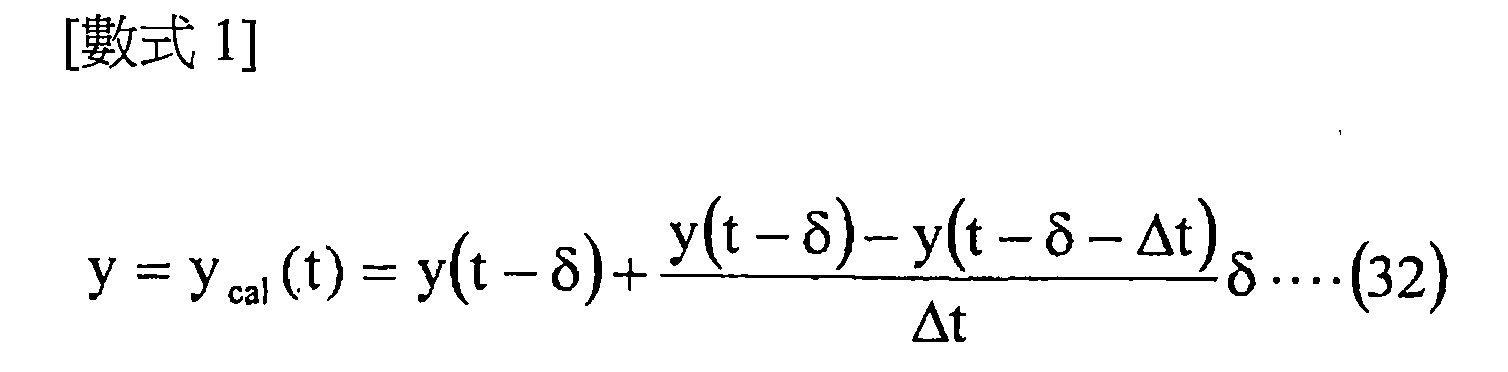
又,時間變化曲線y=y(t),由於係顯示從既定速度v0以既定加速度(減速度)a減速中之晶圓載台WST在Y軸方向之位置變化例的曲線,因此作為一例,亦能以下式(33)表示。 In addition, the time change curve y = y (t) is a curve showing an example of the position change of the wafer stage WST in the Y-axis direction while decelerating from a predetermined speed v 0 at a predetermined acceleration (deceleration) a. Therefore, as an example, It can also be expressed by the following formula (33).
y=y(t)=v0t-1/2at2…(33) y = y (t) = v 0 t-1 / 2at 2 … (33)
因此,圖21中所示之修正誤差、亦即現在時刻t中y=y(t)與y=ycal(t)之差(ycal(t)-y(t)),能以下式(34)表示。 Therefore, the correction error shown in FIG. 21, that is, the difference between y = y (t) and y = y cal (t) (y cal (t) -y (t)) at the current time t can be expressed by the following formula ( 34).
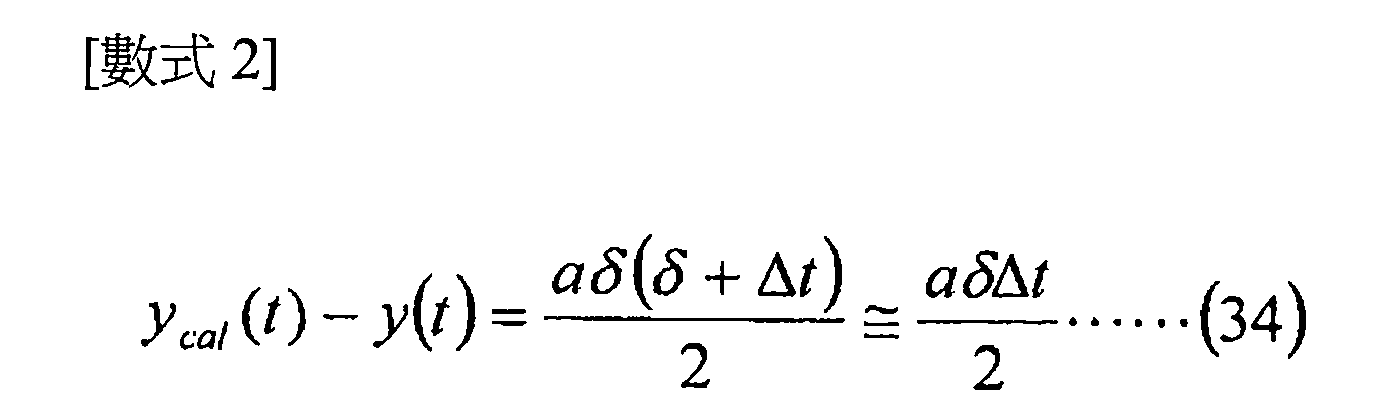
當減速度(加速度)a=20[m/s2]、延遲時間δ=100[ns]、1控制取樣間隔△t=96[μsec]時,修正誤差為0.1nm,若係此量則並不會構成問題。亦即,如可就各Y讀頭正確地求出延遲時間δ,即可透過上述方法,以軟體修正因測量延遲(延遲時間)導致之編碼器的測量誤差。 When the deceleration (acceleration) a = 20 [m / s 2 ], delay time δ = 100 [ns], 1 control sampling interval △ t = 96 [ μ sec], the correction error is 0.1nm, if it is this amount, then It does not pose a problem. That is, if the delay time δ can be correctly obtained for each Y read head, the measurement error of the encoder caused by the measurement delay (delay time) can be corrected by software through the above method.
亦即,主控制裝置20,係根據編碼器系統之各Y讀頭之測量值與1控制取樣間隔前之測量值,找出時刻t、時刻(t-△t)中時間變化曲線y=y(t)上的點S1,S2,算出通過該等點S1,S2之近似直線y=ycal(t),並求出時刻t中近似直線y=ycal(t)上之點的y座標值,藉此能修正各Y讀頭66之檢測訊號在電線中之傳播所導致之測量延遲而造成的測量誤差,修正編碼器系統之各Y讀頭之測量延遲的影響。 That is, the main control device 20 finds the time change curve y = y at time t and time (t- △ t) according to the measured value of each Y read head of the encoder system and the measured value before the sampling interval of 1 control. Calculate the approximate line y = y cal (t) passing through the points S1, S2 at (t), and find the y-coordinate of the point on the approximate line y = y cal (t) at time t This can correct the measurement error caused by the measurement delay caused by the propagation of the detection signal of each Y read head 66 in the wire, and correct the effect of the measurement delay of each Y read head of the encoder system.
又,主控制裝置20,亦以與上述相同之方式,修正編碼器系統之各X 讀頭之測量延遲(延遲時間δ)的影響。 In addition, the main control device 20 also corrects each X of the encoder system in the same manner as described above. Influence of the measurement delay (delay time δ) of the read head.
其他測量誤差之產生要因,可考量有光束光路上之環境氣氛的溫度搖晃(空氣搖晃)。兩個返回光束LB1,LB2間之相位差ψ,由式(16)右邊第1項可知係取決於兩個光束之光路差△L。此處,假設因空氣搖晃使光之波長λ變化成λ+△ λ。因此波長之微小變化△ λ,會使相位差變化微小量△ ψ=2π △L△ λ/λ2。假設光之波長λ=1μm、微小變化△ λ=1nm,相對於光路差△L而為相位變化△ ψ=2π。此相位變化,若換算成編碼器之計數值即相當於1,若換算成位移則相當於p/2(nb-na)。因此,假設nb=-na=1,p=1μm時,即產生0.25μm之測量誤差。 For other causes of measurement error, consider the temperature shake (air shake) of the ambient atmosphere on the beam path. The phase difference ψ between the two returning beams LB 1 and LB 2 is determined by the first term on the right side of the formula (16), which depends on the optical path difference ΔL between the two beams. Here, it is assumed that the wavelength λ of light is changed to λ + Δλ due to air shaking. Therefore, a small change in wavelength △ λ will cause a small change in phase difference △ ψ = 2π ΔL △ λ / λ 2 . It is assumed that the wavelength of light λ = 1 μm , the small change Δλ = 1 nm, and the phase change Δ ψ = 2π relative to the optical path difference ΔL. This phase change is equivalent to 1 if it is converted into the count value of the encoder, and it is equivalent to p / 2 (n b -n a ) if it is converted into a displacement. Therefore, assuming that n b = -n a = 1 and p = 1 μ m, a measurement error of 0.25 μ m is generated.
實際之編碼器中,由於彼此干涉之兩個光束的光路長極短,因此起因於空氣搖晃之波長變化△ λ非常小。再者,光路差△係設計成在光軸相對反射面呈正交之理想狀態下大致為零。因此,起因於空氣搖晃之測量誤差大致可忽視。即使與干涉儀相較亦相當小,具有優異短期穩定性。 In an actual encoder, since the optical paths of two light beams that interfere with each other are extremely short, the wavelength change Δλ due to air shaking is very small. Furthermore, the optical path difference Δ is designed to be approximately zero in an ideal state where the optical axis is orthogonal to the reflection surface. Therefore, measurement errors due to air shaking can be ignored. It is quite small even when compared to interferometers and has excellent short-term stability.
本實施形態之曝光裝置100,亦可在例如裝置啟動時等,由主控制裝置20以前述順序或不同順序反覆複數次前述一連串校正處理,亦即A.載台位置起因誤差修正資訊之取得處理,B.讀頭位置校正處理,C.用以求出阿貝偏差量之校正處理,D.用以求出標尺面之形狀(凹凸)的處理,E.標尺之格子間距修正資訊及格子變形之修正資訊的取得處理,以及F.起因於測量延遲之測量誤差之修正資訊的取得處理。在反覆進行時,亦可根據至前次為止所測量之各種資訊,進行第二次以後之各種校正處理。 In the exposure device 100 of this embodiment, the main control device 20 may repeatedly repeat the aforementioned series of correction processings in the foregoing order or different orders, for example, when the device is started, that is, A. acquisition processing of the position position cause error correction information. , B. Read head position correction processing, C. Correction processing to obtain Abbe's deviation, D. Processing to obtain the shape (concave and convexity) of the scale surface, E. Information on correction of grid spacing of the scale and grid deformation Acquisition processing of correction information, and F. acquisition processing of correction information due to measurement error due to measurement delay. During repeated iterations, it is also possible to perform a variety of correction processes from the second time onwards based on various information measured up to the previous time.
例如在進行載台位置起因誤差修正資訊之取得處理時,例如晶圓台WTB(晶圓載台WST)之縱搖(或橫搖)的調整,必須以Z位置z=0之點為中心使晶圓載台WST進行θ x旋轉(或θ y旋轉),其前提在於,Y標尺39Y1,39Y2(或X標尺39X1,39X2)之前述阿貝偏差量須為已知。接著,在第一次之載台位置起因誤差修正資訊之取得處理中,係使用設計值作為Y標尺39Y1, 39Y2(或X標尺39X1,39X2)之阿貝偏差量,以前述步驟進行載台位置起因誤差修正資訊之取得處理,其後在進行B.讀頭位置校正處理及C.用以求出阿貝偏差量之校正處理後,進行D.用以求出標尺面之形狀(凹凸)的處理、E.標尺之格子間距修正資訊及格子變形之修正資訊的取得處理,之後,在進行第二次之載台位置起因誤差修正資訊之取得處理時,係根據以上述方式實際求出之阿貝偏差量,以Z位置z=0之點為中心使晶圓載台WST進行θ x旋轉(或θ y旋轉),再以前述步驟取得載台位置起因誤差修正資訊。如此,可不受在第二次測量中阿貝偏差量相對設計值之誤差的影響,取得載台位置起因誤差修正資訊。 For example, when obtaining the correction information of the stage position cause error correction information, such as the pitch (or roll) adjustment of the wafer table WTB (wafer stage WST), the crystal must be centered on the Z position z = 0. The circular stage WST performs θ x rotation (or θ y rotation) on the premise that the aforementioned Abbe deviation of the Y scale 39Y 1 , 39Y 2 (or X scale 39X 1 , 39X 2 ) must be known. Next, in the first processing of obtaining the error correction information of the position of the stage, the design value is used as the Abbe deviation of the Y scale 39Y 1 , 39Y 2 (or X scale 39X 1 , 39X 2 ). Carry out the process of obtaining the correction information of the cause of the position of the stage, and then perform the process of B. the correction of the read head position and the process of C. the correction of the Abbe deviation, and the process of D. the form of the scale surface The processing of (concave and convexity), the processing of obtaining the correction information of the grid pitch of the scale and the correction of the grid deformation, and then, when the second processing of obtaining the correction information of the stage position cause error is performed, it is based on the actual method described above. The calculated Abbe's deviation amount makes the wafer stage WST perform θ x rotation (or θ y rotation) around the point of the Z position z = 0, and then obtains the position position cause error correction information by the foregoing steps. In this way, it is possible to obtain the correction information of the cause of the position of the stage without being affected by the error of the Abbe's deviation relative to the design value in the second measurement.
其次,說明在預先進行上述載台位置起因誤差修正資訊之取得、標尺表面之凹凸測量、標尺之格子間距修正資訊及格子變形之修正資訊的取得、以及標尺表面之阿貝偏差量之取得等的處理後,在實際之批量處理中等所執行之用於晶圓載台WST在XY平面內之位置控制之編碼器的切換處理,亦即在複數個編碼器間之連續銜接處理。 Next, the acquisition of the above-mentioned stage position cause error correction information, the measurement of the unevenness on the scale surface, the acquisition of the grid space correction information and the correction of the grid deformation, and the acquisition of the Abbe deviation of the scale surface will be described in advance. After the processing, the switching processing of the encoders used for the position control of the wafer stage WST in the XY plane performed in the actual batch processing, that is, the continuous connection processing between a plurality of encoders.
此處,首先在複數個編碼器間之連續銜接處理之說明前,先使用圖22(A)及圖22(B)說明作為其前提之將修正完畢之編碼器之測量值轉換成晶圓載台WST之位置的具體方法。此處為使說明簡單,晶圓載台WST之自由度係三自由度(X,Y,θ z)。 Here, before explaining the continuous connection processing between a plurality of encoders, use FIG. 22 (A) and FIG. 22 (B) as a prerequisite to convert the measured values of the corrected encoder into a wafer stage. The specific method of WST location. To simplify the explanation here, the degree of freedom of the wafer stage WST is three degrees of freedom (X, Y, θ z).
圖22(A),係顯示晶圓載台WST位於座標原點(X,Y,θ z)=(0,0,0)的基準狀態。編碼器(Y讀頭)Enc1,Enc2及編碼器(X讀頭)Enc3,均在不從所分別對向之標尺39Y1,39Y2及X標尺39X1之掃描區域脫離的範圍內,驅動晶圓載台WST。承上所述,晶圓載台WST移動至位置(X,Y,θ z)之狀態係如圖22(B)所示。 FIG. 22 (A) shows a reference state where the wafer stage WST is located at the coordinate origin (X, Y, θ z) = (0,0,0). The encoders (Y read heads) Enc1, Enc2 and encoders (X read heads) Enc3 all drive the crystals within the range that does not deviate from the scanning areas of the opposite scales 39Y 1 , 39Y 2 and X scale 39X 1 respectively . Round stage WST. As described above, the state where the wafer stage WST is moved to the position (X, Y, θ z) is shown in FIG. 22 (B).
此處,將XY座標系統中編碼器Enc1,Enc2,Enc3之測量點的位置座標(X,Y)分別設為(p1,q1)、(p2,q2)、(p3,q3)。分別從記憶體34內讀出並使用在 前述讀頭位置之校正時所取得的位置資訊,來作為編碼器Enc1,Enc2之X座標值p1,p2及編碼器Enc3之Y座標值q3,從記憶體34內讀出並使用設計上的位置資訊,來作為編碼器Enc1,Enc2之Y座標值q1,q2及編碼器Enc3之X座標值p3。 Here, the position coordinates (X, Y) of the measurement points of the encoders Enc1, Enc2, and Enc3 in the XY coordinate system are set to (p 1 , q 1 ), (p 2 , q 2 ), and (p 3 , q 3 ). The position information obtained during the correction of the read head position is read out from the memory 34 and used as the X coordinate values p 1 and p 2 of the encoders Enc1 and Enc2 and the Y coordinate value q 3 of the encoder Enc3. The position information on the design is read out from the memory 34 and used as the Y coordinate values q 1 and q2 of the encoders Enc1 and Enc2 and the X coordinate value p 3 of the encoders Enc3.
X讀頭與Y讀頭,係分別測量晶圓載台WST之中心軸LL與LW之相對距離。如此,X讀頭與Y讀頭之測量值CX,CY能分別以下式(35a)、(35b)表示。 The X read head and Y read head measure the relative distance between the central axis LL and LW of the wafer stage WST, respectively. In this way, the measured values C X and C Y of the X read head and the Y read head can be expressed by the following formulas (35a) and (35b), respectively.
CX=r’‧ex’…(35a) C X = r'‧ex '... (35a)
CY=r’‧ey’…(35b) C Y = r'‧ey '... (35b)
此處之ex’、ey’,係晶圓載台WST之相對座標系統(X’,Y’,θ z’)中之X’,Y’單位向量,與基準座標系統(X,Y,θ z)中之X,Y單位向量ex,ey有下式(36)的關係。 The ex 'and ey' here are X ', Y' unit vectors in the relative coordinate system (X ', Y', θ z ') of the wafer stage WST, and the reference coordinate system (X, Y, θ z The X, Y unit vector ex, ey in) has the relationship of the following formula (36).
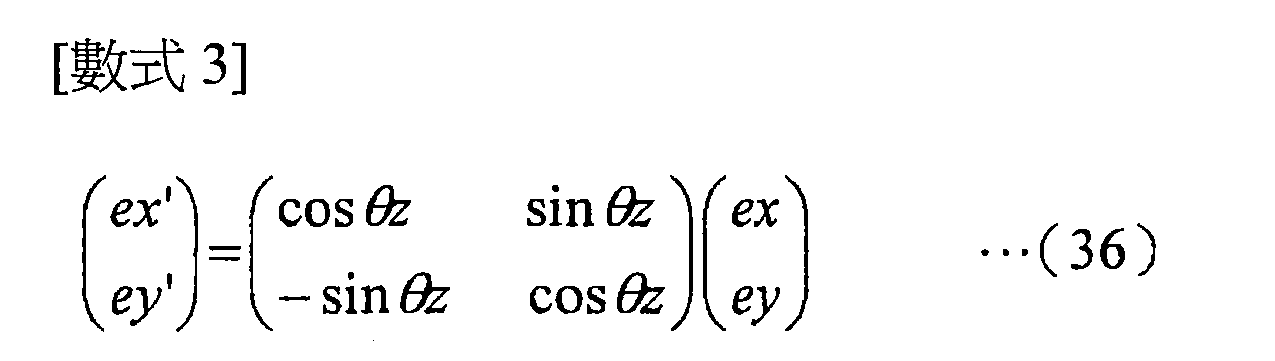
又,r’係相對座標系統中之編碼器之位置向量,可使用基準座標系統中之位置向量r=(p,q)賦予為r’=r-(O’-O)。因此,式(35a)、(35b)可改寫成下式式(37a)、(37b)。 Moreover, r 'is a position vector of the encoder in the relative coordinate system, and a position vector r = (p, q) in the reference coordinate system can be used to assign r' = r- (O'-O). Therefore, equations (35a) and (35b) can be rewritten as the following equations (37a) and (37b).
CX=(p-X)cos θ z+(q-Y)sin θ z…(37a) C X = (pX) cos θ z + (qY) sin θ z ... (37a)
CY=-(p-X)sin θ z+(q-Y)cos θ z…(37b) C Y =-(pX) sin θ z + (qY) cos θ z ... (37b)
因此,如圖22(B)所示,當晶圓載台WST位於座標(X,Y,θ z)時,三個編碼器之測量值,理論上能以下式(38a)~(39c)(亦稱為仿射轉換之關係)表示。 Therefore, as shown in FIG. 22 (B), when the wafer stage WST is located at the coordinates (X, Y, θ z), the measured values of the three encoders can theoretically be expressed by the following formulas (38a) to (39c) (also The relationship is called affine transformation).
C1=-(p1-X)sin θ z+(q1-Y)cos θ z…(38a) C 1 =-(p 1 -X) sin θ z + (q 1 -Y) cos θ z ... (38a)
C2=-(p2-X)sin θ z+(q2-Y)cos θ z…(38b) C 2 =-(p 2 -X) sin θ z + (q 2 -Y) cos θ z ... (38b)
C3=-(p3-X)sin θ z+(q3-Y)cos θ z…(38c) C 3 =-(p 3 -X) sin θ z + (q 3 -Y) cos θ z ... (38c)
此外,在圖22(A)之基準狀態下,透過聯立方程式(38a)~(38c),即為C1=q1,C2=q2,C3=q3。因此,在基準狀態下,若將三個編碼器Enc1,Enc2,Enc3之三個測量值分別初始設定為q1,q2,q3,對其後晶圓載台WST之移位(X,Y,θ z),三個編碼器即能提示式(38a)~(38c)所賦予之理論值。 In addition, in the reference state of FIG. 22 (A), through simultaneous equations (38a) to (38c), C 1 = q 1 , C 2 = q 2 , and C 3 = q 3 . Therefore, in the reference state, if the three measured values of the three encoders Enc1, Enc2, and Enc3 are initially set to q 1 , q 2 , and q 3 respectively , the shift of the wafer stage WST (X, Y , θ z), the three encoders can prompt the theoretical values given by equations (38a) to (38c).
聯立方程式(38a)~(38c)中,對變數為三個(X,Y,θ z)係賦予三個式。因此,若賦予聯立方程式(38a)~(38c)中之從屬變數C1,C2,C3,即能求出變數X,Y,θ z。此處,所適用近似sin θ z≒θ z,或使用更高次之近似,即能容易地解開方程式。因此,能從編碼器之測量值C1,C2,C3算出晶圓載台WST之位置(X,Y,θ z)。 In the simultaneous equations (38a) to (38c), three (X, Y, θ z) variables are assigned three equations. Therefore, if the dependent variables C 1 , C 2 , C 3 in the simultaneous equations (38a) to (38c) are given, the variables X, Y, θ z can be obtained. Here, the applicable approximation sin θ z ≒ θ z, or a higher-order approximation, can easily solve the equation. Therefore, the position (X, Y, θ z) of the wafer stage WST can be calculated from the measured values C 1 , C 2 , and C 3 of the encoder.
以上述方式構成之本實施形態的曝光裝置100,由於採用如前所述之晶圓台WTB上之X標尺、Y標尺之配置及如前述之X讀頭、Y測頭的配置,因此會如圖23(A)及圖23(B)等之示例所示,晶圓載台WST之有效動程範圍(亦即本實施形態中之為了進行對準及曝光動作而移動的範圍)中,屬於讀頭單元62B,62D之合計18個X讀頭中之至少一個X讀頭66必定會對向於X標尺39X1,39X2中之至少一方,且分別屬於讀頭單元62A,62C之至少各1個Y讀頭中之至少一個Y讀頭64、或Y讀頭64y1,64y2必定會對向於Y標尺39Y1,39Y2。亦即,對應之讀頭至少會有各一個與四個標尺中之至少三個對向。 The exposure apparatus 100 of this embodiment configured as described above adopts the configuration of the X scale and Y scale on the wafer table WTB as described above and the configuration of the X reading head and Y measuring head as described above, so As shown in the examples of Figs. 23 (A) and 23 (B), the effective range of the wafer stage WST (that is, the range moved for alignment and exposure operations in this embodiment) belongs to reading At least one of the 18 X-read heads of the total of the head units 62B, 62D, the X-read head 66 must face at least one of the X-scales 39X 1 , 39X 2 and belong to at least one of the read head units 62A, 62C, respectively. At least one of the Y read heads 64, or the Y read heads 64y 1 , 64y 2 must face the Y scale 39Y 1 , 39Y 2 . That is, the corresponding read head will have at least one of each of them facing at least three of the four scales.
此外,圖23(A)及圖23(B)中,相對應之與X標尺或Y標尺對向的讀頭係以圓圈框住表示。 In addition, in FIG. 23 (A) and FIG. 23 (B), the read heads corresponding to the X scale or Y scale are indicated by circles.
因此,主控制裝置20可在前述晶圓載台WST之有效動程範圍中,藉由根據編碼器70A,70C、以及編碼器70B及70D之至少一方之至少合計三個編碼器的測量值控制構成載台驅動系統124的各馬達,來以高精度控制晶圓載台WST在XY平面內的位置資訊(包含θ z方向之旋轉資訊)。編碼 器70A~70D之測量值所承受之空氣晃動的影響,由於與干涉儀相較係小到幾乎可忽視,因此起因於空氣晃動之測量值的短期穩定性,係較干涉儀好上許多。 Therefore, the main control device 20 can be configured by controlling the measurement values of at least three encoders based on at least one of the encoders 70A, 70C, and 70B and 70D in the effective range of the wafer stage WST. Each motor of the stage driving system 124 controls the position information (including the rotation information in the θ z direction) of the wafer stage WST in the XY plane with high accuracy. coding The effects of air sloshing on the measured values of the devices 70A ~ 70D are so small as to be negligible compared to the interferometer. Therefore, the short-term stability of the measured values due to air swaying is much better than the interferometer.
又,當如圖23(A)中白色箭頭所示將晶圓載台WST驅動於X軸方向時,用以測量該晶圓載台WST在Y軸方向之位置的Y讀頭64,係如該圖中之箭頭e1,e2所示依序切換至相鄰之Y讀頭64。例如從實線圓圈框住之Y讀頭64切換至以虛線圓圈框住之Y讀頭64。如此,測量值係在此切換之前後,進行後述之測量值的連續銜接處理。 In addition, when the wafer stage WST is driven in the X-axis direction as shown by the white arrow in FIG. 23 (A), the Y read head 64 for measuring the position of the wafer stage WST in the Y-axis direction is as shown in the figure. The arrows e 1 and e 2 in the middle sequentially switch to the adjacent Y read head 64. For example, the Y read head 64 framed by a solid circle is switched to the Y read head 64 framed by a dotted circle. In this way, the measured value is subjected to the continuous connection processing of the measured value described later before and after this switching.
又,當如圖23(B)中白色箭頭所示將晶圓載台WST驅動於Y軸方向時,用以測量該晶圓載台WST在X軸方向之位置的X讀頭66,係依序切換至相鄰之X讀頭64。例如從實線圓圈框住之X讀頭66切換至以虛線圓圈框住之X讀頭66。如此,測量值係在此切換之前後進行測量值的連續銜接處理。 When the wafer stage WST is driven in the Y-axis direction as shown by the white arrow in FIG. 23 (B), the X-read head 66 for measuring the position of the wafer stage WST in the X-axis direction is sequentially switched. To the adjacent X read head 64. For example, switching from the X-read head 66 framed by a solid circle to the X-read head 66 framed by a dotted circle. In this way, the measured value is continuously connected to the measured value before and after this switching.
此處,以圖23(A)中箭頭e1所示之Y讀頭643至644的切換為例,根據圖24(A)~圖24(E)說明編碼器讀頭的切換步驟。 Here, taking the switching of the Y read heads 64 3 to 64 4 shown by the arrow e 1 in FIG. 23 (A) as an example, the switching steps of the encoder read head will be described with reference to FIGS. 24 (A) to 24 (E).
圖24(A)係顯示切換前之狀態。在此狀態下,與Y標尺39Y2上之掃描區域(設有繞射格子之區域)對向的Y讀頭643係作動,偏離掃描區域之Y讀頭644則停止。此處,以黑色圓圈表示作動中之讀頭,以白色圓圈表示停止中之讀頭。接著,主控制裝置20係監視作動中之Y讀頭643的測量值。被監視測量值之讀頭,係以雙重矩形框表示。 Fig. 24 (A) shows the state before switching. In this state, the Y-reading head 64 3 facing the scanning area (the area provided with the diffraction grid) on the Y scale 39Y 2 is actuated, and the Y-reading head 64 4 deviating from the scanning area is stopped. Here, the active read head is indicated by a black circle, and the read head is indicated by a white circle. Next, the main control device 20 monitors the measurement value of the Y-reading head 64 3 in operation. The read head of the monitored measurement is indicated by a double rectangular frame.
此處,晶圓載台WST係往+X方向移動。藉此,Y標尺39Y2係移位至右方向。此處,本實施形態中,如前所述,相鄰之兩個Y讀頭的間隔設定成較Y標尺39Y2在X軸方向的有效寬度(掃描區域之寬度)窄。因此,如圖24(B)所示,Y讀頭643,644係處於與Y標尺39Y2之掃描區域對向的狀態。因此,主控制裝置20,係連同作動中之Y讀頭643一起確認停止中之Y讀 頭644已與掃描區域對向,而使Y讀頭644歸位。不過,主控制裝置20在此時點還未開始測量值之監視。 Here, the wafer stage WST moves in the + X direction. Thereby, the Y scale 39Y 2 is shifted to the right direction. Here, in the present embodiment, as described above, the interval between two adjacent Y read heads is set to be smaller than the effective width (the width of the scanning area) of the Y scale 39Y 2 in the X-axis direction. Therefore, as shown in FIG. 24 (B), the Y read heads 64 3 and 64 4 are in a state facing the scanning area of the Y scale 39Y 2 . Therefore, the main control device 20 confirms that the stopped Y reader 64 4 is facing the scanning area together with the Y reader 64 3 in operation, and returns the Y reader 64 4 in position. However, the main control device 20 has not yet started monitoring the measured values at this point.
其次,如圖24(C)所示,在其後將停止之Y讀頭644與掃描區域對向的期間,主控制裝置20,係根據包含Y讀頭643之作動中之編碼器讀頭的測量值,算出已歸位之Y讀頭644的基準位置。接著,主控制裝置20係將該基準位置設定成Y讀頭644之測量值的初始值。此外,關於基準位置之算出與初始值的設定,將於後詳細說明。 Next, as shown in FIG. 24 (C), during the period when the Y-reading head 64 4 which is to be stopped faces the scanning area, the main control device 20 reads based on the encoder in operation including the Y-reading head 64 3 . The measured value of the head calculates the reference position of the homed Y-reader 64 4 . Next, the main control device 20 sets the reference position to the initial value of the measurement value of the Y-reading head 64 4 . The calculation of the reference position and the setting of the initial value will be described in detail later.
主控制裝置20,與上述初始值之設定同時地,將監視測量值之編碼器讀頭,從Y讀頭643切換成644。切換結束後,主控制裝置20即如圖24(D)所示,將Y讀頭643停止於偏離掃描區域之前。藉由上述,編碼器讀頭之切換作業即全部結束,其後,即如圖24(D)所示,由主控制裝置20監視Y讀頭644之測量值。 The main control device 20 switches the encoder reading head for monitoring the measured value from the Y reading head 64 3 to 64 4 at the same time as the initial value setting. After the switching is completed, as shown in FIG. 24 (D), the main control device 20 stops the Y-reading head 64 3 before deviating from the scanning area. With the above, the switching operation of the encoder read head is all completed, and thereafter, as shown in FIG. 24 (D), the main control device 20 monitors the measured value of the Y read head 64 4 .
本實施形態中,讀頭單元62A,62C各自具備之相鄰Y讀頭64的間隔,係例如70mm(有一部分例外),設定成較Y標尺39Y1,39Y2之掃描區域在X軸方向的有效寬度(例如76mm)窄。又,同樣地,讀頭單元62B,62D各自具備之相鄰X讀頭66的間隔,係例如70mm(有一部分例外),設定成較X標尺39X1,39X2之掃描區域在Y軸方向的有效寬度(例如76mm)窄。藉此,能如上述順利地執行Y讀頭及X讀頭之切換。 In this embodiment, the distance between adjacent Y read heads 64 provided by each of the read head units 62A and 62C is, for example, 70 mm (with some exceptions), and is set to be more than the scanning area of the Y scales 39Y 1 and 39Y 2 in the X axis direction. The effective width (for example, 76mm) is narrow. Similarly, the distance between adjacent X-reading heads 66 provided by each of the read head units 62B and 62D is, for example, 70 mm (with some exceptions), and is set in the Y-axis direction from the scanning area of the X-scales 39X 1 and 39X 2 . The effective width (for example, 76mm) is narrow. Thereby, switching of the Y-reading head and the X-reading head can be smoothly performed as described above.
此外,本實施形態中,相鄰之兩讀頭對向於標尺之範圍、亦即圖24(B)所示狀態至圖24(D)所示狀態之晶圓載台WST的移動距離例如為6mm。監視測量值之讀頭,係在其中央、亦即圖24(C)所示晶圓載台WST的位置切換。此切換作頁,係在停止之讀頭從掃描區域偏離為止之期間結束,亦即晶圓載台WST從圖24(C)所示狀態至圖24(D)所示狀態為止移動距離3mm之區域的期間結束。例如載台之移動速度為1m/sec時,係在3msec之時間內結束讀頭的切換作業。 In addition, in this embodiment, the moving distance between the two adjacent read heads facing the range of the scale, that is, the wafer stage WST in the state shown in FIG. 24 (B) to the state shown in FIG. 24 (D) is, for example, 6 mm. . The read head for monitoring the measured value is switched in the center, that is, the position of the wafer stage WST shown in FIG. 24 (C). This switching of the page ends when the stopped reading head deviates from the scanning area, that is, the area where the wafer stage WST moves from the state shown in FIG. 24 (C) to the state shown in FIG. 24 (D) by a distance of 3 mm. Period ends. For example, when the moving speed of the carrier is 1m / sec, the switching operation of the reading head is finished within 3msec.
其次,以主控制裝置20之動作為中心,說明編碼器讀頭在切換時之連續銜接處理、亦即測量值之初始設定。 Next, centering on the operation of the main control device 20, the continuous connection processing of the encoder read head when switching, that is, the initial setting of the measurement value will be explained.
本實施形態中,如前所述,係在晶圓載台WST之有效動程範圍內,隨時由三個編碼器(X讀頭及Y讀頭)觀測晶圓載台WST,在進行編碼器之切換處理時,如圖25所示,係由四個編碼器觀測晶圓載台WST。 In this embodiment, as described above, the wafer stage WST is observed by three encoders (X read head and Y read head) at any time within the effective range of the wafer stage WST, and the encoder is switched. During processing, as shown in FIG. 25, the wafer stage WST is observed by four encoders.
在用以控制晶圓載台WST在XY平面內之位置之編碼器將進行切換處理(連續銜接)的瞬間,如圖25所示,編碼器Enc1,Enc2,Enc3,Enc4,係分別位於標尺39Y1,39Y2,39X1,39X2之上。乍看此圖25,雖看起來像是將從編碼器Enc1切換至編碼器Enc4,但從編碼器Enc1與編碼器Enc4之測量方向不同這點可知,即使在欲進行連續銜接之時點賦予編碼器Enc1之測量值(計數值)來直接作為編碼器Enc4之測量值初始值,亦無任何意義。 At the moment when the encoder used to control the position of the wafer stage WST in the XY plane will be switched (continuously connected), as shown in Figure 25, the encoders Enc1, Enc2, Enc3, and Enc4 are located at the scale 39Y 1 respectively. , 39Y 2 , 39X 1 , 39X 2 above. At first glance, although this figure 25 looks like switching from encoder Enc1 to encoder Enc4, it can be seen from the difference in the measurement direction between encoder Enc1 and encoder Enc4 that even when continuous connection is desired, the encoder is given. The measurement value (count value) of Enc1 is directly used as the initial value of the measurement value of the encoder Enc4, and it has no meaning.
因此,本實施形態中,係將三個編碼器Enc1、Enc2、及Enc3之測量/伺服器,切換至三個編碼器Enc2、Enc3、及Enc4之測量/伺服器。亦即,從圖25可知,此方式與通常之伺服器連續銜接的概念不同,並非從某一讀頭連續銜接至另一讀頭,而係從三個讀頭(編碼器)之組合連續銜接至另外三個讀頭(編碼器)之組合。此外,三個讀頭與另外三個讀頭中不同之讀頭不限於一個。又,在圖25中雖係將編碼器Enc3切換成編碼器Enc4,但亦可代替編碼器Enc4而切換成例如與編碼器Enc3相鄰的編碼器。 Therefore, in this embodiment, the measurement / servo of three encoders Enc1, Enc2, and Enc3 is switched to the measurement / servo of three encoders Enc2, Enc3, and Enc4. That is, as can be seen from FIG. 25, this method is different from the conventional concept of continuous server connection. It does not continuously connect from one read head to another, but continuously connects from a combination of three read heads (encoders). To the combination of the other three read heads (encoders). In addition, the read heads that are different from the other three read heads are not limited to one. In addition, although the encoder Enc3 is switched to the encoder Enc4 in FIG. 25, it is possible to switch to an encoder adjacent to the encoder Enc3 instead of the encoder Enc4.
主控制裝置20,首先根據編碼器Enc1、Enc2、及Enc3之測量值C1,C2,C3,解開上述聯立方程式(38a)~(38c),算出晶圓載台WST在XY平面內的位置資訊(X,Y,θ z)。 The main control device 20 firstly solves the simultaneous equations (38a) to (38c) based on the measured values C 1 , C 2 , and C 3 of the encoders Enc1, Enc2, and Enc3, and calculates the wafer stage WST in the XY plane. Location information (X, Y, θ z).
其次,主控制裝置20,將上述算出之Y,θ z代入下式(39)之仿射轉換之式,決定編碼器(X讀頭)Enc4之測量值初始值。 Next, the main control device 20 substitutes the calculated Y, θ z into the affine conversion formula of the following formula (39) to determine the initial value of the measurement value of the encoder (X read head) Enc4.
C4=(p4-X)cos θ z+(q4-Y)sin θ z…(39) C 4 = (p 4 -X) cos θ z + (q 4 -Y) sin θ z ... (39)
上式(39)中,p4,q4係編碼器Enc4之測量點的X座標值、Y座標值。從 記憶體34內分別讀出並使用在前述讀頭位置之校正時取得的位置資訊來作為編碼器Enc4之Y座標值q4,使用設計上之位置資訊作為編碼器Enc4之X座標值p4。 In the above formula (39), p 4 and q4 are the X coordinate value and Y coordinate value of the measuring point of the encoder Enc4. The position information obtained during the correction of the read head position is read out from the memory 34 and used as the Y-coordinate value q 4 of the encoder Enc4, and the design position information is used as the X-coordinate value p 4 of the encoder Enc4. .
藉由賦予上述初始值C4來作為編碼器Enc4之初始值,即可在維持晶圓載台WST在三自由度方向之位置(X,Y,θ z)的狀態下,無矛盾地結束連續銜接。其後,使用切換後所使用之編碼器Enc2、Enc3、及Enc4之測量值C2,C3,C4,解開上述聯立方程式(38b)~(38d),算出晶圓載台WST的位置資訊(X,Y,θ z)。 By providing the initial value C 4 as the initial value of the encoder Enc 4 , the continuous connection can be ended without contradiction while maintaining the wafer stage WST in the position (X, Y, θ z) in the three-degree-of-freedom direction. Then, using the measured values C 2 , C 3 , and C 4 of the encoders Enc2, Enc3, and Enc4 used after the switching, the simultaneous equations (38b) to (38d) are solved, and the position of the wafer stage WST is calculated. Information (X, Y, θ z).
C2=(p2-X)sin θ z+(q2-Y)cos θ z…(38b) C 2 = (p 2 -X) sin θ z + (q 2 -Y) cos θ z ... (38b)
C3=(p3-X)sin θ z+(q3-Y)sin θ z…(38c) C 3 = (p 3 -X) sin θ z + (q 3 -Y) sin θ z ... (38c)
C4=(p4-X)sin θ z+(q4-Y)sin θ z…(38d) C 4 = (p 4 -X) sin θ z + (q 4 -Y) sin θ z ... (38d)
此外,當第4個編碼器係Y讀頭時,只要代替理論式(38d)使用用了次一理論式(38e)的聯立方程式(38b),(38c),(38d)即可。 In addition, when the fourth encoder is a Y-reader, it is sufficient to use simultaneous equations (38b), (38c), and (38d) using the next theoretical equation (38e) instead of the theoretical equation (38d).
C4=(p4-X)sin θ z+(q4-Y)sin θ z…(38e) C 4 = (p 4 -X) sin θ z + (q 4 -Y) sin θ z ... (38e)
其中,由於上述算出之測量值C4係已修正前述各種編碼器之測量誤差的已修正完畢編碼器之測量值,因此主控制裝置20,係使用前述載台位置起因誤差修正資訊、標尺之格子間距修正資訊(以及格子變形之修正資訊)、阿貝偏差量(阿貝誤差修正資訊)等,逆修正測量值C4,算出修正前的原始數值C4’,並將該原始數值C4’決定為編碼器Enc4之測量值初始值。 Among them, since the measured value C 4 calculated above is the measured value of the corrected encoder that has been corrected for the measurement errors of the aforementioned various encoders, the main control device 20 uses the aforementioned position correction error information of the carrier position and the grid of the scale. Pitch correction information (and correction information for lattice distortion), Abbe deviation (Abbé error correction information), etc., inversely correct the measured value C 4 , calculate the original value C 4 'before correction, and then use the original value C 4 ' Determined as the initial value of the measurement value of the encoder Enc4.
此處之逆修正,係指假設使用前述載台位置起因誤差修正資訊、標尺起因誤差修正資訊(例如標尺之格子間距修正資訊(以及格子變形之修正資訊等)、以及阿貝偏差量(阿貝誤差修正資訊)等將未進行任何修正之編碼器測量值C4’修正後之編碼器測量值為C4時,根據測量值C4算出測量值C4’的處理。 The inverse correction here refers to the assumption that the aforementioned position position cause error correction information, ruler cause error correction information (such as ruler grid spacing correction information (and grid deformation correction information, etc.), and Abbe's deviation (Abe error correction information) or the like is not performed 4 'after the correction of the measured value C 4 encoder, the measured value C 4 is calculated according to the measured value C 4' process of any correction encoder measurement value C.
此外,晶圓載台WST之位置控制的間隔(控制取樣間隔)雖舉例為96[μ sec],但干涉儀或編碼器之測量間隔(測量取樣間隔),須以遠高於此之高速進行。干涉儀或編碼器之取樣較控制取樣高速的理由,係因干涉儀與編碼器均係計算干涉光之強度變化(光紋)的裝置,若取樣間隔太大則難以測量。 In addition, although the interval (control sampling interval) of the position control of the wafer stage WST is 96 [ μ sec], the measurement interval (measurement sampling interval) of the interferometer or encoder must be performed at a higher speed than this. The reason why the interferometer or encoder sampling is faster than the control sampling is because both the interferometer and the encoder are devices that calculate the intensity change (light streak) of the interference light. If the sampling interval is too large, it is difficult to measure.
然而,晶圓載台WST之位置伺服控制系統,係毎隔96[μsec]之控制取樣間隔更新晶圓載台WST之現在位置,進行用以定位於目標位置的運算,再輸出推力指令值。在每隔96[μsec]之控制取樣間隔即需要晶圓載台WST之位置資訊,其間之位置資訊則不需用於晶圓載台WST之位置控制。干涉儀或編碼器不過是為了不漏掉光紋而以高速進行取樣。 However, the position servo control system of the wafer stage WST is to update the current position of the wafer stage WST at a control sampling interval of 96 [ μ sec], perform calculations to locate at the target position, and then output the thrust command value. At the control sampling interval of 96 [ μ sec], the position information of the wafer stage WST is needed, and the position information in the meantime does not need to be used for the position control of the wafer stage WST. The interferometer or encoder is just to sample at high speed without missing light streaks.
因此,本實施形態中,主控制裝置20在晶圓載台WST位於前述有效動程範圍內之期間,不論是否從編碼器系統之各編碼器(讀頭)觀察標尺,均隨時連續地接收測量值(計數值)。接著,主控制裝置20係與每隔96[μsec]進行之晶圓載台WST之位置控制時點同步進行上述編碼器之切換動作(複數個編碼器間之連續銜接動作)。藉此,係不須以電器方式進行高速之編碼器切換動作,亦不一定要設置用以實現上述高速切換動作的高額硬體。圖26,係概念式地顯示本實施形態中進行之晶圓載台WST的位置控制、編碼器之計數值之擷取、以及編碼器切換的時點。此圖26中,符號CSCK係顯示晶圓載台WST之位置控制取樣時鍾(sampling clock)的產生時點,符號MSCK係顯示編碼器(及干涉儀)之測量取樣時鍾的產生時點。又,符號CH係以示意方式顯示編碼器的切換(連續銜接)。 Therefore, in this embodiment, the main control device 20 continuously receives the measurement value at any time whether or not the scale is observed from each encoder (read head) of the encoder system while the wafer stage WST is within the aforementioned effective stroke range. (Count value). Next, the main control device 20 performs the above-mentioned encoder switching operation (continuous connection operation between a plurality of encoders) in synchronization with the position control timing of the wafer stage WST performed every 96 [ μ sec]. Therefore, it is not necessary to perform high-speed encoder switching operations in an electrical manner, and it is not necessary to provide high-value hardware for realizing the above-mentioned high-speed switching operations. FIG. 26 conceptually shows the position control of the wafer stage WST performed in this embodiment, the acquisition of the encoder count value, and the timing of encoder switching. In FIG. 26, the symbol CSCK indicates the generation time of the position control sampling clock of the wafer stage WST, and the symbol MSCK indicates the generation time of the measurement sampling clock of the encoder (and interferometer). The symbol CH indicates the switching of encoders (continuous connection) in a schematic manner.
此外,不論是否進行編碼器之切換,主控制裝置20,均在每隔晶圓載台之位置控制取樣時鍾的產生時點,執行各讀頭之起因於延遲時間δ之測量誤差的修正。藉此,根據將起因於延遲導致之測量誤差修正後之三個編碼器的測量值,控制晶圓載台WST之位置(X,Y,θ z)。 In addition, regardless of whether or not the encoder is switched, the main control device 20 controls the generation time of the sampling clock at every wafer stage position, and performs correction of measurement errors due to the delay time δ of each read head. Thereby, the position (X, Y, θ z) of the wafer stage WST is controlled based on the measurement values of the three encoders after the measurement error caused by the delay is corrected.
此外,上述說明中,係要從哪一讀頭(編碼器)之組合切換至哪一讀頭(編碼器)之組合、或在哪一時點切換均為已知,但實際之程序中亦必須以上述 方式進行。執行連續銜接之時點亦最好事前進行排程。 In addition, in the above description, it is known from which combination of read heads (encoders) to which combination of read heads (encoders) to switch, or at what point in time, but it must also be used in actual procedures. With the above Way to proceed. It is also advisable to schedule ahead of time when performing continuous connections.
因此,本實施形態中,主控制裝置20,係根據晶圓載台WST之移動路徑(目標軌道),將從用於測量晶圓載台WST在XY平面內三自由度(X,Y,θ z)方向之位置資訊的三個編碼器(讀頭)之切換(三個讀頭之組合(例如編碼器Enc1,Enc2及Enc3)),切換至另外三個讀頭之組合(例如Enc4,Enc2及Enc3))的動作,預先排程化,並將其排程結果儲存於記憶體34等之記憶裝置。 Therefore, in this embodiment, the main control device 20 will measure the three degrees of freedom (X, Y, θ z) of the wafer stage WST in the XY plane based on the movement path (target track) of the wafer stage WST. Switching of the three encoders (read heads) of the position information in the direction (combination of three read heads (such as encoders Enc1, Enc2, and Enc3)), switching to the combination of the other three read heads (such as Enc4, Enc2, and Enc3) )), And schedule it in advance, and store the scheduling result in a memory device such as the memory 34.
此處,若不考量重試(RETRY),各照射區域(曝光圖)均為一定之排程內容,但由於實際上必須考量到重試,因此主控制裝置20最好係一邊進行曝光動作,一邊隨時更新稍前的排程。 Here, if RETRY is not taken into consideration, each irradiation area (exposure map) has a certain schedule content. However, since retry must be taken into account, the main control device 20 preferably performs the exposure operation. Update the previous schedule at any time.
此外,上述中,係說明本實施形態中用於晶圓載台WST之位置控制之編碼器之切換方法相關的原理,而雖有編碼器(讀頭)Enc1,Enc2,Enc3,Enc4,但讀頭Enc1,Enc2,僅係代表性地顯示讀頭單元62A,62C之Y讀頭64及一對Y讀頭64y1,64y2的任一者,當然,讀頭Enc3,Enc4,僅係代表性地顯示讀頭單元62B,62D之X讀頭66。又,基於同樣的理由,圖22(A)、圖22(B)、圖25中,編碼器(讀頭)Enc1,Enc2,Enc3等的配置,亦與實際之配置(圖3等)不同。 In addition, in the above, the principles related to the switching method of the encoder used for the position control of the wafer stage WST in this embodiment are explained. Although there are encoders (read heads) Enc1, Enc2, Enc3, Enc4, but the read head Enc1 and Enc2 are only representative of either the Y-reader 64 of the read head units 62A, 62C and a pair of Y-readers 64y 1 or 64y 2. Of course, the read heads Enc3 and Enc4 are only representative. X-read heads 66 of the read head units 62B, 62D are displayed. For the same reason, the arrangements of the encoders (read heads) Enc1, Enc2, Enc3, etc. in Figs. 22 (A), 22 (B), and 25 are also different from the actual arrangements (Fig. 3, etc.).
《切換及連續銜接原理的一般理論》 "General Theory of Switching and Continuous Connection Principles"
本實施形態中,為了測量晶圓載台WST在三自由度(X,Y,θ z)方向之位置座標,係隨時使用構成編碼器系統70A~70D之X編碼器(讀頭)及Y編碼器(讀頭)中、包含至少一個X讀頭與至少兩個Y讀頭之至少三個讀頭。因此,在切換隨著晶圓載台WST之移動而使用之讀頭時,為了使載台位置之測量結果在切換前後連續銜接,係採用從三個讀頭之組合切換至另外三個讀頭之組合的方式。將此方式稱為第1方式。 In this embodiment, in order to measure the position coordinates of the wafer stage WST in the three degrees of freedom (X, Y, θ z) directions, the X encoder (read head) and Y encoder constituting the encoder system 70A to 70D are used at any time. (Read head), at least three read heads including at least one X read head and at least two Y read heads. Therefore, when switching the read head used as the wafer stage WST moves, in order to continuously measure the position of the stage before and after the switch, a combination of three read heads is used to switch to the other three read heads. Way of combination. This method is called a first method.
然而,若從不同的觀點考量切換及連續銜接處理的基本處理,亦能採取將所使用之三個讀頭中之一個讀頭切換成另外一個讀頭的方式。將此方 式稱為第2方式。因此,以圖24(A)~圖24(E)所示之Y讀頭643至644之切換及連續銜接處理為例,說明第2方式。 However, if the basic processing of the switching and continuous connection processing is considered from a different point of view, a method of switching one of the three read heads used to another read head can also be adopted. This method is called a second method. Therefore, the second method will be described by taking the switching and continuous connection processing of the Y read heads 64 3 to 64 4 shown in FIGS. 24 (A) to 24 (E) as an example.
切換處理之基本步驟,係與前述步驟同樣地,如圖24(A)~圖24(E)所示,在其後將停止之第1讀頭643與新使用之第2讀頭644兩者對向於所對應之標尺39Y1的期間,由主控制裝置20執行第2讀頭644之歸位與測量值之設定(連續銜接處理)、以及監視測量值之讀頭之切換(以及第1讀頭643之停止)。 The basic steps of the switching process are the same as the previous steps. As shown in Fig. 24 (A) to Fig. 24 (E), the first read head 64 3 and the newly used second read head 64 4 will stop after that. During the period when the two are opposite to the corresponding scale 39Y 1 , the main control device 20 executes the return of the second read head 64 4 and the setting of the measured value (continuous connection processing), and the switch of the read head that monitors the measured value ( And the stop of the first read head 64 3 ).
在進行測量值之設定(連續銜接處理),主控制裝置20係使用第1讀頭643之測量值CY3預測第2讀頭644之測量值CY4。此處,從理論式(37b)可知,Y讀頭643,644之測量值CY3,CY4,係取決於下式(39a),(39b)。 When the measurement value is set (continuous connection processing), the main control device 20 uses the measurement value C Y3 of the first read head 64 3 to predict the measurement value C Y4 of the second read head 64 4 . Here, from the theoretical formula (37b), it can be known that the measured values C Y3 , C Y4 of the Y read heads 64 3 , 64 4 depend on the following formulas (39a), (39b).
CY3=(p3-X)sin θ z+(q3-Y)cos θ z…(39a) C Y3 = (p 3 -X) sin θ z + (q 3 -Y) cos θ z ... (39a)
CY4=(p4-X)sin θ z+(q4-Y)cos θ z…(39b) C Y4 = (p 4 -X) sin θ z + (q 4 -Y) cos θ z ... (39b)
此處之(p3,q3),(p4,q4)係Y讀頭643,644之X,Y設置位置(更正確而言係測量點之X,Y位置)。為了使說明簡單,Y讀頭643,644之Y設置位置係假定為相等(q3=q4)。在此假定下,可從上式(39a),(39b)得出下式(40)。 Here (p 3 , q 3 ), (p 4 , q 4 ) are the X, Y setting positions of the Y read head 64 3 , 64 4 (more precisely, the X, Y positions of the measurement points). For simplicity of explanation, the Y setting positions of the Y read heads 64 3 , 64 4 are assumed to be equal (q 3 = q 4 ). Under this assumption, the following formula (40) can be obtained from the above formulas (39a) and (39b).
CY4=CY3+(p3-p4)sin θ z…(40) C Y4 = C Y3 + (p 3 -p 4 ) sin θ z ... (40)
如此,將其後將停止之第1讀頭643之測量值代入上式(40)之右邊之CY3,來求出左邊之CY4,藉此能預測新使用之第2讀頭644之測量值。 In this way, the measured value of the first read head 64 3 which is stopped afterwards is substituted into the right C Y3 of the above formula (40) to find the left C Y4 , so that the newly used second read head 64 4 can be predicted. Measured value.
將所得之預測值CY4,在適當之時點設定為第2讀頭644之測量值初始值。設定後,使第1讀頭643從標尺39Y2脫離時停止,結束切換及連續銜接處理。 The obtained predicted value C Y4 is set to an initial value of the measured value of the second read head 64 4 at an appropriate time. After the setting, the first read head 64 3 is stopped when it is separated from the scale 39Y 2 , and the switching and continuous connection processing are ended.
此外,使用上式(40)預測為第2讀頭644之測量值時,只要從作動中之其他讀頭之測量結果得到之旋轉角θ z的值代入變數θ z即可。作動中之其他讀頭不限於作為切換對象之第1讀頭643,亦包含所有可提供求取旋轉角θ z所需之測量結果的讀頭。此處,由於第1讀頭643係讀頭單元62C之一 個讀頭,因此亦可使用第1讀頭643與例如在切換時與Y標尺39Y1對向之讀頭單元62A的一個讀頭來求出旋轉角θ z。或者,亦可將從干涉儀系統118之X干涉儀126、Y干涉儀16、或干涉儀43A,43B等之測量結果得到之旋轉角θ z的值代入變數θ z。 In addition, when using the above formula (40) to predict the measured value of the second read head 64 4, the value of the rotation angle θ z obtained from the measurement results of other read heads in operation may be substituted into the variable θ z. The other read heads in operation are not limited to the first read head 64 3 as the switching target, but also include all read heads that can provide the measurement results required to obtain the rotation angle θ z. Here, since the first read head 64 3 is a read head of the read head unit 62C, it is also possible to use one read of the first read head 64 3 and the read head unit 62A facing the Y scale 39Y 1 when switching, for example. Head to find the rotation angle θ z. Alternatively, the value of the rotation angle θ z obtained from the measurement results of the X interferometer 126, the Y interferometer 16, or the interferometers 43A, 43B of the interferometer system 118 may be substituted into the variable θ z.
此外,此處雖係以Y讀頭彼此之切換及連續銜接處理為例進行了說明,但X讀頭彼此之切換及連續銜接處理,或在X讀頭與Y讀頭之間屬於不同讀頭單元之兩個讀頭間之切換及連續銜接處理,亦同樣地能說明為第2方式。 In addition, although the switching and continuous connection processing of Y read heads are described as an example here, the switching and continuous connection processing of X read heads to each other, or belong to different read heads between X read head and Y read head. The switching and continuous connection processing between the two read heads of the unit can also be described as the second method.
因此,若簡單說明連續銜接處理之原理,係為了使晶圓載台WST之位置測量結果在切換前後連續銜接,而預測新使用之另一讀頭的測量值,並將該預測值設定為第2讀頭之測量值初始值。此處,為了預測其他讀頭之測量值,係根據理論式(37a),(37b),包含其後將停止之切換對象在內使用必要數目之作動中的讀頭測量值。不過,在進行連續銜接時所需之晶圓載台WST在θ z方向之旋轉角,亦可使用從干涉儀系統118之測量結果得到的值。 Therefore, if the principle of continuous connection processing is briefly explained, in order to continuously connect the position measurement results of the wafer stage WST before and after the switching, the measurement value of another read head newly used is predicted, and the predicted value is set to the second The initial value of the measured value of the read head. Here, in order to predict the measured values of other read heads, based on the theoretical formulas (37a) and (37b), the required read head measured values including the switching target to be stopped afterwards are used. However, the rotation angle of the wafer stage WST in the θ z direction required for continuous connection may also be a value obtained from the measurement result of the interferometer system 118.
如上所述,即使與先前之第1方式同樣地,在為了測量晶圓載台WST在三自由度(X,Y,θ z)方向之位置而隨時使用至少三個讀頭的前提下,亦不提及用以預測新使用之其他讀頭之測量值的具體步驟,而只要注意作為切換及連續銜接處理之直接對象的兩個讀頭,將使用中之三個讀頭中之一個讀頭切換至另一個讀頭的第2方式即成立。 As described above, even in the same manner as the first method, it is not necessary to use at least three read heads at any time in order to measure the position of the wafer stage WST in the three-degree-of-freedom (X, Y, θ z) direction. Mention the specific steps for predicting the measured values of other read heads newly used, and as long as the two read heads which are the direct objects of switching and continuous connection processing are noted, one of the three read heads in use will be switched The second way to another read head is established.
此外,至此為止,係以使用至少三個讀頭來測量晶圓載台WST在三自由度(X,Y,θ z)方向之位置為前提進行了說明。然而,即使係使用至少m個讀頭來測量兩個以上之m個自由度方向(自由度之選擇為任意)的位置,將使用中之m個讀頭中之一個讀頭切換至另一個讀頭的第2方式,很清楚地亦與上述同樣成立。 In addition, so far, the description has been made on the premise that the position of the wafer stage WST in the three-degree-of-freedom (X, Y, θ z) direction is measured using at least three read heads. However, even if at least m read heads are used to measure two or more m-degree-of-freedom directions (the degree of freedom selection is arbitrary), one of the m read heads in use is switched to another read position. The second method of the head is clearly the same as the above.
其次,說明在特殊之條件下,從兩個讀頭之組合切換至其他兩個讀頭之組合的方式(稱為第3方式)亦前後一致地成立。 Next, it is explained that the method of switching from the combination of the two read heads to the combination of the other two read heads (referred to as the third method) also holds consistently under special conditions.
上述之例中,如圖24(A)~圖24(E)所示,在Y讀頭643,644分別對向於所對應之Y標尺39Y2的期間,執行兩讀頭643,644間之切換及連續銜接處理。此時,根據本實施形態之曝光裝置100所採用之標尺與讀頭之配置,構成讀頭單元62A之Y讀頭中之一個Y讀頭(假設為64A)係與Y標尺39Y2對向,而測量Y標尺39Y1在Y軸方向之相對位移。此處,考量從第1組合之Y讀頭643,64A至第2組合之Y讀頭644,64A之切換及連續銜接處理。 In the above example, as shown in FIG. 24 (A) to FIG. 24 (E), the two read heads 64 3 are executed while the Y read heads 64 3 and 64 4 are respectively facing the corresponding Y scale 39Y 2 . 64 4 switching and continuous connection processing. At this time, according to the configuration of the scale and the read head used by the exposure apparatus 100 of this embodiment, one of the Y read heads (assuming 64 A ) of the Y read heads constituting the read head unit 62A is opposed to the Y scale 39Y 2 , And measure the relative displacement of the Y scale 39Y 1 in the Y axis direction. Here, the switching and continuous connection processing from the Y-read head 64 3 , 64 A of the first combination to the Y-read head 64 4 , 64 A of the second combination is considered.
從理論式(37b)可知,Y讀頭643A之測量值CYA,係取決於下式(39c)。 From the theoretical formula (37b), it can be known that the measured value C YA of the Y read head 64 3A depends on the following formula (39c).
CYA=(pA-X)sin θ z+(qA-Y)cos θ z…(39c) C YA = (p A -X) sin θ z + (q A -Y) cos θ z ... (39c)
此處之(pA,qA)係Y讀頭64A之X,Y設置位置(更正確而言係測量點之X,Y位置)。為了使說明簡單,Y讀頭64A之Y設置位置係假定為與Y讀頭643,644之Y設置位置qA相等(qA=q3=q4)。 Here (p A , q A ) is the X, Y setting position of the Y read head 64 A (more accurately, it is the X, Y position of the measurement point). For simplicity of explanation, the Y setting position of the Y read head 64 A is assumed to be equal to the Y setting position q A of the Y read head 64 3 , 64 4 (q A = q 3 = q 4 ).
將第1組合之Y讀頭643,64A之測量值CY3,CYA所依據之理論式(39a),(39c)代入新使用之Y讀頭644之測量值CY3所依據之理論式(39b),即可導出次式(41)。 The theory of formula (39a) Y first read combination of head 643, measured 64 A sum value C Y3, C YA the basis of, (39c) is substituted into Y new use of the read head measurement values C Y3 64 4 of the basis of Theoretical expression (39b) can be derived from the sub-expression (41).
CY4=(1-c)CY3-c‧CYA…(41) C Y4 = (1-c) C Y3 -c‧C YA … (41)
其中,定為定數c=(p3-p4)/(q3-q4)。如此,藉由將Y讀頭643,64A之分別代入上式(41)右邊之CY3,CYA來求出左邊之CY4,藉此能預測新使用之Y讀頭644之測量值。 Among them, the fixed number is c = (p 3 -p 4 ) / (q 3 -q 4 ). In this way, by substituting the Y read heads 64 3 and 64 A into C Y3 and C YA on the right side of the above formula (41), the C Y4 on the left side can be obtained, so that the measurement of the newly used Y read head 64 4 can be predicted. value.
將所得之預測值CY4,在適當之時點設定為Y讀頭644之測量值初始值。設定後,使Y讀頭643從標尺39Y2脫離時停止,結束切換及連續銜接處理。 The obtained predicted value C Y4 is set to an initial value of the measured value of the Y read head 64 4 at an appropriate point in time. After the setting, the Y-reading head 64 3 is stopped when it is separated from the scale 39Y 2 , and the switching and continuous connection processing are ended.
此外,根據本實施形態之曝光裝置100所採用之標尺與讀頭之配置,至少一個X讀頭66係對向於X標尺39X1或39X2,以測量往其X軸方向 之相對位移。接著,從一個X讀頭66與兩個Y讀頭643,64A之三個讀頭的測量結果,算出晶圓載台WST在三自由度(X,Y,θ z)方向的位置。然而,上述切換及連續銜接處理之例中,X讀頭66僅發揮旁觀的腳色,從兩個Y讀頭643,64A之組合切換至其他兩個Y讀頭644,64A之組合的第3方式,係前後一致地成立。 In addition, according to the configuration of the scale and the reading head used by the exposure apparatus 100 of this embodiment, at least one X reading head 66 is opposed to the X scale 39X 1 or 39X 2 to measure the relative displacement in the X-axis direction. Next, the position of the wafer stage WST in the three-degree-of-freedom (X, Y, θ z) direction is calculated from the measurement results of one of the three X-read heads 66 and two Y-read heads 64 3 , 64 A. However, in the example of the above switching and continuous connection processing, the X read head 66 only plays the role of a spectator, switching from the combination of two Y read heads 64 3 , 64 A to the other two Y read heads 64 4 , 64 A The third mode of combination is established consistently.
因此,在為了測量晶圓載台WST在三自由度(X,Y,θ z)方向之位置而必須使用三個讀頭的前提下,不論本實施形態之曝光裝置100所採用之標尺與讀頭之配置,作為所有標尺均能適用之切換及連續銜接處理的一般方式,可提出第1方式。接著,根據本實施形態之曝光裝置100所採用之標尺與讀頭之具體配置、以及連續銜接處理之具體步驟,在特別之條件下第3方式係成立。 Therefore, on the premise that three reading heads must be used in order to measure the position of the wafer stage WST in the three-degree-of-freedom (X, Y, θ z) direction, regardless of the scale and reading head used in the exposure apparatus 100 of this embodiment As a general method of switching and continuous connection processing applicable to all scales, the first method can be proposed. Next, according to the specific arrangement of the scale and the read head used by the exposure apparatus 100 of this embodiment, and the specific steps of continuous connection processing, the third mode is established under special conditions.
此外,除了第1方式以外,上述第2及第3方式之編碼器之切換及切換處理中,係預測新使用之其他讀頭之測量值,並將該預測值設定為其他讀頭之測量值初始值,以在切換前後監視之編碼器系統的位置座標可連續銜接。亦可取代此方式,將切換及切換處理所產生之測量誤差亦包含在內算出其他讀頭之測量誤差,以作成該修正資料。接著,在其他讀頭之使用中,使用作成之修正資料,以對晶圓載台WST進行伺服驅動控制。此時,可根據修正資料,修正以其他讀頭測量之晶圓載台WST的位置資訊,亦可修正用以進行伺服控制之晶圓載台WST的目標位置。再者,曝光動作中,可追隨晶圓載台WST之動作對標線片載台進行伺服驅動控制。因此,亦可根據修正資料,代替晶圓載台WST之伺服控制之方式,修正標線片載台之追隨伺服控制。又,根據此等控制方式,亦可直接將切換前之讀頭測量值設定為其他讀頭的初始值。此外,在作成修正資料時,不限於編碼器系統,亦可適當地使用本實施形態之曝光裝置所具備的測量系統。 In addition, in addition to the first method, in the switching of the encoders in the second and third methods described above, the measured values of other read heads newly used are predicted, and the predicted values are set to the measured values of the other read heads. Initial value, the position coordinates of the encoder system monitored before and after switching can be continuously connected. This method can also be replaced, and the measurement errors generated by switching and switching processing are also included to calculate the measurement errors of other read heads to make the correction data. Then, in the use of other read heads, the created correction data is used to servo drive control the wafer stage WST. At this time, the position information of the wafer stage WST measured by other read heads can be corrected based on the correction data, and the target position of the wafer stage WST used for servo control can also be corrected. In addition, during the exposure operation, the reticle stage can be servo-driven to follow the movement of the wafer stage WST. Therefore, it is also possible to modify the tracking servo control of the reticle stage according to the correction data instead of the servo control mode of the wafer stage WST. In addition, according to these control methods, it is also possible to directly set the read head measurement value before switching to the initial value of other read heads. In addition, when creating the correction data, it is not limited to the encoder system, and a measurement system provided in the exposure apparatus of this embodiment may be used as appropriate.
其次,根據圖27~圖40說明本實施形態之曝光裝置100中使用晶圓載 台WST與測量載台MST的並行處理動作。此外,以下動作中,係透過主控制裝置20,以前述方式進行局部液浸裝置8之液體供應裝置5及液體回收裝置6之各閥的開關控制,藉以隨時將水充滿於投影光學系統PL之前端透鏡191之正下方。以下為了使說明易於理解,省略與液體供應裝置5及液體回收裝置6之控制相關的說明。又,之後之動作說明雖會利用到多數圖式,但於各圖式中有時會對同一構件賦予符號,有時則不會賦予。亦即各圖式所記載之符號雖相異,但不論該等圖式中有無符號,均為同一構成。此點與截至目前為止之說明中所使用之各圖式亦相同。 Next, the use of a wafer carrier in the exposure apparatus 100 of this embodiment will be described with reference to FIGS. 27 to 40. The parallel processing operation of the station WST and the measurement stage MST. In addition, in the following operations, the main control device 20 is used to control the opening and closing of the valves of the liquid supply device 5 and the liquid recovery device 6 of the local liquid immersion device 8 in the manner described above, so that water is filled in the projection optical system PL Directly below the front lens 191. Hereinafter, in order to make the description easy to understand, descriptions related to the control of the liquid supply device 5 and the liquid recovery device 6 are omitted. In the following description of the operation, although many drawings are used, in each drawing, a symbol is sometimes given to the same member, and sometimes it is not given. That is to say, although the symbols recorded in the drawings are different, they have the same structure regardless of whether there are symbols in the drawings. This is the same as the drawings used in the description so far.
圖27,係顯示對晶圓載台WST上之晶圓W(此處係例舉某批量(一批量為25片或50片)中間的晶圓)進行步進掃描方式之曝光的狀態。此時之測量載台MST,雖亦可於可避免與晶圓載台WST衝撞之退避位置待機,但本實施形態中係與晶圓載台WST保持既定距離追隨移動。因此,在曝光結束後,在移行至與晶圓載台WST為接觸狀態(或接近狀態)時之測量載台MST的移動距離,只要與上述既定距離為相同距離即足夠。 FIG. 27 shows a state in which the wafer W on the wafer stage WST (here, an intermediate wafer in a certain batch (a batch of 25 or 50 wafers) is exemplified) is exposed. Although the measurement stage MST at this time can also stand by at a retreat position where collision with the wafer stage WST can be avoided, in this embodiment, it follows and moves at a predetermined distance from the wafer stage WST. Therefore, after the exposure is completed, the moving distance of the measurement stage MST when moving to the contact state (or close state) with the wafer stage WST is sufficient as long as it is the same distance as the predetermined distance.
在此曝光中,藉由主控制裝置20,根據分別對向於X標尺39X1,39X2之圖27中以圓圈框住顯示之兩個X讀頭66(X編碼器70B,70D)、以及分別對向於Y標尺39Y1,39Y2之圖27中以圓圈框住顯示的兩個Y讀頭64(Y編碼器70A,70C)中、至少三個編碼器的測量值,以及干涉儀系統118所測量之與晶圓載台WST之縱搖量、橫搖量、偏搖量、以及Z位置對應之各編碼器的載台位置起因誤差修正資訊(由前述式(22)或式(23)所求出的修正資訊),以及各標尺之格子間距之修正資訊及格子線之彎曲修正資訊、以及阿貝偏差量(阿貝誤差修正資訊),控制晶圓台WTB(晶圓載台WST)在XY平面內的位置(包含θ z旋轉)。又,藉由主控制裝置20,根據分別對向於晶圓台WTB表面之X軸方向一側與另一側端部(本實施形態中為Y標尺39Y1,39Y2)之各一對Z感測器741,j,742,j,761,q,762,q的測量值,來控制晶圓台WTB 在Z軸方向之位置與θ y旋轉(橫搖)及θ x旋轉(縱搖)。此外,晶圓台WTB在Z軸方向之位置與θ y旋轉(橫搖)係根據Z感測器741,j,742,j,761,q,762,q的測量值來控制,θ x旋轉(縱搖)亦可根據Y干涉儀16之測量值來控制。無論如何,在該曝光中晶圓台WTB在Z軸方向之位置、θ y旋轉及θ x旋轉之控制(晶圓W之聚焦調平控制),係根據藉由前述多點AF系統事前進行之對焦匹配之結果來進行。 In this exposure, the two X-reading heads 66 (X encoders 70B, 70D) framed by the circle shown in FIG. 27 facing the X-scales 39X 1 and 39X 2 are respectively circled by the main control device 20, and The measured values of at least three encoders in the two Y-reading heads 64 (Y encoders 70A, 70C) and the interferometer system shown in a circle surrounded by the Y scales 39Y 1 and 39Y 2 in Fig. 27 are shown. 118 The position error correction information of the position of each encoder corresponding to the pitch, roll, deflection, and Z position of the wafer stage WST measured by the above formula (22) or (23) The correction information obtained), the correction information of the grid spacing of each ruler, the correction information of the bending of the grid lines, and the Abbe deviation (Abe error correction information) control the wafer table WTB (wafer stage WST) at Position in the XY plane (including θ z rotation). In addition, the main control device 20 is based on a pair of Zs facing one end and the other end (the Y scales 39Y 1 and 39Y 2 in the present embodiment) of the X-axis direction facing the surface of the wafer table WTB, respectively. Sensors 74 1, j , 74 2, j , 76 1, q , 76 2, q are measured values to control the position of wafer table WTB in the Z-axis direction with θ y rotation (rolling) and θ x rotation (Vertical). In addition, the position of the wafer table WTB in the Z-axis direction and θ y rotation (rolling) are controlled based on the measured values of the Z sensors 74 1, j , 74 2, j , 76 1, q , 76 2, q , Θ x rotation (pitch) can also be controlled based on the measured value of the Y interferometer 16. In any case, the control of the position of the wafer table WTB in the Z-axis direction, θ y rotation, and θ x rotation (focus adjustment control of the wafer W) during the exposure are performed in advance by the aforementioned multi-point AF system. Focus matching results are performed.
上述曝光動作,係籍由主控制裝置20,根據事前進行之晶圓對準(EGA,加強型全晶圓對準)之結果及對準系統AL1,AL21~AL22之最新基線等,反覆進行照射區域間移動動作(使晶圓載台WST往用以使晶圓W上之各照射區域曝光的掃描開始位置(加速開始位置)移動)與掃描曝光動作(以掃描曝光方式對各照射區域轉印形成於標線片R的圖案),藉此來進行。此外,上述曝光動作,係在將水保持在前端透鏡191與晶圓W間的狀態下進行。又,依位於圖27之-Y側之照射區域至位於+Y側之照射區域的順序來進行曝光。此外,EGA方式,例如揭示於美國專利第4,780,617號說明書等。 The above exposure operations are repeated by the main control device 20 according to the results of the wafer alignment (EGA, enhanced full wafer alignment) performed in advance and the latest baselines of the alignment systems AL1, AL2 1 ~ AL2 2 etc. Movement between irradiation areas (moving the wafer stage WST to the scan start position (acceleration start position) for exposing each irradiation area on the wafer W) and scanning exposure operation (rotating each irradiation area by scanning exposure method) Printing the pattern formed on the reticle R) is performed by this. The exposure operation described above is performed with water held between the front lens 191 and the wafer W. In addition, exposure is performed in the order from the irradiation area located on the -Y side to the irradiation area located on the + Y side in FIG. 27. The EGA method is disclosed in, for example, US Pat. No. 4,780,617.
接著,主控制裝置20,當對晶圓W上之最終照射區域進行曝光前,係一邊將X干涉儀130之測量值維持於一定值,一邊根據Y干涉儀18之測量值控制載台驅動系統124,使測量載台MST(測量台MTB)移動至圖19所示之位置。此時,CD桿46(測量台MTB)之-Y側端面與晶圓台WTB之+Y側端面係接觸。此外,亦可監控例如用以測量各台在Y軸方向之位置之干涉儀或編碼器的測量值,使測量台MTB與晶圓台WTB在Y軸方向分離300μm左右,保持非接觸之狀態(接近狀態)。晶圓載台WST與測量載台MST在晶圓W之曝光中設定成圖28所示的位置關係後,即以維持此位置關係的方式進行移動。 Next, before exposing the final irradiation area on the wafer W, the main control device 20 controls the stage driving system based on the measurement value of the Y interferometer 18 while maintaining the measurement value of the X interferometer 130 at a certain value. 124. Move the measurement stage MST (measurement stage MTB) to the position shown in FIG. 19. At this time, the −Y side end face of the CD rod 46 (measurement table MTB) is in contact with the + Y side end face of the wafer table WTB. In addition, it is also possible to monitor the measured values of interferometers or encoders used to measure the position of each station in the Y-axis direction, so that the measurement table MTB and the wafer table WTB are separated by about 300 μm in the Y-axis direction, keeping them non-contact. Status (close to status). After the wafer stage WST and the measurement stage MST are set to the positional relationship shown in FIG. 28 during the exposure of the wafer W, the wafer stage WST is moved to maintain the positional relationship.
其次,如圖29所示,主控制裝置20一邊保持晶圓台WTB與測量台MTB在Y軸方向之位置關係,一邊開始將測量載台MST驅動於-Y方向、 將晶圓載台WST驅動向卸載位置UP的動作。當此動作開始時,在本實施形態中測量載台MST僅移動於-Y方向,晶圓載台WST則移動於-Y方向及-X方向。又,在此移動之階段中,係藉由主控制裝置20,根據三個編碼器之測量值控制晶圓台WTB(晶圓載台WST)在XY平面內的位置(包含θ z旋轉)。 Next, as shown in FIG. 29, the main control device 20 starts driving the measurement stage MST in the -Y direction while maintaining the positional relationship between the wafer stage WTB and the measurement stage MTB in the Y-axis direction. The operation of driving the wafer stage WST to the unloading position UP. When this operation is started, in this embodiment, the measurement stage MST moves only in the -Y direction, and the wafer stage WST moves in the -Y and -X directions. In this stage of movement, the main control device 20 controls the position (including θ z rotation) of the wafer table WTB (wafer stage WST) in the XY plane based on the measured values of the three encoders.
如此,當藉由主控制裝置20同時驅動晶圓載台WST、測量載台MST時,保持於投影單元PU之前端透鏡191與晶圓W之間的水(圖29中所示液浸區域14之水),即隨著晶圓載台WST及測量載台MST往-Y側之移動,而依序照晶圓W→板體28→CD桿46→測量台MTB上之順序移動。此外,在上述移動當中,晶圓台WTB、測量台MTB係保持前述接觸狀態(或接近狀態)。此外,圖29係顯示液浸區域14之水從板體28移至CD桿46前一刻的狀態。又,在此圖29所示之狀態下,藉由主控制裝置20,根據三個編碼器70A,70B,70D的測量值(以及干涉儀系統118所測量之與晶圓載台WST之縱搖量、橫搖量、偏搖量、以及Z位置對應之編碼器70A,70B或70D的載台位置起因誤差修正資訊(儲存於記憶體34內),以及各標尺之格子間距之修正資訊及格子線之修正資訊等),控制晶圓台WTB(晶圓載台WST)在XY平面內的位置(包含θ z旋轉)。 In this way, when the wafer stage WST and the measurement stage MST are driven simultaneously by the main control device 20, the water held between the front lens 191 of the projection unit PU and the wafer W (the liquid immersion area 14 shown in FIG. 29) Water), that is, as the wafer stage WST and the measurement stage MST move to the -Y side, the wafer W → the plate 28 → the CD rod 46 → the measurement stage MTB are sequentially moved. In addition, during the above-mentioned movement, the wafer stage WTB and the measurement stage MTB maintain the aforementioned contact state (or approach state). In addition, FIG. 29 shows a state immediately before the water in the liquid immersion region 14 moves from the plate body 28 to the CD rod 46. In the state shown in FIG. 29, the main control device 20 is used to measure the three encoders 70A, 70B, and 70D (and the amount of pitch of the wafer stage WST measured by the interferometer system 118). , Roll amount, yaw amount, and the position correction error information (stored in memory 34) of the stage position of the encoder 70A, 70B or 70D corresponding to the Z position, and the correction information and grid line of the grid spacing of each ruler Correction information, etc.), to control the position of the wafer table WTB (wafer stage WST) in the XY plane (including θ z rotation).
當從圖29之狀態更進一步地將晶圓載台WST、測量載台MST分別往上述方向同時驅動些微距離時,由於Y編碼器70A(70C)即無法測量晶圓載台WST(晶圓台WTB)之位置,因此在此之前一刻,主控制裝置20即將晶圓載台WST(晶圓台WTB)之Y位置及θ z旋轉的控制,從基於Y編碼器70A,70C之測量值之控制切換成基於Y干涉儀16及Z干涉儀43A,43B之測量值之控制。接著在既定時間後,如圖30所示,由於測量載台MST即到達進行以既定時距(此處為每次更換晶圓之時距)進行之第二對準系統之基線測量(以下亦適當稱為Sec-BCHK(時距))的位置。接著,主控制裝置20即使 測量載台MST停止在該位置,且藉由與X標尺39X1對向之圖30中以圓圈框住顯示的X讀頭66(X線性編碼器70B)來測量晶圓載台WST之X位置,以Y干涉儀16及Z干涉儀43A,43B測量Y軸方向及θ z旋轉等,同時使晶圓載台WST進一步往卸載位置UP驅動並使其在卸載位置UP停止。此外,在圖21之狀態下,於測量台MTB與前端透鏡191之間保持有水。 When the wafer stage WST and the measurement stage MST are further driven in the above directions at the same time from the state of FIG. 29, the wafer stage WST (wafer stage WTB) cannot be measured because of the Y encoder 70A (70C). Therefore, at a moment before this, the main control device 20 switches the control of the Y position and θ z rotation of the wafer stage WST (wafer stage WTB) from the control based on the measurement values of the Y encoders 70A, 70C to Control of measurement values of Y interferometer 16 and Z interferometer 43A, 43B. Then, after a predetermined time, as shown in FIG. 30, as the measurement stage MST arrives, the baseline measurement of the second alignment system (hereinafter also referred to as the following) (Sec-BCHK (time interval)) as appropriate. Next, even if the measurement stage MST stops at this position, the main control device 20 measures the crystal by the X read head 66 (X linear encoder 70B) shown in a circle in FIG. 30 opposite to the X scale 39X 1 The X position of the circular stage WST is measured by the Y interferometer 16 and the Z interferometers 43A and 43B in the Y-axis direction and θ z rotation. At the same time, the wafer stage WST is further driven to the unloading position UP and stopped at the unloading position UP. In addition, in the state of FIG. 21, water is held between the measurement table MTB and the front lens 191.
其次,主控制裝置20如圖30及圖31所示,根據前述Y軸線性編碼器70E,70F(由圖31中以圓圈框住所示、分別對向於被測量載台MST支撐之CD桿46上的一對基準格子52的Y讀頭64y1,64y2構成)之測量值,調整CD桿46之θ z旋轉,且根據用以檢測位於測量台MTB之中心線CL上或其附近之基準標記M的第一對準系統AL1的測量值,調整CD桿46之XY位置。接著,在此狀態下,主控制裝置20即使用四個第2對準系統AL21~AL24,同時測量位於各第二對準系統之視野內之CD桿46上的基準標記M,以進行Sec-BCHK(時距)來分別求出四個第2對準系統AL21~AL24之基線(四個第2對準系統相對第1對準系統AL1的相對位置)。主控制裝置20,以與此Sec-BCHK(時距)同時進行之方式,對未圖示卸載臂之驅動系統下達指令以卸載停在卸載位置UP之晶圓載台WST上的晶圓W,且在卸載時使上升驅動之上下動銷CT(圖30中未圖示,參照圖31)上升既定量,並將晶圓載台WST往+X方向驅動使其移動至裝載位置LP。 Next, as shown in FIG. 30 and FIG. 31, the main control device 20 is based on the aforementioned Y-axis linear encoders 70E, 70F (shown by a circled frame in FIG. 31, respectively, facing the CD rods 46 supported by the measurement stage MST). A pair of reference grids 52 on the Y read head 64y 1 , 64y 2 )), adjust the θ z rotation of the CD rod 46, and according to the reference used to detect the center line CL on or near the measuring table MTB The measured value of the first alignment system AL1 marked M adjusts the XY position of the CD lever 46. Next, in this state, the main control device 20 uses four second alignment systems AL2 1 to AL2 4 and simultaneously measures the reference mark M on the CD rod 46 located in the field of view of each second alignment system to perform Sec-BCHK (time interval) to obtain the baselines of the four second alignment systems AL2 1 to AL2 4 (the relative positions of the four second alignment systems relative to the first alignment system AL1). The main control device 20 issues an instruction to a drive system (not shown) of the unloading arm to unload the wafer W on the wafer stage WST stopped at the unloading position UP in a manner that is performed simultaneously with this Sec-BCHK (time interval), and At the time of unloading, the up-and-down moving pin CT (not shown in FIG. 30, see FIG. 31) is raised by a predetermined amount, and the wafer stage WST is driven in the + X direction to move it to the loading position LP.
其次,主控制裝置20如圖32所示將測量載台MST移動至最佳待機位置(以下稱為「最佳並列待機位置」),該待機位置係供將測量載台MST從離開晶圓載台WST之狀態移行至與晶圓載台WST之前述接觸狀態(或接近狀態)的位置。主控制裝置20以與上述動作同時進行之方式,對未圖示裝載臂之驅動系統下達指令以將新的晶圓W裝載於晶圓台WTB上。此時,由於維持上下動銷CT上升既定量之狀態,因此與將上下動銷CT下降驅動後收納於晶圓保持具內部之情形相較,能以更短時間來進行晶圓裝載動作。 此外,圖32係顯示晶圓W裝載於晶圓台WTB之狀態。 Next, as shown in FIG. 32, the main control device 20 moves the measurement stage MST to an optimal standby position (hereinafter referred to as "optimal parallel standby position"), which is a position for removing the measurement stage MST from the wafer stage. The state of the WST is shifted to a position in the aforementioned contact state (or near state) with the wafer stage WST. The main control device 20 issues a command to a driving system (not shown) to load a new wafer W on the wafer table WTB in a manner concurrent with the above-mentioned operation. At this time, since the state in which the up-and-down moving pin CT rises is maintained, the wafer loading operation can be performed in a shorter time than in the case where the up-and-down moving pin CT is driven down and stored in the wafer holder. In addition, FIG. 32 shows a state where the wafer W is loaded on the wafer table WTB.
本實施形態中,上述測量載台MST之最佳並列待機位置,係根據附設於晶圓上之對準照射區域之對準標記的Y座標來適當地設定。又,本實施形態中,係將最佳並列待機位置設定成能使晶圓載台WST停止於供進行晶圓對準之位置,且係能移行至接觸狀態(或接近狀態)的位置。 In this embodiment, the optimal parallel standby position of the measurement stage MST is appropriately set according to the Y coordinate of the alignment mark attached to the alignment irradiation area on the wafer. In this embodiment, the optimal parallel standby position is set to a position where the wafer stage WST can be stopped at a position for wafer alignment, and it can be moved to a position in a contact state (or near state).
其次,主控制裝置20,如圖33所示使晶圓載台WST從裝載位置LP移動至測量板30上之基準標記FM定位在第一對準系統AL1之視野(檢測區域)內的位置(亦即進行第一對準系統之基線測量(Pri-BCHK)之前半處理的位置)。此時,主控制裝置20,係藉由在X軸方向則基於編碼器70B之測量值、在Y軸方向及θ z旋轉則基於Y干涉儀16及Z干涉儀43A,43B之測量值的不規則控制,控制晶圓台WTB(晶圓載台WST)在XY平面內的位置。接著,當晶圓載台WST到達進行圖33所示Pri-BCHK之前半處理的位置時,主控制裝置20,即將晶圓載台WST在XY平面內的位置控制,從上述不規則控制切換至使用三個編碼器(讀頭)的位置控制。 Next, as shown in FIG. 33, the main control device 20 moves the wafer stage WST from the loading position LP to the reference mark FM on the measurement board 30 and positions the reference mark FM on the position (detection area) of the first alignment system AL1 (also That is, the first half of the first alignment system's baseline measurement (Pri-BCHK) is processed. At this time, the main control device 20 is based on the measured values of the encoder 70B in the X-axis direction, and based on the measured values of the Y interferometer 16 and the Z interferometer 43A, 43B in the Y-axis direction and θ z rotation. Rule control to control the position of wafer table WTB (wafer stage WST) in the XY plane. Next, when the wafer stage WST reaches the position where the first half of the Pri-BCHK processing shown in FIG. 33 is performed, the main control device 20 switches the position of the wafer stage WST in the XY plane from the above-mentioned irregular control to using Position control of two encoders (read heads).
在晶圓載台WST移動至進行圖33所示Pri-BCHK之前半處理的位置的狀態下,讀頭單元62D之兩個X讀頭66(其中,對向於X標尺39X2之讀頭66係以圓圈框住)分別對向於X標尺39X1,39X2,圖33中以圓圈框住顯示之兩個Y讀頭64y2,64y1係分別對向於Y標尺39Y1,39Y2。在此狀態下,主控制裝置20係選擇兩個Y讀頭64y2,64y1、以及對向於X標尺39X2之讀頭66(此處選擇之三個讀頭在以下稱為原點讀頭),並使晶圓載台WST在XY平面內微動,以使各原點讀頭之絕對相位成為就各原點讀頭預先決定之初始值。此處,各原點讀頭之絕對相位之初始值,係以晶圓載台WST之θ z旋轉誤差成為儘可能接近零之值之方式,預先調整晶圓載台WST之θ z旋轉,並決定在其調整後所得之Y讀頭64y2,64y1之絕對相位之測量值、以及與此同時測量之剩餘原點讀頭66之絕對相位之測量值。此外,在開始上述 微動之時點,係以各原點讀頭之測量值相對預先決定之值在干涉紋之1光紋範圍內之方式,控制晶圓載台WST在XY平面內的位置。 In a state where the wafer stage WST is moved to the position where the Pri-BCHK is half-processed as shown in FIG. 33, the two X-read heads 66 of the read head unit 62D (of which, the read head 66 facing the X-scale 39X 2 is 66 Framed by circles) are opposite to the X-scales 39X 1 and 39X 2 respectively . The two Y read heads 64y 2 and 64y 1 shown in a circled frame in FIG. 33 are opposite to the Y-scales 39Y 1 and 39Y 2 respectively . In this state, the main control device 20 selects two Y read heads 64y 2 , 64y 1 , and a read head 66 facing the X scale 39X 2 (the three read heads selected here are referred to as origin readings hereinafter). Head), and the wafer stage WST is moved in the XY plane so that the absolute phase of each origin reading head becomes an initial value determined in advance for each origin reading head. Here, the initial value of the absolute phase of each origin read head is such that the θ z rotation error of the wafer stage WST becomes as close to zero as possible, and the θ z rotation of the wafer stage WST is adjusted in advance and determined at The measured values of the absolute phase of the Y read heads 64y 2 and 64y 1 after the adjustment, and the measured values of the absolute phase of the remaining origin read head 66 measured at the same time. In addition, the position of the wafer stage WST in the XY plane is controlled such that the measured value of each origin reading head is within a range of one light pattern of the interference pattern relative to a predetermined value at the time when the above-mentioned micro-movement is started.
接著,主控制裝置20,係在三個原點讀頭66,64y2,64y1之絕對相位分別成為各自之初始值的時點,使用分別對向於Y標尺39Y1,39Y2之原點讀頭(Y讀頭)64y2,64y1(編碼器70A,70C)、以及對向於X標尺39X2之原點讀頭(X讀頭)66(編碼器70D),再度開始晶圓載台WST在XY平面內的位置控制。亦即,如此,主控制裝置20,係在進行Pri-BCHK前半之處理的位置,將晶圓載台WST在XY平面內之位置控制從前述不規則控制,切換至基於與三個原點讀頭66,64y2,64y1對應之編碼器70A、70C、以及70C之測量值的位置控制。該基於編碼器70A、70C、以及70C之測量值的位置控制,係根據編碼器70A、70C、以及70C之測量值,以及干涉儀系統118所測量之與晶圓載台WST之縱搖量、橫搖量、偏搖量、以及Z位置對應之各編碼器的載台位置起因誤差修正資訊(由前述式(22)或式(23)所求出的修正資訊),以及各標尺之格子間距之修正資訊及格子線之彎曲修正資訊、以及阿貝偏差量(阿貝誤差修正資訊),控制晶圓載台WST在XY平面內的位置,藉此來進行。 Next, the main controller 20, based on 66,64y 2, the origin of the absolute phase of the three heads 64y 1 and the respective time points were to become the initial values, respectively, using the read 39Y 1, the origin of the Y scales 39Y 2 Head (Y read head) 64y 2 , 64y 1 (encoder 70A, 70C), and origin read head (X read head) 66 (encoder 70D) opposite to the X-scale 39X 2 and start the wafer stage WST again Position control in the XY plane. That is, in this way, the main control device 20 switches the position control of the wafer stage WST in the XY plane from the aforementioned irregular control at the position where the first half of the Pri-BCHK process is performed, to the three-origin read head 66,64y 2 , 64y 1 corresponds to the position control of the measured values of the encoders 70A, 70C, and 70C. The position control based on the measured values of the encoders 70A, 70C, and 70C is based on the measured values of the encoders 70A, 70C, and 70C, and the amount of pitch and width of the wafer stage WST measured by the interferometer system 118. Shake amount, deflection amount, and position error correction information of the carrier position of each encoder corresponding to the Z position (correction information obtained by the foregoing formula (22) or (23)), and the grid spacing of each ruler The correction information, the bending correction information of the grid lines, and the Abbe deviation amount (Abe error correction information) are controlled by controlling the position of the wafer stage WST in the XY plane.
接著,主控制裝置20,即進行使用第一對準系統AL1來檢測基準標記FM之Pri-BCHK的前半處理。此時,測量載台MST係在前述最佳並列位置待機中。 Next, the main control device 20 performs the first half of the process of detecting the reference mark FM Pri-BCHK using the first alignment system AL1. At this time, the measurement stage MST is waiting in the aforementioned optimal parallel position.
其次,主控制裝置20一邊根據上述至少三個編碼器之測量值與上述各修正資訊來管理晶圓載台WST之位置,一邊開始使晶圓載台WST往+Y方向移動向用以檢測對準標記(附設於三個第一照射區域)的位置。 Next, the main control device 20 starts to move the wafer stage WST in the + Y direction to detect the alignment mark while managing the position of the wafer stage WST according to the measurement values of the at least three encoders and the above-mentioned correction information. (Attached to the three first irradiation areas).
接著,當晶圓載台WST到達圖34所示之位置時,主控制裝置20即使晶圓載台WST停止。在此之前,主控制裝置20會在Z感測器72a~72d置於晶圓台WTB上之時點或在此之前之時點作動該等Z感測器72a~72d(使 其導通),以開始晶圓台WTB之Z位置及傾斜(θ y旋轉及θ x旋轉)的測量。 Next, when the wafer stage WST reaches the position shown in FIG. 34, the main control device 20 stops the wafer stage WST. Before this, the main control device 20 will actuate the Z sensors 72a to 72d when the Z sensors 72a to 72d are placed on the wafer table WTB or before the time point. It is turned on) to start the measurement of the Z position and tilt (θ y rotation and θ x rotation) of the wafer table WTB.
在晶圓載台WST停止後,主控制裝置20即使用第一對準系統AL1,第二對準系統AL22,AL23大致同時且個別檢測出附設於三個第一對準照射區域AS之對準標記(參照圖34中之星標記),再將上述三個對準系統AL11,AL22,AL23之檢測結果與進行該檢測時之上述至少三個編碼器的測量值(上述各修正資訊經修正後的測量值)以彼此相關聯之方式儲存於內部記憶體。 After the wafer stage WST is stopped, the main control device 20 uses the first alignment system AL1, the second alignment systems AL2 2 , and AL2 3 to detect the pairs attached to the three first alignment irradiation areas AS approximately simultaneously and individually. Quasi-marking (refer to the star mark in Figure 34), and then the test results of the three alignment systems AL1 1 , AL2 2 , AL2 3 and the measurement values of the at least three encoders (the above corrections) The information (corrected measured value) is stored in the internal memory in a correlated manner.
如上所述,本實施形態中,在檢測第一對準照射區域之對準標記之位置,結束移行至測量載台MST與晶圓載台WST成為接觸狀態(或接近狀態)的動作,並藉由主控制裝置20,開始在該接觸狀態(或接近狀態)下之兩載台WST,MST從上述位置往+Y方向的移動(步進移動向用以檢測附設於五個第二對準照射區域之對準標記的位置)。在該兩載台WST,MST往+Y方向之移動開始之前,主控制裝置20係如圖25所示開始從多點AF系統(90a,90b)之照射系統09a將檢測光束對晶圓台WTB照射。藉此於晶圓台WTB上形成多點AF系統的檢測區域。 As described above, in this embodiment, at the position where the alignment mark of the first alignment irradiation area is detected, the movement to the measurement stage MST and the wafer stage WST is brought into a contact state (or close state), and The main control device 20 starts the movement of the two carriers WST, MST in the contact state (or the proximity state) from the above position to the + Y direction (stepwise movement direction is used to detect the five second alignment irradiation areas attached to the two). Position of the alignment mark). Before the movement of the two stages WST, MST in the + Y direction starts, the main control device 20 starts the detection beam from the irradiation system 09a of the multipoint AF system (90a, 90b) to the wafer stage WTB as shown in FIG. 25 Irradiation. Thereby, the detection area of the multipoint AF system is formed on the wafer table WTB.
接著,在上述兩載台WST,MST往+Y方向之移動中,當兩載台WST,MST到達圖35所示之位置時,主控制裝置20即進行前述聚焦校正的前半處理,求出在通過晶圓台WTB之中心(與晶圓W之中心大致一致)之Y軸方向直線(中心線)與前述直線LV一致的狀態下,Z感測器72a,72b,72c,72d之測量值(晶圓台WTB在X軸方向一側與另一側端部的面位置資訊)、以及多點AF系統(90a,90b)對測量板30表面之檢測點(複數個檢測點中位於中央或其附近的檢測點)中之檢測結果(面位置資訊)的關係。此時,液浸區域14係形成於CD桿46與晶圓台WTB之邊界附近。亦即,係液浸區域14從CD桿46移至晶圓台WTB前一刻的狀態。 Next, during the movement of the two carriers WST, MST in the + Y direction, when the two carriers WST, MST reach the position shown in FIG. 35, the main control device 20 performs the first half of the aforementioned focus correction, and obtains the The measured values of the Z sensors 72a, 72b, 72c, and 72d when the straight line (center line) in the Y-axis direction passing through the center of the wafer table WTB (which substantially coincides with the center of the wafer W) coincides with the aforementioned straight line LV ( Surface position information of the wafer table WTB on one end and the other end in the X-axis direction), and the detection points of the surface of the measurement board 30 by the multipoint AF system (90a, 90b) (a plurality of detection points are located at the center or The detection result (surface position information) in the nearby detection points). At this time, the liquid immersion region 14 is formed near the boundary between the CD rod 46 and the wafer stage WTB. That is, the state immediately before the liquid immersion region 14 is moved from the CD rod 46 to the wafer table WTB.
接著,使兩載台WST,MST在保持接觸狀態(或接近狀態)之狀態下往+Y方向更進一步移動,而到達圖36所示之位置時,即使用五個對準系統 AL1,AL21~AL24大致同時且個別檢測出附設於五個第二對準照射區域之對準標記(參照圖35中之星標記),再將上述五個對準系統AL1,AL21~AL24之檢測結果與進行該檢測時之三個編碼器70A,70C,70D的測量值(修正資訊之經修正後的測量值)以彼此相關聯之方式儲存於內部記憶體。此時,由於不存在與X標尺39X1對向且位於通過投影光學系統PL之光軸之Y軸方向直線LV上之X讀頭,因此主控制裝置20係根據與X標尺39X2對向之X讀頭66(Y線性編碼器70D)及Y線性編碼器70A,70C的測量值來控制晶圓台WTB在XY平面內的位置。 Next, the two carriers WST and MST are further moved in the + Y direction while maintaining the contact state (or approaching state), and when the position shown in FIG. 36 is reached, five alignment systems AL1, AL2 1 are used. ~ AL2 4 The alignment marks (refer to the star marks in Figure 35) attached to the five second alignment irradiation areas were detected at the same time and individually, and then the five alignment systems AL1, AL2 1 ~ AL2 4 were detected. The results and the measured values (corrected measured values of the correction information) of the three encoders 70A, 70C, and 70D when the test was performed are stored in the internal memory in a correlated manner. At this time, since there is no X-reading head opposed to the X-scale 39X 1 and located on the straight line LV in the Y-axis direction passing through the optical axis of the projection optical system PL, the main control device 20 is aligned with the X-scale 39X 2 The measured values of the X read head 66 (Y linear encoder 70D) and Y linear encoders 70A and 70C control the position of the wafer table WTB in the XY plane.
如上所述,本實施形態中,在第二對準照射區域之對準標記之檢測結束的時間點,可檢測出合計八個之對準標記的位置資訊(二維位置資訊)。因此在此階段時,主控制裝置20亦可使用此等之位置資訊,來進行例如日本特開昭61-44429號公報(對應美國專利第4,780,617號說明書)等所揭示的統計運算,求出晶圓W之標尺(照射倍率),並根據該算出之照射倍率控制調整裝置68(參照圖6),以調整投影光學系統PL之光學特性、例如投影倍率。調整裝置68,例如可藉由驅動構成投影光學系統PL之特定可動透鏡,或改變構成投影光學系統PL之特定透鏡間所形成之氣密室內部的氣體壓力,來調整投影光學系統PL之光學特性 As described above, in this embodiment, the position information (two-dimensional position information) of a total of eight alignment marks can be detected at the time point when the detection of the alignment marks of the second alignment irradiation area is completed. Therefore, at this stage, the main control device 20 can also use such position information to perform statistical operations disclosed in, for example, Japanese Patent Application Laid-Open No. 61-44429 (corresponding to US Patent No. 4,780,617) to obtain crystals. The scale W (irradiation magnification) of the circle W is controlled based on the calculated radiation magnification to adjust the device 68 (see FIG. 6) to adjust the optical characteristics of the projection optical system PL, such as the projection magnification. The adjusting device 68 can adjust the optical characteristics of the projection optical system PL by, for example, driving a specific movable lens constituting the projection optical system PL or changing the gas pressure inside an airtight chamber formed between the specific lenses constituting the projection optical system PL.
又,主控制裝置20,在結束上述附設於五個第二對準照射區域之對準標記的同時檢測動作後,即再度開始在接觸狀態(或接近狀態)下之兩載台WST,MST往+Y方向的移動,同時如圖36所示,使用Z感測器72a~72d與多點AF系統(90a,90b)開始前述之對焦匹配。 In addition, after the main control device 20 ends the above-mentioned simultaneous detection operation of the alignment marks attached to the five second alignment irradiation areas, it starts the two carriers WST, MST in the contact state (or near state) again. The movement in the + Y direction, as shown in FIG. 36, uses the Z sensors 72a to 72d and the multipoint AF system (90a, 90b) to start the aforementioned focus matching.
接著,當兩載台WST,MST到達圖37所示測量板30配置於投影光學系統PL正下方的位置時,主控制裝置20即進行前述Pri-BCHK之後半處理及聚焦校正之後半處理。此處之Pri-BCHK之後半處理,係指使用前述空間像測量裝置45(將空間像測量狹縫圖案SL形成於測量板30)來測量投影 光學系統PL所投影之標線片R上的一對測量標記投影像(空間像),並將其測量結果(與晶圓台WTB之XY位置對應的空間像強度)儲存於內部記憶體的處理。此處理,例如可使用與前述美國專利申請公開第2002/0041377號說明書等揭示之方法同樣的方法,透過使用一對空間像測量狹縫圖案SL之狹縫掃描方式的空間像測量動作,測量一對測量標記之空間像。又,聚焦校正之後半處理,係指主控制裝置20,一邊如圖37所示根據Z感測器72a,72b,72c,72d所測量的面位置資訊控制測量板30(晶圓台WTB)在投影光學系統PL之光軸方向的位置(Z位置),一邊使用空間像測量裝置45,測量標線片R或形成於標線片載台RST上未圖示標記板的測量標記之空間像,並根據其結果測量投影光學系統PL之最佳聚焦位置的處理。此測量標記之投影像的測量動作,揭示於例如國際公開第2005/124834號小冊子等。主控制裝置20,係與一邊使測量載台30移動於Z軸方向、一邊擷取來自空間像測量裝置45之輸出訊號的動作同步,擷取Z感測器741,4、742,4、Z感測器761,3、762,3的測量值。接著,將與投影光學系統PL之最佳聚焦位置對應之Z感測器741,4、742,4、Z感測器761,3、762,3的值儲存於未圖示記憶體。此外,之所以在聚焦校正之後半處理中,使用Z感測器72a,72b,72c,72d所測量的面位置資訊,來控制測量板30(晶圓載台WST)在投影光學系統PL之光軸方向的位置(Z位置),係因此聚焦校正之後半處理係在前述聚焦的途中進行之故。 Next, when the two stages WST and MST reach the position where the measurement board 30 is disposed directly below the projection optical system PL shown in FIG. 37, the main control device 20 performs the aforementioned half processing of the Pri-BCHK and the latter processing of the focus correction. Here, the second half processing of Pri-BCHK refers to the measurement of one of the reticle R projected by the projection optical system PL using the aforementioned aerial image measuring device 45 (the aerial image measurement slit pattern SL is formed on the measurement plate 30). A process of projecting an image (aerial image) on the measurement mark and storing the measurement result (intensity of the aerial image corresponding to the XY position of the wafer table WTB) in the internal memory. For this process, for example, a method similar to the method disclosed in the aforementioned US Patent Application Publication No. 2002/0041377 can be used to measure an aerial image measurement operation of a slit scanning method using a pair of aerial images to measure the slit pattern SL. Space image for measurement mark. The half processing after the focus correction refers to the main control device 20, and as shown in FIG. 37, the measurement board 30 (wafer table WTB) is controlled based on the surface position information measured by the Z sensors 72a, 72b, 72c, and 72d. The position (Z position) in the optical axis direction of the projection optical system PL is to measure the aerial image of the reticle R or the measurement mark formed on the reticle stage RST without a marker plate while using the aerial image measuring device 45. The process of measuring the optimal focus position of the projection optical system PL based on the results. The measurement operation of the projection image of this measurement mark is disclosed in, for example, International Publication No. 2005/124834. The main control device 20 is synchronized with the movement of capturing the output signal from the aerial image measuring device 45 while moving the measurement stage 30 in the Z-axis direction, and captures the Z sensors 74 1,4 , 74 2,4. , Z sensor 76 1,3 , 76 2,3 measured values. Next, the values of the Z sensors 74 1,4 , 74 2,4 , and Z sensors 76 1,3 , 76 2,3 corresponding to the optimal focus position of the projection optical system PL are stored in a memory (not shown). body. In addition, in the semi-processing after focus correction, the surface position information measured by the Z sensors 72a, 72b, 72c, and 72d is used to control the optical axis of the measurement plate 30 (wafer stage WST) on the projection optical system PL. The position in the direction (Z position) is because the semi-processing after the focus correction is performed during the aforementioned focusing.
此時,由於液浸區域14係形成於投影光學系統PL與測量板30(晶圓台WTB)之間,因此上述空間像之測量係透過投影光學系統PL及水Lq進行。又,測量板30等係裝載於晶圓載台WST(晶圓台WTB),受光元件等係裝載於測量載台MST,因此上述空間像之測量如圖37所示,係在晶圓載台WST與測量載台MST保持接觸狀態(或接近狀態)下進行。藉由上述測量,求出與投影光學系統PL之最佳聚焦位置對應之、通過晶圓台WTB中心之 Y軸方向直線一致於前述直線LV的狀態下Z感測器741,4、742,4、761,3、762,3的測量值(亦即晶圓台WTB之面位置資訊)。 At this time, since the liquid immersion region 14 is formed between the projection optical system PL and the measurement plate 30 (wafer stage WTB), the measurement of the aerial image is performed through the projection optical system PL and water Lq. The measurement board 30 is mounted on the wafer stage WST (wafer stage WTB), and the light receiving element is mounted on the measurement stage MST. Therefore, the above-mentioned aerial image measurement is shown in FIG. The measurement stage MST is performed while the contact state (or the proximity state) is maintained. Based on the above measurement, the Z sensors 74 1 , 4 and 74 2 are obtained in a state in which the Y-axis direction passing through the center of the wafer stage WTB is aligned with the aforementioned straight line LV, corresponding to the optimal focus position of the projection optical system PL. , 4 , 76 1,3 , 76 2,3 measured values (that is, the surface position information of the wafer table WTB).
接著,主控制裝置20根據上述Pri-BCHK之前半處理的結果與Pri-BCHK之後半處理的結果算出第一對準系統AL1之基線。同時,主控制裝置20根據前述聚焦校正前半處理所求得之Z感測器72a,72b,72c,72d之測量值(晶圓台WTB的面位置資訊)、與多點AF系統(90a,90b)對測量板30表面之檢測點中檢測結果(面位置資訊)的關係、以及在前述聚焦校正後半處理所求得之與投影光學系統PL之最佳聚焦位置對應之Z感測器741,4、742,4、761,3、762,3的測量值(亦即,晶圓台WTB的面位置資訊),求出多點AF系統(90a,90b)對投影光學系統PL之最佳聚焦位置的代表檢測點(此時係複數個檢測點中位於中央或其附近的檢測點)之偏置,並藉由例如光學方法將多點AF系統之檢測原點調整到該偏置成為零。 Next, the main control device 20 calculates the baseline of the first alignment system AL1 based on the results of the first half processing of Pri-BCHK and the results of the second half processing of Pri-BCHK. At the same time, the main control device 20 measures the values of the Z sensors 72a, 72b, 72c, and 72d (surface position information of the wafer table WTB) and the multi-point AF system (90a, 90b) according to the aforementioned first half of the focus correction process. ) The relationship between the detection result (surface position information) in the detection points on the surface of the measurement plate 30 and the Z sensor 74 1, which corresponds to the optimal focus position of the projection optical system PL obtained after the aforementioned half-processing of the focus correction . Measured values of 4 , 74 2,4 , 76 1,3 , 76 2,3 (that is, the surface position information of the wafer table WTB), and obtained the multi-point AF system (90a, 90b) to the projection optical system PL. The offset of the representative detection point of the best focus position (in this case, the detection point located at or near the center of the plurality of detection points), and the detection origin of the multipoint AF system is adjusted to the offset by, for example, an optical method Become zero.
在此情形下,從提升產量之觀點來看,亦可僅進行上述Pri-BCHK之後半處理及聚焦校正之後半處理之其中一方,亦可在不進行兩處理之狀態下移行至次一處理。當然,若不進行Pri-BCHK之後半處理即亦無進行前述Pri-BCHK之前半處理的必要,此時,主控制裝置20只要使晶圓載台WST移動至可從前述裝載位置LP檢測出附設於第一對準照射區域AS之對準標記的位置即可。此外,當不進行Pri-BCHK處理時,係使用已以相同之動作在曝光對象晶圓W前之晶圓的曝光前一刻進行了測量的基線。又,當不進行聚焦校正之後半處理時,係與基線同樣地,使用已在先前之晶圓的曝光前一刻進行了測量之投影光學系統PL的最佳聚焦位置。 In this case, from the viewpoint of increasing the output, only one of the above-mentioned Pri-BCHK second half processing and the focus correction second half processing may be performed, or it may be shifted to the next processing without performing two processings. Of course, if the second half process of Pri-BCHK is not performed, it is not necessary to perform the first half process of Pri-BCHK. At this time, as long as the main control device 20 moves the wafer stage WST, it can be detected from the aforementioned loading position LP. The position of the alignment mark of the first alignment irradiation area AS is sufficient. In addition, when the Pri-BCHK process is not performed, a baseline that has been measured immediately before the exposure of the wafer before the exposure target wafer W in the same operation is used. In addition, when the semi-processing after the focus correction is not performed, the optimal focus position of the projection optical system PL that has been measured immediately before the exposure of the previous wafer is used in the same manner as the baseline.
此外,係在該圖37之狀態下持續進行前述聚焦校正。 Note that the aforementioned focus correction is continuously performed in the state shown in FIG. 37.
藉由使在上述接觸狀態(或接近狀態)下之兩載台WST,MST往+Y方向移動,而使晶圓載台WST在既定時間後到達圖29所示之位置時,主控制裝置20即使晶圓載台WST停止在該位置,且使測量載台MST持續往+ Y方向移動。接著,主控制裝置20使用五個對準系統AL1,AL21~AL24大致同時且個別檢測出附設於五個第三對準照射區域之對準標記(參照圖38中之星標記),並將上述五個對準系統AL1,AL21~AL24之檢測結果與進行該檢測時之上述四個編碼器中至少三個編碼器(經前述各修正資訊修正後的測量值)的測量值以彼此相關聯之方式儲存於內部記憶體。此時,亦持續進行對焦匹配。 By moving the two stages WST and MST in the + Y direction in the above-mentioned contact state (or near state), the wafer stage WST reaches the position shown in FIG. 29 after a predetermined time. The wafer stage WST is stopped at this position, and the measurement stage MST is continuously moved in the + Y direction. Next, the main control device 20 uses the five alignment systems AL1, AL2 1 to AL2 4 to detect the alignment marks (refer to the star marks in FIG. 38) attached to the five third alignment irradiation areas approximately simultaneously and individually, and The measurement results of the above five alignment systems AL1, AL2 1 to AL2 4 and the measurement values of at least three of the four encoders (measured values corrected by the aforementioned correction information) during the detection are It is stored in internal memory in a manner related to each other. At this time, focus matching is also continued.
另一方面,從上述晶圓載台WST之停止起經過既定時間後,測量載台MST與晶圓載台WST係從接觸(或接近狀態)移行至分離狀態。在移行至此分離狀態後,主控制裝置20即使測量載台MST到達曝光開始待機位置(係在該處待機至曝光開始為止)時即停在該位置。 On the other hand, the measurement stage MST and the wafer stage WST are moved from the contact (or near state) to the separated state after a predetermined time has elapsed from the stop of the wafer stage WST. After moving to this separated state, the main control device 20 stops at the measurement stage MST even when it reaches the exposure start standby position (where it waits until the exposure starts).
其次,主控制裝置20使晶圓載台WST往+Y方向移動向附設於前述三個第一對準照射區域之對準標記的檢測位置。此時仍持續進行對焦匹配。另一方面,晶圓載台WST係在上述曝光開始待機位置待機中。 Next, the main control device 20 moves the wafer stage WST in the + Y direction to the detection position of the alignment marks attached to the three first alignment irradiation areas. Focus matching continues. On the other hand, the wafer stage WST is waiting at the exposure start standby position.
接著,當晶圓載台WST到達圖39所示之位置時,主控制裝置20即立即使晶圓載台WST停止,且使用第一對準系統AL1、第二對準系統AL22,AL23大致同時且個別檢測出附設於晶圓W上三個第一對準照射區域之對準標記(參照圖39中之星標記),並將上述三個對準系統AL1,AL22,AL23之檢測結果與進行該檢測時之上述四個編碼器中至少個編碼器的測量值以彼此相關聯之方式儲存於內部記憶體。在此時點亦持續進行對焦匹配,測量載台MST則係持續在上述曝光開始待機位置待機。接著,主控制裝置20使用以上述方式獲得之合計十六個對準標記之檢測結果與所對應之編碼器的測量值(經前述各修正資訊修正後的測量值),透過例如美國專利第4,780,617號說明書等所揭示之EGA方式,算出上述四個編碼器之測量軸所規定之座標系統(以晶圓台WTB之中心為原點的XY座標系統)上晶圓W上之所有照射區域的排列資訊(座標值)。 Next, when the wafer stage WST reaches the position shown in FIG. 39, the main control device 20 immediately stops the wafer stage WST and uses the first alignment system AL1, the second alignment system AL2 2 , and AL2 3 approximately simultaneously. And the three alignment marks (refer to the star marks in Fig. 39) attached to the three first alignment irradiation areas on the wafer W are individually detected, and the detection results of the three alignment systems AL1, AL2 2 and AL2 3 are individually detected. The measurement values of at least one of the four encoders when the detection is performed are stored in the internal memory in a manner correlated with each other. Focus matching is also continued at this point, and the measurement stage MST continues to wait at the above-mentioned exposure start standby position. Next, the main control device 20 uses the detection results of a total of sixteen alignment marks obtained in the above-mentioned manner and the corresponding encoder measurement values (measurement values corrected by the aforementioned correction information) through, for example, U.S. Patent No. 4,780,617 According to the EGA method disclosed in the manual, etc., the arrangement of all the irradiation areas on the wafer W on the coordinate system (XY coordinate system with the center of the wafer table WTB as the origin) specified by the measurement axes of the four encoders is calculated. Information (coordinates).
其次,主控制裝置20一邊再度使晶圓載台WST往+Y方向移動,一邊持續進行對焦匹配。接著,當來自多點AF系統(90a,90b)之檢測光束自晶圓W表面偏離時,即如圖40所示結束對焦匹配。其後,主控制裝置20根據事前進行之晶圓對準(EGA)之結果及五個對準系統AL1,AL21~AL22之最新的基線測量結果等,透過液浸曝光進行步進掃描方式之曝光,以將標線片圖案依序轉印至晶圓W上之複數個照射區域。其後,對批量內之剩餘晶圓亦反覆進行同樣之動作以使其曝光。 Next, the main control device 20 continues to perform focus matching while moving the wafer stage WST in the + Y direction again. Then, when the detection beam from the multi-point AF system (90a, 90b) deviates from the surface of the wafer W, the focus matching ends as shown in FIG. 40. Thereafter, the main control device 20 performs a step-scanning method by liquid immersion exposure based on the results of the wafer alignment (EGA) performed in advance and the latest baseline measurement results of the five alignment systems AL1, AL2 1 to AL2 2 and the like. The exposure is performed to sequentially transfer the reticle pattern to a plurality of illuminated areas on the wafer W. Thereafter, the same operation is repeatedly performed on the remaining wafers in the batch to expose them.
如以上所詳細說明,根據本實施形態之曝光裝置100,係在晶圓載台WST之驅動中,藉由至少各包含一個編碼器系統之X編碼器與Y編碼器的三個編碼器測量晶圓載台WST在XY平面(移動面)內的位置資訊(包含θ z旋轉)。接著,藉由主控制裝置20,以在切換前後維持晶圓載台WST在XY平面內之位置的方式,將用於測量晶圓載台WST在XY平面內之位置資訊之編碼器(讀頭),從該三個編碼器中之任一編碼器切換至另一編碼器。因此,即使進行用於晶圓載台WST之位置控制之編碼器的切換,亦能在切換前後維持晶圓載台WST在XY平面面內的位置,正確地進行連續銜接。又,主控制裝置20,即使在進行此編碼器之切換時,仍使用讀頭(編碼器)之測量誤差(起因於前述測量延遲)已修正完畢之各編碼器的測量值。藉此,可一邊在複數個編碼器間進行連續銜接,一邊正確地使晶圓載台WST沿既定路徑二維移動。 As described in detail above, the exposure apparatus 100 according to this embodiment is driven by the wafer stage WST, and the wafer carrier is measured by three encoders each including an X encoder and a Y encoder of at least one encoder system. Position information (including θ z rotation) of the stage WST in the XY plane (moving plane). Next, with the main control device 20, an encoder (read head) for measuring the position information of the wafer stage WST in the XY plane is maintained so that the position of the wafer stage WST in the XY plane is maintained before and after switching. Switch from any one of the three encoders to another. Therefore, even if the encoder for position control of the wafer stage WST is switched, the position of the wafer stage WST in the XY plane plane can be maintained before and after the switching, and continuous connection can be performed correctly. In addition, the main control device 20 still uses the measurement values of the encoders whose measurement errors (due to the aforementioned measurement delay) have been corrected even when the encoder is switched. Thereby, the wafer stage WST can be accurately moved two-dimensionally along a predetermined path while continuously connecting between a plurality of encoders.
又,根據本實施形態之曝光裝置100,係在例如批量處理中,透過主控制裝置20,藉由至少各包含一個編碼器系統之X讀頭(X編碼器)與Y讀頭(Y編碼器)的三個讀頭(編碼器)測量晶圓載台WST在XY平面(移動面)內的位置資訊(包含θ z旋轉)。接著,藉由主控制裝置20,根據該位置資訊之測量結果與用於測量該位置資訊之三個讀頭在移動面內的位置資訊((X,Y)座標值),在XY平面內驅動晶圓載台WST。此時,係一邊利用仿射轉換之關 係算出晶圓載台WST在XY平面內的位置資訊,一邊在XY平面內驅動晶圓載台WST。藉此,可一邊使用包含讀頭單元62A~62D(分別具有複數個Y讀頭64或複數個X讀頭)之編碼器系統切換在晶圓載台WST之移動中用於控制的讀頭(編碼器),一邊以良好精度控制晶圓載台WST之移動。 In addition, according to the exposure apparatus 100 of this embodiment, for example, in a batch process, through the main control device 20, the X read head (X encoder) and the Y read head (Y encoder) each include at least one encoder system. ) 'S three read heads (encoders) measure the position information (including θ z rotation) of the wafer stage WST in the XY plane (moving surface). Then, the main control device 20 drives the position information ((X, Y) coordinate values) of the three reading heads in the moving plane based on the measurement result of the position information and the three reading heads for measuring the position information in the XY plane. Wafer stage WST. At this point, the relationship between affine transformation is used The position information of the wafer stage WST in the XY plane is calculated, and the wafer stage WST is driven in the XY plane. Thereby, the encoder system including the read head units 62A to 62D (having a plurality of Y read heads 64 or a plurality of X read heads, respectively) can be used to switch the read head (encoding) used for controlling the movement of the wafer stage WST. While controlling the movement of the wafer stage WST with good accuracy.
又,根據本實施形態之曝光裝置100,係在晶圓載台WST之驅動中,藉由主控制裝置20隨時(以既定測量取樣間隔)擷取編碼器系統之各編碼器(讀頭)的輸出,且將從用於晶圓載台WST之位置控制之編碼器(讀頭)切換至用於晶圓載台WST之位置控制之另一編碼器(讀頭)的動作,與晶圓載台WST之位置控制時點同步執行。如此,不須與進行干涉儀或編碼器之輸出擷取之測量取樣同步高速進行編碼器之切換,亦不需要用以進行該切換之高精度硬體,可謀求成本之減低。 In addition, according to the exposure apparatus 100 according to this embodiment, the output of each encoder (read head) of the encoder system is captured by the main control device 20 at any time (at a predetermined measurement sampling interval) during the driving of the wafer stage WST. And switch from the encoder (read head) used for the position control of the wafer stage WST to another encoder (read head) used for the position control of the wafer stage WST, and the position of the wafer stage WST The control point is executed synchronously. In this way, it is not necessary to perform encoder switching at high speed in synchronization with the measurement sampling for output acquisition of the interferometer or encoder, nor does it require high-precision hardware for performing the switching, which can reduce costs.
又,根據本實施形態之曝光裝置100,可藉由主控制裝置20,根據晶圓載台WST之移動路徑將用於晶圓載台WST之位置控制之編碼器從編碼器系統之任意編碼器切換至另一編碼器、作為該切換對象之編碼器的組合及切換時點予以排程。接著,在晶圓載台WST之移動中,藉由主控制裝置20使用編碼器系統之三個編碼器測量晶圓載台WST在XY平面內的位置資訊,並根據上述排程之內容,從任意編碼器切換至另一編碼器。藉此,可對應晶圓載台WST之目標軌道、進行合適之編碼器的切換。 In addition, according to the exposure device 100 of this embodiment, the main control device 20 can switch the encoder used for the position control of the wafer stage WST from an arbitrary encoder of the encoder system to a position of the wafer stage WST according to the movement path of the wafer stage WST. The combination of another encoder, the encoder as the switching target, and the timing of switching are scheduled. Next, during the movement of the wafer stage WST, the main control device 20 uses the three encoders of the encoder system to measure the position information of the wafer stage WST in the XY plane, and according to the content of the above schedule, from arbitrary encoding The encoder switches to another encoder. With this, it is possible to switch the appropriate encoder in accordance with the target track of the wafer stage WST.
又,根據本實施形態之曝光裝置100,係在晶圓對準時或曝光時等使晶圓載台WST移動於既定方向、例如Y軸方向時,即根據編碼器系統之測量資訊、晶圓載台WST在與Y軸方向不同之方向的位置資訊(包含傾斜資訊,例如θ x方向的旋轉資訊等)、標尺之特性資訊(例如格子面之平面度、及/或格子形成誤差等)、起因於標尺之阿貝偏移量之阿貝誤差的修正資訊,將晶圓載台WST驅動於Y軸方向。亦即,係驅動晶圓載台WST以補償因晶圓載台WST往與Y軸方向不同之方向的移位(包含傾斜)與標尺而產生之編 碼器系統(編碼器70A,70C)的測量誤差。本實施形態中,藉由主控制裝置20,根據用以測量晶圓載台WST在既定方向、例如Y軸方向之位置資訊的編碼器70A,70C的測量值、該測量時晶圓載台WST在與Y軸方向不同之方向(非測量方向)的位置資訊(例如干涉儀系統118之Y干涉儀16、Z干涉儀43A,43B所測量之與晶圓載台WST之θ x方向、θ z方向、以及Z軸方向之位置資訊對應的載台位置起因誤差修正資訊(由前述式(22)所算出的修正資訊))、Y標尺之格子間距的修正資訊(此為考量了Y標尺之凹凸(平面度)的修正資訊)、Y標尺之格子線38的彎曲修正資訊、起因於Y標尺之阿貝偏移量之阿貝誤差的修正資訊,來使晶圓載台WST驅動往Y軸方向。如此,可根據將標尺39Y1、39Y2與Y讀頭64在非測量方向之相對移位、起因於標尺39Y1、39Y2之格子間距及格子線38之彎曲的編碼器70A,70C測量誤差、以及起因於Y標尺之阿貝偏移量之阿貝誤差,透過各修正資訊修正後之編碼器70A,70C的測量值,來控制載台驅動系統124以將晶圓載台WST驅動於Y軸方向。此時,編碼器70A,70C的測量值(計數值),係與以理想之編碼器(讀頭)測量理想之格子(繞射格子)時相同的結果。此處,所謂理想之格子(繞射格子),係指其格子之面與載台之移動面(XY平面)平行且完全的平面,格子之間距方向與干涉儀之光束平行且格子線之間隔完全等間隔。理想之編碼器(讀頭),係指光軸與載台之移動面(XY平面)呈垂直,且不會因Z移位、調平、偏搖等使計數值變化。 In addition, according to the exposure apparatus 100 of this embodiment, when the wafer stage WST is moved to a predetermined direction, such as the Y-axis direction, during wafer alignment or exposure, etc., that is, based on the measurement information of the encoder system and the wafer stage WST, Position information in a direction different from the Y-axis direction (including tilt information, such as rotation information in the θ x direction, etc.), characteristic information of the scale (such as the flatness of the grid surface, and / or grid formation errors, etc.), caused by the scale The correction information of the Abbe error of the Abbe offset is used to drive the wafer stage WST in the Y-axis direction. That is, the wafer stage WST is driven to compensate for the measurement error of the encoder system (encoders 70A, 70C) caused by the wafer stage WST's shift (including tilt) and scale from a direction different from the Y-axis direction. In this embodiment, the main control device 20 uses the measurement values of the encoders 70A, 70C to measure the position information of the wafer stage WST in a predetermined direction, for example, the Y-axis direction, and the wafer stage WST is Position information in different directions (non-measurement directions) of the Y-axis direction (e.g., the θ x direction, θ z direction measured by the Y interferometer 16 of the interferometer system 118, the Z interferometers 43A, 43B and the wafer stage WST, and Correction information of the stage position cause error corresponding to the position information in the Z axis direction (correction information calculated by the above formula (22)), correction information of the grid spacing of the Y scale (this is taking into consideration the unevenness of the Y scale (flatness ), Correction information of the grid line 38 of the Y scale, and correction information of the Abbe error due to the Abbe offset of the Y scale to drive the wafer stage WST in the Y-axis direction. In this way, the encoder 70A, 70C measurement error caused by the relative displacement of the scales 39Y 1 , 39Y 2 and the Y read head 64 in non-measurement directions, the grid spacing caused by the scales 39Y 1 , 39Y 2 and the bending of the grid lines 38 And the Abbe error caused by the Abbe offset of the Y scale, through the measured values of the encoders 70A, 70C corrected by the correction information, to control the stage driving system 124 to drive the wafer stage WST on the Y axis direction. At this time, the measurement values (count values) of the encoders 70A and 70C are the same results as when the ideal grid (diffraction grid) is measured with an ideal encoder (read head). Here, the ideal grid (diffraction grid) refers to a plane where the plane of the grid is parallel to the moving plane (XY plane) of the stage, and the distance between the grids is parallel to the beam of the interferometer and the space between the grid lines. Completely equally spaced. The ideal encoder (reading head) means that the optical axis is perpendicular to the moving surface (XY plane) of the stage, and the count value will not change due to Z shift, leveling, and deflection.
又,當使晶圓載台WST移動於X軸方向時,即根據編碼器系統之測量資訊、晶圓載台WST在與X軸方向不同之方向的位置資訊(包含傾斜資訊,例如θ y方向的旋轉資訊等)、標尺之特性資訊(例如格子面之平面度、及/或格子形成誤差等)、以及起因於標尺之阿貝偏移量之阿貝誤差的修正資訊,將晶圓載台WST驅動於X軸方向。亦即,係驅動晶圓載台WST以補償因晶圓載台WST往與X軸方向不同之方向的移位(包含傾斜)而產生之編 碼器系統(編碼器70B,70D)的測量誤差。本實施形態中,藉由主控制裝置20,根據用以測量晶圓載台WST在X軸方向之位置資訊的編碼器70B,70D的測量值、該測量時晶圓載台WST在與X軸方向不同之方向(非測量方向)的位置資訊(例如干涉儀系統118Z干涉儀43A,43B所測量之與晶圓載台WST之θ y方向、θ z方向、以及Z軸方向之位置資訊對應的載台位置起因誤差修正資訊(由前述式(11)所算出的修正資訊))、X標尺之格子間距的修正資訊(此為考量了標尺之凹凸(平面度)的修正資訊)、X標尺之格子線37的彎曲修正資訊、以及起因於X標尺39X1、39X2之阿貝偏移量之阿貝誤差的修正資訊,來使晶圓載台WST驅動往X軸方向。如此,可根據將X標尺39X1、39X2與X讀頭66在非測量方向之相對移位、起因於X標尺39X1、39X2之格子間距及格子線37之彎曲的編碼器70B,70D測量誤差、以及起因於X標尺39X1、39X2之阿貝偏移量之阿貝誤差,透過各修正資訊修正後之編碼器70B,70D的測量值,來控制載台驅動系統124以將晶圓載台WST驅動於X軸方向。此時,編碼器70B,70D的測量值,係與以理想之編碼器(讀頭)測量理想之格子(繞射格子)時相同的結果。 In addition, when the wafer stage WST is moved in the X-axis direction, it is based on the measurement information of the encoder system and the position information of the wafer stage WST in a direction different from the X-axis direction (including tilt information, such as rotation in the θ y direction). Information, etc.), the characteristic information of the scale (such as the flatness of the grid surface, and / or the grid formation error, etc.), and the correction information of the Abbe error due to the Abbe offset of the scale, drive the wafer stage WST to X axis direction. That is, the wafer stage WST is driven to compensate the measurement error of the encoder system (encoders 70B, 70D) caused by the displacement (including tilt) of the wafer stage WST in a direction different from the X-axis direction. In this embodiment, the main control device 20 uses the measurement values of the encoders 70B and 70D for measuring the position information of the wafer stage WST in the X-axis direction, and the wafer stage WST is different from the X-axis direction during the measurement. (Non-measuring direction) position information (e.g., the position of the stage measured by the interferometer system 118Z interferometers 43A, 43B corresponding to the position information of the wafer stage WST θ y direction, θ z direction, and Z axis direction) Cause error correction information (correction information calculated from the above formula (11)), correction information of the grid spacing of the X scale (this is correction information that takes into account the unevenness (flatness) of the scale), grid lines of the X scale 37 The correction information of the bending and the correction information of the Abbe error caused by the Abbe offset of the X-scales 39X 1 and 39X 2 are used to drive the wafer stage WST in the X-axis direction. In this way, according to the relative displacement of the X-scales 39X 1 , 39X 2 and the X read head 66 in a non-measurement direction, the encoder 70B, 70D due to the grid spacing of the X-scales 39X 1 , 39X 2 and the bending of the grid lines 37 The measurement error and the Abbe error due to the Abbe offset of the X-scales 39X 1 and 39X 2 are controlled by the measurement values of the encoders 70B and 70D corrected by each correction information to control the stage driving system 124 to transfer the crystal The round stage WST is driven in the X-axis direction. At this time, the measured values of the encoders 70B and 70D are the same results as when the ideal grid (diffraction grid) is measured with an ideal encoder (read head).
因此,不會受到讀頭與標尺間往欲測量之方向(測量方向)以外之相對運動、阿貝誤差、標尺之凹凸、以及標尺之格子間距及格子彎曲的影響,而可使用編碼器將晶圓載台WST往所欲方向以良好精度驅動。 Therefore, it will not be affected by the relative movement between the reading head and the scale beyond the direction to be measured (measurement direction), Abbe error, the unevenness of the scale, and the grid spacing and grid bending of the scale. The round stage WST is driven with good accuracy in the desired direction.
又,根據本實施形態之曝光裝置100,雖係於晶圓上之各照射區域形成標線片R之圖案時,進行掃描步進方式之曝光,但在此掃描步進方式之曝光動作中,主控制裝置20,係在依據預先設定之排程之編碼器間(編碼器之組合間),以依照該排程之時點,與晶圓載台WST之位置控制時點同步進行在複數個編碼器間的連續銜接動作。 In addition, according to the exposure apparatus 100 of this embodiment, when the pattern of the reticle R is formed on each irradiation area on the wafer, the exposure is performed in the scanning step method, but in the exposure operation of the scanning step method, The main control device 20 is performed among a plurality of encoders in synchronization with the encoders (combiners of encoders) according to a preset schedule, in synchronization with the position control time of the wafer stage WST in accordance with the schedule. Continuous convergence action.
又,根據本實施形態之曝光裝置100,係藉由主控制裝置20,在將晶圓載台WST驅動於XY平面內之既定方向時,以既定取樣間隔(例如96[μ sec])分別擷取與包含編碼器系統之至少一個、例如X讀頭與Y讀頭而合計為三個讀頭之檢測訊號對應的測量資料,且驅動晶圓載台WST,以就各讀頭,根據最後擷取之最新測量資料與一個前(一控制取樣間隔前)、以及因檢測訊號於電線(傳播路徑)中之傳播所導致之延遲時間δ的資訊,修正因檢測訊號於電線(傳播路徑)中之傳播所導致之測量延遲而造成之讀頭(編碼器)的測量誤差。藉此,不會受到因編碼器讀頭之檢測訊號於電線(傳播路徑)中之傳播所導致之測量延遲的影響,將晶圓載台WST以高精度驅動於所欲方向。 In addition, according to the exposure device 100 of this embodiment, the main control device 20 is used to acquire the wafer stage WST at a predetermined sampling interval (for example, 96 [ μ sec]) when the wafer stage WST is driven in a predetermined direction in the XY plane. Measurement data corresponding to the detection signals of at least one of the encoder systems, such as the X read head and the Y read head, which are combined into three read heads, and drive the wafer stage WST so that each read head is retrieved according to the last one Information on the latest measurement data and a previous (before a controlled sampling interval) and delay time δ due to the propagation of the detection signal on the wire (propagation path), correcting the propagation of the detection signal on the wire (propagation path) The measurement error of the read head (encoder) caused by the measurement delay. Therefore, the wafer stage WST can be driven in a desired direction with high accuracy without being affected by the measurement delay caused by the propagation of the detection signal of the encoder read head in the wire (propagation path).
例如,本實施形態之曝光裝置100,在將晶圓載台WST驅動於Y軸方向時,係使用包含編碼器70A,70C(分別具有分別對向於Y標尺39Y1,39Y2之一對Y讀頭64)之合計三個讀頭(編碼器),測量晶圓載台WST的位置資訊。此時,即使分別對向於Y標尺39Y1,39Y2之一對Y讀頭64相互間的上述延遲時間δ不同,由於亦可藉由主控制裝置20驅動晶圓載台WST,以修正起因於延遲時間δ之讀頭(編碼器)的測量誤差,因此其結果能避免因一對Y讀頭64相互間的上述延遲時間δ不同而使晶圓載台WST產生θ z旋轉誤差。 For example, when the exposure apparatus 100 of this embodiment drives the wafer stage WST in the Y-axis direction, it uses an encoder 70A, 70C (each of which has a pair of Y scales 39Y 1 and 39Y 2 opposite to the Y scale, respectively. A total of three read heads (encoders) are used to measure the position information of the wafer stage WST. At this time, even if the above-mentioned delay time δ of the Y read head 64 is different between the Y scales 39Y 1 and 39Y 2 respectively, the wafer stage WST can be driven by the main control device 20 to correct the cause. The measurement error of the read head (encoder) of the delay time δ, as a result, the θ z rotation error of the wafer stage WST due to the difference in the delay time δ between the pair of Y read heads 64 can be avoided.
又,本實施形態中,係在上述晶圓載台WST之驅動前,例如在裝置啟動時等,藉由主控制裝置20將晶圓載台WST驅動於XY平面內之既定方向(例如Y軸方向(或X軸方向)),且在該驅動中以既定取樣時點對編碼器系統之複數個讀頭(例如一對Y讀頭64(或X讀頭))同時將該各讀頭之檢測訊號與干涉儀系統118之Y干涉儀16(或X干涉儀126)的檢測訊號擷取至記憶體34等,並執行延遲時間取得處理,以根據兩檢測訊號,以對應之干涉儀系統之檢測訊號為基準取得各讀頭之延遲時間的資訊。如此,曝光裝置100(主控制裝置20)本身,能以干涉儀系統118所對應之干涉儀之檢測訊號為基準取得複數個讀頭各自之延遲時間的資訊。 In this embodiment, the wafer stage WST is driven by the main control device 20 in a predetermined direction (for example, the Y-axis direction ( Or X-axis direction)), and a plurality of read heads of the encoder system (for example, a pair of Y read heads 64 (or X read heads)) are used to drive the detection signal of each read head at a predetermined sampling time in the drive. The detection signal of the Y interferometer 16 (or the X interferometer 126) of the interferometer system 118 is captured into the memory 34 and the like, and a delay time acquisition process is performed, so that the detection signal of the corresponding interferometer system is based on the two detection signals as The benchmark obtains information on the delay time of each read head. In this way, the exposure device 100 (main control device 20) itself can obtain the delay time information of the plurality of read heads based on the detection signal of the interferometer corresponding to the interferometer system 118.
接著,係根據該取得之編碼器系統之複數個讀頭各自之延遲時間的資 訊、以及與複數個讀頭各自之檢測訊號對應之測量資料,藉由主控制裝置20以上述方式驅動晶圓載台WST。藉此,即使各讀頭之延遲時間不同,亦不會受到該複數個讀頭間之延遲時間不同的影響,能使用編碼器系統之各編碼器以良好精度驅動晶圓載台WST。 Next, it is based on the data of the respective delay times of the plurality of read heads of the obtained encoder system. The main control device 20 drives the wafer stage WST in the manner described above and the measurement data corresponding to the respective detection signals of the plurality of read heads. Thus, even if the delay time of each read head is different, it will not be affected by the delay time difference between the plurality of read heads, and each encoder of the encoder system can be used to drive the wafer stage WST with good accuracy.
又,根據本實施形態之曝光裝置100,當藉由主控制裝置20對晶圓載台WST上之晶圓W的曝光結束時,係使晶圓載台WST依序移動至卸載位置UP、裝載位置LP,已從晶圓載台WST上卸載已曝光結束之晶圓W,以及將新的晶圓W裝載於晶圓載台WST上,亦即,進行晶圓載台WST上之晶圓W的更換。毎在結束晶圓W之更換時,即藉由主控制裝置20將晶圓載台WST定位於進行前述Pri-BCHK前半處理之位置,並依照前述步驟,再次開始使用編碼器系統之三個編碼器對晶圓載台WST在XY平面內之位置控制。因此,即使反覆進行前述複數個編碼器間之連續銜接處理(用於控制晶圓載台WST在XY平面內之位置之編碼器的切換處理)等,亦可在每更換晶圓W時消除起因於該連續銜接處理之晶圓載台WST的位置誤差(於毎進行連續銜接處理時所累積之累積誤差)晶圓載台WST之位置誤差不會累積至超過容許等級。因此,可在包含曝光位置之前述有效區域內以良好精度長期測量晶圓載台WST在XY平面內的位置資訊,藉此可長期維持曝光精度。 In addition, according to the exposure apparatus 100 of this embodiment, when the exposure of the wafer W on the wafer stage WST by the main control device 20 is completed, the wafer stage WST is sequentially moved to the unloading position UP and the loading position LP. The exposed wafer W has been unloaded from the wafer stage WST, and a new wafer W is loaded on the wafer stage WST, that is, the wafer W on the wafer stage WST is replaced.结束 When the wafer W is replaced, the main control device 20 is used to position the wafer stage WST at the position where the first half of the Pri-BCHK is processed, and according to the foregoing steps, the three encoders of the encoder system are started again. The position of the wafer stage WST in the XY plane is controlled. Therefore, even if the aforementioned continuous connection processing between the plurality of encoders (the switching processing of the encoder for controlling the position of the wafer stage WST in the XY plane) is repeated, it is possible to eliminate the causes caused by each wafer W replacement. The position error of the wafer stage WST during the continuous splicing process (cumulative error accumulated during the continuous splicing process) will not accumulate the position error of the wafer stage WST beyond the allowable level. Therefore, the position information of the wafer stage WST in the XY plane can be measured for a long time with good accuracy in the aforementioned effective area including the exposure position, thereby maintaining the exposure accuracy for a long time.
又,本實施形態中,係在藉由主控制裝置20將晶圓載台WST之偏搖調整至彼此分離距離L(≧400mm)之一對原點讀頭64y2,64y1之絕對相位成為預先決定之初始值之位置的狀態下,再次開始使用編碼器系統之三個編碼器對晶圓載台WST在XY平面內之位置控制。因此,可將基於三個原點讀頭之測量值、晶圓載台WST在XY平面內位置之控制開始時點中晶圓載台WST之偏搖誤差大致設定為零,其結果,能有效地抑制起因於該晶圓載台WST偏搖誤差之第一對準系統之基線在X軸方向的偏移、晶片旋轉(晶 圓W上之照射區域的旋轉誤差)、以及起因於該晶片旋轉之重疊誤差的產生。 In addition, in this embodiment, the absolute phase of the origin reading heads 64y 2 and 64y 1 is set in advance by adjusting the wafer stage WST deflection to one of the separation distance L (≧ 400 mm) by the main control device 20. In the state of the determined initial value position, the three encoders of the encoder system are used to control the position of the wafer stage WST in the XY plane again. Therefore, based on the measured values of the three origin read heads, the deviation of the wafer stage WST at the starting point of the control of the position of the wafer stage WST in the XY plane can be set to approximately zero. As a result, the cause can be effectively suppressed The deviation of the baseline of the first alignment system of the wafer stage WST deviation error in the X-axis direction, the wafer rotation (the rotation error of the irradiation area on the wafer W), and the overlap error due to the wafer rotation produce.
又,本實施形態中,係藉由主控制裝置20,每在晶圓載台WST上更換晶圓W時,在EGA對準測量之開始前,具體而言係在以對準系統AL1,AL22,AL23測量附設於晶圓W上之三個第一對準照射區域之對準標記前,再次開始使用三個編碼器對晶圓載台WST在XY平面內之位置控制。因此,即使在再次開始使用上述三個編碼器對晶圓載台WST在XY平面內之位置控制的時點,編碼器所測量之晶圓載台WST之X位置及Y位置之測量值存在些許誤差,最終亦可藉由其後之EGA消除其誤差。 In addition, in this embodiment, the main control device 20 is used whenever the wafer W is changed on the wafer stage WST before the EGA alignment measurement is started, specifically, in the alignment systems AL1, AL2 2 , AL2 3 Before measuring the alignment marks of the three first alignment irradiation areas attached to the wafer W, start to use the three encoders again to control the position of the wafer stage WST in the XY plane. Therefore, even when the position control of the wafer stage WST in the XY plane is started again using the above three encoders, there is a slight error in the measured values of the X and Y positions of the wafer stage WST measured by the encoder. The error can also be eliminated by the subsequent EGA.
又,本實施形態中,如圖30、圖31及圖32所示,即使在晶圓載台WST上更換晶圓W之期間,亦藉由主控制裝置20使用編碼器系統之X編碼器70B(與X標尺39X2對向之讀頭單元62D之一個X讀頭66),持續該X編碼器70B對晶圓載台WST在測量方向之X軸方向之位置資訊的測量。因此用以測量位在卸載位置UP及裝載位置LP之晶圓載台WST之X位置的X干涉儀128,則並不一定要設置。不過,本實施形態中,係以該編碼器之異常時等之支援裝置為目的才設置了X干涉儀128。 In this embodiment, as shown in FIG. 30, FIG. 31, and FIG. 32, even when the wafer W is replaced on the wafer stage WST, the X encoder 70B of the encoder system is used by the main control device 20 ( An X read head 66 of the read head unit 62D opposite the X scale 39X 2 continuously measures the position information of the wafer stage WST in the X axis direction of the measurement direction by the X encoder 70B. Therefore, the X interferometer 128 for measuring the X position of the wafer stage WST at the unloading position UP and the loading position LP does not have to be set. However, in this embodiment, the X interferometer 128 is provided only for the purpose of supporting the encoder at abnormal times.
又,根據本實施形態之曝光裝置100,為了使自照明系統10透過標線片R、投影光學系統PL、及水Lq而照射於晶圓W的照明光IL與晶圓W之相對運動,係藉由主控制裝置20,根據上述各編碼器之測量值、該測量時與晶圓載台WST在非測量方向之位置資訊對應之各編碼器的載台位置起因誤差修正資訊、各標尺之格子間距之修正資訊及格子線之修正資訊、以及起因於各標尺之阿貝偏差量之阿貝誤差的修正資訊,以良好精度驅動裝載晶圓W的晶圓載台WST。 In addition, according to the exposure apparatus 100 according to this embodiment, in order to make the self-illumination system 10 transmit the relative movement of the illumination light IL and the wafer W to the wafer W through the reticle R, the projection optical system PL, and the water Lq, With the main control device 20, based on the measured values of the respective encoders, the position error correction information of the stage positions of each encoder corresponding to the position information of the wafer stage WST in a non-measurement direction during the measurement, and the grid spacing of each scale The correction information of the correction line, the correction information of the grid line, and the correction information of the Abbe error due to the Abbe deviation of each scale, drive the wafer stage WST on which the wafer W is mounted with good accuracy.
因此,可藉由掃描曝光及液浸曝光,以良好精度將標線片R之所欲圖案形成於晶圓上之各照射區域。 Therefore, by scanning exposure and liquid immersion exposure, a desired pattern of the reticle R can be formed in each irradiation area on the wafer with good accuracy.
又,本實施形態中,根據之前之圖33及圖34所說明,主控制裝置20,係在以對準系統AL1,AL22,AL23測量附設於晶圓W上之三個第一對準照射區域之對準標記前(EGA對準測量),將用於晶圓載台WST之位置控制之測量裝置從干涉儀系統118切換至編碼器系統(將晶圓台WTB在XY平面內之位置控制從前述不規則控制切換至基於編碼器70B,70D與編碼器70A,70C中、至少三個編碼器之測量值的控制)。藉此,即使在切換後一刻之編碼器系統對晶圓載台WST之X位置及Y位置之測量值存在些許誤差,最終亦可藉由其後之EGA消除其誤差。 In this embodiment, as described in FIG. 33 and FIG. 34, the main control device 20 measures three first alignments attached to the wafer W with the alignment systems AL1, AL2 2 , and AL2 3 . Before the alignment mark of the irradiation area (EGA alignment measurement), the measurement device for the position control of the wafer stage WST is switched from the interferometer system 118 to the encoder system (the position of the wafer table WTB in the XY plane is controlled Switch from the aforementioned irregular control to control based on the measured values of at least three encoders among the encoders 70B, 70D and 70A, 70C). Therefore, even if the encoder system has a slight error in the measured values of the X position and the Y position of the wafer stage WST at the moment after switching, the error can be eliminated by the subsequent EGA.
又,根據本實施形態,主控制裝置20在取得前述編碼器之測量值之載台位置起因誤差修正資訊時,係使晶圓載台WST變化成不同之複數個姿勢,並就各姿勢,根據干涉儀系統118之測量結果維持晶圓載台WST之姿勢的狀態下,一邊從編碼器之讀頭64或66將檢測光照射於標尺39Y1、39Y2,39X1、39X2的特定區域,一邊使晶圓載台WST在既定動程範圍內移動於Z軸方向,並在該移動中對編碼器之測量結果進行取樣。藉此,來得到在各姿勢之與晶圓載台WST在正交於移動面之方向的位置對應之編碼器測量值的變化資訊(例如圖12之圖表所示的誤差特性曲線)。 In addition, according to this embodiment, when the main control device 20 obtains the position position error correction information of the measured position of the encoder, the main control device 20 changes the wafer stage WST into a plurality of different postures, and then intervenes with respect to each posture according to interference. With the measurement results of the instrument system 118 maintaining the posture of the wafer stage WST, while irradiating the detection light from the encoder read head 64 or 66 to a specific area of the scales 39Y 1 , 39Y 2 , 39X 1 , 39X 2 , The wafer stage WST moves in the Z-axis direction within a predetermined stroke range, and samples the measurement results of the encoder during the movement. Thereby, change information (for example, the error characteristic curve shown in the graph of FIG. 12) of the encoder measurement value corresponding to the position of the wafer stage WST in the direction orthogonal to the moving surface in each posture is obtained.
接著,主控制裝置20即根據此取樣結果,亦即在各姿勢之與晶圓載台WST在Z軸方向之位置對應之編碼器測量值的變化資訊,進行既定運算,藉此求出與晶圓載台WST在非測量方向之位置資訊對應之編碼器測量值的修正資訊。因此,能以簡單之方法,決定載台位置起因誤差修正資訊,以修正因讀頭與標尺在非測量方向之相對變化之編碼器的測量誤差。 Next, the main control device 20 performs a predetermined calculation based on the sampling result, that is, the change information of the encoder measurement value corresponding to the position of the wafer stage WST in the Z-axis direction in each posture, thereby obtaining the same as the wafer stage. The correction information of the encoder measurement value corresponding to the position information of the WST in the non-measurement direction. Therefore, a simple method can be used to determine the cause position error correction information of the stage to correct the measurement error of the encoder due to the relative change between the read head and the scale in a non-measurement direction.
又,本實施形態中,由於在對構成同一讀頭單元之複數個讀頭、例如構成讀頭單元62A之複數個Y讀頭64,決定上述修正資訊時,係從各Y讀頭64將檢測光照射於所對應之Y標尺39Y1的相同特定區域,進行上述編碼器之測量結果的取樣,並根據其取樣結果,決定由各Y讀頭64與Y 標尺39Y1構成之各編碼器的載台位置起因誤差修正資訊,其結果,可藉由使用此修正資訊亦修正因讀頭倒塌產生之幾何性誤差。換言之,主控制裝置20,係在以與同一標尺對應之複數個編碼器為對象求出前述修正資訊時,考量使晶圓載台WST移動於Z軸方向時因作為對象之編碼器之讀頭倒塌而產生的幾何誤差,求出作為前述對象之編碼器的修正資訊。因此,本實施形態,亦不會產生因複數個讀頭之倒塌角度不同而產生的餘弦誤差,又,即使Y讀頭64不產生倒塌,而例如因讀頭之光學特性(傾斜度等)等使編碼器產生測量誤差時,同樣地可藉由求出前述修正資訊,來防止測量誤差之產生,進而防止晶圓載台WST之位置控制精度降低。亦即在本實施形態中,係驅動晶圓載台WST以補償因讀頭單元而產生之編碼器系統的測量誤差(以下亦稱為讀頭起因誤差)。此外,亦可根據讀頭單元之特性資訊(包含例如讀頭之倒塌、及/或光學特性等),算出例如編碼器系統之測量值修正資訊。 In addition, in the present embodiment, when a plurality of read heads constituting the same read head unit, for example, a plurality of Y read heads 64 constituting the read head unit 62A, the above-mentioned correction information is determined from each Y read head 64. The light is irradiated to the same specific area of the corresponding Y scale 39Y 1 , and the measurement results of the encoder are sampled. Based on the sampling results, the load of each encoder composed of each of the Y read head 64 and the Y scale 39Y 1 is determined. Correction information of the cause of the station position error. As a result, the geometric error caused by the collapsing of the reading head can also be corrected by using this correction information. In other words, when the main control device 20 obtains the aforementioned correction information by using a plurality of encoders corresponding to the same scale as an object, it is considered that the read head of the target encoder collapses when the wafer stage WST is moved in the Z-axis direction. The resulting geometric error is used to obtain the correction information of the encoder as the aforementioned object. Therefore, in this embodiment, no cosine error occurs due to the different collapsing angles of the plurality of read heads, and even if the Y read head 64 does not collapse, for example, due to the optical characteristics (inclination, etc.) of the read head When the encoder generates a measurement error, the same correction information can be obtained to prevent the measurement error from occurring, thereby preventing the position control accuracy of the wafer stage WST from decreasing. That is, in this embodiment, the wafer stage WST is driven to compensate for a measurement error (hereinafter also referred to as a read head cause error) of the encoder system caused by the read head unit. In addition, based on the characteristic information of the read head unit (including, for example, the collapse of the read head and / or optical characteristics, etc.), the measurement value correction information of the encoder system can be calculated, for example.
當將晶圓載台WST往X軸方向移動時,在上述實施形態中,係例如以讀頭單元62A與讀頭單元62C同時或一部分同時進行讀頭之切換及連續銜接處理,但讀頭單元62A,62C亦可以不同時機進行該處理,此時,例如將讀頭單元62A,62C配置成,相鄰之讀頭之間隔為相同,且使其X軸方向之位置偏移。 When the wafer stage WST is moved in the X-axis direction, in the above-mentioned embodiment, for example, the read head unit 62A and the read head unit 62C perform the switching of the read head and continuous connection processing simultaneously or partially, but the read head unit 62A The 62C can also perform this processing at different timings. At this time, for example, the read head units 62A and 62C are configured so that the interval between adjacent read heads is the same and the position of the X-axis direction is shifted.
此外,上述實施形態中,係藉由同一曝光裝置,實施與編碼器之讀頭之切換及測量值之連續銜接相關的發明,與編碼器系統之各種測量誤差(例如載台位置起因誤差、讀頭起因誤差、標尺起因誤差、以及阿貝誤差等)之修正相關的發明,使用編碼器系統於每更換晶圓時再度開始晶圓載台WST之位置控制的發明(與編碼器系統之重設相關的發明),將與編碼器(讀頭)之切換動作與晶圓載台之位置控制之時機同步執行、與切換時機相關的發明,根據晶圓載台之移動路徑將該切換時機予以排程的發明,以及與隨著 檢測訊號傳播之測量延遲所導致之編碼器讀頭之測量誤差的修正相關聯的發明等。然而,此等發明,可分別單獨實施,或任意地組合來實施。 In addition, in the above embodiment, the same exposure device is used to implement the invention related to the switching of the reading head of the encoder and the continuous connection of the measured values, and various measurement errors of the encoder system (such as the cause of the position of the stage, the reading error Invention related to correction of head cause error, scale cause error, Abbe error, etc., the invention of using the encoder system to restart the position control of the wafer stage WST every time the wafer is replaced (related to the reset of the encoder system Invention), an invention related to the timing of the switching operation of the encoder (read head) and the timing of the position control of the wafer stage, an invention related to the switching timing, and an invention that schedules the switching timing according to the movement path of the wafer stage , And with The invention related to the correction of the measurement error of the encoder read head caused by the measurement delay of the detection signal propagation, etc. However, these inventions can be implemented individually or in any combination.
又,亦可與前述讀頭之切換、連續銜接處理組合,來實施前述載台位置起因誤差、讀頭起因誤差、標尺起因誤差、以及阿貝誤差之一個或兩個以上之組合的修正。 In addition, it may be combined with the switching of the read head and the continuous connection processing to implement the correction of one or two or more combinations of the above-mentioned stage position cause error, read head cause error, scale cause error, and Abbe error.
此外,上述實施形態中,主控制裝置20,雖係根據在現在時刻t取得之各編碼器(讀頭)所取得之各編碼器(讀頭)之最新測量值,與1個前(1控制取樣間隔前)之測量值,算出相對於晶圓載台WST位置之時間變化(參照例如圖10所示之時間變化曲線y=y(t))的近似直線(參照例如圖10所示之直線y=yeal(t)),使用該近似直線驅動晶圓載台WST,以修正編碼器系統之各讀頭之檢測訊號在傳播路徑中之傳播所導致之測量延遲而造成的測量誤差,但本發明並不限定於此。亦即,本發明中,控制裝置亦可除了使用最新測量資料及1個(1控制取樣間隔)前之測量資料以外,亦使用2個(2控制取樣間隔)前之測量資料,算出移動體位置之時間變化曲線之二次近似曲線,根據該近似直線驅動晶圓載台WST,以修正編碼器系統之各讀頭之檢測訊號在傳播路徑中之傳播所導致之測量延遲而造成的測量誤差。扼要言之,控制裝置,只要根據包含編碼器系統之讀頭之最新測量資料與至少一個資料前之資料的過去測量資料的複數個資料、以及因該讀頭之檢測訊號於電線中之傳播所導致之延遲時間的資訊來驅動移動體,以修正因該讀頭之測量延遲而造成之的測量誤差即可。 In addition, in the above embodiment, although the main control device 20 is based on the latest measurement value of each encoder (read head) obtained by each encoder (read head) acquired at the current time t, it is The measured value before the sampling interval) is used to calculate an approximate straight line (see, for example, the straight line y shown in FIG. 10) with respect to the time change of the wafer stage WST position (see, for example, the time change curve y = y (t) shown in FIG. 10). = yeal (t)), the wafer stage WST is driven by using this approximate line to correct the measurement error caused by the measurement delay caused by the propagation of the detection signal of each read head of the encoder system in the propagation path, but the present invention It is not limited to this. That is, in the present invention, in addition to using the latest measurement data and the measurement data before one (1 control sampling interval), the control device can also use the measurement data before two (2 control sampling intervals) to calculate the position of the moving body. The second approximation curve of the time variation curve drives the wafer stage WST according to the approximation to correct the measurement error caused by the measurement delay caused by the propagation of the detection signal of each read head of the encoder system in the propagation path. In short, the control device only needs a plurality of data based on the past measurement data including the latest measurement data of the read head of the encoder system and the data before the at least one data, and the transmission of the detection signal of the read head in the wire. The resulting delay time information is used to drive the moving body to correct the measurement error caused by the measurement delay of the read head.
又,上述實施形態中,主控制裝置20,係執行延遲時間取得處理,以根據編碼器系統之各Y讀頭(或各X讀頭)之檢測訊號、以及Y干涉儀16(或X干涉儀126)之檢測訊號,以Y干涉儀16(或X干涉儀126)之檢測訊號為基準取得各Y讀頭(X讀頭)之該延遲時間的資訊,但不限於此,亦可藉由求出因任一X讀頭(或Y讀頭)之檢測訊號於電線中之傳播所導致之延遲時 間、以及因其他X讀頭(或Y讀頭)之檢測訊號於電線中之傳播所導致之延遲時間的差,以一個X讀頭(或Y讀頭)之檢測訊號為基準取得取得其他X讀頭(或Y讀頭)之該延遲時間的資訊。 In the above embodiment, the main control device 20 executes a delay time acquisition process to detect the Y-head (or X-head) detection signal of the encoder system and the Y interferometer 16 (or X interferometer). 126) detection signal, based on the detection signal of Y interferometer 16 (or X interferometer 126) as the reference to obtain the delay time information of each Y read head (X read head), but it is not limited to this. When the delay caused by the transmission of the detection signal of any X read head (or Y read head) in the wire Time, and the difference in delay time caused by the transmission of detection signals of other X-read heads (or Y-read heads) in the wire, based on the detection signals of one X-read head (or Y-read head) to obtain other X Information about the delay time of the read head (or Y read head).
又,上述實施形態中,主控制裝置20,雖係對編碼器系統之所有讀頭執行該延遲時間取得處理,但並不限於此,亦可僅對一部分之讀頭執行延遲時間取得處理。 In the above embodiment, the main control device 20 executes the delay time acquisition process for all the read heads of the encoder system, but is not limited to this, and may execute the delay time acquisition process for only a part of the read heads.
又,上述實施形態中,雖如使用圖20所說明般,主控制裝置20係在進行上述延遲時間取得處理時,根據各讀頭、例如Y讀頭64之檢測訊號C2與所對應之干涉儀、例如Y干涉儀16之輸出訊號C1的強度差△I,算出該Y讀頭64之該延遲時間δ的資訊,但並不限於此,亦可從兩訊號在時間軸方向之偏移直接求出延遲時間的資訊。 In the above embodiment, as described with reference to FIG. 20, the main control device 20 performs the delay time acquisition processing based on the detection signal C2 of each read head, for example, the Y read head 64 and the corresponding interferometer. For example, the intensity difference ΔI of the output signal C1 of the Y interferometer 16 is used to calculate the information of the delay time δ of the Y read head 64, but it is not limited to this. It can also be directly obtained from the offset of the two signals in the time axis direction. Information about the delay time.
此外,上述實施形態中,係說明了當在卸載位置及裝載位置,讀頭單元62D之一個讀頭66以外之其餘所有讀頭不對向於標尺,而無法藉由編碼器系統以物理方式測量晶圓載台在XY平面內的位置的情形,但本發明並不限定於此。亦即,編碼器系統對晶圓載台在XY平面內的位置測量,即使在卸載位置及裝載位置均可能持續時,最好仍與上述實施形態同樣地,在晶圓載台WST從晶圓更換位置回歸至對準區域為止之期間的任一個時點,再度開始使用三個編碼器進行晶圓載台WST之位置測量及位置控制。藉此,可隨著反覆複數個編碼器間之連續銜接處理來定期消除晶圓載台位置的累積誤差。 In addition, in the above embodiment, it is explained that when in the unloading position and the loading position, all the read heads other than one read head 66 of the read head unit 62D are not aligned with the scale, and the crystal system cannot be physically measured by the encoder system. The position of the circular stage in the XY plane, but the present invention is not limited to this. That is, the encoder system measures the position of the wafer stage in the XY plane, and even if the unloading position and the loading position may continue, it is preferable that the wafer stage WST is replaced from the wafer position as in the above embodiment. At any point in time during the return to the alignment area, the position measurement and position control of the wafer stage WST were started again using three encoders. With this, the cumulative error of the wafer stage position can be regularly eliminated with repeated connection processing between multiple encoders.
又,上述各實施形態中,為了簡化說明,雖說明係由主控制裝置20來進行載台系統、干涉儀系統、編碼器系統等曝光裝置構成各部分的控制,但並不限於此,當然亦可由複數個控制裝置來分擔進行上述主控制裝置20所進行之控制的至少一部分。例如,亦可將根據編碼器系統、Z感測器及干涉儀系統之測量值進行晶圓載台WST等之控制的載台控制裝置,設於主控 制裝置20之管理下。又,上述主控制裝置20所進行之控制並不一定要由硬體來實現,亦可藉由用以規定主控制裝置20、或如前述分擔進行控制之數個控制裝置各自之動作的電腦程式,而由軟體來予以實現。 In addition, in each of the above embodiments, in order to simplify the description, it is explained that the main control device 20 controls the components of the exposure system such as the stage system, the interferometer system, and the encoder system, but it is not limited to this, of course. At least a part of the control performed by the main control device 20 may be shared by a plurality of control devices. For example, a stage control device that performs wafer stage WST control based on the measured values of the encoder system, Z sensor, and interferometer system can be set in the main control Control device 20. In addition, the control performed by the main control device 20 does not necessarily need to be implemented by hardware, and a computer program for specifying the respective operations of the main control device 20 or the control devices that share control as described above may be used. And implemented by software.
又,上述各實施形態之編碼器系統、干涉儀系統、多點AF系統及Z感測器等構成或配置僅為一例,本發明當然並不限定於此。例如,上述實施形態中之例,雖用於Y軸方向位置之測量之一對Y讀頭39Y1,39Y2、以及用於X軸方向位置之測量之一對X讀頭39X1,39X2,係設於晶圓台WTB上,而與此對應地,一對讀頭單元62A,62C係配置於投影光學系統PL之X軸方向一側與另一側,一對讀頭單元62B,62D係配置於投影光學系統PL之Y軸方向一側與另一側,然而並不限於此,亦可係Y軸方向位置測量用之Y讀頭39Y1,39Y2及X軸方向位置測量用之X讀頭39X1,39X2中至少一方的一個(非一對)設於晶圓台WTB上,或僅設置一對讀頭單元62A,62C及一對讀頭單元62B,62D中至少一方的一個。又,標尺之延設方向及讀頭單元之延設方向,並不限於上述實施形態之X軸方向、Y軸方向之正交方向,亦可為相互交叉之方向。又,繞射格子之周期方向亦可係與各標尺之長邊方向正交(或交叉)的方向,此時,只要在與繞射格子周期方向正交之方向配置對應之讀頭單元的複數個讀頭即可。又,各讀頭單元,亦可具有在與上述繞射格子周期方向正交之方向無間隙地配置的複數個讀頭。 The configuration or arrangement of the encoder system, the interferometer system, the multipoint AF system, and the Z sensor in each of the above embodiments is only an example, and the present invention is not limited thereto. For example, in the example of the above embodiment, one of the Y-read heads 39Y 1 and 39Y 2 is used for the measurement of the position in the Y-axis direction, and one of the X-read heads 39X 1 and 39X 2 is used for the measurement of the position in the X-axis direction. Is located on the wafer table WTB, and correspondingly, a pair of read head units 62A, 62C are arranged on one side and the other side of the X-axis direction of the projection optical system PL, and a pair of read head units 62B, 62D It is arranged on one side and the other side in the Y-axis direction of the projection optical system PL. However, it is not limited to this. It can also be a Y-reader 39Y 1 , 39Y 2 for X-axis position measurement and an X-axis position measurement. At least one of the X read heads 39X 1 and 39X 2 (not a pair) is set on the wafer table WTB, or at least one of the pair of read head units 62A, 62C and 62B, 62D is provided. One. In addition, the extension direction of the scale and the extension direction of the read head unit are not limited to the orthogonal directions of the X-axis direction and the Y-axis direction in the above embodiment, and may be directions crossing each other. In addition, the periodic direction of the diffraction grid may be a direction orthogonal (or crossing) to the long-side direction of each ruler. At this time, as long as the corresponding plural number of the read head units are arranged in a direction orthogonal to the periodic direction of the diffraction grid, Just read a head. Further, each read head unit may have a plurality of read heads arranged without a gap in a direction orthogonal to the periodic direction of the diffraction grid.
又,上述實施形態中之例,雖係說明於晶圓載台WST之XY平面的平行面(具體而言為上面)配置有X標尺、Y標尺的情形,但並不限於此,亦可於晶圓載台WST之下面、當然亦可於側面配置光柵。或亦可採用於晶圓載台設置讀頭,於移動體外部配置二維格子(或二維配置之一維格子部)之構成的編碼器系統。此時,此時,當於晶圓載台上面亦配置Z感測器時,可將該二維格子(或二維配置之一維格子部)兼用為用以反射來自Z感測器之測量光束的反射面。 In addition, although the example in the said embodiment demonstrated the case where the X scale and Y scale were arrange | positioned on the parallel surface (specifically, upper surface) of the XY plane of the wafer stage WST, it is not limited to this, It can also be used in a crystal A grating can be arranged under the circular stage WST, of course, on the side. Alternatively, an encoder system in which a read head is provided on a wafer stage and a two-dimensional grid (or a two-dimensionally arranged one-dimensional grid unit) is arranged outside the moving body may be adopted. At this time, when the Z sensor is also arranged on the wafer stage at this time, the two-dimensional grid (or one-dimensional grid portion of the two-dimensional arrangement) can also be used to reflect the measurement beam from the Z sensor Reflective surface.
此外,上述實施形態中,雖係以干涉儀系統測量晶圓載台WST在θ x方向的旋轉資訊(縱搖量),但例如亦可從一對Z感測器i,j或76p,q之測量值求得縱搖量。或者,亦可與讀頭單元62A,62C同樣地,例如於讀頭單元62B,62D之各讀頭接近配置一個或一對Z感測器,再從與X標尺39X1,39X2分別對向之Z感測器的測量值求得縱搖量。藉此,可不使用干涉儀系統118,而使用前述編碼器與Z感測器測量晶圓載台WST在六自由度之方向、亦即X軸、Y軸、Z軸、θ x、θ y、θ z方向的位置資訊。前述編碼器與Z感測器測量晶圓載台WST在六自由度方向之位置資訊的動作,不僅可在曝光動作進行,亦可在前述對準動作及/或對焦匹配動作進行。 In addition, in the above embodiment, although the rotation information (pitch amount) of the wafer stage WST in the θ x direction is measured by the interferometer system, for example, a pair of Z sensors i, j, or 76 p, q may be used. The measured value is used to obtain the pitch amount. Alternatively, similarly to the read head units 62A and 62C, for example, one or a pair of Z sensors may be arranged close to each read head of the read head units 62B and 62D, and then opposed to the X scales 39X 1 and 39X 2 respectively. The measured value of the Z sensor is used to obtain the pitch amount. In this way, without using the interferometer system 118, the aforementioned encoder and Z sensor can be used to measure the wafer stage WST in the direction of six degrees of freedom, that is, the X axis, Y axis, Z axis, θ x, θ y, θ Location information in the z direction. The encoder and the Z sensor measure the position information of the wafer stage WST in the six-degree-of-freedom direction, which can be performed not only during the exposure operation but also during the aforementioned alignment operation and / or focus matching operation.
又,上述實施形態中,雖係根據前述修正資訊來修正編碼器系統之測量值,以補償因晶圓載台WST往與晶圓載台WST所驅動之既定方向不同之方向的移位(讀頭與標尺之相對移位)而產生之編碼器系統的測量誤差,但並不限於此,例如亦可一邊根據編碼器系統之測量值驅動晶圓載台WST,一邊根據前述修正資訊修正用以定位晶圓載台WST之目標位置。或者,特別是在曝光動作中,亦可一邊根據編碼器系統之測量值驅動晶圓載台WST,一邊根據前述修正資訊修正標線片載台RST的位置。 Also, in the above embodiment, the measurement values of the encoder system are corrected based on the correction information to compensate for the displacement of the wafer stage WST to a direction different from the predetermined direction driven by the wafer stage WST (read head and The measurement error of the encoder system caused by the relative displacement of the scale) is not limited to this. For example, while driving the wafer stage WST according to the measurement value of the encoder system, it can also be used to correct the wafer stage based on the aforementioned correction information. The target position of the station WST. Alternatively, particularly in the exposure operation, the position of the reticle stage RST may be corrected based on the correction information while driving the wafer stage WST based on the measurement value of the encoder system.
又,上述實施形態中,例如在曝光時等,根據編碼器系統之測量值僅驅動晶圓載台WST,但例如亦可追加用以測量標線片載台RST位置之編碼器系統,再根據該編碼器系統之測量值、與標線片干涉儀116所測量之標線片載台在非測量方向的位置資訊對應的修正資訊,來驅動標線片載台RST。 In the above embodiment, for example, only the wafer stage WST is driven based on the measurement value of the encoder system at the time of exposure, etc., but an encoder system for measuring the reticle stage RST position may be added, for example, The measurement value of the encoder system and the correction information corresponding to the position information of the reticle stage in the non-measurement direction measured by the reticle interferometer 116 drive the reticle stage RST.
又,上述實施形態中,雖說明了具備一個固定之第一對準系統與四個可動之第二對準系統,且以與此等五個對準系統對應之行程檢測附設於晶圓上之十六個對準照射區域的對準標記。然而,第二對準系統亦可非為可動,又,第二對準系統之數目亦可係任意。扼要言之,只要有能檢測晶圓 上之對準標記之至少一個對準系統即可。 Moreover, in the above embodiment, it has been described that one fixed first alignment system and four movable second alignment systems are provided, and the stroke detection corresponding to the five alignment systems is attached to the wafer. Sixteen alignment marks aligned with the irradiation area. However, the second alignment system may not be movable, and the number of the second alignment systems may be arbitrary. In short, as long as there is a wafer At least one alignment system on the alignment mark is sufficient.
此外,上述實施形態中,雖說明了與例如國際公開WO2005/074014號小冊子等所揭示之曝光裝置同樣地,與晶圓載台WST分開獨立地具備測量載台MST之曝光裝置,但並不限於此,即使係例如日本特開平10-214783號小冊子及對應美國專利第6,341,007號、以及國際公開第98/40791號小冊子及對應美國專利第6,262,796號等所揭示,可使用兩個晶圓載台來大致同時執行曝光動作與測量動作(例如對準系統對標記之檢測等)之雙晶圓載台方式的曝光裝置,亦可使用前述編碼器系統(參照圖3等)來進行各晶圓載台之位置控制。此處,雖不僅在曝光動作而在測量動作時,亦可藉由適當地設定各讀頭單元之配置、長度等,來直接使用前述編碼器系統而進行各晶圓載台之位置控制,但亦可與前述讀頭單元(62A~62D)分別獨立地設置可在其測量動作中使用之讀頭單元。例如,亦可設置以一個或兩個對準系統為中心配置成十字形的四個讀頭單元,在上述測量動作時藉由此等讀頭單元與所對應之移動標尺(62A~62D)來測量各晶圓載台WST之位置資訊。雙晶圓載台方式之曝光裝置,係於兩個晶圓載台分別設置至少各兩個移動標尺,當裝載於一晶圓載台之晶圓的曝光動作結束後,即藉由與該一晶圓載台之更換,來將另一晶圓載台(用以裝載已在測量位置進行了標記檢測等之次一晶圓)配置於曝光位置又。與曝光動作同時進行之測量動作,並不限於對準系統對晶圓等之標記檢測,亦可代替此方式或與其組合,進行晶圓之面位置資訊(段差資訊等)的檢測。 In addition, in the embodiment described above, the exposure apparatus provided with the measurement stage MST independently of the wafer stage WST is described, but is not limited to the same as the exposure apparatus disclosed in, for example, International Publication WO2005 / 074014. Even if it is disclosed in, for example, Japanese Unexamined Patent Publication No. 10-214783 and corresponding US Patent No. 6,341,007, and International Publication No. 98/40791 and corresponding US Patent No. 6,262,796, two wafer stages can be used approximately simultaneously. The exposure device of the double wafer stage method that performs exposure and measurement operations (such as detection of marks by the alignment system) can also use the aforementioned encoder system (see FIG. 3 and the like) to control the position of each wafer stage. Here, the position control of each wafer stage can be performed directly by using the above-mentioned encoder system by appropriately setting the configuration and length of each head unit, not only during the exposure operation and the measurement operation, but also The read head unit (62A ~ 62D) can be installed separately from the aforementioned read head unit (62A ~ 62D) and can be used in its measurement operation. For example, it is also possible to set four reading head units arranged in a cross shape with one or two alignment systems as the center. During the above measurement operation, the reading head units and the corresponding moving scales (62A to 62D) are used to Measure the position information of each wafer stage WST. The exposure device of the dual wafer stage method is provided with at least two moving scales on each of the two wafer stages. After the exposure operation of the wafer loaded on a wafer stage is completed, the wafer stage is exposed to the wafer stage. Instead, another wafer stage (for loading the next wafer that has been subjected to mark detection etc. at the measurement position) is placed at the exposure position. The measurement operation performed at the same time as the exposure operation is not limited to the mark detection of the wafer and the like by the alignment system, and can also replace this method or a combination thereof to detect the surface position information (step difference information, etc.) of the wafer.
此外,上述說明中,雖說明了在晶圓載台WST側進行晶圓更換之期間,使用測量載台MST之CD桿46來進行Sec-BCHK(時距),但並不限於此,亦可使用測量載台MST之測量器(測量用構件)進行照度不均測量(及照度測量)、空間像測量、波面像差測量等之至少一個,並將該測量結果反映於其後進行之晶圓曝光。具體而言,例如能根據測量結果,藉由調整裝置68來 進行投影光學系統PL之調整。 In addition, in the above description, it has been described that the Sec-BCHK (time interval) is performed using the CD rod 46 of the measurement stage MST during the wafer replacement on the wafer stage WST side, but it is not limited to this and may be used. The measurement device (member for measurement) of the measurement stage MST performs at least one of illuminance unevenness measurement (and illuminance measurement), aerial image measurement, wavefront aberration measurement, etc., and reflects the measurement result to subsequent wafer exposure . Specifically, for example, based on the measurement results, the adjustment device 68 can be used. Adjust the projection optical system PL.
又,上述實施形態中,亦可於測量載台MST配置標尺,並使用前述編碼器系統(讀頭單元)來進行測量載台之位置控制。亦即,供進行編碼器系統對位置資訊之測量的移動體,並不限於晶圓載台。 In the above embodiment, a scale may be arranged on the measurement stage MST, and the position of the measurement stage may be controlled by using the encoder system (read head unit) described above. That is, the moving body for measuring the position information of the encoder system is not limited to a wafer stage.
此外,若考量到晶圓載台WST之小型化或輕量化等,雖最好係在晶圓載台WST上儘可能地將標尺配置成接近晶圓W,但在可增大晶圓載台大小之情形時,亦可增大晶圓載台,以增加對向配置之一對標尺的間隔,藉此至少在晶圓之曝光動作中,可隨時在X軸方向及Y軸方分別測量各兩個、合計四個之位置資訊。又,亦可代替增大晶圓載台之方式,將例如標尺設置成其一部分從晶圓載台超出,或使用至少設有一個標尺之輔助板,將標尺配置於晶圓載台本體之外側,藉此來增大同樣對向配置之一對標尺的間隔。 In addition, if the miniaturization or weight reduction of the wafer stage WST is taken into consideration, although it is best to arrange the scale as close to the wafer W as possible on the wafer stage WST, it may be possible to increase the size of the wafer stage. At this time, the wafer stage can also be increased to increase the interval between one pair of scales in the opposite arrangement, so that at least in the exposure operation of the wafer, two can be measured in the X-axis direction and the Y-axis direction at any time. Location information for four. Alternatively, instead of increasing the wafer stage, for example, a ruler may be set such that a part of the ruler extends beyond the wafer stage, or an auxiliary plate provided with at least one ruler may be used to arrange the ruler on the outer side of the wafer stage body. To increase the spacing of one pair of scales in the same configuration.
又,上述實施形態中,為了防止異物附著於Y標尺39Y1,39Y2、X標尺39X1,39X2、或污染等導致測量精度降低,例如可對表面施以塗布以覆蓋至少繞射格子,或設置罩玻璃。此時,特別是液浸型曝光裝置,亦可將撥液性保護膜塗布於標尺(格子面),或於罩玻璃表面(上面)形成撥液膜。再者,各標尺雖於其長邊方向之大致全區連續地形成繞射格子,但亦可將繞射格子區分成複數個區域來斷續地形成,或將各移動標尺以複數個標尺構成。又,上述實施形態中,雖例示了使用繞射干涉方式之編碼器來作為編碼器的情形,但並不限於此,亦可使用所謂擷取方式、磁氣方式等,例如美國專利第6,639,686號說明書等所揭示之所謂掃描編碼器等。 In addition, in the above embodiment, in order to prevent foreign matter from adhering to the Y scale 39Y 1 , 39Y 2 , X scale 39X 1 , 39X 2 , or contamination, etc., to reduce measurement accuracy, for example, a surface may be coated to cover at least a diffraction grid, Or set the cover glass. At this time, especially a liquid immersion type exposure apparatus, a liquid-repellent protective film may be coated on a scale (lattice surface), or a liquid-repellent film may be formed on the cover glass surface (upper surface). In addition, although each ruler continuously forms a diffraction grid over substantially the entire area in the longitudinal direction, the diffraction grid may be divided into a plurality of regions to form intermittently, or each moving ruler may be constituted by a plurality of rulers. . Moreover, in the above-mentioned embodiment, although the case where the encoder of the diffraction interference method was used as an encoder was illustrated, it is not limited to this, A so-called acquisition method, a magnetic method, etc. may be used, for example, US Patent No. 6,639,686 The so-called scan encoder and the like disclosed in the manual and the like.
又,上述各實施形態中,作為Z感測器,亦可代替前述光擷取方式之感測器,而使用例如具備下述構成的感測器,亦即:將例如探測光束投射於測量對象面且藉由接收其反射光來以光學方式讀取測量對象面在Z軸方向之位移的第1感測器(亦可係光擷取方式之感測器,或其他之光學式位移 感測器),用以將該第1驅動於Z軸方向之驅動部,以及用以測量第1感測器再Z軸方向之位移的第2感測器(例如編碼器等)。此種構成之Z感測器,可設定下述兩模式,亦即根據第1感測器之輸出由驅動部將第1感測器驅動於Z軸方向,以使測量對象面例如標尺之面與第1感測器在Z軸方向之距離恆為一定的模式(第1副控制模式),以及從外部(控制裝置)給予第2感測器之目標值,並使驅動部維持第1感測器在Z軸方向之位置以使第2感測器之測量值與該目標值一致(第2副控制模式)。在第1副控制模式時,Z感測器之輸出可使用測量部(第2感測器)的輸出,在第2副控制模式時亦可使用第2感測器的輸出。又,在使用上述Z感測器的情形下,採用編碼器來作為第2感測器時,其結果能使用編碼器來測量晶圓載台WST(晶圓台WTB)在六自由度方向的位置資訊。又,上述各實施形態中,作為Z感測器亦可採用其他檢測方式之感測器。 In each of the above embodiments, as the Z sensor, a sensor having the following configuration may be used instead of the sensor of the light extraction method, that is, a detection beam is projected on a measurement object, for example. The first sensor to measure the displacement of the measurement target surface in the Z-axis direction by receiving its reflected light and optically reading it (also a sensor of the light capture method, or other optical displacement) Sensor) for driving the first sensor in the Z-axis direction, and a second sensor (such as an encoder) for measuring the displacement of the first sensor in the Z-axis direction. The Z sensor of such a configuration can be set in the following two modes, that is, the first sensor is driven by the drive unit in the Z-axis direction based on the output of the first sensor, so that the measurement target surface is, for example, the surface of a scale. A mode where the distance from the first sensor in the Z-axis direction is constant (the first sub-control mode), and the target value of the second sensor is given from the outside (control device), and the driving unit maintains the first sensor The position of the sensor in the Z-axis direction so that the measurement value of the second sensor is consistent with the target value (second sub-control mode). In the first sub-control mode, the output of the Z sensor can use the output of the measurement section (second sensor), and in the second sub-control mode, the output of the second sensor can also be used. In the case where the Z sensor is used, when an encoder is used as the second sensor, the encoder can be used to measure the position of the wafer stage WST (wafer stage WTB) in the direction of six degrees of freedom. Information. In each of the above embodiments, a sensor of other detection methods may be adopted as the Z sensor.
又,上述各實施形態中,用以測量晶圓載台WST之位置資訊之複數個干涉儀的構成或組合,並不限定於前述之構成或組合。扼要言之,只要係能測量除了編碼器系統之測量方向以外之方向之晶圓載台WST的位置資訊,干涉儀之構成及組合可為任意。又,除了上述編碼器系統以外,只要有能測量除了編碼器系統之測量方向以外之方向之晶圓載台WST位置資訊的測量裝置(是否為干涉儀均可)即可。例如亦可將前述Z感測器作為測量裝置。 Moreover, in each of the above embodiments, the configuration or combination of the plurality of interferometers for measuring the position information of the wafer stage WST is not limited to the aforementioned configuration or combination. In short, as long as the position information of the wafer stage WST capable of measuring directions other than the measurement direction of the encoder system, the configuration and combination of the interferometer may be arbitrary. In addition to the encoder system described above, any measurement device (whether an interferometer or not) can be used to measure the position information of the wafer stage WST in directions other than the measurement direction of the encoder system. For example, the aforementioned Z sensor may be used as a measurement device.
又,上述實施形態中,除了多點AF系統以外亦設有Z感測器,但只要能以多點AF系統在曝光時檢測晶圓W之曝光對象照射區域中之面位置資訊,即不一定要設置測量Z感測器。 In the above embodiment, a Z sensor is provided in addition to the multi-point AF system, but as long as the multi-point AF system can detect the surface position information in the exposure area of the exposure target of the wafer W during exposure, it is not necessarily To set the measurement Z sensor.
此外,上述實施形態中,雖使用純水(水)作為液體,但本發明當然並不限定於此。亦可使用化學性質穩定、照明光IL之透射率高的安全液體來作為液體,例如氟系惰性液體。作為此氟系惰性液體,例如能使用氟洛黎納 特(Fluorinert,美國3M公司之商品名稱)。此氟系惰性液體亦具優異冷卻效果。又,作為液體,亦能使用對照明光IL之折射率較純水(折射率1.44左右)高者,例如折射率為1.5以上之液體。此種液體,例如有折射率約1.50之異丙醇、折射率約1.61之甘油(glycerine)之類具有C-H鍵結或O-H鍵結的既定液體、己烷、庚烷、癸烷等既定液體(有機溶劑)、或折射率約1.60之十氫萘(Decalin:Decahydronaphthalene)等。或者,亦可係混合上述液體中任意兩種類以上之液體者,亦可係於純水添加(混合)上述液體之至少一種者。或者,液體LQ,亦可係於純水添加(混合)H+、Cs+、K+、Cl-、SO4 2-、PO4 2-等鹼基或酸等者。再者,亦可係於純水添加(混合)Al氧化物等微粒子者。上述液體能使ArF準分子雷射光透射。又,作為液體,最好係光之吸收係數較小,溫度依存性較少,並對塗布於投影光學系統PL及/或晶圓表面之感光材(或保護膜(頂層塗布膜)或反射防止膜等)較穩定者。又,在以F2雷射為光源時,只要選擇全氟聚醚油(Fomblin Oil)即可。 In the above-mentioned embodiment, although pure water (water) is used as the liquid, the present invention is not limited to this, of course. It is also possible to use a safe liquid with stable chemical properties and high transmittance of the illumination light IL, such as a fluorine-based inert liquid. As this fluorine-based inert liquid, for example, Fluorinert (trade name of Fluorinert, 3M Company, USA) can be used. This fluorine-based inert liquid also has excellent cooling effect. In addition, as the liquid, a refractive index of the illumination light IL that is higher than that of pure water (refractive index of about 1.44) can be used, for example, a liquid having a refractive index of 1.5 or more. Such liquids include, for example, a predetermined liquid having a CH bond or an OH bond, such as isopropanol having a refractive index of about 1.50 and glycerine having a refractive index of about 1.61, and a predetermined liquid such as hexane, heptane, and decane ( Organic solvents), or decalin (Decahydronaphthalene) having a refractive index of about 1.60. Alternatively, any two or more liquids among the above-mentioned liquids may be mixed, or at least one of the above liquids may be added (mixed) to pure water. Alternatively, the liquid LQ may be obtained by adding (mixing) bases such as H + , Cs + , K + , Cl − , SO 4 2- , PO 4 2- or the like in pure water. Furthermore, it is also possible to add (mix) fine particles such as Al oxide to pure water. The liquid can transmit ArF excimer laser light. In addition, as a liquid, it is preferable that the light absorption coefficient is small and the temperature dependence is small, and the photosensitive material (or protective film (top-layer coating film)) or reflection prevention applied to the surface of the projection optical system PL and / or wafer is preferably prevented. Film, etc.) are more stable. When F 2 laser is used as the light source, it is only necessary to select a perfluoropolyether oil (Fomblin Oil).
又,上述實施形態中,亦可再利用回收之液體,此時,最好將用以從所回收液體除去雜質的過濾器設置於液體回收裝置或回收管等。 In the above embodiment, the recovered liquid can be reused. In this case, it is preferable to provide a filter for removing impurities from the recovered liquid in a liquid recovery device, a recovery pipe, or the like.
此外,上述實施形態中,雖對曝光裝置為液浸型之曝光裝置的情形來加以說明,但並不限於此,亦能採用不透過液體(水)來進行晶圓W之曝光的乾式曝光裝置。 In addition, in the above embodiment, although the case where the exposure device is a liquid immersion type exposure device is described, it is not limited to this, and a dry exposure device that can perform exposure of the wafer W without transmitting liquid (water) can also be used. .
又,上述實施形態中,雖說明了將本發明適用於步進掃描方式等之掃描型曝光裝置,但並不限於此,亦能將本發明適用於步進器等靜止型曝光裝置。即使係步進器等,亦能藉由編碼器來測量裝載有曝光對象物體之載台的位置,而能同樣地使因空氣搖晃所導致之位置測量誤差的產生可能性幾乎為零。又,即使係步進器,亦可與前述同樣地,進行用於該載台之位置控制之編碼器的切換,進行作為該切換對象之編碼器(讀頭)之組合及切換時機的排程。又,切換動作之時機,能與載台之位置控制時機同步進行。 進而,可根據編碼器之測量值與前述各修正資訊,來以高精度定位載台,其結果能將高精度之標線片圖案轉印至物體上。又,本發明亦適用於用以合成照射區域與照射區域之步進接合方式的縮小投影曝光裝置、近接方式之曝光裝置、或鏡面投影對準曝光器等。 Moreover, in the said embodiment, although the scanning type exposure apparatus which applied this invention to the step scanning method etc. was demonstrated, it is not limited to this, and this invention can also be applied to a stationary type exposure apparatus such as a stepper. Even if it is a stepper, etc., the position of the stage on which the exposure target object is mounted can be measured by an encoder, and the possibility of generating a position measurement error due to air shaking can be almost zero. In addition, even if it is a stepper, it is possible to switch the encoder used for position control of the stage in the same manner as described above, and to perform the combination of the encoder (read head) as the switching target and the scheduling of the switching timing. . In addition, the timing of the switching operation can be performed in synchronization with the position control timing of the stage. Furthermore, the stage can be positioned with high accuracy based on the measured value of the encoder and each of the aforementioned correction information. As a result, a highly accurate reticle pattern can be transferred to the object. In addition, the present invention is also applicable to a step-down projection exposure device for synthesizing the irradiation area and the irradiation area in a stepwise joining method, an exposure device in a proximity method, or a mirror projection alignment exposure device.
又,上述實施形態之曝光裝置中之投影光學系統並不僅可為縮小系統,亦可為等倍系統及放大系統之任一者,投影光學系統PL不僅可為折射系統,亦可係反射系統及反折射系統之任一者,其投影像亦可係倒立像與正立像之任一者。再者,透過投影光學系統PL來照射照明光IL之曝光區域IA,雖係在投影光學系統PL之視野內包含光軸AX的軸上區域,但例如亦可與如國際公開第2004/107011號小冊子所揭示之所謂線上型反折射系統同樣地,其曝光區域為不含光軸AX之離軸區域,該線上型反折射系統具有複數個反射面且將至少形成一次中間像之光學系統(反射系統或反折射系統)設於其一部分,並具有單一光軸。又,前述照明區域及曝光區域之形狀雖為矩形,但並不限於此,亦可係例如圓弧、梯形、或平行四邊形等。 In addition, the projection optical system in the exposure apparatus of the above embodiment may be not only a reduction system, but also an equal magnification system and an enlargement system. The projection optical system PL may be not only a refractive system but also a reflection system and a reflection system. For any of the refracting systems, the projection image can be either an inverted image or an upright image. Furthermore, although the exposure area IA that illuminates the illumination light IL through the projection optical system PL is an on-axis area including the optical axis AX in the field of view of the projection optical system PL, it can also be used, for example, as in International Publication No. 2004/107011 The so-called linear retroreflective system disclosed in the booklet also has an exposure area that is an off-axis area that does not include the optical axis AX. The linear retroreflective system has a plurality of reflective surfaces and an optical system (reflection) that will form an intermediate image at least once. System or refracting system) is provided on a part thereof and has a single optical axis. Moreover, although the shape of the said illumination area and exposure area is rectangular, it is not limited to this, For example, they may be circular arc, trapezoid, or parallelogram.
又,上述實施形態之曝光裝置的光源,不限於ArF準分子雷射光源,亦能使用KrF準分子雷射光源(輸出波長248nm)、F2雷射(輸出波長157nm)、Ar2雷射(輸出波長126nm)、Kr2雷射(輸出波長146nm)等脈衝雷射光源,或發出g線(波長436nm)、i線(波長365nm)等發射亮線之超高壓水銀燈等。又,亦可使用YAG雷射之諧波產生裝置等。另外,可使用例如國際公開第1999/46835號小冊子(對應美國專利第7,023,610號說明書)所揭示之諧波,其係以塗布有鉺(或鉺及鐿兩者)之光纖放大器,將從DFB半導體雷射或纖維雷射射出之紅外線區或可見區的單一波長雷射光放大來作為真空紫外光,並以非線形光學結晶將其轉換波長成紫外光。 The light source of the exposure device of the above embodiment is not limited to an ArF excimer laser light source, but a KrF excimer laser light source (output wavelength 248 nm), F 2 laser (output wavelength 157 nm), and Ar 2 laser ( Pulse laser light source such as output wavelength 126nm), Kr 2 laser (output wavelength 146nm), or ultra-high pressure mercury lamp that emits bright lines such as g-line (wavelength 436nm) and i-line (wavelength 365nm). Also, a YAG laser harmonic generating device or the like can be used. In addition, the harmonics disclosed in, for example, International Publication No. 1999/46835 (corresponding to US Pat. No. 7,023,610) can be used, which is an optical fiber amplifier coated with 铒 (or 铒 and ,), and will be driven from DFB semiconductors. Single-wavelength laser light in the infrared or visible region emitted by a laser or fiber laser is amplified as vacuum ultraviolet light, and converted into ultraviolet light by a non-linear optical crystal.
又,上述實施形態中,作為曝光裝置之照明光IL,並不限於波長大於100nm之光,亦可使用波長未滿100nm之光。例如,近年來,為了曝光70nm 以下之圖案,已進行了一種EUV曝光裝置之開發,其係以SOR或電漿雷射為光源來產生軟X線區域(例如5~15nm之波長域)之EUV(Extreme Ultra Violet)光,且使用根據其曝光波長(例如13.5nnm)所設計之全反射縮小光學系統及反射型光罩。此裝置由於係使用圓弧照明同步掃描光罩與晶圓來進行掃瞄曝光之構成,因此能將本發明非常合適地適用於上述裝置。此外,本發明亦適用於使用電子射線或離子光束等之帶電粒子射線的曝光裝置。 In the above embodiment, the illumination light IL of the exposure device is not limited to light having a wavelength greater than 100 nm, and light having a wavelength less than 100 nm may be used. For example, in recent years, in order to expose 70nm The following patterns have been developed for an EUV exposure device that uses SOR or plasma laser as a light source to generate EUV (Extreme Ultra Violet) light in a soft X-ray region (for example, a wavelength range of 5 to 15 nm), and Uses a total reflection reduction optical system and a reflective mask designed according to its exposure wavelength (for example, 13.5nnm). Since this device is configured to scan and expose the photomask and the wafer synchronously using arc lighting, the present invention can be suitably applied to the above device. In addition, the present invention is also applicable to an exposure apparatus that uses a charged particle beam such as an electron beam or an ion beam.
又,上述實施形態中,雖使用於具光透射性之基板上形成既定遮光圖案(或相位圖案,減光圖案)的光透射性光罩(標線片),但亦可使用例如美國專利第6,778,257號說明書所揭示之電子光罩來代替此光罩,該電子光罩(亦稱為可變成形光罩、主動光罩、或影像產生器,例如包含非發光型影像顯示元件(空間光調變器)之一種之DMD(Digital Micro-mirror Device)等)係根據欲曝光圖案之電子資料來形成透射圖案、反射圖案、或發光圖案。使用此種可變成形光罩時,由於裝載有晶圓或罩玻璃等之載台係對可變成形光罩進行掃描,因此可使用編碼器測量該載台之位置,根據該編碼器之測量值、與干涉儀所測量之載台在非測量方向之位置資訊對應的修正資訊,來驅動該載台,藉此獲得與上述實施形態同等的效果。 In the above-mentioned embodiment, although a light-transmitting mask (reticle) for forming a predetermined light-shielding pattern (or phase pattern, or light-reduction pattern) on a substrate having light-transmittance is used, for example, U.S. Patent No. Instead of this photomask, an electronic photomask disclosed in the specification No. 6,778,257 (also referred to as a variable shape photomask, an active photomask, or an image generator, for example, including a non-light-emitting image display element (spatial light modulation) One type of DMD (Digital Micro-mirror Device) is to form a transmission pattern, a reflection pattern, or a light emission pattern according to the electronic data of the pattern to be exposed. When using such a variable-shaped reticle, since a stage on which a wafer or a cover glass is mounted scans the variable-shaped reticle, an encoder can be used to measure the position of the stage, and according to the measurement of the encoder The correction information corresponding to the position information of the stage measured by the interferometer in the non-measurement direction is used to drive the stage, thereby obtaining the same effect as that of the above embodiment.
又,本發明亦能適用於,例如國際公開第2001/035168號說明書所揭示,藉由將干涉紋形成於晶圓上、而在晶圓上形成等間隔線圖案之曝光裝置(微影系統)。 In addition, the present invention can also be applied to, for example, an exposure device (lithographic system) in which an interference pattern is formed on a wafer by forming an interference line pattern on the wafer, as disclosed in International Publication No. 2001/035168. .
進而,例如亦能將本發明適用於例如日本特表2004-519850號公報(對應美國專利第6,611,316號)所揭示之曝光裝置,其係將兩個標線片圖案透過投影光學系統在晶圓上合成,藉由一次之掃描曝光來對晶圓上之一個照射區域大致同時進行雙重曝光。 Furthermore, for example, the present invention can also be applied to an exposure device disclosed in, for example, Japanese Patent Publication No. 2004-519850 (corresponding to US Patent No. 6,611,316), which is to transmit two reticle patterns on a wafer through a projection optical system. In combination, one exposure area on the wafer is subjected to double exposure at the same time by one scanning exposure.
又,於物體上形成圖案之裝置並不限於前述曝光裝置(微影系統),例如亦能將本發明適用於以噴墨式來將圖案形成於物體上的裝置。 The device for forming a pattern on an object is not limited to the aforementioned exposure device (lithography system). For example, the present invention can be applied to an apparatus for forming a pattern on an object by an inkjet method.
此外,上述實施形態及變形例中待形成圖案之物體(能量束所照射之曝光對象的物體)並不限於晶圓,亦可係玻璃板、陶瓷基板、膜構件、或者光罩基板等其他物體。 In addition, the objects to be patterned (objects to be exposed by the energy beam) in the above embodiments and modifications are not limited to wafers, and may be other objects such as glass plates, ceramic substrates, film members, or mask substrates. .
曝光裝置用途並不限定於半導體製造用之曝光裝置,亦可廣泛適用於例如用來製造將液晶顯示元件圖案轉印於方型玻璃板之液晶用曝光裝置,或製造有機EL、薄膜磁頭、攝影元件(CCD等)、微型機器及DNA晶片等的曝光裝置。又,除了製造半導體元件等微型元件以外,為了製造用於光曝光裝置、EUV(極遠紫外線)曝光裝置、X射線曝光裝置及電子射線曝光裝置等的標線片或光罩,亦能將本發明適用於用以將電路圖案轉印至玻璃基板或矽晶圓等之曝光裝置。 The application of the exposure device is not limited to that used for semiconductor manufacturing, and can be widely applied to, for example, an exposure device for liquid crystal used to transfer a liquid crystal display element pattern to a square glass plate, or an organic EL, a thin-film magnetic head, and photography. Exposure devices such as devices (CCD, etc.), micro-machines, and DNA wafers. In addition to manufacturing micro-devices such as semiconductor devices, in order to manufacture reticle or photomasks used in light exposure devices, EUV (extreme far-ultraviolet) exposure devices, X-ray exposure devices, and electron-ray exposure devices, it is also possible to use The invention is suitable for an exposure device for transferring a circuit pattern to a glass substrate or a silicon wafer.
此外,本發明之移動控制裝置、移動控制方法,並不限定於曝光裝置,亦可廣泛適用於其他之基板處理裝置(例如雷射修理裝置、基板檢查裝置等其他),或其他精密機械中之試料定位裝置、打線裝置等具備在二維面內移動之載台等移動體的裝置。 In addition, the mobile control device and the mobile control method of the present invention are not limited to the exposure device, and can be widely applied to other substrate processing devices (such as laser repair devices, substrate inspection devices, etc.), or other precision machinery. Devices such as a sample positioning device and a wire-bonding device include moving bodies such as a stage that moves in a two-dimensional plane.
又,上述實施形態的曝光裝置EX(圖案形成裝置),係藉由組裝各種次系統(包含本案申請範圍中所列舉的各構成要素),以能保持既定之機械精度、電氣精度、光學精度之方式所製造。為確保此等各種精度,於組裝前後,係進行對各種光學系統進行用以達成光學精度之調整、對各種機械系統進行用以達成機械精度之調整、對各種電氣系統進行用以達成電氣精度之調整。從各種次系統至曝光裝置之組裝製程,係包含機械連接、電路之配線連接、氣壓迴路之配管連接等。當然,從各種次系統至曝光裝置之組裝製程前,係有各次系統個別之組裝製程。當各種次系統至曝光裝置之組裝製程結束後,即進行綜合調整,以確保曝光裝置全體之各種精度。此外,曝光裝置之製造最好是在溫度及清潔度等皆受到管理之潔淨室進行。 In addition, the exposure apparatus EX (pattern forming apparatus) of the above-mentioned embodiment is assembled by various sub-systems (including the constituent elements listed in the scope of the application of the present application) so as to maintain predetermined mechanical, electrical, and optical accuracy. Made by the way. To ensure these various precisions, before and after assembly, various optical systems are adjusted to achieve optical accuracy, various mechanical systems are adjusted to achieve mechanical accuracy, and various electrical systems are used to achieve electrical accuracy. Adjustment. The assembly process from various sub-systems to exposure devices includes mechanical connections, wiring connections for circuits, and piping connections for pneumatic circuits. Of course, before the assembly process from the various sub-systems to the exposure device, there is an individual assembly process for each sub-system. After the assembly process from the various sub-systems to the exposure device is completed, comprehensive adjustments are performed to ensure the accuracy of the entire exposure device. In addition, it is preferable to manufacture the exposure device in a clean room where temperature and cleanliness are managed.
此外,援用與上述實施形態所引用之曝光裝置等相關之所有公報、國 際公開小冊子、美國專利申請公開說明書及美國專利說明書之揭示,來作為本說明書之記載的一部分。 In addition, all publications and regulations related to the exposure devices and the like cited in the above-mentioned embodiments are used. The disclosure of international pamphlets, U.S. patent application publications, and U.S. patent specifications are incorporated as part of the description in this specification.
接著,說明在微影步驟使用上述曝光裝置(圖案形成裝置)之元件製造方法的實施形態。 Next, an embodiment of a device manufacturing method using the above exposure apparatus (pattern forming apparatus) in the lithography step will be described.
圖41,係顯示元件(IC(積體電路)或LSI等半導體晶片、液晶面板、CCD、薄膜磁頭、微型機器等)的製造例流程圖。如圖37所示,首先,步驟201(設計步驟)中,係進行元件之功能/性能設計(例如半導體元件之電路設計等),並進行用以實現其功能之圖案設計。接著,步驟202(光罩製作步驟)中,係製作形成有所設計電路圖案之光罩。另一方面,步驟203(晶圓製造步驟)中,係使用矽等材料來製造晶圓。 FIG. 41 is a flowchart of a manufacturing example of a display element (a semiconductor chip such as an IC (Integrated Circuit) or an LSI, a liquid crystal panel, a CCD, a thin film magnetic head, a microcomputer, and the like). As shown in FIG. 37, first, in step 201 (design step), a function / performance design of a component (for example, a circuit design of a semiconductor device, etc.) is performed, and a pattern design for realizing its function is performed. Next, in step 202 (photomask making step), a photomask with a designed circuit pattern is formed. On the other hand, in step 203 (wafer manufacturing step), a wafer is manufactured using a material such as silicon.
其次,步驟204(晶圓處理步驟)中,係使用在步驟201~步驟203所準備的光罩及晶圓,如後述般,藉由微影技術等將實際電路等形成於晶圓上。其次,步驟205(元件組裝步驟)中,使用在步驟204所處理之晶圓進行元件組裝。於此步驟205中,係視需要而包含切割製程、接合製程及封裝製程(晶片封入)等製程。 Next, in step 204 (wafer processing step), the photomask and wafer prepared in steps 201 to 203 are used. As described later, actual circuits and the like are formed on the wafer by lithography technology and the like. Next, in step 205 (component assembly step), the wafer processed in step 204 is used for component assembly. In this step 205, processes such as a dicing process, a bonding process, and a packaging process (wafer encapsulation) are included as needed.
最後,步驟206(檢查步驟)中,係進行在步驟205製成之元件的動作確認測試、耐久測試等檢查。在經過此等步驟後元件即告完成,並將之出貨。 Finally, in step 206 (inspection step), inspections such as operation confirmation test and endurance test of the element made in step 205 are performed. After going through these steps, the components are completed and shipped.
圖42,係顯示半導體元件中該步驟204之詳細流程例。圖36中,步驟211(氧化步驟),係使晶圓表面氧化。步驟212(CVD(化學氣相沉積)步驟),係於晶圓表面形成絕緣膜。步驟213(電極形成步驟),係藉由蒸鍍將電極形成於晶圓上。步驟214(離子植入步驟),係將離子植入晶圓。以上步驟211~步驟214之各步驟,係構成晶圓處理之各階段的前處理步驟,並視各階段所需處理加以選擇並執行。 FIG. 42 shows a detailed flow example of step 204 in a semiconductor device. In FIG. 36, step 211 (oxidation step) is to oxidize the wafer surface. Step 212 (CVD (Chemical Vapor Deposition) step), forming an insulating film on the wafer surface. Step 213 (electrode formation step) is to form an electrode on the wafer by vapor deposition. Step 214 (ion implantation step) is to implant ions into the wafer. Each of the above steps 211 to 214 is a pre-processing step constituting each stage of wafer processing, and is selected and executed according to the processing required in each stage.
晶圓處理的各階段中,當結束上述前處理步驟時,即如以下進行後處理步驟。此後處理步驟中,首先,步驟215(光阻形成步驟),將感光劑塗布 於晶圓。接著,步驟216(曝光步驟)中,使用以上說明之曝光裝置(圖案形成裝置)及曝光方法(圖案形成方法)將光罩之電路圖案轉印於晶圓。其次,步驟217(顯影步驟)中,使曝光之晶圓顯影,步驟218(蝕刻步驟)中,藉由蝕刻除去光阻殘存部分以外部分之露出構件。接著,步驟219(光阻除去步驟)中,除去結束蝕刻後不需要之光阻。 In each stage of the wafer processing, when the above-mentioned pre-processing step is completed, the post-processing step is performed as follows. In the post-processing step, first, step 215 (photoresist forming step), apply a photosensitizer On wafer. Next, in step 216 (exposure step), the circuit pattern of the photomask is transferred to the wafer using the exposure device (pattern forming device) and the exposure method (pattern forming method) described above. Next, in step 217 (development step), the exposed wafer is developed, and in step 218 (etching step), the exposed members other than the photoresist remaining portion are removed by etching. Next, in step 219 (photoresist removal step), the photoresist unnecessary after the etching is finished is removed.
藉由反覆進行此等前處理步驟及後處理步驟,來於晶圓上形成多重電路圖案。 By repeatedly performing these pre-processing steps and post-processing steps, multiple circuit patterns are formed on the wafer.
由於只要使用以上說明之本實施形態的元件製造方法,即會在曝光步驟(步驟216)中使用上述實施形態之曝光裝置(圖案形成裝置)及曝光方法(圖案形成方法),因此可一邊維持高重疊精度,一邊進行高產能之曝光。據此,能提昇形成有微細圖案之高積體度之微型元件的生產性。如以上之說明,本發明之移動體驅動系統及移動體驅動方法,係適於在移動面內驅動移動體。又,本發明之圖案形成裝置及圖案形成方法,適於在物體上形成圖案。又,本發明之曝光裝置及曝光方法、以及元製造方法,適於製造微型元件。 As long as the device manufacturing method of this embodiment described above is used, the exposure device (pattern forming device) and exposure method (pattern forming method) of the above embodiment are used in the exposure step (step 216), so it can be maintained high Overlap accuracy, high-throughput exposure. Accordingly, it is possible to improve the productivity of a micro-device having a high integrated volume formed with a fine pattern. As described above, the moving body driving system and the moving body driving method of the present invention are suitable for driving a moving body within a moving surface. Moreover, the pattern forming apparatus and the pattern forming method of the present invention are suitable for forming a pattern on an object. Further, the exposure apparatus, the exposure method, and the meta-manufacturing method of the present invention are suitable for manufacturing micro-devices.
30‧‧‧測量板 30‧‧‧ measuring board
39X1,39X2‧‧‧X標尺 39X 1 , 39X 2 ‧‧‧X scale
39Y1,39Y2‧‧‧Y標尺 39Y 1 , 39Y 2 ‧‧‧Y scale
62A~62D‧‧‧讀頭單元 62A ~ 62D‧‧‧Read head unit
64y1,64y2‧‧‧Y讀頭 64y 1 , 64y 2 ‧‧‧Y Read head
66‧‧‧X讀頭 66‧‧‧X read head
90a‧‧‧照射系統 90a‧‧‧irradiation system
90b‧‧‧受光系統 90b‧‧‧light receiving system
92‧‧‧載台本體 92‧‧‧Carrier base
94‧‧‧照度不均感測器 94‧‧‧illumination sensor
98‧‧‧波面像差測量器 98‧‧‧ Wavefront Aberration Measuring Device
AL1‧‧‧第一對準系統 AL1‧‧‧First alignment system
CL‧‧‧中心線 CL‧‧‧ Centerline
LP`‧‧‧裝載位置 LP`‧‧‧ Loading position
LV‧‧‧直線 LV‧‧‧Straight
MTB‧‧‧測量台 MTB‧‧‧Measuring Table
MST‧‧‧測量載台 MST‧‧‧Measuring stage
UP‧‧‧卸載位置 UP‧‧‧ unload location
W‧‧‧晶圓 W‧‧‧ Wafer
WTB‧‧‧晶圓台 WTB‧‧‧Wafer Table
WST‧‧‧晶圓載台 WST‧‧‧ Wafer Stage
Claims (62)
Applications Claiming Priority (6)
| Application Number | Priority Date | Filing Date | Title |
|---|---|---|---|
| JPJP2006-237045 | 2006-08-31 | ||
| JP2006237045 | 2006-08-31 | ||
| JP2006237491 | 2006-09-01 | ||
| JPJP2006-237606 | 2006-09-01 | ||
| JPJP2006-237491 | 2006-09-01 | ||
| JP2006237606 | 2006-09-01 |
Publications (2)
| Publication Number | Publication Date |
|---|---|
| TW201802615A true TW201802615A (en) | 2018-01-16 |
| TWI653511B TWI653511B (en) | 2019-03-11 |
Family
ID=39136023
Family Applications (8)
| Application Number | Title | Priority Date | Filing Date |
|---|---|---|---|
| TW105113707A TWI602032B (en) | 2006-08-31 | 2007-08-31 | Exposure apparatus, exposure method, and device manufacturing method |
| TW102132751A TWI529501B (en) | 2006-08-31 | 2007-08-31 | Mobile body driving method and moving body driving system, pattern forming method and apparatus, exposure method and apparatus, and component manufacturing method |
| TW105100232A TWI594083B (en) | 2006-08-31 | 2007-08-31 | Exposure method and device, and device manufacturing method |
| TW096132674A TWI416269B (en) | 2006-08-31 | 2007-08-31 | Mobile body driving method and moving body driving system, pattern forming method and apparatus, exposure method and apparatus, and component manufacturing method |
| TW106129977A TWI653511B (en) | 2006-08-31 | 2007-08-31 | Exposure apparatus, exposure method, and component manufacturing method |
| TW102132750A TWI537687B (en) | 2006-08-31 | 2007-08-31 | Mobile body driving method and moving body driving system, pattern forming method and apparatus, exposure method and apparatus, and component manufacturing method |
| TW105100233A TWI596444B (en) | 2006-08-31 | 2007-08-31 | Exposure method and device, and device manufacturing method |
| TW105100234A TWI649631B (en) | 2006-08-31 | 2007-08-31 | Exposure method and device, and component manufacturing method |
Family Applications Before (4)
| Application Number | Title | Priority Date | Filing Date |
|---|---|---|---|
| TW105113707A TWI602032B (en) | 2006-08-31 | 2007-08-31 | Exposure apparatus, exposure method, and device manufacturing method |
| TW102132751A TWI529501B (en) | 2006-08-31 | 2007-08-31 | Mobile body driving method and moving body driving system, pattern forming method and apparatus, exposure method and apparatus, and component manufacturing method |
| TW105100232A TWI594083B (en) | 2006-08-31 | 2007-08-31 | Exposure method and device, and device manufacturing method |
| TW096132674A TWI416269B (en) | 2006-08-31 | 2007-08-31 | Mobile body driving method and moving body driving system, pattern forming method and apparatus, exposure method and apparatus, and component manufacturing method |
Family Applications After (3)
| Application Number | Title | Priority Date | Filing Date |
|---|---|---|---|
| TW102132750A TWI537687B (en) | 2006-08-31 | 2007-08-31 | Mobile body driving method and moving body driving system, pattern forming method and apparatus, exposure method and apparatus, and component manufacturing method |
| TW105100233A TWI596444B (en) | 2006-08-31 | 2007-08-31 | Exposure method and device, and device manufacturing method |
| TW105100234A TWI649631B (en) | 2006-08-31 | 2007-08-31 | Exposure method and device, and component manufacturing method |
Country Status (9)
| Country | Link |
|---|---|
| US (6) | US20080094592A1 (en) |
| EP (8) | EP3418807A1 (en) |
| JP (13) | JP5035245B2 (en) |
| KR (14) | KR101565275B1 (en) |
| CN (3) | CN102520589B (en) |
| HK (2) | HK1248325B (en) |
| SG (2) | SG10201407395SA (en) |
| TW (8) | TWI602032B (en) |
| WO (1) | WO2008026742A1 (en) |
Families Citing this family (121)
| Publication number | Priority date | Publication date | Assignee | Title |
|---|---|---|---|---|
| TWI605491B (en) | 2006-01-19 | 2017-11-11 | 尼康股份有限公司 | Exposure apparatus and exposure method, and component manufacturing method |
| TWI655517B (en) | 2006-08-31 | 2019-04-01 | 日商尼康股份有限公司 | Exposure apparatus and method, and component manufacturing method |
| EP3418807A1 (en) | 2006-08-31 | 2018-12-26 | Nikon Corporation | Exposure apparatus, exposure method, and device manufacturing method |
| KR101634893B1 (en) | 2006-08-31 | 2016-06-29 | 가부시키가이샤 니콘 | Mobile body drive method and mobile body drive system, pattern formation method and apparatus, exposure method and apparatus, and device manufacturing method |
| TWI434326B (en) | 2006-09-01 | 2014-04-11 | 尼康股份有限公司 | Mobile body driving method and moving body driving system, pattern forming method and apparatus, exposure method and apparatus, component manufacturing method, and correcting method |
| TWI623825B (en) | 2006-09-01 | 2018-05-11 | Nikon Corporation | Exposure device and method, and element manufacturing method |
| US8264669B2 (en) * | 2007-07-24 | 2012-09-11 | Nikon Corporation | Movable body drive method, pattern formation method, exposure method, and device manufacturing method for maintaining position coordinate before and after switching encoder head |
| US8237919B2 (en) * | 2007-08-24 | 2012-08-07 | Nikon Corporation | Movable body drive method and movable body drive system, pattern formation method and apparatus, exposure method and apparatus, and device manufacturing method for continuous position measurement of movable body before and after switching between sensor heads |
| US9013681B2 (en) * | 2007-11-06 | 2015-04-21 | Nikon Corporation | Movable body apparatus, pattern formation apparatus and exposure apparatus, and device manufacturing method |
| US9256140B2 (en) * | 2007-11-07 | 2016-02-09 | Nikon Corporation | Movable body apparatus, pattern formation apparatus and exposure apparatus, and device manufacturing method with measurement device to measure movable body in Z direction |
| US8665455B2 (en) * | 2007-11-08 | 2014-03-04 | Nikon Corporation | Movable body apparatus, pattern formation apparatus and exposure apparatus, and device manufacturing method |
| US8422015B2 (en) | 2007-11-09 | 2013-04-16 | Nikon Corporation | Movable body apparatus, pattern formation apparatus and exposure apparatus, and device manufacturing method |
| US8711327B2 (en) * | 2007-12-14 | 2014-04-29 | Nikon Corporation | Exposure apparatus, exposure method, and device manufacturing method |
| TWI643035B (en) | 2007-12-28 | 2018-12-01 | 日商尼康股份有限公司 | Exposure apparatus, exposure method, and component manufacturing method |
| US8792079B2 (en) * | 2007-12-28 | 2014-07-29 | Nikon Corporation | Exposure apparatus, exposure method, and device manufacturing method having encoders to measure displacement between optical member and measurement mount and between measurement mount and movable body |
| US8237916B2 (en) * | 2007-12-28 | 2012-08-07 | Nikon Corporation | Movable body drive system, pattern formation apparatus, exposure apparatus and exposure method, and device manufacturing method |
| US8269945B2 (en) | 2007-12-28 | 2012-09-18 | Nikon Corporation | Movable body drive method and apparatus, exposure method and apparatus, pattern formation method and apparatus, and device manufacturing method |
| JP5126594B2 (en) * | 2008-04-04 | 2013-01-23 | 株式会社ニコン | Calibration method, exposure method, device manufacturing method, and exposure apparatus |
| US8817236B2 (en) | 2008-05-13 | 2014-08-26 | Nikon Corporation | Movable body system, movable body drive method, pattern formation apparatus, pattern formation method, exposure apparatus, exposure method, and device manufacturing method |
| US8786829B2 (en) * | 2008-05-13 | 2014-07-22 | Nikon Corporation | Exposure apparatus, exposure method, and device manufacturing method |
| US8228482B2 (en) * | 2008-05-13 | 2012-07-24 | Nikon Corporation | Exposure apparatus, exposure method, and device manufacturing method |
| US8994923B2 (en) * | 2008-09-22 | 2015-03-31 | Nikon Corporation | Movable body apparatus, exposure apparatus, exposure method, and device manufacturing method |
| JP5151852B2 (en) * | 2008-09-22 | 2013-02-27 | 株式会社ニコン | Correction information creation method, exposure method, exposure apparatus, and device manufacturing method |
| US8508735B2 (en) * | 2008-09-22 | 2013-08-13 | Nikon Corporation | Movable body apparatus, movable body drive method, exposure apparatus, exposure method, and device manufacturing method |
| US8325325B2 (en) | 2008-09-22 | 2012-12-04 | Nikon Corporation | Movable body apparatus, movable body drive method, exposure apparatus, exposure method, and device manufacturing method |
| US8902402B2 (en) | 2008-12-19 | 2014-12-02 | Nikon Corporation | Movable body apparatus, exposure apparatus, exposure method, and device manufacturing method |
| US8599359B2 (en) | 2008-12-19 | 2013-12-03 | Nikon Corporation | Exposure apparatus, exposure method, device manufacturing method, and carrier method |
| US8760629B2 (en) | 2008-12-19 | 2014-06-24 | Nikon Corporation | Exposure apparatus including positional measurement system of movable body, exposure method of exposing object including measuring positional information of movable body, and device manufacturing method that includes exposure method of exposing object, including measuring positional information of movable body |
| US8773635B2 (en) * | 2008-12-19 | 2014-07-08 | Nikon Corporation | Exposure apparatus, exposure method, and device manufacturing method |
| US8837545B2 (en) | 2009-04-13 | 2014-09-16 | Soraa Laser Diode, Inc. | Optical device structure using GaN substrates and growth structures for laser applications |
| US8634442B1 (en) | 2009-04-13 | 2014-01-21 | Soraa Laser Diode, Inc. | Optical device structure using GaN substrates for laser applications |
| DE112010001615T5 (en) | 2009-04-13 | 2012-08-02 | Soraa, Inc. | Structure of an optical element using GaN substrates for laser applications |
| US8792084B2 (en) * | 2009-05-20 | 2014-07-29 | Nikon Corporation | Exposure apparatus, exposure method, and device manufacturing method |
| US8553204B2 (en) * | 2009-05-20 | 2013-10-08 | Nikon Corporation | Movable body apparatus, exposure apparatus, exposure method, and device manufacturing method |
| US8970820B2 (en) | 2009-05-20 | 2015-03-03 | Nikon Corporation | Object exchange method, exposure method, carrier system, exposure apparatus, and device manufacturing method |
| CN104795303B (en) | 2009-05-20 | 2017-12-05 | 迈普尔平版印刷Ip有限公司 | Method for pattern Processing data |
| US8488109B2 (en) | 2009-08-25 | 2013-07-16 | Nikon Corporation | Exposure method, exposure apparatus, and device manufacturing method |
| US8514395B2 (en) * | 2009-08-25 | 2013-08-20 | Nikon Corporation | Exposure method, exposure apparatus, and device manufacturing method |
| US8493547B2 (en) | 2009-08-25 | 2013-07-23 | Nikon Corporation | Exposure apparatus, exposure method, and device manufacturing method |
| WO2011031792A1 (en) * | 2009-09-08 | 2011-03-17 | Im Chai S | A polarity sequenced electro magnetic head gasket engine and replacement kit |
| NL2005322A (en) * | 2009-09-11 | 2011-03-14 | Asml Netherlands Bv | A shutter member, a lithographic apparatus and device manufacturing method. |
| US20110096312A1 (en) * | 2009-09-28 | 2011-04-28 | Nikon Corporation | Exposure apparatus and device fabricating method |
| US20110096318A1 (en) * | 2009-09-28 | 2011-04-28 | Nikon Corporation | Exposure apparatus and device fabricating method |
| US20110096306A1 (en) * | 2009-09-28 | 2011-04-28 | Nikon Corporation | Stage apparatus, exposure apparatus, driving method, exposing method, and device fabricating method |
| US20110102761A1 (en) * | 2009-09-28 | 2011-05-05 | Nikon Corporation | Stage apparatus, exposure apparatus, and device fabricating method |
| US20110128523A1 (en) * | 2009-11-19 | 2011-06-02 | Nikon Corporation | Stage apparatus, exposure apparatus, driving method, exposing method, and device fabricating method |
| US20110123913A1 (en) * | 2009-11-19 | 2011-05-26 | Nikon Corporation | Exposure apparatus, exposing method, and device fabricating method |
| TWI402641B (en) * | 2009-12-04 | 2013-07-21 | Ind Tech Res Inst | Apparatus and method of synchronizing and interpolating axes of multi-system |
| US8488106B2 (en) * | 2009-12-28 | 2013-07-16 | Nikon Corporation | Movable body drive method, movable body apparatus, exposure method, exposure apparatus, and device manufacturing method |
| NL2006004A (en) * | 2010-03-25 | 2011-09-27 | Asml Netherlands Bv | Imprint lithography. |
| NL2006913A (en) | 2010-07-16 | 2012-01-17 | Asml Netherlands Bv | Lithographic apparatus and method. |
| NL2007818A (en) * | 2010-12-20 | 2012-06-21 | Asml Netherlands Bv | Method of updating calibration data and a device manufacturing method. |
| NL2007802A (en) | 2010-12-21 | 2012-06-25 | Asml Netherlands Bv | A substrate table, a lithographic apparatus and a device manufacturing method. |
| JP6038882B2 (en) | 2011-04-20 | 2016-12-07 | マッパー・リソグラフィー・アイピー・ビー.ブイ. | Optical fiber constructs and methods of forming such constructs |
| US9207549B2 (en) | 2011-12-29 | 2015-12-08 | Nikon Corporation | Exposure apparatus and exposure method, and device manufacturing method with encoder of higher reliability for position measurement |
| JP6219320B2 (en) | 2012-03-08 | 2017-10-25 | マッパー・リソグラフィー・アイピー・ビー.ブイ. | Lithographic system and method for processing a target such as a wafer |
| US8779635B2 (en) * | 2012-04-10 | 2014-07-15 | Kla-Tencor Corporation | Arrangement of reticle positioning device for actinic inspection of EUV reticles |
| JP5936478B2 (en) * | 2012-08-03 | 2016-06-22 | キヤノン株式会社 | Measuring apparatus, lithography apparatus, and article manufacturing method |
| JP5936479B2 (en) * | 2012-08-03 | 2016-06-22 | キヤノン株式会社 | Measuring apparatus, lithography apparatus, and article manufacturing method |
| CN108613638B (en) | 2012-10-02 | 2020-09-18 | 株式会社尼康 | Exposure apparatus, exposure method, and device manufacturing method |
| WO2014122223A1 (en) * | 2013-02-08 | 2014-08-14 | Asml Netherlands B.V. | Lithographic apparatus and device manufacturing method |
| JP6381184B2 (en) * | 2013-07-09 | 2018-08-29 | キヤノン株式会社 | Calibration method, measuring apparatus, exposure apparatus, and article manufacturing method |
| US20160336101A1 (en) | 2013-09-04 | 2016-11-17 | Ckd Corporation | Armature coil for electromagnetic actuator, electromagnetic actuator, exposure apparatus, and device manufacturing method |
| JP6452086B2 (en) * | 2013-10-31 | 2019-01-16 | キヤノン株式会社 | Shape calculating apparatus and method, measuring apparatus, article manufacturing method, and program |
| DE102014205523A1 (en) * | 2014-03-25 | 2015-10-01 | Etel S.A. | Positioning device in gantry design |
| WO2015147039A1 (en) * | 2014-03-26 | 2015-10-01 | 株式会社ニコン | Moving body device, exposure device, method for manufacturing flat panel display, and method for manufacturing device |
| KR102254557B1 (en) | 2014-03-28 | 2021-05-21 | 가부시키가이샤 니콘 | Mobile body apparatus, exposure apparatus, production method for flat panel display, production method for device, and drive method for mobile body |
| JP6465565B2 (en) | 2014-05-19 | 2019-02-06 | キヤノン株式会社 | Exposure apparatus, alignment method, and device manufacturing method |
| JP6342738B2 (en) * | 2014-07-24 | 2018-06-13 | 株式会社Screenホールディングス | Data correction apparatus, drawing apparatus, inspection apparatus, data correction method, drawing method, inspection method, and program |
| NL2015211A (en) * | 2014-08-29 | 2016-07-12 | Asml Netherlands Bv | Encoder system calibration method, object positioning system, lithographic apparatus and device device manufacturing method. |
| TWI878938B (en) | 2015-02-23 | 2025-04-01 | 日商尼康股份有限公司 | Measurement device, exposure apparatus, lithography system, measurement method and exposure method |
| KR102873223B1 (en) | 2015-02-23 | 2025-10-17 | 가부시키가이샤 니콘 | Substrate processing system and substrate processing method, and device manufacturing method |
| EP3742109A1 (en) | 2015-02-23 | 2020-11-25 | Nikon Corporation | Measurement device, lithography system and exposure apparatus, and device manufacturing method |
| CN112415863B (en) | 2015-09-30 | 2023-05-23 | 株式会社尼康 | Exposure apparatus, method for manufacturing flat panel display, method for manufacturing device, and exposure method |
| US10520834B2 (en) | 2015-09-30 | 2019-12-31 | Nikon Corporation | Movable body apparatus, exposure apparatus, manufacturing method of flat-panel display and device manufacturing method, and movement method of object |
| HK1249196A1 (en) * | 2015-09-30 | 2018-10-26 | 株式会社尼康 | Exposure device, exposure method, and flat-panel display manufacturing method |
| WO2017057465A1 (en) * | 2015-09-30 | 2017-04-06 | 株式会社ニコン | Mobile device, exposure device, method for manufacturing flat panel display, method for manufacturing device, and measuring method |
| CN108139680B (en) | 2015-09-30 | 2021-12-07 | 株式会社尼康 | Exposure apparatus, exposure method, method for manufacturing flat panel display, and method for manufacturing device |
| CN113900361B (en) * | 2015-09-30 | 2024-02-09 | 株式会社尼康 | Exposure device, exposure method, and flat display manufacturing method |
| CN113359395B (en) | 2015-09-30 | 2024-07-09 | 株式会社尼康 | Exposure apparatus, method for manufacturing flat panel display, and method for manufacturing device |
| US20180356739A1 (en) | 2015-09-30 | 2018-12-13 | Nikon Corporation | Exposure apparatus, manufacturing method of flat-panel display, device manufacturing method, and exposure method |
| CN111812949A (en) * | 2015-09-30 | 2020-10-23 | 株式会社尼康 | Exposure apparatus, exposure method, and flat panel display manufacturing method |
| CN108139689B (en) | 2015-09-30 | 2021-06-15 | 株式会社尼康 | Exposure apparatus, exposure method, and flat-panel display manufacturing method |
| NL2017584A (en) * | 2015-10-27 | 2017-05-19 | Asml Holding Nv | Polarization independent metrology system |
| WO2017114652A1 (en) | 2015-12-28 | 2017-07-06 | Asml Netherlands B.V. | Alternative target design for metrology using modulation techniques |
| CN205427436U (en) * | 2016-03-23 | 2016-08-03 | 北京京东方光电科技有限公司 | Alignment detection equipment and exposure process system for display devices |
| JP6925783B2 (en) * | 2016-05-26 | 2021-08-25 | 株式会社アドテックエンジニアリング | Pattern drawing device and pattern drawing method |
| JP6438441B2 (en) * | 2016-08-04 | 2018-12-12 | ファナック株式会社 | Encoder signal processing apparatus, encoder, signal processing method, and program |
| CN119414669A (en) * | 2016-08-24 | 2025-02-11 | 株式会社 尼康 | Measuring system, substrate processing system, and device manufacturing method |
| WO2018062500A1 (en) * | 2016-09-30 | 2018-04-05 | 株式会社ニコン | Movable body device, displacement method, exposure device, exposure method, flat-panel display manufacturing method, and device manufacturing method |
| KR102291688B1 (en) | 2016-09-30 | 2021-08-19 | 가부시키가이샤 니콘 | Exposure apparatus, manufacturing method of flat panel display, device manufacturing method, and exposure method |
| US20200019071A1 (en) | 2016-09-30 | 2020-01-16 | Nikon Corporation | Carrier device, exposure apparatus, exposure method, manufacturing method of flat-panel display, device manufacturing method, and carrying method |
| KR102318643B1 (en) * | 2016-09-30 | 2021-10-27 | 가부시키가이샤 니콘 | A movable body apparatus, a moving method, an exposure apparatus, an exposure method, a manufacturing method of a flat panel display, and a device manufacturing method |
| WO2018077873A1 (en) * | 2016-10-27 | 2018-05-03 | Asml Netherlands B.V. | System and method for determining and calibrating a position of a stage |
| US10754049B2 (en) * | 2016-11-01 | 2020-08-25 | Shimadzu Corporation | Method for calibrating imaging magnification of radiation computed tomography scanner |
| JP6845917B2 (en) * | 2017-03-14 | 2021-03-24 | パイオニア株式会社 | Display device |
| US10877370B2 (en) * | 2017-07-31 | 2020-12-29 | Taiwan Semiconductor Manufacturing Co., Ltd. | Stretchable layout design for EUV defect mitigation |
| CN107806822B (en) * | 2017-09-21 | 2020-06-09 | 中国科学院长春光学精密机械与物理研究所 | Measuring device |
| CN107687814B (en) * | 2017-09-21 | 2020-05-12 | 中国科学院长春光学精密机械与物理研究所 | Measuring device |
| TWI663845B (en) * | 2017-11-09 | 2019-06-21 | 美商Tt電子公司 | Optical encoding device and method |
| WO2019166879A1 (en) * | 2018-03-02 | 2019-09-06 | Gooch & Housego Plc | Mounting ring for maintaining optical device alignment |
| JP7137363B2 (en) * | 2018-06-11 | 2022-09-14 | キヤノン株式会社 | Exposure method, exposure apparatus, article manufacturing method and measurement method |
| DE102019210274A1 (en) * | 2019-07-11 | 2021-01-14 | Dr. Johannes Heidenhain Gmbh | Optical position measuring device |
| US11764111B2 (en) * | 2019-10-24 | 2023-09-19 | Texas Instruments Incorporated | Reducing cross-wafer variability for minimum width resistors |
| CN113155053B (en) | 2020-01-22 | 2024-09-06 | 株式会社三丰 | Three-dimensional geometry measuring device and three-dimensional geometry measuring method |
| JP7360978B2 (en) * | 2020-03-18 | 2023-10-13 | 株式会社日立ハイテクサイエンス | Charged particle beam device |
| CN111580455B (en) * | 2020-06-05 | 2021-06-25 | 广东省智能制造研究所 | A Reliability Evaluation Method for Positioning Accuracy of Numerical Control Equipment |
| US11874144B2 (en) * | 2020-07-28 | 2024-01-16 | Li Lin | Displacement measurement system |
| JP7633045B2 (en) * | 2021-03-09 | 2025-02-19 | 株式会社Screenホールディングス | Exposure method and exposure apparatus |
| JP7633044B2 (en) * | 2021-03-09 | 2025-02-19 | 株式会社Screenホールディングス | Exposure method and exposure apparatus |
| WO2022215385A1 (en) * | 2021-04-09 | 2022-10-13 | 株式会社ニコン | Exposure device and wiring pattern formation method |
| JP2023000112A (en) * | 2021-06-17 | 2023-01-04 | キオクシア株式会社 | Measuring device and measuring program |
| CN113552534B (en) * | 2021-08-05 | 2022-02-01 | 中国人民解放军战略支援部队航天工程大学 | Phase calibration method of rotating baseline interferometer based on pulse signal |
| TWI791343B (en) * | 2021-12-01 | 2023-02-01 | 財團法人工業技術研究院 | Obtaining method and obtaining apparatus for geometric error of rotation axis |
| JP2023087446A (en) | 2021-12-13 | 2023-06-23 | キヤノン株式会社 | Conveyor |
| WO2024023885A1 (en) * | 2022-07-25 | 2024-02-01 | 株式会社ニコン | Pattern exposure apparatus and device production method |
| CN115372365B (en) * | 2022-09-30 | 2025-12-12 | 华东光电集成器件研究所 | A chip testing device |
| KR20240058311A (en) | 2022-10-26 | 2024-05-03 | 삼성전자주식회사 | Substrate processing apparatus |
| CN116674205B (en) * | 2023-08-01 | 2023-12-15 | 易加三维增材技术(杭州)有限公司 | Displacement control method and device, nonvolatile storage medium and electronic equipment |
| CN117733873B (en) * | 2024-02-19 | 2024-04-19 | 深圳市德富莱智能科技股份有限公司 | A three-dimensional automatic calibration system |
| CN118565393B (en) * | 2024-07-29 | 2024-10-18 | 汇丰金属科技(溧阳)有限公司 | Powder metallurgy bearing precision detection device |
Family Cites Families (210)
| Publication number | Priority date | Publication date | Assignee | Title |
|---|---|---|---|---|
| DE224448C (en) | ||||
| US368A (en) | 1837-08-31 | John williamson | ||
| DE221563C (en) | ||||
| US4465A (en) | 1846-04-18 | Improvement in plows | ||
| US4215938A (en) * | 1978-09-28 | 1980-08-05 | Farrand Industries, Inc. | Method and apparatus for correcting the error of a position measuring interferometer |
| US4346164A (en) * | 1980-10-06 | 1982-08-24 | Werner Tabarelli | Photolithographic method for the manufacture of integrated circuits |
| JPS57117238A (en) | 1981-01-14 | 1982-07-21 | Nippon Kogaku Kk <Nikon> | Exposing and baking device for manufacturing integrated circuit with illuminometer |
| JPS57153433A (en) * | 1981-03-18 | 1982-09-22 | Hitachi Ltd | Manufacturing device for semiconductor |
| JPS58202448A (en) | 1982-05-21 | 1983-11-25 | Hitachi Ltd | exposure equipment |
| JPS5919912A (en) | 1982-07-26 | 1984-02-01 | Hitachi Ltd | Immersion distance holding device |
| DD221563A1 (en) | 1983-09-14 | 1985-04-24 | Mikroelektronik Zt Forsch Tech | IMMERSIONS OBJECTIVE FOR THE STEP-BY-STEP PROJECTION IMAGING OF A MASK STRUCTURE |
| JPS60119407A (en) * | 1983-11-30 | 1985-06-26 | Nippon Kogaku Kk <Nikon> | Comparing and inspecting device |
| DD224448A1 (en) | 1984-03-01 | 1985-07-03 | Zeiss Jena Veb Carl | DEVICE FOR PHOTOLITHOGRAPHIC STRUCTURAL TRANSMISSION |
| US4780617A (en) | 1984-08-09 | 1988-10-25 | Nippon Kogaku K.K. | Method for successive alignment of chip patterns on a substrate |
| JPS6144429A (en) | 1984-08-09 | 1986-03-04 | Nippon Kogaku Kk <Nikon> | Alignment method |
| JPS6265326A (en) | 1985-09-18 | 1987-03-24 | Hitachi Ltd | Exposure device |
| JPS63157419A (en) | 1986-12-22 | 1988-06-30 | Toshiba Corp | Fine pattern transfer apparatus |
| JPS63292005A (en) * | 1987-05-25 | 1988-11-29 | Nikon Corp | Travel amount detection device with running error correction |
| US5489986A (en) * | 1989-02-28 | 1996-02-06 | Nikon Corporation | Position detecting apparatus |
| US5070250A (en) | 1989-02-28 | 1991-12-03 | Nikon Corporation | Position detection apparatus with adjustable beam and interference fringe positions |
| US5021649A (en) * | 1989-03-28 | 1991-06-04 | Canon Kabushiki Kaisha | Relief diffraction grating encoder |
| JP2784225B2 (en) | 1989-11-28 | 1998-08-06 | 双葉電子工業株式会社 | Relative displacement measurement device |
| JP3077149B2 (en) * | 1990-01-22 | 2000-08-14 | 株式会社ニコン | Measuring apparatus, measuring method, exposure apparatus, exposure method, and circuit pattern chip |
| US5523843A (en) * | 1990-07-09 | 1996-06-04 | Canon Kabushiki Kaisha | Position detecting system |
| DE4033556A1 (en) * | 1990-10-22 | 1992-04-23 | Suess Kg Karl | MEASURING ARRANGEMENT FOR X, Y, (PHI) COORDINATE TABLES |
| JPH04305915A (en) | 1991-04-02 | 1992-10-28 | Nikon Corp | Adhesion type exposure device |
| JPH04305917A (en) | 1991-04-02 | 1992-10-28 | Nikon Corp | Adhesion type exposure device |
| US5506684A (en) | 1991-04-04 | 1996-04-09 | Nikon Corporation | Projection scanning exposure apparatus with synchronous mask/wafer alignment system |
| JP3149472B2 (en) * | 1991-08-30 | 2001-03-26 | 株式会社ニコン | Scanning exposure apparatus and object movement measurement apparatus |
| JP3030386B2 (en) | 1991-05-15 | 2000-04-10 | 敏一 中村 | Anticancer agent |
| DE4219311C2 (en) * | 1991-06-13 | 1996-03-07 | Sony Magnescale Inc | Displacement detector |
| JPH0562877A (en) | 1991-09-02 | 1993-03-12 | Yasuko Shinohara | Optical system for lsi manufacturing contraction projection aligner by light |
| JPH05129184A (en) * | 1991-10-30 | 1993-05-25 | Canon Inc | Projection exposure device |
| JPH05173639A (en) * | 1991-12-20 | 1993-07-13 | Fujitsu Ltd | Position control device and control method thereof |
| JPH06124873A (en) | 1992-10-09 | 1994-05-06 | Canon Inc | Immersion projection exposure system |
| JP2753930B2 (en) * | 1992-11-27 | 1998-05-20 | キヤノン株式会社 | Immersion type projection exposure equipment |
| JP3316833B2 (en) | 1993-03-26 | 2002-08-19 | 株式会社ニコン | Scanning exposure method, surface position setting device, scanning type exposure device, and device manufacturing method using the method |
| KR100300618B1 (en) | 1992-12-25 | 2001-11-22 | 오노 시게오 | EXPOSURE METHOD, EXPOSURE DEVICE, AND DEVICE MANUFACTURING METHOD USING THE DEVICE |
| JP3303386B2 (en) | 1993-02-03 | 2002-07-22 | 株式会社ニコン | Projection exposure apparatus and method |
| US5461237A (en) * | 1993-03-26 | 1995-10-24 | Nikon Corporation | Surface-position setting apparatus |
| US5583609A (en) | 1993-04-23 | 1996-12-10 | Nikon Corporation | Projection exposure apparatus |
| JP3309871B2 (en) * | 1993-04-27 | 2002-07-29 | 株式会社ニコン | Projection exposure method and apparatus, and element manufacturing method |
| JP3375076B2 (en) | 1993-04-27 | 2003-02-10 | 株式会社ニコン | Projection exposure method and apparatus, and element manufacturing method |
| US5581324A (en) | 1993-06-10 | 1996-12-03 | Nikon Corporation | Thermal distortion compensated projection exposure method and apparatus for manufacturing semiconductors |
| JP3319819B2 (en) * | 1993-06-25 | 2002-09-03 | 株式会社リコー | Image forming device management system |
| US6122036A (en) | 1993-10-21 | 2000-09-19 | Nikon Corporation | Projection exposure apparatus and method |
| JPH09223650A (en) | 1996-02-15 | 1997-08-26 | Nikon Corp | Exposure equipment |
| US5625453A (en) * | 1993-10-26 | 1997-04-29 | Canon Kabushiki Kaisha | System and method for detecting the relative positional deviation between diffraction gratings and for measuring the width of a line constituting a diffraction grating |
| JP3382389B2 (en) * | 1993-10-26 | 2003-03-04 | キヤノン株式会社 | Position shift detecting method and position shift detecting apparatus using the same |
| JPH07190741A (en) * | 1993-12-27 | 1995-07-28 | Nippon Telegr & Teleph Corp <Ntt> | Measurement error correction method |
| JPH07220990A (en) | 1994-01-28 | 1995-08-18 | Hitachi Ltd | Pattern forming method and exposure apparatus thereof |
| JPH07270122A (en) * | 1994-03-30 | 1995-10-20 | Canon Inc | Displacement detecting device, exposure apparatus including the displacement detecting device, and device manufacturing method |
| JPH07318699A (en) * | 1994-05-27 | 1995-12-08 | Canon Inc | Stage apparatus, exposure apparatus having the same, and device manufacturing method |
| US6018384A (en) | 1994-09-07 | 2000-01-25 | Nikon Corporation | Projection exposure system |
| JP3379238B2 (en) | 1994-09-08 | 2003-02-24 | 株式会社ニコン | Scanning exposure equipment |
| JPH0883753A (en) * | 1994-09-13 | 1996-03-26 | Nikon Corp | Focal point detecting method |
| JPH08316124A (en) * | 1995-05-19 | 1996-11-29 | Hitachi Ltd | Projection exposure method and exposure apparatus |
| JPH08316125A (en) | 1995-05-19 | 1996-11-29 | Hitachi Ltd | Projection exposure method and exposure apparatus |
| JPH09115820A (en) * | 1995-10-13 | 1997-05-02 | Nikon Corp | Scanning exposure apparatus and exposure method |
| JPH09318321A (en) * | 1996-05-30 | 1997-12-12 | Olympus Optical Co Ltd | Length-measuring apparatus |
| JPH1022218A (en) * | 1996-07-02 | 1998-01-23 | Nikon Corp | Substrate alignment method |
| EP0985206B1 (en) * | 1996-08-12 | 2012-03-14 | Tyco Electronics Coroporation | Acoustic touch sensor |
| JPH1063011A (en) | 1996-08-14 | 1998-03-06 | Nikon Corp | Scanning exposure apparatus and scanning exposure method |
| US5917580A (en) * | 1996-08-29 | 1999-06-29 | Canon Kabushiki Kaisha | Scan exposure method and apparatus |
| US5825043A (en) * | 1996-10-07 | 1998-10-20 | Nikon Precision Inc. | Focusing and tilting adjustment system for lithography aligner, manufacturing apparatus or inspection apparatus |
| JP4029183B2 (en) | 1996-11-28 | 2008-01-09 | 株式会社ニコン | Projection exposure apparatus and projection exposure method |
| IL130137A (en) * | 1996-11-28 | 2003-07-06 | Nikon Corp | Exposure apparatus and an exposure method |
| JPH10223528A (en) | 1996-12-30 | 1998-08-21 | Nikon Corp | Projection exposure apparatus and alignment method |
| DE69829614T2 (en) | 1997-03-10 | 2006-03-09 | Asml Netherlands B.V. | LITHOGRAPHY DEVICE WITH A POSITIONING DEVICE WITH TWO OBJECTS |
| JP3963037B2 (en) * | 1997-03-19 | 2007-08-22 | ソニー株式会社 | Recording apparatus and reproducing apparatus |
| JPH10270535A (en) | 1997-03-25 | 1998-10-09 | Nikon Corp | Moving stage device and circuit device manufacturing method using the stage device |
| JP3747566B2 (en) | 1997-04-23 | 2006-02-22 | 株式会社ニコン | Immersion exposure equipment |
| JP3817836B2 (en) | 1997-06-10 | 2006-09-06 | 株式会社ニコン | EXPOSURE APPARATUS, ITS MANUFACTURING METHOD, EXPOSURE METHOD, AND DEVICE MANUFACTURING METHOD |
| JPH1116816A (en) * | 1997-06-25 | 1999-01-22 | Nikon Corp | Projection exposure apparatus, exposure method using the apparatus, and method for manufacturing circuit device using the apparatus |
| JPH11121325A (en) * | 1997-09-03 | 1999-04-30 | Canon Inc | Projection exposure equipment |
| JP4210871B2 (en) * | 1997-10-31 | 2009-01-21 | 株式会社ニコン | Exposure equipment |
| US6020964A (en) | 1997-12-02 | 2000-02-01 | Asm Lithography B.V. | Interferometer system and lithograph apparatus including an interferometer system |
| JPH11176727A (en) | 1997-12-11 | 1999-07-02 | Nikon Corp | Projection exposure equipment |
| JP3809268B2 (en) | 1997-12-19 | 2006-08-16 | キヤノン株式会社 | Device manufacturing method |
| JPH11191585A (en) * | 1997-12-26 | 1999-07-13 | Canon Inc | Stage apparatus, exposure apparatus using the same, and device manufacturing method |
| JPH11233420A (en) | 1998-02-18 | 1999-08-27 | Nikon Corp | Projection exposure apparatus and position detection method |
| IL138374A (en) | 1998-03-11 | 2004-07-25 | Nikon Corp | Ultraviolet laser apparatus and exposure apparatus comprising the ultraviolet laser apparatus |
| US6008610A (en) | 1998-03-20 | 1999-12-28 | Nikon Corporation | Position control apparatus for fine stages carried by a coarse stage on a high-precision scanning positioning system |
| AU2747999A (en) | 1998-03-26 | 1999-10-18 | Nikon Corporation | Projection exposure method and system |
| AU3849199A (en) | 1998-05-19 | 1999-12-06 | Nikon Corporation | Aberration measuring instrument and measuring method, projection exposure apparatus provided with the instrument and device-manufacturing method using the measuring method, and exposure method |
| JP2000058436A (en) | 1998-08-11 | 2000-02-25 | Nikon Corp | Projection exposure apparatus and exposure method |
| JP2000068192A (en) | 1998-08-18 | 2000-03-03 | Nikon Corp | Exposure apparatus, exposure method and position detection method |
| US6144118A (en) * | 1998-09-18 | 2000-11-07 | General Scanning, Inc. | High-speed precision positioning apparatus |
| DE69943311D1 (en) | 1998-12-24 | 2011-05-12 | Canon Kk | Carrier plate control apparatus, exposure apparatus and method of manufacturing a semiconductor device |
| US6924884B2 (en) * | 1999-03-08 | 2005-08-02 | Asml Netherlands B.V. | Off-axis leveling in lithographic projection apparatus |
| TW490596B (en) * | 1999-03-08 | 2002-06-11 | Asm Lithography Bv | Lithographic projection apparatus, method of manufacturing a device using the lithographic projection apparatus, device manufactured according to the method and method of calibrating the lithographic projection apparatus |
| US6381004B1 (en) * | 1999-09-29 | 2002-04-30 | Nikon Corporation | Exposure apparatus and device manufacturing method |
| JP2001118768A (en) * | 1999-10-15 | 2001-04-27 | Nikon Corp | Mask alignment method and exposure apparatus |
| WO2001035168A1 (en) | 1999-11-10 | 2001-05-17 | Massachusetts Institute Of Technology | Interference lithography utilizing phase-locked scanning beams |
| JP4428781B2 (en) | 1999-12-28 | 2010-03-10 | キヤノン株式会社 | Optical rotary encoder and motor control device |
| CA2396259A1 (en) * | 2000-01-11 | 2001-07-19 | Electro Scientific Industries, Inc. | Abbe error correction system and method |
| JP2001308003A (en) * | 2000-02-15 | 2001-11-02 | Nikon Corp | Exposure method and apparatus, and device manufacturing method |
| SG107560A1 (en) | 2000-02-25 | 2004-12-29 | Nikon Corp | Exposure apparatus and exposure method capable of controlling illumination distribution |
| JP2001313250A (en) | 2000-02-25 | 2001-11-09 | Nikon Corp | Exposure apparatus, adjustment method thereof, and device manufacturing method using the exposure apparatus |
| JP2001332490A (en) * | 2000-03-14 | 2001-11-30 | Nikon Corp | Alignment method, exposure method, exposure apparatus, and device manufacturing method |
| US6639686B1 (en) | 2000-04-13 | 2003-10-28 | Nanowave, Inc. | Method of and apparatus for real-time continual nanometer scale position measurement by beam probing as by laser beams and the like of atomic and other undulating surfaces such as gratings or the like relatively moving with respect to the probing beams |
| JP2002014005A (en) | 2000-04-25 | 2002-01-18 | Nikon Corp | Aerial image measurement method, imaging characteristic measurement method, aerial image measurement device, and exposure device |
| US20020041377A1 (en) | 2000-04-25 | 2002-04-11 | Nikon Corporation | Aerial image measurement method and unit, optical properties measurement method and unit, adjustment method of projection optical system, exposure method and apparatus, making method of exposure apparatus, and device manufacturing method |
| US6970245B2 (en) * | 2000-08-02 | 2005-11-29 | Honeywell International Inc. | Optical alignment detection system |
| JP2002090114A (en) * | 2000-07-10 | 2002-03-27 | Mitsutoyo Corp | Optical spot position sensor and displacement measuring device |
| JP2002031895A (en) | 2000-07-18 | 2002-01-31 | Nikon Corp | Exposure equipment |
| US7561270B2 (en) * | 2000-08-24 | 2009-07-14 | Asml Netherlands B.V. | Lithographic apparatus, device manufacturing method and device manufactured thereby |
| TW527526B (en) * | 2000-08-24 | 2003-04-11 | Asml Netherlands Bv | Lithographic apparatus, device manufacturing method, and device manufactured thereby |
| US7289212B2 (en) * | 2000-08-24 | 2007-10-30 | Asml Netherlands B.V. | Lithographic apparatus, device manufacturing method and device manufacturing thereby |
| US6557190B2 (en) | 2001-08-31 | 2003-05-06 | National Rv Holdings, Inc. | Storable bed assembly |
| JP2002164269A (en) * | 2000-11-27 | 2002-06-07 | Nikon Corp | Exposure method and apparatus, and device manufacturing method |
| KR100815222B1 (en) | 2001-02-27 | 2008-03-19 | 에이에스엠엘 유에스, 인크. | A method of exposing a field on a substrate stage with an image from a lithographic apparatus and at least two patterns formed on at least one reticle |
| AU2002244845A1 (en) | 2001-03-27 | 2002-10-08 | 1... Limited | Method and apparatus to create a sound field |
| JP2002305140A (en) * | 2001-04-06 | 2002-10-18 | Nikon Corp | Exposure apparatus and substrate processing system |
| JP4198338B2 (en) * | 2001-07-09 | 2008-12-17 | 株式会社 東北テクノアーチ | Stage equipment |
| JP2003031474A (en) * | 2001-07-16 | 2003-01-31 | Oki Electric Ind Co Ltd | Projection aligner and exposure method |
| TW529172B (en) | 2001-07-24 | 2003-04-21 | Asml Netherlands Bv | Imaging apparatus |
| KR20010112204A (en) * | 2001-12-01 | 2001-12-20 | 엄경미 | A pad |
| JP2003249443A (en) | 2001-12-21 | 2003-09-05 | Nikon Corp | Stage apparatus, stage position management method, exposure method, exposure apparatus, and device manufacturing method |
| TWI223132B (en) | 2002-01-29 | 2004-11-01 | Nikon Corp | Image formation state adjustment system, exposing method and exposing device and data recording medium |
| US6987555B2 (en) * | 2002-04-23 | 2006-01-17 | Asml Netherlands B.V. | Lithographic apparatus, device manufacturing method, and device manufactured thereby |
| JP4168665B2 (en) | 2002-05-22 | 2008-10-22 | 株式会社ニコン | Exposure method, exposure apparatus, and device manufacturing method |
| JP2004014876A (en) * | 2002-06-07 | 2004-01-15 | Nikon Corp | Adjustment method, method for measuring spatial image, method for measuring image surface, and exposure device |
| JP3833148B2 (en) | 2002-06-25 | 2006-10-11 | キヤノン株式会社 | Positioning apparatus and control method thereof, exposure apparatus, device manufacturing method, semiconductor manufacturing factory, exposure apparatus maintenance method |
| JP2004041362A (en) | 2002-07-10 | 2004-02-12 | Sankyo Kk | Pinball game machine and slot machine |
| JPWO2004012245A1 (en) * | 2002-07-31 | 2005-11-24 | 株式会社ニコン | Position measurement method, position control method, exposure method and exposure apparatus, and device manufacturing method |
| EP1532489A2 (en) | 2002-08-23 | 2005-05-25 | Nikon Corporation | Projection optical system and method for photolithography and exposure apparatus and method using same |
| JP2004101362A (en) | 2002-09-10 | 2004-04-02 | Canon Inc | Stage position measurement and positioning device |
| SG152898A1 (en) * | 2002-09-20 | 2009-06-29 | Asml Netherlands Bv | Alignment systems and methods for lithographic systems |
| CN1245668C (en) * | 2002-10-14 | 2006-03-15 | 台湾积体电路制造股份有限公司 | Exposure system and exposure method thereof |
| DE60335595D1 (en) | 2002-11-12 | 2011-02-17 | Asml Netherlands Bv | Immersion lithographic apparatus and method of making a device |
| CN101424881B (en) * | 2002-11-12 | 2011-11-30 | Asml荷兰有限公司 | Lithography projection apparatus |
| EP2495613B1 (en) | 2002-11-12 | 2013-07-31 | ASML Netherlands B.V. | Lithographic apparatus |
| US7393804B2 (en) * | 2002-11-18 | 2008-07-01 | Ict Co., Ltd. | Exhaust gas purifying catalyst and process for purification of exhaust gas |
| JPWO2004051184A1 (en) * | 2002-12-03 | 2006-04-06 | 株式会社ニコン | Shape measuring method, shape measuring apparatus, tilt measuring method, stage apparatus, exposure apparatus, exposure method, and device manufacturing method |
| CN101872135B (en) | 2002-12-10 | 2013-07-31 | 株式会社尼康 | Exposure system and device producing method |
| KR101157002B1 (en) * | 2002-12-10 | 2012-06-21 | 가부시키가이샤 니콘 | Exposure apparatus and method for manufacturing device |
| EP1611486B1 (en) | 2003-04-10 | 2016-03-16 | Nikon Corporation | Environmental system including a transport region for an immersion lithography apparatus |
| CN101980087B (en) * | 2003-04-11 | 2013-03-27 | 株式会社尼康 | Immersion exposure appratus and method |
| KR101516142B1 (en) | 2003-05-06 | 2015-05-04 | 가부시키가이샤 니콘 | Projection optical system, and exposure apparatus and exposure method |
| US7025498B2 (en) * | 2003-05-30 | 2006-04-11 | Asml Holding N.V. | System and method of measuring thermal expansion |
| TWI564933B (en) * | 2003-06-19 | 2017-01-01 | 尼康股份有限公司 | An exposure apparatus, an exposure method, and an element manufacturing method |
| US20050027487A1 (en) * | 2003-07-15 | 2005-02-03 | Supriya Iyer | Product defect analysis and resolution system |
| CN104122760B (en) | 2003-07-28 | 2017-04-19 | 株式会社尼康 | Exposure apparatus and device manufacturing method |
| JP4492239B2 (en) * | 2003-07-28 | 2010-06-30 | 株式会社ニコン | Exposure apparatus, device manufacturing method, and exposure apparatus control method |
| KR101915921B1 (en) * | 2003-08-21 | 2019-01-07 | 가부시키가이샤 니콘 | Exposure apparatus, exposure method, and device producing method |
| JP4524601B2 (en) * | 2003-10-09 | 2010-08-18 | 株式会社ニコン | Exposure apparatus, exposure method, and device manufacturing method |
| TWI295408B (en) * | 2003-10-22 | 2008-04-01 | Asml Netherlands Bv | Lithographic apparatus and device manufacturing method, and measurement system |
| JP2005159322A (en) * | 2003-10-31 | 2005-06-16 | Nikon Corp | Surface plate, stage apparatus, exposure apparatus and exposure method |
| US7589822B2 (en) | 2004-02-02 | 2009-09-15 | Nikon Corporation | Stage drive method and stage unit, exposure apparatus, and device manufacturing method |
| US7102729B2 (en) * | 2004-02-03 | 2006-09-05 | Asml Netherlands B.V. | Lithographic apparatus, measurement system, and device manufacturing method |
| JP2005252246A (en) | 2004-02-04 | 2005-09-15 | Nikon Corp | Exposure apparatus and method, position control method, and device manufacturing method |
| US20070058146A1 (en) | 2004-02-04 | 2007-03-15 | Nikon Corporation | Exposure apparatus, exposure method, position control method, and method for producing device |
| JP4429037B2 (en) * | 2004-02-27 | 2010-03-10 | キヤノン株式会社 | Stage device and control method thereof |
| JP2005249452A (en) | 2004-03-02 | 2005-09-15 | Konica Minolta Medical & Graphic Inc | Linear encoder, image reading device and image recording device |
| JP4622340B2 (en) | 2004-03-04 | 2011-02-02 | 株式会社ニコン | Exposure apparatus and device manufacturing method |
| JP2005268608A (en) | 2004-03-19 | 2005-09-29 | Sumitomo Heavy Ind Ltd | Stage equipment |
| JP2005283357A (en) * | 2004-03-30 | 2005-10-13 | Sendai Nikon:Kk | Photoelectric encoder |
| US7898642B2 (en) | 2004-04-14 | 2011-03-01 | Asml Netherlands B.V. | Lithographic apparatus and device manufacturing method |
| JP4751032B2 (en) * | 2004-04-22 | 2011-08-17 | 株式会社森精機製作所 | Displacement detector |
| US20050241694A1 (en) | 2004-04-29 | 2005-11-03 | Red Flame Hot Tap Services Ltd. | Hot tapping method, system and apparatus |
| US7126109B2 (en) * | 2004-06-14 | 2006-10-24 | Gsi Group Corporation | Encoder scale error compensation employing comparison among multiple detectors |
| US7566893B2 (en) | 2004-06-22 | 2009-07-28 | Nikon Corporation | Best focus detection method, exposure method, and exposure apparatus |
| US20060013959A1 (en) * | 2004-07-15 | 2006-01-19 | Morales Hector D | Process to apply a polimeric coating on non-ferrous substrates |
| US7256871B2 (en) * | 2004-07-27 | 2007-08-14 | Asml Netherlands B.V. | Lithographic apparatus and method for calibrating the same |
| US7701550B2 (en) * | 2004-08-19 | 2010-04-20 | Asml Netherlands B.V. | Lithographic apparatus and device manufacturing method |
| JP4852951B2 (en) * | 2004-09-17 | 2012-01-11 | 株式会社ニコン | Exposure apparatus, exposure method, and device manufacturing method |
| SG188914A1 (en) | 2004-09-17 | 2013-04-30 | Nikon Corp | Exposure apparatus, exposure method, and method for manufacturing device |
| CN101052916B (en) | 2004-09-30 | 2010-05-12 | 株式会社尼康 | Projection optics and exposure devices |
| EP1806772B1 (en) * | 2004-10-15 | 2014-08-06 | Nikon Corporation | Exposure apparatus and device manufacturing method |
| JP4424739B2 (en) | 2004-10-19 | 2010-03-03 | キヤノン株式会社 | Stage equipment |
| US7388663B2 (en) * | 2004-10-28 | 2008-06-17 | Asml Netherlands B.V. | Optical position assessment apparatus and method |
| CN100533662C (en) * | 2004-11-01 | 2009-08-26 | 株式会社尼康 | Exposure apparatus and device manufacturing method |
| TW201837984A (en) * | 2004-11-18 | 2018-10-16 | 日商尼康股份有限公司 | Exposure method and exposure apparatus, and semiconductor device manufacturing methods |
| EP1840943A4 (en) | 2004-11-25 | 2010-04-21 | Nikon Corp | MOBILE BODY SYSTEM, EXPOSURE APPARATUS, AND DEVICE PRODUCTION METHOD |
| US20060139595A1 (en) * | 2004-12-27 | 2006-06-29 | Asml Netherlands B.V. | Lithographic apparatus and method for determining Z position errors/variations and substrate table flatness |
| JP4450739B2 (en) | 2005-01-21 | 2010-04-14 | 富士フイルム株式会社 | Exposure equipment |
| JP2006210570A (en) | 2005-01-27 | 2006-08-10 | Nikon Corp | Adjustment method and exposure apparatus |
| US7515281B2 (en) | 2005-04-08 | 2009-04-07 | Asml Netherlands B.V. | Lithographic apparatus and device manufacturing method |
| US7161659B2 (en) * | 2005-04-08 | 2007-01-09 | Asml Netherlands B.V. | Dual stage lithographic apparatus and device manufacturing method |
| US7349069B2 (en) * | 2005-04-20 | 2008-03-25 | Asml Netherlands B.V. | Lithographic apparatus and positioning apparatus |
| US7405811B2 (en) * | 2005-04-20 | 2008-07-29 | Asml Netherlands B.V. | Lithographic apparatus and positioning apparatus |
| JP2007054987A (en) * | 2005-08-23 | 2007-03-08 | Soshiodaiya Systems Kk | Printing apparatus and printing method |
| US7348574B2 (en) * | 2005-09-02 | 2008-03-25 | Asml Netherlands, B.V. | Position measurement system and lithographic apparatus |
| US7362446B2 (en) * | 2005-09-15 | 2008-04-22 | Asml Netherlands B.V. | Position measurement unit, measurement system and lithographic apparatus comprising such position measurement unit |
| JP2007093546A (en) * | 2005-09-30 | 2007-04-12 | Nikon Corp | Encoder system, stage apparatus and exposure apparatus |
| JP4164508B2 (en) * | 2005-10-04 | 2008-10-15 | キヤノン株式会社 | Exposure apparatus and device manufacturing method |
| US7978339B2 (en) * | 2005-10-04 | 2011-07-12 | Asml Netherlands B.V. | Lithographic apparatus temperature compensation |
| TWI605491B (en) * | 2006-01-19 | 2017-11-11 | 尼康股份有限公司 | Exposure apparatus and exposure method, and component manufacturing method |
| SG178816A1 (en) * | 2006-02-21 | 2012-03-29 | Nikon Corp | Measuring apparatus and method, processing apparatus and method, pattern forming apparatus and method, exposure appararus and method, and device manufacturing method |
| KR101495471B1 (en) * | 2006-02-21 | 2015-02-23 | 가부시키가이샤 니콘 | Pattern forming apparatus, mark detecting apparatus, exposure apparatus, pattern forming method, exposure method and device manufacturing method |
| KR101346581B1 (en) | 2006-02-21 | 2014-01-02 | 가부시키가이샤 니콘 | Pattern forming apparatus, pattern forming method, mobile object driving system, mobile body driving method, exposure apparatus, exposure method and device manufacturing method |
| KR20090015888A (en) * | 2006-02-21 | 2009-02-12 | 가부시키가이샤 니콘 | Position measuring apparatus and position measuring method, moving body driving system and moving body driving method, pattern forming apparatus and pattern forming method, exposure apparatus and exposure method, and device manufacturing method |
| US7602489B2 (en) * | 2006-02-22 | 2009-10-13 | Asml Netherlands B.V. | Lithographic apparatus and device manufacturing method |
| US7253875B1 (en) * | 2006-03-03 | 2007-08-07 | Asml Netherlands B.V. | Lithographic apparatus and device manufacturing method |
| US7636165B2 (en) * | 2006-03-21 | 2009-12-22 | Asml Netherlands B.V. | Displacement measurement systems lithographic apparatus and device manufacturing method |
| US7576832B2 (en) | 2006-05-04 | 2009-08-18 | Asml Netherlands B.V. | Lithographic apparatus and device manufacturing method |
| US7483120B2 (en) * | 2006-05-09 | 2009-01-27 | Asml Netherlands B.V. | Displacement measurement system, lithographic apparatus, displacement measurement method and device manufacturing method |
| JP4393540B2 (en) | 2006-08-01 | 2010-01-06 | シャープ株式会社 | Method for producing aggregate of resin-containing particles, toner, developer, developing device and image forming apparatus |
| US20080050680A1 (en) * | 2006-08-24 | 2008-02-28 | Stefan Brandl | Lithography systems and methods |
| EP3418807A1 (en) * | 2006-08-31 | 2018-12-26 | Nikon Corporation | Exposure apparatus, exposure method, and device manufacturing method |
| TWI655517B (en) * | 2006-08-31 | 2019-04-01 | 日商尼康股份有限公司 | Exposure apparatus and method, and component manufacturing method |
| KR101634893B1 (en) * | 2006-08-31 | 2016-06-29 | 가부시키가이샤 니콘 | Mobile body drive method and mobile body drive system, pattern formation method and apparatus, exposure method and apparatus, and device manufacturing method |
| TWI623825B (en) | 2006-09-01 | 2018-05-11 | Nikon Corporation | Exposure device and method, and element manufacturing method |
| TWI434326B (en) * | 2006-09-01 | 2014-04-11 | 尼康股份有限公司 | Mobile body driving method and moving body driving system, pattern forming method and apparatus, exposure method and apparatus, component manufacturing method, and correcting method |
| US7619207B2 (en) * | 2006-11-08 | 2009-11-17 | Asml Netherlands B.V. | Lithographic apparatus and device manufacturing method |
| US7903866B2 (en) | 2007-03-29 | 2011-03-08 | Asml Netherlands B.V. | Measurement system, lithographic apparatus and method for measuring a position dependent signal of a movable object |
| US7710540B2 (en) * | 2007-04-05 | 2010-05-04 | Asml Netherlands B.V. | Lithographic apparatus and device manufacturing method |
| US8547527B2 (en) * | 2007-07-24 | 2013-10-01 | Nikon Corporation | Movable body drive method and movable body drive system, pattern formation method and pattern formation apparatus, and device manufacturing method |
| TWI643035B (en) * | 2007-12-28 | 2018-12-01 | 日商尼康股份有限公司 | Exposure apparatus, exposure method, and component manufacturing method |
-
2007
- 2007-08-31 EP EP18184704.7A patent/EP3418807A1/en not_active Withdrawn
- 2007-08-31 TW TW105113707A patent/TWI602032B/en not_active IP Right Cessation
- 2007-08-31 TW TW102132751A patent/TWI529501B/en not_active IP Right Cessation
- 2007-08-31 KR KR1020147034199A patent/KR101565275B1/en not_active Expired - Fee Related
- 2007-08-31 TW TW105100232A patent/TWI594083B/en not_active IP Right Cessation
- 2007-08-31 KR KR1020147034198A patent/KR101585370B1/en not_active Expired - Fee Related
- 2007-08-31 CN CN201110386387.5A patent/CN102520589B/en not_active Expired - Fee Related
- 2007-08-31 KR KR1020087026015A patent/KR101400615B1/en not_active Expired - Fee Related
- 2007-08-31 EP EP15182526.2A patent/EP2993688B1/en not_active Not-in-force
- 2007-08-31 KR KR1020137020821A patent/KR101477448B1/en not_active Expired - Fee Related
- 2007-08-31 KR KR1020187002349A patent/KR101933360B1/en not_active Expired - Fee Related
- 2007-08-31 KR KR1020167000307A patent/KR101670638B1/en not_active Expired - Fee Related
- 2007-08-31 KR KR1020177000847A patent/KR101824374B1/en not_active Expired - Fee Related
- 2007-08-31 KR KR1020187036725A patent/KR20180137600A/en not_active Ceased
- 2007-08-31 TW TW096132674A patent/TWI416269B/en not_active IP Right Cessation
- 2007-08-31 TW TW106129977A patent/TWI653511B/en not_active IP Right Cessation
- 2007-08-31 KR KR1020147017741A patent/KR101529845B1/en not_active Expired - Fee Related
- 2007-08-31 KR KR1020137020822A patent/KR101409011B1/en not_active Expired - Fee Related
- 2007-08-31 KR KR1020157036553A patent/KR101711323B1/en not_active Expired - Fee Related
- 2007-08-31 WO PCT/JP2007/067074 patent/WO2008026742A1/en not_active Ceased
- 2007-08-31 EP EP17200084.6A patent/EP3312676B1/en not_active Not-in-force
- 2007-08-31 US US11/896,448 patent/US20080094592A1/en not_active Abandoned
- 2007-08-31 TW TW102132750A patent/TWI537687B/en not_active IP Right Cessation
- 2007-08-31 SG SG10201407395SA patent/SG10201407395SA/en unknown
- 2007-08-31 KR KR1020157019884A patent/KR101645909B1/en not_active Expired - Fee Related
- 2007-08-31 EP EP07806547.1A patent/EP2065920B1/en not_active Not-in-force
- 2007-08-31 JP JP2008532138A patent/JP5035245B2/en not_active Expired - Fee Related
- 2007-08-31 EP EP16164422.4A patent/EP3067748B1/en not_active Not-in-force
- 2007-08-31 EP EP15182527.0A patent/EP2991101B1/en not_active Not-in-force
- 2007-08-31 KR KR1020167000308A patent/KR101670639B1/en not_active Expired - Fee Related
- 2007-08-31 CN CN2007800102592A patent/CN101405840B/en not_active Expired - Fee Related
- 2007-08-31 EP EP14153959.3A patent/EP2738608B9/en not_active Not-in-force
- 2007-08-31 CN CN201110384985.9A patent/CN102520588B/en not_active Expired - Fee Related
- 2007-08-31 TW TW105100233A patent/TWI596444B/en not_active IP Right Cessation
- 2007-08-31 EP EP16163509.9A patent/EP3064999B1/en not_active Not-in-force
- 2007-08-31 KR KR1020157036552A patent/KR101698291B1/en not_active Expired - Fee Related
- 2007-08-31 TW TW105100234A patent/TWI649631B/en not_active IP Right Cessation
- 2007-08-31 SG SG2011060241A patent/SG174091A1/en unknown
-
2012
- 2012-03-30 JP JP2012078997A patent/JP5522488B2/en active Active
- 2012-04-20 JP JP2012096250A patent/JP5522489B2/en active Active
-
2013
- 2013-08-01 JP JP2013160145A patent/JP5686164B2/en not_active Expired - Fee Related
- 2013-10-30 US US14/067,503 patent/US9983486B2/en not_active Expired - Fee Related
- 2013-10-30 US US14/067,110 patent/US9958792B2/en not_active Expired - Fee Related
-
2014
- 2014-05-29 JP JP2014110768A patent/JP5729578B2/en active Active
-
2015
- 2015-01-08 JP JP2015002486A patent/JP5999392B2/en not_active Expired - Fee Related
- 2015-06-17 JP JP2015121621A patent/JP6143122B2/en not_active Expired - Fee Related
- 2015-09-14 JP JP2015180800A patent/JP6029037B2/en not_active Expired - Fee Related
- 2015-09-14 JP JP2015180799A patent/JP6143125B2/en not_active Expired - Fee Related
-
2016
- 2016-01-13 JP JP2016004087A patent/JP6339599B2/en not_active Expired - Fee Related
- 2016-02-23 JP JP2016031588A patent/JP6143138B2/en not_active Expired - Fee Related
- 2016-09-15 JP JP2016180108A patent/JP6241632B2/en not_active Expired - Fee Related
-
2017
- 2017-10-17 JP JP2017200693A patent/JP6508285B2/en not_active Expired - Fee Related
-
2018
- 2018-04-24 US US15/961,061 patent/US10338482B2/en not_active Expired - Fee Related
- 2018-06-15 HK HK18107772.9A patent/HK1248325B/en not_active IP Right Cessation
- 2018-08-28 US US16/114,498 patent/US10353301B2/en not_active Expired - Fee Related
- 2018-08-30 US US16/117,893 patent/US10353302B2/en not_active Expired - Fee Related
-
2019
- 2019-01-29 HK HK19101492.0A patent/HK1259005A1/en unknown
Also Published As
Similar Documents
| Publication | Publication Date | Title |
|---|---|---|
| TWI596444B (en) | Exposure method and device, and device manufacturing method | |
| TWI623825B (en) | Exposure device and method, and element manufacturing method | |
| CN104656377B (en) | Exposure method, exposure device and assembly manufacture method | |
| TWI422981B (en) | Mobile body driving method and moving body driving system, pattern forming method and apparatus, exposure method and apparatus, and component manufacturing method | |
| CN102360169B (en) | Movable body drive method and movable body drive system, pattern formation method and apparatus, exposure method and apparatus, device manufacturing method, and calibration method |
Legal Events
| Date | Code | Title | Description |
|---|---|---|---|
| MM4A | Annulment or lapse of patent due to non-payment of fees |