JP2023071774A - Cancer treatment using multispecific chimeric t-cell receptor protein - Google Patents
Cancer treatment using multispecific chimeric t-cell receptor protein Download PDFInfo
- Publication number
- JP2023071774A JP2023071774A JP2023023427A JP2023023427A JP2023071774A JP 2023071774 A JP2023071774 A JP 2023071774A JP 2023023427 A JP2023023427 A JP 2023023427A JP 2023023427 A JP2023023427 A JP 2023023427A JP 2023071774 A JP2023071774 A JP 2023071774A
- Authority
- JP
- Japan
- Prior art keywords
- domain
- membrane protein
- chimeric membrane
- antigen
- cell
- Prior art date
- Legal status (The legal status is an assumption and is not a legal conclusion. Google has not performed a legal analysis and makes no representation as to the accuracy of the status listed.)
- Pending
Links
- 206010028980 Neoplasm Diseases 0.000 title claims abstract description 118
- 201000011510 cancer Diseases 0.000 title claims description 37
- 108010019670 Chimeric Antigen Receptors Proteins 0.000 title description 38
- 238000011282 treatment Methods 0.000 title description 6
- 102000036639 antigens Human genes 0.000 claims abstract description 310
- 239000000427 antigen Substances 0.000 claims abstract description 309
- 108091007433 antigens Proteins 0.000 claims abstract description 309
- 108010052285 Membrane Proteins Proteins 0.000 claims abstract description 236
- 102000018697 Membrane Proteins Human genes 0.000 claims abstract description 216
- 230000027455 binding Effects 0.000 claims abstract description 198
- 230000003834 intracellular effect Effects 0.000 claims abstract description 121
- 108090000765 processed proteins & peptides Proteins 0.000 claims abstract description 53
- 230000000139 costimulatory effect Effects 0.000 claims abstract description 33
- 210000004027 cell Anatomy 0.000 claims description 213
- 125000003275 alpha amino acid group Chemical group 0.000 claims description 108
- -1 ICOS (CD278) Proteins 0.000 claims description 99
- 238000006467 substitution reaction Methods 0.000 claims description 92
- 230000014509 gene expression Effects 0.000 claims description 86
- 239000003112 inhibitor Substances 0.000 claims description 84
- 102000017420 CD3 protein, epsilon/gamma/delta subunit Human genes 0.000 claims description 83
- 108050005493 CD3 protein, epsilon/gamma/delta subunit Proteins 0.000 claims description 83
- 150000007523 nucleic acids Chemical class 0.000 claims description 80
- 108090000623 proteins and genes Proteins 0.000 claims description 78
- 230000011664 signaling Effects 0.000 claims description 74
- 102000004169 proteins and genes Human genes 0.000 claims description 71
- 102000039446 nucleic acids Human genes 0.000 claims description 70
- 108020004707 nucleic acids Proteins 0.000 claims description 70
- 238000000034 method Methods 0.000 claims description 57
- 239000013598 vector Substances 0.000 claims description 56
- 238000012217 deletion Methods 0.000 claims description 53
- 230000037430 deletion Effects 0.000 claims description 53
- 102100024222 B-lymphocyte antigen CD19 Human genes 0.000 claims description 52
- 101000980825 Homo sapiens B-lymphocyte antigen CD19 Proteins 0.000 claims description 52
- 210000001744 T-lymphocyte Anatomy 0.000 claims description 52
- 238000003780 insertion Methods 0.000 claims description 50
- 230000037431 insertion Effects 0.000 claims description 50
- 101000946860 Homo sapiens T-cell surface glycoprotein CD3 epsilon chain Proteins 0.000 claims description 45
- 102100035794 T-cell surface glycoprotein CD3 epsilon chain Human genes 0.000 claims description 45
- 239000003795 chemical substances by application Substances 0.000 claims description 41
- 210000003719 b-lymphocyte Anatomy 0.000 claims description 34
- 102100038080 B-cell receptor CD22 Human genes 0.000 claims description 32
- 101000884305 Homo sapiens B-cell receptor CD22 Proteins 0.000 claims description 32
- 102100029215 Signaling lymphocytic activation molecule Human genes 0.000 claims description 32
- 210000000822 natural killer cell Anatomy 0.000 claims description 29
- 102100024263 CD160 antigen Human genes 0.000 claims description 28
- 101000761938 Homo sapiens CD160 antigen Proteins 0.000 claims description 28
- 239000012642 immune effector Substances 0.000 claims description 28
- 229940121354 immunomodulator Drugs 0.000 claims description 28
- 102100022005 B-lymphocyte antigen CD20 Human genes 0.000 claims description 27
- 101000897405 Homo sapiens B-lymphocyte antigen CD20 Proteins 0.000 claims description 27
- 208000037265 diseases, disorders, signs and symptoms Diseases 0.000 claims description 27
- 101000633786 Homo sapiens SLAM family member 6 Proteins 0.000 claims description 24
- 102100032816 Integrin alpha-6 Human genes 0.000 claims description 24
- 102100029197 SLAM family member 6 Human genes 0.000 claims description 24
- 101000994375 Homo sapiens Integrin alpha-4 Proteins 0.000 claims description 22
- 102100032818 Integrin alpha-4 Human genes 0.000 claims description 22
- 108010064548 Lymphocyte Function-Associated Antigen-1 Proteins 0.000 claims description 22
- 101000935040 Homo sapiens Integrin beta-2 Proteins 0.000 claims description 20
- 102100025390 Integrin beta-2 Human genes 0.000 claims description 20
- 102100027207 CD27 antigen Human genes 0.000 claims description 19
- 101000914511 Homo sapiens CD27 antigen Proteins 0.000 claims description 19
- 108010074687 Signaling Lymphocytic Activation Molecule Family Member 1 Proteins 0.000 claims description 19
- 101001078158 Homo sapiens Integrin alpha-1 Proteins 0.000 claims description 18
- 102100025323 Integrin alpha-1 Human genes 0.000 claims description 18
- 108010002586 Interleukin-7 Proteins 0.000 claims description 18
- 206010025323 Lymphomas Diseases 0.000 claims description 17
- 102100038083 Endosialin Human genes 0.000 claims description 16
- 101000884275 Homo sapiens Endosialin Proteins 0.000 claims description 16
- 101000994365 Homo sapiens Integrin alpha-6 Proteins 0.000 claims description 16
- 101001035237 Homo sapiens Integrin alpha-D Proteins 0.000 claims description 16
- 101001046687 Homo sapiens Integrin alpha-E Proteins 0.000 claims description 16
- 101000935043 Homo sapiens Integrin beta-1 Proteins 0.000 claims description 16
- 101000971538 Homo sapiens Killer cell lectin-like receptor subfamily F member 1 Proteins 0.000 claims description 16
- 101000884271 Homo sapiens Signal transducer CD24 Proteins 0.000 claims description 16
- 101000633780 Homo sapiens Signaling lymphocytic activation molecule Proteins 0.000 claims description 16
- 101000851376 Homo sapiens Tumor necrosis factor receptor superfamily member 8 Proteins 0.000 claims description 16
- 102100039904 Integrin alpha-D Human genes 0.000 claims description 16
- 102100022341 Integrin alpha-E Human genes 0.000 claims description 16
- 102100022338 Integrin alpha-M Human genes 0.000 claims description 16
- 102100022297 Integrin alpha-X Human genes 0.000 claims description 16
- 102100025304 Integrin beta-1 Human genes 0.000 claims description 16
- 102100021458 Killer cell lectin-like receptor subfamily F member 1 Human genes 0.000 claims description 16
- 102100038082 Natural killer cell receptor 2B4 Human genes 0.000 claims description 16
- 102100027744 Semaphorin-4D Human genes 0.000 claims description 16
- 102100038081 Signal transducer CD24 Human genes 0.000 claims description 16
- 102100028785 Tumor necrosis factor receptor superfamily member 14 Human genes 0.000 claims description 16
- 102100036857 Tumor necrosis factor receptor superfamily member 8 Human genes 0.000 claims description 16
- 101150013553 CD40 gene Proteins 0.000 claims description 15
- 102100027217 CD82 antigen Human genes 0.000 claims description 15
- 101000633778 Homo sapiens SLAM family member 5 Proteins 0.000 claims description 15
- 101000874179 Homo sapiens Syndecan-1 Proteins 0.000 claims description 15
- 102100029216 SLAM family member 5 Human genes 0.000 claims description 15
- 102100035721 Syndecan-1 Human genes 0.000 claims description 15
- 102100040245 Tumor necrosis factor receptor superfamily member 5 Human genes 0.000 claims description 15
- 101000851370 Homo sapiens Tumor necrosis factor receptor superfamily member 9 Proteins 0.000 claims description 14
- 102000003735 Mesothelin Human genes 0.000 claims description 14
- 108090000015 Mesothelin Proteins 0.000 claims description 14
- 102100036856 Tumor necrosis factor receptor superfamily member 9 Human genes 0.000 claims description 14
- 102100033793 ALK tyrosine kinase receptor Human genes 0.000 claims description 13
- 102100025218 B-cell differentiation antigen CD72 Human genes 0.000 claims description 13
- 102100035793 CD83 antigen Human genes 0.000 claims description 13
- 102000001301 EGF receptor Human genes 0.000 claims description 13
- 102100025137 Early activation antigen CD69 Human genes 0.000 claims description 13
- 102100036939 G-protein coupled receptor 20 Human genes 0.000 claims description 13
- 101000934359 Homo sapiens B-cell differentiation antigen CD72 Proteins 0.000 claims description 13
- 101000946856 Homo sapiens CD83 antigen Proteins 0.000 claims description 13
- 101000934374 Homo sapiens Early activation antigen CD69 Proteins 0.000 claims description 13
- 101000914514 Homo sapiens T-cell-specific surface glycoprotein CD28 Proteins 0.000 claims description 13
- 201000003793 Myelodysplastic syndrome Diseases 0.000 claims description 13
- 102100025128 Olfactory receptor 51E2 Human genes 0.000 claims description 13
- 102100032364 Pannexin-3 Human genes 0.000 claims description 13
- 102100026181 Placenta-specific protein 1 Human genes 0.000 claims description 13
- 102100027213 T-cell-specific surface glycoprotein CD28 Human genes 0.000 claims description 13
- 102100031585 ADP-ribosyl cyclase/cyclic ADP-ribose hydrolase 1 Human genes 0.000 claims description 12
- 102000017918 ADRB3 Human genes 0.000 claims description 12
- 108060003355 ADRB3 Proteins 0.000 claims description 12
- 102100029822 B- and T-lymphocyte attenuator Human genes 0.000 claims description 12
- 102100038078 CD276 antigen Human genes 0.000 claims description 12
- 102100021197 G-protein coupled receptor family C group 5 member D Human genes 0.000 claims description 12
- 101000777636 Homo sapiens ADP-ribosyl cyclase/cyclic ADP-ribose hydrolase 1 Proteins 0.000 claims description 12
- 101000864344 Homo sapiens B- and T-lymphocyte attenuator Proteins 0.000 claims description 12
- 101001040713 Homo sapiens G-protein coupled receptor family C group 5 member D Proteins 0.000 claims description 12
- 101000932478 Homo sapiens Receptor-type tyrosine-protein kinase FLT3 Proteins 0.000 claims description 12
- 101000633784 Homo sapiens SLAM family member 7 Proteins 0.000 claims description 12
- 101000655352 Homo sapiens Telomerase reverse transcriptase Proteins 0.000 claims description 12
- 102000014128 RANK Ligand Human genes 0.000 claims description 12
- 108010025832 RANK Ligand Proteins 0.000 claims description 12
- 102100020718 Receptor-type tyrosine-protein kinase FLT3 Human genes 0.000 claims description 12
- 102100029198 SLAM family member 7 Human genes 0.000 claims description 12
- 239000002253 acid Substances 0.000 claims description 12
- 102100026423 Adhesion G protein-coupled receptor E5 Human genes 0.000 claims description 11
- 102100023003 Ankyrin repeat domain-containing protein 30A Human genes 0.000 claims description 11
- 108010007712 Hepatitis A Virus Cellular Receptor 1 Proteins 0.000 claims description 11
- 102100034459 Hepatitis A virus cellular receptor 1 Human genes 0.000 claims description 11
- 101000718243 Homo sapiens Adhesion G protein-coupled receptor E5 Proteins 0.000 claims description 11
- 101000757191 Homo sapiens Ankyrin repeat domain-containing protein 30A Proteins 0.000 claims description 11
- 101000808105 Homo sapiens Uroplakin-2 Proteins 0.000 claims description 11
- 102100022153 Tumor necrosis factor receptor superfamily member 4 Human genes 0.000 claims description 11
- 102100038851 Uroplakin-2 Human genes 0.000 claims description 11
- 208000031261 Acute myeloid leukaemia Diseases 0.000 claims description 10
- 108700012439 CA9 Proteins 0.000 claims description 10
- 102100024423 Carbonic anhydrase 9 Human genes 0.000 claims description 10
- 101000998120 Homo sapiens Interleukin-3 receptor subunit alpha Proteins 0.000 claims description 10
- 101000824971 Homo sapiens Sperm surface protein Sp17 Proteins 0.000 claims description 10
- 102100033493 Interleukin-3 receptor subunit alpha Human genes 0.000 claims description 10
- 102100036735 Prostate stem cell antigen Human genes 0.000 claims description 10
- 102100033177 Vascular endothelial growth factor receptor 2 Human genes 0.000 claims description 10
- 108020004999 messenger RNA Proteins 0.000 claims description 10
- 108010058905 CD44v6 antigen Proteins 0.000 claims description 9
- 108091033409 CRISPR Proteins 0.000 claims description 9
- 102100035167 Coiled-coil domain-containing protein 54 Human genes 0.000 claims description 9
- 102000010449 Folate receptor beta Human genes 0.000 claims description 9
- 108050001930 Folate receptor beta Proteins 0.000 claims description 9
- 101000737052 Homo sapiens Coiled-coil domain-containing protein 54 Proteins 0.000 claims description 9
- 101001103039 Homo sapiens Inactive tyrosine-protein kinase transmembrane receptor ROR1 Proteins 0.000 claims description 9
- 101000777628 Homo sapiens Leukocyte antigen CD37 Proteins 0.000 claims description 9
- 101001051490 Homo sapiens Neural cell adhesion molecule L1 Proteins 0.000 claims description 9
- 101001103036 Homo sapiens Nuclear receptor ROR-alpha Proteins 0.000 claims description 9
- 101001064779 Homo sapiens Plexin domain-containing protein 2 Proteins 0.000 claims description 9
- 101001136981 Homo sapiens Proteasome subunit beta type-9 Proteins 0.000 claims description 9
- 101000716102 Homo sapiens T-cell surface glycoprotein CD4 Proteins 0.000 claims description 9
- 101000934341 Homo sapiens T-cell surface glycoprotein CD5 Proteins 0.000 claims description 9
- 101000914484 Homo sapiens T-lymphocyte activation antigen CD80 Proteins 0.000 claims description 9
- 102100039615 Inactive tyrosine-protein kinase transmembrane receptor ROR1 Human genes 0.000 claims description 9
- 102100022339 Integrin alpha-L Human genes 0.000 claims description 9
- 102100031586 Leukocyte antigen CD37 Human genes 0.000 claims description 9
- 102100024964 Neural cell adhesion molecule L1 Human genes 0.000 claims description 9
- 102100026547 Platelet-derived growth factor receptor beta Human genes 0.000 claims description 9
- 102100031889 Plexin domain-containing protein 2 Human genes 0.000 claims description 9
- 102100035764 Proteasome subunit beta type-9 Human genes 0.000 claims description 9
- 108091027967 Small hairpin RNA Proteins 0.000 claims description 9
- 108020004459 Small interfering RNA Proteins 0.000 claims description 9
- 102100036011 T-cell surface glycoprotein CD4 Human genes 0.000 claims description 9
- 102100025244 T-cell surface glycoprotein CD5 Human genes 0.000 claims description 9
- 102100027222 T-lymphocyte activation antigen CD80 Human genes 0.000 claims description 9
- 101710165473 Tumor necrosis factor receptor superfamily member 4 Proteins 0.000 claims description 9
- 206010012818 diffuse large B-cell lymphoma Diseases 0.000 claims description 9
- 239000003446 ligand Substances 0.000 claims description 9
- 210000004698 lymphocyte Anatomy 0.000 claims description 9
- 230000002062 proliferating effect Effects 0.000 claims description 9
- 239000004055 small Interfering RNA Substances 0.000 claims description 9
- 208000024893 Acute lymphoblastic leukemia Diseases 0.000 claims description 8
- 208000025324 B-cell acute lymphoblastic leukemia Diseases 0.000 claims description 8
- 108010056102 CD100 antigen Proteins 0.000 claims description 8
- 108010017009 CD11b Antigen Proteins 0.000 claims description 8
- 102100038077 CD226 antigen Human genes 0.000 claims description 8
- 108010062802 CD66 antigens Proteins 0.000 claims description 8
- 101710139831 CD82 antigen Proteins 0.000 claims description 8
- 102100024533 Carcinoembryonic antigen-related cell adhesion molecule 1 Human genes 0.000 claims description 8
- 102100027816 Cytotoxic and regulatory T-cell molecule Human genes 0.000 claims description 8
- 101000585551 Equus caballus Pregnancy-associated glycoprotein Proteins 0.000 claims description 8
- 101000884298 Homo sapiens CD226 antigen Proteins 0.000 claims description 8
- 101001046683 Homo sapiens Integrin alpha-L Proteins 0.000 claims description 8
- 101001046686 Homo sapiens Integrin alpha-M Proteins 0.000 claims description 8
- 101001046668 Homo sapiens Integrin alpha-X Proteins 0.000 claims description 8
- 101001015037 Homo sapiens Integrin beta-7 Proteins 0.000 claims description 8
- 101001057504 Homo sapiens Interferon-stimulated gene 20 kDa protein Proteins 0.000 claims description 8
- 101001055144 Homo sapiens Interleukin-2 receptor subunit alpha Proteins 0.000 claims description 8
- 101001109503 Homo sapiens NKG2-C type II integral membrane protein Proteins 0.000 claims description 8
- 101001109501 Homo sapiens NKG2-D type II integral membrane protein Proteins 0.000 claims description 8
- 101000589305 Homo sapiens Natural cytotoxicity triggering receptor 2 Proteins 0.000 claims description 8
- 101000873418 Homo sapiens P-selectin glycoprotein ligand 1 Proteins 0.000 claims description 8
- 101001124867 Homo sapiens Peroxiredoxin-1 Proteins 0.000 claims description 8
- 101000692259 Homo sapiens Phosphoprotein associated with glycosphingolipid-enriched microdomains 1 Proteins 0.000 claims description 8
- 101000596234 Homo sapiens T-cell surface protein tactile Proteins 0.000 claims description 8
- 101000795169 Homo sapiens Tumor necrosis factor receptor superfamily member 13C Proteins 0.000 claims description 8
- 101000648507 Homo sapiens Tumor necrosis factor receptor superfamily member 14 Proteins 0.000 claims description 8
- 101000801234 Homo sapiens Tumor necrosis factor receptor superfamily member 18 Proteins 0.000 claims description 8
- 101000679857 Homo sapiens Tumor necrosis factor receptor superfamily member 3 Proteins 0.000 claims description 8
- 108010041100 Integrin alpha6 Proteins 0.000 claims description 8
- 108010030465 Integrin alpha6beta1 Proteins 0.000 claims description 8
- 102100033016 Integrin beta-7 Human genes 0.000 claims description 8
- 108010064593 Intercellular Adhesion Molecule-1 Proteins 0.000 claims description 8
- 102100037877 Intercellular adhesion molecule 1 Human genes 0.000 claims description 8
- 102100027268 Interferon-stimulated gene 20 kDa protein Human genes 0.000 claims description 8
- 108010061593 Member 14 Tumor Necrosis Factor Receptors Proteins 0.000 claims description 8
- 101100236305 Mus musculus Ly9 gene Proteins 0.000 claims description 8
- 102100022683 NKG2-C type II integral membrane protein Human genes 0.000 claims description 8
- 102100022680 NKG2-D type II integral membrane protein Human genes 0.000 claims description 8
- 108010004217 Natural Cytotoxicity Triggering Receptor 1 Proteins 0.000 claims description 8
- 108010004222 Natural Cytotoxicity Triggering Receptor 3 Proteins 0.000 claims description 8
- 102100032870 Natural cytotoxicity triggering receptor 1 Human genes 0.000 claims description 8
- 102100032851 Natural cytotoxicity triggering receptor 2 Human genes 0.000 claims description 8
- 102100032852 Natural cytotoxicity triggering receptor 3 Human genes 0.000 claims description 8
- 101710141230 Natural killer cell receptor 2B4 Proteins 0.000 claims description 8
- 102100034925 P-selectin glycoprotein ligand 1 Human genes 0.000 claims description 8
- 102100026066 Phosphoprotein associated with glycosphingolipid-enriched microdomains 1 Human genes 0.000 claims description 8
- 108010051742 Platelet-Derived Growth Factor beta Receptor Proteins 0.000 claims description 8
- 102100025237 T-cell surface antigen CD2 Human genes 0.000 claims description 8
- 102100035268 T-cell surface protein tactile Human genes 0.000 claims description 8
- 102100029690 Tumor necrosis factor receptor superfamily member 13C Human genes 0.000 claims description 8
- 102100033728 Tumor necrosis factor receptor superfamily member 18 Human genes 0.000 claims description 8
- 102100033733 Tumor necrosis factor receptor superfamily member 1B Human genes 0.000 claims description 8
- 101710187830 Tumor necrosis factor receptor superfamily member 1B Proteins 0.000 claims description 8
- 102100022156 Tumor necrosis factor receptor superfamily member 3 Human genes 0.000 claims description 8
- 108010072917 class-I restricted T cell-associated molecule Proteins 0.000 claims description 8
- 238000010362 genome editing Methods 0.000 claims description 8
- 102100022464 5'-nucleotidase Human genes 0.000 claims description 7
- 208000014697 Acute lymphocytic leukaemia Diseases 0.000 claims description 7
- 208000003950 B-cell lymphoma Diseases 0.000 claims description 7
- 102100027221 CD81 antigen Human genes 0.000 claims description 7
- 102100025570 Cancer/testis antigen 1 Human genes 0.000 claims description 7
- 102100032768 Complement receptor type 2 Human genes 0.000 claims description 7
- 102100041003 Glutamate carboxypeptidase 2 Human genes 0.000 claims description 7
- 102100030595 HLA class II histocompatibility antigen gamma chain Human genes 0.000 claims description 7
- 102100031573 Hematopoietic progenitor cell antigen CD34 Human genes 0.000 claims description 7
- 101000678236 Homo sapiens 5'-nucleotidase Proteins 0.000 claims description 7
- 101000914479 Homo sapiens CD81 antigen Proteins 0.000 claims description 7
- 101000914469 Homo sapiens CD82 antigen Proteins 0.000 claims description 7
- 101000941929 Homo sapiens Complement receptor type 2 Proteins 0.000 claims description 7
- 101000892862 Homo sapiens Glutamate carboxypeptidase 2 Proteins 0.000 claims description 7
- 101001082627 Homo sapiens HLA class II histocompatibility antigen gamma chain Proteins 0.000 claims description 7
- 101000777663 Homo sapiens Hematopoietic progenitor cell antigen CD34 Proteins 0.000 claims description 7
- 101001033312 Homo sapiens Interleukin-4 receptor subunit alpha Proteins 0.000 claims description 7
- 101000984196 Homo sapiens Leukocyte immunoglobulin-like receptor subfamily A member 5 Proteins 0.000 claims description 7
- 101000984190 Homo sapiens Leukocyte immunoglobulin-like receptor subfamily B member 1 Proteins 0.000 claims description 7
- 101000980823 Homo sapiens Leukocyte surface antigen CD53 Proteins 0.000 claims description 7
- 101000878605 Homo sapiens Low affinity immunoglobulin epsilon Fc receptor Proteins 0.000 claims description 7
- 101000801255 Homo sapiens Tumor necrosis factor receptor superfamily member 17 Proteins 0.000 claims description 7
- 102100039078 Interleukin-4 receptor subunit alpha Human genes 0.000 claims description 7
- 102100031413 L-dopachrome tautomerase Human genes 0.000 claims description 7
- 102100025574 Leukocyte immunoglobulin-like receptor subfamily A member 5 Human genes 0.000 claims description 7
- 102100024221 Leukocyte surface antigen CD53 Human genes 0.000 claims description 7
- 102100038007 Low affinity immunoglobulin epsilon Fc receptor Human genes 0.000 claims description 7
- 101100335081 Mus musculus Flt3 gene Proteins 0.000 claims description 7
- 102000003729 Neprilysin Human genes 0.000 claims description 7
- 108090000028 Neprilysin Proteins 0.000 claims description 7
- 208000006664 Precursor Cell Lymphoblastic Leukemia-Lymphoma Diseases 0.000 claims description 7
- 102100033726 Tumor necrosis factor receptor superfamily member 17 Human genes 0.000 claims description 7
- 208000035475 disorder Diseases 0.000 claims description 7
- 102000030431 Asparaginyl endopeptidase Human genes 0.000 claims description 6
- 101710185679 CD276 antigen Proteins 0.000 claims description 6
- 102000013392 Carboxylesterase Human genes 0.000 claims description 6
- 108010051152 Carboxylesterase Proteins 0.000 claims description 6
- 208000017815 Dendritic cell tumor Diseases 0.000 claims description 6
- 101150029707 ERBB2 gene Proteins 0.000 claims description 6
- 102000010451 Folate receptor alpha Human genes 0.000 claims description 6
- 108050001931 Folate receptor alpha Proteins 0.000 claims description 6
- 102100022086 GRB2-related adapter protein 2 Human genes 0.000 claims description 6
- 101000856237 Homo sapiens Cancer/testis antigen 1 Proteins 0.000 claims description 6
- 101000900690 Homo sapiens GRB2-related adapter protein 2 Proteins 0.000 claims description 6
- 101001047640 Homo sapiens Linker for activation of T-cells family member 1 Proteins 0.000 claims description 6
- 101001090688 Homo sapiens Lymphocyte cytosolic protein 2 Proteins 0.000 claims description 6
- 101000702132 Homo sapiens Protein spinster homolog 1 Proteins 0.000 claims description 6
- 101000934346 Homo sapiens T-cell surface antigen CD2 Proteins 0.000 claims description 6
- 208000031671 Large B-Cell Diffuse Lymphoma Diseases 0.000 claims description 6
- 102100024032 Linker for activation of T-cells family member 1 Human genes 0.000 claims description 6
- 102100034709 Lymphocyte cytosolic protein 2 Human genes 0.000 claims description 6
- 208000025205 Mantle-Cell Lymphoma Diseases 0.000 claims description 6
- 102100030086 Receptor tyrosine-protein kinase erbB-2 Human genes 0.000 claims description 6
- 102100027208 T-cell antigen CD7 Human genes 0.000 claims description 6
- 238000010459 TALEN Methods 0.000 claims description 6
- 108010043645 Transcription Activator-Like Effector Nucleases Proteins 0.000 claims description 6
- 101001038499 Yarrowia lipolytica (strain CLIB 122 / E 150) Lysine acetyltransferase Proteins 0.000 claims description 6
- 230000000735 allogeneic effect Effects 0.000 claims description 6
- 108010055066 asparaginylendopeptidase Proteins 0.000 claims description 6
- 201000009277 hairy cell leukemia Diseases 0.000 claims description 6
- 230000000968 intestinal effect Effects 0.000 claims description 6
- 201000008129 pancreatic ductal adenocarcinoma Diseases 0.000 claims description 6
- 210000005134 plasmacytoid dendritic cell Anatomy 0.000 claims description 6
- 238000010354 CRISPR gene editing Methods 0.000 claims description 5
- 208000017604 Hodgkin disease Diseases 0.000 claims description 5
- 208000010747 Hodgkins lymphoma Diseases 0.000 claims description 5
- 101001012157 Homo sapiens Receptor tyrosine-protein kinase erbB-2 Proteins 0.000 claims description 5
- 208000034578 Multiple myelomas Diseases 0.000 claims description 5
- 208000015914 Non-Hodgkin lymphomas Diseases 0.000 claims description 5
- 206010033128 Ovarian cancer Diseases 0.000 claims description 5
- 206010035226 Plasma cell myeloma Diseases 0.000 claims description 5
- 208000029052 T-cell acute lymphoblastic leukemia Diseases 0.000 claims description 5
- 108060008683 Tumor Necrosis Factor Receptor Proteins 0.000 claims description 5
- 238000003776 cleavage reaction Methods 0.000 claims description 5
- 201000007924 marginal zone B-cell lymphoma Diseases 0.000 claims description 5
- 208000021937 marginal zone lymphoma Diseases 0.000 claims description 5
- 230000001177 retroviral effect Effects 0.000 claims description 5
- 238000011301 standard therapy Methods 0.000 claims description 5
- 101150047061 tag-72 gene Proteins 0.000 claims description 5
- 230000002463 transducing effect Effects 0.000 claims description 5
- 102000003298 tumor necrosis factor receptor Human genes 0.000 claims description 5
- 208000036170 B-Cell Marginal Zone Lymphoma Diseases 0.000 claims description 4
- 208000010839 B-cell chronic lymphocytic leukemia Diseases 0.000 claims description 4
- 208000032568 B-cell prolymphocytic leukaemia Diseases 0.000 claims description 4
- 208000032791 BCR-ABL1 positive chronic myelogenous leukemia Diseases 0.000 claims description 4
- 208000011691 Burkitt lymphomas Diseases 0.000 claims description 4
- 206010061850 Extranodal marginal zone B-cell lymphoma (MALT type) Diseases 0.000 claims description 4
- 102000008949 Histocompatibility Antigens Class I Human genes 0.000 claims description 4
- 208000021519 Hodgkin lymphoma Diseases 0.000 claims description 4
- 101000914496 Homo sapiens T-cell antigen CD7 Proteins 0.000 claims description 4
- 201000003791 MALT lymphoma Diseases 0.000 claims description 4
- 108091054437 MHC class I family Proteins 0.000 claims description 4
- 208000033776 Myeloid Acute Leukemia Diseases 0.000 claims description 4
- 206010029461 Nodal marginal zone B-cell lymphomas Diseases 0.000 claims description 4
- KUIFHYPNNRVEKZ-VIJRYAKMSA-N O-(N-acetyl-alpha-D-galactosaminyl)-L-threonine Chemical compound OC(=O)[C@@H](N)[C@@H](C)O[C@H]1O[C@H](CO)[C@H](O)[C@H](O)[C@H]1NC(C)=O KUIFHYPNNRVEKZ-VIJRYAKMSA-N 0.000 claims description 4
- 208000009052 Precursor T-Cell Lymphoblastic Leukemia-Lymphoma Diseases 0.000 claims description 4
- 208000035416 Prolymphocytic B-Cell Leukemia Diseases 0.000 claims description 4
- 238000012228 RNA interference-mediated gene silencing Methods 0.000 claims description 4
- 208000033559 Waldenström macroglobulinemia Diseases 0.000 claims description 4
- 108010017070 Zinc Finger Nucleases Proteins 0.000 claims description 4
- 230000004913 activation Effects 0.000 claims description 4
- 102000003675 cytokine receptors Human genes 0.000 claims description 4
- 108010057085 cytokine receptors Proteins 0.000 claims description 4
- 230000009368 gene silencing by RNA Effects 0.000 claims description 4
- 230000036039 immunity Effects 0.000 claims description 4
- 102000006495 integrins Human genes 0.000 claims description 4
- 108010044426 integrins Proteins 0.000 claims description 4
- 230000001589 lymphoproliferative effect Effects 0.000 claims description 4
- 230000003211 malignant effect Effects 0.000 claims description 4
- 201000006039 nodal marginal zone lymphoma Diseases 0.000 claims description 4
- 102100023635 Alpha-fetoprotein Human genes 0.000 claims description 3
- 206010005003 Bladder cancer Diseases 0.000 claims description 3
- 102100031650 C-X-C chemokine receptor type 4 Human genes 0.000 claims description 3
- 108010062540 Chorionic Gonadotropin Proteins 0.000 claims description 3
- 102000011022 Chorionic Gonadotropin Human genes 0.000 claims description 3
- 206010009944 Colon cancer Diseases 0.000 claims description 3
- 101100095895 Drosophila melanogaster sle gene Proteins 0.000 claims description 3
- 101000922348 Homo sapiens C-X-C chemokine receptor type 4 Proteins 0.000 claims description 3
- 101000851181 Homo sapiens Epidermal growth factor receptor Proteins 0.000 claims description 3
- 101001014223 Homo sapiens MAPK/MAK/MRK overlapping kinase Proteins 0.000 claims description 3
- 101710123134 Ice-binding protein Proteins 0.000 claims description 3
- 101710082837 Ice-structuring protein Proteins 0.000 claims description 3
- 108020004684 Internal Ribosome Entry Sites Proteins 0.000 claims description 3
- 108010028275 Leukocyte Elastase Proteins 0.000 claims description 3
- 102100031520 MAPK/MAK/MRK overlapping kinase Human genes 0.000 claims description 3
- 101100182730 Mus musculus Ly6k gene Proteins 0.000 claims description 3
- 102000027581 NK cell receptors Human genes 0.000 claims description 3
- 108091008877 NK cell receptors Proteins 0.000 claims description 3
- 206010061535 Ovarian neoplasm Diseases 0.000 claims description 3
- 206010061902 Pancreatic neoplasm Diseases 0.000 claims description 3
- 102000007568 Proto-Oncogene Proteins c-fos Human genes 0.000 claims description 3
- 108010071563 Proto-Oncogene Proteins c-fos Proteins 0.000 claims description 3
- 102000008115 Signaling Lymphocytic Activation Molecule Family Member 1 Human genes 0.000 claims description 3
- 108010034949 Thyroglobulin Proteins 0.000 claims description 3
- 101710107540 Type-2 ice-structuring protein Proteins 0.000 claims description 3
- 208000007097 Urinary Bladder Neoplasms Diseases 0.000 claims description 3
- 210000004899 c-terminal region Anatomy 0.000 claims description 3
- 208000029742 colonic neoplasm Diseases 0.000 claims description 3
- 230000003325 follicular Effects 0.000 claims description 3
- 229940084986 human chorionic gonadotropin Drugs 0.000 claims description 3
- 208000032839 leukemia Diseases 0.000 claims description 3
- 208000015486 malignant pancreatic neoplasm Diseases 0.000 claims description 3
- 230000001394 metastastic effect Effects 0.000 claims description 3
- 206010061289 metastatic neoplasm Diseases 0.000 claims description 3
- 208000002154 non-small cell lung carcinoma Diseases 0.000 claims description 3
- 201000002528 pancreatic cancer Diseases 0.000 claims description 3
- 208000008443 pancreatic carcinoma Diseases 0.000 claims description 3
- 208000007525 plasmablastic lymphoma Diseases 0.000 claims description 3
- 230000004936 stimulating effect Effects 0.000 claims description 3
- 238000002560 therapeutic procedure Methods 0.000 claims description 3
- 229960002175 thyroglobulin Drugs 0.000 claims description 3
- 208000029729 tumor suppressor gene on chromosome 11 Diseases 0.000 claims description 3
- 201000005112 urinary bladder cancer Diseases 0.000 claims description 3
- 208000017726 ALK-positive large B-cell lymphoma Diseases 0.000 claims description 2
- 208000036764 Adenocarcinoma of the esophagus Diseases 0.000 claims description 2
- 206010002412 Angiocentric lymphomas Diseases 0.000 claims description 2
- 108091007065 BIRCs Proteins 0.000 claims description 2
- 206010006187 Breast cancer Diseases 0.000 claims description 2
- 208000026310 Breast neoplasm Diseases 0.000 claims description 2
- 208000010833 Chronic myeloid leukaemia Diseases 0.000 claims description 2
- 208000035481 HHV-8-associated multicentric Castleman disease Diseases 0.000 claims description 2
- 206010023774 Large cell lung cancer Diseases 0.000 claims description 2
- 206010058467 Lung neoplasm malignant Diseases 0.000 claims description 2
- 208000028018 Lymphocytic leukaemia Diseases 0.000 claims description 2
- 206010027406 Mesothelioma Diseases 0.000 claims description 2
- 102100034256 Mucin-1 Human genes 0.000 claims description 2
- 208000033761 Myelogenous Chronic BCR-ABL Positive Leukemia Diseases 0.000 claims description 2
- 206010030137 Oesophageal adenocarcinoma Diseases 0.000 claims description 2
- 208000007571 Ovarian Epithelial Carcinoma Diseases 0.000 claims description 2
- 208000007452 Plasmacytoma Diseases 0.000 claims description 2
- 206010041067 Small cell lung cancer Diseases 0.000 claims description 2
- 230000001093 anti-cancer Effects 0.000 claims description 2
- 210000000988 bone and bone Anatomy 0.000 claims description 2
- 208000028653 esophageal adenocarcinoma Diseases 0.000 claims description 2
- 208000025750 heavy chain disease Diseases 0.000 claims description 2
- 230000028993 immune response Effects 0.000 claims description 2
- 208000026876 intravascular large B-cell lymphoma Diseases 0.000 claims description 2
- 201000005202 lung cancer Diseases 0.000 claims description 2
- 201000009546 lung large cell carcinoma Diseases 0.000 claims description 2
- 208000020816 lung neoplasm Diseases 0.000 claims description 2
- 201000005243 lung squamous cell carcinoma Diseases 0.000 claims description 2
- 208000003747 lymphoid leukemia Diseases 0.000 claims description 2
- 208000006116 lymphomatoid granulomatosis Diseases 0.000 claims description 2
- 201000007919 lymphoplasmacytic lymphoma Diseases 0.000 claims description 2
- 208000006178 malignant mesothelioma Diseases 0.000 claims description 2
- 201000005282 malignant pleural mesothelioma Diseases 0.000 claims description 2
- 210000004877 mucosa Anatomy 0.000 claims description 2
- 208000015325 multicentric Castleman disease Diseases 0.000 claims description 2
- 230000002071 myeloproliferative effect Effects 0.000 claims description 2
- 230000009826 neoplastic cell growth Effects 0.000 claims description 2
- 208000000587 small cell lung carcinoma Diseases 0.000 claims description 2
- 206010062113 splenic marginal zone lymphoma Diseases 0.000 claims description 2
- BGFTWECWAICPDG-UHFFFAOYSA-N 2-[bis(4-chlorophenyl)methyl]-4-n-[3-[bis(4-chlorophenyl)methyl]-4-(dimethylamino)phenyl]-1-n,1-n-dimethylbenzene-1,4-diamine Chemical compound C1=C(C(C=2C=CC(Cl)=CC=2)C=2C=CC(Cl)=CC=2)C(N(C)C)=CC=C1NC(C=1)=CC=C(N(C)C)C=1C(C=1C=CC(Cl)=CC=1)C1=CC=C(Cl)C=C1 BGFTWECWAICPDG-UHFFFAOYSA-N 0.000 claims 4
- 108010008014 B-Cell Maturation Antigen Proteins 0.000 claims 4
- 102000006942 B-Cell Maturation Antigen Human genes 0.000 claims 4
- 102100038449 Claudin-6 Human genes 0.000 claims 4
- 101000882898 Homo sapiens Claudin-6 Proteins 0.000 claims 4
- 108010087914 epidermal growth factor receptor VIII Proteins 0.000 claims 4
- 101710178046 Chorismate synthase 1 Proteins 0.000 claims 2
- 101710152695 Cysteine synthase 1 Proteins 0.000 claims 2
- 102100032831 Protein ITPRID2 Human genes 0.000 claims 2
- 150000001413 amino acids Chemical class 0.000 claims 2
- LKKMLIBUAXYLOY-UHFFFAOYSA-N 3-Amino-1-methyl-5H-pyrido[4,3-b]indole Chemical compound N1C2=CC=CC=C2C2=C1C=C(N)N=C2C LKKMLIBUAXYLOY-UHFFFAOYSA-N 0.000 claims 1
- 208000008720 Bone Marrow Neoplasms Diseases 0.000 claims 1
- 102100027417 Cytochrome P450 1B1 Human genes 0.000 claims 1
- 102000012804 EPCAM Human genes 0.000 claims 1
- 101150084967 EPCAM gene Proteins 0.000 claims 1
- 101710088083 Glomulin Proteins 0.000 claims 1
- 101000779641 Homo sapiens ALK tyrosine kinase receptor Proteins 0.000 claims 1
- 101000914324 Homo sapiens Carcinoembryonic antigen-related cell adhesion molecule 5 Proteins 0.000 claims 1
- 101000914321 Homo sapiens Carcinoembryonic antigen-related cell adhesion molecule 7 Proteins 0.000 claims 1
- 101000725164 Homo sapiens Cytochrome P450 1B1 Proteins 0.000 claims 1
- 101001071355 Homo sapiens G-protein coupled receptor 20 Proteins 0.000 claims 1
- 101001133056 Homo sapiens Mucin-1 Proteins 0.000 claims 1
- 101000721757 Homo sapiens Olfactory receptor 51E2 Proteins 0.000 claims 1
- 101000589399 Homo sapiens Pannexin-3 Proteins 0.000 claims 1
- 101000691463 Homo sapiens Placenta-specific protein 1 Proteins 0.000 claims 1
- 101000617725 Homo sapiens Pregnancy-specific beta-1-glycoprotein 2 Proteins 0.000 claims 1
- 101001136592 Homo sapiens Prostate stem cell antigen Proteins 0.000 claims 1
- 101000772267 Homo sapiens Thyrotropin receptor Proteins 0.000 claims 1
- 101000851007 Homo sapiens Vascular endothelial growth factor receptor 2 Proteins 0.000 claims 1
- 206010061218 Inflammation Diseases 0.000 claims 1
- 101710093778 L-dopachrome tautomerase Proteins 0.000 claims 1
- 102000016799 Leukocyte elastase Human genes 0.000 claims 1
- 102100021760 Magnesium transporter protein 1 Human genes 0.000 claims 1
- 108010069196 Neural Cell Adhesion Molecules Proteins 0.000 claims 1
- 102100027347 Neural cell adhesion molecule 1 Human genes 0.000 claims 1
- 102100023832 Prolyl endopeptidase FAP Human genes 0.000 claims 1
- 108091007602 SLC58A1 Proteins 0.000 claims 1
- 101710173694 Short transient receptor potential channel 2 Proteins 0.000 claims 1
- 101150057140 TACSTD1 gene Proteins 0.000 claims 1
- 108010032166 TARP Proteins 0.000 claims 1
- 102100033504 Thyroglobulin Human genes 0.000 claims 1
- 102100029337 Thyrotropin receptor Human genes 0.000 claims 1
- 230000003213 activating effect Effects 0.000 claims 1
- 201000006491 bone marrow cancer Diseases 0.000 claims 1
- 230000001684 chronic effect Effects 0.000 claims 1
- 102000052116 epidermal growth factor receptor activity proteins Human genes 0.000 claims 1
- 108700015053 epidermal growth factor receptor activity proteins Proteins 0.000 claims 1
- 230000004054 inflammatory process Effects 0.000 claims 1
- 201000000564 macroglobulinemia Diseases 0.000 claims 1
- YOHYSYJDKVYCJI-UHFFFAOYSA-N n-[3-[[6-[3-(trifluoromethyl)anilino]pyrimidin-4-yl]amino]phenyl]cyclopropanecarboxamide Chemical compound FC(F)(F)C1=CC=CC(NC=2N=CN=C(NC=3C=C(NC(=O)C4CC4)C=CC=3)C=2)=C1 YOHYSYJDKVYCJI-UHFFFAOYSA-N 0.000 claims 1
- 210000004180 plasmocyte Anatomy 0.000 claims 1
- 229920001481 poly(stearyl methacrylate) Polymers 0.000 claims 1
- 230000002992 thymic effect Effects 0.000 claims 1
- 102000004196 processed proteins & peptides Human genes 0.000 abstract description 52
- 229920001184 polypeptide Polymers 0.000 abstract description 50
- 108091008874 T cell receptors Proteins 0.000 description 74
- 102000016266 T-Cell Antigen Receptors Human genes 0.000 description 71
- 235000018102 proteins Nutrition 0.000 description 58
- 108020001507 fusion proteins Proteins 0.000 description 46
- 102000037865 fusion proteins Human genes 0.000 description 45
- 230000002401 inhibitory effect Effects 0.000 description 29
- 238000005734 heterodimerization reaction Methods 0.000 description 27
- 230000004927 fusion Effects 0.000 description 23
- 230000004068 intracellular signaling Effects 0.000 description 23
- 102100040678 Programmed cell death protein 1 Human genes 0.000 description 21
- 201000010099 disease Diseases 0.000 description 20
- 238000001890 transfection Methods 0.000 description 19
- 230000006870 function Effects 0.000 description 18
- 230000008685 targeting Effects 0.000 description 18
- 102000002029 Claudin Human genes 0.000 description 17
- 108050009302 Claudin Proteins 0.000 description 17
- 238000010361 transduction Methods 0.000 description 16
- 102100021592 Interleukin-7 Human genes 0.000 description 14
- 101001138062 Homo sapiens Leukocyte-associated immunoglobulin-like receptor 1 Proteins 0.000 description 13
- 102100020943 Leukocyte-associated immunoglobulin-like receptor 1 Human genes 0.000 description 13
- 101710089372 Programmed cell death protein 1 Proteins 0.000 description 13
- 102000003911 Thyrotropin Receptors Human genes 0.000 description 13
- 108090000253 Thyrotropin Receptors Proteins 0.000 description 13
- 101710168331 ALK tyrosine kinase receptor Proteins 0.000 description 12
- 102100026094 C-type lectin domain family 12 member A Human genes 0.000 description 12
- 101710188619 C-type lectin domain family 12 member A Proteins 0.000 description 12
- 101710108873 G-protein coupled receptor 20 Proteins 0.000 description 12
- 108010002350 Interleukin-2 Proteins 0.000 description 12
- 102000000588 Interleukin-2 Human genes 0.000 description 12
- 101710187841 Olfactory receptor 51E2 Proteins 0.000 description 12
- 101710165197 Pannexin-3 Proteins 0.000 description 12
- 108050005093 Placenta-specific protein 1 Proteins 0.000 description 12
- 108700015968 Slam family Proteins 0.000 description 12
- 229940043355 kinase inhibitor Drugs 0.000 description 12
- 239000003757 phosphotransferase inhibitor Substances 0.000 description 12
- 238000012761 co-transfection Methods 0.000 description 11
- 239000012634 fragment Substances 0.000 description 11
- 102100025064 Cellular tumor antigen p53 Human genes 0.000 description 10
- 108060006698 EGF receptor Proteins 0.000 description 10
- 101000721661 Homo sapiens Cellular tumor antigen p53 Proteins 0.000 description 10
- 101000971605 Homo sapiens Kita-kyushu lung cancer antigen 1 Proteins 0.000 description 10
- 102100021533 Kita-kyushu lung cancer antigen 1 Human genes 0.000 description 10
- 238000006471 dimerization reaction Methods 0.000 description 10
- 229920002477 rna polymer Polymers 0.000 description 10
- QFJCIRLUMZQUOT-HPLJOQBZSA-N sirolimus Chemical class C1C[C@@H](O)[C@H](OC)C[C@@H]1C[C@@H](C)[C@H]1OC(=O)[C@@H]2CCCCN2C(=O)C(=O)[C@](O)(O2)[C@H](C)CC[C@H]2C[C@H](OC)/C(C)=C/C=C/C=C/[C@@H](C)C[C@@H](C)C(=O)[C@H](OC)[C@H](O)/C(C)=C/[C@@H](C)C(=O)C1 QFJCIRLUMZQUOT-HPLJOQBZSA-N 0.000 description 10
- 108010074708 B7-H1 Antigen Proteins 0.000 description 9
- 102000012466 Cytochrome P450 1B1 Human genes 0.000 description 9
- 108050002014 Cytochrome P450 1B1 Proteins 0.000 description 9
- 102100024216 Programmed cell death 1 ligand 1 Human genes 0.000 description 9
- 101710120463 Prostate stem cell antigen Proteins 0.000 description 9
- 206010039491 Sarcoma Diseases 0.000 description 9
- 108010053099 Vascular Endothelial Growth Factor Receptor-2 Proteins 0.000 description 9
- 230000001086 cytosolic effect Effects 0.000 description 9
- 230000000694 effects Effects 0.000 description 9
- 229940124302 mTOR inhibitor Drugs 0.000 description 9
- 239000003628 mammalian target of rapamycin inhibitor Substances 0.000 description 9
- 108010021064 CTLA-4 Antigen Proteins 0.000 description 8
- 229940045513 CTLA4 antagonist Drugs 0.000 description 8
- 102000004127 Cytokines Human genes 0.000 description 8
- 108090000695 Cytokines Proteins 0.000 description 8
- 102100039498 Cytotoxic T-lymphocyte protein 4 Human genes 0.000 description 8
- 102100034458 Hepatitis A virus cellular receptor 2 Human genes 0.000 description 8
- 101710083479 Hepatitis A virus cellular receptor 2 homolog Proteins 0.000 description 8
- 101000831007 Homo sapiens T-cell immunoreceptor with Ig and ITIM domains Proteins 0.000 description 8
- 101000666896 Homo sapiens V-type immunoglobulin domain-containing suppressor of T-cell activation Proteins 0.000 description 8
- 229940126547 T-cell immunoglobulin mucin-3 Drugs 0.000 description 8
- 102100024834 T-cell immunoreceptor with Ig and ITIM domains Human genes 0.000 description 8
- 102100021393 Transcriptional repressor CTCFL Human genes 0.000 description 8
- 102000004887 Transforming Growth Factor beta Human genes 0.000 description 8
- 108090001012 Transforming Growth Factor beta Proteins 0.000 description 8
- 102100038282 V-type immunoglobulin domain-containing suppressor of T-cell activation Human genes 0.000 description 8
- 230000022534 cell killing Effects 0.000 description 8
- 230000009977 dual effect Effects 0.000 description 8
- IJJVMEJXYNJXOJ-UHFFFAOYSA-N fluquinconazole Chemical compound C=1C=C(Cl)C=C(Cl)C=1N1C(=O)C2=CC(F)=CC=C2N=C1N1C=NC=N1 IJJVMEJXYNJXOJ-UHFFFAOYSA-N 0.000 description 8
- LTHJXDSHSVNJKG-UHFFFAOYSA-N 2-[2-[2-[2-(2-methylprop-2-enoyloxy)ethoxy]ethoxy]ethoxy]ethyl 2-methylprop-2-enoate Chemical compound CC(=C)C(=O)OCCOCCOCCOCCOC(=O)C(C)=C LTHJXDSHSVNJKG-UHFFFAOYSA-N 0.000 description 7
- 102100026402 Adhesion G protein-coupled receptor E2 Human genes 0.000 description 7
- 108010051118 Bone Marrow Stromal Antigen 2 Proteins 0.000 description 7
- 102100037086 Bone marrow stromal antigen 2 Human genes 0.000 description 7
- 102100029390 CMRF35-like molecule 1 Human genes 0.000 description 7
- 101710116743 Ephrin type-A receptor 2 Proteins 0.000 description 7
- 102100030340 Ephrin type-A receptor 2 Human genes 0.000 description 7
- 102100031507 Fc receptor-like protein 5 Human genes 0.000 description 7
- 102000010956 Glypican Human genes 0.000 description 7
- 108050001154 Glypican Proteins 0.000 description 7
- 108050007237 Glypican-3 Proteins 0.000 description 7
- 101000990055 Homo sapiens CMRF35-like molecule 1 Proteins 0.000 description 7
- 101000846908 Homo sapiens Fc receptor-like protein 5 Proteins 0.000 description 7
- 101000894428 Homo sapiens Transcriptional repressor CTCFL Proteins 0.000 description 7
- 101000814512 Homo sapiens X antigen family member 1 Proteins 0.000 description 7
- 102100029616 Immunoglobulin lambda-like polypeptide 1 Human genes 0.000 description 7
- 101710107067 Immunoglobulin lambda-like polypeptide 1 Proteins 0.000 description 7
- 102000017578 LAG3 Human genes 0.000 description 7
- 101710196509 Leukocyte immunoglobulin-like receptor subfamily A member 2 Proteins 0.000 description 7
- 102100025586 Leukocyte immunoglobulin-like receptor subfamily A member 2 Human genes 0.000 description 7
- 102100033486 Lymphocyte antigen 75 Human genes 0.000 description 7
- 101710157884 Lymphocyte antigen 75 Proteins 0.000 description 7
- 102100038098 Protein-glutamine gamma-glutamyltransferase 5 Human genes 0.000 description 7
- 102100036494 Testisin Human genes 0.000 description 7
- 102100031989 Transmembrane protease serine 2 Human genes 0.000 description 7
- 102100022748 Wilms tumor protein Human genes 0.000 description 7
- 101710127857 Wilms tumor protein Proteins 0.000 description 7
- 102100039490 X antigen family member 1 Human genes 0.000 description 7
- 238000007792 addition Methods 0.000 description 7
- 230000002950 deficient Effects 0.000 description 7
- 108010058721 transglutaminase 5 Proteins 0.000 description 7
- RJBDSRWGVYNDHL-XNJNKMBASA-N (2S,4R,5S,6S)-2-[(2S,3R,4R,5S,6R)-5-[(2S,3R,4R,5R,6R)-3-acetamido-4,5-dihydroxy-6-(hydroxymethyl)oxan-2-yl]oxy-2-[(2R,3S,4R,5R,6R)-4,5-dihydroxy-2-(hydroxymethyl)-6-[(E,2R,3S)-3-hydroxy-2-(octadecanoylamino)octadec-4-enoxy]oxan-3-yl]oxy-3-hydroxy-6-(hydroxymethyl)oxan-4-yl]oxy-5-amino-6-[(1S,2R)-2-[(2S,4R,5S,6S)-5-amino-2-carboxy-4-hydroxy-6-[(1R,2R)-1,2,3-trihydroxypropyl]oxan-2-yl]oxy-1,3-dihydroxypropyl]-4-hydroxyoxane-2-carboxylic acid Chemical compound CCCCCCCCCCCCCCCCCC(=O)N[C@H](CO[C@@H]1O[C@H](CO)[C@@H](O[C@@H]2O[C@H](CO)[C@H](O[C@@H]3O[C@H](CO)[C@H](O)[C@H](O)[C@H]3NC(C)=O)[C@H](O[C@@]3(C[C@@H](O)[C@H](N)[C@H](O3)[C@H](O)[C@@H](CO)O[C@@]3(C[C@@H](O)[C@H](N)[C@H](O3)[C@H](O)[C@H](O)CO)C(O)=O)C(O)=O)[C@H]2O)[C@H](O)[C@H]1O)[C@@H](O)\C=C\CCCCCCCCCCCCC RJBDSRWGVYNDHL-XNJNKMBASA-N 0.000 description 6
- 102100040079 A-kinase anchor protein 4 Human genes 0.000 description 6
- 101710109924 A-kinase anchor protein 4 Proteins 0.000 description 6
- 102100032187 Androgen receptor Human genes 0.000 description 6
- 101710145634 Antigen 1 Proteins 0.000 description 6
- 108010022366 Carcinoembryonic Antigen Proteins 0.000 description 6
- 102100025475 Carcinoembryonic antigen-related cell adhesion molecule 5 Human genes 0.000 description 6
- 108010060385 Cyclin B1 Proteins 0.000 description 6
- 101100481408 Danio rerio tie2 gene Proteins 0.000 description 6
- 108010066687 Epithelial Cell Adhesion Molecule Proteins 0.000 description 6
- 102000018651 Epithelial Cell Adhesion Molecule Human genes 0.000 description 6
- 102100032340 G2/mitotic-specific cyclin-B1 Human genes 0.000 description 6
- 101000718211 Homo sapiens Adhesion G protein-coupled receptor E2 Proteins 0.000 description 6
- 101000884279 Homo sapiens CD276 antigen Proteins 0.000 description 6
- 101000608769 Homo sapiens Galectin-8 Proteins 0.000 description 6
- 101000878602 Homo sapiens Immunoglobulin alpha Fc receptor Proteins 0.000 description 6
- 101000880770 Homo sapiens Protein SSX2 Proteins 0.000 description 6
- 101000873927 Homo sapiens Squamous cell carcinoma antigen recognized by T-cells 3 Proteins 0.000 description 6
- 101000714168 Homo sapiens Testisin Proteins 0.000 description 6
- 101000638154 Homo sapiens Transmembrane protease serine 2 Proteins 0.000 description 6
- 102100038005 Immunoglobulin alpha Fc receptor Human genes 0.000 description 6
- 101150030213 Lag3 gene Proteins 0.000 description 6
- 101100351020 Mus musculus Pax5 gene Proteins 0.000 description 6
- 101100481410 Mus musculus Tek gene Proteins 0.000 description 6
- 108091028043 Nucleic acid sequence Proteins 0.000 description 6
- 108091000080 Phosphotransferase Proteins 0.000 description 6
- 102100037686 Protein SSX2 Human genes 0.000 description 6
- 102100035748 Squamous cell carcinoma antigen recognized by T-cells 3 Human genes 0.000 description 6
- 108010017842 Telomerase Proteins 0.000 description 6
- 101100351021 Xenopus laevis pax5 gene Proteins 0.000 description 6
- 108010080146 androgen receptors Proteins 0.000 description 6
- 108010051081 dopachrome isomerase Proteins 0.000 description 6
- 125000002446 fucosyl group Chemical group C1([C@@H](O)[C@H](O)[C@H](O)[C@@H](O1)C)* 0.000 description 6
- 201000001441 melanoma Diseases 0.000 description 6
- 102000020233 phosphotransferase Human genes 0.000 description 6
- 230000019491 signal transduction Effects 0.000 description 6
- 229940124291 BTK inhibitor Drugs 0.000 description 5
- 102000053602 DNA Human genes 0.000 description 5
- 108020004414 DNA Proteins 0.000 description 5
- 101000934338 Homo sapiens Myeloid cell surface antigen CD33 Proteins 0.000 description 5
- 101000613490 Homo sapiens Paired box protein Pax-3 Proteins 0.000 description 5
- 102000017182 Ikaros Transcription Factor Human genes 0.000 description 5
- 108010013958 Ikaros Transcription Factor Proteins 0.000 description 5
- 102100025243 Myeloid cell surface antigen CD33 Human genes 0.000 description 5
- 102100040891 Paired box protein Pax-3 Human genes 0.000 description 5
- 108010027179 Tacrolimus Binding Proteins Proteins 0.000 description 5
- 102000018679 Tacrolimus Binding Proteins Human genes 0.000 description 5
- 238000010586 diagram Methods 0.000 description 5
- 201000003444 follicular lymphoma Diseases 0.000 description 5
- 230000002489 hematologic effect Effects 0.000 description 5
- 238000001802 infusion Methods 0.000 description 5
- 230000005945 translocation Effects 0.000 description 5
- 102100039510 Cancer/testis antigen 2 Human genes 0.000 description 4
- HKVAMNSJSFKALM-GKUWKFKPSA-N Everolimus Chemical compound C1C[C@@H](OCCO)[C@H](OC)C[C@@H]1C[C@@H](C)[C@H]1OC(=O)[C@@H]2CCCCN2C(=O)C(=O)[C@](O)(O2)[C@H](C)CC[C@H]2C[C@H](OC)/C(C)=C/C=C/C=C/[C@@H](C)C[C@@H](C)C(=O)[C@H](OC)[C@H](O)/C(C)=C/[C@@H](C)C(=O)C1 HKVAMNSJSFKALM-GKUWKFKPSA-N 0.000 description 4
- 229940076838 Immune checkpoint inhibitor Drugs 0.000 description 4
- 108010021625 Immunoglobulin Fragments Proteins 0.000 description 4
- 102000008394 Immunoglobulin Fragments Human genes 0.000 description 4
- 102000003812 Interleukin-15 Human genes 0.000 description 4
- 108090000172 Interleukin-15 Proteins 0.000 description 4
- 208000006994 Precancerous Conditions Diseases 0.000 description 4
- 108010045108 Receptor for Advanced Glycation End Products Proteins 0.000 description 4
- 102000005622 Receptor for Advanced Glycation End Products Human genes 0.000 description 4
- 108010003723 Single-Domain Antibodies Proteins 0.000 description 4
- 101800001271 Surface protein Proteins 0.000 description 4
- 230000015572 biosynthetic process Effects 0.000 description 4
- 108091008034 costimulatory receptors Proteins 0.000 description 4
- 239000012274 immune-checkpoint protein inhibitor Substances 0.000 description 4
- 230000001506 immunosuppresive effect Effects 0.000 description 4
- 238000004519 manufacturing process Methods 0.000 description 4
- 239000012528 membrane Substances 0.000 description 4
- AHJRHEGDXFFMBM-UHFFFAOYSA-N palbociclib Chemical compound N1=C2N(C3CCCC3)C(=O)C(C(=O)C)=C(C)C2=CN=C1NC(N=C1)=CC=C1N1CCNCC1 AHJRHEGDXFFMBM-UHFFFAOYSA-N 0.000 description 4
- 229940126731 protein tyrosine phosphatase inhibitor Drugs 0.000 description 4
- 239000003806 protein tyrosine phosphatase inhibitor Substances 0.000 description 4
- 229960002930 sirolimus Drugs 0.000 description 4
- 230000026683 transduction Effects 0.000 description 4
- DWZAEMINVBZMHQ-UHFFFAOYSA-N 1-[4-[4-(dimethylamino)piperidine-1-carbonyl]phenyl]-3-[4-(4,6-dimorpholin-4-yl-1,3,5-triazin-2-yl)phenyl]urea Chemical compound C1CC(N(C)C)CCN1C(=O)C(C=C1)=CC=C1NC(=O)NC1=CC=C(C=2N=C(N=C(N=2)N2CCOCC2)N2CCOCC2)C=C1 DWZAEMINVBZMHQ-UHFFFAOYSA-N 0.000 description 3
- XDLYKKIQACFMJG-UHFFFAOYSA-N 2-amino-8-[4-(2-hydroxyethoxy)cyclohexyl]-6-(6-methoxypyridin-3-yl)-4-methylpyrido[2,3-d]pyrimidin-7-one Chemical compound C1=NC(OC)=CC=C1C(C1=O)=CC2=C(C)N=C(N)N=C2N1C1CCC(OCCO)CC1 XDLYKKIQACFMJG-UHFFFAOYSA-N 0.000 description 3
- 108020005345 3' Untranslated Regions Proteins 0.000 description 3
- BUROJSBIWGDYCN-GAUTUEMISA-N AP 23573 Chemical compound C1C[C@@H](OP(C)(C)=O)[C@H](OC)C[C@@H]1C[C@@H](C)[C@H]1OC(=O)[C@@H]2CCCCN2C(=O)C(=O)[C@](O)(O2)[C@H](C)CC[C@H]2C[C@H](OC)/C(C)=C/C=C/C=C/[C@@H](C)C[C@@H](C)C(=O)[C@H](OC)[C@H](O)/C(C)=C/[C@@H](C)C(=O)C1 BUROJSBIWGDYCN-GAUTUEMISA-N 0.000 description 3
- 102100023458 C-type lectin-like domain family 1 Human genes 0.000 description 3
- 229940083347 Cyclin-dependent kinase 4 inhibitor Drugs 0.000 description 3
- 102100037070 Doublecortin domain-containing protein 2 Human genes 0.000 description 3
- 102000044445 Galectin-8 Human genes 0.000 description 3
- 102100039554 Galectin-8 Human genes 0.000 description 3
- 101000906643 Homo sapiens C-type lectin-like domain family 1 Proteins 0.000 description 3
- 101000889345 Homo sapiens Cancer/testis antigen 2 Proteins 0.000 description 3
- 101000954709 Homo sapiens Doublecortin domain-containing protein 2 Proteins 0.000 description 3
- 101000985516 Homo sapiens Hermansky-Pudlak syndrome 5 protein Proteins 0.000 description 3
- 101000614481 Homo sapiens Kidney-associated antigen 1 Proteins 0.000 description 3
- 101000578784 Homo sapiens Melanoma antigen recognized by T-cells 1 Proteins 0.000 description 3
- 101001094545 Homo sapiens Retrotransposon-like protein 1 Proteins 0.000 description 3
- 101000665137 Homo sapiens Scm-like with four MBT domains protein 1 Proteins 0.000 description 3
- 108010031794 IGF Type 1 Receptor Proteins 0.000 description 3
- 102100039688 Insulin-like growth factor 1 receptor Human genes 0.000 description 3
- 102100030703 Interleukin-22 Human genes 0.000 description 3
- 102100022430 Melanocyte protein PMEL Human genes 0.000 description 3
- 102100028389 Melanoma antigen recognized by T-cells 1 Human genes 0.000 description 3
- 102000000440 Melanoma-associated antigen Human genes 0.000 description 3
- 108050008953 Melanoma-associated antigen Proteins 0.000 description 3
- 239000012823 PI3K/mTOR inhibitor Substances 0.000 description 3
- 108010077524 Peptide Elongation Factor 1 Proteins 0.000 description 3
- 102000010292 Peptide Elongation Factor 1 Human genes 0.000 description 3
- 208000007541 Preleukemia Diseases 0.000 description 3
- 102100038689 Scm-like with four MBT domains protein 1 Human genes 0.000 description 3
- 102000003425 Tyrosinase Human genes 0.000 description 3
- 108060008724 Tyrosinase Proteins 0.000 description 3
- 102100021657 Tyrosine-protein phosphatase non-receptor type 6 Human genes 0.000 description 3
- 101710128901 Tyrosine-protein phosphatase non-receptor type 6 Proteins 0.000 description 3
- HJSSPYJVWLTYHG-UHFFFAOYSA-N XL765 Chemical compound COC1=CC(OC)=CC(NC=2C(=NC3=CC=CC=C3N=2)NS(=O)(=O)C=2C=CC(NC(=O)C=3C=C(OC)C(C)=CC=3)=CC=2)=C1 HJSSPYJVWLTYHG-UHFFFAOYSA-N 0.000 description 3
- 238000001994 activation Methods 0.000 description 3
- BIIVYFLTOXDAOV-YVEFUNNKSA-N alvocidib Chemical compound O[C@@H]1CN(C)CC[C@@H]1C1=C(O)C=C(O)C2=C1OC(C=1C(=CC=CC=1)Cl)=CC2=O BIIVYFLTOXDAOV-YVEFUNNKSA-N 0.000 description 3
- 230000007423 decrease Effects 0.000 description 3
- 230000002434 immunopotentiative effect Effects 0.000 description 3
- 230000001965 increasing effect Effects 0.000 description 3
- 108010074108 interleukin-21 Proteins 0.000 description 3
- 230000036210 malignancy Effects 0.000 description 3
- 230000035755 proliferation Effects 0.000 description 3
- ZAHRKKWIAAJSAO-UHFFFAOYSA-N rapamycin Natural products COCC(O)C(=C/C(C)C(=O)CC(OC(=O)C1CCCCN1C(=O)C(=O)C2(O)OC(CC(OC)C(=CC=CC=CC(C)CC(C)C(=O)C)C)CCC2C)C(C)CC3CCC(O)C(C3)OC)C ZAHRKKWIAAJSAO-UHFFFAOYSA-N 0.000 description 3
- 102000016914 ras Proteins Human genes 0.000 description 3
- 230000009258 tissue cross reactivity Effects 0.000 description 3
- YABJJWZLRMPFSI-UHFFFAOYSA-N 1-methyl-5-[[2-[5-(trifluoromethyl)-1H-imidazol-2-yl]-4-pyridinyl]oxy]-N-[4-(trifluoromethyl)phenyl]-2-benzimidazolamine Chemical compound N=1C2=CC(OC=3C=C(N=CC=3)C=3NC(=CN=3)C(F)(F)F)=CC=C2N(C)C=1NC1=CC=C(C(F)(F)F)C=C1 YABJJWZLRMPFSI-UHFFFAOYSA-N 0.000 description 2
- QLUYMIVVAYRECT-OCCSQVGLSA-N 2-(2-chlorophenyl)-5,7-dihydroxy-8-[(2r,3s)-2-(hydroxymethyl)-1-methylpyrrolidin-3-yl]chromen-4-one Chemical compound OC[C@@H]1N(C)CC[C@H]1C1=C(O)C=C(O)C2=C1OC(C=1C(=CC=CC=1)Cl)=CC2=O QLUYMIVVAYRECT-OCCSQVGLSA-N 0.000 description 2
- WEVYNIUIFUYDGI-UHFFFAOYSA-N 3-[6-[4-(trifluoromethoxy)anilino]-4-pyrimidinyl]benzamide Chemical compound NC(=O)C1=CC=CC(C=2N=CN=C(NC=3C=CC(OC(F)(F)F)=CC=3)C=2)=C1 WEVYNIUIFUYDGI-UHFFFAOYSA-N 0.000 description 2
- OVPNQJVDAFNBDN-UHFFFAOYSA-N 4-(2,6-dichlorobenzamido)-N-(piperidin-4-yl)-pyrazole-3-carboxamide Chemical compound ClC1=CC=CC(Cl)=C1C(=O)NC1=CNN=C1C(=O)NC1CCNCC1 OVPNQJVDAFNBDN-UHFFFAOYSA-N 0.000 description 2
- WJRRGYBTGDJBFX-UHFFFAOYSA-N 4-(2-methyl-3-propan-2-yl-4-imidazolyl)-N-(4-methylsulfonylphenyl)-2-pyrimidinamine Chemical compound CC(C)N1C(C)=NC=C1C1=CC=NC(NC=2C=CC(=CC=2)S(C)(=O)=O)=N1 WJRRGYBTGDJBFX-UHFFFAOYSA-N 0.000 description 2
- HHFBDROWDBDFBR-UHFFFAOYSA-N 4-[[9-chloro-7-(2,6-difluorophenyl)-5H-pyrimido[5,4-d][2]benzazepin-2-yl]amino]benzoic acid Chemical compound C1=CC(C(=O)O)=CC=C1NC1=NC=C(CN=C(C=2C3=CC=C(Cl)C=2)C=2C(=CC=CC=2F)F)C3=N1 HHFBDROWDBDFBR-UHFFFAOYSA-N 0.000 description 2
- QYBGBLQCOOISAR-UHFFFAOYSA-N 5-(8-methyl-2-morpholin-4-yl-9-propan-2-ylpurin-6-yl)pyrimidin-2-amine Chemical compound N1=C2N(C(C)C)C(C)=NC2=C(C=2C=NC(N)=NC=2)N=C1N1CCOCC1 QYBGBLQCOOISAR-UHFFFAOYSA-N 0.000 description 2
- KVLFRAWTRWDEDF-IRXDYDNUSA-N AZD-8055 Chemical compound C1=C(CO)C(OC)=CC=C1C1=CC=C(C(=NC(=N2)N3[C@H](COCC3)C)N3[C@H](COCC3)C)C2=N1 KVLFRAWTRWDEDF-IRXDYDNUSA-N 0.000 description 2
- 206010000830 Acute leukaemia Diseases 0.000 description 2
- YUXMAKUNSXIEKN-BTJKTKAUSA-N BGT226 Chemical compound OC(=O)\C=C/C(O)=O.C1=NC(OC)=CC=C1C1=CC=C(N=CC2=C3N(C=4C=C(C(N5CCNCC5)=CC=4)C(F)(F)F)C(=O)N2C)C3=C1 YUXMAKUNSXIEKN-BTJKTKAUSA-N 0.000 description 2
- 102100021663 Baculoviral IAP repeat-containing protein 5 Human genes 0.000 description 2
- UDFAXHFPCDXHHH-UHFFFAOYSA-N C1=NC2=NN=CC2=C(N)N1NC1=CC=C(F)C=C1 Chemical compound C1=NC2=NN=CC2=C(N)N1NC1=CC=C(F)C=C1 UDFAXHFPCDXHHH-UHFFFAOYSA-N 0.000 description 2
- 102100037904 CD9 antigen Human genes 0.000 description 2
- 229940124297 CDK 4/6 inhibitor Drugs 0.000 description 2
- 206010058314 Dysplasia Diseases 0.000 description 2
- 108010021468 Fc gamma receptor IIA Proteins 0.000 description 2
- 108090000123 Fos-related antigen 1 Proteins 0.000 description 2
- 102000003817 Fos-related antigen 1 Human genes 0.000 description 2
- 102100029360 Hematopoietic cell signal transducer Human genes 0.000 description 2
- 208000036066 Hemophagocytic Lymphohistiocytosis Diseases 0.000 description 2
- 102100022132 High affinity immunoglobulin epsilon receptor subunit gamma Human genes 0.000 description 2
- 102100026122 High affinity immunoglobulin gamma Fc receptor I Human genes 0.000 description 2
- 208000032672 Histiocytosis haematophagic Diseases 0.000 description 2
- 101000834898 Homo sapiens Alpha-synuclein Proteins 0.000 description 2
- 101000738354 Homo sapiens CD9 antigen Proteins 0.000 description 2
- 101000990188 Homo sapiens Hematopoietic cell signal transducer Proteins 0.000 description 2
- 101000824104 Homo sapiens High affinity immunoglobulin epsilon receptor subunit gamma Proteins 0.000 description 2
- 101000913074 Homo sapiens High affinity immunoglobulin gamma Fc receptor I Proteins 0.000 description 2
- 101000917858 Homo sapiens Low affinity immunoglobulin gamma Fc region receptor III-A Proteins 0.000 description 2
- 101000917839 Homo sapiens Low affinity immunoglobulin gamma Fc region receptor III-B Proteins 0.000 description 2
- 101000611936 Homo sapiens Programmed cell death protein 1 Proteins 0.000 description 2
- 101000738771 Homo sapiens Receptor-type tyrosine-protein phosphatase C Proteins 0.000 description 2
- 101000652359 Homo sapiens Spermatogenesis-associated protein 2 Proteins 0.000 description 2
- 101000946843 Homo sapiens T-cell surface glycoprotein CD8 alpha chain Proteins 0.000 description 2
- 101000809875 Homo sapiens TYRO protein tyrosine kinase-binding protein Proteins 0.000 description 2
- 102100034872 Kallikrein-4 Human genes 0.000 description 2
- 102100033627 Killer cell immunoglobulin-like receptor 3DL1 Human genes 0.000 description 2
- 239000002177 L01XE27 - Ibrutinib Substances 0.000 description 2
- 102100029204 Low affinity immunoglobulin gamma Fc region receptor II-a Human genes 0.000 description 2
- 102100029185 Low affinity immunoglobulin gamma Fc region receptor III-B Human genes 0.000 description 2
- 108700018351 Major Histocompatibility Complex Proteins 0.000 description 2
- 102000008135 Mechanistic Target of Rapamycin Complex 1 Human genes 0.000 description 2
- 108010035196 Mechanistic Target of Rapamycin Complex 1 Proteins 0.000 description 2
- 102000009308 Mechanistic Target of Rapamycin Complex 2 Human genes 0.000 description 2
- 108010034057 Mechanistic Target of Rapamycin Complex 2 Proteins 0.000 description 2
- OUSFTKFNBAZUKL-UHFFFAOYSA-N N-(5-{[(5-tert-butyl-1,3-oxazol-2-yl)methyl]sulfanyl}-1,3-thiazol-2-yl)piperidine-4-carboxamide Chemical compound O1C(C(C)(C)C)=CN=C1CSC(S1)=CN=C1NC(=O)C1CCNCC1 OUSFTKFNBAZUKL-UHFFFAOYSA-N 0.000 description 2
- 102100033174 Neutrophil elastase Human genes 0.000 description 2
- 102000035195 Peptidases Human genes 0.000 description 2
- 108091005804 Peptidases Proteins 0.000 description 2
- ISWSIDIOOBJBQZ-UHFFFAOYSA-N Phenol Chemical compound OC1=CC=CC=C1 ISWSIDIOOBJBQZ-UHFFFAOYSA-N 0.000 description 2
- 102000011755 Phosphoglycerate Kinase Human genes 0.000 description 2
- 239000004365 Protease Substances 0.000 description 2
- 102000004245 Proteasome Endopeptidase Complex Human genes 0.000 description 2
- 108090000708 Proteasome Endopeptidase Complex Proteins 0.000 description 2
- 108010024221 Proto-Oncogene Proteins c-bcr Proteins 0.000 description 2
- 102000015690 Proto-Oncogene Proteins c-bcr Human genes 0.000 description 2
- 102100037422 Receptor-type tyrosine-protein phosphatase C Human genes 0.000 description 2
- 208000015634 Rectal Neoplasms Diseases 0.000 description 2
- 108010002687 Survivin Proteins 0.000 description 2
- 102100034922 T-cell surface glycoprotein CD8 alpha chain Human genes 0.000 description 2
- 102100038717 TYRO protein tyrosine kinase-binding protein Human genes 0.000 description 2
- 101001099217 Thermotoga maritima (strain ATCC 43589 / DSM 3109 / JCM 10099 / NBRC 100826 / MSB8) Triosephosphate isomerase Proteins 0.000 description 2
- 102000009843 Thyroglobulin Human genes 0.000 description 2
- 102100033019 Tyrosine-protein phosphatase non-receptor type 11 Human genes 0.000 description 2
- 101710116241 Tyrosine-protein phosphatase non-receptor type 11 Proteins 0.000 description 2
- 208000002495 Uterine Neoplasms Diseases 0.000 description 2
- OIRDTQYFTABQOQ-KQYNXXCUSA-N adenosine Chemical compound C1=NC=2C(N)=NC=NC=2N1[C@@H]1O[C@H](CO)[C@@H](O)[C@H]1O OIRDTQYFTABQOQ-KQYNXXCUSA-N 0.000 description 2
- 229950010817 alvocidib Drugs 0.000 description 2
- 230000001413 cellular effect Effects 0.000 description 2
- 210000003169 central nervous system Anatomy 0.000 description 2
- 238000002648 combination therapy Methods 0.000 description 2
- 229960005061 crizotinib Drugs 0.000 description 2
- KTEIFNKAUNYNJU-GFCCVEGCSA-N crizotinib Chemical compound O([C@H](C)C=1C(=C(F)C=CC=1Cl)Cl)C(C(=NC=1)N)=CC=1C(=C1)C=NN1C1CCNCC1 KTEIFNKAUNYNJU-GFCCVEGCSA-N 0.000 description 2
- 206010052015 cytokine release syndrome Diseases 0.000 description 2
- JOGKUKXHTYWRGZ-UHFFFAOYSA-N dactolisib Chemical compound O=C1N(C)C2=CN=C3C=CC(C=4C=C5C=CC=CC5=NC=4)=CC3=C2N1C1=CC=C(C(C)(C)C#N)C=C1 JOGKUKXHTYWRGZ-UHFFFAOYSA-N 0.000 description 2
- 238000011156 evaluation Methods 0.000 description 2
- 229960005167 everolimus Drugs 0.000 description 2
- 230000012010 growth Effects 0.000 description 2
- 201000005787 hematologic cancer Diseases 0.000 description 2
- 208000014752 hemophagocytic syndrome Diseases 0.000 description 2
- 229960001507 ibrutinib Drugs 0.000 description 2
- XYFPWWZEPKGCCK-GOSISDBHSA-N ibrutinib Chemical compound C1=2C(N)=NC=NC=2N([C@H]2CN(CCC2)C(=O)C=C)N=C1C(C=C1)=CC=C1OC1=CC=CC=C1 XYFPWWZEPKGCCK-GOSISDBHSA-N 0.000 description 2
- 238000000338 in vitro Methods 0.000 description 2
- 108010024383 kallikrein 4 Proteins 0.000 description 2
- 210000003734 kidney Anatomy 0.000 description 2
- MMNNTJYFHUDSKL-UHFFFAOYSA-N methyl n-[6-[2-(5-chloro-2-methylphenyl)-1-hydroxy-3-oxoisoindol-1-yl]-1h-benzimidazol-2-yl]carbamate Chemical compound C=1C=C2NC(NC(=O)OC)=NC2=CC=1C(C1=CC=CC=C1C1=O)(O)N1C1=CC(Cl)=CC=C1C MMNNTJYFHUDSKL-UHFFFAOYSA-N 0.000 description 2
- 238000012737 microarray-based gene expression Methods 0.000 description 2
- 238000012243 multiplex automated genomic engineering Methods 0.000 description 2
- 210000004985 myeloid-derived suppressor cell Anatomy 0.000 description 2
- CGBJSGAELGCMKE-UHFFFAOYSA-N omipalisib Chemical compound COC1=NC=C(C=2C=C3C(C=4C=NN=CC=4)=CC=NC3=CC=2)C=C1NS(=O)(=O)C1=CC=C(F)C=C1F CGBJSGAELGCMKE-UHFFFAOYSA-N 0.000 description 2
- 229960004390 palbociclib Drugs 0.000 description 2
- 230000007030 peptide scission Effects 0.000 description 2
- 239000003934 phosphoprotein phosphatase inhibitor Substances 0.000 description 2
- 206010038038 rectal cancer Diseases 0.000 description 2
- 201000001275 rectum cancer Diseases 0.000 description 2
- 230000004044 response Effects 0.000 description 2
- 229960001302 ridaforolimus Drugs 0.000 description 2
- 150000003839 salts Chemical class 0.000 description 2
- BTIHMVBBUGXLCJ-OAHLLOKOSA-N seliciclib Chemical compound C=12N=CN(C(C)C)C2=NC(N[C@@H](CO)CC)=NC=1NCC1=CC=CC=C1 BTIHMVBBUGXLCJ-OAHLLOKOSA-N 0.000 description 2
- 206010041823 squamous cell carcinoma Diseases 0.000 description 2
- 238000011476 stem cell transplantation Methods 0.000 description 2
- 230000020382 suppression by virus of host antigen processing and presentation of peptide antigen via MHC class I Effects 0.000 description 2
- 210000001550 testis Anatomy 0.000 description 2
- 206010046766 uterine cancer Diseases 0.000 description 2
- YOVVNQKCSKSHKT-HNNXBMFYSA-N (2s)-1-[4-[[2-(2-aminopyrimidin-5-yl)-7-methyl-4-morpholin-4-ylthieno[3,2-d]pyrimidin-6-yl]methyl]piperazin-1-yl]-2-hydroxypropan-1-one Chemical compound C1CN(C(=O)[C@@H](O)C)CCN1CC1=C(C)C2=NC(C=3C=NC(N)=NC=3)=NC(N3CCOCC3)=C2S1 YOVVNQKCSKSHKT-HNNXBMFYSA-N 0.000 description 1
- NNRFRJQMBSBXGO-CIUDSAMLSA-N (3s)-3-[[2-[[(2s)-2-amino-5-(diaminomethylideneamino)pentanoyl]amino]acetyl]amino]-4-[[(1s)-1-carboxy-2-hydroxyethyl]amino]-4-oxobutanoic acid Chemical compound NC(N)=NCCC[C@H](N)C(=O)NCC(=O)N[C@@H](CC(O)=O)C(=O)N[C@@H](CO)C(O)=O NNRFRJQMBSBXGO-CIUDSAMLSA-N 0.000 description 1
- 108091032973 (ribonucleotides)n+m Proteins 0.000 description 1
- 102000040650 (ribonucleotides)n+m Human genes 0.000 description 1
- DBXGGXLBTWZXBB-MRXNPFEDSA-N 2-(6-fluorobenzimidazol-1-yl)-9-[(4r)-8-fluoro-3,4-dihydro-2h-chromen-4-yl]-7h-purin-8-one Chemical compound C1COC2=C(F)C=CC=C2[C@@H]1N(C1=N2)C(=O)NC1=CN=C2N1C=NC2=CC=C(F)C=C21 DBXGGXLBTWZXBB-MRXNPFEDSA-N 0.000 description 1
- PIMQWRZWLQKKBJ-SFHVURJKSA-N 2-[(2S)-1-[3-ethyl-7-[(1-oxido-3-pyridin-1-iumyl)methylamino]-5-pyrazolo[1,5-a]pyrimidinyl]-2-piperidinyl]ethanol Chemical compound C=1C(N2[C@@H](CCCC2)CCO)=NC2=C(CC)C=NN2C=1NCC1=CC=C[N+]([O-])=C1 PIMQWRZWLQKKBJ-SFHVURJKSA-N 0.000 description 1
- PRIGRJPRGZCFAS-UHFFFAOYSA-N 6-phenyl[5h]pyrrolo[2,3-b]pyrazine Chemical group N1C2=NC=CN=C2C(CCCC)=C1C1=CC=C(O)C=C1 PRIGRJPRGZCFAS-UHFFFAOYSA-N 0.000 description 1
- 241000714175 Abelson murine leukemia virus Species 0.000 description 1
- 102100022907 Acrosin-binding protein Human genes 0.000 description 1
- 101710107749 Acrosin-binding protein Proteins 0.000 description 1
- 101710096292 Adhesion G protein-coupled receptor E2 Proteins 0.000 description 1
- 108060003345 Adrenergic Receptor Proteins 0.000 description 1
- 102000017910 Adrenergic receptor Human genes 0.000 description 1
- 102000006734 Beta-Globulins Human genes 0.000 description 1
- 108010087504 Beta-Globulins Proteins 0.000 description 1
- 206010005949 Bone cancer Diseases 0.000 description 1
- 208000018084 Bone neoplasm Diseases 0.000 description 1
- 206010006143 Brain stem glioma Diseases 0.000 description 1
- 239000002126 C01EB10 - Adenosine Substances 0.000 description 1
- 208000016778 CD4+/CD56+ hematodermic neoplasm Diseases 0.000 description 1
- 210000001266 CD8-positive T-lymphocyte Anatomy 0.000 description 1
- 101100510617 Caenorhabditis elegans sel-8 gene Proteins 0.000 description 1
- 101710120600 Cancer/testis antigen 1 Proteins 0.000 description 1
- 101710120595 Cancer/testis antigen 2 Proteins 0.000 description 1
- 108010067225 Cell Adhesion Molecules Proteins 0.000 description 1
- 206010007953 Central nervous system lymphoma Diseases 0.000 description 1
- GEWLYFZWVLXQME-UHFFFAOYSA-N Cercosporamide Natural products CC12C(=O)C(C(=O)C)=C(O)C=C1OC1=C2C(O)=CC(O)=C1C(N)=O GEWLYFZWVLXQME-UHFFFAOYSA-N 0.000 description 1
- 206010008342 Cervix carcinoma Diseases 0.000 description 1
- 101710181340 Chaperone protein DnaK2 Proteins 0.000 description 1
- CMSMOCZEIVJLDB-UHFFFAOYSA-N Cyclophosphamide Chemical group ClCCN(CCCl)P1(=O)NCCCO1 CMSMOCZEIVJLDB-UHFFFAOYSA-N 0.000 description 1
- 102000004163 DNA-directed RNA polymerases Human genes 0.000 description 1
- 108090000626 DNA-directed RNA polymerases Proteins 0.000 description 1
- 108050002772 E3 ubiquitin-protein ligase Mdm2 Proteins 0.000 description 1
- 102000012199 E3 ubiquitin-protein ligase Mdm2 Human genes 0.000 description 1
- 102100031334 Elongation factor 2 Human genes 0.000 description 1
- 206010014733 Endometrial cancer Diseases 0.000 description 1
- 206010014759 Endometrial neoplasm Diseases 0.000 description 1
- 108010042407 Endonucleases Proteins 0.000 description 1
- 102000004533 Endonucleases Human genes 0.000 description 1
- 102100023721 Ephrin-B2 Human genes 0.000 description 1
- 108010044090 Ephrin-B2 Proteins 0.000 description 1
- 208000000461 Esophageal Neoplasms Diseases 0.000 description 1
- 201000001342 Fallopian tube cancer Diseases 0.000 description 1
- 208000013452 Fallopian tube neoplasm Diseases 0.000 description 1
- 102000027583 GPCRs class C Human genes 0.000 description 1
- 108091008882 GPCRs class C Proteins 0.000 description 1
- 102000000802 Galectin 3 Human genes 0.000 description 1
- 108010001517 Galectin 3 Proteins 0.000 description 1
- 201000003741 Gastrointestinal carcinoma Diseases 0.000 description 1
- 102000002068 Glycopeptides Human genes 0.000 description 1
- 108010015899 Glycopeptides Proteins 0.000 description 1
- 101710178419 Heat shock protein 70 2 Proteins 0.000 description 1
- 101001137987 Homo sapiens Lymphocyte activation gene 3 protein Proteins 0.000 description 1
- 101000829980 Homo sapiens Ral guanine nucleotide dissociation stimulator Proteins 0.000 description 1
- 101000649937 Homo sapiens Vacuolar protein sorting-associated protein 28 homolog Proteins 0.000 description 1
- 101000621529 Homo sapiens Vacuolar protein-sorting-associated protein 36 Proteins 0.000 description 1
- 241000701806 Human papillomavirus Species 0.000 description 1
- VEXZGXHMUGYJMC-UHFFFAOYSA-N Hydrochloric acid Chemical compound Cl VEXZGXHMUGYJMC-UHFFFAOYSA-N 0.000 description 1
- 101150102264 IE gene Proteins 0.000 description 1
- 102000038455 IGF Type 1 Receptor Human genes 0.000 description 1
- 102000055031 Inhibitor of Apoptosis Proteins Human genes 0.000 description 1
- 101710184277 Insulin-like growth factor 1 receptor Proteins 0.000 description 1
- 102000004553 Interleukin-11 Receptors Human genes 0.000 description 1
- 108010017521 Interleukin-11 Receptors Proteins 0.000 description 1
- 102100020793 Interleukin-13 receptor subunit alpha-2 Human genes 0.000 description 1
- 101710112634 Interleukin-13 receptor subunit alpha-2 Proteins 0.000 description 1
- 208000007766 Kaposi sarcoma Diseases 0.000 description 1
- 208000008839 Kidney Neoplasms Diseases 0.000 description 1
- COLNVLDHVKWLRT-QMMMGPOBSA-N L-phenylalanine Chemical compound OC(=O)[C@@H](N)CC1=CC=CC=C1 COLNVLDHVKWLRT-QMMMGPOBSA-N 0.000 description 1
- 239000002146 L01XE16 - Crizotinib Substances 0.000 description 1
- 241000713666 Lentivirus Species 0.000 description 1
- 108010010995 MART-1 Antigen Proteins 0.000 description 1
- 102000016200 MART-1 Antigen Human genes 0.000 description 1
- 208000032271 Malignant tumor of penis Diseases 0.000 description 1
- 206010027476 Metastases Diseases 0.000 description 1
- 108010008707 Mucin-1 Proteins 0.000 description 1
- 101100407308 Mus musculus Pdcd1lg2 gene Proteins 0.000 description 1
- 102100030124 N-myc proto-oncogene protein Human genes 0.000 description 1
- UQPMANVRZYYQMD-UHFFFAOYSA-N N3-(4-fluorophenyl)-2H-pyrazolo[3,4-d]pyrimidine-3,4-diamine Chemical compound C=12C(N)=NC=NC2=NNC=1NC1=CC=C(F)C=C1 UQPMANVRZYYQMD-UHFFFAOYSA-N 0.000 description 1
- 206010030155 Oesophageal carcinoma Diseases 0.000 description 1
- 108700020796 Oncogene Proteins 0.000 description 1
- 102100037504 Paired box protein Pax-5 Human genes 0.000 description 1
- 101710149067 Paired box protein Pax-5 Proteins 0.000 description 1
- 208000000821 Parathyroid Neoplasms Diseases 0.000 description 1
- 208000002471 Penile Neoplasms Diseases 0.000 description 1
- 206010034299 Penile cancer Diseases 0.000 description 1
- 108010077519 Peptide Elongation Factor 2 Proteins 0.000 description 1
- 208000007913 Pituitary Neoplasms Diseases 0.000 description 1
- 201000005746 Pituitary adenoma Diseases 0.000 description 1
- 206010061538 Pituitary tumour benign Diseases 0.000 description 1
- 101710164680 Platelet-derived growth factor receptor beta Proteins 0.000 description 1
- 108091036407 Polyadenylation Proteins 0.000 description 1
- 102100037935 Polyubiquitin-C Human genes 0.000 description 1
- 206010036711 Primary mediastinal large B-cell lymphomas Diseases 0.000 description 1
- 108700030875 Programmed Cell Death 1 Ligand 2 Proteins 0.000 description 1
- 102100024213 Programmed cell death 1 ligand 2 Human genes 0.000 description 1
- 206010060862 Prostate cancer Diseases 0.000 description 1
- 208000000236 Prostatic Neoplasms Diseases 0.000 description 1
- 229940116193 Protein phosphatase inhibitor Drugs 0.000 description 1
- 102000004022 Protein-Tyrosine Kinases Human genes 0.000 description 1
- 108090000412 Protein-Tyrosine Kinases Proteins 0.000 description 1
- 102100023320 Ral guanine nucleotide dissociation stimulator Human genes 0.000 description 1
- 241000700159 Rattus Species 0.000 description 1
- 108010006700 Receptor Tyrosine Kinase-like Orphan Receptors Proteins 0.000 description 1
- 102000005435 Receptor Tyrosine Kinase-like Orphan Receptors Human genes 0.000 description 1
- 101710100968 Receptor tyrosine-protein kinase erbB-2 Proteins 0.000 description 1
- 208000006265 Renal cell carcinoma Diseases 0.000 description 1
- 108700008625 Reporter Genes Proteins 0.000 description 1
- 102100027610 Rho-related GTP-binding protein RhoC Human genes 0.000 description 1
- MTCFGRXMJLQNBG-UHFFFAOYSA-N Serine Natural products OCC(N)C(O)=O MTCFGRXMJLQNBG-UHFFFAOYSA-N 0.000 description 1
- 208000000453 Skin Neoplasms Diseases 0.000 description 1
- 208000021712 Soft tissue sarcoma Diseases 0.000 description 1
- 102100022441 Sperm surface protein Sp17 Human genes 0.000 description 1
- 208000005718 Stomach Neoplasms Diseases 0.000 description 1
- 206010042971 T-cell lymphoma Diseases 0.000 description 1
- 208000027585 T-cell non-Hodgkin lymphoma Diseases 0.000 description 1
- 102000013530 TOR Serine-Threonine Kinases Human genes 0.000 description 1
- 108010065917 TOR Serine-Threonine Kinases Proteins 0.000 description 1
- CBPNZQVSJQDFBE-FUXHJELOSA-N Temsirolimus Chemical group C1C[C@@H](OC(=O)C(C)(CO)CO)[C@H](OC)C[C@@H]1C[C@@H](C)[C@H]1OC(=O)[C@@H]2CCCCN2C(=O)C(=O)[C@](O)(O2)[C@H](C)CC[C@H]2C[C@H](OC)/C(C)=C/C=C/C=C/[C@@H](C)C[C@@H](C)C(=O)[C@H](OC)[C@H](O)/C(C)=C/[C@@H](C)C(=O)C1 CBPNZQVSJQDFBE-FUXHJELOSA-N 0.000 description 1
- 208000024313 Testicular Neoplasms Diseases 0.000 description 1
- 206010057644 Testis cancer Diseases 0.000 description 1
- 108050003829 Testisin Proteins 0.000 description 1
- 208000024770 Thyroid neoplasm Diseases 0.000 description 1
- 101710128101 Transcriptional repressor CTCFL Proteins 0.000 description 1
- 101710081844 Transmembrane protease serine 2 Proteins 0.000 description 1
- 102100033254 Tumor suppressor ARF Human genes 0.000 description 1
- 101710102803 Tumor suppressor ARF Proteins 0.000 description 1
- 108010056354 Ubiquitin C Proteins 0.000 description 1
- 208000023915 Ureteral Neoplasms Diseases 0.000 description 1
- 206010046431 Urethral cancer Diseases 0.000 description 1
- 206010046458 Urethral neoplasms Diseases 0.000 description 1
- 208000006105 Uterine Cervical Neoplasms Diseases 0.000 description 1
- 102100028227 Vacuolar protein sorting-associated protein 28 homolog Human genes 0.000 description 1
- 102100022960 Vacuolar protein-sorting-associated protein 36 Human genes 0.000 description 1
- 206010047741 Vulval cancer Diseases 0.000 description 1
- 208000004354 Vulvar Neoplasms Diseases 0.000 description 1
- HCHKCACWOHOZIP-UHFFFAOYSA-N Zinc Chemical compound [Zn] HCHKCACWOHOZIP-UHFFFAOYSA-N 0.000 description 1
- 229960005305 adenosine Drugs 0.000 description 1
- 201000005188 adrenal gland cancer Diseases 0.000 description 1
- 208000024447 adrenal gland neoplasm Diseases 0.000 description 1
- 229940125528 allosteric inhibitor Drugs 0.000 description 1
- 230000005809 anti-tumor immunity Effects 0.000 description 1
- 239000011324 bead Substances 0.000 description 1
- 210000000601 blood cell Anatomy 0.000 description 1
- 125000000484 butyl group Chemical group [H]C([*])([H])C([H])([H])C([H])([H])C([H])([H])[H] 0.000 description 1
- 208000035269 cancer or benign tumor Diseases 0.000 description 1
- 230000003197 catalytic effect Effects 0.000 description 1
- 102000008395 cell adhesion mediator activity proteins Human genes 0.000 description 1
- 230000011748 cell maturation Effects 0.000 description 1
- GEWLYFZWVLXQME-MRXNPFEDSA-N cercosporamide Chemical compound O=C([C@]12C)C(C(=O)C)=C(O)C=C1OC1=C2C(O)=CC(O)=C1C(N)=O GEWLYFZWVLXQME-MRXNPFEDSA-N 0.000 description 1
- 201000010881 cervical cancer Diseases 0.000 description 1
- XDLYKKIQACFMJG-WKILWMFISA-N chembl1234354 Chemical compound C1=NC(OC)=CC=C1C(C1=O)=CC2=C(C)N=C(N)N=C2N1[C@@H]1CC[C@@H](OCCO)CC1 XDLYKKIQACFMJG-WKILWMFISA-N 0.000 description 1
- JROFGZPOBKIAEW-HAQNSBGRSA-N chembl3120215 Chemical compound N1C=2C(OC)=CC=CC=2C=C1C(=C1C(N)=NC=NN11)N=C1[C@H]1CC[C@H](C(O)=O)CC1 JROFGZPOBKIAEW-HAQNSBGRSA-N 0.000 description 1
- 210000000349 chromosome Anatomy 0.000 description 1
- 208000024207 chronic leukemia Diseases 0.000 description 1
- 150000001875 compounds Chemical class 0.000 description 1
- 238000012258 culturing Methods 0.000 description 1
- 229960004397 cyclophosphamide Drugs 0.000 description 1
- 230000004069 differentiation Effects 0.000 description 1
- 208000010963 diffuse large B-cell lymphoma with chronic inflammation Diseases 0.000 description 1
- 239000000539 dimer Substances 0.000 description 1
- 229950009859 dinaciclib Drugs 0.000 description 1
- 239000003814 drug Substances 0.000 description 1
- 238000004520 electroporation Methods 0.000 description 1
- 210000000750 endocrine system Anatomy 0.000 description 1
- 210000000981 epithelium Anatomy 0.000 description 1
- 201000004101 esophageal cancer Diseases 0.000 description 1
- 238000000684 flow cytometry Methods 0.000 description 1
- 206010017758 gastric cancer Diseases 0.000 description 1
- 229950008209 gedatolisib Drugs 0.000 description 1
- 201000010536 head and neck cancer Diseases 0.000 description 1
- 208000014829 head and neck neoplasm Diseases 0.000 description 1
- 210000002865 immune cell Anatomy 0.000 description 1
- 230000036737 immune function Effects 0.000 description 1
- 210000000987 immune system Anatomy 0.000 description 1
- 230000001976 improved effect Effects 0.000 description 1
- SETFNECMODOHTO-UHFFFAOYSA-N indisulam Chemical compound C1=CC(S(=O)(=O)N)=CC=C1S(=O)(=O)NC1=CC=CC2=C1NC=C2Cl SETFNECMODOHTO-UHFFFAOYSA-N 0.000 description 1
- 230000002452 interceptive effect Effects 0.000 description 1
- 201000002313 intestinal cancer Diseases 0.000 description 1
- 210000000244 kidney pelvis Anatomy 0.000 description 1
- 230000002147 killing effect Effects 0.000 description 1
- 230000003902 lesion Effects 0.000 description 1
- 201000007270 liver cancer Diseases 0.000 description 1
- 208000014018 liver neoplasm Diseases 0.000 description 1
- 208000026045 malignant tumor of parathyroid gland Diseases 0.000 description 1
- 210000005075 mammary gland Anatomy 0.000 description 1
- 230000001404 mediated effect Effects 0.000 description 1
- 239000002609 medium Substances 0.000 description 1
- 229960001924 melphalan Drugs 0.000 description 1
- SGDBTWWWUNNDEQ-LBPRGKRZSA-N melphalan Chemical compound OC(=O)[C@@H](N)CC1=CC=C(N(CCCl)CCCl)C=C1 SGDBTWWWUNNDEQ-LBPRGKRZSA-N 0.000 description 1
- 230000009401 metastasis Effects 0.000 description 1
- 125000000956 methoxy group Chemical group [H]C([H])([H])O* 0.000 description 1
- 239000000203 mixture Substances 0.000 description 1
- 108091008800 n-Myc Proteins 0.000 description 1
- 210000002569 neuron Anatomy 0.000 description 1
- 230000036961 partial effect Effects 0.000 description 1
- COLNVLDHVKWLRT-UHFFFAOYSA-N phenylalanine Natural products OC(=O)C(N)CC1=CC=CC=C1 COLNVLDHVKWLRT-UHFFFAOYSA-N 0.000 description 1
- 235000008729 phenylalanine Nutrition 0.000 description 1
- 229940043441 phosphoinositide 3-kinase inhibitor Drugs 0.000 description 1
- 208000021310 pituitary gland adenoma Diseases 0.000 description 1
- 239000013612 plasmid Substances 0.000 description 1
- 208000016800 primary central nervous system lymphoma Diseases 0.000 description 1
- 125000001436 propyl group Chemical group [H]C([*])([H])C([H])([H])C([H])([H])[H] 0.000 description 1
- 102000005962 receptors Human genes 0.000 description 1
- 108020003175 receptors Proteins 0.000 description 1
- 108010073531 rhoC GTP-Binding Protein Proteins 0.000 description 1
- 235000004400 serine Nutrition 0.000 description 1
- 230000001568 sexual effect Effects 0.000 description 1
- 201000000849 skin cancer Diseases 0.000 description 1
- YQDGWZZYGYKDLR-UZVLBLASSA-K sodium stibogluconate Chemical compound O.O.O.O.O.O.O.O.O.[Na+].[Na+].[Na+].O1[C@H]([C@H](O)CO)[C@H](O2)[C@H](C([O-])=O)O[Sb]21([O-])O[Sb]1(O)(O[C@H]2C([O-])=O)O[C@H]([C@H](O)CO)[C@@H]2O1 YQDGWZZYGYKDLR-UZVLBLASSA-K 0.000 description 1
- 229960001567 sodium stibogluconate Drugs 0.000 description 1
- 239000008279 sol Substances 0.000 description 1
- 201000011549 stomach cancer Diseases 0.000 description 1
- 210000002536 stromal cell Anatomy 0.000 description 1
- 239000000758 substrate Substances 0.000 description 1
- 230000004083 survival effect Effects 0.000 description 1
- 208000011580 syndromic disease Diseases 0.000 description 1
- 229960000235 temsirolimus Drugs 0.000 description 1
- QFJCIRLUMZQUOT-UHFFFAOYSA-N temsirolimus Natural products C1CC(O)C(OC)CC1CC(C)C1OC(=O)C2CCCCN2C(=O)C(=O)C(O)(O2)C(C)CCC2CC(OC)C(C)=CC=CC=CC(C)CC(C)C(=O)C(OC)C(O)C(C)=CC(C)C(=O)C1 QFJCIRLUMZQUOT-UHFFFAOYSA-N 0.000 description 1
- 201000003120 testicular cancer Diseases 0.000 description 1
- 201000002510 thyroid cancer Diseases 0.000 description 1
- 230000035897 transcription Effects 0.000 description 1
- 238000013518 transcription Methods 0.000 description 1
- 238000012546 transfer Methods 0.000 description 1
- 230000005747 tumor angiogenesis Effects 0.000 description 1
- 241000701161 unidentified adenovirus Species 0.000 description 1
- 241001430294 unidentified retrovirus Species 0.000 description 1
- 210000000626 ureter Anatomy 0.000 description 1
- 206010046885 vaginal cancer Diseases 0.000 description 1
- 208000013139 vaginal neoplasm Diseases 0.000 description 1
- 201000005102 vulva cancer Diseases 0.000 description 1
- 239000011701 zinc Substances 0.000 description 1
- 229910052725 zinc Inorganic materials 0.000 description 1
Images


Classifications
-
- C—CHEMISTRY; METALLURGY
- C07—ORGANIC CHEMISTRY
- C07K—PEPTIDES
- C07K14/00—Peptides having more than 20 amino acids; Gastrins; Somatostatins; Melanotropins; Derivatives thereof
- C07K14/435—Peptides having more than 20 amino acids; Gastrins; Somatostatins; Melanotropins; Derivatives thereof from animals; from humans
- C07K14/705—Receptors; Cell surface antigens; Cell surface determinants
- C07K14/70503—Immunoglobulin superfamily
- C07K14/7051—T-cell receptor (TcR)-CD3 complex
-
- A—HUMAN NECESSITIES
- A61—MEDICAL OR VETERINARY SCIENCE; HYGIENE
- A61K—PREPARATIONS FOR MEDICAL, DENTAL OR TOILETRY PURPOSES
- A61K40/00—Cellular immunotherapy
- A61K40/10—Cellular immunotherapy characterised by the cell type used
- A61K40/11—T-cells, e.g. tumour infiltrating lymphocytes [TIL] or regulatory T [Treg] cells; Lymphokine-activated killer [LAK] cells
-
- A—HUMAN NECESSITIES
- A61—MEDICAL OR VETERINARY SCIENCE; HYGIENE
- A61K—PREPARATIONS FOR MEDICAL, DENTAL OR TOILETRY PURPOSES
- A61K40/00—Cellular immunotherapy
- A61K40/30—Cellular immunotherapy characterised by the recombinant expression of specific molecules in the cells of the immune system
- A61K40/31—Chimeric antigen receptors [CAR]
-
- A—HUMAN NECESSITIES
- A61—MEDICAL OR VETERINARY SCIENCE; HYGIENE
- A61K—PREPARATIONS FOR MEDICAL, DENTAL OR TOILETRY PURPOSES
- A61K40/00—Cellular immunotherapy
- A61K40/40—Cellular immunotherapy characterised by antigens that are targeted or presented by cells of the immune system
- A61K40/41—Vertebrate antigens
- A61K40/42—Cancer antigens
- A61K40/4202—Receptors, cell surface antigens or cell surface determinants
- A61K40/421—Immunoglobulin superfamily
- A61K40/4211—CD19 or B4
-
- A—HUMAN NECESSITIES
- A61—MEDICAL OR VETERINARY SCIENCE; HYGIENE
- A61K—PREPARATIONS FOR MEDICAL, DENTAL OR TOILETRY PURPOSES
- A61K40/00—Cellular immunotherapy
- A61K40/40—Cellular immunotherapy characterised by antigens that are targeted or presented by cells of the immune system
- A61K40/41—Vertebrate antigens
- A61K40/42—Cancer antigens
- A61K40/4202—Receptors, cell surface antigens or cell surface determinants
- A61K40/421—Immunoglobulin superfamily
- A61K40/4212—CD22, BL-CAM, siglec-2 or sialic acid binding Ig-related lectin 2
-
- A—HUMAN NECESSITIES
- A61—MEDICAL OR VETERINARY SCIENCE; HYGIENE
- A61P—SPECIFIC THERAPEUTIC ACTIVITY OF CHEMICAL COMPOUNDS OR MEDICINAL PREPARATIONS
- A61P35/00—Antineoplastic agents
-
- A—HUMAN NECESSITIES
- A61—MEDICAL OR VETERINARY SCIENCE; HYGIENE
- A61P—SPECIFIC THERAPEUTIC ACTIVITY OF CHEMICAL COMPOUNDS OR MEDICINAL PREPARATIONS
- A61P35/00—Antineoplastic agents
- A61P35/02—Antineoplastic agents specific for leukemia
-
- A—HUMAN NECESSITIES
- A61—MEDICAL OR VETERINARY SCIENCE; HYGIENE
- A61P—SPECIFIC THERAPEUTIC ACTIVITY OF CHEMICAL COMPOUNDS OR MEDICINAL PREPARATIONS
- A61P35/00—Antineoplastic agents
- A61P35/04—Antineoplastic agents specific for metastasis
-
- A—HUMAN NECESSITIES
- A61—MEDICAL OR VETERINARY SCIENCE; HYGIENE
- A61P—SPECIFIC THERAPEUTIC ACTIVITY OF CHEMICAL COMPOUNDS OR MEDICINAL PREPARATIONS
- A61P37/00—Drugs for immunological or allergic disorders
- A61P37/02—Immunomodulators
- A61P37/04—Immunostimulants
-
- A—HUMAN NECESSITIES
- A61—MEDICAL OR VETERINARY SCIENCE; HYGIENE
- A61P—SPECIFIC THERAPEUTIC ACTIVITY OF CHEMICAL COMPOUNDS OR MEDICINAL PREPARATIONS
- A61P43/00—Drugs for specific purposes, not provided for in groups A61P1/00-A61P41/00
-
- C—CHEMISTRY; METALLURGY
- C07—ORGANIC CHEMISTRY
- C07K—PEPTIDES
- C07K14/00—Peptides having more than 20 amino acids; Gastrins; Somatostatins; Melanotropins; Derivatives thereof
- C07K14/435—Peptides having more than 20 amino acids; Gastrins; Somatostatins; Melanotropins; Derivatives thereof from animals; from humans
- C07K14/705—Receptors; Cell surface antigens; Cell surface determinants
- C07K14/70503—Immunoglobulin superfamily
- C07K14/70517—CD8
-
- C—CHEMISTRY; METALLURGY
- C07—ORGANIC CHEMISTRY
- C07K—PEPTIDES
- C07K14/00—Peptides having more than 20 amino acids; Gastrins; Somatostatins; Melanotropins; Derivatives thereof
- C07K14/435—Peptides having more than 20 amino acids; Gastrins; Somatostatins; Melanotropins; Derivatives thereof from animals; from humans
- C07K14/705—Receptors; Cell surface antigens; Cell surface determinants
- C07K14/70575—NGF/TNF-superfamily, e.g. CD70, CD95L, CD153, CD154
-
- C—CHEMISTRY; METALLURGY
- C07—ORGANIC CHEMISTRY
- C07K—PEPTIDES
- C07K16/00—Immunoglobulins [IGs], e.g. monoclonal or polyclonal antibodies
-
- C—CHEMISTRY; METALLURGY
- C07—ORGANIC CHEMISTRY
- C07K—PEPTIDES
- C07K16/00—Immunoglobulins [IGs], e.g. monoclonal or polyclonal antibodies
- C07K16/18—Immunoglobulins [IGs], e.g. monoclonal or polyclonal antibodies against material from animals or humans
- C07K16/28—Immunoglobulins [IGs], e.g. monoclonal or polyclonal antibodies against material from animals or humans against receptors, cell surface antigens or cell surface determinants
- C07K16/2803—Immunoglobulins [IGs], e.g. monoclonal or polyclonal antibodies against material from animals or humans against receptors, cell surface antigens or cell surface determinants against the immunoglobulin superfamily
-
- C—CHEMISTRY; METALLURGY
- C07—ORGANIC CHEMISTRY
- C07K—PEPTIDES
- C07K16/00—Immunoglobulins [IGs], e.g. monoclonal or polyclonal antibodies
- C07K16/18—Immunoglobulins [IGs], e.g. monoclonal or polyclonal antibodies against material from animals or humans
- C07K16/28—Immunoglobulins [IGs], e.g. monoclonal or polyclonal antibodies against material from animals or humans against receptors, cell surface antigens or cell surface determinants
- C07K16/2887—Immunoglobulins [IGs], e.g. monoclonal or polyclonal antibodies against material from animals or humans against receptors, cell surface antigens or cell surface determinants against CD20
-
- C—CHEMISTRY; METALLURGY
- C07—ORGANIC CHEMISTRY
- C07K—PEPTIDES
- C07K16/00—Immunoglobulins [IGs], e.g. monoclonal or polyclonal antibodies
- C07K16/18—Immunoglobulins [IGs], e.g. monoclonal or polyclonal antibodies against material from animals or humans
- C07K16/28—Immunoglobulins [IGs], e.g. monoclonal or polyclonal antibodies against material from animals or humans against receptors, cell surface antigens or cell surface determinants
- C07K16/30—Immunoglobulins [IGs], e.g. monoclonal or polyclonal antibodies against material from animals or humans against receptors, cell surface antigens or cell surface determinants from tumour cells
-
- A—HUMAN NECESSITIES
- A61—MEDICAL OR VETERINARY SCIENCE; HYGIENE
- A61K—PREPARATIONS FOR MEDICAL, DENTAL OR TOILETRY PURPOSES
- A61K2239/00—Indexing codes associated with cellular immunotherapy of group A61K40/00
- A61K2239/27—Indexing codes associated with cellular immunotherapy of group A61K40/00 characterized by targeting or presenting multiple antigens
- A61K2239/28—Expressing multiple CARs, TCRs or antigens
-
- A—HUMAN NECESSITIES
- A61—MEDICAL OR VETERINARY SCIENCE; HYGIENE
- A61K—PREPARATIONS FOR MEDICAL, DENTAL OR TOILETRY PURPOSES
- A61K2239/00—Indexing codes associated with cellular immunotherapy of group A61K40/00
- A61K2239/27—Indexing codes associated with cellular immunotherapy of group A61K40/00 characterized by targeting or presenting multiple antigens
- A61K2239/29—Multispecific CARs
-
- A—HUMAN NECESSITIES
- A61—MEDICAL OR VETERINARY SCIENCE; HYGIENE
- A61K—PREPARATIONS FOR MEDICAL, DENTAL OR TOILETRY PURPOSES
- A61K2239/00—Indexing codes associated with cellular immunotherapy of group A61K40/00
- A61K2239/31—Indexing codes associated with cellular immunotherapy of group A61K40/00 characterized by the route of administration
-
- C—CHEMISTRY; METALLURGY
- C07—ORGANIC CHEMISTRY
- C07K—PEPTIDES
- C07K2317/00—Immunoglobulins specific features
- C07K2317/60—Immunoglobulins specific features characterized by non-natural combinations of immunoglobulin fragments
- C07K2317/62—Immunoglobulins specific features characterized by non-natural combinations of immunoglobulin fragments comprising only variable region components
- C07K2317/622—Single chain antibody (scFv)
-
- C—CHEMISTRY; METALLURGY
- C07—ORGANIC CHEMISTRY
- C07K—PEPTIDES
- C07K2319/00—Fusion polypeptide
- C07K2319/01—Fusion polypeptide containing a localisation/targetting motif
- C07K2319/03—Fusion polypeptide containing a localisation/targetting motif containing a transmembrane segment
-
- C—CHEMISTRY; METALLURGY
- C07—ORGANIC CHEMISTRY
- C07K—PEPTIDES
- C07K2319/00—Fusion polypeptide
- C07K2319/01—Fusion polypeptide containing a localisation/targetting motif
- C07K2319/033—Fusion polypeptide containing a localisation/targetting motif containing a motif for targeting to the internal surface of the plasma membrane, e.g. containing a myristoylation motif
Landscapes
- Health & Medical Sciences (AREA)
- Chemical & Material Sciences (AREA)
- Life Sciences & Earth Sciences (AREA)
- Organic Chemistry (AREA)
- Immunology (AREA)
- General Health & Medical Sciences (AREA)
- Medicinal Chemistry (AREA)
- Animal Behavior & Ethology (AREA)
- Public Health (AREA)
- Veterinary Medicine (AREA)
- Biophysics (AREA)
- Genetics & Genomics (AREA)
- Biochemistry (AREA)
- Molecular Biology (AREA)
- Proteomics, Peptides & Aminoacids (AREA)
- Epidemiology (AREA)
- Pharmacology & Pharmacy (AREA)
- Nuclear Medicine, Radiotherapy & Molecular Imaging (AREA)
- General Chemical & Material Sciences (AREA)
- Chemical Kinetics & Catalysis (AREA)
- Cell Biology (AREA)
- Zoology (AREA)
- Gastroenterology & Hepatology (AREA)
- Toxicology (AREA)
- Engineering & Computer Science (AREA)
- Oncology (AREA)
- Bioinformatics & Cheminformatics (AREA)
- Hematology (AREA)
- Micro-Organisms Or Cultivation Processes Thereof (AREA)
- Peptides Or Proteins (AREA)
- Medicines That Contain Protein Lipid Enzymes And Other Medicines (AREA)
- Medicines Containing Antibodies Or Antigens For Use As Internal Diagnostic Agents (AREA)
- Medicines Containing Material From Animals Or Micro-Organisms (AREA)
- Biomedical Technology (AREA)
- Biotechnology (AREA)
- Developmental Biology & Embryology (AREA)
- Virology (AREA)
- Pharmaceuticals Containing Other Organic And Inorganic Compounds (AREA)
Abstract
Description
関連出願
本出願は、2017年1月31日に出願された米国特許出願第62/452601号明細書に対する優先権を主張し、その内容は、その全体が参照により本明細書に組み込まれる。
RELATED APPLICATIONS This application claims priority to US Patent Application No. 62/452,601, filed January 31, 2017, the contents of which are hereby incorporated by reference in their entirety.
配列表
本出願は、ASCII形式で電子的に提出された配列表を含み、その全体が参照により本明細書に組み込まれる。2018年1月31日に作成された前記ASCIIコピーは、N2067-7147WO2_SL.txtという名称であり、サイズが231,229バイトである。
SEQUENCE LISTING This application contains a Sequence Listing which has been submitted electronically in ASCII format and is hereby incorporated by reference in its entirety. Said ASCII copy, made on January 31, 2018, is N2067-7147WO2_SL. txt and is 231,229 bytes in size.
本発明は、概して、腫瘍抗原の発現と関連する疾患を治療するための、キメラ膜タンパク質を発現するように操作された免疫エフェクター細胞(例えば、T細胞、NK細胞)の使用に関する。 The present invention relates generally to the use of immune effector cells (eg, T cells, NK cells) engineered to express chimeric membrane proteins to treat diseases associated with expression of tumor antigens.
オートロガスT細胞、特にキメラ抗原受容体(CAR)を形質導入したT細胞による養子細胞移入(ACT)療法は、血液癌の治験において有望性が示されている。ACTに使用するための改善されたキメラ分子が当技術分野で求められている。 Adoptive cell transfer (ACT) therapy with autologous T cells, particularly T cells transduced with a chimeric antigen receptor (CAR), has shown promise in clinical trials of hematological cancers. There is a need in the art for improved chimeric molecules for use in ACT.
本発明は、少なくとも一部には、腫瘍抗原の発現と関連する癌を治療するための、本明細書に記載する通り前記腫瘍抗原に結合する2つ以上のキメラポリペプチドを発現するように操作された免疫エフェクター細胞(例えば、T細胞、NK細胞)の使用に関する。 The present invention is engineered, at least in part, to express two or more chimeric polypeptides that bind to tumor antigens as described herein for treating cancers associated with the expression of tumor antigens. of immune effector cells (eg, T cells, NK cells).
第1の態様において、本発明は、
第1の抗原結合ドメインと、CD3γ、δ又はεの細胞外ドメインに由来する第1の細胞外ドメインとを含む細胞外ドメイン、膜貫通ドメイン、及びCD3γ、δ又はε以外のタンパク質に由来する第1の細胞内共刺激ドメインを含む細胞内ドメインを含む第1のキメラ膜タンパク質と;
第2の抗原結合ドメインと、CD3γ、δ又はεの細胞外ドメインに由来する第2の細胞外ドメインとを含む細胞外ドメイン、膜貫通ドメイン、及び任意選択によりCD3γ、δ又はε以外のタンパク質に由来する第2の細胞内共刺激ドメインを含む細胞内ドメインを含む第2のキメラ膜タンパク質と
を含む系であって、第1の抗原結合ドメインと第2の抗原結合ドメインとは、同一ではなく、CD3γ、δ又はεの第1の細胞外ドメインと、CD3γ、δ又はεの第2の細胞外ドメインとは、同一ではない、系を提供する。
In a first aspect, the invention provides
an extracellular domain comprising a first antigen-binding domain and a first extracellular domain derived from the extracellular domain of CD3 γ, δ or ε, a transmembrane domain, and a protein other than CD3 γ, δ or ε a first chimeric membrane protein comprising an intracellular domain comprising one intracellular co-stimulatory domain;
extracellular domain comprising a second antigen binding domain and a second extracellular domain derived from the extracellular domain of CD3 gamma, delta or epsilon, a transmembrane domain, and optionally to a protein other than CD3 gamma, delta or epsilon and a second chimeric membrane protein comprising an intracellular domain comprising a second intracellular co-stimulatory domain derived from , the first extracellular domain of CD3 γ, δ or ε and the second extracellular domain of CD3 γ, δ or ε are not identical.
実施形態において、前記第1のCD3γ、δ又はε細胞外ドメインは、CD3γ、δ又はε細胞外ドメイン全体を含む。前述の実施形態を含む実施形態において、前記第2のCD3γ、δ又はε細胞外ドメインは、CD3γ、δ又はε細胞外ドメイン全体を含む。 In embodiments, said first CD3 γ, δ or ε extracellular domain comprises the entire CD3 γ, δ or ε extracellular domain. In embodiments, including the preceding embodiments, said second CD3 γ, δ or ε extracellular domain comprises the entire CD3 γ, δ or ε extracellular domain.
前述の実施形態を含む実施形態において、a)第1のキメラタンパク質は、CD3ε細胞外ドメイン全体を含み、及び第2のキメラタンパク質は、CD3γ細胞外ドメイン全体を含み;b)第1のキメラタンパク質は、CD3ε細胞外ドメイン全体を含み、及び第2のキメラタンパク質は、CD3δ細胞外ドメイン全体を含み;又はc)第1のキメラタンパク質は、CD3δ細胞外ドメイン全体を含み、及び第2のキメラタンパク質は、CD3γ細胞外ドメイン全体を含む。 In embodiments, including the preceding embodiments, a) the first chimeric protein comprises the entire CD3ε extracellular domain and the second chimeric protein comprises the entire CD3γ extracellular domain; b) the first chimeric protein comprises the entire CD3ε extracellular domain and the second chimeric protein comprises the entire CD3δ extracellular domain; or c) the first chimeric protein comprises the entire CD3δ extracellular domain and the second chimeric protein contains the entire CD3γ extracellular domain.
前述の実施形態を含む実施形態において、第1のキメラタンパク質は、CD3γ、δ又はεタンパク質全体を含む。前述の実施形態を含む実施形態において、第2のキメラタンパク質は、CD3γ、δ又はεタンパク質全体を含む。前述の実施形態を含む他の実施形態において、第1のキメラタンパク質は、CD3γ、δ又はεタンパク質に由来するいかなる細胞内ドメインも含まない。前述の実施形態を含む実施形態において、第2のキメラタンパク質は、CD3γ、δ又はεタンパク質に由来するいかなる細胞内ドメインも含まない。 In embodiments, including those described above, the first chimeric protein comprises the entire CD3 γ, δ or ε protein. In embodiments, including those described above, the second chimeric protein comprises the entire CD3 γ, δ or ε protein. In other embodiments, including those described above, the first chimeric protein does not include any intracellular domains from the CD3 gamma, delta, or epsilon proteins. In embodiments, including those described above, the second chimeric protein does not contain any intracellular domains from the CD3 gamma, delta, or epsilon proteins.
前述の実施形態を含む実施形態において、第1のキメラタンパク質及び/又は第2のキメラタンパク質の膜貫通ドメインは、CD3γ、δ又はεの膜貫通ドメインを含まない。 In embodiments, including the preceding embodiments, the transmembrane domain of the first chimeric protein and/or the second chimeric protein does not comprise the transmembrane domain of CD3 γ, δ or ε.
前述の実施形態を含む実施形態において、第1の抗原結合ドメインは、CD3γ、δ又はεに由来する前記第1の細胞外ドメインに対してN末端に位置する。前述の実施形態を含む実施形態において、第2の抗原結合ドメインは、CD3γ、δ又はεに由来する前記第2の細胞外ドメインに対してN末端に位置する。 In embodiments, including the preceding embodiments, the first antigen binding domain is located N-terminal to said first extracellular domain from CD3 gamma, delta or epsilon. In embodiments, including the preceding embodiments, the second antigen binding domain is located N-terminal to said second extracellular domain from CD3 gamma, delta or epsilon.
前述の実施形態を含む実施形態において、第1のキメラタンパク質、第2のキメラタンパク質又は第1及び第2のキメラタンパク質の両方は、前記第1及び/又は第2の抗原結合ドメインに対してN末端に位置する第3の抗原結合ドメインを含む。 In embodiments, including the preceding embodiments, the first chimeric protein, the second chimeric protein or both the first and second chimeric proteins are N-linked to said first and/or second antigen binding domains. It contains a terminally located third antigen-binding domain.
前述の実施形態を含む実施形態において、第1の抗原結合ドメインと、CD3γ、δ又はεに由来する前記第1の細胞外ドメインとは、第1のリンカーによって結合され、且つ/又は第2の抗原結合ドメインと、CD3γ、δ又はεに由来する前記第2の細胞外ドメインとは、第2のリンカーによって結合される。実施形態において、前記第1のリンカー及び/又は第2のリンカーは、(GGGGS)nを含み、例えばそれからなり、例えば、ここで、nは、0~10の整数であり(配列番号68)、例えばn=4である。 In embodiments, including the preceding embodiments, the first antigen-binding domain and said first extracellular domain derived from CD3 gamma, delta or epsilon are joined by a first linker and/or a second The antigen-binding domain and said second extracellular domain derived from CD3γ, δ or ε are joined by a second linker. In embodiments, said first linker and/or second linker comprises, eg consists of (GGGGS)n, eg, wherein n is an integer from 0 to 10 (SEQ ID NO: 68), For example, n=4.
前述の実施形態を含む実施形態において、前記第2のキメラ膜タンパク質は、CD3γ、δ又はε以外のタンパク質に由来する第2の細胞内共刺激ドメインを含む。前述の実施形態を含む他の実施形態では、前記第2のキメラ膜タンパク質は、CD3γ、δ又はε以外のタンパク質に由来する第2の細胞内共刺激ドメインを含まない。前述の実施形態を含む実施形態において、系は、第2の細胞内共刺激ドメインを含まない。 In embodiments, including the preceding embodiments, said second chimeric membrane protein comprises a second intracellular co-stimulatory domain derived from a protein other than CD3 γ, δ or ε. In other embodiments, including the preceding embodiments, said second chimeric membrane protein does not include a second intracellular co-stimulatory domain derived from a protein other than CD3 γ, δ or ε. In embodiments, including the preceding embodiments, the system does not include a second intracellular co-stimulatory domain.
前述の実施形態を含む実施形態において、系は、第1の細胞内共刺激ドメイン及び第2の細胞内共刺激ドメインの両方を含む。 In embodiments, including the preceding embodiments, the system includes both a first intracellular costimulatory domain and a second intracellular costimulatory domain.
前述の実施形態を含む実施形態において、第1のキメラ膜タンパク質は、第1の細胞内共刺激ドメインに対してC末端に位置する、CD3γ、δ又はε以外のタンパク質に由来する第3の細胞内共刺激ドメインを含む。 In embodiments, including the preceding embodiment, the first chimeric membrane protein is a third cell derived protein other than CD3 γ, δ or ε, located C-terminal to the first intracellular co-stimulatory domain. Contains an internal co-stimulatory domain.
前述の実施形態を含む実施形態において、前記細胞内共刺激ドメイン(例えば、第1の細胞内共刺激ドメイン、及び/又は存在する場合には第2の細胞内共刺激ドメイン、及び/又は存在する場合には第3の細胞内共刺激ドメイン)の1つ以上は、MHCクラスI分子、TNF受容体タンパク質、免疫グロブリン様タンパク質、サイトカイン受容体、インテグリン、シグナル伝達リンパ球活性化分子(SLAMタンパク質)、活性化NK細胞受容体、BTLA、Tollリガンド受容体、OX40、CD2、CD7、CD27、CD28、CD30、CD40、CDS、ICAM-1、LFA-1、(CD11a/CD18)、4-1BB(CD137)、B7-H3、CDS、ICAM-1、ICOS(CD278)、GITR、BAFFR、LIGHT、HVEM(LIGHTR)、KIRDS2、SLAMF7、NKp80(KLRF1)、NKp44、NKp30、NKp46、CD19、CD4、CD8α、CD8β、IL2Rβ、IL2Rγ、IL7Rα、ITGA4、VLA1、CD49a、ITGA4、IA4、CD49D、ITGA6、VLA-6、CD49f、ITGAD、CD11d、ITGAE、CD103、ITGAL、CD11a、LFA-1、ITGAM、CD11b、ITGAX、CD11c、ITGB1、CD29、ITGB2、CD18、LFA-1、ITGB7、NKG2D、NKG2C、TNFR2、TRANCE/RANKL、DNAM1(CD226)、SLAMF4(CD244、2B4)、CD84、CD96(Tactile)、CEACAM1、CRTAM、Ly9(CD229)、CD160(BY55)、PSGL1、CD100(SEMA4D)、CD69、SLAMF6(NTB-A、Ly108)、SLAM(SLAMF1、CD150、IPO-3)、BLAME(SLAMF8)、SELPLG(CD162)、LTBR、LAT、GADS、SLP-76、PAG/Cbp、CD19a及びCD83と特異的に結合するリガンド又はそれらの機能的変異体からなる群から選択されるタンパク質の機能的シグナル伝達ドメインであり、例えば本明細書に記載の共刺激ドメインを含む。 In embodiments, including the preceding embodiments, the intracellular costimulatory domain (e.g., the first intracellular costimulatory domain and/or the second intracellular costimulatory domain, if present, and/or optionally a third intracellular co-stimulatory domain) are MHC class I molecules, TNF receptor proteins, immunoglobulin-like proteins, cytokine receptors, integrins, signaling lymphocyte activation molecules (SLAM proteins) , activated NK cell receptor, BTLA, Toll ligand receptor, OX40, CD2, CD7, CD27, CD28, CD30, CD40, CDS, ICAM-1, LFA-1, (CD11a/CD18), 4-1BB (CD137 ), B7-H3, CDS, ICAM-1, ICOS (CD278), GITR, BAFFR, LIGHT, HVEM (LIGHTR), KIRDS2, SLAMF7, NKp80 (KLRF1), NKp44, NKp30, NKp46, CD19, CD4, CD8α, CD8β , IL2Rβ, IL2Rγ, IL7Rα, ITGA4, VLA1, CD49a, ITGA4, IA4, CD49D, ITGA6, VLA-6, CD49f, ITGAD, CD11d, ITGAE, CD103, ITGAL, CD11a, LFA-1, ITGAM, CD11b, ITGAX, CD11c , ITGB1, CD29, ITGB2, CD18, LFA-1, ITGB7, NKG2D, NKG2C, TNFR2, TRANCE/RANKL, DNAM1 (CD226), SLAMF4 (CD244, 2B4), CD84, CD96 (Tactile), CEACAM1, CRTAM, Ly9 ( CD229), CD160 (BY55), PSGL1, CD100 (SEMA4D), CD69, SLAMF6 (NTB-A, Ly108), SLAM (SLAMF1, CD150, IPO-3), BLAME (SLAMF8), SELPLG (CD162), LTBR, LAT , GADS, SLP-76, PAG/Cbp, CD19a and CD83, or functional variants thereof, e.g. Contains the described co-stimulatory domains.
前述の実施形態を含む実施形態において、第1の抗原結合ドメインは、腫瘍抗原に結合する。実施形態において、第1の抗原結合ドメインは、B細胞抗原、例えばCD5、CD10、CD19、CD20、CD21、CD22、CD23、CD24、CD25、CD27、CD30、CD34、CD37、CD38、CD40、CD53、CD69、CD72、CD73、CD74、CD75、CD77、CD79a、CD79b、CD80、CD81、CD82、CD83、CD84、CD85、CD86、CD123、CD135、CD138、CD179、CD269、Flt3、ROR1、BCMA、FcRn5、FcRn2、CS-1、CXCR4、5、7、IL-7/3R、IL-7/4/3R又はIL4R、例えばCD19、CD20、CD22、FcRn5、FcRn2、BCMA、CS-1又はCD138に結合する。 In embodiments, including the preceding embodiments, the first antigen binding domain binds the tumor antigen. In embodiments, the first antigen binding domain is a B cell antigen such as CD5, CD10, CD19, CD20, CD21, CD22, CD23, CD24, CD25, CD27, CD30, CD34, CD37, CD38, CD40, CD53, CD69 , CD72, CD73, CD74, CD75, CD77, CD79a, CD79b, CD80, CD81, CD82, CD83, CD84, CD85, CD86, CD123, CD135, CD138, CD179, CD269, Flt3, ROR1, BCMA, FcRn5, FcRn2, CS -1, CXCR4, 5, 7, IL-7/3R, IL-7/4/3R or IL4R such as CD19, CD20, CD22, FcRn5, FcRn2, BCMA, CS-1 or CD138.
前述の実施形態を含む実施形態において、第2の抗原結合ドメインは、腫瘍抗原に結合する。実施形態において、第2の抗原結合ドメインは、B細胞抗原、例えば第1の抗原結合ドメインによって結合されるものと同じB細胞抗原であるが、抗原上の異なる結合エピトープ又は領域に結合する。他の実施形態では、第2の抗原結合ドメインは、B細胞抗原、例えば第1の抗原結合ドメインによって結合されるものと異なるB細胞抗原に結合する。実施形態において、第2の抗原結合ドメインによって結合されるB細胞抗原は、CD5、CD10、CD19、CD20、CD21、CD22、CD23、CD24、CD25、CD27、CD30、CD34、CD37、CD38、CD40、CD53、CD69、CD72、CD73、CD74、CD75、CD77、CD79a、CD79b、CD80、CD81、CD82、CD83、CD84、CD85、CD86、CD123、CD135、CD138、CD179、CD269、Flt3、ROR1、BCMA、FcRn5、FcRn2、CS-1、CXCR4、5、7、IL-7/3R、IL-7/4/3R又はIL4Rであり、例えばCD19、CD20、CD22、FcRn5、FcRn2、BCMA、CS-1又はCD138である。 In embodiments, including the preceding embodiments, the second antigen binding domain binds the tumor antigen. In embodiments, the second antigen binding domain binds to a B cell antigen, eg, the same B cell antigen that is bound by the first antigen binding domain, but to a different binding epitope or region on the antigen. In other embodiments, the second antigen binding domain binds a B cell antigen, eg, a different B cell antigen than that bound by the first antigen binding domain. In embodiments, the B cell antigen bound by the second antigen binding domain is CD5, CD10, CD19, CD20, CD21, CD22, CD23, CD24, CD25, CD27, CD30, CD34, CD37, CD38, CD40, CD53 , CD69, CD72, CD73, CD74, CD75, CD77, CD79a, CD79b, CD80, CD81, CD82, CD83, CD84, CD85, CD86, CD123, CD135, CD138, CD179, CD269, Flt3, ROR1, BCMA, FcRn5, FcRn2 , CS-1, CXCR4,5,7, IL-7/3R, IL-7/4/3R or IL4R, for example CD19, CD20, CD22, FcRn5, FcRn2, BCMA, CS-1 or CD138.
実施形態において、a)第1の抗原結合ドメインは、CD19に結合し、及び第2の抗原結合ドメインは、CD20に結合し;b)第1の抗原結合ドメインは、CD19に結合し、及び第2の抗原結合ドメインは、CD22に結合し;又はc)第1の抗原結合ドメインは、CD20に結合し、及び第2の抗原結合ドメインは、CD22に結合する。 In embodiments, a) the first antigen binding domain binds CD19 and the second antigen binding domain binds CD20; b) the first antigen binding domain binds CD19 and the second Two antigen binding domains bind CD22; or c) a first antigen binding domain binds CD20 and a second antigen binding domain binds CD22.
実施形態において、第2の抗原結合ドメインは、例えば、本明細書に記載のように、固形腫瘍抗原、例えばEGFRvIII、メソテリン、GD2、Tn抗原、sTn抗原、Tn-O-糖ペプチド、sTn-O-糖ペプチド、PSMA、CD97、TAG72、CD44v6、CEA、EPCAM、KIT、IL-13Ra2、レグマン、GD3、CD171、IL-11Ra、PSCA、MAD-CT-1、MAD-CT-2、VEGFR2、ルイスY、CD24、PDGFR-β、SSEA-4、葉酸受容体α、ERBB(例えば、ERBB2)、Her2/neu、MUC1、EGFR、NCAM、エフリンB2、CAIX、LMP2、sLe、HMWMAA、o-アセチル-GD2、葉酸受容体β、TEM1/CD248、TEM7R、FAP、レグマイン、HPV E6又はE7、ML-IAP、CLDN6、TSHR、GPRC5D、ALK、ポリシアル酸、Fos関連抗原、好中球エラスターゼ、TRP-2、CYP1B1、精子タンパク質17、βヒト絨毛性ゴナドトロピン、AFP、チログロブリン、PLAC1、globoH、RAGE1、MN-CA IX、ヒトテロメラーゼ逆転写酵素、腸カルボキシルエステラーゼ、mut hsp70-2、NA-17、NY-BR-1、UPK2、HAVCR1、ADRB3、PANX3,NY-ESO-1、GPR20、Ly6k、OR51E2、TARP、GFRα4及びMHCに提示されるこれらの抗原のいずれかのペプチド、例えばCLDN6、メソテリン及びEGFRvIIIからなる群から選択される固形腫瘍抗原に結合する。 In embodiments, the second antigen binding domain is a solid tumor antigen, eg, EGFRvIII, mesothelin, GD2, Tn antigen, sTn antigen, Tn-O-glycopeptide, sTn-O, eg, as described herein. - glycopeptide, PSMA, CD97, TAG72, CD44v6, CEA, EPCAM, KIT, IL-13Ra2, Legman, GD3, CD171, IL-11Ra, PSCA, MAD-CT-1, MAD-CT-2, VEGFR2, Lewis Y , CD24, PDGFR-β, SSEA-4, folate receptor alpha, ERBB (eg, ERBB2), Her2/neu, MUC1, EGFR, NCAM, EphrinB2, CAIX, LMP2, sLe, HMWMAA, o-acetyl-GD2, folate receptor beta, TEM1/CD248, TEM7R, FAP, legumain, HPV E6 or E7, ML-IAP, CLDN6, TSHR, GPRC5D, ALK, polysialic acid, Fos-related antigen, neutrophil elastase, TRP-2, CYP1B1, sperm protein 17, beta human chorionic gonadotropin, AFP, thyroglobulin, PLAC1, globoH, RAGE1, MN-CA IX, human telomerase reverse transcriptase, intestinal carboxylesterase, mut hsp70-2, NA-17, NY-BR-1 , UPK2, HAVCR1, ADRB3, PANX3, NY-ESO-1, GPR20, Ly6k, OR51E2, TARP, GFRα4 and peptides of any of these antigens presented to MHC, such as CLDN6, mesothelin and EGFRvIII binds to solid tumor antigens
実施形態において、a)第1の抗原結合ドメインは、CD19に結合し、及び第2の抗原結合ドメインは、メソテリンに結合し;b)第1の抗原結合ドメインは、CD19に結合し、及び第2の抗原結合ドメインは、EGFRvIIIに結合し;又はc)第1の抗原結合ドメインは、CD19に結合し、及び第2の抗原結合ドメインは、CLDN6に結合する。 In embodiments, a) the first antigen binding domain binds CD19 and the second antigen binding domain binds mesothelin; b) the first antigen binding domain binds CD19 and the second two antigen binding domains bind EGFRvIII; or c) the first antigen binding domain binds CD19 and the second antigen binding domain binds CLDN6.
第2の態様において、本発明は、前述の態様及び実施形態のいずれかの系をコードする核酸構築物を提供する。実施形態において、核酸構築物は、RNA、例えばmRNAである。他の実施形態では、核酸構築物は、DNAである。 In a second aspect, the invention provides a nucleic acid construct encoding the system of any of the preceding aspects and embodiments. In embodiments, the nucleic acid construct is RNA, such as mRNA. In other embodiments, the nucleic acid construct is DNA.
第3の態様において、本発明は、既述の態様の核酸構築物を含むベクターを提供する。実施形態において、前記ベクターは、レンチウイルス、アデノウイルス又はレトロウイルスである。実施形態において、前記第1及び第2のキメラ膜タンパク質の発現時、前記タンパク質は、単一のmRNA転写物として発現され、例えば、前記第1及び第2のキメラ膜タンパク質をコードする核酸配列は、自己切断部位又は配列内リボソーム進入部位をコードする核酸によって分離される。 In a third aspect, the invention provides a vector comprising the nucleic acid construct of the previous aspects. In embodiments, the vector is a lentivirus, adenovirus or retrovirus. In embodiments, upon expression of said first and second chimeric membrane proteins, said proteins are expressed as a single mRNA transcript, e.g., nucleic acid sequences encoding said first and second chimeric membrane proteins are , separated by a nucleic acid encoding a self-cleavage site or an internal ribosome entry site.
第4の態様において、本発明は、例えば、本明細書に記載のように既述の核酸構築物態様及び実施形態のいずれかの核酸構築物、前述したベクター態様及び実施形態のいずれかのベクター又は前述した態様及び実施形態のいずれかの系を含む細胞を提供する。実施形態において、前記細胞は、NK細胞又はT細胞から選択される。 In a fourth aspect, the invention provides, for example, a nucleic acid construct of any of the nucleic acid construct aspects and embodiments previously described, a vector of any of the vector aspects and embodiments previously described, or a A cell comprising the system of any of the aspects and embodiments described above is provided. In embodiments, said cells are selected from NK cells or T cells.
第5の態様において、本発明は、増殖性疾患を有する対象を治療する方法であって、前述した細胞態様及び実施形態のいずれか1つの細胞を投与することを含む方法を提供する。実施形態において、前記対象は、腫瘍を有し、及び前記投与は、前記腫瘍に対する免疫を対象に提供する。実施形態において、前記細胞は、T細胞又はNK細胞であり、且つ前記対象に対してオートロガスである。他の実施形態では、前記細胞は、同種異系T細胞又はNK細胞である。実施形態において、前記対象は、ヒトである。 In a fifth aspect, the invention provides a method of treating a subject with a proliferative disorder comprising administering a cell of any one of the cell aspects and embodiments described above. In embodiments, said subject has a tumor and said administering provides immunity to said tumor to said subject. In embodiments, said cells are T cells or NK cells and are autologous to said subject. In another embodiment, the cells are allogeneic T cells or NK cells. In embodiments, the subject is human.
系のキメラ膜タンパク質の特徴が上記に記載されているが、系のキメラ膜タンパク質のさらなる態様を以下に記載する。 Having described the features of the chimeric membrane proteins of the system above, further aspects of the chimeric membrane proteins of the system are described below.
従って、関連する態様では、本発明は、CD3γ、δ又はεドメインと、細胞内共刺激ドメインとを含むキメラ膜タンパク質を特徴とし、CD3ドメインは、CD3γ、δ又はεの細胞外ドメインに由来する細胞外ドメインを含み、及び細胞内共刺激ドメインは、CD3γ、δ又はεに由来しない。 Accordingly, in a related aspect, the invention features a chimeric membrane protein comprising a CD3 gamma, delta or epsilon domain and an intracellular co-stimulatory domain, wherein the CD3 domain is derived from the extracellular domain of CD3 gamma, delta or epsilon. It contains an extracellular domain and the intracellular co-stimulatory domain is not derived from CD3 γ, δ or ε.
関連する態様では、本発明は、CD3γ、δ又はεドメインと、第1の細胞二量体化ドメインとを含むキメラ膜タンパク質を特徴とし、CD3γ、δ又はεドメインは、CD3γ、δ又はεの細胞外ドメインに由来する細胞外ドメインを含む。この態様では、タンパク質は、任意選択により、細胞内共刺激ドメインをさらに含み得る。 In a related aspect, the invention features a chimeric membrane protein comprising a CD3 γ, δ or ε domain and a first cell dimerization domain, wherein the CD3 γ, δ or ε domain is a CD3 γ, δ or ε domain. It contains an extracellular domain derived from an extracellular domain. In this aspect, the protein may optionally further comprise an intracellular co-stimulatory domain.
また別の態様では、本発明は、抗原結合ドメインと、CD3γ、δ又はεドメインとを含むキメラ膜タンパク質を特徴とし、CD3γ、δ又はεドメインは、CD3γ、δ又はεの細胞外ドメインに由来する細胞外ドメインを含む。 In another aspect, the invention features a chimeric membrane protein comprising an antigen-binding domain and a CD3 gamma, delta, or epsilon domain, wherein the CD3 gamma, delta, or epsilon domain is derived from the extracellular domain of CD3 gamma, delta, or epsilon. contains an extracellular domain that
前述した態様のいずれかにおいて、CD3γ、δ又はεドメインは、CD3γ、δ若しくはε細胞外ドメイン全体(例えば、全タンパク質)又はCD3γ、δ若しくはεの一部を含む。上記ドメインが細胞外ドメインの一部のみである特定の態様では、切断型ドメインは、残るTCRポリペプチドと結合する能力を保持する。特定の態様では、キメラタンパク質は、CD3γ、δ又はεに由来するいかなる細胞内及び/又は膜貫通ドメインも含まない。 In any of the aforementioned aspects, the CD3 gamma, delta or epsilon domain comprises the entire CD3 gamma, delta or epsilon extracellular domain (eg, the whole protein) or a portion of the CD3 gamma, delta or epsilon. In certain embodiments, where the domain is only part of the extracellular domain, the truncated domain retains the ability to bind the remaining TCR polypeptide. In certain aspects, the chimeric protein does not contain any intracellular and/or transmembrane domains derived from CD3 gamma, delta, or epsilon.
前述した態様のいずれかにおいて、タンパク質は、CD3γ、δ又はεドメインに対してN末端に位置する抗原結合ドメインも含む。 In any of the aforementioned aspects, the protein also comprises an antigen binding domain located N-terminal to the CD3 gamma, delta or epsilon domain.
別の態様では、本発明は、前述のキメラ膜タンパク質のいずれか1つを含む細胞(例えば、NK細胞又はT細胞)を特徴とする。 In another aspect, the invention features a cell (eg, NK cell or T cell) comprising any one of the aforementioned chimeric membrane proteins.
別の態様では、本発明は、前述したキメラ膜タンパク質のいずれか1つをコードする核酸(例えば、DNA又はmRNA)を特徴とする。本発明は、こうした核酸を含むベクター(例えば、レンチウイルス、アデノウイルス又はレトロウイルス)ベクターも特徴とする。 In another aspect, the invention features a nucleic acid (eg, DNA or mRNA) that encodes any one of the aforementioned chimeric membrane proteins. The invention also features vectors (eg, lentiviral, adenoviral or retroviral) vectors comprising such nucleic acids.
前述した細胞の特定のいずれかにおいて、キメラ膜タンパク質は、CD3γ、δ又はεドメインと、細胞内二量体化ドメインとを含み、細胞は、第2のキメラタンパク質をさらに含み、及び第2のキメラタンパク質は、細胞内共刺激ドメインと第2の細胞内二量体化ドメインとを含む。特定の実施形態において、第1及び第2の二量体化ドメインは、細胞内で発現されると、ヘテロ二量体化ペアを形成してヘテロ二量体化する(例えば、p53及びMDM2、mFos及びmJun Coils並びにVPS36及びVPS28)。他の実施形態では、第1及び第2の二量体化ドメインは、二量体化化合物の存在下においてのみ、細胞内で発現されたときにヘテロ二量体化ペアを形成してヘテロ二量体化する。例えば、第1及び第2の二量体化ドメインの一方は、FKBPと少なくとも85%の同一性を有するラパマイシン類似体結合配列を含み得、及び任意選択により、第1及び第2の二量体化ドメインの他方は、FRPと少なくとも85%の同一性を有するラパマイシン類似体結合配列を含む。別の例では、第1及び第2の二量体化ドメインの一方は、FKBPに由来するラパマイシン類似体結合配列を含む。ここで、第1及び第2の二量体化ドメインの他方は、任意選択により、FRPに由来するラパマイシン類似体結合配列を含み得る。特定の実施形態において、ラパマイシン類似体結合配列は、FKBP又はFRPに由来するAP21967結合配列を含む。他の例示的なヘテロ二量体化ペアは、GyrB-GyrBベースのスイッチ、GAI-GID1ベースのスイッチ又はハロ-タグ/SNAP-タグベースのスイッチを含む。 In any particular of the aforementioned cells, the chimeric membrane protein comprises a CD3 gamma, delta or epsilon domain and an intracellular dimerization domain, the cell further comprises a second chimeric protein, and a second A chimeric protein comprises an intracellular co-stimulatory domain and a second intracellular dimerization domain. In certain embodiments, the first and second dimerization domains form a heterodimerization pair and heterodimerize when expressed in a cell (e.g., p53 and MDM2, mFos and mJun Coils and VPS36 and VPS28). In other embodiments, the first and second dimerization domains form a heterodimerization pair to form a heterodimerization pair when expressed in a cell only in the presence of a dimerization compound. Quantify. For example, one of the first and second dimerization domains can comprise a rapamycin analog binding sequence having at least 85% identity to FKBP, and optionally the first and second dimer The other of the binding domains contains a rapamycin analog binding sequence with at least 85% identity to FRP. In another example, one of the first and second dimerization domains comprises a rapamycin analog binding sequence derived from FKBP. Here, the other of the first and second dimerization domains can optionally comprise a rapamycin analog binding sequence derived from FRP. In certain embodiments, the rapamycin analog binding sequence comprises an AP21967 binding sequence derived from FKBP or FRP. Other exemplary heterodimerization pairs include GyrB-GyrB based switches, GAI-GID1 based switches or halo-tag/SNAP-tag based switches.
第2のキメラタンパク質は、例えば、キメラ膜タンパク質であり得、例えば細胞外抗原結合ドメインをさらに含み得る。他の態様では、前述の細胞のいくつかは、例えば、CD3γ、δ又はεドメインと、細胞内二量体化ドメインとを含み得、細胞は、例えば、第2のキメラタンパク質(例えば、キメラ膜タンパク質)をさらに含み得、第2のキメラタンパク質は、細胞外抗原結合ドメインと、細胞内共刺激ドメインと、CD3γ、δ又はε結合ドメイン(例えば、細胞内又は細胞外CD3ドメインに結合する)とを含む。こうした結合ドメインは、例えば、抗CD3γ、δ又はε抗体由来(例えば、scFv又はVhhドメイン)であり得る。これらの実施形態のいくつかでは、第2のキメラタンパク質の細胞外抗原結合ドメイン(例えば、抗体又はそのフラグメントの抗原結合ドメイン)は、第2のキメラタンパク質の細胞内共刺激シグナル伝達ドメインと異種であり、且つ/又は阻害分子の細胞外ドメインである。或いは、第2のキメラタンパク質の細胞外抗原結合ドメインは、第2のキメラタンパク質の細胞内共刺激シグナル伝達ドメインと天然に結合している。 The second chimeric protein may, for example, be a chimeric membrane protein and may further comprise, for example, an extracellular antigen binding domain. In other aspects, some of the aforementioned cells may comprise, for example, a CD3 gamma, delta, or epsilon domain and an intracellular dimerization domain, and the cell may, for example, contain a second chimeric protein (e.g., a chimeric membrane protein), wherein the second chimeric protein comprises an extracellular antigen binding domain, an intracellular co-stimulatory domain, and a CD3 gamma, delta or epsilon binding domain (e.g., binds to an intracellular or extracellular CD3 domain) including. Such binding domains can be derived, for example, from anti-CD3 gamma, delta or epsilon antibodies (eg scFv or Vhh domains). In some of these embodiments, the extracellular antigen binding domain of the second chimeric protein (e.g., the antigen binding domain of an antibody or fragment thereof) is heterologous to the intracellular costimulatory signaling domain of the second chimeric protein. and/or the extracellular domain of the inhibitory molecule. Alternatively, the extracellular antigen-binding domain of the second chimeric protein is naturally associated with the intracellular co-stimulatory signaling domain of the second chimeric protein.
上の態様のいくつかでは、第2のキメラタンパク質は、例えば、細胞内タンパク質として発現され得る。 In some of the above aspects, the second chimeric protein can be expressed, for example, as an intracellular protein.
前述の態様のいくつかでは、第1及び第2のキメラタンパク質は、いずれも同じ又は異なる内在性タンパク質に由来する細胞内共刺激ドメインを含む。 In some of the aforementioned aspects, the first and second chimeric proteins both comprise intracellular co-stimulatory domains derived from the same or different endogenous proteins.
別の態様では、本発明は、前述した第1及び第2のキメラタンパク質のいずれかをコードする核酸と、そのような核酸とを含むベクターを特徴とする。そうしたベクターは、第1及び第2のキメラタンパク質の発現時、タンパク質が単一のmRNA転写物として発現され、例えば、ここで、第1及び第2のキメラタンパク質が、自己切断部位又は配列内リボソーム進入部位をコードする核酸によって分離されるように構成され得る。 In another aspect, the invention features a nucleic acid encoding any of the first and second chimeric proteins described above, and a vector comprising such nucleic acid. Such vectors are such that upon expression of the first and second chimeric proteins, the proteins are expressed as a single mRNA transcript, e.g., wherein the first and second chimeric proteins are isolated from a self-cleavage site or an intrasequence ribosome It can be configured to be separated by nucleic acids encoding entry sites.
前述の実施形態のいずれかにおいて、細胞内共刺激ドメインの1つ以上は、MHCクラスI分子、TNF受容体タンパク質、免疫グロブリン様タンパク質、サイトカイン受容体、インテグリン、シグナル伝達リンパ球活性化分子(SLAMタンパク質)、活性化NK細胞受容体、BTLA、Tollリガンド受容体、OX40、CD2、CD7、CD27、CD28、CD30、CD40、CDS、ICAM-1、LFA-1、(CD11a/CD18)、4-1BB(CD137)、B7-H3、CDS、ICAM-1、ICOS(CD278)、GITR、BAFFR、LIGHT、HVEM(LIGHTR)、KIRDS2、SLAMF7、NKp80(KLRF1)、NKp44、NKp30、NKp46、CD19、CD4、CD8α、CD8β、IL2Rβ、IL2Rγ、IL7Rα、ITGA4、VLA1、CD49a、ITGA4、IA4、CD49D、ITGA6、VLA-6、CD49f、ITGAD、CD11d、ITGAE、CD103、ITGAL、CD11a、LFA-1、ITGAM、CD11b、ITGAX、CD11c、ITGB1、CD29、ITGB2、CD18、LFA-1、ITGB7、NKG2D、NKG2C、TNFR2、TRANCE/RANKL、DNAM1(CD226)、SLAMF4(CD244、2B4)、CD84、CD96(Tactile)、CEACAM1、CRTAM、Ly9(CD229)、CD160(BY55)、PSGL1、CD100(SEMA4D)、CD69、SLAMF6(NTB-A、Ly108)、SLAM(SLAMF1、CD150、IPO-3)、BLAME(SLAMF8)、SELPLG(CD162)、LTBR、LAT、GADS、SLP-76、PAG/Cbp、CD19a及びCD83と特異的に結合するリガンド又はそれらの機能的変異体を含む群から選択されるタンパク質の機能的シグナル伝達ドメインである。 In any of the preceding embodiments, one or more of the intracellular co-stimulatory domains are MHC class I molecules, TNF receptor proteins, immunoglobulin-like proteins, cytokine receptors, integrins, signaling lymphocyte activation molecules (SLAMs). protein), activated NK cell receptor, BTLA, Toll ligand receptor, OX40, CD2, CD7, CD27, CD28, CD30, CD40, CDS, ICAM-1, LFA-1, (CD11a/CD18), 4-1BB (CD137), B7-H3, CDS, ICAM-1, ICOS (CD278), GITR, BAFFR, LIGHT, HVEM (LIGHTR), KIRDS2, SLAMF7, NKp80 (KLRF1), NKp44, NKp30, NKp46, CD19, CD4, CD8α , CD8β, IL2Rβ, IL2Rγ, IL7Rα, ITGA4, VLA1, CD49a, ITGA4, IA4, CD49D, ITGA6, VLA-6, CD49f, ITGAD, CD11d, ITGAE, CD103, ITGAL, CD11a, LFA-1, ITGAM, CD11b, ITGAX , CD11c, ITGB1, CD29, ITGB2, CD18, LFA-1, ITGB7, NKG2D, NKG2C, TNFR2, TRANCE/RANKL, DNAM1 (CD226), SLAMF4 (CD244, 2B4), CD84, CD96 (Tactile), CEACAM1, CRTAM, Ly9 (CD229), CD160 (BY55), PSGL1, CD100 (SEMA4D), CD69, SLAMF6 (NTB-A, Ly108), SLAM (SLAMF1, CD150, IPO-3), BLAME (SLAMF8), SELPLG (CD162), LTBR , LAT, GADS, SLP-76, PAG/Cbp, CD19a and CD83 or functional variants thereof.
また別の態様では、本発明は、前述の細胞のいずれかを用いた対象(例えば、ヒト)の治療を特徴とする(例えば、ここで、対象は、増殖性疾患(例えば、癌)を有する。特定の実施形態において、対象は、腫瘍を有し、及び投与は、腫瘍に対する免疫を対象に提供する。細胞は、例えば、対象に対してオートロガス又は同種異系のT細胞又はNK細胞であり得る。 In yet another aspect, the invention features treatment of a subject (e.g., a human) with any of the foregoing cells (e.g., wherein the subject has a proliferative disease (e.g., cancer) In certain embodiments, the subject has a tumor, and the administration provides immunity to the subject against the tumor.The cells are, for example, autologous or allogeneic T cells or NK cells to the subject. obtain.
キメラタンパク質コード核酸
従って、一態様では、本発明は、本明細書に記載する腫瘍抗原に結合する抗原結合ドメイン(例えば、抗体又は抗体フラグメント、TCR又はTCRフラグメント)、膜貫通ドメイン(例えば、本明細書に記載の膜貫通ドメイン)、及び細胞内シグナル伝達ドメイン(例えば、共刺激ドメイン(例えば、本明細書に記載の共刺激ドメイン)を含む細胞内シグナル伝達ドメイン)及び/又は一次シグナル伝達ドメイン(例えば、本明細書に記載の一次シグナル伝達ドメイン)の1つ以上を含むキメラ膜タンパク質をコードする単離された核酸分子に関する。一部の実施形態では、腫瘍抗原は、CD19;CD123;CD22;CD30;CD171;CS-1(CD2サブセット1とも呼ばれるCRACC、SLAMF7、CD319及び19A24);C型レクチン様分子-1(CLL-1又はCLECL1);CD33;表皮成長因子受容体変異体III(EGFRvIII);ガングリオシドG2(GD2);ガングリオシドGD3(aNeu5Ac(2-8)aNeu5Ac(2-3)bDGalp(1-4)bDGlcp(1-1)Cer);TNF受容体ファミリーメンバーB細胞成熟(BCMA);Tn抗原(Tn Ag)又は(GalNAcα-Ser/Thr));前立腺特異的膜抗原(PSMA);受容体チロシンキナーゼ様オーファン受容体1(ROR1);Fms様チロシンキナーゼ3(FLT3);腫瘍関連糖タンパク質72(TAG72);CD38;CD44v6;癌胎児性抗原(CEA);上皮細胞接着分子(EPCAM);B7H3(CD276);KIT(CD117);インターロイキン-13受容体サブユニットα-2(IL-13Ra2又はCD213A2);メソテリン;インターロイキン11受容体α(IL-11Ra);前立腺幹細胞抗原(PSCA);プロテアーゼセリン21(テスチシン又はPRSS21);血管内皮増殖因子受容体2(VEGFR2);ルイス(Y)抗原;CD24;血小板由来増殖因子受容体β(PDGFR-β);ステージ特異的胎児性抗原-4(SSEA-4);CD20;葉酸受容体α;受容体チロシン-タンパク質キナーゼERBB2(Her2/neu);ムチン1、細胞表面結合型(MUC1);上皮成長因子受容体(EGFR);神経細胞接着分子(NCAM);プロスターゼ;前立腺性酸性ホスファターゼ(PAP);伸長因子2突然変異型(ELF2M);エフリンB2;線維芽細胞活性化タンパク質α(FAP);インスリン様成長因子1受容体(IGF-1受容体)、炭酸脱水酵素IX(CAIX);プロテアソーム(Prosome,Macropain)サブユニット、β型、9(LMP2);糖タンパク質100(gp100);切断点クラスター領域(BCR)及びアベルソンマウス白血病ウイルス癌遺伝子ホモログ1(Abl)からなる癌遺伝子融合タンパク質(bcr-ab1);チロシナーゼ;エフリンA型受容体2(EphA2);フコシルGM1;シアリルルイス接合分子(sLe);ガングリオシドGM3(aNeu5Ac(2-3)bDGalp(1-4)bDGlcp(1-1)Cer);トランスグルタミナーゼ5(TGS5);高分子量黒色腫関連抗原(HMWMAA);o-アセチル-GD2ガンクリオシド(OAcGD2);葉酸受容体β;腫瘍内皮マーカー1(TEM1/CD248);腫瘍内皮マーカー7-関連(TEM7R);クローディン(CLDN6);甲状腺刺激ホルモン受容体(TSHR);Gタンパク質共役受容体クラスCグループ5、メンバーD(GPRC5D);染色体Xオープンリーディングフレーム61(CXORF61);CD97;CD179a;未分化リンパ腫キナーゼ(ALK);ポリシアル酸;胎盤特異的1(PLAC1);globoH六糖部分グリコセラミド(GloboH);乳腺分化抗原(NY-BR1);ウロプラキン2(UPK2);A型肝炎ウイルス細胞受容体(HAVCR1);アドレナリン受容体β3(ADRB3);パネキシン3(PANX3);Gタンパク質共役受容体20(GPR20);リンパ腫抗原6複合体、遺伝子座K9(LY6K);嗅覚受容体51E2(OR51E2);TCRγ選択的リーディングフレームタンパク質(TARP);ウィルムス(Wilms)腫瘍タンパク質(WT1);癌/精巣抗原1(NY-ESO-1);癌/精巣抗原2(LAGE-1a);黒色腫関連抗原1(MAGE-A1);染色体12pに位置するETS転座-変異型遺伝子6(ETV6-AML);精子タンパク質17(SPA17);X抗原ファミリー、メンバー1A(XAGE1);アンジオポイエチン結合表面受容体2(Tie2);黒色腫癌精巣抗原-1(MAD-CT-1);黒色腫癌精巣抗原-2(MAD-CT-2);Fos-関連抗原1;腫瘍タンパク質p53(p53);p53突然変異体;プロステイン;生存;テロメラーゼ;前立腺癌腫瘍抗原-1(PCTA-1又はガレクチン8)、T細胞1により認識される黒色腫抗原(MelanA又はMART1);Rat肉腫(Ras)突然変異体;ヒトテロメラーゼ逆転写酵素(hTERT);肉腫転座切断点;アポトーシスの黒色腫阻害剤(ML-IAP);ERG(膜貫通プロテアーゼ、セリン2(TMPRSS2)ETS融合遺伝子);N-アセチルグルコサミニル-トランスフェラーゼV(NA17);ペアードボックスタンパク質Pax-3(PAX3);アンドロゲン受容体;サイクリンB1;v-mycトリ骨髄球腫症ウイルス癌遺伝子神経芽腫由来ホモログ(MYCN);RasホモログファミリーメンバーC(RhoC);チロシナーゼ関連タンパク質2(TRP-2);シトクロムP450 1B1(CYP1B1);CCCTC結合因子(亜鉛フィンガータンパク質)様(BORIS又はBrother of the Regulator of Imprinted Sites)、T細胞3により認識される扁平上皮癌抗原(SART3);ペアードボックスタンパク質Pax-5(PAX5);プロアクロシン結合タンパク質sp32(OY-TES1);リンパ腫特異的タンパク質チロシンキナーゼ(LCK);キナーゼアンカータンパク質4(AKAP-4);滑膜肉腫、X切断点2(SSX2);終末糖化産物受容体(RAGE-1);腎臓ユビキタス1(RU1);腎臓ユビキタス2(RU2);レグマイン;ヒトパピローマウイルスE6(HPV E6);ヒトパピローマウイルスE7(HPV E7);腸カルボキシルエステラーゼ;熱ショックタンパク質70-2突然変異型(mut hsp70-2);CD79a;CD79b;CD72;白血球関連免疫グロブリン様受容体1(LAIR1);IgA受容体のFcフラグメント(FCAR又はCD89);白血球免疫グロブリン様受容体サブファミリーAメンバー2(LILRA2);CD300分子様ファミリーメンバーf(CD300LF);C型レクチンドメインファミリー12メンバーA(CLEC12A);骨髄間質細胞抗原2(BST2);EGF様モジュール含有ムチン様ホルモン受容体様2(EMR2);リンパ球抗原75(LY75);グリピカン-3(GPC3);Fc受容体様5(FCRL5);及び免疫グロブリンλ様ポリペプチド1(IGLL1)の1つ以上から選択される。
Chimeric Protein-Encoding Nucleic Acids Accordingly, in one aspect, the invention provides antigen binding domains (e.g., antibodies or antibody fragments, TCRs or TCR fragments), transmembrane domains (e.g., herein) that bind to tumor antigens described herein. transmembrane domains described herein), and intracellular signaling domains (e.g., intracellular signaling domains including co-stimulatory domains (e.g., co-stimulatory domains described herein)) and/or primary signaling domains ( For example, isolated nucleic acid molecules that encode chimeric membrane proteins that include one or more of the primary signaling domains described herein. CD123; CD22; CD30; CD171; CS-1 (CRACC, also called CD2 subset 1, SLAMF7, CD319 and 19A24); or CLECL1); CD33; epidermal growth factor receptor variant III (EGFRvIII); ganglioside G2 (GD2); ) Cer); TNF receptor family member B cell maturation (BCMA); Tn antigen (Tn Ag) or (GalNAcα-Ser/Thr)); prostate specific membrane antigen (PSMA); receptor tyrosine kinase-like orphan receptor CD44v6; carcinoembryonic antigen (CEA); epithelial cell adhesion molecule (EPCAM); B7H3 (CD276); interleukin-13 receptor subunit alpha-2 (IL-13Ra2 or CD213A2); mesothelin; interleukin-11 receptor alpha (IL-11Ra); prostate stem cell antigen (PSCA); protease serine 21 (testisin or PRSS21 ); vascular endothelial growth factor receptor 2 (VEGFR2); Lewis (Y) antigen; CD24; platelet-derived growth factor receptor beta (PDGFR-β); folate receptor alpha; receptor tyrosine-protein kinase ERBB2 (Her2/neu); mucin 1, cell surface bound (MUC1); epidermal growth factor receptor (EGFR); nerve cell adhesion molecule (NCAM); elongation factor 2 mutant (ELF2M); ephrin B2; fibroblast-activating protein alpha (FAP); insulin-like growth factor 1 receptor (IGF-1 receptor), carbonic anhydrase IX ( CAIX); Proteasome (Macropain) subunit, beta-type, 9 (LMP2); glycoprotein 100 (gp100); breakpoint cluster region (BCR) and Abelson murine leukemia virus oncogene homolog 1 (Abl). Gene fusion protein (bcr-ab1); Tyrosinase; Ephrin type A receptor 2 (EphA2); Fucosyl GM1; 1) Cer); transglutaminase 5 (TGS5); high molecular weight melanoma-associated antigen (HMWMAA); o-acetyl-GD2 ganglioside (OAcGD2); folate receptor β; 7-associated (TEM7R); claudin (CLDN6); thyroid stimulating hormone receptor (TSHR); G protein-coupled receptor class C group 5, member D (GPRC5D); chromosome X open reading frame 61 (CXORF61); anaplastic lymphoma kinase (ALK); polysialic acid; placenta-specific 1 (PLAC1); globoH hexasaccharide partial glycoceramide (GloboH); mammary gland differentiation antigen (NY-BR1); Adrenergic receptor β3 (ADRB3); Pannexin 3 (PANX3); G protein-coupled receptor 20 (GPR20); Lymphoma antigen 6 complex, locus K9 (LY6K); Olfactory receptor 51E2 (OR51E2) ); TCRγ alternative reading frame protein (TARP); Wilms tumor protein (WT1); cancer/testis antigen 1 (NY-ESO-1); cancer/testis antigen 2 (LAGE-1a); 1 (MAGE-A1); ETS translocation-mutant gene 6 (ETV6-AML) located on chromosome 12p; sperm protein 17 (SPA17); X antigen family, member 1A (XAGE1); 2 (Tie2); melanoma cancer testis antigen-1 (MAD-CT-1); melanoma cancer testis antigen-2 (MAD-CT-2); Fos-related antigen 1; tumor protein p53 (p53); survival; telomerase; prostate cancer tumor antigen-1 (PCTA-1 or galectin-8), melanoma antigen recognized by T-cell 1 (MelanA or MART1); Rat sarcoma (Ras) mutant; human telomerase reverse transcriptase (hTERT); sarcoma translocation breakpoint; melanoma inhibitor of apoptosis (ML-IAP); ERG (transmembrane protease, serine 2 (TMPRSS2) ETS fusion gene); androgen receptor; cyclin B1; v-myc avian myelocytomatosis viral oncogene neuroblastoma-derived homolog (MYCN); Ras homolog family member C ( tyrosinase-related protein 2 (TRP-2); cytochrome P450 1B1 (CYP1B1); CCCTC binding factor (zinc finger protein)-like (BORIS or Brother of the Regulator of Imprinted Sites), squamous epithelium recognized by T cells 3 cancer antigen (SART3); paired box protein Pax-5 (PAX5); proacrosin-binding protein sp32 (OY-TES1); lymphoma-specific protein tyrosine kinase (LCK); kinase anchor protein 4 (AKAP-4); sarcoma, X breakpoint 2 (SSX2); receptor for advanced glycation end products (RAGE-1); kidney ubiquitous 1 (RU1); kidney ubiquitous 2 (RU2); legumain; human papillomavirus E6 (HPV E6); E7); intestinal carboxylesterase; heat shock protein 70-2 mutant (mut hsp70-2); CD79a; CD79b; CD72; CD89); leukocyte immunoglobulin-like receptor subfamily A member 2 (LILRA2); CD300 molecule-like family member f (CD300LF); C-type lectin domain family 12 member A (CLEC12A); bone marrow stromal cell antigen 2 (BST2); EGF-like module-containing mucin-like hormone receptor-like 2 (EMR2); lymphocyte antigen 75 (LY75); glypican-3 (GPC3); Fc receptor-like 5 (FCRL5); and immunoglobulin lambda-like polypeptide 1 (IGLL1) is selected from one or more of
一部の実施形態では、コード化分子によって結合される腫瘍抗原は、TSHR、CD171、CS-1、CLL-1、GD3、Tn Ag、FLT3、CD38、CD44v6、B7H3、KIT、IL-13Ra2、IL-11Ra、PSCA、PRSS21、VEGFR2、ルイスY、CD24、PDGFR-β、SSEA-4、MUC1、EGFR、NCAM、CAIX、LMP2、EphA2、フコシルGM1、sLe、GM3、TGS5、HMWMAA、o-アセチル-GD2、葉酸受容体β、TEM1/CD248、TEM7R、CLDN6、GPRC5D、CXORF61、CD97、CD179a、ALK、ポリシアル酸、PLAC1、GloboH、NY-BR-1、UPK2、HAVCR1、ADRB3、PANX3、GPR20、LY6K、OR51E2、TARP、WT1、ETV6-AML、精子タンパク質17、XAGE1、Tie 2、MAD-CT-1、MAD-CT-2、Fos関連抗原1、p53変異体、hTERT、肉腫転座切断点、ML-IAP、ERG(TMPRSS2 ETS融合遺伝子)、NA17、PAX3、アンドロゲン受容体、サイクリンB1、MYCN、RhoC、CYP1B1、BORIS、SART3、PAX5、OY-TES1、LCK、AKAP-4、SSX2、CD79a、CD79b、CD72、LAIR1、FCAR、LILRA2、CD300LF、CLEC12A、BST2、EMR2、LY75、GPC3、FCRL5及びIGLL1の1つ以上から選択される。 In some embodiments, the tumor antigen bound by the encoded molecule is TSHR, CD171, CS-1, CLL-1, GD3, Tn Ag, FLT3, CD38, CD44v6, B7H3, KIT, IL-13Ra2, IL -11Ra, PSCA, PRSS21, VEGFR2, Lewis Y, CD24, PDGFR-β, SSEA-4, MUC1, EGFR, NCAM, CAIX, LMP2, EphA2, Fucosyl GM1, sLe, GM3, TGS5, HMWMAA, o-acetyl-GD2 , folate receptor beta, TEM1/CD248, TEM7R, CLDN6, GPRC5D, CXORF61, CD97, CD179a, ALK, polysialic acid, PLAC1, GloboH, NY-BR-1, UPK2, HAVCR1, ADRB3, PANX3, GPR20, LY6K, OR51E2 , TARP, WT1, ETV6-AML, sperm protein 17, XAGE1, Tie 2, MAD-CT-1, MAD-CT-2, Fos-associated antigen 1, p53 mutant, hTERT, sarcoma translocation breakpoint, ML-IAP , ERG (TMPRSS2 ETS fusion gene), NA17, PAX3, androgen receptor, cyclin B1, MYCN, RhoC, CYP1B1, BORIS, SART3, PAX5, OY-TES1, LCK, AKAP-4, SSX2, CD79a, CD79b, CD72, selected from one or more of LAIR1, FCAR, LILRA2, CD300LF, CLEC12A, BST2, EMR2, LY75, GPC3, FCRL5 and IGLL1.
特定の実施形態では、コード化CAR分子によって結合される腫瘍抗原は、TSHR、CLDN6、GPRC5D、CXORF61、CD97、CD179a、ALK、ポリシアル酸、PLAC1、GloboH、NY-BR-1、UPK2、HAVCR1、ADRB3、PANX3、GPR20、LY6K及びOR51E2の1つ以上から選択される。 In certain embodiments, the tumor antigen bound by the encoded CAR molecule is TSHR, CLDN6, GPRC5D, CXORF61, CD97, CD179a, ALK, polysialic acid, PLAC1, GloboH, NY-BR-1, UPK2, HAVCR1, ADRB3 , PANX3, GPR20, LY6K and OR51E2.
特定の実施形態では、抗原結合ドメインの1つ以上は、B細胞抗原に結合し、例示的なB細胞抗原は、次の通りである:CD5、CD10、CD19、CD20、CD21、CD22、CD23、CD24、CD25、CD27、CD30、CD34、CD37、CD38、CD40、CD53、CD69、CD72、CD73、CD74、CD75、CD77、CD79a、CD79b、CD80、CD81、CD82、CD83、CD84、CD85、CD86、CD123、CD135、CD138、CD179、CD269、Flt3、ROR1、BCMA、FcRn5、FcRn2、CS-1、CXCR4、5、7、IL-7/3R、IL-7/4/3R及びIL4R。特に好ましいB細胞抗原は、CD19、CD20、CD22、FcRn5、FcRn2、BCMA、CS-1及びCD138を含む。実施形態において、B細胞抗原は、CD19である。実施形態において、B細胞抗原は、CD20である。実施形態において、B細胞抗原は、CD22である。実施形態において、B細胞抗原は、BCMAである。実施形態において、B細胞抗原は、FcRn5である。実施形態において、B細胞抗原は、FcRn2である。実施形態において、B細胞抗原は、CS-1である。実施形態において、B細胞抗原は、CD138である。 In certain embodiments, one or more of the antigen binding domains bind to a B cell antigen, exemplary B cell antigens are: CD5, CD10, CD19, CD20, CD21, CD22, CD23, CD24, CD25, CD27, CD30, CD34, CD37, CD38, CD40, CD53, CD69, CD72, CD73, CD74, CD75, CD77, CD79a, CD79b, CD80, CD81, CD82, CD83, CD84, CD85, CD86, CD123, CD135, CD138, CD179, CD269, Flt3, ROR1, BCMA, FcRn5, FcRn2, CS-1, CXCR4,5,7, IL-7/3R, IL-7/4/3R and IL4R. Particularly preferred B-cell antigens include CD19, CD20, CD22, FcRn5, FcRn2, BCMA, CS-1 and CD138. In embodiments, the B cell antigen is CD19. In embodiments, the B cell antigen is CD20. In embodiments, the B cell antigen is CD22. In embodiments, the B cell antigen is BCMA. In embodiments, the B cell antigen is FcRn5. In embodiments, the B cell antigen is FcRn2. In embodiments, the B cell antigen is CS-1. In embodiments, the B cell antigen is CD138.
一部の実施形態では、コード化分子の抗原結合ドメインは、抗体、抗体フラグメント、scFv、Fv、Fab、(Fab’)2、単一ドメイン抗体(SDAB)、VH若しくはVLドメイン又はラクダ科動物のVHHドメインを含む。 In some embodiments, the antigen-binding domain of the encoded molecule is an antibody, antibody fragment, scFv, Fv, Fab, (Fab')2, single domain antibody (SDAB), VH or VL domain or camelid Contains VHH domains.
一部の実施形態では、コード化分子の膜貫通ドメインは、T細胞受容体のα、β若しくはζ鎖、CD28、CD3ε、CD45、CD4、CD5、CD8、CD9、CD16、CD22、CD33、CD37、CD64、CD80、CD86、CD134、CD137、CD154、KIRDS2、OX40、CD2、CD27、LFA-1(CD11a、CD18)、ICOS(CD278)、4-1BB(CD137)、GITR、CD40、BAFFR、HVEM(LIGHTR)、SLAMF7、NKp80(KLRF1)、CD160、CD19、IL2Rβ、IL2Rγ、IL7Rα、ITGA1、VLA1、CD49a、ITGA4、IA4、CD49D、ITGA6、VLA-6、CD49f、ITGAD、CD11d、ITGAE、CD103、ITGAL、CD11a、LFA-1、ITGAM、CD11b、ITGAX、CD11c、ITGB1、CD29、ITGB2、CD18、LFA-1、ITGB7、TNFR2、DNAM1(CD226)、SLAMF4(CD244、2B4)、CD84、CD96(Tactile)、CEACAM1、CRTAM、Ly9(CD229)、CD160(BY55)、PSGL1、CD100(SEMA4D)、SLAMF6(NTB-A、Ly108)、SLAM(SLAMF1、CD150、IPO-3)、BLAME(SLAMF8)、SELPLG(CD162)、LTBR、PAG/Cbp、NKp44、NKp30、NKp46、NKG2D及び/若しくはNKG2Cの膜貫通ドメイン又はそれらの機能的変異体から選択される膜貫通ドメインを含む。 In some embodiments, the transmembrane domain of the encoded molecule is a T cell receptor α, β or ζ chain, CD28, CD3ε, CD45, CD4, CD5, CD8, CD9, CD16, CD22, CD33, CD37, CD64, CD80, CD86, CD134, CD137, CD154, KIRDS2, OX40, CD2, CD27, LFA-1 (CD11a, CD18), ICOS (CD278), 4-1BB (CD137), GITR, CD40, BAFFR, HVEM (LIGHTR ), SLAMF7, NKp80 (KLRF1), CD160, CD19, IL2Rβ, IL2Rγ, IL7Rα, ITGA1, VLA1, CD49a, ITGA4, IA4, CD49D, ITGA6, VLA-6, CD49f, ITGAD, CD11d, ITGAE, CD103, ITGAL, CD11a , LFA-1, ITGAM, CD11b, ITGAX, CD11c, ITGB1, CD29, ITGB2, CD18, LFA-1, ITGB7, TNFR2, DNAM1 (CD226), SLAMF4 (CD244, 2B4), CD84, CD96 (Tactile), CEACAM1, CRTAM, Ly9 (CD229), CD160 (BY55), PSGL1, CD100 (SEMA4D), SLAMF6 (NTB-A, Ly108), SLAM (SLAMF1, CD150, IPO-3), BLAME (SLAMF8), SELPLG (CD162), LTBR , PAG/Cbp, NKp44, NKp30, NKp46, NKG2D and/or NKG2C transmembrane domains or functional variants thereof.
他の実施形態では、核酸分子は、一次シグナル伝達ドメインをコードする配列及び/又は共刺激シグナル伝達ドメインをコードする配列を含む細胞内シグナル伝達ドメインをコードする。一部の実施形態では、細胞内シグナル伝達ドメインは、一次シグナル伝達ドメインをコードする配列を含む。一部の実施形態では、細胞内シグナル伝達ドメインは、共刺激シグナル伝達ドメインをコードする配列を含む。一部の実施形態では、細胞内シグナル伝達ドメインは、一次シグナル伝達ドメインをコードする配列と、共刺激シグナル伝達ドメインをコードする配列とを含む。 In other embodiments, the nucleic acid molecule encodes an intracellular signaling domain, including a sequence encoding a primary signaling domain and/or a sequence encoding a co-stimulatory signaling domain. In some embodiments, the intracellular signaling domain comprises a sequence encoding a primary signaling domain. In some embodiments, the intracellular signaling domain comprises a sequence encoding a co-stimulatory signaling domain. In some embodiments, the intracellular signaling domain comprises a sequence encoding a primary signaling domain and a sequence encoding a co-stimulatory signaling domain.
特定の実施形態では、コード化一次シグナル伝達ドメインは、CD3ζ、CD3γ、CD3δ、CD3ε、共通FcRγ(FCER1G)、FcRβ(FcεR1b)、CD79a、CD79b、FcγRIIa、DAP10及びDAP12からなる群から選択されるタンパク質の機能的シグナル伝達ドメインを含む。 In certain embodiments, the encoded primary signaling domain is a protein selected from the group consisting of CD3ζ, CD3γ, CD3δ, CD3ε, consensus FcRγ (FCER1G), FcRβ (FcεR1b), CD79a, CD79b, FcγRIIa, DAP10 and DAP12 contains the functional signaling domain of
一実施形態において、コード化一次シグナル伝達ドメインは、CD3ζの機能的シグナル伝達ドメインを含む。 In one embodiment, the encoded primary signaling domain comprises the functional signaling domain of CD3ζ.
特定の好ましい実施形態において、コード化細胞内シグナル伝達ドメインは、共刺激シグナル伝達ドメインをコードする配列を含む。例えば、細胞内シグナル伝達ドメインは、一次シグナル伝達ドメインをコードする配列と、共刺激シグナル伝達ドメインをコードする配列とを含み得る。一部の実施形態において、コード化共刺激シグナル伝達ドメインは、CD27、CD28、4-1BB(CD137)、OX40、CD30、CD40、PD-1、ICOS、リンパ球機能関連抗原-1(LFA-1)、CD2、CD7、LIGHT、NKG2C、B7-H3、CD83と特異的に結合するリガンド、CDS、ICAM-1、GITR、BAFFR、HVEM(LIGHTR)、SLAMF7、NKp80(KLRF1)、CD160、CD19、CD4、CD8α、CD8β、IL2Rβ、IL2Rγ、IL7Rα、ITGA4、VLA1、CD49a、ITGA4、IA4、CD49D、ITGA6、VLA-6、CD49f、ITGAD、CD11d、ITGAE、CD103、ITGAL、CD11a、LFA-1、ITGAM、CD11b、ITGAX、CD11c、ITGB1、CD29、ITGB2、CD18、LFA-1、ITGB7、TNFR2、TRANCE/RANKL、DNAM1(CD226)、SLAMF4(CD244、2B4)、CD84、CD96(Tactile)、CEACAM1、CRTAM、Ly9(CD229)、CD160(BY55)、PSGL1、CD100(SEMA4D)、CD69、SLAMF6(NTB-A、Ly108)、SLAM(SLAMF1、CD150、IPO-3)、BLAME(SLAMF8)、SELPLG(CD162)、LTBR、LAT、GADS、SLP-76、PAG/Cbp、NKp44、NKp30、NKp46若しくはNKG2D又はそれらの機能的変異体の1つ以上から選択されるタンパク質の機能的シグナル伝達ドメインを含む。 In certain preferred embodiments, the encoded intracellular signaling domain comprises a sequence encoding a co-stimulatory signaling domain. For example, an intracellular signaling domain can include a sequence encoding a primary signaling domain and a sequence encoding a co-stimulatory signaling domain. In some embodiments, the co-stimulatory signaling domain encoding is CD27, CD28, 4-1BB (CD137), OX40, CD30, CD40, PD-1, ICOS, lymphocyte function-associated antigen-1 (LFA-1 ), CD2, CD7, LIGHT, NKG2C, B7-H3, a ligand that specifically binds to CD83, CDS, ICAM-1, GITR, BAFFR, HVEM (LIGHTR), SLAMF7, NKp80 (KLRF1), CD160, CD19, CD4 , CD8α, CD8β, IL2Rβ, IL2Rγ, IL7Rα, ITGA4, VLA1, CD49a, ITGA4, IA4, CD49D, ITGA6, VLA-6, CD49f, ITGAD, CD11d, ITGAE, CD103, ITGAL, CD11a, LFA-1, ITGAM, CD11b , ITGAX, CD11c, ITGB1, CD29, ITGB2, CD18, LFA-1, ITGB7, TNFR2, TRANCE/RANKL, DNAM1 (CD226), SLAMF4 (CD244, 2B4), CD84, CD96 (Tactile), CEACAM1, CRTAM, Ly9 ( CD229), CD160 (BY55), PSGL1, CD100 (SEMA4D), CD69, SLAMF6 (NTB-A, Ly108), SLAM (SLAMF1, CD150, IPO-3), BLAME (SLAMF8), SELPLG (CD162), LTBR, LAT , GADS, SLP-76, PAG/Cbp, NKp44, NKp30, NKp46 or NKG2D or one or more of functional variants thereof.
一部の実施形態において、核酸分子は、リーダー配列をさらに含む。 In some embodiments, the nucleic acid molecule further comprises a leader sequence.
特定の実施形態において、コード化抗原結合ドメインは、10-4M~10-8Mの結合親和性KDを有する。 In certain embodiments, the encoded antigen binding domain has a binding affinity KD of 10 -4 M to 10 -8 M.
一実施形態において、コード化抗原結合ドメインは、本明細書に記載の抗原結合ドメイン、例えば上に挙げた標的に対する本明細書に記載の抗原結合ドメインである。 In one embodiment, the encoded antigen binding domain is an antigen binding domain described herein, eg, an antigen binding domain described herein against a target listed above.
一実施形態において、コード化分子は、標的抗原に対して10-4M~10-8M、例えば10-5M~10-7M、例えば10-6M又は10-7Mの結合親和性KDを有する抗原結合ドメインを含む。一実施形態において、抗原結合ドメインは、参照抗体、例えば本明細書に記載の抗体より少なくとも5倍、10倍、20倍、30倍、50倍、100倍又は1000倍小さい結合親和性を有する。一実施形態において、コード化抗原結合ドメインは、参照抗体(例えば、抗原結合ドメインが由来する抗体)より少なくとも5倍小さい結合親和性を有する。 In one embodiment, the encoded molecule has a binding affinity for the target antigen of 10 −4 M to 10 −8 M, such as 10 −5 M to 10 −7 M, such as 10 −6 M or 10 −7 M It contains an antigen-binding domain with a KD. In one embodiment, the antigen binding domain has a binding affinity that is at least 5-fold, 10-fold, 20-fold, 30-fold, 50-fold, 100-fold, or 1000-fold less than a reference antibody, eg, an antibody described herein. In one embodiment, the encoded antigen binding domain has a binding affinity that is at least 5-fold less than the reference antibody (eg, the antibody from which the antigen binding domain is derived).
別の態様において、本明細書では、
第1の抗原結合ドメインと、CD3γ、δ又はεの細胞外ドメインに由来する第1の細胞外ドメインとを含む細胞外ドメイン、膜貫通ドメイン、及びCD3γ、δ又はε以外のタンパク質に由来する第1の細胞内共刺激ドメインを含む細胞内ドメインを含む第1のキメラ膜タンパク質と、
第2の抗原結合ドメインと、CD3γ、δ又はεの細胞外ドメインに由来する第2の細胞外ドメインとを含む細胞外ドメイン、膜貫通ドメイン、及び任意選択によりCD3γ、δ又はε以外のタンパク質に由来する第2の細胞内共刺激ドメインを含む細胞内ドメインを含む第2のキメラ膜タンパク質と
を含む系であって、第1の抗原結合ドメインと第2の抗原結合ドメインとは、同一ではなく、CD3γ、δ又はεの細胞外ドメインに由来する第1の細胞外ドメインと、CD3γ、δ又はεの細胞外ドメインに由来する第2の細胞外ドメインとは、同一ではない、系が提供される。
In another aspect, herein
An extracellular domain comprising a first antigen-binding domain and a first extracellular domain derived from the extracellular domain of CD3 γ, δ or ε, a transmembrane domain, and a protein other than CD3 γ, δ or ε a first chimeric membrane protein comprising an intracellular domain comprising one intracellular co-stimulatory domain;
extracellular domain comprising a second antigen binding domain and a second extracellular domain derived from the extracellular domain of CD3 gamma, delta or epsilon, a transmembrane domain, and optionally to a protein other than CD3 gamma, delta or epsilon and a second chimeric membrane protein comprising an intracellular domain comprising a second intracellular co-stimulatory domain derived from , wherein the first extracellular domain derived from the extracellular domain of CD3 gamma, delta or epsilon and the second extracellular domain derived from the extracellular domain of CD3 gamma, delta or epsilon are not identical. be.
一実施形態において、第1の細胞外ドメインは、CD3γ、δ若しくはεの細胞外ドメイン又はその機能的変異体を含み、任意選択により、第1の細胞外ドメインは、配列番号88、83若しくは78のアミノ酸配列(又はそれに対して少なくとも約85%、90%、95%、99%若しくはそれを超えて同一であり、且つ/又は1つ、2つ、3つ若しくはそれを超える置換、挿入若しくは欠失、例えば保存的置換を有する配列)を含む。一実施形態において、第1の細胞外ドメインは、配列番号88のアミノ酸配列を含む。一実施形態において、第1の細胞外ドメインは、配列番号83のアミノ酸配列を含む。一実施形態において、第1の細胞外ドメインは、配列番号78のアミノ酸配列を含む。一実施形態において、第2の細胞外ドメインは、CD3γ、δ若しくはεの細胞外ドメイン又はその機能的変異体を含み、任意選択により、第2の細胞外ドメインは、配列番号88、83若しくは78のアミノ酸配列(又はそれに対して少なくとも約85%、90%、95%、99%若しくはそれを超えて同一であり、且つ/又は1つ、2つ、3つ若しくはそれを超える置換、挿入若しくは欠失、例えば保存的置換を有する配列)を含む。一実施形態において、第2の細胞外ドメインは、配列番号88のアミノ酸配列を含む。一実施形態において、第2の細胞外ドメインは、配列番号83のアミノ酸配列を含む。一実施形態において、第2の細胞外ドメインは、配列番号78のアミノ酸配列を含む。 In one embodiment, the first extracellular domain comprises the extracellular domain of CD3 gamma, delta or epsilon or a functional variant thereof, optionally the first extracellular domain comprises SEQ ID NO:88, 83 or 78 (or at least about 85%, 90%, 95%, 99% or more identical thereto and/or 1, 2, 3 or more substitutions, insertions or deletions) deletions, eg, sequences with conservative substitutions). In one embodiment, the first extracellular domain comprises the amino acid sequence of SEQ ID NO:88. In one embodiment, the first extracellular domain comprises the amino acid sequence of SEQ ID NO:83. In one embodiment, the first extracellular domain comprises the amino acid sequence of SEQ ID NO:78. In one embodiment, the second extracellular domain comprises the extracellular domain of CD3 gamma, delta or epsilon or a functional variant thereof, optionally the second extracellular domain comprises SEQ ID NO:88, 83 or 78 (or at least about 85%, 90%, 95%, 99% or more identical thereto and/or 1, 2, 3 or more substitutions, insertions or deletions) deletions, eg, sequences with conservative substitutions). In one embodiment, the second extracellular domain comprises the amino acid sequence of SEQ ID NO:88. In one embodiment, the second extracellular domain comprises the amino acid sequence of SEQ ID NO:83. In one embodiment, the second extracellular domain comprises the amino acid sequence of SEQ ID NO:78.
一実施形態において、第1のキメラ膜タンパク質は、CD3γの細胞外ドメイン又はその機能的変異体を含み、及び第2のキメラ膜タンパク質は、CD3δの細胞外ドメイン又はその機能的変異体を含む。一実施形態において、第1のキメラ膜タンパク質は、配列番号88のアミノ酸配列(又はそれに対して少なくとも約85%、90%、95%、99%若しくはそれを超えて同一であり、且つ/又は1つ、2つ、3つ若しくはそれを超える置換、挿入若しくは欠失、例えば保存的置換を有する配列)を含み、及び第2のキメラ膜タンパク質は、配列番号83のアミノ酸配列(又はそれに対して少なくとも約85%、90%、95%、99%若しくはそれを超えて同一であり、且つ/又は1つ、2つ、3つ若しくはそれを超える置換、挿入若しくは欠失、例えば保存的置換を有する配列)を含む。一実施形態において、第1のキメラ膜タンパク質は、配列番号88のアミノ酸配列を含み、及び第2のキメラ膜タンパク質は、配列番号83のアミノ酸配列を含む。一実施形態において、第1のキメラ膜タンパク質は、CD3γの細胞外ドメイン又はその機能的変異体を含み、及び第2のキメラ膜タンパク質は、CD3εの細胞外ドメイン又はその機能的変異体を含む。一実施形態において、第1のキメラ膜タンパク質は、配列番号88のアミノ酸配列(又はそれに対して少なくとも約85%、90%、95%、99%若しくはそれを超えて同一であり、且つ/又は1つ、2つ、3つ若しくはそれを超える置換、挿入若しくは欠失、例えば保存的置換を有する配列)を含み、及び第2のキメラ膜タンパク質は、配列番号78のアミノ酸配列(又はそれに対して少なくとも約85%、90%、95%、99%若しくはそれを超えて同一であり、且つ/又は1つ、2つ、3つ若しくはそれを超える置換、挿入若しくは欠失、例えば保存的置換を有する配列)を含む。一実施形態において、第1のキメラ膜タンパク質は、配列番号88のアミノ酸配列を含み、及び第2のキメラ膜タンパク質は、配列番号78のアミノ酸配列を含む。一実施形態において、第1のキメラ膜タンパク質は、CD3δの細胞外ドメイン又はその機能的変異体を含み、及び第2のキメラ膜タンパク質は、CD3γの細胞外ドメイン又はその機能的変異体を含む。一実施形態において、第1のキメラ膜タンパク質は、配列番号83のアミノ酸配列(又はそれに対して少なくとも約85%、90%、95%、99%若しくはそれを超えて同一であり、且つ/又は1つ、2つ、3つ若しくはそれを超える置換、挿入若しくは欠失、例えば保存的置換を有する配列)を含み、及び第2のキメラ膜タンパク質は、配列番号88のアミノ酸配列(又はそれに対して少なくとも約85%、90%、95%、99%若しくはそれを超えて同一であり、且つ/又は1つ、2つ、3つ若しくはそれを超える置換、挿入若しくは欠失、例えば保存的置換を有する配列)を含む。一実施形態において、第1のキメラ膜タンパク質は、配列番号83のアミノ酸配列を含み、及び第2のキメラ膜タンパク質は、配列番号88のアミノ酸配列を含む。一実施形態において、第1のキメラ膜タンパク質は、CD3δの細胞外ドメイン又はその機能的変異体を含み、及び第2のキメラ膜タンパク質は、CD3εの細胞外ドメイン又はその機能的変異体を含む。一実施形態において、第1のキメラ膜タンパク質は、配列番号83のアミノ酸配列(又はそれに対して少なくとも約85%、90%、95%、99%若しくはそれを超えて同一であり、且つ/又は1つ、2つ、3つ若しくはそれを超える置換、挿入若しくは欠失、例えば保存的置換を有する配列)を含み、及び第2のキメラ膜タンパク質は、配列番号78のアミノ酸配列(又はそれに対して少なくとも約85%、90%、95%、99%若しくはそれを超えて同一であり、且つ/又は1つ、2つ、3つ若しくはそれを超える置換、挿入若しくは欠失、例えば保存的置換を有する配列)を含む。一実施形態において、第1のキメラ膜タンパク質は、配列番号83のアミノ酸配列を含み、及び第2のキメラ膜タンパク質は、配列番号78のアミノ酸配列を含む。一実施形態において、第1のキメラ膜タンパク質は、CD3εの細胞外ドメイン又はその機能的変異体を含み、及び第2のキメラ膜タンパク質は、CD3γの細胞外ドメイン又はその機能的変異体を含む。一実施形態において、第1のキメラ膜タンパク質は、配列番号78のアミノ酸配列(又はそれに対して少なくとも約85%、90%、95%、99%若しくはそれを超えて同一であり、且つ/又は1つ、2つ、3つ若しくはそれを超える置換、挿入若しくは欠失、例えば保存的置換を有する配列)を含み、及び第2のキメラ膜タンパク質は、配列番号88のアミノ酸配列(又はそれに対して少なくとも約85%、90%、95%、99%若しくはそれを超えて同一であり、且つ/又は1つ、2つ、3つ若しくはそれを超える置換、挿入若しくは欠失、例えば保存的置換を有する配列)を含む。一実施形態において、第1のキメラ膜タンパク質は、配列番号78のアミノ酸配列を含み、及び第2のキメラ膜タンパク質は、配列番号88のアミノ酸配列を含む。一実施形態において、第1のキメラ膜タンパク質は、CD3εの細胞外ドメイン又はその機能的変異体を含み、及び第2のキメラ膜タンパク質は、CD3δの細胞外ドメイン又はその機能的変異体を含む。一実施形態において、第1のキメラ膜タンパク質は、配列番号78のアミノ酸配列(又はそれに対して少なくとも約85%、90%、95%、99%若しくはそれを超えて同一であり、且つ/又は1つ、2つ、3つ若しくはそれを超える置換、挿入若しくは欠失、例えば保存的置換を有する配列)を含み、及び第2のキメラ膜タンパク質は、配列番号83のアミノ酸配列(又はそれに対して少なくとも約85%、90%、95%、99%若しくはそれを超えて同一であり、且つ/又は1つ、2つ、3つ若しくはそれを超える置換、挿入若しくは欠失、例えば保存的置換を有する配列)を含む。一実施形態において、第1のキメラ膜タンパク質は、配列番号78のアミノ酸配列を含み、及び第2のキメラ膜タンパク質は、配列番号83のアミノ酸配列を含む。 In one embodiment, the first chimeric membrane protein comprises the extracellular domain of CD3γ or a functional variant thereof and the second chimeric membrane protein comprises the extracellular domain of CD3δ or a functional variant thereof. In one embodiment, the first chimeric membrane protein is at least about 85%, 90%, 95%, 99% or more identical to the amino acid sequence of SEQ ID NO:88 and/or 1 83), and the second chimeric membrane protein comprises the amino acid sequence of SEQ ID NO: 83 (or at least Sequences that are about 85%, 90%, 95%, 99% or more identical and/or have 1, 2, 3 or more substitutions, insertions or deletions, e.g. conservative substitutions )including. In one embodiment, the first chimeric membrane protein comprises the amino acid sequence of SEQ ID NO:88 and the second chimeric membrane protein comprises the amino acid sequence of SEQ ID NO:83. In one embodiment, the first chimeric membrane protein comprises the extracellular domain of CD3γ or a functional variant thereof and the second chimeric membrane protein comprises the extracellular domain of CD3ε or a functional variant thereof. In one embodiment, the first chimeric membrane protein is at least about 85%, 90%, 95%, 99% or more identical to the amino acid sequence of SEQ ID NO:88 and/or 1 78, and the second chimeric membrane protein comprises the amino acid sequence of SEQ ID NO: 78 (or at least Sequences that are about 85%, 90%, 95%, 99% or more identical and/or have 1, 2, 3 or more substitutions, insertions or deletions, e.g. conservative substitutions )including. In one embodiment, the first chimeric membrane protein comprises the amino acid sequence of SEQ ID NO:88 and the second chimeric membrane protein comprises the amino acid sequence of SEQ ID NO:78. In one embodiment, the first chimeric membrane protein comprises the extracellular domain of CD3δ or a functional variant thereof and the second chimeric membrane protein comprises the extracellular domain of CD3γ or a functional variant thereof. In one embodiment, the first chimeric membrane protein is at least about 85%, 90%, 95%, 99% or more identical to the amino acid sequence of SEQ ID NO:83 and/or 1 88), and the second chimeric membrane protein comprises the amino acid sequence of SEQ ID NO: 88 (or at least Sequences that are about 85%, 90%, 95%, 99% or more identical and/or have 1, 2, 3 or more substitutions, insertions or deletions, e.g. conservative substitutions )including. In one embodiment, the first chimeric membrane protein comprises the amino acid sequence of SEQ ID NO:83 and the second chimeric membrane protein comprises the amino acid sequence of SEQ ID NO:88. In one embodiment, the first chimeric membrane protein comprises the extracellular domain of CD3δ or a functional variant thereof and the second chimeric membrane protein comprises the extracellular domain of CD3ε or a functional variant thereof. In one embodiment, the first chimeric membrane protein is at least about 85%, 90%, 95%, 99% or more identical to the amino acid sequence of SEQ ID NO:83 and/or 1 78, and the second chimeric membrane protein comprises the amino acid sequence of SEQ ID NO: 78 (or at least Sequences that are about 85%, 90%, 95%, 99% or more identical and/or have 1, 2, 3 or more substitutions, insertions or deletions, e.g. conservative substitutions )including. In one embodiment, the first chimeric membrane protein comprises the amino acid sequence of SEQ ID NO:83 and the second chimeric membrane protein comprises the amino acid sequence of SEQ ID NO:78. In one embodiment, the first chimeric membrane protein comprises the extracellular domain of CD3ε or a functional variant thereof and the second chimeric membrane protein comprises the extracellular domain of CD3γ or a functional variant thereof. In one embodiment, the first chimeric membrane protein is at least about 85%, 90%, 95%, 99% or more identical to the amino acid sequence of SEQ ID NO: 78 and/or 1 88), and the second chimeric membrane protein comprises the amino acid sequence of SEQ ID NO: 88 (or at least Sequences that are about 85%, 90%, 95%, 99% or more identical and/or have 1, 2, 3 or more substitutions, insertions or deletions, e.g. conservative substitutions )including. In one embodiment, the first chimeric membrane protein comprises the amino acid sequence of SEQ ID NO:78 and the second chimeric membrane protein comprises the amino acid sequence of SEQ ID NO:88. In one embodiment, the first chimeric membrane protein comprises the extracellular domain of CD3ε or a functional variant thereof and the second chimeric membrane protein comprises the extracellular domain of CD3δ or a functional variant thereof. In one embodiment, the first chimeric membrane protein is at least about 85%, 90%, 95%, 99% or more identical to the amino acid sequence of SEQ ID NO: 78 and/or 1 83), and the second chimeric membrane protein comprises the amino acid sequence of SEQ ID NO: 83 (or at least Sequences that are about 85%, 90%, 95%, 99% or more identical and/or have 1, 2, 3 or more substitutions, insertions or deletions, e.g. conservative substitutions )including. In one embodiment, the first chimeric membrane protein comprises the amino acid sequence of SEQ ID NO:78 and the second chimeric membrane protein comprises the amino acid sequence of SEQ ID NO:83.
一実施形態において、第1のキメラ膜タンパク質の膜貫通ドメインは、CD3γ、δ若しくはεの膜貫通ドメイン又はその機能的変異体を含む。一実施形態において、第1のキメラ膜タンパク質の膜貫通ドメインは、配列番号89、84若しくは79のアミノ酸配列(又はそれに対して少なくとも約85%、90%、95%、99%若しくはそれを超えて同一であり、且つ/又は1つ、2つ、3つ若しくはそれを超える置換、挿入若しくは欠失、例えば保存的置換を有する配列)を含む。 In one embodiment, the transmembrane domain of the first chimeric membrane protein comprises the transmembrane domain of CD3γ, δ or ε or a functional variant thereof. In one embodiment, the transmembrane domain of the first chimeric membrane protein is the amino acid sequence of SEQ ID NO: 89, 84 or 79 (or at least about 85%, 90%, 95%, 99% or more thereof) sequences that are identical and/or have 1, 2, 3 or more substitutions, insertions or deletions, eg conservative substitutions).
一実施形態において、第1のキメラ膜タンパク質の膜貫通ドメインは、CD3γ、δ又はεの膜貫通ドメインを含まない。 In one embodiment, the transmembrane domain of the first chimeric membrane protein does not include the transmembrane domain of CD3 γ, δ or ε.
一実施形態において、第2のキメラ膜タンパク質の膜貫通ドメインは、CD3γ、δ若しくはεの膜貫通ドメイン又はその機能的変異体を含む。一実施形態において、第2のキメラ膜タンパク質の膜貫通ドメインは、配列番号89、84若しくは79のアミノ酸配列(又はそれに対して少なくとも約85%、90%、95%、99%若しくはそれを超えて同一であり、且つ/又は1つ、2つ、3つ若しくはそれを超える置換、挿入若しくは欠失、例えば保存的置換を有する配列)を含む。 In one embodiment, the transmembrane domain of the second chimeric membrane protein comprises the transmembrane domain of CD3γ, δ or ε or a functional variant thereof. In one embodiment, the transmembrane domain of the second chimeric membrane protein is the amino acid sequence of SEQ ID NO: 89, 84 or 79 (or at least about 85%, 90%, 95%, 99% or more thereof) sequences that are identical and/or have 1, 2, 3 or more substitutions, insertions or deletions, eg conservative substitutions).
一実施形態において、第2のキメラ膜タンパク質の膜貫通ドメインは、CD3γ、δ又はεの膜貫通ドメインを含まない。 In one embodiment, the transmembrane domain of the second chimeric membrane protein does not include the transmembrane domain of CD3 γ, δ or ε.
一実施形態において、第1のキメラ膜タンパク質は、CD3γ、δ若しくはεタンパク質又はその機能的変異体を含む。一実施形態において、第1のキメラ膜タンパク質は、配列番号90、85若しくは80のアミノ酸配列(又はそれに対して少なくとも約85%、90%、95%、99%若しくはそれを超えて同一であり、且つ/又は1つ、2つ、3つ若しくはそれを超える置換、挿入若しくは欠失、例えば保存的置換を有する配列)を含む。一実施形態において、第1のキメラ膜タンパク質は、配列番号90のアミノ酸配列を含む。一実施形態において、第1のキメラ膜タンパク質は、配列番号85のアミノ酸配列を含む。一実施形態において、第1のキメラ膜タンパク質は、配列番号80のアミノ酸配列を含む。一実施形態において、第1のキメラ膜タンパク質は、配列番号87、82若しくは77のアミノ酸配列(又はそれに対して少なくとも約85%、90%、95%、99%若しくはそれを超えて同一であり、且つ/又は1つ、2つ、3つ若しくはそれを超える置換、挿入若しくは欠失、例えば保存的置換を有する配列)を含む。一実施形態において、第1のキメラ膜タンパク質は、配列番号87のアミノ酸配列を含む。一実施形態において、第1のキメラ膜タンパク質は、配列番号82のアミノ酸配列を含む。一実施形態において、第1のキメラ膜タンパク質は、配列番号77のアミノ酸配列を含む。 In one embodiment, the first chimeric membrane protein comprises a CD3 γ, δ or ε protein or functional variant thereof. In one embodiment, the first chimeric membrane protein is at least about 85%, 90%, 95%, 99% or more identical to the amino acid sequence of SEQ ID NO: 90, 85 or 80, and/or sequences with 1, 2, 3 or more substitutions, insertions or deletions, eg conservative substitutions). In one embodiment, the first chimeric membrane protein comprises the amino acid sequence of SEQ ID NO:90. In one embodiment, the first chimeric membrane protein comprises the amino acid sequence of SEQ ID NO:85. In one embodiment, the first chimeric membrane protein comprises the amino acid sequence of SEQ ID NO:80. In one embodiment, the first chimeric membrane protein is at least about 85%, 90%, 95%, 99% or more identical to the amino acid sequence of SEQ ID NO: 87, 82 or 77, and/or sequences with 1, 2, 3 or more substitutions, insertions or deletions, eg conservative substitutions). In one embodiment, the first chimeric membrane protein comprises the amino acid sequence of SEQ ID NO:87. In one embodiment, the first chimeric membrane protein comprises the amino acid sequence of SEQ ID NO:82. In one embodiment, the first chimeric membrane protein comprises the amino acid sequence of SEQ ID NO:77.
一実施形態において、第2のキメラ膜タンパク質は、CD3γ、δ若しくはεタンパク質又はその機能的変異体を含む。一実施形態において、第2のキメラ膜タンパク質は、配列番号90、85若しくは80のアミノ酸配列(又はそれに対して少なくとも約85%、90%、95%、99%若しくはそれを超えて同一であり、且つ/又は1つ、2つ、3つ若しくはそれを超える置換、挿入若しくは欠失、例えば保存的置換を有する配列)を含む。一実施形態において、第2のキメラ膜タンパク質は、配列番号90のアミノ酸配列を含む。一実施形態において、第2のキメラ膜タンパク質は、配列番号85のアミノ酸配列を含む。一実施形態において、第2のキメラ膜タンパク質は、配列番号80のアミノ酸配列を含む。一実施形態において、第2のキメラ膜タンパク質は、CD3γ、δ若しくはεタンパク質又はその機能的変異体を含み、任意選択により、第2のキメラ膜タンパク質は、配列番号87、82若しくは77のアミノ酸配列(又はそれに対して少なくとも約85%、90%、95%、99%若しくはそれを超えて同一であり、且つ/又は1つ、2つ、3つ若しくはそれを超える置換、挿入若しくは欠失、例えば保存的置換を有する配列)を含む。一実施形態において、第2のキメラ膜タンパク質は、配列番号87のアミノ酸配列を含む。一実施形態において、第2のキメラ膜タンパク質は、配列番号82のアミノ酸配列を含む。一実施形態において、第2のキメラ膜タンパク質は、配列番号77のアミノ酸配列を含む。 In one embodiment, the second chimeric membrane protein comprises a CD3 γ, δ or ε protein or functional variant thereof. In one embodiment, the second chimeric membrane protein is at least about 85%, 90%, 95%, 99% or more identical to the amino acid sequence of SEQ ID NO: 90, 85 or 80, and/or sequences with 1, 2, 3 or more substitutions, insertions or deletions, eg conservative substitutions). In one embodiment, the second chimeric membrane protein comprises the amino acid sequence of SEQ ID NO:90. In one embodiment, the second chimeric membrane protein comprises the amino acid sequence of SEQ ID NO:85. In one embodiment, the second chimeric membrane protein comprises the amino acid sequence of SEQ ID NO:80. In one embodiment, the second chimeric membrane protein comprises a CD3 gamma, delta or epsilon protein or functional variant thereof, optionally wherein the second chimeric membrane protein comprises the amino acid sequence of SEQ ID NO:87, 82 or 77 (or at least about 85%, 90%, 95%, 99% or more identical thereto and/or 1, 2, 3 or more substitutions, insertions or deletions, such as sequences with conservative substitutions). In one embodiment, the second chimeric membrane protein comprises the amino acid sequence of SEQ ID NO:87. In one embodiment, the second chimeric membrane protein comprises the amino acid sequence of SEQ ID NO:82. In one embodiment, the second chimeric membrane protein comprises the amino acid sequence of SEQ ID NO:77.
一実施形態において、第1のキメラ膜タンパク質は、CD3γ、δ又はεタンパク質に由来するいかなる細胞内ドメインも含まない。一実施形態において、第2のキメラ膜タンパク質は、CD3γ、δ又はεタンパク質に由来するいかなる細胞内ドメインも含まない。 In one embodiment, the first chimeric membrane protein does not contain any intracellular domain from the CD3 γ, δ or ε protein. In one embodiment, the second chimeric membrane protein does not contain any intracellular domain from the CD3 γ, δ or ε protein.
一実施形態において、第1の抗原結合ドメインは、CD3γ、δ又はεの細胞外ドメインに由来する前記第1の細胞外ドメインに対してN末端に位置する。一実施形態において、第2の抗原結合ドメインは、CD3γ、δ又はεの細胞外ドメインに由来する前記第2の細胞外ドメインに対してN末端に位置する。一実施形態において、第1のキメラ膜タンパク質、第2のキメラ膜タンパク質又は第1及び第2のキメラ膜タンパク質の両方は、前記第1及び/又は第2の抗原結合ドメインに対してN末端に位置する第3の抗原結合ドメインを含む。一実施形態において、第1の抗原結合ドメインと、CD3γ、δ又はεの細胞外ドメインに由来する前記第1の細胞外ドメインとは、第1のリンカーによって結合され、且つ/又は第2の抗原結合ドメインと、CD3γ、δ又はεの細胞外ドメインに由来する前記第2の細胞外ドメインとは、第2のリンカーによって結合される。一実施形態において、第1のリンカー及び/又は第2のリンカーは、(GGGGS)nを含み、例えばそれからなり、例えば、ここで、nは、0~10の整数であり、例えばn=1、2又は4である。一実施形態では、n=1である。一実施形態では、n=2である。一実施形態では、n=4である。 In one embodiment, the first antigen binding domain is located N-terminal to said first extracellular domain derived from the extracellular domain of CD3 gamma, delta or epsilon. In one embodiment, the second antigen binding domain is located N-terminal to said second extracellular domain derived from the extracellular domain of CD3 gamma, delta or epsilon. In one embodiment, the first chimeric membrane protein, the second chimeric membrane protein or both the first and second chimeric membrane proteins are N-terminal to said first and/or second antigen binding domain. A positioned third antigen binding domain is included. In one embodiment, the first antigen binding domain and said first extracellular domain derived from the extracellular domain of CD3 gamma, delta or epsilon are joined by a first linker and/or the second antigen The binding domain and said second extracellular domain derived from the extracellular domain of CD3 gamma, delta or epsilon are joined by a second linker. In one embodiment, the first linker and/or the second linker comprise, eg consist of (GGGGS)n, eg where n is an integer from 0 to 10, eg n=1, 2 or 4. In one embodiment, n=1. In one embodiment, n=2. In one embodiment, n=4.
一実施形態において、前記第2のキメラ膜タンパク質は、CD3γ、δ又はε以外のタンパク質に由来する第2の細胞内共刺激ドメインを含む。一実施形態では、前記第2のキメラ膜タンパク質は、CD3γ、δ又はε以外のタンパク質に由来する第2の細胞内共刺激ドメインを含まない。一実施形態において、系は、第2の細胞内共刺激ドメインを含まない。一実施形態において、系は、第1の細胞内共刺激ドメイン及び第2の細胞内共刺激ドメインの両方を含む。一実施形態において、第1のキメラ膜タンパク質は、第1の細胞内共刺激ドメインに対してC末端に位置する、CD3γ、δ又はε以外のタンパク質に由来する第3の細胞内共刺激ドメインを含む。 In one embodiment, said second chimeric membrane protein comprises a second intracellular co-stimulatory domain derived from a protein other than CD3γ, δ or ε. In one embodiment, said second chimeric membrane protein does not comprise a second intracellular co-stimulatory domain derived from a protein other than CD3γ, δ or ε. In one embodiment, the system does not include a second intracellular co-stimulatory domain. In one embodiment, the system comprises both a first intracellular costimulatory domain and a second intracellular costimulatory domain. In one embodiment, the first chimeric membrane protein comprises a third intracellular costimulatory domain derived from a protein other than CD3 γ, δ or ε, located C-terminal to the first intracellular costimulatory domain. include.
一実施形態において、前記細胞内共刺激ドメイン(例えば、第1の細胞内共刺激ドメイン、及び/又は存在する場合には第2の細胞内共刺激ドメイン、及び/又は存在する場合には第3の細胞内共刺激ドメイン)の1つ以上は、MHCクラスI分子、TNF受容体タンパク質、免疫グロブリン様タンパク質、サイトカイン受容体、インテグリン、シグナル伝達リンパ球活性化分子(SLAMタンパク質)、活性化NK細胞受容体、BTLA、Tollリガンド受容体、OX40、CD2、CD7、CD27、CD28、CD30、CD40、CDS、ICAM-1、4-1BB(CD137)、B7-H3、ICOS(CD278)、GITR、BAFFR、LIGHT、HVEM(LIGHTR)、KIRDS2、SLAMF7、NKp80(KLRF1)、NKp44、NKp30、NKp46、CD19、CD4、CD8α、CD8β、IL2Rβ、IL2Rγ、IL7Rα、ITGA4、VLA1、CD49a、ITGA4、IA4、CD49D、ITGA6、VLA-6、CD49f、ITGAD、CD11d、ITGAE、CD103、ITGAL、CD11a、LFA-1、ITGAM、CD11b、ITGAX、CD11c、ITGB1、CD29、ITGB2、CD18、ITGB7、NKG2D、NKG2C、TNFR2、TRANCE/RANKL、DNAM1(CD226)、SLAMF4(CD244、2B4)、CD84、CD96(Tactile)、CEACAM1、CRTAM、Ly9(CD229)、CD160(BY55)、PSGL1、CD100(SEMA4D)、CD69、SLAMF6(NTB-A、Ly108)、SLAM(SLAMF1、CD150、IPO-3)、BLAME(SLAMF8)、SELPLG(CD162)、LTBR、LAT、GADS、SLP-76、PAG/Cbp、CD19a及びCD83と特異的に結合するリガンド又はそれらの機能的変異体からなる群から選択されるタンパク質の機能的シグナル伝達ドメインである。 In one embodiment, the intracellular costimulatory domain (e.g., the first intracellular costimulatory domain, and/or the second intracellular costimulatory domain, if present, and/or the third intracellular costimulatory domain, if present) intracellular co-stimulatory domains of MHC class I molecules, TNF receptor proteins, immunoglobulin-like proteins, cytokine receptors, integrins, signaling lymphocyte activation molecules (SLAM proteins), activated NK cells receptor, BTLA, Toll ligand receptor, OX40, CD2, CD7, CD27, CD28, CD30, CD40, CDS, ICAM-1, 4-1BB (CD137), B7-H3, ICOS (CD278), GITR, BAFFR, LIGHT, HVEM (LIGHTR), KIRDS2, SLAMF7, NKp80 (KLRF1), NKp44, NKp30, NKp46, CD19, CD4, CD8α, CD8β, IL2Rβ, IL2Rγ, IL7Rα, ITGA4, VLA1, CD49a, ITGA4, IA4, CD49D, ITGA6, VLA-6, CD49f, ITGAD, CD11d, ITGAE, CD103, ITGAL, CD11a, LFA-1, ITGAM, CD11b, ITGAX, CD11c, ITGB1, CD29, ITGB2, CD18, ITGB7, NKG2D, NKG2C, TNFR2, TRANCE/RANKL, DNAM1 (CD226), SLAMF4 (CD244, 2B4), CD84, CD96 (Tactile), CEACAM1, CRTAM, Ly9 (CD229), CD160 (BY55), PSGL1, CD100 (SEMA4D), CD69, SLAMF6 (NTB-A, Ly108) , SLAM (SLAMF1, CD150, IPO-3), BLAME (SLAMF8), SELPLG (CD162), LTBR, LAT, GADS, SLP-76, PAG/Cbp, CD19a and CD83, or their functions A functional signaling domain of a protein selected from the group consisting of functional variants.
一実施形態において、前記細胞内共刺激ドメイン(例えば、第1の細胞内共刺激ドメイン、及び/又は存在する場合には第2の細胞内共刺激ドメイン、及び/又は存在する場合には第3の細胞内共刺激ドメイン)の1つ以上は、4-1BBの機能的シグナル伝達ドメイン又はその機能的変異体であり、任意選択により、前記細胞内共刺激ドメイン(例えば、第1の細胞内共刺激ドメイン、及び/又は存在する場合には第2の細胞内共刺激ドメイン、及び/又は存在する場合には第3の細胞内共刺激ドメイン)の1つ以上は、配列番号50のアミノ酸配列(又はそれに対して少なくとも約85%、90%、95%、99%若しくはそれを超えて同一であり、且つ/又は1つ、2つ、3つ若しくはそれを超える置換、挿入若しくは欠失、例えば保存的置換を有する配列)を含む。一実施形態において、前記細胞内共刺激ドメイン(例えば、第1の細胞内共刺激ドメイン、及び/又は存在する場合には第2の細胞内共刺激ドメイン、及び/又は存在する場合には第3の細胞内共刺激ドメイン)の1つ以上は、配列番号50のアミノ酸配列を含む。 In one embodiment, the intracellular costimulatory domain (e.g., the first intracellular costimulatory domain, and/or the second intracellular costimulatory domain, if present, and/or the third intracellular costimulatory domain, if present) one or more of the intracellular co-stimulatory domains of 4-1BB) is a functional signaling domain of 4-1BB or a functional variant thereof; one or more of the stimulatory domains and/or the second intracellular costimulatory domain if present and/or the third intracellular costimulatory domain if present) has the amino acid sequence of SEQ ID NO: 50 ( or at least about 85%, 90%, 95%, 99% or more identical thereto and/or 1, 2, 3 or more substitutions, insertions or deletions, such as conservation (sequences with random substitutions). In one embodiment, the intracellular costimulatory domain (e.g., the first intracellular costimulatory domain, and/or the second intracellular costimulatory domain, if present, and/or the third intracellular costimulatory domain, if present) ) comprises the amino acid sequence of SEQ ID NO:50.
一実施形態において、第1のキメラ膜タンパク質は、配列番号91、86若しくは81のアミノ酸配列(又はそれに対して少なくとも約85%、90%、95%、99%若しくはそれを超えて同一であり、且つ/又は1つ、2つ、3つ若しくはそれを超える置換、挿入若しくは欠失、例えば保存的置換を有する配列)を含む。一実施形態において、第1のキメラ膜タンパク質は、配列番号91のアミノ酸配列を含む。一実施形態において、第1のキメラ膜タンパク質は、配列番号86のアミノ酸配列を含む。一実施形態において、第1のキメラ膜タンパク質は、配列番号81のアミノ酸配列を含む。一実施形態において、第2のキメラ膜タンパク質は、配列番号91、86若しくは81のアミノ酸配列(又はそれに対して少なくとも約85%、90%、95%、99%若しくはそれを超えて同一であり、且つ/又は1つ、2つ、3つ若しくはそれを超える置換、挿入若しくは欠失、例えば保存的置換を有する配列)を含む。一実施形態において、第1のキメラ膜タンパク質は、配列番号91のアミノ酸配列を含む。一実施形態において、第1のキメラ膜タンパク質は、配列番号86のアミノ酸配列を含む。一実施形態において、第1のキメラ膜タンパク質は、配列番号81のアミノ酸配列を含む。 In one embodiment, the first chimeric membrane protein is at least about 85%, 90%, 95%, 99% or more identical to the amino acid sequence of SEQ ID NO: 91, 86 or 81, and/or sequences with 1, 2, 3 or more substitutions, insertions or deletions, eg conservative substitutions). In one embodiment, the first chimeric membrane protein comprises the amino acid sequence of SEQ ID NO:91. In one embodiment, the first chimeric membrane protein comprises the amino acid sequence of SEQ ID NO:86. In one embodiment, the first chimeric membrane protein comprises the amino acid sequence of SEQ ID NO:81. In one embodiment, the second chimeric membrane protein is at least about 85%, 90%, 95%, 99% or more identical to the amino acid sequence of SEQ ID NO: 91, 86 or 81, and/or sequences with 1, 2, 3 or more substitutions, insertions or deletions, eg conservative substitutions). In one embodiment, the first chimeric membrane protein comprises the amino acid sequence of SEQ ID NO:91. In one embodiment, the first chimeric membrane protein comprises the amino acid sequence of SEQ ID NO:86. In one embodiment, the first chimeric membrane protein comprises the amino acid sequence of SEQ ID NO:81.
一実施形態において、第1の抗原結合ドメインは、腫瘍抗原に結合する。一実施形態において、第1の抗原結合ドメインは、B細胞抗原に結合する。一実施形態において、第1の抗原結合ドメインによって結合されるB細胞抗原は、CD5、CD10、CD19、CD20、CD21、CD22、CD23、CD24、CD25、CD27、CD30、CD34、CD37、CD38、CD40、CD53、CD69、CD72、CD73、CD74、CD75、CD77、CD79a、CD79b、CD80、CD81、CD82、CD83、CD84、CD85、CD86、CD123、CD135、CD138、CD179、CD269、Flt3、ROR1、BCMA、FcRn5、FcRn2、CS-1、CXCR4、5、7、IL-7/3R、IL-7/4/3R又はIL4Rである。一実施形態において、第1の抗原結合ドメインによって結合されるB細胞抗原は、CD19、CD20、CD22、FcRn5、FcRn2、BCMA、CS-1又はCD138である。 In one embodiment, the first antigen binding domain binds a tumor antigen. In one embodiment, the first antigen binding domain binds a B cell antigen. In one embodiment, the B cell antigen bound by the first antigen binding domain is CD5, CD10, CD19, CD20, CD21, CD22, CD23, CD24, CD25, CD27, CD30, CD34, CD37, CD38, CD40, CD53, CD69, CD72, CD73, CD74, CD75, CD77, CD79a, CD79b, CD80, CD81, CD82, CD83, CD84, CD85, CD86, CD123, CD135, CD138, CD179, CD269, Flt3, ROR1, BCMA, FcRn5, FcRn2, CS-1, CXCR4,5,7, IL-7/3R, IL-7/4/3R or IL4R. In one embodiment, the B cell antigen bound by the first antigen binding domain is CD19, CD20, CD22, FcRn5, FcRn2, BCMA, CS-1 or CD138.
一実施形態において、第2の抗原結合ドメインは、腫瘍抗原に結合する。一実施形態において、第2の抗原結合ドメインは、B細胞抗原に結合する。一実施形態において、第2の抗原結合ドメインは、第1の抗原結合ドメインによって結合されるB細胞抗原と異なるB細胞抗原に結合する。一実施形態において、第2の抗原結合ドメインによって結合されるB細胞抗原は、CD5、CD10、CD19、CD20、CD21、CD22、CD23、CD24、CD25、CD27、CD30、CD34、CD37、CD38、CD40、CD53、CD69、CD72、CD73、CD74、CD75、CD77、CD79a、CD79b、CD80、CD81、CD82、CD83、CD84、CD85、CD86、CD123、CD135、CD138、CD179、CD269、Flt3、ROR1、BCMA、FcRn5、FcRn2、CS-1、CXCR4、5、7、IL-7/3R、IL-7/4/3R又はIL4Rである。一実施形態において、第2の抗原結合ドメインによって結合されるB細胞抗原は、CD19、CD20、CD22、FcRn5、FcRn2、BCMA、CS-1又はCD138である。 In one embodiment, the second antigen binding domain binds a tumor antigen. In one embodiment, the second antigen binding domain binds a B cell antigen. In one embodiment, the second antigen binding domain binds a B cell antigen that is different from the B cell antigen bound by the first antigen binding domain. In one embodiment, the B cell antigen bound by the second antigen binding domain is CD5, CD10, CD19, CD20, CD21, CD22, CD23, CD24, CD25, CD27, CD30, CD34, CD37, CD38, CD40, CD53, CD69, CD72, CD73, CD74, CD75, CD77, CD79a, CD79b, CD80, CD81, CD82, CD83, CD84, CD85, CD86, CD123, CD135, CD138, CD179, CD269, Flt3, ROR1, BCMA, FcRn5, FcRn2, CS-1, CXCR4,5,7, IL-7/3R, IL-7/4/3R or IL4R. In one embodiment, the B cell antigen bound by the second antigen binding domain is CD19, CD20, CD22, FcRn5, FcRn2, BCMA, CS-1 or CD138.
一実施形態において、第1の抗原結合ドメインは、CD19に結合し、及び第2の抗原結合ドメインは、CD20に結合する。一実施形態において、第1の抗原結合ドメインは、CD19に結合し、及び第2の抗原結合ドメインは、CD22に結合する。一実施形態において、第1の抗原結合ドメインは、CD20に結合し、及び第2の抗原結合ドメインは、CD22に結合する。一実施形態において、第1の抗原結合ドメインは、CD20に結合し、及び第2の抗原結合ドメインは、CD19に結合する。一実施形態において、第1の抗原結合ドメインは、CD22に結合し、及び第2の抗原結合ドメインは、CD19に結合する。一実施形態において、第1の抗原結合ドメインは、CD22に結合し、及び第2の抗原結合ドメインは、CD20に結合する。 In one embodiment, the first antigen binding domain binds CD19 and the second antigen binding domain binds CD20. In one embodiment, the first antigen binding domain binds CD19 and the second antigen binding domain binds CD22. In one embodiment, the first antigen binding domain binds CD20 and the second antigen binding domain binds CD22. In one embodiment, the first antigen binding domain binds CD20 and the second antigen binding domain binds CD19. In one embodiment, the first antigen binding domain binds CD22 and the second antigen binding domain binds CD19. In one embodiment, the first antigen binding domain binds CD22 and the second antigen binding domain binds CD20.
一実施形態において、第1の抗原結合ドメインは、CD19に結合し、及び第2の抗原結合ドメインは、CD22に結合し、任意選択により、
(i)第1のキメラ膜タンパク質は、配列番号70のアミノ酸配列(又はそれに対して少なくとも約85%、90%、95%、99%若しくはそれを超えて同一であり、且つ/又は1つ、2つ、3つ若しくはそれを超える置換、挿入若しくは欠失、例えば保存的置換を有する配列)を含み、及び第2のキメラ膜タンパク質は、配列番号75若しくは76のアミノ酸配列(又はそれに対して少なくとも約85%、90%、95%、99%若しくはそれを超えて同一であり、且つ/又は1つ、2つ、3つ若しくはそれを超える置換、挿入若しくは欠失、例えば保存的置換を有する配列)を含み;
(ii)第1のキメラ膜タンパク質は、配列番号71のアミノ酸配列(又はそれに対して少なくとも約85%、90%、95%、99%若しくはそれを超えて同一であり、且つ/又は1つ、2つ、3つ若しくはそれを超える置換、挿入若しくは欠失、例えば保存的置換を有する配列)を含み、及び第2のキメラ膜タンパク質は、配列番号73、74、75若しくは76のアミノ酸配列(又はそれに対して少なくとも約85%、90%、95%、99%若しくはそれを超えて同一であり、且つ/又は1つ、2つ、3つ若しくはそれを超える置換、挿入若しくは欠失、例えば保存的置換を有する配列)を含み;又は
(iii)第1のキメラ膜タンパク質は、配列番号72のアミノ酸配列(又はそれに対して少なくとも約85%、90%、95%、99%若しくはそれを超えて同一であり、且つ/又は1つ、2つ、3つ若しくはそれを超える置換、挿入若しくは欠失、例えば保存的置換を有する配列)を含み、及び第2のキメラ膜タンパク質は、配列番号73若しくは74のアミノ酸配列(又はそれに対して少なくとも約85%、90%、95%、99%若しくはそれを超えて同一であり、且つ/又は1つ、2つ、3つ若しくはそれを超える置換、挿入若しくは欠失、例えば保存的置換を有する配列)を含む。
In one embodiment, the first antigen binding domain binds CD19 and the second antigen binding domain binds CD22, optionally
(i) the first chimeric membrane protein is at least about 85%, 90%, 95%, 99% or more identical to the amino acid sequence of SEQ ID NO: 70 and/or one 75 or 76 amino acid sequence (or at least Sequences that are about 85%, 90%, 95%, 99% or more identical and/or have 1, 2, 3 or more substitutions, insertions or deletions, e.g. conservative substitutions );
(ii) the first chimeric membrane protein is at least about 85%, 90%, 95%, 99% or more identical to the amino acid sequence of SEQ ID NO: 71 and/or one a sequence having two, three or more substitutions, insertions or deletions, e.g. at least about 85%, 90%, 95%, 99% or more identical thereto and/or 1, 2, 3 or more substitutions, insertions or deletions, such as conservative or (iii) the first chimeric membrane protein is at least about 85%, 90%, 95%, 99% or more identical to the amino acid sequence of SEQ ID NO: 72 and/or a sequence having 1, 2, 3 or more substitutions, insertions or deletions, e.g. conservative substitutions), and the second chimeric membrane protein is SEQ ID NO: 73 or 74 (or at least about 85%, 90%, 95%, 99% or more identical thereto and/or 1, 2, 3 or more substitutions, insertions or deletions) deletions, eg, sequences with conservative substitutions).
一実施形態において、第1又は第2の抗原結合ドメインは、固形腫瘍抗原に結合する。一実施形態において、固形腫瘍抗原は、EGFRvIII、メソテリン、GD2、Tn抗原、sTn抗原、Tn-O-糖ペプチド、sTn-O-糖ペプチド、PSMA、CD97、TAG72、CD44v6、CEA、EPCAM、KIT、IL-13Ra2、レグマン、GD3、CD171、IL-11Ra、PSCA、MAD-CT-1、MAD-CT-2、VEGFR2、ルイスY、CD24、PDGFR-β、SSEA-4、葉酸受容体α、ERBB(例えば、ERBB2)、Her2/neu、MUC1、EGFR、NCAM、エフリンB2、CAIX、LMP2、sLe、HMWMAA、o-アセチル-GD2、葉酸受容体β、TEM1/CD248、TEM7R、FAP、レグマイン、HPV E6若しくはE7、ML-IAP、CLDN6、TSHR、GPRC5D、ALK、ポリシアル酸、Fos関連抗原、好中球エラスターゼ、TRP-2、CYP1B1、精子タンパク質17、βヒト絨毛性ゴナドトロピン、AFP、チログロブリン、PLAC1、globoH、RAGE1、MN-CA IX、ヒトテロメラーゼ逆転写酵素、腸カルボキシルエステラーゼ、mut hsp70-2、NA-17、NY-BR-1、UPK2、HAVCR1、ADRB3、PANX3、NY-ESO-1、GPR20、Ly6k、OR51E2、TARP、GFRα4又はMHCに提示されるこれらの抗原のいずれかのペプチドである。一実施形態において、前記固形腫瘍抗原は、CLDN6、メソテリン及びEGFRvIIIからなる群から選択される。 In one embodiment, the first or second antigen binding domain binds a solid tumor antigen. In one embodiment, the solid tumor antigen is EGFRvIII, mesothelin, GD2, Tn antigen, sTn antigen, Tn-O-glycopeptide, sTn-O-glycopeptide, PSMA, CD97, TAG72, CD44v6, CEA, EPCAM, KIT, IL-13Ra2, Legman, GD3, CD171, IL-11Ra, PSCA, MAD-CT-1, MAD-CT-2, VEGFR2, Lewis Y, CD24, PDGFR-β, SSEA-4, folate receptor α, ERBB ( ERBB2), Her2/neu, MUC1, EGFR, NCAM, EphrinB2, CAIX, LMP2, sLe, HMWMAA, o-acetyl-GD2, folate receptor beta, TEM1/CD248, TEM7R, FAP, legumain, HPV E6 or E7, ML-IAP, CLDN6, TSHR, GPRC5D, ALK, polysialic acid, Fos-related antigen, neutrophil elastase, TRP-2, CYP1B1, sperm protein 17, beta human chorionic gonadotropin, AFP, thyroglobulin, PLAC1, globoH , RAGE1, MN-CA IX, human telomerase reverse transcriptase, intestinal carboxylesterase, mut hsp70-2, NA-17, NY-BR-1, UPK2, HAVCR1, ADRB3, PANX3, NY-ESO-1, GPR20, Ly6k , OR51E2, TARP, GFRα4 or peptides of any of these antigens presented to MHC. In one embodiment, said solid tumor antigen is selected from the group consisting of CLDN6, mesothelin and EGFRvIII.
一実施形態において、第1の抗原結合ドメインは、CD19に結合し、及び第2の抗原結合ドメインは、メソテリンに結合する。一実施形態において、第1の抗原結合ドメインは、CD19に結合し、及び第2の抗原結合ドメインは、EGFRvIIIに結合する。一実施形態において、第1の抗原結合ドメインは、CD19に結合し、及び第2の抗原結合ドメインは、CLDN6に結合する。一実施形態において、第1の抗原結合ドメインは、メソテリンに結合し、及び第2の抗原結合ドメインは、CD19に結合する。一実施形態において、第1の抗原結合ドメインは、EGFRvIIIに結合し、及び第2の抗原結合ドメインは、CD19に結合する。一実施形態において、第1の抗原結合ドメインは、CLDN6に結合し、及び第2の抗原結合ドメインは、CD19に結合する。 In one embodiment, the first antigen binding domain binds CD19 and the second antigen binding domain binds mesothelin. In one embodiment, the first antigen binding domain binds CD19 and the second antigen binding domain binds EGFRvIII. In one embodiment, the first antigen binding domain binds CD19 and the second antigen binding domain binds CLDN6. In one embodiment, the first antigen binding domain binds mesothelin and the second antigen binding domain binds CD19. In one embodiment, the first antigen binding domain binds EGFRvIII and the second antigen binding domain binds CD19. In one embodiment, the first antigen binding domain binds CLDN6 and the second antigen binding domain binds CD19.
一態様において、本発明は、前述の態様及び実施形態のいずれかの系をコードする核酸構築物を提供する。実施形態において、核酸構築物は、RNA、例えばmRNAである。他の実施形態では、核酸構築物は、DNAである。一実施形態において、核酸構築物は、第1のキメラ膜タンパク質をコードする第1の核酸分子と、第2のキメラ膜タンパク質をコードする第2の核酸分子とを含む。一実施形態において、第1及び第2の核酸分子は、単一の核酸分子上に配置される。一実施形態において、第1及び第2の核酸分子は、個別の核酸分子上に配置される。 In one aspect, the invention provides a nucleic acid construct encoding the system of any of the preceding aspects and embodiments. In embodiments, the nucleic acid construct is RNA, such as mRNA. In other embodiments, the nucleic acid construct is DNA. In one embodiment, the nucleic acid construct comprises a first nucleic acid molecule encoding a first chimeric membrane protein and a second nucleic acid molecule encoding a second chimeric membrane protein. In one embodiment, the first and second nucleic acid molecules are arranged on a single nucleic acid molecule. In one embodiment, the first and second nucleic acid molecules are located on separate nucleic acid molecules.
一態様において、本発明は、既述の態様の核酸構築物を含むベクターを提供する。実施形態において、前記ベクターは、レンチウイルス、アデノウイルス又はレトロウイルスベクターである。実施形態において、前記第1及び第2のキメラ膜タンパク質の発現時、前記タンパク質は、単一のmRNA転写物として発現され、例えば、前記第1及び第2のキメラ膜タンパク質をコードする核酸配列は、自己切断部位又は配列内リボソーム進入部位をコードする核酸によって分離される。 In one aspect, the invention provides a vector comprising the nucleic acid construct of the previously described aspects. In embodiments, the vector is a lentiviral, adenoviral or retroviral vector. In embodiments, upon expression of said first and second chimeric membrane proteins, said proteins are expressed as a single mRNA transcript, e.g., nucleic acid sequences encoding said first and second chimeric membrane proteins are , separated by a nucleic acid encoding a self-cleavage site or an internal ribosome entry site.
一態様において、本発明は、前述した核酸構築物態様及び実施形態のいずれかの核酸構築物、前述したベクター態様及び実施形態のいずれかのベクター又は前述した態様及び実施形態のいずれかの系を含む細胞を提供する。実施形態において、細胞は、T細胞又はNK細胞である。 In one aspect, the invention provides a cell comprising a nucleic acid construct of any of the aforementioned nucleic acid construct aspects and embodiments, a vector of any of the aforementioned vector aspects and embodiments, or a system of any of the aforementioned aspects and embodiments. I will provide a. In embodiments, the cells are T cells or NK cells.
一実施形態において、細胞は、第1の阻害剤をさらに含み、
(i)第1のキメラ膜タンパク質は、CD3γの細胞外ドメインに由来する第1の細胞外ドメインを含み、及び第1の阻害剤は、細胞中の内在性CD3γの発現を低減し;
(ii)第1のキメラ膜タンパク質は、CD3δの細胞外ドメインに由来する第1の細胞外ドメインを含み、及び第1の阻害剤は、細胞中の内在性CD3δの発現を低減し;又は
(iii)第1のキメラ膜タンパク質は、CD3εの細胞外ドメインに由来する第1の細胞外ドメインを含み、及び第1の阻害剤は、細胞中の内在性CD3εの発現を低減する。一実施形態において、第1の阻害剤は、細胞中の第1のキメラ膜タンパク質の発現を低減しないか又は実質的に低減しない(例えば、第1の阻害剤は、第1の阻害剤の非存在下での第1のキメラ膜タンパク質の発現と比較して2、5、10、15又は20%以下のレベルで第1のキメラ膜タンパク質の発現を低減する)。
In one embodiment, the cell further comprises a first inhibitor,
(i) the first chimeric membrane protein comprises a first extracellular domain derived from the extracellular domain of CD3γ, and the first inhibitor reduces expression of endogenous CD3γ in the cell;
(ii) the first chimeric membrane protein comprises a first extracellular domain derived from the extracellular domain of CD3delta, and the first inhibitor reduces expression of endogenous CD3delta in the cell; or ( iii) the first chimeric membrane protein comprises a first extracellular domain derived from that of CD3ε and the first inhibitor reduces expression of endogenous CD3ε in the cell. In one embodiment, the first inhibitor does not reduce or substantially does not reduce expression of the first chimeric membrane protein in the cell (e.g., the first inhibitor does not reducing the expression of the first chimeric membrane protein at a level of 2, 5, 10, 15 or 20% or less compared to the expression of the first chimeric membrane protein in the presence).
一実施形態において、細胞は、第2の阻害剤をさらに含み、
(i)第2のキメラ膜タンパク質は、CD3γの細胞外ドメインに由来する第2の細胞外ドメインを含み、及び第2の阻害剤は、細胞中の内在性CD3γの発現を低減し;
(ii)第2のキメラ膜タンパク質は、CD3δの細胞外ドメインに由来する第2の細胞外ドメインを含み、及び第2の阻害剤は、細胞中の内在性CD3δの発現を低減し;又は
(iii)第2のキメラ膜タンパク質は、CD3εの細胞外ドメインに由来する第2の細胞外ドメインを含み、及び第2の阻害剤は、細胞中の内在性CD3εの発現を低減する。一実施形態において、第2の阻害剤は、細胞中の第2のキメラ膜タンパク質の発現を低減しないか又は実質的に低減しない(例えば、第2の阻害剤は、第2の阻害剤の非存在下での第2のキメラ膜タンパク質の発現と比較して2、5、10、15又は20%以下のレベルで第2のキメラ膜タンパク質の発現を低減する)。
In one embodiment, the cell further comprises a second inhibitor,
(i) the second chimeric membrane protein comprises a second extracellular domain derived from the extracellular domain of CD3γ, and the second inhibitor reduces expression of endogenous CD3γ in the cell;
(ii) the second chimeric membrane protein comprises a second extracellular domain derived from the extracellular domain of CD3delta, and the second inhibitor reduces expression of endogenous CD3delta in the cell; or ( iii) the second chimeric membrane protein comprises a second extracellular domain derived from the extracellular domain of CD3ε and the second inhibitor reduces the expression of endogenous CD3ε in the cell. In one embodiment, the second inhibitor does not reduce or substantially does not reduce expression of the second chimeric membrane protein in the cell (e.g., the second inhibitor does not reducing the expression of the second chimeric membrane protein at a level of 2, 5, 10, 15 or 20% or less compared to the expression of the second chimeric membrane protein in the presence).
一実施形態において、第1又は第2の阻害剤は、RNA干渉を媒介する薬剤、例えばsiRNA若しくはshRNA又はsiRNA若しくはshRNAをコードする核酸分子である。一実施形態において、第1又は第2の阻害剤は、遺伝子編集系(例えば、CRISPR/Cas9系、亜鉛フィンガーヌクレアーゼ系、TALEN系若しくはメガヌクレアーゼ系)又は遺伝子編集系の1つ以上の成分をコードする核酸分子である。 In one embodiment, the first or second inhibitor is an agent that mediates RNA interference, such as an siRNA or shRNA or a nucleic acid molecule encoding an siRNA or shRNA. In one embodiment, the first or second inhibitor encodes a gene editing system (e.g., a CRISPR/Cas9 system, a zinc finger nuclease system, a TALEN system, or a meganuclease system) or one or more components of a gene editing system. It is a nucleic acid molecule that
一態様において、本発明は、増殖性疾患を有する対象を治療する方法であって、前述した細胞態様及び実施形態のいずれか1つの細胞を対象に投与することを含む方法を提供する。実施形態において、前記対象は、腫瘍を有し、及び前記投与は、前記腫瘍に対する免疫を前記対象に提供する。 In one aspect, the invention provides a method of treating a subject having a proliferative disorder comprising administering to the subject a cell of any one of the cell aspects and embodiments described above. In embodiments, said subject has a tumor and said administering provides immunity to said subject against said tumor.
一態様において、本発明は、癌を有する対象において抗癌免疫応答を提供する方法であって、前述した細胞態様及び実施形態のいずれか1つの細胞を対象に投与することを含む方法を提供する。 In one aspect, the invention provides a method of providing an anti-cancer immune response in a subject with cancer comprising administering to the subject a cell of any one of the cell aspects and embodiments described above. .
一実施形態において、前記細胞は、T細胞又はNK細胞であり、且つ前記対象に対してオートロガスである。他の実施形態では、前記細胞は、同種異系T細胞又はNK細胞である。実施形態において、前記対象は、ヒトである。一実施形態では、対象は、癌を有する。一実施形態において、癌は、例えば、少なくとも1つの過去の標準療法に際して進行している対象における中皮腫(例えば、悪性胸膜中皮腫);肺癌(例えば、非小細胞肺癌、小細胞肺癌、肺扁平上皮癌又は大細胞肺癌);膵臓癌(例えば、少なくとも1つの過去の標準療法に際して進行している対象における例えば膵管腺癌若しくは転移性膵管腺癌(PDA));食道腺癌、卵巣癌(例えば、過去の標準療法の少なくとも1つのレジメン後に進行している対象における例えば漿液性上皮卵巣癌)、乳癌、大腸癌、膀胱癌又はそれらのいずれかの組み合わせから選択される。一実施形態において、癌は、慢性リンパ性白血病(CLL)、マントル細胞リンパ腫(MCL)、多発性骨髄腫、急性リンパ性白血病(ALL)、ホジキンリンパ腫、B細胞急性リンパ性白血病(BALL)、T細胞急性リンパ性白血病(TALL)、小リンパ球性白血病(SLL)、B細胞前リンパ球性白血病、芽球性形質細胞様樹状細胞腫瘍、バーキットリンパ腫、びまん性大細胞型B細胞リンパ腫(DLBCL)、慢性炎症を伴うDLBCL、慢性骨髄性白血病、骨髄増殖性腫瘍、嚢胞性リンパ腫、小児性嚢胞性リンパ腫、有毛細胞性白血病、小細胞若しくは大細胞性嚢胞性リンパ腫、悪性リンパ増殖性病態、MALTリンパ腫(粘膜関連リンパ組織型節外性辺縁帯リンパ腫)、辺縁帯リンパ腫、骨髄異形成、骨髄異形成症候群、非ホジキンリンパ腫、形質芽球性リンパ腫、芽球性形質細胞様樹状細胞腫瘍、ワルデンシュトレームマクログロブリン血症、脾辺縁帯リンパ腫、脾臓リンパ腫/白血病、びまん性赤脾髄小型B細胞リンパ腫、有毛細胞性白血病亜型、リンパ形質細胞性リンパ腫、H鎖病、形質細胞骨髄腫、孤立性骨形質細胞腫、骨外形成細胞腫、節性辺縁帯リンパ腫、小児性節性辺縁帯リンパ腫、原発性皮膚濾胞中心リンパ腫、リンパ腫様肉芽腫症、原発性縦隔(胸腺)大細胞型B細胞リンパ腫、血管内大細胞型B細胞リンパ腫、ALK陽性大細胞型B細胞リンパ腫、HHV8関連多中心性キャッスルマン病に発生する大細胞型B細胞リンパ腫、原発性滲出性リンパ腫、B細胞リンパ腫、急性骨髄性白血病(AML)又は分類不能型リンパ腫から選択される。 In one embodiment, said cells are T cells or NK cells and are autologous to said subject. In another embodiment, the cells are allogeneic T cells or NK cells. In embodiments, the subject is human. In one embodiment, the subject has cancer. In one embodiment, the cancer is e.g., mesothelioma (e.g., malignant pleural mesothelioma) in a subject that has progressed on at least one previous standard therapy; lung cancer (e.g., non-small cell lung cancer, small cell lung cancer, lung squamous cell carcinoma or large cell lung cancer); pancreatic cancer (e.g. pancreatic ductal adenocarcinoma or metastatic pancreatic ductal adenocarcinoma (PDA) in subjects that have progressed on at least one previous standard therapy); esophageal adenocarcinoma, ovarian cancer (eg, serous epithelial ovarian cancer in subjects that have progressed after at least one regimen of previous standard therapy), breast cancer, colon cancer, bladder cancer, or any combination thereof. In one embodiment, the cancer is chronic lymphocytic leukemia (CLL), mantle cell lymphoma (MCL), multiple myeloma, acute lymphocytic leukemia (ALL), Hodgkin's lymphoma, B-cell acute lymphocytic leukemia (BALL), T cellular acute lymphocytic leukemia (TALL), small lymphocytic leukemia (SLL), B-cell prolymphocytic leukemia, blastic plasmacytoid dendritic cell tumor, Burkitt's lymphoma, diffuse large B-cell lymphoma ( DLBCL), DLBCL with chronic inflammation, chronic myelogenous leukemia, myeloproliferative neoplasia, cystic lymphoma, childhood cystic lymphoma, hairy cell leukemia, small or large cell cystic lymphoma, malignant lymphoproliferative conditions , MALT lymphoma (mucosa-associated lymphohistotype extranodal marginal zone lymphoma), marginal zone lymphoma, myelodysplasia, myelodysplastic syndrome, non-Hodgkin's lymphoma, plasmablastic lymphoma, blastic plasmacytoid dendritic Cell neoplasm, Waldenström macroglobulinemia, splenic marginal zone lymphoma, splenic lymphoma/leukemia, diffuse red pulp small B-cell lymphoma, hairy cell leukemia subtype, lymphoplasmacytic lymphoma, heavy chain disease , plasma cell myeloma, solitary bone plasmacytoma, extraosseous cytoma, nodal marginal zone lymphoma, pediatric nodal marginal zone lymphoma, primary cutaneous central follicular lymphoma, lymphomatoid granulomatosis, primary Mediastinal (thymic) large B-cell lymphoma, intravascular large B-cell lymphoma, ALK-positive large B-cell lymphoma, large B-cell lymphoma occurring in HHV8-associated multicentric Castleman disease, primary selected from exudative lymphoma, B-cell lymphoma, acute myelogenous leukemia (AML) or unclassifiable lymphoma.
一実施形態において、第1の抗原結合ドメインは、第1の抗原(例えば、第1の腫瘍抗原)に結合し、及び第2の抗原結合ドメインは、第2の抗原(例えば、第2の腫瘍抗原)に結合し、癌は、第1の抗原(例えば、第1の腫瘍抗原)及び/又は第2の抗原(例えば、第2の腫瘍抗原)の異種発現を呈し、例えば、癌における細胞の90%、80%、70%、60%又は50%未満は、第1の抗原(例えば、第1の腫瘍抗原)を発現し、及び癌における細胞の90%、80%、70%、60%若しくは50%未満は、第2の抗原(例えば、第2の腫瘍抗原)を発現する。 In one embodiment, the first antigen binding domain binds a first antigen (e.g., a first tumor antigen) and the second antigen binding domain binds a second antigen (e.g., a second tumor antigen). antigen) and the cancer exhibits heterologous expression of a first antigen (e.g., a first tumor antigen) and/or a second antigen (e.g., a second tumor antigen), e.g. Less than 90%, 80%, 70%, 60% or 50% express a first antigen (e.g. a first tumor antigen) and 90%, 80%, 70%, 60% of cells in cancer Or less than 50% express a second antigen (eg, a second tumor antigen).
一態様において、本発明は、細胞を作製する方法であって、前述したベクター態様及び実施形態のベクターを細胞に導入することを含む方法を提供する。一実施形態において、この方法は、前述したベクター態様及び実施形態のベクターで細胞を形質導入することを含む。 In one aspect, the invention provides a method of making a cell comprising introducing into the cell a vector of the vector aspects and embodiments described above. In one embodiment, the method comprises transducing a cell with the vector of the vector aspects and embodiments described above.
一実施形態において、本方法は、第1の阻害剤を細胞に導入することをさらに含み、
(i)第1のキメラ膜タンパク質は、CD3γの細胞外ドメインに由来する第1の細胞外ドメインを含み、及び第1の阻害剤は、細胞中の内在性CD3γの発現を低減し;
(ii)第1のキメラ膜タンパク質は、CD3δの細胞外ドメインに由来する第1の細胞外ドメインを含み、及び第1の阻害剤は、細胞中の内在性CD3δの発現を低減し;又は
(iii)第1のキメラ膜タンパク質は、CD3εの細胞外ドメインに由来する第1の細胞外ドメインを含み、及び第1の阻害剤は、細胞中の内在性CD3εの発現を低減する。一実施形態において、第1の阻害剤は、細胞中の第1のキメラ膜タンパク質の発現を低減しないか又は実質的に低減しない(例えば、第1の阻害剤は、第1の阻害剤の非存在下での第1のキメラ膜タンパク質の発現と比較して2、5、10、15又は20%以下のレベルで第1のキメラ膜タンパク質の発現を低減する)。
In one embodiment, the method further comprises introducing into the cell a first inhibitor,
(i) the first chimeric membrane protein comprises a first extracellular domain derived from the extracellular domain of CD3γ, and the first inhibitor reduces expression of endogenous CD3γ in the cell;
(ii) the first chimeric membrane protein comprises a first extracellular domain derived from the extracellular domain of CD3delta, and the first inhibitor reduces expression of endogenous CD3delta in the cell; or ( iii) the first chimeric membrane protein comprises a first extracellular domain derived from that of CD3ε and the first inhibitor reduces expression of endogenous CD3ε in the cell. In one embodiment, the first inhibitor does not reduce or substantially does not reduce expression of the first chimeric membrane protein in the cell (e.g., the first inhibitor does not reducing the expression of the first chimeric membrane protein at a level of 2, 5, 10, 15 or 20% or less compared to the expression of the first chimeric membrane protein in the presence).
一実施形態において、本方法は、第2の阻害剤を細胞に導入することをさらに含み、
(i)第2のキメラ膜タンパク質は、CD3γの細胞外ドメインに由来する第2の細胞外ドメインを含み、及び第2の阻害剤は、細胞中の内在性CD3γの発現を低減し;
(ii)第2のキメラ膜タンパク質は、CD3δの細胞外ドメインに由来する第2の細胞外ドメインを含み、及び第2の阻害剤は、細胞中の内在性CD3δの発現を低減し;又は
(iii)第2のキメラ膜タンパク質は、CD3εの細胞外ドメインに由来する第2の細胞外ドメインを含み、及び第2の阻害剤は、細胞中の内在性CD3εの発現を低減する。一実施形態において、第2の阻害剤は、細胞中の第2のキメラ膜タンパク質の発現を低減しないか又は実質的に低減しない(例えば、第2の阻害剤は、第2の阻害剤の非存在下での第2のキメラ膜タンパク質の発現と比較して2、5、10、15又は20%以下のレベルで第2のキメラ膜タンパク質の発現を低減する)。
In one embodiment, the method further comprises introducing into the cell a second inhibitor,
(i) the second chimeric membrane protein comprises a second extracellular domain derived from the extracellular domain of CD3γ, and the second inhibitor reduces expression of endogenous CD3γ in the cell;
(ii) the second chimeric membrane protein comprises a second extracellular domain derived from the extracellular domain of CD3delta, and the second inhibitor reduces expression of endogenous CD3delta in the cell; or ( iii) the second chimeric membrane protein comprises a second extracellular domain derived from the extracellular domain of CD3ε and the second inhibitor reduces the expression of endogenous CD3ε in the cell. In one embodiment, the second inhibitor does not reduce or substantially does not reduce expression of the second chimeric membrane protein in the cell (e.g., the second inhibitor does not reducing the expression of the second chimeric membrane protein at a level of 2, 5, 10, 15 or 20% or less compared to the expression of the second chimeric membrane protein in the presence).
一実施形態において、第1又は第2の阻害剤は、RNA干渉を媒介する薬剤、例えばsiRNA若しくはshRNA又はsiRNA若しくはshRNAをコードする核酸分子である。一実施形態において、第1又は第2の阻害剤は、遺伝子編集系(例えば、CRISPR/Cas9系、亜鉛フィンガーヌクレアーゼ系、TALEN系若しくはメガヌクレアーゼ系)又は遺伝子編集系の1つ以上の成分をコードする核酸分子である。 In one embodiment, the first or second inhibitor is an agent that mediates RNA interference, such as an siRNA or shRNA or a nucleic acid molecule encoding an siRNA or shRNA. In one embodiment, the first or second inhibitor encodes a gene editing system (e.g., a CRISPR/Cas9 system, a zinc finger nuclease system, a TALEN system, or a meganuclease system) or one or more components of a gene editing system. It is a nucleic acid molecule that
一実施形態において、細胞は、免疫エフェクター細胞、例えばT細胞又はNK細胞である。 In one embodiment, the cells are immune effector cells, such as T cells or NK cells.
ベクター
別の態様では、本発明は、本明細書に記載のキメラポリペプチドをコードする核酸配列を含むベクターに関する。一実施形態では、ベクターは、DNAベクター、RNAベクター、プラスミド、レンチウイルスベクター、アデノウイルスベクター又はレトロウイルスベクターから選択される。一実施形態では、ベクターは、レンチウイルスベクターである。
Vectors In another aspect, the invention relates to vectors comprising nucleic acid sequences encoding the chimeric polypeptides described herein. In one embodiment the vector is selected from a DNA vector, RNA vector, plasmid, lentiviral vector, adenoviral vector or retroviral vector. In one embodiment, the vector is a lentiviral vector.
実施形態では、ベクターは、例えば、本明細書に記載のキメラタンパク質をコードする核酸配列と、inhKIR細胞質ドメインと、膜貫通ドメイン、例えばKIR膜貫通ドメイン及び阻害剤細胞質ドメイン、例えばITIMドメイン(例えば、inhKIR ITIMドメイン)を含む抑制分子をコードする核酸配列とを含む。実施形態では、抑制分子は、天然型inhKIRであるか、或いは天然型inhKIRと少なくとも50、60、70、80、85、90、95若しくは99%の相同性を共有する配列又は天然型inhKIRと1、2、3、4、5、6、7、8、9、10、15若しくは20以下の残基が異なる配列である。 In embodiments, the vector comprises, e.g., a nucleic acid sequence encoding a chimeric protein described herein, an inhKIR cytoplasmic domain, a transmembrane domain, e.g., a KIR transmembrane domain, and an inhibitor cytoplasmic domain, e.g., an ITIM domain (e.g., and a nucleic acid sequence encoding an inhibitory molecule comprising the inhKIR ITIM domain). In embodiments, the inhibitory molecule is a native inhKIR, or a sequence sharing at least 50, 60, 70, 80, 85, 90, 95 or 99% homology with a native inhKIR or 1 , 2, 3, 4, 5, 6, 7, 8, 9, 10, 15, or 20 or fewer residues.
実施形態では、抑制分子をコードする核酸配列は、SLAMファミリー細胞質ドメインと、膜貫通ドメイン、例えばSLAMファミリー膜貫通ドメインと、阻害剤細胞質ドメイン、例えばSLAMファミリードメイン(例えば、SLAMファミリーITIMドメイン)とを含む。実施形態では、抑制分子は、天然型SLAMファミリーメンバーであるか、或いは天然型SLAMファミリーメンバーと少なくとも50、60、70、80、85、90、95若しくは99%の相同性を共有する配列又は天然型SLAMファミリーメンバーと1、2、3、4、5、6、7、8、9、10、15若しくは20以下の残基が異なる配列である。 In embodiments, a nucleic acid sequence encoding an inhibitory molecule comprises a SLAM-family cytoplasmic domain, a transmembrane domain, such as a SLAM-family transmembrane domain, and an inhibitor cytoplasmic domain, such as a SLAM-family domain (e.g., a SLAM-family ITIM domain). include. In embodiments, the inhibitory molecule is a native SLAM family member or a sequence or native A sequence that differs from a type SLAM family member by no more than 1, 2, 3, 4, 5, 6, 7, 8, 9, 10, 15, or 20 residues.
一実施形態では、ベクターは、プロモーターをさらに含む。いくつかの実施形態では、プロモーターは、EF-1プロモーター、CMV IE遺伝子プロモーター、EF-1αプロモーター、ユビキチンCプロモーター又はホスホグリセレートキナーゼ(PGK)プロモーターから選択される。一実施形態では、プロモーターは、EF-1プロモーターである。 In one embodiment, the vector further comprises a promoter. In some embodiments, the promoter is selected from EF-1 promoter, CMV IE gene promoter, EF-1α promoter, ubiquitin C promoter or phosphoglycerate kinase (PGK) promoter. In one embodiment the promoter is the EF-1 promoter.
一実施形態では、ベクターは、インビトロ転写ベクター、例えば本明細書に記載の核酸分子のRNAを転写するベクターである。一実施形態では、ベクター中の核酸配列は、ポリ(A)テール、例えば本明細書に記載のポリAテール(例えば、約150のアデノシン塩基を含む)をさらに含む。一実施形態では、ベクター中の核酸配列は、3’UTR、例えば本明細書に記載の3’UTR(例えば、ヒトβ-グロブリンに由来する3’UTRの少なくとも1つの繰り返しを含む)をさらに含む。一実施形態では、ベクター中の核酸配列は、プロモーター、例えばT2Aプロモーターをさらに含む。 In one embodiment, the vector is an in vitro transcription vector, eg, a vector that transcribes the RNA of the nucleic acid molecules described herein. In one embodiment, the nucleic acid sequence in the vector further comprises a poly(A) tail, such as a polyA tail as described herein (eg comprising about 150 adenosine bases). In one embodiment, the nucleic acid sequence in the vector further comprises a 3'UTR, such as a 3'UTR described herein (eg, comprising at least one repeat of a 3'UTR derived from human β-globulin). . In one embodiment, the nucleic acid sequence in the vector further comprises a promoter, such as the T2A promoter.
ポリペプチド
別の態様では、本発明は、抗原結合ドメイン、膜貫通ドメイン、及び細胞内シグナル伝達ドメインの1つ以上を含む1つ以上の単離されたポリペプチド分子を特徴とし、前記抗原結合ドメインは、CD19、CD123、CD22、CD30、CD171、CS-1、CLL-1(CLECL1)、CD33、EGFRvIII、GD2、GD3、BCMA、Tn Ag、PSMA、ROR1、FLT3、TAG72、CD38、CD44v6、CEA、EPCAM、B7H3、KIT、IL-13Ra2、メソテリン、IL-11Ra、PSCA、PRSS21、VEGFR2、ルイスY、CD24、PDGFR-β、SSEA-4、CD20、葉酸受容体α、ERBB2(Her2/neu)、MUC1、EGFR、NCAM、プロスターゼ、PAP、ELF2M、エフリンB2、FAP、IGF-I受容体、CAIX、LMP2、gp100、bcr-abl、チロシナーゼ、EphA2、フコシルGM1、sLe、GM3、TGS5、HMWMAA、o-アセチルGD2、葉酸受容体β、TEM1/CD248、TEM7R、CLDN6、TSHR、GPRC5D、CXORF61、CD97、CD179a、ALK、ポリシアル酸、PLAC1、GloboH、NY-BR-1、UPK2、HAVCR1、ADRB3、PANX3、GPR20、LY6K、OR51E2、TARP、WT1、NY-ESO-1、LAGE-1a、MAGE-A1、MAGE A1、ETV6-AML、精子タンパク質17、XAGE1、Tie 2、MAD-CT-1、MAD-CT-2、Fos関連抗原1、p53、p53変異体、プロステイン、サバイビン並びにテロメラーゼ、PCTA-1/ガレクチン8、メランA/MART1、Ras変異体、hTERT、肉腫転座ブレークポイント、ML-IAP、ERG(TMPRSS2 ETS融合遺伝子)、NA17、PAX3、アンドロゲン受容体、サイクリンB1、MYCN、RhoC、TRP-2、CYP1B1、BORIS、SART3、PAX5、OY-TES1、LCK、AKAP-4、SSX2、RAGE-1、ヒトテロメラーゼ逆転写酵素、RU1、RU2、レグマイン、HPV E6、E7、腸内カルボキシルエステラーゼ、mut hsp70-2、CD79a、CD79b、CD72、LAIR1、FCAR、LILRA2、CD300LF、CLEC12A、BST2、EMR2、LY75、GPC3、FCRL5及びIGLL1の1つ以上から選択される腫瘍抗原に結合する。
Polypeptides In another aspect, the invention features one or more isolated polypeptide molecules comprising one or more of an antigen binding domain, a transmembrane domain, and an intracellular signaling domain, wherein said antigen binding domain CD19, CD123, CD22, CD30, CD171, CS-1, CLL-1 (CLECL1), CD33, EGFRvIII, GD2, GD3, BCMA, Tn Ag, PSMA, ROR1, FLT3, TAG72, CD38, CD44v6, CEA, EPCAM, B7H3, KIT, IL-13Ra2, mesothelin, IL-11Ra, PSCA, PRSS21, VEGFR2, Lewis Y, CD24, PDGFR-β, SSEA-4, CD20, folate receptor α, ERBB2 (Her2/neu), MUC1 , EGFR, NCAM, prostase, PAP, ELF2M, ephrinB2, FAP, IGF-I receptor, CAIX, LMP2, gp100, bcr-abl, tyrosinase, EphA2, fucosyl GM1, sLe, GM3, TGS5, HMWMAA, o-acetyl GD2, folate receptor beta, TEM1/CD248, TEM7R, CLDN6, TSHR, GPRC5D, CXORF61, CD97, CD179a, ALK, polysialic acid, PLAC1, GloboH, NY-BR-1, UPK2, HAVCR1, ADRB3, PANX3, GPR20, LY6K, OR51E2, TARP, WT1, NY-ESO-1, LAGE-1a, MAGE-A1, MAGE A1, ETV6-AML, sperm protein 17, XAGE1, Tie 2, MAD-CT-1, MAD-CT-2, Fos-related antigen 1, p53, p53 mutants, prosteine, survivin and telomerase, PCTA-1/Galectin 8, Melan A/MART1, Ras mutants, hTERT, sarcoma translocation breakpoints, ML-IAP, ERG (TMPRSS2 ETS fusion gene), NA17, PAX3, androgen receptor, cyclin B1, MYCN, RhoC, TRP-2, CYP1B1, BORIS, SART3, PAX5, OY-TES1, LCK, AKAP-4, SSX2, RAGE-1, human telomerase reversal transcriptase, RU1, RU2, legumain, HPV E6, E7, intestinal carboxylesterase, mut hsp70-2, CD79a, CD79b, CD72, LAIR1, FCAR, LILRA2, CD300LF, CLEC12A, BST2, EMR2, LY75, GPC3, FCRL5 and Binds to a tumor antigen selected from one or more of IGLL1.
いくつかの実施形態では、ポリペプチド分子の抗原結合ドメインは、TSHR、CD171、CS-1、CLL-1、GD3、Tn Ag、FLT3、CD38、CD44v6、B7H3、KIT、IL-13Ra2、IL-11Ra、PSCA、PRSS21、VEGFR2、ルイスY、CD24、PDGFR-β、SSEA-4、MUC1、EGFR、NCAM、CAIX、LMP2、EphA2、フコシルGM1、sLe、GM3、TGS5、HMWMAA、o-アセチル-GD2、葉酸受容体β、TEM1/CD248、TEM7R、CLDN6、GPRC5D、CXORF61、CD97、CD179a、ALK、ポリシアル酸、PLAC1、GloboH、NY-BR-1、UPK2、HAVCR1、ADRB3、PANX3、GPR20、LY6K、OR51E2、TARP、WT1、ETV6-AML、精子タンパク質17、XAGE1、Tie 2、MAD-CT-1、MAD-CT-2、Fos関連抗原1、p53変異体、hTERT、肉腫転座ブレークポイント、ML-IAP、ERG(TMPRSS2 ETS融合遺伝子)、NA17、PAX3、アンドロゲン受容体、サイクリンB1、MYCN、RhoC、CYP1B1、BORIS、SART3、PAX5、OY-TES1、LCK、AKAP-4、SSX2、CD79a、CD79b、CD72、LAIR1、FCAR、LILRA2、CD300LF、CLEC12A、BST2、EMR2、LY75、GPC3、FCRL5及びIGLL1の1つ以上から選択される腫瘍抗原に結合する。 In some embodiments, the antigen binding domain of the polypeptide molecule is TSHR, CD171, CS-1, CLL-1, GD3, Tn Ag, FLT3, CD38, CD44v6, B7H3, KIT, IL-13Ra2, IL-11Ra , PSCA, PRSS21, VEGFR2, Lewis Y, CD24, PDGFR-β, SSEA-4, MUC1, EGFR, NCAM, CAIX, LMP2, EphA2, Fucosyl GM1, sLe, GM3, TGS5, HMWMAA, o-acetyl-GD2, folic acid Receptor β, TEM1/CD248, TEM7R, CLDN6, GPRC5D, CXORF61, CD97, CD179a, ALK, polysialic acid, PLAC1, GloboH, NY-BR-1, UPK2, HAVCR1, ADRB3, PANX3, GPR20, LY6K, OR51E2, TARP , WT1, ETV6-AML, sperm protein 17, XAGE1, Tie 2, MAD-CT-1, MAD-CT-2, Fos-associated antigen 1, p53 variant, hTERT, sarcoma translocation breakpoint, ML-IAP, ERG (TMPRSS2 ETS fusion gene), NA17, PAX3, androgen receptor, cyclin B1, MYCN, RhoC, CYP1B1, BORIS, SART3, PAX5, OY-TES1, LCK, AKAP-4, SSX2, CD79a, CD79b, CD72, LAIR1, Binds a tumor antigen selected from one or more of FCAR, LILRA2, CD300LF, CLEC12A, BST2, EMR2, LY75, GPC3, FCRL5 and IGLL1.
いくつかの実施形態では、ポリペプチド分子の抗原結合ドメインは、TSHR、CLDN6、GPRC5D、CXORF61、CD97、CD179a、ALK、ポリシアル酸、PLAC1、GloboH、NY-BR-1、UPK2、HAVCR1、ADRB3、PANX3、GPR20、LY6K及びOR51E2の1つ以上から選択される腫瘍抗原に結合する。 In some embodiments, the antigen binding domain of the polypeptide molecule is TSHR, CLDN6, GPRC5D, CXORF61, CD97, CD179a, ALK, polysialic acid, PLAC1, GloboH, NY-BR-1, UPK2, HAVCR1, ADRB3, PANX3 , GPR20, LY6K and OR51E2.
いくつかの実施形態では、ポリペプチド分子の抗原結合ドメインは、抗体、抗体フラグメント、scFv、Fv、Fab、(Fab’)2、シングルドメイン抗体(SDAB)、VH若しくはVLドメイン又はラクダ科動物VHHドメインを含む。 In some embodiments, the antigen-binding domain of the polypeptide molecule is an antibody, antibody fragment, scFv, Fv, Fab, (Fab')2, single domain antibody (SDAB), VH or VL domain or camelid VHH domain including.
いくつかの実施形態では、ポリペプチド分子の抗原結合ドメインは、T細胞受容体のα、β若しくはζ鎖、CD28、CD3ε、CD45、CD4、CD5、CD8、CD9、CD16、CD22、CD33、CD37、CD64、CD80、CD86、CD134、CD137、CD154、KIRDS2、OX40、CD2、CD27、LFA-1(CD11a、CD18)、ICOS(CD278)、4-1BB(CD137)、GITR、CD40、BAFFR、HVEM(LIGHTR)、SLAMF7、NKp80(KLRF1)、CD160、CD19、IL2Rβ、IL2Rγ、IL7Rα、ITGA1,VLA1、CD49a、ITGA4、IA4、CD49D、ITGA6、VLA-6、CD49f、ITGAD、CD11d、ITGAE、CD103、ITGAL、CD11a、LFA-1、ITGAM、CD11b、ITGAX、CD11c、ITGB1、CD29、ITGB2、CD18、LFA-1、ITGB7、TNFR2、DNAM1(CD226)、SLAMF4(CD244、2B4)、CD84、CD96(Tactile)、CEACAM1、CRTAM、Ly9(CD229)、CD160(BY55)、PSGL1、CD100(SEMA4D)、SLAMF6(NTB-A、Ly108)、SLAM(SLAMF1、CD150、IPO-3)、BLAME(SLAMF8)、SELPLG(CD162)、LTBR、PAG/Cbp、NKp44、NKp30、NKp46、NKG2D及び/若しくはNKG2C又はそれらの機能的変異体から選択されるタンパク質の膜貫通ドメインを含む。 In some embodiments, the antigen binding domain of the polypeptide molecule is the α, β or ζ chain of the T cell receptor, CD28, CD3ε, CD45, CD4, CD5, CD8, CD9, CD16, CD22, CD33, CD37, CD64, CD80, CD86, CD134, CD137, CD154, KIRDS2, OX40, CD2, CD27, LFA-1 (CD11a, CD18), ICOS (CD278), 4-1BB (CD137), GITR, CD40, BAFFR, HVEM (LIGHTR ), SLAMF7, NKp80 (KLRF1), CD160, CD19, IL2Rβ, IL2Rγ, IL7Rα, ITGA1, VLA1, CD49a, ITGA4, IA4, CD49D, ITGA6, VLA-6, CD49f, ITGAD, CD11d, ITGAE, CD103, ITGAL, CD11a , LFA-1, ITGAM, CD11b, ITGAX, CD11c, ITGB1, CD29, ITGB2, CD18, LFA-1, ITGB7, TNFR2, DNAM1 (CD226), SLAMF4 (CD244, 2B4), CD84, CD96 (Tactile), CEACAM1, CRTAM, Ly9 (CD229), CD160 (BY55), PSGL1, CD100 (SEMA4D), SLAMF6 (NTB-A, Ly108), SLAM (SLAMF1, CD150, IPO-3), BLAME (SLAMF8), SELPLG (CD162), LTBR , PAG/Cbp, NKp44, NKp30, NKp46, NKG2D and/or NKG2C or a functional variant thereof.
他の実施形態では、ポリペプチド分子の細胞内シグナル伝達ドメインは、一次シグナル伝達ドメイン及び/又は共刺激シグナル伝達ドメインを含む。他の実施形態では、ポリペプチド分子の細胞内シグナル伝達ドメインは、一次シグナル伝達ドメインを含む。他の好ましい実施形態では、ポリペプチド分子の細胞内シグナル伝達ドメインは、共刺激シグナル伝達ドメインを含む。さらに他の実施形態では、ポリペプチド分子の細胞内シグナル伝達ドメインは、一次シグナル伝達ドメイン及び共刺激シグナル伝達ドメインを含む。 In other embodiments, the intracellular signaling domain of the polypeptide molecule comprises a primary signaling domain and/or a co-stimulatory signaling domain. In other embodiments, the intracellular signaling domain of the polypeptide molecule comprises a primary signaling domain. In other preferred embodiments, the intracellular signaling domain of the polypeptide molecule comprises a co-stimulatory signaling domain. In still other embodiments, the intracellular signaling domain of the polypeptide molecule comprises a primary signaling domain and a co-stimulatory signaling domain.
他の実施形態では、CARポリペプチド分子の一次シグナル伝達ドメインは、CD3ζ、CD3γ、CD3δ、CD3ε、共通FcRγ(FCER1G)、FcRβ(FcεR1b)、CD79a、CD79b、FcγRIIa、DAP10及びDAP12からなる群から選択されるタンパク質の機能的シグナル伝達ドメインを含む。一実施形態では、一次シグナル伝達ドメインは、CD3ζの機能的シグナル伝達ドメインを含む。 In other embodiments, the primary signaling domain of the CAR polypeptide molecule is selected from the group consisting of CD3ζ, CD3γ, CD3δ, CD3ε, consensus FcRγ (FCER1G), FcRβ (FcεR1b), CD79a, CD79b, FcγRIIa, DAP10 and DAP12. contains functional signaling domains of proteins that are In one embodiment, the primary signaling domain comprises the functional signaling domain of CD3ζ.
好ましい実施形態では、CARポリペプチド分子の細胞内シグナル伝達ドメインは、共刺激シグナル伝達ドメインをコードする配列を含む。例えば、細胞内シグナル伝達ドメインは、一次シグナル伝達ドメインをコードする配列と、共刺激シグナル伝達ドメインをコードする配列とを含むことができる。いくつかの実施形態では、コードされた共刺激シグナル伝達ドメインは、CD27、CD28、4-1BB(CD137)、OX40、CD30、CD40、PD-1、ICOS、リンパ球機能関連抗原1(LFA-1)、CD2、CD7、LIGHT、NKG2C、B7-H3、CD83と特異的に結合するリガンド、CDS、ICAM-1、GITR、BAFFR、HVEM(LIGHTR)、SLAMF7、NKp80(KLRF1)、CD160、CD19、CD4、CD8α、CD8β、IL2Rβ、IL2Rγ、IL7Rα、ITGA4、VLA1、CD49a、ITGA4、IA4、CD49D、ITGA6、VLA-6、CD49f、ITGAD、CD11d、ITGAE、CD103、ITGAL、CD11a、LFA-1、ITGAM、CD11b、ITGAX、CD11c、ITGB1、CD29、ITGB2、CD18、LFA-1、ITGB7、TNFR2、TRANCE/RANKL、DNAM1(CD226)、SLAMF4(CD244、2B4)、CD84、CD96(Tactile)、CEACAM1、CRTAM、Ly9(CD229)、CD160(BY55)、PSGL1、CD100(SEMA4D)、CD69、SLAMF6(NTB-A、Ly108)、SLAM(SLAMF1、CD150、IPO-3)、BLAME(SLAMF8)、SELPLG(CD162)、LTBR、LAT、GADS、SLP-76、PAG/Cbp、NKp44、NKp30、NKp46若しくはNKG2D又はそれらの機能的変異体の1つ以上から選択されるタンパク質の機能的シグナル伝達ドメインを含む。 In preferred embodiments, the intracellular signaling domain of the CAR polypeptide molecule comprises a sequence encoding a co-stimulatory signaling domain. For example, an intracellular signaling domain can include a sequence encoding a primary signaling domain and a sequence encoding a co-stimulatory signaling domain. In some embodiments, the co-stimulatory signaling domain encoded is CD27, CD28, 4-1BB (CD137), OX40, CD30, CD40, PD-1, ICOS, lymphocyte function-associated antigen 1 (LFA-1 ), CD2, CD7, LIGHT, NKG2C, B7-H3, a ligand that specifically binds to CD83, CDS, ICAM-1, GITR, BAFFR, HVEM (LIGHTR), SLAMF7, NKp80 (KLRF1), CD160, CD19, CD4 , CD8α, CD8β, IL2Rβ, IL2Rγ, IL7Rα, ITGA4, VLA1, CD49a, ITGA4, IA4, CD49D, ITGA6, VLA-6, CD49f, ITGAD, CD11d, ITGAE, CD103, ITGAL, CD11a, LFA-1, ITGAM, CD11b , ITGAX, CD11c, ITGB1, CD29, ITGB2, CD18, LFA-1, ITGB7, TNFR2, TRANCE/RANKL, DNAM1 (CD226), SLAMF4 (CD244, 2B4), CD84, CD96 (Tactile), CEACAM1, CRTAM, Ly9 ( CD229), CD160 (BY55), PSGL1, CD100 (SEMA4D), CD69, SLAMF6 (NTB-A, Ly108), SLAM (SLAMF1, CD150, IPO-3), BLAME (SLAMF8), SELPLG (CD162), LTBR, LAT , GADS, SLP-76, PAG/Cbp, NKp44, NKp30, NKp46 or NKG2D or one or more of functional variants thereof.
いくつかの実施形態では、CARポリペプチド分子は、リーダー配列をさらに含む。 In some embodiments, the CAR polypeptide molecule further comprises a leader sequence.
特定の実施形態では、ポリペプチド分子の抗原結合ドメインは、10-4M~10-8Mの結合親和性KDを有する。一実施形態では、抗原結合ドメインは、本明細書に記載の抗原結合ドメイン、例えば上記で提供された標的に対する本明細書に記載の抗原結合ドメインである。一実施形態では、CAR分子は、標的抗原に対して10-4M~10-8M、例えば10-5M~10-7M、例えば10-6M又は10-7Mの結合親和性KDを有する抗原結合ドメインを含む。一実施形態では、抗原結合ドメインは、参照抗体、例えば本明細書に記載の抗体の少なくとも5倍、10倍、20倍、30倍、50倍、100倍又は1,000倍小さい結合親和性を有する。一実施形態では、コードされた抗原結合ドメインは、参照抗体(例えば、抗原結合ドメインが由来する抗体)よりも少なくとも5倍小さい結合親和性を有する。 In certain embodiments, the antigen-binding domain of the polypeptide molecule has a binding affinity KD of 10-4M to 10-8M . In one embodiment, the antigen binding domain is an antigen binding domain as described herein, eg, an antigen binding domain as described herein against a target provided above. In one embodiment, the CAR molecule has a binding affinity KD of 10 −4 M to 10 −8 M, such as 10 −5 M to 10 −7 M, such as 10 −6 M or 10 −7 M for the target antigen. comprising an antigen-binding domain with In one embodiment, the antigen binding domain has a binding affinity that is at least 5-fold, 10-fold, 20-fold, 30-fold, 50-fold, 100-fold or 1,000-fold lower than that of a reference antibody, e.g., an antibody described herein. have. In one embodiment, the encoded antigen binding domain has a binding affinity that is at least 5-fold less than the reference antibody (eg, the antibody from which the antigen binding domain is derived).
別の態様では、本発明は、抗原結合ドメイン、膜貫通ドメイン、及び細胞内シグナル伝達ドメインを含む単離されたポリペプチド分子を特徴とし、前記抗原結合ドメインは、腫瘍担持抗原(例えば、本明細書に記載の腫瘍担持抗原)に結合する。いくつかの実施形態では、腫瘍担持抗原は、間質細胞又は骨髄由来サプレッサー細胞(MDSC)上に存在する抗原である。 In another aspect, the invention features an isolated polypeptide molecule comprising an antigen-binding domain, a transmembrane domain, and an intracellular signaling domain, wherein the antigen-binding domain is a tumor-bearing antigen (e.g., binding to tumor-bearing antigens described in the literature). In some embodiments, the tumor-bearing antigen is an antigen present on stromal cells or myeloid-derived suppressor cells (MDSCs).
キメラタンパク質発現細胞及びキメラタンパク質系発現細胞
別の態様では、本発明は、本明細書に記載の核酸分子、1つ以上のキメラポリペプチド分子又はベクターを含む細胞、例えば免疫エフェクター細胞(例えば、細胞の集団、例えば免疫エフェクター細胞の集団)に関する。
Chimeric Protein-Expressing Cells and Chimeric Protein-Based-Expressing Cells In another aspect, the present invention provides a cell, such as an immune effector cell (e.g., a populations of immune effector cells).
一実施形態では、細胞は、ヒトT細胞である。一実施形態では、細胞は、本明細書に記載の細胞(例えば、ヒトT細胞、例えば本明細書に記載のヒトT細胞)又はヒトNK細胞(例えば、本明細書に記載のヒトNK細胞)である。一実施形態では、ヒトT細胞は、CD8+T細胞である。一実施形態では、細胞は、T細胞であり、このT細胞は、ジアグリセロールキナーゼ(DGK)欠損である。一実施形態では、細胞は、T細胞であり、このT細胞は、イカロス欠損である。一実施形態では、細胞は、T細胞であり、このT細胞は、DGK及びイカロスの両方が欠損している。 In one embodiment, the cells are human T cells. In one embodiment, the cells are cells described herein (e.g. human T cells, e.g. human T cells described herein) or human NK cells (e.g. human NK cells described herein) is. In one embodiment, the human T cells are CD8+ T cells. In one embodiment, the cell is a T cell, and the T cell is diaglycerol kinase (DGK) deficient. In one embodiment, the cell is a T cell, and the T cell is Ikaros deficient. In one embodiment, the cells are T cells, which are deficient in both DGK and Ikaros.
別の実施形態では、本明細書に記載のキメラタンパク質発現免疫エフェクター細胞は、別の作用物質、例えば細胞の活性を増強する作用物質をさらに発現し得る。例えば、一実施形態では、この作用物質は、抑制分子を阻害する作用物質であり得る。抑制分子の例としては、例えば、本明細書に記載されるようなPD-1、PD-L1、CTLA-4、TIM-3、CEACAM(例えば、CEACAM-1、CEACAM-3及び/又はCEACAM-5)、LAG-3、VISTA、BTLA、TIGIT、LAIR1、CD160、2B4及びTGFβが挙げられる。一実施形態では、抑制分子を阻害する作用物質は、陽性シグナルを細胞、例えば第1のポリペプチド、例えば本明細書に記載の細胞内シグナル伝達ドメインに提供する第2のポリペプチドと関連する抑制分子を含む。一実施形態では、作用物質は、例えば、PD-1、PD-L1、CTLA-4、TIM-3、CEACAM(例えば、CEACAM-1、CEACAM-3及び/又はCEACAM-5)、LAG-3、VISTA、BTLA、TIGIT、LAIR1、CD160、2B4若しくはTGFβ又はこれらのいずれかのフラグメントなどの抑制分子の第1のポリペプチドと、本明細書に記載の細胞内シグナル伝達ドメインである(例えば、共刺激ドメイン(例えば、本明細書に記載されるように41BB、CD27又はCD28)及び/又は一次シグナル伝達ドメイン(例えば、本明細書に記載のCD3ζシグナル伝達ドメイン)を含む第2のポリペプチドとを含む。一実施形態では、作用物質は、PD-1又はそのフラグメントの第1のポリペプチドと、本明細書に記載の細胞内シグナル伝達ドメイン(例えば、本明細書に記載のCD28、CD27、OX40若しくは4-IBBシグナル伝達ドメイン及び/又は本明細書に記載のCD3ζシグナル伝達ドメイン)の第2のポリペプチドとを含む。 In another embodiment, the chimeric protein-expressing immune effector cells described herein may further express another agent, eg, an agent that enhances the activity of the cell. For example, in one embodiment, the agent can be an agent that inhibits inhibitory molecules. Examples of inhibitory molecules include PD-1, PD-L1, CTLA-4, TIM-3, CEACAM (eg, CEACAM-1, CEACAM-3 and/or CEACAM- 5), LAG-3, VISTA, BTLA, TIGIT, LAIR1, CD160, 2B4 and TGFβ. In one embodiment, an agent that inhibits an inhibitory molecule is an inhibitor associated with a second polypeptide that provides a positive signal to a cell, eg, a first polypeptide, eg, an intracellular signaling domain described herein. Contains molecules. In one embodiment, the agent is, for example, PD-1, PD-L1, CTLA-4, TIM-3, CEACAM (eg, CEACAM-1, CEACAM-3 and/or CEACAM-5), LAG-3, A first polypeptide of an inhibitory molecule such as VISTA, BTLA, TIGIT, LAIR1, CD160, 2B4 or TGFβ, or a fragment of any of these, and an intracellular signaling domain as described herein (e.g., co-stimulatory and a second polypeptide comprising a domain (e.g., 41BB, CD27 or CD28 as described herein) and/or a primary signaling domain (e.g., a CD3zeta signaling domain as described herein). In one embodiment, the agent comprises a first polypeptide of PD-1 or a fragment thereof and an intracellular signaling domain described herein (e.g., CD28, CD27, OX40 or 4-IBB signaling domain and/or a second polypeptide of the CD3ζ signaling domain described herein).
一実施形態では、細胞は、inhKIR細胞質ドメインと、膜貫通ドメイン、例えばKIR膜貫通ドメインと、阻害剤細胞質ドメイン、例えばITIMドメイン(例えば、inhKIR ITIMドメイン)とを含む抑制分子をさらに含む。実施形態では、抑制分子は、天然型inhKIRであるか、或いは天然型inhKIRと少なくとも50、60、70、80、85、90、95若しくは99%の相同性を共有する配列又は天然型inhKIRと1、2、3、4、5、6、7、8、9、10、15若しくは20以下の残基が異なる配列である。 In one embodiment, the cell further comprises an inhibitory molecule comprising an inhKIR cytoplasmic domain, a transmembrane domain, eg, a KIR transmembrane domain, and an inhibitor cytoplasmic domain, eg, an ITIM domain (eg, an inhKIR ITIM domain). In embodiments, the inhibitory molecule is a native inhKIR, or a sequence sharing at least 50, 60, 70, 80, 85, 90, 95 or 99% homology with a native inhKIR or 1 , 2, 3, 4, 5, 6, 7, 8, 9, 10, 15, or 20 or fewer residues.
一実施形態では、細胞は、SLAMファミリー細胞質ドメインと、膜貫通ドメイン、例えばSLAMファミリー膜貫通ドメインと、阻害剤細胞質ドメイン、例えばSLAMファミリードメイン(例えば、SLAMファミリーITIMドメイン)とを含む抑制分子をさらに含む。実施形態では、抑制分子は、天然型SLAMファミリーメンバーであるか、或いは天然型SLAMファミリーメンバーと少なくとも50、60、70、80、85、90、95若しくは99%の相同性を共有する配列又は天然型SLAMファミリーメンバーと1、2、3、4、5、6、7、8、9、10、15若しくは20以下の残基が異なる配列である。 In one embodiment, the cell further comprises an inhibitory molecule comprising a SLAM-family cytoplasmic domain, a transmembrane domain, e.g., a SLAM-family transmembrane domain, and an inhibitor cytoplasmic domain, e.g., a SLAM-family domain (e.g., a SLAM-family ITIM domain). include. In embodiments, the inhibitory molecule is a native SLAM family member or a sequence or native A sequence that differs from a type SLAM family member by no more than 1, 2, 3, 4, 5, 6, 7, 8, 9, 10, 15, or 20 residues.
一実施形態では、細胞中の第2のCARは、抑制CARであり、抑制CARは、抑制分子の抗原結合ドメインと、膜貫通ドメインと、細胞内ドメインとを含む。抑制分子は、PD-1、PD-L1、CTLA-4、TIM-3、LAG-3、VISTA、BTLA、TIGIT、LAIR1、CD160、2B4、TGFβ、CEACAM-1、CEACAM-3及びCEACAM-5の1つ以上から選択することができる。一実施形態では、第2のCAR分子は、PD1又はそのフラグメントの細胞外ドメインを含む。 In one embodiment, the second CAR in the cell is an inhibitory CAR, the inhibitory CAR comprising an antigen-binding domain, a transmembrane domain, and an intracellular domain of an inhibitory molecule. Inhibitory molecules include PD-1, PD-L1, CTLA-4, TIM-3, LAG-3, VISTA, BTLA, TIGIT, LAIR1, CD160, 2B4, TGFβ, CEACAM-1, CEACAM-3 and CEACAM-5. One or more can be selected. In one embodiment, the second CAR molecule comprises the extracellular domain of PD1 or fragment thereof.
実施形態では、細胞中の第2のCAR分子は、一次シグナル伝達ドメイン及び/又は細胞内シグナル伝達ドメインを含む細胞内シグナル伝達ドメインをさらに含む。 In embodiments, the second CAR molecule in the cell further comprises an intracellular signaling domain comprising a primary signaling domain and/or an intracellular signaling domain.
他の実施形態では、細胞中の細胞内シグナル伝達ドメインは、CD3ζの機能的ドメイン又はその機能的変異体を含む一次シグナル伝達ドメインと、4-1BBの機能的ドメインを含む共刺激シグナル伝達ドメインとを含む。 In another embodiment, the intracellular signaling domains in the cell are a primary signaling domain comprising a functional domain of CD3ζ or a functional variant thereof and a costimulatory signaling domain comprising a functional domain of 4-1BB. including.
特定の実施形態では、第1のキメラ分子の抗原結合ドメインは、scFvを含み、第2のキメラ分子の抗原結合ドメインは、scFvを含まない。例えば、第1のキメラ分子の抗原結合ドメインは、scFvを含み、第2のキメラ分子の抗原結合ドメインは、ラクダ科動物のVHHドメインを含む。 In certain embodiments, the antigen binding domain of the first chimeric molecule comprises scFv and the antigen binding domain of the second chimeric molecule does not comprise scFv. For example, the antigen binding domain of the first chimeric molecule comprises a scFv and the antigen binding domain of the second chimeric molecule comprises a camelid VHH domain.
治療/併用療法の方法
別の態様では、本発明は、ポリペプチド(例えば、本明細書に記載の)又はポリペプチド(例えば、本明細書に記載の)をコードする1つ以上の核酸を含む細胞を投与することを含む方法を提供する。一実施形態では、対象は、本明細書に記載の障害を有し、例えば、対象は、癌を有し、例えば、対象は、本明細書に記載の標的抗原を発現する癌を有する。一実施形態では、対象は、ヒトである。
Methods of Treatment/Combination Therapy In another aspect, the invention comprises a polypeptide (eg, as described herein) or one or more nucleic acids encoding a polypeptide (eg, as described herein) A method is provided comprising administering a cell. In one embodiment, the subject has a disorder described herein, eg, the subject has cancer, eg, the subject has a cancer that expresses a target antigen described herein. In one embodiment, the subject is human.
別の態様では、有効量の、ポリペプチド(例えば、本明細書に記載の)を含む細胞を対象に投与することを含む、本明細書に記載の癌関連抗原の発現に関連する疾患を有する対象を治療する方法に関する。 In another aspect, having a disease associated with expression of a cancer-associated antigen described herein, comprising administering to the subject an effective amount of a cell comprising a polypeptide (e.g., described herein) It relates to a method of treating a subject.
さらに別の態様では、対象に、有効量の、本明細書に記載のキメラ分子を含む細胞、例えば免疫エフェクター細胞(例えば、免疫エフェクター細胞の集団)を投与することを含む、腫瘍抗原の発現に関連する疾患を有する対象を治療する方法を特徴とする。 In yet another aspect, the expression of a tumor antigen comprising administering to a subject an effective amount of a cell comprising a chimeric molecule described herein, such as an immune effector cell (e.g., a population of immune effector cells). A method of treating a subject having an associated disease is featured.
関連する態様では、本発明は、腫瘍抗原の発現に関連する疾患を有する対象を治療する方法を特徴とする。本方法は、免疫細胞の効力を増加させる作用物質と組み合わせて、有効量の、キメラ分子を含む細胞、例えば免疫エフェクター細胞(例えば、免疫エフェクター細胞の集団)を対象に投与することを含む。別の態様では、本発明は、腫瘍抗原の発現と関連する疾患、例えば本明細書に記載の障害を有する対象の治療で使用するための、ポリペプチド(例えば、本明細書に記載の)を含む免疫エフェクター細胞(例えば、免疫エフェクター細胞の集団)を含む組成物を特徴とする。 In a related aspect, the invention features a method of treating a subject having a disease associated with tumor antigen expression. The method includes administering to the subject an effective amount of cells, such as immune effector cells (eg, a population of immune effector cells), comprising the chimeric molecule in combination with an agent that increases the efficacy of the immune cells. In another aspect, the invention provides a polypeptide (e.g., as described herein) for use in treating a subject having a disease associated with tumor antigen expression, e.g., a disorder described herein. A composition comprising an immune effector cell (eg, a population of immune effector cells) is featured.
前述の方法又は使用のいずれかの特定の実施形態では、腫瘍抗原、例えば本明細書に記載の腫瘍抗原に関連する疾患は、癌若しくは悪性腫瘍などの増殖性疾患又は骨髄異形成、骨髄異形成症候群若しくは前白血病などの前癌状態から選択され、或いは本明細書に記載の腫瘍抗原の発現に関連する非癌性適応症である。一実施形態では、疾患は、本明細書に記載の癌、例えば本明細書に記載の標的に関連するような本明細書に記載の癌である。一実施形態では、疾患は、血液癌である。一実施形態では、血液癌は、白血病である。一実施形態では、癌は、B細胞急性リンパ性白血病(「BALL」)、T細胞急性リンパ性白血病(「TALL」)、急性リンパ性白血病(ALL)が挙げられるが、これらに限定されない1つ以上の急性白血病、慢性骨髄性白血病(CML)、慢性リンパ性白血病(CLL)が挙げられるが、これらに限定されない1つ以上の慢性白血病、B細胞前リンパ性白血病、芽球性形質細胞様樹状細胞腫瘍、バーキットリンパ腫、びまん性大細胞型B細胞リンパ腫、濾胞性リンパ腫、有毛細胞性白血病、小細胞又は大細胞性濾胞性リンパ腫、悪性リンパ増殖性病態、MALTリンパ腫、マントル細胞リンパ腫、濾胞辺縁帯リンパ腫、多発性骨髄腫、骨髄異形成及び骨髄異形成症候群、非ホジキンリンパ腫、ホジキンリンパ腫、形質芽球性リンパ腫、形質細胞様樹状細胞腫瘍、ワルデンシュトレームマクログロブリン血症及び骨髄性血液細胞の無効な産生(又は異形成)によって合併された血液学的状態の多様な集合である「前白血病」が挙げられるが、これらに限定されない追加の血液癌若しくは血液学的状態及び本明細書に記載の腫瘍抗原を発現する異型並びに/又は非古典的癌、悪性腫瘍、前癌状態若しくは増殖性疾患が挙げられるが、これらに限定されない本明細書に記載の腫瘍抗原の発現に関連する疾患並びにこれらの任意の組み合わせからなる群から選択される。別の実施形態では、本明細書に記載の腫瘍抗原に関連する疾患は、固形腫瘍である。 In particular embodiments of any of the foregoing methods or uses, the disease associated with a tumor antigen, e.g., a tumor antigen described herein, is a proliferative disease such as cancer or malignancy or myelodysplasia, myelodysplasia A non-cancerous indication selected from a syndrome or a precancerous condition such as preleukemia, or associated with expression of a tumor antigen as described herein. In one embodiment, the disease is a cancer as described herein, eg, a cancer as described herein as associated with a target as described herein. In one embodiment, the disease is hematological cancer. In one embodiment, the hematologic cancer is leukemia. In one embodiment, the cancer includes, but is not limited to, B-cell acute lymphoblastic leukemia ("BALL"), T-cell acute lymphoblastic leukemia ("TALL"), acute lymphoblastic leukemia (ALL). One or more chronic leukemia, B-cell prolymphocytic leukemia, blastic plasmacytoid tree, including but not limited to acute leukemia, chronic myelogenous leukemia (CML), chronic lymphocytic leukemia (CLL) cystic cell tumor, Burkitt's lymphoma, diffuse large B-cell lymphoma, follicular lymphoma, hairy cell leukemia, small or large cell follicular lymphoma, malignant lymphoproliferative conditions, MALT lymphoma, mantle cell lymphoma, follicular marginal zone lymphoma, multiple myeloma, myelodysplasia and myelodysplastic syndrome, non-Hodgkin's lymphoma, Hodgkin's lymphoma, plasmablastic lymphoma, plasmacytoid dendritic cell tumor, Waldenström's macroglobulinemia and Additional hematologic cancers or hematological conditions including, but not limited to, "preleukemia," which is a diverse set of hematological conditions complicated by ineffective production (or dysplasia) of myeloid blood cells; Expression of the tumor antigens described herein, including but not limited to variants and/or non-classical cancers, malignancies, precancerous conditions or proliferative diseases that express the tumor antigens described herein. It is selected from the group consisting of related diseases and any combination thereof. In another embodiment, the tumor antigen-associated disease described herein is a solid tumor.
前述の方法又は使用のいずれかの特定の実施形態では、疾患に関連する腫瘍抗原は、CD19、CD123、CD22、CD30、CD171、CS-1、CLL-1(CLECL1)、CD33、EGFRvIII、GD2、GD3、BCMA、Tn Ag、PSMA、ROR1、FLT3、TAG72、CD38、CD44v6、CEA、EPCAM、B7H3、KIT、IL-13Ra2、メソテリン、IL-11Ra、PSCA、PRSS21、VEGFR2、ルイスY、CD24、PDGFR-β、SSEA-4、CD20、葉酸受容体α、ERBB2(Her2/neu)、MUC1、EGFR、NCAM、プロスターゼ、PAP、ELF2M、エフリンB2、FAP、IGF-I受容体、CAIX、LMP2、gp100、bcr-abl、チロシナーゼ、EphA2、フコシルGM1、sLe、GM3、TGS5、HMWMAA、o-アセチルGD2、葉酸受容体β、TEM1/CD248、TEM7R、CLDN6、TSHR、GPRC5D、CXORF61、CD97、CD179a、ALK、ポリシアル酸、PLAC1、GloboH、NY-BR-1、UPK2、HAVCR1、ADRB3、PANX3、GPR20、LY6K、OR51E2、TARP、WT1、NY-ESO-1、LAGE-1a、MAGE-A1、MAGE A1、ETV6-AML、精子タンパク質17、XAGE1、Tie 2、MAD-CT-1、MAD-CT-2、Fos関連抗原1、p53、p53変異体、プロステイン、サバイビン並びにテロメラーゼ、PCTA-1/ガレクチン8、メランA/MART1、Ras変異体、hTERT、肉腫転座ブレークポイント、ML-IAP、ERG(TMPRSS2 ETS融合遺伝子)、NA17、PAX3、アンドロゲン受容体、サイクリンB1、MYCN、RhoC、TRP-2、CYP1B1、BORIS、SART3、PAX5、OY-TES1、LCK、AKAP-4、SSX2、RAGE-1、ヒトテロメラーゼ逆転写酵素、RU1、RU2、レグマイン、HPV E6、E7、腸内カルボキシルエステラーゼ、mut hsp70-2、CD79a、CD79b、CD72、LAIR1、FCAR、LILRA2、CD300LF、CLEC12A、BST2、EMR2、LY75、GPC3、FCRL5及びIGLL1の1つ以上から選択される。 In certain embodiments of any of the foregoing methods or uses, the disease-associated tumor antigen is CD19, CD123, CD22, CD30, CD171, CS-1, CLL-1 (CLECL1), CD33, EGFRvIII, GD2, GD3, BCMA, Tn Ag, PSMA, ROR1, FLT3, TAG72, CD38, CD44v6, CEA, EPCAM, B7H3, KIT, IL-13Ra2, Mesothelin, IL-11Ra, PSCA, PRSS21, VEGFR2, Lewis Y, CD24, PDGFR- β, SSEA-4, CD20, folate receptor α, ERBB2 (Her2/neu), MUC1, EGFR, NCAM, prostase, PAP, ELF2M, ephrinB2, FAP, IGF-I receptor, CAIX, LMP2, gp100, bcr -abl, tyrosinase, EphA2, fucosyl GM1, sLe, GM3, TGS5, HMWMAA, o-acetyl GD2, folate receptor beta, TEM1/CD248, TEM7R, CLDN6, TSHR, GPRC5D, CXORF61, CD97, CD179a, ALK, polysialic acid , PLAC1, GloboH, NY-BR-1, UPK2, HAVCR1, ADRB3, PANX3, GPR20, LY6K, OR51E2, TARP, WT1, NY-ESO-1, LAGE-1a, MAGE-A1, MAGE A1, ETV6-AML, sperm protein 17, XAGE1, Tie 2, MAD-CT-1, MAD-CT-2, Fos-associated antigen 1, p53, p53 mutants, protein, survivin and telomerase, PCTA-1/Galectin 8, Melan A/MART1 , Ras mutant, hTERT, sarcoma translocation breakpoint, ML-IAP, ERG (TMPRSS2 ETS fusion gene), NA17, PAX3, androgen receptor, cyclin B1, MYCN, RhoC, TRP-2, CYP1B1, BORIS, SART3, PAX5, OY-TES1, LCK, AKAP-4, SSX2, RAGE-1, human telomerase reverse transcriptase, RU1, RU2, legumain, HPV E6, E7, intestinal carboxylesterase, mut hsp70-2, CD79a, CD79b, CD72 , LAIR1, FCAR, LILRA2, CD300LF, CLEC12A, BST2, EMR2, LY75, GPC3, FCRL5 and IGLL1.
前述の方法又は使用のいずれかの他の実施形態では、疾患に関連する腫瘍抗原は、TSHR、TSHR、CD171、CS-1、CLL-1、GD3、Tn Ag、FLT3、CD38、CD44v6、B7H3、KIT、IL-13Ra2、IL-11Ra、PSCA、PRSS21、VEGFR2、ルイスY、CD24、PDGFR-β、SSEA-4、MUC1、EGFR、NCAM、CAIX、LMP2、EphA2、フコシルGM1、sLe、GM3、TGS5、HMWMAA、o-アセチル-GD2、葉酸受容体β、TEM1/CD248、TEM7R、CLDN6、GPRC5D、CXORF61、CD97、CD179a、ALK、ポリシアル酸、PLAC1、GloboH、NY-BR-1、UPK2、HAVCR1、ADRB3、PANX3、GPR20、LY6K、OR51E2、TARP、WT1、ETV6-AML、精子タンパク質17、XAGE1、Tie 2、MAD-CT-1、MAD-CT-2、Fos関連抗原1、p53変異体、hTERT、肉腫転座ブレークポイント、ML-IAP、ERG(TMPRSS2 ETS融合遺伝子)、NA17、PAX3、アンドロゲン受容体、サイクリンB1、MYCN、RhoC、CYP1B1、BORIS、SART3、PAX5、OY-TES1、LCK、AKAP-4、SSX2、CD79a、CD79b、CD72、LAIR1、FCAR、LILRA2、CD300LF、CLEC12A、BST2、EMR2、LY75、GPC3、FCRL5及びIGLL1の1つ以上から選択される。 In other embodiments of any of the foregoing methods or uses, the disease-associated tumor antigen is TSHR, TSHR, CD171, CS-1, CLL-1, GD3, Tn Ag, FLT3, CD38, CD44v6, B7H3, KIT, IL-13Ra2, IL-11Ra, PSCA, PRSS21, VEGFR2, Lewis Y, CD24, PDGFR-β, SSEA-4, MUC1, EGFR, NCAM, CAIX, LMP2, EphA2, Fucosyl GM1, sLe, GM3, TGS5, HMWMAA, o-acetyl-GD2, folate receptor beta, TEM1/CD248, TEM7R, CLDN6, GPRC5D, CXORF61, CD97, CD179a, ALK, polysialic acid, PLAC1, GloboH, NY-BR-1, UPK2, HAVCR1, ADRB3, PANX3, GPR20, LY6K, OR51E2, TARP, WT1, ETV6-AML, sperm protein 17, XAGE1, Tie 2, MAD-CT-1, MAD-CT-2, Fos-associated antigen 1, p53 mutant, hTERT, sarcoma metastasis locus breakpoint, ML-IAP, ERG (TMPRSS2 ETS fusion gene), NA17, PAX3, androgen receptor, cyclin B1, MYCN, RhoC, CYP1B1, BORIS, SART3, PAX5, OY-TES1, LCK, AKAP-4, SSX2 , CD79a, CD79b, CD72, LAIR1, FCAR, LILRA2, CD300LF, CLEC12A, BST2, EMR2, LY75, GPC3, FCRL5 and IGLL1.
前述の方法又は使用のいずれかの他の実施形態では、疾患に関連する腫瘍抗原は、TSHR、CLDN6、GPRC5D、CXORF61、CD97、CD179a、ALK、ポリシアル酸、PLAC1、GloboH、NY-BR-1、UPK2、HAVCR1、ADRB3、PANX3、GPR20、LY6K及びOR51E2の1つ以上から選択される。 In other embodiments of any of the foregoing methods or uses, the disease-associated tumor antigen is TSHR, CLDN6, GPRC5D, CXORF61, CD97, CD179a, ALK, polysialic acid, PLAC1, GloboH, NY-BR-1, selected from one or more of UPK2, HAVCR1, ADRB3, PANX3, GPR20, LY6K and OR51E2;
特定の実施形態では、本方法又は使用は、免疫エフェクター細胞の効力を増加させる作用物質、例えば本明細書に記載の作用物質と組み合わせて行われる。 In certain embodiments, the method or use is in combination with an agent that increases the efficacy of immune effector cells, such as those described herein.
前述の方法又は使用のいずれかにおいて、腫瘍抗原の発現に関連する疾患は、増殖性疾患、前癌状態、癌及び腫瘍抗原の発現に関連する非癌性適応症からなる群から選択される。 In any of the foregoing methods or uses, the disease associated with expression of tumor antigens is selected from the group consisting of proliferative disorders, precancerous conditions, cancer and non-cancerous indications associated with expression of tumor antigens.
癌は、血液癌、例えば慢性リンパ性白血病(CLL)、急性白血病、急性リンパ性白血病(ALL)、B細胞急性リンパ性白血病(B-ALL)、T細胞急性リンパ性白血病(T-ALL)、慢性骨髄性白血病(CML)、B細胞前リンパ性白血病、芽球性形質細胞様樹状細胞腫瘍、バーキットリンパ腫、びまん性大細胞型B細胞リンパ腫、濾胞性リンパ腫、有毛細胞性白血病、小細胞又は大細胞性濾胞性リンパ腫、悪性リンパ増殖性病態、MALTリンパ腫、マントル細胞リンパ腫、濾胞辺縁帯リンパ腫、多発性骨髄腫、骨髄異形成及び骨髄異形成症候群、非ホジキンリンパ腫、ホジキンリンパ腫、形質芽球性リンパ腫、形質細胞様樹状細胞腫瘍、ワルデンシュトレームマクログロブリン血症又は前白血病の1つ以上から選択される癌であり得る。 Cancers include hematological cancers such as chronic lymphocytic leukemia (CLL), acute leukemia, acute lymphocytic leukemia (ALL), B-cell acute lymphocytic leukemia (B-ALL), T-cell acute lymphocytic leukemia (T-ALL), Chronic myelogenous leukemia (CML), B-cell prolymphocytic leukemia, blastic plasmacytoid dendritic cell tumor, Burkitt's lymphoma, diffuse large B-cell lymphoma, follicular lymphoma, hairy cell leukemia, small Cellular or large cell follicular lymphoma, malignant lymphoproliferative conditions, MALT lymphoma, mantle cell lymphoma, marginal follicular zone lymphoma, multiple myeloma, myelodysplasia and myelodysplastic syndrome, non-Hodgkin's lymphoma, Hodgkin's lymphoma, dysplasia The cancer may be selected from one or more of blastic lymphoma, plasmacytoid dendritic cell tumor, Waldenström's macroglobulinemia, or preleukemia.
癌は、大腸癌、直腸癌、腎細胞癌、肝臓癌、肺の非小細胞癌、小腸癌、食道癌、黒色腫、骨癌、膵臓癌、皮膚癌、頭頚部癌、皮膚又は眼内悪性黒色腫、子宮癌、卵巣癌、直腸癌、肛門領域の癌、胃癌、精巣癌、子宮癌、卵管癌、子宮内膜癌、子宮頸癌、膣癌、外陰癌、ホジキン病、非ホジキンリンパ腫、内分泌系の癌、甲状腺癌、副甲状腺癌、副腎癌、軟部組織肉腫、尿道癌、陰茎癌、小児固形癌、膀胱癌、腎臓又は尿管の癌、腎盂癌、中枢神経系(CNS)の新生物、原発性CNSリンパ腫、腫瘍血管新生、脊髄軸腫瘍、脳幹神経膠腫、下垂体腺腫、カポジ肉腫、類表皮癌、扁平上皮癌、T細胞リンパ腫、環境誘発癌、前記癌の組み合わせ及び前記癌の転移性病巣から選択することもできる。 The cancer is colon cancer, rectal cancer, renal cell carcinoma, liver cancer, non-small cell lung cancer, small bowel cancer, esophageal cancer, melanoma, bone cancer, pancreatic cancer, skin cancer, head and neck cancer, cutaneous or intraocular malignancy. melanoma, uterine cancer, ovarian cancer, rectal cancer, cancer of the anal region, gastric cancer, testicular cancer, uterine cancer, fallopian tube cancer, endometrial cancer, cervical cancer, vaginal cancer, vulvar cancer, Hodgkin's disease, non-Hodgkin's lymphoma , cancer of the endocrine system, thyroid cancer, parathyroid cancer, adrenal cancer, soft tissue sarcoma, urethral cancer, penile cancer, childhood solid tumors, bladder cancer, cancer of the kidney or ureter, cancer of the renal pelvis, central nervous system (CNS) Neoplasm, primary CNS lymphoma, tumor angiogenesis, spinal axis tumor, brain stem glioma, pituitary adenoma, Kaposi's sarcoma, epidermoid carcinoma, squamous cell carcinoma, T-cell lymphoma, environmentally induced cancer, combinations of said cancers and said It can also be selected from metastatic lesions of cancer.
本明細書に記載の方法又は使用の特定の実施形態では、キメラ分子は、免疫エフェクター細胞の効力を増加させる作用物質、例えばタンパク質ホスファターゼ阻害剤、キナーゼ阻害剤、サイトカイン、免疫抑制分子の阻害剤又はTREG細胞のレベル若しくは活性を減少させる作用物質の1つ以上と組み合わせて投与される。 In certain embodiments of the methods or uses described herein, the chimeric molecule is an agent that increases the efficacy of immune effector cells, such as protein phosphatase inhibitors, kinase inhibitors, cytokines, inhibitors of immunosuppressive molecules or It is administered in combination with one or more agents that decrease the level or activity of T REG cells.
本明細書に記載の方法又は使用の特定の実施形態では、タンパク質ホスファターゼ阻害剤は、SHP-1阻害剤及び/又はSHP-2阻害剤である。 In certain embodiments of the methods or uses described herein, the protein phosphatase inhibitor is an SHP-1 inhibitor and/or an SHP-2 inhibitor.
本明細書に記載の方法又は使用の特定の実施形態では、キナーゼ阻害剤は、CDK4阻害剤、CDK4/6阻害剤(例えば、パルボシクリブ)、BTK阻害剤(例えば、イブルチニブ若しくはRN-486)、mTOR阻害剤(例えば、ラパマイシン若しくはエベロリムス(RAD001))、MNK阻害剤又は二重PI3K/mTOR阻害剤の1つ以上から選択される。一実施形態では、BTK阻害剤は、インターロイキン-2-誘導性キナーゼ(ITK)のキナーゼ活性を低減又は阻害しない。 In certain embodiments of the methods or uses described herein, the kinase inhibitor is a CDK4 inhibitor, a CDK4/6 inhibitor (eg palbociclib), a BTK inhibitor (eg ibrutinib or RN-486), mTOR selected from one or more of an inhibitor (eg rapamycin or everolimus (RAD001)), an MNK inhibitor or a dual PI3K/mTOR inhibitor. In one embodiment, the BTK inhibitor reduces or does not inhibit the kinase activity of interleukin-2-inducible kinase (ITK).
本明細書に記載の方法又は使用の他の実施形態では、免疫抑制分子を阻害する作用物質は、抑制分子の発現を阻害する抗体若しくは抗体フラグメント、抑制核酸、クラスター化して規則的な配置の短い回文配列リピート(CRISPR)、転写アクティベータ様エフェクターヌクレアーゼ(TALEN)又は亜鉛フィンガーエンドヌクレアーゼ(ZFN)を含む。 In other embodiments of the methods or uses described herein, the agent that inhibits an immunosuppressive molecule is an antibody or antibody fragment that inhibits expression of the inhibitory molecule, an inhibitory nucleic acid, a clustered and regularly arranged short Including palindromic repeats (CRISPRs), transcription activator-like effector nucleases (TALENs) or zinc finger endonucleases (ZFNs).
本明細書に記載の方法又は使用の他の実施形態では、TREG細胞のレベル又は活性を減少させる作用物質は、シクロホスファミド、抗GITR抗体、CD25枯渇型又はこれらの組み合わせから選択される。 In other embodiments of the methods or uses described herein, the agent that decreases T REG cell levels or activity is selected from cyclophosphamide, anti-GITR antibodies, CD25-depleted, or combinations thereof. .
本明細書に記載の方法又は使用の特定の実施形態では、免疫抑制分子は、PD1、PD-L1、CTLA-4、TIM-3、LAG-3、VISTA、BTLA、TIGIT、LAIR1、CD160、2B4、TGFβ、CEACAM-1、CEACAM-3及びCEACAM-5からなる群から選択される。 In certain embodiments of the methods or uses described herein, the immunosuppressive molecule is PD1, PD-L1, CTLA-4, TIM-3, LAG-3, VISTA, BTLA, TIGIT, LAIR1, CD160, 2B4 , TGFβ, CEACAM-1, CEACAM-3 and CEACAM-5.
他の実施形態では、抑制分子を阻害する作用物質は、抑制分子又はそのフラグメントを含む第1のポリペプチドと、細胞に陽性シグナルを提供する第2のポリペプチドとを含み、第1及び第2のポリペプチドは、CAR含有免疫細胞上で発現され、(i)第1のポリペプチドは、PD1、PD-L1、CTLA-4、TIM-3、LAG3、VISTA、BTLA、TIGIT、LAIR1、CD160、2B4、TGFβ、CEACAM-1、CEACAM-3及びCEACAM-5又はこれらのフラグメントを含み、且つ/又は(ii)第2のポリペプチドは、一次シグナル伝達ドメイン及び/若しくは共刺激シグナル伝達ドメインを含む細胞内シグナル伝達ドメインを含む。一実施形態では、一次シグナル伝達ドメインは、CD3ζの機能的ドメインを含み、且つ/又は共刺激シグナル伝達ドメインは、41BB、CD27及びCD28から選択されるタンパク質の機能的ドメインを含む。 In other embodiments, the agent that inhibits the inhibitory molecule comprises a first polypeptide comprising the inhibitory molecule or fragment thereof and a second polypeptide that provides a positive signal to the cell, wherein the first and second wherein (i) the first polypeptide is PD1, PD-L1, CTLA-4, TIM-3, LAG3, VISTA, BTLA, TIGIT, LAIR1, CD160, 2B4, TGFβ, CEACAM-1, CEACAM-3 and CEACAM-5 or fragments thereof and/or (ii) the second polypeptide comprises a primary signaling domain and/or a costimulatory signaling domain Contains an internal signaling domain. In one embodiment, the primary signaling domain comprises a functional domain of CD3ζ and/or the co-stimulatory signaling domain comprises a functional domain of a protein selected from 41BB, CD27 and CD28.
他の実施形態では、サイトカインは、IL-7、IL-15若しくはIL-21又は両方から選択される。 In other embodiments, the cytokine is selected from IL-7, IL-15 or IL-21 or both.
他の実施形態では、免疫エフェクター細胞及び第2の例えば本明細書に記載の併用療法のいずれか(例えば、免疫エフェクター細胞の効力を増加させる作用物質)は、実質的に同時に又は逐次的に投与される。 In other embodiments, the immune effector cells and a second, e.g., any of the combination therapies described herein (e.g., an agent that increases the efficacy of the immune effector cells) are administered substantially simultaneously or sequentially. be done.
一実施形態では、リンパ球輸注法、例えば同種異系リンパ球輸注法が癌の治療で使用され、リンパ球輸注法は、本発明の少なくとも1つの細胞を含む。一実施形態では、自己リンパ球輸注法が癌の治療で使用され、自己リンパ球輸注法は、本明細書に記載の少なくとも1つの細胞を含む。 In one embodiment, lymphocyte infusion, eg, allogeneic lymphocyte infusion, is used in the treatment of cancer, the lymphocyte infusion comprising at least one cell of the invention. In one embodiment, autologous lymphocyte infusion is used in the treatment of cancer, and autologous lymphocyte infusion comprises at least one cell described herein.
一実施形態では、細胞は、T細胞であり、このT細胞は、ジアグリセロールキナーゼ(DGK)欠損である。一実施形態では、細胞は、T細胞であり、このT細胞は、イカロス欠損である。一実施形態では、細胞は、T細胞であり、このT細胞は、DGK及びイカロスの両方が欠損している。 In one embodiment, the cell is a T cell, and the T cell is diaglycerol kinase (DGK) deficient. In one embodiment, the cell is a T cell, and the T cell is Ikaros deficient. In one embodiment, the cells are T cells, which are deficient in both DGK and Ikaros.
一実施形態では、本方法は、本明細書に記載の細胞を発現する細胞を、このような細胞の活性を増強する作用物質と組み合わせて投与することを含み、この作用物質は、サイトカイン、例えばIL-7、IL-15、IL-21又はこれらの組み合わせである。サイトカインは、細胞と組み合わせて、例えば細胞の投与と同時に又は細胞の投与の直後に送達され得る。或いは、サイトカインは、細胞の投与から長期間後、例えば対象の細胞に対する応答の評価後に送達され得る。一実施形態では、サイトカインは、対象に対し、請求項61~80のいずれか一項に記載の細胞又は細胞の集団と同時に投与される(例えば、同日に投与される)か、又は投与直後に投与される(例えば、投与後1日目、2日目、3日目、4日目、5日目、6日目又は7日目に投与される)。他の実施形態では、対象に対し、請求項61~80のいずれか一項に記載の細胞又は細胞の集団の投与から長期間後(例えば、例として少なくとも2週間、3週間、4週間、6週間、8週間、10週間又はそれを超えて後)或いは対象の細胞に対する応答の評価後に投与される。
In one embodiment, the method comprises administering a cell expressing a cell described herein in combination with an agent that enhances the activity of such cell, the agent being a cytokine, e.g. IL-7, IL-15, IL-21 or a combination thereof. Cytokines can be delivered in combination with cells, eg, concurrently with administration of the cells or shortly after administration of the cells. Alternatively, cytokines can be delivered long after administration of the cells, eg, after evaluation of the response to the cells of the subject. In one embodiment, the cytokine is administered to the subject concurrently (eg, administered on the same day) or immediately following administration to the subject. administered (eg, administered on
他の実施形態では、細胞は、細胞の投与に関連する1つ以上の副作用を改善する作用物質と組み合わせて投与される。細胞に関連する副作用は、サイトカイン放出症候群(CRS)又は血球貪食性リンパ組織球症(HLH)から選択することができる。 In other embodiments, the cells are administered in combination with agents that ameliorate one or more side effects associated with administration of the cells. Cell-related side effects can be selected from cytokine release syndrome (CRS) or hemophagocytic lymphohistiocytosis (HLH).
前述の方法又は使用のいずれかの実施形態では、分子を発現する細胞は、腫瘍抗原の発現に関連する疾患を治療する作用物質、例えば本明細書に開示される第2又は第3の療法のいずれかと組み合わせて投与される。追加の例示的な組み合わせは、下記の1つ以上を含む。 In embodiments of any of the foregoing methods or uses, the cell expressing the molecule is treated with an agent that treats a disease associated with expression of a tumor antigen, such as a second or third therapy disclosed herein. administered in combination with either Additional exemplary combinations include one or more of the following.
別の実施形態では、分子、例えば本明細書に記載されるような分子を発現する細胞は、別の作用物質、例えば本明細書に記載のキナーゼ阻害剤及び/又はチェックポイント阻害剤と組み合わせて投与することができる。実施形態では、細胞は、別の作用物質、例えばキメラタンパク質発現細胞の活性を増強する作用物質をさらに発現することができる。 In another embodiment, the molecule, e.g., a cell expressing the molecule as described herein, is combined with another agent, e.g., a kinase inhibitor and/or checkpoint inhibitor as described herein. can be administered. In embodiments, the cell can further express another agent, eg, an agent that enhances the activity of the chimeric protein-expressing cell.
例えば、一実施形態では、細胞の活性を増強する作用物質は、抑制分子(例えば、免疫抑制分子)を阻害する作用物質であり得る。抑制分子の例としては、PD-1、PD-L1、CTLA-4、TIM-3、CEACAM(例えば、CEACAM-1、CEACAM-3及び/又はCEACAM-5)、LAG-3、VISTA、BTLA、TIGIT、LAIR1、CD160、2B4及びTGFβが挙げられる。 For example, in one embodiment, an agent that enhances the activity of a cell can be an agent that inhibits suppressive molecules (eg, immunosuppressive molecules). Examples of inhibitory molecules include PD-1, PD-L1, CTLA-4, TIM-3, CEACAM (eg CEACAM-1, CEACAM-3 and/or CEACAM-5), LAG-3, VISTA, BTLA, TIGIT, LAIR1, CD160, 2B4 and TGFβ.
一実施形態では、抑制分子を阻害する作用物質は、抑制核酸であり、dsRNA、siRNA又はshRNAである。実施形態では、抑制核酸は、キメラ分子の構成成分をコードする核酸に結合している。例えば、抑制分子は、細胞上で発現され得る。 In one embodiment, the agent that inhibits the inhibitory molecule is an inhibitory nucleic acid, dsRNA, siRNA or shRNA. In embodiments, the suppressor nucleic acid is attached to a nucleic acid encoding a component of the chimeric molecule. For example, inhibitory molecules can be expressed on cells.
別の実施形態では、抑制分子を阻害する作用物質は、例えば、本明細書に記載の分子であり、例えば第1のポリペプチド、例えば陽性シグナルを細胞、例えば本明細書に記載の細胞内シグナル伝達ドメインに提供する第2のポリペプチドに関連する抑制分子を含む作用物質である。一実施形態では、作用物質は、例えば、PD-1、PD-L1、CTLA-4、TIM-3、CEACAM(例えば、CEACAM-1、CEACAM-3及び/又はCEACAM-5)、LAG-3、VISTA、BTLA、TIGIT、LAIR1、CD160、2B4若しくはTGFβなどの抑制分子又はこれらのいずれかのフラグメント(例えば、これらのいずれかの細胞外ドメインの少なくとも一部)の第1のポリペプチドと、本明細書に記載の細胞内シグナル伝達ドメインである(例えば、共刺激ドメイン(例えば、本明細書に記載されるような41BB、CD27若しくはCD28)及び/又は一次シグナル伝達ドメイン(例えば、本明細書に記載のCD3ζシグナル伝達ドメインを含む第2のポリペプチドとを含む。一実施形態では、作用物質は、PD1又はそのフラグメント(例えば、PD1の細胞外ドメインの少なくとも一部)の第1のポリペプチドと、本明細書に記載の細胞内シグナル伝達ドメイン(例えば、本明細書に記載のCD28シグナル伝達ドメイン及び/又は本明細書に記載のCD3ζシグナル伝達ドメイン)の第2のポリペプチドとを含む。 In another embodiment, the agent that inhibits the inhibitory molecule is, e.g., a molecule as described herein, e.g., the first polypeptide, e.g. An agent that includes an inhibitory molecule associated with a second polypeptide that provides the transduction domain. In one embodiment, the agent is, for example, PD-1, PD-L1, CTLA-4, TIM-3, CEACAM (eg, CEACAM-1, CEACAM-3 and/or CEACAM-5), LAG-3, a first polypeptide of an inhibitory molecule such as VISTA, BTLA, TIGIT, LAIR1, CD160, 2B4 or TGFβ, or a fragment of any of these (e.g., at least a portion of the extracellular domain of any of these), herein (e.g., a co-stimulatory domain (e.g., 41BB, CD27 or CD28 as described herein) and/or a primary signaling domain (e.g., as described herein). and a second polypeptide comprising the CD3ζ signaling domain of In one embodiment, the agent is a first polypeptide of PD1 or a fragment thereof (e.g., at least a portion of the extracellular domain of PD1); and a second polypeptide of an intracellular signaling domain described herein (eg, a CD28 signaling domain described herein and/or a CD3zeta signaling domain described herein).
一実施形態では、本発明の免疫エフェクター細胞、例えばT細胞又はNK細胞は、以前の幹細胞移植、例えば自己幹細胞移植を受けている対象に投与される。 In one embodiment, the immune effector cells of the invention, eg, T cells or NK cells, are administered to subjects who have undergone previous stem cell transplantation, eg, autologous stem cell transplantation.
一実施形態では、本発明の免疫エフェクター細胞、例えばT細胞又はNK細胞は、以前のメルファランの投与を受けた対象に投与される。 In one embodiment, immune effector cells of the invention, such as T cells or NK cells, are administered to a subject who has received prior administration of melphalan.
一実施形態では、本明細書に記載の細胞は、細胞の効力を増加させる作用物質、例えば本明細書に記載の作用物質と組み合わせて投与される。 In one embodiment, the cells described herein are administered in combination with an agent that increases the potency of the cells, eg, an agent described herein.
一実施形態では、本明細書に記載の細胞は、mTOR阻害剤の低い免疫増強用量と組み合わせて投与される。理論に束縛されることを望むものではないが、低い免疫増強用量(例えば、免疫系を完全に抑制するには不十分であるが、免疫機能を改善するのに十分である用量)による治療は、PD-1陽性T細胞の減少又はPD-1陰性細胞の増加を伴うと考えられる。PD-1陰性T細胞ではなく、PD-1陽性T細胞は、PD-1リガンド、例えばPD-L1又はPD-L2を発現する細胞とのエンゲージメントによって枯渇する可能性がある。 In one embodiment, the cells described herein are administered in combination with a low immunopotentiating dose of an mTOR inhibitor. Without wishing to be bound by theory, treatment with low immunopotentiating doses (e.g., doses insufficient to completely suppress the immune system but sufficient to improve immune function) , is thought to be accompanied by a decrease in PD-1-positive T cells or an increase in PD-1-negative cells. PD-1 positive, but not PD-1 negative T cells, may be depleted by engagement with cells expressing PD-1 ligands, such as PD-L1 or PD-L2.
実施形態では、低い免疫増強用量のmTOR阻害剤、例えばアロステリック型阻害剤、例えばRAD001又は触媒的阻害剤の投与は、本明細書に記載の細胞、例えばT細胞又はNK細胞の投与前に開始される。実施形態では、PD1陰性免疫エフェクター細胞、例えばT細胞又はNK細胞のレベル又はPD1陰性免疫エフェクター細胞、例えばT細胞/PD1陽性免疫エフェクター細胞、例えばT細胞の比が少なくとも一時的に増加しているように、細胞は、mTOR阻害剤の十分な時間又は十分な投与が行われた後に投与される。 In embodiments, administration of a low immunopotentiating dose of an mTOR inhibitor, e.g., an allosteric inhibitor, e.g., RAD001, or a catalytic inhibitor is initiated prior to administration of the cells, e.g., T cells or NK cells described herein. be. In embodiments, the level of PD1 negative immune effector cells, e.g. T cells or NK cells or the ratio of PD1 negative immune effector cells, e.g. T cells/PD1 positive immune effector cells, e.g. T cells, is at least temporarily increased. Alternatively, the cells are administered after sufficient time or sufficient administration of the mTOR inhibitor has occurred.
一実施形態では、本明細書に記載の細胞は、本明細書に記載の投与量及び/又は投与スケジュールで投与される。 In one embodiment, the cells described herein are administered at dosages and/or dosing schedules described herein.
別の態様では、本発明は、本発明の1つ以上のキメラタンパク質をコードする単離核酸分子、本発明の1つ以上のキメラタンパク質の単離ポリペプチド分子、本発明の1つ以上のキメラタンパク質をコードする核酸を含むベクター及び医薬品として使用するための、本発明の1つ以上のキメラタンパク質を含む細胞に関する。 In another aspect, the invention provides an isolated nucleic acid molecule encoding one or more chimeric proteins of the invention, an isolated polypeptide molecule of one or more chimeric proteins of the invention, one or more chimeras of the invention. Vectors containing nucleic acids encoding the proteins and cells containing one or more chimeric proteins of the invention for use as pharmaceuticals.
前述の方法又は使用のいずれかにおいて、腫瘍担持抗原の発現に関連する疾患は、増殖性疾患、前癌状態、癌及び腫瘍担持抗原の発現に関連する非癌性関連適応症からなる群から選択される。実施形態では、本明細書に記載の腫瘍担持抗原に関連する疾患は、固形腫瘍である。 In any of the foregoing methods or uses, the disease associated with expression of tumor-bearing antigen is selected from the group consisting of proliferative disorders, precancerous conditions, cancer and non-cancerous related indications associated with expression of tumor-bearing antigen. be done. In embodiments, the tumor-bearing antigen-associated disease described herein is a solid tumor.
本明細書に記載の方法又は使用の一実施形態では、本明細書に記載のポリペプチドは、別の作用物質と組み合わせて投与される。一実施形態では、作用物質は、キナーゼ阻害剤、例えばCDK4/6阻害剤、BTK阻害剤、mTOR阻害剤、MNK阻害剤又は二重PI3K/mTOR阻害剤及びこれらの組み合わせであり得る。一実施形態では、キナーゼ阻害剤は、CDK4阻害剤、例えば本明細書に記載のCDK4阻害剤、例えばCD4/6阻害剤(例えば、6-アセチル-8-シクロペンチル-5-メチル-2-(5-ピペラジン-1-イル-ピリジン-2-イルアミノ)-8H-ピリド[2,3-d]ピリミジン-7-オン、塩酸塩(パルボシクリブ又はPD0332991とも称される)など)である。一実施形態では、キナーゼ阻害剤は、BTK阻害剤、例えば本明細書に記載のBTK阻害剤(例えば、イブルチニブなど)である。一実施形態では、キナーゼ阻害剤は、mTOR阻害剤、例えば本明細書に記載のmTOR阻害剤(例えば、ラパマイシン、ラパマイシン類似体、OSI-027など)である。このmTOR阻害剤は、例えば、mTORC1阻害剤及び/又はmTORC2阻害剤、例えば本明細書に記載のmTORC1阻害剤及び/又はmTORC2阻害剤であり得る。一実施形態では、キナーゼ阻害剤は、MNK阻害剤、例えば本明細書に記載のMNK阻害剤(例えば、4-アミノ-5-(4-フルオロアニリノ)-ピラゾロ[3,4-d]ピリミジンなど)である。MNK阻害剤は、例えば、MNK1a、MNK1b、MNK2a及び/又はMNK2b阻害剤であり得る。二重PI3K/mTOR阻害剤は、例えば、PF-04695102であり得る。 In one embodiment of the methods or uses described herein, the polypeptides described herein are administered in combination with another agent. In one embodiment, the agent can be a kinase inhibitor such as a CDK4/6 inhibitor, BTK inhibitor, mTOR inhibitor, MNK inhibitor or dual PI3K/mTOR inhibitor and combinations thereof. In one embodiment, the kinase inhibitor is a CDK4 inhibitor, such as a CDK4 inhibitor described herein, such as a CD4/6 inhibitor (eg, 6-acetyl-8-cyclopentyl-5-methyl-2-(5 -piperazin-1-yl-pyridin-2-ylamino)-8H-pyrido[2,3-d]pyrimidin-7-one, hydrochloride (also referred to as palbociclib or PD0332991), etc.). In one embodiment, the kinase inhibitor is a BTK inhibitor, such as a BTK inhibitor described herein (eg, ibrutinib, etc.). In one embodiment, the kinase inhibitor is an mTOR inhibitor, eg, an mTOR inhibitor described herein (eg, rapamycin, rapamycin analogues, OSI-027, etc.). The mTOR inhibitor can be, for example, an mTORC1 inhibitor and/or an mTORC2 inhibitor, such as an mTORC1 inhibitor and/or an mTORC2 inhibitor described herein. In one embodiment, the kinase inhibitor is an MNK inhibitor, such as an MNK inhibitor described herein (e.g., 4-amino-5-(4-fluoroanilino)-pyrazolo[3,4-d]pyrimidine etc.). MNK inhibitors can be, for example, MNK1a, MNK1b, MNK2a and/or MNK2b inhibitors. A dual PI3K/mTOR inhibitor can be, for example, PF-04695102.
本明細書に記載の方法又は使用の一実施形態では、キナーゼ阻害剤は、アロイシンA;フラボピリドール又はHMR-1275、2-(2-クロロフェニル)-5,7-ジヒドロキシ-8-[(3S,4R)-3-ヒドロキシ-1-メチル-4-ピペリジニル]-4-クロメノン;クリゾチニブ(PF-02341066;2-(2-クロロフェニル)-5,7-ジヒドロキシ-8-[(2R,3S)-2-(ヒドロキシメチル)-1-メチル-3-ピロリジニル]-4H-1-ベンゾピラン-4-オン、塩酸塩(P276-00);1-メチル-5-[[2-[5-(トリフルオロメチル)-1H-イミダゾール-2-イル]-4-ピリジニル]オキシ]-N-[4-(トリフルオロメチル)フェニル]-1H-ベンズイミダゾール-2-アミン(RAF265);インジスラム(E7070);ロスコビチン(CYC202);パルボシクリブ(PD0332991);デイナシクリブ(SCH727965);N-[5-[[(5-tert-ブチルオキサゾール-2-イル)メチル]チオ]チアゾール-2-イル]ピペリジン-4-カルボキサミド(BMS387032);4-[[9-クロロ-7-(2,6-ジフルオロフェニル)-5H-ピリミド[5,4-d][2]ベンザゼピン-2-イル]アミノ]-安息香酸(MLN8054);5-[3-(4,6-ジフルオロ-1H-ベンズイミダゾール-2-イル)-1H-インダゾール-5-イル]-N-エチル-4-メチル-3-ピリジンメタンアミン(AG-024322);4-(2,6-ジクロロベンゾイルアミノ)-1H-ピラゾール-3-カルボン酸N-(ピペリジン-4-イル)アミド(AT7519);4-[2-メチル-1-(1-メチルエチル)-1H-イミダゾール-5-イル]-N-[4-(メチルスルホニル)フェニル]-2-ピリミジンアミン(AZD5438);及びXL281(BMS908662)から選択されるCDK4阻害剤である。 In one embodiment of the method or use described herein, the kinase inhibitor is aloisine A; flavopiridol or HMR-1275, 2-(2-chlorophenyl)-5,7-dihydroxy-8-[(3S ,4R)-3-hydroxy-1-methyl-4-piperidinyl]-4-chromenone; crizotinib (PF-02341066; 2-(2-chlorophenyl)-5,7-dihydroxy-8-[(2R,3S)- 2-(Hydroxymethyl)-1-methyl-3-pyrrolidinyl]-4H-1-benzopyran-4-one, hydrochloride (P276-00); 1-methyl-5-[[2-[5-(trifluoro Methyl)-1H-imidazol-2-yl]-4-pyridinyl]oxy]-N-[4-(trifluoromethyl)phenyl]-1H-benzimidazol-2-amine (RAF265); Indisulam (E7070); Roscovitine (CYC202); Palbociclib (PD0332991); Dainaciclib (SCH727965); N-[5-[[(5-tert-Butyloxazol-2-yl)methyl]thio]thiazol-2-yl]piperidine-4-carboxamide (BMS387032) ); 4-[[9-chloro-7-(2,6-difluorophenyl)-5H-pyrimido[5,4-d][2]benzazepin-2-yl]amino]-benzoic acid (MLN8054); -[3-(4,6-difluoro-1H-benzimidazol-2-yl)-1H-indazol-5-yl]-N-ethyl-4-methyl-3-pyridinemethanamine (AG-024322); 4 -(2,6-dichlorobenzoylamino)-1H-pyrazole-3-carboxylic acid N-(piperidin-4-yl)amide (AT7519); 4-[2-methyl-1-(1-methylethyl)-1H -imidazol-5-yl]-N-[4-(methylsulfonyl)phenyl]-2-pyrimidinamine (AZD5438); and XL281 (BMS908662).
本明細書に記載の方法又は使用の一実施形態では、キナーゼ阻害剤は、テムシロリムス;リダホロリムス(AP23573及びMK8669としても知られる)(1R,2R,4S)-4-[(2R)-2[(1R,9S,12S,15R,16E,18R,19R,21R、23S,24E,26E,28Z,30S,32S,35R)-1,18-ジヒドロキシ-19,30-ジメトキシ-15,17,21,23、29,35-ヘキサメチル-2,3,10,14,20-ペンタオキソ-11,36-ジオキサ-4-アザトリシクロ[30.3.1.04,9]ヘキサトリアコンタ-16,24,26,28-テトラエン-12-イル]プロピル]-2-メトキシシクロヘキシルジメチルホスフィン酸エステル;エベロリムス(RAD001);ラパマイシン(AY22989);セマピモド(simapimod);(5-{2,4-ビス[(3S)-3-メチルモルホリン-4-イル]ピリド[2,3-d]ピリミジン-7-イル}-2-メトキシフェニル)メタノール(AZD8055);2-アミノ-8-[トランス-4-(2-ヒドロキシエトキシ)シクロヘキシル]-6-(6-メトキシ-3-ピリジニル)-4-メチル-ピリド[2,3-d]ピリミジン-7(8H)-オン(PF04691502);及びN2-[1,4-ジオキソ-4-[[4-(4-オキソ-8-フェニル-4H-1-ベンゾピラン-2-イル)モルホリニウム-4-イル]メトキシ]ブチル]-L-アルギニルグリシル-L-α-アスパルチルL-セリン-(配列番号39として開示される「RGDS」);分子内塩(SF1126);並びにXL765から選択されるmTOR阻害剤である。 In one embodiment of the methods or uses described herein, the kinase inhibitor is temsirolimus; ridaforolimus (also known as AP23573 and MK8669) (1R,2R,4S)-4-[(2R)-2[( 1R,9S,12S,15R,16E,18R,19R,21R,23S,24E,26E,28Z,30S,32S,35R)-1,18-dihydroxy-19,30-dimethoxy-15,17,21,23 , 29,35-hexamethyl-2,3,10,14,20-pentoxo-11,36-dioxa-4-azatricyclo[30.3.1.0 4,9 ]hexatriacont-16,24,26, 28-tetraen-12-yl]propyl]-2-methoxycyclohexyldimethylphosphinate; everolimus (RAD001); rapamycin (AY22989); simapimod; (5-{2,4-bis[(3S)-3 -methylmorpholin-4-yl]pyrido[2,3-d]pyrimidin-7-yl}-2-methoxyphenyl)methanol (AZD8055); 2-amino-8-[trans-4-(2-hydroxyethoxy) Cyclohexyl]-6-(6-methoxy-3-pyridinyl)-4-methyl-pyrido[2,3-d]pyrimidin-7(8H)-one (PF04691502); and N 2 -[1,4-dioxo- 4-[[4-(4-oxo-8-phenyl-4H-1-benzopyran-2-yl)morpholinium-4-yl]methoxy]butyl]-L-arginylglycyl-L-α-aspartyl L- Serine-(“RGDS” disclosed as SEQ ID NO: 39); inner salt (SF1126); and mTOR inhibitors selected from XL765.
本明細書に記載の方法又は使用の一実施形態では、キナーゼ阻害剤は、CGP052088;4-アミノ-3-(p-フルオロフェニルアミノ)-ピラゾロ[3,4-d]ピリミジン(CGP57380);セルコスポラミド;ETC-1780445-2;及び4-アミノ-5-(4-フルオロアニリノ)-ピラゾロ[3,4-d]ピリミジンから選択されるMNK阻害剤である。 In one embodiment of the method or use described herein, the kinase inhibitor is CGP052088; 4-amino-3-(p-fluorophenylamino)-pyrazolo[3,4-d]pyrimidine (CGP57380); cercosporamide ETC-1780445-2; and 4-amino-5-(4-fluoroanilino)-pyrazolo[3,4-d]pyrimidine.
本明細書に記載の方法又は使用の一実施形態では、キナーゼ阻害剤は、2-アミノ-8-[トランス-4-(2-ヒドロキシエトキシ)シクロヘキシル]-6-(6-メトキシ-3-ピリジニル)-4-メチル-ピリド[2,3-d]ピリミジン-7(8H)-オン(PF-04691502);N-[4-[[4-(ジメチルアミノ)-1-ピペリジニル]カルボニル]フェニル]-N’-[4-(4,6-ジ-4-モルホリニル-1,3,5-トリアジン-2-イル)フェニル]尿素(PF-05212384、PKI-587);2-メチル-2-{4-[3-メチル-2-オキソ-8-(キノリン-3-イル)-2,3-ジヒドロ-1H-イミダゾ[4,5-c]キノリン-1-イル]フェニル}プロピオニトリル(BEZ-235);アピトリシブ(GDC-0980、RG7422);2,4-ジフルオロ-N-{2-(メチルオキシ)-5-[4-(4-ピリダジニル)-6-キノリニル]-3-ピリジニル}ベンゼンスルホンアミド(GSK2126458);8-(6-メトキシピリジン-3-イル)-3-メチル-1-(4-(ピペラジン-1-イル)-3-(トリフルオロメチル)フェニル)-1H-イミダゾ[4,5-c]キノリン-2(3H)-オンマレイン酸(NVP-BGT226);3-[4-(4-モルホリニルピリド[3’,2’:4,5]フロ[3,2-d]ピリミジン-2-イル)フェノール(PI-103);5-(9-イソプロピル-8-メチル-2-モルホリノ-9H-プリン-6-イル)ピリミジン-2-アミン(VS-5584、SB2343);及びN-[2-[(3,5-ジメトキシフェニル)アミノ]キノキサリン-3-イル]-4-[(4-メチル-3-メトキシフェニル)カルボニル]アミノフェニルスルホンアミド(XL765)から選択される二重ホスファチジルイノシトール3-キナーゼ(PI3K)及びmTOR阻害剤である。 In one embodiment of the method or use described herein, the kinase inhibitor is 2-amino-8-[trans-4-(2-hydroxyethoxy)cyclohexyl]-6-(6-methoxy-3-pyridinyl )-4-methyl-pyrido[2,3-d]pyrimidin-7(8H)-one (PF-04691502); N-[4-[[4-(dimethylamino)-1-piperidinyl]carbonyl]phenyl] -N'-[4-(4,6-di-4-morpholinyl-1,3,5-triazin-2-yl)phenyl]urea (PF-05212384, PKI-587); 2-methyl-2-{ 4-[3-methyl-2-oxo-8-(quinolin-3-yl)-2,3-dihydro-1H-imidazo[4,5-c]quinolin-1-yl]phenyl}propionitrile (BEZ -235); apitricib (GDC-0980, RG7422); 2,4-difluoro-N-{2-(methyloxy)-5-[4-(4-pyridazinyl)-6-quinolinyl]-3-pyridinyl}benzene Sulfonamide (GSK2126458); 8-(6-methoxypyridin-3-yl)-3-methyl-1-(4-(piperazin-1-yl)-3-(trifluoromethyl)phenyl)-1H-imidazo [ 4,5-c]quinolin-2(3H)-one maleic acid (NVP-BGT226); 3-[4-(4-morpholinylpyrido[3′,2′:4,5]furo[3, 2-d]pyrimidin-2-yl)phenol (PI-103); 5-(9-isopropyl-8-methyl-2-morpholino-9H-purin-6-yl)pyrimidin-2-amine (VS-5584, SB2343); and from N-[2-[(3,5-dimethoxyphenyl)amino]quinoxalin-3-yl]-4-[(4-methyl-3-methoxyphenyl)carbonyl]aminophenylsulfonamide (XL765) A dual phosphatidylinositol 3-kinase (PI3K) and mTOR inhibitor of choice.
本明細書に記載の方法又は使用の一実施形態では、本明細書に記載の免疫エフェクター細胞は、タンパク質チロシンホスファターゼ阻害剤、例えば本明細書に記載のタンパク質チロシンホスファターゼ阻害剤と組み合わせて対象に投与される。一実施形態では、タンパク質チロシンホスファターゼ阻害剤は、SHP-1阻害剤、例えば本明細書に記載のSHP-1阻害剤(例えば、スチボグルコン酸ナトリウムなど)である。一実施形態では、タンパク質チロシンホスファターゼ阻害剤は、SHP-2阻害剤である。 In one embodiment of the methods or uses described herein, the immune effector cells described herein are administered to the subject in combination with a protein tyrosine phosphatase inhibitor, such as a protein tyrosine phosphatase inhibitor described herein. be done. In one embodiment, the protein tyrosine phosphatase inhibitor is a SHP-1 inhibitor, such as the SHP-1 inhibitors described herein (eg, sodium stibogluconate, etc.). In one embodiment the protein tyrosine phosphatase inhibitor is a SHP-2 inhibitor.
本明細書に記載の方法又は使用の一実施形態では、キメラ分子は、別の作用物質と組み合わせて投与され、この作用物質は、サイトカインである。サイトカインは、例えば、IL-7、IL-15、IL-21又はこれらの組み合わせであり得る。別の実施形態では、CAR分子は、チェックポイント阻害剤、例えば本明細書に記載のチェックポイント阻害剤と組み合わせて投与される。例えば、一実施形態では、チェックポイント阻害剤は、PD-1、PD-L1、CTLA-4、TIM-3、CEACAM(例えば、CEACAM-1、CEACAM-3及び/又はCEACAM-5)、LAG-3、VISTA、BTLA、TIGIT、LAIR1、CD160、2B4及びTGFβから選択される抑制分子を阻害する。 In one embodiment of the methods or uses described herein, the chimeric molecule is administered in combination with another agent, which agent is a cytokine. A cytokine can be, for example, IL-7, IL-15, IL-21, or a combination thereof. In another embodiment, the CAR molecule is administered in combination with a checkpoint inhibitor, eg, the checkpoint inhibitors described herein. For example, in one embodiment, the checkpoint inhibitor is PD-1, PD-L1, CTLA-4, TIM-3, CEACAM (eg, CEACAM-1, CEACAM-3 and/or CEACAM-5), LAG- 3, inhibits inhibitory molecules selected from VISTA, BTLA, TIGIT, LAIR1, CD160, 2B4 and TGFβ.
キメラタンパク質及びキメラタンパク質系発現細胞の作製方法
別の態様では、本発明は、細胞、例えば本明細書に記載のT細胞又はNK細胞に、ポリペプチド又は系(例えば、本明細書に記載の)をコードする核酸を含むベクターを導入する(例えば、形質導入する)ことを含む、細胞(例えば、免疫エフェクター細胞若しくはその集団)又はポリペプチド若しくは系(例えば、本明細書に記載の)をコードする核酸を作製する方法に関する。
Methods of Making Chimeric Proteins and Chimeric Protein-Based Expressing Cells In another aspect, the present invention provides cells, e.g., T cells or NK cells as described herein, with polypeptides or systems (e.g., as described herein). encoding a cell (e.g., an immune effector cell or population thereof) or a polypeptide or system (e.g., as described herein) comprising introducing (e.g., transducing) a vector containing a nucleic acid encoding a It relates to a method of making nucleic acids.
本方法における細胞は、免疫エフェクター細胞(例えば、T細胞又はNK細胞若しくはこれらの組み合わせ)である。いくつかの実施形態では、本方法における細胞は、ジアグリセロールキナーゼ(DGK)及び/又はイカロス欠損である。 The cells in this method are immune effector cells (eg, T cells or NK cells or a combination thereof). In some embodiments, the cells in this method are diaglycerol kinase (DGK) and/or Ikaros deficient.
いくつかの実施形態では、核酸分子を導入することは、ポリペプチド若しくは系(例えば、本明細書に記載の)をコードする核酸分子を含むベクターを形質導入すること、又はポリペプチド若しくは系(例えば、本明細書に記載の)をコードする核酸分子をトランスフェクトすることを含み、この核酸分子は、インビトロ転写RNAである。 In some embodiments, introducing a nucleic acid molecule is transducing a vector comprising a nucleic acid molecule encoding a polypeptide or system (e.g., described herein) or transducing a polypeptide or system (e.g., , as described herein), wherein the nucleic acid molecule is an in vitro transcribed RNA.
他の実施形態では、細胞の集団は、細胞の表面上の共刺激分子を刺激するシグナル及び/又はリガンドに関連するCD3/TCR複合体を刺激する作用物質の存在下で細胞を培養することによって増殖される。この作用物質は、抗CD3抗体若しくはそのフラグメント及び/又は抗CD28抗体若しくはそのフラグメントと結合したビーズであり得る。 In other embodiments, the population of cells is obtained by culturing the cells in the presence of an agent that stimulates the CD3/TCR complex associated with a signal and/or ligand that stimulates co-stimulatory molecules on the surface of the cells. proliferate. The agent can be beads coupled with anti-CD3 antibodies or fragments thereof and/or anti-CD28 antibodies or fragments thereof.
他の実施形態では、細胞の集団は、フローサイトメトリーによって測定したとき、14日間の増殖期間にわたり、細胞において少なくとも200倍、250倍、300倍又は350倍の増加をもたらす、1つ以上のインターロイキンを含む適切な培地中で増殖される。 In other embodiments, the population of cells is treated with one or more interfering cells that provide at least a 200-fold, 250-fold, 300-fold or 350-fold increase in cells over a 14-day growth period as measured by flow cytometry. Grow in a suitable medium containing leukin.
他の実施形態では、細胞の集団は、IL-15及び/又はIL-7の存在下で増殖される。 In other embodiments, the population of cells is grown in the presence of IL-15 and/or IL-7.
特定の実施形態では、本方法は、適切な増殖期間後に細胞の集団を凍結保存することをさらに含む。 In certain embodiments, the method further comprises cryopreserving the population of cells after a suitable period of growth.
さらに他の実施形態では、本明細書に開示される作製方法は、免疫エフェクター細胞の集団を、テロメラーゼサブユニット、例えばhTERTをコードする核酸と接触させることをさらに含む。テロメラーゼサブユニットをコードする核酸は、DNAであり得る。 In still other embodiments, the production methods disclosed herein further comprise contacting the population of immune effector cells with a nucleic acid encoding a telomerase subunit, eg, hTERT. A nucleic acid encoding a telomerase subunit can be DNA.
本発明は、RNA操作細胞、例えば本明細書に記載の細胞、例えば免疫エフェクター細胞(例えば、T細胞、NK細胞)の集団を生成し、外因性RNAを一過性発現させる方法も提供する。 The invention also provides methods for generating populations of RNA-engineered cells, such as cells described herein, such as immune effector cells (eg, T cells, NK cells), to transiently express exogenous RNA.
別の態様では、本発明は、有効量の本明細書に記載されるような細胞を対象に投与することを含む、対象において抗腫瘍免疫を提供する方法に関する。一実施形態では、細胞は、自己T細胞又はNK細胞である。一実施形態では、細胞は、同種異系T細胞又はNK細胞である。一実施形態では、対象は、ヒトである。 In another aspect, the invention relates to a method of providing anti-tumor immunity in a subject comprising administering to the subject an effective amount of cells as described herein. In one embodiment, the cells are autologous T cells or NK cells. In one embodiment, the cells are allogeneic T cells or NK cells. In one embodiment, the subject is human.
一態様では、本発明は、本明細書に記載されるような核酸分子を含むベクターでトランスフェクト又は形質導入されている自己細胞の集団を含む。一実施形態では、ベクターは、レトロウイルスベクターである。一実施形態では、ベクターは、本明細書の他の箇所に記載されているような自己不活性化レンチウイルスベクターである。一実施形態では、ベクターは、細胞、例えばT細胞又はNK細胞に送達され(例えば、トランスフェクション又はエレクトロポレーションによって)、ベクターは、mRNA分子として転写されている、本明細書に記載されるようなポリペプチドをコードする核酸分子を含み、本発明のキメラタンパク質は、このRNA分子から翻訳され、細胞の表面上で発現される。 In one aspect, the invention includes a population of autologous cells that have been transfected or transduced with a vector containing a nucleic acid molecule as described herein. In one embodiment, the vector is a retroviral vector. In one embodiment, the vector is a self-inactivating lentiviral vector as described elsewhere herein. In one embodiment, the vector is delivered (e.g., by transfection or electroporation) to a cell, such as a T cell or NK cell, and the vector is transcribed as an mRNA molecule, as described herein. A chimeric protein of the invention is translated from this RNA molecule and expressed on the surface of a cell.
一実施形態では、本発明の分子の核酸分子(例えば、本明細書に記載されるような)は、mRNA分子として発現される。一実施形態では、本発明の発現細胞、例えば免疫エフェクター細胞(例えば、T細胞、NK細胞)は、所望のタンパク質をコードするRNA分子を細胞にトランスフェクション又はエレクトロポレーションする(例えば、ベクター配列なしに)ことによって生成することができる。一実施形態では、本発明の分子のキメラタンパク質は、このRNA分子が組み込まれ、組換え細胞の表面上で発現されると、RNA分子から翻訳される。 In one embodiment, the nucleic acid molecules of the molecules of the invention (eg, as described herein) are expressed as mRNA molecules. In one embodiment, expressing cells of the invention, e.g., immune effector cells (e.g., T cells, NK cells), are transfected or electroporated with RNA molecules encoding the desired protein (e.g., without vector sequences). ) can be generated by In one embodiment, a chimeric protein of a molecule of the invention is translated from an RNA molecule when that RNA molecule is integrated and expressed on the surface of a recombinant cell.
特定の態様では、前述のキメラタンパク質(例えば、本明細書に記載の系の)は、同じフレーム内の単一の核酸分子により、単一のポリペプチド鎖としてコードされる。この態様では、タンパク質は、例えば、1つ以上のペプチド切断部位(例えば、自己切断部位又は細胞内プロテアーゼの基質)によって分離され得る。ペプチド切断部位の例としては、以下が挙げられ、ここで、GSG残基は、任意選択である。
T2A:(GSG)EGRGSLLTCGDVEENPGP(配列番号40)
P2A:(GSG)ATNFSLLKQAGDVEENPGP(配列番号41)
E2A:(GSG)QCTNYALLKLAGDVESNPGP(配列番号42)
F2A:(GSG)VKQTLNFDLLKLAGDVESNPGP(配列番号43)
In certain aspects, the aforementioned chimeric proteins (eg, of the systems described herein) are encoded as a single polypeptide chain by a single nucleic acid molecule in the same frame. In this aspect, the proteins may be separated by, for example, one or more peptide cleavage sites (eg, self-cleavage sites or substrates for intracellular proteases). Examples of peptide cleavage sites include the following, where the GSG residue is optional.
T2A: (GSG)EGRGSLLTCGDVEENPGP (SEQ ID NO: 40)
P2A: (GSG)ATNFSLLKQAGDVEENPGP (SEQ ID NO: 41)
E2A: (GSG)QCTNYALLKLAGDVESNPGP (SEQ ID NO: 42)
F2A: (GSG) VKQTLNFDLLKLAGDVESNPGP (SEQ ID NO: 43)
関連する態様では、本発明は、2つのキメラポリペプチドをコードする、上述したような単一タンパク質を特徴とする。 In a related aspect, the invention features a single protein as described above that encodes two chimeric polypeptides.
他の態様では、前述のポリペプチド(例えば、系の)は、単一の又は複数の核酸分子によってコードされ、単一のポリペプチドとして発現されない。ここで、例えば、ポリペプチドは、共通のプロモーターによって制御されるか、又は配列内リボソーム進入部位によって分離され得る。或いは、2つのタンパク質の発現は、例えば、別個のプロモーターによって制御され得る。 In other aspects, the aforementioned polypeptides (eg, of the system) are encoded by single or multiple nucleic acid molecules and are not expressed as single polypeptides. Here, for example, the polypeptides may be controlled by a common promoter or separated by intrasequence ribosome entry sites. Alternatively, the expression of the two proteins can be controlled by separate promoters, for example.
さらに別の態様では、本発明は、異なるキメラタンパク質(例えば、系の)をコードする前述の核酸分子を含む1つ以上のベクター(例えば、上述のベクターのいずれか)を特徴とする。 In yet another aspect, the invention features one or more vectors (eg, any of the vectors described above) comprising the aforementioned nucleic acid molecules encoding different chimeric proteins (eg, of a system).
本発明は、T細胞受容体(TCR)シグナル伝達を調節するためのキメラCD3タンパク質の使用を特徴とする。具体的には、本発明は、一部には、それらの細胞外ドメインのすべて又は大部分を抗原結合ドメインに融合させたキメラCD3タンパク質(例えば、CD3δ、CD3γ及びCD3ε)が同族抗原の存在下でTCRを活性化できるという発見に基づいている。本発明は、上記キメラタンパク質がキメラ分子の細胞内部分における共刺激ドメインの組み入れを通して増強され得るという観察にさらに基づいている。従って、本発明の操作されたシグナル伝達複合体の好ましい要素は、抗原結合ドメイン、上記CD3タンパク質の1つに由来する細胞外ドメイン及び細胞内共刺激ドメインを含む。興味深いことに、本発明は、これらの要素が、抗原ベースのTCRシグナル伝達を達成するために単一のポリペプチド中に存在する必要がないという発見にさらに基づいている。実際には、抗原結合ドメイン及び/又は共刺激ドメインのいずれかは、第2のキメラ分子に操作され、第2のキメラ分子及びCD3分子が、本明細書に記載されるように、誘導型又は構成型二量体又はドメインのいずれかを介して結合されることを条件として、依然としてシグナル伝達を達成することができる。 The present invention features the use of chimeric CD3 proteins to modulate T cell receptor (TCR) signaling. Specifically, the present invention provides, in part, that chimeric CD3 proteins (e.g., CD3δ, CD3γ and CD3ε) that have all or most of their extracellular domains fused to an antigen-binding domain are It is based on the discovery that the TCR can be activated by The present invention is further based on the observation that the chimeric protein can be enhanced through the incorporation of co-stimulatory domains in the intracellular portion of the chimeric molecule. Accordingly, preferred elements of the engineered signaling complexes of the invention include an antigen-binding domain, an extracellular domain and an intracellular co-stimulatory domain from one of the CD3 proteins described above. Interestingly, the present invention is further based on the discovery that these elements need not be present in a single polypeptide to achieve antigen-based TCR signaling. In practice, either the antigen binding domain and/or the co-stimulatory domain are engineered into a second chimeric molecule and the second chimeric molecule and the CD3 molecule are inducible or Signal transduction can still be achieved, provided that it is linked either through constitutive dimers or domains.
TCRベースのキメラ抗原受容体(TCAR)は、従来のキメラ抗原受容体に対して固有の有益性を提供することができる。従来のキメラ抗原受容体は、標的ドメイン、それに続くヒンジ、膜貫通ドメイン、1つ以上の共刺激ドメイン及びCD3ζなどのシグナル伝達ドメインを含む単一の連続鎖分子である。標的ドメインをTCR複合体の一部として作製することにより、TCARによって誘導されるシグナル伝達は、TCR複合体内の補助タンパク質の経路全体を利用し、例えばCAR鎖上のCD3ζからの従来のCARによって提供される排他的なシグナル伝達に限定されない。T細胞活性化及び増殖のための天然の経路では、関与する細胞内経路のメンバーは、膜の近位にあるが、これは、従来のCARフォーマットでは共刺激ドメイン及びシグナル伝達ドメインの両方にとって不可能であり、TCARは、T細胞に操作されるのに最適な配向を可能にする。 TCR-based chimeric antigen receptors (TCARs) can offer unique advantages over conventional chimeric antigen receptors. A conventional chimeric antigen receptor is a single continuous chain molecule comprising a targeting domain followed by a hinge, a transmembrane domain, one or more co-stimulatory domains and a signaling domain such as CD3zeta. By engineering the targeting domain as part of the TCR complex, TCAR-induced signaling utilizes the entire pathway of accessory proteins within the TCR complex, such as those provided by conventional CAR from CD3ζ on the CAR chain. is not limited to exclusive signaling. In the natural pathways for T cell activation and proliferation, the members of the intracellular pathways involved are membrane proximal, which is dispensable for both costimulatory and signaling domains in conventional CAR formats. It is possible that TCARs allow optimal orientation to be manipulated into T cells.
定義
特に定義されない限り、本明細書で使用される全ての科学技術用語は、本発明が関係する技術分野の当業者が一般に理解するのと同じ意味を有する。
Definitions Unless defined otherwise, all technical and scientific terms used herein have the same meaning as commonly understood by one of ordinary skill in the art to which this invention pertains.
用語「1つの(a)」及び「1つの(an)」は、その冠詞の文法上の指示対象の1つ又は1つより多い(即ち少なくとも1つ)を指す。例として、「要素」は、1つの要素又は1つより多い要素を意味する。 The terms "a" and "an" refer to one or more than one (ie, at least one) of the grammatical referents of the article. By way of example, "element" means one element or more than one element.
用語「約」は、量、時間的な継続期間などの計測可能な値を参照するとき、指定される値から±20%又は一部の例では±10%、又は一部の例では±5%、又は一部の例では±1%、又は一部の例では±0.1%の変動が、かかる変動が本開示の方法の実施に適切であるものとして包含されることを意味する。 The term "about," when referring to a measurable value such as an amount, duration over time, is ±20%, or in some instances ±10%, or in some instances ±5, from the specified value. %, or in some instances ±1%, or in some instances ±0.1% variations are meant to be included as such variations are appropriate for practicing the methods of the present disclosure.
用語「自己」は、同じ個体に由来する任意の材料であって、後にその個体に再導入されることになる材料を指す。 The term "self" refers to any material derived from the same individual that is later reintroduced into that individual.
用語「同種異系」は、材料が導入される個体と同じ種の異なる動物に由来する任意の材料を指す。2つ以上の個体は、1つ以上の遺伝子座の遺伝子が同一でないとき、互いに同種異系であると言われる。一部の態様において、同じ種の個体からの同種異系材料は、抗原的に相互作用するのに十分に遺伝的に異なり得る。 The term "allogeneic" refers to any material derived from a different animal of the same species as the individual into which the material is introduced. Two or more individuals are said to be allogeneic to each other when the genes at one or more loci are not identical. In some embodiments, allogeneic material from individuals of the same species may be genetically distinct enough to interact antigenically.
用語「異種」は、異なる種の動物に由来する移植片を指す。 The term "xenogeneic" refers to grafts derived from animals of different species.
用語「癌」は、異常細胞の無制御の成長によって特徴付けられる疾患を指す。癌細胞は、局所的に又は血流及びリンパ系を通じて体の他の部位に広がり得る。様々な癌の例が本明細書に記載され、限定されないが、乳癌、前立腺癌、卵巣癌、子宮頸癌、皮膚癌、膵癌、結腸直腸癌、腎癌、肝癌、脳癌、リンパ腫、白血病、肺癌などが挙げられる。用語「腫瘍」及び「癌」は、本明細書では同義的に使用され、例えば、両方の用語とも固形及び液性、例えばびまん性又は循環性腫瘍を包含する。本明細書で使用されるとき、用語「癌」又は「腫瘍」は、前癌性並びに悪性の癌及び腫瘍を含む。 The term "cancer" refers to diseases characterized by uncontrolled growth of abnormal cells. Cancer cells can spread locally or through the bloodstream and lymphatic system to other parts of the body. Examples of various cancers are described herein, including but not limited to breast cancer, prostate cancer, ovarian cancer, cervical cancer, skin cancer, pancreatic cancer, colorectal cancer, kidney cancer, liver cancer, brain cancer, lymphoma, leukemia, Lung cancer etc. are mentioned. The terms "tumor" and "cancer" are used interchangeably herein, eg, both terms include solid and liquid, eg, diffuse or circulating tumors. As used herein, the term "cancer" or "tumor" includes precancerous and malignant cancers and tumors.
語句「本明細書に記載の腫瘍抗原の発現に関連する疾患」は、限定されないが、例えば癌若しくは悪性腫瘍などの増殖性疾患又は骨髄形成異常、骨髄異形成症候群若しくは前白血病などの前癌病態を含めた、本明細書に記載の腫瘍抗原の発現に関連する疾患又は本明細書に記載の腫瘍抗原を発現する細胞に関連する病状又は本明細書に記載の腫瘍抗原を発現する細胞に関連する非癌関連の適応症を含む。一態様において、本明細書に記載の腫瘍抗原の発現と関連する癌は、血液癌である。一態様において、本明細書に記載の腫瘍抗原の発現と関連する癌は、固形癌である。さらに、本明細書に記載の腫瘍抗原の発現に関連する疾患には、限定されないが、例えば本明細書に記載の腫瘍抗原の発現に関連する非定型の及び/又は非古典的な癌、悪性腫瘍、前癌病態又は増殖性疾患が含まれる。本明細書に記載の腫瘍抗原の発現に関連する非癌関連徴候には、限定されないが、例えば自己免疫疾患(例えば、ループス)、炎症性障害(アレルギー及び喘息)及び移植が含まれる。一部の実施形態において、腫瘍抗原発現細胞は、腫瘍抗原をコードするmRNAを発現するか、又はいずれかの時点で発現した。実施形態において、腫瘍抗原発現細胞は、腫瘍抗原タンパク質(例えば、野生型又は突然変異体)を産生し、腫瘍抗原タンパク質は、正常レベル又は低下したレベルで存在し得る。実施形態において、腫瘍抗原発現細胞は、一時的に検出可能なレベルの腫瘍抗原タンパク質を産生したが、続いて検出可能な腫瘍抗原タンパク質を実質的に産生しなくなった。 The phrase "diseases associated with the expression of the tumor antigens described herein" includes, but is not limited to, proliferative diseases such as cancer or malignancies or precancerous conditions such as myelodysplasia, myelodysplastic syndrome or preleukemia. A disease associated with the expression of a tumor antigen as described herein or a disease state associated with a cell expressing a tumor antigen as described herein or a cell expressing a tumor antigen as described herein, including including non-cancer-related indications that In one aspect, the cancer associated with expression of the tumor antigens described herein is a hematologic cancer. In one aspect, the cancer associated with expression of the tumor antigens described herein is a solid cancer. Further, diseases associated with expression of tumor antigens described herein include, but are not limited to, e.g., atypical and/or non-classical cancers associated with expression of tumor antigens described herein, malignant Tumors, precancerous conditions or proliferative diseases are included. Non-cancer-related indications associated with expression of tumor antigens described herein include, but are not limited to, for example, autoimmune diseases (eg, lupus), inflammatory disorders (allergy and asthma), and transplantation. In some embodiments, the tumor antigen-expressing cells express, or have at some time expressed, mRNA encoding the tumor antigen. In embodiments, the tumor antigen-expressing cell produces a tumor antigen protein (eg, wild-type or mutant), and the tumor antigen protein may be present at normal or reduced levels. In embodiments, the tumor antigen-expressing cells transiently produced detectable levels of tumor antigen protein, but subsequently ceased to produce substantially detectable tumor antigen protein.
用語「保存的配列改変」は、そのアミノ酸配列を含む抗体又は抗体断片の結合特性が大きい影響又は変化を被ることのないアミノ酸改変を指す。かかる保存的改変には、アミノ酸置換、付加及び欠失が含まれる。改変は、部位特異的突然変異誘発及びPCR媒介性突然変異誘発など、当技術分野において公知の標準技法によって本発明の抗体又は抗体断片に導入することができる。保存的アミノ酸置換は、アミノ酸残基が同様の側鎖を有するアミノ酸残基に置き換えられるものである。同様の側鎖を有するアミノ酸残基のファミリーは、当技術分野において定義されている。これらのファミリーには、塩基性側鎖(例えば、リジン、アルギニン、ヒスチジン)、酸性側鎖(例えば、アスパラギン酸、グルタミン酸)、非荷電極性側鎖(例えば、グリシン、アスパラギン、グルタミン、セリン、スレオニン、チロシン、システイン、トリプトファン)、非極性側鎖(例えば、アラニン、バリン、ロイシン、イソロイシン、プロリン、フェニルアラニン、メチオニン)、β分枝側鎖(例えば、スレオニン、バリン、イソロイシン)及び芳香族側鎖(例えば、チロシン、フェニルアラニン、トリプトファン、ヒスチジン)を有するアミノ酸が含まれる。従って、本発明のCAR内の1つ以上のアミノ酸残基は、同じ側鎖ファミリーからの他のアミノ酸残基に置き換えることができ、及び変化したCARは、本明細書に記載される機能アッセイを用いて試験することができる。 The term "conservative sequence modification" refers to amino acid modifications that do not significantly affect or alter the binding properties of an antibody or antibody fragment containing that amino acid sequence. Such conservative modifications include amino acid substitutions, additions and deletions. Modifications can be introduced into an antibody or antibody fragment of the invention by standard techniques known in the art, such as site-directed mutagenesis and PCR-mediated mutagenesis. Conservative amino acid substitutions are those in which the amino acid residue is replaced with an amino acid residue having a similar side chain. Families of amino acid residues with similar side chains have been defined in the art. These families include basic side chains (e.g. lysine, arginine, histidine), acidic side chains (e.g. aspartic acid, glutamic acid), uncharged polar side chains (e.g. glycine, asparagine, glutamine, serine, threonine, tyrosine, cysteine, tryptophan), non-polar side chains (e.g. alanine, valine, leucine, isoleucine, proline, phenylalanine, methionine), β-branched side chains (e.g. threonine, valine, isoleucine) and aromatic side chains (e.g. , tyrosine, phenylalanine, tryptophan, histidine). Thus, one or more amino acid residues within the CARs of the invention can be replaced with other amino acid residues from the same side chain family, and the altered CARs can be tested in functional assays as described herein. can be tested using
「刺激」という用語は、刺激分子(例えば、TCR/CD3複合体)とその同族のリガンド(又はCARの場合には腫瘍抗原)との結合によって誘導される一次応答を指し、それにより、限定されないが、TCR/CD3複合体を介したシグナル伝達、又は適切なNK受容体若しくはシグナル伝達ドメインを介したシグナル伝達などのシグナル伝達事象を媒介する。刺激は、ある分子の発現変化を媒介することができる。 The term "stimulation" refers to, and is not limited to, the primary response induced by binding of a stimulatory molecule (e.g., TCR/CD3 complex) with its cognate ligand (or tumor antigen in the case of CAR). mediates signaling events such as signaling through the TCR/CD3 complex, or through appropriate NK receptors or signaling domains. Stimulation can mediate changes in the expression of certain molecules.
用語「抗原提示細胞」又は「APC」は、その表面上に主要組織適合遺伝子複合体(MHC)と複合体化した外来抗原を提示するアクセサリー細胞などの免疫系細胞(例えば、B細胞、樹状細胞など)を指す。T細胞は、そのT細胞受容体(TCR)を用いてこうした複合体を認識し得る。APCは、抗原をプロセシングしてそれをT細胞に提示する。 The term "antigen-presenting cell" or "APC" refers to immune system cells such as accessory cells (e.g., B cells, dendritic cells) that present foreign antigens in complex with major histocompatibility complex (MHC) on their surface. cell, etc.). T cells can recognize such complexes using their T cell receptor (TCR). APCs process antigens and present them to T cells.
「免疫エフェクター細胞」は、この用語が本明細書で使用されるとき、免疫応答、例えば免疫エフェクター応答の促進に関与する細胞を指す。免疫エフェクター細胞の例としては、T細胞、例えばα/β T細胞及びγ/δ T細胞、B細胞、ナチュラルキラー(NK)細胞、ナチュラルキラーT(NKT)細胞、肥満細胞及び骨髄由来食細胞が挙げられる。 "Immune effector cells," as the term is used herein, refer to cells that are involved in promoting an immune response, eg, an immune effector response. Examples of immune effector cells are T cells such as α/β and γ/δ T cells, B cells, natural killer (NK) cells, natural killer T (NKT) cells, mast cells and bone marrow-derived phagocytes. mentioned.
「免疫エフェクター機能又は免疫エフェクター応答」は、この用語が本明細書で使用されるとき、標的細胞の免疫攻撃を亢進させる又は促進する例えば免疫エフェクター細胞の機能又は応答を指す。例えば、免疫エフェクター機能又は応答は、標的細胞の死滅又は成長若しくは増殖阻害を促進するT細胞又はNK細胞の特性を指す。T細胞の場合、一次刺激及び共刺激が免疫エフェクター機能又は応答の例である。 "Immune effector function or immune effector response," as the term is used herein, refers to a function or response of, eg, an immune effector cell that enhances or promotes immune attack of target cells. For example, immune effector function or response refers to the properties of T cells or NK cells that promote killing or growth or proliferation inhibition of target cells. For T cells, primary stimulation and costimulation are examples of immune effector functions or responses.
用語「コードする」は、定義付けられたヌクレオチド配列(例えば、rRNA、tRNA及びmRNA)又は定義付けられたアミノ酸配列のいずれかを有する生物学的過程における他のポリマー及び巨大分子の合成の鋳型としての役割を果たす、遺伝子、cDNA又はmRNAなど、ポリヌクレオチド内の特異的ヌクレオチド配列の固有の特性及びそれによってもたらされる生物学的特性を指す。従って、遺伝子、cDNA又はRNAは、その遺伝子に対応するmRNAの転写及び翻訳によって細胞又は他の生体系のタンパク質が産生される場合にタンパク質をコードする。そのヌクレオチド配列がmRNA配列と同一の且つ通常配列表に提供されるものであるコード鎖、及び遺伝子又はcDNAの転写鋳型として使用される非コード鎖の両方は、その遺伝子のcDNAのタンパク質又は他の産物をコードすると称することができる。 The term "encodes" as a template for the synthesis of other polymers and macromolecules in biological processes that have either defined nucleotide sequences (e.g., rRNA, tRNA and mRNA) or defined amino acid sequences. Refers to the inherent properties and consequent biological properties of specific nucleotide sequences within a polynucleotide, such as a gene, cDNA or mRNA, that play a role. Thus, a gene, cDNA or RNA encodes a protein if transcription and translation of the mRNA corresponding to that gene produces the protein in a cell or other biological system. Both the coding strand, the nucleotide sequence of which is identical to the mRNA sequence and which is normally provided in the sequence listing, and the non-coding strand used as a transcription template for the gene or cDNA, may be the protein or other It can be said to encode the product.
特記されない限り、「アミノ酸配列をコードするヌクレオチド配列」は、互いの縮重バージョンであり、同じアミノ酸配列をコードするヌクレオチド配列の全てを含む。タンパク質又はRNAをコードするヌクレオチド配列という語句には、そのタンパク質をコードするヌクレオチド配列が何らかのバージョンで1つ又は複数のイントロンを含み得る限りにおいて、イントロンも含まれ得る。 Unless otherwise specified, a "nucleotide sequence encoding an amino acid sequence" includes all nucleotide sequences that are degenerate versions of each other and that encode the same amino acid sequence. References to a nucleotide sequence encoding a protein or RNA may also include introns, to the extent that the nucleotide sequence encoding the protein may in some version include one or more introns.
用語「有効量」又は「治療有効量」は、本明細書では同義的に使用され、本明細書に記載されるとおりの化合物、製剤、材料又は組成物が特定の生物学的結果を達成するのに有効な量を指す。 The terms "effective amount" or "therapeutically effective amount" are used interchangeably herein to indicate that a compound, formulation, material or composition as described herein achieves a particular biological result. refers to an amount effective for
用語「内因性」は、生物、細胞、組織又は系由来の、又はその内部で産生される任意の材料を指す。 The term "endogenous" refers to any material derived from or produced within an organism, cell, tissue or system.
用語「外因性」は、生物、細胞、組織又は系の外側から導入されるか又はその外側で産生される任意の材料を指す。 The term "exogenous" refers to any material introduced from or produced outside an organism, cell, tissue or system.
用語「発現」は、プロモーターによってドライブされる特定のヌクレオチド配列の転写及び/又は翻訳を指す。 The term "expression" refers to transcription and/or translation of a specific nucleotide sequence driven by a promoter.
用語「トランスファーベクター」は、単離核酸を含む組成物であって、細胞内部への単離核酸の送達に使用し得る組成物を指す。当技術分野では、限定されないが、線状ポリヌクレオチド、イオン性又は両親媒性化合物に関連するポリヌクレオチド、プラスミド及びウイルスを含め、多くのベクターが公知である。従って、用語「トランスファーベクター」には自己複製プラスミド又はウイルスが含まれる。この用語は、例えば、ポリリジン化合物、リポソームなど、細胞への核酸のトランスファーを促進する非プラスミド及び非ウイルス化合物もさらに含むものと解釈されなければならない。ウイルストランスファーベクターの例としては、限定されないが、アデノウイルスベクター、アデノ随伴ウイルスベクター、レトロウイルスベクター、レンチウイルスベクターなどが挙げられる。 The term "transfer vector" refers to a composition containing an isolated nucleic acid that can be used to deliver the isolated nucleic acid inside a cell. Many vectors are known in the art, including but not limited to linear polynucleotides, polynucleotides associated with ionic or amphipathic compounds, plasmids and viruses. Thus, the term "transfer vector" includes self-replicating plasmids or viruses. This term should be taken to further include non-plasmid and non-viral compounds that facilitate the transfer of nucleic acids into cells, such as polylysine compounds, liposomes, and the like. Examples of viral transfer vectors include, but are not limited to, adenoviral vectors, adeno-associated viral vectors, retroviral vectors, lentiviral vectors, and the like.
用語「発現ベクター」は、発現させるヌクレオチド配列に作動可能に連結した発現制御配列を含む組換えポリヌクレオチドを含むベクターを指す。発現ベクターは、発現に十分なシス作用エレメントを含み、他の発現用エレメントは、宿主細胞によって供給されるか、又はインビトロ発現系に供給され得る。発現ベクターには、組換えポリヌクレオチドを組み込むコスミド、プラスミド(例えば、ネイキッド又はリポソームに含まれる)及びウイルス(例えば、レンチウイルス、レトロウイルス、アデノウイルス及びアデノ随伴ウイルス)を含め、当技術分野において公知のもの全てが含まれる。 The term "expression vector" refers to a vector containing a recombinant polynucleotide comprising an expression control sequence operably linked to a nucleotide sequence to be expressed. An expression vector contains sufficient cis-acting elements for expression and other elements for expression may be supplied by the host cell or in an in vitro expression system. Expression vectors are known in the art, including cosmids, plasmids (e.g., contained in naked or liposomes) and viruses (e.g., lentiviruses, retroviruses, adenoviruses and adeno-associated viruses) that incorporate recombinant polynucleotides. includes all of the
用語「レンチウイルス」は、レトロウイルス科(Retroviridae)の属を指す。レンチウイルスは、非分裂細胞を感染させることができる点でレトロウイルスの中でユニークであり、レンチウイルスは、宿主細胞のDNAに多量の遺伝情報を送達することができ、そのため、遺伝子デリバリーベクターの最も効率的な方法の1つである。HIV、SIV及びFIVは、全てレンチウイルスの例である。 The term "lentivirus" refers to a genus of the Retroviridae family. Lentiviruses are unique among retroviruses in that they can infect non-dividing cells, and lentiviruses can deliver large amounts of genetic information into the host cell's DNA, making them useful as gene delivery vectors. One of the most efficient methods. HIV, SIV and FIV are all examples of lentiviruses.
用語「レンチウイルスベクター」は、特に、Milone et al.,Mol.Ther.17(8):1453-1464(2009)に提供されるとおりの自己不活性化レンチウイルスベクターを含め、レンチウイルスゲノムの少なくとも一部分に由来するベクターを指す。臨床で使用し得るレンチウイルスベクターの他の例としては、限定されないが、例えばOxford BioMedicaからのLENTIVECTOR(登録商標)遺伝子デリバリー技術、LentigenからのLENTIMAX(商標)ベクターシステムなどが挙げられる。非臨床タイプのレンチウイルスベクターも利用可能であり、当業者に公知であろう。 The term "lentiviral vector" is used inter alia by Milone et al. , Mol. Ther. 17(8):1453-1464 (2009). Other examples of lentiviral vectors that may be used clinically include, but are not limited to, the LENTIVECTOR® gene delivery technology from Oxford BioMedica, the LENTIMAX™ vector system from Lentigen, and the like. Non-clinical types of lentiviral vectors are also available and will be known to those skilled in the art.
用語「相同」又は「同一性」は、2つのポリマー分子間、例えば2つのDNA分子又は2つのRNA分子など、2つの核酸分子間又は2つのポリペプチド分子間におけるサブユニット配列同一性を指す。2つの分子の両方におけるサブユニット位置が同じ単量体サブユニットによって占有されるとき、例えば、2つのDNA分子の各々の位置がアデニンによって占有される場合、それらは、その位置で相同又は同一である。2つの配列間の相同性は、一致する位置又は相同な位置の数の直接の関数である。例えば、2つの配列における位置の半分(例えば、10サブユニット長のポリマーにおける5個の位置)が相同である場合、それらの2つの配列は、50%相同である。位置の90%(例えば、10個中9個)が一致するか又は相同である場合、それらの2つの配列は、90%相同である。 The terms "homology" or "identity" refer to subunit sequence identity between two polymer molecules, e.g., between two nucleic acid molecules, such as two DNA molecules or two RNA molecules, or between two polypeptide molecules. When a subunit position in both of the two molecules is occupied by the same monomeric subunit, for example when each position of two DNA molecules is occupied by an adenine, they are homologous or identical at that position. be. The homology between two sequences is a direct function of the number of matching or homologous positions. For example, if half of the positions in two sequences are homologous (eg, 5 positions in a 10 subunit long polymer), then the two sequences are 50% homologous. The two sequences are 90% homologous if 90% (eg, 9 out of 10) of the positions are matched or homologous.
「ヒト化」形態の非ヒト(例えば、マウス)抗体は、非ヒト免疫グロブリンに由来する最小配列を含むキメラ免疫グロブリン、免疫グロブリン鎖又はその断片(抗体のFv、Fab、Fab’、F(ab’)2又は他の抗原結合部分配列など)である。ほとんどの場合、ヒト化抗体及びその抗体断片は、ヒト免疫グロブリン(レシピエント抗体又は抗体断片)においてレシピエントの相補決定領域(CDR)からの残基が所望の特異性、親和性及び能力を有するマウス、ラット又はウサギなどの非ヒト種(ドナー抗体)のCDRからの残基に置き換えられているものである。一部の例では、ヒト免疫グロブリンのFvフレームワーク領域(FR)残基が対応する非ヒト残基に置き換えられる。さらに、ヒト化抗体/抗体断片は、レシピエント抗体にも、移入されるCDR又はフレームワーク配列にも見られない残基を含むことができる。これらの改変は抗体又は抗体断片の性能をさらに精緻化及び最適化し得る。一般に、ヒト化抗体又はその抗体断片は、少なくとも1つ及び典型的には2つの可変ドメインの実質的に全てを含むことになり、CDR領域の全て又は実質的に全てが非ヒト免疫グロブリンのものに対応し、及びFR領域の全て又は大部分がヒト免疫グロブリン配列のものである。ヒト化抗体又は抗体断片は、免疫グロブリン定常領域(Fc)、典型的にはヒト免疫グロブリンのFcの少なくとも一部分も含むことができる。さらなる詳細については、Jones et al.,Nature,321:522-525,1986;Reichmann et al.,Nature,332:323-329,1988;Presta,Curr.Op.Struct.Biol.,2:593-596,1992を参照されたい。 "Humanized" forms of non-human (e.g., murine) antibodies include chimeric immunoglobulins, immunoglobulin chains or fragments thereof (antibody Fv, Fab, Fab', F(ab) that contain minimal sequence derived from non-human immunoglobulin. ') 2 or other antigen-binding subsequences, etc.). In most cases, humanized antibodies and antibody fragments thereof possess the desired specificity, affinity and potency for residues from the recipient's complementarity determining regions (CDRs) in a human immunoglobulin (recipient antibody or antibody fragment). Those that have been replaced with residues from the CDRs of a non-human species (donor antibody) such as mouse, rat or rabbit. In some instances, Fv framework region (FR) residues of the human immunoglobulin are replaced by corresponding non-human residues. Furthermore, humanized antibodies/antibody fragments may comprise residues which are found neither in the recipient antibody nor in the imported CDR or framework sequences. These modifications can further refine and optimize antibody or antibody fragment performance. Generally, a humanized antibody, or antibody fragment thereof, will comprise substantially all of at least one, and typically two, variable domains, and all or substantially all of the CDR regions are those of a non-human immunoglobulin. and all or most of the FR regions are of human immunoglobulin sequences. The humanized antibody or antibody fragment also will comprise at least a portion of an immunoglobulin constant region (Fc), typically that of a human immunoglobulin. For further details see Jones et al. , Nature, 321:522-525, 1986; Reichmann et al. , Nature, 332:323-329, 1988; Presta, Curr. Op. Struct. Biol. , 2:593-596, 1992.
「完全にヒト」は、分子全体がヒト起源であるか、又はヒト形態の抗体又は免疫グロブリンと同一のアミノ酸配列からなる抗体又は抗体断片などの免疫グロブリンを指す。 "Fully human" refers to an immunoglobulin, such as an antibody or antibody fragment, which is of wholly human origin or consists of the same amino acid sequence as the human form of the antibody or immunoglobulin.
用語「単離されている」は、自然状態から改変されているか又は取り出されていることを意味する。例えば、生きている動物に天然に存在する核酸又はペプチドは、「単離されている」のではないが、その自然状態の共存する材料から部分的又は完全に分離された同じ核酸又はペプチドは、「単離されている」。単離核酸又はタンパク質は、実質的に精製された形態で存在することができ、又は例えば宿主細胞など、非天然環境中に存在することができる。 The term "isolated" means altered or removed from the natural state. For example, a nucleic acid or peptide that occurs naturally in a living animal is not "isolated," but the same nucleic acid or peptide that is partially or completely separated from coexisting materials in its natural state is: "Isolated". An isolated nucleic acid or protein can exist in substantially purified form, or can exist in a non-native environment, eg, a host cell.
本発明に関連して、一般的に存在する核酸塩基について以下の略記が使用される。「A」は、アデノシンを指し、「C」は、シトシンを指し、「G」は、グアノシンを指し、「T」は、チミジンを指し、及び「U」は、ウリジンを指す。 In connection with the present invention, the following abbreviations for commonly occurring nucleobases are used. "A" refers to adenosine, "C" refers to cytosine, "G" refers to guanosine, "T" refers to thymidine, and "U" refers to uridine.
用語「作動可能に連結された」又は「転写制御」は、調節配列と異種核酸配列との間における後者の発現をもたらす機能的な連結を指す。例えば、第1の核酸配列が第2の核酸配列と機能的に関係した状態に置かれているとき、第1の核酸配列は、第2の核酸配列と作動可能に連結されている。例えば、プロモーターがコード配列の転写又は発現に影響を及ぼす場合、プロモーターは、コード配列に作動可能に連結されている。作動可能に連結されるDNA配列は、互いに連続し得、例えば2つのタンパク質コード領域をつなぎ合わせる必要がある場合、同じリーディングフレーム内にある。 The terms "operably linked" or "transcriptional control" refer to functional linkages between a regulatory sequence and a heterologous nucleic acid sequence that effect expression of the latter. For example, a first nucleic acid sequence is operably linked to a second nucleic acid sequence when the first nucleic acid sequence is placed into a functional relationship with the second nucleic acid sequence. For example, a promoter is operably linked to a coding sequence if the promoter affects the transcription or expression of the coding sequence. DNA sequences that are operably linked can be contiguous with each other, and be in the same reading frame, for example when two protein coding regions are to be joined.
免疫原性組成物の「非経口」投与という用語は、例えば、皮下(s.c.)、静脈内(i.v.)、筋肉内(i.m.)、又は胸骨内注射、腫瘍内、又は輸注技法を含む。 The term "parenteral" administration of an immunogenic composition includes, for example, subcutaneous (s.c.), intravenous (i.v.), intramuscular (i.m.), or intrasternal injection, intratumoral , or including infusion techniques.
用語「核酸」又は「ポリヌクレオチド」は、一本鎖又は二本鎖の形態のデオキシリボ核酸(DNA)又はリボ核酸(RNA)及びそれらのポリマーを指す。具体的に限定しない限り、この用語には、参照核酸と同様の結合特性を有し、且つ天然に存在するヌクレオチドと同じように代謝される、天然ヌクレオチドの既知の類似体を含む核酸が包含される。特に指示されない限り、ある詳細な核酸配列は、黙示的に、その保存的に改変された変異体(例えば、縮重コドン置換)、アレル、オルソログ、SNP及び相補配列並びに明示的に指示される配列も包含する。具体的には、縮重コドン置換は、1つ以上の選択の(又は全ての)コドンの3番目の位置が混合塩基及び/又はデオキシイノシン残基で置換されている配列を作成することによって達成し得る(Batzer et al.,Nucleic Acid Res.19:5081(1991);Ohtsuka et al.,J.Biol.Chem.260:2605-2608(1985);及びRossolini et al.,Mol.Cell.Probes 8:91-98(1994))。 The term "nucleic acid" or "polynucleotide" refers to deoxyribonucleic acid (DNA) or ribonucleic acid (RNA) and polymers thereof in either single- or double-stranded form. Unless specifically limited, the term encompasses nucleic acids containing known analogues of natural nucleotides that have similar binding properties as the reference nucleic acid and are metabolized in the same manner as naturally occurring nucleotides. be. Unless otherwise indicated, a particular nucleic acid sequence implies conservatively modified variants (e.g., degenerate codon substitutions), alleles, orthologs, SNPs and complementary sequences thereof as well as sequences explicitly indicated. also includes Specifically, degenerate codon substitutions are achieved by creating sequences in which the third position of one or more selected (or all) codons is substituted with mixed bases and/or deoxyinosine residues. (Batzer et al., Nucleic Acid Res. 19:5081 (1991); Ohtsuka et al., J. Biol. Chem. 260:2605-2608 (1985); and Rossolini et al., Mol. Cell. Probes 8:91-98 (1994)).
用語「ペプチド」、「ポリペプチド」及び「タンパク質」は、同義的に使用され、ペプチド結合によって共有結合的に連結したアミノ酸残基で構成される化合物を指す。タンパク質又はペプチドは、少なくとも2つのアミノ酸を含有しなければならず、タンパク質の配列又はペプチドの配列を含むことのできるアミノ酸の最大数に制限はない。ポリペプチドは、互いにペプチド結合によってつなぎ合わされた2つ以上のアミノ酸を含む任意のペプチド又はタンパク質を含む。本明細書で使用されるとき、この用語は、当技術分野では一般に例えばペプチド、オリゴペプチド及びオリゴマーとも称される短鎖と、当技術分野では概してタンパク質と称される、多数の種類があるより長い鎖との両方を指す。「ポリペプチド」には、例えば、生物学的に活性な断片、実質的に相同なポリペプチド、オリゴペプチド、ホモ二量体、ヘテロ二量体、ポリペプチドの変異体、修飾ポリペプチド、誘導体、類似体、融合タンパク質が特に含まれる。ポリペプチドには、天然ペプチド、組換えペプチド又はこれらの組み合わせが含まれる。 The terms "peptide", "polypeptide" and "protein" are used interchangeably and refer to a compound composed of amino acid residues covalently linked by peptide bonds. A protein or peptide must contain at least two amino acids, and there is no limit to the maximum number of amino acids that a protein's or peptide's sequence can contain. A polypeptide includes any peptide or protein comprising two or more amino acids joined together by peptide bonds. As used herein, the term includes short chains, also commonly referred to in the art as e.g. peptides, oligopeptides and oligomers, and proteins, of which there are numerous types, generally referred to in the art as proteins. Refers to both with long chains. "Polypeptide" includes, for example, biologically active fragments, substantially homologous polypeptides, oligopeptides, homodimers, heterodimers, variants of polypeptides, modified polypeptides, derivatives, Analogs, fusion proteins are specifically included. Polypeptides include naturally occurring peptides, recombinant peptides, or combinations thereof.
用語「プロモーター」は、ポリヌクレオチド配列の特異的転写を開始させるのに必要である、細胞の合成機構又は導入された合成機構によって認識されるDNA配列を指す。 The term "promoter" refers to a DNA sequence recognized by the synthetic machinery of the cell, or introduced synthetic machinery, required to initiate the specific transcription of a polynucleotide sequence.
用語「プロモーター/調節配列」は、そのプロモーター/調節配列に作動可能に連結された遺伝子産物の発現に必要な核酸配列を指す。一部の例では、この配列は、コアプロモーター配列であり得、他の例では、この配列は、エンハンサー配列及び遺伝子産物の発現に必要な他の調節エレメントも含み得る。プロモーター/調節配列は、例えば、遺伝子産物を組織特異的に発現するものであり得る。 The term "promoter/regulatory sequence" refers to a nucleic acid sequence necessary for expression of a gene product to which it is operably linked. In some cases, this sequence may be the core promoter sequence; in other cases, this sequence may also include enhancer sequences and other regulatory elements required for expression of the gene product. A promoter/regulatory sequence may, for example, provide tissue-specific expression of a gene product.
用語「構成的」プロモーターは、遺伝子産物をコードするか又はそれを指定するポリヌクレオチドと作動可能に連結されているとき、細胞のほとんど又は全ての生理条件下で細胞において遺伝子産物の産生を生じさせるヌクレオチド配列を指す。 The term "constitutive" promoter, when operably linked to a polynucleotide encoding or designating the gene product, causes the production of a gene product in a cell under most or all physiological conditions of the cell. Refers to a nucleotide sequence.
用語「誘導性」プロモーターは、遺伝子産物をコードするか又はそれを指定するポリヌクレオチドと作動可能に連結されているとき、実質的にプロモーターに対応する誘発物質が細胞に存在する場合に限り細胞において遺伝子産物の産生を生じさせるヌクレオチド配列を指す。 The term "inducible" promoter means that, when operably linked to a polynucleotide encoding or designating a gene product, it is substantially induced in a cell only if an inducer corresponding to the promoter is present in the cell. Refers to a nucleotide sequence that causes the production of a gene product.
用語「組織特異的」プロモーターは、遺伝子をコードするか又はそれによって指定されるポリヌクレオチドと作動可能に連結されているとき、実質的に細胞がプロモーターに対応する組織型の細胞である場合に限り細胞において遺伝子産物の産生を生じさせるヌクレオチド配列を指す。 The term "tissue-specific" promoter means that, when operably linked to a polynucleotide encoding or designated by a gene, substantially only if the cell is of the tissue type corresponding to the promoter. Refers to a nucleotide sequence that causes the production of a gene product in a cell.
用語「癌関連抗原」又は「腫瘍抗原」は、同義的に、癌細胞の表面上に、完全に又は代わりに断片(例えば、MHC/ペプチド)として発現する分子(典型的にはタンパク質、炭水化物又は脂質)であって、癌細胞への薬理学的薬剤の優先的なターゲティングに有用な分子を指す。一部の実施形態において、腫瘍抗原は、正常細胞及び癌細胞の両方が発現するマーカー、例えば系列マーカー、例えばB細胞上のCD19である。一部の実施形態において、腫瘍抗原は、正常細胞と比較して癌細胞で過剰発現する(例えば、正常細胞と比較して1倍の過剰発現、2倍の過剰発現、3倍の過剰発現又はそれを超える)細胞表面分子である。一部の実施形態において、腫瘍抗原は、癌細胞で不適切に合成される細胞表面分子、例えば正常細胞に発現する分子と比較して欠失、付加又は突然変異を含む分子である。一部の実施形態において、腫瘍抗原は癌細胞の細胞表面にのみ、完全に又は代わりに断片(例えば、MHC/ペプチド)として発現することになり、正常細胞の表面に合成されず、又は発現しない。一部の実施形態において、本発明のCARは、MHC提示ペプチドに結合する抗原結合ドメイン(例えば、抗体又は抗体断片)を含むCARを含む。通常、内因性タンパク質に由来するペプチドは、主要組織適合遺伝子複合体(MHC)クラスI分子のポケットに嵌まり、CD8+Tリンパ球上のT細胞受容体(TCR)によって認識される。MHCクラスI複合体は、あらゆる有核細胞によって構成的に発現される。癌では、ウイルス特異的及び/又は腫瘍特異的ペプチド/MHC複合体が免疫療法用のユニークなクラスの細胞表面標的となる。ヒト白血球抗原(HLA)-A1又はHLA-A2のコンテクストでウイルス又は腫瘍抗原由来のペプチドを標的とするTCR様抗体が記載されている(例えば、Sastry et al.,J Virol.2011 85(5):1935-1942;Sergeeva et al.,Blood,2011 117(16):4262-4272;Verma et al.,J Immunol 2010 184(4):2156-2165;Willemsen et al.,Gene Ther 2001 8(21):1601-1608;Dao et al.,Sci Transl Med 2013 5(176):176ra33;Tassev et al.,Cancer Gene Ther 2012 19(2):84-100を参照されたい)。例えば、TCR様抗体は、ヒトscFvファージディスプレイライブラリなど、ライブラリのスクリーニングによって同定することができる。 The terms "cancer-associated antigen" or "tumor antigen" are synonymous for a molecule (typically a protein, carbohydrate or Lipids), which refer to molecules useful for preferentially targeting pharmacological agents to cancer cells. In some embodiments, the tumor antigen is a marker expressed by both normal and cancer cells, such as a lineage marker, such as CD19 on B cells. In some embodiments, the tumor antigen is overexpressed in cancer cells relative to normal cells (e.g., 1-fold overexpression, 2-fold overexpression, 3-fold overexpression or beyond) cell surface molecules. In some embodiments, tumor antigens are cell surface molecules that are inappropriately synthesized in cancer cells, eg, molecules that contain deletions, additions or mutations compared to molecules expressed on normal cells. In some embodiments, the tumor antigen will be expressed entirely or alternatively as a fragment (e.g., MHC/peptide) only on the cell surface of cancer cells and not synthesized or expressed on the surface of normal cells. . In some embodiments, the CAR of the invention includes a CAR comprising an antigen binding domain (eg, an antibody or antibody fragment) that binds to an MHC-presenting peptide. Normally, peptides derived from endogenous proteins fit into pockets of major histocompatibility complex (MHC) class I molecules and are recognized by T cell receptors (TCR) on CD8+ T lymphocytes. MHC class I complexes are constitutively expressed by all nucleated cells. In cancer, virus-specific and/or tumor-specific peptide/MHC complexes represent a unique class of cell surface targets for immunotherapy. TCR-like antibodies targeting peptides derived from viral or tumor antigens in the context of human leukocyte antigen (HLA)-A1 or HLA-A2 have been described (eg Sastry et al., J Virol. 2011 85(5) : 1935-1942; SERGEEVA ET AL., BLOOD, 2011 117 (16): 4262-4272; Verma et al., J Immunol 2010 184 (4): 2156-2165; L., GENE THER 2001 8 (21) ): 1601-1608; Dao et al., Sci Transl Med 2013 5(176):176ra33; Tassev et al., Cancer Gene Ther 2012 19(2):84-100). For example, TCR-like antibodies can be identified by screening libraries, such as human scFv phage display libraries.
用語「腫瘍支持抗原」又は「癌支持抗原」は、互換的に、それ自体癌性ではないが、例えば増殖又は生存、例えば免疫細胞に対する抵抗性を促進することにより癌細胞を支持する、細胞の表面に発現される分子(典型的には、タンパク質、炭水化物又は脂質)を指す。この型の例示的な細胞は、間質細胞及び骨髄由来サプレッサー細胞(MDSC)を含む。腫瘍支持抗原自体は、抗原が癌細胞を支持する細胞上に存在する限り、腫瘍細胞を支持する役割を果たさなくてもよい。 The terms "tumor-supporting antigen" or "cancer-supporting antigen" are used interchangeably to refer to an antigen that is not cancerous per se, but that supports cancer cells, e.g., by promoting proliferation or survival, e.g., resistance to immune cells. Refers to a molecule (typically a protein, carbohydrate or lipid) that is expressed on a surface. Exemplary cells of this type include stromal cells and myeloid-derived suppressor cells (MDSCs). Tumor-supporting antigens themselves may not serve to support tumor cells, as long as the antigen is present on cells that support cancer cells.
「B細胞抗原」又は「B-細胞抗原」という用語は、互換的に使用され、B細胞に結合する作用物質を用いて標的化され得るB細胞の表面上で優先的且つ特異的に発現される分子(典型的には、タンパク質、炭水化物又は脂質)を指す。特に注目されるB細胞抗原は、哺乳動物の他の非B細胞組織と比べてB細胞上で優先的に発現される。B細胞抗原は、1つの特定のB細胞集団、例えばB前駆細胞又は成熟B細胞上で発現され得、或いは2つ以上の特定のB細胞集団、例えば前駆B細胞及び成熟B細胞の両方の上で発現され得る。例示的なB細胞表面マーカーとしては、CD5、CD10、CD19、CD20、CD21、CD22、CD23、CD24、CD25、CD27、CD30、CD34、CD37、CD38、CD40、CD53、CD69、CD72、CD73、CD74、CD75、CD77、CD79a、CD79b、CD80、CD81、CD82、CD83、CD84、CD85、CD86、CD123、CD135、CD138、CD179、CD269、Flt3、ROR1、BCMA、FcRn5、FcRn2、CS-1、CXCR4、5、7、IL-7/3R、IL7/4/3R及びIL4Rが挙げられる。特に好ましいB-細胞抗原としては、CD19、CD20、CD22、FcRn5、FcRn2、BCMA、CS-1及びCD138が挙げられる。実施形態では、B-細胞抗原は、CD19である。実施形態では、B-細胞抗原は、CD20である。実施形態では、B-細胞抗原は、CD22である。実施形態では、B-細胞抗原は、BCMAである。実施形態では、B-細胞抗原は、FcRn5である。実施形態では、B-細胞抗原は、FcRn2である。実施形態では、B-細胞抗原は、CS-1である。実施形態では、B-細胞抗原は、CD138である。 The terms "B cell antigen" or "B-cell antigen" are used interchangeably and are preferentially and specifically expressed on the surface of B cells that can be targeted with agents that bind to B cells. refers to a molecule (typically a protein, carbohydrate or lipid) that B-cell antigens of particular interest are preferentially expressed on B-cells relative to other non-B-cell tissues in mammals. A B cell antigen can be expressed on one specific B cell population, such as B progenitor or mature B cells, or on two or more specific B cell populations, such as both progenitor and mature B cells. can be expressed in Exemplary B cell surface markers include CD5, CD10, CD19, CD20, CD21, CD22, CD23, CD24, CD25, CD27, CD30, CD34, CD37, CD38, CD40, CD53, CD69, CD72, CD73, CD74, CD75, CD77, CD79a, CD79b, CD80, CD81, CD82, CD83, CD84, CD85, CD86, CD123, CD135, CD138, CD179, CD269, Flt3, ROR1, BCMA, FcRn5, FcRn2, CS-1, CXCR4,5, 7, IL-7/3R, IL7/4/3R and IL4R. Particularly preferred B-cell antigens include CD19, CD20, CD22, FcRn5, FcRn2, BCMA, CS-1 and CD138. In embodiments, the B-cell antigen is CD19. In embodiments, the B-cell antigen is CD20. In embodiments, the B-cell antigen is CD22. In embodiments, the B-cell antigen is BCMA. In embodiments, the B-cell antigen is FcRn5. In embodiments, the B-cell antigen is FcRn2. In embodiments, the B-cell antigen is CS-1. In embodiments, the B-cell antigen is CD138.
「固形腫瘍抗原」又は「固形腫瘍細胞抗原」という用語は、固形腫瘍細胞に結合する作用物質を用いて標的化され得る固形腫瘍細胞の表面上で優先的且つ特異的に発現される分子(典型的には、タンパク質、炭水化物又は脂質)を指す。特に注目される固形腫瘍抗原は、哺乳動物の他の非腫瘍組織と比べて固形腫瘍細胞上で優先的に発現される。固形腫瘍抗原は、1つの特定の固形腫瘍細胞集団、例えば中皮腫腫瘍細胞上で発現され得、或いは2つ以上の特定の固形腫瘍細胞集団、例えば中皮腫腫瘍細胞及び卵巣癌細胞の両方の上で発現され得る。例示的な固形腫瘍抗原としては、EGFRvIII、メソテリン、GD2、Tn Ag、PSMA、TAG72、CD44v6、CEA、EPCAM、KIT、IL-13Ra2、レグマン、GD3、CD171、IL-11Ra、PSCA、MAD-CT-1、MAD-CT-2、VEGFR2、ルイスY、CD24、PDGFR-β、SSEA-4、葉酸受容体α、ERBB(例えば、ERBB2)、Her2/neu、MUC1、EGFR、NCAM、エフリンB2、CAIX、LMP2、sLe、HMWMAA、o-アセチルGD2、葉酸受容体β、TEM1/CD248、TEM7R、FAP、レグマイン、HPV E6又はE7、ML-IAP、CLDN6、TSHR、GPRC5D、ALK、ポリシアル酸、Fos関連抗原、好中球エラスターゼ、TRP-2、CYP1B1、精子タンパク質17、βヒト絨毛性ゴナドトロピン、AFP、チログロブリン、PLAC1、globoH、RAGE1、MN-CA IX、ヒトテロメラーゼ逆転写酵素、腸内カルボキシルエステラーゼ、mut hsp70-2、NA-17、NY-BR-1、UPK2、HAVCR1、ADRB3、PANX3、GPR20、Ly6k、OR51E2、TARP、GFRα4及びMHC上に存在するこれらの抗原のいずれかのペプチドが挙げられる。特に好ましい固形腫瘍抗原としては、CLDN6、メソテリン及びEGFRvIIIが挙げられる。 The terms "solid tumor antigen" or "solid tumor cell antigen" refer to molecules that are preferentially and specifically expressed on the surface of solid tumor cells (typically technically a protein, carbohydrate or lipid). Solid tumor antigens of particular interest are preferentially expressed on solid tumor cells relative to other non-tumor tissues in mammals. Solid tumor antigens can be expressed on one specific solid tumor cell population, such as mesothelioma tumor cells, or both on two or more specific solid tumor cell populations, such as mesothelioma tumor cells and ovarian cancer cells. can be expressed on the Exemplary solid tumor antigens include EGFRvIII, mesothelin, GD2, Tn Ag, PSMA, TAG72, CD44v6, CEA, EPCAM, KIT, IL-13Ra2, Legman, GD3, CD171, IL-11Ra, PSCA, MAD-CT- 1, MAD-CT-2, VEGFR2, Lewis Y, CD24, PDGFR-β, SSEA-4, folate receptor alpha, ERBB (eg, ERBB2), Her2/neu, MUC1, EGFR, NCAM, EphrinB2, CAIX, LMP2, sLe, HMWMAA, o-acetyl GD2, folate receptor beta, TEM1/CD248, TEM7R, FAP, legumain, HPV E6 or E7, ML-IAP, CLDN6, TSHR, GPRC5D, ALK, polysialic acid, Fos-related antigens, neutrophil elastase, TRP-2, CYP1B1, sperm protein 17, beta human chorionic gonadotropin, AFP, thyroglobulin, PLAC1, globoH, RAGE1, MN-CA IX, human telomerase reverse transcriptase, intestinal carboxylesterase, mut hsp70 -2, NA-17, NY-BR-1, UPK2, HAVCR1, ADRB3, PANX3, GPR20, Ly6k, OR51E2, TARP, GFRα4 and peptides of any of these antigens present on MHC. Particularly preferred solid tumor antigens include CLDN6, mesothelin and EGFRvIII.
「骨髄性腫瘍抗原」又は「骨髄性腫瘍細胞抗原」は、骨髄性腫瘍細胞に結合する作用物質を用いて標的化され得る骨髄性腫瘍細胞の表面上で優先的且つ特異的に発現される分子(典型的には、タンパク質、炭水化物又は脂質)を指す。特に注目される骨髄性腫瘍抗原は、哺乳動物の他の非腫瘍組織と比べて骨髄性腫瘍細胞上で優先的に発現される。骨髄性腫瘍抗原は、1つの特定の骨髄性腫瘍細胞集団、例えば急性骨髄性白血病(AML)腫瘍細胞上で発現され得、或いは2つ以上の特定の骨髄性腫瘍細胞集団上で発現され得る。例示的な骨髄性腫瘍抗原としては、CD123、CD33及びCLL-1が挙げられる。 A "myeloid tumor antigen" or "myeloid tumor cell antigen" is a molecule that is preferentially and specifically expressed on the surface of myeloid tumor cells that can be targeted with an agent that binds to myeloid tumor cells. (typically proteins, carbohydrates or lipids). Myeloid tumor antigens of particular interest are preferentially expressed on myeloid tumor cells compared to other non-tumor tissues in mammals. A myeloid tumor antigen can be expressed on one specific myeloid tumor cell population, such as acute myelogenous leukemia (AML) tumor cells, or it can be expressed on two or more specific myeloid tumor cell populations. Exemplary myeloid tumor antigens include CD123, CD33 and CLL-1.
用語「可動性ポリペプチドリンカー」又は「リンカー」は、scFvとの関連で使用されるとき、可変重鎖領域と可変軽鎖領域とを共に連結するために単独又は組み合わせで使用されるグリシン及び/又はセリン残基などのアミノ酸からなるペプチドリンカーを指す。一実施形態において、可動性ポリペプチドリンカーは、Gly/Serリンカーであり、アミノ酸配列(Gly-Gly-Gly-Ser)n(式中、nは、1以上の正の整数である)(配列番号44)。例えば、n=1、n=2、n=3、n=4、n=5及びn=6、n=7、n=8、n=9及びn=10である。一実施形態において、可動性ポリペプチドリンカーには、限定されないが、(Gly4 Ser)4(配列番号45)又は(Gly4 Ser)3(配列番号46)が含まれる。別の実施形態において、リンカーは、(Gly2Ser)、(GlySer)又は(Gly3Ser)(配列番号44)の複数の繰り返しを含む。また、参照により本明細書に組み込まれる国際公開第2012/138475号パンフレットに記載されるリンカーも本発明の範囲内に含まれる)。 The term "flexible polypeptide linker" or "linker" when used in the context of scFvs, glycine and/or Refers to peptide linkers consisting of amino acids such as serine residues. In one embodiment, the flexible polypeptide linker is a Gly/Ser linker and has the amino acid sequence (Gly-Gly-Gly-Ser)n, where n is a positive integer greater than or equal to 1 (SEQ ID NO:44 ). For example, n=1, n=2, n=3, n=4, n=5 and n=6, n=7, n=8, n=9 and n=10. In one embodiment, flexible polypeptide linkers include, but are not limited to, (Gly4 Ser)4 (SEQ ID NO:45) or (Gly4 Ser)3 (SEQ ID NO:46). In another embodiment, the linker comprises multiple repeats of (Gly2Ser), (GlySer) or (Gly3Ser) (SEQ ID NO:44). Also included within the scope of the invention are the linkers described in WO2012/138475, which is incorporated herein by reference).
本明細書で使用されるとき、5’キャップ(RNAキャップ、RNA7-メチルグアノシンキャップ又はRNA m7Gキャップとも称される)は、転写開始直後に真核生物メッセンジャーRNAの「前」又は5’末端に付加された修飾グアニンヌクレオチドである。5’キャップは、1番目の転写ヌクレオチドに連結される末端基からなる。その存在は、リボソームによる認識及びRNアーゼからの保護に重要である。キャップ付加は転写と結び付いており、それぞれが他方に影響を与えるようにして同時転写的に起こる。転写開始直後、合成されているmRNAの5’末端に、RNAポリメラーゼに関連するキャップ合成複合体が結合する。この酵素複合体は、mRNAキャッピングに必要な化学反応を触媒する。合成は、多段階生化学反応として進行する。キャッピング部分は、mRNAのその安定性又は翻訳効率などの機能を調整するために改変することができる。 As used herein, the 5′ cap (also called RNA cap, RNA7-methylguanosine cap or RNA m 7 G cap) is the “front” or 5′ of eukaryotic messenger RNA immediately after transcription initiation. A modified guanine nucleotide added to the end. The 5' cap consists of the terminal group linked to the first transcribed nucleotide. Its presence is important for ribosomal recognition and protection from RNases. Capping is coupled with transcription and occurs co-transcriptionally with each affecting the other. Shortly after initiation of transcription, a cap synthesis complex associated with RNA polymerase binds to the 5' end of the mRNA being synthesized. This enzyme complex catalyzes the chemical reactions required for mRNA capping. Synthesis proceeds as a multistep biochemical reaction. Capping moieties can be modified to modulate functions such as mRNA stability or translational efficiency.
本明細書で使用されるとき、「インビトロ転写RNA」は、インビトロ合成されたRNA、好ましくはmRNAを指す。概して、インビトロ転写RNAは、インビトロ転写ベクターから作成される。インビトロ転写ベクターは、インビトロ転写RNAの作成に使用される鋳型を含む。 As used herein, "in vitro transcribed RNA" refers to in vitro synthesized RNA, preferably mRNA. Generally, in vitro transcribed RNA is produced from an in vitro transcribed vector. An in vitro transcription vector contains a template that is used to make in vitro transcribed RNA.
本明細書で使用されるとき、「一過性」は、数時間、数日間又は数週間の期間にわたる組み込まれないトランス遺伝子の発現を指し、この発現期間は、宿主細胞においてゲノムに組み込まれた場合又は安定プラスミドレプリコン中に含まれている場合の遺伝子の発現期間よりも短い。 As used herein, "transient" refers to expression of a non-integrated transgene over a period of hours, days, or weeks, during which time the expression has been integrated into the genome in the host cell. shorter than the expression period of the gene when contained in a stable plasmid replicon.
本明細書で使用されるとき、用語「治療する」、「治療」及び「治療している」は、1つ以上の療法の投与によってもたらされる増殖性障害の進行、重症度及び/又は持続期間の低減又は改善又は増殖性障害の1つ以上の症状(好ましくは1つ以上の認識し得る症状)の改善を指す。具体的な実施形態において、用語「治療する」、「治療」及び「治療している」は、患者には必ずしも認識できない、腫瘍の成長などの増殖性障害の少なくとも1つの計測可能な理学的パラメータの改善を指す。他の実施形態において用語「治療する」、「治療」及び「治療している」は、増殖性障害の進行の物理的な、例えば認識し得る症状の安定化による阻害、生理学的な、例えば理学的パラメータの安定化による阻害のいずれか又は両方を指す。他の実施形態において用語「治療する」、「治療」及び「治療している」は、腫瘍サイズ又は癌性細胞数の低減又は安定化を指す。 As used herein, the terms "treat," "treatment," and "treating" refer to the progression, severity and/or duration of a proliferative disorder effected by administration of one or more therapies. or amelioration of one or more symptoms (preferably one or more recognizable symptoms) of a proliferative disorder. In specific embodiments, the terms "treat," "treatment," and "treating" refer to at least one measurable physical parameter of a proliferative disorder, such as tumor growth, not necessarily discernible by the patient. refers to the improvement of In other embodiments, the terms "treat," "treatment," and "treating" refer to inhibition of the progression of a proliferative disorder by physical, e.g. refers to either or both of the inhibitions by stabilizing the statistical parameters. In other embodiments, the terms "treat," "treatment," and "treating" refer to the reduction or stabilization of tumor size or cancerous cell count.
用語「シグナル伝達経路」は、細胞のある部分から細胞の別の部分へのシグナルの伝達において役割を果たす種々のシグナル伝達分子間の生化学的関係を指す。語句「細胞表面受容体」は、シグナルを受け取り、且つ細胞の膜を越えてシグナルを伝える能力を有する分子及び分子複合体を含む。 The term "signal transduction pathway" refers to the biochemical relationships between various signaling molecules that play a role in the transmission of signals from one part of the cell to another part of the cell. The term "cell surface receptor" includes molecules and molecular complexes that have the ability to receive and transmit signals across the membrane of a cell.
用語「対象」は、免疫応答を生じさせることのできる生きている生物(例えば、哺乳類、ヒト)を含むことが意図される。 The term "subject" is intended to include living organisms (eg, mammals, humans) capable of generating an immune response.
用語の「実質的に精製された」細胞は、他の細胞型を本質的に含まない細胞を指す。実質的に精製された細胞とは、その天然に存在する状態でそれが通常結び付いている他の細胞型と分離されている細胞も指す。一部の例では、実質的に精製された細胞集団とは、均質な細胞集団を指す。他の例では、この用語は、単に、その自然状態でそれが天然に結び付いている細胞から分離されている細胞を指す。一部の態様において、これらの細胞は、インビトロで培養される。他の態様において、これら細胞は、インビトロで培養されない。 The term "substantially purified" cells refers to cells that are essentially free of other cell types. A substantially purified cell also refers to a cell that has been separated from other cell types with which it is normally associated in its naturally occurring state. In some instances, a substantially purified cell population refers to a homogeneous cell population. In other instances, the term simply refers to a cell that has been separated from the cells with which it is naturally associated in its natural state. In some embodiments, these cells are cultured in vitro. In other embodiments, these cells are not cultured in vitro.
用語「療法的」とは、本明細書で使用されるとき、治療を意味する。療法的効果は疾患状態の低減、抑制、寛解又は根絶によって達成される。 The term "therapeutic," as used herein, means treatment. A therapeutic effect is achieved by reduction, suppression, amelioration or eradication of the disease state.
用語「予防」は、本明細書で使用されるとき、疾患又は疾患状態の予防又はそれに対する予防的治療を意味する。 The term "prevention," as used herein, means prevention of or prophylactic treatment of a disease or disease state.
本発明に関連して、「腫瘍抗原」又は「過剰増殖性障害抗原」若しくは「過剰増殖性障害に関連する抗原」とは、特定の過剰増殖性障害に共通である抗原を指す。特定の態様では、本発明の過剰増殖性障害抗原は、原発性又は転移性黒色腫、胸腺腫、リンパ腫、肉腫、肺癌、肝臓癌、非ホジキンリンパ腫、ホジキンリンパ腫、白血病、子宮癌、子宮頸癌、膀胱癌、腎臓癌及び乳癌、前立腺癌、卵巣癌、膵臓癌などの腺癌が挙げられるが、これらに限定されない癌に由来する。 In the context of the present invention, "tumor antigen" or "hyperproliferative disorder antigen" or "antigen associated with a hyperproliferative disorder" refers to an antigen that is common to a particular hyperproliferative disorder. In particular aspects, the hyperproliferative disorder antigens of the invention are primary or metastatic melanoma, thymoma, lymphoma, sarcoma, lung cancer, liver cancer, non-Hodgkin's lymphoma, Hodgkin's lymphoma, leukemia, uterine cancer, cervical cancer Adenocarcinomas such as, but not limited to, bladder cancer, kidney and breast cancer, prostate cancer, ovarian cancer, pancreatic cancer.
用語「トランスフェクトされた」、又は「形質転換された」、又は「形質導入された」は、外因性核酸を宿主細胞に移入させるか又は導入するプロセスを指す。「トランスフェクトされた」、又は「形質転換された」、又は「形質導入された」細胞は、外因性核酸をトランスフェクト、形質転換又は形質導入されたものである。細胞には初代対象細胞及びその子孫が含まれる。 The terms "transfected" or "transformed" or "transduced" refer to the process of transferring or introducing exogenous nucleic acid into a host cell. A "transfected" or "transformed" or "transduced" cell is one that has been transfected, transformed or transduced with an exogenous nucleic acid. Cells include primary subject cells and their progeny.
用語「特異的に結合する」は、試料中に存在する結合パートナー(例えば、腫瘍抗原)タンパク質を認識し、結合する抗体又はリガンドであって、しかし、試料中の他の分子は、実質的に認識又は結合しない、抗体又はリガンドを指す。 The term "specifically binds" refers to an antibody or ligand that recognizes and binds to a binding partner (e.g., tumor antigen) protein present in a sample, but other molecules in the sample are substantially Refers to an antibody or ligand that does not recognize or bind.
「膜アンカー」又は「膜繋留ドメイン」は、この用語が本明細書で使用されるとき、細胞外又は細胞内ドメインを細胞膜にアンカリングするのに十分なポリペプチド又は部分、例えばミリストイル基を指す。 A "membrane anchor" or "membrane anchoring domain" as the term is used herein refers to a polypeptide or moiety sufficient to anchor an extracellular or intracellular domain to a cell membrane, e.g., a myristoyl group. .
「膜タンパク質」とは、膜貫通ドメインを含むタンパク質を意味し、標的細胞において発現されると細胞膜内に固定されるか、又は細胞膜を通過する。 By "membrane protein" is meant a protein that contains a transmembrane domain and, when expressed in a target cell, is anchored within or crosses the cell membrane.
「CD3ε」という用語は、T細胞表面糖タンパク質CD3ε鎖を指す。Swiss-Prot登録番号P07766は、例示的なヒトCD3εアミノ酸配列を提供する。例示的なヒトCD3εアミノ酸配列は、配列番号77として提供されている。実施形態では、CD3εは、Swiss-Prot登録番号P07766で提供される配列又は配列番号77の配列の機能的変異体若しくはフラグメントである。CD3εは、本明細書ではCD3Eとも称することができる。 The term "CD3ε" refers to the T-cell surface glycoprotein CD3ε chain. Swiss-Prot Accession No. P07766 provides an exemplary human CD3ε amino acid sequence. An exemplary human CD3ε amino acid sequence is provided as SEQ ID NO:77. In embodiments, the CD3ε is a functional variant or fragment of the sequence provided in Swiss-Prot Accession No. P07766 or the sequence of SEQ ID NO:77. CD3ε may also be referred to herein as CD3E.
「CD3δ」という用語は、T細胞表面糖タンパク質CD3δ鎖を指す。Swiss-Prot登録番号P04234は、例示的なヒトCD3δアミノ酸配列を提供する。例示的なヒトCD3δアミノ酸配列は、配列番号82として提供されている。実施形態では、CD3δは、Swiss-Prot登録番号P04234で提供される配列又は配列番号82の配列の機能的変異体若しくはフラグメントである。CD3δは、本明細書ではCD3Dとも称することができる。 The term "CD3delta" refers to the T-cell surface glycoprotein CD3delta chain. Swiss-Prot Accession No. P04234 provides an exemplary human CD3delta amino acid sequence. An exemplary human CD3delta amino acid sequence is provided as SEQ ID NO:82. In embodiments, the CD3delta is a functional variant or fragment of the sequence provided in Swiss-Prot Accession No. P04234 or the sequence of SEQ ID NO:82. CD3δ may also be referred to herein as CD3D.
「CD3γ」という用語は、T細胞表面糖タンパク質CD3γ鎖を指す。Swiss-Prot登録番号P09693は、例示的なヒトCD3γアミノ酸配列を提供する。例示的なヒトCD3γアミノ酸配列は、配列番号87として提供されている。実施形態では、CD3γは、Swiss-Prot登録番号P09693で提供される配列又は配列番号87の配列の機能的変異体若しくはフラグメントである。CD3γは、本明細書ではCD3Gとも称することができる。 The term "CD3γ" refers to the T cell surface glycoprotein CD3γ chain. Swiss-Prot Accession No. P09693 provides exemplary human CD3γ amino acid sequences. An exemplary human CD3γ amino acid sequence is provided as SEQ ID NO:87. In embodiments, the CD3γ is a functional variant or fragment of the sequence provided in Swiss-Prot Accession No. P09693 or the sequence of SEQ ID NO:87. CD3γ may also be referred to herein as CD3G.
「CD3δ、γ又はεドメイン」とは、CD3δ、γ又はεに由来し、且つCD3δ、γ又はεの少なくとも1つの内因性活性を保持するドメインを意味する。 By "CD3 delta, gamma or epsilon domain" is meant a domain derived from CD3delta, gamma or epsilon and that retains at least one intrinsic activity of CD3delta, gamma or epsilon.
本明細書で使用される場合、「系」とは、キメラ膜タンパク質、例えば2つのキメラ膜タンパク質の組を指す。いくつかの実施形態では、キメラ膜タンパク質のそれぞれは、抗原結合ドメイン、TCRの構成要素に由来するドメイン(例えば、CD3γ、δ又はεに由来するドメイン)及び膜貫通ドメインを含む。いくつかの実施形態では、キメラ膜タンパク質の1つ以上は、共刺激ドメインをさらに含む。 As used herein, "system" refers to a chimeric membrane protein, eg, a set of two chimeric membrane proteins. In some embodiments, each of the chimeric membrane proteins comprises an antigen binding domain, a domain derived from a TCR component (eg, a domain derived from CD3 gamma, delta or epsilon) and a transmembrane domain. In some embodiments, one or more of the chimeric membrane proteins further comprises a co-stimulatory domain.
本発明の組成物及び方法は、特定された配列又はそれに実質的に同一であるか若しくは類似する配列、例えば特定された配列と少なくとも85%、90%若しくは95%以上同一の配列を有するポリペプチド及び核酸を包含する。アミノ酸配列に関連して、「実質的に同一」という用語は、本明細書において、第1及び第2のアミノ酸配列が共通の構造ドメイン及び/又は共通の機能活性を有することができるように、例えば共通構造ドメインを含有するアミノ酸配列が参照配列、例えば本明細書に提供される配列と少なくとも約85%、90%、91%、92%、93%、94%、95%、96%、97%、98%又は99%の同一性を有するように、i)第2のアミノ酸配列中の整列アミノ酸残基と同一であるか、又はii)第2のアミノ酸配列中の整列アミノ酸残基の保存的置換である、十分な又は最小数のアミノ酸残基を含有する第1のアミノ酸配列を指すように使用される。 The compositions and methods of the present invention are directed to polypeptides having a specified sequence or a sequence substantially identical or similar thereto, e.g. and nucleic acids. In the context of amino acid sequences, the term "substantially identical" is used herein such that the first and second amino acid sequences can have common structural domains and/or common functional activity. For example, an amino acid sequence containing a consensus structural domain is at least about 85%, 90%, 91%, 92%, 93%, 94%, 95%, 96%, 97% different from a reference sequence, e.g., a sequence provided herein. i) identical to the aligned amino acid residues in the second amino acid sequence or ii) conservation of the aligned amino acid residues in the second amino acid sequence to have %, 98% or 99% identity; It is used to refer to a first amino acid sequence containing a sufficient or minimal number of amino acid residues, which is the intended substitution.
ヌクレオチド配列に関連して、「実質的に同一」という用語は、本明細書において、第1及び第2のヌクレオチド配列が、共通機能活性を有するポリペプチドをコードするか、又は共通の構造ポリペプチドドメイン若しくは共通の機能ポリペプチド活性をコードするように、例えばヌクレオチド配列が参照配列、例えば本明細書に提供される配列と少なくとも約85%、90%、91%、92%、93%、94%、95%、96%、97%、98%又は99%の同一性を有するように、第2の核酸配列中の整列ヌクレオチドと同一である、十分な又は最小数のヌクレオチドを含有する第1の核酸配列を指すように使用される。 In relation to nucleotide sequences, the term "substantially identical" as used herein means that the first and second nucleotide sequences encode polypeptides having a common functional activity or have a common structural polypeptide. For example, a nucleotide sequence is at least about 85%, 90%, 91%, 92%, 93%, 94% identical to a reference sequence, such as a sequence provided herein, so as to encode a domain or common functional polypeptide activity. , a sufficient or minimal number of nucleotides identical to the aligned nucleotides in the second nucleic acid sequence to have 95%, 96%, 97%, 98% or 99% identity. Used to refer to nucleic acid sequences.
「変異体」という用語は、参照アミノ酸配列と実質的に同一のアミノ酸配列を有するか、又は実質的に同一のヌクレオチド配列によってコードされるポリペプチドを指す。いくつかの実施形態では、変異体は、機能的変異体である。 The term "variant" refers to a polypeptide that has substantially the same amino acid sequence or is encoded by a substantially identical nucleotide sequence as a reference amino acid sequence. In some embodiments, variants are functional variants.
「機能的変異体」という用語は、参照アミノ酸配列と実質的に同一のアミノ酸配列を有するか、又は実質的に同一のヌクレオチド配列によってコードされ、参照アミノ酸配列の1つ以上の活性を有することができるポリペプチドを指す。 The term "functional variant" can have an amino acid sequence that is substantially identical to a reference amino acid sequence or is encoded by a nucleotide sequence that is substantially identical and has one or more activities of the reference amino acid sequence. It refers to a polypeptide that can
「シグナル伝達ドメイン」という用語は、第2のメッセンジャーを生成するか、又はこのようなメッセンジャーに応答することによりエフェクターとして機能することにより、定義されたシグナル伝達経路を介して細胞活性を調節するために、細胞内で情報を伝えることにより作用するタンパク質の機能的部分を指す。 The term "signaling domain" is used to modulate cellular activity through defined signaling pathways by producing second messengers or functioning as effectors in response to such messengers. , refers to a functional portion of a protein that acts by transmitting information within a cell.
「細胞内共刺激ドメイン」とは、共刺激分子の細胞内部分を意味する。共刺激分子は、以下のタンパク質ファミリーで表すことができる:TNF受容体タンパク質、免疫グロブリン様タンパク質、サイトカイン受容体、インテグリン、シグナル伝達リンパ球活性化分子(SLAMタンパク質)及び活性化NK細胞受容体。このような分子の例としては、CD27、CD28、4-1BB(CD137)、OX40、GITR、CD30、CD40、ICOS、BAFFR、HVEM、ICAM-1、リンパ球機能関連抗原1(LFA-1)、CD2、CDS、CD7、CD287、LIGHT、NKG2C、NKG2D、SLAMF7、NKp80、NKp30、NKp44、NKp46、CD160、B7-H3及びCD83と特異的に結合するリガンドなどが挙げられる。 By "intracellular co-stimulatory domain" is meant the intracellular portion of a co-stimulatory molecule. Costimulatory molecules can be represented by the following protein families: TNF receptor proteins, immunoglobulin-like proteins, cytokine receptors, integrins, signaling lymphocyte activation molecules (SLAM proteins) and NK cell receptors for activation. Examples of such molecules include CD27, CD28, 4-1BB (CD137), OX40, GITR, CD30, CD40, ICOS, BAFFR, HVEM, ICAM-1, lymphocyte function associated antigen 1 (LFA-1), Ligands that specifically bind to CD2, CDS, CD7, CD287, LIGHT, NKG2C, NKG2D, SLAMF7, NKp80, NKp30, NKp44, NKp46, CD160, B7-H3 and CD83.
細胞内シグナル伝達ドメインは、それが由来する分子の細胞内部分全体、又は固有の細胞内シグナル伝達ドメイン全体、又はその機能的フラグメント若しくは誘導体を含むことができる。 An intracellular signaling domain can include the entire intracellular portion of the molecule from which it is derived, or the entire unique intracellular signaling domain, or a functional fragment or derivative thereof.
本明細書で使用されるような「由来する」は、第1の分子と第2の分子との間の関係を示す。これは、一般的には、第1の分子と第2の分子との間の構造的類似性を指し、第2の分子に由来する第1の分子に対するプロセス又は供給源の限定を暗示又は含むものではない。例えば、CD3ε分子に由来する細胞外ドメインの場合、細胞外ドメインは、それが要求される機能、すなわち適切な条件下でシグナルを発生するための能力を有するように十分なCD3ε構造を保持する。これは、細胞外ドメインを生成する特定のプロセスへの限定を暗示又は含むものではなく、例えば、これは、細胞外ドメインを提供するために、CD3ε配列から始めて、不必要な配列を欠失させるか、又は突然変異を強要して、細胞外ドメインに達することを意味するものではない。 "Derived from" as used herein indicates a relationship between a first molecule and a second molecule. It generally refers to structural similarity between a first molecule and a second molecule, implying or including a process or source limitation to the first molecule derived from the second molecule. not a thing For example, in the case of the extracellular domain derived from the CD3ε molecule, the extracellular domain retains sufficient CD3ε structure so that it has the required function, ie the ability to generate a signal under appropriate conditions. It does not imply or include any limitation to a particular process to produce the extracellular domain, for example, it starts with the CD3ε sequence and deletes unnecessary sequences to provide the extracellular domain. or forced mutations to reach the extracellular domain.
「細胞外ドメイン」とは、細胞の外側で発現される膜貫通タンパク質のドメインを意味する。 By "extracellular domain" is meant a domain of a transmembrane protein that is expressed outside the cell.
「二量体化ドメイン」とは、構成的又は誘導的のいずれかで同族二量体化ドメインに結合するドメインを意味する。このような同族二量体ドメインは、初期二量体化ドメインと同一であるか若しくは類似し得(「ホモ二量体化ドメイン」)、又は初期二量体化ドメインと異種であり得る(「ヘテロ二量体化ドメイン」)。ドメインが構成的に二量体化する場合、このような二量体化は、典型的には、両方のドメインが同じ細胞コンパートメントで発現されることを条件として生じるであろう。ドメインが誘導的に二量体化する場合、このような二量体化は、「二量体化分子」の存在下でのみ生じるであろう。 By "dimerization domain" is meant a domain that binds either constitutively or inducibly to a cognate dimerization domain. Such cognate dimerization domains may be identical or similar to the initial dimerization domain (“homodimerization domains”) or may be heterologous to the initial dimerization domains (“ heterodimerization domain"). If the domains constitutively dimerize, such dimerization will typically occur provided both domains are expressed in the same cellular compartment. If the domains inducibly dimerize, such dimerization will occur only in the presence of a "dimerizing molecule."
「二量化分子」は、この用語が本明細書で使用されるとき、第1の二量化ドメインと第2の二量化ドメインとの会合を促進する分子を指す。実施形態において、二量化分子は、対象に天然に存在しないか、又は有意な二量化をもたらし得る濃度で存在しない。実施形態において、二量化分子は、小分子、例えばラパマイシン又はラパログ、例えばRAD001である。 A "dimerization molecule," as the term is used herein, refers to a molecule that facilitates association of a first dimerization domain with a second dimerization domain. In embodiments, the dimerizing molecule is not naturally occurring in the subject or is not present in concentrations that would result in significant dimerization. In embodiments, the dimerizing molecule is a small molecule such as rapamycin or a rapalog such as RAD001.
本明細書で使用される場合、「抗原結合ドメイン」という用語は、第2のポリペプチドに結合することができるポリペプチドを指す。このような抗原結合ドメインは、抗体分子を含む。さらに、「抗原結合ドメイン」という用語は、抗体分子に由来しないポリペプチド(例えば、受容体タンパク質の細胞外ドメインを含む、同族ポリペプチド又は分子に元々結合するポリペプチド)も含む。 As used herein, the term "antigen-binding domain" refers to a polypeptide capable of binding to a second polypeptide. Such antigen binding domains include antibody molecules. Furthermore, the term "antigen-binding domain" also includes polypeptides not derived from antibody molecules (eg, cognate polypeptides or polypeptides that naturally bind to the molecule, including the extracellular domain of a receptor protein).
本明細書で使用される場合、「抗体分子」という用語は、免疫グロブリン鎖又は少なくとも1つの免疫グロブリン可変ドメイン配列を含むそのフラグメントを指す。「抗体分子」という用語は、抗体及び抗体フラグメントを包含する。実施形態では、抗体分子は、多重特異性抗体分子であり、例えば、これは、複数の免疫グロブリン可変ドメイン配列を含み、この中で、複数の免疫グロブリン可変ドメイン配列の第1の免疫グロブリン可変ドメイン配列が第1のエピトープに対する結合特異性を有し、複数の免疫グロブリン可変ドメイン配列の第2の免疫グロブリン可変ドメイン配列が第2のエピトープに対する結合特異性を有する。実施形態では、多重特異性抗体分子は、二重特異性抗体分子である。二重特異性抗体は、2つ以下の抗原に対する特異性を有する。二重特異性抗体分子は、第1のエピトープに対して結合特異性を有する第1の免疫グロブリン可変ドメイン配列及び第2のエピトープに対して結合特異性を有する第2の免疫グロブリン可変ドメイン配列によって特徴付けられる。 As used herein, the term "antibody molecule" refers to an immunoglobulin chain or fragment thereof that contains at least one immunoglobulin variable domain sequence. The term "antibody molecule" encompasses antibodies and antibody fragments. In embodiments, the antibody molecule is a multispecific antibody molecule, eg, it comprises a plurality of immunoglobulin variable domain sequences, wherein the first immunoglobulin variable domain of the plurality of immunoglobulin variable domain sequences A sequence has binding specificity for a first epitope and a second immunoglobulin variable domain sequence of the plurality of immunoglobulin variable domain sequences has binding specificity for a second epitope. In embodiments, the multispecific antibody molecule is a bispecific antibody molecule. A bispecific antibody has specificity for no more than two antigens. A bispecific antibody molecule is composed of a first immunoglobulin variable domain sequence with binding specificity for a first epitope and a second immunoglobulin variable domain sequence with binding specificity for a second epitope. Characterized.
抗体又はその抗体フラグメントを含む本発明のキメラタンパク質の一部は、抗原結合ドメインが、例えば、単一ドメイン抗体フラグメント(sdAb)、一本鎖抗体(scFv)、ヒト化抗体又は二重特異性抗体を含む連続ポリペプチド鎖の一部として発現される様々な形態で存在し得る(Harlow et al.,1999,Using Antibodies:A Laboratory Manual,Cold Spring Harbor Laboratory Press,NYにおいて;Harlow et al.,1989,Antibodies:A Laboratory Manual,Cold Spring Harbor,New Yorkにおいて;Houston et al.,1988,Proc.Natl.Acad.Sci.USA 85:5879-5883;Bird et al.,1988,Science 242:423-426)。一態様では、本発明の組成物の抗原結合ドメインは、抗体フラグメントを含む。さらなる態様では、本タンパク質は、scFvを含む抗体フラグメントを含む。 Some of the chimeric proteins of the invention, including antibodies or antibody fragments thereof, are those in which the antigen binding domains are e.g. single domain antibody fragments (sdAb), single chain antibodies (scFv), humanized antibodies or bispecific antibodies. (Harlow et al., 1999, Using Antibodies: A Laboratory Manual, Cold Spring Harbor Laboratory Press, NY; Harlow et al., 1989 , Antibodies: A Laboratory Manual, Cold Spring Harbor, New York; Houston et al., 1988, Proc. 42:423-426 ). In one aspect, the antigen binding domain of the composition of the invention comprises an antibody fragment. In a further aspect, the protein includes antibody fragments that include scFv.
抗体又はその抗体フラグメントは、抗原結合ドメインが、例えば、単一ドメイン抗体フラグメント(sdAb)、一本鎖抗体(scFv)、ヒト化抗体又は二重特異性抗体を含む連続ポリペプチド鎖の一部として発現される様々な形態で存在し得る(Harlow et al.,1999,Using Antibodies:A Laboratory Manual,Cold Spring Harbor Laboratory Press,NYにおいて;Harlow et al.,1989,Antibodies:A Laboratory Manual,Cold Spring Harbor,New Yorkにおいて;Houston et al.,1988,Proc.Natl.Acad.Sci.USA 85:5879-5883;Bird et al.,1988,Science 242:423-426)。一態様では、本発明の抗原結合ドメインは、抗体フラグメントを含む。さらなる態様では、本タンパク質は、scFvを含む抗体フラグメントを含む。所与のCDRの正確なアミノ酸配列境界は、Kabat et al.(1991),“Sequences of Proteins of Immunological Interest,”5th Ed.Public Health Service,National Institutes of Health,Bethesda,MD(「Kabat」ナンバリングスキーム)、Al-Lazikani et al.,(1997)JMB 273,927-948(「Chothia」ナンバリングスキーム)に記載されるもの又はこれらの組み合わせを含む多数の周知のスキームのいずれかを使用して決定することができる。 Antibodies or antibody fragments thereof, wherein the antigen-binding domains are part of a continuous polypeptide chain, including, for example, single domain antibody fragments (sdAb), single chain antibodies (scFv), humanized antibodies or bispecific antibodies It can exist in a variety of expressed forms (Harlow et al., 1999, Using Antibodies: In A Laboratory Manual, Cold Spring Harbor Laboratory Press, NY; Harlow et al., 1989, Antibodies: A Laboratory M Annual, Cold Spring Harbor , New York; Houston et al., 1988, Proc. Natl. Acad. Sci. USA 85:5879-5883; In one aspect, the antigen binding domain of the invention comprises an antibody fragment. In a further aspect, the protein includes antibody fragments that include scFv. The exact amino acid sequence boundaries of a given CDR are determined by Kabat et al. (1991), "Sequences of Proteins of Immunological Interest," 5th Ed. Public Health Service, National Institutes of Health, Bethesda, MD (“Kabat” numbering scheme), Al-Lazikani et al. , (1997) JMB 273, 927-948 (the “Chothia” numbering scheme) or combinations thereof.
「scFv」という用語は、軽鎖の可変領域を含む少なくとも1つの抗体フラグメントと、重鎖の可変領域を含む少なくとも1つの抗体フラグメントとを含む融合タンパク質を指し、この軽鎖及び重鎖可変領域は、例えば、合成リンカー、例えば短いフレキシブルポリペプチドリンカーを介して連続的に連結されており、一本鎖ポリペプチドとして発現されることができ、このscFvは、これが由来するインタクトな抗体の特異性を保持する。特に規定がない限り、本明細書で使用される場合、scFvは、VL及びVH可変領域を例えばポリペプチドのN末端及びC末端に対していずれの順序でも有し得、scFvは、VL-リンカー-VHを含み得、又はVH-リンカー-VLを含み得る。 The term "scFv" refers to a fusion protein comprising at least one antibody fragment comprising the variable region of the light chain and at least one antibody fragment comprising the variable region of the heavy chain, wherein the light and heavy chain variable regions are linked contiguously via synthetic linkers, e.g. do. Unless otherwise specified, scFv as used herein can have the VL and VH variable regions in either order, eg, to the N-terminus and C-terminus of the polypeptide; -VH, or VH-linker-VL.
「4-1BB」という用語は、GenBank登録番号AAA62478.2として提供されるアミノ酸配列又は非ヒト種、例えばマウス、齧歯類、サル、類人猿などからの同等の残基を有するTNFRスーパーファミリーのメンバーを指し、「4-1BB共刺激ドメイン」は、GenBank登録番号AAA62478.2のアミノ酸残基214~255又は非ヒト種、例えばマウス、齧歯類、サル、類人猿などからの同等の残基として定義される。一態様では、「4-1BB共刺激ドメイン」は、本明細書に提供されるような配列又は非ヒト種、例えばマウス、齧歯類、サル、類人猿などからの同等の残基である。 The term "4-1BB" refers to a member of the TNFR superfamily having the amino acid sequence provided as GenBank Accession No. AAA62478.2 or equivalent residues from non-human species such as mouse, rodent, monkey, ape, etc. and "4-1BB co-stimulatory domain" is defined as amino acid residues 214-255 of GenBank accession number AAA62478.2 or equivalent residues from non-human species such as mouse, rodent, monkey, ape, etc. be done. In one aspect, the "4-1BB co-stimulatory domain" is a sequence as provided herein or equivalent residues from non-human species such as mouse, rodent, monkey, ape, and the like.
「生物学的に同等」という用語は、参照用量又は参照量の参照化合物(例えば、RAD001)によって生じた作用に同等な作用を生じさせるのに必要である、参照化合物(例えば、RAD001)以外の作用物質の量を指す。実施形態では、この作用は、例えば、P70 S6キナーゼ阻害によって測定されるような、例えばインビボ又はインビトロアッセイで評価されるような、例えば本明細書に記載のアッセイ(例えば、Boulayアッセイ)によって測定されるようなmTOR阻害のレベルである。実施形態では、この作用は、細胞選別によって測定されるようなPD-1陽性/PD-1陰性T細胞の比の変更である。実施形態では、mTOR阻害剤の生物学的に同等な量又は用量は、参照用量又は参照量の参照化合物が阻害するのと同じレベルのP70 S6キナーゼの阻害を達成する量又は用量である。実施形態では、mTOR阻害剤の生物学的に同等な量又は用量は、参照用量又は参照量の参照化合物が変更するのと同じレベルのPD-1陽性/PD-1陰性T細胞の比の変更を達成する量又は用量である。 The term "bioequivalent" refers to the amount of a reference compound (e.g., RAD001) that is necessary to produce an effect equivalent to that produced by a reference dose or a reference amount of a reference compound (e.g., RAD001). Refers to the amount of active substance. In embodiments, this effect is measured, e.g., by an assay described herein (e.g., the Boulay assay), e.g., as assessed in an in vivo or in vitro assay, e.g., as measured by P70 S6 kinase inhibition. level of mTOR inhibition such as In embodiments, the effect is a change in the ratio of PD-1 positive/PD-1 negative T cells as measured by cell sorting. In embodiments, a bioequivalent amount or dose of an mTOR inhibitor is an amount or dose that achieves the same level of inhibition of P70 S6 kinase as does a reference dose or reference amount of a reference compound. In embodiments, a bioequivalent amount or dose of an mTOR inhibitor alters the ratio of PD-1 positive/PD-1 negative T cells to the same level that the reference dose or reference amount of the reference compound alters is the amount or dose that achieves
「低い免疫増強用量」という用語は、mTOR阻害剤、例えばアロステリック型mTOR阻害剤、例えばRAD001若しくはラパマイシン又は触媒的mTOR阻害剤と併せて使用されるとき、例えばP70 D6キナーゼ活性の阻害によって測定されるようなmTOR活性を完全にではなく部分的に阻害するmTOR阻害剤の用量を指す。例えば、P70 S6キナーゼの阻害により、mTOR活性を評価するための方法が本明細書で論議される。この用量は、完全な免疫抑制をもたらすには不十分であるが、免疫応答を増強させるには十分なものである。実施形態では、mTOR阻害剤の低い免疫増強用量は、PD-1陽性T細胞の数の減少及び/又はPD-1陰性T細胞の数の増加をもたらすか、或いはPD-1陰性T細胞/PD-1陽性T細胞の比の増加をもたらす。実施形態では、mTOR阻害剤の低い免疫増強用量は、ナイーブT細胞の数の増加をもたらす。実施形態では、mTOR阻害剤の低い免疫増強用量は、以下の1つ以上をもたらす:例えば、メモリーT細胞、例えばメモリーT細胞前駆細胞上の以下のマーカーの1つ以上の発現の増加:CD62Lhigh、CD127high、CD27+及びBCL2;例えば、メモリーT細胞、例えばメモリーT細胞前駆細胞上のKLRG1の発現の減少;及びメモリーT細胞前駆細胞、例えば以下の特徴:増加したCD62Lhigh、増加したCD127high、増加したCD27+、減少したKLRG1及び増加したBCL2のいずれか1つ又は組み合わせを有する細胞の数の増加。上記変化のいずれかは、例えば、未処置対照と比べて例えば少なくとも一過性に生じる。 The term "low immunopotentiating dose" is measured, for example, by inhibition of P70 D6 kinase activity when used in conjunction with an mTOR inhibitor, such as an allosteric mTOR inhibitor, such as RAD001 or rapamycin, or a catalytic mTOR inhibitor. Refers to a dose of an mTOR inhibitor that partially, but not completely, inhibits such mTOR activity. Methods are discussed herein for assessing mTOR activity, for example, by inhibition of P70 S6 kinase. This dose is insufficient to produce complete immunosuppression, but sufficient to enhance the immune response. In embodiments, low immunopotentiating doses of mTOR inhibitors result in decreased numbers of PD-1 positive T cells and/or increased numbers of PD-1 negative T cells, or PD-1 negative T cells/PD result in an increase in the ratio of -1 positive T cells. In embodiments, low immunopotentiating doses of mTOR inhibitors result in increased numbers of naive T cells. In embodiments, a low immunopotentiating dose of an mTOR inhibitor results in one or more of the following: increased expression of one or more of the following markers on memory T cells, e.g., memory T cell progenitor cells: CD62L high , CD127 high , CD27 + and BCL2; e.g., reduced expression of KLRG1 on memory T cells, e.g. memory T cell progenitors; and memory T cell progenitors, e.g. characterized by: increased CD62L high , increased CD127 high , an increase in the number of cells with any one or a combination of increased CD27 + , decreased KLRG1 and increased BCL2. Any of the above changes occur, eg, at least transiently, eg, relative to untreated controls.
「不応性」は、本明細書で使用されるとき、治療に応答しない疾患、例えば癌を指す。実施形態において、不応性癌は、治療の開始前又は開始時点で治療に抵抗性であり得る。他の実施形態において、不応性癌は、治療中に抵抗性になり得る。不応性癌は、抵抗性癌とも称される。 "Refractory" as used herein refers to a disease, such as cancer, that does not respond to treatment. In embodiments, a refractory cancer may be refractory to treatment before or at the time of initiation of treatment. In other embodiments, a refractory cancer may become resistant during treatment. Refractory cancer is also referred to as resistant cancer.
「再発した」は、本明細書で使用されるとき、改善期間後、例えば療法、例えば癌療法の前治療後における疾患(例えば、癌)又は癌などの疾患の徴候及び症状の再来を指す。 "Relapsed," as used herein, refers to the recurrence of signs and symptoms of a disease (e.g., cancer) or disease such as cancer after a period of improvement, e.g., after pretreatment with therapy, e.g., cancer therapy.
範囲:本開示全体を通じて、本発明の様々な態様が範囲の形式で提示され得る。範囲の形式での記載は、単に便宜上及び簡潔にするためのものであり、本発明の範囲に対する確固たる限定と解釈されてはならないことが理解されるべきである。従って、範囲の記載は、具体的に開示される全ての可能な部分範囲並びにその範囲内にある個々の数値を有すると考えられなければならない。例えば、1~6などの範囲の記載は、1~3、1~4、1~5、2~4、2~6、3~6などの具体的に開示される部分範囲並びにその範囲内にある個々の数値、例えば1、2、2.7、3、4、5、5.3及び6を有すると考えられなければならない。別の例として、95~99%の同一性などの範囲は、95%、96%、97%、98%又は99%の同一性を有するものを含み、及び96~99%、96~98%、96~97%、97~99%、97~98%及び98~99%の同一性などの部分範囲を含む。これは、範囲の幅に関わらず適用される。 Ranges: Throughout this disclosure, various aspects of the invention can be presented in a range format. It should be understood that the description in range format is merely for convenience and brevity and should not be construed as an inflexible limitation on the scope of the invention. Accordingly, the description of a range should be considered to have specifically disclosed all the possible subranges as well as individual numerical values within that range. For example, recitation of a range such as 1 to 6 refers to specifically disclosed subranges such as 1 to 3, 1 to 4, 1 to 5, 2 to 4, 2 to 6, 3 to 6, etc., as well as It must be considered to have certain individual numerical values, eg 1, 2, 2.7, 3, 4, 5, 5.3 and 6. As another example, ranges such as 95-99% identity include those with 95%, 96%, 97%, 98% or 99% identity, and 96-99%, 96-98% , 96-97%, 97-99%, 97-98% and 98-99% identity. This applies regardless of the width of the range.
記述
本発明のキメラタンパク質で操作された免疫エフェクター細胞(例えば、T細胞、NK細胞)を使用して、癌などの疾患の治療に使用するための物質の組成物及び方法が本明細書で提供される。
Description Provided herein are compositions of matter and methods for use in treating diseases such as cancer using immune effector cells (e.g., T cells, NK cells) engineered with the chimeric proteins of the invention. be done.
本発明の様々な構成要素のいくつかの例の配列を表1に列挙し、ここで、aaは、アミノ酸を表し、naは、対応するペプチドをコードする核酸を表す。 Sequences of some examples of various components of the invention are listed in Table 1, where aa represents an amino acid and na represents a nucleic acid encoding the corresponding peptide.


癌関連抗原
本発明は、免疫エフェクター細胞を癌に向かわせる1つ以上のキメラタンパク質を含有するように操作された免疫エフェクター細胞(例えば、T細胞、NK細胞)を提供する。これは、癌関連抗原に特異的であるタンパク質上の抗原結合ドメインを通して達成される。本発明のタンパク質によって標的化することができる癌関連抗原(腫瘍抗原)の2つの部類があり、これらは(1)癌細胞の表面上で発現される癌関連抗原、及び(2)それ自体細胞内にあるが、このような抗原(ペプチド)のフラグメントがMHC(主要組織適合性複合体)により癌細胞の表面上に存在する癌関連抗原である。
Cancer-Associated Antigens The present invention provides immune effector cells (eg, T cells, NK cells) engineered to contain one or more chimeric proteins that direct the immune effector cells to cancer. This is accomplished through antigen binding domains on proteins that are specific for cancer-associated antigens. There are two classes of cancer-associated antigens (tumor antigens) that can be targeted by the proteins of the invention: (1) cancer-associated antigens expressed on the surface of cancer cells, and (2) the cells themselves. Although within, fragments of such antigens (peptides) are cancer-associated antigens that are present on the surface of cancer cells by MHC (major histocompatibility complex).
従って、本発明は、以下の癌関連抗原(腫瘍抗原):CD19、CD123、CD22、CD30、CD171、CS-1、CLL-1(CLECL1)、CD33、EGFRvIII、GD2、GD3、BCMA、Tn Ag、PSMA、ROR1、FLT3、FAP、TAG72、CD38、CD44v6、CEA、EPCAM、B7H3、KIT、IL-13Ra2、メソテリン、IL-11Ra、PSCA、VEGFR2、ルイスY、CD24、PDGFR-β、PRSS21、SSEA-4、CD20、葉酸受容体α、ERBB2(Her2/neu)、MUC1、EGFR、NCAM、プロスターゼ、PAP、ELF2M、エフリンB2、IGF-I受容体、CAIX、LMP2、gp100、bcr-abl、チロシナーゼ、EphA2、フコシルGM1、sLe、GM3、TGS5、HMWMAA、o-アセチルGD2、葉酸受容体β、TEM1/CD248、TEM7R、CLDN6、TSHR、GPRC5D、CXORF61、CD97、CD179a、ALK、ポリシアル酸、PLAC1、GloboH、NY-BR-1、UPK2、HAVCR1、ADRB3、PANX3、GPR20、LY6K、OR51E2、TARP、WT1、NY-ESO-1、LAGE-1a、レグマイン、HPV E6、E7、MAGE-A1、MAGE A1、ETV6-AML、精子タンパク質17、XAGE1、Tie 2、MAD-CT-1、MAD-CT-2、Fos関連抗原1、p53、p53変異体、プロステイン、サバイビン並びにテロメラーゼ、PCTA-1/ガレクチン8、メランA/MART1、Ras変異体、hTERT、肉腫転座ブレークポイント、ML-IAP、ERG(TMPRSS2 ETS融合遺伝子)、NA17、PAX3、アンドロゲン受容体、サイクリンB1、MYCN、RhoC、TRP-2、CYP1B1、BORIS、SART3、PAX5、OY-TES1、LCK、AKAP-4、SSX2、RAGE-1、ヒトテロメラーゼ逆転写酵素、RU1、RU2、腸内カルボキシルエステラーゼ、mut hsp70-2、CD79a、CD79b、CD72、LAIR1、FCAR、LILRA2、CD300LF、CLEC12A、BST2、EMR2、LY75、GPC3、FCRL5及びIGLL1を標的とするタンパク質を提供する。 Accordingly, the present invention provides the following cancer-associated antigens (tumor antigens): CD19, CD123, CD22, CD30, CD171, CS-1, CLL-1 (CLECL1), CD33, EGFRvIII, GD2, GD3, BCMA, Tn Ag, PSMA, ROR1, FLT3, FAP, TAG72, CD38, CD44v6, CEA, EPCAM, B7H3, KIT, IL-13Ra2, mesothelin, IL-11Ra, PSCA, VEGFR2, Lewis Y, CD24, PDGFR-β, PRSS21, SSEA-4 , CD20, folate receptor alpha, ERBB2 (Her2/neu), MUC1, EGFR, NCAM, prostase, PAP, ELF2M, ephrinB2, IGF-I receptor, CAIX, LMP2, gp100, bcr-abl, tyrosinase, EphA2, Fucosyl GM1, sLe, GM3, TGS5, HMWMAA, o-acetyl GD2, folate receptor beta, TEM1/CD248, TEM7R, CLDN6, TSHR, GPRC5D, CXORF61, CD97, CD179a, ALK, polysialic acid, PLAC1, GloboH, NY- BR-1, UPK2, HAVCR1, ADRB3, PANX3, GPR20, LY6K, OR51E2, TARP, WT1, NY-ESO-1, LAGE-1a, Legmine, HPV E6, E7, MAGE-A1, MAGE A1, ETV6-AML, sperm protein 17, XAGE1, Tie 2, MAD-CT-1, MAD-CT-2, Fos-associated antigen 1, p53, p53 mutants, protein, survivin and telomerase, PCTA-1/Galectin 8, Melan A/MART1 , Ras mutant, hTERT, sarcoma translocation breakpoint, ML-IAP, ERG (TMPRSS2 ETS fusion gene), NA17, PAX3, androgen receptor, cyclin B1, MYCN, RhoC, TRP-2, CYP1B1, BORIS, SART3, PAX5, OY-TES1, LCK, AKAP-4, SSX2, RAGE-1, human telomerase reverse transcriptase, RU1, RU2, intestinal carboxylesterase, mut hsp70-2, CD79a, CD79b, CD72, LAIR1, FCAR, LILRA2, Proteins targeting CD300LF, CLEC12A, BST2, EMR2, LY75, GPC3, FCRL5 and IGLL1 are provided.
実施形態では、本発明は、以下のB-細胞抗原:CD5、CD10、CD19、CD20、CD21、CD22、CD23、CD24、CD25、CD27、CD30、CD34、CD37、CD38、CD40、CD53、CD69、CD72、CD73、CD74、CD75、CD77、CD79a、CD79b、CD80、CD81、CD82、CD83、CD84、CD85、CD86、CD123、CD135、CD138、CD179、CD269、Flt3、ROR1、BCMA、FcRn5、FcRn2、CS-1、CXCR4、5、7、IL-7/3R、IL7/4/3R及びIL4Rを標的とするタンパク質を提供する。特に好ましいB-細胞抗原としては、CD19、CD20、CD22、FcRn5、FcRn2、BCMA、CS-1及びCD138が挙げられる。 In embodiments, the invention provides the following B-cell antigens: CD5, CD10, CD19, CD20, CD21, CD22, CD23, CD24, CD25, CD27, CD30, CD34, CD37, CD38, CD40, CD53, CD69, CD72. , CD73, CD74, CD75, CD77, CD79a, CD79b, CD80, CD81, CD82, CD83, CD84, CD85, CD86, CD123, CD135, CD138, CD179, CD269, Flt3, ROR1, BCMA, FcRn5, FcRn2, CS-1 , CXCR4, 5, 7, IL-7/3R, IL7/4/3R and IL4R. Particularly preferred B-cell antigens include CD19, CD20, CD22, FcRn5, FcRn2, BCMA, CS-1 and CD138.
実施形態では、本発明は、以下の固形腫瘍抗原:EGFRvIII、メソテリン、GD2、Tn Ag、PSMA、TAG72、CD44v6、CEA、EPCAM、KIT、IL-13Ra2、レグマン、GD3、CD171、IL-11Ra、PSCA、MAD-CT-1、MAD-CT-2、VEGFR2、ルイスY、CD24、PDGFR-β、SSEA-4、葉酸受容体α、ERBB(例えば、ERBB2)、Her2/neu、MUC1、EGFR、NCAM、エフリンB2、CAIX、LMP2、sLe、HMWMAA、o-アセチルGD2、葉酸受容体β、TEM1/CD248、TEM7R、FAP、レグマイン、HPV E6又はE7、ML-IAP、CLDN6、TSHR、GPRC5D、ALK、ポリシアル酸、Fos関連抗原、好中球エラスターゼ、TRP-2、CYP1B1、精子タンパク質17、βヒト絨毛性ゴナドトロピン、AFP、チログロブリン、PLAC1、globoH、RAGE1、MN-CA IX、ヒトテロメラーゼ逆転写酵素、腸内カルボキシルエステラーゼ、mut hsp70-2、NA-17、NY-BR-1、UPK2、HAVCR1、ADRB3、PANX3、GPR20、Ly6k、OR51E2、TARP、GFRα4及びMHC上に存在するこれらの抗原のいずれかのペプチドを標的とするタンパク質を提供する。特に好ましい固形腫瘍抗原としては、CLDN6、メソテリン及びEGFRvIIIが挙げられる。 In embodiments, the invention provides the following solid tumor antigens: EGFRvIII, Mesothelin, GD2, Tn Ag, PSMA, TAG72, CD44v6, CEA, EPCAM, KIT, IL-13Ra2, Legman, GD3, CD171, IL-11Ra, PSCA , MAD-CT-1, MAD-CT-2, VEGFR2, Lewis Y, CD24, PDGFR-β, SSEA-4, folate receptor alpha, ERBB (eg, ERBB2), Her2/neu, MUC1, EGFR, NCAM, Ephrin B2, CAIX, LMP2, sLe, HMWMAA, o-acetyl GD2, folate receptor beta, TEM1/CD248, TEM7R, FAP, legumain, HPV E6 or E7, ML-IAP, CLDN6, TSHR, GPRC5D, ALK, polysialic acid , Fos-related antigen, neutrophil elastase, TRP-2, CYP1B1, sperm protein 17, beta-human chorionic gonadotropin, AFP, thyroglobulin, PLAC1, globoH, RAGE1, MN-CA IX, human telomerase reverse transcriptase, enteric Carboxylesterase, mut hsp70-2, NA-17, NY-BR-1, UPK2, HAVCR1, ADRB3, PANX3, GPR20, Ly6k, OR51E2, TARP, GFRα4 and peptides of any of these antigens present on MHC Provide the target protein. Particularly preferred solid tumor antigens include CLDN6, mesothelin and EGFRvIII.
本明細書に記載のキメラタンパク質は、腫瘍支持抗原(例えば、本明細書に記載の腫瘍支持抗原)に結合する抗原結合ドメイン(例えば、抗体又は抗体フラグメント、TCR又はTCRフラグメント)を含み得る。一部の実施形態において、腫瘍支持抗原は、間質細胞又は骨髄由来サプレッサー細胞(MDSC)上に存在する抗原である。間質細胞は、微小環境における細胞分裂を促進するために成長因子を分泌し得る。MDSC細胞は、T細胞の増殖及び活性化を阻害することができる。 A chimeric protein as described herein may comprise an antigen binding domain (eg, an antibody or antibody fragment, TCR or TCR fragment) that binds a tumor-associated antigen (eg, a tumor-associated antigen as described herein). In some embodiments, the tumor-supporting antigen is an antigen present on stromal cells or myeloid-derived suppressor cells (MDSCs). Stromal cells can secrete growth factors to promote cell division in the microenvironment. MDSC cells can inhibit T cell proliferation and activation.
一実施形態において、間質細胞抗原は、骨髄間質細胞抗原2(BST2)、線維芽細胞活性化タンパク質(FAP)及びテネイシンの1つ以上から選択される。一実施形態において、FAP特異的抗体は、シブロツズマブとの結合について競合するか、又はそれと同じCDRを有する。実施形態において、MDSC抗原は、CD33、CD11b、C14、CD15及びCD66bの1つ以上から選択される。従って、一部の実施形態において、腫瘍支持抗原は、骨髄間質細胞抗原2(BST2)、線維芽細胞活性化タンパク質(FAP)又はテネイシン、CD33、CD11b、C14、CD15及びCD66bの1つ以上から選択される。 In one embodiment, the stromal cell antigen is selected from one or more of bone marrow stromal cell antigen 2 (BST2), fibroblast activation protein (FAP) and tenascin. In one embodiment, the FAP-specific antibody competes for binding with or has the same CDRs as sibrotuzumab. In embodiments, the MDSC antigens are selected from one or more of CD33, CD11b, C14, CD15 and CD66b. Thus, in some embodiments, the tumor supporting antigen is from one or more of bone marrow stromal cell antigen 2 (BST2), fibroblast activation protein (FAP) or tenascin, CD33, CD11b, C14, CD15 and CD66b selected.
本開示から理解されるように、本発明の系、細胞及び他の態様は、2つ以上の抗原が標的化されるように2つ以上の抗原結合ドメインを含む。本明細書に記載の抗原のいずれかの組み合わせは、2つ以上の抗原の前記組み合わせを標的とする抗原結合ドメインを含む系を利用することによって標的化され得る。 As will be appreciated from this disclosure, the systems, cells and other aspects of the invention contain more than one antigen binding domain such that more than one antigen is targeted. Any combination of antigens described herein can be targeted by utilizing a system comprising antigen binding domains that target said combination of two or more antigens.
本発明のキメラタンパク質
本発明は、1つ以上のキメラタンパク質を特徴とする。一般的に、本発明は、CDδ、γ又はεの細胞外ドメインのすべて又は機能的部分を含む第1のキメラ膜タンパク質を特徴とする。これらのキメラタンパク質は、以下:抗原結合ドメイン、細胞内共刺激ドメイン及び/又は二量体化ドメインの1つ以上をさらに含む。例えば、第1のキメラ分子が抗原結合ドメインを含まない特定の実施形態では、本発明は、第2のキメラ膜タンパク質を特徴とし、このタンパク質は、細胞外抗原結合ドメイン及び二量体化ドメイン有する。任意選択により、この第2のタンパク質は、細胞内共刺激ドメインをさらに含むことができる(第1のキメラタンパク質がこのようなドメインを有するかどうかに関わりなく)。或いは、第2のキメラタンパク質は、第1のキメラタンパク質のドメイン(例えば、細胞外又は細胞内ドメイン)に結合するドメイン及び共刺激ドメイン、抗原結合ドメイン又は両方を含むことができる。
Chimeric Proteins of the Invention The invention features one or more chimeric proteins. In general, the invention features a first chimeric membrane protein comprising all or a functional portion of the extracellular domain of CDδ, γ or ε. These chimeric proteins further comprise one or more of the following: an antigen binding domain, an intracellular co-stimulatory domain and/or a dimerization domain. For example, in certain embodiments in which the first chimeric molecule does not contain an antigen binding domain, the invention features a second chimeric membrane protein, which has an extracellular antigen binding domain and a dimerization domain. . Optionally, this second protein may further comprise an intracellular co-stimulatory domain (irrespective of whether the first chimeric protein has such a domain). Alternatively, the second chimeric protein can include a domain that binds to a domain (eg, extracellular or intracellular domain) of the first chimeric protein and a co-stimulatory domain, an antigen binding domain, or both.
抗原結合ドメイン
一態様では、本発明の特定のキメラタンパク質は、抗原結合ドメインと別途称される標的特異的結合エレメントを含む。部分の選択は、標的細胞の表面を画定するリガンドの種類及び数に依存する。例えば、抗原結合ドメインは、特定の疾患状態に関連する標的細胞上で細胞表面マーカーとして作用するリガンドを認識するように選択され得る。従って、本発明のタンパク質中の抗原結合ドメインに対してリガンドとして作用し得る細胞表面マーカーの例としては、ウイルス、細菌並びに病原体感染症、自己免疫疾患及び癌細胞に関連するものが挙げられる。
Antigen Binding Domains In one aspect, certain chimeric proteins of the invention comprise a target-specific binding element, otherwise referred to as an antigen binding domain. The choice of moiety depends on the type and number of ligands that define the surface of the target cell. For example, antigen binding domains can be selected to recognize ligands that act as cell surface markers on target cells associated with a particular disease state. Thus, examples of cell surface markers that can act as ligands for antigen binding domains in proteins of the invention include those associated with viral, bacterial and pathogen infections, autoimmune diseases and cancer cells.
抗原結合ドメインは、モノクローナル抗体、ポリクローナル抗体、組換え抗体、ヒト抗体、ヒト化抗体及びその機能的フラグメントが挙げられるが、これらに限定されない抗原に結合する任意のドメインであり得、限定されるものではないが、重鎖可変ドメイン(VH)、軽鎖可変ドメイン(VL)並びにラクダ科動物由来のナノボディの可変ドメイン(VHH)などのシングルドメイン抗体及び組換えフィブロネクチンドメイン、T細胞受容体(TCR)又はそのフラグメント、例えば一本鎖TCRなどのような抗原結合ドメインとして機能することが当技術分野において既知の代替的な足場が挙げられる。 An antigen-binding domain can be any domain that binds an antigen including, but not limited to, monoclonal antibodies, polyclonal antibodies, recombinant antibodies, human antibodies, humanized antibodies and functional fragments thereof. Single domain antibodies and recombinant fibronectin domains, such as heavy chain variable domains (VH), light chain variable domains (VL) and variable domains of camelid-derived nanobodies (VHH), but not T-cell receptors (TCR) or fragments thereof, such as alternative scaffolds known in the art to function as antigen binding domains such as single-chain TCRs.
一実施形態において、CD22に対する抗原結合ドメインは、例えば、Haso et al.,Blood,121(7):1165-1174(2013);Wayne et al.,Clin Cancer Res 16(6):1894-1903(2010);Kato et al.,Leuk Res 37(1):83-88(2013);Creative BioMart(creativebiomart.net):MOM-18047-S(P)に記載されている抗体の抗原結合部分、例えばCDRである。 In one embodiment, the antigen binding domain for CD22 is described, for example, in Haso et al. , Blood, 121(7):1165-1174 (2013); Wayne et al. , Clin Cancer Res 16(6):1894-1903 (2010); Kato et al. , Leuk Res 37(1):83-88 (2013); Creative BioMart (creativebiomart.net): MOM-18047-S(P).
一実施形態において、CS-1に対する抗原結合ドメインは、エロツズマブ(BMS)の抗原結合部分、例えばCDRであり、例えばTai et al.,2008,Blood 112(4):1329-37;Tai et al.,2007,Blood.110(5):1656-63を参照されたい。 In one embodiment, the antigen-binding domain for CS-1 is an antigen-binding portion, eg, a CDR, of elotuzumab (BMS), eg, Tai et al. , 2008, Blood 112(4):1329-37; Tai et al. , 2007, Blood. 110(5):1656-63.
一実施形態において、CLL-1に対する抗原結合ドメインは、例えば、R&D、ebiosciences、Abcamから入手可能な抗体、例えばPE-CLL1-hu Cat#353604(BioLegend);及びPE-CLL1(CLEC12A)Cat#562566(BD)の抗原結合部分、例えばCDRである。 In one embodiment, the antigen binding domain for CLL-1 is an antibody available from, for example, R&D, ebiosciences, Abcam, such as PE-CLL1-hu Cat#353604 (BioLegend); and PE-CLL1 (CLEC12A) Cat#562566. (BD) antigen-binding portions, such as CDRs.
一実施形態において、CD33に対する抗原結合ドメインは、例えば、Bross et al.,Clin Cancer Res 7(6):1490-1496(2001)(Gemtuzumab Ozogamicin,hP67.6)、Caron et al.,Cancer Res 52(24):6761-6767(1992)(Lintuzumab,HuM195)、Lapusan et al.,Invest New Drugs 30(3):1121-1131(2012)(AVE9633)、Aigner et al.,Leukemia 27(5):1107-1115(2013)(AMG330,CD33 BiTE)、Dutour et al.,Adv hematol 2012:683065(2012)及びPizzitola et al.,Leukemia doi:10.1038/Lue.2014.62(2014)に記載されている抗体の抗原結合部分、例えばCDRである。 In one embodiment, the antigen binding domain for CD33 is described, for example, in Bross et al. , Clin Cancer Res 7(6):1490-1496 (2001) (Gemtuzumab Ozogamicin, hP67.6), Caron et al. , Cancer Res 52(24):6761-6767 (1992) (Lintuzumab, HuM195), Lapusan et al. , Invest New Drugs 30(3): 1121-1131 (2012) (AVE9633), Aigner et al. , Leukemia 27(5):1107-1115 (2013) (AMG330, CD33 BiTE), Dutour et al. , Adv hematol 2012:683065 (2012) and Pizzitola et al. , Leukemia doi: 10.1038/Lue. 2014.62 (2014).
一実施形態において、GD2に対する抗原結合ドメインは、例えば、Mujoo et al.,Cancer Res.47(4):1098-1104(1987);Cheung et al.,Cancer Res 45(6):2642-2649(1985),Cheung et al.,J Clin Oncol 5(9):1430-1440(1987),Cheung et al.,J Clin Oncol 16(9):3053-3060(1998),Handgretinger et al.,Cancer Immunol Immunother 35(3):199-204(1992)に記載されている抗体の抗原結合部分、例えばCDRである。一部の実施形態において、GD2に対する抗原結合ドメインは、mAb 14.18、14G2a、ch14.18、hu14.18、3F8、hu3F8、3G6、8B6、60C3、10B8、ME36.1及び8H9(例えば、国際公開第2012033885号パンフレット、国際公開第2013040371号パンフレット、国際公開第2013192294号パンフレット、国際公開第2013061273号パンフレット、国際公開第2013123061号パンフレット、国際公開第2013074916号パンフレット及び国際公開第201385552号パンフレットを参照されたい)から選択される抗体の抗原結合部分である。一部の実施形態において、GD2に対する抗原結合ドメインは、米国特許出願公開第20100150910号明細書又は国際公開第2011160119号パンフレットに記載されている抗体の抗原結合部分である。 In one embodiment, the antigen-binding domain for GD2 is, for example, Mujoo et al. , Cancer Res. 47(4):1098-1104 (1987); Cheung et al. , Cancer Res 45(6):2642-2649 (1985), Cheung et al. , J Clin Oncol 5(9):1430-1440 (1987), Cheung et al. , J Clin Oncol 16(9):3053-3060 (1998), Handgretinger et al. , Cancer Immunol Immunother 35(3):199-204 (1992). In some embodiments, the antigen binding domain for GD2 is mAbs 14.18, 14G2a, ch14.18, hu14.18, 3F8, hu3F8, 3G6, 8B6, 60C3, 10B8, ME36.1 and 8H9 (e.g., international See Publication No. 2012033885, International Publication No. 2013040371, International Publication No. 2013192294, International Publication No. 2013061273, International Publication No. 2013123061, International Publication No. 2013074916 and International Publication No. 201385552. ) is an antigen-binding portion of an antibody selected from In some embodiments, the antigen-binding domain for GD2 is the antigen-binding portion of an antibody described in US20100150910 or WO2011160119.
一実施形態では、BCMAに対する抗原結合ドメインは、抗原結合部分、例えば国際公開第2012163805号パンフレット、同第200112812号パンフレット及び同第2003062401号パンフレットに記載される抗体のCDRである。 In one embodiment, the antigen binding domain for BCMA is an antigen binding portion, such as the CDRs of the antibodies described in WO2012163805, WO200112812 and WO2003062401.
一実施形態において、Tn抗原に対する抗原結合ドメインは、米国特許第8,440,798号明細書、Brooks et al.,PNAS 107(22):10056-10061(2010)及びStone et al.,OncoImmunology 1(6):863-873(2012)に記載されている抗体の抗原結合部分、例えばCDRである。 In one embodiment, the antigen binding domain for the Tn antigen is described in US Pat. No. 8,440,798, Brooks et al. , PNAS 107(22):10056-10061 (2010) and Stone et al. , OncoImmunology 1(6):863-873 (2012).
一実施形態において、PSMAに対する抗原結合ドメインは、例えば、Parker et al.,Protein Expr Purif 89(2):136-145(2013),米国特許出願公開第20110268656号明細書(J591 ScFv);Frigerio et al,European J Cancer 49(9):2223-2232(2013)(scFvD2B);国際公開第2006125481号パンフレット(mAb 3/A12、3/E7及び3/F11)に記載されている抗体及び単鎖抗体フラグメント(scFv A5及びD7)の抗原結合部分、例えばCDRである。
In one embodiment, the antigen-binding domain for PSMA is described, for example, in Parker et al. , PROTEIN EXPR PURIF 89 (2): 136-145 (2013), US Patent Application No. 2011 (J591 SCFV); FRIGERIO ET AL, EUROPEAN J CANCER 49 (9): 2223-2232 (2013) (SCFVD2B ); antigen binding portions, such as CDRs, of antibodies and single chain antibody fragments (scFv A5 and D7) described in WO2006125481 (
一実施形態において、ROR1に対する抗原結合ドメインは、例えば、Hudecek et al.,Clin Cancer Res 19(12):3153-3164(2013);国際公開第2011159847号パンフレット;及び米国特許出願公開第20130101607号明細書に記載されている抗体の抗原結合部分、例えばCDRである。 In one embodiment, the antigen-binding domain for ROR1 is described, for example, in Hudecek et al. , Clin Cancer Res 19(12):3153-3164 (2013); International Publication No. 2011159847; and US Patent Application Publication No. 20130101607.
一実施形態において、FLT3に対する抗原結合ドメインは、例えば、国際公開第2011076922号パンフレット、米国特許第5777084号明細書、欧州特許第0754230号明細書、米国特許出願公開第20090297529号明細書及びいくつかの市販カタログ抗体(R&D、ebiosciences、Abcam)に記載されている抗体の抗原結合部分、例えばCDRである。 In one embodiment, the antigen binding domain for FLT3 is, for example, WO2011076922, US5777084, EP0754230, US20090297529 and some Antigen-binding portions, such as CDRs, of antibodies described in commercial catalogs of antibodies (R&D, ebiosciences, Abcam).
一実施形態において、TAG72に対する抗原結合ドメインは、例えば、Hombach et al.,Gastroenterology 113(4):1163-1170(1997)に記載されている抗体;及びAbcam ab691の抗原結合部分、例えばCDRである。 In one embodiment, the antigen-binding domain for TAG72 is described, for example, in Hombach et al. , Gastroenterology 113(4):1163-1170 (1997); and antigen-binding portions, eg, CDRs, of Abcam ab691.
一実施形態において、FAPに対する抗原結合ドメインは、例えば、Ostermann et al.,Clinical Cancer Research 14:4584-4592(2008)(FAP5)、米国特許出願公開第2009/0304718号明細書;シブロツズマブ(例えば、Hofheinz et al.,Oncology Research and Treatment 26(1),2003を参照されたい);及びTran et al.,J Exp Med 210(6):1125-1135(2013)に記載の抗体の抗原結合部分、例えばCDRである。 In one embodiment, the antigen binding domain for FAP is described, for example, in Ostermann et al. , Clinical Cancer Research 14:4584-4592 (2008) (FAP5), U.S. Patent Application Publication No. 2009/0304718; Tran et al. , J Exp Med 210(6):1125-1135 (2013).
一実施形態において、CD38に対する抗原結合ドメインは、ダラツムマブ(例えば、Groen et al.,Blood 116(21):1261-1262(2010);MOR202(例えば、米国特許第8,263,746号明細書を参照されたい);又は米国特許第8,362,211号明細書に記載の抗体の抗原結合部分、例えばCDRである。 In one embodiment, the antigen-binding domain for CD38 is daratumumab (eg, Groen et al., Blood 116(21):1261-1262 (2010); MOR202 (see, eg, US Pat. No. 8,263,746). see); or the antigen-binding portions, eg, CDRs, of antibodies described in US Pat. No. 8,362,211.
一実施形態において、CD44v6に対する抗原結合ドメインは、例えば、Casucci et al.,Blood 122(20):3461-3472(2013)に記載されている抗体の抗原結合部分、例えばCDRである。 In one embodiment, the antigen binding domain for CD44v6 is, for example, Casucci et al. , Blood 122(20):3461-3472 (2013).
一実施形態において、CEAに対する抗原結合ドメインは、例えば、Chmielewski et al.,Gastoenterology 143(4):1095-1107(2012)に記載されている抗体の抗原結合部分、例えばCDRである。 In one embodiment, the antigen-binding domain for CEA is described, for example, in Chmielewski et al. , Gastoenterology 143(4):1095-1107 (2012).
一実施形態において、EPCAMに対する抗原結合ドメインは、例えば、MT110、EpCAM-CD3二特異性Ab(例えば、clinicaltrials.gov/ct2/show/NCT00635596を参照されたい);エドレコロマブ;3622W94;ING-1;及びアデカツムマブ(MT201)から選択される抗体の抗原結合部分、例えばCDRである。 In one embodiment, the antigen binding domain for EPCAM is, for example, MT110, EpCAM-CD3 bispecific Ab (see, eg, clinicaltrials.gov/ct2/show/NCT00635596); Edrecolomab; 3622W94; ING-1; Antigen-binding portions, such as CDRs, of antibodies selected from adecatumumab (MT201).
一実施形態において、PRSS21に対する抗原結合ドメインは、米国特許第8,080,650号明細書に記載されている抗体の抗原結合部分、例えばCDRである。 In one embodiment, the antigen-binding domain for PRSS21 is the antigen-binding portion, eg, CDR, of an antibody described in US Pat. No. 8,080,650.
一実施形態において、B7H3に対する抗原結合ドメインは、例えば、抗体MGA271(Macrogenics)の抗原結合部分、例えばCDRである。 In one embodiment, the antigen binding domain for B7H3 is, for example, an antigen binding portion, eg, CDRs, of antibody MGA271 (Macrogenics).
一実施形態において、KITに対する抗原結合ドメインは、例えば、米国特許第7915391号明細書、米国特許出願公開第20120288506号明細書に記載されている抗体及びいくつかの市販のカタログ抗体の抗原結合部分、例えばCDRである。 In one embodiment, the antigen-binding domain for KIT is an antigen-binding portion of an antibody described, for example, in US Pat. For example, CDRs.
一実施形態において、IL-13Ra2に対する抗原結合ドメインは、例えば、国際公開第2008/146911号パンフレット、国際公開第2004087758号パンフレット、いくつかの市販カタログ抗体及び国際公開第2004087758号パンフレットに記載されている抗体の抗原結合部分、例えばCDRである。 In one embodiment, the antigen binding domain for IL-13Ra2 is described, for example, in WO2008/146911, WO2004087758, some commercial catalog antibodies and WO2004087758. Antigen-binding portions of antibodies, such as CDRs.
一実施形態において、CD30に対する抗原結合ドメインは、例えば、米国特許第7090843B1号明細書及び欧州特許第0805871号明細書に記載されている抗体の抗原結合部分、例えばCDRである。 In one embodiment, the antigen-binding domain for CD30 is an antigen-binding portion, such as a CDR, of an antibody described, for example, in US Pat. No. 7,090,843B1 and EP0805871.
一実施形態において、GD3に対する抗原結合ドメインは、例えば、米国特許第7253263号明細書;米国特許第8,207,308号明細書;米国特許出願公開第20120276046号明細書;欧州特許第1013761号明細書;国際公開第2005035577号パンフレット;及び米国特許第6437098号明細書に記載されている抗体の抗原結合部分、例えばCDRである。 In one embodiment, the antigen binding domain for GD3 is, for example, US Pat. No. 7253263; US Pat. No. 8,207,308; WO2005035577; and US Pat. No. 6,437,098.
一実施形態において、CD171に対する抗原結合ドメインは、例えば、Hong et al.,J Immunother 37(2):93-104(2014)に記載されている抗体の抗原結合部分、例えばCDRである。 In one embodiment, the antigen binding domain for CD171 is, for example, Hong et al. , J Immunother 37(2):93-104 (2014).
一実施形態において、IL-11Raに対する抗原結合ドメインは、Abcam(カタログ番号ab55262)又はNovus Biologicals(カタログ番号EPR5446)から入手可能な抗体の抗原結合部分、例えばCDRである。別の実施形態において、IL-11Raに対する抗原結合ドメインは、ペプチドであり、例えばHuang et al.,Cancer Res 72(1):271-281(2012)を参照されたい。 In one embodiment, the antigen binding domain for IL-11Ra is the antigen binding portion, eg, CDR, of an antibody available from Abcam (Cat.#ab55262) or Novus Biologicals (Cat.#EPR5446). In another embodiment, the antigen binding domain for IL-11Ra is a peptide, eg, Huang et al. , Cancer Res 72(1):271-281 (2012).
一実施形態において、PSCAに対する抗原結合ドメインは、例えば、Morgenroth et al.,Prostate 67(10):1121-1131(2007)(scFv 7F5);Nejatollahi et al.,J of Oncology 2013(2013),article ID 839831(scFv C5-II);及び米国特許出願公開第20090311181号明細書に記載されている抗体の抗原結合部分、例えばCDRである。 In one embodiment, the antigen binding domain for PSCA is described, for example, in Morgenroth et al. , Prostate 67(10): 1121-1131 (2007) (scFv 7F5); Nejatollahi et al. , J of Oncology 2013 (2013), article ID 839831 (scFv C5-II);
一実施形態において、VEGFR2に対する抗原結合ドメインは、例えば、Chinnasamy et al.,J Clin Invest 120(11):3953-3968(2010)に記載されている抗体の抗原結合部分、例えばCDRである。 In one embodiment, the antigen-binding domain for VEGFR2 is described, for example, in Chinnasamy et al. , J Clin Invest 120(11):3953-3968 (2010).
一実施形態において、ルイスYに対する抗原結合ドメインは、例えば、Kelly et al.,Cancer Biother Radiopharm 23(4):411-423(2008)(hu3S193 Ab(scFvs));Dolezal et al.,Protein Engineering 16(1):47-56(2003)(NC10 scFv)に記載の抗体の抗原結合部分、例えばCDRである。 In one embodiment, the antigen binding domain for Lewis Y is described, for example, in Kelly et al. , Cancer Biother Radiopharm 23(4):411-423 (2008) (hu3S193 Ab (scFvs)); Dolezal et al. , Protein Engineering 16(1):47-56 (2003) (NC10 scFv).
一実施形態において、CD24に対する抗原結合ドメインは、例えば、Maliar et al.,Gastroenterology 143(5):1375-1384(2012)に記載されている抗体の抗原結合部分、例えばCDRである。 In one embodiment, the antigen binding domain for CD24 is described, for example, in Maliar et al. , Gastroenterology 143(5):1375-1384 (2012).
一実施形態において、PDGFRβに対する抗原結合ドメインは、抗体Abcam ab32570の抗原結合部分、例えばCDRである。 In one embodiment, the antigen binding domain against PDGFRβ is an antigen binding portion, eg, CDRs, of antibody Abcam ab32570.
一実施形態において、SSEA-4に対する抗原結合ドメインは、抗体MC813(Cell Signaling)又は他の市販の抗体の抗原結合部分、例えばCDRである。 In one embodiment, the antigen binding domain for SSEA-4 is the antigen binding portion, eg CDRs, of antibody MC813 (Cell Signaling) or other commercially available antibodies.
一実施形態において、CD20に対する抗原結合ドメインは、抗体リツキシマブ、オファツムマブ、オクレリズマブ、ベルツズマブ又はGA101の抗原結合部分、例えばCDRである。 In one embodiment, the antigen binding domain for CD20 is an antigen binding portion, such as a CDR, of the antibody rituximab, ofatumumab, ocrelizumab, veltuzumab or GA101.
一実施形態において、葉酸受容体αに対する抗原結合ドメインは、抗体IMGN853又は米国特許出願公開第20120009181号明細書;米国特許第4851332号明細書、LK26:米国特許第5952484号明細書に記載の抗体の抗原結合部分、例えばCDRである。 In one embodiment, the antigen binding domain to folate receptor alpha is antibody IMGN853 or antibody described in US20120009181; US4851332, LK26: Antigen binding portions, such as CDRs.
一実施形態において、ERBB2に対する抗原結合ドメイン(Her2/neu)は、抗体トラスツズマブ又はペルツズマブの抗原結合部分、例えばCDRである。 In one embodiment, the antigen binding domain (Her2/neu) against ERBB2 is the antigen binding portion, eg, CDR, of the antibody trastuzumab or pertuzumab.
一実施形態において、MUC1に対する抗原結合ドメインは、抗体SAR566658の抗原結合部分、例えばCDRである。 In one embodiment, the antigen binding domain for MUC1 is the antigen binding portion, eg CDRs, of antibody SAR566658.
一実施形態において、EGFRに対する抗原結合ドメインは、抗体セツキシマブ、パニツムマブ、ザルツムマブ、ニモツズマブ又はマツズマブの抗原結合部分、例えばCDRである。 In one embodiment, the antigen-binding domain against EGFR is an antigen-binding portion, such as the CDRs, of the antibody cetuximab, panitumumab, zalutumumab, nimotuzumab or matuzumab.
一実施形態において、NCAMに対する抗原結合ドメインは、抗体クローン2-2B:MAB5324(EMD Millipore)の抗原結合部分、例えばCDRである。 In one embodiment, the antigen binding domain for NCAM is the antigen binding portion, eg, CDRs, of antibody clone 2-2B: MAB5324 (EMD Millipore).
一実施形態において、エフリンB2に対する抗原結合ドメインは、例えば、Abengozar et al.,Blood 119(19):4565-4576(2012)に記載されている抗体の抗原結合部分、例えばCDRである。 In one embodiment, the antigen-binding domain for EphrinB2 is described, for example, in Abengozar et al. , Blood 119(19):4565-4576 (2012).
一実施形態において、IGF-I受容体に対する抗原結合ドメインは、例えば、米国特許第8344112B2号明細書;欧州特許出願公開第2322550A1号明細書;国際公開第2006/138315号パンフレット又はPCT/米国特許出願公開第2006/022995号明細書に記載されている抗体の抗原結合部分、例えばCDRである。 In one embodiment, the antigen binding domain for an IGF-I receptor is, for example, US Pat. No. 8,344,112 B2; Antigen-binding portions, eg, CDRs, of antibodies described in Publication No. 2006/022995.
一実施形態において、CAIXに対する抗原結合ドメインは、抗体クローン303123(R&D Systems)の抗原結合部分、例えばCDRである。 In one embodiment, the antigen binding domain for CAIX is the antigen binding portion, eg, CDRs, of antibody clone 303123 (R&D Systems).
一実施形態において、LMP2に対する抗原結合ドメインは、例えば、米国特許第7,410,640号明細書又は米国特許出願公開第20050129701号明細書に記載されている抗体の抗原結合部分、例えばCDRである。 In one embodiment, the antigen-binding domain for LMP2 is an antigen-binding portion, such as a CDR, of an antibody described, for example, in US Pat. No. 7,410,640 or US Patent Application Publication No. 20050129701. .
一実施形態において、gp100に対する抗原結合ドメインは、抗体HMB45、NKIbetaB、又は国際公開第2013165940号パンフレット又は米国特許出願公開第20130295007号明細書に記載の抗体の抗原結合部分、例えばCDRである。 In one embodiment, the antigen binding domain to gp100 is antibody HMB45, NKIbetaB, or an antigen binding portion, eg, CDR, of an antibody described in WO2013165940 or US20130295007.
一実施形態において、チロシナーゼに対する抗原結合ドメインは、例えば、米国特許第5843674号明細書;又は米国特許出願公開第19950504048号明細書に記載されている抗体の抗原結合部分、例えばCDRである。 In one embodiment, the antigen binding domain for tyrosinase is an antigen binding portion, eg, CDR, of an antibody described, eg, in US Pat. No. 5,843,674; or US Patent Application Publication No. 19950504048.
一実施形態において、EphA2に対する抗原結合ドメインは、例えば、Yu et al.,Mol Ther 22(1):102-111(2014)に記載されている抗体の抗原結合部分、例えばCDRである。 In one embodiment, the antigen-binding domain for EphA2 is described, for example, in Yu et al. , Mol Ther 22(1):102-111 (2014).
一実施形態において、GD3に対する抗原結合ドメインは、例えば、米国特許第7253263号明細書;米国特許第8,207,308号明細書;米国特許出願公開第20120276046号明細書;欧州特許出願公開第1013761A3号明細書;米国特許出願公開第20120276046号明細書;国際公開第2005035577号パンフレット;又は米国特許第6437098号明細書に記載されている抗体の抗原結合部分、例えばCDRである。 In one embodiment, the antigen binding domain for GD3 is, for example, U.S. Pat. No. 7253263; U.S. Pat. No. 8,207,308; US20120276046; WO2005035577; or US6437098.
一実施形態において、フコシルGM1に対する抗原結合ドメインは、例えば、米国特許出願公開第20100297138号明細書;又は国際公開第2007/067992号パンフレットに記載されている抗体の抗原結合部分、例えばCDRである。 In one embodiment, the antigen-binding domain for Fucosyl-GM1 is an antigen-binding portion, eg, CDR, of an antibody described, eg, in US Patent Application Publication No. 20100297138; or WO2007/067992.
一実施形態において、sLeに対する抗原結合ドメインは、抗体G193(ルイスYについて)の抗原結合部分、例えばCDRである。Scott AM et al,Cancer Res 60:3254-61(2000)を参照されたく、Neeson et al,J Immunol May 2013 190(Meeting Abstract Supplement)177.10にも記載される。 In one embodiment, the antigen binding domain for sLe is the antigen binding portion, eg, CDRs, of antibody G193 (for Lewis Y). See Scott AM et al, Cancer Res 60:3254-61 (2000) and also in Neeson et al, J Immunol May 2013 190 (Meeting Abstract Supplement) 177.10.
一実施形態において、GM3に対する抗原結合ドメインは、抗体CA2523449(mAb 14F7)の抗原結合部分、例えばCDRである。 In one embodiment, the antigen binding domain for GM3 is the antigen binding portion, eg, CDRs, of antibody CA2523449 (mAb 14F7).
一実施形態において、HMWMAAに対する抗原結合ドメインは、Kmiecik et al.,Oncoimmunology 3(1):e27185(2014)(PMID:24575382)(mAb9.2.27);米国特許第6528481号明細書;国際公開第2010033866号パンフレット;又は米国特許出願公開第20140004124号明細書に記載の抗体の抗原結合部分、例えばCDRである。 In one embodiment, the antigen-binding domain for HMWMAA is as described in Kmiecik et al. , Oncoimmunology 3(1): e27185 (2014) (PMID: 24575382) (mAb 9.2.27); U.S. Patent No. 6528481; Antigen binding portions of the described antibodies, eg CDRs.
一実施形態において、o-アセチル-GD2に対する抗原結合ドメインは、抗体8B6の抗原結合部分、例えばCDRである。 In one embodiment, the antigen binding domain for o-acetyl-GD2 is the antigen binding portion, eg, CDRs, of antibody 8B6.
一実施形態において、TEM1/CD248に対する抗原結合ドメインは、例えば、Marty et al.,Cancer Lett 235(2):298-308(2006);Zhao et al.,J Immunol Methods 363(2):221-232(2011)に記載されている抗体の抗原結合部分、例えばCDRである。 In one embodiment, the antigen-binding domain for TEM1/CD248 is described, for example, in Marty et al. , Cancer Lett 235(2):298-308 (2006); Zhao et al. , J Immunol Methods 363(2):221-232 (2011).
一実施形態において、CLDN6に対する抗原結合ドメインは、抗体IMAB027(Ganymed Pharmaceuticals)の抗原結合部分、例えばCDRである。例えば、clinicaltrial.gov/show/NCT02054351を参照されたい。 In one embodiment, the antigen-binding domain for CLDN6 is the antigen-binding portion, eg, CDRs, of antibody IMAB027 (Ganymed Pharmaceuticals). For example, clinicaltrial. See gov/show/NCT02054351.
一実施形態において、TSHRに対する抗原結合ドメインは、例えば、米国特許第8,603,466号明細書;米国特許第8,501,415号明細書;又は米国特許第8,309,693号明細書に記載されている抗体の抗原結合部分、例えばCDRである。 In one embodiment, the antigen-binding domain for TSHR is, for example, US Pat. No. 8,603,466; US Pat. No. 8,501,415; or US Pat. No. 8,309,693. Antigen-binding portions, such as CDRs, of antibodies described in .
一実施形態において、GPRC5Dに対する抗原結合ドメインは、抗体FAB6300A(R&D Systems);又はLS-A4180(Lifespan Biosciences)の抗原結合部分、例えばCDRである。 In one embodiment, the antigen binding domain for GPRC5D is the antigen binding portion, eg, CDR, of antibody FAB6300A (R&D Systems); or LS-A4180 (Lifespan Biosciences).
一実施形態において、CD97に対する抗原結合ドメインは、例えば、米国特許第6,846,911号明細書;de Groot et al.,J Immunol 183(6):4127-4134(2009)に記載されている抗体;又はR&D:MAB3734からの抗体の抗原結合部分、例えばCDRである。 In one embodiment, the antigen binding domain for CD97 is described, eg, in US Pat. No. 6,846,911; de Groot et al. , J Immunol 183(6):4127-4134 (2009); or the antigen-binding portion, eg, CDR, of an antibody from R&D: MAB3734.
一実施形態において、ALKに対する抗原結合ドメインは、例えば、Mino-Kenudson et al.,Clin Cancer Res 16(5):1561-1571(2010)に記載されている抗体の抗原結合部分、例えばCDRである。 In one embodiment, the antigen binding domain for ALK is described, for example, in Mino-Kenudson et al. , Clin Cancer Res 16(5):1561-1571 (2010).
一実施形態において、ポリシアル酸に対する抗原結合ドメインは、例えば、Nagae et al.,J Biol Chem 288(47):33784-33796(2013)に記載されている抗体の抗原結合部分、例えばCDRである。 In one embodiment, the antigen-binding domain for polysialic acid is described, for example, in Nagae et al. , J Biol Chem 288(47):33784-33796 (2013).
一実施形態において、PLAC1に対する抗原結合ドメインは、例えば、Ghods et al.,Biotechnol Appl Biochem 2013 doi:10.1002/bab.1177に記載されている抗体の抗原結合部分、例えばCDRである。 In one embodiment, the antigen-binding domain for PLAC1 is described, for example, in Ghods et al. , Biotechnol Appl Biochem 2013 doi: 10.1002/bab. 1177, such as the antigen-binding portions of antibodies described in 1177, eg, CDRs.
一実施形態において、GloboHに対する抗原結合ドメインは、抗体VK9;又は例えば、Kudryashov V et al,Glycoconj J.15(3):243-9(1998),Lou et al.,Proc Natl Acad Sci USA 111(7):2482-2487(2014);MBr1:Bremer E-G et al.J Biol Chem 259:14773-14777(1984)に記載されている抗体の抗原結合部分である。 In one embodiment, the antigen binding domain against GloboH is antibody VK9; 15(3):243-9 (1998), Lou et al. , Proc Natl Acad Sci USA 111(7):2482-2487 (2014); MBr1: Bremer EG et al. It is the antigen-binding portion of an antibody described in J Biol Chem 259:14773-14777 (1984).
一実施形態において、NY-BR-1に対する抗原結合ドメインは、例えば、Jager et al.,Appl Immunohistochem Mol Morphol 15(1):77-83(2007)に記載されている抗体の抗原結合部分、例えばCDRである。 In one embodiment, the antigen-binding domain for NY-BR-1 is described, for example, in Jager et al. , Appl Immunohistochem Mol Morphol 15(1):77-83 (2007).
一実施形態において、WT-1に対する抗原結合ドメインは、例えば、Dao et al.,Sci Transl Med 5(176):176ra33(2013);又は国際公開第2012/135854号パンフレットに記載されている抗体の抗原結合部分、例えばCDRである。 In one embodiment, the antigen binding domain for WT-1 is described, for example, in Dao et al. , Sci Transl Med 5(176):176ra33 (2013); or the antigen-binding portions, eg, CDRs, of antibodies described in WO2012/135854.
一実施形態において、MAGE-A1に対する抗原結合ドメインは、例えば、Willemsen et al.,J Immunol 174(12):7853-7858(2005)(TCR様scFv)に記載されている抗体の抗原結合部分、例えばCDRである。 In one embodiment, the antigen-binding domain for MAGE-A1 is for example as described in Willemsen et al. , J Immunol 174(12):7853-7858 (2005) (TCR-like scFv).
一実施形態において、精子タンパク質17に対する抗原結合ドメインは、例えば、Song et al.,Target Oncol 2013 Aug 14(PMID:23943313);Song et al.,Med Oncol 29(4):2923-2931(2012)に記載されている抗体の抗原結合部分、例えばCDRである。 In one embodiment, the antigen-binding domain for sperm protein 17 is described, for example, in Song et al. , Target Oncol 2013 Aug 14 (PMID: 23943313); Song et al. , Med Oncol 29(4):2923-2931 (2012).
一実施形態において、Tie2に対する抗原結合ドメインは、抗体AB33(Cell Signaling Technology)の抗原結合部分、例えばCDRである。 In one embodiment, the antigen binding domain for Tie2 is the antigen binding portion, eg, CDRs, of antibody AB33 (Cell Signaling Technology).
一実施形態において、MAD-CT-2に対する抗原結合ドメインは、例えば、PMID:2450952;米国特許第7635753号明細書に記載されている抗体の抗原結合部分、例えばCDRである。 In one embodiment, the antigen binding domain for MAD-CT-2 is an antigen binding portion, eg, CDR, of an antibody described in, eg, PMID: 2450952; US Pat. No. 7,635,753.
一実施形態において、Fos関連抗原1に対する抗原結合ドメインは、抗体12F9(Novus Biologicals)の抗原結合部分、例えばCDRである。
In one embodiment, the antigen binding domain for Fos-related
一実施形態において、MelanA/MART1に対する抗原結合ドメインは、欧州特許第2514766A2号明細書;又は米国特許第7,749,719号明細書に記載されている抗体の抗原結合部分、例えばCDRである。 In one embodiment, the antigen-binding domain for MelanA/MART1 is an antigen-binding portion, eg, CDR, of an antibody described in EP2514766A2; or US Pat. No. 7,749,719.
一実施形態において、肉腫転座切断点に対する抗原結合ドメインは、例えば、Luo et al,EMBO Mol.Med.4(6):453-461(2012)に記載されている抗体の抗原結合部分、例えばCDRである。 In one embodiment, the antigen binding domain for the sarcoma translocation breakpoint is described, for example, in Luo et al, EMBO Mol. Med. 4(6):453-461 (2012).
一実施形態において、TRP-2に対する抗原結合ドメインは、例えば、Wang et al,J Exp Med.184(6):2207-16(1996)に記載されている抗体の抗原結合部分、例えばCDRである。 In one embodiment, the antigen binding domain for TRP-2 is described, eg, in Wang et al, J Exp Med. 184(6):2207-16 (1996).
一実施形態において、CYP1B1に対する抗原結合ドメインは、例えば、Maecker et al,Blood 102(9):3287-3294(2003)に記載されている抗体の抗原結合部分、例えばCDRである。 In one embodiment, the antigen-binding domain for CYP1B1 is an antigen-binding portion, eg, CDRs, of an antibody described, eg, in Maecker et al, Blood 102(9):3287-3294 (2003).
一実施形態において、RAGE-1に対する抗原結合ドメインは、抗体MAB5328(EMD Millipore)の抗原結合部分、例えばCDRである。 In one embodiment, the antigen binding domain for RAGE-1 is the antigen binding portion, eg CDRs, of antibody MAB5328 (EMD Millipore).
一実施形態において、ヒトテロメラーゼ逆転写酵素に対する抗原結合ドメインは、抗体カタログ番号:LS-B95-100(Lifespan Biosciences)の抗原結合部分、例えばCDRである。 In one embodiment, the antigen-binding domain for human telomerase reverse transcriptase is the antigen-binding portion, eg, CDRs, of antibody catalog number: LS-B95-100 (Lifespan Biosciences).
一実施形態において、腸カルボキシルエステラーゼに対する抗原結合ドメインは、抗体4F12:カタログ番号:LS-B6190-50(Lifespan Biosciences)の抗原結合部分、例えばCDRである。 In one embodiment, the antigen-binding domain for intestinal carboxylesterase is the antigen-binding portion, eg, CDRs, of antibody 4F12: Catalog Number: LS-B6190-50 (Lifespan Biosciences).
一実施形態において、mut hsp70-2に対する抗原結合ドメインは、抗体Lifespan Biosciences:モノクローナル:カタログ番号:LS-C133261-100(Lifespan Biosciences)の抗原結合部分、例えばCDRである。 In one embodiment, the antigen binding domain for mut hsp70-2 is the antigen binding portion, eg, the CDRs, of antibody Lifespan Biosciences: Monoclonal: Catalog Number: LS-C133261-100 (Lifespan Biosciences).
一実施形態において、CD79aに対する抗原結合ドメインは、Abcamから入手可能な抗体抗CD79a抗体[HM47/A9](ab3121);Cell Signalling Technologyから入手可能な抗体CD79A抗体番号3351;又はSigma Aldrichから入手可能なウサギにおいて産生した抗CD79A抗体である抗体HPA017748の抗原結合部分、例えばCDRである。 In one embodiment, the antigen binding domain to CD79a is the antibody anti-CD79a antibody [HM47/A9] (ab3121) available from Abcam; antibody CD79A antibody number 3351 available from Cell Signaling Technology; Antigen-binding portions, eg, CDRs, of antibody HPA017748, an anti-CD79A antibody raised in rabbits.
一実施形態において、CD79bに対する抗原結合ドメインは、抗体ポラツズマブベドチン、Dornan et al.,“Therapeutic potential of an anti-CD79b antibody-drug conjugate,anti-CD79b-vc-MMAE,for the treatment of non-Hodgkin lymphoma”Blood.2009 Sep 24;114(13):2721-9.doi:10.1182/blood-2009-02-205500.Epub 2009 Jul 24に記載の抗CD79b又は“4507 Pre-Clinical Characterization of T Cell-Dependent Bispecific Antibody Anti-CD79b/CD3 As a Potential Therapy for B Cell Malignancies”Abstracts of 56thASH Annual Meeting and Exposition,San Francisco,CA December 6-9 2014に記載の二特異性抗体抗CD79b/CD3の抗原結合部分、例えばCDRである。 In one embodiment, the antigen binding domain against CD79b is the antibody polatuzumab vedotin, Dornan et al. , "Therapeutic potential of an anti-CD79b antibody-drug conjugate, anti-CD79b-vc-MMAE, for the treatment of non-Hodgkin lymphoma" Blood. 2009 Sep 24;114(13):2721-9. doi: 10.1182/blood-2009-02-205500. Epub 2009 Jul 24 or "4507 Pre-Clinical Characterization of T Cell-Dependent Bispecific Antibody Anti-CD79b/CD3 As a Potential Therapy for B Cell Malignancies"Abstracts of 56th ASH Annual Meeting and Exhibition, San Francisco, CA December 6-9 2014, the antigen-binding portion, eg, the CDR, of the bispecific antibody anti-CD79b/CD3 described in US Pat.
一実施形態において、CD72に対する抗原結合ドメインは、Myers及びUckun,“An anti-CD72 immunotoxin against therapy-refractory B-lineage acute lymphoblastic leukemia.”Leuk Lymphoma.1995 Jun;18(1-2):119-22に記載の抗体J3-109又はPolson et al.,“Antibody-Drug Conjugates for the Treatment of Non-Hodgkin’s Lymphoma:Target and Linker-Drug Selection”Cancer Res March 15,2009 69;2358に記載の抗CD72(10D6.8.1,mIgG1)の抗原結合部分、例えばCDRである。 In one embodiment, the antigen-binding domain for CD72 is described in Myers and Uckun, “Anti-CD72 immunotoxin against therapy-refractory B-lineage acute lymphoblastic leukemia.” Leuk Lymphoma. 1995 Jun;18(1-2):119-22 or the antibody J3-109 described in Polson et al. , "Antibody-Drug Conjugates for the Treatment of Non-Hodgkin's Lymphoma: Target and Linker-Drug Selection" Cancer Res March 15, 2009 69; Antigen binding of 0D6.8.1, mIgG1) A portion, such as a CDR.
一実施形態において、LAIR1に対する抗原結合ドメインは、ProSpecから入手可能な抗体ANT-301 LAIR1抗体;又はBioLegendから入手可能な抗ヒトCD305(LAIR1)抗体の抗原結合部分、例えばCDRである。 In one embodiment, the antigen binding domain for LAIR1 is the antibody ANT-301 LAIR1 antibody available from ProSpec; or the antigen binding portion, eg, CDR, of an anti-human CD305 (LAIR1) antibody available from BioLegend.
一実施形態において、FCARに対する抗原結合ドメインは、Sino Biological Inc.から入手可能な抗体CD89/FCARAntibody(カタログ番号10414-H08H)の抗原結合部分、例えばCDRである。 In one embodiment, the antigen binding domain for FCAR is from Sino Biological Inc. Antigen binding portion, eg, CDRs, of antibody CD89/FCARAntibody (Cat. No. 10414-H08H), available from US.
一実施形態において、LILRA2に対する抗原結合ドメインは、Abnovaから入手可能な抗体LILRA2モノクローナル抗体(M17)、クローン3C7又はLifespan Biosciencesから入手可能なマウス抗LILRA2抗体、モノクローナル(2D7)の抗原結合部分、例えばCDRである。 In one embodiment, the antigen binding domain for LILRA2 is the antigen binding portion of the antibody LILRA2 monoclonal antibody (M17) available from Abnova, clone 3C7 or mouse anti-LILRA2 antibody available from Lifespan Biosciences, monoclonal (2D7), e.g. is.
一実施形態において、CD300LFに対する抗原結合ドメインは、BioLegendから入手可能な抗体マウス抗CMRF35様分子1抗体、モノクローナル[UP-D2]又はR&D Systemsから入手可能なラット抗CMRF35様分子1抗体、モノクローナル[234903]の抗原結合部分、例えばCDRである。
In one embodiment, the antigen binding domain to CD300LF is antibody mouse anti-CMRF35-
一実施形態において、CLEC12Aに対する抗原結合ドメインは、抗体二特異性T細胞エンゲージャー(BiTE)scFv抗体及びNoordhuis et al.,“Targeting of CLEC12A In Acute Myeloid Leukemia by Antibody-Drug-Conjugates and Bispecific CLL-1xCD3 BiTE Antibody”53rdASH Annual Meeting and Exposition,December 10-13,2011に記載のADC及びMCLA-117(Merus)の抗原結合部分、例えばCDRである。 In one embodiment, the antigen binding domain for CLEC12A is antibody bispecific T cell engager (BiTE) scFv antibody and Noordhuis et al. , "Targeting of CLEC12A In Acute Myeloid Leukemia by Antibody-Drug-Conjugates and Bispecific CLL-1xCD3 BiTE Antibody" 53rd ASH Annual Meeting and Exposure, December 10-13, 2011, ADC and MCLA-117 (Merus) antigens Binding moieties, such as CDRs.
一実施形態において、BST2(CD317とも称される)に対する抗原結合ドメインは、Antibodies-Onlineから入手可能な抗体マウス抗CD317抗体、モノクローナル[3H4]又はR&D Systemsから入手可能なマウス抗CD317抗体、モノクローナル[696739]の抗原結合部分、例えばCDRである。 In one embodiment, the antigen binding domain to BST2 (also referred to as CD317) is the antibody mouse anti-CD317 antibody, monoclonal [3H4] available from Antibodies-Online or mouse anti-CD317 antibody, monoclonal [3H4] available from R&D Systems. 696739], eg, the CDRs.
一実施形態において、EMR2(CD312とも称される)に対する抗原結合ドメインは、Lifespan Biosciencesから入手可能な抗体マウス抗CD312抗体、モノクローナル[LS-B8033]又はR&D Systemsから入手可能なマウス抗CD312抗体、モノクローナル[494025]の抗原結合部分、例えばCDRである。 In one embodiment, the antigen binding domain to EMR2 (also referred to as CD312) is the antibody mouse anti-CD312 antibody, monoclonal [LS-B8033] available from Lifespan Biosciences or mouse anti-CD312 antibody, monoclonal available from R&D Systems [494025], such as the CDRs.
一実施形態において、LY75に対する抗原結合ドメインは、EMD Milliporeから入手可能な抗体マウス抗リンパ球抗原75抗体、モノクローナル[HD30]又はLife Technologiesから入手可能なマウス抗リンパ球抗原75抗体、モノクローナル[A15797]の抗原結合部分、例えばCDRである。 In one embodiment, the antigen binding domain for LY75 is the antibody mouse anti-lymphocyte antigen 75 antibody, monoclonal [HD30] available from EMD Millipore or mouse anti-lymphocyte antigen 75 antibody, monoclonal [A15797] available from Life Technologies antigen-binding portions, such as CDRs, of
一実施形態において、GPC3に対する抗原結合ドメインは、Nakano K,Ishiguro T,Konishi H,et al.Generation of a humanized anti-glypican 3 antibody by CDR grafting and stability optimization.Anticancer Drugs.2010 Nov;21(10):907-916に記載の抗体hGC33、又はMDX-1414、HN3、又はYP7の抗原結合部分、例えばCDRであり、これら3つは、全てFeng et al.,“Glypican-3 antibodies:a new therapeutic target for liver cancer.”FEBS Lett.2014 Jan 21;588(2):377-82に記載される。 In one embodiment, the antigen-binding domain for GPC3 is described in Nakano K, Ishiguro T, Konishi H, et al. Generation of a humanized anti-glypican 3 antibody by CDR grafting and stability optimization. Anticancer Drugs. 2010 Nov;21(10):907-916, or an antigen-binding portion, such as a CDR, of MDX-1414, HN3, or YP7, all three of which are described in Feng et al. , "Glypican-3 antibodies: a new therapeutic target for liver cancer."FEBS Lett. 2014 Jan 21;588(2):377-82.
一実施形態において、FCRL5に対する抗原結合ドメインは、Elkins et al.,“FcRL5 as a target of antibody-drug conjugates for the treatment of multiple myeloma”Mol Cancer Ther.2012 Oct;11(10):2222-32に記載の抗FcRL5抗体の抗原結合部分、例えばCDRである。 In one embodiment, the antigen binding domain for FCRL5 is as described in Elkins et al. , "FcRL5 as a target of antibody-drug conjugates for the treatment of multiple myeloma" Mol Cancer Ther. 2012 Oct;11(10):2222-32.
一実施形態において、IGLL1に対する抗原結合ドメインは、Lifespan Biosciencesから入手可能な抗体マウス抗免疫グロブリンラムダ様ポリペプチド1抗体、モノクローナル[AT1G4]、BioLegendから入手可能なマウス抗免疫グロブリンラムダ様ポリペプチド1抗体、モノクローナル[HSL11]の抗原結合部分、例えばCDRである。
In one embodiment, the antigen binding domain for IGLL1 is antibody mouse anti-immunoglobulin lambda-
一実施形態において、抗原結合ドメインは、上記に挙げた抗体からの1つ、2つ、3つの(例えば、3つ全ての)重鎖CDR、HC CDR1、HC CDR2及びHC CDR3及び/又は上記に挙げた抗体からの1つ、2つ、3つの(例えば、3つ全ての)軽鎖CDR、LC CDR1、LC CDR2及びLC CDR3を含む。一実施形態において、抗原結合ドメインは、上記に挙げた抗体の重鎖可変領域及び/又は可変軽鎖領域を含む。 In one embodiment, the antigen binding domain comprises one, two, three (eg, all three) heavy chain CDRs, HC CDR1, HC CDR2 and HC CDR3 from the antibodies listed above and/or Includes one, two, three (eg, all three) light chain CDRs, LC CDR1, LC CDR2 and LC CDR3 from the listed antibodies. In one embodiment, the antigen binding domain comprises the heavy chain variable region and/or variable light chain region of the antibodies listed above.
別の態様において、抗原結合ドメインは、ヒト化抗体又は抗体断片を含む。一部の態様において、非ヒト抗体は、ヒト化であり、抗体の特定の配列又は領域は、ヒトで天然に産生される抗体又はその断片との類似性が増すように改変される。一態様において、抗原結合ドメインは、ヒト化である。 In another aspect, the antigen binding domain comprises a humanized antibody or antibody fragment. In some aspects, non-human antibodies are humanized, in which certain sequences or regions of the antibody are altered to increase similarity to naturally occurring antibodies or fragments thereof in humans. In one aspect, the antigen binding domain is humanized.
ヒト化抗体は、CDR移植(例えば、欧州特許第239,400号明細書;国際公開第91/09967号パンフレット;及び米国特許第5,225,539号明細書、同第5,530,101号明細書及び同第5,585,089号明細書を参照されたい(これらのそれぞれは、その全体が参照により本明細書に組み込まれる))、ベニアリング又はリサーフェシング(例えば、欧州特許第592,106号明細書及び欧州特許第519,596号明細書;Padlan,1991,Molecular Immunology,28(4/5):489-498;Studnicka et al.,1994,Protein Engineering,7(6):805-814;及びRoguska et al.,1994,PNAS,91:969-973を参照されたい(これらのそれぞれは、その全体が参照により本明細書に組み込まれる))、鎖シャフリング(例えば、その全体が参照により本明細書に組み込まれる米国特許第5,565,332号明細書を参照されたい)を含むが、これらに限定されない、当技術分野で知られている様々な技術、及び例えば米国特許出願公開第2005/0042664号明細書、米国特許出願公開第2005/0048617号明細書、米国特許第6,407,213号明細書、米国特許第5,766,886号明細書、国際公開第9317105号パンフレット、Tan et al.,J.Immunol.,169:1119-25(2002)、Caldas et al.,Protein Eng.,13(5):353-60(2000)、Morea et al.,Methods,20(3):267-79(2000)、Baca et al.,J.Biol.Chem.,272(16):10678-84(1997)、Roguska et al.,Protein Eng.,9(10):895-904(1996)、Couto et al.,Cancer Res.,55(23 Supp):5973s-5977s(1995)、Couto et al.,Cancer Res.,55(8):1717-22(1995)、Sandhu J S,Gene,150(2):409-10(1994)並びにPedersen et al.,J.Mol.Biol.,235(3):959-73(1994)(これらのそれぞれは、その全体が参照により本明細書に組み込まれる)に開示されている技術を使用して生成することができる。多くの場合、抗原結合を変更するために、例えば改善するために、フレームワーク領域内のフレームワーク残基は、CDRドナー抗体からの対応する残基で置換されるであろう。これらのフレームワーク置換は、当技術分野において周知の方法により、例えば抗原結合に重要なフレームワーク残基を特定するためのCDRとフレームワーク残基との相互作用のモデリング及び特定の位置における異常なフレームワーク残基を特定するための配列比較によって特定される(例えば、その全体が参照により本明細書に組み込まれるQueenらの米国特許第5,585,089号明細書;及びRiechmann et al.,1988,Nature,332:323を参照されたい)。 Humanized antibodies can be obtained by CDR-grafting (e.g., EP 239,400; WO 91/09967; and U.S. Pat. Nos. 5,225,539, 5,530,101). and US Pat. No. 5,585,089, each of which is incorporated herein by reference in its entirety), veneering or resurfacing (e.g., EP 592,106). and EP 519,596; Padlan, 1991, Molecular Immunology, 28(4/5):489-498; Studnicka et al., 1994, Protein Engineering, 7(6):805-814. and Roguska et al., 1994, PNAS, 91:969-973, each of which is incorporated herein by reference in its entirety), chain shuffling (e.g., see its entirety); (see U.S. Pat. No. 5,565,332, which is hereby incorporated by reference), and various techniques known in the art, including, but not limited to, U.S. Patent Application Publications 2005/0042664, U.S. Patent Application Publication No. 2005/0048617, U.S. Patent No. 6,407,213, U.S. Patent No. 5,766,886, WO9317105 , Tan et al. , J. Immunol. , 169:1119-25 (2002), Caldas et al. , Protein Eng. , 13(5):353-60 (2000), Morea et al. , Methods, 20(3):267-79 (2000); Baca et al. , J. Biol. Chem. , 272(16):10678-84 (1997), Roguska et al. , Protein Eng. , 9(10):895-904 (1996), Couto et al. , Cancer Res. , 55(23 Supp):5973s-5977s (1995), Couto et al. , Cancer Res. , 55(8):1717-22 (1995), Sandhu JS, Gene, 150(2):409-10 (1994) and Pedersen et al. , J. Mol. Biol. , 235(3):959-73 (1994), each of which is incorporated herein by reference in its entirety. Often, framework residues within the framework regions will be substituted with the corresponding residue from the CDR donor antibody to alter, eg, improve, antigen binding. These framework substitutions are made by methods well known in the art, e.g., modeling of interactions between CDRs and framework residues to identify framework residues important for antigen binding and aberrant mutations at specific positions. identified by sequence comparison to identify framework residues (e.g., Queen et al., US Pat. No. 5,585,089, which is incorporated herein by reference in its entirety; and Riechmann et al., 1988, Nature, 332:323).
ヒト化抗体又は抗体フラグメントは、非ヒトである供給源からのものがその中に残っている1つ以上のアミノ酸残基を有する。これらの非ヒトアミノ酸残基は、多くの場合に「インポート」残基と称され、これらは、通常、「インポート」可変ドメインから採取される。本明細書に提供されるように、ヒト化抗体又は抗体フラグメントは、非ヒト免疫グロブリン分子からの1つ以上のCDRと、フレームワークを構成するアミノ酸残基がヒト生殖細胞系に完全に又はほとんど由来するフレームワーク領域とを含む。抗体又は抗体フラグメントのヒト化のための多くの技術が当技術分野において周知であり、齧歯類CDR又はCDR配列をヒト抗体の対応する配列に置き換えることにより、すなわちCDR移植により(欧州特許第239,400号明細書;国際公開第91/09967号パンフレット;及び米国特許第4,816,567号明細書;同第6,331,415号明細書;同第5,225,539号明細書;同第5,530,101号明細書;同第5,585,089号明細書;同第6,548,640号明細書(これらの内容は、その全体が参照により本明細書に組み込まれる))、Winter及び共同研究者の方法に従って本質的に実施することができる(Jones et al.,Nature,321:522-525(1986);Riechmann et al.,Nature,332:323-327(1988);Verhoeyen et al.,Science,239:1534-1536(1988))。このようなヒト化抗体及び抗体フラグメントでは、実質的にインタクトなヒト可変ドメイン未満のものが非ヒト種からの対応する配列によって置き換えられている。ヒト化抗体は、多くの場合、いくつかのCDR残基及び可能であればいくつかのフレームワーク(FR)残基が、齧歯類抗体中の類似した部位からの残基によって置き換えられているヒト抗体である。抗体又は抗体フラグメントのヒト化は、ベニアリング若しくはリサーフェシング(欧州特許第592,106号明細書及び欧州特許第519,596号明細書;Padlan,1991,Molecular Immunology,28(4/5):489-498;Studnicka et al.,Protein Engineering,7(6):805-814(1994);及びRoguska et al.,PNAS,91:969-973(1994))又は鎖シャフリング(米国特許第5,565,332号明細書)(これらの内容は、その全体が参照により本明細書に組み込まれる)によっても達成され得る。 A humanized antibody or antibody fragment has one or more amino acid residues remaining in it from a source that is non-human. These non-human amino acid residues are often referred to as "import" residues, and they are usually taken from an "import" variable domain. As provided herein, a humanized antibody or antibody fragment has one or more CDRs and framework amino acid residues from a non-human immunoglobulin molecule that are wholly or mostly human germline. and the framework regions from which it was derived. Many techniques are well known in the art for the humanization of antibodies or antibody fragments, by replacing rodent CDR or CDR sequences with the corresponding sequences of human antibodies, i.e. by CDR grafting (European Patent No. 239 WO 91/09967; and U.S. Pat. Nos. 4,816,567; 6,331,415; 5,225,539; 5,530,101; 5,585,089; 6,548,640, the contents of which are incorporated herein by reference in their entirety. ), which can be carried out essentially according to the methods of Winter and coworkers (Jones et al., Nature, 321:522-525 (1986); Riechmann et al., Nature, 332:323-327 (1988) Verhoeyen et al., Science, 239:1534-1536 (1988)). In such humanized antibodies and antibody fragments, less than substantially intact human variable domains are replaced by corresponding sequences from a non-human species. Humanized antibodies often have some CDR residues and possibly some framework (FR) residues replaced by residues from analogous sites in rodent antibodies. Human antibody. Humanization of antibodies or antibody fragments can be achieved by veneering or resurfacing (EP 592,106 and EP 519,596; Padlan, 1991, Molecular Immunology, 28(4/5):489- 498; Studnicka et al., Protein Engineering, 7(6):805-814 (1994); and Roguska et al., PNAS, 91:969-973 (1994)) or chain shuffling (US Pat. No. 5,565). , 332), the contents of which are incorporated herein by reference in their entireties.
ヒト化抗体の作製で使用されるためのヒト可変ドメイン、軽鎖及び重鎖の両方の選択は、抗原性を低減させるためのものである。いわゆる「最良適合」法によれば、齧歯類抗体の可変ドメインの配列は、既知のヒト可変ドメイン配列のライブラリ全体に対してスクリーニングされる。次いで、齧歯類の配列に最も近いヒト配列がヒト化抗体のためのヒトフレームワーク(FR)として許容される(Sims et al.,J.Immunol.,151:2296(1993);Chothia et al.,J.Mol.Biol.,196:901(1987)、これらの内容は、その全体が本明細書における参照により本明細書に組み込まれる)。別の方法は、軽鎖又は重鎖の特定のサブグループのすべてのヒト抗体のコンセンサス配列に由来する特定のフレームワークを使用する。同じフレームワークがいくつかの異なるヒト化抗体に使用され得る(例えば、Nicholson et al.Mol.Immun.34(16-17):1157-1165(1997);Carter et al.,Proc.Natl.Acad.Sci.USA,89:4285(1992);Presta et al.,J.Immunol.,151:2623(1993)を参照されたい(これらの内容は、その全体が本明細書における参照により本明細書に組み込まれる))。いくつかの実施形態では、重鎖可変領域のフレームワーク領域、例えばすべての4つのフレームワーク領域は、VH4_4-59生殖細胞系配列に由来する。一実施形態では、フレームワーク領域は、例えば、対応するネズミ配列でのアミノ酸からの1つ、2つ、3つ、4つ又は5つの修飾、例えば置換を含むことができる。一実施形態では、軽鎖可変領域のフレームワーク領域、例えばすべての4つのフレームワーク領域は、VK3_1.25生殖細胞系配列に由来する。一実施形態では、フレームワーク領域は、例えば、対応するネズミ配列でのアミノ酸からの1つ、2つ、3つ、4つ又は5つの修飾、例えば置換を含むことができる。 The selection of both human variable domains, light and heavy chains for use in making humanized antibodies is to reduce antigenicity. According to the so-called "best match" method, the sequences of rodent antibody variable domains are screened against entire libraries of known human variable domain sequences. The human sequence closest to the rodent sequence is then accepted as the human framework (FR) for the humanized antibody (Sims et al., J. Immunol., 151:2296 (1993); Chothia et al. Biol., J. Mol. Biol., 196:901 (1987), the contents of which are incorporated herein by reference in their entireties). Another method uses a particular framework derived from the consensus sequence of all human antibodies of a particular subgroup of light or heavy chains. The same framework can be used for several different humanized antibodies (eg Nicholson et al. Mol. Immun. 34(16-17):1157-1165 (1997); Carter et al., Proc. Natl. Acad USA, 89:4285 (1992); Presta et al., J. Immunol., 151:2623 (1993), the contents of which are incorporated herein by reference in their entirety. incorporated in)). In some embodiments, the heavy chain variable region framework regions, eg, all four framework regions, are derived from the VH4 — 4-59 germline sequence. In one embodiment, the framework regions can include, for example, 1, 2, 3, 4 or 5 modifications, such as substitutions, from amino acids in the corresponding murine sequence. In one embodiment, the framework regions of the light chain variable region, eg, all four framework regions, are derived from the VK3 — 1.25 germline sequence. In one embodiment, the framework regions can include, for example, 1, 2, 3, 4 or 5 modifications, such as substitutions, from amino acids in the corresponding murine sequence.
いくつかの態様では、抗体フラグメントは、標的抗原に対する高親和性及び他の好ましい生物学的特性を保持する状態でヒト化される。本発明の一態様によれば、ヒト化抗体及び抗体フラグメントは、親配列及びヒト化配列の三次元モデルを使用する、親配列及び様々な概念ヒト化産物の解析のプロセスによって調製される。三次元演繹グロブリンモデルは、一般に入手可能であり、当業者によく知られている。選択された候補免疫グロブリン配列の推定される三次元立体配座構造を例示且つ表示するコンピュータプログラムが入手可能である。これらの表示の精査は、候補免疫グロブリン配列の機能における残基の可能性のある役割の解析、例えば候補免疫グロブリンの標的抗原に結合する能力に影響を与える残基の解析を可能にする。このようにして、標的抗原に対する増加した親和性などの所望の抗体又は抗体フラグメントの特性が達成されるように、FR残基は、レシピエント及びインポート配列から選択且つ組み合わされ得る。一般的に、CDR残基は、抗原結合に影響を与えることに直接的且つ最も実質的に関与する。 In some aspects, antibody fragments are humanized with retention of high affinity for the target antigen and other favorable biological properties. According to one aspect of the invention, humanized antibodies and antibody fragments are prepared by a process of analysis of the parental sequences and various conceptual humanized products using three-dimensional models of the parental and humanized sequences. Three-dimensional deductive globulin models are commonly available and are familiar to those skilled in the art. Computer programs are available which illustrate and display probable three-dimensional conformational structures of selected candidate immunoglobulin sequences. Inspection of these displays allows analysis of the likely role of residues in the function of the candidate immunoglobulin sequence, eg, analysis of residues that influence the candidate immunoglobulin's ability to bind its target antigen. In this way, FR residues can be selected and combined from recipient and import sequences such that desired antibody or antibody fragment properties, such as increased affinity for the target antigen, are achieved. In general, CDR residues are directly and most substantially involved in influencing antigen binding.
ヒト化抗体又は抗体フラグメントは、元々の抗体と同様の抗原特異性、例えば本発明では本明細書に記載のヒト癌関連抗原に結合する能力を保持することができる。いくつかの実施形態では、ヒト化抗体又は抗体フラグメントは、本明細書に記載されるようなヒト癌関連抗原に結合する改善された親和性及び/又は特異性を有することができる。 A humanized antibody or antibody fragment may retain the same antigen specificity as the original antibody, eg, the ability to bind human cancer-associated antigens as described herein in the present invention. In some embodiments, humanized antibodies or antibody fragments may have improved affinity and/or specificity for binding to human cancer-associated antigens as described herein.
一態様では、本発明の抗原結合ドメインは、抗体又は抗体フラグメントの特定の機能的特徴又は特性によって特徴付けられる。例えば、一態様では、抗原結合ドメインは、本明細書に記載されるような腫瘍抗原に特異的に結合する。 In one aspect, the antigen-binding domains of the invention are characterized by specific functional features or properties of the antibody or antibody fragment. For example, in one aspect, the antigen binding domain specifically binds to a tumor antigen as described herein.
一態様では、本明細書に記載されるような抗癌関連抗原結合ドメインは、フラグメント、例えば一本鎖可変フラグメント(scFv)である。一態様では、本明細書に記載されるような抗癌関連抗原結合ドメインは、Fv、Fab、(Fab’)2又は二重機能性(例えば、二重特異性)ハイブリッド抗体(例えば、Lanzavecchia et al.,Eur.J.Immunol.17,105(1987))である。一態様では、本発明の抗体及びそのフラグメントは、本明細書に記載されるような癌関連抗原タンパク質に野生型又は増強された親和性で結合する。 In one aspect, an anti-cancer associated antigen binding domain as described herein is a fragment, eg, a single chain variable fragment (scFv). In one aspect, the anti-cancer associated antigen binding domains as described herein are Fv, Fab, (Fab')2 or bifunctional (e.g. bispecific) hybrid antibodies (e.g. Lanzavecchia et al., Eur. J. Immunol. 17, 105 (1987)). In one aspect, the antibodies and fragments thereof of the invention bind with wild-type or enhanced affinity to cancer-associated antigen proteins as described herein.
ある場合には、scFvは、当技術分野において既知の方法に従って調製することができる(例えば、Bird et al.,(1988)Science 242:423-426及びHuston et al.,(1988)Proc.Natl.Acad.Sci.USA 85:5879-5883を参照されたい)。ScFv分子は、フレキシブルポリマーリンカーを使用してVH及びVL領域を一緒に連結することによって生成することができる。scFv分子は、最適化された長さ及び/又はアミノ酸組成を有するリンカー(例えば、Ser-Glyリンカー)を含む。このリンカー長さは、scFvの可変領域がどのように折り畳み且つ相互作用するかに大きく影響し得る。実際、短い(例えば、5~10個のアミノ酸の)ポリペプチドリンカーが使用される場合、鎖内折り畳みは妨げられる。鎖内折り畳みは、2つの可変領域を一緒にして、機能的エピトープ結合部位を形成することも必要である。リンカーの配向及びサイズの例については、例えば、参照により本明細書に組み込まれるHollinger et al.1993 Proc Natl Acad.Sci.U.S.A.90:6444-6448、米国特許出願公開第2005/0100543号明細書、同第2005/0175606号明細書、同第2007/0014794号明細書並びに国際公開第2006/020258号パンフレット及び同第2007/024715号パンフレットを参照されたい。 In some cases, scFv can be prepared according to methods known in the art (eg, Bird et al., (1988) Science 242:423-426 and Huston et al., (1988) Proc. Natl USA 85:5879-5883). ScFv molecules can be generated by linking the VH and VL regions together using a flexible polymer linker. scFv molecules include linkers (eg, Ser-Gly linkers) with optimized length and/or amino acid composition. This linker length can greatly affect how the scFv variable regions fold and interact. In fact, intrachain folding is prevented when short (eg, 5-10 amino acid) polypeptide linkers are used. Intrachain folding is also necessary to bring the two variable regions together to form a functional epitope binding site. For examples of linker orientation and size, see, for example, Hollinger et al. 1993 Proc Natl Acad. Sci. U.S.A. S. A. 90:6444-6448, U.S. Patent Application Publication Nos. 2005/0100543, 2005/0175606, 2007/0014794 and WO 2006/020258 and WO 2007/024715; Please refer to the brochure.
scFvは、そのVLとVH領域との間に少なくとも1、2、3、4、5、6、7、8、9、10、11、12、13、14、15、16、17、18、19、20、25、30、35、40、45、50個又はそれを超えるアミノ酸残基のリンカーを含むことができる。リンカー配列は、任意の天然型アミノ酸を含み得る。いくつかの実施形態では、リンカー配列は、アミノ酸のグリシン及びセリンを含む。別の実施形態では、リンカー配列は、(Gly4Ser)nなどのグリシンとセリンとの繰り返しの組を含み、式中、nは、1以上の正の整数である(配列番号52)。一実施形態では、リンカーは、(Gly4Ser)4(配列番号45)又は(Gly4Ser)3(配列番号46)であり得る。リンカー長さにおける変動は、活性を保持又は向上させることができ、活性研究において優れた有効性をもたらす。 The scFv has at least 1, 2, 3, 4, 5, 6, 7, 8, 9, 10, 11, 12, 13, 14, 15, 16, 17, 18, 19 , 20, 25, 30, 35, 40, 45, 50 or more amino acid residue linkers. A linker sequence may comprise any naturally occurring amino acid. In some embodiments, the linker sequence comprises the amino acids glycine and serine. In another embodiment, the linker sequence comprises a repeating set of glycines and serines such as (Gly 4 Ser)n, where n is a positive integer greater than or equal to 1 (SEQ ID NO:52). In one embodiment, the linker can be ( Gly4Ser ) 4 (SEQ ID NO:45) or ( Gly4Ser ) 3 (SEQ ID NO:46). Variation in linker length can preserve or improve activity, leading to greater efficacy in activity studies.
別の態様では、抗原結合ドメインは、T細胞受容体(「TCR」)又はそのフラグメント、例えば一本鎖TCR(scTCR)である。このようなTCRを作製するための方法は、当技術分野において既知である。例えば、Willemsen RA et al,Gene Therapy 7:1369-1377(2000);Zhang T et al,Cancer Gene Ther 11:487-496(2004);Aggen et al,Gene Ther.19(4):365-74(2012)を参照されたい(参考文献は、その全体が本明細書に組み込まれる)。例えば、scTCRは、リンカー(例えば、フレキシブルペプチド)によって連結されたT細胞クローンからのVα及びVβ遺伝子を含有するように操作することができる。このアプローチは、それ自体細胞内にあるが、このような抗原(ペプチド)のフラグメントがMHCによって癌細胞の表面上に提示されている癌関連標的に非常に有用である。 In another aspect, the antigen binding domain is a T cell receptor (“TCR”) or fragment thereof, such as a single chain TCR (scTCR). Methods for making such TCRs are known in the art. See, eg, Willemsen RA et al, Gene Therapy 7:1369-1377 (2000); Zhang T et al, Cancer Gene Ther 11:487-496 (2004); Aggen et al, Gene Ther. 19(4):365-74 (2012) (references incorporated herein in their entirety). For example, scTCRs can be engineered to contain the Vα and Vβ genes from a T cell clone joined by a linker (eg, flexible peptide). This approach is very useful for cancer-associated targets that are intracellular per se, but where fragments of such antigens (peptides) are presented on the surface of cancer cells by MHC.
CD19抗原結合ドメイン
いくつかの実施形態では、本明細書に開示される抗原結合ドメインは、CD19(例えば、ヒトCD19)に結合する(「CD19抗原結合ドメイン」)。
CD19 Antigen-Binding Domains In some embodiments, the antigen-binding domains disclosed herein bind CD19 (eg, human CD19) (“CD19 antigen-binding domains”).
一実施形態では、CD19抗原結合ドメインは、Nicholson et al.Mol.Immun.34(16-17):1157-1165(1997)に記載されるFMC63 scFvフラグメントと同一又は同様の結合特異性を有する。一実施形態では、CD19抗原結合ドメインは、参照により本明細書に組み込まれるNicholson et al.Mol.Immun.34(16-17):1157-1165(1997)に記載されるscFvフラグメントを含む。 In one embodiment, the CD19 antigen binding domain is as described in Nicholson et al. Mol. Immun. 34(16-17):1157-1165 (1997). In one embodiment, the CD19 antigen binding domain is as described in Nicholson et al. Mol. Immun. 34(16-17):1157-1165 (1997).
一実施形態では、CD19抗原結合ドメインは、参照により本明細書に組み込まれる国際公開第2012/079000号パンフレットに記載される抗原結合ドメイン(例えば、CAR19構築物の抗原結合ドメイン)又はそれと少なくとも約85%、90%、95%、99%以上同一であり、及び/又は1つ、2つ、3つ以上の置換、挿入若しくは欠失、例えば保存置換を有する配列を含む。 In one embodiment, the CD19 antigen binding domain is an antigen binding domain described in WO2012/079000, which is incorporated herein by reference (e.g., the antigen binding domain of a CAR19 construct) or at least about 85% , 90%, 95%, 99% or more identical and/or having 1, 2, 3 or more substitutions, insertions or deletions, eg conservative substitutions.
一実施形態では、CD19抗原結合ドメインは、参照により本明細書に組み込まれる国際公開第2014/153270号パンフレットの表3による抗原結合ドメイン(例えば、ヒト化抗原結合ドメイン)又はそれと少なくとも約85%、90%、95%、99%以上同一であり、及び/又は1つ、2つ、3つ以上の置換、挿入若しくは欠失、例えば保存置換を有する配列を含む。臨床状況では、ネズミCD19抗体のヒト化が望ましく、ここで、マウス特異的残基がCART19治療、すなわちCAR19構築物で形質導入されたT細胞による治療を受けた患者において、ヒト抗マウス抗原(HAMA)応答を誘発させ得る。ヒト化CD19 CAR配列の産生、特性評価及び有効性は、その全体が参照により本明細書に組み込まれる国際公開第2014/153270号パンフレット(実施例1~5(115~159頁)を含む)に記載されている。国際公開第2014/153270号パンフレットは、様々なCD19抗原結合ドメイン構築物の結合及び有効性をアッセイする方法も記載している。 In one embodiment, the CD19 antigen binding domain is an antigen binding domain (e.g., a humanized antigen binding domain) according to Table 3 of WO2014/153270, incorporated herein by reference, or at least about 85% thereof, Includes sequences that are 90%, 95%, 99% or more identical and/or have 1, 2, 3 or more substitutions, insertions or deletions, eg conservative substitutions. In a clinical setting, humanization of murine CD19 antibodies is desirable, where mouse-specific residues are treated with human anti-mouse antigen (HAMA) in patients treated with CART19 treatment, i.e., T cells transduced with a CAR19 construct. can elicit a response. The production, characterization and efficacy of humanized CD19 CAR sequences are described in WO2014/153270 (including Examples 1-5 (pages 115-159)), which is incorporated herein by reference in its entirety. Are listed. WO2014/153270 also describes methods of assaying binding and efficacy of various CD19 antigen binding domain constructs.
一実施形態では、CD19抗原結合ドメインは、配列番号104のアミノ酸配列(又はそれと少なくとも約85%、90%、95%、99%以上同一であり、及び/又は1つ、2つ、3つ以上の置換、挿入若しくは欠失、例えば保存置換を有する配列)を含む。

BCMA抗原結合ドメイン
いくつかの実施形態では、本明細書に開示される抗原結合ドメインは、BCMA(例えば、ヒトBCMA)に結合する(「BCMA抗原結合ドメイン」)。
BCMA Antigen-Binding Domains In some embodiments, the antigen-binding domains disclosed herein bind BCMA (eg, human BCMA) (“BCMA antigen-binding domains”).
例示的なBCMA抗原結合ドメインは、参照により本明細書に組み込まれる国際公開第2016/014565号パンフレットの表1又は16に開示される配列又はそれと少なくとも約85%、90%、95%、99%以上同一であり、及び/又は1つ、2つ、3つ以上の置換、挿入若しくは欠失、例えば保存置換を有する配列を含むことができる。一実施形態では、BCMA抗原結合ドメインは、国際公開第2016/014565号パンフレットに開示されるBCMA-1、BCMA-2、BCMA-3、BCMA-4、BCMA-5、BCMA-6、BCMA-7、BCMA-8、BCMA-9、BCMA-10、BCMA-11、BCMA-12、BCMA-13、BCMA-14、BCMA-15、149362、149363、149364、149365、149366、149367、149368、149369、BCMA_EBB-C1978-A4、BCMA_EBB-C1978-G1、BCMA_EBB-C1979-C1、BCMA_EBB-C1978-C7、BCMA_EBB-C1978-D10、BCMA_EBB-C1979-C12、BCMA_EBB-C1980-G4、BCMA_EBB-C1980-D2、BCMA_EBB-C1978-A10、BCMA_EBB-C1978-D4、BCMA_EBB-C1980-A2、BCMA_EBB-C1981-C3、BCMA_EBB-C1978-G4、A7D12.2、C11D5.3、C12A3.2又はC13F12.1の1つ以上のCDR、VH、VL若しくはscFv又はそれと少なくとも約85%、90%、95%、99%以上同一であり、及び/又は1つ、2つ、3つ以上の置換、挿入若しくは欠失、例えば保存置換を有する配列を含む。 Exemplary BCMA antigen-binding domains are sequences disclosed in Table 1 or 16 of WO2016/014565, incorporated herein by reference, or at least about 85%, 90%, 95%, 99% It can include sequences that are identical and/or have one, two, three or more substitutions, insertions or deletions, eg conservative substitutions. In one embodiment, the BCMA antigen binding domain is BCMA-1, BCMA-2, BCMA-3, BCMA-4, BCMA-5, BCMA-6, BCMA-7 disclosed in WO2016/014565 , BCMA-8, BCMA-9, BCMA-10, BCMA-11, BCMA-12, BCMA-13, BCMA-14, BCMA-15, 149362, 149363, 149364, 149365, 149366, 149367, 149368, 149369, BCMA_EBB -C1978-A4, BCMA_EBB-C1978-G1, BCMA_EBB-C1979-C1, BCMA_EBB-C1978-C7, BCMA_EBB-C1978-D10, BCMA_EBB-C1979-C12, BCMA_EBB-C1980-G4, BCMA_EBB- C1980-D2, BCMA_EBB-C1978 - one or more CDRs, VH of A10, BCMA_EBB-C1978-D4, BCMA_EBB-C1980-A2, BCMA_EBB-C1981-C3, BCMA_EBB-C1978-G4, A7D12.2, C11D5.3, C12A3.2 or C13F12.1 , VL or scFv or a sequence that is at least about 85%, 90%, 95%, 99% or more identical thereto and/or has 1, 2, 3 or more substitutions, insertions or deletions, e.g. conservative substitutions including.
追加の例示的なBCMA抗原結合ドメインは、それらの全体が参照により本明細書に組み込まれる国際公開第2017/021450号パンフレット、国際公開第2017/011804号パンフレット、国際公開第2017/025038号パンフレット、国際公開第2016/090327号パンフレット、国際公開第2016/130598号パンフレット、国際公開第2016/210293号パンフレット、国際公開第2016/090320号パンフレット、国際公開第2016/014789号パンフレット、国際公開第2016/094304号パンフレット、国際公開第2016/154055号パンフレット、国際公開第2015/166073号パンフレット、国際公開第2015/188119号パンフレット、国際公開第2015/158671号パンフレット、米国特許第9,243,058号明細書、米国特許第8,920,776号明細書、米国特許第9,273,141号明細書、米国特許第7,083,785号明細書、米国特許第9,034,324号明細書、米国特許出願公開第2007/0049735号明細書、米国特許出願公開第2015/0284467号明細書、米国特許出願公開第2015/0051266号明細書、米国特許出願公開第2015/0344844号明細書、米国特許出願公開第2016/0131655号明細書、米国特許出願公開第2016/0297884号明細書、米国特許出願公開第2016/0297885号明細書、米国特許出願公開第2017/0051308号明細書、米国特許出願公開第2017/0051252号明細書、米国特許出願公開第2017/0051252号明細書、国際公開第2016/020332号パンフレット、国際公開第2016/087531号公開、国際公開第2016/079177号公開、国際公開第2015/172800号公開、国際公開第2017/008169号公開、米国特許第9,340,621号明細書、米国特許出願公開第2013/0273055号明細書、米国特許出願公開第2016/0176973号明細書、米国特許出願公開第2015/0368351号明細書、米国特許出願公開第2017/0051068号明細書、米国特許出願公開第2016/0368988号明細書及び米国特許出願公開第2015/0232557号明細書に開示されている。いくつかの実施形態では、追加の例示的なBCMA抗原結合ドメインは、国際公開第2012/0163805号パンフレット(その内容は、その全体が参照により本明細書に組み込まれる)からのVH及びVL配列を使用して生成される。 Additional exemplary BCMA antigen binding domains are WO2017/021450, WO2017/011804, WO2017/025038, which are hereby incorporated by reference in their entireties, International Publication No. 2016/090327 pamphlet, International Publication No. 2016/130598 pamphlet, International Publication No. 2016/210293 pamphlet, International Publication No. 2016/090320 pamphlet, International Publication No. 2016/014789 pamphlet, International Publication No. 2016/ 094304 pamphlet, WO 2016/154055 pamphlet, WO 2015/166073 pamphlet, WO 2015/188119 pamphlet, WO 2015/158671 pamphlet, US Patent No. 9,243,058 U.S. Patent No. 8,920,776, U.S. Patent No. 9,273,141, U.S. Patent No. 7,083,785, U.S. Patent No. 9,034,324, US2007/0049735, US2015/0284467, US2015/0051266, US2015/0344844, US Patent Published Application No. 2016/0131655, U.S. Published Application No. 2016/0297884, U.S. Published Application No. 2016/0297885, U.S. Published Application No. 2017/0051308, U.S. Published Application No. 2017/0051252, US Patent Application Publication No. 2017/0051252, International Publication No. 2016/020332, International Publication No. 2016/087531, International Publication No. 2016/079177, International Publication No. Published WO 2015/172800, Published WO 2017/008169, U.S. Patent No. 9,340,621, U.S. Published Application No. 2013/0273055, U.S. Published Application No. 2016/0176973 , US2015/0368351, US2017/0051068, US2016/0368988 and US2015/0232557 It is In some embodiments, additional exemplary BCMA antigen binding domains are VH and VL sequences from WO2012/0163805, the contents of which are incorporated herein by reference in their entirety. Generated using .
CD20抗原結合ドメイン
いくつかの実施形態では、本明細書に開示される抗原結合ドメインは、CD20(例えば、ヒトCD20)に結合する(「CD20抗原結合ドメイン」)。いくつかの実施形態では、CD20抗原結合ドメインは、参照により組み込まれる国際公開第2016/164731号パンフレット及びPCT/米国特許出願公開第2017/055627号明細書による抗原結合ドメインを含む。例示的なCD20抗原結合ドメインは、例えば、PCT/米国特許出願公開第2017/055627号明細書の表1~5に開示されている。いくつかの実施形態では、CD20抗原結合ドメインは、PCT/米国特許出願公開第2017/055627号明細書又は国際公開第2016/164731号パンフレットに開示されているCD20抗原結合ドメインのCDR、可変領域若しくはscFv配列又はそれと少なくとも約85%、90%、95%、99%以上同一であり、及び/又は1つ、2つ、3つ以上の置換、挿入若しくは欠失、例えば保存置換を有する配列を含む。
CD20 Antigen-Binding Domains In some embodiments, the antigen-binding domains disclosed herein bind CD20 (eg, human CD20) (“CD20 antigen-binding domains”). In some embodiments, the CD20 antigen binding domain comprises an antigen binding domain according to WO2016/164731 and PCT/US2017/055627, incorporated by reference. Exemplary CD20 antigen binding domains are disclosed, eg, in Tables 1-5 of PCT/US Patent Application Publication No. 2017/055627. In some embodiments, the CD20 antigen binding domain is a CDR, variable region or scFv sequence or a sequence that is at least about 85%, 90%, 95%, 99% or more identical thereto and/or has 1, 2, 3 or more substitutions, insertions or deletions, e.g. conservative substitutions .
CD22抗原結合ドメイン
いくつかの実施形態では、本明細書に開示される抗原結合ドメインは、CD22(例えば、ヒトCD22)に結合する(「CD22抗原結合ドメイン」)。いくつかの実施形態では、CD22抗原結合ドメインは、参照により本明細書に組み込まれる国際公開第2016/164731号パンフレット及びPCT/米国特許出願公開第2017/055627号明細書による抗原結合ドメインを含む。例示的なCD22抗原結合ドメインは、例えば、国際公開第2016/164731号パンフレットの表6A、6B、7A、7B、7C、8A、8B、9A、9B、10A及び10B並びにPCT/米国特許出願公開第2017/055627号明細書の表6~10に開示されている。いくつかの実施形態では、CD22抗原結合ドメインは、PCT/米国特許出願公開第2017/055627号明細書又は国際公開第2016/164731号パンフレットに開示されているCD22抗原結合ドメインのCDR、可変領域若しくはscFv配列又はそれと少なくとも約85%、90%、95%、99%以上同一であり、及び/又は1つ、2つ、3つ以上の置換、挿入若しくは欠失、例えば保存置換を有する配列を含む。
CD22 Antigen-Binding Domains In some embodiments, the antigen-binding domains disclosed herein bind CD22 (eg, human CD22) (“CD22 antigen-binding domains”). In some embodiments, the CD22 antigen binding domain comprises an antigen binding domain according to WO2016/164731 and PCT/US2017/055627, which are incorporated herein by reference. Exemplary CD22 antigen binding domains are, for example, Tables 6A, 6B, 7A, 7B, 7C, 8A, 8B, 9A, 9B, 10A and 10B of WO2016/164731 and PCT/U.S. Patent Application Publication No. Disclosed in Tables 6-10 of 2017/055627. In some embodiments, the CD22 antigen binding domain is a CDR, variable region or scFv sequence or a sequence that is at least about 85%, 90%, 95%, 99% or more identical thereto and/or has 1, 2, 3 or more substitutions, insertions or deletions, e.g. conservative substitutions .
EGFR抗原結合ドメイン
いくつかの実施形態では、本明細書に開示される抗原結合ドメインは、EGFR(例えば、ヒトEGFR、例えばEGFRvIII)に結合する(「EGFRvIII抗原結合ドメイン」)。いくつかの実施形態では、EGFRvIII抗原結合ドメインは、参照により本明細書に組み込まれる国際公開第2014/130657号パンフレットによる抗原結合ドメインを含む。例示的なEGFRvIII抗原結合ドメインは、例えば、国際公開第2014/130657号パンフレットの表2に開示されている。いくつかの実施形態では、EGFRvIII抗原結合ドメインは、国際公開第2014/130657号パンフレットに開示されているEGFRvIII抗原結合ドメインのCDR、可変領域若しくはscFv配列又はそれと少なくとも約85%、90%、95%、99%以上同一であり、及び/又は1つ、2つ、3つ以上の置換、挿入若しくは欠失、例えば保存置換を有する配列を含む。
EGFR Antigen-Binding Domains In some embodiments, the antigen-binding domains disclosed herein bind EGFR (eg, human EGFR, eg, EGFRvIII) (“EGFRvIII antigen-binding domains”). In some embodiments, the EGFRvIII antigen binding domain comprises an antigen binding domain according to WO2014/130657, incorporated herein by reference. Exemplary EGFRvIII antigen binding domains are disclosed, for example, in Table 2 of WO2014/130657. In some embodiments, the EGFRvIII antigen binding domain is a CDR, variable region or scFv sequence of the EGFRvIII antigen binding domain disclosed in WO2014/130657 or at least about 85%, 90%, 95% thereof , are 99% or more identical, and/or have 1, 2, 3 or more substitutions, insertions or deletions, eg, conservative substitutions.
メソテリン抗原結合ドメイン
いくつかの実施形態では、本明細書に開示される抗原結合ドメインは、メソテリン(例えば、ヒトメソテリン)に結合する(「メソテリン抗原結合ドメイン」)。いくつかの実施形態では、メソテリン抗原結合ドメインは、参照により本明細書に組み込まれる国際公開第2015090230号パンフレット及び国際公開第2017112741号パンフレットによる抗原結合ドメインを含む。例示的なメソテリン抗原結合ドメインは、例えば、国際公開第2017112741号パンフレットの表2、3、4及び5に開示されている。いくつかの実施形態では、メソテリン抗原結合ドメインは、国際公開第2015090230号パンフレット及び国際公開第2017112741号パンフレットに開示されているメソテリン抗原結合ドメインのCDR、可変領域若しくはscFv配列又はそれと少なくとも約85%、90%、95%、99%以上同一であり、及び/又は1つ、2つ、3つ以上の置換、挿入若しくは欠失、例えば保存置換を有する配列を含む。
Mesothelin Antigen-Binding Domains In some embodiments, the antigen-binding domains disclosed herein bind mesothelin (eg, human mesothelin) (“mesothelin antigen-binding domains”). In some embodiments, the mesothelin antigen binding domain comprises an antigen binding domain according to WO2015090230 and WO2017112741, which are incorporated herein by reference. Exemplary mesothelin antigen binding domains are disclosed, for example, in Tables 2, 3, 4 and 5 of WO2017112741. In some embodiments, the mesothelin antigen binding domain is a CDR, variable region or scFv sequence of the mesothelin antigen binding domain disclosed in WO2015090230 and WO2017112741 or at least about 85% thereof, Includes sequences that are 90%, 95%, 99% or more identical and/or have 1, 2, 3 or more substitutions, insertions or deletions, eg conservative substitutions.
膜貫通ドメイン
膜貫通ドメインに関して、種々の実施形態において、キメラタンパク質は、キメラタンパク質の細胞外ドメインに結合する膜貫通ドメインを含むように設計できる。膜貫通ドメインは、膜貫通領域に隣接した1つ以上のさらなるアミノ酸、例えば膜貫通が由来するタンパク質の細胞外領域と関連する1つ以上のアミノ酸(例えば、細胞外領域の1、2、3、4、5、6、7、8、9、10~最大15アミノ酸)及び/又は膜貫通タンパク質が由来するタンパク質の細胞内領域と関連する1つ以上のさらなるアミノ酸(例えば、細胞内領域の1、2、3、4、5、6、7、8、9、10~最大15アミノ酸)を含み得る。一態様において、膜貫通ドメインは、キメラ分子の他のドメインの1つと関連するものであり、例えば、一実施形態において、膜貫通ドメインは、シグナル伝達ドメイン、共刺激ドメイン、ヒンジドメイン又は細胞外ドメインが由来するのと同じタンパク質由来であり得る。別の態様において、膜貫通ドメインは、キメラタンパク質の任意の別のドメインが由来するものと同じタンパク質に由来しない。
Transmembrane Domain With respect to the transmembrane domain, in various embodiments the chimeric protein can be designed to include a transmembrane domain that binds to the extracellular domain of the chimeric protein. A transmembrane domain includes one or more additional amino acids flanking the transmembrane region, e.g., one or more amino acids associated with the extracellular region of the protein from which the transmembrane is derived (e.g., 1, 2, 3, 4, 5, 6, 7, 8, 9, 10 up to 15 amino acids) and/or one or more additional amino acids associated with the intracellular region of the protein from which the transmembrane protein is derived (e.g., 1 of the intracellular region, 2, 3, 4, 5, 6, 7, 8, 9, 10 up to 15 amino acids). In one aspect, the transmembrane domain is associated with one of the other domains of the chimeric molecule, e.g., in one embodiment the transmembrane domain is a signaling domain, a co-stimulatory domain, a hinge domain or an extracellular domain. may be derived from the same protein from which is derived. In another embodiment, the transmembrane domain is not derived from the same protein from which any other domain of the chimeric protein is derived.
一態様において、膜貫通ドメインは、組換えであり得、その場合、ロイシン及びバリンなどの疎水性残基を優勢に含む。一態様において、フェニルアラニン、トリプトファン及びバリンのトリプレットを、組換え膜貫通ドメインの各末端に見ることができる。 In one aspect, the transmembrane domain can be recombinant, in which case it comprises predominantly hydrophobic residues such as leucine and valine. In one aspect, a phenylalanine, tryptophan and valine triplet can be found at each end of the recombinant transmembrane domain.
細胞質ドメイン
一次シグナル伝達ドメインは、TCR複合体の一次活性化を刺激性方向又は阻害性方向のいずれかで制御する。刺激性方向で作用する初代細胞内シグナル伝達ドメインは、免疫受容体チロシンベースの活性化モチーフ又はITAMとして知られるシグナル伝達モチーフを含み得る。
Cytoplasmic Domains Primary signaling domains control the primary activation of the TCR complex in either a stimulatory or inhibitory direction. Primary intracellular signaling domains that act in a stimulatory direction may contain signaling motifs known as immunoreceptor tyrosine-based activation motifs or ITAMs.
本発明において特に有用であるITAM含有初代細胞内シグナル伝達ドメインの例は、CD3ζ、共通FcRγ(FCER1G)、FcγRIIa、FcRβ(FcεR1b)、CD3γ、CD3δ、CD3ε、CD79a、CD79b、DAP10及びDAP12のものを含む。一実施形態において、本発明のCARは、細胞内シグナル伝達ドメイン、例えばCD3ζの一次シグナル伝達ドメインを含む。 Examples of ITAM-containing primary intracellular signaling domains that are particularly useful in the present invention are those of CD3ζ, common FcRγ (FCER1G), FcγRIIa, FcRβ (FcεR1b), CD3γ, CD3δ, CD3ε, CD79a, CD79b, DAP10 and DAP12. include. In one embodiment, the CAR of the invention comprises an intracellular signaling domain, eg, the primary signaling domain of CD3ζ.
一実施形態では、一次シグナル伝達ドメインは、修飾型ITAMドメイン、例えば天然ITAMドメインと比べて変更された(例えば、増加した又は減少した)活性を有する変異型ITAMドメインを含む。一実施形態では、一次シグナル伝達ドメインは、修飾型ITAMを含有する一時細胞内シグナル伝達ドメイン、例えば最適化された及び/又は短縮されたITAMを含有する一次細胞内シグナル伝達ドメインを含む。実施形態では、一次シグナル伝達ドメインは、1つ、2つ、3つ、4つ以上のITAMモチーフを含む。 In one embodiment, the primary signaling domain comprises a modified ITAM domain, eg, a mutant ITAM domain that has altered (eg, increased or decreased) activity relative to the native ITAM domain. In one embodiment, the primary signaling domain comprises a primary intracellular signaling domain containing a modified ITAM, such as a primary intracellular signaling domain containing an optimized and/or truncated ITAM. In embodiments, the primary signaling domain comprises 1, 2, 3, 4 or more ITAM motifs.
共刺激シグナル伝達ドメインとは、共刺激分子の細胞内ドメインを含むCARの一部を指す。共刺激分子は、リンパ球の抗原に対する効率的な応答に必要である、抗原受容体又はそのリガンド以外の細胞表面分子である。このような分子の例としては、CD27、CD28、4-1BB(CD137)、OX40、CD30、CD40、PD-1、ICOS、リンパ球機能関連抗原1(LFA-1)、CD2、CD7、LIGHT、NKG2C、B7-H3及びCD83と特異的に結合するリガンドなどが挙げられる。例えば、CD27共刺激は、増殖、エフェクター機能及びインビトロでのヒトCART細胞の生存を増強することが証明されており、インビボでのヒトT細胞の持続性及び抗腫瘍活性を増強させる(Song et al.Blood.2012;119(3):696-706)。このような共刺激分子のさらなる例としては、CDS、ICAM-1、GITR、BAFFR、HVEM(LIGHTR)、SLAMF7、NKp80(KLRF1)、NKp44、NKp30、NKp46、CD160、CD19、CD4、CD8α、CD8β、IL2Rβ、IL2Rγ、IL7Rα、ITGA4、VLA1、CD49a、ITGA4、IA4、CD49D、ITGA6、VLA-6、CD49f、ITGAD、CD11d、ITGAE、CD103、ITGAL、CD11a、LFA-1、ITGAM、CD11b、ITGAX、CD11c、ITGB1、CD29、ITGB2、CD18、LFA-1、ITGB7、TNFR2、TRANCE/RANKL、DNAM1(CD226)、SLAMF4(CD244、2B4)、CD84、CD96(Tactile)、NKG2D、CEACAM1、CRTAM、Ly9(CD229)、CD160(BY55)、PSGL1、CD100(SEMA4D)、CD69、SLAMF6(NTB-A、Ly108)、SLAM(SLAMF1、CD150、IPO-3)、BLAME(SLAMF8)、SELPLG(CD162)、LTBR、LAT、GADS、SLP-76、PAG/Cbp及びCD19aが挙げられる。 A co-stimulatory signaling domain refers to the portion of the CAR that contains the intracellular domain of the co-stimulatory molecule. Co-stimulatory molecules are cell surface molecules, other than antigen receptors or their ligands, that are necessary for the efficient response of lymphocytes to antigens. Examples of such molecules include CD27, CD28, 4-1BB (CD137), OX40, CD30, CD40, PD-1, ICOS, lymphocyte function associated antigen 1 (LFA-1), CD2, CD7, LIGHT, Examples include ligands that specifically bind to NKG2C, B7-H3 and CD83. For example, CD27 co-stimulation has been shown to enhance proliferation, effector function and survival of human CAR T cells in vitro, and enhances human T cell persistence and anti-tumor activity in vivo (Song et al. .Blood.2012;119(3):696-706). Further examples of such co-stimulatory molecules include CDS, ICAM-1, GITR, BAFFR, HVEM (LIGHTR), SLAMF7, NKp80 (KLRF1), NKp44, NKp30, NKp46, CD160, CD19, CD4, CD8α, CD8β, IL2Rβ, IL2Rγ, IL7Rα, ITGA4, VLA1, CD49a, ITGA4, IA4, CD49D, ITGA6, VLA-6, CD49f, ITGAD, CD11d, ITGAE, CD103, ITGAL, CD11a, LFA-1, ITGAM, CD11b, ITGAX, CD11c, ITGB1, CD29, ITGB2, CD18, LFA-1, ITGB7, TNFR2, TRANCE/RANKL, DNAM1 (CD226), SLAMF4 (CD244, 2B4), CD84, CD96 (Tactile), NKG2D, CEACAM1, CRTAM, Ly9 (CD229), CD160 (BY55), PSGL1, CD100 (SEMA4D), CD69, SLAMF6 (NTB-A, Ly108), SLAM (SLAMF1, CD150, IPO-3), BLAME (SLAMF8), SELPLG (CD162), LTBR, LAT, GADS, SLP-76, PAG/Cbp and CD19a.
調節可能なキメラ抗原受容体
いくつかの実施形態では、CAR活性が制御され得る調節可能なCAR(RCAR)は、CAR療法の安全性及び有効性を最適化するために望ましい。CAR活性が制御され得る多くの方法がある。例えば、二量体化ドメインに融合されたカスパーゼを使用する例えば誘導性アポトーシス(例えば、Di et al.,N Egnl.J.Med.2011 Nov.3;365(18):1673-1683を参照されたい)は、本発明のCAR療法において安全スイッチとして使用することができる。一態様では、RCARは、ポリペプチドの組、典型的には、最も簡単な実施形態では2つのポリペプチドの組を含み、この中で、本明細書に記載の標準CARの構成要素、例えば抗原結合ドメイン及び細胞内シグナル伝達ドメインが別々のポリペプチド又はメンバー上に分割されている。いくつかの実施形態では、ポリペプチドの組は、二量体化分子の存在時、ポリペプチドを互いに結合することができる、例えば抗原結合ドメインを細胞内シグナル伝達ドメインに結合することができる二量体化スイッチを含む。
Regulatable Chimeric Antigen Receptors In some embodiments, regulatable CARs (RCARs) whose CAR activity can be controlled are desirable to optimize the safety and efficacy of CAR therapy. There are many ways CAR activity can be controlled. For example, inducing apoptosis using caspases fused to dimerization domains (see, eg, Di et al., N Egnl. J. Med. 2011 Nov. 3;365(18):1673-1683). ) can be used as a safety switch in the CAR therapy of the present invention. In one aspect, the RCAR comprises a set of polypeptides, typically two polypeptides in the simplest embodiment, in which the constituents of a standard CAR described herein, such as an antigen The binding domain and intracellular signaling domain are split onto separate polypeptides or members. In some embodiments, the set of polypeptides is a dimer that, in the presence of a dimerization molecule, can bind the polypeptides together, e.g., a dimer that can bind the antigen binding domain to the intracellular signaling domain. Includes body switch.
二量体化スイッチ
二量体化スイッチは、非共有結合性又は共有結合性であり得る。非共有結合性二量体化スイッチでは、二量体化分子は、スイッチドメイン間の非共有結合性相互作用を促進する。共有結合性二量体化スイッチでは、二量体化分子は、スイッチドメイン間の共有結合性相互作用を促進する。
Dimerization Switches Dimerization switches can be non-covalent or covalent. In non-covalent dimerization switches, dimerization molecules facilitate non-covalent interactions between switch domains. In covalent dimerization switches, dimerization molecules facilitate covalent interactions between switch domains.
実施形態では、RCARは、FKBP/FRAPベースの又はFKBP/FRBベースの二量体化スイッチを含み、FKBP12(FKBP又はFK506結合タンパク質)は、天然物免疫抑制剤のラパマイシンに対する初期細胞内標的として機能する豊富な細胞質タンパク質である。ラパマイシンは、FKBPに結合し、且つ大型のPI3K総胴体FRAP(RAFT、mTOR)に結合する。FRBは、FKBP-ラパマイシン複合体に結合するのに十分であるFRAPの93個のアミノ酸部分である(Chen,J.,Zheng,X.F.,Brown,E.J.&Schreiber,S.L.(1995)Identification of an 11-kDa FKBP12-rapamycin-binding domain within the 289-kDa FKBP12-rapamycin-associated protein and characterization of a critical serine reshidue.Proc Natl Acad Sci U S A 92:4947-51)。 In embodiments, the RCAR comprises a FKBP/FRAP-based or FKBP/FRB-based dimerization switch and FKBP12 (FKBP or FK506 binding protein) functions as an early intracellular target for the natural product immunosuppressive drug rapamycin. It is an abundant cytoplasmic protein that Rapamycin binds to FKBP and binds to the large PI3K total torso FRAP (RAFT, mTOR). FRB is the 93 amino acid portion of FRAP that is sufficient to bind to the FKBP-rapamycin conjugate (Chen, J., Zheng, XF, Brown, EJ & Schreiber, SL. (1995) Identification of an 11-kDa FKBP12-rapamycin-binding domain within the 289-kDa FKBP12-rapamycin-associated protein and characterization of a critical Serine residue.Proc Natl Acad Sci USA 92:4947-51).
実施形態では、FKBP/FRAPベース、例えばFKBP/FRBベースのスイッチは、二量体化分子、例えばラパマイシン又はラパマイシン類似体を使用することができる。 In embodiments, FKBP/FRAP-based, eg, FKBP/FRB-based switches may use dimerizing molecules, eg, rapamycin or rapamycin analogues.
FKBPのアミノ酸配列は、以下の通りである。

実施形態では、FKBPスイッチドメインは、ラパマイシン又はラパログ(rapalog)の存在下において、FRB又はそのフラグメント若しくは類似体に結合する能力を有するFKBPのフラグメントを含むことができ、例えば、これは、下記の下線を施した部分である。

FRBのアミノ酸配列は、以下の通りである。

実施形態では、FKBP/FRB二量体化スイッチは、FRBベースのスイッチドメイン、例えば修飾型FRBスイッチドメイン、FKBPベースのスイッチドメインと、二量体化分子、例えばラパマイシン又はラパログ、例えばRAD001との間の変更された、例えば増強された複合体形成を示す修飾型FRBスイッチドメインを含む。実施形態では、修飾型FRBスイッチドメインは、1つ以上の突然変異、例えばアミノ酸位置における突然変異L2031、E2032、S2035、R2036、F2039、G2040、T2098、W2101、D2102、Y2105及びF2108から選択される2、3、4、5、6、7、8、9、10個以上の突然変異を含み、ここで、野生型アミノ酸は、任意の他の天然型アミノ酸に突然変異されている。実施形態では、変異体FRBは、E2032において突然変異を含み、ここで、E2032は、フェニルアラニン(E2032F)、メチオニン(E2032M)、アルギニン(E2032R)、バリン(E2032V)、チロシン(E2032Y)、イソロイシン(E2032I)又はロイシン(E2032L)に突然変異されている。実施形態では、変異体FRBは、T2098において突然変異を含み、ここで、T2098は、フェニルアラニン(T2098F)又はロイシン(T2098L)に突然変異されている。実施形態では、変異体FRBは、E2032及びT2098において突然変異を含み、ここで、E2032は、任意のアミノ酸に突然変異され、且つT2098は、任意のアミノ酸に突然変異されている。実施形態では、変異体FRBは、E2032I及びT2098Lの突然変異を含む。実施形態では、変異体FRBは、E2032L及びT2098Lの突然変異を含む。 In embodiments, the FKBP/FRB dimerization switch is between a FRB-based switch domain, such as a modified FRB switch domain, a FKBP-based switch domain, and a dimerizing molecule, such as rapamycin or a rapalog, such as RAD001. comprising a modified FRB switch domain that exhibits altered, eg, enhanced complex formation. In embodiments, the modified FRB switch domain is selected from one or more mutations, e.g. , 3, 4, 5, 6, 7, 8, 9, 10 or more mutations, wherein the wild type amino acid is mutated to any other naturally occurring amino acid. In embodiments, the mutant FRB comprises a mutation at E2032, wherein E2032 is phenylalanine (E2032F), methionine (E2032M), arginine (E2032R), valine (E2032V), tyrosine (E2032Y), isoleucine (E2032I) ) or leucine (E2032L). In embodiments, the mutant FRB comprises a mutation at T2098, wherein T2098 is mutated to phenylalanine (T2098F) or leucine (T2098L). In embodiments, the mutant FRB comprises mutations at E2032 and T2098, wherein E2032 is mutated to any amino acid and T2098 is mutated to any amino acid. In embodiments, the mutant FRB comprises the E2032I and T2098L mutations. In embodiments, the mutant FRB comprises the E2032L and T2098L mutations.

他の好適な二量体化スイッチとしては、GyrB-GyrBベースの二量体化スイッチ、ジベレリンベースの二量体化スイッチ、タグ/バインダー二量体化スイッチ及びhalo-tag/snap-tag二量体化スイッチが挙げられる。本明細書に提供される指針に従えば、このようなスイッチ及び関連する二量体化分子は、当業者に明らかであろう。 Other suitable dimerization switches include GyrB-GyrB based dimerization switches, gibberellin based dimerization switches, tag/binder dimerization switches and halo-tag/snap-tag dimers. An embodied switch is included. Such switches and associated dimerization molecules will be apparent to those skilled in the art following the guidance provided herein.
二量体化分子
スイッチドメイン間の会合は、二量体化分子によって促進される。二量体化分子の存在下では、スイッチドメイン間の相互作用又は会合は、第1のスイッチドメインと関連する、例えば第1のスイッチドメインに融合されたポリペプチドと、第2のスイッチドメインと関連する、例えば第2のスイッチドメインに融合されたポリペプチドとの間のシグナル伝達を可能にする。非限定レベルの二量体化分子の存在下では、シグナル伝達は、例えば、本明細書に記載の系で測定されるとき、1.1、1.2、1.3、1.4、1.5、1.6、1.7、1.8、1.9、2、5、10、50、100倍まで増加される。
Dimerization Molecules Association between switch domains is facilitated by dimerization molecules. In the presence of the dimerizing molecule, the interaction or association between the switch domains is associated with the first switch domain, e.g., a polypeptide fused to the first switch domain and the second switch domain. to, eg, a polypeptide fused to a second switch domain. In the presence of non-limiting levels of dimerizing molecules, signaling is, for example, 1.1, 1.2, 1.3, 1.4, 1 .5, 1.6, 1.7, 1.8, 1.9, 2, 5, 10, 50, 100 times.
ラパマイシン及びラパマイシン類似体(ときにラパログとも称される)、例えばRAD001は、本明細書に記載のFKBP/FRBベースの二量体化スイッチにおける二量体化分子として使用することができる。実施形態では、二量体化分子は、ラパマイシン(シロリムス)、RAD001(エベロリムス)、ゾタロリムス、テムシロリムス、AP-23573(リダホロリムス)、バイオリムス及びAP21967から選択することができる。FKBP/FRBベースの二量体化スイッチと使用するのに好適な追加のラパマイシン類似体は、「併用療法」と題されたセクション又は「例示的なmTOR阻害剤」と題されたサブセクションでさらに記載されている。 Rapamycin and rapamycin analogs (sometimes also referred to as rapalogs), such as RAD001, can be used as dimerization molecules in the FKBP/FRB-based dimerization switches described herein. In embodiments, the dimerizing molecule can be selected from rapamycin (sirolimus), RAD001 (everolimus), zotarolimus, temsirolimus, AP-23573 (ridaforolimus), biolimus and AP21967. Additional rapamycin analogs suitable for use with the FKBP/FRB-based dimerization switch are further described in the section entitled "Combination Therapies" or the subsection entitled "Exemplary mTOR Inhibitors." Are listed.
2つ以上のキメラ膜タンパク質を含む系
一態様では、本発明は、細胞中で発現されると、例えば2つ以上の抗原、例えば腫瘍抗原(例えば、本明細書に記載される)に対して特性を有するTCRの形成をもたらすキメラ膜タンパク質の系を提供する。このような系は、これらが本明細書に記載の二量体化ドメインを必要としないが(これらが含む場合があるが)、抗原結合ドメインがTCRの2つ以上の構成要素に連結するため、TCRが組み立てられると、TCRは、抗原結合ドメインの抗原に対して変更された特異性を有するという点で有利である。この系は、1つ以上の細胞内共刺激ドメインをさらに含む。理論に束縛されるものではないが、1つ以上の細胞内共刺激ドメインの封入は、抗原認識時のTCRのCD3ζドメイン及び1つ又は複数の共刺激ドメインを通る両方のシグナル伝達を可能にする。
Systems Comprising Two or More Chimeric Membrane Proteins In one aspect, the present invention is directed to two or more antigens, e.g., tumor antigens (e.g., as described herein), when expressed in a cell. A system of chimeric membrane proteins is provided that leads to the formation of TCRs with specific properties. Although such systems do not require (although they may contain) dimerization domains as described herein, such systems are preferred because the antigen binding domains link two or more components of the TCR , is advantageous in that when a TCR is assembled, it has an altered specificity for the antigen of the antigen-binding domain. This system further comprises one or more intracellular co-stimulatory domains. Without wishing to be bound by theory, encapsulation of one or more intracellular co-stimulatory domains enables signaling both through the TCR's CD3ζ domain and one or more co-stimulatory domains upon antigen recognition. .
従って、本発明は、
第1の抗原結合ドメイン及びCD3γ、δ又はεの細胞外ドメインに由来する第1の細胞外ドメインを含む細胞外ドメイン、膜貫通ドメイン、及びCD3γ、δ又はε以外のタンパク質に由来する第1の細胞内共刺激ドメインを含む細胞内ドメインを含む第1のキメラ膜タンパク質、及び
第2の抗原結合ドメイン及びCD3γ、δ又はεの細胞外ドメインに由来する第2の細胞外ドメインを含む細胞外ドメイン、膜貫通ドメイン、任意選択によりCD3γ、δ又はε以外のタンパク質に由来する第2の細胞内共刺激ドメインを含む第2のキメラ膜タンパク質
を含む系を提供し、第1の抗原結合ドメインと第2の抗原結合ドメインとは、同一ではなく、CD3γ、δ又はεの第1の細胞外ドメインとCD3γ、δ又はεの第2の細胞外ドメインとは、同一ではない。
Accordingly, the present invention provides
extracellular domain comprising a first antigen-binding domain and a first extracellular domain derived from the extracellular domain of CD3 γ, δ or ε, a transmembrane domain, and a first protein derived from a protein other than CD3 γ, δ or ε a first chimeric membrane protein comprising an intracellular domain comprising an intracellular co-stimulatory domain and an extracellular domain comprising a second antigen binding domain and a second extracellular domain derived from the extracellular domain of CD3 gamma, delta or epsilon , a transmembrane domain, and optionally a second intracellular co-stimulatory domain derived from a protein other than CD3 gamma, delta or epsilon, wherein the first antigen binding domain and a second The antigen binding domains of the two are not identical, and the first extracellular domain of CD3 γ, δ or ε and the second extracellular domain of CD3 γ, δ or ε are not identical.
キメラ膜タンパク質の例示的な実施形態は、図41に示されている。 An exemplary embodiment of a chimeric membrane protein is shown in FIG.
実施形態では、第1のCD3γ、δ又はε細胞外ドメインは、CD3γ、δ又はε細胞外ドメイン全体を含む。 In embodiments, the first CD3 γ, δ or ε extracellular domain comprises the entire CD3 γ, δ or ε extracellular domain.
実施形態では、第2のCD3γ、δ又はε細胞外ドメインは、CD3γ、δ又はε細胞外ドメイン全体である。 In embodiments, the second CD3 γ, δ or ε extracellular domain is the entire CD3 γ, δ or ε extracellular domain.
実施形態では、a)第1のキメラタンパク質は、CD3ε細胞外ドメイン全体を含み、及び第2のキメラタンパク質は、CD3γ細胞外ドメイン全体を含み;b)第1のキメラタンパク質は、CD3ε細胞外ドメイン全体を含み、及び第2のキメラタンパク質は、CD3δ細胞外ドメイン全体を含み;又はc)第1のキメラタンパク質は、CD3δ細胞外ドメイン全体を含み、及び第2のキメラタンパク質は、CD3γ細胞外ドメイン全体を含む。 In embodiments, a) the first chimeric protein comprises the entire CD3ε extracellular domain and the second chimeric protein comprises the entire CD3γ extracellular domain; b) the first chimeric protein comprises the CD3ε extracellular domain and the second chimeric protein comprises the entire CD3δ extracellular domain; or c) the first chimeric protein comprises the entire CD3δ extracellular domain and the second chimeric protein comprises the CD3γ extracellular domain Including whole.
実施形態では、第1のキメラタンパク質は、CD3γ、δ又はεタンパク質の全体、例えばCD3γ、δ又はεタンパク質の細胞外、膜貫通及び細胞内ドメインを含む。 In embodiments, the first chimeric protein comprises the entire CD3 γ, δ or ε protein, eg, the extracellular, transmembrane and intracellular domains of the CD3 γ, δ or ε protein.
実施形態では、第2のキメラタンパク質は、CD3γ、δ又はεタンパク質の全体、例えばCD3γ、δ又はεタンパク質の細胞外、膜貫通及び細胞内ドメインを含む。 In embodiments, the second chimeric protein comprises the entire CD3 γ, δ or ε protein, eg, the extracellular, transmembrane and intracellular domains of the CD3 γ, δ or ε protein.
他の実施形態では、第1のキメラタンパク質は、CD3γ、δ又はεタンパク質に由来するいかなる細胞内ドメインも含まない。実施形態では、第2のキメラタンパク質は、CD3γ、δ又はεタンパク質に由来するいかなる細胞内ドメインも含まない。 In other embodiments, the first chimeric protein does not contain any intracellular domains from the CD3 gamma, delta, or epsilon proteins. In embodiments, the second chimeric protein does not contain any intracellular domain from the CD3 γ, δ or ε protein.
実施形態では、第1のキメラタンパク質及び/又は第2のキメラタンパク質の膜貫通ドメインは、CD3γ、δ又はεの膜貫通ドメインを含まない。 In embodiments, the transmembrane domain of the first chimeric protein and/or the second chimeric protein does not comprise the transmembrane domain of CD3 γ, δ or ε.
実施形態では、第1の抗原結合ドメインは、CD3γ、δ又はεに由来する前記第1の細胞外ドメインに対してN末端に位置する。実施形態では、第2の抗原結合ドメインは、CD3γ、δ又はεに由来する前記第2の細胞外ドメインに対してN末端に位置する。実施形態では、第1のキメラタンパク質、第2のキメラタンパク質又は第1及び第2のキメラタンパク質の両方は、前記第1及び/又は第2の抗原結合ドメインに対してN末端に位置する第3の抗原結合ドメインを含む。 In embodiments, the first antigen binding domain is located N-terminal to said first extracellular domain from CD3 gamma, delta or epsilon. In embodiments, the second antigen binding domain is located N-terminal to said second extracellular domain from CD3 gamma, delta or epsilon. In an embodiment, the first chimeric protein, the second chimeric protein or both the first and second chimeric proteins comprise a third antigen binding domain located N-terminal to said first and/or second antigen binding domain. contains the antigen-binding domain of
実施形態では、第1の抗原結合ドメインと、CD3γ、δ又はεに由来する前記第1の細胞外ドメインとは、第1のリンカー、例えば本明細書に記載のリンカー(例えば、(GGGGS)nリンカー(配列番号68)(式中、nは、0~10の整数であり、例えば、nは、4に等しい)によって結合され、及び/又は第2の抗原結合ドメインと、CD3γ、δ又はεに由来する前記第2の細胞外ドメインとは、第2のリンカー、例えば本明細書に記載のリンカー(例えば、(GGGGS)nリンカー(配列番号68)又は(GGGS)nリンカー(配列番号69)(式中、nは、0~10の整数であり、例えば、nは、4に等しい)によって結合されている。或いは、当技術分野において既知であるように、剛直なリンカー(例えば、プロリンリッチリンカー)が使用され得る。 In embodiments, the first antigen-binding domain and said first extracellular domain derived from CD3 gamma, delta or epsilon are combined with a first linker, e.g., a linker as described herein (e.g., (GGGGS)n linked by a linker (SEQ ID NO: 68) (where n is an integer from 0 to 10, for example n equals 4) and/or the second antigen binding domain and CD3 γ, δ or ε said second extracellular domain derived from a second linker, such as a linker described herein (e.g., (GGGGS)n linker (SEQ ID NO: 68) or (GGGS)n linker (SEQ ID NO: 69) (where n is an integer from 0 to 10, e.g., n equals 4), or a rigid linker (e.g., proline-rich linker) can be used.
実施形態では、系の2つのキメラ膜タンパク質の1つのみが、細胞内共刺激ドメイン、例えば本明細書に記載の細胞内共刺激ドメインを含む細胞内シグナル伝達ドメインを含む。実施形態では、前記キメラ膜タンパク質は、1つのみの細胞内共刺激ドメインからなる。他の実施形態では、前記膜タンパク質は、2つ以上の(例えば、2つの)細胞内シグナル伝達ドメインを含む。他の実施形態では、両方の第1のキメラ膜タンパク質及び第2のキメラ膜タンパク質は、それぞれCD3γ、δ又はε以外のタンパク質に由来する細胞内共刺激ドメインを含む。実施形態では、細胞内共刺激ドメインは、同一のものである(例えば、両方が4-1BB共刺激ドメインである)。他の実施形態では、これらは、異なる(例えば、一方が4-1BB共刺激ドメインであり、他方がCD28共刺激ドメインである)。これらの共刺激ドメインは、本明細書に記載の共刺激ドメインから選択される。実施形態では、共刺激ドメインは、膜貫通ドメインに直接隣接して(例えば、C末端の直近に)配置される。他の実施形態では、共刺激ドメインは、CD3γ、δ又はεドメインの細胞内部分に対して、例えばCD3γ、δ若しくはεの細胞内部分全体又はCD3γ、δ若しくはε切断部分に対してC末端に配置される。 In embodiments, only one of the two chimeric membrane proteins of the system comprises an intracellular signaling domain comprising an intracellular co-stimulatory domain, eg, an intracellular co-stimulatory domain as described herein. In an embodiment, said chimeric membrane protein consists of only one intracellular co-stimulatory domain. In other embodiments, the membrane protein comprises two or more (eg, two) intracellular signaling domains. In other embodiments, both the first chimeric membrane protein and the second chimeric membrane protein each comprise an intracellular co-stimulatory domain derived from a protein other than CD3 γ, δ or ε. In embodiments, the intracellular co-stimulatory domains are the same (eg, both are 4-1BB co-stimulatory domains). In other embodiments, they are different (eg, one is the 4-1BB co-stimulatory domain and the other is the CD28 co-stimulatory domain). These co-stimulatory domains are selected from the co-stimulatory domains described herein. In embodiments, the co-stimulatory domain is positioned directly adjacent to the transmembrane domain (eg immediately C-terminally). In other embodiments, the co-stimulatory domain is C-terminal to the intracellular portion of the CD3 γ, δ or ε domain, eg, the entire intracellular portion of CD3 γ, δ or ε or the CD3 γ, δ or ε truncated portion placed.
実施形態では、抗原結合ドメインは、本明細書に記載される通りである。実施形態では、1つ以上の抗原結合ドメインは、抗体又は抗体様分子である。実施形態では、抗原結合ドメインの1つ以上(例えば、系に存在する抗原結合ドメインのそれぞれ)は、scFvである。実施形態では、両方の第1及び第2の抗原結合ドメインは、腫瘍抗原に結合する。実施形態では、両方の第1及び第2の抗原結合ドメインは、B-細胞抗原(例えば、本明細書に記載されるような)に結合する。好ましい実施形態では、B-細胞抗原は、CD19及びCD20、CD20及びCD22又はCD19及びCD22である。他の実施形態では、1つの抗原結合ドメインは、B-細胞抗原(例えば、本明細書に記載されるような)、例えばCD19、CD20又はCD22に結合し、他方は、固形腫瘍抗原(例えば、本明細書に記載されるような)、例えばメソテリン又はEGFRvIIIに結合する。 In embodiments, the antigen binding domain is as described herein. In embodiments, one or more antigen binding domains are antibodies or antibody-like molecules. In embodiments, one or more of the antigen binding domains (eg, each of the antigen binding domains present in the system) is a scFv. In embodiments, both the first and second antigen binding domains bind the tumor antigen. In embodiments, both the first and second antigen binding domains bind a B-cell antigen (eg, as described herein). In preferred embodiments, the B-cell antigens are CD19 and CD20, CD20 and CD22 or CD19 and CD22. In other embodiments, one antigen binding domain binds a B-cell antigen (eg, as described herein), such as CD19, CD20 or CD22, and the other is a solid tumor antigen (eg, as described herein), such as mesothelin or EGFRvIII.
実施形態では、キメラ膜タンパク質の1つ以上は、2つ以上、例えば2つの抗原結合ドメインを含む。例として、このような抗原結合ドメインは、任意選択によりそれらの間に配置されたリンカーを伴うタンデムscFv抗原結合ドメインとして表示され得る。このようなタンデムscFv配置は、図41に示されている。 In embodiments, one or more of the chimeric membrane proteins comprise two or more, eg two antigen binding domains. By way of example, such antigen binding domains may be displayed as tandem scFv antigen binding domains, optionally with a linker disposed between them. Such a tandem scFv arrangement is shown in FIG.
本明細書に企図される系を用いて組み立てられたTCRの特定の例は、図42、図43、図44、図45又は図46に示されている。 Particular examples of TCRs assembled using the systems contemplated herein are shown in Figures 42, 43, 44, 45 or 46.
実施形態では、本発明のキメラ膜タンパク質の1つ以上の天然の相同体(例えば、天然のCD3ε、δ又はγ相同体)の発現を低減又は排除することが有益であり得る。従って、本発明は、本明細書に記載の系を含む細胞を提供し、この細胞は、系がタンパク質のキメラ変形を含む場合の低減又は排除された内因性CD3ε、δ及び/又はγタンパク質の発現をさらに有する。従って、例えば、実施形態において系がCD3δの細胞外ドメインのすべて又は一部を含む第1のキメラ膜タンパク質と、CD3γの細胞外ドメインのすべて又は一部を含む第2のキメラ膜タンパク質とを含む場合、前記系を含む細胞も、低減又は排除された内因性CD3γ及び/又はCD3δの発現を有する。理論に束縛されるものではないが、キメラ膜タンパク質の内因性対応物のこのような低減又は排除された発現は、キメラタンパク質によるTCR形成を好み、系の1つのみのキメラ膜タンパク質によるか又はキメラ膜タンパク質を含まずに形成される細胞表面上のTCRを低減又は排除することになると考えられる。このようなTCRの1つ以上の内因性構成要素の発現を低減又は排除するのに有用な分子及び系としては、siRNA、shRNA及び本明細書に記載の遺伝子編集(例えば、CRISPR、TALEN及びZFN遺伝子編集)系が挙げられる。 In embodiments, it may be beneficial to reduce or eliminate the expression of one or more natural homologues of the chimeric membrane proteins of the invention (eg, the natural CD3 epsilon, delta or gamma homologues). Accordingly, the invention provides a cell comprising the system described herein, wherein the cell has reduced or eliminated endogenous CD3 epsilon, delta and/or gamma protein when the system comprises a chimeric variant of the protein. It also has expression. Thus, for example, in embodiments the system comprises a first chimeric membrane protein comprising all or part of the extracellular domain of CD3delta and a second chimeric membrane protein comprising all or part of the extracellular domain of CD3gamma. In some cases, cells comprising said system also have reduced or eliminated endogenous CD3γ and/or CD3δ expression. Without wishing to be bound by theory, such reduced or eliminated expression of the chimeric membrane protein's endogenous counterpart favors TCR formation by the chimeric protein, by only one chimeric membrane protein in the system, or It is believed that this will reduce or eliminate TCRs on the cell surface that are formed without the chimeric membrane protein. Molecules and systems useful for reducing or eliminating expression of one or more endogenous components of such TCRs include siRNAs, shRNAs and gene editing (e.g., CRISPRs, TALENs and ZFNs) described herein. gene editing) system.


CARをコードする核酸構築物
本発明は、本明細書に記載の1つ以上のキメラタンパク質構築物をコードする核酸分子も提供する。一態様では、この核酸分子は、メッセンジャーRNA転写物として提供される。一態様では、この核酸分子は、DNA構築物として提供される。
Nucleic Acid Constructs Encoding CARs The present invention also provides nucleic acid molecules that encode one or more of the chimeric protein constructs described herein. In one aspect, the nucleic acid molecule is provided as a messenger RNA transcript. In one aspect, this nucleic acid molecule is provided as a DNA construct.
所望の分子をコードする核酸配列は、例えば、標準的技術を使用して、遺伝子を発現する細胞からライブラリをスクリーニングすることによって、遺伝子を、それを含むことが知られているベクターから誘導することによって、又は遺伝子を含有する細胞及び組織から直接単離することによってなど、当技術分野において既知の組換え法を使用して得ることができる。或いは、目的の遺伝子は、クローニングよりむしろ合成的に生成することができる。 A nucleic acid sequence encoding a desired molecule can be derived from a vector known to contain the gene, for example, by screening libraries from cells expressing the gene using standard techniques. or by isolating directly from cells and tissues containing the gene using recombinant methods known in the art. Alternatively, the gene of interest can be produced synthetically rather than cloned.
本発明は、本発明のDNAが挿入されているベクターも提供する。レンチウイルスなどのレトロウイルスから誘導されるベクターは、これらが導入遺伝子の長期の安定した組み込み及び娘細胞中のその増殖を可能にするために、長期の遺伝子移入を達成するのに適切なツールである。レンチウイルスベクターは、これらが肝細胞などの非増殖細胞を形質導入することができるという点で、マウス白血病ウイルスなどのオンコレトロウイルスに由来するベクターを超える追加の利点を有する。これらは、低免疫原性という追加の利点も有する。レトロウイルスベクターは、例えば、γレトロウイルスベクターであり得る。γレトロウイルスベクターは、例えば、プロモーター、パッケージングシグナル(ψ)、プライマー結合部位(PBS)、1つ以上の(例えば、2つの)長い末端反復(LTR)及び目的の導入遺伝子、例えばキメラタンパク質をコードする遺伝子を含み得る。γレトロウイルスベクターは、gag、pol及びenvなどのウイルス構造遺伝子を欠如し得る。例示的なγレトロウイルスベクターとしては、ネズミ白血病ウイルス(MLV)、脾フォーカス形成ウイルス(SFFV)及び骨髄増殖性肉腫ウイルス(MPSV)並びにこれらから誘導されたベクターが挙げられる。他のγレトロウイルスは、例えば、Tobias Maetzig et al.,“Gammaretroviral Vectors:Biology,Technology and Application”Viruses.2011 Jun;3(6):677-713に記載されている。 The invention also provides vectors into which the DNA of the invention has been inserted. Vectors derived from retroviruses, such as lentiviruses, are suitable tools to achieve long-term gene transfer, as they allow long-term stable integration of the transgene and its propagation in daughter cells. be. Lentiviral vectors have an additional advantage over vectors derived from oncoretroviruses such as murine leukemia virus in that they can transduce non-proliferating cells such as hepatocytes. They also have the added advantage of low immunogenicity. A retroviral vector can be, for example, a gamma retroviral vector. A gamma retroviral vector contains, e.g., a promoter, a packaging signal (ψ), a primer binding site (PBS), one or more (e.g., two) long terminal repeats (LTRs) and a transgene of interest, e.g., a chimeric protein. It may contain an encoding gene. Gamma retroviral vectors may lack viral structural genes such as gag, pol and env. Exemplary gamma retroviral vectors include murine leukemia virus (MLV), splenic focus-forming virus (SFFV) and myeloproliferative sarcoma virus (MPSV) and vectors derived therefrom. Other gamma retroviruses are described, for example, by Tobias Maetzig et al. , "Gammaretroviral Vectors: Biology, Technology and Applications" Viruses. 2011 Jun;3(6):677-713.
別の実施形態では、本発明の所望のCARをコードする核酸を含むベクターは、アデノウイルスベクター(A5/35)である。別の実施形態では、キメラタンパク質をコードする核酸の発現は、スリーピングビューティー(sleeping beauty)、crisper、CAS9及び亜鉛フィンガーヌクレアーゼなどのトランスポゾンを使用して達成することができる。以下のJune et al.2009Nature Reviews Immunology 9.10:704-716(参照により本明細書に組み込まれる)を参照されたい。 In another embodiment, the vector comprising nucleic acid encoding the desired CAR of the invention is an adenoviral vector (A5/35). In another embodiment, expression of a nucleic acid encoding a chimeric protein can be achieved using transposons such as sleeping beauty, crisper, CAS9 and zinc finger nucleases. See June et al. 2009 Nature Reviews Immunology 9.10:704-716, incorporated herein by reference.
細胞の供給源
増殖及び遺伝子改変又は他の改変に先立って、細胞、例えばT細胞又はナチュラルキラー(NK)細胞の供給源を対象から得ることができる。「対象」という用語は、免疫応答が誘発され得る生存生物(例えば、哺乳動物)を含むように意図される。対象の例としては、ヒト、サル、チンパンジー、イヌ、ネコ、マウス、ラット及びこれらのトランスジェニック種が挙げられる。T細胞は、末梢血単核細胞、骨髄、リンパ節組織、臍帯血、胸腺組織、感染部位からの組織、腹水、胸膜滲出液、脾臓組織及び腫瘍を含む多数の供給源から得ることができる。
Source of Cells A source of cells, such as T cells or natural killer (NK) cells, can be obtained from a subject prior to propagation and genetic or other modification. The term "subject" is intended to include living organisms (eg, mammals) to which an immune response can be elicited. Examples of subjects include humans, monkeys, chimpanzees, dogs, cats, mice, rats and transgenic species thereof. T cells can be obtained from a number of sources including peripheral blood mononuclear cells, bone marrow, lymph node tissue, cord blood, thymus tissue, tissue from sites of infection, ascites, pleural effusion, splenic tissue and tumors.
本発明の特定の態様において、免疫エフェクター細胞、例えばT細胞を、Ficoll(商標)分離など、当業者に知られるあらゆる技術を使用して、対象から採取した血液の単位から得ることができる。ある好ましい態様において、個体の循環血液からの細胞をアフェレーシスにより得る。アフェレーシス産物は、典型的にはT細胞、単球、顆粒球、B細胞、他の有核白血球を含むリンパ球、赤血球及び血小板を含む。一態様において、アフェレーシスにより採取した細胞は、血漿画分を除去するために洗浄し、任意選択により細胞を続くプロセシング過程のために適切な緩衝液又は媒体に入れる。本発明の一態様において、細胞をリン酸緩衝化食塩水(PBS)で洗浄する。別の実施形態において、洗浄溶液は、カルシウムを欠き、マグネシウムを欠き得るか、又は全てではないにしても多くの二価カチオンを欠き得る。 In certain aspects of the invention, immune effector cells, eg, T cells, can be obtained from a unit of blood drawn from a subject using any technique known to those of skill in the art, such as Ficoll™ separation. In certain preferred embodiments, cells from the circulating blood of an individual are obtained by apheresis. Apheresis products typically include T cells, monocytes, granulocytes, B cells, lymphocytes, including other nucleated leukocytes, red blood cells and platelets. In one aspect, cells harvested by apheresis are washed to remove the plasma fraction and optionally the cells are placed in a suitable buffer or medium for subsequent processing steps. In one aspect of the invention, cells are washed with phosphate buffered saline (PBS). In another embodiment, the wash solution may lack calcium, lack magnesium, or may lack many, if not all, divalent cations.
カルシウム非存在下の初期活性化過程は、活性化の増強に至り得る。当業者に容易に認識されるように、洗浄工程は、製造業者の指示に従う半自動化「フロースルー」遠心分離(例えば、Cobe 2991 cell processor、Baxter CytoMate又はHaemonetics Cell Saver 5)により達成され得る。洗浄後、細胞を、例えば無Ca、無MgPBS、PlasmaLyte A又は他の緩衝剤を含む又は含まない食塩水溶液など、多様な生体適合性緩衝液に再懸濁し得る。代わりに、アフェレーシス試料の望ましくない要素を除去し、細胞を培養培地に直接再懸濁し得る。 An initial activation process in the absence of calcium can lead to enhanced activation. As will be readily recognized by those skilled in the art, the washing step can be accomplished by semi-automated "flow-through" centrifugation (eg, Cobe 2991 cell processor, Baxter CytoMate or Haemonetics Cell Saver 5) following the manufacturer's instructions. After washing, the cells can be resuspended in a variety of biocompatible buffers, such as saline solutions with or without Ca-free, Mg-free PBS, PlasmaLyte A, or other buffers. Alternatively, unwanted elements of the apheresis sample can be removed and the cells resuspended directly in culture medium.
本出願の方法は、5%以下、例えば2%の、ヒトAB血清を含む培養培地条件を利用でき、既知培養培地条件及び組成物、例えばSmith et al.,“Ex vivo expansion of human T cells for adoptive immunotherapy using the novel Xeno-free CTS Immune Cell Serum Replacement”Clinical&Translational Immunology(2015)4,e31;doi:10.1038/cti.2014.31に記載のものを用い得ることが認識される。 The methods of the present application can utilize culture medium conditions containing 5% or less, such as 2% human AB serum, and can employ known culture medium conditions and compositions, such as Smith et al. , "Ex vivo expansion of human T cells for adaptive immunotherapy using the novel Xeno-free CTS Immune Cell Serum Replacement"Clinical & Translational Immunology ology (2015) 4, e31; doi: 10.1038/cti. 2014.31 may be used.
一態様において、T細胞は、赤血球を溶解し、例えばPERCOLL(商標)勾配による遠心分離又は向流遠心溶出法により単球を枯渇させることにより、末梢血リンパ球から単離する。 In one embodiment, T cells are isolated from peripheral blood lymphocytes by lysing red blood cells and depleting monocytes, eg, by centrifugation through a PERCOLL™ gradient or countercurrent centrifugal elution.
本明細書に記載の方法は、例えば、本明細書に記載される、例えば陰性選択技術を使用する、例えばT制御性細胞枯渇集団、CD25+枯渇細胞である、免疫エフェクター細胞の特異的亜集団、例えばT細胞の選択を含み得る。好ましくは、T制御性枯渇細胞集団は、30%、25%、20%、15%、10%、5%、4%、3%、2%、1%未満のCD25+細胞を含む。 The methods described herein can be used to detect specific subpopulations of immune effector cells, e.g., T regulatory cell-depleted populations, CD25+ depleted cells, e.g., using negative selection techniques, e.g., as described herein; For example, it can include selection of T cells. Preferably, the T regulatory depleted cell population comprises less than 30%, 25%, 20%, 15%, 10%, 5%, 4%, 3%, 2%, 1% CD25+ cells.
一実施形態において、T制御性細胞、例えばCD25+T細胞を、抗CD25抗体又はそのフラグメント又はCD25結合リガンド、IL-2を使用して集団から除去する。一実施形態において、抗CD25抗体又はそのフラグメント又はCD25結合リガンドを基質、例えばビーズにコンジュゲートするか又は他に基質、例えばビーズ上に被覆させる。一実施形態において、抗CD25抗体又はそのフラグメントを本明細書に記載の基質にコンジュゲートさせる。 In one embodiment, T regulatory cells, such as CD25+ T cells, are depleted from the population using an anti-CD25 antibody or fragment thereof or the CD25 binding ligand, IL-2. In one embodiment, the anti-CD25 antibody or fragment thereof or CD25 binding ligand is conjugated to or otherwise coated onto a substrate, such as a bead. In one embodiment, an anti-CD25 antibody or fragment thereof is conjugated to a substrate as described herein.
一実施形態において、T制御性細胞、例えばCD25+T細胞を、Miltenyi(商標)からのCD25枯渇剤を使用して集団から除去する。一実施形態において、細胞対CD25枯渇剤の比は、1e7細胞対20μL、又は1e7細胞対15μL、又は1e7細胞対10μL、又は1e7細胞対5μL、又は1e7細胞対2.5μL、又は1e7細胞対1.25μLである。一実施形態において、例えばT制御性細胞、例えばCD25+枯渇のために5億細胞/mlを使用する。さらなる態様において、6億、7億、8億又は9億細胞/mlの細胞濃度を使用する。 In one embodiment, T regulatory cells, such as CD25+ T cells, are removed from the population using a CD25 depleting agent from Miltenyi™. In one embodiment, the ratio of cells to CD25 depleting agent is 1e7 cells to 20 μL, or 1e7 cells to 15 μL, or 1e7 cells to 10 μL, or 1e7 cells to 5 μL, or 1e7 cells to 2.5 μL, or 1e7 cells to 1 .25 μL. In one embodiment, 500 million cells/ml are used, eg, for T regulatory cells, eg, CD25+ depletion. In further embodiments, cell concentrations of 600 million, 700 million, 800 million or 900 million cells/ml are used.
一実施形態において、枯渇すべき免疫エフェクター細胞集団は、約6×10⁹CD25+T細胞を含む。他の態様において、枯渇すべき免疫エフェクター細胞集団は、約1×10⁹~1×10¹⁰(及びその間の任意の整数値)CD25+T細胞を含む。一実施形態において、得られたT制御性枯渇細胞集団は、2×10⁹T制御性細胞、例えばCD25+細胞又はそれ未満(例えば、1×10⁹、5×10⁸、1×10⁸、5×10⁷、1×10⁷又はそれ未満のCD25+細胞)を含む。 In one embodiment, the immune effector cell population to be depleted comprises about 6×10 9 CD25+ T cells. In other embodiments, the immune effector cell population to be depleted comprises about 1×10 9 to 1×10 10 (and any integer value therebetween) CD25+ T cells. In one embodiment, the resulting T regulatory depleted cell population comprises 2 x 10 9 T regulatory cells, such as CD25+ cells or less (e.g., 1 x 10 9 , 5 x 10 8 , 1 x 10 8 , 5 ×10 7 , 1×10 7 or less CD25+ cells).
一実施形態において、T制御性細胞、例えばCD25+細胞を、例えばチュービング162-01など、枯渇チュービングセットと共にCliniMAC系を使用して集団から除去する。一実施形態において、CliniMAC系を例えばDEPLETION2.1などの枯渇設定において動かす。 In one embodiment, T regulatory cells, eg, CD25+ cells, are removed from the population using the CliniMAC system with a depletion tubing set, eg, tubing 162-01. In one embodiment, the CliniMAC system is run in a depletion setting such as DEPLETION 2.1.
特定の理論に拘束されることを望まないが、アフェレーシス前又はキメラタンパク質発現細胞産物の製造中の対象における免疫細胞の負のレギュレーターのレベルの減少(例えば、望まない免疫細胞、例えばTREG細胞の数の減少)は、対象の再発リスクを減らし得る。例えば、TREG細胞を枯渇する方法は、当技術分野で知られている。例えば、TREG細胞を減少させる方法は、シクロホスファミド、抗GITR抗体(抗GITR本明細書に記載の抗体)、CD25枯渇及びそれらの組み合わせを含むが、これらに限定されない。 While not wishing to be bound by any particular theory, it is believed that reducing levels of negative regulators of immune cells (e.g., reducing unwanted immune cells, e.g., T REG cells) in a subject prior to apheresis or during production of chimeric protein-expressing cell products. reduction in numbers) may reduce a subject's risk of recurrence. For example, methods of depleting T REG cells are known in the art. For example, methods of depleting T REG cells include, but are not limited to, cyclophosphamide, anti-GITR antibodies (anti-GITR antibodies described herein), CD25 depletion, and combinations thereof.
一部の実施形態において、製造方法は、キメラタンパク質発現細胞製造前のTREG細胞の数の減少(例えば、枯渇)を含む。例えば、製造方法は、例えば、試料、例えばアフェレーシス試料を抗GITR抗体及び/又は抗CD25抗体(又はそのフラグメント又はCD25結合リガンド)と接触させ、キメラタンパク質発現細胞(例えば、T細胞、NK細胞)産物の製造前にTREG細胞を枯渇させることを含む。 In some embodiments, the production method comprises reducing (eg, depleting) the number of T REG cells prior to production of chimeric protein-expressing cells. For example, a method of manufacture includes, for example, contacting a sample, e.g., an apheresis sample, with an anti-GITR antibody and/or an anti-CD25 antibody (or fragment thereof or CD25-binding ligand) to produce a chimeric protein-expressing cell (e.g., T cell, NK cell) product. including depleting T REG cells prior to production of
一実施形態において、対象は、細胞採取前にTREG細胞を減らす1つ以上の治療で前処置されており、それにより対象が細胞処置を再び必要とするリスクを軽減する。一実施形態において、TREG細胞を低減する方法は、対象へのシクロホスファミド、抗GITR抗体、CD25枯渇又はこれらの組み合わせの1つ以上の投与を含むが、これらに限定されない。シクロホスファミド、抗GITR抗体、CD25枯渇又はこれらの組み合わせの1つ以上の投与は、細胞産物注入前、注入中又は注入後に行われ得る。 In one embodiment, the subject has been pretreated with one or more therapies that deplete T REG cells prior to cell harvesting, thereby reducing the risk that the subject will need cell treatment again. In one embodiment, methods of reducing T REG cells include, but are not limited to, administering to a subject one or more of cyclophosphamide, anti-GITR antibodies, CD25 depletion, or combinations thereof. Administration of one or more of cyclophosphamide, anti-GITR antibody, CD25 depletion, or combinations thereof may be administered before, during or after cell product injection.
一実施形態において、除去すべき細胞集団は、制御性T細胞又は腫瘍細胞ではなく、細胞の増殖及び/又は機能に他に負に影響する細胞、例えばCD14、CD11b、CD33、CD15又は潜在的免疫抑制性細胞により発現される他のマーカーを発現する細胞である。一実施形態において、このような細胞は、制御性T細胞及び/又は腫瘍細胞と同時に、又は前記枯渇後に、又は別の順番で除去することが意図される。 In one embodiment, the cell population to be removed is not regulatory T cells or tumor cells, but cells that otherwise negatively affect cell proliferation and/or function, such as CD14, CD11b, CD33, CD15 or potential immune cells. Cells that express other markers that are expressed by suppressive cells. In one embodiment, such cells are contemplated to be removed simultaneously with regulatory T cells and/or tumor cells, or after said depletion, or in another order.
本明細書に記載の方法は、2つ以上の選択工程、例えば2つ以上の枯渇工程を含み得る。陰性選択によるT細胞集団の富化は、例えば、陰性に選択される細胞に独特な表面マーカーを指向する抗体の組み合わせにより達成できる。1つの方法は、陰性に選択される細胞に存在する細胞表面マーカーを指向するモノクローナル抗体のカクテルを使用する陰性磁気免疫粘着又はフローサイトメトリーによる細胞選別及び/又は選択である。例えば、陰性選択によりCD4+細胞を富化するために、モノクローナル抗体カクテルは、CD14、CD20、CD11b、CD16、HLA-DR及びCD8に対する抗体を含み得る。 Methods described herein may include more than one selection step, eg, more than one depletion step. Enrichment of the T cell population by negative selection can be achieved, for example, by combining antibodies directed against surface markers unique to the negatively selected cells. One method is cell sorting and/or selection by negative magnetic immunoadherence or flow cytometry using a cocktail of monoclonal antibodies directed against cell surface markers present on the cells to be negatively selected. For example, to enrich for CD4+ cells by negative selection, a monoclonal antibody cocktail can include antibodies against CD14, CD20, CD11b, CD16, HLA-DR and CD8.
本明細書に記載の方法は、腫瘍抗原、例えばCD25を含まない腫瘍抗原、例えばCD19、CD30、CD38、CD123、CD20、CD14又はCD11bを発現する細胞集団からの除去をさらに含み、それによりキメラタンパク質の発現に適するT制御性枯渇、例えばCD25+枯渇及び腫瘍抗原枯渇細胞集団を提供する。一実施形態において、腫瘍抗原発現細胞は、T制御性、例えばCD25+細胞と同時に除去される。例えば、抗CD25抗体又はそのフラグメント及び抗腫瘍抗原抗体又はそのフラグメントを同じ基質、例えばビーズに結合でき、これを細胞の除去に使用でき、又は抗CD25抗体又はそのフラグメント及び抗腫瘍抗原抗体又はそのフラグメントを別のビーズに結合でき、その混合物を細胞の除去に使用できる。他の実施形態において、T制御性細胞、例えばCD25+細胞の除去及び腫瘍抗原発現細胞の除去は、逐次的であり、例えばいずれの順番でも生じ得る。 The methods described herein further comprise removal from the cell population expressing tumor antigens, such as tumor antigens that do not contain CD25, such as CD19, CD30, CD38, CD123, CD20, CD14 or CD11b, thereby T-regulated depleted, eg CD25+ depleted and tumor antigen depleted cell populations suitable for expression of In one embodiment, tumor antigen-expressing cells are depleted concurrently with T regulatory, eg, CD25+ cells. For example, an anti-CD25 antibody or fragment thereof and an anti-tumor antigen antibody or fragment thereof can be bound to the same substrate, e.g. beads, which can be used to remove cells, or an anti-CD25 antibody or fragment thereof and an anti-tumor antigen antibody or fragment thereof. can be bound to another bead and the mixture used for cell removal. In other embodiments, depletion of T regulatory cells, eg, CD25+ cells, and depletion of tumor antigen-expressing cells are sequential, eg, can occur in either order.
チェックポイント阻害剤、例えば本明細書に記載のチェックポイント阻害剤を発現する細胞、例えばPD1+細胞、LAG3+細胞及びTIM3+細胞の1つ以上の集団からの除去を含み、それによりT制御性枯渇、例えばCD25+枯渇細胞及びチェックポイント阻害剤枯渇細胞、例えばPD1+、LAG3+及び/又はTIM3+枯渇細胞集団を提供する方法も提供される。例示的なチェックポイント阻害剤は、B7-H1、B7-1、CD160、P1H、2B4、PD1、TIM3、CEACAM(例えば、CEACAM-1、CEACAM-3及び/又はCEACAM-5)、LAG3、TIGIT、CTLA-4、BTLA及びLAIR1を含む。一実施形態において、チェックポイント阻害剤発現細胞は、T制御性、例えばCD25+細胞と同時に除去される。例えば、抗CD25抗体又はそのフラグメント及び抗チェックポイント阻害剤抗体又はそのフラグメントを同じビーズに結合でき、それを細胞の除去に使用でき、又は抗CD25抗体又はそのフラグメント及び抗チェックポイント阻害剤抗体又はそのフラグメントを別のビーズに結合でき、その混合物を細胞の除去に使用できる。他の実施形態において、T制御性細胞、例えばCD25+細胞の除去及びチェックポイント阻害剤発現細胞の除去は、逐次的であり、例えばいずれ順序の順番でも生じ得る。 removal from one or more populations of checkpoint inhibitors, e.g. checkpoint inhibitors described herein, e.g. PD1+ cells, LAG3+ cells and TIM3+ cells, thereby depleting T regulatory Also provided are methods of providing CD25+ depleted cell and checkpoint inhibitor depleted cell populations, such as PD1+, LAG3+ and/or TIM3+ depleted cell populations. Exemplary checkpoint inhibitors are B7-H1, B7-1, CD160, P1H, 2B4, PD1, TIM3, CEACAM (eg, CEACAM-1, CEACAM-3 and/or CEACAM-5), LAG3, TIGIT, Includes CTLA-4, BTLA and LAIR1. In one embodiment, checkpoint inhibitor-expressing cells are depleted concurrently with T regulatory, eg, CD25+ cells. For example, an anti-CD25 antibody or fragment thereof and an anti-checkpoint inhibitor antibody or fragment thereof can be attached to the same bead, which can be used to deplete cells, or an anti-CD25 antibody or fragment thereof and an anti-checkpoint inhibitor antibody or fragment thereof. Fragments can be attached to separate beads and the mixture used to remove cells. In other embodiments, depletion of T regulatory cells, eg, CD25+ cells, and depletion of checkpoint inhibitor-expressing cells are sequential, eg, can occur in any order.
本明細書に記載の方法は、陽性選択工程を含み得る。例えば、T細胞を、所望のT細胞の陽性選択に十分な時間にわたり、DYNABEADS(登録商標)M-450 CD3/CD28 Tなどの抗CD3/抗CD28(例えば、3×28)コンジュゲートビーズとインキュベーションすることにより単離することができる。一実施形態において、時間は、約30分である。さらなる実施形態において、時間は、30分~36時間又はそれより長い範囲及びその間の任意の整数値である。さらなる実施形態において、時間は、少なくとも1時間、2時間、3時間、4時間、5時間又は6時間である。さらに別の実施形態において、時間は、10~24時間、例えば24時間である。腫瘍組織又は免疫不全状態個体から腫瘍浸潤性リンパ球(TIL)を単離するような、他の細胞型と比較してT細胞が少ないあらゆる状況において、T細胞を単離するために長いインキュベーション時間が使用され得る。さらに、長いインキュベーション時間の使用は、CD8+T細胞の捕獲効率を高め得る。そのため、単にT細胞をCD3/CD28ビーズと結合させる時間を短くするか若しくは長くし、及び/又はビーズ対T細胞比を増加若しくは減少させる(さらに本明細書に記載のとおり)ことにより、T細胞の亜集団は、培養開始時のために若しくはそれに対して又は過程中の他の時点で優先的に選択され得る。さらに、ビーズ又は他の表面上の抗CD3及び/又は抗CD28抗体比を増加又は減少させることにより、T細胞の亜集団は、培養開始時のために若しくはそれに対して又は他の所望の時点で優先的に選択され得る。 The methods described herein can include a positive selection step. For example, T cells are incubated with anti-CD3/anti-CD28 (eg, 3×28) conjugate beads, such as DYNABEADS® M-450 CD3/CD28 T, for a period of time sufficient for positive selection of the desired T cells. It can be isolated by In one embodiment, the time is about 30 minutes. In further embodiments, the time ranges from 30 minutes to 36 hours or longer and any integer value therebetween. In further embodiments, the time is at least 1 hour, 2 hours, 3 hours, 4 hours, 5 hours or 6 hours. In yet another embodiment, the time is 10-24 hours, such as 24 hours. Longer incubation times to isolate T cells in any situation where T cells are scarce compared to other cell types, such as isolating tumor infiltrating lymphocytes (TILs) from tumor tissue or immunocompromised individuals can be used. In addition, the use of long incubation times can increase the capture efficiency of CD8+ T cells. Therefore, by simply allowing T cells to bind to CD3/CD28 beads for a shorter or longer time and/or increasing or decreasing the bead to T cell ratio (further described herein), T cells A subpopulation of can be preferentially selected for or against culture initiation or at other times during the process. Furthermore, by increasing or decreasing the ratio of anti-CD3 and/or anti-CD28 antibodies on beads or other surfaces, subpopulations of T cells can be isolated for or against culture initiation or at other desired time points. can be preferentially selected.
一実施形態において、IFN-γ、TNFα、IL-17A、IL-2、IL-3、IL-4、GM-CSF、IL-10、IL-13、グランザイムB及びパーフォリン又は他の適切な分子、例えば他のサイトカインの1つ以上を発現するT細胞集団を選択できる。細胞発現についてスクリーニングする方法は、例えば、国際公開第2013/126712号パンフレットに記載する方法により決定できる。 In one embodiment, IFN-γ, TNFα, IL-17A, IL-2, IL-3, IL-4, GM-CSF, IL-10, IL-13, granzyme B and perforin or other suitable molecules; For example, T cell populations can be selected that express one or more of the other cytokines. A method of screening for cell expression can be determined, for example, by the method described in WO2013/126712.
陽性又は陰性選択により所望の細胞集団を単離するために、細胞及び表面(例えば、ビーズなどの粒子)の濃度は、変わり得る。一態様において、細胞とビーズとの最大接触を確実にするために、ビーズと細胞とを一緒に混合する体積を有意に低下させる(例えば、細胞濃度を増加させる)ことが望まれ得る。例えば、一態様において、100億細胞/ml、90億細胞/ml、80億細胞/ml、70億細胞/ml、60億細胞/ml又は50億細胞/mlの濃度を使用する。一態様において、10億細胞/mlの濃度を使用する。さらなる態様において、細胞の7500万、8000万、8500万、9000万、9500万又は1億細胞/mlの濃度を使用する。さらなる態様において、1億2500万又は1億5000万細胞/mlの濃度を使用できる。 To isolate the desired cell population by positive or negative selection, the concentration of cells and surfaces (eg, particles such as beads) can be varied. In one aspect, it may be desirable to significantly decrease the volume in which the beads and cells are mixed together (eg, increase the cell concentration) to ensure maximum contact between the cells and the beads. For example, in one aspect, concentrations of 10 billion cells/ml, 9 billion cells/ml, 8 billion cells/ml, 7 billion cells/ml, 6 billion cells/ml or 5 billion cells/ml are used. In one aspect, a concentration of 1 billion cells/ml is used. In further embodiments, concentrations of 75 million, 80 million, 85 million, 90 million, 95 million or 100 million cells/ml of cells are used. In further embodiments, concentrations of 125 million or 150 million cells/ml can be used.
高濃度を使用して細胞収率、細胞活性化及び細胞増殖を増加できる。さらに、高細胞濃度の使用は、CD28陰性T細胞などの目的の標的抗原を弱く発現し得る細胞の、又は多くの腫瘍細胞が存在する試料(例えば、白血病性血液、腫瘍組織など)からのより効率的な捕獲を可能にする。このような細胞集団は、治療的価値を有し得、取得することが望ましい。例えば、高濃度細胞の使用は、通常CD28発現が弱いCD8+T細胞のより効率的な選択を可能にする。 High concentrations can be used to increase cell yield, cell activation and cell proliferation. In addition, the use of high cell concentrations is useful for cells that may weakly express the target antigen of interest, such as CD28-negative T cells, or from samples in which many tumor cells are present (e.g., leukemic blood, tumor tissue, etc.). Allows efficient capture. Such cell populations may have therapeutic value and are desirable to obtain. For example, the use of high concentrations of cells allows for more efficient selection of CD8+ T cells that normally have weak CD28 expression.
関連する態様において、低濃度の細胞を使用することが望ましいことがある。T細胞と表面(例えば、ビーズなどの粒子)との混合物を有意に希釈することにより、粒子と細胞との相互作用が最小化される。これは、粒子に結合する所望の抗原を高量で発現する細胞で選択する。例えば、CD4+T細胞は、高レベルのCD28を発現し、希釈濃度でCD8+T細胞より効率的に捕獲される。一態様において、使用する細胞の濃度は5×10⁶/mlである。他の態様において、使用する濃度は約1×105/ml~1×106/ml及びその間の任意の整数値であり得る。 In related embodiments, it may be desirable to use low concentrations of cells. By significantly diluting the mixture of T cells and surfaces (eg, particles such as beads), interactions between particles and cells are minimized. This selects for cells that express high amounts of the desired antigen that binds to the particles. For example, CD4+ T cells express high levels of CD28 and are captured more efficiently than CD8+ T cells at dilute concentrations. In one aspect, the concentration of cells used is 5×10 6 /ml. In other embodiments, the concentration used can be from about 1×10 5 /ml to 1×10 6 /ml and any integer value therebetween.
他の態様において、細胞を、種々の長さの時間、種々の速度で2~10℃又は室温においてローテータでインキュベートし得る。 In other embodiments, the cells can be incubated on a rotator at 2-10° C. or room temperature at various speeds for various lengths of time.
刺激のためのT細胞はまた、洗浄工程後凍結させ得る。理論に拘束されることを望まないが、凍結と続く解凍工程は、細胞集団から顆粒球及びある程度単球を除去することにより、より均一な産物を提供する。血漿及び血小板を除去する洗浄工程後、細胞を凍結溶液に懸濁し得る。多くの凍結溶液及びパラメータが当技術分野で知られ、これに関連して有用であるが、ある方法は、20%DMSO及び8%ヒト血清アルブミンを含むPBS又は10%Dextran 40及び5%デキストロース、20%ヒト血清アルブミン及び7.5%DMSO又は31.25%Plasmalyte-A、31.25%デキストロース5%、0.45%NaCl、10%Dextran 40及び5%デキストロース、20%ヒト血清アルブミン及び7.5%DMSOを含む培養培地、又は例えばHespan及びPlasmaLyte Aを含む他の適当な細胞凍結媒体を使用し、次いで細胞を1°/分の速度で-80℃に凍結し、気相の液体窒素貯蔵タンクに保存する。制御凍結の他の方法並びに直接-20℃又は液体窒素の非制御凍結も使用できる。
T cells for stimulation may also be frozen after washing steps. Without wishing to be bound by theory, the freezing followed by thawing step provides a more uniform product by removing granulocytes and to some extent monocytes from the cell population. After washing steps to remove plasma and platelets, the cells can be suspended in a freezing solution. Although many freezing solutions and parameters are known in the art and useful in this regard, one method is PBS with 20% DMSO and 8% human serum albumin or 10
特定の態様において、凍結保存細胞を本明細書に記載のように解凍し、洗浄し、本発明の方法を使用する活性化前に室温で1時間休息させる。 In certain embodiments, cryopreserved cells are thawed as described herein, washed, and rested for 1 hour at room temperature prior to activation using the methods of the invention.
本発明に関連して、本明細書に記載の増殖細胞が必要となり得る時点の前の期間における対象からの血液試料又はアフェレーシス産物の収集も企図されている。従って、増殖する細胞の供給源を必要な任意の時点で採取でき、T細胞などの所望の細胞を、本明細書に記載のものなどの免疫エフェクター細胞療法からの利益があるであろう任意の数の疾患及び状態について、免疫エフェクター細胞治療におけるその後の使用のために単離及び凍結できる。一態様において、血液試料又はアフェレーシスを一般に健常対象から採取する。一態様において、血液試料又はアフェレーシスを、一般に、疾患を発症するリスクにあるが、依然として疾患を発症していない健常対象から採取し、目的の細胞をその後の使用のために単離及び凍結する。一態様において、T細胞をその後の時点で増殖、凍結及び使用し得る。一態様において、試料を、本明細書に記載の特定の疾患の診断の直後に、しかし、何らかの処置前に患者から採取する。さらなる態様において、ナタリズマブ、エファリズマブ、抗ウイルス剤、化学療法剤、放射線、シクロスポリン、アザチオプリン、メトトレキサート、ミコフェノレート及びFK506などの免疫抑制剤、CAMPATH、抗CD3抗体、シトキサン、フルダラビン、シクロスポリン、FK506、ラパマイシン、ミコフェノール酸、ステロイド、FR901228及び照射などの抗体又は他の免疫除去剤による処置を含むが、これらに限定されない、任意の数の関連する処置モダリティの前に対象からの血液試料又はアフェレーシスから細胞を単離する。 Contemplated in the context of the present invention is also the collection of a blood sample or apheresis product from a subject for a period of time prior to when the expanded cells described herein may be required. Thus, a source of proliferating cells can be harvested at any time desired and the desired cells, such as T cells, at any time that would benefit from immune effector cell therapy such as those described herein. For a number of diseases and conditions, they can be isolated and frozen for subsequent use in immune effector cell therapy. In one aspect, a blood sample or apheresis is generally taken from a healthy subject. In one aspect, a blood sample or apheresis is generally taken from a healthy subject who is at risk of developing disease but has not yet developed disease, and the cells of interest are isolated and frozen for subsequent use. In one aspect, T cells can be expanded, frozen and used at a later time. In one aspect, a sample is taken from a patient shortly after diagnosis of a particular disease described herein, but prior to any treatment. In a further aspect, natalizumab, efalizumab, antiviral agents, chemotherapeutic agents, radiation, cyclosporine, azathioprine, methotrexate, mycophenolate and immunosuppressants such as FK506, CAMPATH, anti-CD3 antibodies, cytoxan, fludarabine, cyclosporine, FK506, rapamycin. , mycophenolic acid, steroids, FR901228, and cells from apheresis prior to any number of relevant treatment modalities, including, but not limited to, treatment with antibodies or other immunodepleting agents such as radiation. is isolated.
本発明のさらなる態様において、T細胞を、対象に機能的T細胞を残す処置後、患者から直接得る。ある癌処置、特に免疫系を損傷させる薬物での処置後、処置の直後、患者が、通常、その処置から回復するまでの間、得られるT細胞の品質がエクスビボで増殖する能力について最適であり得るか又は改善され得ることが観察されている。同様に、本明細書に記載の方法を使用するエクスビボ操作後、これらの細胞は、生着及びインビボ増殖増強について好ましい状態であり得る。そのため、本発明に関連して、T細胞、樹状細胞又は造血細胞系統の他の細胞を含む血液細胞をこの回復期に採取することが企図される。さらに、一態様において、可動化(例えば、GM-CSFでの可動化)及びコンディショニングレジメンを使用して、特定の細胞型の再増殖、再循環、再生及び/又は増殖に好都合である条件を、特に治療後の定められた時間枠中に対象に形成できる。細胞型の例は、T細胞、B細胞、樹状細胞及び免疫系の他の細胞を含む。 In a further aspect of the invention, T cells are obtained directly from a patient after treatment that leaves the subject with functional T cells. After certain cancer treatments, particularly those with drugs that damage the immune system, the quality of T cells obtained is optimal for their ability to expand ex vivo immediately after treatment and until the patient usually recovers from the treatment. It has been observed that it can be obtained or improved. Similarly, after ex vivo manipulation using the methods described herein, these cells may be in a favorable state for engraftment and enhanced in vivo growth. Therefore, in the context of the present invention, it is contemplated that blood cells, including T cells, dendritic cells or other cells of the hematopoietic cell lineage, are collected during this recovery period. Further, in one aspect, mobilization (e.g., mobilization with GM-CSF) and conditioning regimens are used to create conditions that favor repopulation, recycling, regeneration and/or proliferation of particular cell types, In particular, it can be formed in the subject during a defined time frame after treatment. Examples of cell types include T cells, B cells, dendritic cells and other cells of the immune system.
一実施形態において、CAR分子、例えば本明細書に記載のCAR分子を発現する免疫エフェクター細胞は、低い免疫増強用量のmTOR阻害剤を受けた対象から得る。一実施形態において、CARを発現するように操作される免疫エフェクター細胞集団、例えばT細胞を、対象又は対象から採取したPD1陰性免疫エフェクター細胞、例えばT細胞のレベル又はPD1陰性免疫エフェクター細胞、例えばT細胞/PD1陽性免疫エフェクター細胞、例えばT細胞の比が少なくとも一過性に増加するように、低い免疫増強用量のmTOR阻害剤の投薬から十分な時間後又は十分な用量の後に採取する。 In one embodiment, immune effector cells expressing a CAR molecule, eg, a CAR molecule described herein, are obtained from a subject who has received a low immunopotentiating dose of an mTOR inhibitor. In one embodiment, the immune effector cell population, e.g., T cells, engineered to express a CAR is adjusted to the level of PD1 negative immune effector cells, e.g., T cells, or PD1 negative immune effector cells, e.g., T cells, taken from the subject or subject. Sufficient time or sufficient dose after administration of the low immunopotentiating dose of the mTOR inhibitor is taken such that the ratio of cells/PD1 positive immune effector cells, eg, T cells, is at least transiently increased.
他の実施形態において、免疫エフェクター細胞の集団を、PD1陰性免疫エフェクター細胞、例えばT細胞の数を増やすか又はPD1陰性免疫エフェクター細胞、例えばT細胞/PD1陽性免疫エフェクター細胞、例えばT細胞の比を増やす量のmTOR阻害剤と接触させることにより、エクスビボで処理できる。 In other embodiments, the population of immune effector cells is increased in number of PD1-negative immune effector cells, e.g., T cells, or increased in the ratio of PD1-negative immune effector cells, e.g., T cells/PD1-positive immune effector cells, e.g., T cells. It can be treated ex vivo by contacting with increasing amounts of mTOR inhibitor.
一実施形態において、T細胞集団は、ジアシルグリセロールキナーゼ(DGK)欠損である。DGK欠損細胞は、DGK RNA又はタンパク質を発現しないか、又はDGK活性が低下した又は阻害された細胞である。DGK欠損細胞は、DGK発現を低減又は阻止するための遺伝的方法、例えばRNA干渉剤、例えばsiRNA、shRNA、miRNAの投与により産生できる。代わりに、DGK欠損細胞は、本明細書に記載のDGK阻害剤での処置により産生できる。 In one embodiment, the T cell population is diacylglycerol kinase (DGK) deficient. DGK-deficient cells are cells that either do not express DGK RNA or protein, or have reduced or inhibited DGK activity. DGK-deficient cells can be produced by genetic methods, such as administration of RNA interfering agents such as siRNA, shRNA, miRNA, to reduce or block DGK expression. Alternatively, DGK-deficient cells can be produced by treatment with the DGK inhibitors described herein.
一実施形態において、T細胞集団は、イカロス欠損である。イカロス欠損細胞は、イカロスRNA又はタンパク質を発現しないか、又はイカロス活性が低下した又は阻害された細胞を含み、イカロス欠損細胞は、イカロス発現を低減又は阻止するための遺伝的方法、例えばRNA干渉剤、例えばsiRNA、shRNA、miRNAの投与により産生できる。代わりに、イカロス欠損細胞は、イカロス阻害剤、例えばレナリドマイドでの処置により産生できる。 In one embodiment, the T cell population is Ikaros deficient. Ikaros-deficient cells include cells that do not express Ikaros RNA or protein, or that have reduced or inhibited Ikaros activity, and Ikaros-deficient cells can be treated with genetic methods, such as RNA interfering agents, to reduce or prevent Ikaros expression. , for example, by administration of siRNA, shRNA, miRNA. Alternatively, Ikaros-deficient cells can be produced by treatment with an Ikaros inhibitor, such as lenalidomide.
実施形態において、T細胞集団は、DGK欠損及びイカロス欠損であり、例えばDGK及びイカロスを発現せず、又はDGK及びイカロス活性が低下又は阻害されている。このようなDGK及びイカロス欠損細胞は、本明細書に記載の方法のいずれかにより産生できる。 In embodiments, the T cell population is DGK-deficient and Ikaros-deficient, eg, does not express DGK and Ikaros, or has reduced or inhibited DGK and Ikaros activity. Such DGK and Ikaros deficient cells can be produced by any of the methods described herein.
一実施形態において、NK細胞を対象から得る。別の実施形態において、NK細胞は、NK細胞株、例えばNK-92細胞株(Conkwest)である。 In one embodiment, NK cells are obtained from the subject. In another embodiment, the NK cell is an NK cell line, such as the NK-92 cell line (Conkwest).
同種細胞
本明細書に記載の実施形態において、免疫エフェクター細胞は、同種免疫エフェクター細胞、例えばT細胞又はNK細胞であり得る。例えば、細胞は、同種T細胞、例えば機能的T細胞受容体(TCR)及び/又はヒト白血球抗原(HLA)、例えばHLAクラスI及び/又はHLAクラスIIの発現を欠く同種T細胞である。
Allogeneic Cells In the embodiments described herein, immune effector cells can be allogeneic immune effector cells, such as T cells or NK cells. For example, the cell is an allogeneic T cell, eg, an allogeneic T cell that lacks expression of a functional T cell receptor (TCR) and/or a human leukocyte antigen (HLA), eg, HLA class I and/or HLA class II.
機能的TCRを欠くT細胞は、例えば、その表面に何ら機能的TCRを発現しないように操作され、機能的TCRを含む1つ以上のサブユニットを発現しないように操作され、又はその表面に微少の機能的TCRを産生するように操作され得る。代わりに、T細胞は、例えば、TCRのサブユニットの1つ以上の変異した又は切断型の発現により、実質的に障害されたTCRを発現し得る。用語「実質的に障害されたTCR」は、このTCRが宿主で有害な免疫反応を惹起しないことを意味する。 A T cell lacking a functional TCR is, for example, engineered not to express any functional TCR on its surface, engineered not to express one or more subunits comprising a functional TCR, or minimal can be engineered to produce a functional TCR of Alternatively, the T cell may express a substantially impaired TCR, eg, by expression of mutated or truncated forms of one or more of the subunits of the TCR. The term "substantially impaired TCR" means that the TCR does not provoke an adverse immune response in the host.
本明細書に記載のT細胞は、例えば、その表面に機能的HLAを発現しないように操作され得る。例えば、本明細書に記載のT細胞は、細胞表面発現HLA、例えばHLAクラス1及び/又はHLAクラスIIが下方制御されるように操作され得る。
The T cells described herein can be engineered, for example, not to express functional HLA on their surface. For example, the T cells described herein can be engineered such that cell surface expressed HLA's, such as
一部の実施形態において、T細胞は、機能的TCR及び機能的HLA、例えばHLAクラスI及び/又はHLAクラスIIを欠き得る。 In some embodiments, the T cells may lack a functional TCR and functional HLA, such as HLA class I and/or HLA class II.
機能的TCR及び/又はHLAの発現を欠く修飾T細胞は、TCR又はHLAの1つ以上のサブユニットのノックアウト又はノックダウンを含む任意の適当な手段により得ることができる。例えば、T細胞は、siRNA、shRNA、群生性等間隔短回文反復配列(CRISPR)転写アクティベータ様エフェクターヌクレアーゼ(TALEN)又は亜鉛フィンガーエンドヌクレアーゼ(ZFN)を使用したTCR及び/又はHLAのノックダウンを含み得る。 Modified T cells lacking functional TCR and/or HLA expression can be obtained by any suitable means, including knockout or knockdown of one or more subunits of TCR or HLA. For example, T cells can be induced by TCR and/or HLA knockdown using siRNA, shRNA, clustered regularly spaced short palindromic repeats (CRISPR) transcription activator-like effector nucleases (TALENs) or zinc finger endonucleases (ZFNs). can include
一部の実施形態において、同種細胞は、例えば、本明細書に記載の方法のいずれかにより、阻害性分子を発現しないか又は低レベルで発現する細胞であり得る。例えば、細胞は、阻害分子を発現しないか又は阻害分子を低レベルで発現する細胞であり得る。阻害分子の例は、PD1、PD-L1、CTLA4、TIM3、CEACAM(例えば、CEACAM-1、CEACAM-3及び/又はCEACAM-5)、LAG3、VISTA、BTLA、TIGIT、LAIR1、CD160、2B4及びTGFβを含む。DNA、RNA又はタンパク質レベルでの阻害による阻害分子の阻害は、細胞性能を最適化できる。実施形態において、例えば本明細書に記載の阻害性核酸、例えば阻害性核酸、例えばdsRNA、例えばsiRNA又はshRNA、群生性等間隔短回文反復配列(CRISPR)、転写アクティベータ様エフェクターヌクレアーゼ(TALEN)又は亜鉛フィンガーエンドヌクレアーゼ(ZFN)を使用できる。 In some embodiments, an allogeneic cell can be a cell that does not express, or expresses at low levels, an inhibitory molecule, eg, by any of the methods described herein. For example, the cell can be a cell that does not express the inhibitory molecule or expresses the inhibitory molecule at low levels. Examples of inhibitory molecules are PD1, PD-L1, CTLA4, TIM3, CEACAM (eg CEACAM-1, CEACAM-3 and/or CEACAM-5), LAG3, VISTA, BTLA, TIGIT, LAIR1, CD160, 2B4 and TGFβ including. Inhibition of inhibitory molecules by inhibition at the DNA, RNA or protein level can optimize cellular performance. In embodiments, inhibitory nucleic acids such as those described herein, such as inhibitory nucleic acids such as dsRNA, such as siRNA or shRNA, clustered regularly spaced short palindromic repeats (CRISPR), transcription activator-like effector nucleases (TALENs) Alternatively, zinc finger endonuclease (ZFN) can be used.
TCR又はHLAを阻害するためのsiRNA及びshRNA
一部の実施形態において、TCR発現及び/又はHLA発現を、T細胞におけるTCR及び/又はHLAをコードする核酸を標的とするsiRNA又はshRNAを使用して阻害できる。
siRNA and shRNA for inhibiting TCR or HLA
In some embodiments, TCR and/or HLA expression can be inhibited using siRNA or shRNA targeting nucleic acids encoding TCR and/or HLA in T cells.
T細胞中のsiRNA及びshRNAの発現は、例えば、レンチウイルス発現系などの任意の従来の発現系を使用して達成することができる。 Expression of siRNA and shRNA in T cells can be achieved using any conventional expression system, such as, for example, a lentiviral expression system.
TCRの構成要素の発現をダウンレギュレートする例示的なshRNAは、例えば、米国特許出願公開第2012/0321667号明細書に記載されている。HLAクラスI及び/又はHLAクラスII遺伝子の発現をダウンレギュレートする例示的なsiRNA及びshRNAは、例えば、米国特許出願公開第2007/0036773号明細書に記載されている。 Exemplary shRNAs that downregulate expression of TCR components are described, for example, in US Patent Application Publication No. 2012/0321667. Exemplary siRNAs and shRNAs that downregulate HLA class I and/or HLA class II gene expression are described, eg, in US Patent Application Publication No. 2007/0036773.
TCR又はHLAを阻害するためのCRISPR
本明細書で使用される場合、「CRISPR」又は「TCR及び/又はHLAに対するCRISPR」若しくは「TCR及び/又はHLAを阻害するためのCRISPR」は、クラスター化して規則的な配置の短い回文配列リピートの組又はこのようなリピートの組を含む系を指す。本明細書で使用される場合、「Cas」は、CRISPR関連タンパク質を指す。「CRISPR/Cas」系は、TCR及び/又はHLA遺伝子を発現停止させるか又は変異させるために使用することができる、CRISPR及びCasから誘導された系を指す。
CRISPR for inhibiting TCR or HLA
As used herein, "CRISPR" or "CRISPR for TCR and/or HLA" or "CRISPR for inhibiting TCR and/or HLA" refers to clustered and regularly arranged short palindrome sequences It refers to a set of repeats or a system comprising such a set of repeats. As used herein, "Cas" refers to CRISPR-associated proteins. A "CRISPR/Cas" system refers to a system derived from CRISPR and Cas that can be used to silence or mutate TCR and/or HLA genes.
天然型CRISPR/Cas系は、配列決定された真正細菌ゲノムのおよそ40%及び配列決定された古細菌のおよそ90%で見出されている。Grissa et al.(2007)BMC Bioinformatics 8:172。この系は、プラスミド及びファージなどの外来遺伝子エレメントに耐性を与えて、後天的免疫の一形態を提供する1種の原核生物免疫系である。Barrangou et al.(2007)Science 315:1709-1712;Marragini et al.(2008)Science 322:1843-1845。 Native CRISPR/Cas systems are found in approximately 40% of sequenced eubacterial genomes and approximately 90% of sequenced archaea. Grissa et al. (2007) BMC Bioinformatics 8:172. This system is a prokaryotic immune system that confers resistance to foreign genetic elements such as plasmids and phages to provide a form of acquired immunity. Barrangou et al. (2007) Science 315:1709-1712; Marragini et al. (2008) Science 322:1843-1845.
従って、CRISPR/Cas系は、TCR及び/又はHLA遺伝子を編集する(塩基対を付加するか又は欠失させる)ために、或いはTCR及び/又はHLAの発現を結果として減少させる未成熟終止を導入するために使用することができる。或いは、CRISPR/Cas系は、RNA干渉のように使用することができ、TCR及び/又はHLA遺伝子を可逆的な方法で遮断する。例えば、哺乳動物細胞では、RNAは、Casタンパク質をTCR及び/又はHLAプロモーターまで導き、RNAポリメラーゼを立体的にブロックすることができる。 Thus, the CRISPR/Cas system either edits (adds or deletes base pairs to) the TCR and/or HLA genes or introduces premature stops that result in decreased TCR and/or HLA expression. can be used to Alternatively, the CRISPR/Cas system can be used like RNA interference to block TCR and/or HLA genes in a reversible manner. For example, in mammalian cells, RNA can direct Cas proteins to the TCR and/or HLA promoters and sterically block RNA polymerase.
当技術分野で知られる技術、例えば米国特許出願公開第20140068797号明細書及びCong(2013)Science 339:819-823に記載のものを使用して、TCR及び/又はHLAを阻害する人工CRISPR/Cas系を産生できる。例えば、Tsai(2014)Nature Biotechnol.,32:6 569-576、米国特許第8,871,445号明細書;同第8,865,406号明細書;同第8,795,965号明細書;同第8,771,945号明細書;及び同第8,697,359号明細書に記載されるもののような、TCR及び/又はHLAを阻害する当技術分野で知られる他の人工CRISPR/Cas系も産生できる。 Artificial CRISPR/Cas that inhibit TCR and/or HLA using techniques known in the art, such as those described in US Patent Application Publication No. 20140068797 and Cong (2013) Science 339:819-823 system can be produced. For example, Tsai (2014) Nature Biotechnol. 32:6 569-576, U.S. Pat. Nos. 8,871,445; 8,865,406; 8,795,965; 8,771,945 and US Pat. No. 8,697,359, other artificial CRISPR/Cas systems known in the art to inhibit TCR and/or HLA can also be produced.
TCR及び/又はHLAを阻害するためのTALEN
「TALEN」、又は「HLA及び/又はTCRに対するTALEN」、又は「HLA及び/又はTCRを阻害するためのTALEN」は、HLA及び/又はTCR遺伝子の編集に使用できる人工ヌクレアーゼである転写アクティベータ様エフェクターヌクレアーゼを指す。
TALENs for inhibiting TCR and/or HLA
"TALENs" or "TALENs against HLA and/or TCR" or "TALENs for inhibiting HLA and/or TCR" are transcription activator-like, artificial nucleases that can be used to edit HLA and/or TCR genes. Refers to effector nucleases.
HLA及び/又はTCRを阻害するための亜鉛フィンガーヌクレアーゼ
「ZFN」、又は「亜鉛フィンガーヌクレアーゼ」、又は「HLA及び/又はTCRに対するZFN」、又は「HLA及び/又はTCRを阻害するためのZFN」は、HLA及び/又はTCR遺伝子の編集に使用できる人工ヌクレアーゼである亜鉛フィンガーヌクレアーゼを指す。
Zinc Finger Nuclease for Inhibiting HLA and/or TCR "ZFN" or "zinc finger nuclease" or "ZFN against HLA and/or TCR" or "ZFN for inhibiting HLA and/or TCR" is , refers to zinc finger nucleases, artificial nucleases that can be used to edit HLA and/or TCR genes.
TALENと同様に、ZFNは、DNA結合ドメインに融合したFokIヌクレアーゼドメイン(又はその誘導体)を含む。ZFNの場合、DNA結合ドメインは、1つ以上の亜鉛フィンガーを含む。Carroll et al.(2011)Genetics Society of America 188:773-782;及びKim et al.(1996)Proc.Natl.Acad.Sci.USA 93:1156-1160を参照されたい。 Like TALENs, ZFNs contain a FokI nuclease domain (or derivative thereof) fused to a DNA binding domain. For ZFNs, the DNA binding domain contains one or more zinc fingers. Carroll et al. (2011) Genetics Society of America 188:773-782; and Kim et al. (1996) Proc. Natl. Acad. Sci. See USA 93:1156-1160.
テロメラーゼ発現
何らかの特定の理論に拘束されることを望まないが、一実施形態において、治療的T細胞は、T細胞における短縮されたテロメアのために患者における残留性が短く、従って、テロメラーゼ遺伝子を用いるトランスフェクションは、T細胞のテロメアを延長し、患者におけるT細胞の残留性を改善し得る。Carl June,“Adoptive T cell therapy for cancer in the clinic”,Journal of Clinical Investigation,117:1466-1476(2007)を参照されたい。そのため、一実施形態において、免疫エフェクター細胞、例えばT細胞、異所性にテロメラーゼサブユニット、例えばテロメラーゼの触媒的サブユニット、例えばTERT、例えばhTERTを発現する。いくつかの態様において、本開示は、細胞をテロメラーゼサブユニット、例えばテロメラーゼの触媒的サブユニット、例えばTERT、例えばhTERTをコードする核酸と接触させることを含む、細胞を産生する方法を提供する。細胞を、キメラタンパク質をコードする構築物と接触させる前に、同時に又は後に核酸と接触させ得る。
Telomerase Expression While not wishing to be bound by any particular theory, in one embodiment, therapeutic T cells have short persistence in patients due to shortened telomeres in T cells and thus use the telomerase gene. Transfection can extend T cell telomeres and improve T cell persistence in patients. See Carl June, "Adoptive T cell therapy for cancer in the clinic", Journal of Clinical Investigation, 117:1466-1476 (2007). Thus, in one embodiment, an immune effector cell, eg, a T cell, ectopically expresses a telomerase subunit, eg, a catalytic subunit of telomerase, eg, TERT, eg, hTERT. In some aspects, the disclosure provides a method of producing a cell comprising contacting the cell with a nucleic acid encoding a telomerase subunit, eg, a catalytic subunit of telomerase, eg, TERT, eg, hTERT. The cell may be contacted with the nucleic acid before, simultaneously with, or after contact with the construct encoding the chimeric protein.
免疫エフェクター細胞(例えば、T細胞)の活性化及び増殖
T細胞などの免疫エフェクター細胞は、例えば、米国特許第6,352,694号明細書;同第6,534,055号明細書;同第6,905,680号明細書;同第6,692,964号明細書;同第5,858,358号明細書;同第6,887,466号明細書;同第6,905,681号明細書;同第7,144,575号明細書;同第7,067,318号明細書;同第7,172,869号明細書;同第7,232,566号明細書;同第7,175,843号明細書;同第5,883,223号明細書;同第6,905,874号明細書;同第6,797,514号明細書;同第6,867,041号明細書;及び米国特許出願公開第20060121005号明細書に記載する方法を使用して一般的に活性化及び増殖できる。
Activation and Expansion of Immune Effector Cells (e.g., T Cells) 6,905,680; 6,692,964; 5,858,358; 6,887,466; 6,905,681 Specification; 7,144,575; 7,067,318; 7,172,869; 7,232,566; 5,883,223; 6,905,874; 6,797,514; 6,867,041 and US Patent Application Publication No. 20060121005.
一般に、免疫エフェクター細胞、例えばT制御性細胞枯渇細胞の集団を、CD3/TCR複合体結合シグナルを刺激する薬剤が結合したその表面とT細胞の表面上の共刺激性分子を刺激するリガンドを接触させることにより増殖できる。特に、T細胞集団は、表面上に固定された抗CD3抗体若しくはその抗原結合フラグメント又は抗CD2抗体との接触又はカルシウムイオノフォアと組み合わせたタンパク質キナーゼCアクティベータ(例えば、ブリオスタチン)との接触により、本明細書に記載のように刺激し得る。T細胞表面上のアクセサリー分子の共刺激のために、アクセサリー分子と結合するリガンドを使用する。例えば、T細胞集団を、T細胞の増殖刺激に適する条件下で抗CD3抗体及び抗CD28抗体と接触させ得る。CD4+T細胞又はCD8+T細胞の増殖を刺激するために、抗CD3抗体及び抗CD28抗体を使用できる。抗CD28抗体の例は、9.3、B-T3、XR-CD28を含み(Diaclone,Besancon,France)、当技術分野で一般に知られる他の方法のように使用できる(Berg et al.,Transplant Proc.30(8):3975-3977,1998;Haanen et al.,J.Exp.Med.190(9):13191328,1999;Garland et al.,J.Immunol Meth.227(1-2):53-63,1999)。 Generally, a population of immune effector cells, e.g., T regulatory cell-depleted cells, is contacted with ligands that stimulate co-stimulatory molecules on the surface of T cells with their surfaces bound to agents that stimulate CD3/TCR complex binding signals. It can be propagated by In particular, the T cell population is induced by contact with an anti-CD3 antibody or antigen-binding fragment thereof or an anti-CD2 antibody immobilized on the surface or contact with a protein kinase C activator (e.g., bryostatin) in combination with a calcium ionophore. Stimulation may be performed as described herein. For co-stimulation of accessory molecules on the T cell surface, a ligand that binds to the accessory molecule is used. For example, a T cell population can be contacted with an anti-CD3 antibody and an anti-CD28 antibody under conditions suitable for stimulation of T cell proliferation. Anti-CD3 and anti-CD28 antibodies can be used to stimulate proliferation of CD4+ T cells or CD8+ T cells. Examples of anti-CD28 antibodies include 9.3, B-T3, XR-CD28 (Diaclone, Besancon, France) and can be used like other methods commonly known in the art (Berg et al., Transplant Proc.30(8):3975-3977, 1998;Haanen et al., J. Exp.Med.190(9):13191328,1999;Garland et al., J. Immunol Meth.227(1-2): 53-63, 1999).
特定の態様において、T細胞のための一次刺激シグナル及び共刺激シグナルは、異なるプロトコルにより提供され得る。例えば、各シグナルを提供する薬剤は、溶液中でも表面と結合し得る。表面に結合しているとき、薬剤は、同じ表面(即ち「シス」形態)又は別の表面(即ち「トランス」形態)に結合し得る。代わりに、一方の薬剤が表面に結合し、他方が溶液にあり得る。一態様において、共刺激シグナルを提供する薬剤は、細胞表面に結合し、一次活性化シグナルを提供する薬剤は、溶液中であるか又は表面と結合する。一態様において、両剤は、溶液中にあり得る。一態様において、薬剤は、不溶性形態であり、Fc受容体又は抗体又は薬剤と結合する他の結合剤を発現する細胞などの表面に架橋され得る。この点に関して、例えば本発明におけるT細胞の活性化及び増殖のために意図される人工抗原提示細胞(aAPC)について、米国特許出願公開第20040101519号明細書及び同第20060034810号明細書を参照されたい。 In certain embodiments, primary and co-stimulatory signals for T cells may be provided by different protocols. For example, each signal-providing agent can bind to the surface even in solution. When bound to a surface, the agent can be bound to the same surface (ie, 'cis' form) or to another surface (ie, 'trans' form). Alternatively, one agent may be bound to the surface and the other in solution. In one aspect, the agent that provides the co-stimulatory signal is bound to the cell surface and the agent that provides the primary activation signal is in solution or bound to the surface. In one aspect, both agents may be in solution. In one aspect, the agent is in an insoluble form and can be crosslinked to a surface such as a cell that expresses an Fc receptor or an antibody or other binding agent that binds to the agent. In this regard, see, for example, US Patent Application Publication Nos. 20040101519 and 20060034810 for artificial antigen presenting cells (aAPCs) intended for T cell activation and expansion in the present invention. .
一態様において、2剤は、ビーズに、同じビーズ、即ち「シス」又は別のビーズ、即ち「トランス」で固定化される。例として、一次活性化シグナルを提供する薬剤は、抗CD3抗体又はその抗原結合フラグメントであり、共刺激シグナルを提供する薬剤は、抗CD28抗体又はその抗原結合フラグメントであり、両剤は、均等な分子量で同じビーズに共固定化される。一態様において、CD4+T細胞増殖及びT細胞増殖のためのビーズに結合した1:1比の各抗体を使用する。本発明の一態様において、1:1比を使用して観察された増殖と比較して、T細胞増殖の増殖が観察されるように、ビーズに結合した抗CD3:CD28抗体の比を使用する。特定の一態様において、1:1比を使用して観察された増殖と比較して約1~約3倍増加が観察される。一態様において、ビーズに結合したCD3:CD28抗体比は、100:1~1:100及びその間の全ての整数値の範囲である。一態様において、抗CD3抗体より多くの抗CD28抗体が粒子に結合しており、即ちCD3:CD28比が1未満である。一態様において、ビーズに結合した抗CD28抗体対抗CD3抗体比は、2:1より大きい。特定の一態様において、ビーズに結合した1:100 CD3:CD28比の抗体を使用する。一態様において、ビーズに結合した1:75 CD3:CD28比の抗体を使用する。さらなる態様において、ビーズに結合した1:50 CD3:CD28比の抗体を使用する。一態様において、ビーズに結合した1:30 CD3:CD28比の抗体を使用する。ある好ましい態様において、ビーズに結合した1:10 CD3:CD28比の抗体を使用する。一態様において、ビーズに結合した1:3 CD3:CD28比の抗体を使用する。さらなる態様において、ビーズに結合した3:1 CD3:CD28比の抗体を使用する。 In one aspect, the two agents are immobilized on the bead either on the same bead, ie "cis", or on another bead, ie "trans". By way of example, the agent that provides the primary activation signal is an anti-CD3 antibody or antigen-binding fragment thereof and the agent that provides the costimulatory signal is an anti-CD28 antibody or antigen-binding fragment thereof, both agents having similar molecular weights. are co-immobilized to the same beads at . In one embodiment, a 1:1 ratio of each antibody bound to beads for CD4+ T cell expansion and T cell expansion is used. In one aspect of the invention, a ratio of anti-CD3:CD28 antibody bound to the beads is used such that an increase in T cell proliferation is observed compared to that observed using a 1:1 ratio. . In one particular aspect, about a 1 to about 3-fold increase in proliferation is observed compared to that observed using a 1:1 ratio. In one aspect, the CD3:CD28 antibody ratio bound to the beads ranges from 100:1 to 1:100 and all integer values therebetween. In one embodiment, more anti-CD28 antibody is bound to the particle than anti-CD3 antibody, ie the CD3:CD28 ratio is less than one. In one aspect, the ratio of anti-CD28 antibody to CD3 antibody bound to the beads is greater than 2:1. In one particular embodiment, a 1:100 CD3:CD28 ratio of antibody bound to beads is used. In one embodiment, a 1:75 CD3:CD28 ratio of antibody bound to beads is used. In a further embodiment, a 1:50 CD3:CD28 ratio of antibody bound to beads is used. In one embodiment, a 1:30 CD3:CD28 ratio of antibody bound to beads is used. In one preferred embodiment, a 1:10 CD3:CD28 ratio of antibody bound to beads is used. In one embodiment, a 1:3 CD3:CD28 ratio of antibody bound to beads is used. In a further embodiment, a 3:1 CD3:CD28 ratio of antibody bound to beads is used.
1:500~500:1及びその間の任意の整数値の粒子対細胞比をT細胞又は他の標的細胞の刺激のために使用し得る。当業者に容易に認識され得るように、粒子対細胞比は、標的細胞に対する粒子径に依存し得る。例えば、小さいサイズのビーズは、少ない細胞にのみ結合でき、大きいビーズは、多く結合できる。一態様において、細胞対粒子比は、1:100~100:1及びその間の任意の整数値の範囲であり、さらなる態様において1:9~9:1及びその間の任意の整数値からなる比をT細胞刺激に使用し得る。T細胞刺激をもたらす抗CD3及び抗CD28結合粒子対T細胞の比は、上記のように変わり得るが、しかしながら、ある好ましい値は、1:100、1:50、1:40、1:30、1:20、1:10、1:9、1:8、1:7、1:6、1:5、1:4、1:3、1:2、1:1、2:1、3:1、4:1、5:1、6:1、7:1、8:1、9:1、10:1及び15:1を含み、1つの好ましい比は少なくとも1:1粒子対T細胞である。一態様において、1:1以下の粒子対細胞比を使用する。特定の一態様において、好ましい粒子:細胞比は、1:5である。さらなる態様において、粒子対細胞比は、刺激の日により変わり得る。例えば、一態様において、粒子対細胞比は、1日目は1:1~10:1であり、さらなる粒子をその後10日目まで連日又は隔日で細胞に添加し、最終比1:1~1:10である(添加の比の細胞数に基づく)。特定の一態様において、粒子対細胞比は、刺激1日目に1:1であり、刺激3日目及び5日目に1:5に調節する。一態様において、粒子を、1日目の1:1及び刺激3日目及び5日目の1:5の最終比に基づき、連日又は隔日で添加する。一態様において、粒子対細胞比は、刺激1日目は2:1であり、刺激3日目及び5日目に1:10に調節する。一態様において、粒子を、1日目の1:1及び3日目及び5日目の1:10の最終比に基づき、連日又は隔日で添加する。当業者は、多様な他の比が本発明における使用に適し得ることを認識する。特に、比は、粒子径並びに細胞サイズ及びタイプによる。一態様において、使用するための最も典型的な比は、1日目の1:1、2:1及び3:1付近である。
Particle-to-cell ratios of 1:500 to 500:1 and any integer values in between may be used for stimulation of T cells or other target cells. As can be readily recognized by one skilled in the art, the particle-to-cell ratio can depend on the particle size relative to the target cell. For example, small size beads can bind only a few cells and large beads can bind many. In one aspect, the cell-to-particle ratio ranges from 1:100 to 100:1 and any integer values in between, and in a further aspect the ratio consists of 1:9 to 9:1 and any integer values in between. It can be used for T cell stimulation. The ratio of anti-CD3 and anti-CD28 binding particles to T cells that result in T cell stimulation can vary as described above, however certain preferred values are 1:100, 1:50, 1:40, 1:30, 1:20, 1:10, 1:9, 1:8, 1:7, 1:6, 1:5, 1:4, 1:3, 1:2, 1:1, 2:1, 3: One preferred ratio is at least 1:1 particles to T cells, including 1, 4:1, 5:1, 6:1, 7:1, 8:1, 9:1, 10:1 and 15:1. be. In one aspect, a particle to cell ratio of 1:1 or less is used. In one particular aspect, the preferred particle:cell ratio is 1:5. In a further aspect, the particle-to-cell ratio can vary with the day of stimulation. For example, in one aspect, the particle to cell ratio is from 1:1 to 10:1 on
さらなる態様において、T細胞などの細胞を薬剤被覆ビーズと組み合わせ、ビーズ及び細胞をその後分離し、次いで細胞を培養する。異なる態様において、培養前に薬剤被覆ビーズ及び細胞を分離するが、一緒に培養する。さらなる態様において、ビーズ及び細胞を磁気力などの力の適用によりまず濃縮し、細胞表面マーカーのライゲーションを増加させ、それにより細胞刺激を誘導する。 In a further embodiment, cells such as T cells are combined with drug-coated beads, the beads and cells are then separated, and the cells are then cultured. In a different embodiment, drug-coated beads and cells are separated prior to culturing, but are cultured together. In a further embodiment, the beads and cells are first concentrated by application of a force, such as a magnetic force, to increase ligation of cell surface markers and thereby induce cell stimulation.
例として、細胞表面タンパク質を、抗CD3及び抗CD28が結合した常磁性ビーズ(3x28ビーズ)とT細胞を接触させることにより、ライゲートし得る。一態様において、細胞(例えば、104~109T細胞)及びビーズ(例えば、DYNAビーズS(登録商標)M-450 CD3/CD28 T常磁性ビーズを1:1比)を緩衝液、例えばPBS(カルシウム及びマグネシウムなどの二価カチオンなし)中で合わせる。再び、任意の細胞濃度を使用し得ることが当業者に容易に認識され得る。例えば、標的細胞は、試料中で極めて稀であり、試料の0.01%のみが含まれるか又は試料全体(即ち100%)が目的の標的細胞で構成され得る。従って、あらゆる細胞数が本発明に関連して一体となる。一態様において、細胞と粒子との最大接触を確実にするために、粒子及び細胞を混合する体積を有意に減少させる(即ち細胞の濃度を高める)ことが望ましいことがある。例えば、一態様において、約100億細胞/ml、90億/ml、80億/ml、70億/ml、60億/ml、50億/ml又は20億細胞/mlの濃度を使用する。一態様において、1億細胞/ml超を使用する。さらなる態様において、1000万、1500万、2000万、2500万、3000万、3500万、4000万、4500万又は5000万細胞/mlの細胞濃度を使用する。さらなる態様において、細胞の7500万、8000万、8500万、9000万、9500万又は1億細胞/mlの濃度を使用する。さらなる態様において、1億2500万又は1億5000万細胞/mlの濃度を使用できる。高濃度を使用して、細胞収率、細胞活性化及び細胞増殖を増加できる。さらに、高細胞濃度の使用は、CD28陰性T細胞などの目的の標的抗原を弱く発現し得る細胞のより効率的な捕獲を可能にする。このような細胞集団は、治療的価値を有し得、及び特定の態様では得ることが望ましいであろう。例えば、高濃度細胞の使用は、通常、CD28発現が弱いCD8+T細胞のより効率的な選択を可能にする。 As an example, cell surface proteins can be ligated by contacting the T cells with anti-CD3 and anti-CD28 bound paramagnetic beads (3×28 beads). In one embodiment, cells (eg, 10 4 -10 9 T cells) and beads (eg, DYNA Beads S® M-450 CD3/CD28 T paramagnetic beads in a 1:1 ratio) are combined in a buffer, such as PBS. (without divalent cations such as calcium and magnesium). Again, one of ordinary skill in the art can readily recognize that any cell concentration can be used. For example, target cells may be extremely rare in a sample, containing only 0.01% of the sample, or the entire sample (ie, 100%) may consist of target cells of interest. Therefore, any cell number comes together in the context of the present invention. In one aspect, it may be desirable to significantly reduce the volume in which the particles and cells are mixed (ie, increase the concentration of cells) to ensure maximum cell-particle contact. For example, in one aspect, concentrations of about 10 billion cells/ml, 9 billion/ml, 8 billion/ml, 7 billion/ml, 6 billion/ml, 5 billion/ml or 2 billion cells/ml are used. In one aspect, greater than 100 million cells/ml are used. In further embodiments, cell concentrations of 10 million, 15 million, 20 million, 25 million, 30 million, 35 million, 40 million, 45 million or 50 million cells/ml are used. In further embodiments, concentrations of 75 million, 80 million, 85 million, 90 million, 95 million or 100 million cells/ml of cells are used. In further embodiments, concentrations of 125 million or 150 million cells/ml can be used. High concentrations can be used to increase cell yield, cell activation and cell proliferation. Additionally, the use of high cell concentrations allows for more efficient capture of cells that may weakly express the target antigen of interest, such as CD28-negative T cells. Such cell populations may have therapeutic value, and may be desirable to obtain in certain embodiments. For example, the use of high concentrations of cells allows for more efficient selection of CD8+ T cells that normally have weak CD28 expression.
一実施形態において、本明細書に記載の核酸が形質導入された細胞を例えば本明細書に記載の方法により増殖する。一実施形態において、細胞を数時間(例えば、約2時間、3時間、4時間、5時間、6時間、7時間、8時間、9時間、10時間、15時間、18時間、21時間)~約14日(例えば、1日、2日、3日、4日、5日、6日、7日、8日、9日、10日、11日、12日、13日又は14日)の期間の培養により増殖する。 In one embodiment, cells transduced with nucleic acids described herein are grown, eg, by methods described herein. In one embodiment, cells are incubated for several hours (eg, about 2 hours, 3 hours, 4 hours, 5 hours, 6 hours, 7 hours, 8 hours, 9 hours, 10 hours, 15 hours, 18 hours, 21 hours). A period of about 14 days (e.g., 1, 2, 3, 4, 5, 6, 7, 8, 9, 10, 11, 12, 13 or 14 days) Proliferate by culturing.
T細胞の培養期間が60日以上となり得るような数サイクルの刺激も望まれ得る。T細胞培養に適する条件は、血清(例えば、胎児ウシ又はヒト血清)、インターロイキン-2(IL-2)、インスリン、IFN-γ、IL-4、IL-7、GM-CSF、IL-10、IL-12、IL-15、TGFβ及びTNF-α又は当業者に知られる細胞増殖のための任意の他の添加剤を含む、増殖及び生存能に必要な因子を含み得る、適切な培地(例えば、最小必須培地又はRPMI培地1640又はX-vivo 15(Lonza))を含む。細胞の増殖のための他の添加剤は、界面活性剤、プラスマネート、及びN-アセチル-システイン、及び2-メルカプトエタノールなどの還元剤を含むが、これらに限定されない。培地は、無血清又は適切な量の血清(又は血漿)が添加されたか、又は規定された組のホルモン及び/又はT細胞の増殖及び拡大に十分な量のサイトカインが添加されたRPMI 1640、AIM-V、DMEM、MEM、α-MEM、F-12、X-Vivo15及びX-Vivo20、Optimizerを含み得る。抗生物質、例えばペニシリン及びストレプトマイシンは、実験的培養においてのみ包含され、対象に注入すべき細胞の培養に含まれない。標的細胞は、増殖を支持するのに必要な条件、例えば適切な温度(例えば、37℃)及び雰囲気(例えば、空気+5%CO2)で維持される。 Several cycles of stimulation may also be desired such that the T cell culture period can be 60 days or longer. Suitable conditions for T cell culture include serum (eg fetal bovine or human serum), interleukin-2 (IL-2), insulin, IFN-γ, IL-4, IL-7, GM-CSF, IL-10 A suitable medium ( For example, minimal essential medium or RPMI medium 1640 or X-vivo 15 (Lonza)). Other additives for cell growth include, but are not limited to, detergents, plasmamanate, and reducing agents such as N-acetyl-cysteine and 2-mercaptoethanol. The medium is RPMI 1640, serum-free or supplemented with an appropriate amount of serum (or plasma), or supplemented with a defined set of hormones and/or cytokines in amounts sufficient for proliferation and expansion of T cells. -V, DMEM, MEM, α-MEM, F-12, X-Vivo15 and X-Vivo20, Optimizer. Antibiotics such as penicillin and streptomycin are included only in experimental cultures and not in cultures of cells to be injected into subjects. Target cells are maintained in conditions necessary to support growth, such as a suitable temperature (eg, 37° C.) and atmosphere (eg, air+5% CO 2 ).
一実施形態において、細胞は、例えば、フローサイトメトリーなどの本明細書に記載の方法により測定して、14日の増殖期間にわたり、細胞の少なくとも200倍(例えば、200倍、250倍、300倍、350倍)増加をもたらす1つ以上のインターロイキンを含む適切な培地(例えば、本明細書に記載の培地)で増殖させる。一実施形態において、細胞は、IL-15及び/又はIL-7(例えば、IL-15及びIL-7)の存在下で増殖させる。 In one embodiment, the cells are at least 200-fold (e.g., 200-fold, 250-fold, 300-fold , 350-fold) growth in a suitable medium (eg, the medium described herein) containing one or more interleukins. In one embodiment, cells are grown in the presence of IL-15 and/or IL-7 (eg, IL-15 and IL-7).
実施形態において、本明細書に記載の方法は、T制御性細胞、例えばCD25+T細胞を、例えば抗CD25抗体又はそのフラグメント又はCD25結合リガンド、IL-2を使用して細胞集団から除去することを含む。細胞集団からT制御性細胞、例えばCD25+T細胞を除去する方法は、本明細書に記載される。実施形態において、方法、例えば製造方法は、細胞集団(例えば、CD25+T細胞などのT制御性細胞が枯渇されている細胞集団;又は抗CD25抗体、そのフラグメント又はCD25結合リガンドと前に接触された細胞集団)とIL-15及び/又はIL-7との接触をさらに含む。例えば、細胞集団(例えば、抗CD25抗体、そのフラグメント又はCD25結合リガンドと先に接触されている)をIL-15及び/又はIL-7の存在下で増殖させる。 In embodiments, the methods described herein comprise removing T regulatory cells, such as CD25+ T cells, from the cell population using, for example, an anti-CD25 antibody or fragment thereof or the CD25 binding ligand, IL-2. . Methods for removing T regulatory cells, such as CD25+ T cells, from a cell population are described herein. In embodiments, the method, e.g., method of manufacture, comprises a cell population (e.g., a cell population depleted of T regulatory cells such as CD25+ T cells; or cells previously contacted with an anti-CD25 antibody, fragment thereof, or CD25-binding ligand). population) with IL-15 and/or IL-7. For example, a cell population (eg, previously contacted with an anti-CD25 antibody, fragment thereof or CD25 binding ligand) is grown in the presence of IL-15 and/or IL-7.
一部の実施形態において、本明細書に記載の細胞を、インターロイキン-15(IL-15)ポリペプチド、インターロイキン-15受容体α(IL-15Ra)ポリペプチド又はIL-15ポリペプチドとIL-15Raポリペプチドの組み合わせ、例えばhetIL-15を含む組成物と細胞の製造中に例えばエクスビボで接触させることを含む。実施形態において、本明細書に記載の細胞を細胞の製造中に例えばエクスビボで、IL-15ポリペプチドを含む組成物と接触させる。実施形態において、本明細書に記載の細胞を細胞の製造中に例えばエクスビボで、IL-15ポリペプチド及びIL-15Raポリペプチドの両方の組み合わせを含む組成物と接触させる。 In some embodiments, the cells described herein are combined with interleukin-15 (IL-15) polypeptide, interleukin-15 receptor alpha (IL-15Ra) polypeptide or IL-15 polypeptide and IL -15Ra polypeptide combination, eg, contacting the cell with a composition comprising hetIL-15, eg, ex vivo, during manufacture. In embodiments, the cells described herein are contacted with a composition comprising an IL-15 polypeptide during manufacture of the cells, eg, ex vivo. In embodiments, the cells described herein are contacted with a composition comprising a combination of both IL-15 and IL-15Ra polypeptides during manufacture of the cells, eg, ex vivo.
一実施形態において、本明細書に記載の細胞を、エクスビボ増殖中、hetIL-15を含む組成物と接触させる。一実施形態において、本明細書に記載の細胞を、エクスビボ増殖中、IL-15ポリペプチドを含む組成物と接触させる。一実施形態において、本明細書に記載の細胞を、エクスビボ増殖中、IL-15ポリペプチド及びIL-15Raポリペプチドの両方を含む組成物と接触させる。一実施形態において、接触は、リンパ球亜集団、例えばCD8+T細胞の生存及び増殖をもたらす。 In one embodiment, the cells described herein are contacted with a composition comprising hetIL-15 during ex vivo expansion. In one embodiment, the cells described herein are contacted with a composition comprising an IL-15 polypeptide during ex vivo expansion. In one embodiment, the cells described herein are contacted with a composition comprising both IL-15 and IL-15Ra polypeptides during ex vivo expansion. In one embodiment, contacting results in survival and expansion of lymphocyte subpopulations, such as CD8+ T cells.
種々の刺激時間に曝されているT細胞は、異なる特徴を示し得る。例えば、典型的な血液又はアフェレーシスした末梢血単核細胞産物は、細胞毒性又はサプレッサーT細胞集団(TC、CD8+)より大きいヘルパーT細胞集団(TH、CD4+)を有する。CD3及びCD28受容体での刺激によるT細胞のエクスビボ増殖は、約8~9日目前まで主にTH細胞からなるT細胞集団を産生するが、約8~9日目後、T細胞集団は、徐々に大きくなるTC細胞集団を含む。従って、処置の目的により、主にTH細胞を含むT細胞集団を対象に注入することは有利であり得る。同様に、TC細胞の抗原特異的サブセットが単離されている場合、このサブセットを大きい程度まで増殖させることが有利であり得る。 T cells exposed to different stimulation times may exhibit different characteristics. For example, a typical blood or apheresis peripheral blood mononuclear cell product has a larger helper T cell population (TH, CD4+) than a cytotoxic or suppressor T cell population (TC, CD8+). Ex vivo expansion of T cells by stimulation with CD3 and CD28 receptors produces a T cell population that consists primarily of TH cells until about days 8-9, but after about days 8-9, the T cell population Contains a progressively larger TC cell population. Therefore, depending on the purpose of treatment, it may be advantageous to infuse a subject with a T cell population comprising primarily TH cells. Similarly, where an antigen-specific subset of TC cells has been isolated, it may be advantageous to expand this subset to a greater extent.
さらに、CD4及びCD8マーカーに加えて、他の表現型マーカーは、細胞増殖過程の経過中、有意に、しかし、主に再現性よく変化する。そうして、このような再現性は、特定の目的のために活性化T細胞産物をもたらす能力を可能とする。 Furthermore, in addition to the CD4 and CD8 markers, other phenotypic markers change significantly, but mostly reproducibly, over the course of the cell proliferation process. Such reproducibility thus allows the ability to tailor an activated T cell product for a specific purpose.
治療適用
別の態様において、対象を処置する、例えば対象における過増殖性状態又は障害(例えば、癌)、例えば固形腫瘍、軟部組織腫瘍又は転移性病変を軽減又は緩和する方法が提供される。本明細書で使用される用語「癌」は、病理組織学的型又は侵襲性のステージとは無関係に、全ての型の癌性増殖又は発癌過程、転移性組織又は悪性形質転換細胞、組織又は臓器を含むことを意味する。固形腫瘍の例は、肝臓、肺、乳房、リンパ系、消化管(例えば、結腸)、尿生殖路(例えば腎細胞、尿路上皮細胞)、前立腺及び咽頭に影響を及ぼすものなどの種々の臓器系の悪性腫瘍、例えば肉腫、腺癌及び癌腫を含む。腺癌は、大部分の結腸癌、直腸癌、腎細胞癌、肝臓癌、肺の非小細胞癌、小腸の癌及び食道の癌などの悪性腫瘍を含む。一実施形態において、癌は、黒色腫、例えば進行したステージの黒色腫である。前述の癌の転移性病変も本発明の方法及び組成物を使用して処置又は予防することができる。処置され得る他の癌の例としては、骨癌、膵臓癌、皮膚癌、頭頸部癌、皮膚又は眼内の悪性黒色腫、子宮癌、卵巣癌、直腸癌、肛門部癌、胃癌、精巣癌、子宮癌、卵管癌、子宮内膜癌、子宮頸癌、膣の癌、外陰癌、ホジキン病、非ホジキンリンパ腫、食道癌、小腸癌、内分泌系癌、甲状腺癌、副甲状腺癌、副腎癌、軟部組織肉腫、尿道癌、陰茎癌、急性骨髄性白血病、慢性骨髄性白血病、急性リンパ芽球性白血病、慢性リンパ性白血病を含む慢性又は急性白血病、小児固形腫瘍、リンパ球性リンパ腫、膀胱癌、腎臓癌又は尿管癌、腎盂癌、中枢神経系(CNS)新生物、原発性CNSリンパ腫、腫瘍血管新生、脊髄軸腫瘍、脳幹神経膠腫、下垂体腺腫、カポジ肉腫、類表皮癌、扁平上皮癌、T細胞リンパ腫、アスベストにより誘発された癌を含む環境的に誘発された癌及び前記癌の組み合わせが挙げられる。転移性癌、例えばPD-L1を発現する転移性癌(Iwai et al.(2005)Int.Immunol.17:133-144)の処置は、本明細書に記載の抗体分子を使用して達成され得る。
Therapeutic Applications In another aspect, provided are methods of treating a subject, such as reducing or ameliorating a hyperproliferative condition or disorder (eg, cancer), such as a solid tumor, soft tissue tumor, or metastatic lesion, in a subject. As used herein, the term "cancer" refers to all types of cancerous growths or carcinogenic processes, metastatic tissues or malignantly transformed cells, tissues or Meant to include organs. Examples of solid tumors include liver, lung, breast, lymphatic system, gastrointestinal tract (eg colon), urogenital tract (eg kidney cells, urothelial cells), prostate and various organs such as those affecting the pharynx. systemic malignancies such as sarcoma, adenocarcinoma and carcinoma. Adenocarcinoma includes malignancies such as most colon cancer, rectal cancer, renal cell carcinoma, liver cancer, non-small cell lung cancer, cancer of the small intestine and cancer of the esophagus. In one embodiment, the cancer is melanoma, eg, advanced stage melanoma. Metastatic lesions of the aforementioned cancers can also be treated or prevented using the methods and compositions of the invention. Examples of other cancers that can be treated include bone cancer, pancreatic cancer, skin cancer, head and neck cancer, malignant melanoma of the skin or intraocular, uterine cancer, ovarian cancer, rectal cancer, anal cancer, stomach cancer, testicular cancer. , uterine cancer, fallopian tube cancer, endometrial cancer, cervical cancer, vaginal cancer, vulvar cancer, Hodgkin's disease, non-Hodgkin's lymphoma, esophageal cancer, small bowel cancer, endocrine cancer, thyroid cancer, parathyroid cancer, adrenal cancer , soft tissue sarcoma, urethral cancer, penile cancer, acute myelogenous leukemia, chronic myelogenous leukemia, acute lymphoblastic leukemia, chronic or acute leukemia including chronic lymphocytic leukemia, pediatric solid tumors, lymphocytic lymphoma, bladder cancer , renal or ureteral cancer, renal pelvic cancer, central nervous system (CNS) neoplasm, primary CNS lymphoma, tumor angiogenesis, spinal axis tumor, brain stem glioma, pituitary adenoma, Kaposi's sarcoma, epidermoid carcinoma, squamous Included are epithelial carcinomas, T-cell lymphomas, environmentally induced cancers including asbestos-induced cancers, and combinations of said cancers. Treatment of metastatic cancer, such as metastatic cancer expressing PD-L1 (Iwai et al. (2005) Int. Immunol. 17:133-144) is achieved using the antibody molecules described herein. obtain.
増殖が阻害され得る例示的な癌は、典型的には免疫療法に応答性の癌を含む。処置のための癌の非限定的な例は、黒色腫(例えば、転移性悪性黒色腫)、腎臓癌(例えば、明細胞癌)、前立腺癌(例えば、ホルモン難治性前立腺腺癌)、乳癌、結腸癌及び肺癌(例えば、非小細胞性肺癌)を含む。さらに、難治性又は再発性悪性腫瘍は、本明細書に記載の分子を使用して処置することができる。 Exemplary cancers whose growth can be inhibited include cancers typically responsive to immunotherapy. Non-limiting examples of cancers for treatment include melanoma (e.g. metastatic malignant melanoma), kidney cancer (e.g. clear cell carcinoma), prostate cancer (e.g. hormone refractory prostate adenocarcinoma), breast cancer, Includes colon cancer and lung cancer (eg, non-small cell lung cancer). Additionally, refractory or recurrent malignancies can be treated using the molecules described herein.
一態様において、本発明は、対象における癌を処置する方法に関する。この方法は、癌が対象において処置されるように、対象に本発明の細胞を投与することを含む。一態様において、本明細書に記載の癌関連抗原の発現と関連する癌は、血液癌である。一態様において、血液癌は、白血病又はリンパ腫である。一態様において、本明細書に記載の癌関連抗原の発現に関連する癌は、限定されないが、例えばB細胞急性リンパ性白血病(「BALL」)、T細胞急性リンパ性白血病(「TALL」)、急性リンパ性白血病(ALL)を例えば含むがそれに限定されない1つ以上の急性白血病、慢性骨髄性白血病(CML)、慢性リンパ性白血病(CLL)を例えば含むがそれに限定されない1つ以上の慢性白血病を含めた癌及び悪性腫瘍を含む。本明細書に記載の癌関連抗原の発現に関連するさらなる癌又は血液学的病態は、限定されないが、例えばB細胞前リンパ球性白血病、芽球性形質細胞様樹状細胞新生物、バーキットリンパ腫、びまん性大細胞型B細胞リンパ腫、濾胞性リンパ腫、ヘアリー細胞白血病、小細胞型又は大細胞型濾胞性リンパ腫、悪性リンパ球増殖性病態、MALTリンパ腫、マントル細胞リンパ腫、辺縁帯リンパ腫、多発性骨髄腫、骨髄形成異常及び骨髄異形成症候群、非ホジキンリンパ腫、形質芽球性リンパ腫、形質細胞様樹状細胞新生物、ワルデンシュトレームマクログロブリン血症及び骨髄性血球細胞の無効な産生(又は異形成)によってまとめられる様々な血液学的病態の群である「前白血病」などを含む。さらに、本明細書に記載の癌関連抗原に関連する疾患としては、これらに限定されないが、例えば、本明細書に記載の癌関連抗原の発現に関連する、非定型的及び/又は非典型的な癌、悪性腫瘍、前癌状態又は増殖性疾患が挙げられる。 In one aspect, the invention relates to a method of treating cancer in a subject. The method comprises administering the cells of the invention to a subject such that cancer is treated in the subject. In one aspect, the cancer associated with expression of the cancer-associated antigens described herein is a hematologic cancer. In one aspect, the hematologic cancer is leukemia or lymphoma. In one aspect, cancers associated with expression of the cancer-associated antigens described herein include, but are not limited to, B-cell acute lymphocytic leukemia (“BALL”), T-cell acute lymphoblastic leukemia (“TALL”), one or more acute leukemias including, but not limited to, acute lymphocytic leukemia (ALL), chronic myeloid leukemia (CML), chronic lymphocytic leukemia (CLL), one or more chronic leukemias including, for example, but not limited to including cancer and malignant tumors. Additional cancers or hematologic conditions associated with expression of the cancer-associated antigens described herein include, but are not limited to, B-cell prolymphocytic leukemia, blastic plasmacytoid dendritic cell neoplasia, Burkitt Lymphoma, diffuse large B-cell lymphoma, follicular lymphoma, hairy cell leukemia, small or large cell follicular lymphoma, malignant lymphoproliferative conditions, MALT lymphoma, mantle cell lymphoma, marginal zone lymphoma, multiple myeloma, myelodysplastic and myelodysplastic syndromes, non-Hodgkin's lymphoma, plasmablastic lymphoma, plasmacytoid dendritic cell neoplasm, Waldenstrom's macroglobulinemia and ineffective production of myeloid blood cells ( or dysplasia), a group of various hematologic conditions, such as "preleukemia". Further, diseases associated with the cancer-associated antigens described herein include, but are not limited to, atypical and/or atypical cancers associated with expression of the cancer-associated antigens described herein. cancers, malignancies, precancerous conditions or proliferative diseases.
参照により本明細書に組み込まれる米国特許第5,199,942号明細書に記載する造血幹細胞及び前駆細胞のエクスビボ増殖のための方法を本発明の細胞に適用できる。他の適当な方法は、当技術分野で知られ、従って、本発明は、細胞のエクスビボ増殖の特定の方法に限定されない。簡潔には、免疫エフェクター細胞(例えば、T細胞、NK細胞)のエクスビボ培養及び増殖は、(1)哺乳動物からの採取した末梢血又は髄外植体からのCD34+造血幹細胞及び前駆細胞回収、及び(2)エクスビボでのこのような細胞の増殖を含む。米国特許第5,199,942号明細書に記載される細胞増殖因子に加えて、flt3L、IL-1、IL-3及びc-kitリガンドなどの他の因子を細胞の培養及び増殖に使用できる。 The methods for ex vivo expansion of hematopoietic stem and progenitor cells described in US Pat. No. 5,199,942, incorporated herein by reference, can be applied to the cells of the invention. Other suitable methods are known in the art and thus the invention is not limited to any particular method of ex vivo expansion of cells. Briefly, ex vivo culture and expansion of immune effector cells (e.g., T cells, NK cells) are used to (1) recover CD34+ hematopoietic stem and progenitor cells from peripheral blood or marrow explants collected from mammals, and (2) including the growth of such cells ex vivo. In addition to the cell growth factors described in US Pat. No. 5,199,942, other factors such as flt3L, IL-1, IL-3 and c-kit ligand can be used for cell culture and growth. .
エクスビボ免疫化の点で細胞ベースのワクチンを使用するのに加えて、本発明は、患者における抗原に対する免疫応答を惹起するための、インビボ免疫化のための組成物及び方法も提供する。 In addition to using cell-based vaccines for ex vivo immunization, the present invention also provides compositions and methods for in vivo immunization to elicit an immune response against an antigen in a patient.
血液癌
血液癌状態は、白血病、リンパ腫並びに血液、骨髄及びリンパ系に影響する悪性リンパ増殖状態などの癌の型である。
Hematologic Cancer Hematological cancer conditions are types of cancer such as leukemia, lymphoma, and malignant lymphoproliferative conditions that affect the blood, bone marrow, and lymphatic system.
白血病は、急性白血病及び慢性白血病に分類できる。急性白血病は、急性骨髄性白血病(AML)及び急性リンパ性白血病(ALL)としてさらに分類され得る。慢性白血病は、慢性骨髄性白血病(CML)及び慢性リンパ系白血病(CLL)を含む。他の関連する状態は、骨髄球性血液細胞の産生不良(又は異形成)によりまとめられる血液学的状態の多様な集合であり、AMLに形質転換するリスクがある骨髄異形成症候群(MDS、以前は「前白血病状態」として知られる)を含む。 Leukemia can be classified into acute leukemia and chronic leukemia. Acute leukemia can be further classified as acute myelogenous leukemia (AML) and acute lymphoblastic leukemia (ALL). Chronic leukemia includes chronic myelogenous leukemia (CML) and chronic lymphoid leukemia (CLL). Other relevant conditions are myelodysplastic syndromes (MDS, previously known as "pre-leukemic conditions").
リンパ腫は、リンパ球から生じる血液細胞腫瘍の群である。例示的なリンパ腫は、非ホジキンリンパ腫及びホジキンリンパ腫を含む。 Lymphomas are a group of blood cell tumors arising from lymphocytes. Exemplary lymphomas include non-Hodgkin's lymphoma and Hodgkin's lymphoma.
本発明は、癌を治療するための組成物及び方法を提供する。一態様では、癌は、白血病又はリンパ腫である血液癌が挙げられるが、これらに限定されない血液癌である。一態様では、本発明の細胞は、例えば、B細胞急性リンパ性白血病(「BALL」)、T細胞急性リンパ性白血病(「TALL」)、急性リンパ性白血病(ALL)が挙げられるが、これらに限定されない例えば急性白血病;例えば、慢性骨髄性白血病(CML)、慢性リンパ性白血病(CLL)が挙げられるが、これらに限定されない1つ以上の慢性白血病;例えば、B細胞前リンパ性白血病、芽球性形質細胞様樹状細胞腫瘍、バーキットリンパ腫、びまん性大細胞型B細胞リンパ腫、濾胞性リンパ腫、有毛細胞性白血病、小細胞又は大細胞性濾胞性リンパ腫、悪性リンパ増殖性病態、MALTリンパ腫、マントル細胞リンパ腫、濾胞辺縁帯リンパ腫、多発性骨髄腫、骨髄異形成及び骨髄異形成症候群、非ホジキンリンパ腫、形質芽球性リンパ腫、形質細胞様樹状細胞腫瘍、ワルデンシュトレームマクログロブリン血症及び骨髄性血液細胞の無効な産生(又は異形成)によって合併された血液学的状態の多様な集合である「前白血病」などが挙げられるが、これらに限定されない追加の血液癌又は血液学的状態などであるが、これらに限定されない癌及び悪性腫瘍を治療するために使用することができる。さらなる本明細書に記載されるような癌関連抗原の発現に関連する疾患としては、本明細書に記載されるような癌関連抗原を発現する例えば異型及び/又は非古典的癌、悪性腫瘍、前癌状態又は増殖性疾患が挙げられるが、これらに限定されない。 The present invention provides compositions and methods for treating cancer. In one aspect, the cancer is a hematologic cancer including, but not limited to, a hematologic cancer that is leukemia or lymphoma. In one aspect, the cells of the invention include, for example, B-cell acute lymphocytic leukemia (“BALL”), T-cell acute lymphoblastic leukemia (“TALL”), acute lymphocytic leukemia (ALL), including but not limited to: One or more chronic leukemias including, but not limited to, acute leukemia; e.g., chronic myelogenous leukemia (CML), chronic lymphocytic leukemia (CLL); e.g., B-cell prolymphocytic leukemia, blasts Plasmacytoid Dendritic Cell Tumor, Burkitt's Lymphoma, Diffuse Large B-cell Lymphoma, Follicular Lymphoma, Hairy Cell Leukemia, Small Cell or Large Cell Follicular Lymphoma, Malignant Lymphoproliferative Conditions, MALT Lymphoma , mantle cell lymphoma, follicular marginal zone lymphoma, multiple myeloma, myelodysplasia and myelodysplastic syndrome, non-Hodgkin lymphoma, plasmablastic lymphoma, plasmacytoid dendritic cell tumor, Waldenström macroglobulinemia Additional hematologic malignancies or hematologic malignancies including, but not limited to, "preleukemia," which is a diverse set of hematologic conditions complicated by disease and ineffective production (or dysplasia) of myeloid blood cells. It can be used to treat cancers and malignancies including, but not limited to, cancerous conditions. Further diseases associated with the expression of cancer-associated antigens as described herein include, for example, atypical and/or non-classical cancers, malignancies, which express cancer-associated antigens as described herein. Including, but not limited to, precancerous conditions or proliferative diseases.
本発明は、本明細書に記載の癌関連抗原を発現する細胞(例えば、本明細書に記載の癌関連抗原を発現する血液癌又は非定型癌)と関連する疾患を予防、処置及び/又は管理する方法も提供し、本方法は、本明細書に記載の癌関連抗原を発現する細胞に結合する本発明のT細胞又はNK細胞を、必要とする対象に投与することを含む。一態様において、対象は、ヒトである。本明細書に記載の癌関連抗原を発現する細胞と関係する障害の非限定的な例は、自己免疫性障害(狼瘡など)、炎症性障害(アレルギー及び喘息など)及び癌(本明細書に記載の癌関連抗原を発現する血液癌又は非定型癌など)を含む。 The present invention can prevent, treat and/or treat diseases associated with cells expressing the cancer-associated antigens described herein (e.g., hematological cancers or atypical cancers expressing the cancer-associated antigens described herein). Methods of administration are also provided, comprising administering to a subject in need thereof T cells or NK cells of the invention that bind to cells expressing cancer-associated antigens described herein. In one aspect, the subject is human. Non-limiting examples of disorders associated with cells expressing cancer-associated antigens described herein include autoimmune disorders (such as lupus), inflammatory disorders (such as allergies and asthma) and cancer (as described herein). such as hematologic or atypical cancers that express the cancer-associated antigens described).
本発明は、本明細書に記載の癌関連抗原を発現する細胞と関連する疾患を予防、処置及び/又は管理する方法も提供し、本方法は、本明細書に記載の癌関連抗原を発現する細胞に結合する本発明のT細胞又はNK細胞を、必要とする対象に投与することを含む。一態様において、対象は、ヒトである。 The invention also provides methods of preventing, treating and/or managing diseases associated with cells expressing the cancer-associated antigens described herein, wherein the methods comprise administering to a subject in need thereof the T cells or NK cells of the invention that bind to the cells that In one aspect, the subject is human.
本発明は、本明細書に記載の癌関連抗原を発現する細胞と関連する癌の再発を予防する方法を提供し、本方法は、本明細書に記載の癌関連抗原を発現する細胞に結合する本発明のT細胞又はNK細胞を、それを必要とする対象に投与することを含む。一態様において、方法は、処置を必要とする対象に、本明細書に記載の癌関連抗原を発現する細胞と結合する有効量の本明細書に記載のT細胞又はNK細胞を有効量の別の治療と組み合わせて投与することを含む。 The present invention provides methods of preventing recurrence of cancers associated with cells expressing cancer-associated antigens described herein, which methods comprise binding to cells expressing cancer-associated antigens described herein. administering the T cells or NK cells of the present invention to a subject in need thereof. In one aspect, a method comprises administering to a subject in need of treatment an effective amount of a T cell or NK cell described herein that binds to a cell expressing a cancer-associated antigen described herein. including administration in combination with the treatment of
医薬組成物及び処置
本発明の医薬組成物は、本明細書に記載のように、キメラタンパク質発現細胞、例えば複数のキメラタンパク質発現細胞を1つ以上の薬学的に又は生理学的に許容される担体、希釈剤又は添加物と組み合わせて含む。このような組成物は、中性緩衝化食塩水、リン酸緩衝化食塩水などの緩衝液;グルコース、マンノース、スクロース又はデキストラン、マンニトールなどの炭水化物;タンパク質;グリシンなどのポリペプチド又はアミノ酸;抗酸化剤;EDTA又はグルタチオンなどのキレート剤;アジュバント(例えば、水酸化アルミニウム);及び防腐剤を含み得る。本発明の組成物は、1つの態様において静脈内投与用に製剤される。
Pharmaceutical Compositions and Treatments Pharmaceutical compositions of the invention comprise chimeric protein-expressing cells, e.g., a plurality of chimeric protein-expressing cells, as described herein, in one or more pharmaceutically or physiologically acceptable carriers. , in combination with diluents or additives. Such compositions may contain buffers such as neutral buffered saline, phosphate buffered saline, etc.; carbohydrates such as glucose, mannose, sucrose or dextran, mannitol; proteins; polypeptides or amino acids such as glycine; chelating agents such as EDTA or glutathione; adjuvants such as aluminum hydroxide; and preservatives. Compositions of the invention are, in one embodiment, formulated for intravenous administration.
本発明の医薬組成物を、処置する(又は予防する)疾患に適する方法で投与し得る。投与の量及び頻度は、患者の状態及び患者の疾患のタイプ及び重症度などの因子により決定されるが、適切な用量は、臨床試験により決定され得る。 The pharmaceutical compositions of the invention may be administered in a manner appropriate to the disease being treated (or prevented). The amount and frequency of administration will be determined by factors such as the patient's condition and the type and severity of the patient's disease, but appropriate doses can be determined by clinical trials.
一実施形態において、医薬組成物は、例えば、エンドトキシン、マイコプラズマ、複製可能レンチウイルス(RCL)、p24、VSV-G核酸、HIV gag、残留抗CD3/抗CD28被覆ビーズ、マウス抗体、貯留ヒト血清、ウシ血清アルブミン、ウシ血清、培養培地要素、ベクターパッケージング細胞又はプラスミド成分、細菌及び真菌からなる群から選択される汚染物が実質的になく、例えば検出可能なレベルで存在しない。一実施形態において、細菌は、アルガリゲネス・フェカリス(Alcaligenes faecalis)、カンジダ・アルビカンス(Candida albicans)、エシェリキア・コリ(Escherichia coli)、ヘモフィルス・インフルエンザ(Haemophilus influenza)、ナイセリア・メニンギティディス(Neisseria meningitides)、シュードモナス・エルジノーサ(Pseudomonas aeruginosa)、スタフィロコッカス・アウレウス(Staphylococcus aureus)、ストレプトコッカス・ニューモニエ(Streptococcus pneumonia)及びストレプトコッカス・ピオゲネス(Streptococcus pyogenes)A群からなる群から選択される少なくとも1つである。 In one embodiment, the pharmaceutical composition contains, for example, endotoxin, mycoplasma, replication competent lentivirus (RCL), p24, VSV-G nucleic acid, HIV gag, residual anti-CD3/anti-CD28 coated beads, mouse antibodies, pooled human serum, It is substantially free, eg, not present at detectable levels, of contaminants selected from the group consisting of bovine serum albumin, bovine serum, culture media elements, vector packaging cells or plasmid components, bacteria and fungi. In one embodiment, the bacterium is Alcaligenes faecalis, Candida albicans, Escherichia coli, Haemophilus influenza, Neisseria meningitidis itides) , Pseudomonas aeruginosa, Staphylococcus aureus, Streptococcus pneumoniae and Streptococcus pyogenes ) is at least one selected from the group consisting of Group A;
「免疫学的に有効量」、「抗腫瘍有効量」、「腫瘍阻害有効量」又は「治療量」が示されるとき、本発明の組成物の投与すべき正確な量は、年齢、体重、腫瘍サイズ、感染の程度又は転移及び患者(対象)の状態の個体差を考慮して医師が決定できる。本明細書に記載の免疫エフェクター細胞(例えば、T細胞、NK細胞)を含む医薬組成物を、104~109細胞/kg体重、いくつかの例において105~106細胞/kg体重の範囲の用量(これらの範囲内の全整数値を含む)で投与し得ると一般に述べることができる。T細胞組成物をまたこの用量で複数回投与し得る。細胞を、免疫療法において一般に知られる注入技術を使用して投与できる(例えば、Rosenberg et al.,New Eng.J.of Med.319:1676,1988を参照されたい)。 When "immunologically effective amount", "anti-tumor effective amount", "tumor-inhibiting effective amount" or "therapeutic amount" is indicated, the precise amount of the composition of the invention to be administered depends on age, weight, It can be determined by a physician considering individual differences in tumor size, degree of infection or metastasis, and patient (subject) condition. Pharmaceutical compositions comprising the immune effector cells (eg, T cells, NK cells) described herein are administered at 10 4 -10 9 cells/kg body weight, in some instances 10 5 -10 6 cells/kg body weight. It can be generally stated that a range of doses can be administered, including all integer values within these ranges. The T cell composition can also be administered multiple times at this dose. Cells can be administered using injection techniques commonly known in immunotherapy (see, eg, Rosenberg et al., New Eng. J. of Med. 319:1676, 1988).
特定の態様において、活性化免疫エフェクター細胞(例えば、T細胞、NK細胞)を対象に投与し、次いで血液を採り(又はアフェレーシスを実施し)、本発明に従ってそれからの免疫エフェクター細胞(例えば、T細胞、NK細胞)を活性化し、これらの活性化し、且つ増殖させた免疫エフェクター細胞(例えば、T細胞、NK細胞)を患者に再注入することが望ましいことがある。この過程を数週間ごとに複数回実施できる。一態様において、免疫エフェクター細胞(例えば、T細胞、NK細胞)を10cc~400ccの採血した血液から活性化できる。一態様において、免疫エフェクター細胞(例えば、T細胞、NK細胞)を20cc、30cc、40cc、50cc、60cc、70cc、80cc、90cc又は100ccの採血した血液から活性化する。 In certain embodiments, activated immune effector cells (e.g., T cells, NK cells) are administered to a subject, blood is then drawn (or apheresis is performed), and immune effector cells (e.g., T cells) therefrom are administered according to the present invention. , NK cells) and reinfusion of these activated and expanded immune effector cells (eg, T cells, NK cells) into the patient. This process can be performed multiple times every few weeks. In one aspect, immune effector cells (eg, T cells, NK cells) can be activated from 10 cc to 400 cc of blood drawn. In one aspect, immune effector cells (eg, T cells, NK cells) are activated from 20 cc, 30 cc, 40 cc, 50 cc, 60 cc, 70 cc, 80 cc, 90 cc or 100 cc of blood drawn.
対象組成物の投与は、エアロゾル吸入、注射、摂取、輸注、留置又は移植を含む任意の簡便な方法により実施し得る。本明細書に記載の組成物を患者に経動脈的に、皮下に、皮内に、腫瘍内に、節内に、髄内に、筋肉内に、静脈内(i.v.)注射により又は腹腔内に投与し得る。1つの態様において、本発明のT細胞組成物を患者に皮内又は皮下注射により投与する。1つの態様において、本発明のT細胞組成物をi.v.注射により投与する。免疫エフェクター細胞(例えば、T細胞、NK細胞)の組成物を腫瘍、リンパ節又は感染部位に直接注射し得る。 Administration of the subject compositions may be by any convenient method, including aerosol inhalation, injection, ingestion, infusion, placement or implantation. A composition described herein may be administered to a patient transarterially, subcutaneously, intradermally, intratumorally, intranodally, intramedullary, intramuscularly, by intravenous (i.v.) injection, or It can be administered intraperitoneally. In one embodiment, the T cell composition of the invention is administered to the patient by intradermal or subcutaneous injection. In one embodiment, the T cell composition of the invention is administered i. v. Administer by injection. A composition of immune effector cells (eg, T cells, NK cells) can be injected directly into a tumor, lymph node, or site of infection.
特定の例示的態様において、対象は、白血球を採取し、エクスビボで富化又は枯渇させて、目的の細胞、例えばT細胞を選択及び/又は単離する白血球除去を受け得る。これらのT細胞単離体を当技術分野で知られる方法により増殖させ、1つ以上の本発明の構築物が導入され、それにより本発明のT細胞が創製されるように処理し得る。処置を必要とする対象を、その後、高用量の化学療法剤と続く末梢血幹細胞移植の標準的処置に付し得る。一態様において、移植後又は移植と同時に、対象は、増殖させた本発明のT細胞の注入を受ける。さらなる態様において、増殖細胞を手術前又は後に投与する。 In certain exemplary embodiments, a subject may undergo leukapheresis in which leukocytes are harvested, enriched or depleted ex vivo to select and/or isolate cells of interest, eg, T cells. These T cell isolates can be expanded by methods known in the art and treated to introduce one or more constructs of the invention, thereby creating T cells of the invention. Subjects in need of treatment can then undergo standard treatment of high dose chemotherapy followed by peripheral blood stem cell transplantation. In one aspect, the subject receives an infusion of expanded T cells of the invention after or concurrently with transplantation. In a further aspect, the proliferating cells are administered before or after surgery.
患者に投与すべき上記の処置の用量は、処置する状態の正確な性質及び処置のレシピエントにより変わる。ヒト投与のためのスケーリングは、当技術分野で認識されている習慣に従って実施できる。CAMPATHの用量は、例えば、概して成人患者に1~約100mgの範囲であり、通常、連日で1~30日の期間にわたって投与する。好ましい1日用量は、1~10mg/日であるが、いくつかの例において最大までの高用量である。 The dosage of the above treatments to be administered to a patient will vary depending on the precise nature of the condition being treated and the recipient of the treatment. Scaling for human administration can be performed according to art recognized practices. Dosages for CAMPATH, for example, generally range from 1 to about 100 mg for adult patients, usually administered daily over a period of 1 to 30 days. A preferred daily dose is 1-10 mg/day, but in some instances up to a maximum dose.
本発明は、以下の実験例を参照することによって詳細にさらに説明される。これらの実施例は、例示のみを目的として提供されており、特に指定のない限り、限定することを意図するものではない。従って、本発明は、以下の実施例に決して限定されると解釈されるべきではなく、むしろ本明細書に提供される教示の結果として明らかになるあらゆるすべての変更形態を包含するように解釈されるべきである。 The invention is further described in detail by reference to the following experimental examples. These examples are provided for illustrative purposes only and are not intended to be limiting unless otherwise specified. Accordingly, this invention should in no way be construed to be limited to the following examples, but rather to encompass any and all modifications which become apparent as a result of the teachings provided herein. should.
実施例1:細胞内ヘテロ二量体化ドメインを使用する構成的活性型TCAR
一過性発現及び活性化アッセイ
材料及び方法
構成的活性型TCAR構築物の合成
プラスミドDNAの対をDNA2.0によって外部的に合成した。名目上調節不可能なCAR構築物、CD19scFv-BBZ、配列番号1を対照として使用した。TCARについて、様々な細胞内ヘテロ二量体化ドメインを、図1に示されるようなTCAR構築物の異なるドメインに連結させることができる。
Example 1: Constitutively Active TCAR Using Intracellular Heterodimerization Domains
Transient Expression and Activation Assay Materials and Methods Synthesis of Constitutively Active TCAR Constructs Plasmid DNA pairs were synthesized externally by DNA2.0. A nominally non-regulatable CAR construct, CD19scFv-BBZ, SEQ ID NO: 1, was used as a control. For TCAR, various intracellular heterodimerization domains can be linked to different domains of the TCAR construct as shown in FIG.
「TCAR1」は、構築物の対を含む。第1の構築物では、CD19scFvをCD8ヒンジ及び膜貫通ドメイン、続いて共刺激ドメイン4-1BB及びC末端におけるヘテロ二量体化ドメインVPS28でクローン化した(配列番号2)。対応する第2の構築物を、ヘテロ二量体化ドメインVPS36をCD3εのC末端においてリンカーに融合させることによって設計した(配列番号3)。「TCAR2」は、構築物の対を含む。第1の構築物では、CD19scFvをCD8ヒンジ及び膜貫通ドメイン、続いて共刺激ドメイン4-1BB及びC末端におけるヘテロ二量体化ドメインmJUNでクローン化した(配列番号4)。対応する第2の構築物を、ヘテロ二量体化ドメインmFosをCD3εのC末端においてリンカーに融合させることによって設計した(配列番号5)。
CD19scFv-BBZ(配列番号1)


CD19scFv-BBZ (SEQ ID NO: 1)
CAR機能の初期特性評価のためのジャーカットレポーター細胞株の生成
一次T細胞形質導入及び活性化の代わりとして、ジャーカット-NFATレポーター細胞株を用いてCAR構築物の機能活性を評価することができる。ジャーカットT細胞株(E6-1)をNFAT-ルシフェラーゼレポーター構築物でトランスフェクトし、NFAT-LUCレポーターを有する安定なクローン細胞株ジャーカット細胞(JNL)をPMA及びイオノマイシン刺激後のNFATレポーターの強い誘導に基づいてさらなる特性評価のために選択した。
Generation of Jurkat Reporter Cell Lines for Initial Characterization of CAR Function As an alternative to primary T cell transduction and activation, the Jurkat-NFAT reporter cell line can be used to assess the functional activity of CAR constructs. The Jurkat T cell line (E6-1) was transfected with the NFAT-luciferase reporter construct and the stable clonal cell line Jurkat cells (JNL) harboring the NFAT-LUC reporter was induced by strong induction of the NFAT reporter after PMA and ionomycin stimulation. was selected for further characterization based on
ジャーカットレポーター細胞株のトランスフェクション及びNFATの活性化
NFAT-LUCレポーターを有するジャーカット細胞(JNL)を、2mMのグルタミン及び10%のウシ胎児血清を0.5μg/mlのピューロマイシンと共に含有するRPMI-1640培地中で0.5~1.0×106/mlの密度まで増殖させた。各トランスフェクションについて、2.0×106個細胞を100gで10分間遠心分離した。対照CARの共トランスフェクションには1μgのDNAを、又は単一のトランスフェクションには2μgをトランスフェクションごとに使用した。Amaxa Nucleofector溶液V及びサプリメントIを混合して、100μlを、DNA構築物を入れたチューブに添加した。次いで、混合物を細胞に添加し、エレクトロポレーションキュベットに移した。Amaxa Nucleofector II装置を使用してX-001の設定下でエレクトロポレーションを行った。2mMのグルタミン及び10%のFBSを含有するRPMI-1640培地0.4mlをエレクトロポレーションの直後に添加し、混合物を6ウェルプレートの1つのウェル中の0.25mlの増殖培地に移し、少なくとも3時間回復させた。細胞回復中、白色ソリッドボトム組織培養処理プレートを抗CD19イディオタイプ抗体又は無関係なヒトIgG1-Fc陰性対照のいずれかで2時間コーティングし、続いてFBS中の5%のBSAで37℃、5%のCO2において30分間ブロックした。次いで、ブロッキングバッファーを吸引した。トランスフェクトされたジャーカット構築物のそれぞれ100μLを3通りで播種した。一晩のインキュベーション後、One-Gloルシフェラーゼ(Promega)試薬100μLを各ウェルに添加した。陰性対照ウェルに対する抗イディオタイプウェルの相対的な活性化倍率を決定するために、次いでプレートを5分間インキュベートして、ルシフェラーゼシグナルを平衡化させてEnvisionマルチラベルリーダーを用いて読み取った。
Transfection of Jurkat Reporter Cell Line and Activation of NFAT Jurkat cells with NFAT-LUC reporter (JNL) were treated with RPMI containing 2 mM glutamine and 10% fetal bovine serum with 0.5 μg/ml puromycin. It was grown to a density of 0.5-1.0×10 6 /ml in −1640 medium. For each transfection, 2.0×10 6 cells were centrifuged at 100 g for 10 minutes. 1 μg of DNA was used per transfection for control CAR co-transfections or 2 μg for single transfections. Amaxa Nucleofector Solution V and Supplement I were mixed and 100 μl was added to the tube containing the DNA construct. The mixture was then added to the cells and transferred to the electroporation cuvette. Electroporation was performed using an Amaxa Nucleofector II instrument under setting X-001. 0.4 ml of RPMI-1640 medium containing 2 mM glutamine and 10% FBS was added immediately after electroporation and the mixture was transferred to 0.25 ml of growth medium in one well of a 6-well plate and plated at least 3 times. Restored time. During cell recovery, white solid bottom tissue culture treated plates were coated with either anti-CD19 idiotypic antibody or an irrelevant human IgG1-Fc negative control for 2 hours followed by 5% BSA in FBS at 37°C. of CO2 for 30 minutes. The blocking buffer was then aspirated. 100 μL each of the transfected Jurkat constructs were seeded in triplicate. After overnight incubation, 100 μL of One-Glo Luciferase (Promega) reagent was added to each well. To determine the relative fold activation of the anti-idiotype wells relative to the negative control wells, the plates were then incubated for 5 minutes to allow the luciferase signal to equilibrate and read using the Envision multilabel reader.
トランスフェクトされたジャーカット(JNL)細胞中のIL-2発現
JNL細胞のトランスフェクション及び活性化を、37℃、5%のCO2において40~48時間であるインキュベーションを除いてJNL RGAアッセイで上記記載の通りに行った。300×gで10分間の遠心分離によって上清を細胞から採取した。IL-2発現のレベルを、Mesoscale Discovery Human IL-2キット(Mesoscale)を使用して測定した。すべての提供された試薬を製造業者の指示通りに調製した。採取した上清(ニートな)及び調製した標準物50μLをプレコートMSDプレートに添加し、振蕩しながら室温で2時間インキュベートした。プレートを300μLのPBS+Tween 20で3回洗浄し、25μLの検出抗体溶液を各ウェルに添加した。プレートを振蕩しながら室温で2時間再度インキュベートし、上記条件で洗浄し、150μLの2×Read Buffer Tを各ウェルに添加した。プレートをヒトIL-2レベルについてMSD機器上で即時読み取った。
IL-2 Expression in Transfected Jurkat (JNL) Cells Transfection and activation of JNL cells was performed as described above in the JNL RGA assay except for incubation at 37° C., 5% CO 2 for 40-48 hours. I went as described. Supernatant was harvested from cells by centrifugation at 300 xg for 10 minutes. Levels of IL-2 expression were measured using the Mesoscale Discovery Human IL-2 kit (Mesoscale). All supplied reagents were prepared according to the manufacturer's instructions. 50 μL of harvested supernatant (neat) and prepared standards were added to pre-coated MSD plates and incubated for 2 hours at room temperature with shaking. Plates were washed three times with 300 μL of PBS+Tween 20 and 25 μL of detection antibody solution was added to each well. Plates were reincubated for 2 hours at room temperature with shaking, washed under the above conditions, and 150 μL of 2×Read Buffer T was added to each well. Plates were read immediately on the MSD instrument for human IL-2 levels.
一過性発現の結果
TCAR1及びTCAR2のJNL細胞のエレクトロポレーションを介した一過性トランスフェクションは、図2に示されるようなレポーター遺伝子アッセイにおける抗原依存性シグナル伝達を証明した。TCAR1、VPS28/VPS36ベースの二量体は、RGAアッセイにおいて、陽性対照CAR、CD19scFV-BBZと比べてバックグラウンド活性化を超える同様の倍率を証明した。活性化から40時間後のIL2の発現も評価した。抗原依存性IL2発現は、TCAR1についても観察したが、JNL RGAアッセイにおける低い固有のシグナルのため、TCAR2は評価されなかった。リンカー長さを介してヘテロ二量体化ドメインの配向を最適化し、ヘテロ二量体化ドメインの互いに対する親和性を向上させ、及び/又はCD3ε界面のTCR複合体の残部に対する親和性を向上させることにより、シグナル伝達及びIL2発現におけるさらなる増強が期待されるであろう。
Transient Expression Results Transient transfection of TCAR1 and TCAR2 via electroporation of JNL cells demonstrated antigen-dependent signaling in reporter gene assays as shown in FIG. The TCAR1, VPS28/VPS36-based dimer demonstrated similar fold over background activation in the RGA assay compared to the positive control CAR, CD19scFV-BBZ. IL2 expression was also assessed 40 hours after activation. Antigen-dependent IL2 expression was also observed for TCAR1, but TCAR2 was not evaluated due to low intrinsic signal in the JNL RGA assay. Optimizing the orientation of the heterodimerization domains via linker length to improve the affinity of the heterodimerization domains for each other and/or to improve the affinity of the CD3ε interface for the rest of the TCR complex Further enhancement in signaling and IL2 expression would be expected thereby.
レンチウイルス形質導入一次ヒトT細胞の産生
TCAR1は、CD19scFv-BBZと比べて、レンチウイルス形質導入を介して産生された一次ヒトT細胞を使用してインビトロでも評価した。
Generation of Lentivirally Transduced Primary Human T Cells TCAR1 was also evaluated in vitro using primary human T cells generated via lentiviral transduction compared to CD19scFv-BBZ.
レンチウイルスの産生
10%のFBS及び非必須アミノ酸で補充したDMEMで増殖させたLenti-X 293T細胞(Clontech)を、Lipofectamine 2000(Invitrogen)トランスフェクション試薬を使用して、pRSV.rev、pMDL.g/p.rre及びpVSVgパッケージングプラスミドと共にレンチウイルスベクタープラスミドで共トランスフェクトした。上清を含有するレンチウイルスベクターをトランスフェクションから48時間後に採取し、Lenti-X Concentrator(Clontech)を使用して濃縮させ、1,500×gで45分間遠心分離した。濃縮させたベクターを後に使用するまで-80℃で保存した。
Lentivirus Production Lenti-X 293T cells (Clontech) grown in DMEM supplemented with 10% FBS and non-essential amino acids were transfected with pRSV. rev, pMDL. g/p. A lentiviral vector plasmid was co-transfected with the rre and pVSVg packaging plasmids. Lentiviral vector containing supernatants were harvested 48 hours after transfection, concentrated using a Lenti-X Concentrator (Clontech), and centrifuged at 1,500×g for 45 minutes. The concentrated vector was stored at -80°C until later use.
レンチウイルスベクター力価を、10%のFBSで補充したRPMI-1640中で培養したSup-T1細胞(ATCC)での限界希釈を用いて決定した。ベクターを3倍系列希釈し、次いで50μLの希釈したベクターを、Sup-T1細胞を含有する平底マイクロタイタープレートに添加した。72時間後に細胞を採取し、タンパク質-Lを使用して、FACSを介してscFv発現について分析した。1mL当たりの形質導入単位(TU/mL)での力価を、以下の等式を用いて、Sup-T1細胞における陽性発現の%が20%未満であるが、5%超であるベクター希釈物から算出した。
TU/mL=(陽性%/100)×2E4×希釈倍率×20
Lentiviral vector titers were determined using limiting dilution in Sup-T1 cells (ATCC) cultured in RPMI-1640 supplemented with 10% FBS. Vector was serially diluted 3-fold and then 50 μL of diluted vector was added to flat-bottom microtiter plates containing Sup-T1 cells. Cells were harvested after 72 hours and analyzed for scFv expression via FACS using Protein-L. The titer in transduction units per mL (TU/mL) was calculated using the following equation for vector dilutions with % positive expression in Sup-T1 cells less than 20% but greater than 5%: calculated from
TU/mL = (positive %/100) x 2E4 x dilution factor x 20
T細胞の単離及び一次T細胞へのウイルス形質導入
正常ドナーT細胞を、Cellular Technology Limitedから得たヒトPBMCからのMACS陰性選択(MiltenyiパンT細胞単離キット)により単離した。精製T細胞を、10%のFBS、100U/mlのペニシリン、100μg/mlのストレプトマイシン、10mMのHEPES及び1mMの非必須アミノ酸を補充したRPMI中で培養し、DynabeadsヒトT-アクティベータCD3/CD28ビーズ(Invitrogen)を用いて、3:1のビーズ対細胞の比で活性化した。活性化から18~24時間後にT細胞をレンチウイルスベクターにより5の感染多重度(MOI)で形質導入した。形質導入T細胞を、1mL当たりおよそ75万個の細胞密度を維持しながら、2~3日ごとに10日間増殖させた。細胞を等分して低温凍結した。
Isolation of T Cells and Viral Transduction into Primary T Cells Normal donor T cells were isolated by MACS negative selection (Miltenyi pan T cell isolation kit) from human PBMC obtained from Cellular Technology Limited. Purified T cells were cultured in RPMI supplemented with 10% FBS, 100 U/ml penicillin, 100 μg/ml streptomycin, 10 mM HEPES and 1 mM non-essential amino acids and Dynabeads human T-activator CD3/CD28 beads. (Invitrogen) at a bead-to-cell ratio of 3:1. 18-24 hours after activation, T cells were transduced with lentiviral vectors at a multiplicity of infection (MOI) of 5. Transduced T cells were expanded every 2-3 days for 10 days while maintaining a density of approximately 750,000 cells per mL. Cells were aliquoted and cryofrozen.
細胞傷害性及びIL2アッセイ
形質導入T細胞を、標的発現細胞株を殺傷するそれらの能力及び増殖のための代理として使用されるサイトカインIL2の分泌について分析した。10%のFBSを含むRPMI中で培養した標的発現細胞株Nalm6(CD19)及び10%のFBSを含むIMDM中で培養したK562(陰性対照)を、すべてピューロマイシンの選択下でホタルルシフェラーゼを安定して発現するように操作した。簡単に言うと、解凍させた形質導入T細胞を、CAR発現のパーセントについてFACSを介して分析した。単離し、増殖させた凍結/解凍非形質導入T細胞で希釈することにより、すべての構築物を10%のCAR陽性発現に正規化した。次いで、形質導入正規化T細胞を様々なエフェクター対標的の比において200μLの培地中で培養し、標的細胞を2.5E4細胞/ウェルで一定に保持した。標的細胞をエフェクター細胞の存在なしに単独で播種して、最大ルミネセンスを決定した。18~20時間後に100μLの培養物上清を後のIL2分析のために取り出し、100μLのOneGlo(Promega)ルシフェラーゼ基質を残りの上清及び細胞に添加した。インキュベーションから10分後にルミネセンスをEnvisionプレートリーダーで測定した。特異的溶解パーセントを、以下の等式を用いて算出した。
特異的溶解(%)=(1-(試料のルミネセンス/平均最大ルミネセンス))*100
採取した上清をMSD ELISAにより製造業者の指示通りにIL2の量について分析した。
Cytotoxicity and IL2 Assays Transduced T cells were analyzed for their ability to kill target-expressing cell lines and secretion of the cytokine IL2, which is used as a surrogate for proliferation. Target-expressing cell lines Nalm6 (CD19) cultured in RPMI with 10% FBS and K562 (negative control) cultured in IMDM with 10% FBS were all stabilized for firefly luciferase under selection for puromycin. were manipulated to express Briefly, thawed transduced T cells were analyzed via FACS for percent CAR expression. All constructs were normalized to 10% CAR positive expression by dilution with isolated and expanded freeze/thaw non-transduced T cells. Transduced normalized T cells were then cultured in 200 μL of medium at various effector-to-target ratios, with target cells kept constant at 2.5E 4 cells/well. Target cells were plated alone without the presence of effector cells to determine maximum luminescence. After 18-20 hours, 100 μL of culture supernatant was removed for later IL2 analysis and 100 μL of OneGlo (Promega) luciferase substrate was added to the remaining supernatant and cells. Luminescence was measured with an Envision plate reader after 10 minutes of incubation. Percent specific lysis was calculated using the following equation.
Specific lysis (%) = (1 - (luminescence of sample/average maximum luminescence)) * 100
Collected supernatants were analyzed for the amount of IL2 by MSD ELISA as per the manufacturer's instructions.
一次ヒトT細胞の結果
図3及び図4は、対照CD19scFv-BBZに対する「TCAR1」の機能活性を示す。再指示溶解アッセイ及びIL2発現結果の両方から観察されたように、TCAR1は、機能性の低下を示した。両方の構築物が形質導入条件下においてT細胞中で発現される場合、両方のヘテロ二量体化ドメインを含有する両方の構築物の同じ細胞中での同時発現を確実にするためにさらなる最適化が必要とされ得ることは、明らかではない。さらに、リンカー長さを介してヘテロ二量体化ドメインの配向を最適化させるか、又はヘテロ二量体化ドメインの互いに対する親和性を向上させることにより、さらなる増強が必要になり得る。しかしながら、一過性シグナル伝達の結果は、これらのタイプのキメラ抗原受容体の可能性を証明した。
Primary Human T Cell Results Figures 3 and 4 show the functional activity of 'TCAR1' against control CD19scFv-BBZ. TCAR1 showed reduced functionality, as observed from both the reindicating lysis assay and the IL2 expression results. If both constructs are expressed in T cells under transducing conditions, further optimization is required to ensure co-expression in the same cell of both constructs containing both heterodimerization domains. It is not clear what might be required. Additionally, further enhancement may be required by optimizing the orientation of the heterodimerization domains via linker length or improving the affinity of the heterodimerization domains for each other. However, transient signaling results demonstrated the potential of these types of chimeric antigen receptors.
実施例2:細胞内ヘテロ二量体化ドメインを使用する増殖が向上した構成的活性型TCAR(図5~9)
複数の共刺激ドメインを有する構成的活性型TCAR構築物の合成
プラスミドDNAの対をDNA2.0によって外部的に合成した。名目上調節不可能なCAR構築物、CD19scFv-BBZ、配列番号1を対照として使用する。
Example 2: Constitutively Active TCARs with Enhanced Growth Using Intracellular Heterodimerization Domains (Figures 5-9)
Synthesis of Constitutively Active TCAR Constructs with Multiple Costimulatory Domains Plasmid DNA pairs were synthesized externally by DNA2.0. A nominally non-regulatable CAR construct, CD19scFv-BBZ, SEQ ID NO: 1, is used as a control.
「TCAR1」は、構築物の対を含む。第1の構築物では、CD19scFvをCD8ヒンジ及び膜貫通ドメイン、続いて共刺激ドメイン4-1BB及びC末端におけるヘテロ二量体化ドメインVPS28でクローン化した(配列番号2)。対応する第2の構築物を、ヘテロ二量体化ドメインVPS36をCD3εのC末端においてリンカーに融合させることによって上記のように設計した(配列番号3)。「TCAR3」(図5)は、構築物の対を含む。第1の構築物では、CD19scFvをCD8ヒンジ及び膜貫通ドメイン、続いて共刺激ドメイン4-1BB及びC末端におけるヘテロ二量体化ドメインVPS28でクローン化する(配列番号2)。対応する第2の構築物は、CD28の細胞内共刺激ドメイン、続いてVPS36をCD3ε細胞外及び膜貫通ドメインのC末端に融合させることによって設計されるであろう(配列番号6)。
CD3eECDTM-CD28-VPS36(配列番号6)

CD3eECDTM-CD28-VPS36 (SEQ ID NO: 6)
ジャーカットレポーター細胞株のトランスフェクション及びNFATの活性化
抗原結合ドメインの標的抗原エンゲージメント後の活性化は、NFAT-LUCレポーターを有するジャーカット細胞(JNL)レポーター細胞株を用いて、実施例1に記載されるように測定される。トランスフェクトされた細胞を標的プレートに1ウェル当たり100μlで添加する。ルシフェラーゼOne Glo試薬100μlをウェルごとに添加する。試料を5分間インキュベートし、次いでルミネセンスを記載のように測定する。
Transfection of Jurkat Reporter Cell Line and Activation of NFAT Activation after target antigen engagement of the antigen binding domain was described in Example 1 using the Jurkat cell (JNL) reporter cell line with the NFAT-LUC reporter. measured as Add transfected cells to target plate at 100 μl per well. Add 100 μl of Luciferase One Glo Reagent per well. Samples are incubated for 5 minutes and then luminescence is measured as described.
トランスフェクトされたジャーカット(JNL)細胞中のIL-2発現
JNL細胞のトランスフェクション及び活性化を、37℃、5%のCO2において40~48時間であるインキュベーションを除いてJNL RGAアッセイで上記記載の通りに実施する。分泌されたIL2の測定を実施例1に記載の通りに実施する。
IL-2 Expression in Transfected Jurkat (JNL) Cells Transfection and activation of JNL cells was performed as described above in the JNL RGA assay except for incubation at 37° C., 5% CO 2 for 40-48 hours. Perform as described. Measurement of secreted IL2 is performed as described in Example 1.
実施例3:CD3εを介してTCR複合体中に融合された構成的活性型TCAR(fusTCAR)(図10~11)
一過性発現及び活性化アッセイ
fusTCAR構築物の合成
プラスミドDNAをDNA2.0によって外部的に合成した。名目上調節不可能なCAR構築物、CD19scFv-BBZ、配列番号1を対照として使用した。fusTCARについて、標的化ドメインは、追加の細胞内共刺激及びシグナル伝達ドメインを含むか又は含まないTCR複合体の異なるメンバーに直接融合することができる。
Example 3: Constitutively active TCAR (fusTCAR) fused into the TCR complex via CD3ε (Figures 10-11)
Synthesis of transient expression and activation assay fusTCAR constructs Plasmid DNA was synthesized externally by DNA2.0. A nominally non-regulatable CAR construct, CD19scFv-BBZ, SEQ ID NO: 1, was used as a control. For fusTCAR, the targeting domain can be directly fused to different members of the TCR complex with or without additional intracellular co-stimulatory and signaling domains.
「fusTCAR1」(図12)では、CD19scFvを完全CD3εタンパク質にN末端融合体としてクローン化した(配列番号7)。「fusTCAR2」(図13)を完全CD3εタンパク質へのN末端融合体として、続いて4-1BBの細胞内共刺激ドメインへのC末端融合体としてクローン化した(配列番号8)。「fusTCAR3」(図14)は、内部内因性ITAMドメインを欠如する。CD19scFvをCD3細胞外及び膜貫通ドメインのN末端上に、続いて細胞内共刺激ドメイン4-1BB上にクローン化した(配列番号9)。
CD19scFv-CD3e(配列番号7)


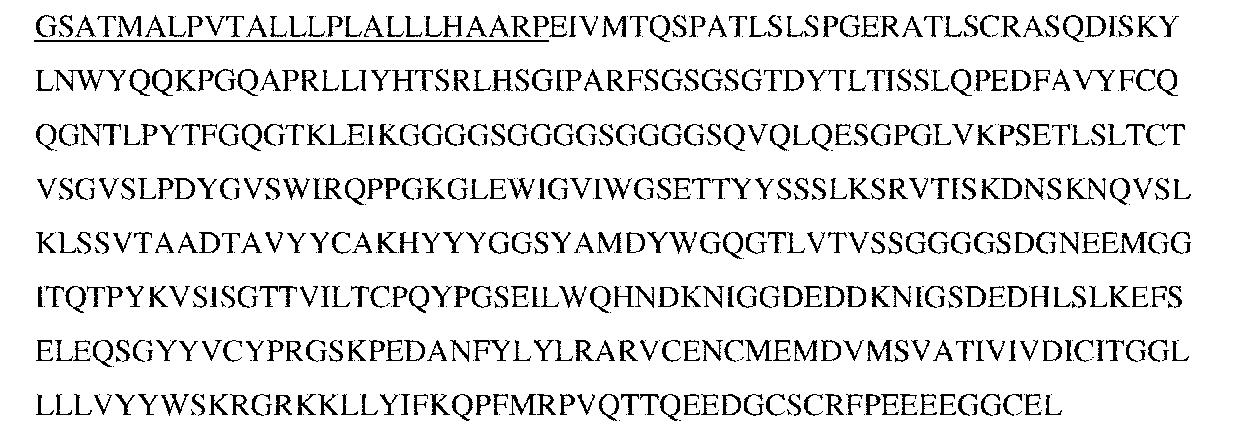
CD19scFv-CD3e (SEQ ID NO: 7)
ジャーカットレポーター細胞株のトランスフェクション及びNFATの活性化
抗原結合ドメインの標的抗原エンゲージメント後の活性化を、実施例1に記載されたようにNFAT-LUCレポーターを含むジャーカット細胞(JNL)レポーター細胞株を用いて測定した。トランスフェクトされた細胞を標的プレートに1ウェル当たり100μlで添加した。ルシフェラーゼOne Glo試薬100μlをウェルごとに添加した。試料を5分間インキュベートし、次いでルミネセンスを記載されたように測定した。
Transfection of Jurkat Reporter Cell Lines and Activation of NFAT Post-target antigen engagement activation of the antigen binding domain was performed in the Jurkat cell (JNL) reporter cell line containing the NFAT-LUC reporter as described in Example 1. was measured using Transfected cells were added to target plates at 100 μl per well. 100 μl of Luciferase One Glo Reagent was added per well. Samples were incubated for 5 minutes and then luminescence was measured as described.
トランスフェクトされたジャーカット(JNL)細胞中のIL-2発現
JNL細胞のトランスフェクション及び活性化を、37℃、5%のCO2において40~48時間であるインキュベーションを除いてJNL RGAアッセイで上記記載の通りに行った。抗原依存性IL2発現の測定を実施例1に記載の通りに実施した。
IL-2 Expression in Transfected Jurkat (JNL) Cells Transfection and activation of JNL cells was performed as described above in the JNL RGA assay except for incubation at 37° C., 5% CO 2 for 40-48 hours. I went as described. Measurement of antigen-dependent IL2 expression was performed as described in Example 1.
一過性発現の結果
JNL細胞への一過性トランスフェクションを介したfusTCAR1、fusTCAR2及びfusTCAR3の初期スクリーニングは、図15に示されるように、抗原依存性シグナル伝達を証明した。重要なことに、シグナル伝達は、切断され且つCD3εのITAMシグナル伝達ドメインを欠如したfusTCAR3でなお観察された。ITAMシグナル伝達ドメインを含有する構築物のトランスフェクションは、従って、fusTCARの活性にとって前提条件ではない。標的化ドメインをTCR複合体と関連付けることにより、シグナル伝達は、複合体のすべてのメンバーを通して仲介され、標的化ドメインに融合されたシグナル伝達ドメインに由来するものに排他的に限定されるものではない。
Transient Expression Results Initial screening of fusTCAR1, fusTCAR2 and fusTCAR3 via transient transfection into JNL cells demonstrated antigen-dependent signaling, as shown in FIG. Importantly, signaling was still observed with fusTCAR3 that was truncated and lacked the ITAM signaling domain of CD3ε. Transfection of a construct containing the ITAM signaling domain is therefore not a prerequisite for the activity of fusTCAR. By associating the targeting domain with the TCR complex, signaling is mediated through all members of the complex and is not exclusively restricted to that originating from the signaling domain fused to the targeting domain. .
レンチウイルス形質導入一次ヒトT細胞の産生
fusTCARは、それらの活性について一次ヒトT細胞中でも試験された。レンチウイルスの産生前に、追加の構築物を、従来のCAR構築物のインビトロ活性に対する機能的ITAMSの依存性及び機能的ITAMSの存在又は非存在に無関係なTCARと無関係な活性を確認するためにも設計した。プラスミドDNAをDNA2.0によって外部的に合成した。初代のCAR設計構築物、CD19scFv-ζ、配列番号10を合成し、CD19scFvをCD8aリンカー及び膜貫通ドメインへの、続いて細胞内シグナル伝達ドメインCD3ζへのN末端融合体としてクローン化した。第2の構築物(配列番号11)を、リン酸化されていると注釈付けされたCD3ζ内のすべての細胞内チロシン残基が細胞内ホスホチロシンシグナル伝達を無効にするためにフェニルアラニンに切り替えられていることを除いて同様にクローン化した。細胞内共刺激ドメインと細胞内シグナル伝達ドメインとの組み合わせは、典型的なCAR構築物に有益であることが以前に証明されているため、最終構築物を、CD19scFvをCD8aリンカー及び膜貫通ドメインに、続いて4-1BBにN末端融合させることによってクローン化し、CD3ζシグナル伝達ドメインは、この構築物に含まれなかった(配列番号12)。最後に、類似のfusTCARを合成してCD19scFV-ζ_7YtoFとした。「fusTCAR4」は、内部内因性ITAMドメインを欠如する。CD19scFv、配列番号13を、リン酸化されていると注釈付けされたこれらのチロシンがフェニルアラニンに変異され、CD3εITAMに関連する固有のシグナル伝達経路を不活性にさせたことを除いて、完全CD3εタンパク質へのN末端融合体としてクローン化した。
CD19scFv-ζ(配列番号10)


CD19scFv-ζ (SEQ ID NO: 10)
レンチウイルス産生及び一次T細胞へのウイルス形質導入
実施例1に記載されるようにレンチウイルスを産生し、単離された一次ヒトT細胞中に形質導入した。形質導入T細胞及び非形質導入対照T細胞を増殖させて後の分析のために凍結した。
Lentivirus Production and Viral Transduction into Primary T Cells Lentivirus was produced as described in Example 1 and transduced into isolated primary human T cells. Transduced T cells and non-transduced control T cells were expanded and frozen for later analysis.
細胞傷害性及びIL2アッセイ
一次ヒトT細胞を標的腫瘍細胞に架橋することによって誘導された細胞傷害性及びIL2産生を実施例1に記載された通りに評価した。
Cytotoxicity and IL2 Assay Cytotoxicity and IL2 production induced by cross-linking primary human T cells to target tumor cells was assessed as described in Example 1.
一次ヒトT細胞の結果
図16及び図17で観察することができるように、従来のCARは、標的細胞及びIL2の産生の最大のT細胞に再指示された溶解を引き出すために機能的内因性ITAMシグナル伝達ドメインを必要とする。CD3ζが41BBで置き換えられているか、又はCD3ζ中のITAMSを不活性化するために変異された構築物は、両方の要素を欠いていた。対照的に、図18及び図19は、fusTCAR活性が内因性機能的ITAMに特異的且つ無関係の両方であることを証明している。再指示された溶解の活性及びIL2分泌は、共刺激ドメインの存在若しくは非存在又は順番に無関係に観察された。さらに、シグナル伝達に関与する重要なチロシンの突然変異又はCD3εの細胞内ドメインの完全な除去のいずれもTCARの機能的インビトロ活性における明らかな損失をもたらさなかった。
Primary Human T Cell Results As can be observed in FIGS. 16 and 17, conventional CAR is functionally endogenous to elicit T cell redirected lysis of target cells and maximal production of IL2. Requires an ITAM signaling domain. Constructs in which CD3zeta was replaced with 41BB or mutated to inactivate ITAMS in CD3zeta lacked both elements. In contrast, Figures 18 and 19 demonstrate that fusTCAR activity is both specific and independent of endogenous functional ITAMs. Redirected lytic activity and IL2 secretion were observed regardless of the presence or absence or order of co-stimulatory domains. Furthermore, neither mutation of key tyrosines involved in signal transduction nor complete ablation of the intracellular domain of CD3ε resulted in apparent loss in functional in vitro activity of TCAR.
実施例4:ラパログスイッチを使用する調節可能なTCAR(rTCAR)(図20~24)
ラパログスイッチ仲介rTCAR構築物の合成
プラスミドDNAの対をDNA2.0によって外部的に合成した。名目上調節不可能なCAR構築物、CD19scFv-BBZ、配列番号1を対照として使用した。rTCARについて、様々なヘテロ二量体化ドメインをrTCAR構築物の異なるドメインに連結することができる。
Example 4: Regulatable TCAR (rTCAR) Using Rapalog Switches (Figures 20-24)
Synthesis of rapalogswitch-mediated rTCAR constructs Plasmid DNA pairs were synthesized externally by DNA2.0. A nominally non-regulatable CAR construct, CD19scFv-BBZ, SEQ ID NO: 1, was used as a control. For rTCARs, different heterodimerization domains can be linked to different domains of the rTCAR construct.
「rTCAR1」(図25)は、構築物の対を含む。第1の構築物では、CD19scFvをCD8ヒンジ及び膜貫通ドメイン、続いて共刺激ドメイン4-1BB及びC末端におけるFKBPでクローン化した(配列番号14)。対応する第2の構築物を、RAD001に対する向上した親和性を有する変異型FRBドメインをCD3εのC末端においてリンカーに融合させることによって設計した(配列番号15)。「rTCAR2」(図26)は、構築物の対を含む。第1の構築物では、CD19scFvをCD8ヒンジ及び膜貫通ドメイン、続いて共刺激ドメイン4-1BB及びC末端におけるFKBPでクローン化した(配列番号14)。対応する第2の構築物を、RAD001に対する向上した親和性を有する変異型FRBドメインをCD3εのC末端においてリンカーに融合させることによって設計した。さらに、CD3εのITAMドメイン内の2つのチロシンをフェニルアラニンに変異させて、CD3εから固有のシグナル伝達経路を除去し、シグナル伝達がTCR複合体全体から仲介されることを証明した(配列番号16)。
CD19scFV-BB-FKBP(配列番号14)


CD19scFV-BB-FKBP (SEQ ID NO: 14)
NFAT活性化に対するラパログの用量応答
抗原結合ドメインの標的抗原エンゲージメント後のラパログ依存性シグナル活性化を証明するためのRCAR構築物の能力を、実施例1に記載したようにNFAT-LUCレポーターを有するジャーカット細胞(JNL)レポーター細胞株を用いて測定した。トランスフェクトされた細胞を標的プレートに1ウェル当たり100μlで添加し、様々な濃度のRAD001と共に18時間共インキュベートした。ルシフェラーゼOne Glo試薬100μlをウェルごとに添加した。試料を5分間インキュベートし、次いでルミネセンスを記載の通りに測定した。
Rapalog Dose Response to NFAT Activation The ability of RCAR constructs to demonstrate rapalog-dependent signal activation following target antigen engagement of the antigen-binding domain was evaluated using Jurkat cells with the NFAT-LUC reporter as described in Example 1. cells (JNL) reporter cell line. Transfected cells were added to target plates at 100 μl per well and co-incubated with various concentrations of RAD001 for 18 hours. 100 μl of Luciferase One Glo Reagent was added per well. Samples were incubated for 5 minutes and then luminescence was measured as described.
トランスフェクトされたジャーカット(JNL)細胞中のIL-2発現
JNL細胞のトランスフェクション及び活性化を、37℃、5%のCO2において40時間であるインキュベーションを除いてJNL RGAアッセイで上記記載の通りに行った。分泌されたIL2の測定を実施例1に記載の通りに実施した。
IL-2 Expression in Transfected Jurkat (JNL) Cells Transfection and activation of JNL cells was performed in the JNL RGA assay as described above except for incubation at 37° C., 5% CO 2 for 40 hours. went to the street Measurement of secreted IL2 was performed as described in Example 1.
結果
JNL細胞への一過性トランスフェクションを介したrTCAR1の初期スクリーニングは、図27に示されるように、RAD001に仲介され、且つ抗原依存性のシグナル伝達及びIL2発現を証明した。後続の実験では、rTCAR1を、一過性にトランスフェクトされたCD3εのITAMシグナル伝達が対応するチロシンのフェニルアラニンへの突然変異によって無効にされているrTCAR2と比較した。rTCAR2についての低減したシグナル及び発現が予想されていたにも関わらず、RAD001による用量応答がレポーター遺伝子アッセイ及び抗原誘導IL2発現の両方においてrTCAR1及びrTCAR2について観察された(図28)。ITAMシグナル伝達ドメインを含有する構築物のトランスフェクションは、従って、rTCARの活性にとって前提条件ではない。標的化ドメインをTCR複合体と関連付けることにより、シグナル伝達は、複合体のすべてのメンバーを通して仲介され、標的化ドメインに融合されたシグナル伝達ドメインに由来することに排他的に限定されるものではない。
Results Initial screening of rTCAR1 via transient transfection into JNL cells demonstrated RAD001-mediated and antigen-dependent signaling and IL2 expression, as shown in FIG. Subsequent experiments compared rTCAR1 to rTCAR2 in which ITAM signaling of transiently transfected CD3ε was abolished by the corresponding tyrosine to phenylalanine mutations. Despite the expected reduced signal and expression for rTCAR2, a dose response with RAD001 was observed for rTCAR1 and rTCAR2 in both reporter gene assays and antigen-induced IL2 expression (FIG. 28). Transfection of constructs containing the ITAM signaling domain is therefore not a prerequisite for rTCAR activity. By associating the targeting domain with the TCR complex, signaling is mediated through all members of the complex and is not exclusively restricted to originating from the signaling domain fused to the targeting domain. .
実施例6:切断型CD3ε細胞外ドメインを介してTCR複合体に融合された構成的活性型TCAR(fusTCAR)
抗CD3モノクローナル抗体OKT3のFabフラグメントと複合体を形成するCD3ε及びγの結晶構造(Kjer-Nielsen et. al.,2004)並びに抗CD3モノクローナルAb UCHT1のscFvと複合体を形成するCD3ε及びδの結晶構造(Arnett et.al.,2004)が報告されている。これらの構造は、εと他の付属タンパク質との相互作用が、膜に近接するβシートを通して仲介されることを証明している。従って、βシートを含有する配列から構成される標的化ドメインのCD3ε細胞外ドメインの切断型への融合は、fusTCAR活性のための唯一の前提条件であり得る。
Example 6: Constitutively active TCAR (fusTCAR) fused to the TCR complex via a truncated CD3ε extracellular domain
Crystal structure of CD3ε and γ in complex with the Fab fragment of the anti-CD3 monoclonal antibody OKT3 (Kjer-Nielsen et. al., 2004) and CD3ε and δ in complex with the scFv of the anti-CD3 monoclonal Ab UCHT1. The structure has been reported (Arnett et.al., 2004). These structures demonstrate that interactions of ε with other accessory proteins are mediated through membrane-proximal β-sheets. Therefore, the fusion of a targeting domain composed of β-sheet containing sequences to a truncated form of the CD3ε extracellular domain may be the only prerequisite for fusTCAR activity.
一過性発現
fusTCAR構築物の合成
プラスミドDNAをDNA2.0によって外部的に合成した。名目上調節不可能なCAR構築物、CD19scFv-BBZ、配列番号1を対照として使用した。
Synthesis of transient expression fusTCAR constructs Plasmid DNA was synthesized externally by DNA2.0. A nominally non-regulatable CAR construct, CD19scFv-BBZ, SEQ ID NO: 1, was used as a control.
「fusTCAR5」において、CD19scFvをCD3ε細胞外及び膜貫通ドメインのN末端切断型、続いて細胞内共刺激ドメイン4-1BBへのN末端融合体としてクローン化した(配列番号17)。「fusTCAR6」、「fusTCAR7」及び「fusTCAR8」を「fusTCAR5」と同様にクローン化し、他のTCR複合体メンバーとの相互作用の仲介において分子内ジスルフィド結合に関与すると思われないCD3ε中の2つの膜近位システインの役割を明らかにした。「fusTCAR6」(配列番号18)について、第1のシステインをセリンに変異させた。「fusTCAR7」(配列番号19)について、第2のシステインをセリンに変異させた。最後に、「fusTCAR8」(配列番号20)について、両方のシステインをセリンに変異させた。この実施例でのすべての4つの構築物は、固有の細胞内ITAMシグナル伝達ドメインを欠いている。
CD19scFv-CD3e_minimalECDTM-41BB(配列番号17)


CD19scFv-CD3e_minimalECDTM-41BB (SEQ ID NO: 17)
ジャーカットレポーター細胞株のトランスフェクション及びNFATの活性化
抗原結合ドメインの標的抗原エンゲージメント後の活性化を、実施例1に記載されたようにNFAT-LUCレポーターを含むジャーカット細胞(JNL)レポーター細胞株を用いて測定した。トランスフェクトされた細胞を標的プレートに1ウェル当たり100μlで添加した。ルシフェラーゼOne Glo試薬100μlをウェルごとに添加した。試料を5分間インキュベートし、次いでルミネセンスを記載されたように測定した。
Transfection of Jurkat Reporter Cell Lines and Activation of NFAT Post-target antigen engagement activation of the antigen binding domain was performed in the Jurkat cell (JNL) reporter cell line containing the NFAT-LUC reporter as described in Example 1. was measured using Transfected cells were added to target plates at 100 μl per well. 100 μl of Luciferase One Glo Reagent was added per well. Samples were incubated for 5 minutes and then luminescence was measured as described.
一過性発現の結果
標的依存性シグナル伝達は、切断型細胞外ドメインを使用する一過性発現されたfusTCARで観察されなかった。その後のFAC分析は、構築物の細胞表面上での検出可能な発現がないことを証明した。
Transient Expression Results Target-dependent signaling was not observed with transiently expressed fusTCAR using truncated extracellular domains. Subsequent FAC analysis demonstrated no detectable expression of the construct on the cell surface.
レンチウイルス形質導入一次ヒトT細胞の産生
低い発現がレポーター細胞株に特有であるかどうかを決定するために、単一の代表的な切断型融合構築物、fusTCAR6もCd19scFv-BBZに対する活性について一次ヒトT細胞中で試験した。
Generation of Lentivirally Transduced Primary Human T Cells To determine whether the low expression was unique to the reporter cell line, a single representative truncated fusion construct, fusTCAR6, was also tested for activity against Cd19scFv-BBZ primary human T cells. tested in cells.
レンチウイルス産生及び一次T細胞へのウイルス形質導入
実施例1に記載されるようにレンチウイルスを産生し、単離された一次ヒトT細胞中に形質導入した。形質導入T細胞及び非形質導入対照T細胞を増殖させて後の分析のために凍結した。
Lentivirus Production and Viral Transduction into Primary T Cells Lentivirus was produced as described in Example 1 and transduced into isolated primary human T cells. Transduced T cells and non-transduced control T cells were expanded and frozen for later analysis.
細胞傷害性及びIL2アッセイ
一次ヒトT細胞を標的腫瘍細胞に架橋することによって誘導された細胞傷害性及びIL2産生を実施例1に記載された通りに評価した。
Cytotoxicity and IL2 Assay Cytotoxicity and IL2 production induced by cross-linking primary human T cells to target tumor cells was assessed as described in Example 1.
一次ヒトT細胞の結果
図29で観察することができるように、fusTCAR6は、対照CD19scFv-BBZ CARに対して匹敵する細胞溶解活性を証明した。ITAMシグナル伝達ドメインの非存在にも関わらず、再指示された溶解の活性が観察されたことに留意することが重要である。対照的に、図30に示すように、fusTCAR6は、IL2発現の低減をもたらした。構築物のさらなる最適化が、βシートを安定化させるため又は切断型CD3εとTCRの残りの内因性構成要素との相互作用を改善するためのいずれかに必要である。それにも関わらず、この結果は、CD3εの細胞外領域の細胞外ドメイン全体が細胞溶解活性を維持するために必要とされるわけではないことを証明した。
Primary Human T Cell Results As can be observed in Figure 29, fusTCAR6 demonstrated comparable cytolytic activity to the control CD19scFv-BBZ CAR. It is important to note that redirected lytic activity was observed despite the absence of the ITAM signaling domain. In contrast, as shown in Figure 30, fusTCAR6 resulted in decreased IL2 expression. Further optimization of the construct is required either to stabilize the β-sheet or to improve the interaction of truncated CD3ε with the remaining endogenous components of the TCR. Nevertheless, this result demonstrated that the entire extracellular domain of the extracellular region of CD3ε is not required to maintain cytolytic activity.
実施例7:代替的共刺激ドメインを有するCD3εを介してTCR複合体に融合された構成的活性型TCAR
従来のCARは、4-1BB以外の代替的共刺激ドメインで機能的であることが証明されている。
Example 7: Constitutively active TCAR fused to the TCR complex via CD3ε with an alternative co-stimulatory domain
Conventional CARs have been demonstrated to be functional at alternative co-stimulatory domains other than 4-1BB.
レンチウイルス形質導入一次ヒトT細胞の産生
fusTCAR構築物の合成
プラスミドDNAをDNA2.0によって外部的に合成する。名目上調節不可能なCAR構築物、CD19scFv-BBZ、配列番号1を対照として使用し、「fusCAR3」をTCAR対照として使用する(配列番号9)。
Generation of Lentivirally Transduced Primary Human T Cells Synthesis of fusTCAR Constructs Plasmid DNA is synthesized externally by DNA2.0. A nominally non-regulatable CAR construct, CD19scFv-BBZ, SEQ ID NO: 1 is used as a control and 'fusCAR3' is used as a TCAR control (SEQ ID NO: 9).
以下の表に列挙されたfusTCARにおいて、CD19scFvをCD3ε細胞外及び膜貫通ドメイン、続いて細胞内共刺激ドメインへのN末端融合体として指定通りにクローン化する。「fusTCAR9」~「fusTCAR13」は、固有の細胞内ITAMシグナル伝達ドメインを欠いている。 In the fusTCAR listed in the table below, the CD19scFv is cloned as indicated as an N-terminal fusion to the CD3ε extracellular and transmembrane domains followed by the intracellular co-stimulatory domain. 'fusTCAR9'-'fusTCAR13' lack a unique intracellular ITAM signaling domain.

CD19scFv-CD3eECDTM-CD27(配列番号21)


レンチウイルス産生及び一次T細胞へのウイルス形質導入
実施例1に記載されるようにレンチウイルスを産生し、単離された一次ヒトT細胞中に形質導入した。形質導入T細胞及び非形質導入対照T細胞を増殖させて後の分析のために凍結した。
Lentivirus Production and Viral Transduction into Primary T Cells Lentivirus was produced as described in Example 1 and transduced into isolated primary human T cells. Transduced T cells and non-transduced control T cells were expanded and frozen for later analysis.
細胞傷害性及びIL2アッセイ
一次ヒトT細胞を標的腫瘍細胞に架橋することによって誘導された細胞傷害性及びIL2産生を実施例1に記載された通りに評価した。
Cytotoxicity and IL2 Assay Cytotoxicity and IL2 production induced by cross-linking primary human T cells to target tumor cells was assessed as described in Example 1.
一次ヒトT細胞の結果
図31及び図32は、fusTCARが任意の共刺激ドメインと共に使用され得、構築物内のITAMドメインの欠如にも関わらず、標的依存性細胞溶解活性をなお維持し、且つIL2発現を誘導することができることを証明している。
Primary human T cell results Figures 31 and 32 demonstrate that fusTCAR can be used with any co-stimulatory domain and still maintain target-dependent cytolytic activity and IL2 It has been demonstrated that expression can be induced.
実施例8:CD3γ、CD3δ及びCD3ζを介してTCR複合体に融合された構成的活性型TCAR(fusTCAR)
TCR複合体の複雑な多タンパク質構造を考慮に入れると、TCARについての活性は、CD3εとの共有結合及び非共有結合融合に限定されるものではなく、例えばCD3γ、CD3δ及びCD3ζなどの複合体中の他の付属タンパク質との非共有結合及び共有結合融合も活性TCARを産生することができる。さらに、免疫シナプスは、標的細胞とT細胞との間の距離によって仲介され得るため、腫瘍標的化アームと、これらの付属タンパク質との融合体との間の異なる長さのリンカーを使用することにより、最適な長さを仲介することが必要となり得る。
Example 8: Constitutively active TCAR (fusTCAR) fused to the TCR complex via CD3γ, CD3δ and CD3ζ
Given the complex multiprotein structure of the TCR complex, activity for TCARs is not limited to covalent and non-covalent fusions with CD3ε, but in complexes such as CD3γ, CD3δ and CD3ζ. Non-covalent and covalent fusions of with other accessory proteins can also produce active TCAR. Furthermore, since the immune synapse can be mediated by the distance between the target cell and the T cell, by using linkers of different lengths between the tumor-targeting arms and fusions with these accessory proteins, , it may be necessary to mediate the optimum length.
一過性発現及び活性化アッセイ
fusTCAR構築物の合成
プラスミドDNAをDNA2.0によって外部的に合成する。名目上調節不可能なCAR構築物、CD19scFv-BBZ、配列番号1を対照として使用する。
Synthesis of transient expression and activation assay fusTCAR constructs Plasmid DNA is synthesized externally by DNA2.0. A nominally non-regulatable CAR construct, CD19scFv-BBZ, SEQ ID NO: 1, is used as a control.
「fusTCAR14」では、CD19scFvをCD3δ細胞外及び膜貫通ドメイン、続いて細胞内共刺激ドメイン4-1BBへの2xG4Sリンカー(配列番号62)とのN末端融合体としてクローン化する(配列番号26)。「fusTCAR15」(配列番号27)を、scFvとCD3ε細胞外ドメインとの間のリンカーが4xG4Sリンカー(配列番号45)であることを除いて、同様にクローン化する。 For 'fusTCAR14' the CD19scFv is cloned as an N-terminal fusion (SEQ ID NO:26) with a 2xG4S linker (SEQ ID NO:62) to the CD3δ extracellular and transmembrane domains followed by the intracellular co-stimulatory domain 4-1BB. 'fusTCAR15' (SEQ ID NO:27) is cloned similarly, except that the linker between the scFv and the CD3ε extracellular domain is a 4xG4S linker (SEQ ID NO:45).
「fusTCAR16」では、CD19scFvをCD3δ細胞外及び膜貫通ドメイン、続いて細胞内共刺激ドメイン4-1BBへのN末端融合体としてクローン化した(配列番号28)。「fusTCAR17」(配列番号29)及び「fusCAR18」(配列番号30)を、scFvとCD3δ細胞外ドメインとの間でそれぞれ2xG4S(配列番号62)及び4xG4S(配列番号45)リンカーを用いたことを除いて同様にクローン化した。 For 'fusTCAR16', the CD19scFv was cloned as an N-terminal fusion to the CD3δ extracellular and transmembrane domains followed by the intracellular co-stimulatory domain 4-1BB (SEQ ID NO:28). 'fusTCAR17' (SEQ ID NO: 29) and 'fusCAR18' (SEQ ID NO: 30), except that 2xG4S (SEQ ID NO: 62) and 4xG4S (SEQ ID NO: 45) linkers were used between the scFv and the CD3delta extracellular domain, respectively. cloned in the same way.
「fusTCAR19」では、CD19scFvをCD3γ細胞外及び膜貫通ドメイン、続いて細胞内共刺激ドメイン4-1BBへのN末端融合体としてクローン化した(配列番号31)。「fusTCAR20」(配列番号32)及び「fusTCAR21」(配列番号33)を、scFvとCD3γ細胞外ドメインとの間でそれぞれ2xG4S(配列番号62)及び4xG4S(配列番号45)リンカーを用いたことを除いて同様にクローン化した。
CD19scFv-CD3e_2G4S_ECDTM-41BB(配列番号26/配列番号62として開示された「2G4S」)


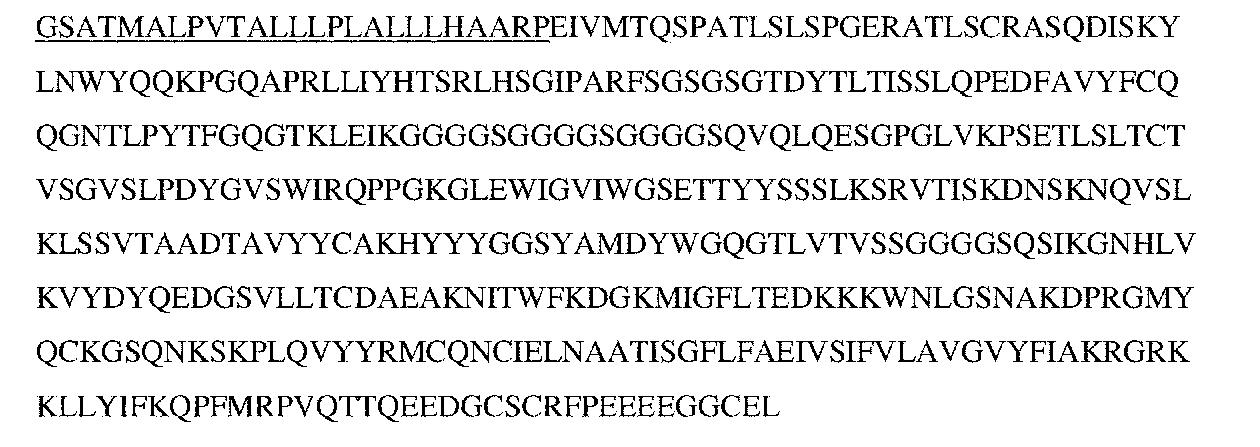


CD19scFv-CD3e_2G4S_ECDTM-41BB (“2G4S” disclosed as SEQ ID NO:26/SEQ ID NO:62)
ジャーカットレポーター細胞株のトランスフェクション及びNFATの活性化
抗原結合ドメインの標的抗原エンゲージメント後の活性化を、実施例1に記載されたようにNFAT-LUCレポーターを含むジャーカット細胞(JNL)レポーター細胞株を用いて測定した。トランスフェクトされた細胞を標的プレートに1ウェル当たり100μlで添加した。ルシフェラーゼOne Glo試薬100μlをウェルごとに添加した。試料を5分間インキュベートし、次いでルミネセンスを記載されたように測定した。
Transfection of Jurkat Reporter Cell Lines and Activation of NFAT Post-target antigen engagement activation of the antigen binding domain was performed in a Jurkat cell (JNL) reporter cell line containing the NFAT-LUC reporter as described in Example 1. was measured using Transfected cells were added to target plates at 100 μl per well. 100 μl of Luciferase One Glo Reagent was added per well. Samples were incubated for 5 minutes and then luminescence was measured as described.
一過性トランスフェクションの結果
図33は、TCARが機能的であり、CD3ε又はCD3γのいずれかが構築物中の融合体に使用されるかに無関係にNFAT経路を介するシグナル伝達をもたらすことを証明している。さらに、所望の結果を得るために、様々な長さのリンカーを用いて結合ドメインをTCARの残部に融合させ得る。CD3δに融合させた構築物は、FACSに基づくとレポーター細胞の細胞表面上で一過性発現せず、このアプローチに基づくこれらの好適性に関する決定を行うことができず、評価を一次ヒトT細胞に代えて行った。
Transient transfection results Figure 33 demonstrates that TCAR is functional and results in signaling through the NFAT pathway regardless of whether CD3ε or CD3γ is used in the fusion in the construct. ing. Additionally, linkers of various lengths can be used to fuse the binding domain to the remainder of the TCAR to achieve the desired result. Constructs fused to CD3delta were not transiently expressed on the cell surface of reporter cells based on FACS, and no determination of their suitability based on this approach could be made, and evaluation was limited to primary human T cells. went instead.
レンチウイルス形質導入一次ヒトT細胞の産生
fusTCARは、それらの活性について一次ヒトT細胞中でも試験した。レンチウイルスの産生前に、追加の構築物を、CD3ζの細胞外及び膜貫通ドメインをその細胞内ドメインの非存在下で使用することができるかを試験するためにも設計した。プラスミドDNAをDNA2.0によって外部的に合成した。「fusTCAR22」では、CD19scFvをCD3ζ細胞外及び膜貫通ドメイン、続いて細胞内共刺激ドメイン4-1BBへのN末端融合体としてクローン化した(配列番号34)。
CD19scFv-CD3zECDTM-41BB(配列番号34)

CD19scFv-CD3zECDTM-41BB (SEQ ID NO:34)
レンチウイルス産生及び一次T細胞へのウイルス形質導入
実施例1に記載されるようにレンチウイルスをfusTCAR3、fusTCAR16、fusTCAR19及びfusTCAR22に対して産生し、単離された一次ヒトT細胞中に形質導入した。形質導入T細胞及び非形質導入対照T細胞を増殖させて後の分析のために凍結した。
Lentivirus production and viral transduction into primary T cells Lentiviruses were produced against fusTCAR3, fusTCAR16, fusTCAR19 and fusTCAR22 and transduced into isolated primary human T cells as described in Example 1. . Transduced T cells and non-transduced control T cells were expanded and frozen for later analysis.
細胞傷害性及びIL2アッセイ
一次ヒトT細胞を標的腫瘍細胞に架橋することによって誘導された細胞傷害性及びIL2産生を実施例1に記載された通りに評価した。
Cytotoxicity and IL2 Assay Cytotoxicity and IL2 production induced by cross-linking primary human T cells to target tumor cells was assessed as described in Example 1.
一次ヒトT細胞の結果
図34及び図35で観察することができるように、CD3ε、CD3γ及びCD3δ上のfusTCARは、対照CD19scFv-BBZ CARに対して明らかな活性を証明した。ITAMシグナル伝達ドメインの非存在にも関わらず、再指示された溶解活性及びIL2分泌が観察されたことに留意することが重要である。対照的に、図36に示されるように、CD3ζ上のfusTCARは、低減された溶解活性をもたらした。FACS分析は、この構築物に関する低い細胞表面発現がTCRの構造及び腫瘍標的化ドメインの付加による可能性が高く、構築物設計の追加の最適化が発現を改善し、且つ活性を最大化するために必要であることを証明した。
Primary Human T Cell Results As can be observed in Figures 34 and 35, fusT CAR on CD3ε, CD3γ and CD3δ demonstrated clear activity against the control CD19scFv-BBZ CAR. It is important to note that redirected lytic activity and IL2 secretion were observed despite the absence of the ITAM signaling domain. In contrast, as shown in Figure 36, fusTCAR on CD3ζ resulted in reduced lytic activity. FACS analysis indicated that the low cell surface expression for this construct was likely due to the structure of the TCR and the addition of the tumor-targeting domain, and additional optimization of construct design was required to improve expression and maximize activity. proved to be
実施例9:代替的結合ドメインを有するCD3εを介してTCR複合体に融合された構成的活性型TCAR
TCARは、様々な結合ドメイン及び標的抗原を使用して、固形腫瘍及び血液腫瘍に対する幅広い適用性を証明するべきである。メソテリンは、広範囲の腫瘍型で発現される興味深い1つの抗原である。
Example 9: Constitutively active TCAR fused to the TCR complex via CD3ε with alternative binding domains
TCAR should prove broad applicability to solid and hematologic tumors using different binding domains and target antigens. Mesothelin is one antigen of interest expressed on a wide range of tumor types.
fusTCAR構築物の合成
プラスミドDNAをDNA2.0によって外部的に合成する。名目上調節不可能なCAR構築物、MSLN5scFv-BBZ、配列番号35を対照として使用する。
Synthesis of fusTCAR constructs Plasmid DNA is synthesized externally by DNA2.0. A nominally non-regulatable CAR construct, MSLN5scFv-BBZ, SEQ ID NO:35, is used as a control.
「fusTCAR23」では、CD19scFvをCD3ε細胞外及び膜貫通ドメイン、続いて細胞内共刺激ドメイン4-1BBへのG4Sリンカー(配列番号52)とのN末端融合体としてクローン化する(配列番号36)。「fusTCAR25」を、CD8aリンカーがCD3ε細胞外及び膜貫通ドメイン、続いて4-1BBのN末端に融合するために使用されたことを除いて同様にクローン化した(配列番号37)。 In 'fusTCAR23' the CD19scFv is cloned as an N-terminal fusion (SEQ ID NO:36) with the CD3ε extracellular and transmembrane domains followed by a G4S linker (SEQ ID NO:52) to the intracellular co-stimulatory domain 4-1BB. 'fusTCAR25' was similarly cloned except that a CD8a linker was used to fuse the CD3ε extracellular and transmembrane domains followed by the N-terminus of 4-1BB (SEQ ID NO:37).
「fusTCAR25」をCD3ε細胞外及び膜貫通ドメイン、続いて細胞内共刺激ドメインCD27のG4Sリンカー(配列番号52)とのN末端融合体としてクローン化した(配列番号38)。「fusTCAR23」、「fusTCAR24」及び「fusTCAR25」は、固有の細胞内ITAMシグナル伝達ドメインを欠いている。
MSLN5scFv-BBZ(配列番号35)
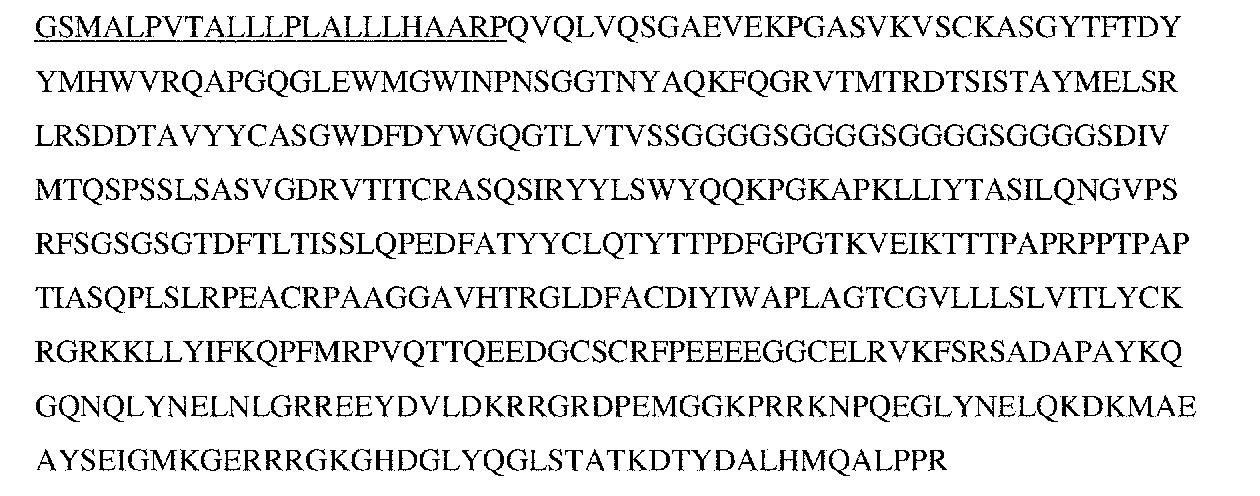


MSLN5scFv-BBZ (SEQ ID NO:35)
レンチウイルス産生及び一次T細胞へのウイルス形質導入
実施例1に記載されるようにレンチウイルスを産生し、単離された一次ヒトT細胞中に形質導入した。形質導入T細胞及び非形質導入対照T細胞を増殖させて後の分析のために凍結した。
Lentivirus Production and Viral Transduction into Primary T Cells Lentivirus was produced as described in Example 1 and transduced into isolated primary human T cells. Transduced T cells and non-transduced control T cells were expanded and frozen for later analysis.
細胞傷害性及びIL2アッセイ
一次ヒトT細胞を標的腫瘍細胞に架橋することによって誘導された細胞傷害性及びIL2産生を実施例1に記載された通りに評価した。天然にメソテリンを過剰発現し、ホタルルシフェラーゼで形質導入されたOVCAR8を、標的細胞株として代用した。
Cytotoxicity and IL2 Assay Cytotoxicity and IL2 production induced by cross-linking primary human T cells to target tumor cells was assessed as described in Example 1. OVCAR8, which naturally overexpresses mesothelin and is transduced with firefly luciferase, was substituted as the target cell line.
一次ヒトT細胞の結果
CD19標的化TCARを利用する他の実施例と同様に、メソテリン抗原を標的とするTCARは、強力な細胞傷害性分子である。エンゲージメント時の細胞傷害性活性及びIL2発現(それぞれ図37及び38)は、ITAMを活性のための前提条件として必要とせず、両方のCD27及び4-1BB細胞内共刺激ドメインは、良好な機能活性を証明した。図39及び40に示されるように、腫瘍標的化ドメインとTCR付属タンパク質との間のリンカーは、TCARの機能活性を調節することができ、且つ所望の特性を得るために調整され得る。
Primary Human T Cell Results As with other examples utilizing CD19-targeted TCARs, TCARs targeting the mesothelin antigen are potent cytotoxic molecules. Cytotoxic activity and IL2 expression upon engagement (FIGS. 37 and 38, respectively) did not require ITAMs as a prerequisite for activity, and both CD27 and 4-1BB intracellular co-stimulatory domains exhibited good functional activity. proved. As shown in Figures 39 and 40, the linker between the tumor targeting domain and the TCR accessory protein can modulate the functional activity of the TCAR and can be tailored to obtain desired properties.
実施例10:メソテリン及びCD19を標的とするTCAR
キメラ膜タンパク質構築物の合成
プラスミドDNAをDNA2.0によって外部的に合成する。名目上調節不可能なCAR構築物、MSLN5scFv-BBZ、配列番号35及び/又は名目上調節不可能なCAR構築物、CD19scFv-BBZ、配列番号1を対照として使用する。前の実施例で記載されたキメラ膜タンパク質に加えて、以下のキメラ膜タンパク質も使用される。
MSLN5scFv-CD3dECDTM-41BB(配列番号63)


Synthesis of Chimeric Membrane Protein Constructs Plasmid DNA is synthesized externally by DNA2.0. A nominally non-regulatable CAR construct, MSLN5scFv-BBZ, SEQ ID NO:35 and/or a nominally non-regulatable CAR construct, CD19scFv-BBZ, SEQ ID NO:1, are used as controls. In addition to the chimeric membrane proteins described in the previous examples, the following chimeric membrane proteins are also used.
MSLN5scFv-CD3dECDTM-41BB (SEQ ID NO: 63)
レンチウイルス産生及び一次T細胞へのウイルス形質導入
実施例1に記載されるようにレンチウイルスを産生し、単離された一次ヒトT細胞中に形質導入した。形質導入T細胞及び非形質導入対照T細胞を増殖させて後の分析のために凍結する。細胞を、下記のようにCD19標的化キメラ分子と、メソテリン標的化キメラ分子とをコードするレンチウイルスで形質導入し、CD19標的化キメラ分子のみ若しくはメソテリン標的化キメラ分子のみをコードするレンチウイルスで形質導入された細胞又は非形質導入細胞と比較した。以下の構築物をコードするレンチウイルスで形質導入された細胞を生成し、以下に記載のアッセイで試験する。
Lentivirus Production and Viral Transduction into Primary T Cells Lentivirus was produced as described in Example 1 and transduced into isolated primary human T cells. Transduced T cells and non-transduced control T cells are expanded and frozen for later analysis. Cells are transduced with lentiviruses encoding CD19-targeted chimeric molecules and mesothelin-targeted chimeric molecules as described below, and transduced with lentiviruses encoding CD19-targeted chimeric molecules alone or mesothelin-targeted chimeric molecules alone. Comparisons were made with transduced or non-transduced cells. Cells transduced with lentiviruses encoding the constructs below are generated and tested in the assays described below.

細胞傷害性及びIL2アッセイ
標的腫瘍細胞に応答して、この実施例のように操作されたヒトT細胞によって誘導された細胞傷害性及びIL2産生を実施例1に記載された通りに評価する。ホタルルシフェラーゼで形質導入されたNalm6(CD19+)、OVCAR8(メソテリン+)又はNalm6とOVCAR8との組み合わせを標的細胞株として使用し、K562(ホタルルシフェラーゼで形質導入されたCD19-及びメソテリン-(陰性対照))と比較する。
Cytotoxicity and IL2 Assay Cytotoxicity and IL2 production induced by human T cells engineered as in this example in response to target tumor cells are assessed as described in Example 1. Nalm6 (CD19+) transduced with firefly luciferase, OVCAR8 (mesothelin+) or a combination of Nalm6 and OVCAR8 were used as target cell lines and K562 (CD19- and mesothelin- transduced with firefly luciferase (negative control) ).
実施例11:2つの異なるTCARを発現するT細胞は、二重特異性を示す
CD22に対する特異性を有するTCAR(CD22-65scFv-G4S-CD3eECDTM-41BB、「CD22 TCAR」、配列番号73)及びCD19に対する特異性を有するTCAR(CD19scFv-G4S-CD3gECDTM-41BB、「CD19-TCAR」、配列番号72)をレンチウイルスCAR発現ベクター中にクローン化した。2つの異なる特異性を有するTCARを発現するT細胞が、標的タンパク質のいずれか又は両方を発現する標的細胞にも特異的応答を及ぼしたかどうかを試験した。
Example 11: T Cells Expressing Two Different TCARs Show Bispecificity A TCAR with Specificity for CD22 (CD22-65scFv-G4S-CD3eECDTM-41BB, "CD22 TCAR", SEQ ID NO: 73) and CD19 A TCAR (CD19scFv-G4S-CD3gECDTM-41BB, "CD19-TCAR", SEQ ID NO: 72) with specificity for was cloned into a lentiviral CAR expression vector. We tested whether T-cells expressing TCARs with two different specificities also exerted specific responses to target cells expressing either or both of the target proteins.
TCARレンチウイルスの生成
TCARをコードするレンチウイルス輸送ベクターを用いて、VSVgシュードタイプ化レンチウイルス粒子中にパッケージされたゲノム物質を生成した。TCARをコードするレンチウイルス輸送ベクターDNAを、Lenti-X 293T細胞をトランスフェクトするためのリポフェクタミン2000試薬(Clontech)と組み合わせて、3つのパッケージング構成要素VAVg、gag/pol及びrevと混合し、続いて12~18時間後に培地交換した。培地交換から30時間後に培地を採集し、濾過し、Lenti-X濃縮器(Clontech)を用いて濃縮し、小分けにして-80℃で保存した。
Generation of TCAR Lentivirus A lentiviral delivery vector encoding TCAR was used to generate genomic material packaged into VSVg pseudotyped lentiviral particles. Lentiviral transport vector DNA encoding TCAR was combined with
TCAR JNL細胞の生成
ジャーカットNFATルシフェラーゼ(JNL)レポーター細胞株は、急性T細胞白血病ジャーカット細胞株に基づいている。この細胞株を、活性化T細胞核内因子(NFAT)応答エレメントの制御下でルシフェラーゼを発現するように改変した。TCARによる形質導入について、12ウェルプレートの400,000個のJNL細胞/ウェルを1.5の多重感染度(MOI)で形質導入した。凍結したウイルス含有上清を室温で解凍し、それぞれのウェルに添加した。それぞれ1つのウェルにそれぞれMOI=1.5で、CD19-TCAR、CD22-TCAR又はCD19-TCAR+CD22-TCAR(「CD19/22二重TCAR」)を導入した。プレートを6日間培養した。
Generation of TCAR JNL Cells The Jurkat NFAT luciferase (JNL) reporter cell line is based on the acute T-cell leukemia Jurkat cell line. This cell line was engineered to express luciferase under the control of the activated T cell nuclear factor (NFAT) response element. For transduction with TCAR, 400,000 JNL cells/well in a 12-well plate were transduced at a multiplicity of infection (MOI) of 1.5. Frozen virus-containing supernatant was thawed at room temperature and added to each well. CD19-TCAR, CD22-TCAR or CD19-TCAR+CD22-TCAR (“CD19/22 dual TCAR”) was introduced into each well at MOI=1.5. Plates were cultured for 6 days.
単一T細胞上の2つのTCARの機能発現の評価
TCAR発現T細胞をそれらの標的結合能力についてフローサイトメトリーにより試験した。非形質導入(UTD)JNL細胞、CD19-TCAR、CD22-TCAR及びCD19/22二重TCARを発現するJNL細胞を試験し、細胞をCD22-Fcで4℃において30分間染色した。洗浄後、細胞を抗Fc二次抗体で4℃において30分間染色した。2回目の洗浄後、細胞をCD19-CAR抗イディオタイプ抗体(Ab)で4℃において30分間染色した。次いで、最後の洗浄後にFACS LSR Fortessaで細胞を分析した。データは、FlowJoソフトウエアを使用して分析した。UTD JNL細胞は、染色試薬のいずれにも結合せず、CD22-Fcの低い結合をバックグラウンド結合として解釈した(図47A)。CD19-TCAR発現細胞は、CD19-CAR抗イディオタイプAb染色によって検出されたようにTCARの正確な折り畳み及び発現を示した一方、CD22-Fcに結合しなかった(図47B)。CD22-TCAR発現細胞は、CD22-Fcに結合したが、CD19-CAR抗イディオタイプAbで染色されなかった(図47C)。対照的に、両方のウイルス、CD19/22二重TCARで形質導入されたJNL細胞は、CD22に結合し、且つCD19-CAR抗イディオタイプの結合を示した(図47D)。
Evaluation of functional expression of two TCARs on single T cells TCAR-expressing T cells were tested for their target binding capacity by flow cytometry. Untransduced (UTD) JNL cells, JNL cells expressing CD19-TCAR, CD22-TCAR and CD19/22 double TCAR were tested and cells were stained with CD22-Fc for 30 minutes at 4°C. After washing, cells were stained with anti-Fc secondary antibody for 30 minutes at 4°C. After the second wash, cells were stained with CD19-CAR anti-idiotype antibody (Ab) for 30 minutes at 4°C. Cells were then analyzed on a FACS LSR Fortessa after the last wash. Data were analyzed using FlowJo software. UTD JNL cells did not bind any of the staining reagents, interpreting the low binding of CD22-Fc as background binding (Fig. 47A). CD19-TCAR-expressing cells showed correct folding and expression of TCAR as detected by CD19-CAR anti-idiotypic Ab staining, while they did not bind CD22-Fc (Fig. 47B). CD22-TCAR-expressing cells bound CD22-Fc but did not stain with CD19-CAR anti-idiotypic Ab (Fig. 47C). In contrast, JNL cells transduced with both viruses, the CD19/22 double TCAR, bound CD22 and showed CD19-CAR anti-idiotypic binding (Fig. 47D).
TCARに再指示されたJNL細胞の有効性
TCARの機能的能力を評価するために、非形質導入JNL細胞及び1つ又は両方のTCARコードウイルスで形質導入された細胞を標的癌細胞と共培養し、ルシフェラーゼ発現を定量化することにより、それらの活性化を読み出した。JNL CART細胞を、CD19又はCD22を過剰発現する慢性骨髄性白血病(CML)細胞株K562と共培養した。親K562細胞株は、陰性対照として機能した。共培養を384ウェルプレートにおいて1:3、1:1及び1:0.3のエフェクター対標的(E:T)比で設定し、24時間インキュベートし、その後、活性化JNL TCAR T細胞によるルシフェラーゼの発現をbritelite plus Reporter Gene Assay System(PerkinElmer,Waltham,MA)によって定量化した。各ウェルからの発光の量(ルミネセンス)は、それぞれのTCARによるJNL活性化の直接読み出しであった。CD19/22二重TCAR細胞は、両方のCD19発現及びCD22発現K562細胞によって活性化され、それらの二重特異性を証明した(図48A及び48B)。二重TCAR T細胞の活性化の程度は、それぞれの抗原による単一TCAR細胞の活性化に非常に類似しており、すなわち、CD19 TCAR細胞は、K562-CD19によって活性化され、且つCD22 TCARは、K562-CD22によって活性化された。単一TCAR細胞は、非同族抗原によって活性化されなかった(図48A及び48B)。また、親K562細胞株は、TCARのいずれの活性ももたらさず、それらの特異性を証明した(図48C)。
Efficacy of TCAR Redirected JNL Cells To assess the functional capacity of TCARs, untransduced JNL cells and cells transduced with one or both TCAR-encoding viruses were co-cultured with target cancer cells. , their activation was read out by quantifying luciferase expression. JNL CAR T cells were co-cultured with chronic myelogenous leukemia (CML) cell line K562, which overexpresses CD19 or CD22. The parental K562 cell line served as a negative control. Co-cultures were set up in 384-well plates at effector-to-target (E:T) ratios of 1:3, 1:1 and 1:0.3 and incubated for 24 hours, followed by luciferase expression by activated JNL TCAR T cells. Expression was quantified by the britelite plus Reporter Gene Assay System (PerkinElmer, Waltham, Mass.). The amount of light emitted from each well (luminescence) was a direct readout of JNL activation by the respective TCAR. CD19/22 dual TCAR cells were activated by both CD19- and CD22-expressing K562 cells, demonstrating their bispecificity (Figures 48A and 48B). The degree of activation of dual TCAR T cells was very similar to the activation of single TCAR cells by the respective antigens, ie CD19 TCAR cells were activated by K562-CD19 and CD22 TCAR cells were , K562-CD22. Single TCAR cells were not activated by non-cognate antigens (Figures 48A and 48B). Also, the parental K562 cell line did not produce any activity of TCAR, demonstrating their specificity (Fig. 48C).
結論
2つの異なるTCARをコードするウイルスで形質導入されたJNL細胞は、2つの正確に折りたたまれたTCARを細胞表面上で同時に発現することができた。これは、CD19/22二重TCAR細胞のCD22-Fcに結合する能力及びCD19-CAR抗イディオタイプ抗体による染色によって証明された(図47D)。細胞表面上の発現に加えて、TCARは、JNLの標的依存性活性化を仲介した(図48A及び48B)。CD19/22二重TCAR細胞のみが両方のK562-CD19及びCD22によって活性化され、これらの細胞の二重特異性を証明した(48A及び48B)。
Conclusion JNL cells transduced with viruses encoding two different TCARs were able to simultaneously express two correctly folded TCARs on the cell surface. This was evidenced by the ability of CD19/22 double TCAR cells to bind CD22-Fc and staining with CD19-CAR anti-idiotypic antibody (Fig. 47D). In addition to cell surface expression, TCAR mediated target-dependent activation of JNL (Figures 48A and 48B). Only CD19/22 double TCAR cells were activated by both K562-CD19 and CD22, demonstrating the bispecificity of these cells (48A and 48B).
実施例12:2つの異なるTCARを発現するT細胞のインビトロ及びインビボでの検討
ヒトTリンパ球を対象から採取し、生体外に提供し、抗CD3/CD28ビーズを使用して刺激し、EF1プロモーターの制御下でTCARをコードする1つ又は2つのレンチウイルスベクターで形質導入した。異なる特異性を有する2つのTCARをこの実験で使用し、一方は、CD19に対して特異的なTCARであり、他方は、CD22に対して特異的なTCARであった。T細胞は、これらのTCARのいずれかをコードする1つのベクター又は両方のベクターで同時に形質導入される。加えて、単一のビシストロニック(bicistronic)レンチウイルスベクターを構築し、これは、すべてEF1プロモーターの制御下において、介在するP2A部位を伴うCD19 TCAR及びCD22 TCARの両方をコードし、単一のウイルスによる形質導入で二重TCAR細胞の生成を可能にするものである。TCAR T細胞の増殖、サイトカイン放出及び細胞傷害性を、本明細書に開示された方法を使用して(例えば、国際公開第2014/130657号パンフレットに記載されるように)、CD19+/CD22-細胞、CD19-/CD22+細胞、CD19+/CD22+細胞及びCD19-/CD22+細胞とCD19+/CD22+細胞とを含む細胞の集団に対してアッセイする。定着腫瘍を有する免疫不全NOD/SCID/共通γ鎖-/-マウスに細胞を静脈内投与することにより、細胞をインビボでさらにアッセイする(増殖、長期持続性及び腫瘍毒性、例えば国際公開第2014/130657号パンフレットに記載された方法によって)。インビトロでのアッセイについて、CD19+/CD22-細胞、CD19-/CD22+細胞、CD19+/CD22+細胞及びCD19-/CD22+細胞とCD19+/CD22+細胞とを含む細胞の集団を試験する。CART細胞の持続性、増殖/拡大及び抗腫瘍効果を監視する。二重TCARが、それぞれの抗原の1つのみ又は両方を発現する癌細胞の混合集団からなる腫瘍を拒絶することができるかどうかを検討する。
Example 12: In Vitro and In Vivo Studies of T Cells Expressing Two Different TCARs Human T lymphocytes were harvested from a subject, provided ex vivo, stimulated using anti-CD3/CD28 beads, and stimulated with the EF1 promoter. were transduced with one or two lentiviral vectors encoding TCAR under the control of Two TCARs with different specificities were used in this experiment, one TCAR specific for CD19 and the other TCAR specific for CD22. T cells are transduced with one vector encoding either of these TCARs or both vectors simultaneously. In addition, a single bicistronic lentiviral vector was constructed that encodes both the CD19 and CD22 TCARs with an intervening P2A site, all under the control of the EF1 promoter, and a single Viral transduction allows the generation of dual TCAR cells. Proliferation, cytokine release and cytotoxicity of TCAR T cells were measured using methods disclosed herein (eg, as described in WO2014/130657), CD19+/CD22- cells , CD19-/CD22+ cells, CD19+/CD22+ cells and populations of cells comprising CD19-/CD22+ and CD19+/CD22+ cells. Cells are further assayed in vivo (proliferation, long-term persistence and tumor toxicity, e.g. WO 2014/ 130657). For in vitro assays, populations of cells including CD19+/CD22- cells, CD19-/CD22+ cells, CD19+/CD22+ cells and CD19-/CD22+ and CD19+/CD22+ cells are tested. CAR T cell persistence, proliferation/expansion and anti-tumor efficacy are monitored. We examine whether dual TCARs can reject tumors consisting of mixed populations of cancer cells expressing only one or both of each antigen.
均等物
本明細書に引用するそれぞれの及び全ての特許、特許出願及び刊行物の開示は、その全体が参照により本明細書に組み込まれる。本発明は、具体的態様を参照して開示しているが、本発明の他の態様及び変形形態は、本発明の真の趣旨及び範囲から逸脱することなく他の当業者によって考案され得ることが明らかである。下記の特許請求の範囲は、全てのこのような態様及び均等な変形形態を含むと解釈されることを意図する。
EQUIVALENTS The disclosure of each and every patent, patent application and publication cited herein is hereby incorporated by reference in its entirety. Although the invention has been disclosed with reference to specific embodiments, other embodiments and variations of the invention can be devised by those skilled in the art without departing from the true spirit and scope of the invention. is clear. It is intended that the following claims be interpreted to include all such aspects and equivalent variations.
Claims (71)
第2の抗原結合ドメインと、CD3γ、δ又はεの細胞外ドメインに由来する第2の細胞外ドメインとを含む細胞外ドメイン、膜貫通ドメイン、及び任意選択によりCD3γ、δ又はε以外のタンパク質に由来する第2の細胞内共刺激ドメインを含む細胞内ドメインを含む第2のキメラ膜タンパク質と
を含む系であって、前記第1の抗原結合ドメインと前記第2の抗原結合ドメインとは、同一ではなく、CD3γ、δ又はεの前記細胞外ドメインに由来する前記第1の細胞外ドメインと、CD3γ、δ又はεの前記細胞外ドメインに由来する前記第2の細胞外ドメインとは、同一ではない、系。 An extracellular domain comprising a first antigen-binding domain and a first extracellular domain derived from the extracellular domain of CD3 γ, δ or ε, a transmembrane domain, and a protein other than CD3 γ, δ or ε a first chimeric membrane protein comprising an intracellular domain comprising one intracellular co-stimulatory domain;
extracellular domain comprising a second antigen binding domain and a second extracellular domain derived from the extracellular domain of CD3 gamma, delta or epsilon, a transmembrane domain, and optionally to a protein other than CD3 gamma, delta or epsilon and a second chimeric membrane protein comprising an intracellular domain comprising a second intracellular co-stimulatory domain derived from but the first extracellular domain derived from the extracellular domain of CD3 γ, δ or ε and the second extracellular domain derived from the extracellular domain of CD3 γ, δ or ε are not identical No system.
(ii)前記第1のキメラ膜タンパク質は、配列番号88の前記アミノ酸配列(又はそれに対して少なくとも約85%、90%、95%、99%若しくはそれを超えて同一であり、且つ/又は1つ、2つ、3つ若しくはそれを超える置換、挿入若しくは欠失、例えば保存的置換を有する配列)を含み、及び前記第2のキメラ膜タンパク質は、配列番号83の前記アミノ酸配列(又はそれに対して少なくとも約85%、90%、95%、99%若しくはそれを超えて同一であり、且つ/又は1つ、2つ、3つ若しくはそれを超える置換、挿入若しくは欠失、例えば保存的置換を有する配列)を含み;
(iii)前記第1のキメラ膜タンパク質は、配列番号88の前記アミノ酸配列を含み、及び前記第2のキメラ膜タンパク質は、配列番号83の前記アミノ酸配列を含み;
(iv)前記第1のキメラ膜タンパク質は、CD3γの前記細胞外ドメイン又はその機能的変異体を含み、及び前記第2のキメラ膜タンパク質は、CD3εの前記細胞外ドメイン又はその機能的変異体を含み;
(v)前記第1のキメラ膜タンパク質は、配列番号88の前記アミノ酸配列(又はそれに対して少なくとも約85%、90%、95%、99%若しくはそれを超えて同一であり、且つ/又は1つ、2つ、3つ若しくはそれを超える置換、挿入若しくは欠失、例えば保存的置換を有する配列)を含み、及び前記第2のキメラ膜タンパク質は、配列番号78の前記アミノ酸配列(又はそれに対して少なくとも約85%、90%、95%、99%若しくはそれを超えて同一であり、且つ/又は1つ、2つ、3つ若しくはそれを超える置換、挿入若しくは欠失、例えば保存的置換を有する配列)を含み;
(vi)前記第1のキメラ膜タンパク質は、配列番号88の前記アミノ酸配列を含み、及び前記第2のキメラ膜タンパク質は、配列番号78の前記アミノ酸配列を含み;
(vii)前記第1のキメラ膜タンパク質は、CD3δの前記細胞外ドメイン又はその機能的変異体を含み、及び前記第2のキメラ膜タンパク質は、CD3γの前記細胞外ドメイン又はその機能的変異体を含み;
(viii)前記第1のキメラ膜タンパク質は、配列番号83の前記アミノ酸配列(又はそれに対して少なくとも約85%、90%、95%、99%若しくはそれを超えて同一であり、且つ/又は1つ、2つ、3つ若しくはそれを超える置換、挿入若しくは欠失、例えば保存的置換を有する配列)を含み、及び前記第2のキメラ膜タンパク質は、配列番号88の前記アミノ酸配列(又はそれに対して少なくとも約85%、90%、95%、99%若しくはそれを超えて同一であり、且つ/又は1つ、2つ、3つ若しくはそれを超える置換、挿入若しくは欠失、例えば保存的置換を有する配列)を含み;
(ix)前記第1のキメラ膜タンパク質は、配列番号83の前記アミノ酸配列を含み、及び前記第2のキメラ膜タンパク質は、配列番号88の前記アミノ酸配列を含み;
(x)前記第1のキメラ膜タンパク質は、CD3δの前記細胞外ドメイン又はその機能的変異体を含み、及び前記第2のキメラ膜タンパク質は、CD3εの前記細胞外ドメイン又はその機能的変異体を含み;
(xi)前記第1のキメラ膜タンパク質は、配列番号83の前記アミノ酸配列(又はそれに対して少なくとも約85%、90%、95%、99%若しくはそれを超えて同一であり、且つ/又は1つ、2つ、3つ若しくはそれを超える置換、挿入若しくは欠失、例えば保存的置換を有する配列)を含み、及び前記第2のキメラ膜タンパク質は、配列番号78の前記アミノ酸配列(又はそれに対して少なくとも約85%、90%、95%、99%若しくはそれを超えて同一であり、且つ/又は1つ、2つ、3つ若しくはそれを超える置換、挿入若しくは欠失、例えば保存的置換を有する配列)を含み;
(xii)前記第1のキメラ膜タンパク質は、配列番号83の前記アミノ酸配列を含み、及び前記第2のキメラ膜タンパク質は、配列番号78の前記アミノ酸配列を含み;
(xiii)前記第1のキメラ膜タンパク質は、CD3εの前記細胞外ドメイン又はその機能的変異体を含み、及び前記第2のキメラ膜タンパク質は、CD3γの前記細胞外ドメイン又はその機能的変異体を含み;
(xiv)前記第1のキメラ膜タンパク質は、配列番号78の前記アミノ酸配列(又はそれに対して少なくとも約85%、90%、95%、99%若しくはそれを超えて同一であり、且つ/又は1つ、2つ、3つ若しくはそれを超える置換、挿入若しくは欠失、例えば保存的置換を有する配列)を含み、及び前記第2のキメラ膜タンパク質は、配列番号88の前記アミノ酸配列(又はそれに対して少なくとも約85%、90%、95%、99%若しくはそれを超えて同一であり、且つ/又は1つ、2つ、3つ若しくはそれを超える置換、挿入若しくは欠失、例えば保存的置換を有する配列)を含み;
(xv)前記第1のキメラ膜タンパク質は、配列番号78の前記アミノ酸配列を含み、及び前記第2のキメラ膜タンパク質は、配列番号88の前記アミノ酸配列を含み;
(xvi)前記第1のキメラ膜タンパク質は、CD3εの前記細胞外ドメイン又はその機能的変異体を含み、及び前記第2のキメラ膜タンパク質は、CD3δの前記細胞外ドメイン又はその機能的変異体を含み;
(xvii)前記第1のキメラ膜タンパク質は、配列番号78の前記アミノ酸配列(又はそれに対して少なくとも約85%、90%、95%、99%若しくはそれを超えて同一であり、且つ/又は1つ、2つ、3つ若しくはそれを超える置換、挿入若しくは欠失、例えば保存的置換を有する配列)を含み、及び前記第2のキメラ膜タンパク質は、配列番号83の前記アミノ酸配列(又はそれに対して少なくとも約85%、90%、95%、99%若しくはそれを超えて同一であり、且つ/又は1つ、2つ、3つ若しくはそれを超える置換、挿入若しくは欠失、例えば保存的置換を有する配列)を含み;又は
(xviii)前記第1のキメラ膜タンパク質は、配列番号78の前記アミノ酸配列を含み、及び前記第2のキメラ膜タンパク質は、配列番号83の前記アミノ酸配列を含む、請求項1~3のいずれか一項に記載の系。 (i) said first chimeric membrane protein comprises said extracellular domain of CD3γ or a functional variant thereof, and said second chimeric membrane protein comprises said extracellular domain of CD3δ or a functional variant thereof; include;
(ii) said first chimeric membrane protein is at least about 85%, 90%, 95%, 99% or more identical to said amino acid sequence of SEQ ID NO: 88; sequence having three, two, three or more substitutions, insertions or deletions, e.g. conservative substitutions), and said second chimeric membrane protein comprises said amino acid sequence of SEQ ID NO:83 (or are at least about 85%, 90%, 95%, 99% or more identical to each other and/or have 1, 2, 3 or more substitutions, insertions or deletions, e.g. conservative substitutions a sequence having
(iii) said first chimeric membrane protein comprises said amino acid sequence of SEQ ID NO:88 and said second chimeric membrane protein comprises said amino acid sequence of SEQ ID NO:83;
(iv) said first chimeric membrane protein comprises said extracellular domain of CD3γ or a functional variant thereof, and said second chimeric membrane protein comprises said extracellular domain of CD3ε or a functional variant thereof; include;
(v) said first chimeric membrane protein is at least about 85%, 90%, 95%, 99% or more identical to said amino acid sequence of SEQ ID NO:88 and/or sequences having three, two, three or more substitutions, insertions or deletions, e.g. are at least about 85%, 90%, 95%, 99% or more identical to each other and/or have 1, 2, 3 or more substitutions, insertions or deletions, e.g. conservative substitutions a sequence having
(vi) said first chimeric membrane protein comprises said amino acid sequence of SEQ ID NO:88, and said second chimeric membrane protein comprises said amino acid sequence of SEQ ID NO:78;
(vii) said first chimeric membrane protein comprises said extracellular domain of CD3δ or a functional variant thereof, and said second chimeric membrane protein comprises said extracellular domain of CD3γ or a functional variant thereof; include;
(viii) said first chimeric membrane protein is at least about 85%, 90%, 95%, 99% or more identical to said amino acid sequence of SEQ ID NO: 83; sequence having three, two, three or more substitutions, insertions or deletions, e.g. conservative substitutions), and said second chimeric membrane protein comprises said amino acid sequence of SEQ ID NO:88 (or are at least about 85%, 90%, 95%, 99% or more identical to each other and/or have 1, 2, 3 or more substitutions, insertions or deletions, e.g. conservative substitutions a sequence having
(ix) said first chimeric membrane protein comprises said amino acid sequence of SEQ ID NO:83, and said second chimeric membrane protein comprises said amino acid sequence of SEQ ID NO:88;
(x) said first chimeric membrane protein comprises said extracellular domain of CD3δ or a functional variant thereof, and said second chimeric membrane protein comprises said extracellular domain of CD3ε or a functional variant thereof; include;
(xi) said first chimeric membrane protein is at least about 85%, 90%, 95%, 99% or more identical to said amino acid sequence of SEQ ID NO: 83; sequences having three, two, three or more substitutions, insertions or deletions, e.g. are at least about 85%, 90%, 95%, 99% or more identical to each other and/or have 1, 2, 3 or more substitutions, insertions or deletions, e.g. conservative substitutions a sequence having
(xii) said first chimeric membrane protein comprises said amino acid sequence of SEQ ID NO:83, and said second chimeric membrane protein comprises said amino acid sequence of SEQ ID NO:78;
(xiii) said first chimeric membrane protein comprises said extracellular domain of CD3ε or a functional variant thereof, and said second chimeric membrane protein comprises said extracellular domain of CD3γ or a functional variant thereof; include;
(xiv) said first chimeric membrane protein is at least about 85%, 90%, 95%, 99% or more identical to said amino acid sequence of SEQ ID NO: 78; sequence having three, two, three or more substitutions, insertions or deletions, e.g. conservative substitutions), and said second chimeric membrane protein comprises said amino acid sequence of SEQ ID NO:88 (or are at least about 85%, 90%, 95%, 99% or more identical to each other and/or have 1, 2, 3 or more substitutions, insertions or deletions, e.g. conservative substitutions a sequence having
(xv) said first chimeric membrane protein comprises said amino acid sequence of SEQ ID NO:78, and said second chimeric membrane protein comprises said amino acid sequence of SEQ ID NO:88;
(xvi) said first chimeric membrane protein comprises said extracellular domain of CD3ε or a functional variant thereof, and said second chimeric membrane protein comprises said extracellular domain of CD3δ or a functional variant thereof; include;
(xvii) said first chimeric membrane protein is at least about 85%, 90%, 95%, 99% or more identical to said amino acid sequence of SEQ ID NO: 78; sequence having three, two, three or more substitutions, insertions or deletions, e.g. conservative substitutions), and said second chimeric membrane protein comprises said amino acid sequence of SEQ ID NO:83 (or are at least about 85%, 90%, 95%, 99% or more identical to each other and/or have 1, 2, 3 or more substitutions, insertions or deletions, e.g. conservative substitutions or (xviii) said first chimeric membrane protein comprises said amino acid sequence of SEQ ID NO:78 and said second chimeric membrane protein comprises said amino acid sequence of SEQ ID NO:83 4. The system of any one of items 1-3.
(ii)前記第1のキメラ膜タンパク質は、配列番号87、82若しくは77のアミノ酸配列(又はそれに対して少なくとも約85%、90%、95%、99%若しくはそれを超えて同一であり、且つ/又は1つ、2つ、3つ若しくはそれを超える置換、挿入若しくは欠失、例えば保存的置換を有する配列)を含み、任意選択により、前記第1のキメラ膜タンパク質は、配列番号87、82又は77の前記アミノ酸配列を含む、請求項9に記載の系。 (i) said first chimeric membrane protein is at least about 85%, 90%, 95%, 99% or more identical to the amino acid sequence of SEQ ID NO: 90, 85 or 80; and /or sequences having 1, 2, 3 or more substitutions, insertions or deletions, e.g. conservative substitutions), optionally said first chimeric membrane protein comprises or 80 of said amino acid sequence; or (ii) said first chimeric membrane protein comprises the amino acid sequence of SEQ ID NO: 87, 82 or 77 (or at least about 85%, 90%, 95%, 99% thereof). or more identical and/or having 1, 2, 3 or more substitutions, insertions or deletions, e.g. 10. The system of claim 9, wherein the chimeric membrane protein comprises said amino acid sequence of SEQ ID NO:87, 82 or 77.
(ii)前記第2のキメラ膜タンパク質は、前記CD3γ、δ若しくはεタンパク質又はその機能的変異体を含み、任意選択により、前記第2のキメラ膜タンパク質は、配列番号87、82若しくは77の前記アミノ酸配列(又はそれに対して少なくとも約85%、90%、95%、99%若しくはそれを超えて同一であり、且つ/又は1つ、2つ、3つ若しくはそれを超える置換、挿入若しくは欠失、例えば保存的置換を有する配列)を含み、任意選択により、前記第2のキメラ膜タンパク質は、配列番号87、82又は77の前記アミノ酸配列を含む、請求項11に記載の系。 (i) said second chimeric membrane protein is at least about 85%, 90%, 95%, 99% or more identical to said amino acid sequence of SEQ ID NO: 90, 85 or 80; and/or a sequence having 1, 2, 3 or more substitutions, insertions or deletions, e.g. or (ii) said second chimeric membrane protein comprises said CD3 γ, δ or ε protein or a functional variant thereof, optionally said second chimeric membrane protein is at least about 85%, 90%, 95%, 99% or more identical to said amino acid sequence of SEQ ID NO: 87, 82 or 77 and/or one, two, three sequences with one or more substitutions, insertions or deletions, e.g. A system according to claim 11 .
(ii)前記第2のキメラ膜タンパク質は、配列番号91、86若しくは81の前記アミノ酸配列(又はそれに対して少なくとも約85%、90%、95%、99%若しくはそれを超えて同一であり、且つ/又は1つ、2つ、3つ若しくはそれを超える置換、挿入若しくは欠失、例えば保存的置換を有する配列)を含み、任意選択により、前記第1のキメラ膜タンパク質は、配列番号91、86又は81の前記アミノ酸配列を含む、請求項1~26のいずれか一項に記載の系。 (i) said first chimeric membrane protein is at least about 85%, 90%, 95%, 99% or more identical to the amino acid sequence of SEQ ID NO: 91, 86 or 81; and /or sequences having 1, 2, 3 or more substitutions, insertions or deletions, e.g. conservative substitutions), optionally said first chimeric membrane protein comprises or (ii) said second chimeric membrane protein comprises said amino acid sequence of SEQ ID NO: 91, 86 or 81 (or at least about 85%, 90%, 95%, 99% thereof); % or more identical and/or have 1, 2, 3 or more substitutions, insertions or deletions, e.g. The system of any one of claims 1-26, wherein the chimeric membrane protein of comprises said amino acid sequence of SEQ ID NO: 91, 86 or 81.
(ii)前記第1の抗原結合ドメインは、CD19に結合し、及び前記第2の抗原結合ドメインは、CD22に結合し;
(iii)前記第1の抗原結合ドメインは、CD20に結合し、及び前記第2の抗原結合ドメインは、CD22に結合し;
(iv)前記第1の抗原結合ドメインは、CD20に結合し、及び前記第2の抗原結合ドメインは、CD19に結合し;
(v)前記第1の抗原結合ドメインは、CD22に結合し、及び前記第2の抗原結合ドメインは、CD19に結合し;又は
(vi)前記第1の抗原結合ドメインは、CD22に結合し、及び前記第2の抗原結合ドメインは、CD20に結合する、請求項33~36のいずれか一項に記載の系。 (i) said first antigen binding domain binds CD19 and said second antigen binding domain binds CD20;
(ii) said first antigen binding domain binds CD19 and said second antigen binding domain binds CD22;
(iii) said first antigen binding domain binds CD20 and said second antigen binding domain binds CD22;
(iv) said first antigen binding domain binds CD20 and said second antigen binding domain binds CD19;
(v) said first antigen binding domain binds CD22 and said second antigen binding domain binds CD19; or (vi) said first antigen binding domain binds CD22, and said second antigen binding domain binds to CD20.
(i)前記第1のキメラ膜タンパク質は、配列番号70のアミノ酸配列(又はそれに対して少なくとも約85%、90%、95%、99%若しくはそれを超えて同一であり、且つ/又は1つ、2つ、3つ若しくはそれを超える置換、挿入若しくは欠失、例えば保存的置換を有する配列)を含み、及び前記第2のキメラ膜タンパク質は、配列番号75若しくは76のアミノ酸配列(又はそれに対して少なくとも約85%、90%、95%、99%若しくはそれを超えて同一であり、且つ/又は1つ、2つ、3つ若しくはそれを超える置換、挿入若しくは欠失、例えば保存的置換を有する配列)を含み;
(ii)前記第1のキメラ膜タンパク質は、配列番号71のアミノ酸配列(又はそれに対して少なくとも約85%、90%、95%、99%若しくはそれを超えて同一であり、且つ/又は1つ、2つ、3つ若しくはそれを超える置換、挿入若しくは欠失、例えば保存的置換を有する配列)を含み、及び前記第2のキメラ膜タンパク質は、配列番号73のアミノ酸配列、配列番号74のアミノ酸配列、配列番号75の前記アミノ酸配列若しくは配列番号76の前記アミノ酸配列(又はそれに対して少なくとも約85%、90%、95%、99%若しくはそれを超えて同一であり、且つ/又は1つ、2つ、3つ若しくはそれを超える置換、挿入若しくは欠失、例えば保存的置換を有する配列)を含み;又は
(iii)前記第1のキメラ膜タンパク質は、配列番号72のアミノ酸配列(又はそれに対して少なくとも約85%、90%、95%、99%若しくはそれを超えて同一であり、且つ/又は1つ、2つ、3つ若しくはそれを超える置換、挿入若しくは欠失、例えば保存的置換を有する配列)を含み、及び前記第2のキメラ膜タンパク質は、配列番号73若しくは74の前記アミノ酸配列(又はそれに対して少なくとも約85%、90%、95%、99%若しくはそれを超えて同一であり、且つ/又は1つ、2つ、3つ若しくはそれを超える置換、挿入若しくは欠失、例えば保存的置換を有する配列)を含む、請求項37に記載の系。 said first antigen binding domain binds CD19 and said second antigen binding domain binds CD22, optionally
(i) the first chimeric membrane protein is at least about 85%, 90%, 95%, 99% or more identical to the amino acid sequence of SEQ ID NO: 70 and/or one , two, three or more substitutions, insertions or deletions, e.g., conservative substitutions), and said second chimeric membrane protein comprises the amino acid sequence of SEQ ID NO: 75 or 76 (or are at least about 85%, 90%, 95%, 99% or more identical to each other and/or have 1, 2, 3 or more substitutions, insertions or deletions, e.g. conservative substitutions a sequence having
(ii) the first chimeric membrane protein is at least about 85%, 90%, 95%, 99% or more identical to the amino acid sequence of SEQ ID NO: 71 and/or one , 2, 3 or more substitutions, insertions or deletions, e.g., conservative substitutions), and said second chimeric membrane protein comprises the amino acid sequence of SEQ ID NO: 73, the amino acid sequence, said amino acid sequence of SEQ ID NO: 75 or said amino acid sequence of SEQ ID NO: 76 (or at least about 85%, 90%, 95%, 99% or more identical thereto, and/or one, or (iii) the first chimeric membrane protein comprises the amino acid sequence of SEQ ID NO: 72 (or are at least about 85%, 90%, 95%, 99% or more identical to each other and/or have 1, 2, 3 or more substitutions, insertions or deletions, e.g. conservative substitutions and said second chimeric membrane protein is at least about 85%, 90%, 95%, 99% or more identical to said amino acid sequence of SEQ ID NO: 73 or 74. and/or sequences having 1, 2, 3 or more substitutions, insertions or deletions, such as conservative substitutions).
(ii)前記第1の抗原結合ドメインは、CD19に結合し、及び前記第2の抗原結合ドメインは、EGFRvIIIに結合し;
(iii)前記第1の抗原結合ドメインは、CD19に結合し、及び前記第2の抗原結合ドメインは、CLDN6に結合し;
(iv)前記第1の抗原結合ドメインは、メソテリンに結合し、及び前記第2の抗原結合ドメインは、CD19に結合し;
(v)前記第1の抗原結合ドメインは、EGFRvIIIに結合し、及び前記第2の抗原結合ドメインは、CD19に結合し;又は
(vi)前記第1の抗原結合ドメインは、CLDN6に結合し、及び前記第2の抗原結合ドメインは、CD19に結合する、請求項41に記載の系。 (i) said first antigen binding domain binds CD19 and said second antigen binding domain binds mesothelin;
(ii) said first antigen binding domain binds CD19 and said second antigen binding domain binds EGFRvIII;
(iii) said first antigen binding domain binds CD19 and said second antigen binding domain binds CLDN6;
(iv) said first antigen binding domain binds mesothelin and said second antigen binding domain binds CD19;
(v) said first antigen binding domain binds EGFRvIII and said second antigen binding domain binds CD19; or (vi) said first antigen binding domain binds CLDN6, 42. The system of claim 41, wherein said second antigen binding domain binds CD19.
(i)前記第1及び第2の核酸分子は、単一の核酸分子上に配置されるか、又は
(ii)前記第1及び第2の核酸分子は、個別の核酸分子上に配置される、請求項43又は44に記載の核酸構築物。 a first nucleic acid molecule encoding said first chimeric membrane protein and a second nucleic acid molecule encoding said second chimeric membrane protein, optionally comprising:
(i) said first and second nucleic acid molecules are arranged on a single nucleic acid molecule, or (ii) said first and second nucleic acid molecules are arranged on separate nucleic acid molecules , the nucleic acid construct of claim 43 or 44.
(i)前記第1のキメラ膜タンパク質は、CD3γの前記細胞外ドメインに由来する第1の細胞外ドメインを含み、及び前記第1の阻害剤は、前記細胞中の内在性CD3γの発現を低減し;
(ii)前記第1のキメラ膜タンパク質は、CD3δの前記細胞外ドメインに由来する第1の細胞外ドメインを含み、及び前記第1の阻害剤は、前記細胞中の内在性CD3δの発現を低減し;又は
(iii)前記第1のキメラ膜タンパク質は、CD3εの前記細胞外ドメインに由来する第1の細胞外ドメインを含み、及び前記第1の阻害剤は、前記細胞中の内在性CD3εの発現を低減し、任意選択により、
前記第1の阻害剤は、前記細胞中の前記第1のキメラ膜タンパク質の発現を低減しないか又は実質的に低減しない(例えば、前記第1の阻害剤は、前記第1の阻害剤の非存在下での前記第1のキメラ膜タンパク質の発現と比較して2、5、10、15又は20%以下のレベルで前記第1のキメラ膜タンパク質の発現を低減する)、請求項50又は51に記載の細胞。 further comprising a first inhibitor;
(i) said first chimeric membrane protein comprises a first extracellular domain derived from said extracellular domain of CD3γ, and said first inhibitor reduces expression of endogenous CD3γ in said cell; death;
(ii) said first chimeric membrane protein comprises a first extracellular domain derived from said extracellular domain of CD3delta, and said first inhibitor reduces expression of endogenous CD3delta in said cell; or (iii) said first chimeric membrane protein comprises a first extracellular domain derived from said extracellular domain of CD3ε, and said first inhibitor inhibits endogenous CD3ε in said cell. reduce expression and optionally
The first inhibitor does not reduce, or does not substantially reduce, expression of the first chimeric membrane protein in the cell (e.g., the first inhibitor does not reduce the expression of the first inhibitor). reduces expression of said first chimeric membrane protein at a level of no more than 2, 5, 10, 15 or 20% compared to expression of said first chimeric membrane protein in the presence of, claim 50 or 51 cells as described in .
(i)前記第2のキメラ膜タンパク質は、CD3γの前記細胞外ドメインに由来する第2の細胞外ドメインを含み、及び前記第2の阻害剤は、前記細胞中の内在性CD3γの発現を低減し;
(ii)前記第2のキメラ膜タンパク質は、CD3δの前記細胞外ドメインに由来する第2の細胞外ドメインを含み、及び前記第2の阻害剤は、前記細胞中の内在性CD3δの発現を低減し;又は
(iii)前記第2のキメラ膜タンパク質は、CD3εの前記細胞外ドメインに由来する第2の細胞外ドメインを含み、及び前記第2の阻害剤は、前記細胞中の内在性CD3εの発現を低減し、任意選択により、
前記第2の阻害剤は、前記細胞中の前記第2のキメラ膜タンパク質の発現を低減しないか又は実質的に低減しない(例えば、前記第2の阻害剤は、前記第2の阻害剤の非存在下での前記第2のキメラ膜タンパク質の発現と比較して2、5、10、15又は20%以下のレベルで前記第2のキメラ膜タンパク質の発現を低減する)、請求項50~52のいずれか一項に記載の細胞。 further comprising a second inhibitor;
(i) said second chimeric membrane protein comprises a second extracellular domain derived from said extracellular domain of CD3γ, and said second inhibitor reduces expression of endogenous CD3γ in said cell; death;
(ii) said second chimeric membrane protein comprises a second extracellular domain derived from said extracellular domain of CD3delta, and said second inhibitor reduces expression of endogenous CD3delta in said cell; or (iii) said second chimeric membrane protein comprises a second extracellular domain derived from said extracellular domain of CD3ε, and said second inhibitor inhibits endogenous CD3ε in said cell. reduce expression and optionally
The second inhibitor does not reduce, or does not substantially reduce, expression of the second chimeric membrane protein in the cell (e.g., the second inhibitor does not reduce the expression of the second inhibitor). reduces expression of said second chimeric membrane protein at a level of 2, 5, 10, 15 or 20% or less compared to expression of said second chimeric membrane protein in the presence of said second chimeric membrane protein, claims 50-52 The cell according to any one of .
(i)前記第1のキメラ膜タンパク質は、CD3γの前記細胞外ドメインに由来する第1の細胞外ドメインを含み、及び前記第1の阻害剤は、前記細胞中の内在性CD3γの発現を低減し;
(ii)前記第1のキメラ膜タンパク質は、CD3δの前記細胞外ドメインに由来する第1の細胞外ドメインを含み、及び前記第1の阻害剤は、前記細胞中の内在性CD3δの発現を低減し;又は
(iii)前記第1のキメラ膜タンパク質は、CD3εの前記細胞外ドメインに由来する第1の細胞外ドメインを含み、及び前記第1の阻害剤は、前記細胞中の内在性CD3εの発現を低減し、任意選択により、
前記第1の阻害剤は、前記細胞中の前記第1のキメラ膜タンパク質の発現を低減しないか又は実質的に低減しない(例えば、前記第1の阻害剤は、前記第1の阻害剤の非存在下での前記第1のキメラ膜タンパク質の発現と比較して2、5、10、15又は20%以下のレベルで前記第1のキメラ膜タンパク質の発現を低減する)、請求項66に記載の方法。 further comprising introducing a first inhibitor into said cell;
(i) said first chimeric membrane protein comprises a first extracellular domain derived from said extracellular domain of CD3γ, and said first inhibitor reduces expression of endogenous CD3γ in said cell; death;
(ii) said first chimeric membrane protein comprises a first extracellular domain derived from said extracellular domain of CD3delta, and said first inhibitor reduces expression of endogenous CD3delta in said cell; or (iii) said first chimeric membrane protein comprises a first extracellular domain derived from said extracellular domain of CD3ε, and said first inhibitor inhibits endogenous CD3ε in said cell. reduce expression and optionally
The first inhibitor does not reduce, or does not substantially reduce, expression of the first chimeric membrane protein in the cell (e.g., the first inhibitor does not reduce the expression of the first inhibitor). reduces expression of said first chimeric membrane protein at a level of 2, 5, 10, 15 or 20% or less compared to expression of said first chimeric membrane protein in the presence of the method of.
(i)前記第2のキメラ膜タンパク質は、CD3γの前記細胞外ドメインに由来する第2の細胞外ドメインを含み、及び前記第2の阻害剤は、前記細胞中の内在性CD3γの発現を低減し;
(ii)前記第2のキメラ膜タンパク質は、CD3δの前記細胞外ドメインに由来する第2の細胞外ドメインを含み、及び前記第2の阻害剤は、前記細胞中の内在性CD3δの発現を低減し;又は
(iii)前記第2のキメラ膜タンパク質は、CD3εの前記細胞外ドメインに由来する第2の細胞外ドメインを含み、及び前記第2の阻害剤は、前記細胞中の内在性CD3εの発現を低減し、任意選択により、
前記第2の阻害剤は、前記細胞中の前記第2のキメラ膜タンパク質の発現を低減しないか又は実質的に低減しない(例えば、前記第2の阻害剤は、前記第2の阻害剤の非存在下での前記第2のキメラ膜タンパク質の発現と比較して2、5、10、15又は20%以下のレベルで前記第2のキメラ膜タンパク質の発現を低減する)、請求項66又は67に記載の方法。 further comprising introducing a second inhibitor into the cell;
(i) said second chimeric membrane protein comprises a second extracellular domain derived from said extracellular domain of CD3γ, and said second inhibitor reduces expression of endogenous CD3γ in said cell; death;
(ii) said second chimeric membrane protein comprises a second extracellular domain derived from said extracellular domain of CD3delta, and said second inhibitor reduces expression of endogenous CD3delta in said cell; or (iii) said second chimeric membrane protein comprises a second extracellular domain derived from said extracellular domain of CD3ε, and said second inhibitor inhibits endogenous CD3ε in said cell. reduce expression and optionally
The second inhibitor does not reduce, or does not substantially reduce, expression of the second chimeric membrane protein in the cell (e.g., the second inhibitor does not reduce the expression of the second inhibitor). reduces expression of said second chimeric membrane protein at a level of no more than 2, 5, 10, 15 or 20% compared to expression of said second chimeric membrane protein in the presence of, claim 66 or 67 The method described in .
Applications Claiming Priority (4)
| Application Number | Priority Date | Filing Date | Title |
|---|---|---|---|
| US201762452601P | 2017-01-31 | 2017-01-31 | |
| US62/452,601 | 2017-01-31 | ||
| PCT/US2018/016139 WO2018144535A1 (en) | 2017-01-31 | 2018-01-31 | Treatment of cancer using chimeric t cell receptor proteins having multiple specificities |
| JP2019541338A JP2020506700A (en) | 2017-01-31 | 2018-01-31 | Cancer treatment using multispecific chimeric T cell receptor protein |
Related Parent Applications (1)
| Application Number | Title | Priority Date | Filing Date |
|---|---|---|---|
| JP2019541338A Division JP2020506700A (en) | 2017-01-31 | 2018-01-31 | Cancer treatment using multispecific chimeric T cell receptor protein |
Publications (1)
| Publication Number | Publication Date |
|---|---|
| JP2023071774A true JP2023071774A (en) | 2023-05-23 |
Family
ID=61274328
Family Applications (2)
| Application Number | Title | Priority Date | Filing Date |
|---|---|---|---|
| JP2019541338A Pending JP2020506700A (en) | 2017-01-31 | 2018-01-31 | Cancer treatment using multispecific chimeric T cell receptor protein |
| JP2023023427A Pending JP2023071774A (en) | 2017-01-31 | 2023-02-17 | Cancer treatment using multispecific chimeric t-cell receptor protein |
Family Applications Before (1)
| Application Number | Title | Priority Date | Filing Date |
|---|---|---|---|
| JP2019541338A Pending JP2020506700A (en) | 2017-01-31 | 2018-01-31 | Cancer treatment using multispecific chimeric T cell receptor protein |
Country Status (5)
| Country | Link |
|---|---|
| US (1) | US20190375815A1 (en) |
| EP (1) | EP3577134A1 (en) |
| JP (2) | JP2020506700A (en) |
| CN (1) | CN110582509A (en) |
| WO (1) | WO2018144535A1 (en) |
Families Citing this family (65)
| Publication number | Priority date | Publication date | Assignee | Title |
|---|---|---|---|---|
| EP2958942B1 (en) | 2013-02-20 | 2020-06-03 | Novartis AG | Effective targeting of primary human leukemia using anti-cd123 chimeric antigen receptor engineered t cells |
| KR102685501B1 (en) | 2013-02-20 | 2024-07-17 | 노파르티스 아게 | Treatment of cancer using humanized anti-egfrviii chimeric antigen receptor |
| EP3623380B1 (en) | 2013-03-15 | 2025-10-22 | Novartis AG | Targeting cytotoxic cells with chimeric receptors for adoptive immunotherapy |
| TWI654206B (en) | 2013-03-16 | 2019-03-21 | 諾華公司 | Treatment of cancer with a humanized anti-CD19 chimeric antigen receptor |
| WO2015090229A1 (en) | 2013-12-20 | 2015-06-25 | Novartis Ag | Regulatable chimeric antigen receptor |
| EP4303229A3 (en) | 2014-01-21 | 2024-04-17 | Novartis AG | Enhanced antigen presenting ability of car t cells by co-introduction of costimulatory molecules |
| BR112017001242A2 (en) | 2014-07-21 | 2017-12-05 | Novartis Ag | cancer treatment using a cd33 chimeric antigen receptor |
| EP3172237A2 (en) | 2014-07-21 | 2017-05-31 | Novartis AG | Treatment of cancer using humanized anti-bcma chimeric antigen receptor |
| WO2016014553A1 (en) | 2014-07-21 | 2016-01-28 | Novartis Ag | Sortase synthesized chimeric antigen receptors |
| TW202140557A (en) | 2014-08-19 | 2021-11-01 | 瑞士商諾華公司 | Treatment of cancer using a cd123 chimeric antigen receptor |
| CN106973568B (en) | 2014-10-08 | 2021-07-23 | 诺华股份有限公司 | Biomarkers for predicting therapeutic responsiveness to chimeric antigen receptor therapy and uses thereof |
| US11459390B2 (en) | 2015-01-16 | 2022-10-04 | Novartis Ag | Phosphoglycerate kinase 1 (PGK) promoters and methods of use for expressing chimeric antigen receptor |
| WO2016126608A1 (en) | 2015-02-02 | 2016-08-11 | Novartis Ag | Car-expressing cells against multiple tumor antigens and uses thereof |
| IL254817B2 (en) | 2015-04-08 | 2023-12-01 | Novartis Ag | CD20 treatments, CD22 treatments and combined treatments with CD19 chimeric antigen receptor expressing cells |
| JP7114457B2 (en) | 2015-04-17 | 2022-08-08 | ザ トラスティーズ オブ ザ ユニバーシティ オブ ペンシルバニア | Methods for Improving Efficacy and Growth of Chimeric Antigen Receptor-Expressing Cells |
| EP3286211A1 (en) | 2015-04-23 | 2018-02-28 | Novartis AG | Treatment of cancer using chimeric antigen receptor and protein kinase a blocker |
| AU2016297014B2 (en) | 2015-07-21 | 2021-06-17 | Novartis Ag | Methods for improving the efficacy and expansion of immune cells |
| WO2017027392A1 (en) * | 2015-08-07 | 2017-02-16 | Novartis Ag | Treatment of cancer using chimeric cd3 receptor proteins |
| US11747346B2 (en) | 2015-09-03 | 2023-09-05 | Novartis Ag | Biomarkers predictive of cytokine release syndrome |
| MX2018006767A (en) | 2015-12-04 | 2019-03-14 | Novartis Ag | COMPOSITIONS AND METHODS FOR IMMUNOLOGICAL ONCOLOGY. |
| US11549099B2 (en) | 2016-03-23 | 2023-01-10 | Novartis Ag | Cell secreted minibodies and uses thereof |
| US11299751B2 (en) | 2016-04-29 | 2022-04-12 | Voyager Therapeutics, Inc. | Compositions for the treatment of disease |
| EP3448874A4 (en) | 2016-04-29 | 2020-04-22 | Voyager Therapeutics, Inc. | Compositions for the treatment of disease |
| MY200337A (en) | 2016-10-07 | 2023-12-20 | Novartis Ag | Nucleic acid molecules encoding chimeric antigen receptors comprising a cd20 binding domain |
| WO2018132427A1 (en) | 2017-01-10 | 2018-07-19 | The General Hospital Corporation | Targeted t cells with cytotoxicity toward immunosuppressive cells |
| EP4043485A1 (en) | 2017-01-26 | 2022-08-17 | Novartis AG | Cd28 compositions and methods for chimeric antigen receptor therapy |
| BR112019018124A2 (en) | 2017-03-22 | 2020-04-07 | Intellia Therapeutics Inc | compositions and methods for immunooncology |
| CA3059444A1 (en) | 2017-04-14 | 2018-10-18 | The General Hospital Corporation | Chimeric antigen receptor t cells targeting the tumor microenvironment |
| JP7585034B2 (en) | 2017-10-18 | 2024-11-18 | ノバルティス アーゲー | Compositions and methods for selective protein degradation |
| EP3720882A4 (en) * | 2017-12-05 | 2021-10-27 | The Medical Research, Infrastructure and Health Services Fund of the Tel Aviv Medical Center | T LYMPHOCYTES INCLUDING TWO DIFFERENT ANTIGENIC CHEMERICAL RECEPTORS AND THEIR USES |
| DK3720883T5 (en) | 2017-12-05 | 2024-08-26 | Medical Res Infrastructure & Health Services Fund Tel Aviv Medical Ct | T CELL COMPREHENSIVE CHIMERIC ANTI-CD38 AND ANTI-CD138 ANTIGEN RECEPTORS AND USES THEREOF |
| US12539308B2 (en) | 2018-01-08 | 2026-02-03 | The Trustees Of The University Of Pennsylvania | Immune-enhancing RNAs for combination with chimeric antigen receptor therapy |
| EP3752170A4 (en) * | 2018-02-12 | 2022-03-30 | The General Hospital Corporation | CHIMERA ANTIGEN RECEPTOR T-CELLS TARGETED AGAINST THE TUMOR MICRO ENVIRONMENT |
| EP3806962A1 (en) | 2018-06-13 | 2021-04-21 | Novartis AG | Bcma chimeric antigen receptors and uses thereof |
| SG11202101671PA (en) | 2018-11-27 | 2021-03-30 | Univ Duke | Anti-lmp2 tcr-t cell therapy for the treatment of ebv-associated cancers |
| CN113366479A (en) | 2018-12-14 | 2021-09-07 | 蓝鸟生物公司 | Dimerizer-modulated immunoreceptor complexes |
| CN113164626A (en) * | 2019-01-14 | 2021-07-23 | 南京传奇生物科技有限公司 | Chimeric receptor polypeptides and uses thereof |
| WO2020220027A1 (en) * | 2019-04-25 | 2020-10-29 | Purdue Research Foundation | Engineered natural killer cells redirected toward purinergic signaling, constructs thereof, and methods for using the same |
| EP3969470A4 (en) * | 2019-05-16 | 2023-06-28 | Memorial Sloan Kettering Cancer Center | Mesothelin cars and uses thereof |
| EP3986442A4 (en) * | 2019-06-21 | 2023-10-25 | Shattuck Labs, Inc. | T CELL EXPRESSING CHIMERIC PROTEIN |
| KR20220104217A (en) | 2019-11-26 | 2022-07-26 | 노파르티스 아게 | CD19 and CD22 chimeric antigen receptors and uses thereof |
| CA3163104A1 (en) | 2019-11-26 | 2021-06-03 | Novartis Ag | Chimeric antigen receptors and uses thereof |
| AU2020401315B2 (en) | 2019-12-11 | 2023-11-09 | A2 Biotherapeutics, Inc. | LILRB1-based chimeric antigen receptor |
| JP2023515055A (en) * | 2020-02-20 | 2023-04-12 | センティ バイオサイエンシズ インコーポレイテッド | Inhibitory chimeric receptor architecture |
| CN111484563B (en) * | 2020-04-30 | 2020-11-10 | 徐州医科大学附属医院 | An anti-CD38 chimeric antigen receptor and its application |
| CN115768880A (en) * | 2020-05-06 | 2023-03-07 | 亘喜生物科技(上海)有限公司 | Compositions and methods for T cell engineering |
| WO2021223707A1 (en) * | 2020-05-07 | 2021-11-11 | 华夏英泰(北京)生物技术有限公司 | Improved chimera consisting of t-cell receptor and co-stimulatory molecules |
| KR20230058013A (en) * | 2020-05-25 | 2023-05-02 | 브리스타 이뮤노테크 리미티드 | Enhanced synthetic T cell receptor and antigen receptor |
| CN113980137B (en) * | 2020-07-27 | 2023-08-22 | 中国科学院分子细胞科学卓越创新中心 | Chimeric antigen receptor containing CD3 epsilon intracellular basic amino acid enrichment region motif and application thereof |
| KR20230040364A (en) * | 2020-07-27 | 2023-03-22 | 센터 포 엑설런스 인 몰레큘러 셀 사이언스, 차이니즈 아카데미 오브 사이언시스 | Chimeric antigen receptors and uses thereof |
| CN113980136B (en) * | 2020-07-27 | 2023-08-22 | 中国科学院分子细胞科学卓越创新中心 | A chimeric antigen receptor comprising a CD3ε intracellular region with a Y/F mutation and its use |
| CA3188862A1 (en) | 2020-08-20 | 2022-02-24 | Carl Alexander Kamb | Compositions and methods for treating mesothelin positive cancers |
| MX2023002017A (en) | 2020-08-20 | 2023-04-28 | A2 Biotherapeutics Inc | COMPOSITIONS AND METHODS FOR TREATING CEACAM POSITIVE CANCERS. |
| JP7621461B2 (en) | 2020-08-20 | 2025-01-24 | エー2 バイオセラピューティクス, インコーポレイテッド | Compositions and methods for treating EGFR positive cancer |
| CN113980138B (en) * | 2021-08-11 | 2023-08-11 | 卡瑞济(北京)生命科技有限公司 | EphA2 chimeric antigen receptor and uses thereof |
| CN115806625B (en) * | 2021-09-15 | 2023-08-04 | 广州百暨基因科技有限公司 | Chimeric antigen receptor expressed by T cell limitation and application thereof |
| JP2025513801A (en) * | 2022-04-08 | 2025-04-30 | リジェネロン・ファーマシューティカルズ・インコーポレイテッド | Multisite receptors and signaling complexes |
| WO2024059733A2 (en) * | 2022-09-14 | 2024-03-21 | Fred Hutchinson Cancer Center | Chimeric antigen receptors binding nectin-4 |
| CN117402262A (en) * | 2022-10-19 | 2024-01-16 | 上海君赛生物科技有限公司 | LAG3-based chimeric immune cell coreceptors and their uses |
| CN116041545A (en) * | 2022-12-12 | 2023-05-02 | 南方医科大学 | Universal CAR targeting fluorescein or biotin and application thereof |
| WO2024133052A1 (en) * | 2022-12-19 | 2024-06-27 | Universität Basel Vizerektorat Forschung | T-cell receptor fusion protein |
| CN116478929B (en) * | 2023-04-07 | 2024-06-28 | 科弈(浙江)药业科技有限公司 | Bispecific CAR-T cells targeting BCMA and CD19 |
| AU2024263454A1 (en) * | 2023-04-24 | 2025-12-11 | Elpis Biopharmaceuticals | Armored anti-b7h3 car-t cells and uses thereof in cancer therapy |
| WO2025059162A1 (en) | 2023-09-11 | 2025-03-20 | Dana-Farber Cancer Institute, Inc. | Car-engager containing il-2 variants to enhance the functionality of car t cells |
| WO2025162379A1 (en) * | 2024-02-01 | 2025-08-07 | 深圳市济因生物科技有限公司 | Polypeptide and viral vector containing gene encoding polypeptide |
Family Cites Families (147)
| Publication number | Priority date | Publication date | Assignee | Title |
|---|---|---|---|---|
| US504048A (en) | 1893-08-29 | Sulky | ||
| US4816567A (en) | 1983-04-08 | 1989-03-28 | Genentech, Inc. | Recombinant immunoglobin preparations |
| US4851332A (en) | 1985-04-01 | 1989-07-25 | Sloan-Kettering Institute For Cancer Research | Choriocarcinoma monoclonal antibodies and antibody panels |
| US6548640B1 (en) | 1986-03-27 | 2003-04-15 | Btg International Limited | Altered antibodies |
| GB8607679D0 (en) | 1986-03-27 | 1986-04-30 | Winter G P | Recombinant dna product |
| US5225539A (en) | 1986-03-27 | 1993-07-06 | Medical Research Council | Recombinant altered antibodies and methods of making altered antibodies |
| US6534055B1 (en) | 1988-11-23 | 2003-03-18 | Genetics Institute, Inc. | Methods for selectively stimulating proliferation of T cells |
| US6352694B1 (en) | 1994-06-03 | 2002-03-05 | Genetics Institute, Inc. | Methods for inducing a population of T cells to proliferate using agents which recognize TCR/CD3 and ligands which stimulate an accessory molecule on the surface of the T cells |
| US6905680B2 (en) | 1988-11-23 | 2005-06-14 | Genetics Institute, Inc. | Methods of treating HIV infected subjects |
| US5858358A (en) | 1992-04-07 | 1999-01-12 | The United States Of America As Represented By The Secretary Of The Navy | Methods for selectively stimulating proliferation of T cells |
| US5530101A (en) | 1988-12-28 | 1996-06-25 | Protein Design Labs, Inc. | Humanized immunoglobulins |
| GB8928874D0 (en) | 1989-12-21 | 1990-02-28 | Celltech Ltd | Humanised antibodies |
| EP0519596B1 (en) | 1991-05-17 | 2005-02-23 | Merck & Co. Inc. | A method for reducing the immunogenicity of antibody variable domains |
| JP4124480B2 (en) | 1991-06-14 | 2008-07-23 | ジェネンテック・インコーポレーテッド | Immunoglobulin variants |
| CA2078539C (en) | 1991-09-18 | 2005-08-02 | Kenya Shitara | Process for producing humanized chimera antibody |
| ES2136092T3 (en) | 1991-09-23 | 1999-11-16 | Medical Res Council | PROCEDURES FOR THE PRODUCTION OF HUMANIZED ANTIBODIES. |
| CA2507749C (en) | 1991-12-13 | 2010-08-24 | Xoma Corporation | Methods and materials for preparation of modified antibody variable domains and therapeutic uses thereof |
| GB9203459D0 (en) | 1992-02-19 | 1992-04-08 | Scotgen Ltd | Antibodies with germ-line variable regions |
| US5646253A (en) | 1994-03-08 | 1997-07-08 | Memorial Sloan-Kettering Cancer Center | Recombinant human anti-LK26 antibodies |
| US5639641A (en) | 1992-09-09 | 1997-06-17 | Immunogen Inc. | Resurfacing of rodent antibodies |
| AU7863794A (en) | 1993-11-16 | 1995-06-06 | Pola Chemical Industries Inc. | Antihuman tyrosinase monoclonal antibody |
| US5635388A (en) | 1994-04-04 | 1997-06-03 | Genentech, Inc. | Agonist antibodies against the flk2/flt3 receptor and uses thereof |
| WO1995029193A2 (en) | 1994-04-22 | 1995-11-02 | The Government Of The United States Of America Represented By The Secretary, Department Of Health And Human Services | Melanoma antigens |
| US7175843B2 (en) | 1994-06-03 | 2007-02-13 | Genetics Institute, Llc | Methods for selectively stimulating proliferation of T cells |
| CA2210620C (en) | 1995-01-18 | 2004-06-22 | Boehringer Mannheim Gmbh | Anti-cd 30 antibodies preventing proteolytic cleavage and release of membrane-bound cd 30 antigen |
| US5731168A (en) | 1995-03-01 | 1998-03-24 | Genentech, Inc. | Method for making heteromultimeric polypeptides |
| US6692964B1 (en) | 1995-05-04 | 2004-02-17 | The United States Of America As Represented By The Secretary Of The Navy | Methods for transfecting T cells |
| US7067318B2 (en) | 1995-06-07 | 2006-06-27 | The Regents Of The University Of Michigan | Methods for transfecting T cells |
| DE19608769C1 (en) | 1996-03-07 | 1997-04-10 | Univ Eberhard Karls | Monoclonal antibody BV10A4H2 specific for human FLT3/FLK2 receptor |
| EP0938557B1 (en) | 1996-10-25 | 2000-09-13 | THE GOVERNMENT OF THE UNITED STATES OF AMERICA as represented by the SECRETARY OF THE DEPARTMENT OF HEALTH AND HUMAN SERVICES | Methods and compositions for inhibiting inflammation and angiogenesis comprising a mammalian cd97 alpha subunit |
| US6803448B1 (en) | 1998-07-22 | 2004-10-12 | Vanderbilt University | GBS toxin receptor |
| US6528481B1 (en) | 1999-02-16 | 2003-03-04 | The Burnam Institute | NG2/HM proteoglycan-binding peptides that home to angiogenic vasculature and related methods |
| GEP20053685B (en) | 1999-08-17 | 2005-12-12 | Biogen Inc | BAFF Receptor (BCMA), an Immunoregulatory Agent |
| JP4689124B2 (en) | 1999-09-30 | 2011-05-25 | 協和発酵キリン株式会社 | Human-type complementarity-determining region-grafted antibody against ganglioside GD3 and derivative of antibody against ganglioside GD3 |
| ES2302726T3 (en) | 2000-02-24 | 2008-08-01 | Invitrogen Corporation | STIMULATION AND SIMULTANEOUS CONCENTRATION OF CELLS. |
| US7572631B2 (en) | 2000-02-24 | 2009-08-11 | Invitrogen Corporation | Activation and expansion of T cells |
| US6797514B2 (en) | 2000-02-24 | 2004-09-28 | Xcyte Therapies, Inc. | Simultaneous stimulation and concentration of cells |
| US6867041B2 (en) | 2000-02-24 | 2005-03-15 | Xcyte Therapies, Inc. | Simultaneous stimulation and concentration of cells |
| US20040002068A1 (en) | 2000-03-01 | 2004-01-01 | Corixa Corporation | Compositions and methods for the detection, diagnosis and therapy of hematological malignancies |
| US7090843B1 (en) | 2000-11-28 | 2006-08-15 | Seattle Genetics, Inc. | Recombinant anti-CD30 antibodies and uses thereof |
| WO2002066516A2 (en) | 2001-02-20 | 2002-08-29 | Zymogenetics, Inc. | Antibodies that bind both bcma and taci |
| CN1294148C (en) | 2001-04-11 | 2007-01-10 | 中国科学院遗传与发育生物学研究所 | Single-stranded cyctic trispecific antibody |
| CN101799476B (en) | 2001-08-23 | 2013-01-02 | Rsr有限公司 | Reagent box for sieving autoantibody for tsh receptor |
| CA2468259C (en) | 2001-12-04 | 2015-11-24 | Dana-Farber Cancer Institute, Inc. | Antibody to latent membrane proteins and uses thereof |
| US7745140B2 (en) | 2002-01-03 | 2010-06-29 | The Trustees Of The University Of Pennsylvania | Activation and expansion of T-cells using an engineered multivalent signaling platform as a research tool |
| DE50306067D1 (en) | 2002-11-26 | 2007-02-01 | Brahms Ag | DETECTION OF TSH RECEPTOR AUTOANTIC BODIES WITH AFFINITY-CLEANED ANTIBODIES |
| WO2004087758A2 (en) | 2003-03-26 | 2004-10-14 | Neopharm, Inc. | Il 13 receptor alpha 2 antibody and methods of use |
| CU23403A1 (en) | 2003-04-23 | 2009-08-04 | Centro Inmunologia Molecular | RECOMBINANT ANTIBODIES AND FRAGMENTS RECOGNIZING GANGLIOSIDE N-GLICOLIL GM3 AND ITS USE FOR DIAGNOSIS AND TUMOR TREATMENT |
| AU2004289172A1 (en) | 2003-06-27 | 2005-05-26 | Diadexus, Inc. | Pro 104 antibody compositions and methods of use |
| WO2005004809A2 (en) | 2003-07-01 | 2005-01-20 | Immunomedics, Inc. | Multivalent carriers of bi-specific antibodies |
| WO2005042743A2 (en) | 2003-08-18 | 2005-05-12 | Medimmune, Inc. | Humanization of antibodies |
| CA2537055A1 (en) | 2003-08-22 | 2005-04-21 | Medimmune, Inc. | Humanization of antibodies |
| JPWO2005035577A1 (en) | 2003-10-08 | 2007-11-22 | 協和醗酵工業株式会社 | Antibody composition that specifically binds to ganglioside GD3 |
| MXPA06008700A (en) | 2004-02-06 | 2007-01-19 | Morphosys Ag | Anti-cd38 human antibodies and uses therefor. |
| WO2005118788A2 (en) | 2004-05-27 | 2005-12-15 | The Trustees Of The University Of Pennsylvania | Novel artificial antigen presenting cells and uses therefor |
| EP1786918A4 (en) | 2004-07-17 | 2009-02-11 | Imclone Systems Inc | Novel tetravalent bispecific antibody |
| MY146381A (en) | 2004-12-22 | 2012-08-15 | Amgen Inc | Compositions and methods relating relating to anti-igf-1 receptor antibodies |
| EP1726650A1 (en) | 2005-05-27 | 2006-11-29 | Universitätsklinikum Freiburg | Monoclonal antibodies and single chain antibody fragments against cell-surface prostate specific membrane antigen |
| EP1896505A2 (en) | 2005-06-15 | 2008-03-12 | Schering Corporation | Anti-igf1r antibody formulations |
| US20070036773A1 (en) | 2005-08-09 | 2007-02-15 | City Of Hope | Generation and application of universal T cells for B-ALL |
| MY169746A (en) | 2005-08-19 | 2019-05-14 | Abbvie Inc | Dual variable domain immunoglobulin and uses thereof |
| PL1960434T3 (en) | 2005-12-08 | 2012-12-31 | Squibb & Sons Llc | Human monoclonal antibodies to fucosyl-gm1 and methods for using anti-fucosyl-gm1 |
| EP1806365A1 (en) | 2006-01-05 | 2007-07-11 | Boehringer Ingelheim International GmbH | Antibody molecules specific for fibroblast activation protein and immunoconjugates containing them |
| JP2009531324A (en) | 2006-03-20 | 2009-09-03 | ザ リージェンツ オブ ザ ユニバーシティ オブ カリフォルニア | Engineered anti-prostatic stem cell antigen (PSCA) antibody for cancer targeting |
| US8603466B2 (en) | 2006-03-29 | 2013-12-10 | King's College London | Agonist antibodies against TSHR |
| TWI395754B (en) | 2006-04-24 | 2013-05-11 | Amgen Inc | Humanized c-kit antibody |
| US8440798B2 (en) | 2006-10-04 | 2013-05-14 | Københavns Universitet | Generation of a cancer-specific immune response toward MUC1 and cancer specific MUC1 antibodies |
| FR2906808B1 (en) | 2006-10-10 | 2012-10-05 | Univ Nantes | USE OF MONOCLONAL ANTIBODIES SPECIFIC TO THE O-ACETYLATED FORMS OF GANGLIOSIDE GD2 IN THE TREATMENT OF CERTAIN CANCERS |
| WO2008101234A2 (en) | 2007-02-16 | 2008-08-21 | Sloan-Kettering Institute For Cancer Research | Anti ganglioside gd3 antibodies and uses thereof |
| WO2008103645A2 (en) | 2007-02-19 | 2008-08-28 | Wisconsin Alumni Research Foundation | Prostate cancer and melanoma antigens |
| CA2682093A1 (en) | 2007-03-29 | 2008-10-09 | Technion Research & Development Foundation Ltd. | Antibodies, methods and kits for diagnosing and treating melanoma |
| JP2010190572A (en) | 2007-06-01 | 2010-09-02 | Sapporo Medical Univ | Antibody directed against il13ra2, and diagnostic/therapeutic agent comprising the antibody |
| CA2694990A1 (en) | 2007-07-31 | 2009-02-05 | Merck Sharp & Dohme Corp. | Igf-1r specific antibodies useful in the detection and diagnosis of cellular proliferative disorders |
| AR071891A1 (en) | 2008-05-30 | 2010-07-21 | Imclone Llc | ANTI-FLT3 HUMAN ANTIBODIES (THIROSINE KINASE 3 RECEPTOR HUMAN FMS TYPE) |
| EP2338055A4 (en) | 2008-09-19 | 2012-10-31 | Univ Pittsburgh | MONOCLONAL CSPG4 ANTIBODIES FOR THE DIAGNOSIS AND TREATMENT OF BASAL-TYPE MAMMARY CARCINOMA |
| MX2011009430A (en) | 2009-03-10 | 2011-11-18 | Biogen Idec Inc | Anti-bcma antibodies. |
| WO2011059836A2 (en) | 2009-10-29 | 2011-05-19 | Trustees Of Dartmouth College | T cell receptor-deficient t cell compositions |
| JP6251477B2 (en) | 2009-12-02 | 2017-12-20 | イマジナブ・インコーポレーテッド | J591 minibody and CYS diabody targeting human prostate specific membrane antigen (PSMA) and methods for using them |
| US9023996B2 (en) | 2009-12-23 | 2015-05-05 | Synimmune Gmbh | Anti-FLT3 antibodies |
| CA3014767C (en) | 2010-02-24 | 2023-08-29 | Immunogen, Inc. | Folate receptor 1 antibodies and immunoconjugates and uses thereof |
| US9242014B2 (en) | 2010-06-15 | 2016-01-26 | The Regents Of The University Of California | Receptor tyrosine kinase-like orphan receptor 1 (ROR1) single chain Fv antibody fragment conjugates and methods of use thereof |
| CA2801210C (en) | 2010-06-19 | 2020-07-21 | Memorial Sloan-Kettering Cancer Center | Anti-gd2 antibodies |
| EP2614143B1 (en) | 2010-09-08 | 2018-11-07 | Baylor College Of Medicine | Immunotherapy of non-small lung cancer using genetically engineered gd2-specific t cells |
| JP2014500879A (en) | 2010-11-16 | 2014-01-16 | ベーリンガー インゲルハイム インターナショナル ゲゼルシャフト ミット ベシュレンクテル ハフツング | Factors and methods for treating diseases correlated with BCMA expression |
| PH12013501201A1 (en) | 2010-12-09 | 2013-07-29 | Univ Pennsylvania | Use of chimeric antigen receptor-modified t cells to treat cancer |
| JOP20210044A1 (en) | 2010-12-30 | 2017-06-16 | Takeda Pharmaceuticals Co | Anti-CD38 . antibody |
| EP2694553B1 (en) | 2011-04-01 | 2017-10-11 | Memorial Sloan-Kettering Cancer Center | T cell receptor-like antibodies specific for a wt1 peptide presented by hla-a2 |
| ES2872077T3 (en) | 2011-04-08 | 2021-11-02 | Us Health | Chimeric antigen receptor anti-variant III epidermal growth factor receptor and use of the same for the treatment of cancer |
| US20130101599A1 (en) | 2011-04-21 | 2013-04-25 | Boehringer Ingelheim International Gmbh | Bcma-based stratification and therapy for multiple myeloma patients |
| AR086044A1 (en) | 2011-05-12 | 2013-11-13 | Imclone Llc | ANTIBODIES THAT SPECIFICALLY JOIN A C-KIT EXTRACELLULAR DOMAIN AND USES OF THE SAME |
| HUE063461T2 (en) | 2011-05-27 | 2024-01-28 | Glaxo Group Ltd | BCMA (CD269/TNFRSF17)-binding proteins |
| UA112434C2 (en) | 2011-05-27 | 2016-09-12 | Ґлаксо Ґруп Лімітед | ANTIGENCY BINDING SPECIFICALLY Binds to ALL |
| ES2795023T3 (en) | 2011-09-16 | 2020-11-20 | Baylor College Medicine | Specific recognition of the tumor microenvironment using engineered NKT cells |
| ITMO20110270A1 (en) | 2011-10-25 | 2013-04-26 | Sara Caldrer | A MODELED EFFECTIVE CELL FOR THE TREATMENT OF NEOPLASIES EXPRESSING THE DISIALONGANGLIOSIDE GD2 |
| TWI679212B (en) | 2011-11-15 | 2019-12-11 | 美商安進股份有限公司 | Binding molecules for e3 of bcma and cd3 |
| WO2013074916A1 (en) | 2011-11-18 | 2013-05-23 | Board Of Regents, The University Of Texas System | Car+ t cells genetically modified to eliminate expression of t- cell receptor and/or hla |
| US9439768B2 (en) | 2011-12-08 | 2016-09-13 | Imds Llc | Glenoid vault fixation |
| JP6850528B2 (en) | 2012-02-13 | 2021-03-31 | シアトル チルドレンズ ホスピタル ドゥーイング ビジネス アズ シアトル チルドレンズ リサーチ インスティテュート | Bispecific chimeric antigen receptor and its therapeutic use |
| BR112014020499A2 (en) | 2012-02-22 | 2019-09-24 | Univ Pennsylvania | isolated nucleic acid sequence, t-cell, vector, and persistent t-cell population |
| KR20210032014A (en) | 2012-04-11 | 2021-03-23 | 더 유나이티드 스테이츠 오브 어메리카, 애즈 리프리젠티드 바이 더 세크러테리, 디파트먼트 오브 헬쓰 앤드 휴먼 서비씨즈 | Chimeric antigen receptors targeting b-cell maturation antigen |
| AU2013256596A1 (en) | 2012-05-01 | 2014-10-09 | Genentech, Inc. | Anti-PMEL17 antibodies and immunoconjugates |
| PT3241902T (en) | 2012-05-25 | 2018-05-28 | Univ California | METHODS AND COMPOSITIONS FOR MODIFICATION OF TARGETED TARGET DNA BY RNA AND FOR MODULATION DIRECTED BY TRANSCRIPTION RNA |
| WO2013192294A1 (en) | 2012-06-20 | 2013-12-27 | Boston 3T Biotechnologies, Inc. | Cellular therapies for treating and preventing cancers and other immune system disorders |
| JP6694712B2 (en) | 2012-11-01 | 2020-05-20 | マックス−デルブルック−セントラム フアー モレキュラーレ メデジン | Antibody against CD269 (BCMA) |
| US9243058B2 (en) | 2012-12-07 | 2016-01-26 | Amgen, Inc. | BCMA antigen binding proteins |
| US8697359B1 (en) | 2012-12-12 | 2014-04-15 | The Broad Institute, Inc. | CRISPR-Cas systems and methods for altering expression of gene products |
| EP4234696A3 (en) | 2012-12-12 | 2023-09-06 | The Broad Institute Inc. | Crispr-cas component systems, methods and compositions for sequence manipulation |
| KR20150105634A (en) | 2012-12-12 | 2015-09-17 | 더 브로드 인스티튜트, 인코퍼레이티드 | Engineering and optimization of improved systems, methods and enzyme compositions for sequence manipulation |
| CN104968682A (en) | 2013-02-05 | 2015-10-07 | 英格玛布股份公司 | Bispecific antibodies against CD3[epsilon] and BCMA |
| KR102685501B1 (en) | 2013-02-20 | 2024-07-17 | 노파르티스 아게 | Treatment of cancer using humanized anti-egfrviii chimeric antigen receptor |
| AR095374A1 (en) | 2013-03-15 | 2015-10-14 | Amgen Res Munich Gmbh | UNION MOLECULES FOR BCMA AND CD3 |
| TWI654206B (en) | 2013-03-16 | 2019-03-21 | 諾華公司 | Treatment of cancer with a humanized anti-CD19 chimeric antigen receptor |
| AU2014262469B2 (en) * | 2013-05-10 | 2019-11-14 | Whitehead Institute For Biomedical Research | Protein modification of living cells using sortase |
| WO2015075470A1 (en) * | 2013-11-21 | 2015-05-28 | Ucl Business Plc | Cell |
| JP6779785B2 (en) | 2013-12-19 | 2020-11-04 | ノバルティス アーゲー | Human mesothelin chimeric antigen receptor and its use |
| IL312867A (en) | 2014-02-04 | 2024-07-01 | Kite Pharma Inc | Methods for producing autologous t cells useful to treat b cell malignancies and other cancers and compositions thereof |
| CN106163547A (en) * | 2014-03-15 | 2016-11-23 | 诺华股份有限公司 | Use Chimeric antigen receptor treatment cancer |
| GB201405845D0 (en) * | 2014-04-01 | 2014-05-14 | Ucl Business Plc | Signalling system |
| JP6698546B2 (en) | 2014-04-14 | 2020-05-27 | セレクティスCellectis | BCMA (CD269)-specific chimeric antigen receptor for cancer immunotherapy |
| PL3134095T3 (en) | 2014-04-25 | 2020-10-19 | Bluebird Bio, Inc. | Improved methods for manufacturing adoptive cell therapies |
| SI3689899T1 (en) | 2014-04-25 | 2022-01-31 | 2Seventy Bio, Inc. | MND promoter of chimeric antigen receptors |
| MX375800B (en) | 2014-04-30 | 2025-03-06 | Max Delbrueck Centrum Fuer Molekulare Medizin Helmholtz Gemeinschaft | HUMANIZED ANTIBODIES AGAINST CD269 (BCMA). |
| EP3143045A1 (en) | 2014-05-12 | 2017-03-22 | Numab AG | Novel multispecific molecules and novel treatment methods based on such multispecific molecules |
| SG10201810723VA (en) | 2014-06-06 | 2018-12-28 | Bluebird Bio Inc | Improved t cell compositions |
| EP3172237A2 (en) | 2014-07-21 | 2017-05-31 | Novartis AG | Treatment of cancer using humanized anti-bcma chimeric antigen receptor |
| EP3172231B1 (en) | 2014-07-24 | 2021-05-05 | Bluebird Bio, Inc. | Bcma chimeric antigen receptors |
| EP2982692A1 (en) | 2014-08-04 | 2016-02-10 | EngMab AG | Bispecific antibodies against CD3epsilon and BCMA |
| AU2015312117A1 (en) * | 2014-09-02 | 2017-03-02 | Bellicum Pharmaceuticals, Inc. | Costimulation of chimeric antigen receptors by Myd88 and CD40 polypeptides |
| WO2016054520A2 (en) * | 2014-10-03 | 2016-04-07 | The California Institute For Biomedical Research | Engineered cell surface proteins and uses thereof |
| EP3023437A1 (en) | 2014-11-20 | 2016-05-25 | EngMab AG | Bispecific antibodies against CD3epsilon and BCMA |
| EP3029068A1 (en) | 2014-12-03 | 2016-06-08 | EngMab AG | Bispecific antibodies against CD3epsilon and BCMA for use in the treatment of diseases |
| SG10201901707QA (en) | 2014-12-05 | 2019-03-28 | Memorial Sloan Kettering Cancer Center | Antibodies targeting b-cell maturation antigen and methods of use |
| CA2969870A1 (en) | 2014-12-05 | 2016-06-09 | Memorial Sloan-Kettering Cancer Center | Chimeric antigen receptors targeting b-cell maturation antigen and uses thereof |
| EP3230321B1 (en) | 2014-12-12 | 2019-08-28 | Bluebird Bio, Inc. | Bcma chimeric antigen receptors |
| US10647778B2 (en) | 2015-02-09 | 2020-05-12 | University Of Florida Research Foundation, Incorporated | Bi-specific chimeric antigen receptor and uses thereof |
| US20180094280A1 (en) | 2015-03-20 | 2018-04-05 | Bluebird Bio, Inc. | Vector formulations |
| CN107980046B (en) | 2015-04-13 | 2021-12-24 | 辉瑞公司 | Chimeric antigen receptors targeting B cell maturation antigens |
| PL3988117T3 (en) | 2015-04-13 | 2025-03-10 | Pfizer Inc. | Therapeutic antibodies and their uses |
| SG10201914069SA (en) * | 2015-05-18 | 2020-03-30 | Tcr2 Therapeutics Inc | Compositions and methods for tcr reprogramming using fusion proteins |
| CN107849112B (en) * | 2015-06-25 | 2022-04-01 | 美商生物细胞基因治疗有限公司 | Chimeric Antigen Receptors (CAR), compositions and methods of use thereof |
| CN108137706A (en) | 2015-07-15 | 2018-06-08 | 酵活有限公司 | Drug-conjugated bispecific antigen-binding constructs |
| MA42895A (en) | 2015-07-15 | 2018-05-23 | Juno Therapeutics Inc | MODIFIED CELLS FOR ADOPTIVE CELL THERAPY |
| US10683369B2 (en) | 2015-08-03 | 2020-06-16 | Engmab Sàrl | Monoclonal antibodies against BCMA |
| WO2017027392A1 (en) * | 2015-08-07 | 2017-02-16 | Novartis Ag | Treatment of cancer using chimeric cd3 receptor proteins |
| CN105384825B (en) | 2015-08-11 | 2018-06-01 | 南京传奇生物科技有限公司 | A kind of bispecific chimeric antigen receptor and its application based on single domain antibody |
| HUE050556T2 (en) | 2015-08-17 | 2020-12-28 | Janssen Pharmaceutica Nv | Anti-BCMA antibodies, bispecific antigen binding molecules that bind BCMA and CD3 and their applications |
| US11413340B2 (en) | 2015-12-22 | 2022-08-16 | Novartis Ag | Mesothelin chimeric antigen receptor (CAR) and antibody against PD-L1 inhibitor for combined use in anticancer therapy |
-
2018
- 2018-01-31 EP EP18707168.3A patent/EP3577134A1/en not_active Withdrawn
- 2018-01-31 JP JP2019541338A patent/JP2020506700A/en active Pending
- 2018-01-31 CN CN201880008928.0A patent/CN110582509A/en active Pending
- 2018-01-31 WO PCT/US2018/016139 patent/WO2018144535A1/en not_active Ceased
- 2018-01-31 US US16/481,976 patent/US20190375815A1/en not_active Abandoned
-
2023
- 2023-02-17 JP JP2023023427A patent/JP2023071774A/en active Pending
Also Published As
| Publication number | Publication date |
|---|---|
| WO2018144535A1 (en) | 2018-08-09 |
| JP2020506700A (en) | 2020-03-05 |
| CN110582509A (en) | 2019-12-17 |
| EP3577134A1 (en) | 2019-12-11 |
| US20190375815A1 (en) | 2019-12-12 |
Similar Documents
| Publication | Publication Date | Title |
|---|---|---|
| US20240083968A1 (en) | Treatment of cancer using chimeric cd3 receptor proteins | |
| JP2023071774A (en) | Cancer treatment using multispecific chimeric t-cell receptor protein | |
| JP7488302B2 (en) | Optimized lentiviral transfer vectors and uses thereof | |
| JP2022160429A (en) | Compositions and methods for selective protein expression | |
| JP7033549B2 (en) | Cell-based neoantigen vaccine and its use | |
| KR20230153529A (en) | Single-chain and multi-chain synthetic antigen receptors for various immune cells | |
| US20230074800A1 (en) | Car-t cell therapies with enhanced efficacy | |
| WO2018059549A1 (en) | Immune effector cell therapies with enhanced efficacy | |
| JP2021500894A (en) | Method for producing chimeric antigen receptor-expressing cells | |
| JP2021531004A (en) | Chimeric antigen receptor with BCMA specificity and its use | |
| JP2018519842A (en) | Methods for improving the effectiveness and expansion of immune cells | |
| JP2021532742A (en) | T cells containing NEF and their production methods | |
| WO2018111340A1 (en) | Methods for determining potency and proliferative function of chimeric antigen receptor (car)-t cells | |
| JP2022545815A (en) | NEF-CONTAINING T CELLS AND METHOD FOR PRODUCING SAME | |
| JP2023524811A (en) | Compositions and methods for TCR reprogramming using CD70-specific fusion proteins | |
| CN117202921A (en) | Single-and multi-chain synthetic antigen receptors for a variety of immune cells | |
| HK40103403A (en) | Fusion proteins and uses thereof |
Legal Events
| Date | Code | Title | Description |
|---|---|---|---|
| A521 | Request for written amendment filed |
Free format text: JAPANESE INTERMEDIATE CODE: A523 Effective date: 20230316 |
|
| A621 | Written request for application examination |
Free format text: JAPANESE INTERMEDIATE CODE: A621 Effective date: 20230316 |
|
| A131 | Notification of reasons for refusal |
Free format text: JAPANESE INTERMEDIATE CODE: A131 Effective date: 20240213 |
|
| A02 | Decision of refusal |
Free format text: JAPANESE INTERMEDIATE CODE: A02 Effective date: 20240903 |