EP0372979A2 - Hole transporting material - Google Patents
Hole transporting material Download PDFInfo
- Publication number
- EP0372979A2 EP0372979A2 EP89312802A EP89312802A EP0372979A2 EP 0372979 A2 EP0372979 A2 EP 0372979A2 EP 89312802 A EP89312802 A EP 89312802A EP 89312802 A EP89312802 A EP 89312802A EP 0372979 A2 EP0372979 A2 EP 0372979A2
- Authority
- EP
- European Patent Office
- Prior art keywords
- integer
- hole transporting
- general formula
- transporting material
- hydrocarbon residue
- Prior art date
- Legal status (The legal status is an assumption and is not a legal conclusion. Google has not performed a legal analysis and makes no representation as to the accuracy of the status listed.)
- Withdrawn
Links
- 0 CCC(C)(*(C)*)P=N Chemical compound CCC(C)(*(C)*)P=N 0.000 description 2
Images


Classifications
-
- H—ELECTRICITY
- H05—ELECTRIC TECHNIQUES NOT OTHERWISE PROVIDED FOR
- H05B—ELECTRIC HEATING; ELECTRIC LIGHT SOURCES NOT OTHERWISE PROVIDED FOR; CIRCUIT ARRANGEMENTS FOR ELECTRIC LIGHT SOURCES, IN GENERAL
- H05B33/00—Electroluminescent light sources
- H05B33/12—Light sources with substantially two-dimensional radiating surfaces
- H05B33/14—Light sources with substantially two-dimensional radiating surfaces characterised by the chemical or physical composition or the arrangement of the electroluminescent material, or by the simultaneous addition of the electroluminescent material in or onto the light source
-
- C—CHEMISTRY; METALLURGY
- C08—ORGANIC MACROMOLECULAR COMPOUNDS; THEIR PREPARATION OR CHEMICAL WORKING-UP; COMPOSITIONS BASED THEREON
- C08G—MACROMOLECULAR COMPOUNDS OBTAINED OTHERWISE THAN BY REACTIONS ONLY INVOLVING UNSATURATED CARBON-TO-CARBON BONDS
- C08G73/00—Macromolecular compounds obtained by reactions forming a linkage containing nitrogen with or without oxygen or carbon in the main chain of the macromolecule, not provided for in groups C08G12/00 - C08G71/00
- C08G73/02—Polyamines
-
- H—ELECTRICITY
- H01—ELECTRIC ELEMENTS
- H01B—CABLES; CONDUCTORS; INSULATORS; SELECTION OF MATERIALS FOR THEIR CONDUCTIVE, INSULATING OR DIELECTRIC PROPERTIES
- H01B1/00—Conductors or conductive bodies characterised by the conductive materials; Selection of materials as conductors
- H01B1/06—Conductors or conductive bodies characterised by the conductive materials; Selection of materials as conductors mainly consisting of other non-metallic substances
- H01B1/12—Conductors or conductive bodies characterised by the conductive materials; Selection of materials as conductors mainly consisting of other non-metallic substances organic substances
Definitions
- the present invention relates to a novel hole transporting material.
- OPC organic photoconductor
- OPC possesses various features, such as improved processability, easy to constitute a device, good electric charge accepting and holding properties, and advantage in cost. Therefore, researches are being made energetically not only about using OPC as a substitute for photoreceptor using inorganic materials but also about the development of a organic photoreceptor of OPC having a new performance.
- OPC's organic photoconductive compounds
- Typical examples include various low molecular weight organic compounds such as triphenylamine derivatives, pyrazoline derivatives, oxadiazole derivatives, indoline derivatives and carbazole derivatives.
- These various OPC's per se are low molecular compounds, so unmoldable, and the large area which is required for a photoreceptor cannot be attained by the use of them.
- OPC's are mixed and dispersed in a transparent high polymer such as polycarbonate as a matrix polymer to prepare OPC photoreceptor.
- ELD electroluminescent device
- OA office automation
- ELD which is a thin, flat-shape light emitting device of a light weight, possesses such features as no flicker on the screen, a wide visual angle and a low power consumption.
- the ELD which has heretofore been put to practical use is operated by a light emitting mechanism called a collision excitation type, it is necessary to use a high driving AC voltage of 200 volts or so; besides, the light emission efficiency is low and the luminescence is also low.
- An injection type ELD is basically of a sandwich structure wherein a light emitting layer is sandwiched in between an electron injection electrode and a hole injection electrode. But, according to the ELD developed by C.W.
- an arylamine-based organic hole transporting layer is formed by vapor deposition between the light emitting layer and the hole injection electrode, and as the electron injection electrode there is used a metal having a small work function such as, for example, magnesium, whereby they showed that the ELD could be driven at a low DC voltage of several tens of volts or so and that a high luminance light emission comparable to that of a light emitting diode could be attained.
- an important component for fabricating a low DC voltage driven, organic thin film ELD of high luminance is an organic hole transporting layer. In order to obtain an ELD of a practical level and a higher performance it is desired to obtain a hole transporting material which can be easily made uniform and small in film thickness.
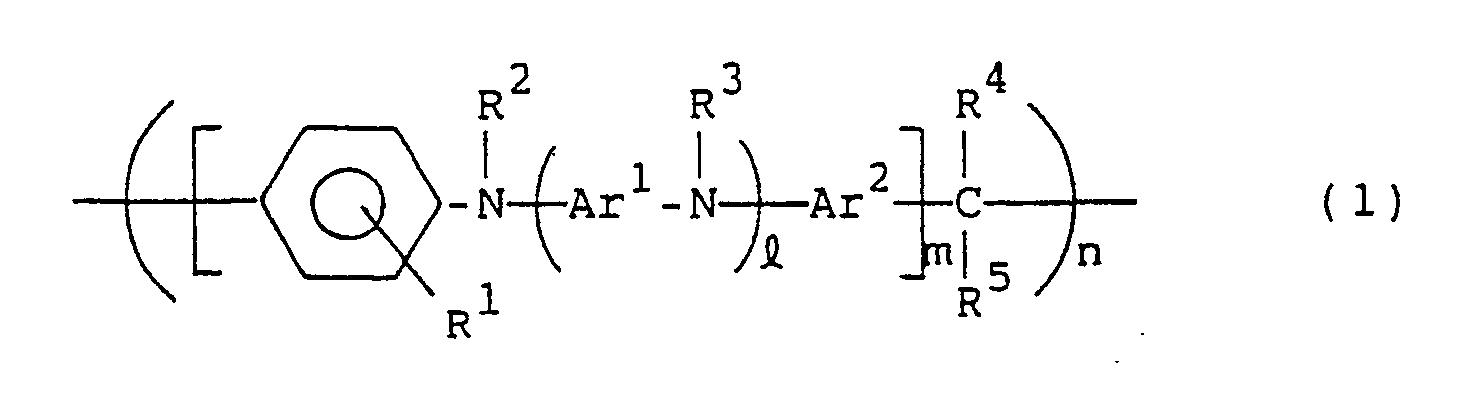
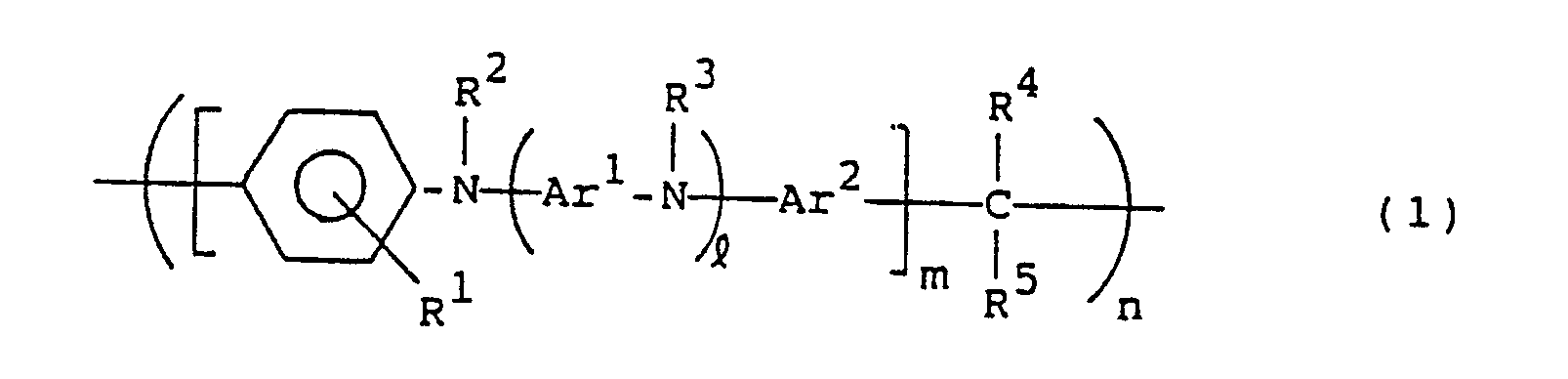
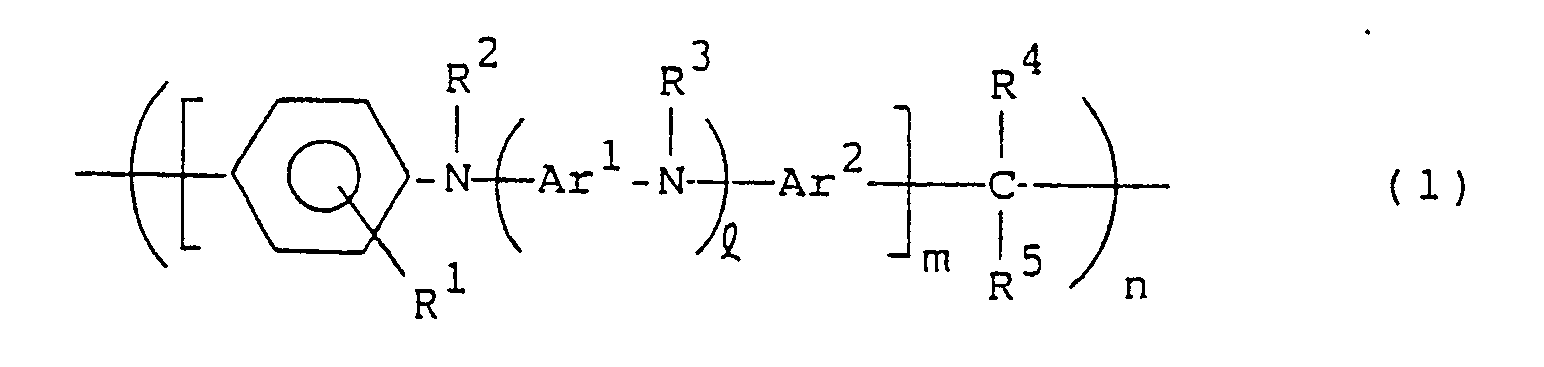
- the present invention resides in a hole carrying material constituted by a compound of the following general formula (1): wherein R1, R2, R3 R4 and R5, which may be the same or different, are each hydrogen or a hydrocarbon residue having 1 to 20 carbon atoms; Ar1 and Ar2 are each a divalent aromatic hydrocarbon residue; l is an integer of 0 or more; m is an integer of 1 or more; and n is an integer of 2 or more.
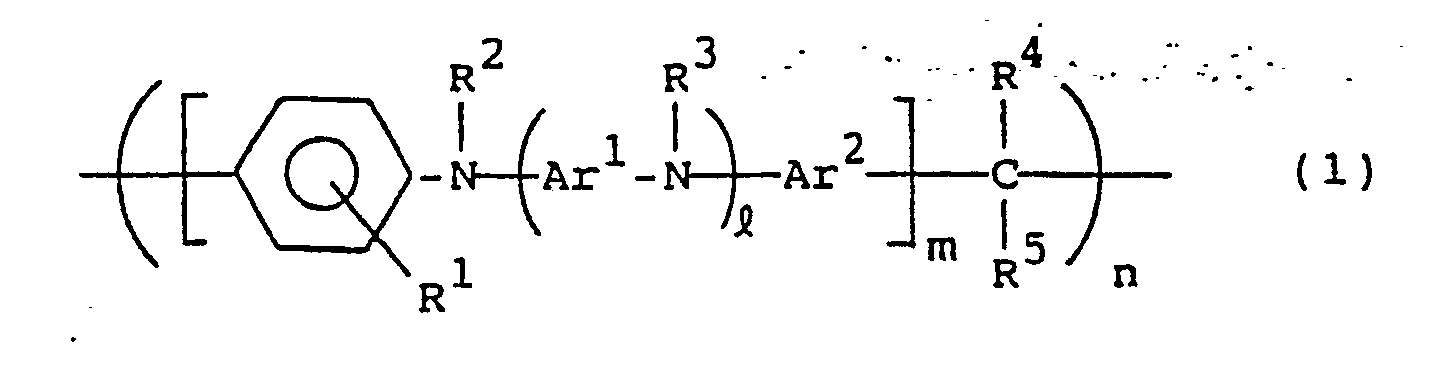
- the present invention resides in a photoconductor constituted by a compound of the following general formula (1): wherein R1, R2, R3, R4 and R5, which may be the same or different, are each hydrogen or a hydrocarbon residue having 1 to 20 carbon atoms; Ar1 and Ar2 are each a divalent aromatic hydrocarbon residue; l is an integer of 0 or more; m is an integer of 1 or more; and n is an integer of 2 or more.
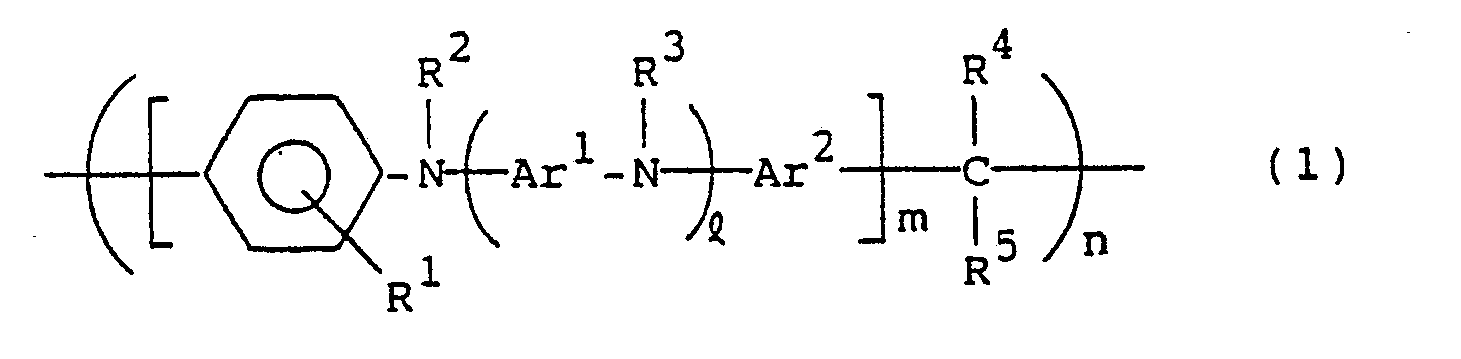
- the present invention resides in a hole transporting material for an electroluminescent device constituted by a compound of the following general formula (1): wherein R1, R2, R3, R4 and R5, which may be the same or different, are each hydrogen or a hydrocarbon residue having 1 to 20 carbon atoms; Ar1 and Ar2 are each a divalent aromatic hydrocarbon residue; l is an integer of 0 or more; m is an integer of 1 or more; n is an integer of 2 or more.
- the "hole transporting material” as referred to herein indicates a material capable of mainly holes alone.
- the hole transporting material of the present invention is characterized by being represented by the general formula (1).
- R1, R2, R3, R4 and R5 are each independently hydrogen or a hydrocarbon residue having 1 to 20, preferably 1 to 12, carbon atoms.
- the substituents R1 to R5 may be the same as or different from one another.
- Preferred examples of R1, R2 and R3 are hydrogen and hydrocarbon residues such as alkyl groups, preferably alkyl groups having 1 to 8 carbon atoms e.g. methyl, ethyl, n-propyl, i-propyl, n-butyl, i-butyl and n-hexyl, alkoxyphenyl groups, e.g.
- R4 and R5 are hydrogen and hydrocarbon residues such as alkyl groups, e.g. methyl, ethyl, n-propyl, i-propyl, n-butyl, i-butyl and n-hexyl, alkoxyphenyl groups, e.g.
- methoxyphenyl and ethoxyphenyl alkylphenyl groups, e.g. tolyl and ethylphenyl, aryl groups, e.g. phenyl, chlorophenyl and nitrophenyl, aralkyl groups, and derivatives thereof, furyl, and pyridyl.
- Ar1 and Ar2 in the compounds of the general formula (1) each represent a divalent aromatic hydrocarbon residue, and both may be the same or different.
- Ar1 are functional groups represented by the following general formulae (2), (3) and (4): wherein R1 is the same as in the general formula (1).
- Preferred examples are phenylene groups such as p-phenylene, m-phenylene, p-biphenylene, methyl-p-phenylene, ethyl-p-phenylene, methoxy-p-phenylene, methyl-m-phenylene, ethyl-m-phenylene, methoxy-m-phenylene, and derivatives thereof.
- Ar2 are, in addition to the above phenylene groups of the general formulae (2), (3), (4) and derivatives thereof, divalent monocyclic or condensed polycyclic aromatic hydrocarbon residues such as 1,5- or 2,7-naphthylene, 1,4-, 1,5- or 2,6-anthraquinonylene, and benzanthronylene, as well as divalent hereto atom-containing condensed heterocyclic aromatic hydrocarbon residues, for example, divalent heterocyclic groups such as 2-phenylbenzoxazolediyl, 2-phenylbenzimidazoleyl, carbazolediyl, 2-phenylbenzothiazolediyl, 2-phenylbenzotriazolediyl, dibenzothiophenediyl, dibenzothiophenoxidediyl, 9-acridonediyl, xanthonediyl, and phenoxazinediyl.
- divalent heterocyclic groups such as 2-pheny
- l is an integer of 0 or more, usually 0 to 50, preferably 0 to 10, more preferably 0 to 5, most preferably 1 to 5; m is an integer of 1 or more, usually 1 to 50, preferably 1 to 30 more preferably 1 to 10; and n is an integer of 2 or more, usually 2 to 1000, preferably 5 to 500, more preferably 20 to 200,
- the compounds in question have a substantially linear structure.
- n is usually larger than 20, preferably 30 to 1000, more preferably 40 to 200, in order to further enhance the effect of the present invention.
- Both ends of the formula (1) are not specially limited, but are usually nuclear-substituted hydrogens.
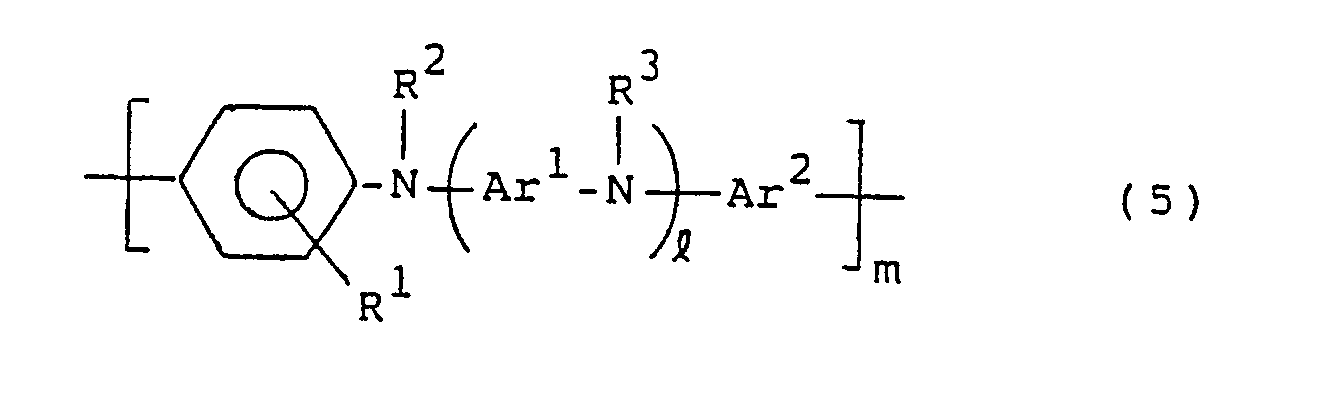
- the compounds of the general formula (1) are usually prepared by polycondensation of compounds of the following general formula (5) and compounds of the following general formula (6) or polymers thereof, but their preparation is not limited to this method: R4COR5 (6) wherein R1, R2, R3, R4, R5, Ar1, Ar2, and l and m are the same as in the general formula (1).
- Examples of the compounds represented by the general formula (5) include N,N′-diphenyl-p-phenylenediamine compounds and N-phenyl-N′-(4-phenylamino)phenyl-p-phenylenediamine compounds.
- those wherein m is 2 or more are usually prepared by subjecting compounds of the same general formula wherein m is 1 to an oxidative coupling reaction using an oxidizing agent such as a manganese compound or ferric salt or to an electrolytic oxidative polymerization.
- an oxidizing agent such as a manganese compound or ferric salt
- an electrolytic oxidative polymerization for example, in the case of an N,N′-diphenyl-p-phenylenediamine compound as a compound of the general formula (5) wherein m ⁇ 2, it can be prepared by an oxidative coupling reaction of N,N′-diphenyl-p-phenylenediamine in a solvent such as ethanol, acetone, acetonitrile, ether, or benzene, using ferric chloride as a catalyst. In this case, the reaction can be carried out at a temperature in the range of from -50°C to 100°C, preferably from -20°C up to the boiling point of the solvent used
- N,N′-diphenyl-p-phenylene-diamine compounds there are mentioned N,N′-dimethyl-N,N′-diphenyl-p-phenylenediamine, N,N′-diethyl-N,N′-diphenyl-p-phenylenediamine, and N,N′-dipropyl-N,N′-diphenyl-p-phenylenediamine.
- N,N′-diphenyl-p-phenylenediamine compounds are also prepared by a conventional method, for example, by a method in which aromatic amines and aromatic hydroxy compounds are reacted in an organic solvent in the presence of a transition metal catalyst or by a method in which phthalic acid ester is used as a starting material. More concrete contents of these methods are described in Japanese Patent Laid Open No. 38311/1980 and Journal of Polymer Science, Part C, 22, p.451 (1968).
- carbonyl compounds such as aldehydes, polymers of aldehydes and ketones.
- aldehydes include formaldehyde, acetaldehyde, propionaldehyde, butyladehyde, benzaldehyde, acrylaldehyde, cinnamaldehyde, anisaldehyde, nicotinic aldehyde, nitrobenzaldehyde, chlorobenzaldehyde, and furfural.
- the polymers of aldehydes represent polymers which are obtained by self-condensation of aldehydes of the general formula (6) in the form of concentrated solutions or by condensation thereof in the presence of an acid catalyst and which hydrolyze easily under the reaction conditions for preparing the copolymer of the invention and form aldehyde monomers.
- Typical examples of such aldehyde polymers include paraformaldehyde which is a polymer of formaldehyde and paraldehyde which is trimer of acetaldehyde.
- ketones there are mentioned acetone, ethyl methyl ketone, diethyl ketone, and cyclohexylacetone.
- the polycondensation of a compound of the general formula (5) and a compound of the general formula (6) can be performed in an organic solvent in which both are soluble, at a temperature of 0° to 200°C, using an acid or alkali catalyst.
- acid catalysts there are mentioned inorganic acids such as sulfuric acid, hydrochloric acid, phosphoric acid, perchloric acid and diphosphorus pentoxide, as well as organic acids such as formic acid, acetic acid, propionic acid, methanesulfonic acid and p-toluenesulfonic acid. These acids may be used each alone or in combination of two or more.
- organic solvents include ethers such as ethyl ether, tetrahydrofuran and dioxane, halogenated hydrocarbons such as chloroform, dichloromethane and chlorobenzene, nitro compounds such as nitrobenzene, as well as acetonitrile, propylene carbonate, dimethylformamide, and N-methylpyrrolidone.
- a suitable reaction time can be selected in the range of 1 minute to 500 hours, preferably 5 minutes to 200 hours.
- the compound of the general formula (1) thus prepared in the present invention is a thermoplastic resin which is solvent-soluble, can be melted by heating, is superior in processability and can afford various moldings of desired shapes and that having a high mechanical strength.
- the compound in question further possesses a high hole transporting ability. Therefore, a hole transporting material using this compound is per se superior in moldability, thus permitting the formation of a thin film having a uniforn thickness of a submicron order. Further, since a matrix polymer is not needed, the said hole transporting material has a high hole mobility as compared with conventional hole transporting materials of this sort.
- the hole transporting material of the present invention is applicable to various uses. For example, it is suitable as a photoconductor typified by an organic photoreceptor in electrophotography or as a hole transporting material for ELD. It per se can afford a large area and exhibits a high hole transporting ability.
- the polymer thus obtained was dissolved in chloroform, and using the resulting solution, a polymer film was formed on a copper plate according to a casting method.
- a charge carrier mobility was determined according to a time-of-flight method (TOF method); as a result, a hole mobility of 10 ⁇ 6 cm2/V ⁇ sec was observed.
- Example 2 Reaction was performed in the same way as in Example 1 except that 1.5 g of N,N′-ditolyl-N,N′-diphenyl-p-phenylenediamine was used in place of N,N′-dimethyl-N,N′-diphenyl-p-phenylenediamine, to afford 1.1 g of a light greyish white powder.
- a charge carrier mobility was determined by the TOF method in the same manner as in Example 1, which was found to be 10 ⁇ 4 cm2/V ⁇ sec.
- the powder thus obtained was found to be a high polymer having an elution curve peak-top molecular weight of about 9,000 (degree of polymerization: about 31). Further, this polymer was determined for 1H-NMR, 13C-NMR (Fig. 2) and IR spectra; as a result, it proved to have the following structure:
- Example 3 Reaction was performed in the same way as in Example 3 except that the reaction time was changed from 4 to 8 hours, to afford 2.6 g of a white powder.
- the powder thus obtained was found to have an elution curve peak-top molecular weight of about 33,000 and a polymerization degree of about 100.
- a charge carrier mobility was determined in the same mannera as in Example 1, which was found to be 10 ⁇ 4 cm2/V ⁇ sec.
- the photoconductor according to the present invention per se is modable and affords moldings superior in mechanical strength. Besides, it possesses a high hole carrying ability.
Landscapes
- Chemical & Material Sciences (AREA)
- Spectroscopy & Molecular Physics (AREA)
- Health & Medical Sciences (AREA)
- Chemical Kinetics & Catalysis (AREA)
- Medicinal Chemistry (AREA)
- Polymers & Plastics (AREA)
- Organic Chemistry (AREA)
- Physics & Mathematics (AREA)
- Photoreceptors In Electrophotography (AREA)
- Electroluminescent Light Sources (AREA)
- Organic Low-Molecular-Weight Compounds And Preparation Thereof (AREA)
- Macromolecular Compounds Obtained By Forming Nitrogen-Containing Linkages In General (AREA)
- Polymers With Sulfur, Phosphorus Or Metals In The Main Chain (AREA)
- Luminescent Compositions (AREA)
- Polysaccharides And Polysaccharide Derivatives (AREA)
- Peptides Or Proteins (AREA)
Abstract
Description
- The present invention relates to a novel hole transporting material.
- With development of the electronics field there is a demand for a material capable of efficiently transporting either electrons or holes in fabricating various electronics devices.
- Hole transporting materials which carry only holes in high efficiency are now in wide use as photoreceptor in electrophotography, and their application to organic electroluminescent devices is expected.
- For example, an organic photoconductor (hereinafter referred to simply as "OPC") has recently attracted attention of many concerns in quick tempo as an organic photoreceptor mainly in its application to electrophotography. When used as a photoreceptor, OPC plays the role of a carrier transporting material.
- OPC possesses various features, such as improved processability, easy to constitute a device, good electric charge accepting and holding properties, and advantage in cost. Therefore, researches are being made energetically not only about using OPC as a substitute for photoreceptor using inorganic materials but also about the development of a organic photoreceptor of OPC having a new performance.
- Heretofore, various organic photoconductive compounds have been known as OPC's. Typical examples include various low molecular weight organic compounds such as triphenylamine derivatives, pyrazoline derivatives, oxadiazole derivatives, indoline derivatives and carbazole derivatives. These various OPC's per se are low molecular compounds, so unmoldable, and the large area which is required for a photoreceptor cannot be attained by the use of them. For example, therefore, such OPC's are mixed and dispersed in a transparent high polymer such as polycarbonate as a matrix polymer to prepare OPC photoreceptor.
- Therefore, a restriction is placed on the OPC content in the matrix polymer. At a high OPC concentration, dispersibility of OPC in the matrix becomes less uniform so it has been difficult to use OPC at a high concentration. For this reason, a limit is also reached in the carrier transporting ability in a OPC photoreceptor, that is, it is impossible to attain a high carrier mobility. Under the circumstances it has been desired to develop an OPC having superior photoconductivity.
- An electroluminescent device (ELD) has long been noted as a thin large-area light source. With the recent spread and reduction in size and weight of office automation (OA) devices, a liquid crystal display has come to be widely adopted as a display device, and now there is an increasing expectation for ELD as a back light for the liquid crystal display.
- ELD, which is a thin, flat-shape light emitting device of a light weight, possesses such features as no flicker on the screen, a wide visual angle and a low power consumption. However, since the ELD which has heretofore been put to practical use is operated by a light emitting mechanism called a collision excitation type, it is necessary to use a high driving AC voltage of 200 volts or so; besides, the light emission efficiency is low and the luminescence is also low.
- C.W. Tang et al. [Appl. Phys. Lett. 51(12), 913 (1987)] manufactured for trial an organic thin film ELD of an injection type different from the conventional light emitting mechanism, and showed that the drawbacks of the conventional AC voltage driven, collision excitation type ELD. An injection type ELD is basically of a sandwich structure wherein a light emitting layer is sandwiched in between an electron injection electrode and a hole injection electrode. But, according to the ELD developed by C.W. Tang et al., an arylamine-based organic hole transporting layer is formed by vapor deposition between the light emitting layer and the hole injection electrode, and as the electron injection electrode there is used a metal having a small work function such as, for example, magnesium, whereby they showed that the ELD could be driven at a low DC voltage of several tens of volts or so and that a high luminance light emission comparable to that of a light emitting diode could be attained. It is apparent that an important component for fabricating a low DC voltage driven, organic thin film ELD of high luminance is an organic hole transporting layer. In order to obtain an ELD of a practical level and a higher performance it is desired to obtain a hole transporting material which can be easily made uniform and small in film thickness. Particularly, for fabricating an ELD of a large area on an industrial scale it is necessary to form a thin hole transporting film having a uniform thickness, free of defects such as pin-holes and high in reliability. But it cannot be said that the conventional means such as vapor deposition satisfy those requirements.
- Thus, the conventional hole transporting materials involve various problems.
- It is an object of the present invention to solve the above-mentioned problems of the prior art.
- It is another object of the present invention to provide a novel hole transporting material having extremely superior hole transporting ability and processability, that is, capable of overcoming all of the problems of the conventional OPC's and hole moving materials typified by hole transporting materials for ELD.
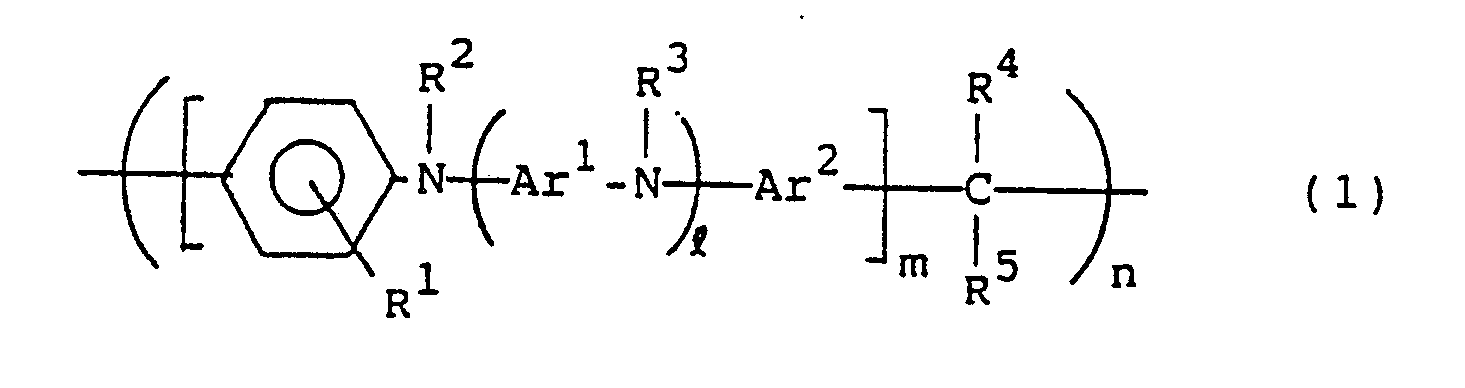
- In one aspect the present invention resides in a hole carrying material constituted by a compound of the following general formula (1):
- In another aspect the present invention resides in a photoconductor constituted by a compound of the following general formula (1):
- In a further aspect the present invention resides in a hole transporting material for an electroluminescent device constituted by a compound of the following general formula (1):
- The present invention will be described in detail below.
- The "hole transporting material" as referred to herein indicates a material capable of mainly holes alone. The hole transporting material of the present invention is characterized by being represented by the general formula (1).
- In the compounds of the general formula (1), R¹, R², R³, R⁴ and R⁵ are each independently hydrogen or a hydrocarbon residue having 1 to 20, preferably 1 to 12, carbon atoms. The substituents R¹ to R⁵ may be the same as or different from one another. Preferred examples of R¹, R² and R³ are hydrogen and hydrocarbon residues such as alkyl groups, preferably alkyl groups having 1 to 8 carbon atoms e.g. methyl, ethyl, n-propyl, i-propyl, n-butyl, i-butyl and n-hexyl, alkoxyphenyl groups, e.g. methoxyphenyl and ethoxyphenyl, alkylphenyl groups, e.g. tolyl and ethylphenyl, aryl groups, preferably aryl groups having 6 to 10 carbon atoms, e.g. phenyl, aralkyl groups, and derivatives thereof. Preferred examples of R⁴ and R⁵ are hydrogen and hydrocarbon residues such as alkyl groups, e.g. methyl, ethyl, n-propyl, i-propyl, n-butyl, i-butyl and n-hexyl, alkoxyphenyl groups, e.g. methoxyphenyl and ethoxyphenyl, alkylphenyl groups, e.g. tolyl and ethylphenyl, aryl groups, e.g. phenyl, chlorophenyl and nitrophenyl, aralkyl groups, and derivatives thereof, furyl, and pyridyl.
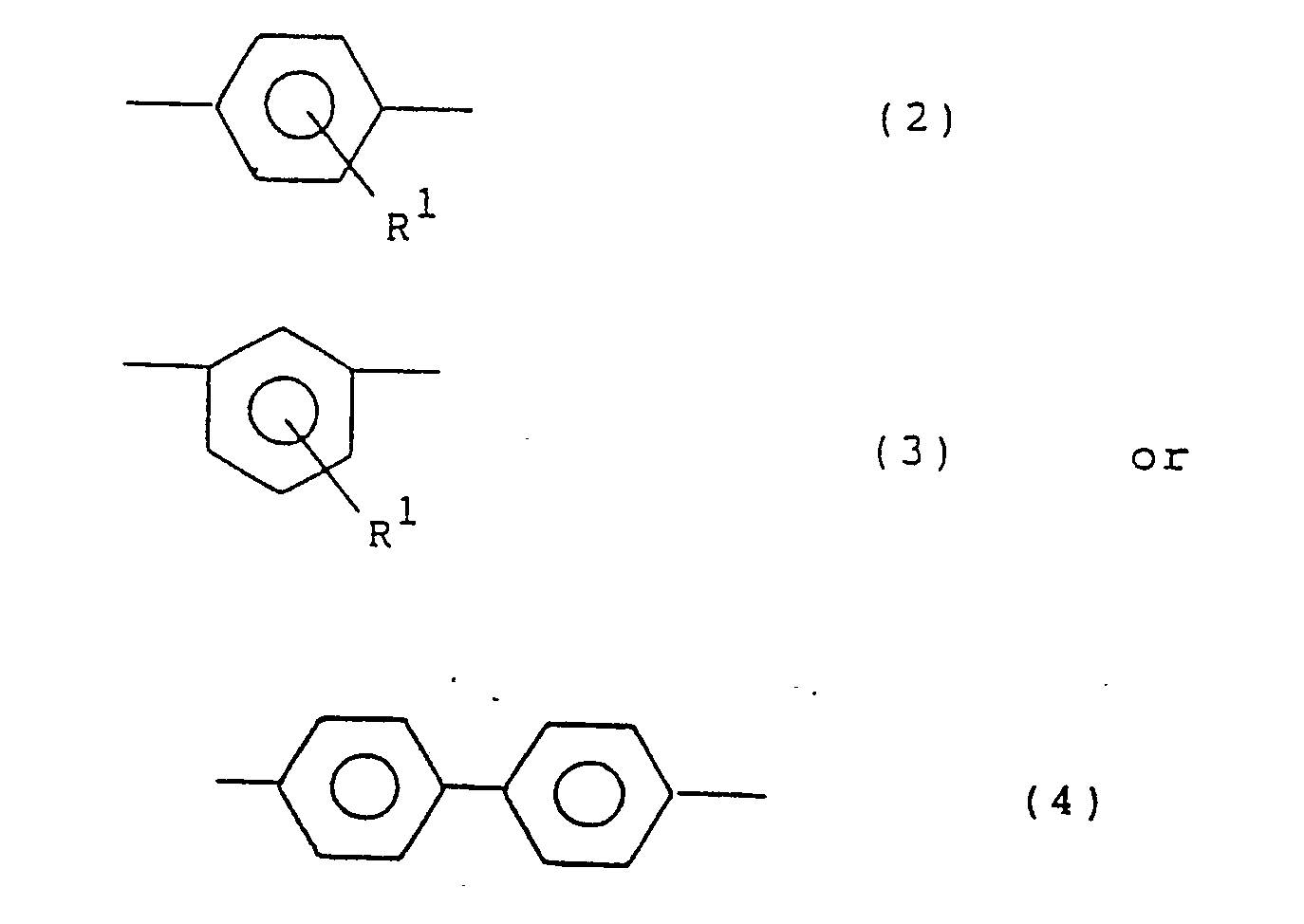
- Ar¹ and Ar² in the compounds of the general formula (1) each represent a divalent aromatic hydrocarbon residue, and both may be the same or different. Examples of Ar¹ are functional groups represented by the following general formulae (2), (3) and (4):
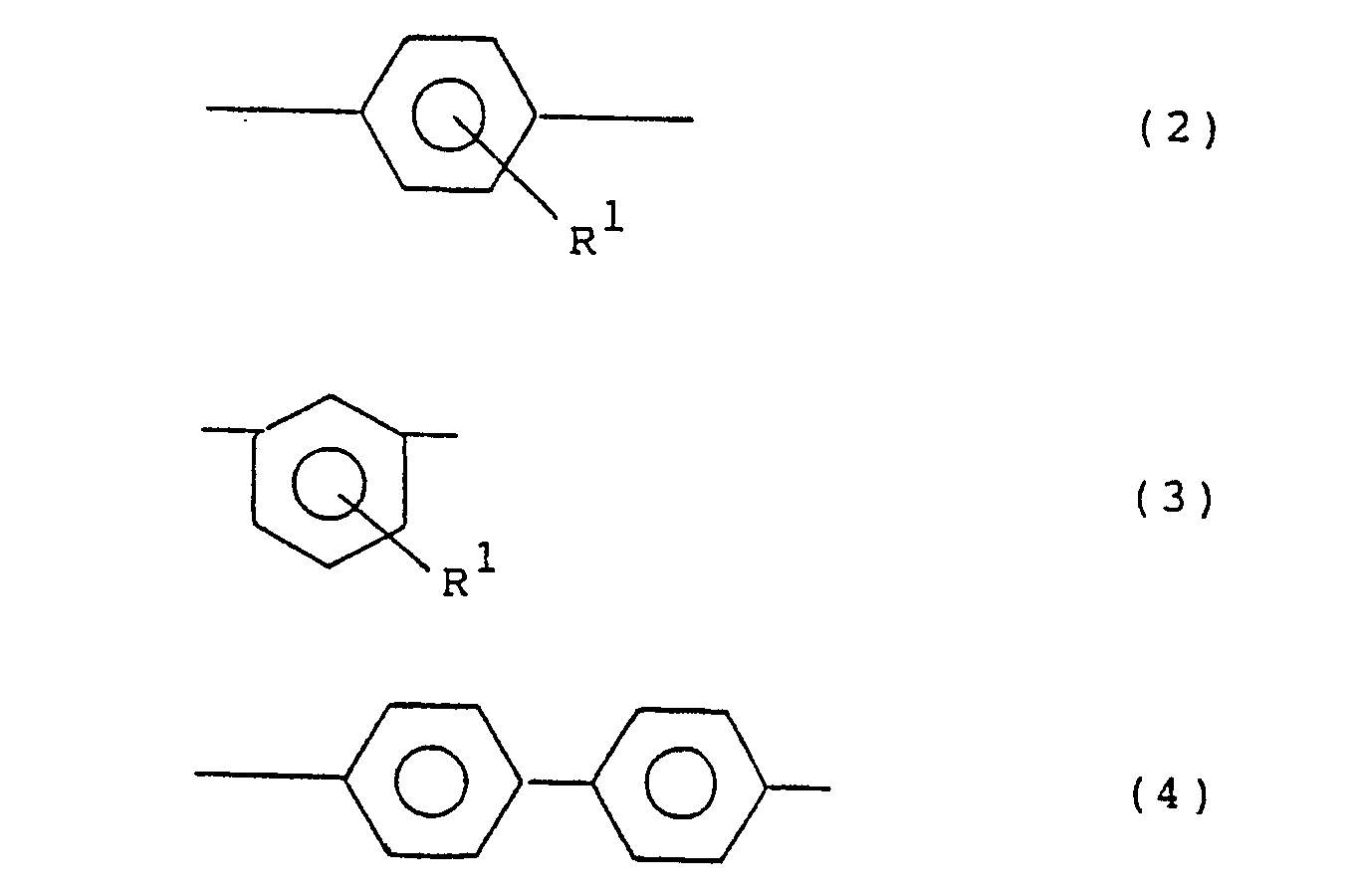
- Preferred examples of Ar² are, in addition to the above phenylene groups of the general formulae (2), (3), (4) and derivatives thereof, divalent monocyclic or condensed polycyclic aromatic hydrocarbon residues such as 1,5- or 2,7-naphthylene, 1,4-, 1,5- or 2,6-anthraquinonylene, and benzanthronylene, as well as divalent hereto atom-containing condensed heterocyclic aromatic hydrocarbon residues, for example, divalent heterocyclic groups such as 2-phenylbenzoxazolediyl, 2-phenylbenzimidazoleyl, carbazolediyl, 2-phenylbenzothiazolediyl, 2-phenylbenzotriazolediyl, dibenzothiophenediyl, dibenzothiophenoxidediyl, 9-acridonediyl, xanthonediyl, and phenoxazinediyl. ℓ is an integer of 0 or more, usually 0 to 50, preferably 0 to 10, more preferably 0 to 5, most preferably 1 to 5; m is an integer of 1 or more, usually 1 to 50, preferably 1 to 30 more preferably 1 to 10; and n is an integer of 2 or more, usually 2 to 1000, preferably 5 to 500, more preferably 20 to 200, The compounds in question have a substantially linear structure. When ℓ = 0 and m = 1, n is usually larger than 20, preferably 30 to 1000, more preferably 40 to 200, in order to further enhance the effect of the present invention. Both ends of the formula (1) are not specially limited, but are usually nuclear-substituted hydrogens.
- The compounds of the general formula (1) are usually prepared by polycondensation of compounds of the following general formula (5) and compounds of the following general formula (6) or polymers thereof, but their preparation is not limited to this method:
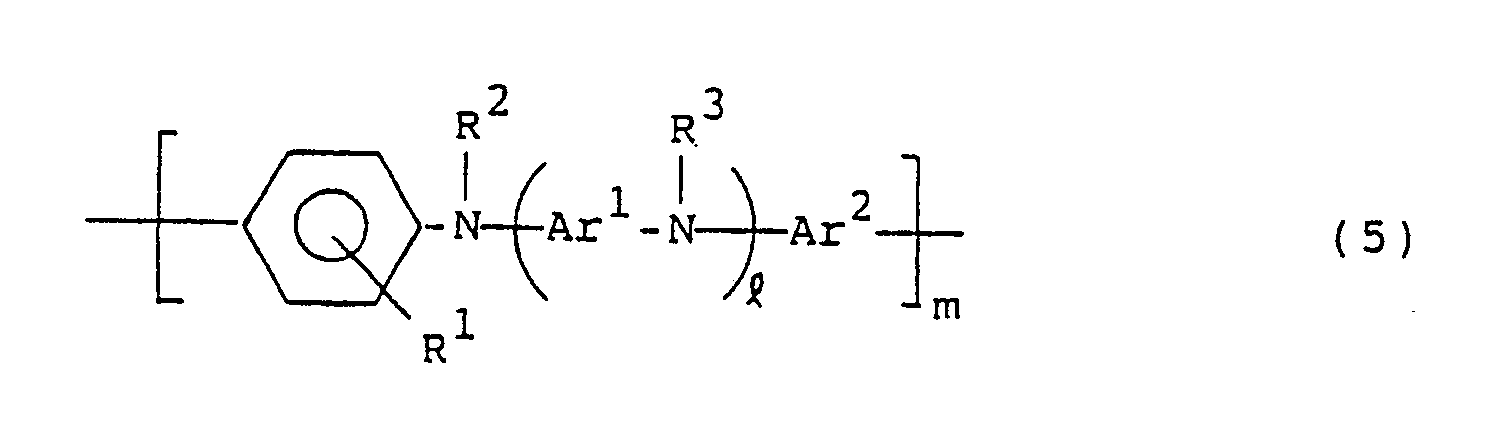
wherein R¹, R², R³, R⁴, R⁵, Ar¹, Ar², and ℓ and m are the same as in the general formula (1). - Examples of the compounds represented by the general formula (5) include N,N′-diphenyl-p-phenylenediamine compounds and N-phenyl-N′-(4-phenylamino)phenyl-p-phenylenediamine compounds.
- Among the compounds of the general formula (5), those wherein m is 2 or more are usually prepared by subjecting compounds of the same general formula wherein m is 1 to an oxidative coupling reaction using an oxidizing agent such as a manganese compound or ferric salt or to an electrolytic oxidative polymerization. For example, in the case of an N,N′-diphenyl-p-phenylenediamine compound as a compound of the general formula (5) wherein m ≧ 2, it can be prepared by an oxidative coupling reaction of N,N′-diphenyl-p-phenylenediamine in a solvent such as ethanol, acetone, acetonitrile, ether, or benzene, using ferric chloride as a catalyst. In this case, the reaction can be carried out at a temperature in the range of from -50°C to 100°C, preferably from -20°C up to the boiling point of the solvent used, for 10 minutes to 100 hours, preferably 1 to 50 hours.
- As typical examples of such N,N′-diphenyl-p-phenylene-diamine compounds there are mentioned N,N′-dimethyl-N,N′-diphenyl-p-phenylenediamine, N,N′-diethyl-N,N′-diphenyl-p-phenylenediamine, and N,N′-dipropyl-N,N′-diphenyl-p-phenylenediamine.
- Other compounds of the general formula (5) than the N,N′-diphenyl-p-phenylenediamine compounds are also prepared by a conventional method, for example, by a method in which aromatic amines and aromatic hydroxy compounds are reacted in an organic solvent in the presence of a transition metal catalyst or by a method in which phthalic acid ester is used as a starting material. More concrete contents of these methods are described in Japanese Patent Laid Open No. 38311/1980 and Journal of Polymer Science, Part C, 22, p.451 (1968).
- As examples of compounds represented by the general formula (6) there are mentioned carbonyl compounds such as aldehydes, polymers of aldehydes and ketones.
- Typical examples of aldehydes include formaldehyde, acetaldehyde, propionaldehyde, butyladehyde, benzaldehyde, acrylaldehyde, cinnamaldehyde, anisaldehyde, nicotinic aldehyde, nitrobenzaldehyde, chlorobenzaldehyde, and furfural.
- The polymers of aldehydes represent polymers which are obtained by self-condensation of aldehydes of the general formula (6) in the form of concentrated solutions or by condensation thereof in the presence of an acid catalyst and which hydrolyze easily under the reaction conditions for preparing the copolymer of the invention and form aldehyde monomers. Typical examples of such aldehyde polymers include paraformaldehyde which is a polymer of formaldehyde and paraldehyde which is trimer of acetaldehyde.
- As examples of ketones there are mentioned acetone, ethyl methyl ketone, diethyl ketone, and cyclohexylacetone.
- The polycondensation of a compound of the general formula (5) and a compound of the general formula (6) can be performed in an organic solvent in which both are soluble, at a temperature of 0° to 200°C, using an acid or alkali catalyst. As examples of acid catalysts there are mentioned inorganic acids such as sulfuric acid, hydrochloric acid, phosphoric acid, perchloric acid and diphosphorus pentoxide, as well as organic acids such as formic acid, acetic acid, propionic acid, methanesulfonic acid and p-toluenesulfonic acid. These acids may be used each alone or in combination of two or more. Preferred examples of organic solvents include ethers such as ethyl ether, tetrahydrofuran and dioxane, halogenated hydrocarbons such as chloroform, dichloromethane and chlorobenzene, nitro compounds such as nitrobenzene, as well as acetonitrile, propylene carbonate, dimethylformamide, and N-methylpyrrolidone. A suitable reaction time can be selected in the range of 1 minute to 500 hours, preferably 5 minutes to 200 hours.
- The compound of the general formula (1) thus prepared in the present invention is a thermoplastic resin which is solvent-soluble, can be melted by heating, is superior in processability and can afford various moldings of desired shapes and that having a high mechanical strength. The compound in question further possesses a high hole transporting ability. Therefore, a hole transporting material using this compound is per se superior in moldability, thus permitting the formation of a thin film having a uniforn thickness of a submicron order. Further, since a matrix polymer is not needed, the said hole transporting material has a high hole mobility as compared with conventional hole transporting materials of this sort. The hole transporting material of the present invention is applicable to various uses. For example, it is suitable as a photoconductor typified by an organic photoreceptor in electrophotography or as a hole transporting material for ELD. It per se can afford a large area and exhibits a high hole transporting ability.
- The present invention will be described below more fully by the following examples, but the invention is not limited thereto.
- 1.00 g of N,N′-dimethyl-N,N′-diphenyl-p-phenylenediamine was placed in a three-necked 100 ml flask which had been purged with nitrogen, then 15 ml of nitrobenzene and 6 ml of acetic acid were added and dissolved therein. Thereafter, 120 µl of sulfuric acid and 250 µl of propionaldehyde were added and reaction was allowed to take place at 50°C for 140 hours under stirring. The reaction solution was poured into 300 ml of ethanol containing 30 ml of NaOH and the resulting precipitate of reddish brown was filtered off, then washed with ethanol and distilled water, followed by drying to afford 0.85 g of a reddish brown powder. The powder was determined for ¹H-NMR, ¹³C-NMR and IR (Fig. 1) spectra; as a result, it proved to have the following structure:

6.82 - 7.20 (m), 3.65 (m), 2.97 (m), 2.02 (m), 0.92 (t)
¹³C-NMR(CDCℓ₃) : (ppm)
147.4, 143.7, 137.4, 128.4, 122.6, 118.6, 51.8, 40.4, 28.9, 12.9 - The polymer thus obtained was dissolved in chloroform, and using the resulting solution, a polymer film was formed on a copper plate according to a casting method. With respect to the polymer film thus formed, a charge carrier mobility was determined according to a time-of-flight method (TOF method); as a result, a hole mobility of 10⁻⁶ cm²/V·sec was observed.
- Reaction was performed in the same way as in Example 1 except that 1.5 g of N,N′-ditolyl-N,N′-diphenyl-p-phenylenediamine was used in place of N,N′-dimethyl-N,N′-diphenyl-p-phenylenediamine, to afford 1.1 g of a light greyish white powder. With respect to the this powder, a charge carrier mobility was determined by the TOF method in the same manner as in Example 1, which was found to be 10⁻⁴ cm²/V·sec.
- 2.5 g of N-tolyldiphenyl amine was placed in a three-necked 100 ml flask which had been purged with nitrogen, then 20 ml of nitrobenzene was added and dissolved therein. Thereafter, 40 mg of p-toluenesulfonic acid and 0.6 ml of paraldehyde were added and reaction was allowed to take place at 80°C for 4 hours. The reaction solution was poured into 300 ml of ethanol and the resulting precipitate of greyish white was filtered off, washed with ethanol and distilled water, then re-precipitated in a chloroform-ethanol system for purification, followed by drying to afford 2.6 g of a white powder. As a result of GPC determination the powder thus obtained was found to be a high polymer having an elution curve peak-top molecular weight of about 9,000 (degree of polymerization: about 31). Further, this polymer was determined for ¹H-NMR, ¹³C-NMR (Fig. 2) and IR spectra; as a result, it proved to have the following structure:
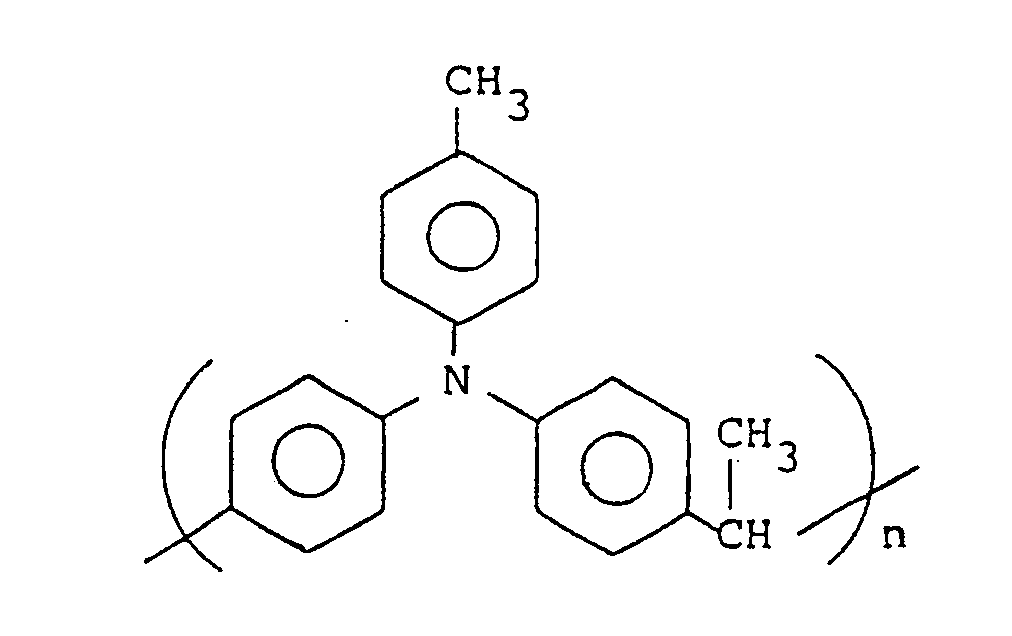
- Also, a charge carrier mobility was determined in the same manner in Example 1; as a result, a hole mobility of 10⁻⁴ cm²/V·sec was observed.
- Reaction was performed in the same way as in Example 3 except that the reaction time was changed from 4 to 8 hours, to afford 2.6 g of a white powder. As a result of GPC determination the powder thus obtained was found to have an elution curve peak-top molecular weight of about 33,000 and a polymerization degree of about 100. Further, a charge carrier mobility was determined in the same mannera as in Example 1, which was found to be 10⁻⁴ cm²/V·sec.
- As set forth hereinabove, the photoconductor according to the present invention per se is modable and affords moldings superior in mechanical strength. Besides, it possesses a high hole carrying ability.
-
- Fig. 1 is an infrared adsorption spectrum diagram of the copolymer obtained in Example 1; and
- Fig. 2 is a ¹³C-NMR spectrum diagram of the copolymer obtained in Example 3.
Claims (8)
wherein R¹, R², R³, R⁴, R⁵, Ar¹, Ar², ℓ and m are as defined Claim 1.
Applications Claiming Priority (4)
| Application Number | Priority Date | Filing Date | Title |
|---|---|---|---|
| JP30994088 | 1988-12-09 | ||
| JP309940/88 | 1988-12-09 | ||
| JP222840/89 | 1989-08-31 | ||
| JP1222840A JPH02282263A (en) | 1988-12-09 | 1989-08-31 | Hole transferring material |
Publications (2)
| Publication Number | Publication Date |
|---|---|
| EP0372979A2 true EP0372979A2 (en) | 1990-06-13 |
| EP0372979A3 EP0372979A3 (en) | 1990-10-31 |
Family
ID=26525115
Family Applications (1)
| Application Number | Title | Priority Date | Filing Date |
|---|---|---|---|
| EP19890312802 Withdrawn EP0372979A3 (en) | 1988-12-09 | 1989-12-08 | Hole transporting material |
Country Status (4)
| Country | Link |
|---|---|
| US (1) | US5116708A (en) |
| EP (1) | EP0372979A3 (en) |
| JP (1) | JPH02282263A (en) |
| CA (1) | CA2004880C (en) |
Cited By (10)
| Publication number | Priority date | Publication date | Assignee | Title |
|---|---|---|---|---|
| US5728801A (en) * | 1996-08-13 | 1998-03-17 | The Dow Chemical Company | Poly (arylamines) and films thereof |
| EP0827366A3 (en) * | 1996-08-27 | 1998-08-19 | Hewlett-Packard Company | Heat-resistant organic electroluminescent device |
| US5929194A (en) * | 1996-02-23 | 1999-07-27 | The Dow Chemical Company | Crosslinkable or chain extendable polyarylpolyamines and films thereof |
| EP1357436A2 (en) | 2002-04-26 | 2003-10-29 | Canon Kabushiki Kaisha | Electrophotographic photosensitive member, process cartridge, and electrophotographic apparatus |
| WO2004014985A1 (en) * | 2002-08-09 | 2004-02-19 | Tosoh Corporation | Novel triarylamine polymer, process for producing the same, and use thereof |
| US7960587B2 (en) | 2004-02-19 | 2011-06-14 | E.I. Du Pont De Nemours And Company | Compositions comprising novel compounds and electronic devices made with such compositions |
| US8236990B2 (en) | 2004-03-31 | 2012-08-07 | E I Du Pont De Nemours And Company | Triarylamine compounds, compositions and uses therefor |
| US8648333B2 (en) | 2009-10-19 | 2014-02-11 | E I Du Pont De Nemours And Company | Triarylamine compounds for use in organic light-emitting diodes |
| US8716697B2 (en) | 2004-02-20 | 2014-05-06 | E I Du Pont De Nemours And Company | Electronic devices made with crosslinkable compounds and copolymers |
| US8937300B2 (en) | 2009-10-19 | 2015-01-20 | E I Du Pont De Nemours And Company | Triarylamine compounds for use in organic light-emitting diodes |
Families Citing this family (135)
| Publication number | Priority date | Publication date | Assignee | Title |
|---|---|---|---|---|
| JPH02282264A (en) * | 1988-12-09 | 1990-11-19 | Nippon Oil Co Ltd | Hole transferring material |
| US5408109A (en) * | 1991-02-27 | 1995-04-18 | The Regents Of The University Of California | Visible light emitting diodes fabricated from soluble semiconducting polymers |
| US5232801A (en) * | 1991-12-23 | 1993-08-03 | Eastman Kodak Company | Hole-transport liquid crystalline polymeric compounds, electrophotographic elements comprising same, and electrophotographic process |
| US5230976A (en) * | 1991-12-27 | 1993-07-27 | Xerox Corporation | Polymeric arylamine silane compounds and imaging members incorporating same |
| CN1966607A (en) | 1998-12-28 | 2007-05-23 | 出光兴产株式会社 | Materials for Organic Electroluminescent Devices |
| TW463528B (en) | 1999-04-05 | 2001-11-11 | Idemitsu Kosan Co | Organic electroluminescence element and their preparation |
| CN100502087C (en) * | 2002-06-06 | 2009-06-17 | 西巴特殊化学品控股有限公司 | Electroluminescent device |
| JP3913148B2 (en) | 2002-08-30 | 2007-05-09 | キヤノン株式会社 | Electrophotographic photosensitive member, process cartridge, and electrophotographic apparatus |
| US7001699B2 (en) | 2002-08-30 | 2006-02-21 | Canon Kabushiki Kaisha | Electrophotographic photosensitive member, process cartridge and electrophotographic apparatus |
| US9923148B2 (en) | 2002-10-30 | 2018-03-20 | Udc Ireland Limited | Electroluminescent device |
| ATE532386T1 (en) | 2003-07-02 | 2011-11-15 | Idemitsu Kosan Co | ORGANIC ELECTROLUMINENCE COMPONENT AND DISPLAY THEREOF |
| EP1707550B1 (en) | 2003-12-01 | 2016-08-03 | Idemitsu Kosan Co., Ltd. | Asymmetric monoanthracene derivative, material for organic electroluminescent device and organic electroluminescent device utilizing the same |
| WO2005054212A2 (en) * | 2003-12-05 | 2005-06-16 | Ciba Specialty Chemicals Holding Inc. | Electroluminescent device |
| WO2005061656A1 (en) | 2003-12-19 | 2005-07-07 | Idemitsu Kosan Co., Ltd. | Light-emitting material for organic electroluminescent device, organic electroluminescent device using same, and material for organic electroluminescent device |
| EP2371810A1 (en) | 2005-01-05 | 2011-10-05 | Idemitsu Kosan Co., Ltd. | Aromatic amine derivative and organic electroluminescent device using same |
| JP2006310036A (en) * | 2005-04-27 | 2006-11-09 | Dainippon Printing Co Ltd | Substrate for organic electroluminescence device |
| DE602006011734D1 (en) | 2005-05-30 | 2010-03-04 | Basf Se | ELECTROLUMINESCENT DEVICE |
| JP5032317B2 (en) | 2005-07-14 | 2012-09-26 | 出光興産株式会社 | Biphenyl derivative, material for organic electroluminescence device, and organic electroluminescence device using the same |
| JP4848152B2 (en) | 2005-08-08 | 2011-12-28 | 出光興産株式会社 | Aromatic amine derivative and organic electroluminescence device using the same |
| JP2007073814A (en) | 2005-09-08 | 2007-03-22 | Idemitsu Kosan Co Ltd | Organic electroluminescence device using polyarylamine |
| JPWO2007032161A1 (en) | 2005-09-15 | 2009-03-19 | 出光興産株式会社 | Asymmetric fluorene derivatives and organic electroluminescence devices using them |
| CN101268167A (en) | 2005-09-16 | 2008-09-17 | 出光兴产株式会社 | Pyrene derivative and organic electroluminescent device using the same |
| US7538175B2 (en) * | 2005-10-13 | 2009-05-26 | Xerox Corporation | Phenolic hole transport polymers |
| US20070104977A1 (en) | 2005-11-07 | 2007-05-10 | Idemitsu Kosan Co., Ltd. | Organic electroluminescent device |
| JP2007137784A (en) | 2005-11-15 | 2007-06-07 | Idemitsu Kosan Co Ltd | Aromatic amine derivative and organic electroluminescence device using the same |
| WO2007058127A1 (en) | 2005-11-16 | 2007-05-24 | Idemitsu Kosan Co., Ltd. | Aromatic amine derivative and organic electroluminescent element using the same |
| EP1950817A1 (en) | 2005-11-17 | 2008-07-30 | Idemitsu Kosan Co., Ltd. | Organic electroluminescent device |
| WO2007060795A1 (en) | 2005-11-28 | 2007-05-31 | Idemitsu Kosan Co., Ltd. | Amine compound and organic electroluminescent element employing the same |
| JP2007149941A (en) | 2005-11-28 | 2007-06-14 | Idemitsu Kosan Co Ltd | Organic electroluminescence device |
| JP2007153778A (en) | 2005-12-02 | 2007-06-21 | Idemitsu Kosan Co Ltd | Nitrogen-containing heterocyclic derivative and organic electroluminescence device using the same |
| EP1968131A4 (en) | 2005-12-27 | 2009-08-19 | Idemitsu Kosan Co | ORGANIC ELECTROLUMINESCENT DEVICE AND MATERIAL THEREFOR |
| KR20080103056A (en) | 2006-02-23 | 2008-11-26 | 이데미쓰 고산 가부시키가이샤 | Material for organic electroluminescent device, manufacturing method thereof and organic electroluminescent device |
| US9214636B2 (en) | 2006-02-28 | 2015-12-15 | Idemitsu Kosan Co., Ltd. | Organic electroluminescence device |
| JPWO2007105448A1 (en) | 2006-02-28 | 2009-07-30 | 出光興産株式会社 | Naphthacene derivative and organic electroluminescence device using the same |
| TW200740290A (en) | 2006-02-28 | 2007-10-16 | Idemitsu Kosan Co | Organic electroluminescent device using fluoranthene derivative and indenoperylene derivative |
| WO2007102361A1 (en) | 2006-03-07 | 2007-09-13 | Idemitsu Kosan Co., Ltd. | Aromatic amine derivative and organic electroluminescent device using same |
| JPWO2007111263A1 (en) | 2006-03-27 | 2009-08-13 | 出光興産株式会社 | Nitrogen-containing heterocyclic derivative and organic electroluminescence device using the same |
| CN101410382A (en) | 2006-03-27 | 2009-04-15 | 出光兴产株式会社 | Nitrogen-containing heterocyclic derivative and organic electroluminescent element using same |
| WO2007116750A1 (en) | 2006-03-30 | 2007-10-18 | Idemitsu Kosan Co., Ltd. | Material for organic electroluminescent device and organic electroluminescent device using the same |
| KR101453109B1 (en) | 2006-04-26 | 2014-10-27 | 이데미쓰 고산 가부시키가이샤 | Aromatic amine derivative, and organic electroluminescence element using the same |
| JP5432523B2 (en) | 2006-05-11 | 2014-03-05 | 出光興産株式会社 | Organic electroluminescence device |
| JP5097700B2 (en) | 2006-05-11 | 2012-12-12 | 出光興産株式会社 | Organic electroluminescence device |
| EP1933397A4 (en) | 2006-05-25 | 2008-12-17 | Idemitsu Kosan Co | ORGANIC ELECTROLUMINESCENT DEVICE AND COLOR LIGHT EMITTING DEVICE |
| JP4569526B2 (en) * | 2006-06-16 | 2010-10-27 | コニカミノルタホールディングス株式会社 | Materials for electroluminescent elements |
| CN101473464B (en) | 2006-06-22 | 2014-04-23 | 出光兴产株式会社 | Organic electroluminescent element using heterocyclic aromatic amine derivative |
| JP5258562B2 (en) | 2006-06-27 | 2013-08-07 | 出光興産株式会社 | Aromatic amine derivatives and organic electroluminescence devices using them |
| US20090243473A1 (en) | 2006-08-04 | 2009-10-01 | Idemitsu Kosan Co., Ltd. | Organic electroluminescence device |
| US20080049413A1 (en) | 2006-08-22 | 2008-02-28 | Idemitsu Kosan Co., Ltd. | Organic electroluminescence device |
| JP5139297B2 (en) | 2006-08-23 | 2013-02-06 | 出光興産株式会社 | Aromatic amine derivatives and organic electroluminescence devices using them |
| JP2008124157A (en) | 2006-11-09 | 2008-05-29 | Idemitsu Kosan Co Ltd | Organic EL material-containing solution, organic EL material thin film formation method, organic EL material thin film, organic EL element |
| JP2008124156A (en) | 2006-11-09 | 2008-05-29 | Idemitsu Kosan Co Ltd | Organic EL material-containing solution, organic EL material thin film formation method, organic EL material thin film, organic EL element |
| JPWO2008056652A1 (en) | 2006-11-09 | 2010-02-25 | 出光興産株式会社 | Organic EL material-containing solution, organic EL material synthesis method, compound synthesized by this synthesis method, organic EL material thin film formation method, organic EL material thin film, organic EL element |
| WO2008059713A1 (en) | 2006-11-15 | 2008-05-22 | Idemitsu Kosan Co., Ltd. | Fluoranthene compound, organic electroluminescent device using the fluoranthene compound, and organic electroluminescent material-containing solution |
| WO2008062636A1 (en) | 2006-11-24 | 2008-05-29 | Idemitsu Kosan Co., Ltd. | Aromatic amine derivative and organic electroluminescent element using the same |
| JP2008166629A (en) | 2006-12-29 | 2008-07-17 | Idemitsu Kosan Co Ltd | Organic EL material-containing solution, organic EL material synthesis method, compound synthesized by this synthesis method, organic EL material thin film formation method, organic EL material thin film, organic EL element |
| WO2008102740A1 (en) | 2007-02-19 | 2008-08-28 | Idemitsu Kosan Co., Ltd. | Organic electroluminescent device |
| US8278819B2 (en) | 2007-03-09 | 2012-10-02 | Idemitsu Kosan Co., Ltd. | Organic electroluminescence device and display |
| JPWO2008123178A1 (en) | 2007-03-23 | 2010-07-15 | 出光興産株式会社 | Organic EL device |
| CN101542769B (en) | 2007-04-06 | 2012-04-25 | 出光兴产株式会社 | organic electroluminescent element |
| EP2045848B1 (en) | 2007-07-18 | 2017-09-27 | Idemitsu Kosan Co., Ltd. | Organic electroluminescent device material and organic electroluminescent device |
| CN101687837A (en) | 2007-08-06 | 2010-03-31 | 出光兴产株式会社 | Aromatic amine derivative and organic electroluminescent element using the same |
| US8574725B2 (en) | 2007-11-22 | 2013-11-05 | Idemitsu Kosan Co., Ltd. | Organic el element and solution containing organic el material |
| JP5329429B2 (en) | 2007-11-30 | 2013-10-30 | 出光興産株式会社 | Aza indenofluor orange-on derivatives, materials for organic electroluminescence elements, and organic electroluminescence elements |
| EP2224510A1 (en) | 2007-12-21 | 2010-09-01 | Idemitsu Kosan Co., Ltd. | Organic electroluminescent device |
| JP5193295B2 (en) | 2008-05-29 | 2013-05-08 | 出光興産株式会社 | Aromatic amine derivatives and organic electroluminescence devices using them |
| EP2372803A4 (en) | 2008-12-26 | 2012-07-04 | Idemitsu Kosan Co | MATERIAL FOR ORGANIC ELECTROLUMINESCENT ELEMENT, AND ORGANIC ELECTROLUMINESCENT ELEMENT |
| WO2010074181A1 (en) | 2008-12-26 | 2010-07-01 | 出光興産株式会社 | Organic electroluminescence element and compound |
| WO2010076878A1 (en) | 2009-01-05 | 2010-07-08 | 出光興産株式会社 | Organic electroluminescent element material and organic electroluminescent element comprising same |
| US8039127B2 (en) | 2009-04-06 | 2011-10-18 | Idemitsu Kosan Co., Ltd. | Organic electroluminescence device and material for organic electroluminescence device |
| EP2462203B1 (en) | 2009-08-04 | 2016-03-02 | Merck Patent GmbH | Electronic devices comprising multi cyclic hydrocarbons |
| JP5784608B2 (en) | 2009-09-16 | 2015-09-24 | メルク パテント ゲーエムベーハー | Formulations for electronic device manufacturing |
| JPWO2011046182A1 (en) | 2009-10-16 | 2013-03-07 | 出光興産株式会社 | Fluorene-containing aromatic compound, material for organic electroluminescence device, and organic electroluminescence device using the same |
| EP2517278B1 (en) | 2009-12-22 | 2019-07-17 | Merck Patent GmbH | Electroluminescent formulations |
| WO2011076323A1 (en) | 2009-12-22 | 2011-06-30 | Merck Patent Gmbh | Formulations comprising phase-separated functional materials |
| JP5897472B2 (en) | 2009-12-22 | 2016-03-30 | メルク パテント ゲーエムベーハー | Electroluminescent functional surfactant |
| DE102010006280A1 (en) | 2010-01-30 | 2011-08-04 | Merck Patent GmbH, 64293 | color conversion |
| WO2011110277A1 (en) | 2010-03-11 | 2011-09-15 | Merck Patent Gmbh | Fibers in therapy and cosmetics |
| US9373807B2 (en) | 2010-03-11 | 2016-06-21 | Merck Patent Gmbh | Radiative fibers |
| KR101778825B1 (en) | 2010-05-03 | 2017-09-14 | 메르크 파텐트 게엠베하 | Formulations and electronic devices |
| EP2576723B1 (en) | 2010-05-27 | 2017-09-20 | Merck Patent GmbH | Compositions comprising quantum dots |
| JP2013539584A (en) | 2010-07-26 | 2013-10-24 | メルク パテント ゲーエムベーハー | Quantum dots and hosts |
| US20130226268A1 (en) | 2010-07-26 | 2013-08-29 | Merck Patent Gmbh | Nanocrystals in devices |
| JP2012028634A (en) | 2010-07-26 | 2012-02-09 | Idemitsu Kosan Co Ltd | Organic electroluminescent element |
| DE102010055901A1 (en) | 2010-12-23 | 2012-06-28 | Merck Patent Gmbh | Organic electroluminescent device |
| JP6351974B2 (en) | 2011-02-14 | 2018-07-04 | メルク パテント ゲーエムベーハー | Devices and methods for treatment of cells and cellular tissues |
| JP5699684B2 (en) * | 2011-02-25 | 2015-04-15 | 三菱化学株式会社 | Polymer, organic electroluminescent element material, composition for organic electroluminescent element, organic electroluminescent element, organic EL display device, and organic EL lighting |
| WO2012157211A1 (en) | 2011-05-13 | 2012-11-22 | ソニー株式会社 | Organic el multi-color light-emitting device |
| CN103563113A (en) | 2011-06-01 | 2014-02-05 | 默克专利股份有限公司 | Hybrid ambipolar TFTs |
| KR102048688B1 (en) | 2011-09-09 | 2019-11-26 | 이데미쓰 고산 가부시키가이샤 | Nitrogen-containing heteroaromatic ring compound |
| JP6012611B2 (en) | 2011-09-28 | 2016-10-25 | 出光興産株式会社 | Material for organic electroluminescence device and organic electroluminescence device using the same |
| DE102011117422A1 (en) | 2011-10-28 | 2013-05-02 | Merck Patent Gmbh | Hyperbranched polymers, process for their preparation and their use in electronic devices |
| JPWO2013069242A1 (en) | 2011-11-07 | 2015-04-02 | 出光興産株式会社 | Material for organic electroluminescence device and organic electroluminescence device using the same |
| EP3028318A1 (en) | 2013-07-29 | 2016-06-08 | Merck Patent GmbH | Electro-optical device and the use thereof |
| JP6567519B2 (en) | 2013-07-29 | 2019-08-28 | メルク、パテント、ゲゼルシャフト、ミット、ベシュレンクテル、ハフツングMerck Patent GmbH | Electroluminescence element |
| EP3189551B1 (en) | 2014-09-05 | 2021-01-27 | Merck Patent GmbH | Formulations and method of producing an organic electroluminescent device |
| WO2016107663A1 (en) | 2014-12-30 | 2016-07-07 | Merck Patent Gmbh | Formulations and electronic devices |
| WO2016155866A1 (en) | 2015-03-30 | 2016-10-06 | Merck Patent Gmbh | Formulation of an organic functional material comprising a siloxane solvent |
| KR102654992B1 (en) | 2015-06-12 | 2024-04-04 | 메르크 파텐트 게엠베하 | Esters containing non-aromatic cycles as solvents for oled formulations |
| EP3341981B1 (en) | 2015-08-28 | 2020-08-19 | Merck Patent GmbH | Formulation of an organic functional material comprising an epoxy group containing solvent |
| CN108368361A (en) | 2015-12-10 | 2018-08-03 | 默克专利有限公司 | Preparation containing the ketone comprising non-aromatic ring |
| JP7051684B2 (en) | 2015-12-15 | 2022-04-11 | メルク パテント ゲーエムベーハー | Esters containing aromatic groups as solvents for organic electronic formulations |
| EP3390549B1 (en) | 2015-12-16 | 2022-06-29 | Merck Patent GmbH | Formulations containing a solid solvent |
| KR20180095028A (en) | 2015-12-16 | 2018-08-24 | 메르크 파텐트 게엠베하 | A formulation containing a mixture of two or more different solvents |
| US10840448B2 (en) | 2016-02-17 | 2020-11-17 | Merck Patent Gmbh | Formulation of an organic functional material |
| DE102016003104A1 (en) | 2016-03-15 | 2017-09-21 | Merck Patent Gmbh | Container comprising a formulation containing at least one organic semiconductor |
| CN109153871A (en) | 2016-06-16 | 2019-01-04 | 默克专利有限公司 | The preparation of organic functional material |
| JP2019523998A (en) | 2016-06-17 | 2019-08-29 | メルク パテント ゲーエムベーハー | Formulation of organic functional materials |
| TW201815998A (en) | 2016-06-28 | 2018-05-01 | 德商麥克專利有限公司 | Organic functional material formulation |
| WO2018024719A1 (en) | 2016-08-04 | 2018-02-08 | Merck Patent Gmbh | Formulation of an organic functional material |
| CN109863223B (en) | 2016-10-31 | 2023-06-20 | 默克专利有限公司 | Formulation of organic functional materials |
| JP7013459B2 (en) | 2016-10-31 | 2022-01-31 | メルク パテント ゲーエムベーハー | Formulation of organic functional materials |
| KR102472751B1 (en) | 2016-12-06 | 2022-11-30 | 메르크 파텐트 게엠베하 | Manufacturing method of electronic device |
| CN110168047B (en) | 2016-12-13 | 2023-08-08 | 默克专利有限公司 | Preparation of organic functional material |
| KR102504432B1 (en) | 2016-12-22 | 2023-02-27 | 메르크 파텐트 게엠베하 | A mixture comprising at least two organo-functional compounds |
| TWI763772B (en) | 2017-01-30 | 2022-05-11 | 德商麥克專利有限公司 | Method for forming an organic element of an electronic device |
| TWI791481B (en) | 2017-01-30 | 2023-02-11 | 德商麥克專利有限公司 | Method for forming an organic electroluminescence (el) element |
| JP7123967B2 (en) | 2017-03-31 | 2022-08-23 | メルク パテント ゲーエムベーハー | Printing method for organic light emitting diodes (OLEDs) |
| CN110494514A (en) | 2017-04-10 | 2019-11-22 | 默克专利有限公司 | Formulation of organic functional materials |
| JP7330898B2 (en) | 2017-05-03 | 2023-08-22 | メルク パテント ゲーエムベーハー | Formulation of organic functional material |
| WO2019016184A1 (en) | 2017-07-18 | 2019-01-24 | Merck Patent Gmbh | Formulation of an organic functional material |
| CN111418081B (en) | 2017-12-15 | 2024-09-13 | 默克专利有限公司 | Preparation of organic functional materials |
| JP7247231B2 (en) | 2018-02-26 | 2023-03-28 | メルク パテント ゲーエムベーハー | Formulation of organic functional material |
| EP3807367B1 (en) | 2018-06-15 | 2023-07-19 | Merck Patent GmbH | Formulation of an organic functional material |
| KR20210056432A (en) | 2018-09-24 | 2021-05-18 | 메르크 파텐트 게엠베하 | Method of manufacturing granular material |
| WO2020094538A1 (en) | 2018-11-06 | 2020-05-14 | Merck Patent Gmbh | Method for forming an organic element of an electronic device |
| EP4139971A1 (en) | 2020-04-21 | 2023-03-01 | Merck Patent GmbH | Emulsions comprising organic functional materials |
| WO2021259824A1 (en) | 2020-06-23 | 2021-12-30 | Merck Patent Gmbh | Method for producing a mixture |
| WO2022122607A1 (en) | 2020-12-08 | 2022-06-16 | Merck Patent Gmbh | An ink system and a method for inkjet printing |
| CN117355364A (en) | 2021-05-21 | 2024-01-05 | 默克专利有限公司 | Method for the continuous purification of at least one functional material and device for the continuous purification of at least one functional material |
| CN117730638A (en) | 2021-08-02 | 2024-03-19 | 默克专利有限公司 | Printing method by combining inks |
| EP4396259B1 (en) | 2021-08-31 | 2026-02-04 | Merck Patent GmbH | Composition |
| TW202349760A (en) | 2021-10-05 | 2023-12-16 | 德商麥克專利有限公司 | Method for forming an organic element of an electronic device |
| TW202411366A (en) | 2022-06-07 | 2024-03-16 | 德商麥克專利有限公司 | Method of printing a functional layer of an electronic device by combining inks |
| TW202440819A (en) | 2022-12-16 | 2024-10-16 | 德商麥克專利有限公司 | Formulation of an organic functional material |
| WO2025032039A1 (en) | 2023-08-07 | 2025-02-13 | Merck Patent Gmbh | Process for the preparation of an electronic device |
Family Cites Families (7)
| Publication number | Priority date | Publication date | Assignee | Title |
|---|---|---|---|---|
| JPS5535706B2 (en) * | 1973-05-02 | 1980-09-16 | ||
| US4025341A (en) * | 1974-12-20 | 1977-05-24 | Eastman Kodak Company | Photoconductive polymer and photoconductive compositions and elements containing same |
| JPS57154248A (en) * | 1980-11-20 | 1982-09-24 | Xerox Corp | New photosensitive element |
| DE3172260D1 (en) * | 1980-11-20 | 1985-10-17 | Xerox Corp | Amine polymers and imaging members containing amine polymers |
| US4818650A (en) * | 1987-06-10 | 1989-04-04 | Xerox Corporation | Arylamine containing polyhydroxy ether resins and system utilizing arylamine containing polyhydroxyl ether resins |
| US4806444A (en) * | 1987-06-10 | 1989-02-21 | Xerox Corporation | Arylamine polymers and systems utilizing arylamine polymers |
| JPH02282264A (en) * | 1988-12-09 | 1990-11-19 | Nippon Oil Co Ltd | Hole transferring material |
-
1989
- 1989-08-31 JP JP1222840A patent/JPH02282263A/en active Pending
- 1989-12-07 CA CA002004880A patent/CA2004880C/en not_active Expired - Fee Related
- 1989-12-08 US US07/447,649 patent/US5116708A/en not_active Expired - Lifetime
- 1989-12-08 EP EP19890312802 patent/EP0372979A3/en not_active Withdrawn
Cited By (15)
| Publication number | Priority date | Publication date | Assignee | Title |
|---|---|---|---|---|
| US5929194A (en) * | 1996-02-23 | 1999-07-27 | The Dow Chemical Company | Crosslinkable or chain extendable polyarylpolyamines and films thereof |
| US5728801A (en) * | 1996-08-13 | 1998-03-17 | The Dow Chemical Company | Poly (arylamines) and films thereof |
| EP0827366A3 (en) * | 1996-08-27 | 1998-08-19 | Hewlett-Packard Company | Heat-resistant organic electroluminescent device |
| US5948552A (en) * | 1996-08-27 | 1999-09-07 | Hewlett-Packard Company | Heat-resistant organic electroluminescent device |
| EP1357436A3 (en) * | 2002-04-26 | 2004-07-07 | Canon Kabushiki Kaisha | Electrophotographic photosensitive member, process cartridge, and electrophotographic apparatus |
| EP1357436A2 (en) | 2002-04-26 | 2003-10-29 | Canon Kabushiki Kaisha | Electrophotographic photosensitive member, process cartridge, and electrophotographic apparatus |
| US6991881B2 (en) | 2002-04-26 | 2006-01-31 | Canon Kabushiki Kaisha | Electrophotographic photosensitive member, process cartridge, and electrophotographic apparatus |
| CN1306342C (en) * | 2002-04-26 | 2007-03-21 | 佳能株式会社 | Electric photographic photoreceptor, imaging processing box and electric photographic apparatus |
| WO2004014985A1 (en) * | 2002-08-09 | 2004-02-19 | Tosoh Corporation | Novel triarylamine polymer, process for producing the same, and use thereof |
| US7608680B2 (en) | 2002-08-09 | 2009-10-27 | Tosoh Corporation | Triarylamine polymer, process for producing the same, and use thereof |
| US7960587B2 (en) | 2004-02-19 | 2011-06-14 | E.I. Du Pont De Nemours And Company | Compositions comprising novel compounds and electronic devices made with such compositions |
| US8716697B2 (en) | 2004-02-20 | 2014-05-06 | E I Du Pont De Nemours And Company | Electronic devices made with crosslinkable compounds and copolymers |
| US8236990B2 (en) | 2004-03-31 | 2012-08-07 | E I Du Pont De Nemours And Company | Triarylamine compounds, compositions and uses therefor |
| US8648333B2 (en) | 2009-10-19 | 2014-02-11 | E I Du Pont De Nemours And Company | Triarylamine compounds for use in organic light-emitting diodes |
| US8937300B2 (en) | 2009-10-19 | 2015-01-20 | E I Du Pont De Nemours And Company | Triarylamine compounds for use in organic light-emitting diodes |
Also Published As
| Publication number | Publication date |
|---|---|
| US5116708A (en) | 1992-05-26 |
| EP0372979A3 (en) | 1990-10-31 |
| CA2004880C (en) | 2001-02-13 |
| JPH02282263A (en) | 1990-11-19 |
| CA2004880A1 (en) | 1990-06-09 |
Similar Documents
| Publication | Publication Date | Title |
|---|---|---|
| EP0372979A2 (en) | Hole transporting material | |
| US5741921A (en) | Conjugated polymers containing hetero-spiro atoms and their use as electroluminescence materials | |
| JP3390591B2 (en) | Conjugated polymers with spiro centers and their use as electroluminescent materials | |
| US5821002A (en) | Polymeric fluorescent substance, production process thereof and organic electrolumescence device | |
| Schulz et al. | Aromatic poly (1, 3, 4‐oxadiazoe) s as advanced materials | |
| CN1066163C (en) | Nitrogenous polymers used as electroluminescent materials | |
| US5814244A (en) | Polymers comprising triaylamine units as electroluminescence materials | |
| JP3367064B2 (en) | Polymeric phosphor, method for producing the same, and organic electroluminescent device | |
| JP3772576B2 (en) | Polymer light emitting device | |
| US6800381B2 (en) | Fluorene compound, polymers thereof having a polyphenylene group, and EL element comprising the same | |
| DE69424481T2 (en) | Polymer fluorescent substance and organic electroluminescent devices using it | |
| EP0672741B1 (en) | Polymeric fluorescent substance and organic electroluminescence device | |
| Aly et al. | New polymer syntheses. IX. Synthesis and properties of new conducting polyazomethine polymers containing main chain cycloalkanone and pyridine moieties | |
| US7084231B2 (en) | Polyarylene compounds, polymers thereof, and electroluminescence element using the same | |
| JPH09503239A (en) | Use of polymers containing isolated chromophores as electroluminescent materials | |
| US5859211A (en) | Conjugated polymers containing heterospiro atoms and their use as electroluminescence materials | |
| JP3375791B2 (en) | Conjugated polymers containing ansa substructures and their use as electroluminescent materials | |
| EP1477993B1 (en) | Organic conductive material and conductive varnish | |
| KR20000071604A (en) | Polymeric fluorescent substance and polymer light emitting device | |
| EP1116768A2 (en) | Polymeric fluorescent substance and polymer light-emitting device | |
| Wu et al. | Synthesis and optical and electrochemical properties of novel copolymers containing alternating 2, 3‐divinylquinoxaline and hole‐transporting units | |
| Kraft et al. | Hole-transporting compounds for multi-layer polymer light-emitting diodes | |
| Park et al. | Synthesis of conjugated polymers containing anthracene moiety and their electro‐optical properties | |
| JPH02282264A (en) | Hole transferring material | |
| Yu et al. | Multifunctional hyperbranched oligo (fluorene vinylene) containing pendant crown ether: synthesis, chemosensory, and electroluminescent properties |
Legal Events
| Date | Code | Title | Description |
|---|---|---|---|
| PUAI | Public reference made under article 153(3) epc to a published international application that has entered the european phase |
Free format text: ORIGINAL CODE: 0009012 |
|
| AK | Designated contracting states |
Kind code of ref document: A2 Designated state(s): DE FR GB |
|
| PUAL | Search report despatched |
Free format text: ORIGINAL CODE: 0009013 |
|
| AK | Designated contracting states |
Kind code of ref document: A3 Designated state(s): DE FR GB |
|
| 17P | Request for examination filed |
Effective date: 19901203 |
|
| 17Q | First examination report despatched |
Effective date: 19930413 |
|
| STAA | Information on the status of an ep patent application or granted ep patent |
Free format text: STATUS: THE APPLICATION IS DEEMED TO BE WITHDRAWN |
|
| 18D | Application deemed to be withdrawn |
Effective date: 19941220 |