JPWO2008123178A1 - Organic EL device - Google Patents
Organic EL device Download PDFInfo
- Publication number
- JPWO2008123178A1 JPWO2008123178A1 JP2009509089A JP2009509089A JPWO2008123178A1 JP WO2008123178 A1 JPWO2008123178 A1 JP WO2008123178A1 JP 2009509089 A JP2009509089 A JP 2009509089A JP 2009509089 A JP2009509089 A JP 2009509089A JP WO2008123178 A1 JPWO2008123178 A1 JP WO2008123178A1
- Authority
- JP
- Japan
- Prior art keywords
- group
- light emitting
- emitting layer
- phosphorescent
- layer
- Prior art date
- Legal status (The legal status is an assumption and is not a legal conclusion. Google has not performed a legal analysis and makes no representation as to the accuracy of the status listed.)
- Pending
Links
- 0 CCC(*)(CC)*(*)N Chemical compound CCC(*)(CC)*(*)N 0.000 description 23
- SMBYUOXUISCLCF-UHFFFAOYSA-N CCCN(C)CC Chemical compound CCCN(C)CC SMBYUOXUISCLCF-UHFFFAOYSA-N 0.000 description 1
- JQTAAYWZZGFAOM-UHFFFAOYSA-N [AlH2]c([o]1)nnc1[AlH]O[AlH]c([o]1)nnc1[AlH2] Chemical compound [AlH2]c([o]1)nnc1[AlH]O[AlH]c([o]1)nnc1[AlH2] JQTAAYWZZGFAOM-UHFFFAOYSA-N 0.000 description 1
Images


Classifications
-
- C—CHEMISTRY; METALLURGY
- C09—DYES; PAINTS; POLISHES; NATURAL RESINS; ADHESIVES; COMPOSITIONS NOT OTHERWISE PROVIDED FOR; APPLICATIONS OF MATERIALS NOT OTHERWISE PROVIDED FOR
- C09K—MATERIALS FOR MISCELLANEOUS APPLICATIONS, NOT PROVIDED FOR ELSEWHERE
- C09K11/00—Luminescent, e.g. electroluminescent, chemiluminescent materials
- C09K11/06—Luminescent, e.g. electroluminescent, chemiluminescent materials containing organic luminescent materials
-
- H—ELECTRICITY
- H05—ELECTRIC TECHNIQUES NOT OTHERWISE PROVIDED FOR
- H05B—ELECTRIC HEATING; ELECTRIC LIGHT SOURCES NOT OTHERWISE PROVIDED FOR; CIRCUIT ARRANGEMENTS FOR ELECTRIC LIGHT SOURCES, IN GENERAL
- H05B33/00—Electroluminescent light sources
- H05B33/12—Light sources with substantially two-dimensional radiating surfaces
- H05B33/14—Light sources with substantially two-dimensional radiating surfaces characterised by the chemical or physical composition or the arrangement of the electroluminescent material, or by the simultaneous addition of the electroluminescent material in or onto the light source
-
- H—ELECTRICITY
- H10—SEMICONDUCTOR DEVICES; ELECTRIC SOLID-STATE DEVICES NOT OTHERWISE PROVIDED FOR
- H10K—ORGANIC ELECTRIC SOLID-STATE DEVICES
- H10K50/00—Organic light-emitting devices
- H10K50/10—OLEDs or polymer light-emitting diodes [PLED]
- H10K50/11—OLEDs or polymer light-emitting diodes [PLED] characterised by the electroluminescent [EL] layers
-
- H—ELECTRICITY
- H10—SEMICONDUCTOR DEVICES; ELECTRIC SOLID-STATE DEVICES NOT OTHERWISE PROVIDED FOR
- H10K—ORGANIC ELECTRIC SOLID-STATE DEVICES
- H10K50/00—Organic light-emitting devices
- H10K50/10—OLEDs or polymer light-emitting diodes [PLED]
- H10K50/11—OLEDs or polymer light-emitting diodes [PLED] characterised by the electroluminescent [EL] layers
- H10K50/125—OLEDs or polymer light-emitting diodes [PLED] characterised by the electroluminescent [EL] layers specially adapted for multicolour light emission, e.g. for emitting white light
- H10K50/13—OLEDs or polymer light-emitting diodes [PLED] characterised by the electroluminescent [EL] layers specially adapted for multicolour light emission, e.g. for emitting white light comprising stacked EL layers within one EL unit
- H10K50/131—OLEDs or polymer light-emitting diodes [PLED] characterised by the electroluminescent [EL] layers specially adapted for multicolour light emission, e.g. for emitting white light comprising stacked EL layers within one EL unit with spacer layers between the electroluminescent layers
-
- H—ELECTRICITY
- H10—SEMICONDUCTOR DEVICES; ELECTRIC SOLID-STATE DEVICES NOT OTHERWISE PROVIDED FOR
- H10K—ORGANIC ELECTRIC SOLID-STATE DEVICES
- H10K50/00—Organic light-emitting devices
- H10K50/10—OLEDs or polymer light-emitting diodes [PLED]
- H10K50/18—Carrier blocking layers
-
- H—ELECTRICITY
- H10—SEMICONDUCTOR DEVICES; ELECTRIC SOLID-STATE DEVICES NOT OTHERWISE PROVIDED FOR
- H10K—ORGANIC ELECTRIC SOLID-STATE DEVICES
- H10K85/00—Organic materials used in the body or electrodes of devices covered by this subclass
- H10K85/60—Organic compounds having low molecular weight
- H10K85/649—Aromatic compounds comprising a hetero atom
- H10K85/657—Polycyclic condensed heteroaromatic hydrocarbons
- H10K85/6572—Polycyclic condensed heteroaromatic hydrocarbons comprising only nitrogen in the heteroaromatic polycondensed ring system, e.g. phenanthroline or carbazole
-
- C—CHEMISTRY; METALLURGY
- C09—DYES; PAINTS; POLISHES; NATURAL RESINS; ADHESIVES; COMPOSITIONS NOT OTHERWISE PROVIDED FOR; APPLICATIONS OF MATERIALS NOT OTHERWISE PROVIDED FOR
- C09K—MATERIALS FOR MISCELLANEOUS APPLICATIONS, NOT PROVIDED FOR ELSEWHERE
- C09K2211/00—Chemical nature of organic luminescent or tenebrescent compounds
- C09K2211/10—Non-macromolecular compounds
- C09K2211/1003—Carbocyclic compounds
- C09K2211/1007—Non-condensed systems
-
- C—CHEMISTRY; METALLURGY
- C09—DYES; PAINTS; POLISHES; NATURAL RESINS; ADHESIVES; COMPOSITIONS NOT OTHERWISE PROVIDED FOR; APPLICATIONS OF MATERIALS NOT OTHERWISE PROVIDED FOR
- C09K—MATERIALS FOR MISCELLANEOUS APPLICATIONS, NOT PROVIDED FOR ELSEWHERE
- C09K2211/00—Chemical nature of organic luminescent or tenebrescent compounds
- C09K2211/10—Non-macromolecular compounds
- C09K2211/1003—Carbocyclic compounds
- C09K2211/1011—Condensed systems
-
- C—CHEMISTRY; METALLURGY
- C09—DYES; PAINTS; POLISHES; NATURAL RESINS; ADHESIVES; COMPOSITIONS NOT OTHERWISE PROVIDED FOR; APPLICATIONS OF MATERIALS NOT OTHERWISE PROVIDED FOR
- C09K—MATERIALS FOR MISCELLANEOUS APPLICATIONS, NOT PROVIDED FOR ELSEWHERE
- C09K2211/00—Chemical nature of organic luminescent or tenebrescent compounds
- C09K2211/10—Non-macromolecular compounds
- C09K2211/1003—Carbocyclic compounds
- C09K2211/1014—Carbocyclic compounds bridged by heteroatoms, e.g. N, P, Si or B
-
- H—ELECTRICITY
- H10—SEMICONDUCTOR DEVICES; ELECTRIC SOLID-STATE DEVICES NOT OTHERWISE PROVIDED FOR
- H10K—ORGANIC ELECTRIC SOLID-STATE DEVICES
- H10K2101/00—Properties of the organic materials covered by group H10K85/00
- H10K2101/10—Triplet emission
-
- H—ELECTRICITY
- H10—SEMICONDUCTOR DEVICES; ELECTRIC SOLID-STATE DEVICES NOT OTHERWISE PROVIDED FOR
- H10K—ORGANIC ELECTRIC SOLID-STATE DEVICES
- H10K2101/00—Properties of the organic materials covered by group H10K85/00
- H10K2101/30—Highest occupied molecular orbital [HOMO], lowest unoccupied molecular orbital [LUMO] or Fermi energy values
-
- H—ELECTRICITY
- H10—SEMICONDUCTOR DEVICES; ELECTRIC SOLID-STATE DEVICES NOT OTHERWISE PROVIDED FOR
- H10K—ORGANIC ELECTRIC SOLID-STATE DEVICES
- H10K2101/00—Properties of the organic materials covered by group H10K85/00
- H10K2101/40—Interrelation of parameters between multiple constituent active layers or sublayers, e.g. HOMO values in adjacent layers
-
- H—ELECTRICITY
- H10—SEMICONDUCTOR DEVICES; ELECTRIC SOLID-STATE DEVICES NOT OTHERWISE PROVIDED FOR
- H10K—ORGANIC ELECTRIC SOLID-STATE DEVICES
- H10K85/00—Organic materials used in the body or electrodes of devices covered by this subclass
- H10K85/30—Coordination compounds
- H10K85/341—Transition metal complexes, e.g. Ru(II)polypyridine complexes
- H10K85/342—Transition metal complexes, e.g. Ru(II)polypyridine complexes comprising iridium
-
- H—ELECTRICITY
- H10—SEMICONDUCTOR DEVICES; ELECTRIC SOLID-STATE DEVICES NOT OTHERWISE PROVIDED FOR
- H10K—ORGANIC ELECTRIC SOLID-STATE DEVICES
- H10K85/00—Organic materials used in the body or electrodes of devices covered by this subclass
- H10K85/60—Organic compounds having low molecular weight
- H10K85/631—Amine compounds having at least two aryl rest on at least one amine-nitrogen atom, e.g. triphenylamine
-
- H—ELECTRICITY
- H10—SEMICONDUCTOR DEVICES; ELECTRIC SOLID-STATE DEVICES NOT OTHERWISE PROVIDED FOR
- H10K—ORGANIC ELECTRIC SOLID-STATE DEVICES
- H10K85/00—Organic materials used in the body or electrodes of devices covered by this subclass
- H10K85/60—Organic compounds having low molecular weight
- H10K85/631—Amine compounds having at least two aryl rest on at least one amine-nitrogen atom, e.g. triphenylamine
- H10K85/636—Amine compounds having at least two aryl rest on at least one amine-nitrogen atom, e.g. triphenylamine comprising heteroaromatic hydrocarbons as substituents on the nitrogen atom
-
- H—ELECTRICITY
- H10—SEMICONDUCTOR DEVICES; ELECTRIC SOLID-STATE DEVICES NOT OTHERWISE PROVIDED FOR
- H10K—ORGANIC ELECTRIC SOLID-STATE DEVICES
- H10K85/00—Organic materials used in the body or electrodes of devices covered by this subclass
- H10K85/60—Organic compounds having low molecular weight
- H10K85/649—Aromatic compounds comprising a hetero atom
- H10K85/654—Aromatic compounds comprising a hetero atom comprising only nitrogen as heteroatom
Landscapes
- Physics & Mathematics (AREA)
- Optics & Photonics (AREA)
- Chemical & Material Sciences (AREA)
- Engineering & Computer Science (AREA)
- Materials Engineering (AREA)
- Organic Chemistry (AREA)
- Spectroscopy & Molecular Physics (AREA)
- Electroluminescent Light Sources (AREA)
Abstract
燐光発光層(51,52)は、燐光用ホストと燐光発光を示す燐光用ドーパントとを有し、蛍光発光層(7)は、蛍光用ホストと蛍光発光を示す蛍光用ドーパントとを有する。電荷障壁層(6)は、蛍光発光層(7)の蛍光用ホストに注入された電子が蛍光発光層(7)から電荷障壁層(6)側に注入されるのをブロックし、かつ、正孔を燐光発光層(51,52)から蛍光発光層(7)に注入させる。燐光発光層(51,52)の燐光用ドーパントの三重項エネルギーギャップEgPDと、電荷障壁層(6)の三重項エネルギーギャップEgEBと、蛍光発光層(7)の蛍光用ホストの三重項エネルギーギャップEgFHとは、次の式(1)を満たす。EgPD<EgEB≦EgFH(1)The phosphorescent light emitting layer (51, 52) has a phosphorescent host and a phosphorescent dopant that exhibits phosphorescence, and the fluorescent light emitting layer (7) has a fluorescent host and a fluorescent dopant that exhibits fluorescence. The charge barrier layer (6) blocks electrons injected into the fluorescent host of the fluorescent light emitting layer (7) from being injected from the fluorescent light emitting layer (7) to the charge barrier layer (6) side, and is positive. Holes are injected from the phosphorescent light emitting layer (51, 52) into the fluorescent light emitting layer (7). The triplet energy gap EgPD of the phosphorescent dopant of the phosphorescent light emitting layer (51, 52), the triplet energy gap EgEB of the charge barrier layer (6), and the triplet energy gap EgFH of the fluorescent host of the fluorescent light emitting layer (7). Satisfies the following equation (1). EgPD <EgEB ≦ EgFH (1)
Description
本発明は、有機EL素子に関する。特に、発光色の異なる複数の発光層を備え、混合色の発光が得られる有機EL素子に関する。 The present invention relates to an organic EL element. In particular, the present invention relates to an organic EL element including a plurality of light emitting layers having different emission colors and capable of emitting mixed colors.
従来、互いに異なる波長の発光を示す複数の発光層を備え、これらの発光層の発光を混合した混合色の光が得られる有機EL(Electro-Luminescence)素子が知られている。例えば、積層された赤色発光層、緑色発光層および青色発光層を有し、これらの発光層の発光が混合された白色光が得られる有機EL素子が知られている。
ところで、有機化合物の励起状態には、励起一重項状態と励起三重項状態とがある。励起一重項状態からの発光は蛍光と呼ばれ、励起三重項状態からの発光は燐光と呼ばれる。通常、励起一重項状態と励起三重項状態とは、1:3の割合で生じる。2. Description of the Related Art Conventionally, an organic EL (Electro-Luminescence) element is known that includes a plurality of light emitting layers that emit light of different wavelengths, and that can obtain mixed color light obtained by mixing the light emission of these light emitting layers. For example, an organic EL element having a stacked red light emitting layer, green light emitting layer, and blue light emitting layer and capable of obtaining white light in which the light emission of these light emitting layers is mixed is known.
By the way, the excited state of an organic compound includes an excited singlet state and an excited triplet state. Light emission from the excited singlet state is called fluorescence, and light emission from the excited triplet state is called phosphorescence. Usually, the excited singlet state and the excited triplet state occur at a ratio of 1: 3.
ここで、従来の有機EL素子においては、主に蛍光を放出する蛍光発光材料を用いていた。このような蛍光発光を用いた有機EL素子においては、発光層で生成される励起のうちの25%である励起一重項のみが発光に寄与し、残りの75%である励起三重項は光を放出することなく失活していた。
そこで、有機EL素子の発光効率を向上するため、励起三重項からの発光である燐光を放出する燐光発光材料が開発されている(例えば、特許文献1)。例えば、赤色の発光を示す燐光発光材料や、緑色の発光を示す燐光発光材料が報告されている。ただし、青色発光を示す燐光発光材料については、未だ実用レベルのものが得られていない。Here, in the conventional organic EL element, a fluorescent material that mainly emits fluorescence is used. In such an organic EL device using fluorescence, only the excitation singlet, which is 25% of excitation generated in the light emitting layer, contributes to light emission, and the remaining 75% of excitation triplet emits light. It was inactivated without releasing it.
Therefore, in order to improve the light emission efficiency of the organic EL element, a phosphorescent material that emits phosphorescence emitted from an excited triplet has been developed (for example, Patent Document 1). For example, phosphorescent materials that emit red light and phosphorescent materials that emit green light have been reported. However, a phosphorescent material that emits blue light has not yet been obtained at a practical level.
このような燐光発光材料を適用すれば、混合色の有機EL素子においても、発光効率を向上することができる。
例えば、青色発光を示す蛍光発光材料と、赤色〜緑色の発光を示す燐光発光材料とを用いて白色発光を得る有機EL素子が知られている。これによれば、赤色〜緑色の発光についての量子効率が高くなり、有機EL素子全体の発光効率を向上することができる。
しかし、このような混合色の有機EL素子においても、赤色〜緑色の発光層の励起三重項からの発光が得られる一方、エネルギーギャップが小さいため、青色発光層の励起三重項は発光に寄与することなく失活していた。By applying such a phosphorescent material, the luminous efficiency can be improved even in a mixed color organic EL element.
For example, an organic EL element that emits white light using a fluorescent material that emits blue light and a phosphorescent material that emits red to green light is known. According to this, the quantum efficiency about red-green light emission becomes high, and the luminous efficiency of the whole organic EL element can be improved.
However, even in such mixed-color organic EL elements, light emission from the excited triplet of the red to green light-emitting layer can be obtained, but the energy triplet contributes to the light emission from the excited triplet of the blue light-emitting layer. Was inactive without any loss.
そこで、青色発光層の励起三重項を赤色および緑色の発光層に拡散させ、これにより赤および緑の燐光を得る有機EL素子が提案されている(例えば、特許文献2、3、非特許文献1)。このような有機EL素子によれば、通常は発光に寄与することなく失活していた青色発光層の励起三重項のエネルギーを利用して赤および緑の燐光を得ることができ、有機EL素子全体の発光効率を向上することができる。
上記非特許文献1に記載の有機EL素子は、青色蛍光発光層、障壁層、赤色燐光発光層、緑色燐光発光層、障壁層、青色蛍光発光層、をこの順に備える。この文献によれば、青色蛍光発光層の励起一重項から青色の蛍光発光が得られ、かつ、青色蛍光発光層の励起三重項は、障壁層を介して赤色および緑色の燐光発光層に拡散される。すると、赤色および緑色の燐光発光層の励起三重項が生成され、赤色および緑色の燐光発光が得られる。そして、青色蛍光発光と赤色および緑色の燐光発光とが混色され、全体として白色の発光が得られると報告されている。Therefore, organic EL elements have been proposed in which the excited triplet of the blue light-emitting layer is diffused into the red and green light-emitting layers, thereby obtaining red and green phosphorescence (for example,
The organic EL device described in Non-Patent Document 1 includes a blue fluorescent layer, a barrier layer, a red phosphorescent layer, a green phosphorescent layer, a barrier layer, and a blue fluorescent layer in this order. According to this document, blue fluorescent light emission can be obtained from the excited singlet of the blue fluorescent light emitting layer, and the excited triplet of the blue fluorescent light emitting layer is diffused to the red and green phosphorescent light emitting layers through the barrier layer. The Then, excited triplets of the red and green phosphorescent light emitting layers are generated, and red and green phosphorescent light emission is obtained. Then, it is reported that blue fluorescent light emission and red and green phosphorescent light emission are mixed to obtain white light emission as a whole.
しかしながら、上記非特許文献1に記載の有機EL素子においては、青色蛍光発光層のみならず、赤色および緑色の燐光発光層に対しても、正孔と電子とが注入され、励起子生成が生じる。この場合、青色蛍光発光層における十分な励起子生成が妨げられ、青色発光強度が低下して有機EL素子全体として白色の発光が得られないという問題が生じる。 However, in the organic EL element described in Non-Patent Document 1, holes and electrons are injected not only into the blue fluorescent light-emitting layer but also into the red and green phosphorescent light-emitting layers, thereby generating excitons. . In this case, sufficient exciton generation in the blue fluorescent light emitting layer is hindered, resulting in a problem that white light emission cannot be obtained as a whole of the organic EL element due to a decrease in blue light emission intensity.
ここで、例えば、青色発光を示す第1発光層とその他の色の発光を示す第2発光層との間に第1発光層よりも小さいアフィニティ準位を有する電荷障壁層を設け、第1発光層に電子が留まりやすくすることで第1発光層における励起子生成の確率を高め、青色発光の強度を高くする素子構成が知られている(例えば、特許文献4)。
しかしながら、このような素子構成は、発光の弱い青色の第1発光層に電荷を集めて赤色との発光バランスをとることを目的としており、電荷障壁層としてはアフィニティ準位だけで規定されていた。
そのため、仮に、第2発光層に燐光発光を示す材料を適用したとしても第1発光層からの三重項エネルギー移動により燐光発光させるという構成には適用できなかった。Here, for example, a charge barrier layer having an affinity level smaller than that of the first light emitting layer is provided between the first light emitting layer that emits blue light and the second light emitting layer that emits light of other colors, so that the first light emission An element configuration is known that increases the probability of exciton generation in the first light-emitting layer and increases the intensity of blue light emission by making electrons easily stay in the layer (for example, Patent Document 4).
However, such an element configuration is intended to collect charges in the blue first light-emitting layer, which emits less light, to balance light emission with red, and the charge barrier layer is defined only by the affinity level. .
Therefore, even if a material exhibiting phosphorescence is applied to the second light emitting layer, it cannot be applied to a configuration in which phosphorescence is emitted by triplet energy transfer from the first light emitting layer.
特許文献2,3に記載の有機EL素子においては、蛍光発光層を構成する蛍光用ホストの三重項エネルギーギャップが小さいため、緑色の燐光発光材料への三重項エネルギー移動ができず、緑色の燐光発光を得ることができない。
In the organic EL devices described in
また、特許文献5のfig.6にも、三重項エネルギー移動を用いた白色発光の有機EL素子が開示されている。しかし、ここで用いられているα−NPD(4,4’-bis[N-(1-naphthyl)-N-phenyl-amino]-biphenyl)は、緑色の燐光発光材料(例えば、Ir(ppy)3(fac-tris(2-phenylpyridine) iridium))よりも三重項エネルギーギャップが小さいため、緑色の燐光発光を得ることができない。Further, FIG. 6 discloses a white light-emitting organic EL device using triplet energy transfer. However, α-NPD (4,4′-bis [N- (1-naphthyl) -N-phenyl-amino] -biphenyl) used here is a green phosphorescent material (for example, Ir (ppy)). 3 (fac-tris (2-phenylpyridine) iridium)) is smaller than the triplet energy gap, and thus green phosphorescence cannot be obtained.
このように、青色蛍光発光層と赤色および緑色の燐光発光層とを単純に積層しただけでは、発光効率の高い混合色の有機EL素子を得られない。そのため、発光効率が高い混合色の有機EL素子は未だ実現されておらず、その開発が切望されていた。 As described above, it is not possible to obtain a mixed color organic EL element with high luminous efficiency by simply laminating the blue fluorescent light emitting layer and the red and green phosphorescent light emitting layers. Therefore, a mixed color organic EL element with high luminous efficiency has not been realized yet, and its development has been desired.
本発明の主な目的は、上記問題を解消し、発光効率が高い混合色の有機EL素子を提供することにある。 A main object of the present invention is to solve the above-described problems and provide a mixed color organic EL device having high luminous efficiency.
本発明の有機EL素子は、正孔を注入する陽極と、燐光発光層と、電荷障壁層と、蛍光発光層と、電子を注入する陰極と、をこの順で備え、前記燐光発光層は、燐光用ホストと燐光発光を示す燐光用ドーパントとを有し、前記蛍光発光層は、蛍光用ホストと蛍光発光を示す蛍光用ドーパントとを有し、前記電荷障壁層は、前記蛍光発光層に注入された前記電子が前記蛍光発光層から当該電荷障壁層側に注入されるのをブロックし、かつ、前記正孔を前記燐光発光層から前記蛍光発光層に注入させ、前記燐光用ドーパントの三重項エネルギーギャップEgPDと、前記電荷障壁層の三重項エネルギーギャップEgEBと、前記蛍光用ホストの三重項エネルギーギャップEgFHとが、次の式(1)を満たす。
EgPD<EgEB≦EgFH (1)The organic EL device of the present invention comprises an anode for injecting holes, a phosphorescent light emitting layer, a charge barrier layer, a fluorescent light emitting layer, and a cathode for injecting electrons in this order. A phosphorescent host and a phosphorescent dopant that exhibits phosphorescence; the fluorescent light-emitting layer includes a fluorescent host and a fluorescent dopant that exhibits fluorescent light; and the charge barrier layer is injected into the fluorescent light-emitting layer. Blocking the injected electrons from the fluorescent light emitting layer to the charge barrier layer side, and injecting the holes from the phosphorescent light emitting layer into the fluorescent light emitting layer, and the triplet of the phosphorescent dopant The energy gap Eg PD , the triplet energy gap Eg EB of the charge barrier layer, and the triplet energy gap Eg FH of the fluorescent host satisfy the following formula (1).
Eg PD <Eg EB ≦ Eg FH (1)
このような構成において、陰極から蛍光発光層に注入された電子は、電荷障壁層により蛍光発光層中に閉じ込められる。
陽極から注入された正孔は、燐光発光層および電荷障壁層を介して蛍光発光層に注入される。
すると、蛍光発光層の蛍光用ホストにおいて電子と正孔とが再結合し、励起一重項と励起三重項とが生成される。
蛍光用ホストの励起一重項エネルギーは、蛍光用ドーパントへエネルギー移動し、このエネルギーが、光(蛍光)として放出される。
なお、励起一重項は寿命が短いので、電荷障壁層を越えて燐光発光層へ励起一重項エネルギーが移動する可能性は低く、蛍光用ホストの励起一重項エネルギーは、効率よく蛍光用ドーパントへエネルギー移動して蛍光として取り出される。In such a configuration, electrons injected from the cathode into the fluorescent light emitting layer are confined in the fluorescent light emitting layer by the charge barrier layer.
Holes injected from the anode are injected into the fluorescent light emitting layer through the phosphorescent light emitting layer and the charge barrier layer.
Then, electrons and holes are recombined in the fluorescent host of the fluorescent light emitting layer, and excited singlets and excited triplets are generated.
The excited singlet energy of the fluorescent host is transferred to the fluorescent dopant, and this energy is released as light (fluorescence).
Since the excited singlet has a short lifetime, it is unlikely that the excited singlet energy is transferred to the phosphorescent light emitting layer beyond the charge barrier layer, and the excited singlet energy of the fluorescent host is efficiently transferred to the fluorescent dopant. It moves and is taken out as fluorescence.
蛍光用ホストに生じた励起三重項エネルギーは、電荷障壁層を介して燐光発光層へ移動される。
これは、励起三重項は寿命が長いので、電荷障壁層ないし燐光発光層への長距離のエネルギー移動が可能であり、また、燐光発光層の燐光用ドーパントの三重項エネルギーギャップEgPDと、電荷障壁層の三重項エネルギーギャップEgEBと、蛍光発光層の蛍光用ホストの三重項エネルギーギャップEgFHとが、上記の式(1)を満たすことによる。
すなわち、EgEB≦EgFHであるから、励起三重項エネルギーが蛍光用ホストから電荷障壁層へ移動可能であり、さらに、EgPD<EgEBであるから、電荷障壁層から燐光用ドーパントへ励起三重項エネルギーの移動が可能である。
このような蛍光用ホストの励起三重項エネルギーの移動により、燐光用ドーパントの励起三重項が生成され、燐光発光が得られる。
このように、蛍光発光と燐光発光とを利用して、生成エネルギーを最大限効率よく発光に変換し、格段の発光効率向上を図ることができる。The excited triplet energy generated in the fluorescent host is transferred to the phosphorescent light emitting layer through the charge barrier layer.
This is because the excited triplet has a long lifetime, so that long-distance energy transfer to the charge barrier layer or phosphorescent light emitting layer is possible, and the triplet energy gap Eg PD of the phosphorescent dopant of the phosphorescent light emitting layer and the charge This is because the triplet energy gap Eg EB of the barrier layer and the triplet energy gap Eg FH of the fluorescent host of the fluorescent light emitting layer satisfy the above formula (1).
That is, since Eg EB ≦ Eg FH , the excited triplet energy can be transferred from the fluorescent host to the charge barrier layer, and further, since Eg PD <Eg EB , the excited triplet from the charge barrier layer to the phosphorescent dopant. Term energy transfer is possible.
By such excitation triplet energy transfer of the fluorescent host, the excited triplet of the phosphorescent dopant is generated, and phosphorescence emission is obtained.
In this way, by using fluorescence emission and phosphorescence emission, the generated energy can be converted to emission with maximum efficiency, and the emission efficiency can be significantly improved.
従来においても蛍光発光と燐光発光とを用いて発光効率を向上させる素子構成は知られていた。
例えば、蛍光の青色発光層と燐光の赤色発光層とを積層し、青色発光は蛍光発光とし、赤色発光は燐光発光とする構成が知られていた。しかしながら、従来、寿命が長いとの理由から標準的に用いられてきた蛍光発光層のホスト材料が数種類あるところ(例えばアントラセンホスト材料など)、このような材料は一般に1重項エネルギーギャップは広いが3重項エネルギーギャップは狭い構成になっている。
そのため、単純に、従来用いられていた蛍光発光層のホストを本発明に適用するだけでは、上記式(1)の関係になり得ず、蛍光発光層の3重項エネルギーを拡散させて燐光ドーパントの発光にいかすという本発明の作用効果を奏することができない。
この点、本発明では、従来の発想とは異なり、3重項エネルギーギャップが広い材料を蛍光発光層のホストとして選択することとし、蛍光発光と燐光発光とを用いて画期的な高効率発光を実現した。
ここに、蛍光用ホストの3重項エネルギーギャップは、2.55eVを超えることが好ましく、2.6eV以上であることがさらに好ましく、2.7eV以上であることがより好ましい。
蛍光用ホストの三重項エネルギーギャップEgFHが広ければ、上記式(1)を満たすような電荷障壁層の材料の選択枝が増えるからである。Conventionally, an element configuration for improving luminous efficiency by using fluorescent emission and phosphorescent emission has been known.
For example, a configuration is known in which a fluorescent blue light-emitting layer and a phosphorescent red light-emitting layer are stacked so that blue light emission is fluorescent light emission and red light emission is phosphorescent light emission. However, there are several types of host materials for the fluorescent light emitting layer that have been conventionally used because of their long life (for example, anthracene host materials), but such materials generally have a wide singlet energy gap. The triplet energy gap is narrow.
Therefore, simply applying a conventionally used host of the fluorescent light emitting layer to the present invention does not satisfy the relationship of the above formula (1), and the phosphorescent dopant is obtained by diffusing the triplet energy of the fluorescent light emitting layer. The effect of the present invention of utilizing the light emission cannot be achieved.
In this regard, in the present invention, unlike the conventional idea, a material having a wide triplet energy gap is selected as the host of the fluorescent light-emitting layer, and an innovative high-efficiency light emission using fluorescent light emission and phosphorescent light emission. Realized.
Here, the triplet energy gap of the fluorescent host preferably exceeds 2.55 eV, more preferably 2.6 eV or more, and even more preferably 2.7 eV or more.
This is because if the triplet energy gap Eg FH of the fluorescent host is wide, the number of choices of the material for the charge barrier layer that satisfies the above formula (1) increases.
また、例えば燐光発光層と蛍光発光層との間において励起一重項エネルギーの移動をブロックする一重項ブロック層を備え、蛍光発光層の励起三重項エネルギーのみを燐光発光層へ移動させることにより混合色の発光を高効率に得ることができる素子構成がある(例えば、上記特許文献2)。
しかしながら、単純に一重項エネルギーギャップの広い一重項ブロック層を設けただけでは、蛍光発光層から燐光発光層へ励起三重項エネルギーを効率よく移動させることができず、結果として発光効率の改善につながらないという問題がある。
この点、本発明においては、蛍光用ホストで生成される励起三重項エネルギーを効率よく燐光発光層に移動させるべく上記式(1)の関係性を有する層を積層する構成とする。
また、単に、一重項ブロック層とした場合、本願発明のごとく電荷障壁層とするものではないので、蛍光発光層において効率よく励起子生成を行うこともできず、発光効率の向上を図ることができない。In addition, for example, a singlet block layer that blocks the transfer of excited singlet energy between the phosphorescent light emitting layer and the fluorescent light emitting layer is provided, and only the excited triplet energy of the fluorescent light emitting layer is transferred to the phosphorescent light emitting layer to provide a mixed color. There is an element configuration that can obtain the light emission with high efficiency (for example, Patent Document 2).
However, simply providing a singlet block layer having a wide singlet energy gap cannot efficiently transfer excited triplet energy from the fluorescent light emitting layer to the phosphorescent light emitting layer, and as a result, the light emission efficiency cannot be improved. There is a problem.
In this regard, in the present invention, a layer having the relationship of the above formula (1) is laminated in order to efficiently transfer the excited triplet energy generated by the fluorescent host to the phosphorescent light emitting layer.
In addition, when a singlet block layer is simply used, it is not a charge barrier layer as in the present invention, so that exciton generation cannot be efficiently performed in the fluorescent light emitting layer, and light emission efficiency can be improved. Can not.
ここで、各材料の三重項エネルギーギャップEgは、燐光発光スペクトルに基づいて規定することが例として挙げられ、例えば、本発明にあっては以下のように規定することが例として挙げられる。
すなわち、各材料をEPA溶媒(容積比でジエチルエーテル:イソペンタン:エタノール=5:5:2)に10μmol/Lで溶解し、燐光測定用試料とする。
そして、燐光測定用試料を石英セルに入れ、77Kに冷却し、励起光を照射し、放射される燐光を波長に対して測定する。
得られた燐光スペクトルの短波長側の立ちあがりに対して接線を引き、該波長値をエネルギーに換算した値を三重項エネルギーギャップEgとする。
なお、測定には市販の測定装置F−4500(日立製)を用いることができる。
ただし、このような規定によらず、本発明の趣旨を逸脱しない範囲で3重項エネルギーギャップとして定義できる値であればよい。Here, the triplet energy gap Eg of each material is defined as an example based on the phosphorescence emission spectrum. For example, in the present invention, the triplet energy gap Eg is defined as follows.
That is, each material is dissolved at 10 μmol / L in an EPA solvent (diethyl ether: isopentane: ethanol = 5: 5: 2 by volume ratio) to obtain a sample for phosphorescence measurement.
Then, the phosphorescence measurement sample is put in a quartz cell, cooled to 77K, irradiated with excitation light, and the emitted phosphorescence is measured with respect to wavelength.
A triplet energy gap Eg is defined as a value obtained by drawing a tangent line to the short-wavelength rise of the obtained phosphorescence spectrum and converting the wavelength value into energy.
In addition, a commercially available measuring apparatus F-4500 (made by Hitachi) can be used for the measurement.
However, any value that can be defined as a triplet energy gap without departing from the gist of the present invention is acceptable, regardless of such rules.
本発明では、前記電荷障壁層は、前記蛍光用ホストよりも小さいアフィニティ準位を有し、前記電荷障壁層のアフィニティ準位AfEBと、前記蛍光用ホストのアフィニティ準位AfFHとが、次の式(2)を満たすことが好ましい。
AfEB<AfFH−0.1eV (2)In the present invention, the charge barrier layer has an affinity level smaller than that of the fluorescent host, and the affinity level Af EB of the charge barrier layer and the affinity level Af FH of the fluorescent host are: It is preferable to satisfy the formula (2).
Af EB <Af FH -0.1 eV (2)
このような構成において、上記式(2)の関係により、電荷障壁層のアフィニティ準位AfEBが蛍光用ホストのアフィニティ準位AfFHよりも小さくなる。
そのため、蛍光用ホストから電荷障壁層に電子が注入されにくくなり、電子は蛍光発光層に閉じ込められる。
その結果、蛍光発光層において効率よく励起子生成が生じ、発光効率が向上される。In such a configuration, the affinity level Af EB of the charge barrier layer is smaller than the affinity level Af FH of the fluorescent host due to the relationship of the above formula (2).
Therefore, it becomes difficult for electrons to be injected from the fluorescent host into the charge barrier layer, and the electrons are confined in the fluorescent light emitting layer.
As a result, exciton generation occurs efficiently in the fluorescent light emitting layer, and the light emission efficiency is improved.
ここで、アフィニティ準位Af(電子親和力)とは、材料の分子に電子を一つ与えた時に放出または吸収されるエネルギーをいい、放出の場合は正、吸収の場合は負と定義する。
アフィニティ準位Afは、イオン化ポテンシャルIpと光学エネルギーギャップEg’とにより次のように規定される。
Af=Ip−Eg’
ここで、イオン化ポテンシャルIpは、各材料の化合物から電子を取り去ってイオン化するために要するエネルギーを意味し、例えば、紫外線光電子分光分析装置(AC−3、理研(株)計器)で測定した値を用いることができる。
光学エネルギーギャップEg’は、伝導レベルと価電子レベルとの差をいい、例えば、各材料のトルエン希薄溶液の吸収スペクトルの長波長側接線とベースライン(吸収ゼロ)との交点の波長値をエネルギーに換算して求めることが例として挙げられる。
ただし、上記の規定によらず、本発明の趣旨を逸脱しない範囲でイオン化ポテンシャル、光学エネルギーギャップとして定義できる値であればよい。Here, the affinity level Af (electron affinity) refers to the energy released or absorbed when one electron is given to the molecule of the material, and is defined as positive in the case of emission and negative in the case of absorption.
The affinity level Af is defined by the ionization potential Ip and the optical energy gap Eg ′ as follows.
Af = Ip−Eg ′
Here, the ionization potential Ip means the energy required to remove and ionize electrons from the compound of each material. For example, the ionization potential Ip is a value measured with an ultraviolet photoelectron spectrometer (AC-3, Riken instrument). Can be used.
The optical energy gap Eg ′ refers to the difference between the conduction level and the valence level. For example, the energy value is the wavelength value at the intersection of the long wavelength side tangent of the absorption spectrum of the diluted toluene solution of each material and the baseline (zero absorption). As an example, it is obtained by converting to
However, any value that can be defined as an ionization potential and an optical energy gap may be used without departing from the spirit of the present invention, regardless of the above-mentioned rules.
ここで、例えば、青色発光を示す第1発光層とその他の色の発光を示す第2発光層との間に第1発光層よりも小さいアフィニティ準位を有する電荷障壁層を設け、第1発光層に電子が留まりやすくすることで第1発光層における励起子生成の確率を高め、青色発光の強度を高くする素子構成が知られている(例えば、特許文献4)。
しかしながら、従来は発光の弱い青色の第1発光層に電荷を集めて赤色との発光バランスをとることを目的としており、電荷障壁層としてはアフィニティ準位だけで規定されていた。
そのため、仮に、第2発光層に燐光発光を示す材料を適用したとしても第1発光層からの三重項エネルギー移動により燐光発光させるという構成には適用できなかった。
この点、本発明においては、アフィニティ準位に関する上記式(2)に加えて、蛍光発光層、燐光発光層、電荷障壁層の各層が、上記の式(1)を満たすこととしている。
その結果、電荷を集めて効率よく蛍光発光層において励起子生成できるとともに蛍光発光層から三重項エネルギーを燐光発光層に移動させ、発光効率を格段に向上させることができる。Here, for example, a charge barrier layer having an affinity level smaller than that of the first light emitting layer is provided between the first light emitting layer that emits blue light and the second light emitting layer that emits light of other colors, so that the first light emission An element configuration is known that increases the probability of exciton generation in the first light-emitting layer and increases the intensity of blue light emission by making electrons easily stay in the layer (for example, Patent Document 4).
However, conventionally, the purpose is to collect charges in the blue first light-emitting layer, which emits less light, and to balance light emission with red, and the charge barrier layer is defined only by the affinity level.
Therefore, even if a material exhibiting phosphorescence is applied to the second light emitting layer, it cannot be applied to a configuration in which phosphorescence is emitted by triplet energy transfer from the first light emitting layer.
In this regard, in the present invention, in addition to the above equation (2) regarding the affinity level, each of the fluorescent light emitting layer, the phosphorescent light emitting layer, and the charge barrier layer satisfies the above equation (1).
As a result, charges can be collected and excitons can be efficiently generated in the fluorescent light-emitting layer, and triplet energy can be transferred from the fluorescent light-emitting layer to the phosphorescent light-emitting layer, thereby significantly improving the light emission efficiency.
なお、電荷障壁層は、蛍光発光層への正孔の注入を確保するため、正孔輸送性であることが好ましい。
電荷障壁層として、例えば、モノアミン化合物、ジアミン化合物、トリアミン化合物、テトラアミン化合物等の正孔輸送性材料を用いることが例として挙げられ、例えば、次の式で表される化合物が挙げられる。The charge barrier layer is preferably hole transportable in order to ensure injection of holes into the fluorescent light emitting layer.
Examples of the charge barrier layer include using a hole transporting material such as a monoamine compound, a diamine compound, a triamine compound, and a tetraamine compound, and examples thereof include compounds represented by the following formulas.
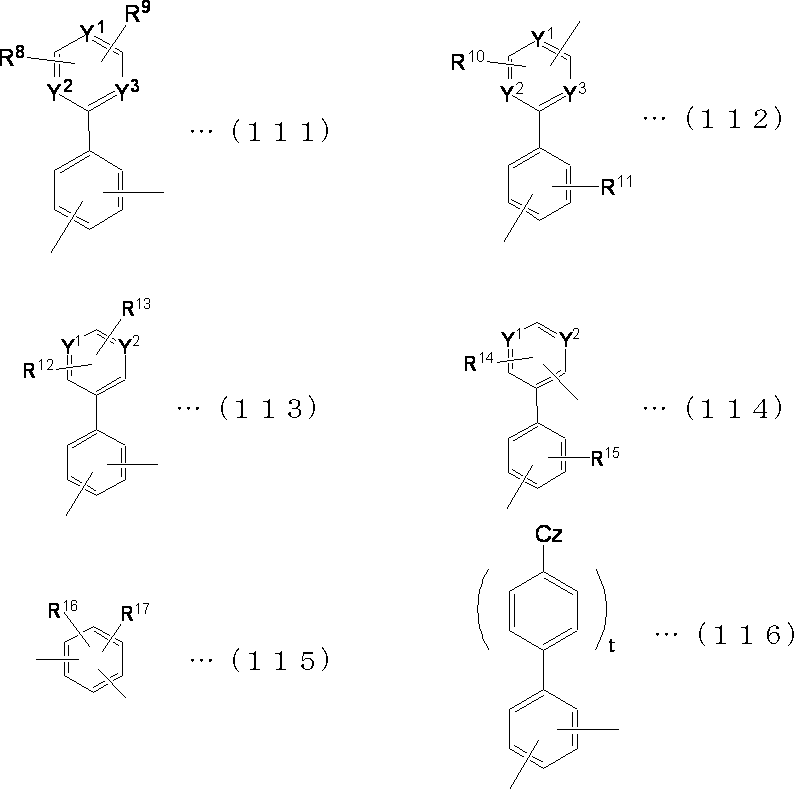
Ar2〜Ar4は置換又は無置換の核原子数5〜50のアリール基またはヘテロアリール基であり、pは1〜4の整数である。p≧2の時、Ar3、Ar4はそれぞれ同じでも異なっていてもよい。
Ar3とAr4とが結合していてもよい。
核原子数が5〜50のアリール基またはヘテロアリール基としては、フェニル、ナフチル、アントラセニル、フェナントリル、ピレニル、クリセニル、コロニル、ビフェニル、テルフェニル、ピローリル、フラニル、チオフェニル、ベンゾチオフェニル、オキサジアゾリル、ジフェニルアントラセニル、インドリル、カルバゾリル、ピリジル、ベンゾキノリル、フルオレニル、フルオランテニル、アセナフトフルオランテニル、スチルベンなどが例として挙げられる。なお、電荷障壁層はアミン化合物に限られないことはもちろんである。Ar 2 to Ar 4 are substituted or unsubstituted aryl groups or heteroaryl groups having 5 to 50 nucleus atoms, and p is an integer of 1 to 4. When p ≧ 2, Ar 3 and Ar 4 may be the same or different.
Ar 3 and Ar 4 may be bonded.
Examples of the aryl group or heteroaryl group having 5 to 50 nucleus atoms include phenyl, naphthyl, anthracenyl, phenanthryl, pyrenyl, chrysenyl, coronyl, biphenyl, terphenyl, pyrrolyl, furanyl, thiophenyl, benzothiophenyl, oxadiazolyl, diphenylanthra Examples include senyl, indolyl, carbazolyl, pyridyl, benzoquinolyl, fluorenyl, fluoranthenyl, acenaphthofluoranthenyl, stilbene and the like. Needless to say, the charge barrier layer is not limited to an amine compound.
本発明では、前記燐光発光層から前記電荷障壁層を介して前記蛍光発光層に注入される前記正孔は、前記蛍光用ホストのHOMOに注入されることが好ましい。 In the present invention, it is preferable that the holes injected into the fluorescent light emitting layer from the phosphorescent light emitting layer through the charge barrier layer are injected into HOMO of the fluorescent host.
このような構成において、燐光発光層の正孔が、電荷障壁層を介して蛍光用ホストのHOMO(Highest Occupied Molecular Orbital : 最高被占軌道)に注入される。
すると、蛍光用ホストにおいて励起子が生成される。
例えば、蛍光発光層のホストではなく蛍光用ドーパントに電荷(正孔)注入する構成(例えば、上記特許文献3)では、蛍光用ドーパントの三重項エネルギーギャップが一般に小さいので燐光発光層にエネルギー移動させる材料の選択が不可能である。
仮に、蛍光用ドーパントとして三重項エネルギーギャップが十分に大きいものを使用した場合でも、蛍光用ドーパントの濃度は薄いため十分な燐光発光を得るだけのエネルギーを生じさせることはできない。
この点、本発明では蛍光用ホストを励起することとし、十分なエネルギー生成を確保するとともに、材料選択の観点からも実現可能性を保証することができる。In such a configuration, holes in the phosphorescent light emitting layer are injected into the fluorescent host HOMO (Highest Occupied Molecular Orbital) via the charge barrier layer.
Then, excitons are generated in the fluorescent host.
For example, in the configuration in which charges (holes) are injected into the fluorescent dopant rather than the host of the fluorescent light emitting layer (for example, Patent Document 3), the triplet energy gap of the fluorescent dopant is generally small, so that energy is transferred to the phosphorescent light emitting layer. Material selection is not possible.
Even if a sufficiently large triplet energy gap is used as the fluorescent dopant, the concentration of the fluorescent dopant is so thin that it is not possible to generate energy sufficient to obtain sufficient phosphorescence.
In this respect, in the present invention, the fluorescence host is excited to ensure sufficient energy generation and to ensure feasibility from the viewpoint of material selection.
本発明では、前記燐光用ホストの正孔移動度は、1.0×10⁴〜1.0×10⁶V/cmの電界中において、1.0×10−5cm2/Vs以上であることが好ましい。In the present invention, the hole mobility of the phosphorescent host is 1.0 × 10 −5 cm 2 / Vs or more in an electric field of 1.0 × 10 4 to 1.0 × 10 6 V / cm. It is preferable.
このような構成において、高い正孔移動度を有する燐光用ホストを備えることにより、正孔の輸送能力を高めて電荷障壁層を介して正孔を蛍光発光層に注入することができる。
本発明では蛍光発光層のホストにおいて励起子生成を行わせることが重要であるところ、陽極と蛍光発光層との間に燐光発光層および電荷障壁層を備えるため、これらの層を超えて正孔を蛍光発光層まで輸送しなければならない。In such a configuration, by providing a phosphorescent host having high hole mobility, holes can be injected into the fluorescent light-emitting layer through the charge barrier layer with improved hole transport capability.
In the present invention, it is important that exciton generation is performed in the host of the fluorescent light emitting layer. Since the phosphorescent light emitting layer and the charge barrier layer are provided between the anode and the fluorescent light emitting layer, the hole is exceeded beyond these layers. Must be transported to the fluorescence emitting layer.
この点、本発明においては燐光用ホストの正孔移動度を高くし、蛍光発光層の陽極側に電荷障壁層を設けた場合でも正孔を蛍光発光層まで輸送することができる。
そして、蛍光発光層において電荷障壁層で電子をブロックしつつ、高い輸送能によって正孔を蛍光発光層に注入するので、蛍光発光層(のホスト)における励起子生成確率を高めて発光効率の向上を図ることができる。In this regard, in the present invention, even when the hole mobility of the phosphorescent host is increased and a charge barrier layer is provided on the anode side of the fluorescent light emitting layer, holes can be transported to the fluorescent light emitting layer.
And, while blocking electrons in the fluorescent light-emitting layer, holes are injected into the fluorescent light-emitting layer with a high transport ability, so that the probability of exciton generation in the fluorescent light-emitting layer (or its host) is increased and luminous efficiency is improved. Can be achieved.
また、従来、発光層において電荷の再結合を促す都合上、発光層のホストとして電荷移動度が大きいものはキャリアバランスがとりづらいため最適化することが困難であった。これに対し、本発明では燐光発光層で電荷の再結合をさせるのではなく、蛍光発光層から拡散してくるエネルギーを利用して発光を得るところ、従来とは異なって発光層である燐光発光層のホストの正孔移動度を高くすることが好ましい。これにより、蛍光発光層における電荷の再結合を促進し、全体としての発光効率の向上を図る。 Conventionally, in order to promote charge recombination in the light emitting layer, it has been difficult to optimize a host having a large charge mobility as a host of the light emitting layer because carrier balance is difficult to achieve. On the other hand, in the present invention, the phosphorescence emission layer is different from the conventional phosphorescence emission layer in that the light emission is obtained by utilizing the energy diffused from the fluorescence emission layer. It is preferable to increase the hole mobility of the host of the layer. This promotes charge recombination in the fluorescent light-emitting layer and improves the overall light emission efficiency.
なお、燐光用ホストの正孔移動度は大きいことが好ましく、例えば、10−4cm2/Vs以上であることが好ましく、さらには、10−3cm2/Vs以上であることが好ましい。
あるいは、燐光用ホストとしては正孔輸送性材料とし、正孔移動度が電子移動度よりも大きいものであってもよい。
そして、燐光用ホストは、当然に燐光用ドーパントよりもエネルギーギャップが大きいものであることはもちろんである。Note that the hole mobility of the phosphorescent host is preferably large, for example, preferably 10 −4 cm 2 / Vs or higher, and more preferably 10 −3 cm 2 / Vs or higher.
Alternatively, the phosphorescent host may be a hole transporting material, and the hole mobility may be larger than the electron mobility.
Of course, the phosphorescent host has a larger energy gap than the phosphorescent dopant.
また、電荷障壁層を介して正孔を蛍光発光層に注入させるため、電荷障壁層の正孔移動度は大きくすることが好ましく、また、燐光発光層から電荷障壁層に注入された正孔が電荷障壁層に滞留することを防ぐために、電荷障壁層の正孔移動度μEBは燐光用ホストの正孔移動度μPHに対して所定比以上であることが好ましい。
電荷障壁層の正孔移動度としては、1.0×10⁴〜1.0×10⁶V/cmの電界中において、1.0×10−5cm2/Vs以上、さらには、10−4cm2/Vs以上とすることが例として挙げられ、10−3cm2/Vs以上とすることが例として挙げられる。
また、電荷障壁層の正孔移動度μEBは、燐光用ホストの正孔移動度μPHに対して、例えば、μEB/μPH≧0.1とすることが例として挙げられ、さらには、μEB/μPH≧0.7とすることが例として挙げられ、さらには、μEB/μPH≧1とすることが例として挙げられる。
なお、上限値としては特に制限されるものではないが、μEB/μPH<103程度とすることが例として挙げられる。In addition, since holes are injected into the fluorescent light emitting layer through the charge blocking layer, it is preferable to increase the hole mobility of the charge blocking layer, and the holes injected from the phosphorescent emitting layer into the charge blocking layer are In order to prevent retention in the charge barrier layer, the hole mobility μ EB of the charge barrier layer is preferably a predetermined ratio or more with respect to the hole mobility μ PH of the phosphorescent host.
The hole mobility of the charge barrier layer is 1.0 × 10 −5 cm 2 / Vs or more in an electric field of 1.0 × 10 4 to 1.0 × 10 6 V / cm, and further 10 − As an example, it is set to 4 cm 2 / Vs or more, and as an example, it is set to 10 −3 cm 2 / Vs or more.
In addition, the hole mobility μ EB of the charge barrier layer is, for example, set to μ EB / μ PH ≧ 0.1 with respect to the hole mobility μ PH of the phosphorescent host. , Μ EB / μ PH ≧ 0.7 is exemplified as an example, and further, μ EB / μ PH ≧ 1 is exemplified.
The upper limit is not particularly limited, but an example is about μ EB / μ PH <10 3 .
また、前記陽極と前記燐光発光層との間に正孔輸送層を設ける場合、この正孔輸送層の正孔移動度は、1.0×10⁴〜1.0×10⁶V/cmの電界中において、1.0×10−5cm2/Vs以上であることが好ましい。
このように正孔移動度の高い正孔輸送層を備えることにより、正孔の輸送能力を高めて、正孔を蛍光発光層に注入することができる。
本発明では蛍光発光層のホストにおいて励起子生成を行わせることが重要であるところ、陽極と蛍光発光層との間に燐光発光層および電荷障壁層を備えるため、これらの層を超えて正孔を蛍光発光層まで輸送しなければならない。
この点、正孔移動度の高い正孔輸送層を備えることにより、蛍光発光層の陽極側に電荷障壁層を設けた場合でも正孔を蛍光発光層まで輸送することができる。
そして、蛍光発光層において電荷障壁層で電子をブロックしつつ、高い輸送能によって正孔を蛍光発光層に注入するので、蛍光発光層(のホスト)における励起子生成確率を高めて発光効率の向上を図ることができる。When a hole transport layer is provided between the anode and the phosphorescent light emitting layer, the hole mobility of the hole transport layer is 1.0 × 10 4 to 1.0 × 10 6 V / cm. In an electric field, it is preferably 1.0 × 10 −5 cm 2 / Vs or more.
By providing a hole transport layer having a high hole mobility in this way, the hole transport capability can be enhanced and holes can be injected into the fluorescent light emitting layer.
In the present invention, it is important that exciton generation is performed in the host of the fluorescent light emitting layer. Since the phosphorescent light emitting layer and the charge barrier layer are provided between the anode and the fluorescent light emitting layer, the hole is exceeded beyond these layers. Must be transported to the fluorescence emitting layer.
In this regard, by providing a hole transport layer having a high hole mobility, holes can be transported to the fluorescent light emitting layer even when a charge barrier layer is provided on the anode side of the fluorescent light emitting layer.
And, while blocking electrons in the fluorescent light-emitting layer, holes are injected into the fluorescent light-emitting layer with a high transport ability, so that the probability of exciton generation in the fluorescent light-emitting layer (or its host) is increased and luminous efficiency is improved. Can be achieved.
なお、正孔輸送層の正孔移動度は大きいことが好ましく、例えば、10−4cm2/Vs以上であることが好ましく、さらには、10−3cm2/Vs以上であることが好ましい。In addition, it is preferable that the hole mobility of a positive hole transport layer is large, for example, it is preferable that it is 10 <-4 > cm < 2 > / Vs or more, Furthermore, it is preferable that it is 10 <-3 > cm < 2 > / Vs or more.
本発明では、前記陽極と前記燐光発光層との間に正孔輸送層を有し、前記正孔輸送層のイオン化ポテンシャルが、前記燐光用ドーパントのイオン化ポテンシャルよりも大きいことが好ましい。 In the present invention, a hole transport layer is preferably provided between the anode and the phosphorescent light emitting layer, and the ionization potential of the hole transport layer is preferably larger than the ionization potential of the phosphorescent dopant.
このような構成において、陽極と燐光発光層との間において陽極からのホール注入を助ける正孔輸送層を備えるので、ホール注入障壁を小さくして駆動電圧の低減等の作用を奏することができる。
ただし、燐光発光層において、ホールは燐光用ドーパントではなく燐光用ホストに注入されなければならないところ、正孔輸送層から燐光用ドーパントにホール注入されてしまうと電荷(ホール)が直接に燐光用ドーパントでの再結合に消費されて蛍光発光層まで輸送されないという不都合が生じる。
特に、ホール注入障壁を下げるために陽極の仕事関数と正孔輸送層のイオン化ポテンシャルIpを近づけることが一般的であるため、燐光ドーパントのIpより小さいIpを有する正孔輸送層を設けてしまうことになりやすい。その結果、正孔輸送層を設けたために正孔の多くが直に燐光ドーパントで消費されて発光効率が下がってしまうという問題につながる。
この点、本発明においては、正孔輸送層のIpは燐光用ドーパントのIpよりも大きいこととし、燐光用ドーパントでの電荷の消費を防ぐことで蛍光発光層での励起子生成確率を高めて全体の発光効率の向上を図ることができる。In such a configuration, since the hole transport layer that assists the hole injection from the anode is provided between the anode and the phosphorescent light emitting layer, the hole injection barrier can be reduced to achieve an effect such as a reduction in driving voltage.
However, in the phosphorescent light emitting layer, holes must be injected into the phosphorescent host, not the phosphorescent dopant. If holes are injected from the hole transport layer into the phosphorescent dopant, the charge (hole) is directly absorbed into the phosphorescent dopant. Inconveniently, it is consumed by recombination in the substrate and not transported to the fluorescent light emitting layer.
In particular, since the work function of the anode and the ionization potential Ip of the hole transport layer are generally brought close to lower the hole injection barrier, a hole transport layer having Ip smaller than Ip of the phosphorescent dopant is provided. It is easy to become. As a result, since the hole transport layer is provided, many of the holes are directly consumed by the phosphorescent dopant, leading to a problem that the luminous efficiency is lowered.
In this regard, in the present invention, the Ip of the hole transport layer is larger than the Ip of the phosphorescent dopant, and the exciton generation probability in the fluorescent light emitting layer is increased by preventing the consumption of electric charge in the phosphorescent dopant. The overall luminous efficiency can be improved.
本発明では、前記燐光発光層の前記燐光用ホストのイオン化ポテンシャルIpPHと、前記燐光発光層の前記燐光用ドーパントのイオン化ポテンシャルIpPDと、前記正孔輸送層のイオン化ポテンシャルIpHTとが、次の式(3)を満たすことが好ましい。
(IpPH+IpPD)/2<IpHT (3)In the present invention, the ionization potential Ip PH of the phosphorescent host of the phosphorescent layer, and the ionization potential Ip PD of the phosphorescent dopant of the phosphorescent layer, and the ionization potential Ip HT of the hole transporting layer is, following It is preferable to satisfy the formula (3).
(Ip PH + Ip PD ) / 2 <Ip HT (3)
このような式(3)を満たすことにより、正孔注入層のイオン化ポテンシャルIpHTは、燐光用ドーパントのIpと燐光用ホストのIpとの中間の準位((IpPH+IpPD)/2)よりも燐光用ホストのIpに近い準位に位置することになる。
すると、正孔輸送層から燐光発光層に注入される正孔は、燐光用ドーパントよりも燐光用ホストに注入されやすくなる。
その結果、燐光用ドーパントでの電荷の消費を防ぎ、蛍光発光層での励起子生成確率を高めて全体の発光効率の向上を図ることができる。By satisfying such formula (3), the ionization potential Ip HT of the hole injection layer is an intermediate level between the phosphorescent dopant Ip and the phosphorescent host Ip ((Ip PH + Ip PD ) / 2). It is located at a level closer to Ip of the phosphorescent host.
Then, the holes injected from the hole transport layer into the phosphorescent light emitting layer are more easily injected into the phosphorescent host than the phosphorescent dopant.
As a result, it is possible to prevent the consumption of electric charges in the phosphorescent dopant, increase the exciton generation probability in the fluorescent light emitting layer, and improve the overall light emission efficiency.
なお、正孔輸送層のIpの上限値としては燐光用ホストのIp程度とすることが例としてあげられる。 As an example, the upper limit value of Ip of the hole transport layer is set to about Ip of the phosphorescent host.
さらに、燐光発光層における直接の電荷消費を減らすため、燐光用ドーパントの濃度を低くすることが好ましく、例えば、4%未満とすることが好ましい。
燐光発光層として、例えば2層以上設けられている場合には、もっとも陽極側に位置する燐光発光層の燐光用ドーパントの濃度を4%未満にすることが好ましい。
燐光用ドーパントは高濃度(例えば8%程度)で利用されるのが一般的であるが、本発明では燐光用ドーパントにおいて直接に電荷が再結合して電荷が消費されてしまっては本来の再結合領域である蛍光発光層における再結合確率がそれだけ低くなり、発光効率の向上を達成できない。
この点、燐光用ドーパントのドープ濃度を低くすることにより、蛍光発光層において効率よく励起子生成できるとともに蛍光発光層から三重項エネルギーを燐光発光層に移動させ、発光効率を格段に向上させることができる。Furthermore, in order to reduce the direct charge consumption in the phosphorescent light emitting layer, the concentration of the phosphorescent dopant is preferably lowered, for example, less than 4%.
For example, when two or more phosphorescent light emitting layers are provided, it is preferable that the concentration of the phosphorescent dopant in the phosphorescent light emitting layer located closest to the anode side is less than 4%.
In general, the phosphorescent dopant is used at a high concentration (for example, about 8%). However, in the present invention, if the charge is recombined directly in the phosphorescent dopant and the charge is consumed, the phosphor is not regenerated. The recombination probability in the fluorescent light emitting layer, which is the binding region, is lowered accordingly, and the improvement of the light emission efficiency cannot be achieved.
In this regard, by lowering the doping concentration of the phosphorescent dopant, it is possible to efficiently generate excitons in the fluorescent light-emitting layer and transfer triplet energy from the fluorescent light-emitting layer to the phosphorescent light-emitting layer, thereby significantly improving the light emission efficiency. it can.
本発明では、前記蛍光発光層は、青色発光層であり、前記燐光発光層は、赤色に発光する赤色燐光発光層と、緑色に発光する緑色燐光発光層と、を備え、前記赤色燐光発光層は、前記緑色燐光発光層よりも前記陽極側に設けられていることが好ましい。
このような構成によれば、蛍光発光層の青色、燐光発光層の赤色および緑色の発光を混合した白色光を、高い発光効率で得ることができる。
すなわち、蛍光発光層の励起一重項からは青色の発光が得られ、蛍光用ホストの励起三重項エネルギーは緑色燐光用ドーパントへ移動する。これにより生成した緑色燐光用ドーパントの励起三重項エネルギーの一部は、緑色の燐光として放出される。緑色燐光用ドーパントの残りの励起三重項エネルギーは、赤色燐光用ドーパントへ移動し、これにより生成した赤色燐光用ドーパントの励起三重項から赤色の燐光が放出される。これらの発光が混合され、白色光が得られる。
なお、例えば、ここでいう青色の発光とは波長430〜500nmの光を、赤色の発光とは波長550〜650nmの光を、緑色の発光とは波長500〜550nmの光を、それぞれ示す。波長550〜650nmおよび500〜550nmの発光、すなわち赤色および緑色を示す燐光材料は、一般に知られているので、特別な材料を用いることなく発光効率の高い混合色の有機EL素子を構成することができる。In the present invention, the fluorescent light emitting layer is a blue light emitting layer, and the phosphorescent light emitting layer includes a red phosphorescent light emitting layer that emits red light and a green phosphorescent light emitting layer that emits green light, and the red phosphorescent light emitting layer. Is preferably provided closer to the anode than the green phosphorescent light emitting layer.
According to such a configuration, white light in which the blue light of the fluorescent light emitting layer and the red light and green light emitted from the phosphorescent light emitting layer are mixed can be obtained with high light emission efficiency.
That is, blue emission is obtained from the excited singlet of the fluorescent light emitting layer, and the excited triplet energy of the fluorescent host is transferred to the green phosphorescent dopant. A part of the excited triplet energy of the green phosphorescent dopant thus generated is emitted as green phosphorescence. The remaining excited triplet energy of the green phosphorescent dopant is transferred to the red phosphorescent dopant, and red phosphorescence is emitted from the excited triplet of the red phosphorescent dopant thus generated. These light emissions are mixed to obtain white light.
In addition, for example, blue light emission here refers to light with a wavelength of 430 to 500 nm, red light emission refers to light with a wavelength of 550 to 650 nm, and green light emission refers to light with a wavelength of 500 to 550 nm. Phosphorescent materials that emit light having wavelengths of 550 to 650 nm and 500 to 550 nm, that is, red and green are generally known. Therefore, it is possible to constitute a mixed color organic EL element having high luminous efficiency without using a special material. it can.
本発明の他の有機EL素子は、正孔を注入する陽極と、蛍光発光層と、電荷障壁層と、燐光発光層と、電子を注入する陰極と、をこの順で備え、前記燐光発光層は、燐光用ホストと燐光発光を示す燐光用ドーパントとを有し、前記蛍光発光層は、蛍光用ホストと蛍光発光を示す蛍光用ドーパントとを有し、前記電荷障壁層は、前記蛍光発光層に注入された前記正孔が前記蛍光発光層から当該電荷障壁層側に注入されるのをブロックし、かつ、前記電子を前記燐光発光層から前記蛍光発光層に注入させ、前記燐光用ドーパントの三重項エネルギーギャップEgPDと、前記電荷障壁層の三重項エネルギーギャップEgHBと、前記蛍光用ホストの三重項エネルギーギャップEgFHとが、次の式(4)を満たす。
EgPD<EgHB≦EgFH (4)Another organic EL device of the present invention includes an anode for injecting holes, a fluorescent light emitting layer, a charge barrier layer, a phosphorescent light emitting layer, and a cathode for injecting electrons in this order, and the phosphorescent light emitting layer. Includes a phosphorescent host and a phosphorescent dopant that exhibits phosphorescence, the fluorescent light-emitting layer includes a fluorescent host and a fluorescent dopant that exhibits fluorescent light emission, and the charge barrier layer includes the fluorescent light-emitting layer. Blocking the holes injected into the charge barrier layer from the fluorescent light-emitting layer, and injecting the electrons from the phosphorescent light-emitting layer into the fluorescent light-emitting layer, The triplet energy gap Eg PD , the triplet energy gap Eg HB of the charge barrier layer, and the triplet energy gap Eg FH of the fluorescent host satisfy the following formula (4).
Eg PD <Eg HB ≦ Eg FH (4)
本発明の有機EL素子は、蛍光発光層が陽極側に、燐光発光層が陰極側に設けられ、電荷障壁層が正孔の移動をブロックする点で、上述の有機EL素子と異なる。ただし、原理としては上述の発明と同様である。
すなわち、本発明の有機EL素子において、陽極から蛍光発光層に注入された正孔は、電荷障壁層により蛍光発光層中に閉じ込められる。陰極から注入された電子は、燐光発光層および電荷障壁層を介して蛍光発光層に注入される。
すると、蛍光発光層の蛍光用ホストにおいて電子と正孔とが再結合し、励起一重項と励起三重項とが生成される。
蛍光用ホストの励起一重項エネルギーは、蛍光用ドーパントへエネルギー移動し、このエネルギーが、光(蛍光)として放出される。The organic EL device of the present invention is different from the organic EL device described above in that the fluorescent light emitting layer is provided on the anode side, the phosphorescent light emitting layer is provided on the cathode side, and the charge barrier layer blocks the movement of holes. However, the principle is the same as that of the above-mentioned invention.
That is, in the organic EL device of the present invention, holes injected from the anode into the fluorescent light emitting layer are confined in the fluorescent light emitting layer by the charge barrier layer. Electrons injected from the cathode are injected into the fluorescent light emitting layer through the phosphorescent light emitting layer and the charge barrier layer.
Then, electrons and holes are recombined in the fluorescent host of the fluorescent light emitting layer, and excited singlets and excited triplets are generated.
The excited singlet energy of the fluorescent host is transferred to the fluorescent dopant, and this energy is released as light (fluorescence).
蛍光用ホストに生じた励起三重項エネルギーは、電荷障壁層を介して燐光発光層へ移動される。
これは、燐光発光層の燐光用ドーパントの三重項エネルギーギャップEgPDと、電荷障壁層の三重項エネルギーギャップEgHBと、蛍光発光層の蛍光用ホストの三重項エネルギーギャップEgFHとが、上記の式(4)を満たすことによる。
このような蛍光用ホストの励起三重項エネルギーの移動により、燐光用ドーパントの励起三重項が生成され、燐光発光が得られる。
このように、蛍光発光と燐光発光とを利用して、生成エネルギーを最大限効率よく発光に変換し、格段の発光効率向上を図ることができる。The excited triplet energy generated in the fluorescent host is transferred to the phosphorescent light emitting layer through the charge barrier layer.
This is because the triplet energy gap Eg PD of the phosphorescent dopant of the phosphorescent light emitting layer, the triplet energy gap Eg HB of the charge barrier layer, and the triplet energy gap Eg FH of the fluorescent host of the fluorescent light emitting layer are as described above. By satisfying equation (4).
By such excitation triplet energy transfer of the fluorescent host, the excited triplet of the phosphorescent dopant is generated, and phosphorescence emission is obtained.
In this way, by using fluorescence emission and phosphorescence emission, the generated energy can be converted to emission with maximum efficiency, and the emission efficiency can be significantly improved.
本発明では、前記電荷障壁層は、前記蛍光用ホストよりも小さいイオン化ポテンシャルを有し、前記電荷障壁層のイオン化ポテンシャルIpHBと、前記蛍光用ホストのイオン化ポテンシャルIpFHとが、次の式(5)を満たすことが好ましい。
IpHB>IpFH−0.1eV (5)In the present invention, the charge barrier layer has a smaller ionization potential than the fluorescent host, and the ionization potential Ip HB of the charge barrier layer and the ionization potential Ip FH of the fluorescent host are expressed by the following formula ( It is preferable to satisfy 5).
Ip HB > Ip FH -0.1 eV (5)
本発明では、前記燐光発光層から前記電荷障壁層を介して前記蛍光発光層に注入される前記電子は、前記蛍光用ホストのLUMO(Lowest Unoccupied Molecular Orbital : 最低空軌道)に注入されることが好ましい。 In the present invention, the electrons injected from the phosphorescent light emitting layer into the fluorescent light emitting layer through the charge barrier layer may be injected into LUMO (Lowest Unoccupied Molecular Orbital) of the fluorescent host. preferable.
本発明では、前記燐光用ホストの電子移動度は、1.0×10⁴〜1.0×10⁶V/cmの電界中において、1.0×10−5cm2/Vs以上であることが好ましい。In the present invention, the electron mobility of the phosphorescent host is 1.0 × 10 −5 cm 2 / Vs or more in an electric field of 1.0 × 10 4 to 1.0 × 10 6 V / cm. Is preferred.
本発明では、前記蛍光発光層は、青色発光層であり、前記燐光発光層は、赤色に発光する赤色燐光発光層と、緑色に発光する緑色燐光発光層と、を備え、前記赤色燐光発光層は、前記緑色燐光発光層よりも前記陰極側に設けられていることが好ましい。 In the present invention, the fluorescent light emitting layer is a blue light emitting layer, and the phosphorescent light emitting layer includes a red phosphorescent light emitting layer that emits red light and a green phosphorescent light emitting layer that emits green light, and the red phosphorescent light emitting layer. Is preferably provided on the cathode side of the green phosphorescent light emitting layer.
これら構成を備える本発明の有機EL素子は、上述の有機EL素子と同様の優れた作用効果を発揮することができる。 The organic EL device of the present invention having these configurations can exhibit the same excellent operational effects as the above-described organic EL device.
いずれの本発明においても、前記蛍光発光層は、青色発光層であり、前記燐光発光層は、前記燐光用ホストと、赤色燐光発光を示す赤色燐光用ドーパントと、緑色燐光発光を示す緑色燐光用ドーパントと、を有することが好ましい。
このような構成によれば、蛍光発光層から青色の、燐光発光層から赤および緑色の発光が得られ、全体として白色の発光を得ることができる。
ただし、単一の燐光発光層に赤色燐光用ドーパントと緑色燐光用ドーパントの双方を含有させた場合、緑色燐光用ドーパントから赤色燐光用ドーパントへのエネルギー移動が起こりやすく、緑色に比して赤色が強くなるおそれがあるので、赤色燐光用ドーパントの濃度を緑色燐光用ドーパントよりも薄くして、緑色燐光用ドーパントから赤色燐光用ドーパントへのエネルギー移動を抑制することが好ましい。In any of the present inventions, the fluorescent light emitting layer is a blue light emitting layer, and the phosphorescent light emitting layer is the phosphorescent host, a red phosphorescent dopant that exhibits red phosphorescence, and a green phosphorescent that exhibits green phosphorescence. It is preferable to have a dopant.
According to such a configuration, blue light emission can be obtained from the fluorescent light emitting layer, and red and green light emission can be obtained from the phosphorescent light emitting layer, and white light emission can be obtained as a whole.
However, when both a red phosphorescent dopant and a green phosphorescent dopant are contained in a single phosphorescent light emitting layer, energy transfer from the green phosphorescent dopant to the red phosphorescent dopant is likely to occur, and the red color is higher than the green color. Therefore, it is preferable to suppress the energy transfer from the green phosphorescent dopant to the red phosphorescent dopant by making the concentration of the red phosphorescent dopant thinner than that of the green phosphorescent dopant.
本発明では、前記燐光発光層は、赤色に発光する赤色燐光発光層と、緑色に発光する緑色燐光発光層と、を備え、前記赤色燐光発光層は、赤色燐光用ホストと赤色燐光発光を示す赤色燐光用ドーパントとを有し、前記緑色燐光発光層は、緑色燐光用ホストと緑色燐光発光を示す緑色燐光用ドーパントとを有することが好ましい。
このような構成によれば、赤色燐光発光層と緑色燐光発光層とを分離して設けることにより、緑色燐光用ドーパントから赤色燐光用ドーパントへのエネルギー移動を抑制して良好な白色発光を得ることができる。In the present invention, the phosphorescent light emitting layer includes a red phosphorescent light emitting layer that emits red light and a green phosphorescent light emitting layer that emits green light, and the red phosphorescent light emitting layer exhibits a red phosphorescent light emission and a host for red phosphorescence. The green phosphorescent light emitting layer preferably includes a green phosphorescent host and a green phosphorescent dopant exhibiting green phosphorescence.
According to such a configuration, by providing the red phosphorescent light-emitting layer and the green phosphorescent light-emitting layer separately, energy transfer from the green phosphorescent dopant to the red phosphorescent dopant can be suppressed to obtain good white light emission. Can do.
本発明では、前記赤色燐光発光層の前記赤色燐光用ホストと前記緑色燐光発光層の前記緑色燐光用ホストとは、同一材料であることが好ましい。
このような構成によれば、赤色燐光用ホストと緑色燐光用ホストとが同一材料なので、有機EL素子製造のために用いる材料の種類を減らすことができ、製造を容易にすることができる。
また、燐光発光層が電荷障壁層よりも陽極側に位置するとき、陽極と燐光発光層との間に正孔輸送層を設ける場合には、正孔輸送層と、赤色燐光用ホストおよび緑色燐光用ホストと、は同一材料であってもよい。この場合、有機EL素子の製造をさらに容易にすることができる。In the present invention, it is preferable that the red phosphorescent host of the red phosphorescent light emitting layer and the green phosphorescent host of the green phosphorescent light emitting layer are made of the same material.
According to such a configuration, since the red phosphorescent host and the green phosphorescent host are the same material, the types of materials used for the production of the organic EL element can be reduced, and the production can be facilitated.
In addition, when the phosphorescent light emitting layer is located on the anode side of the charge barrier layer, when a hole transporting layer is provided between the anode and the phosphorescent light emitting layer, the hole transporting layer, the red phosphorescent host, and the green phosphorescent layer are provided. The host may be the same material. In this case, the manufacture of the organic EL element can be further facilitated.
本発明では、有機EL素子は、前記赤色燐光発光層と前記緑色燐光発光層との間において前記燐光発光材料を有しない中間層を有することが好ましい。 In the present invention, the organic EL element preferably has an intermediate layer not including the phosphorescent material between the red phosphorescent light emitting layer and the green phosphorescent light emitting layer.
励起三重項エネルギーは拡散長が長いため、赤色燐光発光層と緑色燐光発光層とが隣接する場合、緑色燐光発光層から赤色燐光発光層へのエネルギーの移動が起こりやすい。
その結果、赤色の発光強度が大きく、緑色の発光強度が小さくなりやすい。
そこで、赤色燐光発光層と緑色燐光発光層との間に、燐光発光材料を含有しない中間層を設けることにより、緑色燐光発光層から赤色燐光発光層への励起三重項エネルギーの移動を適宜制限し、発光の色度を容易に調整することができる。Since the excited triplet energy has a long diffusion length, energy transfer from the green phosphorescent light emitting layer to the red phosphorescent light emitting layer is likely to occur when the red phosphorescent light emitting layer and the green phosphorescent light emitting layer are adjacent to each other.
As a result, the red emission intensity is large and the green emission intensity tends to be small.
Therefore, by providing an intermediate layer that does not contain a phosphorescent material between the red phosphorescent layer and the green phosphorescent layer, the transfer of excited triplet energy from the green phosphorescent layer to the red phosphorescent layer is appropriately limited. The chromaticity of light emission can be easily adjusted.
なお、中間層の構成材料、赤色燐光用ホストの構成材料、緑色燐光用ホストの構成材料は同一材料であってもよく、この場合は燐光発光層でホスト材料を共通化するので、製造工程が非常に簡略化される。
さらに、燐光発光層が電荷障壁層よりも陽極側に位置するとき、陽極と燐光発光層との間に正孔輸送層を設ける場合には、正孔輸送層、中間層、赤色燐光用ホストおよび緑色燐光用ホストは同一材料であってもよい。The constituent material of the intermediate layer, the constituent material of the host for red phosphorescence, and the constituent material of the host for green phosphorescence may be the same material. In this case, since the host material is shared by the phosphorescent light emitting layer, the manufacturing process is Very simplified.
Further, when the hole-emitting layer is provided between the anode and the phosphorescent light-emitting layer when the phosphorescent light-emitting layer is located on the anode side of the charge barrier layer, the hole-transporting layer, the intermediate layer, the red phosphorescent host, and The green phosphorescent host may be the same material.
本発明では、前記蛍光用ホストと前記燐光用ホストとは、同一材料であることが好ましい。もしくは本発明では、前記電荷障壁層と前記燐光用ホストとは、同一材料であることが好ましい。
このような構成によれば、有機EL素子製造のために用いる材料の種類を減らすことができ、製造を容易にすることができる。In the present invention, the fluorescent host and the phosphorescent host are preferably made of the same material. Alternatively, in the present invention, the charge barrier layer and the phosphorescent host are preferably made of the same material.
According to such a structure, the kind of material used for organic EL element manufacture can be reduced, and manufacture can be made easy.
本発明では、前記電荷障壁層は、厚さが3〜9nmであることが好ましい。
例えば、陰極側に蛍光発光層を設けた構成(図1)で説明する。
この場合、電荷障壁層の厚さを3〜9nmとすれば、電荷障壁層に厚みがあるので、電子ブロック機能が十分に機能し、蛍光発光層に電子がたまる。
一方、正孔は電荷障壁層を介して蛍光発光層に注入される。
すなわち、電子が蛍光発光層から電荷障壁層側に注入されるのをブロックしつつ、正孔を蛍光用ホストのHOMOに注入させることができる。
すると、蛍光発光層における電荷の再結合確率が高くなり、蛍光発光層の発光効率も高くなり、また、エネルギー移動により燐光発光層からの発光も得られる。
通常、駆動電圧の上昇を回避する目的から層の厚みは薄くするものであるが、本発明では、蛍光発光層における再結合確率を高めることが重要であるため、電荷障壁層を厚くする。
これにより、蛍光発光層における励起子生成確率の向上、および、エネルギー移動による燐光発光の利用により全体として発光効率を格段に向上させ、結果として、同じ輝度であれば従来の蛍光発光のみのEL素子に比べて駆動電圧の低下も期待できる。In the present invention, the charge barrier layer preferably has a thickness of 3 to 9 nm.
For example, a description will be given of a configuration in which a fluorescent light emitting layer is provided on the cathode side (FIG. 1).
In this case, if the thickness of the charge barrier layer is 3 to 9 nm, since the charge barrier layer has a thickness, the electron blocking function functions sufficiently and electrons accumulate in the fluorescent light emitting layer.
On the other hand, holes are injected into the fluorescent light emitting layer through the charge barrier layer.
That is, holes can be injected into the HOMO of the fluorescent host while blocking electrons from being injected from the fluorescent light emitting layer to the charge barrier layer.
Then, the recombination probability of charges in the fluorescent light emitting layer is increased, the light emitting efficiency of the fluorescent light emitting layer is increased, and light emission from the phosphorescent light emitting layer is also obtained by energy transfer.
Usually, the thickness of the layer is reduced for the purpose of avoiding an increase in driving voltage. However, in the present invention, it is important to increase the recombination probability in the fluorescent light emitting layer, so the charge barrier layer is increased.
As a result, the emission efficiency is significantly improved as a whole by improving the probability of exciton generation in the fluorescent light emitting layer and using phosphorescent light emission by energy transfer. Compared to the above, a decrease in driving voltage can be expected.
そして、電荷障壁層に厚みをとる場合には、燐光用ホストの正孔移動度が大きいことが好ましい。または、電荷障壁層の正孔移動度を大きくすることが好ましい。
これにより、電荷障壁層を設けていても正孔を蛍光発光層(のホスト)に効率よく注入できる。そして、蛍光発光層に対して電荷ブロックとともに正孔注入を効率的に行って発光効率の格段の向上を図り、かつ、駆動電圧を低下させることができる。When the charge barrier layer is thick, it is preferable that the hole mobility of the phosphorescent host is high. Alternatively, it is preferable to increase the hole mobility of the charge barrier layer.
Thereby, even if the charge barrier layer is provided, holes can be efficiently injected into the fluorescent light emitting layer (host). Then, hole injection can be efficiently performed together with the charge block to the fluorescent light emitting layer, so that the luminous efficiency can be remarkably improved and the driving voltage can be lowered.
電荷障壁層は、電子が蛍光発光層から電荷障壁層側に注入されるのをブロックするため、蛍光用ホストよりも小さいアフィニティ準位を有することが好ましいところ、アフィニティ準位とイオン化ポテンシャルとのエネルギーギャップの大きさには限界があるので、小さいアフィニティ準位を有する材料は、一般に、イオン化ポテンシャルが小さい。
また、電荷障壁層および蛍光用ホストは、上記の式(1)を満たす必要があり、電荷障壁層の三重項励起エネルギーギャップEgEBは、蛍光用ホストの三重項励起エネルギーギャップEgFH以下でなければならない(EgEB≦EgFH)から、電荷障壁層のエネルギーギャップを大きくすることが制限される。
したがって、小さいアフィニティ準位を有し上記の式(1)を満たす電荷障壁層は、イオン化ポテンシャルが小さいものとならざるをえない。
そして、イオン化ポテンシャルが小さい材料を電荷障壁層とすると、正孔が蛍光用ドーパントに注入されやすくなってしまうが、正孔は蛍光用ホストに注入されることが好ましく、蛍光用ドーパントへの注入が発生することは好ましくない。
そこで、電荷障壁層の厚さを制限し、9nm以下とする。すると、電荷障壁層にイオン化ポテンシャルが小さい材料を用いていた場合でも、電荷障壁層を通過する間に正孔の準位が下がることがなく、燐光発光層の正孔を蛍光用ホストのHOMOに注入させることができる。The charge barrier layer preferably has an affinity level smaller than that of the fluorescent host in order to block electrons from being injected from the fluorescent light emitting layer to the charge barrier layer side. Since the size of the gap is limited, a material having a small affinity level generally has a small ionization potential.
Further, the charge barrier layer and the fluorescent host must satisfy the above formula (1), and the triplet excitation energy gap Eg EB of the charge barrier layer must be less than or equal to the triplet excitation energy gap Eg FH of the fluorescent host. Since it must be (Eg EB ≦ Eg FH ), increasing the energy gap of the charge barrier layer is limited.
Therefore, the charge barrier layer having a small affinity level and satisfying the above formula (1) must have a small ionization potential.
When a material having a low ionization potential is used as a charge barrier layer, holes are likely to be injected into the fluorescent dopant, but holes are preferably injected into the fluorescent host. It is not preferable to generate it.
Therefore, the thickness of the charge barrier layer is limited to 9 nm or less. Then, even when a material having a low ionization potential is used for the charge barrier layer, the hole level does not decrease while passing through the charge barrier layer, and the holes of the phosphorescent light emitting layer are converted into the HOMO of the fluorescent host. Can be injected.
一方、電子が蛍光発光層から電荷障壁層側に注入されるのをブロックするためには、電荷障壁層の厚さは、3nm以上であることが好ましい。
したがって、電荷障壁層の厚さが3〜9nmである本発明の有機EL素子においては、電子が蛍光発光層から電荷障壁層側に注入されるのをブロックしつつ、燐光発光層の正孔を蛍光用ホストのHOMOに注入させることができる。
なお、電荷障壁層の厚さは4〜8nmであることがより好ましく、5〜7nmであることがさらに好ましい。On the other hand, in order to block injection of electrons from the fluorescent light emitting layer to the charge barrier layer, the thickness of the charge barrier layer is preferably 3 nm or more.
Therefore, in the organic EL device of the present invention in which the thickness of the charge barrier layer is 3 to 9 nm, while blocking electrons from being injected from the fluorescent light emitting layer to the charge barrier layer side, It can be injected into the HOMO of the fluorescent host.
The thickness of the charge barrier layer is more preferably 4 to 8 nm, and further preferably 5 to 7 nm.
また、陽極側に蛍光発光層を設けた構成(図4)の場合は、電子と正孔の役割を入れ替えて考えればよい。例えば電荷障壁層の厚さを3〜9nmとすれば、電荷障壁層に厚みがあるので、正孔ブロック機能が十分に機能し、蛍光発光層に正孔がたまる。
一方、電子は電荷障壁層を介して蛍光発光層に注入される。
すなわち、正孔が蛍光発光層から電荷障壁層側に注入されるのをブロックしつつ、電子を蛍光用ホストのLUMOに注入させることができる。すると、蛍光発光層における電荷の再結合確率が高くなり、蛍光発光層の発光効率も高くなり、また、エネルギー移動により燐光発光層からの発光も得られる。
通常、駆動電圧の上昇を回避する目的から層の厚みは薄くするものであるが、本発明では、蛍光発光層における再結合確率を高めることが重要であるため、電荷障壁層を厚くする。
これにより、蛍光発光層における励起子生成確率の向上、および、エネルギー移動による燐光発光の利用により全体として発光効率を格段に向上させ、結果として、同じ輝度であれば従来の蛍光発光のみのEL素子に比べて駆動電圧の低下も期待できる。Further, in the case of the configuration in which the fluorescent light emitting layer is provided on the anode side (FIG. 4), the roles of electrons and holes may be interchanged. For example, if the thickness of the charge barrier layer is 3 to 9 nm, since the charge barrier layer is thick, the hole blocking function sufficiently functions and holes accumulate in the fluorescent light emitting layer.
On the other hand, electrons are injected into the fluorescent light emitting layer through the charge barrier layer.
That is, electrons can be injected into the LUMO of the fluorescent host while blocking injection of holes from the fluorescent light emitting layer to the charge barrier layer side. Then, the recombination probability of charges in the fluorescent light emitting layer is increased, the light emitting efficiency of the fluorescent light emitting layer is increased, and light emission from the phosphorescent light emitting layer is also obtained by energy transfer.
Usually, the thickness of the layer is reduced for the purpose of avoiding an increase in driving voltage. However, in the present invention, it is important to increase the recombination probability in the fluorescent light emitting layer, so the charge barrier layer is increased.
As a result, the emission efficiency is significantly improved as a whole by improving the probability of exciton generation in the fluorescent light emitting layer and using phosphorescent light emission by energy transfer. Compared to the above, a decrease in driving voltage can be expected.
そして、電荷障壁層に厚みをとる場合には、燐光用ホストの電子移動度が大きいことが好ましい。または、電荷障壁層の電子移動度を大きくすることが好ましい。
これにより、電荷障壁層を設けていても電子を蛍光発光層(のホスト)に効率よく注入できる。そして、蛍光発光層に対して電荷ブロックとともに電子注入を効率的に行って発光効率の格段の向上を図り、かつ、駆動電圧を低下させることができる。When the charge barrier layer is made thick, it is preferable that the electron mobility of the phosphorescent host is large. Alternatively, it is preferable to increase the electron mobility of the charge barrier layer.
Thereby, even if a charge barrier layer is provided, electrons can be efficiently injected into the fluorescent light emitting layer (host thereof). And it is possible to efficiently inject electrons into the fluorescent light-emitting layer together with the charge block, thereby improving the light emission efficiency and reducing the driving voltage.
電荷障壁層は、正孔が蛍光発光層から電荷障壁層側に注入されるのをブロックするため、蛍光用ホストよりも小さいイオン化ポテンシャルを有することが好ましい
また、電荷障壁層および蛍光用ホストは、上記の式(4)を満たす必要があり、電荷障壁層の三重項励起エネルギーギャップEgHBは、蛍光用ホストの三重項励起エネルギーギャップEgFH以下でなければならない(EgHB≦EgFH)から、電荷障壁層のエネルギーギャップを大きくすることが制限される。The charge barrier layer preferably has a smaller ionization potential than the fluorescent host in order to block holes from being injected from the fluorescent light emitting layer to the charge barrier layer side. The above formula (4) needs to be satisfied, and the triplet excitation energy gap Eg HB of the charge barrier layer must be equal to or less than the triplet excitation energy gap Eg FH of the fluorescent host (Eg HB ≦ Eg FH ), Increasing the energy gap of the charge barrier layer is limited.
いずれの本発明においても、前記蛍光発光層の発光波長は、前記蛍光発光層の発光波長より短く、前記蛍光発光層は、波長430〜500nmの発光を示し、前記燐光発光層は、波長500〜650nmの発光を示すことが好ましい。
このような構成によれば、蛍光発光層からの短波長発光および燐光発光層からの長波長発光を混合した混合色の光を、高い発光効率で得ることができる。
一般に、燐光材料で短波長(青色)の発光を示す良好な材料は実用レベルで知られておらず、また、蛍光とした場合も青色の発光効率は一般に低い。
そのため、発光層を積層して混合色(例えば白色)を得る場合でも、青色の強度が弱く、色度が良好な白色は得られていなかった。
この点、本発明においては燐光では実現できない青色を蛍光材料とし、この蛍光発光層に励起子生成を集めるため、蛍光発光による青色強度を十分に強く得ることができる。
そして、青色用ホストから燐光発光層にエネルギー移動させて燐光発光(例えば赤色)を高効率に得る。
したがって、従来は困難であった色味のよい白色を、しかも高効率に実現できるという画期的な効果を奏する。In any of the present inventions, the emission wavelength of the fluorescence emission layer is shorter than the emission wavelength of the fluorescence emission layer, the fluorescence emission layer emits light having a wavelength of 430 to 500 nm, and the phosphorescence emission layer has a wavelength of 500 to 500. It preferably exhibits 650 nm emission.
According to such a configuration, light of a mixed color obtained by mixing short wavelength light emission from the fluorescent light emitting layer and long wavelength light emission from the phosphorescent light emitting layer can be obtained with high light emission efficiency.
In general, a phosphorescent material that emits light with a short wavelength (blue) is not known at a practical level. Even when fluorescent material is used, blue light emission efficiency is generally low.
For this reason, even when a light emitting layer is laminated to obtain a mixed color (for example, white), a white color with low blue intensity and good chromaticity has not been obtained.
In this respect, in the present invention, blue that cannot be realized by phosphorescence is used as a fluorescent material, and exciton generation is collected in this fluorescent light emitting layer, so that the blue intensity due to fluorescent light emission can be sufficiently strong.
Then, energy is transferred from the blue host to the phosphorescent light emitting layer to obtain phosphorescent light emission (for example, red) with high efficiency.
Therefore, an epoch-making effect is achieved in that it is possible to realize a white with good color that has been difficult in the past and with high efficiency.
なお、波長430〜500nmの発光を示す蛍光材料、および、波長500〜650nmの発光を示す燐光材料は、一般に知られているので、特別な材料を用いることなく発光効率の高い混合色の有機EL素子を構成することができる。 In addition, since the fluorescent material which emits light with a wavelength of 430 to 500 nm and the phosphorescent material which emits light with a wavelength of 500 to 650 nm are generally known, a mixed color organic EL with high luminous efficiency without using a special material. An element can be configured.
本発明では、前記電荷障壁層は、前記蛍光用ドーパントよりも大きい三重項エネルギーギャップを有することが好ましい。 In the present invention, the charge barrier layer preferably has a larger triplet energy gap than the fluorescent dopant.
本発明においては蛍光用ホストにおいて励起子生成を生じさせ、この励起子エネルギーのうち励起三重項エネルギーは電荷障壁層を介して燐光発光層に移動させる必要がある。
ここで、蛍光用ホストの励起三重項エネルギーが電荷障壁層側に移動するよりも蛍光用ドーパントに移動して失活してしまっては不都合であり、発光効率の向上に結びつかない。
特に、蛍光用ドーパントは蛍光用ホストにドープされるものであるため、蛍光用ホストのエネルギーは蛍光用ドーパントに移動しやすい。
この点、本発明においては、蛍光用ホストと蛍光用ドーパント間における三重項エネルギーギャップの差異よりも電荷障壁層と蛍光用ホスト間の三重項エネルギーギャップの差異が小さくなるようにするために、電荷障壁層は蛍光用ドーパントよりも大きい三重項エネルギーギャップを有する。
これにより、蛍光用ホストの励起三重項エネルギーは蛍光用ドーパントの三重項エネルギーに移動するよりも電荷障壁層側に移動しやすくなり、電荷障壁層を介した燐光発光層側へのエネルギー移動を促進する。
その結果、蛍光用ドーパントによって失活する励起三重項エネルギーを少なくして発光効率の向上を図ることができる。In the present invention, exciton generation is caused in the fluorescent host, and of this exciton energy, the excited triplet energy needs to be transferred to the phosphorescent light emitting layer through the charge barrier layer.
Here, it is inconvenient if the excited triplet energy of the fluorescent host moves to the fluorescent dopant and deactivates rather than moving to the charge barrier layer side, and does not lead to an improvement in luminous efficiency.
In particular, since the fluorescent dopant is doped into the fluorescent host, the energy of the fluorescent host easily moves to the fluorescent dopant.
In this regard, in the present invention, in order to make the difference of the triplet energy gap between the charge barrier layer and the fluorescent host smaller than the difference of the triplet energy gap between the fluorescent host and the fluorescent dopant, The barrier layer has a larger triplet energy gap than the fluorescent dopant.
As a result, the excited triplet energy of the fluorescent host is more easily transferred to the charge barrier layer side than the triplet energy of the fluorescent dopant, and promotes energy transfer to the phosphorescent light emitting layer side through the charge barrier layer. To do.
As a result, the excitation triplet energy deactivated by the fluorescent dopant can be reduced to improve the light emission efficiency.
1 有機EL素子
3 陽極
4 正孔輸送層
6 電荷障壁層
7 蛍光発光層
8 電子輸送層
9 陰極
51 赤色燐光発光層
52 緑色燐光発光層DESCRIPTION OF SYMBOLS 1
[第1実施形態]
以下、本発明の第1実施形態を図示するとともに図中の各要素に付した符号を参照して説明する。[First Embodiment]
Hereinafter, a first embodiment of the present invention will be illustrated and described with reference to reference numerals attached to respective elements in the drawings.
(1)有機EL素子の構成
有機EL素子の代表的な素子構成としては、
(a) 陽極/発光層/陰極
(b) 陽極/正孔注入層/発光層/陰極
(c) 陽極/発光層/電子注入層/陰極
(d) 陽極/正孔注入層/発光層/電子注入層/陰極
(e) 陽極/有機半導体層/発光層/陰極
(f) 陽極/有機半導体層/電子障壁層/発光層/陰極
(g) 陽極/有機半導体層/発光層/付着改善層/陰極
(h) 陽極/正孔注入層/正孔輸送層/発光層/電子注入層/陰極
(i) 陽極/絶縁層/発光層/絶縁層/陰極
(j) 陽極/無機半導体層/絶縁層/発光層/絶縁層/陰極
(k) 陽極/有機半導体層/絶縁層/発光層/絶縁層/陰極
(l) 陽極/絶縁層/正孔注入層/正孔輸送層/発光層/絶縁層/陰極
(m) 陽極/絶縁層/正孔注入層/正孔輸送層/発光層/電子注入層/陰極
などの構造を挙げることができる。
これらの中で通常(h)の構成が好ましく用いられる。(1) Structure of organic EL element As a typical element structure of the organic EL element,
(a) Anode / light emitting layer / cathode
(b) Anode / hole injection layer / light emitting layer / cathode
(c) Anode / light emitting layer / electron injection layer / cathode
(d) Anode / hole injection layer / light emitting layer / electron injection layer / cathode
(e) Anode / organic semiconductor layer / light emitting layer / cathode
(f) Anode / organic semiconductor layer / electron barrier layer / light emitting layer / cathode
(g) Anode / organic semiconductor layer / light emitting layer / adhesion improving layer / cathode
(h) Anode / hole injection layer / hole transport layer / light emitting layer / electron injection layer / cathode
(i) Anode / insulating layer / light emitting layer / insulating layer / cathode
(j) Anode / inorganic semiconductor layer / insulating layer / light emitting layer / insulating layer / cathode
(k) Anode / organic semiconductor layer / insulating layer / light emitting layer / insulating layer / cathode
(l) Anode / insulating layer / hole injection layer / hole transport layer / light emitting layer / insulating layer / cathode
(m) Structures of anode / insulating layer / hole injection layer / hole transport layer / light emitting layer / electron injection layer / cathode can be exemplified.
Of these, the configuration (h) is preferably used.
(2)透光性基板
有機EL素子は、透光性の基板上に作製する。ここでいう透光性基板は有機EL素子を支持する基板であり、400〜700nmの可視領域の光の透過率が50%以上で平滑な基板が好ましい。
具体的には、ガラス板、ポリマー板等が挙げられる。
ガラス板としては、特にソーダ石灰ガラス、バリウム・ストロンチウム含有ガラス、鉛ガラス、アルミノケイ酸ガラス、ホウケイ酸ガラス、バリウムホウケイ酸ガラス、石英等が挙げられる。
またポリマー板としては、ポリカーボネート、アクリル、ポリエチレンテレフタレート、ポリエーテルサルファイド、ポリサルフォン等を挙げることができる。(2) Translucent substrate An organic EL element is produced on a translucent substrate. Here, the translucent substrate is a substrate that supports the organic EL element, and is preferably a smooth substrate having a light transmittance in the visible region of 400 to 700 nm of 50% or more.
Specifically, a glass plate, a polymer plate, etc. are mentioned.
Examples of the glass plate include soda lime glass, barium / strontium-containing glass, lead glass, aluminosilicate glass, borosilicate glass, barium borosilicate glass, and quartz.
Examples of the polymer plate include polycarbonate, acrylic, polyethylene terephthalate, polyether sulfide, and polysulfone.
(3)陽極
有機EL素子の陽極は、正孔を正孔輸送層又は発光層に注入する役割を担うものであり、4.5eV以上の仕事関数を有することが効果的である。陽極材料の具体例としては、酸化インジウム錫合金(ITO)、酸化錫(NESA)、酸化インジウム亜鉛酸化物(IZO)、金、銀、白金、銅等が適用できる。
陽極はこれらの電極物質を蒸着法やスパッタリング法等の方法で薄膜を形成させることにより作製することができる。
このように発光層からの発光を陽極から取り出す場合、陽極の発光に対する透過率を10%より大きくすることが好ましい。陽極の膜厚は材料にもよるが、通常10nm〜1μm、好ましくは10〜200nmの範囲で選択される。(3) Anode The anode of the organic EL element plays a role of injecting holes into the hole transport layer or the light emitting layer, and it is effective to have a work function of 4.5 eV or more. Specific examples of the anode material include indium tin oxide alloy (ITO), tin oxide (NESA), indium zinc oxide (IZO), gold, silver, platinum, copper, and the like.
The anode can be produced by forming a thin film of these electrode materials by a method such as vapor deposition or sputtering.
Thus, when light emission from the light emitting layer is taken out from the anode, it is preferable that the transmittance for light emission of the anode is larger than 10%. Although the film thickness of the anode depends on the material, it is usually selected in the range of 10 nm to 1 μm, preferably 10 to 200 nm.
(4)発光層
有機EL素子の発光層は以下の機能を併せ持つものである。
すなわち、
(A)注入機能;電界印加時に陽極又は正孔注入層より正孔を注入することができ、陰極又は電子注入層より電子を注入することができる機能、
(B)輸送機能;注入した電荷(電子と正孔)を電界の力で移動させる機能、
(C)発光機能;電子と正孔の再結合の場を提供し、これを発光につなげる機能、
がある。
ただし、正孔の注入されやすさと電子の注入されやすさに違いがあってもよく、また、正孔と電子の移動度で表される輸送能に大小があってもよいが、少なくともどちらか一方の電荷を移動することが好ましい。
この発光層を形成する方法としては、例えば蒸着法、スピンコート法、LB(Langmuir Blodgett)法等の公知の方法を適用することができる。
発光層は、特に分子堆積膜であることが好ましい。
ここで分子堆積膜とは、気相状態の材料化合物から沈着され形成された薄膜や、溶液状態又は液相状態の材料化合物から固体化され形成された膜のことであり、通常この分子堆積膜は、LB法により形成された薄膜(分子累積膜)とは凝集構造、高次構造の相違や、それに起因する機能的な相違により区分することができる。
また、特開昭57−51781号公報に開示されているように、樹脂等の結着剤と材料化合物とを溶剤に溶かして溶液とした後、これをスピンコート法等により薄膜化することによっても、発光層を形成することができる。
さらに、発光層の膜厚は、好ましくは5〜50nm、より好ましくは6〜50nmである。5nm未満では発光層形成が困難となり、色度の調整が困難となる恐れがあり、50nmを超えると駆動電圧が上昇する恐れがある。(4) Light emitting layer The light emitting layer of an organic EL element has the following functions.
That is,
(A) injection function; a function capable of injecting holes from the anode or hole injection layer when an electric field is applied, and a function of injecting electrons from the cathode or electron injection layer;
(B) Transport function; function to move injected charges (electrons and holes) by the force of electric field,
(C) Luminescent function; a function that provides a field for recombination of electrons and holes and connects it to light emission,
There is.
However, there may be a difference between the ease of hole injection and the ease of electron injection, and the transport capability represented by the mobility of holes and electrons may be large or small. It is preferable to move one charge.
As a method for forming the light emitting layer, a known method such as a vapor deposition method, a spin coating method, or an LB (Langmuir Blodgett) method can be applied.
The light emitting layer is particularly preferably a molecular deposited film.
Here, the molecular deposition film is a thin film formed by deposition from a material compound in a gas phase state or a film formed by solidification from a material compound in a solution state or a liquid phase state. Can be classified from a thin film (accumulated film) formed by the LB method according to a difference in an agglomerated structure and a higher-order structure and a functional difference resulting therefrom.
Further, as disclosed in JP-A-57-51781, a binder such as a resin and a material compound are dissolved in a solvent to form a solution, and then this is thinned by a spin coating method or the like. In addition, a light emitting layer can be formed.
Furthermore, the thickness of the light emitting layer is preferably 5 to 50 nm, more preferably 6 to 50 nm. If the thickness is less than 5 nm, it is difficult to form a light emitting layer, and it may be difficult to adjust the chromaticity. If the thickness exceeds 50 nm, the driving voltage may increase.
本発明の有機EL素子は、正孔を注入する陽極と、燐光発光層と、電荷障壁層と、蛍光発光層と、電子を注入する陰極と、をこの順で備える。
したがって、本実施形態の有機EL素子において、発光層には燐光発光層および蛍光発光層が含まれ、燐光発光層と蛍光発光層との間には電荷障壁層が設けられる。
ここで、燐光発光層は、燐光用ホストと燐光発光を示す燐光用ドーパントとを有し、蛍光発光層は、蛍光用ホストと蛍光発光を示す蛍光用ドーパントとを有する。
また、陰極側に蛍光発光層を設けた本実施形態のような構成(図1)の場合には、電荷障壁層は、蛍光発光層の蛍光用ホストに注入された電子が蛍光発光層から電荷障壁層側に注入されるのをブロックし、かつ、正孔を燐光発光層から蛍光発光層に注入させる。
燐光発光層の燐光用ドーパントの三重項エネルギーギャップEgPDと、電荷障壁層の三重項エネルギーギャップEgEBと、蛍光発光層の蛍光用ホストの三重項エネルギーギャップEgFHとは、次の式(1)を満たす。The organic EL device of the present invention includes an anode for injecting holes, a phosphorescent light emitting layer, a charge barrier layer, a fluorescent light emitting layer, and a cathode for injecting electrons in this order.
Therefore, in the organic EL element of this embodiment, the light emitting layer includes a phosphorescent light emitting layer and a fluorescent light emitting layer, and a charge barrier layer is provided between the phosphorescent light emitting layer and the fluorescent light emitting layer.
Here, the phosphorescent light emitting layer has a phosphorescent host and a phosphorescent dopant that exhibits phosphorescence, and the fluorescent light emitting layer has a fluorescence host and a fluorescent dopant that exhibits fluorescence.
In the case of the configuration as in the present embodiment in which a fluorescent light emitting layer is provided on the cathode side (FIG. 1), the charge barrier layer is configured such that electrons injected into the fluorescent host of the fluorescent light emitting layer are charged from the fluorescent light emitting layer. Blocking injection to the barrier layer side and holes are injected from the phosphorescent light emitting layer into the fluorescent light emitting layer.
The triplet energy gap Eg PD of the phosphorescent dopant of the phosphorescent light emitting layer, the triplet energy gap Eg EB of the charge barrier layer, and the triplet energy gap Eg FH of the fluorescent host of the fluorescent light emitting layer are expressed by the following formula (1 Is satisfied.
EgPD<EgEB≦EgFH (1)Eg PD <Eg EB ≦ Eg FH (1)
以下、燐光発光層、蛍光発光層および電荷障壁層のそれぞれについて説明する。 Hereinafter, each of the phosphorescent light emitting layer, the fluorescent light emitting layer, and the charge barrier layer will be described.
(4.1)燐光発光層
燐光発光層は、燐光用ホストと燐光発光を示す燐光用ドーパントとを有する。燐光発光層は単一又は複数のホスト材料に一種または二種以上の燐光用ドーパントを混在させてもよい。また 燐光発光層を二層以上とし、それぞれの層に一種または二種以上の燐光用ドーパントを混在させてもよい。
燐光発光層を複数とする場合は、燐光発光層は、赤色に発光する赤色燐光発光層と、緑色に発光する緑色燐光発光層と、を備えることが好ましい。
赤色燐光発光層は、陰極側に蛍光発光層を設けた本実施形態のような構成(図1)の場合には、緑色燐光発光層よりも陽極側に設けられ、赤色燐光用ホストと赤色燐光発光を示す赤色燐光用ドーパントとを有する。
緑色燐光発光層は、緑色燐光用ホストと緑色燐光発光を示す緑色燐光用ドーパントとを有する。
赤色燐光発光層の赤色燐光用ホストと緑色燐光発光層の緑色燐光用ホストとは、異なった材料又は同一材料で構成されてもよい。さらに、正孔輸送層を設ける場合、正孔輸送層と、赤色燐光用ホストおよび緑色燐光用ホストとは、異なった材料でもあっても同一材料であってもよい。
緑色燐光用ドーパントの励起三重項エネルギーを赤色燐光用ドーパントへ移動させるため、赤色燐光用ドーパントの三重項エネルギーギャップは、緑色燐光用ドーパントの三重項エネルギーギャップよりも小さい。(4.1) Phosphorescent Light-Emitting Layer The phosphorescent light-emitting layer has a phosphorescent host and a phosphorescent dopant that exhibits phosphorescence. In the phosphorescent light emitting layer, one or more phosphorescent dopants may be mixed in one or a plurality of host materials. Two or more phosphorescent light emitting layers may be used, and one or two or more phosphorescent dopants may be mixed in each layer.
When a plurality of phosphorescent light emitting layers are used, the phosphorescent light emitting layer preferably includes a red phosphorescent light emitting layer that emits red light and a green phosphorescent light emitting layer that emits green light.
In the case of the configuration of the present embodiment in which the fluorescent light emitting layer is provided on the cathode side (FIG. 1), the red phosphorescent light emitting layer is provided on the anode side with respect to the green phosphorescent light emitting layer, and the red phosphorescent host and the red phosphorescent layer are provided. And a red phosphorescent dopant which emits light.
The green phosphorescent light emitting layer includes a green phosphorescent host and a green phosphorescent dopant exhibiting green phosphorescent light emission.
The red phosphorescent host of the red phosphorescent layer and the green phosphorescent host of the green phosphorescent layer may be made of different materials or the same material. Further, when the hole transport layer is provided, the hole transport layer and the red phosphorescent host and the green phosphorescent host may be different materials or the same material.
In order to transfer the excited triplet energy of the green phosphorescent dopant to the red phosphorescent dopant, the triplet energy gap of the red phosphorescent dopant is smaller than the triplet energy gap of the green phosphorescent dopant.
赤色燐光用ドーパントの具体例としては、例えば、PQIr(iridium(III) bis(2-phenyl quinolyl-N,C2’) acetylacetonate)の他、下記の化合物が挙げられる。Specific examples of the dopant for red phosphorescence include the following compounds in addition to PQIr (iridium (III) bis (2-phenylquinolyl-N, C 2 ′ ) acetylacetonate).
緑色燐光用ドーパントの具体例としては、例えば、Ir(ppy)3の他、下記の化合物が挙げられる。Specific examples of the dopant for green phosphorescence include, for example, the following compounds in addition to Ir (ppy) 3 .
また、発光の色度を調整するため、赤色燐光発光層と緑色燐光発光層との間に、燐光発光材料を含有しない中間層を設けることが好ましい。
ここで、中間層と、赤色燐光用ホストおよび緑色燐光用ホストと、は異なった材料であっても同一材料であってもよいが、特に同一材料であることが好ましい。
正孔輸送層を設ける場合には、正孔輸送層と、中間層と、赤色燐光用ホストおよび緑色燐光用ホストと、が同一材料であることがさらに好ましい。
これにより、有機EL素子製造のために用いる材料の種類を減らすことができ、製造を容易にすることができる。In order to adjust the chromaticity of light emission, it is preferable to provide an intermediate layer containing no phosphorescent material between the red phosphorescent light emitting layer and the green phosphorescent light emitting layer.
Here, the intermediate layer and the red phosphorescent host and the green phosphorescent host may be made of different materials or the same material, but are preferably the same material.
When the hole transport layer is provided, it is more preferable that the hole transport layer, the intermediate layer, the red phosphorescent host, and the green phosphorescent host are made of the same material.
Thereby, the kind of material used for organic EL element manufacture can be reduced, and manufacture can be made easy.
陰極側に蛍光発光層を設けた本実施形態のような構成(図1)の場合には、燐光用ホストは、燐光ドーパントよりも3重項エネルギーギャップが大きく、かつ、正孔移動度が大きい材料で構成されることが好ましい。
燐光用ホストの正孔移動度は大きいことが好ましく、1.0×10⁴〜1.0×10⁶V/cmの電界中において、1.0×10−5cm2/Vs以上とすることが好ましく、さらには、10−4cm2/Vs以上であることが好ましく、さらには、10−3cm2/Vs以上であることがより好ましい。
あるいは、燐光用ホストをいわゆる正孔輸送性材料で構成し、この正孔輸送性材料としては正孔移動度が電子移動度よりも大きいものとしてもよい。
このような燐光用ホストとしては、正孔移動度が高いものとして従前から正孔輸送層として利用されているものから選択できる。すなわち、燐光用ドーパントよりも3重項エネルギーギャップが大きく、正孔移動度が大きいものを選択すればよい。In the case of the configuration of the present embodiment in which a fluorescent light emitting layer is provided on the cathode side (FIG. 1), the phosphorescent host has a triplet energy gap larger than that of the phosphorescent dopant and has a higher hole mobility. It is preferable to be comprised with a material.
The hole mobility of the phosphorescent host is preferably large, and should be 1.0 × 10 −5 cm 2 / Vs or more in an electric field of 1.0 × 10 4 to 1.0 × 10 6 V / cm. It is preferable that it is 10 −4 cm 2 / Vs or more, and more preferably 10 −3 cm 2 / Vs or more.
Alternatively, the phosphorescent host may be formed of a so-called hole transporting material, and the hole transporting material may have a hole mobility larger than the electron mobility.
Such a phosphorescent host can be selected from those having been used as a hole transport layer for a long time because of high hole mobility. That is, a material having a triplet energy gap larger than that of the phosphorescent dopant and a higher hole mobility may be selected.
燐光用ホストとして、例えば、下記式(101)〜(105)のいずれかで表される化合物を用いることができる。 As the phosphorescent host, for example, a compound represented by any of the following formulas (101) to (105) can be used.
特に、上記式(101)または(103)で表される化合物が燐光用ホストとして好適に用いられる。
上記式(101) としては、下記構造のうちのいずれかである。In particular, the compound represented by the above formula (101) or (103) is suitably used as a phosphorescent host.
The above formula (101) is one of the following structures.
前記式(103) としては、下記構造のうちのいずれかである。 The formula (103) is one of the following structures.
これらのうち、特に、前記一般式(101’)又は(103’)で表される化合物からなるものが好ましい。 Of these, those composed of the compound represented by the general formula (101 ') or (103') are particularly preferable.
式(101)〜(104)中、R1〜R7は、は、それぞれ独立に、水素原子、ハロゲン原子、置換基を有しても良い炭素数1〜40( 好ましくは炭素数1〜30)のアルキル基、置換基を有しても良い炭素数3〜30(好ましくは炭素数3〜20)の複素環基、置換基を有しても良い炭素数1〜40( 好ましくは炭素数1〜30)のアルコキシ基、置換基を有しても良い炭素数6〜40(好ましくは炭素数6〜30)のアリール基、置換基を有しても良い炭素数6〜40(好ましくは炭素数6〜30)のアリールオキシ基、置換基を有しても良い炭素数7〜40(好ましくは炭素数7〜30) のアラルキル基、置換基を有しても良い炭素数2〜40(好ましくは炭素数2〜30)のアルケニル基、置換基を有しても良い炭素数1〜80(好ましくは炭素数1〜60)のアルキルアミノ基、置換基を有しても良い炭素数6〜80(好ましくは炭素数6〜60)のアリールアミノ基、置換基を有しても良い炭素数7〜80(好ましくは炭素数7〜60)のアラルキルアミノ基、置換基を有しても良い炭素数3〜10(好ましくは炭素数3〜9)のアルキルシリル基、置換基を有しても良い炭素数6〜30のアリールシリル基(好ましくは炭素数8〜20)又はシアノ基である。R1〜R7は、それぞれ複数であっても良く、隣接するもの同士で飽和もしくは不飽和の環状構造を形成していても良い。In formulas (101) to (104), R 1 to R 7 each independently have 1 to 40 carbon atoms (preferably 1 to 30 carbon atoms) that may have a hydrogen atom, a halogen atom, or a substituent. ) Alkyl group, a C3-C30 (preferably C3-C20) heterocyclic group that may have a substituent, and a C1-C40 (preferably carbon number) that may have a substituent. 1-30) an alkoxy group, an optionally substituted aryl group having 6 to 40 carbon atoms (preferably 6 to 30 carbon atoms), and an optionally substituted carbon group having 6 to 40 carbon atoms (preferably An aryloxy group having 6 to 30 carbon atoms and an optionally substituted aralkyl group having 7 to 40 carbon atoms (preferably 7 to 30 carbon atoms) and an optionally substituted group having 2 to 40 carbon atoms. (Preferably having 2 to 30 carbon atoms) alkenyl group, optionally having 1 to 80 carbon atoms Preferably, it is an alkylamino group having 1 to 60 carbon atoms, an arylamino group having 6 to 80 carbon atoms (preferably 6 to 60 carbon atoms) which may have a substituent, and an optionally substituted carbon number. An aralkylamino group having 7 to 80 (preferably 7 to 60 carbon atoms), an alkylsilyl group having 3 to 10 carbon atoms (preferably 3 to 9 carbon atoms) which may have a substituent, and a substituent; Or an arylsilyl group having 6 to 30 carbon atoms (preferably having 8 to 20 carbon atoms) or a cyano group. A plurality of R 1 to R 7 may be used, and adjacent ones may form a saturated or unsaturated cyclic structure.
R1〜R7のハロゲン原子としては、例えば、フッ素、塩素、臭素、ヨウ素等が挙げられる。
R1〜R7の置換基を有しても良い炭素数1〜40のアルキル基としては、例えば、メチル基、エチル基、プロピル基、イソプロピル基、n−ブチル基、s−ブチル基、イソブチル基、t−ブチル基、n−ペンチル基、n−ヘキシル基、n−ヘプチル基、n−オクチル基、n−ノニル基、n−デシル基、n−ウンデシル基、n−ドデシル基、n−トリデシル基、n−テトラデシル基、n−ペンタデシル基、n−ヘキサデシル基、n−ヘプタデシル基、n−オクタデシル基、ネオペンチル基、1−メチルペンチル基、2−メチルペンチル基、1−ペンチルヘキシル基、1−ブチルペンチル基、1−ヘプチルオクチル基、3−メチルペンチル基、ヒドロキシメチル基、1−ヒドロキシエチル基、2−ヒドロキシエチル基、2−ヒドロキシイソブチル基、1,2−ジヒドロキシエチル基、1,3−ジヒドロキシイソプロピル基、2,3−ジヒドロキシ−t−ブチル基、1,2,3−トリヒドロキシプロピル基、クロロメチル基、1−クロロエチル基、2−クロロエチル基、2−クロロイソブチル基、1,2−ジクロロエチル基、1,3−ジクロロイソプロピル基、2,3−ジクロロ−t−ブチル基、1,2,3−トリクロロプロピル基、ブロモメチル基、1−ブロモエチル基、2−ブロモエチル基、2−ブロモイソブチル基、1,2−ジブロモエチル基、1,3−ジブロモイソプロピル基、2,3−ジブロモ−t−ブチル基、1,2,3−トリブロモプロピル基、ヨードメチル基、1−ヨードエチル基、2−ヨードエチル基、2−ヨードイソブチル基、1,2−ジヨードエチル基、1,3−ジヨードイソプロピル基、2,3−ジヨード−t−ブチル基、1,2,3−トリヨードプロピル基、アミノメチル基、1−アミノエチル基、2−アミノエチル基、2−アミノイソブチル基、1,2−ジアミノエチル基、1,3−ジアミノイソプロピル基、2,3−ジアミノ−t−ブチル基、1,2,3−トリアミノプロピル基、シアノメチル基、1−シアノエチル基、2−シアノエチル基、2−シアノイソブチル基、1,2−ジシアノエチル基、1,3−ジシアノイソプロピル基、2,3−ジシアノ−t−ブチル基、1,2,3−トリシアノプロピル基、ニトロメチル基、1−ニトロエチル基、2−ニトロエチル基、1,2−ジニトロエチル基、2,3−ジニトロ−t−ブチル基、1,2,3−トリニトロプロピル基、シクロペンチル基、シクロヘキシル基、シクロオクチル基、3,5−テトラメチルシクロヘキシル基等が挙げられる。
これらの中でも好ましくは、メチル基、エチル基、プロピル基、イソプロピル基、n−ブチル基、s−ブチル基、イソブチル基、t−ブチル基、n−ペンチル基、n−ヘキシル基、n−ヘプチル基、n−オクチル基、n−ノニル基、n−デシル基、n−ウンデシル基、n−ドデシル基、n−トリデシル基、n−テトラデシル基、n−ペンタデシル基、n−ヘキサデシル基、n−ヘプタデシル基、n−オクタデシル基、ネオペンチル基、1−メチルペンチル基、1−ペンチルヘキシル基、1−ブチルペンチル基、1−ヘプチルオクチル基、シクロヘキシル基、シクロオクチル基、3,5−テトラメチルシクロヘキシル基等が挙げられる。Examples of the halogen atom for R 1 to R 7 include fluorine, chlorine, bromine, iodine and the like.
Examples of the alkyl group having 1 to 40 carbon atoms which may have a substituent of R 1 to R 7 include a methyl group, an ethyl group, a propyl group, an isopropyl group, an n-butyl group, an s-butyl group, and an isobutyl group. Group, t-butyl group, n-pentyl group, n-hexyl group, n-heptyl group, n-octyl group, n-nonyl group, n-decyl group, n-undecyl group, n-dodecyl group, n-tridecyl group Group, n-tetradecyl group, n-pentadecyl group, n-hexadecyl group, n-heptadecyl group, n-octadecyl group, neopentyl group, 1-methylpentyl group, 2-methylpentyl group, 1-pentylhexyl group, 1- Butylpentyl group, 1-heptyloctyl group, 3-methylpentyl group, hydroxymethyl group, 1-hydroxyethyl group, 2-hydroxyethyl group, 2-hydroxyisobutyl Group, 1,2-dihydroxyethyl group, 1,3-dihydroxyisopropyl group, 2,3-dihydroxy-t-butyl group, 1,2,3-trihydroxypropyl group, chloromethyl group, 1-chloroethyl group, 2-chloroethyl group, 2-chloroisobutyl group, 1,2-dichloroethyl group, 1,3-dichloroisopropyl group, 2,3-dichloro-t-butyl group, 1,2,3-trichloropropyl group, bromomethyl group 1-bromoethyl group, 2-bromoethyl group, 2-bromoisobutyl group, 1,2-dibromoethyl group, 1,3-dibromoisopropyl group, 2,3-dibromo-t-butyl group, 1,2,3- Tribromopropyl group, iodomethyl group, 1-iodoethyl group, 2-iodoethyl group, 2-iodoisobutyl group, 1,2-diiodoethyl group, 1, -Diiodoisopropyl group, 2,3-diiodo-t-butyl group, 1,2,3-triiodopropyl group, aminomethyl group, 1-aminoethyl group, 2-aminoethyl group, 2-aminoisobutyl group, 1,2-diaminoethyl group, 1,3-diaminoisopropyl group, 2,3-diamino-t-butyl group, 1,2,3-triaminopropyl group, cyanomethyl group, 1-cyanoethyl group, 2-cyanoethyl group 2-cyanoisobutyl group, 1,2-dicyanoethyl group, 1,3-dicyanoisopropyl group, 2,3-dicyano-t-butyl group, 1,2,3-tricyanopropyl group, nitromethyl group, 1- Nitroethyl group, 2-nitroethyl group, 1,2-dinitroethyl group, 2,3-dinitro-t-butyl group, 1,2,3-trinitropropyl group, cyclopentyl group, Examples thereof include a cyclohexyl group, a cyclooctyl group, and a 3,5-tetramethylcyclohexyl group.
Among these, a methyl group, ethyl group, propyl group, isopropyl group, n-butyl group, s-butyl group, isobutyl group, t-butyl group, n-pentyl group, n-hexyl group, n-heptyl group are preferable. N-octyl group, n-nonyl group, n-decyl group, n-undecyl group, n-dodecyl group, n-tridecyl group, n-tetradecyl group, n-pentadecyl group, n-hexadecyl group, n-heptadecyl group N-octadecyl group, neopentyl group, 1-methylpentyl group, 1-pentylhexyl group, 1-butylpentyl group, 1-heptyloctyl group, cyclohexyl group, cyclooctyl group, 3,5-tetramethylcyclohexyl group, etc. Can be mentioned.
R1〜R7の置換基を有しても良い炭素数3〜30の複素環基としては、例えば、1−ピロリル基、2−ピロリル基、3−ピロリル基、ピラジニル基、2−ピリジニル基、1−イミダゾリル基、2−イミダゾリル基、1−ピラゾリル基、1−インドリジニル基、2−インドリジニル基、3−インドリジニル基、5−インドリジニル基、6−インドリジニル基、7−インドリジニル基、8−インドリジニル基、2−イミダゾピリジニル基、3−イミダゾピリジニル基、5−イミダゾピリジニル基、6−イミダゾピリジニル基、7−イミダゾピリジニル基、8−イミダゾピリジニル基、3−ピリジニル基、4−ピリジニル基、1−インドリル基、2−インドリル基、3−インドリル基、4−インドリル基、5−インドリル基、6−インドリル基、7−インドリル基、1−イソインドリル基、2−イソインドリル基、3−イソインドリル基、4−イソインドリル基、5−イソインドリル基、6−イソインドリル基、7−イソインドリル基、2−フリル基、3−フリル基、2−ベンゾフラニル基、3−ベンゾフラニル基、4−ベンゾフラニル基、5−ベンゾフラニル基、6−ベンゾフラニル基、7−ベンゾフラニル基、1−イソベンゾフラニル基、3−イソベンゾフラニル基、4−イソベンゾフラニル基、5−イソベンゾフラニル基、6−イソベンゾフラニル基、7−イソベンゾフラニル基、2−キノリル基、3−キノリル基、4−キノリル基、5−キノリル基、6−キノリル基、7−キノリル基、8−キノリル基、1−イソキノリル基、3−イソキノリル基、4−イソキノリル基、5−イソキノリル基、6−イソキノリル基、7−イソキノリル基、8−イソキノリル基、2−キノキサリニル基、5−キノキサリニル基、6−キノキサリニル基、1−カルバゾリル基、2−カルバゾリル基、3−カルバゾリル基、4−カルバゾリル基、9−カルバゾリル基、β−カルボリン−1−イル、β−カルボリン−3−イル、β−カルボリン−4−イル、β−カルボリン−5−イル、β−カルボリン−6−イル、β−カルボリン−7−イル、β−カルボリン−6−イル、β−カルボリン−9−イル、1−フェナンスリジニル基、2−フェナンスリジニル基、3−フェナンスリジニル基、4−フェナンスリジニル基、6−フェナンスリジニル基、7−フェナンスリジニル基、8−フェナンスリジニル基、9−フェナンスリジニル基、10−フェナンスリジニル基、1−アクリジニル基、2−アクリジニル基、3−アクリジニル基、4−アクリジニル基、9−アクリジニル基、1,7−フェナンスロリン−2−イル基、1,7−フェナンスロリン−3−イル基、1,7−フェナンスロリン−4−イル基、1,7−フェナンスロリン−5−イル基、1,7−フェナンスロリン−6−イル基、1,7−フェナンスロリン−8−イル基、1,7−フェナンスロリン−9−イル基、1,7−フェナンスロリン−10−イル基、1,8−フェナンスロリン−2−イル基、1,8−フェナンスロリン−3−イル基、1,8−フェナンスロリン−4−イル基、1,8−フェナンスロリン−5−イル基、1,8−フェナンスロリン−6−イル基、1,8−フェナンスロリン−7−イル基、1,8−フェナンスロリン−9−イル基、1,8−フェナンスロリン−10−イル基、1,9−フェナンスロリン−2−イル基、1,9−フェナンスロリン−3−イル基、1,9−フェナンスロリン−4−イル基、1,9−フェナンスロリン−5−イル基、1,9−フェナンスロリン−6−イル基、1,9−フェナンスロリン−7−イル基、1,9−フェナンスロリン−8−イル基、1,9−フェナンスロリン−10−イル基、1,10−フェナンスロリン−2−イル基、1,10−フェナンスロリン−3−イル基、1,10−フェナンスロリン−4−イル基、1,10−フェナンスロリン−5−イル基、2,9−フェナンスロリン−1−イル基、2,9−フェナンスロリン−3−イル基、2,9−フェナンスロリン−4−イル基、2,9−フェナンスロリン−5−イル基、2,9−フェナンスロリン−6−イル基、2,9−フェナンスロリン−7− イル基、2,9−フェナンスロリン−8−イル基、2,9−フェナンスロリン−10−イル基、2,8−フェナンスロリン−1−イル基、2,8−フェナンスロリン−3−イル基、2,8−フェナンスロリン−4−イル基、2,8−フェナンスロリン−5−イル基、2,8−フェナンスロリン−6−イル基、2,8−フェナンスロリン−7−イル基、2,8−フェナンスロリン−9−イル基、2,8−フェナンスロリン−10−イル基、2,7−フェナンスロリン−1−イル基、2,7− フェナンスロリン−3−イル基、2,7−フェナンスロリン−4−イル基、2,7−フェナンスロリン−5−イル基、2,7−フェナンスロリン−6−イル基、2,7−フェナンスロリン−8−イル基、2,7−フェナンスロリン−9−イル基、2,7−フェナンスロリン−10−イル基、1−フェナジニル基、2−フェナジニル基、1−フェノチアジニル基、2−フェノチアジニル基、3−フェノチアジニル基、4−フェノチアジニル基、10−フェノチアジニル基、1−フェノキサジニル基、2−フェノキサジニル基、3−フェノキサジニル基、4−フェノキサジニル基、10−フェノキサジニル基、2−オキサゾリル基、4−オキサゾリル基、5−オキサゾリル基、2−オキサジアゾリル基、5−オキサジアゾリル基、3−フラザニル基、2−チエニル基、3−チエニル基、2−メチルピロール−1−イル基、2−メチルピロール−3− イル基、2−メチルピロール−4−イル基、2−メチルピロール−5−イル基、3−メチルピロール−1−イル基、3−メチルピロール−2−イル基、3−メチルピロール−4−イル基、3−メチルピロール−5−イル基、2−t−ブチルピロール−4−イル基、3−(2−フェニルプロピル)ピロール−1−イル基、2−メチル−1−インドリル基、4−メチル−1−インドリル基、2−メチル−3−インドリル基、4−メチル−3−インドリル基、2−t−ブチル−1−インドリル基、4−t−ブチル−1− インドリル基、2−t−ブチル−3−インドリル基、4−t−ブチル−3−インドリル基等が挙げられる。
これらの中でも好ましくは、2−ピリジニル基、1−インドリジニル基、2−インドリジニル基、3−インドリジニル基、5−インドリジニル基、6−インドリジニル基、7−インドリジニル基、8−インドリジニル基、2−イミダゾピリジニル基、3−イミダゾピリジニル基、5−イミダゾピリジニル基、6−イミダゾピリジニル基、7−イミダゾピリジニル基、8−イミダゾピリジニル基、3−ピリジニル基、4−ピリジニル基、1−インドリル基、2−インドリル基、3−インドリル基、4−インドリル基、5−インドリル基、6−インドリル基、7−インドリル基、1−イソインドリル基、2−イソインドリル基、3−イソインドリル基、4−イソインドリル基、5−イソインドリル基、6 −イソインドリル基、7−イソインドリル基、1−カルバゾリル基、2−カルバゾリル基、3−カルバゾリル基、4−カルバゾリル基、9−カルバゾリル基等が挙げられる。Examples of the heterocyclic group having 3 to 30 carbon atoms which may have a substituent of R 1 to R 7 include a 1-pyrrolyl group, a 2-pyrrolyl group, a 3-pyrrolyl group, a pyrazinyl group, and a 2-pyridinyl group. 1-imidazolyl group, 2-imidazolyl group, 1-pyrazolyl group, 1-indolidinyl group, 2-indolidinyl group, 3-indolidinyl group, 5-indolidinyl group, 6-indolidinyl group, 7-indolidinyl group, 8-indolidinyl group 2-Imidazopyridinyl group, 3-Imidazopyridinyl group, 5-Imidazopyridinyl group, 6-Imidazopyridinyl group, 7-Imidazopyridinyl group, 8-Imidazopyridinyl group, 3 -Pyridinyl group, 4-pyridinyl group, 1-indolyl group, 2-indolyl group, 3-indolyl group, 4-indolyl group, 5-indolyl group, 6-indolyl group 7-indolyl group, 1-isoindolyl group, 2-isoindolyl group, 3-isoindolyl group, 4-isoindolyl group, 5-isoindolyl group, 6-isoindolyl group, 7-isoindolyl group, 2-furyl group, 3-furyl group, 2-benzofuranyl group, 3-benzofuranyl group, 4-benzofuranyl group, 5-benzofuranyl group, 6-benzofuranyl group, 7-benzofuranyl group, 1-isobenzofuranyl group, 3-isobenzofuranyl group, 4-isobenzofuranyl group Furanyl group, 5-isobenzofuranyl group, 6-isobenzofuranyl group, 7-isobenzofuranyl group, 2-quinolyl group, 3-quinolyl group, 4-quinolyl group, 5-quinolyl group, 6- Quinolyl group, 7-quinolyl group, 8-quinolyl group, 1-isoquinolyl group, 3-isoquinolyl group, 4-isoquinolyl group, 5- Soquinolyl group, 6-isoquinolyl group, 7-isoquinolyl group, 8-isoquinolyl group, 2-quinoxalinyl group, 5-quinoxalinyl group, 6-quinoxalinyl group, 1-carbazolyl group, 2-carbazolyl group, 3-carbazolyl group, 4- Carbazolyl group, 9-carbazolyl group, β-carbolin-1-yl, β-carbolin-3-yl, β-carbolin-4-yl, β-carbolin-5-yl, β-carbolin-6-yl, β- Carboline-7-yl, β-carbolin-6-yl, β-carbolin-9-yl, 1-phenanthridinyl group, 2-phenanthridinyl group, 3-phenanthridinyl group, 4-phenanth Lydinyl group, 6-phenanthridinyl group, 7-phenanthridinyl group, 8-phenanthridinyl group, 9-phenanthridinyl group, 10-phenane Lydinyl group, 1-acridinyl group, 2-acridinyl group, 3-acridinyl group, 4-acridinyl group, 9-acridinyl group, 1,7-phenanthrolin-2-yl group, 1,7-phenanthroline-3 -Yl group, 1,7-phenanthrolin-4-yl group, 1,7-phenanthrolin-5-yl group, 1,7-phenanthrolin-6-yl group, 1,7-phenanthroline -8-yl group, 1,7-phenanthrolin-9-yl group, 1,7-phenanthrolin-10-yl group, 1,8-phenanthrolin-2-yl group, 1,8-phen group Nansulolin-3-yl group, 1,8-phenanthrolin-4-yl group, 1,8-phenanthrolin-5-yl group, 1,8-phenanthrolin-6-yl group, 1,8 -Phenanthrolin-7-yl group, 1,8-phenanthro Phosphorin-9-yl group, 1,8-phenanthrolin-10-yl group, 1,9-phenanthrolin-2-yl group, 1,9-phenanthrolin-3-yl group, 1,9- Phenanthrolin-4-yl group, 1,9-phenanthrolin-5-yl group, 1,9-phenanthrolin-6-yl group, 1,9-phenanthrolin-7-yl group, 1, 9-phenanthroline-8-yl group, 1,9-phenanthrolin-10-yl group, 1,10-phenanthrolin-2-yl group, 1,10-phenanthrolin-3-yl group, 1,10-phenanthrolin-4-yl group, 1,10-phenanthrolin-5-yl group, 2,9-phenanthrolin-1-yl group, 2,9-phenanthrolin-3-yl Group, 2,9-phenanthrolin-4-yl group, 2,9-phenanthrolin-5 Yl group, 2,9-phenanthrolin-6-yl group, 2,9-phenanthrolin-7-yl group, 2,9-phenanthrolin-8-yl group, 2,9-phenanthrolin- 10-yl group, 2,8-phenanthrolin-1-yl group, 2,8-phenanthrolin-3-yl group, 2,8-phenanthrolin-4-yl group, 2,8-phenance Lorin-5-yl group, 2,8-phenanthrolin-6-yl group, 2,8-phenanthrolin-7-yl group, 2,8-phenanthrolin-9-yl group, 2,8- Phenanthrolin-10-yl group, 2,7-phenanthrolin-1-yl group, 2,7-phenanthrolin-3-yl group, 2,7-phenanthrolin-4-yl group, 2, 7-phenanthrolin-5-yl group, 2,7-phenanthrolin-6-yl group, 2,7 -Phenanthrolin-8-yl group, 2,7-phenanthrolin-9-yl group, 2,7-phenanthrolin-10-yl group, 1-phenazinyl group, 2-phenazinyl group, 1-phenothiazinyl Group, 2-phenothiazinyl group, 3-phenothiazinyl group, 4-phenothiazinyl group, 10-phenothiazinyl group, 1-phenoxazinyl group, 2-phenoxazinyl group, 3-phenoxazinyl group, 4-phenoxazinyl group, 10-phenoxazinyl group 2-oxazolyl group, 4-oxazolyl group, 5-oxazolyl group, 2-oxadiazolyl group, 5-oxadiazolyl group, 3-furazanyl group, 2-thienyl group, 3-thienyl group, 2-methylpyrrol-1-yl group 2-methylpyrrol-3-yl group, 2-methylpyrrol-4-yl group, 2-methylpyrrole -5-yl group, 3-methylpyrrol-1-yl group, 3-methylpyrrol-2-yl group, 3-methylpyrrol-4-yl group, 3-methylpyrrol-5-yl group, 2-t- Butylpyrrol-4-yl group, 3- (2-phenylpropyl) pyrrol-1-yl group, 2-methyl-1-indolyl group, 4-methyl-1-indolyl group, 2-methyl-3-indolyl group, 4-methyl-3-indolyl group, 2-t-butyl-1-indolyl group, 4-t-butyl-1-indolyl group, 2-t-butyl-3-indolyl group, 4-t-butyl-3- An indolyl group etc. are mentioned.
Among these, 2-pyridinyl group, 1-indolidinyl group, 2-indolidinyl group, 3-indolidinyl group, 5-indolidinyl group, 6-indolidinyl group, 7-indolidinyl group, 8-indolidinyl group, 2-imidazopyr Zinyl group, 3-Imidazopyridinyl group, 5-Imidazopyridinyl group, 6-Imidazopyridinyl group, 7-Imidazopyridinyl group, 8-Imidazopyridinyl group, 3-Pyridinyl group, 4 -Pyridinyl group, 1-indolyl group, 2-indolyl group, 3-indolyl group, 4-indolyl group, 5-indolyl group, 6-indolyl group, 7-indolyl group, 1-isoindolyl group, 2-isoindolyl group, 3 -Isoindolyl group, 4-isoindolyl group, 5-isoindolyl group, 6-isoindolyl group, 7-isoindolyl group Group, 1-carbazolyl group, 2-carbazolyl group, 3-carbazolyl group, 4-carbazolyl group, 9-carbazolyl group and the like.
R1〜R7の置換基を有しても良い炭素数1〜40のアルコキシ基は−OYと表される基であり、Yの具体例としては、前記アルキル基で説明したものと同様のものが挙げられ、好ましい例も同様である。
R1〜R7の置換基を有しても良い炭素数6〜40のアリール基としては、例えば、フェニル基、1−ナフチル基、2−ナフチル基、1−アントリル基、2−アントリル基、9−アントリル基、1−フェナントリル基、2−フェナントリル基、3−フェナントリル基、4−フェナントリル基、9−フェナントリル基、1−ナフタセニル基、2−ナフタセニル基、9−ナフタセニル基、1−ピレニル基、2−ピレニル基、4−ピレニル基、2−ビフェニルイル基、3−ビフェニルイル基、4−ビフェニルイル基、p−ターフェニル−4−イル基、p−ターフェニル−3−イル基、p−ターフェニル−2−イル基、m−ターフェニル−4−イル基、m−ターフェニル−3−イル基、m−ターフェニル−2−イル基、o−トリル基、m−トリル基、p−トリル基、p−t−ブチルフェニル基、p−(2−フェニルプロピル)フェニル基、3−メチル−2−ナフチル基、4−メチル−1−ナフチル基、4−メチル−1−アントリル基、4’−メチルビフェニルイル基、4”−t−ブチル−p−ターフェニル−4−イル基、o−クメニル基、m−クメニル基、p−クメニル基、2,3−キシリル基、3,4−キシリル基、2,5−キシリル基、メシチル基等が挙げられる。
これらの中でも好ましくは、フェニル基、1−ナフチル基、2−ナフチル基、9−フェナントリル基、2−ビフェニルイル基、3−ビフェニルイル基、4−ビフェニルイル基、p−トリル基、3,4−キシリル基等が挙げられる。Alkoxy group R 1 to R 7 substituents may C1-40 have a is a group represented by -OY, specific examples of Y are similar to those described for the alkyl group The preferred examples are also the same.
Examples of the aryl group having 6 to 40 carbon atoms that may have a substituent of R 1 to R 7 include a phenyl group, a 1-naphthyl group, a 2-naphthyl group, a 1-anthryl group, a 2-anthryl group, 9-anthryl group, 1-phenanthryl group, 2-phenanthryl group, 3-phenanthryl group, 4-phenanthryl group, 9-phenanthryl group, 1-naphthacenyl group, 2-naphthacenyl group, 9-naphthacenyl group, 1-pyrenyl group, 2-pyrenyl group, 4-pyrenyl group, 2-biphenylyl group, 3-biphenylyl group, 4-biphenylyl group, p-terphenyl-4-yl group, p-terphenyl-3-yl group, p- Terphenyl-2-yl group, m-terphenyl-4-yl group, m-terphenyl-3-yl group, m-terphenyl-2-yl group, o-tolyl group, m-tolyl group p-tolyl group, p-t-butylphenyl group, p- (2-phenylpropyl) phenyl group, 3-methyl-2-naphthyl group, 4-methyl-1-naphthyl group, 4-methyl-1-anthryl group 4′-methylbiphenylyl group, 4 ″ -t-butyl-p-terphenyl-4-yl group, o-cumenyl group, m-cumenyl group, p-cumenyl group, 2,3-xylyl group, 3, 4-xylyl group, 2,5-xylyl group, mesityl group and the like can be mentioned.
Among these, a phenyl group, 1-naphthyl group, 2-naphthyl group, 9-phenanthryl group, 2-biphenylyl group, 3-biphenylyl group, 4-biphenylyl group, p-tolyl group, 3,4 -A xylyl group etc. are mentioned.
R1〜R7の置換基を有しても良い炭素数6〜40のアリールオキシ基は−OArと表される基であり、Arの具体例としては、前記アリール基で説明したものと同様のものが挙げられ、好ましい例も同様である。
R1〜R7の置換基を有しても良い炭素数7〜40のアラルキル基としては、例えば、ベンジル基、1−フェニルエチル基、2−フェニルエチル基、1−フェニルイソプロピル基、2−フェニルイソプロピル基、フェニル−t−ブチル基、α−ナフチルメチル基、1−α−ナフチルエチル基、2−α−ナフチルエチル基、1−α−ナフチルイソプロピル基、2−α−ナフチルイソプロピル基、β− ナフチルメチル基、1−β−ナフチルエチル基、2−β−ナフチルエチル基、1−β−ナフチルイソプロピル基、2−β−ナフチルイソプロピル基、1−ピロリルメチル基、2−(1 −ピロリル)エチル基、p−メチルベンジル基、m−メチルベンジル基、o−メチルベンジル基、p−クロロベンジル基、m−クロロベンジル基、o−クロロベンジル基、p−ブロモベンジル基、m−ブロモベンジル基、o−ブロモベンジル基、p−ヨードベンジル基、m−ヨードベンジル基、o−ヨードベンジル基、p−ヒドロキシベンジル基、m−ヒドロキシベンジル基、o−ヒドロキシベンジル基、p−アミノベンジル基、m −アミノベンジル基、o−アミノベンジル基、p−ニトロベンジル基、m−ニトロベンジル基、o−ニトロベンジル基、p−シアノベンジル基、m−シアノベンジル基、o−シアノベンジル基、1−ヒドロキシ−2−フェニルイソプロピル基、1−クロロ−2−フェニルイソプロピル基等が挙げられる。
これらの中でも好ましくは、ベンジル基、p−シアノベンジル基、m−シアノベンジル基、o−シアノベンジル基、1−フェニルエチル基、2−フェニルエチル基、1−フェニルイソプロピル基、2−フェニルイソプロピル基等が挙げられる。The aryloxy group having 6 to 40 carbon atoms which may have a substituent of R 1 to R 7 is a group represented by —OAr, and specific examples of Ar are the same as those described for the aryl group. The preferred examples are also the same.
Examples of the aralkyl group having 7 to 40 carbon atoms that may have a substituent of R 1 to R 7 include benzyl group, 1-phenylethyl group, 2-phenylethyl group, 1-phenylisopropyl group, 2- Phenylisopropyl group, phenyl-t-butyl group, α-naphthylmethyl group, 1-α-naphthylethyl group, 2-α-naphthylethyl group, 1-α-naphthylisopropyl group, 2-α-naphthylisopropyl group, β -Naphthylmethyl group, 1-β-naphthylethyl group, 2-β-naphthylethyl group, 1-β-naphthylisopropyl group, 2-β-naphthylisopropyl group, 1-pyrrolylmethyl group, 2- (1-pyrrolyl) ethyl Group, p-methylbenzyl group, m-methylbenzyl group, o-methylbenzyl group, p-chlorobenzyl group, m-chlorobenzyl group, o-chlorobenzyl Group, p-bromobenzyl group, m-bromobenzyl group, o-bromobenzyl group, p-iodobenzyl group, m-iodobenzyl group, o-iodobenzyl group, p-hydroxybenzyl group, m-hydroxybenzyl group, o-hydroxybenzyl group, p-aminobenzyl group, m-aminobenzyl group, o-aminobenzyl group, p-nitrobenzyl group, m-nitrobenzyl group, o-nitrobenzyl group, p-cyanobenzyl group, m- Examples include cyanobenzyl group, o-cyanobenzyl group, 1-hydroxy-2-phenylisopropyl group, 1-chloro-2-phenylisopropyl group and the like.
Among these, benzyl group, p-cyanobenzyl group, m-cyanobenzyl group, o-cyanobenzyl group, 1-phenylethyl group, 2-phenylethyl group, 1-phenylisopropyl group, 2-phenylisopropyl group are preferable. Etc.
R1〜R7の置換基を有しても良い炭素数2〜40のアルケニル基としては、ビニル基、アリル基、1−ブテニル基、2−ブテニル基、3−ブテニル基、1,3−ブタンジエニル基、1−メチルビニル基、スチリル基、2,2−ジフェニルビニル基、1,2−ジフェニルビニル基、1−メチルアリル基、1,1−ジメチルアリル基、2−メチルアリル基、1−フェニルアリル基、2−フェニルアリル基、3−フェニルアリル基、3,3−ジフェニルアリル基、1,2−ジメチルアリル基、1−フェニル−1−ブテニル基、3−フェニル−1−ブテニル基等が挙げられ、好ましくは、スチリル基、2,2−ジフェニルビニル基、1,2−ジフェニルビニル基等が挙げられる。
R1〜R7の置換基を有しても良い炭素数1〜80のアルキルアミノ基、置換基を有しても良い炭素数6〜80のアリールアミノ基、置換基を有しても良い炭素数7〜80のアラルキルアミノ基としては−NQ1Q2と表され、Q1、Q2の具体例としては、それぞれ独立に、前記アルキル基、前記アリール基、前記アラルキル基で説明したものと同様のものが挙げられ、好ましい例も同様である。
R1〜R7の置換基を有しても良い炭素数3〜10のアルキルシリル基としては、トリメチルシリル基、トリエチルシリル基、t−ブチルジメチルシリル基、ビニルジメチルシリル基、プロピルジメチルシリル基等が挙げられる。
R1〜R7の置換基を有しても良い炭素数6〜30のアリールシリル基としては、トリフェニルシリル基、フェニルジメチルシリル基、t−ブチルジフェニルシリル基等が挙げられる。
また、R1〜R7が複数あった場合に形成される環状構造としては、ベンゼン環等の不飽和6員環の他、飽和もしくは不飽和の5員環又は7員環構造等が挙げられる。Examples of the alkenyl group having 2 to 40 carbon atoms which may have a substituent of R 1 to R 7 include a vinyl group, an allyl group, a 1-butenyl group, a 2-butenyl group, a 3-butenyl group, 1,3- Butanedienyl group, 1-methylvinyl group, styryl group, 2,2-diphenylvinyl group, 1,2-diphenylvinyl group, 1-methylallyl group, 1,1-dimethylallyl group, 2-methylallyl group, 1-phenylallyl group Group, 2-phenylallyl group, 3-phenylallyl group, 3,3-diphenylallyl group, 1,2-dimethylallyl group, 1-phenyl-1-butenyl group, 3-phenyl-1-butenyl group and the like. Preferably, styryl group, 2,2-diphenylvinyl group, 1,2-diphenylvinyl group and the like can be mentioned.
R 1 to R 7 substituents and has also good alkylamino group having a carbon number of 1 to 80, optionally substituted aryl amino group having a carbon number of 6 to 80, it may have a substituent The aralkylamino group having 7 to 80 carbon atoms is represented by —NQ 1 Q 2, and specific examples of Q 1 and Q 2 are those described independently for the alkyl group, the aryl group, and the aralkyl group. The same thing is mentioned, A preferable example is also the same.
Examples of the alkylsilyl group having 3 to 10 carbon atoms which may have a substituent of R 1 to R 7 include trimethylsilyl group, triethylsilyl group, t-butyldimethylsilyl group, vinyldimethylsilyl group, propyldimethylsilyl group, and the like. Is mentioned.
Examples of the arylsilyl group having 6 to 30 carbon atoms which may have a substituent of R 1 to R 7 include a triphenylsilyl group, a phenyldimethylsilyl group, and a t-butyldiphenylsilyl group.
Examples of the cyclic structure formed when there are a plurality of R 1 to R 7 include an unsaturated 6-membered ring such as a benzene ring, and a saturated or unsaturated 5-membered ring or 7-membered ring structure. .
式(101)〜(104)中、Xは、下記一般式(111)〜(116)のいずれかで表される基である。 In formulas (101) to (104), X is a group represented by any of the following general formulas (111) to (116).
式(111)〜(116)中、R8〜R17は、それぞれ独立に、水素原子、ハロゲン原子、置換基を有しても良い炭素数1〜40(好ましくは炭素数1〜30)のアルキル基、置換基を有しても良い炭素数3〜30(好ましくは炭素数3〜20)の複素環基、置換基を有しても良い炭素数1〜40( 好ましくは炭素数1〜30)のアルコキシ基、置換基を有しても良い炭素数6〜40(好ましくは炭素数6〜30)のアリール基、置換基を有しても良い炭素数6〜40( 好ましくは炭素数6〜30)のアリールオキシ基、置換基を有しても良い炭素数7〜40(好ましくは炭素数7〜30)のアラルキル基、置換基を有しても良い炭素数2〜40(好ましくは炭素数2〜30)のアルケニル基、置換基を有しても良い炭素数1〜80(好ましくは炭素数1〜60)のアルキルアミノ基、置換基を有しても良い炭素数6〜80(好ましくは炭素数6〜60)のアリールアミノ基、置換基を有しても良い炭素数7〜80(好ましくは炭素数7〜60)のアラルキルアミノ基、置換基を有しても良い炭素数3〜10(好ましくは炭素数3〜9)のアルキルシリル基、置換基を有しても良い炭素数6〜30のアリールシリル基(好ましくは炭素数8〜20)又はシアノ基である。R8〜R17は、それぞれ複数であっても良く、隣接するもの同士で飽和もしくは不飽和の環状構造を形成していても良い。
R8〜R17の示す各基の具体例としては、前記R1〜R7で説明したものと同様のものが挙げられ、好ましい例も同様である。In formulas (111) to (116), R 8 to R 17 are each independently a hydrogen atom, a halogen atom, or a substituent having 1 to 40 carbon atoms (preferably 1 to 30 carbon atoms) which may have a substituent. An alkyl group, an optionally substituted heterocyclic group having 3 to 30 carbon atoms (preferably 3 to 20 carbon atoms), and optionally having 1 to 40 carbon atoms (preferably 1 to 1 carbon atoms); 30) an alkoxy group which may have a substituent, an aryl group having 6 to 40 carbon atoms (preferably 6 to 30 carbon atoms), and an optionally substituted carbon group having 6 to 40 carbon atoms (preferably a carbon number) 6-30) aryloxy group, optionally having 7 to 40 carbon atoms (preferably 7-30 carbon atoms) and optionally having 2 to 40 carbon atoms (preferably having 7 to 30 carbon atoms) Is an alkenyl group having 2 to 30 carbon atoms and optionally having 1 to 80 carbon atoms (which may have a substituent) Preferably, the alkylamino group having 1 to 60 carbon atoms, the arylamino group having 6 to 80 carbon atoms (preferably 6 to 60 carbon atoms) which may have a substituent, and the carbon optionally having a substituent. An aralkylamino group having 7 to 80 (preferably 7 to 60 carbon atoms), an alkylsilyl group having 3 to 10 carbon atoms (preferably 3 to 9 carbon atoms) which may have a substituent, and a substituent; It may be an arylsilyl group having 6 to 30 carbon atoms (preferably having 8 to 20 carbon atoms) or a cyano group. A plurality of R 8 to R 17 may be used, and adjacent ones may form a saturated or unsaturated cyclic structure.
Specific examples of each group represented by R 8 to R 17 include the same groups as those described for R 1 to R 7 , and preferred examples are also the same.
式(111)〜(114)中、Y1〜Y3は、それぞれ独立に、−CR(Rは、水素原子、前記一般式(101)〜(104)においてX に結合している基又は前記R8,R9,R10,R12,R13,R14のいずれかである。) 又は窒素原子であり、窒素原子である場合は、その数は同一環に少なくとも2つである。Czは下記と同じである。
一般式(116)において、tは0〜1の整数である。In formulas (111) to (114), Y 1 to Y 3 each independently represent —CR (R represents a hydrogen atom, a group bonded to X 1 in the general formulas (101) to (104)) or R 8 , R 9 , R 10 , R 12 , R 13 , or R 14 ) or a nitrogen atom, and when it is a nitrogen atom, the number is at least two in the same ring. Cz is the same as below.
In general formula (116), t is an integer of 0-1.
一般式(111)で表される基としては、下記構造のうちのいずれかであると好ましい。 The group represented by the general formula (111) preferably has any of the following structures.
一般式(112)で表される基としては、下記構造のうちのいずれかであると好ましい。 The group represented by the general formula (112) preferably has any one of the following structures.
一般式(113)で表される基としては、下記構造のうちのいずれかであると好ましい。 The group represented by the general formula (113) preferably has any one of the following structures.
一般式(114)で表される基としては、下記構造のうちのいずれかであると好ましい。 The group represented by the general formula (114) preferably has any one of the following structures.
一般式(115)で表される基としては、下記構造のうちのいずれかであると好ましい。 The group represented by the general formula (115) preferably has any one of the following structures.
一般式(116)で表される基としては、下記構造のうちのいずれかであると好ましい。 The group represented by the general formula (116) preferably has any of the following structures.
式(105)中、Wは、下記一般式(121)〜(125)のいずれかで表される基である。 In formula (105), W is a group represented by any of the following general formulas (121) to (125).
式(121)〜(125)中、R18〜R25は、R8〜R17と同様の基である。Y1〜Y3は、式(111)〜(114)のY1〜Y3と同様である。
R18〜R25の示す各基の具体例としては、前記R1〜R7で説明したものと同様のものが挙げられ、好ましい例も同様である。In formulas (121) to (125), R 18 to R 25 are the same groups as R 8 to R 17 . Y 1 to Y 3 are the same as Y 1 to Y 3 in the formula (111) - (114).
Specific examples of the groups represented by R 18 to R 25 include the same groups as those described for R 1 to R 7 , and preferred examples are also the same.
式(101)〜(105)中、Czは下記一般式(131)又は(132)で表される基である。 In formulas (101) to (105), Cz is a group represented by the following general formula (131) or (132).
式(131)および(132)中、Aは、単結合、−(CR26R27)n−(nは1〜3の整数) 、−SiR28R29−、−NR30−、−O−又は−S−を表し、R26とR27、R28とR29は互いに結合して飽和もしくは不飽和の環状構造を形成してもよい。R24〜R30は、それぞれ独立に、水素原子、ハロゲン原子、置換基を有しても良い炭素数1〜40のアルキル基、置換基を有しても良い炭素数3〜30の複素環基、置換基を有しても良い炭素数1〜40のアルコキシ基、置換基を有しても良い炭素数6〜40のアリール基、置換基を有しても良い炭素数6〜40のアリールオキシ基、置換基を有しても良い炭素数7〜40のアラルキル基、置換基を有しても良い炭素数2〜40のアルケニル基、置換基を有しても良い炭素数1〜80のアルキルアミノ基、置換基を有しても良い炭素数6〜80のアリールアミノ基、置換基を有しても良い炭素数7〜80のアラルキルアミノ基、置換基を有しても良い炭素数3〜10のアルキルシリル基、置換基を有しても良い炭素数6〜30のアリールシリル基又はシアノ基である。R24〜R25は、それぞれ複数であっても良く、隣接するもの同士で飽和もしくは不飽和の環状構造を形成していても良い。In formulas (131) and (132), A represents a single bond, — (CR 26 R 27 ) n — (n is an integer of 1 to 3), —SiR 28 R 29 —, —NR 30 —, —O—. Or it represents -S-, and R 26 and R 27 , R 28 and R 29 may be bonded to each other to form a saturated or unsaturated cyclic structure. R 24 to R 30 are each independently a hydrogen atom, a halogen atom, an optionally substituted alkyl group having 1 to 40 carbon atoms, or an optionally substituted heterocyclic ring having 3 to 30 carbon atoms. Group, an alkoxy group having 1 to 40 carbon atoms which may have a substituent, an aryl group having 6 to 40 carbon atoms which may have a substituent, and 6 to 40 carbon atoms which may have a substituent An aryloxy group, an aralkyl group having 7 to 40 carbon atoms which may have a substituent, an alkenyl group having 2 to 40 carbon atoms which may have a substituent, and 1 to 1 carbon atoms which may have a substituent An alkylamino group having 80, an arylamino group having 6 to 80 carbon atoms which may have a substituent, an aralkylamino group having 7 to 80 carbon atoms which may have a substituent, and a substituent. C3-C10 alkylsilyl group, C6-C30 aryl which may have a substituent A silyl group, or a cyano group. A plurality of R 24 to R 25 may be used, and adjacent ones may form a saturated or unsaturated cyclic structure.
式(132)中、Zは、置換しても良い炭素数1〜20のアルキル基、置換しても良い炭素数6〜18のアリール基、又は置換基を有しても良い炭素数7〜40のアラルキル基を表す。
Zの炭素数1〜20のアルキル基としては、例えば、メチル基、エチル基、プロピル基、イソプロピル基、n−ブチル基、s−ブチル基、イソブチル基、t−ブチル基、n−ペンチル基、n−ヘキシル基、n−ヘプチル基、n−オクチル基、n−ノニル基、n−デシル基、n−ウンデシル基、n−ドデシル基、n−トリデシル基、n−テトラデシル基、n−ペンタデシル基、n−ヘキサデシル基、n−ヘプタデシル基、n−オクタデシル基、ネオペンチル基、1−メチルペンチル基、2−メチルペンチル基、1−ペンチルヘキシル基、1−ブチルペンチル基、1−ヘプチルオクチル基、3−メチルペンチル基等が挙げられ、好ましくは、メチル基、エチル基、プロピル基、n−ヘキシル基、n−ヘプチル基等が挙げられる。
Zのアリール基としては、例えば、フェニル基、ナフチル基、トリル基、ビフェニル基、ターフェニル基等が挙げられ、好ましくは、フェニル基、ビフェニル基、トリル基等が挙げられる。
Zのアラルキル基としては、例えば、α−ナフチルメチル基、1−α−ナフチルエチル基、2−α−ナフチルエチル基、1−α−ナフチルイソプロピル基、2−α−ナフチルイソプロピル基、β−ナフチルメチル基、1−β−ナフチルエチル基、2−β−ナフチルエチル基、1−β− ナフチルイソプロピル基、2−β−ナフチルイソプロピル基、ベンジル基、p−シアノベンジル基、m −シアノベンジル基、o−シアノベンジル基、1−フェニルエチル基、2−フェニルエチル基、1−フェニルイソプロピル基、2−フェニルイソプロピル基等が挙げられ、好ましくは、ベンジル基、p−シアノベンジル基等が挙げられる。In Formula (132), Z is an optionally substituted alkyl group having 1 to 20 carbon atoms, an optionally substituted aryl group having 6 to 18 carbon atoms, or an optionally substituted aryl group having 7 to 7 carbon atoms. Represents 40 aralkyl groups.
Examples of the alkyl group having 1 to 20 carbon atoms of Z include, for example, methyl group, ethyl group, propyl group, isopropyl group, n-butyl group, s-butyl group, isobutyl group, t-butyl group, n-pentyl group, n-hexyl group, n-heptyl group, n-octyl group, n-nonyl group, n-decyl group, n-undecyl group, n-dodecyl group, n-tridecyl group, n-tetradecyl group, n-pentadecyl group, n-hexadecyl group, n-heptadecyl group, n-octadecyl group, neopentyl group, 1-methylpentyl group, 2-methylpentyl group, 1-pentylhexyl group, 1-butylpentyl group, 1-heptyloctyl group, 3- A methylpentyl group etc. are mentioned, Preferably, a methyl group, an ethyl group, a propyl group, n-hexyl group, n-heptyl group etc. are mentioned.
As an aryl group of Z, a phenyl group, a naphthyl group, a tolyl group, a biphenyl group, a terphenyl group etc. are mentioned, for example, Preferably, a phenyl group, a biphenyl group, a tolyl group etc. are mentioned.
Examples of the aralkyl group of Z include, for example, α-naphthylmethyl group, 1-α-naphthylethyl group, 2-α-naphthylethyl group, 1-α-naphthylisopropyl group, 2-α-naphthylisopropyl group, β-naphthyl. Methyl group, 1-β-naphthylethyl group, 2-β-naphthylethyl group, 1-β-naphthylisopropyl group, 2-β-naphthylisopropyl group, benzyl group, p-cyanobenzyl group, m-cyanobenzyl group, An o-cyanobenzyl group, a 1-phenylethyl group, a 2-phenylethyl group, a 1-phenylisopropyl group, a 2-phenylisopropyl group, and the like are preferable, and a benzyl group, a p-cyanobenzyl group, and the like are preferable.
前記Czとしては、下記構造 The Cz has the following structure
のうちのいずれかであると好ましく、下記構造のうちのいずれかであるとさらに好ましい。 It is preferable that it is either of these, and it is further more preferable that it is either of the following structures.
また、Czが、置換基を有していても良いカルバゾリル基、又は置換基を有していても良いアリールカルバゾリル基であると特に好ましい。 Cz is particularly preferably a carbazolyl group which may have a substituent or an arylcarbazolyl group which may have a substituent.
前記一般式(101)〜(105)において例示した各基の置換基としては、例えば、ハロゲン原子、ヒドロキシル基、アミノ基、ニトロ基、シアノ基、アルキル基、アルケニル基、シクロアルキル基、アルコキシ基、芳香族炭化水素基、芳香族複素環基、アラルキル基、アリールオキシ基、アルコシキカルボニル基等が挙げられる。
本発明の一般式(101)〜(105)のいずれかで表される化合物からなる有機EL素子用材料の具体例を以下に示すが、これら例示化合物に限定されるものではない。Examples of the substituent of each group exemplified in the general formulas (101) to (105) include a halogen atom, a hydroxyl group, an amino group, a nitro group, a cyano group, an alkyl group, an alkenyl group, a cycloalkyl group, and an alkoxy group. , Aromatic hydrocarbon group, aromatic heterocyclic group, aralkyl group, aryloxy group, alkoxycarbonyl group and the like.
Although the specific example of the organic EL element material which consists of a compound represented by either of general formula (101)-(105) of this invention is shown below, it is not limited to these exemplary compounds.
このような上記式(101)〜(105)の化合物を燐光用ホストとして用いることにより、発光効率が高く、画素欠陥が無く、耐熱性に優れ、長寿命である有機エレクトロルミネッセンス素子が得られる。 By using such a compound of the above formulas (101) to (105) as a phosphorescent host, an organic electroluminescence element having high luminous efficiency, no pixel defects, excellent heat resistance, and a long lifetime can be obtained.
(4.2)蛍光発光層
蛍光発光層は、蛍光用ホストと青色の蛍光発光を示す蛍光用ドーパントとを有する。
蛍光用ホストとしては、例えば、上記式(101)〜(105)の化合物が利用できる。
蛍光用ドーパントの具体例としては、下記式(201)で表される化合物や、BCzVBi(4,4’-bis(9-ethyl-3-carbazovinylene)-1,1’-biphenyl)等が挙げられる。(4.2) Fluorescent Light-Emitting Layer The fluorescent light-emitting layer has a fluorescent host and a fluorescent dopant that emits blue fluorescent light.
As the fluorescent host, for example, compounds of the above formulas (101) to (105) can be used.
Specific examples of the fluorescent dopant include a compound represented by the following formula (201), BCzVBi (4,4′-bis (9-ethyl-3-carbazovinylene) -1,1′-biphenyl), and the like. .
式(201)中、Ar1〜Ar7は、炭素数6〜30のアリール基を表す。Ar1〜Ar7は、置換されていてもよく、置換基としては、アルコキシ基、ジアルキルアミノ基、アルキル基、フルオロアルキル基、シリル基が好ましい。
L1およびL2は、アルケニレン基または2価の芳香族炭化水素基を表す。
mおよびnは、それぞれ0または1である。
式(201)で表される化合物としては、例えば、下記のものが挙げられる。In Formula (201), Ar 1 to Ar 7 represent an aryl group having 6 to 30 carbon atoms. Ar 1 to Ar 7 may be substituted, and the substituent is preferably an alkoxy group, a dialkylamino group, an alkyl group, a fluoroalkyl group, or a silyl group.
L 1 and L 2 represent an alkenylene group or a divalent aromatic hydrocarbon group.
m and n are each 0 or 1.
As a compound represented by Formula (201), the following are mentioned, for example.
(4.3)電荷障壁層
陰極側に蛍光発光層を設けた本実施形態のような構成(図1)の場合には、電荷障壁層は、蛍光発光層に注入された電子が蛍光発光層から電荷障壁層側に注入されるのをブロックし、かつ、正孔を燐光発光層から蛍光発光層に注入させる。
例えば、アフィニティ準位や電子移動度等に差を設けることで、電子が蛍光発光層から電荷障壁層側に注入されるのをブロックすることができる。
特に、電荷障壁層は、蛍光用ホストよりも小さいアフィニティ準位を有することが好ましく、電荷障壁層のアフィニティ準位AfEBと、蛍光用ホストのアフィニティ準位AfFHとが、次の式(2)を満たすことが好ましい。(4.3) Charge Barrier Layer In the case of the configuration (FIG. 1) as in the present embodiment in which the fluorescent light emitting layer is provided on the cathode side, the charge barrier layer is formed by the electrons injected into the fluorescent light emitting layer. Are blocked from being injected into the charge barrier layer side, and holes are injected from the phosphorescent light emitting layer into the fluorescent light emitting layer.
For example, by providing a difference in affinity level, electron mobility, etc., it is possible to block electrons from being injected from the fluorescent light emitting layer to the charge barrier layer side.
In particular, the charge barrier layer preferably has an affinity level smaller than that of the fluorescent host, and the affinity level Af EB of the charge barrier layer and the affinity level Af FH of the fluorescent host are expressed by the following formula (2 ) Is preferably satisfied.
AfEB<AfFH−0.1eV (2)Af EB <Af FH -0.1 eV (2)
また、同様の理由から電荷障壁層の厚さは、3nm以上であることが好ましい。 For the same reason, the thickness of the charge barrier layer is preferably 3 nm or more.
燐光発光層から電荷障壁層を介して蛍光発光層に注入される正孔は、蛍光用ホストのHOMOに注入される。このため、電荷障壁層の厚さは、9nm以下であることが好ましい。
電荷障壁層は、また、蛍光用ドーパントよりも大きい三重項エネルギーギャップを有する。これによれば蛍光用ドーパントへの励起三重項エネルギーの移動を防ぐことができる。Holes injected from the phosphorescent light emitting layer into the fluorescent light emitting layer through the charge barrier layer are injected into the HOMO of the fluorescent host. For this reason, the thickness of the charge barrier layer is preferably 9 nm or less.
The charge barrier layer also has a larger triplet energy gap than the fluorescent dopant. According to this, transfer of excited triplet energy to the fluorescent dopant can be prevented.
蛍光用ホストおよび電荷障壁層として用いる材料の具体例として、例えば、上記式(101)〜(105)の化合物や、以下のものが挙げられる。なお、これらの化合物から、燐光用ホスト、正孔輸送層の材料も選択することができる。
燐光用ホスト、正孔輸送層、蛍光用ホストおよび電荷障壁層は全て同じ材料であってもよい。Specific examples of the material used for the fluorescent host and the charge barrier layer include, for example, the compounds of the above formulas (101) to (105) and the following. A phosphorescent host and a hole transport layer material can also be selected from these compounds.
The phosphorescent host, hole transport layer, fluorescent host and charge barrier layer may all be the same material.
これらの化合物から、上記の式(1)および式(2)を考慮して、蛍光用ホストおよび電荷障壁層として使用する化合物を選択することができる。
蛍光用ホストおよび電荷障壁層として使用できる化合物の組み合わせと、各化合物の三重項エネルギーギャップ(Eg)、および、アフィニティ準位(Af)の数値を表1に示す。From these compounds, in consideration of the above formulas (1) and (2), a compound to be used as a fluorescent host and a charge barrier layer can be selected.
Table 1 shows combinations of compounds that can be used as a fluorescent host and a charge barrier layer, and triplet energy gaps (Eg) and affinity levels (Af) of the respective compounds.
表1中、電荷障壁層の三重項エネルギーギャップEgEBと、蛍光用ホストの三重項エネルギーギャップEgFHとが、上記の式(1)(すなわちEgEB≦EgFH)を満たす組み合わせにはB、満たさない組み合わせにはCを示した。上記の式(1)を満たし、かつ、電荷障壁層のアフィニティ準位AfEBと、蛍光発光層の蛍光用ホストのアフィニティ準位AfFHとが、上記の式(2)(すなわちAfEB<AfFH−0.1eV)を満たす組み合わせにはAを示した。AおよびBは、本発明の有機EL素子を構成するに当たって好ましい組み合わせであり、Cは好ましくない組み合わせである。特に、Aの組み合わせが好ましい。In Table 1, the combination of the triplet energy gap Eg EB of the charge barrier layer and the triplet energy gap Eg FH of the fluorescent host satisfying the above formula (1) (that is, Eg EB ≦ Eg FH ) is B, C was shown to the combination which is not satisfy | filled. The above equation (1) is satisfied, and the affinity level Af EB of the charge barrier layer and the affinity level Af FH of the fluorescent host of the fluorescent light emitting layer are expressed by the above equation (2) (that is, Af EB <Af The combination satisfying ( FH -0.1 eV) is A. A and B are a preferred combination for constituting the organic EL device of the present invention, and C is an unfavorable combination. In particular, the combination of A is preferable.
例えば、A−3を蛍光用ホストとし、化合物A−1を電荷障壁層とした場合、上記の式(1)および式(2)の双方が満たされる。よって、CDBPを蛍光用ホスト、化合物A−1を電荷障壁層として本発明の有機EL素子を構成することができる。
A−3を蛍光用ホストとし、化合物A−2を電荷障壁層とした場合、上記の式(2)は満たされないが、上記の式(1)は満たされるので、本発明の有機EL素子を構成することができる。
しかし、化合物A−3を蛍光用ホストとし、CDBPを電荷障壁層とした場合、上記の式(1)および式(2)の双方が満たされず、本発明の有機EL素子を構成することができない。For example, when A-3 is a fluorescent host and compound A-1 is a charge barrier layer, both the above formulas (1) and (2) are satisfied. Therefore, the organic EL device of the present invention can be constituted by using CDBP as a fluorescent host and compound A-1 as a charge barrier layer.
When A-3 is a fluorescent host and compound A-2 is a charge barrier layer, the above formula (2) is not satisfied, but the above formula (1) is satisfied. Can be configured.
However, when compound A-3 is used as a fluorescent host and CDBP is used as a charge barrier layer, both of the above formulas (1) and (2) are not satisfied, and the organic EL device of the present invention cannot be constructed. .
(5)正孔注入層と正孔輸送層との少なくともいずれか一方(正孔輸送帯域)
正孔輸送層について説明する。
陽極と燐光発光層との間には正孔輸送層が設けられてもよい。さらに、正孔輸送層と陽極との間には正孔注入層が設けられてもよい。
正孔注入層と正孔輸送層との少なくともいずれか一方は正孔注入を助けまた正孔を輸送する層であって、正孔移動度が大きく、イオン化エネルギーが通常5.5eV以下と小さい。
このような正孔注入層と正孔輸送層との少なくともいずれか一方としては、より低い電界強度で正孔を発光層に輸送する材料が好ましく、さらに正孔の移動度が、例えば104〜106V/cmの電界印加時に、少なくとも10−5cm2/Vsであれば好ましい。(5) At least one of a hole injection layer and a hole transport layer (hole transport zone)
The hole transport layer will be described.
A hole transport layer may be provided between the anode and the phosphorescent light emitting layer. Furthermore, a hole injection layer may be provided between the hole transport layer and the anode.
At least one of the hole injection layer and the hole transport layer is a layer that assists hole injection and transports holes, and has a high hole mobility and a low ionization energy of usually 5.5 eV or less.
As at least one of the hole injection layer and the hole transport layer, a material that transports holes to the light emitting layer with lower electric field strength is preferable, and the hole mobility is, for example, 10 4 to 4 . When an electric field of 10 6 V / cm is applied, it is preferably at least 10 −5 cm 2 / Vs.
本発明においては、蛍光発光層のホストにおいて励起子生成を行うことが重要である。
また、蛍光発光層の陽極側には電荷障壁層および燐光発光層が配設され、通常よりも陽極と蛍光発光層との間の積層数が多い。
従って、正孔輸送層としては正孔移動度が大きいものを正孔輸送層として用いることが望ましく、例えば、1.0×10⁴〜1.0×10⁶V/cmの電界中において、1.0×10−5cm2/Vs以上の正孔移動度を有するもの、さらに、10−4cm2/Vs以上であるものが好ましく、さらには、10−3cm2/Vs以上であるものが好ましい。
例えば、正孔移動度が大きい順に正孔輸送性材料の例を挙げると、104〜106V/cmの電界印加時において、CBP(1.0×10−3cm2/Vs)、TCTA(4.0×10−4cm2/Vs)、NPD(6.0×10−4cm2/Vs)、である。In the present invention, it is important to perform exciton generation in the host of the fluorescent light emitting layer.
In addition, a charge barrier layer and a phosphorescent light emitting layer are disposed on the anode side of the fluorescent light emitting layer, and the number of laminated layers between the anode and the fluorescent light emitting layer is larger than usual.
Therefore, it is desirable to use a hole transport layer having a high hole mobility as the hole transport layer. For example, in a 1.0 × 10 4 to 1.0 × 10 6 V / cm electric field, 1 Those having a hole mobility of 0.0 × 10 −5 cm 2 / Vs or more, more preferably 10 −4 cm 2 / Vs or more, and more preferably 10 −3 cm 2 / Vs or more. Is preferred.
For example, when an example of a hole transporting material is given in order of increasing hole mobility, CBP (1.0 × 10 −3 cm 2 / Vs), TCTA when an electric field of 10 4 to 10 6 V / cm is applied. (4.0 × 10 -4 cm 2 /Vs),NPD(6.0×10 -4
また、蛍光発光層まで正孔を輸送して蛍光発光層における励起子生成確率を高めることが重要であるところ、正孔輸送層から燐光発光層に正孔を注入するにあたっては燐光用ドーパントではなく燐光用ホストに正孔が注入されなければならない。
したがって、正孔輸送層のイオン化ポテンシャルIpHTが、少なくとも、燐光発光層の燐光用ドーパントのイオン化ポテンシャルIpPDよりも大きいことが好ましい。
正孔輸送層のイオン化ポテンシャルIpHTの方が燐光ドーパントのイオン化ポテンシャルIpPDよりも小さいと、正孔輸送層からの正孔は燐光ドーパントに注入されやすくなって不都合であるからである。
さらには、正孔輸送層から燐光用ドーパントではなく燐光用ホストに正孔が注入される確率を高めるため、燐光発光層の燐光用ホストのイオン化ポテンシャルIpPHと、燐光発光層の燐光用ドーパントのイオン化ポテンシャルIpPDと、正孔輸送層のイオン化ポテンシャルIpHTとが、次の式(3)を満たすことが好ましい。In addition, it is important to transport holes to the fluorescent light emitting layer to increase the probability of exciton generation in the fluorescent light emitting layer. When injecting holes from the hole transport layer into the phosphorescent light emitting layer, it is not a phosphorescent dopant. Holes must be injected into the phosphorescent host.
Accordingly, the ionization potential Ip HT of the hole transporting layer is, at least, is preferably larger than the ionization potential Ip PD of the phosphorescent dopant in the phosphorescent-emitting layer.
This is because if the ionization potential Ip HT of the hole transport layer is smaller than the ionization potential Ip PD of the phosphorescent dopant, holes from the hole transport layer are likely to be injected into the phosphorescent dopant, which is inconvenient.
Furthermore, in order to increase the probability that holes are injected from the hole transport layer into the phosphorescent host instead of the phosphorescent dopant, the ionization potential Ip PH of the phosphorescent host of the phosphorescent light emitting layer and the phosphorescent dopant of the phosphorescent light emitting layer and the ionization potential Ip PD, and the ionization potential Ip HT of the hole transport layer, it is preferable to satisfy the following equation (3).
(IpPH+IpPD)/2<IpHT (3)(Ip PH + Ip PD ) / 2 <Ip HT (3)
このような式を満たすとき、正孔注入層のイオン化ポテンシャルIpHTは、燐光用ドーパントのイオン化ポテンシャルIpPDと燐光用ホストのイオン化ポテンシャルIpPHとの中間の準位((IpPH+IpPD)/2)よりも燐光用ホストのイオン化ポテンシャルIpPHに近い準位に位置することになる。
したがって、正孔輸送層からの正孔が燐光用ホスト側に注入されやすくなり、燐光用ドーパントでの電荷の消費を少なく出来る。
そして、燐光用ホストから電荷障壁層を介して蛍光発光層に正孔が注入されやすくなり、蛍光発光層での励起子生成確率が高まって、発光効率の格段の向上につながる。When satisfying such an expression, the ionization potential Ip HT of the hole injection layer is an intermediate level between the ionization potential Ip PD of the phosphorescent dopant and the ionization potential Ip PH of the phosphorescent host ((Ip PH + Ip PD ) / It is located at a level closer to the ionization potential Ip PH of the phosphorescent host than 2).
Therefore, holes from the hole transport layer are easily injected into the phosphorescent host side, and the consumption of charges by the phosphorescent dopant can be reduced.
Then, holes are easily injected from the phosphorescent host into the fluorescent light emitting layer through the charge barrier layer, and the exciton generation probability in the fluorescent light emitting layer is increased, leading to a marked improvement in light emission efficiency.
なお、複数の燐光発光層が設けられる場合、燐光発光層の燐光用ホストのイオン化ポテンシャルIpPHは、最も正孔輸送層に近い燐光発光層の燐光用ホストのイオン化ポテンシャルを示す。When a plurality of phosphorescent light emitting layers are provided, the ionization potential Ip PH of the phosphorescent host of the phosphorescent light emitting layer indicates the ionization potential of the phosphorescent host of the phosphorescent light emitting layer closest to the hole transport layer.
このようなイオン化ポテンシャルの関係から、各化合物のイオン化ポテンシャル(Ip)と、正孔輸送層としての適用可否の検討例を表2に示す。 Table 2 shows an example of examining the ionization potential (Ip) of each compound and its applicability as a hole transport layer from the relationship between the ionization potentials.
表2の正孔輸送層としての適用可否は、Ir(ppy)3を燐光用ドーパントとし、化合物A−3を燐光用ホストとした場合に、正孔輸送層として使用できるか否かをAおよびBの記号で示した。その化合物のIpが、燐光用ドーパントであるIr(ppy)3のIpよりも大きく、正孔輸送層として用いた場合に、燐光用ホストのHOMOに正孔を注入できるものをBとした。その化合物のIpが、燐光用ドーパントであるIr(ppy)3のIpよりも燐光用ホストである化合物A−3のIpに近く、より確実に燐光用ホストのHOMOに正孔を注入できるものをAとした。Applicability as a hole transport layer in Table 2 is based on whether or not it can be used as a hole transport layer when Ir (ppy) 3 is a phosphorescent dopant and compound A-3 is a phosphorescent host. This is indicated by the symbol B. The compound whose Ip is larger than the Ip of Ir (ppy) 3 which is a phosphorescent dopant, and when used as a hole transport layer, B can be injected into the HOMO of the phosphorescent host. The compound whose Ip is closer to the Ip of the phosphorescent host than the Ip of the phosphorescent dopant Ir (ppy) 3 , and that can inject holes more reliably into the HOMO of the phosphorescent host A.
例えば、化合物A−3を正孔輸送層とする場合、そのIp(6.1eV)は、燐光用ドーパントであるIr(ppy)3のIp(5.2eV)よりも大きい。また、燐光用ホストは正孔輸送層と同じ化合物A−3であるから両層のIpは等しい。したがって、化合物A−3の正孔輸送層としての適用可否はAである。
一方、化合物A−7を正孔輸送層とする場合、そのIp(5.4eV)は、燐光用ドーパントであるIr(ppy)3のIp(5.2eV)よりも大きいが、燐光用ホストである化合物A−3のIp(6.1eV)よりも燐光用ドーパントであるIr(ppy)3のIp(5.2eV)に近い。したがって、化合物A−7の正孔輸送層としての適用可否はBである。For example, when Compound A-3 is used as a hole transport layer, its Ip (6.1 eV) is larger than Ip (5.2 eV) of Ir (ppy) 3 which is a phosphorescent dopant. Further, since the phosphorescent host is the same compound A-3 as the hole transport layer, Ip of both layers is equal. Therefore, the applicability of Compound A-3 as a hole transport layer is A.
On the other hand, when Compound A-7 is used as a hole transport layer, its Ip (5.4 eV) is larger than the Ip (5.2 eV) of Ir (ppy) 3 which is a phosphorescent dopant, but it is a phosphorescent host. It is closer to Ip (5.2 eV) of Ir (ppy) 3 which is a dopant for phosphorescence than Ip (6.1 eV) of a certain compound A-3. Therefore, the applicability of Compound A-7 as a hole transport layer is B.
このように、蛍光用ホスト、電荷障壁層、燐光用ホストおよび正孔輸送層の各層の材料は、それぞれの三重項エネルギーギャップEg、アフィニティ準位Afおよびイオン化ポテンシャルIpが所定の関係を満たすような材料を、適宜組み合わせて使用することができる。 As described above, the materials of the fluorescent host, the charge barrier layer, the phosphorescent host, and the hole transport layer are such that the triplet energy gap Eg, the affinity level Af, and the ionization potential Ip satisfy a predetermined relationship. The materials can be used in appropriate combinations.
なお、正孔注入層と正孔輸送層との少なくともいずれか一方に用いる材料の具体例としては以下のものをさらに挙げることができる。 Specific examples of the material used for at least one of the hole injection layer and the hole transport layer can further include the following.
具体例としては、トリアゾール誘導体(米国特許3,112,197号明細書等参照)、オキサジアゾール誘導体(米国特許3,189,447号明細書等参照)、イミダゾール誘導体(特公昭37−16096号公報等参照)、ポリアリールアルカン誘導体(米国特許3,615,402号明細書、同第3,820,989号明細書、同第3,542,544号明細書、特公昭45−555号公報、同51−10983号公報、特開昭51−93224号公報、同55−17105号公報、同56−4148号公報、同55−108667号公報、同55−156953号公報、同 56−36656号公報等参照)、
ピラゾリン誘導体及びピラゾロン誘導体(米国特許第3,180,729号明細書、同第4,278,746号明細書、特開昭55−88064号公報、同55−88065号公報、同49−105537号公報、同55−51086号公報、同56−80051号公報、同56−88141号公報、同57−45545号公報、同54−112637号公報、同55−74546号公報等参照)、フェニレンジアミン誘導体(米国特許第3,615,404号明細書、特公昭51−10105号公報、同46−3712号公報、同47−25336号公報、特開昭54−53435号公報、同54−110536号公報、同54−119925号公報等参照)、アリールアミン誘導体(米国特許第3,567,450号明細書、同第3,180,703号明細書、同第3,240,597号明細書、同第3,658,520号明細書、同第4,232,103号明細書、同第4,175,961号明細書、同第4,012,376号明細書、特公昭49−35702号公報、同39−27577号公報、特開昭55−144250号公報、同56−119132号公報、同56−22437号公報、西独特許第1,110,518号明細書等参照)、アミノ置換カルコン誘導体(米国特許第3,526,501号明細書等参照)、オキサゾール誘導体(米国特許第3,257,203号明細書等に開示のもの)、スチリルアントラセン誘導体(特開昭56−46234号公報等参照)、フルオレノン誘導体(特開昭54−110837号公報等参照)、ヒドラゾン誘導体(米国特許第3,717,462号明細書、特開昭54−59143号公報、同55−52063号公報、同55−52064号公報、同55−46760号公報、同55−85495号公報、同57−11350号公報、同57−148749号公報、特開平2−311591号公報等参照)、スチルベン誘導体(特開昭61−210363号公報、同第61−228451号公報、同61−14642号公報、同61−72255号公報、同62−47646号公報、同62−36674号公報、同62−10652号公報、同62−30255号公報、同60−93455号公報、同60−94462号公報、同60−174749号公報、同60−175052号公報等参照)、シラザン誘導体(米国特許第4,950,950号明細書)、ポリシラン系(特開平2−204996号公報)、アニリン系共重合体(特開平2−282263号公報)、特開平1−211399号公報に開示されている導電性高分子オリゴマー(特にチオフェンオリゴマー)等を挙げることができる。Specific examples include triazole derivatives (see US Pat. No. 3,112,197), oxadiazole derivatives (see US Pat. No. 3,189,447, etc.), imidazole derivatives (Japanese Patent Publication No. 37-16096). Polyarylalkane derivatives (US Pat. Nos. 3,615,402, 3,820,989, 3,542,544, JP-B-45-555). 51-10983, JP-A-51-93224, 55-17105, 56-4148, 55-108667, 55-156953, 56-36656 Gazette)),
Pyrazoline derivatives and pyrazolone derivatives (US Pat. Nos. 3,180,729, 4,278,746, JP-A-55-88064, JP-A-55-88065, JP-A-49-105537) No. 55-51086, No. 56-80051, No. 56-88141, No. 57-45545, No. 54-112737, No. 55-74546, etc.), phenylenediamine derivatives (U.S. Pat. No. 3,615,404, JP-B 51-10105, JP-A 46-3712, JP-A 47-25336, JP-A 54-53435, and 54-110536 And 541-119925), arylamine derivatives (US Pat. No. 3,567,450, 3,1). No. 0,703, No. 3,240,597, No. 3,658,520, No. 4,232,103, No. 4,175,961 No. 4,012,376, JP-B-49-35702, JP-A-39-27577, JP-A-55-144250, JP-A-56-119132, JP-A-56-22437, West German Patent No. 1,110,518), amino-substituted chalcone derivatives (see US Pat. No. 3,526,501 etc.), oxazole derivatives (US Pat. No. 3,257,203 etc.) ), Styrylanthracene derivatives (see JP-A-56-46234, etc.), fluorenone derivatives (see JP-A-54-110837, etc.), hydrazone derivatives (US No. 3,717,462, JP-A-54-59143, 55-52063, 55-52064, 55-46760, 55-85495, 57- No. 11350, No. 57-148749, JP-A-2-311591, etc.), Stilbene derivatives (JP-A Nos. 61-210363, 61-228451, 61-14642, etc.) 61-72255, 62-47646, 62-36674, 62-10652, 62-30255, 60-93455, 60-94462, 60 -174749, 60-175052, etc.), silazane derivatives (US Pat. No. 4,950,950), Lisilane-based (JP-A-2-204996), aniline-based copolymer (JP-A-2-282263), conductive polymer oligomers (particularly thiophene oligomers) disclosed in JP-A-1-211399, etc. Can be mentioned.
正孔注入層の材料としては上記のものを使用することができるが、ポルフィリン化合物(特開昭63−295695号公報等に開示のもの)、芳香族第三級アミン化合物及びスチリルアミン化合物(米国特許第4,127,412号明細書、特開昭53−27033号公報、同54−58445号公報、同54−149634号公報、同54−64299号公報、同55−79450号公報、同55−144250号公報、同56−119132号公報、同61−295558号公報、同61−98353号公報、同63−295695号公報等参照)、特に芳香族第三級アミン化合物、を用いることが好ましい。
また、米国特許第5,061,569号に記載されている2個の縮合芳香族環を分子内に有する、例えば、NPD、また特開平4−308688号公報に記載されているトリフェニルアミンユニットが3つスターバースト型に連結された4,4’,4”−トリス(N−(3−メチルフェニル)−N−フェニルアミノ)トリフェニルアミン(以下MTDATAと略記する)等を挙げることができる。Although the above-mentioned materials can be used as the material for the hole injection layer, porphyrin compounds (disclosed in JP-A-63-295695 etc.), aromatic tertiary amine compounds and styrylamine compounds (US) Patent No. 4,127,412, JP-A-53-27033, 54-58445, 54-149634, 54-64299, 55-79450, 55 -144250 gazette, 56-119132 gazette, 61-295558 gazette, 61-98353 gazette, 63-295695 gazette, etc.), especially aromatic tertiary amine compounds are preferably used. .
Further, two condensed aromatic rings described in US Pat. No. 5,061,569 are included in the molecule, for example, NPD, and a triphenylamine unit described in JP-A-4-308688. 4,4 ′, 4 ″ -tris (N- (3-methylphenyl) -N-phenylamino) triphenylamine (hereinafter abbreviated as MTDATA), etc. .
正孔注入層及び正孔輸送層は、発光層への正孔注入を助け、発光領域まで輸送する層であって、正孔移動度が大きく、イオン化エネルギーが通常5.5eV以下と小さい。このような正孔注入層及び正孔輸送層の材料としてはより低い電界強度で正孔を発光層に輸送する材料が好ましく、さらに正孔の移動度が、例えば 104〜106V/cmの電界印加時に、10−4cm2/V・秒以上であるのが好ましい。
正孔注入層及び正孔輸送層の材料としては、特に制限はなく、従来、光導伝材料において正孔の電荷輸送材料として慣用されているものや、有機EL素子の正孔注入層及び正孔輸送層に使用されている公知のものの中から任意のものを選択して用いることができる。The hole injection layer and the hole transport layer help to inject holes into the light emitting layer and transport to the light emitting region, and have a high hole mobility and a small ionization energy of usually 5.5 eV or less. As a material for such a hole injection layer and a hole transport layer, a material that transports holes to the light emitting layer with a lower electric field strength is preferable, and the hole mobility is, for example, 10 4 to 10 6 V / cm. It is preferable that the electric field is 10 −4 cm 2 / V · sec or more when an electric field is applied.
The material for the hole injection layer and the hole transport layer is not particularly limited, and is conventionally used as a charge transport material for holes in optical transmission materials, and the hole injection layer and holes for organic EL devices. An arbitrary thing can be selected and used from the well-known things used for the transport layer.
正孔注入層及び正孔輸送層に、例えば、下記式で表される芳香族アミン誘導体が使用できる。 For the hole injection layer and the hole transport layer, for example, an aromatic amine derivative represented by the following formula can be used.
(式中、Ar211〜Ar213およびAr221〜Ar223はそれぞれ置換もしくは無置換の核炭素数6〜50のアリーレン基又は置換もしくは無置換の核原子数5〜50のへテロアリーレン基であり、Ar203〜Ar208はそれぞれ置換もしくは無置換の核炭素数6〜50のアリール基又は置換もしくは無置換の核原子数5〜50のへテロアリール基である。a〜c及びp〜rはそれぞれ0〜3の整数である。Ar203とAr204、Ar205とAr206、Ar207とAr208はそれぞれ互いに連結して飽和もしくは不飽和の環を形成してもよい。)(In the formula, Ar 211 to Ar 213 and Ar 221 to Ar 223 are each a substituted or unsubstituted arylene group having 6 to 50 nuclear carbon atoms or a substituted or unsubstituted heteroarylene group having 5 to 50 nuclear atoms. , Ar 203 to Ar 208 are each a substituted or unsubstituted aryl group having 6 to 50 nuclear carbon atoms or a substituted or unsubstituted heteroaryl group having 5 to 50 nuclear atoms, a to c and p to r, respectively. It is an integer of 0 to 3. Ar 203 and Ar 204 , Ar 205 and Ar 206 , Ar 207 and Ar 208 may be connected to each other to form a saturated or unsaturated ring.
置換もしくは無置換の核炭素数6〜50のアリール基の具体例としては、フェニル基、1−ナフチル基、2−ナフチル基、1−アントリル基、2−アントリル基、9−アントリル基、1−フェナントリル基、2−フェナントリル基、3−フェナントリル基、4−フェナントリル基、9−フェナントリル基、1−ナフタセニル基、2−ナフタセニル基、9−ナフタセニル基、1−ピレニル基、2−ピレニル基、4−ピレニル基、2−ビフェニルイル基、3−ビフェニルイル基、4−ビフェニルイル基、p−テルフェニル−4−イル基、p−テルフェニル−3−イル基、p−テルフェニル−2−イル基、m−テルフェニル−4−イル基、m−テルフェニル−3−イル基、m−テルフェニル−2−イル基、o−トリル基、m−トリル基、p−トリル基、p−t−ブチルフェニル基、p−(2−フェニルプロピル)フェニル基、3−メチル−2−ナフチル基、4−メチル−1−ナフチル基、4−メチル−1−アントリル基、4’−メチルビフェニルイル基、4”−t−ブチル−p−テルフェニル4−イル基が挙げられる。 Specific examples of the substituted or unsubstituted aryl group having 6 to 50 nuclear carbon atoms include a phenyl group, 1-naphthyl group, 2-naphthyl group, 1-anthryl group, 2-anthryl group, 9-anthryl group, 1- Phenanthryl group, 2-phenanthryl group, 3-phenanthryl group, 4-phenanthryl group, 9-phenanthryl group, 1-naphthacenyl group, 2-naphthacenyl group, 9-naphthacenyl group, 1-pyrenyl group, 2-pyrenyl group, 4- Pyrenyl group, 2-biphenylyl group, 3-biphenylyl group, 4-biphenylyl group, p-terphenyl-4-yl group, p-terphenyl-3-yl group, p-terphenyl-2-yl group M-terphenyl-4-yl group, m-terphenyl-3-yl group, m-terphenyl-2-yl group, o-tolyl group, m-tolyl group, p-tolyl group , Pt-butylphenyl group, p- (2-phenylpropyl) phenyl group, 3-methyl-2-naphthyl group, 4-methyl-1-naphthyl group, 4-methyl-1-anthryl group, 4′- Examples thereof include a methylbiphenylyl group and a 4 ″ -t-butyl-p-terphenyl-4-yl group.
置換もしくは無置換の核炭素数6〜50のアリ−レン基の具体例としては、上記アリール基から1個の水素原子を除いて得られる基が挙げられる。 Specific examples of the substituted or unsubstituted arylene group having 6 to 50 nuclear carbon atoms include groups obtained by removing one hydrogen atom from the aryl group.
置換もしくは無置換の核原子数5〜50のへテロアリール基の具体例としては、1−ピロリル基、2−ピロリル基、3−ピロリル基、ピラジニル基、2−ピリジニル基、3−ピリジニル基、4−ピリジニル基、1−インドリル基、2−インドリル基、3−インドリル基、4−インドリル基、5−インドリル基、6−インドリル基、7−インドリル基、1−イソインドリル基、2−イソインドリル基、3−イソインドリル基、4−イソインドリル基、5−イソインドリル基、6−イソインドリル基、7−イソインドリル基、2−フリル基、3−フリル基、 2−ベンゾフラニル基、3−ベンゾフラニル基、4−ベンゾフラニル基、5−ベンゾフラニル基、6−ベンゾフラニル基、7−ベンゾフラニル基、1−イソベンゾフラニル基、3−イソベンゾフラニル基、4−イソベンゾフラニル基、5−イソベンゾフラニル基、6−イソベンゾフラニル基、7−イソベンゾフラニル基、キノリル基、3−キノリル基、4−キノリル基、5−キノリル基、6−キノリル基、7−キノリル基、8−キノリル基、1−イソキノリル基、3−イソキノリル基、4−イソキノリル基、5−イソキノリル基、6−イソキノリル基、 7−イソキノリル基、8−イソキノリル基、2−キノキサリニル基、5−キノキサリニル基、6−キノキサリニル基、1−カルバゾリル基、 2−カルバゾリル基、3−カルバゾリル基、4−カルバゾリル基、9−カルバゾリル基、1−フェナントリジニル基、2−フェナントリジニル基、3−フェナントリジニル基、4−フェナントリジニル基、6−フェナントリジニル基、7−フェナントリジニル基、8−フェナントリジニル基、9−フェナントリジニル基、10−フェナントリジニル基、1−アクリジニル基、2−アクリジニル基、3−アクリジニル基、4−アクリジニル基、9−アクリジニル基、1,7−フェナントロリン− 2 −イル基、 1,7−フェナントロリン−3−イル基、1,7−フェナントロリン−4−イル基、1,7−フェナントロリン−5一イル基、1,7−フェナントロリン−6−イル基、1,7−フェナントロリン−8−イル基、 1,7−フェナントロリン−9−イル基、1,7−フェナントロリン−10−イル基、1,8−フェナントロリン−2−イル基、1,8−フェナントロリン−3−イル基、1,8−フェナントロリン−4−イル基、1,8−フェナントロリン−5−イル基、1,8−フェナントロリン−6−イル基、1,8−フェナントロリン−7−イル基、1,8−フェナントロリン−9−イル基、1,8−フェナントロリン−10−イル基、1,9−フェナントロリン−2−イル基、1,9−フェナントロリン−3−イル基、1,9−フェナントロリン−4−イル基、1,9−フェナントロリン−5−イル基、1,9−フェナントロリン−6−イル基、1,9−フェナントロリン−7−イル基、1,9−フェナントロリン−8−イル基、1,9−フェナントロリン−10−イル基、1,10−フェナントロリン−2−イル基、1,10−フェナントロリン−3−イル基、1,10−フェナントロリン−4−イル基、1,10−フェナントロリン−5−イル基、2,9−フェナントロリン−1−イル基、2,9−フェナントロリン−3−イル基、2,9−フェナントロリン−4−イル基、2,9−フェナントロリン−5−イル基、2,9−フェナントロリン−6−イル基、2,9−フェナントロリン−7−イル基、 2,9−フェナントロリン−8−イル基、2,9−フェナントロリン−10−イル基、2,8−フェナントロリン−1−イル基、2,8−フェナントロリン−3−イル基、2,8−フェナントロリン−4−イル基、2,8−フェナントロリン−5−イル基、2,8−フェナントロリン−6−イル基、2,8−フェナントロリン−7−イル基、2,8−フェナントロリン−9−イル基、2,8−フェナントロリン−10−イル基、2,7−フェナントロリン−1−イル基、2,7−フエナントロリン−3−イル基、2,7−フェナントロリン−4−イル基、2,7−フエナントロリン−5−イル基、2,7−フェナントロリン−6−イル基、2,7−フェナントロリン−8−イル基、2,7−フェナントロリン−9−イル基、2,7−フェナントロリン−10−イル基、1−フェナジニル基、2−フェナジニル基、1−フェノチアジニル基、2−フェノチアジニル基、3−フェノチアジニル基、4−フェノチアジニル基、10−フェノチアジニル基、1−フェノキサジニル基、2−フェノキサジニル基、3−フェノキサジニル基、4−フェノキサジニル基、10−フェノキサジニル基、2−オキサゾリル基、4−オキサゾリル基、5−オキサゾリル基、2−オキサジアゾリル基、5−オキサジアゾリル基、3−フラザニル基、2−チエニル基、3−チエニル基、2−メチルピロール−1−イル基、2−メチルピロール−3−イル基、2−メチルピロール−4−イル基、2−メチルピロール−5−イル基、3−メチルピロール−1−イル基、3−メチルピロール−2−イル基、3−メチルピロール−4−イル基、3−メチルピロール−5−イル基、2−t−ブチルピロール−4−イル基、3−(2−フェニルプロピル)ピロール−1−イル基、2−メチル−1−インドリル基、4−メチル−1−インドリル基、2−メチル−3−インドリル基、4−メチル−3−インドリル基、2−t−ブチル1−インドリル基、 4−t−ブチル1−インドリル基、2−t−ブチル3−インドリル基、4−t−ブチル3−インドリル基が挙げられる。 Specific examples of the substituted or unsubstituted heteroaryl group having 5 to 50 nucleus atoms include 1-pyrrolyl group, 2-pyrrolyl group, 3-pyrrolyl group, pyrazinyl group, 2-pyridinyl group, 3-pyridinyl group, 4 -Pyridinyl group, 1-indolyl group, 2-indolyl group, 3-indolyl group, 4-indolyl group, 5-indolyl group, 6-indolyl group, 7-indolyl group, 1-isoindolyl group, 2-isoindolyl group, 3 -Isoindolyl group, 4-isoindolyl group, 5-isoindolyl group, 6-isoindolyl group, 7-isoindolyl group, 2-furyl group, 3-furyl group, 2-benzofuranyl group, 3-benzofuranyl group, 4-benzofuranyl group, 5 -Benzofuranyl group, 6-benzofuranyl group, 7-benzofuranyl group, 1-isobenzofuranyl group, 3-isoben Zofuranyl group, 4-isobenzofuranyl group, 5-isobenzofuranyl group, 6-isobenzofuranyl group, 7-isobenzofuranyl group, quinolyl group, 3-quinolyl group, 4-quinolyl group, 5- Quinolyl group, 6-quinolyl group, 7-quinolyl group, 8-quinolyl group, 1-isoquinolyl group, 3-isoquinolyl group, 4-isoquinolyl group, 5-isoquinolyl group, 6-isoquinolyl group, 7-isoquinolyl group, 8- Isoquinolyl group, 2-quinoxalinyl group, 5-quinoxalinyl group, 6-quinoxalinyl group, 1-carbazolyl group, 2-carbazolyl group, 3-carbazolyl group, 4-carbazolyl group, 9-carbazolyl group, 1-phenanthridinyl group 2-phenanthridinyl group, 3-phenanthridinyl group, 4-phenanthridinyl group, 6-phenanthridinyl group, 7 Phenanthridinyl group, 8-phenanthridinyl group, 9-phenanthridinyl group, 10-phenanthridinyl group, 1-acridinyl group, 2-acridinyl group, 3-acridinyl group, 4-acridinyl group, 9-acridinyl group, 1,7-phenanthroline-2-yl group, 1,7-phenanthroline-3-yl group, 1,7-phenanthroline-4-yl group, 1,7-phenanthroline-5 monoyl group, 1 , 7-phenanthroline-6-yl group, 1,7-phenanthroline-8-yl group, 1,7-phenanthroline-9-yl group, 1,7-phenanthroline-10-yl group, 1,8-phenanthroline-2 -Yl group, 1,8-phenanthroline-3-yl group, 1,8-phenanthroline-4-yl group, 1,8-phenanthroline-5-yl group, 1 8-phenanthroline-6-yl group, 1,8-phenanthroline-7-yl group, 1,8-phenanthroline-9-yl group, 1,8-phenanthroline-10-yl group, 1,9-phenanthroline-2- Yl group, 1,9-phenanthroline-3-yl group, 1,9-phenanthroline-4-yl group, 1,9-phenanthroline-5-yl group, 1,9-phenanthroline-6-yl group, 1,9 -Phenanthroline-7-yl group, 1,9-phenanthroline-8-yl group, 1,9-phenanthroline-10-yl group, 1,10-phenanthroline-2-yl group, 1,10-phenanthroline-3-yl Group, 1,10-phenanthrolin-4-yl group, 1,10-phenanthroline-5-yl group, 2,9-phenanthroline-1-yl group, 2,9-phene group Nantrolin-3-yl group, 2,9-phenanthroline-4-yl group, 2,9-phenanthroline-5-yl group, 2,9-phenanthroline-6-yl group, 2,9-phenanthroline-7-yl group 2,9-phenanthroline-8-yl group, 2,9-phenanthroline-10-yl group, 2,8-phenanthroline-1-yl group, 2,8-phenanthroline-3-yl group, 2,8-phenanthroline -4-yl group, 2,8-phenanthroline-5-yl group, 2,8-phenanthroline-6-yl group, 2,8-phenanthroline-7-yl group, 2,8-phenanthroline-9-yl group, 2,8-phenanthroline-10-yl group, 2,7-phenanthroline-1-yl group, 2,7-phenanthroline-3-yl group, 2,7-phenanthroline-4 -Yl group, 2,7-phenanthroline-5-yl group, 2,7-phenanthroline-6-yl group, 2,7-phenanthroline-8-yl group, 2,7-phenanthroline-9-yl group, 2,7-phenanthroline-10-yl group, 1-phenazinyl group, 2-phenazinyl group, 1-phenothiazinyl group, 2-phenothiazinyl group, 3-phenothiazinyl group, 4-phenothiazinyl group, 10-phenothiazinyl group 1-phenoxazinyl group, 2-phenoxazinyl group, 3-phenoxazinyl group, 4-phenoxazinyl group, 10-phenoxazinyl group, 2-oxazolyl group, 4-oxazolyl group, 5-oxazolyl group, 2-oxadiazolyl group, 5-oxadiazolyl group 3-furazanyl group, 2-thienyl group, 3-thienyl group, 2-methylpyrrole-1 Yl group, 2-methylpyrrol-3-yl group, 2-methylpyrrol-4-yl group, 2-methylpyrrol-5-yl group, 3-methylpyrrol-1-yl group, 3-methylpyrrol-2-yl Yl group, 3-methylpyrrol-4-yl group, 3-methylpyrrol-5-yl group, 2-t-butylpyrrol-4-yl group, 3- (2-phenylpropyl) pyrrol-1-yl group, 2-methyl-1-indolyl group, 4-methyl-1-indolyl group, 2-methyl-3-indolyl group, 4-methyl-3-indolyl group, 2-t-butyl 1-indolyl group, 4-t- Examples thereof include a butyl 1-indolyl group, a 2-t-butyl 3-indolyl group, and a 4-t-butyl 3-indolyl group.
置換もしくは無置換の核炭素数6〜50のへテロアリーレン基の具体例としては、上記へテロアリール基から1個の水素原子を除いて得られる基が挙げられる。 Specific examples of the substituted or unsubstituted heteroarylene group having 6 to 50 nuclear carbon atoms include groups obtained by removing one hydrogen atom from the heteroaryl group.
さらに、正孔注入層及び正孔輸送層は下記式で表される化合物を含んでいてもよい。 Furthermore, the hole injection layer and the hole transport layer may contain a compound represented by the following formula.
(式中、Ar231〜Ar234はそれぞれ置換もしくは無置換の核炭素数6〜50のアリール基又は置換もしくは無置換の核原子数5〜50のへテロアリール基である。Lは連結基であり、単結合、もしくは置換もしくは無置換の核炭素数6〜50のアリーレン基又は置換もしくは無置換の核原子数5〜50のへテロアリーレン基である。xは0〜5の整数である。)
Ar232とAr233は互いに連結して飽和もしくは不飽和の環を形成してもよい。ここで置換もしくは無置換の核炭素数6〜50のアリール基およびアリーレン基、及び置換もしくは無置換の核原子数5〜50のヘテロアリール基およびヘテロアリーレン基の具体例としては、前記と同様のものがあげられる。 (In the formula, Ar 231 to Ar 234 are each a substituted or unsubstituted aryl group having 6 to 50 nuclear carbon atoms or a substituted or unsubstituted heteroaryl group having 5 to 50 nuclear atoms. L is a linking group. A single bond, or a substituted or unsubstituted arylene group having 6 to 50 nuclear carbon atoms or a substituted or unsubstituted heteroarylene group having 5 to 50 nuclear atoms, x is an integer of 0 to 5.)
Ar 232 and Ar 233 may combine with each other to form a saturated or unsaturated ring. Specific examples of the substituted or unsubstituted aryl group and arylene group having 6 to 50 nuclear carbon atoms, and the substituted or unsubstituted heteroaryl group and heteroarylene group having 5 to 50 nuclear atoms are the same as described above. Things can be raised.
さらに、正孔注入層及び正孔輸送層の材料の具体例としては、例えば、トリアゾール誘導体、オキサジアゾール誘導体、イミダゾール誘導体、ポリアリールアルカン誘導体、ピラゾリン誘導体、ピラゾロン誘導体、フェニレンジアミン誘導体、アリールアミン誘導体、アミノ置換カルコン誘導体、オキサゾール誘導体、スチリルアントラセン誘導体、フルオレノン誘導体、ヒドラゾン誘導体、スチルベン誘導体、シラザン誘導体、アニリン系共重合体、導電性高分子オリゴマー(特にチオフェンオリゴマー)等を挙げることができる。 Furthermore, specific examples of the material for the hole injection layer and the hole transport layer include, for example, triazole derivatives, oxadiazole derivatives, imidazole derivatives, polyarylalkane derivatives, pyrazoline derivatives, pyrazolone derivatives, phenylenediamine derivatives, arylamine derivatives. And amino-substituted chalcone derivatives, oxazole derivatives, styrylanthracene derivatives, fluorenone derivatives, hydrazone derivatives, stilbene derivatives, silazane derivatives, aniline copolymers, and conductive polymer oligomers (particularly thiophene oligomers).
正孔注入層及び正孔輸送層の材料としては上記のものを使用することができるが、ポルフィリン化合物、芳香族第三級アミン化合物及びスチリルアミン化合物、特に芳香族第三級アミン化合物を用いることが好ましい。 The above materials can be used for the hole injection layer and the hole transport layer, but porphyrin compounds, aromatic tertiary amine compounds, and styrylamine compounds, particularly aromatic tertiary amine compounds should be used. Is preferred.
また2個の縮合芳香族環を分子内に有する化合物、例えばNPDや、トリフェニルアミンユニットが 3つスターバースト型に連結された4,4',4”−トリス(N−( 3−メチルフェニル)−N−フェニルアミノ)トリフェニルアミン(以下MTDATAと略記する)等を用いることが好ましい。 Also, compounds having two condensed aromatic rings in the molecule, such as NPD, or 4,4 ′, 4 ″ -tris (N- (3-methylphenyl) in which three triphenylamine units are linked in a starburst type. ) -N-phenylamino) triphenylamine (hereinafter abbreviated as MTDATA) or the like is preferably used.
この他に下記式で表される含窒素複素環誘導体も用いることができる。 In addition, a nitrogen-containing heterocyclic derivative represented by the following formula can also be used.
式中、R201〜R206はそれぞれ置換もしくは無置換の炭素数1〜50のアルキル基、置換もしくは無置換の核炭素数6〜50のアリール基、置換もしくは無置換の炭素数7〜50のアラルキル基、置換もしくは無置換の核原子数5〜50の複素環基のいずれかを示す。R201とR202、R203とR204、R205とR206、R201とR206、R202とR203、又はR204とR205は縮合環を形成してもよい。In the formula, each of R 201 to R 206 is a substituted or unsubstituted alkyl group having 1 to 50 carbon atoms, a substituted or unsubstituted aryl group having 6 to 50 nuclear carbon atoms, a substituted or unsubstituted 7 to 50 carbon atoms. An aralkyl group or a substituted or unsubstituted heterocyclic group having 5 to 50 nuclear atoms is shown. R 201 and R 202 , R 203 and R 204 , R 205 and R 206 , R 201 and R 206 , R 202 and R 203 , or R 204 and R 205 may form a condensed ring.
さらに、下記式の化合物も用いることができる。 Furthermore, the compound of a following formula can also be used.
R211〜R216は置換基、好ましくはそれぞれシアノ基、ニトロ基、スルホニル基、カルボニル基、トリフルオロメチル基、ハロゲン等の電子吸引基である。 R 211 to R 216 are substituents, preferably each an electron withdrawing group such as a cyano group, a nitro group, a sulfonyl group, a carbonyl group, a trifluoromethyl group, and a halogen.
また、p型Si、p型SiC等の無機化合物も正孔注入層及び正孔輸送層の材料として使用することができる。正孔注入層及び正孔輸送層は上述した化合物を、真空蒸着法、スピンコート法、キャスト法、LB法等の公知の方法により薄膜化することにより形成することができる。
正孔注入層及び正孔輸送層の膜厚は特に制限はないが、通常は5nm〜5μmである。正孔注入層及び正孔輸送層は上述した材料の一種又は二種以上からなる一層で構成されてもよいし、異なる化合物からなる複数の正孔注入層及び正孔輸送層を積層したものであってもよい。In addition, inorganic compounds such as p-type Si and p-type SiC can also be used as materials for the hole injection layer and the hole transport layer. The hole injection layer and the hole transport layer can be formed by thinning the above-described compound by a known method such as a vacuum deposition method, a spin coating method, a casting method, or an LB method.
The thicknesses of the hole injection layer and the hole transport layer are not particularly limited, but are usually 5 nm to 5 μm. The hole injection layer and the hole transport layer may be composed of one or more layers made of the above-mentioned materials, or a plurality of hole injection layers and hole transport layers made of different compounds are laminated. There may be.
また、p型Si、p型SiC等の無機化合物も正孔注入層の材料として使用することができる。 Also, inorganic compounds such as p-type Si and p-type SiC can be used as the material for the hole injection layer.
下記式の化合物も正孔注入層として好適である。 Compounds of the following formula are also suitable as the hole injection layer.
式中、R1〜R6は、ハロゲン、シアノ基、ニトロ基、アルキル基、トリフルオロメチル基を示し、それぞれ同一であっても異なっていてもよい。なお、R1〜R6は、シアノ基であることが好ましい。In the formula, R 1 to R 6 represent a halogen, a cyano group, a nitro group, an alkyl group, or a trifluoromethyl group, and may be the same or different. R 1 to R 6 are preferably a cyano group.
正孔注入層は上述した化合物を、例えば、真空蒸着法、スピンコート法、キャスト法、LB法等の公知の方法により薄膜化することにより形成することができる。
正孔注入層としての膜厚は特に制限はないが、通常は5nm〜5μmである。The hole injection layer can be formed by thinning the above-described compound by a known method such as a vacuum deposition method, a spin coating method, a casting method, or an LB method.
Although the film thickness as a positive hole injection layer does not have a restriction | limiting in particular, Usually, they are 5 nm-5 micrometers.
(6)電子注入層と電子輸送層との少なくともいずれか一方(電子輸送帯域)
有機発光層と陰極の間には電子注入層と電子輸送層との少なくともいずれか一方をさらに積層していても良い。電子注入層と電子輸送層との少なくともいずれか一方は発光層への電子の注入を助ける層であって、電子移動度が大きい。
有機ELは発光した光が電極(この場合は陰極)により反射するため、直接陽極から取り出される発光と、電極による反射を経由して取り出される発光とが干渉することが知られている。この干渉効果を効率的に利用するため、電子輸送層は数nm〜数μmの膜厚で適宜選ばれるが、特に膜厚が厚いとき、電圧上昇を避けるために、104〜106V/cmの電界印加時に電子移動度が少なくとも10−5cm2/Vs以上であることが望ましい。
電子注入層と電子輸送層との少なくともいずれか一方に用いられる材料としては、8−ヒドロキシキノリンまたはその誘導体の金属錯体が好適である。上記8−ヒドロキシキノリンまたはその誘導体の金属錯体の具体例としては、オキシン(一般に8−キノリノールまたは8−ヒドロキシキノリン)のキレートを含む金属キレートオキシノイド化合物が挙げられる。例えば中心金属としてAlを有するAlqを電子注入層と電子輸送層との少なくともいずれか一方として用いることができる。(6) At least one of an electron injection layer and an electron transport layer (electron transport band)
At least one of an electron injection layer and an electron transport layer may be further laminated between the organic light emitting layer and the cathode. At least one of the electron injection layer and the electron transport layer is a layer that assists the injection of electrons into the light emitting layer, and has a high electron mobility.
In organic EL, since emitted light is reflected by an electrode (in this case, a cathode), it is known that light emitted directly from the anode interferes with light emitted via reflection by the electrode. In order to efficiently use this interference effect, the electron transport layer is appropriately selected with a film thickness of several nanometers to several micrometers, but particularly when the film thickness is thick, in order to avoid a voltage increase, 10 4 to 10 6 V / It is desirable that the electron mobility is at least 10 −5 cm 2 / Vs or more when an electric field of cm is applied.
As a material used for at least one of the electron injection layer and the electron transport layer, 8-hydroxyquinoline or a metal complex of a derivative thereof is preferable. Specific examples of the metal complex of 8-hydroxyquinoline or its derivative include metal chelate oxinoid compounds containing a chelate of oxine (generally 8-quinolinol or 8-hydroxyquinoline). For example, Alq having Al as the central metal can be used as at least one of the electron injection layer and the electron transport layer.
下記式で示されるオキサジアゾール誘導体も電子注入(輸送)材として好適である。 An oxadiazole derivative represented by the following formula is also suitable as an electron injection (transport) material.
(式中Ar1,Ar2,Ar3,Ar5,Ar6,Ar9はそれぞれ置換または無置換のアリール基を示し、それぞれ互いに同一であっても異なっていてもよい。またAr4,Ar7,Ar8は置換または無置換のアリーレン基を示し、それぞれ同一であっても異なっていてもよい。)(Wherein Ar 1 , Ar 2 , Ar 3 , Ar 5 , Ar 6 , Ar 9 each represents a substituted or unsubstituted aryl group, and may be the same or different from each other. Ar 4 , Ar 7 and Ar 8 represent a substituted or unsubstituted arylene group, which may be the same or different.
ここでアリール基としてはフェニル基、ビフェニル基、アントラニル基、ペリレニル基、ピレニル基が挙げられる。またアリーレン基としてはフェニレン基、ナフチレン基、ビフェニレン基、アントラニレン基、ペリレニレン基、ピレニレン基などが挙げられる。また置換基としては炭素数1〜10のアルキル基、炭素数1〜10のアルコキシ基またはシアノ基等が挙げられる。この電子伝達化合物は薄膜形成性のものが好ましい。
上記電子伝達性化合物の具体例としては下記のものを挙げることができる。Here, examples of the aryl group include a phenyl group, a biphenyl group, an anthranyl group, a perylenyl group, and a pyrenyl group. Examples of the arylene group include a phenylene group, a naphthylene group, a biphenylene group, an anthranylene group, a peryleneylene group, and a pyrenylene group. Examples of the substituent include an alkyl group having 1 to 10 carbon atoms, an alkoxy group having 1 to 10 carbon atoms, and a cyano group. This electron transfer compound is preferably a thin film-forming compound.
Specific examples of the electron transfer compound include the following.
下記式で示される含窒素複素環誘導体も電子注入(輸送)材として好適である。 A nitrogen-containing heterocyclic derivative represented by the following formula is also suitable as an electron injecting (transporting) material.
(式中、A1〜A3は、窒素原子または炭素原子であり、Rは、置換基を有していてもよい炭素数6〜60のアリール基、置換基を有していてもよい炭素数3〜60のヘテロアリール基、炭素数1〜20のアルキル基、炭素数1〜20のハロアルキル基、炭素数1〜20のアルコキシ基であり、nは0から5の整数であり、nが2以上の整数であるとき、複数のRは互いに同一又は異なっていてもよい。
また、隣接する複数のR基同士で互いに結合して、置換または未置換の炭素環式脂肪族環、あるいは、置換または未置換の炭素環式芳香族環を形成していてもよい。
Ar1は、置換基を有していてもよい炭素数6〜60のアリール基、置換基を有していてもよい炭素数3〜60のヘテロアリール基であり、Ar2は、水素原子、炭素数1〜20のアルキル基、炭素数1〜20のハロアルキル基、炭素数1〜20のアルコキシ基、置換基を有していてもよい炭素数6〜60のアリール基、置換基を有していてもよい炭素数3〜60のヘテロアリール基であり(ただし、Ar1、 Ar2のいずれか一方は置換基を有していてもよい炭素数10〜60の縮合環基、置換基を有していてもよい炭素数3〜60のヘテロ縮合環基である。
L1、L2 は、それぞれ単結合、置換基を有していてもよい炭素数6〜60の縮合環、置換基を有していてもよい炭素数3〜60のヘテロ縮合環または置換基を有していてもよいフルオレニレン基である。)(In the formula, A 1 to A 3 are a nitrogen atom or a carbon atom, and R is an aryl group having 6 to 60 carbon atoms which may have a substituent, or an optionally substituted carbon. A heteroaryl group having 3 to 60 carbon atoms, an alkyl group having 1 to 20 carbon atoms, a haloalkyl group having 1 to 20 carbon atoms, and an alkoxy group having 1 to 20 carbon atoms, n is an integer of 0 to 5, and n is When it is an integer greater than or equal to 2, several R may mutually be same or different.
Further, a plurality of adjacent R groups may be bonded to each other to form a substituted or unsubstituted carbocyclic aliphatic ring or a substituted or unsubstituted carbocyclic aromatic ring.
Ar 1 is an optionally substituted aryl group having 6 to 60 carbon atoms, an optionally substituted heteroaryl group having 3 to 60 carbon atoms, Ar 2 is a hydrogen atom, An alkyl group having 1 to 20 carbon atoms, a haloalkyl group having 1 to 20 carbon atoms, an alkoxy group having 1 to 20 carbon atoms, an aryl group having 6 to 60 carbon atoms which may have a substituent, and a substituent. An optionally substituted heteroaryl group having 3 to 60 carbon atoms (wherein any one of Ar 1 and Ar 2 represents an optionally substituted condensed ring group having 10 to 60 carbon atoms and a substituent). It is a C3-C60 hetero condensed ring group which may have.
L 1 and L 2 are each a single bond, a condensed ring having 6 to 60 carbon atoms which may have a substituent, a hetero condensed ring having 3 to 60 carbon atoms which may have a substituent, or a substituent. It is a fluorenylene group which may have )
(式中、HArは、置換基を有していても良い炭素数3〜40の含窒素複素環であり、L1は、単結合、置換基を有していてもよい炭素数6〜60のアリーレン基、置換基を有していてもよい炭素数3〜60のヘテロアリーレン基または置換基を有していてもよいフルオレニレン基であり、Ar1は、置換基を有していてもよい炭素数6〜60の2価の芳香族炭化水素基であり、Ar2は、置換基を有していてもよい炭素数6〜60のアリール基または置換基を有していてもよい炭素数3〜60のヘテロアリール基である。)(In the formula, HAr is a nitrogen-containing heterocyclic ring having 3 to 40 carbon atoms that may have a substituent, and L 1 has 6 to 60 carbon atoms that may have a single bond or a substituent. An arylene group, a C3-C60 heteroarylene group which may have a substituent, or a fluorenylene group which may have a substituent, and Ar 1 may have a substituent. It is a C6-C60 bivalent aromatic hydrocarbon group, Ar < 2 > may have a C6-C60 aryl group which may have a substituent, or carbon number which may have a substituent. 3 to 60 heteroaryl groups.)
また、次のシラシクロペンタジエン誘導体も電子注入(輸送)材に好適である。 The following silacyclopentadiene derivatives are also suitable for the electron injection (transport) material.
(式中、X及びYは、それぞれ独立に炭素数1から6までの飽和若しくは不飽和の炭化水素基、アルコキシ基、アルケニルオキシ基、アルキニルオキシ基、ヒドロキシ基、置換若しくは無置換のアリール基、置換若しくは無置換のヘテロ環又はXとYが結合して飽和又は不飽和の環を形成した構造であり、
R1〜R4は、それぞれ独立に水素、ハロゲン、置換もしくは無置換の炭素数1から6までのアルキル基、アルコキシ基、アリールオキシ基、パーフルオロアルキル基、パーフルオロアルコキシ基、アミノ基、アルキルカルボニル基、アリールカルボニル基、アルコキシカルボニル基、アリールオキシカルボニル基、アゾ基、アルキルカルボニルオキシ基、アリールカルボニルオキシ基、アルコキシカルボニルオキシ基、アリールオキシカルボニルオキシ基、スルフィニル基、スルフォニル基、スルファニル基、シリル基、カルバモイル基、アリール基、ヘテロ環基、アルケニル基、アルキニル基、ニトロ基、ホルミル基、ニトロソ基、ホルミルオキシ基、イソシアノ基、シアネート基、イソシアネート基、チオシアネート基、イソチオシアネート基もしくはシアノ基又は隣接した場合には置換若しくは無置換の環が縮合した構造である。)(Wherein X and Y are each independently a saturated or unsaturated hydrocarbon group having 1 to 6 carbon atoms, an alkoxy group, an alkenyloxy group, an alkynyloxy group, a hydroxy group, a substituted or unsubstituted aryl group, A substituted or unsubstituted heterocycle or a structure in which X and Y are combined to form a saturated or unsaturated ring,
R 1 to R 4 are each independently hydrogen, halogen, substituted or unsubstituted alkyl group having 1 to 6 carbon atoms, alkoxy group, aryloxy group, perfluoroalkyl group, perfluoroalkoxy group, amino group, alkyl group. Carbonyl, arylcarbonyl, alkoxycarbonyl, aryloxycarbonyl, azo, alkylcarbonyloxy, arylcarbonyloxy, alkoxycarbonyloxy, aryloxycarbonyloxy, sulfinyl, sulfonyl, sulfanyl, silyl Group, carbamoyl group, aryl group, heterocyclic group, alkenyl group, alkynyl group, nitro group, formyl group, nitroso group, formyloxy group, isocyano group, cyanate group, isocyanate group, thiocyanate group, isothiocyanate If you sulfonate group or cyano group, or adjacent a structure substituted or the unsubstituted rings are fused. )
下記式で表されるシラシクロペンタジエン誘導体も電子注入(輸送)材として好適である。 A silacyclopentadiene derivative represented by the following formula is also suitable as an electron injecting (transporting) material.
(式中、X及びYは、それぞれ独立に炭素数1から6までの飽和もしくは不飽和の炭化水素基、アルコキシ基、アルケニルオキシ基、アルキニルオキシ基、置換もしくは無置換のアリール基、置換もしくは無置換のヘテロ環又はXとYが結合して飽和もしくは不飽和の環を形成した構造であり、
R1〜R4は、それぞれ独立に水素、ハロゲン、置換もしくは無置換の炭素数1から6までのアルキル基、アルコキシ基、アリールオキシ基、パーフルオロアルキル基、パーフルオロアルコキシ基、アミノ基、アルキルカルボニル基、アリールカルボニル基、アルコキシカルボニル基、アリールオキシカルボニル基、アゾ基、アルキルカルボニルオキシ基、アリールカルボニルオキシ基、アルコキシカルボニルオキシ基、アリールオキシカルボニルオキシ基、スルフィニル基、スルフォニル基、スルファニル基、シリル基、カルバモイル基、アリール基、ヘテロ環基、アルケニル基、アルキニル基、ニトロ基、ホルミル基、ニトロソ基、ホルミルオキシ基、イソシアノ基、シアネート基、イソシアネート基、チオシアネート基、イソチオシアネート基、もしくはシアノ基または隣接した場合には置換もしくは無置換の環が縮合した構造である。
但し、R1及びR4がフェニル基の場合、X及びYは、アルキル基及びフェニル基ではなく、R1及びR4がチエニル基の場合、X及びYは、一価炭化水素基を、R2及びR3は、アルキル基、アリール基、アルケニル基又はR2とR3が結合して環を形成する脂肪族基を同時に満たさない構造であり、R1及びR4がシリル基の場合、R2、R3、X及びYは、それぞれ独立に、炭素数1から6の一価炭化水素基又は水素原子でなく、R1及びR2でベンゼン環が縮合した構造の場合、XおよびYは、アルキル基及びフェニル基ではない。(Wherein X and Y are each independently a saturated or unsaturated hydrocarbon group having 1 to 6 carbon atoms, an alkoxy group, an alkenyloxy group, an alkynyloxy group, a substituted or unsubstituted aryl group, substituted or unsubstituted A substituted heterocycle or a structure in which X and Y are combined to form a saturated or unsaturated ring,
R 1 to R 4 are each independently hydrogen, halogen, substituted or unsubstituted alkyl group having 1 to 6 carbon atoms, alkoxy group, aryloxy group, perfluoroalkyl group, perfluoroalkoxy group, amino group, alkyl group. Carbonyl, arylcarbonyl, alkoxycarbonyl, aryloxycarbonyl, azo, alkylcarbonyloxy, arylcarbonyloxy, alkoxycarbonyloxy, aryloxycarbonyloxy, sulfinyl, sulfonyl, sulfanyl, silyl Group, carbamoyl group, aryl group, heterocyclic group, alkenyl group, alkynyl group, nitro group, formyl group, nitroso group, formyloxy group, isocyano group, cyanate group, isocyanate group, thiocyanate group, isothiocyanate If the sulfonate group or the cyano group or adjacent a structure substituted or unsubstituted ring is fused.
However, when R 1 and R 4 are phenyl groups, X and Y are not alkyl groups and phenyl groups, and when R 1 and R 4 are thienyl groups, X and Y are monovalent hydrocarbon groups, R 2 and R 3 are structures that do not satisfy an alkyl group, an aryl group, an alkenyl group, or an aliphatic group in which R 2 and R 3 are combined to form a ring, and when R 1 and R 4 are silyl groups, R 2 , R 3 , X and Y are each independently a monovalent hydrocarbon group or a hydrogen atom having 1 to 6 carbon atoms, but in the case where R 1 and R 2 are condensed with a benzene ring, X and Y Is not an alkyl group or a phenyl group.
次式で表されるボラン誘導体も電子注入(輸送)材として好適である。 A borane derivative represented by the following formula is also suitable as an electron injecting (transporting) material.
(式中、R1〜R8およびZ2は、それぞれ独立に、水素原子、飽和もしくは不飽和の炭化水素基、芳香族基、ヘテロ環基、置換アミノ基、置換ボリル基、アルコキシ基またはアリールオキシ基を示し、X、YおよびZ1は、それぞれ独立に、飽和もしくは不飽和の炭化水素基、芳香族基、ヘテロ環基、置換アミノ基、アルコキシ基またはアリールオキシ基を示し、Z1とZ2の置換基は相互に結合して縮合環を形成してもよく、nは1〜3の整数を示し、nが2以上の場合、Z1同士Z2同士は異なってもよい。
但し、nが1、X、YおよびR2がメチル基であって、R8が水素原子または置換ボリル基の場合、および、nが3でZ1がメチル基の場合を含まない。)(Wherein R 1 to R 8 and Z 2 each independently represents a hydrogen atom, a saturated or unsaturated hydrocarbon group, an aromatic group, a heterocyclic group, a substituted amino group, a substituted boryl group, an alkoxy group or an aryl group) indicates an oxy group, X, Y and Z 1 each independently a saturated or unsaturated hydrocarbon group, an aromatic group, a heterocyclic group, a substituted amino group, an alkoxy group or an aryloxy group, and Z 1 Z 2 substituents may be bonded to each other to form a condensed ring. N represents an integer of 1 to 3, and when n is 2 or more, Z 1 may be different from Z 2 .
However, the case where n is 1, X, Y and R 2 are methyl groups and R 8 is a hydrogen atom or a substituted boryl group, and the case where n is 3 and Z 1 is a methyl group are not included. )
また、次式で示されるガリウム錯体も電子注入(輸送)材に好適である。 A gallium complex represented by the following formula is also suitable for the electron injection (transport) material.
式中、Q1およびQ2は、それぞれ独立に、下記式で示される配位子を表し、Lは、ハロゲン原子、置換もしくは未置換のアルキル基、置換もしくは未置換のシクロアルキル基、置換もしくは未置換のアリール基、置換もしくは未置換の複素環基、−OR1(R1は、水素原子、置換もしくは未置換のアルキル基、置換もしくは未置換のシクロアルキル基、置換もしくは未置換のアリール基、置換もしくは未置換の複素環基である。)
または―O―Ga−Q3(Q4)(Q3およびQ4は、Q1およびQ2と同じ意味を表す。)で示される配位子を表す。In the formula, Q 1 and Q 2 each independently represent a ligand represented by the following formula, and L represents a halogen atom, a substituted or unsubstituted alkyl group, a substituted or unsubstituted cycloalkyl group, a substituted or Unsubstituted aryl group, substituted or unsubstituted heterocyclic group, —OR 1 (R 1 is a hydrogen atom, a substituted or unsubstituted alkyl group, a substituted or unsubstituted cycloalkyl group, a substituted or unsubstituted aryl group A substituted or unsubstituted heterocyclic group.)
Or -O-Ga-Q 3 (Q 4) (
式中、Q1〜Q4は次式で表される残基で、8−ヒドロキシキノリン、2−メチル−8−ヒドロキシキノリン等のキノリン残基があるが、これらに限られるものではない。In the formula, Q 1 to Q 4 are residues represented by the following formula and include quinoline residues such as 8-hydroxyquinoline and 2-methyl-8-hydroxyquinoline, but are not limited thereto.
環A1およびA2は、互いに結合した置換もしくは未置換のアリール環もしくは複素環構造である。Rings A 1 and A 2 are substituted or unsubstituted aryl rings or heterocyclic structures bonded to each other.
上記金属錯体はn型半導体としての性質が強く、電子注入能力が大きい。さらには、錯体形成時の生成エネルギーも低いために、形成した金属錯体の金属と配位子との結合性も強固になり、発光材料としての蛍光量子効率も大きくなっている。 The metal complex has strong properties as an n-type semiconductor and has a high electron injection capability. Furthermore, since the generation energy at the time of complex formation is also low, the bond between the metal of the formed metal complex and the ligand is strengthened, and the fluorescence quantum efficiency as a light emitting material is also increased.
ここで、上記式の配位子を形成する環A1およびA2の置換基の具体的な例を挙げると、塩素、臭素、ヨウ素、フッ素のハロゲン原子、メチル基、エチル基、プロピル基、ブチル基、sec−ブチル基、tert−ブチル基、ペンチル基、ヘキシル基、ヘプチル基、オクチル基、ステアリル基、トリクロロメチル基等の置換もしくは未置換のアルキル基、フェニル基、ナフチル基、3−メチルフェニル基、3−メトキシフェニル基、3−フルオロフェニル基、3−トリクロロメチルフェニル基、3−トリフルオロメチルフェニル基、3−ニトロフェニル基等の置換もしくは未置換のアリール基、メトキシ基、n−ブトキシ基、tert−ブトキシ基、トリクロロメトキシ基、トリフルオロエトキシ基、ペンタフルオロプロポキシ基、2,2,3,3−テトラフルオロプロポキシ基、1,1,1,3,3,3−ヘキサフルオロ−2−プロポキシ基、6−(パーフルオロエチル)ヘキシルオキシ基等の置換もしくは未置換のアルコキシ基、フェノキシ基、p−ニトロフェノキシ基、p−tert−ブチルフェノキシ基、3−フルオロフェノキシ基、ペンタフルオロフェニル基、3−トリフルオロメチルフェノキシ基等の置換もしくは未置換のアリールオキシ基、メチルチオ基、エチルチオ基、tert−ブチルチオ基、ヘキシルチオ基、オクチルチオ基、トリフルオロメチルチオ基等の置換もしくは未置換のアルキルチオ基、フェニルチオ基、p−ニトロフェニルチオ基、ptert−ブチルフェニルチオ基、3−フルオロフェニルチオ基、ペンタフルオロフェニルチオ基、3−トリフルオロメチルフェニルチオ基等の置換もしくは未置換のアリールチオ基、シアノ基、ニトロ基、アミノ基、メチルアミノ基、ジエチルアミノ基、エチルアミノ基、ジメチルアミノ基、ジプロピルアミノ基、ジブチルアミノ基、ジフェニルアミノ基等のモノまたはジ置換アミノ基、ビス(アセトキシメチル)アミノ基、ビス(アセトキシエチル)アミノ基、ビスアセトキシプロピル)アミノ基、ビス(アセトキシブチル)アミノ基等のアシルアミノ基、水酸基、シロキシ基、アシル基、メチルカルバモイル基、ジメチルカルバモイル基、エチルカルバモイル基、ジエチルカルバモイル基、プロイピルカルバモイル基、ブチルカルバモイル基、フェニルカルバモイル基等のカルバモイル基、カルボン酸基、スルフォン酸基、イミド基、シクロペンタン基、シクロヘキシル基等のシクロアルキル基、フェニル基、ナフチル基、ビフェニル基、アントラニル基、フェナントリル基、フルオレニル基、ピレニル基等のアリール基、ピリジニル基、ピラジニル基、ピリミジニル基、ピリダジニル基、トリアジニル基、インドリニル基、キノリニル基、アクリジニル基、ピロリジニル基、ジオキサニル基、ピペリジニル基、モルフォリジニル基、ピペラジニル基、カルバゾリル基、フラニル基、チオフェニル基、オキサゾリル基、オキサジアゾリル基、ベンゾオキサゾリル基、チアゾリル基、チアジアゾリル基、ベンゾチアゾリル基、トリアゾリル基、イミダゾリル基、ベンゾイミダゾリル基等の複素環基等がある。また、以上の置換基同士が結合してさらなる6員アリール環もしくは複素環を形成しても良い。Here, specific examples of the substituents of the rings A 1 and A 2 forming the ligand of the above formula include chlorine, bromine, iodine, halogen atoms of fluorine, methyl group, ethyl group, propyl group, Substituted or unsubstituted alkyl groups such as butyl group, sec-butyl group, tert-butyl group, pentyl group, hexyl group, heptyl group, octyl group, stearyl group, trichloromethyl group, phenyl group, naphthyl group, 3-methyl A substituted or unsubstituted aryl group such as phenyl group, 3-methoxyphenyl group, 3-fluorophenyl group, 3-trichloromethylphenyl group, 3-trifluoromethylphenyl group, 3-nitrophenyl group, methoxy group, n- Butoxy group, tert-butoxy group, trichloromethoxy group, trifluoroethoxy group, pentafluoropropoxy group, 2,2 Substituted or unsubstituted alkoxy groups such as 3,3-tetrafluoropropoxy group, 1,1,1,3,3,3-hexafluoro-2-propoxy group, 6- (perfluoroethyl) hexyloxy group, phenoxy Group, p-nitrophenoxy group, p-tert-butylphenoxy group, 3-fluorophenoxy group, pentafluorophenyl group, 3-trifluoromethylphenoxy group or the like substituted or unsubstituted aryloxy group, methylthio group, ethylthio group A substituted or unsubstituted alkylthio group such as tert-butylthio group, hexylthio group, octylthio group, trifluoromethylthio group, phenylthio group, p-nitrophenylthio group, ptert-butylphenylthio group, 3-fluorophenylthio group, Pentafluorophenylthio group, 3-trif A substituted or unsubstituted arylthio group such as a fluoromethylphenylthio group, cyano group, nitro group, amino group, methylamino group, diethylamino group, ethylamino group, dimethylamino group, dipropylamino group, dibutylamino group, diphenyl Mono- or di-substituted amino groups such as amino groups, bis (acetoxymethyl) amino groups, bis (acetoxyethyl) amino groups, bisacetoxypropyl) amino groups, acylamino groups such as bis (acetoxybutyl) amino groups, hydroxyl groups, siloxy groups Carbamoyl group such as acyl group, methylcarbamoyl group, dimethylcarbamoyl group, ethylcarbamoyl group, diethylcarbamoyl group, propylcarbamoyl group, butylcarbamoyl group, phenylcarbamoyl group, carboxylic acid group, sulfonic acid group, imide group, cyclopenta Cycloalkyl group such as phenyl group, cyclohexyl group, phenyl group, naphthyl group, biphenyl group, anthranyl group, aryl group such as phenanthryl group, fluorenyl group, pyrenyl group, pyridinyl group, pyrazinyl group, pyrimidinyl group, pyridazinyl group, triazinyl group , Indolinyl group, quinolinyl group, acridinyl group, pyrrolidinyl group, dioxanyl group, piperidinyl group, morpholidinyl group, piperazinyl group, carbazolyl group, furanyl group, thiophenyl group, oxazolyl group, oxadiazolyl group, benzooxazolyl group, thiazolyl group , Heterocyclic groups such as thiadiazolyl group, benzothiazolyl group, triazolyl group, imidazolyl group, and benzoimidazolyl group. Further, the above substituents may be bonded to each other to form a further 6-membered aryl ring or heterocyclic ring.
有機EL素子の好ましい形態に、電子を輸送する領域又は陰極と有機層の界面領域に、還元性ドーパントを含有する素子がある。ここで、還元性ドーパントとは、電子輸送性化合物を還元ができる物質と定義される。したがって、一定の還元性を有するものであれば、様々なものが用いられ、例えば、アルカリ金属、アルカリ土類金属、希土類金属、アルカリ金属の酸化物、アルカリ金属のハロゲン化物、アルカリ土類金属の酸化物、アルカリ土類金属のハロゲン化物、希土類金属の酸化物または希土類金属のハロゲン化物、アルカリ金属の有機錯体、アルカリ土類金属の有機錯体、希土類金属の有機錯体からなる群から選択される少なくとも一つの物質を好適に使用することができる。 A preferred form of the organic EL element is an element containing a reducing dopant in an electron transporting region or an interface region between a cathode and an organic layer. Here, the reducing dopant is defined as a substance capable of reducing the electron transporting compound. Accordingly, various materials can be used as long as they have a certain reducibility, such as alkali metals, alkaline earth metals, rare earth metals, alkali metal oxides, alkali metal halides, alkaline earth metals. At least selected from the group consisting of oxides, alkaline earth metal halides, rare earth metal oxides or rare earth metal halides, alkali metal organic complexes, alkaline earth metal organic complexes, rare earth metal organic complexes One substance can be preferably used.
また、より具体的に、好ましい還元性ドーパントとしては、Li(仕事関数:2.9eV)、Na(仕事関数:2.36eV)、K(仕事関数:2.28eV)、Rb(仕事関数:2.16eV)およびCs(仕事関数:1.95eV)からなる群から選択される少なくとも1つのアルカリ金属や、Ca(仕事関数:2.9eV)、Sr(仕事関数:2.0〜2.5eV)、およびBa(仕事関数:2.52eV)からなる群から選択される少なくとも1つのアルカリ土類金属が挙げられる仕事関数が2.9eV以下のものが特に好ましい。これらのうち、より好ましい還元性ドーパントは、K、RbおよびCsからなる群から選択される少なくとも1つのアルカリ金属であり、さらに好ましくは、RbまたはCsであり、最も好ましいのは、Csである。これらのアルカリ金属は、特に還元能力が高く、電子注入域への比較的少量の添加により、有機EL素子における発光輝度の向上や長寿命化が図られる。また、仕事関数が2.9eV以下の還元性ドーパントとして、これら2種以上のアルカリ金属の組み合わせも好ましく、特に、Csを含んだ組み合わせ、例えば、CsとNa、CsとK、CsとRbあるいはCsとNaとKとの組み合わせであることが好ましい。Csを組み合わせて含むことにより、還元能力を効率的に発揮することができ、電子注入域への添加により、有機EL素子における発光輝度の向上や長寿命化が図られる。 More specifically, preferable reducing dopants include Li (work function: 2.9 eV), Na (work function: 2.36 eV), K (work function: 2.28 eV), Rb (work function: 2). .16 eV) and Cs (work function: 1.95 eV), at least one alkali metal selected from the group consisting of Ca (work function: 2.9 eV), Sr (work function: 2.0 to 2.5 eV) And at least one alkaline earth metal selected from the group consisting of Ba (work function: 2.52 eV), and those having a work function of 2.9 eV or less are particularly preferred. Among these, a more preferable reducing dopant is at least one alkali metal selected from the group consisting of K, Rb and Cs, more preferably Rb or Cs, and most preferably Cs. These alkali metals have particularly high reducing ability, and the addition of a relatively small amount to the electron injection region can improve the light emission luminance and extend the life of the organic EL element. Further, as a reducing dopant having a work function of 2.9 eV or less, a combination of two or more alkali metals is also preferable. Particularly, a combination containing Cs, such as Cs and Na, Cs and K, Cs and Rb, or Cs. And a combination of Na and K. By including Cs in combination, the reducing ability can be efficiently exhibited, and by adding to the electron injection region, the emission luminance and the life of the organic EL element can be improved.
陰極と有機層の間に絶縁体や半導体で構成される電子注入層をさらに設けても良い。この時、電流のリークを有効に防止して、電子注入性を向上させることができる。このような絶縁体としては、アルカリ金属カルコゲニド、アルカリ土類金属カルコゲニド、アルカリ金属のハロゲン化物およびアルカリ土類金属のハロゲン化物からなる群から選択される少なくとも1つの金属化合物を使用するのが好ましい。電子注入層がこれらのアルカリ金属カルコゲニド等で構成されていれば、電子注入性をさらに向上させることができる点で好ましい。具体的に、好ましいアルカリ金属カルコゲニドとしては、例えば、Li2O、K2O、Na2S、Na2SeおよびNa2Oが挙げられ、好ましいアルカリ土類金属カルコゲニドとしては、例えば、CaO、BaO、SrO、BeO、BaS、およびCaSeが挙げられる。また、好ましいアルカリ金属のハロゲン化物としては、例えば、LiF、NaF、KF、LiCl、KClおよびNaCl等が挙げられる。また、好ましいアルカリ土類金属のハロゲン化物としては、例えば、CaF2、BaF2、SrF2、MgF2およびBeF2といったフッ化物や、フッ化物以外のハロゲン化物が挙げられる。
また、電子輸送層を構成する半導体としては、Ba、Ca、Sr、Yb、Al、Ga、In、Li、Na、Cd、Mg、Si、Ta、SbおよびZnの少なくとも1つの元素を含む酸化物、窒化物または酸化窒化物等の1種単独または2種以上の組み合わせが挙げられる。また、電子輸送層を構成する無機化合物が、微結晶または非晶質の絶縁性薄膜であることが好ましい。電子輸送層がこれらの絶縁性薄膜で構成されていれば、より均質な薄膜が形成されるために、ダークスポット等の画素欠陥を減少させることができる。なお、このような無機化合物としては、上述したアルカリ金属カルコゲニド、アルカリ土類金属カルコゲニド、アルカリ金属のハロゲン化物およびアルカリ土類金属のハロゲン化物等が挙げられる。An electron injection layer made of an insulator or a semiconductor may be further provided between the cathode and the organic layer. At this time, current leakage can be effectively prevented and the electron injection property can be improved. As such an insulator, it is preferable to use at least one metal compound selected from the group consisting of alkali metal chalcogenides, alkaline earth metal chalcogenides, alkali metal halides and alkaline earth metal halides. If the electron injection layer is composed of these alkali metal chalcogenides or the like, it is preferable in that the electron injection property can be further improved. Specifically, preferable alkali metal chalcogenides include, for example, Li 2 O, K 2 O, Na 2 S, Na 2 Se, and Na 2 O, and preferable alkaline earth metal chalcogenides include, for example, CaO, BaO. , SrO, BeO, BaS, and CaSe. Further, preferable alkali metal halides include, for example, LiF, NaF, KF, LiCl, KCl, and NaCl. Examples of preferable alkaline earth metal halides include fluorides such as CaF 2 , BaF 2 , SrF 2 , MgF 2 and BeF 2 , and halides other than fluorides.
Further, as a semiconductor constituting the electron transport layer, an oxide containing at least one element of Ba, Ca, Sr, Yb, Al, Ga, In, Li, Na, Cd, Mg, Si, Ta, Sb, and Zn. , Nitrides or oxynitrides, or a combination of two or more. Moreover, it is preferable that the inorganic compound which comprises an electron carrying layer is a microcrystal or an amorphous insulating thin film. If the electron transport layer is composed of these insulating thin films, a more uniform thin film is formed, and pixel defects such as dark spots can be reduced. Examples of such inorganic compounds include the alkali metal chalcogenides, alkaline earth metal chalcogenides, alkali metal halides, and alkaline earth metal halides described above.
(7)陰極
陰極としては、電子注入層と電子輸送層との少なくともいずれか一方又は発光層に電子を注入するため、仕事関数の小さい(4eV以下)金属、合金、電気伝導性化合物及びこれらの混合物を電極物質とするものが用いられる。このような電極物質の具体例としては、ナトリウム、ナトリウム・カリウム合金、マグネシウム、リチウム、マグネシウム・銀合金、アルミニウム/酸化アルミニウム、アルミニウム・リチウム合金、インジウム、希土類金属などが挙げられる。
この陰極はこれらの電極物質を蒸着やスパッタリング等の方法により薄膜を形成させることにより、作製することができる。
ここで発光層からの発光を陰極から取り出す場合、陰極の発光に対する透過率は10%より大きくすることが好ましい。
また、陰極としてのシート抵抗は数百Ω/□以下が好ましく、膜厚は通常10nm〜1μm、好ましくは50〜200nmである。(7) Cathode As a cathode, in order to inject electrons into at least one of an electron injection layer and an electron transport layer or a light emitting layer, a metal, an alloy, an electrically conductive compound having a small work function (4 eV or less), and these What uses a mixture as an electrode material is used. Specific examples of such electrode materials include sodium, sodium / potassium alloy, magnesium, lithium, magnesium / silver alloy, aluminum / aluminum oxide, aluminum / lithium alloy, indium, and rare earth metals.
This cathode can be produced by forming a thin film of these electrode materials by a method such as vapor deposition or sputtering.
Here, when light emitted from the light emitting layer is taken out from the cathode, it is preferable that the transmittance with respect to the light emitted from the cathode is larger than 10%.
The sheet resistance as the cathode is preferably several hundred Ω / □ or less, and the film thickness is usually 10 nm to 1 μm, preferably 50 to 200 nm.
(8)絶縁層
有機EL素子は超薄膜に電界を印可するために、リークやショートによる画素欠陥が生じやすい。これを防止するために、一対の電極間に絶縁性の薄膜層を挿入することが好ましい。
絶縁層に用いられる材料としては例えば酸化アルミニウム、弗化リチウム、酸化リチウム、弗化セシウム、酸化セシウム、酸化マグネシウム、弗化マグネシウム、酸化カルシウム、弗化カルシウム、窒化アルミニウム、酸化チタン、酸化珪素、酸化ゲルマニウム、窒化珪素、窒化ホウ素、酸化モリブデン、酸化ルテニウム、酸化バナジウム等が挙げられる。
これらの混合物や積層物を用いてもよい。(8) Insulating layer Since an organic EL element applies an electric field to an ultrathin film, pixel defects due to leakage or short-circuiting are likely to occur. In order to prevent this, it is preferable to insert an insulating thin film layer between the pair of electrodes.
Examples of materials used for the insulating layer include aluminum oxide, lithium fluoride, lithium oxide, cesium fluoride, cesium oxide, magnesium oxide, magnesium fluoride, calcium oxide, calcium fluoride, aluminum nitride, titanium oxide, silicon oxide, and oxide. Examples include germanium, silicon nitride, boron nitride, molybdenum oxide, ruthenium oxide, and vanadium oxide.
A mixture or laminate of these may be used.
(9)有機EL素子の製造方法
以上例示した材料及び形成方法により陽極、必要に応じて正孔輸送層、発光層、及び必要に応じて電子注入層を形成し、さらに陰極を形成することにより有機EL素子を作製することができる。また陰極から陽極へ、前記と逆の順序で有機EL素子を作製することもできる。(9) Manufacturing method of organic EL element By forming an anode, a hole transport layer, a light-emitting layer, and an electron injection layer as required, and further forming a cathode by the materials and formation methods exemplified above. An organic EL element can be produced. Moreover, an organic EL element can also be produced from the cathode to the anode in the reverse order.
以下、図1に示すように、透光性基板2上に陽極3/正孔輸送層4/赤色燐光発光層51/緑色燐光発光層52/電荷障壁層6/蛍光発光層7/電子輸送層8/陰極9が順次設けられた構成の第1実施形態の有機EL素子1の作製例を記載する。
なお、図1において、赤色燐光発光層51は、赤色燐光用ホストと赤色燐光用ドーパントとを有する。緑色燐光発光層52は、緑色燐光用ホストと緑色燐光用ドーパントとを有する。Hereinafter, as shown in FIG. 1, an
In FIG. 1, the red phosphorescent light-emitting
有機EL素子1の作製に当たって、まず適当な透光性基板2上に陽極材料からなる薄膜を1μm以下、好ましくは10〜200nmの範囲の膜厚になるように蒸着やスパッタリング等の方法により形成して陽極3を作製する。
次にこの陽極3上に正孔輸送層4を設ける。正孔輸送層4の形成は、真空蒸着法、スピンコート法、キャスト法、LB法等の方法により行うことができる。膜厚5nm〜5μmの範囲で適宜選択することが好ましい。In producing the organic EL element 1, a thin film made of an anode material is first formed on an appropriate light-transmitting
Next, the
次に、正孔輸送層4上に設ける赤色燐光発光層51および緑色燐光発光層52の形成は、所望の有機発光材料を用いて真空蒸着法に代表されるドライプロセスや、スピンコート法、キャスト法等のウエットプロセスにより有機発光材料を薄膜化することにより形成できる。
Next, the red phosphorescent light-emitting
次に、緑色燐光発光層52上に電荷障壁層6を設ける。真空蒸着法により形成することが例として挙げられる。
続いて、電荷障壁層6上に蛍光発光層7を設ける。蛍光発光層7は、赤色燐光発光層51および緑色燐光発光層52と同様の方法により形成できる。Next, the
Subsequently, the fluorescent
次にこの蛍光発光層7上に電子輸送層8を設ける。電子輸送層8の形成は、真空蒸着法、スピンコート法、キャスト法、LB法等の方法により行うことができる。膜厚5nm〜5μmの範囲で適宜選択することが好ましい。
最後に陰極9を積層して有機EL素子1を得ることができる。陰極9は金属から構成されるもので、蒸着法、スパッタリングを用いることができる。しかし下地の有機物層を成膜時の損傷から守るためには真空蒸着法が好ましい。Next, an
Finally, the
有機EL素子1の各層の形成方法は特に限定されない。
従来公知の真空蒸着法、スピンコーティング法等による形成方法を用いることができ、すなわち、有機薄膜層は、真空蒸着法、分子線蒸着法(MBE法)あるいは溶媒に解かした溶液のディッピング法、スピンコーティング法、キャスティング法、バーコート法、ロールコート法、インクジェット法等の塗布法による公知の方法で形成することができる。
有機EL素子1の各有機層の膜厚は特に制限されないが、一般に膜厚が薄すぎるとピンホール等の欠陥が生じやすく、逆に厚すぎると高い印加電圧が必要となり効率が悪くなるため、通常は数nmから1μmの範囲が好ましい。The formation method of each layer of the organic EL element 1 is not particularly limited.
Conventionally known methods such as vacuum deposition and spin coating can be used. That is, the organic thin film layer can be formed by vacuum deposition, molecular beam deposition (MBE), solution dipping in a solvent, spin It can be formed by a known method such as a coating method, a casting method, a bar coating method, a roll coating method, or an ink jet method.
The film thickness of each organic layer of the organic EL element 1 is not particularly limited, but generally, if the film thickness is too thin, defects such as pinholes are likely to occur, and conversely, if it is too thick, a high applied voltage is required and the efficiency deteriorates. Usually, the range of several nm to 1 μm is preferable.
(10)有機EL素子の動作
以下、図1に示す構造を有する有機EL素子1の動作について、図2に示す有機EL素子1のバンドダイアグラムを用いて説明する。
図2に示した六つの長方形は、それぞれ正孔輸送層4、赤色燐光発光層51、緑色燐光発光層52、電荷障壁層6、蛍光発光層7、電子輸送層8を示す。各長方形の上辺は、各層のアフィニティ準位を示し、下辺は、各層のイオン化ポテンシャル(概ねHOMOのエネルギーの大きさに等しい)を示す。ただし、赤色燐光発光層51、緑色燐光発光層52、および蛍光発光層7については、層全体の準位ではなくそれぞれのホストの準位を示している。(10) Operation of Organic EL Element Hereinafter, the operation of the organic EL element 1 having the structure shown in FIG. 1 will be described using the band diagram of the organic EL element 1 shown in FIG.
The six rectangles shown in FIG. 2 represent the
有機EL素子1に電圧を印加すると、陽極3から正孔輸送層4に正孔h+が注入される。また、陰極9から電子輸送層8を介して蛍光用ホストに電子e−が注入される。
ここで、電荷障壁層6が、蛍光用ホストよりも小さいアフィニティ準位AfEBを有し、電荷障壁層6のアフィニティ準位AfEBと、蛍光用ホストのアフィニティ準位AfFHとが、上記の式(2)を満たすので、蛍光用ホストに注入された電子e−は、蛍光用ホストから電荷障壁層6側に注入されにくく、蛍光発光層7に閉じ込められる。When a voltage is applied to the organic EL element 1, holes h + are injected from the
Here, the
一方、正孔輸送層4に注入された正孔h+は、赤色燐光用ホスト、緑色燐光用ホスト、電荷障壁層6を介して蛍光用ホストのHOMOに注入される。
このとき、赤色燐光発光層51の赤色燐光用ホストのイオン化ポテンシャルIpPHと、赤色燐光発光層51の赤色燐光用ドーパントのイオン化ポテンシャルIpPDと、正孔輸送層4のイオン化ポテンシャルIpHIとが、上記の式(3)を満たす。すると、陽極3から赤色燐光発光層51の燐光用ドーパントに直接正孔h+が注入されにくく、正孔h+は赤色燐光用ホストに注入される。
また、電荷障壁層6の厚さが3〜9nmであるので、電子e−が蛍光発光層7から電荷障壁層6側に注入されるのをブロックしつつ、緑色燐光発光層52の正孔h+を蛍光用ホストのHOMOに注入させることができる。On the other hand, the holes h + injected into the
In this case, the ionization potential Ip PH host for red phosphorescent red phosphorescent-emitting
Further, since the thickness of the
すると、蛍光発光層7の蛍光用ホストにおいて、励起子、すなわち一重項励起子と三重項励起子とが生成される。
蛍光用ホストの励起一重項エネルギーは、蛍光用ドーパントへエネルギー移動する。このエネルギーが、青色の蛍光として放出される。なお、励起一重項は寿命が短いので、電荷障壁層6を越えて緑色燐光発光層52へのエネルギー移動が発生する可能性は低く、蛍光用ホストの励起一重項エネルギーは、効率よく蛍光用ドーパントへエネルギー移動して青色の蛍光として取り出される。Then, excitons, that is, singlet excitons and triplet excitons are generated in the fluorescent host of the fluorescent
The excited singlet energy of the fluorescent host is transferred to the fluorescent dopant. This energy is emitted as blue fluorescence. In addition, since the excited singlet has a short lifetime, the possibility of energy transfer to the green phosphorescent
図3に、各層のホストまたはドーパントの三重項エネルギーギャップを示す。
図3に示すように、赤色燐光発光層51の赤色燐光用ドーパントの三重項エネルギーギャップEgPD−Rと、緑色燐光発光層52の緑色燐光用ドーパントの三重項エネルギーギャップEgPD−Gと、電荷障壁層6の三重項エネルギーギャップEgEBと、蛍光発光層7の蛍光用ホストの三重項エネルギーギャップEgFHとは、次の式を満たす。
EgPD−R<EgPD−G<EgEB≦EgFH
ここで、EgEB≦EgFHであるから、励起三重項エネルギーが蛍光用ホストから電荷障壁層6へ移動可能であり、EgPD−G<EgEBであるから、電荷障壁層6から緑色燐光用ドーパントへの励起三重項エネルギーの移動が可能である。
このような蛍光用ホストの励起三重項エネルギーの移動により、緑色燐光用ドーパントの励起三重項が生成し、緑色の燐光発光hνGが得られる。
また、緑色燐光用ドーパントの励起三重項エネルギーの一部は緑色燐光発光に寄与することなく、赤色燐光用ドーパントへ移動する。緑色燐光用ドーパントから赤色燐光用ドーパントへのエネルギー移動は、EgPD−R<EgPD−Gの関係が満たされていることによる。これにより生成した赤色燐光用ドーパントの励起三重項からは、赤色の燐光発光hνRが得られる。FIG. 3 shows the triplet energy gap of the host or dopant in each layer.
As shown in FIG. 3, the triplet energy gap Eg PD-R of the red phosphorescent dopant of the red phosphorescent
Eg PD-R <Eg PD-G <Eg EB ≦ Eg FH
Here, since Eg EB ≦ Eg FH , the excited triplet energy can be transferred from the fluorescent host to the
By such excitation triplet energy transfer of the fluorescent host, an excited triplet of the green phosphorescent dopant is generated, and green phosphorescent hν G is obtained.
Further, part of the excited triplet energy of the green phosphorescent dopant moves to the red phosphorescent dopant without contributing to green phosphorescence emission. The energy transfer from the green phosphorescent dopant to the red phosphorescent dopant is due to the fact that the relationship of Eg PD-R <Eg PD-G is satisfied. Thus, red phosphorescence hν R is obtained from the excited triplet of the red phosphorescent dopant.
なお、図3に示すように、電荷障壁層6の三重項エネルギーギャップEgEBが蛍光用ドーパントの三重項エネルギーギャップEgFDよりも大きいので、蛍光用ホストの励起三重項エネルギーは、蛍光用ドーパントよりも電荷障壁層6に移動しやすい。したがって、蛍光用ホストの励起三重項エネルギーが、蛍光用ドーパントに移動して発光に寄与することなく失われることを防止することができる。As shown in FIG. 3, since the triplet energy gap Eg EB of the
蛍光発光層7から得られた青色の蛍光と、緑色燐光発光層52から得られた緑色の燐光と、赤色燐光発光層51から得られた赤色の燐光とが、透光性基板2側から有機EL素子1の外部に放出され、各色の発光が混合された白色光が得られる。
このとき、有機EL素子1は、蛍光用ホストで生成した全ての励起エネルギーを発光に結びつけることができるので、従来の混合色の有機EL素子に比べ、発光効率を高めることができる。The blue fluorescence obtained from the fluorescent
At this time, since the organic EL element 1 can combine all excitation energy generated by the fluorescent host with light emission, the light emission efficiency can be increased as compared with the conventional mixed-color organic EL element.
[第2実施形態]
本実施形態の有機EL素子は、図4に示すように、透光性基板2上に陽極3/正孔輸送層4/蛍光発光層7/電荷障壁層6/緑色燐光発光層52/赤色燐光発光層51/電子輸送層8/陰極9が順次設けられた構成を備える。
各層の材料、製法としては、上記第1実施形態と同様のものを用いることができるが、以下の各点において第1実施形態と異なる。[Second Embodiment]
As shown in FIG. 4, the organic EL device of the present embodiment has an
As the material and manufacturing method of each layer, the same materials as those in the first embodiment can be used, but differ from the first embodiment in the following points.
電荷障壁層6は、蛍光発光層7に注入された正孔が蛍光発光層7から当該電荷障壁層6側に注入されるのをブロックし、電子を燐光発光層51,52から蛍光発光層7に注入させる。
具体的には、燐光用ドーパントの三重項エネルギーギャップEgPDと、電荷障壁層6の三重項エネルギーギャップEgHBと、蛍光用ホストの三重項エネルギーギャップEgFHとが、次の式(4)を満たす。
EgPD<EgHB≦EgFH (4)
これにより、電子が、燐光発光層51,52から電荷障壁層6を介して蛍光発光層7に注入させる。The
Specifically, the triplet energy gap Eg PD of the phosphorescent dopant, the triplet energy gap Eg HB of the
Eg PD <Eg HB ≦ Eg FH (4)
As a result, electrons are injected from the phosphorescent
また、電荷障壁層6は、蛍光用ホストよりも小さいイオン化ポテンシャルを有する。そして、電荷障壁層6のイオン化ポテンシャルIpHBと、蛍光用ホストのイオン化ポテンシャルIpFHとが、次の式(5)を満たすことにより正孔がブロックされる。
IpHB>IpFH−0.1eV (5)The
Ip HB > Ip FH -0.1 eV (5)
燐光用ホストの電子移動度は、1.0×10⁴〜1.0×10⁶V/cmの電界中において、1.0×10−5cm2/Vs以上であることが好ましい。高い電子移動度を有する燐光用ホストを備えることにより、電子の輸送能力を高めて電荷障壁層6を介して電子を蛍光発光層7に注入することができる。
赤色燐光発光層51は、緑色燐光発光層52よりも陰極9側に設けられている。The electron mobility of the phosphorescent host is preferably 1.0 × 10 −5 cm 2 / Vs or more in an electric field of 1.0 × 10 4 to 1.0 × 10 6 V / cm. By providing a phosphorescent host having high electron mobility, electrons can be injected into the fluorescent light-emitting
The red phosphorescent
このような第2実施形態において、蛍光用ホストおよび電荷障壁層として使用できる化合物の組み合わせと、各化合物の三重項エネルギーギャップ(Eg)、および、イオン化ポテンシャル(Ip)の数値を下記の表3に示す。 In the second embodiment, the combinations of compounds that can be used as the fluorescent host and the charge barrier layer, and the triplet energy gap (Eg) and ionization potential (Ip) of each compound are shown in Table 3 below. Show.
表3中、電荷障壁層の三重項エネルギーギャップEgEBと、蛍光用ホストの三重項エネルギーギャップEgFHとが、上記の式(4)(すなわちEgHB≦EgFH)を満たす組み合わせにはB、満たさない組み合わせにはCを示した。上記の式(4)を満たし、かつ、電荷障壁層のイオン化ポテンシャルIpHBと、蛍光発光層の蛍光用ホストのイオン化ポテンシャルIpFHとが、上記の式(5)(すなわちIpHB>IpFH−0.1eV)を満たす組み合わせにはAを示した。AおよびBは、本発明の有機EL素子を構成するに当たって好ましい組み合わせであり、Cは好ましくない組み合わせである。特に、Aの組み合わせが好ましい。In Table 3, the combination of the triplet energy gap Eg EB of the charge barrier layer and the triplet energy gap Eg FH of the fluorescent host satisfying the above formula (4) (ie, Eg HB ≦ Eg FH ) is B, C was shown to the combination which is not satisfy | filled. The ionization potential Ip HB of the charge barrier layer that satisfies the above formula (4) and the ionization potential Ip FH of the fluorescent host of the fluorescent light emitting layer are expressed by the above formula (5) (that is, Ip HB > Ip FH − A is shown for combinations that satisfy 0.1 eV). A and B are a preferred combination for constituting the organic EL device of the present invention, and C is an unfavorable combination. In particular, the combination of A is preferable.
例えば、CDBPを蛍光用ホストとし、化合物A−3を電荷障壁層とした場合、上記の式(4)および式(5)の双方が満たされる。よって、CDBPを蛍光用ホスト、化合物A−3を電荷障壁層として本発明の有機EL素子を構成することができる。
CDBPを蛍光用ホストとし、化合物A−1を電荷障壁層とした場合、上記の式(5)は満たされないが、上記の式(4)は満たされるので、本発明の有機EL素子を構成することができる。
しかし、逆に、化合物A−2を蛍光用ホストとし、CDBPを電荷障壁層とした場合、上記の式(4)および式(5)の双方が満たされず、本発明の有機EL素子を構成することができない。For example, when CDBP is used as a fluorescent host and compound A-3 is used as a charge barrier layer, both the above formulas (4) and (5) are satisfied. Therefore, the organic EL device of the present invention can be constituted by using CDBP as a fluorescent host and compound A-3 as a charge barrier layer.
When CDBP is used as the fluorescent host and compound A-1 is used as the charge barrier layer, the above formula (5) is not satisfied, but the above formula (4) is satisfied, so that the organic EL device of the present invention is configured. be able to.
On the contrary, when compound A-2 is used as a fluorescent host and CDBP is used as a charge barrier layer, both of the above formulas (4) and (5) are not satisfied, and the organic EL device of the present invention is constituted. I can't.
以下、図4に示す構造を有する有機EL素子1の動作について、図5に示す有機EL素子1のバンドダイアグラムを用いて説明する。
図5に示した六つの長方形は、それぞれ正孔輸送層4、蛍光発光層7、電荷障壁層6、緑色燐光発光層52、赤色燐光発光層51、電子輸送層8を示す。各長方形の上辺は、各層のアフィニティ準位(概ねLUMOのエネルギーの大きさに等しい)を示し、下辺は、各層のイオン化ポテンシャルを示す。ただし、赤色燐光発光層51、緑色燐光発光層52、および蛍光発光層7については、層全体の準位ではなくそれぞれのホストの準位を示している。Hereinafter, the operation of the organic EL element 1 having the structure shown in FIG. 4 will be described using the band diagram of the organic EL element 1 shown in FIG.
The six rectangles shown in FIG. 5 indicate the
有機EL素子1に電圧を印加すると、陽極3から正孔輸送層4を介して蛍光用ホストに正孔h+が注入される。また、陰極9から電子輸送層8に電子e−が注入される。
ここで、電荷障壁層6が、蛍光用ホストよりも小さいイオン化ポテンシャルIpHBを有し、電荷障壁層6のイオン化ポテンシャルIpHBと、蛍光用ホストのイオン化ポテンシャルIpFHとが、上記の式(5)を満たすので、蛍光用ホストに注入された正孔h+は、蛍光用ホストから電荷障壁層6側に注入されにくく、蛍光発光層7に閉じ込められる。When a voltage is applied to the organic EL element 1, holes h + are injected from the
Here, the
一方、電子輸送層8に注入された電子e−は、赤色燐光用ホスト、緑色燐光用ホスト、電荷障壁層6を介して蛍光用ホストのLUMOに注入される。
また、電荷障壁層6の厚さが3〜9nmであるので、正孔h+が蛍光発光層7から電荷障壁層6側に注入されるのをブロックしつつ、緑色燐光発光層52の電子e−を蛍光用ホストのLUMOに注入させることができる。On the other hand, the electrons e − injected into the
In addition, since the thickness of the
すると、蛍光発光層7の蛍光用ホストにおいて、励起子、すなわち一重項励起子と三重項励起子とが生成される。
蛍光用ホストの励起一重項エネルギーは、蛍光用ドーパントへエネルギー移動する。このエネルギーが、青色の蛍光として放出される。なお、励起一重項は寿命が短いので、電荷障壁層6を越えて緑色燐光発光層52へのエネルギー移動が発生する可能性は低く、蛍光用ホストの励起一重項エネルギーは、効率よく蛍光用ドーパントへエネルギー移動して青色の蛍光として取り出される。Then, excitons, that is, singlet excitons and triplet excitons are generated in the fluorescent host of the fluorescent
The excited singlet energy of the fluorescent host is transferred to the fluorescent dopant. This energy is emitted as blue fluorescence. In addition, since the excited singlet has a short lifetime, the possibility of energy transfer to the green phosphorescent
図6に、各層のホストまたはドーパントの三重項エネルギーギャップを示す。
図6に示すように、赤色燐光発光層51の赤色燐光用ドーパントの三重項エネルギーギャップEgPD−Rと、緑色燐光発光層52の緑色燐光用ドーパントの三重項エネルギーギャップEgPD−Gと、電荷障壁層6の三重項エネルギーギャップEgHBと、蛍光発光層7の蛍光用ホストの三重項エネルギーギャップEgFHとは、次の式を満たす。
EgPD−R<EgPD−G<EgHB≦EgFH
ここで、EgHB≦EgFHであるから、励起三重項エネルギーが蛍光用ホストから電荷障壁層6へ移動可能であり、EgPD−G<EgHBであるから、電荷障壁層6から緑色燐光用ドーパントへの励起三重項エネルギーの移動が可能である。
このような蛍光用ホストの励起三重項エネルギーの移動により、緑色燐光用ドーパントの励起三重項が生成し、緑色の燐光発光hνGが得られる。
また、緑色燐光用ドーパントの励起三重項エネルギーの一部は緑色燐光発光に寄与することなく、赤色燐光用ドーパントへ移動する。緑色燐光用ドーパントから赤色燐光用ドーパントへのエネルギー移動は、EgPD−R<EgPD−Gの関係が満たされていることによる。これにより生成した赤色燐光用ドーパントの励起三重項からは、赤色の燐光発光hνRが得られる。FIG. 6 shows the triplet energy gap of the host or dopant in each layer.
As shown in FIG. 6, the triplet energy gap Eg PD-R of the red phosphorescent dopant of the red phosphorescent
Eg PD-R <Eg PD-G <Eg HB ≦ Eg FH
Here, since Eg HB ≦ Eg FH , the excited triplet energy can be transferred from the fluorescent host to the
By such excitation triplet energy transfer of the fluorescent host, an excited triplet of the green phosphorescent dopant is generated, and green phosphorescent hν G is obtained.
Further, part of the excited triplet energy of the green phosphorescent dopant moves to the red phosphorescent dopant without contributing to green phosphorescence emission. The energy transfer from the green phosphorescent dopant to the red phosphorescent dopant is due to the fact that the relationship of Eg PD-R <Eg PD-G is satisfied. Thus, red phosphorescence hν R is obtained from the excited triplet of the red phosphorescent dopant.
なお、図6に示すように、電荷障壁層6の三重項エネルギーギャップEgHBが蛍光用ドーパントの三重項エネルギーギャップEgFDよりも大きいので、蛍光用ホストの励起三重項エネルギーは、蛍光用ドーパントよりも電荷障壁層6に移動しやすい。したがって、蛍光用ホストの励起三重項エネルギーが、蛍光用ドーパントに移動して発光に寄与することなく失われることを防止することができる。As shown in FIG. 6, since the triplet energy gap Eg HB of the
蛍光発光層7から得られた青色の蛍光と、緑色燐光発光層52から得られた緑色の燐光と、赤色燐光発光層51から得られた赤色の燐光とが、透光性基板2側から有機EL素子1の外部に放出され、各色の発光が混合された白色光が得られる。
このとき、有機EL素子1は、蛍光用ホストで生成した全ての励起エネルギーを発光に結びつけることができるので、従来の混合色の有機EL素子に比べ、発光効率を高めることができる。The blue fluorescence obtained from the fluorescent
At this time, since the organic EL element 1 can combine all excitation energy generated by the fluorescent host with light emission, the light emission efficiency can be increased as compared with the conventional mixed-color organic EL element.
次に、実施例および比較例を挙げて本発明をさらに詳しく説明するが、本発明はこれらの実施例の記載内容に何ら制限されるものではない。 EXAMPLES Next, although an Example and a comparative example are given and this invention is demonstrated in more detail, this invention is not restrict | limited at all to the description content of these Examples.
[有機EL素子の作成]
[実施例1]
25mm×75mm×1.1mmのITO透明電極付きガラス基板(ジオマティック社製)に、イソプロピルアルコール中で5分間の超音波洗浄を施し、さらに、30分間のUV(Ultraviolet)オゾン洗浄を施した。
このようにして洗浄した透明電極付きガラス基板を、真空蒸着装置の基板ホルダーに装着し、まず、ガラス基板の透明電極ラインが形成されている側の面上に、透明電極を覆うようにして、TCTA(4,4',4''-Tris(carbazol-9-yl)triphenylamine)を厚さ50nmで蒸着し、正孔輸送層を得た。TCTAの正孔移動度は、10−4〜10−6V/cmの電界中で、4×10−4cm2/Vsである。
この正孔輸送層上に、赤色燐光用ホストであるCBP(4,4’-bis(N-carbazolyl)biphenyl)と赤色燐光用ドーパントであるPQIrとを厚さ6nmで共蒸着し、赤色燐光発光層を得た。PQIrの濃度は、1質量%であった。[Creation of organic EL elements]
[Example 1]
A 25 mm × 75 mm × 1.1 mm glass substrate with an ITO transparent electrode (manufactured by Geomatic) was subjected to ultrasonic cleaning for 5 minutes in isopropyl alcohol, and further subjected to UV (Ultraviolet) ozone cleaning for 30 minutes.
The glass substrate with the transparent electrode thus cleaned is attached to the substrate holder of the vacuum evaporation apparatus, and first, on the surface of the glass substrate on which the transparent electrode line is formed, the transparent electrode is covered, TCTA (4,4 ′, 4 ″ -Tris (carbazol-9-yl) triphenylamine) was deposited at a thickness of 50 nm to obtain a hole transport layer. The hole mobility of TCTA is 4 × 10 −4 cm 2 / Vs in an electric field of 10 −4 to 10 −6 V / cm.
On this hole transport layer, CBP (4,4'-bis (N-carbazolyl) biphenyl), a red phosphorescent host, and PQIr, a red phosphorescent dopant, are co-evaporated with a thickness of 6 nm to emit red phosphorescence. A layer was obtained. The concentration of PQIr was 1% by mass.
次に、この赤色燐光発光層上にCBPを厚さ5nmで蒸着し、中間層を得た。
この中間層上に、緑色燐光用ホストであるCBPと緑色燐光用ドーパントであるIr(ppy)3とを厚さ14nmで共蒸着し、緑色燐光発光層を得た。Ir(ppy)3の濃度は、5質量%であった。
さらに、この緑色燐光発光層上に、化合物A−9を厚さ6nmで蒸着し、電荷障壁層を得た。A−9の正孔移動度は、10−4〜10−6V/cmの電界中で5×10−4cm2/Vsである。
次に、この電荷障壁層上に、蛍光用ホストであるCBPと蛍光用ドーパントであるBCzVBiを厚さ10nmで共蒸着し、蛍光発光層を得た。BCzVBiの濃度は2質量%であった。
続いて、この蛍光発光層上に、厚さ40nmのBCP(2,9-dimethyl-4,7-diphenyl-1,10-phenanthroline)、厚さ1nmのLiF、厚さ150nmの金属Alを順次積層し、陰極を得た。なお、電子注入性電極であるLiFについては、1Å/minの速度で形成した。Next, CBP was vapor-deposited with a thickness of 5 nm on the red phosphorescent light emitting layer to obtain an intermediate layer.
On this intermediate layer, CBP as a host for green phosphorescence and Ir (ppy) 3 as a dopant for green phosphorescence were co-evaporated with a thickness of 14 nm to obtain a green phosphorescent light emitting layer. The concentration of Ir (ppy) 3 was 5% by mass.
Furthermore, on this green phosphorescent light emitting layer, Compound A-9 was vapor-deposited with a thickness of 6 nm to obtain a charge barrier layer. The hole mobility of A-9 is 5 × 10 −4 cm 2 / Vs in an electric field of 10 −4 to 10 −6 V / cm.
Next, CBP as a fluorescent host and BCzVBi as a fluorescent dopant were co-evaporated on the charge barrier layer at a thickness of 10 nm to obtain a fluorescent light emitting layer. The concentration of BCzVBi was 2% by mass.
Subsequently, 40 nm thick BCP (2,9-dimethyl-4,7-diphenyl-1,10-phenanthroline), 1 nm thick LiF, and 150 nm thick metal Al are successively laminated on this fluorescent light emitting layer. Thus, a cathode was obtained. Note that LiF, which is an electron injecting electrode, was formed at a rate of 1 Å / min.
[実施例2,3]
電荷障壁層の厚さを、それぞれ3nm、12nmとした以外は前記実施例1と同様にして有機EL素子を作製した。[Examples 2 and 3]
An organic EL device was produced in the same manner as in Example 1 except that the thickness of the charge barrier layer was 3 nm and 12 nm, respectively.
[実施例4]
TCTAの代わりにNPDを用いた以外は前記実施例1と同様にして有機EL素子を作製した。NPDの正孔移動度は、10−4〜10−6V/cmの電界中で、6×10−4cm2/Vsである。[Example 4]
An organic EL device was produced in the same manner as in Example 1 except that NPD was used instead of TCTA. The hole mobility of NPD is 6 × 10 −4 cm 2 / Vs in an electric field of 10 −4 to 10 −6 V / cm.
[実施例5]
TCTAの代わりにCBPを用いた以外は前記実施例1と同様にして有機EL素子を作製した。CBPの正孔移動度は、10−4〜10−6V/cmの電界中で、1×10−3cm2/Vsである。[Example 5]
An organic EL device was produced in the same manner as in Example 1 except that CBP was used instead of TCTA. The hole mobility of CBP is 1 × 10 −3 cm 2 / Vs in an electric field of 10 −4 to 10 −6 V / cm.
[実施例6]
中間層を設けないこと以外は前記実施例1と同様にして有機EL素子を作製した。[Example 6]
An organic EL element was produced in the same manner as in Example 1 except that the intermediate layer was not provided.
[実施例7]
赤色燐光用ホスト、中間層、緑色燐光用ホストとしてCBPに代えてA−2を用いた以外は前記実施例1と同様にして有機EL素子を作製した。
A−2の正孔移動度は104〜106V/cmの電界中で1×10−4cm2/Vsである。[Example 7]
An organic EL device was produced in the same manner as in Example 1 except that A-2 was used instead of CBP as the red phosphorescent host, intermediate layer, and green phosphorescent host.
The hole mobility of A-2 is 1 × 10 −4 cm 2 / Vs in an electric field of 10 4 to 10 6 V / cm.
[実施例8]
赤色燐光用ドーパント(PQIr)の濃度を4%にしたこと以外は前記実施例1と同様にして素子を作成した。[Example 8]
A device was prepared in the same manner as in Example 1 except that the concentration of the red phosphorescent dopant (PQIr) was 4%.
[実施例9]
実施例1において、PQIrに代えてIr(piq)3を赤色燐光用ドーパントとし、Ir(ppy)3に代えてIr(Ph−ppy)3を緑色燐光用ドーパントとした。また、A−9に代えてA−7を電荷障壁層とした。[Example 9]
In Example 1, the Ir (piq) 3 as a red phosphorescent dopant in place of PQIr, was Ir (Ph-ppy) 3 of the green phosphorescent dopant in place of Ir (ppy) 3. Further, A-7 was used as a charge barrier layer instead of A-9.
[実施例10]
実施例1において、中間層と緑色燐光発光層を省略した。また、CBPに代えてA−6を、赤色燐光用ホストおよび蛍光用ホストとした。さらに、A−9に代えてA−11を電荷障壁層とした。[Example 10]
In Example 1, the intermediate layer and the green phosphorescent light emitting layer were omitted. Further, A-6 was used as a red phosphorescent host and a fluorescent host instead of CBP. Further, A-11 was used as a charge barrier layer instead of A-9.
[実施例11]
実施例9において、赤色燐光発光層、中間層および緑色燐光発光層に代えて、単層の燐光発光層(厚さ20nm)を設けた。この燐光発光層においては、A−2を燐光発光用ホストとし、緑色燐光用ホストとしてIr(Ph−ppy)3を5%、赤色燐光用ホストとしてPQIrを0.1%、含有させた。[Example 11]
In Example 9, instead of the red phosphorescent light emitting layer, the intermediate layer and the green phosphorescent light emitting layer, a single phosphorescent light emitting layer (thickness 20 nm) was provided. In this phosphorescent layer, A-2 was used as a phosphorescent host, Ir (Ph-ppy) 3 as a green phosphorescent host, 5%, and PQIr as a red phosphorescent host, 0.1%.
[比較例1]
電荷障壁層を設けず、代わりに上記非特許文献1に記載の化合物であるCBPを厚さ6nmで蒸着により設けた。それ以外は前記実施例1と同様にして有機EL素子を作製した。
[比較例2]
電荷障壁層を設けず、代わりにUS2002/0197511号公報に記載の化合物であるNPDを厚さ6nmで蒸着により設けた。それ以外は前記実施例1と同様にして有機EL素子を作製した。
以上の前記実施例1〜11および比較例1,2の素子構成を表4に示す。
また、正孔輸送層および燐光用ホストの正孔移動度、電子移動度を表5に示す。[Comparative Example 1]
Instead of providing a charge barrier layer, CBP, which is a compound described in Non-Patent Document 1, was provided by vapor deposition at a thickness of 6 nm. Other than that was carried out similarly to the said Example 1, and produced the organic EL element.
[Comparative Example 2]
Instead of providing a charge barrier layer, NPD, which is a compound described in US 2002/0197511, was provided by vapor deposition at a thickness of 6 nm. Other than that was carried out similarly to the said Example 1, and produced the organic EL element.
Table 4 shows the element configurations of Examples 1 to 11 and Comparative Examples 1 and 2 described above.
Table 5 shows the hole mobility and electron mobility of the hole transport layer and the phosphorescent host.
なお、上記の材料のキャリア(正孔、電子)移動度の測定は次のようにして行った。
25mm×75mm×1.1mmのITO透明電極付きガラス基板(アサヒガラス製)をイソプロピルアルコール中で超音波洗浄を5分行った後、UVオゾン洗浄を30分間行った。
洗浄後のガラス基板を真空蒸着装置の基板ホルダに装着し、まず、ITO透明基板電極上に測定材料を3〜5μm、抵抗加熱蒸着により成膜した。
続いて、この膜上に金属Alを10nm蒸着させ、半透明電極を形成した。
このように作成した素子により、104〜106V/cmの電界強度におけるキャリア(正孔、電子)移動度を(株)オプテル製のタイムオブフライト測定装置TOF−401で測定した。
励起光は337nmの窒素レーザーによる光を用いた。
光電流(I)−時間(t)曲線を両対数でプロットし、得られた屈曲点をtrとして、移動度μは、移動度μ=L2/(tr×V)として求めた。ここで、Lは試料膜厚であり、Vは印加電圧である。In addition, the measurement of the carrier (hole, electron) mobility of said material was performed as follows.
A 25 mm × 75 mm × 1.1 mm glass substrate with an ITO transparent electrode (made by Asahi Glass) was subjected to ultrasonic cleaning in isopropyl alcohol for 5 minutes and then UV ozone cleaning for 30 minutes.
The glass substrate after the cleaning was mounted on a substrate holder of a vacuum evaporation apparatus, and first, a measurement material was formed on the ITO transparent substrate electrode by 3 to 5 μm by resistance heating evaporation.
Subsequently, 10 nm of metal Al was deposited on this film to form a translucent electrode.
With the element thus prepared, carrier (hole, electron) mobility at an electric field strength of 10 4 to 10 6 V / cm was measured with a time-of-flight measuring device TOF-401 manufactured by Optel.
Excitation light used was light from a 337 nm nitrogen laser.
The photocurrent (I) -time (t) curve was plotted as a logarithm, the obtained bending point was taken as tr, and the mobility μ was determined as mobility μ = L 2 / (tr × V). Here, L is the sample film thickness, and V is the applied voltage.
[有機EL素子の評価]
以上のように作製した有機EL素子を、1mA/cm2の直流電流により発光させ、発光色度と、輝度(L)と、電圧と、を測定した。これを基に、電流効率(L/J)および発光効率η(lm/W)を求めた。その結果を表6に示す。[Evaluation of organic EL elements]
The organic EL device produced as described above was caused to emit light by a direct current of 1 mA / cm 2 , and emission chromaticity, luminance (L), and voltage were measured. Based on this, current efficiency (L / J) and luminous efficiency η (lm / W) were determined. The results are shown in Table 6.
表6から明らかなように、比較例1,2に対し、実施例1〜11の有機ELは、優れた発光効率および色純度を示した。
一方、比較例1においては、EgFH=EgEB>EgPD−G、AfEB=AfFHであり、また、電荷障壁層の位置に設けたCBPはバイポーラ性である。このため、緑色燐光発光層および赤色燐光発光層においても励起子が生成し、緑色および赤色の発光強度が増加し、青の強度が低下する。したがって、良好な白色の発光を得ることができない。
また、比較例2においては、EgFH>EgPD−G>EgEB>EgPD−Rである。ここで、EgEB>EgPD−Rであるので、電荷障壁層から赤色燐光用ドーパントへのエネルギー移動は可能であるが、EgPD−G>EgEBであるので、電荷障壁層から緑色燐光用ドーパントへのエネルギー移動は困難となる。このため、比較例2の有機EL素子においては、緑色の発光が得られず、青色の蛍光発光と赤色の燐光発光のみが得られる。As is clear from Table 6, the organic ELs of Examples 1 to 11 showed excellent luminous efficiency and color purity relative to Comparative Examples 1 and 2.
On the other hand, in Comparative Example 1, Eg FH = Eg EB > Eg PD-G and Af EB = Af FH , and the CBP provided at the position of the charge barrier layer is bipolar. For this reason, excitons are also generated in the green phosphorescent light-emitting layer and the red phosphorescent light-emitting layer, the green and red emission intensities are increased, and the blue intensity is decreased. Therefore, good white light emission cannot be obtained.
Further, in Comparative Example 2 is an Eg FH> Eg PD-G> Eg EB> Eg PD-R. Here, since Eg EB > Eg PD-R , energy transfer from the charge barrier layer to the red phosphorescent dopant is possible, but since Eg PD-G > Eg EB , the charge barrier layer can be used for green phosphorescence. Energy transfer to the dopant becomes difficult. For this reason, in the organic EL element of Comparative Example 2, green light emission cannot be obtained, and only blue fluorescent light emission and red phosphorescent light emission are obtained.
実施例4においては、正孔輸送層であるNPDのIpが、燐光用ホストのIpよりも燐光用ドーパントのIpに近いので、一部の正孔が燐光用ドーパントに注入されて赤色燐光が発生し、赤色の発光強度が上昇する。このため、実施例1〜3に比べるとやや赤みの白色発光となる。また、正孔が燐光用ドーパントに注入された分だけ蛍光発光が減少するため、実施例4の有機EL素子は、実施例1〜3に比べて発光効率が低い。
実施例5においては、正孔輸送層として用いたCBPのIpと陽極であるITOのIpとの差が大きいため、実施例1〜3に比べて高い駆動電圧が必要となっている。
実施例6においては、中間層を設けていないので、緑色燐光発光層から赤色燐光発光層へのエネルギー移動が起こりやすい。このため、実施例6の有機EL素子は、赤色の発光強度が大きく、実施例1〜3に比べるとやや赤みの強い白色発光となる。
これに対し、実施例1〜3の有機EL素子は、発光効率が高く、極めて良好な白色発光を示した。In Example 4, since the Ip of the NPD that is the hole transport layer is closer to the Ip of the phosphorescent dopant than the Ip of the phosphorescent host, some holes are injected into the phosphorescent dopant to generate red phosphorescence. As a result, the red emission intensity increases. For this reason, it becomes a slightly reddish white light emission compared with Examples 1-3. Further, since the fluorescence emission is reduced by the amount of holes injected into the phosphorescent dopant, the organic EL device of Example 4 has lower luminous efficiency than Examples 1 to 3.
In Example 5, since the difference between Ip of CBP used as the hole transport layer and Ip of ITO serving as the anode is large, a higher driving voltage is required as compared with Examples 1 to 3.
In Example 6, since no intermediate layer is provided, energy transfer from the green phosphorescent light emitting layer to the red phosphorescent light emitting layer is likely to occur. For this reason, the organic EL element of Example 6 has a large red light emission intensity, and emits white light with a slightly stronger redness than Examples 1-3.
On the other hand, the organic EL elements of Examples 1 to 3 had high luminous efficiency and exhibited extremely good white light emission.
実施例1から3のなかで発光効率を対比すると、実施例1の電荷障壁層6nmのときに発光効率が一番高く、電子ブロックと蛍光発光層への正孔注入が最適に両立されていることが示されている。対して、電荷障壁層が薄い場合である実施例2では電子ブロックがうまくできていないため燐光発光層にも電子注入され、発光効率、色度ともによくない。電荷障壁層は厚い場合である実施例3では正孔注入性の問題から発光効率は実施例1よりも低くなる。ただし、実施例3は、色度の観点からは良好であり、電荷障壁層を厚くして燐光発光層の発光強度を調整して色度調整できることがわかる。
実施例1と実施例7とを対比した場合、実施例1の方が正孔移動度の高い燐光用ホスト(CBP)を用いている。そして、実施例1の方が、発光効率が高く、かつ、色度も白色に近い。対して、正孔移動度が10−4cm2/Vs(104〜106V/cm印加時)であるA−2を燐光用ホストとした実施例7では、発光色の赤味が強くなっている。
このことから、燐光発光層および電荷障壁層を介して蛍光発光層のホストに正孔を注入し、高い発光効率およびバランスのとれた色を得るためには、燐光発光層のホストの正孔移動度が大きい方が望ましいことが示された。Comparing the light emission efficiency among Examples 1 to 3, the light emission efficiency is highest when the charge barrier layer of Example 1 is 6 nm, and the electron block and the hole injection into the fluorescent light emitting layer are optimally compatible. It has been shown. On the other hand, in Example 2, which is a case where the charge barrier layer is thin, the electron block is not good, so that electrons are injected into the phosphorescent light emitting layer, and the light emission efficiency and chromaticity are not good. In Example 3 where the charge barrier layer is thick, the luminous efficiency is lower than in Example 1 due to the problem of hole injection. However, Example 3 is good from the viewpoint of chromaticity, and it can be seen that the chromaticity can be adjusted by adjusting the emission intensity of the phosphorescent layer by increasing the thickness of the charge barrier layer.
When Example 1 and Example 7 are compared, Example 1 uses a phosphorescent host (CBP) with higher hole mobility. In Example 1, the luminous efficiency is higher and the chromaticity is closer to white. On the other hand, in Example 7 in which A-2 having a hole mobility of 10 −4 cm 2 / Vs (when 10 4 to 10 6 V / cm is applied) is used as the phosphorescent host, the reddish emission color is strong. It has become.
Therefore, in order to inject holes into the host of the fluorescent light emitting layer through the phosphorescent light emitting layer and the charge barrier layer, and to obtain a high luminous efficiency and a balanced color, the hole movement of the host of the phosphorescent light emitting layer It was shown that a higher degree is desirable.
実施例8と実施例1とを比較した場合、赤色燐光発光層の燐光ドーパント濃度に違いがあり、実施例1ではドープ濃度1%であるのに対して実施例8ではドープ濃度4%としている。結果として、実施例8では、白色ではなく赤味がかった発光色になっており、発光効率も下がっている。
これは、実施例8において赤色燐光ドーパントの濃度が高いため、電荷が燐光ドーパントで直接に消費され、本来の再結合領域である蛍光発光層における再結合確率が下がっているためと考えられる。
このことから、陽極側に位置する燐光発光層(実施例8では赤色燐光発光層)のドーパント濃度は薄い方が好ましく、例えば、4%あるいは4%未満にすることが好ましいことが示された。When Example 8 and Example 1 are compared, there is a difference in the phosphorescent dopant concentration of the red phosphorescent light emitting layer. In Example 1, the doping concentration is 1%, whereas in Example 8, the doping concentration is 4%. . As a result, in Example 8, the light emission color is not red but reddish, and the light emission efficiency is also lowered.
This is presumably because the red phosphorescent dopant concentration in Example 8 is high, so that the charge is directly consumed by the phosphorescent dopant and the recombination probability in the fluorescent light-emitting layer, which is the original recombination region, is reduced.
From this, it was shown that the dopant concentration of the phosphorescent light-emitting layer located on the anode side (red phosphorescent light-emitting layer in Example 8) is preferably thinner, for example, 4% or less than 4%.
[実施例12]
25mm×75mm×1.1mmのITO透明電極付きガラス基板(ジオマティック社製)に、イソプロピルアルコール中で5分間の超音波洗浄を施し、さらに、30分間のUV(Ultraviolet)オゾン洗浄を施した。
このようにして洗浄した透明電極付きガラス基板を、真空蒸着装置の基板ホルダーに装着し、まず、ガラス基板の透明電極ラインが形成されている側の面上に、透明電極を覆うようにして、A−9を厚さ50nmで蒸着し、正孔輸送層を得た。A−9の正孔移動度は、10−4〜10−6V/cmの電界中で、5×10−4cm2/Vsである。
この正孔輸送層上に、蛍光用ホストであるCBPと蛍光用ドーパントであるBCzVBiを厚さ10nmで共蒸着し、蛍光発光層を得た。BCzVBiの濃度は2質量%であった。
次に、この蛍光発光層上に、CBPを厚さ6nmで蒸着し、電荷障壁層を得た。CBPの電子移動度は、10−4〜10−6V/cmの電界中で2×10−4cm2/Vsである。[Example 12]
A 25 mm × 75 mm × 1.1 mm glass substrate with an ITO transparent electrode (manufactured by Geomatic) was subjected to ultrasonic cleaning for 5 minutes in isopropyl alcohol, and further subjected to UV (Ultraviolet) ozone cleaning for 30 minutes.
The glass substrate with the transparent electrode thus cleaned is attached to the substrate holder of the vacuum evaporation apparatus, and first, on the surface of the glass substrate on which the transparent electrode line is formed, the transparent electrode is covered, A-9 was deposited with a thickness of 50 nm to obtain a hole transport layer. The hole mobility of A-9 is 5 × 10 −4 cm 2 / Vs in an electric field of 10 −4 to 10 −6 V / cm.
On the hole transport layer, CBP as a fluorescent host and BCzVBi as a fluorescent dopant were co-evaporated with a thickness of 10 nm to obtain a fluorescent light emitting layer. The concentration of BCzVBi was 2% by mass.
Next, CBP was vapor-deposited with a thickness of 6 nm on this fluorescent light emitting layer to obtain a charge barrier layer. The electron mobility of CBP is 2 × 10 −4 cm 2 / Vs in an electric field of 10 −4 to 10 −6 V / cm.
この電荷障壁層上に、緑色燐光用ホストであるA−6と緑色燐光用ドーパントであるIr(Ph−ppy)3とを厚さ14nmで共蒸着し、緑色燐光発光層を得た。Ir(Ph−ppy)3の濃度は、5質量%であった。
次に、赤色燐光用ホストであるA−6と赤色燐光用ドーパントであるPQIrとを厚さ6nmで共蒸着し、赤色燐光発光層を得た。PQIrの濃度は、1質量%であった。
続いて、厚さ40nmのBCP(2,9-dimethyl-4,7-diphenyl-1,10-phenanthroline)、厚さ1nmのLiF、厚さ150nmの金属Alを順次積層し、陰極を得た。なお、電子注入性電極であるLiFについては、1Å/minの速度で形成した。On this charge barrier layer, A-6 as a green phosphorescent host and Ir (Ph-ppy) 3 as a green phosphorescent dopant were co-evaporated at a thickness of 14 nm to obtain a green phosphorescent light emitting layer. The concentration of Ir (Ph-ppy) 3 was 5% by mass.
Next, A-6, which is a host for red phosphorescence, and PQIr, which is a dopant for red phosphorescence, were co-evaporated with a thickness of 6 nm to obtain a red phosphorescent light emitting layer. The concentration of PQIr was 1% by mass.
Subsequently, 40 nm thick BCP (2,9-dimethyl-4,7-diphenyl-1,10-phenanthroline), 1 nm thick LiF, and 150 nm thick metal Al were sequentially laminated to obtain a cathode. Note that LiF, which is an electron injecting electrode, was formed at a rate of 1 Å / min.
[実施例13]
緑色燐光発光層と赤色燐光発光層の間に、A−6を厚さ5nmで蒸着し中間層とし、PQIrに代えてIr(piq)3を赤色燐光用ドーパントとした以外は、前記実施例12と同様にして有機EL素子を作製した。[Example 13]
Example 12 except that A-6 was deposited at a thickness of 5 nm between the green phosphorescent light emitting layer and the red phosphorescent light emitting layer to form an intermediate layer, and Ir (piq) 3 was used as a red phosphorescent dopant instead of PQIr. In the same manner, an organic EL device was produced.
[実施例14]
A−6に代えてA−2を蛍光用ホストとし、CBPに代えてA−3を電荷障壁層とし、A−6に代えてA−3を緑色燐光用ホストおよび赤色燐光用ホストとした以外は、前記実施例12と同様にして有機EL素子を作製した。[Example 14]
Other than A-6 as a fluorescent host instead of A-6, A-3 as a charge barrier layer instead of CBP, and A-3 as a green phosphorescent host and a red phosphorescent host instead of A-6 Produced an organic EL device in the same manner as in Example 12.
[比較例3]
A−6に代えてCBPを蛍光用ホスト、緑色燐光用ホストおよび赤色燐光用ホストとした以外は、前記実施例12と同様にして有機EL素子を作製した。
以上の前記実施例12〜14および比較例3の素子構成を表7に示す。[Comparative Example 3]
An organic EL device was produced in the same manner as in Example 12 except that CBP was used as the fluorescent host, the green phosphorescent host, and the red phosphorescent host instead of A-6.
Table 7 shows the element structures of Examples 12 to 14 and Comparative Example 3 described above.
[有機EL素子の評価]
実施例12〜14および比較例3の有機EL素子を、1mA/cm2の直流電流により発光させ、発光色度と、輝度(L)と、電圧と、を測定した。これを基に、電流効率(L/J)および発光効率η(lm/W)を求めた。その結果を表8に示す。[Evaluation of organic EL elements]
The organic EL elements of Examples 12 to 14 and Comparative Example 3 were caused to emit light by a direct current of 1 mA / cm 2 , and the emission chromaticity, luminance (L), and voltage were measured. Based on this, current efficiency (L / J) and luminous efficiency η (lm / W) were determined. The results are shown in Table 8.
表8から明らかなように、比較例3に対し、実施例12〜14の有機ELは、優れた発光効率および色純度を示した。
一方、比較例3においては、EgFH=EgHB>EgPD−G、IpHB=IpFHであり、また、電荷障壁層の位置に設けたCBPはバイポーラ性である。このため、緑色燐光発光層および赤色燐光発光層においても励起子が生成し、緑色および赤色の発光強度が増加し、青の強度が低下する。したがって、良好な白色の発光を得ることができない。As is clear from Table 8, the organic ELs of Examples 12 to 14 exhibited excellent luminous efficiency and color purity with respect to Comparative Example 3.
On the other hand, in Comparative Example 3, Eg FH = Eg HB > Eg PD-G and Ip HB = Ip FH , and the CBP provided at the position of the charge barrier layer is bipolar. For this reason, excitons are also generated in the green phosphorescent light-emitting layer and the red phosphorescent light-emitting layer, the green and red emission intensities are increased, and the blue intensity is decreased. Therefore, good white light emission cannot be obtained.
本発明は、表示装置等に用いる混合色の有機EL素子として利用できる。 The present invention can be used as a mixed color organic EL element used in a display device or the like.
Claims (18)
前記燐光発光層は、燐光用ホストと燐光発光を示す燐光用ドーパントとを有し、
前記蛍光発光層は、蛍光用ホストと蛍光発光を示す蛍光用ドーパントとを有し、
前記電荷障壁層は、前記蛍光発光層に注入された前記電子が前記蛍光発光層から当該電荷障壁層側に注入されるのをブロックし、かつ、前記正孔を前記燐光発光層から前記蛍光発光層に注入させ、
前記燐光用ドーパントの三重項エネルギーギャップEgPDと、前記電荷障壁層の三重項エネルギーギャップEgEBと、前記蛍光用ホストの三重項エネルギーギャップEgFHとが、次の式(1)を満たす有機EL素子。
EgPD<EgEB≦EgFH (1)An anode for injecting holes, a phosphorescent light emitting layer, a charge barrier layer, a fluorescent light emitting layer, and a cathode for injecting electrons are provided in this order,
The phosphorescent layer has a phosphorescent host and a phosphorescent dopant that exhibits phosphorescence,
The fluorescent light-emitting layer has a fluorescent host and a fluorescent dopant that exhibits fluorescent light emission,
The charge barrier layer blocks the electrons injected into the fluorescent light emitting layer from being injected from the fluorescent light emitting layer to the charge barrier layer side, and the holes are emitted from the phosphorescent light emitting layer to the fluorescent light emitting layer. Injected into the layer,
Organic EL in which the triplet energy gap Eg PD of the phosphorescent dopant, the triplet energy gap Eg EB of the charge barrier layer, and the triplet energy gap Eg FH of the fluorescent host satisfy the following formula (1): element.
Eg PD <Eg EB ≦ Eg FH (1)
前記電荷障壁層は、前記蛍光用ホストよりも小さいアフィニティ準位を有し、
前記電荷障壁層のアフィニティ準位AfEBと、前記蛍光用ホストのアフィニティ準位AfFHとが、次の式(2)を満たす有機EL素子。
AfEB<AfFH−0.1eV (2)The organic EL device according to claim 1,
The charge barrier layer has a smaller affinity level than the fluorescent host;
An organic EL device in which the affinity level Af EB of the charge barrier layer and the affinity level Af FH of the fluorescent host satisfy the following formula (2).
Af EB <Af FH -0.1 eV (2)
前記燐光発光層から前記電荷障壁層を介して前記蛍光発光層に注入される前記正孔は、前記蛍光用ホストのHOMOに注入される有機EL素子。The organic EL device according to claim 1 or 2, wherein
The organic EL element in which the holes injected into the fluorescent light emitting layer from the phosphorescent light emitting layer through the charge barrier layer are injected into HOMO of the fluorescent host.
前記燐光用ホストの正孔移動度は、1.0×10⁴〜1.0×10⁶V/cmの電界中において、1.0×10−5cm2/Vs以上である有機EL素子。The organic EL device according to claim 3,
The organic EL element whose hole mobility of the said host for phosphorescence is 1.0 * 10 < -5 > cm < 2 > / Vs or more in the electric field of 1.0 * 10 < 4 > -1.0 * 10 < 6 > V / cm.
前記陽極と前記燐光発光層との間に正孔輸送層を有し、
前記正孔輸送層のイオン化ポテンシャルが、前記燐光用ドーパントのイオン化ポテンシャルよりも大きい有機EL素子。The organic EL element according to any one of claims 1 to 4, wherein
A hole transport layer between the anode and the phosphorescent layer;
An organic EL device in which an ionization potential of the hole transport layer is larger than an ionization potential of the phosphorescent dopant.
前記燐光発光層の前記燐光用ホストのイオン化ポテンシャルIpPHと、前記燐光発光層の前記燐光用ドーパントのイオン化ポテンシャルIpPDと、前記正孔輸送層のイオン化ポテンシャルIpHTとが、次の式(3)を満たす有機EL素子。
(IpPH+IpPD)/2<IpHT (3)The organic EL device according to claim 5,
And the ionization potential Ip PH of the phosphorescent host of the phosphorescent layer, and the ionization potential Ip PD of the phosphorescent dopant of the phosphorescent layer, wherein and the ionization potential Ip HT of the hole transporting layer, the following equation (3 Organic EL element satisfying
(Ip PH + Ip PD ) / 2 <Ip HT (3)
前記蛍光発光層は、青色発光層であり、
前記燐光発光層は、赤色に発光する赤色燐光発光層と、緑色に発光する緑色燐光発光層と、を備え、
前記赤色燐光発光層は、前記緑色燐光発光層よりも前記陽極側に設けられている有機EL素子。The organic EL element according to any one of claims 1 to 6,
The fluorescent light emitting layer is a blue light emitting layer,
The phosphorescent light emitting layer includes a red phosphorescent light emitting layer that emits red light, and a green phosphorescent light emitting layer that emits green light.
The red phosphorescent light emitting layer is an organic EL element provided on the anode side with respect to the green phosphorescent light emitting layer.
前記燐光発光層は、燐光用ホストと燐光発光を示す燐光用ドーパントとを有し、
前記蛍光発光層は、蛍光用ホストと蛍光発光を示す蛍光用ドーパントとを有し、
前記電荷障壁層は、前記蛍光発光層に注入された前記正孔が前記蛍光発光層から当該電荷障壁層側に注入されるのをブロックし、かつ、前記電子を前記燐光発光層から前記蛍光発光層に注入させ、
前記燐光用ドーパントの三重項エネルギーギャップEgPDと、前記電荷障壁層の三重項エネルギーギャップEgHBと、前記蛍光用ホストの三重項エネルギーギャップEgFHとが、次の式(4)を満たす有機EL素子。
EgPD<EgHB≦EgFH (4)An anode for injecting holes, a fluorescent light emitting layer, a charge barrier layer, a phosphorescent light emitting layer, and a cathode for injecting electrons are provided in this order,
The phosphorescent layer has a phosphorescent host and a phosphorescent dopant that exhibits phosphorescence,
The fluorescent light-emitting layer has a fluorescent host and a fluorescent dopant that exhibits fluorescent light emission,
The charge barrier layer blocks the holes injected into the fluorescent light emitting layer from being injected from the fluorescent light emitting layer to the charge barrier layer side, and the electrons are emitted from the phosphorescent light emitting layer to the fluorescent light emitting layer. Injected into the layer,
Organic EL in which the triplet energy gap Eg PD of the phosphorescent dopant, the triplet energy gap Eg HB of the charge barrier layer, and the triplet energy gap Eg FH of the fluorescent host satisfy the following formula (4): element.
Eg PD <Eg HB ≦ Eg FH (4)
前記電荷障壁層は、前記蛍光用ホストよりも小さいイオン化ポテンシャルを有し、
前記電荷障壁層のイオン化ポテンシャルIpHBと、前記蛍光用ホストのイオン化ポテンシャルIpFHとが、次の式(5)を満たす有機EL素子。
IpHB>IpFH−0.1eV (5)The organic EL device according to claim 8,
The charge barrier layer has a smaller ionization potential than the fluorescent host;
An organic EL device in which the ionization potential Ip HB of the charge barrier layer and the ionization potential Ip FH of the fluorescent host satisfy the following formula (5).
Ip HB > Ip FH -0.1 eV (5)
前記燐光発光層から前記電荷障壁層を介して前記蛍光発光層に注入される前記電子は、前記蛍光用ホストのLUMOに注入される有機EL素子。The organic EL device according to claim 8 or 9, wherein
The organic EL element in which the electrons injected from the phosphorescent light emitting layer into the fluorescent light emitting layer through the charge barrier layer are injected into LUMO of the fluorescent host.
前記燐光用ホストの電子移動度は、1.0×10⁴〜1.0×10⁶V/cmの電界中において、1.0×10−5cm2/Vs以上である有機EL素子。The organic EL device according to claim 10,
The organic electroluminescent element whose electron mobility of the said host for phosphorescence is 1.0 * 10 < -5 > cm < 2 > / Vs or more in the electric field of 1.0 * 10 < 4 > -1.0 * 10 < 6 > V / cm.
前記蛍光発光層は、青色発光層であり、
前記燐光発光層は、赤色に発光する赤色燐光発光層と、緑色に発光する緑色燐光発光層と、を備え、
前記赤色燐光発光層は、前記緑色燐光発光層よりも前記陰極側に設けられている有機EL素子。The organic EL device according to any one of claims 8 to 11,
The fluorescent light emitting layer is a blue light emitting layer,
The phosphorescent light emitting layer includes a red phosphorescent light emitting layer that emits red light, and a green phosphorescent light emitting layer that emits green light.
The red phosphorescent light emitting layer is an organic EL device provided on the cathode side with respect to the green phosphorescent light emitting layer.
前記蛍光発光層は、青色発光層であり、
前記燐光発光層は、前記燐光用ホストと、赤色燐光発光を示す赤色燐光用ドーパントと、緑色燐光発光を示す緑色燐光用ドーパントと、を有する有機EL素子。The organic EL element according to any one of claims 1 to 12,
The fluorescent light emitting layer is a blue light emitting layer,
The phosphorescent light emitting layer is an organic EL device having the phosphorescent host, a red phosphorescent dopant exhibiting red phosphorescence, and a green phosphorescent dopant exhibiting green phosphorescence.
前記燐光発光層は、赤色に発光する赤色燐光発光層と、緑色に発光する緑色燐光発光層と、を備え、
前記赤色燐光発光層は、赤色燐光用ホストと赤色燐光発光を示す赤色燐光用ドーパントとを有し、
前記緑色燐光発光層は、緑色燐光用ホストと緑色燐光発光を示す緑色燐光用ドーパントとを有する有機EL素子。The organic EL element according to any one of claims 1 to 12,
The phosphorescent light emitting layer includes a red phosphorescent light emitting layer that emits red light, and a green phosphorescent light emitting layer that emits green light.
The red phosphorescent light emitting layer has a red phosphorescent host and a red phosphorescent dopant exhibiting red phosphorescent light emission,
The green phosphorescent light emitting layer is an organic EL device having a green phosphorescent host and a green phosphorescent dopant exhibiting green phosphorescent light emission.
前記赤色燐光発光層の前記赤色燐光用ホストと前記緑色燐光発光層の前記緑色燐光用ホストとは、同一材料である有機EL素子。The organic EL device according to claim 14,
An organic EL device in which the red phosphorescent host of the red phosphorescent light emitting layer and the green phosphorescent host of the green phosphorescent light emitting layer are made of the same material.
前記赤色燐光発光層と前記緑色燐光発光層との間において前記燐光発光材料を有しない中間層を有する有機EL素子。The organic EL device according to claim 14 or 15,
An organic EL element having an intermediate layer not including the phosphorescent material between the red phosphorescent layer and the green phosphorescent layer.
前記電荷障壁層は、厚さが3〜9nmである有機EL素子。The organic EL device according to any one of claims 1 to 16,
The charge barrier layer is an organic EL element having a thickness of 3 to 9 nm.
前記蛍光発光層の発光波長は、前記燐光発光層の発光波長より短く、
前記蛍光発光層は、波長430〜500nmの発光を示し、
前記燐光発光層は、波長500〜650nmの発光を示す有機EL素子。
The organic EL device according to any one of claims 1 to 17,
The emission wavelength of the fluorescent emission layer is shorter than the emission wavelength of the phosphorescent emission layer,
The fluorescent light emitting layer emits light having a wavelength of 430 to 500 nm,
The phosphorescent light emitting layer is an organic EL element that emits light having a wavelength of 500 to 650 nm.
Applications Claiming Priority (3)
| Application Number | Priority Date | Filing Date | Title |
|---|---|---|---|
| JP2007077611 | 2007-03-23 | ||
| JP2007077611 | 2007-03-23 | ||
| PCT/JP2008/055383 WO2008123178A1 (en) | 2007-03-23 | 2008-03-24 | Organic el device |
Publications (1)
| Publication Number | Publication Date |
|---|---|
| JPWO2008123178A1 true JPWO2008123178A1 (en) | 2010-07-15 |
Family
ID=39830675
Family Applications (1)
| Application Number | Title | Priority Date | Filing Date |
|---|---|---|---|
| JP2009509089A Pending JPWO2008123178A1 (en) | 2007-03-23 | 2008-03-24 | Organic EL device |
Country Status (5)
| Country | Link |
|---|---|
| US (1) | US8207526B2 (en) |
| EP (1) | EP2133932A4 (en) |
| JP (1) | JPWO2008123178A1 (en) |
| TW (1) | TW200908777A (en) |
| WO (1) | WO2008123178A1 (en) |
Families Citing this family (64)
| Publication number | Priority date | Publication date | Assignee | Title |
|---|---|---|---|---|
| CN101859877A (en) | 2003-12-02 | 2010-10-13 | 株式会社半导体能源研究所 | Light-emitting elements, light-emitting devices, and electrical equipment |
| CN105801630A (en) * | 2004-12-03 | 2016-07-27 | 株式会社半导体能源研究所 | Organometallic complex, and light-emitting element and light-emitting device using the organometallic complex |
| JP5380003B2 (en) * | 2008-05-23 | 2014-01-08 | 出光興産株式会社 | Organic electroluminescence device |
| KR100924145B1 (en) * | 2008-06-10 | 2009-10-28 | 삼성모바일디스플레이주식회사 | Organic electroluminescent device and manufacturing method thereof |
| JP2010114070A (en) * | 2008-10-10 | 2010-05-20 | Canon Inc | White organic el element |
| JP5314409B2 (en) * | 2008-12-17 | 2013-10-16 | 住友化学株式会社 | Organic electroluminescence device |
| WO2010074181A1 (en) * | 2008-12-26 | 2010-07-01 | 出光興産株式会社 | Organic electroluminescence element and compound |
| EP3389110B1 (en) * | 2009-07-31 | 2023-12-27 | UDC Ireland Limited | Organic electroluminescent element |
| WO2011013783A1 (en) * | 2009-07-31 | 2011-02-03 | 富士フイルム株式会社 | Organic electroluminescent element |
| JPWO2011043083A1 (en) * | 2009-10-09 | 2013-03-04 | 出光興産株式会社 | Organic electroluminescence device |
| JPWO2011046182A1 (en) | 2009-10-16 | 2013-03-07 | 出光興産株式会社 | Fluorene-containing aromatic compound, material for organic electroluminescence device, and organic electroluminescence device using the same |
| JP4644751B1 (en) * | 2010-01-15 | 2011-03-02 | 富士フイルム株式会社 | Organic electroluminescence device |
| JP5466024B2 (en) * | 2010-01-21 | 2014-04-09 | 株式会社カネカ | Organic electroluminescent device |
| US9401493B2 (en) | 2010-01-26 | 2016-07-26 | Unified Innovative Technology, Llc | Organic electroluminescent element, method for manufacturing same, and organic electroluminescent display device |
| WO2011093220A1 (en) * | 2010-01-29 | 2011-08-04 | コニカミノルタホールディングス株式会社 | Organic electroluminescent element and illumination device |
| JP5465088B2 (en) * | 2010-05-31 | 2014-04-09 | キヤノン株式会社 | Organic electroluminescence device |
| US8637858B2 (en) * | 2010-09-24 | 2014-01-28 | Novaled Ag | Tandem white OLED |
| JPWO2012053216A1 (en) * | 2010-10-20 | 2014-02-24 | 出光興産株式会社 | Tandem organic electroluminescence device |
| US8883323B2 (en) | 2010-11-22 | 2014-11-11 | Idemitsu Kosan Co., Ltd. | Organic electroluminescence device |
| CN102668160B (en) * | 2010-11-22 | 2016-06-22 | 出光兴产株式会社 | Organic Electroluminescent Devices |
| US9324950B2 (en) | 2010-11-22 | 2016-04-26 | Idemitsu Kosan Co., Ltd. | Organic electroluminescence device |
| EP2662368A4 (en) | 2010-12-20 | 2014-06-25 | Idemitsu Kosan Co | AROMATIC HETEROCYCLE DERIVATIVE AND ORGANIC ELECTROLUMINESCENT ELEMENT USING THE SAME |
| US9349964B2 (en) * | 2010-12-24 | 2016-05-24 | Lg Chem, Ltd. | Organic light emitting diode and manufacturing method thereof |
| TW202542110A (en) | 2011-02-28 | 2025-11-01 | 日商半導體能源研究所股份有限公司 | Light-emitting element |
| JP5778950B2 (en) * | 2011-03-04 | 2015-09-16 | 株式会社Joled | Organic EL display device and manufacturing method thereof |
| JP5772085B2 (en) * | 2011-03-09 | 2015-09-02 | セイコーエプソン株式会社 | LIGHT EMITTING ELEMENT, LIGHT EMITTING DEVICE, DISPLAY DEVICE, AND ELECTRONIC DEVICE |
| JP5703080B2 (en) * | 2011-03-23 | 2015-04-15 | 株式会社東芝 | Organic electroluminescent element, display device and lighting device |
| US9105873B2 (en) | 2011-03-24 | 2015-08-11 | Panasonic Intellectual Property Management Co., Ltd. | Organic electroluminescent element |
| US9493613B2 (en) * | 2011-07-04 | 2016-11-15 | Cambridge Display Technology, Ltd. | Organic light emitting composition, device and method |
| JP5487174B2 (en) * | 2011-09-16 | 2014-05-07 | 株式会社東芝 | Organic electroluminescent element, display device and lighting device |
| CN103022370B (en) * | 2011-09-20 | 2016-02-03 | 乐金显示有限公司 | White organic light emitting device |
| CN103380508B (en) | 2011-11-22 | 2017-09-08 | 出光兴产株式会社 | Aromatic heterocyclic derivative, material for organic electroluminescent element, and organic electroluminescent element |
| US9299945B2 (en) | 2011-12-14 | 2016-03-29 | Nitto Denko Corporation | Top-emitting white organic light-emitting diodes having improved efficiency and stability |
| WO2013094885A1 (en) * | 2011-12-23 | 2013-06-27 | 주식회사 엘지화학 | Organic light-emitting diode and method for manufacturing same |
| US9331287B2 (en) | 2012-02-27 | 2016-05-03 | Lg Chem, Ltd. | Organic light emitting diode |
| CN103827256B (en) * | 2012-02-27 | 2016-10-05 | 株式会社Lg化学 | Organic light emitting diode |
| DE112013001439B4 (en) * | 2012-03-14 | 2022-01-20 | Semiconductor Energy Laboratory Co., Ltd. | Light-emitting device, electronic device and lighting device |
| TWI547208B (en) * | 2012-03-19 | 2016-08-21 | 友達光電股份有限公司 | Organic electroluminescent apparatus |
| JP2013232629A (en) * | 2012-04-06 | 2013-11-14 | Semiconductor Energy Lab Co Ltd | Light-emitting element, light-emitting device, electronic device, and lighting device |
| TWI587557B (en) | 2012-08-03 | 2017-06-11 | 半導體能源研究所股份有限公司 | Light-emitting element, light-emitting device, display device, electronic device and lighting device |
| WO2014039721A1 (en) * | 2012-09-07 | 2014-03-13 | Nitto Denko Corporation | Top-emitting white organic light-emitting diodes having improved efficiency and stability |
| US9577221B2 (en) * | 2012-09-26 | 2017-02-21 | Universal Display Corporation | Three stack hybrid white OLED for enhanced efficiency and lifetime |
| KR101423399B1 (en) | 2012-11-28 | 2014-07-28 | 율촌화학 주식회사 | Organic Light Emitting Diode |
| US9203045B2 (en) | 2012-11-29 | 2015-12-01 | Semiconductor Energy Laboratory Co., Ltd. | Light-emitting element, light-emitting device, electronic device, and lighting device |
| JP6133583B2 (en) * | 2012-12-03 | 2017-05-24 | 出光興産株式会社 | Organic electroluminescence device |
| WO2014199842A1 (en) | 2013-06-14 | 2014-12-18 | Semiconductor Energy Laboratory Co., Ltd. | Organometallic iridium complex, light-emitting element, light-emitting device, and lighting device |
| CN103490017B (en) * | 2013-09-25 | 2016-03-09 | 广州新视界光电科技有限公司 | A kind of hydridization white light organic electroluminescent device |
| KR101742359B1 (en) | 2013-12-27 | 2017-05-31 | 주식회사 두산 | Organic electro luminescence device |
| KR102126544B1 (en) | 2013-12-30 | 2020-06-24 | 엘지디스플레이 주식회사 | Organic electroluminescent device and organic electroluminescent display |
| KR102221106B1 (en) * | 2014-01-17 | 2021-03-02 | 삼성디스플레이 주식회사 | Organic light-emitting Devices |
| KR102107472B1 (en) * | 2014-03-24 | 2020-05-08 | 엘지디스플레이 주식회사 | White Organic Light Emitting Device |
| EP3186264B1 (en) | 2014-08-08 | 2018-11-28 | UDC Ireland Limited | Electroluminescent imidazo-quinoxaline carbene metal complexes |
| JP2017212024A (en) | 2014-08-28 | 2017-11-30 | 出光興産株式会社 | Organic electroluminescent device and electronic equipment |
| EP3051604B1 (en) | 2015-01-30 | 2017-10-11 | Samsung Display Co., Ltd. | Organic light-emitting device |
| CN105449108B (en) * | 2015-12-03 | 2017-07-11 | 工业和信息化部电子第五研究所 | Hydridization white light organic electroluminescent device and preparation method thereof |
| KR102684614B1 (en) | 2015-12-21 | 2024-07-15 | 유디씨 아일랜드 리미티드 | Transition metal complexes with tripodal ligands and the use thereof in oleds |
| CN105449109B (en) * | 2015-12-28 | 2017-07-11 | 工业和信息化部电子第五研究所 | Organic electroluminescence device of simulated solar irradiation and preparation method thereof |
| JP2017183510A (en) * | 2016-03-30 | 2017-10-05 | 株式会社Joled | Organic EL element |
| US10680039B2 (en) * | 2016-05-02 | 2020-06-09 | Sharp Kabushiki Kaisha | Display device and manufacturing method therefor |
| JP2018022862A (en) * | 2016-07-20 | 2018-02-08 | 株式会社Joled | Organic electroluminescent element, organic electroluminescent device, and electronic apparatus |
| JP6717150B2 (en) * | 2016-10-05 | 2020-07-01 | コニカミノルタ株式会社 | Organic electronic device and electronic device |
| KR102083093B1 (en) * | 2017-10-20 | 2020-02-28 | 주식회사 엘지화학 | Organic light emitting device |
| KR20240021855A (en) * | 2021-06-10 | 2024-02-19 | 이데미쓰 고산 가부시키가이샤 | Organic electroluminescent devices, organic electroluminescent display devices and electronic devices |
| KR20240019325A (en) * | 2021-06-10 | 2024-02-14 | 이데미쓰 고산 가부시키가이샤 | Organic electroluminescent devices, organic electroluminescent display devices and electronic devices |
Citations (4)
| Publication number | Priority date | Publication date | Assignee | Title |
|---|---|---|---|---|
| WO2004060026A1 (en) * | 2002-12-26 | 2004-07-15 | Semiconductor Energy Laboratory Co., Ltd. | Organic light emitting element |
| JP2005294250A (en) * | 2004-03-10 | 2005-10-20 | Fuji Photo Film Co Ltd | Light emitting element |
| WO2006013738A1 (en) * | 2004-08-05 | 2006-02-09 | Konica Minolta Holdings, Inc. | Organic electroluminescence device, display apparatus and lighting apparatus |
| WO2006038020A1 (en) * | 2004-10-08 | 2006-04-13 | Cambridge Display Technology Limited | Light emitting device |
Family Cites Families (102)
| Publication number | Priority date | Publication date | Assignee | Title |
|---|---|---|---|---|
| LU35193A1 (en) | 1956-06-04 | |||
| NL218434A (en) | 1956-06-27 | |||
| US3180729A (en) | 1956-12-22 | 1965-04-27 | Azoplate Corp | Material for electrophotographic reproduction |
| NL126440C (en) | 1958-08-20 | |||
| US3240597A (en) | 1961-08-21 | 1966-03-15 | Eastman Kodak Co | Photoconducting polymers for preparing electrophotographic materials |
| US3180703A (en) | 1963-01-15 | 1965-04-27 | Kerr Mc Gee Oil Ind Inc | Recovery process |
| JPS463712B1 (en) | 1966-04-14 | 1971-01-29 | ||
| US3526501A (en) | 1967-02-03 | 1970-09-01 | Eastman Kodak Co | 4-diarylamino-substituted chalcone containing photoconductive compositions for use in electrophotography |
| US3542544A (en) | 1967-04-03 | 1970-11-24 | Eastman Kodak Co | Photoconductive elements containing organic photoconductors of the triarylalkane and tetraarylmethane types |
| US3658520A (en) | 1968-02-20 | 1972-04-25 | Eastman Kodak Co | Photoconductive elements containing as photoconductors triarylamines substituted by active hydrogen-containing groups |
| US3567450A (en) | 1968-02-20 | 1971-03-02 | Eastman Kodak Co | Photoconductive elements containing substituted triarylamine photoconductors |
| US3615404A (en) | 1968-04-25 | 1971-10-26 | Scott Paper Co | 1 3-phenylenediamine containing photoconductive materials |
| CA917980A (en) | 1969-06-20 | 1973-01-02 | J. Fox Charles | Alkylaminoaromatic organic photoconductors |
| US3717462A (en) | 1969-07-28 | 1973-02-20 | Canon Kk | Heat treatment of an electrophotographic photosensitive member |
| BE756375A (en) | 1969-09-30 | 1971-03-01 | Eastman Kodak Co | NEW PHOTOCONDUCTIVE COMPOSITION AND PRODUCT CONTAINING IT FOR USE IN ELECTROPHOTOGRAPHY |
| BE756943A (en) | 1969-10-01 | 1971-03-16 | Eastman Kodak Co | NEW PHOTOCONDUCTIVE COMPOSITIONS AND PRODUCTS CONTAINING THEM, USED IN PARTICULAR IN ELECTROPHOTOGRAPHY |
| JPS4725336B1 (en) | 1969-11-26 | 1972-07-11 | ||
| JPS5110983B2 (en) | 1971-09-10 | 1976-04-08 | ||
| GB1413352A (en) | 1972-02-09 | 1975-11-12 | Scott Paper Co | Electrophotographic material |
| US3837851A (en) | 1973-01-15 | 1974-09-24 | Ibm | Photoconductor overcoated with triarylpyrazoline charge transport layer |
| GB1505409A (en) | 1974-12-20 | 1978-03-30 | Eastman Kodak Co | Photoconductive compositions |
| US4127412A (en) | 1975-12-09 | 1978-11-28 | Eastman Kodak Company | Photoconductive compositions and elements |
| US4012376A (en) | 1975-12-29 | 1977-03-15 | Eastman Kodak Company | Photosensitive colorant materials |
| CA1104866A (en) | 1976-08-23 | 1981-07-14 | Milan Stolka | Imaging member containing a substituted n,n,n',n',- tetraphenyl-[1,1'-biphenyl]-4,4'-diamine in the chargge transport layer |
| US4175961A (en) | 1976-12-22 | 1979-11-27 | Eastman Kodak Company | Multi-active photoconductive elements |
| US4123269A (en) | 1977-09-29 | 1978-10-31 | Xerox Corporation | Electrostatographic photosensitive device comprising hole injecting and hole transport layers |
| JPS5453435A (en) | 1977-10-01 | 1979-04-26 | Yoshikatsu Kume | Portable bicycle equipped with foldable type triangle frame |
| US4150987A (en) | 1977-10-17 | 1979-04-24 | International Business Machines Corporation | Hydrazone containing charge transport element and photoconductive process of using same |
| JPS5464299A (en) | 1977-10-29 | 1979-05-23 | Toshiba Corp | Beam deflector for charged particles |
| JPS54112637A (en) | 1978-02-06 | 1979-09-03 | Ricoh Co Ltd | Electrophotographic photoreceptor |
| JPS54110837A (en) | 1978-02-17 | 1979-08-30 | Ricoh Co Ltd | Electrophotographic photoreceptor |
| JPS54110536A (en) | 1978-02-20 | 1979-08-30 | Ichikoh Ind Ltd | Device for time-lag putting out room lamp for motorcar |
| JPS54119925A (en) | 1978-03-10 | 1979-09-18 | Ricoh Co Ltd | Photosensitive material for electrophotography |
| US4251612A (en) | 1978-05-12 | 1981-02-17 | Xerox Corporation | Dielectric overcoated photoresponsive imaging member |
| JPS6028342B2 (en) | 1978-06-21 | 1985-07-04 | コニカ株式会社 | electrophotographic photoreceptor |
| JPS6060052B2 (en) | 1978-07-21 | 1985-12-27 | コニカ株式会社 | electrophotographic photoreceptor |
| JPS5551086A (en) | 1978-09-04 | 1980-04-14 | Copyer Co Ltd | Novel pyrazoline compound, its preparation, and electrophotographic photosensitive substance comprising it |
| JPS5546760A (en) | 1978-09-29 | 1980-04-02 | Ricoh Co Ltd | Electrophotographic photoreceptor |
| JPS5552064A (en) | 1978-10-13 | 1980-04-16 | Ricoh Co Ltd | Electrophotographic receptor |
| JPS5552063A (en) | 1978-10-13 | 1980-04-16 | Ricoh Co Ltd | Electrophotographic receptor |
| JPS5574546A (en) | 1978-11-30 | 1980-06-05 | Ricoh Co Ltd | Electrophotographic photoreceptor |
| US4306008A (en) | 1978-12-04 | 1981-12-15 | Xerox Corporation | Imaging system with a diamine charge transport material in a polycarbonate resin |
| JPS5588064A (en) | 1978-12-05 | 1980-07-03 | Konishiroku Photo Ind Co Ltd | Electrophotographic receptor |
| JPS5588065A (en) | 1978-12-12 | 1980-07-03 | Konishiroku Photo Ind Co Ltd | Electrophotographic receptor |
| JPS5585495A (en) | 1978-12-18 | 1980-06-27 | Pacific Metals Co Ltd | Method of composting organic waste |
| JPS55108667A (en) | 1979-02-13 | 1980-08-21 | Ricoh Co Ltd | Electrophotographic receptor |
| US4233384A (en) | 1979-04-30 | 1980-11-11 | Xerox Corporation | Imaging system using novel charge transport layer |
| JPS6035058B2 (en) | 1979-05-17 | 1985-08-12 | 三菱製紙株式会社 | Organic photo-semiconductor electrophotographic materials |
| JPS564148A (en) | 1979-06-21 | 1981-01-17 | Konishiroku Photo Ind Co Ltd | Electrophotographic receptor |
| JPS5622437A (en) | 1979-08-01 | 1981-03-03 | Ricoh Co Ltd | Electrophotographic receptor |
| US4232103A (en) | 1979-08-27 | 1980-11-04 | Xerox Corporation | Phenyl benzotriazole stabilized photosensitive device |
| JPS5636656A (en) | 1979-09-03 | 1981-04-09 | Mitsubishi Paper Mills Ltd | Electrophotographic material |
| JPS5646234A (en) | 1979-09-21 | 1981-04-27 | Ricoh Co Ltd | Electrophotographic receptor |
| US4273846A (en) | 1979-11-23 | 1981-06-16 | Xerox Corporation | Imaging member having a charge transport layer of a terphenyl diamine and a polycarbonate resin |
| JPS5680051A (en) | 1979-12-04 | 1981-07-01 | Ricoh Co Ltd | Electrophotographic receptor |
| JPS5688141A (en) | 1979-12-20 | 1981-07-17 | Konishiroku Photo Ind Co Ltd | Electrophotographic receptor |
| JPS6034099B2 (en) | 1980-06-24 | 1985-08-07 | 富士写真フイルム株式会社 | electrophotographic photoreceptor |
| US4356429A (en) | 1980-07-17 | 1982-10-26 | Eastman Kodak Company | Organic electroluminescent cell |
| JPS6059590B2 (en) | 1980-09-03 | 1985-12-25 | 三菱製紙株式会社 | electrophotographic photoreceptor |
| JPS57148749A (en) | 1981-03-11 | 1982-09-14 | Fuji Photo Film Co Ltd | Electrophotographic receptor |
| JPS6093455A (en) | 1983-10-28 | 1985-05-25 | Fuji Xerox Co Ltd | Developer for electrophotography |
| JPS6094462A (en) | 1983-10-28 | 1985-05-27 | Ricoh Co Ltd | Stilbene derivatives and their production method |
| JPS60174749A (en) | 1984-02-21 | 1985-09-09 | Ricoh Co Ltd | Styryl compound and preparation thereof |
| JPS60175052A (en) | 1984-02-21 | 1985-09-09 | Ricoh Co Ltd | Electrophotographic photoreceptor |
| JPS6114642A (en) | 1984-06-29 | 1986-01-22 | Konishiroku Photo Ind Co Ltd | Electrophotographic sensitive body |
| JPS6172255A (en) | 1984-09-14 | 1986-04-14 | Konishiroku Photo Ind Co Ltd | Electrophotographic sensitive body |
| US4665000A (en) | 1984-10-19 | 1987-05-12 | Xerox Corporation | Photoresponsive devices containing aromatic ether hole transport layers |
| JPS61210363A (en) | 1985-03-15 | 1986-09-18 | Canon Inc | electrophotographic photoreceptor |
| JPS61228451A (en) | 1985-04-03 | 1986-10-11 | Canon Inc | electrophotographic photoreceptor |
| US4588666A (en) | 1985-06-24 | 1986-05-13 | Xerox Corporation | Photoconductive imaging members with alkoxy amine charge transport molecules |
| JPS6210652A (en) | 1985-07-08 | 1987-01-19 | Minolta Camera Co Ltd | Photosensitive body |
| JPS6230255A (en) | 1985-07-31 | 1987-02-09 | Minolta Camera Co Ltd | Electrophotographic sensitive body |
| JPS6236674A (en) | 1985-08-05 | 1987-02-17 | Fuji Photo Film Co Ltd | Electrophotographic sensitive body |
| JPS6247646A (en) | 1985-08-27 | 1987-03-02 | Konishiroku Photo Ind Co Ltd | Photosensitive body |
| US4720432A (en) | 1987-02-11 | 1988-01-19 | Eastman Kodak Company | Electroluminescent device with organic luminescent medium |
| JPH01211399A (en) | 1988-02-19 | 1989-08-24 | Toshiba Corp | Dynamic shift register with scanning function |
| JPH02282263A (en) | 1988-12-09 | 1990-11-19 | Nippon Oil Co Ltd | Hole transferring material |
| JP2727620B2 (en) | 1989-02-01 | 1998-03-11 | 日本電気株式会社 | Organic thin film EL device |
| US5653713A (en) | 1989-04-24 | 1997-08-05 | Michelson; Gary Karlin | Surgical rongeur |
| US4950950A (en) | 1989-05-18 | 1990-08-21 | Eastman Kodak Company | Electroluminescent device with silazane-containing luminescent zone |
| JPH02311591A (en) | 1989-05-25 | 1990-12-27 | Mitsubishi Kasei Corp | organic electroluminescent device |
| US5061569A (en) | 1990-07-26 | 1991-10-29 | Eastman Kodak Company | Electroluminescent device with organic electroluminescent medium |
| JP3016896B2 (en) | 1991-04-08 | 2000-03-06 | パイオニア株式会社 | Organic electroluminescence device |
| JP3716096B2 (en) | 1998-04-02 | 2005-11-16 | 三菱重工業株式会社 | Pulverized coal separator |
| US6939624B2 (en) | 2000-08-11 | 2005-09-06 | Universal Display Corporation | Organometallic compounds and emission-shifting organic electrophosphorescence |
| CN1302565C (en) | 2001-05-16 | 2007-02-28 | 普林斯顿大学理事会 | High Efficiency Multicolor Electrophosphorescent OLED |
| US6951694B2 (en) * | 2002-03-29 | 2005-10-04 | The University Of Southern California | Organic light emitting devices with electron blocking layers |
| JP4263175B2 (en) | 2002-12-25 | 2009-05-13 | 富士フイルム株式会社 | Organic electroluminescence device and organic electroluminescence display |
| WO2004060027A1 (en) | 2002-12-25 | 2004-07-15 | Fujitsu Limited | Organic electroluminescence element and organic electroluminescence display |
| JP2004273128A (en) | 2003-03-05 | 2004-09-30 | Konica Minolta Holdings Inc | Organic electroluminescence device |
| JP2004281087A (en) | 2003-03-12 | 2004-10-07 | Nippon Hoso Kyokai <Nhk> | Organic EL device and organic EL display |
| US7037601B2 (en) | 2003-05-28 | 2006-05-02 | Eastman Kodak Company | White light-emitting device structures |
| DE10333232A1 (en) * | 2003-07-21 | 2007-10-11 | Merck Patent Gmbh | Organic electroluminescent element |
| JP4740582B2 (en) | 2004-03-19 | 2011-08-03 | 富士フイルム株式会社 | Electroluminescent device |
| JP2005276583A (en) | 2004-03-24 | 2005-10-06 | Idemitsu Kosan Co Ltd | Organic electroluminescence element and display device |
| US7576486B2 (en) | 2004-04-02 | 2009-08-18 | Idemitsu Kosan Co., Ltd. | Organic electroluminescence element having two electroluminescent layers through electron barrier layer |
| EP2178348B1 (en) | 2004-07-23 | 2012-11-21 | Konica Minolta Holdings, Inc. | Organic electroluminescent element, display and illuminator |
| JP4829486B2 (en) | 2004-08-04 | 2011-12-07 | Jnc株式会社 | Organic electroluminescence device |
| WO2006033492A1 (en) | 2004-09-22 | 2006-03-30 | Doosan Corporation | White organic light emitting device using three emissive layer |
| JP4110160B2 (en) | 2004-09-29 | 2008-07-02 | キヤノン株式会社 | Organic electroluminescent device and display device |
| JP4912745B2 (en) * | 2005-05-20 | 2012-04-11 | 株式会社半導体エネルギー研究所 | Light emitting element and light emitting device |
| WO2006130883A2 (en) | 2005-06-01 | 2006-12-07 | The Trustees Of Princeton University | Fluorescent filtered electrophosphorescence |
-
2008
- 2008-03-24 JP JP2009509089A patent/JPWO2008123178A1/en active Pending
- 2008-03-24 EP EP08722699A patent/EP2133932A4/en not_active Withdrawn
- 2008-03-24 TW TW097110365A patent/TW200908777A/en unknown
- 2008-03-24 US US12/532,369 patent/US8207526B2/en active Active
- 2008-03-24 WO PCT/JP2008/055383 patent/WO2008123178A1/en not_active Ceased
Patent Citations (4)
| Publication number | Priority date | Publication date | Assignee | Title |
|---|---|---|---|---|
| WO2004060026A1 (en) * | 2002-12-26 | 2004-07-15 | Semiconductor Energy Laboratory Co., Ltd. | Organic light emitting element |
| JP2005294250A (en) * | 2004-03-10 | 2005-10-20 | Fuji Photo Film Co Ltd | Light emitting element |
| WO2006013738A1 (en) * | 2004-08-05 | 2006-02-09 | Konica Minolta Holdings, Inc. | Organic electroluminescence device, display apparatus and lighting apparatus |
| WO2006038020A1 (en) * | 2004-10-08 | 2006-04-13 | Cambridge Display Technology Limited | Light emitting device |
Also Published As
| Publication number | Publication date |
|---|---|
| WO2008123178A1 (en) | 2008-10-16 |
| EP2133932A1 (en) | 2009-12-16 |
| US20100044689A1 (en) | 2010-02-25 |
| US8207526B2 (en) | 2012-06-26 |
| TW200908777A (en) | 2009-02-16 |
| EP2133932A4 (en) | 2011-06-22 |
Similar Documents
| Publication | Publication Date | Title |
|---|---|---|
| JP5303462B2 (en) | Organic electroluminescence device | |
| JP5357023B2 (en) | Organic EL device and organic EL material-containing solution | |
| JP4287198B2 (en) | Organic electroluminescence device | |
| JP4653469B2 (en) | Organic electroluminescence device | |
| JP5616582B2 (en) | Organic electroluminescence device using heterocyclic amine-containing arylamine derivative | |
| JP5258562B2 (en) | Aromatic amine derivatives and organic electroluminescence devices using them | |
| JPWO2008123178A1 (en) | Organic EL device | |
| JPWO2009008357A1 (en) | Organic EL device | |
| JP5351901B2 (en) | Material for organic electroluminescence device and organic electroluminescence device using the same | |
| JPWO2009008356A1 (en) | Organic EL device | |
| JPWO2009008344A1 (en) | Organic EL device | |
| JPWO2009008346A1 (en) | Organic EL device | |
| JPWO2007007463A1 (en) | Nitrogen-containing heterocyclic derivative having electron-withdrawing substituent and organic electroluminescence device using the same | |
| JP2008069120A (en) | Aromatic amine derivatives and organic electroluminescence devices using them | |
| JPWO2007111263A1 (en) | Nitrogen-containing heterocyclic derivative and organic electroluminescence device using the same | |
| JPWO2008136522A1 (en) | Diaminopyrene derivative and organic EL device using the same | |
| US20080100213A1 (en) | Luminescent device | |
| JPWO2007111262A1 (en) | Nitrogen-containing heterocyclic derivative and organic electroluminescence device using the same | |
| JPWO2007105448A1 (en) | Naphthacene derivative and organic electroluminescence device using the same | |
| JP5431602B2 (en) | Materials for organic electroluminescence devices | |
| JP5319287B2 (en) | Aromatic amine derivative and organic electroluminescence device using the same | |
| JP5084208B2 (en) | ORGANIC ELECTROLUMINESCENT ELEMENT AND MATERIAL FOR ORGANIC ELECTROLUMINESCENT ELEMENT | |
| WO2010074181A1 (en) | Organic electroluminescence element and compound | |
| JP5211123B2 (en) | Organic electroluminescence device | |
| JP2009147324A (en) | Organic EL device and organic EL material-containing solution |
Legal Events
| Date | Code | Title | Description |
|---|---|---|---|
| A131 | Notification of reasons for refusal |
Free format text: JAPANESE INTERMEDIATE CODE: A131 Effective date: 20121204 |
|
| A02 | Decision of refusal |
Free format text: JAPANESE INTERMEDIATE CODE: A02 Effective date: 20130402 |