CN101268167A - Pyrene derivative and organic electroluminescent device using the same - Google Patents
Pyrene derivative and organic electroluminescent device using the same Download PDFInfo
- Publication number
- CN101268167A CN101268167A CN200680034089.7A CN200680034089A CN101268167A CN 101268167 A CN101268167 A CN 101268167A CN 200680034089 A CN200680034089 A CN 200680034089A CN 101268167 A CN101268167 A CN 101268167A
- Authority
- CN
- China
- Prior art keywords
- group
- substituted
- unsubstituted
- carbon atoms
- groups
- Prior art date
- Legal status (The legal status is an assumption and is not a legal conclusion. Google has not performed a legal analysis and makes no representation as to the accuracy of the status listed.)
- Pending
Links
Classifications
-
- C—CHEMISTRY; METALLURGY
- C09—DYES; PAINTS; POLISHES; NATURAL RESINS; ADHESIVES; COMPOSITIONS NOT OTHERWISE PROVIDED FOR; APPLICATIONS OF MATERIALS NOT OTHERWISE PROVIDED FOR
- C09B—ORGANIC DYES OR CLOSELY-RELATED COMPOUNDS FOR PRODUCING DYES, e.g. PIGMENTS; MORDANTS; LAKES
- C09B1/00—Dyes with anthracene nucleus not condensed with any other ring
-
- C—CHEMISTRY; METALLURGY
- C09—DYES; PAINTS; POLISHES; NATURAL RESINS; ADHESIVES; COMPOSITIONS NOT OTHERWISE PROVIDED FOR; APPLICATIONS OF MATERIALS NOT OTHERWISE PROVIDED FOR
- C09B—ORGANIC DYES OR CLOSELY-RELATED COMPOUNDS FOR PRODUCING DYES, e.g. PIGMENTS; MORDANTS; LAKES
- C09B23/00—Methine or polymethine dyes, e.g. cyanine dyes
- C09B23/14—Styryl dyes
- C09B23/148—Stilbene dyes containing the moiety -C6H5-CH=CH-C6H5
-
- C—CHEMISTRY; METALLURGY
- C09—DYES; PAINTS; POLISHES; NATURAL RESINS; ADHESIVES; COMPOSITIONS NOT OTHERWISE PROVIDED FOR; APPLICATIONS OF MATERIALS NOT OTHERWISE PROVIDED FOR
- C09B—ORGANIC DYES OR CLOSELY-RELATED COMPOUNDS FOR PRODUCING DYES, e.g. PIGMENTS; MORDANTS; LAKES
- C09B57/00—Other synthetic dyes of known constitution
-
- C—CHEMISTRY; METALLURGY
- C09—DYES; PAINTS; POLISHES; NATURAL RESINS; ADHESIVES; COMPOSITIONS NOT OTHERWISE PROVIDED FOR; APPLICATIONS OF MATERIALS NOT OTHERWISE PROVIDED FOR
- C09B—ORGANIC DYES OR CLOSELY-RELATED COMPOUNDS FOR PRODUCING DYES, e.g. PIGMENTS; MORDANTS; LAKES
- C09B57/00—Other synthetic dyes of known constitution
- C09B57/001—Pyrene dyes
-
- C—CHEMISTRY; METALLURGY
- C09—DYES; PAINTS; POLISHES; NATURAL RESINS; ADHESIVES; COMPOSITIONS NOT OTHERWISE PROVIDED FOR; APPLICATIONS OF MATERIALS NOT OTHERWISE PROVIDED FOR
- C09B—ORGANIC DYES OR CLOSELY-RELATED COMPOUNDS FOR PRODUCING DYES, e.g. PIGMENTS; MORDANTS; LAKES
- C09B57/00—Other synthetic dyes of known constitution
- C09B57/008—Triarylamine dyes containing no other chromophores
-
- C—CHEMISTRY; METALLURGY
- C09—DYES; PAINTS; POLISHES; NATURAL RESINS; ADHESIVES; COMPOSITIONS NOT OTHERWISE PROVIDED FOR; APPLICATIONS OF MATERIALS NOT OTHERWISE PROVIDED FOR
- C09K—MATERIALS FOR MISCELLANEOUS APPLICATIONS, NOT PROVIDED FOR ELSEWHERE
- C09K11/00—Luminescent, e.g. electroluminescent, chemiluminescent materials
- C09K11/06—Luminescent, e.g. electroluminescent, chemiluminescent materials containing organic luminescent materials
-
- H—ELECTRICITY
- H05—ELECTRIC TECHNIQUES NOT OTHERWISE PROVIDED FOR
- H05B—ELECTRIC HEATING; ELECTRIC LIGHT SOURCES NOT OTHERWISE PROVIDED FOR; CIRCUIT ARRANGEMENTS FOR ELECTRIC LIGHT SOURCES, IN GENERAL
- H05B33/00—Electroluminescent light sources
- H05B33/12—Light sources with substantially two-dimensional radiating surfaces
- H05B33/14—Light sources with substantially two-dimensional radiating surfaces characterised by the chemical or physical composition or the arrangement of the electroluminescent material, or by the simultaneous addition of the electroluminescent material in or onto the light source
-
- H—ELECTRICITY
- H10—SEMICONDUCTOR DEVICES; ELECTRIC SOLID-STATE DEVICES NOT OTHERWISE PROVIDED FOR
- H10K—ORGANIC ELECTRIC SOLID-STATE DEVICES
- H10K50/00—Organic light-emitting devices
- H10K50/10—OLEDs or polymer light-emitting diodes [PLED]
- H10K50/11—OLEDs or polymer light-emitting diodes [PLED] characterised by the electroluminescent [EL] layers
-
- H—ELECTRICITY
- H10—SEMICONDUCTOR DEVICES; ELECTRIC SOLID-STATE DEVICES NOT OTHERWISE PROVIDED FOR
- H10K—ORGANIC ELECTRIC SOLID-STATE DEVICES
- H10K85/00—Organic materials used in the body or electrodes of devices covered by this subclass
- H10K85/30—Coordination compounds
- H10K85/321—Metal complexes comprising a group IIIA element, e.g. Tris (8-hydroxyquinoline) gallium [Gaq3]
- H10K85/324—Metal complexes comprising a group IIIA element, e.g. Tris (8-hydroxyquinoline) gallium [Gaq3] comprising aluminium, e.g. Alq3
-
- H—ELECTRICITY
- H10—SEMICONDUCTOR DEVICES; ELECTRIC SOLID-STATE DEVICES NOT OTHERWISE PROVIDED FOR
- H10K—ORGANIC ELECTRIC SOLID-STATE DEVICES
- H10K85/00—Organic materials used in the body or electrodes of devices covered by this subclass
- H10K85/60—Organic compounds having low molecular weight
- H10K85/615—Polycyclic condensed aromatic hydrocarbons, e.g. anthracene
- H10K85/622—Polycyclic condensed aromatic hydrocarbons, e.g. anthracene containing four rings, e.g. pyrene
-
- H—ELECTRICITY
- H10—SEMICONDUCTOR DEVICES; ELECTRIC SOLID-STATE DEVICES NOT OTHERWISE PROVIDED FOR
- H10K—ORGANIC ELECTRIC SOLID-STATE DEVICES
- H10K85/00—Organic materials used in the body or electrodes of devices covered by this subclass
- H10K85/60—Organic compounds having low molecular weight
- H10K85/615—Polycyclic condensed aromatic hydrocarbons, e.g. anthracene
- H10K85/626—Polycyclic condensed aromatic hydrocarbons, e.g. anthracene containing more than one polycyclic condensed aromatic rings, e.g. bis-anthracene
-
- H—ELECTRICITY
- H10—SEMICONDUCTOR DEVICES; ELECTRIC SOLID-STATE DEVICES NOT OTHERWISE PROVIDED FOR
- H10K—ORGANIC ELECTRIC SOLID-STATE DEVICES
- H10K85/00—Organic materials used in the body or electrodes of devices covered by this subclass
- H10K85/60—Organic compounds having low molecular weight
- H10K85/631—Amine compounds having at least two aryl rest on at least one amine-nitrogen atom, e.g. triphenylamine
-
- H—ELECTRICITY
- H10—SEMICONDUCTOR DEVICES; ELECTRIC SOLID-STATE DEVICES NOT OTHERWISE PROVIDED FOR
- H10K—ORGANIC ELECTRIC SOLID-STATE DEVICES
- H10K85/00—Organic materials used in the body or electrodes of devices covered by this subclass
- H10K85/60—Organic compounds having low molecular weight
- H10K85/631—Amine compounds having at least two aryl rest on at least one amine-nitrogen atom, e.g. triphenylamine
- H10K85/633—Amine compounds having at least two aryl rest on at least one amine-nitrogen atom, e.g. triphenylamine comprising polycyclic condensed aromatic hydrocarbons as substituents on the nitrogen atom
-
- H—ELECTRICITY
- H10—SEMICONDUCTOR DEVICES; ELECTRIC SOLID-STATE DEVICES NOT OTHERWISE PROVIDED FOR
- H10K—ORGANIC ELECTRIC SOLID-STATE DEVICES
- H10K85/00—Organic materials used in the body or electrodes of devices covered by this subclass
- H10K85/60—Organic compounds having low molecular weight
- H10K85/649—Aromatic compounds comprising a hetero atom
- H10K85/654—Aromatic compounds comprising a hetero atom comprising only nitrogen as heteroatom
-
- H—ELECTRICITY
- H10—SEMICONDUCTOR DEVICES; ELECTRIC SOLID-STATE DEVICES NOT OTHERWISE PROVIDED FOR
- H10K—ORGANIC ELECTRIC SOLID-STATE DEVICES
- H10K85/00—Organic materials used in the body or electrodes of devices covered by this subclass
- H10K85/60—Organic compounds having low molecular weight
- H10K85/649—Aromatic compounds comprising a hetero atom
- H10K85/656—Aromatic compounds comprising a hetero atom comprising two or more different heteroatoms per ring
- H10K85/6565—Oxadiazole compounds
-
- C—CHEMISTRY; METALLURGY
- C09—DYES; PAINTS; POLISHES; NATURAL RESINS; ADHESIVES; COMPOSITIONS NOT OTHERWISE PROVIDED FOR; APPLICATIONS OF MATERIALS NOT OTHERWISE PROVIDED FOR
- C09K—MATERIALS FOR MISCELLANEOUS APPLICATIONS, NOT PROVIDED FOR ELSEWHERE
- C09K2211/00—Chemical nature of organic luminescent or tenebrescent compounds
- C09K2211/10—Non-macromolecular compounds
- C09K2211/1003—Carbocyclic compounds
- C09K2211/1007—Non-condensed systems
-
- C—CHEMISTRY; METALLURGY
- C09—DYES; PAINTS; POLISHES; NATURAL RESINS; ADHESIVES; COMPOSITIONS NOT OTHERWISE PROVIDED FOR; APPLICATIONS OF MATERIALS NOT OTHERWISE PROVIDED FOR
- C09K—MATERIALS FOR MISCELLANEOUS APPLICATIONS, NOT PROVIDED FOR ELSEWHERE
- C09K2211/00—Chemical nature of organic luminescent or tenebrescent compounds
- C09K2211/10—Non-macromolecular compounds
- C09K2211/1003—Carbocyclic compounds
- C09K2211/1011—Condensed systems
-
- C—CHEMISTRY; METALLURGY
- C09—DYES; PAINTS; POLISHES; NATURAL RESINS; ADHESIVES; COMPOSITIONS NOT OTHERWISE PROVIDED FOR; APPLICATIONS OF MATERIALS NOT OTHERWISE PROVIDED FOR
- C09K—MATERIALS FOR MISCELLANEOUS APPLICATIONS, NOT PROVIDED FOR ELSEWHERE
- C09K2211/00—Chemical nature of organic luminescent or tenebrescent compounds
- C09K2211/10—Non-macromolecular compounds
- C09K2211/1003—Carbocyclic compounds
- C09K2211/1014—Carbocyclic compounds bridged by heteroatoms, e.g. N, P, Si or B
-
- C—CHEMISTRY; METALLURGY
- C09—DYES; PAINTS; POLISHES; NATURAL RESINS; ADHESIVES; COMPOSITIONS NOT OTHERWISE PROVIDED FOR; APPLICATIONS OF MATERIALS NOT OTHERWISE PROVIDED FOR
- C09K—MATERIALS FOR MISCELLANEOUS APPLICATIONS, NOT PROVIDED FOR ELSEWHERE
- C09K2211/00—Chemical nature of organic luminescent or tenebrescent compounds
- C09K2211/10—Non-macromolecular compounds
- C09K2211/1018—Heterocyclic compounds
- C09K2211/1025—Heterocyclic compounds characterised by ligands
- C09K2211/1029—Heterocyclic compounds characterised by ligands containing one nitrogen atom as the heteroatom
-
- C—CHEMISTRY; METALLURGY
- C09—DYES; PAINTS; POLISHES; NATURAL RESINS; ADHESIVES; COMPOSITIONS NOT OTHERWISE PROVIDED FOR; APPLICATIONS OF MATERIALS NOT OTHERWISE PROVIDED FOR
- C09K—MATERIALS FOR MISCELLANEOUS APPLICATIONS, NOT PROVIDED FOR ELSEWHERE
- C09K2211/00—Chemical nature of organic luminescent or tenebrescent compounds
- C09K2211/10—Non-macromolecular compounds
- C09K2211/1018—Heterocyclic compounds
- C09K2211/1025—Heterocyclic compounds characterised by ligands
- C09K2211/1029—Heterocyclic compounds characterised by ligands containing one nitrogen atom as the heteroatom
- C09K2211/1037—Heterocyclic compounds characterised by ligands containing one nitrogen atom as the heteroatom with sulfur
-
- C—CHEMISTRY; METALLURGY
- C09—DYES; PAINTS; POLISHES; NATURAL RESINS; ADHESIVES; COMPOSITIONS NOT OTHERWISE PROVIDED FOR; APPLICATIONS OF MATERIALS NOT OTHERWISE PROVIDED FOR
- C09K—MATERIALS FOR MISCELLANEOUS APPLICATIONS, NOT PROVIDED FOR ELSEWHERE
- C09K2211/00—Chemical nature of organic luminescent or tenebrescent compounds
- C09K2211/10—Non-macromolecular compounds
- C09K2211/1018—Heterocyclic compounds
- C09K2211/1025—Heterocyclic compounds characterised by ligands
- C09K2211/1074—Heterocyclic compounds characterised by ligands containing more than three nitrogen atoms as heteroatoms
- C09K2211/1077—Heterocyclic compounds characterised by ligands containing more than three nitrogen atoms as heteroatoms with oxygen
-
- C—CHEMISTRY; METALLURGY
- C09—DYES; PAINTS; POLISHES; NATURAL RESINS; ADHESIVES; COMPOSITIONS NOT OTHERWISE PROVIDED FOR; APPLICATIONS OF MATERIALS NOT OTHERWISE PROVIDED FOR
- C09K—MATERIALS FOR MISCELLANEOUS APPLICATIONS, NOT PROVIDED FOR ELSEWHERE
- C09K2211/00—Chemical nature of organic luminescent or tenebrescent compounds
- C09K2211/10—Non-macromolecular compounds
- C09K2211/1018—Heterocyclic compounds
- C09K2211/1025—Heterocyclic compounds characterised by ligands
- C09K2211/1088—Heterocyclic compounds characterised by ligands containing oxygen as the only heteroatom
-
- H—ELECTRICITY
- H10—SEMICONDUCTOR DEVICES; ELECTRIC SOLID-STATE DEVICES NOT OTHERWISE PROVIDED FOR
- H10K—ORGANIC ELECTRIC SOLID-STATE DEVICES
- H10K85/00—Organic materials used in the body or electrodes of devices covered by this subclass
- H10K85/60—Organic compounds having low molecular weight
- H10K85/649—Aromatic compounds comprising a hetero atom
- H10K85/655—Aromatic compounds comprising a hetero atom comprising only sulfur as heteroatom
-
- H—ELECTRICITY
- H10—SEMICONDUCTOR DEVICES; ELECTRIC SOLID-STATE DEVICES NOT OTHERWISE PROVIDED FOR
- H10K—ORGANIC ELECTRIC SOLID-STATE DEVICES
- H10K85/00—Organic materials used in the body or electrodes of devices covered by this subclass
- H10K85/60—Organic compounds having low molecular weight
- H10K85/649—Aromatic compounds comprising a hetero atom
- H10K85/657—Polycyclic condensed heteroaromatic hydrocarbons
Landscapes
- Chemical & Material Sciences (AREA)
- Organic Chemistry (AREA)
- Engineering & Computer Science (AREA)
- Materials Engineering (AREA)
- Physics & Mathematics (AREA)
- Spectroscopy & Molecular Physics (AREA)
- Optics & Photonics (AREA)
- Inorganic Chemistry (AREA)
- Electroluminescent Light Sources (AREA)
Abstract
Description
技术领域technical field
本发明涉及有机电致发光(以下有时把电致发光简称为EL)元件,特别涉及因把特定的芘系衍生物和特定的胺化合物用作发光材料而具有长的寿命、高发光效率而且制造成本廉价的有机EL元件。The present invention relates to an organic electroluminescent (hereinafter sometimes referred to as EL for short) element, and particularly relates to a long lifespan, high luminous efficiency and production of a specific pyrene derivative and a specific amine compound as a luminescent material. Low-cost organic EL element.
背景技术Background technique
有机电致发光元件(以下有时把电致发光简称为EL)为一种自发发光元件,原理是在施加电场时,荧光物质通过从阳极注入的空穴和从阴极注入的电子的复合能发光。自从伊斯特曼可德公司(イストマンコダツク社)的C.W.Tang等人报导了利用层叠型元件的低压驱动有机EL元件(C.W.Tang,S.A.Vanslyke,Applied Physics Letters(应用物理),第51卷,第913页,1987年等)以来,有关把有机材料作为构成材料的有机EL元件的研究方兴未艾。Tang等人将三(8-喹啉酚根)合铝用于发光层,将三苯基二胺衍生物用于空穴输送层。作为层叠结构的优势,可列举提高将空穴注入到发光层的效率,提高通过阻断并复合从阴极注入的电子形成激子的生成效率,并可将发光层中形成的激子封闭起来等。作为这种例子的有机EL元件的元件结构,熟知的是空穴输送(注入)层、电子输送发光层的两层型结构或者空穴输送(注入)层、发光层、电子输送(注入)层的三层型结构等。为了在这种层叠型元件中提高注入的空穴和电子的复合效率,对其元件结构及形成方法的研究也正在进行。The organic electroluminescent element (hereinafter sometimes referred to as EL for short) is a spontaneous luminescent element. The principle is that when an electric field is applied, the fluorescent substance emits light through the recombination of holes injected from the anode and electrons injected from the cathode. Since C.W.Tang et al. of Eastman Co., Ltd. (イストマンコダツク社) have reported a low-voltage driving organic EL element using a laminated element (C.W.Tang, S.A. Vanslyke, Applied Physics Letters (Applied Physics), Vol. 51 , Page 913, 1987, etc.), research on organic EL elements using organic materials as constituent materials has been in the ascendant. Tang et al. used tris(8-quinolinephenolate)aluminum for the light-emitting layer and triphenyldiamine derivatives for the hole-transporting layer. The advantages of the stacked structure include improving the efficiency of hole injection into the light-emitting layer, improving the generation efficiency of excitons by blocking and recombining electrons injected from the cathode, and confining the excitons formed in the light-emitting layer, etc. . As an element structure of such an organic EL element, a two-layer structure of a hole transport (injection) layer and an electron transport light-emitting layer or a hole transport (injection) layer, a light-emitting layer, and an electron transport (injection) layer are well known. The three-layer structure, etc. In order to improve the recombination efficiency of injected holes and electrons in this kind of stacked device, research on its device structure and formation method is also underway.
另外,作为发光材料,已知的是三(8-喹啉酚根)合铝配位化合物等螯合配位化合物、香豆素衍生物、四苯基丁二烯衍生物、双苯乙烯基亚芳基衍生物和噁二唑衍生物等发光材料,可由上述发光材料获得蓝色至红色的可见光区内的发光,有望制备彩色显示元件(例如,参考专利文献1-3)。In addition, known luminescent materials include chelate complexes such as tris(8-quinolinephenolate)aluminum complexes, coumarin derivatives, tetraphenylbutadiene derivatives, bistyryl Luminescent materials such as arylene derivatives and oxadiazole derivatives can obtain light emission in the visible region from blue to red, and are expected to produce color display elements (for example, refer to Patent Documents 1-3).
近年来,进行了大量把磷光性化合物用作发光材料,将三重态状态的能量用于EL发光的研究。普林斯顿大学的研究小组报导了把铱配位化合物用作发光材料的有机发光元件可显示出高的发光效率(非专利文献1)。此外,除了应用如上所述的低分子材料的有机发光元件以外,剑桥大学的研究小组还报导了应用共轭系高分子的有机发光元件(非专利文献2)。在该报导中通过使聚亚苯基亚乙烯基(PPV)经涂布成膜,以单层结构观察到了发光。In recent years, many studies have been conducted on using phosphorescent compounds as light-emitting materials to utilize energy in a triplet state for EL light emission. A research group at Princeton University reported that an organic light-emitting device using an iridium complex as a light-emitting material exhibits high luminous efficiency (Non-Patent Document 1). In addition, in addition to organic light-emitting devices using low-molecular materials as described above, a research group at Cambridge University also reported organic light-emitting devices using conjugated polymers (Non-Patent Document 2). In this report, polyphenylene vinylene (PPV) was coated and formed into a film, and light emission was observed in a single-layer structure.
如上所述,最近有机发光元件的进步显著,其特点是可以用低外加电压实现亮度高、发光波长具多样性、具高速应答性、薄型且轻量的发光设备,从而暗示了其用途广泛的可能性。As mentioned above, the progress of the organic light-emitting element has been remarkable recently, and it is characterized in that it can realize a light-emitting device with high luminance, diversity of light-emitting wavelengths, high-speed response, thin and light-weight with low applied voltage, thus suggesting its wide-ranging applications. possibility.
随着有机发光元件的显著的进步,对发光材料性能的要求也越来越高,在专利文献4和专利文献5中,公开了具有特定结构的芴化合物可以用低电压获得高亮度的发光,而且耐久性也优异。With the remarkable progress of organic light-emitting elements, the requirements for the performance of light-emitting materials are also getting higher and higher. In Patent Document 4 and Patent Document 5, it is disclosed that fluorene compounds with specific structures can obtain high-brightness light emission with low voltage. Moreover, durability is also excellent.
但是,目前的情况是需要更高亮度的光输出或者高转换效率。此外,在因长期使用所产生的时效变化或因含有氧的氛围气体和湿气等产生的劣化等耐久性方面还存在许多问题。另外,应用于彩色显示器时需要色纯度好的蓝色、绿色、红色的发光,而这些问题目前还存在不足。However, the current situation is that higher luminance light output or high conversion efficiency is required. In addition, there are many problems in terms of durability such as aging changes due to long-term use and deterioration due to atmospheric gas containing oxygen, moisture, and the like. In addition, when applied to a color display, blue, green, and red light emission with good color purity are required, but these problems are still insufficient.
专利文献1:特开平8-239655号公报Patent Document 1: JP-A-8-239655
专利文献2:特开平7-183561号公报Patent Document 2: Japanese Unexamined Patent Publication No. 7-183561
专利文献3:特开平3-200889号公报Patent Document 3: Japanese Unexamined Patent Publication No. 3-200889
专利文献4:特开2004-83481Patent Document 4: JP 2004-83481
专利文献5:特开2004-43349Patent Document 5: JP 2004-43349
非专利文献1:Nature(自然),395,151(1998)Non-Patent Document 1: Nature, 395, 151 (1998)
非专利文献2:Nature(自然),347,539(1990)Non-Patent Document 2: Nature, 347,539 (1990)
发明内容Contents of the invention
本发明是为了解决上述问题而提出的,目的是提供特别适合作为用于有机EL元件的发光材料使用的芘系衍生物和胺化合物。The present invention was made in order to solve the above-mentioned problems, and an object of the present invention is to provide a pyrene-based derivative and an amine compound particularly suitable for use as a light-emitting material for an organic EL device.
另一个目的是提供发光效率高、寿命长的有机EL元件。于是,还一个目的是可以容易而且比较廉价地制造这种有机EL元件。Another object is to provide an organic EL element with high luminous efficiency and long life. Therefore, it is also an object that such an organic EL element can be manufactured easily and relatively inexpensively.
因此,本发明将提供一种耐热性优异、寿命长、发光效率高且可获得蓝色发光的有机EL元件。Therefore, the present invention provides an organic EL device that is excellent in heat resistance, has a long life, and has high luminous efficiency and can obtain blue light emission.
本发明人等为了解决上述课题而进行了反复的专心研究,结果发现在阴极和阳极间挟持有至少含有发光层的由一层或多层组成的有机薄膜层的有机EL元件中,该有机薄膜层的至少一层含有下述通式(1)表示的芘系衍生物和下述通式(2)表示的胺化合物时,可以制造发光效率高、寿命长的有机EL元件,从而完成了本发明。The inventors of the present invention have conducted intensive research to solve the above-mentioned problems, and as a result, found that in an organic EL element in which an organic thin film layer consisting of one or more light-emitting layers is sandwiched between the cathode and the anode, the organic thin film When at least one layer of the layer contains a pyrene derivative represented by the following general formula (1) and an amine compound represented by the following general formula (2), an organic EL device with high luminous efficiency and long life can be produced, thus completing the present invention. invention.
(A)k-(X)m-(Ar)n-(Y)o-(B)p …(1)(A) k -(X) m -(Ar) n -(Y) o -(B) p ...(1)
[式中,X是取代或未取代的芘残基。[wherein, X is a substituted or unsubstituted pyrene residue.
A和B分别独立地是氢原子、取代或未取代的碳原子数6-50的芳香族烃基、取代或未取代的碳原子数5-50的芳香族杂环基、或者取代或未取代的碳原子数1-50的饱和或者不饱和的亚烷基。A and B are independently a hydrogen atom, a substituted or unsubstituted aromatic hydrocarbon group with 6-50 carbon atoms, a substituted or unsubstituted aromatic heterocyclic group with 5-50 carbon atoms, or a substituted or unsubstituted A saturated or unsaturated alkylene group having 1 to 50 carbon atoms.
Ar是取代或未取代的碳原子数6-50的芳香族烃基或者取代或未取代的碳原子数5-50的芳香族杂环基。Ar is a substituted or unsubstituted aromatic hydrocarbon group having 6-50 carbon atoms or a substituted or unsubstituted aromatic heterocyclic group having 5-50 carbon atoms.
Y是取代或未取代的碳原子数4-50的稠环基或者稠合杂环基。Y is a substituted or unsubstituted fused ring group or fused heterocyclic group having 4 to 50 carbon atoms.
k、o和p分别独立地是0-10的整数。k, o, and p are each independently an integer of 0-10.
m是1-10的整数。m is an integer of 1-10.
n是3以上的整数。n is an integer of 3 or more.
多个X、A、B、Ar或者Y可以相同或不同。A plurality of X, A, B, Ar or Y may be the same or different.
在X、Ar和Y间的结合中,至少一个是间位或邻位结合。]Among the bonds among X, Ar and Y, at least one is a meta-or ortho-bond. ]
[化学式1][chemical formula 1]
[式中,P表示取代或未取代的碳原子数6-40的芳香族烃基、取代或未取代的碳原子数3-40的杂环基、取代或未取代的苯乙烯基、或者取代或未取代的碳原子数10-40的稠合芳香环基。[wherein, P represents a substituted or unsubstituted aromatic hydrocarbon group with 6-40 carbon atoms, a substituted or unsubstituted heterocyclic group with 3-40 carbon atoms, a substituted or unsubstituted styryl group, or a substituted or An unsubstituted fused aromatic ring group with 10-40 carbon atoms.
Y1-Y4分别独立地是选自取代或未取代的亚烷基、亚芳烷基、亚烯基、氨基和甲硅烷基、具有由取代或未取代的亚芳基或者二价的杂环基组成的连接基的未取代的羰基、或者醚基以及硫醚基的基团,可以相同或不同。Y 1 -Y 4 are independently selected from substituted or unsubstituted alkylene, aralkylene, alkenylene, amino and silyl groups, substituted or unsubstituted arylene groups or divalent hetero The unsubstituted carbonyl group of the linking group composed of the ring group, or the ether group and the thioether group may be the same or different.
r是2以上时,Y3和Y4可以相同或不同。When r is 2 or more, Y 3 and Y 4 may be the same or different.
q表示1-20的整数。q represents an integer of 1-20.
r表示0-3的整数。]r represents an integer of 0-3. ]
发明效果Invention effect
把上述通式(1)表示的芘系化合物和通式(2)(包含(4))表示的胺化合物用作发光材料时,可以制作发光效率高、寿命长的有机EL元件。When the pyrene-based compound represented by the above-mentioned general formula (1) and the amine compound represented by the general formula (2) (including (4)) are used as light-emitting materials, an organic EL device with high luminous efficiency and long life can be produced.
具体实施方式Detailed ways
本发明的有机EL元件,其在阴极和阳极间挟持有至少含有发光层的由一层或多层组成的有机薄膜层,该有机薄膜层的至少一层含有下述通式(1)表示的芘系衍生物和下述通式(2)表示的胺化合物。The organic EL element of the present invention has an organic thin film layer composed of one or more layers containing at least a light-emitting layer between the cathode and the anode, and at least one layer of the organic thin film layer contains the following general formula (1) A pyrene-based derivative and an amine compound represented by the following general formula (2).
本发明的芘系衍生物可以用下述通式(1)表示。The pyrene-based derivative of the present invention can be represented by the following general formula (1).
(A)k-(X)m-(Ar)n-(Y)o-(B)p …(1)(A) k -(X) m -(Ar) n -(Y) o -(B) p ...(1)
式中,X是取代或未取代的芘残基。A和B分别独立地是氢原子、取代或未取代的碳原子数6-50的芳香族烃基、取代或未取代的碳原子数5-50的芳香族杂环基、或者取代或未取代的碳原子数1-50的饱和或者不饱和的亚烷基。Ar是取代或未取代的碳原子数6-50的芳香族烃基或者取代或未取代的碳原子数5-50的芳香族杂环基。Y是取代或未取代的碳原子数4-50的稠环基或者稠合杂环基。k、o和p分别独立地是0-10的整数。m是1-10的整数。n是3以上的整数。多个X、A、B、Ar或者Y可以相同或不同。在B、Ar和Y间的结合中,至少一个是间位或邻位结合。In the formula, X is a substituted or unsubstituted pyrene residue. A and B are independently a hydrogen atom, a substituted or unsubstituted aromatic hydrocarbon group with 6-50 carbon atoms, a substituted or unsubstituted aromatic heterocyclic group with 5-50 carbon atoms, or a substituted or unsubstituted A saturated or unsaturated alkylene group having 1 to 50 carbon atoms. Ar is a substituted or unsubstituted aromatic hydrocarbon group having 6-50 carbon atoms or a substituted or unsubstituted aromatic heterocyclic group having 5-50 carbon atoms. Y is a substituted or unsubstituted fused ring group or fused heterocyclic group having 4 to 50 carbon atoms. k, o, and p are each independently an integer of 0-10. m is an integer of 1-10. n is an integer of 3 or more. A plurality of X, A, B, Ar or Y may be the same or different. Among the bonds among B, Ar and Y, at least one is meta or ortho.
另外,上述通式(1)的优选的例子是下述通式(3)。In addition, a preferable example of the above general formula (1) is the following general formula (3).
X-Ar1-Ar2-Ar3-Y …(3)X-Ar 1 -Ar 2 -Ar 3 -Y…(3)
式中,X是取代或未取代的芘残基。A和B分别独立地是氢原子、取代或未取代的碳原子数6-50的芳香族烃基、取代或未取代的碳原子数5-50的芳香族杂环基、或者取代或未取代的碳原子数1-50的饱和或者不饱和的亚烷基。Ar1-Ar3分别独立地是取代或未取代的碳原子数6-50的芳香族烃基或者取代或未取代的碳原子数5-50的芳香族杂环基。Y是取代或未取代的碳原子数4-50的稠环基或者稠合杂环基。k和p分别独立地是0-10的整数。在X、Ar和Y的结合中,至少一个是间位或邻位结合。In the formula, X is a substituted or unsubstituted pyrene residue. A and B are independently a hydrogen atom, a substituted or unsubstituted aromatic hydrocarbon group with 6-50 carbon atoms, a substituted or unsubstituted aromatic heterocyclic group with 5-50 carbon atoms, or a substituted or unsubstituted A saturated or unsaturated alkylene group having 1 to 50 carbon atoms. Ar 1 -Ar 3 are each independently a substituted or unsubstituted aromatic hydrocarbon group having 6-50 carbon atoms or a substituted or unsubstituted aromatic heterocyclic group having 5-50 carbon atoms. Y is a substituted or unsubstituted fused ring group or fused heterocyclic group having 4 to 50 carbon atoms. k and p are each independently an integer of 0-10. Among the combinations of X, Ar and Y, at least one is meta or ortho.
作为上述芳香族烃基的例子,可列举苯基、1-萘基、2-萘基、1-蒽基、2-蒽基、9-蒽基、1-菲基、2-菲基、3-菲基、4-菲基、9-菲基、1-并四苯基、2-并四苯基、9-并四苯基、1-芘基、2-芘基、4-芘基、2-联苯基、3-联苯基、4-联苯基、对联三苯-4-基、对联三苯-3-基、对联三苯-2-基、间联三苯-4-基、间联三苯-3-基、间联三苯-2-基、邻甲苯基、间甲苯基、对甲苯基、邻叔丁基苯基、对(2-苯基丙基)苯基、3-甲基-2-萘基、4-甲基-1-萘基、4-甲基-1-蒽基、4’-甲基联苯基、4”-叔丁基-对三联苯-4-基、芴基等以及它们的2价基团。Examples of the above-mentioned aromatic hydrocarbon groups include phenyl, 1-naphthyl, 2-naphthyl, 1-anthracenyl, 2-anthracenyl, 9-anthracenyl, 1-phenanthrenyl, 2-phenanthrenyl, 3- phenanthrenyl, 4-phenanthrenyl, 9-phenanthrenyl, 1-naphthalenyl, 2-naphthalenyl, 9-naphthalenyl, 1-pyrenyl, 2-pyrenyl, 4-pyrenyl, 2 -Biphenyl, 3-biphenyl, 4-biphenyl, terphenyl-4-yl, terphenyl-3-yl, terphenyl-2-yl, terphenyl-4-yl, Inter-triphenyl-3-yl, inter-triphenyl-2-yl, o-tolyl, m-tolyl, p-tolyl, o-tert-butylphenyl, p-(2-phenylpropyl)phenyl, 3 -Methyl-2-naphthyl, 4-methyl-1-naphthyl, 4-methyl-1-anthracenyl, 4'-methylbiphenyl, 4"-tert-butyl-p-terphenyl-4 - group, fluorenyl group, etc. and their divalent groups.
作为上述杂环基的例子,可列举1-吡咯基、2-吡咯基、3-吡咯基、吡嗪基、2-吡啶基、3-吡啶基、4-吡啶基、1-吲哚基、2-吲哚基、3-吲哚基、4-吲哚基、5-吲哚基、6-吲哚基、7-吲哚基、1-异吲哚基、2-异吲哚基、3-异吲哚基、4-异吲哚基、5-异吲哚基、6-异吲哚基、7-异吲哚基、2-呋喃基、3-呋喃基、2-苯并呋喃基、3-苯并呋喃基、4-苯并呋喃基、5-苯并呋喃基、6-苯并呋喃基、7-苯并呋喃基、1-异苯并呋喃基、3-异苯并呋喃基、4-异苯并呋喃基、5-异苯并呋喃基、6-异苯并呋喃基、7-异苯并呋喃基、喹啉基、3-喹啉基、4-喹啉基、5-喹啉基、6-喹啉基、7-喹啉基、8-喹啉基、1-异喹啉基、3-异喹啉基、4-异喹啉基、5-异喹啉基、6-异喹啉基、7-异喹啉基、8-异喹啉基、2-喹喔啉基、5-喹喔啉基、6-喹喔啉基、1-咔唑基、2-咔唑基、3-咔唑基、4-咔唑基、9-咔唑基、1-菲啶基、2-菲啶基、3-菲啶基、4-菲啶基、6-菲啶基、7-菲啶基、8-菲啶基、9-菲啶基、10-菲啶基、1-吖啶基、2-吖啶基、3-吖啶基、4-吖啶基、9-吖啶基、1,7-菲绕啉-2-基、1,7-菲绕啉-3-基、1,7-菲绕啉-4-基、1,7-菲绕啉-5-基、1,7-菲绕啉-6-基、1,7-菲绕啉-8-基、1,7-菲绕啉-9-基、1,7-菲绕啉-10-基、1,8-菲绕啉-2-基、1,8-菲绕啉-3-基、1,8-菲绕啉-4-基、1,8-菲绕啉-5-基、1,8-菲绕啉-6-基、1,8-菲绕啉-7-基、1,8-菲绕啉-9-基、1,8-菲绕啉-10-基、1,9-菲绕啉-2-基、1,9-菲绕啉-3-基、1,9-菲绕啉-4-基、1,9-菲绕啉-5-基、1,9-菲绕啉-6-基、1,9-菲绕啉-7-基、1,9-菲绕啉-8-基、1,9-菲绕啉-10-基、1,10-菲绕啉-2-基、1,10-菲绕啉-3-基、1,10-菲绕啉-4-基、1,10-菲绕啉-5-基、2,9-菲绕啉-1-基、2,9-菲绕啉-3-基、2,9-菲绕啉-4-基、2,9-菲绕啉-5-基、2,9-菲绕啉-6-基、2,9-菲绕啉-7-基、2,9-菲绕啉-8-基、2,9-菲绕啉-10-基、2,8-菲绕啉-1-基、2,8-菲绕啉-3-基、2,8-菲绕啉-4-基、2,8-菲绕啉-5-基、2,8-菲绕啉-6-基、2,8-菲绕啉-7-基、2,8-菲绕啉-9-基、2,8-菲绕啉-10-基、2,7-菲绕啉-1-基、2,7-菲绕啉-3-基、2,7-菲绕啉-4-基、2,7-菲绕啉-5-基、2,7-菲绕啉-6-基、2,7-菲绕啉-8-基、2,7-菲绕啉-9-基、2,7-菲绕啉-10-基、1-吩嗪基、2-吩嗪基、1-吩噻嗪基、2-吩噻嗪基、3-吩噻嗪基、4-吩噻嗪基、10-吩噻嗪基、1-吩噁嗪基、2-吩噁嗪基、3-吩噁嗪基、4-吩噁嗪基、10-吩噁嗪基、2-噁唑基、4-噁唑基、5-噁唑基、2-噁二唑基、5-噁二唑基、3-呋咱基、2-噻嗯基、3-噻嗯基、2-甲基吡咯-1-基、2-甲基吡咯-3-基、2-甲基吡咯-4-基、2-甲基吡咯-5-基、3-甲基吡咯-1-基、3-甲基吡咯-2-基、3-甲基吡咯-4-基、3-甲基吡咯-5-基、2-叔丁基吡咯-4-基、3-(2-苯基丙基)吡咯-1-基、2-甲基-1-吲哚基、4-甲基-1-吲哚基、2-甲基-3-吲哚基、4-甲基-3-吲哚基、2-叔丁基-1-吲哚基、4-叔丁基-1-吲哚基、2-叔丁基-3-吲哚基、4-叔丁基-3-吲哚基等、以及它们的二价基。Examples of the aforementioned heterocyclic group include 1-pyrrolyl, 2-pyrrolyl, 3-pyrrolyl, pyrazinyl, 2-pyridyl, 3-pyridyl, 4-pyridyl, 1-indolyl, 2-indolyl, 3-indolyl, 4-indolyl, 5-indolyl, 6-indolyl, 7-indolyl, 1-isoindolyl, 2-isoindolyl, 3-isoindolyl, 4-isoindolyl, 5-isoindolyl, 6-isoindolyl, 7-isoindolyl, 2-furyl, 3-furyl, 2-benzofuran Base, 3-benzofuryl, 4-benzofuryl, 5-benzofuryl, 6-benzofuryl, 7-benzofuryl, 1-isobenzofuryl, 3-isobenzofuryl Furyl, 4-isobenzofuryl, 5-isobenzofuryl, 6-isobenzofuryl, 7-isobenzofuryl, quinolinyl, 3-quinolyl, 4-quinolyl , 5-quinolinyl, 6-quinolinyl, 7-quinolinyl, 8-quinolinyl, 1-isoquinolinyl, 3-isoquinolinyl, 4-isoquinolinyl, 5-isoquinolinyl Linyl, 6-isoquinolinyl, 7-isoquinolinyl, 8-isoquinolinyl, 2-quinoxalinyl, 5-quinoxalinyl, 6-quinoxalinyl, 1-carbazolyl , 2-carbazolyl, 3-carbazolyl, 4-carbazolyl, 9-carbazolyl, 1-phenanthridinyl, 2-phenanthridinyl, 3-phenanthridinyl, 4-phenanthridinyl, 6 -Phenanthridinyl, 7-phenanthridinyl, 8-phenanthridinyl, 9-phenanthridinyl, 10-phenanthridinyl, 1-acridinyl, 2-acridinyl, 3-acridinyl, 4-acridinyl Pyridyl, 9-acridinyl, 1,7-phenanthroline-2-yl, 1,7-phenanthroline-3-yl, 1,7-phenanthroline-4-yl, 1,7-phenanthrene 1,7-phenanthroline-5-yl, 1,7-phenanthroline-6-yl, 1,7-phenanthroline-8-yl, 1,7-phenanthroline-9-yl, 1,7-phenanthroline -10-yl, 1,8-phenanthroline-2-yl, 1,8-phenanthroline-3-yl, 1,8-phenanthroline-4-yl, 1,8-phenanthroline-5 - Base, 1,8-phenanthroline-6-yl, 1,8-phenanthroline-7-yl, 1,8-phenanthroline-9-yl, 1,8-phenanthroline-10-yl , 1,9-phenanthroline-2-yl, 1,9-phenanthroline-3-yl, 1,9-phenanthroline-4-yl, 1,9-phenanthroline-5-yl, 1 , 9-phenanthroline-6-yl, 1,9-phenanthroline-7-yl, 1,9-phenanthroline-8-yl, 1,9-phenanthroline-10-yl, 1,10 -Phenanthroline-2-yl, 1,10-phenanthroline-3-yl, 1,10-phenanthroline-4-yl, 1,10-phenanthroline-5-yl, 2,9-phenanthroline 2,9-phenanthroline-1-yl, 2,9-phenanthroline-3-yl, 2,9-phenanthroline-4-yl, 2,9-phenanthroline-5-yl, 2,9-phenanthroline -6-yl, 2,9-phenanthroline-7-yl, 2,9-phenanthroline-8-yl, 2,9-phenanthroline-10-yl, 2,8-phenanthroline-1 - Base, 2,8-phenanthroline-3-yl, 2,8-phenanthroline-4-yl, 2,8-phenanthroline-5-yl, 2,8-phenanthroline-6-yl , 2,8-phenanthroline-7-yl, 2,8-phenanthroline-9-yl, 2,8-phenanthroline-10-yl, 2,7-phenanthroline-1-yl, 2 , 7-phenanthroline-3-yl, 2,7-phenanthroline-4-yl, 2,7-phenanthroline-5-yl, 2,7-phenanthroline-6-yl, 2,7 -Phenanthroline-8-yl, 2,7-phenanthroline-9-yl, 2,7-phenanthroline-10-yl, 1-phenazinyl, 2-phenazinyl, 1-phenothiazine Base, 2-phenothiazinyl, 3-phenothiazinyl, 4-phenothiazinyl, 10-phenothiazinyl, 1-phenoxazinyl, 2-phenoxazinyl, 3-phenoxazinyl , 4-phenoxazinyl, 10-phenoxazinyl, 2-oxazolyl, 4-oxazolyl, 5-oxazolyl, 2-oxadiazolyl, 5-oxadiazolyl, 3-fur Zanyl, 2-thienyl, 3-thienyl, 2-methylpyrrol-1-yl, 2-methylpyrrol-3-yl, 2-methylpyrrol-4-yl, 2-methylpyrrol -5-yl, 3-methylpyrrol-1-yl, 3-methylpyrrol-2-yl, 3-methylpyrrol-4-yl, 3-methylpyrrol-5-yl, 2-tert-butyl Pyrrol-4-yl, 3-(2-phenylpropyl)pyrrol-1-yl, 2-methyl-1-indolyl, 4-methyl-1-indolyl, 2-methyl-3 -indolyl, 4-methyl-3-indolyl, 2-tert-butyl-1-indolyl, 4-tert-butyl-1-indolyl, 2-tert-butyl-3-indolyl group, 4-tert-butyl-3-indolyl group, etc., and their divalent groups.
通式(1)和(3)中的Ar和Ar1-Ar2-Ar3的代表例如下所述,但是并不限于此。Representative examples of Ar and Ar 1 -Ar 2 -Ar 3 in the general formulas (1) and (3) are as follows, but are not limited thereto.
[化2][Chem 2]

[化3][Chem 3]
通式(1)和(3)中的X的例子如下所述,但是并不限于此。Examples of X in the general formulas (1) and (3) are as follows, but are not limited thereto.
[化4][chemical 4]

接着,作为通式(1)或(3)中的Y的稠环基或者稠合杂环基,可列举芘、蒽、苯并蒽、耐、荧蒽、芴、苯并芴、菲、并四苯、蔻、、荧光素、苝、邻苯二甲苝(phthaloperylene)、萘二甲苝(naphthaloperylene)、苝酮(perynone)、酞并周因酮(phthaloperynone)、萘二甲苝酮(naphthaloperynone)二苯基丁二烯、四苯基丁二烯、香豆素、噁二唑、醛连氮、双苯并噁唑啉、双苯乙烯、吡嗪、环戊二烯、亚胺、二苯基乙烯、乙烯基蒽、二氨基咔唑、吡喃、硫代吡喃、聚甲炔、部花青、咪唑螯合化喔星化合物、喹丫酮、红荧烯、茋系衍生物以及荧光色素等,优选芘、蒽、荧蒽。Next, examples of the condensed ring group or fused heterocyclic group of Y in the general formula (1) or (3) include pyrene, anthracene, benzanthracene, pyrene, fluoranthene, fluorene, benzofluorene, phenanthrene, and tetraphenyl, cardamom, , Fluorescein, Perylene, Phthaloperylene, Naphthaloperylene, Perynone, Phthaloperynone, Naphthaperynone, Diphenylbutyl Diene, tetraphenylbutadiene, coumarin, oxadiazole, aldehyde azine, bisbenzoxazoline, bisstyrene, pyrazine, cyclopentadiene, imine, diphenylethylene, ethylene Anthracene, diaminocarbazole, pyran, thiopyran, polymethine, merocyanine, imidazole chelated oxin compound, quinyralone, rubrene, stilbene derivatives and fluorescent pigments, etc., preferably Pyrene, anthracene, fluoranthene.
以下列举了通式(1)表示的芘系衍生物的代表例,但是并不限于该代表例。Representative examples of pyrene-based derivatives represented by the general formula (1) are listed below, but are not limited thereto.
[化5][chemical 5]

[化6][chemical 6]

[化7][chemical 7]

[化8][chemical 8]

[化9][chemical 9]
[化10][chemical 10]

[化11][chemical 11]

[化12][chemical 12]

[化13][chemical 13]

[化14][chemical 14]
[化15][chemical 15]

[化16][chemical 16]

[化17][chemical 17]

[化18][chemical 18]

[化19][chemical 19]

[化20][chemical 20]

本发明的胺化合物可以用下述通式(2)表示。The amine compound of the present invention can be represented by the following general formula (2).

式中,P表示取代或未取代的碳原子数6-40的芳香族烃基、取代或未取代的碳原子数3-40的杂环基、取代或未取代的苯乙烯基、或者取代或未取代的碳原子数10-40的稠合芳香环基。Y1-Y4分别独立地是选自取代或未取代的亚烷基、亚芳烷基、亚烯基、氨基和甲硅烷基、具有由取代或未取代的亚芳基或者二价的杂环基组成的连接基的未取代的羰基、或者醚基以及硫醚基的基团,可以相同或不同。r是2以上时,Y3和Y4可以相同或不同。q表示1-20的整数。r表示0-3的整数。In the formula, P represents a substituted or unsubstituted aromatic hydrocarbon group with 6-40 carbon atoms, a substituted or unsubstituted heterocyclic group with 3-40 carbon atoms, a substituted or unsubstituted styryl group, or a substituted or unsubstituted Substituted fused aromatic ring group with 10-40 carbon atoms. Y 1 -Y 4 are independently selected from substituted or unsubstituted alkylene, aralkylene, alkenylene, amino and silyl groups, substituted or unsubstituted arylene groups or divalent hetero The unsubstituted carbonyl group of the linking group composed of a cyclic group, or the ether group and thioether group may be the same or different. When r is 2 or more, Y 3 and Y 4 may be the same or different. q represents an integer of 1-20. r represents an integer of 0-3.
另外,本发明的胺化合物优选为上述通式(2)中的P如下述通式(4)所示的化合物。In addition, the amine compound of the present invention is preferably a compound in which P in the general formula (2) is represented by the following general formula (4).
[化学式22][chemical formula 22]
-X1-(L1)s-X2-(L2)t-X3- …(4)-X 1 -(L 1 ) s -X 2 -(L 2 ) t -X 3 - …(4)
式中,X1、X2和X3分别独立地是单键、选自取代或未取代的亚烷基、亚芳烷基、亚芳基和杂环基的二价基,可以相同或不同,另外,也可以是亚烯基、氨基、甲硅烷基、羰基、醚基以及硫醚基。X1、X2和X3各自也可以与各个Y1、Y2、Y3和Y4彼此结合形成环。L1和L2分别独立地是选自取代或未取代的烷基、芳烷基、芳基和杂环基的二价基,可以相同或不同。s和t分别是0-10的整数。其中,s+t≥1。In the formula, X 1 , X 2 and X 3 are each independently a single bond, a divalent group selected from substituted or unsubstituted alkylene, aralkylene, arylene and heterocyclic groups, which may be the same or different , In addition, an alkenylene group, an amino group, a silyl group, a carbonyl group, an ether group, and a thioether group may also be used. Each of X 1 , X 2 and X 3 may also combine with each of Y 1 , Y 2 , Y 3 and Y 4 to form a ring. L 1 and L 2 are each independently a divalent group selected from substituted or unsubstituted alkyl, aralkyl, aryl and heterocyclic groups, and may be the same or different. s and t are integers of 0-10, respectively. Wherein, s+t≥1.
特别是,作为上述通式(2)和(4)中的P、L1和L2适合的结构,可列举芴、蒽、萘、菲、荧蒽、芘、苝、
用以下通式(10)-(17)进一步说明通式(2)表示的胺化合物的优选的具体例。Preferred specific examples of the amine compound represented by the general formula (2) will be further described using the following general formulas (10) to (17).
(化学式23)(chemical formula 23)

(式中,R13和R14表示氢原子、取代或未取代的烷基、取代或未取代的芳烷基、取代或未取代的芳基或取代或未取代的杂环基,与不同的芴基结合的R13彼此、R14彼此可以相同或不同,与相同芴基结合的R13和R14可以相同或不同。(wherein, R 13 and R 14 represent a hydrogen atom, a substituted or unsubstituted alkyl group, a substituted or unsubstituted aralkyl group, a substituted or unsubstituted aryl group or a substituted or unsubstituted heterocyclic group, and different The R 13 and R 14 bound to the fluorenyl group may be the same or different, and the R 13 and R 14 bound to the same fluorenyl group may be the same or different.
R15和R16表示氢原子、取代或未取代的烷基、取代或未取代的芳烷基、取代或未取代的芳基、取代或未取代的杂环基、氰基或者卤原子。与不同的芴基结合的R15彼此、R16彼此可以相同或不同,与相同芴基结合的R15和R16可以相同或不同。R 15 and R 16 represent a hydrogen atom, a substituted or unsubstituted alkyl group, a substituted or unsubstituted aralkyl group, a substituted or unsubstituted aryl group, a substituted or unsubstituted heterocyclic group, a cyano group or a halogen atom. R 15 and R 16 bound to different fluorenyl groups may be the same or different, and R 15 and R 16 bound to the same fluorenyl group may be the same or different.
Ar3、Ar4、Ar5和Ar6表示取代或未取代的芳香族烃基、取代或未取代的杂环基、取代或未取代的稠合多环芳香族基或者取代或未取代的稠合多环杂环基,Ar3、Ar4、Ar5和Ar6可以相同或不同。Ar3、Ar4、Ar5和Ar6可以互相结合形成环。Ar 3 , Ar 4 , Ar 5 and Ar 6 represent substituted or unsubstituted aromatic hydrocarbon groups, substituted or unsubstituted heterocyclic groups, substituted or unsubstituted fused polycyclic aromatic groups or substituted or unsubstituted fused In the polycyclic heterocyclic group, Ar 3 , Ar 4 , Ar 5 and Ar 6 may be the same or different. Ar 3 , Ar 4 , Ar 5 and Ar 6 may combine with each other to form a ring.
m表示1-10的整数。)m represents an integer of 1-10. )
[化学式24][chemical formula 24]

(式中,R17和R18表示氢原子、取代或未取代的烷基、取代或未取代的芳烷基、取代或未取代的芳基、取代或未取代的杂环基,与不同的芴基结合的R17彼此、R18彼此可以相同或不同,与相同芴基结合的R17和R18可以相同或不同。(wherein, R 17 and R 18 represent a hydrogen atom, a substituted or unsubstituted alkyl group, a substituted or unsubstituted aralkyl group, a substituted or unsubstituted aryl group, a substituted or unsubstituted heterocyclic group, and different The R 17 and R 18 bound to the fluorenyl group may be the same or different, and the R 17 and R 18 bound to the same fluorenyl group may be the same or different.
R19和R20表示氢原子、取代或未取代的烷基、取代或未取代的芳烷基、取代或未取代的芳基、取代或未取代的杂环基、氰基或者卤原子。与不同的芴基结合的R19彼此、R20彼此可以相同或不同,与相同芴基结合的R19和R20可以相同或不同。R 19 and R 20 represent a hydrogen atom, a substituted or unsubstituted alkyl group, a substituted or unsubstituted aralkyl group, a substituted or unsubstituted aryl group, a substituted or unsubstituted heterocyclic group, a cyano group or a halogen atom. R 19 and R 20 bound to different fluorenyl groups may be the same or different, and R 19 and R 20 bound to the same fluorenyl group may be the same or different.
Ar7和Ar8表示二价的取代或未取代的芳香族烃基或者取代或未取代的杂环基,Ar7和Ar8可以相同或不同。Ar 7 and Ar 8 represent a divalent substituted or unsubstituted aromatic hydrocarbon group or a substituted or unsubstituted heterocyclic group, and Ar 7 and Ar 8 may be the same or different.
Ar9、Ar10、Ar11和Ar12表示取代或未取代的芳香族烃基、取代或未取代的杂环基、取代或未取代的稠合多环芳香族基或者取代或未取代的稠合多环杂环基,Ar9、Ar10、Ar11和Ar12可以相同或不同。Ar9、Ar10、Ar11和Ar12可以互相结合形成环。Ar 9 , Ar 10 , Ar 11 and Ar 12 represent substituted or unsubstituted aromatic hydrocarbon groups, substituted or unsubstituted heterocyclic groups, substituted or unsubstituted fused polycyclic aromatic groups or substituted or unsubstituted fused In the polycyclic heterocyclic group, Ar 9 , Ar 10 , Ar 11 and Ar 12 may be the same or different. Ar 9 , Ar 10 , Ar 11 and Ar 12 may combine with each other to form a ring.
p表示1-10的整数。)p represents an integer of 1-10. )
[化学式25][chemical formula 25]
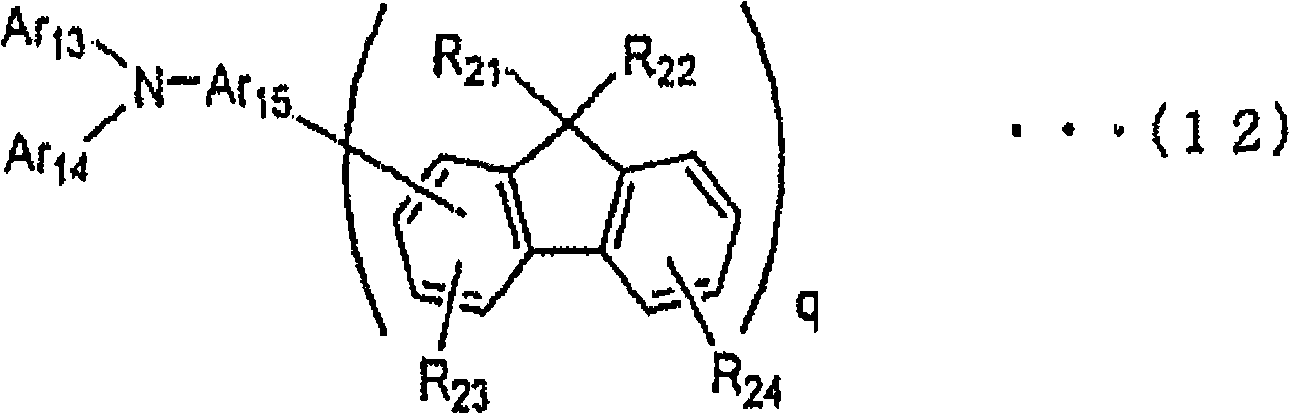
(式中,R21和R22表示氢原子、取代或未取代的烷基、取代或未取代的芳烷基、取代或未取代的芳基、取代或未取代的杂环基,与不同的芴基结合的R21彼此、R22彼此可以相同或不同,与相同芴基结合的R21和R22可以相同或不同。(wherein, R 21 and R 22 represent a hydrogen atom, a substituted or unsubstituted alkyl group, a substituted or unsubstituted aralkyl group, a substituted or unsubstituted aryl group, a substituted or unsubstituted heterocyclic group, and different R 21 and R 22 bound to the fluorenyl group may be the same or different, and R 21 and R 22 bound to the same fluorenyl group may be the same or different.
R23和R24表示氢原子、取代或未取代的烷基、取代或未取代的芳烷基、取代或未取代的芳基、取代或未取代的杂环基、氰基或者卤原子。与不同的芴基结合的R23彼此、R24彼此可以相同或不同,与相同芴基结合的R23和R24可以相同或不同。R 23 and R 24 represent a hydrogen atom, a substituted or unsubstituted alkyl group, a substituted or unsubstituted aralkyl group, a substituted or unsubstituted aryl group, a substituted or unsubstituted heterocyclic group, a cyano group or a halogen atom. R 23 and R 24 bound to different fluorenyl groups may be the same or different, and R 23 and R 24 bound to the same fluorenyl group may be the same or different.
Ar13和Ar14表示取代或未取代的芳香族烃基、取代或未取代的杂环基、取代或未取代的稠合多环芳香族基或者取代或未取代的稠合多环杂环基,Ar13和Ar14可以相同或不同。Ar13和Ar14可以互相结合形成环。Ar 13 and Ar 14 represent substituted or unsubstituted aromatic hydrocarbon groups, substituted or unsubstituted heterocyclic groups, substituted or unsubstituted fused polycyclic aromatic groups or substituted or unsubstituted fused polycyclic heterocyclic groups, Ar 13 and Ar 14 may be the same or different. Ar 13 and Ar 14 may combine with each other to form a ring.
Ar15表示二价的取代或未取代的芳香族烃基或者取代或未取代的杂环基。Ar 15 represents a divalent substituted or unsubstituted aromatic hydrocarbon group or a substituted or unsubstituted heterocyclic group.
q表示1-10的整数。)q represents an integer of 1-10. )
[化学式26][chemical formula 26]

(式中,R25和R26表示氢原子、取代或未取代的烷基、取代或未取代的芳烷基、取代或未取代的芳基、取代或未取代的杂环基、氰基或卤原子,与不同的亚苯基结合的R25彼此、R26彼此可以相同或不同,与相同亚苯基结合的R25和R26可以相同或不同。(wherein, R 25 and R 26 represent a hydrogen atom, a substituted or unsubstituted alkyl group, a substituted or unsubstituted aralkyl group, a substituted or unsubstituted aryl group, a substituted or unsubstituted heterocyclic group, a cyano group or As for the halogen atom, R 25 and R 26 bound to different phenylene groups may be the same or different, and R 25 and R 26 bound to the same phenylene group may be the same or different.
Ar16和Ar17表示二价的取代或未取代的芳香族烃基或者取代或未取代的杂环基,Ar16和Ar17可以相同或不同。Ar 16 and Ar 17 represent a divalent substituted or unsubstituted aromatic hydrocarbon group or a substituted or unsubstituted heterocyclic group, and Ar 16 and Ar 17 may be the same or different.
Ar18、Ar19、Ar20和Ar21表示取代或未取代的芳香族烃基、取代或未取代的杂环基、取代或未取代的稠合多环芳香族基或者取代或未取代的稠合多环杂环基,Ar19、Ar19、Ar20和Ar21可以相同或不同。Ar18、Ar19、Ar20和Ar21可以互相结合形成环。Ar 18 , Ar 19 , Ar 20 and Ar 21 represent substituted or unsubstituted aromatic hydrocarbon groups, substituted or unsubstituted heterocyclic groups, substituted or unsubstituted fused polycyclic aromatic groups or substituted or unsubstituted fused In the polycyclic heterocyclic group, Ar 19 , Ar 19 , Ar 20 and Ar 21 may be the same or different. Ar 18 , Ar 19 , Ar 20 and Ar 21 may combine with each other to form a ring.
r表示1-10的整数。)r represents an integer of 1-10. )
[化学式27][chemical formula 27]

(式中,R27和R28表示氢原子、取代或未取代的烷基、取代或未取代的芳烷基、取代或未取代的芳基、取代或未取代的杂环基、氰基或卤原子,与不同的亚苯基结合的R27彼此、R28彼此可以相同或不同,与相同亚苯基结合的R27和R28可以相同或不同。(wherein, R 27 and R 28 represent a hydrogen atom, a substituted or unsubstituted alkyl group, a substituted or unsubstituted aralkyl group, a substituted or unsubstituted aryl group, a substituted or unsubstituted heterocyclic group, a cyano group or As for the halogen atom, R 27 and R 28 bound to different phenylene groups may be the same or different, and R 27 and R 28 bound to the same phenylene group may be the same or different.
Ar22和Ar23表示取代或未取代的芳香族烃基、取代或未取代的杂环基、取代或未取代的稠合多环芳香族基或者取代或未取代的稠合多环杂环基,Ar22和Ar23可以相同或不同。Ar22和Ar23可以互相结合形成环。Ar 22 and Ar 23 represent substituted or unsubstituted aromatic hydrocarbon groups, substituted or unsubstituted heterocyclic groups, substituted or unsubstituted fused polycyclic aromatic groups or substituted or unsubstituted fused polycyclic heterocyclic groups, Ar 22 and Ar 23 may be the same or different. Ar 22 and Ar 23 may combine with each other to form a ring.
Ar24表示二价的取代或未取代的芳香族烃基或者取代或未取代的杂环基。Ar 24 represents a divalent substituted or unsubstituted aromatic hydrocarbon group or a substituted or unsubstituted heterocyclic group.
s表示1-10的整数。)s represents an integer of 1-10. )
[化学式28][chemical formula 28]

式中,X1、X2和X3分别独立地是直接接合、选自取代或未取代的亚烷基、亚芳烷基、亚芳基和杂环基的二价基,可以相同或不同,另外,也可以是具有由取代或未取代的亚芳基或者二价的杂环基组成的连接基的亚烷基、亚芳烷基、亚烯基、氨基、甲硅烷基、羰基、醚基以及硫醚基。In the formula, X 1 , X 2 and X 3 are each independently directly bonded, divalent groups selected from substituted or unsubstituted alkylene, aralkylene, arylene and heterocyclic groups, which may be the same or different , In addition, it may be an alkylene group, an aralkylene group, an alkenylene group, an amino group, a silyl group, a carbonyl group, an ether group having a linking group consisting of a substituted or unsubstituted arylene group or a divalent heterocyclic group group and thioether group.
Y1-Y4是选自取代或未取代的烷基、芳烷基、芳基和杂环基、具有由取代或未取代的亚芳基或者二价的杂环基组成的连接基的取代或未取代的亚烷基、亚芳烷基、亚烯基、氨基以及甲硅烷基、具有由取代或未取代的亚芳基或者二价的杂环基组成的连接基的未取代的羰基、醚基以及硫醚基的基团,可以相同或不同。另外,Y1和Y2、以及Y3和Y4可以互相结合形成环,X1、Y1和Y2、以及X3、Y3和Y4可以互相结合形成环。Y 1 -Y 4 are selected from substituted or unsubstituted alkyl, aralkyl, aryl and heterocyclic groups, substituted with a linking group consisting of substituted or unsubstituted arylene groups or divalent heterocyclic groups or an unsubstituted alkylene group, aralkylene group, alkenylene group, amino group, and silyl group, an unsubstituted carbonyl group having a linking group consisting of a substituted or unsubstituted arylene group or a divalent heterocyclic group, The ether group and the thioether group may be the same or different. In addition, Y 1 and Y 2 , and Y 3 and Y 4 may be combined to form a ring, and X 1 , Y 1 and Y 2 , and X 3 , Y 3 and Y 4 may be combined to form a ring.
R1-R8是选自氢原子、卤素基、取代或未取代的烷基、芳烷基以及芳基的基团,可以相同或不同。R 1 to R 8 are groups selected from a hydrogen atom, a halogen group, a substituted or unsubstituted alkyl group, an aralkyl group, and an aryl group, and may be the same or different.
m+n是0-10的整数。)m+n is an integer of 0-10. )
[化学式29][chemical formula 29]
式中,X1是选自取代或未取代的亚烷基、亚芳烷基、亚芳基和杂环基、具有由取代或未取代的亚芳基或者二价的杂环基组成的连接基的亚烷基、亚芳烷基、亚烯基、氨基、甲硅烷基、羰基、醚基以及硫醚基的二价基,也可以直接结合。In the formula, X is selected from substituted or unsubstituted alkylene, aralkylene, arylene and heterocyclic groups, and has a link consisting of substituted or unsubstituted arylene groups or divalent heterocyclic groups. A divalent group of an alkylene group, an aralkylene group, an alkenylene group, an amino group, a silyl group, a carbonyl group, an ether group, and a thioether group can also be directly bonded.
X2是选自氢原子、卤素基、取代或未取代的烷基、芳烷基、烯基、炔基、烷氧基、芳基、杂环基以及硫化物(スルフイド)基、取代甲硅烷基、以及氰基的基团。 X is selected from a hydrogen atom, a halogen group, a substituted or unsubstituted alkyl group, an aralkyl group, an alkenyl group, an alkynyl group, an alkoxy group, an aryl group, a heterocyclic group, and a sulfide (sulfide) group, a substituted silyl group groups, and cyano groups.
Y1-Y2是选自取代或未取代的烷基、芳烷基、芳基和杂环基、具有由取代或未取代的亚芳基或者二价的杂环基组成的连接基的取代或未取代的亚烷基、亚芳烷基、亚烯基、氨基以及甲硅烷基、具有由取代或未取代的亚芳基或者二价的杂环基组成的连接基的未取代的羰基、醚基以及硫醚基的基团,可以相同或不同。另外,Y1和Y2、或者X1、Y1和Y2可以互相结合形成环。Y 1 -Y 2 are selected from substituted or unsubstituted alkyl, aralkyl, aryl and heterocyclic groups, substituted with a linking group consisting of substituted or unsubstituted arylene groups or divalent heterocyclic groups or an unsubstituted alkylene group, aralkylene group, alkenylene group, amino group, and silyl group, an unsubstituted carbonyl group having a linking group consisting of a substituted or unsubstituted arylene group or a divalent heterocyclic group, The ether group and the thioether group may be the same or different. In addition, Y 1 and Y 2 , or X 1 , Y 1 and Y 2 may combine with each other to form a ring.
R1和R2是选自氢原子、取代或未取代的烷基、芳烷基以及芳基的基团,可以相同或不同。R 1 and R 2 are groups selected from hydrogen atoms, substituted or unsubstituted alkyl groups, aralkyl groups, and aryl groups, and may be the same or different.
n在X1是单键且X2是氢原子的情况下是2-10的整数,其它情况是1-10的整数。)n is an integer of 2-10 when X 1 is a single bond and X 2 is a hydrogen atom, and an integer of 1-10 in other cases. )
[化学式30][chemical formula 30]

式中,X3-X4是选自取代或未取代的亚烷基、亚芳烷基、亚芳基和杂环基、具有由取代或未取代的亚芳基或者二价的杂环基组成的连接基的取代或未取代的亚烷基、亚芳烷基、亚烯基、氨基以及甲硅烷基、未取代的羰基、醚基以及硫醚基的二价基,可以相同或不同,X3也可以是单键。In the formula, X 3 -X 4 are selected from substituted or unsubstituted alkylene, aralkylene, arylene and heterocyclic groups, with substituted or unsubstituted arylene groups or divalent heterocyclic groups The substituted or unsubstituted alkylene, aralkylene, alkenylene, amino and silyl, unsubstituted carbonyl, ether and thioether divalent groups of the linking group can be the same or different, X3 can also be a single bond.
X5是选自氢原子、卤素基、取代或未取代的烷基、芳烷基、烯基、炔基、烷氧基、芳基、杂环基以及硫化物基、取代甲硅烷基、以及氰基的基团。 X is selected from a hydrogen atom, a halogen group, a substituted or unsubstituted alkyl group, an aralkyl group, an alkenyl group, an alkynyl group, an alkoxy group, an aryl group, a heterocyclic group and a sulfide group, a substituted silyl group, and cyano group.
Y3和Y4是选自取代或未取代的烷基、芳烷基、芳基和杂环基、具有由取代或未取代的亚芳基或者二价的杂环基组成的连接基的取代或未取代的亚烷基、亚芳烷基、亚烯基、氨基以及甲硅烷基、具有由取代或未取代的亚芳基或者二价的杂环基组成的连接基的未取代的羰基、醚基以及硫醚基的基团,可以相同或不同。另外,Y3和Y4、或者X3、Y3和Y4可以互相结合形成环。Y 3 and Y 4 are selected from substituted or unsubstituted alkyl, aralkyl, aryl and heterocyclic groups, substituted with a linking group consisting of substituted or unsubstituted arylene groups or divalent heterocyclic groups or an unsubstituted alkylene group, aralkylene group, alkenylene group, amino group, and silyl group, an unsubstituted carbonyl group having a linking group consisting of a substituted or unsubstituted arylene group or a divalent heterocyclic group, The ether group and the thioether group may be the same or different. In addition, Y 3 and Y 4 , or X 3 , Y 3 and Y 4 may combine with each other to form a ring.
R3-R6是选自氢原子、取代或未取代的烷基、芳烷基以及芳基的基团,可以相同或不同。R 3 -R 6 are groups selected from hydrogen atom, substituted or unsubstituted alkyl group, aralkyl group and aryl group, and may be the same or different.
p,q分别是1以上的整数,p+q是2-10的整数。)p and q are integers of 1 or more, respectively, and p+q is an integer of 2-10. )
下面列举了通式(2)表示的胺化合物的具体例,但是并不限于此。Specific examples of the amine compound represented by the general formula (2) are listed below, but are not limited thereto.

[化32][chem 32]

[化33][chem 33]

[化34][chem 34]

[化35][chem 35]
[化36][chem 36]

[化37][chem 37]

[化38][chem 38]

[化39][chem 39]
[化40][chemical 40]

[化41][chem 41]

[化42][chem 42]
[化43][chem 43]

[化44][chem 44]

[化45][chem 45]
[化46][chem 46]

[化47][chem 47]

[化48][chem 48]

[化49][chem 49]

[化50][chemical 50]

[化51][Chemical 51]

[化52][Chemical 52]

[化53][Chemical 53]

[化54][Chemical 54]

[化55][Chemical 55]

[化56][Chemical 56]
[化57][Chemical 57]

[化58][Chemical 58]
[化59][Chemical 59]
[化60][Chemical 60]

本发明提供了在一对电极中的至少一个电极表面上设置硫属元素化合物层、卤化金属层或者金属氧化物层的有机电致发光元件。本发明的有机电致发光元件的上述发光层含有上述芘系衍生物和上述胺化合物。在上述发光层中,上述芘系衍生物和上述胺化合物的含有比例是99.99∶0.01-80.00∶20.00重量%。本发明的有机电致发光元件在发光层中含有金属配位化合物。The present invention provides an organic electroluminescence element in which a chalcogen compound layer, a metal halide layer or a metal oxide layer is provided on the surface of at least one of a pair of electrodes. The light-emitting layer of the organic electroluminescent device of the present invention contains the above-mentioned pyrene-based derivative and the above-mentioned amine compound. In the light-emitting layer, the content ratio of the above-mentioned pyrene-based derivative and the above-mentioned amine compound is 99.99:0.01-80.00:20.00% by weight. The organic electroluminescent device of the present invention contains a metal complex in the light-emitting layer.
下面,对本发明有机EL元件结构进行说明。Next, the structure of the organic EL element of the present invention will be described.
作为本发明有机EL元件的具代表性的元件结构,可列举如下的结构。As a typical element structure of the organic EL element of this invention, the following structure is mentioned.
(1)阳极/发光层/阴极;(1) anode/luminescent layer/cathode;
(2)阳极/空穴注入层/发光层/阴极;(2) anode/hole injection layer/luminescent layer/cathode;
(3)阳极/发光层/电子注入层/阴极;(3) anode/luminescent layer/electron injection layer/cathode;
(4)阳极/空穴注入层/发光层/电子注入层/阴极;(4) anode/hole injection layer/light emitting layer/electron injection layer/cathode;
(5)阳极/有机半导体层/发光层/阴极;(5) anode/organic semiconductor layer/luminescent layer/cathode;
(6)阳极/有机半导体层/电子阻挡层/发光层/阴极;(6) anode/organic semiconductor layer/electron blocking layer/luminescent layer/cathode;
(7)阳极/有机半导体层/发光层/粘附改善层/阴极;(7) anode/organic semiconductor layer/light emitting layer/adhesion improving layer/cathode;
(8)阳极/空穴注入层/空穴输送层/发光层/电子注入层/阴极;(8) anode/hole injection layer/hole transport layer/light emitting layer/electron injection layer/cathode;
(9)阳极/绝缘层/发光层/绝缘层/阴极;(9) anode/insulating layer/luminescent layer/insulating layer/cathode;
(10)阳极/无机半导体层/绝缘层/发光层/绝缘层/阴极;(10) anode/inorganic semiconductor layer/insulating layer/luminescent layer/insulating layer/cathode;
(11)阳极/有机半导体层/绝缘层/发光层/绝缘层/阴极;(11) anode/organic semiconductor layer/insulating layer/luminescent layer/insulating layer/cathode;
(12)阳极/绝缘层/空穴注入层/空穴输送层/发光层/绝缘层/阴极;(12) anode/insulating layer/hole injection layer/hole transport layer/luminescent layer/insulating layer/cathode;
(13)阳极/绝缘层/空穴注入层/空穴输送层/发光层/电子注入层/阴极。(13) Anode/insulating layer/hole injection layer/hole transport layer/light emitting layer/electron injection layer/cathode.
其中,通常优选使用(8)的结构,但是,并不限于这些结构。Among them, the structure of (8) is usually preferably used, however, it is not limited to these structures.
另外,本发明的有机EL元件中,本发明的联苯化合物不管用于上述有机EL元件的哪个有机层中皆可,但是,优选含在这些结构元件中的发光区或空穴输送区中。特别优选含在发光层的情况。含量可选自30-100摩尔%。In addition, in the organic EL device of the present invention, the biphenyl compound of the present invention may be used in any organic layer of the above-mentioned organic EL device, but is preferably contained in the light-emitting region or the hole transport region in these structural devices. It is particularly preferable to contain it in the light-emitting layer. The content can be selected from 30-100 mol%.
该有机EL元件通常在透光性基板上制作。所述的透光性基板是支撑有机EL元件的基板,关于该透光性,优选波长400-700nm的可见光区内的光透过率为50%以上的,更优选使用平滑的基板。This organic EL element is usually fabricated on a light-transmitting substrate. The light-transmitting substrate is a substrate supporting the organic EL element. As for the light-transmitting property, it is preferable to use a smooth substrate with a light transmittance of 50% or more in the visible light region with a wavelength of 400-700 nm.
作为这样的透光性基板,优选使用例如玻璃板、合成树脂板等。作为玻璃板,特别列举由钠钙玻璃、含钡和锶的玻璃、铅玻璃、铝硅酸盐玻璃、硼硅酸盐玻璃、硼硅酸钡玻璃、石英等形成的板。另外,作为合成树脂板,可列举聚碳酸酯树脂、丙烯酸酯、聚对苯二甲酸乙二酯树脂、聚醚硫化物树脂、聚砜树脂等的板。As such a translucent substrate, for example, a glass plate, a synthetic resin plate, or the like is preferably used. As the glass plate, plates made of soda lime glass, glass containing barium and strontium, lead glass, aluminosilicate glass, borosilicate glass, barium borosilicate glass, quartz, and the like are particularly exemplified. Moreover, as a synthetic resin board, the board of polycarbonate resin, acrylic ester, polyethylene terephthalate resin, polyether sulfide resin, polysulfone resin, etc. is mentioned.
其次,阳极具有将空穴注入到空穴输送层或发光层的功能,有效的是具有4.5eV以上功函数的。作为用于本发明的阳极材料的具体例子,可列举氧化铟锡合金(ITO)、氧化铟和氧化锌的混合物(IZO)、ITO和氧化铈的混合物(ITCO)、IZO和氧化铈的混合物(IZCO)、氧化铟和氧化铈的混合物(ICO)、氧化锌和氧化铝的混合物(AZO)、氧化锡(NESA)、金、银、铂、铜等。Next, the anode has a function of injecting holes into the hole transport layer or the light emitting layer, and it is effective to have a work function of 4.5 eV or more. Specific examples of the anode material used in the present invention include indium tin oxide (ITO), a mixture of indium oxide and zinc oxide (IZO), a mixture of ITO and cerium oxide (ITCO), a mixture of IZO and cerium oxide ( IZCO), a mixture of indium oxide and cerium oxide (ICO), a mixture of zinc oxide and aluminum oxide (AZO), tin oxide (NESA), gold, silver, platinum, copper, etc.
阳极可以通过将这些电极物质采用蒸镀法或溅射法等方法形成薄膜来制备。The anode can be prepared by forming a thin film of these electrode substances by vapor deposition or sputtering.
如上所述,当从阳极观察从发光层发出的光时,优选阳极的光透过率大于10%。另外,优选阳极的片材电阻率为数百Ω/□以下。阳极的膜厚也根据材料的不同而不同,通常选择为10nm-1μm,优选10-200nm。As described above, when the light emitted from the light-emitting layer is observed from the anode, it is preferable that the light transmittance of the anode is greater than 10%. In addition, the sheet resistivity of the anode is preferably several hundred Ω/□ or less. The film thickness of the anode also varies according to different materials, and is usually selected as 10 nm-1 μm, preferably 10-200 nm.
本发明的有机EL元件中,发光层具有以下(1)-(3)的功能:In the organic EL element of the present invention, the light-emitting layer has the following (1)-(3) functions:
(1)注入功能:当施加电场时,可以从阳极或空穴注入层注入空穴,从阴极或电子注入层注入电子的功能;(1) Injection function: when an electric field is applied, holes can be injected from the anode or hole injection layer, and electrons can be injected from the cathode or electron injection layer;
(2)输送功能:在电场力的作用下,传输已注入的电荷(电子和空穴)的功能;和(2) Transport function: the function of transporting injected charges (electrons and holes) under the action of an electric field force; and
(3)发光功能:提供电子和空穴复合的场,并将其联系于发光的功能。(3) Luminescence function: provide a field for the recombination of electrons and holes, and link it to the function of luminescence.
作为形成该发光层的方法,可适宜使用例如蒸镀法、旋涂法、LB法等公知的方法。发光层特别优选为分子沉积薄膜。其中所述分子沉积薄膜是由气相状态的材料化合物沉积形成的薄膜,或者由溶液状态或液相状态的材料化合物进行固体化形成的薄膜,通常该分子沉积薄膜与由LB法形成的薄膜(分子累积膜)可以根据凝集结构和高次结构的差异或由结构引起的功能差异进行区分。As a method for forming the light-emitting layer, for example, known methods such as vapor deposition, spin coating, and LB method can be suitably used. The light-emitting layer is particularly preferably a molecularly deposited thin film. Wherein the molecular deposition film is a film formed by deposition of a material compound in a gas phase state, or a film formed by solidification of a material compound in a solution state or a liquid phase state, usually the molecular deposition film is the same as the film formed by the LB method (molecular Cumulative membranes) can be distinguished on the basis of differences in aggregate structure and higher-order structure or functional differences caused by structure.
另外,还可以如特开昭57-51781号公报所公开的那样,通过将树脂等结合剂和材料化合物溶解于溶剂中形成溶液,随后将其用旋涂法等进行薄膜化来形成发光层。Alternatively, as disclosed in JP-A-57-51781, the light-emitting layer can be formed by dissolving a binder such as a resin and a material compound in a solvent to form a solution, which is then thinned by spin coating or the like.
本发明中,在不损害本发明目的的范围内,可以根据需要在发光层中含有除了由芘系衍生物以及胺化合物组成的发光材料以外的其它公知的金属配位化合物,另外,在含有本发明化合物的发光层上,也可以层叠含有其它公知的金属配位化合物的发光层。In the present invention, within the range that does not impair the purpose of the present invention, other known metal coordination compounds other than the luminescent material composed of pyrene derivatives and amine compounds can be contained in the light-emitting layer as required. On the light-emitting layer of the inventive compound, a light-emitting layer containing other known metal complexes may be laminated.
作为上述金属配位化合物,优选含有选自Ir、Ru、Pd、Pt、Os和Re的至少一种金属的金属配位化合物,配位基优选具有选自苯基吡啶骨架、联吡啶骨架和菲绕啉骨架的至少一种骨架。这样的金属配位化合物的具体例可列举三(2-苯基吡啶)合铱、三(2-苯基吡啶)合钌、三(2-苯基吡啶)合钯、双(2-苯基吡啶)合铂、三(2-苯基吡啶)合锇、三(2-苯基吡啶)合铼、八乙基卟啉铂、八苯基卟啉铂、八乙基卟啉钯、八苯基卟啉钯等,但是并不限于这些,可根据所要求的发光色、元件性能、与主体化合物的关系出发选择适合的配位化合物。As the above-mentioned metal coordination compound, preferably a metal coordination compound containing at least one metal selected from Ir, Ru, Pd, Pt, Os and Re, the ligand preferably has a metal complex selected from the group consisting of phenylpyridine skeleton, bipyridine skeleton and phenanthrene At least one kind of skeleton of the ringoline skeleton. Specific examples of such metal coordination compounds include tris(2-phenylpyridine)iridium, tris(2-phenylpyridine)ruthenium, tris(2-phenylpyridine)palladium, bis(2-phenylpyridine) Pyridine) platinum, tris(2-phenylpyridine) osmium, tris(2-phenylpyridine) rhenium, octaethylporphyrin platinum, octaphenylporphyrin platinum, octaethylporphyrin palladium, octaphenyl porphyrin-based palladium, etc., but are not limited to these, and a suitable coordination compound can be selected according to the required luminescent color, device performance, and the relationship with the host compound.
接着,空穴注入/输送层是帮助空穴向发光层的注入并输送至发光区的层,空穴迁移率高,并且电离能通常小,为5.5eV以下。作为这样的空穴注入/输送层,优选在较低的电场强度下将空穴输送至发光层的材料,进一步优选例如在施加104~106V/cm的电场时,其空穴的迁移率至少为10-4cm2/V·s以上的材料。Next, the hole injection/transport layer is a layer that assists the injection of holes into the light-emitting layer and transports them to the light-emitting region, and has high hole mobility and generally low ionization energy of 5.5 eV or less. Such a hole injecting/transporting layer is preferably a material that transports holes to the light-emitting layer at a relatively low electric field intensity, and is more preferably a material that can transport holes when an electric field of 10 4 to 10 6 V/cm is applied, for example. Materials with a rate of at least 10 -4 cm 2 /V·s or more.
作为形成空穴注入/输送层的材料,只要是具有上述优选的性质的材料,就没有特别限制,可以从现有光传导材料中作为空穴的电荷输送材料常用的材料和有机EL元件的空穴注入层中使用的公知的材料中选择任意的材料来使用。作为芳族胺衍生物通常可列举下述通式表示的化合物。The material for forming the hole injection/transport layer is not particularly limited as long as it has the above-mentioned preferred properties, and materials commonly used as charge transport materials for holes and holes in organic EL elements can be selected from existing photoconductive materials. Any material selected from known materials used in the hole injection layer is used. As an aromatic amine derivative, the compound represented by the following general formula is mentioned normally.
[化学式61][chemical formula 61]

Ar11-Ar13、Ar21-Ar23和Ar3-Ar8是取代或未取代的环碳原子数6-50的芳香族烃基、或者环原子数5-50的芳香族杂环基。a-c和p-r分别是0-3的整数。Ar3和Ar4、Ar5和Ar6、Ar7和Ar8可以彼此互相连接形成饱和或者不饱和的环。作为环碳原子数6-50的芳香族烃基以及环原子数5-50的芳香族杂环基的具体例子,可列举与上述通式(1)和(3)中的基团相同的基团。Ar 11 -Ar 13 , Ar 21 -Ar 23 and Ar 3 -Ar 8 are substituted or unsubstituted aromatic hydrocarbon groups with 6-50 ring carbon atoms, or aromatic heterocyclic groups with 5-50 ring atoms. ac and pr are integers of 0-3 respectively. Ar 3 and Ar 4 , Ar 5 and Ar 6 , Ar 7 and Ar 8 may be connected to each other to form a saturated or unsaturated ring. Specific examples of the aromatic hydrocarbon group having 6-50 ring carbon atoms and the aromatic heterocyclic group having 5-50 ring atoms include the same groups as those in the above general formulas (1) and (3) .
[化学式62][chemical formula 62]
Ar1-Ar4是取代或未取代的环碳原子数6-50的芳香族烃基、或者环原子数5-50的芳香族杂环基。L是连接基,是单键、取代或未取代的环碳原子数6-50的芳香族烃基、或者环原子数5-50的芳香族杂环基。x是0-5的整数。Ar2和Ar3可以互相连接形成饱和或者不饱和的环。其中,作为环碳原子数6-50的芳香族烃基、以及环原子数5-50的芳香族杂环基的具体例子,可列举与上述通式(1)和(3)中的基团相同的基团。Ar 1 -Ar 4 are substituted or unsubstituted aromatic hydrocarbon groups having 6-50 ring carbon atoms, or aromatic heterocyclic groups having 5-50 ring atoms. L is a linking group, and is a single bond, a substituted or unsubstituted aromatic hydrocarbon group having 6-50 ring carbon atoms, or an aromatic heterocyclic group having 5-50 ring atoms. x is an integer from 0-5. Ar 2 and Ar 3 can be connected to each other to form a saturated or unsaturated ring. Among them, as specific examples of the aromatic hydrocarbon group with 6-50 ring carbon atoms and the aromatic heterocyclic group with 5-50 ring atoms, the same groups as those in the above general formulas (1) and (3) can be listed. group.
作为具体例子,可列举三唑衍生物(参阅美国专利3,112,197号说明书等)、噁二唑衍生物(参阅美国专利3,189,447号说明书等)、咪唑衍生物(参阅特公昭37-16096号公报等)、多芳基链烷烃衍生物(参阅美国专利3,615,402号说明书、同第3,820,989号说明书、同第3,542,544号说明书、特公昭45-555号公报、同51-10983号公报、特开昭51-93224号公报、同55-17105号公报、同56-4148号公报、同55-108667号公报、同55-156953号公报、同56-36656号公报等)、吡唑啉衍生物及吡唑啉酮衍生物(参阅美国专利第3,180,729号说明书、同第4,278,746号说明书、特开昭55-88064号公报、同55-88065号公报、同49-105537号公报、同55-51086号公报、同56-80051号公报、同56-88141号公报、同57-45545号公报、同54-112637号公报、同55-74546号公报等)、苯二胺衍生物(参阅美国专利第3,615,404号说明书、特公昭51-10105号公报、同46-3712号公报、同47-25336号公报、特开昭54-53435号公报、同54-110536号公报、同54-119925号公报等)、芳胺衍生物(参阅美国专利第3,567,450号说明书、同第3,180,703号说明书、同第3,240,597号说明书、同第3,658,520号说明书、同第4,232,103号说明书、同第4,175,961号说明书、同第4,012,376号说明书、特公昭49-35702号公报、同39-27577号公报、特开昭55-144250号公报、同56-119132号公报、同56-22437号公报、西德专利第1,110,518号说明书等)、氨基取代查耳酮衍生物(参阅美国专利第3,526,501号说明书等)、噁唑衍生物(美国专利第3,257,203号说明书等中公开的物质)、苯乙烯蒽衍生物(参阅特开昭56-46234号公报等)、芴酮衍生物(参阅特开昭54-110837号公报等)、腙衍生物(参阅美国专利第3,717,462号说明书、特开昭54-59143号公报、同55-52063号公报、同55-52064号公报、同55-46760号公报、同55-85495号公报、同57-11350号公报、同57-148749号公报、特开平2-311591号公报等)、茋衍生物(参阅特开昭61-210363号公报、同第61-228451号公报、同61-14642号公报、同61-72255号公报、同62-47646号公报、同62-36674号公报、同62-10652号公报、同62-30255号公报、同60-93455号公报、同60-94462号公报、同60-174749号公报、同60-175052号公报等)、硅氨烷衍生物(美国专利第4,950,950号说明书)、聚硅烷类(特开平2-204996号公报)、苯胺类共聚物(特开平2-282263号公报)、特开平1-211399号公报公开的导电性高分子低聚物(特别是噻吩低聚物)等。Specific examples include triazole derivatives (see U.S. Patent No. 3,112,197, etc.), oxadiazole derivatives (see U.S. Patent No. 3,189,447, etc.), imidazole derivatives (see JP-A-37-16096, etc.), Polyaryl alkane derivatives (see U.S. Patent No. 3,615,402, No. 3,820,989, No. 3,542,544, JP-A-45-555, JP-A-51-10983, JP-A-51-93224 , No. 55-17105, No. 56-4148, No. 55-108667, No. 55-156953, No. 56-36656, etc.), pyrazoline derivatives and pyrazolone derivatives (See U.S. Patent No. 3,180,729 specification, same No. 4,278,746 specification, JP-A No. 55-88064, No. 55-88065, No. 49-105537, No. 55-51086, No. 56-80051 Gazette, No. 56-88141, No. 57-45545, No. 54-112637, No. 55-74546, etc.), phenylenediamine derivatives (see US Patent No. 3,615,404 specification, Japanese Patent Publication No. 51- No. 10105 communique, No. 46-3712 communiqué, No. 47-25336 communiqué, JP-A-54-53435 communiqué, No. 54-110536 communiqué, No. 54-119925 communiqué, etc.), aromatic amine derivatives (see U.S. Patent No. 3,567,450, No. 3,180,703, No. 3,240,597, No. 3,658,520, No. 4,232,103, No. 4,175,961, No. 4,012,376, Japanese Patent Publication No. 49-35702, Same as No. 39-27577, JP-A No. 55-144250, No. 56-119132, No. 56-22437, West German Patent No. 1,110,518, etc.), amino-substituted chalcone derivatives (see U.S. Patent No. 3,526,501, etc.), oxazole derivatives (substances disclosed in U.S. Patent No. 3,257,203, etc.), styrene anthracene derivatives (see JP-A-56-46234, etc.), JP-A No. 54-110837, etc.), hydrazone derivatives (see US Patent No. 3,717,462, JP-A-54-59143, JP-55-52063, JP-55-52064, JP-55-46760 Gazette No. 55-85495, Gazette No. 57-11350, Gazette 57-148749, JP-2-311591, etc.), stilbene derivatives (refer to Gazette No. 61-210363, JP-A Gazette No. 61-228451, Gazette No. 61-14642, Gazette No. 61-72255, Gazette No. 62-47646, Gazette No. 62-36674, Gazette No. 62-10652, Gazette 62-30255, Gazette 60 -93455 bulletin, same 60-94462 bulletin, same 60-174749 bulletin, same 60-175052 bulletin etc.), silazane derivatives (U.S. Patent No. 4,950,950 specifications), polysilanes (JP-A 2- 204996), aniline copolymers (JP-A-2-282263), conductive polymer oligomers (especially thiophene oligomers) disclosed in JP-A-1-211399, and the like.
作为空穴注入层的材料可以使用上述的物质,优选使用卟啉化合物(特开昭63-2956965号公报等公开的物质)、芳香族叔胺化合物及苯乙烯胺化合物(参阅美国专利第4,127,412号说明书、特开昭53-27033号公报、同54-58445号公报、同54-149634号公报、同54-64299号公报、同55-79450号公报、同55-144250号公报、同56-119132号公报、同61-295558号公报、同61-98353号公报、同63-295695号公报等),特别优选使用芳香族叔胺化合物。As the material for the hole injection layer, the above-mentioned substances can be used, and porphyrin compounds (substances disclosed in Japanese Patent Application Laid-Open No. 63-2956965, etc.), aromatic tertiary amine compounds, and styrylamine compounds (see U.S. Patent No. 4,127,412) are preferably used. Instructions, JP-A No. 53-27033, No. 54-58445, No. 54-149634, No. 54-64299, No. 55-79450, No. 55-144250, and No. 56-119132 No. 61-295558, No. 61-98353, No. 63-295695, etc.), especially aromatic tertiary amine compounds are preferably used.
还可以例举美国专利第5,061,569号所述的分子内具有2个稠合芳香环的化合物,例如4,4’-双(N-(1-萘基)-N-苯基胺基)联苯(以下缩写为NPD),还有特开平4-308688号公报所记载的3个三苯胺单元连结成了星爆(star burst)型的4,4’,4”-三(N-(3-甲基苯基)-N-苯基胺基)三苯胺(以下缩写为MTDATA)等。Compounds having two fused aromatic rings in the molecule described in U.S. Patent No. 5,061,569 can also be exemplified, such as 4,4'-bis(N-(1-naphthyl)-N-phenylamino)biphenyl (hereinafter abbreviated as NPD), and 3 triphenylamine units described in JP-A-4-308688 are linked into a star burst type 4,4',4"-three (N-(3- methylphenyl)-N-phenylamino)triphenylamine (hereinafter abbreviated as MTDATA) and the like.
另外,还可以使用特许-3571977中公开的下述通式表示的含氮化合物。In addition, nitrogen-containing compounds represented by the following general formula disclosed in JP-3571977 can also be used.
[化学式63][chemical formula 63]

式中,R1、R2、R3、R4、R5和R6表示取代或未取代的烷基、取代或未取代的芳基、取代或未取代的芳烷基、取代或未取代的杂环基中的任何一个。其中,R1、R2、R3、R4、R5和R6可以相同或不同。R1和R2、R3和R4、R5和R6或者R1和R6、R2和R3、R4和R5也可以形成稠环。In the formula, R 1 , R 2 , R 3 , R 4 , R 5 and R 6 represent substituted or unsubstituted alkyl, substituted or unsubstituted aryl, substituted or unsubstituted aralkyl, substituted or unsubstituted Any of the heterocyclic groups. Wherein, R 1 , R 2 , R 3 , R 4 , R 5 and R 6 may be the same or different. R 1 and R 2 , R 3 and R 4 , R 5 and R 6 or R 1 and R 6 , R 2 and R 3 , R 4 and R 5 may also form a condensed ring.
此外,还可以使用美国专利2004-0113547中记载的下述通式的化合物。In addition, compounds of the following general formulas described in US Pat. No. 2004-0113547 can also be used.
[化学式64][chemical formula 64]
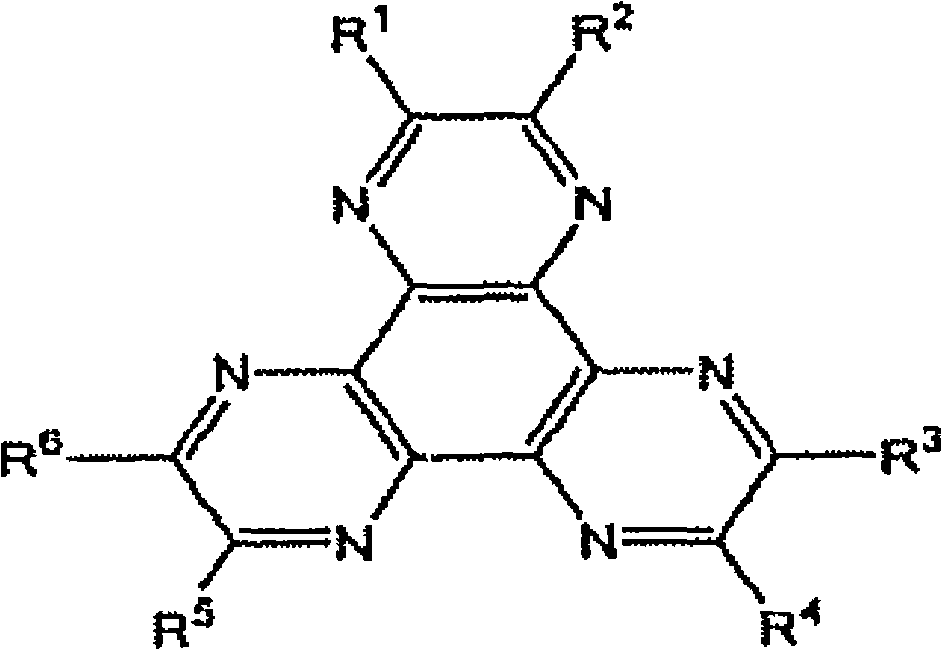
R1-R6是取代基,优选是氰基、硝基、磺酰基、羰基、三氟甲基、卤素等吸电子基。R 1 -R 6 are substituents, preferably electron-withdrawing groups such as cyano, nitro, sulfonyl, carbonyl, trifluoromethyl, and halogen.
另外,p型Si、p型SiC等无机化合物也可以用作空穴注入层的材料。In addition, inorganic compounds such as p-type Si and p-type SiC can also be used as a material for the hole injection layer.
空穴注入、输送层可以通过例如真空蒸镀法、旋涂法、浇注法、LB法等公知的方法将上述的化合物进行薄膜化形成。作为空穴注入、输送层的膜厚没有特别限制,通常为5nm-5μm。该空穴注入、输送层在空穴输送区含有本发明的化合物时,可以由上述材料的一种或两种以上构成的一层而构成,或者也可以层叠由与上述空穴注入、输送层不同种的化合物组成的空穴注入、输送层。The hole injection and transport layer can be formed by thinning the above-mentioned compound by known methods such as vacuum evaporation, spin coating, casting, and LB method. The film thickness of the hole injecting and transporting layer is not particularly limited, and is usually 5 nm to 5 μm. When the hole injection and transport layer contains the compound of the present invention in the hole transport region, it may be composed of one or two or more of the above materials, or may be laminated with the above hole injection and transport layer. A hole injection and transport layer composed of different kinds of compounds.
另外,有机半导体层是帮助向发光层的空穴注入或电子注入的层,优选具有10-10S/cm以上的电导率的物质。作为这样的有机半导体层的材料,可以使用含噻吩低聚物、特开平8-193191号公报公开的含芳基胺低聚物等导电性低聚物、含芳基胺树枝状高分子(アリ一ルアミンデンドリマ一)等导电性树枝状高分子等。In addition, the organic semiconductor layer is a layer that assists hole injection or electron injection into the light-emitting layer, and preferably has an electrical conductivity of 10 −10 S/cm or more. As a material for such an organic semiconductor layer, conductive oligomers such as thiophene-containing oligomers, arylamine-containing oligomers disclosed in JP-A No. 8-193191, arylamine-containing dendrimers (ari 1) Conductive dendrimers, etc.
接着,电子注入层/输送层是帮助电子向发光层的注入并输送至发光区的层,电子迁移率大,另外,粘付改善层是由该电子注入层中与阴极的粘付性特别好的材料组成的层。Next, the electron injection layer/transport layer is a layer that helps the injection of electrons into the light-emitting layer and transports them to the light-emitting area. layers of materials.
另外,已知由于有机EL元件中发出的光由电极(此时是阴极)反射,所以直接从阳极取出的发光和经过电极反射取出的发光会产生干涉。为了有效地利用该干涉效果,电子输送层的膜厚可在数nm-数μm内适当选择,但是膜厚特别厚时,为了避免电压升高,优选在外加104~106V/cm的电场时电子迁移率至少为10-6cm2/V·s以上。In addition, it is known that light emitted from an organic EL element is reflected by an electrode (cathode in this case), so that the light emitted directly from the anode and the light emitted by reflection from the electrode interfere with each other. In order to effectively utilize this interference effect, the film thickness of the electron transport layer can be appropriately selected within a few nm to a few μm, but when the film thickness is particularly thick, in order to avoid a voltage increase, it is preferable to apply an additional 10 4 to 10 6 V/cm Electron mobility under electric field is at least 10 -6 cm 2 /V·s.
作为用于电子注入层的材料,优选8-羟基喹啉或其衍生物的金属配位化合物、噁二唑衍生物。作为上述8-羟基喹啉或其衍生物的金属配位化合物具体例子,可以使用含喔星(一般为8-羟基喹啉)的螯合物的金属螯合喔星化合物,例如三(8-羟基喹啉)合铝作为电子注入材料。As materials used for the electron injection layer, metal complexes of 8-hydroxyquinoline or derivatives thereof, and oxadiazole derivatives are preferable. As the specific example of the metal coordination compound of the above-mentioned 8-hydroxyquinoline or its derivatives, a metal chelated oxin compound containing a chelate of oxine (generally 8-hydroxyquinoline) can be used, such as three (8- Hydroxyquinoline) aluminum as electron injection material.
另一方面,作为噁二唑衍生物,可列举用下述式表示的电子传递化合物。On the other hand, examples of the oxadiazole derivatives include electron transport compounds represented by the following formulas.
[化学式65][chemical formula 65]

(式中,Ar1,Ar2 Ar3,Ar5,Ar6,Ar9分别表示取代或未取代的芳基,分别可以相同或不同。另外,Ar4,Ar7,Ar8表示取代或未取代的亚芳基,分别可以相同或不同。)(In the formula, Ar 1 , Ar 2 Ar 3 , Ar 5 , Ar 6 , and Ar 9 represent substituted or unsubstituted aryl groups, which can be the same or different. In addition, Ar 4 , Ar 7 , Ar 8 represent substituted or unsubstituted The substituted arylene groups may be the same or different, respectively.)
在此,作为芳基,可列举苯基、联苯基、蒽基、苝基、芘基。另外,作为亚芳基,可列举亚苯基、亚萘基、亚联苯基、亚蒽基、亚苝基、亚芘基等。另外,作为取代基可列举碳原子数1~10的烷基、碳原子数1~10的烷氧基或氰基等。该电子传递化合物优选薄膜形成性的物质。Here, examples of the aryl group include phenyl, biphenyl, anthracenyl, perylenyl, and pyrenyl. Moreover, as an arylene group, a phenylene group, a naphthylene group, a biphenylene group, an anthracene group, a perylene group, a pyrenylene group etc. are mentioned. In addition, examples of the substituent include an alkyl group having 1 to 10 carbon atoms, an alkoxy group having 1 to 10 carbon atoms, or a cyano group. The electron transport compound is preferably a thin film-forming substance.
作为上述电子传递性化合物的具体例,可以例举下述物质。Specific examples of the above-mentioned electron-transporting compound include the following.
[化学式66][chemical formula 66]
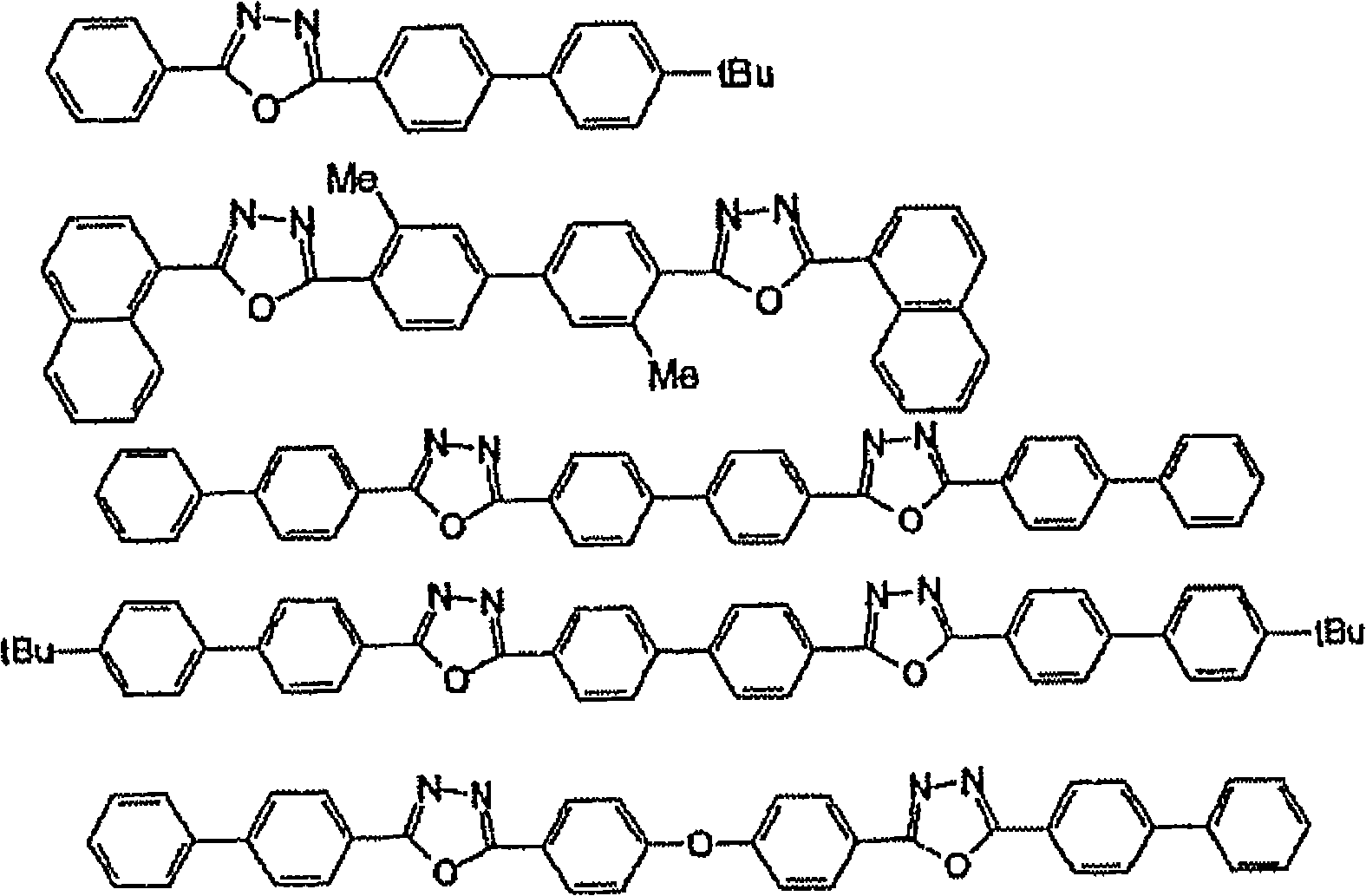
另外,作为用于电子注入层和电子输送层的材料,也可以使用下述通式(E)-(J)表示的化合物。In addition, as materials for the electron injection layer and the electron transport layer, compounds represented by the following general formulas (E) to (J) can also be used.
用下式表示的含氮杂环衍生物。A nitrogen-containing heterocyclic derivative represented by the following formula.
[化学式67][chemical formula 67]

(通式(E)和(F)中,A1~A3分别独立地是氮原子或碳原子。(In general formulas (E) and (F), A 1 to A 3 are each independently a nitrogen atom or a carbon atom.
Ar1是取代或未取代的环碳原子数为6~60的芳基、或者取代或未取代的环碳原子数为3~60的杂芳基,Ar2是氢原子、取代或未取代的环碳原子数为6~60的芳基、或者取代或未取代的环碳原子数为3~60的杂芳基、取代或未取代的碳原子数为1~20的烷基、或者取代或未取代的碳原子数为1~20的烷氧基、或者它们的二价基。其中,Ar1和Ar2的任意一方为取代或未取代的环碳原子数为10~60的稠环基、或者取代或未取代的环碳原子数为3~60的单杂稠环基、或者它们的2价基。Ar 1 is a substituted or unsubstituted aryl group with 6 to 60 ring carbon atoms, or a substituted or unsubstituted heteroaryl group with 3 to 60 ring carbon atoms, and Ar 2 is a hydrogen atom, substituted or unsubstituted An aryl group with 6 to 60 ring carbon atoms, or a substituted or unsubstituted heteroaryl group with 3 to 60 ring carbon atoms, a substituted or unsubstituted alkyl group with 1 to 20 carbon atoms, or a substituted or An unsubstituted alkoxy group having 1 to 20 carbon atoms or a divalent group thereof. Wherein, any one of Ar 1 and Ar 2 is a substituted or unsubstituted fused ring group with 10 to 60 ring carbon atoms, or a substituted or unsubstituted monoheterocondensed ring group with 3 to 60 ring carbon atoms, or their divalent bases.
L1、L2和L分别独立地是单键、取代或未取代的环碳原子数为6~60的亚芳基、取代或未取代的环碳原子数为3~60的杂亚芳基或者取代或未取代的亚芴基。L 1 , L 2 and L are each independently a single bond, a substituted or unsubstituted arylene group with 6 to 60 ring carbon atoms, a substituted or unsubstituted heteroarylene group with 3 to 60 ring carbon atoms or substituted or unsubstituted fluorenylene.
R为氢原子、取代或未取代的环碳原子数为6~60的芳基、取代或未取代的环碳原子数为3~60的杂芳基、取代或未取代的碳原子数为1~20的烷基、或者取代或未取代的碳原子数为1~20的烷氧基,n为0~5的整数,在n为2以上的情况下,多个R可以相同或不同,此外,相邻的多个R基彼此可以结合,形成碳环式脂肪族环或碳环式芳香族环。R is a hydrogen atom, a substituted or unsubstituted aryl group with 6 to 60 ring carbon atoms, a substituted or unsubstituted heteroaryl group with 3 to 60 ring carbon atoms, or a substituted or unsubstituted carbon atom with 1 An alkyl group of ~20, or a substituted or unsubstituted alkoxy group with 1 to 20 carbon atoms, n is an integer of 0 to 5, and when n is 2 or more, multiple R may be the same or different, and in addition , a plurality of adjacent R groups may combine with each other to form a carbocyclic aliphatic ring or a carbocyclic aromatic ring.
R1为氢原子、取代或未取代的环碳原子数为6~60的芳基、取代或未取代的环碳原子数为3~60的杂芳基、取代或未取代的碳原子数为1~20的烷基、取代或未取代的碳原子数为1~20的烷氧基、或者-L-Ar1-Ar2。) R1 is a hydrogen atom, a substituted or unsubstituted aryl group with 6 to 60 ring carbon atoms, a substituted or unsubstituted heteroaryl group with 3 to 60 ring carbon atoms, a substituted or unsubstituted carbon atom number of An alkyl group of 1 to 20, a substituted or unsubstituted alkoxy group having 1 to 20 carbon atoms, or -L-Ar 1 -Ar 2 . )
用下述式表示的含氮杂环衍生物Nitrogen-containing heterocyclic derivatives represented by the following formula
HAr-L-Ar1-Ar2(G)HAr-L-Ar 1 -Ar 2 (G)
(式中,HAr是可以具有取代基的碳原子数为3~40的含氮杂环,L是单键、可以具有取代基的碳原子数为6~60的亚芳基、可以具有取代基的碳原子数为3~60的杂亚芳基或可以具有取代基的亚芴基,Ar1是可以具有取代基的碳原子数为6~60的2价芳香族烃基,Ar2是可以具有取代基的碳原子数为6~60的芳基、或可以具有取代基的碳原子数为3~60的杂芳基。)(In the formula, HAr is a nitrogen-containing heterocyclic ring with 3 to 40 carbon atoms that may have a substituent, L is a single bond, an arylene group with 6 to 60 carbon atoms that may have a substituent, and may have a substituent A heteroarylene group with 3 to 60 carbon atoms or a fluorenylene group that may have a substituent, Ar 1 is a divalent aromatic hydrocarbon group with a carbon number of 6 to 60 that may have a substituent, and Ar 2 is a divalent aromatic hydrocarbon group that may have a substituent An aryl group having 6 to 60 carbon atoms in the substituent, or a heteroaryl group having 3 to 60 carbon atoms which may have a substituent.)
用下述式表示的硅杂环戊二烯衍生物。A silacyclopentadiene derivative represented by the following formula.
[化学式68][chemical formula 68]

(式中,X和Y相互独立,是碳原子数为1~6的饱和或不饱和的烃基、烷氧基、烯氧基、炔氧基、羟基、取代或未取代的芳基、取代或未取代的杂环,或者X和Y相结合而形成饱和或不饱和的环的结构,R1~R4分别独立,表示氢原子、卤原子、取代或未取代的碳原子数为1~6的烷基、烷氧基、芳氧基、全氟代烷基、全氟代烷氧基、氨基、烷基羰基、芳基羰基、烷氧基羰基、芳氧基羰基、偶氮基、烷基羰基氧基、芳基羰基氧基、烷氧基羰基氧基、芳氧基羰基氧基、亚磺酰基、磺酰基、氨磺酰基(スルフアニル)、甲硅烷基、氨基甲酰基、芳基、杂环基、烯基、炔基、硝基、甲酰基、亚硝基、甲酰氧基、异氰基、氰酸酯基、异氰酸酯基、硫氰酸酯基、异硫氰酸酯基或者氰基或者相邻时取代或者未取代的环进行稠合形成的结构。)(wherein, X and Y are independent of each other and are saturated or unsaturated hydrocarbon groups, alkoxy groups, alkenyloxy groups, alkynyloxy groups, hydroxyl groups, substituted or unsubstituted aryl groups, substituted or An unsubstituted heterocyclic ring, or a structure in which X and Y are combined to form a saturated or unsaturated ring, R 1 to R 4 are independently independent, representing a hydrogen atom, a halogen atom, and the number of substituted or unsubstituted carbon atoms is 1 to 6 Alkyl, alkoxy, aryloxy, perfluoroalkyl, perfluoroalkoxy, amino, alkylcarbonyl, arylcarbonyl, alkoxycarbonyl, aryloxycarbonyl, azo, alkane Cylcarbonyloxy, arylcarbonyloxy, alkoxycarbonyloxy, aryloxycarbonyloxy, sulfinyl, sulfonyl, sulfamoyl, silyl, carbamoyl, aryl, Heterocyclyl, alkenyl, alkynyl, nitro, formyl, nitroso, formyloxy, isocyano, cyanate, isocyanate, thiocyanate, isothiocyanate or A structure formed by condensing a cyano group or adjacent substituted or unsubstituted rings.)
用下述式表示的硼烷衍生物。A borane derivative represented by the following formula.
[化学式69][chemical formula 69]
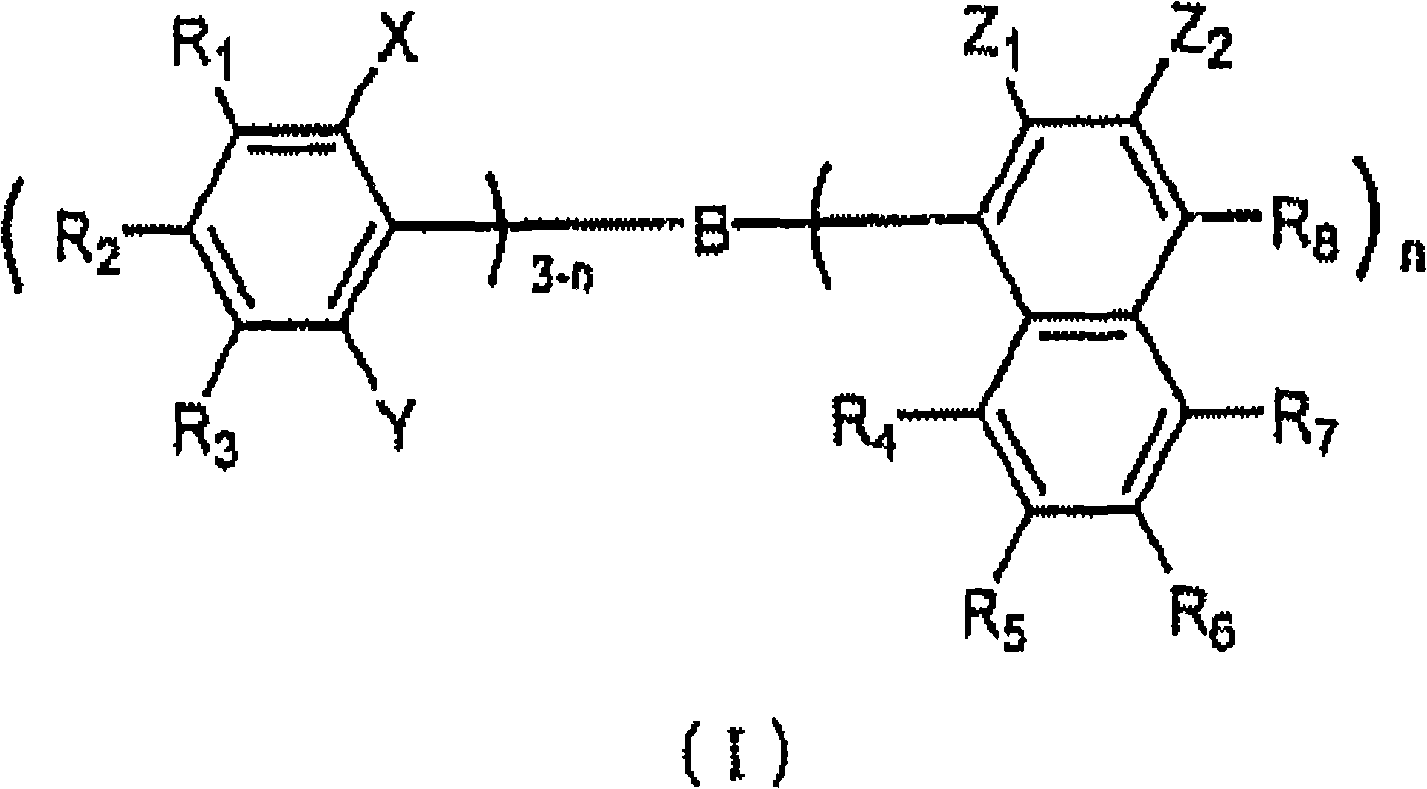
(式中,R1~R8和Z2分别独立,表示氢原子、饱和或不饱和的烃基、芳香族烃基、杂环基、取代氨基、取代氧硼基、烷氧基或芳氧基,X、Y和Z1分别独立,表示饱和或不饱和的烃基、芳香族烃基、杂环基、取代氨基、烷氧基或芳氧基,Z1和Z2的取代基可以相互结合而形成稠环,n表示1~3的整数,当n为2以上时,Z1可以不同。其中,不包括n是1且X、Y和R2是甲基并且R8是氢原子或取代氧硼基的情况和n为3且Z1为甲基的情况。)(In the formula, R 1 to R 8 and Z 2 are independently representing a hydrogen atom, a saturated or unsaturated hydrocarbon group, an aromatic hydrocarbon group, a heterocyclic group, a substituted amino group, a substituted oxyboryl group, an alkoxy group or an aryloxy group, X, Y and Z1 are independent respectively, representing saturated or unsaturated hydrocarbon groups, aromatic hydrocarbon groups, heterocyclic groups, substituted amino groups, alkoxy groups or aryloxy groups, and the substituents of Z1 and Z2 can be combined to form a condensed Ring, n represents an integer of 1 to 3, when n is 2 or more, Z 1 can be different. Among them, n is 1 and X, Y and R 2 are methyl and R 8 is a hydrogen atom or a substituted oxygen boron group and the case where n is 3 and Z is methyl .)
[化学式70][chemical formula 70]
[式中,Q1和Q2分别独立,表示用下述通式(K)表示的配位基,L表示卤原子、取代或者未取代的烷基、取代或者未取代的环烷基、取代或者未取代的芳基、取代或者未取代的杂环基、或者用-OR1(R1是氢原子、取代或者未取代的烷基、取代或者未取代的环烷基、取代或者未取代的芳基、取代或者未取代的杂环基)或-O-Ga-Q3(Q4)(Q3和Q4与Q1和Q2同义)表示的配位基。][In the formula, Q 1 and Q 2 are independently represented a ligand represented by the following general formula (K), and L represents a halogen atom, a substituted or unsubstituted alkyl group, a substituted or unsubstituted cycloalkyl group, a substituted or an unsubstituted aryl group, a substituted or unsubstituted heterocyclic group, or -OR 1 (R 1 is a hydrogen atom, a substituted or unsubstituted alkyl group, a substituted or unsubstituted cycloalkyl group, a substituted or unsubstituted aryl, substituted or unsubstituted heterocyclic group) or a ligand represented by -O-Ga-Q 3 (Q 4 ) (Q 3 and Q 4 have the same meaning as Q 1 and Q 2 ). ]
[化学式71][chemical formula 71]

(式中,环A1和A2是可以具有取代基的已相互稠合的六员芳环结构。)(In the formula, rings A1 and A2 are mutually fused six-membered aromatic ring structures which may have substituents.)
这种金属配位化合物,作为n型半导体的性质较强,电子注入能力大。进而,形成配位化合物时的生成能量也低,所以已形成的金属配位化合物的金属和配位基的键合性也变得牢固,作为发光材料的荧光量子效率也会增大。Such a metal coordination compound has strong properties as an n-type semiconductor and has a high electron injection capability. Furthermore, since the generation energy at the time of forming the complex is low, the bonding property between the metal and the ligand of the formed metal complex is also strong, and the fluorescence quantum efficiency as a light-emitting material is also increased.
如果列举形成上述通式(K)的配位基的环A1和A2的取代基的具体例子,有氯、溴、碘、氟等卤原子;甲基、乙基、丙基、丁基、仲丁基、叔丁基、戊基、己基、庚基、辛基、硬脂基、三氯甲基等取代或者未取代的烷基;苯基、萘基、3-甲基苯基、3-甲氧基苯基、3-氟苯基、3-三氯甲基苯基、3-三氟甲基苯基、3-硝基苯基等取代或者未取代的芳基;甲氧基、正丁氧基、叔丁氧基、三氯甲氧基、三氟乙氧基、五氟丙氧基、2,2,3,3-四氟丙氧基、1,1,1,3,3,3-六氟-2-丙氧基、6-(全氟乙基)己氧基等取代或者未取代的烷氧基;苯氧基、对硝基苯氧基、对叔丁基苯氧基、3-氟苯氧基、五氟苯基、3-三氟甲基苯氧基等取代或者未取代的芳氧基;甲硫基、乙硫基、叔丁基硫基、己基硫基、辛基硫基、三氟甲基硫基等取代或者未取代的烷硫基;苯硫基、对硝基苯硫基、对叔丁基苯硫基、3-氟苯硫基、五氟苯硫基、3-三氟甲基苯硫基等取代或者未取代的芳硫基;氰基、硝基、氨基、甲基氨基、二甲基氨基、乙基氨基、二乙基氨基、二丙基氨基、二丁基氨基、二苯基氨基等单或二取代氨基;双(乙酰氧基甲基)氨基、双(乙酰氧基乙基)氨基、双(乙酰氧基丙基)氨基、双(乙酰氧基丁基)氨基等酰基氨基;羟基,甲硅烷氧基,酰基,甲基氨基甲酰基、二甲基氨基甲酰基、乙基氨基甲酰基、二乙基氨基甲酰基、丙基氨基甲酰基、丁基氨基甲酰基、苯基氨基甲酰基等氨基甲酰基羧酸基,磺酸基,亚胺基,环戊烷基、环己基等环烷基;苯基、萘基、联苯基、蒽基、菲基、芴基、芘基等芳基;吡啶基、吡嗪基、嘧啶基、哒嗪基、三嗪基、吲哚基、喹啉基、吖啶基、吡咯烷基、二噁烷基、哌啶基、吗啉烷基(モルフオリジニル)、哌嗪基、三嗪基(トリアチニル)、咔唑基、呋喃基、苯硫基、噁唑基、噁二唑基、苯并噁唑基、噻唑基、噻二唑基、苯并噻唑基、三唑基、咪唑基、苯并咪唑基、吡喃基(プラニル)等杂环基等。另外,以上的取代基之间也可以通过结合进一步形成六员芳环或者杂环。If specific examples of the substituents of the rings A1 and A2 forming the ligand of the above general formula (K) are given, there are halogen atoms such as chlorine, bromine, iodine, and fluorine; methyl, ethyl, propyl, and butyl , sec-butyl, tert-butyl, pentyl, hexyl, heptyl, octyl, stearyl, trichloromethyl and other substituted or unsubstituted alkyl groups; phenyl, naphthyl, 3-methylphenyl, 3-methoxyphenyl, 3-fluorophenyl, 3-trichloromethylphenyl, 3-trifluoromethylphenyl, 3-nitrophenyl and other substituted or unsubstituted aryl groups; methoxy , n-butoxy, tert-butoxy, trichloromethoxy, trifluoroethoxy, pentafluoropropoxy, 2,2,3,3-tetrafluoropropoxy, 1,1,1,3 , 3,3-hexafluoro-2-propoxy, 6-(perfluoroethyl)hexyloxy and other substituted or unsubstituted alkoxy groups; phenoxy, p-nitrophenoxy, p-tert-butyl Phenoxy, 3-fluorophenoxy, pentafluorophenyl, 3-trifluoromethylphenoxy and other substituted or unsubstituted aryloxy groups; methylthio, ethylthio, tert-butylthio, hexyl Thio, octylthio, trifluoromethylthio and other substituted or unsubstituted alkylthio; phenylthio, p-nitrophenylthio, p-tert-butylphenylthio, 3-fluorophenylthio, Pentafluorophenylthio, 3-trifluoromethylphenylthio and other substituted or unsubstituted arylthio groups; cyano, nitro, amino, methylamino, dimethylamino, ethylamino, diethylamino , dipropylamino, dibutylamino, diphenylamino and other mono- or disubstituted amino groups; bis(acetoxymethyl)amino, bis(acetoxyethyl)amino, bis(acetoxypropyl) Amino, acylamino such as bis(acetoxybutyl)amino; hydroxyl, siloxy, acyl, methylcarbamoyl, dimethylcarbamoyl, ethylcarbamoyl, diethylcarbamoyl, Propylcarbamoyl, butylcarbamoyl, phenylcarbamoyl and other carbamoyl carboxylic acid groups, sulfonic acid groups, imino groups, cyclopentyl, cyclohexyl and other cycloalkyl groups; phenyl, naphthyl , biphenyl, anthracenyl, phenanthrenyl, fluorenyl, pyrenyl and other aryl groups; pyridyl, pyrazinyl, pyrimidinyl, pyridazinyl, triazinyl, indolyl, quinolinyl, acridinyl, Pyrrolidinyl, dioxanyl, piperidinyl, morpholinyl, piperazinyl, triazinyl, carbazolyl, furyl, phenylthio, oxazolyl, oxadiazole Heterocyclic groups such as benzoxazolyl, thiazolyl, thiadiazolyl, benzothiazolyl, triazolyl, imidazolyl, benzimidazolyl, pyranyl (planil), etc. In addition, the above substituents may further form a six-membered aromatic ring or heterocyclic ring through combination.
作为本发明的有机EL元件的优选形式,有在输送电子的区域或者阴极和有机层的界面区域含有还原性掺杂剂的元件。在这里,所谓的还原性掺杂剂是指可以将电子输送性化合物还原的物质。因而,只要是具有一定的还原性的物质就可使用各种各样的物质,例如,可以适当地使用选自碱金属、碱土类金属、稀土类金属、碱金属的氧化物、碱金属的卤化物、碱土类金属的氧化物、碱土类金属的卤化物、稀土类金属的氧化物、稀土类金属的卤化物、碱金属的碳酸盐、碱土金属的碳酸盐、碱金属的有机配位化合物、碱土类金属的有机配位化合物和稀土类金属的有机配位化合物的至少一种物质。As a preferable aspect of the organic EL device of the present invention, there is a device containing a reducing dopant in the electron transport region or the interface region between the cathode and the organic layer. Here, the term "reducing dopant" refers to a substance capable of reducing the electron-transporting compound. Therefore, various substances can be used as long as they have certain reducing properties. For example, the oxides of alkali metals, alkaline earth metals, rare earth metals, alkali metals, and halogenated alkali metals can be used appropriately. compounds, oxides of alkaline earth metals, halides of alkaline earth metals, oxides of rare earth metals, halides of rare earth metals, carbonates of alkali metals, carbonates of alkaline earth metals, organic coordination of alkali metals Compounds, organic coordination compounds of alkaline earth metals, and organic coordination compounds of rare earth metals.
另外,更加具体地讲,作为优选的还原性掺杂剂,可列举选自Na(功函数:2.36eV)、K(功函数:2.28eV)、Rb(功函数:2.16eV)及Cs(功函数:1.95eV)的至少一种碱金属、和选自Ca(功函数:2.9eV)、Sr(功函数:2.0-2.5eV)及Ba(功函数:2.52eV)的至少一种碱土类金属,特别优选功函数为2.9eV以下的物质。这些物质中,更优选的还原性掺杂剂为选自由K、Rb及Cs构成的一组中的至少一种碱金属,进一步优选Rb或Cs,最优选为Cs。这些碱金属的还原能力特别高,通过向电子注入区域的比较少量的添加,可以提高有机EL元件中的发光亮度、延长其寿命。另外,作为功函数为2.9eV以下的还原性掺杂剂,也优选这些两种以上的碱金属的组合,特别优选包含Cs的组合,例如Cs和Na、Cs和K、Cs和Rb或Cs和Na和K的组合。通过包含Cs进行组合,可以有效地发挥其还原能力,通过向电子注入区域的添加,可以提高有机EL元件中的发光亮度、延长其寿命。In addition, more specifically, as a preferable reductive dopant, there can be mentioned Na (work function: 2.36eV), K (work function: 2.28eV), Rb (work function: 2.16eV) and Cs (work function: 2.16eV) and Cs (work function: 2.16eV). Function: at least one alkali metal of 1.95eV), and at least one alkaline earth metal selected from Ca (work function: 2.9eV), Sr (work function: 2.0-2.5eV) and Ba (work function: 2.52eV) , particularly preferably a substance having a work function of 2.9 eV or less. Among these substances, a more preferable reducing dopant is at least one alkali metal selected from the group consisting of K, Rb and Cs, more preferably Rb or Cs, and most preferably Cs. The reducing ability of these alkali metals is particularly high, and by adding a relatively small amount to the electron injection region, the luminance of the organic EL element can be improved and the lifetime thereof can be extended. In addition, as a reductive dopant having a work function of 2.9 eV or less, combinations of these two or more alkali metals are also preferred, and combinations including Cs are particularly preferred, such as Cs and Na, Cs and K, Cs and Rb, or Cs and A combination of Na and K. By including Cs in combination, the reduction ability can be effectively exhibited, and by adding to the electron injection region, the luminance of light emission in the organic EL device can be improved and the life can be extended.
本发明中可以在阴极和有机层之间进一步设置由绝缘体或半导体构成的电子注入层。此时,可以有效地防止电流的泄漏,提高电子注入性。作为这样的绝缘体,优选使用由碱金属硫属元素化合物、碱土类金属硫属元素化合物、碱金属的卤化物及碱土类金属的卤化物构成的一组中的至少一种金属化合物。电子注入层只要是由这些碱金属硫属元素化合物等构成的,就可以进一步提高电子注入性,故优选。具体来讲,作为优选的碱金属硫属元素化合物,可列举例如Li2O、K2O、Na2S、Na2Se及Na2O,作为优选的碱土类金属硫属元素化合物,可列举例如CaO、BaO、SrO、BeO、BaS及CaSe。另外,作为优选的碱金属的卤化物,可列举例如LiF、NaF、KF、LiCl、KCl及NaCl等。另外,作为优选的碱土类金属的卤化物,可列举例如CaF2、BaF2、SrF2、MgF2及BeF2等氟化物和氟化物以外的卤化物。In the present invention, an electron injection layer made of an insulator or a semiconductor may be further provided between the cathode and the organic layer. In this case, the leakage of current can be effectively prevented and the electron injection property can be improved. As such an insulator, at least one metal compound selected from the group consisting of an alkali metal chalcogen compound, an alkaline earth metal chalcogen compound, an alkali metal halide, and an alkaline earth metal halide is preferably used. As long as the electron injection layer is composed of these alkali metal chalcogen compounds or the like, the electron injection property can be further improved, which is preferable. Specifically, examples of preferable alkali metal chalcogen compounds include Li 2 O, K 2 O, Na 2 S, Na 2 Se, and Na 2 O, and examples of preferable alkaline earth metal chalcogen compounds include Examples include CaO, BaO, SrO, BeO, BaS and CaSe. Moreover, as a preferable alkali metal halide, LiF, NaF, KF, LiCl, KCl, NaCl etc. are mentioned, for example. In addition, examples of preferred halides of alkaline earth metals include fluorides such as CaF 2 , BaF 2 , SrF 2 , MgF 2 , and BeF 2 , and halides other than fluorides.
另外,构成电子输送层的半导体,可列举例如包含Ba、Ca、Sr、Yb、Al、Ga、In、Li、Na、Cd、Mg、Si、Ta、Sb及Zn中的至少一种元素的氧化物、氮化物或氮氧化物等的单独一种或两种以上的组合。另外,构成电子输送层的无机化合物,优选微结晶或非晶质的绝缘性薄膜。电子输送层只要是由这些绝缘性薄膜构成的,由于可以形成更均匀的薄膜,因此,可以减少黑点等图像缺陷。另外,作为这样的无机化合物,可列举例如上述的碱金属硫属元素化合物、碱土类金属硫属元素化合物、碱金属的卤化物及碱土类金属的卤化物等。In addition, the semiconductor constituting the electron transport layer includes, for example, an oxide compound containing at least one element of Ba, Ca, Sr, Yb, Al, Ga, In, Li, Na, Cd, Mg, Si, Ta, Sb, and Zn. single or a combination of two or more compounds, nitrides, or nitrogen oxides. In addition, the inorganic compound constituting the electron transport layer is preferably a microcrystalline or amorphous insulating thin film. As long as the electron transport layer is composed of these insulating thin films, a more uniform thin film can be formed, so that image defects such as black spots can be reduced. In addition, examples of such inorganic compounds include the above-mentioned alkali metal chalcogen compounds, alkaline earth metal chalcogen compounds, alkali metal halides, alkaline earth metal halides, and the like.
接着,作为阴极,使用功函数小的(4eV以下)金属、合金、导电性化合物或这些的混合物作为电极物质。作为这种电极物质的具体例子,可列举钠、钠-钾合金、镁、锂、铯、镁-银合金、铝/氧化铝、Al/Li2O、Al/LiO、Al/LiF、铝-锂合金、铟、稀土类金属等。Next, as a cathode, a metal, an alloy, a conductive compound, or a mixture thereof having a small work function (4 eV or less) is used as an electrode substance. Specific examples of such electrode materials include sodium, sodium-potassium alloy, magnesium, lithium, cesium, magnesium-silver alloy, aluminum/alumina, Al/ Li2O , Al/LiO, Al/LiF, aluminum- Lithium alloys, indium, rare earth metals, etc.
该阴极可以通过将这些电极物质用蒸镀法或溅射法等方法形成薄膜来制备。The cathode can be prepared by forming a thin film of these electrode materials by vapor deposition, sputtering, or the like.
其中,当从阴极观察发光层发光时,优选阴极的光透过率大于10%。还优选阴极的片材电阻率为数百Ω/□以下,膜厚通常为10nm-1μm,优选50-200nm。Among them, when the light emission of the light-emitting layer is observed from the cathode, it is preferable that the light transmittance of the cathode is greater than 10%. It is also preferable that the sheet resistivity of the cathode is several hundred Ω/□ or less, and the film thickness is usually 10 nm-1 μm, preferably 50-200 nm.
另外,通常由于对超薄薄膜施加电场,有机EL元件易因漏电和短路而产生象素缺陷。为了防止形成这些缺陷,优选在电极对之间插入绝缘薄膜层。In addition, organic EL elements are prone to pixel defects due to leakage and short circuits, usually due to the application of an electric field to ultra-thin films. In order to prevent the formation of these defects, it is preferable to interpose an insulating thin film layer between the electrode pairs.
作为用于绝缘层的材料,可列举例如氧化铝、氟化锂、氧化锂、氟化铯、氧化铯、氧化镁、氟化镁、氧化钙、氟化钙、氮化铝、氧化钛、氧化硅、氧化锗、氮化硅、氮化硼、氧化钼、氧化钌和氧化钒等,还可使用它们的混合物和层叠物。Examples of materials used for the insulating layer include aluminum oxide, lithium fluoride, lithium oxide, cesium fluoride, cesium oxide, magnesium oxide, magnesium fluoride, calcium oxide, calcium fluoride, aluminum nitride, titanium oxide, Silicon, germanium oxide, silicon nitride, boron nitride, molybdenum oxide, ruthenium oxide, vanadium oxide, etc., and mixtures and laminates thereof can also be used.
接着,关于本发明有机EL元件的制造方法,例如,通过用上述的材料和方法形成阳极、发光层、根据需要而设的空穴注入层、以及根据需要而设的电子注入层后,最后形成阴极即可。也可采用从阴极到阳极的、与上述相反的顺序制作有机EL元件。Next, regarding the manufacturing method of the organic EL element of the present invention, for example, after forming an anode, a light-emitting layer, a hole injection layer if necessary, and an electron injection layer if necessary, by using the above-mentioned materials and methods, finally form The cathode will do. An organic EL element can also be produced in the reverse order from the cathode to the anode.
下面,对在透光性基板上依次设置阳极/空穴注入层/发光层/电子注入层/阴极的结构的有机EL元件的制作例进行说明。Next, a fabrication example of an organic EL element having a structure in which an anode/hole injection layer/light emitting layer/electron injection layer/cathode are sequentially provided on a translucent substrate will be described.
首先,在合适的透光性基板上采用蒸镀法或溅射法等方法形成由阳极材料组成的薄膜,使得所形成的薄膜厚度为1μm以下,优选为10-200nm,从而制作阳极。接着,在该阳极上设置空穴注入层。可采用如上所述的真空蒸镀法、旋涂法、浇铸法、LB法等方法形成空穴注入层,从易得到均匀的薄膜,且难以形成针孔等观点考虑,优选用真空蒸镀法形成。当采用真空蒸镀法形成空穴注入层时,该蒸镀条件根据使用的化合物(空穴注入层的材料)、作为目标的空穴注入层的晶体结构和复合结构等的不同而不同,但通常优选适当地在以下范围内选择:蒸镀源的温度50-450℃、真空度10-7-10-3乇、蒸镀速率0.01-50nm/s、基板温度:-50℃至300℃、膜厚5nm-5μm。First, a thin film composed of anode material is formed on a suitable light-transmitting substrate by evaporation or sputtering, so that the thickness of the formed film is less than 1 μm, preferably 10-200 nm, so as to make the anode. Next, a hole injection layer was provided on the anode. The hole injection layer can be formed by methods such as vacuum evaporation method, spin coating method, casting method, LB method, etc. as mentioned above. From the viewpoint of easy to obtain a uniform film and difficult to form pinholes, the vacuum evaporation method is preferably used. form. When the hole injection layer is formed by the vacuum evaporation method, the evaporation conditions vary depending on the compound used (the material of the hole injection layer), the crystal structure and composite structure of the hole injection layer to be targeted, and the like, but Usually, it is preferable to select appropriately within the following ranges: temperature of evaporation source: 50-450°C, vacuum degree: 10-7-10-3 Torr, evaporation rate: 0.01-50nm/s, substrate temperature: -50°C to 300°C, The film thickness is 5nm-5μm.
随后,在空穴注入层上设置发光层。该发光层的形成也可以通过使用本发明的发光材料采用真空蒸镀法、溅射法、旋涂法、浇注法等方法将发光材料薄膜化来制备,从易得到均匀的薄膜,且难以形成针孔等观点考虑,优选用真空蒸镀法形成。当采用真空蒸镀法形成发光层时,该蒸镀条件根据使用的化合物的不同而不同,通常可选自与空穴注入层的形成相同的条件范围。膜厚优选为10-40nm的范围。。Subsequently, a light emitting layer was provided on the hole injection layer. The formation of the luminescent layer can also be prepared by using the luminescent material of the present invention to thin the luminescent material by vacuum evaporation method, sputtering method, spin coating method, casting method and other methods. It is easy to obtain a uniform film and difficult to form From the viewpoint of pinholes, etc., it is preferable to form them by a vacuum vapor deposition method. When the light-emitting layer is formed by the vacuum evaporation method, the evaporation conditions vary depending on the compound used, and generally can be selected from the same range of conditions as for the formation of the hole injection layer. The film thickness is preferably in the range of 10 to 40 nm. .
接着,在该发光层上设置电子注入层。此时,也可以与空穴注入层、发光层相同,为了得到均匀的薄膜,优选采用真空蒸镀法形成所述电子注入层。蒸镀条件可选自与空穴注入层、发光层相同的条件范围。Next, an electron injection layer was provided on the light emitting layer. At this time, the same as the hole injection layer and the light emitting layer may be used. In order to obtain a uniform thin film, the electron injection layer is preferably formed by a vacuum evaporation method. The vapor deposition conditions can be selected from the same range of conditions as those for the hole injection layer and the light emitting layer.
于是,最后层叠阴极,可以制得有机EL元件。阴极由金属构成,可采用蒸镀法、溅射法形成。但是,为了使底层的有机物层免于制膜时的损伤,优选使用真空蒸镀法。Then, the cathode is laminated at the end, and an organic EL element can be produced. The cathode is made of metal and can be formed by vapor deposition or sputtering. However, in order to prevent the underlying organic layer from being damaged during film formation, it is preferable to use a vacuum vapor deposition method.
上述的有机EL元件的制作优选在一次抽真空之后,连续地从阳极制备至阴极。The fabrication of the above-mentioned organic EL element is preferably performed continuously from the anode to the cathode after vacuuming once.
本发明的有机EL元件的各层的形成方法没有特别限定。可使用以往公知的真空蒸镀法、旋涂法等形成方法。可采用以下公知的方法形成用于本发明有机EL元件的包含本发明上述通式(1)表示的混合物的有机薄膜层,所述方法为真空蒸镀法、分子束蒸镀法(MBE法)或者溶解于溶剂的溶液的浸涂法、旋涂法、浇铸法、棒涂法、辊涂法等涂敷法。The formation method of each layer of the organic EL element of this invention is not specifically limited. Formation methods such as conventionally known vacuum deposition methods and spin coating methods can be used. The organic thin film layer comprising the mixture represented by the above-mentioned general formula (1) of the present invention used in the organic EL element of the present invention can be formed by the following known methods, the method is a vacuum evaporation method, a molecular beam evaporation method (MBE method) Or coating methods such as dip coating, spin coating, casting, bar coating, and roll coating of a solution dissolved in a solvent.
本发明的有机EL元件的各有机层的膜厚没有特别限定,但是考虑针孔等缺陷以及效率的提高,通常优选膜厚为数nm-1μm。The film thickness of each organic layer of the organic EL device of the present invention is not particularly limited, but in consideration of defects such as pinholes and improvement in efficiency, the film thickness is usually preferably several nm to 1 μm.
另外,当向有机EL元件施加直流电压时,通过使阳极的极性为正,使阴极的极性为负,施加5-40V电压时,可以观察到发光。另外,即使以相反的极性施加电压也不会流过电流,根本不发光。此外,施加交流电压时,仅在阳极的极性为正,而阴极的极性为负时,才能观察到均匀的发光。施加的交流电的波形可以是任意的。In addition, when a DC voltage is applied to the organic EL element, by setting the polarity of the anode to positive and the polarity of the cathode to negative, luminescence can be observed when a voltage of 5-40V is applied. Also, even if a voltage is applied with the opposite polarity, no current will flow and no light will be emitted at all. Furthermore, when an AC voltage is applied, uniform luminescence can only be observed when the polarity of the anode is positive and that of the cathode is negative. The waveform of the applied alternating current may be arbitrary.
实施例Example
下面,对本发明的实施例进行说明,但是本发明并不限于这些实施例。另外,由各例得到的有机EL元件的评价如下所述。Hereinafter, examples of the present invention will be described, but the present invention is not limited to these examples. In addition, the evaluation of the organic EL element obtained by each example is as follows.
(1)初始性能:施加规定的电压,测量此时的电流值,同时用亮度计(米诺塔(ミノルタ)社制分光亮度计放射计CS-1000)测量发光亮度值和CIE1931色度坐标并进行评价。(1) Initial performance: Apply a specified voltage, measure the current value at this time, and measure the luminance value and CIE1931 chromaticity coordinates with a luminance meter (Minolta (Minolta) Spectrophotometer Radiometer CS-1000) at the same time. Make an evaluation.
(2)寿命:在特定的初始亮度下进行恒电流驱动,以亮度的半衰期、以及色度的变化进行评价。(2) Lifespan: Constant current driving was performed at a specific initial luminance, and the half-life of luminance and the change in chromaticity were evaluated.
实施例1Example 1
在25mm×75mm×1.1mm大小的玻璃基板上设置膜厚130nm的由铟锡氧化物组成的透明电极。向该玻璃基板照射紫外线和臭氧进行洗涤后,在真空蒸镀装置上设置该基板。A transparent electrode made of indium tin oxide with a film thickness of 130 nm was provided on a glass substrate with a size of 25 mm×75 mm×1.1 mm. After the glass substrate was irradiated with ultraviolet rays and ozone to clean it, the substrate was set on a vacuum deposition apparatus.
首先,将作为空穴注入层的N,N’-双(N,N’-二苯基-4-氨基苯基)-N,N-二苯基-4,4’-二氨基-1,1’-联苯膜(以下简称为“TPD232膜”)按照60nm的厚度进行蒸镀后,在其上将作为空穴输送层的N,N,N’,N’-四(4-联苯基)-二氨基联苯层(以下简称为“TBDB层”)按照20nm的厚度进行蒸镀。接着,将下述化合物(H-63)和(D-157)按照40∶2的重量比同时进行蒸镀,形成厚40nm的发光层。First, N,N'-bis(N,N'-diphenyl-4-aminophenyl)-N,N-diphenyl-4,4'-diamino-1 as the hole injection layer, The 1'-biphenyl film (hereinafter referred to as "TPD232 film") is evaporated to a thickness of 60nm, and N,N,N',N'-tetrakis(4-biphenyl base)-diaminobiphenyl layer (hereinafter referred to as "TBDB layer") was vapor-deposited with a thickness of 20 nm. Next, the following compounds (H-63) and (D-157) were simultaneously vapor-deposited in a weight ratio of 40:2 to form a 40 nm-thick light-emitting layer.
接着,将作为电子注入层的三(8-羟基喹啉合)铝按照20nm的厚度进行蒸镀。然后将氟化锂按照0.3nm的厚度进行蒸镀,接着将铝按照150nm的厚度进行蒸镀。该铝/氟化锂起阴极的作用。由此制作了有机EL元件。Next, tris(8-quinolinolato)aluminum was vapor-deposited to a thickness of 20 nm as an electron injection layer. Lithium fluoride was then vapor-deposited to a thickness of 0.3 nm, and aluminum was then vapor-deposited to a thickness of 150 nm. The aluminum/lithium fluoride functions as a cathode. Thus, an organic EL element was produced.
对该元件进行通电试验,结果在电压6.2V、电流密度10mA/cm2的条件下获得650cd/m2的蓝色发光。The element was subjected to a current conduction test, and as a result, blue light emission of 650 cd/m 2 was obtained under the conditions of a voltage of 6.2 V and a current density of 10 mA/cm 2 .
另外,在初始亮度为1000cd/m2的条件下进行直流的连续通电试验,结果半衰期是17800小时。元件评价的结果归纳在表1中。In addition, a DC continuous energization test was performed under the condition of an initial luminance of 1,000 cd/m 2 , and the half-life was 17,800 hours. The results of element evaluation are summarized in Table 1.
[化学式72][chemical formula 72]

实施例2-9Example 2-9
除了使用表1记载的发光材料代替实施例1中的(H-63)、(D-157)以外,与实施例1相同地制作有机EL元件。An organic EL element was fabricated in the same manner as in Example 1 except that the light-emitting material described in Table 1 was used instead of (H-63) and (D-157) in Example 1.
元件评价的结果归纳在表1中。The results of element evaluation are summarized in Table 1.
[化学式73][chemical formula 73]

比较例1、2Comparative example 1, 2
除了在实施例1中,使用下述比较化合物-1、2代替(H-63)以外,与实施例1相同地制作有机EL元件。An organic EL device was produced in the same manner as in Example 1, except that in Example 1, the following comparative compounds-1 and 2 were used instead of (H-63).
元件评价的结果归纳在表1中。The results of element evaluation are summarized in Table 1.
如果将实施例1和比较例1进行比较,则可判断即使使用未取代的掺杂剂化合物,若使用本发明的具有特定结构的芘系衍生物,则也可以获得寿命长的蓝色发光元件。Comparing Example 1 and Comparative Example 1, it can be judged that even if an unsubstituted dopant compound is used, a blue light-emitting device with a long life can be obtained by using the pyrene-based derivative having a specific structure of the present invention. .
[化学式74][chemical formula 74]
比较例3Comparative example 3
在25mm×75mm×1.1mm大小的玻璃基板上设置膜厚130nm的由铟锡氧化物组成的透明电极。向该玻璃基板照射紫外线和臭氧进行洗涤后,在真空蒸镀装置上设置该基板。A transparent electrode made of indium tin oxide with a film thickness of 130 nm was provided on a glass substrate with a size of 25 mm×75 mm×1.1 mm. After the glass substrate was irradiated with ultraviolet rays and ozone to clean it, the substrate was set on a vacuum deposition apparatus.
首先,将作为空穴注入层的TPD232按照60nm的厚度进行蒸镀后,在其上将作为空穴输送层的TBDB按照20nm的厚度进行蒸镀。接着,将TBDB和上述化合物(H-63)按照1∶1重量比同时进行蒸镀,形成厚40nm的发光层,此外,将上述化合物(H-63)按照20nm的厚度进行蒸镀。First, after vapor-depositing TPD232 as a hole injection layer to a thickness of 60 nm, TBDB as a hole transport layer was vapor-deposited thereon to a thickness of 20 nm. Next, TBDB and the compound (H-63) were vapor-deposited simultaneously at a weight ratio of 1:1 to form a light-emitting layer with a thickness of 40 nm, and the compound (H-63) was vapor-deposited to a thickness of 20 nm.
接着,将作为电子注入层的三(8-羟基喹啉合)铝按照20nm的厚度进行蒸镀。然后将氟化锂按照0.3nm的厚度进行蒸镀,接着将铝按照150nm的厚度进行蒸镀。该铝/氟化锂起阴极的作用。由此制作了有机EL元件。元件评价的结果归纳在表1中。Next, tris(8-quinolinolato)aluminum was vapor-deposited to a thickness of 20 nm as an electron injection layer. Lithium fluoride was then vapor-deposited to a thickness of 0.3 nm, and aluminum was then vapor-deposited to a thickness of 150 nm. The aluminum/lithium fluoride functions as a cathode. Thus, an organic EL element was fabricated. The results of element evaluation are summarized in Table 1.
[表1][Table 1]
实施例10Example 10
在25mm×75mm×1.1mm大小的玻璃基板上设置膜厚80nm的由铟锡氧化物组成的透明电极。向该玻璃基板照射紫外线和臭氧进行洗涤后,在真空蒸镀装置上设置该基板。A transparent electrode made of indium tin oxide with a film thickness of 80 nm was provided on a glass substrate with a size of 25 mm×75 mm×1.1 mm. After the glass substrate was irradiated with ultraviolet rays and ozone to clean it, the substrate was set on a vacuum deposition apparatus.
首先,将作为空穴注入层的4,4’-双(N,N-二(3-甲苯基)-4-氨基苯基)-4”-苯基三苯基胺按照60nm的厚度进行蒸镀后,在其上将作为空穴输送层的N’,N”-双[4-(二苯基氨基)苯基]-N’,N”-二苯基联苯-4,4’-二胺按照20nm的厚度进行蒸镀。接着,将上述化合物(H-63)和(D-100)按照40∶3的重量比同时进行蒸镀,形成厚40nm的发光层。First, 4,4'-bis(N,N-bis(3-methylphenyl)-4-aminophenyl)-4"-phenyltriphenylamine as a hole injection layer was evaporated to a thickness of 60 nm. After plating, N', N"-bis[4-(diphenylamino)phenyl]-N', N"-diphenylbiphenyl-4,4'- Diamine was vapor-deposited to a thickness of 20 nm. Next, the above-mentioned compounds (H-63) and (D-100) were vapor-deposited simultaneously in a weight ratio of 40:3 to form a luminescent layer with a thickness of 40 nm.
接着,将作为电子注入层的三(8-羟基喹啉合)铝按照20nm的厚度进行蒸镀。然后将氟化锂按照0.3nm的厚度进行蒸镀,接着将铝按照150nm的厚度进行蒸镀。该铝/氟化锂起阴极的作用。由此制作了有机EL元件。Next, tris(8-quinolinolato)aluminum was vapor-deposited to a thickness of 20 nm as an electron injection layer. Lithium fluoride was then vapor-deposited to a thickness of 0.3 nm, and aluminum was then vapor-deposited to a thickness of 150 nm. The aluminum/lithium fluoride functions as a cathode. Thus, an organic EL element was produced.
对该元件进行通电试验,结果在电压6.3V、电流密度10mA/cm2的条件下获得2000cd/m2的绿色发光。The element was subjected to a current conduction test, and as a result, green light emission of 2000 cd/m 2 was obtained under the conditions of a voltage of 6.3 V and a current density of 10 mA/cm 2 .
[化学式75][chemical formula 75]
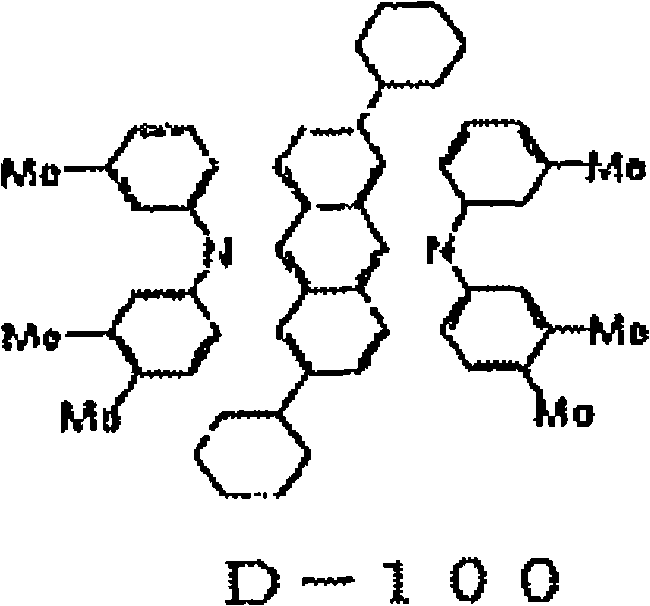
比较例4Comparative example 4
在实施例3中,使用3-(2’-苯并噻唑基)-7-二乙基氨基香豆素代替发光层化合物(D-38),来制作有机EL元件。In Example 3, an organic EL device was fabricated using 3-(2'-benzothiazolyl)-7-diethylaminocoumarin instead of the light-emitting layer compound (D-38).
对该元件进行通电试验,结果在电压6.5V、电流密度10mA/cm2的条件下获得870cd/m2的绿色发光。The element was subjected to a current conduction test, and as a result, green light emission of 870 cd/m 2 was obtained under the conditions of a voltage of 6.5 V and a current density of 10 mA/cm 2 .
如果将实施例10和比较例4进行比较,则显而易见的是与使用以往的香豆素衍生物作为掺杂剂相比,使用本发明的芘系衍生物时,可以获得效率更高且寿命更长的绿色发光元件。Comparing Example 10 and Comparative Example 4, it is obvious that when using the pyrene derivative of the present invention as a dopant, higher efficiency and longer life can be obtained than using conventional coumarin derivatives as dopants. Long green glowing element.
[化学式76][chemical formula 76]
3-(2’-苯并噻唑基)-7-二乙基氨基香豆素3-(2’-Benzothiazolyl)-7-diethylaminocoumarin
实施例11Example 11
在25mm×75mm×1.1mm大小的玻璃基板上设置膜厚180nm的由铟锡氧化物组成的透明电极。向该玻璃基板照射紫外线和臭氧进行洗涤后,在真空蒸镀装置上设置该基板。A transparent electrode made of indium tin oxide with a film thickness of 180 nm was provided on a glass substrate with a size of 25 mm×75 mm×1.1 mm. After the glass substrate was irradiated with ultraviolet rays and ozone to clean it, the substrate was set on a vacuum deposition apparatus.
首先,将作为空穴注入层的4,4’-双(N,N-二(3-甲苯基)-4-氨基苯基)-4”-苯基三苯基胺按照60nm的厚度进行蒸镀后,在其上将作为空穴输送层的N,N,N’,N’-四(4-联苯基)-4,4’-联苯胺按照20nm的厚度进行蒸镀。接着,将上述化合物(H-63)和(D-240)按照40∶10的重量比同时进行蒸镀,形成厚40nm的发光层。First, 4,4'-bis(N,N-bis(3-methylphenyl)-4-aminophenyl)-4"-phenyltriphenylamine as a hole injection layer was evaporated to a thickness of 60 nm. After plating, on it, N, N, N', N'-tetrakis(4-biphenyl)-4,4'-benzidine as hole transport layer is evaporated according to the thickness of 20nm. Then, The above-mentioned compounds (H-63) and (D-240) were vapor-deposited simultaneously at a weight ratio of 40:10 to form a luminescent layer with a thickness of 40 nm.
接着,将作为电子注入层的三(8-羟基喹啉合)铝按照20nm的厚度进行蒸镀。然后将氟化锂按照0.3nm的厚度进行蒸镀,接着将铝按照150nm的厚度进行蒸镀。该铝/氟化锂起阴极的作用。由此制作了有机EL元件。Next, tris(8-quinolinolato)aluminum was vapor-deposited to a thickness of 20 nm as an electron injection layer. Lithium fluoride was then vapor-deposited to a thickness of 0.3 nm, and aluminum was then vapor-deposited to a thickness of 150 nm. The aluminum/lithium fluoride functions as a cathode. Thus, an organic EL element was produced.
接着,对该元件进行通电试验,结果在电压7.8V、电流密度10mA/cm2的条件下获得了490cd/m2的红色发光。Next, a current conduction test was performed on this element, and as a result, red light emission of 490 cd/m 2 was obtained under the conditions of a voltage of 7.8 V and a current density of 10 mA/cm 2 .
[化学式77][chemical formula 77]

比较例5Comparative Example 5
在实施例11中,使用4-二氰基亚甲基-6-久咯呢定基(ジユロリジノ)苯乙烯基-2-叔丁基-4H-吡喃(DCJTB)代替发光层化合物D-240,来制作有机EL元件。In Example 11, use 4-dicyano methylene-6-jurolidinyl (jurolidino) styryl-2-tert-butyl-4H-pyran (DCJTB) instead of the light-emitting layer compound D-240, to produce organic EL elements.
对该元件进行通电试验,结果在电压8.5V、电流密度10mA/cm2的条件下获得了300cd/m2的红色发光。The element was subjected to a current conduction test, and as a result, red light emission of 300 cd/m 2 was obtained under the conditions of a voltage of 8.5 V and a current density of 10 mA/cm 2 .
如果将实施例6和比较例4进行比较,则显而易见的是与使用以往的DCJTB作为掺杂剂、使用芴化合物作为主体化合物的组合相比,使用本发明的芘系衍生物作为主体化合物并使用特定结构的掺杂剂的组合,可以获得效率更高且寿命更长的红色发光元件。Comparing Example 6 and Comparative Example 4, it is obvious that using the pyrene-based derivative of the present invention as the host compound and using The combination of dopants with a specific structure can obtain a red light-emitting element with higher efficiency and longer life.
如上所述,本发明通过由特定结构的芘系衍生物和特定结构的胺化合物形成发光层,可获得与以往相比寿命更长且效率更高的蓝色发光。另外。对于绿色、红色系发光也可以获得高效率的发光。As described above, in the present invention, by forming a light-emitting layer from a pyrene-based derivative with a specific structure and an amine compound with a specific structure, it is possible to obtain blue light emission with a longer lifetime and higher efficiency than conventional ones. in addition. High-efficiency light emission can also be obtained for green and red light emission.
工业上的可利用性Industrial availability
如上述详细说明,把特定的芘系衍生物和胺化合物用作发光材料的本发明的有机电致发光元件,色纯度高,耐热性优异,寿命长,还可获得效率高的蓝色、绿色和红色系发光。As described in detail above, the organic electroluminescent element of the present invention using specific pyrene derivatives and amine compounds as light-emitting materials has high color purity, excellent heat resistance, long life, and high-efficiency blue, Glows in green and red.
本发明的有机EL元件可以用于壁挂电视机的平板显示器等的平面发光元件、复印机、打印机、液晶显示器的背光灯或者仪表类等的光源、显示板、标志灯等。The organic EL element of the present invention can be used in planar light-emitting elements such as flat-panel displays of wall-mounted televisions, backlights of copiers, printers, liquid crystal displays, light sources such as instruments, display panels, sign lights, and the like.
Claims (8)


Applications Claiming Priority (2)
| Application Number | Priority Date | Filing Date | Title |
|---|---|---|---|
| JP2005270664 | 2005-09-16 | ||
| JP270664/2005 | 2005-09-16 |
Publications (1)
| Publication Number | Publication Date |
|---|---|
| CN101268167A true CN101268167A (en) | 2008-09-17 |
Family
ID=37864760
Family Applications (1)
| Application Number | Title | Priority Date | Filing Date |
|---|---|---|---|
| CN200680034089.7A Pending CN101268167A (en) | 2005-09-16 | 2006-08-08 | Pyrene derivative and organic electroluminescent device using the same |
Country Status (6)
| Country | Link |
|---|---|
| EP (1) | EP1932895A1 (en) |
| JP (1) | JPWO2007032162A1 (en) |
| KR (1) | KR20080052594A (en) |
| CN (1) | CN101268167A (en) |
| TW (1) | TW200728431A (en) |
| WO (1) | WO2007032162A1 (en) |
Cited By (1)
| Publication number | Priority date | Publication date | Assignee | Title |
|---|---|---|---|---|
| CN103165818A (en) * | 2011-12-16 | 2013-06-19 | 乐金显示有限公司 | organic light emitting device |
Families Citing this family (25)
| Publication number | Priority date | Publication date | Assignee | Title |
|---|---|---|---|---|
| EP1976814B1 (en) * | 2006-01-27 | 2016-07-13 | LG Chem, Ltd. | New anthracene derivatives, preparation method thereof and organic light emitting diode using the same |
| JP2008300503A (en) * | 2007-05-30 | 2008-12-11 | Sony Corp | Organic electroluminescence device and display device |
| WO2008147721A1 (en) * | 2007-06-01 | 2008-12-04 | E. I. Du Pont De Nemours And Company | Chrysenes for blue luminescent applications |
| JP5401448B2 (en) | 2007-06-01 | 2014-01-29 | イー・アイ・デュポン・ドウ・ヌムール・アンド・カンパニー | Chrysene for deep blue light emitting applications |
| EP2159217A4 (en) * | 2007-06-18 | 2013-08-28 | Idemitsu Kosan Co | AROMATIC AMINE DERIVATIVE AND ORGANIC ELECTROLUMINESCENT DEVICE USING THE DERIVATIVE |
| TW200920181A (en) | 2007-07-07 | 2009-05-01 | Idemitsu Kosan Co | Organic EL device |
| KR20100057593A (en) | 2007-07-07 | 2010-05-31 | 이데미쓰 고산 가부시키가이샤 | Organic el element and organic el material-containing solution |
| WO2009008205A1 (en) * | 2007-07-07 | 2009-01-15 | Idemitsu Kosan Co., Ltd. | Organic electroluminescent device and material for organic electroluminescent device |
| JPWO2009008346A1 (en) | 2007-07-07 | 2010-09-09 | 出光興産株式会社 | Organic EL device |
| TW200921964A (en) * | 2007-07-07 | 2009-05-16 | Idemitsu Kosan Co | Organic el device |
| US8154195B2 (en) | 2007-07-07 | 2012-04-10 | Idemitsu Kosan Co., Ltd. | Organic electroluminescence device and material for organic electroluminescence device |
| WO2009008357A1 (en) * | 2007-07-07 | 2009-01-15 | Idemitsu Kosan Co., Ltd. | Organic el device |
| KR100901887B1 (en) * | 2008-03-14 | 2009-06-09 | (주)그라쎌 | Novel organic light emitting compound and organic light emitting device employing the same |
| EP2350230A4 (en) * | 2008-11-19 | 2012-08-22 | Du Pont | Chrysene compounds for blue or green luminescent applications |
| EP2194110A1 (en) * | 2008-11-26 | 2010-06-09 | Gracel Display Inc. | Electroluminescent device using electroluminescent compounds |
| US8531100B2 (en) | 2008-12-22 | 2013-09-10 | E I Du Pont De Nemours And Company | Deuterated compounds for luminescent applications |
| US8759818B2 (en) | 2009-02-27 | 2014-06-24 | E I Du Pont De Nemours And Company | Deuterated compounds for electronic applications |
| JP5567675B2 (en) | 2009-08-13 | 2014-08-06 | イー・アイ・デュポン・ドウ・ヌムール・アンド・カンパニー | Chrysene derivative material |
| KR101226701B1 (en) * | 2009-09-29 | 2013-01-25 | 에스에프씨 주식회사 | Aromatic compound and organic electroluminescent device using the same |
| JP5715142B2 (en) | 2009-09-29 | 2015-05-07 | イー・アイ・デュポン・ドウ・ヌムール・アンド・カンパニーE.I.Du Pont De Nemours And Company | Deuterium compounds for luminescence applications |
| KR101097315B1 (en) | 2009-10-12 | 2011-12-23 | 삼성모바일디스플레이주식회사 | Organic light emitting device |
| US20110101312A1 (en) | 2009-10-29 | 2011-05-05 | E. I. Du Pont De Nemours And Company | Deuterated compounds for electronic applications |
| US8617720B2 (en) | 2009-12-21 | 2013-12-31 | E I Du Pont De Nemours And Company | Electroactive composition and electronic device made with the composition |
| WO2012087955A1 (en) | 2010-12-20 | 2012-06-28 | E. I. Du Pont De Nemours And Company | Compositions for electronic applications |
| KR102084310B1 (en) | 2017-06-20 | 2020-03-03 | 주식회사 엘지화학 | Compound, coating compositions comprising the same, and organic light emitting device comprising the same |
Family Cites Families (100)
| Publication number | Priority date | Publication date | Assignee | Title |
|---|---|---|---|---|
| LU35193A1 (en) | 1956-06-04 | |||
| NL218434A (en) | 1956-06-27 | |||
| US3180729A (en) | 1956-12-22 | 1965-04-27 | Azoplate Corp | Material for electrophotographic reproduction |
| NL126440C (en) | 1958-08-20 | |||
| NL250330A (en) | 1959-04-09 | |||
| US3240597A (en) | 1961-08-21 | 1966-03-15 | Eastman Kodak Co | Photoconducting polymers for preparing electrophotographic materials |
| US3180703A (en) | 1963-01-15 | 1965-04-27 | Kerr Mc Gee Oil Ind Inc | Recovery process |
| JPS45555B1 (en) | 1966-03-24 | 1970-01-09 | ||
| JPS463712B1 (en) | 1966-04-14 | 1971-01-29 | ||
| US3526501A (en) | 1967-02-03 | 1970-09-01 | Eastman Kodak Co | 4-diarylamino-substituted chalcone containing photoconductive compositions for use in electrophotography |
| US3542544A (en) | 1967-04-03 | 1970-11-24 | Eastman Kodak Co | Photoconductive elements containing organic photoconductors of the triarylalkane and tetraarylmethane types |
| US3658520A (en) | 1968-02-20 | 1972-04-25 | Eastman Kodak Co | Photoconductive elements containing as photoconductors triarylamines substituted by active hydrogen-containing groups |
| US3567450A (en) | 1968-02-20 | 1971-03-02 | Eastman Kodak Co | Photoconductive elements containing substituted triarylamine photoconductors |
| US3615404A (en) | 1968-04-25 | 1971-10-26 | Scott Paper Co | 1 3-phenylenediamine containing photoconductive materials |
| CA917980A (en) | 1969-06-20 | 1973-01-02 | J. Fox Charles | Alkylaminoaromatic organic photoconductors |
| US3717462A (en) | 1969-07-28 | 1973-02-20 | Canon Kk | Heat treatment of an electrophotographic photosensitive member |
| BE756375A (en) | 1969-09-30 | 1971-03-01 | Eastman Kodak Co | NEW PHOTOCONDUCTIVE COMPOSITION AND PRODUCT CONTAINING IT FOR USE IN ELECTROPHOTOGRAPHY |
| BE756943A (en) | 1969-10-01 | 1971-03-16 | Eastman Kodak Co | NEW PHOTOCONDUCTIVE COMPOSITIONS AND PRODUCTS CONTAINING THEM, USED IN PARTICULAR IN ELECTROPHOTOGRAPHY |
| JPS4725336B1 (en) | 1969-11-26 | 1972-07-11 | ||
| JPS5110983B2 (en) | 1971-09-10 | 1976-04-08 | ||
| GB1413352A (en) | 1972-02-09 | 1975-11-12 | Scott Paper Co | Electrophotographic material |
| US3837851A (en) | 1973-01-15 | 1974-09-24 | Ibm | Photoconductor overcoated with triarylpyrazoline charge transport layer |
| GB1505409A (en) | 1974-12-20 | 1978-03-30 | Eastman Kodak Co | Photoconductive compositions |
| US4127412A (en) | 1975-12-09 | 1978-11-28 | Eastman Kodak Company | Photoconductive compositions and elements |
| US4012376A (en) | 1975-12-29 | 1977-03-15 | Eastman Kodak Company | Photosensitive colorant materials |
| CA1104866A (en) | 1976-08-23 | 1981-07-14 | Milan Stolka | Imaging member containing a substituted n,n,n',n',- tetraphenyl-[1,1'-biphenyl]-4,4'-diamine in the chargge transport layer |
| US4175961A (en) | 1976-12-22 | 1979-11-27 | Eastman Kodak Company | Multi-active photoconductive elements |
| US4123269A (en) | 1977-09-29 | 1978-10-31 | Xerox Corporation | Electrostatographic photosensitive device comprising hole injecting and hole transport layers |
| JPS5453435A (en) | 1977-10-01 | 1979-04-26 | Yoshikatsu Kume | Portable bicycle equipped with foldable type triangle frame |
| US4150987A (en) | 1977-10-17 | 1979-04-24 | International Business Machines Corporation | Hydrazone containing charge transport element and photoconductive process of using same |
| JPS5464299A (en) | 1977-10-29 | 1979-05-23 | Toshiba Corp | Beam deflector for charged particles |
| JPS54112637A (en) | 1978-02-06 | 1979-09-03 | Ricoh Co Ltd | Electrophotographic photoreceptor |
| JPS54110837A (en) | 1978-02-17 | 1979-08-30 | Ricoh Co Ltd | Electrophotographic photoreceptor |
| JPS54110536A (en) | 1978-02-20 | 1979-08-30 | Ichikoh Ind Ltd | Device for time-lag putting out room lamp for motorcar |
| JPS54119925A (en) | 1978-03-10 | 1979-09-18 | Ricoh Co Ltd | Photosensitive material for electrophotography |
| US4251612A (en) | 1978-05-12 | 1981-02-17 | Xerox Corporation | Dielectric overcoated photoresponsive imaging member |
| JPS6028342B2 (en) | 1978-06-21 | 1985-07-04 | コニカ株式会社 | electrophotographic photoreceptor |
| JPS6060052B2 (en) | 1978-07-21 | 1985-12-27 | コニカ株式会社 | electrophotographic photoreceptor |
| JPS5551086A (en) | 1978-09-04 | 1980-04-14 | Copyer Co Ltd | Novel pyrazoline compound, its preparation, and electrophotographic photosensitive substance comprising it |
| JPS5546760A (en) | 1978-09-29 | 1980-04-02 | Ricoh Co Ltd | Electrophotographic photoreceptor |
| JPS5552063A (en) | 1978-10-13 | 1980-04-16 | Ricoh Co Ltd | Electrophotographic receptor |
| JPS5552064A (en) | 1978-10-13 | 1980-04-16 | Ricoh Co Ltd | Electrophotographic receptor |
| JPS5574546A (en) | 1978-11-30 | 1980-06-05 | Ricoh Co Ltd | Electrophotographic photoreceptor |
| US4306008A (en) | 1978-12-04 | 1981-12-15 | Xerox Corporation | Imaging system with a diamine charge transport material in a polycarbonate resin |
| JPS5588064A (en) | 1978-12-05 | 1980-07-03 | Konishiroku Photo Ind Co Ltd | Electrophotographic receptor |
| JPS5588065A (en) | 1978-12-12 | 1980-07-03 | Konishiroku Photo Ind Co Ltd | Electrophotographic receptor |
| JPS5585495A (en) | 1978-12-18 | 1980-06-27 | Pacific Metals Co Ltd | Method of composting organic waste |
| JPS55108667A (en) | 1979-02-13 | 1980-08-21 | Ricoh Co Ltd | Electrophotographic receptor |
| US4233384A (en) | 1979-04-30 | 1980-11-11 | Xerox Corporation | Imaging system using novel charge transport layer |
| JPS6035058B2 (en) | 1979-05-17 | 1985-08-12 | 三菱製紙株式会社 | Organic photo-semiconductor electrophotographic materials |
| JPS564148A (en) | 1979-06-21 | 1981-01-17 | Konishiroku Photo Ind Co Ltd | Electrophotographic receptor |
| JPS5622437A (en) | 1979-08-01 | 1981-03-03 | Ricoh Co Ltd | Electrophotographic receptor |
| US4232103A (en) | 1979-08-27 | 1980-11-04 | Xerox Corporation | Phenyl benzotriazole stabilized photosensitive device |
| JPS5636656A (en) | 1979-09-03 | 1981-04-09 | Mitsubishi Paper Mills Ltd | Electrophotographic material |
| JPS5646234A (en) | 1979-09-21 | 1981-04-27 | Ricoh Co Ltd | Electrophotographic receptor |
| US4273846A (en) | 1979-11-23 | 1981-06-16 | Xerox Corporation | Imaging member having a charge transport layer of a terphenyl diamine and a polycarbonate resin |
| JPS5680051A (en) | 1979-12-04 | 1981-07-01 | Ricoh Co Ltd | Electrophotographic receptor |
| JPS5688141A (en) | 1979-12-20 | 1981-07-17 | Konishiroku Photo Ind Co Ltd | Electrophotographic receptor |
| JPS6034099B2 (en) | 1980-06-24 | 1985-08-07 | 富士写真フイルム株式会社 | electrophotographic photoreceptor |
| US4356429A (en) | 1980-07-17 | 1982-10-26 | Eastman Kodak Company | Organic electroluminescent cell |
| JPS6059590B2 (en) | 1980-09-03 | 1985-12-25 | 三菱製紙株式会社 | electrophotographic photoreceptor |
| JPS57148749A (en) | 1981-03-11 | 1982-09-14 | Fuji Photo Film Co Ltd | Electrophotographic receptor |
| JPS6094462A (en) | 1983-10-28 | 1985-05-27 | Ricoh Co Ltd | Stilbene derivatives and their production method |
| JPS6093445A (en) | 1983-10-28 | 1985-05-25 | Ricoh Co Ltd | Electrophotographic sensitive body |
| JPS60174749A (en) | 1984-02-21 | 1985-09-09 | Ricoh Co Ltd | Styryl compound and preparation thereof |
| JPS60175052A (en) | 1984-02-21 | 1985-09-09 | Ricoh Co Ltd | Electrophotographic photoreceptor |
| JPS6114642A (en) | 1984-06-29 | 1986-01-22 | Konishiroku Photo Ind Co Ltd | Electrophotographic sensitive body |
| JPS6172255A (en) | 1984-09-14 | 1986-04-14 | Konishiroku Photo Ind Co Ltd | Electrophotographic sensitive body |
| US4665000A (en) | 1984-10-19 | 1987-05-12 | Xerox Corporation | Photoresponsive devices containing aromatic ether hole transport layers |
| JPS61210363A (en) | 1985-03-15 | 1986-09-18 | Canon Inc | electrophotographic photoreceptor |
| JPS61228451A (en) | 1985-04-03 | 1986-10-11 | Canon Inc | electrophotographic photoreceptor |
| US4588666A (en) | 1985-06-24 | 1986-05-13 | Xerox Corporation | Photoconductive imaging members with alkoxy amine charge transport molecules |
| JPS6210652A (en) | 1985-07-08 | 1987-01-19 | Minolta Camera Co Ltd | Photosensitive body |
| JPS6230255A (en) | 1985-07-31 | 1987-02-09 | Minolta Camera Co Ltd | Electrophotographic sensitive body |
| JPS6236674A (en) | 1985-08-05 | 1987-02-17 | Fuji Photo Film Co Ltd | Electrophotographic sensitive body |
| JPS6247646A (en) | 1985-08-27 | 1987-03-02 | Konishiroku Photo Ind Co Ltd | Photosensitive body |
| US4720432A (en) | 1987-02-11 | 1988-01-19 | Eastman Kodak Company | Electroluminescent device with organic luminescent medium |
| JPH01211399A (en) | 1988-02-19 | 1989-08-24 | Toshiba Corp | Dynamic shift register with scanning function |
| JPH02282263A (en) | 1988-12-09 | 1990-11-19 | Nippon Oil Co Ltd | Hole transferring material |
| JP2727620B2 (en) | 1989-02-01 | 1998-03-11 | 日本電気株式会社 | Organic thin film EL device |
| US5653713A (en) | 1989-04-24 | 1997-08-05 | Michelson; Gary Karlin | Surgical rongeur |
| US4950950A (en) | 1989-05-18 | 1990-08-21 | Eastman Kodak Company | Electroluminescent device with silazane-containing luminescent zone |
| JPH02311591A (en) | 1989-05-25 | 1990-12-27 | Mitsubishi Kasei Corp | organic electroluminescent device |
| JP2897138B2 (en) | 1989-06-30 | 1999-05-31 | 株式会社リコー | EL device |
| US5061569A (en) | 1990-07-26 | 1991-10-29 | Eastman Kodak Company | Electroluminescent device with organic electroluminescent medium |
| JP3016896B2 (en) | 1991-04-08 | 2000-03-06 | パイオニア株式会社 | Organic electroluminescence device |
| JP2988819B2 (en) | 1993-12-24 | 1999-12-13 | シャープ株式会社 | Fabrication method of photodetector with built-in circuit |
| JP3306735B2 (en) | 1995-01-19 | 2002-07-24 | 出光興産株式会社 | Organic electroluminescent device and organic thin film |
| JP3724833B2 (en) | 1995-03-06 | 2005-12-07 | 出光興産株式会社 | Organic electroluminescence device |
| JP3716096B2 (en) | 1998-04-02 | 2005-11-16 | 三菱重工業株式会社 | Pulverized coal separator |
| JP3571977B2 (en) | 1999-11-12 | 2004-09-29 | キヤノン株式会社 | Organic light emitting device |
| US7560175B2 (en) | 1999-12-31 | 2009-07-14 | Lg Chem, Ltd. | Electroluminescent devices with low work function anode |
| JP3870102B2 (en) * | 2001-02-22 | 2007-01-17 | キヤノン株式会社 | Organic light emitting device |
| CN1302087C (en) * | 2001-07-11 | 2007-02-28 | 富士胶片株式会社 | Light-emitting device and aromatic compound |
| JP4338367B2 (en) | 2002-07-11 | 2009-10-07 | 三井化学株式会社 | Compound, organic electroluminescent element material, and organic electroluminescent element |
| EP2199361B2 (en) * | 2002-07-19 | 2016-06-15 | Idemitsu Kosan Co., Ltd. | Organic electroluminescent devices and organic luminescent medium |
| JP2004075567A (en) * | 2002-08-12 | 2004-03-11 | Idemitsu Kosan Co Ltd | Oligoarylene derivatives and organic electroluminescent devices using the same |
| JP3902993B2 (en) | 2002-08-27 | 2007-04-11 | キヤノン株式会社 | Fluorene compound and organic light emitting device using the same |
| TW593624B (en) * | 2002-10-16 | 2004-06-21 | Univ Tsinghua | Aromatic compounds and organic LED |
| JP4846982B2 (en) * | 2004-01-26 | 2011-12-28 | 三井化学株式会社 | Anthracene compound and organic electroluminescent device containing the anthracene compound |
-
2006
- 2006-08-08 CN CN200680034089.7A patent/CN101268167A/en active Pending
- 2006-08-08 KR KR1020087006391A patent/KR20080052594A/en not_active Withdrawn
- 2006-08-08 WO PCT/JP2006/315687 patent/WO2007032162A1/en not_active Ceased
- 2006-08-08 EP EP06782513A patent/EP1932895A1/en not_active Withdrawn
- 2006-08-08 JP JP2007535394A patent/JPWO2007032162A1/en not_active Withdrawn
- 2006-08-16 TW TW095130095A patent/TW200728431A/en unknown
Cited By (3)
| Publication number | Priority date | Publication date | Assignee | Title |
|---|---|---|---|---|
| CN103165818A (en) * | 2011-12-16 | 2013-06-19 | 乐金显示有限公司 | organic light emitting device |
| CN103165818B (en) * | 2011-12-16 | 2016-08-03 | 乐金显示有限公司 | organic light emitting device |
| US9431614B2 (en) | 2011-12-16 | 2016-08-30 | Lg Display Co., Ltd. | Organic light emitting device |
Also Published As
| Publication number | Publication date |
|---|---|
| TW200728431A (en) | 2007-08-01 |
| WO2007032162A1 (en) | 2007-03-22 |
| KR20080052594A (en) | 2008-06-11 |
| JPWO2007032162A1 (en) | 2009-03-19 |
| EP1932895A1 (en) | 2008-06-18 |
Similar Documents
| Publication | Publication Date | Title |
|---|---|---|
| JP5133259B2 (en) | Aromatic amine derivative and organic electroluminescence device using the same | |
| CN101432272B (en) | Aromatic amine derivative and organic electroluminescent element using same | |
| JP5491383B2 (en) | Anthracene derivatives, light emitting materials, and organic electroluminescence devices | |
| CN101473464B (en) | Organic electroluminescent element using heterocyclic aromatic amine derivative | |
| CN1984874B (en) | Aromatic amine derivative and organic electroluminescent element using same | |
| CN101390230B (en) | organic electroluminescent element | |
| KR101612131B1 (en) | Polycyclic ring assembly compound and organic electroluminescent device employing the same | |
| CN101268167A (en) | Pyrene derivative and organic electroluminescent device using the same | |
| JP5362999B2 (en) | Organic EL device and dibenzophosphole oxide derivative | |
| CN101238122A (en) | Nitrogen-containing heterocyclic derivative and organic electroluminescent element using same | |
| CN101415663A (en) | Benzanthracene derivative and organic electroluminescent element using same | |
| CN101687837A (en) | Aromatic amine derivative and organic electroluminescent element using the same | |
| CN101233116A (en) | Nitrogen-containing heterocyclic derivative and organic electroluminescent element using the derivative | |
| CN101258126A (en) | Aromatic amine derivative and organic electroluminescent element using same | |
| CN101370768A (en) | Aromatic amine derivatives and organic electroluminescence elements formed therefrom | |
| CN101904028A (en) | organic electroluminescent element | |
| CN101415662A (en) | Bianthracene derivative and organic electroluminescent element using same | |
| CN101395107A (en) | Naphthacene derivative and organic electroluminescent element using same | |
| KR20080105112A (en) | Nitrogen-containing heterocyclic derivatives and organic electroluminescent devices using the same | |
| CN101151231A (en) | Anthracene-based arylene derivative, material for organic electroluminescent element, and organic electroluminescent element using same | |
| CN101094828A (en) | Aromatic amine derivative and organic electroluminescent device using same | |
| WO2008032766A1 (en) | Organic electroluminescence element and material for organic electroluminescence element | |
| WO2010050496A1 (en) | Nitrogen-containing heterocyclic derivative and organic electroluminescence element using nitrogen-containing heterocyclic derivative | |
| CN101193842A (en) | Biphenyl derivative, material for organic electroluminescent element, and organic electroluminescent element using same | |
| JPWO2006120859A1 (en) | Novel organic electroluminescent material, organic electroluminescent device using the same, and thin film forming solution for organic electroluminescent |
Legal Events
| Date | Code | Title | Description |
|---|---|---|---|
| C06 | Publication | ||
| PB01 | Publication | ||
| C10 | Entry into substantive examination | ||
| SE01 | Entry into force of request for substantive examination | ||
| C02 | Deemed withdrawal of patent application after publication (patent law 2001) | ||
| WD01 | Invention patent application deemed withdrawn after publication |
Open date: 20080917 |