Process for producing solid catalyst for olefin polymerization
The present invention relates to a process for producing a solid catalyst for olefin polymerization. More particularly, it relates to a process for producing a solid catalyst for olefin polymerization using a solution of aluminoxane, a particulate support having supported thereon a transition metal compound, and a solvent which is insoluble or slightly soluble in aluminoxane.
A conventional process for producing an alpha-olefin polymer, particularly a homopolymer of ethylene or an ethylene/alpha-olefin copolymer, comprises polymerizing ethylene or copolymerizing ethylene and an alpha-olefin in the presence of a titanium catalyst composed of a titanium compound and an organoaluminum compound or a vanadium catalyst composed of a vanadium compound and an organoaluminum compound. In general, ethylene/α -olefin copolymers prepared with a titanium catalyst have a broad molecular weight distribution and a broad composition distribution, poor transparency, surface non-tackiness and dynamic properties, while ethylene/α -olefin copolymers prepared with a vanadium catalyst have a narrower molecular weight distribution and molecular composition than ethylene/α -olefin copolymers prepared with a titanium catalyst and are considerably improved in transparency, surface non-tackiness and dynamic properties. However, these catalysts have low polymerization activity and require removal of the catalyst from the resulting polymer. It is therefore desirable to increase the polymerization activity of these catalysts.
In recent years, catalysts consisting of zirconates and aluminoxanes have been proposed as a new type of Ziegler catalyst for the polymerization of alpha-olefins.
Japanese patent laid-open publication No. 19309/1983 describes a process for polymerizing ethylene and at least one alpha-olefin (containing 3 to 12 carbon atoms) at a temperature of-50 ℃ to 200 ℃ in the presence of a catalyst. The catalyst is represented by the general formula
(cyclopentadienyl)2Me RHal
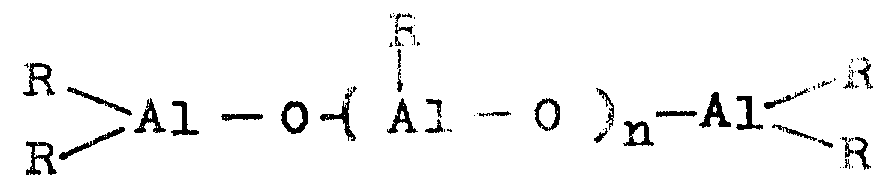
(wherein R represents cyclopentadienyl, C1-C6Alkyl or halogen, Me represents a transition metal, Hal represents halogen), and a linear aluminoxane of the general formula:
Al2OR4(Al(R)-O)n
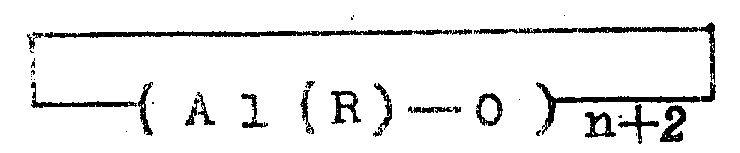
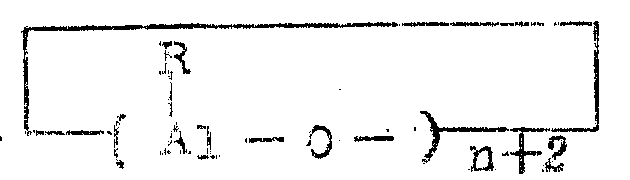
(wherein R represents a methyl group or an ethyl group, and n is a number of from 4 to 20 in the table), or a cyclic aluminoxane of the general formula
(wherein R and n are as defined above).
This patent document describes that, in order to adjust the density of the polyethylene obtained, the polymerization of ethylene should be carried out in the presence of alpha-olefins or mixtures thereof in amounts of up to 10% by weight, having a slightly longer chain length.
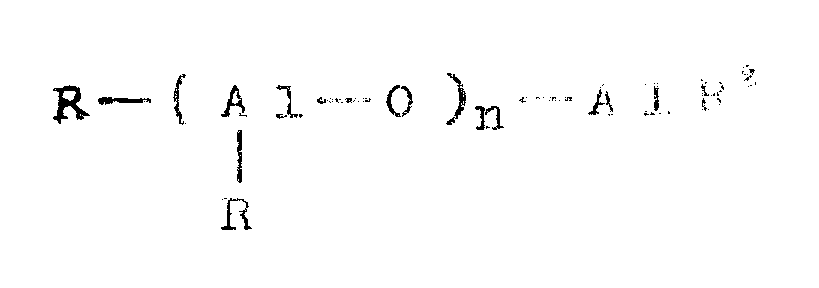
Japanese patent laid-open publication No. 95, 292/1984 describes the production of linear aluminoxane represented by the general formula
(wherein n is a number of 2 to 40, and R is C1-C4Alkyl radical)
And cyclic aluminoxanes of the general formula
(wherein n and R are as defined above)
The production method of (1).
This patent document discloses: ethylene is polymerized in the presence of a mixture of methylaluminoxane and a bis (cyclopentadienyl) compound of zirconium to yield at least twenty-five million grams of polyethylene per gram of transition metal per hour.
Japanese patent laid-open publication No. 35005/1985 discloses a process for producing a catalyst for olefin polymerization, which comprises reacting a magnesium compound with an aluminoxane represented by the following formula:
(in the formula, R1Is C1-C10Alkyl radical, R0Is R1Or to R1Above, denoted as-O-) and then subjecting the reaction product to chlorination, followed by treatment of the chlorinated product with a compound of vanadium, zirconium or chromium. This patent describes that the resulting catalyst is for ethylene and C3-C12The copolymerization of alpha-olefins of (a) is particularly suitable.
Japanese patent laid-open publication No. 35, 006/1985 discloses a catalyst for reactor alloy comprising a mixture of (a) two or more different transition metal compounds of single, di-and tri-cyclopentadienyl or derivatives thereof, and (b) aluminoxane. Example 1 of this Japanese patent application laid-open shows that ethylene and propylene were polymerized in the presence of a catalyst composed of bis (pentamethylcyclopentadienyl) zirconium dimethyl and an aluminoxane to produce polyethylene having a number average molecular weight of 15300, a weight average molecular weight of 36400 and a propylene content of 3.4%. In example 2 of this patent document, ethylene and propylene are polymerized in the presence of a catalyst composed of bis (methylcyclopentadienyl) zirconium dichloride and an aluminoxane to produce a blend of polyethylene and an ethylene/propylene copolymer containing a toluene-soluble fraction having a number average molecular weight of 2200, a weight average molecular weight of 11.900 and a propylene component content of 30 mol%, and a toluene-insoluble fraction having a number average molecular weight of 3,000, a weight average molecular weight of 7,400 and a propylene component content of 4.8 mol%. The blend had a number average molecular weight of 2000, a weight average molecular weight of 8300, and a propylene content of 7.1 mol%. Example 3 of this patent document describes a blend of linear low density polyethylene and an ethylene-propylene copolymer which contains a soluble fraction having a molecular weight distribution (Mw/Mn) of 4.57 and containing 20.6 mol% of a propylene component and an insoluble fraction having a molecular weight distribution of 3.04 and containing 2.9 mol% of a propylene component.
Japanese patent application laid-open No. 35007/1985 describes a process for polymerizing ethylene alone or copolymerizing ethylene with an alpha-olefin having 3 or more carbon atoms in the presence of a catalyst comprising a metallocene and a cyclic aluminoxane having the general formula:
(wherein R is an alkyl group of 1 to 5 carbon atoms and n is an integer of 1 to about 20), or a linear aluminoxane of the general formula:
(wherein R and n are as defined above).
The patent document reports that the weight average molecular weight of the polymer produced by the above-mentioned production method is 500 to about 1, 400, 000, and the molecular weight distribution is 1.5 to 4.0.
Japanese laid-open patent publication No. 35008/85 discloses that polyethylene or ethylene/C having a wide molecular weight distribution is produced using a catalyst system composed of at least two metallocenes and aluminoxane3-C10Copolymers of alpha-olefins. It is disclosed that the molecular weight distribution (Mw/Mn) of the copolymer is 2 to 50.
In these prior art references, catalysts consisting of a transition metal compound and an aluminoxane have been proposed which have a much higher polymerization activity than catalyst systems consisting of a transition metal compound and an organoaluminum compound known hitherto. However, most of the recommended catalysts are soluble in the reaction system and are used only in the solution polymerization method. Thus, the viscosity of the polymerization system becomes high, and the bulk density of the polymer obtained by post-treating the solution is low. It is difficult to obtain a polymer having excellent powder properties.
On the other hand, a method of carrying out suspension polymerization or gas phase polymerization of an olefin by using one or both of the above-mentioned transition metal compound and aluminoxane as a catalyst supported on a porous inorganic oxide such as silica, silica/alumina and alumina has been examined.
For example, the above-mentioned Japanese patent laid-open publication Nos. 35006/1985, 35007/1985 and 35008/1985 describe catalysts comprising a transition metal compound and an aluminoxane supported on silica, silica/alumina or alumina.
Japanese patent laid-open publication Nos. 106808/1985 and 106809/1985 propose a method for producing a composition composed of a polyethylene type polymer and a filler. The composition is obtained by polymerizing ethylene or copolymerizing ethylene and an alpha-olefin in the presence of a material which is obtained by previously contacting a high-activity catalyst component containing titanium and/or zirconium and dissolved in a hydrocarbon solvent with a filler, an organoaluminum compound and a filler having an affinity with polyolefin.
Japanese laid-open patent publication No. 31404/1986 proposes a method of polymerizing ethylene or copolymerizing ethylene with an alpha-olefin in the presence of a catalyst mixture composed of a product obtained by reacting a trialkyl name with water in the presence of silica and alumina, together with a transition metal compound.
Japanese patent laid-open No. 276805/1986 proposes a method of polymerizing an olefin in the presence of a catalyst comprising a reaction mixture of a zirconium compound, and a reaction mixture of an aluminoxane and a trialkylaluminum reacted with an inorganic oxide containing surface hydroxyl groups (e.g., silica).
Each of the supported solid catalysts proposed in the above prior art references was prepared by: a suspension of a solution containing a combination of a carrier, aluminoxane and a transition metal is prepared, the solvent of the suspension is then evaporated, and the residue is dried.
When these solid catalyst components are used in a suspension polymerization system or a gas phase polymerization system to polymerize or copolymerize olefins, the polymerization activity of the solid catalyst component is far lower than that in the above-mentioned polymerization in a solution polymerization system, and the inherent characteristics of the transition metal compound catalyst component and the aluminoxane catalyst component are not fully revealed. Furthermore, the resulting polymers do not prove to be very satisfactory in view of powder properties such as bulk density.
It is an object of the present invention to provide a process for producing a solid catalyst for olefin polymerization which gives an olefin polymer having a high bulk density and excellent powder properties and which is also high in polymerization activity.
It is another object of the present invention to provide a process for producing a solid catalyst for olefin polymerization in which aluminoxane is deposited on a transition metal salt which has been supported by a carrier, by using a specific solvent in which aluminoxane is insoluble or slightly soluble. The preparation method has the following advantages: the aggregation or adhesion of catalyst particles on the surface of the reactor, which occurs in the prior art when the step of depositing aluminoxane is performed, can be eliminated, and the applicability of the process can be improved, while the polymerization activity of the catalyst and the bulk density of the polymer can be increased.
According to the invention, the above object is achieved by: (a) a process for producing a solid catalyst for olefin polymerization, which comprises contacting a solution of an aluminoxane with a suspension composed of a particulate support having supported thereon a compound of a transition metal of group IVB of the periodic Table and a solvent in which the aluminoxane is insoluble or only slightly soluble, thereby forming a solid component, and (B) a process for producing a catalyst for olefin polymerization, which comprises contacting a suspension of a particulate support having supported thereon a compound of a transition metal of group IVB of the periodic Table in a solution of an aluminoxane with a solvent in which the aluminoxane is insoluble or only slightly soluble.
To produce the solid catalyst for olefin polymerization of the present invention, the following compounds (1) to (3) are used:
(1) a group IVB transition metal-carrying particulate carrier (D) which is obtained by supporting a compound of a group IVB transition element of the periodic table (catalyst component A) on a particulate carrier (catalyst carrier C).
(2) An aluminoxane (catalyst component B).
(3) A solvent (E) in which the aluminoxane is insoluble or slightly soluble.
The group IVB transition element in the catalyst component (A) is selected from titanium, zirconium and hafnium, titanium or zirconium being preferred, the latter being particularly preferred.
The group IVB transition metal in the catalyst component (A) may, for example, be a zirconium compound which contains a group which has a conjugated electron as ligand.
Examples of zirconium compounds containing a conjugated pi-electron as ligand are compounds of the following general formula (I):
R1 kR2 lR3 mR4 nZr (Ⅰ)
in the formula, R1Represents a cycloalkadienyl group or a substituted cycloalkadienyl group, R2,R3And R4Each of which represents a cycloalkadienyl group, an aryl group, an alkyl group, a cycloalkyl group, an aralkyl group, a halogen atom, a hydrogen atom, ORa,SRb,NRcOr PRd 2(Ra,Rb,RcAnd RdEach representing a hydrocarbon radical, e.g. an alkaneRadical, cycloalkyl, aryl or aralkyl, or a silyl radical), two Rc1S or two Rd1S may be taken together to form a ring, k is not more than 1, k + l + m + n is 4, provided that when R is2Represents a cycloalkadienyl group, then R1And R2May be linked to each other by a lower alkylene group.
Examples of cycloalkadienyl radicals are cyclopentadienyl, methylcyclopentadienyl, ethylcyclopentadienyl, pentamethylcyclopentadienyl, dimethylcyclopentadienyl, indenyl, ethylenebis-indenyl and tetrahydroindenyl. Examples of alkyl groups are methyl, ethyl, propyl, isopropyl, butyl, hexyl, octyl, 2-ethylhexyl, decyl and oleyl. Examples of aryl groups are phenyl and tolyl. Examples of aralkyl groups are benzyl and neo-phenyl. Examples of cycloalkyl groups are cyclopentyl, cyclohexyl, cyclooctyl, norbornyl and bicyclononyl, as well as alkyl-substituted derivatives of these groups. Examples of silyl groups are trimethylsilyl, triethylsilyl, phenyldimethylsilyl and triphenylsilyl. Unsaturated aliphatic groups such as vinyl, allyl, propenyl, isopropenyl and 1-butenyl and unsaturated alicyclic groups such as cyclohexenyl may also be cited. The halogen atom may be, for example, fluorine, chlorine or bromine. Examples of lower alkylene are methylene, ethylene, propylene and butylene.
Specific examples of the zirconium compound of the above general formula (1) include:
bis (cyclopentadienyl) zirconium monochloride, bis (cyclopentadienyl) zirconium monobromo-hydride, bis (cyclopentadienyl) zirconium hydride, bis (cyclopentadienyl) ethylzirconium hydride, bis (cyclopentadienyl) cyclohexylzirconium hydride, bis (cyclopentadienyl) phenylzirconium hydride, bis (cyclopentadienyl) benzylzirconium hydride, bis (cyclopentadienyl) neopentyl zirconium hydride, bis (methylcyclopentadienyl) zirconium monochloride, bis (indenyl) zirconium monochloride, bis (cyclopentadienyl) zirconium dichloride, bis (cyclopentadienyl) zirconium dibromide, bis (cyclopentadienyl) methylzirconium monochloride, bis (cyclopentadienyl) ethylzirconium monochloride, bis (cyclopentadienyl) cyclohexylzirconium monochloride, bis (cyclopentadienyl) benzylzirconium monochloride, bis (methylcyclopentadienyl) zirconium dichloride, bis (pentamethylcyclopentadienyl) zirconium dichloride, bis (indenyl) zirconium dichloride, bis (indenyl) zirconium dibromide, bis (cyclopentadienyl) zirconium dibenzene, bis (cyclopentadienyl) zirconium dibenzyl, bis (cyclopentadienyl) zirconium methoxy chloride, bis (cyclopentadienyl) zirconium ethoxy chloride, bis (cyclopentadienyl) zirconium butoxy chloride, bis (cyclopentadienyl) 2-ethylhexyloxy chloride, bis (cyclopentadienyl) zirconium ethoxymethyl, bis (cyclopentadienyl) zirconium butoxymethyl, bis (cyclopentadienyl) zirconium ethyloxy, bis (cyclopentadienyl) zirconium phenyloxy, bis (cyclopentadienyl) zirconium benzylethoxy, bis (methylcyclopentadienyl) zirconium ethoxy chloride, bis (indenyl) zirconium ethoxy chloride, bis (cyclopentadienyl) zirconium phenoxy chloride, bis (cyclopentadienyl) zirconium cyclohexyloxy chloride, bis (cyclopentadienyl) phenylmethoxy zirconium phenyl methoxychloride, bis (cyclopentadienyl) methyl zirconium benzyloxy chloride, bis (cyclopentadienyl) trimethylsiloxy zirconium chloride, bis (cyclopentadienyl) triphenylsiloxy zirconium chloride, bis (cyclopentadienyl) thiophenyl zirconium chloride, bis (cyclopentadienyl) thioethyl zirconium chloride, bis (cyclopentadienyl) bis (dimethylamide) zirconium, bis (cyclopentadienyl) ethylaminozirconium chloride, ethylenebis (indenyl) ethoxyzirconium chloride, ethylenebis (4, 5, 6, 7-tetrahydroindenyl) zirconyl chloride, ethylenebis (indenyl) dimethylzirconium, ethylenebis (indenyl) diethylzirconium, ethylenebis (indenyl) diphenylzirconium chloride, ethylenebis (indenyl) dibenzylzirconium, ethylenebis (indenyl) methylzirconium monobromide, ethylenebis (indenyl) ethylzirconium chloride, ethylenebis (indenyl) benzylzirconium monochloride, ethylenebis (indenyl) methylzirconium monochloride, ethylenebis (indenyl) zirconium dichloride, ethylene bis (indenyl) zirconium dibromide, ethylene bis (4, 5, 6, 7-tetrahydro-1-indenyl) dimethylzirconium monochloride, ethylene bis (4, 5, 6, 7-tetrahydro-1-indenyl) methylzirconium monochloride, ethylene bis (4, 5, 6, 7-tetrahydro-1-indenyl) zirconium dichloride, ethylene bis (4, 5, 6, 7-tetrahydro-1-indenyl) zirconium dibromide, ethylene bis (4-methyl-1-indenyl) zirconium dichloride, ethylene bis (5-methyl-1-indenyl) zirconium dichloride, ethylene bis (6-methyl-1-indenyl) zirconium dichloride, ethylene bis (7-methyl-1-indenyl) zirconium dichloride, ethylene bis (5-methoxy-1-indenyl) zirconium dichloride, ethylene bis (2, 3-dimethyl-1-indenyl) zirconium dichloride, ethylene bis (4, 7-dimethoxy-1-indenyl) zirconium dichloride, dimethoxyethylene bis (indenyl) zirconium, ethylenebis (indenyl) zirconium diethoxide, ethylenebis (indenyl) zirconium methoxy chloride, ethylenebis (indenyl) zirconium ethoxy chloride, ethylenebis (indenyl) zirconium ethoxide, dimethoxyethylene bis (4, 5, 6, 7-tetrahydro-1-indenyl) zirconium, ethylenebis (4, 5, 6, 7-tetrahydro-1-indenyl) zirconium diethoxide, ethylenebis (4, 5, 6, 7-tetrahydro-1-indenyl) zirconium chloride, ethylenebis (4, 5, 6, 7-tetrahydro-1-indenyl) zirconium methoxy chloride, ethylenebis (4, 5, 6, 7-tetrahydro-1-indenyl) zirconium ethoxide, and ethyleneoxyethylenebis (4, 5, 6, 7-tetrahydro-1-indenyl) methyl zirconium ethoxide.
Examples of the titanium compound include:
bis (cyclopentadienyl) titanium monochloride, bis (cyclopentadienyl) methyl titanium hydride, bis (cyclopentadienyl) phenyl titanium chloride, bis (cyclopentadienyl) benzyl titanium chloride, bis (cyclopentadienyl) titanium dichloride, bis (cyclopentadienyl) dibenzyl titanium, bis (cyclopentadienyl) ethoxy titanium chloride, bis (cyclopentadienyl) butoxy titanium chloride, bis (cyclopentadienyl) methyl titanium ethoxide, bis (cyclopentadienyl) phenoxy titanium chloride, bis (cyclopentadienyl) trimethylsiloxy titanium chloride, bis (cyclopentadienyl) thiophenyl titanium chloride, bis (cyclopentadienyl) bis (dimethylamide) titanium, bis (cyclopentadienyl) diethoxy titanium, ethylene bis (indenyl) titanium dichloride, and ethylene bis (4, 5, 6, 7-tetrahydro-1-indenyl) titanium dichloride.
Examples of hafnium compounds include:
bis (cyclopentadienyl) hafnium monochloride, bis (cyclopentadienyl) ethyl hafnium hydride, bis (cyclopentadienyl) phenyl hafnium chloride, bis (cyclopentadienyl) hafnium dichloride, bis (cyclopentadienyl) benzyl hafnium chloride, bis (cyclopentadienyl) ethoxy hafnium chloride, bis (cyclopentadienyl) butoxy hafnium chloride, bis (cyclopentadienyl) methyl hafnium ethoxide, bis (cyclopentadienyl) phenoxy hafnium chloride, bis (cyclopentadienyl) thiophenyl hafnium chloride, bis (cyclopentadienyl) bis (diethylamino) hafnium dichloride, ethylene bis (indenyl) hafnium dichloride, and ethylene bis (4, 5, 6, 7-tetrahydro-1-indenyl) hafnium dichloride.
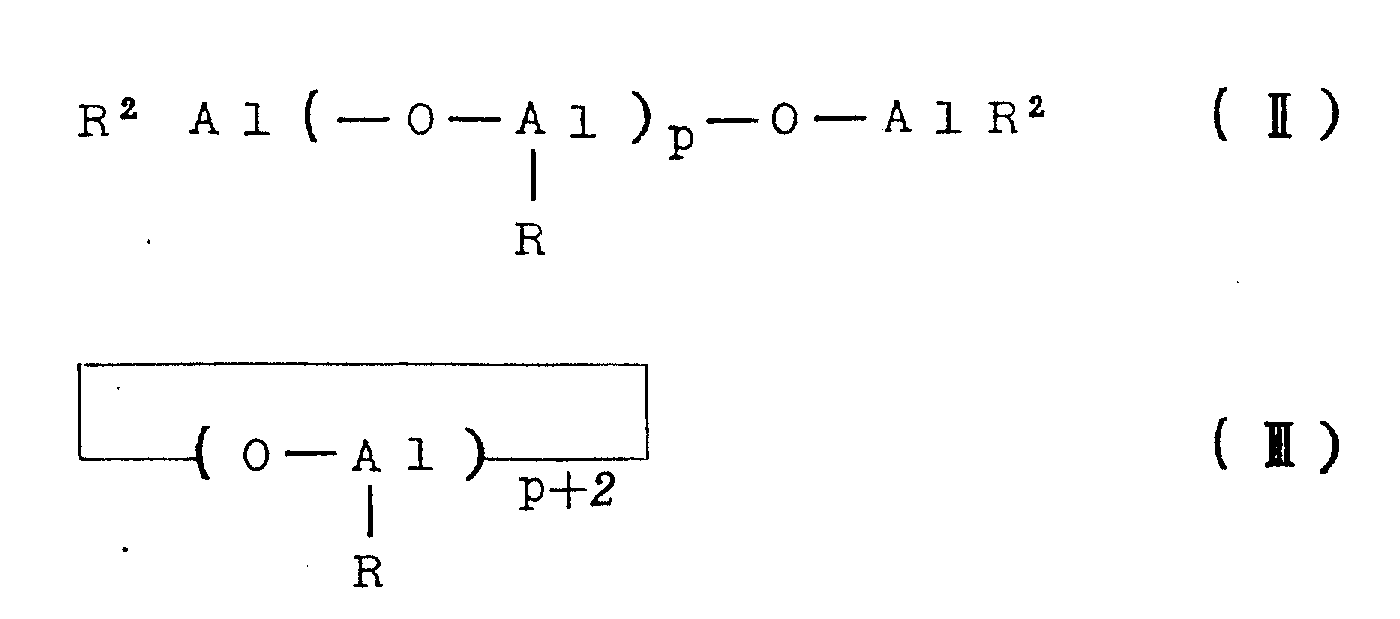
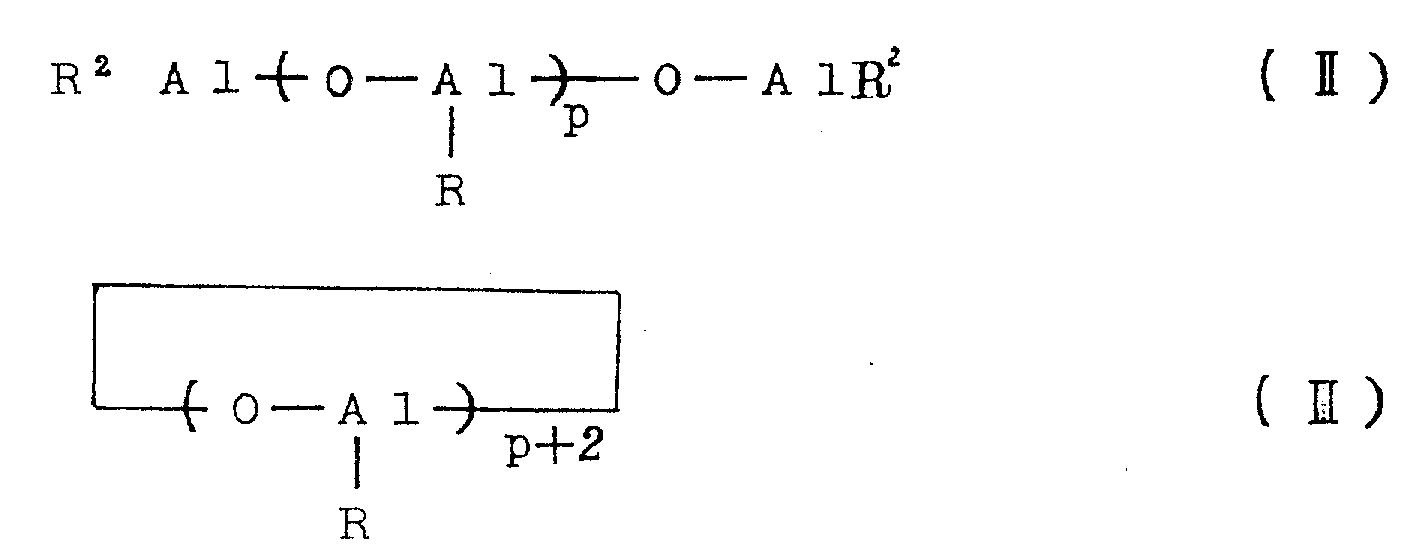
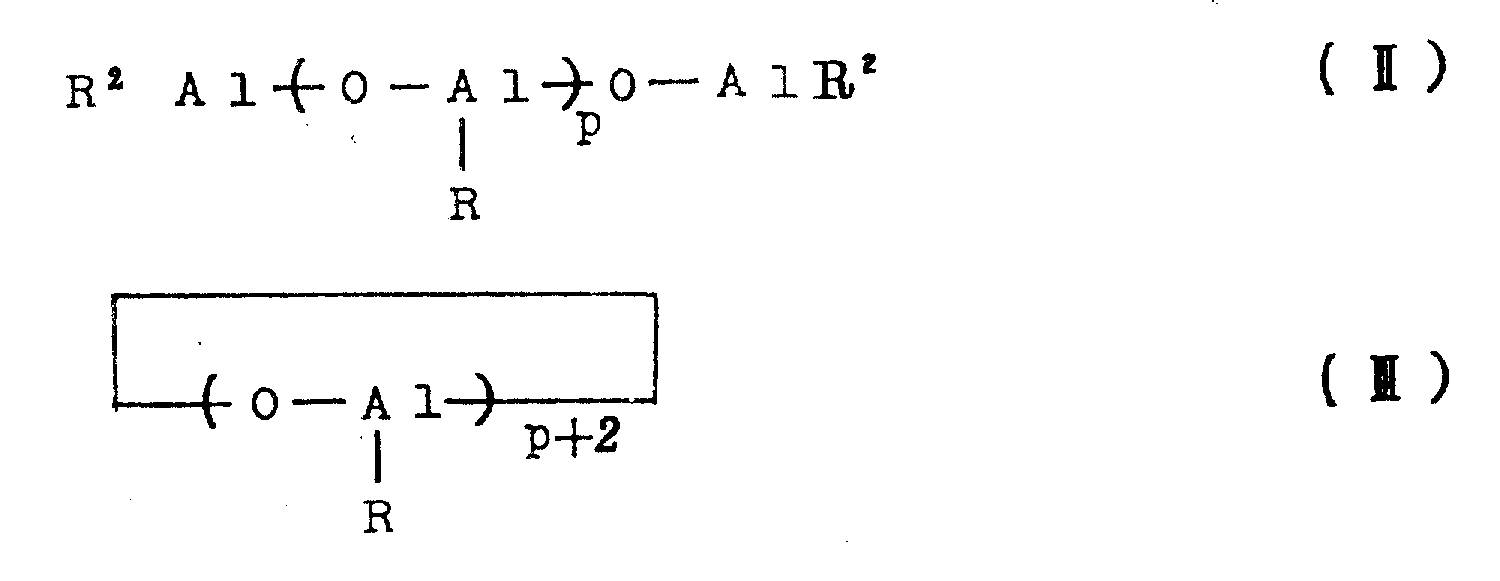
The aluminoxane as the catalyst component (B) may be, for example, organoaluminum compounds of the following general formulae (II) and (III).
In the above formulae (II) and (III), R represents a hydrocarbon group such as methyl, ethyl, n-propyl, isopropyl, n-butyl or isobutyl, preferably methyl, ethyl or isobutyl, particularly preferably methyl. The symbols P in the formulae (II) and (III) represent integers of at least 2, preferably at least 5 and most preferably at least 8.
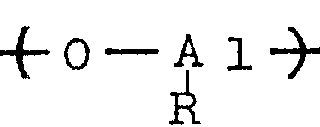
In the aluminoxanes of the general formulae (II) and (III), the oxyaluminum units
It may comprise mixed aluminum units containing different hydrocarbon radicals, in which case the aluminoxane preferably contains oxymethylaluminum units
At least 30 mol%, preferably at least 50 mol%, particularly preferably at least 70 mol%, of aluminoxane.
The aluminoxane may be substituted aluminoxane containing not more than 40% by weight, preferably not more than 30% by weight, particularly preferably not more than 20% by weight of substituents, corresponding to the general formulae (II) and (III), in which some of the R groups are substituted by a substituent (for example a halogen atom such as chlorine or bromine, a hydroxyl group, an alkoxy group or an-ONR group).
The aluminoxane can be produced, for example, by the following method:
(1) a process which comprises reacting a suspension of a compound containing adsorbed water or a compound containing water of crystallization (such as magnesium chloride hydrate, copper sulfate hydrate, aluminum sulfate hydrate, nickel sulfate hydrate or cerium trichloride hydrate) with trialkylaluminum or a mixture containing at least two trialkylaluminums in a hydrocarbon medium.
(2) A process which comprises reacting an aluminium trialkyl or a mixture of at least two aluminium trialkyls directly with water in a medium such as benzene, toluene, diethyl ether or tetrahydrofuran.
The method (1) is more preferable.
The aluminoxane may include all organometallic compounds other than trialkylaluminum, for example, chlorine-containing organoaluminum compounds, or an organic compound such as an organomagnesium compound. The solvent which can be used for the preparation of the aluminoxane solution can be, for example, an aromatic hydrocarbon having from 6 to 16 carbon atoms, such as benzene, toluene, ethylbenzene, propylbenzene, butylbenzene, xylene, chlorobenzene or isopropylbenzene.
The solvent in which the aluminoxane is insoluble or sparingly soluble includes straight-chain, branched-chain aliphatic saturated hydrocarbons having 4 to 16 carbon atoms (e.g., n-pentane, isopentane, n-hexane, n-octane, isooctane, n-decane, isodecane, and n-dodecane) and alicyclic hydrocarbons having 5 to 16 carbon atoms (e.g., cyclopentane, cyclohexane, methylcyclopentane, methylcyclohexane, and ethylcyclohexane).
The boiling point of the solvent (E) is preferably higher than that of the solvent used for dissolving the aluminoxane.
The catalyst particles (C) are a particulate support and may be a particulate inorganic or organic support. Specific examples of the particulate inorganic carrier include SiO2,Al2O3,MgO,ZrO2,TiO2,B2O3,CaO,ZnO,BaO,ThO2And mixtures thereof, e.g. SiO2-MgO,SiO2-Al2O3,SiO2-TiO2,SiO2-V2O5,SiO2-Cr2O3And SiO2-TiO2MgO, these inorganic supports are generally used after calcination at from 150 to 1000 ℃ and preferably from 200 to 800 ℃. A carrier containing at least one silica or alumina as a main component is preferable. These inorganic carriers may contain small amounts of carbonates, sulfates, nitrates and oxides such as sodium carbonate, potassium carbonate, calcium carbonate, magnesium carbonate, sodium sulfate, aluminum sulfate, barium sulfate, potassium nitrate, magnesium nitrate, aluminum nitrate, sodium oxide, potassium oxide and lithium oxide, and the properties of the carriers vary depending on their types and preparation methods. Preferred carriers for use in the present invention have a diameter of from 5 to 200. mu.m, preferably from 10 to 150. mu.m, particularly preferably from 20 to 100. mu.m.
Examples of the particulate organic carriers include polyolefins (e.g., polyethylene, polypropylene, poly-1-butene, and poly (4-methyl-1-pentene), polyolefins obtained by copolymerizing monomers used as raw materials for the above polyolefins, polyesters, polyamides, polyvinyl chloride, polymethyl methacrylate, polymethyl acrylate, polystyrene, various natural polymers, and various monomer compounds, preferred carriers have a particle diameter of 5 to 200. mu.m, more preferably 10 to 150. mu.m, most preferably 20 to 100. mu.m. the molecular weight of these carriers should be such that they can exist in a solid state, for example, the weight average molecular weight of polyethylene should be about 1,000 to 10,000,000.
The group IVB transition metal-carrying particulate support (D) used in the present invention can be produced, for example, by the following method from the group IVB transition metal compound (A) and the particulate support (C).
For example, the particulate support (C) is brought into contact with the transition metal compound with or without an inert solvent, and the group IVB transition metal-supported support (D) can be obtained on the support (C) having supported the catalyst component (A) with or without removing the inert solvent. The particulate support (C) may be pretreated with an organometallic compound, such as an aluminoxane compound, or a halogenosilane, prior to contacting with the catalyst component (A).
The organometallic compound used for the pretreatment may be, for example, an organoaluminum compound, an organoboron compound, an organomagnesium compound, an organozinc compound, or an organolithium compound. Organoaluminum compounds are preferred. Specific examples of the organoaluminum compound include trialkylaluminums (e.g., trimethylaluminum, triethylaluminum, tri-n-butylaluminum and triisobutylaluminum), alkenylaluminums (e.g., isopropenylaluminum), dialkylaluminum alkoxides (e.g., methoxydimethylaluminum, ethoxydiethylaluminum, dibutylaluminum butoxide and methoxydiisobutylaluminum), alkylaluminum sesquialkoxides (e.g., methylaluminum sesquimethoxide and ethylaluminum sesquiethoxide), and the average composition is R'2.5Al(OR″)0.5The partially alkoxylated alkylaluminums of (a), dialkylaluminum halides (e.g., dimethylaluminum chloride, diethylaluminum chloride and dimethylaluminum bromide), alkylaluminum sesquihalides (e.g., methylaluminum sesquichloride and ethylaluminum sesquichloride), alkylaluminum dihalides (e.g., methylaluminum dichloride and ethylaluminum dichloride).
Among the above-mentioned organoaluminum compounds, trialkylaluminums, dialkylaluminum chlorides and dialkylaluminum alkoxides are preferable, and trimethylaluminum, triethylaluminum, triisobutylaluminum, dimethylaluminum chloride and methoxydiisobutylaluminum are particularly preferable.
In the above pretreatment, the ratio between the organometallic compound and the carrier, for example, the ratio of millimoles of the organometallic compound to grams of the carrier, is from 0.5 to 50, preferably from 1 to 30, and most preferably from 1.5 to 20.
The pretreatment was carried out as follows: dispersing the catalyst support (C) in an inert solvent, adding at least one organometallic compound of the type described above, maintaining the temperature of the mixture at 0 to 120 deg.C (preferably 10 to 100 deg.C, more preferably 20 to 90 deg.C) for 10 minutes to 10 hours (preferably 20 minutes to 5 hours, more preferably 30 minutes to 3 hours), and the pressure is atmospheric, reduced or pressurized.
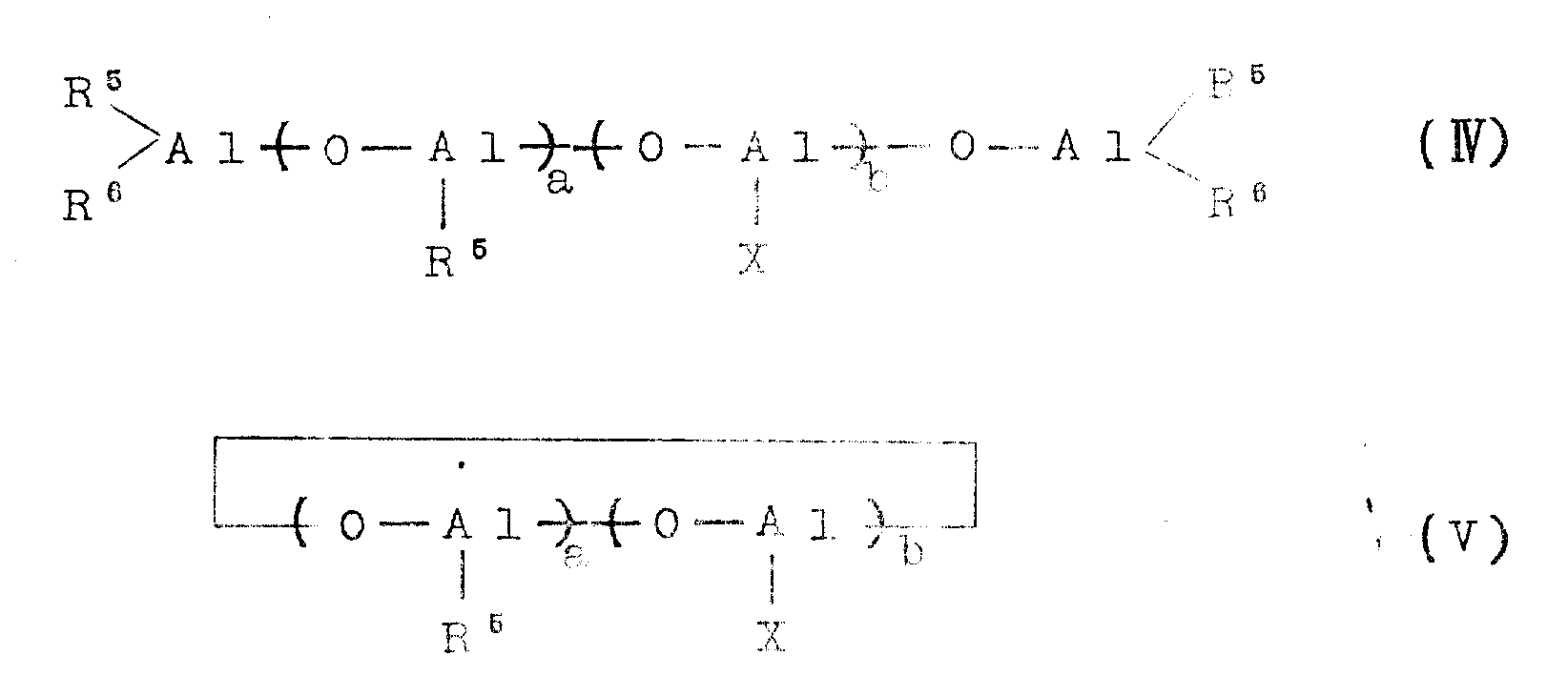
Examples of the aluminoxane which can be used for the pretreatment are organoaluminum compounds represented by the following general formulae (IV) and (V):
in the above general formulae (IV) and (V), R
5Represents a hydrocarbon group such as methyl, ethyl, propyl or butyl, preferably methyl or ethyl. The methyl group is particularly preferred. X is a halogen, such as chlorine or bromine. R
6Is the above-mentioned R
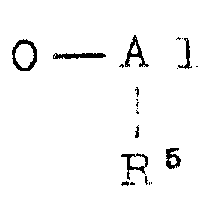
5Illustrative hydrocarbyl groups, or the aforementioned halogens. The letter a is usually a number from 1 to 80, preferably 1 to 30, and b is usually a number from 0 to 80, preferably 0 to 30. a + b is usually 4 to 100, preferably 8 to 50. In the formulae (IV) and (V), units (V)
) And a unit (
) Connected into a segment or randomly bonded together regularly or irregularly.
The mixing ratio of the aluminoxane to the support (C) in the pretreatment may be such that the aluminoxane is used in an amount of 0.001 to 100 mmol, preferably 0.01 to 10 mmol, more preferably 0.05 to 5 mmol, per gram of the support compound. After the pretreatment, the liquid portion contained, for example, excess aluminoxane compound, can be removed from the reaction mixture by filtration, decantation or the like. The treatment of the catalyst support (C) with aluminoxane may be carried out at from-50 ℃ to 200 ℃, preferably from 0 to 100 ℃, more preferably from 20 ℃ to 70 ℃, under normal pressure, reduced pressure or increased pressure for a period of from 10 minutes to 10 hours, preferably from 20 minutes to 5 hours.
The halogen-containing silane which can be used for the above pretreatment is preferably a halogen-containing silane represented by the following formula:
SiXcR7 dOR8 (4-c-d)(Ⅵ)
in which X represents Cl or Br, R7And R8Each represents a hydrogen atom, an alkyl group having 1 to 12 carbon atoms, an aryl group, or a cycloalkyl group having 3 to 12 carbon atoms, c is a number from 1 to 4, d is a number from 0 to 4, provided that c + d is a number from 1 to 4.
Specific examples of the halogen-containing silane compound are silicon tetrachloride, silicon tetrabromide, trichlorosilane, trichloromethylsilane, trichloroethylsilane, trichloropropylsilane, trichlorophenylsilane, trichlorocyclohexylsilane, tribromosilane, tribromoethylsilane, dichloromethylsilane, dichlorophenylsilane, dichloromethoxysilane, trichloroethoxysilane, trichloropropoxysilane, trichlorophenoxysilane, dichlorodimethoxysilane and trichlorosilane. These compounds may be used alone or in combination. Particularly suitable are silicon tetrachloride, trichlorosilane and trichloromethylsilane.
In the pretreatment, the ratio of the halogen-containing silane compound to the carrier (C) may be such that the amount of the halogen-containing silane compound used is 0.001 to 10 mmol, preferably 0.01 to 5 mmol, more preferably 0.05 to 1 mmol, per gram of the carrier compound (C). After the pretreatment, the liquid portion containing, for example, an excess amount of the halogenosilane compound may be removed by filtration, decantation or the like. The treatment of the catalyst support with aluminoxane may be carried out by: the temperature is from-50 ℃ to 200 ℃, preferably from 0 to 100 ℃, more preferably from 20 to 70 ℃, under normal pressure, reduced pressure or increased pressure for a period of from 10 minutes to 10 hours, preferably from 20 minutes to 5 hours.
Another method for producing a group IVB transition metal-loaded particulate support comprises contacting a support compound containing surface hydroxyl groups with a transition metal compound, thereby depositing the transition metal compound on the support.
In the pretreatment of the particulate carrier (C), an inert solvent can be used, and examples of the latter include aromatic hydrocarbons such as benzene, toluene, xylene, ethylbenzene, propylbenzene and isopropylbenzene, straight-chain or branched aliphatic hydrocarbons such as pentane, hexane, octane, decane and dodecane, alicyclic hydrocarbons such as cyclohexane and ethylcyclohexane, and halogenated hydrocarbons such as chlorobenzene and dichloroethane.
For supporting the catalyst component (A) on the particulate carrier (C), the above-mentioned inert solvents can be used. The inert solvent is preferably a solvent capable of dissolving the catalyst component (A), for example an aromatic hydrocarbon or a halogen-containing hydrocarbon.
The solid catalyst of the present invention can be produced by a process comprising contacting an aluminoxane (B) and a particulate support (D) carrying a group IVB transition metal, which comprises at least the step of contacting a solution of an aluminoxane with a solvent (E) in which the aluminoxane is insoluble or sparingly soluble, whereby the aluminoxane is deposited on the particulate support (D).
The following methods can be given as more specific examples.
(a) A process for producing a solid catalyst, which comprises the step of contacting a suspension consisting of a particulate support (D) having supported thereon a group IVB transition metal compound and a solvent (E) in which aluminoxane is insoluble or sparingly soluble, with an aluminoxane solution, thereby producing a solid component.
More specifically, if the aluminoxane solution is added to a suspension of the particulate support (D) in the solvent (E), or if the above-mentioned suspension composed of the solvent (E) and the particulate support (D) is added to the aluminoxane solution, the aluminoxane precipitates out. If desired, the solvent for the aluminoxane solution can be removed from the above-mentioned mixed suspension by distillation to facilitate precipitation of the aluminoxane. As a result, a solid catalyst useful in olefin polymerization, which has been supported with aluminoxane, can be obtained.
The amount of the carrier (D) used in the above suspension is usually 1 to 500 g, preferably 10 to 200 g, more preferably 20 to 100 g, per liter of the solvent.
The above-mentioned suspension is contacted with the aluminoxane solution, generally at a temperature of from-100 to 300 deg.C, preferably from-50 to 100 deg.C, more preferably from-30 to 50 deg.C. Generally, the contacting is carried out under stirring. The aluminoxane solution is used in an amount of, usually, 1 to 1000 parts by weight, preferably 10 to 100 parts by weight, per 100 parts by weight of the suspension, during the contact. In any step of the process, an electron donor component as already described may be added to produce a solid catalyst comprising the electron donor component.
The aluminoxane solution used for the preparation of the catalyst is formed at least from aluminoxane and the above-mentioned solvent for dissolving aluminoxane by, for example, simply mixing these two compounds, or heating them first and then mixing them. The amount of solvent in the solution is such that the amount of aluminum in the aluminoxane is added to 0.1 to 50 liters, preferably 0.2 to 10 liters, more preferably 0.3 to 2 liters, per gram atom of the solvent.
(b) The process for producing a solid catalyst for olefin polymerization according to the present invention also comprises contacting a suspension of a particulate support (D) having supported thereon a group IVB transition metal in an aluminoxane solution with a solvent (E) in which aluminoxane is insoluble or slightly soluble, to thereby form a solid component.
Specifically, the solvent (E) is added to the above-mentioned suspension composed of the aluminoxane solution and the support (D), or a suspension composed of the aluminoxane solution and the support (D) is added to the solvent (E), so that the aluminoxane is precipitated. If desired, the solvent used to dissolve the aluminoxane is removed from the mixed suspension by evaporation to facilitate precipitation of the aluminoxane. As a result, a solid catalyst for olefin polymerization in which aluminoxane has been supported on a particulate carrier is obtained.
In the step of contacting the suspension composed of the aluminoxane solution and the particulate support (D) with the solvent (E), the solvent is usually used in an amount of from 10 to 10000 parts by weight, preferably from 100 to 1000 parts by weight, of the solvent (E) per 100 parts by weight of the aluminoxane solution. The temperature at the time of contact is usually-100 to 300 deg.C, preferably-50 to 100 deg.C, more preferably-30 to 50 deg.C. If desired, the electron donor components already described can be added at any stage of the process to produce a solid catalyst with an electron donor component.
The aluminoxane solution can be prepared by the process described above for Process (a), and the amount of the solvent in the solution can also be the same as described above. The amount of the support (D) dispersed in the aluminoxane is 1 to 500 g, preferably 10 to 200 g, more preferably 20 to 100 g, per liter of the aluminoxane dissolved.
The solid catalyst of the present invention obtained by the above method is a solid catalyst for olefin polymerization, which is composed of:
(1) a particulate support loaded with a transition metal of group IVB of the periodic Table, and
(2) an aluminoxane.
In the solid catalyst, 0.5 to 500 mg of transition metal atom is contained per 100 g of the transition metal compound, 5 to 50,000 mg of aluminum atom is contained in the aluminoxane, the atomic ratio of aluminum/transition metal (Al/M) is 1 to 1000, and the average particle diameter is 5 to 200. mu.m.
The solid catalyst obtained by the method of the present invention may contain, as optional components, the above-mentioned metal compound and/or the below-mentioned electron donor in addition to the above-mentioned main components.
The solid catalyst obtained by the process of the present invention contains the transition metal in an amount of 0.5 to 500 mg-atom, preferably 1 to 200 mg-atom, more preferably 3 to 50 mg-atom, per 100 g of the particulate carrier.
The solid catalyst obtained by the process of the present invention has an aluminum to transition metal atomic ratio (Al/M) of 1 to 1000, preferably 6 to 600, more preferably 15 to 300.
The solid catalyst obtained by the process of the present invention has an average particle diameter of 5 to 200. mu.m, preferably 10 to 150. mu.m, more preferably 20 to 100. mu.m.
The solid catalyst obtained by the method of the present invention may contain an electron donor component in addition to the transition metal compound (A) and the aluminoxane. Examples of electron donors are carboxylic acids, esters, ethers, ketones, aldehydes, alcohols, phenols, amides of oxygen-containing compounds and compounds containing a metal atom (e.g.aluminium or silicon) -O-C bond, nitriles, amines, and phosphines. The proportion of the electron donor is usually 0 to 1 mole per gram atom of the transition metal atom (M).
The catalyst used in the process of the present invention is effective for producing olefin polymers, particularly ethylene polymers and copolymers of ethylene and α -olefins, and examples of the olefin which can be polymerized by the above-mentioned catalyst include ethylene and α -olefins having 3 to 20 carbon atoms such as propylene, 1-butene, 1-hexene, 4-methyl-1-pentene, 1-octene, 1-decene, 1-dodecene, 1-tetradecene, 1-hexadecene, 1-octadecene, 1-eicosene.
The olefin polymerization carried out with the catalyst obtained by the process of the present invention is generally carried out in gas phase or liquid phase, for example in slurry. In slurry polymerization, an inert olefin may be used as a solvent, or the olefin itself may be used as a solvent.
Specific examples of the hydrocarbon medium include aliphatic hydrocarbons such as butane, isobutane, pentane, hexane, octane, decane, dodecane, hexadecane and octadecane, alicyclic hydrocarbons such as cyclopentane, methylcyclopentane, cyclohexane and cyclooctane, aromatic hydrocarbons such as benzene, toluene and xylene, and petroleum fractions such as gasoline, kerosene and light oil.
The slurry polymerization using the catalyst obtained by the process of the present invention is usually carried out at a polymerization temperature of-50 to 120 ℃ and preferably 0 to 100 ℃.
The gas phase polymerization using the catalyst obtained by the process of the present invention is usually carried out at a temperature of 0 to 120 ℃ and preferably 20 to 100 ℃.
In slurry polymerization or gas phase polymerization using the catalyst obtained by the process of the present invention, the amount of the transition metal compound used is usually 10-8To 10-2Gram-atom/liter, preferably 10-7To 10-3Gram-atom/liter (expressed as concentration of transition metal atoms).
If desired, in the polymerization, an aluminoxane or an organoaluminum compound represented by the following general formula may be additionally used:
Rh pRi qAlX3-p-q
in the formula RhRepresents a hydrocarbon group having 1 to 10 carbon atoms, preferably an alkyl, alkenyl, cycloalkyl or aryl group having 1 to 6 carbon atoms, RiRepresents an alkoxy group having 1 to 6 carbon atoms, or an aryloxy group, X represents a halogen atom or a linear or branched alkoxy group having 1 to 6 carbon atoms, p is a number of more than 0 but not more than 3, q is a number of 0 to 2, and addition of an organoaluminum compound having a branched group, such as triisobutylaluminum or isopropylaluminum, or a monomethoxylate, can bring about an effect of improving polymerization activity.
The polymerization pressure is usually from atmospheric pressure to 1000 kg/cm2Preferably 2 to 50 kg/cm2. The polymerization can be carried out batchwise or else semicontinuously or continuously.
The polymerization can be carried out in two or more stages under different reaction conditions.
Before the polymerization of the olefin, the olefin is preferably prepolymerized in the presence of a solid catalyst. The prepolymerization is carried out by: from 1 to 1000 g, preferably from 5 to 500 g, more preferably from 10 to 200 g, of olefin are polymerized per gram atom of the transition metal compound of the solid catalyst. The olefin used for the prepolymerization may be, for example, ethylene and α -olefins having 3 to 20 carbon atoms, such as propylene, 1-butene, 4-methyl-1-pentene, 1-hexene, 1-octene, 1-decene, 1-dodecene and 1-tetradecene.
The temperature of the prepolymerization is from-20 ℃ to 70 ℃, preferably from-10 ℃ to 60 ℃, more preferably from 0 ℃ to 50 ℃.
The prepolymerization can be carried out batchwise or continuously under normal pressure or under pressure. The prepolymerization can be carried out in the presence of a molecular weight control agent, but the amount of the molecular weight control agent is preferably controlled to at least an amount which gives a prepolymer having an intrinsic viscosity of at least 0.1 dl/g (as measured in decalin at 135 ℃), preferably from 0.5 to 20 dl/g.
The prepolymerization is carried out in the absence of a solvent or in an inert hydrocarbon medium. In view of suitability, the prepolymerization is preferably carried out in an inert hydrocarbon solvent. The inert hydrocarbon medium may be, for example, the solvent (E) in which the aluminoxane is insoluble or slightly soluble.
In the prepolymerization system, the concentration of the solid catalyst is usually 10-6To 1 g-atom/l, preferably 10-4To 10-1Gram-atom/liter, which is the concentration of transition metal atoms in the solid catalyst.
The solid catalyst produced by the method of the present invention has high polymerization activity in the homopolymerization and copolymerization of olefin, and the produced polymer and copolymer have high bulk density, uniform particle size and narrow molecular weight distribution, and in the case of copolymer, have narrow component distribution and contain fine particles.
The following examples illustrate the invention in more detail.
Preparation of aluminoxanes
A400 ml flask which had been thoroughly purged with nitrogen was charged with 37 g of aluminum sulfate 14 hydrate and 125 ml of toluene, and then cooled to 0 ℃. Subsequently, 500 ml of trimethylaluminum, which had been diluted with 125 ml of toluene, were added dropwise. The temperature of the flask was then raised to 40 ℃ and the reaction was allowed to continue at this temperature for 30 hours. After the reaction, the reaction mixture was subjected to solid-liquid separation by filtration. Toluene was removed from the filtrate to obtain 13 g of aluminoxane as a white solid. The molecular weight was 933, as determined by freezing point depression in benzene. The p value in catalyst component (B) was 14.
Example 1
Preparation of silica carrying zirconium compound
In a 400 ml flask equipped with a stirrer thoroughly purged with nitrogen, a suspension of 3 g of silica (product of Davison Corp.; 952) which had been calcined at 300 ℃ for 12 hours and 50 ml of trichlorosilane was stirred at 50 ℃ for 2 hours. After the reaction was completed, the liquid portion was removed from the reaction mixture by a filter, and the remaining solid portion was suspended in 50 ml of toluene. 300 ml of toluene containing 15 mmol of bis (cyclopentadienyl) zirconium dichloride are added to the suspension at 25 ℃ and the mixture is reacted at 50 ℃ for 2 hours with stirring. After the reaction, the liquid portion of the suspension was removed by filtration, and the remaining solid portion was washed twice with toluene to obtain silica having a zirconium compound supported thereon. The amount of zirconium loaded was 1.4% by weight.
Loading of aluminoxanes on silica having deposited zirconium compounds
67 ml of a toluene solution containing methylaluminoxane in an amount corresponding to 100 mmol of aluminum atom and 2 g of the above-mentioned silica having supported thereon the zirconium compound were charged into a 300 ml reactor which was placed under reduced pressure and equipped with a stirrer, and 100 ml of purified n-decane was added at room temperature over a period of about half an hour with stirring to precipitate methylaluminoxane. While the pressure in the reactor was reduced to 4 torr by a vacuum pump, the temperature in the reactor was raised to 35 ℃ over about 3 hours to remove toluene and further precipitate methylaluminoxane. The reaction mixture was filtered with a filter to remove a liquid portion. The remaining solid portion was suspended. The composition of the obtained solid catalyst is shown in table 1.
Pre-polymerization
Into a 400 ml reactor equipped with a stirrer were charged, under a nitrogen atmosphere, 100 ml of purified n-decane and a solid catalyst in an amount corresponding to 0.1 mmol of zirconium. Ethylene was then fed in at a rate of 4 Nml/h for a period of 1 hour. During this time, the temperature was maintained at 20 ℃, and after the completion of the ethylene addition, the interior of the reactor was purged with nitrogen and washed with purified n-hexane. The product was suspended in hexane and stored in a catalyst bottle.
Polymerisation
Sodium chloride (250 g) as a dispersant was charged into a 2-liter autoclave which had been thoroughly purged with nitrogen, and during heating of the autoclave to 90 ℃, the interior of the reactor was depressurized to 50mmHg or less with a vacuum pump. The autoclave temperature was then reduced to 75 ℃ followed by purging the autoclave with ethylene. The catalyst used for the prepolymerization was added in an amount of 0.007 mmol of zirconium atom. After the autoclave was sealed, 50Nml of hydrogen was added. The autoclave was pressurized with ethylene so that the pressure in the autoclave reached 8 kg/cm2And (4) gauge pressure. The stirring speed was set to 300rpm and ethylene was polymerized at 80 ℃ for 1 hour.
After polymerization, the polymer and sodium chloride were taken out of the autoclave and poured into 1 liter of water. After about 5 minutes of stirring, almost all of the sodium chloride had dissolved in the water and only the polymer was suspended on the surface of the water. The suspended polymer was collected, washed thoroughly with methanol and dried under reduced pressure at 80 ℃ overnight. The polymerization results are shown in Table 1.
Example 2
Preparation of silica carrying zirconium compound
In a 400 ml glass flask which was thoroughly purged with nitrogen and equipped with a stirrer, a toluene solution containing 2 mmol of halogenated aluminoxane was added to a suspension of 5 g of silica (product of Davison corporation, # 952) and 100 ml of toluene which had been calcined at 800 ℃ for 12 hours, the temperature was raised to 50 ℃ and the reaction was allowed to proceed at 50 ℃ for 2 hours. After the reaction, the liquid portion was separated from the reaction mixture by a filter, and the remaining solid portion was suspended in 100 ml of toluene. To this suspension was added 9.4 ml of toluene containing 0.38 mmol of bis (cyclopentadienyl) zirconium dichloride at 25 ℃ and reacted at 25 ℃ for 2 hours with stirring, after which the liquid portion was removed from the suspension by a filter and the remaining solid portion was washed twice with toluene to obtain silica carrying the zirconium compound. The amount of zirconium supported was 0.7% by weight.
The subsequent process for supporting aluminoxane on the obtained silica having supported thereon a zirconium compound, pretreatment and main polymerization were carried out in the same manner as in example 1. The results are shown in Table 1.
Halogenated aluminoxane was synthesized in the same manner as aluminoxane except that the amount of trimethylaluminum was changed from 50 ml to 24.7 ml, and 25.3 ml of dimethylaluminum chloride was further added dropwise. The degree of polymerization of the resulting halogenated aluminoxane was 12.
Example 3
Preparation of silica loaded with zirconium compound
In a flask thoroughly purged with nitrogen gas, silica (average particle diameter of 70 μm and specific surface area of 260 m) calcined at 300 ℃ for 4 hours was charged2G, pore volume 1.65 m3G), 15 ml of a toluene solution of dimethylaluminum monochloride (1 mol of Al/ml solution), and 50 ml of toluene, and then heated at 80 ℃ for 2 hours. The reaction mixture was subjected to solid-liquid separation by filtration. The solid portion was transferred to 50 ml of toluene and 6.4 ml of a toluene solution of bis (cyclopentadienyl) zirconium dichloride (0.01 mol of zirconium per liter of solution) was added. The mixture was stirred at room temperature for 2 hours, and then the mixture was subjected to solid/liquid separation by filtration. The solid portion was suspended in 100 ml of n-decane. While stirring the suspension, 31 ml of aluminoxane in toluene (2.3 mol Al per liter of solution) were added. The mixture was heated to 35 ℃ and the pressure in the reactor was adjusted to 4 torr to volatilize the toluene. The reaction suspension was filtered at-20 ℃. The solid portion was collected and suspended in 50 ml of n-decane.
Prepolymerization and actual polymerization were carried out in the same manner as in example 1. The results are shown in Table 1.
Example 4
Preparation of alumina carrying zirconium compound
To a 200 ml flask thoroughly purged with nitrogen, 5.8 g of a solution of 500 gAlumina (average particle size 60 μm, specific surface 270 m) calcined at 5 hr2G, pore volume 1.05 cm3In g.c.), 17 ml of a solution of dimethylaluminum chloride in toluene (1 mol of Al per liter of solution), and 50 ml of toluene were heated at 80 ℃ for 2 hours. The reaction mixture was subjected to solid-liquid separation by filtration. The solid portion was transferred to 50 ml of toluene, 32 ml of a toluene solution of bis (cyclopentadienyl) zirconium dichloride (0.036 mol of Zr per liter of solution) were added, and the mixture was heated at 80 ℃ for 1 hour. The reaction mixture was subjected to solid-liquid separation by filtration to obtain alumina carrying a zirconium compound in an amount of 0.25% by weight of zirconium.
The aluminoxane was supported on alumina having a zirconium compound supported thereon, and prepolymerization and main polymerization were carried out as in example 1, and the results are shown in Table 1.
Example 5
Preparation of silica carrying zirconium compound
To a 400 ml flask equipped with a stirrer, thoroughly purged with nitrogen, 50 ml of a toluene solution containing 2 mmol of aluminoxane was added at room temperature to a suspension composed of 5 g of silica (# 952, product of Davison corporation) which had been calcined at 800 ℃ for 12 hours and 100 ml of toluene. The temperature of this mixture was raised to 50 ℃ and the reaction was carried out at this temperature for 2 hours. After the reaction, the liquid portion was removed from the reaction mixture by a filter. The remaining solid portion was suspended in 100 ml of toluene. To this suspension was added 9.4 ml of a toluene solution containing 0.38 mmol of bis (cyclopentadienyl) zirconium dichloride at 25 ℃. The reaction was carried out at 25 ℃ for 2 hours with stirring. After the reaction, the liquid fraction was removed from the suspension by means of a filter. The remaining solid portion was washed twice with toluene to obtain silica carrying a zirconium compound. The amount of zirconium supported on silica was 0.6% by weight.
The silica having the zirconium compound supported thereon was carried out by the aluminoxane and by prepolymerization and actual polymerization in the same manner as in example 1. The results are shown in Table 1.
Example 6
Example 1 was repeated except that trichlorosilane (50 ml) was not used. The results are shown in Table 1.
Comparative examples 1 to 6
Examples 1 to 6 were repeated, respectively, except that the operation of supporting the aluminoxane on the silica (or alumina) already supporting the zirconium compound was carried out by lowering the pressure of the reaction system and thus evaporating toluene (instead of using n-decane). Which is shown in table 1.