BR112016017227B1 - HETEROPHASIC PROPYLENE COPOLYMER, UNORIENTED FILM, CONTAINER, AND USE OF A HETEROPHASIC PROPYLENE COPOLYMER - Google Patents
HETEROPHASIC PROPYLENE COPOLYMER, UNORIENTED FILM, CONTAINER, AND USE OF A HETEROPHASIC PROPYLENE COPOLYMER Download PDFInfo
- Publication number
- BR112016017227B1 BR112016017227B1 BR112016017227-2A BR112016017227A BR112016017227B1 BR 112016017227 B1 BR112016017227 B1 BR 112016017227B1 BR 112016017227 A BR112016017227 A BR 112016017227A BR 112016017227 B1 BR112016017227 B1 BR 112016017227B1
- Authority
- BR
- Brazil
- Prior art keywords
- propylene copolymer
- raheco
- heterophasic propylene
- fraction
- ethylene
- Prior art date
Links
- QQONPFPTGQHPMA-UHFFFAOYSA-N propylene Natural products CC=C QQONPFPTGQHPMA-UHFFFAOYSA-N 0.000 title claims abstract description 342
- 229920001577 copolymer Polymers 0.000 title claims abstract description 309
- VGGSQFUCUMXWEO-UHFFFAOYSA-N Ethene Chemical compound C=C VGGSQFUCUMXWEO-UHFFFAOYSA-N 0.000 claims description 71
- 239000005977 Ethylene Substances 0.000 claims description 71
- -1 phthalic acid ester Chemical class 0.000 claims description 57
- 125000004805 propylene group Chemical group [H]C([H])([H])C([H])([*:1])C([H])([H])[*:2] 0.000 claims description 41
- 230000009477 glass transition Effects 0.000 claims description 39
- 239000003054 catalyst Substances 0.000 claims description 37
- 239000011159 matrix material Substances 0.000 claims description 36
- CTQNGGLPUBDAKN-UHFFFAOYSA-N O-Xylene Chemical compound CC1=CC=CC=C1C CTQNGGLPUBDAKN-UHFFFAOYSA-N 0.000 claims description 33
- 238000000034 method Methods 0.000 claims description 32
- 239000008096 xylene Substances 0.000 claims description 32
- 150000001875 compounds Chemical class 0.000 claims description 24
- 239000000203 mixture Substances 0.000 claims description 24
- 238000006116 polymerization reaction Methods 0.000 claims description 24
- 238000002347 injection Methods 0.000 claims description 23
- 239000007924 injection Substances 0.000 claims description 23
- 239000004711 α-olefin Substances 0.000 claims description 22
- 230000008569 process Effects 0.000 claims description 17
- HQQADJVZYDDRJT-UHFFFAOYSA-N ethene;prop-1-ene Chemical group C=C.CC=C HQQADJVZYDDRJT-UHFFFAOYSA-N 0.000 claims description 14
- 239000002667 nucleating agent Substances 0.000 claims description 14
- 150000002736 metal compounds Chemical class 0.000 claims description 13
- 101100023124 Schizosaccharomyces pombe (strain 972 / ATCC 24843) mfr2 gene Proteins 0.000 claims description 12
- 238000000354 decomposition reaction Methods 0.000 claims description 10
- XNGIFLGASWRNHJ-UHFFFAOYSA-N phthalic acid Chemical compound OC(=O)C1=CC=CC=C1C(O)=O XNGIFLGASWRNHJ-UHFFFAOYSA-N 0.000 claims description 9
- 229910052723 transition metal Inorganic materials 0.000 claims description 9
- 150000003624 transition metals Chemical class 0.000 claims description 9
- NNBZCPXTIHJBJL-UHFFFAOYSA-N decalin Chemical compound C1CCCC2CCCCC21 NNBZCPXTIHJBJL-UHFFFAOYSA-N 0.000 claims description 8
- 150000002688 maleic acid derivatives Chemical class 0.000 claims description 5
- 229920005606 polypropylene copolymer Polymers 0.000 claims description 5
- 150000001558 benzoic acid derivatives Chemical class 0.000 claims description 4
- 229940018560 citraconate Drugs 0.000 claims description 4
- 150000002148 esters Chemical class 0.000 claims description 4
- 125000000816 ethylene group Chemical group [H]C([H])([*:1])C([H])([H])[*:2] 0.000 claims description 4
- JFCQEDHGNNZCLN-UHFFFAOYSA-N glutaric acid Chemical class OC(=O)CCCC(O)=O JFCQEDHGNNZCLN-UHFFFAOYSA-N 0.000 claims description 4
- 150000002690 malonic acid derivatives Chemical class 0.000 claims description 4
- 150000003890 succinate salts Chemical class 0.000 claims description 4
- PXXNTAGJWPJAGM-UHFFFAOYSA-N vertaline Natural products C1C2C=3C=C(OC)C(OC)=CC=3OC(C=C3)=CC=C3CCC(=O)OC1CC1N2CCCC1 PXXNTAGJWPJAGM-UHFFFAOYSA-N 0.000 claims description 4
- 238000001644 13C nuclear magnetic resonance spectroscopy Methods 0.000 claims description 3
- HNEGQIOMVPPMNR-IHWYPQMZSA-N citraconic acid Chemical compound OC(=O)C(/C)=C\C(O)=O HNEGQIOMVPPMNR-IHWYPQMZSA-N 0.000 claims description 3
- 238000007619 statistical method Methods 0.000 claims description 3
- 238000012546 transfer Methods 0.000 claims description 3
- 239000002253 acid Substances 0.000 claims description 2
- 239000011777 magnesium Substances 0.000 description 35
- 235000001055 magnesium Nutrition 0.000 description 29
- 229910052749 magnesium Inorganic materials 0.000 description 25
- YXFVVABEGXRONW-UHFFFAOYSA-N Toluene Chemical compound CC1=CC=CC=C1 YXFVVABEGXRONW-UHFFFAOYSA-N 0.000 description 24
- 229920000642 polymer Polymers 0.000 description 23
- 239000000523 sample Substances 0.000 description 21
- 239000012071 phase Substances 0.000 description 20
- 239000000243 solution Substances 0.000 description 19
- VXNZUUAINFGPBY-UHFFFAOYSA-N 1-Butene Chemical compound CCC=C VXNZUUAINFGPBY-UHFFFAOYSA-N 0.000 description 18
- IMNFDUFMRHMDMM-UHFFFAOYSA-N N-Heptane Chemical compound CCCCCCC IMNFDUFMRHMDMM-UHFFFAOYSA-N 0.000 description 14
- 230000001954 sterilising effect Effects 0.000 description 14
- 238000004659 sterilization and disinfection Methods 0.000 description 14
- 239000011954 Ziegler–Natta catalyst Substances 0.000 description 13
- LIKMAJRDDDTEIG-UHFFFAOYSA-N 1-hexene Chemical compound CCCCC=C LIKMAJRDDDTEIG-UHFFFAOYSA-N 0.000 description 12
- LFQSCWFLJHTTHZ-UHFFFAOYSA-N Ethanol Chemical compound CCO LFQSCWFLJHTTHZ-UHFFFAOYSA-N 0.000 description 12
- 239000007789 gas Substances 0.000 description 12
- 230000003287 optical effect Effects 0.000 description 12
- 230000008018 melting Effects 0.000 description 10
- 238000002844 melting Methods 0.000 description 10
- VOITXYVAKOUIBA-UHFFFAOYSA-N triethylaluminium Chemical compound CC[Al](CC)CC VOITXYVAKOUIBA-UHFFFAOYSA-N 0.000 description 10
- 239000007788 liquid Substances 0.000 description 9
- 238000002360 preparation method Methods 0.000 description 9
- 239000000047 product Substances 0.000 description 9
- 239000000725 suspension Substances 0.000 description 9
- 229910052782 aluminium Inorganic materials 0.000 description 8
- 125000004432 carbon atom Chemical group C* 0.000 description 8
- 239000000178 monomer Substances 0.000 description 8
- VLKZOEOYAKHREP-UHFFFAOYSA-N n-Hexane Chemical compound CCCCCC VLKZOEOYAKHREP-UHFFFAOYSA-N 0.000 description 8
- 229920001155 polypropylene Polymers 0.000 description 8
- FYYHWMGAXLPEAU-UHFFFAOYSA-N Magnesium Chemical compound [Mg] FYYHWMGAXLPEAU-UHFFFAOYSA-N 0.000 description 7
- 238000002425 crystallisation Methods 0.000 description 7
- 230000008025 crystallization Effects 0.000 description 7
- 239000000839 emulsion Substances 0.000 description 7
- 229910052751 metal Inorganic materials 0.000 description 7
- 239000002184 metal Substances 0.000 description 7
- 239000002245 particle Substances 0.000 description 7
- 239000000654 additive Substances 0.000 description 6
- 229920002521 macromolecule Polymers 0.000 description 6
- 239000000463 material Substances 0.000 description 6
- 150000003022 phthalic acids Chemical class 0.000 description 6
- 238000007711 solidification Methods 0.000 description 6
- 239000002904 solvent Substances 0.000 description 6
- 239000000126 substance Substances 0.000 description 6
- YIWUKEYIRIRTPP-UHFFFAOYSA-N 2-ethylhexan-1-ol Chemical compound CCCCC(CC)CO YIWUKEYIRIRTPP-UHFFFAOYSA-N 0.000 description 5
- OFBQJSOFQDEBGM-UHFFFAOYSA-N Pentane Chemical compound CCCCC OFBQJSOFQDEBGM-UHFFFAOYSA-N 0.000 description 5
- 239000004743 Polypropylene Substances 0.000 description 5
- 150000001298 alcohols Chemical class 0.000 description 5
- XAGFODPZIPBFFR-UHFFFAOYSA-N aluminium Chemical compound [Al] XAGFODPZIPBFFR-UHFFFAOYSA-N 0.000 description 5
- 238000001816 cooling Methods 0.000 description 5
- 235000013305 food Nutrition 0.000 description 5
- 238000010438 heat treatment Methods 0.000 description 5
- 230000006872 improvement Effects 0.000 description 5
- 238000002156 mixing Methods 0.000 description 5
- 238000004806 packaging method and process Methods 0.000 description 5
- 238000001556 precipitation Methods 0.000 description 5
- YWEWWNPYDDHZDI-JJKKTNRVSA-N (1r)-1-[(4r,4ar,8as)-2,6-bis(3,4-dimethylphenyl)-4,4a,8,8a-tetrahydro-[1,3]dioxino[5,4-d][1,3]dioxin-4-yl]ethane-1,2-diol Chemical compound C1=C(C)C(C)=CC=C1C1O[C@H]2[C@@H]([C@H](O)CO)OC(C=3C=C(C)C(C)=CC=3)O[C@H]2CO1 YWEWWNPYDDHZDI-JJKKTNRVSA-N 0.000 description 4
- FMZUHGYZWYNSOA-VVBFYGJXSA-N (1r)-1-[(4r,4ar,8as)-2,6-diphenyl-4,4a,8,8a-tetrahydro-[1,3]dioxino[5,4-d][1,3]dioxin-4-yl]ethane-1,2-diol Chemical compound C([C@@H]1OC(O[C@@H]([C@@H]1O1)[C@H](O)CO)C=2C=CC=CC=2)OC1C1=CC=CC=C1 FMZUHGYZWYNSOA-VVBFYGJXSA-N 0.000 description 4
- LYCAIKOWRPUZTN-UHFFFAOYSA-N Ethylene glycol Chemical compound OCCO LYCAIKOWRPUZTN-UHFFFAOYSA-N 0.000 description 4
- 238000005481 NMR spectroscopy Methods 0.000 description 4
- 125000001931 aliphatic group Chemical group 0.000 description 4
- 238000004364 calculation method Methods 0.000 description 4
- 238000006243 chemical reaction Methods 0.000 description 4
- 239000007795 chemical reaction product Substances 0.000 description 4
- 239000003795 chemical substances by application Substances 0.000 description 4
- 230000007547 defect Effects 0.000 description 4
- 238000010348 incorporation Methods 0.000 description 4
- 239000000155 melt Substances 0.000 description 4
- 229920000098 polyolefin Polymers 0.000 description 4
- 239000012429 reaction media Substances 0.000 description 4
- 239000011541 reaction mixture Substances 0.000 description 4
- 239000011949 solid catalyst Substances 0.000 description 4
- 238000012360 testing method Methods 0.000 description 4
- 239000010936 titanium Substances 0.000 description 4
- RWNUSVWFHDHRCJ-UHFFFAOYSA-N 1-butoxypropan-2-ol Chemical compound CCCCOCC(C)O RWNUSVWFHDHRCJ-UHFFFAOYSA-N 0.000 description 3
- IJGRMHOSHXDMSA-UHFFFAOYSA-N Atomic nitrogen Chemical compound N#N IJGRMHOSHXDMSA-UHFFFAOYSA-N 0.000 description 3
- UHOVQNZJYSORNB-UHFFFAOYSA-N Benzene Chemical compound C1=CC=CC=C1 UHOVQNZJYSORNB-UHFFFAOYSA-N 0.000 description 3
- 239000004698 Polyethylene Substances 0.000 description 3
- 229910003074 TiCl4 Inorganic materials 0.000 description 3
- 125000000217 alkyl group Chemical group 0.000 description 3
- 125000004122 cyclic group Chemical group 0.000 description 3
- UFDHBDMSHIXOKF-UHFFFAOYSA-N cyclohexene-1,2-dicarboxylic acid Chemical class OC(=O)C1=C(C(O)=O)CCCC1 UFDHBDMSHIXOKF-UHFFFAOYSA-N 0.000 description 3
- 238000009826 distribution Methods 0.000 description 3
- 150000004678 hydrides Chemical class 0.000 description 3
- 150000002430 hydrocarbons Chemical group 0.000 description 3
- 239000001257 hydrogen Substances 0.000 description 3
- 229910052739 hydrogen Inorganic materials 0.000 description 3
- 150000002681 magnesium compounds Chemical class 0.000 description 3
- YHNWUQFTJNJVNU-UHFFFAOYSA-N magnesium;butane;ethane Chemical compound [Mg+2].[CH2-]C.CCC[CH2-] YHNWUQFTJNJVNU-UHFFFAOYSA-N 0.000 description 3
- 125000001570 methylene group Chemical group [H]C([H])([*:1])[*:2] 0.000 description 3
- 229920000573 polyethylene Polymers 0.000 description 3
- 230000005855 radiation Effects 0.000 description 3
- 150000004756 silanes Chemical class 0.000 description 3
- 239000002356 single layer Substances 0.000 description 3
- 239000007787 solid Substances 0.000 description 3
- 238000001228 spectrum Methods 0.000 description 3
- 238000003756 stirring Methods 0.000 description 3
- 229910052719 titanium Inorganic materials 0.000 description 3
- XJDNKRIXUMDJCW-UHFFFAOYSA-J titanium tetrachloride Chemical compound Cl[Ti](Cl)(Cl)Cl XJDNKRIXUMDJCW-UHFFFAOYSA-J 0.000 description 3
- NWXADGGHXYSLSP-IYWMVGAKSA-N (3s,4s,5s,6r)-1,8-diphenylocta-1,7-diene-2,3,4,5,6,7-hexol Chemical class OC([C@H](O)[C@@H](O)[C@H](O)[C@H](O)C(O)=CC=1C=CC=CC=1)=CC1=CC=CC=C1 NWXADGGHXYSLSP-IYWMVGAKSA-N 0.000 description 2
- KBPLFHHGFOOTCA-UHFFFAOYSA-N 1-Octanol Chemical compound CCCCCCCCO KBPLFHHGFOOTCA-UHFFFAOYSA-N 0.000 description 2
- OHJYHAOODFPJOD-UHFFFAOYSA-N 2-(2-ethylhexoxy)ethanol Chemical compound CCCCC(CC)COCCO OHJYHAOODFPJOD-UHFFFAOYSA-N 0.000 description 2
- NTKBNCABAMQDIG-UHFFFAOYSA-N 3-butoxypropan-1-ol Chemical compound CCCCOCCCO NTKBNCABAMQDIG-UHFFFAOYSA-N 0.000 description 2
- NIXOWILDQLNWCW-UHFFFAOYSA-M Acrylate Chemical compound [O-]C(=O)C=C NIXOWILDQLNWCW-UHFFFAOYSA-M 0.000 description 2
- WOOQSKAMMPIQIW-CIAFKFPVSA-N Bis(methylbenzylidene)sorbitol Chemical compound OC([C@H](O)[C@@H](O)[C@H](O)[C@H](O)C(O)=C(C)C=1C=CC=CC=1)=C(C)C1=CC=CC=C1 WOOQSKAMMPIQIW-CIAFKFPVSA-N 0.000 description 2
- RTZKZFJDLAIYFH-UHFFFAOYSA-N Diethyl ether Chemical compound CCOCC RTZKZFJDLAIYFH-UHFFFAOYSA-N 0.000 description 2
- 229920000181 Ethylene propylene rubber Polymers 0.000 description 2
- VYPSYNLAJGMNEJ-UHFFFAOYSA-N Silicium dioxide Chemical compound O=[Si]=O VYPSYNLAJGMNEJ-UHFFFAOYSA-N 0.000 description 2
- RTAQQCXQSZGOHL-UHFFFAOYSA-N Titanium Chemical compound [Ti] RTAQQCXQSZGOHL-UHFFFAOYSA-N 0.000 description 2
- 230000000996 additive effect Effects 0.000 description 2
- 150000004703 alkoxides Chemical class 0.000 description 2
- 125000005234 alkyl aluminium group Chemical group 0.000 description 2
- VSCWAEJMTAWNJL-UHFFFAOYSA-K aluminium trichloride Chemical compound Cl[Al](Cl)Cl VSCWAEJMTAWNJL-UHFFFAOYSA-K 0.000 description 2
- 238000004458 analytical method Methods 0.000 description 2
- 238000013459 approach Methods 0.000 description 2
- MJSNUBOCVAKFIJ-LNTINUHCSA-N chromium;(z)-4-oxoniumylidenepent-2-en-2-olate Chemical compound [Cr].C\C(O)=C\C(C)=O.C\C(O)=C\C(C)=O.C\C(O)=C\C(C)=O MJSNUBOCVAKFIJ-LNTINUHCSA-N 0.000 description 2
- RWGFKTVRMDUZSP-UHFFFAOYSA-N cumene Chemical compound CC(C)C1=CC=CC=C1 RWGFKTVRMDUZSP-UHFFFAOYSA-N 0.000 description 2
- SJJCABYOVIHNPZ-UHFFFAOYSA-N cyclohexyl-dimethoxy-methylsilane Chemical compound CO[Si](C)(OC)C1CCCCC1 SJJCABYOVIHNPZ-UHFFFAOYSA-N 0.000 description 2
- 125000001511 cyclopentyl group Chemical group [H]C1([H])C([H])([H])C([H])([H])C([H])(*)C1([H])[H] 0.000 description 2
- 229940087101 dibenzylidene sorbitol Drugs 0.000 description 2
- 150000001991 dicarboxylic acids Chemical class 0.000 description 2
- 150000005690 diesters Chemical group 0.000 description 2
- 238000000113 differential scanning calorimetry Methods 0.000 description 2
- 229920001971 elastomer Polymers 0.000 description 2
- 125000001495 ethyl group Chemical group [H]C([H])([H])C([H])([H])* 0.000 description 2
- 238000000605 extraction Methods 0.000 description 2
- 229930195733 hydrocarbon Natural products 0.000 description 2
- WGCNASOHLSPBMP-UHFFFAOYSA-N hydroxyacetaldehyde Natural products OCC=O WGCNASOHLSPBMP-UHFFFAOYSA-N 0.000 description 2
- 239000007791 liquid phase Substances 0.000 description 2
- 238000004519 manufacturing process Methods 0.000 description 2
- JGMMIGGLIIRHFV-UHFFFAOYSA-N nonane-1,2,3,4,5,6,7,8,9-nonol Chemical group OCC(O)C(O)C(O)C(O)C(O)C(O)C(O)CO JGMMIGGLIIRHFV-UHFFFAOYSA-N 0.000 description 2
- 238000000655 nuclear magnetic resonance spectrum Methods 0.000 description 2
- 239000005022 packaging material Substances 0.000 description 2
- 230000035515 penetration Effects 0.000 description 2
- 238000011002 quantification Methods 0.000 description 2
- 150000003839 salts Chemical class 0.000 description 2
- 230000008023 solidification Effects 0.000 description 2
- 229910001220 stainless steel Inorganic materials 0.000 description 2
- 239000010935 stainless steel Substances 0.000 description 2
- 150000005846 sugar alcohols Polymers 0.000 description 2
- 239000004094 surface-active agent Substances 0.000 description 2
- 125000000999 tert-butyl group Chemical group [H]C([H])([H])C(*)(C([H])([H])[H])C([H])([H])[H] 0.000 description 2
- 150000003609 titanium compounds Chemical class 0.000 description 2
- 150000003623 transition metal compounds Chemical class 0.000 description 2
- CHMCAIRITMOPFF-CGXNFDGLSA-N (3R,4S,5R,6S)-3-methyl-1,8-diphenylocta-1,7-diene-2,3,4,5,6,7-hexol Chemical compound C[C@@](C(O)=CC1=CC=CC=C1)(O)[C@@H](O)[C@H](O)[C@H](O)C(O)=CC1=CC=CC=C1 CHMCAIRITMOPFF-CGXNFDGLSA-N 0.000 description 1
- NMRPBPVERJPACX-UHFFFAOYSA-N (3S)-octan-3-ol Natural products CCCCCC(O)CC NMRPBPVERJPACX-UHFFFAOYSA-N 0.000 description 1
- 125000003837 (C1-C20) alkyl group Chemical group 0.000 description 1
- 125000004209 (C1-C8) alkyl group Chemical group 0.000 description 1
- QPFMBZIOSGYJDE-QDNHWIQGSA-N 1,1,2,2-tetrachlorethane-d2 Chemical compound [2H]C(Cl)(Cl)C([2H])(Cl)Cl QPFMBZIOSGYJDE-QDNHWIQGSA-N 0.000 description 1
- IDQBJILTOGBZCR-UHFFFAOYSA-N 1-butoxypropan-1-ol Chemical compound CCCCOC(O)CC IDQBJILTOGBZCR-UHFFFAOYSA-N 0.000 description 1
- WOFPPJOZXUTRAU-UHFFFAOYSA-N 2-Ethyl-1-hexanol Natural products CCCCC(O)CCC WOFPPJOZXUTRAU-UHFFFAOYSA-N 0.000 description 1
- POAOYUHQDCAZBD-UHFFFAOYSA-N 2-butoxyethanol Chemical compound CCCCOCCO POAOYUHQDCAZBD-UHFFFAOYSA-N 0.000 description 1
- UPGSWASWQBLSKZ-UHFFFAOYSA-N 2-hexoxyethanol Chemical compound CCCCCCOCCO UPGSWASWQBLSKZ-UHFFFAOYSA-N 0.000 description 1
- UAFQSBQFGJEMDG-UHFFFAOYSA-N 3-(2,4-ditert-butyl-3-hydroxy-6-methylphenyl)propanoic acid Chemical compound CC1=CC(=C(C(=C1CCC(=O)O)C(C)(C)C)O)C(C)(C)C UAFQSBQFGJEMDG-UHFFFAOYSA-N 0.000 description 1
- WUJMJPSSISDRMH-CZYKHXBRSA-N C(C)[C@@](C(O)=CC1=CC=CC=C1)(O)[C@@H](O)[C@H](O)[C@H](O)C(O)=CC1=CC=CC=C1 Chemical compound C(C)[C@@](C(O)=CC1=CC=CC=C1)(O)[C@@H](O)[C@H](O)[C@H](O)C(O)=CC1=CC=CC=C1 WUJMJPSSISDRMH-CZYKHXBRSA-N 0.000 description 1
- GBZJVZOWESVSMX-UHFFFAOYSA-N CCCCCCCC[Mg]OCCCC Chemical compound CCCCCCCC[Mg]OCCCC GBZJVZOWESVSMX-UHFFFAOYSA-N 0.000 description 1
- HEYWGIVDJPKIAQ-UHFFFAOYSA-N CCCCO[Mg]CC Chemical compound CCCCO[Mg]CC HEYWGIVDJPKIAQ-UHFFFAOYSA-N 0.000 description 1
- OKTJSMMVPCPJKN-UHFFFAOYSA-N Carbon Chemical compound [C] OKTJSMMVPCPJKN-UHFFFAOYSA-N 0.000 description 1
- 239000004215 Carbon black (E152) Substances 0.000 description 1
- FBPFZTCFMRRESA-FSIIMWSLSA-N D-Glucitol Natural products OC[C@H](O)[C@H](O)[C@@H](O)[C@H](O)CO FBPFZTCFMRRESA-FSIIMWSLSA-N 0.000 description 1
- ULGZDMOVFRHVEP-RWJQBGPGSA-N Erythromycin Chemical group O([C@@H]1[C@@H](C)C(=O)O[C@@H]([C@@]([C@H](O)[C@@H](C)C(=O)[C@H](C)C[C@@](C)(O)[C@H](O[C@H]2[C@@H]([C@H](C[C@@H](C)O2)N(C)C)O)[C@H]1C)(C)O)CC)[C@H]1C[C@@](C)(OC)[C@@H](O)[C@H](C)O1 ULGZDMOVFRHVEP-RWJQBGPGSA-N 0.000 description 1
- IAYPIBMASNFSPL-UHFFFAOYSA-N Ethylene oxide Chemical compound C1CO1 IAYPIBMASNFSPL-UHFFFAOYSA-N 0.000 description 1
- UFHFLCQGNIYNRP-UHFFFAOYSA-N Hydrogen Chemical compound [H][H] UFHFLCQGNIYNRP-UHFFFAOYSA-N 0.000 description 1
- 229910019142 PO4 Inorganic materials 0.000 description 1
- ABLZXFCXXLZCGV-UHFFFAOYSA-N Phosphorous acid Chemical compound OP(O)=O ABLZXFCXXLZCGV-UHFFFAOYSA-N 0.000 description 1
- BLRPTPMANUNPDV-UHFFFAOYSA-N Silane Chemical compound [SiH4] BLRPTPMANUNPDV-UHFFFAOYSA-N 0.000 description 1
- BGYHLZZASRKEJE-UHFFFAOYSA-N [3-[3-(3,5-ditert-butyl-4-hydroxyphenyl)propanoyloxy]-2,2-bis[3-(3,5-ditert-butyl-4-hydroxyphenyl)propanoyloxymethyl]propyl] 3-(3,5-ditert-butyl-4-hydroxyphenyl)propanoate Chemical compound CC(C)(C)C1=C(O)C(C(C)(C)C)=CC(CCC(=O)OCC(COC(=O)CCC=2C=C(C(O)=C(C=2)C(C)(C)C)C(C)(C)C)(COC(=O)CCC=2C=C(C(O)=C(C=2)C(C)(C)C)C(C)(C)C)COC(=O)CCC=2C=C(C(O)=C(C=2)C(C)(C)C)C(C)(C)C)=C1 BGYHLZZASRKEJE-UHFFFAOYSA-N 0.000 description 1
- 150000007513 acids Chemical class 0.000 description 1
- 150000001252 acrylic acid derivatives Chemical class 0.000 description 1
- NIXOWILDQLNWCW-UHFFFAOYSA-N acrylic acid group Chemical group C(C=C)(=O)O NIXOWILDQLNWCW-UHFFFAOYSA-N 0.000 description 1
- 239000000853 adhesive Substances 0.000 description 1
- 230000001070 adhesive effect Effects 0.000 description 1
- 238000013019 agitation Methods 0.000 description 1
- 150000001338 aliphatic hydrocarbons Chemical class 0.000 description 1
- 125000003545 alkoxy group Chemical group 0.000 description 1
- AZDRQVAHHNSJOQ-UHFFFAOYSA-N alumane Chemical compound [AlH3] AZDRQVAHHNSJOQ-UHFFFAOYSA-N 0.000 description 1
- 229910000091 aluminium hydride Inorganic materials 0.000 description 1
- 229910000147 aluminium phosphate Inorganic materials 0.000 description 1
- 150000001412 amines Chemical class 0.000 description 1
- 239000003963 antioxidant agent Substances 0.000 description 1
- 150000004945 aromatic hydrocarbons Chemical class 0.000 description 1
- 125000003118 aryl group Chemical group 0.000 description 1
- 125000004429 atom Chemical group 0.000 description 1
- 238000004630 atomic force microscopy Methods 0.000 description 1
- 230000004888 barrier function Effects 0.000 description 1
- 238000005452 bending Methods 0.000 description 1
- 230000015572 biosynthetic process Effects 0.000 description 1
- PPAJKSBNLWWSIM-VKAVYKQESA-N bis(2-ethylhexyl) (z)-2-methylbut-2-enedioate Chemical compound CCCCC(CC)COC(=O)\C=C(\C)C(=O)OCC(CC)CCCC PPAJKSBNLWWSIM-VKAVYKQESA-N 0.000 description 1
- FQUNFJULCYSSOP-UHFFFAOYSA-N bisoctrizole Chemical compound N1=C2C=CC=CC2=NN1C1=CC(C(C)(C)CC(C)(C)C)=CC(CC=2C(=C(C=C(C=2)C(C)(C)CC(C)(C)C)N2N=C3C=CC=CC3=N2)O)=C1O FQUNFJULCYSSOP-UHFFFAOYSA-N 0.000 description 1
- 239000002981 blocking agent Substances 0.000 description 1
- 239000006227 byproduct Substances 0.000 description 1
- CJZGTCYPCWQAJB-UHFFFAOYSA-L calcium stearate Chemical compound [Ca+2].CCCCCCCCCCCCCCCCCC([O-])=O.CCCCCCCCCCCCCCCCCC([O-])=O CJZGTCYPCWQAJB-UHFFFAOYSA-L 0.000 description 1
- 229910052799 carbon Inorganic materials 0.000 description 1
- 150000001735 carboxylic acids Chemical class 0.000 description 1
- 230000008859 change Effects 0.000 description 1
- 230000000052 comparative effect Effects 0.000 description 1
- 238000007906 compression Methods 0.000 description 1
- 230000006835 compression Effects 0.000 description 1
- 238000004590 computer program Methods 0.000 description 1
- 238000010411 cooking Methods 0.000 description 1
- 238000012937 correction Methods 0.000 description 1
- 125000000753 cycloalkyl group Chemical group 0.000 description 1
- 125000000582 cycloheptyl group Chemical group [H]C1([H])C([H])([H])C([H])([H])C([H])([H])C([H])(*)C([H])([H])C1([H])[H] 0.000 description 1
- 125000000113 cyclohexyl group Chemical group [H]C1([H])C([H])([H])C([H])([H])C([H])(*)C([H])([H])C1([H])[H] 0.000 description 1
- 125000002704 decyl group Chemical group [H]C([H])([H])C([H])([H])C([H])([H])C([H])([H])C([H])([H])C([H])([H])C([H])([H])C([H])([H])C([H])([H])C([H])([H])* 0.000 description 1
- JWCYDYZLEAQGJJ-UHFFFAOYSA-N dicyclopentyl(dimethoxy)silane Chemical compound C1CCCC1[Si](OC)(OC)C1CCCC1 JWCYDYZLEAQGJJ-UHFFFAOYSA-N 0.000 description 1
- DWYGLGYVAMEOSL-UHFFFAOYSA-N dimethoxy(pentyl)silane Chemical compound CCCCC[SiH](OC)OC DWYGLGYVAMEOSL-UHFFFAOYSA-N 0.000 description 1
- 229910001873 dinitrogen Inorganic materials 0.000 description 1
- 238000001035 drying Methods 0.000 description 1
- 229920001198 elastomeric copolymer Polymers 0.000 description 1
- 238000001493 electron microscopy Methods 0.000 description 1
- 238000004945 emulsification Methods 0.000 description 1
- 239000003995 emulsifying agent Substances 0.000 description 1
- 238000005516 engineering process Methods 0.000 description 1
- 125000001033 ether group Chemical group 0.000 description 1
- 150000002170 ethers Chemical class 0.000 description 1
- 230000008020 evaporation Effects 0.000 description 1
- 238000001704 evaporation Methods 0.000 description 1
- 230000005284 excitation Effects 0.000 description 1
- 239000012530 fluid Substances 0.000 description 1
- 238000009472 formulation Methods 0.000 description 1
- 230000004927 fusion Effects 0.000 description 1
- 150000002391 heterocyclic compounds Chemical class 0.000 description 1
- 239000012456 homogeneous solution Substances 0.000 description 1
- 125000002887 hydroxy group Chemical group [H]O* 0.000 description 1
- 230000001771 impaired effect Effects 0.000 description 1
- 238000011065 in-situ storage Methods 0.000 description 1
- 238000003780 insertion Methods 0.000 description 1
- 230000037431 insertion Effects 0.000 description 1
- 230000010354 integration Effects 0.000 description 1
- 125000000959 isobutyl group Chemical group [H]C([H])([H])C([H])(C([H])([H])[H])C([H])([H])* 0.000 description 1
- 125000001972 isopentyl group Chemical group [H]C([H])([H])C([H])(C([H])([H])[H])C([H])([H])C([H])([H])* 0.000 description 1
- 125000001449 isopropyl group Chemical group [H]C([H])([H])C([H])(*)C([H])([H])[H] 0.000 description 1
- 150000002576 ketones Chemical class 0.000 description 1
- 239000010410 layer Substances 0.000 description 1
- KXDANLFHGCWFRQ-UHFFFAOYSA-N magnesium;butane;octane Chemical compound [Mg+2].CCC[CH2-].CCCCCCC[CH2-] KXDANLFHGCWFRQ-UHFFFAOYSA-N 0.000 description 1
- 238000005259 measurement Methods 0.000 description 1
- 238000000691 measurement method Methods 0.000 description 1
- 229940127554 medical product Drugs 0.000 description 1
- 125000005395 methacrylic acid group Chemical group 0.000 description 1
- 125000002496 methyl group Chemical group [H]C([H])([H])* 0.000 description 1
- 238000000386 microscopy Methods 0.000 description 1
- 150000002763 monocarboxylic acids Chemical class 0.000 description 1
- 125000004108 n-butyl group Chemical group [H]C([H])([H])C([H])([H])C([H])([H])C([H])([H])* 0.000 description 1
- 125000004123 n-propyl group Chemical group [H]C([H])([H])C([H])([H])C([H])([H])* 0.000 description 1
- 125000001971 neopentyl group Chemical group [H]C([*])([H])C(C([H])([H])[H])(C([H])([H])[H])C([H])([H])[H] 0.000 description 1
- 229910052757 nitrogen Inorganic materials 0.000 description 1
- ZCYXXKJEDCHMGH-UHFFFAOYSA-N nonane Chemical compound CCCC[CH]CCCC ZCYXXKJEDCHMGH-UHFFFAOYSA-N 0.000 description 1
- BKIMMITUMNQMOS-UHFFFAOYSA-N normal nonane Natural products CCCCCCCCC BKIMMITUMNQMOS-UHFFFAOYSA-N 0.000 description 1
- 230000006911 nucleation Effects 0.000 description 1
- 238000010899 nucleation Methods 0.000 description 1
- TVMXDCGIABBOFY-UHFFFAOYSA-N octane Chemical compound CCCCCCCC TVMXDCGIABBOFY-UHFFFAOYSA-N 0.000 description 1
- 125000002347 octyl group Chemical group [H]C([*])([H])C([H])([H])C([H])([H])C([H])([H])C([H])([H])C([H])([H])C([H])([H])C([H])([H])[H] 0.000 description 1
- 125000002370 organoaluminium group Chemical group 0.000 description 1
- 230000000737 periodic effect Effects 0.000 description 1
- 125000001997 phenyl group Chemical group [H]C1=C([H])C([H])=C(*)C([H])=C1[H] 0.000 description 1
- NBIIXXVUZAFLBC-UHFFFAOYSA-K phosphate Chemical compound [O-]P([O-])([O-])=O NBIIXXVUZAFLBC-UHFFFAOYSA-K 0.000 description 1
- 239000010452 phosphate Substances 0.000 description 1
- NBIIXXVUZAFLBC-UHFFFAOYSA-N phosphoric acid Substances OP(O)(O)=O NBIIXXVUZAFLBC-UHFFFAOYSA-N 0.000 description 1
- 239000004033 plastic Substances 0.000 description 1
- 229920003023 plastic Polymers 0.000 description 1
- 239000004597 plastic additive Substances 0.000 description 1
- 230000000379 polymerizing effect Effects 0.000 description 1
- 239000000843 powder Substances 0.000 description 1
- 239000012041 precatalyst Substances 0.000 description 1
- 239000002243 precursor Substances 0.000 description 1
- 229920005604 random copolymer Polymers 0.000 description 1
- 239000000376 reactant Substances 0.000 description 1
- 238000004064 recycling Methods 0.000 description 1
- 230000002040 relaxant effect Effects 0.000 description 1
- 229910000077 silane Inorganic materials 0.000 description 1
- 239000000377 silicon dioxide Substances 0.000 description 1
- 239000012748 slip agent Substances 0.000 description 1
- 229910052708 sodium Inorganic materials 0.000 description 1
- 239000011734 sodium Substances 0.000 description 1
- WXMKPNITSTVMEF-UHFFFAOYSA-M sodium benzoate Chemical compound [Na+].[O-]C(=O)C1=CC=CC=C1 WXMKPNITSTVMEF-UHFFFAOYSA-M 0.000 description 1
- 235000010234 sodium benzoate Nutrition 0.000 description 1
- 239000004299 sodium benzoate Substances 0.000 description 1
- 239000007779 soft material Substances 0.000 description 1
- 239000000600 sorbitol Substances 0.000 description 1
- 230000003595 spectral effect Effects 0.000 description 1
- 239000003381 stabilizer Substances 0.000 description 1
- 238000012414 sterilization procedure Methods 0.000 description 1
- 239000006228 supernatant Substances 0.000 description 1
- 238000010557 suspension polymerization reaction Methods 0.000 description 1
- 238000002076 thermal analysis method Methods 0.000 description 1
- 230000007704 transition Effects 0.000 description 1
- AZSKHRTUXHLAHS-UHFFFAOYSA-N tris(2,4-di-tert-butylphenyl) phosphate Chemical compound CC(C)(C)C1=CC(C(C)(C)C)=CC=C1OP(=O)(OC=1C(=CC(=CC=1)C(C)(C)C)C(C)(C)C)OC1=CC=C(C(C)(C)C)C=C1C(C)(C)C AZSKHRTUXHLAHS-UHFFFAOYSA-N 0.000 description 1
- 238000005406 washing Methods 0.000 description 1
Images

Classifications
-
- C—CHEMISTRY; METALLURGY
- C08—ORGANIC MACROMOLECULAR COMPOUNDS; THEIR PREPARATION OR CHEMICAL WORKING-UP; COMPOSITIONS BASED THEREON
- C08L—COMPOSITIONS OF MACROMOLECULAR COMPOUNDS
- C08L23/00—Compositions of homopolymers or copolymers of unsaturated aliphatic hydrocarbons having only one carbon-to-carbon double bond; Compositions of derivatives of such polymers
- C08L23/02—Compositions of homopolymers or copolymers of unsaturated aliphatic hydrocarbons having only one carbon-to-carbon double bond; Compositions of derivatives of such polymers not modified by chemical after-treatment
- C08L23/10—Homopolymers or copolymers of propene
- C08L23/14—Copolymers of propene
- C08L23/142—Copolymers of propene at least partially crystalline copolymers of propene with other olefins
-
- C—CHEMISTRY; METALLURGY
- C08—ORGANIC MACROMOLECULAR COMPOUNDS; THEIR PREPARATION OR CHEMICAL WORKING-UP; COMPOSITIONS BASED THEREON
- C08F—MACROMOLECULAR COMPOUNDS OBTAINED BY REACTIONS ONLY INVOLVING CARBON-TO-CARBON UNSATURATED BONDS
- C08F210/00—Copolymers of unsaturated aliphatic hydrocarbons having only one carbon-to-carbon double bond
- C08F210/04—Monomers containing three or four carbon atoms
- C08F210/06—Propene
-
- C—CHEMISTRY; METALLURGY
- C08—ORGANIC MACROMOLECULAR COMPOUNDS; THEIR PREPARATION OR CHEMICAL WORKING-UP; COMPOSITIONS BASED THEREON
- C08J—WORKING-UP; GENERAL PROCESSES OF COMPOUNDING; AFTER-TREATMENT NOT COVERED BY SUBCLASSES C08B, C08C, C08F, C08G or C08H
- C08J5/00—Manufacture of articles or shaped materials containing macromolecular substances
- C08J5/18—Manufacture of films or sheets
-
- C—CHEMISTRY; METALLURGY
- C08—ORGANIC MACROMOLECULAR COMPOUNDS; THEIR PREPARATION OR CHEMICAL WORKING-UP; COMPOSITIONS BASED THEREON
- C08K—Use of inorganic or non-macromolecular organic substances as compounding ingredients
- C08K5/00—Use of organic ingredients
- C08K5/0008—Organic ingredients according to more than one of the "one dot" groups of C08K5/01 - C08K5/59
- C08K5/0083—Nucleating agents promoting the crystallisation of the polymer matrix
-
- C—CHEMISTRY; METALLURGY
- C08—ORGANIC MACROMOLECULAR COMPOUNDS; THEIR PREPARATION OR CHEMICAL WORKING-UP; COMPOSITIONS BASED THEREON
- C08L—COMPOSITIONS OF MACROMOLECULAR COMPOUNDS
- C08L23/00—Compositions of homopolymers or copolymers of unsaturated aliphatic hydrocarbons having only one carbon-to-carbon double bond; Compositions of derivatives of such polymers
- C08L23/02—Compositions of homopolymers or copolymers of unsaturated aliphatic hydrocarbons having only one carbon-to-carbon double bond; Compositions of derivatives of such polymers not modified by chemical after-treatment
- C08L23/16—Ethene-propene or ethene-propene-diene copolymers
-
- C—CHEMISTRY; METALLURGY
- C08—ORGANIC MACROMOLECULAR COMPOUNDS; THEIR PREPARATION OR CHEMICAL WORKING-UP; COMPOSITIONS BASED THEREON
- C08J—WORKING-UP; GENERAL PROCESSES OF COMPOUNDING; AFTER-TREATMENT NOT COVERED BY SUBCLASSES C08B, C08C, C08F, C08G or C08H
- C08J2323/00—Characterised by the use of homopolymers or copolymers of unsaturated aliphatic hydrocarbons having only one carbon-to-carbon double bond; Derivatives of such polymers
- C08J2323/02—Characterised by the use of homopolymers or copolymers of unsaturated aliphatic hydrocarbons having only one carbon-to-carbon double bond; Derivatives of such polymers not modified by chemical after treatment
- C08J2323/10—Homopolymers or copolymers of propene
- C08J2323/14—Copolymers of propene
-
- C—CHEMISTRY; METALLURGY
- C08—ORGANIC MACROMOLECULAR COMPOUNDS; THEIR PREPARATION OR CHEMICAL WORKING-UP; COMPOSITIONS BASED THEREON
- C08L—COMPOSITIONS OF MACROMOLECULAR COMPOUNDS
- C08L2201/00—Properties
- C08L2201/10—Transparent films; Clear coatings; Transparent materials
-
- C—CHEMISTRY; METALLURGY
- C08—ORGANIC MACROMOLECULAR COMPOUNDS; THEIR PREPARATION OR CHEMICAL WORKING-UP; COMPOSITIONS BASED THEREON
- C08L—COMPOSITIONS OF MACROMOLECULAR COMPOUNDS
- C08L2203/00—Applications
- C08L2203/16—Applications used for films
-
- C—CHEMISTRY; METALLURGY
- C08—ORGANIC MACROMOLECULAR COMPOUNDS; THEIR PREPARATION OR CHEMICAL WORKING-UP; COMPOSITIONS BASED THEREON
- C08L—COMPOSITIONS OF MACROMOLECULAR COMPOUNDS
- C08L2205/00—Polymer mixtures characterised by other features
- C08L2205/02—Polymer mixtures characterised by other features containing two or more polymers of the same C08L -group
- C08L2205/025—Polymer mixtures characterised by other features containing two or more polymers of the same C08L -group containing two or more polymers of the same hierarchy C08L, and differing only in parameters such as density, comonomer content, molecular weight, structure
-
- C—CHEMISTRY; METALLURGY
- C08—ORGANIC MACROMOLECULAR COMPOUNDS; THEIR PREPARATION OR CHEMICAL WORKING-UP; COMPOSITIONS BASED THEREON
- C08L—COMPOSITIONS OF MACROMOLECULAR COMPOUNDS
- C08L2207/00—Properties characterising the ingredient of the composition
- C08L2207/02—Heterophasic composition
-
- C—CHEMISTRY; METALLURGY
- C08—ORGANIC MACROMOLECULAR COMPOUNDS; THEIR PREPARATION OR CHEMICAL WORKING-UP; COMPOSITIONS BASED THEREON
- C08L—COMPOSITIONS OF MACROMOLECULAR COMPOUNDS
- C08L2308/00—Chemical blending or stepwise polymerisation process with the same catalyst
-
- C—CHEMISTRY; METALLURGY
- C08—ORGANIC MACROMOLECULAR COMPOUNDS; THEIR PREPARATION OR CHEMICAL WORKING-UP; COMPOSITIONS BASED THEREON
- C08L—COMPOSITIONS OF MACROMOLECULAR COMPOUNDS
- C08L2314/00—Polymer mixtures characterised by way of preparation
- C08L2314/02—Ziegler natta catalyst
Landscapes
- Chemical & Material Sciences (AREA)
- Organic Chemistry (AREA)
- Medicinal Chemistry (AREA)
- Polymers & Plastics (AREA)
- Health & Medical Sciences (AREA)
- Chemical Kinetics & Catalysis (AREA)
- Engineering & Computer Science (AREA)
- Manufacturing & Machinery (AREA)
- Crystallography & Structural Chemistry (AREA)
- Materials Engineering (AREA)
- Addition Polymer Or Copolymer, Post-Treatments, Or Chemical Modifications (AREA)
- Compositions Of Macromolecular Compounds (AREA)
- Transition And Organic Metals Composition Catalysts For Addition Polymerization (AREA)
- Polymerisation Methods In General (AREA)
- Manufacture Of Macromolecular Shaped Articles (AREA)
- Graft Or Block Polymers (AREA)
Abstract
copolímero de propileno heterofásico, película não orientada, recipiente, e uso de um copolímero de propileno heterofásico a presente invenção é direcionada a um novo copolímero de propileno heterofásico (raheco) e uma película não orientada que compreende o copolímero de propileno heterofásico (raheco), bem como um recipiente que compreende a película não orientada. a presente invenção é adicionalmente direcionada ao uso do copolímero de propileno heterofásico (raheco) para melhorar o equilíbrio entre a maciez e a turvação da película não orientada.heterophasic propylene copolymer, unoriented film, container, and use of a heterophasic propylene copolymer the present invention is directed to a new heterophasic propylene copolymer (raheco) and an unoriented film comprising heterophasic propylene copolymer (raheco), as well as a container comprising the unoriented film. The present invention is further directed to the use of heterophasic (raheco) propylene copolymer to improve the balance between softness and turbidity of the unoriented film.
Description
[001] A presente invenção é direcionada a um novo copolímero de propileno heterofásico (RAHECO) e uma película não orientada que compreende o copolímero de propileno heterofásico (RAHECO), bem como um recipiente que compreende a película não orientada. A presente invenção é ainda direcionada ao uso do copolímero de propileno heterofásico (RAHECO) para melhorar o equilíbrio entre a maciez e a turvação da película não orientada.[001] The present invention is directed to a novel heterophasic propylene copolymer (RAHECO) and an unoriented film comprising the heterophasic propylene copolymer (RAHECO), as well as a container comprising the unoriented film. The present invention is further directed to the use of heterophasic propylene copolymer (RAHECO) to improve the balance between softness and turbidity of the unoriented film.
[002] Há uma tendência crescente na indústria de embalagens de alimentos de usar recipientes de plástico, especialmente bolsas contendo alimentos esterilizados ou pré-cozidos. Bolsas de retorta oferecem muitas vantagens sobre os pacotes de metal rígidos, tais como cozinhar mais rápido/ tempo de esterilização, menos espaço de armazenamento em estantes, eliminação mais fácil, sabor dos alimentos melhorados, etc. Bolsas típicas têm uma estrutura de múltiplas camadas com poliolefinas, tais como polietileno ou polipropileno, adesivos, barreira camadas externas. É desejado que o material de poliolefina confere tenacidade, bem como elevada resistência ao impacto para o material de embalagem final.[002] There is a growing trend in the food packaging industry to use plastic containers, especially pouches containing sterilized or pre-cooked foods. Retort bags offer many advantages over rigid metal packages, such as faster cooking/sterilization time, less shelf space, easier disposal, improved food taste, etc. Typical pouches have a multilayer structure with polyolefins, such as polyethylene or polypropylene, adhesives, barrier outer layers. It is desired that the polyolefin material impart toughness as well as high impact strength to the final packaging material.
[003] A mesma tendência, ou seja, aumento do uso de materiais poliolefínicos, é visto na indústria de embalagem médica também. Mais uma vez, o polímero deve conferir tenacidade suficiente, bem como a resistência ao impacto elevada para o material de embalagem final. No caso de aplicações médicas, suavidade em vez de tenacidade é um requisito-chave. É claro que também estes produtos médicos devem ser esterilizáveis.[003] The same trend, namely increased use of polyolefin materials, is seen in the medical packaging industry as well. Again, the polymer must impart sufficient toughness as well as high impact strength to the final packaging material. In the case of medical applications, softness rather than toughness is a key requirement. Of course, these medical products must also be sterilizable.
[004] É conhecido que a resistência ao impacto do polipropileno pode ser melhorada por dispersão de uma fase de borracha dentro da matriz de polímero, obtendo-se assim uma composição de polipropileno heterofásico. Em particular, os polímeros de propileno heterofásicos, (polímeros de propileno modificados por impacto) proporcionam elevada resistência ao impacto, se a quantidade de borracha dispersa no interior da matriz é suficientemente alta, por exemplo, em bolsas que se mantêm em pé tipicamente pelo menos 10,0% em peso ou mesmo, pelo menos, 15,0% em peso.[004] It is known that the impact strength of polypropylene can be improved by dispersing a rubber phase within the polymer matrix, thus obtaining a heterophasic polypropylene composition. In particular, heterophasic propylene polymers (impact-modified propylene polymers) provide high impact strength if the amount of rubber dispersed within the matrix is high enough, for example, in pockets that typically stand upright at least. 10.0% by weight or even at least 15.0% by weight.
[005] No entanto, no campo da embalagem de alimentos e médica materiais macios com boas propriedades ópticas, em combinação com boas propriedades mecânicas são necessárias.[005] However, in the field of food and medical packaging soft materials with good optical properties in combination with good mechanical properties are needed.
[006] Além disso, para algumas aplicações de embalagem de alimentos, tais como bolsas de retorta ou algumas aplicações em embalagens médicas, é necessário um tratamento de esterilização. Os procedimentos de esterilização mais comuns são o uso de calor (vapor), radiação (radiação beta, elétrons, ou radiação gama) ou químicos (óxido de etileno normalmente). A esterilização a vapor é geralmente realizada em uma faixa de temperatura de cerca de 120 a 130 ° C. Claro que, o tratamento de um polímero de acordo com as condições de esterilização descritas acima pode prejudicar as suas propriedades finais, em particular as propriedades ópticas, tais como a transparência.[006] In addition, for some food packaging applications, such as retort bags or some medical packaging applications, a sterilization treatment is required. The most common sterilization procedures are the use of heat (steam), radiation (beta radiation, electrons, or gamma radiation) or chemicals (usually ethylene oxide). Steam sterilization is generally carried out in a temperature range of about 120 to 130 °C. Of course, treating a polymer according to the sterilization conditions described above can impair its final properties, in particular its optical properties. , such as transparency.
[007] No entanto, foi verificado que os sistemas heterofásicos convencionais alteram significativamente as suas propriedades após esterilização. Tipicamente, as propriedades ópticas, tais como a turvação, bem como as propriedades mecânicas, tais como a maciez, são indesejáveis prejudicadas.[007] However, it has been found that conventional heterophasic systems significantly change their properties after sterilization. Typically, optical properties such as haze as well as mechanical properties such as softness are undesired impaired.
[008] Considerando as desvantagens descritas acima, é um objeto da presente invenção proporcionar um copolímero de propileno heterofásico macio com um equilíbrio optimizado ou melhorado entre as propriedades mecânicas e ópticas.[008] Considering the disadvantages described above, it is an object of the present invention to provide a soft heterophasic propylene copolymer with an optimized or improved balance between mechanical and optical properties.
[009] A descoberta da presente invenção é proporcionar um copolímero de propileno heterofásico, em que o copolímero elastomérico de propileno (E) disperso na matriz (M) do copolímero heterofásico de propileno tem uma temperatura de transição vítrea específica. Além disso, a descoberta da presente invenção é que o copolímero heterofásico de propileno que tem de ser produzido na presença de um catalisador de Ziegler-Natta contendo um doador interno (ID) que não pertence à classe do éster de ácido ftálico. Com tal uma temperatura de transição vítrea e catalisador um copolímero de propileno heterofásico pode ser produzido tendo um equilíbrio melhorado ou optimizado propriedades mecânicas e ópticas, tais como, maciez, turvação e resistência à esterilização por vapor.[009] The discovery of the present invention is to provide a heterophasic propylene copolymer, in which the elastomeric propylene copolymer (E) dispersed in the matrix (M) of the heterophasic propylene copolymer has a specific glass transition temperature. Furthermore, the discovery of the present invention is that the heterophasic propylene copolymer which has to be produced in the presence of a Ziegler-Natta catalyst containing an internal donor (ID) which does not belong to the phthalic acid ester class. With such a glass transition temperature and catalyst a heterophasic propylene copolymer can be produced having an improved or optimized balance of mechanical and optical properties such as softness, haze and resistance to steam sterilization.
[0010] Por conseguinte, a presente invenção é direcionada a um copolímero de propileno heterofásico (RAHECO), o referido copolímero de propileno heterofásico (RAHECO) compreende uma matriz (M) sendo um copolímero de propileno aleatório (R-PP) e um copolímero de propileno elastomérico (E) disperso na referida matriz (M), em que o copolímero heterofásico de propileno (RAHECO) tem a) uma vazão de fusão MFR2 (230°C), medida de acordo com ISO 1133 na faixa de 2,0 a 10,0 g/10 min, b) um teor de solúveis em xileno a frio (XCS) determinado de acordo com ISO 16152 (25°C) na faixa de 16,0 a 50,0% em peso, preferivelmente na faixa de 16,0 a 35,0% em peso c) um teor de comonômero na faixa de 8,5 a 21,0% mol, e em que preferivelmente o copolímero de propileno heterofásico (RAHECO) tem pelo menos, duas temperaturas de transição vítrea Tg(1), e Tg(2), a primeira temperatura de transição vítrea Tg(1) refere-se à matriz (M), enquanto que a segunda temperatura de transição vítrea Tg (2) refere-se a copolímero de propileno elastomérico (E) disperso, em que adicionalmente a segunda temperatura de transição vítrea Tg(2) preenche a inequação (I) Tg(2) > 21,0 - 2,0 x C(XCS) (I) em que Tg (2) é a segunda temperatura de transição vítrea do copolímero de propileno heterofásico (RAHECO); C (XCS) é o teor do comonômero [em % mol] da fração solúvel de xileno a frio do copolímero de propileno heterofásico (RAHECO).[0010] Therefore, the present invention is directed to a heterophasic propylene copolymer (RAHECO), said heterophasic propylene copolymer (RAHECO) comprises a matrix (M) being a random propylene copolymer (R-PP) and a copolymer of elastomeric propylene (E) dispersed in said matrix (M), wherein the heterophasic propylene copolymer (RAHECO) has a) an MFR2 melt flow (230°C), measured in accordance with ISO 1133 in the range of 2.0 at 10.0 g/10 min, b) a content of cold xylene solubles (XCS) determined according to ISO 16152 (25°C) in the range of 16.0 to 50.0% by weight, preferably in the range from 16.0 to 35.0% by weight c) a comonomer content in the range of 8.5 to 21.0% mol, and wherein preferably the heterophasic propylene copolymer (RAHECO) has at least two transition temperatures glass transition temperature Tg(1), and Tg(2), the first glass transition temperature Tg(1) refers to the matrix (M), while the second glass transition temperature Tg(2) refers to the cup dispersed elastomeric (E) propylene polymer, in which additionally the second glass transition temperature Tg(2) fills the inequality (I) Tg(2) > 21.0 - 2.0 x C(XCS) (I) where Tg(2) is the second glass transition temperature of the heterophasic propylene copolymer (RAHECO); C (XCS) is the comonomer content [in mol %] of the cold soluble xylene fraction of heterophasic propylene copolymer (RAHECO).
[0011] Preferivelmente, a primeira temperatura de transição vítrea Tg(1) está acima da segunda temperatura de transição vítrea Tg(2). Ainda mais preferencialmente, a diferença entre a primeira temperatura de transição vítrea Tg(1) e a segunda temperatura de transição vítrea Tg(2) é de pelo menos 40°C, mais preferivelmente pelo menos 45°C.[0011] Preferably, the first glass transition temperature Tg(1) is above the second glass transition temperature Tg(2). Even more preferably, the difference between the first glass transition temperature Tg(1) and the second glass transition temperature Tg(2) is at least 40°C, more preferably at least 45°C.
[0012] Preferivelmente, a segunda temperatura de transição vítrea Tg(2) é inferior a -20°C, como abaixo de -35°C, e cumprindo a inequação (I) tal como definido na presente invenção. Normalmente, a referida temperatura de transição vítrea Tg(2) irá ser superior a -70°C. A primeira temperatura de transição vítrea Tg(1) é preferivelmente na faixa de -12 a 2°C.[0012] Preferably, the second glass transition temperature Tg(2) is below -20°C, such as below -35°C, and fulfilling inequality (I) as defined in the present invention. Typically, said glass transition temperature Tg(2) will be greater than -70°C. The first glass transition temperature Tg(1) is preferably in the range of -12 to 2°C.
[0013] Tem sido surpreendentemente verificado que tal copolímero de propileno heterofásico (RAHECO) tem um equilíbrio melhorado ou otimizado entre propriedades mecânicas ou ópticas especialmente entre maciez, turvação e resistência a esterilização com vapor.[0013] It has surprisingly been found that such heterophasic propylene copolymer (RAHECO) has an improved or optimized balance between mechanical or optical properties especially between softness, turbidity and resistance to steam sterilization.
[0014] Em uma forma de realização da presente invenção, a fração solúvel em xileno a frio (XCS) tem i) um teor de comonômero na faixa de 33,0 a 45,0% mol, e/ou ii) uma viscosidade intrínseca (IV) determinada de acordo com DIN ISO 1628/1, (em decalina a 135°C) na faixa de 1,0 a 1,8 dl/g.[0014] In one embodiment of the present invention, the fraction soluble in cold xylene (XCS) has i) a comonomer content in the range of 33.0 to 45.0 mol%, and/or ii) an intrinsic viscosity (IV) determined in accordance with DIN ISO 1628/1, (in decalin at 135°C) in the range of 1.0 to 1.8 dl/g.
[0015] Em uma outra forma de realização da presente invenção, o copolímero de propileno aleatório (R-PP) tem i) uma vazão de fusão MFR2 (230°C), medida de acordo com ISO 1133 na faixa de 3,0 a 8,0 g/10 min, e/ou ii) um teor de comonômero na faixa de 4,4 a 7,3% mol.[0015] In another embodiment of the present invention, the random propylene copolymer (R-PP) has i) an MFR2 melt flow (230°C), measured according to ISO 1133 in the range from 3.0 to 8.0 g/10 min, and/or ii) a comonomer content in the range of 4.4 to 7.3% mol.
[0016] Em ainda outra forma de realização da presente invenção, a fração insolúvel em xileno a frio (XCI) tem um teor relativo de isolado para bloquear as sequências de etileno (I(E)) na faixa de 50,0 a 65,0%, em que o teor de I(E) é definido pela equação (II)
[0017] Em ainda outra forma de realização da presente invenção, os comonômeros do copolímero de propileno aleatório (R-PP) e/ou os comonômeros do copolímero de propileno elastomérico (E) são etileno e/ou α-olefina C4 a C8.[0017] In yet another embodiment of the present invention, the random propylene copolymer (R-PP) comonomers and/or the elastomeric propylene copolymer (E) comonomers are ethylene and/or α-olefin C4 to C8.
[0018] Em uma forma de realização da presente invenção, o copolímero de propileno heterofásico (RAHECO) compreende 60 a 95% em peso, como 60,0 a 870,0% peso, com base no peso total do copolímero de propileno heterofásico (RAHECO), do copolímero de propileno aleatório (R- PP) e 5 a 40% em peso, como 13,0 a 40,0% em peso, com base no peso total do copolímero de propileno heterofásico (RAHECO), do copolímero de propileno elastomérico (E).[0018] In one embodiment of the present invention, the heterophasic propylene copolymer (RAHECO) comprises 60 to 95% by weight, such as 60.0 to 870.0% by weight, based on the total weight of the heterophasic propylene copolymer ( RAHECO), of the random propylene copolymer (R-PP) and 5 to 40% by weight, as 13.0 to 40.0% by weight, based on the total weight of the heterophasic propylene copolymer (RAHECO), of the copolymer of elastomeric propylene (E).
[0019] Em uma outra forma de realização da presente invenção, o copolímero de propileno heterofásico (RAECO) compreende um agente de nucleação, preferivelmente um agente de a-nucleação.[0019] In another embodiment of the present invention, the heterophasic propylene copolymer (RAECO) comprises a nucleating agent, preferably an a-nucleating agent.
[0020] Em uma outra forma de realização da presente invenção, o copolímero de propileno heterofásico (RAHECO) é isento de ésteres de ácido ftálico bem como os seus respectivos produtos de decomposição, preferivelmente o copolímero de propileno heterofásico (RAHECO) é isento de compostos ftálicos, assim como os seus respectivos produtos de decomposição.[0020] In another embodiment of the present invention, the heterophasic propylene copolymer (RAHECO) is free of phthalic acid esters as well as their respective decomposition products, preferably the heterophasic propylene copolymer (RAHECO) is free of compounds phthalic acid, as well as their respective decomposition products.
[0021] Em uma forma de realização da presente invenção, o copolímero de propileno heterofásico (RAHECO) foi polimerizado na presença de a) um catalisador de Ziegler-Natta (ZN-C) que compreende os compostos (TC) de um metal de transição do Grupo 4 a 6 da IUPAC, um composto de metal do Grupo 2 (MC) e um doador interno (ID), em que o referido doador interno (ID) é um composto não a ftálico, preferivelmente é um éster de ácido não ftálico; b) opcionalmente, um cocatalisador (Co), e c) opcionalmente um doador externo (ED).[0021] In an embodiment of the present invention, the heterophasic propylene copolymer (RAHECO) was polymerized in the presence of a) a Ziegler-Natta (ZN-C) catalyst comprising the compounds (TC) of a transition metal of Group 4 to 6 of the IUPAC, a Group 2 metal compound (MC) and an internal donor (ID), wherein said internal donor (ID) is a non-phthalic compound, preferably is a non-phthalic acid ester ; b) optionally, a cocatalyst (Co), and c) optionally an external donor (ED).
[0022] É preferido que: a) o doador interno (ID) é selecionado a partir de malonatos opcionalmente substituídos, maleatos, succinatos, glutaratos, ciclo-hexeno- 1,2-dicarboxilatos, os benzoatos e derivados e/ou misturas dos mesmos, preferivelmente o doador interno (ID) é um citraconato; e/ou b) a razão molar de cocatalisador (Co) para o doador externo (ED) [Co/ED] é 5 a 45.[0022] It is preferred that: a) the internal donor (ID) is selected from optionally substituted malonates, maleates, succinates, glutarates, cyclohexene-1,2-dicarboxylates, benzoates and derivatives and/or mixtures thereof , preferably the internal donor (ID) is a citraconate; and/or b) the molar ratio of cocatalyst (Co) to external donor (ED) [Co/ED] is 5 to 45.
[0023] Em ainda outra forma de realização da presente invenção, o copolímero de propileno heterofásico (RAHECO) que compreende uma matriz (M) sendo um copolímero de propileno aleatório (R-PP) e um copolímero de propileno elastomérico (E) dispersos na referida matriz (M) é produzido em um processo de fases múltiplas que compreende pelo menos dois reatores conectados em série.[0023] In yet another embodiment of the present invention, the heterophasic propylene copolymer (RAHECO) comprising a matrix (M) being a random propylene copolymer (R-PP) and an elastomeric propylene copolymer (E) dispersed in the said matrix (M) is produced in a multistage process comprising at least two reactors connected in series.
[0024] É preferido que (a) em um primeiro reator de propileno e etileno e/ou α-olefina C4 a C8 são polimerizados obtendo uma primeira fração de copolímero de propileno (R-PP1), (b) transferir a referida primeira fração de copolímero de propileno (R-PP1) em um segundo reator, (c) polimerizar no referido segundo reator na presença da primeira fração de copolímero de propileno (R-PP1) propileno e etileno e/ou α-olefina C4 a C8 obtendo uma segunda fração de copolímero de propileno (R- PP2), a referida primeira fração do copolímero de propileno (R-PP1) e a referida segunda fração de copolímero de propileno (R-PP2) formam a matriz (R-PP), (d) transferir a referida matriz (M) em um terceiro reator, (e) polimerizar no referido terceiro reator na presença da matriz (M) propileno e etileno e/ou α-olefina C4 a C8 obtendo um copolímero de propileno elastomérico (E), a referida matriz (M) e o referido copolímero de propileno elastomérico (E) formam o copolímero de propileno heterofásico (RAHECO).[0024] It is preferred that (a) in a first reactor of propylene and ethylene and/or α-olefin C4 to C8 are polymerized obtaining a first fraction of propylene copolymer (R-PP1), (b) transfer said first fraction of propylene copolymer (R-PP1) in a second reactor, (c) polymerize in said second reactor in the presence of the first fraction of propylene copolymer (R-PP1) propylene and ethylene and/or α-olefin C4 to C8 obtaining a second fraction of propylene copolymer (R-PP2), said first fraction of propylene copolymer (R-PP1) and said second fraction of propylene copolymer (R-PP2) form the matrix (R-PP), (d ) transferring said matrix (M) into a third reactor, (e) polymerizing in said third reactor in the presence of the matrix (M) propylene and ethylene and/or α-olefin C4 to C8 obtaining an elastomeric propylene copolymer (E), said matrix (M) and said elastomeric propylene copolymer (E) form the heterophasic propylene copolymer (RAHECO).
[0025] Em uma forma de realização da presente invenção, o copolímero de propileno heterofásico (RAHECO) a) um módulo de flexão medido de acordo com ISO 178 na faixa de 450 a 800 MPa, e / ou b) uma transparência de acordo com a norma ASTM D100300 medida em uma amostra de 1 milímetro de espessura moldadas por injeção de pelo menos 75,0%, e / ou c) uma turvação de acordo com a norma ASTM D 1003-00 medido em um 1 mm de espessura de amostras moldadas por injeção de < 50,0%, e/ou d) uma limpidez de acordo com a norma ASTM D1003-00 medida em uma amostra de 1 mm de espessura de amostras moldadas por injeção de pelo menos 90,0%.[0025] In an embodiment of the present invention, the heterophasic propylene copolymer (RAHECO) a) a flexural modulus measured in accordance with ISO 178 in the range of 450 to 800 MPa, and/or b) a transparency in accordance with the ASTM D100300 standard measured on a 1mm thick injection molded sample of at least 75.0%, and/or c) a turbidity according to the ASTM D 1003-00 measured on a 1mm thick sample injection molded of < 50.0%, and/or d) a clarity in accordance with ASTM D1003-00 measured on a 1 mm sample thickness of injection molded samples of at least 90.0%.
[0026] A presente invenção também é direcionada a uma película não orientada que compreende o copolímero de propileno heterofásico (RAHECO). É preferido que a película seja uma película moldada ou uma película soprada.[0026] The present invention is also directed to an unoriented film comprising heterophasic propylene copolymer (RAHECO). It is preferred that the film is a cast film or a blown film.
[0027] A presente invenção é ainda direcionada para um recipiente que compreende a película não orientada.[0027] The present invention is further directed to a container comprising the unoriented film.
[0028] A presente invenção é ainda mais direcionada para uma utilização do copolímero de propileno heterofásico (RAHECO) para melhorar o equilíbrio de maciez e transparência de uma película não orientada, em que o melhoramento é conseguido quando o copolímero de propileno heterofásico (RAHECO) tem (a) um módulo de flexão medido de acordo com ISO 178 na faixa de 450 a 800 MPa, e (b) uma turvação de acordo com ASTM D 1003-00 medido em uma amostra moldada por injeção de 1mm de espessura de abaixo de 50,0%.[0028] The present invention is further directed to a use of heterophasic propylene copolymer (RAHECO) to improve the balance of softness and transparency of an unoriented film, wherein the improvement is achieved when heterophasic propylene copolymer (RAHECO) has (a) a flexural modulus measured in accordance with ISO 178 in the range of 450 to 800 MPa, and (b) a turbidity in accordance with ASTM D 1003-00 measured on a 1mm thick injection molded sample of below 50.0%.
[0029] No que se segue, a presente invenção é descrita em mais detalhe.[0029] In the following, the present invention is described in more detail.
[0030] O presente copolímero de propileno heterofásico (RAHECO) é caracterizado principalmente pelas suas propriedades ópticas específicas e mecânicas.[0030] The present heterophasic propylene copolymer (RAHECO) is mainly characterized by its specific optical and mechanical properties.
[0031] Por conseguinte, é preferido que o copolímero de propileno heterofásico (RAHECO) tenha um módulo de flexão medido de acordo com ISO 178, na faixa de 450 a 800 MPa. Por exemplo, o copolímero de propileno heterofásico (RAHECO) tem um módulo de flexão medido de acordo com ISO 178 na faixa de 480 a 750 MPa, ou na faixa de 500 a 720 MPa.[0031] Therefore, it is preferred that the heterophasic propylene copolymer (RAHECO) has a flexural modulus measured in accordance with ISO 178, in the range of 450 to 800 MPa. For example, heterophasic propylene copolymer (RAHECO) has a flexural modulus measured according to ISO 178 in the range of 480 to 750 MPa, or in the range of 500 to 720 MPa.
[0032] No que diz respeito às propriedades ópticas, é preferível que o copolímero de propileno heterofásico (RAHECO) tenha (a) uma transparência de acordo com a norma ASTM D100300 medida em uma amostra de 1 mm de espessura moldada por injeção de pelo menos 75,0%, preferivelmente na faixa de 75,0 a 95,0% e mais preferivelmente na faixa de 75,0 a 90,0%, e / ou (b) uma turvação de acordo com a norma ASTM D 1003-00 medido em uma amostra de 1 mm de espessura moldada por injeção de < 50,0%, mais preferivelmente na faixa de 10,0 a 50,0%, e mais preferencialmente na faixa de 25,0 a 50,0%, e/ou d) uma limpidez de acordo com a norma ASTM D1003-00 medida em uma amostra de 1 milímetro de espessura moldada por injeção de pelo menos 90,0%, preferivelmente na faixa de 90,0 a 99,0% e mais preferivelmente na faixa de 92,0 a 98,0%.[0032] With regard to optical properties, it is preferable that the heterophasic propylene copolymer (RAHECO) has (a) a transparency in accordance with ASTM D100300 measured on a 1 mm thick injection molded sample of at least 75.0%, preferably in the range of 75.0 to 95.0% and more preferably in the range of 75.0 to 90.0%, and/or (b) a turbidity in accordance with ASTM D 1003-00 measured on a 1mm thick injection molded sample of <50.0%, more preferably in the range of 10.0 to 50.0%, and most preferably in the range of 25.0 to 50.0%, and/ or d) a clarity in accordance with ASTM D1003-00 measured on a 1mm thick injection molded sample of at least 90.0%, preferably in the range of 90.0 to 99.0% and more preferably in the range from 92.0 to 98.0%.
[0033] Em uma forma de realização da presente invenção, o copolímero de propileno heterofásico (RAHECO) tem a) um módulo de flexão medido de acordo com ISO 178, na faixa de 450 a 800 MPa, preferivelmente na faixa de 480 a 750 MPa, e mais preferencialmente na faixa de 500 a 720 MPa, e b) uma transparência de acordo com a norma ASTM D100300 medida em uma amostra de 1 mm de espessura moldada por injeção de pelo menos 75,0%, preferivelmente na faixa de 75,0 a 95,0% e mais preferivelmente na faixa de 75,0 a 90,0%, e / ou c) uma turvação de acordo com a norma ASTM D 1003-00 medido em uma amostra de 1 mm de espessura moldada por injeção de < 50,0%, mais preferivelmente na faixa de 10,0 a 50,0%, e mais preferencialmente na faixa de 25,0 a 50,0%, e d) uma limpidez de acordo com a norma ASTM D1003-00 medida em uma amostra de 1 milímetro de espessura moldada por injeção de pelo menos 90,0%, preferivelmente na faixa de 90,0 a 99,0% e mais preferivelmente na faixa de 92,0 a 98,0%.[0033] In an embodiment of the present invention, the heterophasic propylene copolymer (RAHECO) has a) a flexural modulus measured in accordance with ISO 178, in the range of 450 to 800 MPa, preferably in the range of 480 to 750 MPa , and more preferably in the range of 500 to 720 MPa, and b) a transparency in accordance with ASTM D100300 measured on a 1 mm thick injection molded sample of at least 75.0%, preferably in the range of 75.0 to 95.0% and more preferably in the range of 75.0 to 90.0%, and/or c) a turbidity in accordance with ASTM D 1003-00 measured on a 1 mm thick injection molded sample of < 50.0%, more preferably in the range of 10.0 to 50.0%, and most preferably in the range of 25.0 to 50.0%, and d) a clarity in accordance with ASTM D1003-00 measured in an injection molded 1mm thick sample of at least 90.0%, preferably in the range of 90.0 to 99.0% and more preferably in the range of 92.0 to 98.0%.
[0034] Adicionalmente ou em alternativa, o copolímero de propileno heterofásico (RAHECO) tem a) uma turvação antes da esterilização determinado de acordo com ASTM D 1003-00 medido sobre uma película moldada de 50 μm abaixo de 5%, preferivelmente abaixo de 3,5%, e/ou b) uma turvação após a esterilização determinado de acordo com ASTM D 1003-00 medido sobre uma película moldada de 50 μm abaixo de 10% preferivelmente abaixo de 6%.[0034] Additionally or alternatively, the heterophasic propylene copolymer (RAHECO) has a) a turbidity before sterilization determined in accordance with ASTM D 1003-00 measured on a molded film of 50 µm below 5%, preferably below 3 .5%, and/or b) a turbidity after sterilization determined in accordance with ASTM D 1003-00 measured on a cast film of 50 µm below 10% preferably below 6%.
[0035] Preferivelmente, não só o copolímero de propileno heterofásico (RAHECO) é caracterizado por os valores específicos de módulo de flexão, transparência, turvação e limpidez, mas também a película não orientada que compreende o copolímero de propileno heterofásico (RAHECO) e recipiente que compreende a película não orientada quando medidos sob as mesmas condições, como indicado acima. Por conseguinte, os valores acima indicados de módulo de flexão transparência, turvação e limpidez, são igualmente aplicáveis para a película não orientada e recipiente.[0035] Preferably, not only the heterophasic propylene copolymer (RAHECO) is characterized by the specific values of flexural modulus, transparency, turbidity and clarity, but also the unoriented film comprising the heterophasic propylene copolymer (RAHECO) and container which comprises the unoriented film when measured under the same conditions as indicated above. Therefore, the above values of flexural modulus, transparency, haze and clarity, are equally applicable for the unoriented film and container.
[0036] O copolímero de propileno heterofásico (RAHECO) de acordo com a presente invenção compreende uma matriz (M) sendo um copolímero de propileno aleatório (R-PP) e disperso na mesma um copolímero de propileno elastomérico (E). Assim, a matriz (M) contém inclusões (finamente) dispersas que não fazem parte da matriz (M) e as referidas inclusões contêm o copolímero de propileno elastomérico (E). O termo inclusão indica que a matriz (M) e a inclusão formam diferentes fases dentro do copolímero de propileno heterofásico (RAHECO). A presença de segundas fases ou as chamadas inclusões é, por exemplo, visível por microscopia de alta resolução, como microscopia eletrônica ou microscopia de força atômica, ou por análise térmica dinâmico-mecânica (DMTA). Especificamente em DMTA a presença de uma estrutura de múltiplas fases pode ser identificada pela presença de, pelo menos, duas temperaturas de transição vítrea diferentes.[0036] The heterophasic propylene copolymer (RAHECO) according to the present invention comprises a matrix (M) being a random propylene copolymer (R-PP) and dispersed therein an elastomeric propylene copolymer (E). Thus, matrix (M) contains (finely) dispersed inclusions which are not part of matrix (M) and said inclusions contain elastomeric propylene copolymer (E). The term inclusion indicates that the matrix (M) and the inclusion form different phases within the heterophasic propylene copolymer (RAHECO). The presence of second phases or so-called inclusions is, for example, visible by high-resolution microscopy, such as electron microscopy or atomic force microscopy, or by dynamic-mechanical thermal analysis (DMTA). Specifically in DMTA the presence of a multiphase structure can be identified by the presence of at least two different glass transition temperatures.
[0037] Preferivelmente, o copolímero de propileno heterofásico (RAHECO) de acordo com a presente invenção compreende como componentes poliméricos somente o copolímero de propileno aleatório (R- PP) e o copolímero de propileno elastomérico (E). Em outras palavras, o copolímero de propileno heterofásico (RAHECO) pode conter outros aditivos, mas nenhum outro polímero em uma quantidade superior a 5,0% em peso, mais preferivelmente superior a 3,0% em peso, como superior a 1,0% em peso, com base no copolímero de propileno heterofásico total (RAHECO). Um polímero adicional que pode estar presente em tais quantidades baixas é um polietileno, que é um subproduto da reação obtida pela preparação do copolímero de propileno heterofásico (RAHECO). Por conseguinte, é, em particular apreciado que o presente copolímero de propileno heterofásico (RAHECO) contém somente o copolímero de propileno aleatório (PP-R), o copolímero de propileno elastomérico (E) e, opcionalmente, polietileno em quantidades conforme mencionado neste parágrafo.[0037] Preferably, the heterophasic propylene copolymer (RAHECO) according to the present invention comprises as polymeric components only the random propylene copolymer (R-PP) and the elastomeric propylene copolymer (E). In other words, the heterophasic propylene copolymer (RAHECO) may contain other additives, but no other polymer in an amount greater than 5.0% by weight, more preferably greater than 3.0% by weight, such as greater than 1.0 % by weight, based on total heterophasic propylene copolymer (RAHECO). An additional polymer that can be present in such low amounts is a polyethylene, which is a by-product of the reaction obtained by preparing the heterophasic propylene copolymer (RAHECO). Therefore, it is particularly appreciated that the present heterophasic propylene copolymer (RAHECO) contains only random propylene copolymer (PP-R), elastomeric propylene copolymer (E) and optionally polyethylene in amounts as mentioned in this paragraph .
[0038] O copolímero de propileno heterofásico (RAHECO) de acordo com esta invenção é caracterizado por uma taxa de vazão de fusão moderada. Consequentemente, o copolímero de propileno heterofásico (RAHECO) tem uma vazão de fusão MFR2 (230°C) na faixa de 2,0 a 10,0 g/10 min, preferivelmente na faixa de 2,5 a 8,0 g /10 min, mais preferivelmente na faixa de 3,0 a 5,5 g/10 min.[0038] The heterophasic propylene copolymer (RAHECO) according to this invention is characterized by a moderate melt flow rate. Consequently, the heterophasic propylene copolymer (RAHECO) has an MFR2 melt flow (230°C) in the range of 2.0 to 10.0 g/10 min, preferably in the range of 2.5 to 8.0 g/10 min, more preferably in the range 3.0 to 5.5 g/10 min.
[0039] Preferivelmente, é desejado que o copolímero de propileno heterofásico (RAHECO) é termo mecanicamente estável. Por conseguinte, é apreciado que o copolímero de propileno heterofásico (RAHECO) tem uma temperatura de fusão de pelo menos 135°C, mais preferivelmente na faixa de 135 a 160°C, ainda mais preferivelmente na faixa de 137 a 155°C.[0039] Preferably, it is desired that the heterophasic propylene copolymer (RAHECO) is thermomechanically stable. Therefore, it is appreciated that the heterophasic propylene copolymer (RAHECO) has a melting temperature of at least 135°C, more preferably in the range of 135 to 160°C, even more preferably in the range of 137 to 155°C.
[0040] Tipicamente, o copolímero de propileno heterofásico (RAHECO) tem uma temperatura bastante baixa de cristalização, isto é, de não mais do que 110°C, mais preferivelmente na faixa de 95 a 110°C, ainda mais preferivelmente na faixa de 100 a 108°C.[0040] Typically, the heterophasic propylene copolymer (RAHECO) has a rather low crystallization temperature, i.e. not more than 110°C, more preferably in the range of 95 to 110°C, even more preferably in the range of 100 to 108°C.
[0041] No entanto, no caso o copolímero de propileno heterofásico (RAHECO) compreende um agente de nucleação, tal como um agente de α- nucleação, o copolímero de propileno heterofásico (RAHECO) tem preferivelmente uma temperatura de cristalização sendo acima da temperatura de cristalização do não nucleado o copolímero de propileno heterofásico (RAHECO ), isto é, de mais de 110°C, mais preferivelmente na faixa de 110 a 125°C, ainda mais preferivelmente na faixa de 110 a 122°C.[0041] However, in the case the heterophasic propylene copolymer (RAHECO) comprises a nucleating agent, such as an α-nucleating agent, the heterophasic propylene copolymer (RAHECO) preferably has a crystallization temperature being above the temperature of crystallization of the non-nucleate heterophasic propylene copolymer (RAHECO®), i.e. from more than 110°C, more preferably in the range of 110 to 125°C, even more preferably in the range of 110 to 122°C.
[0042] O copolímero de propileno heterofásico (RAHECO) compreende além de propileno também comonômeros. Preferivelmente, o copolímero de propileno heterofásico (RAHECO) compreende além de etileno propileno e/ou α-olefinas C4 a C8. Por conseguinte, o termo "copolímero de propileno" de acordo com esta invenção é entendido como um polipropileno compreendendo, preferivelmente consistindo em, unidades deriváveis de (a) propileno e (b) etileno e/ou α-olefinas C4 a C8.[0042] The heterophasic propylene copolymer (RAHECO) comprises in addition to propylene also comonomers. Preferably, the heterophasic propylene copolymer (RAHECO) comprises in addition to ethylene propylene and/or C4 to C8 α-olefins. Therefore, the term "propylene copolymer" according to this invention is understood as a polypropylene comprising, preferably consisting of, units derivable from (a) propylene and (b) ethylene and/or α-olefins C4 to C8.
[0043] Assim, o copolímero de propileno heterofásico (RAHECO), ou seja, o copolímero de propileno aleatório (R-PP), tais como a primeira fração de copolímero de propileno (R-PP1) e a segunda fração de copolímero de propileno (R-PP2), bem como o copolímero de propileno elastomérico (E), compreende monômeros copolimerizáveis com propileno, por exemplo, comonômeros tais como o etileno e/ou α-olefinas C4 a C8, em particular etileno e/ou α-olefinas C4 a C8, por exemplo, 1-buteno e/ou 1-hexeno. Preferivelmente, o copolímero de propileno heterofásico (RAHECO) de acordo com a presente invenção compreende, especialmente, consiste em monômeros copolimerizáveis com propileno a partir do grupo que consiste em etileno, 1-buteno e 1-hexeno. Mais especificamente, o copolímero de propileno heterofásico (RAHECO) da presente invenção compreende - além de propileno - unidades deriváveis a partir de etileno e/ou 1-buteno. Em uma forma de realização preferida, o copolímero de propileno heterofásico (RAHECO) de acordo com a presente invenção compreende unidades deriváveis a partir de apenas etileno e propileno. Ainda mais preferencialmente, o copolímero de propileno aleatório (R-PP), ou seja, a primeira fração de copolímero de propileno (R-PP1) e a segunda fração de copolímero de propileno (R-PP2), bem como o copolímero de propileno elastomérico (E) do copolímero de propileno heterofásico (RAHECO) contêm os mesmos comonômeros, como etileno.[0043] Thus, the heterophasic propylene copolymer (RAHECO), that is, the random propylene copolymer (R-PP), such as the first fraction of propylene copolymer (R-PP1) and the second fraction of propylene copolymer (R-PP2), as well as elastomeric propylene copolymer (E), comprises monomers copolymerizable with propylene, for example, comonomers such as ethylene and/or α-olefins C4 to C8, in particular ethylene and/or α-olefins C4 to C8, for example 1-butene and/or 1-hexene. Preferably, the heterophasic propylene copolymer (RAHECO) according to the present invention especially comprises consisting of monomers copolymerizable with propylene from the group consisting of ethylene, 1-butene and 1-hexene. More specifically, the heterophasic propylene copolymer (RAHECO) of the present invention comprises - in addition to propylene - units derivable from ethylene and/or 1-butene. In a preferred embodiment, the heterophasic propylene copolymer (RAHECO) according to the present invention comprises units derivable from only ethylene and propylene. Even more preferably, random propylene copolymer (R-PP), i.e. the first fraction of propylene copolymer (R-PP1) and the second fraction of propylene copolymer (R-PP2), as well as the propylene copolymer elastomeric (E) heterophasic propylene copolymer (RAHECO) contain the same comonomers as ethylene.
[0044] Consequentemente, o copolímero de propileno elastomérico (E) é preferivelmente uma borracha de etileno propileno (EPR), enquanto que o copolímero de propileno aleatório (R-PP) é um copolímero de etileno propileno aleatório (PP-R).[0044] Consequently, the elastomeric propylene copolymer (E) is preferably an ethylene propylene rubber (EPR), while the random propylene copolymer (R-PP) is a random ethylene propylene copolymer (PP-R).
[0045] Além disso, é apreciado que o copolímero de propileno heterofásico (RAHECO) tem preferivelmente um teor total de comonômero moderado que contribui para a maciez do material. Assim, é necessário que o teor de comonômero do copolímero de propileno heterofásico (RAHECO) está na faixa de 8,5 a 21,0% mol, preferivelmente na faixa de 0 a 18,0% mol, mais preferivelmente na faixa de 10,0 a 15,0% mol.[0045] Furthermore, it is appreciated that the heterophasic propylene copolymer (RAHECO) preferably has a moderate total comonomer content which contributes to the softness of the material. Thus, it is necessary that the comonomer content of the heterophasic propylene copolymer (RAHECO) is in the range of 8.5 to 21.0 mol%, preferably in the range of 0 to 18.0 mol%, more preferably in the range of 10, 0 to 15.0 mol%.
[0046] A fração solúvel em xileno a frio (XCS) medida de acordo com de acordo com a norma ISO 16152 (25°C) do copolímero de propileno heterofásico (RAHECO) está na faixa de 16,0 a 50,0% em peso, preferivelmente na faixa de 16,0 a 350% em peso, mais preferivelmente na faixa de 16,0 a 30,0% em peso, ainda mais preferivelmente na faixa de 16,0 a 25% em peso ou 17,0 a 25,0% em peso.[0046] The cold soluble fraction in xylene (XCS) measured in accordance with ISO 16152 (25°C) of the heterophasic propylene copolymer (RAHECO) is in the range of 16.0 to 50.0% in weight, preferably in the range of 16.0 to 350% by weight, more preferably in the range of 16.0 to 30.0% by weight, even more preferably in the range of 16.0 to 25% by weight or 17.0 to 25.0% by weight.
[0047] Além disso, é entendido que a fração solúvel em xileno a frio (XCS) do copolímero de propileno heterofásico (RAHECO) é especificada pela sua viscosidade intrínseca. Um valor baixo da viscosidade intrínseca (IV) reflete um peso molecular ponderal médio baixo. Para a presente invenção é considerado que a fração solúvel em xileno a frio (XCS) do copolímero de propileno heterofásico (RAHECO) tem uma viscosidade intrínseca (IV) medida de acordo com ISO 1628/1 (a 135°C em decalina) na faixa de 1,0 a abaixo de 1,8 dl/g, preferivelmente na faixa de 1,0 a 1,5 dl/g, mais preferivelmente na faixa de 1,1 a abaixo de 1,6 dl/g.[0047] Furthermore, it is understood that the cold xylene soluble fraction (XCS) of the heterophasic propylene copolymer (RAHECO) is specified by its intrinsic viscosity. A low intrinsic viscosity (IV) value reflects a low weight average molecular weight. For the present invention it is considered that the cold xylene soluble fraction (XCS) of the heterophasic propylene copolymer (RAHECO) has an intrinsic viscosity (IV) measured according to ISO 1628/1 (at 135°C in decalin) in the range from 1.0 to below 1.8 dl/g, preferably in the range from 1.0 to 1.5 dl/g, more preferably in the range from 1.1 to below 1.6 dl/g.
[0048] Além disso, é preferível que o teor de comonômero, isto é, teor de etileno, da fração solúvel em xileno a frio (XCS) do copolímero de propileno heterofásico (RAHECO) não é mais do que 45,0% mol, mais preferivelmente na faixa de 33,0 a 45,0% mol, ainda mais preferivelmente na faixa de 35,0 a 44,0% mol, ainda mais preferivelmente na faixa de 37,0 a 43,0% mol. Os comonômeros presentes na fração solúvel de xileno a frio (XCS) são os definidos acima para o copolímero de propileno aleatório (R- PP) e o copolímero de propileno elastomérico (E), respectivamente. Em uma forma de realização preferida o comonômero é apenas etileno.[0048] Furthermore, it is preferred that the comonomer content, i.e., ethylene content, of the cold xylene soluble fraction (XCS) of the heterophasic propylene copolymer (RAHECO) is not more than 45.0 mol%, more preferably in the range of 33.0 to 45.0 mol%, even more preferably in the range of 35.0 to 44.0 mol%, even more preferably in the range of 37.0 to 43.0 mol%. The comonomers present in the cold soluble xylene fraction (XCS) are as defined above for the random propylene copolymer (R-PP) and the elastomeric propylene copolymer (E), respectively. In a preferred embodiment the comonomer is just ethylene.
[0049] O copolímero de propileno heterofásico (RAHECO) pode ser ainda definido pelos seus componentes individuais, isto é, o copolímero de propileno aleatório (R-PP) e o copolímero de propileno elastomérico (E).[0049] The heterophasic propylene copolymer (RAHECO) can be further defined by its individual components, that is, the random propylene copolymer (R-PP) and the elastomeric propylene copolymer (E).
[0050] O copolímero de propileno aleatório (R-PP) compreende monômeros copolimerizáveis com propileno, por exemplo, comonômeros tais como o etileno e/ou α-olefinas C4 a C8, em particular etileno e/ou α-olefinas C4 a C8, por exemplo 1-buteno e/ou 1-hexeno. Preferivelmente, o copolímero de propileno aleatório (R-PP) de acordo com a presente invenção compreende, especialmente, consiste em monômeros copolimerizáveis com propileno a partir do grupo que consiste em etileno, 1-buteno e 1-hexeno. Mais especificamente, o copolímero de propileno aleatório (R-PP) da presente invenção compreende - além de propileno - unidades deriváveis a partir de etileno e/ou 1-buteno. Em uma forma de realização preferida, o copolímero de propileno aleatório (R-PP) compreende unidades deriváveis a partir de apenas etileno e propileno.[0050] Random propylene copolymer (R-PP) comprises monomers copolymerizable with propylene, for example, comonomers such as ethylene and/or α-olefins C4 to C8, in particular ethylene and/or α-olefins C4 to C8, for example 1-butene and/or 1-hexene. Preferably, the random propylene copolymer (R-PP) according to the present invention especially comprises consisting of monomers copolymerizable with propylene from the group consisting of ethylene, 1-butene and 1-hexene. More specifically, the random propylene copolymer (R-PP) of the present invention comprises - in addition to propylene - units derivable from ethylene and/or 1-butene. In a preferred embodiment, the random propylene copolymer (R-PP) comprises units derivable from only ethylene and propylene.
[0051] Como mencionado acima, o copolímero de propileno heterofásico (RAHECO) é caracterizado por um teor de comonômero moderado. Por conseguinte, o teor de comonômero do copolímero de propileno aleatório (R-PP) está na faixa de 4,4 a 7,3% mol, ainda mais preferivelmente na faixa de 8 a 7,0% mol, ainda mais preferivelmente na faixa de 5,0 a 6,5% mol.[0051] As mentioned above, the heterophasic propylene copolymer (RAHECO) is characterized by a moderate comonomer content. Therefore, the comonomer content of the random propylene copolymer (R-PP) is in the range 4.4 to 7.3% mol, even more preferably in the range 8 to 7.0 mol%, even more preferably in the range from 5.0 to 6.5% mol.
[0052] O termo "aleatório" indica que os comonômeros do copolímero de propileno aleatório (R-PP), bem como da primeira fração de copolímero de propileno (R-PP1) e a segunda fração de copolímero de propileno (R-PP2) são distribuídas aleatoriamente dentro dos copolímeros de propileno. O termo aleatório é entendido de acordo com IUPAC (Glossário de termos básicos em ciência de polímeros; recomendações de IUPAC 1996).[0052] The term "random" indicates the comonomers of random propylene copolymer (R-PP), as well as the first fraction of propylene copolymer (R-PP1) and the second fraction of propylene copolymer (R-PP2) are randomly distributed within the propylene copolymers. The term random is understood in accordance with IUPAC (Glossary of Basic Terms in Polymer Science; IUPAC 1996 Recommendations).
[0053] O copolímero de propileno aleatório (R-PP) compreende, preferivelmente, pelo menos, duas frações de polímero, como duas ou três frações de polímeros, todos eles são copolímeros de propileno. Ainda mais preferido o copolímero de propileno aleatório (R-PP) compreende, preferivelmente, consiste em uma primeira fração de copolímero de propileno (R-PP1) e uma segunda fração de copolímero de propileno (R-PP2). É preferido que a primeira fração de copolímero de propileno (R-PP1) é a fração de comonômero magra enquanto que a segunda fração de copolímero de propileno (R-PP2) é a fração de comonômero rica.[0053] The random propylene copolymer (R-PP) preferably comprises at least two polymer fractions, such as two or three polymer fractions, all of which are propylene copolymers. Even more preferred the random propylene copolymer (R-PP) preferably comprises consists of a first propylene copolymer fraction (R-PP1) and a second propylene copolymer fraction (R-PP2). It is preferred that the first propylene copolymer fraction (R-PP1) is the lean comonomer fraction while the second propylene copolymer fraction (R-PP2) is the rich comonomer fraction.
[0054] No que respeita aos comonômeros utilizados para a primeira fração de copolímero de propileno (R-PP1) e segunda fração de copolímero de propileno (R-PP2) é feita referência para os comonômeros do copolímero de propileno aleatório (R-PP). Preferivelmente, a primeira fração de copolímero de propileno (R-PP1) e a segunda fração de copolímero de propileno (R-PP2) contêm os mesmos comonômeros, como etileno.[0054] With regard to the comonomers used for the first fraction of propylene copolymer (R-PP1) and second fraction of propylene copolymer (R-PP2) reference is made to the random propylene copolymer (R-PP) comonomers . Preferably, the first propylene copolymer fraction (R-PP1) and the second propylene copolymer fraction (R-PP2) contain the same comonomers as ethylene.
[0055] É preferido que o copolímero de propileno aleatório (R-PP) é caracterizado pelo seu teor relativo de isolado para bloquear as sequências de etileno (I(E)). De acordo com a presente invenção, o isolado para bloquear as sequências de etileno (I(E)) do copolímero de propileno aleatório (R-PP) é medido na fração insolúvel de xileno a frio (XCI) do copolímero de propileno heterofásico (RAHECO). Por conseguinte, a fração insolúvel de xileno a frio (XCI) do copolímero de propileno heterofásico (RAHECO) tem um isolado para bloquear as sequências de etileno (I(E)) na faixa de 50,0 a 65,0%, mais preferencialmente na faixa de 53,0 a 63,0%, ainda mais preferencialmente na faixa de 55,0 a 62,0%.[0055] It is preferred that the random propylene copolymer (R-PP) is characterized by its relative content of isolate to block ethylene sequences (I(E)). According to the present invention, the isolate to block the ethylene sequences (I(E)) of the random propylene copolymer (R-PP) is measured in the cold insoluble xylene fraction (XCI) of the heterophasic propylene copolymer (RAHECO) ). Therefore, the cold insoluble xylene fraction (XCI) of the heterophasic propylene copolymer (RAHECO) has an isolate to block ethylene sequences (I(E)) in the range of 50.0 to 65.0%, more preferably in the range of 53.0 to 63.0%, even more preferably in the range of 55.0 to 62.0%.
[0056] O teor [%] de I(E) é definido pela inequação (II)
[0057] O copolímero de propileno aleatório (R-PP) de acordo com a presente invenção tem uma vazão de fusão MFR2 (230°C/2,16 kg) medida de acordo com ISO 1133 na faixa de 3,0 a 8,0 g/10 min, mais preferivelmente na faixa de 3,2 a 7,0 g/10 min, ainda mais preferencialmente na faixa de 3,3 e 6,5 g/10 min.[0057] The random propylene copolymer (R-PP) according to the present invention has a melt flow MFR2 (230°C/2.16 kg) measured in accordance with ISO 1133 in the range from 3.0 to 8, 0 g/10 min, more preferably in the range 3.2 to 7.0 g/10 min, even more preferably in the range 3.3 and 6.5 g/10 min.
[0058] O copolímero de propileno heterofásico (RAHECO) compreende preferivelmente 60 a 95% em peso, como 65 a 95% em peso, mais preferencialmente 60 a 90% em peso, como 65 a 90% em peso, ainda mais preferencialmente, 60,0 a 87,0% em peso, (como 65 a 87% em peso) ou 60,0 a 88,0% em peso (como 65 a 88% em peso) do copolímero de propileno aleatório (R-PP), com base no peso total do copolímero de propileno heterofásico (RAHECO).[0058] The heterophasic propylene copolymer (RAHECO) preferably comprises 60 to 95% by weight, such as 65 to 95% by weight, more preferably 60 to 90% by weight, such as 65 to 90% by weight, even more preferably 60 0.0 to 87.0% by weight, (such as 65 to 87% by weight) or 60.0 to 88.0% by weight (such as 65 to 88% by weight) of the random propylene copolymer (R-PP), based on the total weight of the heterophasic propylene copolymer (RAHECO).
[0059] Além disso, o copolímero de propileno heterofásico (RAHECO) compreende, preferivelmente, como 5 a 40% em peso (como 5 a 35% em peso), mais preferencialmente 10 a 40% em peso, (como 10 a 35,0% em peso), ainda mais preferencialmente 12,0 a 40,0% em peso, (como 12 a 35% em peso) ou 13,0 a 40% em peso (como 13 a 35% em peso) do copolímero de propileno elastomérico (E), com base no peso total do copolímero de propileno heterofásico (RAHECO).[0059] Furthermore, the heterophasic propylene copolymer (RAHECO) preferably comprises as 5 to 40% by weight (such as 5 to 35% by weight), more preferably 10 to 40% by weight, (such as 10 to 35, 0% by weight), even more preferably 12.0 to 40.0% by weight (such as 12 to 35% by weight) or 13.0 to 40% by weight (such as 13 to 35% by weight) of the copolymer of elastomeric propylene (E), based on the total weight of the heterophasic propylene copolymer (RAHECO).
[0060] Assim, é considerado que o copolímero de propileno heterofásico (RAHECO) compreende, preferivelmente, mais preferencialmente consiste em, 60 a 95% em peso (como 65,0 a 95,0% em peso), mais preferivelmente 60 a 90% em peso (como 65 a 90% em peso, ainda mais preferivelmente 60,0 a 87,0% em peso (como 65 a 87% em peso) ou 60,0 a 88,0% em peso (como 65 a 88% em peso) do copolímero de propileno aleatório (R-PP) e 5 a 40% em peso (como 5 a 35% em peso), mais preferivelmente 10 a 40% em peso (como 10 a 35% em peso), ainda mais pre4ferivelmente 12,0 a 40,0% em peso (como 12 a 35% em peso) ou 13,0 a 40% em peso (como 13 a 35% em peso) do copolímero de propileno elastomérico (E), com base no peso total do copolímero de propileno heterofásico (RAHECO).Thus, it is considered that the heterophasic propylene copolymer (RAHECO) preferably comprises, more preferably consists of, 60 to 95% by weight (such as 65.0 to 95.0% by weight), more preferably 60 to 90 % by weight (such as 65 to 90% by weight, even more preferably 60.0 to 87.0% by weight (such as 65 to 87% by weight) or 60.0 to 88.0% by weight (such as 65 to 88 % by weight) of the random propylene copolymer (R-PP) and 5 to 40% by weight (such as 5 to 35% by weight), more preferably 10 to 40% by weight (such as 10 to 35% by weight), further more preferably 12.0 to 40.0% by weight (such as 12 to 35% by weight) or 13.0 to 40% by weight (such as 13 to 35% by weight) of the elastomeric (E) propylene copolymer, based in the total weight of the heterophasic propylene copolymer (RAHECO).
[0061] Por conseguinte, um componente adicional do copolímero de propileno heterofásico (RAHECO) é o copolímero de propileno elastomérico (E) disperso na matriz (M). Em relação aos comonômeros utilizados no copolímero de propileno elastomérico (E) é referido às informações fornecidas para o copolímero de propileno heterofásico (RAHECO). Por conseguinte, o copolímero de propileno elastomérico (E) compreende monômeros copolimerizáveis com propileno, por exemplo, comonômeros tais como o etileno e/ou α-olefinas C4 a C8, em particular α-olefinas C4 a C6, por exemplo 1-buteno e/ou 1-hexeno. Preferivelmente, o copolímero de propileno elastomérico (E) compreende, em particular, consiste em, monômeros copolimerizáveis com propileno a partir do grupo que consiste em etileno, 1- buteno e 1-hexeno. Mais especificamente, o copolímero de propileno elastomérico (E) compreende - além de propileno - unidades deriváveis a partir de etileno e/ou 1-buteno. Assim, em uma forma de realização especialmente preferida, o copolímero de propileno elastomérico (E) compreende unidades deriváveis a partir de apenas etileno e propileno.[0061] Therefore, an additional component of the heterophasic propylene copolymer (RAHECO) is the elastomeric propylene copolymer (E) dispersed in the matrix (M). Regarding the comonomers used in the elastomeric propylene copolymer (E), the information provided for the heterophasic propylene copolymer (RAHECO) is referred to. Therefore, the elastomeric propylene copolymer (E) comprises monomers copolymerizable with propylene, for example, comonomers such as ethylene and/or C4 to C8 α-olefins, in particular C4 to C6 α-olefins, for example 1-butene and /or 1-hexene. Preferably, the elastomeric propylene copolymer (E) comprises, in particular, consists of monomers copolymerizable with propylene from the group consisting of ethylene, 1-butene and 1-hexene. More specifically, the elastomeric propylene copolymer (E) comprises - in addition to propylene - units derivable from ethylene and/or 1-butene. Thus, in an especially preferred embodiment, the elastomeric propylene copolymer (E) comprises units derivable from only ethylene and propylene.
[0062] O teor de comonômero, do copolímero de propileno elastomérico (E) é preferivelmente na faixa de 35,0 a 55,0% mol, mais preferivelmente na faixa de 37,0 a 53,0% mol, ainda mais preferivelmente na faixa de 38,0 a 51,0% mol.[0062] The comonomer content of the elastomeric (E) propylene copolymer is preferably in the range of 35.0 to 55.0 mol%, more preferably in the range of 37.0 to 53.0 mol%, even more preferably in the range from 38.0 to 51.0 mol%.
[0063] Como mencionado acima estruturas de múltiplas fases podem ser identificadas pela presença de, pelo menos, duas temperaturas de transição vítrea diferentes. A primeira temperatura de transição vítrea superior (Tg (1) representa a matriz enquanto que a segunda temperatura de transição vítrea inferior Tg(2) reflete o copolímero de propileno elastomérico (E) do copolímero de propileno heterofásico (RAHECO).[0063] As mentioned above multiphase structures can be identified by the presence of at least two different glass transition temperatures. The first upper glass transition temperature (Tg(1) represents the matrix while the second lower glass transition temperature Tg(2) reflects the elastomeric propylene copolymer (E) of the heterophasic propylene copolymer (RAHECO).
[0064] Por conseguinte, é um requisito preferido da presente invenção, que o copolímero de propileno heterofásico (RAHECO) tem uma segunda temperatura de transição vítrea Tg(2) que satisfaz a inequação (I), mais preferencialmente a inequação (Ia), ainda mais preferivelmente inequação (Ib),
[0065] Preferivelmente, a segunda temperatura de transição vítrea Tg(2) é inferior a -20°C, como abaixo de -35°C, mais preferivelmente está na faixa de -65 a -45°C, ainda mais preferivelmente na faixa de -62 a -48°C. É especialmente preferido que o copolímero de propileno heterofásico (RAHECO) tem uma segunda temperatura de transição vítrea Tg(2), como mencionado no presente parágrafo e, cumpre a inequação (I) tal como definido na presente invenção.[0065] Preferably, the second glass transition temperature Tg(2) is less than -20°C, such as below -35°C, more preferably is in the range -65 to -45°C, even more preferably in the range from -62 to -48°C. It is especially preferred that the heterophasic propylene copolymer (RAHECO) has a second glass transition temperature Tg(2), as mentioned in the present paragraph, and fulfills inequality (I) as defined in the present invention.
[0066] É adicionalmente apreciado que a do copolímero de propileno heterofásico (RAHECO) de acordo com a presente invenção tem, adicionalmente, uma primeira temperatura de transição vítrea Tg(1) (que representa a matriz (M) do copolímero de propileno heterofásico (RAHECO)) na faixa de -12 a +2°C, mais preferivelmente na faixa de -10 a +2°C.[0066] It is further appreciated that the heterophasic propylene copolymer (RAHECO) according to the present invention additionally has a first glass transition temperature Tg(1) (which represents the matrix (M) of the heterophasic propylene copolymer ( RAHECO)) in the range of -12 to +2°C, more preferably in the range of -10 to +2°C.
[0067] Por conseguinte, a primeira temperatura de transição vítrea Tg(1) é preferivelmente acima da segunda temperatura de transição vítrea Tg(2). Ainda mais preferencialmente, a diferença entre a primeira temperatura de transição vítrea Tg(1) e a segunda temperatura de transição vítrea Tg(2) é de pelo menos 40°C, mais preferivelmente pelo menos 45°C, ainda mais preferivelmente na faixa de 40 a 55°C, ainda mais preferivelmente na faixa de 45 a 52°C.[0067] Therefore, the first glass transition temperature Tg(1) is preferably above the second glass transition temperature Tg(2). Even more preferably, the difference between the first glass transition temperature Tg(1) and the second glass transition temperature Tg(2) is at least 40°C, more preferably at least 45°C, even more preferably in the range of 40 to 55°C, even more preferably in the range 45 to 52°C.
[0068] O copolímero de propileno heterofásico (RAHECO), tal como definido na presente invenção pode conter até 5,0% em peso de aditivos, como agentes de nucleação e antioxidantes assim como agentes de deslizamento e agentes antibloqueio. Preferivelmente, o teor de aditivo (sem agentes de a-nucleação) é inferior a 3,0% em peso, tal como inferior a 1,0% em peso.[0068] The heterophasic propylene copolymer (RAHECO) as defined in the present invention may contain up to 5.0% by weight of additives such as nucleating agents and antioxidants as well as slip agents and anti-blocking agents. Preferably, the additive content (without α-nucleating agents) is less than 3.0% by weight, such as less than 1.0% by weight.
[0069] Em uma forma de realização da presente invenção, o copolímero de propileno heterofásico (RAHECO) compreende um agente de nucleação, mais preferivelmente um agente de a-nucleação. Ainda mais preferido, a presente invenção é isenta de agentes de e-nucleação. O agente de a-nucleação é preferivelmente selecionado de entre o grupo que consistindo de (i) sais de ácidos monocarboxílicos e ácidos policarboxílicos, por exemplo, benzoato de sódio ou benzoato de terc-butila de alumínio, e (ii) dibenzilidenosorbitol (por exemplo, 1,3:2,4 dibenzilidenosorbitol) e derivados de dibenzilidenosorbitol alquila C1-C8- substituída, tais como metildibenzilidenosorbitol, etildibenzilidenosorbitol ou dimetildibenzilidenosorbitol (por exemplo, 1,3:2,4 di(metilbenzilideno) sorbitol), ou derivados de nonitol substituído, tais como 1,2,3,-tridesoxi-4,6: 5,7-bis-O -[(4-propilfenil)metileno]-nonitol, e (iii) sais de diésteres de ácido fosfórico, por exemplo, 2,2'- metilenobis (4,6-di-terc-butilfenil) de sódio ou fosfato de hidroxi-bis [2,2'- metileno-bis (4,6-di-t-butilfenil) de alumínio], e (iv) polímero de vinilcicloalcano e polímero vinilalcano, e (v) as suas misturas.[0069] In one embodiment of the present invention, the heterophasic propylene copolymer (RAHECO) comprises a nucleating agent, more preferably an a-nucleating agent. Even more preferred, the present invention is free of e-nucleating agents. The α-nucleating agent is preferably selected from the group consisting of (i) salts of monocarboxylic acids and polycarboxylic acids, for example sodium benzoate or aluminum tert-butyl benzoate, and (ii) dibenzylidenesorbitol (for example , 1,3:2,4 dibenzylidenesorbitol) and C1-C8-alkyl substituted dibenzylidenesorbitol derivatives, such as methyldibenzylidenesorbitol, ethyldibenzylidenesorbitol or dimethyldibenzylidenesorbitol (e.g. 1,3:2.4 di(methylbenzylidene)sorbitol), or nonitol derivatives substituted, such as 1,2,3,-trideoxy-4,6: 5,7-bis-O -[(4-propylphenyl)methylene]-nonitol, and (iii) salts of phosphoric acid diesters, e.g. 2,2'-methylenebis(4,6-di-tert-butylphenyl) sodium or hydroxy-bis[2,2'-methylene-bis(4,6-di-t-butylphenyl)aluminum] phosphate, and (iv) vinylcycloalkane polymer and vinylalkane polymer, and (v) their mixtures.
[0070] Tais aditivos são, em geral comercialmente disponíveis e são descritos, por exemplo, em "Plastic Additives Handbook", 5a edição, 2001 de Hans Zweifel.[0070] Such additives are generally commercially available and are described, for example, in "Plastic Additives Handbook", 5th edition, 2001 by Hans Zweifel.
[0071] Preferivelmente, o copolímero de propileno heterofásico (RAHECO) contém até 2,0% em peso do agente de a-nucleação. Em uma forma de realização preferida, o copolímero de propileno heterofásico (RAHECO) não contém mais de 3000 ppm, mais preferencialmente entre 1 e 3.000 ppm, mais preferivelmente de 5 a 2000 ppm de um agente de α- nucleação, em particular selecionado a partir do grupo que consiste em dibenzilidenosorbitol (por exemplo, 1,3: 2,4 dibenzilideno-sorbitol), derivado dibenzilidenosorbitol, preferivelmente dimetildibenzilidenosorbitol (por exemplo, 1,3:2,4 di(metilbenzilideno) sorbitol), ou derivados de nonitol substituído, tal como 1,2,3,-tridesoxi-4,6:5,7-bis-O - [(4-propilfenil) metileno] -nonitol, polímero de vinilcicloalcano, polímero de vinilalcano, e suas misturas.[0071] Preferably, the heterophasic propylene copolymer (RAHECO) contains up to 2.0% by weight of the a-nucleating agent. In a preferred embodiment, the heterophasic propylene copolymer (RAHECO) does not contain more than 3000 ppm, more preferably between 1 and 3,000 ppm, more preferably 5 to 2000 ppm of an α-nucleating agent, in particular selected from from the group consisting of dibenzylidenesorbitol (eg 1,3:2,4 dibenzylidene sorbitol), dibenzylidenesorbitol derivative, preferably dimethyldibenzylidenesorbitol (eg 1,3:2,4 di(methylbenzylidene)sorbitol), or substituted nonitol derivatives , such as 1,2,3,-trideoxy-4,6:5,7-bis-O-[(4-propylphenyl)methylene]-nonitol, vinylcycloalkane polymer, vinylalkane polymer, and mixtures thereof.
[0072] O copolímero de propileno heterofásico (RAHECO) de acordo com a presente invenção é preferencialmente produzido na presença de (a) um catalisador de Ziegler-Natta (ZN-C) que compreende os compostos (TC) de um metal de transição do Grupo 4 a 6 de IUPAC, um composto de metal do Grupo 2 (MC) e um doador interno (ID), em que o referido doador interno (ID) é um composto não ftálico, preferivelmente é um éster de ácido não ftálico e ainda mais preferivelmente é um diéster de ácidos dicarboxílicos não ftálicos; (b) opcionalmente, um cocatalisador (Co), e (c) opcionalmente um doador externo (ED).[0072] The heterophasic propylene copolymer (RAHECO) according to the present invention is preferably produced in the presence of (a) a Ziegler-Natta (ZN-C) catalyst comprising the compounds (TC) of a transition metal of the Group 4 to 6 of IUPAC, a Group 2 metal compound (MC) and an internal donor (ID), wherein said internal donor (ID) is a non-phthalic compound, preferably is a non-phthalic acid ester, and further more preferably it is a diester of non-phthalic dicarboxylic acids; (b) optionally, a cocatalyst (Co), and (c) optionally an external donor (ED).
[0073] É preferido que o doador interno (ID) é selecionado a partir de malonatos opcionalmente substituídos, maleatos, succinatos, glutaratos, ciclo- hexeno-1,2-dicarboxilatos, benzoatos e derivados e/ou misturas dos mesmos, preferivelmente o doador interno (ID) é um citraconato. Adicionalmente ou alternativamente, a razão molar de cocatalisador (Co) para o doador externo (ED) [Co/ED] é 5 a 45.[0073] It is preferred that the internal donor (ID) is selected from optionally substituted malonates, maleates, succinates, glutarates, cyclohexene-1,2-dicarboxylates, benzoates and derivatives and/or mixtures thereof, preferably the donor internal (ID) is a citraconate. Additionally or alternatively, the molar ratio of cocatalyst (Co) to external donor (ED) [Co/ED] is 5 to 45.
[0074] É, assim, apreciado que o copolímero de propileno heterofásico (RAHECO) é preferivelmente livre de ésteres de ácido ftálico, bem como os seus respectivos produtos de decomposição, isto é, ésteres de ácido ftálico, tipicamente utilizados como doador interno de catalisadores de Ziegler-Natta (ZN). Preferivelmente, o copolímero de propileno heterofásico (RAHECO) é livre de compostos ftálicos, assim como os seus respectivos produtos de decomposição, isto é, compostos ftálicos tipicamente usados como doador interno de catalisadores de Ziegler-Natta (ZN).[0074] It is thus appreciated that the heterophasic propylene copolymer (RAHECO) is preferably free of phthalic acid esters, as well as their respective decomposition products, i.e., phthalic acid esters, typically used as an internal catalyst donor from Ziegler-Natta (ZN). Preferably, the heterophasic propylene copolymer (RAHECO) is free of phthalic compounds as well as their respective decomposition products, i.e. phthalic compounds typically used as an internal donor of Ziegler-Natta (ZN) catalysts.
[0075] O termo "livre" de ésteres de ácido ftálico, preferivelmente compostos ftálicos, no sentido da presente invenção se refere a um copolímero de propileno heterofásico (RAHECO) em que não há ésteres de ácido ftálico assim como não há respectivos produtos de decomposição, preferivelmente sem compostos ftálicos, bem como não há respectivos produtos de decomposição de qualquer modo, são detectáveis.[0075] The term "free" from phthalic acid esters, preferably phthalic compounds, in the sense of the present invention refers to a heterophasic propylene copolymer (RAHECO) in which there are no phthalic acid esters as well as no respective decomposition products , preferably no phthalic compounds, as well as no decomposition products thereof in any way, are detectable.
[0076] À medida que o copolímero de propileno heterofásico (RAHECO) compreende o copolímero de propileno aleatório (R-PP) e o copolímero de propileno elastomérico (E), os componentes individuais são preferencialmente também livres de ésteres de ácido ftálico, assim como os seus respectivos produtos de decomposição, mais preferencialmente de compostos ftálicos, bem como os seus respectivos produtos de decomposição.[0076] As the heterophasic propylene copolymer (RAHECO) comprises random propylene copolymer (R-PP) and elastomeric propylene copolymer (E), the individual components are preferably also free of phthalic acid esters, as well as their respective decomposition products, more preferably phthalic compounds, as well as their respective decomposition products.
[0077] O copolímero de propileno heterofásico (RAHECO) compreende uma matriz (M) sendo um copolímero de propileno aleatório (R- PP) e um copolímero de propileno elastomérico (E) dispersos na referida matriz (M). Preferivelmente, o copolímero aleatório de propileno (R-PP) compreende pelo menos duas frações de polímero, como duas ou três frações de polímeros, todos eles são copolímeros de propileno. Ainda mais preferido o copolímero de propileno aleatório (R-PP) compreende, preferivelmente consiste em, uma primeira fração de copolímero de propileno (R-PP1) e uma segunda fração de copolímero de propileno (R-PP2).[0077] The heterophasic propylene copolymer (RAHECO) comprises a matrix (M) being a random propylene copolymer (R-PP) and an elastomeric propylene copolymer (E) dispersed in said matrix (M). Preferably, the propylene random copolymer (R-PP) comprises at least two polymer fractions, such as two or three polymer fractions, all of which are propylene copolymers. Even more preferred the random propylene copolymer (R-PP) comprises, preferably consists of, a first propylene copolymer fraction (R-PP1) and a second propylene copolymer fraction (R-PP2).
[0078] Além disso, é preferido que a primeira fração de copolímero de propileno (R-PP1) e a segunda fração de copolímero de propileno (R-PP2) têm nas proximidades a mesma vazão de fusão. Por conseguinte, é preferível que a diferença entre a vazão de fusão do copolímero de propileno aleatório (R-PP) e a primeira fração de copolímero de propileno (R-PP1) [MFR (Pre-R- PP) - MFR(Pre-R-PP1)] é inferior a +/- 2,5 g/10 min, mais preferivelmente +/- 2,0 g/10 min, ainda mais preferivelmente +/- 1,5 g/10 min. Assim, em uma forma de realização a primeira fração de copolímero de propileno (R- PP1) e a segunda fração de copolímero de propileno (R-PP2) tem uma vazão de fusão MFR2 (230°C) na faixa de 3,0 a 8,5 g/10 min.[0078] Furthermore, it is preferred that the first fraction of propylene copolymer (R-PP1) and the second fraction of propylene copolymer (R-PP2) have the same melt flow nearby. Therefore, it is preferable that the difference between the melt flow rate of random propylene copolymer (R-PP) and the first fraction of propylene copolymer (R-PP1) [MFR (Pre-R-PP) - MFR(Pre- R-PP1)] is less than +/- 2.5 g/10 min, more preferably +/- 2.0 g/10 min, even more preferably +/- 1.5 g/10 min. Thus, in one embodiment the first propylene copolymer fraction (R-PP1) and the second propylene copolymer fraction (R-PP2) have a melt flow MFR2 (230°C) in the range from 3.0 to 8.5 g/10 min.
[0079] O teor de copolímero tem também impacto sobre o teor de solúvel em xileno. Consequentemente é preferido que a primeira fração de copolímero de propileno (R-PP1) tenha um teor de solúvel em xileno a frio (XCS) na faixa de 3,0 a 15,0% em peso, mais preferivelmente na faixa de 3,5 a 12,0% em peso e/ou o copolímero de propileno aleatório (R-PP) tenha um teor de solúvel em xileno a frio (XCS) na faixa de 4,0 a 15,0% em peso, mais preferivelmente na faixa de 4,5 a 12,0% em peso.[0079] The copolymer content also impacts the content of soluble in xylene. Consequently it is preferred that the first fraction of propylene copolymer (R-PP1) has a cold soluble xylene (XCS) content in the range of 3.0 to 15.0% by weight, more preferably in the range of 3.5 to 12.0% by weight and/or the random propylene copolymer (R-PP) has a cold soluble xylene (XCS) content in the range of 4.0 to 15.0% by weight, more preferably in the range from 4.5 to 12.0% by weight.
[0080] A presente invenção não é direcionada apenas para o presente copolímero de propileno heterofásico (RAHECO), mas também para a películas não orientadas feitas a partir do mesmo. Por conseguinte, em uma forma de realização adicional da presente invenção é direcionada a películas não orientadas, como películas moldadas ou películas sopradas, por exemplo películas sopradas com ar frio, compreendendo pelo menos 70,0% em peso, que compreende preferivelmente, pelo menos 80,0% em peso, compreendendo mais preferivelmente pelo menos 90% em peso, ainda mais preferivelmente pelo menos 95,0% em peso, ainda mais preferencialmente compreendendo pelo menos 95,0% em peso, compreendendo ainda mais preferivelmente pelo menos 99,0% em peso, de, o presente copolímero de propileno heterofásico (RAHECO).[0080] The present invention is not only directed to the present heterophasic propylene copolymer (RAHECO), but also to unoriented films made therefrom. Therefore, in a further embodiment the present invention is directed to non-oriented films, such as molded films or blown films, for example cold air blown films, comprising at least 70.0% by weight, which preferably comprises at least 80.0% by weight, more preferably comprising at least 90% by weight, even more preferably at least 95.0% by weight, even more preferably comprising at least 95.0% by weight, even more preferably comprising at least 99, 0% by weight of the present heterophasic propylene copolymer (RAHECO).
[0081] Distingue-se entre películas não orientados e orientadas (ver, por exemplo, manual de polipropileno, Nello Pasquini, 2a edição, Hanser). Películas orientadas são tipicamente películas orientadas monoaxialmente ou biaxialmente, enquanto que as películas não orientadas são películas moldadas ou sopradas. Deste modo uma película não orientada não é estirada de forma intensiva na máquina e/ou na direção transversal como é feito em películas orientadas. Assim, a película não orientada de acordo com a presente invenção não é uma película monoaxialmente ou biaxialmente orientada. Preferivelmente, a película não orientada de acordo com a presente invenção é uma película soprada ou película moldada.[0081] Distinguish between unoriented and oriented films (see, for example, polypropylene manual, Nello Pasquini, 2nd edition, Hanser). Oriented films are typically monoaxially or biaxially oriented films, while non-oriented films are cast or blown films. In this way an unoriented film is not stretched intensively in the machine and/or in the transverse direction as is done with oriented films. Thus, the unoriented film according to the present invention is not a monoaxially or biaxially oriented film. Preferably, the unoriented film according to the present invention is a blown film or molded film.
[0082] Em uma forma de realização específica a película não orientada é uma película moldada ou uma película soprada por ar frio.[0082] In a specific embodiment the unoriented film is a molded film or a film blown by cold air.
[0083] Preferivelmente, a película não orientada tem uma espessura de 10 a 1000 μm, mais preferivelmente entre 20 e 700 μm, tal como de 40 a 500 μm.[0083] Preferably, the unoriented film has a thickness of 10 to 1000 µm, more preferably between 20 and 700 µm, such as 40 to 500 µm.
[0084] A presente invenção é também direcionada para a utilização do copolímero de propileno heterofásico (RAHECO) na fabricação de películas não orientadas, como películas moldadas ou uma película soprada, por exemplo por ar frio.[0084] The present invention is also directed to the use of heterophasic propylene copolymer (RAHECO) in the manufacture of non-oriented films, such as molded films or a blown film, for example by cold air.
[0085] Além disso, a presente invenção é direcionada a uma película esterilizável ou esterilizada, como uma película não orientada esterilizável ou esterilizada. Mais preferencialmente, a invenção é direcionada a recipientes, isto é, bolsas, especialmente para recipientes esterilizáveis ou esterilizados, isto é, bolsas, compreendendo, preferivelmente consistindo em, a película (não orientada), tal como aqui definido. O recipiente é em particular uma bolsa. Além disso o referido recipiente, isto é, bolsa, foi preferivelmente sujeita a um tratamento de esterilização.[0085] Furthermore, the present invention is directed to a sterilizable or sterilized film, such as an unoriented sterilizable or sterilized film. More preferably, the invention is directed to containers, i.e. pouches, especially to sterilizable or sterilized containers, i.e. pouches, comprising, preferably consisting of, the (non-oriented) film as defined herein. The container is in particular a bag. Furthermore, said container, i.e. pouch, has preferably been subjected to a sterilization treatment.
[0086] Além disso, a presente invenção é direcionada para o uso do copolímero de propileno heterofásico como aqui definido, para melhorar o equilíbrio entre a maciez e a turvação de uma película não orientada. Em particular, a melhoria é conseguida quando o copolímero de propileno heterofásico (RAHECO) tem a) um módulo de flexão medido de acordo com a norma ISO 178 na faixa de 450 a 800 MPa, preferivelmente na faixa de 480 a 650 MPa e mais preferivelmente de 500 a 650 MPa, e/ou b) uma turvação de acordo com ASTM D 1003-00 medido em uma amostra de 1mm de espessura moldada por injeção de <50,0%, preferivelmente na faixa de 10,0 a 50,0% e mais preferivelmente na faixa de 25,0 a 50,0%. .[0086] Furthermore, the present invention is directed to the use of heterophasic propylene copolymer as defined herein to improve the balance between softness and haze of an unoriented film. In particular, the improvement is achieved when the heterophasic propylene copolymer (RAHECO) has a) a flexural modulus measured according to ISO 178 in the range of 450 to 800 MPa, preferably in the range of 480 to 650 MPa and more preferably 500 to 650 MPa, and/or b) a turbidity in accordance with ASTM D 1003-00 measured on a 1mm thick injection molded sample of <50.0%, preferably in the range of 10.0 to 50.0 % and more preferably in the range of 25.0 to 50.0%. .
[0087] Adicionalmente ou de modo alternativo, a melhoria é conseguida quando o copolímero de propileno heterofásico (RAHECO) tem a) uma transparência de acordo com a norma ASTM D1003-00 medida em uma amostra de 1 milímetro de espessura moldada por injeção de pelo menos 75,0%, preferivelmente na faixa de 75,0 a 95,0% e mais preferivelmente na faixa de 75,0 a 90,0%, e/ou b) uma limpidez de acordo com a norma ASTM D1003-00 medida em uma amostra de 1 milímetro de espessura moldadas por injeção de pelo menos 90,0%, preferivelmente na faixa de 90,0 a 99,0% e mais preferivelmente na faixa de 92,0 a 98,0%.[0087] Additionally or alternatively, improvement is achieved when the heterophasic propylene copolymer (RAHECO) has a) a transparency in accordance with ASTM D1003-00 measured on a 1mm thick injection molded sample of hair minus 75.0%, preferably in the range of 75.0 to 95.0% and more preferably in the range of 75.0 to 90.0%, and/or b) a clarity in accordance with measured ASTM D1003-00 in an injection molded 1mm thick sample of at least 90.0%, preferably in the range of 90.0 to 99.0% and more preferably in the range of 92.0 to 98.0%.
[0088] Por exemplo, a melhoria é conseguida quando o copolímero de propileno heterofásico (RAHECO) tem a) um módulo de flexão medido de acordo com ISO 178, na faixa de 450 a 800 MPa, preferivelmente na faixa de 490 a 650 MPa, e mais preferencialmente na faixa de 500 a 650 MPa, e b) uma turvação de acordo com a norma ASTM D 1003-00 medido em uma amostra de 1 mm de espessura moldada por injeção < de 50,0%, preferivelmente na faixa de 10,0 a 50,0% e mais preferivelmente na faixa de 25,0 a 50,0%, e c) uma transparência de acordo com a norma ASTM D1003-00 medida em uma amostra de 1 milímetro de espessura moldada por injeção de pelo menos 75,0%, preferivelmente na faixa de 75,0 a 95,0% e mais preferivelmente na faixa de 75,0 a 90,0%, e b) uma limpidez de acordo com a norma ASTM D1003-00 medida em uma amostra de 1 milímetro de espessura moldada por injeção de pelo menos 90,0%, preferivelmente na faixa de 90,0 a 99,0% e mais preferivelmente na faixa de 92,0 a 98,0%.[0088] For example, the improvement is achieved when the heterophasic propylene copolymer (RAHECO) has a) a flexural modulus measured in accordance with ISO 178, in the range of 450 to 800 MPa, preferably in the range of 490 to 650 MPa, and more preferably in the range of 500 to 650 MPa, and b) a turbidity in accordance with ASTM D 1003-00 measured on a 1 mm thick injection molded sample < 50.0%, preferably in the range of 10, 0 to 50.0% and more preferably in the range of 25.0 to 50.0%, and c) a transparency in accordance with ASTM D1003-00 measured on a 1mm thick injection molded sample of at least 75 .0%, preferably in the range of 75.0 to 95.0% and more preferably in the range of 75.0 to 90.0%, and b) a clarity in accordance with ASTM D1003-00 measured on a sample of 1 millimeter injection molded thickness of at least 90.0%, preferably in the range of 90.0 to 99.0% and more preferably in the range of 92.0 to 98.0%.
[0089] Adicionalmente ou de modo alternativo, a melhoria é conseguida quando o copolímero heterofásico de propileno (RAHECO) tem c) uma turvação antes da esterilização determinado de acordo com ASTM D 1003-00 medido sobre uma película moldada de 50 μm abaixo de 5%, preferivelmente inferior a 3%, e/ou d) uma turvação após a esterilização determinado de acordo com ASTM D 1003-00 medida sobre uma película moldada de 50 μm abaixo de 10% preferivelmente abaixo de 6%.[0089] Additionally or alternatively, the improvement is achieved when the heterophasic copolymer of propylene (RAHECO) has c) a turbidity before sterilization determined in accordance with ASTM D 1003-00 measured on a molded film of 50 µm below 5 %, preferably less than 3%, and/or d) a turbidity after sterilization determined in accordance with ASTM D 1003-00 measured on a cast film of 50 µm below 10% preferably below 6%.
[0090] O presente copolímero de propileno heterofásico (RAHECO) é preferencialmente produzido em um processo de múltiplas fases que compreende pelo menos dois reatores ligados em série um copolímero de propileno heterofásico (RAHECO) que compreende uma matriz (M) sendo um copolímero de propileno aleatório (PP) e um copolímero de propileno elastomérico (E) dispersos na referida matriz (M),[0090] The present heterophasic propylene copolymer (RAHECO) is preferably produced in a multistage process comprising at least two reactors connected in series a heterophasic propylene copolymer (RAHECO) comprising a matrix (M) being a propylene copolymer random (PP) and an elastomeric propylene copolymer (E) dispersed in said matrix (M),
[0091] Além disso, a razão em peso entre a primeira fração de copolímero de propileno (R-PP1) e segunda fração de copolímero de propileno (R-PP2) é preferivelmente de 20:80 a 80:20, mais preferivelmente 25:75 a 75:25, ainda mais preferencialmente 30:70 a 70:30.[0091] Furthermore, the weight ratio between the first fraction of propylene copolymer (R-PP1) and second fraction of propylene copolymer (R-PP2) is preferably from 20:80 to 80:20, more preferably 25: 75 to 75:25, even more preferably 30:70 to 70:30.
[0092] Preferivelmente, o copolímero de propileno heterofásico (RAHECO) é obtido por um processo de polimerização sequencial que compreende as etapas de (a) polimerização em um primeiro reator de propileno e etileno e/ou α-olefina C4 a C8 obtendo-se assim uma primeira fração de copolímero de propileno (R-PP1), (b) transferir a referida primeira fração de copolímero de propileno (R-PP1) a um segundo reator, (c) polimerização no referido segundo reator na presença da primeira fração de copolímero de propileno (R-PP1) propileno e etileno e/ou α-olefina C4 a C8 obtendo uma segunda fração de copolímero de propileno (R- PP2), a referida primeira fração de copolímero de propileno (R-PP1) e a referida segunda fração de copolímero de propileno (R-PP2) formam a matriz (PP), (d) transferir a referida matriz (M) em um terceiro reator, (e) polimerização no referido terceiro reator na presença da matriz (M) propileno e etileno e/ou α-olefina C4 a C8 obtendo um copolímero de propileno elastomérico (E), a referida matriz (M) e o referido copolímero de propileno elastomérico (E) formam o copolímero de propileno heterofásico (RAHECO).[0092] Preferably, the heterophasic propylene copolymer (RAHECO) is obtained by a sequential polymerization process comprising the steps of (a) polymerization in a first reactor of propylene and ethylene and/or α-olefin C4 to C8 obtaining thus a first fraction of propylene copolymer (R-PP1), (b) transferring said first fraction of propylene copolymer (R-PP1) to a second reactor, (c) polymerization in said second reactor in the presence of the first fraction of propylene copolymer (R-PP1) propylene and ethylene and/or α-olefin C4 to C8 obtaining a second propylene copolymer fraction (R-PP2), said first propylene copolymer fraction (R-PP1) and said second fraction of propylene copolymer (R-PP2) form the matrix (PP), (d) transfer said matrix (M) into a third reactor, (e) polymerization in said third reactor in the presence of the matrix (M) propylene and ethylene and/or α-olefin C4 to C8 obtaining an elastomeric propylene copolymer (E ), said matrix (M) and said elastomeric propylene copolymer (E) form the heterophasic propylene copolymer (RAHECO).
[0093] Para formas de realização preferidas do copolímero de propileno heterofásico (HECO), o copolímero de propileno aleatório (R-PP), a primeira fração de copolímero de propileno (R-PP1), a segunda fração de copolímero de propileno (R-PP2), e o copolímero elastomérico (E) é feito referência às definições dadas acima.[0093] For preferred embodiments of heterophasic propylene copolymer (HECO), random propylene copolymer (R-PP), the first fraction propylene copolymer (R-PP1), the second fraction propylene copolymer (R -PP2), and the elastomeric copolymer (E) is referred to the definitions given above.
[0094] O termo "processo de polimerização sequencial" indica que o copolímero de propileno heterofásico (HECO) é produzido em pelo menos dois, como três, reatores ligados em série. Assim, o presente processo compreende pelo menos um primeiro reator, um segundo reator, e opcionalmente um terceiro reator. O termo "processo de polimerização" indicará que a polimerização principal ocorre. Assim, no caso o processo é consiste por três reatores de polimerização, esta definição não exclui a opção de que o processo total compreende, por exemplo, uma etapa de pré- polimerização em um reator de pré-polimerização. O termo "consiste em" é apenas uma formulação de fechamento, tendo em conta o processo de polimerização principal.[0094] The term "sequential polymerization process" indicates that heterophasic propylene copolymer (HECO) is produced in at least two, such as three, reactors connected in series. Thus, the present process comprises at least a first reactor, a second reactor, and optionally a third reactor. The term "polymerization process" will indicate that the main polymerization takes place. Thus, in case the process consists of three polymerization reactors, this definition does not exclude the option that the total process comprises, for example, a prepolymerization step in a prepolymerization reactor. The term "consists of" is just a closing formulation, taking into account the main polymerization process.
[0095] O primeiro reator é preferencialmente um reator em suspensão e pode ser qualquer reator de tanque em batelada agitado simples ou reator em circuito fechado operando em massa ou em suspensão. Massa significa uma polimerização em um meio de reação que compreende, pelo menos, 60% (p/p) de monômero. De acordo com a presente invenção, o reator em suspensão é preferivelmente um reator de circuito fechado (em massa).[0095] The first reactor is preferably a suspension reactor and can be any simple stirred batch tank reactor or closed loop reactor operating in bulk or in suspension. Mass means a polymerization in a reaction medium that comprises at least 60% (w/w) of monomer. According to the present invention, the suspension reactor is preferably a closed-loop (bulk) reactor.
[0096] O segundo reator e o terceiro reator são preferivelmente reatores em fase gasosa. Tais reatores em fase gasosa podem ser quaisquer reatores de leito mecanicamente misturados ou fluidos. Preferivelmente, os reatores em fase gasosa compreendem um reator de leito fluidizado mecanicamente agitado com velocidades do gás de, pelo menos, 0,2 m/seg. Assim, considera-se que o reator em fase gasosa é um reator do tipo de leito fluidizado preferivelmente com um agitador mecânico.[0096] The second reactor and the third reactor are preferably gas phase reactors. Such gas phase reactors can be any mechanically mixed or fluid bed reactors. Preferably, the gas phase reactors comprise a mechanically stirred fluidized bed reactor with gas velocities of at least 0.2 m/sec. Thus, the gas phase reactor is considered to be a fluidized bed type reactor preferably with a mechanical stirrer.
[0097] Assim, em uma forma de realização preferida o primeiro reator é um reator em suspensão, como reator de circuito fechado, ao passo que o segundo reator e o terceiro reator (R3) são reatores em fase gasosa (GPR). Por conseguinte, para o presente processo, pelo menos, três, preferivelmente três reatores de polimerização, isto é, um reator em suspensão, como reator de circuito fechado, um primeiro reator de fase gasosa e um segundo reator de fase gasosa são ligados em série são usados. Se necessário, antes do reator em suspensão um reator de pré-polimerização é colocado.[0097] Thus, in a preferred embodiment the first reactor is a suspension reactor, as a closed loop reactor, while the second reactor and the third reactor (R3) are gas phase reactors (GPR). Therefore, for the present process, at least three, preferably three polymerization reactors, i.e. a suspension reactor as closed loop reactor, a first gas phase reactor and a second gas phase reactor are connected in series they're used. If necessary, before the suspension reactor a pre-polymerization reactor is placed.
[0098] Um processo de múltiplas fases preferido é um processo em "fase gasosa de circuito fechado", tal como desenvolvida pela Borealis A/S, Dinamarca (conhecido como tecnologia BORSTAR®) descrito por exemplo na literatura de patentes, tal como na EP 0 887 379, WO 92/12182, WO 2004/000899, WO 2004/111095, WO 99/24478, WO 99/24479 ou no documento WO 00/68315.[0098] A preferred multi-phase process is a "closed loop gas phase" process as developed by Borealis A/S, Denmark (known as BORSTAR® technology) described for example in the patent literature such as in
[0099] Um processo em fase gasosa-suspensão adequado adicional é o processo Spheripol® da Basell.[0099] An additional suitable gas-phase suspension process is the Spheripol® process from Basell.
[00100] Preferivelmente, no presente processo para produzir o copolímero de propileno heterofásico (RAHECO) tal como definido acima as condições para o primeiro reator, isto é, o reator em suspensão, como um reator em circuito fechado, pode ser como se segue: - a temperatura está dentro da faixa de 50°C a 110°C, preferivelmente entre 60°C e 100°C, mais preferivelmente entre 68 e 95°C, - a pressão está dentro da faixa de 2 MPa a 8 MPa (20 bar a 80 bar), preferivelmente entre 4 MPa a 7 MPa (40 bar e 70 bar), - hidrogênio, pode ser adicionado para controlar a massa molar de um modo conhecido per se.[00100] Preferably, in the present process to produce the heterophasic propylene copolymer (RAHECO) as defined above the conditions for the first reactor, that is, the suspension reactor, as a closed loop reactor, may be as follows: - the temperature is within the range of 50°C to 110°C, preferably between 60°C and 100°C, more preferably between 68 and 95°C, - the pressure is within the range of 2 MPa to 8 MPa (20 bar to 80 bar), preferably between 4 MPa to 7 MPa (40 bar and 70 bar), - hydrogen, can be added to control the molar mass in a manner known per se.
[00101] Subsequentemente, a mistura de reação do primeiro reator é transferida para o segundo reator, isto é, reator em fase gasosa, onde as condições são preferivelmente como se segue: - a temperatura está dentro da faixa de 50°C a 130°C, preferivelmente entre 60°C e 100°C, - a pressão está na faixa de 0,5 MPa a 5 MPa (5 bar a 50 bar), preferivelmente entre 1,5 MPa e 3,5 MPa (15 bar e 35 bar), - hidrogênio, pode ser adicionado para controlar a massa molar de um modo conhecido per se.[00101] Subsequently, the reaction mixture from the first reactor is transferred to the second reactor, i.e. gas phase reactor, where the conditions are preferably as follows: - the temperature is within the range of 50°C to 130° C, preferably between 60°C and 100°C, - the pressure is in the range of 0.5 MPa to 5 MPa (5 bar to 50 bar), preferably between 1.5 MPa and 3.5 MPa (15 bar and 35 bar), - hydrogen, can be added to control the molar mass in a way known per se.
[00102] A condição no terceiro reator é semelhante ao do segundo reator.[00102] The condition in the third reactor is similar to that in the second reactor.
[00103] O tempo de residência pode variar nas três zonas do reator.[00103] Residence time may vary in the three reactor zones.
[00104] Em uma forma de realização do processo para a produção do copolímero de propileno heterofásico (RAHECO) o tempo de residência no reator em massa, por exemplo, circuito fechado está na faixa de 0,1 a 2,5 horas, por exemplo, 0,15 a 1,5 horas e o tempo de residência no reator em fase gasosa será geralmente de 0,2 a 6,0 horas, como 0,5 a 4,0 horas.[00104] In an embodiment of the process for the production of heterophasic propylene copolymer (RAHECO) the residence time in the bulk reactor, for example, closed circuit is in the range of 0.1 to 2.5 hours, for example , 0.15 to 1.5 hours and the residence time in the gas phase reactor will generally be 0.2 to 6.0 hours, such as 0.5 to 4.0 hours.
[00105] Se desejado, a polimerização pode ser realizada de um modo conhecido sob condições supercríticas no primeiro reator, isto é, no reator em suspensão, como no reator de circuito fechado, e/ou como um modo de condensado nos reatores em fase gasosa.[00105] If desired, polymerization can be carried out in a known manner under supercritical conditions in the first reactor, that is, in the suspension reactor, as in the closed loop reactor, and/or as a condensate mode in gas phase reactors .
[00106] Preferivelmente, o processo compreende igualmente uma pré- polimerização com o sistema de catalisador, tal como descrito em detalhe a seguir, compreendendo um pré-catalisador de Ziegler-Natta, um doador externo e, opcionalmente, um cocatalisador.[00106] Preferably, the process also comprises a prepolymerization with the catalyst system, as described in detail below, comprising a Ziegler-Natta precatalyst, an external donor and optionally a cocatalyst.
[00107] Em uma forma de realização preferida, a pré-polimerização é realizada como polimerização em suspensão em massa em propileno líquido, isto é, a fase líquida principalmente compreende o propileno, com uma quantidade menor de outros reagentes e, opcionalmente, componentes inertes, ali dissolvidos.[00107] In a preferred embodiment, the prepolymerization is carried out as bulk suspension polymerization in liquid propylene, i.e., the liquid phase mainly comprises propylene, with a smaller amount of other reactants and, optionally, inert components , dissolved there.
[00108] A reação de pré-polimerização é tipicamente realizada a uma temperatura de 10 a 60°C, preferivelmente de 15 a 50°C, e mais preferivelmente de 20 a 45°C.[00108] The prepolymerization reaction is typically carried out at a temperature from 10 to 60°C, preferably from 15 to 50°C, and more preferably from 20 to 45°C.
[00109] A pressão no reator de pré-polimerização não é crítica, mas deve ser suficientemente alta para manter a mistura de reação em fase líquida. Assim, a pressão pode ser de 2 a 10 MPa (20 a 100 bar), por exemplo, 3 a 7 MPa (30 a 70 bar).[00109] The pressure in the prepolymerization reactor is not critical, but it should be high enough to keep the reaction mixture in liquid phase. Thus, the pressure can be from 2 to 10 MPa (20 to 100 bar), for example 3 to 7 MPa (30 to 70 bar).
[00110] Os componentes do catalisador são, preferivelmente todos introduzidos para a etapa de pré-polimerização. No entanto, onde o componente de catalisador (i) sólido e o cocatalisador (ii) podem ser alimentados separadamente, é possível que apenas uma parte do cocatalisador seja introduzido na fase de pré-polimerização e a parte restante em etapas de polimerização subsequentes. Além disso, em tais casos, é necessário introduzir tanto cocatalisador para a fase de pré-polimerização que uma reação de polimerização suficiente é nela obtida.[00110] The catalyst components are preferably all introduced to the prepolymerization step. However, where the solid catalyst component (i) and the cocatalyst (ii) can be fed separately, it is possible that only a part of the cocatalyst is introduced into the prepolymerization stage and the remainder into subsequent polymerization steps. Furthermore, in such cases, it is necessary to introduce so much cocatalyst to the prepolymerization stage that a sufficient polymerization reaction is obtained therein.
[00111] É possível adicionar outros componentes também à fase de pré-polimerização. Deste modo, o hidrogênio pode ser adicionado na fase de pré-polimerização para controlar o peso molecular do pré-polímero tal como é conhecido na técnica. Além disso, aditivo antiestático pode ser usado para impedir que as partículas adiram umas às outras ou às paredes do reator.[00111] It is possible to add other components also to the pre-polymerization phase. In this way, hydrogen can be added at the prepolymerization stage to control the molecular weight of the prepolymer as is known in the art. In addition, antistatic additive can be used to prevent particles from adhering to each other or to the reactor walls.
[00112] O controle preciso das condições de pré-polimerização e dos parâmetros de reação está dentro da perícia da técnica.[00112] Precise control of prepolymerization conditions and reaction parameters is within the skill of the art.
[00113] De acordo com a invenção, o copolímero de propileno heterofásico (RAHECO) é obtido por um processo de polimerização em múltiplas fases, como descrito acima, na presença de um sistema de catalisador.[00113] According to the invention, the heterophasic propylene copolymer (RAHECO) is obtained by a multistage polymerization process, as described above, in the presence of a catalyst system.
[00114] Como assinalado acima, no processo específico para a preparação do copolímero de propileno heterofásico (RAHECO) como definido acima, deve ser utilizado um catalisador de Ziegler-Natta específico (ZN-C). Por conseguinte, o catalisador de Ziegler-Natta (ZN-C) será agora descrito em mais detalhe.[00114] As noted above, in the specific process for the preparation of the heterophasic propylene copolymer (RAHECO) as defined above, a specific Ziegler-Natta (ZN-C) catalyst must be used. Therefore, the Ziegler-Natta (ZN-C) catalyst will now be described in more detail.
[00115] O catalisador utilizado na presente invenção é um catalisador de Ziegler-Natta (ZN-C) sólido, que compreende os compostos (TC) de um metal de transição do Grupo 4 a 6 da IUPAC, tal como titânio, um composto de metal do Grupo 2 (MC), como um magnésio e um doador interno (ID) sendo um composto não ftálico, preferivelmente um éster de ácido não ftálico, ainda mais preferencialmente sendo um diéster de ácidos dicarboxílicos não ftálicos, tal como descrito em mais detalhe abaixo. Assim, o catalisador é totalmente livre de compostos ftálicos indesejados. Além disso, o catalisador sólido é livre de qualquer material de suporte externo, tal como sílica ou MgCl2, mas o catalisador é auto suportado.[00115] The catalyst used in the present invention is a solid Ziegler-Natta (ZN-C) catalyst, which comprises the compounds (TC) of a transition metal from Group 4 to 6 of the IUPAC, such as titanium, a compound of Group 2 metal (MC), such as a magnesium and an internal donor (ID) being a non-phthalic compound, preferably a non-phthalic acid ester, even more preferably being a non-phthalic dicarboxylic acid diester, as described in more detail below. Thus, the catalyst is totally free from unwanted phthalic compounds. Furthermore, the solid catalyst is free of any external support material, such as silica or MgCl 2 , but the catalyst is self-supporting.
[00116] O catalisador de Ziegler-Natta (ZN-C) pode ser ainda definido pela forma como obtido. Por conseguinte, o catalisador de Ziegler-Natta (ZN- C) é preferivelmente obtido por um processo compreendendo as etapas de a) a1) proporcionar uma solução de, pelo menos, um composto alcóxi de metal (Ax) do Grupo 2 que é o produto da reação de um composto de metal (MC) do Grupo 2 e um álcool (A) que compreende, além da porção de hidroxila, pelo menos, uma porção de éter, opcionalmente em um meio de reação líquido orgânico; ou a2) uma solução de, pelo menos, um composto alcóxi de metal (Ax') do Grupo 2 que é o produto da reação de um composto de metal do Grupo 2 (MC) e uma mistura de álcool do álcool (A) e um álcool mono- hídrico (B) de fórmula ROH, opcionalmente em um meio de reação líquido orgânico; ou a3) proporcionar uma solução de uma mistura do composto alcóxi (Ax) do Grupo 2 e um composto alcóxi de metal do Grupo 2 (Bx) que é o produto da reação de um composto de metal do Grupo 2 (MC) e o álcool mono-hídrico (B), opcionalmente em um meio de reação líquido orgânico; e b) adicionar a referida solução da etapa a) com pelo menos um composto (TC) de um metal de transição do Grupo 4 a 6 e c) obtenção das partículas de componente de catalisador sólido, e adição de um doador de elétrons interno não ftálico (ID) em qualquer etapa antes da etapa c).[00116] The Ziegler-Natta (ZN-C) catalyst can be further defined by the way it is obtained. Therefore, the Ziegler-Natta (ZN-C) catalyst is preferably obtained by a process comprising the steps of a) to 1) providing a solution of at least one Group 2 metal (Ax) alkoxy compound which is the reaction product of a Group 2 metal (MC) compound and an alcohol (A) comprising, in addition to the hydroxyl portion, at least an ether portion, optionally in an organic liquid reaction medium; or a2) a solution of at least one Group 2 metal alkoxy compound (Ax') which is the reaction product of a Group 2 metal compound (MC) and an alcohol mixture of alcohol (A) and a monohydric alcohol (B) of formula ROH, optionally in an organic liquid reaction medium; or a3) provide a solution of a mixture of a Group 2 alkoxy compound (Ax) and a Group 2 metal alkoxy compound (Bx) which is the reaction product of a Group 2 metal compound (MC) and the alcohol monohydric (B), optionally in an organic liquid reaction medium; and b) adding said solution from step a) with at least one compound (TC) of a Group 4 to 6 transition metal and c) obtaining the solid catalyst component particles, and adding a non-phthalic internal electron donor ( ID) at any step before step c).
[00117] O doador interno (ID) ou um seu precursor é adicionado preferivelmente para a solução da etapa a).[00117] The internal donor (ID) or a precursor thereof is preferably added to the solution of step a).
[00118] De acordo com o procedimento acima o catalisador de Ziegler- Natta (ZN-C) pode ser obtido através do método de precipitação ou por meio de emulsão (sistema de duas fases líquido/líquido) - método de solidificação, dependendo das condições físicas, especialmente a temperatura utilizada nas etapas b) e c).[00118] According to the above procedure the Ziegler-Natta (ZN-C) catalyst can be obtained through the precipitation method or through emulsion (liquid/liquid two-phase system) - solidification method, depending on the conditions especially the temperature used in steps b) and c).
[00119] Em ambos os métodos (precipitação ou emulsão-solidificação) a química do catalisador é a mesma.[00119] In both methods (precipitation or emulsion-solidification) the chemistry of the catalyst is the same.
[00120] Em combinação do método de precipitação da solução da etapa a) com pelo menos um composto de metal de transição (TC) na etapa b) é realizada e toda a mistura de reação é mantida, pelo menos, a 50°C, mais preferivelmente na faixa de temperatura de 55 a 110°C, mais preferivelmente na faixa de 70 a 100°C, para assegurar a precipitação completa do componente de catalisador na forma de partículas sólidas (etapa c).[00120] In combination of the solution precipitation method of step a) with at least one transition metal compound (TC) in step b) is performed and the entire reaction mixture is kept at least at 50°C, more preferably in the temperature range of 55 to 110°C, more preferably in the range of 70 to 100°C, to ensure complete precipitation of the catalyst component in solid particulate form (step c).
[00121] No método de emulsão-solidificação na etapa b) a solução da etapa a) é tipicamente adicionada ao pelo menos um composto de metal de transição (TC) a uma temperatura inferior, tal como de -10 a inferior a 50°C, preferivelmente de -5 a 30°C. Durante a agitação da emulsão a temperatura é tipicamente mantida entre -10 a inferior a 40°C, preferivelmente de -5 a 30°C. Gotículas da fase dispersa da emulsão formam a composição de catalisador ativo. A solidificação (etapa c) das gotículas é adequadamente realizada por aquecimento da emulsão a uma temperatura de 70 a 150°C, preferivelmente de 80 a 110°C.[00121] In the emulsion-solidification method in step b) the solution from step a) is typically added to at least one transition metal (TC) compound at a lower temperature, such as from -10 to lower than 50°C , preferably from -5 to 30°C. During stirring of the emulsion the temperature is typically maintained between -10 to below 40°C, preferably -5 to 30°C. Droplets from the dispersed phase of the emulsion form the active catalyst composition. Solidification (step c) of the droplets is suitably carried out by heating the emulsion to a temperature of 70 to 150°C, preferably 80 to 110°C.
[00122] O catalisador preparado pelo método emulsão-solidificação é preferivelmente usado na presente invenção.[00122] The catalyst prepared by the emulsion-solidification method is preferably used in the present invention.
[00123] Em uma forma de realização preferida, na etapa a) a solução de a2) ou a3) são utilizadas, isto é, uma solução de (Ax') ou uma solução de uma mistura de (Ax) e (Bx).[00123] In a preferred embodiment, in step a) the solution of a2) or a3) are used, that is, a solution of (Ax') or a solution of a mixture of (Ax) and (Bx).
[00124] Preferivelmente, o metal (MC) do Grupo 2 é o magnésio.[00124] Preferably, the Group 2 metal (MC) is magnesium.
[00125] Os compostos alcóxi de magnésio (AX), (AX') e (Bx) podem ser preparados in situ na primeira etapa do processo de preparação do catalisador, etapa a), por reação do composto de magnésio com o álcool (s) como descrito acima, ou os referidos compostos alcóxi de magnésio podem ser compostos alcóxi de magnésio separadamente preparados e ou eles podem estar ainda comercialmente disponíveis como compostos alcóxido de magnésio, prontos e utilizados como tal no processo de preparação do catalisador da invenção.[00125] The magnesium alkoxy compounds (AX), (AX') and (Bx) can be prepared in situ in the first step of the catalyst preparation process, step a), by reacting the magnesium compound with the alcohol (s ) as described above, or said magnesium alkoxy compounds can be separately prepared magnesium alkoxy compounds and or they can be further commercially available as magnesium alkoxy compounds, ready and used as such in the process of preparing the catalyst of the invention.
[00126] Exemplos ilustrativos de álcoois (A) são monoéteres de álcoois di-hídricos (monoéteres de glicol). Os álcoois preferidos (A) são monoéteres de glicol C2 a C4, em que as porções de éter compreendem de 2 a 18 átomos de carbono, preferivelmente de 4 a 12 átomos de carbono. Os exemplos preferidos são 2-(2-etil-hexiloxi)etanol, 2-butiloxi etanol, 2-hexiloxi etanol e éter 1,3-propileno-glicol-monobutílico, 3-butoxi-2-propanol, com 2- (2-etil-hexiloxi)etanol e éter 1,3-propileno-glicol-monobutílico, 3-butoxi-2- propanol sendo particularmente preferido.[00126] Illustrative examples of alcohols (A) are dihydric alcohol monoethers (glycol monoethers). Preferred alcohols (A) are C2 to C4 glycol monoethers, wherein the ether moieties comprise from 2 to 18 carbon atoms, preferably from 4 to 12 carbon atoms. Preferable examples are 2-(2-ethylhexyloxy)ethanol, 2-butyloxy ethanol, 2-hexyloxy ethanol and 1,3-propylene glycol monobutyl ether, 3-butoxy-2-propanol, with 2-(2- ethylhexyloxy)ethanol and 1,3-propylene glycol monobutyl ether, 3-butoxy-2-propanol being particularly preferred.
[00127] Álcoois mono-hídricos ilustrativos (B) são de fórmula ROH, em que R é um resíduo de alquila de cadeia linear ou ramificada C6-C10. O álcool mono-hídrico mais preferido é 2-etil-1-hexanol ou octanol.[00127] Illustrative monohydric alcohols (B) are of formula ROH, wherein R is a C6-C10 straight or branched chain alkyl residue. The most preferred monohydric alcohol is 2-ethyl-1-hexanol or octanol.
[00128] Preferivelmente, uma mistura de compostos alcóxi de Mg (Ax) e (Bx) ou mistura de álcoois (A) e (B), respectivamente, são usadas e empregadas em uma razão molar de Bx:Ax ou B:A partir de 8:1 a 2:1, mais preferivelmente de 5:1 a 3:1.[00128] Preferably, a mixture of alkoxy compounds of Mg (Ax) and (Bx) or mixture of alcohols (A) and (B), respectively, are used and employed in a molar ratio of Bx:Ax or B:A from from 8:1 to 2:1, more preferably from 5:1 to 3:1.
[00129] Composto alcóxi de magnésio pode ser um produto de reação de álcool (s), tal como definido acima, e um composto de magnésio selecionado de magnésios de dialquila, alcóxidos de magnésio de alquila, dialcóxidos de magnésio, alcóxi halogenetos de magnésio e halogenetos de alquila de magnésio. Os grupos alquila podem ser uma alquila C1-C20 similar ou diferente, preferencialmente alquila C2-C10. Compostos de magnésio de alquil alcóxi típicos, quando utilizados, são butóxido de etil magnésio, pentóxido de butil magnésio, butóxido de octil magnésio e octóxido de octil magnésio. Preferivelmente, os magnésios de dialquila são utilizados. A maioria dos magnésios de dialquila preferidos são butil octil magnésio ou butil etil magnésio.[00129] Magnesium alkoxy compound can be a reaction product of alcohol(s) as defined above, and a magnesium compound selected from dialkyl magnesiums, alkyl magnesium alkoxides, magnesium dialkoxides, alkoxy magnesium halides and magnesium alkyl halides. The alkyl groups can be similar or different C1-C20 alkyl, preferably C2-C10 alkyl. Typical alkyl alkoxy magnesium compounds, when used, are ethyl magnesium butoxide, butyl magnesium pentoxide, octyl magnesium butoxide and octyl magnesium octoxide. Preferably, dialkyl magnesiums are used. Most preferred dialkyl magnesiums are butyl octyl magnesium or butyl ethyl magnesium.
[00130] É também possível que o composto de magnésio pode reagir, além do álcool (A) e do álcool (B), também com um álcool poli-hídrico (C) de fórmula R''(OH)m para se obter a referidos compostos de alcóxido de magnésio. Álcoois poli-hídricos preferidos, se utilizados, são os álcoois, em que R'' é um resíduo de hidrocarboneto C2 a C10 de cadeia linear, cíclica ou ramificada, e m é um número inteiro de 2 a 6.[00130] It is also possible that the magnesium compound may react, in addition to alcohol (A) and alcohol (B), also with a polyhydric alcohol (C) of formula R''(OH)m to obtain a said magnesium alkoxide compounds. Preferred polyhydric alcohols, if used, are the alcohols, where R'' is a straight-chain, cyclic or branched C2 to C10 hydrocarbon residue, and m is an integer from 2 to 6.
[00131] Os compostos alcóxi de magnésio da etapa a) são, assim, selecionados de entre o grupo que consiste em dialcóxidos de magnésio, magnésios de diariloxi, halogenetos de alquiloxi de magnésio, halogenetos de ariloxi de magnésio, alcóxidos de alquil magnésio, alcóxidos de aril magnésio e arilóxidos de alquil magnésio. Além disso, pode ser usada uma mistura de di-halogeneto de magnésio e um dialcóxido de magnésio.[00131] The alkoxy magnesium compounds of step a) are thus selected from the group consisting of magnesium dialkoxides, diaryloxy magnesiums, magnesium alkyloxy halides, magnesium aryloxy halides, magnesium alkyl alkoxides, alkoxides of aryl magnesium and alkyl magnesium aryloxides. In addition, a mixture of magnesium dihalide and a magnesium dialkoxide can be used.
[00132] Os solventes a ser utilizados para a preparação do catalisador da presente invenção podem ser selecionados entre os hidrocarbonetos de cadeia linear alifática e aromática, ramificada e cíclica com 5 a 20 átomos de carbono, mais preferencialmente de 5 a 12 átomos de carbono, ou suas misturas. Os solventes adequados incluem benzeno, tolueno, cumeno, xilol, pentano, hexano, heptano, octano e nonano. Hexanos e pentanos são em particular preferidos.[00132] The solvents to be used for the preparation of the catalyst of the present invention can be selected from aliphatic and aromatic, branched and cyclic straight chain hydrocarbons with 5 to 20 carbon atoms, more preferably 5 to 12 carbon atoms, or its mixtures. Suitable solvents include benzene, toluene, cumene, xylol, pentane, hexane, heptane, octane and nonane. Hexanes and pentanes are particularly preferred.
[00133] Composto de Mg é tipicamente fornecido como uma solução 10 a 50% em peso em um solvente, tal como indicado acima. Composto de Mg típico comercialmente disponível, soluções especialmente de dialquil magnésio são 20 a 40% em peso de soluções em tolueno ou heptanos.[00133] Compound Mg is typically supplied as a 10 to 50% by weight solution in a solvent as indicated above. Typical commercially available Mg compound, especially dialkyl magnesium solutions are 20 to 40% by weight of solutions in toluene or heptanes.
[00134] A reação para a preparação do composto alcóxi de magnésio pode ser realizada a uma temperatura de 40° a 70°C. Temperatura mais adequada é selecionada dependendo do composto de Mg e de álcool (s) utilizado.[00134] The reaction for the preparation of the magnesium alkoxy compound can be carried out at a temperature of 40° to 70°C. Most suitable temperature is selected depending on the compound of Mg and alcohol(s) used.
[00135] O composto de metal de transição do Grupo 4 a 6 é preferivelmente um composto de titânio, mais preferivelmente, um halogeneto de titânio, tal como TiCl4.The Group 4 to 6 transition metal compound is preferably a titanium compound, more preferably a titanium halide, such as TiCl4.
[00136] O doador interno (ID) usado na preparação do catalisador utilizado na presente invenção é preferivelmente selecionado a partir de (di)ésteres de (di)ácidos carboxílicos não ftálicos, 1,3-diéteres, seus derivados e misturas. Doadores especialmente preferidos são os diésteres de ácidos dicarboxílicos mono-insaturados, em particular, ésteres que pertencem a um grupo que compreende malonatos, maleatos, succinatos, citraconatos, glutaratos, ciclo-hexeno-1,2-dicarboxilatos e benzoatos, e quaisquer seus derivados e/ou suas misturas. Os exemplos preferidos são, por exemplo, maleatos e citraconatos substituídos, mais preferencialmente citraconatos.[00136] The internal donor (ID) used in the preparation of the catalyst used in the present invention is preferably selected from (di)esters of non-phthalic (di)carboxylic acids, 1,3-diethers, their derivatives and mixtures. Especially preferred donors are diesters of monounsaturated dicarboxylic acids, in particular, esters belonging to a group comprising malonates, maleates, succinates, citraconates, glutarates, cyclohexene-1,2-dicarboxylates and benzoates, and any derivatives thereof and/or mixtures thereof. Preferred examples are, for example, substituted maleates and citraconates, more preferably citraconates.
[00137] No método da emulsão, o sistema de líquido-líquido em duas fases pode ser formado por agitação simples e, opcionalmente, a adição de (mais) solvente (s) e aditivos, tais como o agente de minimização de turbulência (TMA) e/ou os agentes emulsionantes e/ou estabilizadores de emulsão, como tensoativos, os quais são utilizados de uma maneira conhecida na técnica para facilitar a formação de e/ou estabilizar a emulsão. Preferivelmente, os tensoativos são os polímeros acrílicos ou metacrílicos. Em particular preferidos são (met)acrilatos de C12 a C20 não ramificados tais como (met)acrilato de poli(hexadecila) e (met)acrilato de poli(octadecila) e suas misturas. Agente minimização de turbulência (TMA), se utilizado, é preferivelmente selecionado a partir de polímeros de α-olefinas de monômeros de α-olefinas com 6 a 20 átomos de carbono, como poliocteno, polinoneno, polideceno, poliundeceno ou polidodeceno ou suas misturas. Mais preferível é polideceno.[00137] In the emulsion method, the liquid-liquid two-phase system can be formed by simple agitation and optionally the addition of (more) solvent(s) and additives such as turbulence minimizing agent (TMA) ) and/or emulsifying agents and/or emulsion stabilizers, such as surfactants, which are used in a manner known in the art to facilitate the formation of and/or stabilize the emulsion. Preferably, the surfactants are acrylic or methacrylic polymers. Particularly preferred are unbranched C12 to C20 (meth)acrylates such as poly(hexadecyl)(meth)acrylate and poly(octadecyl)(meth)acrylate and mixtures thereof. Turbulence minimizing agent (TMA), if used, is preferably selected from α-olefin polymers of α-olefin monomers with 6 to 20 carbon atoms, such as polyoctene, polynonene, polydecene, polyundecene or polydodecene or mixtures thereof. Most preferable is polydecene.
[00138] O produto em partículas sólido obtido pelo método de precipitação ou emulsão-solidificação pode ser lavado pelo menos uma vez, preferencialmente pelo menos duas vezes, mais preferencialmente pelo menos três vezes com um hidrocarboneto aromático e/ou alifático, preferivelmente com tolueno, heptano ou pentano. O catalisador pode adicionalmente ser seco, como por evaporação ou lavagem com nitrogênio, ou pode ser suspenso com um líquido oleoso sem qualquer etapa de secagem.[00138] The solid particulate product obtained by the precipitation or emulsion-solidification method can be washed at least once, preferably at least twice, more preferably at least three times with an aromatic and/or aliphatic hydrocarbon, preferably with toluene, heptane or pentane. The catalyst can additionally be dried, such as by evaporation or washing with nitrogen, or it can be suspended with an oily liquid without any drying step.
[00139] O catalisador de Ziegler-Natta finalmente obtido está desejavelmente sob a forma de partículas que possuem em geral uma faixa média de tamanho de partícula de 5 a 200 μm, preferivelmente de 10 a 100. As partículas são compactas com baixa porosidade e tem área de superfície inferior a 20 g/m2, mais preferivelmente abaixo de 10 g/m2. Tipicamente, a quantidade de Ti é de 1 a 6% em peso, de Mg de 10 a 20% em peso e do doador 10 a 40% em peso da composição de catalisador.[00139] The Ziegler-Natta catalyst finally obtained is desirably in the form of particles which generally have an average particle size range of 5 to 200 µm, preferably 10 to 100. The particles are compact with low porosity and have surface area less than 20 g/m2, more preferably less than 10 g/m2. Typically, the amount of Ti is from 1 to 6% by weight, Mg from 10 to 20% by weight and the
[00140] Descrição detalhada da preparação de catalisadores é divulgada nos documentos WO 2012/007430, EP2610271, EP 261027 e EP2610272 os quais são incorporados aqui por referência.[00140] Detailed description of the preparation of catalysts is disclosed in WO 2012/007430, EP2610271, EP 261027 and EP2610272 which are incorporated herein by reference.
[00141] O catalisador de Ziegler-Natta (ZN-C) é preferivelmente utilizado em associação com um cocatalisador de alquil alumínio e, opcionalmente, doadores externos.The Ziegler-Natta (ZN-C) catalyst is preferably used in association with an alkyl aluminum cocatalyst and optionally external donors.
[00142] Como componente adicional no presente processo de polimerização um doador externo (ED) está preferivelmente presente. Doadores externos apropriados (ED) incluem certos silanos, éteres, ésteres, aminas, cetonas, compostos heterocíclicos e misturas dos mesmos. É especialmente preferido utilizar um silano. É mais preferido a utilização de silanos de fórmula geral RapRbqSi (ORc) (4-p-q) em que Ra, Rb e Rc representam um radical hidrocarboneto, em particular um grupo alquila ou cicloalquila, e em que p e q são números que variam de 0 a 3 com a sua soma p + q sendo igual a ou inferior a 3. Ra, Rb e Rc podem ser escolhidos independentemente um do outro e podem ser iguais ou diferentes. Exemplos específicos de tais silanos são (terc-butil)2Si(OCH3)2, (ciclo-hexil) (metil) Si(OCH3)2, (fenil)2Si(OCH3)2 e (ciclopentil)2Si(OCH3)2, ou de fórmula geral Si (OCH2CH3)3(NR3R4) em que R3 e R4 podem ser o mesmo ou diferentes um representa um grupo hidrocarboneto com 1 a 12 átomos de carbono.[00142] As an additional component in the present polymerization process an external donor (ED) is preferably present. Suitable external donors (ED) include certain silanes, ethers, esters, amines, ketones, heterocyclic compounds and mixtures thereof. It is especially preferred to use a silane. It is more preferred to use silanes of the general formula RapRbqSi (ORc) (4-pq) where Ra, Rb and Rc represent a hydrocarbon radical, in particular an alkyl or cycloalkyl group, and where p and q are numbers ranging from 0 to 3 with their sum p + q being equal to or less than 3. Ra, Rb and Rc can be chosen independently of each other and can be the same or different. Specific examples of such silanes are (tert-butyl)2Si(OCH3)2, (cyclohexyl) (methyl) Si(OCH3)2, (phenyl)2Si(OCH3)2 and (cyclopentyl)2Si(OCH3)2, or of general formula Si(OCH2CH3)3(NR3R4) wherein R3 and R4 can be the same or different one represents a hydrocarbon group having 1 to 12 carbon atoms.
[00143] R3 e R4 são independentemente selecionados a partir do grupo que consiste em grupo hidrocarboneto alifático linear tendo 1 a 12 átomos de carbono, grupo hidrocarboneto alifático ramificado tendo 1 a 12 átomos de carbono e um grupo hidrocarboneto alifático cíclico tendo 1 a 12 átomos de carbono. É em especial preferido que R3 e R4 são independentemente selecionados a partir do grupo que consiste em metila, etila, n-propila, n- butila, octila, decanila, iso-propila, iso-butila, iso-pentila, terc-butila, tercamila, neopentila, ciclopentila, ciclo-hexila, metilciclopentila e ciclo-heptila.[00143] R3 and R4 are independently selected from the group consisting of linear aliphatic hydrocarbon group having 1 to 12 carbon atoms, branched aliphatic hydrocarbon group having 1 to 12 carbon atoms and a cyclic aliphatic hydrocarbon group having 1 to 12 atoms of carbon. It is especially preferred that R3 and R4 are independently selected from the group consisting of methyl, ethyl, n-propyl, n-butyl, octyl, decanyl, iso-propyl, iso-butyl, iso-pentyl, tert-butyl, tercamyl, neopentyl, cyclopentyl, cyclohexyl, methylcyclopentyl and cycloheptyl.
[00144] Mais preferencialmente, ambos R1 e R2 são o mesmo, ainda mais preferivelmente ambos R3 e R4 são um grupo etila.[00144] More preferably, both R1 and R2 are the same, even more preferably both R3 and R4 are an ethyl group.
[00145] Doadores externos especialmente preferidos (ED) são o doador pentil dimetoxi silano (D-doador) ou o doador ciclo-hexilmetil dimetoxi- silano (C-doador), este último especialmente preferido.Especially preferred external donors (ED) are the pentyl dimethoxy silane donor (D-donor) or the cyclohexylmethyl dimethoxy silane donor (C-donor), the latter being especially preferred.
[00146] Além do catalisador de Ziegler-Natta (ZN-C) e o doador externo opcional (ED) um cocatalisador pode ser utilizado. O cocatalisador é preferivelmente um composto de Grupo 13 da Tabela Periódica (IUPAC), por exemplo, organo alumínio, tal como um composto de alumínio, como alquil alumínio, halogeneto de alumínio ou um composto de halogeneto de alquil alumínio. Por conseguinte, em uma forma de realização específica o cocatalisador (Co) é um trialquilalumínio, tal como trietilalumínio (TEAL), cloreto de dialquil alumínio ou dicloreto de alquil alumínio ou suas misturas. Em uma forma de realização específica, o cocatalisador (Co) é trietilalumínio (TEAL).[00146] In addition to the Ziegler-Natta catalyst (ZN-C) and the optional external donor (ED) a cocatalyst can be used. The cocatalyst is preferably a Periodic Table Group 13 (IUPAC) compound, for example organoaluminium, such as an aluminum compound such as aluminum alkyl, aluminum halide or an alkyl aluminum halide compound. Therefore, in a specific embodiment the cocatalyst (Co) is a trialkylaluminum, such as triethylaluminum (TEAL), dialkyl aluminum chloride or alkyl aluminum dichloride or mixtures thereof. In a specific embodiment, the cocatalyst (Co) is triethylaluminum (TEAL).
[00147] De um modo vantajoso, o trietilalumínio (TEAL) tem um teor de hidreto, expresso como AlH3, de menos do que 1,0% em peso em relação ao trieletilalumínio (TEAL). Mais preferivelmente, o teor de hidreto é inferior a 0,5% em peso, e mais preferencialmente, o teor de hidreto é inferior a 0,1% em peso.Advantageously, aluminum triethyl (TEAL) has a hydride content, expressed as AlH3, of less than 1.0% by weight with respect to aluminum triethyl (TEAL). More preferably, the hydride content is less than 0.5% by weight, and more preferably, the hydride content is less than 0.1% by weight.
[00148] Preferivelmente, a razão entre o cocatalisador (Co) e o doador externo (ED) [Co/ED] e/ou a razão entre o cocatalisador (Co) e o metal de transição (TM) [Co/TM] deve ser cuidadosamente escolhida.[00148] Preferably, the ratio of cocatalyst (Co) to external donor (ED) [Co/ED] and/or the ratio of cocatalyst (Co) to transition metal (TM) [Co/TM] should be carefully chosen.
[00149] Por conseguinte, (a) a razão molar de cocatalisador (Co) para o doador externo (ED) [Co/ED] deve estar na faixa de 5 a 45, preferivelmente está na faixa de 5 a 35, mais preferivelmente está na faixa de 5 a 25; e, opcionalmente, (b) a razão molar de cocatalisador (Co) para composto de titânio (TC) [Co/TC] deve estar na faixa de acima de 80 a 500, preferivelmente está na faixa de 100 a 400, ainda mais preferencialmente está na faixa de 120 a 350.[00149] Therefore, (a) the molar ratio of cocatalyst (Co) to external donor (ED) [Co/ED] should be in the range of 5 to 45, preferably is in the range of 5 to 35, more preferably is in the range of 5 to 25; and optionally (b) the molar ratio of cocatalyst (Co) to titanium compound (TC) [Co/TC] should be in the range of above 80 to 500, preferably is in the range of 100 to 400, even more preferably it is in the range of 120 to 350.
[00150] No seguinte a presente invenção é ainda ilustrada por meio de exemplos. EXEMPLOS 1. Métodos de medição[00150] In the following the present invention is further illustrated by way of examples. EXAMPLES 1. Measurement methods
[00151] As seguintes definições dos termos e métodos de determinação se aplicam para a descrição geral anterior da presente invenção, bem como com os exemplos abaixo, a menos que definido de outro modo.[00151] The following definitions of terms and methods of determination apply to the above general description of the present invention, as well as to the examples below, unless otherwise defined.
[00152] Cálculo do teor de comonômero da segunda fração de copolímero de propileno (R-PP2):
[00153] Cálculo do teor de xileno solúvel a frio (XCS) da segunda fração de copolímero de propileno (R-PP2):
[00154] Cálculo da vazão de fusão MFR2 (230°C) da segunda fração de copolímero de propileno (R-PP2):
[00155] Cálculo do teor de comonômero do copolímero de propileno elastomérico (E), respectivamente:
[00156] MFR2 (230°C) é medida de acordo com a norma ISO 1133 (230°C, 2,16 kg de carga). Quantificação da microestrutura por espectroscopia de RMN[00156] MFR2 (230°C) is measured according to ISO 1133 (230°C, 2.16 kg load). Microstructure quantification by NMR spectroscopy
[00157] Espectroscopia de ressonância magnética nuclear quantitativa (RMN) foi usada para quantificar o teor de comonômero e distribuição de sequência de comonômero dos polímeros. Espectros de RMN C13 {H1} quantitativos foram registrados no estado em solução usando um espectrômetro de RMN Bruker Advance III 400 operando a 400,15 e 100,62 MHz para H1 e C13, respectivamente. Todos os espectros foram registrados utilizando um C13 otimizado de cabeça de sonda de 10 milímetros de temperatura estendida a 125°C, utilizando nitrogênio gasoso para todos os pneumáticos. Aproximadamente 200 mg do material foi dissolvido em 3 ml de 1,2-tetracloroetano-d2 (TCE-d2) junto com acetilacetonato de cromo (III) (Cr(acac)3), resultando em uma solução de 65 mM de agente de relaxamento em solvente (Singh, G., Kothari, A., Gupta, V., Polymer Testing 28 5 (2009), 475). Para assegurar uma solução homogênea, após a preparação da amostra inicial em um bloco de aquecimento, o tubo de RMN foi ainda aquecido em um forno giratório durante pelo menos 1 hora. Após a inserção do ímã o tubo foi centrifugado a 10 Hz. Esta configuração foi escolhida principalmente para a alta resolução e quantitativamente necessária para quantificação precisa do teor de etileno. Excitação padrão de pulso único foi empregada sem NOE, usando um ângulo de ponta otimizado, 1 s atraso de reciclagem e um esquema de desacoplamento WALTZ16 de dois níveis (Zhou, Z., Kuemmerle, R., Qiu, X., Redwine, D., Cong., R., Taha, A., Baugh, D. Winniford, B., J. Mag Reson 187 (2007) 225;. Busico, V., Carbonniere, P., Cipullo, R., Pellecchia, R., Severn, J., Talarico, G., Macromol. Rapid Commun. 2007, 28, 1128). Um total de 6144 (6k) transientes foram adquiridos por espectros. Espectros de RMN C13 {H1} quantitativos foram processados, propriedades quantitativas integradas e relevantes determinadas a partir dos integrais usando programas de computador proprietários. Todos os desvios químicos foram indiretamente referenciados ao grupo metileno central do bloco de etileno (EEE) a 30,00 ppm usando o desvio químico do solvente. Esta abordagem permitiu referência comparável, mesmo quando esta unidade estrutural não estava presente. Sinais característicos correspondentes à incorporação de etileno foram observados (Cheng, H. N., Macromolecules 17 (1984), 1950).[00157] Quantitative nuclear magnetic resonance (NMR) spectroscopy was used to quantify the comonomer content and comonomer sequence distribution of the polymers. Quantitative C13 {H1} NMR spectra were recorded in the solution state using a Bruker Advance III 400 NMR spectrometer operating at 400.15 and 100.62 MHz for H1 and C13, respectively. All spectra were recorded using an optimized C13 10mm probe head extended temperature to 125°C, using nitrogen gas for all tyres. Approximately 200 mg of the material was dissolved in 3 ml of 1,2-tetrachloroethane-d2 (TCE-d2) together with chromium(III) acetylacetonate (Cr(acac)3), resulting in a 65 mM solution of the relaxing agent. in solvent (Singh, G., Kothari, A., Gupta, V., Polymer Testing 28 5 (2009), 475). To ensure a homogeneous solution, after initial sample preparation on a heating block, the NMR tube was further heated in a rotary oven for at least 1 hour. After insertion of the magnet the tube was centrifuged at 10 Hz. This configuration was chosen primarily for the high resolution and quantitatively necessary for accurate quantification of the ethylene content. Standard single-pulse excitation was employed without NOE, using an optimized tip angle, 1 s recycling delay, and a two-level WALTZ16 decoupling scheme (Zhou, Z., Kuemmerle, R., Qiu, X., Redwine, D. ., Cong., R., Taha, A., Baugh, D. Winniford, B., J. Mag Reson 187 (2007) 225; Busico, V., Carbonniere, P., Cipullo, R., Pellecchia, R., Severn, J., Talarico, G., Macromol. Rapid Commun. 2007, 28, 1128). A total of 6144 (6k) transients were acquired by spectra. Quantitative C13 {H1} NMR spectra were processed, integrated and relevant quantitative properties determined from the integrals using proprietary computer programs. All chemical shifts were indirectly referenced to the central methylene group of the ethylene block (EEE) at 30.00 ppm using the solvent chemical shift. This approach allowed for comparable reference, even when this structural unit was not present. Characteristic signals corresponding to ethylene incorporation have been observed (Cheng, H.N., Macromolecules 17 (1984), 1950).
[00158] Com sinais característicos correspondentes a defeitos de região 2,1 eritro observados (conforme descrito em L. Resconi, L. Cavallo, A. Fait, F. Piemontesi, Chem. Rev. 2000, 100 (4), 1253, em Cheng, H.N., Macromolecules 1984, 17, 1950, e em W-J. Wang e S. Zhu, Macromolecules 2000, 33 1157) a correção para a influência dos defeitos de região sobre determinadas propriedades foi necessária. Não foram observados sinais característicos correspondentes a outros tipos de defeitos de região.[00158] With characteristic signs corresponding to 2.1 erythro region defects observed (as described in L. Resconi, L. Cavallo, A. Fait, F. Piemontesi, Chem. Rev. 2000, 100 (4), 1253, in Cheng, HN, Macromolecules 1984, 17, 1950, and in WJ. Wang and S. Zhu, Macromolecules 2000, 33 1157) correction for the influence of region defects on certain properties was necessary. No characteristic signs corresponding to other types of region defects were observed.
[00159] A fração de comonômero foi quantificada utilizando o método de Wang et. al. (Wang, W-J., Zhu, S., Macromolecules 33 (2000), 1157) através da integração de sinais múltiplos de toda a região espectral nos espectros de C13 {H1}. Este método foi escolhido pela sua natureza robusta e capacidade para ter em conta a presença de defeitos de região quando necessário. Regiões integrais foram ligeiramente ajustadas para aumentar a aplicabilidade em toda a faixa de teores de comonômero encontrados.[00159] The comonomer fraction was quantified using the method of Wang et. al. (Wang, W-J., Zhu, S., Macromolecules 33 (2000), 1157) by integrating multiple signals from the entire spectral region into the C13 {H1} spectra. This method was chosen for its robust nature and ability to account for the presence of region defects when necessary. Integral regions were slightly adjusted to increase applicability across the range of comonomer contents found.
[00160] Para sistemas em que apenas etileno isolado em sequências de PPEPP foi observado o método de Wang et. al. foi modificado para reduzir a influência de integrais diferentes de zero dos locais que são conhecidos por não estar presente. Esta abordagem reduz a sobreavaliação do teor de etileno de tais sistemas e foi conseguida por redução do número de locais usados para determinar o teor de etileno absoluto a: E = 0,5 (Sββ + Sβ\ + Sβδ + 0,5 (Sαβ + Sαy))[00160] For systems in which only ethylene isolated in PPEPP sequences was observed the method of Wang et. al. has been modified to reduce the influence of nonzero integrals from places that are known not to be present. This approach reduces the overestimation of the ethylene content of such systems and was achieved by reducing the number of sites used to determine the absolute ethylene content to: E = 0.5 (Sββ + Sβ\ + Sβδ + 0.5 (Sαβ + Sαy))
[00161] Através do uso deste conjunto de locais da equação integral correspondente se torna: E = 0,5 (IH + IG + 0,5 (IC + ID)) usando a mesma notação usada no artigo de Wang et. al. (Wang, W-J., Zhu, S., Macromolecules 33 (2000), 1157). Equações utilizadas para o teor de propileno absoluta não foram modificadas.[00161] By using this set of locations the corresponding integral equation becomes: E = 0.5 (IH + IG + 0.5 (IC + ID)) using the same notation used in the article by Wang et. al. (Wang, W-J., Zhu, S., Macromolecules 33 (2000), 1157). Equations used for absolute propylene content were not modified.
[00162] A incorporação de comonômeros por cento molar foi calculada a partir da fração mol: E [% mol] = 100 * fE[00162] The incorporation of mole percent comonomers was calculated from the mol fraction: E [mol%] = 100 * fE
[00163] A incorporação de comonômeros por cento em peso foi calculada a partir da fração mol: E [% em peso] = 100 * (fE * 28,06) / ((fE * 28,06) + ((1-fE) * 42,08))[00163] The incorporation of comonomer percent by weight was calculated from the mol fraction: E [% by weight] = 100 * (fE * 28.06) / ((fE * 28.06) + ((1-fE ) * 42.08))
[00164] A distribuição da sequência de comonômero no nível tríade foi determinada utilizando o método de análise de Kakugo et al. (Kakugo, M., Naito, Y., Mizunuma, K., Miyatake, T. Macromolecules 15 (1982) 1150). Este método foi escolhido pela sua natureza robusta e regiões de integração ligeiramente ajustadas para aumentar a aplicabilidade de uma faixa mais ampla de teores de comonômero.[00164] The distribution of the comonomer sequence at the triad level was determined using the analysis method of Kakugo et al. (Kakugo, M., Naito, Y., Mizunuma, K., Miyatake, T. Macromolecules 15 (1982) 1150). This method was chosen for its robust nature and slightly adjusted integration regions to increase the applicability of a wider range of comonomer contents.
[00165] O teor relativo de isolado para bloquear a incorporação de etileno foi calculado a partir da distribuição da sequência tríade utilizando a seguinte relação (equação (I)):
[00166] Viscosidade intrínseca é medida de acordo com DIN ISO 1628/1, outubro de 1999 (em decalina a 135°C).[00166] Intrinsic viscosity is measured according to DIN ISO 1628/1, October 1999 (in decalin at 135°C).
[00167] Os solúveis em xileno (XCS, % em peso): Teor de solúveis em xileno a frio (XCS) é determinado a 25°C de acordo com a norma ISO 16152; primeira edição; 2005-07-01. A parte que permanece insolúvel é a fração insolúvel em xileno a frio (XCI).[00167] Solubles in xylene (XCS, % by weight): Content of solubles in cold xylene (XCS) is determined at 25°C according to ISO 16152; first edition; 2005-07-01. The part that remains insoluble is the fraction insoluble in cold xylene (XCI).
[00168] A fração extraível de hexano é determinada de acordo com o método da FDA (registro federal, título 21, capítulo 1, parte 177, seção 1520, s. Anexo B) em filmes moldados de 100 μm de espessura mm produzidos em uma linha de película moldada de monocamada com uma temperatura de fusão de 220°C e uma temperatura do rolo de resfriamento de 20°C. A extração foi realizada a uma temperatura de 50°C e um tempo de extração de 30 minutos.[00168] The extractable fraction of hexane is determined according to the FDA method (Federal registration, title 21, chapter 1, part 177, section 1520, n. Annex B) on cast films 100 µm thick mm produced in a monolayer cast film line with a melting temperature of 220°C and a cooling roll temperature of 20°C. The extraction was carried out at a temperature of 50°C and an extraction time of 30 minutes.
[00169] Temperatura de fusão (Tm) e calor de fusão (Hf), temperatura de cristalização (Tc) e calor de cristalização (Hc): medido com calorimetria de varrimento diferencial (DSC) Mettler TA820 em amostras de 5 a 10 mg. DSC é executado de acordo com a norma ISO 113573:1999 em um ciclo de calor/frio/calor com uma taxa de varrimento de 10°C/min na faixa de temperatura de +23 a +210°C. Temperatura de cristalização e calor de cristalização (HC) são determinados a partir da etapa de resfriamento, enquanto que a temperatura de fusão e calor de fusão (Hf) são determinados a partir da segunda etapa de aquecimento.[00169] Melting temperature (Tm) and heat of melting (Hf), temperature of crystallization (Tc) and heat of crystallization (Hc): measured with Mettler TA820 differential scanning calorimetry (DSC) on samples from 5 to 10 mg. DSC runs in accordance with ISO 113573:1999 in a heat/cold/heat cycle with a sweep rate of 10°C/min in the temperature range of +23 to +210°C. Crystallization temperature and heat of crystallization (HC) are determined from the cooling step, while the melting temperature and heat of fusion (Hf) are determined from the second heating step.
[00170] A temperatura de transição vítrea Tg é determinada por análise mecânica dinâmica de acordo com a norma ISO 6721-7. As medições são feitas no modo de torção em amostras moldadas por compressão (40x10x1 mm3) entre -100°C e 150°C com uma taxa de aquecimento de 2°C/min e uma frequência de 1 Hz.[00170] The glass transition temperature Tg is determined by dynamic mechanical analysis according to ISO 6721-7. Measurements are made in torsional mode on compression molded samples (40x10x1 mm3) between -100°C and 150°C with a heating rate of 2°C/min and a frequency of 1 Hz.
[00171] Módulo de elasticidade no sentido transversal e na máquina foi determinado de acordo com a norma ISO 527-3, a 23°C, em películas moldadas de 50 μm de espessura produzidas em uma linha de película moldada de monocamada com uma temperatura de fusão de 220°C e uma temperatura do rolo de resfriamento de 20°C. O teste foi realizado a uma velocidade da cabeça transversal de 1 mm/min. Energia de penetração total:[00171] Modulus of elasticity in the transverse and machine direction was determined in accordance with ISO 527-3, at 23°C, on 50 µm thick molded films produced in a monolayer molded film line with a temperature of melting 220°C and a cooling roll temperature of 20°C. The test was carried out at a transverse head speed of 1 mm/min. Total penetration energy:
[00172] A resistência ao impacto das películas é determinada pelo método "Dynatest" de acordo com a ISO 7725-2 em películas tal como descrito para o módulo de elasticidade. O valor "Wbreak" [J/mm] representa a energia de penetração total por mm de espessura que uma película pode absorver antes de quebrar. Quanto maior este valor, mais resistente é o material.[00172] The impact strength of films is determined by the "Dynatest" method according to ISO 7725-2 on films as described for the modulus of elasticity. The "Wbreak" value [J/mm] represents the total penetration energy per mm of thickness that a film can absorb before breaking. The higher this value, the more resistant the material.
[00173] Transparência, turvação e claridade foram determinados de acordo com a norma ASTM D1003-00 em placas moldadas por injeção de 60x60x1 mm3 de acordo com a EN ISO 1873-2 usando uma temperatura de fusão de 200°C e em películas fundidas de 50 μm de espessura produzidas em uma linha de película moldada de monocamada tinha uma temperatura de fusão de 220 ° C e uma temperatura do rolo de resfriamento de 20°C.[00173] Transparency, turbidity and clarity were determined according to ASTM D1003-00 on 60x60x1 mm3 injection molded plates according to EN ISO 1873-2 using a melting temperature of 200°C and on cast films of 50 µm thick produced on a monolayer cast film line had a melting temperature of 220°C and a cooling roll temperature of 20°C.
[00174] Módulo de Flexão: O módulo de flexão foi determinado em três pontos de flexão de acordo com a ISO 178 em barras de teste moldadas por injeção de 80x10x4 mm3, a 23° C em conformidade com a norma EN ISO 1873-2.[00174] Flexion Modulus: The flexion modulus was determined at three bending points according to ISO 178 on 80x10x4 mm3 injection molded test bars at 23°C in accordance with EN ISO 1873-2.
[00175] Resistência ao entalhe por impacto Charpy é determinado de acordo com a norma ISO 179 1eA a 23°, e à -20°C, utilizando barras de teste moldadas por injeção de 80x10x4 mm3 em conformidade com a norma EN ISO 1873-2.[00175] Charpy impact notch resistance is determined in accordance with ISO 179 1eA at 23°, and at -20°C, using 80x10x4 mm3 injection molded test bars in accordance with EN ISO 1873-2 .
[00176] A esterilização a vapor foi realizada em uma máquina de série Systec D (Systec Inc., EUA). As amostras foram aquecidas a uma taxa de aquecimento de 5°C/min a partir de 23°C. Depois de ter sido mantidas durante 30 min a 121°C, foram imediatamente removidas do esterilizador de vapor e armazenadas à temperatura ambiente até adicionalmente processadas. 2. Exemplos[00176] Steam sterilization was performed on a Systec D series machine (Systec Inc., USA). The samples were heated at a heating rate of 5°C/min starting at 23°C. After being held for 30 min at 121°C, they were immediately removed from the steam sterilizer and stored at room temperature until further processed. 2. Examples
[00177] O catalisador utilizado nos processos de polimerização para os copolímeros de propileno heterofásicos (RAHECO) dos exemplos da invenção (IE) foi preparado como se segue: Produtos químicos utilizados:[00177] The catalyst used in the polymerization processes for the heterophasic propylene copolymers (RAHECO) of the examples of the invention (IE) was prepared as follows: Chemicals used:
[00178] Solução a 20% em tolueno de butil etil magnésio (Mg(Bu) (Et), BEM), fornecido por Chemtura 2-etil-hexanol, fornecido por Amphochem 3-butoxi-2-propanol - (DOWANOL™ PNB), fornecido pela Dow citraconato de bis(2-etil-hexila), fornecido por SynphaBase TiCl4 fornecido por Millenium Chemicals Tolueno, fornecido por Aspokem Viscoplex® 1-254, fornecido por Evonik Heptano, fornecido por Chevron Preparação de um composto alcóxi de Mg20% solution in toluene of butyl ethyl magnesium (Mg(Bu) (Et), BEM), supplied by Chemtura 2-ethyl-hexanol, supplied by Amphochem 3-butoxy-2-propanol - (DOWANOL™ PNB) , supplied by Dow bis(2-ethylhexyl citraconate), supplied by SynphaBase TiCl4 supplied by Millenium Chemicals Toluene, supplied by Aspokem Viscoplex® 1-254, supplied by Evonik Heptane, supplied by Chevron Preparation of a Mg Alkoxy Compound
[00179] Solução de alcóxido de magnésio foi preparada por adição, com agitação (70 rpm), em 11 kg de uma solução a 20% em peso em tolueno de butil etil magnésio (Mg(Bu)(Et)), uma mistura de 4,7 kg de 2-etil-hexanol e 1,2 kg de butoxipropanol em um reator de aço inoxidável de 20 litros. Durante a adição, os conteúdos do reator foram mantidos abaixo de 45°C. Após a adição estar completa, a mistura (70 rpm) a mistura de reação foi continuada a 60°C durante 30 minutos. Após resfriamento até à temperatura ambiente 2,3 kg g do doador de citraconato de bis(2-etil-hexila) foi adicionado e a temperatura de manutenção da solução de alcóxido de Mg inferior a 25°C. A mistura foi continuada durante 15 minutos sob agitação (70 rpm). Preparação de componente de catalisador sólido[00179] Magnesium alkoxide solution was prepared by adding, with stirring (70 rpm), in 11 kg of a 20% by weight solution in toluene of butyl ethyl magnesium (Mg(Bu)(Et)), a mixture of 4.7 kg of 2-ethylhexanol and 1.2 kg of butoxypropanol in a 20 liter stainless steel reactor. During the addition, the reactor contents were kept below 45°C. After the addition was complete, mixing (70 rpm) the reaction mixture was continued at 60°C for 30 minutes. After cooling to room temperature 2.3 kg g of bis(2-ethylhexyl) citraconate donor was added and the holding temperature of the Mg alkoxide solution less than 25°C. Mixing was continued for 15 minutes under stirring (70 rpm). Solid catalyst component preparation
[00180] 20,3 kg de TiCl4 e 1,1 kg de tolueno foram adicionados a um reator em aço inoxidável de 20 litros. Sob mistura a 350 rpm e mantendo a temperatura a 0°C, 14,5 kg do composto alcóxi de Mg preparado no Exemplo 1 foi adicionado durante 1,5 horas. Foram adicionados 1,7 l de Viscoplex® 1254 e 7,5 kg de heptano e depois de 1 hora de mistura a 0°C, a temperatura da emulsão formada foi elevada para 90°C dentro de 1 hora. Após 30 minutos, a mistura foi parada, gotas de catalisador foram solidificadas e as partículas de catalisador formadas foram deixadas assentar. Após decantação (1 hora), o líquido sobrenadante foi sifonado. Em seguida, as partículas de catalisador foram lavadas com 45 kg de tolueno a 90°C durante 20 minutos, seguido por duas lavagens com heptano (30 kg, 15 min). Durante a primeira lavagem com heptano a temperatura foi diminuída para 50°C e durante a segunda lavagem para a temperatura ambiente.[00180] 20.3 kg of TiCl4 and 1.1 kg of toluene were added to a 20 liter stainless steel reactor. Under mixing at 350 rpm and maintaining the temperature at 0°C, 14.5 kg of the Mg alkoxy compound prepared in Example 1 was added over 1.5 hours. 1.7 L of Viscoplex® 1254 and 7.5 kg of heptane were added and after 1 hour of mixing at 0°C, the temperature of the formed emulsion was raised to 90°C within 1 hour. After 30 minutes, mixing was stopped, catalyst drops were solidified and the formed catalyst particles were allowed to settle. After decanting (1 hour), the supernatant liquid was siphoned. Then, the catalyst particles were washed with 45 kg of toluene at 90°C for 20 minutes, followed by two washes with heptane (30 kg, 15 min). During the first wash with heptane the temperature was lowered to 50°C and during the second wash to room temperature.
[00181] O catalisador assim obtido foi utilizado juntamente com o trietilalumínio (TEAL) como cocatalisador e ciclo-hexilmetil dimetoxi silano (C-doador) como doador.[00181] The catalyst thus obtained was used together with triethylaluminum (TEAL) as cocatalyst and cyclohexylmethyl dimethoxy silane (C-donor) as donor.
[00182] A razão de alumínio para o dador, a razão de alumínio para o titânio e as condições de polimerização estão indicados na Tabela 1.[00182] The aluminum to donor ratio, the aluminum to titanium ratio and the polymerization conditions are shown in Table 1.
[00183] O catalisador utilizado nos processos de polimerização do Exemplo Comparativo (CE1) era o catalisador da seção de exemplo do documento WO 2010009827 A1 (ver páginas 30 e 31), juntamente com o trietilalumínio (TEAL) como cocatalisador e diciclo pentil dimetoxi silano (D-doador) como doador.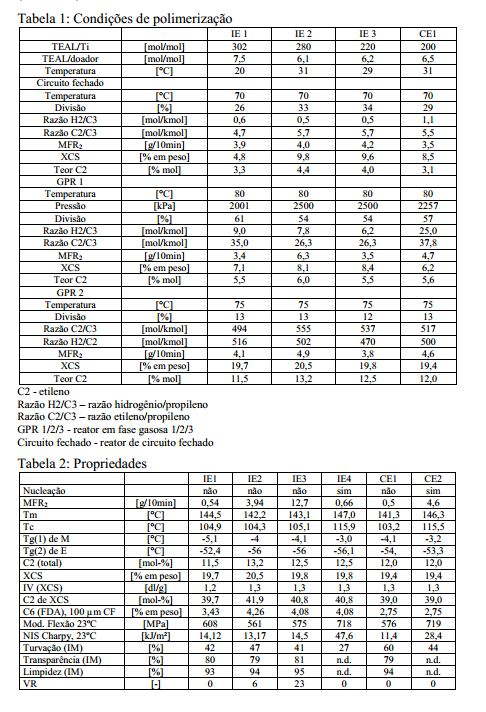

[00184] Todos os pós de polímeros foram compostos em uma extrusora de parafuso duplo corrotativo ZSK Coperion 57 a 220 ° C com 0,2% em peso de Irganox B225 (mistura 1:1 de Irganox 1010 (pentaeritritil-tetraquis(3-(3', 5'-di-ter-butil-4-hidroxitoluil)propionato e tris (2,4-di-t- butilfenil)fosfato)fosfito) da BASF AG, Alemanha) e 0,1% em peso de estearato de cálcio. IE4 e CE2 são versões nucleadas de IE3 e CE1, respectivamente, com 0,2% em peso de DMDBS (1,3: 2,4 di(metilbenzilideno) sorbitol) comercialmente disponíveis como Millad 3988 de Milliken Chemical, Gent/Bélgica. As abreviaturas "b. s." e "a.§." referem- se aos estados antes e após a esterilização.
[00185] Como pode ser reunido a partir da Tabela 2, os exemplos da invenção mostram um equilíbrio otimizado ou melhorado de propriedades ópticas e mecânicas, isto é, um desempenho óptico melhorado em nível de tenacidade comparável (resp. maciez). Quando α-nucleada (IE 4), esse equilíbrio de propriedade melhorada é mantido e até aumentado; A Tabela 2 também revela que a resistência ao impacto dos exemplos da invenção é comparável e reforçada ainda por nucleação. O mesmo pode ser reunido a partir da Fig. 1, isto é, os exemplos da invenção exibem um equilíbrio otimizado ou melhorado de propriedades ópticas e mecânicas, isto é, um desempenho óptico melhorado em nível de maciez comparável.[00185] As can be gathered from Table 2, the examples of the invention show an optimized or improved balance of optical and mechanical properties, i.e. an improved optical performance at comparable toughness level (resp. softness). When α-nucleated (IE 4), this balance of improved property is maintained and even increased; Table 2 also reveals that the impact strength of the examples of the invention is comparable and further enhanced by nucleation. The same can be gathered from Fig. 1, i.e. the examples of the invention exhibit an optimized or improved balance of optical and mechanical properties, i.e., an improved optical performance at a comparable softness level.
Claims (19)

Applications Claiming Priority (3)
| Application Number | Priority Date | Filing Date | Title |
|---|---|---|---|
| EP14154116 | 2014-02-06 | ||
| EP14154116.9 | 2014-02-06 | ||
| PCT/EP2015/052178 WO2015117948A1 (en) | 2014-02-06 | 2015-02-03 | Soft and transparent impact copolymers |
Publications (2)
| Publication Number | Publication Date |
|---|---|
| BR112016017227A2 BR112016017227A2 (en) | 2017-08-08 |
| BR112016017227B1 true BR112016017227B1 (en) | 2021-06-29 |
Family
ID=50033426
Family Applications (1)
| Application Number | Title | Priority Date | Filing Date |
|---|---|---|---|
| BR112016017227-2A BR112016017227B1 (en) | 2014-02-06 | 2015-02-03 | HETEROPHASIC PROPYLENE COPOLYMER, UNORIENTED FILM, CONTAINER, AND USE OF A HETEROPHASIC PROPYLENE COPOLYMER |
Country Status (8)
| Country | Link |
|---|---|
| US (1) | US10100186B2 (en) |
| EP (1) | EP3102634B1 (en) |
| JP (1) | JP6474417B2 (en) |
| CN (1) | CN105934476B (en) |
| BR (1) | BR112016017227B1 (en) |
| ES (1) | ES2767498T3 (en) |
| PL (1) | PL3102634T3 (en) |
| WO (1) | WO2015117948A1 (en) |
Families Citing this family (75)
| Publication number | Priority date | Publication date | Assignee | Title |
|---|---|---|---|---|
| US9670347B2 (en) | 2013-08-14 | 2017-06-06 | Borealis Ag | Propylene composition with improved impact resistance at low temperature |
| EA031341B1 (en) | 2013-08-21 | 2018-12-28 | Бореалис Аг | High flow polyolefin composition with high stiffness and toughness |
| EA031054B1 (en) | 2013-08-21 | 2018-11-30 | Бореалис Аг | Polyolefin composition with high flowability, stiffness and toughness |
| PT2853563T (en) | 2013-09-27 | 2016-07-14 | Borealis Ag | Films suitable for bopp processing from polymers with high xs and high tm |
| EP2860031B1 (en) | 2013-10-11 | 2016-03-30 | Borealis AG | Machine direction oriented film for labels |
| CN105612188B (en) | 2013-10-24 | 2018-09-28 | 北欧化工公司 | The low melting point PP homopolymers of zone errors and high molecular weight with high-content |
| BR112016009549B1 (en) | 2013-11-22 | 2021-07-27 | Borealis Ag | LOW EMISSION PROPYLENE HOMOPOLYMER WITH HIGH FLUIDITY INDEX |
| ES2929491T3 (en) | 2013-12-04 | 2022-11-29 | Borealis Ag | Phthalate-free PP homopolymers for meltblown fibers |
| MX376086B (en) | 2013-12-18 | 2025-03-07 | Borealis Ag | BOPP FILM WITH IMPROVED STIFFNESS/STRENGTH BALANCE. |
| WO2015107020A1 (en) | 2014-01-17 | 2015-07-23 | Borealis Ag | Process for preparing propylene/1-butene copolymers |
| BR112016017227B1 (en) | 2014-02-06 | 2021-06-29 | Borealis Ag | HETEROPHASIC PROPYLENE COPOLYMER, UNORIENTED FILM, CONTAINER, AND USE OF A HETEROPHASIC PROPYLENE COPOLYMER |
| ES2827285T3 (en) | 2014-02-06 | 2021-05-20 | Borealis Ag | Soft copolymers with high impact resistance |
| EP2907841A1 (en) | 2014-02-14 | 2015-08-19 | Borealis AG | Polypropylene composite |
| CN106062014B (en) * | 2014-03-21 | 2018-03-30 | 博里利斯股份公司 | With dystectic heterophasic propylene copolymer |
| ES2659731T3 (en) | 2014-05-20 | 2018-03-19 | Borealis Ag | Polypropylene composition for automotive interior applications |
| EP3115412B1 (en) * | 2015-07-08 | 2020-02-26 | Borealis AG | Soft heterophasic random propylene copolymer with improved clarity |
| PT3184587T (en) * | 2015-12-21 | 2020-06-02 | Borealis Ag | Extruded articles with improved optical properties |
| BR112018013363B1 (en) | 2015-12-30 | 2022-03-29 | Braskem America, Inc | Polymer composition and article of manufacture |
| WO2017198633A1 (en) * | 2016-05-18 | 2017-11-23 | Borealis Ag | Soft polypropylene composition |
| WO2018072049A1 (en) * | 2016-10-17 | 2018-04-26 | Borouge Compounding Shanghai Co., Ltd. | Polypropylene composition having low fogging |
| EP3339366A1 (en) | 2016-12-22 | 2018-06-27 | Borealis AG | A crosslinkable polyolefin composition |
| CN110446728B (en) * | 2017-04-04 | 2022-02-11 | 博里利斯股份公司 | Flexible polypropylene compositions with improved properties |
| EP3395377A1 (en) * | 2017-04-28 | 2018-10-31 | Borealis AG | Soft polypropylene composition with improved properties |
| WO2018210893A1 (en) * | 2017-05-18 | 2018-11-22 | Borealis Ag | Propylene-ethylene random copolymer with improved irradiation resistance |
| EP3409701A1 (en) | 2017-05-31 | 2018-12-05 | Borealis AG | A crosslinkable propylene polymer composition |
| US11370904B2 (en) | 2017-06-29 | 2022-06-28 | Borealis Ag | Process for preparing a polypropylene composition |
| EA201992724A1 (en) | 2017-06-29 | 2020-06-04 | ||
| EP3672997B1 (en) | 2017-08-24 | 2023-03-22 | Borealis AG | Polypropylene copolymers with improved stiffness and impact behaviour |
| EP3681916B1 (en) * | 2017-09-14 | 2024-06-05 | Basell Poliolefine Italia S.r.l. | Propylene ethylene random copolymer |
| KR20200030609A (en) * | 2017-09-20 | 2020-03-20 | 보레알리스 아게 | Polypropylene composition |
| WO2019072792A1 (en) | 2017-10-13 | 2019-04-18 | Borealis Ag | Multimodal random heterophasic polypropylene composition |
| ES2886432T3 (en) | 2017-11-28 | 2021-12-20 | Borealis Ag | Polymer composition with improved paint adhesion |
| EP3489296B1 (en) | 2017-11-28 | 2021-09-01 | Borealis AG | Polymer composition with improved paint adhesion |
| EP3495423B1 (en) | 2017-12-05 | 2021-03-03 | Borealis AG | Article comprising a fiber reinforced polypropylene composition |
| EP3495422B1 (en) | 2017-12-05 | 2020-11-11 | Borealis AG | Fiber reinforced polypropylene composition |
| EA202090678A1 (en) * | 2017-12-14 | 2020-09-07 | Бореалис Аг | METHOD FOR PREPARING POLYPROPYLENE COMPOSITION |
| WO2019121599A1 (en) * | 2017-12-20 | 2019-06-27 | Borealis Ag | Heterophasic polypropylene composition |
| EP3502177B1 (en) | 2017-12-20 | 2020-02-12 | Borealis AG | Polypropylene composition |
| EP3505566A1 (en) * | 2017-12-28 | 2019-07-03 | Borealis AG | Cable jacket |
| WO2019166223A1 (en) * | 2018-02-28 | 2019-09-06 | Basell Poliolefine Italia S.R.L. | Permeable polymer film |
| MY198351A (en) | 2018-04-16 | 2023-08-28 | Borealis Ag | A Multilayer Element |
| CN110498973B (en) | 2018-05-16 | 2023-09-01 | 北欧化工公司 | Expanded polypropylene composition |
| EP3584089A1 (en) | 2018-06-19 | 2019-12-25 | Borealis AG | Polyolefin composition providing improved contrast of laser marks |
| CN112424235B (en) | 2018-08-02 | 2023-04-21 | 北欧化工公司 | Process for polymerizing ethylene in a multistage polymerisation process |
| CN119931216A (en) | 2018-09-26 | 2025-05-06 | 博里利斯股份公司 | Propylene copolymer compositions having excellent optical and mechanical properties |
| WO2020064314A1 (en) | 2018-09-26 | 2020-04-02 | Borealis Ag | Propylene copolymer with excellent optical properties |
| WO2020064313A1 (en) | 2018-09-26 | 2020-04-02 | Borealis Ag | Propylene random copolymer for use in film applications |
| CN113614120B (en) | 2018-10-02 | 2024-03-22 | 博里利斯股份公司 | High-speed crosslinking of grafted plastomers |
| ES2986692T3 (en) | 2018-10-02 | 2024-11-12 | Borealis Ag | Low-speed crosslinking catalyst for silane-grafted plastomers |
| CN113195605A (en) | 2018-12-20 | 2021-07-30 | 博里利斯股份公司 | Biaxially oriented polypropylene film with improved puncture strength |
| CN113474148B (en) * | 2019-02-26 | 2023-03-17 | 普瑞曼聚合物株式会社 | Propylene resin composition and molded article |
| ES2949942T3 (en) * | 2019-05-29 | 2023-10-04 | Borealis Ag | C2C3 Random Copolymer |
| JP7364703B2 (en) | 2019-07-04 | 2023-10-18 | ボレアリス エージー | Long chain branched propylene polymer composition |
| ES2910955T3 (en) | 2019-07-08 | 2022-05-17 | Borealis Ag | Aldehyde content reduction process, and low aldehyde content recycled polyolefin |
| CN114423817B (en) * | 2019-09-20 | 2023-09-12 | 北欧化工公司 | Heterophasic propylene polymer compositions with improved performance characteristics |
| EP4069510A1 (en) | 2019-12-05 | 2022-10-12 | Borealis AG | Multilayer film with improved properties |
| US12509532B2 (en) | 2020-01-16 | 2025-12-30 | Borealis Ag | Process for avoiding phase separation during solution polymerization of ethylene-1-octene copolymers |
| EP3885375B1 (en) * | 2020-03-24 | 2022-08-31 | Borealis AG | Stiff blown film |
| US12398224B2 (en) | 2020-04-17 | 2025-08-26 | Borealis Ag | Blown film |
| KR20230128375A (en) * | 2021-01-22 | 2023-09-04 | 보레알리스 아게 | Fiber Reinforced Polypropylene Composition |
| WO2024223775A1 (en) | 2023-04-26 | 2024-10-31 | Borealis Ag | Layer element suitable as integrated backsheet for a bifacial photovoltaic module |
| WO2024223777A1 (en) | 2023-04-26 | 2024-10-31 | Borealis Ag | Layer element suitable as integrated backsheet for a bifacial photovoltaic module |
| WO2025061931A1 (en) | 2023-09-21 | 2025-03-27 | Borealis Ag | Polypropylene-based layer element having balanced mechanical and stress-whitening properties |
| WO2025067703A1 (en) | 2023-09-28 | 2025-04-03 | Borealis Ag | Polyolefin composition for cable insulation |
| WO2025068333A1 (en) | 2023-09-28 | 2025-04-03 | Borealis Ag | Semiconductive polypropylene composition |
| WO2025068332A1 (en) | 2023-09-28 | 2025-04-03 | Borealis Ag | Cable comprising polypropylene composition |
| WO2025067702A1 (en) | 2023-09-28 | 2025-04-03 | Borealis Ag | Polyolefin composition for cable insulation |
| EP4600277A1 (en) | 2024-02-07 | 2025-08-13 | Abu Dhabi Polymers Co. Ltd (Borouge) - Sole Proprietorship L.L.C. | Improved polypropylene composition for injection or blow molded articles |
| WO2025202325A1 (en) | 2024-03-28 | 2025-10-02 | Borealis Gmbh | Polypropylene composition for cable insulation |
| WO2025202306A1 (en) | 2024-03-28 | 2025-10-02 | Borealis Gmbh | Polypropylene composition for cable insulation |
| WO2026008731A1 (en) | 2024-07-03 | 2026-01-08 | Borealis Gmbh | Polymer composition for cable insulation |
| WO2026008734A1 (en) | 2024-07-03 | 2026-01-08 | Borealis Gmbh | Polymer composition for cable insulation |
| WO2026008730A1 (en) | 2024-07-03 | 2026-01-08 | Borealis Gmbh | Polymer composition for cable insulation |
| WO2026008736A1 (en) | 2024-07-03 | 2026-01-08 | Borealis Gmbh | Propylene copolymer for cable insulation |
| WO2026008735A1 (en) | 2024-07-03 | 2026-01-08 | Borealis Gmbh | Polymer composition for cable insulation |
Family Cites Families (247)
| Publication number | Priority date | Publication date | Assignee | Title |
|---|---|---|---|---|
| US4107414A (en) | 1971-06-25 | 1978-08-15 | Montecatini Edison S.P.A. | Process for the stereoregular polymerization of alpha olefins |
| US4226963A (en) | 1971-06-25 | 1980-10-07 | Montedison S.P.A. | Process for the stereoregular polymerization of alpha-olephins |
| US4186107A (en) | 1978-04-14 | 1980-01-29 | Hercules Incorporated | Solid catalyst component for olefin polymerization |
| US4347160A (en) | 1980-06-27 | 1982-08-31 | Stauffer Chemical Company | Titanium halide catalyst system |
| IT1209255B (en) | 1980-08-13 | 1989-07-16 | Montedison Spa | CATALYSTS FOR THE POLYMERIZATION OF OLEFINE. |
| JPS57153005A (en) | 1981-03-19 | 1982-09-21 | Ube Ind Ltd | Polymerization of alpha-olefin |
| US4530912A (en) | 1981-06-04 | 1985-07-23 | Chemplex Company | Polymerization catalyst and method |
| DE3271544D1 (en) | 1981-08-07 | 1986-07-10 | Ici Plc | Supported transition metal composition |
| US4382019A (en) | 1981-09-10 | 1983-05-03 | Stauffer Chemical Company | Purified catalyst support |
| IT1190681B (en) | 1982-02-12 | 1988-02-24 | Montedison Spa | COMPONENTS AND CATALYSTS FOR THE POLYMERIZATION OF OLEFINE |
| IT1190683B (en) | 1982-02-12 | 1988-02-24 | Montedison Spa | COMPONENTS AND CATALYSTS FOR THE POLYMERIZATION OF OLEFINE |
| IT1190682B (en) | 1982-02-12 | 1988-02-24 | Montedison Spa | CATALYSTS FOR THE POLYMERIZATION OF OLEFINE |
| US4532313A (en) | 1982-10-13 | 1985-07-30 | Himont Incorporated | Method for preparing an improved catalyst support, Ziegler-Natta catalyst utilizing said support and polymerization of 1-olefins utilizing said catalyst |
| US4560671A (en) | 1983-07-01 | 1985-12-24 | Union Carbide Corporation | Olefin polymerization catalysts adapted for gas phase processes |
| US4581342A (en) | 1984-11-26 | 1986-04-08 | Standard Oil Company (Indiana) | Supported olefin polymerization catalyst |
| US4657882A (en) | 1984-11-26 | 1987-04-14 | Amoco Corporation | Supported olefin polymerization catalyst produced from a magnesium alkyl/organophosphoryl complex |
| US4665208A (en) | 1985-07-11 | 1987-05-12 | Exxon Chemical Patents Inc. | Process for the preparation of alumoxanes |
| FI80055C (en) | 1986-06-09 | 1990-04-10 | Neste Oy | Process for preparing catalytic components for polymerization of olefins |
| US5077255A (en) | 1986-09-09 | 1991-12-31 | Exxon Chemical Patents Inc. | New supported polymerization catalyst |
| ATE227742T1 (en) | 1986-09-24 | 2002-11-15 | Mitsui Chemicals Inc | OLEFIN POLYMERIZATION PROCESS |
| JPH0780933B2 (en) | 1986-11-20 | 1995-08-30 | 三井石油化学工業株式会社 | Olefin Polymerization Method |
| JPH0742301B2 (en) | 1987-02-14 | 1995-05-10 | 三井石油化学工業株式会社 | Particulate aluminoxane, its manufacturing method and its use |
| JP2538588B2 (en) | 1987-04-03 | 1996-09-25 | 三井石油化学工業株式会社 | Method for producing solid catalyst for olefin polymerization |
| US5206199A (en) | 1987-04-20 | 1993-04-27 | Mitsui Petrochemical Industries, Ltd. | Catalyst for polymerizing an olefin and process for polymerizing an olefin |
| US5091352A (en) | 1988-09-14 | 1992-02-25 | Mitsui Petrochemical Industries, Ltd. | Olefin polymerization catalyst component, olefin polymerization catalyst and process for the polymerization of olefins |
| IT1227260B (en) | 1988-09-30 | 1991-03-28 | Himont Inc | DIETTERS THAT CAN BE USED IN THE PREPARATION OF ZIEGLER-NATTA CATALYSTS |
| US4908463A (en) | 1988-12-05 | 1990-03-13 | Ethyl Corporation | Aluminoxane process |
| US5103031A (en) | 1989-02-21 | 1992-04-07 | Ethyl Corporation | Falling film aluminoxane process |
| US4968827A (en) | 1989-06-06 | 1990-11-06 | Ethyl Corporation | Alkylaluminoxane process |
| US4924018A (en) | 1989-06-26 | 1990-05-08 | Ethyl Corporation | Alkylaluminoxane process |
| US5504169A (en) | 1989-09-13 | 1996-04-02 | Exxon Chemical Patents Inc. | Process for producing amorphous poly-α-olefins with a monocyclopentadienyl transition metal catalyst system |
| US5036034A (en) | 1989-10-10 | 1991-07-30 | Fina Technology, Inc. | Catalyst for producing hemiisotactic polypropylene |
| JPH0813826B2 (en) | 1990-11-29 | 1996-02-14 | 信越化学工業株式会社 | Thexyltrialkoxysilane |
| FI86866C (en) | 1990-12-19 | 1992-10-26 | Neste Oy | FOERFARANDE FOER MODIFIERING AV CATALYSTATOR AVSEDDA FOER POLYMERISATION AV OLEFINER |
| FI86867C (en) | 1990-12-28 | 1992-10-26 | Neste Oy | FLERSTEGSPROCESS FOR FRAMSTAELLNING AV POLYETEN |
| SE467825B (en) | 1991-01-22 | 1992-09-21 | Neste Oy | SETTING OUT OF PLASTIC MATERIALS ELIMINATE SMELLING / TASTEING OBJECTS |
| FI88047C (en) | 1991-05-09 | 1993-03-25 | Neste Oy | Catalyst-based catalyst for polymerization of olivines |
| FI88049C (en) | 1991-05-09 | 1993-03-25 | Neste Oy | Large pore polyolefin, process for its preparation and a catalyst used in the process |
| FI88048C (en) | 1991-05-09 | 1993-03-25 | Neste Oy | Coarse-grained polyolefin, its method of preparation and a catalyst used in the method |
| FI90247C (en) | 1991-05-31 | 1994-01-10 | Borealis As | Process for the preparation of active and uniform carrier particles for polymerization catalysts |
| US5308815A (en) | 1991-07-26 | 1994-05-03 | Ethyl Corporation | Heterogeneous methylaluminoxane catalyst system |
| US5235081A (en) | 1992-03-18 | 1993-08-10 | Ethyl Corporation | Method of removing gel forming materials from methylaluminoxanes |
| US5157137A (en) | 1991-07-26 | 1992-10-20 | Ethyl Corporation | Method of making gel free alkylaluminoxane solutions |
| US5416228A (en) | 1991-10-07 | 1995-05-16 | Fina Technology, Inc. | Process and catalyst for producing isotactic polyolefins |
| FI91967C (en) | 1991-11-29 | 1994-09-12 | Borealis Polymers Oy | Process for the preparation of olefin polymerization catalysts |
| FI90248C (en) | 1991-11-29 | 1994-01-10 | Borealis As | A process for preparing a particulate support for an olefin polymerization catalyst |
| US5329032A (en) | 1992-03-18 | 1994-07-12 | Akzo Chemicals Inc. | Polymethylaluminoxane of enhanced solution stability |
| FI95715C (en) | 1992-03-24 | 1996-03-11 | Neste Oy | Preparation of polymerization catalyst support prepared by spray crystallization |
| US5248801A (en) | 1992-08-27 | 1993-09-28 | Ethyl Corporation | Preparation of methylaluminoxanes |
| US5391793A (en) | 1992-11-02 | 1995-02-21 | Akzo Nobel N.V. | Aryloxyaluminoxanes |
| US5939346A (en) | 1992-11-02 | 1999-08-17 | Akzo Nobel N.V. | Catalyst system comprising an aryloxyaluminoxane containing an electron withdrawing group |
| US5332706A (en) | 1992-12-28 | 1994-07-26 | Mobil Oil Corporation | Process and a catalyst for preventing reactor fouling |
| US5391529A (en) | 1993-02-01 | 1995-02-21 | Albemarle Corporation | Siloxy-aluminoxane compositions, and catalysts which include such compositions with a metallocene |
| CA2121721C (en) | 1993-04-29 | 2004-11-23 | Giampiero Morini | Crystalline propylene polymers having high melt flow rate values and a narrow molecular weight distribution |
| EP0629631B1 (en) | 1993-06-07 | 2002-08-28 | Mitsui Chemicals, Inc. | Novel transition metal compound, and polymerization catalyst containing it |
| DE4337251A1 (en) | 1993-09-27 | 1995-03-30 | Hoechst Ag | Biaxially oriented polypropylene film with improved properties in terms of mechanics and barrier |
| FI96866C (en) | 1993-11-05 | 1996-09-10 | Borealis As | Support olefin polymerization catalyst, its preparation and use |
| FI96214C (en) | 1994-05-31 | 1996-05-27 | Borealis As | For olefin polymerization intended stereospecific catalytic system |
| US5529850A (en) | 1994-07-05 | 1996-06-25 | Montell North America Inc. | Fibers produced from crystalline propylene polymers having high melt flow rate values and a narrow molecular weight distribution |
| US5691043A (en) | 1994-07-15 | 1997-11-25 | Mobil Oil Corporation | Uniaxially shrinkable biaxially oriented polypropylene film and its method of preparation |
| US6322883B1 (en) | 1994-07-15 | 2001-11-27 | Exxonmobil Oil Corporation | Uniaxially shrinkable biaxially oriented polypropylene film with HDPE skin |
| IL117114A (en) | 1995-02-21 | 2000-02-17 | Montell North America Inc | Components and catalysts for the polymerization ofolefins |
| US5731253A (en) | 1995-07-27 | 1998-03-24 | Albemarle Corporation | Hydrocarbylsilloxy - aluminoxane compositions |
| US6403772B1 (en) | 1995-09-11 | 2002-06-11 | Montell Technology Company, Bv | Open-pentadienyl metallocenes, precursors thereof and polymerization catalysts therefrom |
| US5922631A (en) | 1995-10-19 | 1999-07-13 | Albemarle Corporation | Liquid clathrate aluminoxane compositions as co-catalysts with transition metal catalyst compounds |
| US5670682A (en) | 1995-10-19 | 1997-09-23 | Albemarle Corporation | Liquid clathrate aluminoxane compositions |
| US5693838A (en) | 1995-11-13 | 1997-12-02 | Albemarle Corporation | Aluminoxane process and product |
| FI104826B (en) | 1996-01-30 | 2000-04-14 | Borealis As | Heteroatom-substituted metallose compounds for catalytic systems in olefin polymerization and process for their preparation |
| FI102070B (en) | 1996-03-29 | 1998-10-15 | Borealis As | A new complex compound, its preparation and use |
| US5731451A (en) | 1996-07-12 | 1998-03-24 | Akzo Nobel Nv | Modified polyalkylauminoxane composition formed using reagent containing aluminum trialkyl siloxide |
| FI963707A0 (en) | 1996-09-19 | 1996-09-19 | Borealis Polymers Oy | Free polymerization of an alpha-olefin, by polymerization with an optional catalyst and further preparation of a polymer |
| AU4576597A (en) | 1996-10-14 | 1998-05-11 | Dsm N.V. | Rod-shaped pellets |
| US5744656A (en) | 1996-10-25 | 1998-04-28 | Boulder Scientific Company | Conversion of hexafluorobenzene to bromopentafluorobenzene |
| FI971565A7 (en) | 1997-04-14 | 1998-10-15 | Borealis As | Substituted metallocene compounds for catalyst systems for the polymerization of olefins, intermediates thereof and method of preparation |
| BR9808827B1 (en) | 1997-03-07 | 2009-12-01 | process for the preparation of indanones, and use of an indanone. | |
| GB9708487D0 (en) | 1997-04-25 | 1997-06-18 | Bp Chem Int Ltd | Novel catalysts for olefin polymerisation |
| ES2182336T3 (en) | 1997-06-10 | 2003-03-01 | Peroxid Chemie Gmbh & Co Kg | NEW CATALYZER SYSTEMS FOR REACTIONS OF (CO-) POLYMERIZATION, HALOGENUROS-AMIDAS OF METALOCENOS AND ITS USE. |
| FI111848B (en) | 1997-06-24 | 2003-09-30 | Borealis Tech Oy | Process and equipment for the preparation of homopolymers and copolymers of propylene |
| FI111846B (en) | 1997-06-24 | 2003-09-30 | Borealis Tech Oy | Process and apparatus for preparing mixtures of polypropylene |
| FI111847B (en) | 1997-06-24 | 2003-09-30 | Borealis Tech Oy | Process for preparing copolymers of propylene |
| FI104824B (en) | 1997-06-24 | 2000-04-14 | Borealis As | Process for producing propylene polymers |
| CN1140554C (en) | 1997-06-24 | 2004-03-03 | 波里阿利斯有限公司 | Process for preparing propylene polymers |
| FI111845B (en) | 1997-06-24 | 2003-09-30 | Borealis Tech Oy | Process for producing propylene homopolymers and polymers with modified impact strength |
| FI973451A0 (en) | 1997-08-22 | 1997-08-22 | Borealis As | New organometallic processes and methods For the polymerization of olefins with the aid of a catalytic composition with an organic compound |
| TR200000599T2 (en) | 1997-09-05 | 2000-12-21 | Bp Chemicals Limited | Polymerization catalysts. |
| GB9721559D0 (en) | 1997-10-11 | 1997-12-10 | Bp Chem Int Ltd | Novel polymerisation catalysts |
| FI980342A0 (en) | 1997-11-07 | 1998-02-13 | Borealis As | Polymerroer och -roerkopplingar |
| FI974175L (en) | 1997-11-07 | 1999-05-08 | Borealis As | Method for producing polypropylene |
| US6420499B1 (en) | 1997-12-23 | 2002-07-16 | Borealis Technology Oy | Catalyst component comprising magnesium, titanium, a halogen and an election donor, its preparation and use |
| AU2566399A (en) | 1998-02-12 | 1999-08-30 | University Of Delaware | Catalyst compounds with beta-diiminate anionic ligands and processes for polymerizing olefins |
| GB9826874D0 (en) | 1998-12-07 | 1999-01-27 | Borealis As | Process |
| FI991057A0 (en) | 1999-05-07 | 1999-05-07 | Borealis As | High stiffness propylene polymers and process for their preparation |
| EP1548023B1 (en) | 1999-12-23 | 2013-08-14 | Basell Polyolefine GmbH | Transition metal compound, catalyst system and the use of the latter for the polymerisation and copolymerisation of olefins |
| US6492465B1 (en) | 2000-02-08 | 2002-12-10 | Exxonmobil Chemical Patents, Inc. | Propylene impact copolymers |
| GB0007002D0 (en) | 2000-03-22 | 2000-05-10 | Borealis Polymers Oy | Catalysts |
| ATE300550T1 (en) | 2000-06-30 | 2005-08-15 | Exxonmobil Chem Patents Inc | METALLOCENE COMPOUNDS WITH A BRIDGED 4-PHENYL-INDENYL LIGAND SYSTEM FOR POLYMERIZATION OF OLEFINS |
| US6586528B1 (en) | 2000-11-15 | 2003-07-01 | Polypropylene Belgium (Naamlose Vennootshap) | Composition based on propylene polymers and process for obtaining same |
| US6642317B1 (en) | 2000-11-15 | 2003-11-04 | Polypropylene Belgium Naamlose Vennootschap | Composition based on propylene polymers and process for obtaining same |
| AU2002224931B2 (en) | 2000-12-22 | 2007-02-08 | Basell Poliolefine Italia S.P.A. | Polyolefin sheets for thermoforming |
| TWI238169B (en) | 2000-12-22 | 2005-08-21 | Basell Technology Co Bv | Bioriented polypropylene films |
| PT1273595E (en) | 2001-06-20 | 2006-10-31 | Borealis Tech Oy | PREPARATION OF A CATALYST COMPONENT FOR OLEFIN POLYMERIZATION |
| ES2265376T3 (en) | 2001-06-20 | 2007-02-16 | Borealis Technology Oy | PREPARATION OF CATALYST COMPONENT FOR POLYMERIZATION OF OLEFINS. |
| DE60114464T2 (en) | 2001-06-27 | 2006-07-20 | Borealis Technology Oy | Propylene polymer resin with improved properties |
| BRPI0206560B1 (en) | 2001-11-27 | 2016-02-10 | Basell Poliolefine Spa | clear and flexible propylene polymer compositions |
| MY136330A (en) | 2001-12-12 | 2008-09-30 | Basell Poliolefine Spa | Process for the polymerization of olefins |
| EP1323747A1 (en) | 2001-12-19 | 2003-07-02 | Borealis Technology Oy | Production of olefin polymerisation catalysts |
| ATE287420T1 (en) | 2002-02-04 | 2005-02-15 | Borealis Tech Oy | FILM WITH HIGH IMPACT RESISTANCE |
| WO2003082879A1 (en) | 2002-03-28 | 2003-10-09 | Albemarle Corporation | Ionic aluminoxanate compositions and their use in catalysis |
| WO2004000899A1 (en) | 2002-06-25 | 2003-12-31 | Borealis Technology Oy | Polyolefin with improved scratch resistance and process for producing the same |
| EP1376516B1 (en) | 2002-06-26 | 2008-05-21 | Avery Dennison Corporation | Machine direction oriented polymeric films |
| CN100564399C (en) | 2002-08-01 | 2009-12-02 | 巴塞尔聚烯烃意大利有限公司 | Highly stereotactic polypropylene with improved properties |
| AU2003291627A1 (en) | 2002-09-20 | 2004-04-08 | Exxonmobil Chemical Patents Inc. | Supercritical polymerization process and polymers produced therefrom |
| US7807769B2 (en) | 2002-09-20 | 2010-10-05 | Exxonmobil Chemical Patents Inc. | Isotactic polypropylene produced from supercritical polymerization process |
| EP1403292B1 (en) | 2002-09-30 | 2016-04-13 | Borealis Polymers Oy | Process for preparing an olefin polymerisation catalyst component with improved high temperature activity |
| AU2003288146A1 (en) | 2002-11-22 | 2004-06-18 | Basell Polyolefine Gmbh | Safe removal of volatile, oxidizable compounds from particles, in particular polymer particles |
| EP1452630A1 (en) * | 2003-02-26 | 2004-09-01 | Borealis Technology OY | Polypropylene fibres |
| EP1484343A1 (en) | 2003-06-06 | 2004-12-08 | Universiteit Twente | Process for the catalytic polymerization of olefins, a reactor system and its use in the same process |
| GB0317012D0 (en) | 2003-07-21 | 2003-08-27 | Borealis Tech Oy | Injection moulding polymer |
| DE10359366A1 (en) | 2003-12-18 | 2005-07-21 | Nordenia Deutschland Gronau Gmbh | Labeling film laminate |
| US20050197456A1 (en) | 2003-12-24 | 2005-09-08 | Nicolini Jose L. | Sealing layer resin compositions |
| US20050187367A1 (en) | 2004-02-19 | 2005-08-25 | Sumitomo Chemical Company, Limited | Biaxially oriented polypropylene film |
| US20050200046A1 (en) | 2004-03-10 | 2005-09-15 | Breese D. R. | Machine-direction oriented multilayer films |
| US7285608B2 (en) | 2004-04-21 | 2007-10-23 | Novolen Technology Holdings C.V. | Metallocene ligands, metallocene compounds and metallocene catalysts, their synthesis and their use for the polymerization of olefins |
| ES2399823T3 (en) | 2004-09-02 | 2013-04-03 | Borealis Technology Oy | A polymer pipe without pressure, a composition for it, and a process for its preparation |
| BRPI0519648A2 (en) | 2004-12-31 | 2009-07-14 | Borealis Tech Oy | process for the preparation of olefin polymerization catalyst, catalyst, use of a catalyst, process for the preparation of polyolefin, and, polyolefin |
| CN100363417C (en) | 2005-01-28 | 2008-01-23 | 中国石油化工股份有限公司 | Propylene polymer composition and biaxially oriented film prepared therefrom |
| US20060177641A1 (en) | 2005-02-09 | 2006-08-10 | Breese D R | Multilayer polyethylene thin films |
| US20060211801A1 (en) | 2005-03-16 | 2006-09-21 | Fina Technology, Inc. | Polyolefin film and production thereof |
| ATE411330T1 (en) | 2005-03-18 | 2008-10-15 | Basell Polyolefine Gmbh | METALLOCENE COMPOUNDS |
| EP1726602A1 (en) | 2005-05-27 | 2006-11-29 | Borealis Technology Oy | Propylene polymer with high crystallinity |
| EP1741725B1 (en) | 2005-07-08 | 2014-04-09 | Borealis Technology Oy | Propylene polymer composition |
| EP1788023A1 (en) | 2005-11-21 | 2007-05-23 | Borealis Technology Oy | Multimodal polypropylene polymer composition |
| ES2588577T3 (en) | 2005-12-30 | 2016-11-03 | Borealis Technology Oy | Catalyst particles |
| US7858717B2 (en) | 2006-03-17 | 2010-12-28 | Basell Polyolefine Gmbh | Metallocene compounds |
| US20070235896A1 (en) | 2006-04-06 | 2007-10-11 | Fina Technology, Inc. | High shrink high modulus biaxially oriented films |
| US7834205B2 (en) | 2006-04-12 | 2010-11-16 | Basell Polyolifine GmbH | Metallocene compounds |
| ES2545773T3 (en) | 2006-04-24 | 2015-09-15 | Total Research & Technology Feluy | Use of a Ziegler-Natta catalyst to produce a random polypropylene copolymer with high melt flow rate |
| EP1862481B1 (en) | 2006-05-31 | 2016-08-31 | Borealis Technology Oy | Catalyst with al-alkoxy component |
| ATE421760T1 (en) | 2006-07-10 | 2009-02-15 | Borealis Tech Oy | ELECTRICAL INSULATING FILM |
| US7977435B2 (en) | 2006-07-12 | 2011-07-12 | Lin Chon-Yie | Propylene polymer compositions and processes for making the same |
| EP1967547A1 (en) | 2006-08-25 | 2008-09-10 | Borealis Technology OY | Extrusion coated substrate |
| EP1902837A1 (en) | 2006-09-22 | 2008-03-26 | Borealis Technology OY | Multilayer film |
| EP1923200A1 (en) | 2006-11-20 | 2008-05-21 | Borealis Technology Oy | Article |
| ES2326752T3 (en) | 2006-12-18 | 2009-10-19 | Borealis Technology Oy | TERPOLIMERO WITH ELEVATED FUSION POINT. |
| EP2092004B1 (en) | 2006-12-20 | 2016-11-23 | Basell Poliolefine Italia S.r.l. | Filled polyolefin compositions |
| ES2329608T5 (en) | 2006-12-21 | 2016-04-12 | Borealis Technology Oy | Movie |
| EP1947143A1 (en) | 2007-01-19 | 2008-07-23 | Borealis Technology Oy | Polypropylene-based resin composition and molded article thereof |
| EP1950241A1 (en) | 2007-01-25 | 2008-07-30 | Borealis Technology Oy | Multimodal medium density polyethylene polymer composition |
| EP1950233A1 (en) | 2007-01-25 | 2008-07-30 | Borealis Technology Oy | polymer |
| US10174137B2 (en) | 2007-04-27 | 2019-01-08 | Basell Poliolefine Italia S.R.I. | Butene-1 terpolymers and process for their preparation |
| EP1990353B1 (en) | 2007-05-08 | 2009-08-05 | Borealis Technology Oy | Electrical insulation film |
| EP2014714A1 (en) | 2007-07-11 | 2009-01-14 | Borealis Technology Oy | Heterophasic polyolefin composition |
| BRPI0813543B1 (en) | 2007-08-03 | 2019-10-08 | Basell Poliolefine Italia S.R.L. | PROPILENE TERPOLYMER, PROCESS FOR YOUR PRODUCTION AND FILM UNDERSTANDING THE SAME |
| US20100305286A1 (en) | 2007-08-27 | 2010-12-02 | Borealis Technology Oy | Catalysts |
| KR20100101092A (en) | 2007-10-25 | 2010-09-16 | 루머스 노보렌 테크놀로지 게엠베하 | Metallocene compounds, catalysts comprising them, process for producing an olefin polymer by use of the catalysts, and olefin homo-and copolymers |
| CN101855289A (en) | 2007-11-13 | 2010-10-06 | 普瑞曼聚合物株式会社 | Propylene resin composition for stretched sheet, stretched sheet containing same, and thermoformed article |
| EP2062936A1 (en) | 2007-11-20 | 2009-05-27 | Borealis Technology OY | Improved glass fiber reinforced polypropylene |
| ATE539815T1 (en) | 2007-11-30 | 2012-01-15 | Borealis Tech Oy | METHOD FOR PRODUCING RANDOM PROPYLENE COPOLYMERS |
| EP2075284B1 (en) | 2007-12-17 | 2013-05-29 | Borealis Technology OY | Heterophasic polypropylene with high flowability and excellent low temperature impact properties |
| CN101903424A (en) | 2007-12-18 | 2010-12-01 | 巴塞尔聚烯烃意大利有限责任公司 | Copolymers of propylene with hexene-1 and blown films obtained therefrom |
| EP2240542B9 (en) | 2008-01-25 | 2012-01-11 | Borealis AG | Low-sticky additive package for automotive interior applications |
| EP2141200A1 (en) | 2008-07-03 | 2010-01-06 | Total Petrochemicals Research Feluy | Heterophasic propylene copolymer with improved properties for injection molding applications |
| EP2147939A1 (en) | 2008-07-22 | 2010-01-27 | Borealis AG | Polypropylene composition with improved optics for film and moulding applications |
| KR101686253B1 (en) | 2008-08-21 | 2016-12-13 | 더블유.알. 그레이스 앤드 캄파니-콘. | High melt flow propylene impact copolymer and method |
| US20100081760A1 (en) | 2008-10-01 | 2010-04-01 | Sunoco, Inc. (R&M) | Film comprising a random copolymer with enhanced ethylene content |
| MX2011003476A (en) | 2008-10-01 | 2011-04-28 | Braskem America Inc | Random copolymer with enhanced ethylene content. |
| PL2174980T5 (en) * | 2008-10-07 | 2019-04-30 | Borealis Ag | High flowable heterophasic polypropylene |
| EP2350145B1 (en) | 2008-11-04 | 2018-08-15 | ExxonMobil Chemical Patents Inc. | Homogeneous propylene polymerization in supercritical state and polypropylenes made therefrom |
| EP2355926B1 (en) | 2008-11-07 | 2017-01-04 | Borealis AG | Solid catalyst composition |
| EP2361267B1 (en) | 2008-11-07 | 2015-03-04 | Borealis AG | Process to prepare a solid catalyst composition |
| WO2010115878A1 (en) | 2009-04-09 | 2010-10-14 | Borealis Ag | Thermoplastic polyolefin composition |
| EP2251361B1 (en) | 2009-05-04 | 2013-10-02 | Borealis AG | Preparation of precipitated ZN PP catalysts with internal pore structure using nanoparticles |
| EP2275476A1 (en) | 2009-06-09 | 2011-01-19 | Borealis AG | Automotive material with excellent flow, high stiffness, excellent ductility and low CLTE |
| US8389660B1 (en) | 2009-06-10 | 2013-03-05 | The Florida State University Research Foundation | Polyolefins having reduced crystallinity |
| US20110031645A1 (en) | 2009-08-07 | 2011-02-10 | Dow Global Technologies Inc. | Polypropylene for use in bopp applications |
| CN102482458B (en) | 2009-08-28 | 2014-08-27 | 北欧化工公司 | Polypropylene-talc composite with reduced malodour |
| EP2305723A1 (en) | 2009-10-01 | 2011-04-06 | Total Petrochemicals Research Feluy | Propylene polymer with improved processability in thermoforming. |
| EP2308923B1 (en) | 2009-10-09 | 2012-05-16 | Borealis AG | Glass fibre composite of improved processability |
| ATE538173T1 (en) | 2009-10-29 | 2012-01-15 | Borealis Ag | HETEROPHASIC POLYPROPYLENE RESIN WITH LONG CHAIN BRANCH |
| JP5291608B2 (en) | 2009-12-11 | 2013-09-18 | オムロン株式会社 | Rubber composition and use thereof |
| WO2011117032A1 (en) | 2010-03-26 | 2011-09-29 | Basell Poliolefine Italia Srl | Heterophasic polyolefin composition |
| ES2392240T3 (en) | 2010-04-20 | 2012-12-07 | Borealis Ag | Car interior compound |
| EP2386604B1 (en) | 2010-04-20 | 2018-11-28 | Borealis AG | Polypropylene bottles |
| EP2386603B1 (en) | 2010-04-21 | 2012-04-04 | Borealis AG | Propylene/1-hexene copolymer composition with broad sealing window |
| CN102858869B (en) | 2010-04-21 | 2014-08-20 | 博里利斯股份公司 | Propylene/1-hexene copolymer composition with low sealing temperature |
| KR101618753B1 (en) | 2010-04-28 | 2016-05-09 | 보레알리스 아게 | Solid particulate catalysts comprising bridged metallocenes |
| US8946363B2 (en) | 2010-04-28 | 2015-02-03 | Borealis Ag | Solid particulate catalysts comprising bridged metallocenes |
| EP2386583A1 (en) | 2010-05-07 | 2011-11-16 | Borealis AG | Process for the preparation of a solid metallocene catalyst system and its use in polymerisation of olefins |
| ES2564189T3 (en) | 2010-05-07 | 2016-03-18 | Borealis Ag | Preparation of a solid catalyst system |
| WO2011141380A1 (en) | 2010-05-12 | 2011-11-17 | Borealis Ag | Polypropylene with specific calcium stearate content for special capacitors |
| US9200153B2 (en) | 2010-05-21 | 2015-12-01 | Borealis Ag | Composition |
| BR112012033011B1 (en) | 2010-06-24 | 2020-05-26 | Basell Poliolefine Italia S.R.L. | CATALYST SYSTEM AND PROCESS FOR POLYMERIZING OLEFINS USING SUCH SYSTEM |
| EP2402353B1 (en) | 2010-07-01 | 2018-04-25 | Borealis AG | Group 4 metallocenes useful as catalysts for the polymerization of olefins |
| ES2525554T3 (en) | 2010-07-13 | 2014-12-26 | Borealis Ag | Catalyst component |
| ES2488545T3 (en) | 2010-07-22 | 2014-08-27 | Borealis Ag | Polypropylene / talc composition with improved impact behavior |
| ES2455694T3 (en) | 2010-08-06 | 2014-04-16 | Borealis Ag | Multilayer film |
| EP2415831A1 (en) | 2010-08-06 | 2012-02-08 | Borealis AG | Heterophasic propylene copolymer with excellent impact/stiffness balance |
| ES2397547T3 (en) | 2010-08-27 | 2013-03-07 | Borealis Ag | Rigid polypropylene composition with excellent break elongation |
| EP2661465B1 (en) | 2011-01-03 | 2016-04-06 | Borealis AG | Sealing material of polypropylene with improved optical performance |
| EP2479025B1 (en) | 2011-01-25 | 2019-03-06 | Mondi Gronau GmbH | Sticker film |
| EP2487203B2 (en) | 2011-02-14 | 2020-11-25 | Borealis AG | Sealing propylene copolymer |
| EP2532687A3 (en) | 2011-06-10 | 2013-04-10 | Borealis AG | Bridged Metallocene Catalysts |
| WO2013004507A1 (en) | 2011-07-01 | 2013-01-10 | Basell Poliolefine Italia S.R.L. | Polypropylene films and sheets |
| KR101966085B1 (en) | 2011-07-08 | 2019-04-05 | 보레알리스 아게 | Catalysts |
| EP2915846B1 (en) | 2011-07-15 | 2016-09-07 | Borealis AG | High flow polyolefin composition with low shrinkage and clte |
| EP2548920B1 (en) | 2011-07-15 | 2017-10-11 | Borealis AG | Unoriented film |
| EP2551299B2 (en) | 2011-07-27 | 2020-05-06 | Borealis AG | Lightweight polypropylene resin with superior surface characteristics for use in automotive interior applications |
| EP2565221B2 (en) | 2011-08-30 | 2018-08-08 | Borealis AG | Process for the manufacture of a capacitor film |
| EP2573134B1 (en) | 2011-09-21 | 2017-04-05 | Borealis AG | Moulding composition |
| EP2578395A1 (en) | 2011-10-04 | 2013-04-10 | Rkw Se | Multilayer label film construction for pressure sensitive labels |
| EP2592112A1 (en) | 2011-11-11 | 2013-05-15 | Basell Poliolefine Italia S.r.l. | Polymer composition for bumpers and interiors and polyethylene-based resin precursor |
| WO2013092624A1 (en) | 2011-12-23 | 2013-06-27 | Borealis Ag | Propylene copolymer for blow molded articles |
| ES2552785T3 (en) | 2011-12-23 | 2015-12-02 | Borealis Ag | Process for the preparation of a heterophasic propylene copolymer |
| ES2574503T5 (en) * | 2011-12-23 | 2022-08-29 | Borealis Ag | Propylene copolymer for films or injection molded articles |
| ES2554864T3 (en) | 2011-12-30 | 2015-12-23 | Borealis Ag | Catalyst component |
| EP2610273B1 (en) | 2011-12-30 | 2018-02-07 | Borealis AG | Catalyst component |
| EP2610271B1 (en) | 2011-12-30 | 2019-03-20 | Borealis AG | Preparation of phthalate free ZN PP catalysts |
| EP2610272B1 (en) | 2011-12-30 | 2017-05-10 | Borealis AG | Catalyst component |
| JP5826951B2 (en) | 2012-02-27 | 2015-12-02 | ボレアリス・アクチェンゲゼルシャフトBorealis Ag | Method for producing low ash polypropylene |
| ES2608963T3 (en) | 2012-05-21 | 2017-04-17 | Borealis Ag | High flow polypropylene with excellent mechanical properties |
| RU2015104883A (en) | 2012-08-07 | 2016-10-10 | Бореалис Аг | METHOD FOR PRODUCING POLYPROPYLENE, HAVING AN INCREASED PRODUCTIVITY |
| BR112015002218A2 (en) | 2012-08-07 | 2017-07-04 | Borealis Ag | process for preparing improved productivity polypropylene |
| US9670347B2 (en) | 2013-08-14 | 2017-06-06 | Borealis Ag | Propylene composition with improved impact resistance at low temperature |
| EA031054B1 (en) | 2013-08-21 | 2018-11-30 | Бореалис Аг | Polyolefin composition with high flowability, stiffness and toughness |
| EA031341B1 (en) | 2013-08-21 | 2018-12-28 | Бореалис Аг | High flow polyolefin composition with high stiffness and toughness |
| PT2853563T (en) | 2013-09-27 | 2016-07-14 | Borealis Ag | Films suitable for bopp processing from polymers with high xs and high tm |
| EP2860031B1 (en) | 2013-10-11 | 2016-03-30 | Borealis AG | Machine direction oriented film for labels |
| PL2865713T3 (en) | 2013-10-24 | 2016-10-31 | Blow molded article based on bimodal random copolymer | |
| CN105612188B (en) | 2013-10-24 | 2018-09-28 | 北欧化工公司 | The low melting point PP homopolymers of zone errors and high molecular weight with high-content |
| EP3063185B9 (en) | 2013-10-29 | 2017-11-15 | Borealis AG | Solid single site catalysts with high polymerisation activity |
| BR112016009549B1 (en) | 2013-11-22 | 2021-07-27 | Borealis Ag | LOW EMISSION PROPYLENE HOMOPOLYMER WITH HIGH FLUIDITY INDEX |
| ES2929491T3 (en) | 2013-12-04 | 2022-11-29 | Borealis Ag | Phthalate-free PP homopolymers for meltblown fibers |
| MX376086B (en) | 2013-12-18 | 2025-03-07 | Borealis Ag | BOPP FILM WITH IMPROVED STIFFNESS/STRENGTH BALANCE. |
| EP3083778B1 (en) | 2013-12-18 | 2020-11-11 | Borealis AG | Bopp film having low shrinkage |
| EP2886600B1 (en) | 2013-12-19 | 2018-05-30 | Abu Dhabi Polymers Co. Ltd (Borouge) LLC. | Multimodal polypropylene with respect to comonomer content |
| US20160312018A1 (en) | 2013-12-31 | 2016-10-27 | Borealis Ag | Process for producing propylene terpolymer |
| WO2015107020A1 (en) | 2014-01-17 | 2015-07-23 | Borealis Ag | Process for preparing propylene/1-butene copolymers |
| ES2571587T3 (en) | 2014-01-29 | 2016-05-26 | Borealis Ag | High fluid polyolefin composition with high rigidity and puncture resistance |
| BR112016017227B1 (en) | 2014-02-06 | 2021-06-29 | Borealis Ag | HETEROPHASIC PROPYLENE COPOLYMER, UNORIENTED FILM, CONTAINER, AND USE OF A HETEROPHASIC PROPYLENE COPOLYMER |
| ES2827285T3 (en) * | 2014-02-06 | 2021-05-20 | Borealis Ag | Soft copolymers with high impact resistance |
| EP2907841A1 (en) | 2014-02-14 | 2015-08-19 | Borealis AG | Polypropylene composite |
| CN106062014B (en) * | 2014-03-21 | 2018-03-30 | 博里利斯股份公司 | With dystectic heterophasic propylene copolymer |
| CN106459276B (en) * | 2014-04-04 | 2018-07-06 | 北欧化工公司 | Heterophasic propylene copolymers with low extractable |
| ES2659731T3 (en) * | 2014-05-20 | 2018-03-19 | Borealis Ag | Polypropylene composition for automotive interior applications |
| EP3006472A1 (en) | 2014-10-07 | 2016-04-13 | Borealis AG | Process for the preparation of an alpha nucleated polypropylene |
| WO2016083266A1 (en) | 2014-11-24 | 2016-06-02 | Borealis Ag | Polymer compositions and extrusion coated articles |
| JP6362783B2 (en) | 2014-12-19 | 2018-07-25 | アブ・ダビ・ポリマーズ・カンパニー・リミテッド・(ブルージュ)・リミテッド・ライアビリティ・カンパニーAbu Dhabi Polymers Co. Ltd (Borouge) L.L.C. | Excellent stress whitening performance of battery case |
-
2015
- 2015-02-03 BR BR112016017227-2A patent/BR112016017227B1/en not_active IP Right Cessation
- 2015-02-03 JP JP2016547562A patent/JP6474417B2/en not_active Expired - Fee Related
- 2015-02-03 PL PL15702272T patent/PL3102634T3/en unknown
- 2015-02-03 US US15/113,922 patent/US10100186B2/en active Active
- 2015-02-03 ES ES15702272T patent/ES2767498T3/en active Active
- 2015-02-03 CN CN201580005790.5A patent/CN105934476B/en active Active
- 2015-02-03 EP EP15702272.4A patent/EP3102634B1/en active Active
- 2015-02-03 WO PCT/EP2015/052178 patent/WO2015117948A1/en not_active Ceased
Also Published As
| Publication number | Publication date |
|---|---|
| BR112016017227A2 (en) | 2017-08-08 |
| JP6474417B2 (en) | 2019-02-27 |
| US20160347944A1 (en) | 2016-12-01 |
| WO2015117948A1 (en) | 2015-08-13 |
| JP2017508035A (en) | 2017-03-23 |
| ES2767498T3 (en) | 2020-06-17 |
| US10100186B2 (en) | 2018-10-16 |
| CN105934476B (en) | 2019-03-29 |
| PL3102634T3 (en) | 2020-11-16 |
| EP3102634B1 (en) | 2019-12-04 |
| CN105934476A (en) | 2016-09-07 |
| EP3102634A1 (en) | 2016-12-14 |
Similar Documents
| Publication | Publication Date | Title |
|---|---|---|
| BR112016017227B1 (en) | HETEROPHASIC PROPYLENE COPOLYMER, UNORIENTED FILM, CONTAINER, AND USE OF A HETEROPHASIC PROPYLENE COPOLYMER | |
| US10519306B2 (en) | Soft polypropylene composition | |
| ES2827285T3 (en) | Soft copolymers with high impact resistance | |
| RU2652110C2 (en) | Propylene copolymer for thin-wall packaging | |
| ES2699641T3 (en) | Heterophasic propylene copolymer with high melting point | |
| ES2896123T5 (en) | Soft and transparent propylene copolymers | |
| BR112016009549B1 (en) | LOW EMISSION PROPYLENE HOMOPOLYMER WITH HIGH FLUIDITY INDEX | |
| US20170158788A1 (en) | Propylene random copolymer for film applications | |
| US11084919B2 (en) | Soft and transparent polypropylene composition | |
| BR112019008648B1 (en) | NON-WOVEN CLOTH | |
| ES2887577T3 (en) | Soft polypropylene composition with improved properties | |
| US20170313829A1 (en) | Injection molded article based on propylene homopolymer | |
| US10919993B2 (en) | Injection molded article based on propylene homopolymer |
Legal Events
| Date | Code | Title | Description |
|---|---|---|---|
| B06U | Preliminary requirement: requests with searches performed by other patent offices: procedure suspended [chapter 6.21 patent gazette] | ||
| B09A | Decision: intention to grant [chapter 9.1 patent gazette] | ||
| B16A | Patent or certificate of addition of invention granted [chapter 16.1 patent gazette] |
Free format text: PRAZO DE VALIDADE: 20 (VINTE) ANOS CONTADOS A PARTIR DE 03/02/2015, OBSERVADAS AS CONDICOES LEGAIS. |
|
| B21F | Lapse acc. art. 78, item iv - on non-payment of the annual fees in time |
Free format text: REFERENTE A 9A ANUIDADE. |
|
| B24J | Lapse because of non-payment of annual fees (definitively: art 78 iv lpi, resolution 113/2013 art. 12) |
Free format text: EM VIRTUDE DA EXTINCAO PUBLICADA NA RPI 2760 DE 28-11-2023 E CONSIDERANDO AUSENCIA DE MANIFESTACAO DENTRO DOS PRAZOS LEGAIS, INFORMO QUE CABE SER MANTIDA A EXTINCAO DA PATENTE E SEUS CERTIFICADOS, CONFORME O DISPOSTO NO ARTIGO 12, DA RESOLUCAO 113/2013. |