CN111433030A - Structurally colored articles and methods for making and using structurally colored articles - Google Patents
Structurally colored articles and methods for making and using structurally colored articles Download PDFInfo
- Publication number
- CN111433030A CN111433030A CN201880077602.3A CN201880077602A CN111433030A CN 111433030 A CN111433030 A CN 111433030A CN 201880077602 A CN201880077602 A CN 201880077602A CN 111433030 A CN111433030 A CN 111433030A
- Authority
- CN
- China
- Prior art keywords
- optical element
- temperature
- article
- item
- transfer medium
- Prior art date
- Legal status (The legal status is an assumption and is not a legal conclusion. Google has not performed a legal analysis and makes no representation as to the accuracy of the status listed.)
- Granted
Links
Images


Classifications
-
- G—PHYSICS
- G02—OPTICS
- G02B—OPTICAL ELEMENTS, SYSTEMS OR APPARATUS
- G02B1/00—Optical elements characterised by the material of which they are made; Optical coatings for optical elements
-
- B—PERFORMING OPERATIONS; TRANSPORTING
- B32—LAYERED PRODUCTS
- B32B—LAYERED PRODUCTS, i.e. PRODUCTS BUILT-UP OF STRATA OF FLAT OR NON-FLAT, e.g. CELLULAR OR HONEYCOMB, FORM
- B32B7/00—Layered products characterised by the relation between layers; Layered products characterised by the relative orientation of features between layers, or by the relative values of a measurable parameter between layers, i.e. products comprising layers having different physical, chemical or physicochemical properties; Layered products characterised by the interconnection of layers
- B32B7/02—Physical, chemical or physicochemical properties
- B32B7/023—Optical properties
-
- A—HUMAN NECESSITIES
- A41—WEARING APPAREL
- A41D—OUTERWEAR; PROTECTIVE GARMENTS; ACCESSORIES
- A41D27/00—Details of garments or of their making
- A41D27/08—Trimmings; Ornaments
-
- A—HUMAN NECESSITIES
- A43—FOOTWEAR
- A43B—CHARACTERISTIC FEATURES OF FOOTWEAR; PARTS OF FOOTWEAR
- A43B1/00—Footwear characterised by the material
- A43B1/0027—Footwear characterised by the material made at least partially from a material having special colours
-
- A—HUMAN NECESSITIES
- A43—FOOTWEAR
- A43B—CHARACTERISTIC FEATURES OF FOOTWEAR; PARTS OF FOOTWEAR
- A43B1/00—Footwear characterised by the material
- A43B1/0027—Footwear characterised by the material made at least partially from a material having special colours
- A43B1/0036—Footwear characterised by the material made at least partially from a material having special colours with fluorescent or phosphorescent parts
-
- A—HUMAN NECESSITIES
- A43—FOOTWEAR
- A43B—CHARACTERISTIC FEATURES OF FOOTWEAR; PARTS OF FOOTWEAR
- A43B1/00—Footwear characterised by the material
- A43B1/0072—Footwear characterised by the material made at least partially of transparent or translucent materials
-
- A—HUMAN NECESSITIES
- A43—FOOTWEAR
- A43B—CHARACTERISTIC FEATURES OF FOOTWEAR; PARTS OF FOOTWEAR
- A43B13/00—Soles; Sole-and-heel integral units
- A43B13/02—Soles; Sole-and-heel integral units characterised by the material
-
- A—HUMAN NECESSITIES
- A43—FOOTWEAR
- A43B—CHARACTERISTIC FEATURES OF FOOTWEAR; PARTS OF FOOTWEAR
- A43B13/00—Soles; Sole-and-heel integral units
- A43B13/02—Soles; Sole-and-heel integral units characterised by the material
- A43B13/04—Plastics, rubber or vulcanised fibre
-
- A—HUMAN NECESSITIES
- A43—FOOTWEAR
- A43B—CHARACTERISTIC FEATURES OF FOOTWEAR; PARTS OF FOOTWEAR
- A43B13/00—Soles; Sole-and-heel integral units
- A43B13/02—Soles; Sole-and-heel integral units characterised by the material
- A43B13/12—Soles with several layers of different materials
- A43B13/122—Soles with several layers of different materials characterised by the outsole or external layer
-
- A—HUMAN NECESSITIES
- A43—FOOTWEAR
- A43B—CHARACTERISTIC FEATURES OF FOOTWEAR; PARTS OF FOOTWEAR
- A43B13/00—Soles; Sole-and-heel integral units
- A43B13/14—Soles; Sole-and-heel integral units characterised by the constructive form
-
- A—HUMAN NECESSITIES
- A43—FOOTWEAR
- A43B—CHARACTERISTIC FEATURES OF FOOTWEAR; PARTS OF FOOTWEAR
- A43B13/00—Soles; Sole-and-heel integral units
- A43B13/14—Soles; Sole-and-heel integral units characterised by the constructive form
- A43B13/18—Resilient soles
- A43B13/187—Resiliency achieved by the features of the material, e.g. foam, non liquid materials
-
- A—HUMAN NECESSITIES
- A43—FOOTWEAR
- A43B—CHARACTERISTIC FEATURES OF FOOTWEAR; PARTS OF FOOTWEAR
- A43B13/00—Soles; Sole-and-heel integral units
- A43B13/14—Soles; Sole-and-heel integral units characterised by the constructive form
- A43B13/18—Resilient soles
- A43B13/187—Resiliency achieved by the features of the material, e.g. foam, non liquid materials
- A43B13/188—Differential cushioning regions
-
- A—HUMAN NECESSITIES
- A43—FOOTWEAR
- A43B—CHARACTERISTIC FEATURES OF FOOTWEAR; PARTS OF FOOTWEAR
- A43B13/00—Soles; Sole-and-heel integral units
- A43B13/14—Soles; Sole-and-heel integral units characterised by the constructive form
- A43B13/18—Resilient soles
- A43B13/20—Pneumatic soles filled with a compressible fluid, e.g. air, gas
-
- A—HUMAN NECESSITIES
- A43—FOOTWEAR
- A43B—CHARACTERISTIC FEATURES OF FOOTWEAR; PARTS OF FOOTWEAR
- A43B13/00—Soles; Sole-and-heel integral units
- A43B13/14—Soles; Sole-and-heel integral units characterised by the constructive form
- A43B13/22—Soles made slip-preventing or wear-resisting, e.g. by impregnation or spreading a wear-resisting layer
-
- A—HUMAN NECESSITIES
- A43—FOOTWEAR
- A43B—CHARACTERISTIC FEATURES OF FOOTWEAR; PARTS OF FOOTWEAR
- A43B21/00—Heels; Top-pieces or top-lifts
- A43B21/24—Heels; Top-pieces or top-lifts characterised by the constructive form
- A43B21/26—Resilient heels
- A43B21/28—Pneumatic heels filled with a compressible fluid, e.g. air, gas
-
- A—HUMAN NECESSITIES
- A43—FOOTWEAR
- A43B—CHARACTERISTIC FEATURES OF FOOTWEAR; PARTS OF FOOTWEAR
- A43B23/00—Uppers; Boot legs; Stiffeners; Other single parts of footwear
- A43B23/02—Uppers; Boot legs
- A43B23/0245—Uppers; Boot legs characterised by the constructive form
- A43B23/026—Laminated layers
-
- A—HUMAN NECESSITIES
- A43—FOOTWEAR
- A43B—CHARACTERISTIC FEATURES OF FOOTWEAR; PARTS OF FOOTWEAR
- A43B23/00—Uppers; Boot legs; Stiffeners; Other single parts of footwear
- A43B23/24—Ornamental buckles; Other ornaments for shoes without fastening function
-
- A—HUMAN NECESSITIES
- A43—FOOTWEAR
- A43B—CHARACTERISTIC FEATURES OF FOOTWEAR; PARTS OF FOOTWEAR
- A43B3/00—Footwear characterised by the shape or the use
- A43B3/0036—Footwear characterised by the shape or the use characterised by a special shape or design
- A43B3/0078—Footwear characterised by the shape or the use characterised by a special shape or design provided with logos, letters, signatures or the like decoration
-
- A—HUMAN NECESSITIES
- A61—MEDICAL OR VETERINARY SCIENCE; HYGIENE
- A61F—FILTERS IMPLANTABLE INTO BLOOD VESSELS; PROSTHESES; DEVICES PROVIDING PATENCY TO, OR PREVENTING COLLAPSING OF, TUBULAR STRUCTURES OF THE BODY, e.g. STENTS; ORTHOPAEDIC, NURSING OR CONTRACEPTIVE DEVICES; FOMENTATION; TREATMENT OR PROTECTION OF EYES OR EARS; BANDAGES, DRESSINGS OR ABSORBENT PADS; FIRST-AID KITS
- A61F13/00—Bandages or dressings; Absorbent pads
- A61F13/15—Absorbent pads, e.g. sanitary towels, swabs or tampons for external or internal application to the body; Supporting or fastening means therefor; Tampon applicators
- A61F13/15577—Apparatus or processes for manufacturing
- A61F13/15707—Mechanical treatment, e.g. notching, twisting, compressing, shaping
- A61F13/15731—Treating webs, e.g. for giving them a fibrelike appearance, e.g. by embossing
-
- B—PERFORMING OPERATIONS; TRANSPORTING
- B05—SPRAYING OR ATOMISING IN GENERAL; APPLYING FLUENT MATERIALS TO SURFACES, IN GENERAL
- B05D—PROCESSES FOR APPLYING FLUENT MATERIALS TO SURFACES, IN GENERAL
- B05D3/00—Pretreatment of surfaces to which liquids or other fluent materials are to be applied; After-treatment of applied coatings, e.g. intermediate treating of an applied coating preparatory to subsequent applications of liquids or other fluent materials
- B05D3/06—Pretreatment of surfaces to which liquids or other fluent materials are to be applied; After-treatment of applied coatings, e.g. intermediate treating of an applied coating preparatory to subsequent applications of liquids or other fluent materials by exposure to radiation
- B05D3/061—Pretreatment of surfaces to which liquids or other fluent materials are to be applied; After-treatment of applied coatings, e.g. intermediate treating of an applied coating preparatory to subsequent applications of liquids or other fluent materials by exposure to radiation using U.V.
- B05D3/065—After-treatment
- B05D3/067—Curing or cross-linking the coating
-
- B—PERFORMING OPERATIONS; TRANSPORTING
- B05—SPRAYING OR ATOMISING IN GENERAL; APPLYING FLUENT MATERIALS TO SURFACES, IN GENERAL
- B05D—PROCESSES FOR APPLYING FLUENT MATERIALS TO SURFACES, IN GENERAL
- B05D5/00—Processes for applying liquids or other fluent materials to surfaces to obtain special surface effects, finishes or structures
- B05D5/06—Processes for applying liquids or other fluent materials to surfaces to obtain special surface effects, finishes or structures to obtain multicolour or other optical effects
- B05D5/061—Special surface effect
- B05D5/063—Reflective effect
-
- B—PERFORMING OPERATIONS; TRANSPORTING
- B05—SPRAYING OR ATOMISING IN GENERAL; APPLYING FLUENT MATERIALS TO SURFACES, IN GENERAL
- B05D—PROCESSES FOR APPLYING FLUENT MATERIALS TO SURFACES, IN GENERAL
- B05D5/00—Processes for applying liquids or other fluent materials to surfaces to obtain special surface effects, finishes or structures
- B05D5/06—Processes for applying liquids or other fluent materials to surfaces to obtain special surface effects, finishes or structures to obtain multicolour or other optical effects
- B05D5/065—Processes for applying liquids or other fluent materials to surfaces to obtain special surface effects, finishes or structures to obtain multicolour or other optical effects having colour interferences or colour shifts or opalescent looking, flip-flop, two tones
- B05D5/066—Processes for applying liquids or other fluent materials to surfaces to obtain special surface effects, finishes or structures to obtain multicolour or other optical effects having colour interferences or colour shifts or opalescent looking, flip-flop, two tones achieved by multilayers
-
- B—PERFORMING OPERATIONS; TRANSPORTING
- B23—MACHINE TOOLS; METAL-WORKING NOT OTHERWISE PROVIDED FOR
- B23B—TURNING; BORING
- B23B3/00—General-purpose turning-machines or devices, e.g. centre lathes with feed rod and lead screw; Sets of turning-machines
- B23B3/30—Turning-machines with two or more working-spindles, e.g. in fixed arrangement
-
- B—PERFORMING OPERATIONS; TRANSPORTING
- B29—WORKING OF PLASTICS; WORKING OF SUBSTANCES IN A PLASTIC STATE IN GENERAL
- B29D—PRODUCING PARTICULAR ARTICLES FROM PLASTICS OR FROM SUBSTANCES IN A PLASTIC STATE
- B29D11/00—Producing optical elements, e.g. lenses or prisms
- B29D11/0074—Production of other optical elements not provided for in B29D11/00009- B29D11/0073
-
- B—PERFORMING OPERATIONS; TRANSPORTING
- B29—WORKING OF PLASTICS; WORKING OF SUBSTANCES IN A PLASTIC STATE IN GENERAL
- B29D—PRODUCING PARTICULAR ARTICLES FROM PLASTICS OR FROM SUBSTANCES IN A PLASTIC STATE
- B29D11/00—Producing optical elements, e.g. lenses or prisms
- B29D11/00865—Applying coatings; tinting; colouring
-
- B—PERFORMING OPERATIONS; TRANSPORTING
- B32—LAYERED PRODUCTS
- B32B—LAYERED PRODUCTS, i.e. PRODUCTS BUILT-UP OF STRATA OF FLAT OR NON-FLAT, e.g. CELLULAR OR HONEYCOMB, FORM
- B32B1/00—Layered products having a non-planar shape
-
- B—PERFORMING OPERATIONS; TRANSPORTING
- B32—LAYERED PRODUCTS
- B32B—LAYERED PRODUCTS, i.e. PRODUCTS BUILT-UP OF STRATA OF FLAT OR NON-FLAT, e.g. CELLULAR OR HONEYCOMB, FORM
- B32B15/00—Layered products comprising a layer of metal
- B32B15/04—Layered products comprising a layer of metal comprising metal as the main or only constituent of a layer, which is next to another layer of the same or of a different material
- B32B15/08—Layered products comprising a layer of metal comprising metal as the main or only constituent of a layer, which is next to another layer of the same or of a different material of synthetic resin
- B32B15/095—Layered products comprising a layer of metal comprising metal as the main or only constituent of a layer, which is next to another layer of the same or of a different material of synthetic resin comprising polyurethanes
-
- B—PERFORMING OPERATIONS; TRANSPORTING
- B32—LAYERED PRODUCTS
- B32B—LAYERED PRODUCTS, i.e. PRODUCTS BUILT-UP OF STRATA OF FLAT OR NON-FLAT, e.g. CELLULAR OR HONEYCOMB, FORM
- B32B27/00—Layered products comprising a layer of synthetic resin
- B32B27/06—Layered products comprising a layer of synthetic resin as the main or only constituent of a layer, which is next to another layer of the same or of a different material
- B32B27/08—Layered products comprising a layer of synthetic resin as the main or only constituent of a layer, which is next to another layer of the same or of a different material of synthetic resin
-
- B—PERFORMING OPERATIONS; TRANSPORTING
- B32—LAYERED PRODUCTS
- B32B—LAYERED PRODUCTS, i.e. PRODUCTS BUILT-UP OF STRATA OF FLAT OR NON-FLAT, e.g. CELLULAR OR HONEYCOMB, FORM
- B32B27/00—Layered products comprising a layer of synthetic resin
- B32B27/12—Layered products comprising a layer of synthetic resin next to a fibrous or filamentary layer
-
- B—PERFORMING OPERATIONS; TRANSPORTING
- B32—LAYERED PRODUCTS
- B32B—LAYERED PRODUCTS, i.e. PRODUCTS BUILT-UP OF STRATA OF FLAT OR NON-FLAT, e.g. CELLULAR OR HONEYCOMB, FORM
- B32B27/00—Layered products comprising a layer of synthetic resin
- B32B27/34—Layered products comprising a layer of synthetic resin comprising polyamides
-
- B—PERFORMING OPERATIONS; TRANSPORTING
- B32—LAYERED PRODUCTS
- B32B—LAYERED PRODUCTS, i.e. PRODUCTS BUILT-UP OF STRATA OF FLAT OR NON-FLAT, e.g. CELLULAR OR HONEYCOMB, FORM
- B32B27/00—Layered products comprising a layer of synthetic resin
- B32B27/40—Layered products comprising a layer of synthetic resin comprising polyurethanes
-
- B—PERFORMING OPERATIONS; TRANSPORTING
- B32—LAYERED PRODUCTS
- B32B—LAYERED PRODUCTS, i.e. PRODUCTS BUILT-UP OF STRATA OF FLAT OR NON-FLAT, e.g. CELLULAR OR HONEYCOMB, FORM
- B32B3/00—Layered products comprising a layer with external or internal discontinuities or unevennesses, or a layer of non-planar shape; Layered products comprising a layer having particular features of form
- B32B3/26—Layered products comprising a layer with external or internal discontinuities or unevennesses, or a layer of non-planar shape; Layered products comprising a layer having particular features of form characterised by a particular shape of the outline of the cross-section of a continuous layer; characterised by a layer with cavities or internal voids ; characterised by an apertured layer
- B32B3/30—Layered products comprising a layer with external or internal discontinuities or unevennesses, or a layer of non-planar shape; Layered products comprising a layer having particular features of form characterised by a particular shape of the outline of the cross-section of a continuous layer; characterised by a layer with cavities or internal voids ; characterised by an apertured layer characterised by a layer formed with recesses or projections, e.g. hollows, grooves, protuberances, ribs
-
- B—PERFORMING OPERATIONS; TRANSPORTING
- B32—LAYERED PRODUCTS
- B32B—LAYERED PRODUCTS, i.e. PRODUCTS BUILT-UP OF STRATA OF FLAT OR NON-FLAT, e.g. CELLULAR OR HONEYCOMB, FORM
- B32B33/00—Layered products characterised by particular properties or particular surface features, e.g. particular surface coatings; Layered products designed for particular purposes not covered by another single class
-
- B—PERFORMING OPERATIONS; TRANSPORTING
- B32—LAYERED PRODUCTS
- B32B—LAYERED PRODUCTS, i.e. PRODUCTS BUILT-UP OF STRATA OF FLAT OR NON-FLAT, e.g. CELLULAR OR HONEYCOMB, FORM
- B32B37/00—Methods or apparatus for laminating, e.g. by curing or by ultrasonic bonding
- B32B37/02—Methods or apparatus for laminating, e.g. by curing or by ultrasonic bonding characterised by a sequence of laminating steps, e.g. by adding new layers at consecutive laminating stations
- B32B37/025—Transfer laminating
-
- B—PERFORMING OPERATIONS; TRANSPORTING
- B32—LAYERED PRODUCTS
- B32B—LAYERED PRODUCTS, i.e. PRODUCTS BUILT-UP OF STRATA OF FLAT OR NON-FLAT, e.g. CELLULAR OR HONEYCOMB, FORM
- B32B37/00—Methods or apparatus for laminating, e.g. by curing or by ultrasonic bonding
- B32B37/04—Methods or apparatus for laminating, e.g. by curing or by ultrasonic bonding characterised by the partial melting of at least one layer
-
- B—PERFORMING OPERATIONS; TRANSPORTING
- B32—LAYERED PRODUCTS
- B32B—LAYERED PRODUCTS, i.e. PRODUCTS BUILT-UP OF STRATA OF FLAT OR NON-FLAT, e.g. CELLULAR OR HONEYCOMB, FORM
- B32B38/00—Ancillary operations in connection with laminating processes
- B32B38/06—Embossing
-
- B—PERFORMING OPERATIONS; TRANSPORTING
- B32—LAYERED PRODUCTS
- B32B—LAYERED PRODUCTS, i.e. PRODUCTS BUILT-UP OF STRATA OF FLAT OR NON-FLAT, e.g. CELLULAR OR HONEYCOMB, FORM
- B32B5/00—Layered products characterised by the non- homogeneity or physical structure, i.e. comprising a fibrous, filamentary, particulate or foam layer; Layered products characterised by having a layer differing constitutionally or physically in different parts
- B32B5/02—Layered products characterised by the non- homogeneity or physical structure, i.e. comprising a fibrous, filamentary, particulate or foam layer; Layered products characterised by having a layer differing constitutionally or physically in different parts characterised by structural features of a fibrous or filamentary layer
-
- B—PERFORMING OPERATIONS; TRANSPORTING
- B32—LAYERED PRODUCTS
- B32B—LAYERED PRODUCTS, i.e. PRODUCTS BUILT-UP OF STRATA OF FLAT OR NON-FLAT, e.g. CELLULAR OR HONEYCOMB, FORM
- B32B5/00—Layered products characterised by the non- homogeneity or physical structure, i.e. comprising a fibrous, filamentary, particulate or foam layer; Layered products characterised by having a layer differing constitutionally or physically in different parts
- B32B5/02—Layered products characterised by the non- homogeneity or physical structure, i.e. comprising a fibrous, filamentary, particulate or foam layer; Layered products characterised by having a layer differing constitutionally or physically in different parts characterised by structural features of a fibrous or filamentary layer
- B32B5/022—Non-woven fabric
-
- B—PERFORMING OPERATIONS; TRANSPORTING
- B32—LAYERED PRODUCTS
- B32B—LAYERED PRODUCTS, i.e. PRODUCTS BUILT-UP OF STRATA OF FLAT OR NON-FLAT, e.g. CELLULAR OR HONEYCOMB, FORM
- B32B5/00—Layered products characterised by the non- homogeneity or physical structure, i.e. comprising a fibrous, filamentary, particulate or foam layer; Layered products characterised by having a layer differing constitutionally or physically in different parts
- B32B5/02—Layered products characterised by the non- homogeneity or physical structure, i.e. comprising a fibrous, filamentary, particulate or foam layer; Layered products characterised by having a layer differing constitutionally or physically in different parts characterised by structural features of a fibrous or filamentary layer
- B32B5/024—Woven fabric
-
- B—PERFORMING OPERATIONS; TRANSPORTING
- B44—DECORATIVE ARTS
- B44F—SPECIAL DESIGNS OR PICTURES
- B44F1/00—Designs or pictures characterised by special or unusual light effects
- B44F1/08—Designs or pictures characterised by special or unusual light effects characterised by colour effects
-
- C—CHEMISTRY; METALLURGY
- C09—DYES; PAINTS; POLISHES; NATURAL RESINS; ADHESIVES; COMPOSITIONS NOT OTHERWISE PROVIDED FOR; APPLICATIONS OF MATERIALS NOT OTHERWISE PROVIDED FOR
- C09D—COATING COMPOSITIONS, e.g. PAINTS, VARNISHES OR LACQUERS; FILLING PASTES; CHEMICAL PAINT OR INK REMOVERS; INKS; CORRECTING FLUIDS; WOODSTAINS; PASTES OR SOLIDS FOR COLOURING OR PRINTING; USE OF MATERIALS THEREFOR
- C09D5/00—Coating compositions, e.g. paints, varnishes or lacquers, characterised by their physical nature or the effects produced; Filling pastes
- C09D5/002—Priming paints
-
- C—CHEMISTRY; METALLURGY
- C09—DYES; PAINTS; POLISHES; NATURAL RESINS; ADHESIVES; COMPOSITIONS NOT OTHERWISE PROVIDED FOR; APPLICATIONS OF MATERIALS NOT OTHERWISE PROVIDED FOR
- C09D—COATING COMPOSITIONS, e.g. PAINTS, VARNISHES OR LACQUERS; FILLING PASTES; CHEMICAL PAINT OR INK REMOVERS; INKS; CORRECTING FLUIDS; WOODSTAINS; PASTES OR SOLIDS FOR COLOURING OR PRINTING; USE OF MATERIALS THEREFOR
- C09D7/00—Features of coating compositions, not provided for in group C09D5/00; Processes for incorporating ingredients in coating compositions
- C09D7/40—Additives
- C09D7/60—Additives non-macromolecular
- C09D7/61—Additives non-macromolecular inorganic
-
- D—TEXTILES; PAPER
- D06—TREATMENT OF TEXTILES OR THE LIKE; LAUNDERING; FLEXIBLE MATERIALS NOT OTHERWISE PROVIDED FOR
- D06M—TREATMENT, NOT PROVIDED FOR ELSEWHERE IN CLASS D06, OF FIBRES, THREADS, YARNS, FABRICS, FEATHERS OR FIBROUS GOODS MADE FROM SUCH MATERIALS
- D06M10/00—Physical treatment of fibres, threads, yarns, fabrics, or fibrous goods made from such materials, e.g. ultrasonic, corona discharge, irradiation, electric currents, or magnetic fields; Physical treatment combined with treatment with chemical compounds or elements
- D06M10/04—Physical treatment combined with treatment with chemical compounds or elements
- D06M10/06—Inorganic compounds or elements
-
- D—TEXTILES; PAPER
- D06—TREATMENT OF TEXTILES OR THE LIKE; LAUNDERING; FLEXIBLE MATERIALS NOT OTHERWISE PROVIDED FOR
- D06M—TREATMENT, NOT PROVIDED FOR ELSEWHERE IN CLASS D06, OF FIBRES, THREADS, YARNS, FABRICS, FEATHERS OR FIBROUS GOODS MADE FROM SUCH MATERIALS
- D06M11/00—Treating fibres, threads, yarns, fabrics or fibrous goods made from such materials, with inorganic substances or complexes thereof; Such treatment combined with mechanical treatment, e.g. mercerising
- D06M11/32—Treating fibres, threads, yarns, fabrics or fibrous goods made from such materials, with inorganic substances or complexes thereof; Such treatment combined with mechanical treatment, e.g. mercerising with oxygen, ozone, ozonides, oxides, hydroxides or percompounds; Salts derived from anions with an amphoteric element-oxygen bond
- D06M11/36—Treating fibres, threads, yarns, fabrics or fibrous goods made from such materials, with inorganic substances or complexes thereof; Such treatment combined with mechanical treatment, e.g. mercerising with oxygen, ozone, ozonides, oxides, hydroxides or percompounds; Salts derived from anions with an amphoteric element-oxygen bond with oxides, hydroxides or mixed oxides; with salts derived from anions with an amphoteric element-oxygen bond
- D06M11/46—Oxides or hydroxides of elements of Groups 4 or 14 of the Periodic Table; Titanates; Zirconates; Stannates; Plumbates
-
- D—TEXTILES; PAPER
- D06—TREATMENT OF TEXTILES OR THE LIKE; LAUNDERING; FLEXIBLE MATERIALS NOT OTHERWISE PROVIDED FOR
- D06M—TREATMENT, NOT PROVIDED FOR ELSEWHERE IN CLASS D06, OF FIBRES, THREADS, YARNS, FABRICS, FEATHERS OR FIBROUS GOODS MADE FROM SUCH MATERIALS
- D06M11/00—Treating fibres, threads, yarns, fabrics or fibrous goods made from such materials, with inorganic substances or complexes thereof; Such treatment combined with mechanical treatment, e.g. mercerising
- D06M11/83—Treating fibres, threads, yarns, fabrics or fibrous goods made from such materials, with inorganic substances or complexes thereof; Such treatment combined with mechanical treatment, e.g. mercerising with metals; with metal-generating compounds, e.g. metal carbonyls; Reduction of metal compounds on textiles
-
- D—TEXTILES; PAPER
- D06—TREATMENT OF TEXTILES OR THE LIKE; LAUNDERING; FLEXIBLE MATERIALS NOT OTHERWISE PROVIDED FOR
- D06P—DYEING OR PRINTING TEXTILES; DYEING LEATHER, FURS OR SOLID MACROMOLECULAR SUBSTANCES IN ANY FORM
- D06P1/00—General processes of dyeing or printing textiles, or general processes of dyeing leather, furs, or solid macromolecular substances in any form, classified according to the dyes, pigments, or auxiliary substances employed
- D06P1/44—General processes of dyeing or printing textiles, or general processes of dyeing leather, furs, or solid macromolecular substances in any form, classified according to the dyes, pigments, or auxiliary substances employed using insoluble pigments or auxiliary substances, e.g. binders
-
- G—PHYSICS
- G02—OPTICS
- G02B—OPTICAL ELEMENTS, SYSTEMS OR APPARATUS
- G02B1/00—Optical elements characterised by the material of which they are made; Optical coatings for optical elements
- G02B1/04—Optical elements characterised by the material of which they are made; Optical coatings for optical elements made of organic materials, e.g. plastics
-
- G—PHYSICS
- G02—OPTICS
- G02B—OPTICAL ELEMENTS, SYSTEMS OR APPARATUS
- G02B1/00—Optical elements characterised by the material of which they are made; Optical coatings for optical elements
- G02B1/10—Optical coatings produced by application to, or surface treatment of, optical elements
-
- G—PHYSICS
- G02—OPTICS
- G02B—OPTICAL ELEMENTS, SYSTEMS OR APPARATUS
- G02B5/00—Optical elements other than lenses
- G02B5/08—Mirrors
- G02B5/0816—Multilayer mirrors, i.e. having two or more reflecting layers
-
- G—PHYSICS
- G02—OPTICS
- G02B—OPTICAL ELEMENTS, SYSTEMS OR APPARATUS
- G02B5/00—Optical elements other than lenses
- G02B5/20—Filters
- G02B5/26—Reflecting filters
-
- G—PHYSICS
- G02—OPTICS
- G02B—OPTICAL ELEMENTS, SYSTEMS OR APPARATUS
- G02B5/00—Optical elements other than lenses
- G02B5/20—Filters
- G02B5/28—Interference filters
-
- G—PHYSICS
- G02—OPTICS
- G02B—OPTICAL ELEMENTS, SYSTEMS OR APPARATUS
- G02B5/00—Optical elements other than lenses
- G02B5/20—Filters
- G02B5/28—Interference filters
- G02B5/285—Interference filters comprising deposited thin solid films
-
- A—HUMAN NECESSITIES
- A41—WEARING APPAREL
- A41B—SHIRTS; UNDERWEAR; BABY LINEN; HANDKERCHIEFS
- A41B1/00—Shirts
- A41B1/08—Details
-
- A—HUMAN NECESSITIES
- A41—WEARING APPAREL
- A41B—SHIRTS; UNDERWEAR; BABY LINEN; HANDKERCHIEFS
- A41B11/00—Hosiery; Panti-hose
- A41B11/001—Decoration; Marking
-
- A—HUMAN NECESSITIES
- A41—WEARING APPAREL
- A41D—OUTERWEAR; PROTECTIVE GARMENTS; ACCESSORIES
- A41D1/00—Garments
- A41D1/04—Vests, jerseys, sweaters or the like
-
- A—HUMAN NECESSITIES
- A41—WEARING APPAREL
- A41D—OUTERWEAR; PROTECTIVE GARMENTS; ACCESSORIES
- A41D1/00—Garments
- A41D1/06—Trousers
- A41D1/08—Trousers specially adapted for sporting purposes
- A41D1/089—Shorts
-
- A—HUMAN NECESSITIES
- A41—WEARING APPAREL
- A41D—OUTERWEAR; PROTECTIVE GARMENTS; ACCESSORIES
- A41D13/00—Professional, industrial or sporting protective garments, e.g. surgeons' gowns or garments protecting against blows or punches
- A41D13/01—Professional, industrial or sporting protective garments, e.g. surgeons' gowns or garments protecting against blows or punches with reflective or luminous safety means
-
- A—HUMAN NECESSITIES
- A42—HEADWEAR
- A42B—HATS; HEAD COVERINGS
- A42B1/00—Hats; Caps; Hoods
- A42B1/004—Decorative arrangements or effects
-
- A—HUMAN NECESSITIES
- A45—HAND OR TRAVELLING ARTICLES
- A45F—TRAVELLING OR CAMP EQUIPMENT: SACKS OR PACKS CARRIED ON THE BODY
- A45F3/00—Travelling or camp articles; Sacks or packs carried on the body
- A45F3/04—Sacks or packs carried on the body by means of two straps passing over the two shoulders
-
- A—HUMAN NECESSITIES
- A63—SPORTS; GAMES; AMUSEMENTS
- A63B—APPARATUS FOR PHYSICAL TRAINING, GYMNASTICS, SWIMMING, CLIMBING, OR FENCING; BALL GAMES; TRAINING EQUIPMENT
- A63B41/00—Hollow inflatable balls
- A63B41/08—Ball covers; Closures therefor
-
- A—HUMAN NECESSITIES
- A63—SPORTS; GAMES; AMUSEMENTS
- A63B—APPARATUS FOR PHYSICAL TRAINING, GYMNASTICS, SWIMMING, CLIMBING, OR FENCING; BALL GAMES; TRAINING EQUIPMENT
- A63B71/00—Games or sports accessories not covered in groups A63B1/00 - A63B69/00
- A63B71/08—Body-protectors for players or sportsmen, i.e. body-protecting accessories affording protection of body parts against blows or collisions
- A63B71/14—Body-protectors for players or sportsmen, i.e. body-protecting accessories affording protection of body parts against blows or collisions for the hands, e.g. baseball, boxing or golfing gloves
- A63B71/141—Body-protectors for players or sportsmen, i.e. body-protecting accessories affording protection of body parts against blows or collisions for the hands, e.g. baseball, boxing or golfing gloves in the form of gloves
- A63B71/143—Baseball or hockey gloves
-
- B—PERFORMING OPERATIONS; TRANSPORTING
- B05—SPRAYING OR ATOMISING IN GENERAL; APPLYING FLUENT MATERIALS TO SURFACES, IN GENERAL
- B05D—PROCESSES FOR APPLYING FLUENT MATERIALS TO SURFACES, IN GENERAL
- B05D1/00—Processes for applying liquids or other fluent materials
- B05D1/28—Processes for applying liquids or other fluent materials performed by transfer from the surfaces of elements carrying the liquid or other fluent material, e.g. brushes, pads, rollers
- B05D1/286—Processes for applying liquids or other fluent materials performed by transfer from the surfaces of elements carrying the liquid or other fluent material, e.g. brushes, pads, rollers using a temporary backing to which the coating has been applied
-
- B—PERFORMING OPERATIONS; TRANSPORTING
- B05—SPRAYING OR ATOMISING IN GENERAL; APPLYING FLUENT MATERIALS TO SURFACES, IN GENERAL
- B05D—PROCESSES FOR APPLYING FLUENT MATERIALS TO SURFACES, IN GENERAL
- B05D2503/00—Polyurethanes
-
- B—PERFORMING OPERATIONS; TRANSPORTING
- B05—SPRAYING OR ATOMISING IN GENERAL; APPLYING FLUENT MATERIALS TO SURFACES, IN GENERAL
- B05D—PROCESSES FOR APPLYING FLUENT MATERIALS TO SURFACES, IN GENERAL
- B05D2505/00—Polyamides
-
- B—PERFORMING OPERATIONS; TRANSPORTING
- B05—SPRAYING OR ATOMISING IN GENERAL; APPLYING FLUENT MATERIALS TO SURFACES, IN GENERAL
- B05D—PROCESSES FOR APPLYING FLUENT MATERIALS TO SURFACES, IN GENERAL
- B05D2507/00—Polyolefins
-
- B—PERFORMING OPERATIONS; TRANSPORTING
- B05—SPRAYING OR ATOMISING IN GENERAL; APPLYING FLUENT MATERIALS TO SURFACES, IN GENERAL
- B05D—PROCESSES FOR APPLYING FLUENT MATERIALS TO SURFACES, IN GENERAL
- B05D2508/00—Polyesters
-
- B—PERFORMING OPERATIONS; TRANSPORTING
- B05—SPRAYING OR ATOMISING IN GENERAL; APPLYING FLUENT MATERIALS TO SURFACES, IN GENERAL
- B05D—PROCESSES FOR APPLYING FLUENT MATERIALS TO SURFACES, IN GENERAL
- B05D3/00—Pretreatment of surfaces to which liquids or other fluent materials are to be applied; After-treatment of applied coatings, e.g. intermediate treating of an applied coating preparatory to subsequent applications of liquids or other fluent materials
- B05D3/12—Pretreatment of surfaces to which liquids or other fluent materials are to be applied; After-treatment of applied coatings, e.g. intermediate treating of an applied coating preparatory to subsequent applications of liquids or other fluent materials by mechanical means
-
- B—PERFORMING OPERATIONS; TRANSPORTING
- B23—MACHINE TOOLS; METAL-WORKING NOT OTHERWISE PROVIDED FOR
- B23B—TURNING; BORING
- B23B27/00—Tools for turning or boring machines; Tools of a similar kind in general; Accessories therefor
- B23B27/14—Cutting tools of which the bits or tips or cutting inserts are of special material
- B23B27/18—Cutting tools of which the bits or tips or cutting inserts are of special material with cutting bits or tips or cutting inserts rigidly mounted, e.g. by brazing
-
- B—PERFORMING OPERATIONS; TRANSPORTING
- B32—LAYERED PRODUCTS
- B32B—LAYERED PRODUCTS, i.e. PRODUCTS BUILT-UP OF STRATA OF FLAT OR NON-FLAT, e.g. CELLULAR OR HONEYCOMB, FORM
- B32B2255/00—Coating on the layer surface
- B32B2255/10—Coating on the layer surface on synthetic resin layer or on natural or synthetic rubber layer
-
- B—PERFORMING OPERATIONS; TRANSPORTING
- B32—LAYERED PRODUCTS
- B32B—LAYERED PRODUCTS, i.e. PRODUCTS BUILT-UP OF STRATA OF FLAT OR NON-FLAT, e.g. CELLULAR OR HONEYCOMB, FORM
- B32B2255/00—Coating on the layer surface
- B32B2255/20—Inorganic coating
-
- B—PERFORMING OPERATIONS; TRANSPORTING
- B32—LAYERED PRODUCTS
- B32B—LAYERED PRODUCTS, i.e. PRODUCTS BUILT-UP OF STRATA OF FLAT OR NON-FLAT, e.g. CELLULAR OR HONEYCOMB, FORM
- B32B2255/00—Coating on the layer surface
- B32B2255/26—Polymeric coating
-
- B—PERFORMING OPERATIONS; TRANSPORTING
- B32—LAYERED PRODUCTS
- B32B—LAYERED PRODUCTS, i.e. PRODUCTS BUILT-UP OF STRATA OF FLAT OR NON-FLAT, e.g. CELLULAR OR HONEYCOMB, FORM
- B32B2274/00—Thermoplastic elastomer material
-
- B—PERFORMING OPERATIONS; TRANSPORTING
- B32—LAYERED PRODUCTS
- B32B—LAYERED PRODUCTS, i.e. PRODUCTS BUILT-UP OF STRATA OF FLAT OR NON-FLAT, e.g. CELLULAR OR HONEYCOMB, FORM
- B32B2305/00—Condition, form or state of the layers or laminate
- B32B2305/10—Fibres of continuous length
- B32B2305/18—Fabrics, textiles
- B32B2305/188—Woven fabrics
-
- B—PERFORMING OPERATIONS; TRANSPORTING
- B32—LAYERED PRODUCTS
- B32B—LAYERED PRODUCTS, i.e. PRODUCTS BUILT-UP OF STRATA OF FLAT OR NON-FLAT, e.g. CELLULAR OR HONEYCOMB, FORM
- B32B2307/00—Properties of the layers or laminate
- B32B2307/40—Properties of the layers or laminate having particular optical properties
- B32B2307/402—Coloured
-
- B—PERFORMING OPERATIONS; TRANSPORTING
- B32—LAYERED PRODUCTS
- B32B—LAYERED PRODUCTS, i.e. PRODUCTS BUILT-UP OF STRATA OF FLAT OR NON-FLAT, e.g. CELLULAR OR HONEYCOMB, FORM
- B32B2307/00—Properties of the layers or laminate
- B32B2307/40—Properties of the layers or laminate having particular optical properties
- B32B2307/409—Iridescent, pearlescent surface
-
- B—PERFORMING OPERATIONS; TRANSPORTING
- B32—LAYERED PRODUCTS
- B32B—LAYERED PRODUCTS, i.e. PRODUCTS BUILT-UP OF STRATA OF FLAT OR NON-FLAT, e.g. CELLULAR OR HONEYCOMB, FORM
- B32B2307/00—Properties of the layers or laminate
- B32B2307/40—Properties of the layers or laminate having particular optical properties
- B32B2307/416—Reflective
-
- B—PERFORMING OPERATIONS; TRANSPORTING
- B32—LAYERED PRODUCTS
- B32B—LAYERED PRODUCTS, i.e. PRODUCTS BUILT-UP OF STRATA OF FLAT OR NON-FLAT, e.g. CELLULAR OR HONEYCOMB, FORM
- B32B2307/00—Properties of the layers or laminate
- B32B2307/70—Other properties
- B32B2307/724—Permeability to gases, adsorption
-
- B—PERFORMING OPERATIONS; TRANSPORTING
- B32—LAYERED PRODUCTS
- B32B—LAYERED PRODUCTS, i.e. PRODUCTS BUILT-UP OF STRATA OF FLAT OR NON-FLAT, e.g. CELLULAR OR HONEYCOMB, FORM
- B32B2367/00—Polyesters, e.g. PET, i.e. polyethylene terephthalate
-
- B—PERFORMING OPERATIONS; TRANSPORTING
- B32—LAYERED PRODUCTS
- B32B—LAYERED PRODUCTS, i.e. PRODUCTS BUILT-UP OF STRATA OF FLAT OR NON-FLAT, e.g. CELLULAR OR HONEYCOMB, FORM
- B32B2437/00—Clothing
- B32B2437/02—Gloves, shoes
-
- B—PERFORMING OPERATIONS; TRANSPORTING
- B32—LAYERED PRODUCTS
- B32B—LAYERED PRODUCTS, i.e. PRODUCTS BUILT-UP OF STRATA OF FLAT OR NON-FLAT, e.g. CELLULAR OR HONEYCOMB, FORM
- B32B27/00—Layered products comprising a layer of synthetic resin
- B32B27/18—Layered products comprising a layer of synthetic resin characterised by the use of special additives
-
- B—PERFORMING OPERATIONS; TRANSPORTING
- B44—DECORATIVE ARTS
- B44C—PRODUCING DECORATIVE EFFECTS; MOSAICS; TARSIA WORK; PAPERHANGING
- B44C1/00—Processes, not specifically provided for elsewhere, for producing decorative surface effects
- B44C1/16—Processes, not specifically provided for elsewhere, for producing decorative surface effects for applying transfer pictures or the like
- B44C1/165—Processes, not specifically provided for elsewhere, for producing decorative surface effects for applying transfer pictures or the like for decalcomanias; sheet material therefor
- B44C1/17—Dry transfer
- B44C1/1712—Decalcomanias applied under heat and pressure, e.g. provided with a heat activable adhesive
-
- B—PERFORMING OPERATIONS; TRANSPORTING
- B44—DECORATIVE ARTS
- B44C—PRODUCING DECORATIVE EFFECTS; MOSAICS; TARSIA WORK; PAPERHANGING
- B44C1/00—Processes, not specifically provided for elsewhere, for producing decorative surface effects
- B44C1/24—Pressing or stamping ornamental designs on surfaces
-
- C—CHEMISTRY; METALLURGY
- C08—ORGANIC MACROMOLECULAR COMPOUNDS; THEIR PREPARATION OR CHEMICAL WORKING-UP; COMPOSITIONS BASED THEREON
- C08K—Use of inorganic or non-macromolecular organic substances as compounding ingredients
- C08K3/00—Use of inorganic substances as compounding ingredients
- C08K3/28—Nitrogen-containing compounds
-
- D—TEXTILES; PAPER
- D06—TREATMENT OF TEXTILES OR THE LIKE; LAUNDERING; FLEXIBLE MATERIALS NOT OTHERWISE PROVIDED FOR
- D06M—TREATMENT, NOT PROVIDED FOR ELSEWHERE IN CLASS D06, OF FIBRES, THREADS, YARNS, FABRICS, FEATHERS OR FIBROUS GOODS MADE FROM SUCH MATERIALS
- D06M2101/00—Chemical constitution of the fibres, threads, yarns, fabrics or fibrous goods made from such materials, to be treated
- D06M2101/16—Synthetic fibres, other than mineral fibres
- D06M2101/30—Synthetic polymers consisting of macromolecular compounds obtained otherwise than by reactions only involving carbon-to-carbon unsaturated bonds
- D06M2101/38—Polyurethanes
Landscapes
- Engineering & Computer Science (AREA)
- Physics & Mathematics (AREA)
- Chemical & Material Sciences (AREA)
- General Physics & Mathematics (AREA)
- Optics & Photonics (AREA)
- Materials Engineering (AREA)
- Textile Engineering (AREA)
- Mechanical Engineering (AREA)
- Health & Medical Sciences (AREA)
- Manufacturing & Machinery (AREA)
- Life Sciences & Earth Sciences (AREA)
- Ophthalmology & Optometry (AREA)
- Organic Chemistry (AREA)
- Wood Science & Technology (AREA)
- Inorganic Chemistry (AREA)
- Plasma & Fusion (AREA)
- Public Health (AREA)
- General Health & Medical Sciences (AREA)
- Animal Behavior & Ethology (AREA)
- Veterinary Medicine (AREA)
- Vascular Medicine (AREA)
- Heart & Thoracic Surgery (AREA)
- Biomedical Technology (AREA)
- Epidemiology (AREA)
- Laminated Bodies (AREA)
- Footwear And Its Accessory, Manufacturing Method And Apparatuses (AREA)
- Spectrometry And Color Measurement (AREA)
- Eyeglasses (AREA)
- Optical Filters (AREA)
- Manufacture Of Macromolecular Shaped Articles (AREA)
- Decoration By Transfer Pictures (AREA)
- Optical Elements Other Than Lenses (AREA)
- Moulds For Moulding Plastics Or The Like (AREA)
- Coloring (AREA)
- Glass Compositions (AREA)
- Shaping Of Tube Ends By Bending Or Straightening (AREA)
- Surface Treatment Of Optical Elements (AREA)
- Containers Having Bodies Formed In One Piece (AREA)
- Inks, Pencil-Leads, Or Crayons (AREA)
Abstract
Description
相关申请的交叉引用CROSS-REFERENCE TO RELATED APPLICATIONS
本申请要求于2017年9月29日提交的标题为“STRUCTURALLY COLORED ARTICLESAND METHODS OF MAKING STRUCTURALLY COLORED ARTICLES”的序号为62/565,299的美国临时申请,和于2018年2月22日提交的标题为“ARTICLES HAVING STRUCTURAL COLOR ANDMETHODS AND SYSTEMS FOR MAKING ARTICLES HAVING STRUCTURAL COLOR”的序号为62/633,666的美国临时申请,以及于2017年9月29日提交的标题为“STRUCTURALLY COLOREDSTRUCTURES AND ARTICLES,METHODS OF MAKING STRUCTURES AND ARTICLES”的序号为62/565,306的美国临时申请,以及于2017年9月29日提交的标题为“STRUCTURES HAVINGSTRUCTURAL COLOR AND METHODS AND SYSTEMS FOR MAKING STRUCTURES HAVINGSTRUCTURAL COLOR”的序号为62/565,313的美国临时申请,以及于2017年9月29日提交的标题为“STRUCTURES HAVING STRUCTURAL COLOR AND METHODS AND SYSTEMS FOR MAKINGSTRUCTURES HAVING STRUCTURAL COLOR”的序号为62/565,310的美国临时申请的权益和优先权,以上申请的公开内容通过引用以其整体并入本文。This application claims U.S. Provisional Application Serial No. 62/565,299, filed September 29, 2017, entitled "STRUCTURALLY COLORED ARTICLESAND METHODS OF MAKING STRUCTURALLY COLORED ARTICLES," and filed February 22, 2018, entitled "ARTICLES HAVING STRUCTURAL COLOR ANDMETHODS AND SYSTEMS FOR MAKING ARTICLES HAVING STRUCTURAL COLOR" U.S. Provisional Application Serial No. 62/633,666, and filed September 29, 2017, entitled "STRUCTURALLY COLOREDSTRUCTURES AND ARTICLES, METHODS OF MAKING STRUCTURES AND ARTICLES" U.S. Provisional Application Serial No. 62/565,306, and U.S. Provisional Application Serial No. 62/565,313, filed September 29, 2017, and entitled "STRUCTURES HAVINGSTRUCTURAL COLOR AND METHODS AND SYSTEMS FOR MAKING STRUCTURES HAVINGSTRUCTURAL COLOR," and filed in 2017 Benefit and Priority to U.S. Provisional Application Serial No. 62/565,310, filed September 29, 2010, entitled "STRUCTURES HAVING STRUCTURAL COLOR AND METHODS AND SYSTEMS FOR MAKINGSTRUCTURES HAVING STRUCTURAL COLOR," the disclosure of which is incorporated by reference in its entirety Incorporated herein.
背景background
与由染料或颜料(该染料或颜料基于染料或颜料的化学性质吸收或反射特定波长的光)的存在而得到的颜色相比,结构颜色(structural color)是由光与表面和本体材料的微米或纳米特征的物理相互作用引起的。来自染料和颜料的颜色在许多方面可能是有问题的。例如,用于制造和并入到成品中的染料和颜料及其相关化学物质可能不环保。Structural color is the difference between light and the micrometers of surface and bulk materials, as compared to the color that results from the presence of a dye or pigment that absorbs or reflects specific wavelengths of light based on the chemical properties of the dye or pigment. or physical interactions of nanofeatures. Colors from dyes and pigments can be problematic in many ways. For example, dyes and pigments and their associated chemicals used to manufacture and incorporate into finished products may not be environmentally friendly.
附图说明Description of drawings
当结合附图阅读下面描述的本公开内容的各种实施方案的详细描述时,将更容易理解本公开内容的另外的实施方案。Additional embodiments of the present disclosure will be more readily understood when the detailed description of various embodiments of the present disclosure described below is read in conjunction with the accompanying drawings.
图1A-图1M图示出了包括本公开内容的光学元件的鞋类、服装、运动装备、容装物(container)、电子装备和视觉防护物(vision wear)。1A-1M illustrate footwear, apparel, athletic equipment, containers, electronic equipment, and vision wear that include optical elements of the present disclosure.
图2A-图2B图示出了本公开内容的示例性光学元件的侧视图。2A-2B illustrate side views of exemplary optical elements of the present disclosure.
描述describe
本公开内容提供了通过使用转移结构布置到物品上的光学元件的使用而呈现出结构颜色的物品、制造物品的方法,其中结构颜色是至少部分通过光学效果(例如,通过可见波长的光的散射、折射、反射、干涉和/或衍射)而产生的可见颜色。结构颜色赋予物品美学上吸引人的颜色,而不需要使用油墨或颜料且没有与它们的使用相关的环境影响。The present disclosure provides articles, methods of making articles that exhibit structural color through the use of optical elements disposed on the article using a transfer structure, wherein the structural color is at least in part through optical effects (eg, through scattering of visible wavelengths of light) , refraction, reflection, interference and/or diffraction) visible color. Structural colors impart aesthetically appealing colors to items without the use of inks or pigments and without the environmental impact associated with their use.
本公开内容的一个或更多个方面涉及具有布置在其上的光学元件的转移结构(光学元件转移结构)以及形成转移结构和在将光学元件布置到物品以赋予物品结构颜色的方法中使用转移结构的方法。在一个方面中,光学元件转移结构可以由布置在转移介质(例如,离型纸)上的光学元件(例如,单层或多层反射体(multilayer reflector)或多层滤光体(multilayer filter))形成。然后,转移结构可以用于将光学元件或其部分施加到物品。One or more aspects of the present disclosure relate to transfer structures having optical elements disposed thereon (optical element transfer structures) and forming the transfer structures and using the transfer in methods of disposing optical elements to an article to impart color to the article structure method of structure. In one aspect, the optical element transfer structure may consist of optical elements (eg, a single or multilayer reflector or multilayer filter) disposed on a transfer medium (eg, release liner) )form. The transfer structure can then be used to apply the optical element or portion thereof to the article.
根据多个方面,使用转移结构转移的光学元件可以单独使用,或者任选地与纹理化的表面、底漆层或两者组合使用,以赋予结构颜色。纹理化的表面和/或底漆层可以是光学元件的一部分或者可以与光学元件分离,但当与光学元件一起使用时赋予结构颜色。换句话说,虽然单独的光学元件可以赋予第一结构颜色,但是光学元件与纹理化的表面或底漆层或两者的组合赋予第二结构颜色。在一些实例中,第二结构颜色与第二结构颜色相同。可选择地,第二结构颜色可以基于颜色参数诸如色相、亮度或虹彩色类型而不同于光学元件的第一结构颜色。在这样的情况下,光学元件和纹理化的表面和/或底漆层的组合赋予物品结构颜色。According to various aspects, optical elements transferred using a transfer structure can be used alone, or optionally in combination with a textured surface, a primer layer, or both, to impart color to the structure. The textured surface and/or primer layer may be part of the optical element or may be separate from the optical element, but impart color to the structure when used with the optical element. In other words, while the optical element alone may impart color to the first structure, the combination of the optical element and the textured surface or primer layer, or both, imparts color to the second structure. In some instances, the second structure color is the same as the second structure color. Alternatively, the second structural color may be different from the first structural color of the optical element based on a color parameter such as hue, brightness or iridescence type. In such cases, the combination of the optical element and the textured surface and/or primer layer imparts structural color to the article.
在将光学元件布置到物品之后,该物品呈现出与物品的下表面不同的颜色,而无需向物品施加另外的颜料或染料。例如,基于颜色参数,诸如色相、亮度、虹彩色类型或其任何组合,结构颜色可以不同于物品的下表面的颜色。在特定的实例中,物品的结构颜色和下表面的颜色在色相和虹彩色类型上均不同,其中结构颜色是虹彩色(例如,当从间隔15度的至少两个不同的角度观察时,呈现出两种或更多种不同的色相),并且下表面的颜色不是虹彩色。光学元件可以布置(例如,附连、附接、粘附、结合、接合)到物品的一个或更多个部件的表面,诸如布置在鞋类的鞋的鞋面和/或鞋底上。After placement of the optical element to the article, the article takes on a different color than the lower surface of the article without the need to apply additional pigments or dyes to the article. For example, the structural color may differ from the color of the lower surface of the item based on color parameters such as hue, lightness, iridescence type, or any combination thereof. In particular instances, the structural color of the article and the color of the underlying surface differ in both hue and iridescent type, wherein the structural color is iridescent (eg, appears when viewed from at least two different angles separated by 15 degrees two or more different hues), and the color of the lower surface is not iridescent. The optical element may be disposed (eg, attached, attached, adhered, bonded, engaged) to a surface of one or more components of an article, such as disposed on an upper and/or sole of a shoe of footwear.
在一个方面中,制造物品的方法可以包括在压力和/或温度条件下使光学元件转移结构(例如,包括光学元件的转移介质)与物品的表面接触持续一定时间范围,使得光学元件变成布置(例如,附连或粘附)到物品的表面。物品的表面可以包括第一热塑性材料(例如,诸如纱线、膜以及类似物的热塑性材料),其中光学元件在适当的压力和/或温度条件下被布置到热塑性材料。热塑性材料可以在压力和/或温度条件下重熔(reflow),并且布置到光学元件上。随后,在冷却之后,转移介质可以从物品移除,留下布置到物品上的光学元件或其部分。光学元件可以赋予物品结构颜色(例如单色、多色、虹彩色)。在一个方面中,在将光学元件施加在物品的表面上之后,物品可以看起来是有色的(即,具有与物品的表面初始具有的颜色不同的新颜色),而不向物品施加颜料或染料,尽管颜料和/或染料可以用于设计中以选择期望的结构颜色。In one aspect, a method of making an article can include contacting an optical element transfer structure (eg, a transfer medium including an optical element) with a surface of the article under pressure and/or temperature conditions for a period of time such that the optical elements become arranged (eg, attached or adhered) to the surface of an item. The surface of the article may include a first thermoplastic material (eg, a thermoplastic material such as yarn, film, and the like) to which the optical element is disposed under suitable pressure and/or temperature conditions. The thermoplastic material can be reflowed under pressure and/or temperature conditions and placed onto the optical element. Subsequently, after cooling, the transfer medium can be removed from the article, leaving the optical elements or parts thereof disposed on the article. Optical elements can impart structural color (eg, monochromatic, polychromatic, iridescent) to the article. In one aspect, after the optical element is applied to the surface of the article, the article can appear colored (ie, have a new color that is different from the color the surface of the article originally had) without applying pigments or dyes to the article , although pigments and/or dyes can be used in the design to select the desired structural color.
根据本公开内容可以使用的其中一种类型的转移介质是无纹理的离型纸或纹理化的离型纸。已经发现,从离型纸施加光学元件(形成光学元件转移结构的光学元件和离型纸)产生物品。使用离型纸作为转移介质可以特别适合于与包括热塑性聚合物材料(例如,热塑性纱线)的纺织品一起使用。One of the types of transfer media that can be used in accordance with the present disclosure is a non-textured release liner or a textured release liner. It has been found that applying optical elements (optical elements and release liner forming an optical element transfer structure) from a release liner produces articles. The use of release paper as a transfer medium may be particularly suitable for use with textiles that include thermoplastic polymer materials (eg, thermoplastic yarns).
在一个示例性实例中,光学元件转移结构可以通过以下与诸如纺织品的物品一起使用:将转移结构施加到纺织品的表面,使纺织品(包括热塑性材料)和所施加的离型纸运行通过一组轧辊(nip roller)以使热塑性材料的至少一部分重熔,并且然后移除轧辊和离型纸以暴露附连到纺织品的光学元件。因此,光学元件的施加可以导致纺织品具有结构颜色(物品),同时纺织品保持足够柔性以用于鞋类物品、服装物品及类似物品。In one illustrative example, an optical element transfer structure may be used with an article such as a textile by applying the transfer structure to the surface of the textile, running the textile (including thermoplastic material) and the applied release liner through a set of nip rolls (nip roller) to remelt at least a portion of the thermoplastic material, and then remove the nip roller and release liner to expose the optical elements attached to the textile. Thus, the application of optical elements can result in a textile having a structural color (article), while the textile remains flexible enough for use in articles of footwear, clothing, and the like.
本公开内容提供了一种制造部件的方法,该方法包括:提供具有第一表面和第二表面的转移介质;以及将光学元件布置到转移介质的第一表面上,其中光学元件具有第一侧面和第二侧面,其中光学元件的第一侧面被布置在转移介质的第一表面上。The present disclosure provides a method of making a part, the method comprising: providing a transfer medium having a first surface and a second surface; and disposing an optical element on the first surface of the transfer medium, wherein the optical element has a first side and a second side, wherein the first side of the optical element is disposed on the first surface of the transfer medium.
本公开内容提供了一种制造物品的方法,该方法包括:提供具有第一侧面和第二侧面的光学元件转移结构,其中光学元件转移结构的第一侧面包括转移介质,并且光学元件转移结构的第二侧面包括光学元件;使光学元件转移结构的第二侧面的至少一部分与物品的部件的第一表面接触;将光学元件的至少一部分布置到部件的第一表面上;以及从光学元件移除转移介质,使得光学元件的部分保持布置在部件上;其中布置到物品的光学元件赋予结构颜色。本公开内容提供了一种物品,所述物品包括上文和本文描述的方法的产品。The present disclosure provides a method of making an article, the method comprising: providing an optical element transfer structure having a first side and a second side, wherein the first side of the optical element transfer structure includes a transfer medium, and the optical element transfer structure has a the second side includes the optical element; contacting at least a portion of the second side of the optical element transfer structure with the first surface of the part of the article; disposing at least a portion of the optical element on the first surface of the part; and removing from the optical element The medium is transferred such that the portion of the optical element remains disposed on the part; wherein the optical element disposed to the article imparts a color to the structure. The present disclosure provides an article comprising the product of the methods described above and herein.
本公开内容提供了一种光学元件转移结构,该光学元件转移结构包括:具有第一表面和第二表面的转移介质;以及布置在转移介质的第一表面的至少一部分上的光学元件,其中光学元件包括光学层。The present disclosure provides an optical element transfer structure comprising: a transfer medium having a first surface and a second surface; and an optical element disposed on at least a portion of the first surface of the transfer medium, wherein the optical element The element includes an optical layer.
本公开内容提供了一种物品,该物品包括:具有第一表面的部件;布置到部件的第一表面的光学元件;和与光学元件可释放地联接的转移介质。The present disclosure provides an article comprising: a component having a first surface; an optical element disposed to the first surface of the component; and a transfer medium releasably coupled to the optical element.
本公开内容提供了一种物品,该物品包括:具有第一表面的部件,所述第一表面包括第一热塑性材料;和布置到第一热塑性材料的光学元件,其中光学元件赋予部件结构颜色。The present disclosure provides an article comprising: a component having a first surface, the first surface comprising a first thermoplastic material; and an optical element disposed to the first thermoplastic material, wherein the optical element imparts a structural color to the component.
现在已经大致上描述了本公开内容的实施方案,将更详细地描述关于实施方案的另外的论述。Now that embodiments of the present disclosure have been generally described, additional discussion regarding the embodiments will be described in greater detail.
本公开内容不限于所描述的特定实施方案,且因此当然可以改变。本文使用的术语仅用于描述特定实施方案的目的,而不意图是限制性的,因为本公开内容的范围将仅由所附权利要求限制。This disclosure is not limited to the particular embodiments described, and as such may, of course, vary. The terminology used herein is for the purpose of describing particular embodiments only and is not intended to be limiting, since the scope of the present disclosure will be limited only by the appended claims.
当提供值的范围时,在该范围的上限和下限之间的每一个中间值(以下限单位的十分之一为单位,除非上下文另有明确指示)以及该陈述的范围中的任何其他陈述的值或中间值被包含在本公开内容中。这些较小范围的上限和下限可以独立地被包括在较小范围中,并且也被包含在本公开内容中,受制于所陈述的范围中任何特定排除的限值。当所陈述的范围包括限值中的一个或两个时,排除那些包括的限值中的任一个或两个的范围也被包括在本公开内容中。When a range of values is provided, every intervening value between the upper and lower limits of the range (in units of tenths of the unit of the lower limit, unless the context clearly dictates otherwise) and any other statement in that stated range The values of or intermediate values are included in this disclosure. The upper and lower limits of these smaller ranges may independently be included in the smaller ranges, and are also encompassed within this disclosure, subject to any specifically excluded limit in the stated range. Where the stated range includes one or both of the limits, ranges excluding either or both of those included limits are also included in the present disclosure.
在阅读本公开内容时对本领域技术人员来说将明显的是,本文所描述和示出的各种实施方案中的每个具有离散的部件和特征,这些部件和特征可以在不脱离本公开内容的范围或精神的情况下与其他几个实施方案中的任一个的特征容易地分离或组合。任何叙述的方法可以以叙述的事件的顺序或以逻辑上可能的任何其他顺序来进行。It will be apparent to those skilled in the art upon reading this disclosure that each of the various embodiments described and illustrated herein have discrete components and features that may be used without departing from this disclosure The features of any of the other several embodiments are easily separated or combined without regard to the scope or spirit of the present invention. Any recited method can be performed in the order of events recited or in any other order that is logically possible.
除非另有说明,否则本公开内容的实施方案将采用本领域技术范围内的材料科学、化学、纺织、聚合物化学及类似技术的技术。这样的技术在文献中被充分解释。Unless otherwise indicated, embodiments of the present disclosure will employ techniques of materials science, chemistry, textiles, polymer chemistry, and the like that are within the skill in the art. Such techniques are fully explained in the literature.
除非另有定义,本文使用的所有技术和科学术语具有与材料科学、化学、纺织、聚合物化学及类似领域的领域的普通技术人员通常理解的相同的含义。尽管类似于或等同于本文描述的方法和材料的方法和材料可以用于本公开内容的实践或测试中,但本文描述了合适的方法和材料。Unless otherwise defined, all technical and scientific terms used herein have the same meanings as commonly understood by one of ordinary skill in the fields of materials science, chemistry, textiles, polymer chemistry, and the like. Although methods and materials similar or equivalent to those described herein can be used in the practice or testing of the present disclosure, suitable methods and materials are described herein.
如说明书和所附权利要求中使用的,单数形式“一(a)”、“一(an)”和“该(the)”可以包括复数指示物,除非上下文另有明确指示。因此,例如,提及“一个支撑物”包括多于一个支撑物。在本说明书和随后的权利要求中,将提及许多术语,这些术语应被定义为具有以下含义,除非相反的意图是明显的。As used in the specification and the appended claims, the singular forms "a (a)," "an (an)," and "the (the)" may include plural referents unless the context clearly dictates otherwise. Thus, for example, reference to "a support" includes more than one support. In this specification and the claims that follow, reference will be made to a number of terms which shall be defined as having the following meanings unless a contrary intention is apparent.
本公开内容涉及形成光学元件转移结构的方法和使用光学元件转移结构形成具有结构颜色的物品的方法。光学元件转移结构可以包括转移介质和布置在其上的光学元件。本公开内容提供了使用光学元件转移结构将光学元件或其上的部分转移到物品上的方法。物品的表面可以由热塑性聚合物材料界定。布置在物品上的光学元件(例如,单层或多层反射体或多层滤光体)可以在物品的表面上产生光学效果,诸如结构颜色。The present disclosure relates to methods of forming optical element transfer structures and methods of using optical element transfer structures to form articles having structural colors. The optical element transfer structure may include a transfer medium and optical elements disposed thereon. The present disclosure provides methods of transferring optical elements or portions thereof to articles using optical element transfer structures. The surface of the article may be defined by a thermoplastic polymer material. Optical elements (eg, single or multi-layer reflectors or multi-layer filters) disposed on the article can produce optical effects, such as structural color, on the surface of the article.
制造转移光学元件的方法可以包括使光学元件转移结构(例如,包括光学元件的转移介质)与物品的表面在一定条件下接触并且持续一定时间范围,使得光学元件变成布置(例如,附连或粘附)到物品的表面。在实施方案中,物品的表面可以在一个或更多个表面上包括热塑性材料或具有热塑性材料的材料,其中光学元件当在适当的条件下时被布置到热塑性材料。热塑性材料可以当在适当的条件下时重熔,以将光学元件布置到热塑性材料上。随后,在冷却之后,转移介质可以从物品被移除,留下布置到物品上的光学元件或其部分。A method of making a transfer optical element can include contacting an optical element transfer structure (eg, a transfer medium including the optical element) with a surface of an article under conditions and for a time period such that the optical element becomes an arrangement (eg, attached or otherwise). adhered) to the surface of the item. In embodiments, the surface of the article may comprise or have a thermoplastic material on one or more surfaces to which the optical element is disposed when under appropriate conditions. The thermoplastic material can be remelted when under appropriate conditions to place the optical element onto the thermoplastic material. Subsequently, after cooling, the transfer medium can be removed from the article, leaving the optical element or part thereof disposed on the article.
本公开内容的物品包括从光学元件转移结构转移的光学元件,该光学元件具有产生光学效果诸如结构颜色的特性。光学元件包括至少一个光学层(例如,多层反射体或多层滤光体),该至少一个光学层任选地与纹理化的表面组合(例如,与光学元件成一体或作为物品的表面的一部分),任选地与底漆层组合,任选地与保护层组合,或者任选地与纹理化的表面、底漆层和保护层的任何组合组合。光学元件、或光学元件任选地与纹理化的表面和/或底漆层的组合赋予物品结构颜色(例如,单色、多色、虹彩色)。在将光学元件布置到物品上之后,物品看起来是有色的(即,具有与物品的表面在布置前具有的颜色不同的新颜色(例如,在色相或本文中定义的其它方面),而不向物品施加颜料或染料。然而,颜料和/或染料可以与结构颜色结构结合使用,以产生美学上令人愉悦的效果。Articles of the present disclosure include optical elements transferred from optical element transfer structures having properties that produce optical effects such as structural color. The optical element includes at least one optical layer (eg, a multilayer reflector or a multilayer filter) optionally in combination with a textured surface (eg, integral with the optical element or as a surface of the article) part), optionally in combination with a primer layer, optionally in combination with a protective layer, or optionally in combination with any combination of textured surface, primer layer, and protective layer. The optical element, or combination of the optical element, optionally with a textured surface and/or primer layer, imparts a structural color (eg, monochromatic, polychromatic, iridescent) to the article. After placement of optical elements on an item, the item appears colored (ie, has a new color (eg, in hue or otherwise as defined herein) that the surface of the item had prior to placement), without Pigments or dyes are applied to the article. However, pigments and/or dyes can be used in combination with structural color structures to produce an aesthetically pleasing effect.
在一个方面中,包括转移的光学元件的物品可以包括鞋类、服装(例如,衬衫、毛衫、裤子、短裤、手套、眼镜、袜子、带沿帽、便帽、夹克、内衣)、容装物(例如,背包、包)和用于家具(例如,椅子、长沙发、车辆座椅)的装饰用品、床上用品(例如,床单、毛毯)、桌布、毛巾、旗帜、帐篷、帆以及降落伞。另外,转移的光学元件可以与纺织品或其他制品一起使用或者可以布置在纺织品或其他制品上,这些纺织品或其他制品诸如击打设备(例如,球棒、球拍、棍棒、球棍、高尔夫球杆、桨等)、运动装备(例如,高尔夫球袋、棒球和足球手套、英式足球限制结构)、防护装备(例如,垫、头盔、防护件、帽舌、面罩、护目镜等)、机车装备(例如,自行车、摩托车、滑板、汽车、卡车、船、冲浪板、雪橇、滑雪板等)、用于多种运动的球或冰球、钓鱼或狩猎装备、家具、电子装备、建筑材料、眼睛防护物、钟表、珠宝以及类似物。In one aspect, articles including transferred optical elements may include footwear, apparel (eg, shirts, sweaters, pants, shorts, gloves, glasses, socks, brim caps, caps, jackets, underwear), containment (eg, backpacks, bags) and upholstery for furniture (eg, chairs, couch, vehicle seats), bedding (eg, sheets, blankets), tablecloths, towels, flags, tents, sails, and parachutes. Additionally, the transferred optical elements can be used with or disposed on textiles or other articles such as hitting equipment (eg, bats, rackets, clubs, clubs, golf clubs, paddles, etc.), sports equipment (eg, golf bags, baseball and soccer gloves, soccer restraints), protective equipment (eg, pads, helmets, guards, visors, face shields, goggles, etc.), motorcycle equipment ( For example, bicycles, motorcycles, skateboards, cars, trucks, boats, surfboards, sleds, snowboards, etc.), ball or ice hockey for many sports, fishing or hunting equipment, furniture, electronic equipment, building materials, eye protection , watches, jewellery and the like.
参考图1A-图1M,本公开内容的光学元件可以布置在许多类型的物品上,包括鞋类、服装、运动装备、容装物、电子装备和视觉防护物。光学元件由散列的区域12A’/12M’-12A”/12M”表示。提供光学元件的位置仅仅是为了指示光学元件可以被定位的一个可能的区域。此外,在图中图示出了两个位置,但是这仅仅是为了说明的目的,因为物品可以包括一个或多于一个光学元件,其中尺寸和位置可以基于制品来确定。位于每个制品上的光学元件可以代表数字、字母、符号、设计、徽标、图形标记、图标、商标等。1A-1M, optical elements of the present disclosure may be disposed on many types of articles, including footwear, apparel, athletic equipment, containment, electronic equipment, and visual protection. Optical elements are represented by hashed
在一个方面中,物品可以包括鞋类。鞋类可以被设计用于多种用途,诸如体育、运动、军事、工作相关用途、娱乐或休闲用途。主要地,该鞋类物品意图在未铺砌表面(部分或全部)上户外使用,诸如在包括草、草皮、砾石、沙子、尘土、粘土、泥浆及类似物中的一种或更多种的地面上使用,无论是作为运动表演表面还是作为一般户外表面。然而,鞋类物品对于室内应用诸如例如包括尘土比赛表面的室内运动(例如,带有尘土内场的室内棒球场)也可以是合意的。In one aspect, the article can include footwear. Footwear can be designed for a variety of uses, such as sports, athletic, military, work-related, recreational, or leisure uses. Primarily, the article of footwear is intended for outdoor use on unpaved surfaces (in part or in whole), such as on ground including one or more of grass, turf, gravel, sand, dust, clay, mud, and the like for use on tops, either as a sports performance surface or as a general outdoor surface. However, articles of footwear may also be desirable for indoor applications such as, for example, indoor sports including dusty playing surfaces (eg, indoor baseball fields with dusty infields).
鞋类物品可以被设计用于户外体育活动,诸如国际足球(football)/英式足球(soccer)、高尔夫、美式橄榄球、英式橄榄球、棒球、跑步、田径、自行车(例如,公路自行车和山地自行车)等。鞋类物品可以任选地包括附着摩擦力元件(例如,凸耳、防滑件、鞋钉和钉子以及胎面图案),以在柔软和光滑的表面上提供附着摩擦力,其中本公开内容的部件可以在附着摩擦力元件之间或之中使用或应用,并且任选地在附着摩擦力元件的侧面上但是在附着摩擦力元件的接触地面或表面的表面上使用或应用。防滑件、鞋钉和钉子通常被包括在设计为用于运动(诸如国际足球/英式足球、高尔夫、美式橄榄球、英式橄榄球、棒球以及类似运动)的鞋类中,这些运动经常在未铺砌的表面上进行。凸耳和/或增强的胎面图案通常被包括在鞋类(包括设计为用于在恶劣户外条件(诸如越野跑、徒步旅行和军事用途)下使用的靴子)中。Articles of footwear may be designed for outdoor sports such as football/soccer, golf, American football, rugby, baseball, running, track and field, cycling (eg, road cycling and mountain biking) )Wait. Articles of footwear may optionally include traction elements (eg, lugs, cleats, spikes and spikes, and tread patterns) to provide traction on soft and smooth surfaces, wherein the components of the present disclosure It may be used or applied between or among the traction elements, and optionally on the sides of the traction elements but on the surface of the traction element that contacts the ground or surface. Skids, spikes, and nails are often included in footwear designed for sports such as international soccer/soccer, golf, American football, rugby, baseball, and the like, which are often unpaved. on the surface. Lugs and/or enhanced tread patterns are often included in footwear, including boots designed for use in harsh outdoor conditions such as trail running, hiking, and military use.
物品可以是服装物品(即,服装)。服装物品可以是为运动或休闲活动设计的服装物品。服装物品可以是被设计成提供保护免于因素(例如,风和/或雨)或免于冲击的服装物品。The item may be an item of clothing (ie, clothing). The clothing item may be an item of clothing designed for sports or leisure activities. An item of clothing may be an item of clothing designed to provide protection from the elements (eg, wind and/or rain) or from impact.
物品可以是运动装备物品。运动装备物品可以被设计用于室内或户外体育活动,诸如国际足球/英式足球、高尔夫、美式橄榄球、英式橄榄球、棒球、跑步、田径、自行车(例如,公路自行车和山地自行车)等。The item may be a sports equipment item. Items of sports equipment may be designed for indoor or outdoor sports activities such as international soccer/soccer, golf, American football, rugby, baseball, running, track and field, cycling (eg, road cycling and mountain biking), and the like.
如本文已经描述的,结构颜色可以包括许多颜色中的一种。如观察者所感知的物品的“颜色”可以不同于物品的实际颜色,这是因为观察者所感知的颜色通过以下决定:由于光学元件的存在的物品的实际颜色,该光学元件可以吸收、折射、干涉或以其他方式改变物品所反射的光;观察者检测到物品所反射的光的波长的能力;用于照明物品的光的波长以及诸如物品的环境的色彩和入射光的类型(例如,阳光、荧光及类似光)的其他因素。结果,观察者所感知的物体的颜色可能不同于物品的实际颜色。As already described herein, the structural color can include one of many colors. The "color" of an item as perceived by an observer can differ from the actual color of the item because the color as perceived by the observer is determined by the actual color of the item due to the presence of optical elements that can absorb, refract , interfere with, or otherwise alter the light reflected by the item; the ability of an observer to detect the wavelength of light reflected by the item; the wavelength of light used to illuminate the item and the color of the environment such as the item and the type of incident light (e.g., sunlight, fluorescence, and other factors of the like). As a result, the color of the object perceived by the observer may be different from the actual color of the item.
常规地,通过将有色颜料或染料施加到物体来赋予人造物体颜色。最近,为人造物体赋予“结构颜色”的方法已经得到了发展。结构颜色是至少部分由微观结构化表面产生的颜色,这些微观结构化表面干涉接触表面的可见光。不同于通过着色物质吸收或发射可见光引起的颜色,结构颜色是由物理现象引起的颜色,物理现象包括光的散射、折射、反射、干涉和/或衍射。例如,赋予结构颜色的光学现象可以包括多层干涉、薄膜干涉、折射、色散、光散射、米氏散射、衍射和衍射光栅。在本文描述的多个方面中,赋予物品的结构颜色对于具有20/20视敏度和正常色视觉的观察者来说在距物品约1米的距离处可以是可见的。Conventionally, man-made objects are imparted color by applying colored pigments or dyes to the object. Recently, methods for imparting "structural color" to man-made objects have been developed. Structural color is a color produced at least in part by microstructured surfaces that interfere with visible light contacting the surface. Unlike color that results from the absorption or emission of visible light by coloring substances, structural color is color that results from physical phenomena including scattering, refraction, reflection, interference, and/or diffraction of light. For example, optical phenomena that impart color to structures can include multilayer interference, thin film interference, refraction, dispersion, light scattering, Mie scattering, diffraction, and diffraction gratings. In aspects described herein, the structural color imparted to the article may be visible to an observer with 20/20 visual acuity and normal color vision at a distance of about 1 meter from the article.
如本文描述的,与仅由颜料和/或染料产生的颜色不同,结构颜色至少部分地由光学元件产生。物品的色彩可以仅由于结构颜色所致(即,物品、物品的有色部分、或物品的有色的外层可以大体上不含颜料和/或染料)。结构颜色还可以与颜料和/或染料组合使用,例如,以改变结构颜色的全部或一部分。As described herein, structural color is produced at least in part by optical elements, as opposed to color produced solely by pigments and/or dyes. The color of the article may be due to structural color alone (ie, the article, the colored portion of the article, or the colored outer layer of the article may be substantially free of pigments and/or dyes). Structural colors can also be used in combination with pigments and/or dyes, for example, to alter all or a portion of the structural color.
“色相”通常用于描述基于可见光的主波长可辨别的颜色性质,并且通常使用诸如品红色、红色、橙色、黄色、绿色、青色、蓝色、靛蓝色、紫罗兰色等的术语来描述,或者可以描述为与这些颜色中的一个相关(例如,相似或不相似)。颜色的色相通常被认为独立于颜色的强度或亮度。例如,在蒙塞尔色系中,颜色的性质包括色相、明暗度(亮度)以及色度(颜色纯度)。特定色相通常与可见光谱中的特定的波长范围相关联:在约700至635纳米的范围内的波长与红色相关联,约635至590纳米的范围与橙色相关联,约590至560纳米的范围与黄色相关联,约560至520纳米的范围与绿色相关联,约520至490纳米的范围与青色相关联,约490纳米至450纳米的范围与蓝色相关联,且约450至400纳米的范围与紫罗兰色相关联。"Hue" is often used to describe a color property that is discernible based on the dominant wavelength of visible light, and is often described using terms such as magenta, red, orange, yellow, green, cyan, blue, indigo, violet, etc., or Can be described as related (eg, similar or dissimilar) to one of these colors. The hue of a color is generally considered to be independent of the intensity or lightness of the color. For example, in the Munsell color system, the properties of a color include hue, lightness (lightness), and chroma (color purity). Certain hues are generally associated with certain wavelength ranges in the visible spectrum: wavelengths in the range of about 700 to 635 nanometers are associated with red, the range of about 635 to 590 nanometers is associated with orange, and the range of about 590 to 560 nanometers A range of about 560 to 520 nanometers is associated with green, a range of about 520 to 490 nanometers is associated with cyan, a range of about 490 to 450 nanometers is associated with blue, and a range of about 450 to 400 nanometers is associated with yellow Range is associated with violet.
观察者所感知的物品的颜色(包括色相)可能与物品的实际颜色不同。观察者所感知的颜色不仅取决于物品的物理性质,而且还取决于物品的环境,以及感知的眼睛和大脑的特性。例如,由于观察者所感知的颜色由物品的实际颜色(例如,离开物品表面的光的颜色)、观察者检测到由物品反射或发射的光的波长的能力、用于照明物品的光的波长以及诸如物品的环境的色彩和入射光的类型(例如,阳光、荧光及类似光)的其他因素来决定。结果,观察者所感知的物体的颜色可能不同于物品的实际颜色。The color (including hue) of an item as perceived by an observer may differ from the actual color of the item. The color perceived by the observer depends not only on the physical properties of the item, but also on the item's environment, as well as the properties of the perceiving eye and brain. For example, as the color perceived by the observer is determined by the actual color of the item (eg, the color of light exiting the item's surface), the observer's ability to detect wavelengths of light reflected or emitted by the item, the wavelength of light used to illuminate the item and other factors such as the color of the item's environment and the type of incident light (eg, sunlight, fluorescent light, and the like). As a result, the color of the object perceived by the observer may be different from the actual color of the item.
当在结构颜色的上下文中使用时,可以基于物品的结构着色部分吸收和反射(例如线性地和非线性地)的光的波长来表征物品(即通过将光学元件并入物品中的已经被结构着色的物品)的色相。虽然光学元件可以赋予第一结构颜色,但是任选的纹理化的表面和/或底漆层的存在可以改变结构颜色。诸如涂层或透明元件的其他因素可能进一步改变所感知的结构颜色。结构着色的物品的色相可以包括本文所描述的色相中的任何一种以及任何其他色相或色相的组合。结构颜色可以被称为“单色相”(即,与观察和/或照明的角度无关,色相大体上保持不变)或“多色相”(即,色相根据观察和/或照明的角度而变化)。多色相结构颜色可以是虹彩色(即,色相随着观察或照明的角度变化而在两种或更多种色相内逐渐变化)。随着观察或照明的角度变化,虹彩色多色相结构颜色的色相可以在可见光谱中的所有色相上逐渐变化(例如,像“彩虹”一样)。随着观察或照明的角度变化,虹彩色多色相结构颜色的色相可以在可见光谱中的有限数目的色相上逐渐改变,换句话说,随着观察或照明的角度变化,可见光谱中的一种或更多种色相(例如,红色、橙色、黄色等)在结构颜色中观察不到。对于单色相结构颜色,可能存在可见光谱中的仅一种色相或大体上一种色相。随着观察或照明的角度变化,多色相结构颜色的色相可能在有限数目的色相之间(例如,在2-8种色相之间,或在2-4种色相之间,或在2种色相之间)更突然地变化。When used in the context of structural color, an article can be characterized based on the wavelengths of light absorbed and reflected (eg, linearly and non-linearly) by the structurally colored portion of the article (ie, by incorporating optical elements into the article that have been structured the hue of the colored item). While the optical element can impart a first structural color, the presence of an optional textured surface and/or primer layer can alter the structural color. Other factors such as coatings or transparent elements may further alter the perceived structural color. The hue of the structurally colored article can include any of the hues described herein as well as any other hue or combination of hues. Structural colors may be referred to as "monochromatic" (ie, the hue remains substantially constant regardless of the angle of viewing and/or illumination) or "polychromatic" (ie, the hue changes depending on the angle of viewing and/or illumination ). A polychromatic structural color can be iridescent (ie, a hue that gradually changes within two or more hues as the angle of viewing or illumination changes). The hue of iridescent polychromatic structural colors can vary gradually (eg, like a "rainbow") across all hues in the visible spectrum as the angle of viewing or illumination changes. The hue of iridescent polychromatic structural colors can gradually change over a limited number of hues in the visible spectrum as the angle of observation or illumination changes, in other words, as the angle of observation or illumination changes, one of the visible spectrum More hues (eg, red, orange, yellow, etc.) are not observed in structural color. For monochromatic structural colors, there may be only one or substantially one hue in the visible spectrum. The hue of a polyhue structural color may be between a limited number of hues (eg, between 2-8 hues, or between 2-4 hues, or between 2 hues) as the angle of observation or illumination varies between) more abruptly.
结构颜色可以是多色相结构颜色,其中两种或更多种色相由结构颜色赋予。The structural color may be a polychromatic structural color, wherein two or more hues are imparted by the structural color.
结构颜色可以是虹彩色多色相结构颜色,其中当以单个视角观察时,或者当从彼此间隔至少15度的两个或更多个不同视角观察时,结构颜色的色相在很多种色相(例如,4种、5种、6种、7种、8种或更多种色相)内变化。The structural color may be an iridescent polychromatic structural color, wherein the hue of the structural color is in a wide variety of hues when viewed from a single viewing angle, or when viewed from two or more different viewing angles separated by at least 15 degrees from each other 4, 5, 6, 7, 8 or more hues).
结构颜色可以是有限的虹彩色多色相结构颜色,其中当从彼此间隔至少15度的两个或更多个不同视角观察时,结构颜色的色相在有限数目的色相(例如,2种色相或3种色相)内变化或显著变化(例如,约90%、约95%或约99%)。在一些方面中,具有有限的虹彩色的结构颜色限于选自以下中的两种、三种或四种色相:红色、黄色和蓝色的RYB原色,任选地红色、黄色、蓝色、绿色、橙色和紫色的RYB原色和二次色(secondary color),或任选地红色、黄色、蓝色、绿色、橙紫色、绿黄色、黄橙色、橙红色、红紫色、紫蓝色和蓝绿色的RYB原色、二次色和三次色(tertiary color)。The structural color may be a limited iridescent polyhue structural color, wherein the structural color has hues in a limited number of hues (e.g., 2 hues or 3 hues) when viewed from two or more different viewing angles separated by at least 15 degrees from each other. Hue) or a significant change (eg, about 90%, about 95%, or about 99%). In some aspects, structural colors with limited iridescence are limited to two, three, or four hues selected from the group consisting of: RYB primary colors of red, yellow, and blue, optionally red, yellow, blue, green , RYB primary and secondary colors of orange and violet, or optionally red, yellow, blue, green, orange-violet, green-yellow, yellow-orange, orange-red, magenta, violet-blue and cyan RYB primary, secondary and tertiary colors.
结构颜色可以是单色相的非角度依赖性结构颜色,其中结构颜色的色相、色相及明暗度、或色相、明暗度及色度独立于观察角度或大体上(例如,约90%、约95%或约99%)独立于观察角度。例如,当从彼此间隔至少15度的至少3个不同的角度观察时,单色相的非角度依赖性结构颜色可以显示相同的色相或大体上相同的色相(例如,单色相结构颜色)。The structural color can be a monochromatic, angle-independent structural color, wherein the hue, hue, and shade, or hue, shade, and shade of the structural color are independent of viewing angle or substantially (e.g., about 90%, about 95%) % or about 99%) independent of viewing angle. For example, a monochromatic angle-independent structural color may exhibit the same hue or substantially the same hue (eg, a monochromatic structural color) when viewed from at least 3 different angles that are at least 15 degrees apart from each other.
所赋予的结构颜色可以是具有有限的虹彩色的结构颜色,使得当在每个可能的观察角度观察到的每种颜色被分配给选自由红黄蓝(RYB)色轮上的原色、二次色和三次色组成的组的单色相时,对于单一结构颜色,所有分配的色相都落入单色相组中,其中单色相组是以下中的一种:a)绿黄色、黄色和黄橙色;b)黄色、黄橙色和橙色;c)黄橙色、橙色和橙红色;d)橙红色和红紫色;e)红色、红紫色和紫色;f)红紫色、紫色和紫蓝色;g)紫色、紫蓝色和蓝色;h)紫蓝色、蓝色和蓝绿色;i)蓝色、蓝绿色和绿色;以及j)蓝绿色、绿色和绿黄色。换句话说,在有限的虹彩色的这个实例中,由结构颜色赋予的色相(或色相和明暗度,或色相、明暗度和色度)根据观察结构颜色的角度而变化,但是在不同观察角度观察的每种不同颜色的色相在有限数目的可能色相内变化。在每个观察角度可见的色相可以被分配给在红黄蓝(RYB)色轮(即,由红色、黄色、蓝色、绿色、橙紫色、绿黄色、黄橙色、橙红色、红紫色、紫蓝色和蓝绿色组成的色相组)上的单个原色色相(primary hue)、二次色相(secondary hue)或三次色相(tertiary hue)。例如,虽然随着观察角度变换观察到多于一种不同的颜色,但是当每个观察到的色相被归类为红色、黄色、蓝色、绿色、橙紫色、绿黄色、黄橙色、橙红色、红紫色、紫蓝色和蓝绿色中的一种时,所分配的色相的列表包括选自RYB原色色相、二次色相和三次色相的列表的不超过一种、两种或三种色相。在有限的虹彩色的一些实例中,所有分配的色相都落入选自色相组a)-j)的单色相组中,每个色相组包括在RYB原色、二次色和三次色色轮上的三种相邻的色相。例如,所有分配的色相可以是色相组h)中的单色相(例如,蓝色),或者一些分配的色相可以代表色相组h)中的两种色相(例如,紫蓝色和蓝色),或者可以代表色相组h)中的三种色相(例如,紫蓝色、蓝色和蓝绿色)。The assigned structural color can be one with a finite iridescence such that when each color observed at every possible viewing angle is assigned to a primary color, a secondary color selected from the red-yellow-blue (RYB) color wheel, When the monochromatic hue of the group consisting of chromatic and tertiary colors, for a single structural color, all assigned hues fall into the monochromatic hue group, where the monochromatic hue group is one of the following: a) green-yellow, yellow and yellow-orange; b) yellow, yellow-orange and orange; c) yellow-orange, orange and orange-red; d) orange-red and red-purple; e) red, magenta and violet; f) magenta, violet and violet-blue; g) violet, violet blue and blue; h) violet blue, blue and cyan; i) blue, cyan and green; and j) cyan, green and green-yellow. In other words, in this example of finite iridescence, the hue (or hue and shade, or hue, shade, and shade) imparted by the structural color varies depending on the angle at which the structural color is viewed, but at different viewing angles The hue of each different color observed varies within a limited number of possible hues. The hues visible at each viewing angle can be assigned to the red-yellow-blue (RYB) color wheel (i.e., consisting of red, yellow, blue, green, orange-violet, green-yellow, yellow-orange, orange-red, red-violet, violet A single primary hue, secondary hue, or tertiary hue on the hue group consisting of blue and cyan). For example, although more than one different color is observed as the viewing angle changes, when each observed hue is classified as red, yellow, blue, green, orange-violet, green-yellow, yellow-orange, orange-red , red-purple, violet-blue, and cyan, the list of assigned hues includes no more than one, two, or three hues selected from the list of RYB primary hues, secondary hues, and tertiary hues. In some instances of limited iridescence, all assigned hues fall into a monochromatic hue group selected from hue groups a)-j), each hue group included on the RYB primary, secondary, and tertiary color wheels of three adjacent hues. For example, all assigned hues may be a single hue in hue group h) (eg, blue), or some assigned hues may represent two hues in hue group h) (eg, violet-blue and blue) , or can represent three hues in hue group h) (eg, violet-blue, blue, and cyan).
类似地,结构颜色的其他性质,诸如颜色的亮度、颜色的饱和度以及颜色的纯度以及其他,可以大体上相同,而与观察或照明的角度无关,或者可以根据观察或照明的角度而变化。结构颜色可以具有无光泽的外观、有光泽的外观、或金属色外观、或其组合。Similarly, other properties of structural color, such as color brightness, color saturation, and color purity, among others, may be substantially the same regardless of, or may vary depending on, the angle of viewing or lighting. The structural color can have a matte appearance, a glossy appearance, or a metallic appearance, or a combination thereof.
如上文论述的,物品的颜色(包括色相)可以根据观察或照明物品的角度而变化。可以通过使用恒定的照明条件以多种角度观察物品或照明物品来确定物品的一种色相或更多种色相。如本文使用的,照明或观察的“角度”是从正交于表面的轴线或平面测量的角度。观察或照明角度可以设置在约0度和180度之间。观察或照明角度可以设置为0度、15度、30度、45度、60度和-15度,并且颜色可以使用色度计或分光光度计(例如,Konica Minolta)来测量,该色度计或分光光度计聚焦于物品的特定区域来测量颜色。观察或照明角度可以设置为0度、15度、30度、45度、60度、75度、90度、105度、120度、135度、150度、165度、180度、195度、210度、225度、240度、255度、270度、285度、300度、315度、330度和345度,并且颜色可以使用色度计或分光光度计来测量。在仅使用结构颜色着色的多色相物品的特定实例中,当在0度、15度、30度、45度、60度以及-15度测量时,对物品测量的色相由以下组成:在这些测量角度中的三个测量角度的“蓝色”、在这些测量角度中的两个测量角度的“蓝绿色”和在这些测量角度中的一个测量角度的“紫色”。As discussed above, the color (including hue) of an item may vary depending on the angle from which the item is viewed or illuminated. A hue or hues of an item can be determined by viewing the item at various angles or illuminating the item using constant lighting conditions. As used herein, an "angle" of illumination or viewing is an angle measured from an axis or plane normal to a surface. The viewing or illumination angle can be set between about 0 degrees and 180 degrees. Observation or illumination angles can be set to 0, 15, 30, 45, 60, and -15 degrees, and color can be measured using a colorimeter or spectrophotometer (eg, Konica Minolta), which Or a spectrophotometer focuses on a specific area of an item to measure color. Observation or illumination angle can be set to 0 degrees, 15 degrees, 30 degrees, 45 degrees, 60 degrees, 75 degrees, 90 degrees, 105 degrees, 120 degrees, 135 degrees, 150 degrees, 165 degrees, 180 degrees, 195 degrees, 210 degrees degrees, 225 degrees, 240 degrees, 255 degrees, 270 degrees, 285 degrees, 300 degrees, 315 degrees, 330 degrees, and 345 degrees, and color can be measured using a colorimeter or spectrophotometer. In the specific example of a polyhue article colored using only structural color, when measured at 0 degrees, 15 degrees, 30 degrees, 45 degrees, 60 degrees, and -15 degrees, the hue measured on the article consists of the following: Three of the angles measure "blue", two of those are "cyan", and one of those is "purple".
在其他实施方案中,物品的颜色(包括色相、明暗度和/或色度)大体上不改变,如果有改变的话,这取决于观察或照明物品的角度。在诸如这种情况的情况下,结构颜色可以是非角度依赖性结构颜色,因为观察到的色相、色相及明暗度、或色相、明暗度及色度大体上独立于观察角度或者独立于观察角度。In other embodiments, the color (including hue, shading, and/or chromaticity) of the item does not change substantially, if at all, depending on the angle from which the item is viewed or illuminated. In situations such as this, the structural color may be an angle-independent structural color in that the observed hue, hue and shade, or hue, shade and chroma are substantially independent or independent of the viewing angle.
存在用于定义颜色坐标系的各种方法学。一个实例是L*a*b*颜色空间,其中,对于给定照明条件,L*是亮度值,且a*和b*是基于CIE坐标的颜色对立维度的值(CIE 1976颜色空间或CIELAB)。在实施方案中,当在选自0度、15度、30度、45度、60度和-15度的所测量的观察或照明角度的三个或更多个所测量的观察或照明角度对物品测量的颜色的变化在L*a*b*数值范围(CIE 1976颜色空间)的a*或b*坐标的总数值范围的约10%内或约5%内时,具有结构颜色的物品可以被认为具有“单一”颜色。在某些实施方案中,当在L*a*b*系统中测量值和分配值相差为a*和b*坐标的数值范围的至少5%,或者相差为a*和b*坐标的数值范围的至少10%时,颜色被认为是不同的颜色。在三个或更多个所测量的观察或照明角度,物品可以具有L*a*b*数值范围(CIE 1976颜色空间)的a*坐标或b*坐标的总数值范围的小于约40%、或小于约30%、或小于约20%、或小于约10%的变化。Various methodologies exist for defining a color coordinate system. An example is the L*a*b* color space, where, for a given lighting condition, L* is the luminance value, and a* and b* are the values of the color-opposite dimension based on CIE coordinates (CIE 1976 Color Space or CIELAB) . In embodiments, when at three or more measured viewing or lighting angles selected from the group consisting of 0 degrees, 15 degrees, 30 degrees, 45 degrees, 60 degrees, and -15 degrees, the pair of measured viewing or lighting angles Items with structural color may vary within about 10% or about 5% of the total numerical range of the a* or b* coordinates of the L*a*b* numerical range (CIE 1976 color space) in the measured color of the item. Considered to have a "single" color. In certain embodiments, when the measured and assigned values differ in the L*a*b* system by at least 5% of the range of values for the a* and b* coordinates, or by the range of values for the a* and b* coordinates of at least 10% when the color is considered a different color. At three or more measured viewing or illumination angles, an item may have less than about 40% of the total value range of the a* coordinates or b* coordinates of the L*a*b* value range (CIE 1976 color space), Either less than about 30%, or less than about 20%, or less than about 10% change.
CIELAB空间中两次测量之间的颜色变化可以用数学方法确定。例如,第一次测量具有坐标L1*、a1*和b1*,并且第二次测量具有坐标L2*、a2*和b2*。在CIELAB数值范围上这两次测量之间的总差值可以表示为ΔE*ab,其计算如下:ΔE*ab=[(L1*-L2*)2+(a1*–a2*)2+(b1*-b2*)2]1/2。一般来说,如果两种颜色具有小于或等于1的ΔE*ab,则颜色的差异对于人眼而言是察觉不到的,并且如果两种颜色具有大于100的ΔE*ab,则颜色被认为是对立的颜色,而约2-3的ΔE*ab被认为是可察觉的颜色差异的阈值。在某些实施方案中,当在选自0度、15度、30度、45度、60度和-15度的所测量的观察或照明角度的三个或更多个所测量的观察或照明角度之间,ΔE*ab小于60、或小于50、或小于40、或小于30时,具有结构颜色的结构着色的物品可以被认为具有“单一”颜色。在两个或更多个所测量的观察或照明角度之间,物品可以具有小于约100、或小于约80、或小于约60的ΔE*ab。The color change between two measurements in CIELAB space can be determined mathematically. For example, the first measurement has coordinates L 1 *, a 1 * and b 1 *, and the second measurement has coordinates L 2 *, a 2 * and b 2 *. The total difference between these two measurements on the CIELAB scale of values can be expressed as ΔE* ab , which is calculated as follows: ΔE* ab = [(L 1 *-L 2 *) 2 +(a 1 *–a 2 * ) 2 +(b 1 *-b 2 *) 2 ] 1/2 . In general, if two colors have ΔE* ab less than or equal to 1, the difference in color is imperceptible to the human eye, and if two colors have ΔE* ab greater than 100, the color is considered are opposite colors, and a ΔE* ab of about 2-3 is considered the threshold for perceptible color differences. In certain embodiments, when at three or more measured viewing or lighting angles selected from 0 degrees, 15 degrees, 30 degrees, 45 degrees, 60 degrees, and -15 degrees, the measured viewing or lighting Between angles, ΔE* ab is less than 60, or less than 50, or less than 40, or less than 30, a structurally colored article having a structural color may be considered to have a "single" color. The article may have a ΔE*ab of less than about 100, or less than about 80, or less than about 60, between two or more measured viewing or illumination angles.
颜色数值范围的另一个实例是CIELCH颜色空间,其中,对于给定的照明条件,L*是亮度值,C*是色度值,且h°表示以角度测量值表示的色相。在实施方案中,当在选自0度、15度、30度、45度、60度和-15度的所测量的观察或照明角度中的三个或更多个所测量的观察或照明角度对物品测量的颜色在CIELCH颜色空间的h°角度坐标的差值小于10度或差值小于5度时,具有结构颜色的物品可以被认为具有“单一”颜色。在某些实施方案中,当在CIELCH系统中测量值和分配值在h°测量值中变化至少45度时,颜色被认为是不同的颜色。在三个或更多个所测量的观察或照明角度,物品可以在CIELCH系统的h°测量值中具有小于约60度、或小于约50度、或小于约40度、或小于约30度、或小于约20度、或小于约10度的变化。Another example of a range of color values is the CIELCH color space, where, for a given lighting condition, L* is the luminance value, C* is the chromaticity value, and h° represents the hue in angular measurements. In embodiments, when the measured viewing or lighting angles are at three or more of the measured viewing or lighting angles selected from 0 degrees, 15 degrees, 30 degrees, 45 degrees, 60 degrees, and -15 degrees An item with a structural color may be considered to have a "single" color when the color measured on the item differs by less than 10 degrees or less than 5 degrees in the h° angular coordinates of the CIELCH color space. In certain embodiments, a color is considered a different color when the measured and assigned values vary by at least 45 degrees in the h° measurement in the CIELCH system. At three or more measured viewing or illumination angles, the item may have less than about 60 degrees, or less than about 50 degrees, or less than about 40 degrees, or less than about 30 degrees, in the h° measurement of the CIELCH system, Either less than about 20 degrees, or less than about 10 degrees of change.
用于表征颜色的另一个系统包括“PANTONE”匹配系统(Pantone LLC,Carlstadt,美国新泽西州),该系统提供了视觉颜色标准系统,为通过任何介质选择、指定、散播和匹配颜色提供了准确的方法。在实例中,当在选自0度、15度、30度、45度、60度和-15度的三个或更多个所测量的观察或照明角度对物品测量的颜色在一定数目的邻近标准值内,例如在20个邻近PANTONE标准值内时,具有结构颜色的物品可以被认为具有“单一”颜色。Another system used to characterize color includes the "PANTONE" matching system (Pantone LLC, Carlstadt, NJ, USA), which provides a visual color standard system for selecting, specifying, spreading, and matching colors through any medium. method. In an example, when a color is measured on an item at a certain number of adjacent Within a standard value, such as within 20 adjacent PANTONE standard values, an item with a structural color may be considered to have a "single" color.
现在已经描述了颜色,提供关于光学元件的另外的细节。如本文描述的,物品包括光学元件。光学元件包括至少一个光学层。光学元件可以是单层或多层反射体或多层滤光体,或者包括单层或多层反射体或多层滤光体。光学元件可以用于修改射在其上的光,使得结构颜色被赋予物品。光学元件可以包括至少一个光学层和任选地一个或更多个附加层(例如,保护层、纹理化层、底漆层、聚合物层及类似的层)。Now that the colors have been described, additional details are provided regarding the optical elements. As described herein, an article includes an optical element. The optical element includes at least one optical layer. The optical element may be, or include, a single or multiple layers of reflectors or multiple layers of filters. Optical elements can be used to modify the light impinging on them so that structural color is imparted to the item. The optical element can include at least one optical layer and optionally one or more additional layers (eg, protective layers, textured layers, primer layers, polymer layers, and the like).
制造结构着色的物品的方法可以包括将光学元件布置(例如,附连、附接、结合、紧固、接合、附加、连接、粘合和可操作地布置等)到物品(例如,鞋类物品、服装物品、运动装备物品等)上。物品包括部件,并且部件具有光学元件可以布置在其上的表面。如本文描述的,物品的表面可以由诸如热塑性材料或热固性材料的材料制成。例如,物品具有包括热塑性材料(即,第一热塑性材料)的表面,例如部件的面向外的表面或部件的面向内的表面(例如,囊的面向外的表面或面向内的表面)。例如,光学元件可以布置到热塑性材料上。A method of making a structurally colored article may include disposing (eg, attaching, attaching, bonding, securing, engaging, attaching, connecting, adhering and operatively disposing, etc.) an optical element to an article (eg, an article of footwear) , clothing items, sports equipment items, etc.). The article includes a part, and the part has a surface on which the optical element can be disposed. As described herein, the surface of the article can be made of materials such as thermoplastics or thermosets. For example, the article has a surface comprising a thermoplastic material (ie, a first thermoplastic material), such as an outward-facing surface of a component or an inward-facing surface of a component (eg, an outward-facing surface or an inward-facing surface of a bladder). For example, the optical element can be arranged on a thermoplastic material.
在一个方面中,将包括热塑性材料的物品的第一侧面的至少一部分的温度升高到处于或高于热塑性材料的蠕变松弛温度(Tcr)、维卡软化温度(Tvs)、热变形温度(Thd)和/或熔化温度(Tm)的温度,例如以软化或熔化热塑性材料。温度可以升高到处于或高于蠕变松弛温度的温度。温度可以升高到处于或高于维卡软化温度的温度。温度可以升高到处于或高于热变形温度的温度。温度可以升高到处于或高于熔化温度的温度。当物品的第一侧面的至少一部分的温度处于或高于升高的温度(例如,处于或高于热塑性材料的蠕变松弛温度、热变形温度、维卡软化温度或熔化温度)时,光学元件被布置在(例如,附连到)物品的第一侧面的至少一部分内的热塑性材料上。在布置(例如,附连)之后,将热塑性材料的温度降低到低于其蠕变松弛温度的温度,以使热塑性材料至少部分地再固化。热塑性材料可以被主动地冷却(例如,移除升高温度的来源并且主动地冷却(例如,使较冷的气体邻近物品流动,降低热塑性材料的温度))或被动地冷却(例如,移除升高温度的来源并且允许热塑性层自身冷却)。In one aspect, the temperature of at least a portion of the first side of the article comprising the thermoplastic is increased to be at or above the creep relaxation temperature (T cr ), Vicat softening temperature (T vs ), heat deformation temperature of the thermoplastic material temperature (T hd ) and/or melting temperature (T m ), eg, to soften or melt a thermoplastic material. The temperature can be raised to a temperature at or above the creep relaxation temperature. The temperature can be raised to a temperature at or above the Vicat softening temperature. The temperature can be raised to a temperature at or above the heat distortion temperature. The temperature can be raised to a temperature at or above the melting temperature. Optical element when the temperature of at least a portion of the first side of the article is at or above an elevated temperature (eg, at or above the creep relaxation temperature, heat distortion temperature, Vicat softening temperature, or melting temperature of the thermoplastic) is disposed on (eg, attached to) a thermoplastic material within at least a portion of the first side of the article. After placement (eg, attachment), the temperature of the thermoplastic material is reduced to a temperature below its creep relaxation temperature to at least partially resolidify the thermoplastic material. The thermoplastic material can be actively cooled (eg, remove the source of elevated temperature and actively cool (eg, flow a cooler gas adjacent to the item, lowering the temperature of the thermoplastic material)) or passively (eg, remove the elevated temperature) source of high temperature and allow the thermoplastic layer to cool itself).
制造物品的方法可以包括将光学元件布置(例如,附连、附接、结合、紧固、接合、附加、连接、粘合)到物品(例如,鞋类物品、服装物品、运动装备物品等)上。物品包括部件,并且部件具有光学元件可以布置在其上的表面。如本文描述的,物品的表面可以由诸如热塑性材料或热固性材料的材料制成。例如,物品具有包括热塑性材料(即,第一热塑性材料)的表面,例如部件的面向外的表面或部件的面向内的表面(例如,囊的面向外的表面或面向内的表面)。例如,光学元件可以布置到热塑性材料上。A method of manufacturing an article may include disposing (eg, attaching, attaching, bonding, securing, engaging, attaching, connecting, adhering) an optical element to an article (eg, article of footwear, article of apparel, article of athletic equipment, etc.) superior. The article includes a part, and the part has a surface on which the optical element can be disposed. As described herein, the surface of the article can be made of materials such as thermoplastics or thermosets. For example, the article has a surface comprising a thermoplastic material (ie, a first thermoplastic material), such as an outward-facing surface of a component or an inward-facing surface of a component (eg, an outward-facing surface or an inward-facing surface of a bladder). For example, the optical element can be arranged on a thermoplastic material.
光学元件具有第一侧面(包括外表面)和与第一侧面相对的第二侧面(包括相对的外表面),其中第一侧面或第二侧面邻近物品。例如,当光学元件与具有面向内的表面和面向外的表面的部件诸如膜或囊结合使用时,光学元件的第一侧面可以布置在部件的面向内的表面上,诸如以以下顺序布置:光学元件的第二侧面/光学元件的芯/光学元件的第一侧面/部件的面向内的表面/部件的芯/部件的面向外的表面。可选择地,光学元件的第二侧面可以布置在部件的面向内的表面上,诸如以以下顺序布置:光学元件的第一侧面/光学元件的芯/光学元件的第二侧面/部件的面向内的表面/部件壁的芯/部件的面向外的表面。在另一个实例中,光学元件的第一侧面可以布置在部件的面向外的表面上,诸如以以下顺序布置:部件的面向内的表面/部件的芯/部件的面向外的表面/光学元件的第一侧面/光学元件的芯/光学元件的第二侧面。类似地,光学元件的第二侧面可以布置在部件的面向外的表面上,诸如以以下顺序布置:部件的面向内的表面/部件的芯/部件的面向外的表面/光学元件的第二侧面/光学元件的芯/光学元件的第一侧面。在存在任选的纹理化的表面、任选的底漆层或两者的实例中,纹理化的表面和/或底漆层可以位于部件的表面和光学元件的侧面之间的界面处。The optical element has a first side (including an outer surface) and a second side (including an opposite outer surface) opposite the first side, wherein the first side or the second side is adjacent to the item. For example, when an optical element is used in conjunction with a component having an inward-facing surface and an outward-facing surface, such as a membrane or bladder, the first side of the optical element may be disposed on the inward-facing surface of the component, such as in the following order: Optical Second side of element/core of optical element/first side of optical element/inward facing surface of component/core of component/outward facing surface of component. Alternatively, the second side of the optical element may be arranged on the inwardly facing surface of the component, such as in the following order: first side of the optical element/core of the optical element/second side of the optical element/inwardly facing of the component The outer facing surface of the core/component of the surface/component wall. In another example, the first side of the optical element may be arranged on the outer-facing surface of the component, such as in the following order: inner-facing surface of the component/core of the component/outer-facing surface of the component/optical element's The first side/core of the optical element/the second side of the optical element. Similarly, the second side of the optical element may be arranged on the outer facing surface of the component, such as in the following order: inward facing surface of the component/core of the component/outward facing surface of the component/second side of the optical element /Core of the optical element/First side of the optical element. In instances where an optional textured surface, an optional primer layer, or both are present, the textured surface and/or primer layer may be located at the interface between the surface of the component and the side of the optical element.
光学元件或其层或部分(例如,光学层)可以使用已知技术形成,这些技术诸如物理气相沉积、电子束沉积、原子层沉积、分子束外延、阴极电弧沉积、脉冲激光沉积、溅射沉积(例如,射频、直流、反应性、非反应性)、化学气相沉积、等离子体增强化学气相沉积、低压化学气相沉积以及湿化学技术诸如逐层沉积、溶胶-凝胶沉积、Langmuir blodgett以及类似技术。可以使用形成光学元件的技术和/或调节温度的单独系统来调节第一侧面的温度。本文提供了另外的细节。Optical elements or layers or portions thereof (eg, optical layers) can be formed using known techniques such as physical vapor deposition, electron beam deposition, atomic layer deposition, molecular beam epitaxy, cathodic arc deposition, pulsed laser deposition, sputter deposition (eg, radio frequency, direct current, reactive, non-reactive), chemical vapor deposition, plasma enhanced chemical vapor deposition, low pressure chemical vapor deposition, and wet chemical techniques such as layer-by-layer deposition, sol-gel deposition, Langmuir blodgett, and similar techniques . The temperature of the first side may be adjusted using techniques for forming the optical element and/or a separate system for adjusting the temperature. This article provides additional details.
光学元件的光学层可以包括多层反射体。多层反射体可以被配置成在给定波长(或波长范围)的光具有一定的反射率,反射率至少部分地取决于多层反射体的层的材料选择、厚度和数目。换句话说,人们可以仔细选择多层反射体的层的材料、厚度和数目,以及任选地选择多层反射体与一个或更多个其他层的相互作用,使得多层反射体可以反射一定波长(或波长范围)的光,以产生期望的结构颜色。光学层可以包括至少两个相邻层,其中相邻层具有不同的折射率。光学层的相邻层的折射率的差可以是约0.0001百分比至50百分比、约0.1百分比至40百分比、约0.1百分比至30百分比、约0.1百分比至20百分比、约0.1百分比至10百分比(以及其间的其他范围(例如,范围可以是以0.0001百分比至5百分比为增量))。折射率至少部分地取决于光学层的材料,并且可以在从1.3至2.6的范围内。The optical layers of the optical element may comprise multilayer reflectors. The multilayer reflector may be configured to have a certain reflectivity at a given wavelength (or range of wavelengths) of light, the reflectivity being determined at least in part by the material selection, thickness, and number of layers of the multilayer reflector. In other words, one can carefully choose the material, thickness and number of layers of the multilayer reflector, and optionally the interaction of the multilayer reflector with one or more other layers, such that the multilayer reflector can reflect a certain amount of wavelength (or wavelength range) of light to produce the desired structural color. The optical layer may comprise at least two adjacent layers, wherein the adjacent layers have different indices of refraction. The difference in refractive index of adjacent layers of the optical layer may be about 0.0001 to 50 percent, about 0.1 to 40 percent, about 0.1 to 30 percent, about 0.1 to 20 percent, about 0.1 to 10 percent (and therebetween). (eg, the range can be in 0.0001 percent to 5 percent increments)). The index of refraction depends at least in part on the material of the optical layer, and can range from 1.3 to 2.6.
光学层可以包括2个至20个层、2个至10个层、2个至6个层或2个至4个层。光学层中的每一层可以具有这样的厚度,所述厚度是待反射的光的波长的约四分之一,以产生期望的结构颜色。光学层中的每一层可以具有约10纳米至500纳米或约90纳米至200纳米的厚度。光学层可以具有至少两个层,其中相邻层具有不同的厚度,并且任选地具有相同或不同的折射率。The optical layers may include 2 to 20 layers, 2 to 10 layers, 2 to 6 layers, or 2 to 4 layers. Each of the optical layers may have a thickness that is about one quarter of the wavelength of the light to be reflected to produce the desired structural color. Each of the optical layers may have a thickness of about 10 nanometers to 500 nanometers or about 90 nanometers to 200 nanometers. The optical layer may have at least two layers, wherein adjacent layers have different thicknesses, and optionally have the same or different refractive indices.
光学元件可以包括多层滤光体。多层滤光体相消地干涉射在结构或物品上的光,其中光的相消干涉以及任选地与一个或更多个其他层或结构(例如,多层反射体、纹理化结构)的相互作用赋予结构颜色。在这点上,多层滤光体的层可以被设计成(例如,层的材料选择、厚度、数目等)使得单一波长的光或特定波长范围的光构成结构颜色。例如,光的波长范围可以限制为在单个波长的正负30百分比内,或者在单个波长的正负20百分比内,或者在单个波长的正负10百分比内,或者在单个波长的正负5百分比内的范围。波长范围可以更宽,以产生更加虹彩色的结构颜色。The optical element may comprise a multilayer filter. Multilayer filters destructively interfere with light impinging on a structure or article, where the light destructively interferes and optionally with one or more other layers or structures (eg, multilayer reflectors, textured structures) The interactions give the structure color. In this regard, the layers of the multilayer filter may be designed (eg, material selection, thickness, number of layers, etc.) such that a single wavelength of light or a specific wavelength range of light constitutes a structural color. For example, the wavelength range of light can be limited to within plus or minus 30 percent of a single wavelength, or within plus or minus 20 percent of a single wavelength, or within plus or minus 10 percent of a single wavelength, or within plus or minus 5 percent of a single wavelength range within. The wavelength range can be wider to produce more iridescent structural colors.
光学层可以包括多个层,其中每一层独立地包括选自以下的材料:过渡金属、准金属、镧系元素和锕系元素以及它们的氮化物、氮氧化物、硫化物、硫酸盐、硒化物和碲化物。材料可以被选择以提供一定的折射率,该折射率当任选地与光学元件的其他层组合时,实现期望的结果。光学层的一个或更多个层可以由液晶制成。光学层的每一个层可以由液晶制成。光学层的一个或更多个层可以由诸如二氧化硅、二氧化钛、硫化锌、氟化镁、五氧化二钽、氧化铝或其组合的材料制成。光学层的每一层可以由诸如二氧化硅、二氧化钛、硫化锌、氟化镁、五氧化二钽、氧化铝或其组合的材料制成。The optical layer may comprise a plurality of layers, wherein each layer independently comprises a material selected from the group consisting of transition metals, metalloids, lanthanides and actinides and their nitrides, oxynitrides, sulfides, sulfates, Selenides and Tellurides. Materials can be selected to provide a certain index of refraction that, when optionally combined with other layers of the optical element, achieves the desired result. One or more layers of the optical layer may be made of liquid crystal. Each of the optical layers may be made of liquid crystal. One or more layers of the optical layer may be made of materials such as silicon dioxide, titanium dioxide, zinc sulfide, magnesium fluoride, tantalum pentoxide, aluminum oxide, or combinations thereof. Each of the optical layers may be made of materials such as silicon dioxide, titanium dioxide, zinc sulfide, magnesium fluoride, tantalum pentoxide, aluminum oxide, or combinations thereof.
光学元件可以是无色的(例如,没有颜料或染料添加到结构或其层)、有色的(例如,颜料和/或染料被添加到结构或其层(例如,深色或黑色))、反射的和/或透明的(例如,75百分比或更大的百分比透光率)。光学元件被布置在其上的部件的表面可以是无色的(例如,没有颜料或染料添加到材料)、有色的(例如,颜料和/或染料被添加到材料(例如,深色或黑色))、反射的和/或透明的(例如,75百分比或更大的百分比透光率)。Optical elements can be colorless (eg, no pigments or dyes are added to the structure or layers thereof), colored (eg, pigments and/or dyes are added to the structure or layers thereof (eg, dark or black)), reflective and/or transparent (eg, 75 percent or greater percent transmittance). The surface of the component on which the optical element is disposed can be colorless (eg, no pigments or dyes are added to the material), colored (eg, pigments and/or dyes are added to the material (eg, dark or black) ), reflective and/or transparent (eg, 75 percent or greater percent transmittance).
光学层可以以逐层的方式形成,其中每一层具有不同的折射率。光学层中的每一层可以使用诸如物理气相沉积的已知技术形成,这些技术包括:化学气相沉积、脉冲激光沉积、蒸发沉积、溅射沉积(例如,射频、直流、反应性、非反应性)、等离子体增强化学气相沉积、电子束沉积、原子层沉积、分子束外延、阴极电弧沉积、低压化学气相沉积以及湿化学技术诸如逐层沉积、溶胶-凝胶沉积、Langmuir blodgett以及类似技术。The optical layers may be formed in a layer-by-layer fashion, with each layer having a different refractive index. Each of the optical layers can be formed using known techniques such as physical vapor deposition, including chemical vapor deposition, pulsed laser deposition, evaporative deposition, sputter deposition (eg, radio frequency, direct current, reactive, non-reactive) ), plasma enhanced chemical vapor deposition, electron beam deposition, atomic layer deposition, molecular beam epitaxy, cathodic arc deposition, low pressure chemical vapor deposition, and wet chemical techniques such as layer-by-layer deposition, sol-gel deposition, Langmuir blodgett, and the like.
如上文提及的,光学元件可以包括除了光学层之外的一个或更多个层。光学元件具有第一侧面(例如,具有表面的侧面)和第二侧面(例如,具有表面的侧面),其中第一侧面或第二侧面邻近部件的表面。光学元件的一个或更多个其他层可以在光学元件的第一侧面和/或第二侧面上。例如,光学元件可以包括保护层和/或聚合物层,诸如热塑性聚合物层,其中保护层和/或聚合物层可以在光学元件的第一侧面和第二侧面中的一个或两个上。在另一个实例中,光学元件可以包括如本文描述的底漆层。任选的其他层中的一个或更多个可以包括纹理化的表面。可选择地或另外,光学元件的一个或更多个光学层可以包括纹理化的表面。As mentioned above, the optical element may include one or more layers in addition to the optical layer. The optical element has a first side (eg, a side with a surface) and a second side (eg, a side with a surface), wherein the first side or the second side is adjacent to the surface of the component. One or more other layers of the optical element may be on the first side and/or the second side of the optical element. For example, the optical element may include a protective layer and/or polymer layer, such as a thermoplastic polymer layer, wherein the protective layer and/or polymer layer may be on one or both of the first and second sides of the optical element. In another example, the optical element can include a primer layer as described herein. One or more of the optional other layers may include a textured surface. Alternatively or additionally, one or more optical layers of the optical element may include a textured surface.
保护层可以布置在光学层的第一侧面和/或第二侧面上以保护光学层。保护层比光学层更耐用或更耐磨。保护层对可见光是光学透明的。保护层可以在光学元件的第一侧面上以保护光学层。保护层的全部或一部分可以包括染料或颜料,以便改变结构颜色的外观。保护层可以包括二氧化硅、玻璃、金属氧化物的组合或聚合物的混合物。保护层可以具有约3纳米至1毫米的厚度。A protective layer may be disposed on the first side and/or the second side of the optical layer to protect the optical layer. Protective layers are more durable or wear-resistant than optical layers. The protective layer is optically transparent to visible light. A protective layer may be on the first side of the optical element to protect the optical layer. All or a portion of the protective layer may include dyes or pigments in order to alter the appearance of the structural color. The protective layer may comprise a combination of silica, glass, metal oxides, or a mixture of polymers. The protective layer may have a thickness of about 3 nanometers to 1 millimeter.
保护层可以使用物理气相沉积、化学气相沉积、脉冲激光沉积、蒸发沉积、溅射沉积(例如,射频、直流、反应性、非反应性)、等离子体增强化学气相沉积、电子束沉积、阴极电弧沉积、低压化学气相沉积以及湿化学技术诸如逐层沉积、溶胶-凝胶沉积、Langmuirblodgett以及类似技术形成。可选择地或另外,保护层可以通过喷涂、浸涂、刷涂、旋涂、刮刀涂覆等来施加。The protective layer can be deposited using physical vapor deposition, chemical vapor deposition, pulsed laser deposition, evaporative deposition, sputter deposition (eg, RF, DC, reactive, non-reactive), plasma enhanced chemical vapor deposition, electron beam deposition, cathodic arc Deposition, low pressure chemical vapor deposition, and wet chemical techniques such as layer-by-layer deposition, sol-gel deposition, Langmuirblodgett, and the like are formed. Alternatively or additionally, the protective layer may be applied by spraying, dipping, brushing, spin coating, knife coating, and the like.
聚合物层可以布置在光学元件的第一侧面和/或第二侧面上。诸如例如,当物品不包括粘附光学元件的热塑性材料时,聚合物层可以被用于将光学元件布置到物品上。聚合物层可以包括聚合物粘合剂材料,诸如热熔粘合剂。聚合物层可以是热塑性材料并且可以包括一个或更多个层。热塑性材料可以是本文描述的热塑性材料中的任何一种。聚合物层可以使用多种方法诸如旋涂、浸涂、刮刀涂覆等来施加。聚合物层可以具有约3纳米至1毫米的厚度。The polymer layer may be arranged on the first side and/or the second side of the optical element. Such as for example, when the article does not include a thermoplastic material to which the optical elements are adhered, a polymer layer may be used to place the optical elements on the article. The polymer layer may include a polymer adhesive material, such as a hot melt adhesive. The polymer layer may be a thermoplastic material and may include one or more layers. The thermoplastic material can be any of the thermoplastic materials described herein. The polymer layer can be applied using a variety of methods such as spin coating, dip coating, knife coating, and the like. The polymer layer may have a thickness of about 3 nanometers to 1 millimeter.
如上文描述的,本公开内容的一种或更多种实施方案提供了在物品的部件的侧面上并入光学元件(例如,单层或多层结构)以赋予结构颜色的物品。光学元件可以布置到物品的侧面的热塑性材料上,并且物品的该侧面可以包括纺织品,包括包含热塑性材料的纺织品。As described above, one or more embodiments of the present disclosure provide articles incorporating optical elements (eg, monolayer or multi-layer structures) on the sides of components of the article to impart color to the structures. The optical element may be disposed on the thermoplastic material of the side of the article, and the side of the article may comprise a textile, including a textile comprising a thermoplastic material.
已经描述了光学元件,现在将描述任选的纹理化的表面的另外的细节。如本文描述的,部件包括光学元件,并且光学元件可以包括至少一个光学层和任选地纹理化的表面。纹理化的表面可以是纹理化结构或纹理化层的表面。纹理化的表面可以作为光学元件的一部分被提供。例如,光学元件可以包括包含纹理化的表面的纹理化层或纹理化结构。纹理化的表面可以形成在光学元件的第一侧面或第二侧面上。例如,可以形成或修改光学元件的侧面以提供纹理化的表面,或者纹理化层或纹理化结构可以布置在(例如,附连到)光学元件的第一侧面或第二侧面上。纹理化的表面可以作为部件的一部分被提供,光学元件被布置在该部分上。例如,光学元件可以布置到部件的表面上,其中部件的表面是纹理化的表面,或者部件的表面包括纹理化结构或纹理化层。Having described the optical element, additional details of the optional textured surface will now be described. As described herein, a component includes an optical element, and the optical element can include at least one optical layer and an optionally textured surface. The textured surface may be the surface of a textured structure or a textured layer. A textured surface can be provided as part of the optical element. For example, an optical element may include a textured layer or textured structure comprising a textured surface. The textured surface can be formed on the first side or the second side of the optical element. For example, the sides of the optical element can be formed or modified to provide a textured surface, or a textured layer or textured structure can be disposed on (eg, attached to) the first side or the second side of the optical element. The textured surface may be provided as part of the component on which the optical elements are arranged. For example, the optical element may be disposed on the surface of the component, wherein the surface of the component is a textured surface, or the surface of the component includes a textured structure or a textured layer.
纹理化的表面(或包括纹理化的表面的纹理化结构或纹理化层)可以作为另一种介质诸如转移介质上的特征或另一种介质诸如转移介质的一部分被提供,并且被赋予光学元件的侧面或层或被赋予部件的表面。例如,纹理化的表面的镜像或浮凸部形式(reliefform)可以被设置在转移介质的侧面上,并且转移介质以赋予光学元件或物品纹理化的表面的方式接触光学元件的侧面或部件的表面。虽然本文的多种实施方案可以相对于光学元件的纹理化的表面来描述,但是将理解的是,纹理化的表面或纹理化结构或纹理化层的特征可以以这些方式中的任何一种来赋予。A textured surface (or a textured structure or textured layer including a textured surface) may be provided as a feature on or part of another medium such as a transfer medium, and imparted to the optical element the side or layer or surface of the part to be imparted. For example, a mirror image or relief form of the textured surface may be provided on the side of the transfer medium, and the transfer medium contacts the side of the optical element or the surface of the component in a manner that imparts a textured surface to the optical element or article . While the various embodiments herein may be described with respect to textured surfaces of optical elements, it will be appreciated that the textured surfaces or textured structures or textured layers can be characterized in any of these ways give.
纹理化的表面可以有助于由光学元件产生的结构颜色。如本文描述的,至少部分地由于由物理现象产生的光学效果而赋予结构着色,这些物理现象诸如来自光学元件的光线的散射、衍射、反射、干涉或不均匀折射。纹理化的表面(或其镜像或浮凸部)可以包括多于一个轮廓特征和平坦或平面区域。包含在纹理化的表面中的多于一个轮廓特征(包括轮廓特征的尺寸、形状、取向、空间布置等)可以影响由光学元件产生的光散射、衍射、反射、干涉和/或折射。包含在纹理化的表面中的平坦或平面区域(包括该平坦或平面区域的尺寸、形状、取向、空间布置等)可以影响由光学元件产生的光散射、衍射、反射、干涉和/或折射。可以至少部分地通过调节纹理化的表面的轮廓特征和/或平坦或平面区域的性质中的一种或更多种来设计期望的结构颜色。Textured surfaces can contribute to the structural color produced by the optical element. As described herein, structures are colored due, at least in part, to optical effects produced by physical phenomena such as scattering, diffraction, reflection, interference, or uneven refraction of light rays from optical elements. A textured surface (or its mirror image or relief) may include more than one contoured feature and flat or planar areas. The inclusion of more than one contour feature in the textured surface (including the size, shape, orientation, spatial arrangement, etc. of the contour features) can affect light scattering, diffraction, reflection, interference and/or refraction produced by the optical element. The flat or planar regions (including the size, shape, orientation, spatial arrangement, etc.) of the flat or planar regions included in the textured surface can affect light scattering, diffraction, reflection, interference and/or refraction produced by the optical element. The desired structural color can be designed, at least in part, by adjusting one or more of the contoured characteristics of the textured surface and/or the properties of flat or planar areas.
轮廓特征可以从平坦区域的侧面延伸,以便在其中提供凸起和/或凹陷的外观。在一个方面中,平坦区域可以是平坦的平面区域。轮廓特征可以包括凸起和凹陷的多种组合。例如,轮廓特征可以包括其中具有一个或更多个凹陷的凸起、其中具有一个或更多个凸起的凹陷、其上具有一个或更多个另外的凸起的凸起、其中具有一个或更多个另外的凹陷的凹陷以及类似特征。平坦区域不必是完全平坦的,且可以包括纹理、粗糙度等。平坦区域的纹理可能不会对所赋予的结构颜色有太大影响,如果有影响的话。平坦区域的纹理通常有助于所赋予的结构颜色。为了清楚起见,轮廓特征和平坦区域参考在平坦区域上方延伸的轮廓特征来描述,但是当轮廓特征是纹理化的表面中的凹陷时,相反的量度(例如尺寸、形状以及类似量度)可以应用。Contoured features may extend from the sides of the flat areas to provide a raised and/or recessed appearance therein. In one aspect, the flat area may be a flat planar area. Profile features can include various combinations of protrusions and depressions. For example, a contoured feature may include a protrusion with one or more depressions therein, a depression with one or more protrusions therein, a protrusion with one or more additional protrusions thereon, a protrusion with one or more protrusions therein More additional recessed recesses and similar features. Flat regions need not be completely flat, and may include texture, roughness, and the like. The texture of the flat areas probably won't have much, if any, effect on the given structure color. The texture of the flat areas often contributes to the imparted structural color. For clarity, contour features and flat regions are described with reference to contour features extending over the flat regions, but when the contour features are depressions in a textured surface, opposite metrics (eg, size, shape, and the like) may apply.
纹理化的表面可以包括热塑性材料。轮廓特征和平坦区域可以使用热塑性材料形成。例如,当热塑性材料被加热到高于其软化温度时,纹理化的表面可以形成在热塑性材料中,诸如通过对热塑性材料进行模制、冲压、印刷、压缩、切割、蚀刻、真空成形等以在热塑性材料中形成轮廓特征和平坦区域。纹理化的表面可以被赋予在热塑性材料的侧面上。纹理化的表面可以形成在热塑性材料的层中。轮廓特征和平坦区域可以由相同的热塑性材料或不同的热塑性材料制成。The textured surface may include thermoplastic materials. The contoured features and flat areas can be formed using thermoplastic materials. For example, a textured surface can be formed in the thermoplastic when the thermoplastic is heated above its softening temperature, such as by molding, stamping, printing, compressing, cutting, etching, vacuum forming, etc. Contoured features and flat areas are formed in the thermoplastic material. A textured surface can be imparted on the sides of the thermoplastic. The textured surface can be formed in a layer of thermoplastic material. The contoured features and flat areas can be made of the same thermoplastic material or different thermoplastic materials.
纹理化的表面通常具有沿x轴线延伸的长度尺寸和沿z轴线延伸的宽度尺寸以及沿y轴线延伸的厚度尺寸。纹理化的表面具有在沿x轴线和z轴线延伸的第一平面中延伸的大致平面的部分。轮廓特征可以从第一平面向外延伸,以便在平面x上方或下方延伸。轮廓特征可以大致正交于第一平面延伸,或者以与第一平面成大于或小于90度的角度延伸。A textured surface typically has a length dimension extending along the x-axis, a width dimension extending along the z-axis, and a thickness dimension extending along the y-axis. The textured surface has substantially planar portions extending in a first plane extending along the x-axis and the z-axis. The profile feature may extend outward from the first plane so as to extend above or below plane x. The profile feature may extend generally normal to the first plane, or at an angle greater or less than 90 degrees to the first plane.
每个轮廓特征的尺寸(例如,长度、宽度、高度、直径,取决于轮廓特征的形状)可以在纳米到微米的范围内。纹理化的表面可以具有尺寸为约10纳米至约500微米的轮廓特征和/或平坦区域。轮廓特征可以具有在纳米范围内的尺寸,例如从约10纳米至约1000纳米的尺寸。轮廓特征的所有尺寸(例如,长度、宽度、高度、直径,取决于几何形状)可以在纳米范围内,例如,从约10纳米至约1000纳米。纹理化的表面可以具有尺寸为1微米或更小的多于一个轮廓特征。在此上下文中,短语“多于一个轮廓特征”意指约50百分比或更多、约60百分比或更多、约70百分比或更多、约80百分比或更多、约90百分比或更多、或约99百分比或更多的轮廓特征具有在此范围内的尺寸。轮廓特征可以具有约1:2和1:100、或者1:5和1:50、或者1:5和1:10的宽度:高度尺寸比和/或长度:高度尺寸比。The dimensions of each profile feature (eg, length, width, height, diameter, depending on the shape of the profile feature) can range from nanometers to micrometers. The textured surface may have contoured features and/or flat areas ranging in size from about 10 nanometers to about 500 micrometers. The profile features may have dimensions in the nanometer range, eg, from about 10 nanometers to about 1000 nanometers. All dimensions (eg, length, width, height, diameter, depending on geometry) of the profile features can be in the nanometer range, eg, from about 10 nanometers to about 1000 nanometers. The textured surface may have more than one contoured feature with a size of 1 micron or less. In this context, the phrase "more than one profile feature" means about 50 percent or more, about 60 percent or more, about 70 percent or more, about 80 percent or more, about 90 percent or more, Or about 99 percent or more of the profile features have dimensions within this range. The profile features may have a width:height dimension ratio and/or a length:height dimension ratio of about 1:2 and 1:100, or 1:5 and 1:50, or 1:5 and 1:10.
纹理化的表面可以具有尺寸在微米尺寸范围内的轮廓特征和/或平坦区域。纹理化的表面可以具有尺寸为约1微米至约500微米的轮廓特征和/或平坦区域。轮廓特征的所有尺寸(例如,长度、宽度、高度、直径,取决于几何形状)可以在微米范围内,例如,从约1微米至约500微米。纹理化的表面可以具有尺寸为从约1微米至约500微米的多于一个轮廓特征。在此上下文中,短语“多于一个轮廓特征”意指约50百分比或更多、约60百分比或更多、约70百分比或更多、约80百分比或更多、约90百分比或更多、或约99百分比或更多的轮廓特征具有在此范围内的尺寸。轮廓特征的高度(或者如果是凹陷的话,为深度)可以是约0.1微米和50微米、约1微米至5微米、或者2微米至3微米。轮廓特征可以具有约1:2和1:100、或者1:5和1:50、或者1:5和1:10的宽度:高度尺寸比和/或长度:高度尺寸比。The textured surface may have contoured features and/or flat areas with dimensions in the micrometer size range. The textured surface may have contoured features and/or flat areas ranging in size from about 1 micron to about 500 microns. All dimensions (eg, length, width, height, diameter, depending on the geometry) of the profile features can be in the micrometer range, eg, from about 1 micrometer to about 500 micrometers. The textured surface may have more than one contoured feature ranging in size from about 1 micron to about 500 microns. In this context, the phrase "more than one profile feature" means about 50 percent or more, about 60 percent or more, about 70 percent or more, about 80 percent or more, about 90 percent or more, Or about 99 percent or more of the profile features have dimensions within this range. The height (or depth, if recessed) of the profiled features can be about 0.1 microns and 50 microns, about 1 to 5 microns, or 2 to 3 microns. The profile features may have a width:height dimension ratio and/or a length:height dimension ratio of about 1:2 and 1:100, or 1:5 and 1:50, or 1:5 and 1:10.
纹理化的表面可以具有多于一个轮廓特征,这些轮廓特征具有在纳米至微米范围内的尺寸大小的混合(例如,一部分轮廓特征在纳米级上,且一部分轮廓特征在微米级上)。纹理化的表面可以具有带有混合尺寸比的多于一个轮廓特征。纹理化的表面可以具有这样的轮廓特征,该轮廓特征在微米级凸起或凹陷上具有一个或更多个纳米级凸起或凹陷。The textured surface may have more than one profile feature with a mixture of sizes in the nanometer to micrometer range (eg, some profile features are on the nanometer scale and some profile features are on the micrometer scale). The textured surface may have more than one profile feature with a mixed size ratio. The textured surface may have contoured features with one or more nanoscale protrusions or depressions on the micron scale protrusions or depressions.
轮廓特征可以具有在彼此的三倍内(0.33w≤h≤3w,其中w是轮廓特征的宽度,且h是轮廓特征的高度)的高度尺寸和宽度尺寸和/或在彼此的三倍内(0.33I≤h≤3I,其中I是轮廓特征的长度,且h是轮廓特征的高度)的高度尺寸和长度尺寸。轮廓特征可以具有从约1:3至约3:1、或约1:2至约2:1、或约1:1.5至约1.5:1、或约1:1.2至约1.2:1、或约1:1的长度:宽度比。轮廓特征的宽度和长度可以大体上相同或不同。Profile features may have height and width dimensions that are within three times each other (0.33w≤h≤3w, where w is the width of the profile feature and h is the height of the profile feature) and/or within three times each other ( 0.33I≤h≤3I, where I is the length of the profile feature and h is the height of the profile feature) and the length dimension. Profile features can have from about 1:3 to about 3:1, or about 1:2 to about 2:1, or about 1:1.5 to about 1.5:1, or about 1:1.2 to about 1.2:1, or about 1:1 length:width ratio. The width and length of the profile features may be substantially the same or different.
轮廓特征可以具有一定的空间布置。轮廓特征的空间布置可以是均匀的,诸如均匀间隔开或形成图案。空间布置可以是无规的。相邻的轮廓特征可以间隔约1微米至100微米或间隔约5微米至100微米。期望的间距可以至少部分地取决于轮廓结构的尺寸和/或形状以及期望的结构颜色效果。Profile features can have a certain spatial arrangement. The spatial arrangement of profile features may be uniform, such as uniformly spaced or patterned. The spatial arrangement can be random. Adjacent profile features may be spaced about 1 to 100 microns apart or about 5 to 100 microns apart. The desired spacing may depend, at least in part, on the size and/or shape of the contoured features and the desired color effect of the structures.
轮廓特征可以具有一定的横截面形状(相对于平行于第一平面的平面)。纹理化的表面可以具有带有相同或相似横截面形状的多于一个轮廓特征。纹理化的表面具有多于一个具有不同横截面形状的混合的轮廓特征。轮廓特征的横截面形状可以包括多边形(例如,正方形或三角形或矩形横截面)、圆形、半圆形、管状、椭圆形、无规的、高纵横比和低纵横比、重叠的轮廓特征以及类似形状。The profile feature may have a certain cross-sectional shape (relative to a plane parallel to the first plane). The textured surface may have more than one profile feature with the same or similar cross-sectional shape. The textured surface has more than one mixed profile feature with different cross-sectional shapes. Cross-sectional shapes of profile features can include polygonal (eg, square or triangular or rectangular cross-sections), circular, semi-circular, tubular, oval, random, high and low aspect ratio, overlapping profile features, and similar shape.
轮廓特征(例如,约10纳米至500微米)可以包括上凸弯曲表面。弯曲表面可以在最高点的任一侧上对称地延伸。The contoured features (eg, about 10 nanometers to 500 micrometers) may include convex curved surfaces. The curved surfaces may extend symmetrically on either side of the highest point.
轮廓特征可以包括来自纹理化的表面的突出部。轮廓特征可以包括在纹理化的表面中形成的凹口(中空区域)。轮廓特征可以具有平滑弯曲的形状(例如,具有弯曲拐角的多边形横截面)。Profile features may include protrusions from the textured surface. Profile features may include notches (hollow regions) formed in the textured surface. Profile features may have smoothly curved shapes (eg, polygonal cross-sections with curved corners).
轮廓特征(无论是突出部还是凹陷)可以是近似圆锥形或截头圆锥形的(即,凸起或凹口可以具有水平地或对角地平坦化的顶部)或者具有近似部分球形的表面(例如,分别具有大体上均匀的曲率半径的凸表面或凹表面)。Profile features (whether protrusions or depressions) may be approximately conical or frustoconical (ie, the protrusions or indentations may have horizontally or diagonally flattened tops) or have approximately partially spherical surfaces (eg , convex or concave surfaces, respectively, with a substantially uniform radius of curvature).
轮廓特征可以具有在与纹理化的表面的第一平面形成一定角度的方向上延伸的一个或更多个边(side)或边缘。第一平面与轮廓特征的边或边缘之间的角度为约45度或更小、约30度或更小、约25度或更小、或约20度或更小。一个或更多个边或边缘可以在线性或平面取向上延伸,或者可以是弯曲的,使得角度随着距第一平面的距离而变化。轮廓特征可以具有包括台阶和/或平坦侧面的一个或更多个侧面。轮廓特征可以具有一个或更多个侧面(或其部分),该一个或更多个侧面可以正交于或垂直于纹理化的表面的第一平面,或者以与第一平面成约10度至89度的角度延伸(90度为垂直于或正交于第一平面)。轮廓特征可以具有带有台阶构型的侧面,其中侧面的一些部分可以平行于纹理化的表面的第一平面或者具有约1度至179度的角度(0度为平行于第一平面)。The profile feature may have one or more sides or edges extending in a direction that forms an angle with the first plane of the textured surface. The angle between the first plane and the edge or edge of the profile feature is about 45 degrees or less, about 30 degrees or less, about 25 degrees or less, or about 20 degrees or less. One or more sides or edges may extend in a linear or planar orientation, or may be curved such that the angle varies with distance from the first plane. Profile features may have one or more sides including steps and/or flat sides. The profile feature may have one or more sides (or portions thereof) that may be normal or perpendicular to the first plane of the textured surface, or at about 10 degrees to about 10 degrees to the first plane. An angular extension of 89 degrees (90 degrees is perpendicular or normal to the first plane). The profile features may have sides with a stepped configuration, where portions of the sides may be parallel to the first plane of the textured surface or have an angle of about 1 degree to 179 degrees (0 degree is parallel to the first plane).
纹理化的表面可以具有带有变化的形状的轮廓特征(例如,轮廓特征可以在轮廓特征之中在形状、高度、宽度和长度上变化)或者具有带有大体上均匀的形状和/或尺寸的轮廓特征。由纹理化的表面产生的结构颜色可以至少部分地由轮廓特征的形状、尺寸、间距等来确定。The textured surface may have contoured features with varying shapes (eg, contoured features may vary in shape, height, width, and length among contoured features) or with substantially uniform shape and/or size. contour features. The structural color produced by the textured surface may be determined, at least in part, by the shape, size, spacing, etc. of the contoured features.
轮廓特征可以被成形为使得产生表面的一部分(例如,约25百分比至50百分比或更多),当光垂直于纹理化的表面的第一平面入射时,该部分大约垂直于入射光。轮廓特征可以成形为使得产生表面的一部分(例如,约25百分比至50百分比或更多),当光与纹理化的表面的第一平面以多达45度的角度入射时,该部分大约垂直于入射光。The profile features may be shaped such that a portion of the surface (eg, about 25 percent to 50 percent or more) is created that is approximately normal to the incident light when the light is incident normal to the first plane of the textured surface. The contoured features can be shaped such that a portion of the surface (eg, about 25 percent to 50 percent or more) is created that is approximately perpendicular to the first plane of the textured surface when light is incident at an angle of up to 45 degrees. incident light.
纹理化的表面上的轮廓特征的空间取向被设置为减少失真效果,例如由一个轮廓特征与另一个轮廓特征关于结构的结构颜色的干涉所产生的失真效果。由于轮廓特征的形状、尺寸、相对取向可以在纹理化的表面上相当大地变化,因此可以适当地确定具有轮廓特征的特定区域(例如,在微米范围内或约1至10平方微米内)的期望间距和/或相对定位。如本文所论述的,轮廓特征的形状、尺寸、相对取向影响光学元件(或光学层)的外形,因此在设计纹理层的纹理化侧面时,光学元件中的层的尺寸(例如,厚度)、折射率、数目被考虑。The spatial orientation of the contour features on the textured surface is set to reduce distortion effects, such as those produced by interference of one contour feature with another contour feature with respect to the structure color of the structure. Since the shape, size, and relative orientation of contoured features can vary considerably over a textured surface, the desired area of a particular area (eg, in the micrometer range or about 1 to 10 square micrometers) with contoured features can be appropriately determined Spacing and/or relative positioning. As discussed herein, the shape, size, and relative orientation of contoured features affect the topography of an optical element (or optical layer), so when designing the textured side of a textured layer, the size (eg, thickness), Refractive index, number are considered.
轮廓特征在纹理化的表面的特定区域上(例如,在微米范围或约1至10平方微米至厘米范围或约0.5至5平方厘米内,以及其中的所有范围增量内)相对于彼此位于几乎无规的位置中,其中无规性不会破坏产生结构颜色的目的。换句话说,无规性与轮廓特征的间距、形状、尺寸和相对取向、光学层中的层的尺寸(例如,厚度)、折射率和数目等相一致,目的是实现结构颜色。The contoured features are located nearly relative to each other on specific areas of the textured surface (eg, in the micrometer range or about 1 to 10 square micrometers to centimeters range or about 0.5 to 5 square centimeters, and all range increments therein) In random locations, where the randomness does not defeat the purpose of producing structural color. In other words, randomness is consistent with spacing, shape, size and relative orientation of profile features, size (eg, thickness), refractive index and number of layers in an optical layer, etc., to achieve structural color.
轮廓特征在纹理化的表面的特定区域上以设定的方式相对于彼此定位,以实现产生结构颜色的目的。轮廓特征的相对位置不一定遵循图案,但可以遵循与期望的结构颜色一致的图案。如上文及本文所提到的,与轮廓特征、平坦区域和光学元件(例如,光学层)相关的多种参数可以用于使轮廓特征以设定的方式相对于彼此定位。Contour features are positioned relative to each other in a set manner on specific areas of the textured surface for the purpose of producing structural color. The relative positions of the profile features do not necessarily follow a pattern, but may follow a pattern consistent with the desired structure color. As mentioned above and herein, various parameters related to profile features, flat areas, and optical elements (eg, optical layers) can be used to position profile features relative to each other in a set manner.
纹理化的表面可以包括可以形成光栅(例如,衍射光栅)、光子晶体结构、选择性反射镜结构、晶体纤维结构、变形的矩阵结构、螺旋盘绕结构、表面光栅结构及其组合的微米级和/或纳米级轮廓特征。纹理化的表面可以包括形成具有周期性或非周期性设计结构的光栅的微米级和/或纳米级轮廓特征,以赋予结构颜色。微米级和/或纳米级轮廓特征可以具有轮廓特征的峰谷图案和/或平坦区域,以产生期望的结构颜色。光栅可以是小阶梯光栅。The textured surface can include micron-scale and/or micron-scale and/or can form gratings (eg, diffraction gratings), photonic crystal structures, selective mirror structures, crystalline fiber structures, deformed matrix structures, helically coiled structures, surface grating structures, and combinations thereof. or nanoscale profile features. The textured surface may include microscale and/or nanoscale profile features that form gratings with periodic or aperiodic designed structures to impart color to the structures. Microscale and/or nanoscale profile features may have peak-to-valley patterns and/or flat areas of profile features to produce a desired structural color. The grating may be an echelette grating.
光学元件中纹理化的表面的轮廓特征和平坦区域可以表现为在光学层的每一层中的拓扑结构(topography)起伏。例如,参考图2A和图2B,光学元件200包括具有多于一个轮廓特征222和平坦区域224的纹理化结构220。如本文描述的,轮廓特征222中的一个或更多个可以是来自纹理化结构220的表面的凸起(如图2A中所示),和/或轮廓特征222中的一个或更多个可以是纹理化结构220的表面中的凹陷(如图2B中所示)。一个或更多个光学层240布置在具有轮廓特征222和平坦区域224的纹理化结构220的侧面或表面上。在一些实施方案中,一个或更多个光学层240的所产生的拓扑结构不同于纹理化结构220的拓扑结构,而是一个或更多个光学层240可以具有凸起区或凹陷区242,凸起区或凹陷区242相对于平面区244的高度凸起(elevate)或凹陷,并且凸起区或凹陷区242大致对应于纹理化结构220的轮廓特征222的位置。一个或更多个光学层240还具有大致对应于纹理化结构220的平坦区域224的位置的平面区244。由于凸起区或凹陷区242和平面区244的存在,光学层240的最终整体拓扑结构可以是具有波状或波浪形结构的拓扑结构。轮廓特征的尺寸、形状和间距连同光学层的层的数目、每个层的厚度、每个层的折射率以及材料的类型可以用于产生导致特定结构颜色的光学元件。The contoured features and flat areas of the textured surface in the optical element can appear as topography undulations in each layer of the optical layer. For example, referring to FIGS. 2A and 2B , the
现在已经描述了光学元件和纹理化的表面,将提供任选地存在的底漆层的另外的细节。光学元件用于产生结构颜色,其中光学元件可以包括(例如,作为光学元件的一部分)或使用底漆层以产生结构颜色。如本文描述的,光学元件还可以包括(例如,作为光学元件的一部分)任选的纹理化的表面,诸如纹理层和/或纹理化结构。光学元件与任选的纹理层以及任选的底漆层的组合可以形成具有以下设计中的一种的结构颜色结构:纹理层/底漆层/光学元件或底漆层/纹理层/光学元件。底漆层可以具有约3纳米至200微米、或约1微米至约200微米、或约10微米至约100微米、或约10微米至约80微米的厚度。结构颜色结构可以包括底漆层、光学元件和(任选地)纹理化的表面的组合。选择与底漆层、纹理层以及光学元件相关的变量可以用于控制和选择期望的结构颜色。Now that the optical elements and textured surfaces have been described, additional details of the optionally present primer layer will be provided. Optical elements are used to create structural color, where optical elements may include (eg, as part of an optical element) or use a primer layer to create structural color. As described herein, the optical element may also include (eg, as part of the optical element) an optional textured surface, such as a textured layer and/or textured structure. The combination of the optical element with the optional texture layer and optional primer layer can form a structured color structure having one of the following designs: texture layer/primer layer/optical element or primer layer/texture layer/optical element . The primer layer may have a thickness of about 3 nanometers to 200 micrometers, or about 1 micrometer to about 200 micrometers, or about 10 micrometers to about 100 micrometers, or about 10 micrometers to about 80 micrometers. Structural color structures may include a combination of primer layers, optical elements, and (optionally) textured surfaces. Selection of variables related to the primer layer, texture layer, and optical elements can be used to control and select the desired structural color.
结构颜色结构可以包括底漆层、纹理化的表面(任选地)以及光学元件(例如,光学层),其中光学元件布置在纹理化的表面或底漆层上,这取决于设计。底漆层、纹理化的表面以及光学元件的组合赋予物品结构颜色,其中结构颜色不同于底漆颜色,任选地在物品上施加或不施加颜料或染料。光学元件可以布置到底漆层和/或纹理化的表面上。底漆层可以包括如本文描述的纹理化的表面。例如,底漆层可以以使得其具有纹理化的表面的方式形成。A structured color structure may include a primer layer, a textured surface (optionally), and optical elements (eg, an optical layer), wherein the optical elements are disposed on the textured surface or the primer layer, depending on the design. The combination of the primer layer, textured surface, and optical elements imparts a structural color to the article, wherein the structural color is different from the primer color, optionally with or without the application of pigments or dyes on the article. Optical elements may be disposed on a primer layer and/or a textured surface. The primer layer can include a textured surface as described herein. For example, the primer layer can be formed in such a way that it has a textured surface.
底漆层可以包括涂料层(例如,染料、颜料及其组合)、油墨层、重新研磨层、至少部分降解的聚合物层、金属层、氧化物层或其组合。底漆层可以具有浅色或深色。底漆层可以具有深色。例如,深色可以选自:黑色、一定深浅度的黑色(shades of black)、棕色、深的深浅度的棕色、深的深浅度的红色、深的深浅度的橙色、深的深浅度的黄色、深的深浅度的绿色、深的深浅度的青色、深的深浅度的蓝色、深的深浅度的紫罗兰色、灰色、深的深浅度的灰色、深的深浅度的品红色、深的深浅度的靛蓝色、一定色调、一定色彩、一定深浅度、或一定色相的这些颜色中的任一种、及其组合。可以使用L*a*b系统来定义颜色,其中L*的值可以是约70或更少、约60或更少、约50或更少、约40或更少、或者约30或更少,并且a*坐标值和b*坐标值可以在正值和负值数值范围上变化。The primer layer may include coating layers (eg, dyes, pigments, and combinations thereof), ink layers, regrind layers, at least partially degraded polymer layers, metal layers, oxide layers, or combinations thereof. The primer layer can have a light or dark color. The primer layer can have a dark color. For example, the dark color may be selected from: black, shades of black, brown, deep shades of brown, deep shades of red, deep shades of orange, deep shades of yellow , deep shades of green, deep shades of cyan, deep shades of blue, deep shades of violet, grey, deep shades of grey, deep shades of magenta, deep shades of Shades of indigo, shades, tints, shades, or hues of any of these colors, and combinations thereof. Colors can be defined using the L*a*b system, where the value of L* can be about 70 or less, about 60 or less, about 50 or less, about 40 or less, or about 30 or less, And the a* coordinate value and the b* coordinate value can vary on the range of positive and negative values.
底漆层可以使用数字印刷、喷墨印刷、胶版印刷、移印、丝网印刷、柔性版印刷、热转印、物理气相沉积来形成,包括:化学气相沉积、脉冲激光沉积、蒸发沉积、溅射沉积(射频、直流、反应性、非反应性)、等离子体增强化学气相沉积、电子束沉积、阴极电弧沉积、低压化学气相沉积以及湿化学技术诸如逐层沉积、溶胶-凝胶沉积或Langmuir blodgett。可选择地或另外,底漆层可以通过喷涂、浸涂、刷涂、旋涂、刮刀涂覆等来施加。The primer layer can be formed using digital printing, inkjet printing, offset printing, pad printing, screen printing, flexographic printing, thermal transfer printing, physical vapor deposition, including: chemical vapor deposition, pulsed laser deposition, evaporative deposition, sputtering radiation deposition (RF, DC, reactive, non-reactive), plasma enhanced chemical vapor deposition, electron beam deposition, cathodic arc deposition, low pressure chemical vapor deposition, and wet chemical techniques such as layer-by-layer deposition, sol-gel deposition or Langmuir blodgett. Alternatively or additionally, the primer layer may be applied by spraying, dipping, brushing, spin coating, knife coating, and the like.
底漆层可以具有约40%或更小、约30%或更小、约20%或更小、约15%或更小、约10%或更小、约5%或更小或约1%或更小的百分比透光率,其中“更小”可以包括约0%(例如,0至0.01或0至0.1)、约1%、约2.5%或约5%。The primer layer can have about 40% or less, about 30% or less, about 20% or less, about 15% or less, about 10% or less, about 5% or less, or about 1% or less percent transmittance, where "less" can include about 0% (eg, 0 to 0.01 or 0 to 0.1), about 1%, about 2.5%, or about 5%.
底漆层可以包括涂料组合物,该涂料组合物在施加到结构时形成薄层。薄层可以是具有深颜色的固体膜,诸如上文描述的那些。该涂料组合物可以包括已知的涂料组合物,该已知的涂料组合物可以包含以下组分中的一种或更多种:一种或更多种涂料树脂(paintresin)、一种或更多种聚合物、一种或更多种染料和一种或更多种颜料以及水、成膜溶剂、干燥剂、增稠剂、表面活性剂、抗结皮剂、增塑剂、防霉剂、抗擦伤剂(mar-resistantagent)、防浮色剂(anti-flooding agent)及其组合。The primer layer may include a coating composition that forms a thin layer when applied to the structure. The thin layer may be a solid film with a dark color, such as those described above. The coating composition may include known coating compositions that may comprise one or more of the following components: one or more paint resins, one or more Various polymers, one or more dyes and one or more pigments and water, film-forming solvents, drying agents, thickeners, surfactants, anti-skinning agents, plasticizers, mildew inhibitors , mar-resistant agent, anti-flooding agent and combinations thereof.
底漆层可以包括重新研磨的且至少部分降解的聚合物层。重新研磨且至少部分降解的聚合物层可以具有深颜色,诸如上文描述的那些颜色。The primer layer may comprise a reground and at least partially degraded polymer layer. The reground and at least partially degraded polymer layer may have a dark color, such as those described above.
底漆层可以包括金属层或氧化物层。金属层或氧化物层可以具有深颜色,诸如上文描述的那些颜色。氧化物层可以是金属氧化物、掺杂金属氧化物或其组合。金属层、金属氧化物或掺杂金属氧化物可以包括以下:过渡金属、类金属、镧系元素和锕系元素,以及氮化物、氮氧化物、硫化物、硫酸盐、硒化物、碲化物以及这些的组合。金属氧化物可以包括氧化钛、氧化铝、二氧化硅、二氧化锡、氧化铬、氧化铁、氧化镍、氧化银、氧化钴、氧化锌、氧化铂、氧化钯、氧化钒、氧化钼、氧化铅及其组合以及各自的掺杂形式。在一些方面中,底漆层可以基本上由金属氧化物组成。在一些方面中,底漆层可以基本上由二氧化钛或二氧化硅组成。在一些方面中,底漆层可以基本上由二氧化钛组成。金属氧化物可以掺杂有水、惰性气体(例如氩气)、反应性气体(例如氧气或氮气)、金属、小分子及其组合。在一些方面中,底漆层可以基本上由掺杂的金属氧化物或掺杂的金属氮氧化物或两者组成。The primer layer may include a metal layer or an oxide layer. The metal or oxide layer may have a dark color, such as those described above. The oxide layer may be a metal oxide, a doped metal oxide, or a combination thereof. Metal layers, metal oxides, or doped metal oxides may include the following: transition metals, metalloids, lanthanides, and actinides, as well as nitrides, oxynitrides, sulfides, sulfates, selenides, tellurides, and a combination of these. Metal oxides may include titanium oxide, aluminum oxide, silicon dioxide, tin dioxide, chromium oxide, iron oxide, nickel oxide, silver oxide, cobalt oxide, zinc oxide, platinum oxide, palladium oxide, vanadium oxide, molybdenum oxide, oxide Lead and combinations thereof and their respective doping forms. In some aspects, the primer layer can consist essentially of metal oxides. In some aspects, the primer layer can consist essentially of titanium dioxide or silicon dioxide. In some aspects, the primer layer can consist essentially of titanium dioxide. Metal oxides can be doped with water, inert gases (eg, argon), reactive gases (eg, oxygen or nitrogen), metals, small molecules, and combinations thereof. In some aspects, the primer layer can consist essentially of doped metal oxide or doped metal oxynitride or both.
底漆层可以是物品的表面上的涂层。涂层可以被化学地结合(例如共价结合、离子结合、氢键结合及类似结合)到物品的表面。已经发现涂层很好地结合到由聚合物材料制成的表面。在实例中,物品的表面可以由聚合物材料制成,诸如聚氨酯,包括热塑性聚氨酯(TPU),如本文描述的那些。The primer layer may be a coating on the surface of the article. The coating can be chemically bonded (eg, covalently, ionic, hydrogen-bonded, and the like) to the surface of the article. The coating has been found to bond well to surfaces made of polymeric materials. In an example, the surface of the article may be made of a polymeric material, such as polyurethane, including thermoplastic polyurethane (TPU), such as those described herein.
涂层可以是交联涂层,该交联涂层包括一种或更多种着色剂诸如固体颜料颗粒或染料。交联涂层可以是交联聚合物(例如,交联聚酯聚氨酯聚合物或共聚物)的基质。着色剂可以包埋在涂层中,包括包埋在交联聚合物的基质中。固体颜料颗粒或染料可以物理地包埋在交联聚合物基质中,可以与涂层或物品化学地结合(例如,与包括聚合物基质的涂层或与形成涂层被施加到的物品表面的材料共价结合、离子结合、氢键结合及类似结合),或者物理结合和化学结合的组合。交联涂层可以具有约0.01微米至1000微米的厚度。The coating may be a cross-linked coating comprising one or more colorants such as solid pigment particles or dyes. The cross-linked coating can be a matrix of cross-linked polymers (eg, cross-linked polyester polyurethane polymers or copolymers). Colorants can be embedded in coatings, including in matrices of cross-linked polymers. Solid pigment particles or dyes may be physically embedded in a cross-linked polymer matrix and may be chemically bound to a coating or article (eg, with a coating comprising the polymer matrix or with a surface forming a coating to which the coating is applied). materials covalently, ionic, hydrogen bonds, and the like), or a combination of physical and chemical bonds. The cross-linked coating may have a thickness of about 0.01 microns to 1000 microns.
涂层可以是使聚合物涂层组合物交联的产物(或还被称为“交联产物”)。聚合物涂层组合物可以包含在聚合物的分散体中的一种或更多种着色剂(例如固体颜料颗粒或染料)。聚合物的分散体可以包括聚合物的水性分散体(water-borne dispersion),诸如聚氨酯聚合物(包括聚酯聚氨酯共聚物)的水性分散体。聚合物的水性分散体可以被交联以包埋着色剂。着色剂可以物理包埋在交联产物中,可以与交联产物化学结合(例如,与交联共聚物基质共价结合、离子结合、氢键结合及类似结合),或者可以与交联产物物理结合和化学结合两者。该产物可以通过使聚合物涂层组合物交联来形成。该产物可以具有约0.01微米至1000微米的厚度。The coating may be the product (or also referred to as a "cross-linked product") of cross-linking the polymeric coating composition. The polymer coating composition may contain one or more colorants (eg, solid pigment particles or dyes) in a dispersion of the polymer. Dispersions of polymers may include water-borne dispersions of polymers, such as aqueous dispersions of polyurethane polymers, including polyester polyurethane copolymers. Aqueous dispersions of polymers can be crosslinked to embed colorants. The colorant can be physically embedded in the cross-linked product, can be chemically bound to the cross-linked product (eg, covalently, ionic, hydrogen-bonded, and the like to the cross-linked copolymer matrix), or can be physically bound to the cross-linked product. Combine and chemically combine both. The product can be formed by crosslinking the polymer coating composition. The product may have a thickness of about 0.01 microns to 1000 microns.
涂层可以包含着色剂,诸如颜料(例如固体颜料颗粒)或染料。固体颜料颗粒可以包括无机颜料诸如金属和金属氧化物,诸如均匀的无机颜料、芯-壳型颜料及类似颜料,以及碳颜料(例如炭黑)、粘土颜料和群青颜料。固体颜料颗粒可以是生物颜料或有机颜料。固体颜料颗粒可以是本领域称为体质颜料(extender pigment)的类型,其包括但不限于碳酸钙、硅酸钙、云母、粘土、二氧化硅、硫酸钡及类似物。足以实现期望的颜色强度、深浅度和不透明度的固体颜料颗粒的量可以是涂层的按重量计多至约5百分比至25百分比或更多的量。颜料可以包括由KP Pigments销售的那些,诸如珍珠颜料、变色颜料(color shiftpigment)(例如CALYPSO、JEDI、VERO、BLACKHOLE、LYNX、ROSE GOLD及类似物)、超闪颜料(hypershift pigment)、干涉颜料(interference pigment)及类似颜料。The coating may contain colorants such as pigments (eg solid pigment particles) or dyes. Solid pigment particles may include inorganic pigments such as metals and metal oxides, such as homogeneous inorganic pigments, core-shell pigments, and the like, as well as carbon pigments (eg, carbon black), clay pigments, and ultramarine blue pigments. Solid pigment particles can be biological pigments or organic pigments. Solid pigment particles may be of the type known in the art as extender pigments, which include, but are not limited to, calcium carbonate, calcium silicate, mica, clay, silica, barium sulfate, and the like. The amount of solid pigment particles sufficient to achieve the desired color intensity, shade, and opacity may be up to about 5 percent to 25 percent or more by weight of the coating. Pigments may include those marketed by KP Pigments, such as pearl pigments, color shift pigments (eg CALYPSO, JEDI, VERO, BLACKHOLE, LYNX, ROSE GOLD and the like), hypershift pigments, interference pigments ( interference pigment) and similar pigments.
着色剂可以是染料,诸如阴离子染料、阳离子染料、直接染料、金属络合染料、碱性染料、分散染料、溶剂染料、聚合物染料、聚合物染料着色剂或非离子染料,其中涂层可以包括一种或更多种染料和/或一种或更多种类型的染料。染料可以是与水混溶的染料。染料可以是溶解的染料。阴离子染料可以是酸性染料。染料可以与涂层分开地施加(例如,在施加和/或固化涂层之前或之后)。Colorants may be dyes such as anionic dyes, cationic dyes, direct dyes, metal complex dyes, basic dyes, disperse dyes, solvent dyes, polymeric dyes, polymeric dye colorants or nonionic dyes, wherein the coating may include One or more dyes and/or one or more types of dyes. The dyes may be water-miscible dyes. The dyes may be dissolved dyes. Anionic dyes may be acid dyes. The dye may be applied separately from the coating (eg, before or after the coating is applied and/or cured).
酸性染料是水溶性阴离子染料。酸性染料有很多种,从暗淡的色调(dull tone)到鲜艳的色泽(brilliant shade)。化学上,酸性染料包括偶氮化合物、蒽醌化合物和三芳基甲烷化合物。由染色师及配色师协会(Society of Dyers and Colourists)(UK)和美国纺织化学师与染色师协会(American Association of Textile Chemists and Colorists)(USA)联合出版的“颜色指数”(C.I.)是用于大规模着色目的的最广泛的染料和颜料的简编,包括在2000个C.I.通用名称下的12000种产品。在C.I.中,每种化合物被提供有两个数字,该两个数字是指颜色分类和化学分类。“通用名称”指的是应用领域和/或着色方法,而另一个数字是“构造号(constitution number)”。酸性染料的实例包括酸性黄1、17、23、25、34、42、44、49、61、79、99、110、116、127、151、158:1、159、166、169、194、199、204、220、232、241、246和250;酸性红1、14、17、18、42、57、88、97、118、119、151、183、184、186、194、195、198、211、225、226、249、251、257、260、266、278、283、315、336、337、357、359、361、362、374、405、407、414、418、419和447;酸性紫3、5、7、17、54、90和92;酸性棕4、14、15、45、50、58、75、97、98、147、160:1、161、165、191、235、239、248、282、283、289、298、322、343、349、354、355、357、365、384、392、402、414、420、422、425、432和434;酸性橙3、7、10、19、33、56、60、61、67、74、80、86、94、139、142、144、154和162;酸性蓝1、7、9、15、92、133、158、185、193、277、277:1、314、324、335和342;酸性绿1、12、68:1、73、80、104、114和119;酸性黑1、26、52、58、60、64、65、71、82、84、107、164、172、187、194、207、210、234、235以及这些的组合。酸性染料可以在油墨组合物中单独使用或以任何组合使用。Acid dyes are water-soluble anionic dyes. Acid dyes come in many varieties, from dull tones to brilliant shades. Chemically, acid dyes include azo compounds, anthraquinone compounds, and triarylmethane compounds. The Color Index (C.I.), published jointly by the Society of Dyers and Colourists (UK) and the American Association of Textile Chemists and Colorists (USA), is a The most extensive compendium of dyes and pigments for large-scale coloring purposes, including 12,000 products under 2,000 C.I. generic names. In C.I., each compound is provided with two numbers, which refer to the color classification and the chemical classification. The "common name" refers to the field of application and/or the coloring method, and the other number is the "constitution number". Examples of acid dyes include Acid Yellow 1, 17, 23, 25, 34, 42, 44, 49, 61, 79, 99, 110, 116, 127, 151, 158:1, 159, 166, 169, 194, 199 , 204, 220, 232, 241, 246 and 250; Acid Red 1, 14, 17, 18, 42, 57, 88, 97, 118, 119, 151, 183, 184, 186, 194, 195, 198, 211 , 225, 226, 249, 251, 257, 260, 266, 278, 283, 315, 336, 337, 357, 359, 361, 362, 374, 405, 407, 414, 418, 419, and 447; Acid Violet 3 , 5, 7, 17, 54, 90 and 92; Acid Brown 4, 14, 15, 45, 50, 58, 75, 97, 98, 147, 160: 1, 161, 165, 191, 235, 239, 248 , 282, 283, 289, 298, 322, 343, 349, 354, 355, 357, 365, 384, 392, 402, 414, 420, 422, 425, 432 and 434; Acid Orange 3, 7, 10, 19 , 33, 56, 60, 61, 67, 74, 80, 86, 94, 139, 142, 144, 154 and 162; Acid Blue 1, 7, 9, 15, 92, 133, 158, 185, 193, 277 , 277:1, 314, 324, 335 and 342; Acid Green 1, 12, 68:1, 73, 80, 104, 114 and 119; Acid Black 1, 26, 52, 58, 60, 64, 65, 71 , 82, 84, 107, 164, 172, 187, 194, 207, 210, 234, 235 and combinations of these. Acid dyes can be used alone or in any combination in the ink composition.
酸性染料和非离子分散染料可商购自许多来源,包括以商品名TELON的DystarL.P.,Charlotte,NC;以商品名ERIONYL和TECTILON的Huntsman Corporation,woodsland,TX,USA;以商品名BASACID的BASF SE,Ludwigshafen,Germany;以及以商品名Bemacid的Bezema AG,Montlingen,Switzerland。Acid dyes and nonionic disperse dyes are commercially available from a number of sources, including Dystar L.P., Charlotte, NC under the tradename TELON; Huntsman Corporation, woodsland, TX, USA under the tradename ERIONYL and TECTILON; BASF SE, Ludwigshafen, Germany; and Bezema AG, Montlingen, Switzerland under the trade name Bemacid.
着色剂可以包括染料和季(四烷基)铵盐,特别是当染料是酸性染料时。季(四烷基)铵盐可以与染料(例如酸性染料)反应以形成可以用于涂层的络合染料。“烷基”基团可以包括C1至C10烷基基团。季(四烷基)铵盐可以选自可溶性四丁基铵化合物和四己基铵化合物。应当选择季铵盐的抗衡离子,使得季铵盐与染料(例如阴离子染料)形成稳定的溶液。季铵化合物可以是例如卤化物(诸如氯化物、溴化物或碘化物)、氢氧化物、硫酸盐、亚硫酸盐、碳酸盐、高氯酸盐、氯酸盐、溴酸盐、碘酸盐、硝酸盐、亚硝酸盐、磷酸盐、亚磷酸盐、六氟亚磷酸盐、硼酸盐、四氟硼酸盐、氰化物、异氰化物、叠氮化物、硫代硫酸盐、硫代氰酸盐或羧酸盐(诸如乙酸盐或草酸盐)。四烷基铵化合物可以是或可以包括四丁基卤化铵或四己基卤化铵,特别是四丁基溴化铵或四丁基氯化铵或四己基溴化铵或四己基氯化铵。涂层(例如涂层、聚合物涂层组合物(固化前))可以包括约1重量百分比至15重量百分比的季铵盐。酸性染料与季铵化合物的摩尔比可以为从约3:1至1:3或约1.5:1至1:1.5的范围。Colorants may include dyes and quaternary (tetraalkyl) ammonium salts, especially when the dyes are acid dyes. Quaternary (tetraalkyl)ammonium salts can be reacted with dyes (eg, acid dyes) to form complex dyes that can be used in coatings. "Alkyl" groups can include C1 to C10 alkyl groups. Quaternary (tetraalkyl)ammonium salts may be selected from soluble tetrabutylammonium compounds and tetrahexylammonium compounds. The counterion of the quaternary ammonium salt should be chosen so that the quaternary ammonium salt forms a stable solution with the dye (eg, an anionic dye). The quaternary ammonium compound can be, for example, a halide (such as chloride, bromide or iodide), hydroxide, sulfate, sulfite, carbonate, perchlorate, chlorate, bromate, iodic acid Salts, nitrates, nitrites, phosphates, phosphites, hexafluorophosphites, borates, tetrafluoroborates, cyanides, isocyanides, azides, thiosulfates, thiols Cyanate or carboxylate (such as acetate or oxalate). The tetraalkylammonium compound may be or may comprise tetrabutylammonium halide or tetrahexylammonium halide, especially tetrabutylammonium bromide or tetrabutylammonium chloride or tetrahexylammonium bromide or tetrahexylammonium chloride. The coating (eg, coating, polymer coating composition (before curing)) may include about 1 to 15 weight percent quaternary ammonium salt. The molar ratio of acid dye to quaternary ammonium compound may range from about 3:1 to 1:3 or about 1.5:1 to 1:1.5.
涂层(例如涂层、聚合物涂层组合物(固化前)、交联聚合物的基质的单体和/或聚合物、或涂层的前体)可以包括交联剂,交联剂用于使涂层的聚合物组分交联。交联剂可以是水性交联剂。交联剂可以包括以下中的一种或更多种:聚羧酸交联剂、醛交联剂、聚异氰酸酯交联剂或其组合。聚羧酸交联剂可以是具有从2至9个碳原子的聚羧酸。例如,交联剂可以包括聚丙烯酸,聚马来酸,酸的共聚物,马来酸、富马酸或1,2,3,4-丁烷四甲酸的共聚物。交联剂的浓度可以是涂层的约0.01重量百分比至5重量百分比或1重量百分比至3重量百分比。Coatings (eg, coatings, polymer coating compositions (before curing), monomers and/or polymers of a matrix that crosslinks polymers, or precursors to coatings) may include a crosslinking agent, which can be used for Used to crosslink the polymer components of the coating. The crosslinking agent may be an aqueous crosslinking agent. The cross-linking agent may include one or more of the following: a polycarboxylic acid cross-linking agent, an aldehyde cross-linking agent, a polyisocyanate cross-linking agent, or a combination thereof. The polycarboxylic acid crosslinking agent may be a polycarboxylic acid having from 2 to 9 carbon atoms. For example, the crosslinking agent may include polyacrylic acid, polymaleic acid, copolymers of acids, copolymers of maleic acid, fumaric acid, or 1,2,3,4-butanetetracarboxylic acid. The concentration of the crosslinking agent may be from about 0.01 to 5 weight percent or from 1 to 3 weight percent of the coating.
涂层(例如涂层、聚合物涂层组合物(固化前)、交联聚合物的基质的单体和/或聚合物、或涂层的前体)可以包括溶剂。溶剂可以是有机溶剂。有机溶剂可以是与水混溶的有机溶剂。涂层可以不包含水,或者可以基本上不含水。例如,溶剂可以是或可以包括丙酮、乙醇、2-丙醇、乙酸乙酯、乙酸异丙酯、甲醇、甲乙酮、1-丁醇、叔丁醇或其任何混合物。The coating (eg, the coating, the polymer coating composition (before curing), the monomers and/or polymers of the cross-linked polymer matrix, or the precursor of the coating) may include a solvent. The solvent may be an organic solvent. The organic solvent may be a water-miscible organic solvent. The coating may be free of water, or may be substantially free of water. For example, the solvent can be or include acetone, ethanol, 2-propanol, ethyl acetate, isopropyl acetate, methanol, methyl ethyl ketone, 1-butanol, tert-butanol, or any mixture thereof.
根据本公开内容的方面,用于制造物品的方法包括提供包括与转移介质可释放地联接的光学元件的光学元件转移结构,并且然后将光学元件转移到物品。According to an aspect of the present disclosure, a method for manufacturing an article includes providing an optical element transfer structure including an optical element releasably coupled to a transfer medium, and then transferring the optical element to the article.
根据本公开内容可以使用的其中一种类型的转移介质是无纹理的离型纸或纹理化的离型纸。在一个方面中,转移介质可以具有含有释放材料的第一侧面,并且光学元件或其一部分可以布置在释放材料上,使得其可以从转移介质被移除并附连到物品。已经发现,从离型纸施加光学元件(形成光学元件转移结构的光学元件和离型纸)导致具有结构颜色的物品。使用离型纸作为转移介质可以特别适合于与包括热塑性聚合物材料(例如,热塑性纱线)的纺织品一起使用。One of the types of transfer media that can be used in accordance with the present disclosure is a non-textured release liner or a textured release liner. In one aspect, the transfer medium can have a first side that contains a release material, and the optical element, or a portion thereof, can be disposed on the release material such that it can be removed from the transfer medium and attached to the article. It has been found that the application of optical elements (optical elements and release liner forming the optical element transfer structure) from a release liner results in articles having a structured color. The use of release paper as a transfer medium may be particularly suitable for use with textiles that include thermoplastic polymer materials (eg, thermoplastic yarns).
在一个方面中,转移介质或转移介质的表面上的层可以在光学元件上形成纹理化的表面。转移介质可以包括具有纹理化的表面的纹理化层(作为转移介质的一部分或在其上形成的层),该纹理化层用于在光学元件中赋予纹理化的表面。例如,转移介质可以具有第一纹理化的表面,并且由于将光学元件布置在第一纹理化的表面上,光学元件可以具有第二纹理化的表面,该第二纹理化的表面是第一纹理化的表面的反面或浮凸部。In one aspect, the transfer medium or a layer on the surface of the transfer medium can form a textured surface on the optical element. The transfer medium may include a textured layer (as part of or as a layer formed on the transfer medium) having a textured surface for imparting a textured surface in the optical element. For example, the transfer medium may have a first textured surface, and as a result of disposing the optical element on the first textured surface, the optical element may have a second textured surface, the second textured surface being the first texture Opposite or embossed surface of the tinted surface.
在一个方面中,制造物品的方法可以包括在压力和/或温度条件下使光学元件转移结构(例如,包括光学元件的转移介质)与物品(或其部件)的表面接触持续一定时间范围,使得光学元件被布置到物品的表面上。物品的表面可以包括热塑性材料(例如,热塑性纤维、纱线、膜、层、表层),其中光学元件在适当的压力和/或温度条件下被布置到热塑性材料。热塑性材料可以在压力和/或温度条件下重熔,并且布置到物品上。随后,在冷却之后,转移介质可以从物品被移除,留下附连到物品的光学元件。In one aspect, a method of making an article can include contacting an optical element transfer structure (eg, a transfer medium including an optical element) with a surface of the article (or a component thereof) under pressure and/or temperature conditions for a period of time such that Optical elements are arranged on the surface of the item. The surface of the article may comprise a thermoplastic material (eg, thermoplastic fibers, yarns, films, layers, skins) to which the optical elements are disposed under suitable pressure and/or temperature conditions. The thermoplastic material can be remelted under pressure and/or temperature conditions and placed onto the article. Subsequently, after cooling, the transfer medium can be removed from the item, leaving the optical elements attached to the item.
在一个示例性实施方案中,转移介质(光学元件转移结构)可以通过以下与诸如纺织品的物品一起使用:将转移介质施加到纺织品的表面,使纺织品(包括热塑性材料)和所施加的离型纸运行通过一组轧辊以使热塑性材料的至少一部分重熔,并且然后移除轧辊和离型纸以导致光学元件附连到纺织品。将光学元件施加到纺织品赋予纺织品结构颜色,同时纺织品保持足够柔性以用于鞋类物品、服装物品及类似物品。In an exemplary embodiment, a transfer medium (optical element transfer structure) can be used with an article such as a textile by applying the transfer medium to the surface of the textile, allowing the textile (including thermoplastic material) and the applied release liner Running through a set of nip rolls to remelt at least a portion of the thermoplastic material, and then removing the nip rolls and release liner to cause the optical element to attach to the textile. The application of the optical element to the textile imparts color to the textile structure, while the textile remains flexible enough for use in articles of footwear, clothing, and the like.
在一个方面中,一种用于制造光学元件转移结构的方法包括提供具有第一表面和第二表面的转移介质,以及将光学元件布置在转移介质的第一表面上。光学元件具有第一侧面和第二侧面,并且光学元件的第一侧面与转移介质的第一侧面接触。在一个方面中,转移介质可以包括纤维素,诸如离型纸。在一个方面中,转移介质的一个侧面包括释放材料,该释放材料包括聚烯烃、硅氧烷、聚氨酯或其组合。在一些方面中,释放材料可以包括具有软化或熔化温度的材料,使得当释放材料被加热到高于软化或熔化温度时,光学元件可以更容易地从转移介质释放。例如,释放材料可以具有从约105℃至约140℃的软化或熔化温度。In one aspect, a method for fabricating an optical element transfer structure includes providing a transfer medium having a first surface and a second surface, and disposing an optical element on the first surface of the transfer medium. The optical element has a first side and a second side, and the first side of the optical element is in contact with the first side of the transfer medium. In one aspect, the transfer medium can include cellulose, such as release paper. In one aspect, one side of the transfer medium includes a release material comprising polyolefin, silicone, polyurethane, or a combination thereof. In some aspects, the release material can include a material having a softening or melting temperature, such that the optical element can be released more easily from the transfer medium when the release material is heated above the softening or melting temperature. For example, the release material can have a softening or melting temperature of from about 105°C to about 140°C.
在一个方面中,光学元件可以形成在转移介质上或者布置在转移介质上,诸如在释放材料上。本文提供了关于光学元件的另外的细节。在一些方面中,转移介质的第一表面可以是大体上平坦的,并且光学元件被布置在平坦的第一表面上。在其他方面中,转移介质的第一表面可以至少部分地被纹理化,并且光学元件布置在纹理化的表面上,这导致在光学元件的表面上形成纹理。如果需要,任选的纹理化的表面可以可选择地被形成在光学元件内的层上,或者形成在光学元件的一个或两个表面上。在一些方面中,任选的底漆层可以形成在转移介质上。底漆层可以形成在光学元件的第一侧面或第二侧面上。本文提供了关于底漆层的另外的细节。In one aspect, the optical element may be formed or disposed on a transfer medium, such as on a release material. Additional details regarding optical elements are provided herein. In some aspects, the first surface of the transfer medium can be substantially flat, and the optical elements are arranged on the flat first surface. In other aspects, the first surface of the transfer medium can be at least partially textured, and the optical elements are disposed on the textured surface, which results in a texture on the surface of the optical elements. If desired, an optional textured surface may optionally be formed on a layer within the optical element, or on one or both surfaces of the optical element. In some aspects, an optional primer layer can be formed on the transfer medium. The primer layer can be formed on the first side or the second side of the optical element. Additional details regarding the primer layer are provided herein.
在一个方面中,制造物品的方法包括使光学元件转移结构的第二侧面的区与物品的部件的第一侧面接触,并且将光学元件的至少一部分布置到部件的第一侧面。光学元件转移结构可以被移除,使得光学元件的部分保持布置到部件上。In one aspect, a method of making an article includes contacting a region of a second side of an optical element transfer structure with a first side of a component of the article, and disposing at least a portion of the optical element to the first side of the component. The optical element transfer structure can be removed such that portions of the optical element remain arranged on the component.
在另一个方面中,将光学元件的至少一部分布置到物品的第一侧面可以包括升高光学元件转移结构的第二侧面(例如,热塑性材料)的温度,并且向光学元件转移结构的第二侧面施加压力。然后可以降低光学元件转移结构的第二侧面的温度。光学元件转移结构可以在温度被降低期间或之后被移除,使得光学元件的部分保持布置到部件上。In another aspect, disposing at least a portion of the optical element to the first side of the article can include raising the temperature of the second side (eg, thermoplastic material) of the optical element transfer structure, and moving the second side of the optical element transfer structure put pressure on. The temperature of the second side of the optical element transfer structure can then be reduced. The optical element transfer structure may be removed during or after the temperature is lowered, so that portions of the optical element remain disposed on the component.
现在已经大体上描述了所述方法,现在将描述所述方法的其他方面或所述方法的更特定的方面。在一个方面中,光学元件的至少一部分可以布置到物品的部件的第一侧面上。在一个方面中,布置可以包括升高光学元件转移结构的第二侧面的温度,向光学元件转移结构的第二侧面施加压力,和/或降低光学元件的第二侧面的温度。在一个方面中,在布置期间,升高温度可以在接触和施加压力之前或同时且在降低温度之前进行,并且降低温度在移除之前进行。在一个方面中,升高温度可以包括将光学元件转移结构的第二侧面的温度升高到高于光学元件转移结构的释放材料的软化或熔化温度的温度。Now that the method has been generally described, other aspects of the method or more specific aspects of the method will now be described. In one aspect, at least a portion of the optical element may be disposed on the first side of the component of the article. In one aspect, disposing can include increasing the temperature of the second side of the optical element transfer structure, applying pressure to the second side of the optical element transfer structure, and/or decreasing the temperature of the second side of the optical element. In one aspect, during deployment, increasing the temperature may be performed prior to or concurrently with contacting and applying pressure and prior to decreasing the temperature, and decreasing the temperature prior to removing. In one aspect, raising the temperature can include raising the temperature of the second side of the optical element transfer structure to a temperature above the softening or melting temperature of the release material of the optical element transfer structure.
在一个方面中,物品的部件可以至少部分地由第一热塑性材料界定,并且光学元件被布置到第一热塑性材料上。在一个方面中,升高温度可以包括将温度升高到处于或高于第一热塑性材料的蠕变松弛温度、热变形温度、维卡软化温度或熔化温度的第一温度。当温度处于或高于第一温度时,光学元件可以被布置到第一热塑性材料上。In one aspect, the components of the article may be at least partially bounded by the first thermoplastic material, and the optical element is disposed on the first thermoplastic material. In one aspect, raising the temperature can include raising the temperature to a first temperature at or above the creep relaxation temperature, heat distortion temperature, Vicat softening temperature, or melting temperature of the first thermoplastic material. The optical element may be disposed on the first thermoplastic material when the temperature is at or above the first temperature.
在另一个方面中,所述方法可以包括将物品的部件的温度升高到处于或高于第一热塑性材料的蠕变松弛温度、热变形温度、维卡软化温度或熔化温度的第一温度。温度可以降低到低于第一热塑性材料的蠕变松弛温度、热变形温度、维卡软化温度或熔化温度的第二温度,以使热塑性材料部分地再固化,并且然后光学元件可以被布置到热塑性材料上。In another aspect, the method can include raising the temperature of the component of the article to a first temperature at or above the creep relaxation temperature, heat distortion temperature, Vicat softening temperature, or melting temperature of the first thermoplastic material. The temperature may be lowered to a second temperature below the creep relaxation temperature, heat distortion temperature, Vicat softening temperature, or melting temperature of the first thermoplastic material to partially resolidify the thermoplastic material, and then the optical element may be disposed to the thermoplastic material. on the material.
如上文大体上描述的,在当光学层转移结构(例如,转移介质)与物品的表面的热塑性材料直接接触时的时间范围之前或期间,任选地在压力下,物品的热塑性材料可以重熔,以将光学元件转移到物品的第一热塑性材料的表面。第一热塑性材料可以在施加转移介质之前和/或期间经受加热。如上文陈述的,温度可以基于第一热塑性材料特别是热塑性聚合物的组成来选择。在一些方面中,第一热塑性材料具有约80℃至约140℃的蠕变松弛温度、热变形温度、维卡软化温度或熔化温度。As generally described above, the thermoplastic material of the article may be remelted, optionally under pressure, before or during the time frame when the optical layer transfer structure (eg, transfer medium) is in direct contact with the thermoplastic material of the surface of the article , to transfer the optical element to the surface of the first thermoplastic material of the article. The first thermoplastic material may be subjected to heating before and/or during application of the transfer medium. As stated above, the temperature may be selected based on the composition of the first thermoplastic material, particularly the thermoplastic polymer. In some aspects, the first thermoplastic material has a creep relaxation temperature, heat distortion temperature, Vicat softening temperature, or melting temperature of about 80°C to about 140°C.
在一个方面中,可以在转移介质和物品的第一热塑性材料之间施加压力,使得转移结构和热塑性材料彼此直接接触,使得光学元件接触第一热塑性材料并布置到第一热塑性材料上。例如,转移结构和热塑性材料可以经过辊系统(例如,轧辊)或其他引起转移结构和热塑性材料彼此直接接触以将光学元件布置到物品的类似系统。In one aspect, pressure may be applied between the transfer medium and the first thermoplastic material of the article such that the transfer structure and the thermoplastic material are in direct contact with each other such that the optical element contacts and is disposed on the first thermoplastic material. For example, the transfer structure and thermoplastic material may be passed through a system of rolls (eg, nip rolls) or other similar systems that bring the transfer structure and thermoplastic material into direct contact with each other to deploy the optical element to the article.
一旦光学元件被布置在或附连到物品的第一热塑性材料上,转移介质就可以被移除。在一个方面中,转移介质的移除可以在第一热塑性材料,特别是热塑性聚合物已经冷却到接近或低于第一热塑性材料的蠕变松弛温度、热变形温度、维卡软化温度或熔化温度中的一种以使第一热塑性材料部分地再固化之后进行。Once the optical element is disposed or attached to the first thermoplastic material of the article, the transfer medium can be removed. In one aspect, removal of the transfer medium may occur after the first thermoplastic material, particularly the thermoplastic polymer, has cooled to near or below the creep relaxation temperature, heat distortion temperature, Vicat softening temperature, or melting temperature of the first thermoplastic material One of them is performed after partially re-curing the first thermoplastic material.
在另一个方面中且如上文大体上描述的,物品可以包括或可以不包括热塑性材料。在一个方面中,物品(或其部件)可以包括包含第一热塑性材料的第一构成要素(constituent)。布置可以包括将光学元件布置到第一构成要素。在一些方面中,第一构成要素可以包括包含第一热塑性材料的面向外的表面,并且光学元件被布置到面向外的表面。在一些方面中,物品(或其部件)的第一表面还包括不同于第一构成要素的第二构成要素,其中第二构成要素选自由第一纤维或第一丝、第一纱线、膜、纺织品或其组合组成的组,并且在布置步骤期间,光学元件不附连到第二构成要素。例如,第二构成要素可以包括聚合物材料,该聚合物材料具有的蠕变松弛温度、热变形温度、维卡软化温度或熔化温度比第一热塑性材料的蠕变松弛温度、热变形温度、维卡软化温度或熔化温度高至少20℃;并且将部件的第一表面的温度升高到第一温度不导致第二构成要素的软化或熔化。In another aspect and as generally described above, an article may or may not include a thermoplastic material. In one aspect, an article (or component thereof) may include a first constituent comprising a first thermoplastic material. Arranging may include arranging the optical element to the first constituent element. In some aspects, the first constituent element may include an outwardly facing surface comprising the first thermoplastic material, and the optical element is disposed to the outwardly facing surface. In some aspects, the first surface of the article (or part thereof) further comprises a second constituent element different from the first constituent element, wherein the second constituent element is selected from the group consisting of first fibers or filaments, first yarns, films , textile, or a combination thereof, and the optical element is not attached to the second constituent element during the step of arranging. For example, the second constituent element may comprise a polymeric material having a creep relaxation temperature, heat distortion temperature, Vicat softening temperature, or melting temperature higher than the creep relaxation temperature, heat distortion temperature, dimension of the first thermoplastic material The card softening or melting temperature is at least 20°C higher; and raising the temperature of the first surface of the part to the first temperature does not result in softening or melting of the second component.
在物品的部分不包括热塑性材料(例如,第二纱线)或者仅部分(例如,选择纱线(第一纱线))包括热塑性材料的情况下,光学元件可以包括可以抵靠物品的表面施加的热塑性层。在这点上,在当转移介质与物品的表面直接接触时的时间范围之前或期间,任选地在压力下,热塑性材料可以重熔,以将光学元件转移到物品。热塑性材料可以在施加转移介质之前和/或期间经受加热。热塑性材料的温度高于软化温度,使得光学元件变成布置到物品上。如上文陈述的,温度可以基于热塑性材料特别是热塑性聚合物的组成来选择。Where portions of the article do not include thermoplastic material (eg, second yarn) or only portions (eg, select yarn (first yarn)) include thermoplastic material, the optical element may include a surface that may be applied against the article thermoplastic layer. In this regard, the thermoplastic material can be remelted, optionally under pressure, to transfer the optical element to the article before or during the time frame when the transfer medium is in direct contact with the surface of the article. The thermoplastic material may be subjected to heat before and/or during application of the transfer medium. The temperature of the thermoplastic material is above the softening temperature so that the optical element becomes disposed on the article. As stated above, the temperature can be selected based on the composition of the thermoplastic material, particularly the thermoplastic polymer.
在一个方面中,可以在转移介质和物品之间施加压力,使得转移介质和热塑性材料彼此直接接触,使得光学元件粘附到物品。例如,转移介质和物品可以经过辊系统(例如,轧辊)或其他引起转移介质和物品彼此直接接触以将光学元件附连到物品的类似系统。一旦光学元件布置在或附连到物品上,转移介质就可以被移除。在一个方面中,转移介质的移除可以在热塑性材料特别是热塑性聚合物已经冷却到接近或低于软化温度,使得其至少部分地固化之后进行,并且物品和光学元件彼此粘附。In one aspect, pressure can be applied between the transfer medium and the article, such that the transfer medium and the thermoplastic material are in direct contact with each other, such that the optical element adheres to the article. For example, the transfer medium and the article may pass through a system of rollers (eg, nip rolls) or other similar systems that bring the transfer medium and article into direct contact with each other to attach the optical element to the article. Once the optical element is disposed or attached to the item, the transfer medium can be removed. In one aspect, removal of the transfer medium may occur after the thermoplastic material, particularly the thermoplastic polymer, has cooled to near or below the softening temperature so that it is at least partially cured and the article and optical element adhere to each other.
在另一个方面中,所述方法还包括使光学层的第二侧面接触到物品的第一侧面上。在一个方面中,热能和/或压力可以施加到第二侧面转移介质持续一定时间范围,以将光学层的一部分附连(例如,彼此粘附或附接)到物品。随后,从光学层的第一侧面移除转移介质,使得光学层的一部分保持附连到物品。In another aspect, the method further includes contacting the second side of the optical layer to the first side of the article. In one aspect, thermal energy and/or pressure may be applied to the second side transfer medium for a period of time to attach (eg, adhere or attach to each other) a portion of the optical layer to the article. Subsequently, the transfer medium is removed from the first side of the optical layer such that a portion of the optical layer remains attached to the article.
在一个方面中,所施加的压力、所施加的热能和/或施加的时间范围可以各自根据物品、转移介质等而变化。通常,所施加的压力可以是约30psi至90psi或约40psi至约80psi。热能可以将物品特别是物品的热塑性材料的温度升高到接近或高于软化温度和/或熔化温度,使得光学元件粘附到物品。通常,温度可以取决于所选择的热塑性材料,并且可以是约80℃至约140psi。通常,时间范围可以是从2秒至10分钟或更长。压力、温度和时间的任何组合可以用于将光学元件附连到物品。In one aspect, the pressure applied, the thermal energy applied, and/or the time frame applied may each vary depending on the item, transfer medium, and the like. Typically, the applied pressure may be from about 30 psi to 90 psi or from about 40 psi to about 80 psi. The thermal energy can raise the temperature of the article, especially the thermoplastic material of the article, to near or above the softening and/or melting temperature, causing the optical element to adhere to the article. Generally, the temperature may depend on the thermoplastic material selected, and may be from about 80°C to about 140 psi. Typically, the time range can be from 2 seconds to 10 minutes or more. Any combination of pressure, temperature and time can be used to attach the optical element to the item.
在一些方面中,部件的第一表面在升高其温度之前,可以具有面向外的部分,该面向外的部分包括多于一根呈丝状构造的纤维,这些纤维包含第一热塑性材料,并且将温度升高到处于或高于第一热塑性材料的蠕变松弛温度、热变形温度、维卡软化温度或熔化温度的第一温度导致使第一热塑性材料软化或熔化,这改变了在第一表面的面向外的部分上存在的至少一部分纤维的构造,使得它们具有非丝状构造,在部件的第一表面上产生非丝状区。在一些方面中,当温度处于或高于第一温度时,光学元件可以布置到部件的第一表面上。在其他方面中,可以降低部件的第一表面的温度,以使非丝状区的第一热塑性材料至少部分地再固化,并且然后光学元件可以附连到非丝状区。In some aspects, the first surface of the component, prior to raising its temperature, can have an outwardly facing portion that includes more than one fiber in a filamentary configuration, the fibers comprising the first thermoplastic material, and Raising the temperature to a first temperature at or above the creep relaxation temperature, heat distortion temperature, Vicat softening temperature, or melting temperature of the first thermoplastic material causes softening or melting of the first thermoplastic material, which changes the temperature in the first thermoplastic material. The configuration of at least a portion of the fibers present on the outwardly facing portion of the surface such that they have a non-filamentary configuration creates a non-filamentous region on the first surface of the component. In some aspects, the optical element may be disposed on the first surface of the component when the temperature is at or above the first temperature. In other aspects, the temperature of the first surface of the part can be lowered to at least partially re-solidify the first thermoplastic material of the non-filamentous region, and then the optical element can be attached to the non-filamentous region.
本公开内容的一个方面包括用于将光学元件布置到物品的热塑性材料以形成物品的系统。在一个方面中,第一装置(device)可以被配置成使光学元件转移结构接触物品的表面。在一个方面中,第一装置可以被配置成在所选择的温度和/或在所选择的压力抵靠物品施加转移介质持续一定时间范围。在一个方面中,第一装置可以被配置成移除转移介质,其中光学元件被布置到物品上。在一个方面中,第一装置被配置成使热塑性材料重熔。在一个方面中,第一装置被配置成在将转移介质施加到物品之前、之后或之前和之后加热热塑性材料,同时任选地能够在物品和转移介质之间施加压力(例如,轧辊)。在这点上,第一装置可以例如在生产线的不同阶段进行多个任务。One aspect of the present disclosure includes a system for disposing an optical element to a thermoplastic material of an article to form the article. In one aspect, the first device may be configured to contact the optical element transfer structure with the surface of the article. In one aspect, the first device may be configured to apply the transfer medium against the article at a selected temperature and/or at a selected pressure for a range of time. In one aspect, the first device may be configured to remove the transfer medium in which the optical element is disposed on the item. In one aspect, the first device is configured to remelt the thermoplastic material. In one aspect, the first device is configured to heat the thermoplastic material before, after, or both before and after application of the transfer medium to the article, while optionally enabling pressure (eg, nip rolls) to be applied between the article and the transfer medium. In this regard, the first device may, for example, perform multiple tasks at different stages of the production line.
提供了关于本文提及的聚合物材料的另外的细节,例如关于以下描述的聚合物:物品、物品的部件、结构、层、膜、囊、泡沫、底漆层、涂层及类似物。Additional details are provided regarding polymeric materials referred to herein, eg, regarding polymers described below: articles, parts of articles, structures, layers, films, bladders, foams, primer layers, coatings, and the like.
提供了关于本文提及的聚合物材料的另外的细节,例如关于以下描述的聚合物:物品、物品的部件、结构、层、膜、囊、泡沫、底漆层、涂层及类似物。聚合物可以是热固性聚合物或热塑性聚合物。聚合物可以是弹性聚合物,包括弹性热固性聚合物或弹性热塑性聚合物。聚合物可以选自:聚氨酯(包括弹性聚氨酯、热塑性聚氨酯(TPU)和弹性TPU)、聚酯、聚醚、聚酰胺、乙烯基聚合物(例如乙烯醇、乙烯酯、乙烯、丙烯酸酯、甲基丙烯酸酯、苯乙烯等的共聚物)、聚丙烯腈、聚苯醚、聚碳酸酯、聚脲、聚苯乙烯、其共聚物(包括聚酯-聚氨酯、聚醚-聚氨酯、聚碳酸酯-聚氨酯、聚醚嵌段聚酰胺(PEBA)和苯乙烯嵌段共聚物)及其任何组合,如本文描述的。聚合物可以包括选自由以下组成的组的一种或更多种聚合物:聚酯、聚醚、聚酰胺、聚氨酯、每种的聚烯烃共聚物及其组合。Additional details are provided regarding polymeric materials referred to herein, eg, regarding polymers described below: articles, parts of articles, structures, layers, films, bladders, foams, primer layers, coatings, and the like. The polymer may be a thermoset polymer or a thermoplastic polymer. The polymer may be an elastic polymer, including an elastic thermoset polymer or an elastic thermoplastic polymer. The polymer may be selected from the group consisting of: polyurethanes (including elastomeric polyurethanes, thermoplastic polyurethanes (TPUs) and elastomeric TPUs), polyesters, polyethers, polyamides, vinyl polymers (eg vinyl alcohol, vinyl esters, ethylene, acrylates, methyl Copolymers of acrylates, styrene, etc.), polyacrylonitrile, polyphenylene oxide, polycarbonate, polyurea, polystyrene, their copolymers (including polyester-polyurethane, polyether-polyurethane, polycarbonate-polyurethane , polyether block polyamide (PEBA), and styrene block copolymer), and any combination thereof, as described herein. The polymer may include one or more polymers selected from the group consisting of polyesters, polyethers, polyamides, polyurethanes, polyolefin copolymers of each, and combinations thereof.
术语“聚合物”指的是由多于一个被称为单体的重复结构单元形成的化合物。聚合物通常通过聚合反应形成,在聚合反应中,多于一个结构单元变成共价结合在一起。当形成聚合物的单体单元全部具有相同的化学结构时,聚合物是均聚物。当聚合物包含两种或更多种具有不同化学结构的单体单元时,聚合物是共聚物。共聚物类型中的一个实例是三元共聚物,其包括三种不同类型的单体单元。共聚物可以包括两种或更多种无规地分布在聚合物中的不同单体(例如,无规共聚物)。可选择地,包含多于一个第一类型的单体的一个或更多个嵌段可以结合到包含多于一个第二类型的单体的一个或更多个嵌段,形成嵌段共聚物。单个单体单元可以包括一个或更多个不同的化学官能团。The term "polymer" refers to a compound formed from more than one repeating structural unit called a monomer. Polymers are typically formed by polymerization reactions in which more than one structural unit becomes covalently bound together. A polymer is a homopolymer when the monomer units forming the polymer all have the same chemical structure. A polymer is a copolymer when it contains two or more monomeric units with different chemical structures. An example of a type of copolymer is a terpolymer, which includes three different types of monomer units. Copolymers can include two or more different monomers randomly distributed in the polymer (eg, random copolymers). Alternatively, one or more blocks comprising more than one monomer of the first type may be combined with one or more blocks comprising more than one monomer of the second type to form a block copolymer. A single monomer unit may include one or more different chemical functional groups.
具有包括两种或更多种类型的化学官能团的重复单元的聚合物可以被称为具有两个或更多个链段。例如,具有相同化学结构的重复单元的聚合物可以被称为具有重复链段。基于链段的化学结构,链段通常被描述为相对较硬或较软,并且聚合物通常包括在单个单体单元或不同单体单元中彼此结合的相对较硬的链段和相对较软的链段。当聚合物包括重复链段时,物理相互作用或化学键可以存在于链段内或链段之间,或者存在于链段内和链段之间两者。通常被称为硬链段的链段的实例包括包含氨基甲酸酯键的链段,其可以由使异氰酸酯与多元醇反应以形成聚氨酯来形成。通常被称为软链段的链段的实例包括包含烷氧基官能团的链段,诸如包含醚官能团或酯官能团的链段,以及聚酯链段。可以基于链段中存在的官能团的名称(例如聚醚链段、聚酯链段),以及基于发生反应以便形成链段的化学结构的名称(例如多元醇衍生的链段、异氰酸酯衍生的链段),来提及链段。当提及特定官能团的链段或该链段衍生自的特定化学结构的链段时,应理解,聚合物可以含有高达10摩尔百分比的其他官能团的链段或衍生自其他化学结构的链段。例如,如本文所使用的,聚醚链段应理解为包括高达10摩尔百分比的非聚醚链段。A polymer having repeating units that includes two or more types of chemical functional groups can be said to have two or more segments. For example, a polymer having repeating units of the same chemical structure can be said to have repeating segments. Segments are often described as relatively hard or soft based on their chemical structure, and polymers typically include relatively hard and relatively soft segments bound to each other in a single monomer unit or in different monomer units segment. When the polymer includes repeating segments, physical interactions or chemical bonds can exist within or between segments, or both within and between segments. Examples of segments commonly referred to as hard segments include segments comprising urethane linkages, which may be formed by reacting isocyanates with polyols to form polyurethanes. Examples of segments commonly referred to as soft segments include segments containing alkoxy functional groups, such as segments containing ether functional groups or ester functional groups, and polyester segments. Can be based on the name of the functional groups present in the segment (eg polyether segment, polyester segment) and based on the chemical structure that reacts to form the segment (eg polyol derived segment, isocyanate derived segment ), to refer to the segment. When referring to a segment of a particular functional group or a segment of a particular chemical structure from which the segment is derived, it should be understood that the polymer may contain up to 10 mole percent of segments of other functional groups or segments derived from other chemical structures. For example, as used herein, polyether segments are understood to include up to 10 mole percent of non-polyether segments.
如先前描述的,聚合物可以是热塑性聚合物。通常,热塑性聚合物在被加热时软化或熔化,并且在冷却时返回至固态。当热塑性聚合物的温度升高到处于或高于其软化温度的温度时,热塑性聚合物从固态转变为软化状态,并且当其温度升高到处于或高于其熔化温度的温度时,热塑性聚合物转变为液态。当充分冷却时,热塑性聚合物从软化状态或液态转变为固态。这样,热塑性聚合物可以通过多次循环被软化或熔化、模制、冷却、再软化或再熔化、再模制和再次冷却。对于无定形热塑性聚合物,固态被理解为高于聚合物的玻璃化转变温度的“橡胶”态。当根据如本文下面描述的ASTM D3418-97测定时,热塑性聚合物可以具有从约90℃至约190℃的熔化温度,并且包括其中以1度的增量的所有子范围。当根据如本文下面描述的ASTM D3418-97测定时,热塑性聚合物可以具有从约93℃至约99℃的熔化温度。当根据如本文下面描述的ASTM D3418-97测定时,热塑性聚合物可以具有从约112℃至约118℃的熔化温度。As previously described, the polymer may be a thermoplastic polymer. Typically, thermoplastic polymers soften or melt when heated and return to a solid state when cooled. A thermoplastic polymer transitions from a solid state to a softened state when its temperature is raised to a temperature at or above its softening temperature, and a thermoplastic polymerizes when its temperature is raised to a temperature at or above its melting temperature matter into liquid. When cooled sufficiently, the thermoplastic polymer changes from a softened or liquid state to a solid state. In this way, the thermoplastic polymer can be softened or melted, molded, cooled, re-softened or re-melted, re-molded and re-cooled through multiple cycles. For amorphous thermoplastic polymers, the solid state is understood to be the "rubber" state above the glass transition temperature of the polymer. Thermoplastic polymers can have a melting temperature of from about 90°C to about 190°C when measured according to ASTM D3418-97 as described herein below, and including all subranges therein in 1 degree increments. The thermoplastic polymer can have a melting temperature of from about 93°C to about 99°C when measured according to ASTM D3418-97 as described herein below. The thermoplastic polymer can have a melting temperature of from about 112°C to about 118°C when measured according to ASTM D3418-97 as described herein below.
玻璃化转变温度是无定形聚合物从相对脆性的“玻璃”态转变为相对较柔性的“橡胶”态的温度。当根据如本文下面描述的ASTM D3418-97测定时,热塑性聚合物可以具有从约-20℃至约30℃的玻璃化转变温度。当根据如本文下面描述的ASTM D3418-97测定时,热塑性聚合物可以具有从约-13℃至约-7℃的玻璃化转变温度。当根据如本文下面描述的ASTM D3418-97测定时,热塑性聚合物可以具有从约17℃至约23℃的玻璃化转变温度。The glass transition temperature is the temperature at which an amorphous polymer transitions from a relatively brittle "glass" state to a relatively flexible "rubber" state. The thermoplastic polymer can have a glass transition temperature of from about -20°C to about 30°C when measured according to ASTM D3418-97 as described herein below. The thermoplastic polymer can have a glass transition temperature of from about -13°C to about -7°C when measured according to ASTM D3418-97 as described herein below. The thermoplastic polymer can have a glass transition temperature of from about 17°C to about 23°C when measured according to ASTM D3418-97 as described herein below.
当根据如本文下面描述的ASTM D1238-13在160℃使用2.16千克(kg)的重量进行测试时,热塑性聚合物可以具有从约10立方厘米/10分钟至约30立方厘米/10分钟(cm3/10min)的熔体流动指数。当根据如本文下面描述的ASTM D1238-13在160℃使用2.16kg的重量进行测试时,热塑性聚合物可以具有从约22cm3/10min至约28cm3/10min的熔体流动指数。Thermoplastic polymers can have from about 10 cubic centimeters/10 minutes to about 30 cubic centimeters/ 10 minutes (cm /10min) melt flow index. The thermoplastic polymer can have a melt flow index from about 22 cm 3 /10min to about 28 cm 3 /10min when tested according to ASTM D1238-13 as described herein below using a weight of 2.16 kg at 160°C.
当根据如本文下面描述的冷鞋底物料屈折测试在热塑性聚合物的热成型基板上测试时,热塑性聚合物可以具有约120,000至约180,000次循环的冷鞋底物料屈折测试结果而没有开裂或白化。当根据如本文下面描述的冷鞋底物料屈折测试在热塑性聚合物的热成型基板上测试时,热塑性聚合物可以具有约140,000至约160,000次循环的冷鞋底物料屈折测试结果而没有开裂或白化。The thermoplastic polymer can have a Cold Sole Flexure Test result from about 120,000 to about 180,000 cycles without cracking or whitening when tested on a thermoformed substrate of the thermoplastic polymer according to the Cold Sole Flex Test as described herein below. The thermoplastic polymer may have a Cold Sole Flexure Test result from about 140,000 to about 160,000 cycles without cracking or whitening when tested on a thermoformed substrate of the thermoplastic polymer according to the Cold Sole Flex Test as described herein below.
当在本文下面描述的修改的情况下根据用于硫化橡胶和热塑性橡胶以及热塑性弹性体-拉伸(Vulcanized Rubber and Thermoplastic Rubbers and ThermoplasticElastomers-Tension)的ASTM D412-98标准测试方法在热成型基板上测定时,热塑性聚合物可以具有从约5兆帕(MPa)至约100MPa的模量。当在本文下面描述的修改的情况下根据用于硫化橡胶和热塑性橡胶以及热塑性弹性体-拉伸的ASTM D412-98标准测试方法在热成型基板上测定时,热塑性聚合物可以具有从约20MPa至约80MPa的模量。When measured on thermoformed substrates in accordance with ASTM D412-98 Standard Test Methods for Vulcanized Rubber and Thermoplastic Rubbers and Thermoplastic Elastomers-Tension with the modifications described herein below , the thermoplastic polymer can have a modulus from about 5 megapascals (MPa) to about 100 MPa. The thermoplastic polymer may have from about 20 MPa to about 20 MPa to about Modulus of 80MPa.
聚合物可以是热固性聚合物。如本文所使用的,“热固性聚合物”被理解为指的是不能被加热并熔化的聚合物,因为其熔化温度处于或高于其分解温度。“热固性材料”指的是包含至少一种热固性聚合物的材料。热固性聚合物和/或热固性材料可以使用热能和/或光化辐射(例如紫外线辐射、可见光辐射、高能辐射、红外线辐射)由前体(例如未固化的或部分固化的聚合物或材料)来制备,以形成不再保持完全热塑性的部分固化或完全固化的聚合物或材料。在一些情况下,固化或部分固化的聚合物或材料可以保持热弹性性质,因为可以在升高的温度和/或压力部分软化和模制聚合物或材料,但是不可能熔化聚合物或材料。例如,可以通过使用高压和/或催化剂来促进固化。在许多实例中,固化过程是不可逆的,因为其导致前体的交联反应和/或聚合反应。未固化或部分固化的聚合物或材料在固化前可以是可延展的或液态的。在一些情况下,未固化或部分固化的聚合物或材料可以被模制成它们的最终形状,或者被用作粘合剂。在硬化后,热固性聚合物或材料不能再熔化以再成形。纹理化的表面可以通过使未固化的前体材料部分或完全固化以锁定纹理化的表面来形成。The polymer may be a thermoset polymer. As used herein, "thermoset polymer" is understood to mean a polymer that cannot be heated and melted because its melting temperature is at or above its decomposition temperature. "Thermoset material" refers to a material comprising at least one thermoset polymer. Thermoset polymers and/or thermoset materials can be prepared from precursors (eg uncured or partially cured polymers or materials) using thermal energy and/or actinic radiation (eg ultraviolet radiation, visible radiation, high energy radiation, infrared radiation) , to form partially cured or fully cured polymers or materials that no longer remain fully thermoplastic. In some cases, a cured or partially cured polymer or material can retain thermoelastic properties because the polymer or material can be partially softened and molded at elevated temperature and/or pressure, but it is not possible to melt the polymer or material. For example, curing can be promoted by the use of high pressure and/or catalysts. In many instances, the curing process is irreversible as it results in crosslinking and/or polymerization of the precursors. Uncured or partially cured polymers or materials may be malleable or liquid prior to curing. In some cases, uncured or partially cured polymers or materials can be molded into their final shape, or used as an adhesive. After hardening, the thermoset polymer or material cannot be remelted to reshape. The textured surface can be formed by partially or fully curing the uncured precursor material to lock the textured surface.
聚氨酯Polyurethane
聚合物可以是聚氨酯,诸如热塑性聚氨酯(也被称为“TPU”)。可选择地,聚合物可以是热固性聚氨酯。另外,聚氨酯可以是弹性聚氨酯,包括弹性TPU或弹性热固性聚氨酯。弹性聚氨酯可以包括硬链段和软链段。硬链段可以包括氨基甲酸酯链段(例如异氰酸酯衍生的链段)或由氨基甲酸酯链段组成。软链段可以包括烷氧基链段(例如,包括聚醚链段、或聚酯链段或聚醚链段和聚酯链段的组合的多元醇衍生的链段)或由烷氧基链段组成。聚氨酯可以包括具有重复硬链段和重复软链段的弹性聚氨酯或基本上由这样的弹性聚氨酯组成。The polymer may be a polyurethane, such as thermoplastic polyurethane (also known as "TPU"). Alternatively, the polymer may be a thermoset polyurethane. Additionally, the polyurethane may be an elastic polyurethane, including elastic TPU or elastic thermoset polyurethane. The elastic polyurethane may include hard segments and soft segments. Hard segments may include or consist of urethane segments (eg, isocyanate-derived segments). Soft segments can include alkoxy segments (eg, polyol-derived segments that include polyether segments, or polyester segments, or combinations of polyether segments and polyester segments) or are composed of alkoxy chains segment composition. The polyurethane may comprise or consist essentially of an elastic polyurethane having repeating hard segments and repeating soft segments.
一种或更多种聚氨酯可以通过使一种或更多种异氰酸酯与一种或更多种多元醇聚合以产生具有氨基甲酸酯键(-N(CO)O-)的聚合物链来产生,如下面的式1中所示,其中所述异氰酸酯各自优选地包括每分子两个或更多个异氰酸酯(-NCO)基团,诸如每分子2、3或4个异氰酸酯基团(尽管也可以任选地包括单官能的异氰酸酯,例如作为链终止单元)。One or more polyurethanes can be produced by polymerizing one or more isocyanates with one or more polyols to produce polymer chains having urethane linkages (-N(CO)O-) , as shown in Formula 1 below, wherein the isocyanates each preferably include two or more isocyanate (-NCO) groups per molecule, such as 2, 3 or 4 isocyanate groups per molecule (although it is also possible to Monofunctional isocyanates are optionally included, eg as chain terminating units).
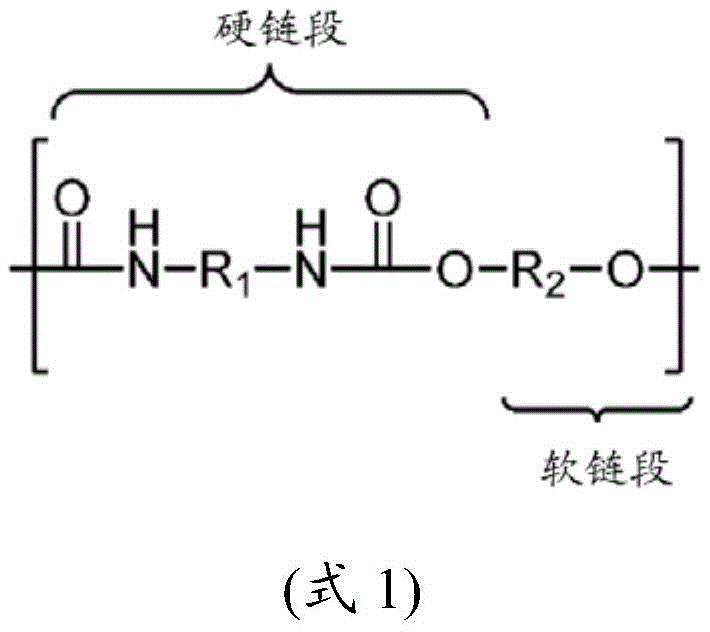
每个R1基团和R2基团独立地是脂族基团或芳族基团。任选地,每个R2可以是相对亲水性的基团,包括具有一个或更多个羟基基团的基团。Each R1 group and R2 group is independently aliphatic or aromatic. Optionally, each R2 can be a relatively hydrophilic group, including a group having one or more hydroxyl groups.
另外,异氰酸酯还可以用一种或更多种扩链剂来扩链,以桥接两种或更多种异氰酸酯,增加硬链段的长度。这可以产生如下文式2中所示的聚氨酯聚合物链,其中R3包括扩链剂。如同每个R1和R2一样,每个R3独立地是脂族官能团或芳族官能团。In addition, the isocyanate can also be chain extended with one or more chain extenders to bridge the two or more isocyanates and increase the length of the hard segment. This can result in a polyurethane polymer chain as shown in Formula 2 below, wherein R 3 includes a chain extender. Like each R1 and R2 , each R3 is independently an aliphatic functional group or an aromatic functional group.

式1和式2中的每个R1基团可以基于所使用的特定的异氰酸酯而独立地包括具有从3至30个碳原子的直链或支链的基团,并且可以是脂族的、芳族的,或者包括脂族部分和芳族部分的组合。术语“脂族”指的是不包括具有离域π电子的环共轭的环体系(cyclicallyconjugated ring system)的、饱和或不饱和的有机分子或分子的部分。相比之下,术语“芳族”指的是具有带有离域π电子的环共轭的环体系的有机分子或分子的部分,其呈现出比具有定域π电子的假想环体系更大的稳定性。Each R group in Formula 1 and Formula 2 may independently include straight or branched chain groups having from 3 to 30 carbon atoms, based on the particular isocyanate used, and may be aliphatic, Aromatic, or comprising a combination of aliphatic and aromatic moieties. The term "aliphatic" refers to a saturated or unsaturated organic molecule or portion of a molecule that does not include a cyclically conjugated ring system with delocalized pi electrons. In contrast, the term "aromatic" refers to an organic molecule or part of a molecule having a ring-conjugated ring system with delocalized pi electrons that exhibits a larger size than a hypothetical ring system with localized pi electrons stability.
基于形成聚合物的反应物化合物或单体的总重量,每个R1基团可以以按重量计约5百分比至约85百分比、按重量计从约5百分比至约70百分比、或按重量计从约10百分比至约50百分比的量存在。Each R group can be from about 5 percent to about 85 percent by weight, from about 5 percent to about 70 percent by weight, or from about 5 percent to about 70 percent by weight, based on the total weight of the reactant compounds or monomers that form the polymer It is present in an amount from about 10 percent to about 50 percent.
在脂族实施方案中(来自脂族异氰酸酯),每个R1基团可以包括直链脂族基团、支链脂族基团、脂环族基团或其组合。例如,每个R1基团可以包括具有从3至20个碳原子的直链或支链的亚烷基基团(例如,具有从4至15个碳原子的亚烷基,或具有从6至10个碳原子的亚烷基)、一个或更多个具有从3至8个碳原子的亚环烷基基团(例如,环丙基、环丁基、环戊基、环己基、环庚基或环辛基)及其组合。如本文所使用的,术语“烯烃”或“亚烷基”指的是二价的烃。当与术语Cn结合使用时,其意指烯烃或亚烷基基团具有“n”个碳原子。例如,C1-6亚烷基指的是具有例如1、2、3、4、5或6个碳原子的亚烷基基团。In aliphatic embodiments (from aliphatic isocyanates), each R 1 group may comprise a straight chain aliphatic group, a branched chain aliphatic group, a cycloaliphatic group, or a combination thereof. For example, each R group can include a straight or branched alkylene group having from 3 to 20 carbon atoms (eg, an alkylene group having from 4 to 15 carbon atoms, or an alkylene group having from 6 to 6 carbon atoms) to 10 carbon atoms), one or more cycloalkylene groups having from 3 to 8 carbon atoms (e.g., cyclopropyl, cyclobutyl, cyclopentyl, cyclohexyl, cyclo heptyl or cyclooctyl) and combinations thereof. As used herein, the term "alkene" or "alkylene" refers to a divalent hydrocarbon. When used in conjunction with the term C n , it means that the alkene or alkylene group has "n" carbon atoms. For example, C1-6 alkylene refers to an alkylene group having, for example, 1, 2, 3, 4, 5, or 6 carbon atoms.
用于产生聚氨酯聚合物链的合适的脂族二异氰酸酯的实例包括六亚甲基二异氰酸酯(HDI)、异佛尔酮二异氰酸酯(IPDI)、亚丁基二异氰酸酯(BDI)、二异氰酸基环己基甲烷(HMDI)、2,2,4-三甲基六亚甲基二异氰酸酯(TMDI)、二异氰酸基甲基环己烷、二异氰酸基甲基三环癸烷、降冰片烷二异氰酸酯(NDI)、环己烷二异氰酸酯(CHDI)、4,4'-二环己基甲烷二异氰酸酯(H12MDI)、二异氰酸基十二烷、赖氨酸二异氰酸酯及其组合。Examples of suitable aliphatic diisocyanates for producing polyurethane polymer chains include hexamethylene diisocyanate (HDI), isophorone diisocyanate (IPDI), butylene diisocyanate (BDI), diisocyanate Cyclohexylmethane (HMDI), 2,2,4-trimethylhexamethylene diisocyanate (TMDI), diisocyanatomethylcyclohexane, diisocyanatomethyltricyclodecane, normethylene Bornane diisocyanate (NDI), cyclohexane diisocyanate (CHDI), 4,4'-dicyclohexylmethane diisocyanate (H12MDI), diisocyanatododecane, lysine diisocyanate, and combinations thereof.
异氰酸酯衍生的链段可以包括衍生自脂族二异氰酸酯的链段。大部分异氰酸酯衍生的链段可以包括衍生自脂族二异氰酸酯的链段。至少90%的异氰酸酯衍生的链段衍生自脂族二异氰酸酯。异氰酸酯衍生的链段可以基本上由衍生自脂族二异氰酸酯的链段组成。脂族二异氰酸酯衍生的链段可以大体上(例如,约50百分比或更多、约60百分比或更多、约70百分比或更多、约80百分比或更多、约90百分比或更多)衍生自直链的脂族二异氰酸酯。至少80%的脂族二异氰酸酯衍生的链段可以衍生自不含侧链的脂族二异氰酸酯。衍生自脂族二异氰酸酯的链段可以包括具有从2至10个碳原子的直链的脂族二异氰酸酯。The isocyanate-derived segments may include segments derived from aliphatic diisocyanates. Most isocyanate-derived segments can include segments derived from aliphatic diisocyanates. At least 90% of the isocyanate-derived segments are derived from aliphatic diisocyanates. The isocyanate-derived segments may consist essentially of segments derived from aliphatic diisocyanates. Aliphatic diisocyanate derived segments can be substantially (eg, about 50 percent or more, about 60 percent or more, about 70 percent or more, about 80 percent or more, about 90 percent or more) derivatized Self-straight chain aliphatic diisocyanates. At least 80% of the aliphatic diisocyanate-derived segments may be derived from aliphatic diisocyanates without pendant chains. The segments derived from aliphatic diisocyanates may include linear aliphatic diisocyanates having from 2 to 10 carbon atoms.
当异氰酸酯衍生的链段衍生自芳族异氰酸酯时,每个R1基团可以包含一个或更多个芳族基团,诸如苯基、萘基、四氢萘基、菲基、亚联苯基(biphenylenyl)、茚满基、茚基、蒽基和芴基。除非另有说明,否则芳族基团可以是未被取代的芳族基团或被取代的芳族基团,并且还可以包括杂芳族基团。“杂芳族”指的是单环或多环的(例如,稠合双环和稠合三环的)芳族环体系,其中一至四个环原子选自氧、氮或硫,并且其余的环原子是碳,并且其中该环体系通过任何环原子连接到分子的其余部分。合适的杂芳基基团的实例包括吡啶基、吡嗪基、嘧啶基、吡咯基、吡唑基、咪唑基、噻唑基、四唑基、噁唑基、异噁唑基、噻二唑基、噁二唑基、呋喃基、喹啉基、异喹啉基、苯并噁唑基、苯并咪唑基和苯并噻唑基基团。When the isocyanate-derived segment is derived from an aromatic isocyanate, each R group may contain one or more aromatic groups, such as phenyl, naphthyl, tetrahydronaphthyl, phenanthryl, biphenylene (biphenylenyl), indanyl, indenyl, anthracenyl and fluorenyl. Unless otherwise specified, aromatic groups can be unsubstituted aromatic groups or substituted aromatic groups, and can also include heteroaromatic groups. "Heteroaromatic" refers to a monocyclic or polycyclic (eg, fused bicyclic and fused tricyclic) aromatic ring system in which one to four ring atoms are selected from oxygen, nitrogen, or sulfur, and the remaining rings The atoms are carbon, and where the ring system is attached to the rest of the molecule through any ring atom. Examples of suitable heteroaryl groups include pyridyl, pyrazinyl, pyrimidinyl, pyrrolyl, pyrazolyl, imidazolyl, thiazolyl, tetrazolyl, oxazolyl, isoxazolyl, thiadiazolyl , oxadiazolyl, furanyl, quinolinyl, isoquinolinyl, benzoxazolyl, benzimidazolyl and benzothiazolyl groups.
用于产生聚氨酯聚合物链的合适的芳族二异氰酸酯的实例包括甲苯二异氰酸酯(TDI)、与三羟甲基丙烷(TMP)的TDI加合物、亚甲基二苯基二异氰酸酯(MDI)、二甲苯二异氰酸酯(XDI)、四甲基二甲苯基二异氰酸酯(TMXDI)、氢化的二甲苯基二异氰酸酯(HXDI)、萘1,5-二异氰酸酯(NDI)、1,5-四氢萘二异氰酸酯、对亚苯基二异氰酸酯(PPDI)、3,3'-二甲基二苯基-4,4'-二异氰酸酯(DDDI)、4,4'-二苄基二异氰酸酯(DBDI)、4-氯-1,3-亚苯基二异氰酸酯及其组合。聚合物链可以大体上不含芳族基团。Examples of suitable aromatic diisocyanates for producing polyurethane polymer chains include toluene diisocyanate (TDI), TDI adducts with trimethylolpropane (TMP), methylene diphenyl diisocyanate (MDI) , Xylylene Diisocyanate (XDI), Tetramethylxylyl Diisocyanate (TMXDI), Hydrogenated Xylyl Diisocyanate (HXDI), Naphthalene 1,5-Diisocyanate (NDI), 1,5-Tetrahydronaphthalene Diisocyanate, p-phenylene diisocyanate (PPDI), 3,3'-dimethyldiphenyl-4,4'-diisocyanate (DDDI), 4,4'-dibenzyl diisocyanate (DBDI), 4-Chloro-1,3-phenylene diisocyanate and combinations thereof. The polymer chain may be substantially free of aromatic groups.
聚氨酯聚合物链可以由包括HMDI、TDI、MDI、H12脂族化合物及其组合的二异氰酸酯来产生。例如,聚氨酯可以包括一个或更多个由二异氰酸酯产生的聚氨酯聚合物链,所述二异氰酸酯包括HMDI、TDI、MDI、H12脂族化合物及其组合。Polyurethane polymer chains can be produced from diisocyanates including HMDI, TDI, MDI, H 12 aliphatic compounds, and combinations thereof. For example, the polyurethane may include one or more polyurethane polymer chains derived from diisocyanates including HMDI, TDI, MDI, H 12 aliphatic compounds, and combinations thereof.
根据本公开内容,可以使用至少部分地交联的或可以交联的聚氨酯链。通过使多官能的异氰酸酯反应以形成聚氨酯,可以产生交联的或可交联的聚氨酯链。用于产生聚氨酯链的合适的三异氰酸酯的实例包括与三羟甲基丙烷(TMP)的TDI、HDI和IPDI加合物、缩脲二酮(uretdione)(即二聚异氰酸酯)、聚合MDI及其组合。According to the present disclosure, at least partially crosslinked or crosslinkable polyurethane chains can be used. Crosslinked or crosslinkable polyurethane chains can be produced by reacting polyfunctional isocyanates to form polyurethanes. Examples of suitable triisocyanates for producing polyurethane chains include TDI, HDI and IPDI adducts with trimethylolpropane (TMP), uretdione (ie, dimeric isocyanate), polymeric MDI, and the like. combination.
式2中的R3基团可以基于所使用的特定扩链剂多元醇而包括具有从2至10个碳原子的直链或支链基团,并且可以是例如脂族、芳族或醚或聚醚。用于产生聚氨酯的合适的扩链剂多元醇的实例包括乙二醇、乙二醇的低级低聚物(例如二乙二醇、三乙二醇和四乙二醇)、1,2-丙二醇、1,3-丙二醇、丙二醇的低级低聚物(例如,二丙二醇、三丙二醇和四丙二醇)、1,4-丁二醇、2,3-丁二醇、1,6-己二醇、1,8-辛二醇、新戊二醇、1,4-环己二甲醇、2-乙基-1,6-己二醇、1-甲基-1,3-丙二醇、2-甲基-1,3-丙二醇、二羟基烷基化芳族化合物(例如,氢醌和间苯二酚的双(2-羟乙基)醚、二甲苯-a,a-二醇、二甲苯-a,a-二醇的双(2-羟乙基)醚)及其组合。The R group in formula 2 can include straight or branched chain groups having from 2 to 10 carbon atoms, based on the particular chain extender polyol used, and can be, for example, aliphatic, aromatic or ether or polyether. Examples of suitable chain extender polyols for producing polyurethanes include ethylene glycol, lower oligomers of ethylene glycol (eg, diethylene glycol, triethylene glycol, and tetraethylene glycol), 1,2-propanediol, 1,3-propylene glycol, lower oligomers of propylene glycol (eg, dipropylene glycol, tripropylene glycol, and tetrapropylene glycol), 1,4-butanediol, 2,3-butanediol, 1,6-hexanediol, 1 ,8-octanediol, neopentyl glycol, 1,4-cyclohexanedimethanol, 2-ethyl-1,6-hexanediol, 1-methyl-1,3-propanediol, 2-methyl- 1,3-Propanediol, dihydroxyalkylated aromatic compounds (for example, bis(2-hydroxyethyl) ethers of hydroquinone and resorcinol, xylene-a,a-diol, xylene-a, a-bis(2-hydroxyethyl) ethers of diols) and combinations thereof.
式1和式2中的R2基团可以包括聚醚基团、聚酯基团、聚碳酸酯基团、脂族基团或芳族基团。基于反应物单体的总重量,每个R2基团可以以按重量计约5百分比至约85百分比、按重量计从约5百分比至约70百分比、或按重量计从约10百分比至约50百分比的量存在。The R 2 group in Formula 1 and Formula 2 may include a polyether group, a polyester group, a polycarbonate group, an aliphatic group, or an aromatic group. Each R group can be from about 5 percent to about 85 percent by weight, from about 5 percent to about 70 percent by weight, or from about 10 percent to about 10 percent by weight, based on the total weight of the reactant monomers A 50 percent amount is present.
聚氨酯的至少一个R2基团包括聚醚链段(即,具有一个或更多个醚基团的链段)。合适的聚醚基团包括但不限于聚环氧乙烷(PEO)、聚环氧丙烷(PPO)、聚四氢呋喃(polytetrahydrofuran)(PTHF)、聚四亚甲基氧醚(polytetramethylene oxide)(PTMO)及其组合。如本文使用的术语“烷基”指的是含有一至三十个碳原子、例如一至二十个碳原子或一至十个碳原子的直链和支链的饱和烃基。当与术语Cn结合使用时,其意指烷基基团具有“n”个碳原子。例如,C4烷基指的是具有4个碳原子的烷基基团。C1-7烷基指的是具有涵盖整个范围(即,1至7个碳原子)以及所有亚组(例如,1-6、2-7、1-5、3-6、1、2、3、4、5、6和7个碳原子)的碳原子数的烷基基团。烷基基团的非限制性实例包括甲基、乙基、正丙基、异丙基、正丁基、仲丁基(2-甲基丙基)、叔丁基(1,1-二甲基乙基)、3,3-二甲基戊基和2-乙基己基。除非另有说明,否则烷基基团可以是未被取代的烷基基团或被取代的烷基基团。At least one R2 group of the polyurethane includes a polyether segment ( ie, a segment having one or more ether groups). Suitable polyether groups include, but are not limited to, polyethylene oxide (PEO), polypropylene oxide (PPO), polytetrahydrofuran (PTHF), polytetramethylene oxide (PTMO) and its combinations. The term "alkyl" as used herein refers to straight and branched chain saturated hydrocarbon groups containing one to thirty carbon atoms, eg, one to twenty carbon atoms or one to ten carbon atoms. When used in conjunction with the term Cn , it means that the alkyl group has "n" carbon atoms. For example, C4 alkyl refers to an alkyl group having 4 carbon atoms. Ci- 7 alkyl is meant to have the entire range (ie, 1 to 7 carbon atoms) and all subgroups (eg, 1-6, 2-7, 1-5, 3-6, 1, 2, 3, 4, 5, 6 and 7 carbon atoms) alkyl groups. Non-limiting examples of alkyl groups include methyl, ethyl, n-propyl, isopropyl, n-butyl, sec-butyl (2-methylpropyl), tert-butyl (1,1-dimethylpropyl) ethyl), 3,3-dimethylpentyl and 2-ethylhexyl. Unless otherwise specified, an alkyl group can be an unsubstituted alkyl group or a substituted alkyl group.
在聚氨酯的一些实例中,至少一个R2基团包括聚酯基团。聚酯基团可以衍生自一种或更多种二羟基醇(例如乙二醇、1,3-丙二醇、1,2-丙二醇、1,4-丁二醇、1,3-丁二醇、2-甲基戊二醇、1,5-二乙二醇、1,5-戊二醇、1,5-己二醇、1,2-十二烷二醇、环己烷二甲醇及其组合)与一种或更多种二羧酸(例如己二酸、琥珀酸、癸二酸、辛二酸、甲基己二酸、戊二酸、庚二酸、壬二酸、硫代二丙酸和柠康酸及其组合)的聚酯化。聚酯基团还可以衍生自聚碳酸酯预聚物,诸如聚(六亚甲基碳酸酯)二醇(poly(hexamethylene carbonate)glycol)、聚(亚丙基碳酸酯)二醇、聚(四亚甲基碳酸酯)二醇和聚(九亚甲基碳酸酯)二醇(poly(nonanemethylene carbonate)glycol)。合适的聚酯可以包括例如聚己二酸乙二醇酯(PEA)、聚(己二酸-1,4-丁二醇酯)、聚(四亚甲基己二酸酯)、聚(六亚甲基己二酸酯)、聚己内酯、聚六亚甲基碳酸酯、聚(亚丙基碳酸酯)、聚(四亚甲基碳酸酯)、聚(九亚甲基碳酸酯)及其组合。In some examples of polyurethanes, at least one R 2 group includes a polyester group. The polyester group can be derived from one or more dihydric alcohols (eg, ethylene glycol, 1,3-propanediol, 1,2-propanediol, 1,4-butanediol, 1,3-butanediol, 2-methylpentanediol, 1,5-diethylene glycol, 1,5-pentanediol, 1,5-hexanediol, 1,2-dodecanediol, cyclohexanedimethanol and their combination) with one or more dicarboxylic acids (e.g., adipic acid, succinic acid, sebacic acid, suberic acid, methyladipic acid, glutaric acid, pimelic acid, azelaic acid, thiodiacids Polyesterification of propionic and citraconic acids and combinations thereof). The polyester groups can also be derived from polycarbonate prepolymers such as poly(hexamethylene carbonate) glycol, poly(propylene carbonate) glycol, poly(tetramethylene carbonate) methylene carbonate) glycol and poly(nonanemethylene carbonate) glycol. Suitable polyesters may include, for example, polyethylene adipate (PEA), poly(1,4-butylene adipate), poly(tetramethylene adipate), poly(hexamethylene adipate) methylene adipate), polycaprolactone, polyhexamethylene carbonate, poly(trimethylene carbonate), poly(tetramethylene carbonate), poly(nonamethylene carbonate) and its combinations.
至少一个R2基团可以包括聚碳酸酯基团。聚碳酸酯基团可以衍生自一种或更多种二羟基醇(例如乙二醇、1,3-丙二醇、1,2-丙二醇、1,4-丁二醇、1,3-丁二醇、2-甲基戊二醇、1,5-二乙二醇、1,5-戊二醇、1,5-己二醇、1,2-十二烷二醇、环己烷二甲醇及其组合)与碳酸亚乙酯的反应。At least one R 2 group may comprise a polycarbonate group. The polycarbonate groups can be derived from one or more dihydric alcohols (eg, ethylene glycol, 1,3-propanediol, 1,2-propanediol, 1,4-butanediol, 1,3-butanediol , 2-methylpentanediol, 1,5-diethylene glycol, 1,5-pentanediol, 1,5-hexanediol, 1,2-dodecanediol, cyclohexanedimethanol and combinations thereof) with ethylene carbonate.
脂族基团可以是直链的,并且可以包括,例如,具有从1至20个碳原子的亚烷基链或具有从1至20个碳原子的亚烯基链(例如,亚甲基、亚乙基、亚丙基、亚丁基、亚戊基、亚己基、亚庚基、亚辛基、亚壬基、亚癸基、亚十一烷基、亚十二烷基、亚十三烷基、亚乙烯基、亚丙烯基、亚丁烯基、亚戊烯基、亚己烯基、亚庚烯基、亚辛烯基、亚壬烯基、亚癸烯基、亚十一烯基、亚十二烯基、亚十三烯基)。术语“烯烃”或“亚烷基”指的是二价的烃。术语“亚烯基”指的是具有至少一个双键的二价烃分子或分子的部分。Aliphatic groups can be straight chain and can include, for example, alkylene chains having from 1 to 20 carbon atoms or alkenylene chains having from 1 to 20 carbon atoms (e.g., methylene, Ethylene, propylene, butylene, pentylene, hexylene, heptylene, octylene, nonylylene, decylene, undecylene, dodecylene, tridecylene group, vinylidene, propenylene, butenylene, pentenylene, hexenylene, heptenylene, octenylene, nonenylene, decenylene, undecenylene, dodecenylene, tridecenylene). The term "alkene" or "alkylene" refers to a divalent hydrocarbon. The term "alkenylene" refers to a divalent hydrocarbon molecule or portion of a molecule having at least one double bond.
脂族基团和芳族基团可以被一个或更多个相对亲水性和/或带电荷的侧基取代。亲水性侧基可以包括一个或更多个(例如,2、3、4、5、6、7、8、9、10或更多个)羟基基团。亲水性侧基包括一个或更多个(例如,2、3、4、5、6、7、8、9、10或更多个)氨基基团。在一些情况下,亲水性侧基包括一个或更多个(例如,2、3、4、5、6、7、8、9、10或更多个)羧酸酯基团。例如,脂族基团可以包括一个或更多个聚丙烯酸基团。在一些情况下,亲水性侧基包括一个或更多个(例如,2、3、4、5、6、7、8、9、10或更多个)磺酸酯基团。在一些情况下,亲水性侧基包括一个或更多个(例如,2、3、4、5、6、7、8、9、10或更多个)磷酸酯基团。在一些实例中,亲水性侧基包括一个或更多个铵基团(例如叔铵和/或季铵)。在其他实例中,亲水性侧基包括一个或更多个两性离子基团(例如甜菜碱,诸如聚(羧基甜菜碱)(pCB)和膦酸铵基团诸如磷脂酰胆碱基团)。Aliphatic and aromatic groups may be substituted with one or more relatively hydrophilic and/or charged pendant groups. The hydrophilic pendant groups can include one or more (eg, 2, 3, 4, 5, 6, 7, 8, 9, 10, or more) hydroxyl groups. Hydrophilic pendant groups include one or more (eg, 2, 3, 4, 5, 6, 7, 8, 9, 10, or more) amino groups. In some cases, the hydrophilic pendant groups include one or more (eg, 2, 3, 4, 5, 6, 7, 8, 9, 10 or more) carboxylate groups. For example, an aliphatic group may include one or more polyacrylic acid groups. In some cases, the hydrophilic pendant groups include one or more (eg, 2, 3, 4, 5, 6, 7, 8, 9, 10, or more) sulfonate groups. In some cases, the hydrophilic pendant groups include one or more (eg, 2, 3, 4, 5, 6, 7, 8, 9, 10, or more) phosphate groups. In some examples, the hydrophilic pendant groups include one or more ammonium groups (eg, tertiary and/or quaternary ammonium). In other examples, the hydrophilic pendant groups include one or more zwitterionic groups (eg, betaines such as poly(carboxybetaine) (pCB) and ammonium phosphonate groups such as phosphatidylcholine groups).
R2基团可以包括能够结合抗衡离子以使聚合物离子地交联并且形成离聚物的带电荷的基团。例如,R2是具有氨基侧基、羧酸酯侧基、磺酸酯侧基、磷酸酯侧基、铵侧基或两性离子侧基或其组合的脂族基团或芳族基团。 The R2 group may include a charged group capable of binding a counterion to ionically crosslink the polymer and form an ionomer. For example, R2 is an aliphatic or aromatic group having a pendant amino group, a pendant carboxylate group, a pendant sulfonate group, a pendant phosphate group, a pendant ammonium group, or a pendant zwitterionic group, or a combination thereof.
当存在亲水性侧基时,该亲水性侧基可以是至少一个聚醚基团,诸如两个聚醚基团。在其他情况下,亲水性侧基是至少一种聚酯。亲水性侧基可以是聚内酯基团(例如聚乙烯吡咯烷酮)。亲水性侧基中的每个碳原子可以任选地被例如具有从1至6个碳原子的烷基基团取代。脂族基团和芳族基团可以是接枝聚合物基团,其中侧基是均聚物基团(例如聚醚基团、聚酯基团、聚乙烯吡咯烷酮基团)。When a hydrophilic pendant group is present, the hydrophilic pendant group can be at least one polyether group, such as two polyether groups. In other cases, the hydrophilic pendant group is at least one polyester. The hydrophilic pendant groups may be polylactone groups (eg, polyvinylpyrrolidone). Each carbon atom in the pendant hydrophilic group may be optionally substituted with, for example, an alkyl group having from 1 to 6 carbon atoms. The aliphatic and aromatic groups may be graft polymer groups, wherein the pendant groups are homopolymer groups (eg, polyether groups, polyester groups, polyvinylpyrrolidone groups).
亲水性侧基可以是聚醚基团(例如聚环氧乙烷(PEO)基团、聚乙二醇(PEG)基团)、聚乙烯吡咯烷酮基团、聚丙烯酸基团或其组合。The hydrophilic pendant groups can be polyether groups (eg, polyethylene oxide (PEO) groups, polyethylene glycol (PEG) groups), polyvinylpyrrolidone groups, polyacrylic acid groups, or combinations thereof.
亲水性侧基可以通过连接基结合到脂族基团或芳族基团。连接基可以是能够将亲水性侧基连接到脂族基团或芳族基团的任何双官能小分子(例如,具有从1至20个碳原子的双官能小分子)。例如,连接基可以包括如本文先前描述的二异氰酸酯基团,该二异氰酸酯基团在连接到亲水性侧基以及连接到脂族基团或芳族基团时形成氨基甲酸酯键。连接基可以是4,4'-二苯基甲烷二异氰酸酯(MDI),如下文所示。The hydrophilic pendant group can be attached to the aliphatic or aromatic group through a linker. The linking group can be any bifunctional small molecule (eg, a bifunctional small molecule having from 1 to 20 carbon atoms) capable of attaching a hydrophilic pendant group to an aliphatic or aromatic group. For example, the linking group may include a diisocyanate group as previously described herein that forms a urethane linkage when attached to a hydrophilic pendant group as well as to an aliphatic or aromatic group. The linking group may be 4,4'-diphenylmethane diisocyanate (MDI), as shown below.

亲水性侧基可以是聚环氧乙烷基团,并且连接基团可以是MDI,如下文所示。The hydrophilic pendant groups can be polyethylene oxide groups, and the linking groups can be MDI, as shown below.

亲水性侧基可以被官能化,以使其能够任选地通过连接基结合至脂族基团或芳族基团。例如,当亲水性侧基包括烯烃基团时,该烯烃基团可以与含巯基的双官能分子(即,具有第二反应性基团诸如羟基基团或氨基基团的分子)经历迈克尔加成(Michaeladdition),产生亲水性基团,该亲水性基团可以使用第二反应性基团任选地通过连接基与聚合物主链进行反应。例如,当亲水性侧基是聚乙烯吡咯烷酮基团时,其可以与巯基乙醇上的巯基基团反应,以产生羟基官能化的聚乙烯吡咯烷酮,如下文所示。The hydrophilic pendant groups can be functionalized to enable them to be attached to an aliphatic or aromatic group, optionally through a linker. For example, when the hydrophilic pendant group includes an alkene group, the alkene group can undergo Michael addition with a thiol-containing bifunctional molecule (ie, a molecule with a second reactive group such as a hydroxyl group or an amino group). Formation (Michael addition), resulting in hydrophilic groups that can react with the polymer backbone using a second reactive group, optionally through a linking group. For example, when the hydrophilic pendant group is a polyvinylpyrrolidone group, it can react with a sulfhydryl group on mercaptoethanol to produce a hydroxyl-functionalized polyvinylpyrrolidone, as shown below.
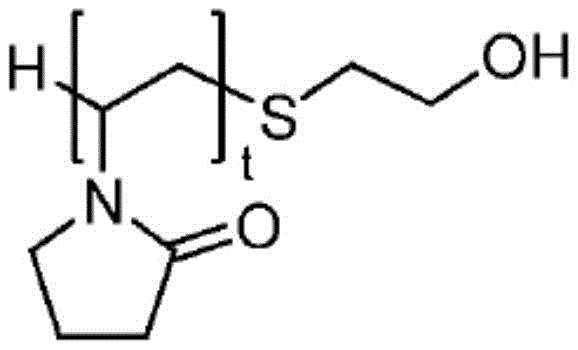

聚氨酯中的至少一个R2基团可以包括聚四亚甲基氧醚基团。聚氨酯中的至少一个R2基团可以包括用聚环氧乙烷基团或聚乙烯吡咯烷酮基团官能化的脂族多元醇基团,诸如在欧洲专利第2 462 908号中描述的多元醇,该专利据此通过引用并入。例如,R2基团可以衍生自多元醇(例如季戊四醇或2,2,3-三羟基丙醇)与MDI衍生的甲氧基聚乙二醇(以获得如式6或式7中所示的化合物)或与MDI衍生的聚乙烯吡咯烷酮(以获得如式8或式9中所示的化合物)的反应产物,所述MDI衍生的甲氧基聚乙二醇和MDI衍生的聚乙烯吡咯烷酮之前已经与巯基乙醇反应,如下文所示。At least one R 2 group in the polyurethane can include a polytetramethylene oxide group. At least one R2 group in the polyurethane may comprise an aliphatic polyol group functionalized with a polyethylene oxide group or a polyvinylpyrrolidone group, such as the polyols described in European Patent No. 2 462 908, This patent is hereby incorporated by reference. For example, the R group can be derived from a polyol (eg, pentaerythritol or 2,2,3 - trihydroxypropanol) and an MDI-derived methoxypolyethylene glycol (to obtain a compound as shown in Formula 6 or Formula 7) compound) or the reaction product with MDI-derived polyvinylpyrrolidone (to obtain a compound as shown in formula 8 or formula 9), which MDI-derived methoxypolyethylene glycol and MDI-derived polyvinylpyrrolidone have been previously combined with The mercaptoethanol reaction is shown below.
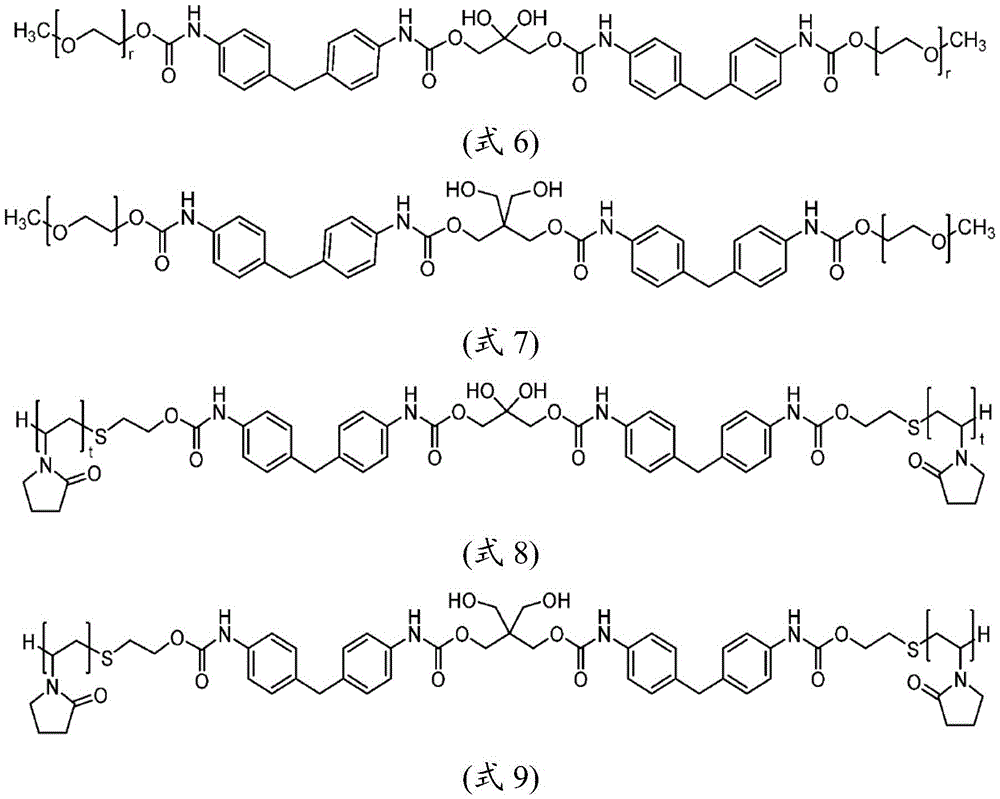
聚氨酯中的至少一个R2可以是聚硅氧烷。在这些情况下,R2基团可以衍生自式10的硅氧烷单体,诸如美国专利第5,969,076号中公开的硅氧烷单体,该专利据此通过引用并入:At least one R2 in the polyurethane can be a polysiloxane. In these cases, the R group can be derived from a siloxane monomer of formula 10, such as the siloxane monomers disclosed in US Pat. No. 5,969,076, which is hereby incorporated by reference:
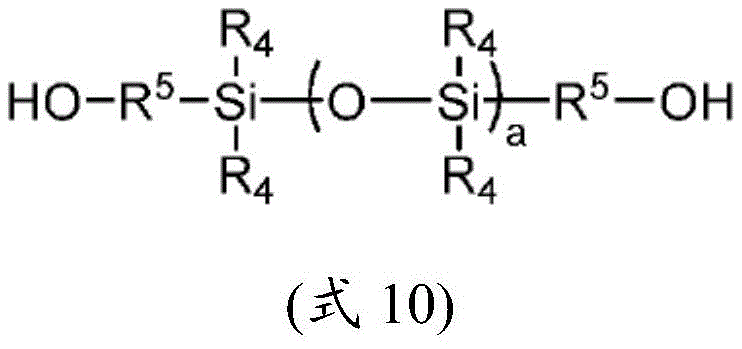
其中:a是1至10或更大(例如,1、2、3、4、5、6、7、8、9或10);每个R4独立地是氢、具有从1至18个碳原子的烷基基团、具有从2至18个碳原子的烯基基团、芳基或聚醚;并且每个R5独立地是具有从1至10个碳原子的亚烷基基团、聚醚或聚氨酯。wherein: a is 1 to 10 or greater (eg, 1, 2, 3, 4 , 5, 6, 7, 8, 9, or 10); each R is independently hydrogen, having from 1 to 18 carbons atoms of an alkyl group, an alkenyl group having from 2 to 18 carbon atoms, an aryl group or a polyether; and each R is independently an alkylene group having from 1 to 10 carbon atoms, Polyether or Polyurethane.
每个R4基团可以独立地是H、具有从1至10个碳原子的烷基基团、具有从2至10个碳原子的烯基基团、具有从1至6个碳原子的芳基基团、聚乙烯基团、聚丙烯基团或聚丁烯基团。每个R4基团可以独立地选自由以下组成的组:甲基、乙基、正丙基、异丙基、正丁基、异丁基、仲丁基、叔丁基、乙烯基、丙烯基、苯基和聚乙烯基团。Each R group can independently be H, an alkyl group having from 1 to 10 carbon atoms, an alkenyl group having from 2 to 10 carbon atoms, an aryl group having from 1 to 6 carbon atoms group, polyethylene group, polypropylene group or polybutene group. Each R group can be independently selected from the group consisting of methyl, ethyl, n - propyl, isopropyl, n-butyl, isobutyl, sec-butyl, tert-butyl, vinyl, propylene group, phenyl group and polyvinyl group.
每个R5基团可以独立地包括具有从1至10个碳原子的亚烷基基团(例如亚甲基、亚乙基、亚丙基、亚丁基、亚戊基、亚己基、亚庚基、亚辛基、亚壬基或亚癸基基团)。每个R5基团可以是聚醚基团(例如聚乙烯基团、聚丙烯基团或聚丁烯基团)。每个R5基团可以是聚氨酯基团。Each R group may independently include an alkylene group having from 1 to 10 carbon atoms (eg, methylene, ethylene, propylene, butylene, pentylene, hexylene, heptylene) , octylene, nonylylene or decylene groups). Each R5 group can be a polyether group (eg, a polyethylene group, a polypropylene group, or a polybutene group). Each R5 group can be a polyurethane group.
任选地,聚氨酯可以包含至少部分地交联的聚合物网络,该聚合物网络包含作为聚氨酯的衍生物的聚合物链。交联水平可以是使得聚氨酯保持热塑性性质(即,交联的热塑性聚氨酯可以在本文描述的加工条件下熔化和再固化)。交联聚氨酯可以是热固性聚合物。如下文的式11和式12中所示,该交联聚合物网络可以通过使一种或更多种异氰酸酯与一种或更多种聚氨基化合物、聚巯基化合物(polysulfhydryl compound)或其组合聚合来产生:Optionally, the polyurethane may comprise an at least partially crosslinked polymer network comprising polymer chains that are derivatives of the polyurethane. The level of crosslinking can be such that the polyurethane retains thermoplastic properties (ie, the crosslinked thermoplastic polyurethane can melt and re-solidify under the processing conditions described herein). The cross-linked polyurethane can be a thermoset polymer. As shown in Formula 11 and Formula 12 below, the crosslinked polymer network can be obtained by polymerizing one or more isocyanates with one or more polyamino compounds, polysulfhydryl compounds, or combinations thereof to produce:

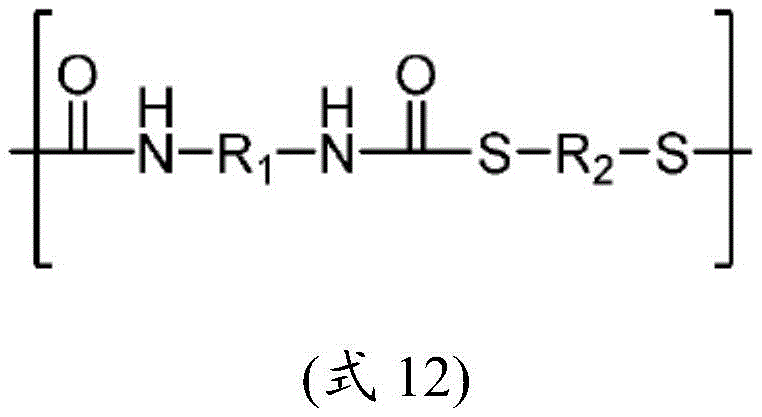
其中变量如上文所描述。另外,异氰酸酯还可以用一种或更多种聚氨基或聚硫醇扩链剂来扩链,以桥接两种或更多种异氰酸酯,诸如前面对于式2的聚氨酯所描述的。where the variables are as described above. In addition, the isocyanates can also be chain extended with one or more polyamino or polythiol chain extenders to bridge two or more isocyanates, such as those previously described for the polyurethanes of Formula 2.
聚氨酯链可以通过例如聚合物的氨基甲酸酯(urethane)或氨基甲酸酯(carbamate)基团(硬链段)之间的非极性相互作用或极性相互作用被物理地交联到另一聚氨酯链。式1中的R1基团以及式2中的R1基团和R3基团形成通常被称为“硬链段”的聚合物部分,并且R2基团形成通常被称为“软链段”的聚合物部分。软链段共价地结合到硬链段。具有物理地交联的硬链段和软链段的聚氨酯可以是亲水性聚氨酯(即聚氨酯,其包括包含如本文公开的亲水性基团的热塑性聚氨酯)。Polyurethane chains can be physically crosslinked to another by, for example, apolar interactions or polar interactions between the urethane or carbamate groups (hard segments) of the polymer. A polyurethane chain. The R1 group in formula 1 and the R1 and R3 groups in formula 2 form a polymer moiety commonly referred to as a "hard segment", and the R2 group forms a polymer moiety commonly referred to as a "soft chain". segment" of the polymer part. The soft segment is covalently bound to the hard segment. Polyurethanes with physically crosslinked hard and soft segments can be hydrophilic polyurethanes (ie, polyurethanes, which include thermoplastic polyurethanes comprising hydrophilic groups as disclosed herein).
聚氨酯可以是包含MDI、PTMO和1,4-丁二醇的热塑性聚氨酯,如美国专利第4,523,005号中描述的。适用于本发明用途的可商购的聚氨酯包括但不限于以商品名“SANCURE”(例如,“SANCURE”系列的聚合物诸如“SANCURE”20025F)或“TECOPHILIC”(例如TG-500、TG-2000、SP-80A-150、SP-93A-100、SP-60D-60)(Lubrizol,Countryside,IL,USA)、“PELLETHANE”2355-85ATP和2355-95AE(Dow Chemical Company of Midland,MI,USA)、“ESTANE”(例如,ALR G 500或58213;Lubrizol,Countryside,IL,USA)的聚氨酯。The polyurethane may be a thermoplastic polyurethane comprising MDI, PTMO, and 1,4-butanediol, as described in US Pat. No. 4,523,005. Commercially available polyurethanes suitable for use in the present invention include, but are not limited to, under the trade names "SANCURE" (eg, "SANCURE" series of polymers such as "SANCURE" 20025F) or "TECOPHILIC" (eg TG-500, TG-2000 , SP-80A-150, SP-93A-100, SP-60D-60) (Lubrizol, Countryside, IL, USA), "PELLETHANE" 2355-85ATP and 2355-95AE (Dow Chemical Company of Midland, MI, USA) , "ESTANE" (eg, ALR G 500 or 58213; Lubrizol, Countryside, IL, USA).
聚氨酯中的一种或更多种(例如作为涂层用于底漆中的那些聚氨酯(例如水分散性聚氨酯))可以通过使一种或更多种异氰酸酯与一种或更多种多元醇聚合以产生具有氨基甲酸酯键(-N(C=O)O-)和一种或更多种水分散性增强部分的共聚物链来产生,其中聚合物链包含一种或更多种水分散性增强部分(例如聚合物链中的单体)。水分散性聚氨酯还可以被称为“水性聚氨酯聚合物分散体”。可以将水分散性增强部分添加到式1或式2的链(例如,添加在链内和/或作为侧链添加到链上)。包含水分散性增强部分能够形成水性聚氨酯分散体。本文中的术语“水性”意指分散体或制剂的连续相,所述分散体或制剂具有约50重量百分比至100重量百分比的水、约60重量百分比至100重量百分比的水、约70重量百分比至100重量百分比的水或约100重量百分比的水。术语“水性分散体”指的是组分(例如聚合物、交联剂及类似物)在没有助溶剂的水中的分散体。助溶剂可以用于水性分散体中,并且助溶剂可以是有机溶剂。下文提供了关于聚合物、聚氨酯、异氰酸酯和多元醇的另外的细节。One or more of the polyurethanes (such as those used in primers as coatings (such as water dispersible polyurethanes)) can be obtained by polymerizing one or more isocyanates with one or more polyols produced by producing a copolymer chain having urethane linkages (-N(C=O)O-) and one or more water dispersibility enhancing moieties, wherein the polymer chain comprises one or more water Dispersibility enhancing moieties (eg monomers in the polymer chain). Water-dispersible polyurethanes may also be referred to as "aqueous polyurethane polymer dispersions". A water dispersibility enhancing moiety can be added to the chain of Formula 1 or Formula 2 (eg, within the chain and/or as a side chain on the chain). Inclusion of the water dispersibility enhancing moiety enables the formation of aqueous polyurethane dispersions. The term "aqueous" herein means the continuous phase of a dispersion or formulation having about 50 to 100 weight percent water, about 60 to 100 weight percent water, about 70 weight percent To 100 weight percent water or about 100 weight percent water. The term "aqueous dispersion" refers to a dispersion of components (eg, polymers, crosslinkers, and the like) in water without cosolvents. A co-solvent can be used in the aqueous dispersion, and the co-solvent can be an organic solvent. Additional details regarding polymers, polyurethanes, isocyanates and polyols are provided below.
聚氨酯(例如水性聚氨酯聚合物分散体)可以包括一个或更多个水分散性增强部分。水分散性增强部分可以具有至少一个亲水性基团(例如聚(环氧乙烷))、离子基团或潜在离子基团以帮助聚氨酯的分散,从而增强分散体的稳定性。水分散性聚氨酯可以通过将带有至少一个亲水性基团或可以被制成亲水性的基团(例如,通过化学改性诸如中和)的部分并入聚合物链中来形成。例如,这些化合物可以是非离子型、阴离子型、阳离子型或两性离子型或其组合。在一个实例中,阴离子基团诸如羧酸基团可以以非活性形式并入链中,并且随后被成盐化合物诸如叔胺活化。其他水分散性增强部分也可以通过氨基甲酸酯键或脲键反应进入主链中,包括侧部或末端的亲水性环氧乙烷单元或脲基单元。Polyurethanes (eg, aqueous polyurethane polymer dispersions) can include one or more water-dispersible enhancing moieties. The water dispersibility enhancing moiety may have at least one hydrophilic group (eg, poly(ethylene oxide)), ionic group, or potentially ionic group to aid in the dispersion of the polyurethane, thereby enhancing the stability of the dispersion. Water-dispersible polyurethanes can be formed by incorporating moieties with at least one hydrophilic group or groups that can be made hydrophilic (eg, by chemical modification such as neutralization) into the polymer chain. For example, these compounds may be nonionic, anionic, cationic or zwitterionic or combinations thereof. In one example, anionic groups such as carboxylic acid groups can be incorporated into the chain in an inactive form and subsequently activated by salt-forming compounds such as tertiary amines. Other water dispersibility enhancing moieties can also be reacted into the backbone via urethane or urea linkages, including pendant or terminal hydrophilic ethylene oxide units or urea units.
水分散性增强部分可以是包含羧基基团的部分。包含羧基基团的水分散性增强部分可以由具有通式(HO)xQ(COOH)y的羟基-羧酸形成,其中Q可以是含有1至12个碳原子的直链或支链的二价烃基,并且x和y可以各自独立地是1至3。说明性实例包括二羟甲基丙酸(DMPA)、二羟甲基丁酸(DMBA)、柠檬酸、酒石酸、乙醇酸、乳酸、苹果酸、二羟基苹果酸、二羟基酒石酸及类似物、及其混合物。The water dispersibility enhancing moiety may be a moiety containing a carboxyl group. The water-dispersible enhancing moiety containing a carboxyl group can be formed from a hydroxy-carboxylic acid having the general formula (HO) x Q(COOH) y , where Q can be a linear or branched dicarboxylic acid containing 1 to 12 carbon atoms. valent hydrocarbon group, and x and y may each independently be 1 to 3. Illustrative examples include dimethylolpropionic acid (DMPA), dimethylolbutyric acid (DMBA), citric acid, tartaric acid, glycolic acid, lactic acid, malic acid, dihydroxymalic acid, dihydroxytartaric acid, and the like, and its mixture.
水分散性增强部分可以包含含有阴离子侧基的反应性聚合物多元醇组分,该反应性聚合物多元醇组分可以聚合到主链中以赋予聚氨酯水分散性特性。阴离子官能的聚合物多元醇可以包括阴离子聚酯多元醇、阴离子聚醚多元醇和阴离子聚碳酸酯多元醇,其中另外的细节在美国专利第5,334,690号中提供。The water dispersibility enhancing moiety can comprise a reactive polymer polyol component containing pendant anionic groups that can be polymerized into the backbone to impart water dispersibility characteristics to the polyurethane. Anionic functional polymer polyols can include anionic polyester polyols, anionic polyether polyols, and anionic polycarbonate polyols, with additional details provided in US Pat. No. 5,334,690.
水分散性增强部分可以包含侧链亲水性单体。例如,包含侧链亲水性单体的水分散性增强部分可以包括环氧烷聚合物和共聚物,其中环氧烷基团具有从2-10个碳原子,如美国专利6,897,281中所示。另外类型的水分散性增强部分可以包括巯基乙酸、2,6-二羟基苯甲酸、磺基间苯二甲酸(sulfoisophthalic acid)、聚乙二醇及类似物及其混合物。在美国专利7,476,705中可以找到关于水分散性增强部分的另外的细节。The water dispersibility enhancing moiety may contain pendant hydrophilic monomers. For example, water dispersibility enhancing moieties comprising pendant hydrophilic monomers can include alkylene oxide polymers and copolymers wherein the alkylene oxide groups have from 2 to 10 carbon atoms, as shown in US Pat. No. 6,897,281. Additional types of water dispersibility enhancing moieties may include thioglycolic acid, 2,6-dihydroxybenzoic acid, sulfoisophthalic acid, polyethylene glycol, and the like, and mixtures thereof. Additional details regarding water dispersibility enhancing moieties can be found in US Patent 7,476,705.
聚酰胺Polyamide
聚合物可以包括诸如热塑性聚酰胺或热固性聚酰胺的聚酰胺。聚酰胺可以是弹性聚酰胺,包括弹性热塑性聚酰胺或弹性热固性聚酰胺。聚酰胺可以是具有相同化学结构的重复聚酰胺链段的聚酰胺均聚物。可选择地,聚酰胺可以包含许多具有不同聚酰胺化学结构的聚酰胺链段(例如,聚酰胺6链段、聚酰胺11链段、聚酰胺12链段、聚酰胺66链段等)。具有不同化学结构的聚酰胺链段可以无规地排列,或者可以排列为重复嵌段。The polymers may include polyamides such as thermoplastic polyamides or thermoset polyamides. The polyamide may be an elastic polyamide, including an elastic thermoplastic polyamide or an elastic thermoset polyamide. The polyamide may be a polyamide homopolymer having repeating polyamide segments of the same chemical structure. Alternatively, the polyamide may comprise a number of polyamide segments having different polyamide chemical structures (eg, polyamide 6 segments, polyamide 11 segments, polyamide 12 segments, polyamide 66 segments, etc.). Polyamide segments with different chemical structures can be arranged randomly, or can be arranged as repeating blocks.
聚酰胺可以是共聚酰胺(即,包含聚酰胺链段和非聚酰胺链段的共聚物)。共聚酰胺的聚酰胺链段可以包括以下或由以下组成:聚酰胺6链段、聚酰胺11链段、聚酰胺12链段、聚酰胺66链段或其任何组合。共聚酰胺的聚酰胺链段可以无规地排列,或者可以排列为重复链段。聚酰胺链段可以包括以下或由以下组成:聚酰胺6链段、或聚酰胺12链段、或聚酰胺6链段和聚酰胺12链段两者。在共聚酰胺的聚酰胺链段包括聚酰胺6链段和聚酰胺12链段的实例中,链段可以无规地排列。共聚酰胺的非聚酰胺链段可以包括以下或由以下组成:聚醚链段、聚酯链段或聚醚链段和聚酯链段两者。共聚酰胺可以是嵌段共聚酰胺,或者可以是无规共聚酰胺。共聚酰胺可以由聚酰胺低聚物或预聚物与第二低聚物预聚物缩聚形成共聚酰胺(即包含聚酰胺链段的共聚物)来形成。任选地,第二预聚物可以是亲水性预聚物。The polyamide may be a copolyamide (ie, a copolymer comprising polyamide segments and non-polyamide segments). The polyamide segments of the copolyamide may include or consist of polyamide 6 segments, polyamide 11 segments, polyamide 12 segments, polyamide 66 segments, or any combination thereof. The polyamide segments of the copolyamide may be arranged randomly, or may be arranged as repeating segments. The polyamide segments may comprise or consist of polyamide 6 segments, or polyamide 12 segments, or both polyamide 6 segments and polyamide 12 segments. In instances where the polyamide segments of the copolyamide include polyamide 6 segments and polyamide 12 segments, the segments may be arranged randomly. The non-polyamide segments of the copolyamide may include or consist of polyether segments, polyester segments, or both polyether and polyester segments. The copolyamide may be a block copolyamide, or it may be a random copolyamide. Copolyamides can be formed by polycondensation of a polyamide oligomer or prepolymer with a second oligomer prepolymer to form a copolyamide (ie, a copolymer comprising polyamide segments). Optionally, the second prepolymer can be a hydrophilic prepolymer.
聚酰胺可以是含聚酰胺的嵌段共聚物。例如,嵌段共聚物可以具有重复的硬链段和重复的软链段。硬链段可以包括聚酰胺链段,并且软链段可以包括非聚酰胺链段。含聚酰胺的嵌段共聚物可以是弹性共聚酰胺,该弹性共聚酰胺包括具有重复的硬链段和重复的软链段的含聚酰胺的嵌段共聚物或由具有重复的硬链段和重复的软链段的含聚酰胺的嵌段共聚物组成。在包括具有重复的硬链段和软链段的嵌段共聚物的嵌段共聚物中,物理交联可以存在于链段内或链段之间,或链段内和链段之间两者。The polyamide may be a polyamide-containing block copolymer. For example, a block copolymer may have repeating hard segments and repeating soft segments. The hard segments may include polyamide segments, and the soft segments may include non-polyamide segments. The polyamide-containing block copolymer may be an elastic copolyamide comprising a polyamide-containing block copolymer having repeating hard segments and repeating soft segments or consisting of repeating hard segments and repeating soft segments. The soft segment consists of polyamide-containing block copolymers. In block copolymers comprising block copolymers having repeating hard and soft segments, physical crosslinks may exist within or between segments, or both within and between segments .
聚酰胺本身或含聚酰胺的嵌段共聚物的聚酰胺链段可以衍生自聚酰胺预聚物诸如内酰胺、氨基酸和/或二氨基化合物与二羧酸或其活化形式的缩合。所得到的聚酰胺链段包含酰胺键(-(CO)NH-)。术语“氨基酸”指的是具有至少一个氨基基团和至少一个羧基基团的分子。聚酰胺中的每个聚酰胺链段可以是相同的或不同的。The polyamide itself or the polyamide segments of the polyamide-containing block copolymer can be derived from the condensation of polyamide prepolymers such as lactams, amino acids and/or diamino compounds with dicarboxylic acids or activated forms thereof. The resulting polyamide segment contains amide linkages (-(CO)NH-). The term "amino acid" refers to a molecule having at least one amino group and at least one carboxyl group. Each polyamide segment in the polyamide can be the same or different.
聚酰胺或含聚酰胺的嵌段共聚物的聚酰胺链段可以衍生自内酰胺和/或氨基酸的缩聚,并且可以包含具有下式13中所示结构的酰胺链段,其中R6基团代表衍生自内酰胺或氨基酸的聚酰胺部分。The polyamide segment of the polyamide or polyamide-containing block copolymer may be derived from the polycondensation of lactams and/or amino acids, and may comprise an amide segment having the structure shown in Formula 13 below, wherein the R group represents Polyamide moieties derived from lactams or amino acids.

R6基团可以衍生自内酰胺。R6基团可以衍生自具有从3至20个碳原子的内酰胺基团、或具有从4至15个碳原子的内酰胺基团、或具有从6至12个碳原子的内酰胺基团。R6基团可以衍生自己内酰胺或月桂内酰胺。R6基团可以衍生自一种或更多种氨基酸。R6基团可以衍生自具有从4至25个碳原子的氨基酸基团、或具有从5至20个碳原子的氨基酸基团、或具有从8至15个碳原子的氨基酸基团。R6基团可以衍生自12-氨基月桂酸或11-氨基十一烷酸。The R6 group can be derived from a lactam. The R group may be derived from a lactam group having from 3 to 20 carbon atoms, or a lactam group having from 4 to 15 carbon atoms, or a lactam group having from 6 to 12 carbon atoms . The R 6 group can be derived from caprolactam or laurolactam. The R6 group can be derived from one or more amino acids. The R 6 group can be derived from an amino acid group having from 4 to 25 carbon atoms, or an amino acid group having from 5 to 20 carbon atoms, or an amino acid group having from 8 to 15 carbon atoms. The R6 group can be derived from 12 -aminolauric acid or 11-aminoundecanoic acid.
任选地,为了增加含聚酰胺的嵌段共聚物的相对亲水性程度,式13可以包括聚酰胺-聚醚嵌段共聚物链段,如下文所示:Optionally, to increase the relative degree of hydrophilicity of the polyamide-containing block copolymer, Formula 13 may include polyamide-polyether block copolymer segments, as shown below:

其中m是3-20,并且n是1-8。任选地,m是4-15或6-12(例如,6、7、8、9、10、11或12),并且n是1、2或3。例如,m可以是11或12,并且n可以是1或3。聚酰胺或含聚酰胺的嵌段共聚物的聚酰胺链段可以衍生自二氨基化合物与二羧酸或其活化形式的缩合,并且可以包含具有下式15中所示的结构的酰胺链段,其中R7基团代表衍生自二氨基化合物的聚酰胺部分,并且R8基团代表衍生自二羧酸化合物的部分:where m is 3-20 and n is 1-8. Optionally, m is 4-15 or 6-12 (eg, 6, 7, 8, 9, 10, 11, or 12), and n is 1, 2, or 3. For example, m can be 11 or 12, and n can be 1 or 3. The polyamide segment of the polyamide or polyamide-containing block copolymer may be derived from the condensation of a diamino compound with a dicarboxylic acid or an activated form thereof, and may comprise an amide segment having the structure shown in Formula 15 below, wherein the R7 group represents a polyamide moiety derived from a diamino compound, and the R8 group represents a moiety derived from a dicarboxylic acid compound:
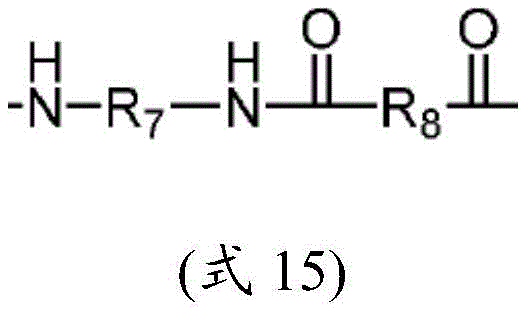
R7基团可以衍生自二氨基化合物,该二氨基化合物包含具有从4至15个碳原子、或从5至10个碳原子、或从6至9个碳原子的脂族基团。二氨基化合物可以包含芳族基团,诸如苯基、萘基、二甲苯基和甲苯基。R7基团可以衍生自的合适的二氨基化合物包括但不限于六亚甲基二胺(HMD)、四亚甲基二胺、三甲基六亚甲基二胺(TMD)、间亚二甲苯基二胺(MXD)和1,5-戊胺二胺(1,5-pentamine diamine)。R8基团可以衍生自二羧酸或其活化形式,包括具有从4至15个碳原子、或从5至12个碳原子、或从6至10个碳原子的脂族基团。R8可以衍生自的二羧酸或其活化形式包括芳族基团,诸如苯基、萘基、二甲苯基和甲苯基基团。R8可以衍生自的合适的羧酸或其活化形式包括己二酸、癸二酸、对苯二甲酸和间苯二甲酸。聚酰胺链可以大体上不含芳族基团。The R7 group can be derived from a diamino compound comprising an aliphatic group having from 4 to 15 carbon atoms, or from 5 to 10 carbon atoms, or from 6 to 9 carbon atoms. Diamino compounds may contain aromatic groups such as phenyl, naphthyl, xylyl, and tolyl. Suitable diamino compounds from which the R group can be derived include, but are not limited to, hexamethylenediamine (HMD), tetramethylenediamine, trimethylhexamethylenediamine (TMD), metadiamine Tolyldiamine (MXD) and 1,5-pentamine diamine. The R8 group can be derived from a dicarboxylic acid or its activated form, including aliphatic groups having from 4 to 15 carbon atoms, or from 5 to 12 carbon atoms, or from 6 to 10 carbon atoms. The dicarboxylic acid from which R8 may be derived, or its activated form, includes aromatic groups such as phenyl, naphthyl, xylyl, and tolyl groups. Suitable carboxylic acids, or activated forms thereof, from which R8 may be derived include adipic acid, sebacic acid, terephthalic acid, and isophthalic acid. The polyamide chain may be substantially free of aromatic groups.
聚酰胺(包括含聚酰胺的嵌段共聚物)的每个聚酰胺链段可以独立地衍生自选自由12-氨基月桂酸、己内酰胺、六亚甲基二胺和己二酸组成的组的聚酰胺预聚物。Each polyamide segment of the polyamide (including polyamide-containing block copolymers) can be independently derived from a polyamide pre-polymer selected from the group consisting of 12-aminolauric acid, caprolactam, hexamethylenediamine, and adipic acid. polymer.
聚酰胺可以包括聚(醚-嵌段-酰胺)或基本上由聚(醚-嵌段-酰胺)组成。聚(醚-嵌段-酰胺)可以由羧酸封端的聚酰胺预聚物与羟基封端的聚醚预聚物缩聚形成聚(醚-嵌段-酰胺)来形成,如式16中所示:The polyamide may comprise or consist essentially of poly(ether-block-amide). The poly(ether-block-amide) can be formed by polycondensation of a carboxylic acid-terminated polyamide prepolymer with a hydroxyl-terminated polyether prepolymer to form a poly(ether-block-amide), as shown in Formula 16:

聚(醚嵌段酰胺)聚合物可以通过含有反应性末端的聚酰胺嵌段与含有反应性末端的聚醚嵌段的缩聚来制备。实例包括:1)含有二胺链末端的聚酰胺嵌段与含有羧酸链末端的聚氧化烯嵌段;2)含有二羧酸链末端的聚酰胺嵌段与含有二胺链末端的聚氧化烯嵌段,所述含有二胺链末端的聚氧化烯嵌段通过已知为聚醚二醇的脂族二羟基化的α-ω聚氧化烯的氰乙基化和氢化获得;3)含有二羧酸链末端的聚酰胺嵌段与聚醚二醇,在这种特定情况下获得的产物是聚醚酯酰胺。聚(醚-嵌段-酰胺)的聚酰胺嵌段可以衍生自内酰胺、氨基酸和/或二氨基化合物与二羧酸,如先前描述的。聚醚嵌段可以衍生自选自由以下组成的组的一种或更多种聚醚:聚环氧乙烷(PEO)、聚环氧丙烷(PPO)、聚四氢呋喃(PTHF)、聚四亚甲基氧醚(PTMO)及其组合。Poly(ether block amide) polymers can be prepared by polycondensation of polyamide blocks containing reactive ends and polyether blocks containing reactive ends. Examples include: 1) polyamide blocks containing diamine chain ends and polyoxyalkylene blocks containing carboxylic acid chain ends; 2) polyamide blocks containing dicarboxylic acid chain ends and polyoxyethylene blocks containing diamine chain ends alkene blocks, said polyoxyalkylene blocks containing diamine chain ends obtained by cyanoethylation and hydrogenation of aliphatic dihydroxylated α-ω polyoxyalkylenes known as polyether diols; 3) containing Polyamide blocks at the end of the dicarboxylic acid chain with polyether diols, the product obtained in this particular case is a polyetheresteramide. The polyamide blocks of the poly(ether-block-amide) can be derived from lactams, amino acids and/or diamino compounds and dicarboxylic acids, as previously described. The polyether block may be derived from one or more polyethers selected from the group consisting of polyethylene oxide (PEO), polypropylene oxide (PPO), polytetrahydrofuran (PTHF), polytetramethylene Oxy ethers (PTMO) and combinations thereof.
聚(醚嵌段酰胺)聚合物可以包括那些包含含有二羧酸链末端的聚酰胺嵌段的聚合物,所述含有二羧酸链末端的聚酰胺嵌段衍生自α,ω-氨基羧酸、内酰胺或二羧酸与二胺在链限制的二羧酸的存在下的缩合。在这种类型的聚(醚嵌段酰胺)聚合物中,可以使用α,ω-氨基羧酸诸如氨基十一烷酸;可以使用内酰胺诸如己内酰胺或月桂酰内酰胺;可以使用二羧酸诸如己二酸、癸二酸或十二烷二酸;并且可以使用二胺诸如六亚甲基二胺;或任何前述的各种组合。该共聚物可以包含聚酰胺嵌段,该聚酰胺嵌段包含聚酰胺12或聚酰胺6。Poly(ether block amide) polymers may include those polymers comprising polyamide blocks containing dicarboxylic acid chain ends derived from α,ω-aminocarboxylic acids Condensation of , lactams or dicarboxylic acids with diamines in the presence of chain-limited dicarboxylic acids. In this type of poly(ether block amide) polymer, α,ω-aminocarboxylic acids such as aminoundecanoic acid can be used; lactams such as caprolactam or lauroyl lactam can be used; dicarboxylic acids such as adipic acid, sebacic acid, or dodecanedioic acid; and diamines such as hexamethylenediamine can be used; or various combinations of any of the foregoing. The copolymer may comprise polyamide blocks comprising polyamide 12 or polyamide 6.
聚(醚嵌段酰胺)聚合物可以包括那些包含聚酰胺嵌段的聚合物,并且是低质量的,即它们具有从400至1000的数均分子量,所述包含聚酰胺嵌段的聚合物衍生自一种或更多种α,ω-氨基羧酸和/或一种或更多种含有从6至12个碳原子的内酰胺在含有从4至12个碳原子的二羧酸的存在下的缩合。在这种类型的聚(醚嵌段酰胺)聚合物中,可以使用α,ω-氨基羧酸诸如氨基十一烷酸或氨基十二烷酸;可以使用二羧酸诸如己二酸、癸二酸、间苯二甲酸、丁二酸、1,4-环己基二甲酸、对苯二甲酸、磺基间苯二甲酸的钠盐或锂盐、二聚脂肪酸(这些二聚脂肪酸具有至少98重量百分比的二聚体含量,并且优选地是氢化的)和十二烷二酸HOOC-(CH2)10-COOH;并且可以使用内酰胺诸如己内酰胺和月桂酰内酰胺;或任何前述的各种组合。该共聚物可以包括聚酰胺嵌段,该聚酰胺嵌段通过月桂酰内酰胺在己二酸或十二烷二酸的存在下的缩合获得,并且数均分子量为至少750,具有从约127℃至约130℃的熔化温度。可以选择聚酰胺嵌段的各种成分及其比例,以便获得低于150℃或从约90℃至约135℃的熔点。The poly(ether block amide) polymers may include those polymers comprising polyamide blocks, and are of low quality, i.e. they have a number average molecular weight from 400 to 1000, the polymers comprising polyamide blocks derived from From one or more α,ω-aminocarboxylic acids and/or one or more lactams containing from 6 to 12 carbon atoms in the presence of a dicarboxylic acid containing from 4 to 12 carbon atoms the condensation. In this type of poly(ether block amide) polymers, α,ω-aminocarboxylic acids such as aminoundecanoic acid or aminododecanoic acid can be used; dicarboxylic acids such as adipic acid, decanedioic acid can be used acid, isophthalic acid, succinic acid, 1,4-cyclohexyldicarboxylic acid, terephthalic acid, sodium or lithium salts of sulfoisophthalic acid, dimerized fatty acids (these dimerized fatty acids have at least 98 wt. percent dimer content, and preferably hydrogenated) and dodecanedioic acid HOOC-(CH 2 ) 10 -COOH; and lactams such as caprolactam and lauroyl lactam may be used; or various combinations of any of the foregoing . The copolymer may comprise polyamide blocks obtained by condensation of lauroyl lactam in the presence of adipic acid or dodecanedioic acid and having a number average molecular weight of at least 750, having a value from about 127°C to a melting temperature of about 130°C. The various components of the polyamide blocks and their ratios can be selected so as to obtain a melting point below 150°C or from about 90°C to about 135°C.
聚(醚嵌段酰胺)聚合物可以包括那些包含聚酰胺嵌段的聚合物,所述包含聚酰胺嵌段的聚合物衍生自至少一种α,ω-氨基羧酸(或内酰胺)、至少一种二胺和至少一种二羧酸的缩合。在这种类型的共聚物中,α,ω-氨基羧酸、内酰胺和二羧酸可以选自上文描述的那些,并且可以使用的二胺可以包括含有从6至12个原子的脂族二胺,并且可以是无环的和/或饱和环状的,诸如但不限于六亚甲基二胺、哌嗪、1-氨基乙基哌嗪、二氨基丙基哌嗪、四亚甲基二胺、八亚甲基二胺、十亚甲基二胺、十二亚甲基二胺、1,5-二氨基己烷、2,2,4-三甲基-1,6-二氨基己烷、二胺多元醇、异佛尔酮二胺(IPD)、甲基五亚甲基二胺(MPDM)、双(氨基环己基)甲烷(BACM)和双(3-甲基-4-氨基环己基)甲烷(BMACM)。Poly(ether block amide) polymers may include those comprising polyamide blocks derived from at least one α,ω-aminocarboxylic acid (or lactam), at least one Condensation of a diamine and at least one dicarboxylic acid. In this type of copolymer, the α,ω-aminocarboxylic acids, lactams and dicarboxylic acids can be selected from those described above, and the diamines that can be used can include aliphatic compounds containing from 6 to 12 atoms Diamines, and may be acyclic and/or saturated cyclic such as, but not limited to, hexamethylenediamine, piperazine, 1-aminoethylpiperazine, diaminopropylpiperazine, tetramethylene Diamine, octamethylenediamine, decamethylenediamine, dodecylenediamine, 1,5-diaminohexane, 2,2,4-trimethyl-1,6-diamino Hexane, diamine polyols, isophorone diamine (IPD), methyl pentamethylene diamine (MPDM), bis(aminocyclohexyl)methane (BACM) and bis(3-methyl-4- aminocyclohexyl)methane (BMACM).
聚酰胺可以是热塑性聚酰胺,并且可以选择聚酰胺嵌段的成分和它们的比例,以便获得小于150℃的熔化温度,诸如从约90℃至约135℃的熔点。可以选择热塑性聚酰胺嵌段的各种成分和它们的比例,以便获得小于150℃的熔点,诸如从约90℃至约135℃的熔点。The polyamide may be a thermoplastic polyamide, and the components of the polyamide blocks and their proportions may be selected so as to obtain a melting temperature of less than 150°C, such as a melting point of from about 90°C to about 135°C. The various components of the thermoplastic polyamide block and their proportions can be selected so as to obtain a melting point of less than 150°C, such as a melting point of from about 90°C to about 135°C.
聚酰胺嵌段的数均摩尔质量可以是从约300克/摩尔至约15,000克/摩尔、从约500克/摩尔至约10,000克/摩尔、从约500克/摩尔至约6,000克/摩尔、从约500克/摩尔至约5,000克/摩尔、或从约600克/摩尔至约5,000克/摩尔。聚醚嵌段的数均分子量可以在从约100至约6,000、从约400至约3000、或从约200至约3,000的范围内。聚(醚嵌段酰胺)聚合物的聚醚(PE)含量(x)可以是从约0.05至约0.8(即,从约5摩尔百分比至约80摩尔百分比)。聚醚嵌段可以以从约10重量百分比至约50重量百分比、从约20重量百分比至约40重量百分比、或从约30重量百分比至约40重量百分比的量存在于聚酰胺中。聚酰胺嵌段可以以从约50重量百分比至约90重量百分比、从约60重量百分比至约80重量百分比、或从约70重量百分比至约90重量百分比的量存在于聚酰胺中。The number average molar mass of the polyamide blocks can be from about 300 grams/mole to about 15,000 grams/mole, from about 500 grams/mole to about 10,000 grams/mole, from about 500 grams/mole to about 6,000 grams/mole, From about 500 g/mole to about 5,000 g/mole, or from about 600 g/mole to about 5,000 g/mole. The number average molecular weight of the polyether blocks can range from about 100 to about 6,000, from about 400 to about 3000, or from about 200 to about 3,000. The polyether (PE) content (x) of the poly(ether block amide) polymer can be from about 0.05 to about 0.8 (ie, from about 5 to about 80 mole percent). The polyether block may be present in the polyamide in an amount from about 10 weight percent to about 50 weight percent, from about 20 weight percent to about 40 weight percent, or from about 30 weight percent to about 40 weight percent. The polyamide block may be present in the polyamide in an amount from about 50 weight percent to about 90 weight percent, from about 60 weight percent to about 80 weight percent, or from about 70 weight percent to about 90 weight percent.
聚醚嵌段可以包含不同于环氧乙烷单元的单元,诸如例如环氧丙烷或聚四氢呋喃(其导致聚丁二醇序列)。还可以同时使用PEG嵌段,即由环氧乙烷单元组成的嵌段;聚丙二醇(PPG)嵌段,即由环氧丙烷单元组成的嵌段;以及聚(四亚甲基醚)二醇(PTMG)嵌段,即由四亚甲基二醇单元组成的嵌段,也被称为聚四氢呋喃。有利地使用PPG嵌段或PTMG嵌段。在这些含有聚酰胺嵌段和聚醚嵌段的共聚物中的聚醚嵌段的量可以是共聚物的从约10重量百分比至约50重量百分比、或从约35重量百分比至约50重量百分比。The polyether blocks may contain units other than ethylene oxide units, such as, for example, propylene oxide or polytetrahydrofuran (which results in polytetramethylene glycol sequences). It is also possible to use simultaneously PEG blocks, i.e. blocks composed of ethylene oxide units; polypropylene glycol (PPG) blocks, i.e. blocks composed of propylene oxide units; and poly(tetramethylene ether) glycols (PTMG) blocks, ie blocks composed of tetramethylene glycol units, are also known as polytetrahydrofuran. PPG blocks or PTMG blocks are advantageously used. The amount of polyether blocks in these copolymers containing polyamide blocks and polyether blocks can be from about 10 weight percent to about 50 weight percent, or from about 35 weight percent to about 50 weight percent of the copolymer .
包含聚酰胺嵌段和聚醚嵌段的共聚物可以通过用于附接聚酰胺嵌段和聚醚嵌段的任何手段来制备。在实践中,基本上使用了两种工艺,一种是两步工艺,并且另一种是一步工艺。Copolymers comprising polyamide blocks and polyether blocks can be prepared by any means for attaching polyamide blocks and polyether blocks. In practice, basically two processes are used, one is a two-step process and the other is a one-step process.
在两步工艺中,首先制备具有二羧酸链末端的聚酰胺嵌段,并且然后在第二步中,将这些聚酰胺嵌段连接到聚醚嵌段。具有二羧酸链末端的聚酰胺嵌段衍生自聚酰胺前体在链终止剂二羧酸的存在下的缩合。如果聚酰胺前体仅是内酰胺或α,ω-氨基羧酸,则添加二羧酸。如果前体已经包含二羧酸,则相对于二胺的化学计量来说,这是过量使用的。反应通常发生在从约180℃至约300℃,诸如从约200℃至约290℃,并且反应器中的压力可以设置为从约5巴至约30巴,并且被维持持续约2至3小时。反应器中的压力慢慢降低到大气压,并然后蒸馏掉过量的水,例如持续一个或两个小时。In a two-step process, polyamide blocks with dicarboxylic acid chain ends are first prepared, and then, in a second step, these polyamide blocks are linked to polyether blocks. The polyamide blocks with dicarboxylic acid chain ends are derived from the condensation of polyamide precursors in the presence of a chain terminator dicarboxylic acid. If the polyamide precursors are only lactams or α,ω-aminocarboxylic acids, dicarboxylic acids are added. If the precursor already contains a dicarboxylic acid, this is used in excess relative to the stoichiometric amount of the diamine. The reaction typically occurs at from about 180°C to about 300°C, such as from about 200°C to about 290°C, and the pressure in the reactor can be set from about 5 bar to about 30 bar and maintained for about 2 to 3 hours . The pressure in the reactor is slowly reduced to atmospheric pressure and then the excess water is distilled off, eg for one or two hours.
在已经制备了具有羧酸端基的聚酰胺之后,接着添加聚醚、多元醇和催化剂。聚醚的总量可以被分成一份或更多份并且以一份或更多份添加,催化剂也是可以这样。首先添加聚醚,并且聚醚和多元醇的OH端基与聚酰胺的COOH端基的反应开始,其中形成酯键并且消除水。通过蒸馏尽可能多地从反应混合物中除去水,且然后引入催化剂以便完成聚酰胺嵌段与聚醚嵌段的连接。该第二步骤在搅拌下进行,优选地在至少50毫巴(5000帕斯卡)的真空下,在使得反应物和获得的共聚物处于熔融状态的温度进行。举例来说,该温度可以是从约100℃至约400℃,诸如从约200℃至约250℃。通过测量聚合物熔体施加在搅拌器上的扭矩或通过测量搅拌器所消耗的电功率来监测反应。反应的结束由扭矩或目标功率的值来确定。催化剂被定义为通过酯化促进聚酰胺嵌段与聚醚嵌段的连接的任何产品。催化剂可以是选自由钛、锆和铪形成的组的金属(M)的衍生物。该衍生物可以由符合通式M(OR)4的四醇盐来制备,其中M代表钛、锆或铪,并且可以相同或不同的R代表具有从1至24个碳原子的直链或支链的烷基基团。After the polyamide with carboxylic acid end groups has been prepared, the polyether, polyol and catalyst are then added. The total amount of polyether can be divided into one or more parts and added in one or more parts, as can the catalyst. The polyether is added first, and the reaction of the OH end groups of the polyether and polyol with the COOH end groups of the polyamide begins, wherein ester bonds are formed and water is eliminated. As much water as possible was removed from the reaction mixture by distillation, and then a catalyst was introduced in order to complete the attachment of the polyamide blocks to the polyether blocks. This second step is carried out with stirring, preferably under a vacuum of at least 50 mbar (5000 Pascals), at a temperature such that the reactants and the copolymer obtained are in a molten state. For example, the temperature may be from about 100°C to about 400°C, such as from about 200°C to about 250°C. The reaction was monitored by measuring the torque exerted by the polymer melt on the stirrer or by measuring the electrical power consumed by the stirrer. The end of the reaction is determined by the value of torque or target power. A catalyst is defined as any product that promotes the attachment of polyamide blocks to polyether blocks by esterification. The catalyst may be a derivative of metal (M) selected from the group formed by titanium, zirconium and hafnium. The derivatives can be prepared from tetraalkoxides according to the general formula M(OR) 4 , wherein M represents titanium, zirconium or hafnium, and R can be the same or different R represents a straight or branched chain having from 1 to 24 carbon atoms chain alkyl group.
催化剂可以包含金属(M)的盐,特别是(M)与有机酸的盐,以及(M)的氧化物和/或(M)的氢氧化物与有机酸的络合盐。有机酸可以是甲酸、乙酸、丙酸、丁酸、戊酸、己酸、辛酸、月桂酸、肉豆蔻酸、棕榈酸、硬脂酸、油酸、亚油酸、亚麻酸、环己烷羧酸、苯乙酸、苯甲酸、水杨酸、草酸、丙二酸、琥珀酸、戊二酸、己二酸、马来酸、富马酸、邻苯二甲酸或巴豆酸。有机酸可以是乙酸或丙酸。M可以是锆,并且这样的盐被称为氧锆基盐(zirconyl salt),例如,以名称乙酸氧锆(zirconyl acetate)出售的可商购的产品。The catalyst may comprise salts of metals (M), especially salts of (M) with organic acids, and complex salts of oxides of (M) and/or hydroxides of (M) with organic acids. The organic acid may be formic acid, acetic acid, propionic acid, butyric acid, valeric acid, caproic acid, caprylic acid, lauric acid, myristic acid, palmitic acid, stearic acid, oleic acid, linoleic acid, linolenic acid, cyclohexanecarboxylic acid acid, phenylacetic acid, benzoic acid, salicylic acid, oxalic acid, malonic acid, succinic acid, glutaric acid, adipic acid, maleic acid, fumaric acid, phthalic acid or crotonic acid. The organic acid can be acetic acid or propionic acid. M may be zirconium, and such salts are known as zirconyl salts, eg, the commercially available product sold under the name zirconyl acetate.
催化剂的重量比例可以从二羧酸聚酰胺与聚醚二醇和多元醇的混合物的重量的约0.01百分比至约5百分比变化。催化剂的重量比例可以从二羧酸聚酰胺与聚醚二醇和多元醇的混合物重量的约0.05百分比至约2百分比变化。The weight ratio of the catalyst may vary from about 0.01 percent to about 5 percent by weight of the mixture of dicarboxylic acid polyamide and polyether diol and polyol. The weight ratio of the catalyst may vary from about 0.05 percent to about 2 percent by weight of the mixture of dicarboxylic acid polyamide and polyether diol and polyol.
在一步工艺中,聚酰胺前体、链终止剂和聚醚被共混在一起;然后所得到的是基本上具有高度可变的长度的聚醚嵌段和聚酰胺嵌段的聚合物,但还有已经无规地反应的多种反应物,这些反应物沿聚合物链无规地分布。它们是与上述两步工艺中相同的反应物和相同的催化剂。如果聚酰胺前体仅仅是内酰胺,则添加少量水是有利的。该共聚物具有基本上相同的聚醚嵌段和相同的聚酰胺嵌段,但还有一小部分已经无规地反应的多种反应物,这些反应物沿聚合物链无规地分布。如在上述两步工艺中的第一步中,反应器被关闭并在搅拌下被加热。确定的压力为从约5巴至约30巴。当压力不再变化时,将反应器置于减压下,同时仍然保持熔融反应物的剧烈搅拌。如先前在两步工艺的情况下那样监测反应。In a one-step process, polyamide precursors, chain terminators, and polyethers are blended together; what is then obtained is essentially a polymer of polyether blocks and polyamide blocks of highly variable length, but also There are a variety of reactants that have reacted randomly, and these reactants are randomly distributed along the polymer chain. They are the same reactants and the same catalysts as in the two-step process described above. If the polyamide precursor is only a lactam, it is advantageous to add a small amount of water. The copolymer has essentially the same polyether blocks and the same polyamide blocks, but also a small fraction of the reactants that have reacted randomly, distributed randomly along the polymer chain. As in the first of the two-step process described above, the reactor is closed and heated with stirring. The determined pressure is from about 5 bar to about 30 bar. When the pressure no longer changed, the reactor was placed under reduced pressure while still maintaining vigorous stirring of the molten reactants. The reaction was monitored as previously in the case of the two-step process.
聚酰胺嵌段与聚醚嵌段的适当比率可以在单一聚(醚嵌段酰胺)中找到,或者可以在适当的平均组成的情况下使用两种或更多种不同组成的聚(醚嵌段酰胺)的共混物。可能有用的是,将具有高水平的聚酰胺基团的嵌段共聚物与具有较高水平的聚醚嵌段的嵌段共聚物共混,以产生具有聚(酰胺-嵌段-醚)共聚物的总共混物的约20重量百分比至约40重量百分比、或约30重量百分比至约35重量百分比的平均聚醚嵌段水平的共混物。该共聚物可以包括两种不同的聚(醚-嵌段-酰胺)的共混物,该共混物包括具有低于35重量百分比的聚醚嵌段水平的至少一种嵌段共聚物和具有至少45重量百分比的聚醚嵌段的第二聚(醚-嵌段-酰胺)。Appropriate ratios of polyamide blocks to polyether blocks can be found in a single poly(ether block amide), or two or more poly(ether blocks of different compositions can be used with an appropriate average composition amides). It may be useful to blend block copolymers with high levels of polyamide groups with block copolymers with higher levels of polyether blocks to produce copolymers with poly(amide-block-ether) A blend at an average polyether block level of from about 20 weight percent to about 40 weight percent, or from about 30 weight percent to about 35 weight percent of the total blend of compounds. The copolymer may include a blend of two different poly(ether-block-amide)s, the blend including at least one block copolymer having a polyether block level of less than 35 weight percent and having At least 45 weight percent polyether blocks of the second poly(ether-block-amide).
示例性的可商购的共聚物包括但不限于以以下商标可得的共聚物或还有由其他各供应商生产的其他类似材料:“VESTAMID”(Evonik Industries,Essen,Germany);“PLATAMID”(Arkema,Colombes,France),例如,产品代码H2694;“PEBAX”(Arkema),例如产品代码“PEBAX MH1657”和“PEBAX MV1074”;“PEBAX RNEW”(Arkema);“GRILAMID”(EMS-Chemie AG,Domat-Ems,Switzerland)。Exemplary commercially available copolymers include, but are not limited to, copolymers available under the following trademarks or also other similar materials produced by various other suppliers: "VESTAMID" (Evonik Industries, Essen, Germany); "PLATAMID" (Arkema, Colombes, France), e.g. product code H2694; "PEBAX" (Arkema), e.g. product code "PEBAX MH1657" and "PEBAX MV1074"; "PEBAX RNEW" (Arkema); "GRILAMID" (EMS-Chemie AG) , Domat-Ems, Switzerland).
聚酰胺可以通过例如聚合物的聚酰胺基团之间的非极性或极性的相互作用被物理交联。在聚酰胺是共聚酰胺的实例中,共聚酰胺可以通过聚酰胺基团之间的相互作用以及任选地通过共聚物基团之间的相互作用被物理交联。当共聚酰胺通过聚酰胺基团之间的相互作用被物理交联时,聚酰胺链段可以形成被称为硬链段的聚合物的部分,并且共聚物链段可以形成被称为软链段的聚合物的部分。例如,当共聚酰胺是聚(醚-嵌段-酰胺)时,聚酰胺链段形成聚合物的硬链段,并且聚醚链段形成聚合物的软链段。因此,在一些实例中,聚合物可以包括物理交联的聚合物网络,该聚合物网络具有一个或更多个带有酰胺键的聚合物链。Polyamides can be physically crosslinked by, for example, non-polar or polar interactions between the polyamide groups of the polymer. In instances where the polyamide is a copolyamide, the copolyamide may be physically crosslinked through interactions between polyamide groups and optionally through interactions between copolymer groups. When the copolyamide is physically crosslinked through interactions between polyamide groups, the polyamide segments can form parts of the polymer known as hard segments, and the copolymer segments can form what are known as soft segments part of the polymer. For example, when the copolyamide is a poly(ether-block-amide), the polyamide segments form the hard segments of the polymer, and the polyether segments form the soft segments of the polymer. Thus, in some examples, a polymer may comprise a physically cross-linked polymer network having one or more polymer chains with amide linkages.
共聚酰胺的聚酰胺链段可以包括聚酰胺-11或聚酰胺-12,并且聚醚链段可以是选自由以下组成的组的链段:聚环氧乙烷链段、聚环氧丙烷链段和聚四亚甲基氧醚链段及其组合。The polyamide segment of the copolyamide may comprise polyamide-11 or polyamide-12, and the polyether segment may be a segment selected from the group consisting of polyethylene oxide segments, polypropylene oxide segments and polytetramethylene oxide segments and combinations thereof.
聚酰胺可以部分或完全共价交联,如本文先前描述的。在一些情况下,聚酰胺中存在的交联度为使得,当其被热加工,例如以纱线或纤维的形式,以形成本公开内容的物品时,部分共价交联的热塑性聚酰胺保留足够的热塑性特征,使得部分共价交联的热塑性聚酰胺在加工期间熔化并且再固化。在其他情况下,交联聚酰胺是热固性聚合物。Polyamides can be partially or fully covalently cross-linked, as previously described herein. In some cases, the degree of crosslinking present in the polyamide is such that the partially covalently crosslinked thermoplastic polyamide remains when it is thermally processed, such as in the form of yarns or fibers, to form articles of the present disclosure Sufficient thermoplastic characteristics such that the partially covalently crosslinked thermoplastic polyamide melts and resolidifies during processing. In other cases, the cross-linked polyamide is a thermoset polymer.
聚酯polyester
聚合物可以包括聚酯。聚酯可以包括热塑性聚酯或热固性聚酯。此外,聚酯可以是弹性聚酯,包括热塑性聚酯;或热固性弹性聚酯。聚酯可以通过一种或更多种羧酸或其成酯衍生物(ester-forming derivative)与一种或更多种二价或多价的脂族醇、脂环族醇、芳族醇或芳代脂族醇(araliphatic alcohol)或双酚的反应来形成。聚酯可以是具有相同化学结构的重复聚酯链段的聚酯均聚物。可选择地,聚酯可以包含许多具有不同聚酯化学结构的聚酯链段(例如聚乙醇酸链段、聚乳酸链段、聚己内酯链段、聚羟基链烷酸酯链段(polyhydroxyalkanoate segment)、聚羟基丁酸酯链段等)。具有不同化学结构的聚酯链段可以无规地排列,或者可以排列为重复嵌段。The polymer can include polyester. Polyesters may include thermoplastic polyesters or thermoset polyesters. In addition, the polyesters can be elastic polyesters, including thermoplastic polyesters; or thermoset elastic polyesters. Polyesters can be prepared by combining one or more carboxylic acids or ester-forming derivatives thereof with one or more divalent or polyvalent aliphatic, cycloaliphatic, aromatic alcohols or formed by the reaction of araliphatic alcohols or bisphenols. The polyester may be a polyester homopolymer having repeating polyester segments of the same chemical structure. Alternatively, the polyester may comprise a number of polyester segments (eg, polyglycolic acid segments, polylactic acid segments, polycaprolactone segments, polyhydroxyalkanoate segments) having different polyester chemical structures segment), polyhydroxybutyrate segment, etc.). Polyester segments with different chemical structures can be arranged randomly, or can be arranged as repeating blocks.
可以用于制备聚酯的示例性羧酸包括但不限于己二酸、庚二酸、辛二酸、壬二酸、癸二酸、壬烷二甲酸、癸烷二甲酸、十一烷二甲酸、对苯二甲酸、间苯二甲酸、烷基取代的或卤化的对苯二甲酸、烷基取代的或卤化的间苯二甲酸、硝基-对苯二甲酸、4,4'-二苯醚二甲酸、4,4'-二苯硫醚二甲酸、4,4'-二苯砜-二甲酸、4,4'-二苯基亚烷基二甲酸、萘-2,6-二甲酸、环己烷-1,4-二甲酸和环己烷-1,3-二甲酸。适用于制备聚酯的示例性二醇或酚包括但不限于乙二醇、二乙二醇、1,3-丙二醇、1,4-丁二醇、1,6-己二醇、1,8-辛二醇、1,10-癸二醇、1,2-丙二醇、2,2-二甲基-1,3-丙二醇、2,2,4-三甲基己二醇、对-二甲苯二醇、1,4-环己二醇、1,4-环己烷二甲醇和双酚A。Exemplary carboxylic acids that can be used to prepare polyesters include, but are not limited to, adipic acid, pimelic acid, suberic acid, azelaic acid, sebacic acid, nonanedicarboxylic acid, decanedicarboxylic acid, undecanedicarboxylic acid , terephthalic acid, isophthalic acid, alkyl-substituted or halogenated terephthalic acid, alkyl-substituted or halogenated isophthalic acid, nitro-terephthalic acid, 4,4'-diphenyl Ether dicarboxylic acid, 4,4'-diphenyl sulfide dicarboxylic acid, 4,4'-diphenylsulfone-dicarboxylic acid, 4,4'-diphenylalkylene dicarboxylic acid, naphthalene-2,6-dicarboxylic acid , cyclohexane-1,4-dicarboxylic acid and cyclohexane-1,3-dicarboxylic acid. Exemplary diols or phenols suitable for use in making polyesters include, but are not limited to, ethylene glycol, diethylene glycol, 1,3-propanediol, 1,4-butanediol, 1,6-hexanediol, 1,8 -Octanediol, 1,10-decanediol, 1,2-propanediol, 2,2-dimethyl-1,3-propanediol, 2,2,4-trimethylhexanediol, p-xylene Diol, 1,4-cyclohexanediol, 1,4-cyclohexanedimethanol and bisphenol A.
聚酯可以是聚对苯二甲酸丁二醇酯(PBT)、聚对苯二甲酸丙二醇酯、聚对苯二甲酸六亚甲基酯、聚对苯二甲酸-1,4-二甲基环己烷酯、聚对苯二甲酸乙二醇酯(PET)、聚间苯二甲酸乙二醇酯(PEI)、聚芳酯(PAR)、聚萘二甲酸丁二醇酯(PBN)、液晶聚酯,或前述中的两种或更多种的共混物或混合物。The polyester can be polybutylene terephthalate (PBT), polytrimethylene terephthalate, polyhexamethylene terephthalate, poly-1,4-dimethyl terephthalate Hexyl ester, polyethylene terephthalate (PET), polyethylene isophthalate (PEI), polyarylate (PAR), polybutylene naphthalate (PBN), liquid crystal Polyester, or a blend or mixture of two or more of the foregoing.
聚酯可以是共聚酯(即,包含聚酯链段和非聚酯链段的共聚物)。共聚酯可以是脂族共聚酯(即,其中聚酯链段和非聚酯链段两者都是脂族的共聚酯)。可选择地,共聚酯可以包含芳族链段。共聚酯的聚酯链段可以包括以下或基本上由以下组成:聚乙醇酸链段、聚乳酸链段、聚己内酯链段、聚羟基链烷酸酯链段、聚羟基丁酸酯链段或其任何组合。共聚酯的聚酯链段可以无规地排列,或者可以排列为重复嵌段。The polyester may be a copolyester (ie, a copolymer comprising polyester segments and non-polyester segments). The copolyester may be an aliphatic copolyester (ie, a copolyester in which both the polyester segment and the non-polyester segment are aliphatic). Alternatively, the copolyester may contain aromatic segments. The polyester segment of the copolyester may comprise or consist essentially of the following: polyglycolic acid segment, polylactic acid segment, polycaprolactone segment, polyhydroxyalkanoate segment, polyhydroxybutyrate segments or any combination thereof. The polyester segments of the copolyester may be arranged randomly, or may be arranged as repeating blocks.
例如,聚酯可以是嵌段共聚酯,该嵌段共聚酯具有是相对较硬的、相同化学结构的聚合物单元的重复嵌段(硬链段)以及是相对较软的、相同化学结构的重复嵌段(软链段)。在包括具有重复的硬链段和软链段的嵌段共聚酯的嵌段共聚酯中,物理交联可以存在于嵌段内或嵌段之间,或嵌段内和嵌段之间两者。聚合物可以包括具有重复嵌段的硬链段和重复嵌段的软链段的弹性共聚酯或基本上由这样的弹性共聚酯组成。For example, the polyester may be a block copolyester having repeating blocks (hard segments) of polymer units that are relatively hard, of the same chemical structure, and relatively soft, of the same chemical structure Repeating blocks (soft segments) of the structure. In block copolyesters comprising block copolyesters with repeating hard and soft segments, physical crosslinks may exist within or between blocks, or within and between blocks both. The polymer may comprise or consist essentially of an elastomeric copolyester having repeating block hard segments and repeating block soft segments.
共聚酯的非聚酯链段可以包括以下或基本上由以下组成:聚醚链段、聚酰胺链段或聚醚链段和聚酰胺链段两者。共聚酯可以是嵌段共聚酯,或者可以是无规共聚酯。共聚酯可以由聚酯低聚物或预聚物与第二低聚物预聚物缩聚形成嵌段共聚酯来形成。任选地,第二预聚物可以是亲水性预聚物。例如,共聚酯可以由对苯二甲酸或萘二甲酸与乙二醇、1,4-丁二醇或1,3-丙二醇的缩聚反应来形成。共聚酯的实例包括聚己二酸乙二醇酯、聚丁二酸丁二醇酯、聚(3-羟基丁酸酯-共-3-羟基戊酸酯)、聚对苯二甲酸乙二醇酯、聚对苯二甲酸丁二醇酯、聚对苯二甲酸丙二醇酯、聚萘二甲酸乙二醇酯及其组合。共聚酰胺可以包括聚对苯二甲酸乙二醇酯或由聚对苯二甲酸乙二醇酯组成。The non-polyester segments of the copolyester may include or consist essentially of polyether segments, polyamide segments, or both polyether and polyamide segments. The copolyester can be a block copolyester, or it can be a random copolyester. Copolyesters can be formed by polycondensing a polyester oligomer or prepolymer with a second oligomer prepolymer to form a block copolyester. Optionally, the second prepolymer can be a hydrophilic prepolymer. For example, copolyesters can be formed by the polycondensation of terephthalic acid or naphthalenedicarboxylic acid with ethylene glycol, 1,4-butanediol, or 1,3-propanediol. Examples of copolyesters include polyethylene adipate, polybutylene succinate, poly(3-hydroxybutyrate-co-3-hydroxyvalerate), polyethylene terephthalate Alcohol esters, polybutylene terephthalate, polytrimethylene terephthalate, polyethylene naphthalate, and combinations thereof. The copolyamide may comprise or consist of polyethylene terephthalate.
聚酯可以是包含以下中的一种或更多种的链段的嵌段共聚物:聚对苯二甲酸丁二醇酯(PBT)、聚对苯二甲酸丙二醇酯、聚对苯二甲酸六亚甲基酯、聚对苯二甲酸-1,4-二甲基环己烷酯、聚对苯二甲酸乙二醇酯(PET)、聚间苯二甲酸乙二醇酯(PEI)、聚芳酯(PAR)、聚萘二甲酸丁二醇酯(PBN)和液晶聚酯。例如,作为嵌段共聚物的合适的聚酯可以是PET/PEI共聚物、聚对苯二甲酸丁二醇酯/四乙二醇共聚物、聚氧化烯二酰亚胺二酸/聚对苯二甲酸丁二醇酯共聚物、或前述中的任何共聚物的共混物或混合物。The polyester may be a block copolymer comprising segments of one or more of the following: polybutylene terephthalate (PBT), polytrimethylene terephthalate, polyhexamethylene terephthalate Methylene ester, polyethylene terephthalate (1,4-dimethylcyclohexane), polyethylene terephthalate (PET), polyethylene isophthalate (PEI), polyethylene Aryl esters (PAR), polybutylene naphthalate (PBN) and liquid crystal polyesters. For example, suitable polyesters as block copolymers may be PET/PEI copolymers, polybutylene terephthalate/tetraethylene glycol copolymers, polyoxyalkylene diimide diacids/polyterephenylene Butylene dicarboxylate copolymer, or a blend or mixture of any of the foregoing.
聚酯可以是生物可降解树脂,例如其中聚(α-羟基酸)诸如聚乙醇酸或聚乳酸作为主要重复单元被包含的共聚聚酯。The polyester may be a biodegradable resin such as a copolyester in which a poly(alpha-hydroxy acid) such as polyglycolic acid or polylactic acid is contained as the main repeating unit.
所公开的聚酯可以通过技术人员已知的多种缩聚方法来制备,诸如溶剂聚合工艺或熔体聚合工艺。The disclosed polyesters can be prepared by a variety of polycondensation methods known to the skilled artisan, such as solvent polymerization processes or melt polymerization processes.
聚烯烃Polyolefin
聚合物可以包括聚烯烃或基本上由聚烯烃组成。聚烯烃可以是热塑性聚烯烃或热固性聚烯烃。此外,聚烯烃可以是弹性聚烯烃,包括热塑性弹性聚烯烃或热固性弹性聚烯烃。示例性聚烯烃可以包括聚乙烯、聚丙烯和烯烃弹性体(例如,乙烯与具有4至约8个碳原子的α-烯烃的茂金属催化的嵌段共聚物)。聚烯烃可以是包括以下的聚合物:聚乙烯、乙烯-α-烯烃共聚物、乙烯-丙烯橡胶(EPDM)、聚丁烯、聚异丁烯、聚-4-甲基戊-1-烯、聚异戊二烯、聚丁二烯、乙烯-甲基丙烯酸共聚物和烯烃弹性体,诸如从聚丙烯(PP)和乙烯-丙烯橡胶(EPDM)获得的动态交联聚合物(dynamically cross-linked polymer),以及前述的共混物或混合物。另外的示例性聚烯烃包括环烯烃诸如环戊烯或降冰片烯的聚合物。The polymer may comprise or consist essentially of polyolefin. The polyolefin may be a thermoplastic polyolefin or a thermoset polyolefin. Additionally, the polyolefin may be an elastomeric polyolefin, including thermoplastic elastomeric polyolefins or thermoset elastomeric polyolefins. Exemplary polyolefins may include polyethylene, polypropylene, and olefin elastomers (eg, metallocene-catalyzed block copolymers of ethylene and alpha-olefins having 4 to about 8 carbon atoms). The polyolefin may be a polymer including the following: polyethylene, ethylene-alpha-olefin copolymer, ethylene-propylene rubber (EPDM), polybutene, polyisobutylene, poly-4-methylpent-1-ene, polyisobutylene Pentadiene, polybutadiene, ethylene-methacrylic acid copolymers and olefin elastomers such as dynamically cross-linked polymers obtained from polypropylene (PP) and ethylene-propylene rubber (EPDM) , and the aforementioned blends or mixtures. Additional exemplary polyolefins include polymers of cyclic olefins such as cyclopentene or norbornene.
应当理解的是,可以任选地交联的聚乙烯包括多种聚乙烯,包括低密度聚乙烯(LDPE)、线型低密度聚乙烯(LLDPE)、(VLDPE)和(ULDPE)、中密度聚乙烯(MDPE)、高密度聚乙烯(HDPE)、高密度和高分子量聚乙烯(HDPE-HMW)、高密度和超高分子量聚乙烯(HDPE-UHMW),以及任何前述聚乙烯的共混物或混合物。聚乙烯还可以是衍生自与以下物质共聚的、单烯烃和二烯烃的单体的聚乙烯共聚物:乙烯基、丙烯酸、甲基丙烯酸、丙烯酸乙酯、乙烯醇和/或乙酸乙烯酯。包含乙酸乙烯酯衍生的单元的聚烯烃共聚物可以是高乙酸乙烯酯含量的共聚物,例如大于约50重量百分比的乙酸乙烯酯衍生的组成。It should be understood that polyethylenes that may optionally be crosslinked include a variety of polyethylenes including low density polyethylene (LDPE), linear low density polyethylene (LLDPE), (VLDPE) and (ULDPE), medium density polyethylene Ethylene (MDPE), High Density Polyethylene (HDPE), High Density and High Molecular Weight Polyethylene (HDPE-HMW), High Density and Ultra High Molecular Weight Polyethylene (HDPE-UHMW), and blends or mixture. The polyethylene may also be a polyethylene copolymer derived from monomers of mono- and di-olefins copolymerized with vinyl, acrylic acid, methacrylic acid, ethyl acrylate, vinyl alcohol and/or vinyl acetate. The polyolefin copolymer comprising vinyl acetate derived units may be a high vinyl acetate content copolymer, eg, greater than about 50 weight percent vinyl acetate derived composition.
聚烯烃可以通过本领域技术人员熟知的方法(例如,使用过氧化物引发剂、热和/或光)经由自由基聚合、阳离子聚合和/或阴离子聚合来形成。所公开的聚烯烃可以在高压下和在升高的温度通过自由基聚合制备。可选择地,聚烯烃可以通过使用催化剂的催化聚合来制备,所述催化剂通常含有来自IVb族、Vb族、VIb族或VIII族的金属的一种或更多种金属。催化剂通常具有与IVb族、Vb族、VIb族或VIII族金属络合的一种或多于一种配体,通常是氧化物、卤化物、醇化物、酯、醚、胺、烷基、烯基和/或可以对位配位或邻位配位的芳基。金属络合物可以呈游离形式或固定在基底上,通常固定在活化的氯化镁、氯化钛(III)、氧化铝或氧化硅上。金属催化剂可以可溶于或不溶于聚合介质。催化剂可以单独用于聚合,或者可以使用另外的活化剂,通常是Ia族、IIa族和/或IIIa族金属烷基类、金属氢化物、金属烷基卤化物、金属烷基氧化物或金属烷基氧烷(metal alkyloxane)。活化剂可以方便地用另外的酯基团、醚基团、胺基团或甲硅烷基醚基团改性。Polyolefins can be formed via free radical, cationic, and/or anionic polymerization by methods well known to those skilled in the art (eg, using peroxide initiators, heat, and/or light). The disclosed polyolefins can be prepared by free radical polymerization at elevated pressures and at elevated temperatures. Alternatively, polyolefins can be prepared by catalytic polymerization using catalysts that typically contain one or more metals from Group IVb, Group Vb, Group VIb, or Group VIII metals. Catalysts typically have one or more than one ligand, typically oxides, halides, alcoholates, esters, ethers, amines, alkyls, alkenes, complexed with Group IVb, Vb, VIb, or VIII metals radicals and/or aryl radicals which can be para- or ortho-coordinated. The metal complexes can be in free form or immobilized on substrates, typically on activated magnesium chloride, titanium(III) chloride, alumina or silica. The metal catalyst can be soluble or insoluble in the polymerization medium. The catalyst may be used alone for the polymerization, or an additional activator may be used, typically a Group Ia, IIa, and/or Group IIIa metal alkyl, metal hydride, metal alkyl halide, metal alkyl oxide, or metal alkane Metal alkyloxane. The activator can conveniently be modified with additional ester groups, ether groups, amine groups or silyl ether groups.
合适的聚烯烃可以通过如本文描述的单烯烃和二烯烃的单体的聚合来制备。可以用于制备聚烯烃的示例性单体包括但不限于乙烯、丙烯、1-丁烯、1-戊烯、1-己烯、2-甲基-1-丙烯、3-甲基-1-戊烯、4-甲基-1-戊烯、5-甲基-1-己烯及其混合物。Suitable polyolefins can be prepared by the polymerization of monomers of mono- and di-olefins as described herein. Exemplary monomers that can be used to prepare polyolefins include, but are not limited to, ethylene, propylene, 1-butene, 1-pentene, 1-hexene, 2-methyl-1-propene, 3-methyl-1- Pentene, 4-methyl-1-pentene, 5-methyl-1-hexene and mixtures thereof.
合适的乙烯-α-烯烃共聚物可以通过乙烯与具有3至12的碳数的α-烯烃诸如丙烯、1-丁烯、1-己烯、辛烯-1,4-甲基-1-戊烯或类似物的共聚来获得。Suitable ethylene-α-olefin copolymers can be obtained by combining ethylene with an α-olefin having a carbon number of 3 to 12 such as propylene, 1-butene, 1-hexene, octene-1,4-methyl-1-pentene It can be obtained by the copolymerization of alkene or the like.
合适的动态交联聚合物可以通过使作为软链段的橡胶组分交联,而同时通过使用诸如班伯里混合机(Banbury mixer)和双轴挤出机的捏合机将诸如PP的硬链段和诸如EPDM的软链段物理分散来获得。A suitable dynamically cross-linked polymer can be obtained by cross-linking the rubber component as a soft segment, while at the same time a hard chain such as PP is mixed by using a kneader such as a Banbury mixer and a biaxial extruder. Segments and soft segments such as EPDM are physically dispersed.
聚烯烃可以是聚烯烃的混合物,诸如本文上文公开的两种或更多种聚烯烃的混合物。例如,合适的聚烯烃混合物可以是聚丙烯与聚异丁烯的混合物、聚丙烯与聚乙烯的混合物(例如PP/HDPE、PP/LDPE)或不同类型的聚乙烯的混合物(例如LDPE/HDPE)。The polyolefin may be a mixture of polyolefins, such as a mixture of two or more of the polyolefins disclosed herein above. For example, suitable polyolefin mixtures may be polypropylene and polyisobutylene, polypropylene and polyethylene (eg PP/HDPE, PP/LDPE) or mixtures of different types of polyethylene (eg LDPE/HDPE).
聚烯烃可以是合适的单烯烃单体的共聚物或合适的单烯烃单体与乙烯基单体的共聚物。示例性聚烯烃共聚物包括乙烯/丙烯共聚物、线型低密度聚乙烯(LLDPE),及其与低密度聚乙烯(LDPE)、丙烯/丁-1-烯共聚物、丙烯/异丁烯共聚物、乙烯/丁-1-烯共聚物、乙烯/己烯共聚物、乙烯/甲基戊烯共聚物、乙烯/庚烯共聚物、乙烯/辛烯共聚物、丙烯/丁二烯共聚物、异丁烯/异戊二烯共聚物、乙烯/丙烯酸烷基酯共聚物、乙烯/甲基丙烯酸烷基酯共聚物、乙烯/乙酸乙烯酯共聚物的混合物,及其与一氧化碳或乙烯/丙烯酸共聚物的共聚物,及其盐(离聚物),以及乙烯与丙烯和诸如己二烯、二环戊二烯或亚乙基-降冰片烯的二烯的三元共聚物;以及这样的共聚物彼此之间以及与上文1)中提及的聚合物的混合物,例如聚丙烯/乙烯-丙烯共聚物、LDPE/乙烯-乙酸乙烯酯共聚物(EVA)、LDPE/乙烯-丙烯酸共聚物(EAA)、LLDPE/EVA、LLDPE/EAA以及交替或无规的聚亚烷基/一氧化碳共聚物(alternatingor random polyalkylene/carbon monoxide copolymer)及其与其他聚合物例如聚酰胺的混合物。The polyolefin may be a copolymer of a suitable monoolefin monomer or a copolymer of a suitable monoolefin monomer and a vinyl monomer. Exemplary polyolefin copolymers include ethylene/propylene copolymers, linear low density polyethylene (LLDPE), and combinations thereof with low density polyethylene (LDPE), propylene/but-1-ene copolymers, propylene/isobutylene copolymers, Ethylene/but-1-ene copolymer, ethylene/hexene copolymer, ethylene/methylpentene copolymer, ethylene/heptene copolymer, ethylene/octene copolymer, propylene/butadiene copolymer, isobutylene/ Isoprene copolymers, ethylene/alkyl acrylate copolymers, ethylene/alkyl methacrylate copolymers, mixtures of ethylene/vinyl acetate copolymers, and copolymers thereof with carbon monoxide or ethylene/acrylic acid copolymers , and their salts (ionomers), and terpolymers of ethylene with propylene and dienes such as hexadiene, dicyclopentadiene or ethylene-norbornene; and with each other such copolymers and mixtures with the polymers mentioned in 1) above, such as polypropylene/ethylene-propylene copolymer, LDPE/ethylene-vinyl acetate copolymer (EVA), LDPE/ethylene-acrylic acid copolymer (EAA), LLDPE /EVA, LLDPE/EAA and alternating or random polyalkylene/carbon monoxide copolymers and their mixtures with other polymers such as polyamides.
聚烯烃可以是聚丙烯均聚物、聚丙烯共聚物、聚丙烯无规共聚物、聚丙烯嵌段共聚物、聚乙烯均聚物、聚乙烯无规共聚物、聚乙烯嵌段共聚物、低密度聚乙烯(LDPE)、线型低密度聚乙烯(LLDPE)、中密度聚乙烯、高密度聚乙烯(HDPE),或者前述聚合物中的一种或更多种的共混物或混合物。The polyolefin can be polypropylene homopolymer, polypropylene copolymer, polypropylene random copolymer, polypropylene block copolymer, polyethylene homopolymer, polyethylene random copolymer, polyethylene block copolymer, low Density polyethylene (LDPE), linear low density polyethylene (LLDPE), medium density polyethylene, high density polyethylene (HDPE), or a blend or mixture of one or more of the foregoing polymers.
聚烯烃可以是聚丙烯。如本文使用的,术语“聚丙烯”意图涵盖任何包含丙烯单体的聚合物组合物,所述丙烯单体是单独的或是与其他无规选择和定向的聚烯烃、二烯或其他单体(诸如乙烯、丁烯及类似物)的混合物或共聚物。这样的术语还涵盖成分单体的任何不同的构型和排列(诸如无规立构、间规立构、全同立构等)。因此,如应用于纤维的该术语意图涵盖拉制聚合物(drawn polymer)的实际的长线、带、缝线及类似物。聚丙烯可以具有任何标准熔体流动(通过测试);然而,标准纤维级聚丙烯树脂具有在约1和1000之间的熔体流动指数范围。The polyolefin may be polypropylene. As used herein, the term "polypropylene" is intended to encompass any polymer composition comprising propylene monomer, alone or in combination with other randomly selected and oriented polyolefins, dienes or other monomers (such as ethylene, butene, and the like) mixtures or copolymers. Such terms also encompass any different configurations and arrangements of the constituent monomers (such as atactic, syndiotactic, isotactic, etc.). Thus, the term as applied to fibers is intended to encompass actual long threads, tapes, sutures and the like of drawn polymers. Polypropylene can have any standard melt flow (by testing); however, standard fiber grade polypropylene resins have a melt flow index range between about 1 and 1000.
聚烯烃可以是聚乙烯。如本文使用的,术语“聚乙烯”意图涵盖任何包含乙烯单体的聚合物组合物,所述乙烯单体是单独的或是与其他无规选择和定向的聚烯烃、二烯或其他单体(诸如丙烯、丁烯及类似物)的混合物或共聚物。这样的术语还涵盖成分单体的任何不同的构型和排列(诸如无规立构、间规立构、全同立构等)。因此,如应用于纤维的该术语意图涵盖拉制聚合物的实际的长线、带、缝线及类似物。聚乙烯可以具有任何标准熔体流动(通过测试);然而,标准纤维级聚乙烯树脂具有在约1和1000之间的熔体流动指数范围。The polyolefin may be polyethylene. As used herein, the term "polyethylene" is intended to encompass any polymer composition comprising ethylene monomer, alone or in combination with other randomly selected and oriented polyolefins, dienes or other monomers (such as propylene, butene and the like) mixtures or copolymers. Such terms also encompass any different configurations and arrangements of the constituent monomers (such as atactic, syndiotactic, isotactic, etc.). Thus, the term as applied to fibers is intended to encompass actual long threads, tapes, sutures, and the like from which polymers are drawn. Polyethylene can have any standard melt flow (by test); however, standard fiber grade polyethylene resins have a melt flow index range between about 1 and 1000.
热塑性材料和/或热固性材料还可以包括一种或更多种加工助剂。加工助剂可以是非聚合物材料。这些加工助剂可以独立地选自包括但不限于以下的组:固化剂、引发剂、增塑剂、脱模剂、润滑剂、抗氧化剂、阻燃剂、染料、颜料、增强填料和非增强填料、纤维增强剂和光稳定剂。The thermoplastic and/or thermoset may also include one or more processing aids. Processing aids can be non-polymeric materials. These processing aids may be independently selected from the group including, but not limited to, curing agents, initiators, plasticizers, mold release agents, lubricants, antioxidants, flame retardants, dyes, pigments, reinforcing fillers, and non-reinforcing agents Fillers, fiber reinforcements and light stabilizers.
现在转到光学元件可以布置到(例如,附连或粘附到)其上的第一热塑性材料,提供了关于组合物的另外的细节。在一个方面中,光学元件布置到其上的热塑性材料(例如,第一纱线)可以具有约80℃至约140℃的软化点或熔点。在另一个方面中,将热塑性材料升高到处于或高于蠕变松弛温度(Tcr)、维卡软化温度(Tvs)、热变形温度(Thd)和/或熔化温度(Tm)的温度,并且然后将光学元件布置到热塑性材料。在一个方面中,当温度保持处于或高于热塑性材料的蠕变松弛温度、热变形温度、维卡软化温度或熔化温度时,光学元件可以被布置到热塑性材料上。在另一个方面中,在允许温度下降到低于热塑性材料的蠕变松弛温度、热变形温度、维卡软化温度或熔化温度之后,光学元件可以被附连到热塑性材料上,只要热塑性材料仅部分地再固化并且光学元件可以附连到热塑性材料。Turning now to the first thermoplastic material to which the optical element may be disposed (eg, attached or adhered), additional details regarding the composition are provided. In one aspect, the thermoplastic material (eg, the first yarn) onto which the optical element is disposed may have a softening or melting point of about 80°C to about 140°C. In another aspect, the thermoplastic is raised to at or above the creep relaxation temperature (T cr ), Vicat softening temperature (T vs ), heat distortion temperature (T hd ), and/or melting temperature (T m ) temperature, and then arrange the optical element to the thermoplastic material. In one aspect, the optical element may be disposed on the thermoplastic material while the temperature is maintained at or above the creep relaxation temperature, heat distortion temperature, Vicat softening temperature, or melting temperature of the thermoplastic material. In another aspect, after allowing the temperature to drop below the creep relaxation temperature, heat distortion temperature, Vicat softening temperature, or melting temperature of the thermoplastic material, the optical element can be attached to the thermoplastic material, so long as the thermoplastic material is only partially re-cured and the optical element can be attached to the thermoplastic.
通常,热塑性材料可以具有约80℃至约140℃、或从约90℃至约130℃、或约100℃至约120℃的蠕变松弛温度(Tcr)。通常,热塑性材料可以具有约80℃至约140℃、或从约90℃至约130℃、或约100℃至约120℃的维卡软化温度(Tvs)。通常,热塑性材料可以具有约80℃至约140℃、或从约90℃至约130℃、或约100℃至约120℃的热变形温度(Thd)。通常,热塑性材料可以具有约80℃至约140℃、或从约90℃至约130℃、或约100℃至约120℃的熔化温度(Tm)。Typically, the thermoplastic material can have a creep relaxation temperature ( Tcr ) of from about 80°C to about 140°C, or from about 90°C to about 130°C, or from about 100°C to about 120°C. Typically, the thermoplastic material may have a Vicat softening temperature (T vs ) of from about 80°C to about 140°C, or from about 90°C to about 130°C, or from about 100°C to about 120°C. Typically, the thermoplastic material may have a heat distortion temperature (T hd ) of from about 80°C to about 140°C, or from about 90°C to about 130°C, or from about 100°C to about 120°C. Typically, the thermoplastic material can have a melting temperature ( Tm ) of from about 80°C to about 140°C, or from about 90°C to about 130°C, or from about 100°C to about 120°C.
在包括纺织品的物品中,光学元件可以被布置到纺织品上。纺织品或纺织品的至少外层可以包括光学元件可以被布置到其上的热塑性材料。纺织品可以是非编织纺织品、合成皮革、针织纺织品或编织纺织品。纺织品可以包括第一纤维或第一纱线,其中第一纤维或第一纱线可以包括由第一热塑性材料形成的至少外层。光学元件被布置到其上的、结构的第一侧面或第二侧面的区可以包括呈非丝状构造的第一纤维或第一纱线。光学元件可以被布置到纺织品上,或者纺织品可以被加工,使得光学元件可以被布置到纺织品上。纹理化的表面可以由纺织品表面制成或由纺织品表面形成。底漆层可以被布置在纺织品表面上,并且然后光学元件可以被布置到底漆层上。纺织品表面可以用于形成纹理化的表面,且在此之前或之后,在将光学元件布置到纺织品之前,底漆层可以任选地被施加到纹理化的表面。In articles comprising textiles, the optical elements may be arranged on the textiles. The textile or at least the outer layer of the textile may comprise a thermoplastic material onto which the optical elements may be arranged. Textiles can be non-woven textiles, synthetic leather, knitted textiles or woven textiles. The textile may include first fibers or first yarns, wherein the first fibers or first yarns may include at least an outer layer formed of a first thermoplastic material. The region of the first side or the second side of the structure on which the optical element is disposed may include first fibers or first yarns in a non-filamentous configuration. The optical elements can be arranged on the textile, or the textile can be processed so that the optical elements can be arranged on the textile. The textured surface may be made of or formed from a textile surface. A primer layer can be arranged on the textile surface, and then optical elements can be arranged on the primer layer. The textile surface can be used to form the textured surface, and before or after this, a primer layer can optionally be applied to the textured surface before placing the optical elements on the textile.
“纺织品”可以被定义为由特征为柔性、细度(fineness)和长度与厚度的高比率的纤维、丝或纱线制成的任何材料。纺织品通常落入两种类别。第一类别包括通过无规地互锁而由丝或纤维的网(web)直接产生的纺织品,以构造非编织织物和毛毡。第二类别包括通过纱线的机械操作形成的纺织品,由此产生编织织物、针织织物、编结织物、钩编织物以及类似物。"Textile" may be defined as any material made of fibers, filaments or yarns characterized by flexibility, fineness, and a high ratio of length to thickness. Textiles generally fall into two categories. The first category includes textiles produced directly from a web of filaments or fibers by randomly interlocking to construct nonwoven fabrics and felts. The second category includes textiles formed by the mechanical manipulation of yarns, thereby producing woven fabrics, knitted fabrics, knitted fabrics, crocheted fabrics, and the like.
如本文使用的术语“丝”、“纤维(fiber)”或“纤维(fibers)”指的是呈离散长形件形式的材料,这些长形件明显长于它们的宽度。纤维可以包括天然纤维、人造纤维或合成纤维。纤维可以通过常规技术诸如挤出、静电纺丝、界面聚合、拉伸以及类似技术生产。纤维可以包括碳纤维、硼纤维、碳化硅纤维、二氧化钛纤维、氧化铝纤维、石英纤维、玻璃纤维,诸如E、A、C、ECR、R、S、D和NE玻璃和石英或类似物。纤维可以是由能够形成纤维的合成聚合物形成的纤维,所述合成聚合物诸如聚(醚酮)、聚酰亚胺、聚苯并噁唑、聚(苯硫醚)、聚酯、聚烯烃(例如聚乙烯、聚丙烯)、芳族聚酰胺(例如芳族聚酰胺聚合物,诸如对位芳族聚酰胺纤维和间位芳族聚酰胺纤维)、芳族聚酰亚胺、聚苯并咪唑、聚醚酰亚胺、聚四氟乙烯、丙烯酸类、变性腈纶、聚(乙烯醇)、聚酰胺、聚氨酯和共聚物诸如聚醚-聚脲共聚物、聚酯-聚氨酯、聚醚嵌段酰胺共聚物或类似物。纤维可以是天然纤维(例如,丝、羊毛、羊绒、小羊驼绒(vicuna)、棉、亚麻、大麻、黄麻、剑麻)。纤维可以是来自再生天然聚合物的人造纤维,诸如人造丝、莱赛尔纤维、乙酸酯、三乙酸酯、橡胶和聚(乳酸)。The terms "filament", "fiber" or "fibers" as used herein refer to material in the form of discrete elongated pieces that are significantly longer than their width. Fibers may include natural fibers, man-made fibers or synthetic fibers. Fibers can be produced by conventional techniques such as extrusion, electrospinning, interfacial polymerization, drawing, and the like. Fibers may include carbon fibers, boron fibers, silicon carbide fibers, titania fibers, alumina fibers, quartz fibers, glass fibers such as E, A, C, ECR, R, S, D, and NE glass and quartz or the like. The fibers may be fibers formed from synthetic polymers capable of forming fibers, such as poly(ether ketone), polyimide, polybenzoxazole, poly(phenylene sulfide), polyester, polyolefin (eg polyethylene, polypropylene), aramid (eg aramid polymers such as para-aramid fibers and meta-aramid fibers), aromatic polyimides, polybenzos Imidazoles, polyetherimides, teflons, acrylics, modacrylics, poly(vinyl alcohols), polyamides, polyurethanes and copolymers such as polyether-polyurea copolymers, polyester-polyurethanes, polyether blocks Amide copolymer or the like. The fibers may be natural fibers (eg, silk, wool, cashmere, vicuna, cotton, linen, hemp, jute, sisal). The fibers may be man-made fibers from recycled natural polymers, such as rayon, lyocell, acetate, triacetate, rubber, and poly(lactic acid).
纤维可以具有不确定的长度。例如,人造纤维和合成纤维通常以大体上连续的线挤出。可选择地,纤维可以是短纤维,诸如例如,棉纤维或挤出的合成聚合物纤维可以被切割以形成长度相对均一的短纤维。短纤维可以具有约1毫米至100厘米或更长的长度以及其中的任何增量(例如,1毫米增量)。Fibers can have indeterminate lengths. For example, rayon and synthetic fibers are often extruded in substantially continuous threads. Alternatively, the fibers may be staple fibers such as, for example, cotton fibers or extruded synthetic polymer fibers that may be cut to form staple fibers of relatively uniform length. The staple fibers can have a length of about 1 millimeter to 100 centimeters or more and any increments therein (eg, 1 millimeter increments).
纤维可以具有多种横截面形状中的任何一种。天然纤维可以具有天然横截面,或者可以具有修饰的横截面形状(例如,通过诸如丝光处理的过程)。人造纤维或合成纤维可以被挤出以提供具有预定横截面形状的线。纤维的横截面形状可能影响其性质,诸如其柔软度、光泽和芯吸能力。纤维可以具有圆形或基本圆形的横截面。可选择地,纤维可以具有非圆形横截面,诸如扁平形、椭圆形、八角形、矩形、楔形、三角形、狗骨形、多叶形、多通道形、中空形、芯-壳形或其他形状。Fibers can have any of a variety of cross-sectional shapes. Natural fibers may have a natural cross-section, or may have a modified cross-sectional shape (eg, by a process such as mercerizing). Man-made or synthetic fibers can be extruded to provide strands having a predetermined cross-sectional shape. The cross-sectional shape of a fiber can affect its properties, such as its softness, luster, and wicking ability. The fibers may have a circular or substantially circular cross-section. Alternatively, the fibers may have non-circular cross-sections, such as flat, oval, octagonal, rectangular, wedge-shaped, triangular, dog-bone, multi-lobal, multi-channel, hollow, core-shell, or others shape.
纤维可以被加工。例如,纤维的性质可能至少部分地受到诸如将纤维拉制(拉伸)、使纤维退火(硬化)和/或使纤维卷曲或纹理化的过程的影响。Fibers can be processed. For example, the properties of the fibers may be affected, at least in part, by processes such as drawing (drawing) the fibers, annealing (hardening) the fibers, and/or crimping or texturing the fibers.
在一些情况下,纤维可以是多组分纤维,诸如包括两种或更多种共挤出的聚合物材料的纤维。两种或更多种共挤出的聚合物材料可以以芯-鞘构造、海中岛(islands-in-the-sea)构造、分段饼图(segmented-pie)构造、条状构造或并排构造被挤出。可以加工多组分纤维,以便例如通过移除牺牲材料从单根纤维形成多于一根较小的纤维(例如,微纤维)。In some cases, the fibers may be multicomponent fibers, such as fibers comprising two or more coextruded polymeric materials. The two or more coextruded polymeric materials may be in a core-sheath configuration, an islands-in-the-sea configuration, a segmented-pie configuration, a strip configuration, or a side-by-side configuration squeezed out. Multicomponent fibers can be processed to form more than one smaller fiber (eg, microfiber) from a single fiber, such as by removing sacrificial materials.
该纤维可以是中国台湾高雄市的福尔摩沙塑料公司(Formosa Plastics Corp.ofKaohsiung City,Taiwan)生产的碳纤维诸如TARIFYL(例如,12,000、24,000和48,000束纤维束,特别是纤维类型TC-35和TC-35R)、由德国威斯巴登的SGL集团(SGL Group ofWiesbaden,Germany)生产的碳纤维(例如,50,000束纤维束)、由韩国首尔的兵颂(Hyosungof Seoul,South Korea)生产的碳纤维、由日本东京的东邦(Toho Tenax of Tokyo,Japan)生产的碳纤维、由中国浙江的巨石集团有限公司(Jushi Group Co.,LTD of Zhejiang,China)生产的玻璃纤维(例如,E6,318,硅烷基胶料,丝直径14微米、15微米、17微米、21微米和24微米)以及由德国本宁海姆的亚曼集团(Amann Group of Bonningheim,Germany)生产的聚酯纤维(例如,SERAFILE 200/2非润滑的聚酯丝和SERAFILE COMPHIL 200/2润滑的聚酯丝)。The fibers may be carbon fibers such as TARIFYL (eg, 12,000, 24,000 and 48,000 tows, especially fiber types TC-35 and TC-35R), carbon fiber (e.g., 50,000 fiber bundles) produced by SGL Group of Wiesbaden, Germany, carbon fiber produced by Hyosung of Seoul, South Korea, Carbon fiber produced by Toho Tenax of Tokyo, Japan, glass fiber (for example, E6,318, silane) produced by Jushi Group Co., LTD of Zhejiang, China Base stock, filament diameters 14, 15, 17, 21 and 24 microns) and polyester fibers produced by the Amann Group of Bonningheim, Germany (for example,
多于一根纤维包括2根至数百根或数千根或更多根纤维。多于一根纤维可以是呈被称为丝束的纤维的线的束的形式,或者是呈被称为纱条和粗纱的相对对齐的短纤维的形式。单一类型的纤维可以单独使用,或可以通过混合两种或更多种类型的纤维与一种或更多种不同类型的纤维组合使用。混合的纤维的实例包括具有棉纤维的聚酯纤维、具有碳纤维的玻璃纤维、具有芳族聚酰亚胺(芳族聚酰胺)纤维的碳纤维以及具有玻璃纤维的芳族聚酰亚胺纤维。More than one fiber includes from 2 to hundreds or thousands or more fibers. The more than one fiber may be in the form of bundles of strands of fibers known as tows, or in the form of relatively aligned staple fibers known as slivers and rovings. A single type of fiber may be used alone, or may be used in combination with one or more different types of fibers by mixing two or more types of fibers. Examples of the blended fibers include polyester fibers with cotton fibers, glass fibers with carbon fibers, carbon fibers with aromatic polyimide (aramid) fibers, and aromatic polyimide fibers with glass fibers.
如本文所使用的,术语“纱线”指的是由一种或更多种纤维形成的组件,其中线具有相当长的长度和相对较小的横截面,并且适用于手工或机器生产纺织品,包括使用编织、针织、钩编、编结、缝制、刺绣或绳索制造技术制造的纺织品。缝线是一种通常用于缝制的纱线类型。As used herein, the term "yarn" refers to an assembly formed of one or more fibers, wherein the threads are of substantial length and relatively small cross-section, and are suitable for hand or machine production of textiles, Includes textiles manufactured using weaving, knitting, crocheting, braiding, sewing, embroidery or rope making techniques. Stitch is a type of yarn commonly used for sewing.
纱线可以使用由天然材料、人造材料和合成材料形成的纤维制成。合成纤维最常用于由短纤维和丝纱制成纺纱。纺纱通过将短纤维安置并扭绞在一起以制成粘结线(cohesive strand)来制成。由短纤维形成纱线的工艺通常包括梳理和拉制纤维以形成纱条(sliver),拔长并扭绞纱条以形成粗纱,以及纺制粗纱以形成线。可以将多根线绞合(扭绞在一起),以制造更粗的纱线。短纤维和合股纱(plies)的扭绞方向可以影响纱线的最终性质。丝纱可以由单根长的、大体上连续的丝形成,其常规上被称为“单丝纱(monofilamentyarn)”,或由组在一起的多于一根单独的丝形成。丝纱也可以由两根或更多根长的、大体上连续的丝形成,这些丝通过扭绞它们或缠结它们或扭绞并缠结它们来将这些丝成组而组在一起。如同短纱线一样,多根线可以合股在一起以形成较粗的纱线。Yarns can be made using fibers formed from natural materials, man-made materials, and synthetic materials. Synthetic fibers are most commonly used for spinning from staple fibers and silk yarns. Spinning is made by arranging and twisting short fibers together to make a cohesive strand. The process of forming yarn from staple fibers typically involves carding and drawing the fibers to form a sliver, drawing and twisting the sliver to form a roving, and spinning the sliver to form a thread. Multiple wires can be twisted (twisted together) to make thicker yarns. The twist direction of the staple fibers and plies can affect the final properties of the yarn. Filament yarns may be formed from a single long, substantially continuous filament, conventionally referred to as a "monofilament yarn", or from more than one individual filament grouped together. Filament yarns can also be formed from two or more long, substantially continuous filaments that are grouped together by twisting them or entangling them or twisting and entangling them. As with short yarns, multiple threads can be plied together to form a thicker yarn.
一旦形成,纱线就可以经历进一步的处理,诸如纹理化处理、热处理或机械处理,或者用诸如合成聚合物的材料涂覆。在所公开的物品中使用的纤维、纱线或纺织品或它们的任何组合可以被上浆(sizing)。上浆的纤维、纱线和/或纺织品在其表面的至少一部分上涂覆有上浆组合物(sizing composition),该上浆组合物被选择来改变吸收特性或磨损特性,或者用于与其他材料的相容性。上浆组合物有助于涂层或树脂在表面上的浸透和湿透,并且有助于在最终物品中获得期望的物理性质。示例性上浆组合物可以包括,例如,环氧聚合物、氨基甲酸酯改性的环氧聚合物、聚酯聚合物、苯酚聚合物、聚酰胺聚合物、聚氨酯聚合物、聚碳酸酯聚合物、聚醚酰亚胺聚合物、聚酰胺酰亚胺聚合物、聚苯乙烯基吡啶聚合物、聚酰亚胺聚合物双马来酰亚胺聚合物、聚砜聚合物、聚醚砜聚合物、环氧树脂改性的氨基甲酸酯聚合物、聚乙烯醇聚合物、聚乙烯吡咯烷酮聚合物及其混合物。Once formed, the yarns can undergo further treatments, such as texturing, thermal or mechanical treatments, or be coated with materials such as synthetic polymers. The fibers, yarns or textiles or any combination thereof used in the disclosed articles can be sizing. Sized fibers, yarns and/or textiles are coated on at least a portion of their surface with a sizing composition selected to alter absorption or abrasion characteristics, or for compatibility with other materials Capacitance. The sizing composition aids in the wetting and wetting of the coating or resin on the surface and in obtaining the desired physical properties in the final article. Exemplary sizing compositions can include, for example, epoxy polymers, urethane modified epoxy polymers, polyester polymers, phenol polymers, polyamide polymers, polyurethane polymers, polycarbonate polymers , polyetherimide polymer, polyamideimide polymer, polystyrylpyridine polymer, polyimide polymer bismaleimide polymer, polysulfone polymer, polyethersulfone polymer , epoxy resin modified urethane polymers, polyvinyl alcohol polymers, polyvinyl pyrrolidone polymers and mixtures thereof.
例如,可以将两种或更多种纱线组合以形成复合纱线,诸如单包覆纱线或双包覆纱线以及包芯纱线。因此,纱线可以具有大致符合于本文中提供的描述的多种构造。For example, two or more yarns can be combined to form composite yarns, such as single or double covered yarns and corespun yarns. Accordingly, the yarns may have a variety of configurations generally consistent with the description provided herein.
纱线可以包括至少一种热塑性材料(例如,一种或更多种纤维可以由热塑性材料制成)。纱线可以由热塑性材料制成。纱线可以涂覆有一层材料,诸如热塑性材料。Yarns can include at least one thermoplastic material (eg, one or more fibers can be made from thermoplastic materials). Yarns can be made of thermoplastic materials. The yarn may be coated with a layer of material, such as a thermoplastic.
纱线的每单位长度的线性质量密度或重量可以使用包括旦尼尔(D)和特克斯(tex)的各种单位来表示。旦尼尔是9000米纱线的以克计的质量。纤维的单丝的线性质量密度还可以使用每根丝的旦尼尔(DPF)来表示。特克斯是1000米纱线的以克计的质量。分特是线性质量的另一个量度,且是10,000米纱线的以克计的质量。The linear mass density or weight per unit length of a yarn can be expressed using various units including denier (D) and tex (tex). Denier is the mass in grams of 9000 meters of yarn. The linear mass density of a single filament of fiber can also be expressed in terms of denier per filament (DPF). Tex is the mass in grams of 1000 meters of yarn. Dtex is another measure of linear mass and is the mass in grams of 10,000 meters of yarn.
如本文所使用的,韧度被理解为是指将纱线断裂所需的力的量(以重量单位表示,例如:磅、克、百分牛顿(centinewtons)或其他单位)(即,纱线的断裂力或断裂点)除以纱线的线性质量密度,该纱线的线性质量密度例如以(未应变的)旦尼尔、分特或每单位长度的一些其他重量量度表示。纱线的断裂力通过使纱线样品经受已知量的力来确定,例如,使用应变式称重传感器(strain gauge load cell),诸如INSTRON品牌测试系统(Norwood,MA,USA)。纱线韧度和纱线断裂力不同于纺织品的破裂强度(burst strength)或抗破裂强度(bursting strength),破裂强度或抗破裂强度是在纺织品的表面破裂之前可以向该表面施加多少压力的量度。As used herein, tenacity is understood to refer to the amount of force (expressed in weight units such as pounds, grams, centinewtons, or other units) required to break a yarn (ie, a yarn breaking force or breaking point) divided by the linear mass density of the yarn, expressed, for example, in (unstrained) denier, dtex, or some other weight measure per unit length. The breaking force of the yarn is determined by subjecting the yarn sample to a known amount of force, eg, using a strain gauge load cell, such as an INSTRON brand testing system (Norwood, MA, USA). Yarn tenacity and yarn breaking force are different from the burst strength or bursting strength of a textile, which is a measure of how much pressure can be applied to the surface of a textile before it breaks .
通常,为了使纱线承受在工业针织机中施加的力,所需的最小韧度约为1.5克/旦尼尔。由商品聚合物材料形成的大多数纱线通常具有在约1.5克/旦尼尔至约4克/旦尼尔的范围内的韧度。例如,通常用于制造鞋类的针织鞋面的聚酯纱线具有在约2.5克/旦尼尔至约4克/旦尼尔的范围内的韧度。由被认为具有高韧度的商品聚合物材料形成的纱线通常具有在约5克/旦尼尔至约10克/旦尼尔的范围内的韧度。例如,来自国家纺纱厂(NationalSpinning(Washington,NC,USA))的可商购的包装染色聚对苯二甲酸乙二醇酯纱线具有约6克/旦尼尔的韧度,并且来自Far Eastern New Century(中国台湾,台北)的可商购的溶液染色聚对苯二甲酸乙二醇酯纱线具有约7克/旦尼尔的韧度。由高性能聚合物材料形成的纱线通常具有约11克/旦尼尔或更大的韧度。例如,由芳族聚酰胺纤维形成的纱线通常具有约20克/旦尼尔的韧度,并且由超高分子量聚乙烯(UHMWPE)形成的具有大于30克/旦尼尔的韧度的纱线可以从Dyneema(Stanley,NC,USA)和Spectra(Honeywell-Spectra,ColonialHeights,VA,USA)获得。Typically, a minimum tenacity of about 1.5 grams per denier is required for a yarn to withstand the forces applied in an industrial knitting machine. Most yarns formed from commercial polymeric materials typically have tenacities in the range of about 1.5 grams/denier to about 4 grams/denier. For example, polyester yarns commonly used in the manufacture of knitted uppers for footwear have tenacities ranging from about 2.5 grams/denier to about 4 grams/denier. Yarns formed from commercial polymeric materials considered to have high tenacity typically have tenacities ranging from about 5 grams/denier to about 10 grams/denier. For example, a commercially available package-dyed polyethylene terephthalate yarn from National Spinning (Washington, NC, USA) has a tenacity of about 6 g/denier and is available from Far Commercially available solution dyed polyethylene terephthalate yarn from Eastern New Century (Taipei, Taiwan) has a tenacity of about 7 grams per denier. Yarns formed from high performance polymeric materials typically have tenacities of about 11 grams per denier or greater. For example, yarns formed from aramid fibers typically have tenacities of about 20 g/denier, and yarns formed from ultra-high molecular weight polyethylene (UHMWPE) have tenacities greater than 30 g/denier Wires are available from Dyneema (Stanley, NC, USA) and Spectra (Honeywell-Spectra, Colonial Heights, VA, USA).
存在多种技术用于将纱线以机械方式操作以形成纺织品。这样的技术包括例如交织(interweaving)、缠结(intertwining)和扭绞(twisting),以及互锁(interlooping)。交织是两根纱线的交叉,所述两根纱线以垂直的角度彼此交叉和交织。用于交织的纱线常规地被称为“经纱”和“纬纱”。编织纺织品包括经纱和纬纱。经纱在第一方向上延伸,并且纬线(weft strand)在大体上垂直于第一方向的第二方向上延伸。缠结和扭绞涵盖多种过程,诸如编结和打结,其中纱线彼此缠结以形成纺织品。互锁涉及互相啮合的环的多于一个列的形成,其中针织是互锁的最常见方法。如上文提及的,纺织品可以主要由一根或更多根纱线形成,这些纱线例如通过交织过程、缠结过程和扭绞过程和/或互锁过程进行机械操作。Various techniques exist for mechanically manipulating yarns to form textiles. Such techniques include, for example, interweaving, intertwining, and twisting, and interlooping. Interlacing is the crossing of two yarns that cross and intertwine with each other at perpendicular angles. The yarns used for interlacing are conventionally referred to as "warp" and "fill". Woven textiles include warp and weft. The warp yarns extend in a first direction, and the weft strands extend in a second direction that is substantially perpendicular to the first direction. Entanglement and twisting encompass a variety of processes, such as plaiting and knotting, in which yarns are entangled with each other to form textiles. Interlocking involves the formation of more than one column of intermeshing loops, with knitting being the most common method of interlocking. As mentioned above, textiles may be primarily formed from one or more yarns that are mechanically manipulated, eg, by interlacing, entangling, and twisting and/or interlocking processes.
纺织品可以是非编织纺织品。通常,非编织纺织品或织物是由结合在一起的纤维和/或纱线制成的片或网结构。该结合部可以是化学结合部和/或机械结合部,并且可以使用热、溶剂、粘合剂或其组合来形成。示例性非编织织物是直接由分离的纤维、熔融塑料和/或塑料膜制成的扁平或簇状的多孔片。它们不是通过编织或针织制成的,且不一定需要将纤维转化成纱线,尽管纱线可以用作纤维的来源。非编织纺织品通常通过以下来制造:将小纤维以片或网的形式(类似于造纸机上的纸)放在一起,并且然后用粘合剂或热(通过施加粘合剂(呈粉末、糊剂或聚合物熔体的形式)并且经升高温度将粘合剂熔化到网上)将它们机械粘合(如在毛毡的情况下,通过利用锯齿状针或倒钩针使它们互锁,或通过水力缠结(hydro-entanglement),使得纤维间摩擦产生较牢固的织物)。非编织纺织品可以由短纤维(例如,来自湿法成网、气流成网、梳理/交叠(crosslapping)工艺)或挤出纤维(例如,来自熔喷或纺粘工艺或其组合)或其组合来制成。非编织纺织品中的纤维的结合可以利用热粘合(有或没有压延)、水力缠结、超声波结合、针刺(针扎)、化学结合(例如,使用粘合剂诸如乳胶乳液或溶液聚合物或粘合剂纤维或粉末)、熔喷结合(例如,纤维在同时的纤维形成和网形成期间随着空气衰减纤维交缠而结合)来实现。Textiles can be non-woven textiles. Typically, nonwoven textiles or fabrics are sheet or mesh structures made of fibers and/or yarns bound together. The bond may be a chemical bond and/or a mechanical bond, and may be formed using heat, solvents, adhesives, or a combination thereof. Exemplary nonwoven fabrics are flat or tufted porous sheets made directly from separated fibers, molten plastic, and/or plastic films. They are not made by weaving or knitting and do not necessarily require converting the fibers into yarn, although yarn can be used as a source of fibers. Nonwoven textiles are typically manufactured by bringing together small fibers in sheet or web form (similar to paper on a paper machine), and then applying a binder (in the form of a powder, paste) with a binder or heat (by applying a binder). or polymer melt) and melt the adhesive onto the web at elevated temperature) to mechanically bond them (as in the case of felt, by interlocking them with serrated or barbed needles, or by hydraulic entanglement (hydro-entanglement, so that friction between fibers produces a stronger fabric). Nonwoven textiles can be made of staple fibers (eg, from wet-laid, air-laid, carding/crosslapping processes) or extruded fibers (eg, from meltblown or spunbond processes or combinations thereof), or a combination thereof to make. Bonding of fibers in nonwoven textiles may utilize thermal bonding (with or without calendering), hydroentangling, ultrasonic bonding, needling (needling), chemical bonding (eg, using adhesives such as latex emulsions or solution polymers) or binder fibers or powder), meltblown bonding (eg, fibers are bonded as air-attenuated fibers entangle during simultaneous fiber formation and web formation).
根据一些方面,光学元件可以被布置在形成鞋类物品的鞋底的缓冲元件的一个或更多个部件上。例如,部件可以包括一个或更多个囊,并且囊可以包括光学元件。当结构设计(例如光学元件)粘附到囊时,囊可以是未填充的、部分充气的或完全充气的。囊是能够包括一定体积的流体的囊。未填充的囊是可填充流体的囊并且填充的囊是已经在等于或大于大气压的压力用流体至少部分地充气的囊。当布置到物品上或并入到物品中时,囊通常在那时是流体填充的囊。流体是气体或液体。气体可以包括空气、氮气(N2)或其他合适的气体。According to some aspects, optical elements may be disposed on one or more components of a cushioning element forming a sole of an article of footwear. For example, a component may include one or more pockets, and the pockets may include optical elements. When a structural design (eg, an optical element) is adhered to the bladder, the bladder can be unfilled, partially inflated, or fully inflated. A bladder is a bladder capable of containing a volume of fluid. An unfilled bladder is a fluid-fillable bladder and a filled bladder is a bladder that has been at least partially inflated with a fluid at a pressure equal to or greater than atmospheric pressure. When deployed on or incorporated into an article, the bladder is typically a fluid-filled bladder at that time. Fluids are gases or liquids. The gas may include air, nitrogen (N 2 ), or other suitable gas.
囊可以具有对氮气的气体透过率,例如,其中给定厚度的囊壁具有对氮气的气体透过率,该气体透过率比具有与本文描述的囊的厚度大体上相同厚度的丁基橡胶层对氮气的气体透过率低至少约十倍。囊可以具有第一囊壁,该第一囊壁具有第一囊壁厚度(例如,约0.1密耳至40密耳)。囊可以具有第一囊壁,该第一囊壁对于20密耳的平均壁厚度可以具有对氮气的小于约15cm3/m2·atm·天、小于约10cm3/m2·atm·天、小于约5cm3/m2·atm·天、小于约1cm3/m2·atm·天(例如,从约0.001cm3/m2·atm·天至约1cm3/m2·atm·天、约0.01cm3/m2·atm·天至约1cm3/m2·atm·天或约0.1cm3/m2·atm·天至约1cm3/m2·atm·天)的气体透过率(GTR)。囊可以具有第一囊壁,该第一囊壁具有第一囊壁厚度,其中第一囊壁对于20密耳的平均壁厚度具有对氮气的15cm3/m2·atm·天或更小的气体透过率。The bladder may have a gas permeability to nitrogen, for example, wherein a bladder wall of a given thickness has a gas permeability to nitrogen that is greater than a butyl having substantially the same thickness as the thickness of the bladder described herein The gas permeability of the rubber layer to nitrogen is at least about ten times lower. The bladder can have a first bladder wall having a first bladder wall thickness (eg, about 0.1 mils to 40 mils). The bladder can have a first bladder wall that can have less than about 15 cm 3 /m 2 ·atm·day, less than about 10 cm 3 /m 2 ·atm·day, less than about 10 cm 3 /m 2 ·atm·day, for an average wall thickness of 20 mils less than about 5 cm3 /m2.atm.day, less than about 1 cm3 / m2.atm.day (eg, from about 0.001 cm3 /m2.atm.day to about 1 cm3 / m2.atm.day , about 0.01 cm3 /m2 · atm·day to about 1 cm3 /m2 · atm·day or about 0.1 cm3 /m2 · atm·day to about 1 cm3 /m2 · atm·day) gas permeation rate (GTR). The bladder may have a first bladder wall having a first bladder wall thickness, wherein the first bladder wall has 15 cm 3 /m 2 ·atm ·day or less for nitrogen for an average wall thickness of 20 mils gas transmission rate.
在一个方面中,囊具有囊壁,该囊壁具有面向内部的侧面(interior-facingside)(面向内的侧面(internally-facing side))和面向外部的侧面(exterior-facingside)(面向外的侧面(externally-facing side)),其中面向内部的侧面界定囊的内部区的至少一部分。具有第一侧面和相对的第二侧面的多层光学膜(光学元件)可以布置在囊的面向外部的侧面、囊的面向内部的侧面或两者上。囊的面向外部的侧面、囊的面向内部的侧面或两者均可以包括从囊壁的面向外部的侧面、囊的面向内部的侧面或两者延伸的多于一个拓扑结构,其中多层光学膜的第一侧面或第二侧面布置在囊壁的面向外部的侧面上并且覆盖该多于一个拓扑结构中的一些或全部、布置在囊壁的面向内部的侧面上并且覆盖该多于一个拓扑结构中的一些或全部,或两者,并且其中多层光学膜赋予囊壁结构颜色。底漆层可以布置在囊壁和多层光学膜之间囊的面向外部的侧面、囊的面向内部的侧面或两者上。In one aspect, the bladder has a bladder wall with an interior-facing side (internally-facing side) and an exterior-facing side (outer-facing side) (externally-facing side)), wherein the interiorly-facing side defines at least a portion of the interior region of the bladder. A multilayer optical film (optical element) having a first side and an opposing second side can be disposed on the exterior-facing side of the capsule, the interior-facing side of the capsule, or both. The exterior-facing side of the bladder, the interior-facing side of the bladder, or both may include more than one topology extending from the exterior-facing side of the bladder wall, the interior-facing side of the bladder, or both, wherein the multilayer optical film The first side or the second side is arranged on the outer facing side of the capsule wall and covers some or all of the more than one topology, is arranged on the inner facing side of the capsule wall and covers the more than one topology some or all, or both, and wherein the multilayer optical film imparts color to the capsule wall structure. The primer layer may be disposed on the exterior-facing side of the bladder, the interior-facing side of the bladder, or both, between the bladder wall and the multilayer optical film.
在特定方面中,囊可以包括被可操作地固定到鞋类鞋面的顶壁、与顶壁相对的底壁、以及在充气的囊的顶壁和底壁之间延伸的一个或更多个侧壁。顶壁、底壁和一个或更多个侧壁共同界定充气的囊的内部区,并且其中一个或更多个侧壁各自包括面向外部的侧面。具有第一侧面和相对的第二侧面的多层光学膜可以布置在囊的面向外部的侧面、囊的面向内部的侧面或两者上。囊的面向外部的侧面、囊的面向内部的侧面或两者均可以包括从囊壁的面向外部的侧面、囊的面向内部的侧面或两者延伸的多于一个拓扑结构,其中多层光学膜的第一侧面或第二侧面布置在囊壁的面向外部的侧面上并且覆盖该多于一个拓扑结构中的一些或全部、布置在囊壁的面向内部的侧面上并且覆盖该多于一个拓扑结构中的一些或全部,或两者,并且其中多层光学膜赋予囊壁结构颜色。底漆层可以布置在囊壁和多层光学膜之间囊的面向外部的侧面、囊的面向内部的侧面或两者上。In certain aspects, the bladder may include a top wall operably secured to a footwear upper, a bottom wall opposite the top wall, and one or more extending between the top and bottom walls of the inflated bladder side wall. The top wall, the bottom wall, and the one or more side walls collectively define an interior region of the inflated bladder, and the one or more side walls each include an exteriorly facing side. The multilayer optical film having a first side and an opposing second side can be disposed on the exterior-facing side of the bladder, the interior-facing side of the bladder, or both. The exterior-facing side of the bladder, the interior-facing side of the bladder, or both may include more than one topology extending from the exterior-facing side of the bladder wall, the interior-facing side of the bladder, or both, wherein the multilayer optical film The first side or the second side is arranged on the outer facing side of the capsule wall and covers some or all of the more than one topology, is arranged on the inner facing side of the capsule wall and covers the more than one topology some or all, or both, and wherein the multilayer optical film imparts color to the capsule wall structure. The primer layer may be disposed on the exterior-facing side of the bladder, the interior-facing side of the bladder, or both, between the bladder wall and the multilayer optical film.
用于测量充气的囊的相对透过率、渗透率和扩散的公认方法是ASTM D-1434-82-V。参见例如美国专利第6,127,026号,该专利通过引用并入,如同完全在本文中提出一样。根据ASTM D-1434-82-V,透过率、渗透率和扩散通过以下式测量:The accepted method for measuring relative permeability, permeability and diffusion of inflated bladders is ASTM D-1434-82-V. See, eg, US Patent No. 6,127,026, which is incorporated by reference as if fully set forth herein. According to ASTM D-1434-82-V, transmission, permeability and diffusion are measured by the following equations:
透过率transmittance
(气体的量)/[(面积)x(时间)x(压差)]=透过率(GTR)/(压差)=cm3/m2·atm·天(即24小时)(amount of gas)/[(area) x (time) x (differential pressure)] = transmission rate (GTR)/(differential pressure) = cm 3 /m 2 ·atm ·day (ie 24 hours)
渗透率Penetration
[(气体的量)x(膜厚度)][(面积)x(时间)x(压差)]=渗透率[(GTR)x(膜厚度)]/(压差)=[(cm3)(密耳)]/m2·atm·天(即24小时)[(amount of gas) x (film thickness)] [(area) x (time) x (pressure difference)] = permeability [(GTR) x (film thickness)]/(pressure difference) = [(cm 3 ) (mil)]/m 2 ·atm·day (ie 24 hours)
在一个大气压时的扩散Diffusion at one atmosphere
(气体的量)/[(面积)x(时间)]=GTR=cm3/m2·天(即24小时)。(amount of gas)/[(area) x (time)]=GTR=cm 3 /m 2 ·day (ie 24 hours).
囊可以包括囊壁,该囊壁包括包含至少一个聚合物层或至少两个或更多个聚合物层的膜。每个聚合物层的厚度可以是约0.1密耳至40密耳。The capsule may comprise a capsule wall comprising a membrane comprising at least one polymer layer or at least two or more polymer layers. The thickness of each polymer layer may be from about 0.1 mil to 40 mil.
聚合物层可以由聚合物材料诸如热塑性材料形成。热塑性材料可以包括弹性材料,诸如热塑性弹性材料。热塑性材料可以包括热塑性聚氨酯(TPU),诸如本文描述的那些。热塑性材料可以包括基于聚酯的TPU、基于聚醚的TPU、基于聚己内酯的TPU、基于聚碳酸酯的TPU、基于聚硅氧烷的TPU或其组合。可以使用的热塑性材料的非限制性实例包括:“PELLETHANE”2355-85ATP和2355-95AE(Dow Chemical Company of Midland,MI.,USA)、“ELASTOLLAN”(BASF Corporation,Wyandotte,MI,USA)和“ESTANE”(Lubrizol,Brecksville,OH,USA),所有这些是基于酯或基于醚的。另外的热塑性材料可以包括在以下美国专利号中描述的那些:5,713,141;5,952,065;6,082,025;6,127,026;6,013,340;6,203,868;和6,321,465,这些美国专利通过引入并入本文。The polymer layer may be formed of a polymer material such as a thermoplastic material. Thermoplastic materials may include elastic materials, such as thermoplastic elastic materials. Thermoplastic materials may include thermoplastic polyurethanes (TPUs), such as those described herein. The thermoplastic material may include polyester-based TPU, polyether-based TPU, polycaprolactone-based TPU, polycarbonate-based TPU, polysiloxane-based TPU, or a combination thereof. Non-limiting examples of thermoplastic materials that can be used include: "PELLETHANE" 2355-85ATP and 2355-95AE (Dow Chemical Company of Midland, MI., USA), "ELASTOLLAN" (BASF Corporation, Wyandotte, MI, USA) and " ESTANE" (Lubrizol, Brecksville, OH, USA), all of which are ester- or ether-based. Additional thermoplastic materials may include those described in the following US Patent Nos.: 5,713,141; 5,952,065; 6,082,025; 6,127,026; 6,013,340; 6,203,868;
聚合物层可以由以下中的一种或更多种形成:乙烯-乙烯醇共聚物(EVOH)、聚(氯乙烯)、聚偏二乙烯聚合物(polyvinylidene polymer)和共聚物(例如聚偏二氯乙烯)、聚酰胺(例如无定形聚酰胺)、丙烯腈聚合物(例如丙烯腈-丙烯酸甲酯共聚物)、聚氨酯工程塑料、聚甲基戊烯树脂、乙烯-一氧化碳共聚物、液晶聚合物、聚对苯二甲酸乙二醇酯、聚醚酰亚胺、聚丙烯酰亚胺和已知具有相对低的气体透过率的其他聚合物材料。还合适的是这些材料的共混物和合金以及与本文描述的TPU的共混物和合金,以及任选地包括聚酰亚胺和结晶聚合物的组合的共混物和合金。例如,聚酰亚胺和液晶聚合物的共混物、聚酰胺和聚对苯二甲酸乙二醇酯的共混物以及聚酰胺与苯乙烯类的共混物是合适的。The polymer layer may be formed from one or more of the following: ethylene-vinyl alcohol copolymer (EVOH), poly(vinyl chloride), polyvinylidene polymer, and copolymers such as polyvinylidene vinyl chloride), polyamides (such as amorphous polyamides), acrylonitrile polymers (such as acrylonitrile-methyl acrylate copolymers), polyurethane engineering plastics, polymethylpentene resins, ethylene-carbon monoxide copolymers, liquid crystal polymers , polyethylene terephthalate, polyetherimide, polyacrylimide and other polymeric materials known to have relatively low gas transmission rates. Also suitable are blends and alloys of these materials and blends and alloys with the TPUs described herein, as well as blends and alloys optionally including combinations of polyimides and crystalline polymers. For example, blends of polyimides and liquid crystal polymers, blends of polyamides and polyethylene terephthalate, and blends of polyamides and styrenics are suitable.
聚合物层的聚合物材料的具体实例可以包括丙烯腈共聚物,诸如从Ineos(Rolle,Switzerland)可得的“BAREX”树脂;聚氨酯工程塑料,诸如从Lubrizol(Brecksville,OH,USA)可得的“ISPLAST”ETPU;由Kuraray(Houston,TX,USA)以商品名“EVAL”销售的、由Nippon Gohsei(Hull,England)以商品名“SOARNOL”销售的、和由DuPont(Wilmington,DE,USA)以商品名“SELAR OH”销售的乙烯-乙烯醇共聚物;从S.C.Johnson(Racine,WI,USA)以商品名“SARAN”和从Solvay(Brussels,Belgium)以商品名“IXAN”可得的聚偏二氯乙烯;液晶聚合物,诸如来自Celanese(Irving,TX,USA)的“VECTRA”和来自Solvay的“XYDAR”;“MDX6”尼龙,以及无定形尼龙,诸如来自Koninklijke DSM N.V(Heerlen,Netherlands)的“NOVAMID”X21、来自DuPont的“SELAR PA”;由SABIC(Riyadh,Saudi Arabia)以商品名“ULTEM”销售的聚醚酰亚胺;聚(乙烯醇)类;以及从Mitsui Chemicals(Tokyo,Japan)以商品名“TPX”可得的聚甲基戊烯树脂。Specific examples of polymer materials of the polymer layer may include acrylonitrile copolymers such as "BAREX" resins available from Ineos (Rolle, Switzerland); polyurethane engineering plastics such as those available from Lubrizol (Brecksville, OH, USA) "ISPLAST" ETPU; sold under the tradename "EVAL" by Kuraray (Houston, TX, USA), sold under the tradename "SOARNOL" by Nippon Gohsei (Hull, England), and by DuPont (Wilmington, DE, USA) Ethylene-vinyl alcohol copolymers sold under the tradename "SELAR OH"; polyvinyl alcohols available under the tradename "SARAN" from S.C. Johnson (Racine, WI, USA) and under the tradename "IXAN" from Solvay (Brussels, Belgium) vinylidene chloride; liquid crystal polymers such as "VECTRA" from Celanese (Irving, TX, USA) and "XYDAR" from Solvay; "MDX6" nylons, and amorphous nylons such as those from Koninklijke DSM N.V (Heerlen, Netherlands) ) of "NOVAMID" X21, "SELAR PA" from DuPont; polyetherimides sold under the trade name "ULTEM" by SABIC (Riyadh, Saudi Arabia); poly(vinyl alcohol)s; and from Mitsui Chemicals (Tokyo , Japan) polymethylpentene resin available under the trade name "TPX".
膜的每个聚合物层可以由热塑性材料形成,该热塑性材料可以包括热塑性聚合物的组合。除了一种或更多种热塑性聚合物之外,热塑性材料可以任选地包含着色剂、填料、加工助剂、自由基清除剂、紫外光吸收剂及类似物。膜的每个聚合物层可以由不同的热塑性材料制成,所述热塑性材料包括不同类型的热塑性聚合物。Each polymer layer of the film can be formed from a thermoplastic material, which can include a combination of thermoplastic polymers. In addition to one or more thermoplastic polymers, the thermoplastic material may optionally contain colorants, fillers, processing aids, free radical scavengers, ultraviolet light absorbers, and the like. Each polymer layer of the film can be made from a different thermoplastic material, including different types of thermoplastic polymers.
囊可以通过对膜施加热、压力和/或真空来制成。囊(例如,一个或更多个聚合物层)可以使用一种或更多种聚合物材料并且使用一种或更多种加工技术形成囊来形成,所述加工技术包括例如挤出、吹塑、注射模塑、真空模塑、旋转模塑、传递模塑、压力成型、热封、铸造、低压铸造、旋转铸造(spin casting)、反应注塑、射频(RF)焊接及类似技术。囊可以通过共挤出、随后热封或焊接来制成以产生可充气的囊,其可以任选地包括允许囊被流体(例如气体)填充的一个或更多个阀(例如单向阀)。The bladder can be made by applying heat, pressure and/or vacuum to the membrane. The bladder (eg, one or more polymer layers) can be formed using one or more polymeric materials and forming the bladder using one or more processing techniques including, eg, extrusion, blow molding , injection molding, vacuum molding, rotational molding, transfer molding, pressure molding, heat sealing, casting, low pressure casting, spin casting, reaction injection molding, radio frequency (RF) welding, and similar techniques. The bladder can be made by co-extrusion, followed by heat sealing or welding to create an inflatable bladder, which can optionally include one or more valves (eg, one-way valves) that allow the bladder to be filled with a fluid (eg, gas) .
在囊包括光学元件的实例中,光学元件可以被布置到囊的面向内的表面(侧面)或囊的面向外的表面(侧面)上。纹理化层可以是囊的面向内的表面(侧面)或面向外的表面(侧面)。光学元件可以包括光学层以及任选地底漆层和纹理结构。纹理化层可以是囊的面向内的表面(侧面)或面向外的表面(侧面)(例如,当面向内的侧面或面向外的侧面由热塑性材料制成时),以及布置在其上的底漆层和布置在底漆层上的光学元件。In instances where the capsule includes optical elements, the optical elements may be disposed on an inward facing surface (side) of the capsule or an outward facing surface (side) of the capsule. The textured layer may be the inward facing surface (side) or the outward facing surface (side) of the bladder. The optical element may include an optical layer and optionally a primer layer and texture. The textured layer may be the inward-facing surface (side) or the outward-facing surface (side) of the bladder (eg, when the inward-facing side or the outward-facing side is made of a thermoplastic material), and the bottom disposed thereon A lacquer layer and an optical element disposed on the primer layer.
现在已经描述了本公开内容的实施方案,本文中描述的各种性质和特性的评估是通过如下文描述的各种测试程序进行的。Now that embodiments of the present disclosure have been described, the various properties and characteristics described herein were evaluated by various test procedures as described below.
测定熔化温度和玻璃化转变温度的方法。根据ASTM D3418-97,使用可商购的差示扫描量热计(“DSC”)测定熔化温度和玻璃化转变温度。简而言之,将10-15克样品放入铝DSC盘中,并且然后用压片机密封铅。DSC被配置为以20℃/分钟的加热速率从-100℃扫描到225℃,在225℃保持持续2分钟,并且然后以-10℃/分钟的速率冷却到25℃。然后使用标准技术分析由该扫描产生的DSC曲线,以确定玻璃化转变温度和熔化温度。 Methods for determining melting temperature and glass transition temperature. Melting and glass transition temperatures were determined according to ASTM D3418-97 using a commercially available Differential Scanning Calorimeter ("DSC"). Briefly, 10-15 grams of samples were placed in aluminum DSC pans, and the lead was then sealed with a tablet press. The DSC was configured to scan from -100°C to 225°C at a heating rate of 20°C/min, hold at 225°C for 2 minutes, and then cool to 25°C at a rate of -10°C/min. The DSC curve resulting from this scan is then analyzed to determine the glass transition temperature and melting temperature using standard techniques.
确定熔体流动指数的方法。熔体流动指数是根据ASTM D1238-13标准测试方法中详细描述的、针对通过挤压式塑计进行热塑性塑料的熔体流动速率使用其中描述的程序A的测试方法测定的。简而言之,熔体流动指数测量热塑性塑料在规定的温度和载荷下通过孔挤出的速率。在测试方法中,约7克材料被加载到熔体流动设备的桶中,该桶已经被加热到针对材料规定的温度。针对材料规定的重量被施加到柱塞,并且熔融材料被迫通过模具。收集定时挤出物并称重。熔体流量值以克/10分钟计算。 Method for determining melt flow index. The melt flow index is determined according to the test method detailed in ASTM D1238-13 Standard Test Methods for Melt Flow Rate of Thermoplastics by Extrusion Plastometer using Procedure A described therein. Simply put, the melt flow index measures the rate at which a thermoplastic is extruded through an orifice at a specified temperature and load. In the test method, approximately 7 grams of material was loaded into a barrel of a melt flow apparatus that had been heated to the temperature specified for the material. The weight specified for the material is applied to the plunger and the molten material is forced through the die. Timed extrudates were collected and weighed. Melt flow values are calculated in grams per 10 minutes.
测定蠕变松弛温度Tcr的方法。蠕变松弛温度Tcr根据美国专利第5,866,058号中描述的示例性技术测定。蠕变松弛温度Tcr被计算为所测试的材料的应力松弛模量是相对于所测试的材料在材料的固化温度的应力松弛模量的10%的温度,其中应力松弛模量根据ASTME328-02来测量。固化温度被定义为这样的温度,在该温度,在将应力施加至测试材料之后约300秒应力松弛模量很少或没有变化或者很少或没有蠕变,这可以通过标绘应力松弛模量(以Pa计)作为温度(以℃计)的函数来观察。 Method for determining the creep relaxation temperature, Tcr . The creep relaxation temperature, Tcr, was determined according to the exemplary technique described in US Patent No. 5,866,058 . The creep relaxation temperature T cr is calculated as the temperature at which the stress relaxation modulus of the tested material is 10% of the stress relaxation modulus of the tested material at the curing temperature of the material, where the stress relaxation modulus is according to ASTM E328-02 to measure. The curing temperature is defined as the temperature at which there is little or no change or little or no creep in the stress relaxation modulus approximately 300 seconds after stress is applied to the test material, which can be achieved by plotting the stress relaxation modulus (in Pa) as a function of temperature (in °C).
测定维卡软化温度Tvs的方法。维卡软化温度Tvs根据在针对塑料的维卡软化温度的ASTM D1525-09标准测试方法中详细描述的测试方法来测定,优选地使用载荷A和速率A。简而言之,维卡软化温度是这样的温度,在该温度,平头针(flat-ended needle)在特定载荷下将样本穿透至1mm的深度。温度反映当材料在升高的温度应用中被使用时所预期的软化点。它被认为是这样的温度,在该温度,样本通过具有1mm2圆形横截面或方形横截面的平头针被穿透至1mm的深度。对于维卡A测试,使用10N的载荷,而对于维卡B测试,载荷是50N。测试涉及将测试样本放置在测试设备中,使得穿透的针停留在其距离边缘至少1mm的表面上。按照维卡A测试或维卡B测试的要求,将载荷施加至样本。然后将样本降低到处于23℃的油浴中。以50℃/小时或120℃/小时的速率将浴升温,直到针穿透1mm。测试样本必须是在3mm和6.5mm之间厚,并且宽度和长度至少10mm。可以堆叠不多于三层以实现最小厚度。 Method for determining the Vicat softening temperature, T vs. Vicat softening temperature T vs is determined according to the test method detailed in ASTM D1525-09 Standard Test Methods for Vicat Softening Temperature of Plastics, preferably using Load A and Rate A. Briefly, the Vicat softening temperature is the temperature at which a flat-ended needle penetrates a sample to a depth of 1 mm under a specific load. The temperature reflects the softening point expected when the material is used in elevated temperature applications. It is considered to be the temperature at which the sample is penetrated to a depth of 1 mm by a flat-tipped needle having a circular or square cross-section of 1 mm 2 . For the Vicat A test, a load of 10N was used, while for the Vicat B test the load was 50N. The test involves placing the test sample in the test device so that the pierced needle rests on its surface at least 1 mm from the edge. Apply the load to the sample as required by the Vicat A test or Vicat B test. The sample was then lowered into an oil bath at 23°C. The bath was heated at a rate of 50°C/hour or 120°C/hour until the needle penetrated 1 mm. Test specimens must be between 3mm and 6.5mm thick and at least 10mm wide and long. No more than three layers can be stacked to achieve minimum thickness.
测定热变形温度Thd的方法。热变形温度Thd使用0.455MPa施加的应力,根据针对在沿边位置中在柔性载荷下塑料的变形温度的ASTM D648-16标准测试方法中详细描述的测试方法来测定。简而言之,热变形温度是聚合物或塑料样品在特定载荷下变形的温度。给定塑料材料的此性质应用于产品设计、产品工程化和使用热塑性组分制造产品的许多方面中。在测试方法中,棒被放置在变形测量装置下方,并且将载荷(0.455MPa)放置在每个样本上。然后将样本降低到硅氧烷油浴中,其中温度以2℃/分钟升高,直到根据ASTM D648-16,样本变形0.25mm。ASTM使用标准棒5”x1/2”x1/4”。ISO沿边测试使用棒120mm x 10mm x 4mm。ISO平面测试(flatwise testing)使用棒80mm x 10mm x 4mm。 Method for measuring heat distortion temperature Thd . Heat Deflection Temperature Thd is determined according to the test method detailed in ASTM D648-16 Standard Test Methods for Deflection Temperature of Plastics under Flex Load in Edgewise Locations using an applied stress of 0.455 MPa. Simply put, heat distortion temperature is the temperature at which a polymer or plastic sample deforms under a specific load. This property of a given plastic material has applications in many aspects of product design, product engineering, and manufacture of products using thermoplastic components. In the test method, a rod is placed under the deformation measuring device and a load (0.455 MPa) is placed on each sample. The sample was then lowered into a silicone oil bath where the temperature was increased at 2°C/min until the sample was deformed by 0.25 mm according to ASTM D648-16. ASTM uses standard bars 5 " x 1/2 " x 1/4 " . ISO edgewise testing uses bars 120mm x 10mm x 4mm. ISO flatwise testing uses bars 80mm x 10mm x 4mm.
实施例:Example:
实施例1:形成光学元件转移结构 Example 1: Formation of an Optical Element Transfer Structure
在此实施例中,使用气相沉积装置在转移介质上形成光学元件。离型纸(例如转移介质)被用作光学元件的载体。离型纸购自Lintec(Tokyo,Japan),并且具有型号EV130TPD。离型纸具有聚烯烃涂层,并且背衬由纤维素制成。光学元件形成在涂层上。In this embodiment, the optical elements are formed on the transfer medium using a vapor deposition apparatus. Release paper, such as transfer media, is used as a carrier for optical elements. The release paper was purchased from Lintec (Tokyo, Japan) and had the model number EV130TPD. The release liner has a polyolefin coating and the backing is made of cellulose. Optical elements are formed on the coating.
将离型纸放置在沉积装置中。沉积装置将光学元件沉积到离型纸的涂层上。Place the release liner in the deposition unit. The deposition apparatus deposits the optical element onto the coating of the release liner.
实施例2:使用离型纸作为载体将光学元件施加到纺织品 Example 2: Application of Optical Elements to Textiles Using Release Paper as a Carrier
来自实施例1的光学元件涂覆的离型纸被用于将光学元件布置到多种纺织品上。在一个实施例中,使用具有第一聚酯纱线和含有热塑性聚氨酯涂层的第二聚酯芯/鞘纱线(TPU涂覆的纱线)的编织纺织品。The optical element coated release liner from Example 1 was used to dispose the optical element onto a variety of textiles. In one embodiment, a woven textile having a first polyester yarn and a second polyester core/sheath yarn (TPU coated yarn) containing a thermoplastic polyurethane coating is used.
使用包括加热的金属板的热压机对编织纺织品进行热处理。将其上具有光学元件的涂覆的离型纸的侧面放置成与包括芯-鞘纱线的编织纺织品的侧面接触,并且然后将组合的纺织品和离型纸定位于热压机中,并关闭热压机,使得加热板接触离型纸的背衬层。将加热板加热到约80℃至约130℃的温度。使涂覆的纱线的TPU涂层软化或流动,并且在热处理期间呈现非丝状构造。在将纺织品加热到高于TPU涂层材料的软化温度的温度之后,将组合的纺织品和离型纸从与加热板的接触中移除,并且在从纺织品移除离型纸之前冷却到低于TPU涂层的软化温度的温度。第一聚酯纱线以及TPU涂覆的纱线的聚酯芯不受热处理影响。The woven textile is heat treated using a heat press including heated metal sheets. The side of the coated release liner with the optical elements thereon was placed in contact with the side of the woven textile comprising the core-sheath yarns, and the combined textile and release liner were then positioned in the heat press and closed Heat press so that the heated plate contacts the backing layer of the release liner. The hot plate is heated to a temperature of about 80°C to about 130°C. The TPU coating of the coated yarn is allowed to soften or flow and assume a non-filamentous configuration during heat treatment. After heating the textile to a temperature above the softening temperature of the TPU coating material, the combined textile and liner are removed from contact with the heating plate and cooled to below the liner before removing the liner from the textile The temperature of the softening temperature of the TPU coating. The first polyester yarn and the polyester core of the TPU coated yarn were not affected by the heat treatment.
如上文提及的,在热处理期间,使用约40psi至约80psi的压力将光学元件涂覆的离型纸抵靠热处理的编织纺织品压紧。将光学元件的一部分(例如,一个或更多个区域中的一层或更多层)沉积到编织纺织品上。将光学元件沉积在编织纺织品的区上,在这些区中,TPU涂覆的纱线的TPU涂层已经软化或熔化。光学元件未沉积到聚酯纱线上。编织纺织品的其中光学元件被沉积的区具有带有一些虹彩色的蓝色光泽结构颜色。As mentioned above, during heat treatment, the optical element coated release liner is compressed against the heat treated woven textile using a pressure of about 40 psi to about 80 psi. A portion of the optical element (eg, one or more layers in one or more regions) is deposited onto the woven textile. The optical elements are deposited on areas of the woven textile where the TPU coating of the TPU coated yarn has softened or melted. The optical elements were not deposited onto the polyester yarn. The areas of the woven textile where the optical elements are deposited have a blue glossy structural color with some iridescence.
值得注意的是,不是所有光学元件都从涂覆的离型纸移除,并且光学元件涂覆的离型纸可以重复使用。It is worth noting that not all optics are removed from the coated release liner, and the release liner coated with optics can be reused.
实施例3:使用离型纸作为载体将光学元件施加到纺织品 Example 3: Application of Optical Elements to Textiles Using Release Paper as a Carrier
来自实施例1的光学元件涂覆的离型纸(实施例2中未使用的另一个区域)被用于将光学元件布置到一块黑色合成皮革上。合成皮革具有传统的粒面皮革纹理,并且在其外表面上具有TPU涂层。Optical element coated release liner from Example 1 (another area not used in Example 2) was used to place the optical element onto a piece of black synthetic leather. The synthetic leather has a traditional grain leather texture and has a TPU coating on its outer surface.
使用包括加热的金属板的热压机对合成皮革进行热处理。将其上具有光学元件的涂覆的离型纸的侧面放置成与合成皮革的侧面接触,并且然后将组合的纺织品和离型纸定位于热压机中,并关闭热压机,使得加热板接触离型纸的背衬层。将加热板加热到约80℃至约130℃的温度。使TPU涂层软化。在将纺织品加热到高于TPU涂层材料的软化温度的温度之后,将组合的纺织品和离型纸从与加热板的接触中移除,并且在从纺织品移除离型纸之前冷却到低于TPU涂层的软化温度的温度。将光学元件的一部分沉积到合成皮革上。将光学元件沉积在合成皮革的区上,在这些区上,合成皮革上的TPU层已经软化。纺织品的其中光学元件被沉积的区具有深蓝色结构颜色,该结构颜色比实施例2中所观察到的结构颜色深。结构颜色的差异以及较低水平的虹彩色的外观可能是由于较深色的合成皮革、合成皮革的纹理等。Synthetic leather is heat treated using a heat press including heated metal sheets. The side of the coated release liner with the optical elements thereon was placed in contact with the side of the synthetic leather, and the combined textile and release liner were then positioned in the heat press and the heat press was turned off so that the heating plate Contact the backing layer of the release liner. The hot plate is heated to a temperature of about 80°C to about 130°C. Soften the TPU coating. After heating the textile to a temperature above the softening temperature of the TPU coating material, the combined textile and liner are removed from contact with the heating plate and cooled to below the liner before removing the liner from the textile The temperature of the softening temperature of the TPU coating. A portion of the optical element is deposited onto the synthetic leather. Optical elements are deposited on areas of synthetic leather where the TPU layer on the synthetic leather has softened. The areas of the textile where the optical elements were deposited had a dark blue structural color that was darker than that observed in Example 2. Differences in structure color and the appearance of lower levels of iridescence may be due to darker synthetic leather, texture of synthetic leather, etc.
值得注意的是,并不是所有光学元件都从涂覆的离型纸移除,并且光学元件涂覆的离型纸可以重复使用。It is worth noting that not all optics are removed from the coated release liner, and the release liner coated with optics can be reused.
应该强调的是,本公开内容的上文描述的方面仅仅是实施方式的可能的实例,并且仅仅为了清楚理解本公开内容的原理而阐述。在大体上不背离本公开内容的精神和原理的情况下,可以对本公开内容的上文描述的方面进行许多变型和修改。所有这样的修改和变型在本文中意图被包括在本公开内容的范围内。It should be emphasized that the above-described aspects of the present disclosure are merely possible examples of implementations, and are merely set forth for a clear understanding of the principles of the present disclosure. Numerous variations and modifications may be made to the above-described aspects of the present disclosure without substantially departing from the spirit and principles of the present disclosure. All such modifications and variations are intended to be included herein within the scope of this disclosure.
可以根据以下编号的项目描述本公开内容,这些项目不应与权利要求混淆。在每个项目组中,“布置”可以用“可操作地布置”替换。The present disclosure may be described in terms of the following numbered items, which should not be confused with the claims. Within each item group, "arranged" may be replaced with "operably arranged".
项目1.一种制造部件的方法,包括:Item 1. A method of making a component, comprising:
提供转移介质,所述转移介质具有第一表面和第二表面;以及providing a transfer medium having a first surface and a second surface; and
将光学元件布置到所述转移介质的所述第一表面上,其中所述光学元件具有第一侧面和第二侧面,其中所述光学元件的所述第一侧面被布置在所述转移介质的所述第一表面上。Disposing an optical element on the first surface of the transfer medium, wherein the optical element has a first side and a second side, wherein the first side of the optical element is disposed on the transfer medium on the first surface.
项目2.如项目1所述的方法,其中所述转移介质的所述第一表面包括释放材料,所述释放材料包括聚烯烃、硅氧烷、聚氨酯或其组合;其中将所述光学元件布置在所述转移介质的所述第一表面上导致所述光学元件与所述转移介质可释放地联接。Item 2. The method of item 1, wherein the first surface of the transfer medium comprises a release material comprising polyolefin, silicone, polyurethane, or a combination thereof; wherein the optical elements are arranged The optical element is caused to releasably couple with the transfer medium on the first surface of the transfer medium.
项目3.如前述项目中任一项所述的方法,其中布置所述光学元件包括在所述转移介质的所述第一表面上形成或沉积所述光学元件。Item 3. The method of any of the preceding items, wherein disposing the optical element comprises forming or depositing the optical element on the first surface of the transfer medium.
项目4.如前述项目中任一项所述的方法,其中将所述光学元件布置到所述转移介质的所述第一表面上包括使用包括以下的技术来沉积所述光学元件:物理气相沉积、电子束沉积、原子层沉积、分子束外延、阴极电弧沉积、脉冲激光沉积、溅射、化学气相沉积、等离子体增强化学气相沉积、低压化学气相沉积、湿化学技术或其组合。Item 4. The method of any of the preceding items, wherein disposing the optical element on the first surface of the transfer medium comprises depositing the optical element using a technique comprising: physical vapor deposition , electron beam deposition, atomic layer deposition, molecular beam epitaxy, cathodic arc deposition, pulsed laser deposition, sputtering, chemical vapor deposition, plasma enhanced chemical vapor deposition, low pressure chemical vapor deposition, wet chemical techniques, or combinations thereof.
项目5.如前述项目中任一项所述的方法,其中所述转移介质的所述第一表面具有大体上平坦的表面,其中布置包括将所述光学元件布置在所述转移介质的所述大体上平坦的表面上。Item 5. The method of any of the preceding items, wherein the first surface of the transfer medium has a substantially flat surface, wherein disposing comprises disposing the optical element on the transfer medium on a substantially flat surface.
项目6.如前述项目中任一项所述的方法,还包括在所述转移介质上或在所述光学元件上或两者上布置纹理化的表面。Item 6. The method of any of the preceding items, further comprising disposing a textured surface on the transfer medium or on the optical element, or both.
项目7.如前述项目中任一项所述的方法,其中提供纹理化的表面包括在所述光学元件内提供纹理化层。Item 7. The method of any of the preceding items, wherein providing a textured surface comprises providing a textured layer within the optical element.
项目8.如前述项目中任一项所述的方法,还包括在所述光学元件的所述第一侧面或所述第二侧面上形成纹理化的表面。Item 8. The method of any of the preceding items, further comprising forming a textured surface on the first side or the second side of the optical element.
项目9.如前述项目中任一项所述的方法,其中所述转移介质的所述第一表面具有纹理化的表面,其中布置包括将所述光学元件布置在所述转移介质的所述纹理化的表面上,在所述光学元件的所述第一侧面上产生纹理化的表面。Item 9. The method of any of the preceding items, wherein the first surface of the transfer medium has a textured surface, wherein disposing comprises disposing the optical element on the texture of the transfer medium On the textured surface, a textured surface is created on the first side of the optical element.
项目10.如前述项目中任一项所述的方法,还包括在所述转移介质或在所述光学元件上布置具有小于40%透光率的底漆层。Item 10. The method of any of the preceding items, further comprising disposing a primer layer having a light transmittance of less than 40% on the transfer medium or on the optical element.
项目11.一种制造物品的方法,包括:Item 11. A method of making an article, comprising:
提供具有第一侧面和第二侧面的光学元件转移结构,其中所述光学元件转移结构的所述第一侧面包括转移介质,并且所述光学元件转移结构的所述第二侧面包括光学元件;providing an optical element transfer structure having a first side and a second side, wherein the first side of the optical element transfer structure includes a transfer medium, and the second side of the optical element transfer structure includes an optical element;
使所述光学元件转移结构的所述第二侧面的至少一部分与物品的部件的第一表面接触;contacting at least a portion of the second side of the optical element transfer structure with the first surface of the component of the article;
将所述光学元件的至少一部分布置到所述部件的所述第一表面上;以及disposing at least a portion of the optical element on the first surface of the component; and
从所述光学元件移除所述转移介质,使得所述光学元件的所述部分保持布置在所述部件上;removing the transfer medium from the optical element such that the portion of the optical element remains disposed on the component;
其中布置到所述物品的所述光学元件赋予结构颜色。The optical elements disposed therein to the article impart a color to the structure.
项目12.如项目11所述的方法,其中提供光学元件转移结构包括根据前述项目中任一项所述的方法制造光学元件转移结构。Item 12. The method of item 11, wherein providing an optical element transfer structure comprises fabricating an optical element transfer structure according to the method of any preceding item.
项目13.如前述项目中任一项所述的方法,其中将所述光学元件的至少一部分布置到所述部件的所述第一表面包括:Item 13. The method of any preceding item, wherein disposing at least a portion of the optical element to the first surface of the component comprises:
升高所述光学元件转移结构的所述第二侧面的温度;increasing the temperature of the second side of the optical element transfer structure;
向所述光学元件转移结构的所述第二侧面施加压力;和applying pressure to the second side of the optical element transfer structure; and
降低所述光学元件转移结构的所述第二侧面的温度。The temperature of the second side of the optical element transfer structure is reduced.
项目14.如前述项目中任一项所述的方法,其中在所述布置期间,升高温度在接触和施加压力之前或同时且在降低温度之前进行,并且降低温度在所述移除之前进行。Item 14. The method of any of the preceding items, wherein during said disposing, increasing temperature is performed before or simultaneously with contacting and applying pressure and prior to decreasing temperature, and decreasing temperature is performed prior to said removing .
项目15.如前述项目中任一项所述的方法,其中升高温度包括将所述光学元件转移结构的所述第二侧面的温度升高到高于所述转移介质的释放材料的软化或熔化温度的温度。Item 15. The method of any of the preceding items, wherein increasing the temperature comprises increasing the temperature of the second side of the optical element transfer structure above the softening or softening of the release material of the transfer medium. The temperature of the melting temperature.
项目16.如前述项目中任一项所述的方法,其中所述部件的所述第一表面包括第一热塑性材料,并且将所述光学元件的至少一部分布置到所述部件的所述第一表面包括将所述光学元件的至少一部分布置到所述热塑性材料。Item 16. The method of any of the preceding items, wherein the first surface of the component comprises a first thermoplastic material, and at least a portion of the optical element is disposed to the first surface of the component The surface includes disposing at least a portion of the optical element to the thermoplastic material.
项目17.如前述项目中任一项所述的方法,还提供:Item 17. The method of any preceding item, further providing:
将所述部件的所述第一表面的所述至少一部分的温度升高到处于或高于所述第一热塑性材料的蠕变松弛温度、热变形温度、维卡软化温度或熔化温度中的一种的第一温度;和Raising the temperature of the at least a portion of the first surface of the component to a temperature at or above one of a creep relaxation temperature, a heat distortion temperature, a Vicat softening temperature, or a melting temperature of the first thermoplastic material the first temperature of the species; and
当所述第一表面的温度处于或高于所述第一温度时,将所述光学元件布置到所述第一热塑性材料。The optical element is disposed to the first thermoplastic material when the temperature of the first surface is at or above the first temperature.
项目18.如前述项目中任一项所述的方法,还包括:Item 18. The method of any preceding item, further comprising:
将所述部件的所述第一表面的温度降低到低于所述第一热塑性材料的蠕变松弛温度、热变形温度、维卡软化温度或熔化温度中的一种的第二温度,以使所述第一表面的所述至少一部分的所述第一热塑性材料部分地再固化,并且然后,当所述第一表面处于或低于所述第二温度时,将所述光学元件布置到所述部件的所述第一表面的所述至少一部分。lowering the temperature of the first surface of the part to a second temperature below one of the creep relaxation temperature, heat distortion temperature, Vicat softening temperature, or melting temperature of the first thermoplastic material such that The first thermoplastic material of the at least a portion of the first surface is partially re-cured, and then the optical element is disposed to the first surface when the first surface is at or below the second temperature. the at least a portion of the first surface of the component.
项目19.如前述项目中任一项所述的方法,还包括:Item 19. The method of any preceding item, further comprising:
将所述部件的所述第一表面的温度降低到低于所述第一热塑性材料的蠕变松弛温度、热变形温度、维卡软化温度或熔化温度中的一种的第二温度,以使所述部件的所述第一表面的所述至少一部分的所述第一热塑性材料部分地再固化,并且然后,当所述第一表面处于或低于所述第二温度时,将所述光学元件布置到所述第一表面的所述至少一部分。lowering the temperature of the first surface of the part to a second temperature below one of the creep relaxation temperature, heat distortion temperature, Vicat softening temperature, or melting temperature of the first thermoplastic material such that The first thermoplastic material of the at least a portion of the first surface of the part is partially re-cured, and then, when the first surface is at or below the second temperature, the optical An element is arranged to the at least a portion of the first surface.
项目20.如前述项目中任一项所述的方法,其中所述第一热塑性材料具有约80℃至约140℃的蠕变松弛温度、热变形温度、维卡软化温度或熔化温度。Item 20. The method of any of the preceding items, wherein the first thermoplastic material has a creep relaxation temperature, heat distortion temperature, Vicat softening temperature, or melting temperature of about 80°C to about 140°C.
项目21.如前述项目中任一项所述的方法,其中所述部件的所述第一表面包括第一构成要素,其中所述第一构成要素包括第一热塑性材料,其中所述第一构成要素选自由第一纤维或第一丝、第一纱线、膜、纺织品或其组合组成的组,并且其中布置包括将所述光学元件布置到所述第一构成要素。Item 21. The method of any preceding item, wherein the first surface of the part comprises a first constituent element, wherein the first constituent element comprises a first thermoplastic material, wherein the first constituent The element is selected from the group consisting of a first fiber or filament, a first yarn, a film, a textile, or a combination thereof, and wherein disposing includes disposing the optical element to the first constituent element.
项目22.如前述项目中任一项所述的方法,其中所述第一构成要素具有包括所述第一热塑性材料的面向外的表面;其中布置包括将所述光学元件布置到所述第一构成要素的所述面向外的表面。Item 22. The method of any preceding item, wherein the first constituent element has an outwardly facing surface comprising the first thermoplastic material; wherein disposing includes disposing the optical element to the first the outward-facing surface of the constituent element.
项目23.如前述项目中任一项所述的方法,其中所述部件的所述第一表面还包括第二构成要素,其中所述第二构成要素选自由第一纤维或第一丝、第一纱线、膜、纺织品或其组合组成的组,其中在布置步骤期间,所述光学元件不被布置到所述第二构成要素上。Item 23. The method of any preceding item, wherein the first surface of the component further comprises a second constituent element, wherein the second constituent element is selected from the group consisting of first fibers or filaments, first A group of yarns, films, textiles, or combinations thereof, wherein the optical element is not disposed on the second constituent element during the disposing step.
项目24.如前述项目中任一项所述的方法,其中所述部件的所述第一表面还包括第二构成要素,其中所述第二构成要素选自由以下组成的组:第二丝、第二纱线、第二膜、第二纺织品及其组合,其中所述第二构成要素包括聚合物材料,所述聚合物材料具有的蠕变松弛温度、热变形温度、维卡软化温度或熔化温度比所述第一热塑性材料的蠕变松弛温度、热变形温度、维卡软化温度或熔化温度高至少20℃。Item 24. The method of any of the preceding items, wherein the first surface of the component further comprises a second constituent element, wherein the second constituent element is selected from the group consisting of: a second wire, A second yarn, a second film, a second textile, and combinations thereof, wherein the second constituent element comprises a polymeric material having a creep relaxation temperature, heat distortion temperature, Vicat softening temperature, or melting temperature The temperature is at least 20°C higher than the creep relaxation temperature, heat distortion temperature, Vicat softening temperature, or melting temperature of the first thermoplastic material.
其中将所述部件的所述第一表面的温度升高到第一温度不导致所述第二构成要素的软化或熔化。wherein increasing the temperature of the first surface of the component to the first temperature does not result in softening or melting of the second component.
项目25.如前述项目中任一项所述的方法,其中所述部件的所述第一表面在升高其温度之前包括面向外的部分,所述面向外的部分包括多于一根呈丝状构造的纤维,所述纤维包含所述第一热塑性材料,并且升高温度还包括:Item 25. The method of any one of the preceding items, wherein the first surface of the component, prior to raising its temperature, includes an outwardly facing portion, the outwardly facing portion including more than one filament fibers in a like configuration, the fibers comprising the first thermoplastic material, and the elevated temperature further comprises:
将所述部件的所述第一表面的所述面向外的部分的至少一部分的温度升高到处于或高于所述第一热塑性材料的蠕变松弛温度、热变形温度、维卡软化温度或熔化温度的第一温度,以使所述第一热塑性材料软化或熔化,并且改变在所述第一表面的所述面向外的部分上存在的所述纤维的至少一部分的构造以具有非丝状构造,在所述部件的所述第一表面上产生非丝状区;并且raising the temperature of at least a portion of the outwardly facing portion of the first surface of the component to be at or above the creep relaxation temperature, heat distortion temperature, Vicat softening temperature, or a first temperature of melting temperature to soften or melt the first thermoplastic material and alter the configuration of at least a portion of the fibers present on the outwardly facing portion of the first surface to have a non-filamentary shape constructing a non-filamentous region on the first surface of the component; and
其中将所述光学元件布置到所述第一热塑性材料上包括将所述光学元件布置到所述非丝状区上。wherein disposing the optical element on the first thermoplastic material includes disposing the optical element on the non-filamentary region.
项目26.如前述项目中任一项所述的方法,还包括:Item 26. The method of any preceding item, further comprising:
将所述部件的所述第一表面的温度降低到低于所述第一热塑性材料的蠕变松弛温度、热变形温度、维卡软化温度或熔化温度的第二温度,以使所述非丝状区的所述第一热塑性材料部分地再固化,并且然后当所述第一表面处于或低于所述第二温度时,将所述光学元件布置到所述非丝状区上。reducing the temperature of the first surface of the part to a second temperature below the creep relaxation temperature, heat distortion temperature, Vicat softening temperature, or melting temperature of the first thermoplastic material to cause the non-filament The first thermoplastic material of the filamentous region is partially re-cured, and the optical element is then disposed on the non-filamentous region when the first surface is at or below the second temperature.
项目27.如前述项目中任一项所述的方法,其中接触所述部件的所述第一表面的所述光学元件转移结构的所述第二侧面的部分在所述光学元件被布置到所述部件上的部分中具有大体上平坦的表面。Item 27. The method of any one of the preceding items, wherein the portion of the second side of the optical element transfer structure that contacts the first surface of the component after the optical element is disposed to the Portions on the member have substantially flat surfaces therein.
项目28.如前述项目中任一项所述的方法,其中接触所述部件的所述第一表面的所述光学元件转移结构的所述第二侧面的部分在所述光学元件被布置到所述部件上的部分中具有纹理化的表面。Item 28. The method of any one of the preceding items, wherein the portion of the second side of the optical element transfer structure that contacts the first surface of the component after the optical element is disposed to the Parts on the part have textured surfaces.
项目29.如前述项目中任一项所述的方法,其中所述转移介质的所述第一表面具有纹理化的表面,其中在从所述光学元件移除所述转移介质之后,所述光学元件的所述表面具有纹理化的表面,所述纹理化的表面是所述转移介质的所述纹理化的表面的反面或浮凸部。Item 29. The method of any of the preceding items, wherein the first surface of the transfer medium has a textured surface, wherein after removing the transfer medium from the optical element, the optical The surface of the element has a textured surface that is the opposite or embossed portion of the textured surface of the transfer medium.
项目30.如前述项目中任一项所述的方法,还包括改变所述部件的所述第一表面的至少一部分的纹理。Item 30. The method of any preceding item, further comprising altering the texture of at least a portion of the first surface of the component.
项目31.如前述项目中任一项所述的方法,还包括将具有纹理化的表面的纹理化结构布置在所述部件的所述第一表面上。Item 31. The method of any of the preceding items, further comprising disposing a textured structure having a textured surface on the first surface of the component.
项目32.如前述项目中任一项所述的方法,其中所述纹理化的表面和所述光学元件的组合赋予所述部件所述结构颜色。Item 32. The method of any of the preceding items, wherein the combination of the textured surface and the optical element imparts the structural color to the component.
项目33.如前述项目中任一项所述的方法,还包括在所述光学元件和所述部件的所述第一表面之间布置底漆层。Item 33. The method of any of the preceding items, further comprising disposing a primer layer between the optical element and the first surface of the component.
项目34.如前述项目中任一项所述的方法,其中所述底漆层被布置在所述纹理化的表面和所述光学元件之间。Item 34. The method of any of the preceding items, wherein the primer layer is disposed between the textured surface and the optical element.
项目35.如前述项目中任一项所述的方法,其中所述纹理化的表面被布置在所述底漆层和所述光学元件之间。Item 35. The method of any of the preceding items, wherein the textured surface is disposed between the primer layer and the optical element.
项目36.如前述项目中任一项所述的方法,其中所述底漆层、所述纹理化的表面和所述光学元件的组合赋予所述结构颜色。Item 36. The method of any of the preceding items, wherein the combination of the primer layer, the textured surface, and the optical element imparts color to the structure.
项目37.如前述项目中任一项所述的方法,其中布置所述底漆层包括使用包括数字印刷、胶版印刷、移印、丝网印刷、柔性版印刷或热转印或其组合的技术。Item 37. The method of any preceding item, wherein disposing the primer layer comprises using techniques including digital printing, offset printing, pad printing, screen printing, flexographic printing, or thermal transfer printing, or combinations thereof .
项目38.如方法项目中任一项所述的方法,其中所述物品是根据物品项目中任一项所述的物品。Item 38. The method of any of the method items, wherein the article is an article according to any of the article items.
项目39.一种物品,包括如前述项目中任一项所述的方法的产品。Item 39. An article comprising the product of the method of any preceding item.
项目40.一种光学元件转移结构,包括:Item 40. An optical element transfer structure, comprising:
转移介质,所述转移介质具有第一表面和第二表面;以及a transfer medium having a first surface and a second surface; and
光学元件,所述光学元件布置在所述转移介质的所述第一表面的至少一部分上,其中所述光学元件包括光学层。An optical element disposed on at least a portion of the first surface of the transfer medium, wherein the optical element includes an optical layer.
项目41.如前述项目中任一项所述的物品,其中所述转移介质的所述第一表面包括释放材料,所述释放材料包括聚烯烃、硅氧烷、聚氨酯或其组合。Item 41. The article of any preceding item, wherein the first surface of the transfer medium comprises a release material comprising a polyolefin, a silicone, a polyurethane, or a combination thereof.
项目42.如前述项目中任一项所述的物品,其中所述释放材料具有从约105℃至约140℃的软化或熔化温度。Item 42. The article of any preceding item, wherein the release material has a softening or melting temperature of from about 105°C to about 140°C.
项目43.如前述项目中任一项所述的物品,其中所述转移介质的所述第二表面包括纤维素。Item 43. The article of any preceding item, wherein the second surface of the transfer medium comprises cellulose.
项目44.如前述项目中任一项所述的物品,其中所述转移介质是离型纸。Item 44. The article of any preceding item, wherein the transfer medium is a release liner.
项目45.如前述项目中任一项所述的物品,其中所述光学元件具有约50nm至约500nm的厚度。Item 45. The article of any of the preceding items, wherein the optical element has a thickness of from about 50 nm to about 500 nm.
项目46.如前述项目中任一项所述的物品,其中所述光学元件的所述第二侧面还包括热塑性材料。Item 46. The article of any preceding item, wherein the second side of the optical element further comprises a thermoplastic material.
项目47.如前述项目中任一项所述的物品,其中所述热塑性材料具有从约80℃至约140℃的软化点或熔化点。Item 47. The article of any preceding item, wherein the thermoplastic material has a softening or melting point of from about 80°C to about 140°C.
项目48.如前述项目中任一项所述的物品,其中所述热塑性材料包括弹性热塑性材料。Item 48. The article of any preceding item, wherein the thermoplastic material comprises an elastic thermoplastic material.
项目49.如前述项目中任一项所述的物品,其中所述热塑性材料包括一种或更多种热塑性聚氨酯。Item 49. The article of any preceding item, wherein the thermoplastic material comprises one or more thermoplastic polyurethanes.
项目50.一种物品,包括:Item 50. An article comprising:
具有第一表面的部件;a part having a first surface;
布置到所述部件的所述第一表面的光学元件;和an optical element disposed to the first surface of the component; and
与所述光学元件可释放地联接的转移介质。A transfer medium releasably coupled to the optical element.
项目51.一种物品,包括:Item 51. An article comprising:
具有第一表面的部件,所述第一表面包括第一热塑性材料;和a component having a first surface, the first surface comprising a first thermoplastic material; and
布置到所述第一热塑性材料的光学元件,其中所述光学元件赋予所述部件结构颜色。An optical element disposed to the first thermoplastic material, wherein the optical element imparts a structural color to the part.
项目52.如前述项目中任一项所述的物品,其中所述第一热塑性材料包括热塑性聚合物,任选地其中所述第一热塑性材料包括一种或更多种弹性热塑性聚合物,任选地其中所述第一热塑性材料包括一种或更多种热塑性聚氨酯、热塑性聚酯、热塑性聚酰胺、热塑性聚烯烃、其热塑性共聚物、或其组合,任选地其中所述第一热塑性材料包括一种或更多种弹性热塑性聚氨酯,任选地其中所述第一热塑性材料的聚合物组分基本上由一种或更多种热塑性聚氨酯组成,任选地其中所述第一热塑性材料的聚合物组分基本上由一种或更多种弹性热塑性聚氨酯组成。Item 52. The article of any preceding item, wherein the first thermoplastic material comprises a thermoplastic polymer, optionally wherein the first thermoplastic material comprises one or more elastic thermoplastic polymers, any Optionally wherein the first thermoplastic material comprises one or more thermoplastic polyurethanes, thermoplastic polyesters, thermoplastic polyamides, thermoplastic polyolefins, thermoplastic copolymers thereof, or combinations thereof, optionally wherein the first thermoplastic material comprising one or more elastic thermoplastic polyurethanes, optionally wherein the polymer component of the first thermoplastic material consists essentially of one or more thermoplastic polyurethanes, optionally wherein the first thermoplastic material is The polymer component consists essentially of one or more elastic thermoplastic polyurethanes.
项目53.如前述项目中任一项所述的物品,其中所述光学元件具有10nm至500nm的厚度。Item 53. The article of any preceding item, wherein the optical element has a thickness of 10 nm to 500 nm.
项目54.如前述项目中任一项所述的物品,其中所述光学元件包括多层反射体或多层滤光体,任选地其中所述多层反射体具有至少两层,包括至少两个具有不同折射率的相邻层,任选地其中所述多层反射体的层中的至少一层具有这样的厚度,该厚度为待被所述光学元件反射以产生所述结构颜色的可见光的波长的约四分之一,任选地其中所述多层反射体的层中的至少一层包括选自由以下组成的组的材料:二氧化硅、二氧化钛、硫化锌、氟化镁、五氧化二钽及其组合。Item 54. The article of any preceding item, wherein the optical element comprises a multilayer reflector or a multilayer filter, optionally wherein the multilayer reflector has at least two layers, including at least two adjacent layers having different refractive indices, optionally wherein at least one of the layers of the multilayer reflector has a thickness of visible light to be reflected by the optical element to produce the structural color about a quarter of the wavelength of Tantalum oxide and combinations thereof.
项目55.如前述项目中任一项所述的物品,其中所述部件的所述第一表面包括第一构成要素,其中所述第一构成要素包括所述第一热塑性材料,其中所述第一构成要素选自由第一纤维、第一纱线、膜、纺织品或其组合组成的组,任选地其中所述部件的所述第一表面包括第一纤维,其中所述第一纤维包括所述第一热塑性材料,任选地其中所述部件的所述第一表面包括第一纱线,其中所述第一纱线包括所述第一热塑性材料,任选地其中所述部件的所述第一表面包括第一膜,其中所述第一膜包括所述第一热塑性材料,任选地其中所述部件的所述第一表面包括第一纺织品,其中所述第一纺织品包括所述第一热塑性材料。Item 55. The article of any preceding item, wherein the first surface of the component comprises a first component, wherein the first component comprises the first thermoplastic material, wherein the first component A constituent element is selected from the group consisting of a first fiber, a first yarn, a film, a textile, or a combination thereof, optionally wherein the first surface of the component includes a first fiber, wherein the first fiber includes the said first thermoplastic material, optionally wherein said first surface of said part comprises a first yarn, wherein said first yarn comprises said first thermoplastic material, optionally wherein said part of said part The first surface includes a first film, wherein the first film includes the first thermoplastic material, optionally wherein the first surface of the component includes a first textile, wherein the first textile includes the first a thermoplastic material.
项目56.如前述项目中任一项所述的物品,其中所述光学元件被附连到所述第一构成要素。Item 56. The article of any preceding item, wherein the optical element is attached to the first constituent element.
项目57.如前述项目中任一项所述的物品,其中所述部件还包括第二构成要素,其中所述第二构成要素选自由以下组成的组:第二丝、第二纱线、第二膜、第二纺织品及其组合,其中所述第二构成要素包括聚合物材料,所述聚合物材料具有的蠕变松弛温度、热变形温度、维卡软化温度或熔化温度比所述第一热塑性材料的蠕变松弛温度、热变形温度、维卡软化温度或熔化温度高至少20℃。Item 57. The article of any preceding item, wherein the component further comprises a second constituent element, wherein the second constituent element is selected from the group consisting of a second filament, a second yarn, a second A second film, a second textile, and combinations thereof, wherein the second constituent element comprises a polymeric material having a higher creep relaxation temperature, heat distortion temperature, Vicat softening temperature, or melting temperature than the first The creep relaxation temperature, heat distortion temperature, Vicat softening temperature or melting temperature of the thermoplastic material is at least 20°C higher.
项目58.如前述项目中任一项所述的物品,其中所述第二构成要素包括选自由以下组成的组的聚合物:聚酯、聚酰胺、乙烯基聚合物、聚烯烃、聚丙烯腈、聚苯醚、聚碳酸酯、聚脲、苯乙烯聚合物、其共聚物、及其组合,任选地其中所述第二构成要素包括选自由以下组成的组的聚合物:聚酯、聚酰胺、聚烯烃、其共聚物、及其组合。Item 58. The article of any preceding item, wherein the second constituent element comprises a polymer selected from the group consisting of polyester, polyamide, vinyl polymer, polyolefin, polyacrylonitrile , polyphenylene oxide, polycarbonate, polyurea, styrene polymers, copolymers thereof, and combinations thereof, optionally wherein the second constituent includes a polymer selected from the group consisting of polyester, poly Amides, polyolefins, copolymers thereof, and combinations thereof.
项目59.如前述项目中任一项所述的物品,其中所述第一构成要素具有包括所述第一热塑性材料的面向外的表面。Item 59. The article of any preceding item, wherein the first constituent element has an outwardly facing surface that includes the first thermoplastic material.
项目60.如前述项目中任一项所述的物品,其中所述光学元件被附连到所述第一构成要素的所述面向外的表面。Item 60. The article of any preceding item, wherein the optical element is attached to the outwardly facing surface of the first constituent element.
项目61.如前述项目中任一项所述的物品,其中所述部件的所述第一表面具有至少一个丝状区、至少一个非丝状区或其组合。Item 61. The article of any preceding item, wherein the first surface of the component has at least one filamentous region, at least one non-filamentary region, or a combination thereof.
项目62.如前述项目中任一项所述的物品,其中所述光学元件被布置在所述非丝状区或所述丝状区中的至少一个上。Item 62. The article of any preceding item, wherein the optical element is disposed on at least one of the non-filamentous region or the filamentous region.
项目63.如前述项目中任一项所述的物品,还包括具有多于一个轮廓特征和多于一个平坦区域的纹理化的表面。Item 63. The article of any preceding item, further comprising a textured surface having more than one contoured feature and more than one flat area.
项目64.如前述项目中任一项所述的物品,其中所述纹理化的表面在所述部件的所述第一表面上。Item 64. The article of any preceding item, wherein the textured surface is on the first surface of the component.
项目65.如前述项目中任一项所述的物品,其中所述纹理化的表面在所述部件的非丝状区上,其中所述光学元件被布置在所述非丝状区上的所述纹理化的表面上。Item 65. The article of any preceding item, wherein the textured surface is on a non-filamentary region of the component, wherein the optical element is disposed on all of the non-filamentous regions on the non-filamentary region on the textured surface.
项目66.如前述项目中任一项所述的物品,其中所述纹理化的表面在所述光学元件的表面上。Item 66. The article of any preceding item, wherein the textured surface is on a surface of the optical element.
项目67.如前述项目中任一项所述的物品,还包括具有纹理化的表面的纹理化结构,任选地其中所述纹理化结构包括在所述第一热塑性材料的区上的纹理化层,任选地其中所述纹理化结构包括在所述光学元件内的纹理化层,任选地其中所述多于一个轮廓特征的至少一部分在所述纹理化结构的所述平坦区域上方延伸,任选地其中所述轮廓特征的尺寸、所述轮廓特征的形状、所述多于一个轮廓特征之间的间距与所述光学元件组合产生所述结构颜色,任选地其中所述轮廓特征在具有至少5平方毫米的表面积的纹理化的表面的区域上相对于彼此处于无规的位置中,任选地其中所述轮廓特征之间的间距被设置为减少所述轮廓特征在所述结构颜色方面彼此干涉的失真效果,任选地其中所述轮廓特征和所述平坦区域导致所述光学元件的至少一层具有波状拓扑结构,其中在相邻的凹陷和/或凸起之间存在平面区,所述平面区与所述纹理化的表面的平坦的平面区域成平面,其中所述平面区具有相对于所述轮廓特征的尺寸以赋予所述结构颜色。Item 67. The article of any preceding item, further comprising a textured structure having a textured surface, optionally wherein the textured structure comprises texturing on regions of the first thermoplastic material layer, optionally wherein the textured structure comprises a textured layer within the optical element, optionally wherein at least a portion of the more than one contoured feature extends over the flat area of the textured structure , optionally wherein the size of the contour features, the shape of the contour features, the spacing between the more than one contour features, in combination with the optical elements produce the structural color, optionally wherein the contour features in random positions relative to each other over an area of the textured surface having a surface area of at least 5 square millimeters, optionally wherein the spacing between the contoured features is set to reduce the amount of the contoured features in the structure Distortion effects that interfere with each other in terms of color, optionally wherein the contoured features and the flat regions result in at least one layer of the optical element having a wavy topology in which there are planes between adjacent depressions and/or protrusions regions, the planar regions being planar with flat planar regions of the textured surface, wherein the planar regions have dimensions relative to the contoured features to impart color to the structure.
项目69.如前述项目中任一项所述的物品,其中具有约40百分比或更小的百分比透光率的底漆层被布置在所述纹理化的表面上。Item 69. The article of any preceding item, wherein a primer layer having a percent light transmittance of about 40 percent or less is disposed on the textured surface.
项目70.如前述项目中任一项所述的物品,其中所述光学元件被布置在所述物品的所述侧面的所述第一热塑性材料上,其中所述底漆层、所述纹理化的表面或两者定位于所述光学元件和所述第一热塑性材料之间。Item 70. The article of any preceding item, wherein the optical element is disposed on the first thermoplastic material on the side of the article, wherein the primer layer, the textured The surface of or both is positioned between the optical element and the first thermoplastic material.
项目71.如前述项目中任一项所述的物品,其中所述底漆层包括纹理化的表面,并且所述底漆层的所述纹理化的表面、所述底漆层和所述光学层赋予所述结构颜色。Item 71. The article of any preceding item, wherein the primer layer comprises a textured surface, and the textured surface of the primer layer, the primer layer, and the optical Layers impart color to the structure.
项目72.如前述项目中任一项所述的物品,其中所述底漆层由数字印刷、胶版印刷、移印、丝网印刷、柔性版印刷或热转印形成。Item 72. The article of any preceding item, wherein the primer layer is formed by digital printing, offset printing, pad printing, screen printing, flexographic printing, or thermal transfer printing.
项目73.如前述项目中任一项所述的物品,其中所述底漆层包括涂料或油墨或重新研磨的且至少部分地降解的聚合物。Item 73. The article of any preceding item, wherein the primer layer comprises a paint or ink or a regrind and at least partially degraded polymer.
项目74.如前述项目中任一项所述的物品,其中所述底漆层是氧化物层,任选地所述氧化物层包括金属氧化物或金属氧氮化物,其中任选地所述金属氧化物或所述金属氧氮化物被掺杂。Item 74. The article of any preceding item, wherein the primer layer is an oxide layer, optionally the oxide layer comprises a metal oxide or metal oxynitride, wherein optionally the The metal oxide or the metal oxynitride is doped.
项目75.如前述项目中任一项所述的物品,其中所述底漆层是涂层,其中所述涂层是包含交联聚合物基质的交联涂层,任选地其中所述涂层包含包埋在所述交联聚合物基质中的多于一个固体颜料颗粒,其中任选地所述交联聚合物基质包括交联弹性聚合物,其中任选地所述交联弹性聚合物包括交联聚氨酯均聚物或交联聚氨酯共聚物或两者,并且其中所述交联聚氨酯共聚物包括交联聚酯聚氨酯。Item 75. The article of any preceding item, wherein the primer layer is a coating, wherein the coating is a cross-linked coating comprising a cross-linked polymer matrix, optionally wherein the coating The layer comprises more than one solid pigment particle embedded in the cross-linked polymer matrix, wherein optionally the cross-linked polymer matrix comprises a cross-linked elastomeric polymer, wherein optionally the cross-linked elastomeric polymer A cross-linked polyurethane homopolymer or a cross-linked polyurethane copolymer or both are included, and wherein the cross-linked polyurethane copolymer comprises a cross-linked polyester polyurethane.
项目76.如前述项目中任一项所述的物品,其中所述涂层还包含染料,任选地存在所述染料,所述染料是酸性染料,并且任选地所述涂层还包含季铵化合物。Item 76. The article of any preceding item, wherein the coating further comprises a dye, optionally the dye is present, the dye is an acid dye, and optionally the coating further comprises a quaternary Ammonium compounds.
项目77.如前述项目中任一项所述的物品,其中所述涂层的所述交联聚合物基质包括聚氨酯聚合物、任选地热塑性聚氨酯聚合物、任选地弹性聚氨酯聚合物、任选地聚酯聚氨酯共聚物,并且任选地所述聚氨酯聚合物基本上由聚酯聚氨酯共聚物组成。Item 77. The article of any preceding item, wherein the cross-linked polymer matrix of the coating comprises a polyurethane polymer, optionally a thermoplastic polyurethane polymer, optionally an elastic polyurethane polymer, any The polyester urethane copolymer is preferably and optionally the urethane polymer consists essentially of the polyester urethane copolymer.
项目78.如任一前述项目所述的物品,其中所述部件包括纺织品,其中所述光学元件被附连到纺织品。Item 78. The article of any preceding item, wherein the component comprises a textile, wherein the optical element is attached to the textile.
项目79.如任一前述项目所述的物品,其中所述纺织品是编织皮革、编结皮革、钩编皮革、针织皮革、非编织皮革或合成皮革。Item 79. The article of any preceding item, wherein the textile is woven leather, knitted leather, crocheted leather, knitted leather, non-woven leather, or synthetic leather.
项目80.如任一前述项目所述的物品,其中所述部件是屏障膜,其中所述光学元件被附连到所述屏障膜。Item 80. The article of any preceding item, wherein the component is a barrier film, wherein the optical element is attached to the barrier film.
项目81.如前述项目中任一项所述的物品,其中所述部件的所述第一侧面包括膜,并且所述膜的至少外层包括所述第一热塑性材料。Item 81. The article of any preceding item, wherein the first side of the component comprises a film, and at least an outer layer of the film comprises the first thermoplastic material.
项目82.如前述项目中任一项所述的物品,其中所述膜是多层膜。Item 82. The article of any preceding item, wherein the film is a multilayer film.
项目83.如前述项目中任一项所述的物品,其中所述部件的所述第一侧面包括泡沫,并且所述泡沫的至少外层包括所述第一热塑性材料。Item 83. The article of any preceding item, wherein the first side of the component comprises foam, and at least an outer layer of the foam comprises the first thermoplastic material.
项目84.如前述项目中任一项所述的物品,其中所述部件的所述第一侧面包括由固体树脂形成的部件,并且所述部件的至少外层包括所述第一热塑性材料。Item 84. The article of any preceding item, wherein the first side of the component comprises a component formed from a solid resin, and at least an outer layer of the component comprises the first thermoplastic material.
项目85.如前述项目中任一项所述的物品,其中由固体树脂形成的所述部件是模制部件。Item 85. The article of any preceding item, wherein the part formed of solid resin is a molded part.
项目86.如前述项目中任一项所述的物品,其中所述部件的所述第一侧面包括增材制造的部件,并且所述部件的至少外层包括所述第一热塑性材料。Item 86. The article of any preceding item, wherein the first side of the part comprises an additively manufactured part, and at least an outer layer of the part comprises the first thermoplastic material.
项目87.如前述项目中任一项所述的物品,其中所述部件的所述第一侧面包括囊的面向外的侧面或囊的面向内的侧面,并且所述囊的在所述面向外的侧面上或在所述面向内的侧面上的至少外层包括所述第一热塑性材料。Item 87. The article of any one of the preceding items, wherein the first side of the component comprises an outwardly facing side of a bladder or an inwardly facing side of a bladder, and wherein the outwardly facing side of the bladder is At least the outer layer on the side or on the inward facing side includes the first thermoplastic material.
项目88.如前述项目中任一项所述的物品,其中所述囊包括在所述面向外的侧面上或在所述面向内的侧面上的所述纹理化的表面,并且所述光学元件的第一侧面或所述光学元件的第二侧面被布置在所述纹理化的表面上。Item 88. The article of any preceding item, wherein the bladder comprises the textured surface on the outwardly facing side or on the inwardly facing side, and the optical element The first side of the optical element or the second side of the optical element is arranged on the textured surface.
项目89.如前述项目中任一项所述的物品,其中所述光学元件的所述第二侧面被布置在所述囊的所述面向内的侧面上。Item 89. The article of any preceding item, wherein the second side of the optical element is disposed on the inwardly facing side of the bladder.
项目90.如前述项目中任一项所述的物品,其中所述纹理化的表面被布置在所述囊的所述面向外的侧面上。Item 90. The article of any preceding item, wherein the textured surface is disposed on the outwardly facing side of the bladder.
项目91.如前述项目中任一项所述的物品,其中所述光学元件的所述第一侧面被布置在所述囊的所述面向内的侧面上,其中所述底漆层、所述纹理化的表面或两者定位于所述光学元件的所述第二侧面上。Item 91. The article of any preceding item, wherein the first side of the optical element is disposed on the inwardly facing side of the pocket, wherein the primer layer, the A textured surface, or both, is positioned on the second side of the optical element.
项目92.如前述项目中任一项所述的物品,其中所述光学元件的所述第一侧面被布置在所述囊的所述面向外的侧面上,其中所述底漆层、所述纹理化的表面或两者定位于所述光学元件的所述第一侧面和所述囊的所述面向外的侧面之间。Item 92. The article of any preceding item, wherein the first side of the optical element is disposed on the outwardly facing side of the pocket, wherein the primer layer, the A textured surface, or both, is positioned between the first side of the optical element and the outwardly facing side of the capsule.
项目93.如前述项目中任一项所述的物品,其中所述物品是鞋类。Item 93. The article of any preceding item, wherein the article is footwear.
项目94.如前述项目中任一项所述的物品,其中所述部件是鞋类的部件,并且所述光学元件被附连到所述鞋类物品的面向外的表面。Item 94. The article of any preceding item, wherein the component is a component of footwear, and the optical element is attached to an outward-facing surface of the article of footwear.
项目95.如前述项目中任一项所述的物品,其中所述部件是鞋类物品的鞋面。Item 95. The article of any preceding item, wherein the component is an upper of an article of footwear.
项目96.如前述项目中任一项所述的物品,其中所述部件是鞋类物品的鞋底。Item 96. The article of any preceding item, wherein the component is a sole of an article of footwear.
项目97.如前述项目中任一项所述的物品,其中所述部件是鞋类物品的鞋底的缓冲元件。Item 97. The article of any preceding item, wherein the component is a cushioning element of a sole of an article of footwear.
项目98.如前述项目中任一项所述的物品,其中所述部件是鞋类物品的鞋底的囊。Item 98. The article of any preceding item, wherein the component is a pocket of a sole of an article of footwear.
项目99.如前述项目中任一项所述的物品,其中所述物品是服装或服装的部件,其中所述光学元件被附连到所述服装或服装的部件。Item 99. The article of any preceding item, wherein the article is a garment or part of a garment, wherein the optical element is attached to the garment or part of a garment.
项目100.如前述项目中任一项所述的物品,其中所述物品是运动装备或运动装备的部件,其中所述光学元件被附连到所述运动装备或运动装备的部件。Item 100. The article of any preceding item, wherein the article is athletic equipment or a component of athletic equipment, wherein the optical element is attached to the athletic equipment or component of athletic equipment.
项目101.如前述项目中任一项所述的物品,其中当根据CIE 1976颜色空间在给定照明条件下在-15度和+60度之间的三个观察角度测量时,附连到所述部件的所得到的光学元件在具有坐标L1*和a1*及b1*的第一观察角度具有第一颜色测量值,和在具有坐标L2*和a2*及b2*的第二观察角度具有第二颜色测量值,以及在具有坐标L3*和a3*及b3*的第三观察角度具有第三颜色测量值,其中L1*值、L2*值和L3*值可以相同或不同,其中a1*坐标值、a2*坐标值和a3*坐标值可以相同或不同,其中b1*坐标值、b2*坐标值和b3*坐标值可以相同或不同,并且其中组合的a1*值、a2*值和a3*值的范围小于可能的a*值的总数值范围的约40%、任选地小于可能的a*值的总数值范围的约30%、任选地小于可能的a*值的总数值范围的约20%、或任选地小于可能的a*值的总数值范围的约10%。Item 101. The article of any preceding item, wherein when measured according to the CIE 1976 color space at three viewing angles between -15 degrees and +60 degrees under given lighting conditions, is attached to the The resulting optical element of the part has a first color measurement at a first viewing angle with coordinates L 1 * and a 1 * and b 1 *, and a first color measurement at a first viewing angle with coordinates L 2 * and a 2 * and b 2 * A second viewing angle has a second color measurement, and a third viewing angle having coordinates L3* and a3* and b3* has a third color measurement, where L1 * , L2*, and L The 3 * values can be the same or different, where a1 * coordinate values, a2*coordinate values, and a3 *coordinate values can be the same or different, where b1 * coordinate values, b2 *coordinate values, and b3 *coordinate values can be the same or different, and wherein the combined range of ai * , a2*, and a3* values is less than about 40%, optionally less than the total number of possible a* values, of the total numerical range of possible a* values About 30% of the range of values, optionally less than about 20% of the total numerical range of possible a* values, or optionally less than about 10% of the total numerical range of possible a* values.
项目73.如前述项目中任一项所述的物品,其中当根据CIE 1976颜色空间在给定照明条件下在-15度和+60度之间的三个观察角度测量时,附连到所述部件的所得到的光学元件在具有坐标L1*和a1*及b1*的第一观察角度具有第一颜色测量值,和在具有坐标L2*和a2*及b2*的第二观察角度具有第二颜色测量值,以及在具有坐标L3*和a3*及b3*的第三观察角度具有第三颜色测量值,其中L1*值、L2*值和L3*值可以相同或不同,其中a1*坐标值、a2*坐标值和a3*坐标值可以相同或不同,其中b1*坐标值、b2*坐标值和b3*坐标值可以相同或不同,并且其中组合的b1*值、b2*值和b3*值的范围小于可能的b*值的总数值范围的约40%、任选地小于可能的b*值的总数值范围的约30%、任选地小于可能的b*值的总数值范围的约20%、或任选地是可能的b*值的总数值范围的10%。Item 73. The article of any preceding item, wherein when measured according to the CIE 1976 color space at three viewing angles between -15 degrees and +60 degrees under given lighting conditions, is attached to the The resulting optical element of the part has a first color measurement at a first viewing angle with coordinates L 1 * and a 1 * and b 1 *, and a first color measurement at a first viewing angle with coordinates L 2 * and a 2 * and b 2 * A second viewing angle has a second color measurement, and a third viewing angle having coordinates L3* and a3* and b3* has a third color measurement, where L1 * , L2*, and L The 3 * values can be the same or different, where a1 * coordinate values, a2*coordinate values, and a3 *coordinate values can be the same or different, where b1 * coordinate values, b2 *coordinate values, and b3 *coordinate values can be the same or different, and wherein the combined range of bi*, b2*, and b3* values is less than about 40%, optionally less than the total number of possible b * values, of the total numerical range of possible b* values About 30% of the range of values, optionally less than about 20% of the total numerical range of possible b* values, or optionally 10% of the total numerical range of possible b* values.
项目102.如前述项目中任一项所述的物品,其中当根据CIE 1976颜色空间在给定照明条件下在-15度和+60度之间的两个观察角度测量时,附连到所述部件的所得到的光学元件在具有坐标L1*和a1*及b1*的第一观察角度具有第一颜色测量值和在具有坐标L2*和a2*及b2*的第二观察角度具有第二颜色测量值,其中L1*值和L2*值可以相同或不同,其中a1*坐标值和a2*坐标值可以相同或不同,其中b1*坐标值和b2*坐标值可以相同或不同,并且其中所述第一颜色测量值和所述第二颜色测量值之间的ΔE*ab小于或等于约100,其中ΔE*ab=[(L1*-L2*)2+(a1*-a2*)2+(b1*-b2*)2]1/2,任选地小于或等于约80,或任选地小于或等于约60。Item 102. The article of any preceding item, wherein when measured according to the CIE 1976 color space at two viewing angles between -15 degrees and +60 degrees under given lighting conditions, is attached to the The resulting optical element of the part has a first color measurement at a first viewing angle with coordinates L 1 * and a 1 * and b 1 * and a first color measurement at a first viewing angle with coordinates L 2 * and a 2 * and b 2 *. Two viewing angles have a second color measurement, where the L1 * value and the L2* value may be the same or different, where the a1 * coordinate value and the a2* coordinate value may be the same or different, where the b1 * coordinate value and b 2 * The coordinate values may be the same or different, and wherein ΔE* ab between the first color measurement and the second color measurement is less than or equal to about 100, where ΔE* ab = [(L 1 *-L 2 *)2+(a1 * -a2 *)2+( b1*-b2*)2]1/2 , optionally less than or equal to about 80, or optionally less than or equal to about 60.
项目103.如前述项目中任一项所述的方法或物品,其中当根据CIELCH颜色空间在给定照明条件下在-15度和+60度之间的三个观察角度测量时,附连到所述部件的所得到的光学元件在具有坐标L1*和C1*及h1 o的第一观察角度具有第一颜色测量值,和在具有坐标L2*和C2*及h2 o的第二观察角度具有第二颜色测量值,以及在具有坐标L3*和C3*及h3°的第三观察角度具有第三颜色测量值,其中L1*值、L2*值和L3*值可以相同或不同,其中C1*坐标值、C2*坐标值和C3*坐标值可以相同或不同,其中h1 o坐标值、h2 o坐标值和h3 o坐标值可以相同或不同,并且其中组合的h1 o值、h2 o值和h3 o值的范围小于约60度、任选地小于约50度、任选地小于约40度、任选地小于约30度、或任选地小于约20度。Item 103. The method or article of any preceding item, wherein when measured according to the CIELCH color space at three viewing angles between -15 degrees and +60 degrees under given lighting conditions, attached to The resulting optical element of the part has a first color measurement at a first viewing angle with coordinates L 1 * and C 1 * and h 1 o , and a first color measurement at a first viewing angle with coordinates L 2 * and C 2 * and h 2 o has a second color measurement at a second viewing angle of , and a third color measurement at a third viewing angle with coordinates L3* and C3* and h3 °, where L1 * , L2*, and The L 3 * values may be the same or different, wherein the C 1 * coordinate values, the C 2 * coordinate values and the C 3 * coordinate values may be the same or different, wherein the h 1 o coordinate values, the h 2 o coordinate values and the h 3 o coordinate values may be the same or different, and wherein the combined range of h1o , h2o , and h3o values is less than about 60 degrees, optionally less than about 50 degrees, optionally less than about 40 degrees, optionally less than About 30 degrees, or optionally less than about 20 degrees.
项目104.如任一前述项目所述的物品,其中所述结构颜色对于具有20/20视敏度和正常色视觉的观察者来说在距所述物品约1米的距离处是可见的。Item 104. The article of any preceding item, wherein the structural color is visible to an observer with 20/20 visual acuity and normal color vision at a distance of about 1 meter from the article.
项目105.如任一前述项目所述的物品,其中所述结构颜色具有单色相。Item 105. The article of any preceding item, wherein the structural color has a monochromatic hue.
项目106.如任一前述项目所述的物品,其中所述结构颜色包括两种或更多种色相。Item 106. The article of any preceding item, wherein the structural color comprises two or more hues.
项目107.如任一前述项目所述的物品,其中所述结构颜色是虹彩色的。Item 107. The article of any preceding item, wherein the structural color is iridescent.
项目108.如任一前述项目所述的物品,其中所述结构颜色具有有限的虹彩色。Item 108. The article of any preceding item, wherein the structural color has a limited iridescence.
项目109.如前述项目所述的物品,其中所述结构颜色具有有限的虹彩色,使得当在每个可能的观察角度可见的每种颜色被分配给选自由红黄蓝(RYB)色轮上的原色、二次色和三次色组成的组的单色相时,所有分配的色相都落入单色相组中,其中所述单色相组是以下中的一种:a)绿黄色、黄色和黄橙色;b)黄色、黄橙色和橙色;c)黄橙色、橙色和橙红色;d)橙红色和红紫色;e)红色、红紫色和紫色;f)红紫色、紫色和紫蓝色;g)紫色、紫蓝色和蓝色;h)紫蓝色、蓝色和蓝绿色;i)蓝色、蓝绿色和绿色;以及j)蓝绿色、绿色和绿黄色。Item 109. The article of the preceding item, wherein the structural color has a finite iridescence such that when each color visible at every possible viewing angle is assigned to a color wheel selected from the Red Yellow Blue (RYB) color wheel In the case of a monochromatic phase of the group consisting of primary, secondary and tertiary colors, all assigned hues fall into the monochromatic phase group, wherein the monochromatic phase group is one of the following: a) green-yellow, yellow and yellow-orange; b) yellow, yellow-orange and orange; c) yellow-orange, orange and orange-red; d) orange-red and red-purple; e) red, magenta and violet; f) magenta, violet and violet-blue g) violet, violet blue and blue; h) violet blue, blue and cyan; i) blue, cyan and green; and j) cyan, green and green-yellow.
项目110.如前述项目所述的物品,其中具有有限的虹彩色的所述结构颜色被限于以下中的两种或三种:色相绿黄色、黄色、黄橙色;或色相紫蓝色、蓝色和蓝绿色;或色相橙红色、红色和红紫色;或色相蓝绿色、绿色和绿黄色;或色相黄橙色、橙色和橙红色;或色相红紫色、紫色和紫蓝色。Item 110. The article of the preceding item, wherein the structural colors with limited iridescence are limited to two or three of the following: hues green-yellow, yellow, yellow-orange; or hues violet-blue, blue and blue-green; or hues orange-red, red, and magenta; or hues cyan, green, and green-yellow; or hues yellow-orange, orange, and orange-red; or hues magenta, violet, and violet-blue.
项目111.如任一前述项目所述的物品,其中所述底漆层基本上由金属氧化物(任选地二氧化钛或二氧化硅)组成,并且任选地基本上由二氧化钛组成。Item 111. The article of any preceding item, wherein the primer layer consists essentially of a metal oxide (optionally titanium dioxide or silicon dioxide), and optionally consists essentially of titanium dioxide.
项目112.如任一前述项目所述的物品,其中所述底漆层基本上由掺杂的金属氧化物或掺杂的金属氮氧化物或两者组成。Item 112. The article of any preceding item, wherein the primer layer consists essentially of a doped metal oxide or a doped metal oxynitride, or both.
项目113.如任一前述项目所述的物品,其中所述底漆层具有约1微米至约200微米、或任选地约10微米至约100微米、或任选地约10微米至约80微米的厚度。Item 113. The article of any preceding item, wherein the primer layer has from about 1 to about 200 microns, or optionally from about 10 to about 100 microns, or optionally from about 10 to about 80 microns thickness in microns.
应注意,比率、浓度、量和其他数值数据可以在本文中以范围格式表示。应理解,这样的范围格式为了方便和简洁被使用,并且因此,应当以灵活的方式被解释为不仅包括明确叙述为范围限值的数值,而且包括该范围内包含的所有单独的数值或子范围,如同每一个数值和子范围被明确地叙述。为了说明,浓度范围“约0.1百分比至约5百分比”应当解释为不仅包括明确叙述的约0.1重量百分比至约5重量百分比的浓度,而且还包括指示范围内的单独的浓度(例如1百分比、2百分比、3百分比和4百分比)和子范围(例如,0.5百分比、1.1百分比、2.2百分比、3.3百分比和4.4百分比)。术语“约”可以包括根据数值的有效数字的传统舍入。另外,短语“约‘x’至‘y’”包括“约‘x’至约‘y’”。It should be noted that ratios, concentrations, amounts, and other numerical data may be expressed herein in a range format. It is to be understood that such range formats are used for convenience and brevity, and, therefore, should be construed in a flexible manner to include not only the values expressly recited as the limits of the range, but also all individual values or subranges subsumed within that range , as if each numerical value and sub-range were expressly recited. For illustration, a concentration range of "about 0.1 percent to about 5 percent" should be interpreted to include not only the expressly recited concentrations of about 0.1 percent to about 5 percent by weight, but also individual concentrations within the indicated range (eg, 1 percent, 2 percent percent, 3 percent, and 4 percent) and subranges (eg, 0.5 percent, 1.1 percent, 2.2 percent, 3.3 percent, and 4.4 percent). The term "about" may include conventional rounding according to significant figures of the numerical value. Additionally, the phrase "about 'x' to 'y'" includes "about 'x' to about 'y'".
可以对上面描述的实施方案进行各种改变和修改。所有这样的修改和改变在本文中意图被包括在本公开内容的范围内,并且由所附权利要求保护。Various changes and modifications may be made to the embodiments described above. All such modifications and changes are intended to be included herein within the scope of this disclosure and protected by the appended claims.
Claims (20)
Priority Applications (2)
| Application Number | Priority Date | Filing Date | Title |
|---|---|---|---|
| CN202111080706.XA CN113805253B (en) | 2017-09-29 | 2018-09-28 | Structurally colored articles and methods for making and using structurally colored articles |
| CN202010591613.2A CN111688243B (en) | 2017-09-29 | 2018-09-28 | Structurally colored articles and methods for making and using same |
Applications Claiming Priority (11)
| Application Number | Priority Date | Filing Date | Title |
|---|---|---|---|
| US201762565306P | 2017-09-29 | 2017-09-29 | |
| US201762565313P | 2017-09-29 | 2017-09-29 | |
| US201762565310P | 2017-09-29 | 2017-09-29 | |
| US201762565299P | 2017-09-29 | 2017-09-29 | |
| US62/565,299 | 2017-09-29 | ||
| US62/565,310 | 2017-09-29 | ||
| US62/565,306 | 2017-09-29 | ||
| US62/565,313 | 2017-09-29 | ||
| US201862633666P | 2018-02-22 | 2018-02-22 | |
| US62/633,666 | 2018-02-22 | ||
| PCT/US2018/053488 WO2019067938A2 (en) | 2017-09-29 | 2018-09-28 | Structurally-colored articles and methods for making and using structurally-colored articles |
Related Child Applications (2)
| Application Number | Title | Priority Date | Filing Date |
|---|---|---|---|
| CN202010591613.2A Division CN111688243B (en) | 2017-09-29 | 2018-09-28 | Structurally colored articles and methods for making and using same |
| CN202111080706.XA Division CN113805253B (en) | 2017-09-29 | 2018-09-28 | Structurally colored articles and methods for making and using structurally colored articles |
Publications (2)
| Publication Number | Publication Date |
|---|---|
| CN111433030A true CN111433030A (en) | 2020-07-17 |
| CN111433030B CN111433030B (en) | 2021-09-14 |
Family
ID=63858227
Family Applications (14)
| Application Number | Title | Priority Date | Filing Date |
|---|---|---|---|
| CN202010766941.1A Active CN111880256B (en) | 2017-09-29 | 2018-09-28 | Structurally colored articles and methods of making and using structurally colored articles |
| CN201880077602.3A Active CN111433030B (en) | 2017-09-29 | 2018-09-28 | Structurally colored articles and methods for making and using same |
| CN201880077237.6A Pending CN111417480A (en) | 2017-09-29 | 2018-09-28 | Structurally colored articles and methods for making and using same |
| CN201880077208.XA Pending CN111417522A (en) | 2017-09-29 | 2018-09-28 | Structurally colored articles and methods for making and using structurally colored articles |
| CN202110400501.9A Pending CN113341486A (en) | 2017-09-29 | 2018-09-28 | Structurally colored articles and methods of making and using structurally colored articles |
| CN201821594150.XU Active CN210642706U (en) | 2017-09-29 | 2018-09-28 | Article of footwear |
| CN201880077218.3A Pending CN111433029A (en) | 2017-09-29 | 2018-09-28 | Structurally colored articles and methods for making and using same |
| CN201880077677.1A Pending CN111433031A (en) | 2017-09-29 | 2018-09-28 | Structurally colored articles and methods of making and using structurally colored articles |
| CN201880048788.XA Pending CN110958845A (en) | 2017-09-29 | 2018-09-28 | Structurally colored articles and methods for making and using same |
| CN202111080706.XA Active CN113805253B (en) | 2017-09-29 | 2018-09-28 | Structurally colored articles and methods for making and using structurally colored articles |
| CN201811142410.4A Pending CN109567305A (en) | 2017-09-29 | 2018-09-28 | The method of article and manufacture structure dyed articles with structural color |
| CN202010767293.1A Pending CN111890760A (en) | 2017-09-29 | 2018-09-28 | Structurally colored articles and methods for making and using structurally colored articles |
| CN202010591613.2A Active CN111688243B (en) | 2017-09-29 | 2018-09-28 | Structurally colored articles and methods for making and using same |
| CN201880069085.5A Pending CN111278651A (en) | 2017-09-29 | 2018-09-28 | Structurally colored articles and methods for making and using same |
Family Applications Before (1)
| Application Number | Title | Priority Date | Filing Date |
|---|---|---|---|
| CN202010766941.1A Active CN111880256B (en) | 2017-09-29 | 2018-09-28 | Structurally colored articles and methods of making and using structurally colored articles |
Family Applications After (12)
| Application Number | Title | Priority Date | Filing Date |
|---|---|---|---|
| CN201880077237.6A Pending CN111417480A (en) | 2017-09-29 | 2018-09-28 | Structurally colored articles and methods for making and using same |
| CN201880077208.XA Pending CN111417522A (en) | 2017-09-29 | 2018-09-28 | Structurally colored articles and methods for making and using structurally colored articles |
| CN202110400501.9A Pending CN113341486A (en) | 2017-09-29 | 2018-09-28 | Structurally colored articles and methods of making and using structurally colored articles |
| CN201821594150.XU Active CN210642706U (en) | 2017-09-29 | 2018-09-28 | Article of footwear |
| CN201880077218.3A Pending CN111433029A (en) | 2017-09-29 | 2018-09-28 | Structurally colored articles and methods for making and using same |
| CN201880077677.1A Pending CN111433031A (en) | 2017-09-29 | 2018-09-28 | Structurally colored articles and methods of making and using structurally colored articles |
| CN201880048788.XA Pending CN110958845A (en) | 2017-09-29 | 2018-09-28 | Structurally colored articles and methods for making and using same |
| CN202111080706.XA Active CN113805253B (en) | 2017-09-29 | 2018-09-28 | Structurally colored articles and methods for making and using structurally colored articles |
| CN201811142410.4A Pending CN109567305A (en) | 2017-09-29 | 2018-09-28 | The method of article and manufacture structure dyed articles with structural color |
| CN202010767293.1A Pending CN111890760A (en) | 2017-09-29 | 2018-09-28 | Structurally colored articles and methods for making and using structurally colored articles |
| CN202010591613.2A Active CN111688243B (en) | 2017-09-29 | 2018-09-28 | Structurally colored articles and methods for making and using same |
| CN201880069085.5A Pending CN111278651A (en) | 2017-09-29 | 2018-09-28 | Structurally colored articles and methods for making and using same |
Country Status (8)
| Country | Link |
|---|---|
| US (32) | US11609359B2 (en) |
| EP (12) | EP3827985B1 (en) |
| JP (5) | JP6938782B2 (en) |
| KR (7) | KR102542739B1 (en) |
| CN (14) | CN111880256B (en) |
| SG (3) | SG11202002901TA (en) |
| TW (2) | TWI766106B (en) |
| WO (8) | WO2019067958A2 (en) |
Families Citing this family (56)
| Publication number | Priority date | Publication date | Assignee | Title |
|---|---|---|---|---|
| EP3568518B1 (en) | 2017-02-14 | 2020-09-09 | Nike Innovate C.V. | Anti-odor compositions, structures having anti-odor characteristics, methods of making the anti-odor compositions and the structures |
| US10871031B1 (en) | 2017-03-13 | 2020-12-22 | Wing Enterprises, Incorporated | Methods of fabricating composite articles and related articles and structures |
| US20180343932A1 (en) * | 2017-05-30 | 2018-12-06 | Nike, Inc. | Garment With Wipe Zones |
| CN111880256B (en) | 2017-09-29 | 2022-03-08 | 耐克创新有限合伙公司 | Structurally colored articles and methods of making and using structurally colored articles |
| WO2019079011A1 (en) | 2017-10-18 | 2019-04-25 | Intel IP Corporation | Apparatus, system and method of communicating a physical layer protocol data unit (ppdu) |
| DE112018005671B4 (en) * | 2017-10-27 | 2023-09-28 | The Yokohama Rubber Co., Ltd. | Tire manufactured using a structural color developing element |
| KR101874282B1 (en) | 2018-01-08 | 2018-07-03 | 주식회사 엘지화학 | Decoration element and preparing method thereof |
| EP3725516B1 (en) | 2017-12-15 | 2025-09-24 | Lg Chem, Ltd. | Decorative member |
| KR102201575B1 (en) | 2017-12-15 | 2021-01-12 | 주식회사 엘지화학 | Decoration element |
| EP3742921A1 (en) | 2018-01-24 | 2020-12-02 | Nike Innovate C.V. | Sole structures including polyolefin plates and articles of footwear formed therefrom |
| US11919574B2 (en) * | 2018-03-29 | 2024-03-05 | The Board Of Trustees Of The Leland Stanford Junior University | Apparatuses and methods involving thermally tuned composite material |
| KR102594844B1 (en) * | 2018-04-10 | 2023-10-27 | 주식회사 엘지화학 | Decoration element |
| EP3575447A1 (en) * | 2018-05-28 | 2019-12-04 | The Swatch Group Research and Development Ltd | Method for producing a metal decoration on a dial and dial obtained according to said method |
| DE112019003758T5 (en) * | 2018-07-24 | 2021-04-08 | Daicel-Evonik Ltd. | Laminate |
| CN109348660B (en) * | 2018-11-16 | 2022-08-19 | 昇印光电(昆山)股份有限公司 | Decorative sheet and consumer electronics cover plate |
| US11564448B2 (en) * | 2019-05-10 | 2023-01-31 | Converse Inc. | Reflective textile |
| US10962693B2 (en) * | 2019-05-31 | 2021-03-30 | Jonah Belanger | Method for producing a holographic article |
| US11597996B2 (en) | 2019-06-26 | 2023-03-07 | Nike, Inc. | Structurally-colored articles and methods for making and using structurally-colored articles |
| CN114173600B (en) * | 2019-07-19 | 2024-05-14 | 耐克创新有限合伙公司 | Article of footwear including sole structure and extension strip |
| EP4464506A3 (en) | 2019-07-19 | 2025-02-19 | Nike Innovate C.V. | An article of footwear comprising sole structures including polyolefin plates |
| US10806211B1 (en) * | 2019-07-24 | 2020-10-20 | Biothread Llc | Footwear having therapeutic light source |
| EP3771045A1 (en) * | 2019-07-25 | 2021-01-27 | ABB Schweiz AG | Charging arrangement for charging of electric vehicles |
| US20210022444A1 (en) | 2019-07-26 | 2021-01-28 | Nike, Inc. | Structurally-colored articles and methods for making and using structurally-colored articles |
| EP4273596A3 (en) * | 2019-07-26 | 2024-02-14 | Nike Innovate C.V. | Structurally-colored articles and methods for making and using structurally-colored articles |
| JP7226293B2 (en) * | 2019-08-09 | 2023-02-21 | 東洋インキScホールディングス株式会社 | Primer |
| US11604307B1 (en) * | 2019-09-24 | 2023-03-14 | United States Of America As Represented By The Administrator Of Nasa | Dark mirror optical stack and related systems |
| US11986042B2 (en) | 2019-10-21 | 2024-05-21 | Nike, Inc. | Structurally-colored articles and methods for making and using structurally-colored articles |
| JP7463734B2 (en) * | 2020-01-15 | 2024-04-09 | Toppanホールディングス株式会社 | Color-developing structure |
| JP7463733B2 (en) * | 2020-01-15 | 2024-04-09 | Toppanホールディングス株式会社 | Color-developing structure and method for producing the color-developing structure |
| EP4107007B1 (en) * | 2020-05-29 | 2023-08-30 | Nike Innovate C.V. | Structurally-colored articles and methods for making and using structurally-colored articles |
| TWI789605B (en) * | 2020-07-07 | 2023-01-11 | 溫國樑 | Optical concave-convex texture superimposition film |
| IT202000017359A1 (en) * | 2020-07-16 | 2022-01-16 | Saati Spa | FABRIC IN SYNTHETIC MATERIAL WITH IMPROVED OPTICAL TRANSPARENCY EFFECT |
| US11241062B1 (en) | 2020-08-07 | 2022-02-08 | Nike, Inc. | Footwear article having repurposed material with structural-color concealing layer |
| US11889894B2 (en) | 2020-08-07 | 2024-02-06 | Nike, Inc. | Footwear article having concealing layer |
| US11129444B1 (en) | 2020-08-07 | 2021-09-28 | Nike, Inc. | Footwear article having repurposed material with concealing layer |
| US20220163712A1 (en) * | 2020-11-25 | 2022-05-26 | Nike, Inc. | Structurally-colored articles and methods for making and using structurally-colored articles |
| US20220185995A1 (en) * | 2020-12-16 | 2022-06-16 | Ticona Llc | Fiber-Reinforced Polymer Composition having an Improved Surface Appearance |
| USD1011748S1 (en) | 2021-07-16 | 2024-01-23 | Welli Bins Co. | Storage receptacle |
| EP4342323B1 (en) | 2021-08-30 | 2025-09-10 | Nike Innovate C.V. | Sole structures including polyolefin-based resins, and articles of footwear incorporating said sole structures |
| CN119491317A (en) * | 2021-09-14 | 2025-02-21 | 耐克创新有限合伙公司 | Knitted components and items for improved ball control and durability |
| USD1016169S1 (en) * | 2021-10-15 | 2024-02-27 | Aj Press, Llc | Hat |
| KR102534946B1 (en) * | 2021-11-01 | 2023-05-26 | 한국공학대학교산학협력단 | Manufacturing method of nano mold and nano mold produced thereby |
| CN114158827B (en) * | 2021-12-14 | 2023-06-30 | 晋江市无极激光工艺品工贸有限公司 | Manufacturing method of Ru-kiln-simulated crack shoes |
| IT202100031634A1 (en) * | 2021-12-17 | 2023-06-17 | Tonyandry S R L | Component of products in the fashion industry, such as footwear, bags, and the like. |
| WO2023147583A1 (en) * | 2022-01-31 | 2023-08-03 | Solenis Technologies Cayman, L.P. | Composition for improving softness of tissue and/or towel products |
| KR102704547B1 (en) * | 2022-09-20 | 2024-09-09 | 강신화 | Non-flammable composition and semi-non-combustible polyurethane fabric treated with it and the producing method for semi-non-combustible polyurethane fabric |
| CN120359331A (en) | 2022-12-14 | 2025-07-22 | 株式会社Zozo | Textile fabric |
| CN116158592B (en) * | 2023-03-03 | 2025-12-05 | 安踏(中国)有限公司 | A cold weather medium simulation device |
| JP2024124926A (en) * | 2023-03-03 | 2024-09-13 | 株式会社アシックス | Sole and shoes equipped with same |
| US20240417900A1 (en) * | 2023-06-16 | 2024-12-19 | Fitesa Simpsonville, Inc. | Nonwoven fabric having improved softness |
| CN116695462A (en) * | 2023-06-19 | 2023-09-05 | 宁波纳诺特新材料科技有限公司 | A kind of structural dyed fabric and its preparation method |
| TR2023008130A2 (en) * | 2023-07-12 | 2023-08-21 | Canapa Kagit Tekstil Baski Teknolojileri Sanayi Ve Ticaret Anonim Sirketi | An Environmentally Friendly Printing Method That Does Not Consume Water for Fabrics Made of Natural Fibers |
| TWI876499B (en) * | 2023-08-30 | 2025-03-11 | 新加坡商捷普電子(新加坡)公司 | Stretchable object with play-of-color effect and method for making the same |
| USD1107244S1 (en) * | 2024-01-09 | 2025-12-23 | Shenzhen Accompany Technology Co., Ltd. | Cosmetic LED mask |
| CN118219594B (en) * | 2024-03-04 | 2025-11-25 | 信泰(福建)科技有限公司 | A method for manufacturing photochromic TPU shoe uppers and the shoe uppers thereof |
| CN120899048A (en) * | 2025-10-13 | 2025-11-07 | 特步(中国)有限公司 | Shoe support plate |
Citations (6)
| Publication number | Priority date | Publication date | Assignee | Title |
|---|---|---|---|---|
| CN1799857A (en) * | 2005-12-31 | 2006-07-12 | 北京大学 | Nanometer imprinting method of biological stencil |
| CN1849566A (en) * | 2003-09-18 | 2006-10-18 | Jds尤尼弗思公司 | Patterned Reflective Optical Structures |
| CN203543228U (en) * | 2013-05-10 | 2014-04-16 | 陈福音 | Multilayer composite grain sheet with laser light grain and embossing combination |
| WO2016156863A2 (en) * | 2015-03-31 | 2016-10-06 | Andrew Richard Parker | Optical effect structures |
| CN106842394A (en) * | 2010-06-25 | 2017-06-13 | 安德鲁·理查德·帕克 | Optical effect structure |
| CN107111002A (en) * | 2014-12-25 | 2017-08-29 | 迪睿合株式会社 | Optical body, optical film bonded body, and method for producing optical body |
Family Cites Families (408)
| Publication number | Priority date | Publication date | Assignee | Title |
|---|---|---|---|---|
| BE464700A (en) | 1941-01-11 | |||
| US2394533A (en) | 1943-02-16 | 1946-02-12 | Libbey Owens Ford Glass Co | Colored mirror |
| US2607130A (en) | 1950-07-28 | 1952-08-19 | Bristol Mfg Corp | Rubber footwear having reflex light-reflecting areas |
| US2712190A (en) | 1953-05-29 | 1955-07-05 | Rainbo Cel Inc | Iridescent material and product |
| US2929803A (en) | 1955-01-31 | 1960-03-22 | Du Pont | Elastic copolyureas from secondary diamines and process for making the same |
| US3011383A (en) * | 1957-04-30 | 1961-12-05 | Carpenter L E Co | Decorative optical material |
| US3060513A (en) | 1959-12-21 | 1962-10-30 | Dow Chemical Co | Fabrication of cellular plastic bodies |
| US3338730A (en) | 1964-02-18 | 1967-08-29 | Little Inc A | Method of treating reflective surfaces to make them multihued and resulting product |
| US3376403A (en) | 1964-11-12 | 1968-04-02 | Mini Petrolului | Bottom-hole electric heater |
| FR1559735A (en) | 1967-12-28 | 1969-03-14 | ||
| US3574958A (en) | 1970-01-30 | 1971-04-13 | Scient Angles Inc | Wading shoe |
| GB1358710A (en) | 1970-12-29 | 1974-07-03 | Denki Kagaku Kogyo Kk | Method for manufacturing foamed mouldings of polystyrene-series resins |
| US3822488A (en) | 1973-01-17 | 1974-07-09 | Brs Inc | Athletic shoe having upper sections of different materials and cover strip under junction between such sections |
| GB1576522A (en) | 1977-05-24 | 1980-10-08 | Colorplast International A S | Sealing material for ostomy devices |
| US4300294A (en) | 1979-10-09 | 1981-11-17 | Riecken George C | Article of footwear |
| US4523005A (en) | 1981-10-30 | 1985-06-11 | Thermedics, Inc. | Extrudable polyurethane for prosthetic devices prepared from a diisocyanate, a polytetramethylene ether polyol, and 1,4-butane diol |
| DE8232120U1 (en) | 1982-11-16 | 1983-05-11 | Kiessling, Steffi, 2000 Hamburg | SHEET OR LEAF-SHAPED FABRIC WITH NATURAL LEATHER STRIPES |
| JPS601180U (en) | 1983-06-16 | 1985-01-07 | 大嶋 哲郎 | sign board |
| CA1232068A (en) | 1984-06-08 | 1988-01-26 | National Research Council Of Canada | Form depicting, optical interference authenticating device |
| US4705356A (en) | 1984-07-13 | 1987-11-10 | Optical Coating Laboratory, Inc. | Thin film optical variable article having substantial color shift with angle and method |
| US4533592A (en) | 1984-08-02 | 1985-08-06 | Minnesota Mining And Manufacturing Company | Thermally stable flame retardant reflective and retroreflective trim |
| JPS63120642A (en) | 1986-11-10 | 1988-05-25 | 東レ株式会社 | Sheet-shaped article having interference color and manufacture thereof |
| US4898790A (en) | 1986-12-29 | 1990-02-06 | Ppg Industries, Inc. | Low emissivity film for high temperature processing |
| US5500067A (en) | 1991-10-01 | 1996-03-19 | Jenkner; Brian D. | Apparatus and methods for forming, filling and sealing fluid filled cavities |
| DE4222530A1 (en) | 1992-07-09 | 1994-01-13 | Hoechst Ag | Polyurethane dispersions |
| US5269995A (en) * | 1992-10-02 | 1993-12-14 | The Dow Chemical Company | Coextrusion of multilayer articles using protective boundary layers and apparatus therefor |
| DE69325283T2 (en) | 1992-10-29 | 1999-11-04 | Minnesota Mining & Mfg | MOLDABLE REFLECTIVE MULTILAYER BODY |
| US5346934A (en) | 1992-12-21 | 1994-09-13 | Chriss Henry T | Footwear additive made from recycled materials |
| DE4307648A1 (en) | 1993-03-11 | 1994-09-15 | Basf Ag | Foams based on thermoplastic polyurethanes as well as expandable, particulate, thermoplastic polyurethanes, particularly suitable for the production of foam molded articles |
| CN1099817A (en) * | 1993-05-20 | 1995-03-08 | 苏斌 | Iridescent fibre |
| CN1095819A (en) * | 1993-05-27 | 1994-11-30 | 苏斌 | Arbitrary rainbow patterns membrane |
| WO1995011464A2 (en) * | 1993-10-20 | 1995-04-27 | Minnesota Mining And Manufacturing Company | Ultra-flexible retroreflective cube corner composite sheetings and methods of manufacture |
| US5671495A (en) | 1994-03-03 | 1997-09-30 | Chen; H. J. | Recyclable shoe midsole cloth and method of making same |
| FR2719918B1 (en) | 1994-05-11 | 1996-07-19 | Hologram Ind Sarl | Method for irreversible transfer of a diffraction grating. Transfer film and device for implementing the process. |
| US5952065A (en) * | 1994-08-31 | 1999-09-14 | Nike, Inc. | Cushioning device with improved flexible barrier membrane |
| US5572817A (en) | 1994-09-15 | 1996-11-12 | Chien; Tseng L. | Multi-color electro-luminescent light strip and method of making same |
| US5628128A (en) | 1994-11-01 | 1997-05-13 | American Sporting Goods Corp. | Sole construction for footwear |
| AU4365396A (en) | 1994-12-02 | 1996-06-19 | Nike International Ltd. | Cushioning device for a footwear sole and method for making the same |
| DE69600551T2 (en) | 1995-02-28 | 1999-04-29 | Riso Kagaku Corp., Tokio/Tokyo | Stencil printing process and emulsion ink for stencil printing |
| US5877895A (en) | 1995-03-20 | 1999-03-02 | Catalina Coatings, Inc. | Multicolor interference coating |
| EP1498257A1 (en) | 1995-06-07 | 2005-01-19 | Nike International Ltd | Membranes of polyurethane based materials including polyester polyols |
| US6013340A (en) | 1995-06-07 | 2000-01-11 | Nike, Inc. | Membranes of polyurethane based materials including polyester polyols |
| US6737154B2 (en) | 1995-06-26 | 2004-05-18 | 3M Innovative Properties Company | Multilayer polymer film with additional coatings or layers |
| FI98042C (en) | 1995-07-04 | 1997-04-10 | Lenkki Oy | The sole structure of a footwear |
| JPH10511026A (en) | 1995-08-04 | 1998-10-27 | アクシュネット カンパニー | Logo with shade for golf ball |
| US5813148A (en) | 1996-04-08 | 1998-09-29 | Guerra; Rafael J. | Footwear with optical fiber illuminating display areas and control module |
| JP3564905B2 (en) | 1996-09-05 | 2004-09-15 | セイコーエプソン株式会社 | Display device |
| US5866058A (en) | 1997-05-29 | 1999-02-02 | Stratasys Inc. | Method for rapid prototyping of solid models |
| CN2293470Y (en) * | 1997-08-05 | 1998-10-07 | 王水木 | Patches with visual effects |
| US5825548A (en) | 1997-09-11 | 1998-10-20 | Vari-Lite, Inc. | Cross-fading color filter and system |
| US5815950A (en) | 1997-09-11 | 1998-10-06 | Wang; Sui-Mu | Air-cushioning sole insert lined with iridescent film |
| US6129784A (en) | 1997-09-30 | 2000-10-10 | Shiseido Co., Ltd. | Color titanated mica pigment and coated-body using the same |
| US6000804A (en) | 1997-09-30 | 1999-12-14 | Shiseido Co., Ltd. | Colored light retroreflective material and retroreflective hologram reconstructor using the same |
| US6514621B1 (en) | 1997-12-24 | 2003-02-04 | Ppg Industries Ohio, Inc. | Patterned coated articles and methods for producing the same |
| US6157486A (en) | 1998-01-13 | 2000-12-05 | 3M Innovative Properties Company | Retroreflective dichroic reflector |
| US5930921A (en) | 1998-02-18 | 1999-08-03 | Brown Group, Inc. | Illuminated shoe |
| US5969076A (en) | 1998-05-15 | 1999-10-19 | Bausch & Lomb Incorporated | Thermoplastic silicone-containing hydrogels |
| JP3057345U (en) | 1998-06-05 | 1999-05-11 | 王 水 木 | Hollow cushion structure with iridescent membrane |
| US6127026A (en) * | 1998-09-11 | 2000-10-03 | Nike, Inc. | Flexible membranes |
| US6082025A (en) | 1998-09-11 | 2000-07-04 | Nike, Inc. | Flexible membranes |
| US6582786B1 (en) * | 1998-09-11 | 2003-06-24 | Nike, Inc. | Flexible membranes |
| US6157489A (en) | 1998-11-24 | 2000-12-05 | Flex Products, Inc. | Color shifting thin film pigments |
| US6164777A (en) | 1998-12-16 | 2000-12-26 | Bausch & Lomb Incorporated | Color-imparting contact lenses with interference coating and method for making the same |
| US6761959B1 (en) | 1999-07-08 | 2004-07-13 | Flex Products, Inc. | Diffractive surfaces with color shifting backgrounds |
| US6873087B1 (en) | 1999-10-29 | 2005-03-29 | Board Of Regents, The University Of Texas System | High precision orientation alignment and gap control stages for imprint lithography processes |
| US6402879B1 (en) | 2000-03-16 | 2002-06-11 | Nike, Inc. | Method of making bladder with inverted edge seam |
| US6571490B2 (en) | 2000-03-16 | 2003-06-03 | Nike, Inc. | Bladder with multi-stage regionalized cushioning |
| US6551531B1 (en) | 2000-03-22 | 2003-04-22 | Johnson & Johnson Vision Care, Inc. | Molds for making ophthalmic devices |
| JP2001310427A (en) | 2000-04-28 | 2001-11-06 | Sumitomo Chem Co Ltd | Laminated film |
| EP1285660A4 (en) | 2000-05-31 | 2003-07-09 | Hamari Chemicals Ltd | Zinc-supplementary compositions for oral administration |
| US6376075B1 (en) | 2000-06-17 | 2002-04-23 | General Electric Company | Article having reflecting coating and process for the manufacture |
| EP1168282A1 (en) | 2000-06-20 | 2002-01-02 | 3M Innovative Properties Company | Label for affixing to a garment |
| GB2374818B (en) | 2001-04-23 | 2005-01-12 | Secr Defence | Surface for promoting droplet formation |
| JP2002325868A (en) | 2001-04-27 | 2002-11-12 | Sumitomo Rubber Ind Ltd | Wood type golf club head |
| JP4565482B2 (en) | 2001-05-30 | 2010-10-20 | 大日本印刷株式会社 | Hologram laminate and hologram label |
| DE10128488A1 (en) | 2001-06-12 | 2002-12-19 | Merck Patent Gmbh | Multilayer optical system for production of high-coverage interference pigments with color change over a wide angular range comprises colorless dielectric layers on a metal |
| EP1467091B1 (en) | 2001-07-11 | 2012-02-29 | Hydra Tidal Energy Technology AS | Floating water current turbine with counter rotating coaxial rotors |
| US6749936B2 (en) | 2001-12-20 | 2004-06-15 | Flex Products, Inc. | Achromatic multilayer diffractive pigments and foils |
| US6841238B2 (en) * | 2002-04-05 | 2005-01-11 | Flex Products, Inc. | Chromatic diffractive pigments and foils |
| US20030074808A1 (en) | 2001-08-01 | 2003-04-24 | Elan-Polo, Inc. | Article of footwear containing a photoreactive composition |
| EP2223895A1 (en) | 2001-10-30 | 2010-09-01 | JGC Catalysts and Chemicals Ltd. | Tubular titanium oxide particles and use of the same |
| JP3828402B2 (en) | 2001-11-08 | 2006-10-04 | 株式会社日立製作所 | BACKLIGHTING DEVICE, LIQUID CRYSTAL DISPLAY DEVICE USING SAME, AND LIGHTING METHOD FOR LIQUID CRYSTAL DISPLAY DEVICE |
| CA2468128A1 (en) | 2001-11-28 | 2003-06-05 | Sun Chemical Corporation | Water-borne aqueous epoxy-ester/acrylate and poly(urethane-urea) based crosslinked resins |
| DE10158520A1 (en) * | 2001-11-29 | 2003-06-26 | Wacker Chemie Gmbh | Masses which can be crosslinked by splitting off alcohols from alkoxysilyl end groups to give elastomers |
| DE20200346U1 (en) | 2002-01-10 | 2002-04-18 | Carpet Concept Objekt-Teppichboden GmbH, 33719 Bielefeld | Smooth yarn with a high lightening capacity and textile floor covering with reinforced fabric look |
| US7221512B2 (en) | 2002-01-24 | 2007-05-22 | Nanoventions, Inc. | Light control material for displaying color information, and images |
| DE10206357A1 (en) | 2002-02-14 | 2003-08-28 | Giesecke & Devrient Gmbh | Security element and security document with such a security element |
| US6790391B2 (en) | 2002-03-07 | 2004-09-14 | Nike International, Ltd. | Composition for clear gas barrier laminates |
| US6897281B2 (en) | 2002-04-05 | 2005-05-24 | Noveon Ip Holdings Corp. | Breathable polyurethanes, blends, and articles |
| JP4316862B2 (en) | 2002-04-05 | 2009-08-19 | 帝人ファイバー株式会社 | Identification display object, identification display object identification method, and identification display object identification system |
| DE10221491A1 (en) | 2002-05-14 | 2003-12-04 | Kurz Leonhard Fa | Optically variable surface pattern |
| US7364314B2 (en) | 2002-05-15 | 2008-04-29 | Reflexite Corporation | Optical structures |
| US6997981B1 (en) | 2002-05-20 | 2006-02-14 | Jds Uniphase Corporation | Thermal control interface coatings and pigments |
| US6711832B2 (en) | 2002-07-11 | 2004-03-30 | Eddie Chen | Shoe having a lid for covering a drain hole |
| DE10232245B4 (en) | 2002-07-17 | 2008-06-12 | Leonhard Kurz Gmbh & Co. Kg | Optically variable element with varying spacer layer thickness |
| US7802008B2 (en) | 2002-08-12 | 2010-09-21 | Matsushita Electric Industrial Co., Ltd. | Quality of service management in network gateways |
| FR2846753A1 (en) | 2002-11-06 | 2004-05-07 | Pentax Corp | ANTI-REFLECTIVE GLASSES OF GLASSES AND METHOD FOR THE PRODUCTION THEREOF |
| US20050211114A1 (en) | 2002-11-16 | 2005-09-29 | Juergen Fahrenbach | Nano-optical color embrossing |
| US6821333B2 (en) | 2002-12-13 | 2004-11-23 | Engelhard Corporation | Color effect materials and production thereof |
| US7329019B2 (en) | 2002-12-17 | 2008-02-12 | James Cheung | Clothing or footwear illumination system having electro-luminescent and LED light sources |
| US7042662B2 (en) | 2002-12-26 | 2006-05-09 | Canon Kabushiki Kaisha | Light amount adjusting device, and optical device using the light amount adjusting device |
| AU2003900960A0 (en) * | 2003-03-03 | 2003-03-13 | Sola International Holdings Ltd | Tinting optical substrates |
| US6802140B2 (en) | 2003-03-04 | 2004-10-12 | Lisa Margaret Aslanides | Shoe and method for decorating |
| JP2005033098A (en) * | 2003-03-05 | 2005-02-03 | Nec Electronics Corp | Semiconductor device and manufacturing method thereof |
| EP1624026A4 (en) | 2003-05-14 | 2008-01-23 | Toyo Seikan Kaisha Ltd | Resin composition, packaging structure and method of regeneration thereof |
| US20050016026A1 (en) | 2003-07-21 | 2005-01-27 | Long David William | Interchangeable shoe pieces |
| US7527829B2 (en) | 2003-07-31 | 2009-05-05 | Soken Chemical & Engineering Co., Ltd. | Fluid colloid crystal and process for producing three-dimensional aligned particle mass therefrom |
| US20050031816A1 (en) * | 2003-08-04 | 2005-02-10 | Yihua Chang | Membranes with fluid barrier properties and articles containing such membranes |
| DE102004028368A1 (en) * | 2003-08-27 | 2005-03-24 | Basf Coatings Aktiengesellschaft | Process for producing multicoat color and / or effect paint systems |
| US6922916B1 (en) | 2003-09-04 | 2005-08-02 | Nike, Inc. | Footwear with outsole wear indicator |
| US20050056954A1 (en) | 2003-09-12 | 2005-03-17 | Devlin Brian Gerrard | Method for making contact lenses |
| JP4228058B2 (en) | 2003-11-21 | 2009-02-25 | 彰 ▲さい▼藤 | Colored body and method for producing the same |
| JP2005174647A (en) | 2003-12-09 | 2005-06-30 | Nissan Motor Co Ltd | Coloring body and coloring method using color body |
| US7069851B2 (en) | 2004-01-20 | 2006-07-04 | Think Laboratory Co., Ltd. | Gravure printing method and gravure printed item |
| JP2005226196A (en) | 2004-02-16 | 2005-08-25 | Nissan Motor Co Ltd | Light reflection functional composite and light reflection functional structure chip |
| US7408709B2 (en) | 2004-03-18 | 2008-08-05 | Sony Corporation | Screen and method for manufacturing the same |
| JP4265473B2 (en) * | 2004-04-21 | 2009-05-20 | Basfコーティングスジャパン株式会社 | MULTILAYER COATING FORMATION METHOD AND COATED PRODUCT |
| US20050274041A1 (en) | 2004-04-23 | 2005-12-15 | Collett Alpha A | Color changeable sandles |
| US20050260369A1 (en) | 2004-05-18 | 2005-11-24 | General Electric Company | Color stable multilayer articles and method for making |
| US7155846B2 (en) | 2004-06-03 | 2007-01-02 | Nike, Inc. | Article of footwear with exterior ribs |
| AU2005271918B2 (en) | 2004-07-12 | 2010-08-12 | Cleats Llc | Removable footwear traction plate |
| US7709075B2 (en) | 2004-07-14 | 2010-05-04 | Teijin Fibers Limited | Internal material of sole, shoe insole and boot |
| JP4595687B2 (en) | 2004-07-20 | 2010-12-08 | 住友金属鉱山株式会社 | Absorption-type multilayer ND filter |
| JP3972053B2 (en) | 2004-07-28 | 2007-09-05 | 大日本インキ化学工業株式会社 | Organic-inorganic composite coating film and aqueous coating composition |
| JP4238792B2 (en) * | 2004-08-04 | 2009-03-18 | ソニー株式会社 | Light diffusing sheet, method for producing the same, and screen |
| US20060051513A1 (en) * | 2004-09-03 | 2006-03-09 | Jackson Michael L | Multilayer coatings having color matched adhesion promoters |
| US7793434B2 (en) | 2004-09-03 | 2010-09-14 | Nike, Inc. | Article of footwear having an upper with a structured intermediate layer |
| JP5063353B2 (en) | 2004-10-05 | 2012-10-31 | ブレイノック,スティーブン | Shoes with transparent panels and method for showing the contents in a shoe system |
| DE102004049118A1 (en) | 2004-10-07 | 2006-04-13 | Giesecke & Devrient Gmbh | Security element and method for its production |
| EP1657286B1 (en) | 2004-11-12 | 2018-07-04 | FUJIFILM Corporation | Radiation curable ink jet ink, comprising a polymerisation initiation sensitising dye |
| US7543399B2 (en) | 2004-11-12 | 2009-06-09 | Nike, Inc. | Footwear including replaceable outsole members |
| US20060101673A1 (en) | 2004-11-18 | 2006-05-18 | Robinson Shumodda T | Fabric design panels for wearing apparel |
| US20060143951A1 (en) | 2005-01-04 | 2006-07-06 | Wu-Bin Yang | Shoe with changeable upper design |
| US7476705B2 (en) | 2005-02-07 | 2009-01-13 | Lubrizol Advanced Materials, Inc. | Aqueous dispersions of polyurethane compositions |
| US20060198121A1 (en) * | 2005-03-07 | 2006-09-07 | David Thorpe | Shoe with animated electro-luminescent display |
| JP4822735B2 (en) | 2005-04-14 | 2011-11-24 | 株式会社タイカ | A decorative member that also functions, a method for manufacturing the same, and a cushioning device that incorporates a decorative member that also functions |
| JP5527969B2 (en) | 2005-05-18 | 2014-06-25 | ビジュアル フィジクス エルエルシー | Image display system and micro optical security system |
| WO2006129506A1 (en) | 2005-05-30 | 2006-12-07 | Konica Minolta Medical & Graphic, Inc. | Image recording material and image forming method of image recording material |
| BRPI0503224B1 (en) | 2005-06-01 | 2017-09-12 | Visual Physics, Llc | Microoptic security image presentation system |
| JP2006335028A (en) * | 2005-06-06 | 2006-12-14 | Sony Corp | Manufacturing method of light diffusing sheet replication mold, light diffusing sheet, manufacturing method thereof, and screen |
| JP4715321B2 (en) | 2005-06-15 | 2011-07-06 | 富士ゼロックス株式会社 | OPTICAL COMPOSITION FOR MULTICOLOR DISPLAY AND MANUFACTURING METHOD THEREOF |
| US7299034B2 (en) | 2005-06-21 | 2007-11-20 | Lawrence Kates | System and method for wearable electronics |
| US7588623B2 (en) | 2005-07-05 | 2009-09-15 | Fmc Corporation Lithium Division | Stabilized lithium metal powder for li-ion application, composition and process |
| WO2007026408A1 (en) * | 2005-08-30 | 2007-03-08 | Osaka University | Stable labeling medium usable in biological experiments |
| CN101356245B (en) | 2005-09-12 | 2013-02-13 | 电子影像公司 | Metallic ink jet printing system for graphics applications |
| DE602006021322D1 (en) | 2005-09-21 | 2011-05-26 | Lockheed Corp | METALLIC, FLEXIBLE LAMINATE MATERIAL FOR VEHICLES LIGHTER THAN AIR |
| WO2007037393A1 (en) | 2005-09-29 | 2007-04-05 | The Furukawa Electric Co., Ltd. | Process for production of multilayer films, multilayer films, and multilayer film optical elements |
| WO2007045431A1 (en) | 2005-10-20 | 2007-04-26 | Man Roland Druckmaschinen Ag | Method for the production of packaging and promotional materials |
| CN2848570Y (en) * | 2005-11-28 | 2006-12-20 | 汕头市东田转印有限公司 | Carrier film |
| AU2007200128B8 (en) | 2006-01-17 | 2013-02-07 | Viavi Solutions Inc. | Apparatus for orienting magnetic flakes |
| CN101370861B (en) | 2006-01-18 | 2016-04-20 | 巴斯夫欧洲公司 | Foam based on thermoplastic polyurethane |
| WO2007096914A1 (en) | 2006-02-27 | 2007-08-30 | Fila Luxembourg S.A.R.L. | Shoe with vamp of changeable appearance |
| CN1872568B (en) * | 2006-04-11 | 2010-11-03 | 汕头市东田转印有限公司 | Carrier membrane of transfer printing membrane with multiple decorative effects, and producing method |
| TW200628089A (en) | 2006-04-11 | 2006-08-16 | Yi Chyi Plastic Industry Co Ltd | Anti-counterfeit labeling structure of shoes and the manufacturing method of the same |
| US8139292B2 (en) | 2006-04-12 | 2012-03-20 | Toyo Seikan Kaisha, Ltd. | Structural body, a method for reading a structural color and/or diffraction light, and a truth/false discriminating method |
| CN1857932A (en) * | 2006-04-12 | 2006-11-08 | 汕头市东田转印有限公司 | Transfer film with multiple decoration effects and its producing method |
| US20110262675A1 (en) | 2006-08-31 | 2011-10-27 | Bridgestone Corporation | Photo-curable transfer sheet, process for the preparation of optical information recording medium using the sheet, and optical information recording medium |
| US20080299408A1 (en) | 2006-09-29 | 2008-12-04 | University Of Rochester | Femtosecond Laser Pulse Surface Structuring Methods and Materials Resulting Therefrom |
| CN101162270A (en) * | 2006-10-12 | 2008-04-16 | 余章军 | Manufacturing process of color display screen lens |
| JP4961944B2 (en) | 2006-10-24 | 2012-06-27 | 凸版印刷株式会社 | Display and printed matter |
| ES2348045T3 (en) | 2006-11-18 | 2010-11-29 | European Central Bank | SECURITY DOCUMENT |
| JP2008143028A (en) * | 2006-12-11 | 2008-06-26 | Kimoto & Co Ltd | Film for display and display method |
| US20100062232A1 (en) | 2006-12-15 | 2010-03-11 | Drexel University | Multilayer films |
| JP4245637B2 (en) | 2007-03-14 | 2009-03-25 | 財団法人川村理化学研究所 | Organic-inorganic composite coating film, method for producing the same, and aqueous coating composition |
| CA2627143A1 (en) | 2007-04-04 | 2008-10-04 | Jds Uniphase Corporation | Three-dimensional orientation of grated flakes |
| RU2009146067A (en) | 2007-05-14 | 2011-06-20 | Интернэшнл Фронтьер Текнолоджи Лэборетери, Инк. (Jp) | OBJECT FOR AUTHENTICATION CHECK, DEVICE FOR READING MICROSCOPES OF AUTHENTICITY CHECK AND METHOD FOR ASSESSING AUTHENTICITY |
| GB0709846D0 (en) | 2007-05-23 | 2007-07-04 | Univ Southampton | Colour change material and method of manufacture thereof |
| US8684544B2 (en) * | 2007-06-19 | 2014-04-01 | Marujin Co., Ltd. | Retroreflective member producing iridescent reflected light |
| US20080316628A1 (en) | 2007-06-25 | 2008-12-25 | Nisca Corporation | Density filter, method of forming the density filter and apparatus thereof |
| US20140133045A9 (en) | 2007-08-12 | 2014-05-15 | Jds Uniphase Corporation | Non-dichroic omnidirectional structural color |
| US7903339B2 (en) | 2007-08-12 | 2011-03-08 | Toyota Motor Engineering & Manufacturing North America, Inc. | Narrow band omnidirectional reflectors and their use as structural colors |
| US8446666B2 (en) | 2009-05-18 | 2013-05-21 | Toyota Motor Engineering & Manufacturing North America, Inc. | UV-reflective structural color |
| US10048415B2 (en) | 2007-08-12 | 2018-08-14 | Toyota Motor Engineering & Manufacturing North America, Inc. | Non-dichroic omnidirectional structural color |
| JP2009078458A (en) | 2007-09-26 | 2009-04-16 | Toyoda Gosei Co Ltd | Apparatus housing and apparatus decoration with interference color film |
| JP2009104002A (en) | 2007-10-24 | 2009-05-14 | Three M Innovative Properties Co | Protective film for image display device, and image display device including the same |
| JP2011504421A (en) | 2007-11-05 | 2011-02-10 | トラスティーズ オブ タフツ カレッジ | Fabrication of silk fibroin photonic structure by nanocontact imprinting |
| WO2009062341A1 (en) | 2007-11-15 | 2009-05-22 | Minsan Huang | Soft object with surface rich in visual color changes |
| JP5104269B2 (en) | 2007-12-10 | 2012-12-19 | コニカミノルタビジネステクノロジーズ株式会社 | Structural color display |
| JP2009139800A (en) | 2007-12-10 | 2009-06-25 | Konica Minolta Business Technologies Inc | Structural color display |
| US20110170193A1 (en) | 2007-12-21 | 2011-07-14 | Budd Kenton D | Retroreflective articles in the form of garments, fibers and filaments |
| JP5227596B2 (en) | 2008-01-22 | 2013-07-03 | 富士フイルム株式会社 | Method for producing article having birefringence pattern |
| JP2009205123A (en) | 2008-01-31 | 2009-09-10 | Nissan Motor Co Ltd | Color developing structure |
| CN101910876A (en) * | 2008-04-18 | 2010-12-08 | 凸版印刷株式会社 | Display body and labeled article |
| CN102015188B (en) | 2008-05-07 | 2014-09-24 | 东洋制罐株式会社 | Structure, method of forming structure, method of laser processing, and method of discriminating between true and false objects |
| JP5449148B2 (en) | 2008-05-22 | 2014-03-19 | パナソニック株式会社 | Exterior parts |
| JP5224932B2 (en) * | 2008-06-25 | 2013-07-03 | 株式会社ジロオコーポレートプラン | Optical sheet and manufacturing method thereof |
| CN101633786B (en) | 2008-07-23 | 2011-12-21 | 复旦大学 | Structural color film material and method for preparing same |
| EP2161598B2 (en) * | 2008-09-05 | 2021-06-09 | Viavi Solutions Inc. | An Optical Device Exhibiting Color Shift upon Rotation |
| US8264637B2 (en) | 2008-10-10 | 2012-09-11 | Samsung Electronics Co., Ltd. | Photonic crystal optical filter, reflective color filter, display apparatus using the reflective color filter, and method of manufacturing the reflective color filter |
| CN101381903B (en) | 2008-10-17 | 2011-07-27 | 东华大学 | Method for producing terylene fibre with pearly lustre |
| US20110183111A1 (en) | 2008-10-22 | 2011-07-28 | Toyo Seikan Kaisha, Ltd. | Laminated structural body having a fine periodic structure |
| JP2010111974A (en) | 2008-11-07 | 2010-05-20 | Gunma Prefecture | Patterning method and patterned product |
| US9931804B2 (en) | 2008-11-14 | 2018-04-03 | Nike, Inc. | Decorated sole elements for articles of footwear and processes for making thereof |
| TWI487628B (en) | 2008-11-24 | 2015-06-11 | Sicpa Holding Sa | Magnetically oriented ink on primer layer |
| CN101925473A (en) | 2008-12-04 | 2010-12-22 | 松下电器产业株式会社 | Exterior parts and manufacturing method thereof |
| JP4513921B2 (en) | 2008-12-09 | 2010-07-28 | ソニー株式会社 | Optical body and manufacturing method thereof, window material, blind, roll curtain, and shoji |
| JP2010138304A (en) | 2008-12-12 | 2010-06-24 | Konica Minolta Business Technologies Inc | Method for manufacturing particle arrangement object |
| JP5100850B2 (en) | 2008-12-19 | 2012-12-19 | パナソニック株式会社 | Exterior parts, manufacturing method thereof, and electronic equipment |
| CN101706595B (en) * | 2009-01-05 | 2011-08-17 | 惠州市华阳光学技术有限公司 | Magnetic light-variation film and film fragments |
| WO2010088585A1 (en) | 2009-01-30 | 2010-08-05 | Trustees Of Boston University | Chemical/biological sensor employing scattered chromatic components in nano-patterned aperiodic surfaces |
| US20100199406A1 (en) | 2009-02-06 | 2010-08-12 | Nike, Inc. | Thermoplastic Non-Woven Textile Elements |
| US9682512B2 (en) | 2009-02-06 | 2017-06-20 | Nike, Inc. | Methods of joining textiles and other elements incorporating a thermoplastic polymer material |
| US20100199520A1 (en) * | 2009-02-06 | 2010-08-12 | Nike, Inc. | Textured Thermoplastic Non-Woven Elements |
| EP2396276B1 (en) | 2009-02-12 | 2016-08-31 | Trustees Of Tufts College | Nanoimprinting of silk fibroin structures for biomedical and biophotonic applications |
| FR2942169B1 (en) | 2009-02-13 | 2011-04-01 | Arjo Wiggins Fine Papers Ltd | MULTILAYER PRINTABLE SHEET WITH SOFT OR SOYE TOUCH AND ITS MANUFACTURING METHOD |
| JP2010201652A (en) | 2009-02-27 | 2010-09-16 | Fujitsu Component Ltd | Decorative body and method for manufacturing the same |
| GB0906367D0 (en) | 2009-04-14 | 2009-05-20 | Rue De Int Ltd | Security document |
| WO2010120108A2 (en) | 2009-04-14 | 2010-10-21 | 서울대학교산학협력단 | Method for forming a microsphere having a structural color |
| GB0906366D0 (en) | 2009-04-14 | 2009-05-20 | Rue De Int Ltd | Security device |
| JP5168218B2 (en) | 2009-04-15 | 2013-03-21 | コニカミノルタビジネステクノロジーズ株式会社 | Image forming method |
| JP5419540B2 (en) | 2009-05-18 | 2014-02-19 | パナソニック株式会社 | Structural color body |
| JP5787429B2 (en) | 2009-06-22 | 2015-09-30 | シャープ化学工業株式会社 | Moisture curable resin composition, and three-dimensional decoration and three-dimensional decoration method using the same |
| CN102472848B (en) | 2009-08-13 | 2014-08-27 | 凸版印刷株式会社 | Image displays and labeled items |
| GB0914655D0 (en) | 2009-08-21 | 2009-09-30 | Eastman Kodak Co | Structural inks |
| US8974625B2 (en) | 2009-09-29 | 2015-03-10 | Under Armour, Inc. | Method for bonding supplemental material to textiles |
| JP2011085779A (en) | 2009-10-16 | 2011-04-28 | Nissan Motor Co Ltd | Structural light emitting uneven film, structural coloration uneven film and structural coloration coating film |
| JP5279678B2 (en) | 2009-10-19 | 2013-09-04 | 本田技研工業株式会社 | Portable work machine |
| DE102009050420A1 (en) * | 2009-10-22 | 2011-05-05 | Sig Technology Ag | Method for producing autoclaved foodstuffs in a container made of a sheet-like composite with a colored cross-linked outer polymer layer obtainable by high pressure |
| JP2011104931A (en) * | 2009-11-20 | 2011-06-02 | Konica Minolta Business Technologies Inc | Structural color display material, and method of manufacturing the same |
| US10544502B2 (en) | 2009-11-30 | 2020-01-28 | Xefco Pty Ltd | Functional composite garment materials |
| EP2508922B2 (en) | 2009-12-01 | 2023-08-16 | Toppan Printing Co., Ltd. | Display body and labeled article |
| US9420848B2 (en) | 2013-02-21 | 2016-08-23 | Nike, Inc. | Article of footwear incorporating a chamber system and methods for manufacturing the chamber system |
| CN101781860B (en) | 2009-12-10 | 2012-02-01 | 上海理工大学 | Color-changing fabric and its preparation and application |
| JP5740937B2 (en) | 2009-12-18 | 2015-07-01 | 株式会社ニコン | Structural color developing body and camera using the same |
| DE102010004741B4 (en) | 2010-01-14 | 2023-02-23 | Schott Ag | Process for manufacturing a composite material and kitchen utensil |
| US20110171440A1 (en) | 2010-01-14 | 2011-07-14 | Entire Technology Co., Ltd. | Decorative film and in mode decoration/forming process |
| JP5481250B2 (en) | 2010-03-26 | 2014-04-23 | 富士フイルム株式会社 | Article with birefringence pattern |
| JP5412350B2 (en) | 2010-03-26 | 2014-02-12 | 富士フイルム株式会社 | Article with birefringence pattern |
| US20110253288A1 (en) | 2010-04-16 | 2011-10-20 | Gm Global Technology Operations, Inc. | Assembly for and method of forming localized surface wrinkles |
| CH702116B1 (en) | 2010-05-05 | 2011-05-13 | Thomas Wildling | Method for manufacturing surface coating i.e. decorative strip, on substrate of furniture for e.g. residential area, involves connecting metal foil with adhesive layer, and applying cover layer on surface of metal foil |
| FR2959830B1 (en) | 2010-05-07 | 2013-05-17 | Hologram Ind | OPTICAL AUTHENTICATION COMPONENT AND METHOD FOR MANUFACTURING THE SAME |
| US20130243693A1 (en) | 2010-06-17 | 2013-09-19 | Tufts University | Silk optical particles and uses thereof |
| US9301569B2 (en) * | 2010-06-22 | 2016-04-05 | Nike, Inc. | Article of footwear with color change portion and method of changing color |
| DE102010025159B4 (en) | 2010-06-25 | 2018-11-15 | Hamberger Industriewerke Gmbh | Process for the color design of structured wood surfaces and a floor or panel panel with a wooden surface |
| KR20120001639A (en) | 2010-06-29 | 2012-01-04 | 주식회사 나노브릭 | Surface marking method and device |
| GB201011720D0 (en) | 2010-07-13 | 2010-08-25 | Univ Southampton | Controlling the colours of metals: bas-relief and intaglio metamaterials |
| JP5622468B2 (en) | 2010-07-26 | 2014-11-12 | ホーヤ レンズ マニュファクチャリング フィリピン インク | Lens manufacturing method and lens |
| JP2013537632A (en) | 2010-07-30 | 2013-10-03 | タフツ ユニバーシティー/トラスティーズ オブ タフツ カレッジ | Silk-based biophotonic sensor |
| AT510505B1 (en) * | 2010-08-13 | 2013-02-15 | Hueck Folien Gmbh | SAFETY LABEL WITH MANIPULATION DETECTION |
| EP2441593B1 (en) | 2010-10-13 | 2020-04-15 | Hueck Folien Gesellschaft m.b.H. | Security element with achromatic features |
| JP5435171B2 (en) | 2010-10-29 | 2014-03-05 | Dic株式会社 | Method for producing structural color coloring molding |
| JP2012113000A (en) | 2010-11-19 | 2012-06-14 | Fujifilm Corp | Birefringent pattern transfer foil |
| US9279771B2 (en) | 2010-11-29 | 2016-03-08 | President And Fellows Of Harvard College | Manipulation of fluids in three-dimensional porous photonic structures with patterned surface properties |
| WO2012075033A2 (en) | 2010-11-29 | 2012-06-07 | President And Fellows Of Harvard College | Environmentally responsive optical microstructured hybrid actuator assemblies and applications thereof |
| TWI465263B (en) | 2010-12-10 | 2014-12-21 | Ind Tech Res Inst | Medical dressing and negative pressure wound therapy apparatus using the same |
| US8322636B2 (en) | 2010-12-15 | 2012-12-04 | Toyota Motor Engineering & Manufacturing North America, Inc. | Production of multilayered thin film particles |
| TW201230976A (en) | 2011-01-20 | 2012-08-01 | Jah Yih Entpr Co Ltd | Multilayer modular shoe upper and manufacturing method thereof |
| JP2012159589A (en) | 2011-01-31 | 2012-08-23 | Toppan Printing Co Ltd | Display body and article with label |
| US20120204443A1 (en) | 2011-02-16 | 2012-08-16 | Jon-Paul Nicholas Vertuccio | Frequency Balance Footwear |
| US20120258292A1 (en) | 2011-03-11 | 2012-10-11 | Florida State University Research Foundation | Methods and apparatus for lipid multilayer patterning |
| US9185947B2 (en) | 2011-03-18 | 2015-11-17 | Nike, Inc. | Forming portion of an article from fabrication scrap, and products thereof |
| KR20120113072A (en) | 2011-04-04 | 2012-10-12 | 삼성전자주식회사 | Paper for photonic crystal color printing and method of printing |
| JP2014512911A (en) | 2011-04-08 | 2014-05-29 | ダッシュアメリカ インコーポレイテッド | Footwear seamless upper and method for making the same |
| US9723895B2 (en) | 2011-05-27 | 2017-08-08 | Nike, Inc. | Shoe with composite upper and method of making the same |
| FI123323B (en) | 2011-06-14 | 2013-02-28 | Teknologian Tutkimuskeskus Vtt | Formation of hidden patterns in porous substrates |
| JP2013029805A (en) | 2011-06-23 | 2013-02-07 | Toyo Seikan Kaisha Ltd | Lamination structure having layer for structural color development |
| EP2538247B1 (en) | 2011-06-23 | 2018-04-11 | Viavi Solutions Inc. | Multi color-shifting security devices |
| KR20140033452A (en) | 2011-06-23 | 2014-03-18 | 도요세이칸 그룹 홀딩스 가부시키가이샤 | Structure, structure-forming method, and structure-forming device |
| JP5699046B2 (en) | 2011-06-30 | 2015-04-08 | 浜松ホトニクス株式会社 | Structural color body |
| JP5711058B2 (en) | 2011-06-30 | 2015-04-30 | 浜松ホトニクス株式会社 | Resin molded body |
| JP5699048B2 (en) | 2011-06-30 | 2015-04-08 | 浜松ホトニクス株式会社 | Structural color body |
| JP5699047B2 (en) | 2011-06-30 | 2015-04-08 | 浜松ホトニクス株式会社 | Structural color body |
| JP2013041027A (en) | 2011-08-12 | 2013-02-28 | Canon Electronics Inc | Optical filter |
| JP6089387B2 (en) | 2011-10-03 | 2017-03-08 | 凸版印刷株式会社 | Display and labeled goods |
| EP3428236B1 (en) | 2011-10-31 | 2023-11-29 | Viavi Solutions Inc. | Diffractive pigment blend |
| GB201120648D0 (en) | 2011-11-30 | 2012-01-11 | Cambridge Entpr Ltd | Composite optical materials for mechanical deformation |
| CN103135307B (en) * | 2011-12-01 | 2015-08-19 | 群康科技(深圳)有限公司 | Display panel and apply the display device of its display panel |
| WO2013082597A1 (en) | 2011-12-02 | 2013-06-06 | President And Fellows Of Harvard College | Photonic balls containing a microstructure of core-shell particles exhibiting angularly-independent structural color |
| CN103171355A (en) * | 2011-12-26 | 2013-06-26 | 鸿富锦精密工业(深圳)有限公司 | Housing with pattern and pattern printing method thereof |
| CN106925493B (en) | 2012-01-12 | 2021-06-11 | 唯亚威通讯技术有限公司 | Article with dynamic frame formed from aligned pigment flakes |
| GB2498383B (en) | 2012-01-13 | 2014-04-16 | Andrew Richard Parker | Security device |
| GB201203183D0 (en) | 2012-02-24 | 2012-04-11 | Qinetiq Ltd | Optical multilayer |
| KR20150003265A (en) | 2012-04-05 | 2015-01-08 | 애버리 데니슨 코포레이션 | Multilayer film |
| US9834028B2 (en) | 2012-05-07 | 2017-12-05 | Sicpa Holding Sa | Optical effect layer |
| CA2912304A1 (en) | 2012-05-12 | 2013-11-21 | Mohammadreza KHORASANINEJAD | Structural colorimetric sensor |
| CN102691202B (en) | 2012-06-13 | 2014-01-29 | 东华大学 | Method for preparing one-dimensional photonic crystal film on fabric surface to realize structural color |
| DE102012105571B4 (en) | 2012-06-26 | 2017-03-09 | Ovd Kinegram Ag | Decorative element as well as security document with a decorative element |
| US9453943B2 (en) | 2012-06-28 | 2016-09-27 | California Institute Of Technology | Photonic structures from self assembly of brush block copolymers and polymer blends |
| US9005710B2 (en) * | 2012-07-19 | 2015-04-14 | Nike, Inc. | Footwear assembly method with 3D printing |
| BR112015002071A2 (en) | 2012-07-30 | 2017-07-04 | 3M Innovative Properties Co | UV stable assemblies comprising a multilayer optical film |
| KR101960402B1 (en) | 2012-08-03 | 2019-03-20 | 쑤저우 에스브이쥐 옵트로닉스 테크놀러지 컴퍼니 리미티드 | Colored, dynamic, and amplified safety film |
| US9658375B2 (en) | 2012-08-10 | 2017-05-23 | Toyota Motor Engineering & Manufacturing North America, Inc. | Omnidirectional high chroma red structural color with combination metal absorber and dielectric absorber layers |
| US8808556B2 (en) | 2012-08-20 | 2014-08-19 | Michael KUKOFF | Embroidery and method of making same |
| US9903989B2 (en) | 2012-08-31 | 2018-02-27 | Lg Chem, Ltd. | Metal structure for decorative bezel and method for manufacturing same |
| US10856612B2 (en) | 2012-09-20 | 2020-12-08 | Nike, Inc. | Sole structures and articles of footwear having plate moderated fluid-filled bladders and/or foam type impact force attenuation members |
| CN104837645A (en) * | 2012-10-12 | 2015-08-12 | 高压制图公司 | Flexible heat sealable decorative articles and method for making same |
| US9661897B2 (en) | 2012-10-18 | 2017-05-30 | Dusty Rocker Boots, Llc | Cowboy boots with interchangeable inlay for the purpose of changing colors of design |
| DE102012020742A1 (en) * | 2012-10-23 | 2014-04-24 | Oerlikon Trading Ag, Trübbach | Plastic part coated with an embedded PVD layer |
| US20140118360A1 (en) | 2012-10-30 | 2014-05-01 | Pixtronix, Inc. | Thinfilm stacks for light modulating displays |
| US20140182169A1 (en) | 2012-12-27 | 2014-07-03 | Michael Mack | Articles of footwear having lines of flexion |
| AR094362A1 (en) | 2013-01-09 | 2015-07-29 | Sicpa Holding Sa | LAYERS OF OPTICAL EFFECTS THAT SHOW AN OPTICAL EFFECT THAT DEPENDS ON THE VISION ANGLE; PROCESSES AND DEVICES FOR THE PRODUCTION OF THESE LAYERS, ITEMS THAT HAVE A LAYER OF OPTICAL EFFECTS AND USES OF THESE LAYERS |
| US9849713B2 (en) | 2013-01-09 | 2017-12-26 | Sicpa Holding Sa | Optical effect layers showing a viewing angle dependent optical effect, processes and devices for their production, items carrying an optical effect layer, and uses thereof |
| CN103149616A (en) | 2013-01-31 | 2013-06-12 | 东北大学秦皇岛分校 | Reflective nanorod surface plasma optical filter |
| WO2014133514A1 (en) | 2013-02-28 | 2014-09-04 | Honeywell International Inc | Unsmooth light-reflective coating on shoe outsole |
| US20140250734A1 (en) | 2013-03-05 | 2014-09-11 | Liqun Zheng | Shoes with pressed flowers and methods for making thereof |
| CN103173039B (en) | 2013-03-11 | 2014-05-21 | 大连理工大学 | A kind of preparation method of angle-independent structural color material |
| JP6236829B2 (en) | 2013-03-28 | 2017-11-29 | 凸版印刷株式会社 | Structural color film forming composition and method for producing structural color film |
| DE102013207163B4 (en) | 2013-04-19 | 2022-09-22 | Adidas Ag | shoe upper |
| WO2014182651A1 (en) | 2013-05-07 | 2014-11-13 | Nike Innovate C.V. | Article of footwear having welded upper |
| US20160131808A1 (en) | 2013-06-04 | 2016-05-12 | Nil Technology Aps | An optical device capable of providing a structural color, and a corresponding method of manufacturing such a device |
| US11155715B2 (en) | 2013-07-31 | 2021-10-26 | President And Fellows Of Harvard College | Structurally colored materials with spectrally selective absorbing components and methods for making the same |
| TWI641660B (en) | 2013-08-05 | 2018-11-21 | 瑞士商西克帕控股有限公司 | Magnetic or magnetizable pigment particles and optical effect layers |
| CN105659118B (en) | 2013-08-06 | 2018-03-27 | 富士化学株式会社 | Resin immobilized colloidal crystal sheet, method for displaying structural color using same, method for detecting concavo-convex distribution or hardness distribution of test object using same, and structural color sheet |
| JP2015049338A (en) | 2013-08-30 | 2015-03-16 | Hoya株式会社 | Spectacle lens and manufacturing method thereof |
| CN105723252A (en) | 2013-09-02 | 2016-06-29 | 丹麦技术大学 | Nanostructures for Structural Coloring |
| CN105531221A (en) | 2013-09-02 | 2016-04-27 | 丹麦技术大学 | A nanostructured surface for grey scale colouring |
| KR101527360B1 (en) | 2013-09-17 | 2015-06-09 | 한국과학기술원 | Identification film and pattern comprising photonic crystals, and anticounterfeiting product using the same |
| JP6237060B2 (en) | 2013-09-30 | 2017-11-29 | 凸版印刷株式会社 | Structure color filter |
| US9598642B2 (en) | 2013-10-04 | 2017-03-21 | Baker Hughes Incorporated | Distributive temperature monitoring using magnetostrictive probe technology |
| JP6364754B2 (en) | 2013-11-26 | 2018-08-01 | 凸版印刷株式会社 | Display body and manufacturing method of display body |
| WO2015086257A1 (en) | 2013-12-13 | 2015-06-18 | Sicpa Holding Sa | Processes for producing effects layers |
| CN104730737B (en) * | 2013-12-23 | 2019-10-25 | 丰田自动车工程及制造北美公司 | Omnidirectional structural color in red made of metal and dielectric layers |
| WO2015098641A1 (en) | 2013-12-27 | 2015-07-02 | 旭硝子株式会社 | Glass plate, and glass plate processing method |
| US20150202834A1 (en) | 2014-01-20 | 2015-07-23 | 3M Innovative Properties Company | Lamination transfer films for forming antireflective structures |
| US9320321B2 (en) | 2014-03-07 | 2016-04-26 | Carl Robinson, JR. | Decorative shoes and methods for making the same |
| US9575229B2 (en) * | 2014-03-19 | 2017-02-21 | Nike, Inc. | Article having a plurality of optical structures |
| US9213192B2 (en) * | 2014-03-24 | 2015-12-15 | Adidas Ag | System and method for manipulating color changing materials |
| US20150265003A1 (en) | 2014-03-24 | 2015-09-24 | Lauria Designs | Interchangeable shoe skin |
| JP6413300B2 (en) | 2014-03-31 | 2018-10-31 | 凸版印刷株式会社 | Display body and manufacturing method of display body |
| DE112015001639B4 (en) * | 2014-04-01 | 2023-12-14 | Toyota Jidosha Kabushiki Kaisha | NON-COLOR-SHIFTING MULTI-LAYER STRUCTURES |
| SE539712C2 (en) | 2014-04-01 | 2017-11-07 | Performance Sk8 Holding Inc | Shoe, outer layer part for shoe and shoe composition |
| KR101593601B1 (en) | 2014-04-03 | 2016-02-15 | 한국전자통신연구원 | A base mold and method of fabricating a mold |
| GB2524840B (en) | 2014-04-04 | 2017-05-24 | Richard Parker Andrew | Sole of an item of footwear |
| GB2525020A (en) | 2014-05-08 | 2015-10-14 | Andrew Richard Parker | Surface microstructures |
| CN103965699B (en) | 2014-05-10 | 2015-07-29 | 复旦大学 | Adjustable without iris schemochrome pigment and preparation method thereof based on sepia |
| WO2015182108A1 (en) | 2014-05-26 | 2015-12-03 | 凸版印刷株式会社 | Counterfeit preventing structure and counterfeit preventing article |
| WO2015188190A1 (en) | 2014-06-06 | 2015-12-10 | The Regents Of The University Of California | Sunlight reflecting materials and methods of fabrication |
| CN106461833B (en) | 2014-06-18 | 2019-09-17 | 唯亚威通讯技术有限公司 | Metal-dielectric filter, sensor device and manufacturing method |
| TW201605655A (en) | 2014-07-29 | 2016-02-16 | 西克帕控股有限公司 | Processes for in-field hardening of optical effect layers produced by magnetic-field generating devices generating concave field lines |
| KR101472929B1 (en) | 2014-08-12 | 2014-12-17 | 조성재 | The pattern in moving label |
| DE102015112412A1 (en) * | 2014-08-15 | 2016-02-18 | Toyota Jidosha Kabushiki Kaisha | The color non-altering multi-layer structures and protective coating thereon |
| US9220951B1 (en) | 2014-08-20 | 2015-12-29 | Acushnet Company | Golf ball constructions incorporating structurally colored compositions |
| US9472788B2 (en) | 2014-08-27 | 2016-10-18 | 3M Innovative Properties Company | Thermally-assisted self-assembly method of nanoparticles and nanowires within engineered periodic structures |
| US9527340B2 (en) | 2014-08-29 | 2016-12-27 | Illinois Tool Works Inc. | Composite laminate assembly and method of manufacturing the same |
| US9907365B2 (en) | 2014-11-11 | 2018-03-06 | New Balance Athletics, Inc. | Method of providing decorative designs and structural features on an article of footwear |
| US9901138B2 (en) | 2014-11-13 | 2018-02-27 | Adidas Ag | Multilayered materials with color changing properties |
| CA2912888C (en) | 2014-11-25 | 2018-04-03 | Hao Jiang | Methods for fabricating color image display devices comprising structural color pixels from a generic stamp |
| US20170361523A1 (en) | 2014-12-10 | 2017-12-21 | Inmold A/S | Method and apparatus for producing a nanostructured or microstructured foil by extrusion coating or extrusion casting |
| WO2016111348A1 (en) | 2015-01-08 | 2016-07-14 | 凸版印刷株式会社 | Display body and article |
| CN104592971B (en) | 2015-01-19 | 2017-04-05 | 复旦大学 | A kind of preparation method of the photonic crystal fiber of stress discoloration |
| US20180244876A1 (en) | 2015-03-02 | 2018-08-30 | The Trustees Of The University Of Pennsylvania | A robust smart film: reversibly switching from high transparency to angle-independent structural color display |
| US9974360B2 (en) | 2015-04-08 | 2018-05-22 | Nike, Inc. | Method of manufacturing a bladder element with an etched feature and article having a bladder element with an etched feature |
| JP6520360B2 (en) | 2015-04-30 | 2019-05-29 | 凸版印刷株式会社 | Display body, article, original plate, and method of producing original plate |
| DE102015208763A1 (en) | 2015-05-12 | 2016-11-17 | Adidas Ag | Adjustable shoe upper and customizable sole |
| MX378310B (en) | 2015-05-27 | 2025-03-10 | Nike Innovate Cv | THICKNESS COMPENSATION PRINTING BASED ON COLOR DENSITY. |
| TW201703879A (en) | 2015-06-02 | 2017-02-01 | 西克帕控股有限公司 | Processes for producing optical effects layers |
| WO2017006314A1 (en) | 2015-07-05 | 2017-01-12 | THE WHOLLYSEE.Ltd. | Optical identification and characterization system and tagss |
| US20170020232A1 (en) | 2015-07-20 | 2017-01-26 | Converse Inc. | Shoe with variable wear properties |
| WO2017015748A1 (en) | 2015-07-25 | 2017-02-02 | NanoMedia Solutions Inc. | Color image display devices comprising structural color pixels that are selectively activated and/or deactivated by material deposition |
| JP6650633B2 (en) | 2015-07-31 | 2020-02-19 | 凸版印刷株式会社 | Three-dimensional shape measuring device, three-dimensional shape measuring method, and thin film measuring device |
| GB2541436A (en) | 2015-08-20 | 2017-02-22 | Aurelia Turbines Oy | System, method and computer program for operating a land- or marine-based multi-spool gas turbine |
| WO2017032928A1 (en) | 2015-08-26 | 2017-03-02 | Åbo Akademi | A transparent or semi-transparent nanostructured latex film for flexible and semi-transparent electronics for monitoring and manipulating cellular processes |
| US10539727B2 (en) | 2015-09-04 | 2020-01-21 | President And Fellows Of Harvard College | Modifying optical properties of thin film structures using an absorbing element |
| CN105271796B (en) | 2015-09-21 | 2018-01-12 | 陕西科技大学 | A kind of low angle dependence blueness zinc sulphide schemochrome film and preparation method thereof |
| JP6739071B2 (en) | 2015-09-23 | 2020-08-12 | 国立大学法人千葉大学 | Membranes and articles containing core-shell particles |
| CN108139521B (en) | 2015-09-29 | 2021-01-12 | 苹果公司 | Surface with structured optical appearance |
| WO2017058489A1 (en) | 2015-09-30 | 2017-04-06 | Apple Inc. | Methods for color and texture control of metallic glasses by the combination of blasting and oxidization |
| ITUB20155474A1 (en) | 2015-11-11 | 2017-05-11 | Nike Innovate Cv | EQUIPMENT, AND ITS PROCEDURE, FOR THE THERMAL TREATMENT OF FOOTWEAR, IN PARTICULAR SPORTS SHOES |
| JP7022587B2 (en) | 2015-12-28 | 2022-02-18 | 株式会社アシックス | shoes |
| US10524530B2 (en) | 2016-02-16 | 2020-01-07 | Nike, Inc. | Upper for an article of footwear with at least one molded thermoplastic polymer element |
| EP3429390B1 (en) | 2016-03-15 | 2020-07-29 | Nike Innovate C.V. | Article of footwear and method of manufacturing an article of footwear |
| DE102017107230A1 (en) | 2016-05-02 | 2017-11-02 | Toyota Motor Engineering & Manufacturing North America Inc. | Omnidirectional red structural color of high chroma |
| CN105862000B (en) | 2016-05-11 | 2019-11-22 | 江南大学 | A method of preparing nano-film on the surface of fabrics to realize structural color by using magnetron sputtering technology |
| US10624412B2 (en) | 2016-06-01 | 2020-04-21 | Nike, Inc. | Printing over stitching |
| CN106080001A (en) | 2016-06-20 | 2016-11-09 | 浙江工业大学 | The method of wheel grinding schemochrome based on plane reflection optical grating construction metal surface |
| FI128807B (en) | 2016-10-07 | 2020-12-31 | Metener Oy | Method and system for producing biogas |
| FI127250B (en) | 2016-10-07 | 2018-02-15 | Metener Oy | Equipment for gas pressure increase with lubrication |
| JP7052730B2 (en) | 2016-12-15 | 2022-04-12 | 日本電気硝子株式会社 | Glass plate with dielectric multilayer film and its manufacturing method |
| GB201700711D0 (en) | 2017-01-16 | 2017-03-01 | Parker Andrew Richard | Application of an optical effect |
| JP2018114696A (en) | 2017-01-19 | 2018-07-26 | 凸版印刷株式会社 | Display body |
| US11832681B2 (en) | 2017-02-03 | 2023-12-05 | Nike, Inc. | Fiber-bound engineered materials formed using engineered scrims |
| CN206553403U (en) | 2017-02-20 | 2017-10-13 | 揭阳市宏光镀膜玻璃有限公司 | A kind of high infrared reflection coated glass |
| CN206228915U (en) * | 2017-02-21 | 2017-06-09 | 广东爱上体育产业有限公司 | A kind of silicon PU courts |
| US11662509B2 (en) | 2017-03-02 | 2023-05-30 | 3M Innovative Properties Company | Dynamic reflected color film with low optical caliper sensitivity |
| FI129331B (en) | 2017-03-07 | 2021-12-15 | Lemtapes Oy | Method and apparatus for adhesive activation |
| JP6740937B2 (en) | 2017-03-15 | 2020-08-19 | サンケン電気株式会社 | Intelligent power module for motor controller |
| US20180357316A1 (en) | 2017-06-12 | 2018-12-13 | BCaster Oy | Arrangement and related method for provision of video items |
| WO2019025662A1 (en) | 2017-07-31 | 2019-02-07 | Ilmastointimittaus Lind Oy | Arrangement and method for determination of adjustment parameters of an hvac system |
| GB2565825A (en) | 2017-08-24 | 2019-02-27 | Richard Parker Andrew | Surface microstructures |
| US11097564B2 (en) | 2017-09-01 | 2021-08-24 | Nike, Inc. | Textile substrate with visual components |
| CN111880256B (en) | 2017-09-29 | 2022-03-08 | 耐克创新有限合伙公司 | Structurally colored articles and methods of making and using structurally colored articles |
| US20210181391A1 (en) | 2017-11-06 | 2021-06-17 | Aalto University Foundation Sr | A Field-Enhancing Device |
| FI131257B1 (en) | 2017-11-28 | 2025-01-13 | Beamex Oy Ab | A method and a system for user authentication in an offline device |
| US10495920B2 (en) | 2017-11-29 | 2019-12-03 | Shenzhen China Star Optoelectronics Semiconductor Display Technology Co., Ltd. | Color filter substrate and method of manufacturing the same |
| KR102201575B1 (en) | 2017-12-15 | 2021-01-12 | 주식회사 엘지화학 | Decoration element |
| EP3725516B1 (en) | 2017-12-15 | 2025-09-24 | Lg Chem, Ltd. | Decorative member |
| WO2019224426A1 (en) | 2018-05-21 | 2019-11-28 | Aalto University Foundation Sr | On/off hydraulic valve |
| US10863795B2 (en) | 2018-05-30 | 2020-12-15 | Nike, Inc. | Articles of footwear with printed material deposited thereon |
| JP7192277B2 (en) | 2018-07-10 | 2022-12-20 | 凸版印刷株式会社 | Transfer sheet, coloring sheet, coloring article, and transfer method |
| US11231533B2 (en) | 2018-07-12 | 2022-01-25 | Visera Technologies Company Limited | Optical element having dielectric layers formed by ion-assisted deposition and method for fabricating the same |
| EP3833605B1 (en) | 2018-08-07 | 2024-10-30 | Cross Wrap OY | A winding device for winding binding material |
| TWI837188B (en) | 2018-09-28 | 2024-04-01 | 美商康寧公司 | High hardness articles including an optical layer and methods for making the same |
| JP7358730B2 (en) | 2018-10-03 | 2023-10-11 | 凸版印刷株式会社 | Coloring structure |
| EP3863455B1 (en) | 2018-10-13 | 2023-12-20 | Puma Se | Garment, especially sports garment |
| WO2020127564A2 (en) | 2018-12-18 | 2020-06-25 | Essilor International | Optical article having a reflective coating with high abrasion-resistance |
| EP3924409B1 (en) | 2019-03-27 | 2023-08-23 | Nike Innovate C.V. | Recyclable structurally-colored structures and articles, and methods of recycling structures and articles |
| WO2020197772A1 (en) | 2019-03-27 | 2020-10-01 | Nike Innovate C.V. | Structurally-colored filaments and methods for making and using structurally-colored filaments |
| US20200305527A1 (en) | 2019-03-27 | 2020-10-01 | Nike, Inc. | Structurally-Colored Articles and Methods for Making and Using Structurally-Colored Articles |
| US11597996B2 (en) | 2019-06-26 | 2023-03-07 | Nike, Inc. | Structurally-colored articles and methods for making and using structurally-colored articles |
| CN110749945B (en) | 2019-09-27 | 2020-10-27 | 宁波融光纳米科技有限公司 | Optical film, structural color pigment and preparation method of optical film |
| US11986042B2 (en) | 2019-10-21 | 2024-05-21 | Nike, Inc. | Structurally-colored articles and methods for making and using structurally-colored articles |
| US20210177096A1 (en) | 2019-12-13 | 2021-06-17 | Nike, Inc. | Article of footwear and method of manufacturing the same |
| WO2021126330A1 (en) | 2019-12-20 | 2021-06-24 | Nike Innovate C.V. | Article of footwear with removable cover layers and method of manufacturing an article of footwear |
| US20210244131A1 (en) | 2020-02-12 | 2021-08-12 | Nike, Inc. | Article of footwear and method of manufacture |
| EP4107007B1 (en) | 2020-05-29 | 2023-08-30 | Nike Innovate C.V. | Structurally-colored articles and methods for making and using structurally-colored articles |
| US20220039505A1 (en) | 2020-08-07 | 2022-02-10 | Nike, Inc. | Footwear article having concealing layer with structural color |
| US11241062B1 (en) | 2020-08-07 | 2022-02-08 | Nike, Inc. | Footwear article having repurposed material with structural-color concealing layer |
| US11129444B1 (en) | 2020-08-07 | 2021-09-28 | Nike, Inc. | Footwear article having repurposed material with concealing layer |
-
2018
- 2018-09-28 CN CN202010766941.1A patent/CN111880256B/en active Active
- 2018-09-28 CN CN201880077602.3A patent/CN111433030B/en active Active
- 2018-09-28 SG SG11202002901TA patent/SG11202002901TA/en unknown
- 2018-09-28 KR KR1020207010865A patent/KR102542739B1/en active Active
- 2018-09-28 US US16/146,532 patent/US11609359B2/en active Active
- 2018-09-28 CN CN201880077237.6A patent/CN111417480A/en active Pending
- 2018-09-28 US US16/648,887 patent/US10955587B2/en active Active
- 2018-09-28 US US16/146,560 patent/US10928553B2/en active Active
- 2018-09-28 CN CN201880077208.XA patent/CN111417522A/en active Pending
- 2018-09-28 KR KR1020207012640A patent/KR102147920B1/en active Active
- 2018-09-28 EP EP20209939.6A patent/EP3827985B1/en active Active
- 2018-09-28 WO PCT/US2018/053516 patent/WO2019067958A2/en not_active Ceased
- 2018-09-28 WO PCT/US2018/053467 patent/WO2019067928A2/en not_active Ceased
- 2018-09-28 WO PCT/US2018/053488 patent/WO2019067938A2/en not_active Ceased
- 2018-09-28 EP EP18786652.0A patent/EP3672750A2/en not_active Withdrawn
- 2018-09-28 EP EP20167038.7A patent/EP3705293B1/en active Active
- 2018-09-28 EP EP18789301.1A patent/EP3627988B1/en active Active
- 2018-09-28 TW TW107134438A patent/TWI766106B/en not_active IP Right Cessation
- 2018-09-28 US US16/146,721 patent/US10649113B2/en active Active
- 2018-09-28 JP JP2020518544A patent/JP6938782B2/en active Active
- 2018-09-28 JP JP2020518043A patent/JP2020535875A/en active Pending
- 2018-09-28 WO PCT/US2018/053521 patent/WO2019067962A2/en not_active Ceased
- 2018-09-28 CN CN202110400501.9A patent/CN113341486A/en active Pending
- 2018-09-28 US US16/146,572 patent/US11112537B2/en active Active
- 2018-09-28 CN CN201821594150.XU patent/CN210642706U/en active Active
- 2018-09-28 KR KR1020207024404A patent/KR102366539B1/en active Active
- 2018-09-28 KR KR1020207011766A patent/KR102187719B1/en active Active
- 2018-09-28 JP JP2020518531A patent/JP7349982B2/en active Active
- 2018-09-28 KR KR1020227005466A patent/KR102449520B1/en active Active
- 2018-09-28 CN CN201880077218.3A patent/CN111433029A/en active Pending
- 2018-09-28 SG SG11202002889TA patent/SG11202002889TA/en unknown
- 2018-09-28 WO PCT/US2018/053510 patent/WO2019067954A2/en not_active Ceased
- 2018-09-28 WO PCT/US2018/053478 patent/WO2019067932A2/en not_active Ceased
- 2018-09-28 CN CN201880077677.1A patent/CN111433031A/en active Pending
- 2018-09-28 SG SG11202002902SA patent/SG11202002902SA/en unknown
- 2018-09-28 CN CN201880048788.XA patent/CN110958845A/en active Pending
- 2018-09-28 EP EP18788974.6A patent/EP3638507B1/en active Active
- 2018-09-28 US US16/648,726 patent/US11385382B2/en active Active
- 2018-09-28 EP EP21156368.9A patent/EP3838590B1/en active Active
- 2018-09-28 CN CN202111080706.XA patent/CN113805253B/en active Active
- 2018-09-28 KR KR1020207032292A patent/KR102276100B1/en active Active
- 2018-09-28 CN CN201811142410.4A patent/CN109567305A/en active Pending
- 2018-09-28 EP EP20173857.2A patent/EP3715117B1/en active Active
- 2018-09-28 EP EP18789551.1A patent/EP3668713A2/en not_active Withdrawn
- 2018-09-28 US US16/146,636 patent/US11402544B2/en active Active
- 2018-09-28 EP EP18792654.8A patent/EP3665011B1/en active Active
- 2018-09-28 JP JP2020518473A patent/JP7220211B2/en active Active
- 2018-09-28 CN CN202010767293.1A patent/CN111890760A/en active Pending
- 2018-09-28 EP EP18788977.9A patent/EP3661746B1/en active Active
- 2018-09-28 TW TW111115720A patent/TWI828124B/en active
- 2018-09-28 WO PCT/US2018/053529 patent/WO2019067969A1/en not_active Ceased
- 2018-09-28 US US16/146,552 patent/US11131791B2/en active Active
- 2018-09-28 CN CN202010591613.2A patent/CN111688243B/en active Active
- 2018-09-28 US US16/146,515 patent/US10928552B2/en active Active
- 2018-09-28 KR KR1020207012641A patent/KR102151617B1/en active Active
- 2018-09-28 EP EP18799889.3A patent/EP3668716A2/en not_active Withdrawn
- 2018-09-28 EP EP18789300.3A patent/EP3672803B1/en active Active
- 2018-09-28 US US16/146,614 patent/US10732322B2/en active Active
- 2018-09-28 CN CN201880069085.5A patent/CN111278651A/en active Pending
- 2018-09-28 WO PCT/US2018/053502 patent/WO2019067947A2/en not_active Ceased
-
2019
- 2019-11-22 US US16/692,866 patent/US11391867B2/en active Active
-
2020
- 2020-03-20 US US16/825,629 patent/US11402545B2/en active Active
- 2020-03-20 US US16/825,642 patent/US10955588B2/en active Active
- 2020-08-06 US US16/987,059 patent/US20200371272A1/en not_active Abandoned
- 2020-12-17 US US17/125,568 patent/US20210116602A1/en not_active Abandoned
- 2020-12-29 US US17/136,697 patent/US11397283B2/en active Active
-
2021
- 2021-01-26 US US17/158,929 patent/US11402546B2/en active Active
- 2021-02-15 US US17/176,057 patent/US20210165131A1/en active Granted
- 2021-08-20 US US17/408,102 patent/US11994649B2/en active Active
- 2021-12-16 US US17/644,617 patent/US20220107443A1/en active Granted
- 2021-12-23 US US17/645,776 patent/US20220113452A1/en not_active Abandoned
-
2022
- 2022-02-03 US US17/649,853 patent/US11614563B2/en active Active
- 2022-03-03 US US17/653,316 patent/US20220244427A1/en not_active Abandoned
- 2022-03-03 US US17/653,313 patent/US12000977B2/en active Active
- 2022-06-15 JP JP2022096212A patent/JP2022141638A/en not_active Ceased
- 2022-06-23 US US17/808,501 patent/US20220326410A1/en not_active Abandoned
- 2022-06-29 US US17/809,615 patent/US20220334288A1/en not_active Abandoned
- 2022-09-06 US US17/929,785 patent/US20230086274A1/en not_active Abandoned
- 2022-11-29 US US18/059,493 patent/US12442955B2/en active Active
-
2023
- 2023-01-26 US US18/159,699 patent/US20230168412A1/en not_active Abandoned
- 2023-06-27 US US18/214,635 patent/US12360288B2/en active Active
- 2023-09-25 US US18/473,560 patent/US20240045102A1/en not_active Abandoned
-
2025
- 2025-06-13 US US19/237,395 patent/US20250306245A1/en active Pending
Patent Citations (6)
| Publication number | Priority date | Publication date | Assignee | Title |
|---|---|---|---|---|
| CN1849566A (en) * | 2003-09-18 | 2006-10-18 | Jds尤尼弗思公司 | Patterned Reflective Optical Structures |
| CN1799857A (en) * | 2005-12-31 | 2006-07-12 | 北京大学 | Nanometer imprinting method of biological stencil |
| CN106842394A (en) * | 2010-06-25 | 2017-06-13 | 安德鲁·理查德·帕克 | Optical effect structure |
| CN203543228U (en) * | 2013-05-10 | 2014-04-16 | 陈福音 | Multilayer composite grain sheet with laser light grain and embossing combination |
| CN107111002A (en) * | 2014-12-25 | 2017-08-29 | 迪睿合株式会社 | Optical body, optical film bonded body, and method for producing optical body |
| WO2016156863A2 (en) * | 2015-03-31 | 2016-10-06 | Andrew Richard Parker | Optical effect structures |
Also Published As
Similar Documents
| Publication | Publication Date | Title |
|---|---|---|
| US12442955B2 (en) | Structurally-colored articles and methods for making and using structurally-colored articles |
Legal Events
| Date | Code | Title | Description |
|---|---|---|---|
| PB01 | Publication | ||
| PB01 | Publication | ||
| SE01 | Entry into force of request for substantive examination | ||
| SE01 | Entry into force of request for substantive examination | ||
| GR01 | Patent grant | ||
| GR01 | Patent grant |