CN103601709A - Glucopyranosyl-substituted benzonitrile derivatives, pharmaceutical compositions containing such compounds, their use and process for their manufacture - Google Patents
Glucopyranosyl-substituted benzonitrile derivatives, pharmaceutical compositions containing such compounds, their use and process for their manufacture Download PDFInfo
- Publication number
- CN103601709A CN103601709A CN201310616828.5A CN201310616828A CN103601709A CN 103601709 A CN103601709 A CN 103601709A CN 201310616828 A CN201310616828 A CN 201310616828A CN 103601709 A CN103601709 A CN 103601709A
- Authority
- CN
- China
- Prior art keywords
- alkyl
- group
- compound
- carbonyl
- benzyl
- Prior art date
- Legal status (The legal status is an assumption and is not a legal conclusion. Google has not performed a legal analysis and makes no representation as to the accuracy of the status listed.)
- Pending
Links
- 0 *c1ccc(Cc2cc([C@@]([C@@]([C@]3O)O)O[C@@](CO)[C@@]3O)ccc2C#N)cc1 Chemical compound *c1ccc(Cc2cc([C@@]([C@@]([C@]3O)O)O[C@@](CO)[C@@]3O)ccc2C#N)cc1 0.000 description 1
- QSOLGMQETJYQCG-RXFVIIJJSA-N CC(C)CCc1ccc(Cc2cc([C@@H]([C@@H]([C@H]3O)O)O[C@H](CO)[C@H]3O)ccc2C#N)cc1 Chemical compound CC(C)CCc1ccc(Cc2cc([C@@H]([C@@H]([C@H]3O)O)O[C@H](CO)[C@H]3O)ccc2C#N)cc1 QSOLGMQETJYQCG-RXFVIIJJSA-N 0.000 description 1
- DJJPACPHHWXNHC-GRIBUZNISA-N CCc1ccc(Cc2cc(C([C@@H]([C@H]3OC(C)=O)OC(C)=O)O[C@H](COC(C)=O)[C@H]3OC(C)=O)ccc2N)cc1 Chemical compound CCc1ccc(Cc2cc(C([C@@H]([C@H]3OC(C)=O)OC(C)=O)O[C@H](COC(C)=O)[C@H]3OC(C)=O)ccc2N)cc1 DJJPACPHHWXNHC-GRIBUZNISA-N 0.000 description 1
- AVRVYTWMJXPSFN-VKQJQLINSA-N CO[C@@]([C@@H]([C@H]1O)O)(c(cc2COCc3ccccc3)ccc2Br)OC(CO)[C@H]1O Chemical compound CO[C@@]([C@@H]([C@H]1O)O)(c(cc2COCc3ccccc3)ccc2Br)OC(CO)[C@H]1O AVRVYTWMJXPSFN-VKQJQLINSA-N 0.000 description 1
- NIEQZZXEZYUFMQ-UHFFFAOYSA-N COc(cc1)ccc1C(c1cc(Br)ccc1Cl)=O Chemical compound COc(cc1)ccc1C(c1cc(Br)ccc1Cl)=O NIEQZZXEZYUFMQ-UHFFFAOYSA-N 0.000 description 1
- LATBQJFNPVKUAK-UKYVYKIHSA-N CS(c1ccc(Cc2cc([C@@H]([C@@H]([C@H]3O)O)O[C@H](CO)[C@H]3O)ccc2C#N)cc1)=O Chemical compound CS(c1ccc(Cc2cc([C@@H]([C@@H]([C@H]3O)O)O[C@H](CO)[C@H]3O)ccc2C#N)cc1)=O LATBQJFNPVKUAK-UKYVYKIHSA-N 0.000 description 1
- OWPARZXOXYSXQB-UHFFFAOYSA-N Cc(cc1CO)ccc1Br Chemical compound Cc(cc1CO)ccc1Br OWPARZXOXYSXQB-UHFFFAOYSA-N 0.000 description 1
- RITSUWAEFHPALO-BDHVOXNPSA-N N#Cc1c(Cc2ccc(C3(CC3)O)cc2)cc([C@@H]([C@@H]([C@H]2O)O)O[C@H](CO)[C@H]2O)cc1 Chemical compound N#Cc1c(Cc2ccc(C3(CC3)O)cc2)cc([C@@H]([C@@H]([C@H]2O)O)O[C@H](CO)[C@H]2O)cc1 RITSUWAEFHPALO-BDHVOXNPSA-N 0.000 description 1
- LXGWVHTZIVDUEB-QUIYGKKVSA-N N#Cc1ccc(C([C@@H]([C@H]2O)O)O[C@H](CO)[C@H]2O)cc1Cc(cc1)ccc1Cl Chemical compound N#Cc1ccc(C([C@@H]([C@H]2O)O)O[C@H](CO)[C@H]2O)cc1Cc(cc1)ccc1Cl LXGWVHTZIVDUEB-QUIYGKKVSA-N 0.000 description 1
- HOSDGRTZNROBNY-ADAARDCZSA-N N#Cc1ccc(Cc2cc([C@@H]([C@@H]([C@H]3O)O)O[C@H](CO)[C@H]3O)ccc2C#N)cc1 Chemical compound N#Cc1ccc(Cc2cc([C@@H]([C@@H]([C@H]3O)O)O[C@H](CO)[C@H]3O)ccc2C#N)cc1 HOSDGRTZNROBNY-ADAARDCZSA-N 0.000 description 1
- OMPPIVJMSRJCTN-OBKDMQGPSA-N N#Cc1ccc([C@@H]([C@@H]([C@H]2O)O)O[C@H](CO)[C@H]2O)cc1Cc1ccc(C(F)(F)F)cc1 Chemical compound N#Cc1ccc([C@@H]([C@@H]([C@H]2O)O)O[C@H](CO)[C@H]2O)cc1Cc1ccc(C(F)(F)F)cc1 OMPPIVJMSRJCTN-OBKDMQGPSA-N 0.000 description 1
Classifications
-
- C—CHEMISTRY; METALLURGY
- C07—ORGANIC CHEMISTRY
- C07D—HETEROCYCLIC COMPOUNDS
- C07D309/00—Heterocyclic compounds containing six-membered rings having one oxygen atom as the only ring hetero atom, not condensed with other rings
- C07D309/02—Heterocyclic compounds containing six-membered rings having one oxygen atom as the only ring hetero atom, not condensed with other rings having no double bonds between ring members or between ring members and non-ring members
- C07D309/08—Heterocyclic compounds containing six-membered rings having one oxygen atom as the only ring hetero atom, not condensed with other rings having no double bonds between ring members or between ring members and non-ring members with hetero atoms or with carbon atoms having three bonds to hetero atoms with at the most one bond to halogen, e.g. ester or nitrile radicals, directly attached to ring carbon atoms
- C07D309/10—Oxygen atoms
-
- C—CHEMISTRY; METALLURGY
- C07—ORGANIC CHEMISTRY
- C07H—SUGARS; DERIVATIVES THEREOF; NUCLEOSIDES; NUCLEOTIDES; NUCLEIC ACIDS
- C07H7/00—Compounds containing non-saccharide radicals linked to saccharide radicals by a carbon-to-carbon bond
- C07H7/04—Carbocyclic radicals
-
- A—HUMAN NECESSITIES
- A61—MEDICAL OR VETERINARY SCIENCE; HYGIENE
- A61K—PREPARATIONS FOR MEDICAL, DENTAL OR TOILETRY PURPOSES
- A61K31/00—Medicinal preparations containing organic active ingredients
- A61K31/33—Heterocyclic compounds
- A61K31/335—Heterocyclic compounds having oxygen as the only ring hetero atom, e.g. fungichromin
- A61K31/35—Heterocyclic compounds having oxygen as the only ring hetero atom, e.g. fungichromin having six-membered rings with one oxygen as the only ring hetero atom
- A61K31/351—Heterocyclic compounds having oxygen as the only ring hetero atom, e.g. fungichromin having six-membered rings with one oxygen as the only ring hetero atom not condensed with another ring
-
- A—HUMAN NECESSITIES
- A61—MEDICAL OR VETERINARY SCIENCE; HYGIENE
- A61K—PREPARATIONS FOR MEDICAL, DENTAL OR TOILETRY PURPOSES
- A61K9/00—Medicinal preparations characterised by special physical form
- A61K9/0012—Galenical forms characterised by the site of application
- A61K9/0019—Injectable compositions; Intramuscular, intravenous, arterial, subcutaneous administration; Compositions to be administered through the skin in an invasive manner
-
- A—HUMAN NECESSITIES
- A61—MEDICAL OR VETERINARY SCIENCE; HYGIENE
- A61K—PREPARATIONS FOR MEDICAL, DENTAL OR TOILETRY PURPOSES
- A61K9/00—Medicinal preparations characterised by special physical form
- A61K9/02—Suppositories; Bougies; Bases therefor; Ovules
-
- A—HUMAN NECESSITIES
- A61—MEDICAL OR VETERINARY SCIENCE; HYGIENE
- A61K—PREPARATIONS FOR MEDICAL, DENTAL OR TOILETRY PURPOSES
- A61K9/00—Medicinal preparations characterised by special physical form
- A61K9/20—Pills, tablets, discs, rods
- A61K9/2004—Excipients; Inactive ingredients
- A61K9/2013—Organic compounds, e.g. phospholipids, fats
- A61K9/2018—Sugars, or sugar alcohols, e.g. lactose, mannitol; Derivatives thereof, e.g. polysorbates
-
- A—HUMAN NECESSITIES
- A61—MEDICAL OR VETERINARY SCIENCE; HYGIENE
- A61K—PREPARATIONS FOR MEDICAL, DENTAL OR TOILETRY PURPOSES
- A61K9/00—Medicinal preparations characterised by special physical form
- A61K9/48—Preparations in capsules, e.g. of gelatin, of chocolate
- A61K9/4841—Filling excipients; Inactive ingredients
- A61K9/4866—Organic macromolecular compounds
-
- A—HUMAN NECESSITIES
- A61—MEDICAL OR VETERINARY SCIENCE; HYGIENE
- A61P—SPECIFIC THERAPEUTIC ACTIVITY OF CHEMICAL COMPOUNDS OR MEDICINAL PREPARATIONS
- A61P1/00—Drugs for disorders of the alimentary tract or the digestive system
- A61P1/16—Drugs for disorders of the alimentary tract or the digestive system for liver or gallbladder disorders, e.g. hepatoprotective agents, cholagogues, litholytics
-
- A—HUMAN NECESSITIES
- A61—MEDICAL OR VETERINARY SCIENCE; HYGIENE
- A61P—SPECIFIC THERAPEUTIC ACTIVITY OF CHEMICAL COMPOUNDS OR MEDICINAL PREPARATIONS
- A61P1/00—Drugs for disorders of the alimentary tract or the digestive system
- A61P1/18—Drugs for disorders of the alimentary tract or the digestive system for pancreatic disorders, e.g. pancreatic enzymes
-
- A—HUMAN NECESSITIES
- A61—MEDICAL OR VETERINARY SCIENCE; HYGIENE
- A61P—SPECIFIC THERAPEUTIC ACTIVITY OF CHEMICAL COMPOUNDS OR MEDICINAL PREPARATIONS
- A61P19/00—Drugs for skeletal disorders
- A61P19/06—Antigout agents, e.g. antihyperuricemic or uricosuric agents
-
- A—HUMAN NECESSITIES
- A61—MEDICAL OR VETERINARY SCIENCE; HYGIENE
- A61P—SPECIFIC THERAPEUTIC ACTIVITY OF CHEMICAL COMPOUNDS OR MEDICINAL PREPARATIONS
- A61P3/00—Drugs for disorders of the metabolism
-
- A—HUMAN NECESSITIES
- A61—MEDICAL OR VETERINARY SCIENCE; HYGIENE
- A61P—SPECIFIC THERAPEUTIC ACTIVITY OF CHEMICAL COMPOUNDS OR MEDICINAL PREPARATIONS
- A61P3/00—Drugs for disorders of the metabolism
- A61P3/04—Anorexiants; Antiobesity agents
-
- A—HUMAN NECESSITIES
- A61—MEDICAL OR VETERINARY SCIENCE; HYGIENE
- A61P—SPECIFIC THERAPEUTIC ACTIVITY OF CHEMICAL COMPOUNDS OR MEDICINAL PREPARATIONS
- A61P3/00—Drugs for disorders of the metabolism
- A61P3/06—Antihyperlipidemics
-
- A—HUMAN NECESSITIES
- A61—MEDICAL OR VETERINARY SCIENCE; HYGIENE
- A61P—SPECIFIC THERAPEUTIC ACTIVITY OF CHEMICAL COMPOUNDS OR MEDICINAL PREPARATIONS
- A61P3/00—Drugs for disorders of the metabolism
- A61P3/08—Drugs for disorders of the metabolism for glucose homeostasis
-
- A—HUMAN NECESSITIES
- A61—MEDICAL OR VETERINARY SCIENCE; HYGIENE
- A61P—SPECIFIC THERAPEUTIC ACTIVITY OF CHEMICAL COMPOUNDS OR MEDICINAL PREPARATIONS
- A61P3/00—Drugs for disorders of the metabolism
- A61P3/08—Drugs for disorders of the metabolism for glucose homeostasis
- A61P3/10—Drugs for disorders of the metabolism for glucose homeostasis for hyperglycaemia, e.g. antidiabetics
-
- A—HUMAN NECESSITIES
- A61—MEDICAL OR VETERINARY SCIENCE; HYGIENE
- A61P—SPECIFIC THERAPEUTIC ACTIVITY OF CHEMICAL COMPOUNDS OR MEDICINAL PREPARATIONS
- A61P43/00—Drugs for specific purposes, not provided for in groups A61P1/00-A61P41/00
-
- A—HUMAN NECESSITIES
- A61—MEDICAL OR VETERINARY SCIENCE; HYGIENE
- A61P—SPECIFIC THERAPEUTIC ACTIVITY OF CHEMICAL COMPOUNDS OR MEDICINAL PREPARATIONS
- A61P5/00—Drugs for disorders of the endocrine system
- A61P5/48—Drugs for disorders of the endocrine system of the pancreatic hormones
-
- A—HUMAN NECESSITIES
- A61—MEDICAL OR VETERINARY SCIENCE; HYGIENE
- A61P—SPECIFIC THERAPEUTIC ACTIVITY OF CHEMICAL COMPOUNDS OR MEDICINAL PREPARATIONS
- A61P5/00—Drugs for disorders of the endocrine system
- A61P5/48—Drugs for disorders of the endocrine system of the pancreatic hormones
- A61P5/50—Drugs for disorders of the endocrine system of the pancreatic hormones for increasing or potentiating the activity of insulin
-
- A—HUMAN NECESSITIES
- A61—MEDICAL OR VETERINARY SCIENCE; HYGIENE
- A61P—SPECIFIC THERAPEUTIC ACTIVITY OF CHEMICAL COMPOUNDS OR MEDICINAL PREPARATIONS
- A61P7/00—Drugs for disorders of the blood or the extracellular fluid
- A61P7/10—Antioedematous agents; Diuretics
-
- A—HUMAN NECESSITIES
- A61—MEDICAL OR VETERINARY SCIENCE; HYGIENE
- A61P—SPECIFIC THERAPEUTIC ACTIVITY OF CHEMICAL COMPOUNDS OR MEDICINAL PREPARATIONS
- A61P9/00—Drugs for disorders of the cardiovascular system
- A61P9/04—Inotropic agents, i.e. stimulants of cardiac contraction; Drugs for heart failure
-
- A—HUMAN NECESSITIES
- A61—MEDICAL OR VETERINARY SCIENCE; HYGIENE
- A61P—SPECIFIC THERAPEUTIC ACTIVITY OF CHEMICAL COMPOUNDS OR MEDICINAL PREPARATIONS
- A61P9/00—Drugs for disorders of the cardiovascular system
- A61P9/10—Drugs for disorders of the cardiovascular system for treating ischaemic or atherosclerotic diseases, e.g. antianginal drugs, coronary vasodilators, drugs for myocardial infarction, retinopathy, cerebrovascula insufficiency, renal arteriosclerosis
-
- A—HUMAN NECESSITIES
- A61—MEDICAL OR VETERINARY SCIENCE; HYGIENE
- A61P—SPECIFIC THERAPEUTIC ACTIVITY OF CHEMICAL COMPOUNDS OR MEDICINAL PREPARATIONS
- A61P9/00—Drugs for disorders of the cardiovascular system
- A61P9/12—Antihypertensives
-
- C—CHEMISTRY; METALLURGY
- C07—ORGANIC CHEMISTRY
- C07D—HETEROCYCLIC COMPOUNDS
- C07D407/00—Heterocyclic compounds containing two or more hetero rings, at least one ring having oxygen atoms as the only ring hetero atoms, not provided for by group C07D405/00
- C07D407/02—Heterocyclic compounds containing two or more hetero rings, at least one ring having oxygen atoms as the only ring hetero atoms, not provided for by group C07D405/00 containing two hetero rings
- C07D407/12—Heterocyclic compounds containing two or more hetero rings, at least one ring having oxygen atoms as the only ring hetero atoms, not provided for by group C07D405/00 containing two hetero rings linked by a chain containing hetero atoms as chain links
Landscapes
- Health & Medical Sciences (AREA)
- Chemical & Material Sciences (AREA)
- Organic Chemistry (AREA)
- Life Sciences & Earth Sciences (AREA)
- General Health & Medical Sciences (AREA)
- Animal Behavior & Ethology (AREA)
- Veterinary Medicine (AREA)
- Public Health (AREA)
- Medicinal Chemistry (AREA)
- Pharmacology & Pharmacy (AREA)
- Engineering & Computer Science (AREA)
- Bioinformatics & Cheminformatics (AREA)
- Chemical Kinetics & Catalysis (AREA)
- Nuclear Medicine, Radiotherapy & Molecular Imaging (AREA)
- General Chemical & Material Sciences (AREA)
- Diabetes (AREA)
- Epidemiology (AREA)
- Hematology (AREA)
- Obesity (AREA)
- Cardiology (AREA)
- Molecular Biology (AREA)
- Endocrinology (AREA)
- Heart & Thoracic Surgery (AREA)
- Biotechnology (AREA)
- Dermatology (AREA)
- Biophysics (AREA)
- Genetics & Genomics (AREA)
- Emergency Medicine (AREA)
- Biochemistry (AREA)
- Physical Education & Sports Medicine (AREA)
- Urology & Nephrology (AREA)
- Rheumatology (AREA)
- Pain & Pain Management (AREA)
- Gastroenterology & Hepatology (AREA)
- Vascular Medicine (AREA)
- Child & Adolescent Psychology (AREA)
- Hospice & Palliative Care (AREA)
- Pharmaceuticals Containing Other Organic And Inorganic Compounds (AREA)
- Saccharide Compounds (AREA)
- Pyrane Compounds (AREA)
Abstract
Description
本申请是申请日为2007年5月2日、申请号为200780015928.5(国际申请号为PCT/EP2007/054248)、发明名称为“被吡喃型葡萄糖基取代的苯甲腈衍生物、含所述化合物的药物组合物、其用途及其制备方法”的发明专利申请的分案申请。The application date is May 2, 2007, the application number is 200780015928.5 (the international application number is PCT/EP2007/054248), and the invention name is "benzonitrile derivatives substituted by glucopyranosyl, containing the The divisional application of the invention patent application of "pharmaceutical composition of compound, its use and preparation method".
本发明涉及通式I的被吡喃型葡萄糖基取代的苯甲腈衍生物:The present invention relates to benzonitrile derivatives substituted by glucopyranosyl groups of general formula I:

其中基团R3定义见下文,包括其互变异构体、立体异构体、混合物及其盐。本发明还涉及含有本发明的式I化合物的药物组合物以及本发明的化合物在制备用于治疗代谢障碍的药物组合物中的用途。此外,本发明涉及用于制备本发明的药物组合物以及化合物的方法。Wherein the group R 3 is defined as follows, including its tautomers, stereoisomers, mixtures and salts thereof. The present invention also relates to pharmaceutical compositions containing the compounds of formula I of the present invention and the use of the compounds of the present invention in the preparation of pharmaceutical compositions for the treatment of metabolic disorders. Furthermore, the invention relates to processes for the preparation of the pharmaceutical compositions and compounds of the invention.
在文献中,提出对钠依赖性葡萄糖协同转运蛋白SGLT2具抑制作用的化合物用于治疗疾病,尤其是糖尿病。In the literature, compounds with an inhibitory effect on the sodium-dependent glucose cotransporter SGLT2 are proposed for the treatment of diseases, especially diabetes.
从国际申请案WO2005/092877及其中所引用的公开案已知被吡喃型葡萄糖基取代的芳香基团及其制备及其作为SGLT2抑制剂的可能活性。Aromatic groups substituted by glucopyranosyl groups, their preparation and their possible activity as SGLT2 inhibitors are known from International Application WO 2005/092877 and publications cited therein.
发明目的purpose of invention
本发明的目标为发现新颖的被吡喃型葡萄糖基取代的苯甲腈衍生物,尤其是那些对于钠依赖性葡萄糖协同转运蛋白SGLT(尤其是SGLT2)有活性的衍生物。本发明的另一目标为发现与已知结构类似的化合物相比,活体外及/或活体内对钠依赖性葡萄糖协同转运蛋白SGLT2具增强抑制作用及/或具有更好药理学或药物动力学特性的被吡喃型葡萄糖基取代的苯衍生物。The object of the present invention was to discover novel glucopyranosyl-substituted benzonitrile derivatives, especially those active against the sodium-dependent glucose cotransporter SGLT, especially SGLT2. Another object of the present invention is to find enhanced inhibitory effect and/or better pharmacology or pharmacokinetics on sodium-dependent glucose cotransporter SGLT2 in vitro and/or in vivo compared with known structurally similar compounds Characteristic glucopyranosyl-substituted benzene derivatives.
本发明的另一目标为提供适于预防及/或治疗代谢障碍、尤其是糖尿病的新颖药物组合物。Another object of the present invention is to provide novel pharmaceutical compositions suitable for the prevention and/or treatment of metabolic disorders, especially diabetes.
直接从上述及下述说明,本发明的其他目标对本领域技术人员而言将变得显而易见。Other objects of the invention will become apparent to those skilled in the art directly from the foregoing and following description.
发明目的purpose of invention
在第一方面中,本发明涉及式I的被吡喃型葡萄糖基取代的苯甲腈衍生物,包括其互变异构体、立体异构体或其混合物;及其生理上可接受的盐In a first aspect, the present invention relates to glucopyranosyl-substituted benzonitrile derivatives of formula I, including tautomers, stereoisomers or mixtures thereof; and physiologically acceptable salts thereof

其中in
R3表示氢、氟、氯、溴、碘、甲基、乙基、丙基、异丙基、丁基、仲丁基、异丁基、叔丁基、3-甲基-丁-1-基、环丙基、环丁基、环戊基、环己基、1-羟基-环丙基、1-羟基-环丁基、1-羟基-环戊基、1-羟基-环己基、二氟甲基、三氟甲基、五氟乙基、2-羟基-乙基、羟基甲基、3-羟基-丙基、2-羟基-2-甲基-丙-1-基、3-羟基-3-甲基-丁-1-基、1-羟基-1-甲基-乙基、2,2,2-三氟-1-羟基-1-甲基-乙基、2,2,2-三氟-1-羟基-1-三氟甲基-乙基、2-甲氧基-乙基、2-乙氧基-乙基、羟基、二氟甲氧基、三氟甲氧基、2-甲氧基-乙氧基、甲硫基、甲基亚磺酰基、甲基磺酰基、乙基亚磺酰基、乙基磺酰基、三甲基甲硅烷基及氰基,R 3 represents hydrogen, fluorine, chlorine, bromine, iodine, methyl, ethyl, propyl, isopropyl, butyl, sec-butyl, isobutyl, tert-butyl, 3-methyl-but-1- radical, cyclopropyl, cyclobutyl, cyclopentyl, cyclohexyl, 1-hydroxy-cyclopropyl, 1-hydroxy-cyclobutyl, 1-hydroxy-cyclopentyl, 1-hydroxy-cyclohexyl, difluoro Methyl, trifluoromethyl, pentafluoroethyl, 2-hydroxy-ethyl, hydroxymethyl, 3-hydroxy-propyl, 2-hydroxy-2-methyl-propan-1-yl, 3-hydroxy- 3-methyl-but-1-yl, 1-hydroxy-1-methyl-ethyl, 2,2,2-trifluoro-1-hydroxy-1-methyl-ethyl, 2,2,2- Trifluoro-1-hydroxy-1-trifluoromethyl-ethyl, 2-methoxy-ethyl, 2-ethoxy-ethyl, hydroxyl, difluoromethoxy, trifluoromethoxy, 2 -methoxy-ethoxy, methylthio, methylsulfinyl, methylsulfonyl, ethylsulfinyl, ethylsulfonyl, trimethylsilyl and cyano,
或其衍生物:其中β-D-吡喃型葡萄糖基的一或多个羟基被选自(C1-18烷基)羰基、(C1-18烷基)氧基羰基、苯基羰基及苯基-(C1-3烷基)-羰基的基团酰化。or its derivatives: wherein one or more hydroxyl groups of β-D-glucopyranosyl are selected from (C 1-18 alkyl) carbonyl, (C 1-18 alkyl) oxycarbonyl, phenylcarbonyl and Group acylation of phenyl-(C 1-3 alkyl)-carbonyl.
本发明的化合物及其生理学上可接受的盐具有有价值的药理学特性,尤其是对钠依赖性葡萄糖协同转运蛋白SGLT(尤其是SGLT2)的抑制作用。此外本发明的化合物可具有对钠依赖性葡萄糖协同转运蛋白SGLT1的抑制作用。与对SGLT1的可能抑制作用相比,本发明的化合物优选地选择性抑制SGLT2。The compounds according to the invention and their physiologically acceptable salts have valuable pharmacological properties, especially the inhibitory effect on the sodium-dependent glucose cotransporter SGLT, especially SGLT2. In addition, the compounds of the invention may have an inhibitory effect on the sodium-dependent glucose cotransporter SGLT1. Compounds of the invention preferably selectively inhibit SGLT2 over possible inhibition of SGLT1.
本发明也涉及本发明的化合物与无机酸或有机酸形成的生理学上可接受的盐。The invention also relates to the physiologically acceptable salts of the compounds according to the invention with inorganic or organic acids.
本发明也涉及药物组合物,其含有至少一种本发明的化合物或本发明的生理学上可接受的盐,任选地连同一或多种惰性载体及/或稀释剂。The present invention also relates to pharmaceutical compositions comprising at least one compound according to the invention or a physiologically acceptable salt according to the invention, optionally together with one or more inert carriers and/or diluents.
本发明也涉及至少一种本发明的化合物或其生理学上可接受的盐在制备适于治疗或预防可由抑制钠依赖性葡萄糖协同转运蛋白SGLT(尤其是SGLT2)影响的疾病或病症的药物组合物中的用途。The invention also relates to the use of at least one compound according to the invention or a physiologically acceptable salt thereof for the preparation of a pharmaceutical composition suitable for the treatment or prevention of diseases or disorders which may be affected by the inhibition of the sodium-dependent glucose cotransporter SGLT, especially SGLT2 use in .
本发明也涉及至少一种本发明的化合物或其生理学上可接受的盐在制备适于治疗一或多种代谢障碍的药物组合物中的用途。The present invention also relates to the use of at least one compound according to the invention or a physiologically acceptable salt thereof for the manufacture of a pharmaceutical composition suitable for the treatment of one or more metabolic disorders.
在另一方面中,本发明涉及至少一种本发明的化合物或一种其生理学上可接受的盐在制备用于预防胰腺β细胞退化及/或用于改善及/或恢复胰腺β细胞功能的药物组合物中的用途。In another aspect, the present invention relates to the preparation of at least one compound of the present invention or a physiologically acceptable salt thereof for preventing degeneration of pancreatic beta cells and/or for improving and/or restoring the function of pancreatic beta cells Use in pharmaceutical compositions.
在另一方面中,本发明涉及至少一种本发明的化合物或一种其生理学上可接受的盐在制备用于预防、减缓、延迟或治疗由于有此需要的患者体内肝脏脂肪异常积累而导致的疾病或病症的药物组合物中的用途。In another aspect, the present invention relates to the preparation of at least one compound of the present invention or a physiologically acceptable salt thereof for preventing, slowing down, delaying or treating abnormal accumulation of fat in the liver in a patient in need thereof. Use in pharmaceutical compositions for diseases or disorders.
本发明也涉及至少一种本发明的化合物或其生理学上可接受的盐在制备用于抑制钠依赖性葡萄糖协同转运蛋白SGLT(尤其是SGLT2)的药物组合物中的用途。The present invention also relates to the use of at least one compound according to the invention or a physiologically acceptable salt thereof for the preparation of a pharmaceutical composition for inhibiting the sodium-dependent glucose cotransporter SGLT, especially SGLT2.
本发明还涉及用于制备本发明的药物组合物的方法,其特征在于通过非化学方法将本发明的化合物或一种其生理学上可接受的盐连同一或多种惰性载体及/或稀释剂中。The invention also relates to a process for the preparation of the pharmaceutical composition according to the invention, characterized in that the compound according to the invention or a physiologically acceptable salt thereof together with one or more inert carriers and/or diluents middle.
本发明也涉及用于制备本发明的通式I的化合物的方法,其特征在于The invention also relates to a process for the preparation of compounds of general formula I according to the invention, characterized in that
a)为制备如上文及下文所定义的通式I的化合物,a) for the preparation of compounds of general formula I as defined above and below,
在路易斯酸(Lewis)或布朗斯特酸(Br
其中in
R’表示H、C1-4烷基、(C1-18烷基)羰基、(C1-18烷基)氧基羰基、芳基羰基及芳基-(C1-3烷基)-羰基,其中烷基或芳基可被卤素单或多取代;R' represents H, C 1-4 alkyl, (C 1-18 alkyl) carbonyl, (C 1-18 alkyl) oxycarbonyl, aryl carbonyl and aryl-(C 1-3 alkyl)- Carbonyl, wherein the alkyl or aryl can be mono- or polysubstituted by halogen;
R8a、R8b、R8c、R8d彼此独立地表示氢或烯丙基、苄基、(C1-4烷基)羰基、(C1-4烷基)氧基羰基、芳基羰基、芳基-(C1-3烷基)-羰基及芳基-(C1-3烷基)-氧基羰基或RaRbRcSi基或缩酮或缩醛基,尤其是亚烷基或芳基亚烷基缩酮或缩醛基,同时在各情况下两个相邻基团R8a、R8b、R8c、R8d可形成环状缩酮或缩醛基或1,2-二(C1-3烷氧基)-1,2-二(C1-3烷基)-亚乙基桥,同时上述亚乙基桥连同吡喃糖环的两个氧原子及两个相关的碳原子形成被取代二

Ra、Rb、Rc彼此独立地表示C1-4烷基、芳基或芳基-C1-3烷基,其中芳基或烷基可被卤素单或多取代;R a , R b , R c independently represent C 1-4 alkyl, aryl or aryl-C 1-3 alkyl, wherein the aryl or alkyl can be mono- or multi-substituted by halogen;
同时上述基团的定义中所述的芳基指苯基或萘基,优选地为苯基;At the same time, the aryl group described in the definition of the above group refers to phenyl or naphthyl, preferably phenyl;
且其中R3基如上文及下文所定义;或and wherein the R group is as defined above and below; or
b)为制备通式I的化合物,b) for the preparation of compounds of general formula I,
通式III的化合物Compounds of general formula III

其中R8a、R8b、R8c、R8d及R3如上文及下文所定义,其限制条件为至少一个选自R8a、R8b、R8c、R8d的取代基不为氢;wherein R 8a , R 8b , R 8c , R 8d and R 3 are as defined above and below, with the proviso that at least one substituent selected from R 8a , R 8b , R 8c , R 8d is not hydrogen;
将不为氢的保护基R8a、R8b、R8c、R8d裂解;且Cleavage of protecting groups R 8a , R 8b , R 8c , R 8d that are not hydrogen; and
若需要,则通过酰化使由此获得的通式I化合物转化为相应的通式I的酰基化合物,及/或If desired, the thus obtained compound of general formula I is converted by acylation into the corresponding acyl compound of general formula I, and/or
若必需,则将上述反应中所用的任何保护基裂解,及/或If necessary, any protecting groups used in the above reactions are cleaved, and/or
若需要,则将由此获得的通式I化合物拆分为其立体异构体,及/或If desired, the thus obtained compound of general formula I is resolved into its stereoisomers, and/or
若需要,则将由此获得的通式I化合物转化为其盐,尤其对于医药用途转化为其生理学上可接受的盐。The compounds of the general formula I thus obtained are converted, if desired, into their salts, especially for pharmaceutical use, into their physiologically acceptable salts.
本发明的其他方面涉及如下文的反应方案中及实验部分中所述的新颖中间体。Other aspects of the invention relate to novel intermediates as described in the reaction schemes below and in the experimental section.
发明详述Detailed description of the invention
本发明的方面,具体地为化合物、药物组合物及其用途,涉及如上文及下文所定义的通式I的被吡喃型葡萄糖基取代的苯甲腈衍生物或其衍生物,包括其互变异构体、立体异构体或其混合物及其生理学上可接受的盐。Aspects of the present invention, specifically compounds, pharmaceutical compositions and uses thereof, relate to glucopyranosyl-substituted benzonitrile derivatives or derivatives thereof of general formula I as defined above and below, including their mutual Isomers, stereoisomers or mixtures thereof and physiologically acceptable salts thereof.
在下列本发明的替代性优选的实施方案中描述:In the following alternative preferred embodiments of the invention are described:
根据本发明的第一实施方案,R3表示氢、氟、氯、溴、碘、甲基、乙基、丙基、异丙基、丁基、仲丁基、异丁基、叔丁基、3-甲基-丁-1-基、环丙基、环丁基、环戊基、环己基、二氟甲基、三氟甲基、五氟乙基、2-羟基-乙基、羟甲基、3-羟基-丙基、2-羟基-2-甲基-丙-1-基、3-羟基-3-甲基-丁-1-基、1-羟基-1-甲基-乙基、2,2,2-三氟-1-羟基-1-甲基-乙基、2,2,2-三氟-1-羟基-1-三氟甲基-乙基、2-甲氧基-乙基、2-乙氧基-乙基、羟基、二氟甲氧基、三氟甲氧基、2-甲氧基-乙氧基、甲硫基、甲基亚磺酰基、甲基磺酰基、乙基亚磺酰基、乙基磺酰基、三甲基硅烷基或氰基。According to a first embodiment of the invention, R represents hydrogen, fluorine, chlorine, bromine, iodine, methyl, ethyl, propyl, isopropyl, butyl, sec-butyl, isobutyl, tert-butyl, 3-Methyl-but-1-yl, cyclopropyl, cyclobutyl, cyclopentyl, cyclohexyl, difluoromethyl, trifluoromethyl, pentafluoroethyl, 2-hydroxy-ethyl, hydroxymethyl Base, 3-hydroxy-propyl, 2-hydroxy-2-methyl-prop-1-yl, 3-hydroxy-3-methyl-but-1-yl, 1-hydroxy-1-methyl-ethyl , 2,2,2-trifluoro-1-hydroxy-1-methyl-ethyl, 2,2,2-trifluoro-1-hydroxy-1-trifluoromethyl-ethyl, 2-methoxy -ethyl, 2-ethoxy-ethyl, hydroxyl, difluoromethoxy, trifluoromethoxy, 2-methoxy-ethoxy, methylthio, methylsulfinyl, methylsulfonyl Acyl, ethylsulfinyl, ethylsulfonyl, trimethylsilyl or cyano.
根据本发明的第二实施方案,R3表示氢、氟、氯、溴、碘、羟基、二氟甲氧基、三氟甲氧基、2-甲氧基-乙氧基、甲硫基、甲基亚磺酰基、甲基磺酰基、乙基亚磺酰基、乙基磺酰基、三甲基硅烷基或氰基。According to a second embodiment of the invention, R represents hydrogen, fluorine, chlorine, bromine, iodine, hydroxyl, difluoromethoxy, trifluoromethoxy, 2-methoxy-ethoxy, methylthio, Methylsulfinyl, methylsulfinyl, ethylsulfinyl, ethylsulfonyl, trimethylsilyl or cyano.
根据本发明的第三实施方案,R3表示甲基、乙基、丙基、异丙基、丁基、仲丁基、异丁基、叔丁基、3-甲基-丁-1-基、环丙基、环丁基、环戊基、环己基、二氟甲基、三氟甲基、五氟乙基、2-羟基-乙基、羟甲基、3-羟基-丙基、2-羟基-2-甲基-丙-1-基、3-羟基-3-甲基-丁-1-基、1-羟基-1-甲基-乙基、2,2,2-三氟-1-羟基-1-甲基-乙基、2,2,2-三氟-1-羟基-1-三氟甲基-乙基、2-甲氧基-乙基或2-乙氧基-乙基。According to a third embodiment of the present invention, R represents methyl, ethyl, propyl, isopropyl, butyl, sec -butyl, isobutyl, tert-butyl, 3-methyl-but-1-yl , cyclopropyl, cyclobutyl, cyclopentyl, cyclohexyl, difluoromethyl, trifluoromethyl, pentafluoroethyl, 2-hydroxy-ethyl, hydroxymethyl, 3-hydroxy-propyl, 2 -Hydroxy-2-methyl-prop-1-yl, 3-hydroxy-3-methyl-but-1-yl, 1-hydroxy-1-methyl-ethyl, 2,2,2-trifluoro- 1-Hydroxy-1-methyl-ethyl, 2,2,2-trifluoro-1-hydroxy-1-trifluoromethyl-ethyl, 2-methoxy-ethyl or 2-ethoxy- ethyl.
根据本发明的第四实施方案,R3表示甲基、乙基、丙基、异丙基、丁基、仲丁基、异丁基、叔丁基、3-甲基-丁-1-基、二氟甲基、三氟甲基或五氟乙基。According to a fourth embodiment of the present invention, R represents methyl, ethyl, propyl, isopropyl, butyl, sec-butyl, isobutyl, tert-butyl, 3-methyl-but-1-yl , difluoromethyl, trifluoromethyl or pentafluoroethyl.
根据本发明的第五实施方案,R3表示环丙基、环丁基、环戊基或环己基。According to a fifth embodiment of the present invention, R 3 represents cyclopropyl, cyclobutyl, cyclopentyl or cyclohexyl.
根据本发明的第六实施方案,R3表示1-羟基-环丙基、1-羟基-环丁基、1-羟基-环戊基或1-羟基-环己基。According to a sixth embodiment of the invention, R 3 represents 1-hydroxy-cyclopropyl, 1-hydroxy-cyclobutyl, 1-hydroxy-cyclopentyl or 1-hydroxy-cyclohexyl.
根据本发明的第七实施方案,R3表示2-羟基-乙基、羟基甲基、3-羟基-丙基、2-羟基-2-甲基-丙-1-基、3-羟基-3-甲基-丁-1-基、1-羟基-1-甲基-乙基、2,2,2-三氟-1-羟基-1-甲基-乙基、2,2,2-三氟-1-羟基-1-三氟甲基-乙基、2-甲氧基-乙基或2-乙氧基-乙基。According to a seventh embodiment of the present invention, R represents 2-hydroxy-ethyl, hydroxymethyl, 3-hydroxy-propyl, 2-hydroxy-2-methyl- prop -1-yl, 3-hydroxy-3 -Methyl-but-1-yl, 1-hydroxy-1-methyl-ethyl, 2,2,2-trifluoro-1-hydroxy-1-methyl-ethyl, 2,2,2-tri Fluoro-1-hydroxy-1-trifluoromethyl-ethyl, 2-methoxy-ethyl or 2-ethoxy-ethyl.
根据本发明的第八实施方案,R3表示2-羟基-乙基、羟基甲基、3-羟基-丙基或1-羟基-1-甲基-乙基。According to an eighth embodiment of the invention, R 3 represents 2-hydroxy-ethyl, hydroxymethyl, 3-hydroxy-propyl or 1-hydroxy-1-methyl-ethyl.
根据本发明的第九实施方案,R3表示羟基、二氟甲氧基、三氟甲氧基或氰基。According to a ninth embodiment of the present invention, R 3 represents hydroxyl, difluoromethoxy, trifluoromethoxy or cyano.
根据本发明的第十实施方案,R3表示甲基、乙基、丙基、异丙基、二氟甲基、三氟甲基或五氟乙基。According to a tenth embodiment of the present invention, R 3 represents methyl, ethyl, propyl, isopropyl, difluoromethyl, trifluoromethyl or pentafluoroethyl.
优选地,如所定义的β-D-吡喃型葡萄糖基的所有羟基未被取代或仅β-D-吡喃型葡萄糖基的羟基O-6被取代。优选的取代基选自(C1-8烷基)羰基、(C1-8烷基)氧基羰基及苯基羰基。更优选取代基选自乙酰基、甲氧基羰基及乙氧基羰基,尤其是乙酰基及乙氧基羰基。Preferably, all hydroxyl groups of β-D-glucopyranosyl as defined are unsubstituted or only hydroxyl group O-6 of β-D-glucopyranosyl is substituted. Preferred substituents are selected from (C 1-8 alkyl)carbonyl, (C 1-8 alkyl)oxycarbonyl and phenylcarbonyl. More preferred substituents are selected from acetyl, methoxycarbonyl and ethoxycarbonyl, especially acetyl and ethoxycarbonyl.
除非另外说明,否则上文及下文中所用的结构式的命名法中,如环状基团(基例如苯基环)的取代基的键显示朝向环状基团的中心表示此取代基可键合至具有H原子的环状基团的任何自由位置。Unless otherwise stated, in the nomenclature of the structural formulas used above and below, a bond such as a substituent of a cyclic group (eg, a phenyl ring) is shown towards the center of the cyclic group to indicate that this substituent can be bonded to to any free position of a cyclic group with an H atom.
可使用原理已知的合成方法获得本发明的化合物。优选地通过下文更详述的下述本发明的方法获得这些化合物。The compounds of the invention can be obtained using synthetic methods known in principle. These compounds are preferably obtained by the following methods of the invention as described in more detail below.
可通过添加所要有机金属化合物形式的苄基苯化合物从D-葡萄糖酸内酯或其衍生物来合成本发明的式II的葡萄糖衍生物(方案1)。Glucose derivatives of formula II of the present invention can be synthesized from D-gluconolactone or derivatives thereof by adding benzylbenzene compounds in the form of the desired organometallic compound (Scheme 1).
方案1:将有机金属化合物加成至葡萄糖酸内酯Scheme 1: Addition of an organometallic compound to gluconolactone

优选地从通式IV的卤化苄基苯化合物开始进行方案1的反应,其中Hal表示氯、溴或碘。方案1中R1表示氰基或随后可转化为氰基的基团,例如氯、溴、羧基、羧酸酯、羧酰胺或其衍生物、硼或甲硅烷基、被保护或被遮蔽的醛官能团例如缩醛或噻唑,或被保护或被遮蔽的氨基官能团例如硝基。可通过所谓卤素-金属交换反应或通过将金属插入碳-卤素键中从相应氯化、溴化或碘化苄基苯IV制备苄基苯的格氏试剂(Grignard)或锂试剂(V)。可(例如)以例如正、仲或叔丁基锂的有机锂化合物进行卤素-金属交换以合成相应的锂化合物V。也可在无或有可加速金属化过程的例如氯化锂的其他盐存在下,通过与例如溴化异丙基镁或溴化仲丁基镁或氯化异丙基镁或氯化仲丁基镁或二异丙基镁或二仲丁基镁的合适格氏试剂的卤素-金属交换产生类似镁化合物;也可从合适前体原位产生特定转金属化有机镁化合物(例如参见Angew.Chem.2004,116,3396-3399及Angew.Chem.2006,118,165-169及其中所引用的文献)。此外,也可采用由于将例如氯化丁基镁或溴化丁基镁或氯化异丙基镁或溴化异丙基镁与丁基锂混合所产生的有机镁化合物的盐络合物(例如见Angew.Chem.2000,112,2594-2596及Tetrahedron Lett.2001,42,4841-4844及其中所引用的文献)。卤素-金属交换反应优选地在介于40℃至-100℃下,尤其优选地在介于10℃至-80℃下在惰性溶剂或其混合物(例如乙醚、二烷、四氢呋喃、甲苯、己烷、二甲亚砜、二氯甲烷或其混合物)中进行。可任选地以例如三氯化铈、氯化锌或溴化锌、氯化铟或溴化铟的金属盐使由此获得的镁或锂衍生的化合物转金属化以形成适于加成的其它有机金属化合物(V)。或者也可通过将金属插入卤代芳族化合物IV的碳-卤键中来制备有机金属化合物V。锂或镁为适于此转化的元素金属。插入可在-80至100℃,优选地在-70至40℃范围内的温度下在例如乙醚、二烷、四氢呋喃、甲苯、己烷、二甲亚砜及其混合物的溶剂中实现。在未发生自发反应的情况下,可能需要金属预活化例如以1,2-二溴乙烷、碘、三甲基甲硅烷基氯、乙酸、盐酸及/或超声处理。使有机金属化合物V加成至葡萄糖酸内酯或其衍生物(VI)的反应优选地在介于40℃至-100℃,尤其优选地在0至-80℃的温度下在惰性溶剂或其混合物中进行,以获得式II化合物。尽管所有上述反应优选地在例如氩气和氮气的惰性气氛中完成,但其也可在空气中进行。金属化及/或偶联反应亦可在能以高交换速率进行的微型反应器及/或微型混合器中进行;例如与WO2004/076470中所述的方法类似。用于将金属化的苯基V加成至被适当保护的葡萄糖酸内酯VI中的适当溶剂为(例如)乙醚、二甲氧基乙烷、苯、甲苯、二氯甲烷、己烷、四氢呋喃、二烷、N-甲基吡咯烷酮及其混合物。加成反应可在无任何其他佐剂下或在例如BF3*OEt2或Me3SiCl的促进剂存在下缓慢反应的偶联搭配物的情况下进行(见M.Schlosser,Organometallics in Synthesis,John Wiley&Sons,Chichester/New York/Brisbane/Toronto/Singapore,1994)。方案1中取代基R8优选地定义为苄基、被取代的苄基、烯丙基、三烷基甲硅烷基,尤其优选地为三甲基甲硅烷基、三异丙基甲硅烷基、烯丙基、4-甲氧基苄基及苄基。若两个相邻取代基R8连接在一起,则这两个取代基优选地为亚苄基缩醛、4-甲氧基亚苄基缩醛、异丙基缩酮的部分或与通过丁烷的2和3位与吡喃糖的相邻氧原子连接的2,3-二甲氧基-亚丁基构成二
可使用有机化学中的标准转化或至少从有机合成中的专业文献已知的方法进行式IV的卤代芳族化合物的合成(见J.March,Advanced OrganicReactions,Reactions,Mechanisms,and Structure,第4版,John Wiley&Sons,Chichester/New York/Brisbane/Toronto/Singapore,1992及其中所引用的文献等)。更尤其是,在不同专著中详述将过渡金属及有机金属化合物用于合成芳族化合物(例如见L.Brandsma,S.F.Vasilevsky,H.D.Verkruijsse,Applicationof Transition Metal Catalysts in Organic Synthesis,Springer-Verlag,Berlin/Heidelberg,1998;M.Schlosser,Organometallics in Synthesis,John Wiley&Sons,Chichester/New York/Brisbane/Toronto/Singapore,1994,P.J.Stang,F.Diederich,Metal-Catalyzed Cross-Coupling Reactions,Wiley-VCH,Weinheim,1997及其中所引用的文献)。下文中所述的合成方案通过实例提供证明。此外,也可使用相同合成方法使苷元部分与已存在吡喃糖部分结合。The synthesis of halogenated aromatic compounds of formula IV can be carried out using standard transformations in organic chemistry or at least methods known from the specialist literature in organic synthesis (see J. March, Advanced Organic Reactions, Reactions, Mechanisms, and Structure, 4 ed., John Wiley & Sons, Chichester/New York/Brisbane/Toronto/Singapore, 1992 and literature cited therein, etc.). More particularly, the use of transition metal and organometallic compounds for the synthesis of aromatic compounds is detailed in various monographs (see for example L. Brandsma, S.F. Vasilevsky, H.D. Verkruijsse, Application of Transition Metal Catalysts in Organic Synthesis, Springer-Verlag, Berlin/ Heidelberg, 1998; M. Schlosser, Organometallics in Synthesis, John Wiley & Sons, Chichester/New York/Brisbane/Toronto/Singapore, 1994, P.J.Stang, F. Diederich, Metal-Catalyzed Cross-Coupling Reactions, Wiley-VCH, Weinheim, 1997 and references cited therein). The synthetic schemes described hereinafter are demonstrated by examples. In addition, the same synthetic method can also be used to combine the aglycone moiety with the existing pyranose moiety.
方案2:二芳基酮片段的合成Scheme 2: Synthesis of diaryl ketone fragments

方案2显示了应用弗瑞德-克来福特(Friedel-Crafts)酰化条件或其变体从苯甲酰氯和第二个芳香基团开始制备可用于合成式IV的卤代芳族化合物的前体化合物。方案2中的R1表示氰基或随后可转化为氰基的基团,例如氯、溴、羧基、羧酸酯、羧酰胺或其衍生物、被保护或被遮蔽的醛官能团例如硫缩醛或噻唑,或被保护或被遮蔽的氨基官能团例如硝基。此经典反应具有宽的底物范围,且通常在以催化或化学计量的量使用的例如AlCl3、FeCl3、碘、铁、ZnCl2、硫酸或三氟甲磺酸的催化剂存在下进行。也可使用相应羧酸、酸酐、酯或苯甲腈代替苯甲酰氯。反应优选在-30至120℃,优选地在30至100℃的温度下在例如二氯甲烷及1,2-二氯乙烷的氯化烃中进行。然而,也可以无溶剂反应或在微波炉中的反应。Scheme 2 shows the procedure for the preparation of halogenated aromatic compounds useful in the synthesis of formula IV starting from benzoyl chloride and a second aromatic group using Friedel-Crafts acylation conditions or variants thereof. body compound. R in Scheme 2 represents a cyano group or a group which can be subsequently converted into a cyano group, such as chlorine, bromine, carboxyl, carboxylate, carboxamide or derivatives thereof, a protected or masked aldehyde function such as thioacetal Or thiazole, or a protected or masked amino function such as a nitro group. This classical reaction has a broad substrate scope and is usually carried out in the presence of catalysts such as AlCl3 , FeCl3 , iodine, iron, ZnCl2 , sulfuric acid or trifluoromethanesulfonic acid used in catalytic or stoichiometric amounts. Instead of benzoyl chloride, the corresponding carboxylic acid, anhydride, ester or benzonitrile can also be used. The reaction is preferably carried out in a chlorinated hydrocarbon such as dichloromethane and 1,2-dichloroethane at a temperature of -30 to 120°C, preferably at a temperature of 30 to 100°C. However, solvent-free reactions or reactions in microwave ovens are also possible.
方案3:二芳基酮及二芳基甲醇还原为二芳基甲烷Scheme 3: Reduction of diaryl ketone and diaryl carbinol to diaryl methane

在方案3中取代基R表示C1-3烷基或芳基,且R1表示氰基或随后可转化为氰基的基团,例如氯、溴、羧基、羧酸酯、羧酰胺或其衍生物、硼或甲硅烷基、被保护或被遮蔽的醛官能团例如缩醛或噻唑,或被保护或被遮蔽的氨基官能团例如硝基。可自二芳基酮或二芳基甲醇开始以一或两个反应步骤获得二芳基甲烷。二芳基酮可以两个步骤通过相应二苯基甲醇或以一个步骤还原为二芳基甲烷。在两步骤变体中,以例如金属氢化物(例如NaBH4、LiAlH4或iBu2AlH)的还原剂还原酮以形成醇。在例如BF3*OEt2、InCl3或AlCl3的路易斯酸或例如盐酸、硫酸、三氟乙酸或乙酸的布朗斯特酸存在下以例如Et3SiH、NaBH4或Ph2SiClH的还原剂使所得醇转化为所要二苯基甲烷。可(例如)以例如Et3SiH的甲硅烷、例如NaBH4的硼氢化物或例如LiAlH4的氢化铝在例如BF3*OEt2、三(五氟苯基)硼烷、三氟乙酸、盐酸、氯化铝或InCl3的路易斯酸或布朗斯特酸存在下进行自酮开始获得二苯基甲烷的一步方法。反应优选地在-30至150℃,优选地在20至100℃的温度下在例如卤化烃(例如二氯甲烷、甲苯、乙腈或其混合物)的溶剂中进行。在例如Pd/C的过渡金属催化剂存在下的氢气还原为另一可能合成方法。也可为根据沃夫-奇希诺(Wolff-Kishner)或其变体的还原反应。首先以肼或其衍生物例如1,2-双(叔丁基二甲基甲硅烷基)肼使酮转化为腙,腙在强碱反应条件及加热下分解以形成二苯基甲烷及氮。反应可以一个反应步骤进行或以两个单独反应步骤分离腙或其衍生物之后进行。合适碱包括(例如)于例如乙二醇、甲苯、DMSO、2-(2-丁氧基乙氧基)乙醇或叔丁醇的溶剂中的KOH、NaOH或KOtBu;也可为无溶剂反应。反应可在介于20至250℃,优选地介于80至200℃之间的温度下进行。沃夫-奇希诺还原的碱性条件的替代条件为克莱门森(Clemmensen)还原,其在酸性条件下发生,本文也可使用。二芳基甲醇中醇官能团亦可首先转型为更好的离去基,例如氯、溴、碘、乙酸基、碳酸基、磷酸基或硫酸基;形成二芳基甲烷的随后还原步骤广泛描述于有机化学文献中。In scheme 3 substituent R represents C 1-3 alkyl or aryl, and R represents cyano or a group that can be converted into cyano subsequently, such as chlorine, bromine, carboxyl, carboxylate, carboxamide or Derivatives, boron or silyl groups, protected or masked aldehyde functions such as acetal or thiazole, or protected or masked amino functions such as nitro groups. Diarylmethanes can be obtained in one or two reaction steps starting from diaryl ketones or diaryl carbinols. Diaryl ketones can be reduced to diarylmethanes in two steps by the corresponding diphenylmethanols or in one step. In a two-step variant, the ketone is reduced with a reducing agent such as a metal hydride such as NaBH4 , LiAlH4 or iBu2AlH to form the alcohol. with a reducing agent such as Et3SiH , NaBH4 or Ph2SiClH in the presence of a Lewis acid such as BF3 * OEt2 , InCl3 or AlCl3 or a Bronsted acid such as hydrochloric acid, sulfuric acid, trifluoroacetic acid or acetic acid The resulting alcohol is converted to the desired diphenylmethane. For example, with monosilane such as Et 3 SiH, borohydride such as NaBH 4 or aluminum hydride such as LiAlH 4 in e.g. BF 3 *OEt 2 , tris(pentafluorophenyl)borane, trifluoroacetic acid, hydrochloric acid , aluminum chloride or InCl 3 in the presence of Lewis or Bronsted acids for obtaining diphenylmethane in one step starting from ketones. The reaction is preferably carried out in a solvent such as a halogenated hydrocarbon such as dichloromethane, toluene, acetonitrile or a mixture thereof at a temperature of -30 to 150°C, preferably at a temperature of 20 to 100°C. Hydrogen reduction in the presence of transition metal catalysts such as Pd/C is another possible synthesis method. Reductions according to Wolff-Kishner or variants thereof are also possible. First, hydrazine or its derivatives such as 1,2-bis(tert-butyldimethylsilyl)hydrazine are used to convert ketones into hydrazones. Hydrazones are decomposed under strong base reaction conditions and heating to form diphenylmethane and nitrogen. The reaction can be carried out in one reaction step or after isolation of the hydrazone or its derivatives in two separate reaction steps. Suitable bases include, for example, KOH, NaOH or KOtBu in a solvent such as ethylene glycol, toluene, DMSO, 2-(2-butoxyethoxy)ethanol or tert-butanol; solvent-free reactions are also possible. The reaction can be carried out at a temperature between 20 and 250°C, preferably between 80 and 200°C. An alternative to basic conditions for the Wolf-Chishino reduction is the Clemmensen reduction, which occurs under acidic conditions, and can also be used herein. Alcohol functionality in diarylmethanols can also be converted first to a better leaving group such as chlorine, bromine, iodine, acetate, carbonic acid, phosphoric acid, or sulfate; the subsequent reduction step to form diarylmethanes is extensively described in in the literature of organic chemistry.
方案4:二芳基甲烷单元及其可能前体化合物的合成Scheme 4: Synthesis of diarylmethane units and their possible precursor compounds

方案4中R1表示氰基或随后可转化为氰基的基团,例如氯、溴、羧基、羧酸酯、羧酰胺或其衍生物、硼或甲硅烷基、被保护或被遮蔽的醛官能团例如缩醛或噻唑,或被保护或被遮蔽的氨基官能团例如硝基。术语“Alk”表示C1-4烷基且各取代基R彼此独立地选自H、C1-3烷基及C1-3烷氧基。方案4描述自金属化苯基开始合成二芳基甲烷及其可能前体化合物。可通过与(例如)丁基锂、异丙基镁卤化物或二异丙基镁的卤素-金属交换反应或通过将元素金属插入卤素-碳键中从氯化、溴化或碘化芳族化合物合成锂或镁取代的芳族化合物。可通过与例如硼酸酯或其衍生物的硼亲电子试剂反应从这些金属化苯基获得例如硼酸、硼酸酯或二烷基芳基硼烷的相应经硼取代的化合物。此外,也可从相应卤化或拟卤化前体及二硼或硼烷化合物经例如钯的过渡金属催化的反应来制备硼基化(borylated)芳族化合物(例如见TetrahedronLett.2003,第4895-4898页及其中所引用的文献)。将锂或镁取代的苯基化合物加至苯甲醛(步骤3)及苯甲酸或其衍生物(步骤4)(例如苯甲酸酯、例如温瑞伯(Weinreb)型的苯甲酰胺、苯甲腈或苯甲酰氯)中。这些反应从原理上讲可在无其他过渡金属催化剂下或未转金属化为例如铈、铟或锌的另一金属情况下进行;有时使用后述替代方法之一是有利的。可通过铑催化剂将芳基硼酸加至苯甲醛中以提供各个二芳基甲醇(例如见Adv.Synth.Catal.2001,第343-350页及其中所引用的文献)。此外,可由例如钯的过渡金属、其络合物或盐调节使芳基硼酸、其酯、二烷基芳基硼烷或芳基三氟硼酸酯与苯甲酰氯偶联以产生二芳基酮。可使金属化苯基与例如苄基氯、苄基溴或苄基碘的苄基亲电子试剂反应以得到二芳基甲烷。锂或镁衍生的苯基化合物有利地但并非总必需地在例如铜、铁或钯的过渡金属存在下反应(例如见Org.Lett.2001,3,2871-2874及其中所引用的文献)。从锂或镁转金属化为(例如)硼、锡、硅或锌分别提供(例如)相应芳族硼酸、锡烷、甲硅烷或锌化合物,其可进行与(例如)苄基卤化物、苄基碳酸酯、苄基磷酸酯、苄基磺酸酯或苄基羧酸酯的苄基亲电子试剂的偶联反应。反应在例如钯、镍、铑、铜或铁的过渡金属存在下进行(例如见Tetrahedron Lett.2004,第8225-8228页及Org.Lett.2005,第4875-4878页及其中所引用的文献)。R in Scheme 4 represents a cyano group or a group that can subsequently be converted to a cyano group, such as chlorine, bromine, carboxyl, carboxylate, carboxamide or derivatives thereof, boron or silyl, protected or masked aldehydes Functional groups such as acetal or thiazole, or protected or masked amino functional groups such as nitro. The term "Alk" represents C 1-4 alkyl and each substituent R is independently selected from H, C 1-3 alkyl and C 1-3 alkoxy. Scheme 4 describes the synthesis of diarylmethanes and their possible precursor compounds starting from metallated phenyl groups. Chlorinated, brominated or iodinated aromatic Compound synthesis of lithium or magnesium substituted aromatic compounds. Corresponding boron-substituted compounds such as boronic acids, boronate esters or dialkylarylboranes can be obtained from these metallated phenyl groups by reaction with boron electrophiles such as boronate esters or derivatives thereof. In addition, borylated aromatic compounds can also be prepared from corresponding halogenated or pseudohalogenated precursors and diboron or borane compounds by reactions catalyzed by transition metals such as palladium (see for example Tetrahedron Lett. 2003, pp. 4895-4898 page and references cited therein). Lithium or magnesium substituted phenyl compounds are added to benzaldehyde (step 3) and benzoic acid or derivatives thereof (step 4) (e.g. benzoate esters, e.g. benzamides of the Weinreb type, benzonitrile or benzoyl chloride). These reactions can in principle be carried out without further transition metal catalysts or without transmetallation to another metal such as cerium, indium or zinc; sometimes it is advantageous to use one of the latter alternatives. Arylboronic acids can be added to benzaldehydes over a rhodium catalyst to provide the respective diaryl carbinols (see eg Adv. Synth. Catal. 2001, pp. 343-350 and literature cited therein). Additionally, the coupling of arylboronic acids, their esters, dialkylarylboranes, or aryltrifluoroborates with benzoyl chloride can be mediated by transition metals such as palladium, complexes or salts thereof to produce diaryl ketone. Metallated phenyl groups can be reacted with benzyl electrophiles such as benzyl chloride, benzyl bromide or benzyl iodide to give diarylmethanes. Lithium- or magnesium-derived phenyl compounds are advantageously, but not always necessarily, reacted in the presence of transition metals such as copper, iron or palladium (see for example Org. Lett. 2001, 3, 2871-2874 and literature cited therein). Transmetallation from lithium or magnesium to, for example, boron, tin, silicon, or zinc provides, for example, the corresponding aromatic boronic acid, stannane, silane, or zinc compound, respectively, which can be carried out with, for example, benzyl halides, benzyl halides, Coupling reactions of benzyl electrophiles with benzyl carbonate, benzyl phosphate, benzyl sulfonate, or benzyl carboxylate. The reaction is carried out in the presence of a transition metal such as palladium, nickel, rhodium, copper or iron (see for example Tetrahedron Lett. 2004, pp. 8225-8228 and Org. Lett. 2005, pp. 4875-4878 and literature cited therein) .
方案5:氰基部分的引入Scheme 5: Introduction of the cyano moiety
方案5显示了在合成目标分子的不同阶段使氰基残基连接于中心苯基的可能路径。可通过过渡金属介导的例如氰化钠、氯化钾、氰化锌或氰化铜的适当氰基来源与卤化或拟卤化苯基的偶联反应来引入氰基。合适催化剂可衍生于例如钯、铑、镍、铁或铜的过渡金属,这些过渡金属可以例如钯/碳的基本形式、以例如氯化钯、溴化钯或乙酸钯的盐或与例如三苯基膦、三叔丁基膦或1,1’-双(二苯基膦基)二茂铁(dppf)的膦的络合物或例如二亚苄基丙酮的烯烃使用。活性催化剂可原位产生或在添加至反应混合物之前产生。例如为元素或盐的锌的添加剂可为有利的(见Tetrahedron Lett.2005,46,1849-1853及Tetrahedron Lett.2005,46,1815-1818及其中所引用的文献)。使可通过卤素金属交换反应或通过将各个金属插入卤素键中从氯化、溴化或碘化化合物获得的相应锌、镁或锂化合物与例如对甲苯基磺酰基氰化物、溴化氰或氰酸2-吡啶的氰基亲电子试剂反应是加入氰基官能团的另一可行方法(例如见Synth.Commun.1996,3709-3714及其中所引用的文献)。Scheme 5 shows possible routes to attach the cyano residue to the central phenyl group at different stages in the synthesis of target molecules. The cyano group can be introduced by a transition metal mediated coupling reaction of an appropriate cyano source such as sodium cyanide, potassium chloride, zinc cyanide or copper cyanide with a halogenated or pseudohalogenated phenyl group. Suitable catalysts can be derived from transition metals such as palladium, rhodium, nickel, iron or copper, which can be used, for example, in the basic form of palladium on carbon, as salts of, for example, palladium chloride, palladium bromide or palladium acetate or with, for example, triphenyl Phosphine complexes of phosphine, tri-tert-butylphosphine or 1,1'-bis(diphenylphosphino)ferrocene (dppf) or olefins such as dibenzylideneacetone are used. The active catalyst can be generated in situ or prior to addition to the reaction mixture. Additives such as zinc as elements or salts may be advantageous (see Tetrahedron Lett. 2005, 46, 1849-1853 and Tetrahedron Lett. 2005, 46, 1815-1818 and literature cited therein). Corresponding zinc, magnesium or lithium compounds obtainable from chlorinated, brominated or iodized compounds, obtainable by halogen metal exchange reactions or by insertion of the respective metal into a halogen bond, with e.g. p-tolylsulfonyl cyanide, cyanogen bromide or cyanogen The cyano electrophile reaction of the acid 2-pyridine is another possible method of adding the cyano function (see eg Synth. Commun. 1996, 3709-3714 and references cited therein).
方案6:自醛或羧酸衍生物引入氰基残基Scheme 6: Introduction of cyano residues from aldehyde or carboxylic acid derivatives
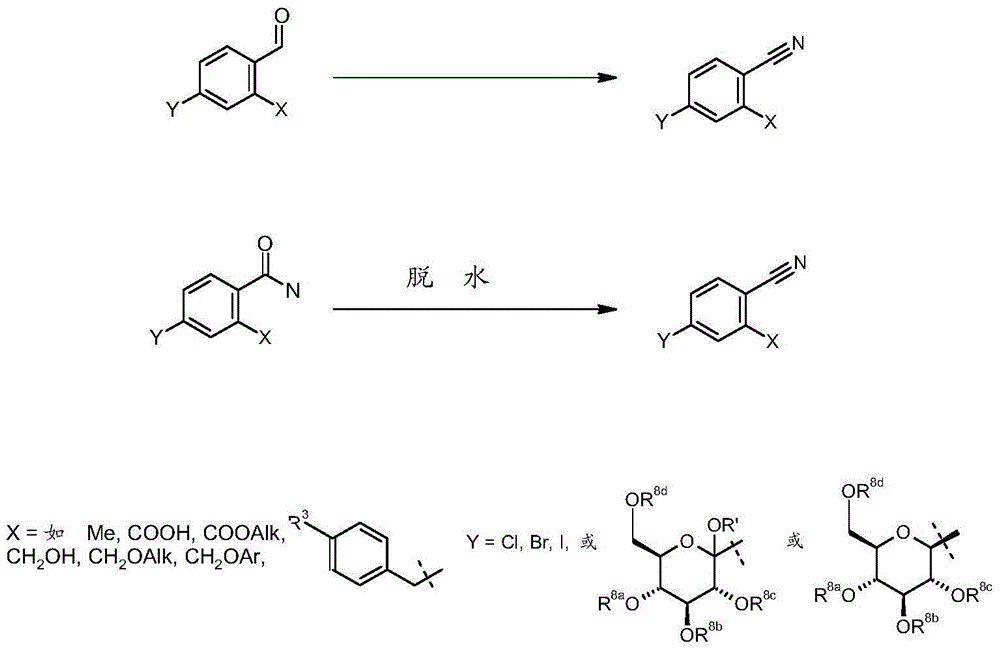
另一种氰基的引入为自醛或羧酰胺开始的合成(方案6)。醛官能团自身可以其本身、被保护或被遮蔽引入。醛官能团的通用保护基为缩醛类,但也可使用其他保护基(见T.W.Greene,P.G.M.Wuts,Protective Groups in OrganicSynthesis,John Wiley&Sons,Inc.,New York,1999)。醛官能团的合适遮蔽剂为(例如)烯烃及噻唑。可使用与(例如)甲酸、浓盐酸、多磷酸或吡啶-甲苯混合的(例如)羟胺使醛转化为氰基官能团。可将在这些反应条件下所形成的中间体肟分离,之后脱水以产生最终产物。也可使用例如双三氟乙酰基羟胺及NH2OSO3的其它羟胺试剂且在无其他试剂情况下得到腈。其他可用试剂为(例如)于乙酸中的NH4PO4H2及硝基丙烷、三甲基甲硅烷基叠氮化合物或S,S-二甲基硫二酰亚胺。Another introduction of cyano groups is the synthesis starting from aldehydes or carboxamides (Scheme 6). The aldehyde function itself can be introduced as such, protected or masked. Common protecting groups for aldehyde functional groups are acetals, but other protecting groups can also be used (see TW Greene, PGM Wuts, Protective Groups in Organic Synthesis, John Wiley & Sons, Inc., New York, 1999). Suitable masking agents for aldehyde functions are, for example, alkenes and thiazoles. Aldehydes can be converted to cyano functionality using eg hydroxylamine mixed with eg formic acid, concentrated hydrochloric acid, polyphosphoric acid or pyridine-toluene. The intermediate oxime formed under these reaction conditions can be isolated followed by dehydration to yield the final product. Other hydroxylamine reagents such as bistrifluoroacetylhydroxylamine and NH2OSO3 can also be used and give nitriles in the absence of other reagents . Other useful reagents are, for example, NH 4 PO 4 H 2 and nitropropane, trimethylsilyl azide or S,S-dimethylsulfimide in acetic acid.
羧酰胺也可为合适腈前体。可以例如三氟乙酸酐、五氧化二磷、POCl3、CCl4-膦组合、Cl3COCl-胺组合、伯吉斯(Burgess)试剂、维斯梅耳(Vilsmeyer)试剂、SOCl2或氰尿酰氯的脱水剂进行转化。也可以从相应单烷基化羧酰胺、羧酸、酯或羧酰氯化物开始,在未分离任何中间体情况下一锅形成腈。Carboxamides are also suitable nitrile precursors. Can be for example trifluoroacetic anhydride, phosphorus pentoxide, POCl3 , CCl4 -phosphine combination, Cl3COCl -amine combination, Burgess reagent, Vilsmeyer reagent, SOCl2 or cyanuria Acid chloride dehydrating agent for conversion. It is also possible to form nitriles in one pot starting from the corresponding monoalkylated carboxamides, carboxylic acids, esters or carboxylic acid chlorides without isolation of any intermediates.
方案7:自苯胺前体引入氰基残基Scheme 7: Introduction of cyano residues from aniline precursors
已建立的引入腈官能团的方法为与氰化铜及可通过各个苯胺衍生物的重氮化作用获得的相应重氮化合物的所谓山德迈耳(Sandmeyer)反应。重氮化合物的合成及其随后氰基去重氮化作用已广泛地证明于有机化学文献中。An established method for introducing nitrile functions is the so-called Sandmeyer reaction with copper cyanide and the corresponding diazo compounds obtainable by diazotization of the respective aniline derivatives. The synthesis of diazo compounds and their subsequent cyano-dediazotization has been extensively documented in the organic chemistry literature.
方案8:二芳基甲烷单元的另一种合成Scheme 8: Alternative synthesis of diarylmethane units
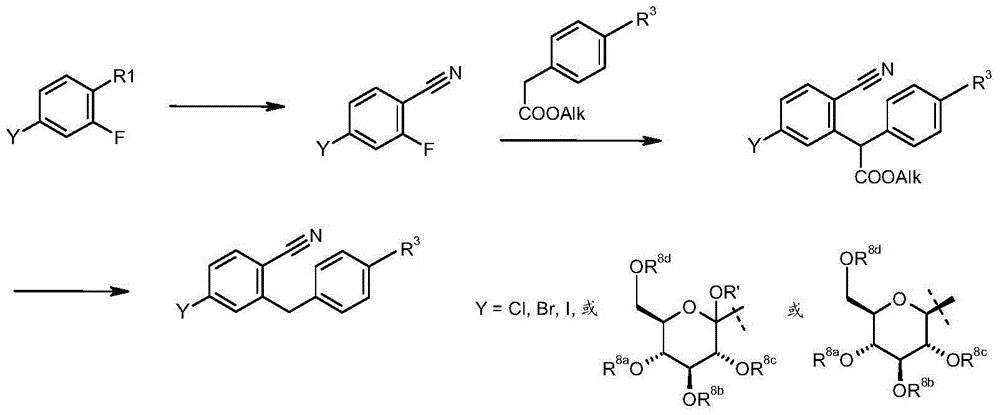
方案8中显示了用于构建二芳基甲烷单元的另一种方法。Another method for the construction of diarylmethane units is shown in Scheme 8.
使用市售或可通过上述方法获得的邻氟取代的苯甲腈。在碱性条件下使邻氟取代的苯甲腈与被R3取代的苯乙酸烷基酯反应(例如见J.Org.Chem.55,1990,4817-4821;J.Heterocycl.Chem,32,1995,1461-1466)随后酯裂解且脱羧(例如见J.Heterocycl.Chem,32,1995,1461-1466;Org.Prep.Proced.Int.37,2005,550-555)或直接脱烷氧基羰基(例如见J.Med.Chem.46,2003,5249-5257;Angew.Chem.Int.Ed.47,2004,6493-6496)。Ortho-fluoro-substituted benzonitriles are used which are commercially available or obtainable by the method described above. Under basic conditions, the benzonitrile substituted by o-fluorine is reacted with the alkyl phenylacetate substituted by R (for example, see J.Org.Chem.55, 1990, 4817-4821; J.Heterocycl.Chem, 32, 1995,1461-1466) followed by ester cleavage and decarboxylation (see for example J.Heterocycl.Chem,32,1995,1461-1466; Org.Prep.Proced.Int.37,2005,550-555) or direct dealkoxylation Carbonyl (see eg J. Med. Chem. 46, 2003, 5249-5257; Angew. Chem. Int. Ed. 47, 2004, 6493-6496).
为制备通式I的化合物,在本发明的方法a)中,在路易斯酸或布朗斯特酸存在下使通式II的化合物与还原剂反应,For the preparation of compounds of general formula I, in process a) according to the invention, compounds of general formula II are reacted with a reducing agent in the presence of a Lewis acid or a Bronsted acid,
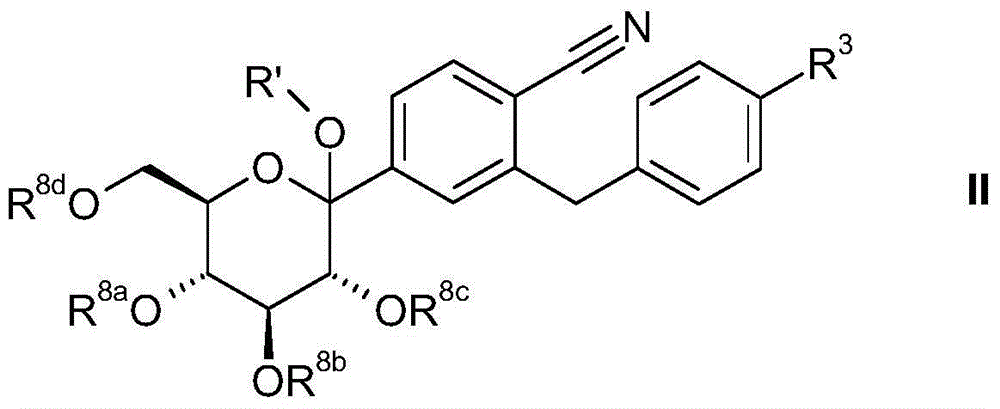
其中R’及R3如上文所定义且wherein R' and R are as defined above and
R8a、R8b、R8c、R8d如上文所定义且彼此独立地代表(例如)乙酰基、新戊酰基、苯甲酰基、叔丁氧基羰基、苄基氧基羰基、烯丙基、三烷基甲硅烷基、苄基或被取代的苄基或在各情况下两个相邻基团R8a、R8b、R8c、R8d形成亚苄基缩醛或亚异丙基缩酮或通过亚丁基的2和3位连接至吡喃糖环的氧原子的2,3-二甲氧基-亚丁基且与上述基团形成被取代的二烷,R 8a , R 8b , R 8c , R 8d are as defined above and independently of each other represent, for example, acetyl, pivaloyl, benzoyl, tert-butoxycarbonyl, benzyloxycarbonyl, allyl, Trialkylsilyl, benzyl or substituted benzyl or in each case two adjacent radicals R 8a , R 8b , R 8c , R 8d form benzylidene acetal or isopropylidene ketal Or 2,3-dimethoxy-butylene connected to the oxygen atom of the pyranose ring through the 2 and 3 positions of the butylene group and form a substituted di alkyl,
其可如上文所述获得。It can be obtained as described above.
反应的合适还原剂包括(例如)例如三乙基甲硅烷、三丙基甲硅烷、三异丙基甲硅烷或二苯基甲硅烷的甲硅烷、硼氢化钠、氰基硼氢化钠、硼氢化锌、硼烷、氢化铝锂、氢化二异丁基铝或碘化钐。还原在无或有例如盐酸、甲苯磺酸、三氟乙酸或乙酸的合适布朗斯特酸或例如醚合三氟化硼、三氟甲磺酸三甲基甲硅烷酯、四氯化钛、四氯化锡、三氟甲磺酸钪或碘化锌的路易斯酸存在下进行。视还原剂及酸而定,反应可在介于-60℃至120℃的温度下在例如二氯甲烷、氯仿、乙腈、甲苯、己烷、乙醚、四氢呋喃、二烷、乙醇、水或其混合物的溶剂中进行。试剂的一个尤其合适的混合由(例如)三乙基甲硅烷及醚合三氟化硼组成,该两种化合物方便地在-60℃与60℃温度下在乙腈或二氯甲烷中使用。此外可在例如Pd/C或阮内(Raney)镍的过渡金属催化剂存在下在例如四氢呋喃、乙酸乙酯、甲醇、乙醇、水或乙酸的溶剂中使用氢气用于转化。Suitable reducing agents for the reaction include, for example, silanes such as triethylsilane, tripropylsilane, triisopropylsilane or diphenylsilane, sodium borohydride, sodium cyanoborohydride, borohydride Zinc, borane, lithium aluminum hydride, diisobutylaluminum hydride, or samarium iodide. Reduction in the absence or presence of a suitable Bronsted acid such as hydrochloric acid, toluenesulfonic acid, trifluoroacetic acid or acetic acid or such as boron trifluoride etherate, trimethylsilyl trifluoromethanesulfonate, titanium tetrachloride, tetrachloride in the presence of Lewis acids of tin chloride, scandium triflate or zinc iodide. Depending on the reducing agent and acid, the reaction can be carried out at temperatures between -60°C and 120°C in, for example, dichloromethane, chloroform, acetonitrile, toluene, hexane, diethyl ether, tetrahydrofuran, di Alkanes, ethanol, water or a mixture of solvents. A particularly suitable mixture of reagents consists, for example, of triethylsilane and boron trifluoride etherate, both compounds conveniently used in acetonitrile or dichloromethane at temperatures of -60°C and 60°C. Furthermore hydrogen can be used for the conversion in the presence of transition metal catalysts such as Pd/C or Raney nickel in solvents such as tetrahydrofuran, ethyl acetate, methanol, ethanol, water or acetic acid.
或者,为制备本发明的方法b)的通式I的化合物,在通式III的化合物中,保护基裂解,Alternatively, for the preparation of compounds of general formula I in process b) of the present invention, in compounds of general formula III, the protecting group is cleaved,

其中R3如上文所定义且wherein R is as defined above and
R8a至R8d表示上文所定义的保护基之一,例如酰基、芳基甲基、烯丙基、缩醛、缩酮或甲硅烷基,且其可(例如)通过自如上文所述的式II的化合物还原来获得。R 8a to R 8d represent one of the protecting groups defined above, such as acyl, arylmethyl, allyl, acetal, ketal or silyl, and it can be, for example, obtained by The compound of formula II is obtained by reduction.
应了解在上述合成方法中可改变基团R8a至R8d的一或若干基团。It will be appreciated that one or several of the groups R 8a to R 8d may be varied in the above synthetic methods.
所用任何酰基保护基(例如)在水性溶剂中(例如在水、异丙醇/水、乙酸/水、四氢呋喃/水或二
所用的任何缩醛或缩酮保护基(例如)在水性溶剂中(例如在水、异丙醇/水、乙酸/水、四氢呋喃/水或二
三甲基甲硅烷基(例如)在水、水性溶剂混合物或例如甲醇或乙醇的低级醇中在例如氢氧化锂、氢氧化钠、碳酸钾或甲醇钠的碱存在下裂解。Trimethylsilyl groups are cleaved, for example, in water, aqueous solvent mixtures or lower alcohols such as methanol or ethanol in the presence of bases such as lithium hydroxide, sodium hydroxide, potassium carbonate or sodium methoxide.
在水性或醇类溶剂中,例如盐酸、三氟乙酸或乙酸的酸也是适合的。为在例如乙醚、四氢呋喃或二氯甲烷的有机溶剂中裂解,使用例如氟化四丁基铵的氟化物试剂也是适合的。In aqueous or alcoholic solvents, acids such as hydrochloric acid, trifluoroacetic acid or acetic acid are also suitable. For cleavage in organic solvents such as diethyl ether, tetrahydrofuran or dichloromethane, the use of fluoride reagents such as tetrabutylammonium fluoride is also suitable.
(例如)在例如钯/炭的催化剂存在下在例如甲醇、乙醇、乙酸乙酯或冰醋酸的合适溶剂中,任选地在添加例如盐酸的酸下在介于0至100℃之间的温度下,但优选地在介于20至60℃之间的周围温度下且在1至7巴,但优选地在3至5巴的氢压力下以氢气使苄基、甲氧基苄基或苄氧基羰基有利地氢化裂解。然而,2,4-二甲氧基苄基优选地在苯甲醚存在下在三氟乙酸中裂解。(for example) in the presence of a catalyst such as palladium on carbon in a suitable solvent such as methanol, ethanol, ethyl acetate or glacial acetic acid, optionally with the addition of an acid such as hydrochloric acid at a temperature between 0 and 100°C benzyl, methoxybenzyl or benzyl with hydrogen, but preferably at an ambient temperature between 20 and 60°C and at a hydrogen pressure of 1 to 7 bar, but preferably at 3 to 5 bar Oxycarbonyl is advantageously hydrocleaved. However, 2,4-dimethoxybenzyl is preferably cleaved in trifluoroacetic acid in the presence of anisole.
优选地通过以例如三氟乙酸或盐酸的酸处理或通过任选地使用例如二氯甲烷、二
在上述反应中,在反应期间所存在的例如乙炔基、羟基、氨基、烷基氨基或亚氨基的任何反应性基团可被在反应后再次裂解的常规保护基保护。In the above reactions, any reactive groups such as ethynyl, hydroxy, amino, alkylamino or imino groups present during the reaction can be protected by conventional protecting groups which are cleaved again after the reaction.
例如,乙炔基的保护基可为三甲基甲硅烷基或三异丙基。2-羟基异丙-2-基也可用作保护基。For example, the protecting group for ethynyl may be trimethylsilyl or triisopropyl. 2-Hydroxyisopropan-2-yl can also be used as a protecting group.
例如,羟基的保护基可为三甲基甲硅烷基、乙酰基、三苯甲基、苄基或四氢吡喃基。For example, a protecting group for a hydroxy group may be trimethylsilyl, acetyl, trityl, benzyl or tetrahydropyranyl.
氨基、烷基氨基或亚氨基的保护基可为(例如)甲酰基、乙酰基、三氟乙酰基、乙氧基羰基、叔丁氧基羰基、苄氧基羰基、苄基、甲氧基苄基或2,4-二甲氧基苄基。Protecting groups for amino, alkylamino or imino groups may be, for example, formyl, acetyl, trifluoroacetyl, ethoxycarbonyl, tert-butoxycarbonyl, benzyloxycarbonyl, benzyl, methoxybenzyl base or 2,4-dimethoxybenzyl.
此外,如上文所述,所获得的通式I的化合物可拆分为其对映异构体及/或非对映异构体。因此,例如,顺/反混合物可拆分为其顺和反异构体,且具有至少一个光学活性碳原子的化合物可分离为其对映异构体。Furthermore, the obtained compounds of general formula I can be resolved into their enantiomers and/or diastereomers, as described above. Thus, for example, cis/trans mixtures can be resolved into their cis and trans isomers, and compounds having at least one optically active carbon atom can be separated into their enantiomers.
因此,例如,可通过色谱法使顺/反混合物拆分为其顺和反异构体,可通过本身已知的方法(比较Allinger N.L.及Eliel E.L.“Topics inStereochemistry”,第6卷,Wiley Interscience,1971中)使所获得的以外消旋物存在的通式I的化合物分离为其光学对映体且具有至少2个不对称碳原子的通式I的化合物可基于其物理-化学差异使用本身已知的方法(例如)通过色谱及/或分步结晶拆分为其非对映异构体,且若获得为外消旋形式的这些化合物,则随后可将其解析为如上所述的对映异构体。Thus, for example, a cis/trans mixture can be resolved into its cis and trans isomers by chromatography, by methods known per se (compare Allinger N.L. and Eliel E.L. "Topics in Stereochemistry", Vol. 6, Wiley Interscience, 1971 middle) separation of the obtained compounds of the general formula I in the form of racemates into their optical antipodes and which have at least 2 asymmetric carbon atoms can be used on the basis of their physico-chemical differences using known per se are resolved into their diastereomers, for example by chromatography and/or fractional crystallization, and if these compounds are obtained in racemic form, they can then be resolved into their enantiomers as described above Construct.
优选地通过在手性相上柱分离对映异构体或通过从光学活性溶剂中重结晶或通过与可与外消旋化合物形成盐或例如酯或酰胺的衍生物的光学活性物质(尤其是其酸及活性衍生物或醇类)反应,且(例如)基于其溶解度差异使由此获得的盐或衍生物的非对映异构体混合物分离来使对映异构体分离,同时可通过合适试剂的作用使游离对映体从纯的非对映异构盐或衍生物释放。常用光学活性酸为(例如)D-型及L-型酒石酸或二苯甲酰基酒石酸、二邻甲苯基酒石酸、苹果酸、扁桃酸、樟脑磺酸、谷氨酸、天冬氨酸或奎尼酸。光学活性醇可为(例如)(+)或(-)-薄荷醇且例如,酰胺中光学活性酰基可为(+)-或(-)-薄荷基氧基羰基。Preferably by separation of enantiomers on a column on a chiral phase or by recrystallization from an optically active solvent or by an optically active substance which can form a salt with a racemic compound or a derivative such as an ester or amide (in particular their acids and reactive derivatives or alcohols) and the separation of the enantiomers, e.g. The free enantiomer is liberated from the pure diastereomeric salt or derivative by action of a suitable reagent. Commonly used optically active acids are, for example, D- and L-forms of tartaric acid or dibenzoyl tartaric acid, di-o-cresyl tartaric acid, malic acid, mandelic acid, camphorsulfonic acid, glutamic acid, aspartic acid or quinine acid. Optically active alcohols can be, for example, (+) or (-)-menthol and, for example, optically active acyl groups in amides can be (+)- or (-)-menthyloxycarbonyl.
此外,式I的化合物可转化为其盐,尤其是转化为与无机酸或有机酸形成的医药用途的生理学上可接受的盐。可用于此目的的酸包括(例如)盐酸、氢溴酸、硫酸、甲磺酸、磷酸、富马酸、琥珀酸、乳酸、柠檬酸、酒石酸或马来酸。Furthermore, the compounds of the formula I can be converted into their salts, especially into pharmaceutically acceptable physiologically acceptable salts with inorganic or organic acids. Acids that can be used for this purpose include, for example, hydrochloric acid, hydrobromic acid, sulfuric acid, methanesulfonic acid, phosphoric acid, fumaric acid, succinic acid, lactic acid, citric acid, tartaric acid or maleic acid.
此外,所获得的化合物可转化为混合物,例如与氨基酸,尤其是与例如脯氨酸或苯丙氨酸的α-氨基酸形成的1:1或1:2混合物,这些氨基酸可具有尤其有利的特性,例如高结晶度。Furthermore, the compounds obtained can be converted into mixtures, for example 1:1 or 1:2 with amino acids, especially with alpha-amino acids such as proline or phenylalanine, which can have particularly favorable properties , such as high crystallinity.
也可使用下述实例中所述的方法有利地获得本发明的化合物,这些方法也可为此目的与本领域技术人员从文献中已知的方法(例如WO98/31697、WO01/27128、WO02/083066、WO03/099836、WO2004/063209、WO2005/092877及WO2006/120208中所述的方法)组合。The compounds of the invention can also be advantageously obtained using the methods described in the examples below, which can also be combined for this purpose with methods known to the person skilled in the art from the literature (e.g. WO98/31697, WO01/27128, WO02/ 083066, WO03/099836, WO2004/063209, WO2005/092877 and WO2006/120208) in combination.
本发明也涉及如上文的反应方案中所述及如下文的实验部分中所述的新颖中间化合物。The present invention also relates to novel intermediate compounds as described in the reaction schemes above and as described in the experimental section below.
具体地,下列中间化合物为本发明的其他方面:Specifically, the following intermediate compounds are other aspects of the present invention:
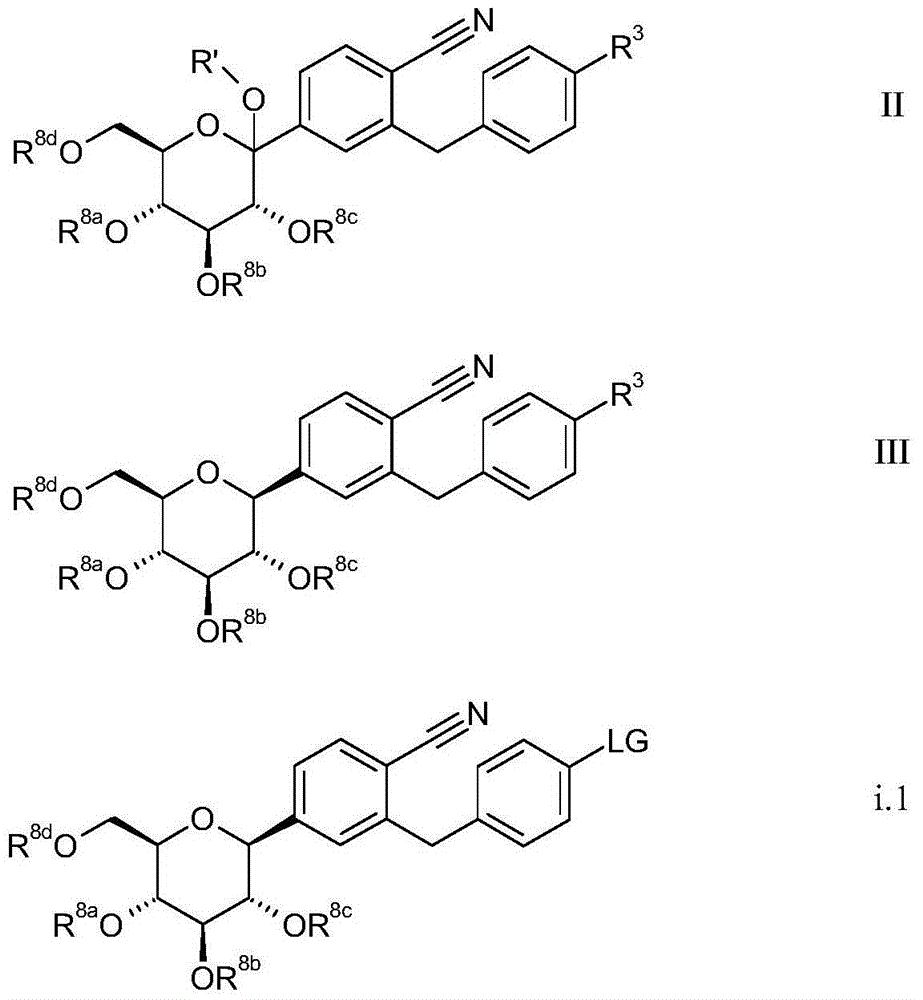

其中in
R8a至R8d如上文所定义且优选地表示H或乙酰基;R 8a to R 8d are as defined above and preferably represent H or acetyl;
R’如上文所定义且优选地表示H、甲基或乙基;R' is as defined above and preferably represents H, methyl or ethyl;
Alk表示C1-4烷基,优选地表示甲基或乙基;Alk represents C 1-4 alkyl, preferably represents methyl or ethyl;
R1如上文所定义且优选地表示Br或CN,最优选表示CN; R1 is as defined above and preferably represents Br or CN, most preferably represents CN;
R3如上文所定义,例如环丙基或环丁基,且优选地是选自由下列各基团:氯、溴、甲基、乙基、正丙基、异丙基、环丙基、环丁基、环戊基、羟基、氰基; R is as defined above, for example cyclopropyl or cyclobutyl, and is preferably selected from the following groups: chlorine, bromine, methyl, ethyl, n-propyl, isopropyl, cyclopropyl, cyclo Butyl, cyclopentyl, hydroxyl, cyano;
LG表示离去基,例如Br、I、-O-(SO2)-CF3,优选地为-O-(SO2)-CF3;LG represents a leaving group, such as Br, I, -O-(SO 2 )-CF 3 , preferably -O-(SO 2 )-CF 3 ;
U表示Cl、Br、I、-O-CO-C1-4烷基、-O-C(=O)-O-C1-4烷基或-OPO(O-C1-4烷基)2;优选地为Br。U represents Cl, Br, I, -O-CO-C 1-4 alkyl, -OC(=O)-OC 1-4 alkyl or -OPO(OC 1-4 alkyl) 2 ; preferably Br .
如已提及的,本发明的通式I的化合物及其生理学上可接受的盐具有有价值的药理学特性,尤其是对钠依赖性葡萄糖协同转运蛋白SGLT(优选地为SGLT2)的抑制作用。As already mentioned, the compounds of the general formula I according to the invention and their physiologically acceptable salts have valuable pharmacological properties, especially the inhibitory effect on the sodium-dependent glucose cotransporter SGLT, preferably SGLT2 .
新颖化合物的生物学特性可如下研究:The biological properties of novel compounds can be studied as follows:
可在测试装置中证明这些物质抑制SGLT-2活性的能力,该测试装置中具有CHO-K1细胞株(ATCC号CCL-61)或HEK293细胞株(ATCC号CRL-1573),所述细胞株被稳定转染表达载体pZeoSV(Invitrogen,EMBL寄存编号L36849),所述细胞株含有编码人类钠葡萄糖协同转运蛋白2(Genbank索取号NM_003041)(CHO-hSGLT2或HEK-hSGLT2)的序列的cDNA。这些细胞株以钠依赖方式将14C-标记的α-甲基-吡喃型葡萄糖苷(14C-AMG,Amersham)转运至细胞内部。The ability of these substances to inhibit the activity of SGLT-2 can be demonstrated in a test device with CHO-K1 cell line (ATCC No. CCL-61) or HEK293 cell line (ATCC No. CRL-1573), which is tested by The expression vector pZeoSV (Invitrogen, EMBL accession number L36849) was stably transfected, and the cell line contained the cDNA encoding the sequence of human sodium glucose cotransporter 2 (Genbank accession number NM_003041) (CHO-hSGLT2 or HEK-hSGLT2). These cell lines transport 14 C-labeled α-methyl-glucopyranoside ( 14 C-AMG, Amersham) into the cell interior in a sodium-dependent manner.
SGLT-2实验如下进行:The SGLT-2 experiment was performed as follows:
CHO-hSGLT2细胞在含有10%胎牛血清及250μg/mL Zeocin(Invitrogen)的Ham’s F12培养基(BioWhittaker)中培养,且将HEK293-hSGLT2细胞培养于含有10%胎牛血清及250μg/mL Zeocin(Invitrogen)的DMEM培养基中。通过以PBS洗涤2次且随后以胰蛋白酶/EDTA处理将细胞从培养烧瓶分离。添加细胞培养基后,将细胞离心、再悬于培养基中且在Casy细胞计数器中计数。将每孔40,000个细胞接种于经聚-D-赖氨酸涂布的白色96孔板中且在37℃、5%CO2下孵育过夜。将细胞以250μl实验缓冲液(Hanks平衡盐溶液(Hanks Balanced Salt Solution),137mM的NaCl、5.4mM的KCl、2.8mM的CaCl2、1.2mM的MgSO4及10mM的HEPES(pH7.4),50μg/mL庆大霉素(Gentamycin))洗涤2次。接着将250μl实验缓冲液及5μl测试化合物添加至各孔且将培养板在培养箱中再孵育15分钟。以5μl10%DMSO作为阴性对照。通过将5μl14C-AMG(0.05μCi)添加至各孔使反应开始。在37℃、5%CO2下培育2小时后,将细胞以250μl PBS(20℃)再次洗涤且接着通过添加25μl的0.1N的NaOH(在37℃下5分钟)使细胞溶解。将200μl的MicroScint20(Packard)添加至各孔且在37℃继续再孵育20分钟。此培育之后,在Topcount(Packard)中使用14C闪烁程式量测所吸收的14C-AMG的放射强度。CHO-hSGLT2 cells were cultured in Ham's F12 medium (BioWhittaker) containing 10% fetal bovine serum and 250 μg/mL Zeocin (Invitrogen), and HEK293-hSGLT2 cells were cultured in 10% fetal bovine serum and 250 μg/mL Zeocin ( Invitrogen) in DMEM medium. Cells were detached from the culture flasks by washing 2 times with PBS followed by trypsin/EDTA treatment. After addition of cell culture medium, cells were centrifuged, resuspended in medium and counted in a Casy cell counter. 40,000 cells per well were seeded in poly-D-lysine coated white 96-well plates and incubated overnight at 37°C, 5% CO 2 . Cells were treated with 250 μl of assay buffer (Hanks Balanced Salt Solution (Hanks Balanced Salt Solution), 137 mM NaCl, 5.4 mM KCl, 2.8 mM CaCl 2 , 1.2 mM MgSO 4 and 10 mM HEPES (pH 7.4), 50 μg /mL gentamycin (Gentamycin)) and washed twice. Then 250 μl of assay buffer and 5 μl of test compound were added to each well and the plate was incubated for an additional 15 minutes in the incubator. 5 μl of 10% DMSO was used as a negative control. Reactions were initiated by adding 5 μl 14 C-AMG (0.05 μCi) to each well. After incubation for 2 hours at 37°C, 5% CO 2 , cells were washed again with 250 μl PBS (20° C.) and then lysed by adding 25 μl of 0.1 N NaOH (5 min at 37° C.). 200 μl of MicroScint20 (Packard) was added to each well and incubation was continued for a further 20 minutes at 37°C. After this incubation, the radioactivity of the absorbed14C -AMG was measured in Topcount (Packard) using the14C scintillation program.
为测定对于人类SGLT1的选择性,建立类似测试,该测试中hSGLT1的cDNA(Genbank Acc.号NM_000343)代替hSGLT2cDNA在CHO-K1或HEK293细胞中表达。To determine selectivity for human SGLT1, a similar assay was set up in which the cDNA of hSGLT1 (Genbank Acc. No. NM_000343) was expressed in CHO-K1 or HEK293 cells instead of hSGLT2 cDNA.
本发明的化合物的EC50值低于1000nM,尤其低于200nM,最优选低于50nM。The compounds of the invention have EC50 values below 1000 nM, especially below 200 nM, most preferably below 50 nM.
考虑到其抑制SGLT活性的能力,本发明的化合物及其相应可药用盐适于治疗及/或预防性治疗所有可通过抑制SGLT活性(尤其为SGLT-2活性)影响的病症或疾病。因此,本发明的化合物尤其适于预防或治疗疾病,尤其为代谢障碍或病症,例如1型及2型糖尿病、糖尿病并发症(例如视网膜病、肾病或神经病、糖尿病足、溃疡、大血管病变)、代谢性酸中毒或酮病、反应性低血糖症、高胰岛素血症(hyperinsulinaemia)、葡萄糖代谢障碍、胰岛素抵抗、代谢综合征、不同起因的血脂异常、动脉粥样硬化及相关疾病、肥胖、高血压、慢性心力衰竭、水肿及高尿酸血症。这些物质也适于预防β-细胞退化,例如胰腺β细胞的细胞凋亡或坏死。这些物质也适于改善或恢复胰腺细胞的功能性,且也增加胰腺β细胞的数量及大小。本发明的化合物也可用作利尿剂或抗高血压剂,且适于预防及治疗急性肾衰竭。In view of their ability to inhibit SGLT activity, the compounds of the invention and their corresponding pharmaceutically acceptable salts are suitable for the therapeutic and/or prophylactic treatment of all disorders or diseases which can be affected by inhibition of SGLT activity, especially SGLT-2 activity. The compounds according to the invention are therefore particularly suitable for the prophylaxis or treatment of diseases, especially metabolic disorders or conditions, such as type 1 and type 2 diabetes mellitus, diabetic complications (e.g. retinopathy, nephropathy or neuropathy, diabetic foot, ulcers, macrovascular disease) , metabolic acidosis or ketosis, reactive hypoglycemia, hyperinsulinaemia (hyperinsulinaemia), glucose metabolism disorders, insulin resistance, metabolic syndrome, dyslipidemia of different origins, atherosclerosis and related diseases, obesity, Hypertension, chronic heart failure, edema and hyperuricemia. These substances are also suitable for preventing β-cell degeneration, eg apoptosis or necrosis of pancreatic β-cells. These substances are also suitable for improving or restoring the functionality of pancreatic cells and also increasing the number and size of pancreatic beta cells. The compounds of the invention are also useful as diuretics or antihypertensive agents and are suitable for the prevention and treatment of acute renal failure.
通过给药本发明的化合物,可降低或抑制脂肪在肝脏中异常积累。因此,根据本发明的另一方面,提供一种用于预防、减缓、延迟或治疗由于有此需要的患者体内肝脏脂肪异常积累而导致的疾病或病症的方法,该方法的特征在于给药本发明的化合物或药物组合物。归因于肝脏脂肪的异常积累的疾病或病症尤其选自普通脂肪肝、非酒精性脂肪肝(NAFL)、非酒精性脂肪肝炎(NASH)、营养过度诱导的脂肪肝、糖尿病脂肪肝、酒精诱导的脂肪肝或中毒脂肪肝。Abnormal accumulation of fat in the liver can be reduced or inhibited by administering the compound of the present invention. Therefore, according to another aspect of the present invention, there is provided a method for preventing, slowing down, delaying or treating a disease or condition caused by abnormal accumulation of liver fat in a patient in need thereof, the method is characterized in that administering this Invented compound or pharmaceutical composition. The disease or condition attributable to abnormal accumulation of fat in the liver is especially selected from fatty liver common, non-alcoholic fatty liver (NAFL), non-alcoholic steatohepatitis (NASH), fatty liver induced by overnutrition, diabetic fatty liver, alcohol-induced fatty liver Fatty liver or toxic fatty liver.
具体地,本发明的化合物,包括其生理学上可接受的盐,适于预防或治疗糖尿病,尤其为1型及2型糖尿病及/或糖尿病并发症。In particular, the compounds according to the invention, including their physiologically acceptable salts, are suitable for the prophylaxis or treatment of diabetes, especially type 1 and type 2 diabetes and/or diabetic complications.
此外,本发明的化合物尤其适于预防或治疗超重、肥胖(包括I级、II级及/或III级肥胖)、内脏肥胖及/或腹部肥胖。Furthermore, the compounds according to the invention are especially suitable for the prevention or treatment of overweight, obesity (including class I, II and/or class III obesity), visceral obesity and/or abdominal obesity.
实现治疗或预防相应活性所需的剂量通常取决于给药的化合物、患者、疾病或病症的性质及严重程度及给药方法及频率,且由患者的医生决定。有利地,通过静脉内途径剂量可为1至100mg,优选地为1至30mg,且通过口服途径为1至1000mg,优选地为1至100mg,各情况中每日给药1至4次。为此目的,可任选地与其他活性物质,与一或多种惰性常规载体及/或稀释剂,例如与玉米淀粉、乳糖、葡萄糖、微晶纤维素、硬脂酸镁、聚乙烯吡咯烷酮、柠檬酸、酒石酸、水、水/乙醇、水/甘油、水/山梨糖醇、水/聚乙二醇、丙二醇、鲸蜡硬脂醇、羧甲基纤维素或例如硬脂的脂肪物质或其合适混合物一起来配制本发明的化合物,以产生常规盖伦(galenic)制剂,例如普通或包衣片剂、胶囊、粉末剂、混悬剂或栓剂。Dosages necessary to achieve therapeutic or prophylactic activity will generally depend on the compound being administered, the patient, the nature and severity of the disease or condition and the method and frequency of administration, and will be at the discretion of the patient's physician. Advantageously, the dosage may be from 1 to 100 mg, preferably from 1 to 30 mg, by the intravenous route, and from 1 to 1000 mg, preferably from 1 to 100 mg, by the oral route, administered in each case 1 to 4 times daily. For this purpose, it may optionally be mixed with other active substances, with one or more inert conventional carriers and/or diluents, for example with corn starch, lactose, glucose, microcrystalline cellulose, magnesium stearate, polyvinylpyrrolidone, Citric acid, tartaric acid, water, water/ethanol, water/glycerin, water/sorbitol, water/polyethylene glycol, propylene glycol, cetearyl alcohol, carboxymethylcellulose or fatty substances such as stearin or Suitable mixtures are used together to formulate the compounds of the invention to give customary galenic formulations, eg plain or coated tablets, capsules, powders, suspensions or suppositories.
本发明的化合物也可与其他活性物质结合使用,尤其用于治疗及/或预防上述疾病或病症。适于这些组合的其他活性物质包括(例如)那些加强本发明的SGLT拮抗剂对于已提及适应症之一的治疗作用及/或使本发明的SGLT拮抗剂的剂量得以降低的活性物质。适于此组合的治疗剂包括(例如)抗糖尿病剂,例如二甲双胍、磺脲类(例如格列本脲、甲苯磺丁脲(tolbutamide)、格列美脲(glimepiride))、那格列奈(nateglinide)、瑞格列奈(repaglinide)、噻唑烷二酮(例如罗格列酮(rosiglitazone)、吡格列酮(pioglitazone))、PPAR-γ-激动剂(例如GI262570)及拮抗剂、PPAR-γ/α调节剂(例如KRP297)、α-葡糖苷酶抑制剂(例如阿卡波糖(acarbose)、伏格列波糖(voglibose))、DPPIV抑制剂(例如LAF237、MK-431)、α2-拮抗剂、胰岛素及胰岛素类似物、GLP-1及GLP-1类似物(例如艾生丁-4(exendin-4))或糊精(amylin)。目录也包括蛋白酪氨酸磷酸酶1抑制剂,其为影响去调节(deregulated)葡萄糖在肝脏中产生的物质,例如葡萄糖-6-磷酸酶或果糖-1,6-双磷酸酶、磷酸酯葡糖基转移酶抑制剂;胰高血糖素(glucagon)受体拮抗剂及磷酸烯醇丙酮酸羧基激酶抑制剂、糖原合成酶激酶抑制剂或丙酮酸脱氢激酶抑制剂;降脂剂,例如HMG-CoA还原酶抑制剂(例如辛伐他汀(simvastatin)、阿托伐他汀(atorvastatin));贝特类(fibrates)(例如苯札贝特(bezafibrate)、非诺贝特(fenofibrate));烟酸及其衍生物;PPAR-α激动剂;PPAR-δ激动剂;ACAT抑制剂(例如阿伐麦布(avasimibe))或例如依泽替米贝(ezetimibe)的胆固醇吸收抑制剂;例如消胆胺(cholestyramine)的胆汁酸结合物质;回肠胆汁酸转运抑制剂;HDL升高化合物,例如CETP抑制剂或ABC1调节剂;或治疗肥胖的活性物质,例如西布曲明(sibutramine)或四氢洛扑他汀(tetrahydrolipostatin)、右芬氟拉明(dexfenfluramine)、阿索开(axokine);大麻碱1受体拮抗剂;MCH-1受体拮抗剂;MC4受体激动剂;NPY5或NPY2拮抗剂;或β3-激动剂,例如SB-418790或AD-9677及5HT2c受体激动剂。The compounds according to the invention can also be used in combination with other active substances, especially for the treatment and/or prophylaxis of the diseases or conditions mentioned above. Further active substances suitable for these combinations include, for example, those active substances which potentiate the therapeutic action of the SGLT antagonists according to the invention for one of the indications already mentioned and/or which allow the dosage of the SGLT antagonists according to the invention to be reduced. Therapeutic agents suitable for this combination include, for example, antidiabetic agents such as metformin, sulfonylureas (such as glibenclamide, tolbutamide, glimepiride), nateglinide ( nateglinide), repaglinide, thiazolidinediones (eg rosiglitazone, pioglitazone), PPAR-gamma-agonists (eg GI262570) and antagonists, PPAR-gamma/alpha Modulators (eg KRP297), alpha-glucosidase inhibitors (eg acarbose, voglibose), DPPIV inhibitors (eg LAF237, MK-431), alpha2-antagonists , insulin and insulin analogs, GLP-1 and GLP-1 analogs (eg exendin-4) or amylin. The list also includes inhibitors of protein tyrosine phosphatase 1, which are substances that affect the production of deregulated glucose in the liver, such as glucose-6-phosphatase or fructose-1,6-bisphosphatase, phosphoglucose Glycosyltransferase inhibitors; glucagon receptor antagonists and inhibitors of phosphoenolpyruvate carboxykinase, glycogen synthase kinase or pyruvate dehydrogenase; lipid-lowering agents such as HMG-CoA reductase inhibitors (eg, simvastatin, atorvastatin); fibrates (eg, bezafibrate, fenofibrate); Niacin and its derivatives; PPAR-alpha agonists; PPAR-delta agonists; ACAT inhibitors (such as avasimibe) or cholesterol absorption inhibitors such as ezetimibe; Bile acid-binding substances of cholestyramine; inhibitors of ileal bile acid transport; HDL-elevating compounds such as CETP inhibitors or ABC1 modulators; or active substances for the treatment of obesity such as sibutramine or tetrahydro Lopastatin (tetrahydrolipostatin), dexfenfluramine, axokine; cannabinoid 1 receptor antagonists; MCH-1 receptor antagonists; MC4 receptor agonists; NPY5 or NPY2 antagonists or beta3-agonists such as SB-418790 or AD-9677 and 5HT2c receptor agonists.
此外,与用于影响高血压、慢性心力衰竭或动脉粥样硬化的药物(例如A-II拮抗剂或ACE抑制剂、ECE抑制剂、利尿剂、β-阻断剂、Ca-拮抗剂、中枢作用抗高血压剂、α-2-肾上腺素受体拮抗剂、中性肽链内切酶抑制剂、血小板凝集抑制剂及其他药物或其组合)组合也是合适的。血管收缩素II受体拮抗剂的实例为坎地沙坦酯、氯沙坦钾(potassium losartan)、甲磺酸依普罗沙坦(eprosartan mesylate)、缬沙坦(valsartan)、替米沙坦(telmisartan)、伊贝沙坦(irbesartan)、EXP-3174、L-158809、EXP-3312、奥美沙坦酯(olmesartan)、medoxomil、他索沙坦(tasosartan)、KT-3-671、GA-0113、RU-64276、EMD-90423、BR-9701等。血管收缩素II受体拮抗剂优选地用于治疗或预防高血压及糖尿病并发症,通常与例如氢氯噻嗪(hydrochlorothiazide)的利尿剂组合。In addition, with drugs used to affect hypertension, chronic heart failure, or atherosclerosis (eg, A-II antagonists or ACE inhibitors, ECE inhibitors, diuretics, beta-blockers, Ca-antagonists, CNS Antihypertensive agents, alpha-2-adrenoceptor antagonists, neutral endopeptidase inhibitors, platelet aggregation inhibitors and other drugs or combinations thereof) are also suitable. Examples of angiotensin II receptor antagonists are candesartan cilexetil, potassium losartan, eprosartan mesylate, valsartan, telmisartan ( telmisartan, irbesartan, EXP-3174, L-158809, EXP-3312, olmesartan, medoxomil, tasosartan, KT-3-671, GA-0113 , RU-64276, EMD-90423, BR-9701, etc. Angiotensin II receptor antagonists are preferably used in the treatment or prevention of hypertension and diabetic complications, usually in combination with diuretics such as hydrochlorothiazide.
与尿酸合成抑制剂或排尿酸剂(uricosuric)的组合适于治疗或预防痛风。Combinations with uric acid synthesis inhibitors or uricosuric agents are suitable for the treatment or prophylaxis of gout.
与GABA-受体拮抗剂、Na-通道阻断剂、托吡酯(topiramat)、蛋白激酶C抑制剂、晚期糖基化终末化产物抑制剂或醛醣还原酶抑制剂的组合可用于治疗或预防糖尿病并发症。Combinations with GABA-receptor antagonists, Na-channel blockers, topiramate (topiramat), protein kinase C inhibitors, advanced glycation end product inhibitors or aldose reductase inhibitors can be used for treatment or prophylaxis Complications of diabetes.
有用的上述组合搭配物的剂量为通常所推荐的最低剂量的1/5直至通常所推荐剂量的1/1。Useful dosages of the above combination partners are 1/5 of the lowest usual recommended dosage up to 1/1 of the usual recommended dosage.
因此,在另一方面中,本发明涉及与至少一种作为组合搭配物的上述活性物质组合的本发明的化合物或此化合物的生理学上可接受的盐在制备适于治疗或预防可通过抑制钠依赖性葡萄糖协同转运蛋白SGLT影响的疾病或病症的药物组合物中的用途。这些疾病优选地为代谢疾病,尤其是上文所列疾病或病症之一,更尤其是糖尿病或糖尿病并发症。Thus, in a further aspect, the present invention relates to a compound according to the invention or a physiologically acceptable salt of this compound in combination with at least one of the above-mentioned active substances as a combination partner in the preparation of a compound suitable for the treatment or prophylaxis of sodium Use in a pharmaceutical composition for a disease or condition affected by the dependent glucose cotransporter SGLT. These diseases are preferably metabolic diseases, especially one of the diseases or conditions listed above, more especially diabetes or diabetic complications.
与另一活性物质组合使用本发明的化合物或其生理学上可接受的盐可同时或在交错时间发生,但尤其在短的时间间隔内发生。若同时给药,则将两种活性物质一起给予患者;而若在交错时间使用,则在小于或等于12小时,但尤其在小于或等于6小时的时间内将两种活性物质给予患者。The use of a compound according to the invention or a physiologically acceptable salt thereof in combination with another active substance can take place simultaneously or at staggered times, but especially within short time intervals. If administered simultaneously, the two active substances are administered to the patient together; and if administered at staggered times, the two active substances are administered to the patient within a period of less than or equal to 12 hours, but especially within a period of less than or equal to 6 hours.
因此,在另一方面中,本发明涉及药物组合物,其包含本发明的化合物或此化合物的生理学上可接受的盐及至少一种作为混合搭配物的上述活性物质,任选地连同一或多种惰性载体及/或稀释剂。Therefore, in a further aspect, the present invention relates to a pharmaceutical composition comprising a compound according to the invention or a physiologically acceptable salt of this compound and at least one of the above-mentioned active substances as a mixing partner, optionally together with one or Various inert carriers and/or diluents.
因此,例如,本发明的药物组合物包含本发明的化合物或此化合物的生理学上可接受的盐及至少一种血管收缩素II受体拮抗剂任选地与一或多种惰性载体及/或稀释剂的混合。Thus, for example, a pharmaceutical composition according to the invention comprises a compound according to the invention or a physiologically acceptable salt of this compound and at least one angiotensin II receptor antagonist, optionally together with one or more inert carriers and/or Mixing of diluents.
本发明的化合物或其生理学上可接受的盐及待与其组合的其他活性物质可一起存在于一种制剂中,例如片剂或胶囊,或分开地存在于两种相同或不同制剂中,例如作为所谓的部件试剂盒(kit-of-parts)。The compounds according to the invention or their physiologically acceptable salts and the other active substances to be combined therewith may be present together in one preparation, for example tablets or capsules, or separately in two identical or different preparations, for example as So-called kit-of-parts.
在上文及下文中,各情况下结构式中未明确表示羟基的H原子。下述实施例意欲说明本发明而不限制本发明。术语“室温”及“周围温度”可替换使用且表示约20℃的温度。Above and below, the H atom of the hydroxyl group is not explicitly represented in each case in the formula. The following examples are intended to illustrate the invention without limiting it. The terms "room temperature" and "ambient temperature" are used interchangeably and mean a temperature of about 20°C.
使用如下的缩写:Use the following abbreviations:
DMF 二甲基甲酰胺DMF Dimethylformamide
NMP N-甲基-2-吡咯烷酮NMP N-methyl-2-pyrrolidone
THF 四氢呋喃THF Tetrahydrofuran
起始化合物的制备:Preparation of starting compounds:
实施例IExample I

4-溴-3-羟基甲基-1-碘-苯4-Bromo-3-hydroxymethyl-1-iodo-benzene
将乙二酰氯(13.0mL)添加至2-溴-5-碘-苯甲酸于CH2Cl2(200mL)中的冰冷溶液中。添加DMF(0.2mL),且将溶液在室温下搅拌6小时。接着在减压下浓缩且将残余物溶解于THF(100mL)中。在冰浴中冷却所得溶液且逐份添加LiBH4(3.4g)。去除冷却浴且将混合物于室温下搅拌1小时。以THF稀释反应混合物且以0.1M盐酸处理。接着分离有机层且以乙酸乙酯萃取水层。干燥(Na2SO4)经合并的有机层且于减压下蒸发溶剂以生成粗产物。Oxalyl chloride (13.0 mL) was added to an ice-cold solution of 2-bromo-5-iodo-benzoic acid in CH2Cl2 ( 200 mL). DMF (0.2 mL) was added, and the solution was stirred at room temperature for 6 hours. It was then concentrated under reduced pressure and the residue was dissolved in THF (100 mL). The resulting solution was cooled in an ice bath and LiBH 4 (3.4 g) was added portionwise. The cooling bath was removed and the mixture was stirred at room temperature for 1 hour. The reaction mixture was diluted with THF and treated with 0.1M hydrochloric acid. The organic layer was then separated and the aqueous layer was extracted with ethyl acetate. The combined organic layers were dried (Na 2 SO 4 ) and the solvent was evaporated under reduced pressure to give the crude product.
产率:47.0g(理论值的99%)Yield: 47.0 g (99% of theory)
实施例IIExample II

4-溴-3-氯甲基-1-碘-苯4-Bromo-3-chloromethyl-1-iodo-benzene
将亚硫酰氯(13mL)添加至4-溴-3-羟基甲基-1-碘-苯(47.0g)于含有DMF(0.1mL)的二氯甲烷(100mL)中的悬浮液中。将混合物在周围温度下搅拌3小时。接着在减压下去除溶剂及过量试剂。以甲醇湿磨残余物且干燥。Thionyl chloride (13 mL) was added to a suspension of 4-bromo-3-hydroxymethyl-1-iodo-benzene (47.0 g) in dichloromethane (100 mL) containing DMF (0.1 mL). The mixture was stirred at ambient temperature for 3 hours. The solvent and excess reagents were then removed under reduced pressure. The residue was triturated with methanol and dried.
产率:41.0g(理论值的82%)Yield: 41.0 g (82% of theory)
实施例IIIExample III
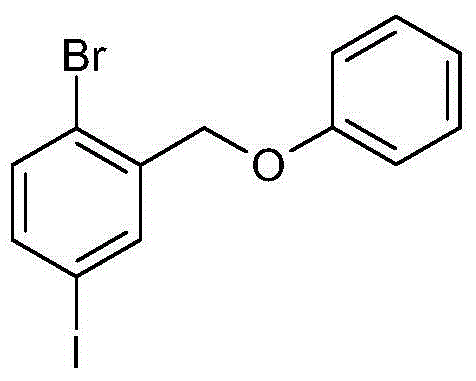
4-溴-1-碘-3-苯氧基甲基-苯4-Bromo-1-iodo-3-phenoxymethyl-benzene
将溶解于4M KOH溶液(60mL)中的苯酚(13g)添加至溶解于丙酮(50mL)中的4-溴-3-氯甲基-1-碘-苯(41.0g)中。添加NaI(0.5g)且将所得混合物于50℃下搅拌过夜。接着添加水且以乙酸乙酯萃取所得混合物。干燥经合并的萃取物且在减压下蒸发溶剂。通过硅胶层析法纯化残余物(环己烷/乙酸乙酯19:1)。Phenol (13 g) dissolved in 4M KOH solution (60 mL) was added to 4-bromo-3-chloromethyl-1-iodo-benzene (41.0 g) dissolved in acetone (50 mL). NaI (0.5 g) was added and the resulting mixture was stirred at 50 °C overnight. Then water was added and the resulting mixture was extracted with ethyl acetate. The combined extracts were dried and the solvent was evaporated under reduced pressure. The residue was purified by silica gel chromatography (cyclohexane/ethyl acetate 19:1).
产率:38.0g(理论值的79%)Yield: 38.0 g (79% of theory)
实施例IVExample IV

(5-溴-2-氯-苯基)-(4-甲氧基-苯基)-甲酮(5-Bromo-2-chloro-phenyl)-(4-methoxy-phenyl)-methanone
将38.3mL乙二酰氯及0.8mL二甲基甲酰胺添加至100g的5-溴-2-氯-苯甲酸于500mL二氯甲烷中的混合物中。将反应混合物搅拌14小时,接着过滤且在旋转式蒸发器中自所有挥发性组份分离。将残余物溶解于150mL二氯甲烷中,将所得溶液冷却至-5℃,且添加46.5g苯甲醚。接着分批添加51.5g三氯化铝以使得温度不超过5℃。将溶液于1至5℃下搅拌1小时且接着倾至碎冰上。分离有机相,且以二氯甲烷萃取水相。以1M盐酸洗涤经合并的有机相、1M氢氧化钠溶液(2次)及盐水洗涤经合并的有机相。接着经硫酸钠干燥有机相,去除溶剂且将残余物从乙醇重结晶。38.3 mL of oxalyl chloride and 0.8 mL of dimethylformamide were added to a mixture of 100 g of 5-bromo-2-chloro-benzoic acid in 500 mL of dichloromethane. The reaction mixture was stirred for 14 hours, then filtered and separated from all volatile components in a rotary evaporator. The residue was dissolved in 150 mL of dichloromethane, the resulting solution was cooled to -5°C, and 46.5 g of anisole was added. Then 51.5 g of aluminum trichloride were added in portions so that the temperature did not exceed 5°C. The solution was stirred at 1 to 5°C for 1 hour and then poured onto crushed ice. The organic phase was separated and the aqueous phase was extracted with dichloromethane. The combined organic phases were washed with 1M hydrochloric acid, 1M sodium hydroxide solution (2x) and brine. The organic phase is then dried over sodium sulfate, the solvent is removed and the residue is recrystallized from ethanol.
产率:86.3g(理论值的64%)Yield: 86.3 g (64% of theory)
质谱(ESI+):m/z=325/327/329(Br+Cl)[M+H]+ Mass spectrum (ESI + ):m/z=325/327/329(Br+Cl)[M+H] +
实施例VExample V

1-溴-4-氯-3-(4-甲氧基-苄基)-苯1-Bromo-4-chloro-3-(4-methoxy-benzyl)-benzene
将86.2g(5-溴-2-氯-苯基)-(4-甲氧基-苯基)-甲酮及101.5mL三乙基甲硅烷于75mL二氯甲烷及150mL乙腈中的溶液冷却至10℃。接着伴随搅拌,添加50.8mL乙醚合三氟化硼以使得温度不超过20℃。将溶液在周围温度下搅拌14小时,随后再添加9mL三乙基硅烷及4.4mL醚合三氟化硼。将溶液于45-50℃下再搅拌3小时时期且接着冷却至周围温度。添加28g氢氧化钾于70mL水中的溶液且将所得混合物搅拌2小时。分离有机相且以二异丙基醚将水相再萃取3次。以2M氢氧化钾溶液将合并的有机相洗涤两次且以盐水洗涤一次,且接着经硫酸钠干燥。在蒸发溶剂之后,以乙醇洗涤残余物且于60℃下干燥。A solution of 86.2 g (5-bromo-2-chloro-phenyl)-(4-methoxy-phenyl)-methanone and 101.5 mL triethylsilane in 75 mL dichloromethane and 150 mL acetonitrile was cooled to 10°C. Then, with stirring, 50.8 mL of boron trifluoride diethyl etherate was added so that the temperature did not exceed 20 °C. The solution was stirred at ambient temperature for 14 hours, after which an additional 9 mL of triethylsilane and 4.4 mL of boron trifluoride etherate were added. The solution was stirred at 45-50 °C for a further period of 3 hours and then cooled to ambient temperature. A solution of 28 g potassium hydroxide in 70 mL water was added and the resulting mixture was stirred for 2 hours. The organic phase was separated and the aqueous phase was extracted 3 more times with diisopropyl ether. The combined organic phases were washed twice with 2M potassium hydroxide solution and once with brine, and then dried over sodium sulfate. After evaporation of the solvent, the residue was washed with ethanol and dried at 60°C.
产率:50.0g(理论值的61%)Yield: 50.0 g (61% of theory)
质谱(ESI+):m/z=310/312/314(Br+Cl)[M+H]+ Mass Spectrum (ESI + ): m/z=310/312/314(Br+Cl)[M+H] +
实施例VIExample VI

4-(5-溴-2-氯-苄基)-苯酚4-(5-Bromo-2-chloro-benzyl)-phenol
在冰浴中冷却14.8g的1-溴-4-氯-3-(4-甲氧基-苄基)-苯于150mL二氯甲烷中的溶液。添加50mL的三溴化硼于二氯甲烷中的1M溶液且将所得溶液在周围温度下搅拌2小时。接着再次在冰浴中冷却溶液且逐滴添加饱和碳酸钾水溶液。在周围温度下以1M盐酸水溶液将混合物调整至pH值为1,分离有机相且以乙酸乙酯萃取水相3次。经硫酸钠干燥经合并的有机相且完全去除溶剂。A solution of 14.8 g of 1-bromo-4-chloro-3-(4-methoxy-benzyl)-benzene in 150 mL of dichloromethane was cooled in an ice bath. 50 mL of a 1 M solution of boron tribromide in dichloromethane was added and the resulting solution was stirred at ambient temperature for 2 hours. The solution was then cooled again in the ice bath and saturated aqueous potassium carbonate was added dropwise. The mixture was adjusted to pH 1 with 1 M aqueous hydrochloric acid at ambient temperature, the organic phase was separated and the aqueous phase was extracted 3 times with ethyl acetate. The combined organic phases were dried over sodium sulfate and the solvent was completely removed.
产率:13.9g(理论值的98%)Yield: 13.9 g (98% of theory)
质谱(ESI-):m/z=295/297/299(Br+Cl)[M-H]- Mass spectrum (ESI - ):m/z=295/297/299(Br+Cl)[MH] -
实施例VIIExample VII

[4-(5-溴-2-氯-苄基)-苯氧基]-叔丁基-二甲基-甲硅烷[4-(5-Bromo-2-chloro-benzyl)-phenoxy]-tert-butyl-dimethyl-silane
在冰浴中冷却13.9g的4-(5-溴-2-氯-苄基)-苯酚于140mL二氯甲烷中的溶液。接着添加于20mL二氯甲烷中的7.54g叔丁基二甲基硅烷氯,继而添加9.8mL三乙胺及0.5g的4-二甲胺基吡啶。将所得溶液在周围温度下搅拌16h且接着以100mL二氯甲烷稀释。以1M盐酸水溶液洗涤有机相2次,且以碳酸氢钠水溶液洗涤1次且接着经硫酸钠干燥。在去除溶剂之后,经由硅胶过滤残余物(环己烷/乙酸乙酯100:1)。A solution of 13.9 g of 4-(5-bromo-2-chloro-benzyl)-phenol in 140 mL of dichloromethane was cooled in an ice bath. Then 7.54 g of tert-butyldimethylsilyl chloride in 20 mL of dichloromethane were added, followed by 9.8 mL of triethylamine and 0.5 g of 4-dimethylaminopyridine. The resulting solution was stirred at ambient temperature for 16 h and then diluted with 100 mL of dichloromethane. The organic phase was washed twice with 1M aqueous hydrochloric acid and once with aqueous sodium bicarbonate and then dried over sodium sulfate. After removal of the solvent, the residue was filtered through silica gel (cyclohexane/ethyl acetate 100:1).
产率:16.8g(理论值的87%)Yield: 16.8 g (87% of theory)
质谱(EI):m/z=410/412/414(Br+Cl)[M]+ Mass spectrum (EI): m/z=410/412/414(Br+Cl)[M] +
实施例VIIIExample VIII

1-溴-4-(1-甲氧基-D-吡喃型葡萄糖-1-基)-2-(苯氧基甲基)-苯1-Bromo-4-(1-methoxy-D-glucopyranose-1-yl)-2-(phenoxymethyl)-benzene
将iPrMgCl于THF(11mL)中的2M溶液添加至悬浮于THF(11mL)中的无水LiCl(0.47g)中。在室温下搅拌混合物直至所有LiCl均溶解。将此溶液逐滴添加至在氩气氛下冷却至-60℃的4-溴-1-碘-3-苯氧基甲基-苯(8.0g)于四氢呋喃(40mL)中的溶液中。将溶液温至-40℃且接着添加于四氢呋喃(5mL)中的2,3,4,6-四-O-(三甲基甲硅烷基)-D-葡萄吡喃酮(10.7g,90%纯)。将所得溶液在冷却浴中温至-5℃且在此温度下再搅拌30分钟。添加NH4Cl水溶液且以乙酸乙酯萃取所得混合物。经硫酸钠干燥经合并的有机萃取物且于减压下去除溶剂。将残余物溶解于甲醇(80mL)中且以甲磺酸(0.6mL)处理。在将反应溶液于35-40℃下搅拌过夜之后,以固体NaHCO3中和溶液,且于减压下去除甲醇。以NaHCO3水溶液稀释残留物且以乙酸乙酯萃取所得混合物。经硫酸钠干燥经合并的萃取物且蒸发溶剂以生成粗产物,该粗产物未经进一步纯化即进行还原。A 2M solution of iPrMgCl in THF (11 mL) was added to anhydrous LiCl (0.47 g) suspended in THF (11 mL). The mixture was stirred at room temperature until all LiCl was dissolved. This solution was added dropwise to a solution of 4-bromo-1-iodo-3-phenoxymethyl-benzene (8.0 g) in tetrahydrofuran (40 mL) cooled to -60°C under an argon atmosphere. The solution was warmed to -40 °C and then 2,3,4,6-tetra-O-(trimethylsilyl)-D-glupyrone (10.7 g, 90% pure). The resulting solution was warmed to -5°C in a cooling bath and stirred at this temperature for an additional 30 minutes. Aqueous NH4Cl solution was added and the resulting mixture was extracted with ethyl acetate. The combined organic extracts were dried over sodium sulfate and the solvent was removed under reduced pressure. The residue was dissolved in methanol (80 mL) and treated with methanesulfonic acid (0.6 mL). After the reaction solution was stirred overnight at 35-40 °C, the solution was neutralized with solid NaHCO 3 and methanol was removed under reduced pressure. The residue was diluted with aqueous NaHCO 3 and the resulting mixture was extracted with ethyl acetate. The combined extracts were dried over sodium sulfate and the solvent was evaporated to give the crude product which was reduced without further purification.
产率:7.8g(理论值的93%)Yield: 7.8 g (93% of theory)
实施例IXExample IX
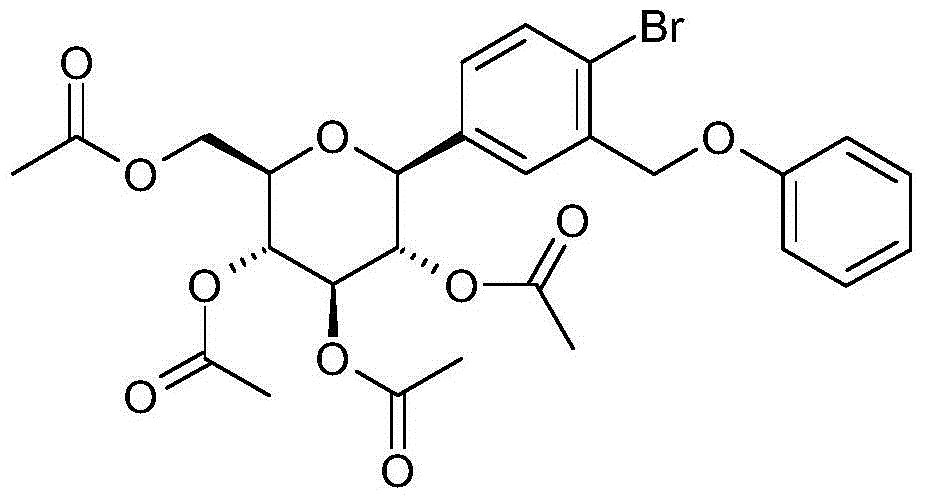
1-溴-4-(2,3,4,6-四-O-乙酰基-D-吡喃型葡萄糖-1-基)-2-(苯氧基甲基)-苯1-Bromo-4-(2,3,4,6-tetra-O-acetyl-D-glucopyranose-1-yl)-2-(phenoxymethyl)-benzene
以温度维持在-10℃以下的速率将乙醚合三氟化硼(4.9mL)添加至1-溴-4-(1-甲氧基-D-吡喃型葡萄糖-1-基)-2-(苯氧基甲基)-苯(8.7g)及三乙基硅烷(9.1mL)于二氯甲烷(35mL)及乙腈(50mL)中的冷却至-20℃的溶液中。经1.5h的时期将所得溶液温至0℃,且接着以碳酸氢钠水溶液处理。将所得混合物搅拌0.5小时,去除有机溶剂且以乙酸乙酯萃取残余物。经硫酸钠干燥经合并的有机层且去除溶剂。将残余物溶于二氯甲烷(50mL)中,连接向溶液中添加乙酸酐(9.3mL)、4-二甲胺基吡啶(0.5g)及吡啶(9.4mL)。将溶液在周围温度下搅拌1.5小时且接着以二氯甲烷稀释。以1M盐酸将此溶液洗涤2次且经硫酸钠干燥。在去除溶剂后,将残余物自乙醇重结晶以生成呈无色固体状的产物。Boron trifluoride diethyl etherate (4.9 mL) was added to 1-bromo-4-(1-methoxy-D-glucopyranose-1-yl)-2- In a solution of (phenoxymethyl)-benzene (8.7 g) and triethylsilane (9.1 mL) in dichloromethane (35 mL) and acetonitrile (50 mL) cooled to -20°C. The resulting solution was warmed to 0 °C over a period of 1.5 h, and then treated with aqueous sodium bicarbonate. The resulting mixture was stirred for 0.5 h, the organic solvent was removed and the residue was extracted with ethyl acetate. The combined organic layers were dried over sodium sulfate and the solvent was removed. The residue was dissolved in dichloromethane (50 mL), and acetic anhydride (9.3 mL), 4-dimethylaminopyridine (0.5 g) and pyridine (9.4 mL) were successively added to the solution. The solution was stirred at ambient temperature for 1.5 hours and then diluted with dichloromethane. The solution was washed twice with 1M hydrochloric acid and dried over sodium sulfate. After removal of the solvent, the residue was recrystallized from ethanol to yield the product as a colorless solid.
产率:6.78g(理论值的60%)Yield: 6.78g (60% of theory)
质谱(ESI+):m/z=610/612(Br)[M+NH4]+ Mass spectrum (ESI + ):m/z=610/612(Br)[M+NH 4 ] +
实施例XExample X

2-(苯氧基甲基)-4-(2,3,4,6-四-O-乙酰基-D-吡喃型葡萄糖-1-基)-苯甲腈2-(phenoxymethyl)-4-(2,3,4,6-tetra-O-acetyl-D-glucopyranose-1-yl)-benzonitrile
以氩冲洗装有氰化锌(1.0g)、锌(30mg)、Pd2(二亚苄基丙酮)3*CHCl3(141mg)及四氟硼酸三叔丁基(111mg)的烧瓶。接着添加1-溴-4-(2,3,4,6-四-O-乙酰基-D-吡喃型葡萄糖-1-基)-2-(苯氧基甲基)-苯(5.4g)于脱气NMP(12mL)中的溶液且将所得混合物于室温下搅拌18小时。在以乙酸乙酯稀释之后,过滤混合物且以碳酸氢钠水溶液洗涤滤液。干燥(硫酸钠)有机相且去除溶剂。将残余物自乙醇重结晶。Zinc cyanide (1.0 g), zinc (30 mg), Pd 2 (dibenzylidene acetone) 3 *CHCl 3 (141 mg) and tri-tert-butyl tetrafluoroborate were loaded with argon flushing (111mg) in a flask. Then 1-bromo-4-(2,3,4,6-tetra-O-acetyl-D-glucopyranose-1-yl)-2-(phenoxymethyl)-benzene (5.4 g ) in degassed NMP (12 mL) and the resulting mixture was stirred at room temperature for 18 h. After dilution with ethyl acetate, the mixture was filtered and the filtrate was washed with aqueous sodium bicarbonate. The organic phase was dried (sodium sulfate) and the solvent was removed. The residue was recrystallized from ethanol.
产率:4.10g(理论值的84%)Yield: 4.10 g (84% of theory)
质谱(ESI+):m/z=557[M+NH4]+ Mass spectrum (ESI + ):m/z=557[M+NH 4 ] +
根据下列步骤,亦获得上述化合物:The above compound was also obtained according to the following steps:
将装有搅拌棒、1-溴-4-(2,3,4,6-四-O-乙酰基-D-吡喃型葡萄糖-1-基)-2-(苯氧基甲基)-苯(14.7g)、氰化铜(4.1g)及NMP(100mL)的烧瓶于回流温度下加热8小时。在以水(600mL)稀释之后,分离沉淀,以水洗涤数次且随后溶解于乙酸乙酯(200mL)中。将所得溶液经由使用乙酸乙酯(300mL)作为洗脱剂的硅胶塞过滤。于减压下浓缩滤液且将残余物溶解于二氯甲烷(100mL)中以再乙酰化在氰化作用期间脱保护的氧基。相应地,依次地添加吡啶(4mL)、4-二甲胺基吡啶(0.3g)及乙酸酐(4.4mL)。将所得溶液于室温下搅拌1小时。接着以二氯甲烷(50mL)稀释反应混合物且以1M盐酸水溶液洗涤3次,以碳酸氢钠水溶液洗涤1次且以水洗涤1次。干燥(硫酸钠)有机相且去除溶剂。将残余物自乙醇重结晶。Equipped with a stir bar, 1-bromo-4-(2,3,4,6-tetra-O-acetyl-D-glucopyranose-1-yl)-2-(phenoxymethyl)- A flask of benzene (14.7 g), copper cyanide (4.1 g) and NMP (100 mL) was heated at reflux temperature for 8 hours. After dilution with water (600 mL), the precipitate was isolated, washed several times with water and then dissolved in ethyl acetate (200 mL). The resulting solution was filtered through a plug of silica gel using ethyl acetate (300 mL) as eluent. The filtrate was concentrated under reduced pressure and the residue was dissolved in dichloromethane (100 mL) to reacetylate the oxy group deprotected during cyanation. Accordingly, pyridine (4 mL), 4-dimethylaminopyridine (0.3 g) and acetic anhydride (4.4 mL) were added sequentially. The resulting solution was stirred at room temperature for 1 hour. The reaction mixture was then diluted with dichloromethane (50 mL) and washed 3 times with 1M aqueous hydrochloric acid, 1 time with aqueous sodium bicarbonate and 1 time with water. The organic phase was dried (sodium sulfate) and the solvent was removed. The residue was recrystallized from ethanol.
产率:10.0g(理论值的75%)Yield: 10.0g (75% of theoretical value)
实施例XIExample XI

2-溴甲基-4-(2,3,4,6-四-O-乙酰基-D-吡喃型葡萄糖-1-基)-苯甲腈2-Bromomethyl-4-(2,3,4,6-tetra-O-acetyl-D-glucopyranose-1-yl)-benzonitrile
将氢溴酸于乙酸(15mL)中的33%溶液添加至2-苯氧基甲基-4-(2,3,4,6-四-O-乙酰基-D-吡喃型葡萄糖-1-基)-苯甲腈(0.71g)及乙酸酐(0.12mL)于乙酸(10ml)中的溶液中。将所得溶液于55℃下搅拌6小时且接着在冰浴中冷却。以冷却碳酸钾水溶液中和反应混合物,且以乙酸乙酯萃取所得混合物。经硫酸钠干燥经合并有机萃取物且在减压下去除溶剂。将残余物溶于乙酸乙酯/环己烷(1:5)中且通过过滤分离沉淀且于50℃下干燥以生成纯产物。A 33% solution of hydrobromic acid in acetic acid (15 mL) was added to 2-phenoxymethyl-4-(2,3,4,6-tetra-O-acetyl-D-glucopyranose-1 -yl)-benzonitrile (0.71 g) and acetic anhydride (0.12 mL) in a solution of acetic acid (10 ml). The resulting solution was stirred at 55 °C for 6 hours and then cooled in an ice bath. The reaction mixture was neutralized with a cooled aqueous potassium carbonate solution, and the resulting mixture was extracted with ethyl acetate. The combined organic extracts were dried over sodium sulfate and the solvent was removed under reduced pressure. The residue was dissolved in ethyl acetate/cyclohexane (1:5) and the precipitate was isolated by filtration and dried at 50 °C to yield pure product.
产率:0.52g(理论值的75%)Yield: 0.52 g (75% of theory)
质谱(ESI+):m/z=543/545(Br)[M+NH4]+ Mass spectrum (ESI + ):m/z=543/545(Br)[M+NH 4 ] +
实施例XIIExample XII

1-氯-4-(β-D-吡喃型葡萄糖-1-基)-2-(4-羟基苄基)-苯1-Chloro-4-(β-D-glucopyranose-1-yl)-2-(4-hydroxybenzyl)-benzene
将4.0g的[4-(5-溴-2-氯-苄基)-苯氧基]-叔丁基-二甲基-硅烷于42mL无水乙醚中的溶液在氩下冷却至-80℃。将11.6mL叔丁基锂于戊烷中的1.7M冰冷(约-50℃)溶液缓慢添加至冷却溶液中且接着将溶液在-80℃下搅拌30分钟。接着经以干冰冷却的转移针将此溶液逐滴添加至4.78g的2,3,4,6-四-O-(三甲基甲硅烷基)-D-吡喃型葡萄糖酮于38mL乙醚中的冷却至-80℃的溶液中。将所得溶液于-78℃下搅拌3小时。接着添加1.1mL甲磺酸于35mL甲醇中的溶液且将所得反应溶液在周围温度下再搅拌16小时。接着以固体碳酸氢钠中和溶液,添加乙酸乙酯且于减压下浓缩所得溶液。将碳酸氢钠水溶液添加至以乙酸乙酯萃取4次的剩余溶液中。经硫酸钠干燥经合并有机相且蒸发溶剂。将残余物溶解于30mL乙腈及30mL二氯甲烷中且将所得溶液冷却至-10℃。在添加4.4mL三乙基硅烷之后,逐滴添加2.6mL醚合三氟化硼以使得温度不超过-5℃。在添加完成后,将反应溶液于-5至-10℃下再搅拌5小时,且接着通过添加碳酸氢钠水溶液中止。分离有机相且以乙酸乙酯萃取水相4次。经硫酸钠干燥经合并的有机相,去除溶剂且通过硅胶层析(二氯甲烷/甲醇)纯化残余物。接着获得的产物为异构体混合物,该混合物可通过以于二氯甲烷中的乙酸酐、吡啶及4-二甲胺基吡啶进行全乙酰化羟基且将所得乙酰化产物自乙醇重结晶而分离。通过在甲醇中以4M氢氧化钾溶液去除乙酰基而如此获得的纯乙酰化β-产物(来自乙醇溶液的沉淀)转化成标题产物。A solution of 4.0 g of [4-(5-bromo-2-chloro-benzyl)-phenoxy]-tert-butyl-dimethyl-silane in 42 mL of anhydrous ether was cooled to -80 °C under argon . 11.6 mL of a 1.7M ice-cold (approximately -50°C) solution of tert-butyllithium in pentane was slowly added to the cooled solution and the solution was then stirred at -80°C for 30 minutes. This solution was then added dropwise to 4.78 g of 2,3,4,6-tetra-O-(trimethylsilyl)-D-glucopyranone in 38 mL of diethyl ether via a transfer needle cooled with dry ice of the solution cooled to -80°C. The resulting solution was stirred at -78°C for 3 hours. Then a solution of 1.1 mL of methanesulfonic acid in 35 mL of methanol was added and the resulting reaction solution was stirred at ambient temperature for a further 16 hours. The solution was then neutralized with solid sodium bicarbonate, ethyl acetate was added and the resulting solution was concentrated under reduced pressure. Aqueous sodium bicarbonate solution was added to the remaining solution extracted 4 times with ethyl acetate. The combined organic phases were dried over sodium sulfate and the solvent was evaporated. The residue was dissolved in 30 mL of acetonitrile and 30 mL of dichloromethane and the resulting solution was cooled to -10 °C. After adding 4.4 mL of triethylsilane, 2.6 mL of boron trifluoride etherate was added dropwise so that the temperature did not exceed -5 °C. After the addition was complete, the reaction solution was stirred for an additional 5 hours at -5 to -10°C, and then quenched by the addition of aqueous sodium bicarbonate. The organic phase was separated and the aqueous phase was extracted 4 times with ethyl acetate. The combined organic phases were dried over sodium sulfate, the solvent was removed and the residue was purified by silica gel chromatography (dichloromethane/methanol). The product is then obtained as a mixture of isomers which can be isolated by peracetylation of the hydroxyl group with acetic anhydride, pyridine and 4-dimethylaminopyridine in dichloromethane and recrystallization of the resulting acetylated product from ethanol . The pure acetylated β-product thus obtained (precipitation from ethanol solution) was converted to the title product by removal of the acetyl group with 4M potassium hydroxide solution in methanol.
产率:1.6g(理论值的46%)Yield: 1.6 g (46% of theory)
质谱(ESI+):m/z=398/400(Cl)[M+NH4]+ Mass spectrum (ESI + ):m/z=398/400(Cl)[M+NH 4 ] +
实施例XIIIExample XIII
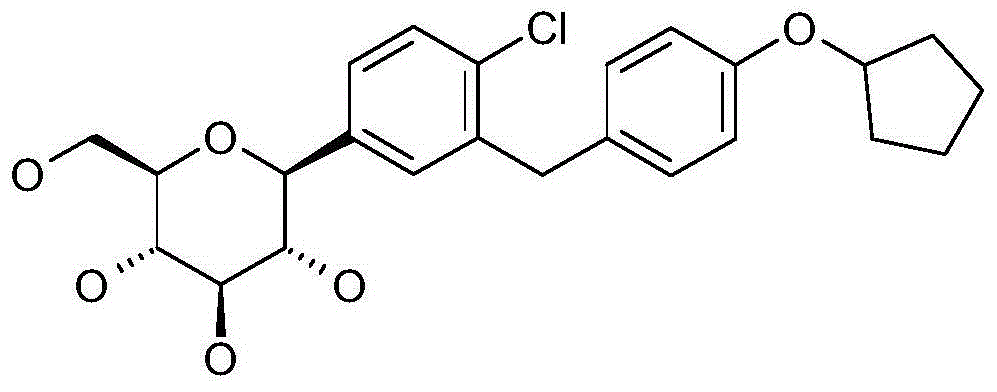
1-氯-2-(4-环戊氧基苄基)-4-(β-D-吡喃型葡萄糖-1-基)-苯1-Chloro-2-(4-cyclopentyloxybenzyl)-4-(β-D-glucopyranose-1-yl)-benzene
将0.16mL碘代环戊烷添加至0.25g的1-氯-4-(β-D-吡喃型葡萄糖-1-基)-2-(4-羟基苄基)-苯及0.4g碳酸铯于2.5mL二甲基甲酰胺中的混合物中。将混合物于45℃下搅拌4小时,随后再添加0.1g碳酸铯及0.05ml碘代环戊烷。于45℃下再搅拌14小时之后,添加氯化钠水溶液且以乙酸乙酯萃取所得混合物。经硫酸钠干燥有机相,去除溶剂且使用硅胶(二氯甲烷/甲醇1:0->5:1)纯化残余物。0.16 mL of iodocyclopentane was added to 0.25 g of 1-chloro-4-(β-D-glucopyranos-1-yl)-2-(4-hydroxybenzyl)-benzene and 0.4 g of cesium carbonate in a mixture in 2.5 mL of dimethylformamide. The mixture was stirred at 45°C for 4 hours, after which 0.1 g of cesium carbonate and 0.05 ml of iodocyclopentane were added. After stirring for a further 14 hours at 45°C, aqueous sodium chloride was added and the resulting mixture was extracted with ethyl acetate. The organic phase was dried over sodium sulfate, the solvent was removed and the residue was purified using silica gel (dichloromethane/methanol 1:0 -> 5:1).
产率:0.23g(理论值的78%)Yield: 0.23 g (78% of theory)
质谱(ESI+):m/z=466/468(Cl)[M+NH4]+ Mass spectrum (ESI + ):m/z=466/468(Cl)[M+NH 4 ] +
类似于实施例XIII获得下列化合物:The following compounds were obtained analogously to Example XIII:
(1)1-氯-4-(β-D-吡喃型葡萄糖-1-基)-2-[4-((S)-四氢呋喃-3-基氧基)-苄基]-苯(1) 1-chloro-4-(β-D-glucopyranose-1-yl)-2-[4-((S)-tetrahydrofuran-3-yloxy)-benzyl]-benzene
以(S)-甲苯-4-磺酸四氢呋喃-3-基酯作为偶合搭配物进行反应。The reaction was carried out with (S)-toluene-4-sulfonic acid tetrahydrofuran-3-yl ester as coupling partner.

质谱(ESI+):m/z=451/453(Cl)[M+H]+ Mass spectrum (ESI + ): m/z=451/453(Cl)[M+H] +
实施例XIVExample XIV

1-氯-4-(β-D-吡喃型葡萄糖-1-基)-2-[4-(三氟甲基磺酰基氧基)-苄基]-苯1-Chloro-4-(β-D-glucopyranose-1-yl)-2-[4-(trifluoromethylsulfonyloxy)-benzyl]-benzene
将10mg的4-二甲胺基吡啶添加至0.38g的1-氯-4-(β-D-吡喃型葡萄糖-1-基)-2-(4-羟基苄基)-苯、0.21ml三乙胺及0.39g的N,N-双-(三氟甲烷磺酰基)-苯胺于10ml无水二氯甲烷中的溶液中。将溶液在周围温度下搅拌4小时,且接着与盐水合并。以乙酸乙酯萃取所得混合物、经硫酸钠干燥有机萃取物,且去除溶剂。通过硅胶层析(二氯甲烷/甲醇为1:0->4:1)纯化残余物。10 mg of 4-dimethylaminopyridine was added to 0.38 g of 1-chloro-4-(β-D-glucopyranos-1-yl)-2-(4-hydroxybenzyl)-benzene, 0.21 ml In a solution of triethylamine and 0.39 g of N,N-bis-(trifluoromethanesulfonyl)-aniline in 10 ml of anhydrous dichloromethane. The solution was stirred at ambient temperature for 4 hours, and then combined with brine. The resulting mixture was extracted with ethyl acetate, the organic extracts were dried over sodium sulfate, and the solvent was removed. The residue was purified by silica gel chromatography (dichloromethane/methanol 1:0 -> 4:1).
产率:0.33g(理论值的64%)Yield: 0.33 g (64% of theory)
质谱(ESI+):m/z=530/532(Cl)[M+NH4]+ Mass spectrum (ESI + ):m/z=530/532(Cl)[M+NH 4 ] +
类似于实施例XIV获得下列化合物:The following compounds were obtained analogously to Example XIV:
(1)1-氰基-4-(β-D-吡喃型葡萄糖-1-基)-2-[4-(三氟甲基磺酰基氧基)-苄基]-苯(1) 1-cyano-4-(β-D-glucopyranose-1-yl)-2-[4-(trifluoromethylsulfonyloxy)-benzyl]-benzene

质谱(ESI+):m/z=504[M+H]+ Mass spectrum (ESI + ): m/z=504[M+H] +
实施例XVExample XV
1-氯-4-(2,3,4,6-四-O-乙酰基-β-D-吡喃型葡萄糖-1-基)-2-[4-(三氟甲基磺酰基氧基)-苄基]-苯1-Chloro-4-(2,3,4,6-tetra-O-acetyl-β-D-glucopyranose-1-yl)-2-[4-(trifluoromethylsulfonyloxy )-Benzyl]-Benzene
向5.6g的1-氯-4-(β-D-吡喃型葡萄糖-1-基)-2-[4-(三氟甲基磺酰基氧基)-苄基)-苯于75mL二氯甲烷中的溶液中依次添加7mL吡啶、7.8mL乙酸酐及0.12g的4-二甲胺基吡啶。将溶液在周围温度下搅拌1小时。在添加50mL水之后,将所得混合物再搅拌5分钟。分离有机相且以1M盐酸水溶液及碳酸氢钠水溶液洗涤。在经硫酸镁干燥且蒸发有机溶剂之后,生成呈白色固体的产物。To 5.6 g of 1-chloro-4-(β-D-glucopyranose-1-yl)-2-[4-(trifluoromethylsulfonyloxy)-benzyl)-benzene in 75 mL of dichloro To the solution in methane were sequentially added 7 mL of pyridine, 7.8 mL of acetic anhydride, and 0.12 g of 4-dimethylaminopyridine. The solution was stirred at ambient temperature for 1 hour. After adding 50 mL of water, the resulting mixture was stirred for an additional 5 minutes. The organic phase was separated and washed with 1M aqueous hydrochloric acid and aqueous sodium bicarbonate. After drying over magnesium sulfate and evaporation of the organic solvent, the product was obtained as a white solid.
产率:7.0g(理论值的94%)Yield: 7.0 g (94% of theory)
质谱(ESI+):m/z=698/700(Cl)[M+NH4]+ Mass spectrum (ESI + ):m/z=698/700(Cl)[M+NH 4 ] +
类似于实施例XV,获得下列化合物:Analogously to Example XV, the following compounds were obtained:
(1)1-氰基-4-(2,3,4,6-四-O-乙酰基-β-D-吡喃型葡萄糖-1-基)-2-[4-(三氟甲基磺酰基氧基)-苄基]-苯(1) 1-cyano-4-(2,3,4,6-tetra-O-acetyl-β-D-glucopyranose-1-yl)-2-[4-(trifluoromethyl Sulfonyloxy)-benzyl]-benzene
质谱(ESI+):m/z=689[M+NH4]+ Mass spectrum (ESI + ):m/z=689[M+NH 4 ] +
实施例XVIExample XVI

1-氯-2-(4-乙炔基-苄基)-4-(β-D-吡喃型葡萄糖-1-基)-苯1-Chloro-2-(4-ethynyl-benzyl)-4-(β-D-glucopyranose-1-yl)-benzene
将25mg碘化铜、44mg双-(三苯膦)-二氯化钯、0.30ml三乙胺及最终0.14ml三甲基甲硅烷基乙炔在氩下添加至0.32g的1-氯-4-(β-D-吡喃型葡萄糖-1-基)-2-[4-(三氟甲基磺酰基氧基)-苄基)-苯于3ml二甲基甲酰中的溶液中。将烧瓶紧密地密封且将混合物于90℃下搅拌8小时。接着再添加25mg双-(三苯膦)-二氯化钯及0.1ml三甲基甲硅烷基乙炔,且将溶液于90℃下再搅拌10小时。接着添加碳酸氢钠水溶液,以乙酸乙酯萃取所得混合物3次,且经硫酸钠干燥经合并的有机相。在已蒸发溶剂之后,将残余物溶解于5ml甲醇中且与0.12g碳酸钾合并。将混合物在周围温度下搅拌1h且接着以1M盐酸中和。接着蒸发去甲醇,将残余物与盐水合并且以乙酸乙酯萃取。经硫酸钠干燥所收集的有机萃取物且去除溶剂。通过硅胶层析(二氯甲烷/甲醇1:0->5:1)纯化残余物。To 0.32 g of 1-chloro-4- A solution of (β-D-glucopyranose-1-yl)-2-[4-(trifluoromethylsulfonyloxy)-benzyl)-benzene in 3 ml of dimethylformyl. The flask was tightly sealed and the mixture was stirred at 90°C for 8 hours. Then a further 25 mg of bis-(triphenylphosphine)-palladium dichloride and 0.1 ml of trimethylsilylacetylene are added, and the solution is stirred at 90° C. for a further 10 hours. Aqueous sodium bicarbonate solution was then added, the resulting mixture was extracted 3 times with ethyl acetate, and the combined organic phases were dried over sodium sulfate. After the solvent had been evaporated, the residue was dissolved in 5 ml methanol and combined with 0.12 g potassium carbonate. The mixture was stirred at ambient temperature for 1 h and then neutralized with 1M hydrochloric acid. The methanol was then evaporated off, the residue was hydrated with brine and extracted with ethyl acetate. The collected organic extracts were dried over sodium sulfate and the solvent was removed. The residue was purified by silica gel chromatography (dichloromethane/methanol 1:0 -> 5:1).
产率:0.095g(理论值的40%)Yield: 0.095g (40% of theory)
质谱(ESI+):m/z=406/408(Cl)[M+NH4]+ Mass spectrum (ESI + ):m/z=406/408(Cl)[M+NH 4 ] +
实施例XVIIExample XVII

1-氯-2-(4-乙基-苄基)-4-(β-D-吡喃型葡萄糖-1-基)-苯1-Chloro-2-(4-ethyl-benzyl)-4-(β-D-glucopyranose-1-yl)-benzene
将2.87g的1-氯-2-(4-乙炔基-苄基)-4-(β-D-吡喃型葡萄糖-1-基)-苯溶解于10ml乙酸乙酯及5ml乙醇中。添加0.3g的10%的钯-碳且将所得混合物于氢气氛(1atm)下搅拌过夜。经硅藻土过滤反应混合物且将滤液浓缩。通过硅胶层析(二氯甲烷/甲醇为1:0->5:1)上纯化残余物。2.87 g of 1-chloro-2-(4-ethynyl-benzyl)-4-(β-D-glucopyranose-1-yl)-benzene was dissolved in 10 ml ethyl acetate and 5 ml ethanol. 0.3 g of 10% palladium-carbon was added and the resulting mixture was stirred overnight under hydrogen atmosphere (1 atm). The reaction mixture was filtered through celite and the filtrate was concentrated. The residue was purified by chromatography on silica gel (dichloromethane/methanol 1:0 -> 5:1).
产率:1.0g(理论值的34%)Yield: 1.0 g (34% of theory)
质谱(ESI+):m/z=410/412(Cl)[M+NH4]+ Mass spectrum (ESI + ):m/z=410/412(Cl)[M+NH 4 ] +
实施例XVIIIExample XVIII

1-氯-2-[4-((S)-四氢呋喃-3-基氧基)-苄基]-4-(2,3,4,6-四-O-乙酰基-β-D-吡喃型葡萄糖-1-基)苯1-Chloro-2-[4-((S)-tetrahydrofuran-3-yloxy)-benzyl]-4-(2,3,4,6-tetra-O-acetyl-β-D-pyridine glucopyranose-1-yl)benzene
向2.02g的1-氯-4-(β-D-吡喃型葡萄糖-1-基)-2-[4-((S)-四氢呋喃-3-基氧基)-苄基]-苯于20mL二氯甲烷中的溶液中依次添加2.5mL吡啶、2.8mL乙酸酐及50mg的4-二甲胺基吡啶。将反应溶液在周围温度下搅拌4小时。以50mL二氯甲烷稀释溶液,以50mL的1M盐酸洗涤2次且以碳酸氢钠溶液洗涤1次。在经硫酸钠干燥之后,蒸发溶剂以产生产物。To 2.02g of 1-chloro-4-(β-D-glucopyranose-1-yl)-2-[4-((S)-tetrahydrofuran-3-yloxy)-benzyl]-benzene in 2.5 mL of pyridine, 2.8 mL of acetic anhydride, and 50 mg of 4-dimethylaminopyridine were sequentially added to a solution in 20 mL of dichloromethane. The reaction solution was stirred at ambient temperature for 4 hours. The solution was diluted with 50 mL of dichloromethane, washed twice with 50 mL of 1M hydrochloric acid and once with sodium bicarbonate solution. After drying over sodium sulfate, the solvent was evaporated to yield the product.
产率:2.53g(理论值的91%)Yield: 2.53 g (91% of theory)
质谱(ESI+):m/z=642/644(Cl)[M+Na]+ Mass spectrum (ESI + ): m/z=642/644(Cl)[M+Na] +
类似于实施例XVIII获得下列化合物:The following compounds were obtained analogously to Example XVIII:
(1)1-氯-2-(4-乙基-苄基)-4-(2,3,4,6-四-O-乙酰基-β-D-吡喃型葡萄糖-1-基)-苯(1) 1-Chloro-2-(4-ethyl-benzyl)-4-(2,3,4,6-tetra-O-acetyl-β-D-glucopyranose-1-yl) -benzene
(2)2-(4-乙酰氧基-苄基)-1-氯-4-(2,3,4,6-四-O-乙酰基-β-D-吡喃型葡萄糖-1-基)-苯(2) 2-(4-Acetoxy-benzyl)-1-chloro-4-(2,3,4,6-tetra-O-acetyl-β-D-glucopyranose-1-yl )-benzene

质谱(ESI+):m/z=608/610(Cl)[M+NH4]+ Mass spectrum (ESI + ):m/z=608/610(Cl)[M+NH 4 ] +
(3)1-氰基-2-(4-甲氧基-苄基)-4-(2,3,4,6-四-O-乙酰基-β-D-吡喃型葡萄糖-1-基)-苯(3) 1-cyano-2-(4-methoxy-benzyl)-4-(2,3,4,6-tetra-O-acetyl-β-D-glucopyranose-1- base)-benzene

质谱(ESI+):m/z=567[M+Na]+ Mass spectrum (ESI + ): m/z=567[M+Na] +
实施例XIXExample XIX
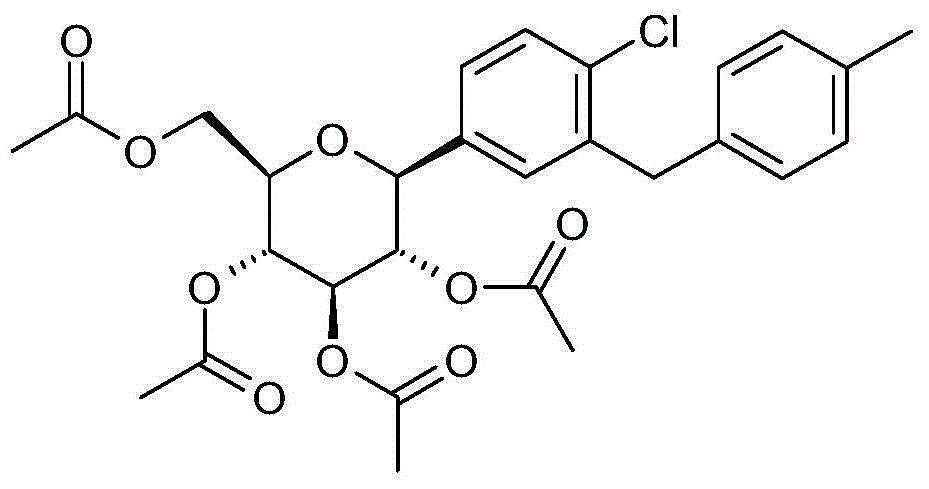
1-氯-2-(4-甲基-苄基)-4-(2,3,4,6-四-O-乙酰基-β-D-吡喃型葡萄糖-1-基)-苯1-Chloro-2-(4-methyl-benzyl)-4-(2,3,4,6-tetra-O-acetyl-β-D-glucopyranose-1-yl)-benzene
将二异丁基氢化铝(54μL,于甲苯中的1mol/l)在Ar气氛下添加至1,1’-双(二苯基膦基)二茂铁-二氯钯(II)(22mg)于THF(3mL)中的混合物中且在冰浴中冷却。将混合物于冰浴中搅拌0.5小时且接着依次添加1-氯-4-(2,3,4,6-四-O-乙酰基-β-D-吡喃型葡萄糖-1-基)-2-[4-(三氟甲基磺酰基氧基)-苄基]-苯(0.60g)及Me2Zn(0.88mL,于甲苯中的1mol/L)。去除冰浴且将混合物于回流下加热2.5小时。在冷却至室温之后,添加1M盐酸且将所得混合物以乙酸乙酯萃取所得混合物。经硫酸钠干燥所收集的萃取物且去除溶剂。通过硅胶层析(二氯甲烷/甲醇为1:0->2:1)纯化残余物。Diisobutylaluminum hydride (54 μL, 1 mol/l in toluene) was added to 1,1′-bis(diphenylphosphino)ferrocene-dichloropalladium(II) (22 mg) under Ar atmosphere in THF (3 mL) and cooled in an ice bath. The mixture was stirred in an ice bath for 0.5 hours and then 1-chloro-4-(2,3,4,6-tetra-O-acetyl-β-D-glucopyranose-1-yl)-2 was added sequentially -[4-(Trifluoromethylsulfonyloxy)-benzyl]-benzene (0.60 g) and Me2Zn (0.88 mL, 1 mol/L in toluene). The ice bath was removed and the mixture was heated at reflux for 2.5 hours. After cooling to room temperature, 1M hydrochloric acid was added and the resulting mixture was extracted with ethyl acetate. The collected extracts were dried over sodium sulfate and the solvent was removed. The residue was purified by silica gel chromatography (dichloromethane/methanol 1:0 -> 2:1).
产率:0.25g(理论值的52%)Yield: 0.25 g (52% of theory)
实施例XXExample XX
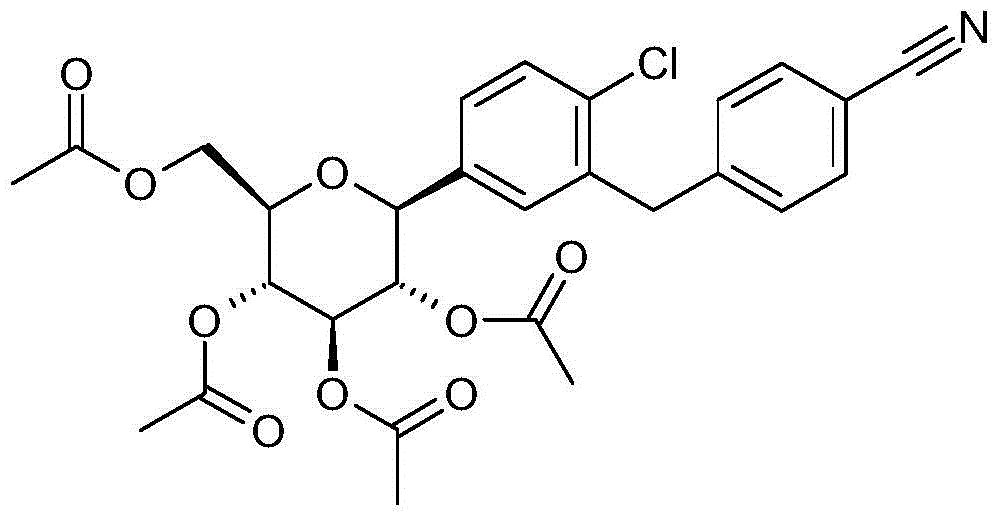
1-氯-2-(4-氰基-苄基)-4-(2,3,4,6-四-O-乙酰基-β-D-吡喃型葡萄糖-1-基)-苯1-Chloro-2-(4-cyano-benzyl)-4-(2,3,4,6-tetra-O-acetyl-β-D-glucopyranose-1-yl)-benzene
将四(三苯膦)钯(0)(0.13g)于氩气气氛下添加至装有1-氯-4-(2,3,4,6-四-O-乙酰基-β-D-吡喃型葡萄糖-1-基)-2-[4-(三氟甲基磺酰基氧基)-苄基]-苯(0.80g)及氰化锌(0.14g)的烧瓶中。将混合物于100℃下搅拌3小时。在冷却至室温之后,添加乙酸乙酯且过滤所得混合物,以NaHCO3水溶液洗涤,干燥(硫酸钠),且去除溶剂。将残余物自乙醇重结晶。Tetrakis(triphenylphosphine)palladium(0) (0.13g) was added under argon atmosphere to the Glucopyranose-1-yl)-2-[4-(trifluoromethylsulfonyloxy)-benzyl]-benzene (0.80 g) and zinc cyanide (0.14 g) in a flask. The mixture was stirred at 100°C for 3 hours. After cooling to room temperature, ethyl acetate was added and the resulting mixture was filtered, washed with aqueous NaHCO 3 , dried (sodium sulfate), and the solvent was removed. The residue was recrystallized from ethanol.
产率:0.45g(理论值的69%)Yield: 0.45 g (69% of theory)
质谱(ESI+):m/z=580/582(Cl)[M+Na]+ Mass Spectrum (ESI + ):m/z=580/582(Cl)[M+Na] +
实施例XXIExample XXI

4-环丙基-苯基硼酸4-Cyclopropyl-phenylboronic acid
将2.5M正丁基锂的己烷溶液(14.5mL)中逐滴添加至冷却至-70℃的于THF(14mL)及甲苯(50mL)中的1-溴-4-环丙基-苯(5.92g)中。将所得溶液于-70℃下搅拌30分钟,随后添加硼酸三异丙酯(8.5mL)。将溶液温至-20℃且接着以4M盐酸水溶液(15.5mL)处理。将反应混合物进一步温至室温且接着分离有机相。以乙酸乙酯萃取且干燥(硫酸钠)经合并有机相。蒸发溶剂且以乙醚与环己烷的混合物洗涤残余物以生成呈无色固体的产物。A 2.5M solution of n-butyllithium in hexanes (14.5 mL) was added dropwise to 1-bromo-4-cyclopropyl-benzene ( 5.92g). The resulting solution was stirred at -70°C for 30 minutes, then triisopropyl borate (8.5 mL) was added. The solution was warmed to -20°C and then treated with 4M aqueous hydrochloric acid (15.5 mL). The reaction mixture was further warmed to room temperature and then the organic phase was separated. The combined organic phases were extracted with ethyl acetate and dried (sodium sulfate). The solvent was evaporated and the residue was washed with a mixture of diethyl ether and cyclohexane to give the product as a colorless solid.
产率:2.92g(理论值的60%)Yield: 2.92 g (60% of theory)
质谱(ESI-):m/z=207(Cl)[M+HCOO]- Mass spectrum (ESI - ):m/z=207(Cl)[M+HCOO] -
类似于实施例XXI获得下列化合物:The following compounds were obtained analogously to Example XXI:
(1)4-二氟甲氧基-苯基硼酸(1) 4-Difluoromethoxy-phenylboronic acid

质谱(ESI-):m/z=233(Cl)[M+HCOO]- Mass spectrum (ESI - ):m/z=233(Cl)[M+HCOO] -
不同于上述步骤,使用iPrMgCl从4-二氟甲氧基-1-碘-苯生成芳基金属化合物且以硼酸三甲基酯捕获此中间体来制备此化合物。Instead of the above procedure, this compound was prepared using iPrMgCl to generate the aryl metal compound from 4-difluoromethoxy-1-iodo-benzene and trapping this intermediate with trimethyl borate.
(2)4-二氟甲氧基-苯基硼酸(2) 4-Difluoromethoxy-phenylboronic acid
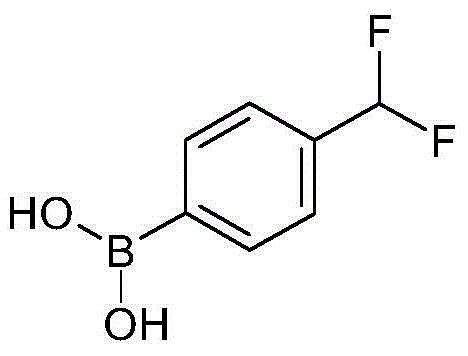
质谱(ESI+):m/z=172(Cl)[M+H]+ Mass spectrum (ESI + ): m/z=172(Cl)[M+H] +
不同于上述步骤,使用iPrMgCl自4-二氟甲基-1-碘-苯(使用于二氯甲烷中的二乙基胺基三氟化硫(DAST)自4-碘苯甲醛制备)生成芳基金属化合物且以硼酸三甲酯捕获此中间体来制备此化合物。Different from the above procedure, generation of aryl from 4-difluoromethyl-1-iodo-benzene (prepared from 4-iodobenzaldehyde using diethylaminosulfur trifluoride (DAST) in dichloromethane) using iPrMgCl base metal compound and capture this intermediate with trimethyl borate to prepare this compound.
实施例XXIIExample XXII

1-溴-4-氰基-3-(4-甲氧基-苄基)-苯1-Bromo-4-cyano-3-(4-methoxy-benzyl)-benzene
将温度保持在10℃以下,将25g的(4-甲氧基-苯基)-乙酸乙酯、27.4g的1-溴-4-氰基-3-氟-苯及20mL的N-甲基-吡咯烷-2-酮的混合物缓慢添加至130mL N-甲基-吡咯烷-2-酮中的31.4g叔丁醇钾中。在室温下搅拌1h之后,添加100mL甲醇及137mL1M氢氧化钠水溶液且将混合物于室温下搅拌过夜。蒸发甲醇部分,以1M氢氧化钠水溶液碱化残余物且以叔丁基-甲基醚萃取。以4M盐酸来酸化水相且以乙酸乙酯萃取若干次。蒸发经合并的乙酸乙酯萃取物且将残余物连同120mL的N,N-二甲基甲酰胺及24.9g碳酸钾于100℃下加热1小时。以碳酸氢钠水溶液稀释反应混合物且以乙酸乙酯萃取若干次。蒸发经合并的萃取物且将残余物自甲醇结晶。Keeping the temperature below 10 °C, 25 g of (4-methoxy-phenyl)-ethyl acetate, 27.4 g of 1-bromo-4-cyano-3-fluoro-benzene and 20 mL of N-methyl - The mixture of pyrrolidin-2-one was slowly added to 31.4 g of potassium tert-butoxide in 130 mL of N-methyl-pyrrolidin-2-one. After stirring at room temperature for 1 h, 100 mL of methanol and 137 mL of 1M aqueous sodium hydroxide solution were added and the mixture was stirred at room temperature overnight. The methanol fraction was evaporated, the residue was basified with 1M aqueous sodium hydroxide and extracted with tert-butyl-methyl ether. The aqueous phase was acidified with 4M hydrochloric acid and extracted several times with ethyl acetate. The combined ethyl acetate extracts were evaporated and the residue was heated at 100° C. for 1 hour together with 120 mL of N,N-dimethylformamide and 24.9 g of potassium carbonate. The reaction mixture was diluted with aqueous sodium bicarbonate and extracted several times with ethyl acetate. The combined extracts were evaporated and the residue was crystallized from methanol.
产率:13g(理论值的33%)Yield: 13 g (33% of theory)
质谱(ESI+):m/z=319/321(Br)[M+NH4]+ Mass spectrum (ESI + ):m/z=319/321(Br)[M+NH 4 ] +
类似于实施例XXII获得下列化合物:The following compounds were obtained analogously to Example XXII:
(1)1-溴-4-氰基-3-(4-环丙基-苄基)-苯(1) 1-bromo-4-cyano-3-(4-cyclopropyl-benzyl)-benzene

质谱(ESI+):m/z=329/331(Br)[M+NH4]+ Mass spectrum (ESI + ):m/z=329/331(Br)[M+NH 4 ] +
根据随后步骤实施例XXIII合成用于制备此化合物所需的苯基乙酸衍生物。The required phenylacetic acid derivatives for the preparation of this compound were synthesized according to the following procedure, Example XXIII.
实施例XXIIIExample XXIII

4-环丙基-苯乙酸乙酯4-Cyclopropyl-phenylacetic acid ethyl ester
根据Tetrahedron Lett.2002,43,6987-6990,使用于甲苯及水中的四氟硼酸三环己基
质谱(ESI+):m/z=205[M+H]+ Mass spectrum (ESI + ):m/z=205[M+H] +
实施例XXIVExample XXIV
1-氰基-4-(β-D-吡喃型葡萄糖-1-基)-2-(4-甲氧基苄基)-苯1-cyano-4-(β-D-glucopyranose-1-yl)-2-(4-methoxybenzyl)-benzene
将装有搅拌棒及溶解于无水THF(120mL)中的1-溴-4-氰基-3-(4-甲氧基-苄基)-苯(9.90g)且保持在氩气氛下的烧瓶冷却至-87℃。将叔丁基锂于戊烷(1.7M,39mL)中的预冷却(约-70℃)溶液缓慢添加至此溶液中且将所得溶液于-87℃下搅拌30分钟。接着添加2,3,4,6-四-O-(三甲基甲硅烷基)-D-吡喃型葡萄糖酮(16.5g)溶解于THF(80mL)中的溶液且将合并的溶液于-75℃下搅拌1小时。以NH4Cl水溶液中止反应且以乙酸乙酯萃取所得混合物。在干燥(Na2SO4)有机萃取物且去除溶剂之后,将残余物溶解于甲醇(150mL)中且添加甲磺酸(5mL)。将所得溶液于55℃下搅拌8小时以生成所需端基异构(anomeric)构型。在冷却至周期温度之后,以固体碳酸氢钠中和溶液,且在减压下蒸发甲醇。将盐水添加至残留物中且以乙酸乙酯萃取所得混合物。干燥(硫酸钠)经合并的萃取物且蒸发溶剂。将残余物溶解于乙腈(50mL)及二氯甲烷(50mL)中以还原端基异构碳中心。在将此溶液冷却至-20℃且添加三乙基硅烷(16mL)之后,逐滴添加三氟化硼乙醚合物(9.2mL)。将反应溶液于冷却浴中缓慢温至0℃且接着通过添加碳酸氢钠水溶液中止反应。分离有机相且以乙酸乙酯萃取水相。干燥(硫酸钠)经合并的有机相,去除溶剂且通过硅胶层析(二氯甲烷/甲醇为1:0->9:1)纯化残余物。A vacuum was charged with a stir bar and 1-bromo-4-cyano-3-(4-methoxy-benzyl)-benzene (9.90 g) dissolved in anhydrous THF (120 mL) and kept under argon atmosphere The flask was cooled to -87°C. A pre-cooled (ca. -70°C) solution of tert-butyllithium in pentane (1.7M, 39 mL) was slowly added to this solution and the resulting solution was stirred at -87°C for 30 minutes. Then a solution of 2,3,4,6-tetra-O-(trimethylsilyl)-D-glucopyranone (16.5 g) dissolved in THF (80 mL) was added and the combined solution was dissolved in - Stir at 75°C for 1 hour. The reaction was quenched with aqueous NH4Cl and the resulting mixture was extracted with ethyl acetate. After drying (Na 2 SO 4 ) the organic extracts and removing the solvent, the residue was dissolved in methanol (150 mL) and methanesulfonic acid (5 mL) was added. The resulting solution was stirred at 55°C for 8 hours to generate the desired anomeric configuration. After cooling to cycle temperature, the solution was neutralized with solid sodium bicarbonate and methanol was evaporated under reduced pressure. Brine was added to the residue and the resulting mixture was extracted with ethyl acetate. The combined extracts were dried (sodium sulfate) and the solvent was evaporated. The residue was dissolved in acetonitrile (50 mL) and dichloromethane (50 mL) to reduce the anomeric carbon center. After cooling this solution to -20°C and adding triethylsilane (16 mL), boron trifluoride diethyl etherate (9.2 mL) was added dropwise. The reaction solution was slowly warmed to 0 °C in a cooling bath and then quenched by the addition of aqueous sodium bicarbonate. The organic phase was separated and the aqueous phase was extracted with ethyl acetate. The combined organic phases were dried (sodium sulfate), the solvent was removed and the residue was purified by silica gel chromatography (dichloromethane/methanol 1:0 -> 9:1).
产率:5.2g(理论值的41%)Yield: 5.2 g (41% of theory)
质谱(ESI+):m/z=403[M+NH4]+ Mass spectrum (ESI + ):m/z=403[M+NH 4 ] +
类似于实施例XXIV获得下列化合物:The following compounds were obtained analogously to Example XXIV:
(1)1-氰基-2-(4-环丙基-苄基)-4-(β-D-吡喃型葡萄糖-1-基)-苯(1) 1-cyano-2-(4-cyclopropyl-benzyl)-4-(β-D-glucopyranose-1-yl)-benzene
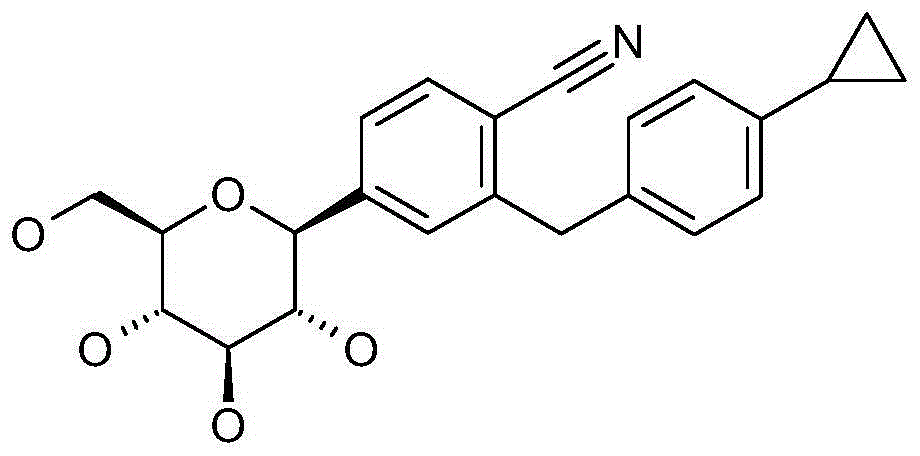
质谱(ESI-):m/z=413[M+H]+ Mass spectrum (ESI - ):m/z=413[M+H] +
有利地,在合成此化合物期间所获得的适当中间体的端基异构碳中心以受保护哌喃糖环上的氧官能基还原。优选地保护基为苄基、对甲氧基苄基、三甲基甲硅烷基、三乙基硅烷基、叔丁基二甲基硅烷基、三异丙基硅烷基及烯丙基。Advantageously, the anomeric carbon center of an appropriate intermediate obtained during the synthesis of this compound is reduced with the oxygen function on the protected pyranose ring. Preferred protecting groups are benzyl, p-methoxybenzyl, trimethylsilyl, triethylsilyl, t-butyldimethylsilyl, triisopropylsilyl and allyl.
实施例XXVExample XXV

1-氰基-2-(4-环丙基-苄基)-4-(四-O-乙酰基-β-D-吡喃型葡萄糖-1-基)-苯1-cyano-2-(4-cyclopropyl-benzyl)-4-(tetra-O-acetyl-β-D-glucopyranose-1-yl)-benzene
向装有搅拌棒、4-(2,3,4,6-四-O-乙酰基-D-吡喃型葡萄糖-1-基)-2-(4-三氟甲基磺酰氧基-苄基)-苯甲腈(4.4g)、脱气甲苯(12mL)及脱气水(8mL)且保持在氩气氛下的烧瓶添加环丙基硼酸(0.20g)、磷酸钾(5.0g)、三环己基膦(0.19g)及乙酸钯(II)(76mg)。将混合物于110℃下搅拌6小时,同时在每1小时之后添加环丙基硼酸(5x0.20g)。在冷却至室温之后,以碳酸氢钠水溶液稀释混合物且以乙酸乙酯萃取。干燥(硫酸钠)经合并的萃取物且于减压下去除溶剂。经硅胶(环己烷/乙酸乙酯为20:1->1:1)层析残余物。Into a stirring bar equipped with, 4-(2,3,4,6-tetra-O-acetyl-D-glucopyranose-1-yl)-2-(4-trifluoromethylsulfonyloxy- Benzyl)-benzonitrile (4.4 g), degassed toluene (12 mL) and degassed water (8 mL), and a flask kept under an argon atmosphere was added cyclopropylboronic acid (0.20 g), potassium phosphate (5.0 g), Tricyclohexylphosphine (0.19g) and palladium(II) acetate (76mg). The mixture was stirred at 110° C. for 6 hours while cyclopropylboronic acid (5×0.20 g) was added after every 1 hour. After cooling to room temperature, the mixture was diluted with aqueous sodium bicarbonate and extracted with ethyl acetate. The combined extracts were dried (sodium sulfate) and the solvent was removed under reduced pressure. The residue was chromatographed on silica gel (cyclohexane/ethyl acetate 20:1 -> 1:1).
产率:3.2g(理论值的87%)Yield: 3.2 g (87% of theory)
质谱(ESI+):m/z=581[M+NH4]+ Mass spectrum (ESI + ):m/z=581[M+NH 4 ] +
实施例XXVIExample XXVI

4-(1-羟基-环丙基)-苯基硼酸4-(1-Hydroxy-cyclopropyl)-phenylboronic acid
将溴化乙基镁于乙醚(7.6mL)中的3.0M溶液添加至异丙醇钛(IV)(2.2mL)于乙醚(70mL)中的冷却至-78℃的搅拌溶液中。将所得溶液于-78℃下搅拌1.5小时,随后添加4-(4,4,5,5-[1,3,2]二氧杂硼杂环戊-2-基)-苯甲酸甲酯(2.0g)。将反应混合物温至周围温度且再搅拌12小时。接着添加1M盐酸水溶液且以乙酸乙酯萃取所得混合物。干燥(硫酸钠)经合并的有机萃取物且蒸发溶剂。将残余物溶解于丙酮(60mL)中,且添加0.1M的NH4OAc水溶液(50mL),继而添加NaIO4(2.3g)。将所得反应混合物于室温下搅拌18小时。在去除丙酮之后,以乙酸乙酯萃取残余物。干燥(硫酸钠)经合并的萃取物且蒸发溶剂。通过硅胶层析(环己烷/乙酸乙酯)纯化残余物。A 3.0 M solution of ethylmagnesium bromide in diethyl ether (7.6 mL) was added to a stirred solution of titanium(IV) isopropoxide (2.2 mL) in diethyl ether (70 mL) cooled to -78°C. The resulting solution was stirred at -78 °C for 1.5 h, followed by the addition of 4-(4,4,5,5-[1,3,2]dioxaborol-2-yl)-benzoic acid methyl ester ( 2.0g). The reaction mixture was warmed to ambient temperature and stirred for an additional 12 hours. Then 1M aqueous hydrochloric acid was added and the resulting mixture was extracted with ethyl acetate. The combined organic extracts were dried (sodium sulfate) and the solvent was evaporated. The residue was dissolved in acetone (60 mL), and 0.1 M aqueous NH 4 OAc (50 mL) was added followed by NaIO 4 (2.3 g). The resulting reaction mixture was stirred at room temperature for 18 hours. After removal of acetone, the residue was extracted with ethyl acetate. The combined extracts were dried (sodium sulfate) and the solvent was evaporated. The residue was purified by silica gel chromatography (cyclohexane/ethyl acetate).
产率:0.45g(理论值的33%)Yield: 0.45 g (33% of theory)
质谱(ESI-):m/z=223[M+HCOO]- Mass spectrum (ESI - ):m/z=223[M+HCOO] -
最终化合物的制备:Preparation of final compound:
参考实施例1Reference Example 1
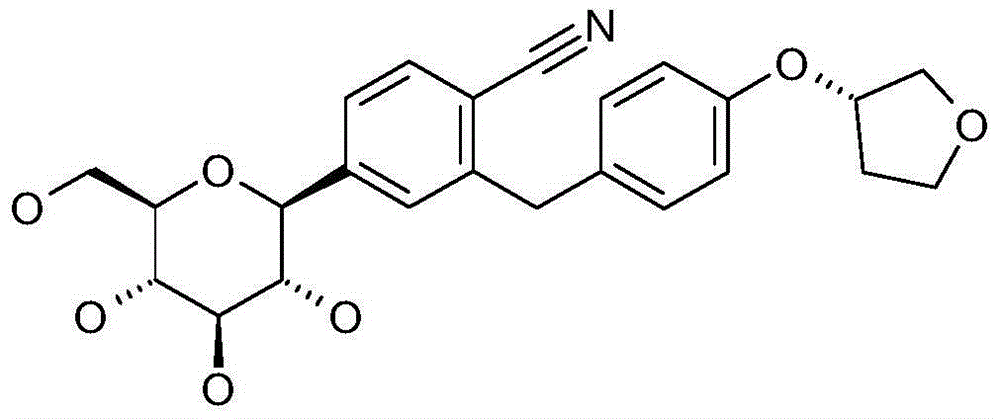
4-(β-D-吡喃型葡萄糖-1-基)-2-[4-((S)-四氢呋喃基-3-氧基)-苄基]-苯甲腈4-(β-D-Glucopyranos-1-yl)-2-[4-((S)-tetrahydrofuryl-3-oxyl)-benzyl]-benzonitrile
将1.00g的1-氯-2-[4-((S)-四氢呋喃基-3-氧基)-苄基]-4-(2,3,4,6-四-O-乙酰基-β-D-吡喃型葡萄糖-1-基)-苯、0.16g氰化钠及0.35g溴化镍于2.5mL N-甲基-2-吡咯烷酮中的混合物于220℃下的微波烘箱加热15分钟。在冷却至室温之后,添加水且以乙酸乙酯萃取所得混合物。在经硫酸钠干燥且蒸发溶剂之后,将残余物溶解于5mL甲醇中。添加4mL的4M氢氧化钾水溶液且将反应溶液在周围温度下搅拌3小时。以1M盐酸中和溶液且蒸发甲醇。以乙酸乙酯萃取残余物,经硫酸钠干燥经合并的萃取物,且于减压下去除溶剂。通过硅胶层析(二氯甲烷/甲醇为4:1)纯化残余物。1.00 g of 1-chloro-2-[4-((S)-tetrahydrofuryl-3-oxyl)-benzyl]-4-(2,3,4,6-tetra-O-acetyl-β -D-glucopyranose-1-yl)-benzene, a mixture of 0.16g sodium cyanide and 0.35g nickel bromide in 2.5mL N-methyl-2-pyrrolidone was heated in a microwave oven at 220°C for 15 minutes . After cooling to room temperature, water was added and the resulting mixture was extracted with ethyl acetate. After drying over sodium sulfate and evaporation of the solvent, the residue was dissolved in 5 mL of methanol. 4 mL of 4M aqueous potassium hydroxide solution was added and the reaction solution was stirred at ambient temperature for 3 hours. The solution was neutralized with 1M hydrochloric acid and methanol was evaporated. The residue was extracted with ethyl acetate, the combined extracts were dried over sodium sulfate, and the solvent was removed under reduced pressure. The residue was purified by silica gel chromatography (dichloromethane/methanol 4:1).
产率:0.35g(理论值的49%)Yield: 0.35 g (49% of theory)
质谱(ESI+):m/z=442[M+H]+ Mass Spectrum (ESI + ):m/z=442[M+H] +
类似于参考实施例1,获得实施例1、2、3及4的化合物:Similar to Reference Example 1, the compounds of Examples 1, 2, 3 and 4 were obtained:
实施例1:2-(4-乙基-苄基)-4-(β-D-吡喃型葡萄糖-1-基)-苯甲腈Example 1: 2-(4-Ethyl-benzyl)-4-(β-D-glucopyranose-1-yl)-benzonitrile

产率:理论值的65%Yield: 65% of theoretical value
质谱(ESI+):m/z=401[M+NH4]+ Mass spectrum (ESI + ):m/z=401[M+NH 4 ] +
类似于实施例6,使用4-乙基苯基硼酸作为偶合搭配物亦可制备此化合物。Similar to Example 6, this compound can also be prepared using 4-ethylphenylboronic acid as coupling partner.
实施例2:4-(β-D-吡喃型葡萄糖-1-基)-2-(4-羟基-苄基)-苯甲腈Example 2: 4-(β-D-glucopyranose-1-yl)-2-(4-hydroxy-benzyl)-benzonitrile
根据上述步骤,自2-(4-乙酰氧基-苄基)-1-氯-4-(2,3,4,6-四-O-乙酰基-β-D-吡喃型葡萄糖-1-基)-苯制备此化合物。According to the above procedure, from 2-(4-acetoxy-benzyl)-1-chloro-4-(2,3,4,6-tetra-O-acetyl-β-D-glucopyranose-1 -yl)-benzene to prepare this compound.

产率:理论值的30%Yield: 30% of theoretical value
质谱(ESI+):m/z=389[M+NH4]+ Mass spectrum (ESI + ):m/z=389[M+NH 4 ] +
亦通过全乙酰化2-(4-甲氧基-苄基)-4-(β-D-吡喃型葡萄糖-1-基)-苯甲腈,继而以三溴化硼裂解醚且去乙酰化而获得此化合物。Also by peracetylation of 2-(4-methoxy-benzyl)-4-(β-D-glucopyranose-1-yl)-benzonitrile, followed by cleavage of the ether with boron tribromide and deacetylation to obtain this compound.
实施例3:4-(β-D-吡喃型葡萄糖-1-基)-2-(4-甲基-苄基)-苯甲腈Example 3: 4-(β-D-glucopyranose-1-yl)-2-(4-methyl-benzyl)-benzonitrile
产率:理论值的59%Yield: 59% of theoretical value
质谱(ESI+):m/z=387[M+NH4]+ Mass spectrum (ESI + ):m/z=387[M+NH 4 ] +
类似于实施例6,使用4-甲基苯基硼酸作为偶合搭配物亦可制备此化合物。Similar to Example 6, this compound can also be prepared using 4-methylphenylboronic acid as coupling partner.
实施例4:2-(4-氰基-苄基)-4-(β-D-吡喃型葡萄糖-1-基)-苯甲腈Example 4: 2-(4-cyano-benzyl)-4-(β-D-glucopyranose-1-yl)-benzonitrile
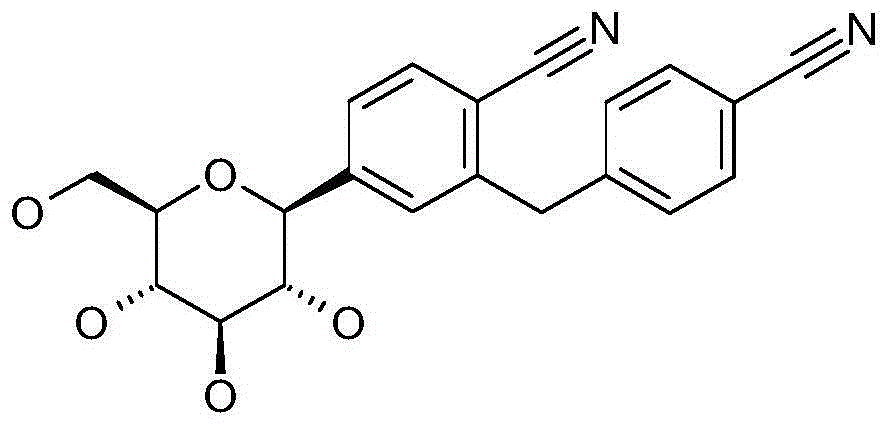
产率:理论值的58%Yield: 58% of theoretical value
质谱(ESI+):m/z=398[M+NH4]+ Mass spectrum (ESI + ):m/z=398[M+NH 4 ] +
实施例5Example 5
4-(β-D-吡喃型葡萄糖-1-基)-2-(4-甲氧基乙氧基-苄基)-苯甲腈4-(β-D-glucopyranose-1-yl)-2-(4-methoxyethoxy-benzyl)-benzonitrile
将2-溴乙基甲基醚(85μl)添加至4-(β-D-吡喃型葡萄糖-1-基)-2-(4-羟基苄基)-苯甲腈(0.30g)及碳酸铯(0.39g)于3mL二甲基甲酰胺中的混合物中。将混合物于80℃下搅拌16小时,随后添加水及盐水。以乙酸乙酯萃取所得混合物,经硫酸钠干燥经合并的萃取物,且于减压下去除溶剂。通过硅胶层析(二氯甲烷/甲醇为1:0->5:1)纯化残余物。2-Bromoethylmethyl ether (85 μl) was added to 4-(β-D-glucopyranose-1-yl)-2-(4-hydroxybenzyl)-benzonitrile (0.30 g) and carbonic acid A mixture of cesium (0.39 g) in 3 mL of dimethylformamide. The mixture was stirred at 80 °C for 16 hours, then water and brine were added. The resulting mixture was extracted with ethyl acetate, the combined extracts were dried over sodium sulfate, and the solvent was removed under reduced pressure. The residue was purified by silica gel chromatography (dichloromethane/methanol 1:0 -> 5:1).
产率:0.19g(理论值的49%)Yield: 0.19 g (49% of theory)
质谱(ESI+):m/z=430[M+H]+ Mass Spectrum (ESI + ):m/z=430[M+H] +
实施例6Example 6

4-(β-D-吡喃型葡萄糖-1-基)-2-(4-三氟甲氧基-苄基)-苯甲腈4-(β-D-glucopyranose-1-yl)-2-(4-trifluoromethoxy-benzyl)-benzonitrile
向经氩气填充的烧瓶中装入2-溴甲基-4-(2,3,4,6-四-O-乙酰基-D-吡喃型葡萄糖-1-基)-苯甲腈(0.25g)、4-三氟甲氧基-苯基硼酸(0.20g)、碳酸钾(0.26g)及脱气丙酮与水的3:1混合物(4mL)。将混合物于室温下搅拌5分钟,随后在冰浴中将其冷却。接着添加二氯化钯(5mg)且将反应混合物在周围温度下搅拌16小时。接着以盐水稀释混合物且以乙酸乙酯萃取。经硫酸钠干燥经合并的萃取物且于减压下去除溶剂。将残余物溶解于甲醇(9mL)中且以4M氢氧化钾水溶液(1mL)处理。将所得溶液在周围温度下搅拌1h且接着以1M盐酸中和。蒸发甲醇,且以盐水稀释残余物且以乙酸乙酯萃取。经硫酸钠干燥所收集的有机萃取物且去除溶剂。经硅胶(二氯甲烷/甲醇1:0->8:1)层析残余物。A flask filled with argon was charged with 2-bromomethyl-4-(2,3,4,6-tetra-O-acetyl-D-glucopyranos-1-yl)-benzonitrile ( 0.25 g), 4-trifluoromethoxy-phenylboronic acid (0.20 g), potassium carbonate (0.26 g) and a 3:1 mixture of degassed acetone and water (4 mL). The mixture was stirred at room temperature for 5 minutes, then cooled in an ice bath. Palladium dichloride (5 mg) was then added and the reaction mixture was stirred at ambient temperature for 16 hours. The mixture was then diluted with brine and extracted with ethyl acetate. The combined extracts were dried over sodium sulfate and the solvent was removed under reduced pressure. The residue was dissolved in methanol (9 mL) and treated with 4M aqueous potassium hydroxide (1 mL). The resulting solution was stirred at ambient temperature for 1 h and then neutralized with 1M hydrochloric acid. Methanol was evaporated, and the residue was diluted with brine and extracted with ethyl acetate. The collected organic extracts were dried over sodium sulfate and the solvent was removed. The residue was chromatographed on silica gel (dichloromethane/methanol 1:0 -> 8:1).
产率:0.145g(理论值的69%)Yield: 0.145 g (69% of theory)
质谱(ESI+):m/z=457[M+NH4]+ Mass spectrum (ESI + ):m/z=457[M+NH 4 ] +
在某些情况下,通过使用1.5至2.0当量的硼酸以及成比例增加的碱来增加产率。In some cases, the yield was increased by using 1.5 to 2.0 equivalents of boronic acid with a proportional increase in base.
类似于实施例6获得下列化合物:The following compounds were obtained analogously to Example 6:
实施例7:4-(β-D-吡喃型葡萄糖-1-基)-2-(4-三氟甲基-苄基)-苯甲腈Example 7: 4-(β-D-glucopyranose-1-yl)-2-(4-trifluoromethyl-benzyl)-benzonitrile

产率:理论值的47%Yield: 47% of theoretical value
质谱(ESI+):m/z=441[M+NH4]+ Mass spectrum (ESI + ):m/z=441[M+NH 4 ] +
实施例8:4-(β-D-吡喃型葡萄糖-1-基)-2-(4-异丙基-苄基)-苯甲腈Example 8: 4-(β-D-glucopyranose-1-yl)-2-(4-isopropyl-benzyl)-benzonitrile
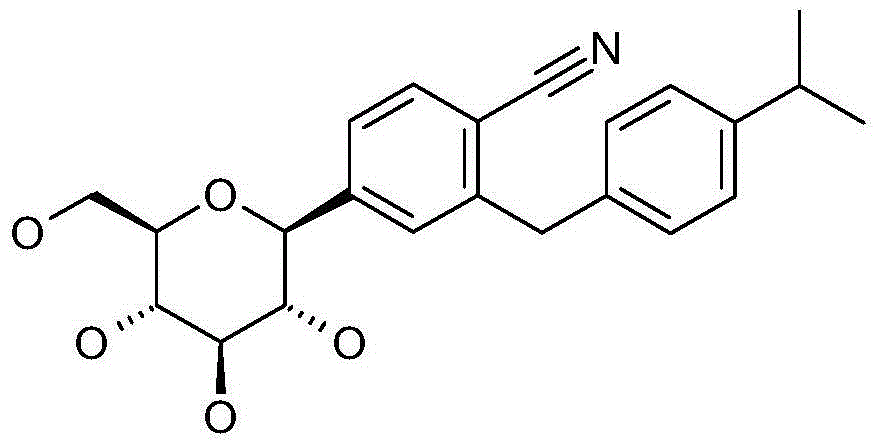
产率:理论值的87%Yield: 87% of theoretical value
质谱(ESI+):m/z=415[M+NH4]+ Mass spectrum (ESI + ):m/z=415[M+NH 4 ] +
实施例9:4-(β-D-吡喃型葡萄糖-1-基)-2-(4-叔丁基-苄基)-苯甲腈Example 9: 4-(β-D-glucopyranose-1-yl)-2-(4-tert-butyl-benzyl)-benzonitrile
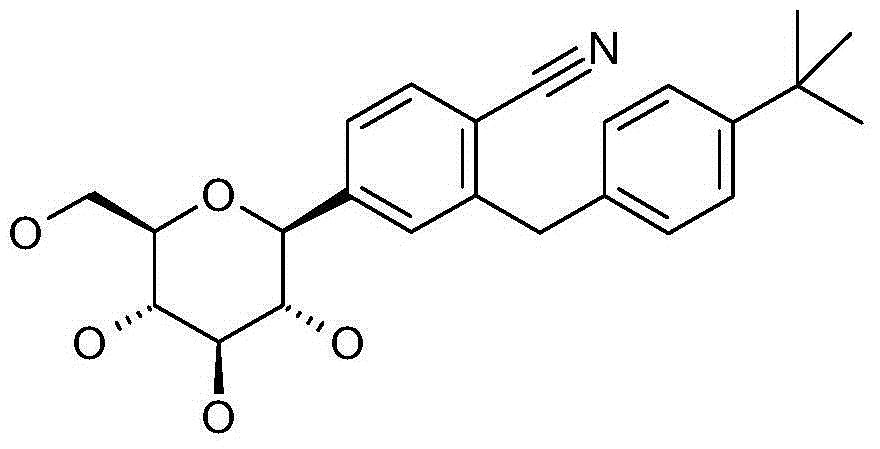
产率:理论值的66%Yield: 66% of theoretical value
质谱(ESI+):m/z=429[M+NH4]+ Mass spectrum (ESI + ):m/z=429[M+NH 4 ] +
实施例10:4-(β-D-吡喃型葡萄糖-1-基)-2-(4-三甲基甲硅烷基-苄基)-苯甲腈Example 10: 4-(β-D-glucopyranose-1-yl)-2-(4-trimethylsilyl-benzyl)-benzonitrile

产率:理论值的70%Yield: 70% of theoretical value
质谱(ESI+):m/z=445[M+NH4]+ Mass spectrum (ESI + ):m/z=445[M+NH 4 ] +
实施例11:4-(β-D-吡喃型葡萄糖-1-基)-2-(4-甲硫基-苄基)-苯甲腈Example 11: 4-(β-D-glucopyranose-1-yl)-2-(4-methylthio-benzyl)-benzonitrile
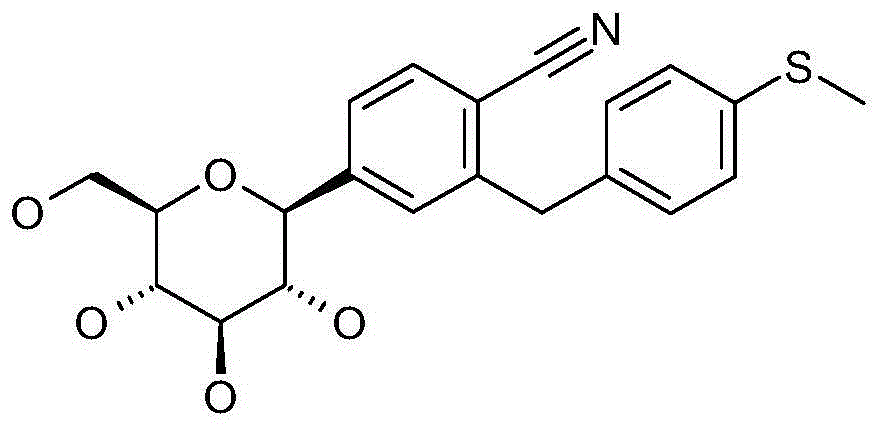
产率:理论值的47%Yield: 47% of theoretical value
质谱(ESI+):m/z=419[M+NH4]+ Mass spectrum (ESI + ):m/z=419[M+NH 4 ] +
实施例12:4-(β-D-吡喃型葡萄糖-1-基)-2-[4-(3-甲基-丁-1-基)-苄基]-苯甲腈Example 12: 4-(β-D-glucopyranose-1-yl)-2-[4-(3-methyl-but-1-yl)-benzyl]-benzonitrile

产率:理论值的69%Yield: 69% of theoretical value
质谱(ESI+):m/z=443[M+NH4]+ Mass spectrum (ESI + ):m/z=443[M+NH 4 ] +
实施例13:2-(4-氟-苄基)-4-(β-D-吡喃型葡萄糖-1-基)-苯甲腈Example 13: 2-(4-Fluoro-benzyl)-4-(β-D-glucopyranose-1-yl)-benzonitrile

产率:理论值的34%Yield: 34% of theoretical value
质谱(ESI+):m/z=391[M+NH4]+ Mass spectrum (ESI + ):m/z=391[M+NH 4 ] +
实施例14:2-(4-氯-苄基)-4-(β-D-吡喃型葡萄糖-1-基)-苯甲腈Example 14: 2-(4-Chloro-benzyl)-4-(β-D-glucopyranose-1-yl)-benzonitrile

产率:理论值的32%Yield: 32% of theoretical value
质谱(ESI+):m/z=407/409(Cl)[M+NH4]+ Mass spectrum (ESI + ):m/z=407/409(Cl)[M+NH 4 ] +
实施例15:2-(4-二氟甲氧基-苄基)-4-(β-D-吡喃型葡萄糖-1-基)-苯甲腈Example 15: 2-(4-Difluoromethoxy-benzyl)-4-(β-D-glucopyranose-1-yl)-benzonitrile

产率:理论值的32%Yield: 32% of theoretical value
质谱(ESI+):m/z=439[M+NH4]+ Mass spectrum (ESI + ):m/z=439[M+NH 4 ] +
实施例16:2-(4-二氟甲基-苄基)-4-(β-D-吡喃型葡萄糖-1-基)-苯甲腈Example 16: 2-(4-Difluoromethyl-benzyl)-4-(β-D-glucopyranose-1-yl)-benzonitrile

产率:理论值的65%Yield: 65% of theoretical value
质谱(ESI+):m/z=423[M+NH4]+ Mass spectrum (ESI + ):m/z=423[M+NH 4 ] +
实施例17:2-(4-环丙基-苄基)-4-(β-D-吡喃型葡萄糖-1-基)-苯甲腈Example 17: 2-(4-Cyclopropyl-benzyl)-4-(β-D-glucopyranose-1-yl)-benzonitrile

质谱(ESI+):m/z=413[M+NH4]+ Mass spectrum (ESI + ):m/z=413[M+NH 4 ] +
根据实施例6,使用4-环丙基-苯基硼酸作为偶合搭配物而获得获得此化合物。This compound was obtained according to Example 6 using 4-cyclopropyl-phenylboronic acid as coupling partner.
产率:理论值的83%Yield: 83% of theoretical value
或者,如实施例XXIV(1)中所述,获得此化合物。Alternatively, this compound was obtained as described in Example XXIV(1).
通过使用下列步骤亦获得实施例17的化合物:The compound of Example 17 was also obtained by using the following procedure:
以氢氧化钾水溶液(4mol/l,5mL)处理2-(4-环丙基-苄基)-4-(2,3,4,6-四-O-乙酰基-D-吡喃型葡萄糖-1-基)-苯甲腈(0.80g)于甲醇(5mL)及THF(5mL)中的溶液。将反应溶液在周围温度下搅拌1h且接着以1M盐酸中和。蒸发有机溶剂且以盐水稀释残余物,且以乙酸乙酯萃取。干燥(硫酸钠)有机萃取物且去除溶剂。经硅胶(二氯甲烷/甲醇为1:0->9:1)层析残余物。Treat 2-(4-cyclopropyl-benzyl)-4-(2,3,4,6-tetra-O-acetyl-D-glucopyranose with aqueous potassium hydroxide solution (4mol/l, 5mL) A solution of -1-yl)-benzonitrile (0.80 g) in methanol (5 mL) and THF (5 mL). The reaction solution was stirred at ambient temperature for 1 h and then neutralized with 1M hydrochloric acid. The organic solvent was evaporated and the residue was diluted with brine and extracted with ethyl acetate. The organic extracts were dried (sodium sulfate) and the solvent was removed. The residue was chromatographed on silica gel (dichloromethane/methanol 1:0 -> 9:1).
产率:0.54g(理论值的96%)Yield: 0.54 g (96% of theory)
实施例18:2-(4-环丁基-苄基)-4-(β-D-吡喃型葡萄糖-1-基)-苯甲腈Example 18: 2-(4-Cyclobutyl-benzyl)-4-(β-D-glucopyranose-1-yl)-benzonitrile

根据实施例6,使用4-环丁基硼酸(可类似于实施例XXI获得)作为偶合搭配而获得此化合物。This compound is obtained according to Example 6 using 4-cyclobutylboronic acid (obtainable analogously to Example XXI) as coupling partner.
产率:理论值的51%Yield: 51% of theoretical value
质谱(ESI-):m/z=427[M+NH4]+ Mass spectrum (ESI - ):m/z=427[M+NH 4 ] +
实施例19:4-(β-D-吡喃型葡萄糖-1-基)-2-(4-丙-1-基-苄基)-苯甲腈Example 19: 4-(β-D-glucopyranose-1-yl)-2-(4-propan-1-yl-benzyl)-benzonitrile

产率:理论值的64%Yield: 64% of theoretical value
质谱(ESI+):m/z=415[M+NH4]+ Mass spectrum (ESI + ):m/z=415[M+NH 4 ] +
实施例20:4-(β-D-吡喃型葡萄糖-1-基)-2-[4-(1-羟基-环丙基)-苄基)-苯甲腈Example 20: 4-(β-D-glucopyranose-1-yl)-2-[4-(1-hydroxy-cyclopropyl)-benzyl)-benzonitrile

根据实施例6,使用4-(1-羟基-环丙基)-苯基硼酸作为偶合搭配可获得此化合物。According to Example 6, this compound can be obtained using 4-(1-hydroxy-cyclopropyl)-phenylboronic acid as coupling partner.
实施例21Example 21

4-(β-D-吡喃型葡萄糖-1-基)-2-(4-碘-苄基)-苯甲腈4-(β-D-glucopyranose-1-yl)-2-(4-iodo-benzyl)-benzonitrile
将一氯化碘于二氯甲烷(0.9mL)中的1M溶液添加至溶解至二氯甲烷(5mL)中的4-(β-D-吡喃型葡萄糖-1-基)-2-(4-三甲基甲硅烷基-苄基)-苯甲腈(0.26g)中。将溶液在室温下搅拌1h且接着通过添加Na2S2O3水溶液及NaHCO3水溶液中止。分离有机相分离且以乙酸乙酯萃取水相。经硫酸钠干燥经合并的有机相且去除溶剂。经硅胶(二氯甲烷/甲醇为1:0->8:1)层析残余物。A 1 M solution of iodine monochloride in dichloromethane (0.9 mL) was added to 4-(β-D-glucopyranose-1-yl)-2-(4 -trimethylsilyl-benzyl)-benzonitrile (0.26g). The solution was stirred at room temperature for 1 h and then quenched by addition of aq . Na2S2O3 and aq. NaHCO3 . The organic phase was separated and the aqueous phase was extracted with ethyl acetate. The combined organic phases were dried over sodium sulfate and the solvent was removed. The residue was chromatographed on silica gel (dichloromethane/methanol 1:0 -> 8:1).
产率:0.15g(理论值的88%)Yield: 0.15 g (88% of theory)
质谱(ESI+):m/z=499[M+NH4]+ Mass spectrum (ESI + ):m/z=499[M+NH 4 ] +
类似于实施例20可获得下列化合物:The following compounds can be obtained analogously to Example 20:
(22)2-(4-溴-苄基)-4-(β-D-吡喃型葡萄糖-1-基)-苯甲腈(22) 2-(4-Bromo-benzyl)-4-(β-D-glucopyranose-1-yl)-benzonitrile

产率:理论值的79%Yield: 79% of theoretical value
质谱(ESI+):m/z=451/453[M+NH4]+ Mass spectrum (ESI + ):m/z=451/453[M+NH 4 ] +
根据实施例20的步骤,使用溴替代二氯甲烷中的ICl获得此化合物。This compound was obtained according to the procedure of Example 20, using bromine instead of ICl in dichloromethane.
实施例23Example 23

4-(β-D-吡喃型葡萄糖-1-基)-2-(4-五氟乙基-苄基)-苯甲腈4-(β-D-glucopyranose-1-yl)-2-(4-pentafluoroethyl-benzyl)-benzonitrile
将装有4-(2,3,4,6-四-O-乙酰基-β-D-吡喃型葡萄糖-1-基)-2-(4-碘-苄基)-苯甲腈(0.16g)、五氟乙基三甲基硅烷(0.14g)、KF(43mg)、CuI(0.16g)、DMF(2mL)及Ar气氛装料的烧瓶于60℃下加热24小时。接着添加NaHCO3水溶液且以乙酸乙酯萃取所得混合物。经硫酸钠干燥经合并的有机相且去除溶剂。将残余物溶解于甲醇(8mL)中且以4M KOH溶液(0.8mL)处理。将溶液于室温下搅拌1h且接着以NaHCO3水溶液稀释。于减压下去除甲醇之后,以乙酸乙酯萃取残余物,干燥经合并的有机萃取物且去除溶剂。经硅胶(二氯甲烷/甲醇为1:0->8:1)层析残余物。Will be loaded with 4-(2,3,4,6-tetra-O-acetyl-β-D-glucopyranose-1-yl)-2-(4-iodo-benzyl)-benzonitrile ( 0.16 g), pentafluoroethyltrimethylsilane (0.14 g), KF (43 mg), CuI (0.16 g), DMF (2 mL), and a flask charged with an Ar atmosphere was heated at 60° C. for 24 hours. Then aqueous NaHCO 3 was added and the resulting mixture was extracted with ethyl acetate. The combined organic phases were dried over sodium sulfate and the solvent was removed. The residue was dissolved in methanol (8 mL) and treated with 4M KOH solution (0.8 mL). The solution was stirred at room temperature for 1 h and then diluted with aqueous NaHCO 3 . After methanol was removed under reduced pressure, the residue was extracted with ethyl acetate, the combined organic extracts were dried and the solvent was removed. The residue was chromatographed on silica gel (dichloromethane/methanol 1:0 -> 8:1).
产率:0.08g(理论值的69%)Yield: 0.08 g (69% of theory)
质谱(ESI+):m/z=491[M+NH4]+ Mass spectrum (ESI + ):m/z=491[M+NH 4 ] +
实施例24Example 24

4-(β-D-吡喃型葡萄糖-1-基)-2-(4-甲基亚磺酰基-苄基)-苯甲腈4-(β-D-glucopyranose-1-yl)-2-(4-methylsulfinyl-benzyl)-benzonitrile
将35%过氧化氢的水溶液(48μL)添加至于1,1,1,3,3,3-六氟异丙醇(2mL)中的4-(β-D-吡喃型葡萄糖-1-基)-2-(4-甲硫基-苄基)-苯甲腈(83mg)中。将所得溶液在周围温度下搅拌1h且接着通过添加Na2S2O3水溶液及NaHCO3水溶液中止。分离有机相且以乙酸乙酯萃取水相。经硫酸钠干燥经合并的有机相且去除溶剂。经硅胶(二氯甲烷/甲醇为1:0->5:1)层析残余物。35% hydrogen peroxide in water (48 μL) was added to 4-(β-D-glucopyranose-1-yl in 1,1,1,3,3,3-hexafluoroisopropanol (2 mL) )-2-(4-Methylthio-benzyl)-benzonitrile (83mg). The resulting solution was stirred at ambient temperature for 1 h and then quenched by addition of aq . Na2S2O3 and aq. NaHCO3 . The organic phase was separated and the aqueous phase was extracted with ethyl acetate. The combined organic phases were dried over sodium sulfate and the solvent was removed. The residue was chromatographed on silica gel (dichloromethane/methanol 1:0 -> 5:1).
产率:24mg(理论值的28%)Yield: 24 mg (28% of theory)
质谱(ESI+):m/z=418[M+H]+ Mass spectrum (ESI + ):m/z=418[M+H] +
实施例25Example 25

4-(β-D-吡喃型葡萄糖-1-基)-2-(4-甲基磺酰基-苄基)-苯甲腈4-(β-D-glucopyranose-1-yl)-2-(4-methylsulfonyl-benzyl)-benzonitrile
将3-氯过氧苯甲酸(70%,0.14g)添加至在冰浴中冷却的于二氯甲烷(2mL)中的4-(β-D-吡喃型葡萄糖-1-基)-2-(4-甲硫基-苄基)-苯甲腈(100mg)中。去除冷却浴且将所得溶液在周围温度下搅拌1小时。添加Na2S2O3水溶液及NaHCO3水溶液之后,分离有机相且将以乙酸乙酯萃取水相。经硫酸钠干燥经合并的有机相且去除溶剂。经硅胶(二氯甲烷/甲醇为1:0->8:1)层析残余物。3-Chloroperoxybenzoic acid (70%, 0.14 g) was added to 4-(β-D-glucopyranose-1-yl)-2 in dichloromethane (2 mL) cooled in an ice bath -(4-Methylthio-benzyl)-benzonitrile (100mg). The cooling bath was removed and the resulting solution was stirred at ambient temperature for 1 hour. After addition of aqueous Na 2 S 2 O 3 and aqueous NaHCO 3 , the organic phase was separated and the aqueous phase was extracted with ethyl acetate. The combined organic phases were dried over sodium sulfate and the solvent was removed. The residue was chromatographed on silica gel (dichloromethane/methanol 1:0 -> 8:1).
产率:68mg(理论值的63%)Yield: 68 mg (63% of theory)
质谱(ESI+):m/z=451[M+NH4]+ Mass spectrum (ESI + ):m/z=451[M+NH 4 ] +
类似于上述实施例或自文献所知的其他方法亦可制备下列化合物:The following compounds can also be prepared analogously to the above examples or other methods known from the literature:

现在将描述一些制剂的实施例,其中术语“活性物质”表示一或多种本发明的化合物,包括其前药或盐。在如前所述与一种其他活性物质组合的情况下,术语“活性物质”亦包括其他活性物质。Some examples of formulations will now be described, wherein the term "active substance" means one or more compounds of the invention, including prodrugs or salts thereof. In the case of combination with one other active substance as described above, the term "active substance" also includes the other active substance.
实施例AExample A
含有100mg活性物质的片剂Tablets containing 100 mg of active substance
组成:composition:
1片剂含有:1 tablet contains:

制备方法:Preparation:
将活性物质、乳糖及淀粉混合在一起且以聚乙烯吡咯烷酮水溶液均一湿润。在将湿混合物过筛(2.0mm筛孔大小)且在架型(rack-type)干燥器中在50℃下干燥之后,将其再次过筛(1.5mm筛孔大小)且添加润滑剂。将最终混合物压片形成片剂。The active substance, lactose and starch are mixed together and moistened uniformly with an aqueous solution of polyvinylpyrrolidone. After the wet mixture was sieved (2.0 mm mesh size) and dried in a rack-type dryer at 50° C., it was sieved again (1.5 mm mesh size) and the lubricant was added. The final blend is compressed to form tablets.
片剂重量:220mgTablet Weight: 220mg
直径:10mm,双面,在两侧刻画且在一侧有刻痕。Diameter: 10mm, double-sided, engraved on both sides and scored on one side.
实施例BExample B
含有150mg活性物质的片剂Tablets containing 150 mg of active substance
组成:composition:
1片剂含有:1 tablet contains:
制备:preparation:
将与乳糖、玉米淀粉及二氧化硅混合的活性物质以20%聚乙烯吡咯烷酮水溶液润湿且通过1.5mm筛孔大小的筛。使在45℃下干燥的颗粒再次穿过相同筛且与特定量的硬脂酸镁混合。混合物压制成片剂。The active substance mixed with lactose, corn starch and silicon dioxide is moistened with 20% aqueous solution of polyvinylpyrrolidone and passed through a sieve with a mesh size of 1.5 mm. The granules dried at 45°C were again passed through the same sieve and mixed with the specified amount of magnesium stearate. The mixture is compressed into tablets.
片剂重量:300mgTablet weight: 300mg
直径:10mm,扁平Diameter: 10mm, flat
实施例CExample C
含有150mg活性物质的硬胶囊Hard capsules containing 150 mg of active substance
组成:composition:
1胶囊含有:1 capsule contains:

制备:preparation:
将活性物质与赋形剂混合,通过0.75mm筛孔大小的筛且使用合适设备均匀混合。将最终混合物填充入规格1的硬胶囊中。The active substance is mixed with the excipients, passed through a sieve with a mesh size of 0.75 mm and mixed homogeneously using suitable equipment. The final mixture is filled into hard capsules of size 1.
胶囊填料:大约320mgCapsule Filler: about 320mg
胶囊外壳:规格1的硬胶囊。Capsule shell: hard capsule of size 1.
实施例DExample D
含有150mg活性物质的栓剂Suppository containing 150 mg of active substance
组成:composition:
1栓剂含有:1 suppository contains:

制备:preparation:
在栓剂物质熔融之后,使活性物质均匀分布于其中,且将熔体倾入冷却模具中。After the suppository mass has melted, the active substance is distributed evenly therein, and the melt is poured into cooled moulds.
实施例EExample E
含有10mg活性物质的安瓿Ampoule containing 10 mg of active substance
组成:composition:
活性物质 10.0mgActive substance 10.0mg
0.01N盐酸适量Appropriate amount of 0.01N hydrochloric acid
双蒸水 加至 2.0mlAdd double distilled water to 2.0ml
制备:preparation:
将活性物质溶解于必需量的0.01N的HCl中,用食盐使其等张,无菌过滤且转移至2ml安瓿中。The active substance is dissolved in the necessary amount of 0.01 N HCl, made isotonic with common salt, sterile filtered and transferred into 2 ml ampoules.
实施例FExample F
含有50mg活性物质的安瓿Ampoule containing 50 mg of active substance
组成:composition:
活性物质 50.0mgActive substance 50.0mg
0.01N盐酸适量Appropriate amount of 0.01N hydrochloric acid
双蒸水 加至 10.0mlAdd double distilled water to 10.0ml
制备:preparation:
将活性物质溶解于必需量的0.01N的HCl中,用食盐使其等张,无菌过滤且转移至10ml安瓿中。The active substance is dissolved in the necessary amount of 0.01 N HCl, isotonic with common salt, sterile filtered and transferred into 10 ml ampoules.
Claims (12)


Applications Claiming Priority (6)
| Application Number | Priority Date | Filing Date | Title |
|---|---|---|---|
| EP06113412 | 2006-05-03 | ||
| EP06113412.8 | 2006-05-03 | ||
| EP06124833 | 2006-11-27 | ||
| EP06124833.2 | 2006-11-27 | ||
| PCT/EP2007/051411 WO2007093610A1 (en) | 2006-02-15 | 2007-02-14 | Glucopyranosyl-substituted benzonitrile derivatives, pharmaceutical compositions containing such compounds, their use and process for their manufacture |
| EPPCT/EP2007/051411 | 2007-02-14 |
Related Parent Applications (1)
| Application Number | Title | Priority Date | Filing Date |
|---|---|---|---|
| CNA2007800159285A Division CN101437807A (en) | 2006-05-03 | 2007-05-02 | Glucopyranosyl-substituted benzonitrile derivatives, pharmaceutical compositions containing said compounds, their use and process for their preparation |
Publications (1)
| Publication Number | Publication Date |
|---|---|
| CN103601709A true CN103601709A (en) | 2014-02-26 |
Family
ID=38885607
Family Applications (2)
| Application Number | Title | Priority Date | Filing Date |
|---|---|---|---|
| CN201110219008.3A Active CN102351918B (en) | 2006-05-03 | 2007-05-02 | Benzonitrile derivative substituted by glucopyranose group and pharmaceutical composition containing said compound |
| CN201310616828.5A Pending CN103601709A (en) | 2006-05-03 | 2007-05-02 | Glucopyranosyl-substituted benzonitrile derivatives, pharmaceutical compositions containing such compounds, their use and process for their manufacture |
Family Applications Before (1)
| Application Number | Title | Priority Date | Filing Date |
|---|---|---|---|
| CN201110219008.3A Active CN102351918B (en) | 2006-05-03 | 2007-05-02 | Benzonitrile derivative substituted by glucopyranose group and pharmaceutical composition containing said compound |
Country Status (32)
| Country | Link |
|---|---|
| US (2) | US7776830B2 (en) |
| EP (1) | EP2024352B1 (en) |
| JP (1) | JP5093524B2 (en) |
| KR (1) | KR101458372B1 (en) |
| CN (2) | CN102351918B (en) |
| AR (1) | AR060831A1 (en) |
| AU (1) | AU2007247218B2 (en) |
| BR (1) | BRPI0711121B8 (en) |
| CA (1) | CA2645638C (en) |
| CY (2) | CY1114187T1 (en) |
| DK (1) | DK2024352T3 (en) |
| EA (1) | EA200802185A1 (en) |
| EC (1) | ECSP088774A (en) |
| ES (1) | ES2422863T3 (en) |
| FI (1) | FIC20240011I1 (en) |
| FR (1) | FR24C1014I2 (en) |
| HR (1) | HRP20130656T1 (en) |
| HU (1) | HUS2400009I1 (en) |
| IL (1) | IL195028A0 (en) |
| LT (1) | LTPA2024505I1 (en) |
| MX (1) | MX2008013680A (en) |
| MY (1) | MY146368A (en) |
| NL (1) | NL301266I2 (en) |
| NO (1) | NO20083947L (en) |
| NZ (1) | NZ573216A (en) |
| PE (1) | PE20080697A1 (en) |
| PL (1) | PL2024352T3 (en) |
| PT (1) | PT2024352E (en) |
| SI (1) | SI2024352T1 (en) |
| TW (2) | TW201427964A (en) |
| UY (1) | UY30314A1 (en) |
| WO (1) | WO2007128749A1 (en) |
Cited By (2)
| Publication number | Priority date | Publication date | Assignee | Title |
|---|---|---|---|---|
| CN106188022A (en) * | 2015-04-30 | 2016-12-07 | 上海医药工业研究院 | The preparation method that Yi Gelie is clean |
| CN111511725A (en) * | 2017-12-19 | 2020-08-07 | 勃林格殷格翰维特梅迪卡有限公司 | 1-Cyano-2-(4-cyclopropyl-benzyl)-4-(β-D-glucopyranos-1-yl)-benzene, L-proline and water in a 1:1:1 Synthesis of crystals |
Families Citing this family (89)
| Publication number | Priority date | Publication date | Assignee | Title |
|---|---|---|---|---|
| JP4181605B2 (en) * | 2004-03-16 | 2008-11-19 | ベーリンガー インゲルハイム インターナショナル ゲゼルシャフト ミット ベシュレンクテル ハフツング | Glucopyranosyl-substituted phenyl derivatives, pharmaceuticals containing the compounds, and uses and production methods thereof |
| US8980894B2 (en) | 2004-03-25 | 2015-03-17 | Boehringer Ingelheim Vetmedica Gmbh | Use of PDE III inhibitors for the treatment of asymptomatic (occult) heart failure |
| EP1579862A1 (en) | 2004-03-25 | 2005-09-28 | Boehringer Ingelheim Vetmedica Gmbh | Use of PDE III inhibitors for the reduction of heart size in mammals suffering from heart failure |
| JP2008524162A (en) * | 2004-12-16 | 2008-07-10 | ベーリンガー インゲルハイム インターナショナル ゲゼルシャフト ミット ベシュレンクテル ハフツング | Glucopyranosyl-substituted benzene derivative, drug containing the compound, use thereof and production method thereof |
| ATE445608T1 (en) * | 2005-02-23 | 2009-10-15 | Boehringer Ingelheim Int | GLUCOPYRANOSYL-SUBSTITUTED ((HETERO)ARYLETHYNYL-BENZYL)-BENZENE DERIVATIVES AND THEIR USE AS INHIBITORS OF THE SODIUM-DEPENDENT GLUCOSE CO-TRANSPORTER TYPE 2 (SGLT2) |
| ATE453656T1 (en) * | 2005-04-15 | 2010-01-15 | Boehringer Ingelheim Int | GLUCOPYRANOSYL-SUBSTITUTED (HETEROARYLOXY-BENZYL)-BENZENE DERIVATIVES AS SGLT INHIBITORS |
| US7723309B2 (en) * | 2005-05-03 | 2010-05-25 | Boehringer Ingelheim International Gmbh | Crystalline forms of 1-chloro-4-(β-D-glucopyranos-1-yl)-2-[4-((R)-tetrahydrofuran-3-yloxy)-benzyl]-benzene, a method for its preparation and the use thereof for preparing medicaments |
| UA91546C2 (en) * | 2005-05-03 | 2010-08-10 | Бьорінгер Інгельхайм Інтернаціональ Гмбх | Crystalline form of 1-chloro-4-(я-d-glucopyranos-1-yl)-2-[4-((s)-tetrahydrofuran-3-yloxy)-benzyl]-benzene, a method for its preparation and the use thereof for preparing medicaments |
| US7772191B2 (en) * | 2005-05-10 | 2010-08-10 | Boehringer Ingelheim International Gmbh | Processes for preparing of glucopyranosyl-substituted benzyl-benzene derivatives and intermediates therein |
| TW200726755A (en) * | 2005-07-07 | 2007-07-16 | Astellas Pharma Inc | A crystalline choline salt of an azulene derivative |
| AR054871A1 (en) * | 2005-07-27 | 2007-07-25 | Boehringer Ingelheim Int | DERIVATIVES OF (HETERO) CICLOALQUILETINIL-BENCIL) -BENZENE REPLACED WITH GLUCOPIRANOSIL, MEDICINES CONTAINING SUCH COMPOUNDS, ITS USE AND PROCESS FOR MANUFACTURING |
| JP5175191B2 (en) * | 2005-08-30 | 2013-04-03 | ベーリンガー インゲルハイム インターナショナル ゲゼルシャフト ミット ベシュレンクテル ハフツング | Glycopyranosyl-substituted benzylbenzene derivative, pharmaceutical containing the compound, and use and production method thereof |
| TW200745075A (en) * | 2005-09-08 | 2007-12-16 | Boehringer Ingelheim Int | Crystalline forms of 1-chloro-4-(β-D-glucopyranos-1-yl)-2-(4-ethynyl-benzyl)-benzene, methods for its preparation and the use thereof for preparing medicaments |
| AR056195A1 (en) * | 2005-09-15 | 2007-09-26 | Boehringer Ingelheim Int | PROCEDURES TO PREPARE DERIVATIVES OF (ETINIL-BENCIL) -BENZENE REPLACED GLUCOPYRANOSIL AND INTERMEDIATE COMPOUNDS OF THE SAME |
| US7745414B2 (en) * | 2006-02-15 | 2010-06-29 | Boehringer Ingelheim International Gmbh | Glucopyranosyl-substituted benzonitrile derivatives, pharmaceutical compositions containing such compounds, their use and process for their manufacture |
| PE20080697A1 (en) * | 2006-05-03 | 2008-08-05 | Boehringer Ingelheim Int | BENZONITRILE DERIVATIVES SUBSTITUTED WITH GLUCOPYRANOSIL, PHARMACEUTICAL COMPOSITIONS CONTAINING COMPOUNDS OF THIS TYPE, THEIR USE AND PROCEDURE FOR THEIR MANUFACTURE |
| US8039441B2 (en) * | 2006-08-15 | 2011-10-18 | Boehringer Ingelheim International Gmbh | Glucopyranosyl-substituted cyclopropylbenzene derivatives, pharmaceutical compositions containing such compounds, their use as SGLT inhibitors and process for their manufacture |
| JP5372759B2 (en) * | 2006-09-21 | 2013-12-18 | ベーリンガー インゲルハイム インターナショナル ゲゼルシャフト ミット ベシュレンクテル ハフツング | Glucopyranosyl-substituted difluorobenzyl-benzene derivatives, pharmaceuticals containing the compounds and methods of use and preparation thereof |
| EP2086991A1 (en) * | 2006-10-27 | 2009-08-12 | Boehringer Ingelheim International GmbH | CRYSTALLINE FORM OF 4-(ß-D-GLUCOPYRANOS-1-YL)-1-METHYL-2-[4-((S)-TETRAHYDROFURAN-3-YLOXY)-BENZYL]-BENZENE, A METHOD FOR ITS PREPARATION AND THE USE THEREOF FOR PREPARING MEDICAMENTS |
| US7879806B2 (en) | 2006-11-06 | 2011-02-01 | Boehringer Ingelheim International Gmbh | Glucopyranosyl-substituted benzyl-benzonitrile derivates, medicaments containing such compounds, their use and process for their manufacture |
| EP1920785A1 (en) | 2006-11-07 | 2008-05-14 | Boehringer Ingelheim Vetmedica Gmbh | Liquid preparation comprising a complex of pimobendan and cyclodextrin |
| JPWO2008075736A1 (en) * | 2006-12-21 | 2010-04-15 | アステラス製薬株式会社 | Method for producing C-glycoside derivative and synthetic intermediate thereof |
| WO2008101939A1 (en) | 2007-02-21 | 2008-08-28 | Boehringer Ingelheim International Gmbh | Tetrasubstituted glucopyranosylated benzene derivatives, medicaments containing such compounds, their use and process for their manufacture |
| CL2008002427A1 (en) | 2007-08-16 | 2009-09-11 | Boehringer Ingelheim Int | Pharmaceutical composition comprising 1-chloro-4- (bd-glucopyranos-1-yl) -2- [4 - ((s) -tetrahydrofuran-3-yloxy) benzyl] -benzene combined with 1 - [(4-methylquinazolin- 2-yl) methyl] -3-methyl-7- (2-butyn-1-yl) -8- (3- (r) -aminopiperidin-1-yl) xanthine; and its use to treat type 2 diabetes mellitus. |
| CA2706018C (en) | 2007-11-30 | 2015-11-24 | Boehringer Ingelheim International Gmbh | 1, 5-dihydro-pyrazolo [3,4-d]pyrimidin-4-one derivatives and their use as pde9a modulators for the treatment of cns disorders |
| KR101516677B1 (en) * | 2008-01-31 | 2015-05-04 | 고토부키 세이야쿠 가부시키가이샤 | Pharmaceutical composition for treatment of fatty liver diseases |
| UA105362C2 (en) | 2008-04-02 | 2014-05-12 | Бьорингер Ингельхайм Интернациональ Гмбх | 1-heterocyclyl-1, 5-dihydro-pyrazolo [3, 4-d] pyrimidin-4-one derivatives and their use as pde9a modulators |
| EP2334687B9 (en) * | 2008-08-28 | 2012-08-08 | Pfizer Inc. | Dioxa-bicyclo[3.2.1.]octane-2,3,4-triol derivatives |
| NZ590788A (en) | 2008-09-08 | 2012-11-30 | Boehringer Ingelheim Int | Pyrazolopyrimidines and their use for the treatment of cns disorders |
| UY32427A (en) | 2009-02-13 | 2010-09-30 | Boheringer Ingelheim Internat Gmbh | PHARMACEUTICAL COMPOSITION, PHARMACEUTICAL FORM, PROCEDURE FOR PREPARATION, METHODS OF TREATMENT AND USES OF THE SAME |
| CN102316875A (en) * | 2009-02-13 | 2012-01-11 | 贝林格尔.英格海姆国际有限公司 | SGLT-2 inhibitors for the treatment of type 1 diabetes, type 2 diabetes, impaired glucose tolerance or hyperglycemia |
| PT2395983T (en) | 2009-02-13 | 2020-07-03 | Boehringer Ingelheim Int | Pharmaceutical composition comprising a sglt2 inhibitor, a dpp-iv inhibitor and optionally a further antidiabetic agent and uses thereof |
| DK2395968T3 (en) * | 2009-02-13 | 2024-03-04 | Boehringer Ingelheim Int | PHARMACEUTICAL COMPOSITION COMPRISING GLUCOPYRANOSYL DIPHENYLMETHANE DERIVATIVES, PHARMACEUTICAL DOSAGE FORM THEREOF, PROCEDURE FOR THEIR PREPARATION AND USES THEREOF FOR IMPROVING GLYCEMIC CONTROL IN A PATIENT |
| CA2757231A1 (en) | 2009-03-31 | 2010-10-07 | Boehringer Ingelheim International Gmbh | 1-heterocyclyl-1,5-dihydro-pyrazolo [3,4-d] pyrimidin-4-one derivatives and their use as pde9a modulators |
| WO2010147430A2 (en) * | 2009-06-19 | 2010-12-23 | Green Cross Corporation | Novel c-aryl glucoside sglt2 inhibitors and pharmaceutical composition comprising same |
| ES2546762T3 (en) | 2009-09-30 | 2015-09-28 | Boehringer Ingelheim International Gmbh | Procedures for preparing glucopyranosyl substituted benzyl benzene derivatives |
| EA020798B1 (en) * | 2009-09-30 | 2015-01-30 | Бёрингер Ингельхайм Интернациональ Гмбх | Method for the preparation of a crystalline form of 1-chloro-4-(beta-d-glucopyranos-1-yl)-2-[4-((s)-tetrahydrofuran-3-yloxy)benzyl]benzene |
| UY32919A (en) | 2009-10-02 | 2011-04-29 | Boehringer Ingelheim Int | Pharmaceutical composition, pharmaceutical dosage form, procedure for its preparation, methods for its treatment and its uses |
| KR101426180B1 (en) | 2009-11-02 | 2014-07-31 | 화이자 인코포레이티드 | Dioxa-bicyclo[3.2.1]octane-2,3,4-triol derivatives |
| EP2368552A1 (en) * | 2010-03-25 | 2011-09-28 | Boehringer Ingelheim Vetmedica GmbH | 1-[(3-cyano-pyridin-2-yl)methyl]-3-methyl-7-(2-butyn-1-yl)-8-[3-(r)-amino-piperidin-1-yl]-xanthine for the treatment of a metabolic disorder of a predominantly carnivorous non-human animal |
| WO2011120923A1 (en) | 2010-03-30 | 2011-10-06 | Boehringer Ingelheim International Gmbh | Pharmaceutical composition comprising an sglt2 inhibitor and a ppar- gamma agonist and uses thereof |
| GEP20156217B (en) | 2010-08-12 | 2015-01-12 | Boehringer Ingelheim Int | 6-cycloalkyl-1, 5-dihydro-pyrazolo [3, 4-d] pyrimidin-4-one derivatives and their use as pde9a inhibitors |
| WO2012041898A1 (en) | 2010-09-29 | 2012-04-05 | Celon Pharma Sp. Z O.O. | Combination of sglt2 inhibitor and a sugar compound for the treatment of diabetes |
| US20120283169A1 (en) | 2010-11-08 | 2012-11-08 | Boehringer Ingelheim International Gmbh | Pharmaceutical composition, methods for treating and uses thereof |
| US20130035281A1 (en) | 2011-02-09 | 2013-02-07 | Boehringer Ingelheim International Gmbh | Pharmaceutical composition, methods for treating and uses thereof |
| US8809345B2 (en) | 2011-02-15 | 2014-08-19 | Boehringer Ingelheim International Gmbh | 6-cycloalkyl-pyrazolopyrimidinones for the treatment of CNS disorders |
| UY33937A (en) | 2011-03-07 | 2012-09-28 | Boehringer Ingelheim Int | PHARMACEUTICAL COMPOSITIONS CONTAINING DPP-4 AND / OR SGLT-2 AND METFORMIN INHIBITORS |
| WO2012163990A1 (en) | 2011-06-03 | 2012-12-06 | Boehringer Ingelheim International Gmbh | Sglt-2 inhibitors for treating metabolic disorders in patients treated with neuroleptic agents |
| US20130035298A1 (en) | 2011-07-08 | 2013-02-07 | Boehringer Ingelheim International Gmbh | Pharmaceutical composition, methods for treating and uses thereof |
| JP2014530186A (en) | 2011-09-13 | 2014-11-17 | パナセア バイオテック リミテッド | Novel SGLT inhibitor |
| US8697658B2 (en) * | 2011-12-15 | 2014-04-15 | National Health Research Institutes | Glycoside compounds |
| US9555001B2 (en) | 2012-03-07 | 2017-01-31 | Boehringer Ingelheim International Gmbh | Pharmaceutical composition and uses thereof |
| WO2013135852A1 (en) | 2012-03-15 | 2013-09-19 | Boehringer Ingelheim Vetmedica Gmbh | Pharmaceutical tablet formulation for the veterinary medical sector, method of production and use thereof |
| US9192617B2 (en) | 2012-03-20 | 2015-11-24 | Boehringer Ingelheim International Gmbh | Pharmaceutical composition, methods for treating and uses thereof |
| US9145434B2 (en) | 2012-07-26 | 2015-09-29 | Boehringer Ingelheim International Gmbh | Crystalline complex of 1-cyano-2-(4-cyclopropyl-benzyl)-4-(ss-d-glucopyranos-1-yl)-benzene, methods for its preparation and the use thereof for preparing medicaments |
| PT2981269T (en) | 2013-04-04 | 2023-10-10 | Boehringer Ingelheim Vetmedica Gmbh | Treatment of metabolic disorders in equine animals |
| HK1213818A1 (en) | 2013-04-05 | 2016-07-15 | 勃林格殷格翰国际有限公司 | Therapeutic uses of empagliflozin |
| CA2812519A1 (en) | 2013-04-05 | 2014-10-05 | Boehringer Ingelheim International Gmbh | Pharmaceutical composition, methods for treating and uses thereof |
| ES2702174T3 (en) | 2013-04-05 | 2019-02-27 | Boehringer Ingelheim Int | Therapeutic uses of empagliflozin |
| US11813275B2 (en) | 2013-04-05 | 2023-11-14 | Boehringer Ingelheim International Gmbh | Pharmaceutical composition, methods for treating and uses thereof |
| DK2986304T3 (en) | 2013-04-18 | 2022-04-04 | Boehringer Ingelheim Int | PHARMACEUTICAL COMPOSITION, TREATMENT PROCEDURES AND USES. |
| JP6272475B2 (en) | 2013-07-19 | 2018-01-31 | ベーリンガー インゲルハイム フェトメディカ ゲーエムベーハーBoehringer Ingelheim Vetmedica GmbH | Liquid aqueous pharmaceutical composition containing antiseptic etherified cyclodextrin derivative |
| EA034054B1 (en) | 2013-12-04 | 2019-12-23 | Бёрингер Ингельхайм Ветмедика Гмбх | Improved pharmaceutical compositions of pimobendan |
| CN111494357A (en) * | 2013-12-17 | 2020-08-07 | 勃林格殷格翰动物保健有限公司 | Treatment of metabolic disorders in felines |
| ES2712860T3 (en) | 2014-01-23 | 2019-05-16 | Boehringer Ingelheim Vetmedica Gmbh | Treatment of metabolic disorders in canine animals |
| FI3721882T3 (en) | 2014-04-01 | 2024-09-24 | Boehringer Ingelheim Vetmedica Gmbh | Treatment of pituitary pars intermedia dysfunction in equine animals |
| EP3197429B1 (en) | 2014-09-25 | 2024-05-22 | Boehringer Ingelheim Vetmedica GmbH | Combination treatment of sglt2 inhibitors and dopamine agonists for preventing metabolic disorders in equine animals |
| EP3267994A4 (en) | 2015-03-09 | 2018-10-31 | Intekrin Therapeutics, Inc. | Methods for the treatment of nonalcoholic fatty liver disease and/or lipodystrophy |
| CN104829491B (en) * | 2015-04-20 | 2017-04-19 | 华南理工大学 | Method for synthesizing aromaticnitrile |
| BR112018003749B1 (en) * | 2015-08-27 | 2023-10-31 | Boehringer Ingelheim Vetmedica Gmbh | LIQUID PHARMACEUTICAL COMPOSITIONS COMPRISING SGLT-2 INHIBITORS, KIT OF PARTS AND PROCESS FOR PRODUCING THE LIQUID PHARMACEUTICAL COMPOSITION |
| EP3362055B1 (en) | 2015-10-15 | 2023-01-18 | Boehringer Ingelheim International GmbH | Sglt-2 inhibitor for use in the treatment of a metabolic myopathy |
| US10537570B2 (en) | 2016-04-06 | 2020-01-21 | Boehringer Ingelheim Vetmedica Gmbh | Use of pimobendan for the reduction of heart size and/or the delay of onset of clinical symptoms in patients with asymptomatic heart failure due to mitral valve disease |
| CN109922813A (en) | 2016-11-10 | 2019-06-21 | 勃林格殷格翰国际有限公司 | Pharmaceutical composition, treatment method and application thereof |
| SG11201909046XA (en) | 2017-04-03 | 2019-10-30 | Coherus Biosciences Inc | PPARγ AGONIST FOR TREATMENT OF PROGRESSIVE SUPRANUCLEAR PALSY |
| KR102204439B1 (en) | 2018-05-14 | 2021-01-18 | 에이치케이이노엔 주식회사 | Pharmaceutical Composition comprising SGLT-2 inhibitor and DPP-IV inhibitor |
| WO2020039394A1 (en) | 2018-08-24 | 2020-02-27 | Novartis Ag | New drug combinations |
| AU2020394498A1 (en) | 2019-11-28 | 2022-06-09 | Boehringer Ingelheim Vetmedica Gmbh | Use of SGLT-2 inhibitors in the drying-off of non-human mammals |
| KR20220143732A (en) | 2020-02-17 | 2022-10-25 | 베링거잉겔하임베트메디카게엠베하 | Use of SGLT-2 inhibitors to prevent and/or treat heart disease in felines |
| JP7776430B2 (en) | 2020-03-06 | 2025-11-26 | バーテックス ファーマシューティカルズ インコーポレイテッド | Methods for treating APOL-1 dependent focal segmental glomerulosclerosis |
| WO2022051316A1 (en) | 2020-09-03 | 2022-03-10 | Coherus Biosciences, Inc. | Fixed dose combinations of chs-131 and a sglt-2 inhibitor |
| JP2024525981A (en) | 2021-07-28 | 2024-07-12 | ベーリンガー インゲルハイム フェトメディカ ゲーエムベーハー | Use of SGLT-2 inhibitors for the prevention and/or treatment of renal disease in non-human mammals - Patents.com |
| WO2023006745A1 (en) | 2021-07-28 | 2023-02-02 | Boehringer Ingelheim Vetmedica Gmbh | Use of sglt-2 inhibitors for the prevention and/or treatment of hypertension in non-human mammals |
| AU2022319909A1 (en) | 2021-07-28 | 2024-02-22 | Boehringer Ingelheim Vetmedica Gmbh | Use of sglt-2 inhibitors for the prevention and/or treatment of cardiac diseases in non-human mammals excluding felines, in particular canines |
| US20230381101A1 (en) | 2022-05-25 | 2023-11-30 | Boehringer Ingelheim Vetmedica Gmbh | Aqueous pharmaceutical compositions comprising sglt-2 inhibitors |
| TW202500160A (en) | 2023-03-06 | 2025-01-01 | 德商百靈佳殷格翰維美迪加股份有限公司 | Systems and methods for delivery of liquid pharmaceutical compositions in particular comprising one or more sglt-2 inhibitor(s) |
| WO2024223388A1 (en) | 2023-04-24 | 2024-10-31 | Boehringer Ingelheim Vetmedica Gmbh | Crystalline complexes between velagliflozin and selected co-crystal forming agents, methods for their preparation and the use thereof for preparing medicaments |
| WO2024240632A1 (en) | 2023-05-24 | 2024-11-28 | Boehringer Ingelheim Vetmedica Gmbh | Combination treatment and/or prevention of cardiac diseases in non-human mammals comprising one or more sglt-2 inhibitors and pimobendan and/or telmisartan |
| TW202508455A (en) | 2023-05-24 | 2025-03-01 | 德商百靈佳殷格翰維美迪加股份有限公司 | Combination treatment and/or prevention of renal diseases and/or hypertension in non-human mammals comprising one or more sglt-2 inhibitors and telmisartan |
| CN119080759A (en) * | 2024-08-30 | 2024-12-06 | 江苏阿尔法药业股份有限公司 | A crystal form of acetylated empagliflozin and preparation method thereof |
Family Cites Families (106)
| Publication number | Priority date | Publication date | Assignee | Title |
|---|---|---|---|---|
| US3174901A (en) * | 1963-01-31 | 1965-03-23 | Jan Marcel Didier Aron Samuel | Process for the oral treatment of diabetes |
| NL167151C (en) * | 1971-04-09 | 1981-11-16 | Acf Chemiefarma Nv | PROCESS FOR THE PREPARATION OF MEDICINAL PRODUCTS WITH ANTI-PARASITARY ACTION ON THE BASIS OF HALOGEN CONTAINING THE 2,2'-METHYLENE DIFENOL DERIVATIVES, AND METHOD FOR PREPARING THESE MEDICINAL COMPOUNDS. |
| NO154918C (en) * | 1977-08-27 | 1987-01-14 | Bayer Ag | ANALOGUE PROCEDURE FOR THE PREPARATION OF THERAPEUTIC ACTIVE DERIVATIVES OF 3,4,5-TRIHYDROXYPIPERIDINE. |
| DE2758025A1 (en) | 1977-12-24 | 1979-07-12 | Bayer Ag | Tri:hydroxy-piperidine derivs. - useful as glucosidase inhibitors for treating diabetes etc. and as animal feed additives |
| DE2951135A1 (en) | 1979-12-19 | 1981-06-25 | Hoechst Ag, 6230 Frankfurt | SULFONYL UREAS, METHOD FOR THE PRODUCTION THEREOF, PHARMACEUTICAL PREPARATIONS BASED ON THESE COMPOUNDS AND THEIR USE |
| JPS58164502A (en) | 1982-03-26 | 1983-09-29 | Chugai Pharmaceut Co Ltd | Herbicidal composition |
| US4602023A (en) | 1985-06-03 | 1986-07-22 | Warner-Lambert Company | Diphenic acid monoamides |
| US4786755A (en) | 1985-06-03 | 1988-11-22 | Warner-Lambert Company | Diphenic acid monoamides |
| US4786023A (en) * | 1987-08-19 | 1988-11-22 | Harris Leverett D | Drafting implement holder |
| AU6024998A (en) | 1997-01-15 | 1998-08-07 | Glycomed Incorporated | Aryl c-glycoside compounds and sulfated esters thereof |
| JPH11124392A (en) | 1997-10-21 | 1999-05-11 | Sankyo Co Ltd | C-glycosylated aryltin compound |
| US6613806B1 (en) * | 1999-01-29 | 2003-09-02 | Basf Corporation | Enhancement of the efficacy of benzoylbenzenes |
| UA71994C2 (en) | 1999-08-31 | 2005-01-17 | Kissei Pharmaceutical | Glucopyranosyloxypyrazole derivatives, a pharmaceutical composition containing these derivatives and intermediate compounds for the preparation thereof |
| US6515117B2 (en) | 1999-10-12 | 2003-02-04 | Bristol-Myers Squibb Company | C-aryl glucoside SGLT2 inhibitors and method |
| PH12000002657B1 (en) | 1999-10-12 | 2006-02-21 | Bristol Myers Squibb Co | C-aryl glucoside SGLT2 inhibitors |
| JP4456768B2 (en) | 2000-02-02 | 2010-04-28 | 壽製薬株式会社 | Drug containing C-glycoside |
| US6627611B2 (en) | 2000-02-02 | 2003-09-30 | Kotobuki Pharmaceutical Co Ltd | C-glycosides and preparation of thereof as antidiabetic agents |
| US6683056B2 (en) | 2000-03-30 | 2004-01-27 | Bristol-Myers Squibb Company | O-aryl glucoside SGLT2 inhibitors and method |
| EA005994B1 (en) | 2000-09-29 | 2005-08-25 | Киссеи Фармасьютикал Ко., Лтд. | Glucopyranosyloxybenzylbenzene derivatives and medical compositions containing the same |
| US7053060B2 (en) | 2000-11-30 | 2006-05-30 | Kissei Pharmaceutical Co., Ltd. | Glucopyranosyloxybenzylbenzene derivatives, medicinal compositions containing the same and intermediates in the production thereof |
| TWI255817B (en) | 2001-02-14 | 2006-06-01 | Kissei Pharmaceutical | Glucopyranosyloxybenzylbenzene derivatives and medicinal use thereof |
| US6936590B2 (en) | 2001-03-13 | 2005-08-30 | Bristol Myers Squibb Company | C-aryl glucoside SGLT2 inhibitors and method |
| JP3698067B2 (en) * | 2001-03-30 | 2005-09-21 | Jsr株式会社 | Monomer having electron-withdrawing group and electron-donating group, copolymer using the same, and proton conducting membrane |
| DE60209343T2 (en) | 2001-04-11 | 2006-10-26 | Bristol-Myers Squibb Co. | AMINO ACID COMPLEXES OF C-ARYL GLYCOSIDES FOR THE TREATMENT OF DIABETES AND METHODS |
| WO2003020737A1 (en) | 2001-09-05 | 2003-03-13 | Bristol-Myers Squibb Company | O-pyrazole glucoside sglt2 inhibitors and method of use |
| WO2003031458A1 (en) | 2001-10-12 | 2003-04-17 | Dana-Farber Cancer Institute | Methods for synthesis of diarylmethanes |
| GB0206215D0 (en) | 2002-03-15 | 2002-05-01 | Novartis Ag | Organic compounds |
| DE10231370B4 (en) | 2002-07-11 | 2006-04-06 | Sanofi-Aventis Deutschland Gmbh | Thiophene glycoside derivatives, medicaments containing these compounds and methods of making these medicaments |
| TWI254635B (en) | 2002-08-05 | 2006-05-11 | Yamanouchi Pharma Co Ltd | Azulene derivative and salt thereof |
| JP4540475B2 (en) * | 2002-08-08 | 2010-09-08 | キッセイ薬品工業株式会社 | Pyrazole derivative, pharmaceutical composition containing the same, pharmaceutical use thereof and production intermediate thereof |
| DE60329318D1 (en) | 2002-11-20 | 2009-10-29 | Japan Tobacco Inc | 4-OXOCHINOLINE COMPOUNDS AND THEIR USE AS HIV INTEGRASE INHIBITORS |
| JP3567162B1 (en) | 2002-11-20 | 2004-09-22 | 日本たばこ産業株式会社 | 4-oxoquinoline compounds and their use as HIV integrase inhibitors |
| JP4651934B2 (en) | 2002-12-04 | 2011-03-16 | キッセイ薬品工業株式会社 | Benzylphenol derivative, pharmaceutical composition containing it, and pharmaceutical use thereof |
| DE10258008B4 (en) | 2002-12-12 | 2006-02-02 | Sanofi-Aventis Deutschland Gmbh | Heterocyclic fluoroglycoside derivatives, medicaments containing these compounds and methods of making these medicaments |
| DE10258007B4 (en) | 2002-12-12 | 2006-02-09 | Sanofi-Aventis Deutschland Gmbh | Aromatic fluoroglycoside derivatives, medicaments containing these compounds and methods for the preparation of these medicaments |
| BR0317929A (en) | 2003-01-03 | 2006-04-11 | Bristol Myers Squibb Co | methods of producing c-aryl glycoside sglt2 inhibitors |
| US7164015B2 (en) | 2003-02-27 | 2007-01-16 | Bristol-Myers Squibb Company | Non-cryogenic process for forming glycosides |
| WO2004080990A1 (en) | 2003-03-14 | 2004-09-23 | Astellas Pharma Inc. | C-glycoside derivatives and salts thereof |
| CN1835962A (en) * | 2003-06-03 | 2006-09-20 | 加利福尼亚大学董事会 | Compositions and methods for treatment of disease with acetylated disaccharides |
| JP2004359630A (en) | 2003-06-06 | 2004-12-24 | Yamanouchi Pharmaceut Co Ltd | Difluorodiphenylmethane derivative and its salt |
| CA2549015A1 (en) | 2003-08-01 | 2005-02-10 | Janssen Pharmaceutica N.V. | Substituted fused heterocyclic c-glycosides |
| EA015104B1 (en) | 2003-08-01 | 2011-06-30 | Мицубиси Танабе Фарма Корпорейшн | Novel compounds having inhibitory activity against sodium-dependant transporter |
| JP4131216B2 (en) | 2003-08-20 | 2008-08-13 | Jsr株式会社 | Polyarylene, production method thereof, solid polymer electrolyte and proton conducting membrane |
| JP4520988B2 (en) | 2003-08-26 | 2010-08-11 | ベーリンガー インゲルハイム インターナショナル ゲゼルシャフト ミット ベシュレンクテル ハフツング | Glucopyranosyloxy-pyrazole, pharmaceutical compositions containing these compounds, their use and methods for their preparation |
| US7375090B2 (en) | 2003-08-26 | 2008-05-20 | Boehringer Ingelheim International Gmbh | Glucopyranosyloxy-pyrazoles, pharmaceutical compositions containing these compounds, the use thereof and processed for the preparation thereof |
| US20050085680A1 (en) * | 2003-10-21 | 2005-04-21 | Joseph Auerbach | Method for industrial decontamination |
| US7371732B2 (en) | 2003-12-22 | 2008-05-13 | Boehringer Ingelheim International Gmbh | Glucopyranosyloxy-substituted aromatic compounds, medicaments containing such compounds, their use and process for their manufacture |
| DE10361133A1 (en) | 2003-12-22 | 2005-07-21 | Boehringer Ingelheim Pharma Gmbh & Co. Kg | Glucopyranosyloxy-substituted aromatics, medicaments containing these compounds, their use and processes for their preparation |
| WO2005085265A1 (en) | 2004-03-04 | 2005-09-15 | Kissei Pharmaceutical Co., Ltd. | Fused heterocycle derivative, medicinal composition containing the same, and medicinal use thereof |
| BRPI0508259A (en) | 2004-03-04 | 2007-07-31 | Kissei Pharmaceutical | fused heterocyclic derivative, medicinal composition containing same, and medicinal use thereof |
| JP4181605B2 (en) * | 2004-03-16 | 2008-11-19 | ベーリンガー インゲルハイム インターナショナル ゲゼルシャフト ミット ベシュレンクテル ハフツング | Glucopyranosyl-substituted phenyl derivatives, pharmaceuticals containing the compounds, and uses and production methods thereof |
| US7393836B2 (en) | 2004-07-06 | 2008-07-01 | Boehringer Ingelheim International Gmbh | D-xylopyranosyl-substituted phenyl derivatives, medicaments containing such compounds, their use and process for their manufacture |
| US20070293690A1 (en) | 2004-07-08 | 2007-12-20 | Hiroshi Tomiyama | Process for Production of Azulene Derivatives and Intermediates for the Synthesis of the Same |
| DE102004034690A1 (en) | 2004-07-17 | 2006-02-02 | Boehringer Ingelheim Pharma Gmbh & Co. Kg | Methylidene-D-xylopyranosyl and oxo-D-xylopyranosyl-substituted phenyls, medicaments containing these compounds, their use and processes for their preparation |
| TW200606129A (en) | 2004-07-26 | 2006-02-16 | Chugai Pharmaceutical Co Ltd | Novel cyclohexane derivative, its prodrug, its salt and diabetic therapeutic agent containing the same |
| EP1773800A1 (en) | 2004-07-27 | 2007-04-18 | Boehringer Ingelheim International GmbH | D-glucopyranosyl phenyl-substituted cyclene, medicaments containing these compounds, their use, and method for the production thereof |
| WO2006018150A1 (en) | 2004-08-11 | 2006-02-23 | Boehringer Ingelheim International Gmbh | D-xylopyranosyl-phenyl-substituited cyclene, medicaments containing said compounds, use thereof and method for the production thereof |
| EP1794327B1 (en) | 2004-09-14 | 2016-11-30 | Argos Therapeutics, Inc. | Strain independent amplification of pathogens and vaccines thereto |
| AR051446A1 (en) | 2004-09-23 | 2007-01-17 | Bristol Myers Squibb Co | C-ARYL GLUCOSIDS AS SELECTIVE INHIBITORS OF GLUCOSE CONVEYORS (SGLT2) |
| DE102004048388A1 (en) | 2004-10-01 | 2006-04-06 | Boehringer Ingelheim Pharma Gmbh & Co. Kg | D-pyranosyl-substituted phenyls, pharmaceutical compositions containing them, their use and processes for their preparation |
| JP2008524162A (en) | 2004-12-16 | 2008-07-10 | ベーリンガー インゲルハイム インターナショナル ゲゼルシャフト ミット ベシュレンクテル ハフツング | Glucopyranosyl-substituted benzene derivative, drug containing the compound, use thereof and production method thereof |
| ATE445608T1 (en) | 2005-02-23 | 2009-10-15 | Boehringer Ingelheim Int | GLUCOPYRANOSYL-SUBSTITUTED ((HETERO)ARYLETHYNYL-BENZYL)-BENZENE DERIVATIVES AND THEIR USE AS INHIBITORS OF THE SODIUM-DEPENDENT GLUCOSE CO-TRANSPORTER TYPE 2 (SGLT2) |
| ATE453656T1 (en) | 2005-04-15 | 2010-01-15 | Boehringer Ingelheim Int | GLUCOPYRANOSYL-SUBSTITUTED (HETEROARYLOXY-BENZYL)-BENZENE DERIVATIVES AS SGLT INHIBITORS |
| UA91546C2 (en) | 2005-05-03 | 2010-08-10 | Бьорінгер Інгельхайм Інтернаціональ Гмбх | Crystalline form of 1-chloro-4-(я-d-glucopyranos-1-yl)-2-[4-((s)-tetrahydrofuran-3-yloxy)-benzyl]-benzene, a method for its preparation and the use thereof for preparing medicaments |
| US7723309B2 (en) | 2005-05-03 | 2010-05-25 | Boehringer Ingelheim International Gmbh | Crystalline forms of 1-chloro-4-(β-D-glucopyranos-1-yl)-2-[4-((R)-tetrahydrofuran-3-yloxy)-benzyl]-benzene, a method for its preparation and the use thereof for preparing medicaments |
| US7772191B2 (en) | 2005-05-10 | 2010-08-10 | Boehringer Ingelheim International Gmbh | Processes for preparing of glucopyranosyl-substituted benzyl-benzene derivatives and intermediates therein |
| WO2007000445A1 (en) | 2005-06-29 | 2007-01-04 | Boehringer Ingelheim International Gmbh | Glucopyranosyl-substituted benzyl-benzene derivatives, medicaments containing such compounds, their use and process for their manufacture |
| AR054871A1 (en) | 2005-07-27 | 2007-07-25 | Boehringer Ingelheim Int | DERIVATIVES OF (HETERO) CICLOALQUILETINIL-BENCIL) -BENZENE REPLACED WITH GLUCOPIRANOSIL, MEDICINES CONTAINING SUCH COMPOUNDS, ITS USE AND PROCESS FOR MANUFACTURING |
| JP5175191B2 (en) | 2005-08-30 | 2013-04-03 | ベーリンガー インゲルハイム インターナショナル ゲゼルシャフト ミット ベシュレンクテル ハフツング | Glycopyranosyl-substituted benzylbenzene derivative, pharmaceutical containing the compound, and use and production method thereof |
| TW200745075A (en) | 2005-09-08 | 2007-12-16 | Boehringer Ingelheim Int | Crystalline forms of 1-chloro-4-(β-D-glucopyranos-1-yl)-2-(4-ethynyl-benzyl)-benzene, methods for its preparation and the use thereof for preparing medicaments |
| AR056195A1 (en) | 2005-09-15 | 2007-09-26 | Boehringer Ingelheim Int | PROCEDURES TO PREPARE DERIVATIVES OF (ETINIL-BENCIL) -BENZENE REPLACED GLUCOPYRANOSIL AND INTERMEDIATE COMPOUNDS OF THE SAME |
| US7745414B2 (en) * | 2006-02-15 | 2010-06-29 | Boehringer Ingelheim International Gmbh | Glucopyranosyl-substituted benzonitrile derivatives, pharmaceutical compositions containing such compounds, their use and process for their manufacture |
| PE20080697A1 (en) | 2006-05-03 | 2008-08-05 | Boehringer Ingelheim Int | BENZONITRILE DERIVATIVES SUBSTITUTED WITH GLUCOPYRANOSIL, PHARMACEUTICAL COMPOSITIONS CONTAINING COMPOUNDS OF THIS TYPE, THEIR USE AND PROCEDURE FOR THEIR MANUFACTURE |
| PE20080251A1 (en) | 2006-05-04 | 2008-04-25 | Boehringer Ingelheim Int | USES OF DPP IV INHIBITORS |
| SI2269583T1 (en) | 2006-06-16 | 2014-12-31 | Lek Pharmaceuticals D.D. | Pharmaceutical composition comprising hydrochlorothiazide and telmisartan |
| US8039441B2 (en) * | 2006-08-15 | 2011-10-18 | Boehringer Ingelheim International Gmbh | Glucopyranosyl-substituted cyclopropylbenzene derivatives, pharmaceutical compositions containing such compounds, their use as SGLT inhibitors and process for their manufacture |
| JP5372759B2 (en) | 2006-09-21 | 2013-12-18 | ベーリンガー インゲルハイム インターナショナル ゲゼルシャフト ミット ベシュレンクテル ハフツング | Glucopyranosyl-substituted difluorobenzyl-benzene derivatives, pharmaceuticals containing the compounds and methods of use and preparation thereof |
| EP2086991A1 (en) * | 2006-10-27 | 2009-08-12 | Boehringer Ingelheim International GmbH | CRYSTALLINE FORM OF 4-(ß-D-GLUCOPYRANOS-1-YL)-1-METHYL-2-[4-((S)-TETRAHYDROFURAN-3-YLOXY)-BENZYL]-BENZENE, A METHOD FOR ITS PREPARATION AND THE USE THEREOF FOR PREPARING MEDICAMENTS |
| US7879806B2 (en) * | 2006-11-06 | 2011-02-01 | Boehringer Ingelheim International Gmbh | Glucopyranosyl-substituted benzyl-benzonitrile derivates, medicaments containing such compounds, their use and process for their manufacture |
| AR063627A1 (en) * | 2006-11-09 | 2009-02-04 | Boehringer Ingelheim Int | COMBINED THERAPY WITH SGL INHIBITORS T-2 AND ITS PHARMACEUTICAL COMPOSITIONS |
| US20080150594A1 (en) | 2006-12-22 | 2008-06-26 | Taylor Stewart S | Start-up circuit for supply independent biasing |
| WO2008090210A1 (en) | 2007-01-26 | 2008-07-31 | Boehringer Ingelheim International Gmbh | Methods for preventing and treating neurodegenerative disorders |
| EP2114937B1 (en) | 2007-01-26 | 2011-06-29 | Sanofi-Aventis | Phenothiazin derivates, method for the production thereof and use thereof as pharmaceuticals |
| WO2008101939A1 (en) | 2007-02-21 | 2008-08-28 | Boehringer Ingelheim International Gmbh | Tetrasubstituted glucopyranosylated benzene derivatives, medicaments containing such compounds, their use and process for their manufacture |
| WO2008101938A1 (en) | 2007-02-21 | 2008-08-28 | Boehringer Ingelheim International Gmbh | Glucopyranosyl-substituted benzyl-benzonitrile derivatives, medicaments containing such compounds, their use and process for their manufacture |
| ITFI20070042A1 (en) | 2007-02-21 | 2008-08-22 | Laboratori Guidotti Spa | PHARMACEUTICAL FORMULATION AND COMPRESSED INCLUDING THIS FORMULATION. |
| AR065809A1 (en) | 2007-03-22 | 2009-07-01 | Bristol Myers Squibb Co | PHARMACEUTICAL FORMULATIONS CONTAINING AN SGLT2 INHIBITOR |
| TW200904454A (en) * | 2007-03-22 | 2009-02-01 | Bristol Myers Squibb Co | Methods for treating obesity employing an SGLT2 inhibitor and compositions thereof |
| WO2008144346A2 (en) * | 2007-05-18 | 2008-11-27 | Bristol-Myers Squibb Company | Crystal structures of sglt2 inhibitors and processes for their preparation |
| PE20090603A1 (en) | 2007-08-16 | 2009-06-11 | Boehringer Ingelheim Int | PHARMACEUTICAL COMPOSITION INCLUDING A SGLT2 INHIBITOR AND A DPP IV INHIBITOR |
| CL2008002427A1 (en) * | 2007-08-16 | 2009-09-11 | Boehringer Ingelheim Int | Pharmaceutical composition comprising 1-chloro-4- (bd-glucopyranos-1-yl) -2- [4 - ((s) -tetrahydrofuran-3-yloxy) benzyl] -benzene combined with 1 - [(4-methylquinazolin- 2-yl) methyl] -3-methyl-7- (2-butyn-1-yl) -8- (3- (r) -aminopiperidin-1-yl) xanthine; and its use to treat type 2 diabetes mellitus. |
| CN101801371B (en) | 2007-09-10 | 2012-11-28 | 詹森药业有限公司 | Process for the preparation of compounds useful as SGLT inhibitors |
| CL2008003653A1 (en) | 2008-01-17 | 2010-03-05 | Mitsubishi Tanabe Pharma Corp | Use of a glucopyranosyl-derived sglt inhibitor and a selected dppiv inhibitor to treat diabetes; and pharmaceutical composition. |
| CN102316875A (en) | 2009-02-13 | 2012-01-11 | 贝林格尔.英格海姆国际有限公司 | SGLT-2 inhibitors for the treatment of type 1 diabetes, type 2 diabetes, impaired glucose tolerance or hyperglycemia |
| DK2395968T3 (en) | 2009-02-13 | 2024-03-04 | Boehringer Ingelheim Int | PHARMACEUTICAL COMPOSITION COMPRISING GLUCOPYRANOSYL DIPHENYLMETHANE DERIVATIVES, PHARMACEUTICAL DOSAGE FORM THEREOF, PROCEDURE FOR THEIR PREPARATION AND USES THEREOF FOR IMPROVING GLYCEMIC CONTROL IN A PATIENT |
| UY32427A (en) | 2009-02-13 | 2010-09-30 | Boheringer Ingelheim Internat Gmbh | PHARMACEUTICAL COMPOSITION, PHARMACEUTICAL FORM, PROCEDURE FOR PREPARATION, METHODS OF TREATMENT AND USES OF THE SAME |
| PT2395983T (en) | 2009-02-13 | 2020-07-03 | Boehringer Ingelheim Int | Pharmaceutical composition comprising a sglt2 inhibitor, a dpp-iv inhibitor and optionally a further antidiabetic agent and uses thereof |
| JP2012528170A (en) | 2009-05-27 | 2012-11-12 | ブリストル−マイヤーズ スクイブ カンパニー | Method for treating type 2 diabetic patients resistant to prior treatment with another anti-diabetic drug using SGLT2 inhibitors and compositions thereof |
| EA020798B1 (en) | 2009-09-30 | 2015-01-30 | Бёрингер Ингельхайм Интернациональ Гмбх | Method for the preparation of a crystalline form of 1-chloro-4-(beta-d-glucopyranos-1-yl)-2-[4-((s)-tetrahydrofuran-3-yloxy)benzyl]benzene |
| ES2546762T3 (en) | 2009-09-30 | 2015-09-28 | Boehringer Ingelheim International Gmbh | Procedures for preparing glucopyranosyl substituted benzyl benzene derivatives |
| UY32919A (en) | 2009-10-02 | 2011-04-29 | Boehringer Ingelheim Int | Pharmaceutical composition, pharmaceutical dosage form, procedure for its preparation, methods for its treatment and its uses |
| CN102740839B (en) | 2009-11-13 | 2015-05-06 | 阿斯利康(瑞典)有限公司 | immediate release tablet |
| WO2011120923A1 (en) | 2010-03-30 | 2011-10-06 | Boehringer Ingelheim International Gmbh | Pharmaceutical composition comprising an sglt2 inhibitor and a ppar- gamma agonist and uses thereof |
| US20120283169A1 (en) | 2010-11-08 | 2012-11-08 | Boehringer Ingelheim International Gmbh | Pharmaceutical composition, methods for treating and uses thereof |
| US20130035281A1 (en) | 2011-02-09 | 2013-02-07 | Boehringer Ingelheim International Gmbh | Pharmaceutical composition, methods for treating and uses thereof |
| UY33937A (en) | 2011-03-07 | 2012-09-28 | Boehringer Ingelheim Int | PHARMACEUTICAL COMPOSITIONS CONTAINING DPP-4 AND / OR SGLT-2 AND METFORMIN INHIBITORS |
-
2007
- 2007-04-27 PE PE2007000528A patent/PE20080697A1/en not_active Application Discontinuation
- 2007-04-30 UY UY30314A patent/UY30314A1/en not_active Application Discontinuation
- 2007-05-01 US US11/742,612 patent/US7776830B2/en active Active
- 2007-05-02 CA CA2645638A patent/CA2645638C/en active Active
- 2007-05-02 BR BRPI0711121A patent/BRPI0711121B8/en active IP Right Grant
- 2007-05-02 DK DK07728702.7T patent/DK2024352T3/en active
- 2007-05-02 MY MYPI20084342A patent/MY146368A/en unknown
- 2007-05-02 CN CN201110219008.3A patent/CN102351918B/en active Active
- 2007-05-02 PL PL07728702T patent/PL2024352T3/en unknown
- 2007-05-02 ES ES07728702T patent/ES2422863T3/en active Active
- 2007-05-02 WO PCT/EP2007/054248 patent/WO2007128749A1/en not_active Ceased
- 2007-05-02 EP EP07728702.7A patent/EP2024352B1/en active Active
- 2007-05-02 PT PT77287027T patent/PT2024352E/en unknown
- 2007-05-02 TW TW103112379A patent/TW201427964A/en unknown
- 2007-05-02 AR ARP070101890A patent/AR060831A1/en active IP Right Grant
- 2007-05-02 JP JP2009508336A patent/JP5093524B2/en active Active
- 2007-05-02 SI SI200731263T patent/SI2024352T1/en unknown
- 2007-05-02 AU AU2007247218A patent/AU2007247218B2/en active Active
- 2007-05-02 HR HRP20130656TT patent/HRP20130656T1/en unknown
- 2007-05-02 MX MX2008013680A patent/MX2008013680A/en active IP Right Grant
- 2007-05-02 TW TW096115601A patent/TWI453200B/en active
- 2007-05-02 KR KR1020087029523A patent/KR101458372B1/en active Active
- 2007-05-02 EA EA200802185A patent/EA200802185A1/en unknown
- 2007-05-02 CN CN201310616828.5A patent/CN103601709A/en active Pending
- 2007-05-02 NZ NZ573216A patent/NZ573216A/en unknown
-
2008
- 2008-09-16 NO NO20083947A patent/NO20083947L/en not_active Application Discontinuation
- 2008-09-26 EC EC2008008774A patent/ECSP088774A/en unknown
- 2008-10-30 IL IL195028A patent/IL195028A0/en unknown
-
2010
- 2010-06-09 US US12/796,866 patent/US8557782B2/en active Active
-
2013
- 2013-07-17 CY CY20131100606T patent/CY1114187T1/en unknown
-
2024
- 2024-03-06 LT LTPA2024505C patent/LTPA2024505I1/lt unknown
- 2024-03-19 CY CY2024007C patent/CY2024007I2/en unknown
- 2024-03-20 NL NL301266C patent/NL301266I2/en unknown
- 2024-04-08 FR FR24C1014C patent/FR24C1014I2/en active Active
- 2024-04-10 FI FIC20240011C patent/FIC20240011I1/en unknown
- 2024-04-10 HU HUS2400009C patent/HUS2400009I1/en unknown
Cited By (3)
| Publication number | Priority date | Publication date | Assignee | Title |
|---|---|---|---|---|
| CN106188022A (en) * | 2015-04-30 | 2016-12-07 | 上海医药工业研究院 | The preparation method that Yi Gelie is clean |
| CN111511725A (en) * | 2017-12-19 | 2020-08-07 | 勃林格殷格翰维特梅迪卡有限公司 | 1-Cyano-2-(4-cyclopropyl-benzyl)-4-(β-D-glucopyranos-1-yl)-benzene, L-proline and water in a 1:1:1 Synthesis of crystals |
| CN111511725B (en) * | 2017-12-19 | 2024-04-09 | 勃林格殷格翰维特梅迪卡有限公司 | Synthesis of 1:1:1 Cocrystals of 1-Cyano-2-(4-cyclopropyl-benzyl)-4-(β-D-glucopyranosyl)-benzene, L-proline and Water |
Also Published As
Similar Documents
| Publication | Publication Date | Title |
|---|---|---|
| CN102351918B (en) | Benzonitrile derivative substituted by glucopyranose group and pharmaceutical composition containing said compound | |
| US7745414B2 (en) | Glucopyranosyl-substituted benzonitrile derivatives, pharmaceutical compositions containing such compounds, their use and process for their manufacture | |
| JP5384343B2 (en) | Glucopyranosyl-substituted cyclopropylbenzene derivatives, pharmaceutical compositions containing such compounds, their use as SGLT inhibitors and methods for their preparation | |
| US7879806B2 (en) | Glucopyranosyl-substituted benzyl-benzonitrile derivates, medicaments containing such compounds, their use and process for their manufacture | |
| CN101384576A (en) | Benzonitrile derivative substituted by glucopyranosyl group, pharmaceutical composition containing the compound, its use and its preparation method | |
| CN101437807A (en) | Glucopyranosyl-substituted benzonitrile derivatives, pharmaceutical compositions containing said compounds, their use and process for their preparation | |
| HK1167409A (en) | Glucopyranosyl-substituted benzonitrile derivatives, pharmaceutical compositions containing such compounds, their use and process for their manufacture | |
| HK1130493A (en) | Glucopyranosyl-substituted benzonitrile derivatives, pharmaceutical compositions containing such compounds, their use and process for their manufacture | |
| HK1127922A (en) | Glucopyranosyl-substituted benzonitrile derivatives, pharmaceutical compositions containing such compounds, their use and process for their manufacture | |
| MX2008009165A (en) | Glucopyranosyl-substituted benzonitrile derivatives, pharmaceutical compositions containing such compounds, their use and process for their manufacture | |
| HK1188775A1 (en) | Glucopyranosyl-substituted benzol derivatives, drugs containing said compounds, the use thereof and method for the production thereof | |
| HK1179969A (en) | Glucopyranosyl-substituted benzol derivatives, drugs containing said compounds, the use thereof and method for the production thereof |
Legal Events
| Date | Code | Title | Description |
|---|---|---|---|
| C06 | Publication | ||
| PB01 | Publication | ||
| SE01 | Entry into force of request for substantive examination | ||
| SE01 | Entry into force of request for substantive examination | ||
| C02 | Deemed withdrawal of patent application after publication (patent law 2001) | ||
| WD01 | Invention patent application deemed withdrawn after publication |
Application publication date: 20140226 |