ES2712860T3 - Treatment of metabolic disorders in canine animals - Google Patents
Treatment of metabolic disorders in canine animals Download PDFInfo
- Publication number
- ES2712860T3 ES2712860T3 ES15701502T ES15701502T ES2712860T3 ES 2712860 T3 ES2712860 T3 ES 2712860T3 ES 15701502 T ES15701502 T ES 15701502T ES 15701502 T ES15701502 T ES 15701502T ES 2712860 T3 ES2712860 T3 ES 2712860T3
- Authority
- ES
- Spain
- Prior art keywords
- sglt2
- pharmaceutically acceptable
- insulin
- inhibitors
- acceptable forms
- Prior art date
- Legal status (The legal status is an assumption and is not a legal conclusion. Google has not performed a legal analysis and makes no representation as to the accuracy of the status listed.)
- Active
Links
- CXIQDCBDWIFNNB-ONOKXAPMSA-N CC(OC[C@H](C([C@@H]([C@H]1OC(C)=O)OC(C)=O)OC(C)=O)O[C@H]1c(cc1COc2ccccc2)ccc1Br)=O Chemical compound CC(OC[C@H](C([C@@H]([C@H]1OC(C)=O)OC(C)=O)OC(C)=O)O[C@H]1c(cc1COc2ccccc2)ccc1Br)=O CXIQDCBDWIFNNB-ONOKXAPMSA-N 0.000 description 1
- SENUNDCNOYAWGN-ZQGJOIPISA-N N#Cc1ccc([C@@H]([C@@H]([C@H]2O)O)O[C@H](CO)[C@H]2O)cc1Cc1ccc(C2CC2)cc1 Chemical compound N#Cc1ccc([C@@H]([C@@H]([C@H]2O)O)O[C@H](CO)[C@H]2O)cc1Cc1ccc(C2CC2)cc1 SENUNDCNOYAWGN-ZQGJOIPISA-N 0.000 description 1
Classifications
-
- A—HUMAN NECESSITIES
- A61—MEDICAL OR VETERINARY SCIENCE; HYGIENE
- A61K—PREPARATIONS FOR MEDICAL, DENTAL OR TOILETRY PURPOSES
- A61K31/00—Medicinal preparations containing organic active ingredients
- A61K31/33—Heterocyclic compounds
- A61K31/335—Heterocyclic compounds having oxygen as the only ring hetero atom, e.g. fungichromin
- A61K31/35—Heterocyclic compounds having oxygen as the only ring hetero atom, e.g. fungichromin having six-membered rings with one oxygen as the only ring hetero atom
- A61K31/351—Heterocyclic compounds having oxygen as the only ring hetero atom, e.g. fungichromin having six-membered rings with one oxygen as the only ring hetero atom not condensed with another ring
-
- A—HUMAN NECESSITIES
- A61—MEDICAL OR VETERINARY SCIENCE; HYGIENE
- A61K—PREPARATIONS FOR MEDICAL, DENTAL OR TOILETRY PURPOSES
- A61K31/00—Medicinal preparations containing organic active ingredients
-
- A—HUMAN NECESSITIES
- A61—MEDICAL OR VETERINARY SCIENCE; HYGIENE
- A61K—PREPARATIONS FOR MEDICAL, DENTAL OR TOILETRY PURPOSES
- A61K31/00—Medicinal preparations containing organic active ingredients
- A61K31/33—Heterocyclic compounds
- A61K31/395—Heterocyclic compounds having nitrogen as a ring hetero atom, e.g. guanethidine or rifamycins
- A61K31/40—Heterocyclic compounds having nitrogen as a ring hetero atom, e.g. guanethidine or rifamycins having five-membered rings with one nitrogen as the only ring hetero atom, e.g. sulpiride, succinimide, tolmetin, buflomedil
- A61K31/401—Proline; Derivatives thereof, e.g. captopril
-
- A—HUMAN NECESSITIES
- A61—MEDICAL OR VETERINARY SCIENCE; HYGIENE
- A61K—PREPARATIONS FOR MEDICAL, DENTAL OR TOILETRY PURPOSES
- A61K31/00—Medicinal preparations containing organic active ingredients
- A61K31/70—Carbohydrates; Sugars; Derivatives thereof
- A61K31/7028—Compounds having saccharide radicals attached to non-saccharide compounds by glycosidic linkages
-
- A—HUMAN NECESSITIES
- A61—MEDICAL OR VETERINARY SCIENCE; HYGIENE
- A61K—PREPARATIONS FOR MEDICAL, DENTAL OR TOILETRY PURPOSES
- A61K31/00—Medicinal preparations containing organic active ingredients
- A61K31/70—Carbohydrates; Sugars; Derivatives thereof
- A61K31/7028—Compounds having saccharide radicals attached to non-saccharide compounds by glycosidic linkages
- A61K31/7034—Compounds having saccharide radicals attached to non-saccharide compounds by glycosidic linkages attached to a carbocyclic compound, e.g. phloridzin
-
- A—HUMAN NECESSITIES
- A61—MEDICAL OR VETERINARY SCIENCE; HYGIENE
- A61K—PREPARATIONS FOR MEDICAL, DENTAL OR TOILETRY PURPOSES
- A61K31/00—Medicinal preparations containing organic active ingredients
- A61K31/70—Carbohydrates; Sugars; Derivatives thereof
- A61K31/7042—Compounds having saccharide radicals and heterocyclic rings
-
- A—HUMAN NECESSITIES
- A61—MEDICAL OR VETERINARY SCIENCE; HYGIENE
- A61K—PREPARATIONS FOR MEDICAL, DENTAL OR TOILETRY PURPOSES
- A61K31/00—Medicinal preparations containing organic active ingredients
- A61K31/70—Carbohydrates; Sugars; Derivatives thereof
- A61K31/7042—Compounds having saccharide radicals and heterocyclic rings
- A61K31/7048—Compounds having saccharide radicals and heterocyclic rings having oxygen as a ring hetero atom, e.g. leucoglucosan, hesperidin, erythromycin, nystatin, digitoxin or digoxin
-
- A—HUMAN NECESSITIES
- A61—MEDICAL OR VETERINARY SCIENCE; HYGIENE
- A61K—PREPARATIONS FOR MEDICAL, DENTAL OR TOILETRY PURPOSES
- A61K31/00—Medicinal preparations containing organic active ingredients
- A61K31/70—Carbohydrates; Sugars; Derivatives thereof
- A61K31/7042—Compounds having saccharide radicals and heterocyclic rings
- A61K31/7052—Compounds having saccharide radicals and heterocyclic rings having nitrogen as a ring hetero atom, e.g. nucleosides, nucleotides
- A61K31/7056—Compounds having saccharide radicals and heterocyclic rings having nitrogen as a ring hetero atom, e.g. nucleosides, nucleotides containing five-membered rings with nitrogen as a ring hetero atom
-
- A—HUMAN NECESSITIES
- A61—MEDICAL OR VETERINARY SCIENCE; HYGIENE
- A61K—PREPARATIONS FOR MEDICAL, DENTAL OR TOILETRY PURPOSES
- A61K38/00—Medicinal preparations containing peptides
- A61K38/16—Peptides having more than 20 amino acids; Gastrins; Somatostatins; Melanotropins; Derivatives thereof
- A61K38/17—Peptides having more than 20 amino acids; Gastrins; Somatostatins; Melanotropins; Derivatives thereof from animals; from humans
- A61K38/22—Hormones
- A61K38/28—Insulins
-
- A—HUMAN NECESSITIES
- A61—MEDICAL OR VETERINARY SCIENCE; HYGIENE
- A61K—PREPARATIONS FOR MEDICAL, DENTAL OR TOILETRY PURPOSES
- A61K45/00—Medicinal preparations containing active ingredients not provided for in groups A61K31/00 - A61K41/00
- A61K45/06—Mixtures of active ingredients without chemical characterisation, e.g. antiphlogistics and cardiaca
-
- A—HUMAN NECESSITIES
- A61—MEDICAL OR VETERINARY SCIENCE; HYGIENE
- A61K—PREPARATIONS FOR MEDICAL, DENTAL OR TOILETRY PURPOSES
- A61K47/00—Medicinal preparations characterised by the non-active ingredients used, e.g. carriers or inert additives; Targeting or modifying agents chemically bound to the active ingredient
- A61K47/06—Organic compounds, e.g. natural or synthetic hydrocarbons, polyolefins, mineral oil, petrolatum or ozokerite
- A61K47/22—Heterocyclic compounds, e.g. ascorbic acid, tocopherol or pyrrolidones
-
- A—HUMAN NECESSITIES
- A61—MEDICAL OR VETERINARY SCIENCE; HYGIENE
- A61K—PREPARATIONS FOR MEDICAL, DENTAL OR TOILETRY PURPOSES
- A61K9/00—Medicinal preparations characterised by special physical form
- A61K9/0012—Galenical forms characterised by the site of application
- A61K9/0053—Mouth and digestive tract, i.e. intraoral and peroral administration
-
- A—HUMAN NECESSITIES
- A61—MEDICAL OR VETERINARY SCIENCE; HYGIENE
- A61K—PREPARATIONS FOR MEDICAL, DENTAL OR TOILETRY PURPOSES
- A61K9/00—Medicinal preparations characterised by special physical form
- A61K9/02—Suppositories; Bougies; Bases therefor; Ovules
-
- A—HUMAN NECESSITIES
- A61—MEDICAL OR VETERINARY SCIENCE; HYGIENE
- A61K—PREPARATIONS FOR MEDICAL, DENTAL OR TOILETRY PURPOSES
- A61K9/00—Medicinal preparations characterised by special physical form
- A61K9/08—Solutions
-
- A—HUMAN NECESSITIES
- A61—MEDICAL OR VETERINARY SCIENCE; HYGIENE
- A61K—PREPARATIONS FOR MEDICAL, DENTAL OR TOILETRY PURPOSES
- A61K9/00—Medicinal preparations characterised by special physical form
- A61K9/14—Particulate form, e.g. powders, Processes for size reducing of pure drugs or the resulting products, Pure drug nanoparticles
- A61K9/141—Intimate drug-carrier mixtures characterised by the carrier, e.g. ordered mixtures, adsorbates, solid solutions, eutectica, co-dried, co-solubilised, co-kneaded, co-milled, co-ground products, co-precipitates, co-evaporates, co-extrudates, co-melts; Drug nanoparticles with adsorbed surface modifiers
- A61K9/145—Intimate drug-carrier mixtures characterised by the carrier, e.g. ordered mixtures, adsorbates, solid solutions, eutectica, co-dried, co-solubilised, co-kneaded, co-milled, co-ground products, co-precipitates, co-evaporates, co-extrudates, co-melts; Drug nanoparticles with adsorbed surface modifiers with organic compounds
-
- A—HUMAN NECESSITIES
- A61—MEDICAL OR VETERINARY SCIENCE; HYGIENE
- A61K—PREPARATIONS FOR MEDICAL, DENTAL OR TOILETRY PURPOSES
- A61K9/00—Medicinal preparations characterised by special physical form
- A61K9/20—Pills, tablets, discs, rods
- A61K9/2004—Excipients; Inactive ingredients
- A61K9/2009—Inorganic compounds
-
- A—HUMAN NECESSITIES
- A61—MEDICAL OR VETERINARY SCIENCE; HYGIENE
- A61K—PREPARATIONS FOR MEDICAL, DENTAL OR TOILETRY PURPOSES
- A61K9/00—Medicinal preparations characterised by special physical form
- A61K9/20—Pills, tablets, discs, rods
- A61K9/2004—Excipients; Inactive ingredients
- A61K9/2013—Organic compounds, e.g. phospholipids, fats
-
- A—HUMAN NECESSITIES
- A61—MEDICAL OR VETERINARY SCIENCE; HYGIENE
- A61K—PREPARATIONS FOR MEDICAL, DENTAL OR TOILETRY PURPOSES
- A61K9/00—Medicinal preparations characterised by special physical form
- A61K9/20—Pills, tablets, discs, rods
- A61K9/2004—Excipients; Inactive ingredients
- A61K9/2013—Organic compounds, e.g. phospholipids, fats
- A61K9/2018—Sugars, or sugar alcohols, e.g. lactose, mannitol; Derivatives thereof, e.g. polysorbates
-
- A—HUMAN NECESSITIES
- A61—MEDICAL OR VETERINARY SCIENCE; HYGIENE
- A61K—PREPARATIONS FOR MEDICAL, DENTAL OR TOILETRY PURPOSES
- A61K9/00—Medicinal preparations characterised by special physical form
- A61K9/20—Pills, tablets, discs, rods
- A61K9/2004—Excipients; Inactive ingredients
- A61K9/2022—Organic macromolecular compounds
- A61K9/2027—Organic macromolecular compounds obtained by reactions only involving carbon-to-carbon unsaturated bonds, e.g. polyvinyl pyrrolidone, poly(meth)acrylates
-
- A—HUMAN NECESSITIES
- A61—MEDICAL OR VETERINARY SCIENCE; HYGIENE
- A61K—PREPARATIONS FOR MEDICAL, DENTAL OR TOILETRY PURPOSES
- A61K9/00—Medicinal preparations characterised by special physical form
- A61K9/20—Pills, tablets, discs, rods
- A61K9/2004—Excipients; Inactive ingredients
- A61K9/2022—Organic macromolecular compounds
- A61K9/205—Polysaccharides, e.g. alginate, gums; Cyclodextrin
- A61K9/2059—Starch, including chemically or physically modified derivatives; Amylose; Amylopectin; Dextrin
-
- A—HUMAN NECESSITIES
- A61—MEDICAL OR VETERINARY SCIENCE; HYGIENE
- A61K—PREPARATIONS FOR MEDICAL, DENTAL OR TOILETRY PURPOSES
- A61K9/00—Medicinal preparations characterised by special physical form
- A61K9/48—Preparations in capsules, e.g. of gelatin, of chocolate
- A61K9/4816—Wall or shell material
- A61K9/4825—Proteins, e.g. gelatin
-
- A—HUMAN NECESSITIES
- A61—MEDICAL OR VETERINARY SCIENCE; HYGIENE
- A61K—PREPARATIONS FOR MEDICAL, DENTAL OR TOILETRY PURPOSES
- A61K9/00—Medicinal preparations characterised by special physical form
- A61K9/48—Preparations in capsules, e.g. of gelatin, of chocolate
- A61K9/4841—Filling excipients; Inactive ingredients
- A61K9/4858—Organic compounds
-
- A—HUMAN NECESSITIES
- A61—MEDICAL OR VETERINARY SCIENCE; HYGIENE
- A61K—PREPARATIONS FOR MEDICAL, DENTAL OR TOILETRY PURPOSES
- A61K9/00—Medicinal preparations characterised by special physical form
- A61K9/48—Preparations in capsules, e.g. of gelatin, of chocolate
- A61K9/4841—Filling excipients; Inactive ingredients
- A61K9/4866—Organic macromolecular compounds
-
- A—HUMAN NECESSITIES
- A61—MEDICAL OR VETERINARY SCIENCE; HYGIENE
- A61P—SPECIFIC THERAPEUTIC ACTIVITY OF CHEMICAL COMPOUNDS OR MEDICINAL PREPARATIONS
- A61P1/00—Drugs for disorders of the alimentary tract or the digestive system
- A61P1/16—Drugs for disorders of the alimentary tract or the digestive system for liver or gallbladder disorders, e.g. hepatoprotective agents, cholagogues, litholytics
-
- A—HUMAN NECESSITIES
- A61—MEDICAL OR VETERINARY SCIENCE; HYGIENE
- A61P—SPECIFIC THERAPEUTIC ACTIVITY OF CHEMICAL COMPOUNDS OR MEDICINAL PREPARATIONS
- A61P1/00—Drugs for disorders of the alimentary tract or the digestive system
- A61P1/18—Drugs for disorders of the alimentary tract or the digestive system for pancreatic disorders, e.g. pancreatic enzymes
-
- A—HUMAN NECESSITIES
- A61—MEDICAL OR VETERINARY SCIENCE; HYGIENE
- A61P—SPECIFIC THERAPEUTIC ACTIVITY OF CHEMICAL COMPOUNDS OR MEDICINAL PREPARATIONS
- A61P13/00—Drugs for disorders of the urinary system
- A61P13/12—Drugs for disorders of the urinary system of the kidneys
-
- A—HUMAN NECESSITIES
- A61—MEDICAL OR VETERINARY SCIENCE; HYGIENE
- A61P—SPECIFIC THERAPEUTIC ACTIVITY OF CHEMICAL COMPOUNDS OR MEDICINAL PREPARATIONS
- A61P19/00—Drugs for skeletal disorders
-
- A—HUMAN NECESSITIES
- A61—MEDICAL OR VETERINARY SCIENCE; HYGIENE
- A61P—SPECIFIC THERAPEUTIC ACTIVITY OF CHEMICAL COMPOUNDS OR MEDICINAL PREPARATIONS
- A61P21/00—Drugs for disorders of the muscular or neuromuscular system
-
- A—HUMAN NECESSITIES
- A61—MEDICAL OR VETERINARY SCIENCE; HYGIENE
- A61P—SPECIFIC THERAPEUTIC ACTIVITY OF CHEMICAL COMPOUNDS OR MEDICINAL PREPARATIONS
- A61P27/00—Drugs for disorders of the senses
- A61P27/02—Ophthalmic agents
-
- A—HUMAN NECESSITIES
- A61—MEDICAL OR VETERINARY SCIENCE; HYGIENE
- A61P—SPECIFIC THERAPEUTIC ACTIVITY OF CHEMICAL COMPOUNDS OR MEDICINAL PREPARATIONS
- A61P27/00—Drugs for disorders of the senses
- A61P27/02—Ophthalmic agents
- A61P27/12—Ophthalmic agents for cataracts
-
- A—HUMAN NECESSITIES
- A61—MEDICAL OR VETERINARY SCIENCE; HYGIENE
- A61P—SPECIFIC THERAPEUTIC ACTIVITY OF CHEMICAL COMPOUNDS OR MEDICINAL PREPARATIONS
- A61P29/00—Non-central analgesic, antipyretic or antiinflammatory agents, e.g. antirheumatic agents; Non-steroidal antiinflammatory drugs [NSAID]
-
- A—HUMAN NECESSITIES
- A61—MEDICAL OR VETERINARY SCIENCE; HYGIENE
- A61P—SPECIFIC THERAPEUTIC ACTIVITY OF CHEMICAL COMPOUNDS OR MEDICINAL PREPARATIONS
- A61P3/00—Drugs for disorders of the metabolism
-
- A—HUMAN NECESSITIES
- A61—MEDICAL OR VETERINARY SCIENCE; HYGIENE
- A61P—SPECIFIC THERAPEUTIC ACTIVITY OF CHEMICAL COMPOUNDS OR MEDICINAL PREPARATIONS
- A61P3/00—Drugs for disorders of the metabolism
- A61P3/04—Anorexiants; Antiobesity agents
-
- A—HUMAN NECESSITIES
- A61—MEDICAL OR VETERINARY SCIENCE; HYGIENE
- A61P—SPECIFIC THERAPEUTIC ACTIVITY OF CHEMICAL COMPOUNDS OR MEDICINAL PREPARATIONS
- A61P3/00—Drugs for disorders of the metabolism
- A61P3/06—Antihyperlipidemics
-
- A—HUMAN NECESSITIES
- A61—MEDICAL OR VETERINARY SCIENCE; HYGIENE
- A61P—SPECIFIC THERAPEUTIC ACTIVITY OF CHEMICAL COMPOUNDS OR MEDICINAL PREPARATIONS
- A61P3/00—Drugs for disorders of the metabolism
- A61P3/08—Drugs for disorders of the metabolism for glucose homeostasis
- A61P3/10—Drugs for disorders of the metabolism for glucose homeostasis for hyperglycaemia, e.g. antidiabetics
-
- A—HUMAN NECESSITIES
- A61—MEDICAL OR VETERINARY SCIENCE; HYGIENE
- A61P—SPECIFIC THERAPEUTIC ACTIVITY OF CHEMICAL COMPOUNDS OR MEDICINAL PREPARATIONS
- A61P31/00—Antiinfectives, i.e. antibiotics, antiseptics, chemotherapeutics
- A61P31/12—Antivirals
-
- A—HUMAN NECESSITIES
- A61—MEDICAL OR VETERINARY SCIENCE; HYGIENE
- A61P—SPECIFIC THERAPEUTIC ACTIVITY OF CHEMICAL COMPOUNDS OR MEDICINAL PREPARATIONS
- A61P43/00—Drugs for specific purposes, not provided for in groups A61P1/00-A61P41/00
-
- A—HUMAN NECESSITIES
- A61—MEDICAL OR VETERINARY SCIENCE; HYGIENE
- A61P—SPECIFIC THERAPEUTIC ACTIVITY OF CHEMICAL COMPOUNDS OR MEDICINAL PREPARATIONS
- A61P5/00—Drugs for disorders of the endocrine system
- A61P5/48—Drugs for disorders of the endocrine system of the pancreatic hormones
- A61P5/50—Drugs for disorders of the endocrine system of the pancreatic hormones for increasing or potentiating the activity of insulin
-
- A—HUMAN NECESSITIES
- A61—MEDICAL OR VETERINARY SCIENCE; HYGIENE
- A61P—SPECIFIC THERAPEUTIC ACTIVITY OF CHEMICAL COMPOUNDS OR MEDICINAL PREPARATIONS
- A61P7/00—Drugs for disorders of the blood or the extracellular fluid
-
- A—HUMAN NECESSITIES
- A61—MEDICAL OR VETERINARY SCIENCE; HYGIENE
- A61P—SPECIFIC THERAPEUTIC ACTIVITY OF CHEMICAL COMPOUNDS OR MEDICINAL PREPARATIONS
- A61P9/00—Drugs for disorders of the cardiovascular system
- A61P9/10—Drugs for disorders of the cardiovascular system for treating ischaemic or atherosclerotic diseases, e.g. antianginal drugs, coronary vasodilators, drugs for myocardial infarction, retinopathy, cerebrovascula insufficiency, renal arteriosclerosis
-
- A—HUMAN NECESSITIES
- A61—MEDICAL OR VETERINARY SCIENCE; HYGIENE
- A61P—SPECIFIC THERAPEUTIC ACTIVITY OF CHEMICAL COMPOUNDS OR MEDICINAL PREPARATIONS
- A61P9/00—Drugs for disorders of the cardiovascular system
- A61P9/12—Antihypertensives
-
- C—CHEMISTRY; METALLURGY
- C07—ORGANIC CHEMISTRY
- C07D—HETEROCYCLIC COMPOUNDS
- C07D309/00—Heterocyclic compounds containing six-membered rings having one oxygen atom as the only ring hetero atom, not condensed with other rings
- C07D309/02—Heterocyclic compounds containing six-membered rings having one oxygen atom as the only ring hetero atom, not condensed with other rings having no double bonds between ring members or between ring members and non-ring members
- C07D309/08—Heterocyclic compounds containing six-membered rings having one oxygen atom as the only ring hetero atom, not condensed with other rings having no double bonds between ring members or between ring members and non-ring members with hetero atoms or with carbon atoms having three bonds to hetero atoms with at the most one bond to halogen, e.g. ester or nitrile radicals, directly attached to ring carbon atoms
- C07D309/10—Oxygen atoms
-
- C—CHEMISTRY; METALLURGY
- C07—ORGANIC CHEMISTRY
- C07D—HETEROCYCLIC COMPOUNDS
- C07D493/00—Heterocyclic compounds containing oxygen atoms as the only ring hetero atoms in the condensed system
- C07D493/02—Heterocyclic compounds containing oxygen atoms as the only ring hetero atoms in the condensed system in which the condensed system contains two hetero rings
- C07D493/08—Bridged systems
-
- A—HUMAN NECESSITIES
- A61—MEDICAL OR VETERINARY SCIENCE; HYGIENE
- A61K—PREPARATIONS FOR MEDICAL, DENTAL OR TOILETRY PURPOSES
- A61K2300/00—Mixtures or combinations of active ingredients, wherein at least one active ingredient is fully defined in groups A61K31/00 - A61K41/00
Landscapes
- Health & Medical Sciences (AREA)
- Life Sciences & Earth Sciences (AREA)
- Chemical & Material Sciences (AREA)
- Veterinary Medicine (AREA)
- General Health & Medical Sciences (AREA)
- Animal Behavior & Ethology (AREA)
- Public Health (AREA)
- Medicinal Chemistry (AREA)
- Pharmacology & Pharmacy (AREA)
- Epidemiology (AREA)
- Organic Chemistry (AREA)
- Engineering & Computer Science (AREA)
- Bioinformatics & Cheminformatics (AREA)
- General Chemical & Material Sciences (AREA)
- Chemical Kinetics & Catalysis (AREA)
- Nuclear Medicine, Radiotherapy & Molecular Imaging (AREA)
- Diabetes (AREA)
- Molecular Biology (AREA)
- Hematology (AREA)
- Obesity (AREA)
- Endocrinology (AREA)
- Biophysics (AREA)
- Gastroenterology & Hepatology (AREA)
- Ophthalmology & Optometry (AREA)
- Zoology (AREA)
- Proteomics, Peptides & Aminoacids (AREA)
- Immunology (AREA)
- Cardiology (AREA)
- Heart & Thoracic Surgery (AREA)
- Emergency Medicine (AREA)
- Rheumatology (AREA)
- Pain & Pain Management (AREA)
- Urology & Nephrology (AREA)
- Physical Education & Sports Medicine (AREA)
- Nutrition Science (AREA)
- Inorganic Chemistry (AREA)
- Physiology (AREA)
- Child & Adolescent Psychology (AREA)
- Neurology (AREA)
- Orthopedic Medicine & Surgery (AREA)
Abstract
Uno o más inhibidores de SGLT2 o formas farmacéuticamente aceptables de los mismos para uso en el tratamiento y/o prevención de un trastorno metabólico en un animal canino, en donde uno o más inhibidores de SGLT2 son: (2) 1-ciano-2-(4-ciclopropil-bencil)-4-(ß-D-glucopiranos-1-il)-benceno, representado por la fórmula (2), o sus formas farmacéuticamente aceptables:**Fórmula**One or more SGLT2 inhibitors or pharmaceutically acceptable forms thereof for use in the treatment and / or prevention of a metabolic disorder in a canine animal, wherein one or more SGLT2 inhibitors are: (2) 1-cyano-2- (4-Cyclopropyl-benzyl) -4- (β-D-glucopyranos-1-yl) -benzene, represented by the formula (2), or its pharmaceutically acceptable forms: ** Formula **
Description
DESCRIPCIONDESCRIPTION
Tratamiento de trastornos metabolicos en animales caninosTreatment of metabolic disorders in canine animals
Campo de la invencionField of the invention
La presente invencion se relaciona con la medicina veterinaria, en particular al tratamiento y/o prevencion de trastornos metabolicos en animales caninos.The present invention relates to veterinary medicine, in particular to the treatment and / or prevention of metabolic disorders in canine animals.
Antecedentes de la invencionBackground of the invention
Los animales caninos, por ejemplo, los perros, se ven afectados por diversos trastornos metabolicos. Se conocen varios trastornos metabolicos en animales caninos, incluyendo hiperglucemia, resistencia a la insulina, diabetes, lipidosis hepatica, obesidad, hiperinsulinemia, tolerancia alterada a la glucosa, cetosis (en particular cetoacidosis), dislipidemia, disadipocinemia, inflamacion subclmica o inflamacion sistemica, en particular inflamacion sistemica de bajo grado, que tambien comprende tejido adiposo, Smdrome X (smdrome metabolico) y/o inflamacion del pancreas. Existen varias correlaciones entre estos trastornos. Entre estos trastornos, en el perro, la diabetes, en particular la prediabetes y la diabetes mellitus dependiente de la insulina, asf como la hiperglucemia, la resistencia a la insulina y la obesidad estan ganando cada vez mas importancia. Esto se puede atribuir, al menos parcialmente, a los cambios en el comportamiento de la vida y la alimentacion, y que los animales de comparua viven mas tiempo debido a una mejor atencion veterinaria preventiva durante los ultimos anos.Canine animals, for example, dogs, are affected by various metabolic disorders. Several metabolic disorders in canine animals are known, including hyperglycemia, insulin resistance, diabetes, hepatic lipidosis, obesity, hyperinsulinemia, impaired glucose tolerance, ketosis (in particular ketoacidosis), dyslipidemia, dysadipocinemia, subclinical inflammation or systemic inflammation, in particular low-grade systemic inflammation, which also includes adipose tissue, Smdrome X (metabolic syndrome) and / or inflammation of the pancreas. There are several correlations between these disorders. Among these disorders, in the dog, diabetes, in particular prediabetes and insulin-dependent diabetes mellitus, as well as hyperglycemia, insulin resistance and obesity are gaining more and more importance. This can be attributed, at least partially, to changes in the behavior of life and feeding, and that comparua animals live longer due to better preventive veterinary attention during the last years.
La diabetes mellitus se caracteriza por alteraciones en el metabolismo de los carbohidratos, las protemas y los trigliceridos en funcion de una falta relativa o absoluta de insulina.Diabetes mellitus is characterized by alterations in the metabolism of carbohydrates, proteins and triglycerides as a function of a relative or absolute lack of insulin.
Es una endocrinopatfa relativamente comun en animales caninos como el perro. La incidencia de diabetes en perros ha aumentado en las ultimas decadas hasta aproximadamente el 1.0 %. Se han identificado varios factores de riesgo: edad, obesidad, castracion, genero y raza.It is a relatively common endocrinopathy in canine animals such as dogs. The incidence of diabetes in dogs has increased in the last decades to approximately 1.0%. Several risk factors have been identified: age, obesity, castration, gender and race.
La clasificacion actual divide la diabetes mellitus en humanos en tres clases:The current classification divides diabetes mellitus in humans into three classes:
(1.) Tipo 1 que resulta de la perdida de la funcion de las celulas secretoras de insulina, por ejemplo, por la destruccion inmunologica de celulas beta o autoanticuerpos de insulina (diabetes juvenil en humanos);(1.) Type 1 resulting from loss of function of insulin secreting cells, for example, by the immunological destruction of beta cells or insulin autoantibodies (juvenile diabetes in humans);
(2.) Tipo 2 que resulta de una falla de las celulas estimuladas con insulina para responder adecuadamente a los estfmulos de insulina; tambien esta asociado, por ejemplo, a la acumulacion de amiloide en las celulas beta; el tipo 2 generalmente se desarrolla durante un largo penodo de tiempo llamado prediabetes;(2.) Type 2 resulting from a failure of cells stimulated with insulin to respond adequately to insulin stimuli; it is also associated, for example, with the accumulation of amyloid in beta cells; Type 2 usually develops over a long period of time called prediabetes;
(3.) diabetes mellitus secundaria que puede deberse a farmacos diabetogenicos (por ejemplo, glucosteroides de accion prolongada, acetato de megestrol, etc.) o a otras enfermedades primarias como la pancreatitis, el adenocarcinoma de pancreas, el cushing, el hipertiroidismo o hipertiroidismo, los tumores que producen hormonas de crecimiento que producen acromegalia.(3.) secondary diabetes mellitus that may be due to diabetogenic drugs (eg, long-acting glucosteroids, megestrol acetate, etc.) or to other primary diseases such as pancreatitis, adenocarcinoma of the pancreas, cushing, hyperthyroidism or hyperthyroidism, tumors that produce growth hormones that produce acromegaly.
La diabetes canina no se clasifica facilmente, aunque existen claras similitudes y diferencias entre las enfermedades humanas y caninas. No hay evidencia en caninos de una diabetes equivalente a tipo 2, a pesar de que la obesidad es un problema tanto en los perros como en sus duenos.Canine diabetes is not easily classified, although there are clear similarities and differences between human and canine diseases. There is no evidence in canines of a diabetes equivalent to type 2, despite the fact that obesity is a problem in both dogs and their owners.
La enfermedad se puede dividir ampliamente en diabetes por deficiencia de insulina y diabetes resistente a la insulina (Catchpole et al., Diabetologia 2005. 48: 1948-1956). La deficiencia de insulina es el tipo mas comun. En contraste con la situacion humana, no se encuentra comunmente en perros jovenes, sino que posiblemente tenga similitudes con la diabetes autoinmune latente/tardfa de la forma adulta (LADA) de la diabetes tipo 1 en el hombre, que se caracteriza por la destruccion progresiva de las celulas beta por reacciones autoinmunes.The disease can be broadly divided into diabetes by insulin deficiency and insulin-resistant diabetes (Catchpole et al., Diabetologia 2005. 48: 1948-1956). Insulin deficiency is the most common type. In contrast to the human situation, it is not commonly found in young dogs, but may have similarities with latent / late autoimmune diabetes of the adult form (LADA) of type 1 diabetes in man, which is characterized by progressive destruction of beta cells by autoimmune reactions.
La autoinmunidad en los perros es sin embargo controvertida. Como los anticuerpos se han detectado solo en un subconjunto de perros con diabetes canina y se considera que son una consecuencia mas que una causa de la enfermedad (Catchpole et al., Diabetologia 2005. 48: 1948-1956).Autoimmunity in dogs is, however, controversial. As antibodies have been detected only in a subset of dogs with canine diabetes and are considered to be a consequence rather than a cause of the disease (Catchpole et al., Diabetologia 2005. 48: 1948-1956).
Ademas, en las perras intactas es frecuente la diabetes resistente a la insulina dependiente del diestro/gestacional. Para el tratamiento de la diabetes en humanos, especialmente de la diabetes mellitus tipo 2, se han aprobado varios farmacos antihiperglucemicos orales. Estos farmacos actuan, por ejemplo, estimulando la secrecion pancreatica de insulina de forma independiente o dependiente de la glucosa (sulfonilurea/meglitinidas, o inhibidores de la DPP IV, respectivamente), aumentando la sensibilidad del tejido a la insulina (biguanidas, tiazolidinedionas), o disminuyendo la absorcion intestinal de glucosa posprandial (inhibidores de la alfa-glucosidasa). In addition, diabetic / gestational-dependent insulin-resistant diabetes is common in intact bitches. For the treatment of diabetes in humans, especially diabetes mellitus type 2, several oral antihyperglycemic drugs have been approved. These drugs act, for example, by stimulating the pancreatic secretion of insulin independently or dependent on glucose (sulfonylurea / meglitinides, or inhibitors of DPP IV, respectively), increasing the sensitivity of the tissue to insulin (biguanides, thiazolidinediones), or decreasing the intestinal absorption of postprandial glucose (inhibitors of alpha-glucosidase).
Se han empleado algunos farmacos antihiperglucemicos orales, pero no son efectivos en perros diabeticos, por ejemplo, medicamentos con sulfonilurea, o mostraron algunos efectos sobre el control glucemico, pero son desfavorables debido a la alta prevalencia de efectos adversos, por ejemplo, inhibidores de la alfa-glucosidasa (Nelson et al. J small Anim Pract 2000, 41, 486-490).Some oral antihyperglycemic drugs have been used, but are not effective in diabetic dogs, for example, drugs with sulfonylurea, or showed some effects on glycemic control, but are unfavorable due to the high prevalence of adverse effects, for example, inhibitors of the alpha-glucosidase (Nelson et al., J. small Anim Pract 2000, 41, 486-490).
Se han contemplado otros enfoques para tratar la diabetes y reducir la hiperglucemia, incluida la inhibicion del cotransportador de glucosa dependiente de sodio renal SGLT2. El SGLT2 en el rinon regula los niveles de glucosa al mediar la reabsorcion de glucosa en el plasma luego de la filtracion de la sangre. La inhibicion de SGLT2 induce asf glucosuria y puede reducir los niveles de glucosa en sangre. Por ejemplo, el compuesto 1-ciano-2-(4-ciclopropilbencil)-4-(p-D-glucopiranos 1-il) benceno se describe como un inhibidor de SGLT2 en el documento WO 2007/128749. Tambien se conoce una gran variedad de inhibidores de SGLT2 adicionales. En el documento WO 2011/117295, que se refiere a la medicacion de los animales no humanos predominantemente carmvoros con inhibidores de la dipeptidil peptidasa IV (DPP-IV), varios inhibidores de SGLT2 se mencionan entre muchos otros tipos de compuestos en el contexto de terapias de combinacion con inhibidores de DPP-IV.Other approaches to treat diabetes and reduce hyperglycemia, including the inhibition of renal sodium-dependent glucose cotransporter SGLT2, have been envisaged. SGLT2 in the kidney regulates glucose levels by mediating the reabsorption of glucose in the plasma after blood filtration. Inhibition of SGLT2 thus induces glycosuria and may reduce blood glucose levels. For example, the compound 1-cyano-2- (4-cyclopropylbenzyl) -4- (p-D-glucopyranosyl-1-yl) benzene is described as an inhibitor of SGLT2 in WO 2007/128749. A large variety of additional SGLT2 inhibitors are also known. In WO 2011/117295, which relates to the medication of non-human animals predominantly carbamates with inhibitors of dipeptidyl peptidase IV (DPP-IV), several inhibitors of SGLT2 are mentioned among many other types of compounds in the context of combination therapies with DPP-IV inhibitors.
La inhibicion de SGLT2 no se ha contemplado previamente para el tratamiento de trastornos metabolicos en animales caninos, tales como perros. En los animales caninos, los medicamentos para los trastornos metabolicos son mucho menos avanzados que en los humanos. Desafortunadamente, incluso si un tratamiento o profilaxis es efectivo en humanos, por ejemplo, u otros animales no caninos, no es posible concluir que el mismo enfoque tambien sea efectivo, seguro y de otro modo apropiado en un animal canino, como un perro.The inhibition of SGLT2 has not been previously contemplated for the treatment of metabolic disorders in canine animals, such as dogs. In canine animals, medications for metabolic disorders are much less advanced than in humans. Unfortunately, even if a treatment or prophylaxis is effective in humans, for example, or other non-canine animals, it is not possible to conclude that the same approach is also effective, safe and otherwise appropriate in a canine animal, such as a dog.
Los animales caninos difieren significativamente de los humanos o, por ejemplo, otros carmvoros como gatos con respecto a su metabolismo. En consecuencia, la fisiopatologfa de los trastornos metabolicos caninos, y por lo tanto tambien sus respuestas a la medicacion de tales trastornos, difiere de otras especies.Canine animals differ significantly from humans or, for example, other carnivores such as cats with respect to their metabolism. Consequently, the pathophysiology of canine metabolic disorders, and therefore also their responses to the medication of such disorders, differs from other species.
Los perros muestran obesidad y todas las caractensticas de un smdrome metabolico similar a, por ejemplo, los humanos y tambien los gatos. A diferencia de estas especies, en los animales caninos este smdrome no progresa a una diabetes tipo 2. Una caractenstica fisiopatologica de la diabetes tipo 2 en humanos y en felinos: la deposicion de amiloide en los islotes pancreaticos esta ausente en perros (Verkest, Vet J, en prensa doi.org/10.1016/jtvjl.2013.09.057)Dogs show obesity and all the characteristics of a metabolic syndrome similar to, for example, humans and cats. Unlike these species, in canine animals this smdrome does not progress to type 2 diabetes. A physiopathological characteristic of type 2 diabetes in humans and cats: the deposition of amyloid in pancreatic islets is absent in dogs (Verkest, Vet J, in press doi.org/10.1016/jtvjl.2013.09.057)
Complicacion diabetica, por ejemplo, los problemas de vision se ven comunmente con la diabetes mellitus en perros, pero rara vez se encuentran en animales felinos. Sin embargo, la retinopatfa se detecta con frecuencia en diabeticos humanos; en los perros rara vez se encuentra, pero los problemas de vision surgen de la queratopatfa y especialmente de las cataratas. Estos se encuentran en hasta el 80 % de los perros diabeticos (Beam et al. Vet. Ophtalmol. 1999. 2, 169-172)Diabetic complication, for example, vision problems are commonly seen with diabetes mellitus in dogs, but are rarely found in feline animals. However, retinopathy is frequently detected in human diabetics; in dogs it is rarely found, but vision problems arise from keratopathy and especially from cataracts. These are found in up to 80% of diabetic dogs (Beam et al., Vet. Ophtalmol, 1999. 2, 169-172).
Se ha demostrado que el control glucemico optimo es crucial para prevenir el desarrollo o la progresion de las cataratas (Wang et al. J Diabet. Compl. In press, doi: 0.1016/j.jdiacomp.2013.11.002)It has been shown that optimal glycemic control is crucial to prevent the development or progression of cataracts (Wang et al., J. Diabet, Compl. In press, doi: 0.1016 / j.jdiacomp.2013.11.002)
El tratamiento estandar de oro para los perros diabeticos se considera actualmente una inyeccion de insulina. Sin embargo, ningun tipo de insulina es rutinariamente eficaz para mantener el control de la glucemia, incluso con la administracion dos veces al dfa. Incluso los diabeticos regulados pueden llegar a un punto en el que su glucosa en la sangre ya no esta controlada y la insulina debe ajustarse, ya sea por dosis o por tipo.The gold standard treatment for diabetic dogs is currently considered an insulin injection. However, no type of insulin is routinely effective in maintaining glycemic control, even with twice daily dosing. Even regulated diabetics can reach a point where their blood glucose is no longer controlled and insulin must be adjusted, either by dose or by type.
Ademas, el cumplimiento estricto del control del propietario suele ser deficiente y los problemas secundarios son comunes. A muchos propietarios les resulta imposible alcanzar niveles aceptables de cumplimiento, ya que la sincronizacion de la ingesta de alimentos y la inyeccion de insulina es imposible en la mayona de los casos. En ultima instancia, muchos perros con diabetes mellitus son sacrificados debido a la enfermedad.In addition, strict compliance with owner control is often deficient and secondary problems are common. Many owners find it impossible to achieve acceptable levels of compliance, since the synchronization of food intake and insulin injection is impossible in most cases. Ultimately, many dogs with diabetes mellitus are killed due to the disease.
Los factores que rigen el cumplimiento del paciente y el propietario tambien son muy diferentes. En perros, la administracion oral, por ejemplo, es aun mas deseable que en humanos.The factors that govern the compliance of the patient and the owner are also very different. In dogs, oral administration, for example, is even more desirable than in humans.
Un tratamiento que permita un mejor cumplimiento y, por lo tanto, un mejor control glucemico que los tratamientos actuales a base de insulina ayudana a atenuar la progresion de la enfermedad y retrasar o prevenir la aparicion de complicaciones en muchos animales.A treatment that allows a better compliance and, therefore, a better glycemic control than the current treatments based on insulin helps to attenuate the progression of the disease and delay or prevent the occurrence of complications in many animals.
Actualmente no se dispone de un tratamiento satisfactorio para trastornos metabolicos como obesidad, resistencia a la insulina, hiperglucemia, hiperinsulinemia, tolerancia alterada a la glucosa, lipidosis hepatica, dislipemia, disadipocinemia, inflamacion subclmica o inflamacion sistemica, en particular, inflamacion sistemica de bajo grado, que tambien comprende tejido adiposo y trastornos asociados, como el Smdrome X (smdrome metabolico). Ademas, estos trastornos metabolicos pueden estar asociados o inducirse por hipotiroidismo o hipertiroidismo, hipercortisolismo (hiperadrenocorticismo, cushing) y/o acceso a la hormona del crecimiento (acromegalia). Estos trastornos metabolicos pueden manifestarse clmicamente, por ejemplo, por hipertension, cardiomiopatfa, disfuncion renal y/o trastornos musculoesqueleticos en animales caninos. Currently there is no satisfactory treatment for metabolic disorders such as obesity, insulin resistance, hyperglycemia, hyperinsulinemia, impaired glucose tolerance, hepatic lipidosis, dyslipidemia, dysadipocinemia, subclinical inflammation or systemic inflammation, in particular, low grade systemic inflammation. , which also comprises adipose tissue and associated disorders, such as Smdrome X (metabolic syndrome). In addition, these metabolic disorders may be associated or induced by hypothyroidism or hyperthyroidism, hypercortisolism (hyperadrenocorticism, cushing) and / or access to growth hormone (acromegaly). These metabolic disorders can be manifested clinically, for example, by hypertension, cardiomyopathy, renal dysfunction and / or musculoskeletal disorders in canine animals.
Por lo tanto, sigue existiendo una necesidad particular de tratamientos eficaces, seguros y, por lo demas, apropiados de trastornos metabolicos, incluida la diabetes, en animales caninos.Therefore, there continues to be a particular need for effective, safe and, otherwise, appropriate treatments of metabolic disorders, including diabetes, in canine animals.
Otra tecnica anterior es la siguiente:Another previous technique is the following:
El documento WO 2010/092123 describe inhibidores de SGLT-2 para el tratamiento de diabetes mellitus tipo 1, diabetes mellitus tipo 2, tolerancia alterada a la glucosa o hiperglucemia en pacientes humanos.WO 2010/092123 discloses SGLT-2 inhibitors for the treatment of diabetes mellitus type 1, diabetes mellitus type 2, impaired glucose tolerance or hyperglycemia in human patients.
El documento EP 2 368 552 describe composiciones farmaceuticas que comprenden un inhibidor de DPP-IV espedfico para uso en el tratamiento de trastornos metabolicos en animales no humanos predominantemente carmvoros, en particular gatos y perros.EP 2 368 552 discloses pharmaceutical compositions comprising a specific DPP-IV inhibitor for use in the treatment of metabolic disorders in non-human animals predominantly carmories, in particular cats and dogs.
Tirmenstein M et al. (International Journal of Toxicology 2013, 32 (5): 336-350) describe el inhibidor de SGLT-2 dapagliflozina.Tirmenstein M et al. (International Journal of Toxicology 2013, 32 (5): 336-350) describes the SGLT-2 inhibitor dapagliflozin.
Divulgacion de la invencionDisclosure of the invention
El alcance de la presente invencion se define por las reivindicaciones adjuntas. Cualquier otra divulgacion en la presente descripcion, independientemente de si esta indicada como preferida o ejemplificada, no forma parte de la presente invencion.The scope of the present invention is defined by the appended claims. Any other disclosure in the present description, regardless of whether it is indicated as preferred or exemplified, is not part of the present invention.
Resumen de la invencionSummary of the invention
Los presentes inventores han encontrado sorprendentemente que la inhibicion de SGLT2 es eficaz y segura en el tratamiento y/o prevencion de trastornos metabolicos en animales caninos.The present inventors have surprisingly found that the inhibition of SGLT2 is effective and safe in the treatment and / or prevention of metabolic disorders in canine animals.
La presente invencion proporciona asf el uso de uno o mas inhibidores de SGLT2 o una forma farmaceuticamente aceptable del mismo en el tratamiento y/o prevencion de un trastorno metabolico de un animal canino, en donde el uno o mas inhibidores de SGLT2 es 1-ciano-2- (4-ciclopropil-bencil) -4- (p-D-glucopiranos-1-il) -benceno (al que se hace referencia a continuacion como compuesto A) o una forma farmaceuticamente aceptable de los mismos.The present invention thus provides the use of one or more inhibitors of SGLT2 or a pharmaceutically acceptable form thereof in the treatment and / or prevention of a metabolic disorder of a canine animal, wherein the one or more inhibitors of SGLT2 is 1-cyano -2- (4-cyclopropyl-benzyl) -4- (pD-glucopyranos-1-yl) -benzene (hereinafter referred to as compound A) or a pharmaceutically acceptable form thereof.
El compuesto A tiene la siguiente formula qmmica:Compound A has the following chemical formula:
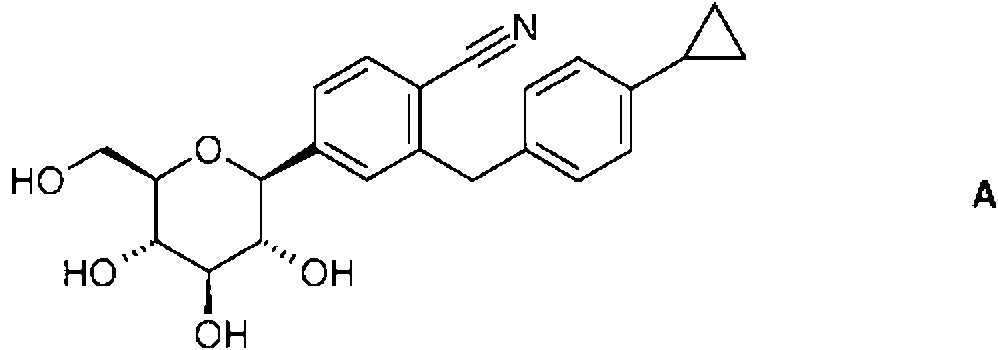
Otros aspectos de la invencion se definen a continuacion, asf como en las reivindicaciones.Other aspects of the invention are defined below, as well as in the claims.
La forma farmaceuticamente aceptable del inhibidor de SGLT2, es decir, el compuesto A, puede ser un complejo cristalino entre el inhibidor de SGLT2 y uno o mas aminoacidos, como la prolina.The pharmaceutically acceptable form of the SGLT2 inhibitor, ie compound A, can be a crystalline complex between the SGLT2 inhibitor and one or more amino acids, such as proline.
De acuerdo con la invencion, se puede proporcionar el unico inhibidor de SGLT2, es decir, el compuesto A, o su forma farmaceuticamente aceptable, por ejemplo, para administracion oral o parenteral, preferiblemente para administracion oral.According to the invention, the only SGLT2 inhibitor, ie compound A, or its pharmaceutically acceptable form can be provided, for example, for oral or parenteral administration, preferably for oral administration.
El unico inhibidor de SGLT2, es decir, el compuesto A, o una forma farmaceuticamente aceptable del mismo puede administrarse en dosis de 0.1 a 3.0 mg/kg de peso corporal por dfa, preferiblemente de 0.2 a 2.0 mg/peso corporal por dfa, mas preferiblemente de 0.1 a 1 mg/peso corporal por dfa. Por lo tanto, el unico inhibidor de SGLT2, es decir, el compuesto A, o su forma farmaceuticamente aceptable, puede prepararse para la administracion de 0.1 a 3.0 mg/kg de peso corporal por dfa, preferiblemente de 0.2 a 2.0 mg/kg de peso corporal por dfa, mas preferiblemente de 0.1 a 1 mg/kg de peso corporal por dfa.The sole inhibitor of SGLT2, ie, compound A, or a pharmaceutically acceptable form thereof can be administered in doses of 0.1 to 3.0 mg / kg body weight per day, preferably 0.2 to 2.0 mg / body weight per day, more preferably from 0.1 to 1 mg / body weight per day. Therefore, the sole inhibitor of SGLT2, ie, compound A, or its pharmaceutically acceptable form, can be prepared for the administration of 0.1 to 3.0 mg / kg of body weight per day, preferably 0.2 to 2.0 mg / kg of body weight. body weight per day, more preferably from 0.1 to 1 mg / kg of body weight per day.
El unico inhibidor de SGLT2, es decir, el compuesto A, o su forma farmaceuticamente aceptable, se administra preferiblemente solo una vez al dfa.The only SGLT2 inhibitor, that is, compound A, or its pharmaceutically acceptable form, is preferably administered only once a day.
La presente invencion tambien proporciona una composicion farmaceutica que comprende un inhibidor de SGLT2, es decir, el compuesto A, o una forma farmaceuticamente aceptable del mismo, para uso de acuerdo con la invencion como se describe en el presente documento. The present invention also provides a pharmaceutical composition comprising an inhibitor of SGLT2, ie, compound A, or a pharmaceutically acceptable form thereof, for use in accordance with the invention as described herein.
En los ejemplos proporcionados en el presente documento, los beneficios terapeuticos y/o profilacticos resultantes de la inhibicion de SGLT2 de acuerdo con la presente invencion se demuestran experimentalmente. Los datos experimentales descritos en el presente documento pretenden ilustrar la invencion, pero no tienen ningun efecto limitante sobre el alcance de la proteccion, que se define en el presente documento a continuacion mediante las reivindicaciones.In the examples provided herein, the therapeutic and / or prophylactic benefits resulting from the inhibition of SGLT2 according to the present invention are experimentally demonstrated. The experimental data described herein are intended to illustrate the invention, but have no limiting effect on the scope of protection, which is defined herein by the claims.
En particular, los presentes inventores han encontrado sorprendentemente que el uso de un inhibidor de SGLT2, es decir, el compuesto A, de acuerdo con la presente invencion, conduce ventajosamente a una reduccion de la hiperglucemia y/o adicionalmente a un perfil glucemico mejorado de 9 o 24 h en un canino hiperglucemico (por ejemplo, diabetico). Por lo tanto, esto puede resultar en una reduccion de la insulina necesaria para tratar animales caninos diabeticos.In particular, the present inventors have surprisingly found that the use of an SGLT2 inhibitor, ie, compound A, according to the present invention, advantageously leads to a reduction of hyperglycemia and / or in addition to an improved glycemic profile of 9 or 24 h in a hyperglycemic canine (for example, diabetic). Therefore, this may result in a reduction in insulin needed to treat diabetic canine animals.
Como la absorcion y el inicio de la accion (glucosuria) son muy rapidos y prominentes (ejemplos 1 y 2), el tratamiento de un canino con un trastorno metabolico recien diagnosticado permite establecer la dosis optima en un corto tiempo (por ejemplo, 7-14 dfas).As the absorption and the onset of action (glucosuria) are very fast and prominent (examples 1 and 2), the treatment of a canine with a newly diagnosed metabolic disorder allows to establish the optimal dose in a short time (for example, 7- 14 days).
La invencion muestra una mejora importante y un tratamiento optimizado de la hiperglucemia y, por lo tanto, permite la posibilidad de prevenir o retrasar la progresion o inducir una remision de complicaciones asociadas a la hiperglucemia, en particular la formacion de cataratas diabeticas, en animales caninos.The invention shows a significant improvement and an optimized treatment of hyperglycemia and, therefore, allows the possibility of preventing or delaying the progression or inducing a remission of complications associated with hyperglycemia, particularly the formation of diabetic cataracts, in canine animals. .
Una ventaja adicional de la presente invencion es que el uso de un inhibidor de SGLT2, es decir, el compuesto A, es eficaz contra los trastornos metabolicos solos, es decir, si se desea, el uso de un inhibidor de SGLT2, es decir y el compuesto A, en un animal canino proporciona una monoterapia, es decir, una terapia independiente; es decir, no se administra ningun otro medicamento al animal canino para el tratamiento o la prevencion del mismo trastorno metabolico, con la unica excepcion de la diabetes dependiente de la insulina. Sin embargo, la invencion tambien permite la posibilidad de una terapia de combinacion con insulina. Dicha combinacion conduce ventajosamente a una disminucion de la dosis y/o la frecuencia a la que se administra la insulina, en comparacion con la monoterapia del animal canino con insulina.A further advantage of the present invention is that the use of an SGLT2 inhibitor, ie, compound A, is effective against metabolic disorders alone, that is, if desired, the use of an SGLT2 inhibitor, i.e. compound A, in a canine animal, provides monotherapy, that is, independent therapy; that is, no other drug is administered to the canine animal for the treatment or prevention of the same metabolic disorder, with the sole exception of insulin-dependent diabetes. However, the invention also allows the possibility of a combination therapy with insulin. Said combination advantageously leads to a decrease in the dose and / or the frequency at which the insulin is administered, in comparison with the monotherapy of the canine animal with insulin.
Ventajosamente, el uso de un inhibidor de SGLT2, es decir, el compuesto A, de acuerdo con la presente invencion no causa hipoglucemia (ejemplo 2).Advantageously, the use of an SGLT2 inhibitor, that is, compound A, according to the present invention does not cause hypoglycaemia (example 2).
Una ventaja adicional en particular es que el uso de un inhibidor de SGLT2, es decir, el compuesto A, de acuerdo con la presente invencion conduce a una reduccion en la resistencia a la insulina en animales caninos tratados con resistencia a la insulina. Es decir, de manera equivalente, el uso de un inhibidor de SGLT2, es decir, el compuesto A, segun la presente invencion conduce ventajosamente a un aumento de la sensibilidad a la insulina en animales caninos tratados resistentes a la insulina.A further advantage in particular is that the use of an SGLT2 inhibitor, ie compound A, according to the present invention leads to a reduction in insulin resistance in canine animals treated with insulin resistance. That is, in an equivalent manner, the use of an SGLT2 inhibitor, ie, compound A, according to the present invention advantageously leads to an increase in insulin sensitivity in treated canine animals resistant to insulin.
Por lo tanto, el uso de un inhibidor de SGLT2, es decir, el compuesto A, de acuerdo con la presente invencion proporciona un tratamiento y/o prevencion mejorados de enfermedades metabolicas como se describe en el presente documento, incluida la diabetes, en animales caninos.Therefore, the use of an SGLT2 inhibitor, ie, compound A, according to the present invention provides an improved treatment and / or prevention of metabolic diseases as described herein, including diabetes, in animals canines
Los efectos de usar un inhibidor de SGLT2, es decir, el compuesto A, de acuerdo con la presente invencion, pueden ser relativos al mismo animal canino o un animal comparable antes de la administracion de un inhibidor de SGLT2, es decir, el compuesto A de acuerdo con la presente invencion, y/o en relacion con un animal canino comparable que no haya recibido dicho tratamiento (por ejemplo, un grupo de placebo). En cualquier caso, cuando se hace una comparacion, la comparacion se puede hacer despues de un cierto penodo de tratamiento, por ejemplo, 1, 2, 3, 4, 5, 6 o 7 dfas; 10 dfas, 14 dfas; 1, 2, 3, 4, 5, 6, 7 u 8 semanas; 1, 2, 3 o 4 meses. Preferiblemente el periodo de tratamiento es de 4 semanas. Alternativamente, el penodo de tratamiento puede ser de 6 u 8 semanas. Alternativamente, el periodo de tratamiento puede ser de 8 semanas o mas, por ejemplo, 8-16 semanas, es decir, 8, 9, 10, 11, 12, 13, 14, 15 o 16 semanas.The effects of using an SGLT2 inhibitor, ie, compound A, according to the present invention, can be relative to the same canine animal or a comparable animal before the administration of a SGLT2 inhibitor, ie, compound A according to the present invention, and / or in relation to a comparable canine animal that has not received such treatment (e.g., a placebo group). In any case, when a comparison is made, the comparison can be made after a certain period of treatment, for example, 1, 2, 3, 4, 5, 6 or 7 days; 10 days, 14 days; 1, 2, 3, 4, 5, 6, 7 or 8 weeks; 1, 2, 3 or 4 months. Preferably the treatment period is 4 weeks. Alternatively, the treatment period may be 6 or 8 weeks. Alternatively, the treatment period may be 8 weeks or more, for example, 8-16 weeks, i.e., 8, 9, 10, 11, 12, 13, 14, 15 or 16 weeks.
Una ventaja adicional de la presente invencion es que un inhibidor de SGLT2, es decir, el compuesto A, puede administrarse eficazmente a un animal canino por via oral. Ademas, el unico inhibidor de SGLT2, es decir, el compuesto A, de acuerdo con la presente invencion, se puede administrar solo una vez al dfa. Estas ventajas permiten un mejor cumplimiento del animal canino tratado y del propietario. Esto conduce a un mejor control glucemico de los trastornos (por ejemplo, la diabetes) para los cuales los animales caninos se tratan actualmente con insulina. En general, el uso de un inhibidor de SGLT2, es decir, el compuesto A, de acuerdo con la presente invencion, por lo tanto, ayuda a atenuar (es decir, retrasa o evita) la progresion de los trastornos metabolicos y retrasa o evita la aparicion de trastornos metabolicos (por ejemplo, la diabetes) y sus complicaciones en animales caninos.A further advantage of the present invention is that an inhibitor of SGLT2, ie, compound A, can be administered effectively to a canine animal orally. In addition, the sole inhibitor of SGLT2, ie, compound A, according to the present invention, can be administered only once a day. These advantages allow a better compliance of the treated canine animal and the owner. This leads to better glycemic control of the disorders (e.g., diabetes) for which canine animals are currently treated with insulin. In general, the use of an SGLT2 inhibitor, ie, compound A, according to the present invention, therefore, helps to attenuate (ie, delay or prevent) the progression of metabolic disorders and delays or prevents the appearance of metabolic disorders (for example, diabetes) and its complications in canine animals.
Los efectos de usar un inhibidor de SGLT2, es decir, el compuesto A, segun la presente invencion (por ejemplo, los efectos beneficiosos mencionados anteriormente sobre la hiperglucemia) pueden ser relativos al mismo animal canino o un animal comparable antes de la administracion del inhibidor de SGLT2, es decir, el compuesto A, de acuerdo con la presente invencion, y/o en relacion con un animal canino comparable que ha recibido, por ejemplo, un tratamiento estandar con insulina (por ejemplo, un grupo de control) o que no ha sido tratado.The effects of using an SGLT2 inhibitor, ie, compound A, according to the present invention (eg, the aforementioned beneficial effects on hyperglycemia) can be relative to the same canine animal or a comparable animal prior to administration of the inhibitor. of SGLT2, that is, compound A, of according to the present invention, and / or in relation to a comparable canine animal that has received, for example, a standard treatment with insulin (eg, a control group) or that has not been treated.
Una ventaja adicional de la presente invencion es que el unico inhibidor de SGLT2, es decir, el compuesto A, puede administrate eficazmente a un animal canino por via oral, por ejemplo, en forma lfquida. Ademas, el unico inhibidor de SGLT2, es decir, el compuesto A, de acuerdo con la presente invencion, se puede administrar solo una vez al dfa. Estas ventajas permiten una dosificacion y un cumplimiento optimos del animal canino tratado y del propietario. Por consiguiente, la presente invencion tambien proporciona composiciones farmaceuticas que comprenden un inhibidor de SGLT2, es decir, el compuesto A, de acuerdo con la invencion para uso en el tratamiento y/o prevencion de trastornos metabolicos en animales caninos.A further advantage of the present invention is that the only SGLT2 inhibitor, ie compound A, can be effectively administered to a canine animal orally, for example, in liquid form. In addition, the sole inhibitor of SGLT2, ie, compound A, according to the present invention, can be administered only once a day. These advantages allow optimal dosing and compliance of the treated canine animal and the owner. Accordingly, the present invention also provides pharmaceutical compositions comprising an inhibitor of SGLT2, ie, compound A, according to the invention for use in the treatment and / or prevention of metabolic disorders in canine animals.
La invencion tambien proporciona un inhibidor de SGLT2, es decir, el compuesto A, para uso en metodos de tratamiento y/o prevencion de trastornos metabolicos en animales caninos, que comprenden administrar a un animal canino que necesita tal tratamiento y/o prevencion una dosis eficaz de un inhibidor de SGLT2, es decir, el compuesto A, como se describe en el presente documento.The invention also provides an inhibitor of SGLT2, ie, compound A, for use in methods of treatment and / or prevention of metabolic disorders in canine animals, comprising administering to a canine animal in need of such treatment and / or prevention a dose effective inhibitor of SGLT2, that is, compound A, as described herein.
En general, el uso de un inhibidor de SGLT2, es decir, el compuesto A, de acuerdo con la presente invencion puede asf atenuar, retrasar o prevenir la progresion de un trastorno metabolico, por ejemplo, los trastornos metabolicos descritos en el presente documento, o puede retrasar la progresion o prevenir la aparicion de trastornos metabolicos y sus complicaciones en animales caninos, por ejemplo, la hipertension, la disfuncion renal y/o los trastornos musculoesqueleticos se previenen o la progresion se ralentiza o se logra la remision.In general, the use of an SGLT2 inhibitor, ie, compound A, according to the present invention can thus attenuate, delay or prevent the progression of a metabolic disorder, for example, the metabolic disorders described herein, or can delay the progression or prevent the appearance of metabolic disorders and their complications in canine animals, for example, hypertension, renal dysfunction and / or musculoskeletal disorders are prevented or the progression slows down or remission is achieved.
DefinicionesDefinitions
Todos los valores y concentraciones aqrn presentados estan sujetos a variaciones inherentes aceptables en la ciencia biologica dentro de un error del ± 10 %. El termino "sobre" tambien se refiere a esta variacion aceptable. Los efectos del tratamiento descritos en el presente documento (como una mejora, reduccion o retraso en el inicio de un trastorno, enfermedad o afeccion, o la mejora, reduccion, aumento o retraso de cualquier efecto, mdice, nivel de marcador u otro parametro relacionado con un trastorno, enfermedad o afeccion) se puede observar con una significacion estadfstica de p <0.05, preferiblemente <0.01.All values and concentrations presented here are subject to acceptable inherent variations in biological science within an error of ± 10%. The term "envelope" also refers to this acceptable variation. The effects of the treatment described herein (such as an improvement, reduction or delay in the onset of a disorder, disease or condition, or improvement, reduction, increase or delay of any effect, index, marker level or other related parameter with a disorder, disease or condition) can be observed with a statistical significance of p <0.05, preferably <0.01.
Cuando se hace referencia aqrn a una desviacion (por ejemplo, un aumento, elevacion, exceso, prolongacion, aumento, reduccion, disminucion, mejora, retraso, niveles anormales o cualquier otro cambio, alteracion o desviacion con respecto a una referencia), la desviacion puede ser, por ejemplo, 5 % o mas, particularmente 10 % o mas, mas particularmente 15 % o mas, mas particularmente 20 % o mas, mas particularmente 30 % o mas, mas particularmente el 40 % o mas, o mas particularmente el 50 % o mas, con respecto al valor de referencia relevante, a menos que se indique lo contrario. Normalmente, la desviacion sera de al menos un 10 %, es decir, un 10 % o mas. La desviacion tambien puede ser del 20 %. La desviacion tambien puede ser del 30 %. La desviacion tambien puede ser del 40 %. El valor de referencia relevante puede generarse a partir de un grupo de animales de referencia que se tratan con placebo en lugar de uno o mas inhibidores de SGLT2, preferiblemente el compuesto A, o que no se tratan.When reference is made to a deviation (for example, an increase, elevation, excess, prolongation, increase, reduction, decrease, improvement, delay, abnormal levels or any other change, alteration or deviation with respect to a reference), the deviation it can be, for example, 5% or more, particularly 10% or more, more particularly 15% or more, more particularly 20% or more, more particularly 30% or more, more particularly 40% or more, or more particularly the 50% or more, with respect to the relevant reference value, unless otherwise indicated. Normally, the deviation will be at least 10%, that is, 10% or more. The deviation can also be 20%. The deviation can also be 30%. The deviation can also be 40%. The relevant reference value can be generated from a group of reference animals that are treated with placebo instead of one or more inhibitors of SGLT2, preferably compound A, or that are not treated.
En este documento, una desviacion, por ejemplo, una desviacion de insulina o una desviacion de glucosa, designa un cambio en la concentracion o nivel en la sangre a lo largo del tiempo. La magnitud de las desviaciones, por ejemplo, las desviaciones de insulina o las desviaciones de glucosa se pueden expresar como valores de area bajo la curva (AUC).In this document, a deviation, for example, a deviation of insulin or a deviation of glucose, designates a change in the concentration or level in the blood over time. The magnitude of the deviations, for example, deviations of insulin or glucose deviations can be expressed as area values under the curve (AUC).
Aqrn, la expresion "condicion(es) clmica(s)" se refiere a condicion(es) patologica(s) o cambios fisiopatologicos o fisiopatologicos que son reconocibles, por ejemplo, visible y/o medible, como los parametros sangumeos, y que estan asociados con y/o definen un trastorno y/o enfermedad.Here, the term "clinical condition (s)" refers to pathological condition (s) or physiopathological or pathophysiological changes that are recognizable, eg, visible and / or measurable, such as blood parameters, and that they are associated with and / or define a disorder and / or disease.
Aqrn, la expresion "asociado a", en particular abarca la expresion "causada por".Here, the expression "associated with", in particular, embraces the expression "caused by".
En este documento, ivGTT se refiere a una prueba de tolerancia a la glucosa por via intravenosa. En un ivGTT, tfpicamente se pueden emplear 0.8 g de dextrosa por kg de masa corporal.In this document, ivGTT refers to an intravenous glucose tolerance test. In an IVGTT, 0.8 g dextrose per kg of body mass can typically be used.
Aqrn, ivITT se refiere a una prueba de tolerancia a la insulina por via intravenosa. En un ivITT, pueden emplearse tfpicamente 0.05 U de insulina por kg de masa corporal.Aqrn, ivITT refers to an intravenous insulin tolerance test. In an ivITT, typically 0.05 U of insulin per kg of body mass can be used.
Inhibidores de SGLT2Inhibitors of SGLT2
Los inhibidores de referencia SGLT2 incluyen derivados de benceno sustituidos con glucopiranosilo, por ejemplo, como se describe en los documentos WO 01/27128, WO 03/099836, WO 2005/092877, WO 2006/034489, WO 2006/064033, WO 2006/117359, WO 2006/117360, WO 2007/025943, WO 2007/028814, WO 2007/031548, WO 2007/093610, WO 2007/128749, WO 2008/049923, WO 2008/055870, WO 2008/055940, WO 2009/022020 o WO 2009/022008.Reference inhibitors SGLT2 include glucopyranosyl-substituted benzene derivatives, for example, as described in WO 01/27128, WO 03/099836, WO 2005/092877, WO 2006/034489, WO 2006/064033, WO 2006 / 117359, WO 2006/117360, WO 2007/025943, WO 2007/028814, WO 2007/031548, WO 2007/093610, WO 2007/128749, WO 2008/049923, WO 2008/055870, WO 2008/055940, WO 2009/022020 or WO 2009/022008.
Ademas, los inhibidores de referencia SGLT2 ejemplares pueden seleccionarse del grupo que consiste en los siguientes compuestos o formas farmaceuticamente aceptables de los mismos:In addition, exemplary SGLT2 reference inhibitors may be selected from the group consisting of the following pharmaceutically acceptable compounds or forms thereof:
(1) un derivado de benceno sustituido con glucopiranosilo de formula (1)(1) a glucopyranosyl-substituted benzene derivative of formula (1)
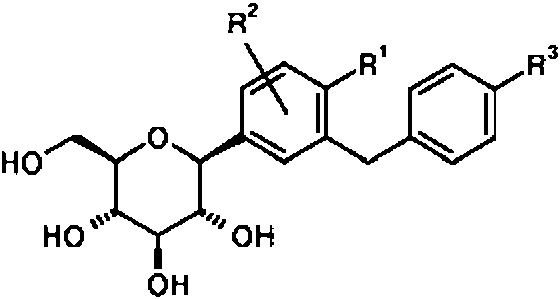
en donde R1 indica ciano, Cl o metilo (lo mas preferiblemente ciano);wherein R 1 denotes cyano, Cl or methyl (most preferably cyano);
R2 indica H, metilo, metoxi o hidroxi (lo mas preferiblemente H) yR 2 denotes H, methyl, methoxy or hydroxy (most preferably H) and
R3 indica ciclopropilo, hidrogeno, fluor, cloro, bromo, yodo, metilo, etilo, propilo, isopropilo, butilo, sec-butilo, isobutilo, terc-butilo, 3-metil-but-1-ilo, ciclobutilo, ciclopentilo, ciclohexilo, 1-hidroxi-ciclopropilo, 1-hidroxi-ciclobutilo, 1-hidroxi-ciclopentilo, 1-hidroxi-ciclohexilo, etinilo, etoxi, difluorometilo, trifluorometilo, pentafluoroetilo, 2-hidroxil-etilo, hidroxietilo, 3-hidroxi-propilo, 2-hidroxi-2-metil-prop-1-ilo, 3-hidroxi-3-metil-but-1-ilo, 1-hidroxi-1-metil-etilo, 2,2,2-trifluoro-1-hidroxi 1-metiletilo, 2,2,2-trifluoro-1-hidroxi-1-trifluorometil-etilo, 2-metoxi-etilo, 2-etoxi-etilo, hidroxi, difluorometiloxi, trifluorometiloxi, 2-metiloxi-etiloxi, metilsulfanilo, metilsulfinilo, metilsulfonilo, etilsulfinilo, etilsulfonilo, trimetilsililo, (R) -tetrahidrofuran-3-iloxi o (S) -tetrahidrofuran-3-iloxi o ciano;R 3 denotes cyclopropyl, hydrogen, fluorine, chlorine, bromine, iodine, methyl, ethyl, propyl, isopropyl, butyl, sec-butyl, isobutyl, tert-butyl, 3-methyl-but-1-yl, cyclobutyl, cyclopentyl, cyclohexyl , 1-hydroxy-cyclopropyl, 1-hydroxy-cyclobutyl, 1-hydroxy-cyclopentyl, 1-hydroxy-cyclohexyl, ethynyl, ethoxy, difluoromethyl, trifluoromethyl, pentafluoroethyl, 2-hydroxyl-ethyl, hydroxyethyl, 3-hydroxy-propyl, -hydroxy-2-methyl-prop-1-yl, 3-hydroxy-3-methyl-but-1-yl, 1-hydroxy-1-methyl-ethyl, 2,2,2-trifluoro-1-hydroxy 1- methylethyl, 2,2,2-trifluoro-1-hydroxy-1-trifluoromethyl-ethyl, 2-methoxy-ethyl, 2-ethoxy-ethyl, hydroxy, difluoromethyloxy, trifluoromethyloxy, 2-methyloxy-ethyloxy, methylsulfanyl, methylsulfinyl, methylsulfonyl, ethylsulphinyl, ethylsulphonyl, trimethylsilyl, (R) -tetrahydrofuran-3-yloxy or (S) -tetrahydrofuran-3-yloxy or cyano;
en donde R3 se selecciona preferiblemente de ciclopropilo, etilo, etinilo, etoxi, (R) -tetrahidrofuran-3-iloxi o (S) -tetrahidrofuran-3-iloxi; y lo mas preferiblemente R3 es ciclopropilo,wherein R 3 is preferably selected from cyclopropyl, ethyl, ethynyl, ethoxy, (R) -tetrahydrofuran-3-yloxy or (S) -tetrahydrofuran-3-yloxy; and most preferably R3 is cyclopropyl,
o un derivado de este en donde uno o mas grupos hidroxilo del grupo p-D-glucopiranosilo se acilan con grupos seleccionados de (alquil C1-18) carbonilo, (alquil C1-18) oxicarbonilo, fenilcarbonilo y fenil (C1-3) -alquil) -carbonilo; (3) Dapagliflozina, representada por la formula (3):or a derivative thereof in which one or more hydroxyl groups of the pD-glucopyranosyl group are acylated with groups selected from (C 1-18 alkyl) carbonyl, (C 1-18 alkyl) oxycarbonyl, phenylcarbonyl and phenyl (C 1-3) -alkyl) -carbonyl; (3) Dapagliflozin, represented by formula (3):

(4) Canagliflozina, representada por la formula (4):(4) Canagliflozin, represented by formula (4):
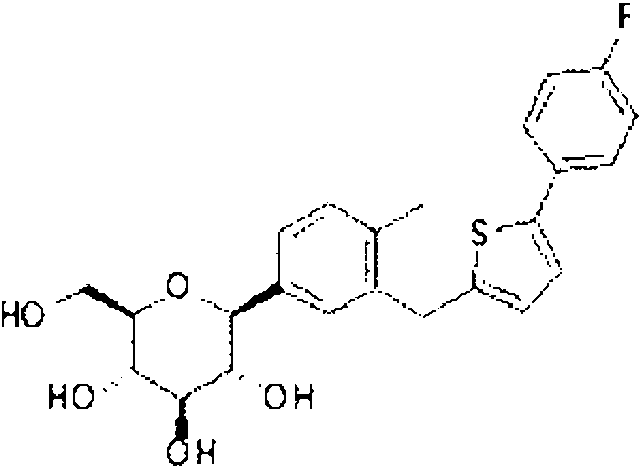
(5) Empagliflozina, representada por la formula (5): (5) Empagliflozin, represented by formula (5):
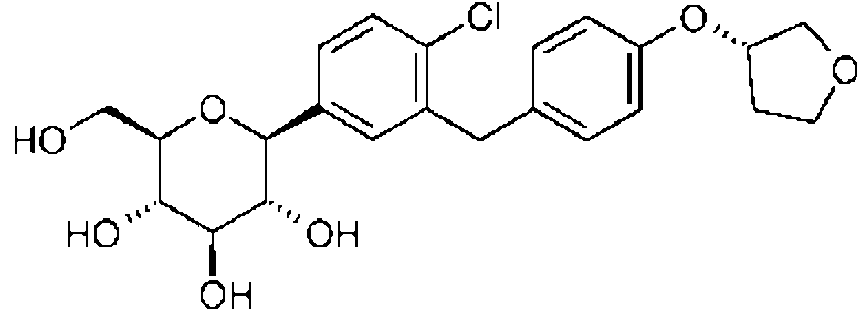
(6) Luseogliflozina, representada por la formula (6):(6) Luseogliflozin, represented by formula (6):
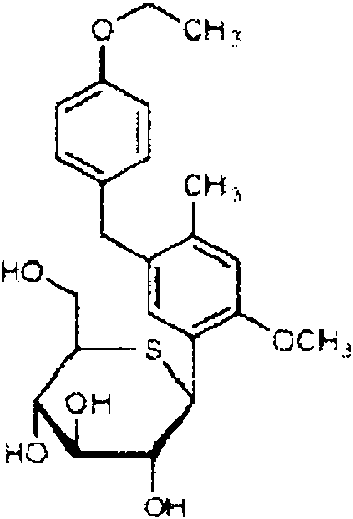
(7) Tofogliflozina, representada por la formula (7):(7) Tofoglyphlozin, represented by the formula (7):
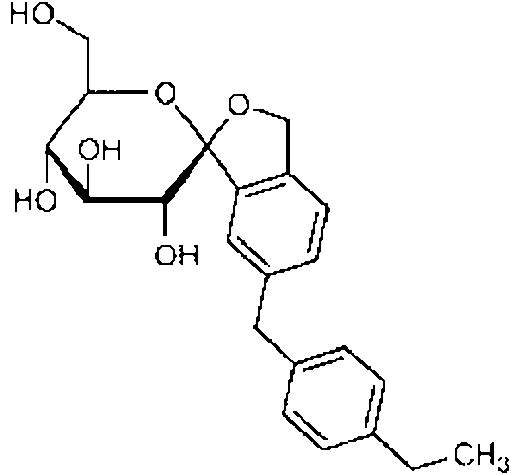
(8) Ipragliflozina, representada por la formula (8):(8) Ipragliflozin, represented by formula (8):
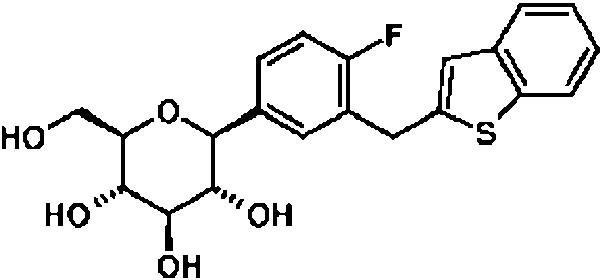
(9) Ertugliflozina, representada por la formula (9):(9) Ertuglyphlozin, represented by formula (9):
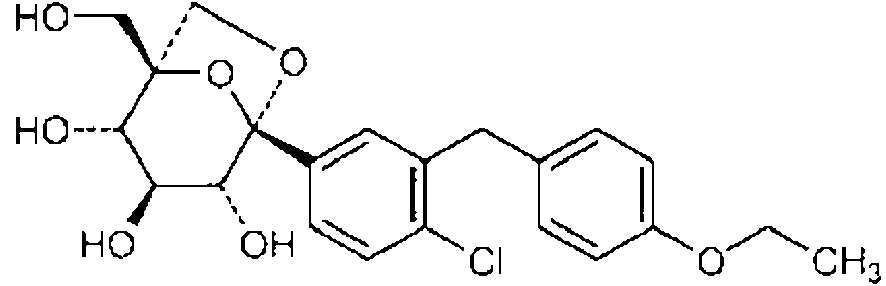
(10) Atigliflozina, representada por la formula (10): (10) Atigliflozin, represented by the formula (10):

(11) Remogliflozina, representada por la formula (11):(11) Remogliflozin, represented by the formula (11):
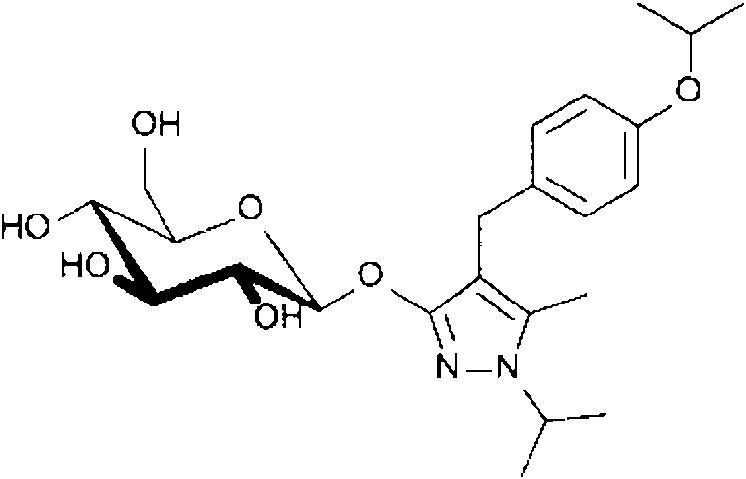
(12) un derivado de tiofeno de la formula (12)(12) a thiophene derivative of the formula (12)
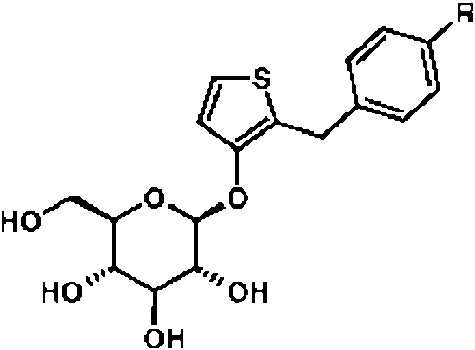
en donde R indica metoxi o trifluorometoxi;wherein R denotes methoxy or trifluoromethoxy;
(13) 1- (p-D-glucopiranosil) -4-metil-3- [5- (4-fluorofenil) -2-tienilmetil] benceno como se describe en el documento WO 2005/012326, representado por la formula (13);(13) 1- (p-D-glucopyranosyl) -4-methyl-3- [5- (4-fluorophenyl) -2-thienylmethyl] benzene as described in WO 2005/012326, represented by formula (13);
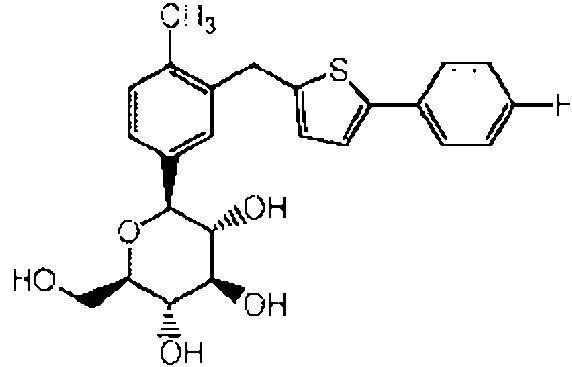
(14) un derivado en espiral de la formula (14):(14) a spiral derivative of the formula (14):
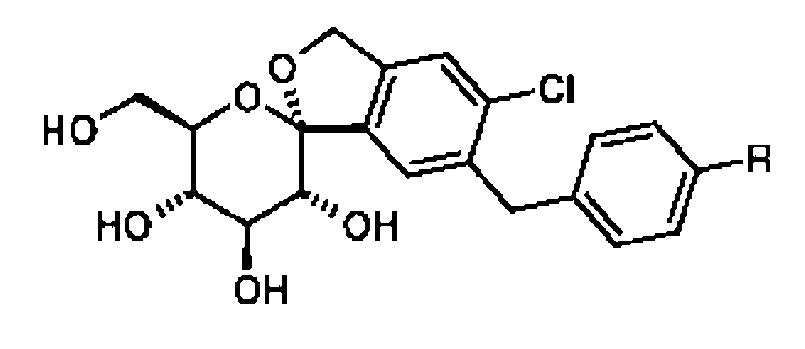
en donde R indica metoxi, trifluorometoxi, etoxi, etilo, isopropilo o terc. butilo;wherein R denotes methoxy, trifluoromethoxy, ethoxy, ethyl, isopropyl or tert. butyl;
(15) un derivado de pirazol-O-glucosido de formula (15)(15) a pyrazole-O-glucoside derivative of formula (15)

en dondewhere
R1 indica alcoxi C1-3,R 1 indicates C1-3 alkoxy,
L1, L2 independientemente uno del otro indica H o F,L 1 , L 2 independently of each other indicates H or F,
R6 indica H, (alquil C1-3) carbonilo, (alquil C1-6) oxicarbonilo, feniloxicarbonilo, benciloxicarbonilo o bencilcarbonilo; (16) un compuesto de la formula (16):R 6 denotes H, (C 1-3 alkyl) carbonyl, (C 1-6 alkyl) oxycarbonyl, phenyloxycarbonyl, benzyloxycarbonyl or benzylcarbonyl; (16) a compound of the formula (16):

(17) y Sergliflozin, representados por la formula (17):(17) and Sergliflozin, represented by the formula (17):
El termino "dapagliflozina", tal como se emplea en el presente documento, se refiere a la dapagliflozina de la estructura anterior, asf como a las formas farmaceuticamente aceptables de la misma, incluidos los hidratos y solvatos de la misma, y las formas cristalinas de la misma. El compuesto y los metodos de su smtesis se describen en el documento WO 03/099836, por ejemplo. Los hidratos, solvatos y formas cristalinas preferidos se describen en las solicitudes de patente WO 2008/116179 y WO 2008/002824, por ejemplo.The term "dapagliflozin", as used herein, refers to the dapagliflozin of the above structure, as well as to pharmaceutically acceptable forms thereof, including the hydrates and solvates thereof, and the crystalline forms thereof. the same. The compound and the methods of its synthesis are described in WO 03/099836, for example. Preferred hydrates, solvates and crystalline forms are described in patent applications WO 2008/116179 and WO 2008/002824, for example.
El termino "canagliflozina", tal como se emplea en el presente documento, se refiere a la canagliflozina de la estructura anterior, asf como a las formas farmaceuticamente aceptables de la misma, incluidos los hidratos y solvatos de la misma, y las formas cristalinas de la misma. El compuesto y los metodos de su smtesis se describen en los documentos w O 2005/012326 y WO 2009/035969, por ejemplo. Los hidratos, solvatos y formas cristalinas preferidos se describen en la solicitud de patente WO 2008/069327, por ejemplo.The term "canagliflozin", as used herein, refers to the canagliflozin of the above structure, as well as to the pharmaceutically acceptable forms thereof, including the hydrates and solvates thereof, and the crystalline forms thereof. the same. The compound and the methods of its synthesis are described in documents WO 2005/012326 and WO 2009/035969, for example. Preferred hydrates, solvates and crystalline forms are described in patent application WO 2008/069327, for example.
El termino "empagliflozina", tal como se emplea en el presente documento, se refiere a la empagliflozina de la estructura anterior, asf como a las formas farmaceuticamente aceptables de la misma, incluidos los hidratos y solvatos de la misma, y las formas cristalinas de la misma. El compuesto y los metodos de su smtesis se describen en los documentos WO 2005/092877, WO 2006/120208 y WO 2011/039108, por ejemplo. Una forma cristalina preferida se describe en las solicitudes de patente WO 2006/117359 y WO 2011/039107, por ejemplo. The term "empagliflozin", as used herein, refers to the empagliflozin of the above structure, as well as to pharmaceutically acceptable forms thereof, including hydrates and solvates thereof, and crystalline forms thereof. the same. The compound and the methods of its synthesis are described in WO 2005/092877, WO 2006/120208 and WO 2011/039108, for example. A preferred crystalline form is described in patent applications WO 2006/117359 and WO 2011/039107, for example.
El termino "atigliflozina", tal como se emplea en el presente documento, se refiere a la atigliflozina de la estructura anterior, asf como a las formas farmaceuticamente aceptables de la misma, incluidos los hidratos y solvatos de la misma, y las formas cristalinas de la misma. El compuesto y los metodos de su smtesis se describen en el documento WO 2004/007517, por ejemplo.The term "atigliflozin", as used herein, refers to the atigliflozin of the above structure, as well as to the pharmaceutically acceptable forms thereof, including the hydrates and solvates thereof, and the crystalline forms thereof. the same. The compound and the methods of its synthesis are described in WO 2004/007517, for example.
El termino "ipragliflozina", como se emplea en el presente documento, se refiere a la ipragliflozina de la estructura anterior, asf como a las formas farmaceuticamente aceptables de la misma, incluidos los hidratos y solvatos de la misma, y las formas cristalinas de la misma. El compuesto y los metodos de su smtesis se describen en los documentos WO 2004/080990, WO 2005/012326 y WO 2007/114475, por ejemplo.The term "ipragliflozin", as used herein, refers to the ipragliflozin of the above structure, as well as to the pharmaceutically acceptable forms thereof, including the hydrates and solvates thereof, and the crystalline forms of the same. same The compound and the methods of its synthesis are described in WO 2004/080990, WO 2005/012326 and WO 2007/114475, for example.
El termino "tofogliflozina", como se emplea en el presente documento, se refiere a la tofogliflozina de la estructura anterior, asf como a las formas farmaceuticamente aceptables de la misma, incluidos los hidratos y solvatos de la misma, y las formas cristalinas de la misma. El compuesto y los metodos de su smtesis se describen en los documentos WO 2007/140191 y WO 2008/013280, por ejemplo.The term "tofogliflozin", as used herein, refers to the tofogliflozin of the above structure, as well as to the pharmaceutically acceptable forms thereof, including the hydrates and solvates thereof, and the crystalline forms thereof. same The compound and the methods of its synthesis are described in WO 2007/140191 and WO 2008/013280, for example.
El termino "luseogliflozina", tal como se emplea en el presente documento, se refiere a la luseogliflozina de la estructura anterior, asf como a las formas farmaceuticamente aceptables de la misma, incluidos los hidratos y solvatos de la misma, y las formas cristalinas de la misma.The term "luseoglyphlozin", as used herein, refers to the luseoglyphlozin of the above structure, as well as to pharmaceutically acceptable forms thereof, including hydrates and solvates thereof, and the crystalline forms thereof. the same.
El termino "ertugliflozina", tal como se emplea en el presente documento, se refiere a la ertugliflozina de la estructura anterior, asf como a las formas farmaceuticamente aceptables de la misma, incluidos los hidratos y solvatos de la misma, y las formas cristalinas de la misma. El compuesto se describe, por ejemplo, en el documento WO 2010/023594.The term "ertuglyphlozin", as used herein, refers to the ertuglyphlozin of the above structure, as well as to the pharmaceutically acceptable forms thereof, including hydrates and solvates thereof, and the crystalline forms thereof. the same. The compound is described, for example, in WO 2010/023594.
El termino "remogliflozina", tal como se emplea en el presente documento, se refiere a la remogliflozina de la estructura anterior, asf como a sus formas farmaceuticamente aceptables, incluidos los profarmacos de remogliflozina, en particular el etabonato de remogliflozina, incluidos sus hidratos y solvatos, y sus formas cristalinas. Los metodos de su smtesis se describen en las solicitudes de patente EP 1213296 y EP 1354888, por ejemplo. El termino "sergliflozina", como se emplea en el presente documento, se refiere a la sergliflozina de la estructura anterior, asf como a sus formas farmaceuticamente aceptables, incluidos los profarmacos de sergliflozina, en particular el etabonato de sergliflozina, incluidos sus hidratos y solvatos, y sus formas cristalinas. Los metodos para su fabricacion se describen en las solicitudes de patente EP 1344780 y Ep 1489089, por ejemplo.The term "remogliflozin", as used herein, refers to the remogliflozin of the above structure, as well as to its pharmaceutically acceptable forms, including the prodrugs of remogliflozin, in particular the remogliflozin etabonate, including its hydrates and solvates, and their crystalline forms. The methods of their synthesis are described in patent applications EP 1213296 and EP 1354888, for example. The term "sergliflozin", as used herein, refers to the sergliflozin of the above structure, as well as to its pharmaceutically acceptable forms, including prodrugs of sergliflozin, in particular serglyphlozin etabonate, including its hydrates and solvates. , and its crystalline forms. The methods for their manufacture are described in the patent applications EP 1344780 and Ep 1489089, for example.
El compuesto de formula (16) anterior y su fabricacion se describen, por ejemplo, en los documentos WO 2008/042688 o WO 2009/014970.The compound of formula (16) above and its manufacture are described, for example, in WO 2008/042688 or WO 2009/014970.
Otros inhibidores de SGLT2 de referencia son derivados de benceno sustituidos con glucopiranosilo. Opcionalmente, uno o mas grupos hidroxilo del grupo glucopiranosilo en uno o mas inhibidores de SGLT2 se pueden acilar con grupos seleccionados entre (alquil C1-18) carbonilo, (C1-18-alquil) oxicarbonilo, fenilcarbonilo y fenil- (C1-3-alquil) -carbonilo.Other reference SGLT2 inhibitors are benzene derivatives substituted with glucopyranosyl. Optionally, one or more hydroxyl groups of the glucopyranosyl group in one or more SGLT2 inhibitors can be acylated with groups selected from (C1-18 alkyl) carbonyl, (C1-18-alkyl) oxycarbonyl, phenylcarbonyl and phenyl- (C 1-3) -alkyl) -carbonyl.
Otros inhibidores de SGLT2 de referencia son derivados de benzonitrilo sustituidos con glucopiranosilo de formula (1) como se describe anteriormente en este documento. Sin embargo, otros inhibidores de referencia de SGLT2 son derivados de benzonitrilo sustituidos con glucopiranosilo de formula (18):Other reference SGLT2 inhibitors are glucopyranosyl-substituted benzonitrile derivatives of formula (1) as described hereinabove. However, other reference inhibitors of SGLT2 are glucopyranosyl-substituted benzonitrile derivatives of formula (18):
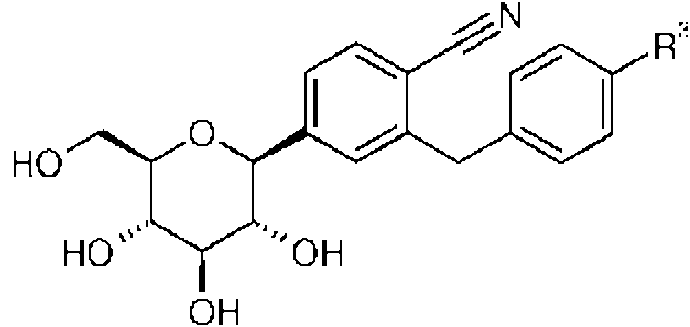
en dondewhere
R3 indica ciclopropilo, hidrogeno, fluor, cloro, bromo, yodo, metilo, etilo, propilo, isopropilo, butilo, secbutilo, isobutilo, terc-butilo, 3-metil-but-1-ilo, ciclobutilo, ciclopentilo, ciclohexilo, 1-hidroxi-ciclopropilo, 1-hidroxiciclobutilo, 1-hidroxi-ciclopentilo, 1-hidroxi-ciclohexilo, etinilo, etoxi, difluorometilo, trifluorometilo, pentafluoroetilo, 2-hidroxilo-etilo, hidroximetilo, 3-hidroxipropilo, 2-hidroxi-2-metil-prop-1-ilo, 3-hidroxi-3-metil-but-1 -ilo, 1-hidroxi-1-metil-etilo, 2,2,2-trifluoro-1-hidroxi 1-metil-etilo, 2,2,2-trifluoro-1-hidroxi-1-trifluorometiletilo, 2-metoxi-etilo, 2-etoxi-etilo, hidroxi, difluorometiloxi, trifluorometiloxi, 2-metiloxi-etiloxi, metilsulfanilo, metilsulfinilo, metilsulfonilo, etilsulfinilo, etilsulfonilo, trimetilsililo, (R) -tetrahidrofuran-3-iloxi o (S) -tetrahidrofuran-3-iloxi o ciano (en donde R3 se selecciona preferiblemente de ciclopropilo, etilo, etinilo, etoxi, (R) -tetrahidrofurano-3- iloxi o (S) -tetrahidrofuran-3-iloxi; y R3 lo mas preferiblemente es ciclopropilo,R3 denotes cyclopropyl, hydrogen, fluorine, chlorine, bromine, iodine, methyl, ethyl, propyl, isopropyl, butyl, secbutyl, isobutyl, tert-butyl, 3-methyl-but-1-yl, cyclobutyl, cyclopentyl, cyclohexyl, 1- hydroxy-cyclopropyl, 1-hydroxycyclobutyl, 1-hydroxy-cyclopentyl, 1-hydroxy-cyclohexyl, ethynyl, ethoxy, difluoromethyl, trifluoromethyl, pentafluoroethyl, 2-hydroxy-ethyl, hydroxymethyl, 3-hydroxypropyl, 2-hydroxy-2-methyl- prop-1-yl, 3-hydroxy-3-methyl-but-1-yl, 1-hydroxy-1-methyl-ethyl, 2,2,2-trifluoro-1-hydroxy 1-methyl-ethyl, 2,2 , 2-trifluoro-1-hydroxy-1-trifluoromethylethyl, 2-methoxy-ethyl, 2-ethoxy-ethyl, hydroxy, difluoromethyloxy, trifluoromethyloxy, 2-methyloxy-ethyloxy, methylsulfanyl, methylsulfinyl, methylsulfonyl, ethylsulphinyl, ethylsulfonyl, trimethylsilyl, ( R) -tetrahydrofuran-3-yloxy or (S) -tetrahydrofuran-3-yloxy or cyano (wherein R3 is selected preferably of cyclopropyl, ethyl, ethynyl, ethoxy, (R) -tetrahydrofuran-3-yloxy or (S) -tetrahydrofuran-3-yloxy; and R3 most preferably is cyclopropyl,
o un derivado de este en donde uno o mas grupos hidroxilo del grupo p-D-glucopiranosilo se acilan con grupos seleccionados de (alquilo C1-18) carbonilo, (ci-18-alquil) oxicarbonilo, fenilcarbonilo y fenil- (Ci -3-alquil) -carbonilo. El inhibidor de SGLT2 de acuerdo con la presente invencion es 1-ciano-2-(4-ciclopropil-bencil) -4-(p-D-glucopiranos-1-il) -benceno como se muestra en la formula (2) (tambien referido aqu como "compuesto A"). Opcionalmente, uno o mas grupos hidroxilo del grupo p-D-glucopiranosilo del compuesto A pueden acilarse con grupos seleccionados entre (alquil Ci-i8) carbonilo, (Ci-i8-alquil) oxicarbonilo, fenilcarbonilo y fenil- (alquil C1-3) -carbonilo.or a derivative thereof in which one or more hydroxyl groups of the pD-glucopyranosyl group are acylated with groups selected from (C1-18 alkyl) carbonyl, (Ci-18-alkyl) oxycarbonyl, phenylcarbonyl and phenyl- (Ci -3 -alkyl) ) -carbonyl. The SGLT2 inhibitor according to the present invention is 1-cyano-2- (4-cyclopropyl-benzyl) -4- (pD-glucopyranos-1-yl) -benzene as shown in formula (2) (also referred to as here as "compound A"). Optionally, one or more hydroxyl groups of the pD-glucopyranosyl group of Compound A can be acylated with groups selected from (Ci- 8 alkyl) carbonyl, (Ci-i 8 -alkyl) oxycarbonyl, phenylcarbonyl and phenyl- (C 1-3 alkyl) -carbonyl.
Desordenes metabolicosMetabolic disorders
El trastorno metabolico puede ser diabetes, prediabetes, obesidad y/o cualquier trastorno, enfermedad, condicion o srntoma asociado con uno o mas de esos trastornos. En particular, el trastorno metabolico puede ser hiperglucemia, tolerancia alterada a la glucosa, resistencia a la insulina, diabetes dependiente de la insulina y/o lipidosis hepatica. Otros trastornos metabolicos relevantes incluyen hiperinsulinemia, tolerancia alterada a la glucosa, cetosis (en particular cetoacidosis), hiperlipidemia, dislipidemia, niveles elevados en sangre de acidos grasos y/o glicerol, Smdrome X (smdrome metabolico), y/o inflamacion del pancreas, inflamacion sistemica de bajo grado, inflamacion del tejido adiposo.The metabolic disorder may be diabetes, prediabetes, obesity and / or any disorder, disease, condition or symptom associated with one or more of those disorders. In particular, the metabolic disorder may be hyperglycemia, impaired glucose tolerance, insulin resistance, insulin-dependent diabetes and / or hepatic lipidosis. Other relevant metabolic disorders include hyperinsulinemia, impaired glucose tolerance, ketosis (in particular ketoacidosis), hyperlipidemia, dyslipidemia, elevated blood levels of fatty acids and / or glycerol, Smdrome X (metabolic syndrome), and / or inflammation of the pancreas, low grade systemic inflammation, adipose tissue inflammation.
En algunas realizaciones, el trastorno metabolico es la diabetes. Aqrn, la diabetes puede ser prediabetes, diabetes dependiente de la insulina o diabetes resistente a la insulina. En particular, la diabetes puede ser diabetes dependiente de la insulina.In some embodiments, the metabolic disorder is diabetes. Here, diabetes can be prediabetes, insulin-dependent diabetes or insulin-resistant diabetes. In particular, diabetes can be insulin-dependent diabetes.
En algunas realizaciones, el trastorno metabolico es hiperglucemia. En este documento, la hiperglucemia puede estar asociada con diabetes, por ejemplo, con diabetes dependiente de insulina o diabetes resistente a la insulina. En algunas realizaciones, la hiperglucemia puede estar asociada con la obesidad. La hiperglucemia puede ser cronica.In some embodiments, the metabolic disorder is hyperglycemia. In this document, hyperglycemia may be associated with diabetes, for example, with insulin-dependent diabetes or insulin-resistant diabetes. In some embodiments, hyperglycemia may be associated with obesity. Hyperglycemia can be chronic.
En algunas realizaciones, el trastorno metabolico es la resistencia a la insulina. En este documento, la resistencia a la insulina puede estar asociada con la diabetes, por ejemplo, con la diabetes resistente a la insulina. En algunas realizaciones, la resistencia a la insulina puede estar asociada con la obesidad.In some embodiments, the metabolic disorder is insulin resistance. In this document, insulin resistance may be associated with diabetes, for example, with insulin-resistant diabetes. In some embodiments, insulin resistance may be associated with obesity.
En algunas realizaciones, el trastorno metabolico es una tolerancia alterada a la glucosa (IGT). En este documento, la tolerancia alterada a la glucosa puede estar asociada con diabetes, por ejemplo, con diabetes dependiente de insulina o diabetes resistente a la insulina. En algunas realizaciones, la tolerancia alterada a la glucosa puede estar asociada con la obesidad.In some embodiments, the metabolic disorder is impaired glucose tolerance (IGT). In this document, impaired glucose tolerance may be associated with diabetes, for example, with insulin-dependent diabetes or insulin-resistant diabetes. In some embodiments, altered glucose tolerance may be associated with obesity.
En algunas realizaciones, el trastorno metabolico es hiperinsulinemia. En este documento, la hiperinsulinemia puede estar asociada con la diabetes, por ejemplo, con la diabetes resistente a la insulina. En algunas realizaciones, la hiperinsulinemia puede estar asociada con la obesidad.In some embodiments, the metabolic disorder is hyperinsulinemia. In this document, hyperinsulinemia may be associated with diabetes, for example, with insulin-resistant diabetes. In some embodiments, hyperinsulinemia may be associated with obesity.
En algunas realizaciones, el trastorno metabolico es uno o mas de hiperglucemia, resistencia a la insulina y lipidosis hepatica. En algunas realizaciones, el trastorno metabolico se selecciona de hiperglucemia y resistencia a la insulina.In some embodiments, the metabolic disorder is one or more of hyperglycemia, insulin resistance and hepatic lipidosis. In some embodiments, the metabolic disorder is selected from hyperglycemia and insulin resistance.
En algunas realizaciones, el trastorno metabolico es uno o mas de hiperinsulinemia, tolerancia alterada a la glucosa, hiperglucemia y resistencia a la insulina.In some embodiments, the metabolic disorder is one or more of hyperinsulinemia, impaired glucose tolerance, hyperglycemia, and insulin resistance.
En ciertas realizaciones, el animal canino es obeso. Por ejemplo, de acuerdo con la invencion, uno o mas trastornos metabolicos seleccionados de hiperglucemia, resistencia a la insulina y lipidosis hepatica pueden tratarse y/o prevenirse en un animal canino obeso. Ademas, por ejemplo, la hiperinsulinemia y/o la tolerancia alterada a la glucosa pueden tratarse y/o prevenirse en un animal canino obeso. Ademas, uno o mas trastornos seleccionados de cetosis (en particular cetoacidosis), hiperlipidemia, niveles elevados de acidos grasos y/o de glicerol, smdrome X (smdrome metabolico), La inflamacion del pancreas, la inflamacion del tejido adiposo se puede tratar y/o prevenir en un animal canino obeso.In certain embodiments, the canine animal is obese. For example, according to the invention, one or more metabolic disorders selected from hyperglycemia, insulin resistance and hepatic lipidosis can be treated and / or prevented in an obese canine animal. Furthermore, for example, hyperinsulinemia and / or impaired glucose tolerance can be treated and / or prevented in an obese canine animal. In addition, one or more disorders selected from ketosis (in particular ketoacidosis), hyperlipidemia, elevated levels of fatty acids and / or glycerol, smdrome X (metabolic syndrome), inflammation of the pancreas, inflammation of the adipose tissue can be treated and / or prevent in an obese canine animal.
En ciertas realizaciones, el animal canino no es obeso. El trastorno metabolico puede estar asociado y/o ser causado por, por ejemplo, hipo o hipertiroidismo, hipercortisolismo (hiperadrenocorticismo, aplastamiento) y/o acceso a la hormona del crecimiento (acromegalia). Por ejemplo, de acuerdo con la invencion, uno o mas trastornos metabolicos seleccionados de hiperglucemia, resistencia a la insulina y lipidosis hepatica pueden tratarse y/o prevenirse en un animal canino no obeso. Ademas, por ejemplo, la hiperinsulinemia y/o la tolerancia alterada a la glucosa pueden tratarse y/o prevenirse en un animal canino no obeso. Ademas, pueden tratarse uno o mas trastornos seleccionados entre cetosis (en particular, cetoacidosis), hiperlipidemia, niveles elevados de acidos grasos y/o glicerol, El smdrome X (smdrome metabolico), la inflamacion del pancreas y/o la inflamacion del tejido adiposo se pueden tratar y/o prevenir en un animal canino no obeso.In certain embodiments, the canine animal is not obese. The metabolic disorder may be associated and / or caused by, for example, hypo or hyperthyroidism, hypercortisolism (hyperadrenocorticism, crushing) and / or access to growth hormone (acromegaly). For example, according to the invention, one or more metabolic disorders selected from hyperglycemia, insulin resistance and hepatic lipidosis can be treated and / or prevented in a non-obese canine animal. In addition, for example, hyperinsulinemia and / or impaired glucose tolerance can be treated and / or prevented in a non-obese canine animal. In addition, one or more disorders selected from ketosis (in particular, ketoacidosis), hyperlipidemia, high acid levels may be treated. fatty acids and / or glycerol, smdrome X (metabolic syndrome), inflammation of the pancreas and / or adipose tissue inflammation can be treated and / or prevented in a non-obese canine animal.
En ciertas realizaciones, el animal canino padece diabetes, por ejemplo, diabetes dependiente de insulina o diabetes resistente a la insulina. Por ejemplo, segun la invencion, uno o mas trastornos metabolicos seleccionados del grupo de hiperglucemia, la tolerancia alterada a la glucosa y la lipidosis hepatica pueden tratarse y/o prevenirse en un animal canino que padece diabetes, por ejemplo, diabetes dependiente de insulina o diabetes resistente a la insulina. Ademas, por ejemplo, la hiperinsulinemia y/o la resistente a la insulina pueden tratarse y/o prevenirse en un animal canino que padece diabetes, por ejemplo, o diabetes resistente a la insulina. Ademas, uno o mas trastornos seleccionados de cetosis (en particular cetoacidosis), hiperlipidemia, niveles elevados de acidos grasos y/o de glicerol, smdrome X (smdrome metabolico), inflamacion del pancreas, la inflamacion del tejido adiposo se puede tratar y/o prevenir en un animal canino que sufre de diabetes, por ejemplo, de diabetes dependiente de insulina o diabetes resistente a la insulina.In certain embodiments, the canine animal suffers from diabetes, for example, insulin-dependent diabetes or insulin-resistant diabetes. For example, according to the invention, one or more metabolic disorders selected from the group of hyperglycemia, impaired glucose tolerance and hepatic lipidosis can be treated and / or prevented in a canine animal suffering from diabetes, for example, insulin-dependent diabetes or insulin resistant diabetes. In addition, for example, hyperinsulinemia and / or insulin resistance can be treated and / or prevented in a canine animal suffering from diabetes, for example, or insulin-resistant diabetes. In addition, one or more disorders selected from ketosis (in particular ketoacidosis), hyperlipidemia, high levels of fatty acids and / or glycerol, smdrome X (metabolic syndrome), inflammation of the pancreas, inflammation of adipose tissue can be treated and / or prevent in a canine animal suffering from diabetes, for example, from insulin-dependent diabetes or insulin-resistant diabetes.
En algunas realizaciones, el animal canino es obeso y no padece diabetes.In some embodiments, the canine animal is obese and does not suffer from diabetes.
En algunas realizaciones, el animal canino no es obeso y padece diabetes.In some embodiments, the canine animal is not obese and suffers from diabetes.
La presente invencion tambien proporciona el uso de uno o mas inhibidores de SGLT2, preferiblemente el compuesto A, para tratar y/o prevenir complicaciones asociadas a la hiperglucemia. Por ejemplo, al mejorar el control glucemico diurno y, por lo tanto, retrasar o prevenir el desarrollo o la progresion o inducir la regresion de la formacion de cataratas en un animal canino.The present invention also provides the use of one or more inhibitors of SGLT2, preferably compound A, to treat and / or prevent complications associated with hyperglycemia. For example, by improving diurnal glycemic control and, therefore, delaying or preventing the development or progression or inducing the regression of cataract formation in a canine animal.
La cetosis es un estado de niveles elevados de cuerpos cetonicos en el cuerpo. La cetoacidosis se puede describir como un tipo de acidosis metabolica causada por altas concentraciones de cuerpos cetonicos, formada por la descomposicion de los acidos grasos y la desaminacion de los aminoacidos. Las dos cetonas comunes producidas en humanos son el acido acetoacetico y el p-hidroxibutirato. En los perros, predominan tres cetonas: acido acetoacetico, beta-hidroxibutirato y acido piruvico. La cetoacidosis se puede oler en el aliento de un sujeto. Esto se debe a la acetona, un subproducto directo de la descomposicion espontanea del acido acetoacetico.Ketosis is a state of elevated levels of ketone bodies in the body. Ketoacidosis can be described as a type of metabolic acidosis caused by high concentrations of ketone bodies, formed by the decomposition of fatty acids and the deamination of amino acids. The two common ketones produced in humans are acetoacetic acid and p-hydroxybutyrate. In dogs, three ketones predominate: acetoacetic acid, beta-hydroxybutyrate and pyruvic acid. Ketoacidosis can be smelled on the breath of a subject. This is due to acetone, a direct byproduct of the spontaneous decomposition of acetoacetic acid.
La cetoacidosis es una forma extrema y no controlada de cetosis. La cetosis tambien es una respuesta normal al ayuno prolongado. En la cetoacidosis, el cuerpo no regula adecuadamente la produccion de cetonas, en especial al producir Acetil-CoA, causando una acumulacion tan severa de cetoacidos que el pH de la sangre disminuye sustancialmente, es decir, el exceso de cuerpos de cetona puede acidificar significativamente la sangre. En casos extremos la cetoacidosis puede ser fatal.Ketoacidosis is an extreme and uncontrolled form of ketosis. Ketosis is also a normal response to prolonged fasting. In ketoacidosis, the body does not properly regulate the production of ketones, especially when producing acetyl-CoA, causing such a severe accumulation of ketoacidos that the pH of the blood decreases substantially, ie, excess ketone bodies can acidify significantly the blood. In extreme cases, ketoacidosis can be fatal.
La cetoacidosis puede ocurrir cuando el cuerpo produce niveles altos de cuerpos cetonicos a traves del metabolismo de los acidos grasos (cetosis) y la insulina no ralentiza suficientemente esta produccion (por ejemplo, debido a la resistencia a la insulina/sensibilidad reducida a la insulina o la falta de insulina). La presencia de altos niveles de azucar en la sangre (hiperglucemia) causada por la falta de insulina puede conducir a una mayor acidez en la sangre. En individuos sanos, esto normalmente no ocurre porque el pancreas produce insulina en respuesta al aumento de los niveles de cetona/azucar en la sangre.Ketoacidosis can occur when the body produces high levels of ketone bodies through the metabolism of fatty acids (ketosis) and insulin does not sufficiently slow down this production (for example, due to insulin resistance / reduced sensitivity to insulin or the lack of insulin). The presence of high levels of sugar in the blood (hyperglycemia) caused by lack of insulin can lead to increased acidity in the blood. In healthy individuals, this usually does not occur because the pancreas produces insulin in response to increased levels of ketone / sugar in the blood.
La cetoacidosis es mas comun en la diabetes mellitus no tratada, cuando el tngado descompone la grasa y las protemas en respuesta a una necesidad percibida de sustrato respiratorio.Ketoacidosis is more common in untreated diabetes mellitus, when the liver breaks down fat and proteins in response to a perceived need for respiratory substrate.
La prediabetes en animales caninos se caracteriza por hiperinsulinemia, resistencia a la insulina en los organos diana, tolerancia alterada a la glucosa, incluyendo, por ejemplo, una respuesta de insulina alterada a un desaffo glucemico, por ejemplo, tambien, por ejemplo, inducida por el estres. La prediabetes tambien se asocia a menudo con la obesidad. La prediabetes tambien puede asociarse con hiperglucemia intermitente.Pre-diabetes in canine animals is characterized by hyperinsulinemia, insulin resistance in the target organs, impaired glucose tolerance, including, for example, an altered insulin response to a glycemic challenge, for example, also, for example, induced by stress. Prediabetes is also often associated with obesity. Prediabetes can also be associated with intermittent hyperglycemia.
La diabetes resistente a la insulina en animales caninos se caracteriza por una mayor produccion de insulina y resistencia a la insulina en los organos diana y, como consecuencia, la hiperglucemia. Con frecuencia se detecta en caninos diabeticos hembra intactos y se atribuye principalmente a la progesterona que actua como un antagonista endogeno de la insulina. Por lo tanto, se asocia principalmente con el ciclo menstrual, es decir, el dioestro o el embarazo - gestacional. Los factores geneticos, los glucosteroides, la falta de ejercicio y la obesidad son posibles razones adicionales para la resistencia a la insulina.Insulin-resistant diabetes in canine animals is characterized by increased insulin production and insulin resistance in the target organs and, as a consequence, hyperglycemia. It is often detected in intact female diabetic canines and is mainly attributed to progesterone which acts as an endogenous insulin antagonist. Therefore, it is mainly associated with the menstrual cycle, that is, the dioestrus or pregnancy - gestational. Genetic factors, glucosteroids, lack of exercise and obesity are possible additional reasons for insulin resistance.
Los signos clmicos de diabetes mellitus observados con animales caninos incluyen polidipsia, poliuria, perdida de peso y/o polifagia. Por el contrario, en otras especies, como en los gatos, la anorexia se describe mas a menudo que la polifagia. Otros signos clmicos particularmente relevantes de la diabetes mellitus en animales caninos dentro del contexto de la presente invencion son la hiperglucemia y la glicosuria. La hiperglucemia en un animal canino (por ejemplo, un perro) se define como valores de glucosa en plasma por encima de los valores normales (3.5 - 7 mmol/l o 60 - 120 mg/dl), por ejemplo, 8 mmol/l o mas o 150 mg/dl o mas glucosa en plasma. La glucosuria en un animal canino (por ejemplo, un perro) se define como los niveles de glucosa en la orina por encima de los valores normales (0~2 mmol/L, o 36 mg/dl). El umbral renal se alcanza con concentraciones de glucosa en sangre de aproximadamente 8-11 mmol/lo 150 a 200 mg/dl.The classic signs of diabetes mellitus observed with canine animals include polydipsia, polyuria, weight loss and / or polyphagia. On the other hand, in other species, such as cats, anorexia is described more often than polyphagia. Other particularly relevant clinical signs of diabetes mellitus in canine animals within the context of the present invention are hyperglycemia and glycosuria. Hyperglycemia in a canine animal (eg, a dog) is defined as plasma glucose values above normal values (3.5-7 mmol / L or 60-120 mg / dL), eg, 8 mmol / L or more. or 150 mg / dL or more plasma glucose. Glycosuria in a canine animal (eg, a dog) is defined as urine glucose levels above normal values (0 ~ 2 mmol / L, or 36 mg / dL). The renal threshold is reached with blood glucose concentrations of approximately 8-11 mmol / L or 150-200 mg / dL.
El diagnostico de diabetes mellitus en animales caninos puede basarse alternativamente en tres criterios, por ejemplo, como sigue:The diagnosis of diabetes mellitus in canine animals can be based alternatively on three criteria, for example, as follows:
(1) Mediciones de concentracion de glucosa en sangre en ayunas> 250 mg/dl;(1) Measurements of fasting blood glucose concentration> 250 mg / dL;
(2) Glicosuria como se define anteriormente; y(2) Glycosuria as defined above; Y
(3) Uno o mas de los siguientes: poliuria, polidipsia, polifagia, perdida de peso a pesar del buen apetito o cetonuria (sin signos de cetoacidosis grave).(3) One or more of the following: polyuria, polydipsia, polyphagia, weight loss despite good appetite or ketonuria (without signs of severe ketoacidosis).
Ademas de los diagnosticos mencionados anteriormente y para apoyarlos, los examenes adicionales pueden incluir hematologfa, qmmica sangumea, rayos X y/o ultrasonido abdominal.In addition to the diagnoses mentioned above and to support them, additional tests may include hematology, blood chemistry, X-rays and / or abdominal ultrasound.
Preferiblemente, el uso del unico inhibidor de SGLT2, es decir, el compuesto A, de acuerdo con la invencion permite mantener y/o establecer concentraciones de glucosa en sangre normales o casi normales. Sin embargo, a diferencia de la terapia humana, esto no se considera siempre necesario para los animales diabeticos y, por lo tanto, no siempre es el objetivo de un tratamiento de acuerdo con la invencion. De acuerdo con la invencion, las concentraciones de glucosa en sangre tambien se pueden mantener, por ejemplo, entre 5.5 y 16.6 mmol/l o 100 a 300 mg/dl. Para los animales caninos esto sera a menudo satisfactorio.Preferably, the use of the single SGLT2 inhibitor, that is, compound A, according to the invention makes it possible to maintain and / or establish normal or near normal blood glucose concentrations. However, unlike human therapy, this is not always considered necessary for diabetic animals and, therefore, is not always the goal of a treatment according to the invention. According to the invention, blood glucose concentrations can also be maintained, for example, between 5.5 and 16.6 mmol / l or 100 to 300 mg / dl. For canine animals this will often be satisfactory.
La hiperglucemia induce que las cataratas son generalmente de inicio agudo, rapidamente progresivas y bilateralmente simetricas. La nubosidad de la lente dentro del ojo produce una disminucion o, en ultima instancia, perdida de la vision.Hyperglycemia induces that cataracts are generally of acute onset, rapidly progressive and bilaterally symmetric. The cloudiness of the lens inside the eye produces a decrease or, ultimately, loss of vision.
La resistencia a la insulina se puede describir como la condicion en la que las cantidades normales de insulina son inadecuadas para producir una respuesta de insulina normal de las celulas de grasa, musculo e hffgado. La resistencia a la insulina en las celulas de grasa reduce los efectos de la insulina y da como resultado una hidrolisis elevada de los trigliceridos almacenados en ausencia de medidas que aumentan la sensibilidad a la insulina o que proporcionan insulina adicional. El aumento de la movilizacion de los ffpidos almacenados en estas celulas eleva los acidos grasos libres en el plasma sangumeo. La resistencia a la insulina en las celulas musculares reduce la captacion de glucosa (y, por lo tanto, el almacenamiento local de glucosa como glucogeno), mientras que la resistencia a la insulina en las celulas hepaticas produce una smtesis deficiente de glucogeno y una falla en la supresion de la produccion de glucosa. Los niveles elevados de acidos grasos en la sangre, la reduccion de la captacion muscular de glucosa y el aumento de la produccion de glucosa en el hffgado pueden contribuir a los niveles elevados de glucosa en sangre (hiperglucemia). En perros obesos, la resistencia a la insulina, es decir, se detecta una sensibilidad a la insulina 5 veces menor que en perros magros.Insulin resistance can be described as the condition in which normal amounts of insulin are inadequate to produce a normal insulin response from fat, muscle and liver cells. Insulin resistance in fat cells reduces the effects of insulin and results in elevated hydrolysis of stored triglycerides in the absence of measures that increase insulin sensitivity or provide additional insulin. The increased mobilization of ffpids stored in these cells elevates the free fatty acids in the blood plasma. Insulin resistance in muscle cells reduces glucose uptake (and, therefore, local storage of glucose as a glycogen), whereas insulin resistance in liver cells leads to poor glycogen synthesis and failure in the suppression of glucose production. Elevated levels of fatty acids in the blood, reduced muscle uptake of glucose and increased glucose production in the liver may contribute to elevated blood glucose levels (hyperglycemia). In obese dogs, insulin resistance, that is, a sensitivity to insulin is detected 5 times lower than in lean dogs.
La resistencia a la insulina puede estar presente en asociacion con la obesidad, la adiposidad visceral, la hipertension y la dislipidemia que involucran niveles elevados de trigliceridos, parffculas de lipoprotemas de densidad densas pequenas (SDLDL) y disminucion de los niveles de colesterol HDL. Con respecto a la adiposidad visceral, una gran cantidad de evidencia en humanos sugiere dos vrnculos fuertes con la resistencia a la insulina. En primer lugar, a diferencia del tejido adiposo subcutaneo, las celulas adiposas viscerales producen cantidades significativas de citoquinas proinflamatorias como el factor de necrosis tumoral alfa (TNF-alfa) y las interleucinas-1 y -6, etc. En numerosos modelos experimentales, estas citoquinas proinflamatorias interrumpen profundamente la accion normal de la insulina en las celulas de la grasa y los musculos, y pueden ser un factor importante para causar la resistencia a la insulina en todo el cuerpo observada en pacientes humanos con adiposidad visceral. Del mismo modo, en los caninos, los depositos de grasa en exceso contribuyen a la inflamacion sistemica de bajo grado. La causa de la gran mayona de los casos de resistencia a la insulina sigue siendo desconocida. Claramente hay un componente heredado. Sin embargo, existen algunos motivos para sospechar que la resistencia a la insulina esta relacionada con una dieta alta en carbohidratos. La inflamacion tambien parece estar implicada en causar resistencia a la insulina.Insulin resistance may be present in association with obesity, visceral adiposity, hypertension and dyslipidemia involving high levels of triglycerides, small dense density lipoprotein (SDLDL) and low HDL cholesterol levels. With respect to visceral adiposity, a large amount of evidence in humans suggests two strong links with insulin resistance. First, unlike subcutaneous adipose tissue, visceral fat cells produce significant amounts of proinflammatory cytokines such as tumor necrosis factor alpha (TNF-alpha) and interleukins-1 and -6, etc. In numerous experimental models, these proinflammatory cytokines profoundly interrupt the normal action of insulin in fat and muscle cells, and may be an important factor in causing insulin resistance throughout the body observed in human patients with visceral adiposity. . Similarly, in canines, excess fat deposits contribute to low-grade systemic inflammation. The cause of the great majority of cases of insulin resistance remains unknown. Clearly there is an inherited component. However, there are some reasons to suspect that insulin resistance is related to a diet high in carbohydrates. Inflammation also seems to be involved in causing insulin resistance.
La hiperinsulinemia se puede describir como una afeccion en la que hay niveles excesivos, es decir, mas de aproximadamente 35 pmol/L en condiciones basales o aproximadamente 200 pmol/L durante, por ejemplo, un desaffo glucemico (por ejemplo, ivGTT o estres) de la insulina que circula en la sangre. Como se menciono, esta comunmente presente en casos de resistencia a la insulina en animales caninos y puede ser consecuencia de esta. La tolerancia alterada a la glucosa se puede describir como una condicion en la que la respuesta a un desaffo glucemico despues de una comida o despues de una prueba de carga (prueba de tolerancia a la glucosa) o despues de la elevacion de la concentracion de glucosa en la sangre inducida por el estres el pico glucemico de la desviacion de glucosa es mayor y/o la duracion de la desviacion de glucosa es prolongada. Hyperinsulinemia can be described as a condition in which there are excessive levels, ie, more than about 35 pmol / L under basal conditions or about 200 pmol / L during, for example, a glycemic challenge (e.g., ivGTT or stress) of the insulin that circulates in the blood. As mentioned, it is commonly present in cases of insulin resistance in canine animals and may be a consequence of it. Impaired glucose tolerance can be described as a condition in which the response to a glycemic challenge after a meal or after a load test (glucose tolerance test) or after the elevation of glucose concentration in the blood induced by stress, the glycemic peak of the glucose deviation is greater and / or the duration of the glucose deviation is prolonged.
La dislipemia o hiperlipidemia es la presencia de niveles elevados o anormales de Kpidos y/o lipoprotemas en la sangre. Las anomalfas de Kpidos y lipoprotemas se consideran un factor de riesgo altamente modificable para la enfermedad cardiovascular debido a la influencia del colesterol. El glicerol es un precursor para la smtesis de triacilgliceroles (trigliceridos) y de fosfolfpidos en el tngado y el tejido adiposo. Cuando el cuerpo utiliza la grasa almacenada como fuente de energfa, se liberan glicerol y acidos grasos en el torrente sangumeo despues de la hidrolisis de los trigliceridos. El componente de glicerol se puede convertir en glucosa en el tngado y proporciona energfa para el metabolismo celular. Los niveles normales de acidos grasos libres en la sangre de animales de comparna (como caninos) son concentraciones de trigliceridos de 50 a 150 mg/dl. Los niveles normales de colesterol en la sangre son, por ejemplo, 130 a 300 mg/dl para el perro.Dyslipidemia or hyperlipidemia is the presence of high or abnormal levels of Kpidos and / or lipoproteins in the blood. Kpidos and lipoprotein abnormalities are considered a highly modifiable risk factor for cardiovascular disease due to the influence of cholesterol. Glycerol is a precursor for the synthesis of triacylglycerols (triglycerides) and phospholipids in the tngado and adipose tissue. When the body uses the stored fat as a source of energy, glycerol and fatty acids are released into the bloodstream after the hydrolysis of the triglycerides. The glycerol component can be converted into glucose in the tungsten and provides energy for cell metabolism. Normal levels of free fatty acids in the blood of comparna animals (such as dogs) are triglyceride concentrations of 50 to 150 mg / dl. Normal levels of cholesterol in the blood are, for example, 130 to 300 mg / dl for the dog.
La disadipocinemia se puede describir como una condicion en la cual los niveles plasmaticos circulantes de sustancias biologicamente activas producidas en el tejido adiposo que actuan de forma autocrina/paracrina o endocrina se desvfan, por ejemplo, una elevacion de la leptina y/o una reduccion de la adiponectina.Disadipipocinemia can be described as a condition in which the circulating plasma levels of biologically active substances produced in the adipose tissue acting in an autocrine / paracrine or endocrine form are diverted, for example, an increase in leptin and / or a reduction in adiponectin
La inflamacion subclmica o la inflamacion sistemica, en particular la inflamacion sistemica de bajo grado se caracteriza por un aumento de la expresion y la secrecion de citoquinas proinflamatorias, como el factor de necrosis tumoral alfa y/o una menor expresion y secrecion de citoquinas antiinflamatorias, por ejemplo, interleucina-10 y/o sus respectivos receptores.Subclinical inflammation or systemic inflammation, in particular low-grade systemic inflammation, is characterized by an increase in the expression and secretion of pro-inflammatory cytokines, such as tumor necrosis factor alpha and / or a lower expression and secretion of anti-inflammatory cytokines, for example, interleukin-10 and / or their respective receptors.
La obesidad se puede describir como una condicion medica en la que el exceso de grasa corporal se ha acumulado en la medida en que puede tener un efecto adverso en la salud, lo que lleva a una reduccion de la esperanza de vida. En caninos obesos, por ejemplo se encuentra un puntaje de condicion corporal (BCS) de mas de 7 (de 9). Los trastornos metabolicos por tratar y/o prevenir segun la invencion incluyen el Smdrome X (smdrome metabolico). Este trastorno se puede describir como una combinacion de trastornos medicos que aumentan el riesgo de desarrollar consecuencias clmicas manifiestas, por ejemplo, hipertension, cardiomiopatfa, disfuncion renal y/o trastornos musculoesqueleticos en animales caninos.Obesity can be described as a medical condition in which excess body fat has accumulated to the extent that it can have an adverse effect on health, leading to a reduction in life expectancy. In obese canines, for example, there is a body condition score (BCS) of more than 7 (out of 9). The metabolic disorders to be treated and / or prevented according to the invention include Smdrome X (metabolic syndrome). This disorder can be described as a combination of medical disorders that increase the risk of developing manifest clinical consequences, for example, hypertension, cardiomyopathy, renal dysfunction and / or musculoskeletal disorders in canine animals.
El smdrome metabolico tambien se conoce como smdrome X metabolico (smdrome metabolico), smdrome X (smdrome metabolico), smdrome de resistencia a la insulina, smdrome de Reaven y CHAOS (como una abreviatura de enfermedad de las arterias coronarias, hipertension, aterosclerosis, obesidad y accidente cerebrovascular). Los mecanismos exactos de las vfas complejas del smdrome metabolico aun no se conocen completamente. La fisiopatologfa es extremadamente compleja y solo se ha aclarado parcialmente. La mayona de los pacientes son mayores, obesos, sedentarios y tienen un grado de resistencia a la insulina. Los factores mas importantes en orden son: (1) sobrepeso y obesidad, (2) genetica, (3) envejecimiento y (4) estilo de vida sedentario, es decir, baja actividad ffsica y exceso de calonas.Metabolic smdrome is also known as smdrome metabolic (smdrome metabolic), smdrome X (smdrome metabolic), smdrome insulin resistance, Reaven smdrome and CHAOS (as an abbreviation of coronary artery disease, hypertension, atherosclerosis, obesity and stroke). The exact mechanisms of the complex pathways of the metabolic syndrome are not yet fully known. The pathophysiology is extremely complex and has only been partially clarified. The majority of patients are older, obese, sedentary and have a degree of insulin resistance. The most important factors in order are: (1) overweight and obesity, (2) genetics, (3) aging and (4) sedentary lifestyle, that is, low physical activity and excess calonas.
La fisiopatologfa se caracteriza comunmente por el desarrollo de grasa visceral, despues de lo cual los adipocitos (celulas grasas) de la grasa visceral aumentan los niveles plasmaticos de TNF-alfa y alteran los niveles de otras sustancias (por ejemplo, adiponectina, resistina, PAI-1). Se ha demostrado que el TNF-alfa no solo causa la produccion de citoquinas inflamatorias, sino que posiblemente desencadena la senalizacion celular mediante la interaccion con un receptor de TNF-alfa, que puede conducir a la resistencia a la insulina.The pathophysiology is commonly characterized by the development of visceral fat, after which the adipocytes (fat cells) of visceral fat increase the plasma levels of TNF-alpha and alter the levels of other substances (for example, adiponectin, resistin, PAI). -one). It has been shown that TNF-alpha not only causes the production of inflammatory cytokines, but possibly triggers cell signaling through interaction with a TNF-alpha receptor, which can lead to insulin resistance.
El tratamiento de primera lmea actual es un cambio de estilo de vida (es decir, restriccion calorica y actividad ffsica). Sin embargo, el tratamiento farmacologico es frecuentemente requerido. Por consiguiente, la presente invencion tambien proporciona la prevencion de consecuencias clmicamente relevantes del trastorno metabolico, por ejemplo. hipertension, miocardiopatfa, disfuncion renal y/o trastornos musculoesqueleticos en animales caninos.The current first line treatment is a lifestyle change (ie, calorie restriction and physical activity). However, pharmacological treatment is frequently required. Accordingly, the present invention also provides for the prevention of clinically relevant consequences of the metabolic disorder, for example. hypertension, myocardiopathy, renal dysfunction and / or musculoskeletal disorders in canine animals.
Los trastornos metabolicos por tratar y/o prevenir de acuerdo con la invencion incluyen inflamacion del pancreas (pancreatitis). Este trastorno puede ocurrir como una forma aguda o cronica. La pancreatitis cronica puede ocurrir con o sin esteatorrea y/o diabetes mellitus.Metabolic disorders to be treated and / or prevented according to the invention include inflammation of the pancreas (pancreatitis). This disorder can occur as an acute or chronic form. Chronic pancreatitis can occur with or without steatorrhea and / or diabetes mellitus.
La pancreatitis puede ser causada por hipertrigliceridemia (en particular cuando los valores de trigliceridos superan los 1500 mg/dl (16 mmol/l), hipercalcemia, infeccion viral, traumatismo, vasculitis (es decir, inflamacion de los vasos sangumeos pequenos dentro del pancreas) y pancreatitis autoinmune.Pancreatitis can be caused by hypertriglyceridemia (particularly when triglyceride values exceed 1500 mg / dL (16 mmol / L), hypercalcemia, viral infection, trauma, vasculitis (ie, inflammation of small blood vessels within the pancreas) and autoimmune pancreatitis.
Trastornos metabolicos, en especial la dislipidemia y los niveles sericos elevados de trigliceridos son factores de riesgo para el desarrollo de pancreatitis y, por lo tanto, pueden tratarse de acuerdo con la presente invencion en asociacion con pancreatitis. Por consiguiente, la presente invencion tambien proporciona la prevencion de la pancreatitis.Metabolic disorders, especially dyslipidemia and elevated serum levels of triglycerides are risk factors for the development of pancreatitis and, therefore, can be treated according to the present invention in association with pancreatitis. Accordingly, the present invention also provides for the prevention of pancreatitis.
Los trastornos metabolicos por tratar y/o prevenir segun la invencion incluyen una inflamacion del tejido adiposo (paniculitis), que es un grupo de trastornos caracterizados por la inflamacion del tejido adiposo subcutaneo. The metabolic disorders to be treated and / or prevented according to the invention include an inflammation of the adipose tissue (panniculitis), which is a group of disorders characterized by the inflammation of the subcutaneous adipose tissue.
La paniculitis puede ocurrir en cualquier tejido graso (cutaneo y/o visceral). Se puede diagnosticar sobre la base de una biopsia profunda de la piel y se puede clasificar por caractensticas histologicas basadas en la ubicacion de las celulas inflamatorias (dentro de los lobulos grasos o en los septos que las separan) y en la presencia o ausencia de vasculitis. La paniculitis tambien puede clasificarse segun la presencia o ausencia de smtomas sistemicos.Panniculitis can occur in any fatty tissue (skin and / or visceral). It can be diagnosed on the basis of a deep biopsy of the skin and can be classified by histological characteristics based on the location of the inflammatory cells (within the fatty lobes or in the septa that separate them) and in the presence or absence of vasculitis. . Panniculitis can also be classified according to the presence or absence of systemic symptoms.
Enfermedades metabolicas, en especial la pancreatitis, son factores de riesgo para el desarrollo de paniculitis y, por lo tanto, pueden tratarse de acuerdo con la presente invencion en asociacion con paniculitis. Por consiguiente, la presente invencion tambien proporciona prevencion de paniculitis.Metabolic diseases, especially pancreatitis, are risk factors for the development of panniculitis and, therefore, can be treated according to the present invention in association with panniculitis. Accordingly, the present invention also provides prevention of panniculitis.
Animales caninosCanine animals
En este documento, un animal canino puede ser un miembro de la familia Canidae (es decir, un canido). Por lo tanto, puede pertenecer a la subfamilia Canini (relacionada con los lobos) o Vulpini (relacionada con los zorros). El termino animal canino abarca el termino perro, por ejemplo, un perro domestico. El termino perro domestico abarca los terminos Canis lupus familiaris y Canis lupus dingo.In this document, a canine animal can be a member of the Canidae family (ie, a canido). Therefore, it can belong to the subfamily Canini (related to the wolves) or Vulpini (related to the foxes). The term canine animal covers the term dog, for example, a domestic dog. The term domestic dog covers the terms Canis lupus familiaris and Canis lupus dingo.
Formas farmaceuticamente aceptablesPharmaceutically acceptable forms
En este documento, las referencias a los inhibidores de SGLT2 y/o su uso de acuerdo con la invencion abarcan formas farmaceuticamente aceptables de los inhibidores de SGLT2, a menos que se indique lo contrario.In this document, references to SGLT2 inhibitors and / or their use according to the invention encompass pharmaceutically acceptable forms of SGLT2 inhibitors, unless otherwise indicated.
De acuerdo con la invencion, puede usarse cualquier forma farmaceuticamente aceptable del inhibidor de SGLT2, es decir, de formula (2). Por ejemplo, se puede usar una forma cristalina.According to the invention, any pharmaceutically acceptable form of the SGLT2 inhibitor, ie of formula (2), can be used. For example, a crystalline form can be used.
Las formas cristalinas para uso de acuerdo con la invencion incluyen un complejo del inhibidor de SGLT2 con uno o mas aminoacidos (vease, por ejemplo, el documento WO 2014/016381). Un aminoacido para tal uso puede ser un aminoacido natural. El aminoacido puede ser un aminoacido proteogenico (incluyendo L-hidroxiprolina), o un aminoacido no proteogenico. El aminoacido puede ser un D- o un L-aminoacido. En algunas realizaciones preferidas, el aminoacido es prolina (L-prolina y/o D-prolina, preferiblemente L-prolina). Por ejemplo, un complejo cristalino de 1-ciano-2-(4-ciclopropil-bencil)-4-(p-D-glucopiranos-1-il)-benceno (formula (2); compuesto A) con prolina (por ejemplo, L-prolina) es la preferida.Crystalline forms for use according to the invention include a complex of the SGLT2 inhibitor with one or more amino acids (see, for example, WO 2014/016381). An amino acid for such use can be a natural amino acid. The amino acid may be a proteogenic amino acid (including L-hydroxyproline), or a non-proteogenic amino acid. The amino acid can be a D- or an L-amino acid. In some preferred embodiments, the amino acid is proline (L-proline and / or D-proline, preferably L-proline). For example, a crystalline complex of 1-cyano-2- (4-cyclopropyl-benzyl) -4- (pD-glucopyranos-1-yl) -benzene (formula (2); compound A) with proline (e.g. -proline) is the preferred one.
Por lo tanto, aqrn se describe un complejo cristalino entre uno o mas aminoacidos naturales y el inhibidor de SGLT2, por ejemplo, un complejo cristalino entre el inhibidor de SGLT2 de formula (2) (compuesto A). Por lo tanto, aqrn se describe un complejo cristalino entre uno o mas aminoacidos naturales y 1-ciano-2-(4-ciclopropil-bencil)-4-(p-D-glucopiranos-1-il) benceno (compuesto A).Therefore, there is described a crystalline complex between one or more natural amino acids and the SGLT2 inhibitor, for example, a crystalline complex between the SGLT2 inhibitor of formula (2) (compound A). Therefore, there is described a crystalline complex between one or more natural amino acids and 1-cyano-2- (4-cyclopropyl-benzyl) -4- (p-D-glucopyranos-1-yl) benzene (compound A).
Ademas, en el presente documento se describe el uso de uno o mas complejos cristalinos como se define aqrn anteriormente o en lo sucesivo para la preparacion de una composicion farmaceutica que es adecuada para el tratamiento o prevencion de enfermedades o afecciones en las que puede influirse inhibiendo el cotransportador de glucosa dependiente de sodio SGLT, Preferiblemente SGLT2. Ademas, en el presente documento se describe el uso de uno o mas complejos cristalinos como se define aqrn anteriormente o en lo sucesivo para preparar una composicion farmaceutica para inhibir el cotransportador de glucosa dependiente de sodio SGLT2.In addition, the use of one or more crystalline complexes as defined hereinbefore or hereinafter is described for the preparation of a pharmaceutical composition which is suitable for the treatment or prevention of diseases or conditions in which it can be influenced by inhibiting the sodium-dependent glucose cotransporter SGLT, preferably SGLT2. Furthermore, the use of one or more crystalline complexes as defined hereinbefore or in the following to prepare a pharmaceutical composition for inhibiting the sodium-dependent glucose cotransporter SGLT2 is described herein.
Un complejo cristalino entre uno o mas aminoacidos naturales (por ejemplo, prolina, preferiblemente L-prolina) y el inhibidor de SGLT2, es una forma farmaceuticamente aceptable preferida del inhibidor de SGLT2 para uso de acuerdo con la presente invencion. En particular, un complejo cristalino entre uno o mas aminoacidos naturales (por ejemplo, prolina, preferiblemente L-prolina) y el inhibidor de SGLT2 de formula (2) (compuesto A) es una forma farmaceuticamente aceptable preferida del inhibidor de SGLT2 para uso de acuerdo con la presente invencion. Un complejo cristalino entre uno o mas aminoacidos naturales (por ejemplo, prolina, preferiblemente L-prolina) y el 1-ciano-2-(4-ciclopropil-bencil)-4-(p-D-glucopiranos-1-il)-benceno (compuesto A) se prefiere particularmente como una forma farmaceuticamente aceptable de un inhibidor de SGLT2 para uso de acuerdo con la presente invencion. En el presente documento tambien se describe un metodo para fabricar uno o mas complejos cristalinos como se define aqrn anteriormente y en este documento mas adelante, comprendiendo dicho metodo los siguientes pasos: (a) preparar una solucion del inhibidor de SGLT2 (es decir, el inhibidor de SGLT2 de formula 1a (2), es decir, el compuesto A) y el uno o mas aminoacidos naturales en un disolvente o una mezcla de disolventes;A crystalline complex between one or more natural amino acids (eg, proline, preferably L-proline) and the SGLT2 inhibitor, is a preferred pharmaceutically acceptable form of the SGLT2 inhibitor for use in accordance with the present invention. In particular, a crystalline complex between one or more natural amino acids (eg, proline, preferably L-proline) and the SGLT2 inhibitor of formula (2) (compound A) is a preferred pharmaceutically acceptable form of the SGLT2 inhibitor for use by according to the present invention. A crystalline complex between one or more natural amino acids (eg, proline, preferably L-proline) and 1-cyano-2- (4-cyclopropyl-benzyl) -4- (pD-glucopyranos-1-yl) -benzene ( compound A) is particularly preferred as a pharmaceutically acceptable form of an SGLT2 inhibitor for use in accordance with the present invention. Also disclosed herein is a method for making one or more crystalline complexes as defined hereinbefore and hereinbelow, said method comprising the following steps: (a) preparing a solution of the SGLT2 inhibitor (i.e. SGLT2 inhibitor of formula 1a (2), ie, compound A) and the one or more natural amino acids in a solvent or a mixture of solvents;
(b) almacenar la solucion para precipitar el complejo cristalino a partir de la solucion;(b) storing the solution to precipitate the crystalline complex from the solution;
(c) eliminar el precipitado de la solucion; y(c) removing the precipitate from the solution; Y
(d) secar el precipitado opcionalmente hasta que se haya eliminado cualquier exceso de dicho disolvente o mezcla de disolventes. (d) drying the precipitate optionally until any excess of said solvent or mixture of solvents has been removed.
Una cierta actividad farmaceutica es, por supuesto, el requisito previo basico que debe cumplir un agente farmaceuticamente activo antes de que se apruebe como un medicamento en el mercado. Sin embargo, hay una variedad de requisitos adicionales que un agente farmaceuticamente activo debe cumplir. Estos requisitos se basan en diversos parametros que estan relacionados con la naturaleza del principio activo en st Sin ser restrictivos, ejemplos de estos parametros son la estabilidad del agente activo en diversas condiciones ambientales, su estabilidad durante la produccion de la formulacion farmaceutica y la estabilidad del agente activo en las composiciones finales del medicamento. La sustancia farmaceuticamente activa utilizada para preparar las composiciones farmaceuticas debe ser lo mas pura posible y su estabilidad en el almacenamiento a largo plazo debe garantizarse en diversas condiciones ambientales. Esto es esencial para evitar el uso de composiciones farmaceuticas que contengan, ademas del principio activo real, productos de descomposicion de estos, por ejemplo. En tales casos, el contenido de sustancia activa en el medicamento puede ser inferior al especificado.A certain pharmaceutical activity is, of course, the basic prerequisite that a pharmaceutically active agent must meet before it is approved as a medicine in the market. However, there are a variety of additional requirements that a pharmaceutically active agent must meet. These requirements are based on various parameters that are related to the nature of the active ingredient in st Without being restrictive, examples of these parameters are the stability of the active agent in various environmental conditions, its stability during the production of the pharmaceutical formulation and the stability of the active agent in the final compositions of the medicament. The pharmaceutically active substance used to prepare the pharmaceutical compositions should be as pure as possible and its stability in long-term storage should be ensured under various environmental conditions. This is essential to avoid the use of pharmaceutical compositions containing, in addition to the actual active principle, decomposition products thereof, for example. In such cases, the content of active substance in the medicine may be lower than specified.
La distribucion uniforme del medicamento en la formulacion es un factor cntico, particularmente cuando el medicamento debe administrarse en dosis bajas. Para asegurar una distribucion uniforme, el tamano de partfcula de la sustancia activa se puede reducir a un nivel adecuado, por ejemplo, mediante molienda. Dado que la descomposicion de la sustancia farmaceuticamente activa como efecto secundario de la molienda (o micronizacion) debe evitarse en la medida de lo posible, a pesar de las duras condiciones requeridas durante el proceso, Es esencial que el principio activo sea altamente estable durante el proceso de molienda. Solo si la sustancia activa es suficientemente estable durante el proceso de molienda, es posible producir una formulacion farmaceutica homogenea que siempre contenga la cantidad especificada de sustancia activa de una manera reproducible.The uniform distribution of the drug in the formulation is a critical factor, particularly when the drug should be administered in low doses. To ensure a uniform distribution, the particle size of the active substance can be reduced to an appropriate level, for example, by grinding. Since the decomposition of the pharmaceutically active substance as a secondary effect of milling (or micronization) should be avoided as much as possible, despite the harsh conditions required during the process, it is essential that the active ingredient be highly stable during the grinding process. Only if the active substance is sufficiently stable during the grinding process, it is possible to produce a homogeneous pharmaceutical formulation that always contains the specified amount of active substance in a reproducible manner.
Otro problema que puede surgir en el proceso de molienda para preparar la formulacion farmaceutica deseada es la entrada de energfa causada por este proceso y el estres en la superficie de los cristales. Esto puede, en ciertas circunstancias, conducir a cambios polimorfos, a la amorfizacion o a un cambio en la red cristalina. Dado que la calidad farmaceutica de una formulacion farmaceutica requiere que la sustancia activa siempre tenga la misma morfologfa cristalina, la estabilidad y las propiedades de la sustancia activa cristalina tambien estan sujetas a requisitos estrictos desde este punto de vista.Another problem that may arise in the grinding process to prepare the desired pharmaceutical formulation is the entry of energy caused by this process and the stress on the surface of the crystals. This can, in certain circumstances, lead to polymorphic changes, to amorphization or to a change in the crystal lattice. Since the pharmaceutical quality of a pharmaceutical formulation requires that the active substance always have the same crystalline morphology, the stability and properties of the crystalline active substance are also subject to strict requirements from this point of view.
La estabilidad de una sustancia farmaceuticamente activa tambien es importante en composiciones farmaceuticas para determinar la vida util del medicamento particular; la vida util es el tiempo durante el cual se puede administrar el medicamento sin ningun riesgo. La alta estabilidad de un medicamento en las composiciones farmaceuticas mencionadas anteriormente en diversas condiciones de almacenamiento es, por lo tanto, una ventaja adicional tanto para el paciente como para el fabricante.The stability of a pharmaceutically active substance is also important in pharmaceutical compositions to determine the shelf life of the particular medicament; the useful life is the time during which the medication can be administered without any risk. The high stability of a medicament in the aforementioned pharmaceutical compositions under various storage conditions is, therefore, a further advantage for both the patient and the manufacturer.
La absorcion de humedad reduce el contenido de sustancia farmaceuticamente activa como resultado del aumento de peso causado por la absorcion de agua. Las composiciones farmaceuticas con una tendencia a absorber la humedad deben protegerse de la humedad durante el almacenamiento, por ejemplo, mediante la adicion de agentes de secado adecuados o almacenando el medicamento en un ambiente donde esta protegido de la humedad. Preferiblemente, por lo tanto, una sustancia farmaceuticamente activa debe ser, en el mejor de los casos, ligeramente higroscopica.Moisture absorption reduces the content of pharmaceutically active substance as a result of weight gain caused by water absorption. Pharmaceutical compositions with a tendency to absorb moisture should be protected from moisture during storage, for example, by the addition of suitable drying agents or by storing the medicament in an environment where it is protected from moisture. Preferably, therefore, a pharmaceutically active substance should be, at best, slightly hygroscopic.
Ademas, la disponibilidad de una forma cristalina bien definida permite la purificacion de la sustancia farmaceutica mediante recristalizacion.In addition, the availability of a well-defined crystalline form allows the purification of the pharmaceutical substance by recrystallization.
Aparte de los requisitos indicados antes, generalmente se debe tener en cuenta que cualquier cambio en el estado solido de una composicion farmaceutica que sea capaz de mejorar su estabilidad ffsica y qrnmica proporciona una ventaja significativa sobre formas menos estables del mismo medicamento.Apart from the requirements indicated above, it should generally be taken into account that any change in the solid state of a pharmaceutical composition that is capable of improving its physical and chemical stability provides a significant advantage over less stable forms of the same medicine.
Un complejo cristalino entre un aminoacido natural y el inhibidor de SGLT2 (es decir, el inhibidor de SGLT2 de formula (2), es decir, el compuesto A) cumple los requisitos importantes mencionados anteriormente en este documento.A crystalline complex between a natural amino acid and the SGLT2 inhibitor (i.e., the SGLT2 inhibitor of formula (2), ie, compound A) meets the important requirements mentioned hereinbefore.
Preferiblemente, el aminoacido natural esta presente en su forma enantiomerica (D) o (L), mas preferiblemente como el enantiomero (L).Preferably, the natural amino acid is present in its enantiomeric form (D) or (L), more preferably as the enantiomer (L).
Ademas, se prefieren aquellos complejos cristalinos de acuerdo con esta invencion que se forman entre el inhibidor de SGLT2 y un aminoacido natural, mas preferiblemente entre el compuesto A y el enantiomero (L) de un aminoacido natural.Furthermore, those crystalline complexes according to this invention which are formed between the SGLT2 inhibitor and a natural amino acid, more preferably between the compound A and the enantiomer (L) of a natural amino acid are preferred.
Los aminoacidos preferidos de acuerdo con esta invencion se seleccionan del grupo que consiste en fenilalanina y prolina, en particular (L) -prolina y (L) -fenilalanina.The preferred amino acids according to this invention are selected from the group consisting of phenylalanine and proline, in particular (L) -proline and (L) -phenylalanine.
De acuerdo con una realizacion preferida, el complejo cristalino se caracteriza porque el aminoacido natural es prolina, en particular (L) -prolina. According to a preferred embodiment, the crystalline complex is characterized in that the natural amino acid is proline, in particular (L) -proline.
Preferiblemente, la relacion molar del inhibidor de SGLT2 y el aminoacido natural esta en el intervalo de aproximadamente 2: 1 a aproximadamente 1: 3; mas preferiblemente de aproximadamente 1.5: 1 a aproximadamente 1: 1.5, incluso mas preferiblemente de aproximadamente 1.2: 1 a aproximadamente 1: 1.2, lo mas preferiblemente, aproximadamente 1: 1. En la siguiente realizacion, tal realizacion se denomina "complejo (1: 1)" o "complejo 1: 1".Preferably, the molar ratio of the SGLT2 inhibitor and the natural amino acid is in the range of about 2: 1 to about 1: 3; more preferably from about 1.5: 1 to about 1: 1.5, even more preferably from about 1.2: 1 to about 1: 1.2, most preferably, about 1: 1. In the following embodiment, such an embodiment is called "complex (1: 1) "or" 1: 1 complex. "
Por lo tanto, un complejo cristalino preferido segun esta invencion es un complejo (1: 1) entre dicho inhibidor de SGLT2 y prolina; en particular de dicho inhibidor de SGLT2 y L-prolina.Therefore, a preferred crystalline complex according to this invention is a complex (1: 1) between said inhibitor of SGLT2 and proline; in particular of said inhibitor of SGLT2 and L-proline.
De acuerdo con una realizacion preferida, el complejo cristalino, en particular el complejo 1: 1 de dicho inhibidor de SGLT2 con L-prolina, es un hidrato.According to a preferred embodiment, the crystalline complex, in particular the 1: 1 complex of said SGLT2 inhibitor with L-proline, is a hydrate.
Preferiblemente, la relacion molar del complejo cristalino y el agua esta en el intervalo de aproximadamente 1: 0 a 1: 3; mas preferiblemente de aproximadamente 1: 0 a 1: 2, incluso mas preferiblemente de aproximadamente 1: 0.5 a 1: 1.5, lo mas preferiblemente de aproximadamente 1: 0.8 a 1: 1.2, en particular aproximadamente 1: 1.Preferably, the molar ratio of the crystalline complex and water is in the range of about 1: 0 to 1: 3; more preferably from about 1: 0 to 1: 2, even more preferably from about 1: 0.5 to 1: 1.5, most preferably from about 1: 0.8 to 1: 1.2, in particular about 1: 1.
El complejo cristalino de dicho inhibidor de SGLT2 con prolina, en particular con L-prolina y agua, puede identificarse y distinguirse de otras formas cristalinas por medio de sus patrones caractensticos de difraccion de rayos X en polvo (XRPD).The crystalline complex of said SGLT2 inhibitor with proline, in particular with L-proline and water, can be identified and distinguished from other crystalline forms by means of its characteristic patterns of X-ray powder diffraction (XRPD).
Por ejemplo, un complejo cristalino de compuesto A con L-prolina se caracteriza preferiblemente por un patron de difraccion de rayos X en polvo que comprende picos a 20.28, 21.14 y 21.64 grados 2© (±0.1 grados 20), en donde dicho patron de difraccion de rayos X en polvo se realiza utilizando radiacion CuKa1.For example, a crystalline complex of compound A with L-proline is preferably characterized by a powder X-ray diffraction pattern comprising peaks at 20.28, 21.14 and 21.64 degrees 2 © (± 0.1 degrees 20), wherein said pattern of X-ray powder diffraction is performed using CuKa1 radiation.
En particular, dicho patron de difraccion de rayos X en polvo comprende picos de 4.99, 20.28, 21.14, 21.64 y 23.23 grados 2© (±0.1 grados 20), en donde dicho patron de difraccion de rayos X en polvo se realiza utilizando radiacion CuKa1.In particular, said powder X-ray diffraction pattern comprises peaks of 4.99, 20.28, 21.14, 21.64 and 23.23 degrees 2 © (± 0.1 degrees 20), wherein said pattern of powder X-ray diffraction is performed using CuKa1 radiation .
Mas espedficamente, dicho patron de difraccion de rayos X en polvo comprende picos de 4.99, 17.61, 17.77, 20.28, 21.14, 21.64, 23.23 y 27.66 grados 2© (±0.1 grados 20), en donde dicho patron de difraccion de rayos X en polvo se realiza utilizando radiacion CuKa1.More specifically, said X-ray powder diffraction pattern comprises peaks of 4.99, 17.61, 17.77, 20.28, 21.14, 21.64, 23.23 and 27.66 degrees 2 © (± 0.1 degrees 20), wherein said pattern of X-ray diffraction in Powder is made using CuKa1 radiation.
Incluso mas espedficamente, dicho patron de difraccion de rayos X en polvo comprende picos de 4.99, 15.12, 17.61, 17.77, 18.17, 20.28, 21.14, 21.64, 23.23 y 27.66 grados 2© (±0.1 grados 20), en donde dicho patron de difraccion de rayos X en polvo se realiza utilizando radiacion CuKa1.Even more specifically, said powder X-ray diffraction pattern comprises peaks of 4.99, 15.12, 17.61, 17.77, 18.17, 20.28, 21.14, 21.64, 23.23 and 27.66 degrees 2 © (± 0.1 degrees 20), wherein said pattern of X-ray powder diffraction is performed using CuKa1 radiation.
Aun mas espedficamente, el complejo cristalino del compuesto A y L-prolina se caracteriza por un patron de difraccion de rayos X en polvo, realizado mediante radiacion CuKa1, que comprende picos en grados 2© (±0.1 grados 2©) segun lo contenido en la Tabla 1.Even more specifically, the crystalline complex of compound A and L-proline is characterized by a powder X-ray diffraction pattern, made by CuKa1 radiation, which comprises peaks in degrees 2 © (± 0.1 degrees 2 ©) as contained in Table 1
Tabla 1: Patron de difraccion de rayos X en polvo del complejo cristalino del compuesto A y L-prolina (solo se n m r n l i h ° n 2 :Table 1: X-ray powder diffraction pattern of the crystalline complex of compound A and L-proline (only n m r n l i h ° n 2:
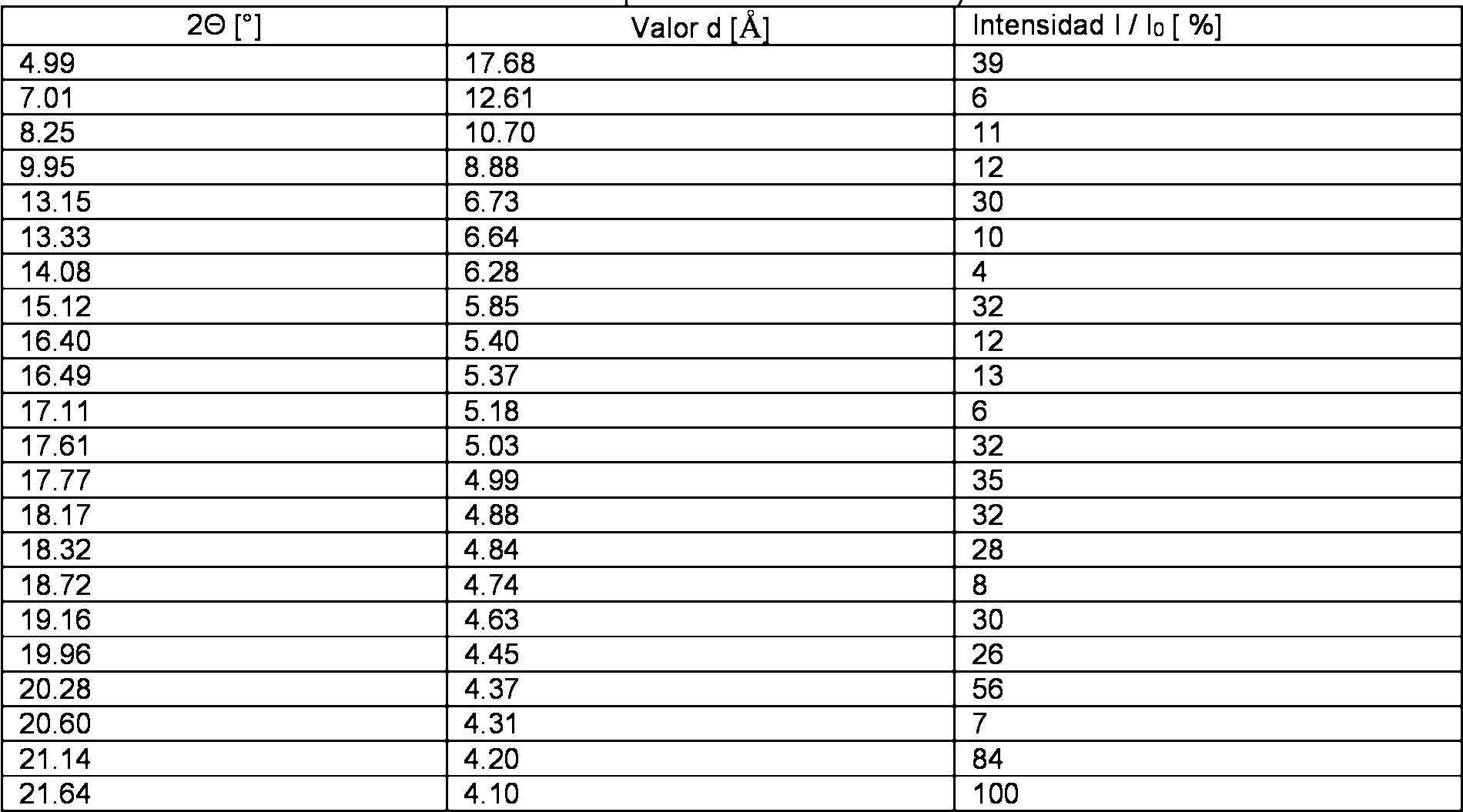
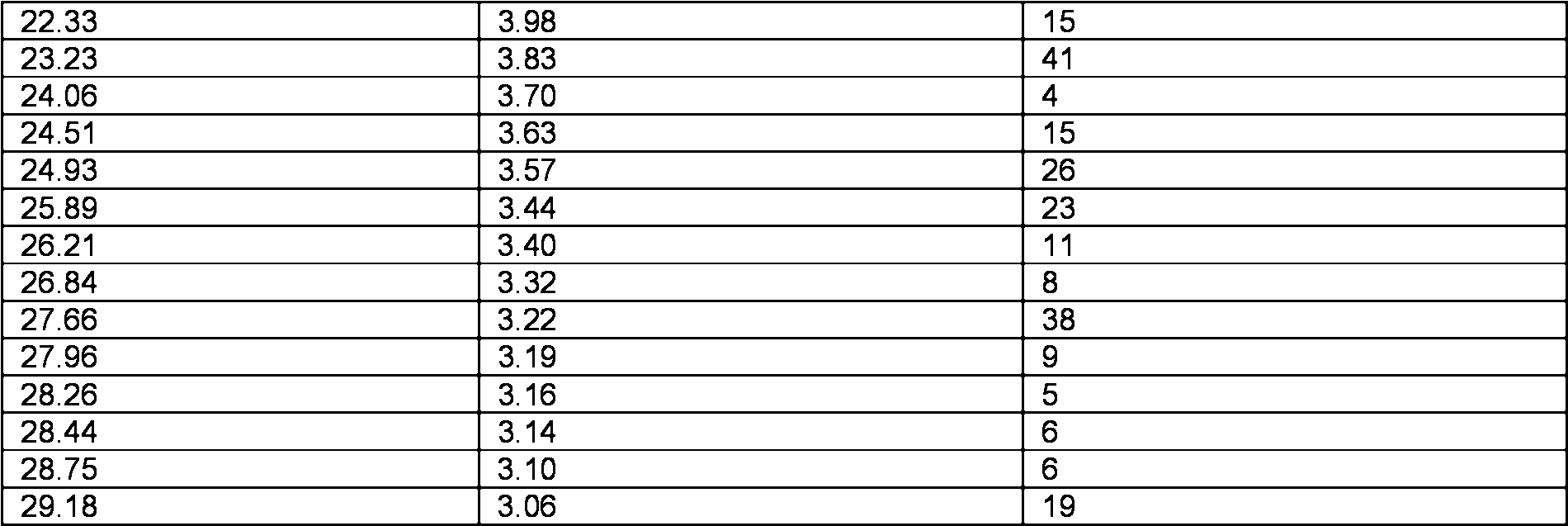
Aun mas espedficamente, dicho complejo cristalino se caracteriza por un patron de difraccion de rayos X en polvo, realizado con radiacion CuKa1, que comprende picos en grados 2© (±0.1 grados 2© como se muestra en la figura 3). Ademas, dicho complejo cristalino del compuesto A con L-prolina se caracteriza por un punto de fusion superior a 89 °C, en particular en un intervalo de aproximadamente 89 °C a aproximadamente 115 °C, mas preferiblemente en un intervalo de aproximadamente 89°C a aproximadamente 1l0°C (determinado mediante DSC; evaluado como temperatura de inicio; velocidad de calentamiento de 10 K/min). Se puede observar que este complejo cristalino se derrite bajo deshidratacion. La curva DSC obtenida se muestra en la figura 4.Even more specifically, said crystalline complex is characterized by a powder X-ray diffraction pattern, made with CuKa1 radiation, comprising peaks in degrees 2 © (± 0.1 degrees 2 © as shown in Figure 3). In addition, said crystalline complex of compound A with L-proline is characterized by a melting point above 89 ° C, in particular in a range of about 89 ° C to about 115 ° C, more preferably in a range of about 89 ° C. C at approximately 110 ° C (determined by DSC, evaluated as start temperature, heating rate of 10 K / min). It can be seen that this crystalline complex melts under dehydration. The DSC curve obtained is shown in Figure 4.
Dicho complejo cristalino del compuesto A con L-prolina muestra una perdida de peso por gravimetna termica (TG). La perdida de peso observada indica que la forma cristalina contiene agua que puede estar unida por adsorcion y/o puede ser parte de la red cristalina, es decir, la forma cristalina puede estar presente como un hidrato cristalino. El contenido de agua en la forma cristalina se encuentra en el rango de 0 a aproximadamente 10 % en peso, en particular de 0 a aproximadamente 5 % en peso, incluso mas preferiblemente de aproximadamente 1.5 a aproximadamente 5 % en peso. La lmea de puntos en la figura 2 muestra una perdida de peso de entre 2.8 y 3.8 % de agua. De la perdida de peso observada se puede estimar una estequiometna cercana a un monohidrato.Said crystalline complex of compound A with L-proline shows a weight loss by thermal gravimene (TG). The observed weight loss indicates that the crystalline form contains water that may be bound by adsorption and / or may be part of the crystal lattice, ie, the crystalline form may be present as a crystalline hydrate. The water content in the crystalline form is in the range from 0 to about 10% by weight, in particular from 0 to about 5% by weight, even more preferably from about 1.5 to about 5% by weight. The line of points in figure 2 shows a weight loss between 2.8 and 3.8% of water. From the observed weight loss, a stoichiomene close to a monohydrate can be estimated.
Dicho complejo cristalino tiene propiedades fisicoqmmicas ventajosas que son beneficiosas en la preparacion de una composicion farmaceutica. En particular, el complejo cristalino tiene una alta estabilidad ffsica y qrnmica en diversas condiciones ambientales y durante la produccion de un medicamento. Por ejemplo, los cristales se pueden obtener en una forma y tamano de partfcula que son particularmente adecuados en un metodo de produccion para formulaciones farmaceuticas solidas. Ademas, los cristales muestran una alta estabilidad mecanica que permite la molienda de los cristales. Ademas, el complejo cristalino no muestra una alta tendencia a absorber humedad y es qmmicamente estable, es decir, el complejo cristalino permite la produccion de una formulacion farmaceutica solida con una larga vida util. Por otra parte, el complejo cristalino tiene una solubilidad favorablemente alta en un amplio intervalo de pH que es ventajoso en formulaciones farmaceuticas solidas para administracion oral.Said crystalline complex has advantageous physicochemical properties which are beneficial in the preparation of a pharmaceutical composition. In particular, the crystalline complex has a high physical and chemical stability in various environmental conditions and during the production of a medicament. For example, crystals can be obtained in a particle size and form which are particularly suitable in a production method for solid pharmaceutical formulations. In addition, the crystals show a high mechanical stability that allows the grinding of the crystals. In addition, the crystalline complex does not show a high tendency to absorb moisture and is chemically stable, that is, the crystalline complex allows the production of a solid pharmaceutical formulation with a long useful life. On the other hand, the crystalline complex has a favorably high solubility over a wide pH range which is advantageous in solid pharmaceutical formulations for oral administration.
Los patrones de difraccion de rayos X en polvo se pueden registrar utilizando un difractometro STOE - STADI P en modo transmision equipado con un detector sensible a la ubicacion (OED) y un anodo de Cu como fuente de rayos X (Radiacion CuK a1, A = 1.54056 A, 40kV, 40mA). En la Tabla 1, los valores "2© [°]" indican el angulo de difraccion en grados y los valores "d [A]" indican las distancias especificadas en A entre los planos de la red. La intensidad mostrada en la figura 3 se da en unidades de cps (conteos por segundo).X-ray powder diffraction patterns can be recorded using a STOE-STADI P diffractometer in transmission mode equipped with a location-sensitive detector (OED) and a Cu anode as an X-ray source (CuK radiation a1, A = 1.54056 A, 40kV, 40mA). In Table 1, the values "2 © [°]" indicate the diffraction angle in degrees and the values "d [A]" indicate the distances specified in A between the planes of the network. The intensity shown in Figure 3 is given in units of cps (counts per second).
Para permitir un error experimental, los valores de 2 © descritos anteriormente deben considerarse precisos hasta ± 0.1 grados 2©, en particular ± 0.05 grados 2©. Es decir, al evaluar si una muestra dada de cristales del compuesto A es la forma cristalina de acuerdo con los valores de 2 © descritos anteriormente, un valor de 2 © que se observa experimentalmente para la muestra debe considerarse identico al valor caractenstico descrito anteriormente si cae dentro de ±0.1 grados 2 © del valor caractenstico, en particular si cae dentro de ±0.05 grados 2 © del valor caractensticoTo allow an experimental error, the values of 2 © described above must be considered accurate up to ± 0.1 degrees 2 ©, in particular ± 0.05 degrees 2 ©. That is, when evaluating whether a given sample of crystals of compound A is the crystalline form according to the values of 2 © described above, a value of 2 © that is observed experimentally for the sample should be considered identical to the characteristic value described above if falls within ± 0.1 degrees 2 © of the characteristic value, in particular if it falls within ± 0.05 degrees 2 © of the characteristic value
El punto de fusion se determina por DSC (Calorimetna diferencial de barrido) utilizando un DSC 821 (Mettler Toledo). La perdida de peso se determina por gravimetna termica (TG) utilizando un TGA 851 (Mettler Toledo). En el presente documento tambien se describe un metodo para fabricar un complejo cristalino como se define aqrn anteriormente y en lo sucesivo, comprendiendo dicho metodo los siguientes pasos:The melting point is determined by DSC (differential scanning calorimetry) using a DSC 821 (Mettler Toledo). The weight loss is determined by thermal gravimetric (TG) using a TGA 851 (Mettler Toledo). Also disclosed herein is a method for making a crystalline complex as defined hereinbefore and hereinafter, said method comprising the following steps:
(a) preparar una solucion del inhibidor de SGLT2 como se describe en el presente documento y uno o mas aminoacidos naturales en un disolvente o una mezcla de disolventes; (a) preparing a solution of the SGLT2 inhibitor as described herein and one or more natural amino acids in a solvent or a mixture of solvents;
(b) almacenar la solucion para precipitar el complejo cristalino a partir de la solucion;(b) storing the solution to precipitate the crystalline complex from the solution;
(c) eliminar el precipitado de la solucion; y(c) removing the precipitate from the solution; Y
(d) secar el precipitado opcionalmente hasta que se haya eliminado cualquier exceso de dicho disolvente o mezcla de disolventes.(d) drying the precipitate optionally until any excess of said solvent or mixture of solvents has been removed.
De acuerdo con la etapa (a), se prepara una solucion del inhibidor de SGLT2 y uno o mas aminoacidos naturales en un disolvente o una mezcla de disolventes. Preferiblemente, la solucion esta saturada o al menos casi saturada o incluso sobresaturada con respecto al complejo cristalino. En la etapa (a), el inhibidor de SGLT2 puede disolverse en una solucion que comprende uno o mas aminoacidos naturales o el uno o mas aminoacidos naturales puede disolverse en una solucion que comprende el inhibidor de SGLT2. De acuerdo con un procedimiento alternativo, el inhibidor de SGLT2 se disuelve en un disolvente o mezcla de disolventes para producir una primera solucion y el uno o mas aminoacidos naturales se disuelven en un disolvente o mezcla de disolventes para producir una segunda solucion. Posteriormente, dicha primera solucion y dicha segunda solucion se combinan para formar la solucion de acuerdo con el paso (a).According to step (a), a solution of the SGLT2 inhibitor and one or more natural amino acids are prepared in a solvent or a mixture of solvents. Preferably, the solution is saturated or at least nearly saturated or even oversaturated with respect to the crystalline complex. In step (a), the SGLT2 inhibitor can be dissolved in a solution comprising one or more natural amino acids or the one or more natural amino acids can be dissolved in a solution comprising the SGLT2 inhibitor. According to an alternative procedure, the SGLT2 inhibitor is dissolved in a solvent or mixture of solvents to produce a first solution and the one or more natural amino acids are dissolved in a solvent or mixture of solvents to produce a second solution. Subsequently, said first solution and said second solution combine to form the solution according to step (a).
Preferiblemente, la relacion molar del aminoacido natural y el inhibidor de SGLT2 en la solucion corresponde a la relacion molar del aminoacido natural y el inhibidor de SGLT2 en el complejo cristalino que se obtiene. Por lo tanto, una relacion molar preferida esta en el intervalo de aproximadamente 1: 2 a 3: 1; lo mas preferiblemente aproximadamente 1: 1.Preferably, the molar ratio of the natural amino acid and the SGLT2 inhibitor in the solution corresponds to the molar ratio of the natural amino acid and the SGLT2 inhibitor in the obtained crystalline complex. Therefore, a preferred molar ratio is in the range of about 1: 2 to 3: 1; most preferably about 1: 1.
Los disolventes adecuados se seleccionan preferiblemente del grupo que consiste en alcanoles C1-4, agua, acetato de etilo, acetonitrilo, acetona, eter dietflico, tetrahidrofurano y mezcla de dos o mas de estos disolventes.Suitable solvents are preferably selected from the group consisting of C 1-4 alkanols, water, ethyl acetate, acetonitrile, acetone, diethyl ether, tetrahydrofuran and mixture of two or more of these solvents.
Los disolventes mas preferidos se seleccionan del grupo que consiste en metanol, etanol, isopropanol, agua y mezcla de dos o mas de estos disolventes, en particular mezclas de uno o mas de dichos disolventes organicos con agua.The most preferred solvents are selected from the group consisting of methanol, ethanol, isopropanol, water and a mixture of two or more of these solvents, in particular mixtures of one or more of said organic solvents with water.
Los disolventes particularmente preferidos se seleccionan del grupo que consiste en etanol, isopropanol, agua y mezclas de etanol y/o isopropanol con agua.Particularly preferred solvents are selected from the group consisting of ethanol, isopropanol, water and mixtures of ethanol and / or isopropanol with water.
En caso de que se tome una mezcla de agua y uno o mas alcanoles C1-4, en particular de metanol, etanol y/o isopropanol, lo mas preferiblemente de etanol, se toma, una relacion de volumen preferida de agua: el alcanol esta en el rango de aproximadamente 99: 1 a 1: 99; mas preferiblemente de aproximadamente 50: 1 a 1: 80; incluso mas preferiblemente de aproximadamente 10: 1 a 1: 60.In case a mixture of water and one or more C1-4 alkanols, in particular of methanol, ethanol and / or isopropanol, most preferably of ethanol, is taken, a preferred ratio of water volume: alkanol is in the range of approximately 99: 1 to 1: 99; more preferably from about 50: 1 to 1: 80; even more preferably from about 10: 1 to 1: 60.
Preferiblemente, la etapa (a) se lleva a cabo a aproximadamente la temperatura ambiente (aproximadamente 20°C) o a una temperatura elevada hasta aproximadamente el punto de ebullicion del disolvente o mezcla de disolventes utilizados.Preferably, step (a) is carried out at about room temperature (about 20 ° C) or at a high temperature up to about the boiling point of the solvent or mixture of solvents used.
De acuerdo con una realizacion preferida, el material de partida del inhibidor de SGLT2 y/o de uno o mas aminoacidos naturales y/o del disolvente y las mezclas de disolventes contienen una cantidad de H2O que es al menos la cantidad requerida para formar un hidrato del inhibidor de SGLT2; en particular al menos 1 mol, preferiblemente al menos 1.5 mol de agua por mol de inhibidor de SGLT2. Incluso mas preferiblemente, la cantidad de agua es al menos 2 mol de agua por mol de inhibidor de SGLT2. Esto significa que el inhibidor de SGLT2 (es decir, el compuesto A) como material de partida o uno o mas aminoacidos naturales o dicho solvente o mezcla de solventes, o dichos compuestos y/o solventes en combinacion contienen una cantidad de H2O como se especifico anteriormente. Por ejemplo, si el material de partida del inhibidor de SGLT2 (es decir, el compuesto A) o del aminoacido natural en el paso (a) contiene suficiente agua como se especifica anteriormente, no es obligatorio el contenido de agua de los disolventes.According to a preferred embodiment, the starting material of the SGLT2 inhibitor and / or of one or more natural amino acids and / or solvent and solvent mixtures contain an amount of H 2 O which is at least the amount required to form a hydrate of the SGLT2 inhibitor; in particular at least 1 mole, preferably at least 1.5 mole of water per mole of SGLT2 inhibitor. Even more preferably, the amount of water is at least 2 mole of water per mole of SGLT2 inhibitor. This means that the SGLT2 inhibitor (ie, compound A) as the starting material or one or more natural amino acids or said solvent or mixture of solvents, or said compounds and / or solvents in combination contain an amount of H2O as specified. previously. For example, if the starting material of the SGLT2 inhibitor (ie, compound A) or the natural amino acid in step (a) contains sufficient water as specified above, the water content of the solvents is not mandatory.
Con el fin de reducir la solubilidad del complejo cristalino de acuerdo con esta invencion en la solucion, en el paso (a) y/o en el paso (b) se pueden agregar uno o mas disolventes, preferiblemente durante el paso (a) o al comienzo del paso (b). El agua es un ejemplo de un antidisolvente adecuado. La cantidad de antidisolvente se elige preferiblemente para obtener una solucion sobresaturada o saturada con respecto al complejo cristalino.In order to reduce the solubility of the crystalline complex according to this invention in the solution, in step (a) and / or in step (b) one or more solvents may be added, preferably during step (a) or at the beginning of step (b). Water is an example of a suitable anti-solvent. The amount of antisolvent is preferably chosen to obtain a supersaturated or saturated solution with respect to the crystalline complex.
En la etapa (b), la solucion se almacena durante un tiempo suficiente para obtener un precipitado, es decir, el complejo cristalino. La temperatura de la solucion en el paso (b) es aproximadamente la misma que en o mas baja que en el paso (a). Durante el almacenamiento, la temperatura de la solucion se reduce preferiblemente, preferiblemente a una temperatura en el rango de 20 °C a 0 °C o incluso mas baja. El paso (b) se puede llevar a cabo con o sin agitacion. Como es conocido por los expertos en la tecnica por el penodo de tiempo y la diferencia de temperatura en la etapa (b), el tamano, la forma y la calidad de los cristales obtenidos pueden controlarse. Ademas, la cristalizacion se puede inducir por metodos conocidos en la tecnica, por ejemplo, por medios mecanicos tales como rascar o frotar la superficie de contacto del recipiente de reaccion, por ejemplo, con una barra de vidrio. Opcionalmente, la solucion (casi) saturada o supersaturada puede inocularse con cristales seminales. In step (b), the solution is stored for a sufficient time to obtain a precipitate, i.e., the crystalline complex. The temperature of the solution in step (b) is approximately the same as in or lower than in step (a). During storage, the temperature of the solution is preferably reduced, preferably at a temperature in the range of 20 ° C to 0 ° C or even lower. Step (b) can be carried out with or without agitation. As is known to those skilled in the art for the time course and the temperature difference in step (b), the size, shape and quality of the crystals obtained can be controlled. In addition, crystallization can be induced by methods known in the art, for example, by mechanical means such as scraping or rubbing the contact surface of the reaction vessel, for example, with a glass rod. Optionally, the solution (almost) saturated or supersaturated can be inoculated with seminal crystals.
En la etapa (c), el (los) disolvente (s) se pueden eliminar del precipitado mediante metodos conocidos como, por ejemplo, filtracion, filtracion por succion, decantacion o centrifugacion.In step (c), the solvent (s) can be removed from the precipitate by known methods such as, for example, filtration, suction filtration, decantation or centrifugation.
En la etapa (d), se elimina un exceso del (de los) disolvente (s) del precipitado mediante metodos conocidos por los expertos en la materia, como por ejemplo reduciendo la presion parcial del (de los) disolvente (s), preferiblemente en vado, y/o por calentamiento por encima de aproximadamente 20 °C, preferiblemente en un rango de temperatura por debajo de 100 °C, incluso mas preferiblemente por debajo de 85 °C.In step (d), an excess of the solvent (s) of the precipitate is removed by methods known to those skilled in the art, such as by reducing the partial pressure of the solvent (s), preferably in ford, and / or by heating above about 20 ° C, preferably in a temperature range below 100 ° C, even more preferably below 85 ° C.
El Compuesto A se puede sintetizar mediante metodos como se describen o citan espedficamente y/o en general en la solicitud internacional WO 2007/128749, que se incorpora en su totalidad al presente documento como referencia, y/o en los ejemplos que se describen a continuacion. Las propiedades biologicas del compuesto A tambien pueden investigarse como se describe en el documento WO 2007/128749.Compound A can be synthesized by methods as described or specifically cited and / or in general in the international application WO 2007/128749, which is incorporated herein by reference in its entirety, and / or in the examples described herein. continuation. The biological properties of compound A can also be investigated as described in WO 2007/128749.
Un complejo cristalino como se describe en el presente documento se emplea preferiblemente como sustancia activa farmacologica en forma sustancialmente pura, es decir, esencialmente libre de otras formas cristalinas del inhibidor de SGLT2 (es decir, compuesto A). Sin embargo, la invencion tambien abarca un complejo cristalino en mezcla con otra forma o formas cristalinas. Si la sustancia activa del farmaco es una mezcla de formas cristalinas, se prefiere que la sustancia comprenda al menos el 50 % en peso, incluso mas preferiblemente al menos el 90 % en peso, mas preferiblemente al menos el 95 % en peso del complejo cristalino como se describe en el presente documento.A crystalline complex as described herein is preferably employed as a pharmacologically active substance in substantially pure form, ie, essentially free of other crystalline forms of the SGLT2 inhibitor (ie, compound A). However, the invention also encompasses a crystalline complex in admixture with another crystalline form or forms. If the active substance of the drug is a mixture of crystalline forms, it is preferred that the substance comprises at least 50% by weight, even more preferably at least 90% by weight, more preferably at least 95% by weight of the crystalline complex as described in the present document.
En vista de su capacidad para inhibir la actividad de SGLT, un complejo cristalino de acuerdo con la invencion es adecuado para el uso en el tratamiento y/o tratamiento preventivo de afecciones o enfermedades que pueden verse afectadas por la inhibicion de la actividad de SGLT, particularmente la actividad de SGLT-2, en particular los trastornos metabolicos como se describe en el presente documento. El complejo cristalino de acuerdo con la invencion tambien es adecuado para la preparacion de composiciones farmaceuticas para el tratamiento y/o tratamiento preventivo de afecciones o enfermedades que pueden verse afectadas por la inhibicion de la actividad de SGLT, particularmente la actividad de SGLT-2, en particular trastornos metabolicos como se describe en el presente documento. Un complejo cristalino como se describe en este documento (en particular del compuesto A con un aminoacido natural, por ejemplo, prolina, particularmente L-prolina) tambien es adecuado para el uso en el tratamiento de caninos.In view of its ability to inhibit the activity of SGLT, a crystalline complex according to the invention is suitable for use in the treatment and / or preventive treatment of conditions or diseases that may be affected by the inhibition of SGLT activity, particularly the activity of SGLT-2, in particular metabolic disorders as described herein. The crystalline complex according to the invention is also suitable for the preparation of pharmaceutical compositions for the treatment and / or preventive treatment of conditions or diseases that may be affected by the inhibition of SGLT activity, particularly the activity of SGLT-2, in particular metabolic disorders as described herein. A crystalline complex as described herein (in particular of compound A with a natural amino acid, for example, proline, particularly L-proline) is also suitable for use in the treatment of canines.
Composiciones y formulaciones farmaceuticas.Compositions and pharmaceutical formulations.
El unico inhibidor de SGLTS, es decir, el compuesto A, para uso de acuerdo con la invencion puede prepararse como composiciones farmaceuticas. Puede prepararse como formulaciones solidas o lfquidas. En cualquier caso, se prepara preferiblemente para administracion oral, preferiblemente en forma lfquida para administracion oral. Sin embargo, el unico inhibidor de SGLTS, es decir, el compuesto A, tambien se puede preparar, por ejemplo, para administracion parenteral.The sole inhibitor of SGLTS, ie, compound A, for use according to the invention can be prepared as pharmaceutical compositions. It can be prepared as solid or liquid formulations. In any case, it is preferably prepared for oral administration, preferably in liquid form for oral administration. However, the sole inhibitor of SGLTS, ie, compound A, can also be prepared, for example, for parenteral administration.
Las formulaciones solidas incluyen tabletas, formas granulares y otras formas solidas tales como supositorios. Entre las formulaciones solidas, se prefieren tabletas y formas granulares.Solid formulations include tablets, granular forms and other solid forms such as suppositories. Among the solid formulations, tablets and granular forms are preferred.
Las composiciones farmaceuticas en el sentido de la presente invencion pueden comprender un inhibidor de SGLT2, es decir, el compuesto A, de acuerdo con la presente invencion y uno o mas excipientes. Se puede usar cualquier excipiente que permita, o respalde, el efecto medico deseado. Tales excipientes estan disponibles para la persona experta. Los excipientes utiles son, por ejemplo, antiadherentes (utilizados para reducir la adherencia entre el polvo (granulos) y las caras del punzon y asf evitar que se peguen a los punzones de la tableta), aglomerantes (aglutinantes de solucion o aglutinantes secos que mantienen los ingredientes juntos), recubrimientos (para proteger los ingredientes de las tabletas del deterioro por la humedad en el aire y hacer que las tabletas grandes o de sabor desagradable sean mas faciles de tragar), desintegrantes (para permitir que la tableta se rompa al diluirse), rellenos, diluyentes, sabores, colores, deslizantes (reguladores de flujo - para promover el flujo de polvo al reducir la friccion y la cohesion entre partfculas), lubricantes (para evitar que los ingredientes se agrupen y se adhieran a los punzones de la tableta o la maquina de llenado de capsulas), conservantes, sorbentes, edulcorantes, etc.Pharmaceutical compositions in the sense of the present invention may comprise an inhibitor of SGLT2, ie, compound A, according to the present invention and one or more excipients. Any excipient that allows, or supports, the desired medical effect can be used. Such excipients are available to the skilled person. Useful excipients are, for example, non-stick (used to reduce the adherence between the powder (granules) and the faces of the punch and thus prevent sticking to the punches of the tablet), binders (solution binders or dry binders that maintain the ingredients together), coatings (to protect the ingredients of the tablets from deterioration by moisture in the air and make large or unpleasant-tasting tablets easier to swallow), disintegrants (to allow the tablet to break when diluted) ), fillers, thinners, flavors, colors, gliders (flow regulators - to promote the flow of dust by reducing friction and cohesion between particles), lubricants (to prevent the ingredients from clumping together and adhering to the punches of the tablet or capsule filling machine), preservatives, sorbents, sweeteners, etc.
Las formulaciones de acuerdo con la invencion, por ejemplo, formulaciones solidas, pueden comprender vehfculos y/o desintegrantes seleccionados del grupo de azucares y alcoholes de azucar, por ejemplo. manitol, lactosa, almidon, celulosa, celulosa microcristalina y derivados de celulosa, por ejemplo, metilcelulosa, y similares.The formulations according to the invention, for example, solid formulations, can comprise vehicles and / or disintegrants selected from the group of sugars and sugar alcohols, for example. mannitol, lactose, starch, cellulose, microcrystalline cellulose and cellulose derivatives, for example, methylcellulose, and the like.
Los procedimientos de fabricacion para formulaciones adecuadas para animales caninos son conocidos por los expertos en la tecnica, y para formulaciones solidas comprenden, por ejemplo, compresion directa, granulacion en seco y granulacion en humedo. En el proceso de compresion directa, el ingrediente activo y todos los demas excipientes se colocan juntos en un aparato de compresion que se aplica directamente para presionar tabletas fuera de este material. Las tabletas resultantes se pueden recubrir opcionalmente despues para protegerlas ffsica y/o qmmicamente, por ejemplo, por un material conocido del estado de la tecnica. The manufacturing processes for formulations suitable for canine animals are known to those skilled in the art, and for solid formulations they comprise, for example, direct compression, dry granulation and wet granulation. In the direct compression process, the active ingredient and all other excipients are placed together in a compression device that is applied directly to press tablets out of this material. The resulting tablets can optionally be coated afterwards to protect them physically and / or chemically, for example, by a material known from the state of the art.
Una unidad para administracion, por ejemplo, una dosis Kquida unica o una unidad de una formulacion solida, por ejemplo, una tableta, puede comprender 0.01 mg a 10 mg, o por ejemplo, 0.3 mg a 1 mg, 1 mg a 3 mg, 3 mg a 10 mg; o 5 a 2500 mg, o por ejemplo, 5 a 2000 mg, 5 mg a 1500 mg, 10 mg a 1500 mg, 10 mg a 1000 mg, o 10-500 mg del inhibidor de SGLT2 para su uso de acuerdo con la invencion. Como entendena la persona experta, el contenido del inhibidor de SGLT2 en una formulacion solida, o cualquier formulacion como se describe en el presente documento para la administracion a un animal canino, se puede aumentar o disminuir segun sea apropiado en proporcion al peso corporal del animal canino a tratar.A unit for administration, for example, a single dose or a unit of a solid formulation, for example, a tablet, may comprise 0.01 mg to 10 mg, or for example, 0.3 mg to 1 mg, 1 mg to 3 mg, 3 mg to 10 mg; or 5 to 2500 mg, or for example, 5 to 2000 mg, 5 mg to 1500 mg, 10 mg to 1500 mg, 10 mg to 1000 mg, or 10-500 mg of the SGLT2 inhibitor for use according to the invention . As the skilled person understands, the content of the SGLT2 inhibitor in a solid formulation, or any formulation as described herein for administration to a canine animal, may be increased or decreased as appropriate in proportion to the animal's body weight. canine to treat.
En una realizacion, una composicion farmaceutica para uso de acuerdo con la invencion esta disenada para administracion oral o parenteral, preferiblemente para administracion oral. Especialmente, la administracion oral se mejora con los excipientes que modifican el olor y/o las propiedades hapticas de la composicion farmaceutica para el paciente deseado, por ejemplo, como se describe.In one embodiment, a pharmaceutical composition for use according to the invention is designed for oral or parenteral administration, preferably for oral administration. Especially, oral administration is improved with excipients that modify the odor and / or haptic properties of the pharmaceutical composition for the desired patient, for example, as described.
Cuando el inhibidor de SGLT2 para uso de acuerdo con la invencion se formula para administracion oral, se prefiere que los excipientes confieran propiedades, por ejemplo, palatabilidad y/o masticabilidad que hacen que la formulacion sea adecuada para la administracion a un animal canino.When the SGLT2 inhibitor for use according to the invention is formulated for oral administration, it is preferred that the excipients confer properties, eg, palatability and / or chewiness that make the formulation suitable for administration to a canine animal.
Tambien se prefieren las formulaciones lfquidas. Las formulaciones lfquidas pueden ser, por ejemplo, soluciones, jarabes o suspensiones. Pueden administrarse directamente al animal canino o pueden mezclarse con la comida y/o bebida (por ejemplo, agua potable o similar) del animal canino. Una ventaja de una formulacion lfquida (similar a una formulacion en forma granular) es que dicha forma de dosificacion permite una dosificacion precisa. Por ejemplo, el inhibidor de SGLT2 se puede dosificar precisamente en proporcion al peso corporal de un animal canino. Las composiciones tfpicas de formulaciones lfquidas son conocidas por los expertos en la tecnica.Liquid formulations are also preferred. The liquid formulations can be, for example, solutions, syrups or suspensions. They can be administered directly to the canine animal or can be mixed with the food and / or drink (eg, drinking water or the like) of the canine animal. An advantage of a liquid formulation (similar to a formulation in granular form) is that said dosage form allows accurate dosing. For example, the SGLT2 inhibitor can be dosed precisely in proportion to the body weight of a canine animal. Typical compositions of liquid formulations are known to those skilled in the art.
Dosificacion y administracionDosage and administration
Un experto en la materia puede determinar las dosis adecuadas para los usos de la presente invencion. Las unidades de dosificacion preferidas incluyen mg/kg, es decir, mg de inhibidor de SGLT2 por peso corporal del animal canino. El inhibidor de SGLT2 de la invencion puede, por ejemplo, administrarse en dosis de 0.01-5.0 mg/kg de peso corporal por dfa, por ejemplo, 0.01-4.0 mg/kg de peso corporal por dfa, por ejemplo, 0.01-3.0 mg/kg de peso corporal por dfa, por ejemplo, 0.01-2.0 mg/kg de peso corporal por dfa, por ejemplo, 0.01-1.5 m /kg de peso corporal por dfa, por ejemplo, 0.01-1.0 mg/kg de peso corporal por dfa, por ejemplo, 0.01-0.75 mg/kg de peso corporal por dfa, por ejemplo, 0.01-0.5 mg/kg de peso corporal por dfa, por ejemplo, 0.01-0,4 mg/kg de peso corporal por dfa, por ejemplo, 0.01-0.3 mg/kg de peso corporal por dfa; o 0.1 a 3.0 mg/kg de peso corporal por dfa, preferiblemente de 0.2 a 2.0 mg/kg de peso corporal por dfa, mas preferiblemente de 0.1 a 1 mg/kg de peso corporal por dfa. En otra realizacion preferida, la dosis es de 0.02-0.5 mg/kg de peso corporal por dfa, mas preferiblemente de 0.03-0.4 mg/kg de peso corporal por dfa, por ejemplo, 0.03-0.3 mg/kg de peso corporal por dfa.A person skilled in the art can determine the doses suitable for the uses of the present invention. Preferred dosage units include mg / kg, ie, mg of SGLT2 inhibitor per body weight of the canine animal. The SGLT2 inhibitor of the invention can, for example, be administered in doses of 0.01-5.0 mg / kg of body weight per day, for example, 0.01-4.0 mg / kg of body weight per day, for example, 0.01-3.0 mg / kg of body weight per day, for example, 0.01-2.0 mg / kg of body weight per day, for example, 0.01-1.5 m / kg of body weight per day, for example, 0.01-1.0 mg / kg of body weight per day, for example, 0.01-0.75 mg / kg of body weight per day, for example, 0.01-0.5 mg / kg of body weight per day, for example, 0.01-0.4 mg / kg of body weight per day, for example, 0.01-0.3 mg / kg of body weight per day; or 0.1 to 3.0 mg / kg of body weight per day, preferably 0.2 to 2.0 mg / kg of body weight per day, more preferably 0.1 to 1 mg / kg of body weight per day. In another preferred embodiment, the dose is 0.02-0.5 mg / kg of body weight per day, more preferably 0.03-0.4 mg / kg of body weight per day, for example, 0.03-0.3 mg / kg of body weight per day. .
Un experto en la materia puede preparar el inhibidor de SGLT2 de la invencion para la administracion de acuerdo con una dosis deseada.A person skilled in the art can prepare the SGLT2 inhibitor of the invention for administration according to a desired dose.
Preferiblemente, segun la invencion, el inhibidor de SGLT2 se administra no mas de tres veces por dfa, mas preferiblemente no mas de dos veces por dfa, lo mas preferiblemente solo una vez por dfa. La frecuencia de administracion se puede adaptar a la tasa de alimentacion tfpica del animal canino.Preferably, according to the invention, the SGLT2 inhibitor is administered no more than three times per day, more preferably not more than twice per day, most preferably only once per day. The frequency of administration can be adapted to the typical feeding rate of the canine animal.
De acuerdo con la invencion, el inhibidor de SGLT2 se puede administrar de manera tal que se logre una concentracion apropiada en plasma sangumeo de los inhibidores de SGLT2 (por ejemplo, una concentracion maxima en plasma sangumeo o concentracion en plasma sangumeo despues de un tiempo dado, por ejemplo, 4, 8, 12 o 24 horas despues de la administracion oral, preferiblemente aproximadamente 8 horas despues de la administracion oral). Por ejemplo, para el compuesto A, la concentracion en plasma sangumeo (por ejemplo, la concentracion maxima en plasma sangumeo o la concentracion en plasma sangumeo despues de dicho tiempo dado despues de la administracion oral) puede estar dentro del rango de 2 a 4000 nM, por ejemplo, de 20 a 3000 nM, o por ejemplo, de 40 a 2000 nM.According to the invention, the SGLT2 inhibitor can be administered in such a way that an appropriate concentration in blood plasma of the SGLT2 inhibitors is achieved (for example, a maximum concentration in blood plasma or concentration in blood plasma after a given time , for example, 4, 8, 12 or 24 hours after oral administration, preferably approximately 8 hours after oral administration). For example, for compound A, the concentration in blood plasma (for example, the maximum concentration in blood plasma or the concentration in blood plasma after said given time after oral administration) may be within the range of 2 to 4000 nM. , for example, from 20 to 3000 nM, or for example, from 40 to 2000 nM.
Preferiblemente, despues de la administracion y el tiempo requerido para que el inhibidor de SGLT2 alcance el torrente sangumeo, dichos niveles se mantienen en la sangre durante un intervalo de tiempo de al menos 12 horas, mas preferiblemente al menos 18 horas, mas preferiblemente al menos 24 h.Preferably, after administration and the time required for the SGLT2 inhibitor to reach the bloodstream, such levels are maintained in the blood for a time interval of at least 12 hours, more preferably at least 18 hours, more preferably at least 24 h.
Preferiblemente, de acuerdo con la invencion, el inhibidor de SGLT2 se administra por via oral, en forma lfquida o solida. El inhibidor de SGLT2 se puede administrar directamente a la boca del animal (por ejemplo, usando una jeringa, preferiblemente una jeringa graduada de peso corporal) o junto con la comida o bebida del animal (por ejemplo, con su agua potable o similar), en cada caso preferiblemente en forma lfquida. Sin embargo, el inhibidor de SGLT2 tambien puede administrarse, por ejemplo, por via parenteral, o por cualquier otra via de administracion, por ejemplo, por via rectal. Preferably, according to the invention, the SGLT2 inhibitor is administered orally, in liquid or solid form. The SGLT2 inhibitor can be administered directly to the mouth of the animal (for example, using a syringe, preferably a graduated syringe of body weight) or together with the animal's food or drink (for example, with its drinking water or the like), in each case preferably in liquid form. However, the SGLT2 inhibitor can also be administered, for example, parenterally, or by any other route of administration, for example, rectally.
El inhibidor de SGLT2 se puede usar solo o en combinacion con otro medicamento. En algunas realizaciones, el unico inhibidor de SGLTS, es decir, el compuesto A, se usa en combinacion con uno o mas farmacos antihiperglucemicos orales adicionales. Cuando el inhibidor de SGLT2 se usa en combinacion con un farmaco adicional, el inhibidor de SGLT2 y cualquier otro farmaco pueden administrarse simultaneamente, secuencialmente (en cualquier orden) y/o de acuerdo con un regimen de dosificacion cronologicamente escalonado. En tales realizaciones, cuando un farmaco adicional para administracion combinada con el inhibidor de SGLT2 o no se administra simultaneamente con el inhibidor de SGLT2, el inhibidor de SGLT2 y cualquier otro farmaco se administran preferiblemente dentro de un penodo de al menos 2 semanas, 1 mes, 2 meses, 4 meses, 6 meses o mas, por ejemplo, 12 meses o mas.The SGLT2 inhibitor can be used alone or in combination with another medication. In some embodiments, the sole SGLTS inhibitor, ie, compound A, is used in combination with one or more additional oral antihyperglycemic drugs. When the SGLT2 inhibitor is used in combination with an additional drug, the SGLT2 inhibitor and any other drug can be administered simultaneously, sequentially (in any order) and / or according to a chronologically staged dosing regimen. In such embodiments, when an additional drug for administration in combination with the SGLT2 inhibitor or is not administered simultaneously with the SGLT2 inhibitor, the SGLT2 inhibitor and any other drug are preferably administered within a period of at least 2 weeks, 1 month , 2 months, 4 months, 6 months or more, for example, 12 months or more.
En algunas realizaciones, el unico inhibidor de SGLTS, es decir, el compuesto A, se usa con la administracion conjunta con insulina, preferiblemente una administracion conjunta con insulina simultanea, secuencial y/o cronologicamente escalonada. Dicha coadministracion tambien puede estar en forma de una combinacion de dosis fija (FDC), por ejemplo, una formulacion que incluya uno o mas inhibidores de SGLTS, preferiblemente compuesto A, e insulina combinada en una unica forma de dosificacion, que se fabrica y distribuye en ciertas dosis fijas respectivas. En algunas realizaciones, el inhibidor de SGLT2 (ya sea usado solo o en combinacion con otro medicamento) no se usa en combinacion con 1-[(3-ciano-piridin-2-il)metil]-3-metil-7-(2-butin-1-yl)-8-[3-(R)-aminopiperidin-1-il]-xantina o una sal farmaceuticamente aceptable de la misma, es decir, el animal canino no se trata con dicho compuesto. En algunas realizaciones, el inhibidor de SGLT2 no se usa en combinacion con un inhibidor de DPP-IV, es decir, el animal canino no se trata con un inhibidor de DPP-IV.In some embodiments, the sole SGLTS inhibitor, ie, compound A, is used with co-administration with insulin, preferably co-administration with simultaneous, sequential and / or chronologically staggered insulin. Said coadministration may also be in the form of a fixed dose combination (FDC), for example, a formulation that includes one or more inhibitors of SGLTS, preferably compound A, and combined insulin in a single dosage form, which is manufactured and distributed. in certain respective fixed doses. In some embodiments, the SGLT2 inhibitor (either used alone or in combination with another medicament) is not used in combination with 1 - [(3-cyano-pyridin-2-yl) methyl] -3-methyl-7- ( 2-butin-1-yl) -8- [3- (R) -aminopiperidin-1-yl] -xanthine or a pharmaceutically acceptable salt thereof, ie, the canine animal is not treated with said compound. In some embodiments, the SGLT2 inhibitor is not used in combination with a DPP-IV inhibitor, ie, the canine animal is not treated with a DPP-IV inhibitor.
En algunas realizaciones, el inhibidor de SGLT2 se usa como una monoterapia, es decir, terapia independiente, es decir, no se administra ningun otro medicamento al animal canino para el tratamiento o la prevencion del mismo trastorno metabolico, es decir, el trastorno metabolico para el que se administra el inhibidor de SGLT2. Por ejemplo, no se administra ningun otro medicamento al animal canino para el tratamiento o la prevencion del mismo trastorno metabolico en un penodo de al menos 2, 3 o 4 semanas antes y despues de la administracion del inhibidor de SGLT2.In some embodiments, the SGLT2 inhibitor is used as a monotherapy, i.e., stand-alone therapy, ie, no other drug is administered to the canine animal for the treatment or prevention of the same metabolic disorder, i.e., the metabolic disorder for which is administered the SGLT2 inhibitor. For example, no other medicament is administered to the canine animal for the treatment or prevention of the same metabolic disorder in a period of at least 2, 3 or 4 weeks before and after the administration of the SGLT2 inhibitor.
Breve descripcion de las figuras.Brief description of the figures.
Figura 1 Excrecion urinaria de glucosa en perros Beagle despues de una dosis oral unica del Compuesto A. La orina se tomo una muestra individual de 0-24 h y de 24 a 48 h despues de la administracion. Despues de 24 h, la orina obtenida mediante la insercion de un cateter en la vejiga se anadio a la orina de muestra libre. En los controles y la dosis baja (0.01 mg/kg) practicamente no se detecto glucosa en la orina. Los valores p indicados arriba de las barras son versus control (*, p <0.05).Figure 1 Urine glucose excretion in Beagle dogs after a single oral dose of Compound A. The urine was taken from an individual sample of 0-24 h and from 24 to 48 h after administration. After 24 h, the urine obtained by the insertion of a catheter into the bladder was added to the urine of the free sample. In the controls and the low dose (0.01 mg / kg) practically no glucose was detected in the urine. The p-values indicated above the bars are versus control (*, p <0.05).
Figura 2 Respuesta a la dosis sigmoidal para la excrecion urinaria de glucosa en el penodo de tiempo 0-24 h despues de la administracion del Compuesto A como se muestra. La ED50 para la excrecion de glucosa por el Compuesto A en perros Beagle es de 0.1 mg/kg (IC del 95 %: 0.02-0.52 mg/kg).Figure 2 Response to the sigmoidal dose for urinary glucose excretion in the time period 0-24 h after the administration of Compound A as shown. The ED50 for glucose excretion by Compound A in Beagle dogs is 0.1 mg / kg (95% CI: 0.02-0.52 mg / kg).
La Figura 3 muestra un patron de difraccion de rayos X en polvo de un lote representativo de un complejo cristalino de compuesto A con L-prolina (1: 1)Figure 3 shows a powder X-ray diffraction pattern of a representative lot of a crystalline complex of compound A with L-proline (1: 1)
La Figura 4 muestra un diagrama DSC/TG de un lote representativo de un complejo cristalino de compuesto A con L-prolina (1: 1)Figure 4 shows a DSC / TG diagram of a representative lot of a crystalline complex of compound A with L-proline (1: 1)
EjemplosExamples
Los siguientes ejemplos muestran los efectos terapeuticos beneficiosos sobre el control glucemico y/o la resistencia a la insulina, etc., de usar uno o mas inhibidores de SGLT2 en animales caninos, segun la presente invencion. Estos ejemplos pretenden ilustrar la invencion con mas detalle sin ninguna limitacion del alcance de las reivindicaciones. Ejemplo 1 Farmacocinetica (PK) del Compuesto A Dosificacion oral unica en perrosThe following examples show the beneficial therapeutic effects on glycemic control and / or insulin resistance, etc., of using one or more SGLT2 inhibitors in canine animals, according to the present invention. These examples are intended to illustrate the invention in more detail without any limitation of the scope of the claims. Example 1 Pharmacokinetics (PK) of Compound A Single oral dosage in dogs
El compuesto A se administro a perros en ayunas durante la noche. Los grupos (n=4 por grupo) recibieron una administracion unica de vehfculo oral (agua DI) que contema el Compuesto A inhibidor de SGLT2 en una dosis de 1 mg/kg y 10 mg/kg o vehfculo intravenoso (solucion salina) que contema el inhibidor de SGLT2. Compuesto A en una dosis de 1 mg/kg. Las medidas de PK se tomaron hasta el dfa 3 despues de una administracion unica del compuesto A o su vehfculo.Compound A was administered to dogs fasting overnight. The groups (n = 4 per group) received a single administration of oral vehicle (DI water) containing Compound A SGLT2 inhibitor at a dose of 1 mg / kg and 10 mg / kg or intravenous vehicle (saline solution) containing the SGLT2 inhibitor. Compound A in a dose of 1 mg / kg. The PK measurements were taken until day 3 after a single administration of compound A or its vehicle.
Tabla 2: Datos farmacocineticos, dosis unica (i.v. 1 mg/kg, oral 1 y 10 mg/kg)Table 2: Pharmacokinetic data, single dose (i.v. 1 mg / kg, oral 1 and 10 mg / kg)


Ejemplo 2 El efecto del Compuesto A sobre la glucosa en la orina y en la sangre despues de una dosis unica en perrosExample 2 The effect of Compound A on glucose in urine and blood after a single dose in dogs
Los perros Beagle se mantuvieron en ayunas durante la noche y recibieron una administracion oral unica del Compuesto A en dosis de 0 mg/kg de peso corporal, 0.01 mg/kg peso corporal., 0.1 mg/kg peso corporal o 1 mg/kg peso corporal (n = 3 por grupo) seguido de un enjuague con agua (1 ml/kg peso corporal)Beagle dogs were fasted overnight and received a single oral administration of Compound A at doses of 0 mg / kg body weight, 0.01 mg / kg body weight, 0.1 mg / kg body weight or 1 mg / kg weight body mass (n = 3 per group) followed by a rinse with water (1 ml / kg body weight)
El Compuesto A se humedecio con un pequeno volumen de una solucion acuosa de Polysorbat 80 al 1 % (p/v) (Tween80, monooleato de polioxietileno sorbitan, Solucion de ICN Biomedicals) y luego se disolvio agregando lentamente un gran volumen de una solucion acuosa de hidroxietilcelulosa al 0.5 % (p/v) (Natrosol 250 HX, Boehringer Ingelheim) y agitando a temperatura ambiente durante aproximadamente 15 minutos. La concentracion final de Polysorbat 80 fue de 0.015 %. El compuesto A se aplico en un volumen de 2 ml / kg peso corporal.Compound A was moistened with a small volume of an aqueous solution of Polysorbate 80 at 1% (w / v) (Tween80, sorbitan polyoxyethylene monooleate, ICN Biomedicals solution) and then dissolved slowly adding a large volume of an aqueous solution of 0.5% (w / v) hydroxyethylcellulose (Natrosol 250 HX, Boehringer Ingelheim) and stirring at room temperature for approximately 15 minutes. The final concentration of Polysorbat 80 was 0.015%. Compound A was applied in a volume of 2 ml / kg body weight.
Los animales se mantuvieron individualmente en jaulas metabolicas y recibieron alimento 2 h despues de la administracion. Tuvieron acceso gratuito al agua durante el experimento. La orina se recogio en los intervalos de tiempo 0-8 h, 8-24 h, 24-32 h, y 32-48 h despues de la administracion. Se inserto un cateter (Eickemeyer) en la vejiga para recoger completamente la orina de 24 h. Esta orina se combino con la orina que se habfa excretado en el penodo de 8-24 h. Se anadio un volumen de 5 ml de una solucion al 10 % de azida sodica en solucion salina a cada tubo de recoleccion de orina antes del muestreo. Se determino el volumen de orina y las muestras se congelaron para determinar posteriormente la concentracion de glucosa.The animals were kept individually in metabolic cages and received food 2 h after administration. They had free access to water during the experiment. The urine was collected in the time intervals 0-8 h, 8-24 h, 24-32 h, and 32-48 h after administration. A catheter (Eickemeyer) was inserted into the bladder to completely collect the 24-hour urine. This urine was combined with the urine that had excreted in the period of 8-24 h. A volume of 5 ml of a 10% solution of sodium azide in saline solution was added to each urine collection tube before sampling. The volume of urine was determined and the samples were frozen to determine later the concentration of glucose.
Durante el experimento, se extrajeron muestras de sangre de una vena del antebrazo. La sangre se recogio en tubos de EDTA antes de la administracion del vehfculo o el Compuesto A, y posteriormente a las 0.25 h, 0.5 h, 1 h, 2 h, 4 h, 8 h, 24 h, 32 h y 48 h puntos temporales despues de la dosis. El plasma se preparo despues de la extraccion de sangre y se congelo para determinar la concentracion de glucosa.During the experiment, blood samples were taken from a vein in the forearm. The blood was collected in EDTA tubes before administration of the vehicle or Compound A, and subsequently at 0.25 h, 0.5 h, 1 h, 2 h, 4 h, 8 h, 24 h, 32 h and 48 h temporal points after the dose. The plasma was prepared after the blood draw and frozen to determine the glucose concentration.
• Un aumento prominente de la concentracion y el volumen de glucosa en la orina fue evidente en las dos dosis mas altas 8 h despues de la administracion (figura 1). •• A prominent increase in the concentration and volume of glucose in the urine was evident in the two highest doses 8 h after administration (Figure 1). •
• Ninguna dosis de compuesto A indujo hipoglucemia, ni altero el nivel de glucosa en sangre en perros en comparacion con los valores de referencia normales.• No dose of compound A induced hypoglycaemia, nor did it alter the blood glucose level in dogs in comparison with normal reference values.
Con respecto a la excrecion urinaria de glucosa, se estima que la ED50 es de 0.1 mg/kg (figura 2).With respect to urinary glucose excretion, the ED50 is estimated to be 0.1 mg / kg (Figure 2).
Ejemplo 3 Tratamiento de la diabetes dependiente de insulina en perros.Example 3 Treatment of insulin dependent diabetes in dogs.
Tratamiento de perros con diabetes dependiente de insulina.Treatment of dogs with insulin-dependent diabetes.
La insulina con el Compuesto A de acuerdo con la invencion o una combinacion de sustancias activas de acuerdo con la invencion, ademas de producir una mejora aguda en la situacion metabolica de la glucosa, previene el deterioro de la situacion metabolica a largo plazo y reduce la dosis de insulina necesaria para tratar el canino diabetico. Esto se puede observar si los perros se tratan por un penodo mas corto o mas largo, por ejemplo, 2-4 semanas o 3 meses a 1 ano, con la composicion farmaceutica de acuerdo con la invencion y se comparan con la situacion metabolica antes del tratamiento o con perros que se han tratado, por ejemplo, con insulina sola. Existe evidencia de exito terapeutico si el nivel promedio diario de glucosa en sangre y fructosamina se reduce en comparacion con el nivel de tratamiento previo. Se obtiene evidencia adicional de exito terapeutico si un porcentaje significativamente menor de los perros tratados con una composicion farmaceutica de acuerdo con la invencion, en comparacion con los perros que han sido tratados con otros medicamentos, experimenta un deterioro transitorio en la posicion metabolica de la glucosa (por ejemplo, hiper o hipoglucemia).Insulin with Compound A according to the invention or a combination of active substances according to the invention, besides producing an acute improvement in the metabolic situation of glucose, prevents the deterioration of the metabolic situation in the long term and reduces the dose of insulin needed to treat the diabetic canine. This can be observed if the dogs are treated for a shorter or longer period, for example, 2-4 weeks or 3 months to 1 year, with the pharmaceutical composition according to the invention and compared with the metabolic situation before the treatment or with dogs that have been treated, for example, with insulin alone. There is evidence of therapeutic success if the average daily level of blood glucose and fructosamine is reduced compared to the level of previous treatment. Additional evidence of therapeutic success is obtained if a significantly lower percentage of the dogs treated with a pharmaceutical composition according to the invention, compared to dogs that have been treated with other drugs, experience a transient deterioration in the glucose metabolic position. (for example, hyper or hypoglycemia).
Ejemplo 4 Mejora de la diabetes resistente a la insulina en hembras con dioestro/diabetes gestacionalExample 4 Improvement of insulin-resistant diabetes in females with dioestrus / gestational diabetes
La diabetes resistente a la insulina es una forma frecuente de diabetes en animales caninos intactos. La terapia con Compuesto A puede proporcionarse con el objetivo de prevenir la transicion a la diabetes manifiesta. En estudios sobre un penodo mas corto o mas largo (por ejemplo, 2-4 semanas o 1-2 anos), El exito del tratamiento se examina determinando los valores de glucosa en ayunas y/o los valores de glucosa despues de una comida o despues de una prueba de carga (prueba de tolerancia a la glucosa por via intravenosa o prueba de tolerancia de alimentos despues de una comida definida) durante el estudio a lo largo de las diferentes fases del ciclo menstrual y/o despues del final del penodo de terapia para el estudio y comparandolos con los valores antes del inicio del estudio y/o con los de un grupo de placebo. Ademas, el valor de fructosamina se puede determinar antes y despues de la terapia y se puede comparer con el valor inicial y/o comparer con perros que han sido tratados con otros medicamentos o con placebo. Una cafda significativa en los niveles de glucosa y/o fructosamina en ayunas o no en ayunas demuestra la eficacia del tratamiento de la resistencia a la insulina: la diabetes y la prevencion de la diabetes manifiesta en perras con antecedentes de dioestro/diabetes gestacional.Insulin-resistant diabetes is a frequent form of diabetes in intact canine animals. Therapy with Compound A can be provided with the aim of preventing the transition to overt diabetes. In studies on a shorter or longer period (for example, 2-4 weeks or 1-2 years), the success of the treatment is examined by determining fasting glucose values and / or glucose values after a meal or after a load test (intravenous glucose tolerance test or food tolerance test after a defined meal) during the study throughout the different phases of the menstrual cycle and / or after the end of the period of therapy for the study and comparing them with the values before the start of the study and / or with those of a placebo group. In addition, the fructosamine value can be determined before and after therapy and it can be compared with the initial value and / or compare with dogs that have been treated with other medications or with placebo. A significant decrease in fasting or non-fasting glucose and / or fructosamine levels demonstrates the efficacy of the treatment of insulin resistance: diabetes and the prevention of diabetes manifested in female dogs with a history of diabetes / gestational diabetes.
Ejemplo 5 Tratamiento de la hiperglucemiaExample 5 Treatment of hyperglycemia
En estudios clrnicos en perros con trastornos metabolicos que se ejecutan durante diferentes penodos de tiempo (por ejemplo, 2 semanas a 12 meses), el exito del tratamiento se verifica mediante la medicion de la glucemia basal y/o la fructosamina en sangre.In clinical studies in dogs with metabolic disorders that run for different periods of time (for example, 2 weeks to 12 months), the success of the treatment is verified by the measurement of basal blood glucose and / or fructosamine in blood.
La mejora del control glucemico se puede determinar ademas estableciendo curvas diurnas de glucosa en sangre, por ejemplo, una curva de glucosa en sangre de 9 o 24 horas que comienza antes de la medicacion y mediciones repetidas despues de la dosificacion.The improvement of glycemic control can also be determined by establishing diurnal blood glucose curves, for example, a blood glucose curve of 9 or 24 hours that begins before the medication and repeated measurements after dosing.
Una cafda significativa en estos valores durante o al final del estudio, en comparacion con el valor inicial o en comparacion con un grupo de placebo, o un grupo que recibio una terapia diferente, demuestra la eficacia de una composicion farmaceutica segun la invencion en la reduccion de la hiperglucemia en perros.A significant decrease in these values during or at the end of the study, in comparison with the initial value or in comparison with a placebo group, or a group that received a different therapy, demonstrates the efficacy of a pharmaceutical composition according to the invention in the reduction. of hyperglycemia in dogs.
Alternativamente, el efecto del compuesto A sobre la hiperglucemia puede mostrarse en perros sometidos a una infusion continua de glucosa (pinza hiperglucemica). La normalizacion de la hiperglucemia puede evaluarse en comparacion con ningun tratamiento y/o un tratamiento combinado con insulina y/o un tratamiento con insulina sola. Ejemplo 6 Prevencion o tratamiento de complicaciones asociadas a la hiperglucemiaAlternatively, the effect of compound A on hyperglycemia can be shown in dogs subjected to a continuous infusion of glucose (hyperglycemic clamp). The normalization of hyperglycemia can be evaluated in comparison with no treatment and / or a combination treatment with insulin and / or an insulin treatment alone. Example 6 Prevention or treatment of complications associated with hyperglycemia
El tratamiento de perros diabeticos hiperglucemicos o dependientes de insulina o perros diabeticos resistentes a la insulina con Compuesto A de acuerdo con la invencion o una combinacion de sustancias activas de acuerdo con la invencion previene o reduce las complicaciones asociadas a la hiperglucemia, por ejemplo, la formacion de cataratas.The treatment of hyperglycemic or insulin-dependent diabetic dogs or insulin-resistant diabetic dogs with Compound A according to the invention or a combination of active substances according to the invention prevents or reduces the complications associated with hyperglycemia, for example, the cataract formation.
La evidencia del exito terapeutico se compara con los perros que han sido tratados con otros medicamentos antidiabeticos o con placebo. El exito del tratamiento se determina, por ejemplo, mediante un examen oftalmologico del desarrollo o la progresion o la regresion de la formacion de cataratas. Y/o el tiempo hasta el desarrollo de una catarata y/o la progresion de la maduracion de la catarata se puede determinar y comparar con perros que han sido tratados con otros medicamentos antidiabeticos o con placebo.The evidence of therapeutic success is compared with dogs that have been treated with other antidiabetic medications or with placebo. The success of the treatment is determined, for example, by an ophthalmological examination of the development or progression or regression of the formation of cataracts. And / or the time until the development of a cataract and / or the progression of the maturation of the cataract can be determined and compared with dogs that have been treated with other antidiabetic medications or with placebo.
Ejemplo 7 Tratamiento de la resistencia a la insulinaExample 7 Treatment of insulin resistance
En estudios clrnicos en perros resistentes a la insulina que corren por diferentes penodos de tiempo (por ejemplo, de 4 semanas a 12 meses), el exito del tratamiento se verifica mediante la medicion de la glucemia basal, la fructosamina en sangre y la insulina en la sangre y/o el nivel de peptido c y la relacion correspondiente entre el parametro en el perro individual.In clinical studies in insulin resistant dogs that run for different periods of time (for example, from 4 weeks to 12 months), the success of the treatment is verified by measuring basal blood glucose, fructosamine in blood and insulin in blood and / or peptide level c and the corresponding relationship between the parameter in the individual dog.
Tambien los valores de glucosa y lfpidos en sangre (por ejemplo, NEFA) y/o insulina despues de una comida o despues de una prueba de carga (prueba de tolerancia a la glucosa o prueba de tolerancia a la insulina) durante o despues del final del penodo de terapia para el estudio puede compararse con los valores antes del inicio del estudio y/o con los de perros resistentes a la insulina que han sido tratados con otros medicamentos o placebo.Also blood glucose and lipid values (eg, NEFA) and / or insulin after a meal or after a load test (glucose tolerance test or insulin tolerance test) during or after the end The duration of therapy for the study can be compared with the values before the start of the study and / or with those of insulin-resistant dogs that have been treated with other medications or placebo.
Ejemplo 8 Tratamiento de la prediabetes en perros.Example 8 Treatment of prediabetes in dogs.
La eficacia de la inhibicion de SGLT2 de acuerdo con la invencion en el tratamiento de la prediabetes caracterizada por la glucosa en ayunas patologica y/o la tolerancia alterada a la glucosa y/o la resistencia a la insulina se puede probar utilizando estudios clrnicos. En estudios sobre un penodo mas corto o mas largo (por ejemplo, 2-4 semanas o 1-2 anos), El exito del tratamiento se examina determinando los valores de glucosa en ayunas y/o los valores de glucosa despues de una comida o despues de una prueba de carga (prueba de tolerancia a la glucosa por via intravenosa o prueba de tolerancia a la comida despues de una comida definida o prueba de tolerancia a la insulina) despues del final del penodo de terapia para el estudio y compararlos con los valores antes del inicio del estudio y/o con los de un grupo de placebo. Ademas, el valor de fructosamina se puede determinar antes y despues de la terapia y se puede comparar con el valor inicial y/o el valor de placebo. Una cafda significativa en los niveles de glucosa y/o fructosamina en ayunas o no en ayunas demuestra la eficacia del tratamiento de la prediabetes Ejemplo 9 Efectos sobre el peso corporal, la composicion corporal, la dislipidemia y la disadipocinemia Tratamiento de perros con trastornos metabolicos como obesidad, dislipemia, disadipocinemia, lipidosis hepatica, inflamacion subclmica o inflamacion sistemica, en particular inflamacion sistemica de bajo grado, que tambien comprende tejido adiposo y trastornos asociados, como el Srndrome X (srndrome metabolico), y/o resistencia a la insulina, hiperglucemia, hiperinsulinemia, tolerancia alterada a la glucosa tambien persigue el objetivo de prevenir la transicion o ralentizar la progresion a, por ejemplo, consecuencias clmicas manifiestas de los trastornos metabolicos, por ejemplo, hipertension, cardiomiopatfa, disfuncion renal y/o trastornos musculoesqueleticos en animales caninos. La eficacia de un tratamiento puede investigarse en un estudio clinico comparativo en el que los perros se tratan durante un penodo prolongado (por ejemplo, 3 a 12 meses) ya sea con el Compuesto A o una combinacion de sustancias activas o con placebo o con una terapia sin medicamentos (por ejemplo, dieta) u otros medicamentos. Antes, durante y al final de la terapia, se puede determinar el parametro: peso corporal (escala) y composicion corporal, por ejemplo, con absorciometna de rayos X de energfa dual. En plasma o lfpidos sericos (por ejemplo, trigliceridos, colesterol, NEFA) y adipocina (por ejemplo, adiponectina, leptina), tambien se pueden medir los perfiles inflamatorios (por ejemplo, protema C reactiva, protema quimiotactica monocito 1). La insulina y el nivel de glucosa se pueden determinar tanto basales como, por ejemplo, despues de una prueba de carga. El parametro renal se puede determinar en la sangre y en los simples urinarios (por ejemplo, urea, creatinina, albumina urinaria). Ademas, la presion arterial y/o tambien las evidencias de cardiomiopatfa pueden investigarse con mediciones ecograficas de ecograffa Doppler. Una mejora en los trastornos musculoesqueleticos (por ejemplo, osteoartritis) se puede cuantificar, por ejemplo, con puntuaciones de actividad, cojera y dolor.The efficacy of inhibition of SGLT2 according to the invention in the treatment of prediabetes characterized by fasting glucose pathology and / or impaired glucose tolerance and / or insulin resistance can be tested using clinical studies. In studies on a shorter or longer period (for example, 2-4 weeks or 1-2 years), the success of the treatment is examined by determining fasting glucose values and / or glucose values after a meal or after a load test (intravenous glucose tolerance test or food tolerance test after a defined meal or insulin tolerance test) after the end of the therapy period for the study and compare them with the values before the start of the study and / or with those of a placebo group. In addition, the fructosamine value can be determined before and after therapy and can be compared with the initial value and / or the placebo value. A significant decrease in fasting or non-fasting glucose and / or fructosamine levels demonstrates the effectiveness of prediabetes treatment Example 9 Effects on body weight, body composition, dyslipidemia and dysadipocinemia Treatment of dogs with metabolic disorders such as obesity, dyslipidemia, dysadipocinemia, hepatic lipidosis, subclinical inflammation or systemic inflammation, in particular low-grade systemic inflammation, which also includes adipose tissue and associated disorders, such as syndrome X (metabolic syndrome), and / or resistance to insulin, hyperglycemia, hyperinsulinemia, impaired glucose tolerance also aims to prevent the transition or slow progression to, for example, manifest clinical consequences of metabolic disorders, eg, hypertension, cardiomyopathy, renal dysfunction and / or musculoskeletal disorders in canine animals. The efficacy of a treatment can be investigated in a comparative clinical study in which dogs are treated during a prolonged period (for example, 3 to 12 months) with either Compound A or a combination of active substances or with placebo or with a therapy without medication (for example, diet) or other medications. Before, during and at the end of therapy, the parameter can be determined: body weight (scale) and body composition, for example, with dual-energy X-ray absorption. In plasma or serum lipids (eg, triglycerides, cholesterol, NEFA) and adipokine (eg, adiponectin, leptin), inflammatory profiles can also be measured (eg, C-reactive protein, monocyte chemotactic protein 1). Insulin and glucose level can be determined both basal and, for example, after a load test. The renal parameter can be determined in the blood and in simple urinals (for example, urea, creatinine, urine albumin). In addition, blood pressure and / or evidence of cardiomyopathy can be investigated with sonographic Doppler ultrasound measurements. An improvement in musculoskeletal disorders (eg, osteoarthritis) can be quantified, for example, with activity, lameness and pain scores.
Ejemplo 10 Preparacion de 1-ciano-2-(4-ciclopropil-bencil)-4-([p-D-glucopiranos-1-il)-benceno (compuesto A) El siguiente ejemplo de smtesis sirve para ilustrar un metodo para preparar 1-ciano-2-(4-ciclopropil-bencil)-4-(p-D-glucopiranos-1-il) benceno (compuesto A). Tambien se describe un metodo para preparar su complejo cristalino con L-prolina. Debe considerarse solo como un posible metodo descrito a modo de ejemplo, sin restriccion del alcance de la invencion. Los terminos "temperatura ambiente" y "temperatura ambiental" se usan indistintamente e indican temperaturas de aproximadamente 20 °C. Se utilizan las siguientes abreviaturas:Example 10 Preparation of 1-cyano-2- (4-cyclopropyl-benzyl) -4 - ([pD-glucopyranos-1-yl) -benzene (compound A) The following example of synthesis serves to illustrate a method for preparing 1- cyano-2- (4-cyclopropyl-benzyl) -4- (pD-glucopyranos-1-yl) benzene (compound A). A method for preparing its crystalline complex with L-proline is also described. It should be considered only as a possible method described by way of example, without restriction of the scope of the invention. The terms "ambient temperature" and "ambient temperature" are used interchangeably and indicate temperatures of approximately 20 ° C. The following abbreviations are used:
DMF dimetilformamidaDMF dimethylformamide
NMP N-metil-2-pirrolidonaNMP N-methyl-2-pyrrolidone
THF tetrahidrofuranoTHF tetrahydrofuran
Preparacion de 4-bromo-3-hidroximetil-1-yodo-bencenoPreparation of 4-bromo-3-hydroxymethyl-1-iodo-benzene

Se anade cloruro de oxalilo (13.0 ml) a una solucion enfriada con hielo de acido 2-bromo-5-yodo-benzoico (49.5 g) en CH2Cl2 (200 ml). Se anade DMF (0.2 ml) y la solucion se agita a temperatura ambiente durante 6 h. Luego, la solucion se concentra a presion reducida y el residuo se disuelve en THF (100 ml). La solucion resultante se enfna en un bano de hielo y se agrega LiBH4 (3.4 g) en porciones. Se retira el bano de enfriamiento y la mezcla se agita a temperatura ambiente durante 1 h. La mezcla de reaccion se diluye con THF y se trata con acido clortndrico 0.1 M. Luego, la capa organica se separa y la capa acuosa se extrae con acetato de etilo. Las capas organicas combinadas se secan (Na2SO4) y el disolvente se evapora a presion reducida para dar el producto bruto.Oxalyl chloride (13.0 ml) is added to an ice-cold solution of 2-bromo-5-iodo-benzoic acid (49.5 g) in CH2Cl2 (200 ml). DMF (0.2 ml) is added and the solution is stirred at room temperature for 6 h. Then, the solution is concentrated under reduced pressure and the residue is dissolved in THF (100 ml). The resulting solution is cooled in an ice bath and LiBH4 (3.4 g) is added in portions. The cooling bath is removed and the mixture is stirred at room temperature for 1 h. The reaction mixture is diluted with THF and treated with 0.1 M clortrendic acid. Then, the organic layer is separated and the aqueous layer is extracted with ethyl acetate. The combined organic layers are dried (Na2SO4) and the solvent is evaporated under reduced pressure to give the crude product.
Rendimiento: 47.0 g (99 % del teorico).Yield: 47.0 g (99% of theory).
Preparacion de 4-bromo-3-clorometil-1-yodo-bencenoPreparation of 4-bromo-3-chloromethyl-1-iodo-benzene

Se anade cloruro de tionilo (13 ml) a una suspension de 4-bromo-3-hidroximetil-1-yodo-benceno (47.0 g) en diclorometano (100 ml) que contiene DMF (0.1 ml). La mezcla se agita a temperatura ambiental durante 3 h. Luego, el solvente y el exceso de reactivo se eliminan a presion reducida. El residuo se tritura con metanol y se seca.Thionyl chloride (13 ml) is added to a suspension of 4-bromo-3-hydroxymethyl-1-iodo-benzene (47.0 g) in dichloromethane (100 ml) containing DMF (0.1 ml). The mixture is stirred at room temperature for 3 h. Then, the solvent and excess reagent are removed under reduced pressure. The residue is triturated with methanol and dried.
Rendimiento: 41.0 g (82 % del teorico). Yield: 41.0 g (82% of theory).
Preparacion de 4-bromo-1-yodo-3-fenoximetil-bencenoPreparation of 4-bromo-1-iodo-3-phenoxymethyl-benzene
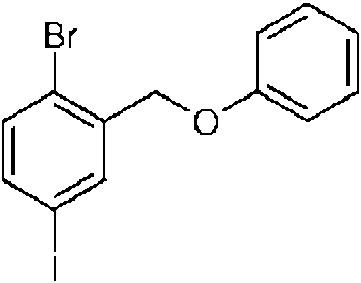
Se anade fenol (13 g) disuelto en una solucion de KOH 4 M (60 ml) a 4-bromo-3-clorometil-1-yodo-benceno (41.0 g) disuelto en acetona (50 ml). Se agrega NaI (0.5 g) y la mezcla resultante se agita a 50 °C durante la noche. Luego, se agrega agua y la mezcla resultante se extrae con acetato de etilo. Los extractos combinados se secan (Na2SO4) y el disolvente se evapora a presion reducida. El residuo se purifica por cromatograffa en gel de silice (ciclohexano/acetato de etilo 19: 1).Phenol (13 g) dissolved in a solution of 4 M KOH (60 ml) is added to 4-bromo-3-chloromethyl-1-iodo-benzene (41.0 g) dissolved in acetone (50 ml). NaI (0.5 g) is added and the resulting mixture is stirred at 50 ° C overnight. Then, water is added and the resulting mixture is extracted with ethyl acetate. The combined extracts are dried (Na2SO4) and the solvent is evaporated under reduced pressure. The residue is purified by silica gel chromatography (cyclohexane / ethyl acetate 19: 1).
Rendimiento: 38.0 g (79 % del teorico).Yield: 38.0 g (79% of theory).
Preparacion de 1-bromo-4-(1-metoxi-D-glucopiranos-1-il)-2-(fenoximetil) bencenoPreparation of 1-bromo-4- (1-methoxy-D-glucopyranos-1-yl) -2- (phenoxymethyl) benzene
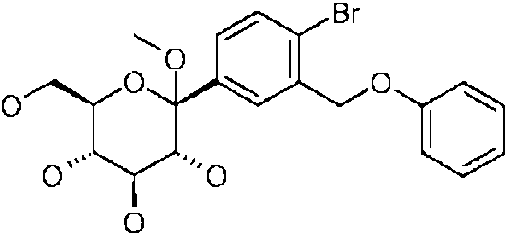
Se anade una solucion 2 M de iPrMgCl en THF (11 ml) a LiCl seco (0.47 g) suspendido en THF (11 ml). La mezcla se agita a temperatura ambiente hasta que se disuelve todo el LiCl. Esta solucion se agrega gota a gota a una solucion de 4-bromo-1-yodo-3-fenoximetil-benceno (8.0 g) en tetrahidrofurano (40 ml) enfriada a -60 °C bajo atmosfera de argon. La solucion se calienta a -40 °C y luego se agrega 2,3,4,6-tetrakis-O- (trimetilsilil) -D-glucopiranona (10.7 g, 90 % de pureza) en tetrahidrofurano (5 ml). La solucion resultante se calienta a -5 °C en el bano de enfriamiento y se agita durante otros 30 minutos a esta temperatura. Se agrega una solucion acuosa de NH4Cl y la mezcla resultante se extrae con acetato de etilo. Los extractos organicos combinados se secan sobre sulfato de sodio y el disolvente se elimina a presion reducida. El residuo se disuelve en metanol (80 ml) y se trata con acido metanosulfonico (0.6 ml) para producir unicamente el anomero mas estable. Despues de agitar la solucion de reaccion a 35-40 °C durante la noche, la solucion se neutraliza con NaHCO3 solido y el metanol se elimina a presion reducida. El resto se diluye con solucion acuosa de NaHCO3 y la mezcla resultante se extrae con acetato de etilo. Los extractos combinados se secan sobre sulfato de sodio y el disolvente se evapora para producir el producto bruto que se somete a reduccion sin purificacion adicional.A 2 M solution of iPrMgCl in THF (11 ml) is added to dry LiCl (0.47 g) suspended in THF (11 ml). The mixture is stirred at room temperature until all LiCl dissolves. This solution is added dropwise to a solution of 4-bromo-1-iodo-3-phenoxymethyl-benzene (8.0 g) in tetrahydrofuran (40 ml) cooled to -60 ° C under an argon atmosphere. The solution is warmed to -40 ° C and then 2,3,4,6-tetrakis-O- (trimethylsilyl) -D-glucopyranone (10.7 g, 90% purity) in tetrahydrofuran (5 ml) is added. The resulting solution is heated to -5 ° C in the cooling bath and stirred for another 30 minutes at this temperature. An aqueous solution of NH 4 Cl is added and the resulting mixture is extracted with ethyl acetate. The combined organic extracts are dried over sodium sulfate and the solvent is removed under reduced pressure. The residue is dissolved in methanol (80 ml) and treated with methanesulfonic acid (0.6 ml) to produce only the most stable anomer. After stirring the reaction solution at 35-40 ° C overnight, the solution is neutralized with solid NaHCO3 and the methanol is removed under reduced pressure. The remainder is diluted with aqueous NaHCO3 solution and the resulting mixture is extracted with ethyl acetate. The combined extracts are dried over sodium sulfate and the solvent is evaporated to yield the crude product which is subjected to reduction without further purification.
Rendimiento: 7.8 g (93 % del teorico).Yield: 7.8 g (93% of theory).
Preparacion de 1-bromo-4- (2,3,4,6-tetra-O-acetil-D-glucopiranos-1-il) -2- (fenoximetil) -bencenoPreparation of 1-bromo-4- (2,3,4,6-tetra-O-acetyl-D-glucopyranos-1-yl) -2- (phenoxymethyl) -benzene
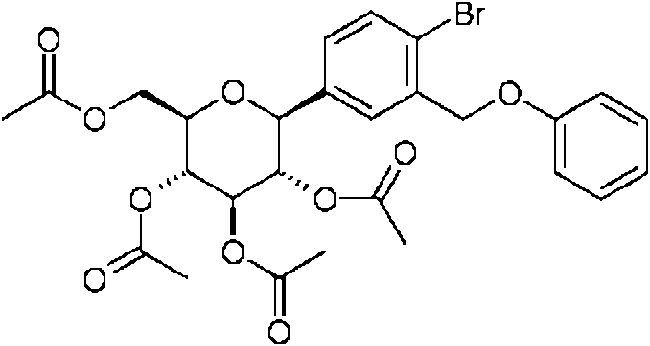
El dietileterato de trifluoruro de boro (4.9 ml) se agrega a una solucion de 1-bromo-4- (1-metoxi-D-glucopiranos-1-il) -2-(fenoximetil) benceno (8.7 g) y trietilsilano (9.1 ml) en diclorometano (35 ml) y acetonitrilo (50 ml) enfriados a -20 °C a una velocidad tal que la temperatura se mantiene por debajo de -10 °C. La solucion resultante se calienta a 0 °C durante un penodo de 1.5 horas y luego se trata con una solucion acuosa de hidrogenocarbonato de sodio. La mezcla resultante se agita durante 0.5 h, el disolvente organico se elimina y el residuo se extrae con acetato de etilo. Las capas organicas combinadas se secan sobre sulfato de sodio y el disolvente se elimina. El residuo se recoge en diclorometano (50 ml) y se anaden sucesivamente a la solucion piridina (9,4 ml), anhfdrido acetico (9.3 ml) y 4-dimetilaminopiridina (0.5 g). La solucion se agita durante 1.5 h a temperatura ambiental y luego se diluye con diclorometano. Esta solucion se lava dos veces con acido clorhfdrico 1 M y se seca sobre sulfato de sodio. Despues de eliminar el disolvente, el residuo se recristaliza en etanol para proporcionar el producto en forma de un solido incoloro. The boron trifluoride diethyl ether (4.9 ml) is added to a solution of 1-bromo-4- (1-methoxy-D-glucopyranos-1-yl) -2- (phenoxymethyl) benzene (8.7 g) and triethylsilane (9.1 ml) in dichloromethane (35 ml) and acetonitrile (50 ml) cooled to -20 ° C at a rate such that the temperature is maintained below -10 ° C. The resulting solution is heated at 0 ° C for a period of 1.5 hours and then treated with an aqueous solution of sodium hydrogencarbonate. The resulting mixture is stirred for 0.5 h, the organic solvent is removed and the residue is extracted with ethyl acetate. The combined organic layers are dried over sodium sulfate and the solvent is removed. The residue is taken up in dichloromethane (50 ml) and successively added to the solution pyridine (9.4 ml), acetic anhydride (9.3 ml) and 4-dimethylaminopyridine (0.5 g). The solution is stirred for 1.5 h at room temperature and then diluted with dichloromethane. This solution is washed twice with 1 M hydrochloric acid and dried over sodium sulfate. After removing the solvent, the residue is recrystallized from ethanol to give the product as a colorless solid.
Rendimiento: 6.78 g (60 % del teorico).Yield: 6.78 g (60% of theory).
Espectro de masas (ESI+): m/z = 610/612 (Br) [M NH4]+Mass spectrum (ESI +): m / z = 610/612 (Br) [M NH4] +
Preparacion de 2- (fenoximetil) -4- (2,3,4,6-tetra-O-acetil-D-glucopiranos-1-il) -benzonitriloPreparation of 2- (phenoxymethyl) -4- (2,3,4,6-tetra-O-acetyl-D-glucopyranos-1-yl) -benzonitrile
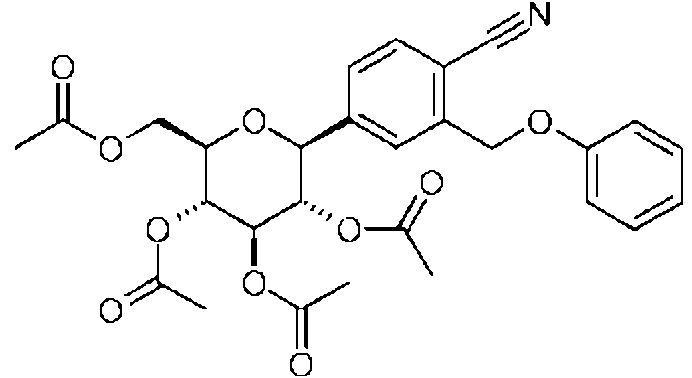
Un matraz cargado con cianuro de cinc (1.0 g), cinc (30 mg), Pd2 (dibencilidenacetona)3*CHCb (141 mg) y tetrafluoroborato de tritert-butilfosfonio (111 mg) se enjuaga con argon. Luego, una solucion de 1-bromo-4- (2,3,4,6-tetra-O-acetil-D-glucopiranos-1-il)-2-(fenoximetil) benceno (5.4 g) en NMP (12 ml) se agrega y la mezcla resultante se agita a temperatura ambiente durante 18 h. Despues de la dilucion con acetato de etilo, la mezcla se filtra y el filtrado se lava con una solucion acuosa de hidrogenocarbonato de sodio. La fase organica se seca (sulfato de sodio) y el disolvente se elimina. El residuo se recristaliza en etanol.A flask loaded with zinc cyanide (1.0 g), zinc (30 mg), Pd2 (dibenzylidene ketone) 3 * CHCb (141 mg) and tritert-butylphosphonium tetrafluoroborate (111 mg) is rinsed with argon. Then, a solution of 1-bromo-4- (2,3,4,6-tetra-O-acetyl-D-glucopyranos-1-yl) -2- (phenoxymethyl) benzene (5.4 g) in NMP (12 ml ) is added and the resulting mixture is stirred at room temperature for 18 h. After dilution with ethyl acetate, the mixture is filtered and the filtrate is washed with an aqueous solution of sodium hydrogencarbonate. The organic phase is dried (sodium sulfate) and the solvent is removed. The residue is recrystallized from ethanol.
Rendimiento: 4.10 g (84 % del teorico).Yield: 4.10 g (84% of theory).
Espectro de masas (ESI+): m/z = 557 [M NH4]+Mass spectrum (ESI +): m / z = 557 [M NH4] +
Alternativamente, el compuesto descrito anteriormente se sintetiza a partir de 1-bromo-4-(2,3,4,6-tetra-O-acetil-D-glucopiranos-1-il) -2-(fenoximetil) benceno usando cobre (I) cianuro (2 equivalentes) en NMP a 210 °C.Alternatively, the compound described above is synthesized from 1-bromo-4- (2,3,4,6-tetra-O-acetyl-D-glucopyranos-1-yl) -2- (phenoxymethyl) benzene using copper ( I) cyanide (2 equivalents) in NMP at 210 ° C.
Preparacion de 2-bromometil-4- (2,3,4,6-tetra-O-acetil-D-glucopiranos-1-il) -benzonitriloPreparation of 2-bromomethyl-4- (2,3,4,6-tetra-O-acetyl-D-glucopyranos-1-yl) -benzonitrile
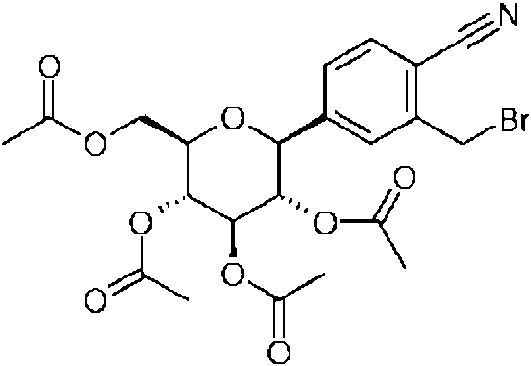
Se anade una solucion al 33 % de acido bromhndrico en acido acetico (15 ml) a una solucion de 2-feniloximetil-4-(2,3,4,6-tetra-0-acetil-D-glucopiranos-1-il)-benzonitrilo (0.71 g) y anhfdrido acetico (0.12 ml) en acido acetico (10 ml). La solucion resultante se agita a 55 °C durante 6 h y luego se enfna en un bano de hielo. La mezcla de reaccion se neutraliza con una solucion acuosa enfriada de carbonato de potasio y la mezcla resultante se extrae con acetato de etilo. Los extractos organicos combinados se secan sobre sulfato de sodio y el disolvente se elimina a presion reducida. El residuo se recoge en acetato de etilo/ciclohexano (1:5) y el precipitado se separa por filtracion y se seca a 50 °C para obtener el producto puro.A 33% solution of bromic acid in acetic acid (15 ml) is added to a solution of 2-phenyloxymethyl-4- (2,3,4,6-tetra-0-acetyl-D-glucopyranos-1-yl) -benzonitrile (0.71 g) and acetic anhydride (0.12 ml) in acetic acid (10 ml). The resulting solution is stirred at 55 ° C for 6 h and then cooled in an ice bath. The reaction mixture is neutralized with a cooled aqueous solution of potassium carbonate and the resulting mixture is extracted with ethyl acetate. The combined organic extracts are dried over sodium sulfate and the solvent is removed under reduced pressure. The residue is taken up in ethyl acetate / cyclohexane (1: 5) and the precipitate is filtered off and dried at 50 ° C to obtain the pure product.
Rendimiento: 0.52 g (75 % del teorico).Yield: 0.52 g (75% of theory).
Espectro de masas (ESI+): m/z = 543/545 (Br) [M+NH4]+Mass spectrum (ESI +): m / z = 543/545 (Br) [M + NH4] +
Preparacion de acido 4-ciclopropil-fenilboronicoPreparation of 4-cyclopropyl-phenylboronic acid
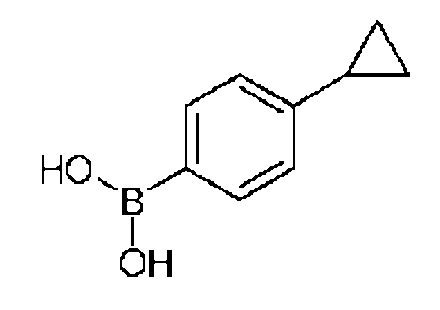
Se anade gota a gota una solucion 2.5 M de nButillitio en hexano (14.5 ml) a 1-bromo-4-ciclopropilbenceno (5.92 g) disuelto en THF (14 ml) y tolueno (50 ml) y se enfna a -70 °C. La solucion resultante se agita a -70 °C durante 30 minutos antes de agregar borato de triisopropilo (8.5 ml). La solucion se calienta a -20 °C y luego se trata con acido clorMdrico acuoso 4 M (15.5 ml). La mezcla de reaccion se calienta mas a temperature ambiente y luego se separa la fase organica. La fase acuosa se extrae con acetato de etilo y las fases organicas combinadas se secan (sulfato de sodio). El disolvente se evapora y el residuo se lava con una mezcla de eter y ciclohexano para dar el producto como un solido incoloro.A 2.5 M solution of nButyllithium in hexane (14.5 ml) is added dropwise to 1-bromo-4-cyclopropylbenzene (5.92 g) dissolved in THF (14 ml) and toluene (50 ml) and cooled to -70 ° C. . The resulting solution is stirred at -70 ° C for 30 minutes before adding triisopropyl borate (8.5 ml). The solution is warmed to -20 ° C and then treated with 4 M aqueous hydrochloric acid (15.5 ml). The reaction mixture is heated further to room temperature and then the organic phase is separated. The aqueous phase is extracted with ethyl acetate and the combined organic phases are dried (sodium sulfate). The solvent is evaporated and the residue is washed with a mixture of ether and cyclohexane to give the product as a colorless solid.
Rendimiento: 2.92 g (60 % del teorico).Yield: 2.92 g (60% of theory).
Espectro de masas (ESI-): m/z = 207 (Cl) [M+HCOO]-Preparacion de 1-ciano-2-(4-ciclopropil-bencil)-4-(p-D-glucopirenos-1-il)-bencenoMass spectrum (ESI-): m / z = 207 (Cl) [M + HCOO] -Preparation of 1-cyano-2- (4-cyclopropyl-benzyl) -4- (pD-glucopyrenes-1-yl) - benzene
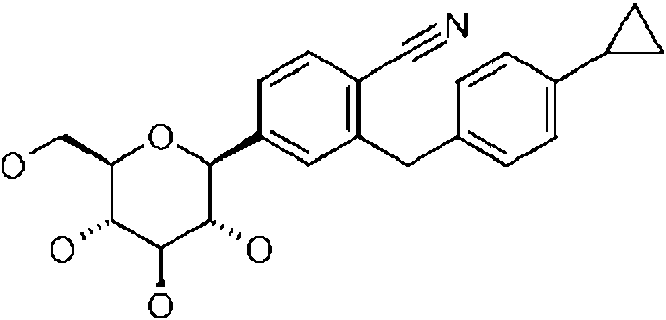
Un matraz lleno de Ar se carga con 2-bromometil-4- (2,3,4,6-tetra-O-acetil-D-glucopiranos-l-il) -benzonitrilo (1.60 g), acido 4-ciclopropilfenilboronico (1.0 g), carbonato de potasio (1.85 g) y una mezcla 3: 1 desgasificada de acetona y agua (22 ml). La mezcla se agita a temperatura ambiente durante 5 min, antes de enfriarla en un bano de hielo. Luego se agrega dicloruro de paladio (30 mg) y la mezcla de reaccion se agita durante 16 horas a temperatura ambiental. La mezcla se diluye luego con salmuera y se extrae con acetato de etilo. Los extractos combinados se secan sobre sulfato de sodio y el disolvente se elimina a presion reducida. El residuo se disuelve en metanol (20 ml) y se trata con una solucion acuosa de hidroxido de potasio 4 M (4 ml). La solucion resultante se agita a temperatura ambiente durante 1 h y luego se neutraliza con acido clorhfdrico 1 M. El metanol se evapora y el residuo se diluye con salmuera y se extrae con acetato de etilo. Los extractos organicos recogidos se secan sobre sulfato de sodio y el disolvente se elimina. El residuo se cromatograffa en gel de silice (diclorometano/metanol 1: 0 -> 8: 1).A flask filled with Ar is charged with 2-bromomethyl-4- (2,3,4,6-tetra-O-acetyl-D-glucopyranosyl-1-yl) -benzonitrile (1.60 g), 4-cyclopropylphenylboronic acid (1.0 g), potassium carbonate (1.85 g) and a degassed 3: 1 mixture of acetone and water (22 ml). The mixture is stirred at room temperature for 5 min, before cooling in an ice bath. Then palladium dichloride (30 mg) is added and the reaction mixture is stirred for 16 hours at room temperature. The mixture is then diluted with brine and extracted with ethyl acetate. The combined extracts are dried over sodium sulfate and the solvent is removed under reduced pressure. The residue is dissolved in methanol (20 ml) and treated with an aqueous solution of 4 M potassium hydroxide (4 ml). The resulting solution is stirred at room temperature for 1 h and then neutralized with 1 M hydrochloric acid. The methanol is evaporated and the residue is diluted with brine and extracted with ethyl acetate. The collected organic extracts are dried over sodium sulfate and the solvent is removed. The residue is chromatographed on silica gel (dichloromethane / methanol 1: 0 -> 8: 1).
Rendimiento: 0.91 g (76 % del teorico).Yield: 0.91 g (76% of theory).
Espectro de masas (ESI+): m/z = 413 [M+NH4]+Mass spectrum (ESI +): m / z = 413 [M + NH4] +
Preparacion de un complejo cristalino (1: 1) de compuesto A con L-prolina.Preparation of a crystalline complex (1: 1) of compound A with L-proline.
Se anade L-prolina (0.34 g) disuelta en 2.1 ml de una mezcla de etanol y agua (relacion en volumen 10: 1) a una solucion de 1-ciano-2-(4-ciclopropil-bencil)-4-(p-D-glucopiranos-1-il) -benceno (1.17 g, obtenido como se describe anteriormente) disuelto en 2 ml de etanol. La solucion resultante se deja reposar a temperatura ambiental. Despues de aproximadamente 16 h, el complejo cristalino se afsla en forma de cristales blancos por filtracion. Si es necesario, la cristalizacion puede iniciarse rascando con una varilla de vidrio o con una espatula de metal, por ejemplo, o inoculando con cristales de semillas. El disolvente residual se elimina almacenando los cristales a una temperatura ligeramente elevada (30 a 50 °C) al vacfo durante aproximadamente 4 h para producir 1.27 g del complejo cristalino 1: 1 de L-prolina y 1-ciano-2-(4-ciclopropil-bencil)-4-(p-D-glucopiranos-1-il)-benceno.Add L-proline (0.34 g) dissolved in 2.1 ml of a mixture of ethanol and water (ratio by volume 10: 1) to a solution of 1-cyano-2- (4-cyclopropyl-benzyl) -4- (pD) -glucopyranos-1-yl) -benzene (1.17 g, obtained as described above) dissolved in 2 ml of ethanol. The resulting solution is allowed to stand at room temperature. After about 16 h, the crystalline complex is isolated in the form of white crystals by filtration. If necessary, crystallization can be initiated by scraping with a glass rod or a metal spatula, for example, or by inoculating with seed crystals. The residual solvent is removed by storing the crystals at a slightly elevated temperature (30 to 50 ° C) in vacuo for about 4 h to yield 1.27 g of the 1: 1 crystalline complex of L-proline and 1-cyano-2- (4- cyclopropyl-benzyl) -4- (pD-glucopyranos-1-yl) -benzene.
Se obtienen varios lotes del complejo cristalino de acuerdo con la preparacion anterior. Los patrones de difraccion de rayos X en polvo coinciden. Los puntos de fusion se determinan mediante DSC y se evaluan como temperatura de inicio. Los ejemplos de puntos de fusion son aproximadamente 89 °C, 90 °C, 92 °C, 101 °C y 110 °C. El patron de difraccion de rayos X en polvo que figura en la Tabla 1 y como se muestra en la figura 11 y el diagrama DSC y TG en la Figura 12 corresponden a un lote con un punto de fusion de aproximadamente 90 °C.Various batches of the crystalline complex are obtained according to the above preparation. X-ray powder diffraction patterns match. The melting points are determined by DSC and are evaluated as start temperature. Examples of melting points are approximately 89 ° C, 90 ° C, 92 ° C, 101 ° C, and 110 ° C. The powder X-ray diffraction pattern shown in Table 1 and as shown in Figure 11 and the DSC and TG diagram in Figure 12 correspond to a batch with a melting point of about 90 ° C.
El patron de difraccion de rayos X en polvo del complejo cristalino del compuesto A y L-prolina (picos de hasta 30° en 20) se proporciona anteriormente en la Tabla 1.The powder X-ray diffraction pattern of the crystalline complex of compound A and L-proline (peaks up to 30 ° in 20) is given above in Table 1.
Ejemplo 11 FormulacionesExample 11 Formulations
Se describen algunos ejemplos de formulaciones en las que el termino "sustancia activa" indica el inhibidor de SGLT2 o su forma farmaceuticamente aceptable, por ejemplo, una forma cristalina, para uso de acuerdo con la invencion. En el caso de una combinacion con una o sustancias activas adicionales, el termino "sustancia activa" tambien puede incluir la sustancia activa adicional. Some examples of formulations are described in which the term "active substance" denotes the SGLT2 inhibitor or its pharmaceutically acceptable form, eg, a crystalline form, for use according to the invention. In the case of a combination with one or more active substances, the term "active substance" may also include the additional active substance.
Tabletas que contienen 100 mg de principio activoTablets containing 100 mg of active substance
Composicion:Composition:
1 tableta contiene:1 tablet contains:
sustancia activa 100.0 mgactive substance 100.0 mg
lactosa 80.0mglactose 80.0mg
harina de mafz 34.0mgmaize meal 34.0mg
polivinilpirrolidona 4.0 mgPolyvinylpyrrolidone 4.0 mg
estearato de magnesio__________ 2.0mgmagnesium stearate__________ 2.0mg
220.0 mg220.0 mg
Metodo de preparacion:Preparation method:
La sustancia activa, la lactosa y el almidon se mezclan y se humedecen uniformemente con una solucion acuosa de polivinilpirrolidona. Despues de cribar la composicion humeda (tamano de malla de 2.0 mm) y secarla en un secador tipo rack a 50 °C, se tamiza nuevamente (tamano de malla de 1.5 mm) y se agrega el lubricante. La mezcla final se comprime para formar tabletas.The active substance, the lactose and the starch are mixed and wetted uniformly with an aqueous solution of polyvinyl pyrrolidone. After screening the wet composition (2.0 mm mesh size) and drying it in a rack-type dryer at 50 ° C, it is screened again (mesh size 1.5 mm) and the lubricant is added. The final mixture is compressed to form tablets.
Peso de la tableta: 220 mgWeight of the tablet: 220 mg
Diametro: 10 mm, biplanar, facetado en ambos lados y con muesca en un lado.Diameter: 10 mm, biplanar, faceted on both sides and notched on one side.
Tabletas que contienen 150 mg de principio activo.Tablets containing 150 mg of active ingredient.
Composicion:Composition:
Preparacion:Preparation:
1 tableta contiene:1 tablet contains:
sustancia activa 150.0 mgactive substance 150.0 mg
lactosa en polvo 89.0 mglactose powder 89.0 mg
harina de mafz 40.0mg40.0mg corn flour
sflice coloidal 10.0 mgColloidal silica 10.0 mg
polivinilpirrolidona 10.0 mgpolyvinyl pyrrolidone 10.0 mg
estearato de magnesio 1.0 mgmagnesium stearate 1.0 mg
300.0 mg300.0 mg
La sustancia activa mezclada con lactosa, almidon de mafz y sflice se humedece con una solucion acuosa de polivinilpirrolidona al 20 % y se pasa a traves de un tamiz con un tamano de malla de 1.5 mm. Los granulos, secados a 45 °C, se pasan de nuevo por la misma pantalla y se mezclan con la cantidad especificada de estearato de magnesio. Se prensan las tabletas de la mezcla.The active substance mixed with lactose, maize and silica starch is moistened with an aqueous solution of 20% polyvinylpyrrolidone and passed through a sieve with a mesh size of 1.5 mm. The granules, dried at 45 ° C, are again passed through the same screen and mixed with the specified amount of magnesium stearate. The tablets of the mixture are pressed.
Peso de la tableta: 300 mgWeight of the tablet: 300 mg
molde: 10 mm, planomold: 10 mm, flat
Capsulas de gelatina dura que contienen 150 mg de sustancia activa.Hard gelatine capsules containing 150 mg of active substance.
Composicion:Composition:
1 capsula contiene:1 capsule contains:
Sustancia activa 150.0 mgActive substance 150.0 mg
almidon de mafz (seco) aprox. 180.0 mgcorn starch (dry) approx. 180.0 mg
lactosa (en polvo) aprox. 87.0 mglactose (powder) approx. 87.0 mg
estearato de magnesio_______ 3.0 mgmagnesium stearate______ 3.0 mg
aprox. 420.0 mgapprox. 420.0 mg
Preparacion:Preparation:
La sustancia activa se mezcla con los excipientes, se pasa a traves de una pantalla con un tamano de malla de 0.75 mm y se mezcla homogeneamente utilizando un aparato adecuado. La mezcla terminada se envasa en capsulas de gelatina dura de tamano 1.The active substance is mixed with the excipients, passed through a screen with a mesh size of 0.75 mm and mixed homogeneously using a suitable apparatus. The finished mixture is filled into size 1 hard gelatin capsules.
Relleno de la capsula: aprox. | 320 mg Capsule filling: approx. | 320 mg
| Cubierta de la capsula:________ | capsula de gelatina dura de tamano 1.________ || Cover of the capsule: ________ | hard gelatin capsule size 1 .________ |
Supositorios que contienen 150 mg de principio activo.Suppositories containing 150 mg of active substance.
ComposicionComposition
1 supositorio contiene:1 suppository contains:
sustancia activa 150.0 mgactive substance 150.0 mg
polietilenglicol 1500 550.0 mgpolyethylene glycol 1500 550.0 mg
polietilenglicol 6000 460.0 mgpolyethylene glycol 6000 460.0 mg
monoestearato de polioxietileno sorbitan 840.0 mg_________polyoxyethylene monostearate sorbitan 840.0 mg_________
2,000.0 mg2,000.0 mg
Preparacion:Preparation:
Despues de que la masa del supositorio se haya derretido, la sustancia activa se distribuye de manera homogenea y la masa fundida se vierte en moldes refrigerados.After the mass of the suppository has melted, the active substance is distributed homogeneously and the melt is poured into chilled molds.
Ampollas que contienen 10 mg de sustancia activa.Ampoules containing 10 mg of active substance.
Composicion:Composition:
sustancia activa 10.0 mgactive substance 10.0 mg
Acido clorhfdrico 0.01 N/NaCl q.s.Hydrochloric acid 0.01 N / NaCl q.s.
agua doble destilada ad 2.0 mldouble distilled water ad 2.0 ml
Preparacion:Preparation:
La sustancia activa se disuelve en la cantidad necesaria de 0.01 N HCl, se hace isotonica con sal comun, se filtra esteril y se transfiere a ampollas de 2 ml.The active substance is dissolved in the necessary amount of 0.01 N HCl, isotonic with common salt, sterile filtered and transferred to 2 ml ampoules.
Ampollas que contienen 50 mg de principio activo.Ampoules containing 50 mg of active ingredient.
Composicion:Composition:
sustancia activa 50.0 mgactive substance 50.0 mg
acido clorhudrico 0.01 N/NaCl q.s.hydrochloric acid 0.01 N / NaCl q.s.
agua doble destilada ad 10.0 mldouble distilled water ad 10.0 ml
Preparacion:Preparation:
La sustancia activa se disuelve en la cantidad necesaria de 0.01 N HCl, se hace isotonica con sal comun, se filtra esteril y se transfiere a ampollas de 10 ml.The active substance is dissolved in the required amount of 0.01 N HCl, isotonic with common salt, sterile filtered and transferred to 10 ml ampoules.
ReferenciasReferences
1) Beam et al. Vet. Ophtalmol. 1999. 2, 169-1721) Beam et al. Vet. Ophtalmol. 1999. 2, 169-172
2) Catchpole et al., Diabetologia 2005. 48: 1948-19562) Catchpole et al., Diabetologia 2005. 48: 1948-1956
3) EP 12132963) EP 1213296
4) EP 13548884) EP 1354888
5) EP 13447805) EP 1344780
6) EP 14890896) EP 1489089
7) Nelson et al. J small Anim Pract 2000, 41, 486-4907) Nelson et al. J small Anim Pract 2000, 41, 486-490
8) Verkest, Vet J, in press doi.org/10.1016/j.tvjl.2013.09.0578) Verkest, Vet J, in press doi.org/10.1016/j.tvjl.2013.09.057
9) Wang et al. J Diabet. Compl. in press, doi:0.1016/j.jdiacomp.2013.11.0029) Wang et al. J Diabet. Compl. in press, doi: 0.1016 / j.jdiacomp.2013.11.002
10) WO 01/2712810) WO 01/27128
11) WO 03/09983611) WO 03/099836
12) WO 2004/00751712) WO 2004/007517
13) WO 2004/08099013) WO 2004/080990
14) WO 2005/01232614) WO 2005/012326
15) WO 2005/09287715) WO 2005/092877
16) WO 2006/03448916) WO 2006/034489
17) WO 2006/06403317) WO 2006/064033
18) WO 2006/11735918) WO 2006/117359
19) WO 2006/117360 19) WO 2006/117360
20) WO 2006/120208 21) WO 2007/025943 22) WO 2007/028814 23) WO 2007/031548 24) WO 2007/093610 25) WO 2007/114475 26) WO 2007/128749 27) WO 2007/140191 28) WO 2008/002824 29) WO 2008/013280 30) WO 2008/042688 31) WO 2008/049923 32) WO 2008/055870 33) WO 2008/055940 34) WO 2008/069327 35) WO 2008/116179 36) WO 2009/014970 37) WO 2009/022008 38) WO 2009/022020 39) WO 2009/035969 40) WO 2010/023594 41) WO 2011/039107 42) WO 2011/039108 43) WO 2011/117295 44) WO 2014/016381 20) WO 2006/120208 21) WO 2007/025943 22) WO 2007/028814 23) WO 2007/031548 24) WO 2007/093610 25) WO 2007/114475 26) WO 2007/128749 27) WO 2007/140191 28) WO 2008/002824 29) WO 2008/013280 30) WO 2008/042688 31) WO 2008/049923 32) WO 2008/055870 33) WO 2008/055940 34) WO 2008/069327 35) WO 2008/116179 36) WO 2009 / 014970 37) WO 2009/022008 38) WO 2009/022020 39) WO 2009/035969 40) WO 2010/023594 41) WO 2011/039107 42) WO 2011/039108 43) WO 2011/117295 44) WO 2014/016381
Claims (13)

Applications Claiming Priority (3)
| Application Number | Priority Date | Filing Date | Title |
|---|---|---|---|
| EP14152327 | 2014-01-23 | ||
| EP14186477 | 2014-09-25 | ||
| PCT/EP2015/050940 WO2015110402A1 (en) | 2014-01-23 | 2015-01-20 | Treatment of metabolic disorders in canine animals |
Publications (1)
| Publication Number | Publication Date |
|---|---|
| ES2712860T3 true ES2712860T3 (en) | 2019-05-16 |
Family
ID=52432796
Family Applications (2)
| Application Number | Title | Priority Date | Filing Date |
|---|---|---|---|
| ES15701502T Active ES2712860T3 (en) | 2014-01-23 | 2015-01-20 | Treatment of metabolic disorders in canine animals |
| ES18208143T Active ES2951127T3 (en) | 2014-01-23 | 2015-01-20 | SGLT2 inhibitors for the treatment of metabolic disorders in canine animals |
Family Applications After (1)
| Application Number | Title | Priority Date | Filing Date |
|---|---|---|---|
| ES18208143T Active ES2951127T3 (en) | 2014-01-23 | 2015-01-20 | SGLT2 inhibitors for the treatment of metabolic disorders in canine animals |
Country Status (19)
| Country | Link |
|---|---|
| US (3) | US10603300B2 (en) |
| EP (3) | EP3096765B1 (en) |
| JP (3) | JP6239775B2 (en) |
| KR (3) | KR20230122169A (en) |
| CN (3) | CN115282284A (en) |
| AU (2) | AU2015208291B2 (en) |
| CA (1) | CA2932674C (en) |
| CY (1) | CY1126101T1 (en) |
| DK (2) | DK3096765T3 (en) |
| EA (2) | EA201891406A1 (en) |
| ES (2) | ES2712860T3 (en) |
| FI (1) | FI3485890T3 (en) |
| HU (1) | HUE062714T2 (en) |
| LT (1) | LT3485890T (en) |
| MX (2) | MX373034B (en) |
| PL (2) | PL3485890T3 (en) |
| RS (1) | RS64355B1 (en) |
| SI (1) | SI3485890T1 (en) |
| WO (1) | WO2015110402A1 (en) |
Families Citing this family (19)
| Publication number | Priority date | Publication date | Assignee | Title |
|---|---|---|---|---|
| PT2981269T (en) | 2013-04-04 | 2023-10-10 | Boehringer Ingelheim Vetmedica Gmbh | Treatment of metabolic disorders in equine animals |
| CN111494357A (en) | 2013-12-17 | 2020-08-07 | 勃林格殷格翰动物保健有限公司 | Treatment of metabolic disorders in felines |
| ES2712860T3 (en) * | 2014-01-23 | 2019-05-16 | Boehringer Ingelheim Vetmedica Gmbh | Treatment of metabolic disorders in canine animals |
| FI3721882T3 (en) | 2014-04-01 | 2024-09-24 | Boehringer Ingelheim Vetmedica Gmbh | Treatment of pituitary pars intermedia dysfunction in equine animals |
| EP3197429B1 (en) | 2014-09-25 | 2024-05-22 | Boehringer Ingelheim Vetmedica GmbH | Combination treatment of sglt2 inhibitors and dopamine agonists for preventing metabolic disorders in equine animals |
| BR112018003749B1 (en) * | 2015-08-27 | 2023-10-31 | Boehringer Ingelheim Vetmedica Gmbh | LIQUID PHARMACEUTICAL COMPOSITIONS COMPRISING SGLT-2 INHIBITORS, KIT OF PARTS AND PROCESS FOR PRODUCING THE LIQUID PHARMACEUTICAL COMPOSITION |
| KR20180078762A (en) * | 2016-12-30 | 2018-07-10 | 한미약품 주식회사 | Pharmaceutical composition comprising DAPAGLIFLOZIN L-PROLINE for the prevention or treatment of diabetes |
| CN110141566B (en) * | 2018-02-11 | 2022-04-19 | 清华大学深圳研究生院 | Application of SGLT2inhibitor in regulation and control of inflammation |
| KR102167792B1 (en) * | 2019-10-01 | 2020-10-19 | 대한민국 | Composition for early predicting or diagnosing hypercalcemia in dog |
| AU2020394498A1 (en) | 2019-11-28 | 2022-06-09 | Boehringer Ingelheim Vetmedica Gmbh | Use of SGLT-2 inhibitors in the drying-off of non-human mammals |
| CN115212221A (en) * | 2021-04-16 | 2022-10-21 | 山东威智百科药业有限公司 | Use of engagliflozin and/or stevioside in preparation of medicine for treating and/or preventing inflammation and/or complications thereof |
| US20240245641A1 (en) * | 2021-05-21 | 2024-07-25 | Daewoong Pharmaceutical Co., Ltd. | Pharmaceutical composition for preventing or treating diabetes mellitus in animal of family canidae, comprising enavogliflozin |
| WO2023006745A1 (en) | 2021-07-28 | 2023-02-02 | Boehringer Ingelheim Vetmedica Gmbh | Use of sglt-2 inhibitors for the prevention and/or treatment of hypertension in non-human mammals |
| KR20230112426A (en) * | 2022-01-20 | 2023-07-27 | 주식회사 대웅제약 | Pharmaceutical composition for preventing or treating obesity in canine animals containing enavogliflozin |
| US20230381101A1 (en) | 2022-05-25 | 2023-11-30 | Boehringer Ingelheim Vetmedica Gmbh | Aqueous pharmaceutical compositions comprising sglt-2 inhibitors |
| EP4595957A1 (en) * | 2022-09-29 | 2025-08-06 | Daewoong Pharmaceutical Co., Ltd. | Pharmaceutical composition comprising enavogliflozin for preventing or treating cardiovascular aging diseases |
| JP2026500731A (en) * | 2022-12-30 | 2026-01-08 | シェンツェン ハイタイド バイオファーマシューティカル エルティーディー. | Pharmaceutical combinations and compositions and methods of use thereof |
| TW202500160A (en) | 2023-03-06 | 2025-01-01 | 德商百靈佳殷格翰維美迪加股份有限公司 | Systems and methods for delivery of liquid pharmaceutical compositions in particular comprising one or more sglt-2 inhibitor(s) |
| TW202508455A (en) | 2023-05-24 | 2025-03-01 | 德商百靈佳殷格翰維美迪加股份有限公司 | Combination treatment and/or prevention of renal diseases and/or hypertension in non-human mammals comprising one or more sglt-2 inhibitors and telmisartan |
Family Cites Families (88)
| Publication number | Priority date | Publication date | Assignee | Title |
|---|---|---|---|---|
| UA71994C2 (en) | 1999-08-31 | 2005-01-17 | Kissei Pharmaceutical | Glucopyranosyloxypyrazole derivatives, a pharmaceutical composition containing these derivatives and intermediate compounds for the preparation thereof |
| US6515117B2 (en) | 1999-10-12 | 2003-02-04 | Bristol-Myers Squibb Company | C-aryl glucoside SGLT2 inhibitors and method |
| PH12000002657B1 (en) * | 1999-10-12 | 2006-02-21 | Bristol Myers Squibb Co | C-aryl glucoside SGLT2 inhibitors |
| US6683056B2 (en) | 2000-03-30 | 2004-01-27 | Bristol-Myers Squibb Company | O-aryl glucoside SGLT2 inhibitors and method |
| US7053060B2 (en) | 2000-11-30 | 2006-05-30 | Kissei Pharmaceutical Co., Ltd. | Glucopyranosyloxybenzylbenzene derivatives, medicinal compositions containing the same and intermediates in the production thereof |
| KR100701437B1 (en) | 2000-12-28 | 2007-03-30 | 깃세이 야쿠힌 고교 가부시키가이샤 | Glucopyranosyloxypyrazole derivatives and pharmaceutical uses thereof |
| DE60209343T2 (en) | 2001-04-11 | 2006-10-26 | Bristol-Myers Squibb Co. | AMINO ACID COMPLEXES OF C-ARYL GLYCOSIDES FOR THE TREATMENT OF DIABETES AND METHODS |
| KR100945455B1 (en) | 2002-03-22 | 2010-03-05 | 깃세이 야쿠힌 고교 가부시키가이샤 | Crystallization of Glucopyranosyloxybenzyl Benzene Derivatives |
| DE10231370B4 (en) | 2002-07-11 | 2006-04-06 | Sanofi-Aventis Deutschland Gmbh | Thiophene glycoside derivatives, medicaments containing these compounds and methods of making these medicaments |
| BR0317929A (en) | 2003-01-03 | 2006-04-11 | Bristol Myers Squibb Co | methods of producing c-aryl glycoside sglt2 inhibitors |
| WO2004080990A1 (en) | 2003-03-14 | 2004-09-23 | Astellas Pharma Inc. | C-glycoside derivatives and salts thereof |
| DE10312809A1 (en) | 2003-03-21 | 2004-09-30 | Boehringer Ingelheim Pharma Gmbh & Co. Kg | Pramipexole to reduce excessive food intake in children |
| EA015104B1 (en) | 2003-08-01 | 2011-06-30 | Мицубиси Танабе Фарма Корпорейшн | Novel compounds having inhibitory activity against sodium-dependant transporter |
| US7375090B2 (en) * | 2003-08-26 | 2008-05-20 | Boehringer Ingelheim International Gmbh | Glucopyranosyloxy-pyrazoles, pharmaceutical compositions containing these compounds, the use thereof and processed for the preparation thereof |
| US7371732B2 (en) * | 2003-12-22 | 2008-05-13 | Boehringer Ingelheim International Gmbh | Glucopyranosyloxy-substituted aromatic compounds, medicaments containing such compounds, their use and process for their manufacture |
| JP4181605B2 (en) * | 2004-03-16 | 2008-11-19 | ベーリンガー インゲルハイム インターナショナル ゲゼルシャフト ミット ベシュレンクテル ハフツング | Glucopyranosyl-substituted phenyl derivatives, pharmaceuticals containing the compounds, and uses and production methods thereof |
| US7393836B2 (en) * | 2004-07-06 | 2008-07-01 | Boehringer Ingelheim International Gmbh | D-xylopyranosyl-substituted phenyl derivatives, medicaments containing such compounds, their use and process for their manufacture |
| EP1773800A1 (en) * | 2004-07-27 | 2007-04-18 | Boehringer Ingelheim International GmbH | D-glucopyranosyl phenyl-substituted cyclene, medicaments containing these compounds, their use, and method for the production thereof |
| AR051446A1 (en) | 2004-09-23 | 2007-01-17 | Bristol Myers Squibb Co | C-ARYL GLUCOSIDS AS SELECTIVE INHIBITORS OF GLUCOSE CONVEYORS (SGLT2) |
| DE102004048388A1 (en) * | 2004-10-01 | 2006-04-06 | Boehringer Ingelheim Pharma Gmbh & Co. Kg | D-pyranosyl-substituted phenyls, pharmaceutical compositions containing them, their use and processes for their preparation |
| JP2008524162A (en) * | 2004-12-16 | 2008-07-10 | ベーリンガー インゲルハイム インターナショナル ゲゼルシャフト ミット ベシュレンクテル ハフツング | Glucopyranosyl-substituted benzene derivative, drug containing the compound, use thereof and production method thereof |
| ATE445608T1 (en) * | 2005-02-23 | 2009-10-15 | Boehringer Ingelheim Int | GLUCOPYRANOSYL-SUBSTITUTED ((HETERO)ARYLETHYNYL-BENZYL)-BENZENE DERIVATIVES AND THEIR USE AS INHIBITORS OF THE SODIUM-DEPENDENT GLUCOSE CO-TRANSPORTER TYPE 2 (SGLT2) |
| ATE453656T1 (en) * | 2005-04-15 | 2010-01-15 | Boehringer Ingelheim Int | GLUCOPYRANOSYL-SUBSTITUTED (HETEROARYLOXY-BENZYL)-BENZENE DERIVATIVES AS SGLT INHIBITORS |
| US7723309B2 (en) * | 2005-05-03 | 2010-05-25 | Boehringer Ingelheim International Gmbh | Crystalline forms of 1-chloro-4-(β-D-glucopyranos-1-yl)-2-[4-((R)-tetrahydrofuran-3-yloxy)-benzyl]-benzene, a method for its preparation and the use thereof for preparing medicaments |
| UA91546C2 (en) | 2005-05-03 | 2010-08-10 | Бьорінгер Інгельхайм Інтернаціональ Гмбх | Crystalline form of 1-chloro-4-(я-d-glucopyranos-1-yl)-2-[4-((s)-tetrahydrofuran-3-yloxy)-benzyl]-benzene, a method for its preparation and the use thereof for preparing medicaments |
| US7772191B2 (en) | 2005-05-10 | 2010-08-10 | Boehringer Ingelheim International Gmbh | Processes for preparing of glucopyranosyl-substituted benzyl-benzene derivatives and intermediates therein |
| AR054871A1 (en) * | 2005-07-27 | 2007-07-25 | Boehringer Ingelheim Int | DERIVATIVES OF (HETERO) CICLOALQUILETINIL-BENCIL) -BENZENE REPLACED WITH GLUCOPIRANOSIL, MEDICINES CONTAINING SUCH COMPOUNDS, ITS USE AND PROCESS FOR MANUFACTURING |
| JP5175191B2 (en) | 2005-08-30 | 2013-04-03 | ベーリンガー インゲルハイム インターナショナル ゲゼルシャフト ミット ベシュレンクテル ハフツング | Glycopyranosyl-substituted benzylbenzene derivative, pharmaceutical containing the compound, and use and production method thereof |
| TW200745075A (en) * | 2005-09-08 | 2007-12-16 | Boehringer Ingelheim Int | Crystalline forms of 1-chloro-4-(β-D-glucopyranos-1-yl)-2-(4-ethynyl-benzyl)-benzene, methods for its preparation and the use thereof for preparing medicaments |
| AR056195A1 (en) * | 2005-09-15 | 2007-09-26 | Boehringer Ingelheim Int | PROCEDURES TO PREPARE DERIVATIVES OF (ETINIL-BENCIL) -BENZENE REPLACED GLUCOPYRANOSIL AND INTERMEDIATE COMPOUNDS OF THE SAME |
| WO2007077457A2 (en) | 2006-01-06 | 2007-07-12 | The Royal Veterinary College | Treatment of equine laminitis with 5-ht1b/ 1d antagonists |
| UY30082A1 (en) * | 2006-01-11 | 2007-08-31 | Boehringer Ingelheim Int | CRYSTAL FORM OF 1- (1-METHYLETHYL) -4` - ((2-FLUORO-4-METOXIFENIL) METHYL) -5`- METHYL-1H-PIRAZOL-3`-OBD-GLUCOPYRANOSIDE, A METHOD FOR PREPARATION AND USE OF THE SAME TO PREPARE MEDICATIONS |
| US7745414B2 (en) * | 2006-02-15 | 2010-06-29 | Boehringer Ingelheim International Gmbh | Glucopyranosyl-substituted benzonitrile derivatives, pharmaceutical compositions containing such compounds, their use and process for their manufacture |
| TWI370818B (en) | 2006-04-05 | 2012-08-21 | Astellas Pharma Inc | Cocrystal of c-glycoside derivative and l-proline |
| GB0608647D0 (en) | 2006-05-02 | 2006-06-14 | Haritou Susan J A | Methods of diagnosis and treatment |
| PE20080697A1 (en) * | 2006-05-03 | 2008-08-05 | Boehringer Ingelheim Int | BENZONITRILE DERIVATIVES SUBSTITUTED WITH GLUCOPYRANOSIL, PHARMACEUTICAL COMPOSITIONS CONTAINING COMPOUNDS OF THIS TYPE, THEIR USE AND PROCEDURE FOR THEIR MANUFACTURE |
| EP2019679B1 (en) | 2006-05-23 | 2018-06-20 | Theracos, Inc. | Glucose transport inhibitors and methods of use |
| US7919598B2 (en) * | 2006-06-28 | 2011-04-05 | Bristol-Myers Squibb Company | Crystal structures of SGLT2 inhibitors and processes for preparing same |
| US7771695B2 (en) * | 2006-07-21 | 2010-08-10 | International Business Machines Corporation | Complexes of carbon nanotubes and fullerenes with molecular-clips and use thereof |
| TWI403516B (en) | 2006-07-27 | 2013-08-01 | Chugai Pharmaceutical Co Ltd | To replace spirocyclic alcohol derivatives, and its use as a therapeutic agent for diabetes |
| TW200817424A (en) | 2006-08-04 | 2008-04-16 | Daiichi Sankyo Co Ltd | Benzylphenyl glucopyranoside derivatives |
| US8039441B2 (en) * | 2006-08-15 | 2011-10-18 | Boehringer Ingelheim International Gmbh | Glucopyranosyl-substituted cyclopropylbenzene derivatives, pharmaceutical compositions containing such compounds, their use as SGLT inhibitors and process for their manufacture |
| JP5372759B2 (en) * | 2006-09-21 | 2013-12-18 | ベーリンガー インゲルハイム インターナショナル ゲゼルシャフト ミット ベシュレンクテル ハフツング | Glucopyranosyl-substituted difluorobenzyl-benzene derivatives, pharmaceuticals containing the compounds and methods of use and preparation thereof |
| TWI499414B (en) | 2006-09-29 | 2015-09-11 | Lexicon Pharmaceuticals Inc | Inhibitors of sodium glucose co-transporter 2 and methods of their use |
| EP2086991A1 (en) * | 2006-10-27 | 2009-08-12 | Boehringer Ingelheim International GmbH | CRYSTALLINE FORM OF 4-(ß-D-GLUCOPYRANOS-1-YL)-1-METHYL-2-[4-((S)-TETRAHYDROFURAN-3-YLOXY)-BENZYL]-BENZENE, A METHOD FOR ITS PREPARATION AND THE USE THEREOF FOR PREPARING MEDICAMENTS |
| US7798264B2 (en) * | 2006-11-02 | 2010-09-21 | Hutcheson Timothy L | Reconfigurable balancing robot and method for dynamically transitioning between statically stable mode and dynamically balanced mode |
| US7879806B2 (en) * | 2006-11-06 | 2011-02-01 | Boehringer Ingelheim International Gmbh | Glucopyranosyl-substituted benzyl-benzonitrile derivates, medicaments containing such compounds, their use and process for their manufacture |
| AR063627A1 (en) | 2006-11-09 | 2009-02-04 | Boehringer Ingelheim Int | COMBINED THERAPY WITH SGL INHIBITORS T-2 AND ITS PHARMACEUTICAL COMPOSITIONS |
| UY30730A1 (en) | 2006-12-04 | 2008-07-03 | Mitsubishi Tanabe Pharma Corp | CRYSTAL FORM OF HEMIHYDRATE 1- (B (BETA) -D-GLUCOPYRANOSIL) -4-METHYL-3- [5- (4-FLUOROPHENYL) -2-TIENYLMETHYL] BENZENE |
| WO2008101939A1 (en) * | 2007-02-21 | 2008-08-28 | Boehringer Ingelheim International Gmbh | Tetrasubstituted glucopyranosylated benzene derivatives, medicaments containing such compounds, their use and process for their manufacture |
| TW200904454A (en) | 2007-03-22 | 2009-02-01 | Bristol Myers Squibb Co | Methods for treating obesity employing an SGLT2 inhibitor and compositions thereof |
| AR065809A1 (en) | 2007-03-22 | 2009-07-01 | Bristol Myers Squibb Co | PHARMACEUTICAL FORMULATIONS CONTAINING AN SGLT2 INHIBITOR |
| JP5653213B2 (en) | 2007-07-26 | 2015-01-14 | レクシコン ファーマシューティカルズ インコーポレイテッド | Methods and compounds useful for the preparation of sodium-glucose cotransporter 2 inhibitors |
| FR2920045B1 (en) | 2007-08-16 | 2010-03-12 | Valeo Systemes Thermiques | MULTI-FLAP EVAPORATOR, ESPECIALLY FOR A MOTOR VEHICLE AIR CONDITIONING CIRCUIT |
| UY31291A1 (en) | 2007-08-16 | 2009-03-31 | PHARMACEUTICAL COMPOSITION THAT INCLUDES A DERIVATIVE OF PIRAZOL-0-GLUCOSIDO | |
| CL2008002427A1 (en) * | 2007-08-16 | 2009-09-11 | Boehringer Ingelheim Int | Pharmaceutical composition comprising 1-chloro-4- (bd-glucopyranos-1-yl) -2- [4 - ((s) -tetrahydrofuran-3-yloxy) benzyl] -benzene combined with 1 - [(4-methylquinazolin- 2-yl) methyl] -3-methyl-7- (2-butyn-1-yl) -8- (3- (r) -aminopiperidin-1-yl) xanthine; and its use to treat type 2 diabetes mellitus. |
| CN101801371B (en) | 2007-09-10 | 2012-11-28 | 詹森药业有限公司 | Process for the preparation of compounds useful as SGLT inhibitors |
| WO2009124755A1 (en) | 2008-04-08 | 2009-10-15 | European Molecular Biology Laboratory (Embl) | Compounds with novel medical uses and method of identifying such compounds |
| ES2526930T3 (en) | 2008-05-22 | 2015-01-16 | Astrazeneca Ab | Method for the treatment of hyperuricemia using an SGLT2 inhibitor and composition containing the same |
| DK2324002T3 (en) | 2008-08-22 | 2016-12-19 | Theracos Sub Llc | Methods of making of sglt2 inhibitors |
| EP2334687B9 (en) | 2008-08-28 | 2012-08-08 | Pfizer Inc. | Dioxa-bicyclo[3.2.1.]octane-2,3,4-triol derivatives |
| US20100167988A1 (en) | 2008-10-22 | 2010-07-01 | Auspex Pharmaceuticals, Inc. | Ethoxyphenylmethyl inhibitors of sglt2 |
| US20100167989A1 (en) | 2008-10-23 | 2010-07-01 | Auspex Pharmaceuticals, Inc. | Isopropoxyphenylmethyl inhibitors of sglt2 |
| CN102316875A (en) | 2009-02-13 | 2012-01-11 | 贝林格尔.英格海姆国际有限公司 | SGLT-2 inhibitors for the treatment of type 1 diabetes, type 2 diabetes, impaired glucose tolerance or hyperglycemia |
| PT2395983T (en) * | 2009-02-13 | 2020-07-03 | Boehringer Ingelheim Int | Pharmaceutical composition comprising a sglt2 inhibitor, a dpp-iv inhibitor and optionally a further antidiabetic agent and uses thereof |
| ES2546762T3 (en) | 2009-09-30 | 2015-09-28 | Boehringer Ingelheim International Gmbh | Procedures for preparing glucopyranosyl substituted benzyl benzene derivatives |
| EA020798B1 (en) | 2009-09-30 | 2015-01-30 | Бёрингер Ингельхайм Интернациональ Гмбх | Method for the preparation of a crystalline form of 1-chloro-4-(beta-d-glucopyranos-1-yl)-2-[4-((s)-tetrahydrofuran-3-yloxy)benzyl]benzene |
| BRPI0904365A2 (en) | 2009-11-05 | 2011-11-16 | Ouro Fino Participacoes E Empreendimentos S A | pharmaceutical associations, pharmaceutical compositions, medicament and method of treating animals |
| EP2368552A1 (en) * | 2010-03-25 | 2011-09-28 | Boehringer Ingelheim Vetmedica GmbH | 1-[(3-cyano-pyridin-2-yl)methyl]-3-methyl-7-(2-butyn-1-yl)-8-[3-(r)-amino-piperidin-1-yl]-xanthine for the treatment of a metabolic disorder of a predominantly carnivorous non-human animal |
| WO2011153712A1 (en) | 2010-06-12 | 2011-12-15 | Theracos, Inc. | Crystalline form of benzylbenzene sglt2 inhibitor |
| US9616097B2 (en) | 2010-09-15 | 2017-04-11 | Synergy Pharmaceuticals, Inc. | Formulations of guanylate cyclase C agonists and methods of use |
| US20120283169A1 (en) * | 2010-11-08 | 2012-11-08 | Boehringer Ingelheim International Gmbh | Pharmaceutical composition, methods for treating and uses thereof |
| US8614195B2 (en) | 2011-04-14 | 2013-12-24 | Novartis Ag | Glycoside derivatives and uses thereof |
| WO2012163990A1 (en) * | 2011-06-03 | 2012-12-06 | Boehringer Ingelheim International Gmbh | Sglt-2 inhibitors for treating metabolic disorders in patients treated with neuroleptic agents |
| US20130035298A1 (en) * | 2011-07-08 | 2013-02-07 | Boehringer Ingelheim International Gmbh | Pharmaceutical composition, methods for treating and uses thereof |
| CN103906514A (en) | 2011-09-13 | 2014-07-02 | 拜奥迈德瓦利探索有限公司 | Compositions and methods for treating metabolic disorders |
| US9192617B2 (en) * | 2012-03-20 | 2015-11-24 | Boehringer Ingelheim International Gmbh | Pharmaceutical composition, methods for treating and uses thereof |
| US9145434B2 (en) | 2012-07-26 | 2015-09-29 | Boehringer Ingelheim International Gmbh | Crystalline complex of 1-cyano-2-(4-cyclopropyl-benzyl)-4-(ss-d-glucopyranos-1-yl)-benzene, methods for its preparation and the use thereof for preparing medicaments |
| EP2727587A1 (en) | 2012-10-30 | 2014-05-07 | Pharnext | Compositions, methods and uses for the treatment of diabetes and related conditions by controlling blood glucose level |
| PT2981269T (en) * | 2013-04-04 | 2023-10-10 | Boehringer Ingelheim Vetmedica Gmbh | Treatment of metabolic disorders in equine animals |
| ES2702174T3 (en) * | 2013-04-05 | 2019-02-27 | Boehringer Ingelheim Int | Therapeutic uses of empagliflozin |
| CN111494357A (en) * | 2013-12-17 | 2020-08-07 | 勃林格殷格翰动物保健有限公司 | Treatment of metabolic disorders in felines |
| ES2712860T3 (en) * | 2014-01-23 | 2019-05-16 | Boehringer Ingelheim Vetmedica Gmbh | Treatment of metabolic disorders in canine animals |
| FI3721882T3 (en) | 2014-04-01 | 2024-09-24 | Boehringer Ingelheim Vetmedica Gmbh | Treatment of pituitary pars intermedia dysfunction in equine animals |
| EP3197429B1 (en) * | 2014-09-25 | 2024-05-22 | Boehringer Ingelheim Vetmedica GmbH | Combination treatment of sglt2 inhibitors and dopamine agonists for preventing metabolic disorders in equine animals |
| BR112018003749B1 (en) | 2015-08-27 | 2023-10-31 | Boehringer Ingelheim Vetmedica Gmbh | LIQUID PHARMACEUTICAL COMPOSITIONS COMPRISING SGLT-2 INHIBITORS, KIT OF PARTS AND PROCESS FOR PRODUCING THE LIQUID PHARMACEUTICAL COMPOSITION |
| CN111826352A (en) * | 2019-04-22 | 2020-10-27 | 苏州方德门达新药开发有限公司 | Universal CAR-T cell, its preparation and application |
| US20230381101A1 (en) * | 2022-05-25 | 2023-11-30 | Boehringer Ingelheim Vetmedica Gmbh | Aqueous pharmaceutical compositions comprising sglt-2 inhibitors |
-
2015
- 2015-01-20 ES ES15701502T patent/ES2712860T3/en active Active
- 2015-01-20 CN CN202210965261.1A patent/CN115282284A/en active Pending
- 2015-01-20 ES ES18208143T patent/ES2951127T3/en active Active
- 2015-01-20 CN CN201580005117.1A patent/CN105960242A/en active Pending
- 2015-01-20 WO PCT/EP2015/050940 patent/WO2015110402A1/en not_active Ceased
- 2015-01-20 PL PL18208143.0T patent/PL3485890T3/en unknown
- 2015-01-20 EA EA201891406A patent/EA201891406A1/en unknown
- 2015-01-20 PL PL15701502T patent/PL3096765T3/en unknown
- 2015-01-20 HU HUE18208143A patent/HUE062714T2/en unknown
- 2015-01-20 KR KR1020237026312A patent/KR20230122169A/en active Pending
- 2015-01-20 EA EA201600535A patent/EA032558B1/en not_active IP Right Cessation
- 2015-01-20 CN CN202210965596.3A patent/CN115671290A/en active Pending
- 2015-01-20 AU AU2015208291A patent/AU2015208291B2/en active Active
- 2015-01-20 LT LTEP18208143.0T patent/LT3485890T/en unknown
- 2015-01-20 US US15/113,127 patent/US10603300B2/en active Active
- 2015-01-20 SI SI201531955T patent/SI3485890T1/en unknown
- 2015-01-20 DK DK15701502.5T patent/DK3096765T3/en active
- 2015-01-20 EP EP15701502.5A patent/EP3096765B1/en active Active
- 2015-01-20 FI FIEP18208143.0T patent/FI3485890T3/en active
- 2015-01-20 KR KR1020167022868A patent/KR102414283B1/en active Active
- 2015-01-20 EP EP23171761.2A patent/EP4234012A3/en active Pending
- 2015-01-20 MX MX2016009421A patent/MX373034B/en active IP Right Grant
- 2015-01-20 RS RS20230551A patent/RS64355B1/en unknown
- 2015-01-20 EP EP18208143.0A patent/EP3485890B1/en not_active Revoked
- 2015-01-20 KR KR1020227021377A patent/KR20220097538A/en not_active Ceased
- 2015-01-20 CA CA2932674A patent/CA2932674C/en active Active
- 2015-01-20 JP JP2016547852A patent/JP6239775B2/en active Active
- 2015-01-20 DK DK18208143.0T patent/DK3485890T3/en active
-
2016
- 2016-07-20 MX MX2020003920A patent/MX2020003920A/en unknown
-
2017
- 2017-11-01 JP JP2017211499A patent/JP2018021079A/en active Pending
-
2019
- 2019-11-01 JP JP2019199528A patent/JP7022106B2/en active Active
-
2020
- 2020-02-14 US US16/790,810 patent/US11433045B2/en active Active
- 2020-02-18 AU AU2020201168A patent/AU2020201168B2/en active Active
-
2022
- 2022-07-26 US US17/873,638 patent/US20220378737A1/en active Pending
-
2023
- 2023-07-21 CY CY20231100353T patent/CY1126101T1/en unknown
Also Published As
Similar Documents
| Publication | Publication Date | Title |
|---|---|---|
| ES2712860T3 (en) | Treatment of metabolic disorders in canine animals | |
| AU2023237139B2 (en) | Treatment of metabolic disorders in feline animals | |
| CA3181411C (en) | Treatment of metabolic disorders in canine animals | |
| EA040378B1 (en) | USE OF SGLT2 INHIBITOR IN TREATMENT AND/OR PREVENTION OF METABOLIC DISORDER IN CANINE ANIMAL |