US9657049B2 - ENA nucleic acid pharmaceuticals capable of modifying splicing of mRNA precursors - Google Patents
ENA nucleic acid pharmaceuticals capable of modifying splicing of mRNA precursors Download PDFInfo
- Publication number
- US9657049B2 US9657049B2 US13/673,466 US201213673466A US9657049B2 US 9657049 B2 US9657049 B2 US 9657049B2 US 201213673466 A US201213673466 A US 201213673466A US 9657049 B2 US9657049 B2 US 9657049B2
- Authority
- US
- United States
- Prior art keywords
- seq
- following formula
- group represented
- oligonucleotide
- group
- Prior art date
- Legal status (The legal status is an assumption and is not a legal conclusion. Google has not performed a legal analysis and makes no representation as to the accuracy of the status listed.)
- Expired - Fee Related
Links
- IHPJLDAQQNQGDL-UHFFFAOYSA-N COP(=O)(O)OC.COP(O)(=S)OC Chemical compound COP(=O)(O)OC.COP(O)(=S)OC IHPJLDAQQNQGDL-UHFFFAOYSA-N 0.000 description 35
- SQEFTEMIJLOOEN-RKFNVXAZSA-N CCC1[C@@H]2OCC[C@]1(CC)O[C@H]2N1C=C(C)C(=O)NC1=O.CCC1[C@@H]2OCC[C@]1(CC)O[C@H]2N1C=C(C)C(N)=NC1=O.CCC1[C@H]([Y])[C@H](N2C=CC(=O)NC2=O)O[C@@H]1CC Chemical compound CCC1[C@@H]2OCC[C@]1(CC)O[C@H]2N1C=C(C)C(=O)NC1=O.CCC1[C@@H]2OCC[C@]1(CC)O[C@H]2N1C=C(C)C(N)=NC1=O.CCC1[C@H]([Y])[C@H](N2C=CC(=O)NC2=O)O[C@@H]1CC SQEFTEMIJLOOEN-RKFNVXAZSA-N 0.000 description 15
- JUFHVONZGOFESP-KDYYVZDYSA-N CCC1[C@@H]2OCC[C@]1(CC)O[C@H]2N1C=NC2=C1N=C(N)NC2=O.CCC1[C@@H]2OCC[C@]1(CC)O[C@H]2N1C=NC2=C1N=CN=C2N.CCC1[C@H]([Y])[C@H](N2C=CC(N)=NC2=O)O[C@@H]1CC.CCC1[C@H]([Y])[C@H](N2C=NC3=C2N=C(N)NC3=O)O[C@@H]1CC.CCC1[C@H]([Y])[C@H](N2C=NC3=C2N=CN=C3N)O[C@@H]1CC Chemical compound CCC1[C@@H]2OCC[C@]1(CC)O[C@H]2N1C=NC2=C1N=C(N)NC2=O.CCC1[C@@H]2OCC[C@]1(CC)O[C@H]2N1C=NC2=C1N=CN=C2N.CCC1[C@H]([Y])[C@H](N2C=CC(N)=NC2=O)O[C@@H]1CC.CCC1[C@H]([Y])[C@H](N2C=NC3=C2N=C(N)NC3=O)O[C@@H]1CC.CCC1[C@H]([Y])[C@H](N2C=NC3=C2N=CN=C3N)O[C@@H]1CC JUFHVONZGOFESP-KDYYVZDYSA-N 0.000 description 15
- 0 CC[C@](C(*C)C1*)O[C@]1[n]1c(N=C(N)NC2=O)c2nc1 Chemical compound CC[C@](C(*C)C1*)O[C@]1[n]1c(N=C(N)NC2=O)c2nc1 0.000 description 15
- SQEFTEMIJLOOEN-DQAIAPQHSA-N CC[C@@H]1C([Y])[C@H](N2C=CC(=O)NC2=O)O[C@@H]1CC.CC[C@@H]1C2OCC[C@]1(CC)O[C@H]2N1C=C(C)C(=O)NC1=O.CC[C@@H]1C2OCC[C@]1(CC)O[C@H]2N1C=C(C)C(N)=NC1=O Chemical compound CC[C@@H]1C([Y])[C@H](N2C=CC(=O)NC2=O)O[C@@H]1CC.CC[C@@H]1C2OCC[C@]1(CC)O[C@H]2N1C=C(C)C(=O)NC1=O.CC[C@@H]1C2OCC[C@]1(CC)O[C@H]2N1C=C(C)C(N)=NC1=O SQEFTEMIJLOOEN-DQAIAPQHSA-N 0.000 description 10
- JUFHVONZGOFESP-YHHZCYJFSA-N CC[C@@H]1C([Y])[C@H](N2C=CC(N)=NC2=O)O[C@@H]1CC.CC[C@@H]1C([Y])[C@H](N2C=NC3=C2N=C(N)NC3=O)O[C@@H]1CC.CC[C@@H]1C([Y])[C@H](N2C=NC3=C2N=CN=C3N)O[C@@H]1CC.CC[C@@H]1C2OCC[C@]1(CC)O[C@H]2N1C=NC2=C1N=C(N)NC2=O.CC[C@@H]1C2OCC[C@]1(CC)O[C@H]2N1C=NC2=C1N=CN=C2N Chemical compound CC[C@@H]1C([Y])[C@H](N2C=CC(N)=NC2=O)O[C@@H]1CC.CC[C@@H]1C([Y])[C@H](N2C=NC3=C2N=C(N)NC3=O)O[C@@H]1CC.CC[C@@H]1C([Y])[C@H](N2C=NC3=C2N=CN=C3N)O[C@@H]1CC.CC[C@@H]1C2OCC[C@]1(CC)O[C@H]2N1C=NC2=C1N=C(N)NC2=O.CC[C@@H]1C2OCC[C@]1(CC)O[C@H]2N1C=NC2=C1N=CN=C2N JUFHVONZGOFESP-YHHZCYJFSA-N 0.000 description 10
- VPBQVVIFFVUIPE-PASKLQINSA-N CC[C@@H]1C([Y])[C@H](N2C=CC(=O)NC2=O)O[C@@H]1CC.CC[C@@H]1C([Y])[C@H](N2C=CC(N)=NC2=O)O[C@@H]1CC.CC[C@@H]1C2OCC[C@]1(CC)O[C@H]2N1C=C(C)C(=O)NC1=O.CC[C@@H]1C2OCC[C@]1(CC)O[C@H]2N1C=C(C)C(N)=NC1=O Chemical compound CC[C@@H]1C([Y])[C@H](N2C=CC(=O)NC2=O)O[C@@H]1CC.CC[C@@H]1C([Y])[C@H](N2C=CC(N)=NC2=O)O[C@@H]1CC.CC[C@@H]1C2OCC[C@]1(CC)O[C@H]2N1C=C(C)C(=O)NC1=O.CC[C@@H]1C2OCC[C@]1(CC)O[C@H]2N1C=C(C)C(N)=NC1=O VPBQVVIFFVUIPE-PASKLQINSA-N 0.000 description 4
- LJPSHJYWBWQOJU-CANUASLESA-N CC[C@@H]1C([Y])[C@H](N2C=NC3=C2N=C(N)NC3=O)O[C@@H]1CC.CC[C@@H]1C([Y])[C@H](N2C=NC3=C2N=CN=C3N)O[C@@H]1CC.CC[C@@H]1C2OCC[C@]1(CC)O[C@H]2N1C=NC2=C1N=C(N)NC2=O.CC[C@@H]1C2OCC[C@]1(CC)O[C@H]2N1C=NC2=C1N=CN=C2N.COP(=O)(O)OC1=CC=CC=C1 Chemical compound CC[C@@H]1C([Y])[C@H](N2C=NC3=C2N=C(N)NC3=O)O[C@@H]1CC.CC[C@@H]1C([Y])[C@H](N2C=NC3=C2N=CN=C3N)O[C@@H]1CC.CC[C@@H]1C2OCC[C@]1(CC)O[C@H]2N1C=NC2=C1N=C(N)NC2=O.CC[C@@H]1C2OCC[C@]1(CC)O[C@H]2N1C=NC2=C1N=CN=C2N.COP(=O)(O)OC1=CC=CC=C1 LJPSHJYWBWQOJU-CANUASLESA-N 0.000 description 4
- APHGYRYQNCQWAN-OCBZRHIGSA-N CCC1[C@@H]2OCC[C@]1(CC)O[C@H]2N1C=C(C)C(=O)NC1=O.CCC1[C@@H]2OCC[C@]1(CC)O[C@H]2N1C=C(C)C(N)=NC1=O.CCC1[C@H]([Y])[C@H](N2C=CC(O)NC2=O)O[C@@H]1CC Chemical compound CCC1[C@@H]2OCC[C@]1(CC)O[C@H]2N1C=C(C)C(=O)NC1=O.CCC1[C@@H]2OCC[C@]1(CC)O[C@H]2N1C=C(C)C(N)=NC1=O.CCC1[C@H]([Y])[C@H](N2C=CC(O)NC2=O)O[C@@H]1CC APHGYRYQNCQWAN-OCBZRHIGSA-N 0.000 description 3
- PDFNDIIQVLVQBJ-UHFFFAOYSA-N C.C.C.C.C.C.C.C.C.C.C.C.C.C.C.C.C.C.C.C.C.C.C.C.C.C.C.C.C.C.C.C.C.C.C.C.C.C.C.C.C.C.C.C.C.C.C.C.C.C.C.C.C.C.C.C.C.C.C.C.C.C.C.C.C.C.C.C.C.C.C.C.C.C.C.C.C.C.C.C.C.C.C.C.C.C.C.C.C.C.C.C.C.C.C.C.C.C.C.C.C.C.C.C.C.CCO.CCO.CCO.CCO.CCO.CCO.[OH-].[OH-].[OH-].[OH-].[OH-].[OH-] Chemical compound C.C.C.C.C.C.C.C.C.C.C.C.C.C.C.C.C.C.C.C.C.C.C.C.C.C.C.C.C.C.C.C.C.C.C.C.C.C.C.C.C.C.C.C.C.C.C.C.C.C.C.C.C.C.C.C.C.C.C.C.C.C.C.C.C.C.C.C.C.C.C.C.C.C.C.C.C.C.C.C.C.C.C.C.C.C.C.C.C.C.C.C.C.C.C.C.C.C.C.C.C.C.C.C.C.CCO.CCO.CCO.CCO.CCO.CCO.[OH-].[OH-].[OH-].[OH-].[OH-].[OH-] PDFNDIIQVLVQBJ-UHFFFAOYSA-N 0.000 description 2
- VQZIUVNICGSOIJ-NIWKFJIKSA-N CCC1[C@@H]2OCC[C@]1(CC)O[C@H]2N1C=NC2=C1N=C(N)NC2=O.CCC1[C@@H]2OCC[C@]1(CC)O[C@H]2N1C=NC2=C1N=CN=C2N.CCC1[C@H]([Y])[C@H](N2C=CC(N)=NC2=O)O[C@@H]1CC.CCC1[C@H]([Y])[C@H](N2C=NC3=C2N=C(N)NC3=O)O[C@@H]1CC.CCC1[C@H]([Y])[C@H](N2C=NC3=C2N=CN=C3N)O[C@@H]1CC.COP(=O)(O)OC1=CC=CC=C1 Chemical compound CCC1[C@@H]2OCC[C@]1(CC)O[C@H]2N1C=NC2=C1N=C(N)NC2=O.CCC1[C@@H]2OCC[C@]1(CC)O[C@H]2N1C=NC2=C1N=CN=C2N.CCC1[C@H]([Y])[C@H](N2C=CC(N)=NC2=O)O[C@@H]1CC.CCC1[C@H]([Y])[C@H](N2C=NC3=C2N=C(N)NC3=O)O[C@@H]1CC.CCC1[C@H]([Y])[C@H](N2C=NC3=C2N=CN=C3N)O[C@@H]1CC.COP(=O)(O)OC1=CC=CC=C1 VQZIUVNICGSOIJ-NIWKFJIKSA-N 0.000 description 2
- BVWSOWJXXKVHKK-UHFFFAOYSA-N C.C.C.C.C.C.C.C.C.C.C.C.C.C.C.C.C.C.C.C.C.C.C.C.C.C.C.C.C.C.C.C.C.C.C.C.C.C.C.C.C.C.C.C.C.C.C.C.C.C.C.C.C.C.C.C.C.C.C.C.C.C.C.C.C.C.C.C.C.C.C.C.C.C.C.C.C.C.C.C.C.C.C.C.C.C.C.C.C.C.C.C.C.C.C.C.C.C.C.C.C.C.C.C.C.C.C.C.C.C.C.C.C.C.C.C.C.C.CCO.CCO.CCO.CCO.CCO.CCO.[OH-].[OH-].[OH-].[OH-].[OH-].[OH-] Chemical compound C.C.C.C.C.C.C.C.C.C.C.C.C.C.C.C.C.C.C.C.C.C.C.C.C.C.C.C.C.C.C.C.C.C.C.C.C.C.C.C.C.C.C.C.C.C.C.C.C.C.C.C.C.C.C.C.C.C.C.C.C.C.C.C.C.C.C.C.C.C.C.C.C.C.C.C.C.C.C.C.C.C.C.C.C.C.C.C.C.C.C.C.C.C.C.C.C.C.C.C.C.C.C.C.C.C.C.C.C.C.C.C.C.C.C.C.C.C.CCO.CCO.CCO.CCO.CCO.CCO.[OH-].[OH-].[OH-].[OH-].[OH-].[OH-] BVWSOWJXXKVHKK-UHFFFAOYSA-N 0.000 description 1
- DXBOOBDUERZLHB-UHFFFAOYSA-N C.C.C.C.C.C.C.C.C.C.C.C.C.C.C.C.C.C.C.C.C.C.C.C.C.C.C.C.C.C.C.C.C.C.C.C.C.C.C.C.C.C.C.C.C.C.C.C.C.C.C.C.C.C.C.C.C.C.C.C.C.C.C.C.C.C.C.C.C.C.C.C.C.C.C.C.C.C.C.C.C.C.C.C.C.C.C.C.C.C.C.C.C.C.C.C.C.C.C.C.C.C.C.C.C.C.C.C.C.C.C.C.C.C.CCO.CCO.CCO.CCO.CCO.CCO.[OH-].[OH-].[OH-].[OH-].[OH-].[OH-] Chemical compound C.C.C.C.C.C.C.C.C.C.C.C.C.C.C.C.C.C.C.C.C.C.C.C.C.C.C.C.C.C.C.C.C.C.C.C.C.C.C.C.C.C.C.C.C.C.C.C.C.C.C.C.C.C.C.C.C.C.C.C.C.C.C.C.C.C.C.C.C.C.C.C.C.C.C.C.C.C.C.C.C.C.C.C.C.C.C.C.C.C.C.C.C.C.C.C.C.C.C.C.C.C.C.C.C.C.C.C.C.C.C.C.C.C.CCO.CCO.CCO.CCO.CCO.CCO.[OH-].[OH-].[OH-].[OH-].[OH-].[OH-] DXBOOBDUERZLHB-UHFFFAOYSA-N 0.000 description 1
- WDDSAZQAAQNKMO-UHFFFAOYSA-N C.C.C.C.C.C.C.C.C.C.C.C.C.C.C.C.C.C.C.C.C.C.C.C.C.C.C.C.C.C.C.C.C.C.C.C.C.C.C.C.C.C.C.C.C.CCO.CCO.CCO.[OH-].[OH-].[OH-] Chemical compound C.C.C.C.C.C.C.C.C.C.C.C.C.C.C.C.C.C.C.C.C.C.C.C.C.C.C.C.C.C.C.C.C.C.C.C.C.C.C.C.C.C.C.C.C.CCO.CCO.CCO.[OH-].[OH-].[OH-] WDDSAZQAAQNKMO-UHFFFAOYSA-N 0.000 description 1
- LUULELZHZQFZRU-UHFFFAOYSA-N C.C.C.C.C.C.C.C.C1CCC1.C1CCC1.C1CCC1.C1CCC1.C1CCC1.C1CCC1.C1CCC1.C1CCC1.C1CCC1.C1CCC1.C1CCC1.C1CCC1.C1CCC1.CCO.[CH-]1CCC1.[CH-]1CCC1.[CH-]1CCC1.[CH-]1CCC1.[CH-]1CCC1.[CH-]1CCC1.[CH-]1CCC1.[CH-]1CCC1.[CH-]1CCC1.[CH-]1CCC1.[CH-]1CCC1.[CH-]1CCC1.[CH-]1CCC1.[CH-]1CCC1.[CH-]1CCC1.[CH-]1CCC1.[CH-]1CCC1.[CH-]1CCC1.[CH-]1CCC1.[CH-]1CCC1.[CH-]1CCC1.[CH-]1CCC1.[CH-]1CCC1.[CH-]1CCC1.[CH-]1CCC1.[CH-]1CCC1.[CH-]1CCC1.[CH-]1CCC1.[CH-]1CCC1.[CH-]1CCC1.[CH-]1CCC1.[CH-]1CCC1.[CH-]1CCC1.[CH-]1CCC1.[CH-]1CCC1.[CH-]1CCC1.[CH-]1CCC1.[CH-]1CCC1.[CH-]1CCC1.[CH-]1CCC1.[CH-]1CCC1.[CH-]1CCC1.[CH-]1CCC1.[CH-]1CCC1.[CH-]1CCC1.[CH-]1CCC1.[CH-]1CCC1.[CH-]1CCC1.[CH-]1CCC1.[CH-]1CCC1.[CH-]1CCC1.[CH-]1CCC1.[CH-]1CCC1.[CH-]1CCC1.[CH-]1CCC1.[CH-]1CCC1.[CH-]1CCC1.[CH-]1CCC1.[CH-]1CCC1.[CH-]1CCC1.[CH-]1CCC1.[CH-]1CCC1.[CH-]1CCC1.[CH-]1CCC1.[CH-]1CCC1.[CH-]1CCC1.[CH-]1CCC1.[CH-]1CCC1.[CH-]1CCC1.[CH-]1CCC1.[CH-]1[CH-]CC1.[CH-]1[CH-]CC1.[CH-]1[CH-]CC1.[CH-]1[CH-]CC1.[CH-]1[CH-]CC1.[CH-]1[CH-]CC1.[CH-]1[CH-]CC1.[CH-]1[CH-]CC1.[CH-]1[CH-]CC1.[CH-]1[CH-]CC1 Chemical compound C.C.C.C.C.C.C.C.C1CCC1.C1CCC1.C1CCC1.C1CCC1.C1CCC1.C1CCC1.C1CCC1.C1CCC1.C1CCC1.C1CCC1.C1CCC1.C1CCC1.C1CCC1.CCO.[CH-]1CCC1.[CH-]1CCC1.[CH-]1CCC1.[CH-]1CCC1.[CH-]1CCC1.[CH-]1CCC1.[CH-]1CCC1.[CH-]1CCC1.[CH-]1CCC1.[CH-]1CCC1.[CH-]1CCC1.[CH-]1CCC1.[CH-]1CCC1.[CH-]1CCC1.[CH-]1CCC1.[CH-]1CCC1.[CH-]1CCC1.[CH-]1CCC1.[CH-]1CCC1.[CH-]1CCC1.[CH-]1CCC1.[CH-]1CCC1.[CH-]1CCC1.[CH-]1CCC1.[CH-]1CCC1.[CH-]1CCC1.[CH-]1CCC1.[CH-]1CCC1.[CH-]1CCC1.[CH-]1CCC1.[CH-]1CCC1.[CH-]1CCC1.[CH-]1CCC1.[CH-]1CCC1.[CH-]1CCC1.[CH-]1CCC1.[CH-]1CCC1.[CH-]1CCC1.[CH-]1CCC1.[CH-]1CCC1.[CH-]1CCC1.[CH-]1CCC1.[CH-]1CCC1.[CH-]1CCC1.[CH-]1CCC1.[CH-]1CCC1.[CH-]1CCC1.[CH-]1CCC1.[CH-]1CCC1.[CH-]1CCC1.[CH-]1CCC1.[CH-]1CCC1.[CH-]1CCC1.[CH-]1CCC1.[CH-]1CCC1.[CH-]1CCC1.[CH-]1CCC1.[CH-]1CCC1.[CH-]1CCC1.[CH-]1CCC1.[CH-]1CCC1.[CH-]1CCC1.[CH-]1CCC1.[CH-]1CCC1.[CH-]1CCC1.[CH-]1CCC1.[CH-]1CCC1.[CH-]1CCC1.[CH-]1CCC1.[CH-]1CCC1.[CH-]1[CH-]CC1.[CH-]1[CH-]CC1.[CH-]1[CH-]CC1.[CH-]1[CH-]CC1.[CH-]1[CH-]CC1.[CH-]1[CH-]CC1.[CH-]1[CH-]CC1.[CH-]1[CH-]CC1.[CH-]1[CH-]CC1.[CH-]1[CH-]CC1 LUULELZHZQFZRU-UHFFFAOYSA-N 0.000 description 1
- NWWUUYMZYKEVJL-QXDZSEBLSA-N CCC1[C@@H]2OCC[C@]1(CC)O[C@H]2N1C=C(C)C(=O)NC1=O.CCC1[C@@H]2OCC[C@]1(CC)O[C@H]2N1C=C(C)C(N)=NC1=O.CCC1[C@@H]2OCC[C@]1(CC)O[C@H]2N1C=NC2=C1N=CN=C2N Chemical compound CCC1[C@@H]2OCC[C@]1(CC)O[C@H]2N1C=C(C)C(=O)NC1=O.CCC1[C@@H]2OCC[C@]1(CC)O[C@H]2N1C=C(C)C(N)=NC1=O.CCC1[C@@H]2OCC[C@]1(CC)O[C@H]2N1C=NC2=C1N=CN=C2N NWWUUYMZYKEVJL-QXDZSEBLSA-N 0.000 description 1
- BRMLKFLCBPDTMF-VECHBGKUSA-N CC[C@@H]1C2OCC[C@]1(CC)O[C@H]2N1C=C(C)C(=O)NC1=O.CC[C@@H]1C2OCC[C@]1(CC)O[C@H]2N1C=C(C)C(N)=NC1=O.CC[C@@H]1C2OCC[C@]1(CC)O[C@H]2N1C=NC2=C1N=C(N)NC2=O.CC[C@@H]1C2OCC[C@]1(CC)O[C@H]2N1C=NC2=C1N=CN=C2N Chemical compound CC[C@@H]1C2OCC[C@]1(CC)O[C@H]2N1C=C(C)C(=O)NC1=O.CC[C@@H]1C2OCC[C@]1(CC)O[C@H]2N1C=C(C)C(N)=NC1=O.CC[C@@H]1C2OCC[C@]1(CC)O[C@H]2N1C=NC2=C1N=C(N)NC2=O.CC[C@@H]1C2OCC[C@]1(CC)O[C@H]2N1C=NC2=C1N=CN=C2N BRMLKFLCBPDTMF-VECHBGKUSA-N 0.000 description 1
- CMUMWUXKZJKZQQ-PIYIREJMSA-N CC[C@H](C(C1OC)OP(O)(OC)=S)O[C@H]1[n]1c(ncnc2N)c2nc1 Chemical compound CC[C@H](C(C1OC)OP(O)(OC)=S)O[C@H]1[n]1c(ncnc2N)c2nc1 CMUMWUXKZJKZQQ-PIYIREJMSA-N 0.000 description 1
- JPLLBIFGFBJBNH-DAWWVNDASA-N CC[C@H]1O[C@@H](N2C=CC(=O)NC2=O)[C@@H](OC)C1OP(=O)(O)OC.CC[C@H]1O[C@@H](N2C=CC(N)=NC2=O)[C@@H](OC)C1OP(=O)(O)OC.CC[C@H]1O[C@@H](N2C=NC3=C2N=C(N)NC3=O)[C@@H](OC)C1OP(=O)(O)OC.CC[C@H]1O[C@@H](N2C=NC3=C2N=CN=C3N)[C@@H](OC)C1OP(=O)(O)OC Chemical compound CC[C@H]1O[C@@H](N2C=CC(=O)NC2=O)[C@@H](OC)C1OP(=O)(O)OC.CC[C@H]1O[C@@H](N2C=CC(N)=NC2=O)[C@@H](OC)C1OP(=O)(O)OC.CC[C@H]1O[C@@H](N2C=NC3=C2N=C(N)NC3=O)[C@@H](OC)C1OP(=O)(O)OC.CC[C@H]1O[C@@H](N2C=NC3=C2N=CN=C3N)[C@@H](OC)C1OP(=O)(O)OC JPLLBIFGFBJBNH-DAWWVNDASA-N 0.000 description 1
- DKVPQOMJBAMQGA-LFNAWPASSA-N CC[C@H]1O[C@@H](N2C=CC(=O)NC2=O)[C@@H](OC)C1OP(O)(=S)OC.CC[C@H]1O[C@@H](N2C=CC(N)=NC2=O)[C@@H](OC)C1OP(O)(=S)OC.CC[C@H]1O[C@@H](N2C=NC3=C2N=C(N)NC3=O)[C@@H](OC)C1OP(O)(=S)OC.CC[C@H]1O[C@@H](N2C=NC3=C2N=CN=C3N)[C@@H](OC)C1OP(O)(=S)OC.COP(=O)(O)OC1=CC=CC=C1 Chemical compound CC[C@H]1O[C@@H](N2C=CC(=O)NC2=O)[C@@H](OC)C1OP(O)(=S)OC.CC[C@H]1O[C@@H](N2C=CC(N)=NC2=O)[C@@H](OC)C1OP(O)(=S)OC.CC[C@H]1O[C@@H](N2C=NC3=C2N=C(N)NC3=O)[C@@H](OC)C1OP(O)(=S)OC.CC[C@H]1O[C@@H](N2C=NC3=C2N=CN=C3N)[C@@H](OC)C1OP(O)(=S)OC.COP(=O)(O)OC1=CC=CC=C1 DKVPQOMJBAMQGA-LFNAWPASSA-N 0.000 description 1
- IISPLEAPBTXWQU-ZHKXJZNTSA-N CC[C@](CCOC12)(C1OP(O)(OC)=S)O[C@H]2N(C=C(C)C(N)=N1)C1=O Chemical compound CC[C@](CCOC12)(C1OP(O)(OC)=S)O[C@H]2N(C=C(C)C(N)=N1)C1=O IISPLEAPBTXWQU-ZHKXJZNTSA-N 0.000 description 1
- MTAWLJOKNXVMIM-ZHKXJZNTSA-N CC[C@](CCOC12)(C1OP(O)(OC)=S)O[C@H]2N(C=C(C)C(N1)=O)C1=O Chemical compound CC[C@](CCOC12)(C1OP(O)(OC)=S)O[C@H]2N(C=C(C)C(N1)=O)C1=O MTAWLJOKNXVMIM-ZHKXJZNTSA-N 0.000 description 1
- DOPYGFWEFDDNQQ-MMIXPFCOSA-N CC[C@](CCOC12)(C1OP(O)(OC)=S)O[C@H]2[n]1c(N=C(N)NC2=O)c2nc1 Chemical compound CC[C@](CCOC12)(C1OP(O)(OC)=S)O[C@H]2[n]1c(N=C(N)NC2=O)c2nc1 DOPYGFWEFDDNQQ-MMIXPFCOSA-N 0.000 description 1
- XCRWZZLBELMQNA-VMXQLTIJSA-N CC[C@](CCOC12)(C1OP(O)(OC)=S)O[C@H]2[n]1c(ncnc2N)c2nc1 Chemical compound CC[C@](CCOC12)(C1OP(O)(OC)=S)O[C@H]2[n]1c(ncnc2N)c2nc1 XCRWZZLBELMQNA-VMXQLTIJSA-N 0.000 description 1
- JOIODGXRQYXHMU-XFMCPZKRSA-N CC[C@](COC12)(C1OP(O)(OC)=S)O[C@H]2N(C=C(C)C(N)=N1)C1=O Chemical compound CC[C@](COC12)(C1OP(O)(OC)=S)O[C@H]2N(C=C(C)C(N)=N1)C1=O JOIODGXRQYXHMU-XFMCPZKRSA-N 0.000 description 1
- XFPGRULLEMASRK-XFMCPZKRSA-N CC[C@](COC12)(C1OP(O)(OC)=S)O[C@H]2N(C=C(C)C(N1)=O)C1=O Chemical compound CC[C@](COC12)(C1OP(O)(OC)=S)O[C@H]2N(C=C(C)C(N1)=O)C1=O XFPGRULLEMASRK-XFMCPZKRSA-N 0.000 description 1
- KMHLBPMCTQYKMC-CBZMZQMBSA-N CC[C@](COC12)(C1OP(O)(OC)=S)O[C@H]2[n]1c(N=C(N)NC2=O)c2nc1 Chemical compound CC[C@](COC12)(C1OP(O)(OC)=S)O[C@H]2[n]1c(N=C(N)NC2=O)c2nc1 KMHLBPMCTQYKMC-CBZMZQMBSA-N 0.000 description 1
- PLWVORYMYMXAAI-YGDAGFJXSA-N CC[C@]12CCO[C@@H](C1OP(=O)(O)OC)[C@H](N1C=C(C)C(=O)NC1=O)O2.CC[C@]12CCO[C@@H](C1OP(=O)(O)OC)[C@H](N1C=C(C)C(N)=NC1=O)O2.CC[C@]12CCO[C@@H](C1OP(=O)(O)OC)[C@H](N1C=NC3=C1N=C(N)NC3=O)O2.CC[C@]12CCO[C@@H](C1OP(=O)(O)OC)[C@H](N1C=NC3=C1N=CN=C3N)O2 Chemical compound CC[C@]12CCO[C@@H](C1OP(=O)(O)OC)[C@H](N1C=C(C)C(=O)NC1=O)O2.CC[C@]12CCO[C@@H](C1OP(=O)(O)OC)[C@H](N1C=C(C)C(N)=NC1=O)O2.CC[C@]12CCO[C@@H](C1OP(=O)(O)OC)[C@H](N1C=NC3=C1N=C(N)NC3=O)O2.CC[C@]12CCO[C@@H](C1OP(=O)(O)OC)[C@H](N1C=NC3=C1N=CN=C3N)O2 PLWVORYMYMXAAI-YGDAGFJXSA-N 0.000 description 1
- YMQWSAHYBYIGQQ-FEQHOHFDSA-N CC[C@]12CCO[C@@H](C1OP(O)(=S)OC)[C@H](N1C=C(C)C(=O)NC1=O)O2.CC[C@]12CCO[C@@H](C1OP(O)(=S)OC)[C@H](N1C=C(C)C(N)=NC1=O)O2.CC[C@]12CCO[C@@H](C1OP(O)(=S)OC)[C@H](N1C=NC3=C1N=C(N)NC3=O)O2.CC[C@]12CCO[C@@H](C1OP(O)(=S)OC)[C@H](N1C=NC3=C1N=CN=C3N)O2 Chemical compound CC[C@]12CCO[C@@H](C1OP(O)(=S)OC)[C@H](N1C=C(C)C(=O)NC1=O)O2.CC[C@]12CCO[C@@H](C1OP(O)(=S)OC)[C@H](N1C=C(C)C(N)=NC1=O)O2.CC[C@]12CCO[C@@H](C1OP(O)(=S)OC)[C@H](N1C=NC3=C1N=C(N)NC3=O)O2.CC[C@]12CCO[C@@H](C1OP(O)(=S)OC)[C@H](N1C=NC3=C1N=CN=C3N)O2 YMQWSAHYBYIGQQ-FEQHOHFDSA-N 0.000 description 1
- UXJGLRULMUBAFN-WOKSSRKXSA-N CC[C@]12CO[C@@H](C1OP(=O)(O)OC)[C@H](N1C=C(C)C(=O)NC1=O)O2.CC[C@]12CO[C@@H](C1OP(=O)(O)OC)[C@H](N1C=C(C)C(N)=NC1=O)O2.CC[C@]12CO[C@@H](C1OP(=O)(O)OC)[C@H](N1C=NC3=C1N=C(N)NC3=O)O2.CC[C@]12CO[C@@H](C1OP(=O)(O)OC)[C@H](N1C=NC3=C1N=CN=C3N)O2 Chemical compound CC[C@]12CO[C@@H](C1OP(=O)(O)OC)[C@H](N1C=C(C)C(=O)NC1=O)O2.CC[C@]12CO[C@@H](C1OP(=O)(O)OC)[C@H](N1C=C(C)C(N)=NC1=O)O2.CC[C@]12CO[C@@H](C1OP(=O)(O)OC)[C@H](N1C=NC3=C1N=C(N)NC3=O)O2.CC[C@]12CO[C@@H](C1OP(=O)(O)OC)[C@H](N1C=NC3=C1N=CN=C3N)O2 UXJGLRULMUBAFN-WOKSSRKXSA-N 0.000 description 1
- NRPXZNZIYCWUDF-KTQGJIGKSA-N CC[C@]12CO[C@@H](C1OP(O)(=S)OC)[C@H](N1C=C(C)C(=O)NC1=O)O2.CC[C@]12CO[C@@H](C1OP(O)(=S)OC)[C@H](N1C=C(C)C(N)=NC1=O)O2.CC[C@]12CO[C@@H](C1OP(O)(=S)OC)[C@H](N1C=NC3=C1N=C(N)NC3=O)O2.CC[C@]12CO[C@@H](C1OP(O)(=S)OC)[C@H](N1C=NC3=C1N=CN=C3N)O2 Chemical compound CC[C@]12CO[C@@H](C1OP(O)(=S)OC)[C@H](N1C=C(C)C(=O)NC1=O)O2.CC[C@]12CO[C@@H](C1OP(O)(=S)OC)[C@H](N1C=C(C)C(N)=NC1=O)O2.CC[C@]12CO[C@@H](C1OP(O)(=S)OC)[C@H](N1C=NC3=C1N=C(N)NC3=O)O2.CC[C@]12CO[C@@H](C1OP(O)(=S)OC)[C@H](N1C=NC3=C1N=CN=C3N)O2 NRPXZNZIYCWUDF-KTQGJIGKSA-N 0.000 description 1
- JEGUKCSWCFPDGT-UHFFFAOYSA-L [OH-].[OH-] Chemical compound [OH-].[OH-] JEGUKCSWCFPDGT-UHFFFAOYSA-L 0.000 description 1
Images


Classifications
-
- C—CHEMISTRY; METALLURGY
- C07—ORGANIC CHEMISTRY
- C07H—SUGARS; DERIVATIVES THEREOF; NUCLEOSIDES; NUCLEOTIDES; NUCLEIC ACIDS
- C07H21/00—Compounds containing two or more mononucleotide units having separate phosphate or polyphosphate groups linked by saccharide radicals of nucleoside groups, e.g. nucleic acids
- C07H21/04—Compounds containing two or more mononucleotide units having separate phosphate or polyphosphate groups linked by saccharide radicals of nucleoside groups, e.g. nucleic acids with deoxyribosyl as saccharide radical
-
- A—HUMAN NECESSITIES
- A61—MEDICAL OR VETERINARY SCIENCE; HYGIENE
- A61P—SPECIFIC THERAPEUTIC ACTIVITY OF CHEMICAL COMPOUNDS OR MEDICINAL PREPARATIONS
- A61P21/00—Drugs for disorders of the muscular or neuromuscular system
-
- A—HUMAN NECESSITIES
- A61—MEDICAL OR VETERINARY SCIENCE; HYGIENE
- A61P—SPECIFIC THERAPEUTIC ACTIVITY OF CHEMICAL COMPOUNDS OR MEDICINAL PREPARATIONS
- A61P21/00—Drugs for disorders of the muscular or neuromuscular system
- A61P21/04—Drugs for disorders of the muscular or neuromuscular system for myasthenia gravis
-
- C—CHEMISTRY; METALLURGY
- C12—BIOCHEMISTRY; BEER; SPIRITS; WINE; VINEGAR; MICROBIOLOGY; ENZYMOLOGY; MUTATION OR GENETIC ENGINEERING
- C12N—MICROORGANISMS OR ENZYMES; COMPOSITIONS THEREOF; PROPAGATING, PRESERVING, OR MAINTAINING MICROORGANISMS; MUTATION OR GENETIC ENGINEERING; CULTURE MEDIA
- C12N15/00—Mutation or genetic engineering; DNA or RNA concerning genetic engineering, vectors, e.g. plasmids, or their isolation, preparation or purification; Use of hosts therefor
- C12N15/09—Recombinant DNA-technology
- C12N15/11—DNA or RNA fragments; Modified forms thereof; Non-coding nucleic acids having a biological activity
- C12N15/113—Non-coding nucleic acids modulating the expression of genes, e.g. antisense oligonucleotides; Antisense DNA or RNA; Triplex- forming oligonucleotides; Catalytic nucleic acids, e.g. ribozymes; Nucleic acids used in co-suppression or gene silencing
-
- A—HUMAN NECESSITIES
- A61—MEDICAL OR VETERINARY SCIENCE; HYGIENE
- A61K—PREPARATIONS FOR MEDICAL, DENTAL OR TOILETRY PURPOSES
- A61K38/00—Medicinal preparations containing peptides
-
- A—HUMAN NECESSITIES
- A61—MEDICAL OR VETERINARY SCIENCE; HYGIENE
- A61K—PREPARATIONS FOR MEDICAL, DENTAL OR TOILETRY PURPOSES
- A61K48/00—Medicinal preparations containing genetic material which is inserted into cells of the living body to treat genetic diseases; Gene therapy
-
- C—CHEMISTRY; METALLURGY
- C12—BIOCHEMISTRY; BEER; SPIRITS; WINE; VINEGAR; MICROBIOLOGY; ENZYMOLOGY; MUTATION OR GENETIC ENGINEERING
- C12N—MICROORGANISMS OR ENZYMES; COMPOSITIONS THEREOF; PROPAGATING, PRESERVING, OR MAINTAINING MICROORGANISMS; MUTATION OR GENETIC ENGINEERING; CULTURE MEDIA
- C12N2310/00—Structure or type of the nucleic acid
- C12N2310/10—Type of nucleic acid
- C12N2310/11—Antisense
-
- C—CHEMISTRY; METALLURGY
- C12—BIOCHEMISTRY; BEER; SPIRITS; WINE; VINEGAR; MICROBIOLOGY; ENZYMOLOGY; MUTATION OR GENETIC ENGINEERING
- C12N—MICROORGANISMS OR ENZYMES; COMPOSITIONS THEREOF; PROPAGATING, PRESERVING, OR MAINTAINING MICROORGANISMS; MUTATION OR GENETIC ENGINEERING; CULTURE MEDIA
- C12N2310/00—Structure or type of the nucleic acid
- C12N2310/30—Chemical structure
- C12N2310/32—Chemical structure of the sugar
- C12N2310/323—Chemical structure of the sugar modified ring structure
- C12N2310/3231—Chemical structure of the sugar modified ring structure having an additional ring, e.g. LNA, ENA
-
- C—CHEMISTRY; METALLURGY
- C12—BIOCHEMISTRY; BEER; SPIRITS; WINE; VINEGAR; MICROBIOLOGY; ENZYMOLOGY; MUTATION OR GENETIC ENGINEERING
- C12N—MICROORGANISMS OR ENZYMES; COMPOSITIONS THEREOF; PROPAGATING, PRESERVING, OR MAINTAINING MICROORGANISMS; MUTATION OR GENETIC ENGINEERING; CULTURE MEDIA
- C12N2320/00—Applications; Uses
- C12N2320/30—Special therapeutic applications
- C12N2320/33—Alteration of splicing
Definitions
- the present invention relates to ENA nucleic acid pharmaceuticals capable of modifying splicing of mRNA precursors. More specifically, the present invention relates to antisense oligonucleotide compounds to splicing enhancer sequences within exon 19, 41, 45, 46, 44, 50, 55, 51 or 53 of the dystrophin gene, as well as therapeutic agents for muscular dystrophy comprising the compounds.
- Muscular dystrophy which is a genetic muscular disease, is roughly classified into Duchenne muscular dystrophy (DMD) and Becker muscular dystrophy (BMD).
- DMD is the most frequently occurring genetic muscular disease and occurs at a ratio of 1 per 3,500 male births.
- DMD patients show symptoms of weakening of muscles in their childhood; thereafter, muscular atrophy progresses consistently and results in death at the age of around 20.
- BMD Becker muscular dystrophy
- dystrophin protein disappears completely from patients' skeletal muscles.
- dystrophin protein is produced from in-frame mRNA in BMD patient-derived muscle tissues, though the protein is incomplete.
- a method for treating DMD there is known a method in which an out-frame mutation (the reading frame of amino acids is shifted) is converted to an in-frame mutation (the reading frame is maintained) by modifying dystrophin mRNA (Matsuo M., Brain Dev 1996; 18:167-172).
- SESs splicing enhancer sequences
- the present inventors have succeeded in designing and synthesizing those nucleotide sequences and antisense oligonucleotide compounds which have higher exon skipping effect on exon 19, 41, 45, 46, 44, 50, 55, 51 or 53 of the dystrophin gene.
- the present invention has been achieved.
- the present invention may be summarized as follows.
- oligonucleotide having the nucleotide sequence as shown in any one of SEQ ID NOS: 2-6, 10-22, 30-78, 87 or 88 in the SEQUENCE LISTING, or a pharmacologically acceptable salt thereof.
- Y is individually and independently a hydrogen atom, a hydroxyl group or an alkoxy group with 1-6 carbon atoms; and Z is individually and independently a single bond or an alkylene group with 1-5 carbon atoms;
- B M is a group represented by the following formula (2):
- B B is a group represented by any one of the following (2a) to (2h): (2a) —CH 2 CH 2 OH, (2b) -Bt-CH 2 CH 2 OH, (2c) -Bt-Bg-CH 2 CH 2 OH, (2d) -Bt-Bg-Bc-CH 2 CH 2 OH, (2e) -Bt-Bg-Bc-Ba—CH 2 CH 2 OH, (2f) -Bt-Bg-Bc-Ba-Bg-CH 2 CH 2 OH, (2g) -Bt-Bg-Bc-Ba-Bg-CH 2 CH 2 OH, (2g) -Bt-Bg-Bc-Ba-Bg-CH 2 CH 2 OH, or (2h) -Bt-Bg-Bc-B
- Bg* is a group represented by formula (G1 a ); Ba* is a group represented by formula (A1 a ); Bc* is a group represented by formula (C1 a ); Bt* is a group represented by formula (U1 a ); Bg** is a group represented by formula (G2); Ba** is a group represented by formula (A2); Bc** is a group represented by formula (C2); Bt** is a group represented by formula (T2); and in individual formulas, at least one of Bg* , Ba* , Bc* , Bt* , Bg** , Ba** , Bc** and Bt** has a group represented by formula (X2) as X and all of
- B M′1 is a group represented by the following formula (I′): —Ba—Ba—Ba-Bc-Bt-Bg-Ba— (1′) where Bg, Ba, Bt and Bc are as defined above;
- B B′1 is a group represented by any one of the following (12a′) to (12l′):
- Y is individually and independently a hydrogen atom, a hydroxyl group or an alkoxy group with 1-6 carbon atoms; and Z is individually and independently a single bond or an alkylene group with 1-5 carbon atoms;
- B M′2 is a group represented by the following formula (2′):
- B B′2 is a group represented by any one of the following (22a′) to (22i′): (22a′) —CH 2 CH 2 OH, (22b′) —Ba—CH 2 CH 2 OH, (22c′) —Ba—Ba—CH 2 CH 2 OH, (22d′) —Ba—Ba—Ba—CH 2 CH 2 OH, (22e′) —Ba—Ba—Ba—CH 2 CH 2 OH, (22f′) —Ba—Ba—Ba—Ba-Bc-CH 2 CH 2 OH, (22g′) —Ba—Ba—Ba-Bc-Bt-CH 2 CH 2 OH, (22h′)
- Y is individually and independently a hydrogen atom, a hydroxyl group or an alkoxy group with 1-6 carbon atoms; and Z is individually and independently a single bond or an alkylene group with 1-5 carbon atoms;
- B M′3 is a group represented by the following formula (3′):
- B B′3 is a group represented by any one of the following (32a′) to (32i′): (32a′) —CH 2 CH 2 OH, (32b′) -Bt-CH 2 CH 2 OH, (32c′) -Bt-Bg-CH 2 CH 2 OH, (32d′) -Bt-Bg-Bc-CH 2 CH 2 OH, (32e′) -Bt-Bg-Bc-Bc-CH 2 CH 2 OH, (32f′) -Bt-Bg-Bc-Bc-Ba—CH 2 CH 2 OH, (32g′) -Bt-Bg-Bc-Bc-Ba-Bt-CH 2 CH 2 OH, (32h′) -
- B M′4 is a group represented by the following formula (4′): -Bc-Ba-Bg-Bt-Bt-Bg- (4′) where Bg, Ba, Bt and Bc are as described above;
- B B′4 is a group represented by any one of the following (42a′) to (42l′):
- Y is individually and independently a hydrogen atom, a hydroxyl group or an alkoxy group with 1-6 carbon atoms; and Z is individually and independently a single bond or an alkylene group with 1-5 carbon atoms;
- B M′5 is a group represented by the following formula (5′):
- B B′5 is a group represented by any one of the following (52a′) to (52i′): (52a′) —CH 2 CH 2 OH, (52b′) -Bt-CH 2 CH 2 OH, (52c′) -Bt-Bc-CH 2 CH 2 OH, (52d′) -Bt-Bc-Bt-CH 2 CH 2 OH, (52e′) -Bt-Bc-Bt-Bt-CH 2 CH 2 OH, (52f′) -Bt-Bc-Bt-Bt-Bt-CH 2 CH 2 OH, (52g′) -Bt-Bc-Bt-Bt-Bt-Bt-CH 2 CH 2 OH, (52g′) -Bt-Bc-Bt-Bt-Bt-Bt-CH 2 CH
- B M′6 is a group represented by the following formula (6′): -Bt-Bt-Bt-Bt-Bc-Bc- (6′) where Bg, Ba, Bt and Bc are as described above;
- B B′6 is a group represented by any one of the following (62a′) to (62m′):
- Y is individually and independently a hydrogen atom, a hydroxyl group or an alkoxy group with 1-6 carbon atoms; and Z is individually and independently a single bond or an alkylene group with 1-5 carbon atoms;
- B M′7 is a group represented by the following formula (7′):
- B B′7 is a group represented by the following (72a′): —CH 2 CH 2 OH (72a′) provided that at least one of the nucleosides constituting the compound represented by formula (VII′) has 2′-O,4′-C-alkylene group.
- Bg is a group represented by the following formula (G1) or (G2)
- Ba is a group represented by the following formula (A1) or (A2)
- Bc is a group represented by the following formula (C1) or (C2)
- Bt is a group represented by the following formula (U1) or (T2):
- Y is individually and independently a hydrogen atom, a hydroxyl group or an alkoxy group with 1-6 carbon atoms; and Z is individually and independently a single bond or an alkylene group with 1-5 carbon atoms.
- X is individually and independently a group represented by the following formula (X1) or (X2); R 1 is individually and independently an alkyl group with 1-6 carbon atoms; and Z is individually and independently a single bond or an alkylene group with 1-5 carbon atoms:
- Bg* is a group represented by formula (G1 a )
- Ba* is a group represented by formula (A1 a )
- Bc* is a group represented by formula (C1 a )
- Bt* is a group represented by formula (U1 a );
- Bg** is a group represented by formula (G2);
- Ba** is a group represented by formula (A2);
- Bc** is a group represented by formula (C2);
- Bt** is a group represented by formula (T2); and in individual formulas, at least one of Bg* , Ba* , Bc* , Bt* , Bg** , Ba** , Bc** and Bt** has a group represented by formula (X2) as X and all of
- B M′′1 is a group represented by the following formula (1′′): —Ba-Bg-Bc-Ba-Bt-Bg- (1′′) where Bg, Ba, Bt and Bc are as defined above;
- B B′′1 is a group represented by any one of the following (101a′′) to (101 m′′):
- B M′′2 is a group represented by the following formula (2′′): -Bt-Bt-Bc-Bc-Ba—Ba-Bt-Bt-Bc-Bt-Bc- (2′′) (SEQ ID NO: 116) where Bg, Ba, Bt and Bc are as defined above;
- B B′′2 is a group represented by any one of the following (102a′′) to (102g′′): (102a′′) —CH 2 CH 2 OH, (102b′′) —Ba—CH 2 CH 2 OH, (102c′′) —Ba-Bg-CH 2 CH 2 OH, (102d′′) —Ba-Bg-Bg-CH 2 CH 2 OH, (102e′′) —Ba-Bg-Bg-Bg-
- B M′′3 is a group represented by the following formula (3′′): -Bg-Bc-Bc-Bg-Bc-Bc- (3′′) where Bg, Ba, Bt and Bc are as defined above;
- B B′′3 is a group represented by any one of the following (103a′′) to (103m′′):
- B M′′4 is a group represented by the following formula (4′′): -Bg-Bg-Bc-Bt-Bg-Bc-Bt-Bt-Bt- (4′′) where Bg, Ba, Bt and Bc are as defined above;
- B B′′4 is a group represented by any one of the following (104a′′) to (104j′′): (104a′′) —CH 2 CH 2 OH, (104b′′) -Bg-CH 2 CH 2 OH, (104c′′) -Bg-Bc-CH 2 CH 2 OH, (104d′′) -Bg-Bc-Bc-CH 2 CH 2 OH, (104e′′) -Bg-Bc-Bc-Bc-CH 2 CH 2 OH, (104f′′) -
- B M′′5 is a group represented by the following formula (5′′): -Bg-Bc-Bt-Ba-Bg-Bg-Bt-Bc-Ba— (5′′) where Bg, Ba, Bt and Bc are as defined above;
- B B′′5 is a group represented by any one of the following (105a′′) to (105j′′): (105a′′) —CH 2 CH 2 OH, (105b′′) -Bg-CH 2 CH 2 OH, (105c′′) -Bg-Bg-CH 2 CH 2 OH, (105d′′) -Bg-Bg-Bc-CH 2 CH 2 OH, (105e′′) -Bg-Bg-Bc-Bt-CH 2 CH 2 OH, (105f′′) -
- B M′′6 is a group represented by the following formula (6′′): -Bg-Bc-Ba-Bg-Bc-Bc-Bt-Bc-Bt- (6′′) where Bg, Ba, Bt and Bc are as defined above;
- B B′′6 is a group represented by any one of the following (106a′′) to (106j′′): (106a′′) —CH 2 CH 2 OH, (106b′′) -Bc-CH 2 CH 2 OH, (106c′′) -Bc-Bg-CH 2 CH 2 OH, (106d′′) -Bc-Bg-Bc-CH 2 CH 2 OH, (106e′′) -Bc-Bg-Bc-Bt-CH 2 CH 2 OH, (106f′′) -
- B M′′7 is a group represented by the following formula (7′′): -Bt-Bc-Bt-Bt-Bc-Bc-Ba—Ba—Ba— (7′′) where Bg, Ba, Bt and Bc are as defined above;
- B B′′7 is a group represented by any one of the following (107a′′) to (107j′′): (107a′′) —CH 2 CH 2 OH, (107b′′) -Bg-CH 2 CH 2 OH, (107c′′) -Bg-Bc-CH 2 CH 2 OH, (107d′′) -Bg-Bc-Ba—CH 2 CH 2 OH, (107e′′) -Bg-Bc-Ba-Bg-CH 2 CH 2 OH, (107f′′) -
- B M′′8 is a group represented by the following formula (8′′): —Ba-Bg-Bc-Bt-Bc- (8′′) where Bg, Ba, Bt and Bc are as defined above; B B′′8 is a group represented by any one of the following (108a′′) to (108n′′):
- B M′′9 is a group represented by the following formula (9′′): -Bt-Ba—Ba-Bc-Ba-Bg-Bt- (9′′) where Bg, Ba, Bt and Bc are as defined above;
- B B′′9 is a group represented by any one of the following (109a′′) to (109l′′):
- Y is individually and independently a hydrogen atom, a hydroxyl group or an alkoxy group with 1-6 carbon atoms; and Z is individually and independently a single bond or an alkylene group with 1-5 carbon atoms;
- B M′′10 is a group represented by the following formula (10′′):
- B B′′10 is a group represented by any one of the following (110a′′) to (110e′′): (110a′′) —CH 2 CH 2 OH, (110b′′) -Bc-CH 2 CH 2 OH, (110c′′) -Bc-Ba—CH 2 CH 2 OH, (110d′′) -Bc-Ba-Bg-CH 2 CH 2 OH, or (110e′′) -Bc-Ba-Bg-Bt-CH 2 CH 2 OH where Bg, Ba, Bt and Bc are as defined above; provided that at least one of the nucleosides constituting the compound represented by formula (X′′) has 2′′-O,4′′-C-
- B M′′11 is a group represented by the following formula (11′′): —Ba-Bg-Bg-Bt-Bt-Bg-Bt-Bg-Bt-Ba— (SEQ ID NO: 138) (11′′) where Bg, Ba, Bt and Bc are as defined above;
- B B′′11 is a group represented by any one of the following (111a′′) to (111j′′): (111a′′) —CH 2 CH 2 OH, (111b′′) -Bc-CH 2 CH 2 OH, (111c′′) -Bc-Bc-CH 2 CH 2 OH, (111d′′) -Bc-Bc-Ba—CH 2 CH 2 OH, (111e′′) -Bc-Bc-Ba-
- Y is individually and independently a hydrogen atom, a hydroxyl group or an alkoxy group with 1-6 carbon atoms; and Z is individually and independently a single bond or an alkylene group with 1-5 carbon atoms;
- B M′′12 is a group represented by the following formula (12′′):
- B B′′12 is a group represented by any one of the following (112a′′) ⁇ (112j′′):
- Y is individually and independently a hydrogen atom, a hydroxyl group or an alkoxy group with 1-6 carbon atoms; and Z is individually and independently a single bond or an alkylene group with 1-5 carbon atoms;
- B M′′13 is a group represented by the following formula (13′′):
- B B′′13 is a group represented by the following (113a′′): (113a′′) —CH 2 CH 2 OH provided that at least one of the nucleosides constituting the compound represented by formula (XIII′′) has 2′′-O,4′′-C-alkylene group.
- B M′′14 is a group represented by the following formula (14′′): —Ba-Bg-Bc-Bc- (14′′) where Bg, Ba, Bt and Bc are as defined above;
- B B′′14 is a group represented by any one of the following (114a′′) to (114o′′):
- B M′′15 is a group represented by the following formula (15′′): —Ba-Bg-Bt-Bt-Bt-Bg-Bg-Ba-Bg- (15′′) where Bg, Ba, Bt and Bc are as defined above;
- B B′′15 is a group represented by any one of the following (115a′′) to (115j′′): (115a′′) —CH 2 CH 2 OH, (115b′′) —Ba—CH 2 CH 2 OH, (115c′′) —Ba-Bt-CH 2 CH 2 OH, (115d′′) —Ba-Bt-Bg-CH 2 CH 2 OH, (115e′′) —Ba-Bt-Bg-Bg-CH 2 CH 2 OH, (115f′′) —
- B M′′16 is a group represented by the following formula (16′′): -Bt-Bt-Bc-Bt-Bt-Bg-Bt-Ba-Bc- (16′′) where Bg, Ba, Bt and Bc are as defined above;
- B B′′16 is a group represented by any one of the following (116a′′) to (116j′′): (116a′′) —CH 2 CH 2 OH, (116b′′) -Bt-CH 2 CH 2 OH, (116c′′) -Bt-Bt-CH 2 CH 2 OH, (116d′′) -Bt-Bt-Bc-CH 2 CH 2 OH, (116e′′) -Bt-Bt-Bc-Ba—CH 2 CH 2 OH, (116f′′) -
- B M′′17 is a group represented by the following formula (17′′): -Bc-Bt-Bg-Ba—Ba-Bg-Bg-Bt-Bg- (17′′) where Bg, Ba, Bt and Bc are as defined above;
- B B′′17 is a group represented by any one of the following (117a′′) to (117j′′): (117a′′) —CH 2 CH 2 OH, (117b′′) -Bt-CH 2 CH 2 OH, (117c′′) -Bt-Bt-CH 2 CH 2 OH, (117d′′) -Bt-Bt-Bc-CH 2 CH 2 OH, (117e′′) -Bt-Bt-Bc-Bt-CH 2 CH 2 OH, (117f′′) -
- B M′′18 is a group represented by the following formula (18′′): -Bc-Bt-Bc-Ba-Bg-Bc-Bt-Bt-Bc- (18′′) where Bg, Ba, Bt and Bc are as defined above;
- B B′′18 is a group represented by any one of the following (118a′′) to (118j′′): (118a′′) —CH 2 CH 2 OH, (118b′′) -Bt-CH 2 CH 2 OH, (118c′′) -Bt-Bt-CH 2 CH 2 OH, (118d′′) -Bt-Bt-Bc-CH 2 CH 2 OH, (118e′′) -Bt-Bt-Bc-Bc-CH 2 CH 2 OH, (118f′′) -
- B M′′19 is a group represented by the following formula (19′′): -Bt-Bt-Bc-Bc-Ba-Bg-Bc-Bc-Ba— (19′′) where Bg, Ba, Bt and Bc are as defined above;
- B B′′19 is a group represented by any one of the following (119a′′) to (119j′′): (119a′′) —CH 2 CH 2 OH, (119b′′) -Bt-CH 2 CH 2 OH, (119c′′) -Bt-Bt-CH 2 CH 2 OH, (119d′′) -Bt-Bt-Bg-CH 2 CH 2 OH, (119e′′) -Bt-Bt-Bg-Bt-CH 2 CH 2 OH, (119f′′) -
- B M′′20 is a group represented by the following formula (20′′): -Bt-Bt-Bc-Bt-Bt-Ba-Bg-Bc- (20′′) where Bg, Ba, Bt and Bc are as defined above;
- B B′′20 is a group represented by any one of the following (120a′′) to (120j′′): (120a′′) —CH 2 CH 2 OH, (120b′′) -Bt-CH 2 CH 2 OH, (120c′′) -Bt-Bt-CH 2 CH 2 OH, (120d′′) -Bt-Bt-Bc-CH 2 CH 2 OH, (120e′′) -Bt-Bt-Bc-Bc-CH 2 CH 2 OH, (120f′′) -
- Y is individually and independently a hydrogen atom, a hydroxyl group or an alkoxy group with 1-6 carbon atoms; and Z is individually and independently a single bond or an alkylene group with 1-5 carbon atoms;
- B M′′21 is a group represented by the following formula (21′′):
- B B′′21 is a group represented by any one of the following (121a′′) to (121e′′): (121a′′) —CH 2 CH 2 OH, (121b′′) -Bt-CH 2 CH 2 OH, (121c′′) -Bt-Bt-CH 2 CH 2 OH, (121d′′) -Bt-Bt-Bc-CH 2 CH 2 OH, or (121e′′) -Bt-Bt-Bc-Bc-CH 2 CH 2 OH where Bg, Ba, Bt and Bc are as defined above; provided that at least one of the nucleosides constituting the compound represented by formula (XXI′′) has 2′′-O,4′′-C-alkylene group
- Y is individually and independently a hydrogen atom, a hydroxyl group or an alkoxy group with 1-6 carbon atoms; and Z is individually and independently a single bond or an alkylene group with 1-5 carbon atoms.
- Y is individually and independently a hydrogen atom, a hydroxyl group or an alkoxy group with 1-6 carbon atoms; and Z is individually and independently a single bond or an alkylene group with 1-5 carbon atoms.
- X is individually and independently a group represented by the following formula (X1) or (X2); R 1 is individually and independently an alkyl group with 1-6 carbon atoms; and Z is individually and independently a single bond or an alkylene group with 1-5 carbon atoms:
- Bg* is a group represented by formula (G1 a )
- Ba* is a group represented by formula (A1 a )
- Bc* is a group represented by formula (C1 a )
- Bu* is a group represented by formula (U1 a )
- Bg** is a group represented by formula (G2)
- Ba** is a group represented by formula (A2)
- Bc** is a group represented by formula (C2)
- Bt** is a group represented by formula (T2)
- at least one of Bg* , Ba* , Bc* , Bu* , Bg** , Ba** , Bc** and Bt** has a group represented by formula (X2) as X and all of
- a therapeutic agent for muscular dystrophy comprising the oligonucleotide of [1] above or a pharmacologically acceptable salt thereof, or the compound of any one of [6], [13] to [19] and [26] to [46] or a pharmacologically acceptable salt thereof.
- the therapeutic agent of [54] above which is an agent for treating Duchenne muscular dystrophy.
- the therapeutic agent of [54] above whose target of treatment is those patients in which the total number of the amino acids in the open reading frame of the dystrophin gene will be a multiple of 3 when exon 19, 41, 45, 46, 44, 50, 55, 51 or 53 of the dystrophin gene has been skipped.
- oligonucleotide used in the present invention encompasses not only oligo DNA or oligo RNA, but also an oligonucleotide in which at least one D-ribofuranose constituting the oligonucleotide is 2′-O-alkylated; an oligonucleotide in which at least one D-ribofuranose constituting the oligonucleotide is 2′-O,4′-C-alkylenated; an oligonucleotide in which at least one phosphate constituting the oligonucleotide is thioated; or a combination thereof.
- Such oligonucleotides in which at least one D-ribofuranose constituting the oligonucleotides is 2′-O-alkylated or 2′-O,4′-C-alkylenated have high binding strength to RNA and high resistance to nuclease. Thus, they are expected to produce higher therapeutic effect than natural nucleotides (i.e. oligo DNA or oligo RNA). Further, an oligonucleotide in which at least one phosphate constituting the oligonucleotide is thioated also has high resistance to nuclease and, thus, is expected to produce higher therapeutic effect than natural nucleotides (i.e. oligo DNA or oligo RNA). An oligonucleotide comprising both the modified sugar and the modified phosphate as described above has still higher resistance to nuclease and, thus, is expected to produce still higher therapeutic effect.
- examples of the modification of sugar include, but are not limited to, 2′-O-alkylation (e.g. 2′-O-methylation, 2′-O-aminoethylation, 2′-O-propylation, 2′-O-allylation, 2′-O-methoxyethylation, 2′-O-butylation, 2′-O-pentylation, or 2′-O-propargylation) of D-ribofuranose; 2′-O,4′-C-alkylenation (e.g.
- examples of the modification of phosphate include, but are not limited to, phosphorothioate, methylphosphonate, methylthiophosphonate, phosphorodithioate and phosphoroamidate.
- examples of the alkoxy group with 1-6 carbon atoms include, but are not limited to, methoxy group, aminoethoxy group, propoxy group, allyloxy group, methoxyethoxy group, butoxy group, pentyloxy group, and propargyloxy group.
- alkylene group with 1-5 carbon atoms examples include, but are not limited to, methylene group, ethylene group, propylene group, tetramethylene group and pentamethylene group.
- examples of the alkyl group with 1-6 carbon atoms include, but are not limited to, methyl group, aminoethyl group, propyl group, allyl group, methoxyethyl group, butyl group, pentyl group and propargyl group.
- Preferable examples of the compound represented by general formula (I) include the following compounds.
- Preferable examples of the compound represented by general formula (I′) include the following compounds.
- Preferable examples of the compound represented by general formula (II′) include the following compounds.
- Preferable examples of the compound represented by general formula (III′) include the following compounds.
- Preferable examples of the compound represented by general formula (IV′) include the following compounds.
- Preferable examples of the compound represented by general formula (V′) include the following compounds.
- Preferable examples of the compound represented by general formula (VI′) include the following compounds.
- Preferable examples of the compound represented by general formula (VII′) include the following compounds.
- Preferable examples of the compound represented by general formula (I′) include the following compounds.
- Preferable examples of the compound represented by general formula (II′′) include the following compounds.
- Preferable examples of the compound represented by general formula (III′′) include the following compounds.
- Preferable examples of the compound represented by general formula (IV′′) include the following compounds.
- Preferable examples of the compound represented by general formula (V′′) include the following compounds.
- Preferable examples of the compound represented by general formula (VI′′) include the following compounds.
- Preferable examples of the compound represented by general formula (VII′′) include the following compounds.
- Preferable examples of the compound represented by general formula (VIII′′) include the following compounds.
- Preferable examples of the compound represented by general formula (IX′′) include the following compounds.
- Preferable examples of the compound represented by general formula (X′′) include the following compounds.
- Preferable examples of the compound represented by general formula (XI′′) include the following compounds.
- Preferable examples of the compound represented by general formula (XII′′) include the following compounds.
- Preferable examples of the compound represented by general formula (XIII′′) include the following compounds.
- Preferable examples of the compound represented by general formula (XIV′′) include the following compounds.
- Preferable examples of the compound represented by general formula (XV′′) include the following compounds.
- Preferable examples of the compound represented by general formula (XVI′′) include the following compounds.
- Preferable examples of the compound represented by general formula (XVII′′) include the following compounds.
- Preferable examples of the compound represented by general formula (XVIII′′) include the following compounds.
- Preferable examples of the compound represented by general formula (XIX′′) include the following compounds.
- Preferable examples of the compound represented by general formula (XX′′) include the following compounds.
- Preferable examples of the compound represented by general formula (XX′′) include the following compounds.
- a e1p , G e1p , C e1p , T e1p , A e2p , G e2p , C e2p , T e2p , A mp , G mp , C mp , U mp , A e1s , G e1s , C e1s , T e1s , A e2s , G e2s , C e2s , T e2s , A ms G ms , C ms , U ms and Ph are groups having the following structures, respectively.
- salts of the oligonucleotide of the invention refers to salts of the oligonucleotide of the invention (e.g. oligonucleotide having the nucleotide sequence as shown in any one of SEQ ID NOS: 1-6, 10-22, 30-78, 87 or 88) or salts of those compounds represented by general formulas (I), (I′) to (VII′) and (I′′) to (XXI′′).
- metal salts such as alkali metal salts (e.g. sodium salts, potassium salts, lithium salts), alkaline earth metal salts (e.g.
- t-octylamine salts dibenzylamine salts, morpholine salts, glucosamine salts, phenylglycine alkyl ester salts, ethylenediamine salts, N-methylglucamine salts, guanidine salts, diethylamine salts, triethylamine salts, dicyclohexylamine salts; N′,N′-dibenzylethylenediamine salts, chloroprocaine salts, procaine salts, diethanolamine salts, N-benzyl-phenethylamine salts, piperazine salts, tetramethylammonium salts, tris(hydroxymethyl)aminomethane salts] and the like; inorganic acid salts such as halogenated hydroacid salts (e.g.
- the oligonucleotide of the invention the compounds represented by general formulas (I), (I′) to (VII′) and (I′′) to (XXI′′) (hereinafter, referred to as the “compound of the invention”) and pharmacologically acceptable salts thereof are effective as pharmaceuticals for treating muscular dystrophy.
- the compound of the invention may be synthesized based on the method described in the literature (Nucleic Acids Research, 12: 4539 (1984)) using a commercial synthesizer (e.g. PerkinElmer Model 392 employing the phosphoroamidite method).
- a commercial synthesizer e.g. PerkinElmer Model 392 employing the phosphoroamidite method.
- commercial reagents are available for natural nucleosides and 2′-O-methylnucleosides (i.e. 2′-O-methylguanosine, 2′-O-methyladenosine, 2′-O-methylcytosine and 2′-O-methyluridine).
- 2′-O-alkyl-guanosine, -adenosine, -cytosine and -uridine where the alkyl group has 2-6 carbon atoms, they may be synthesized or purchased as described below.
- 2′-O-aminoethyl-guanosine, -adenosine, -cytosine and -uridine may be synthesized according to Blommers et al., Biochemistry (1998), 37: 17714-17725.
- 2′-O-propyl-guanosine, -adenosine, -cytosine and -uridine may be synthesized according to Lesnik, E. A. et al., Biochemistry (1993), 32: 7832-7838.
- 2′-O-allyl-guanosine, -adenosine, -cytosine and -uridine are commercially available.
- 2′-O-methoxyethyl-guanosine, -adenosine, -cytosine and -uridine may be synthesized according to U.S. Pat. No. 6,261,840 or Martin, P., Helv. Chim. Acta. (1995) 78: 486-504.
- 2′-O-butyl-guanosine, -adenosine, -cytosine and -uridine may be synthesized according to Lesnik, E. A. et al., Biochemistry (1993), 32: 7832-7838.
- 2′-O-pentyl-guanosine, -adenosine, -cytosine and -uridine may be synthesized according to Lesnik, E. A. et al., Biochemistry (1993), 32: 7832-7838.
- 2′-O,4′-C-methylene-guanosine, -adenosine, 5-methyl-cytosine and -thymidine may be synthesized according to the method described in WO99/14226.
- 2′-O,4′-C-alkylene-guanosine and -adenosine where the alkylene group has 2-5 carbon atoms, 5-methyl-cytosine and -thymidine may be synthesized according to the method described in WO00/47599.
- thioate derivatives may be obtained based on the methods described in Tetrahedron Letters, 32, 3005 (1991) and J. Am. Chem. Soc., 112, 1253 (1990), using sulfur and a reagent such as tetraethylthiuram disulfide (TETD; Applied Biosystems) or Beaucage reagent (Glen Research) which reacts with a trivalent phosphate to form a thioate.
- TETD tetraethylthiuram disulfide
- Beaucage reagent Beaucage reagent
- DPG controlled pore glass
- 3′-amino-Modifier C3 CPG uses 3′-amino-Modifier C7 CPQ Glyceryl CPG (Glen Research), 3′-specer C3 SynBase CPG 1000 or 3′-specer C9 SynBase CPG 1000 (Link Technologies) allows synthesis of oligonucleotides to which a hydroxyalkylphosphate group or aminoalkylphosphate group is attached at the 3′ end.
- the compounds of the present invention and pharmacologically acceptable salts thereof have an effect of inducing skipping of exon 19, 41, 45, 46, 44, 50, 55, 51 or 53 of the dystrophin gene.
- the compounds of the invention represented by general formulas (I), (I′) to (VII′) and (I′′) to (XXI′′) and pharmacologically acceptable salts thereof have high binding strength to RNA and high resistance to nuclease. Therefore, the compounds of the invention and pharmacologically acceptable salts thereof are useful as pharmaceuticals for treating muscular dystrophy.
- the compound or a pharmacologically acceptable salt or ester thereof may be administered by itself.
- the compound or a pharmacologically acceptable salt or ester thereof may be mixed with appropriate pharmacologically acceptable excipients or diluents, prepared into tablets, capsules, granules, powders, syrups, etc. and administered orally; or prepared into injections, suppositories, patches, external medicines, etc. and administered parenterally.
- excipients e.g. sugar derivatives (such as lactose, white sugar, glucose, mannitol and sorbitol), starch derivatives (such as corn starch, potato starch, a starch and dextrin), cellulose derivatives (such as crystalline cellulose), gum arabic, dextran, pullulan and the like; and inorganic excipients e.g. sugar derivatives (such as lactose, white sugar, glucose, mannitol and sorbitol), starch derivatives (such as corn starch, potato starch, a starch and dextrin), cellulose derivatives (such as crystalline cellulose), gum arabic, dextran, pullulan and the like; and inorganic excipients e.g.
- sugar derivatives such as lactose, white sugar, glucose, mannitol and sorbitol
- starch derivatives such as corn starch, potato starch, a starch and dextrin
- cellulose derivatives
- silicate derivatives such as light silicic acid anhydride, synthetic aluminium silicate, calcium silicate and magnesium aluminate metasilicate
- phosphates such as calcium hydrogenphosphate
- carbonates such as calcium carbonate
- sulfates such as calcium sulfate
- lubricants e.g.
- stearic acid such as stearic acid, calcium stearate, and magnesium stearate
- talc colloidal silica
- waxes such as bees wax and spermaceti
- boric acid adipic acid
- sulfates such as sodium sulfate; glycol; fumaric acid; sodium benzoate; DL leucine; lauryl sulfates such as sodium lauryl sulfate and magnesium lauryl sulfate
- silicic acid materials such as silicic acid anhydride and silicic acid hydrate; above-mentioned starch derivatives
- binders e.g.
- colloidal clay such as bentonite, Veegum
- metal hydroxides such as magnesium hydroxide, aluminium hydroxide
- anionic surfactants such as sodium lauryl sulfate, calcium stearate
- cation surfactants such as benzalkonium chloride
- nonionic surfactants such as polyoxyethylene alkyl ethers, polyoxyethylene sorbitan fatty acid esters, sucrose fatty acid ester), stabilizers (e.g.
- paraoxybenzoic acid esters such as methyl paraben, propyl paraben; alcohols such as chlorobutanol, benzyl alcohol, phenylethyl alcohol; benzalkonium chloride; phenols such as phenol, cresol; thimerosal; dehydroacetic acid; sorbic acid), flavoring/aromatic agents (e.g. conventionally used sweeteners, acidifiers, aromatics, etc.) or diluents.
- alcohols such as chlorobutanol, benzyl alcohol, phenylethyl alcohol
- benzalkonium chloride phenols such as phenol, cresol; thimerosal
- dehydroacetic acid sorbic acid
- flavoring/aromatic agents e.g. conventionally used sweeteners, acidifiers, aromatics, etc.
- the therapeutic agent of the present invention comprises preferably 0.05-5 ⁇ moles/ml of the compound of the invention or a pharmacologically acceptable salt thereof, 0.02-10% w/v of carbohydrates or polyhydric alcohols, and 0.01-0.4% w/v of pharmacologically acceptable surfactants. More preferable range for the content of the compound of the invention or a pharmacologically acceptable salt thereof is 0.1-1 ⁇ moles/ml.
- monosaccharides and/or disaccharides are especially preferable.
- these carbohydrates and polyhydric alcohols include, but are not limited to, glucose, galactose, mannose, lactose, maltose, mannitol and sorbitol. These may be used alone or in combination.
- surfactants include, but are not limited to, polyoxyethylene sorbitan mono- to tri-esters, alkyl phenyl polyoxyethylene, sodium taurocholate, sodium cholate and polyhydric alcohol esters. Especially preferable are polyoxyethylene sorbitan mono- to tri-esters, where especially preferable esters are oleates, laurates, stearates and palmitates. These surfactants may be used alone or in combination.
- the therapeutic agent of the invention comprises 0.03-0.09 M of pharmacologically acceptable neutral salt, e.g. sodium chloride, potassium chloride and/or calcium chloride.
- pharmacologically acceptable neutral salt e.g. sodium chloride, potassium chloride and/or calcium chloride.
- the therapeutic agent of the invention may comprise 0.002-0.05 M of pharmacologically acceptable buffer.
- pharmacologically acceptable buffers include sodium citrate, sodium glycinate, sodium phosphate and tris(hydroxymethyl)aminomethane. These buffers may be used alone or in combination.
- the above-described therapeutic agent of the invention may be supplied in the state of solution. However, considering the storing of the therapeutic agent for some period of time, usually, it is preferable to lyophilize the therapeutic agent for the purpose of stabilizing the antisense oligonucleotide and thereby preventing the lowering of its therapeutic effect.
- the lyophilized therapeutic agent may be reconstructed with a dissolving liquid (e.g. distilled water for injection) at the time of use, and used in the state of solution.
- a dissolving liquid e.g. distilled water for injection
- the therapeutic agent of the invention encompasses such a lyophilized therapeutic agent to be reconstructed with a dissolving liquid at the time of use so that individual components fall under specific concentration ranges.
- the therapeutic agent may further contain albumin or amino acids such as glycine.
- the compound or salt may be administered orally or intravenously at a dose of about 0.1-100 mg/kg body weight per day, preferably 1-50 mg/kg body weight per day for adult patients once a day or divided into several portions.
- the dose and the number of times of administration may be appropriately changed depending on the type of disease, conditions, the age of the patient, the route of administration, etc.
- the compound of the invention or a pharmacologically acceptable salt thereof may be prepared by methods well-known to those skilled in the art, sterilized by conventional methods and then formulated into, for example, an injection solution with a concentration of 1200 ⁇ g/ml.
- This solution is, for example, drip-fed to the patient intravenously in the form of infusion so that the antisense oligonucleotide is administered to the patient at a dose of, for example, 20 mg/kg body weight.
- Such administration may be repeated, for example, 4 times at intervals of 2 weeks.
- this treatment is repeated appropriately. If therapeutic effect is recognized and yet no definite side effect is observed, this treatment is continued; in principle, the administration is continued throughout life time.
- FIG. 1 is a photograph of electrophoresis showing the results of amplification of exons 17-20 by RT-PCR using RNAs extracted from muscular cells transfected with the compound of Example 1 (AO1) and from untreated muscular cells.
- FIG. 2 a photograph of electrophoresis showing the results of amplification of exons 17-20 by RT-PCR using RNAs extracted from muscular cells transfected with any one of the compounds of Examples 1-7 (AO1, AO14, AO15, AO16, AO18, AO19 and AO25), 13 (AO17) and 14 (AO24) and from untreated muscular cells.
- FIG. 3 a photograph of electrophoresis showing the results of amplification of exons 17-20 by RT-PCR using RNAs extracted from muscular cells transfected with any one of the compounds of Examples 5 (AO18) and 8-12 (AO50, AO51, AO52, AO53 and AO54) and from untreated muscular cells.
- FIG. 4 shows the effects of the compounds of Examples 15-19 (AO20, AO26, AO55, AO56 and AO57) on exon 41 skipping.
- FIG. 5 shows the effects of the compounds of Examples 17-25 (AO55, AO56, AO57, AO76, AO77, AO78, AO79, AO80 and AO81) on exon 41 skipping.
- FIG. 6 shows the effects of the compounds of Examples 26-29 (AO33, AO85, AO86 and AO87) on exon 45 skipping.
- FIG. 7 shows the effects of the compounds of Examples 32-35 (AO23, AO27, AO28 and AO29) on exon 46 skipping.
- FIG. 8 shows the effects of the compounds of Examples 33 and 36 (AO27 and AO48) on exon 46 skipping.
- FIG. 9 shows the effects of the compounds of Examples 31, 33 and 34 and the compounds of Reference Examples 1-3 (AO2, AO27 and AO28; hAON4, hAON6 and hAON8) on exon 46 skipping.
- FIG. 10 shows the effects of the compounds of Examples 42-47 (AO100, AO102, AO103, AO104, AO105 and AO106) on exon 44 skipping.
- FIG. 11 shows the effects of the compounds of Examples 42, 62, 63, 47, 64, 46 and 65 (AO100, AO124, AO125, AO106, AO126, AO105 and AO127) on exon 44 skipping.
- FIG. 12 shows the effects of the compounds of Examples 48-53 (AO108, AO109, AO110, AO111, AO112 and AO113) on exon 50 skipping.
- FIG. 13 shows the effects of the compounds of Examples 49, 51, 52 and 66 (AO109, AO111, AO112 and AO128) on exon 50 skipping.
- FIG. 14 shows the effects of the compounds of Examples 68-71 (AO3, AO4, AO5 and AO6) on exon 51 skipping.
- FIG. 15 shows the effects of the compounds of Examples 72-74 (AO8, AO9 and AO10) on exon 51 skipping.
- FIG. 16 shows the effect of the compound of Example 75 (AO37) on exon 51 skipping.
- FIG. 17 shows the effects of the compounds of Examples 76-78 (AO39, AO43 and AO58) on exon 51 skipping.
- FIG. 18 shows the effects of the compounds of Examples 79-86 (AO64, AO65, AO66, AO67, AO69, AO70, AO71 and AO72) on exon 53 skipping.
- FIG. 19 shows the effects of the compounds of Examples 87-90 (AO95, AO96, AO97 and AO98) on exon 53 skipping.
- FIG. 20 shows the effects of the compounds of Examples 54-61 (AO114, AO115, AO116, AO118, AO119, AO120, AO122 and AO123) on exon 55 skipping.
- FIG. 21 shows the effects of the compounds of Examples 54, 55 and 67 (AO114, AO115 and AO129) on exon 55 skipping.
- FIG. 22 shows the effects of the compounds of Examples 33, 37, 38, 39, 40 and 41 (AO27, AO89, AO90, AO91, AO92 and AO93) on exon 46 skipping.
- the subject compound was synthesized with an automated nucleic acid synthesizer (PerkinElmer ABI model 394 DNA/RNA synthesizer) at a 40 nmol scale.
- concentrations of solvents, reagents and phosphoroamidites at individual synthesis cycles were the same as used in the synthesis of natural oligonucleotides.
- the solvents, reagents and phosphoroamidites of 2′-O-methylnucleoside (adenosine form: product No. 27-1822-41; guanosine form: product No. 27-1826-41; citydine form: product No. 27-1823-02; uridine form: product No. 27-1825-42) were products from Amersham Pharmacia.
- Example 14 those compounds disclosed in Example 14 (5′-O-dimethoxytrityl-2′-O,4′-C-ethylene-6-N-benzoyladenosine-3′-O— (2-cyanoethyl N,N-diisopropyl)phosphoroamidite), Example 27 (5′-O-dimethoxytrityl-2′-O,4′-C-ethylene-2-N-isobutyrylguanosine-3′-O-(2-cyanoethyl N,N-diisopropyl)phosphoroamidite), Example 22 (5′-O-dimethoxytrityl-2′-O,4′-C-ethylene-4-N-benzoyl-5-methylcitydine-3′-O-(2-cyanoethyl N,N-diisopropyl)phosphoroamidite), and Example 9 (5′-O-dimethoxytrityl-2′-O,4′-C-ethylene-5-methyl
- the subject compound was synthesized on a modified control pore glass (CPG) (disclosed in Example 12b of Japanese Unexamined Patent Publication No. H7-87982) as a solid support.
- CPG modified control pore glass
- the time period for condensation of amidites was 15 min.
- the protected oligonucleotide analogue having the sequence of interest was treated with concentrated aqueous ammonia to thereby cut out the oligomer from the support and, at the same time, remove the protective cyanoethyl groups on phosphorus atoms and the protective groups on nucleic acid bases.
- the compound was identified by negative ion ESI mass spectrometric analysis (calculated value: 10628.04; measured value: 10626.86).
- the nucleotide sequence of the subject compound is complementary to the nucleotides Nos. 2571-2607 of dystrophin cDNA (Gene Bank accession No. NM_004006.1).
- Example 2 The compound of Example 2 having a sequence of interest was synthesized in the same manner as in Example 1. After deprotection, the resultant product was purified by reversed phase HPLC [Shimadzu model LC-10VP; column: Merck, Chromolith Performance RP-18e (4.6 ⁇ 100 mm); solution A: 5% acetonitrile, 0.1 M aqueous triethylamine acetate (TEAA), pH 7.0; solution B: acetonitrile B %: 10% ⁇ 45% (10 min, linear gradient); 60° C.; 2 ml/min; 254 nm]. The fraction eluted at 6.64 min was collected.
- the compound was identified by negative ion ESI mass spectrometric analysis (calculated value: 5281.60; measured value: 5281.40).
- the nucleotide sequence of the subject compound is complementary to the nucleotides Nos. 2578-2592 of dystrophin cDNA (Gene Bank accession No. NM_004006.1).
- Example 3 The compound of Example 3 having a sequence of interest was synthesized in the same manner as in Example 1. After deprotection, the resultant product was purified by reversed phase HPLC [Shimadzu model LC-10VP; column: Merck, Chromolith Performance RP-18e (4.6 ⁇ 100 mm); solution A: 5% acetonitrile, 0.1 M aqueous triethylamine acetate (TEAA), pH 7.0; solution B: acetonitrile B %: 10% ⁇ 45% (10 min, linear gradient); 60° C.; 2 ml/min; 254 nm]. The fraction eluted at 6.47 min was collected.
- the compound was identified by negative ion ESI mass spectrometric analysis (calculated value: 7609.08; measured value: 7609.43).
- the nucleotide sequence of the subject compound is complementary to the nucleotides Nos. 2571-2592 of dystrophin cDNA (Gene Bank accession No. NM_004006.1).
- Example 4 The compound of Example 4 having a sequence of interest was synthesized in the same manner as in Example 1. After deprotection, the resultant product was purified by reversed phase HPLC [Shimadzu model LC-10VP; column: Merck, Chromolith Performance RP-18e (4.6 ⁇ 100 mm); solution A: 5% acetonitrile, 0.1 M aqueous triethylamine acetate (TEAA), pH 7.0; solution B: acetonitrile B %: 10% ⁇ 55% (10 min, linear gradient); 60° C.; 2 ml/min; 254 nm]. The fraction eluted at 6.23 min was collected.
- the compound was identified by negative ion ESI mass spectrometric analysis (calculated value: 6968.69; measured value: 6969.14).
- the nucleotide sequence of the subject compound is complementary to the nucleotides Nos. 2573-2592 of dystrophin cDNA (Gene Bank accession No. NM_004006.1).
- Example 5 The compound of Example 5 having a sequence of interest was synthesized in the same manner as in Example 1. After deprotection, the resultant product was purified by reversed phase HPLC [Shimadzu model LC-10VP; column: Merck, Chromolith Performance RP-18e (4.6 ⁇ 100 mm); solution A: 5% acetonitrile, 0.1 M aqueous triethylamine acetate (TEAA), pH 7.0; solution B: acetonitrile B %: 10% ⁇ 46% (8 min, linear gradient); 60° C.; 2 ml/min; 254 nm]. The fraction eluted at 5.39 min was collected.
- the compound was identified by negative ion ESI mass spectrometric analysis (calculated value: 6623.48; measured value: 6623.68).
- the nucleotide sequence of the subject compound is complementary to the nucleotides Nos. 2578-2596 of dystrophin cDNA (Gene Bank accession No. NM_004006.1).
- Example 6 The compound of Example 6 having a sequence of interest was synthesized in the same manner as in Example 1. After deprotection, the resultant product was purified by reversed phase HPLC [Shimadzu model LC-10VP; column: Merck, Chromolith Performance RP-18e (4.6 ⁇ 100 mm); solution A: 5% acetonitrile, 0.1 M aqueous triethylamine acetate (TEAA), pH 7.0; solution B: acetonitrile B %: 10% ⁇ 46% (8 min, linear gradient); 60° C.; 2 ml/min; 254 nm]. The fraction eluted at 5.10 min was collected.
- the compound was identified by negative ion ESI mass spectrometric analysis (calculated value: 8300.57; measured value: 8300.14).
- the nucleotide sequence of the subject compound is complementary to the nucleotides Nos. 2578-2601 of dystrophin cDNA (Gene Bank accession No. NM_004006.1).
- Example 7 The compound of Example 7 having a sequence of interest was synthesized in the same manner as in Example 1. After deprotection, the resultant product was purified by reversed phase HPLC [Shimadzu model LC-10VP; column: Merck, Chromolith Performance RP-18e (4.6 ⁇ 100 mm); solution A: 5% acetonitrile, 0.1 M aqueous triethylamine acetate (TEAA), pH 7.0; solution B: acetonitrile B %: 10% ⁇ 46% (8 min, linear gradient); 60° C.; 2 ml/min; 254 nm]. The fraction eluted at 4.71 min was collected.
- the compound was identified by negative ion ESI mass spectrometric analysis (calculated value: 6787.68; measured value: 6786.90).
- the nucleotide sequence of the subject compound is complementary to the nucleotides Nos. 2578-2596 of dystrophin cDNA (Gene Bank accession No. NM_004006.1).
- Example 5 having a sequence of interest was synthesized in the same manner as in Example 1 except for using a program for 1 ⁇ mol scale [installed in the automated nucleic acid synthesizer (PerkinElmer ABI model 394 DNA/RNA synthesizer)]. However, the portion with a phosphorothioate bond was sulfurized by treating with a mixed solution of 0.02 M xanthane hydride/acetonitrile-pyridine (9:1 v/v mixture) for 15 min, instead of the oxidation step with iodine-H 2 O.
- the resultant product was purified by reversed phase HPLC [Shimadzu model LC-10VP; column: Merck, Chromolith Performance RP-18e (4.6 ⁇ 100 mm); solution A: 5% acetonitrile, 0.1 M aqueous triethylamine acetate (TEAA), pH 7.0; solution B: acetonitrile B %: 10% ⁇ 55% (10 min, linear gradient); 60° C.; 2 ml/min; 254 nm]. The fraction eluted at 10.57 min was collected.
- the compound was identified by negative ion ESI mass spectrometric analysis (calculated value: 6928.74; measured value: 6928.73).
- the nucleotide sequence of the subject compound is complementary to the nucleotides Nos. 2578-2596 of dystrophin cDNA (Gene Bank accession No. NM_004006.1).
- Example 5 The compound of Example 5 having a sequence of interest was synthesized in the same manner as in Example 8 using a program for 1 ⁇ mol scale. After deprotection, the resultant product was purified by reversed phase HPLC [Shimadzu model LC-10VP; column: Merck, Chromolith Performance RP-18e (4.6 ⁇ 100 mm); solution A: 5% acetonitrile, 0.1 M aqueous triethylamine acetate (TEAA), pH 7.0; solution B: acetonitrile B %: 10% ⁇ 60% (10 min, linear gradient); 60° C.; 2 ml/min; 254 nm]. The fraction eluted at 5.20 min was collected.
- the compound was identified by negative ion ESI mass spectrometric analysis (calculated value: 6768.08; measured value: 6768.06).
- the nucleotide sequence of the subject compound is complementary to the nucleotides Nos. 2578-2596 of dystrophin cDNA (Gene Bank accession No. NM_004006.1).
- Example 5 The compound of Example 5 having a sequence of interest was synthesized in the same manner as in Example 1. After deprotection, the resultant product was purified by reversed phase HPLC [Shimadzu model LC-10VP; column: Merck, Chromolith Performance RP-18e (4.6 ⁇ 100 mm); solution A: 5% acetonitrile, 0.1 M aqueous triethylamine acetate (TEAA), pH 7.0; solution B: acetonitrile B %: 10% ⁇ 60% (10 min, linear gradient); 60° C.; 2 ml/min; 254 nm]. The fraction eluted at 5.32 min was collected.
- the compound was identified by negative ion ESI mass spectrometric analysis (calculated value: 6691.60; measured value: 6691.37).
- the nucleotide sequence of the subject compound is complementary to the nucleotides Nos. 2578-2596 of dystrophin cDNA (Gene Bank accession No. NM_004006.1).
- Example 5 The compound of Example 5 having a sequence of interest was synthesized in the same manner as in Example 8 using a program for 1 ⁇ mol scale. After deprotection, the resultant product was purified by reversed phase HPLC [Shimadzu model LC-10VP; column: Merck, Chromolith Performance RP-18e (4.6 ⁇ 100 mm); solution A: 5% acetonitrile, 0.1 M aqueous triethylamine acetate (TEAA), pH 7.0; solution B: acetonitrile B %: 10% ⁇ 50% (10 min, linear gradient); 60° C.; 2 ml/min; 254 nm]. The fraction eluted at 10.59 min was collected.
- the compound was identified by negative ion ESI mass spectrometric analysis (calculated value: 6996.86; measured value: 6996.80).
- the nucleotide sequence of the subject compound is complementary to the nucleotides Nos. 2578-2596 of dystrophin cDNA (Gene Bank accession No. NM_004006.1).
- Example 5 The compound of Example 5 having a sequence of interest was synthesized in the same manner as in Example 8 using a program for 1 ⁇ mol scale. After deprotection, the resultant product was purified by reversed phase HPLC [Shimadzu model LC-10VP; column: Merck, Chromolith Performance RP-18e (4.6 ⁇ 100 mm); solution A: 5% acetonitrile, 0.1 M aqueous triethylamine acetate (TEAA), pH 7.0; solution B: acetonitrile B %: 10% ⁇ 60% (10 min, linear gradient); 60° C.; 2 ml/min; 254 nm] The fraction eluted at 5.02 min was collected.
- reversed phase HPLC [Shimadzu model LC-10VP; column: Merck, Chromolith Performance RP-18e (4.6 ⁇ 100 mm); solution A: 5% acetonitrile, 0.1 M aqueous triethylamine acetate (TEAA), pH 7.0;
- the compound was identified by negative ion ESI mass spectrometric analysis (calculated value: 6820.13; measured value: 6820.12).
- the nucleotide sequence of the subject compound is complementary to the nucleotides Nos. 2578-2596 of dystrophin cDNA (Gene Bank accession No. NM_004006.1).
- Example 13 The compound of Example 13 having a sequence of interest was synthesized in the same manner as in Example 1. After deprotection, the resultant product was purified by reversed phase HPLC [Shimadzu model LC-10VP; column: Merck, Chromolith Performance RP-18e (4.6 ⁇ 100 mm); solution A: 5% acetonitrile, 0.1 M aqueous triethylamine acetate (TEAA), pH 7.0; solution B: acetonitrile B %: 10% ⁇ 45% (10 min, linear gradient); 60° C.; 2 ml/min; 254 nm]. The fraction eluted at 8.32 min was collected.
- the compound was identified by negative ion ESI mass spectrometric analysis (calculated value: 6280.24; measured value: 6279.98).
- the nucleotide sequence of the subject compound is complementary to the nucleotides Nos. 2575-2592 of dystrophin cDNA (Gene Bank accession No. NM_004006.1).
- Example 14 The compound of Example 14 having a sequence of interest was synthesized in the same manner as in Example 1. After deprotection, the resultant product was purified by reversed phase HPLC [Shimadzu model LC-10VP; column: Merck, Chromolith Performance RP-18e (4.6 ⁇ 100 mm); solution A: 5% acetonitrile, 0.1 M aqueous triethylamine acetate (TEAA), pH 7.0; solution B: acetonitrile B %: 10% ⁇ 55% (10 min, linear gradient); 60° C.; 2 ml/min; 254 nm]. The fraction eluted at 7.80 min was collected.
- the compound was identified by negative ion ESI mass spectrometric analysis (calculated value: 5369.71; measured value: 5369.20).
- the nucleotide sequence of the subject compound is complementary to the nucleotides Nos. 2578-2592 of dystrophin cDNA (Gene Bank accession No. NM_004006.1).
- the subject compound was synthesized with an automated nucleic acid synthesizer (PerkinElmer ABI model 394 DNA/RNA synthesizer) using a 40 nmol DNA program.
- concentrations of solvents, reagents and phosphoroamidites at individual synthesis cycles were the same as used in the synthesis of natural oligonucleotides.
- the solvents, reagents and phosphoroamidites of 2′-O-methylnucleoside (adenosine form: product No. 27-1822-41; guanosine form: product No. 27-1826-41; citydine form: product No. 27-1823-02; uridine form: product No. 27-1825-42) were products from Amersham Pharmacia.
- Example 28 those compounds disclosed in Example 28 (5′-O-dimethoxytrityl-2′-O,4′-C-ethylene-6-N-benzoyladenosine-3′-O-(2-cyanoethyl N,N-diisopropyl)phosphoroamidite), Example 41 (5′-O-dimethoxytrityl-2′-O,4′-C-ethylene-N-isobutyrylguanosine-3′-O-(2-cyanoethyl N,N-diisopropyl)phosphoroamidite), Example 36 (5′-O-dimethoxytrityl-2′-O,4′-C-ethylene-4-N-benzoyl-5-methylcitydine-3′-O-(2-cyanoethyl N,N-diisopropyl)phosphoroamidite), and Example 23 (5′-O-dimethoxytrityl-2′-O,4′-C-ethylene-5-methylur
- the subject compound was synthesized using approx. 0.25 ⁇ mol of a modified control pore glass (CPG) (disclosed in Example 12b of Japanese Unexamined Patent Publication No. H7-87982) as a solid support. However, the time period for condensation of amidites was 15 min.
- CPG modified control pore glass
- the protected oligonucleotide analogue having the sequence of interest was treated with concentrated aqueous ammonia to thereby cut out the oligomer from the support and, at the same time, remove the protective cyanoethyl groups on phosphorus atoms and the protective groups on nucleic acid bases.
- the nucleotide sequence of the subject compound is complementary to the nucleotides Nos. 6133-6155 of dystrophin cDNA (Gene Bank accession No. NM_004006.1).
- Example 16 having a sequence of interest was synthesized in the same manner as the compound of Example 15 was synthesized. After deprotection, the resultant product was purified by reversed phase HPLC [Shimadzu model LC-10VP; column: Merck, Chromolith Performance RP-18e (4.6 ⁇ 100 mm); solution A: 5% acetonitrile, 0.1 M aqueous triethylamine acetate (TEAA), pH 7.0; solution B: acetonitrile B %: 10% ⁇ 60% (10 min, linear gradient); 60° C.; 2 ml/min; 254 nm]. The fraction eluted at 9.76 min was collected.
- the nucleotide sequence of the subject compound is complementary to the nucleotides Nos. 6133-6155 of dystrophin cDNA (Gene Bank accession No. NM_004006.1).
- Example 17 having a sequence of interest was synthesized in the same manner as the compound of Example 15 was synthesized. After deprotection, the resultant product was purified by reversed phase HPLC [Shimadzu model LC-10VP; column: Merck, Chromolith Performance RP-18e (4.6 ⁇ 100 mm); solution A: 5% acetonitrile, 0.1 M aqueous triethylamine acetate (TEAA), pH 7.0; solution B: acetonitrile B %: 10% ⁇ 38% (8 min, linear gradient); 60° C.; 2 ml/min; 254 nm]. The fraction eluted at 9.00 min was collected.
- the nucleotide sequence of the subject compound is complementary to the nucleotides Nos. 6125-6142 of dystrophin cDNA (Gene Bank accession No. NM_004006.1).
- Example 18 having a sequence of interest was synthesized in the same manner as the compound of Example 15 was synthesized. After deprotection, the resultant product was purified by reversed phase HPLC [Shimadzu model LC-10VP; column: Merck, Chromolith Performance RP-18e (4.6 ⁇ 100 mm); solution A: 5% acetonitrile, 0.1 M aqueous triethylamine acetate (TEAA), pH 7.0; solution B: acetonitrile B %: 10% ⁇ 38% (8 min, linear gradient); 60° C.; 2 ml/min; 254 nm]. The fraction eluted at 6.44 min was collected.
- the nucleotide sequence of the subject compound is complementary to the nucleotides Nos. 6136-6153 of dystrophin cDNA (Gene Bank accession No. NM_004006.1).
- Example 19 having a sequence of interest was synthesized in the same manner as the compound of Example 15 was synthesized. After deprotection, the resultant product was purified by reversed phase HPLC [Shimadzu model LC-10VP; column: Merck, Chromolith Performance RP-18e (4.6 ⁇ 100 mm); solution A: 5% acetonitrile, 0.1 M aqueous triethylamine acetate (TEAA), pH 7.0; solution B: acetonitrile B %: 10% ⁇ 38% (8 min, linear gradient); 60° C.; 2 ml/min; 254 nm]. The fraction eluted at 8.06 min was collected.
- the nucleotide sequence of the subject compound is complementary to the nucleotides Nos. 6144-6161 of dystrophin cDNA (Gene Bank accession No. NM_004006.1).
- Example 20 having a sequence of interest was synthesized in the same manner as the compound of Example 15 was synthesized. After deprotection, the resultant product was purified by reversed phase HPLC [Shimadzu model LC-10VP; column: Merck, Chromolith Performance RP-18e (4.6 ⁇ 100 mm); solution A: 5% acetonitrile, 0.1 M aqueous triethylamine acetate (TEAA), pH 7.0; solution B: acetonitrile B %: 10% ⁇ 46% (8 min, linear gradient); 60° C.; 2 ml/min; 254 nm]. The fraction eluted at 6.30 min was collected.
- the nucleotide sequence of the subject compound is complementary to the nucleotides Nos. 6136-6153 of dystrophin cDNA (Gene Bank accession No. NM_004006.1).
- Example 21 having a sequence of interest was synthesized in the same manner as the compound of Example 15 was synthesized. However, the portion with a phosphorothioate bond was sulfurized by treating with a mixed solution of 0.02 M xanthane hydride/acetonitrile-pyridine (9:1 v/v mixture) for 15 min, instead of the oxidation step with iodine-H 2 O.
- the nucleotide sequence of the subject compound is complementary to the nucleotides Nos. 6136-6153 of dystrophin cDNA (Gene Bank accession No. NM_004006.1).
- Example 22 having a sequence of interest was synthesized in the same manner as the compound of Example 15 was synthesized. However, the portion with a phosphorothioate bond was sulfurized by treating with a mixed solution of 0.02 M xanthane hydride/acetonitrile-pyridine (9:1 v/v mixture) for 15 min, instead of the oxidation step with iodine-H 2 O.
- the nucleotide sequence of the subject compound is complementary to the nucleotides Nos. 6136-6153 of dystrophin cDNA (Gene Bank accession No. NM_004006.1).
- Example 23 having a sequence of interest was synthesized in the same manner as the compound of Example 15 was synthesized. After deprotection, the resultant product was purified by reversed phase HPLC [Shimadzu model LC-10VP; column: Merck, Chromolith Performance RP-18e (4.6 ⁇ 100 mm); solution A: 5% acetonitrile, 0.1 M aqueous triethylamine acetate (TEAA), pH 7.0; solution B: acetonitrile B %: 10% ⁇ 46% (8 min, linear gradient); 60° C.; 2 ml/min; 254 nm]. The fraction eluted at 5.95 min was collected.
- the nucleotide sequence of the subject compound is complementary to the nucleotides Nos. 6144-6161 of dystrophin cDNA (Gene Bank accession No. NM_004006.1).
- Example 24 having a sequence of interest was synthesized in the same manner as the compound of Example 15 was synthesized. However, the portion with a phosphorothioate bond was sulfurized by treating with a mixed solution of 0.02 M xanthane hydride/acetonitrile-pyridine (9:1 v/v mixture) for 15 min, instead of the oxidation step with iodine-H 2 O.
- the resultant product was purified by reversed phase HPLC [Shimadzu model LC-10VP; column: Merck, Chromolith Performance RP-18e (4.6 ⁇ 100 mm); solution A: 5% acetonitrile, 0.1 M aqueous triethylamine acetate (TEAA), pH 7.0; solution B: acetonitrile B %: 10% ⁇ 46% (8 min, linear gradient); 60° C.; 2 ml/min; 254 nm]. The fraction eluted at 6.55 min was collected. After the solvent was distilled off under reduced pressure, 80% aqueous acetic acid solution was added to the residue, which was then left for 20 min to remove the DMTr group.
- TEAA triethylamine acetate
- the nucleotide sequence of the subject compound is complementary to the nucleotides Nos. 6144-6161 of dystrophin cDNA (Gene Bank accession No. NM_004006.1).
- Example 25 having a sequence of interest was synthesized in the same manner as the compound of Example 15 was synthesized. However, the portion with a phosphorothioate bond was sulfurized by treating with a mixed solution of 0.02 M xanthane hydride/acetonitrile-pyridine (9:1 mixture) for 15 min, instead of the oxidation step with iodine-H 2 O.
- the nucleotide sequence of the subject compound is complementary to the nucleotides Nos. 6144-6161 of dystrophin cDNA (Gene Bank accession No. NM_004006.1).
- Example 26 having a sequence of interest was synthesized in the same manner as the compound of Example 15 was synthesized. After deprotection, the resultant product was purified by reversed phase HPLC [Shimadzu model LC-10VP; column: Merck, Chromolith Performance RP-18e (4.6 ⁇ 100 mm); solution A: 5% acetonitrile, 0.1 M aqueous triethylamine acetate (TEAA), pH 7.0; solution B: acetonitrile B %: 10% ⁇ 45% (10 min, linear gradient); 60° C.; 2 ml/min; 254 nm]. The fraction eluted at 7.36 min was collected.
- the nucleotide sequence of the subject compound is complementary to the nucleotides Nos. 6696-6710 of dystrophin cDNA (Gene Bank accession No. NM_004006.1).
- Example 27 having a sequence of interest was synthesized in the same manner as the compound of Example 15 was synthesized. After deprotection, the resultant product was purified by reversed phase HPLC [Shimadzu model LC-10VP; column: Merck, Chromolith Performance RP-18e (4.6 ⁇ 100 mm); solution A: 5% acetonitrile, 0.1 M aqueous triethylamine acetate (TEAA), pH 7.0; solution B: acetonitrile B %: 10% ⁇ 46% (8 min, linear gradient); 60° C.; 2 ml/min; 254 nm] The fraction eluted at 5.32 min was collected.
- reversed phase HPLC [Shimadzu model LC-10VP; column: Merck, Chromolith Performance RP-18e (4.6 ⁇ 100 mm); solution A: 5% acetonitrile, 0.1 M aqueous triethylamine acetate (TEAA), pH 7.0; solution B: acetonitrile
- the nucleotide sequence of the subject compound is complementary to the nucleotides Nos. 6691-6708 of dystrophin cDNA (Gene Bank accession No. NM_004006.1).
- Example 28 having a sequence of interest was synthesized in the same manner as the compound of Example 15 was synthesized. After deprotection, the resultant product was purified by reversed phase HPLC [Shimadzu model LC-10VP; column: Merck, Chromolith Performance RP-18e (4.6 ⁇ 100 mm); solution A: 5% acetonitrile, 0.1 M aqueous triethylamine acetate (TEAA), pH 7.0; solution B: acetonitrile B %: 10% ⁇ 46% (8 min, linear gradient); 60° C.; 2 ml/min; 254 nm]. The fraction eluted at 7.10 min was collected.
- the nucleotide sequence of the subject compound is complementary to the nucleotides Nos. 6699-6716 of dystrophin cDNA (Gene Bank accession No. NM_004006.1).
- Example 29 having a sequence of interest was synthesized in the same manner as the compound of Example 15 was synthesized. After deprotection, the resultant product was purified by reversed phase HPLC [Shimadzu model LC-10VP; column: Merck, Chromolith Performance RP-18e (4.6 ⁇ 100 mm); solution A: 5% acetonitrile, 0.1 M aqueous triethylamine acetate (TEAA), pH 7.0; solution B: acetonitrile B %: 10% ⁇ 46% (8 min, linear gradient); 60° C.; 2 ml/min; 254 nm]. The fraction eluted at 5.63 min was collected.
- the nucleotide sequence of the subject compound is complementary to the nucleotides Nos. 6710-6727 of dystrophin cDNA (Gene Bank accession No. NM_004006.1).
- Example 30 having a sequence of interest was synthesized in the same manner as the compound of Example 15 was synthesized. However, the portion with a phosphorothioate bond was sulfurized by treating with a mixed solution of 0.02 M xanthane hydride/acetonitrile-pyridine (9:1 mixture) for 15 min, instead of the oxidation step with iodine-H 2 O.
- the nucleotide sequence of the subject compound is complementary to the nucleotides Nos. 6691-6708 of dystrophin cDNA (Gene Bank accession No. NM_004006.1).
- Example 31 having a sequence of interest was synthesized in the same manner as the compound of Example 15 was synthesized. After deprotection, the resultant product was purified by reversed phase HPLC [Shimadzu model LC-10VP; column: Merck, Chromolith Performance RP-18e (4.6 ⁇ 100 mm); solution A: 5% acetonitrile, 0.1 M aqueous triethylamine acetate (TEAA), pH 7.0; solution B: acetonitrile B %: 10% ⁇ 45% (10 min, linear gradient); 60° C.; 2 ml/min; 254 nm]. The fraction eluted at 6.13 min was collected.
- the nucleotide sequence of the subject compound is complementary to the nucleotides Nos. 6973-6992 of dystrophin cDNA (Gene Bank accession No. NM_004006.1).
- Example 32 having a sequence of interest was synthesized in the same manner as the compound of Example 15 was synthesized. After deprotection, the resultant product was purified by reversed phase HPLC [Shimadzu model LC-10VP; column: Merck, Chromolith Performance RP-18e (4.6 ⁇ 100 mm); solution A: 5% acetonitrile, 0.1 M aqueous triethylamine acetate (TEAA), pH 7.0; solution B: acetonitrile B %: 10% ⁇ 46% (8 min, linear gradient); 60° C.; 2 ml/min; 254 nm]. The fraction eluted at 6.60 min was collected.
- the nucleotide sequence of the subject compound is complementary to the nucleotides Nos. 6965-6986 of dystrophin cDNA (Gene Bank accession No. NM_004006.1).
- Example 33 having a sequence of interest was synthesized in the same manner as the compound of Example 15 was synthesized. After deprotection, the resultant product was purified by reversed phase HPLC [Shimadzu model LC-10VP; column: Merck, Chromolith Performance RP-18e (4.6 ⁇ 100 mm); solution A: 5% acetonitrile, 0.1 M aqueous triethylamine acetate (TEAA), pH 7.0; solution B: acetonitrile B %: 10% ⁇ 455% (10 min, linear gradient); 60° C.; 2 ml/min; 254 nm]. The fraction eluted at 6.76 min was collected.
- the nucleotide sequence of the subject compound is complementary to the nucleotides Nos. 6921-6935 of dystrophin cDNA (Gene Bank accession No. NM_004006.1).
- Example 34 having a sequence of interest was synthesized in the same manner as the compound of Example 15 was synthesized. After deprotection, the resultant product was purified by reversed phase HPLC [Shimadzu model LC-10VP; column: Merck, Chromolith Performance RP-18e (4.6 ⁇ 100 mm); solution A: 5% acetonitrile, 0.1 M aqueous triethylamine acetate (TEAA), pH 7.0; solution B: acetonitrile B %: 10% ⁇ 46% (8 min, linear gradient); 60° C.; 2 ml/min; 254 nm]. The fraction eluted at 6.04 min was collected.
- the nucleotide sequence of the subject compound is complementary to the nucleotides Nos. 6921-6940 of dystrophin cDNA (Gene Bank accession No. NM_004006.1).
- the nucleotide sequence of the subject compound is complementary to the nucleotides Nos. 6965-6986 of dystrophin cDNA (Gene Bank accession No. NM_004006.1).
- Example 36 having a sequence of interest was synthesized in the same manner as the compound of Example 15 was synthesized. After deprotection, the resultant product was purified by reversed phase HPLC [Shimadzu model LC-10VP; column: Merck, Chromolith Performance RP-18e (4.6 ⁇ 100 mm); solution A: 5% acetonitrile, 0.1 M aqueous triethylamine acetate (TEAA), pH 7.0; solution B: acetonitrile B %: 10% ⁇ 45% (10 min, linear gradient); 60° C.; 2 ml/min; 254 nm]. The fraction eluted at 7.55 min was collected.
- the nucleotide sequence of the subject compound is complementary to the nucleotides Nos. 6953-6970 of dystrophin cDNA (Gene Bank accession No. NM_004006.1).
- Example 37 having a sequence of interest was synthesized in the same manner as the compound of Example 15 was synthesized. However, the portion with a phosphorothioate bond was sulfurized by treating with a mixed solution of 0.02 M xanthane hydride/acetonitrile-pyridine (9:1 v/v mixture) for 15 min, instead of the oxidation step with iodine-H 2 O.
- the nucleotide sequence of the subject compound is complementary to the nucleotides Nos. 6921-6935 of dystrophin cDNA (Gene Bank accession No. NM_004006.1).
- Example 38 having a sequence of interest was synthesized in the same manner as the compound of Example 15 was synthesized. After deprotection, the resultant product was purified by reversed phase HPLC [Shimadzu model LC-10VP; column: Merck, Chromolith Performance RP-18e (4.6 ⁇ 100 mm); solution A: 5% acetonitrile, 0.1 M aqueous triethylamine acetate (TEAA), pH 7.0; solution B: acetonitrile B %: 10% ⁇ 38% (8 min, linear gradient); 60° C.; 2 ml/min; 254 nm]. The fraction eluted at 7.05 min was collected.
- the nucleotide sequence of the subject compound is complementary to the nucleotides Nos. 6921-6935 of dystrophin cDNA (Gene Bank accession No. NM_004006.1).
- Example 39 having a sequence of interest was synthesized in the same manner as the compound of Example 15 was synthesized. However, the portion with a phosphorothioate bond was sulfurized by treating with a mixed solution of 0.02 M xanthane hydride/acetonitrile-pyridine (9:1 v/v mixture) for 15 min, instead of the oxidation step with iodine-H 2 O.
- the resultant product was purified by reversed phase HPLC [Shimadzu model LC-10VP; column: Merck, Chromolith Performance RP-18e (4.6 ⁇ 100 mm); solution A: 5% acetonitrile, 0.1 M aqueous triethylamine acetate (TEAA), pH 7.0; solution B: acetonitrile B %: 10% ⁇ 446% (10 min, linear gradient); 60° C.; 2 ml/min; 254 nm]. The fraction eluted at 7.21 min was collected. After the solvent was distilled off under reduced pressure, 80% aqueous acetic acid solution was added to the residue, which was then left for 20 min to remove the DMTr group.
- TEAA triethylamine acetate
- the nucleotide sequence of the subject compound is complementary to the nucleotides Nos. 6921-6935 of dystrophin cDNA (Gene Bank accession No. NM_004006.1).
- Example 40 having a sequence of interest was synthesized in the same manner as the compound of Example 15 was synthesized. After deprotection, the resultant product was purified by reversed phase HPLC [Shimadzu model LC-10VP; column: Merck, Chromolith Performance RP-18e (4.6 ⁇ 100 mm); solution A: 5% acetonitrile, 0.1 M aqueous triethylamine acetate (TEAA), pH 7.0; solution B: acetonitrile B %: 10% ⁇ 38% (8 min, linear gradient); 60° C.; 2 ml/min; 254 nm]. The fraction eluted at 7.48 min was collected.
- the nucleotide sequence of the subject compound is complementary to the nucleotides Nos. 6921-6935 of dystrophin cDNA (Gene Bank accession No. NM_004006.1).
- Example 41 having a sequence of interest was synthesized in the same manner as the compound of Example 15 was synthesized. However, the portion with a phosphorothioate bond was sulfurized by treating with a mixed solution of 0.02 M xanthane hydride/acetonitrile-pyridine (9:1 v/v mixture) for 15 min, instead of the oxidation step with iodine-H 2 O.
- the nucleotide sequence of the subject compound is complementary to the nucleotides Nos. 6921-6935 of dystrophin cDNA (Gene Bank accession No. NM_004006.1).
- hAON4 [FAM-CUG CUU CCU CCA ACC (SEQ ID NO: 23); all the nucleotides are 2′-O-methylnucleotide and linked with each other by a phosphorothioate bond] which is disclosed in a document (van Deutekom, J. C. T. et al. (2001) Hum. Mol. Genet. 10, 1547-1554) and known as an oligonucleotide that induces exon 46 skipping was synthesized according to the above document.
- FAM is a fluorescence group with the following structure.
- hAON6 [FAM-GUU AUC UGC UUC CUC CAA CC (SEQ ID NO: 24); all the nucleotides are 2′-O-methylnucleotide and linked with each other by a phosphorothioate bond] which is disclosed in a document (van Deutekom, J. C. T. et al. (2001) Hum. Mol. Genet. 10, 1547-1554) and known as an oligonucleotide that induces exon 46 skipping was synthesized according to the above document.
- hAON8 [FAM-GCU UUU CUU UUA GUU GCU GC (SEQ ID NO: 25); all the nucleotides are 2′-O-methylnucleotide and linked with each other by a phosphorothioate bond] which is disclosed in a document (van Deutekom, J. C. T. et al. (2001) Hum. Mol. Genet. 10, 1547-1554) and known as an oligonucleotide that induces exon 46 skipping was synthesized according to the above document.
- the subject compound was synthesized with an automated nucleic acid synthesizer (PerkinElmer ABI model 394 DNA/RNA synthesizer) at a 40 nmol scale.
- concentrations of solvents, reagents and phosphoroamidites at individual synthesis cycles were the same as used in the synthesis of natural oligonucleotides.
- the solvents, reagents and phosphoroamidites of 2′-O-methylnucleoside (adenosine form: product No. 27-1822-41; guanosine form: product No. 27-1826-41; citydine form: product No. 27-1823-02; uridine form: product No. 27-1825-42) were products from Amersham Pharmacia.
- Example 55 those compounds disclosed in Example 55 (5′-O-dimethoxytrityl-2′-O,4′-C-ethylene-6-N-benzoyladenosine-3′-O— (2-cyanoethyl N,N-diisopropyl)phosphoroamidite),
- Example 68 (5′-O-dimethoxytrityl-2′-O,4′-C-ethylene-N-isobutylylguanosine-3′-O-(2-cyanoethyl N,N-diisopropyl)phosphoroamidite),
- Example 63 (5′-O-dimethoxytrityl-2′-O,4′-C-ethylene-4-N-benzoyl-5-methylcitydine-3′-O-(2-cyanoethyl N,N-diisopropyl)phosphoroamidite), and
- Example 50 (5′-O-dimethoxytrityl-2′-O,4′-C-ethylene-5
- the subject compound was synthesized on a modified control pore glass (CPG) (disclosed in Example 12b of Japanese Unexamined Patent Publication No. H7-87982) as a solid support.
- CPG modified control pore glass
- the time period for condensation of amidites was 15 min.
- the protected oligonucleotide analogue having the sequence of interest was treated with concentrated aqueous ammonia to thereby cut out the oligomer from the support and, at the same time, remove the protective cyanoethyl groups on phosphorus atoms and the protective groups on nucleic acid bases.
- the nucleotide sequence of the subject compound is complementary to the nucleotides Nos. 6555-6572 of dystrophin cDNA (Gene Bank accession No. NM_004006.1).
- Example 43 having a sequence of interest was synthesized in the same manner as the compound of Example 42 was synthesized. After deprotection, the resultant product was purified by reversed phase HPLC [Shimadzu model LC-10VP; column: Merck, Chromolith Performance RP-18e (4.6 ⁇ 100 mm); solution A: 5% acetonitrile, 0.1 M aqueous triethylamine acetate (TEAA), pH 7.0; solution B: acetonitrile B %: 10% ⁇ 45% (8 min, linear gradient); 60° C.; 2 ml/min; 254 nm]. The fraction eluted at 6.76 min was collected.
- the nucleotide sequence of the subject compound is complementary to the nucleotides Nos. 6591-6608 of dystrophin cDNA (Gene Bank accession No. NM_004006.1).
- Example 44 having a sequence of interest was synthesized in the same manner as the compound of Example 42 was synthesized. After deprotection, the resultant product was purified by reversed phase HPLC [Shimadzu model LC-10VP; column: Merck, Chromolith Performance RP-18e (4.6 ⁇ 100 mm); solution A: 5% acetonitrile, 0.1 M aqueous triethylamine acetate (TEAA), pH 7.0; solution B: acetonitrile B %: 10% ⁇ 45% (8 min, linear gradient); 60° C.; 2 ml/min; 254 nm]. The fraction eluted at 8.12 min was collected.
- the nucleotide sequence of the subject compound is complementary to the nucleotides Nos. 6609-6626 of dystrophin cDNA (Gene Bank accession No. NM_004006.1).
- Example 45 having a sequence of interest was synthesized in the same manner as the compound of Example 42 was synthesized. After deprotection, the resultant product was purified by reversed phase HPLC [Shimadzu model LC-10VP; column: Merck, Chromolith Performance RP-18e (4.6 ⁇ 100 mm); solution A: 5% acetonitrile, 0.1 M aqueous triethylamine acetate (TEAA), pH 7.0; solution B: acetonitrile B %: 10% ⁇ 45% (8 min, linear gradient); 60° C.; 2 ml/min; 254 nm]. The fraction eluted at 6.46 min was collected.
- the nucleotide sequence of the subject compound is complementary to the nucleotides Nos. 6627-6644 of dystrophin cDNA (Gene Bank accession No. NM_004006.1).
- Example 46 having a sequence of interest was synthesized in the same manner as the compound of Example 42 was synthesized. After deprotection, the resultant product was purified by reversed phase HPLC [Shimadzu model LC-10VP; column: Merck, Chromolith Performance RP-18e (4.6 ⁇ 100 mm); solution A: 5% acetonitrile, 0.1 M aqueous triethylamine acetate (TEAA), pH 7.0; solution B: acetonitrile B %: 10% ⁇ 45% (8 min, linear gradient); 60° C.; 2 ml/min; 254 nm]. The fraction eluted at 6.11 min was collected.
- the nucleotide sequence of the subject compound is complementary to the nucleotides Nos. 6650-6667 of dystrophin cDNA (Gene Bank accession No. NM_004006.1).
- Example 47 having a sequence of interest was synthesized in the same manner as the compound of Example 42 was synthesized. After deprotection, the resultant product was purified by reversed phase HPLC [Shimadzu model LC-10VP; column: Merck, Chromolith Performance RP-18e (4.6 ⁇ 100 mm); solution A: 5% acetonitrile, 0.1 M aqueous triethylamine acetate (TEAA), pH 7.0; solution B: acetonitrile B %: 10% ⁇ 45% (8 min, linear gradient); 60° C.; 2 ml/min; 254 nm]. The fraction eluted at 6.51 min was collected.
- the nucleotide sequence of the subject compound is complementary to the nucleotides Nos. 6644-6661 of dystrophin cDNA (Gene Bank accession No. NM_004006.1).
- Example 48 having a sequence of interest was synthesized in the same manner as the compound of Example 42 was synthesized. After deprotection, the resultant product was purified by reversed phase HPLC [Shimadzu model LC-10VP; column: Merck, Chromolith Performance RP-18e (4.6 ⁇ 100 mm); solution A: 5% acetonitrile, 0.1 M aqueous triethylamine acetate (TEAA), pH 7.0; solution B: acetonitrile B %: 10% ⁇ 45% (8 min, linear gradient); 60° C.; 2 ml/min; 254 nm]. The fraction eluted at 6.74 min was collected.
- the nucleotide sequence of the subject compound is complementary to the nucleotides Nos. 7447-7464 of dystrophin cDNA (Gene Bank accession No. NM_004006.1).
- Example 49 having a sequence of interest was synthesized in the same manner as the compound of Example 42 was synthesized. After deprotection, the resultant product was purified by reversed phase HPLC [Shimadzu model LC-10VP; column: Merck, Chromolith Performance RP-18e (4.6 ⁇ 100 mm); solution A: 5% acetonitrile, 0.1 M aqueous triethylamine acetate (TEAA), pH 7.0; solution B: acetonitrile B %: 10% ⁇ 45% (8 min, linear gradient); 60° C.; 2 ml/min; 254 nm]. The fraction eluted at 6.72 min was collected.
- the nucleotide sequence of the subject compound is complementary to the nucleotides Nos. 7465-7482 of dystrophin cDNA (Gene Bank accession No. NM_004006.1).
- Example 50 having a sequence of interest was synthesized in the same manner as the compound of Example 42 was synthesized. After deprotection, the resultant product was purified by reversed phase HPLC [Shimadzu model LC-10VP; column: Merck, Chromolith Performance RP-18e (4.6 ⁇ 100 mm); solution A: 5% acetonitrile, 0.1 M aqueous triethylamine acetate (TEAA), pH 7.0; solution B: acetonitrile B %: 10% ⁇ 45% (10 min, linear gradient); 60° C.; 2 ml/min; 254 nm]. The fraction eluted at 7.18 min was collected.
- the nucleotide sequence of the subject compound is complementary to the nucleotides Nos. 7483-7500 of dystrophin cDNA (Gene Bank accession No. NM_004006.1).
- Example 51 having a sequence of interest was synthesized in the same manner as the compound of Example 42 was synthesized. After deprotection, the resultant product was purified by reversed phase HPLC [Shimadzu model LC-10VP; column: Merck, Chromolith Performance RP-18e (4.6 ⁇ 100 mm); solution A: 5% acetonitrile, 0.1 M aqueous triethylamine acetate (TEAA), pH 7.0; solution B: acetonitrile B %: 10% ⁇ 45% (8 min, linear gradient); 60° C.; 2 ml/min; 254 nm]. The fraction eluted at 5.91 min was collected.
- the nucleotide sequence of the subject compound is complementary to the nucleotides Nos. 7501-7518 of dystrophin cDNA (Gene Bank accession No. NM_004006.1).
- Example 52 having a sequence of interest was synthesized in the same manner as the compound of Example 42 was synthesized. After deprotection, the resultant product was purified by reversed phase HPLC [Shimadzu model LC-10VP; column: Merck, Chromolith Performance RP-18e (4.6 ⁇ 100 mm); solution A: 5% acetonitrile, 0.1 M aqueous triethylamine acetate (TEAA), pH 7.0; solution B: acetonitrile B %: 10% ⁇ 45% (8 min, linear gradient); 60° C.; 2 ml/min; 254 nm]. The fraction eluted at 6.00 min was collected.
- the nucleotide sequence of the subject compound is complementary to the nucleotides Nos. 7519-7536 of dystrophin cDNA (Gene Bank accession No. NM_004006.1).
- Example 53 having a sequence of interest was synthesized in the same manner as the compound of Example 42 was synthesized. After deprotection, the resultant product was purified by reversed phase HPLC [Shimadzu model LC-10VP; column: Merck, Chromolith Performance RP-18e (4.6 ⁇ 100 mm); solution A: 5% acetonitrile, 0.1 M aqueous triethylamine acetate (TEAA), pH 7.0; solution B: acetonitrile B %: 10% ⁇ 45% (8 min, linear gradient); 60° C.; 2 ml/min; 254 nm]. The fraction eluted at 5.22 min was collected.
- the nucleotide sequence of the subject compound is complementary to the nucleotides Nos. 7534-7551 of dystrophin cDNA (Gene Bank accession No. NM_004006.1).
- Example 54 having a sequence of interest was synthesized in the same manner as the compound of Example 42 was synthesized. After deprotection, the resultant product was purified by reversed phase HPLC [Shimadzu model LC-10VP; column: Merck, Chromolith Performance RP-18e (4.6 ⁇ 100 mm); solution A: 5% acetonitrile, 0.1 M aqueous triethylamine acetate (TEAA), pH 7.0; solution B: acetonitrile B %: 10% ⁇ 45% (8 min, linear gradient); 60° C.; 2 ml/min; 254 nm]. The fraction eluted at 5.13 min was collected.
- the nucleotide sequence of the subject compound is complementary to the nucleotides Nos. 8275-8292 of dystrophin cDNA (Gene Bank accession No. NM_004006.1).
- Example 55 having a sequence of interest was synthesized in the same manner as the compound of Example 42 was synthesized. After deprotection, the resultant product was purified by reversed phase HPLC [Shimadzu model LC-10VP; column: Merck, Chromolith Performance RP-18e (4.6 ⁇ 100 mm); solution A: 5% acetonitrile, 0.1 M aqueous triethylamine acetate (TEAA), pH 7.0; solution B: acetonitrile B %: 10% ⁇ 45% (8 min, linear gradient); 60° C.; 2 ml/min; 254 nm]. The fraction eluted at 7.08 min was collected.
- the nucleotide sequence of the subject compound is complementary to the nucleotides Nos. 8284-8301 of dystrophin cDNA (Gene Bank accession No. NM_004006.1).
- Example 56 having a sequence of interest was synthesized in the same manner as the compound of Example 42 was synthesized. After deprotection, the resultant product was purified by reversed phase HPLC [Shimadzu model LC-10VP; column: Merck, Chromolith Performance RP-18e (4.6 ⁇ 100 mm); solution A: 5% acetonitrile, 0.1 M aqueous triethylamine acetate (TEAA), pH 7.0; solution B: acetonitrile B %: 10% ⁇ 45% (8 min, linear gradient); 60° C.; 2 ml/min; 254 nm]. The fraction eluted at 7.02 min was collected.
- the nucleotide sequence of the subject compound is complementary to the nucleotides Nos. 8302-8319 of dystrophin cDNA (Gene Bank accession No. NM_004006.1).
- Example 57 having a sequence of interest was synthesized in the same manner as the compound of Example 42 was synthesized. After deprotection, the resultant product was purified by reversed phase HPLC [Shimadzu model LC-10VP; column: Merck, Chromolith Performance RP-18e (4.6 ⁇ 100 mm); solution A: 5% acetonitrile, 0.1 M aqueous triethylamine acetate (TEAA), pH 7.0; solution B: acetonitrile B %: 10% ⁇ 45% (8 min, linear gradient); 60° C.; 2 ml/min; 254 nm]. The fraction eluted at 6.69 min was collected.
- the nucleotide sequence of the subject compound is complementary to the nucleotides Nos. 8356-8373 of dystrophin cDNA (Gene Bank accession No. NM_004006.1).
- Example 58 having a sequence of interest was synthesized in the same manner as the compound of Example 42 was synthesized. After deprotection, the resultant product was purified by reversed phase HPLC [Shimadzu model LC-10VP; column: Merck, Chromolith Performance RP-18e (4.6 ⁇ 100 mm); solution A: 5% acetonitrile, 0.1 M aqueous triethylamine acetate (TEAA), pH 7.0; solution B: acetonitrile B %: 10% ⁇ 45% (8 min, linear gradient); 60° C.; 2 ml/min; 254 nm]. The fraction eluted at 6.62 min was collected.
- the nucleotide sequence of the subject compound is complementary to the nucleotides Nos. 8374-8391 of dystrophin cDNA (Gene Bank accession No. NM_004006.1).
- Example 59 having a sequence of interest was synthesized in the same manner as the compound of Example 42 was synthesized. After deprotection, the resultant product was purified by reversed phase HPLC [Shimadzu model LC-10VP; column: Merck, Chromolith Performance RP-18e (4.6 ⁇ 100 mm); solution A: 5% acetonitrile, 0.1 M aqueous triethylamine acetate (TEAA), pH 7.0; solution B: acetonitrile B %: 10% ⁇ 45% (8 min, linear gradient); 60° C.; 2 ml/min; 254 nm]. The fraction eluted at 6.14 min was collected.
- the nucleotide sequence of the subject compound is complementary to the nucleotides Nos. 8392-8409 of dystrophin cDNA (Gene Bank accession No. NM_004006.1).
- Example 60 having a sequence of interest was synthesized in the same manner as the compound of Example 42 was synthesized. After deprotection, the resultant product was purified by reversed phase HPLC [Shimadzu model LC-10VP; column: Merck, Chromolith Performance RP-18e (4.6 ⁇ 100 mm); solution A: 5% acetonitrile, 0.1 M aqueous triethylamine acetate (TEAA), pH 7.0; solution B: acetonitrile B %: 10% ⁇ 45% (8 min, linear gradient); 60° C.; 2 ml/min; 254 nm]. The fraction eluted at 6.13 min was collected.
- the nucleotide sequence of the subject compound is complementary to the nucleotides Nos. 8428-8445 of dystrophin cDNA (Gene Bank accession No. NM_004006.1).
- Example 61 having a sequence of interest was synthesized in the same manner as the compound of Example 42 was synthesized. After deprotection, the resultant product was purified by reversed phase HPLC [Shimadzu model LC-10VP; column: Merck, Chromolith Performance RP-18e (4.6 ⁇ 100 mm); solution A: 5% acetonitrile, 0.1 M aqueous triethylamine acetate (TEAA), pH 7.0; solution B: acetonitrile B %: 10% ⁇ 45% (8 min, linear gradient); 60° C.; 2 ml/min; 254 nm]. The fraction eluted at 6.71 min was collected.
- the nucleotide sequence of the subject compound is complementary to the nucleotides Nos. 8441-8458 of dystrophin cDNA (Gene Bank accession No. NM_004006.1).
- Example 62 having a sequence of interest was synthesized in the same manner as the compound of Example 42 was synthesized. After deprotection, the resultant product was purified by reversed phase HPLC [Shimadzu model LC-10VP; column: Merck, Chromolith Performance RP-18e (4.6 ⁇ 100 mm); solution A: 5% acetonitrile, 0.1 M aqueous triethylamine acetate (TEAA), pH 7.0; solution B: acetonitrile B %: 10% ⁇ 45% (8 min, linear gradient); 60° C.; 2 ml/min; 254 nm]. The fraction eluted at 6.59 min was collected. (12.70 A 260 units).
- the nucleotide sequence of the subject compound is complementary to the nucleotides Nos. 6549-6566 of dystrophin cDNA (Gene Bank accession No. NM_004006.1).
- Example 63 having a sequence of interest was synthesized in the same manner as the compound of Example 42 was synthesized. After deprotection, the resultant product was purified by reversed phase HPLC [Shimadzu model LC-10VP; column: Merck, Chromolith Performance RP-18e (4.6 ⁇ 100 mm); solution A: 5% acetonitrile, 0.1 M aqueous triethylamine acetate (TEAA), pH 7.0; solution B: acetonitrile B %: 10% ⁇ 45% (8 min, linear gradient); 60° C.; 2 ml/min; 254 nm]. The fraction eluted at 6.68 min was collected.
- the nucleotide sequence of the subject compound is complementary to the nucleotides Nos. 6561-6578 of dystrophin cDNA (Gene Bank accession No. NM_004006.1).
- Example 64 having a sequence of interest was synthesized in the same manner as the compound of Example 42 was synthesized. After deprotection, the resultant product was purified by reversed phase HPLC [Shimadzu model LC-10VP; column: Merck, Chromolith Performance RP-18e (4.6 ⁇ 100 mm); solution A: 5% acetonitrile, 0.1 M aqueous triethylamine acetate (TEAA), pH 7.0; solution B: acetonitrile B %: 10% ⁇ 45% (8 min, linear gradient); 60° C.; 2 ml/min; 254 nm]. The fraction eluted at 6.91 min was collected.
- the nucleotide sequence of the subject compound is complementary to the nucleotides Nos. 6638-6655 of dystrophin cDNA (Gene Bank accession No. NM_004006.1).
- Example 65 having a sequence of interest was synthesized in the same manner as the compound of Example 42 was synthesized. After deprotection, the resultant product was purified by reversed phase HPLC [Shimadzu model LC-10VP; column: Merck, Chromolith Performance RP-18e (4.6 ⁇ 100 mm); solution A: 5% acetonitrile, 0.1 M aqueous triethylamine acetate (TEAA), pH 7.0; solution B: acetonitrile B %: 10% ⁇ 45% (8 min, linear gradient); 60° C.; 2 ml/min; 254 nm]. The fraction eluted at 6.49 min was collected.
- the nucleotide sequence of the subject compound is complementary to the nucleotides Nos. 6656-6673 of dystrophin cDNA (Gene Bank accession No. NM_004006.1).
- Example 66 having a sequence of interest was synthesized in the same manner as the compound of Example 42 was synthesized. After deprotection, the resultant product was purified by reversed phase HPLC [Shimadzu model LC-10VP; column: Merck, Chromolith Performance RP-18e (4.6 ⁇ 100 mm); solution A: 5% acetonitrile, 0.1 M aqueous triethylamine acetate (TEAA), pH 7.0; solution B: acetonitrile B %: 10% ⁇ 45% (8 min, linear gradient); 60° C.; 2 ml/min; 254 nm]. The fraction eluted at 5.61 min was collected.
- the nucleotide sequence of the subject compound is complementary to the nucleotides Nos. 7510-7527 of dystrophin cDNA (Gene Bank accession No. NM_004006.1).
- Example 67 having a sequence of interest was synthesized in the same manner as the compound of Example 42 was synthesized. After deprotection, the resultant product was purified by reversed phase HPLC [Shimadzu model LC-10VP; column: Merck, Chromolith Performance RP-18e (4.6 ⁇ 100 mm); solution A: 5% acetonitrile, 0.1 M aqueous triethylamine acetate (TEAA), pH 7.0; solution B: acetonitrile B %: 10% ⁇ 45% (8 min, linear gradient); 60° C.; 2 ml/min; 254 nm]. The fraction eluted at 6.83 min was collected.
- the nucleotide sequence of the subject compound is complementary to the nucleotides Nos. 8293-8310 of dystrophin cDNA (Gene Bank accession No. NM_004006.1).
- Example 68 The compound of Example 68 having a sequence of interest was synthesized in the same manner as in Example 42, except that phenyl 2-cyanoethyl N,N-diisopropylphosphoramidite (Hotoda, H. et al. Nucleosides & Nucleotides 15, 531-538, (1996)) was used in the final condensation to introduce phenylphosphate on the 5′ terminal side.
- phenyl 2-cyanoethyl N,N-diisopropylphosphoramidite Hotoda, H. et al. Nucleosides & Nucleotides 15, 531-538, (1996)
- the resultant product was purified by reversed phase HPLC [Shimadzu model LC-10VP; column: Merck, Chromolith Performance RP-18e (4.6 ⁇ 100 mm); solution A: 5% acetonitrile, 0.1 M aqueous triethylamine acetate (TEAA), pH 7.0; solution B: acetonitrile B %: 5% ⁇ 15% (10 min, linear gradient); 60° C.; 2 ml/min; 254 nm]. The fraction eluted at 5.24 min was collected. After distilling off the solvent, the resultant residue was dissolved in 0.5 ml of water and filtered with Ultrafree-MC (Millipore: product No. UFC4 OHV 25).
- the nucleotide sequence of the subject compound is complementary to the nucleotides Nos. 7565-7584 of dystrophin cDNA (Gene Bank accession No. NM_004006.1).
- Example 69 The compound of Example 69 having a sequence of interest was synthesized in the same manner as in Example 42, except that phenyl 2-cyanoethyl N,N-diisopropylphosphoramidite (Hotoda, H. et al. Nucleosides & Nucleotides 15, 531-538, (1996)) was used in the final condensation to introduce phenylphosphate on the 5′ terminal side.
- phenyl 2-cyanoethyl N,N-diisopropylphosphoramidite Hotoda, H. et al. Nucleosides & Nucleotides 15, 531-538, (1996)
- the resultant product was purified by reversed phase HPLC [Shimadzu model LC-10VP; column: Merck, Chromolith Performance RP-18e (4.6 ⁇ 100 mm); solution A: 5% acetonitrile, 0.1 M aqueous triethylamine acetate (TEAA), pH 7.0; solution B: acetonitrile B %: 5% ⁇ 15% (10 min, linear gradient); 60° C.; 2 ml/min; 254 nm]. The fraction eluted at 6.23 min was collected. After distilling off the solvent, the resultant residue was dissolved in 0.5 ml of water and filtered with Ultrafree-MC (Millipore: product No. UFC4 OHV 25).
- the nucleotide sequence of the subject compound is complementary to the nucleotides Nos. 7569-7588 of dystrophin cDNA (Gene Bank accession No. NM_004006.1).
- Example 70 The compound of Example 70 having a sequence of interest was synthesized in the same manner as in Example 42, except that phenyl 2-cyanoethyl N,N-diisopropylphosphoramidite (Hotoda, H. et al. Nucleosides & Nucleotides 15, 531-538, 1996)) was used in the final condensation to introduce phenylphosphate on the 5′ terminal side. After deprotection, the resultant product was purified by reversed phase HPLC [Shimadzu model LC-10VP; column.
- the nucleotide sequence of the subject compound is complementary to the nucleotides Nos. 7578-7597 of dystrophin cDNA (Gene Bank accession No. NM_004006.1).
- Example 71 The compound of Example 71 having a sequence of interest was synthesized in the same manner as in Example 42, except that phenyl 2-cyanoethyl N,N-diisopropylphosphoramidite (Hotoda, H. et al. Nucleosides & Nucleotides 15, 531-538, (1996)) was used in the final condensation to introduce phenylphosphate on the 5′ terminal side.
- phenyl 2-cyanoethyl N,N-diisopropylphosphoramidite Hotoda, H. et al. Nucleosides & Nucleotides 15, 531-538, (1996)
- the resultant product was purified by reversed phase HPLC [Shimadzu model LC-10VP; column: Merck, Chromolith Performance RP-18e (4.6 ⁇ 100 mm); solution A: 5% acetonitrile, 0.1 M aqueous triethylamine acetate (TEAA), pH 7.0; solution B: acetonitrile B %: 5% ⁇ 15% (10 min, linear gradient); 60° C.; 2 ml/min; 254 nm]. The fraction eluted at 7.79 min was collected. After distilling off the solvent, the resultant residue was dissolved in 0.5 ml of water and filtered with Ultrafree-MC (Millipore: product No. UFC4 OHV 25).
- the nucleotide sequence of the subject compound is complementary to the nucleotides Nos. 7698-7717 of dystrophin cDNA (Gene Bank accession No. NM_004006.1).
- Example 72 The compound of Example 72 having a sequence of interest was synthesized in the same manner as in Example 42, except that phenyl 2-cyanoethyl N,N-diisopropylphosphoramidite (Hotoda, H. et al. Nucleosides & Nucleotides 15, 531-538, (1996)) was used in the final condensation to introduce phenylphosphate on the 5′ terminal side.
- phenyl 2-cyanoethyl N,N-diisopropylphosphoramidite Hotoda, H. et al. Nucleosides & Nucleotides 15, 531-538, (1996)
- the resultant product was purified by reversed phase HPLC [Shimadzu model LC-10VP; column: Merck, Chromolith Performance RP-18e (4.6 ⁇ 100 mm); solution A: 5% acetonitrile, 0.1 M aqueous triethylamine acetate (TEAA), pH 7.0; solution B: acetonitrile B %: 5% ⁇ 13% (8 min, linear gradient); 60° C.; 2 ml/min; 254 nm]. The fraction eluted at 7.20 min was collected. After distilling off the solvent, the resultant residue was dissolved in 0.5 ml of water and filtered with Ultrafree-MC (Millipore: product No. UFC4 OHV 25).
- the nucleotide sequence of the subject compound is complementary to the nucleotides Nos. 7719-7738 of dystrophin cDNA (Gene Bank accession No. NM_004006.1).
- Example 73 The compound of Example 73 having a sequence of interest was synthesized in the same manner as in Example 42, except that phenyl 2-cyanoethyl N,N-diisopropylphosphoramidite (Hotoda, H. et al. Nucleosides & Nucleotides 15, 531-538, (1996)) was used in the final condensation to introduce phenylphosphate on the 5′ terminal side.
- phenyl 2-cyanoethyl N,N-diisopropylphosphoramidite Hotoda, H. et al. Nucleosides & Nucleotides 15, 531-538, (1996)
- the resultant product was purified by reversed phase HPLC [Shimadzu model LC-10VP; column: Merck, Chromolith Performance RP-18e (4.6 ⁇ 100 mm); solution A: 5% acetonitrile, 0.1 M aqueous triethylamine acetate (TEAA), pH 7.0; solution B: acetonitrile B %: 5% ⁇ 15% (10 min, linear gradient); 60° C.; 2 ml/min; 254 nm]. The fraction eluted at 6.74 min was collected. After distilling off the solvent, the resultant residue was dissolved in 0.5 ml of water and filtered with Ultrafree-MC (Millipore: product No. UFC4 OHV 25).
- the nucleotide sequence of the subject compound is complementary to the nucleotides Nos. 7728-7747 of dystrophin cDNA (Gene Bank accession No. NM_004006.1).
- Example 74 The compound of Example 74 having a sequence of interest was synthesized in the same manner as in Example 42, except that phenyl 2-cyanoethyl N,N-diisopropylphosphoramidite (Hotoda, H. et al. Nucleosides & Nucleotides 15, 531-538, (1996)) was used in the final condensation to introduce phenylphosphate on the 5′ terminal side.
- phenyl 2-cyanoethyl N,N-diisopropylphosphoramidite Hotoda, H. et al. Nucleosides & Nucleotides 15, 531-538, (1996)
- the resultant product was purified by reversed phase HPLC [Shimadzu model LC-10VP; column: Merck, Chromolith Performance RP-18e (4.6 ⁇ 100 mm); solution A: 5% acetonitrile, 0.1 M aqueous triethylamine acetate (TEAA), pH 7.0; solution B: acetonitrile B %: 5% ⁇ 15% (10 min, linear gradient); 60° C.; 2 ml/min; 254 nm]. The fraction eluted at 6.62 min was collected. After distilling off the solvent, the resultant residue was dissolved in 0.5 ml of water and filtered with Ultrafree-MC (Millipore: product No. UFC4 OHV 25).
- the nucleotide sequence of the subject compound is complementary to the nucleotides Nos. 7738-7757 of dystrophin cDNA (Gene Bank accession No. NM_004006.1).
- Example 75 having a sequence of interest was synthesized in the same manner as the compound of Example 42 was synthesized. After deprotection, the resultant product was purified by reversed phase HPLC [Shimadzu model LC-10VP; column: Merck, Chromolith Performance RP-18e (4.6 ⁇ 100 mm); solution A: 5% acetonitrile, 0.1 M aqueous triethylamine acetate (TEAA), pH 7.0; solution B: acetonitrile B %: 10% ⁇ 45% (10 min, linear gradient); 60° C.; 2 ml/min; 254 nm]. The fraction eluted at 7.64 min was collected.
- the nucleotide sequence of the subject compound is complementary to the nucleotides Nos. 7554-7571 of dystrophin cDNA (Gene Bank accession No. NM_004006.1).
- Example 76 having a sequence of interest was synthesized in the same manner as the compound of Example 42 was synthesized. After deprotection, the resultant product was purified by reversed phase HPLC [Shimadzu model LC-10VP; column: Merck, Chromolith Performance RP-18e (4.6 ⁇ 100 mm); solution A: 5% acetonitrile, 0.1 M aqueous triethylamine acetate (TEAA), pH 7.0; solution B: acetonitrile B %: 10% ⁇ 45% (10 min, linear gradient); 60° C.; 2 ml/min; 254 nm]. The fraction eluted at 6.82 min was collected.
- the nucleotide sequence of the subject compound is complementary to the nucleotides Nos. 7612-7629 of dystrophin cDNA (Gene Bank accession No. NM_004006.1).
- Example 77 having a sequence of interest was synthesized in the same manner as the compound of Example 42 was synthesized. After deprotection, the resultant product was purified by reversed phase HPLC [Shimadzu model LC-10VP; column: Merck, Chromolith Performance RP-18e (4.6 ⁇ 100 mm); solution A: 5% acetonitrile, 0.1 M aqueous triethylamine acetate (TEAA), pH 7.0; solution B: acetonitrile B %: 10% ⁇ 45% (10 min, linear gradient); 60° C.; 2 ml/min; 254 nm]. The fraction eluted at 6.76 min was collected.
- the nucleotide sequence of the subject compound is complementary to the nucleotides Nos. 7684-7701 of dystrophin cDNA (Gene Bank accession No. NM_004006.1).
- Example 78 having a sequence of interest was synthesized in the same manner as the compound of Example 42 was synthesized. After deprotection, the resultant product was purified by reversed phase HPLC [Shimadzu model LC-10VP; column: Merck, Chromolith Performance RP-18e (4.6 ⁇ 100 mm); solution A: 5% acetonitrile, 0.1 M aqueous triethylamine acetate (TEAA), pH 7.0; solution B: acetonitrile B %: 10% ⁇ 38% (8 min, linear gradient); 60° C.; 2 ml/min; 254 nm]. The fraction eluted at 6.62 min was collected.
- the nucleotide sequence of the subject compound is complementary to the nucleotides Nos. 7603-7620 of dystrophin cDNA (Gene Bank accession No. NM_004006.1).
- Example 79 having a sequence of interest was synthesized in the same manner as the compound of Example 42 was synthesized. After deprotection, the resultant product was purified by reversed phase HPLC [Shimadzu model LC-10VP; column: Merck, Chromolith Performance RP-18e (4.6 ⁇ 100 mm); solution A: 5% acetonitrile, 0.1 M aqueous triethylamine acetate (TEAA), pH 7.0; solution B: acetonitrile B %: 10% ⁇ 46% (8 min, linear gradient); 60° C.; 2 ml/min; 254 nm]. The fraction eluted at 7.06 min was collected.
- the nucleotide sequence of the subject compound is complementary to the nucleotides Nos. 7907-7924 of dystrophin cDNA (Gene Bank accession No. NM_004006.1).
- Example 80 having a sequence of interest was synthesized in the same manner as the compound of Example 42 was synthesized. After deprotection, the resultant product was purified by reversed phase HPLC [Shimadzu model LC-10VP; column: Merck, Chromolith Performance RP-18e (4.6 ⁇ 100 mm); solution A: 5% acetonitrile, 0.1 M aqueous triethylamine acetate (TEAA), pH 7.0; solution B: acetonitrile B %: 10% ⁇ 46% (8 min, linear gradient); 60° C.; 2 ml/min; 254 nm]. The fraction eluted at 6.16 min was collected.
- the nucleotide sequence of the subject compound is complementary to the nucleotides Nos. 7925-7942 of dystrophin cDNA (Gene Bank accession No. NM_004006.1).
- Example 81 having a sequence of interest was synthesized in the same manner as the compound of Example 42 was synthesized. After deprotection, the resultant product was purified by reversed phase HPLC [Shimadzu model LC-10VP; column: Merck, Chromolith Performance RP-18e (4.6 ⁇ 100 mm); solution A: 5% acetonitrile, 0.1 M aqueous triethylamine acetate (TEAA), pH 7.0; solution B: acetonitrile B %: 10% ⁇ 46% (8 min, linear gradient); 60° C.; 2 ml/min; 254 nm]. The fraction eluted at 5.01 min was collected.
- the nucleotide sequence of the subject compound is complementary to the nucleotides Nos. 7943-7960 of dystrophin cDNA (Gene Bank accession No. NM_004006.1).
- Example 82 having a sequence of interest was synthesized in the same manner as the compound of Example 42 was synthesized. After deprotection, the resultant product was purified by reversed phase HPLC [Shimadzu model LC-10VP; column: Merck, Chromolith Performance RP-18e (4.6 ⁇ 100 mm); solution A: 5% acetonitrile, 0.1 M aqueous triethylamine acetate (TEAA), pH 7.0; solution B: acetonitrile B %: 10% ⁇ 46% (8 min, linear gradient); 60° C.; 2 ml/min; 254 nm]. The fraction eluted at 7.36 min was collected.
- the nucleotide sequence of the subject compound is complementary to the nucleotides Nos. 7961-7978 of dystrophin cDNA (Gene Bank accession No. NM_004006.1).
- Example 42 The compound of Example 42 having a sequence of interest was synthesized in the same manner as the compound of Example 42 was synthesized. After deprotection, the resultant product was purified by reversed phase HPLC [Shimadzu model LC-10VP; column: Merck, Chromolith Performance RP-18e (4.6 ⁇ 100 mm); solution A: 5% acetonitrile, 0.1 M aqueous triethylamine acetate (TEAA), pH 7.0; solution B: acetonitrile B %: 10% ⁇ 46% (8 min, linear gradient); 60° C.; 2 ml/min; 254 nm]. The fraction eluted at 7.10 min was collected.
- the nucleotide sequence of the subject compound is complementary to the nucleotides Nos. 7997-8014 of dystrophin cDNA (Gene Bank accession No. NM_004006.1).
- Example 84 having a sequence of interest was synthesized in the same manner as the compound of Example 42 was synthesized. After deprotection, the resultant product was purified by reversed phase HPLC [Shimadzu model LC-10VP; column: Merck, Chromolith Performance RP-18e (4.6 ⁇ 100 mm); solution A: 5% acetonitrile, 0.1 M aqueous triethylamine acetate (TEAA), pH 7.0; solution B: acetonitrile B %: 10% ⁇ 46% (8 min, linear gradient); 60° C.; 2 ml/min; 254 nm]. The fraction eluted at 7.27 min was collected.
- the nucleotide sequence of the subject compound is complementary to the nucleotides Nos. 8015-8032 of dystrophin cDNA (Gene Bank accession No. NM_004006.1).
- Example 85 having a sequence of interest was synthesized in the same manner as the compound of Example 42 was synthesized. After deprotection, the resultant product was purified by reversed phase HPLC [Shimadzu model LC-10VP; column: Merck, Chromolith Performance RP-18e (4.6 ⁇ 100 mm); solution A: 5% acetonitrile, 0.1 M aqueous triethylamine acetate (TEAA), pH 7.0; solution B: acetonitrile B %: 10% ⁇ 46% (8 min, linear gradient); 60° C.; 2 ml/min; 254 nm]. The fraction eluted at 5.65 min was collected.
- the nucleotide sequence of the subject compound is complementary to the nucleotides Nos. 8033-8050 of dystrophin cDNA (Gene Bank accession No. NM_004006.1).
- Example 86 having a sequence of interest was synthesized in the same manner as the compound of Example 42 was synthesized. After deprotection, the resultant product was purified by reversed phase HPLC [Shimadzu model LC-10VP; column: Merck, Chromolith Performance RP-18e (4.6 ⁇ 100 mm); solution A: 5% acetonitrile, 0.1 M aqueous triethylamine acetate (TEAA), pH 7.0; solution B: acetonitrile B %: 10% ⁇ 46% (8 min, linear gradient); 60° C.; 2 ml/min; 254 nm]. The fraction eluted at 6.09 min was collected.
- the nucleotide sequence of the subject compound is complementary to the nucleotides Nos. 8051-8068 of dystrophin cDNA (Gene Bank accession No. NM_004006.1).
- Example 87 having a sequence of interest was synthesized in the same manner as the compound of Example 42 was synthesized. After deprotection, the resultant product was purified by reversed phase HPLC [Shimadzu model LC-10VP; column: Merck, Chromolith Performance RP-18e (4.6 ⁇ 100 mm); solution A: 5% acetonitrile, 0.1 M aqueous triethylamine acetate (TEAA), pH 7.0; solution B: acetonitrile B %: 10% ⁇ 45% (8 min, linear gradient); 60° C.; 2 ml/min; 254 nm]. The fraction eluted at 7.22 min was collected.
- the nucleotide sequence of the subject compound is complementary to the nucleotides Nos. 7934-7951 of dystrophin cDNA (Gene Bank accession No. NM_004006.1).
- Example 88 The compound of Example 88 having a sequence of interest was synthesized in the same manner as the compound of Example 42 was synthesized. After deprotection, the resultant product was purified by reversed phase HPLC [Shimadzu model LC-10VP; column: Merck, Chromolith Performance RP-18e (4.6 ⁇ 100 mm); solution A: 5% acetonitrile, 0.1 M aqueous triethylamine acetate (TEAA), pH 7.0; solution B: acetonitrile B %: 10% ⁇ 45% (8 min, linear gradient); 60° C.; 2 ml/min; 254 nm]. The fraction eluted at 7.09 min was collected.
- the nucleotide sequence of the subject compound is complementary to the nucleotides Nos. 7988-8005 of dystrophin cDNA (Gene Bank accession No. NM_004006.1).
- Example 89 having a sequence of interest was synthesized in the same manner as the compound of Example 42 was synthesized. After deprotection, the resultant product was purified by reversed phase HPLC [Shimadzu model LC-10VP; column: Merck, Chromolith Performance RP-18e (4.6 ⁇ 100 mm); solution A: 5% acetonitrile, 0.1 M aqueous triethylamine acetate (TEAA), pH 7.0; solution B: acetonitrile B %: 10% ⁇ 45% (8 min, linear gradient); 60° C.; 2 ml/min; 254 nm]. The fraction eluted at 6.74 min was collected.
- the nucleotide sequence of the subject compound is complementary to the nucleotides Nos. 8006-8023 of dystrophin cDNA (Gene Bank accession No. NM_004006.1).
- Example 90 having a sequence of interest was synthesized in the same manner as the compound of Example 42 was synthesized. After deprotection, the resultant product was purified by reversed phase HPLC [Shimadzu model LC-10VP; column: Merck, Chromolith Performance RP-18e (4.6 ⁇ 100 mm); solution A: 5% acetonitrile, 0.1 M aqueous triethylamine acetate (TEAA), pH 7.0; solution B: acetonitrile B %: 10% ⁇ 45% (8 min, linear gradient); 60° C.; 2 ml/min; 254 nm]. The fraction eluted at 5.35 min was collected.
- the nucleotide sequence of the subject compound is complementary to the nucleotides Nos. 8002-8019 of dystrophin cDNA (Gene Bank accession No. NM_004006.1).
- Example 91 having a sequence of interest was synthesized in the same manner as the compound of Example 42 was synthesized. After deprotection, the resultant product was purified by reversed phase HPLC [Shimadzu model LC-10VP; column: Merck, Chromolith Performance RP-18e (4.6 ⁇ 100 mm); solution A: 5% acetonitrile, 0.1 M aqueous triethylamine acetate (TEAA), pH 7.0; solution B: acetonitrile B %: 10% ⁇ 45% (8 min, linear gradient); 60° C.; 2 ml/min; 254 nm]. The fraction eluted at 6.27 min was collected.
- the nucleotide sequence of the subject compound is complementary to the nucleotides Nos. 7612-7629 of dystrophin cDNA (Gene Bank accession No. NM_004006.1).
- Example 92 having a sequence of interest was synthesized in the same manner as the compound of Example 42 was synthesized. However, the portion with a phosphorothioate bond was sulfurized by treating with a mixed solution of 0.02 M xanthane hydride/acetonitrile-pyridine (9:1 mixture) for 15 min, instead of the oxidation step with iodine-H 2 O.
- the resultant product was purified by reversed phase HPLC [Shimadzu model LC-10VP; column: Merck, Chromolith Performance RP-18e (4.6 ⁇ 100 mm); solution A: 5% acetonitrile, 0.1 M aqueous triethylamine acetate (TEAA), pH 7.0; solution B: acetonitrile B %: 10% ⁇ 45% (8 min, linear gradient); 60° C.; 2 ml/min; 254 nm]. The fraction eluted at 6.47 min was collected. After the solvent was distilled off under reduced pressure, 80% aqueous acetic acid solution was added to the residue, which was then left for 20 min to remove the DMTr group.
- TEAA triethylamine acetate
- the nucleotide sequence of the subject compound is complementary to the nucleotides Nos. 7612-7629 of dystrophin cDNA (Gene Bank accession No. NM_004006.1).
- Example 93 having a sequence of interest was synthesized in the same manner as the compound of Example 42 was synthesized. However, the portion with a phosphorothioate bond was sulfurized by treating with a mixed solution of 0.02 M xanthane hydride/acetonitrile-pyridine (9:1 mixture) for 15 min, instead of the oxidation step with iodine-H 2 O.
- the resultant product was purified by reversed phase HPLC [Shimadzu model LC-10VP; column: Merck, Chromolith Performance RP-18e (4.6 ⁇ 100 mm); solution A: 5% acetonitrile, 0.1 M aqueous triethylamine acetate (TEAA), pH 7.0; solution B: acetonitrile B %: 10% ⁇ 45% (8 min, linear gradient); 60° C.; 2 ml/min; 254 nm]. The fraction eluted at 6.65 min was collected. After the solvent was distilled off under reduced pressure, 80% aqueous acetic acid solution was added to the residue, which was then left for 20 min to remove the DMTr group.
- TEAA triethylamine acetate
- the nucleotide sequence of the subject compound is complementary to the nucleotides Nos. 8002-8019 of dystrophin cDNA (Gene Bank accession No. NM_004006.1).
- Example 94 having a sequence of interest was synthesized in the same manner as the compound of Example 42 was synthesized. However, the portion with a phosphorothioate bond was sulfurized by treating with a mixed solution of 0.02 M xanthane hydride/acetonitrile-pyridine (9:1 mixture) for 15 min, instead of the oxidation step with iodine-H 2 O.
- the resultant product was purified by reversed phase HPLC [Shimadzu model LC-10VP; column: Merck, Chromolith Performance RP-18e (4.6 ⁇ 100 mm); solution A: 5% acetonitrile, 0.1 M aqueous triethylamine acetate (TEAA), pH 7.0; solution B: acetonitrile B %: 10% ⁇ 45% (8 min, linear gradient); 60° C.; 2 ml/min; 254 nm]. The fraction eluted at 6.51 min was collected. After the solvent was distilled off under reduced pressure, 80% aqueous acetic acid solution was added to the residue, which was then left for 20 min to remove the DMTr group.
- TEAA triethylamine acetate
- the nucleotide sequence of the subject compound is complementary to the nucleotides Nos. 6555-6572 of dystrophin cDNA (Gene Bank accession No. NM_004006.1).
- Example 95 having a sequence of interest was synthesized in the same manner as the compound of Example 42 was synthesized. However, the portion with a phosphorothioate bond was sulfurized by treating with a mixed solution of 0.02 M xanthane hydride/acetonitrile-pyridine (9:1 mixture) for 15 min, instead of the oxidation step with iodine-H 2 O.
- the resultant product was purified by reversed phase HPLC [Shimadzu model LC-10VP; column: Merck, Chromolith Performance RP-18e (4.6 ⁇ 100 mm); solution A: 5% acetonitrile, 0.1 M aqueous triethylamine acetate (TEAA), pH 7.0; solution B: acetonitrile B %: 10% ⁇ 45% (8 min, linear gradient); 60° C.; 2 ml/min; 254 nm]. The fraction eluted at 6.87 min was collected. After the solvent was distilled off under reduced pressure, 80% aqueous acetic acid solution was added to the residue, which was then left for 20 min to remove the DMTr group.
- TEAA triethylamine acetate
- the nucleotide sequence of the subject compound is complementary to the nucleotides Nos. 7465-7482 of dystrophin cDNA (Gene Bank accession No. NM_004006.1).
- Example 96 having a sequence of interest was synthesized in the same manner as the compound of Example 42 was synthesized. However, the portion with a phosphorothioate bond was sulfurized by treating with a mixed solution of 0.02 M xanthane hydride/acetonitrile-pyridine (9:1 mixture) for 15 min, instead of the oxidation step with iodine-H 2 O.
- the resultant product was purified by reversed phase HPLC [Shimadzu model LC-10VP; column: Merck, Chromolith Performance RP-18e (4.6 ⁇ 100 mm); solution A: 5% acetonitrile, 0.1 M aqueous triethylamine acetate (TEAA), pH 7.0; solution B: acetonitrile B %: 10% ⁇ 45% (8 min, linear gradient); 60° C.; 2 ml/min; 254 nm]. The fraction eluted at 6.24 min was collected. After the solvent was distilled off under reduced pressure, 80% aqueous acetic acid solution was added to the residue, which was then left for 20 min to remove the DMTr group.
- TEAA triethylamine acetate
- the nucleotide sequence of the subject compound is complementary to the nucleotides Nos. 8275-8292 of dystrophin cDNA (Gene Bank accession No. NM_004006.1).
- Example 97 having a sequence of interest was synthesized in the same manner as the compound of Example 42 was synthesized. However, the portion with a phosphorothioate bond was sulfurized by treating with a mixed solution of 0.02 M xanthane hydride/acetonitrile-pyridine (9:1 mixture) for 15 min, instead of the oxidation step with iodine-H 2 O.
- the resultant product was purified by reversed phase HPLC [Shimadzu model LC-10VP; column: Merck, Chromolith Performance RP-18e (4.6 ⁇ 100 mm); solution A: 5% acetonitrile, 0.1 M aqueous triethylamine acetate (TEAA), pH 7.0; solution B: acetonitrile B %: 10% ⁇ 45% (8 min, linear gradient); 60° C.; 2 ml/min; 254 nm]. The fraction eluted at 7.40 min was collected. After the solvent was distilled off under reduced pressure, 80% aqueous acetic acid solution was added to the residue, which was then left for 20 min to remove the DMTr group.
- TEAA triethylamine acetate
- the nucleotide sequence of the subject compound is complementary to the nucleotides Nos. 8284-8301 of dystrophin cDNA (Gene Bank accession No. NM_004006.1).
- Example 98 having a sequence of interest was synthesized in the same manner as the compound of Example 42 was synthesized. However, the portion with a phosphorothioate bond was sulfurized by treating with a mixed solution of 0.02 M xanthane hydride/acetonitrile-pyridine (9:1 mixture) for 15 min, instead of the oxidation step with iodine-H 2 O.
- the resultant product was purified by reversed phase HPLC [Shimadzu model LC-10VP; column: Merck, Chromolith Performance RP-18e (4.6 ⁇ 100 mm); solution A: 5% acetonitrile, 0.1 M aqueous triethylamine acetate (TEAA), pH 7.0; solution B: acetonitrile B %: 10% ⁇ 45% (8 min, linear gradient); 60° C.; 2 ml/min; 254 nm]. The fraction eluted at 7.08 min was collected. After the solvent was distilled off under reduced pressure, 80% aqueous acetic acid solution was added to the residue, which was then left for 20 min to remove the DMTr group.
- TEAA triethylamine acetate
- the nucleotide sequence of the subject compound is complementary to the nucleotides Nos. 7603-7620 of dystrophin cDNA (Gene Bank accession No. NM_004006.1).
Landscapes
- Health & Medical Sciences (AREA)
- Life Sciences & Earth Sciences (AREA)
- Chemical & Material Sciences (AREA)
- Engineering & Computer Science (AREA)
- Genetics & Genomics (AREA)
- Organic Chemistry (AREA)
- Molecular Biology (AREA)
- Biomedical Technology (AREA)
- Biotechnology (AREA)
- Biochemistry (AREA)
- Bioinformatics & Cheminformatics (AREA)
- General Health & Medical Sciences (AREA)
- General Engineering & Computer Science (AREA)
- Wood Science & Technology (AREA)
- Zoology (AREA)
- Plant Pathology (AREA)
- Microbiology (AREA)
- Biophysics (AREA)
- Physics & Mathematics (AREA)
- General Chemical & Material Sciences (AREA)
- Chemical Kinetics & Catalysis (AREA)
- Public Health (AREA)
- Animal Behavior & Ethology (AREA)
- Pharmacology & Pharmacy (AREA)
- Nuclear Medicine, Radiotherapy & Molecular Imaging (AREA)
- Medicinal Chemistry (AREA)
- Veterinary Medicine (AREA)
- Physical Education & Sports Medicine (AREA)
- Orthopedic Medicine & Surgery (AREA)
- Neurology (AREA)
- Pharmaceuticals Containing Other Organic And Inorganic Compounds (AREA)
- Medicines That Contain Protein Lipid Enzymes And Other Medicines (AREA)
- Saccharide Compounds (AREA)
Abstract
Description
[4] The oligonucleotide of [3] above or a pharmacologically acceptable salt thereof, wherein the modification of the sugar is 2′-O-alkylation and/or 2′-O,4′-C-alkylenation of the D-ribofuranose.
[5] The oligonucleotide of [2] above or a pharmacologically acceptable salt thereof, wherein the modification of the phosphate is thioation of the phosphate group.
[6] A compound represented by the following general formula (I) or a pharmacologically acceptable salt thereof:
BT—BM—BB (I)
where BT is a group represented by any one of the following (1a) to (1k):
(1a) HO—,
(1b) HO-Bt-,
(1c) HO-Bc-Bt-,
(1d) HO-Bg-Bc-Bt-,
(1e) HO—Ba-Bg-Bc-Bt-,
(1f) HO-Bg-Ba-Bg-Bc-Bt-,
(1 g) HO-Bt-Bg-Ba-Bg-Bc-Bt-,
(1 h) HO-Bc-Bt-Bg-Ba-Bg-Bc-Bt-,
(1j) HO-Bc-Bc-Bt-Bg-Ba-Bg-Bc-Bt-, or
(1k) HO-Bg-Bc-Bc-Bt-Bg-Ba-Bg-Bc-Bt-;
where Bg is a group represented by the following formula (G1) or (G2); Ba is a group represented by the following formula (A1) or (A2); Bc is a group represented by the following formula (C1) or (C2); and Bt is a group represented by the following formula (U1) or (T2):


where X is individually and independently a group represented by the following formula (X1) or (X2):

Y is individually and independently a hydrogen atom, a hydroxyl group or an alkoxy group with 1-6 carbon atoms; and Z is individually and independently a single bond or an alkylene group with 1-5 carbon atoms;
BM is a group represented by the following formula (2):
| (SEQ ID NO: 2) | |
| -Bg-Ba-Bt-Bc-Bt-Bg-Bc-Bt-Bg-Bg-Bc-Ba-Bt-Bc-Bt- | |
| (2) |
where Bg, Ba, Bt and Bc are as defined above;
BB is a group represented by any one of the following (2a) to (2h):
(2a) —CH2CH2OH,
(2b) -Bt-CH2CH2OH,
(2c) -Bt-Bg-CH2CH2OH,
(2d) -Bt-Bg-Bc-CH2CH2OH,
(2e) -Bt-Bg-Bc-Ba—CH2CH2OH,
(2f) -Bt-Bg-Bc-Ba-Bg-CH2CH2OH,
(2g) -Bt-Bg-Bc-Ba-Bg-Bt-CH2CH2OH, or
(2h) -Bt-Bg-Bc-Ba-Bg-Bt-Bt-CH2CH2OH
where Bg, Ba, Bt and Bc are as defined above;
provided that at least one of the nucleosides constituting the compound represented by formula (I) has 2′-O,4′-C-alkylene group.
| (SEQ ID NO: 1) | |
| HO-Bg**-Bc**-Bc**-Bt**-Bg**-Ba*-Bg*-Bc*-Bt*-Bg*-Ba*-Bt*-Bc*-Bt*-Bg*- | |
| Bc*-Bt*-Bg*-Bg*-Bc*-Ba*-Bt*-Bc*-Bt*-Bt*-Bg*-Bc**-Ba**-Bg**- | |
| Bt**-Bt**-CH2CH2OH (I1) | |
| (SEQ ID NO: 2) | |
| HO-Bg**-Ba**-Bt**-Bc**-Bt**-Bg*-Bc*-Bt*-Bg*-Bg*-Bc**-Ba**-Bt**- | |
| Bc**-Bt**-CH2CH2OH (I2) | |
| (SEQ ID NO: 3) | |
| HO-Bg**-Ba**-Bt**-Bc**-Bt**-Bg*-Bc*-Bt*-Bg*-Bg*-Bc*-Ba*-Bt*-Bc*-Bt*-Bt*- | |
| Bg*-Bc**-Ba**-Bg**-Bt**-Bt**-CH2CH2OH (I3) | |
| (SEQ ID NO: 4) | |
| HO-Ba*-Bg**-Bc**-Bt**-Bg**-Ba*-Bt**-Bc*-Bt*-Bg*-Bc*-Bt*-Bg*-Bg**-Bc**- | |
| Ba*-Bt**-Bc**-Bt**-CH2CH2OH (I4) | |
| (SEQ ID NO: 5) | |
| HO-Bg**-Bc**-Bc**-Bt**-Bg**-Ba*-Bg*-Bc*-Bt*-Bg*-Ba*-Bt*-Bc*-Bt*-Bg*-Bc*- | |
| Bt*-Bg*-Bg**-Bc**-Ba*-Bt**-Bc**-Bt**-CH2CH2OH (I5) | |
| (SEQ ID NO: 6) | |
| HO-Bg**-Ba*-Bt**-Bc**-Bt**-Bg**-Bc*-Bt*-Bg*-Bg*-Bc*-Ba*-Bt*-Bc*-Bt**- | |
| Bt**-Bg**-Bc**-Ba*-Bg**-CH2CH2OH (I6) | |
| (SEQ ID NO: 4) | |
| HO-Ba**-Bg**-Bc**-Bt**-Bg**-Ba**-Bt**-Bc**-Bt**-Bg**-Bc**-Bt**- | |
| Bg**-Bg**-Bc**-Ba**-Bt**-Bc**-Bt**-CH2CH2OH (I7) | |
| (SEQ ID NO: 7) | |
| HO-Bg**-Ba**-Bt**-Bc**-Bt**-Bg*-Bc*-Bt*-Bg*-Bg*-Bc*-Ba*-Bt*-Bc**-Bt**- | |
| Bt**-Bg**-Bc**-CH2CH2OH (I8) | |
| (SEQ ID NO: 2) | |
| HO-Bg**-Ba**-Bt**-Bc**-Bt**-Bg**-Bc**-Bt**-Bg**-Bg**-Bc**-Ba**- | |
| Bt**-Bc**-Bt**-CH2CH2OH (I9) |
where Bg* is a group represented by the following formula (G1a), Ba* is a group represented by the following formula (A1a); Bc* is a group represented by the following formula (C1a); Bt* is a group represented by the following formula (U1a); Bg** is a group represented by formula (G2); Ba** is a group represented by formula (A2); Bc** is a group represented by formula (C2); and Bt** is a group represented by formula (T2):

where X is individually and independently a group represented by the following formula (X1) or (X2):

and R1 is individually and independently an alkyl group with 1-6 carbon atoms.)
[9] The compound of [8] above where X in formulas (G1a), (A1a), (C1a) and (U1a) is a group represented by formula (X2) and X in formulas (G2), (A2), (C2) and (T2) is a group represented by formula (X1), or a pharmacologically acceptable salt thereof.
[10] The compound of [8] above where X in all the formulas (G1a), (A1a), (C1a), (U1a), (G2), (A2), (C2) and (T2) is a group represented by formula (X2), or a pharmacologically acceptable salt thereof.
[11] The compound of [8] above which is represented by any one of the following formulas (I1-a), (I2-a), (I3-a), (I4-a), (I5-a), (I6-a), (I7-a), (I8-a) and (I9-a), or a pharmacologically acceptable salt thereof:

where Bg* is a group represented by formula (G1a); Ba* is a group represented by formula (A1a); Bc* is a group represented by formula (C1a); Bt* is a group represented by formula (U1a); Bg** is a group represented by formula (G2); Ba** is a group represented by formula (A2); Bc** is a group represented by formula (C2); Bt** is a group represented by formula (T2); and in individual formulas, at least one of Bg*, Ba*, Bc*, Bt*, Bg**, Ba**, Bc** and Bt** has a group represented by formula (X2) as X and all of

have a group represented by (X1) as X.
[12] The compound of any one of [6] to [11] above where Yin formulas (G1), (A1), (C1) and (U1) is a methoxy group and Z in formulas (G2), (A2), (C2) and (T2) is an ethylene group, or a pharmacologically acceptable salt thereof.
[13] A compound represented by the following general formula (I′) or a pharmacologically acceptable salt thereof:
BT′1—BM′1—BB′1 (I′)
where BT′1 is a group represented by any one of the following (1a′) to (1o′):
| (1a′)HO—, |
| (1b′)HO-Bg-, |
| (1c′)HO-Bc-Bg-, |
| (1d′)HO-Bt-Bc-Bg-, |
| (1e′)HO-Bt-Bt-Bc-Bg-, |
| (1f′)HO-Bc-Bt-Bt-Bc-Bg-, |
| (1g′)HO-Bt-Bc-Bt-Bt-Bc-Bg-, |
| (1h′)HO-Bg-Bt-Bc-Bt-Bt-Bc-Bg-, |
| (1j′)HO-Ba-Bg-Bt-Bc-Bt-Bt-Bc-Bg-, |
| (1k′)HO-Bg-Ba-Bg-Bt-Bc-Bt-Bt-Bc-Bg-, |
| (SEQ ID NO: 89) |
| (1l′)HO-Bt-Bg-Ba-Bg-Bt-Bc-Bt-Bt-Bc-Bg-, |
| (SEQ ID NO: 90) |
| (1m′)HO-Bt-Bt-Bg-Ba-Bg-Bt-Bc-Bt-Bt-Bc-Bg-, |
| (SEQ ID NO: 91) |
| (1n′)HO-Bg-Bt-Bt-Bg-Ba-Bg-Bt-Bc-Bt-Bt-Bc-Bg-, |
| or |
| (SEQ ID NO: 2) |
| (1o′)HO-Ba-Bg-Bt-Bt-Bg-Ba-Bg-Bt-Bc-Bt-Bt-Bc-Bg-, |
where Bg is a group represented by the following formula (G1) or (G2); Ba is a group represented by the following formula (A1) or (A2); Bc is a group represented by the following formula (C1) or (C2); and Bt is a group represented by the following formula (U1) or (T2):


where X is individually and independently a group represented by the following formula (X1) or (X2):

Y is individually and independently a hydrogen atom, a hydroxyl group or an alkoxy group with 1-6 carbon atoms; and Z is individually and independently a single bond or an alkylene group with 1-5 carbon atoms;
BM′1 is a group represented by the following formula (I′):
—Ba—Ba—Ba-Bc-Bt-Bg-Ba— (1′)
where Bg, Ba, Bt and Bc are as defined above;
BB′1 is a group represented by any one of the following (12a′) to (12l′):
| (12a′)—CH2CH2OH, |
| (12b′)-Bg-CH2CH2OH, |
| (12c′)-Bg-Bc-CH2CH2OH, |
| (12d′)-Bg-Bc-Ba-CH2CH2OH, |
| (12e′)-Bg-Bc-Ba-Ba-CH2CH2OH, |
| (12f′)-Bg-Bc-Ba-Ba-Ba-CH2CH2OH, |
| (12g′)-Bg-Bc-Ba-Ba-Ba-Bt-CH2CH2OH, |
| (12h′)-Bg-Bc-Ba-Ba-Ba-Bt-Bt-CH2CH2OH, |
| (12i′)-Bg-Bc-Ba-Ba-Ba-Bt-Bt-Bt-CH2CH2OH, |
| (12j′)-Bg-Bc-Ba-Ba-Ba-Bt-Bt-Bt-Bg-CH2CH2OH, |
| (SEQ ID NO: 92) |
| (12k′)-Bg-Bc-Ba-Ba-Ba-Bt-Bt-Bt-Bg-Bc-CH2CH2OH, |
| or |
| (SEQ ID NO: 93) |
| (12l′)-Bg-Bc-Ba-Ba-Ba-Bt-Bt-Bt-Bg-Bc-Bt-CH2CH2OH, |
where Bg, Ba, Bt and Bc are as defined above;
provided that at least one of the nucleosides constituting the compound represented by formula (I′) has 2′-O,4′-C-alkylene group.
[14] A compound represented by the following general formula (II′) or a pharmacologically acceptable salt thereof:
BT′2—BM′2—BB′2 (II′)
where BT′2 is a group represented by any one of the following (2a′) to (2j′):
(2a′) HO—,
(2b′) HO-Bg-,
(2c′) HO—Ba-Bg-,
(2d′) HO—Ba—Ba-Bg-,
(2e′) HO—Ba—Ba—Ba-Bg-,
(2f′) HO-Bc-Ba—Ba—Ba-Bg-,
(2g′) HO-Bg-Bc-Ba—Ba—Ba-Bg-,
(2h′) HO-Bt-Bg-Bc-Ba—Ba—Ba-Bg-, or
(2j′) HO-Bg-Bt-Bg-Bc-Ba—Ba—Ba-Bg-
where Bg is a group represented by the following formula (G1) or (G2); Ba is a group represented by the following formula (A1) or (A2); Bc is a group represented by the following formula (C1) or (C2); and Bt is a group represented by the following formula (U1) or (T2):


where X is individually and independently a group represented by the following formula (X1) or (X2):

Y is individually and independently a hydrogen atom, a hydroxyl group or an alkoxy group with 1-6 carbon atoms; and Z is individually and independently a single bond or an alkylene group with 1-5 carbon atoms;
BM′2 is a group represented by the following formula (2′):
| (SEQ ID NO: 94) | |
| -Bt-Bt-Bg-Ba-Bg-Bt-Bc-Bt-Bt-Bc-(2′) |
where Bg, Ba, Bt and Bc are as defined above;
BB′2 is a group represented by any one of the following (22a′) to (22i′):
(22a′) —CH2CH2OH,
(22b′) —Ba—CH2CH2OH,
(22c′) —Ba—Ba—CH2CH2OH,
(22d′) —Ba—Ba—Ba—CH2CH2OH,
(22e′) —Ba—Ba—Ba—Ba—CH2CH2OH,
(22f′) —Ba—Ba—Ba—Ba-Bc-CH2CH2OH,
(22g′) —Ba—Ba—Ba—Ba-Bc-Bt-CH2CH2OH,
(22h′) —Ba—Ba—Ba—Ba-Bc-Bt-Bg-CH2CH2OH, or
(22i′) —Ba—Ba—Ba—Ba-Bc-Bt-Bg-Ba—CH2CH2OH
where Bg, Ba, Bt and Bc are as defined above;
provided that at least one of the nucleosides constituting the compound represented by formula (II′) has 2′-O,4′-C-alkylene group.
[15] A compound represented by the following general formula (III′) or a pharmacologically acceptable salt thereof:
BT′3—BM′3—BB′3 (III′)
where BT′3 is a group represented by any one of the following (3a′) to (3c′):
(3a′) HO—,
(3b′) HO-Bc-, or
(3c′) HO-Bg-Bc-
where Bg is a group represented by the following formula (G1) or (G2); Ba is a group represented by the following formula (A1) or (A2); Bc is a group represented by the following formula (C1) or (C2); and Bt is a group represented by the following formula (U1) or (T2):


where X is individually and independently a group represented by the following formula (X1) or (X2):

Y is individually and independently a hydrogen atom, a hydroxyl group or an alkoxy group with 1-6 carbon atoms; and Z is individually and independently a single bond or an alkylene group with 1-5 carbon atoms;
BM′3 is a group represented by the following formula (3′):
| (SEQ ID NO: 95) | |
| -Bc-Bg-Bc-Bt-Bg-Bc-Bc-Bc-Ba-Ba-(3′) |
where Bg, Ba, Bt and Bc are as described above;
BB′3 is a group represented by any one of the following (32a′) to (32i′):
(32a′) —CH2CH2OH,
(32b′) -Bt-CH2CH2OH,
(32c′) -Bt-Bg-CH2CH2OH,
(32d′) -Bt-Bg-Bc-CH2CH2OH,
(32e′) -Bt-Bg-Bc-Bc-CH2CH2OH,
(32f′) -Bt-Bg-Bc-Bc-Ba—CH2CH2OH,
(32g′) -Bt-Bg-Bc-Bc-Ba-Bt-CH2CH2OH,
(32h′) -Bt-Bg-Bc-Bc-Ba-Bt-Bc-CH2CH2OH, or
(32i′) -Bt-Bg-Bc-Bc-Ba-Bt-Bc-Bc-CH2CH2OH,
where Bg, Ba, Bt and Bc are as described above;
provided that at least one of the nucleosides constituting the compound represented by formula (III′) has 2′-O,4′-C-alkylene group.
[16] A compound represented by the following general formula (IV′) or a pharmacologically acceptable salt thereof:
BT′4—BM′4—BB′4 (IV′)
where BT′4 is a group represented by any one of the following (4a′) to (4m′):
| (4a′)HO—, | |
| (4b′)HO-Ba-, | |
| (4c′)HO-Ba-Ba-, | |
| (4d′)HO-Bc-Ba-Ba-, | |
| (4e′)HO-Ba-Bc-Ba-Ba-, | |
| (4f′)HO-Bg-Ba-Bc-Ba-Ba-, | |
| (4g′)HO-Bt-Bg-Ba-Bc-Ba-Ba-, | |
| (4h′)HO-Bc-Bt-Bg-Ba-Bc-Ba-Ba-, | |
| (4j′)HO-Bt-Bc-Bt-Bg-Ba-Bc-Ba-Ba-, | |
| (4k′)HO-Bt-Bt-Bc-Bt-Bg-Ba-Bc-Ba-Ba-, | |
| (SEQ ID NO: 96) | |
| (4l′)HO-Bg-Bt-Bt-Bc-Bt-Bg-Ba-Bc-Ba-Ba-, | |
| or | |
| (SEQ ID NO: 97) | |
| (4m′)HO-Bt-Bg-Bt-Bt-Bc-Bt-Bg-Ba-Bc-Ba-Ba- |
where Bg is a group represented by the following formula (G1) or (G2); Ba is a group represented by the following formula (A1) or (A2); Bc is a group represented by the following formula (C1) or (C2); and Bt is a group represented by the following formula (U1) or (T2):


where X is individually and independently a group represented by the following formula (X1) or (X2):

Y is individually and independently a hydrogen atom, a hydroxyl group or an alkoxy group with 1-6 carbon atoms; and Z is individually and independently a single bond or an alkylene group with 1-5 carbon atoms;
BM′4 is a group represented by the following formula (4′):
-Bc-Ba-Bg-Bt-Bt-Bt-Bg- (4′)
where Bg, Ba, Bt and Bc are as described above;
BB′4 is a group represented by any one of the following (42a′) to (42l′):
| (42a′)—CH2CH2OH, |
| (42b′)-Bc-CH2CH2OH, |
| (42c′)-Bc-Bc-CH2CH2OH, |
| (42d′)-Bc-Bc-Bg-CH2CH2OH, |
| (42e′)-Bc-Bc-Bg-Bc-CH2CH2OH, |
| (42f′)-Bc-Bc-Bg-Bc-Bt-CH2CH2OH, |
| (42g′)-Bc-Bc-Bg-Bc-Bt-Bg-CH2CH2OH, |
| (42h′)-Bc-Bc-Bg-Bc-Bt-Bg-Bc-CH2CH2OH, |
| (42i′)-Bc-Bc-Bg-Bc-Bt-Bg-Bc-Bc-CH2CH2OH, |
| (42j′)-Bc-Bc-Bg-Bc-Bt-Bg-Bc-Bc-Bc-CH2CH2OH, |
| (SEQ ID NO: 98) |
| (42k′)-Bc-Bc-Bg-Bc-Bt-Bg-Bc-Bc-Bc-Ba-CH2CH2OH, |
| or |
| (SEQ ID NO: 99) |
| (42l′)-Bc-Bc-Bg-Bc-Bt-Bg-Bc-Bc-Bc-Ba-Ba-CH2CH2OH |
where Bg, Ba, Bt and Bc are as described above;
provided that at least one of the nucleosides constituting the compound represented by formula (IV′) has 2′-O,4′-C-alkylene group.
[17] A compound represented by the following general formula (V′) or a pharmacologically acceptable salt thereof:
BT′5—BM′5—BB′5 (V′)
where BT′5 is a group represented by any one of the following (5a′) to (5g′):
(5a′) HO—,
(5b′) HO-Bt-,
(5c′) HO-Bt-Bt-,
(5d′) HO-Bt-Bt-Bt-,
(5e′) HO-Bt-Bt-Bt-Bt-,
(5f′) HO-Bc-Bt-Bt-Bt-Bt-, or
(5g′) HO-Bg-Bc-Bt-Bt-Bt-Bt-
where Bg is a group represented by the following formula (G1) or (G2); Ba is a group represented by the following formula (A1) or (A2); Bc is a group represented by the following formula (C1) or (C2); and Bt is a group represented by the following formula (U1) or (T2):


where X is individually and independently a group represented by the following formula (X1) or (X2):

Y is individually and independently a hydrogen atom, a hydroxyl group or an alkoxy group with 1-6 carbon atoms; and Z is individually and independently a single bond or an alkylene group with 1-5 carbon atoms;
BM′5 is a group represented by the following formula (5′):
| (SEQ ID NO: 100) | |
| -Bc-Bt-Bt-Bt-Bt-Ba-Bg-Bt-Bt-Bg-Bc-Bt-Bg-Bc- | |
| (5′) |
where Bg, Ba, Bt and Bc are as described above;
BB′5 is a group represented by any one of the following (52a′) to (52i′):
(52a′) —CH2CH2OH,
(52b′) -Bt-CH2CH2OH,
(52c′) -Bt-Bc-CH2CH2OH,
(52d′) -Bt-Bc-Bt-CH2CH2OH,
(52e′) -Bt-Bc-Bt-Bt-CH2CH2OH,
(52f′) -Bt-Bc-Bt-Bt-Bt-CH2CH2OH,
(52g′) -Bt-Bc-Bt-Bt-Bt-Bt-CH2CH2OH,
(52h′) -Bt-Bc-Bt-Bt-Bt-Bt-Bc-CH2CH2OH, or
(52i′) -Bt-Bc-Bt-Bt-Bt-Bt-Bc-Bc-CH2CH2OH
where Bg, Ba, Bt and Bc are as described above;
provided that at least one of the nucleosides constituting the compound represented by formula (V′) has 2′-O,4′-C-alkylene group.
[18] A compound represented by the following general formula (VI′) or a pharmacologically acceptable salt thereof:
BT′6—BM′6—BB′6 (VI′)
where BT′6 is a group represented by any one of the following (6a′) to (6r′):
| (6a′)HO—, |
| (6b′)HO-Bc-, |
| (6c′)HO-Bt-Bc-, |
| (6d′)HO-Bc-Bt-Bc-, |
| (6e′)HO-Bg-Bc-Bt-Bc-, |
| (6f′)HO-Bt-Bg-Bc-Bt-Bc-, |
| (6g′)HO-Bc-Bt-Bg-Bc-Bt-Bc-, |
| (6h′)HO-Bg-Bc-Bt-Bg-Bc-Bt-Bc-, |
| (6j′)HO-Bt-Bg-Bc-Bt-Bg-Bc-Bt-Bc-, |
| (6k′)HO-Bt-Bt-Bg-Bc-Bt-Bg-Bc-Bt-Bc-, |
| (SEQ ID NO: 101) |
| (6l′)HO-Bg-Bt-Bt-Bg-Bc-Bt-Bg-Bc-Bt-Bc-, |
| (SEQ ID NO: 102) |
| (6m′)HO-Ba-Bg-Bt-Bt-Bg-Bc-Bt-Bg-Bc-Bt-Bc-, |
| (SEQ ID NO: 103) |
| (6n′)HO-Bt-Ba-Bg-Bt-Bt-Bg-Bc-Bt-Bg-Bc-Bt-Bc-, |
| (SEQ ID NO: 104) |
| (6o′)HO-Bt-Bt-Ba-Bg-Bt-Bt-Bg-Bc-Bt-Bg-Bc-Bt-Bc-, |
| (SEQ ID NO: 105) |
| (6p′)HO-Bt-Bt-Bt-Ba-Bg-Bt-Bt-Bg-Bc-Bt-Bg-Bc-Bt- |
| Bc-, |
| (SEQ ID NO: 106) |
| (6q′)HO-Bt-Bt-Bt-Bt-Ba-Bg-Bt-Bt-Bg-Bc-Bt-Bg-Bc-Bt- |
| Bc-, |
| or |
| (SEQ ID NO: 107) |
| (6r′)HO-Bc-Bt-Bt-Bt-Bt-Ba-Bg-Bt-Bt-Bg-Bc-Bt-Bg-Bc- |
| Bt-Bc- |
where Bg is a group represented by the following formula (G1) or (G2); Ba is a group represented by the following formula (A1) or (A2); Bc is a group represented by the following formula (C1) or (C2); and Bt is a group represented by the following formula (U1) or (T2):


where X is individually and independently a group represented by the following formula (X1) or (X2):

Y is individually and independently a hydrogen atom, a hydroxyl group or an alkoxy group with 1-6 carbon atoms; and Z is individually and independently a single bond or an alkylene group with 1-5 carbon atoms;
BM′6 is a group represented by the following formula (6′):
-Bt-Bt-Bt-Bt-Bc-Bc- (6′)
where Bg, Ba, Bt and Bc are as described above;
BB′6 is a group represented by any one of the following (62a′) to (62m′):
| (62a′)—CH2CH2OH, |
| (62b′)-Ba-CH2CH2OH, |
| (62c′)-Ba-Bg-CH2CH2OH, |
| (62d′)-Ba-Bg-Bg-CH2CH2OH, |
| (62e′)-Ba-Bg-Bg-Bt-CH2CH2OH, |
| (62f′)-Ba-Bg-Bg-Bt-Bt-CH2CH2OH, |
| (62g′)-Ba-Bg-Bg-Bt-Bt-Bc-CH2CH2OH, |
| (62h′)-Ba-Bg-Bg-Bt-Bt-Bc-Ba-CH2CH2OH, |
| (62i′)-Ba-Bg-Bg-Bt-Bt-Bc-Ba-Ba-CH2CH2OH, |
| (62j′)-Ba-Bg-Bg-Bt-Bt-Bc-Ba-Ba-Bg-CH2CH2OH, |
| (SEQ ID NO: 108) |
| (62k′)-Ba-Bg-Bg-Bt-Bt-Bc-Ba-Ba-Bg-Bt-CH2CH2OH, |
| (SEQ ID NO: 109) |
| (62l′)-Ba-Bg-Bg-Bt-Bt-Bc-Ba-Ba-Bg-Bt-Bg-CH2CH2OH, |
| or |
| (SEQ ID NO: 110) |
| (62m′)-Ba-Bg-Bg-Bt-Bt-Bc-Ba-Ba-Bg-Bt-Bg-Bg- |
| CH2CH2OH |
where Bg, Ba, Bt and Bc are as described above;
provided that at least one of the nucleosides constituting the compound represented by formula (VI′) has 2′-O,4′-C-alkylene group.
[19] A compound represented by the following general formula (VII′) or a pharmacologically acceptable salt thereof:
BT′7—BM′7—BB′7 (VII′)
where BT′7 is a group represented by any one of the following (7a′) to (7f′):
(7a′) HO—,
(7b′) HO-Bt-,
(7c′) HO—Ba-Bt-,
(7d′) HO-Bt-Ba-Bt-,
(7e′) HO-Bt-Bt-Ba-Bt-, or
(7f′) HO-Bg-Bt-Bt-Ba-Bt-
where Bg is a group represented by the following formula (G1) or (G2); Ba is a group represented by the following formula (A1) or (A2); Bc is a group represented by the following formula (C1) or (C2); and Bt is a group represented by the following formula (U1) or (T2):


where X is individually and independently a group represented by the following formula (X1) or (X2):

Y is individually and independently a hydrogen atom, a hydroxyl group or an alkoxy group with 1-6 carbon atoms; and Z is individually and independently a single bond or an alkylene group with 1-5 carbon atoms;
BM′7 is a group represented by the following formula (7′):
| (SEQ ID NO: 21) |
| -Bc-Bt-Bg-Bc-Bt-Bt-Bc-Bc-Bt-Bc-Bc-Ba-Ba-Bc-Bc-(7′) |
where Bg, Ba, Bt and Bc are as described above;
BB′7 is a group represented by the following (72a′):
—CH2CH2OH (72a′)
provided that at least one of the nucleosides constituting the compound represented by formula (VII′) has 2′-O,4′-C-alkylene group.
[20] The compound of any one of [13] to [19] above which is selected from the group consisting of the following compounds (i′) to (xiii′), or a pharmacologically acceptable salt thereof:
(i′) a compound represented by the following formula (i′):
| (SEQ ID NO: 10) |
| HO-Ba-Bg-Bt-Bt-Bg-Ba-Bg-Bt-Bc-Bt-Bt-Bc-Bg-Ba-Ba- |
| Ba-Bc-Bt-Bg-Ba-Bg-Bc-Ba-CH2CH2OH (i′) |
(ii′) a compound represented by the following formula (ii′):
| (SEQ ID NO: 11) |
| HO-Ba-Ba-Ba-Bc-Bt-Bg-Ba-Bg-Bc-Ba-Ba-Ba-Bt-Bt-Bt- |
| Bg-Bc-Bt-CH2CH2OH (ii′) |
(iii′) a compound represented by the following formula (iii′):
| (SEQ ID NO: 12) |
| HO-Bt-Bt-Bg-Ba-Bg-Bt-Bc-Bt-Bt-Bc-Ba-Ba-Ba-Ba-Bc- |
| Bt-Bg-Ba-CH2CH2OH (iii′) |
(iv′) a compound represented by the following formula (iv′):
| (SEQ ID NO: 13) |
| HO-Bg-Bt-Bg-Bc-Ba-Ba-Ba-Bg-Bt-Bt-Bg-Ba-Bg-Bt-Bc- |
| Bt-Bt-Bc-CH2CH2OH (iv′) |
(v′) a compound represented by the following formula (v′):
| (SEQ ID NO: 14) |
| HO-Bg-Bc-Bc-Bg-Bc-Bt-Bg-Bc-Bc-Bc-Ba-Ba-Bt-Bg-Bc- |
| CH2CH2OH (v′) |
(vi′) a compound represented by the following formula (vi′):
| (SEQ ID NO: 15) |
| HO-Bc-Bg-Bc-Bt-Bg-Bc-Bc-Bc-Ba-Ba-Bt-Bg-Bc-Bc-Ba- |
| Bt-Bc-Bc-CH2CH2OH (vi′) |
(vii′) a compound represented by the following formula (vii′):
| (SEQ ID NO: 16) |
| HO-Bc-Ba-Bg-Bt-Bt-Bt-Bg-Bc-Bc-Bg-Bc-Bt-Bg-Bc-Bc- |
| Bc-Ba-Ba-CH2CH2OH (vii′) |
(viii′) a compound represented by the following formula (viii′):
| (SEQ ID NO: 17) |
| HO-Bt-Bg-Bt-Bt-Bc-Bt-Bg-Ba-Bc-Ba-Ba-Bc-Ba-Bg-Bt- |
| Bt-Bt-Bg-CH2CH2OH (viii′) |
(ix′) a compound represented by the following formula (ix′):
| (SEQ ID NO: 18) |
| HO-Bg-Bc-Bt-Bt-Bt-Bt-Bc-Bt-Bt-Bt-Bt-Ba-Bg-Bt-Bt- |
| Bg-Bc-Bt-Bg-Bc-CH2CH2OH (ix′) |
(x′) a compound represented by the following formula (x′):
| (SEQ ID NO: 19) |
| HO-Bc-Bt-Bt-Bt-Bt-Ba-Bg-Bt-Bt-Bg-Bc-Bt-Bg-Bc-Bt- |
| Bc-Bt-Bt-Bt-Bt-Bc-Bc-CH2CH2OH (x′) |
(xi′) a compound represented by the following formula (xi′):
| (SEQ ID NO: 20) |
| HO-Bt-Bt-Bt-Bt-Bc-Bc-Ba-Bg-Bg-Bt-Bt-Bc-Ba-Ba-Bg- |
| Bt-Bg-Bg-CH2CH2OH (xi′) |
(xii′) a compound represented by the following formula (xii′):
| (SEQ ID NO: 21) |
| HO-Bc-Bt-Bg-Bc-Bt-Bt-Bc-Bc-Bt-Bc-Bc-Ba-Ba-Bc-Bc- |
| CH2CH2OH (xii′) |
(xiii′) a compound represented by the following formula (xiii′):
| (SEQ ID NO: 22) |
| HO-Bg-Bt-Bt-Ba-Bt-Bc-Bt-Bg-Bc-Bt-Bt-Bc-Bc-Bt-Bc- |
| Bc-Ba-Ba-Bc-Bc-CH2CH2OH (xiii′) |
where Bg is a group represented by the following formula (G1) or (G2); Ba is a group represented by the following formula (A1) or (A2); Bc is a group represented by the following formula (C1) or (C2); and Bt is a group represented by the following formula (U1) or (T2):


where X is individually and independently a group represented by the following formula (X1) or (X2):

Y is individually and independently a hydrogen atom, a hydroxyl group or an alkoxy group with 1-6 carbon atoms; and Z is individually and independently a single bond or an alkylene group with 1-5 carbon atoms.
[21] The compound of any one of [13] to [20] above which is represented by any one of the following compounds (I′1) to (I′20), or a pharmacologically acceptable salt thereof:
| (SEQ ID NO: 10) |
| HO-B a **-B g **-B t **-B t **-B g **-B a *-B g *- |
| B t *-B c *-B t *-B t *-B c *-B g *-B a *-B a *- |
| B a *-B c *-B t *-B g **-B a **-B g **-B c **- |
| B a **-CH2CH2OH (I′1) |
| (SEQ ID NO: 10) |
| HO-B a **-B g **-B t **-B t **-B g **-B a **- |
| B g **-B t **-B c *-B t *-B t *-B c *-B g *-B a *- |
| B a *-B a **-B c **-B t **-B g **-B a **-B g **- |
| B c **-B a **-CH2CH2OH (I′2) |
| (SEQ ID NO: 11) |
| HO-Ba**-Ba**-Ba**-Bc**-Bt**-Bg*-Ba*-Bg*-Bc*-Ba*- |
| Ba*-Ba*-Bt*-Bt**-Bt**-Bg**-Bc**-Bt**- CH2CH2OH |
| (I′3) |
| (SEQ ID NO: 12) |
| HO-Bt**-Bt**-Bg**-Ba**-Bg**-Bt*-Bc*-Bt*-Bt*-Bc*- |
| Ba*-Ba*-Ba*-Ba**-Bc**-Bt**-Bg**-Ba**-CH2CH2OH |
| (I′4) |
| (SEQ ID NO: 13) |
| HO-Bg**-Bt**-Bg**-Bc**-Ba**-Ba*-Ba*-Bg*-Bt*-Bt*- |
| Bg*-Ba*-Bg*-Bt**-Bc**-Bt**-Bt**-Bc**-CH2CH2OH |
| (I′5) |
| (SEQ ID NO: 12) |
| HO-Bt**-Bt**-Bg*-Ba*-Bg*-Bt**-Bc**-Bt**-Bt**-Bc**- |
| Ba*-Ba*-Ba*-Ba*-Bc**-Bt**-Bg*-Ba*-CH2CH2OH (I′6) |
| (SEQ ID NO: 13) |
| HO-Bg*-Bt**-Bg*-Bc**-Ba*-Ba*-Ba*-Bg*-Bt**-Bt**- |
| Bg*-Ba*-Bg*-Bt**-Bc**-Bt**-Bt**-Bc**-CH2CH2OH |
| (I′7) |
| (SEQ ID NO: 14) |
| HO-Bg**-Bc**-Bc**-Bg**-Bc**-Bt*-Bg*-Bc*-Bc*-Bc*- |
| Ba**-Ba**-Bt**-Bg**-Bc**-CH2CH2OH (I′8) |
| (SEQ ID NO: 15) |
| HO-Bc**-Bg*-Bc**-Bt**-Bg*-Bc*-Bc**-Bc**-Ba*-Ba*- |
| Bt**-Bg*-Bc**-Bc**-Ba*-Bt*-Bc**-Bc**-CH2CH2OH |
| (I′9) |
| (SEQ ID NO: 16) |
| HO-Bc**-Ba*-Bg*-Bt**-Bt**-Bt*-Bg*-Bc**-Bc**-Bg*- |
| Bc**-Bt**-Bg*-Bc**-Bc**-Bc**-Ba*-Ba*-CH2CH2OH |
| (I′10) |
| (SEQ ID NO: 17) |
| HO-Bt**-Bg*-Bt**-Bt**-Bc**-Bt**-Bg*-Ba*-Bc**-Ba*- |
| Ba*-Bc**-Ba*-Bg*-Bt**-Bt**-Bt**-Bg*-CH2CH2OH |
| (I′11) |
| (SEQ ID NO: 15) |
| HO-Bc**-Bg*-Bc**-Bt**-Bg*-Bc*-Bc**-Bc**-Ba*-Ba*- |
| Bt**-Bg*-Bc**-Bc**-Ba*-Bt*-Bc**-Bc**-CH2CH2OH |
| (I′12) |
| (SEQ ID NO: 18) |
| HO-Bg**-Bc**-Bt**-Bt**-Bt**-Bt*-Bc*-Bt*-Bt*-Bt*- |
| Bt*-Ba*-Bg*-Bt*-Bt*-Bg**-Bc**-Bt**-Bg**-Bc**- |
| CH2CH2OH (I′13) |
| (SEQ ID NO: 19) |
| HO-Bc*-Bt*-Bt*-Bt*-Bt*-Ba**-Bg**-Bt**-Bt**-Bg**- |
| Bc**-Bt**-Bg**-Bc**-Bt**-Bc**-Bt**-Bt*-Bt*-Bt*- |
| Bc*-Bc*-CH2CH2OH (I′14) |
| (SEQ ID NO: 21) |
| HO-Bc**-Bt**-Bg**-Bc**-Bt**-Bt*-Bc*-Bc*-Bt*-Bc*- |
| Bc**-Ba**-Ba**-Bc**-Bc**-CH2CH2OH (I′15) |
| (SEQ ID NO: 22) |
| HO-Bg**-Bt**-Bt**-Ba**-Bt**-Bc*-Bt*-Bg*-Bc*-Bt*- |
| Bt*-Bc*-Bc*-Bt*-Bc*-Bc**-Ba**-Ba**-Bc**-Bc**- |
| CH2CH2OH (I′16) |
| (SEQ ID NO: 19) |
| HO-Bc**-Bt**-Bt**-Bt**-Bt**-Ba*-Bg*-Bt*-Bt*-Bg*- |
| Bc*-Bt*-Bg*-Bc*-Bt*-Bc*-Bt*-Bt**-Bt**-Bt**-Bc**- |
| Bc**-CH2CH2OH (I′17) |
| (SEQ ID NO: 20) |
| HO-Bt**-Bt**-Bt**-Bt**-Bc**-Bc*-Ba*-Bg*-Bg*-Bt*- |
| Bt*-Bc*-Ba*-Ba**-Bg**-Bt**-Bg**-Bg**-CH2CH2OH |
| (I′18) |
| (SEQ ID NO: 21) |
| HO-Bc**-Bt*-Bg*-Bc**-Bt*-Bt*-Bc**-Bc**-Bt*-Bc**- |
| Bc**-Ba*-Ba*-Bc**-Bc**-CH2CH2OH (I′19) |
| (SEQ ID NO: 21) |
| HO -Bc**-Bt**-Bg*-Bc**-Bt**-Bt*-Bc*-Bc**-Bt*-Bc*- |
| Bc**-Ba*-Ba*-Bc**-Bc**-CH2CH2OH (I′20) |
where Bg* is a group represented by the following formula (G1a); Ba* is a group represented by the following formula (A1a); Bc* is a group represented by the following formula (C1a); Bt* is a group represented by the following formula (U1a); Bg** is a group represented by the following formula (G2); Ba** is a group represented by the following formula (A2); Bc** is a group represented by the following formula (C2); and Bt** is a group represented by the following formula (T2):


where X is individually and independently a group represented by the following formula (X1) or (X2); R1 is individually and independently an alkyl group with 1-6 carbon atoms; and Z is individually and independently a single bond or an alkylene group with 1-5 carbon atoms:

[22] The compound of [21] above where X in formulas (G1a), (A1a), (C1a) and (U1a) is a group represented by formula (X2) and X in formulas (G2), (A2), (C2) and (T2) is a group represented by formula (X1), or a pharmacologically acceptable salt thereof.
[23] The compound of [21] above where X in all the formulas (G1a), (A1a), (C1a), (U1a), (G2), (A2), (C2) and (T2) is a group represented by formula (X2), or a pharmacologically acceptable salt thereof.
[24] The compound of [21] above which is represented by any one of the following formulas (I′1-a) to (I′20-b), or a pharmacologically acceptable salt thereof:
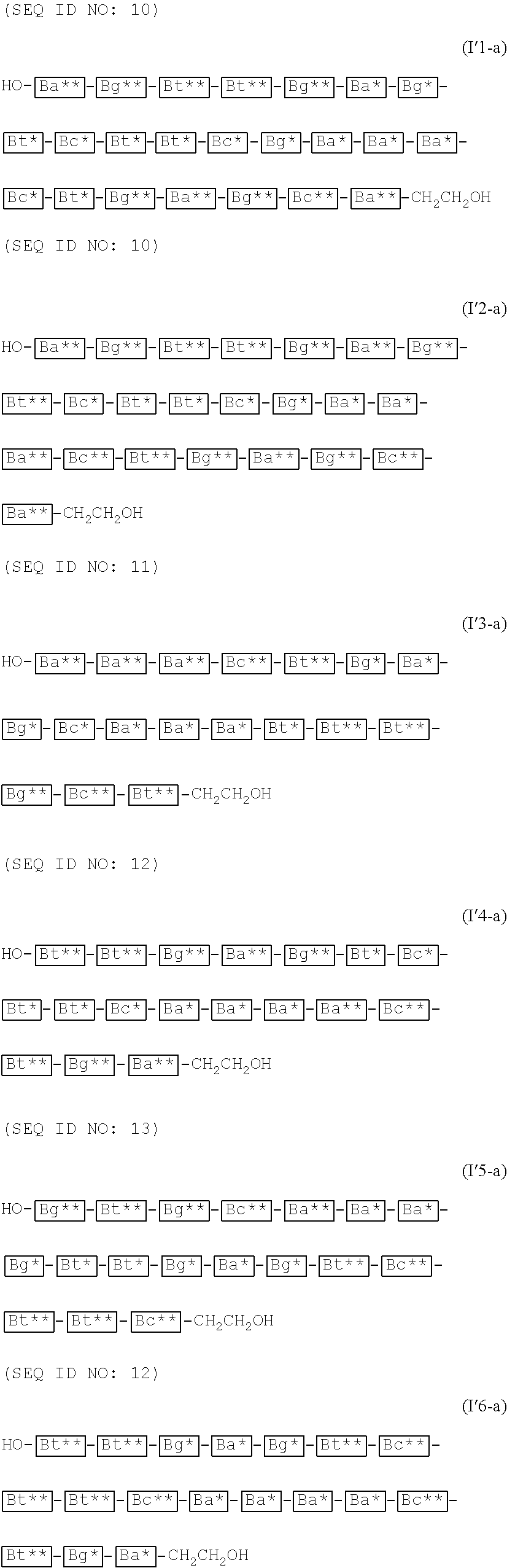


where Bg* is a group represented by formula (G1a), Ba* is a group represented by formula (A1a); Bc* is a group represented by formula (C1a); Bt* is a group represented by formula (U1a); Bg** is a group represented by formula (G2); Ba** is a group represented by formula (A2); Bc** is a group represented by formula (C2); Bt** is a group represented by formula (T2); and in individual formulas, at least one of Bg*, Ba*, Bc*, Bt*, Bg**, Ba**, Bc** and Bt** has a group represented by formula (X2) as X and all of

have a group represented by (X1) as X.
[25] The compound of any one of [13] to [24] above where Y in formulas (G1), (A1), (C1) and (U1) is a methoxy group and Z in formulas (G2), (A2), (C2) and (T2) is an ethylene group, or a pharmacologically acceptable salt thereof.
[26] A compound represented by the following general formula (I″) or a pharmacologically acceptable salt thereof:
BT″1—BM″1BB″1 (I″)
where BT″1 is a group represented by any one of the following (1a″) to (1m″):
| (1a″)HO-, | |
| (1b″)HO-Bt-, | |
| (1c″)HO-Bt-Bt-, | |
| (1d″)HO-Bt-Bt-Bt-, | |
| (1e″)HO-Ba-Bt-Bt-Bt-, | |
| (1f″)HO-Bt-Ba-Bt-Bt-Bt-, | |
| (1g″)HO-Bg-Bt-Ba-Bt-Bt-Bt-, | |
| (1h″)HO-Bt-Bg-Bt-Ba-Bt-Bt-Bt-, | |
| (1i″)HO-Bt-Bt-Bg-Bt-Ba-Bt-Bt-Bt-, | |
| (1j″)HO-Bt-Bt-Bt-Bg-Bt-Ba-Bt-Bt-Bt-, | |
| (SEQ ID NO: 111) | |
| (1k″)HO-Ba-Bt-Bt-Bt-Bg-Bt-Ba-Bt-Bt-Bt-, | |
| (SEQ ID NO: 112) | |
| (1l″)HO-Bc-Ba-Bt-Bt-Bt-Bg-Bt-Ba-Bt-Bt-Bt-, | |
| or | |
| (SEQ ID NO: 113) | |
| (1m″)HO-Bc-Bc-Ba-Bt-Bt-Bt-Bg-Bt-Ba-Bt-Bt-Bt-, |
where Bg is a group represented by the following formula (G1) or (G2); Ba is a group represented by the following formula (A1) or (A2); Bc is a group represented by the following formula (C1) or (C2); and Bt is a group represented by the following formula (U1) or (T2):


where X is individually and independently a group represented by the following formula (X1) or (X2):

Y is individually and independently a hydrogen atom, a hydroxyl group or an alkoxy group with 1-6 carbon atoms; and Z is individually and independently a single bond or an alkylene group with 1-5 carbon atoms;
BM″1 is a group represented by the following formula (1″):
—Ba-Bg-Bc-Ba-Bt-Bg- (1″)
where Bg, Ba, Bt and Bc are as defined above;
BB″1 is a group represented by any one of the following (101a″) to (101 m″):
| (101a″)-CH2CH2OH, |
| (101b″)-Bt-CH2CH2OH, |
| (101c″)-Bt-Bt-CH2CH2OH, |
| (101d″)-Bt-Bt-Bc-CH2CH2OH, |
| (101e″)-Bt-Bt-Bc-Bc-CH2CH2OH, |
| (101f″)-Bt-Bt-Bc-Bc-Bc-CH2CH2OH, |
| (101g″)-Bt-Bt-Bc-Bc-Bc-Ba-CH2CH2OH, |
| (101h″)-Bt-Bt-Bc-Bc-Bc-Ba-Ba-CH2CH2OH, |
| (101i″)-Bt-Bt-Bc-Bc-Bc-Ba-Ba-Bt-CH2CH2OH, |
| (101j″)-Bt-Bt-Bc-Bc-Bc-Ba-Ba-Bt-Bt-CH2CH2OH, |
| (SEQ ID NO: 114) |
| (101k″)-Bt-Bt-Bc-Bc-Bc-Ba-Ba-Bt-Bt-Bc-CH2CH2OH, |
| (SEQ ID NO: 115) |
| (101l″)-Bt-Bt-Bc-Bc-Bc-Ba-Ba-Bt-Bt-Bc-Bt-CH2CH2OH, |
| or |
| (SEQ ID NO: 116) |
| (101m″)-Bt-Bt-Bc-Bc-Bc-Ba-Ba-Bt-Bt-Bc-Bt-Bc-CH2CH2 |
| OH, |
where Bg, Ba, Bt and Bc are as defined above;
provided that at least one of the nucleosides constituting the compound represented by formula (I″) has 2″-O,4″-C-alkylene group.
[27] A compound represented by the following general formula (II″) or a pharmacologically acceptable salt thereof:
BT″2—BM″2—BB″2 (II″)
where BT″2 is a group represented by any one of the following (2a″) to (2g″):
(2a″) HO—,
(2b″) HO-Bg-,
(2c″) HO-Bt-Bg-,
(2d″) HO—Ba-Bt-Bg-,
(2e″) HO-Bc-Ba-Bt-Bg-,
(2f″) HO-Bg-Bc-Ba-Bt-Bg-, or
(2g″) HO—Ba-Bg-Bc-Ba-Bt-Bg-,
where Bg is a group represented by the following formula (G1) or (G2); Ba is a group represented by the following formula (A1) or (A2); Bc is a group represented by the following formula (C1) or (C2); and Bt is a group represented by the following formula (U1) or (T2):

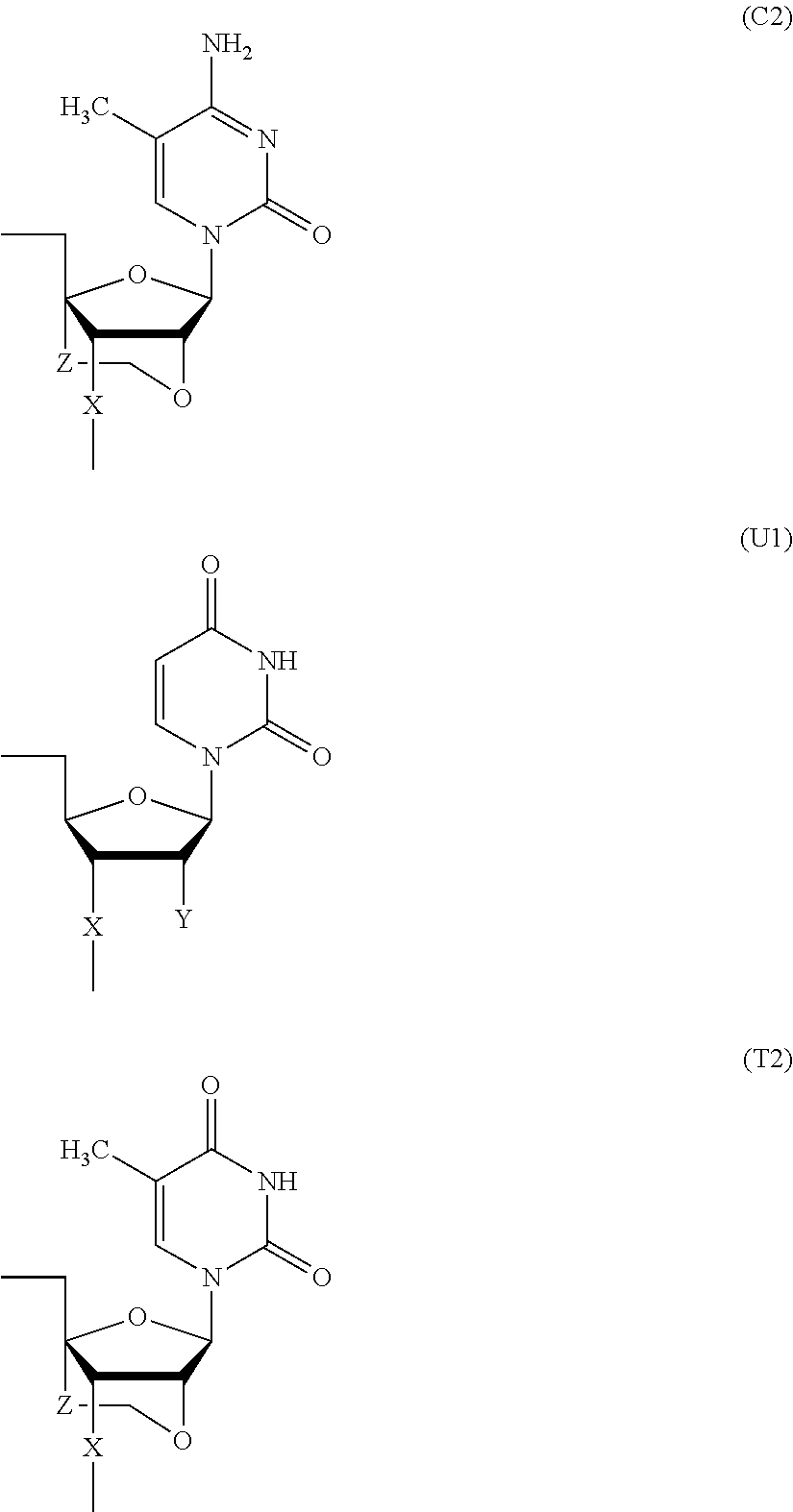
where X is individually and independently a group represented by the following formula (X1) or (X2):

Y is individually and independently a hydrogen atom, a hydroxyl group or an alkoxy group with 1-6 carbon atoms; and Z is individually and independently a single bond or an alkylene group with 1-5 carbon atoms;
BM″2 is a group represented by the following formula (2″):
-Bt-Bt-Bc-Bc-Bc-Ba—Ba-Bt-Bt-Bc-Bt-Bc- (2″) (SEQ ID NO: 116)
where Bg, Ba, Bt and Bc are as defined above;
BB″2 is a group represented by any one of the following (102a″) to (102g″):
(102a″) —CH2CH2OH,
(102b″) —Ba—CH2CH2OH,
(102c″) —Ba-Bg-CH2CH2OH,
(102d″) —Ba-Bg-Bg-CH2CH2OH,
(102e″) —Ba-Bg-Bg-Ba—CH2CH2OH,
(102f″) —Ba-Bg-Bg-Ba—Ba—CH2CH2OH, or
(102g″) —Ba-Bg-Bg-Ba—Ba-Bt-CH2CH2OH,
where Bg, Ba, Bt and Bc are as defined above;
provided that at least one of the nucleosides constituting the compound represented by formula (II″) has 2″-O,4″-C-alkylene group.
[28] A compound represented by the following general formula (III″) or a pharmacologically acceptable salt thereof:
BT″3—BM″3—BB″3 (III″)
where BT″3 is a group represented by any one of the following (3a″) to (3m″):
| (3a″)HO-, | |
| (3b″)HO-Bc-, | |
| (3c″)HO-Ba-Bc-, | |
| (3d″)HO-Ba-Ba-Bc-, | |
| (3e″)HO-Ba-Ba-Ba-Bc-, | |
| (3f″)HO-Ba-Ba-Ba-Ba-Bc-, | |
| (3g″)HO-Bg-Ba-Ba-Ba-Ba-Bc-, | |
| (3h″)HO-Bt-Bg-Ba-Ba-Ba-Ba-Bc-, | |
| (3i″)HO-Ba-Bt-Bg-Ba-Ba-Ba-Ba-Bc-, | |
| (3j″)HO-Ba-Ba-Bt-Bg-Ba-Ba-Ba-Ba-Bc-, | |
| (SEQ ID NO: 117) | |
| (3k″)HO-Bt-Ba-Ba-Bt-Bg-Ba-Ba-Ba-Ba-Bc-, | |
| (SEQ ID NO: 118) | |
| (3l″)HO-Ba-Bt-Ba-Ba-Bt-Bg-Ba-Ba-Ba-Ba-Bc-, | |
| or | |
| (SEQ ID NO: 119) | |
| (3m″)HO-Bc-Ba-Bt-Ba-Ba-Bt-Bg-Ba-Ba-Ba-Ba-Bc- |
where Bg is a group represented by the following formula (G1) or (G2); Ba is a group represented by the following formula (A1) or (A2); Bc is a group represented by the following formula (C1) or (C2); and Bt is a group represented by the following formula (U1) or (T2):


where X is individually and independently a group represented by the following formula (X1) or (X2):

Y is individually and independently a hydrogen atom, a hydroxyl group or an alkoxy group with 1-6 carbon atoms; and Z is individually and independently a single bond or an alkylene group with 1-5 carbon atoms;
BM″3 is a group represented by the following formula (3″):
-Bg-Bc-Bc-Bg-Bc-Bc- (3″)
where Bg, Ba, Bt and Bc are as defined above;
BB″3 is a group represented by any one of the following (103a″) to (103m″):
| (103a″)-CH2CH2OH, |
| (103b″)-Ba-CH2CH2OH, |
| (103c″)-Ba-Bt-CH2CH2OH, |
| (103d″)-Ba-Bt-Bt-CH2CH2OH, |
| (103e″)-Ba-Bt-Bt-Bt-CH2CH2OH, |
| (103f″)-Ba-Bt-Bt-Bt-Bc-CH2CH2OH, |
| (103g″)-Ba-Bt-Bt-Bt-Bc-Bt-CH2CH2OH, |
| (103h″)-Ba-Bt-Bt-Bt-Bc-Bt-Bc-CH2CH2OH, |
| (103i″)-Ba-Bt-Bt-Bt-Bc-Bt-Bc-Ba-CH2CH2OH, |
| (103j″)-Ba-Bt-Bt-Bt-Bc-Bt-Bc-Ba-Ba-CH2CH2OH, |
| (SEQ ID NO: 120) |
| (103k″)-Ba-Bt-Bt-Bt-Bc-Bt-Bc-Ba-Ba-Bc-CH2CH2OH, |
| (SEQ ID NO: 121) |
| (103l″)-Ba-Bt-Bt-Bt-Bc-Bt-Bc-Ba-Ba-Bc-Ba-CH2CH2OH, |
| or |
| (SEQ ID NO: 122) |
| (103m″)-Ba-Bt-Bt-Bt-Bc-Bt-Bc-Ba-Ba-Bc-Ba-Bg-CH2CH2 |
| OH |
where Bg, Ba, Bt and Bc are as defined above;
provided that at least one of the nucleosides constituting the compound represented by formula (III″) has 2″-O,4″-C-alkylene group.
[29] A compound represented by the following general formula (IV″) or a pharmacologically acceptable salt thereof:
BT″4—BM″4—BB″4 (IV″)
where BT″4 is a group represented by any one of the following (4a″) to (4j″):
(4a″) HO—,
(4b″) HO—Ba—,
(4c″) HO-Bc-Ba—,
(4d″) HO-Bt-Bc-Ba—,
(4e″) HO-Bg-Bt-Bc-Ba—,
(4f″) HO-Bg-Bg-Bt-Bc-Ba—,
(4g″) HO—Ba-Bg-Bg-Bt-Bc-Ba—,
(4h″) HO-Bt-Ba-Bg-Bg-Bt-Bc-Ba—,
(4i″) HO-Bc-Bt-Ba-Bg-Bg-Bt-Bc-Ba—, or
(4j″) HO-Bg-Bc-Bt-Ba-Bg-Bg-Bt-Bc-Ba—
where Bg is a group represented by the following formula (G1) or (G2); Ba is a group represented by the following formula (A1) or (A2); Bc is a group represented by the following formula (C1) or (C2); and Bt is a group represented by the following formula (U1) or (T2):


where X is individually and independently a group represented by the following formula (X1) or (X2):

Y is individually and independently a hydrogen atom, a hydroxyl group or an alkoxy group with 1-6 carbon atoms; and Z is individually and independently a single bond or an alkylene group with 1-5 carbon atoms;
BM″4 is a group represented by the following formula (4″):
-Bg-Bg-Bc-Bt-Bg-Bc-Bt-Bt-Bt- (4″)
where Bg, Ba, Bt and Bc are as defined above;
BB″4 is a group represented by any one of the following (104a″) to (104j″):
(104a″) —CH2CH2OH,
(104b″) -Bg-CH2CH2OH,
(104c″) -Bg-Bc-CH2CH2OH,
(104d″) -Bg-Bc-Bc-CH2CH2OH,
(104e″) -Bg-Bc-Bc-Bc-CH2CH2OH,
(104f″) -Bg-Bc-Bc-Bc-Bt-CH2CH2OH,
(104g″) -Bg-Bc-Bc-Bc-Bt-Bc-CH2CH2OH,
(104h″) -Bg-Bc-Bc-Bc-Bt-Bc-Ba—CH2CH2OH,
(104i″) -Bg-Bc-Bc-Bc-Bt-Bc-Ba-Bg-CH2CH2OH, or
(104j″) -Bg-Bc-Bc-Bc-Bt-Bc-Ba-Bg-Bc-CH2CH2OH
where Bg, Ba, Bt and Bc are as defined above;
provided that at least one of the nucleosides constituting the compound represented by formula (IV″) has 2″-O,4″-C-alkylene group.
[30] A compound represented by the following general formula (V″) or a pharmacologically acceptable salt thereof:
BT″5—BM″5—BB″5 (V″)
where BT″5 is a group represented by any one of the following (5a″) to (5j″):
(5a″) HO—,
(5b″) HO—Ba—,
(5c″) HO-Bg-Ba—,
(5d″) HO-Bg-Bg-Ba—,
(5e″) HO—Ba-Bg-Bg-Ba—,
(5f″) HO-Bc-Ba-Bg-Bg-Ba—,
(5g″) HO-Bc-Bc-Ba-Bg-Bg-Ba—,
(5h″) HO-Bt-Bc-Bc-Ba-Bg-Bg-Ba—,
(5i″) HO-Bg-Bt-Bc-Bc-Ba-Bg-Bg-Ba—, or
(5j″) HO—Ba-Bg-Bt-Bc-Bc-Ba-Bg-Bg-Ba—
where Bg is a group represented by the following formula (G1) or (G2); Ba is a group represented by the following formula (A1) or (A2); Bc is a group represented by the following formula (C1) or (C2); and Bt is a group represented by the following formula (U1) or (T2):


where X is individually and independently a group represented by the following formula (X1) or (X2):

Y is individually and independently a hydrogen atom, a hydroxyl group or an alkoxy group with 1-6 carbon atoms; and Z is individually and independently a single bond or an alkylene group with 1-5 carbon atoms;
BM″5 is a group represented by the following formula (5″):
-Bg-Bc-Bt-Ba-Bg-Bg-Bt-Bc-Ba— (5″)
where Bg, Ba, Bt and Bc are as defined above;
BB″5 is a group represented by any one of the following (105a″) to (105j″):
(105a″) —CH2CH2OH,
(105b″) -Bg-CH2CH2OH,
(105c″) -Bg-Bg-CH2CH2OH,
(105d″) -Bg-Bg-Bc-CH2CH2OH,
(105e″) -Bg-Bg-Bc-Bt-CH2CH2OH,
(105f″) -Bg-Bg-Bc-Bt-Bg-CH2CH2OH,
(105g″) -Bg-Bg-Bc-Bt-Bg-Bc-CH2CH2OH,
(105h″) -Bg-Bg-Bc-Bt-Bg-Bc-Bt-CH2CH2OH,
(105i″) -Bg-Bg-Bc-Bt-Bg-Bc-Bt-Bt-CH2CH2OH, or
(105j″) -Bg-Bg-Bc-Bt-Bg-Bc-Bt-Bt-Bt-CH2CH2OH
where Bg, Ba, Bt and Bc are as defined above;
provided that at least one of the nucleosides constituting the compound represented by formula (V″) has 2″-O,4″-C-alkylene group.
[31] A compound represented by the following general formula (VI″) or a pharmacologically acceptable salt thereof:
BT″6—BM″6—BB″6 (VI″)
where BT″6 is a group represented by any one of the following (6a″) to (6j″):
(6a″) HO—,
(6b″) HO—Ba—,
(6c″) HO—Ba—Ba—,
(6d″) HO—Ba—Ba—Ba—,
(6e″) HO-Bc-Ba—Ba—Ba—,
(6f″) HO-Bc-Bc-Ba—Ba—Ba—,
(6g″) HO-Bt-Bc-Bc-Ba—Ba—Ba—,
(6h″) HO-Bt-Bt-Bc-Bc-Ba—Ba—Ba—,
(6i″) HO-Bc-Bt-Bt-Bc-Bc-Ba—Ba—Ba—, or
(6j″) HO-Bt-Bc-Bt-Bt-Bc-Bc-Ba—Ba—Ba—
where Bg is a group represented by the following formula (G1) or (G2); Ba is a group represented by the following formula (A1) or (A2); Bc is a group represented by the following formula (C1) or (C2); and Bt is a group represented by the following formula (U1) or (T2):


where X is individually and independently a group represented by the following formula (X1) or (X2):

Y is individually and independently a hydrogen atom, a hydroxyl group or an alkoxy group with 1-6 carbon atoms; and Z is individually and independently a single bond or an alkylene group with 1-5 carbon atoms;
BM″6 is a group represented by the following formula (6″):
-Bg-Bc-Ba-Bg-Bc-Bc-Bt-Bc-Bt- (6″)
where Bg, Ba, Bt and Bc are as defined above;
BB″6 is a group represented by any one of the following (106a″) to (106j″):
(106a″) —CH2CH2OH,
(106b″) -Bc-CH2CH2OH,
(106c″) -Bc-Bg-CH2CH2OH,
(106d″) -Bc-Bg-Bc-CH2CH2OH,
(106e″) -Bc-Bg-Bc-Bt-CH2CH2OH,
(106f″) -Bc-Bg-Bc-Bt-Bc-CH2CH2OH,
(106g″) -Bc-Bg-Bc-Bt-Bc-Ba—CH2CH2OH,
(106h″) -Bc-Bg-Bc-Bt-Bc-Ba-Bc-CH2CH2OH,
(106i″) -Bc-Bg-Bc-Bt-Bc-Ba-Bc-Bt-CH2CH2OH, or
(106j″) -Bc-Bg-Bc-Bt-Bc-Ba-Bc-Bt-Bc-CH2CH2OH,
where Bg, Ba, Bt and Bc are as defined above;
provided that at least one of the nucleosides constituting the compound represented by formula (VI″) has 2″-O,4″-C-alkylene group.
[32] A compound represented by the following general formula (VII″) or a pharmacologically acceptable salt thereof:
BT″7—BM″7—BB″7 (VII″)
where BT″7 is a group represented by any one of the following (7a″) to (7j″):
(7a″) HO—,
(7b″) HO-Bt-,
(7c″) HO-Bt-Bt-,
(7d″) HO-Bg-Bt-Bt-,
(7e″) HO—Ba-Bg-Bt-Bt-,
(7f″) HO-Bg-Ba-Bg-Bt-Bt-,
(7g″) HO-Bt-Bg-Ba-Bg-Bt-Bt-,
(7h″) HO—Ba-Bt-Bg-Ba-Bg-Bt-Bt-,
(7i″) HO-Bt-Ba-Bt-Bg-Ba-Bg-Bt-Bt-, or
(7j″) HO-Bc-Bt-Ba-Bt-Bg-Ba-Bg-Bt-Bt-
where Bg is a group represented by the following formula (G1) or (G2); Ba is a group represented by the following formula (A1) or (A2); Bc is a group represented by the following formula (C1) or (C2); and Bt is a group represented by the following formula (U1) or (T2):


where X is individually and independently a group represented by the following formula (X1) or (X2):

Y is individually and independently a hydrogen atom, a hydroxyl group or an alkoxy group with 1-6 carbon atoms; and Z is individually and independently a single bond or an alkylene group with 1-5 carbon atoms;
BM″7 is a group represented by the following formula (7″):
-Bt-Bc-Bt-Bt-Bc-Bc-Ba—Ba—Ba— (7″)
where Bg, Ba, Bt and Bc are as defined above;
BB″7 is a group represented by any one of the following (107a″) to (107j″):
(107a″) —CH2CH2OH,
(107b″) -Bg-CH2CH2OH,
(107c″) -Bg-Bc-CH2CH2OH,
(107d″) -Bg-Bc-Ba—CH2CH2OH,
(107e″) -Bg-Bc-Ba-Bg-CH2CH2OH,
(107f″) -Bg-Bc-Ba-Bg-Bc-CH2CH2OH,
(107g″) -Bg-Bc-Ba-Bg-Bc-Bc-CH2CH2OH,
(107h″) -Bg-Bc-Ba-Bg-Bc-Bc-Bt-CH2CH2OH,
(107i″) -Bg-Bc-Ba-Bg-Bc-Bc-Bt-Bc-CH2CH2OH, or
(107j″) -Bg-Bc-Ba-Bg-Bc-Bc-Bt-Bc-Bt-CH2CH2OH
where Bg, Ba, Bt and Bc are as defined above;
provided that at least one of the nucleosides constituting the compound represented by formula (VII″) has 2″-O,4″-C-alkylene group.
[33] A compound represented by the following general formula (VIII″) or a pharmacologically acceptable salt thereof:
BT″8—BM″8—BB″8 (VIII″)
where BT″8 is a group represented by any one of the following (8a″) to (8n″):
| (8a″)HO-, |
| (8b″)HO-Bc-, |
| (8c″)HO-Bt-Bc-, |
| (8d″)HO-Ba-Bt-Bc-, |
| (8e″)HO-Bc-Ba-Bt-Bc-, |
| (8f″)HO-Bt-Bc-Ba-Bt-Bc-, |
| (8g″)HO-Bt-Bt-Bc-Ba-Bt-Bc-, |
| (8h″)HO-Bt-Bt-Bt-Bc-Ba-Bt-Bc-, |
| (8i″)HO-Bg-Bt-Bt-Bt-Bc-Ba-Bt-Bc-, |
| (8j″)HO-Bt-Bg-Bt-Bt-Bt-Bc-Ba-Bt-Bc-, |
| (SEQ ID NO: 123) |
| (8k″)HO-Bt-Bt-Bg-Bt-Bt-Bt-Bc-Ba-Bt-Bc-, |
| (SEQ ID NO: 124) |
| (8l″)HO-Ba-Bt-Bt-Bg-Bt-Bt-Bt-Bc-Ba-Bt-Bc-, |
| (SEQ ID NO: 125) |
| (8m″)HO-Bc-Ba-Bt-Bt-Bg-Bt-Bt-Bt-Bc-Ba-Bt-Bc-, |
| or |
| (SEQ ID NO: 126) |
| (8n″)HO-Bc-Bc-Ba-Bt-Bt-Bg-Bt-Bt-Bt-Bc-Ba-Bt-Bc- |
where Bg is a group represented by the following formula (G1) or (G2); Ba is a group represented by the following formula (A1) or (A2); Bc is a group represented by the following formula (C1) or (C2); and Bt is a group represented by the following formula (U1) or (T2):
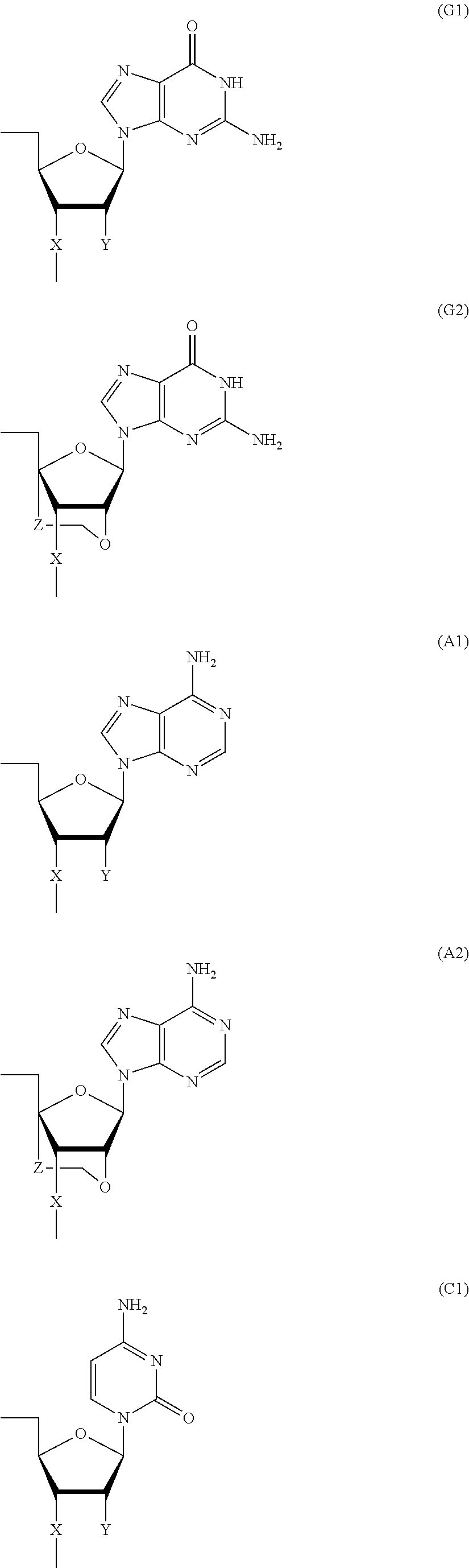

where X is individually and independently a group represented by the following formula (X1) or (X2):

Y is individually and independently a hydrogen atom, a hydroxyl group or an alkoxy group with 1-6 carbon atoms; and Z is individually and independently a single bond or an alkylene group with 1-5 carbon atoms;
BM″8 is a group represented by the following formula (8″):
—Ba-Bg-Bc-Bt-Bc- (8″)
where Bg, Ba, Bt and Bc are as defined above;
BB″8 is a group represented by any one of the following (108a″) to (108n″):
| (108a″)-CH2CH2OH, |
| (108b″)-Bt-CH2CH2OH, |
| (108c″)-Bt-Bt-CH2CH2OH, |
| (108d″)-Bt-Bt-Bt-CH2CH2OH, |
| (108e″)-Bt-Bt-Bt-Bt-CH2CH2OH, |
| (108f″)-Bt-Bt-Bt-Bt-Ba-CH2CH2OH, |
| (108g″)-Bt-Bt-Bt-Bt-Ba-Bc-CH2CH2OH, |
| (108h″)-Bt-Bt-Bt-Bt-Ba-Bc-Bt-CH2CH2OH, |
| (108i″)-Bt-Bt-Bt-Bt-Ba-Bc-Bt-Bc-CH2CH2OH, |
| (108j″)-Bt-Bt-Bt-Bt-Ba-Bc-Bt-Bc-Bc-CH2CH2OH, |
| (SEQ ID NO: 127) |
| (108k″)-Bt-Bt-Bt-Bt-Ba-Bc-Bt-Bc-Bc-Bc-CH2CH2OH, |
| (SEQ ID NO: 128) |
| (108l″)-Bt-Bt-Bt-Bt-Ba-Bc-Bt-Bc-Bc-Bc-Bt-CH2CH2OH, |
| (SEQ ID NO: 129) |
| (108m″)-Bt-Bt-Bt-Bt-Ba-Bc-Bt-Bc-Bc-Bc-Bt-Bt-CH2CH2 |
| OH, |
| or |
| (SEQ ID NO: 130) |
| (108n″)-Bt-Bt-Bt-Bt-Ba-Bc-Bt-Bc-Bc-Bc-Bt-Bt-Bg-CH2 |
| CH2OH |
where Bg, Ba, Bt and Bc are as defined above;
provided that at least one of the nucleosides constituting the compound represented by formula (VIII″) has 2″-O,4″-C-alkylene group.
[34] A compound represented by the following general formula (IX″) or a pharmacologically acceptable salt thereof:
BT″9—BM″9—BB″9 (IX″)
where BT″9 is a group represented by any one of the following (9a″) to (9n″):
| (9a″)D-, | |
| (9b″)D-Bg-, | |
| (9c″)D-Ba-Bg-, | |
| (9d″)D-Bg-Ba-Bg-, | |
| (9e″)D-Ba-Bg-Ba-Bg-, | |
| (9f″)D-Bc-Ba-Bg-Ba-Bg-, | |
| (9g″)D-Bc-Bc-Ba-Bg-Ba-Bg-, | |
| (9h″)D-Ba-Bc-Bc-Ba-Bg-Ba-Bg-, | |
| (9i″)D-Bc-Ba-Bc-Bc-Ba-Bg-Ba-Bg-, | |
| (9j″)D-Bt-Bc-Ba-Bc-Bc-Ba-Bg-Ba-Bg-, | |
| (SEQ ID NO: 131) | |
| (9k″)D-Bg-Bt-Bc-Ba-Bc-Bc-Ba-Bg-Ba-Bg-, | |
| (SEQ ID NO: 132) | |
| (9l″)D-Bt-Bg-Bt-Bc-Ba-Bc-Bc-Ba-Bg-Ba-Bg-, | |
| (SEQ ID NO: 133) | |
| (9m″)D-Bg-Bt-Bg-Bt-Bc-Ba-Bc-Bc-Ba-Bg-Ba-Bg-, | |
| or | |
| (SEQ ID NO: 134) | |
| (9n″)D-Bt-Bg-Bt-Bg-Bt-Bc-Ba-Bc-Bc-Ba-Bg-Ba-Bg- |
where Bg is a group represented by the following formula (G1) or (G2); Ba is a group represented by the following formula (A1) or (A2); Bc is a group represented by the following formula (C1) or (C2); Bt is a group represented by the following formula (U1) or (T2); and D is HO— or Ph- wherein Ph- is a group represented by the following first formula:


where X is individually and independently a group represented by the following formula (X1) or (X2):

Y is individually and independently a hydrogen atom, a hydroxyl group or an alkoxy group with 1-6 carbon atoms; and Z is individually and independently a single bond or an alkylene group with 1-5 carbon atoms;
BM″9 is a group represented by the following formula (9″):
-Bt-Ba—Ba-Bc-Ba-Bg-Bt- (9″)
where Bg, Ba, Bt and Bc are as defined above;
BB″9 is a group represented by any one of the following (109a″) to (109l″):
| (109a″)-CH2CH2OH, |
| (109b″)-Bc-CH2CH2OH, |
| (109c″)-Bc-Bt-CH2CH2OH, |
| (109d″)-Bc-Bt-Bg-CH2CH2OH, |
| (109e″)-Bc-Bt-Bg-Ba-CH2CH2OH, |
| (109f″)-Bc-Bt-Bg-Ba-Bg-CH2CH2OH, |
| (109g″)-Bc-Bt-Bg-Ba-Bg-Bt-CH2CH2OH, |
| (109h″)-Bc-Bt-Bg-Ba-Bg-Bt-Ba-CH2CH2OH, |
| (109i″)-Bc-Bt-Bg-Ba-Bg-Bt-Ba-Bg-CH2CH2OH, |
| (109j″)-Bc-Bt-Bg-Ba-Bg-Bt-Ba-Bg-Bg-CH2CH2OH, |
| (SEQ ID NO: 135) |
| (109k″)-Bc-Bt-Bg-Ba-Bg-Bt-Ba-Bg-Bg-Ba-CH2CH2OH, |
| or |
| (SEQ ID NO: 136) |
| (109l″)-Bc-Bt-Bg-Ba-Bg-Bt-Ba-Bg-Bg-Ba-Bg-CH2CH2OH |
where Bg, Ba, Bt and Bc are as defined above;
provided that at least one of the nucleosides constituting the compound represented by formula (IX″) has 2″-O,4″-C-alkylene group.
[35] A compound represented by the following general formula (X″) or a pharmacologically acceptable salt thereof:
BT″10—BM″10—BB″10 (X″)
where BT″10 is a group represented by any one of the following (10a″) to (10e″):
(10a″) D-,
(10b″) D-Bt-,
(10c″) D-Bg-Bt-,
(10d″) D-Bg-Bg-Bt-, or
(10e″) D-Ba-Bg-Bg-Bt-
where Bg is a group represented by the following formula (G1) or (G2); Ba is a group represented by the following formula (A1) or (A2); Bc is a group represented by the following formula (C1) or (C2); Bt is a group represented by the following formula (U1) or (T2); and D is HO— or Ph- wherein Ph- is a group represented by the following first formula:


where X is individually and independently a group represented by the following formula (X1) or (X2):

Y is individually and independently a hydrogen atom, a hydroxyl group or an alkoxy group with 1-6 carbon atoms; and Z is individually and independently a single bond or an alkylene group with 1-5 carbon atoms;
BM″10 is a group represented by the following formula (10″):
| (SEQ ID NO: 137) |
| -Bt-Bg-Bt-Bg-Bt-Bc-Ba-Bc-Bc-Ba-Bg-Ba-Bg-Bt-Ba-Ba- |
| (10″) |
where Bg, Ba, Bt and Bc are as defined above;
BB″10 is a group represented by any one of the following (110a″) to (110e″):
(110a″) —CH2CH2OH,
(110b″) -Bc-CH2CH2OH,
(110c″) -Bc-Ba—CH2CH2OH,
(110d″) -Bc-Ba-Bg-CH2CH2OH, or
(110e″) -Bc-Ba-Bg-Bt-CH2CH2OH
where Bg, Ba, Bt and Bc are as defined above;
provided that at least one of the nucleosides constituting the compound represented by formula (X″) has 2″-O,4″-C-alkylene group.
[36] A compound represented by the following general formula (XI″) or a pharmacologically acceptable salt thereof:
BT″11—BM″11—BB″11 (XI″)
where BT″11 is a group represented by any one of the following (11a″) to (11j″):
(11a″) D-,
(11b″) D-Bc-,
(11c″) D-Ba-Bc-,
(11d″) D-Bc-Ba-Bc-,
(11e″) D-Bc-Bc-Ba-Bc-,
(11f″) D-Ba-Bc-Bc-Ba-Bc-,
(11g″) D-Ba—Ba-Bc-Bc-Ba-Bc-,
(11h″) D-Bt-Ba—Ba-Bc-Bc-Ba-Bc-,
(11i″) D-Bg-Bt-Ba—Ba-Bc-Bc-Ba-Bc-, or
(11j″) D-Ba-Bg-Bt-Ba—Ba-Bc-Bc-Ba-Bc-
where Bg is a group represented by the following formula (G1) or (G2); Ba is a group represented by the following formula (A1) or (A2); Bc is a group represented by the following formula (C1) or (C2); Bt is a group represented by the following formula (U1) or (T2); and D is HO— or Ph- wherein Ph- is a group represented by the following first formula:


where X is individually and independently a group represented by the following formula (X1) or (X2):
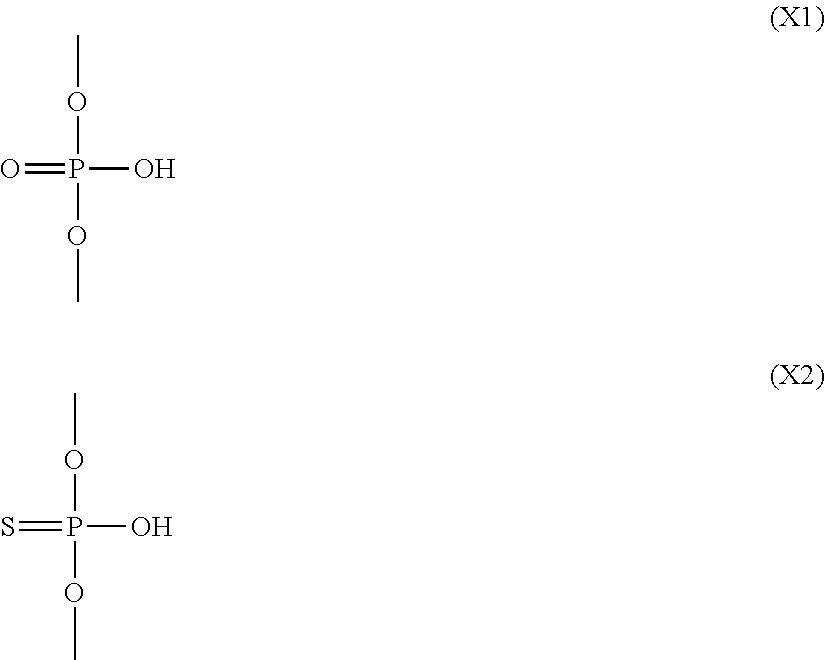
Y is individually and independently a hydrogen atom, a hydroxyl group or an alkoxy group with 1-6 carbon atoms; and Z is individually and independently a single bond or an alkylene group with 1-5 carbon atoms;
BM″11 is a group represented by the following formula (11″):
—Ba-Bg-Bg-Bt-Bt-Bg-Bt-Bg-Bt-Bc-Ba— (SEQ ID NO: 138) (11″)
where Bg, Ba, Bt and Bc are as defined above;
BB″11 is a group represented by any one of the following (111a″) to (111j″):
(111a″) —CH2CH2OH,
(111b″) -Bc-CH2CH2OH,
(111c″) -Bc-Bc-CH2CH2OH,
(111d″) -Bc-Bc-Ba—CH2CH2OH,
(111e″) -Bc-Bc-Ba-Bg-CH2CH2OH,
(111f″) -Bc-Bc-Ba-Bg-Ba—CH2CH2OH,
(111g″) -Bc-Bc-Ba-Bg-Ba-Bg-CH2CH2OH,
(111h″) -Bc-Bc-Ba-Bg-Ba-Bg-Bt-CH2CH2OH,
(111i″) -Bc-Bc-Ba-Bg-Ba-Bg-Bt-Ba—CH2CH2OH, or
(111j″) -Bc-Bc-Ba-Bg-Ba-Bg-Bt-Ba—Ba—CH2CH2OH
where Bg, Ba, Bt and Bc are as defined above;
provided that at least one of the nucleosides constituting the compound represented by formula (XI″) has 2″-O,4″-C-alkylene group.
[37] A compound represented by the following general formula (XII″) or a pharmacologically acceptable salt thereof:
BT″12—BM″12—BB″12 (XII″)
where BT″12 is a group represented by any one of the following (12a″) to (12j″):
(12a″) D-,
(12b″) D-Bt-,
(12c″) D-Ba-Bt-,
(12d″) D-Bc-Ba-Bt-,
(12e″) D-Bc-Bc-Ba-Bt-,
(12f″) D-Ba-Bc-Bc-Ba-Bt-,
(12g″) D-Bc-Ba-Bc-Bc-Ba-Bt-,
(12h″) D-Bc-Bc-Ba-Bc-Bc-Ba-Bt-,
(12i″) D-Bc-Bc-Bc-Ba-Bc-Bc-Ba-Bt-, or
(12j″) D-Ba-Bc-Bc-Bc-Ba-Bc-Bc-Ba-Bt-
where Bg is a group represented by the following formula (G1) or (G2); Ba is a group represented by the following formula (A1) or (A2); Bc is a group represented by the following formula (C1) or (C2); Bt is a group represented by the following formula (U1) or (T2); and D is HO— or Ph- wherein Ph- is a group represented by the following first formula:


where X is individually and independently a group represented by the following formula (X1) or (X2):
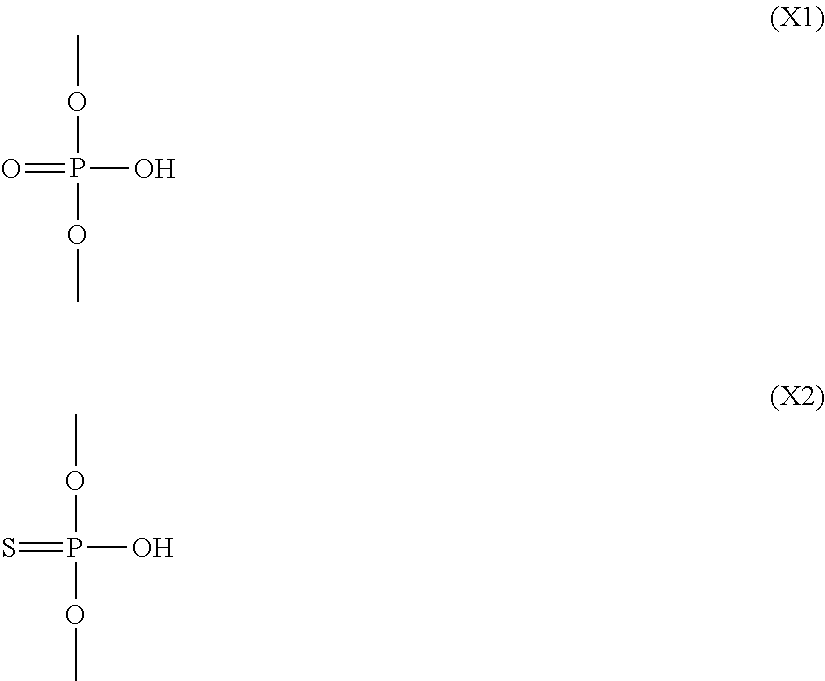
Y is individually and independently a hydrogen atom, a hydroxyl group or an alkoxy group with 1-6 carbon atoms; and Z is individually and independently a single bond or an alkylene group with 1-5 carbon atoms;
BM″12 is a group represented by the following formula (12″):
| (SEQ ID NO: 139) | |
| -Bc-Ba-Bc-Bc-Bc-Bt-Bc-Bt-Bg-Bt-Bg- (12″) |
where Bg, Ba, Bt and Bc are as defined above;
BB″12 is a group represented by any one of the following (112a″)˜(112j″):
| (112a″)-CH2CH2OH, | |
| (112b″)-Ba-CH2CH2OH, | |
| (112c″)-Ba-Bt-CH2CH2OH, | |
| (112d″)-Ba-Bt-Bt-CH2CH2OH, | |
| (112e″)-Ba-Bt-Bt-Bt-CH2CH2OH, | |
| (112f″)-Ba-Bt-Bt-Bt-Bt-CH2CH2OH, | |
| (112g″)-Ba-Bt-Bt-Bt-Bt-Ba-CH2CH2OH, | |
| (112h″)-Ba-Bt-Bt-Bt-Bt-Ba-Bt-CH2CH2OH, | |
| (112i″)-Ba-Bt-Bt-Bt-Bt-Ba-Bt-Ba-CH2CH2OH, | |
| or | |
| (SEQ ID NO: 140) | |
| (112j″)-Ba-Bt-Bt-Bt-Bt-Ba-Bt-Ba-Ba-CH2CH2OH |
where Bg, Ba, Bt and Bc are as defined above;
provided that at least one of the nucleosides constituting the compound represented by formula (XII″) has 2″-O,4″-C-alkylene group.
[38] A compound represented by the following general formula (XIII″) or a pharmacologically acceptable salt thereof:
BT″13—BM″13—BB″13 (XIII″)
where BT″13 is a group represented by any one of the following (13a″) to (13k″):
(13a″) HO—,
(13b″) HO-Bc-,
(13c″) HO-Bt-Bc-,
(13d″) HO-Bg-Bt-Bc-,
(13e″) HO-Bg-Bg-Bt-Bc-,
(13f″) HO—Ba-Bg-Bg-Bt-Bc-,
(13g″) HO—Ba—Ba-Bg-Bg-Bt-Bc-,
(13h″) HO-Bc-Ba—Ba-Bg-Bg-Bt-Bc-,
(13i″) HO-Bt-Bc-Ba—Ba-Bg-Bg-Bt-Bc-,
(13j″) HO-Bc-Bt-Bc-Ba—Ba-Bg-Bg-Bt-Bc-, or
(13k″) HO-Bc-Bc-Bt-Bc-Ba—Ba-Bg-Bg-Bt-Bc-
where Bg is a group represented by the following formula (G1) or (G2); Ba is a group represented by the following formula (A1) or (A2); Bc is a group represented by the following formula (C1) or (C2); and Bt is a group represented by the following formula (U1) or (T2):


where X is individually and independently a group represented by the following formula (X1) or (X2):

Y is individually and independently a hydrogen atom, a hydroxyl group or an alkoxy group with 1-6 carbon atoms; and Z is individually and independently a single bond or an alkylene group with 1-5 carbon atoms;
BM″13 is a group represented by the following formula (13″):
| (SEQ ID NO: 141) | |
| -Ba-Bc-Bc-Bc-Ba-Bc-Bc-Ba-Bt-Bc- (13″) |
where Bg, Ba, Bt and Bc are as defined above;
BB″13 is a group represented by the following (113a″):
(113a″) —CH2CH2OH provided that at least one of the nucleosides constituting the compound represented by formula (XIII″) has 2″-O,4″-C-alkylene group.
[39] A compound represented by the following general formula (XIV″) or a pharmacologically acceptable salt thereof:
BT″14—BM″14—BB″14 (XIV″)
where BT″14 is a group represented by any one of the following (14a″) to (14q″):
| (14a″)HO-, |
| (14b″)HO-Ba-, |
| (14c″)HO-Ba-Ba-, |
| (14d″)HO-Bg-Ba-Ba-, |
| (14e″)HO-Ba-Bg-Ba-Ba-, |
| (14f″)HO-Bg-Ba-Bg-Ba-Ba-, |
| (14g″)HO-Ba-Bg-Ba-Bg-Ba-Ba-, |
| (14h″)HO-Bc-Ba-Bg-Ba-Bg-Ba-Ba-, |
| (14i″)HO-Bg-Bc-Ba-Bg-Ba-Bg-Ba-Ba-, |
| (14j″)HO-Ba-Bg-Bc-Ba-Bg-Ba-Bg-Ba-Ba-, |
| (SEQ ID NO: 142) |
| (14k″)HO-Ba-Ba-Bg-Bc-Ba-Bg-Ba-Bg-Ba-Ba-, |
| (SEQ ID NO: 143) |
| (14l″)HO-Bc-Ba-Ba-Bg-Bc-Ba-Bg-Ba-Bg-Ba-Ba-, |
| (SEQ ID NO: 144) |
| (14m″)HO-Bt-Bc-Ba-Ba-Bg-Bc-Ba-Bg-Ba-Bg-Ba-Ba-, |
| (SEQ ID NO: 145) |
| (14n″)HO-Ba-Bt-Bc-Ba-Ba-Bg-Bc-Ba-Bg-Ba-Bg-Ba-Ba-, |
| (SEQ ID NO: 146) |
| (14o″)HO-Bg-Ba-Bt-Bc-Ba-Ba-Bg-Bc-Ba-Bg-Ba-Bg-Ba- |
| Ba-, |
| (SEQ ID NO: 147) |
| (14p″)HO-Bt-Bg-Ba-Bt-Bc-Ba-Ba-Bg-Bc-Ba-Bg-Ba-Bg- |
| Ba-Ba-, |
| or |
| (SEQ ID NO: 148) |
| (14q″)HO-Bt-Bt-Bg-Ba-Bt-Bc-Ba-Ba-Bg-Bc-Ba-Bg-Ba- |
| Bg-Ba-Ba- |
where Bg is a group represented by the following formula (G1) or (G2); Ba is a group represented by the following formula (A1) or (A2); Bc is a group represented by the following formula (C1) or (C2); and Bt is a group represented by the following formula (U1) or (T2):


where X is individually and independently a group represented by the following formula (X1) or (X2):

Y is individually and independently a hydrogen atom, a hydroxyl group or an alkoxy group with 1-6 carbon atoms; and Z is individually and independently a single bond or an alkylene group with 1-5 carbon atoms;
BM″14 is a group represented by the following formula (14″):
—Ba-Bg-Bc-Bc- (14″)
where Bg, Ba, Bt and Bc are as defined above;
BB″14 is a group represented by any one of the following (114a″) to (114o″):
| (114a″)-CH2CH2OH, |
| (114b″)-Ba-CH2CH2OH, |
| (114c″)-Ba-Bg-CH2CH2OH, |
| (114d″)-Ba-Bg-Bt-CH2CH2OH, |
| (114e″)-Ba-Bg-Bt-Bc-CH2CH2OH, |
| (114f″)-Ba-Bg-Bt-Bc-Bg-CH2CH2OH, |
| (114g″)-Ba-Bg-Bt-Bc-Bg-Bg-CH2CH2OH, |
| (114h″)-Ba-Bg-Bt-Bc-Bg-Bg-Bt-CH2CH2OH, |
| (114i″)-Ba-Bg-Bt-Bc-Bg-Bg-Bt-Ba-CH2CH2OH, |
| (114j″)-Ba-Bg-Bt-Bc-Bg-Bg-Bt-Ba-Ba-CH2CH2OH, |
| (SEQ ID NO: 149) |
| (114k″)-Ba-Bg-Bt-Bc-Bg-Bg-Bt-Ba-Ba-Bg-CH2CH2OH, |
| (SEQ ID NO: 150) |
| (114l″)-Ba-Bg-Bt-Bc-Bg-Bg-Bt-Ba-Ba-Bg-Bt-CH2CH2OH, |
| (SEQ ID NO: 151) |
| (114m″)-Ba-Bg-Bt-Bc-Bg-Bg-Bt-Ba-Ba-Bg-Bt-Bt-CH2CH2 |
| OH, |
| (SEQ ID NO: 152) |
| (114n″)-Ba-Bg-Bt-Bc-Bg-Bg-Bt-Ba-Ba-Bg-Bt-Bt-Bc-CH2 |
| CH2OH, |
| or |
| (SEQ ID NO: 153) |
| (114o″)-Ba-Bg-Bt-Bc-Bg-Bg-Bt-Ba-Ba-Bg-Bt-Bt-Bc-Bt- |
| CH2CH2OH |
where Bg, Ba, Bt and Bc are as defined above;
provided that at least one of the nucleosides constituting the compound represented by formula (XIV″) has 2″-O,4″-C-alkylene group.
[40] A compound represented by the following general formula (XV″) or a pharmacologically acceptable salt thereof:
BT″15—BM″15—BB″15 (XV″)
where BT″15 is a group represented by any one of the following (15a″) to (15j″):
(15a″) HO—,
(15b″) HO-Bt-,
(15c″) HO-Bc-Bt-,
(15d″) HO-Bt-Bc-Bt-,
(15e″) HO-Bt-Bt-Bc-Bt-,
(15f′) HO-Bt-Bt-Bt-Bc-Bt-,
(15g″) HO—Ba-Bt-Bt-Bt-Bc-Bt-,
(15h″) HO-Bc-Ba-Bt-Bt-Bt-Bc-Bt-,
(15i″) HO-Bg-Bc-Ba-Bt-Bt-Bt-Bc-Bt-, or
(15j″) HO-Bg-Bg-Bc-Ba-Bt-Bt-Bt-Bc-Bt-
where Bg is a group represented by the following formula (G1) or (G2); Ba is a group represented by the following formula (A1) or (A2); Bc is a group represented by the following formula (C1) or (C2); and Bt is a group represented by the following formula (U1) or (T2):


where X is individually and independently a group represented by the following formula (X1) or (X2):
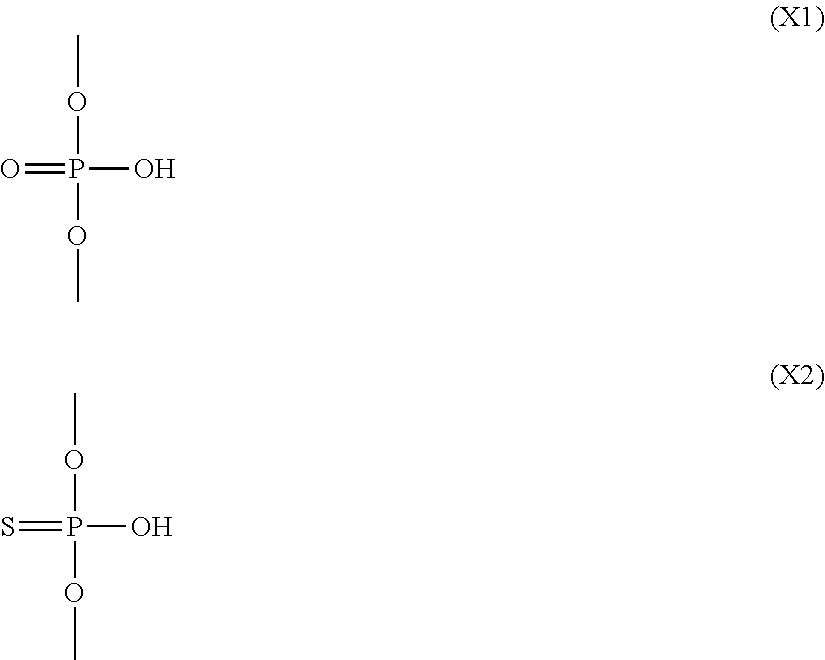
Y is individually and independently a hydrogen atom, a hydroxyl group or an alkoxy group with 1-6 carbon atoms; and Z is individually and independently a single bond or an alkylene group with 1-5 carbon atoms;
BM″15 is a group represented by the following formula (15″):
—Ba-Bg-Bt-Bt-Bt-Bg-Bg-Ba-Bg- (15″)
where Bg, Ba, Bt and Bc are as defined above;
BB″15 is a group represented by any one of the following (115a″) to (115j″):
(115a″) —CH2CH2OH,
(115b″) —Ba—CH2CH2OH,
(115c″) —Ba-Bt-CH2CH2OH,
(115d″) —Ba-Bt-Bg-CH2CH2OH,
(115e″) —Ba-Bt-Bg-Bg-CH2CH2OH,
(115f″) —Ba-Bt-Bg-Bg-Bc-CH2CH2OH,
(115g″) —Ba-Bt-Bg-Bg-Bc-Ba—CH2CH2OH,
(115h″) —Ba-Bt-Bg-Bg-Bc-Ba-Bg-CH2CH2OH,
(115i″) —Ba-Bt-Bg-Bg-Bc-Ba-Bg-Bt-CH2CH2OH, or
(115j″) —Ba-Bt-Bg-Bg-Bc-Ba-Bg-Bt-Bt-CH2CH2OH
where Bg, Ba, Bt and Bc are as defined above;
provided that at least one of the nucleosides constituting the compound represented by formula (XV″) has 2″-O,4″-C-alkylene group.
[41] A compound represented by the following general formula (XVI″) or a pharmacologically acceptable salt thereof:
BT″16—BM″16—BB″16 (XVI″)
where BT″16 is a group represented by any one of the following (16a″) to (16j″):
(16a″) HO—,
(16b″) HO-Bg-,
(16c″) HO-Bt-Bg-,
(16d″) HO-Bg-Bt-Bg-,
(16e″) HO-Bg-Bg-Bt-Bg-,
(16f′) HO—Ba-Bg-Bg-Bt-Bg-,
(16g″) HO—Ba—Ba-Bg-Bg-Bt-Bg-,
(16h″) HO-Bg-Ba—Ba-Bg-Bg-Bt-Bg-,
(16i″) HO-Bt-Bg-Ba—Ba-Bg-Bg-Bt-Bg-, or
(16j″) HO-Bc-Bt-Bg-Ba—Ba-Bg-Bg-Bt-Bg-
where Bg is a group represented by the following formula (G1) or (G2); Ba is a group represented by the following formula (A1) or (A2); Bc is a group represented by the following formula (C1) or (C2); and Bt is a group represented by the following formula (U1) or (T2):
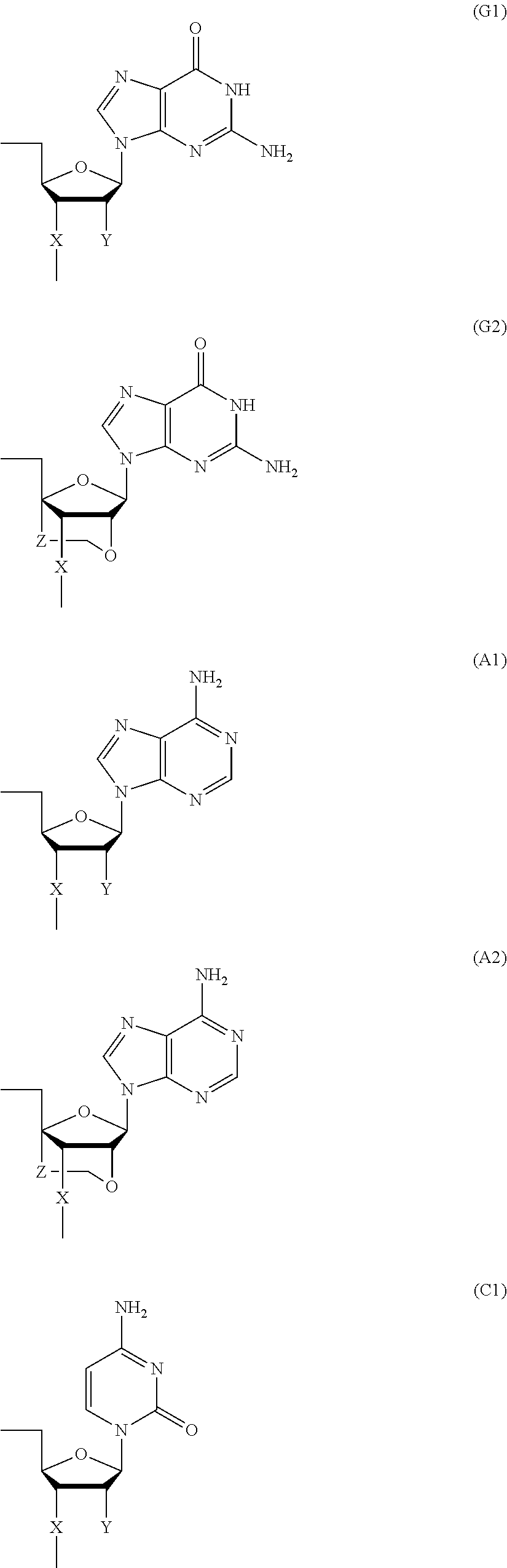

where X is individually and independently a group represented by the following formula (X1) or (X2):
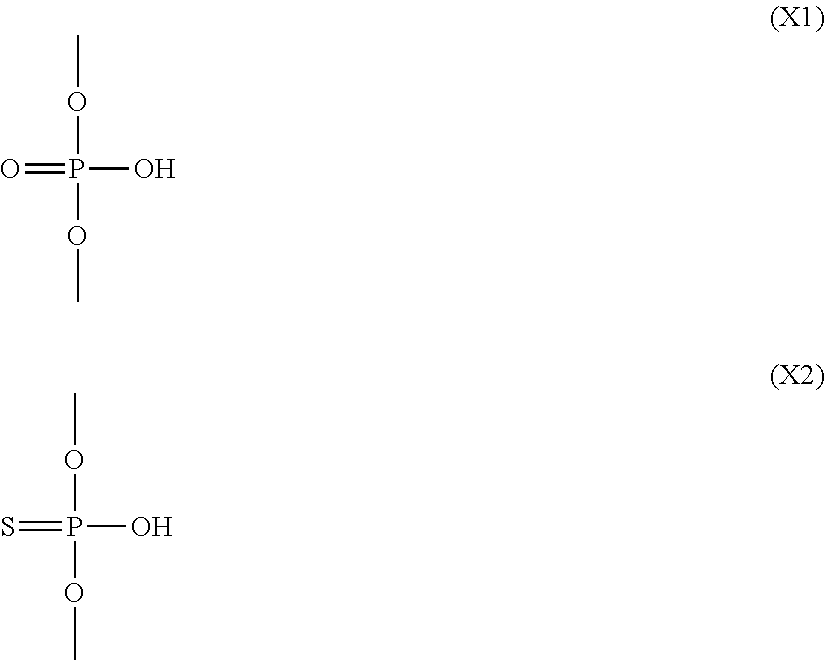
Y is individually and independently a hydrogen atom, a hydroxyl group or an alkoxy group with 1-6 carbon atoms; and Z is individually and independently a single bond or an alkylene group with 1-5 carbon atoms;
BM″16 is a group represented by the following formula (16″):
-Bt-Bt-Bc-Bt-Bt-Bg-Bt-Ba-Bc- (16″)
where Bg, Ba, Bt and Bc are as defined above;
BB″16 is a group represented by any one of the following (116a″) to (116j″):
(116a″) —CH2CH2OH,
(116b″) -Bt-CH2CH2OH,
(116c″) -Bt-Bt-CH2CH2OH,
(116d″) -Bt-Bt-Bc-CH2CH2OH,
(116e″) -Bt-Bt-Bc-Ba—CH2CH2OH,
(116f″) -Bt-Bt-Bc-Ba-Bt-CH2CH2OH,
(116g″) -Bt-Bt-Bc-Ba-Bt-Bc-CH2CH2OH,
(116h″) -Bt-Bt-Bc-Ba-Bt-Bc-Bc-CH2CH2OH,
(116i″) -Bt-Bt-Bc-Ba-Bt-Bc-Bc-Bc-CH2CH2OH, or
(116j″) -Bt-Bt-Bc-Ba-Bt-Bc-Bc-Bc-Ba—CH2CH2OH
where Bg, Ba, Bt and Bc are as defined above;
provided that at least one of the nucleosides constituting the compound represented by formula (XVI″) has 2″-O,4″-C-alkylene group.
[42] A compound represented by the following general formula (XVII″) or a pharmacologically acceptable salt thereof:
BT″17—BM″17—BB″17 (XVII″)
where BT″17 is a group represented by any one of the following (17a″) to (17j″):
(17a″) HO—,
(17b″) HO-Bt-,
(17c″) HO-Bt-Bt-,
(17d″) HO-Bg-Bt-Bt-,
(17e″) HO-Bg-Bg-Bt-Bt-,
(17f″) HO-Bc-Bg-Bg-Bt-Bt-,
(17g″) HO-Bc-Bc-Bg-Bg-Bt-Bt-,
(17h″) HO-Bt-Bc-Bc-Bg-Bg-Bt-Bt-,
(17i″) HO-Bc-Bt-Bc-Bc-Bg-Bg-Bt-Bt-, or
(17j″) HO-Bc-Bc-Bt-Bc-Bc-Bg-Bg-Bt-Bt-
where Bg is a group represented by the following formula (G0 or (G2); Ba is a group represented by the following formula (A1) or (A2); Bc is a group represented by the following formula (C1) or (C2); and Bt is a group represented by the following formula (U1) or (T2):


where X is individually and independently a group represented by the following formula (X1) or (X2):

Y is individually and independently a hydrogen atom, a hydroxyl group or an alkoxy group with 1-6 carbon atoms; and Z is individually and independently a single bond or an alkylene group with 1-5 carbon atoms;
BM″17 is a group represented by the following formula (17″):
-Bc-Bt-Bg-Ba—Ba-Bg-Bg-Bt-Bg- (17″)
where Bg, Ba, Bt and Bc are as defined above;
BB″17 is a group represented by any one of the following (117a″) to (117j″):
(117a″) —CH2CH2OH,
(117b″) -Bt-CH2CH2OH,
(117c″) -Bt-Bt-CH2CH2OH,
(117d″) -Bt-Bt-Bc-CH2CH2OH,
(117e″) -Bt-Bt-Bc-Bt-CH2CH2OH,
(117f″) -Bt-Bt-Bc-Bt-Bt-CH2CH2OH,
(117g″) -Bt-Bt-Bc-Bt-Bt-Bg-CH2CH2OH,
(117h″) -Bt-Bt-Bc-Bt-Bt-Bg-Bt-CH2CH2OH,
(117i″) -Bt-Bt-Bc-Bt-Bt-Bg-Bt-Ba—CH2CH2OH, or
(117j″) -Bt-Bt-Bc-Bt-Bt-Bg-Bt-Ba-Bc-CH2CH2OH
where Bg, Ba, Bt and Bc are as defined above;
provided that at least one of the nucleosides constituting the compound represented by formula (XVII″) has 2″-O,4″-C-alkylene group.
[43] A compound represented by the following general formula (XVIII″) or a pharmacologically acceptable salt thereof:
BT″18—BM″18—BB″18 (XVIII″)
where BT″18 is a group represented by any one of the following (18a″) to (18j″):
(18a″) HO—,
(18b″) HO-Bg-,
(18c″) HO-Bt-Bg-,
(18d″) HO-Bc-Bt-Bg-,
(18e″) HO-Bc-Bc-Bt-Bg-,
(18f″) HO—Ba-Bc-Bc-Bt-Bg-,
(18g″) HO-Bg-Ba-Bc-Bc-Bt-Bg-,
(18h″) HO—Ba-Bg-Ba-Bc-Bc-Bt-Bg-,
(18i″) HO—Ba—Ba-Bg-Ba-Bc-Bc-Bt-Bg-, or
(18j″) HO-Bt-Ba—Ba-Bg-Ba-Bc-Bc-Bt-Bg-
where Bg is a group represented by the following formula (G1) or (G2); Ba is a group represented by the following formula (A1) or (A2); Bc is a group represented by the following formula (C1) or (C2); and Bt is a group represented by the following formula (U1) or (T2):


where X is individually and independently a group represented by the following formula (X1) or (X2):

Y is individually and independently a hydrogen atom, a hydroxyl group or an alkoxy group with 1-6 carbon atoms; and Z is individually and independently a single bond or an alkylene group with 1-5 carbon atoms;
BM″18 is a group represented by the following formula (18″):
-Bc-Bt-Bc-Ba-Bg-Bc-Bt-Bt-Bc- (18″)
where Bg, Ba, Bt and Bc are as defined above;
BB″18 is a group represented by any one of the following (118a″) to (118j″):
(118a″) —CH2CH2OH,
(118b″) -Bt-CH2CH2OH,
(118c″) -Bt-Bt-CH2CH2OH,
(118d″) -Bt-Bt-Bc-CH2CH2OH,
(118e″) -Bt-Bt-Bc-Bc-CH2CH2OH,
(118f″) -Bt-Bt-Bc-Bc-Bt-CH2CH2OH,
(118g″) -Bt-Bt-Bc-Bc-Bt-Bt-CH2CH2OH,
(118h″) -Bt-Bt-Bc-Bc-Bt-Bt-Ba—CH2CH2OH,
(118i″) -Bt-Bt-Bc-Bc-Bt-Bt-Ba-Bg-CH2CH2OH, or
(118j″) -Bt-Bt-Bc-Bc-Bt-Bt-Ba-Bg-Bc-CH2CH2OH
where Bg, Ba, Bt and Bc are as defined above;
provided that at least one of the nucleosides constituting the compound represented by formula (XVIII″) has 2″-O,4″-C-alkylene group.
[44] A compound represented by the following general formula (XIX″) or a pharmacologically acceptable salt thereof:
BT″19—BM″19—BB″19 (XIX″)
where BT″19 is a group represented by any one of the following (19a″) to (19j″):
(19a″) HO—,
(19b″) HO-Bc-,
(19c″) HO-Bg-Bc-,
(19d″) HO—Ba-Bg-Bc-,
(19e″) HO-Bt-Ba-Bg-Bc-,
(19f″) HO-Bt-Bt-Ba-Bg-Bc-,
(19g″) HO-Bc-Bt-Bt-Ba-Bg-Bc-,
(19h″) HO-Bc-Bc-Bt-Bt-Ba-Bg-Bc-,
(19i″) HO-Bt-Bc-Bc-Bt-Bt-Ba-Bg-Bc-, or
(19j″) HO-Bt-Bt-Bc-Bc-Bt-Bt-Ba-Bg-Bc-
where Bg is a group represented by the following formula (G1) or (G2); Ba is a group represented by the following formula (A1) or (A2); Bc is a group represented by the following formula (C1) or (C2); and Bt is a group represented by the following formula (U1) or (T2):
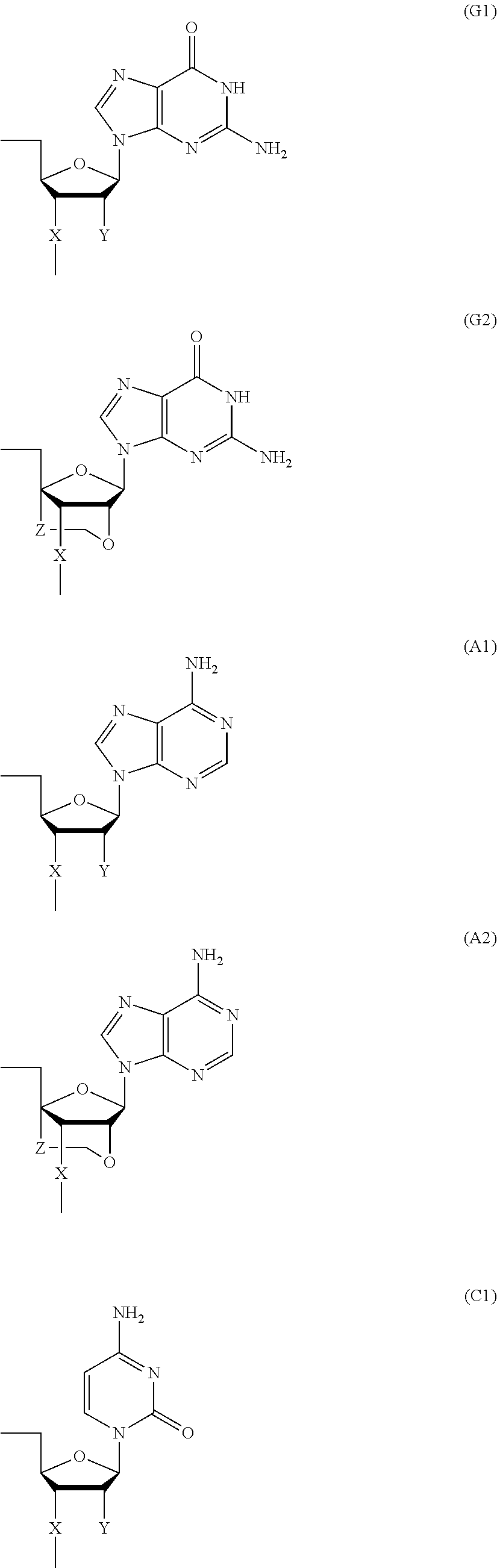

where X is individually and independently a group represented by the following formula (X1) or (X2):

Y is individually and independently a hydrogen atom, a hydroxyl group or an alkoxy group with 1-6 carbon atoms; and Z is individually and independently a single bond or an alkylene group with 1-5 carbon atoms;
BM″19 is a group represented by the following formula (19″):
-Bt-Bt-Bc-Bc-Ba-Bg-Bc-Bc-Ba— (19″)
where Bg, Ba, Bt and Bc are as defined above;
BB″19 is a group represented by any one of the following (119a″) to (119j″):
(119a″) —CH2CH2OH,
(119b″) -Bt-CH2CH2OH,
(119c″) -Bt-Bt-CH2CH2OH,
(119d″) -Bt-Bt-Bg-CH2CH2OH,
(119e″) -Bt-Bt-Bg-Bt-CH2CH2OH,
(119f″) -Bt-Bt-Bg-Bt-Bg-CH2CH2OH,
(119g″) -Bt-Bt-Bg-Bt-Bg-Bt-CH2CH2OH,
(119h″) -Bt-Bt-Bg-Bt-Bg-Bt-Bt-CH2CH2OH,
(119i″) -Bt-Bt-Bg-Bt-Bg-Bt-Bt-Bg-CH2CH2OH, or
(119j″) -Bt-Bt-Bg-Bt-Bg-Bt-Bt-Bg-Ba—CH2CH2OH
where Bg, Ba, Bt and Bc are as defined above;
provided that at least one of the nucleosides constituting the compound represented by formula (XIX″) has 2″-O,4″-C-alkylene group.
[45] A compound represented by the following general formula (XX″) or a pharmacologically acceptable salt thereof:
BT″20—BM″20—BB″20 (XX″)
where BT″20 is a group represented by any one of the following (20a″) to (20j″):
(20a″) HO—,
(20b″) HO-Bc-,
(20c″) HO-Bt-Bc-,
(20d″) HO-Bt-Bt-Bc-,
(20e″) HO-Bc-Bt-Bt-Bc-,
(20f″) HO-Bg-Bc-Bt-Bt-Bc-,
(20g″) HO—Ba-Bg-Bc-Bt-Bt-Bc-,
(20h″) HO-Bc-Ba-Bg-Bc-Bt-Bt-Bc-,
(20i″) HO-Bt-Bc-Ba-Bg-Bc-Bt-Bt-Bc-, or
(20j″) HO-Bc-Bt-Bc-Ba-Bg-Bc-Bt-Bt-Bc-
where Bg is a group represented by the following formula (G1) or (G2); Ba is a group represented by the following formula (A1) or (A2); Bc is a group represented by the following formula (C1) or (C2); and Bt is a group represented by the following formula (U1) or (T2):


where X is individually and independently a group represented by the following formula (X1) or (X2):

Y is individually and independently a hydrogen atom, a hydroxyl group or an alkoxy group with 1-6 carbon atoms; and Z is individually and independently a single bond or an alkylene group with 1-5 carbon atoms;
BM″20 is a group represented by the following formula (20″):
-Bt-Bt-Bc-Bc-Bt-Bt-Ba-Bg-Bc- (20″)
where Bg, Ba, Bt and Bc are as defined above;
BB″20 is a group represented by any one of the following (120a″) to (120j″):
(120a″) —CH2CH2OH,
(120b″) -Bt-CH2CH2OH,
(120c″) -Bt-Bt-CH2CH2OH,
(120d″) -Bt-Bt-Bc-CH2CH2OH,
(120e″) -Bt-Bt-Bc-Bc-CH2CH2OH,
(120f″) -Bt-Bt-Bc-Bc-Ba—CH2CH2OH,
(120g″) -Bt-Bt-Bc-Bc-Ba-Bg-CH2CH2OH,
(120h″) -Bt-Bt-Bc-Bc-Ba-Bg-Bc-CH2CH2OH,
(120i″) -Bt-Bt-Bc-Bc-Ba-Bg-Bc-Bc-CH2CH2OH, or
(120j″) -Bt-Bt-Bc-Bc-Ba-Bg-Bc-Bc-Ba—CH2CH2OH
where Bg, Ba, Bt and Bc are as defined above;
provided that at least one of the nucleosides constituting the compound represented by formula (XX″) has 2″-O,4″-C-alkylene group.
[46] A compound represented by the following general formula (XXI″) or a pharmacologically acceptable salt thereof:
BT″21—BM″21—BB″21 (XXI″)
where BT″21 is a group represented by any one of the following (21a″) to (21e″):
(21a″) HO—,
(21b″) HO—Ba—,
(21c″) HO-Bc-Ba—,
(21d″) HO-Bt-Bc-Ba—, or
(21e″) HO-Bc-Bt-Bc-Ba—
where Bg is a group represented by the following formula (G1) or (G2); Ba is a group represented by the following formula (A1) or (A2); Bc is a group represented by the following formula (C1) or (C2); and Bt is a group represented by the following formula (U1) or (T2):


where X is individually and independently a group represented by the following formula (X1) or (X2):

Y is individually and independently a hydrogen atom, a hydroxyl group or an alkoxy group with 1-6 carbon atoms; and Z is individually and independently a single bond or an alkylene group with 1-5 carbon atoms;
BM″21 is a group represented by the following formula (21″):
| (SEQ ID NO: 154) |
| -Bg-Bc-Bt-Bt-Bc-Bt-Bt-Bc-Bc-Bt-Bt-Ba-Bg-Bc- (21″) |
where Bg, Ba, Bt and Bc are as defined above;
BB″21 is a group represented by any one of the following (121a″) to (121e″):
(121a″) —CH2CH2OH,
(121b″) -Bt-CH2CH2OH,
(121c″) -Bt-Bt-CH2CH2OH,
(121d″) -Bt-Bt-Bc-CH2CH2OH, or
(121e″) -Bt-Bt-Bc-Bc-CH2CH2OH
where Bg, Ba, Bt and Bc are as defined above;
provided that at least one of the nucleosides constituting the compound represented by formula (XXI″) has 2″-O,4″-C-alkylene group.
[47] The compound of any one of [26] to [46] above which is selected from the group consisting of the following compounds (i″) to (xlix″), or a pharmacologically acceptable salt thereof:
(i″) a compound represented by the following formula (i″):
| (SEQ ID NO: 155) |
| HO-Bg-Ba-Ba-Ba-Ba-Bc-Bg-Bc-Bc-Bg-Bc-Bc-Ba-Bt-Bt-Bt- |
| Bc-Bt-CH2CH2OH (i″) |
(ii″) a compound represented by the following formula (ii″):
| (SEQ ID NO: 156) |
| HO-Bc-Bt-Bg-Bt-Bt-Ba-Bg-Bc-Bc-Ba-Bc-Bt-Bg-Ba-Bt-Bt- |
| Ba-Ba-CH2CH2OH (ii″) |
(iii″) a compound represented by the following formula (iii″):
| (SEQ ID NO: 157) |
| HO-Bt-Bg-Ba-Bg-Ba-Ba-Ba-Bc-Bt-Bg-Bt-Bt-Bc-Ba-Bg-Bc- |
| Bt-Bt-CH2CH2OH (iii″) |
(iv″) a compound represented by the following formula (iv″):
| (SEQ ID NO: 158) |
| HO-Bc-Ba-Bg-Bg-Ba-Ba-Bt-Bt-Bt-Bg-Bt-Bg-Bt-Bc-Bt- |
| Bt-Bt-Bc-CH2CH2OH (iv″) |
(v″) a compound represented by the following formula (v″):
| (SEQ ID NO: 159) |
| HO-Bg-Bt-Ba-Bt-Bt-Bt-Ba-Bg-Bc-Ba-Bt-Bg-Bt-Bt-Bc- |
| Bc-Bc-Ba-CH2CH2OH (v″) |
(vi″) a compound represented by the following formula (vi″):
| (SEQ ID NO: 160) |
| HO-Ba-Bg-Bc-Ba-Bt-Bg-Bt-Bt-Bc-Bc-Bc-Ba-Ba-Bt-Bt- |
| Bc-Bt-Bc-CH2CH2OH (vi″) |
(vii″) a compound represented by the following formula (vii″):
| (SEQ ID NO: 161) |
| HO-Bg-Bc-Bc-Bg-Bc-Bc-Ba-Bt-Bt-Bt-Bc-Bt-Bc-Ba-Ba- |
| Bc-Ba-Bg-CH2CH2OH (vii″) |
(viii″) a compound represented by the following formula (viii″):
| (SEQ ID NO: 37) |
| HO-Bc-Ba-Bt-Ba-Ba-Bt-Bg-Ba-Ba-Ba-Ba-Bc-Bg-Bc-Bc- |
| Bg-Bc-Bc-CH2CH2OH (viii″) |
(ix″) a compound represented by the following formula (ix″):
| (SEQ ID NO: 162) |
| HO-Bt-Bt-Bc-Bc-Bc-Ba-Ba-Bt-Bt-Bc-Bt-Bc-Ba-Bg-Bg- |
| Ba-Ba-Bt-CH2CH2OH (ix″) |
(x″) a compound represented by the following formula (x″):
| (SEQ ID NO: 163) |
| HO-Bc-Bc-Ba-Bt-Bt-Bt-Bg-Bt-Ba-Bt-Bt-Bt-Ba-Bg-Bc- |
| Ba-Bt-Bg-CH2CH2OH (x″) |
(xi″) a compound represented by the following formula (xi″):
| (SEQ ID NO: 164) |
| HO-Bc-Bt-Bc-Ba-Bg-Ba-Bt-Bc-Bt-Bt-Bc-Bt-Ba-Ba-Bc- |
| Bt-Bt-Bc-CH2CH2OH (xi″) |
(xii″) a compound represented by the following formula (xii″):
| (SEQ ID NO: 165) |
| HO-Ba-Bc-Bc-Bg-Bc-Bc-Bt-Bt-Bc-Bc-Ba-Bc-Bt-Bc-Ba- |
| Bg-Ba-Bg-CH2CH2OH (xii″) |
(xiii″) a compound represented by the following formula (xiii″):
| (SEQ ID NO: 166) |
| HO-Bt-Bc-Bt-Bt-Bg-Ba-Ba-Bg-Bt-Ba-Ba-Ba-Bc-Bg-Bg- |
| Bt-Bt-Bt-CH2CH2OH (xiii″) |
(xiv″) a compound represented by the following formula (xiv″):
| (SEQ ID NO: 167) |
| HO-Bg-Bg-Bc-Bt-Bg-Bc-Bt-Bt-Bt-Bg-Bc-Bc-Bc-Bt-Bc- |
| Ba-Bg-Bc-CH2CH2OH (xiv″) |
(xv″) a compound represented by the following formula (xv″):
| (SEQ ID NO: 44) |
| HO-Ba-Bg-Bt-Bc-Bc-Ba-Bg-Bg-Ba-Bg-Bc-Bt-Ba-Bg-Bg- |
| Bt-Bc-Ba-CH2CH2OH (xv″) |
(xvi″) a compound represented by the following formula (xvi″):
| (SEQ ID NO: 45) |
| HO-Bg-Bc-Bt-Bc-Bc-Ba-Ba-Bt-Ba-Bg-Bt-Bg-Bg-Bt-Bc- |
| Ba-Bg-Bt-CH2CH2OH (xvi″) |
(xvii″) a compound represented by the following formula (xvii″):
| (SEQ ID NO: 168) |
| HO-Bg-Bc-Bt-Ba-Bg-Bg-Bt-Bc-Ba-Bg-Bg-Bc-Bt-Bg-Bc- |
| Bt-Bt-Bt-CH2CH2OH (xvii″) |
(xviii″) a compound represented by the following formula (xviii″):
| (SEQ ID NO: 169) |
| HO-Bg-Bc-Ba-Bg-Bc-Bc-Bt-Bc-Bt-Bc-Bg-Bc-Bt-Bc-Ba- |
| Bc-Bt-Bc-CH2CH2OH (xviii″) |
(xix″) a compound represented by the following formula (xix″):
| (SEQ ID NO: 170) | |
| HO-Bt-Bc-Bt-Bt-Bc-Bc-Ba-Ba-Ba-Bg-Bc-Ba-Bg-Bc-Bc-Bt-Bc-Bt-CH2CH2OH | |
| (xix”) |
(xx″) a compound represented by the following formula (xx″):
| (SEQ ID NO: 171) | |
| HO-Bt-Bg-Bc-Ba-Bg-Bt-Ba-Ba-Bt-Bc-Bt-Ba-Bt-Bg-Ba-Bg-Bt-Bt-CH2CH2OH | |
| (xx”) |
(xxi″) a compound represented by the following formula (xxi″):
| (SEQ ID NO: 172) | |
| HO-Bg-Bt-Bt-Bt-Bc-Ba-Bg-Bc-Bt-Bt-Bc-Bt-Bg-Bt-Ba-Ba-Bg-Bc-CH2CH2OH | |
| (xxi”) |
(xxii″) a compound represented by the following formula (xxii″):
| (SEQ ID NO: 51) | |
| HO-Bt-Bg-Bt-Ba-Bg-Bg-Ba-Bc-Ba-Bt-Bt-Bg-Bg-Bc-Ba-Bg-Bt-Bt-CH2CH2OH | |
| (xxii”) |
(xxiii″) a compound represented by the following formula (xxiii″):
| (SEQ ID NO: 173) | |
| HO-Bt-Bc-Bc-Bt-Bt-Ba-Bc-Bg-Bg-Bg-Bt-Ba-Bg-Bc- | |
| Ba-Bt-Bc-Bc-CH2CH2OH | |
| (xxiii”) |
(xxiv″) a compound represented by the following formula (xxiv″):
| (SEQ ID NO: 174) | |
| HO-Ba-Bg-Bc-Bt-Bc-Bt-Bt-Bt-Bt-Ba-Bc-Bt-Bc-Bc-Bc-Bt-Bt-Bg-CH2CH2OH | |
| (xxiv”) |
(xxv″) a compound represented by the following formula (xxv″):
| (SEQ ID NO: 175) | |
| HO-Bc-Bc-Ba-Bt-Bt-Bg-Bt-Bt-Bt-Bc-Ba-Bt-Bc-Ba-Bg-Bc-Bt-Bc-CH2CH2OH | |
| (xxv”) |
(xxvi″) a compound represented by the following formula (xxvi″):
| (SEQ ID NO: 55) | |
| HO-Bc-Bt-Ba-Bt-Bg-Ba-Bg-Bt-Bt-Bt-Bc-Bt-Bt-Bc-Bc-Ba-Ba-Ba-CH2CH2OH | |
| (xxvi”) |
(xxvii″) a compound represented by the following formula (xxvii″):
| (SEQ ID NO: 176) | |
| D-Bt-Bg-Bt-Bg-Bt-Bc-Ba-Bc-Bc-Ba-Bg-Ba-Bg-Bt-Ba-Ba-Bc-Ba-Bg-Bt- | |
| CH2CH2OH | |
| (xxvii”) |
(xxviii″) a compound represented by the following formula (xxviii″):
| (SEQ ID NO: 177) | |
| D-Ba-Bg-Bg-Bt-Bt-Bg-Bt-Bg-Bt-Bc-Ba-Bc-Bc-Ba-Bg-Ba-Bg-Bt-Ba-Ba- | |
| CH2CH2OH | |
| (xxviii”) |
(xxix″) a compound represented by the following formula (xxix″):
| (SEQ ID NO: 178) | |
| D-Ba-Bg-Bt-Ba-Ba-Bc-Bc-Ba-Bc-Ba-Bg-Bg-Bt-Bt-Bg-Bt-Bg-Bt-Bc-Ba- | |
| CH2CH2OH | |
| (xxix”) |
(xxx″) a compound represented by the following formula (xxx″):
| (SEQ ID NO: 59) | |
| D-Bt-Bt-Bg-Ba-Bt-Bc-Ba-Ba-Bg-Bc-Ba-Bg-Ba-Bg-Ba-Ba-Ba-Bg-Bc-Bc- | |
| CH2CH2OH | |
| (xxx”) |
(xxxi″) a compound represented by the following formula (xxxi″):
| (SEQ ID NO: 179) | |
| D-Bc-Ba-Bc-Bc-Bc-Bt-Bc-Bt-Bg-Bt-Bg-Ba-Bt-Bt-Bt-Bt-Ba-Bt-Ba-Ba- | |
| CH2CH2OH | |
| (xxxi”) |
(xxxii″) a compound represented by the following formula (xxxii″):
| (SEQ ID NO: 180) | |
| D-Ba-Bc-Bc-Bc-Ba-Bc-Bc-Ba-Bt-Bc-Ba-Bc-Bc-Bc-Bt-Bc-Bt-Bg-Bt-Bg- | |
| CH2CH2OH | |
| (xxxii”) |
(xxxiii″) a compound represented by the following formula (xxxiii″):
| (SEQ ID NO: 181) | |
| D-Bc-Bc-Bt-Bc-Ba-Ba-Bg-Bg-Bt-Bc-Ba-Bc-Bc-Bc-Ba-Bc-Bc-Ba-Bt-Bc- | |
| CH2CH2OH | |
| (xxxiii”) |
(xxxiv″) a compound represented by the following formula (xxxiv″):
| (SEQ ID NO: 182) |
| HO-Bt-Ba-Ba-Bc-Ba-Bg-Bt-Bc-Bt-Bg-Ba-Bg-Bt-Ba-Bg- |
| Bg-Ba-Bg-CH2CH2OH (xxxiv”) |
(xxxv″) a compound represented by the following formula (xxxv″):
| (SEQ ID NO: 183) |
| HO-Bg-Bg-Bc-Ba-Bt-Bt-Bt-Bc-Bt-Ba-Bg-Bt-Bt-Bt-Bg- |
| Bg-Ba-Bg-CH2CH2OH (xxxv”) |
(xxxvi″) a compound represented by the following formula (xxxvi″):
| (SEQ ID NO: 184) |
| HO-Ba-Bg-Bc-Bc-Ba-Bg-Bt-Bc-Bg-Bg-Bt-Ba-Ba-Bg-Bt- |
| Bt-Bc-Bt-CH2CH2OH (xxxvi”) |
(xxxvii″) a compound represented by the following formula (xxxvii″):
| (SEQ ID NO: 185) |
| HO-Ba-Bg-Bt-Bt-Bt-Bg-Bg-Ba-Bg-Ba-Bt-Bg-Bg-Bc-Ba- |
| Bg-Bt-Bt-CH2CH2OH (xxxvii”) |
(xxxviii″) a compound represented by the following formula (xxxviii″):
| (SEQ ID NO: 186) |
| HO-Bc-Bt-Bg-Ba-Bt-Bt-Bc-Bt-Bg-Ba-Ba-Bt-Bt-Bc-Bt- |
| Bt-Bt-Bc-CH2CH2OH (xxxviii”) |
(xxxix″) a compound represented by the following formula (xxxix″):
| (SEQ ID NO: 68) |
| HO-Bt-Bt-Bc-Bt-Bt-Bg-Bt-Ba-Bc-Bt-Bt-Bc-Ba-Bt-Bc- |
| Bc-Bc-Ba-CH2CH2OH (xxxix”) |
(xl) a compound represented by the following formula (xl″):
| (SEQ ID NO: 187) |
| HO-Bc-Bc-Bt-Bc-Bc-Bg-Bg-Bt-Bt-Bc-Bt-Bg-Ba-Ba-Bg- |
| Bg-Bt-Bg-CH2CH2OH (xl”) |
(xli″) a compound represented by the following formula (xli″):
| (SEQ ID NO: 188) |
| HO-Bc-Ba-Bt-Bt-Bt-Bc-Ba-Bt-Bt-Bc-Ba-Ba-Bc-Bt-Bg- |
| Bt-Bt-Bg-CH2CH2OH (xli”) |
(xlii″) a compound represented by the following formula (xlii″):
| (SEQ ID NO: 189) |
| HO-Bt-Bt-Bc-Bc-Bt-Bt-Ba-Bg-Bc-Bt-Bt-Bc-Bc-Ba-Bg- |
| Bc-Bc-Ba-CH2CH2OH (xlii”) |
(xliii″) a compound represented by the following formula (xliii″):
| (SEQ ID NO: 190) |
| HO-Bt-Ba-Ba-Bg-Ba-Bc-Bc-Bt-Bg-Bc-Bt-Bc-Ba-Bg-Bc- |
| Bt-Bt-Bc-CH2CH2OH (xliii”) |
(xliv″) a compound represented by the following formula (xliv″):
| (SEQ ID NO: 191) |
| HO-Bc-Bt-Bt-Bg-Bg-Bc-Bt-Bc-Bt-Bg-Bg-Bc-Bc-Bt-Bg- |
| Bt-Bc-Bc-CH2CH2OH (xliv”) |
(xlv″) a compound represented by the following formula (xlv″):
| (SEQ ID NO: 192) |
| HO-Bc-Bt-Bc-Bc-Bt-Bt-Bc-Bc-Ba-Bt-Bg-Ba-Bc-Bt-Bc- |
| Ba-Ba-Bg-CH2CH2OH (xlv”) |
(xlvi″) a compound represented by the following formula (xlvi″):
| (SEQ ID NO: 75) |
| HO-Bc-Bt-Bg-Ba-Ba-Bg-Bg-Bt-Bg-Bt-Bt-Bc-Bt-Bt-Bg- |
| Bt-Ba-Bc-CH2CH2OH (xlvi”) |
(xlvii″) a compound represented by the following formula (xlvii″):
| (SEQ ID NO: 76) |
| HO-Bt-Bt-Bc-Bc-Ba-Bg-Bc-Bc-Ba-Bt-Bt-Bg-Bt-Bg-Bt- |
| Bt-Bg-Ba-CH2CH2OH (xlvii”) |
(xlviii″) a compound represented by the following formula (xlviii″):
| (SEQ ID NO: 193) |
| HO-Bc-Bt-Bc-Ba-Bg-Bc-Bt-Bt-Bc-Bt-Bt-Bc-Bc-Bt-Bt- |
| Ba-Bg-Bc-CH2CH2OH (xlviii”) |
(xlix″) a compound represented by the following formula (xlix″):
| (SEQ ID NO: 194) |
| HO-Bg-Bc-Bt-Bt-Bc-Bt-Bt-Bc-Bc-Bt-Bt-Ba-Bg-Bc-Bt- |
| Bt-Bc-Bc-CH2CH2OH (xlix″) |
where Bg is a group represented by the following formula (G1) or (G2); Ba is a group represented by the following formula (A1) or (A2); Bc is a group represented by the following formula (C1) or (C2); Bt is a group represented by the following formula (U1) or (T2); and D is HO— or Ph- wherein Ph- is a group represented by the following first formula:


where X is individually and independently a group represented by the following formula (X1) or (X2):

Y is individually and independently a hydrogen atom, a hydroxyl group or an alkoxy group with 1-6 carbon atoms; and Z is individually and independently a single bond or an alkylene group with 1-5 carbon atoms.
[48] The compound of any one of [26] to [46] above which is selected from the group consisting of the following compounds (i″-a) to (li″-a), or a pharmacologically acceptable salt thereof:
(i″-a) a compound represented by the following formula (i″-a):
| (SEQ ID NO: 30) | |
| HO-Bg-Ba-Ba-Ba-Ba-Bc-Bg-Bc-Bc-Bg-Bc-Bc-Ba-B′t- | |
| B′u-B′u-Bc-B′t-CH2CH2OH (i″-a) |
(ii″-a) a compound represented by the following formula (ii″-a):
| (SEQ ID NO: 31) |
| HO-Bc-B′t-Bg-B′u-B′t-Ba-Bg-Bc-Bc-Ba-Bc-B′t-Bg-Ba- |
| B′t-B′t-Ba-Ba-CH2CH2OH (ii″-a) |
(iii″-a) a compound represented by the following formula (iii″-a):
| (SEQ ID NO: 32) |
| HO-B′t-Bg-Ba-Bg-Ba-Ba-Ba-Bc-B′t-Bg-B′t-B′u-Bc-Ba- |
| Bg-Bc-B′u-B′t-CH2CH2OH (iii″-a) |
(iv″-a) a compound represented by the following formula (iv″-a):
| (SEQ ID NO: 33) |
| HO-Bc-Ba-Bg-Bg-Ba-Ba-B′t-B′t-B′u-Bg-B′t-Bg-B′u-Bc- |
| B′u-B′u-B′t-Bc-CH2CH2OH (iv″-a) |
(v″-a) a compound represented by the following formula (v″-a):
| (SEQ ID NO: 34) |
| HO-Bg-B′t-Ba-B′u-B′t-B′t-Ba-Bg-Bc-Ba-B′t-Bg-B′u- |
| B′t-Bc-Bc-Bc-Ba-CH2CH2OH (v″-a) |
(vi″-a) a compound represented by the following formula (vi″-a):
| (SEQ ID NO: 35) |
| HO-Ba-Bg-Bc-Ba-B′t-Bg-B′t-B′t-Bc-Bc-Bc-Ba-Ba-B′t- |
| B′u-Bc-B′t-Bc-CH2CH2OH (vi″-a) |
(vii″-a) a compound represented by the following formula (vii″-a):
| (SEQ ID NO: 36) |
| HO-Bg-Bc-Bc-Bg-Bc-Bc-Ba-B′t-B′u-B′u-Bc-B′u-Bc-Ba- |
| Ba-Bc-Ba-Bg-CH2CH2OH (vii″-a) |
(viii″-a) a compound represented by the following formula (viii″-a):
| (SEQ ID NO: 37) |
| HO-Bc-Ba-B′t-Ba-Ba-B′t-Bg-Ba-Ba-Ba-Ba-Bc-Bg-Bc-Bc- |
| Bg-Bc-Bc-CH2CH2OH (viii″-a) |
(ix″-a) a compound represented by the following formula (ix″-a):
| (SEQ ID NO: 38) |
| HO-B′t-B′u-Bc-Bc-Bc-Ba-Ba-B′t-B′u-Bc-B′t-Bc-Ba-Bg- |
| Bg-Ba-Ba-B′t-CH2CH2OH (ix″-a) |
(x″-a) a compound represented by the following formula (x″-a):
| (SEQ ID NO: 39) |
| HO-Bc-Bc-Ba-B′u-B′t-B′u-Bg-B′t-Ba-B′u-B′t-B′t-Ba- |
| Bg-Bc-Ba-B′t-Bg-CH2CH2OH (x″-a) |
(xi″-a) a compound represented by the following formula (xi″-a):
| (SEQ ID NO: 40) |
| HO-Bc-B′t-Bc-Ba-Bg-Ba-B′t-Bc-B′u-B′u-Bc-B′t-Ba-Ba- |
| Bc-B′u-B′u-Bc-CH2CH2OH (xi″-a) |
(xii″-a) a compound represented by the following formula (xii″-a):
| (SEQ ID NO: 41) |
| HO-Ba-Bc-Bc-Bg-Bc-Bc-B′t-B′u-Bc-Bc-Ba-Bc-B′t-Bc- |
| Ba-Bg-Ba-Bg-CH2CH2OH (xii″-a) |
(xiii″-a) a compound represented by the following formula (xiii″-a):
| (SEQ ID NO: 42) |
| HO-B′t-Bc-B′t-B′t-Bg-Ba-Ba-Bg-B′t-Ba-Ba-Ba-Bc-Bg- |
| Bg-B′t-B′u-B′t-CH2CH2OH (xiii″-a) |
(xiv″-a) a compound represented by the following formula (xiv″-a):
| (SEQ ID NO: 43) |
| HO-Bg-Bg-Bc-B′t-Bg-Bc-B′t-B′t-B′u-Bg-Bc-Bc-Bc-B′t- |
| Bc-Ba-Bg-Bc-CH2CH2OH (xiv″-a) |
(xv″-a) a compound represented by the following formula (xv″-a):
| (SEQ ID NO: 44) | |
| HO-Ba-Bg-B′t-Bc-Bc-Ba-Bg-Bg-Ba-Bg-Bc-B′t-Ba-Bg-Bg-B′t-Bc-Ba-CH2CH2OH | |
| (xv″ -a) |
(xvi″-a) a compound represented by the following formula (xvi″-a):
| (SEQ ID NO: 45) | |
| HO-Bg-Bc-B′t-Bc-Bc-Ba-Ba-B′t-Ba-Bg-B′t-Bg-Bg-B′t-Bc-Ba-Bg-B′t-CH2CH2OH | |
| (xvi″ -a) |
(xvii″-a) a compound represented by the following formula (xvii″-a):
| (SEQ ID NO: 46) | |
| HO-Bg-Bc-B′t-Ba-Bg-Bg-B′t-Bc-Ba-Bg-Bg-Bc-B′t-Bg-Bc-B′t-B′t-B′u-CH2CH2OH | |
| (xvii″ -a) |
(xviii″-a) a compound represented by the following formula (xviii″-a):
| (SEQ ID NO: 47) | |
| HO-Bg-Bc-Ba-Bg-Bc-Bc-B′u-Bc-B′t-Bc-Bg-Bc-B′t-Bc-Ba-Bc-B′t-Bc- | |
| CH2CH2OH (xviii″ -a) |
(xix″-a) a compound represented by the following formula (xix″-a):
| (SEQ ID NO: 48) | |
| HO-B′t-Bc-B′u-B′u-Bc-Bc-Ba-Ba-Ba-Bg-Bc-Ba-Bg-Bc-Bc-B′u-Bc-B′t- | |
| CH2CH2OH (xix″ -a) |
(xx″-a) a compound represented by the following formula (xx″-a):
| (SEQ ID NO: 49) | |
| HO-B′t-Bg-Bc-Ba-Bg-B′t-Ba-Ba-B′t-Bc-B′u-Ba-B′t-Bg-Ba-Bg-B′t-B′t- | |
| CH2CH2OH (xx″ -a) |
(xxi″-a) a compound represented by the following formula (xxi″-a):
| (SEQ ID NO: 50) | |
| HO-Bg-B′t-B′t-B′u-Bc-Ba-Bg-Bc-B′u-B′t-Bc-B′t-Bg-B′t-Ba-Ba-Bg-Bc- | |
| CH2CH2OH (xxi″ -a) |
(xxii″-a) a compound represented by the following formula (xxii″-a):
| (SEQ ID NO: 51) | |
| HO-B′t-Bg-B′t-Ba-Bg-Bg-Ba-Bc-Ba-B′t-B′t-Bg-Bg-Bc-Ba-Bg-B′t-B′t- | |
| CH2CH2OH (xxii″ -a) |
(xxiii″-a) a compound represented by the following formula (xxiii″-a):
| (SEQ ID NO: 52) | |
| HO-B′t-Bc-Bc-B′t-B′t-Ba-Bc-Bg-Bg-Bg-B′t-Ba-Bg-Bc-Ba-B′u-Bc-Bc- | |
| CH2CH2OH (xxiii″ -a) |
(xxiv″-a) a compound represented by the following formula (xxiv″-a):
| (SEQ ID NO: 53) | |
| HO-Ba-Bg-Bc-B′t-Bc-B′u-B′t-B′u-B′t-Ba-Bc-B′t-Bc-Bc-Bc-B′t-B′t-Bg- | |
| CH2CH2OH (xxiv″ -a) |
(xxv″-a) a compound represented by the following formula (xxv″-a):
| (SEQ ID NO: 54) | |
| HO-Bc-Bc-Ba-B′u-B′t-Bg-B′u-B′t-B′u-Bc-Ba-B′u-Bc-Ba-Bg-Bc-B′t-Bc- | |
| CH2CH2OH (xxv″ -a) |
(xxvi″-a) a compound represented by the following formula (xxvi″-a):
| (SEQ ID NO: 55) | |
| HO-Bc-B′t-Ba-B′t-Bg-Ba-Bg-B′t-B′t-B′t-Bc-B′t-B′t-Bc-Bc-Ba-Ba-Ba-CH2CH2OH | |
| (xxvi″ -a) |
(xxvii″-a) a compound represented by the following formula (xxvii″-a):
| (SEQ ID NO: 56) | |
| D-B′t-Bg-B′t-Bg-B′t-Bc-Ba-Bc-Bc-Ba-Bg-Ba-Bg-B′u-Ba-Ba-Bc-Ba-Bg-B′t- | |
| CH2CH2OH (xxvii″ -a) |
(xxviii″-a) a compound represented by the following formula (xxviii″-a):
| (SEQ ID NO: 57) | |
| D-Ba-Bg-Bg-B′t-B′t-Bg-B′u-Bg-B′u-Bc-Ba-Bc-Bc-Ba-Bg-Ba-Bg-B′t-Ba-Ba- | |
| CH2CH2OH (xxviii″ -a) |
(xxix″-a) a compound represented by the following formula (xxix″-a):
| (SEQ ID NO: 58) | |
| D-Ba-Bg-B′t-Ba-Ba-Bc-Bc-Ba-Bc-Ba-Bg-Bg-B′u-B′u-Bg-B′t-Bg-B′t-Bc-Ba- | |
| CH2CH2OH (xxix″ -a) |
(xxx″-a) a compound represented by the following formula (xxx″-a):
| (SEQ ID NO: 59) | |
| D-B′t-B′t-Bg-Ba-B′t-Bc-Ba-Ba-Bg-Bc-Ba-Bg-Ba-Bg-Ba-Ba-Ba-Bg-Bc-Bc- | |
| CH2CH2OH (xxx” -a) |
(xxxi″-a) a compound represented by the following formula (xxxi″-a):
| (SEQ ID NO: 60) | |
| D-Bc-Ba-Bc-Bc-Bc-B′u-Bc-B′u-Bg-B′u-Bg-Ba-B′u-B′u-B′u-B′t-Ba-B′t-Ba-Ba-CH | |
| 2CH2OH (xxxi” -a) |
(xxxii″-a) a compound represented by the following formula (xxxii″-a):
| (SEQ ID NO: 61) | |
| D-Ba-Bc-Bc-Bc-Ba-Bc-Bc-Ba-B′u-Bc-Ba-Bc-Bc-Bc-B′u-Bc-B′t-Bg-B′t-Bg- | |
| CH2CH2OH (xxxii” -a) |
(xxxiii″-a) a compound represented by the following formula (xxxiii″-a):
| (SEQ ID NO: 62) | |
| D-Bc-Bc-B′t-Bc-Ba-Ba-Bg-Bg-B′u-Bc-Ba-Bc-Bc-Bc-Ba-Bc-Bc-Ba-B′t-Bc- | |
| CH2CH2OH (xxxiii” -a) |
(xxxiv″-a) a compound represented by the following formula (xxxiv″-a):
| (SEQ ID NO: 63) | |
| HO-B′t-Ba-Ba-Bc-Ba-Bg-B′u-Bc-B′u-Bg-Ba-Bg-B′u-Ba-Bg-Bg-Ba-Bg- | |
| CH2CH2OH (xxxiv” -a) |
(xxxv″-a) a compound represented by the following formula (xxxv″-a):
| (SEQ ID NO: 64) | |
| HO-Bg-Bg-Bc-Ba-B′t-B′u-B′u-Bc-B′u-Ba-Bg-B′u-B′u-B′t-Bg-Bg-Ba-Bg- | |
| CH2CH2OH (xxxv” -a) |
(xxxvi″-a) a compound represented by the following formula (xxxvi″-a):
| (SEQ ID NO: 65) | |
| HO-Ba-Bg-Bc-Bc-Ba-Bg-B′u-Bc-Bg-Bg-B′u-Ba-Ba-Bg-B′t-B′t-Bc-B′t- | |
| CH2CH2OH (xxxvi” -a) |
(xxxvii″-a) a compound represented by the following formula (xxxvii″-a):
| (SEQ ID NO: 66) | |
| HO-Ba-Bg-B′t-B′t-B′t-Bg-Bg-Ba-Bg-Ba-B′u-Bg-Bg-Bc-Ba-Bg-B′t-B′t- | |
| CH2CH2OH (xxxvii” -a) |
(xxxviii″-a) a compound represented by the following formula (xxxviii″-a):
| (SEQ ID NO: 67) | |
| HO-Bc-B′t-Bg-Ba-B′t-B′t-Bc-B′t-Bg-Ba-Ba-B′t-B′t-Bc-B′u-B′u-B′t-Bc- | |
| CH2CH2OH (xxxviii” -a) |
(xxxix″-a) a compound represented by the following formula (xxxix″-a):
| (SEQ ID NO: 68) | |
| HO-B′t-B′t-Bc-B′t-B′t-Bg-B′t-Ba-Bc-B′t-B′t-Bc-Ba-B′t-Bc-Bc-Bc-Ba- | |
| CH2CH2OH (xxxix” -a) |
(xl″-a) a compound represented by the following formula (xl″-a):
| (SEQ ID NO: 187) | |
| HO-Bc-Bc-B′t-Bc-Bc-Bg-Bg-B′t-B′t-Bc-B′t-Bg-Ba-Ba-Bg-Bg-B′t-Bg- | |
| CH2CH2OH (xl” -a) |
(xli″-a) a compound represented by the following formula (xli″-a):
| (SEQ ID NO: 195) | |
| HO-Bc-Ba-B′t-B′t-B′t-Bc-Ba-B′u-B′t-Bc-Ba-Ba-Bc-B′t-Bg-B′t-B′t-Bg- | |
| CH2CH2OH (xli” -a) |
(xlii″-a) a compound represented by the following formula (xlii″-a):
| (SEQ ID NO: 71) | |
| HO-B′t-B′t-Bc-Bc-B′t-B′t-Ba-Bg-Bc-B′t-B′u-Bc-Bc-Ba-Bg-Bc-Bc-Ba- | |
| CH2CH2OH (xlii” -a) |
(xliii″-a) a compound represented by the following formula (xliii″-a):
| (SEQ ID NO: 72) | |
| HO-B′t-Ba-Ba-Bg-Ba-Bc-Bc-B′t-Bg-Bc-B′t-Bc-Ba-Bg-Bc-B′u-B′t-Bc- | |
| CH2CH2OH (xliii” -a) |
(xliv″-a) a compound represented by the following formula (xliv″-a):
| (SEQ ID NO: 73) | |
| HO-Bc-B′t-B′t-Bg-Bg-Bc-B′t-Bc-B′t-Bg-Bg-Bc-Bc-B′t-Bg-B′u-Bc-Bc- | |
| CH2CH2OH (xliv” -a) |
(xlv″-a) a compound represented by the following formula (xlv″-a):
| (SEQ ID NO: 74) | |
| HO-Bc-B′t-Bc-Bc-B′t-B′u-Bc-Bc-Ba-B′t-Bg-Ba-Bc-B′t-Bc-Ba-Ba-Bg- | |
| CH2CH2OH (xlv” -a) |
(xlvi″-a) a compound represented by the following formula (xlvi″-a):
| (SEQ ID NO: 75) | |
| HO-Bc-B′t-Bg-Ba-Ba-Bg-Bg-B′t-Bg-B′t-B′t-Bc-B′t-B′t-Bg-B′t-Ba-Bc- | |
| CH2CH2OH (xlvi” -a) |
(xlvii″-a) a compound represented by the following formula (xlvii″-a):
| (SEQ ID NO: 76) | |
| HO-B′t-B′t-Bc-Bc-Ba-Bg-Bc-Bc-Ba-B′t-B′t-Bg-B′t-Bg-B′t-B′t-Bg-Ba- | |
| CH2CH2OH (xlvii” -a) |
(xlviii″-a) a compound represented by the following formula (xlviii″-a):
| (SEQ ID NO: 77) | |
| HO-Bc-B′t-Bc-Ba-Bg-Bc-B′t-B′u-Bc-B′t-B′t-Bc-Bc-B′t-B′t-Ba-Bg-Bc- | |
| CH2CH2OH (xlviii” -a) |
(xlix″-a) a compound represented by the following formula (xlix″-a):
| (SEQ ID NO: 78) | |
| HO-Bg-Bc-B′t-B′t-Bc-B′u-B′t-Bc-Bc-B′u-B′t-Ba-Bg-Bc-B′u-B′t-Bc-Bc- | |
| CH2CH2OH (xlix” -a) |
(l″-a) a compound represented by the following formula (l″-a):
| (SEQ ID NO: 87) | |
| HO-Bg-Bg-Bc-Ba-B′t-B′t-B′u-Bc-B′t-Ba-Bg-B′u-B′t-B′t-Bg-Bg-Ba-Bg- | |
| CH2CH2OH (l” -a) |
(li″-a) a compound represented by the following formula (li″-a):
| (SEQ ID NO: 88) | |
| HO-Ba-Bg-B′t-B′u-B′t-Bg-Bg-Ba-Bg-Ba-B′t-Bg-Bg-Bc-Ba-Bg-B′t-B′t- | |
| CH2CH2OH (li” -a) |
where Bg is a group represented by the following formula (G1) or (G2); Ba is a group represented by the following formula (A1) or (A2); Bc is a group represented by the following formula (C1) or (C2); B′ t is a group represented by the following formula (T2); B′ u is a formula represented by the following formula (U1); and D is HO— or Ph- wherein Ph- is a group represented by the following first formula:
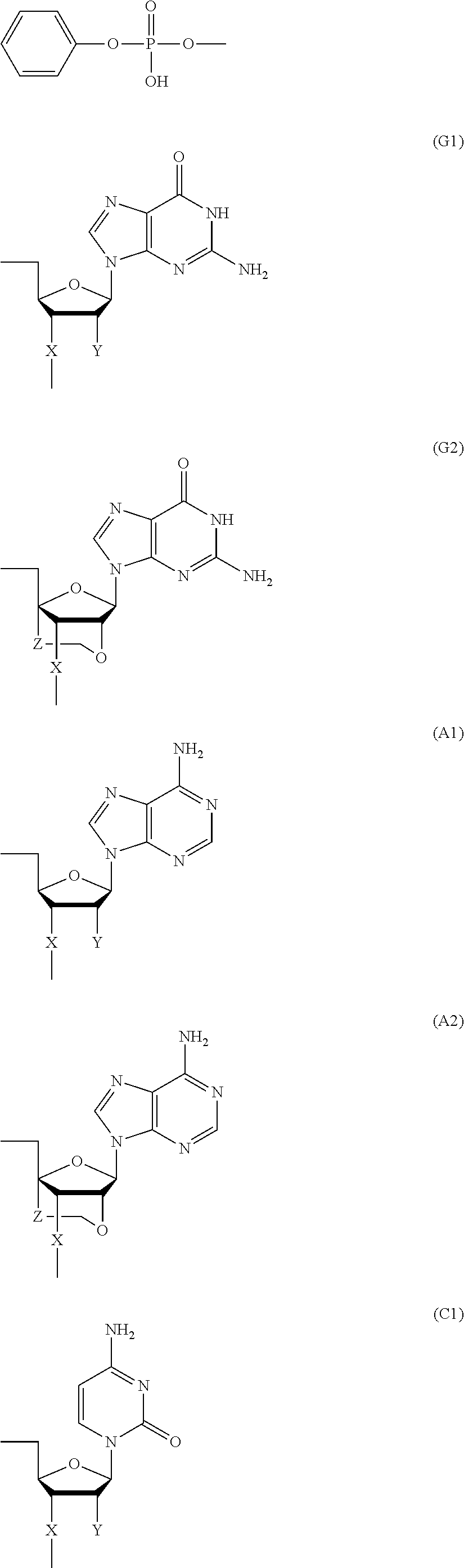

where X is individually and independently a group represented by the following formula (X1) or (X2):

Y is individually and independently a hydrogen atom, a hydroxyl group or an alkoxy group with 1-6 carbon atoms; and Z is individually and independently a single bond or an alkylene group with 1-5 carbon atoms.
[49] The compound of any one of [26] to [48] above which is represented by any one of the following formulas (I″1) to (I″51), or a pharmacologically acceptable salt thereof:
| (SEQ ID NO: 30) | |
| HO-Bg*-Ba**-Ba*-Ba*-Ba*-Bc**-Bg*-Bc**-Bc**-Bg*-Bc*-Bc**-Ba*-Bt**- | |
| Bu*-Bu*-Bc**-Bt**-CH2CH2OH (I″1) | |
| (SEQ ID NO: 31) | |
| HO-Bc**-Bt**-Bg*-Bu*-Bt**-Ba*-Bg*-Bc**-Bc*-Ba*-Bc**-Bt**-Bg*-Ba*- | |
| Bt**-Bt**-Ba*-Ba*-CH2CH2OH (I″2) | |
| (SEQ ID NO: 32) | |
| HO-Bt**-Bg*-Ba*-Bg*-Ba**-Ba*-Ba*-Bc**-Bt**-Bg*-Bt**-Bu*-Bc**-Ba*- | |
| Bg*-Bc**-Bu*-Bt**-CH2CH2OH (I″3) | |
| (SEQ ID NO: 33) | |
| HO-Bc**-Ba*-Bg*-Bg*-Ba**-Ba*-Bt**-Bt**-Bu*-Bg*-Bt**-Bg*-Bu*-Bc**- | |
| Bu*-Bu*-Bt**-Bc**-CH2CH2OH (I″4) | |
| (SEQ ID NO: 34) | |
| HO-Bg*-Bt**-Ba*-Bu*-Bt**-Bt**-Ba*-Bg*-Bc**-Ba*-Bt**-Bg*-Bu*-Bt**-Bc*- | |
| Bc**-Bc**-Ba*-CH2CH2OH (I″5) | |
| (SEQ ID NO: 35) | |
| HO-Ba*-Bg*-Bc**-Ba*-Bt**-Bg*-Bt**-Bt**-Bc*-Bc*-Bc**-Ba*-Ba*-Bt**- | |
| Bu*-Bc*-Bt**-Bc**-CH2CH2OH (I″6) | |
| (SEQ ID NO: 36) | |
| HO-Bg*-Bc**-Bc**-Bg*-Bc**-Bc*-Ba*-Bt**-Bu*-Bu*-Bc**- | |
| Bu*-Bc**-Ba*-Ba*-Bc**-Ba**-Bg*-CH2CH2OH (I″7) | |
| (SEQ ID NO: 37) | |
| HO-Bc**-Ba*-Bt**-Ba*-Ba*-Bt**-Bg*-Ba*-Ba**-Ba*-Ba*-Bc**-Bg*-Bc*- | |
| Bc**-Bg*-Bc**-Bc**-CH2CH2OH (I″8) | |
| (SEQ ID NO: 38) | |
| HO-Bt**-Bu*-Bc**-Bc*-Bc**-Ba*-Ba*-Bt**-Bu*-Bc*-Bt**-Bc**-Ba*-Bg*- | |
| Bg*-Ba**-Ba*-Bt**-CH2CH2OH (I″9) | |
| (SEQ ID NO: 39) | |
| HO-Bc**-Bc**-Ba*-Bu*-Bt**-Bu*-Bg*-Bt**-Ba*-Bu*-Bt**-Bt**-Ba*-Bg*-Bc**- | |
| Ba*-Bt**-Bg*-CH2CH2OH (I″10) | |
| (SEQ ID NO: 40) | |
| HO-Bc*-Bt**-Bc**-Ba*-Bg*-Ba*-Bt**-Bc**-Bu*-Bu*-Bc**-Bt**-Ba*-Ba*-Bc**- | |
| Bu*-Bu*-Bc**-CH2CH2OH (I″11) | |
| (SEQ ID NO: 41) | |
| HO-Ba*-Bc**-Bc**-Bg*-Bc*-Bc**-Bt**-Bu*-Bc*-Bc**-Ba*-Bc*-Bt**-Bc**-Ba*- | |
| Bg*-Ba**-Bg*-CH2CH2OH (I″12) | |
| (SEQ ID NO: 42) | |
| HO-Bt**-Bc*-Bt**-Bt**-Bg*-Ba*-Ba*-Bg*-Bt**-Ba*-Ba**-Ba*-Bc**-Bg*- | |
| Bg*-Bt**-Bu*-Bt**-CH2CH2OH (I″13) | |
| (SEQ ID NO: 43) | |
| HO-Bg*-Bg*-Bc**-Bt**-Bg*-Bc*-Bt**-Bt**-Bu*-Bg*-Bc**-Bc*-Bc*-Bt**- | |
| Bc**-Ba*-Bg*-Bc**-CH2CH2OH (I″14) | |
| (SEQ ID NO: 44) | |
| HO-Ba*-Bg*-Bt**-Bc**-Bc**-Ba*-Bg*-Bg*-Ba**-Bg*-Bc**-Bt**-Ba*-Bg*- | |
| Bg*-Bt**-Bc**-Ba*-CH2CH2OH (I″15) | |
| (SEQ ID NO: 45) | |
| HO-Bg*-Bc**-Bt**-Bc*-Bc**-Ba*-Ba*-Bt**-Ba*-Bg*-Bt**-Bg*-Bg*-Bt**- | |
| Bc**-Ba*-Bg*-Bt**-CH2CH2OH (I″16) | |
| (SEQ ID NO: 46) | |
| HO-Bg*-Bc**-Bt**-Ba*-Bg*-Bg*-Bt**-Bc**-Ba*-Bg*-Bg*-Bc**-Bt**-Bg*- | |
| Bc*-Bt**-Bt**-Bu*-CH2CH2OH (I″17) | |
| (SEQ ID NO: 47) | |
| HO-Bg*-Bc**-Ba*-Bg*-Bc**-Bc**-Bu*-Bc*-Bt**-Bc*-Bg*-Bc**-Bt**- | |
| Bc*-Ba*-Bc**-Bt**-Bc*-CH2CH2OH (I″18) | |
| (SEQ ID NO: 48) | |
| HO-Bt**-Bc**-Bu*-Bu*-Bc**-Bc**-Ba*-Ba*-Ba*-Bg*-Bc**-Ba*-Bg*- | |
| Bc**-Bc*-Bu*-Bc**-Bt**-CH2CH2OH (I″19) | |
| (SEQ ID NO: 49) | |
| HO-Bt**-Bg*-Bc**-Ba*-Bg*-Bt**-Ba*-Ba*-Bt**-Bc**-Bu*-Ba*-Bt**- | |
| Bg*-Ba*-Bg*-Bt**-Bt**-CH2CH2OH (I″20) | |
| (SEQ ID NO: 50) | |
| HO-Bg*-Bt**-Bt**-Bu*-Bc**-Ba*-Bg*-Bc**-Bu*-Bt**-Bc*-Bt**-Bg*- | |
| Bt**-Ba*-Ba*-Bg*-Bc**-CH2CH2OH (I″21) | |
| (SEQ ID NO: 51) | |
| HO-Bt**-Bg*-Bt**-Ba*-Bg*-Bg*-Ba*-Bc**-Ba*-Bt**-Bt**-Bg*-Bg*- | |
| Bc**-Ba*-Bg*-Bt**-Bt**-CH2CH2OH (I″22) | |
| (SEQ ID NO: 52) | |
| HO-Bt**-Bc*-Bc*-Bt**-Bt**-Ba*-Bc**-Bg*-Bg*-Bg*-Bt**-Ba*-Bg*- | |
| Bc**-Ba*-Bu*-Bc**-Bc**-CH2CH2OH (I″23) | |
| (SEQ ID NO: 53) | |
| HO-Ba*-Bg*-Bc**-Bt**-Bc*-Bu*-Bt**-Bu*-Bt**-Ba*-Bc*-Bt**-Bc**- | |
| Bc*-Bc*-Bt**-Bt**-Bg*-CH2CH2OH (I″24) | |
| (SEQ ID NO: 54) | |
| HO-Bc**-Bc**-Ba*-Bu*-Bt**-Bg*-Bu*-Bt**-Bu*-Bc**-Ba*-Bu*-Bc**- | |
| Ba*-Bg*-Bc*-Bt**-Bc**-CH2CH2OH (I″25) | |
| (SEQ ID NO: 55) | |
| HO-Bc*-Bt**-Ba*-Bt**-Bg*-Ba*-Bg*-Bt**-Bt**-Bt**-Bc*-Bt**-Bt**- | |
| Bc*-Bc*-Ba*-Ba**-Ba*-CH2CH2OH (I″26) | |
| (SEQ ID NO: 56) | |
| Ph-Bt**-Bg**-Bt**-Bg**-Bt**-Bc*-Ba*-Bc*-Bc*-Ba*-Bg*-Ba*-Bg*-Bu*- | |
| Ba*-Ba**-Bc**-Ba**-Bg**-Bt**-CH2CH2OH (I″27) | |
| (SEQ ID NO: 57) | |
| Ph-Ba**-Bg**-Bg**-Bt**-Bt**-Bg*-Bu*-Bg*-Bu*-Bc*-Ba*-Bc*-Bc*- | |
| Ba*-Bg*-Ba**-Bg**-Bt**-Ba**-Ba**-CH2CH2OH (I″28) | |
| (SEQ ID NO: 58) | |
| Ph-Ba**-Bg**-Bt**-Ba**-Ba**-Bc*-Bc*-Ba*-Bc*-Ba*-Bg*-Bg*-Bu*- | |
| Bu*-Bg*-Bt**-Bg**-Bt**-Bc**-Ba**-CH2CH2OH (I″29) | |
| (SEQ ID NO: 59) | |
| Ph-Bt**-Bt**-Bg**-Ba**-Bt**-Bc*-Ba*-Ba*-Bg*-Bc*-Ba*-Bg*-Ba*- | |
| Bg*-Ba*-Ba**-Ba**-Bg**-Bc**-Bc**-CH2CH2OH (I″30) | |
| (SEQ ID NO: 60) | |
| Ph-Bc**-Ba**-Bc**-Bc**-Bc**-Bu*-Bc*-Bu*-Bg*-Bu*-Bg*-Ba*-Bu*- | |
| Bu*-Bu*-Bt**-Ba**-Bt**-Ba**-Ba**-CH2CH2OH (I″31) | |
| (SEQ ID NO: 61) | |
| Ph-Ba**-Bc**-Bc**-Bc**-Ba**-Bc*-Bc*-Ba*-Bu*-Bc*-Ba*-Bc*-Bc*- | |
| Bc*-Bu*-Bc**-Bt**-Bg**-Bt**-Bg**-CH2CH2OH (I″32) | |
| (SEQ ID NO: 62) | |
| Ph-Bc**-Bc**-Bt**-Bc**-Ba**-Ba*-Bg*-Bg*-Bu*-Bc*-Ba*-Bc*-Bc*- | |
| Bc*-Ba*-Bc**-Bc**-Ba**-Bt**-Bc**-CH2CH2OH (I″33) | |
| (SEQ ID NO: 63) | |
| HO-Bt**-Ba**-Ba**-Bc**-Ba**-Bg*-Bu*-Bc*-Bu*-Bg*-Ba*-Bg*-Bu*- | |
| Ba**-Bg**-Bg**-Ba**-Bg**-CH2CH2OH (I″34) | |
| (SEQ ID NO: 64) | |
| HO-Bg**-Bg**-Bc**-Ba**-Bt**-Bu*-Bu*-Bc*-Bu*-Ba*-Bg*-Bu*-Bu*- | |
| Bt**-Bg**-Bg**-Ba**-Bg**-CH2CH2OH (I″35) | |
| (SEQ ID NO: 65) | |
| HO-Ba**-Bg**-Bc**-Bc**-Ba**-Bg*-Bu*-Bc*-Bg*-Bg*-Bu*-Ba*-Ba*- | |
| Bg**-Bt**-Bt**-Bc**-Bt**-CH2CH2OH (I″36) | |
| (SEQ ID NO: 66) | |
| HO-Ba**-Bg**-Bt**-Bt**-Bt**-Bg*-Bg*-Ba*-Bg*-Ba*-Bu*-Bg*-Bg*- | |
| Bc**-Ba**-Bg**-Bt**-Bt**-CH2CH2OH (I″37) | |
| (SEQ ID NO: 67) | |
| HO-Bc**-Bt**-Bg*-Ba*-Bt**-Bt**-Bc*-Bt**-Bg*-Ba*-Ba*-Bt**-Bt**- | |
| Bc**-Bu*-Bu*-Bt**-Bc**-CH2CH2OH (I″38) | |
| (SEQ ID NO: 68) | |
| HO-Bt**-Bt**-Bc*-Bt**-Bt**-Bg*-Bt**-Ba*-Bc*-Bt**-Bt**-Bc*-Ba*- | |
| Bt**-Bc*-Bc**-Bc**-Ba*-CH2CH2OH (I″39) | |
| (SEQ ID NO: 69) | |
| HO-Bc**-Bc**-Bu*-Bc**-Bc**-Bg*-Bg*-Bt**-Bt**-Bc**-Bt**-Bg*-Ba*- | |
| Ba*-Bg*-Bg*-Bt**-Bg*-CH2CH2OH (I″40) | |
| (SEQ ID NO: 70) | |
| HO-Bc**-Ba*-Bt**-Bt**-Bu*-Bc**-Ba*-Bu*-Bt**-Bc**-Ba*-Ba*-Bc**- | |
| Bt**-Bg*-Bt**-Bt**-Bg*-CH2CH2OH (I″41) | |
| (SEQ ID NO: 71) | |
| HO-Bt**-Bt**-Bc*-Bc*-Bt**-Bt**-Ba*-Bg*-Bc**-Bt**-Bu*-Bc**-Bc**- | |
| Ba*-Bg*-Bc**-Bc**-Ba*-CH2CH2OH (I″42) | |
| (SEQ ID NO: 72) | |
| HO-Bt**-Ba*-Ba*-Bg*-Ba*-Bc**-Bc**-Bt**-Bg*-Bc**-Bt**-Bc**-Ba*- | |
| Bg*-Bc**-Bu*-Bt**-Bc**-CH2CH2OH (I″43) | |
| (SEQ ID NO: 73) | |
| HO-Bc**-Bt**-Bt**-Bg*-Bg*-Bc**-Bt**-Bc*-Bt**-Bg*-Bg*-Bc*-Bc**- | |
| Bt**-Bg*-Bu*-Bc**-Bc**-CH2CH2OH (I″44) | |
| (SEQ ID NO: 74) | |
| HO-Bc**-Bt**-Bc*-Bc**-Bt**-Bu*-Bc**-Bc**-Ba*-Bt**-Bg*-Ba*-Bc**- | |
| Bt**-Bc**-Ba*-Ba*-Bg*-CH2CH2OH (I″45) | |
| (SEQ ID NO: 75) | |
| HO-Bc**-Bt**-Bg*-Ba*-Ba*-Bg*-Bg*-Bt**-Bg*-Bt**-Bt**-Bc**-Bt**- | |
| Bt**-Bg*-Bt**-Ba*-Bc**-CH2CH2OH (I″46) | |
| (SEQ ID NO: 76) | |
| HO-Bt**-Bt**-Bc*-Bc**-Ba*-Bg*-Bc**-Bc**-Ba*-Bt**-Bt**-Bg*-Bt**- | |
| Bg*-Bt**-Bt**-Bg*-Ba*-CH2CH2OH (I″47) | |
| (SEQ ID NO: 77) | |
| HO-Bc**-Bt**-Bc**-Ba*-Bg*-Bc**-Bt**-Bu*-Bc*-Bt**-Bt**-Bc*-Bc*- | |
| Bt**-Bt**-Ba*-Bg*-Bc**-CH2CH2OH (I″48) | |
| (SEQ ID NO: 78) | |
| HO-Bg*-Bc**-Bt**-Bt**-Bc*-Bu*-Bt**-Bc**-Bc*-Bu*-Bt**-Ba*-Bg*- | |
| Bc**-Bu*-Bt**-Bc**-Bc**-CH2CH2OH (I″49) | |
| (SEQ ID NO: 87) | |
| HO-Bg*-Bg*-Bc**-Ba*-Bt**-Bt**-Bu*-Bc**-Bt**-Ba*-Bg*-Bu*-Bt**- | |
| Bt**-Bg*-Bg*-Ba**-Bg*-CH2CH2OH (I″50) | |
| (SEQ ID NO: 88) | |
| HO-Ba**-Bg*-Bt**-Bu*-Bt**-Bg*-Bg*-Ba**-Bg*-Ba*-Bt**-Bg*-Bg*- | |
| Bc**-Ba**-Bg*-Bt**-Bt**-CH2CH2OH (I″51) |
where Bg* is a group represented by the following formula (G1a), Ba* is a group represented by the following formula (A1a); Bc* is a group represented by the following formula (C1a); Bu* is a group represented by the following formula (U1a); Bg** is a group represented by the following formula (G2); Ba** is a group represented by the following formula (A2); Bc** is a group represented by the following formula (C2); Bt** is a group represented by the following formula (T2); and Ph- is a group represented by the following first formula:


where X is individually and independently a group represented by the following formula (X1) or (X2); R1 is individually and independently an alkyl group with 1-6 carbon atoms; and Z is individually and independently a single bond or an alkylene group with 1-5 carbon atoms:

[50] The compound of [49] above where X in formulas (G1a), (A1a), (C1a) and (U1a) is a group represented by formula (X2) and X in formulas (G2), (A2), (C2) and (T2) is a group represented by formula (X1), or a pharmacologically acceptable salt thereof.
[51] The compound of [49] above where X in all the formulas (G1a), (A1a), (C1a), (U1a), (G2), (A2), (C2) and (T2) is a group represented by formula (X2), or a pharmacologically acceptable salt thereof.
[52] The compound of [49] above which is represented by any one of the following formulas (I″50-a) to (I″51-b), or a salt thereof:

where Bg* is a group represented by formula (G1a), Ba* is a group represented by formula (A1a); Bc* is a group represented by formula (C1a); Bu* is a group represented by formula (U1a); Bg** is a group represented by formula (G2); Ba** is a group represented by formula (A2); Bc** is a group represented by formula (C2); Bt** is a group represented by formula (T2); and in individual formulas, at least one of Bg*, Ba*, Bc*, Bu*, Bg**, Ba**, Bc** and Bt** has a group represented by formula (X2) as X and all of

have a group represented by formula (X1) as X.
[53] The compound of any one of [26] to [52] above where Y in formulas (G1), (A1), (C1) and (U1) is a methoxy group and Z in formulas (G2), (A2), (C2) and (T2) is an ethylene group, or a pharmacologically acceptable salt thereof.
[54] A therapeutic agent for muscular dystrophy, comprising the oligonucleotide of [1] above or a pharmacologically acceptable salt thereof, or the compound of any one of [6], [13] to [19] and [26] to [46] or a pharmacologically acceptable salt thereof.
[55] The therapeutic agent of [54] above, which is an agent for treating Duchenne muscular dystrophy.
[56] The therapeutic agent of [54] above, whose target of treatment is those patients in which the total number of the amino acids in the open reading frame of the dystrophin gene will be a multiple of 3 when exon 19, 41, 45, 46, 44, 50, 55, 51 or 53 of the dystrophin gene has been skipped.
| (SEQ ID NO: 196) | ||
| (J-1) | HO-Ge2p-Ce2p-Ce2p-Te2p-Ge2p-Amp-Gmp-Cmp-Ump-Gmp-Amp-Ump-Cmp-Ump-Gmp-Cmp-Ump- | |
| Gmp-Gmp-Cmp-Amp-Ump-Cmp-Ump-Ump-Gmp-Ce2p-Ae2p-Ge2p-Te2p-CH2CH2OH, | ||
| (SEQ ID NO: 197) | ||
| (J-2) | HO-Ge2p-Ae2p-Te2p-Ce2p-Te2p-Gmp-Cmp-Ump-Gmp-Gmp-Ce2p-Ae2p-Te2p-Ce2p-Te2p- | |
| CH2CH2OH, | ||
| (SEQ ID NO: 198) | ||
| (J-3) | HO-Ge2p-Ae2p-Te2p-Ce2p-Te2p-Gmp-Cmp-Ump-Gmp-Gmp-Cmp-Amp-Ump-Cmp-Ump-Ump-Gmp- | |
| Ce2p-Ae2p-Ge2p-Te2p-Te2p-CH2CH2OH, | ||
| (SEQ ID NO: 199) | ||
| (J-4) | HO-Ge2p-Amp-Te2p-Ce2p-Te2p-Ge2p-Cmp-Ump-Gmp-Gmp-Cmp-Amp-Ump-Cmp-Te2p-Te2p-Ge2p- | |
| Ce2p-Amp-Gmp-CH2CH2OH, | ||
| (SEQ ID NO: 200) | ||
| (J-5) | HO-Amp-Ge2p-Ce2p-Te2p-Ge2p-Amp-Te2p-Cmp-Ump-Gmp-Cmp-Ump-Gmp-Ge2p-Ce2p-Amp-Te2p- | |
| Ce2p-Te2p-CH2CH2OH, | ||
| (SEQ ID NO: 201) | ||
| (J-6) | HO-Ge2p-Ce2p-Ce2p-Te2p-Ge2p-Amp-Gmp-Cmp-Ump-Gmp-Amp-Ump-Cmp-Ump-Gmp-Cmp-Ump- | |
| Gmp-Ge2p-Ce2p-Amp-Te2p-Ce2p-Te2p-CH2CH2OH, | ||
| (SEQ ID NO: 4) | ||
| (J-7) | HO-Ae2p-Ge2p-Ce2p-Te2p-Ge2p-Ae2p-Te2p-Ce2p-Te2p-Ge2p-Ce2p-Te2p-Ge2p-Ge2p-Ce2p-Ae2p- | |
| Te2p-Ce2p-Te2p-CH2CH2OH, | ||
| (SEQ ID NO: 200) | ||
| (J-8) | HO-Ams-Ge2s-Ce2s-Te2s-Ge2s-Ams-Te2s-Cms-Ums-Gms-Cms-Ums-Gms-Ge2s-Ce2s-Ams-Te2s- | |
| Ce2s-Te2s-CH2CH2OH, | ||
| (SEQ ID NO: 200) | ||
| (J-9) | HO-Ams-Ge2p-Ce2p-Te2p-Ge2p-Ams-Te2p-Cms-Ums-Gms-Cms-Ums-Gms-Ge2p-Ce2p-Ams-Te2p- | |
| Ce2p-Te2p-CH2CH2OH, | ||
| (SEQ ID NO: 4) | ||
| (J-10) | HO-Amp-Gmp-Ce2p-Te2p-Gmp-Amp-Te2p-Ce2p-Te2p-Gmp-Ce2p-Te2p-Gmp-Gmp-Ce2p-Amp- | |
| Te2p-Ce2p-Te2p-CH2CH2OH, | ||
| (SEQ ID NO: 4) | ||
| (J-11) | HO-Ams-Gms-Ce2s-Te2s-Gms-Ams-Te2s-Ce2s-Te2s-Gms-Ce2s-Te2s-Gms-Gms-Ce2s-Ams-Te2s- | |
| Ce2s-Te2s-CH2CH2OH, | ||
| (SEQ ID NO: 4) | ||
| (J-12) | HO-Ams-Gms-Ce2p-Te2p-Gms-Ams-Te2p-Ce2p-Te2p-Gms-Ce2p-Te2p-Gms-Gms-Ce2p-Ams-Te2p- | |
| Ce2p-Te2p-CH2CH2OH, | ||
| (SEQ ID NO: 196) | ||
| (J-13) | HO-Ge1p-Ce1p-Ce1p-Te1p-Ge1p-Amp-Gmp-Cmp-Ump-Gmp-Amp-Ump-Cmp-Ump-Gmp-Cmp- | |
| Ump-Gmp-Gmp-Cmp-Amp-Ump-Cmp-Ump-Ump-Gmp-Ce1p-Ae1p-Ge1p-Te1p-Te1p-CH2CH2OH, | ||
| (SEQ ID NO: 197) | ||
| (J-14) | HO-Ge1p-Ae1p-Te1p-Ce1p-Te1p-Gmp-Cmp-Ump-Gmp-Gmp-Ce1p-Ae1p-Te1p-Ce1p-Te1p- | |
| CH2CH2OH, | ||
| (SEQ ID NO: 198) | ||
| (J-15) | HO-Ge1p-Ae1p-Te1p-Ce1p-Te1p-Gmp-Cmp-Ump-Gmp-Gmp-Cmp-Amp-Ump-Cmp-Ump-Ump- | |
| Gmp-Ce1p-Ae1p-Ge1p-Te1p-Te1p-CH2CH2OH, | ||
| (SEQ ID NO: 198) | ||
| (J-16) | HO-Ge1p-Amp-Te1p-Ce1p-Te1p-Ge1p-Cmp-Ump-Gmp-Gmp-Cmp-Amp-Ump-Cmp-Te1p-Te1p- | |
| Ge1p-Ce1p-Amp-Gmp-CH2CH2OH, | ||
| (SEQ ID NO: 200) | ||
| (J-17) | HO-Amp-Ge1p-Ce1p-Te1p-Ge1p-Amp-Te1p-Cmp-Ump-Gmp-Cmp-Ump-Gmp-Ge1p-Ce1p-Amp- | |
| Te1p-Ce1p-Te1p-CH2CH2OH, | ||
| (SEQ ID NO: 201) | ||
| (J-18) | HO-Ge1p-Ce1p-Ce1p-Te1p-Ge1p-Amp-Gmp-Cmp-Ump-Gmp-Amp-Ump-Cmp-Ump-Gmp-Cmp- | |
| Ump-Gmp-Ge1p-Ce1p-Amp-Te1p-Ce1p-Te1p-CH2CH2OH, | ||
| (SEQ ID NO: 4) | ||
| (J-19) | HO-Ae1p-Ge1p-Ce1p-Te1p-Ge1p-Ae1p-Te1p-Ce1p-Te1p-Ge1p-Ce1p-Te1p-Ge1p-Ge1p-Ce1p-Ae1p- | |
| Te1p-Ce1p-Te1p-CH2CH2OH, | ||
| (SEQ ID NO: 200) | ||
| (J-20) | HO-Ams-Ge1s-Ce1s-Te1s-Ge1s-Ams-Te1s-Cms-Ums-Gms-Cms-Ums-Gms-Ge1s-Ce1s-Ams-Te1s- | |
| Ce1s-Te1s-CH2CH2OH, | ||
| (SEQ ID NO: 200) | ||
| (J-21) | HO-Ams-Ge1p-Ce1p-Te1p-Ge1p-Ams-Te1p-Cms-Ums-Gms-Cms-Ums-Gms-Ge1p-Ce1p-Ams-Te1p- | |
| Ce1p-Te1p-CH2CH2OH, | ||
| (SEQ ID NO: 4) | ||
| (J-22) | HO-Amp-Gmp-Ce1p-Te1p-Gmp-Amp-Te1p-Ce1p-Te1p-Gmp-Ce1p-Te1p-Gmp-Gmp-Ce1p-Amp- | |
| Te1p-Ce1p-Te1p-CH2CH2OH, | ||
| (SEQ ID NO: 4) | ||
| (J-23) | HO-Ams-Gms-Ce1s-Te1s-Gms-Ams-Te1s-Ce1s-Te1s-Gms-Ce1s-Te1s-Gms-Gms-Ce1s-Ams-Te1s- | |
| Ce1s-Te1s-CH2CH2OH, | ||
| (SEQ ID NO: 4) | ||
| (J-24) | HO-Ams-Gms-Ce1p-Te1p-Gms-Ams-Te1p-Ce1p-Te1p-Gms-Ce1p-Te1p-Gms-Gms-Ce1p-Ams-Te1p- | |
| Ce1p-Te1p-CH2CH2OH, | ||
| (SEQ ID NO: 196) | ||
| (J-25) | HO-Ge2p-Ce2p-Ce2p-Te2p-Ge2p-Amp-Gmp-Cmp-Ump-Gmp-Amp-Ump-Cmp-Ump-Gmp-Cmp- | |
| Ump-Gmp-Gmp-Cmp-Amp-Ump-Cmp-Ump-Ump-Gmp-Ce2p-Ae2p-Ge2p-Te2p-Te2p-CH2CH2CH2OH, | ||
| (SEQ ID NO: 197) | ||
| (J-26) | HO-Ge2p-Ae2p-Te2p-Ce2p-Te2p-Gmp-Cmp-Ump-Gmp-Gmp-Ce2p-Ae2p-Te2p-Ce2p-Te2p- | |
| CH2CH2CH2OH, | ||
| (SEQ ID NO: 198) | ||
| (J-27) | HO-Ge2p-Ae2p-Te2p-Ce2p-Te2p-Gmp-Cmp-Ump-Gmp-Gmp-Cmp-Amp-Ump-Cmp-Ump-Ump- | |
| Gmp-Ce2p-Ae2p-Ge2p-Te2p-Te2p-CH2CH2CH2OH, | ||
| (SEQ ID NO: 199) | ||
| (J-28) | HO-Ge2p-Amp-Te2p-Ce2p-Te2p-Ge2p-Cmp-Ump-Gmp-Gmp-Cmp-Amp-Ump-Cmp-Te2p-Te2p- | |
| Ge2p-Ce2p-Amp-Gmp-CH2CH2CH2OH, | ||
| (SEQ ID NO: 200) | ||
| (J-29) | HO-Amp-Ge2p-Ce2p-Te2p-Ge2p-Amp-Te2p-Cmp-Ump-Gmp-Cmp-Ump-Gmp-Ge2p-Ce2p-Amp- | |
| Te2p-Ce2p-Te2p-CH2CH2CH2OH, | ||
| (SEQ ID NO: 201) | ||
| (J-30) | HO-Ge2p-Ce2p-Ce2p-Te2p-Ge2p-Amp-Gmp-Cmp-Ump-Gmp-Amp-Ump-Cmp-Ump-Gmp-Cmp- | |
| Ump-Gmp-Ge2p-Ce2p-Amp-Te2p-Ce2p-Te2p-CH2CH2CH2OH, | ||
| (SEQ ID NO: 4) | ||
| (J-31) | HO-Ae2p-Ge2p-Ce2p-Te2p-Ge2p-Ae2p-Te2p-Ce2p-Te2p-Ge2p-Ce2p-Te2p-Ge2p-Ge2p-Ce2p-Ae2p- | |
| Te2p-Ce2p-Te2p-CH2CH2CH2OH, | ||
| (SEQ ID NO: 200) | ||
| (J-32) | HO-Ams-Ge2s-Ce2s-Te2s-Ge2s-Ams-Te2s-Cms-Ums-Gms-Cms-Ums-Gms-Ge2s-Ce2s-Ams-Te2s- | |
| Ce2s-Te2s-CH2CH2CH2OH, | ||
| (SEQ ID NO: 200) | ||
| (J-33) | HO-Ams-Ge2p-Ce2p-Te2p-Ge2p-Ams-Te2p-Cms-Ums-Gms-Cms-Ums-Gms-Ge2p-Ce2p-Ams-Te2p- | |
| Ce2p-Te2p-CH2CH2CH2OH, | ||
| (SEQ ID NO: 4) | ||
| (J-34) | HO-Amp-Gmp-Ce2p-Te2p-Gmp-Amp-Te2p-Ce2p-Te2p-Gmp-Ce2p-Te2p-Gmp-Gmp-Ce2p-Amp- | |
| Te2p-Ce2p-Te2p-CH2CH2CH2OH, | ||
| (SEQ ID NO: 4) | ||
| (J-35) | HO-Ams-Gms-Ce2s-Te2s-Gms-Ams-Te2s-Ce2s-Te2s-Gms-Ce2s-Te2s-Gms-Gms-Ce2s-Ams-Te2s- | |
| Ce2s-Te2s-CH2CH2CH2OH, | ||
| (SEQ ID NO: 4) | ||
| (J-36) | HO-Ams-Gms-Ce2p-Te2p-Gms-Ams-Te2p-Ce2p-Te2p-Gms-Ce2p-Te2p-Gms-Gms-Ce2p-Ams-Te2p- | |
| Ce2p-Te2p-CH2CH2CH2OH, | ||
| (SEQ ID NO: 200) | ||
| (J-37) | HO-Amp-Ge1p-Ce2p-Te2p-Ge1p-Amp-Te2p-Cmp-Ump-Gmp-Cmp-Ump-Gmp-Ge1p-Ce2p-Amp- | |
| Te2p-Ce2p-Te2p-CH2CH2OH, | ||
| (SEQ ID NO: 200) | ||
| (J-38) | HO-Ams-Ge1s-Ce2s-Te2s-Ge1s-Ams-Te2s-Cms-Ums-Gms-Cms-Ums-Gms-Ge1s-Ce2s-Ams-Te2s- | |
| Ce2s-Te2s-CH2CH2OH, | ||
| (SEQ ID NO: 200) | ||
| (J-39) | HO-Ams-Ge1p-Ce2p-Te2p-Ge1p-Ams-Te2p-Cms-Ums-Gms-Cms-Ums-Gms-Ge1p-Ce2p-Ams-Te2p- | |
| Ce2p-Te2p-CH2CH2OH, | ||
| (SEQ ID NO: 4) | ||
| (J-40) | HO-Amp-Gmp-Ce1p-Te2p-Gmp-Amp-Te2p-Ce1p-Te2p-Gmp-Ce1p-Te2p-Gmp-Gmp-Ce2p-Amp- | |
| Te2p-Ce1p-Te2p-CH2CH2OH, | ||
| (SEQ ID NO: 4) | ||
| (J-41) | HO-Ams-Gms-Ce1s-Te2s-Gms-Ams-Te2s-Ce1s-Te2s-Gms-Ce1s-Te2s-Gms-Gms-Ce2s-Ams-Te2s- | |
| Ce1s-Te2s-CH2CH2OH, | ||
| (SEQ ID NO: 4) | ||
| (J-42) | HO-Ams-Gms-Ce1p-Te2p-Gms-Ams-Te2p-Ce1p-Te2p-Gms-Ce1p-Te2p-Gms-Gms-Ce1p-Ams-Te2p- | |
| Ce1p-Te2p-CH2CH2OH, | ||
| (SEQ ID NO: 4) | ||
| (J-43) | HO-Amp-Gmp-Cmp-Te2p-Gmp-Amp-Te2p-Cmp-Te2p-Gmp-Cmp-Te2p-Gmp-Gmp-Cmp-Amp-Te2p- | |
| Cmp-Te2p-CH2CH2OH, | ||
| (SEQ ID NO: 4) | ||
| (J-44) | HO-Ams-Gms-Cms-Te2s-Gms-Ams-Te2s-Cms-Te2s-Gms-Cms-Te2s-Gms-Gms-Cms-Ams-Te2s- | |
| Cms-Te2s-CH2CH2OH, | ||
| (SEQ ID NO: 4) | ||
| (J-45) | HO-Ams-Gms-Cms-Te2p-Gms-Ams-Te2p-Cms-Te2p-Gms-Cms-Te2p-Gms-Gms-Cms-Ams-Te2p- | |
| Cms-Te2p-CH2CH2OH | ||
| (SEQ ID NO: 202) | ||
| (J-46) | HO-Ge2p-Ae2p-Te2p-Ce2p-Te2p-Gmp-Cmp-Ump-Gmp-Gmp-Cmp-Amp-Ump-Ce2p-Te2p-Te2p- | |
| Ge2p-Ce2p-CH2CH2OH | ||
| (SEQ ID NO: 197) | ||
| (J-47) | HO-Ge2p-Ae2p-Te2p-Ce2p-Te2p-Ge2p-Ce2p-Ue2p-Ge2p-Ge2p-Ce2p-Ae2p-Te2p-Ce2p-Te2p- | |
| CH2CH2OH | ||
| (SEQ ID NO: 202) | ||
| (J-48) | HO-Ge1p-Ae1p-Te1p-Ce1p-Te1p-Gmp-Cmp-Ump-Gmp-Gmp-Cmp-Amp-Ump-Ce1p-Te1p-Te1p- | |
| Ge1p-Ce1p-CH2CH2OH | ||
| (SEQ ID NO: 197) | ||
| (J-49) | HO-Ge1p-Ae1p-Te1p-Ce1p-Te1p-Ge1p-Ce1p-Ue1p-Ge1p-Ge1p-Ce1p-Ae1p-Te1p-Ce1p-Te1p- | |
| CH2CH2OH | ||
| (SEQ ID NO: 202) | ||
| (J-50) | HO-Ge2p-Ae2p-Te2p-Ce2p-Te2p-Gms-Cms-Ums-Gms-Gms-Cms-Ams-Ums-Ce2p-Te2p-Te2p-Ge2p- | |
| Ce2p-CH2CH2OH | ||
| (SEQ ID NO: 197) | ||
| (J-51) | HO-Ge2s-Ae2s-Te2s-Ce2s-Te2s-Ge2s-Ce2s-Ue2s-Ge2s-Ge2s-Ce2s-Ae2s-Te2s-Ce2s-Te2s- | |
| CH2CH2OH | ||
| (SEQ ID NO: 202) | ||
| (J-52) | HO-Ge1p-Ae1p-Te1p-Ce1p-Te1p-Gms-Cms-Ums-Gms-Gms-Cms-Ams-Ums-Ce1p-Te1p-Te1p-Ge1p- | |
| Ce1p-CH2CH2OH | ||
| (SEQ ID NO: 197) | ||
| (J-53) | HO-Ge1s-Ae1s-Te1s-Ce1s-Te1s-Ge1s-Ce1s-Ue1s-Ge1s-Ge1s-Ce1s-Ae1s-Te1s-Ce1s-Te1s- | |
| CH2CH2OH | ||
| (SEQ ID NO: 202) | ||
| (J-54) | HO-Ge2s-Ae2s-Te2s-Ce2s-Te2s-Gms-Cms-Ums-Gms-Gms-Cms-Ams-Ums-Ce2s-Te2s-Te2s-Ge2s- | |
| Ce2s-CH2CH2OH |
Especially preferable are (J-1) to (J-24) and (J-46) to (J-47).
| (SEQ ID NO: 203) | ||
| (J-1) | HO-Ae2p-Ge2p-Te2p-Te2p-Ge2p-Amp-Gmp-Ump-Cmp- | |
| Ump-Ump-Cmp-Gmp-Amp-Amp-Amp-Cmp-Ump-Ge2p- | ||
| Ae2p-Ge2p-Ce2p-Ae2p-CH2CH2OH | ||
| (SEQ ID NO: 204) | ||
| (J-2) | HO-Ae2p-Ge2p-Te2p-Te2p-Ge2p-Ae2p-Ge2p-Te2p- | |
| Cmp-Ump-Ump-Cmp-Gmp-Amp-Amp-Ae2p-Ce2p-Te2p- | ||
| Ge2p-Ae2p-Ge2p-Ce2p-Ae2p-CH2CH2OH | ||
| (SEQ ID NO: 205) | ||
| (J-3) | HO-Ae2p-Ae2p-Ae2p-Ce2p-Te2p-Gmp-Amp-Gmp-Cmp- | |
| Amp-Amp-Amp-Ump-Te2p-Te2p-Ge2p-Ce2p-Te2p- | ||
| CH2CH2OH | ||
| (SEQ ID NO: 203) | ||
| (J-4) | HO-Ae2p-Ge2p-Te2p-Te2p-Ge2p-Ams-Gms-Ums-Cms- | |
| Ums-Ums-Cms-Gms-Ams-Ams-Ams-Cms-Ums-Ge2p- | ||
| Ae2p-Ge2p-Ce2p-Ae2p-CH2CH2OH | ||
| (SEQ ID NO: 204) | ||
| (J-5) | HO-Ae2p-Ge2p-Te2p-Te2p-Ge2p-Ae2p-Ge2p-Te2p- | |
| Cms-Ums-Ums-Cms-Gms-Ams-Ams-Ae2p-Ce2p-Te2p- | ||
| Ge2p-Ae2p-Ge2p-Ce2p-Ae2p-CH2CH2OH | ||
| (SEQ ID NO: 205) | ||
| (J-6) | HO-Ae2p-Ae2p-Ae2p-Ce2p-Te2p-Gms-Ams-Gms-Cms- | |
| Ams-Ams-Ams-Ums-Te2p-Te2p-Ge2p-Ce2p-Te2p- | ||
| CH2CH2OH | ||
| (SEQ ID NO: 203) | ||
| (J-7) | HO-Ae2s-Ge2s-Te2s-Te2s-Ge2s-Ams-Gms-Ums-Cms- | |
| Ums-Ums-Cms-Gms-Ams-Ams-Ams-Cms-Ums-Ge2s- | ||
| Ae2s-Ge2s-Ce2s-Ae2s-CH2CH2OH | ||
| (SEQ ID NO: 204) | ||
| (J-8) | HO-Ae2s-Ge2s-Te2s-Te2s-Ge2s-Ae2s-Ge2s-Te2s- | |
| Cms-Ums-Ums-Cms-Gms-Ams-Ams-Ae2s-Ce2s-Te2s- | ||
| Ge2s-Ae2s-Ge2s-Ce2s-Ae2s-CH2CH2OH | ||
| (SEQ ID NO: 205) | ||
| (J-9) | HO-Ae2s-Ae2s-Ae2s-Ce2s-Te2s-Gms-Ams-Gms-Cms- | |
| Ams-Ams-Ams-Ums-Te2s-Te2s-Ge2s-Ce2s-Te2s- | ||
| CH2CH2OH | ||
| (SEQ ID NO: 203) | ||
| (J-10) | HO-Ae1p-Ge1p-Te1p-Te1p-Ge1p-Amp-Gmp-Ump-Cmp- | |
| Ump-Ump-Cmp-Gmp-Amp-Amp-Amp-Cmp-Ump-Ge1p- | ||
| Ae1p-Ge1p-Ce1p-Ae1p-CH2CH2OH | ||
| (SEQ ID NO: 204) | ||
| (J-11) | HO-Ae1p-Ge1p-Te1p-Te1p-Ge1p-Ae1p-Ge1p-Te1p- | |
| Cmp-Ump-Ump-Cmp-Gmp-Amp-Amp-Ae1p-Ce1p-Te1p- | ||
| Ge1p-Ae1p-Ge1p-Ce1p-Ae1p-CH2CH2OH | ||
| (SEQ ID NO: 205) | ||
| (J-12) | HO-Ae1p-Ae1p-Ae1p-Ce1p-Te1p-Gmp-Amp-Gmp-Cmp- | |
| Amp-Amp-Amp-Ump-Te1p-Te1p-Ge1p-Ce1p-Te1p- | ||
| CH2CH2OH | ||
| (SEQ ID NO: 203) | ||
| (J-13) | HO-Ae1p-Ge1p-Te1p-Te1p-Ge1p-Ams-Gms-Ums-Cms- | |
| Ums-Ums-Cms-Gms-Ams-Ams-Ams-Cms-Ums-Ge1p- | ||
| Ae1p-Ge1p-Ce1p-Ae1p-CH2CH2OH | ||
| (SEQ ID NO: 204) | ||
| (J-14) | HO-Ae1p-Ge1p-Te1p-Te1p-Ge1p-Ae1p-Ge1p-Te1p- | |
| Cms-Ums-Ums-Cms-Gms-Ams-Ams-Ae1p-Ce1p-Te1p- | ||
| Ge1p-Ae1p-Ge1p-Ce1p-Ae1p-CH2CH2OH | ||
| (SEQ ID NO: 205) | ||
| (J-15) | HO-Ae1p-Ae1p-Ae1p-Ce1p-Te1p-Gms-Ams-Gms-Cms- | |
| Ams-Ams-Ams-Ums-Te1p-Te1p-Ge1p-Ce1p-Te1p- | ||
| CH2CH2OH | ||
| (SEQ ID NO: 203) | ||
| (J-16) | HO-Ae1s-Ge1s-Te1s-Te1s-Ge1s-Ams-Gms-Ums-Cms- | |
| Ums-Ums-Cms-Gms-Ams-Ams-Ams-Cms-Ums-Ge1s- | ||
| Ae1s-Ge1s-Ce1s-Ae1s-CH2CH2OH | ||
| (SEQ ID NO: 204) | ||
| (J-17) | HO-Ae1s-Ge1s-Te1s-Te1s-Ge1s-Ae1s-Ge1s-Te1s- | |
| Cms-Ums-Ums-Cms-Gms-Ams-Ams-Ae1s-Ce1s-Te1s- | ||
| Ge1s-Ae1s-Ge1s-Ce1s-Ae1s-CH2CH2OH | ||
| (SEQ ID NO: 205) | ||
| (J-18) | HO-Ae1s-Ae1s-Ae1s-Ce1s-Te1s-Gms-Ams-Gms-Cms- | |
| Ams-Ams-Ams-Ums-Te1s-Te1s-Ge1s-Ce1s-Te1s- | ||
| CH2CH2OH |
Especially preferable are (J-1) to (J-9).
| (SEQ ID NO: 206) | |
| (k-1) | HO-Te2p-Te2p-Ge2p-Ae2p-Ge2p-Ump-Cmp-Ump-Ump- |
| Cmp-Amp-Amp-Amp-Ae2p-Ce2p-Te2p-Ge2p-Ae2p- | |
| CH2CH2OH | |
| (SEQ ID NO: 206) | |
| (k-2) | HO-Te2p-Te2p-Ge2p-Ae2p-Ge2p-Ums-Cms-Ums-Ums- |
| Cms-Ams-Ams-Ams-Ae2p-Ce2p-Te2p-Ge2p-Ae2s- | |
| CH2CH2OH | |
| (SEQ ID NO: 206) | |
| (k-3) | HO-Te2s-Te2s-Ge2s-Ae2s-Ge2s-Ums-Cms-Ums-Ums- |
| Cms-Ams-Ams-Ams-Ae2s-Ce2s-Te2s-Ge2s-Ae2s- | |
| CH2CH2OH | |
| (SEQ ID NO: 12) | |
| (k-4) | HO-Te2p-Te2p-Gmp-Amp-Gmp-Te2p-Ce2p-Te2p-Te2p- |
| Ce2p-Amp-Amp-Amp-Amp-Ce2p-Te2p-Gmp-Amp- | |
| CH2CH2OH | |
| (SEQ ID NO: 12) | |
| (k-5) | HO-Te2p-Te2p-Gms-Ams-Gms-Te2p-Ce2p-Te2p-Te2p- |
| Ce2p-Ams-Ams-Ams-Ams-Ce2p-Te2p-Gms-Ams- | |
| CH2CH2OH | |
| (SEQ ID NO: 12) | |
| (k-6) | HO-Te2s-Te2s-Gms-Ams-Gms-Te2s-Ce2s-Te2s-Te2s- |
| Ce2s-Ams-Ams-Ams-Ams-Ce2s-Te2s-Gms-Ams- | |
| CH2CH2OH | |
| (SEQ ID NO: 207) | |
| (k-7) | HO-Ge2p-Te2p-Ge2p-Ce2p-Ae2p-Amp-Amp-Gmp-Ump- |
| Ump-Gmp-Amp-Gmp-Te2p-Ce2p-Te2p-Te2p-Ce2p- | |
| CH2CH2OH | |
| (SEQ ID NO: 207) | |
| (k-8) | HO-Ge2p-Te2p-Ge2p-Ce2p-Ae2p-Ams-Ams-Gms-Ums- |
| Ums-Gms-Ams-Gms-Te2p-Ce2p-Te2p-Te2p-Ce2p- | |
| CH2CH2OH | |
| (SEQ ID NO: 207) | |
| (k-9) | HO-Ge2s-Te2s-Ge2s-Ce2s-Ae2s-Ams-Ams-Gms-Ums- |
| Ums-Gms-Ams-Gms-Te2s-Ce2s-Te2s-Te2s-Ce2s- | |
| CH2CH2OH | |
| (SEQ ID NO: 13) | |
| (k-10) | HO-Gmp-Te2p-Gmp-Ce2p-Amp-Amp-Amp-Gmp-Te2p- |
| Te2p-Gmp-Amp-Gmp-Te2p-Ce2p-Te2p-Te2p-Ce2p- | |
| CH2CH2OH | |
| (SEQ ID NO: 13) | |
| (k-11) | HO-Gms-Te2p-Gms-Ce2p-Ams-Ams-Ams-Gm-Te2p- |
| Te2p-Gms-Ams-Gms-Te2p-Ce2p-Te2p-Te2p-Ce2p- | |
| CH2CH2OH | |
| (SEQ ID NO: 13) | |
| (k-12) | HO-Gms-Te2s-Gms-Ce2s-Ams-Ams-Ams-Gm-Te2s- |
| Te2s-Gms-Ams-Gms-Te2s-Ce2s-Te2s-Te2s-Ce2s- | |
| CH2CH2OH | |
| (SEQ ID NO: 206) | |
| (k-13) | HO-Te1p-Te1p-Ge1p-Ae1p-Ge1p-Ump-Cmp-Ump-Ump- |
| Cmp-Amp-Amp-Amp-Ae1p-Ce1p-Te1p-Ge1p-Ae1p- | |
| CH2CH2OH | |
| (SEQ ID NO: 206) | |
| (k-14) | HO-Te1p-Te1p-Ge1p-Ae1p-Ge1p-Ums-Cms-Ums-Ums- |
| Cms-Ams-Ams-Ams-Ae1p-Ce1p-Te1p-Ge1p-Ae1s- | |
| CH2CH2OH | |
| (SEQ ID NO: 206) | |
| (k-15) | HO-Te1s-Te1s-Ge1s-Ae1s-Ge1s-Ums-Cms-Ums-Ums- |
| Cms-Ams-Ams-Ams-Ae1s-Ce1s-Te1s-Ge1s-Ae1s- | |
| CH2CH2OH | |
| (SEQ ID NO: 12) | |
| (k-16) | HO-Te1p-Te1p-Gmp-Amp-Gmp-Te1p-Ce1p-Te1p-Te1p- |
| Ce1p-Amp-Amp-Amp-Amp-Ce1p-Te1p-Gmp-Amp- | |
| CH2CH2OH | |
| (SEQ ID NO: 12) | |
| (k-17) | HO-Te1p-Te1p-Gms-Ams-Gms-Te1p-Ce1p-Te1p-Te1p- |
| Ce1p-Ams-Ams-Ams-Ams-Ce1p-Te1p-Gms-Ams- | |
| CH2CH2OH | |
| (SEQ ID NO: 12) | |
| (k-18) | HO-Te1s-Te1s-Gms-Ams-Gms-Te1s-Ce1s-Te1s-Te1s- |
| Ce1s-Ams-Ams-Ams-Ams-Ce1s-Te1s-Gms-Ams- | |
| CH2CH2OH | |
| (SEQ ID NO: 207) | |
| (k-19) | HO-Ge1p-Te1p-Ge1p-Ce1p-Ae1p-Amp-Amp-Gmp-Ump- |
| Ump-Gmp-Amp-Gmp-Te1p-Ce1p-Te1p-Te1p-Ce1p- | |
| CH2CH2OH | |
| (SEQ ID NO: 207) | |
| (k-20) | HO-Ge1p-Te1p-Ge1p-Ce1p-Ae1p-Ams-Ams-Gms-Ums-Ums- |
| Gms-Ams-Gms-Te1p-Ce1p-Te1p-Te1p-Ce1p-CH2CH2OH | |
| (SEQ ID NO: 207) | |
| (k-21) | HO-Ge1s-Te1s-Ge1s-Ce1s-Ae1s-Ams-Ams-Gms-Ums- |
| Ums-Gms-Ams-Gms-Te1s-Ce1s-Te1s-Te1s-Ce1s- | |
| CH2CH2OH | |
| (SEQ ID NO: 13) | |
| (k-22) | HO-Gmp-Te1p-Gmp-Ce1p-Amp-Amp-Amp-Gmp-Te1p- |
| Te1p-Gmp-Amp-Gmp-Te1p-Ce1p-Te1p-Te1p-Ce1p- | |
| CH2CH2OH | |
| (SEQ ID NO: 13) | |
| (k-23) | HO-Gms-Te1p-Gms-Ce1p-Ams-Ams-Ams-Gm-Te1p- |
| Te1p-Gms-Ams-Gms-Te1p-Ce1p-Te1p-Te1p-Ce1p- | |
| CH2CH2OH | |
| (SEQ ID NO: 13) | |
| (k-24) | HO-Gms-Te1s-Gms-Ce1s-Ams-Ams-Ams-Gm-Te1s- |
| Te1s-Gms-Ams-Gms-Te1s-Ce1s-Te1s-Te1s-Ce1s- | |
| CH2CH2OH |
Especially preferable are (k-1) to (k-12).
| (SEQ ID NO: 208) | |
| (m-1) | HO-Ge2p-Ce2p-Ce2p-Ge2p-Ce2p-Ump-Gmp-Cmp-Cmp- |
| Cmp-Ae2p-Ae2p-Te2p-Ge2p-Ce2p-CH2CH2OH | |
| (SEQ ID NO: 208) | |
| (m-2) | HO-Ge2p-Ce2p-Ce2p-Ge2p-Ce2p-Ums-Gms-Cms-Cms- |
| Cms-Ae2p-Ae2p-Te2p-Ge2p-Ce2p-CH2CH2OH | |
| (SEQ ID NO: 208) | |
| (m-3) | HO-Ge2s-Ce2s-Ce2s-Ge2s-Ce2s-Ums-Gms-Cms-Cms- |
| Cms-Ae2s-Ae2s-Te2s-Ge2s-Ce2s-CH2CH2OH | |
| (SEQ ID NO: 209) | |
| (m-4) | HO-Ce2p-Gmp-Ce2p-Te2p-Gmp-Cmp-Ce2p-Ce2p-Amp- |
| Amp-Te2p-Gmp-Ce2p-Ce2p-Amp-Ump-Ce2p-Ce2p- | |
| CH2CH2OH | |
| (SEQ ID NO: 209) | |
| (m-5) | HO-Ce2p-Gms-Ce2p-Te2p-Gms-Cms-Ce2p-Ce2p-Ams- |
| Ams-Te2p-Gms-Ce2p-Ce2p-Ams-Ums-Ce2p-Ce2p- | |
| CH2CH2OH | |
| (SEQ ID NO: 209) | |
| (m-6) | HO-Ce2s-Gms-Ce2s-Te2s-Gms-Cms-Ce2s-Ce2s-Ams- |
| Ams-Te2s-Gms-Ce2s-Ce2s-Ams-Ums-Ce2s-Ce2s- | |
| CH2CH2OH | |
| (SEQ ID NO: 208) | |
| (m-7) | HO-Ge1p-Ce1p-Ce1p-Ge1p-Ce1p-Ump-Gmp-Cmp-Cmp- |
| Cmp-Ae1p-Ae1p-Te1p-Ge1p-Ce1p-CH2CH2OH | |
| (SEQ ID NO: 208) | |
| (m-8) | HO-Ge1p-Ce1p-Ce1p-Ge1p-Ce1p-Ums-Gms-Cms-Cms- |
| Cms-Ae1p-Ae1p-Te1p-Ge1p-Ce1p-CH2CH2OH | |
| (SEQ ID NO: 208) | |
| (m-9) | HO-Ge1s-Ce1s-Ce1s-Ge1s-Ce1s-Ums-Gms-Cms-Cms- |
| Cms-Ae1s-Ae1s-Te1s-Ge1s-Ce1s-CH2CH2OH | |
| (SEQ ID NO: 209) | |
| (m-10) | HO-Ce1p-Gmp-Ce1p-Te1p-Gmp-Ce1p-Ce1p-Ce1p-Amp- |
| Amp-Te1p-Gmp-Ce1p-Ce1p-Amp-Ump-Ce1p-Ce1p- | |
| CH2CH2OH | |
| (SEQ ID NO: 209) | |
| (m-11) | HO-Ce1p-Gms-Ce1p-Te1p-Gms-Ce1p-Ce1p-Ce1p-Ams- |
| Ams-Te1p-Gms-Ce1p-Ce1p-Ams-Ums-Ce1p-Ce1p- | |
| CH2CH2OH | |
| (SEQ ID NO: 209) | |
| (m-12) | HO-Ce1s-Gms-Ce1s-Te1s-Gms-Ce1s-Ce1s-Ce1s-Ams- |
| Ams-Te1s-Gms-Ce1s-Ce1s-Ams-Ums-Ce1s-Ce1s- | |
| CH2CH2OH |
Especially preferable are (m-1) to (m-6).
| (SEQ ID NO: 210) | |
| (n-1) | HO-Ce2p-Amp-Gmp-Te2p-Te2p-Ump-Gmp-Ce2p-Ce2p- |
| Gmp-Ce2p-Te2p-Gmp-Ce2p-Ce2p-Ce2p-Amp-Amp- | |
| CH2CH2OH | |
| (SEQ ID NO: 17) | |
| (n-2) | HO-Te2p-Gmp-Te2p-Te2p-Ce2p-Te2p-Gmp-Amp-Ce2p- |
| Amp-Amp-Ce2p-Amp-Gmp-Te2p-Te2p-Te2p-Gmp- | |
| CH2CH2OH | |
| (SEQ ID NO: 210) | |
| (n-3) | HO-Ce2p-Ams-Gms-Te2p-Te2p-Ums-Gms-Ce2p-Ce2p- |
| Gms-Ce2p-Te2p-Gms-Ce2p-Ce2p-Ce2p-Ams-Ams- | |
| CH2CH2OH | |
| (SEQ ID NO: 17) | |
| (n-4) | HO-Te2p-Gms-Te2p-Te2p-Ce2p-Te2p-Gms-Ams-Ce2p- |
| Ams-Ams-Ce2p-Ams-Gms-Te2p-Te2p-Te2p-Gms- | |
| CH2CH2OH | |
| (SEQ ID NO: 210) | |
| (n-5) | HO-Ce2s-Ams-Gms-Te2s-Te2s-Ums-Gms-Ce2s-Ce2s- |
| Gms-Ce2s-Te2s-Gms-Ce2s-Ce2s-Ce2s-Ams-Ams- | |
| CH2CH2OH | |
| (SEQ ID NO: 17) | |
| (n-6) | HO-Te2s-Gms-Te2s-Te2s-Ce2s-Te2s-Gms-Ams-Ce2s- |
| Ams-Ams-Ce2s-Ams-Gms-Te2s-Te2s-Te2s-Gms- | |
| CH2CH2OH | |
| (SEQ ID NO: 210) | |
| (n-7) | HO-Ce1p-Amp-Gmp-Te1p-Te1p-Ump-Gmp-Ce1p-Ce1p- |
| Gmp-Ce1p-Te1p-Gmp-Ce1p-Ce1p-Ce1p-Amp-Amp- | |
| CH2CH2OH | |
| (SEQ ID NO: 17) | |
| (n-8) | HO-Te1p-Gmp-Te1p-Te1p-Ce1p-Te1p-Gmp-Amp-Ce1p- |
| Amp-Amp-Ce1p-Amp-Gmp-Te1p-Te1p-Te1p-Gmp- | |
| CH2CH2OH | |
| (SEQ ID NO: 210) | |
| (n-9) | HO-Ce1p-Ams-Gms-Te1p-Te1p-Ums-Gms-Ce1p-Ce1p- |
| Gms-Ce1p-Te1p-Gms-Ce1p-Ce1p-Ce1p-Ams-Ams- | |
| CH2CH2OH | |
| (SEQ ID NO: 17) | |
| (n-10) | HO-Te1p-Gms-Te1p-Te1p-Ce1p-Te1p-Gms-Ams-Ce1p- |
| Ams-Ams-Ce1p-Ams-Gms-Te1p-Te1p-Te1p-Gms- | |
| CH2CH2OH | |
| (SEQ ID NO: 210) | |
| (n-11) | HO-Ce1s-Ams-Gms-Te1s-Te1s-Ums-Gms-Ce1s-Ce1s- |
| Gms-Ce1s-Te1s-Gms-Ce1s-Ce1s-Ce1s-Ams-Ams- | |
| CH2CH2OH | |
| (SEQ ID NO: 17) | |
| (n-12) | HO-Te1s-Gms-Te1s-Te1s-Ce1s-Te1s-Gms-Ams-Ce1s- |
| Ams-Ams-Ce1s-Ams-Gms-Te1s-Te1s-Te1s-Gms- | |
| CH2CH2OH |
Especially preferable are (m-1), (m-3) and (m-5).
| (SEQ ID NO: 211) | |
| (o-1) | HO-Ge2p-Ce2p-Te2p-Te2p-Te2p-Ump-Cmp-Ump-Ump- |
| Ump-Ump-Amp-Gmp-Ump-Ump-Ge2p-Ce2p-Te2p-Ge2p- | |
| Ce2p-CH2CH2OH | |
| (SEQ ID NO: 211) | |
| (o-2) | HO-Ge2p-Ce2p-Te2p-Te2p-Te2p-Ums-Cms-Ums-Ums- |
| Ums-Ums-Ams-Gms-Ums-Ums-Ge2p-Ce2p-Te2p-Ge2p- | |
| Ce2p-CH2CH2OH | |
| (SEQ ID NO: 211) | |
| (o-3) | HO-Ge2s-Ce2s-Te2s-Te2s-Te2s-Ums-Cms-Ums-Ums- |
| Ums-Ums-Ams-Gms-Ums-Ums-Ge2s-Ce2s-Te2s-Ge2s- | |
| Ce2s-CH2CH2OH | |
| (SEQ ID NO: 212) | |
| (o-4) | HO-Cmp-Ump-Ump-Ump-Ump-Ae2p-Ge2p-Te2p-Te2p- |
| Ge2p-Ce2p-Te2p-Ge2p-Ce2p-Te2p-Ce2p-Te2p-Ump- | |
| Ump-Ump-Cmp-Cmp-CH2CH2OH | |
| (SEQ ID NO: 212) | |
| (o-5) | HO-Cms-Ums-Ums-Ums-Ums-Ae2p-Ge2p-Te2p-Te2p- |
| Ge2p-Ce2p-Te2p-Ge2p-Ce2p-Te2p-Ce2p-Te2p-Ums- | |
| Ums-Ums-Cms-Cms-CH2CH2OH | |
| (SEQ ID NO: 212) | |
| (o-6) | HO-Cms-Ums-Ums-Ums-Ums-Ae2s-Ge2s-Te2s-Te2s- |
| Ge2s-Ce2s-Te2s-Ge2s-Ce2s-Te2s-Ce2s-Te2s-Ums- | |
| Ums-Ums-Cms-Cms-CH2CH2OH | |
| (SEQ ID NO: 211) | |
| (o-7) | HO-Ge1p-Ce1p-Te1p-Te1p-Te1p-Ump-Cmp-Ump-Ump- |
| Ump-Ump-Amp-Gmp-Ump-Ump-Ge1p-Ce1p-Te1p-Ge1p- | |
| Ce1p-CH2CH2OH | |
| (SEQ ID NO: 211) | |
| (o-8) | HO-Ge1p-Ce1p-Te1p-Te1p-Te1p-Ums-Cms-Ums-Ums- |
| Ums-Ums-Ams-Gms-Ums-Ums-Ge1p-Ce1p-Te1p-Ge1p- | |
| Ce1p-CH2CH2OH | |
| (SEQ ID NO: 211) | |
| (o-9) | HO-Ge1s-Ce1s-Te1s-Te1s-Te1s-Ums-Cms-Ums-Ums- |
| Ums-Ums-Ams-Gms-Ums-Ums-Ge1s-Ce1s-Te1s-Ge1s- | |
| Ce1s-CH2CH2OH | |
| (SEQ ID NO: 212) | |
| (o-10) | HO-Cmp-Ump-Ump-Ump-Ump-Ae1p-Ge1p-Te1p-Te1p- |
| Ge1p-Ce1p-Te1p-Ge1p-Ce1p-Te1p-Ce1p-Te1p-Ump- | |
| Ump-Ump-Cmp-Cmp-CH2CH2OH | |
| (SEQ ID NO: 212) | |
| (o-11) | HO-Cms-Ums-Ums-Ums-Ums-Ae1p-Ge1p-Te1p-Te1p- |
| Ge1p-Ce1p-Te1p-Ge1p-Ce1p-Te1p-Ce1p-Te1p-Ums- | |
| Ums-Ums-Cms-Cms-CH2CH2OH | |
| (SEQ ID NO: 212) | |
| (o-12) | HO-Cms-Ums-Ums-Ums-Ums-Ae1s-Ge1s-Te1s-Te1s- |
| Ge1s-Ce1s-Te1s-Ge1s-Ce1s-Te1s-Ce1s-Te1s-Ums- | |
| Ums-Ums-Cms-Cms-CH2CH2OH |
Especially preferable are (o-1) to (o-6).
| (SEQ ID NO: 213) | ||
| (p-1) | HO-Te2p-Te2p-Te2p-Te2p-Ce2p-Cmp-Amp-Gmp-Gmp- | |
| Ump-Ump-Cmp-Amp-Ae2p-Ge2p-Te2p-Ge2p-Ge2p- | ||
| CH2CH2OH | ||
| (SEQ ID NO: 213) | ||
| (p-2) | HO-Te2p-Te2p-Te2p-Te2p-Ce2p-Cms-Ams-Gms-Gms- | |
| Ums-Ums-Cms-Ams-Ae2p-Ge2p-Te2p-Ge2p-Ge2p- | ||
| CH2CH2OH | ||
| (SEQ ID NO: 213) | ||
| (p-3) | HO-Te2s-Te2s-Te2s-Te2s-Ce2s-Cms-Ams-Gms-Gms- | |
| Ums-Ums-Cms-Ams-Ae2s-Ge2s-Te2s-Ge2s-Ge2s- | ||
| CH2CH2OH | ||
| (SEQ ID NO: 213) | ||
| (p-4) | HO-Te1p-Te1p-Te1p-Te1p-Ce1p-Cmp-Amp-Gmp-Gmp- | |
| Ump-Ump-Cmp-Amp-Ae1p-Ge1p-Te1p-Ge1p-Ge1p- | ||
| CH2CH2OH | ||
| (SEQ ID NO: 213) | ||
| (p-5) | HO-Te1p-Te1p-Te1p-Te1p-Ce1p-Cms-Ams-Gms-Gms- | |
| Ums-Ums-Cms-Ams-Ae1p-Ge1p-Te1p-Ge1p-Ge1p- | ||
| CH2CH2OH | ||
| (SEQ ID NO: 213) | ||
| (p-6) | HO-Te1s-Te1s-Te1s-Te1s-Ce1s-Cms-Ams-Gms-Gms- | |
| Ums-Ums-Cms-Ams-Ae1s-Ge1s-Te1s-Ge1s-Ge1s- | ||
| CH2CH2OH |
Especially preferable are (p-1) to (p-3).
| (SEQ ID NO: 214) | ||
| (q-1) | HO-Ce2p-Te2p-Ge2p-Ce2p-Te2p-Ump-Cmp-Cmp-Ump- | |
| Cmp-Ce2p-Ae2p-Ae2p-Ce2p-Ce2p-CH2CH2OH | ||
| (SEQ ID NO: 215) | ||
| (q-2) | HO-Ge2p-Te2p-Te2p-Ae2p-Te2p-Cmp-Ump-Gmp-Cmp- | |
| Ump-Ump-Cmp-Cmp-Ump-Cmp-Ce2p-Ae2p-Ae2p-Ce2p- | ||
| Ce2p-CH2CH2OH | ||
| (SEQ ID NO: 23) | ||
| (q-3) | HO-Ce2p-Ump-Gmp-Ce2p-Ump-Ump-Ce2p-Ce2p-Ump- | |
| Ce2p-Ce2p-Amp-Amp-Ce2p-Ce2p-CH2CH2OH | ||
| (SEQ ID NO: 214) | ||
| (q-4) | HO-Ce2p-Te2p-Gmp-Ce2p-Te2p-Ump-Cmp-Ce2p-Ump- | |
| Cmp-Ce2p-Amp-Amp-Ce2p-Ce2p-CH2CH2OH | ||
| (SEQ ID NO: 214) | ||
| (q-5) | HO-Ce2p-Te2p-Ge2p-Ce2p-Te2p-Ums-Cms-Cms-Ums- | |
| Cms-Ce2p-Ae2p-Ae2p-Ce2p-Ce2p-CH2CH2OH | ||
| (SEQ ID NO: 215) | ||
| (q-6) | HO-Ge2p-Te2p-Te2p-Ae2p-Te2p-Cms-Ums-Gms-Cms- | |
| Ums-Ums-Cms-Cms-Ums-Cms-Ce2p-Ae2p-Ae2p-Ce2p- | ||
| Ce2p-CH2CH2OH | ||
| (SEQ ID NO: 23) | ||
| (q-7) | HO-Ce2s-Ums-Gms-Ce2s-Ums-Ums-Ce2s-Ce2s-Ums- | |
| Ce2s-Ce2s-Ams-Ams-Ce2s-Ce2s-CH2CH2OH | ||
| (SEQ ID NO: 214) | ||
| (q-8) | HO-Ce2s-Te2s-Gms-Ce2s-Te2s-Ums-Cms-Ce2s-Ums- | |
| Cms-Ce2s-Ams-Ams-Ce2s-Ce2s-CH2CH2OH | ||
| (SEQ ID NO: 214) | ||
| (q-9) | HO-Ce2s-Te2s-Ge2s-Ce2s-Te2s-Ums-Cms-Cms-Ums- | |
| Cms-Ce2s-Ae2s-Ae2s-Ce2s-Ce2s-CH2CH2OH | ||
| (SEQ ID NO: 215) | ||
| (q-10) | HO-Ge2s-Te2s-Te2s-Ae2s-Te2s-Cms-Ums-Gms-Cms- | |
| Ums-Ums-Cms-Cms-Ums-Cms-Ce2s-Ae2s-Ae2s-Ce2s- | ||
| Ce2s-CH2CH2OH | ||
| (SEQ ID NO: 23) | ||
| (q-11) | HO-Ce2s-Ums-Gms-Ce2s-Ums-Ums-Ce2s-Ce2s-Ums- | |
| Ce2s-Ce2s-Ams-Ams-Ce2s-Ce2s-CH2CH2OH | ||
| (SEQ ID NO: 214) | ||
| (q-12) | HO-Ce2s-Te2s-Gms-Ce2s-Te2s-Ums-Cms-Ce2s-Ums- | |
| Cms-Ce2s-Ams-Ams-Ce2s-Ce2s-CH2CH2OH | ||
| (SEQ ID NO: 214) | ||
| (q-13) | HO-Ce2p-Te2p-Ge2p-Ce2p-Te2p-Ump-Cmp-Cmp-Ump- | |
| Cmp-Ce2p-Ae2p-Ae2p-Ce2p-Ce2p-CH2CH2OH | ||
| (SEQ ID NO: 215) | ||
| (q-14) | HO-Ge2p-Te2p-Te2p-Ae2p-Te2p-Cmp-Ump-Gmp-Cmp- | |
| Ump-Ump-Cmp-Cmp-Ump-Cmp-Ce2p-Ae2p-Ae2p-Ce2p- | ||
| Ce2p-CH2CH2OH | ||
| (SEQ ID NO: 23) | ||
| (q-15) | HO-Ce2p-Ump-Gmp-Ce2p-Ump-Ump-Ce2p-Ce2p-Ump- | |
| Ce2p-Ce2p-Amp-Amp-Ce2p-Ce2p-CH2CH2OH | ||
| (SEQ ID NO: 214) | ||
| (q-16) | HO-Ce2p-Te2p-Gmp-Ce2p-Te2p-Ump-Cmp-Ce2p-Ump- | |
| Cmp-Ce2p-Amp-Amp-Ce2p-Ce2p-CH2CH2OH | ||
| (SEQ ID NO: 214) | ||
| (q-17) | HO-Ce2p-Te2p-Ge2p-Ce2p-Te2p-Ums-Cms-Cms-Ums- | |
| Cms-Ce2p-Ae2p-Ae2p-Ce2p-Ce2p-CH2CH2OH | ||
| (SEQ ID NO: 215) | ||
| (q-18) | HO-Ge2p-Te2p-Te2p-Ae2p-Te2p-Cms-Ums-Gms-Cms- | |
| Ums-Ums-Cms-Cms-Ums-Cms-Ce2p-Ae2p-Ae2p-Ce2p- | ||
| Ce2p-CH2CH2OH | ||
| (SEQ ID NO: 23) | ||
| (q-19) | HO-Ce2s-Ums-Gms-Ce2s-Ums-Ums-Ce2s-Ce2s-Ums- | |
| Ce2s-Ce2s-Ams-Ams-Ce2s-Ce2s-CH2CH2OH | ||
| (SEQ ID NO: 214) | ||
| (q-20) | HO-Ce2s-Te2s-Gms-Ce2s-Te2s-Ums-Cms-Ce2s-Ums- | |
| Cms-Ce2s-Ams-Ams-Ce2s-Ce2s-CH2CH2OH | ||
| (SEQ ID NO: 214) | ||
| (q-21) | HO-Ce2s-Te2s-Ge2s-Ce2s-Te2s-Ums-Cms-Cms-Ums- | |
| Cms-Ce2s-Ae2s-Ae2s-Ce2s-Ce2s-CH2CH2OH | ||
| (SEQ ID NO: 215) | ||
| (q-22) | HO-Ge2s-Te2s-Te2s-Ae2s-Te2s-Cms-Ums-Gms-Cms- | |
| Ums-Ums-Cms-Cms-Ums-Cms-Ce2s-Ae2s-Ae2s-Ce2s- | ||
| Ce2s-CH2CH2OH | ||
| (SEQ ID NO: 23) | ||
| (q-23) | HO-Ce2s-Ums-Gms-Ce2s-Ums-Ums-Ce2s-Ce2s-Ums- | |
| Ce2s-Ce2s-Ams-Ams-Ce2s-Ce2s-CH2CH2OH | ||
| (SEQ ID NO: 214) | ||
| (q-24) | HO-Ce2s-Te2s-Gms-Ce2s-Te2s-Ums-Cms-Ce2s-Ums- | |
| Cms-Ce2s-Ams-Ams-Ce2s-Ce2s-CH2CH2OH |
Especially preferable are (q-1) to (q-12).
| (SEQ ID NO: ) | |
| (I″-1) | HO-Gmp-Te2p-Amp-Ump-Te2p-Te2p-Amp-Gmp-Ce2p-Amp- |
| Te2p-Gmp-Ump-Te2p-Cmp-Ce2p-Ce2p-Amp-CH2CH2OH | |
| (SEQ ID NO: ) | |
| (I″-2) | HO-Ce2p-Ce2p-Amp-Ump-Te2p-Ump-Gmp-Te2p-Amp-Ump- |
| Te2p-Te2p-Amp-Gmp-Ce2p-Amp-Te2p-Gmp-CH2CH2OH | |
| (SEQ ID NO: 34) | |
| (I″-3) | HO-Gmp-Te1p-Amp-Ump-Te1p-Te1p-Amp-Gmp-Ce1p-Amp- |
| Te1p-Gmp-Ump-Te1p-Cmp-Ce1p-Ce1p-Amp-CH2CH2OH | |
| (SEQ ID NO: 39) | |
| (I″-4) | HO-Ce1p-Ce1p-Amp-Ump-Te1p-Ump-Gmp-Te1p-Amp-Ump- |
| Te1p-Te1p-Amp-Gmp-Ce1p-Amp-Te1p-Gmp-CH2CH2OH | |
| (SEQ ID NO: 34) | |
| (I″-5) | HO-Gms-Te2p-Ams-Ums-Te2p-Te2p-Ams-Gms-Ce2p-Ams- |
| Te2p-Gms-Ums-Te2p-Cms-Ce2p-Ce2p-Ams-CH2CH2OH | |
| (SEQ ID NO: 39) | |
| (I″-6) | HO-Ce2p-Ce2p-Ams-Ums-Te2p-Ums-Gms-Te2p-Ams-Ums- |
| Te2p-Te2p-Ams-Gms-Ce2p-Ams-Te2p-Gms-CH2CH2OH | |
| (SEQ ID NO: 34) | |
| (I″-7) | HO-Gms-Te1p-Ams-Ums-Te1p-Te1p-Ams-Gms-Ce1p-Ams- |
| Te1p-Gms-Ums-Te1p-Cms-Ce1p-Ce1p-Ams-CH2CH2OH | |
| (SEQ ID NO: 39) | |
| (I″-8) | HO-Ce1p-Ce1p-Ams-Ums-Te1p-Ums-Gms-Te1p-Ams-Ums- |
| Te1p-Te1p-Ams-Gms-Ce1p-Ams-Te1p-Gms-CH2CH2OH | |
| (SEQ ID NO: 34) | |
| (I″-9) | HO-Gms-Te2s-Ams-Ums-Te2s-Te2s-Ams-Gms-Ce2s-Ams- |
| Te2s-Gms-Ums-Te2s-Cms-Ce2s-Ce2s-Ams-CH2CH2OH | |
| (SEQ ID NO: 39) | |
| (I″-10) | HO-Ce2s-Ce2s-Ams-Ums-Te2s-Ums-Gms-Te2s-Ams-Ums- |
| Te2s-Te2s-Ams-Gms-Ce2s-Ams-Te2s-Gms-CH2CH2OH | |
| (SEQ ID NO: 34) | |
| (I″-11) | HO-Gms-Te1s-Ams-Ums-Te1s-Te1s-Ams-Gms-Ce1s-Ams- |
| Te1s-Gms-Ums-Te1s-Cms-Ce1s-Ce1s-Ams-CH2CH2OH | |
| (SEQ ID NO: 39) | |
| (I″-12) | HO-Ce1s-Ce1s-Ams-Ums-Te1s-Ums-Gms-Te1s-Ams-Ums- |
| Te1s-Te1s-Ams-Gms-Ce1s-Ams-Te1s-Gms-CH2CH2OH |
Especially preferable are (I″-1), (I″-2), (I″-9) and (I″-10).
| (SEQ ID NO: 35) | |
| (II″-1) | HO-Amp-Gmp-Ce2p-Amp-Te2p-Gmp-Te2p-Te2p-Cmp-Cmp- |
| Ce2p-Amp-Amp-Te2p-Ump-Cmp-Te2p-Ce2p-CH2CH2OH | |
| (SEQ ID NO: 38) | |
| (II″-2) | HO-Te2p-Ump-Ce2p-Cmp-Ce2p-Amp-Amp-Te2p-Ump-Cmp- |
| Te2p-Ce2p-Amp-Gmp-Gmp-Ae2p-Amp-Te2p-CH2CH2OH | |
| (SEQ ID NO: 35) | |
| (II″-3) | HO-Amp-Gmp-Ce1p-Amp-Te1p-Gmp-Te1p-Te1p-Cmp-Cmp- |
| Ce1p-Amp-Amp-Te1p-Ump-Cmp-Te1p-Ce1p-CH2CH2OH | |
| (SEQ ID NO: 38) | |
| (II″-4) | HO-Te1p-Ump-Ce1p-Cmp-Ce1p-Amp-Amp-Te1p-Ump-Cmp- |
| Te1p-Ce1p-Amp-Gmp-Gmp-Ae1p-Amp-Te1p-CH2CH2OH | |
| (SEQ ID NO: 35) | |
| (II″-5) | HO-Ams-Gms-Ce2p-Ams-Te2p-Gms-Te2p-Te2p-Cms-Cms- |
| Ce2p-Ams-Ams-Te2p-Ums-Cms-Te2p-Ce2p-CH2CH2OH | |
| (SEQ ID NO: 38) | |
| (II″-6) | HO-Te2p-Ums-Ce2p-Cms-Ce2p-Ams-Ams-Te2p-Ums-Cms- |
| Te2p-Ce2p-Ams-Gms-Gms-Ae2p-Ams-Te2p-CH2CH2OH | |
| (SEQ ID NO: 35) | |
| (II″-7) | HO-Ams-Gms-Ce1p-Ams-Te1p-Gms-Te1p-Te1p-Cms-Cms- |
| Ce1p-Ams-Ams-Te1p-Ums-Cms-Te1p-Ce1p-CH2CH2OH | |
| (SEQ ID NO: 38) | |
| (II″-8) | HO-Te1p-Ums-Ce1p-Cms-Ce1p-Ams-Ams-Te1p-Ums-Cms- |
| Te1p-Ce1p-Ams-Gms-Gms-Ae1p-Ams-Te1p-CH2CH2OH | |
| (SEQ ID NO: 35) | |
| (II″-9) | HO-Ams-Gms-Ce2s-Ams-Te2s-Gms-Te2s-Te2s-Cms-Cms- |
| Ce2s-Ams-Ams-Te2s-Ums-Cms-Te2s-Ce2s-CH2CH2OH | |
| (SEQ ID NO: 38) | |
| (II″-10) | HO-Te2s-Ums-Ce2s-Cms-Ce2s-Ams-Ams-Te2s-Ums-Cms- |
| Te2s-Ce2s-Ams-Gms-Gms-Ae2s-Ams-Te2s-CH2CH2OH | |
| (SEQ ID NO: 35) | |
| (II″-11) | HO-Ams-Gms-Ce1s-Ams-Te1s-Gms-Te1s-Te1s-Cms-Cms- |
| Ce1s-Ams-Ams-Te1s-Ums-Cms-Te1s-Ce1s-CH2CH2OH | |
| (SEQ ID NO: 38) | |
| (II″-12) | HO-Te1s-Ums-Ce1s-Cms-Ce1s-Ams-Ams-Te1s-Ums-Cms- |
| Te1s-Ce1s-Ams-Gms-Gms-Ae1s-Ams-Te1s-CH2CH2OH |
Especially preferable are (II″-1), (II″-2), (II″-9) and (II″-10).
| (SEQ ID NO: 30) | |
| (III″-1) | HO-Gmp-Ae2p-Amp-Amp-Amp-Ce2p-Gmp-Ce2p-Ce2p-Gmp- |
| Cmp-Ce2p-Amp-Te2p-Ump-Ump-Ce2p-Te2p-CH2CH2OH | |
| (SEQ ID NO: 36) | |
| (III″-2) | HO-Gmp-Ce2p-Ce2p-Gmp-Ce2p-Cmp-Amp-Te2p-Ump-Ump- |
| Ce2p-Ump-Ce2p-Amp-Amp-Ce2p-Ae2p-Gmp-CH2CH2OH | |
| (SEQ ID NO: 37) | |
| (III″-3) | HO-Ce2p-Amp-Te2p-Amp-Amp-Te2p-Gmp-Amp-Ae2p-Amp- |
| Amp-Ce2p-Gmp-Cmp-Ce2p-Gmp-Ce2p-Ce2p-CH2CH2OH | |
| (SEQ ID NO: 30) | |
| (III″-4) | HO-Gmp-Ae1p-Amp-Amp-Amp-Ce1p-Gmp-Ce1p-Ce1p-Gmp- |
| Cmp-Ce1p-Amp-Te1p-Ump-Ump-Ce1p-Te1p-CH2CH2OH | |
| (SEQ ID NO: 36) | |
| (III″-5) | HO-Gmp-Ce1p-Ce1p-Gmp-Ce1p-Cmp-Amp-Te1p-Ump-Ump- |
| Ce1p-Ump-Ce1p-Amp-Amp-Ce1p-Ae1p-Gmp-CH2CH2OH | |
| (SEQ ID NO: 37) | |
| (III″-6) | HO-Ce1p-Amp-Te1p-Amp-Amp-Te1p-Gmp-Amp-Ae1p-Amp- |
| Amp-Ce1p-Gmp-Cmp-Ce1p-Gmp-Ce1p-Ce1p-CH2CH2OH | |
| (SEQ ID NO: 30) | |
| (III″-7) | HO-Gms-Ae2p-Ams-Ams-Ams-Ce2p-Gms-Ce2p-Ce2p-Gms- |
| Cms-Ce2p-Ams-Te2p-Ums-Ums-Ce2p-Te2p-CH2CH2OH | |
| (SEQ ID NO: 36) | |
| (III″-8) | HO-Gms-Ce2p-Ce2p-Gms-Ce2p-Cms-Ams-Te2p-Ums-Ums- |
| Ce2p-Ums-Ce2p-Ams-Ams-Ce2p-Ae2p-Gms-CH2CH2OH | |
| (SEQ ID NO: 37) | |
| (III″-9) | HO-Ce2p-Ams-Te2p-Ams-Ams-Te2p-Gms-Ams-Ae2p-Ams- |
| Ams-Ce2p-Gms-Cms-Ce2p-Gms-Ce2p-Ce2p-CH2CH2OH | |
| (SEQ ID NO: 30) | |
| (III″-10) | HO-Gms-Ae1p-Ams-Ams-Ams-Ce1p-Gms-Ce1p-Ce1p-Gms- |
| Cms-Ce1p-Ams-Te1p-Ums-Ums-Ce1p-Te1p-CH2CH2OH | |
| (SEQ ID NO: 36) | |
| (III″-11) | HO-Gms-Ce1p-Ce1p-Gms-Ce1p-Cms-Ams-Te1p-Ums-Ums- |
| Ce1p-Ums-Ce1p-Ams-Ams-Ce1p-Ae1p-Gms-CH2CH2OH | |
| (SEQ ID NO: 37) | |
| (III″-12) | HO-Ce1p-Ams-Te1p-Ams-Ams-Te1p-Gms-Ams-Ae1p-Ams- |
| Ams-Ce1p-Gms-Cms-Ce1p-Gms-Ce1p-Ce1p-CH2CH2OH | |
| (SEQ ID NO: 30) | |
| (III″-13) | HO-Gms-Ae2s-Ams-Ams-Ams-Ce2s-Gms-Ce2s-Ce2s-Gms- |
| Cms-Ce2s-Ams-Te2s-Ums-Ums-Ce2s-Te2s-CH2CH2OH | |
| (SEQ ID NO: 36) | |
| (III″-14) | HO-Gms-Ce2s-Ce2s-Gms-Ce2s-Cms-Ams-Te2s-Ums-Ums- |
| Ce2s-Ums-Ce2s-Ams-Ams-Ce2s-Ae2s-Gms-CH2CH2OH | |
| (SEQ ID NO: 37) | |
| (III″-15) | HO-Ce2s-Ams-Te2s-Ams-Ams-Te2s-Gms-Ams-Ae2s-Ams- |
| Ams-Ce2s-Gms-Cms-Ce2s-Gms-Ce2s-Ce2s-CH2CH2OH | |
| (SEQ ID NO: 30) | |
| (III″-16) | HO-Gms-Ae1s-Ams-Ams-Ams-Ce1s-Gms-Ce1s-Ce1s-Gms- |
| Cms-Ce1s-Ams-Te1s-Ums-Ums-Ce1s-Te1s-CH2CH2OH | |
| (SEQ ID NO: 36) | |
| (III″-17) | HO-Gms-Ce1s-Ce1s-Gms-Ce1s-Cms-Ams-Te1s-Ums-Ums- |
| Ce1s-Ums-Ce1s-Ams-Ams-Ce1s-Ae1s-Gms-CH2CH2OH | |
| (SEQ ID NO: 37) | |
| (III-18) | HO-Ce1s-Ams-Te1s-Ams-Ams-Te1s-Gms-Ams-Ae1s-Ams- |
| Ams-Ce1s-Gms-Cms-Ce1s-Gms-Ce1s-Ce1s-CH2CH2OH |
Especially preferable are (III″-1), (III″-2), (III″-3), (III″-13), (III″-14) and (III″-15).
| (SEQ ID NO: 43) | |
| (IV″-1) | HO-Gmp-Gmp-Ce2p-Te2p-Gmp-Cmp-Te2p-Te2p-Ump-Gmp- |
| Ce2p-Cmp-Cmp-Te2p-Ce2p-Amp-Gmp-Ce2p-CH2CH2OH | |
| (SEQ ID NO: 46) | |
| (IV″-2) | HO-Gmp-Ce2p-Te2p-Amp-Gmp-Gmp-Te2p-Ce2p-Amp-Gmp- |
| Gmp-Ce2p-Te2p-Gmp-Cmp-Te2p-Te2p-Ump-CH2CH2OH | |
| (SEQ ID NO: 43) | |
| (IV″-3) | HO-Gmp-Gmp-Ce1p-Te1p-Gmp-Cmp-Te1p-Te1p-Ump-Gmp- |
| Ce1p-Cmp-Cmp-Te1p-Ce1p-Amp-Gmp-Ce1p-CH2CH2OH | |
| (SEQ ID NO: 46) | |
| (IV″-4) | HO-Gmp-Ce1p-Te1p-Amp-Gmp-Gmp-Te1p-Ce1p-Amp-Gmp- |
| Gmp-Ce1p-Te1p-Gmp-Cmp-Te1p-Te1p-Ump-CH2CH2OH | |
| (SEQ ID NO: 43) | |
| (IV″-5) | HO-Gms-Gms-Ce2p-Te2p-Gms-Cms-Te2p-Te2p-Ums-Gms- |
| Ce2p-Cms-Cms-Te2p-Ce2p-Ams-Gms-Ce2p-CH2CH2OH | |
| (SEQ ID NO: 46) | |
| (IV″-6) | HO-Gms-Ce2p-Te2p-Ams-Gms-Gms-Te2p-Ce2p-Ams-Gms- |
| Gms-Ce2p-Te2p-Gms-Cms-Te2p-Te2p-Ums-CH2CH2OH | |
| (SEQ ID NO: 43) | |
| (IV″-7) | HO-Gms-Gms-Ce1p-Te1p-Gms-Cms-Te1p-Te1p-Ums-Gms- |
| Ce1p-Cms-Cms-Te1p-Ce1p-Ams-Gms-Ce1p-CH2CH2OH | |
| (SEQ ID NO: 46) | |
| (IV″-8) | HO-Gms-Ce1p-Te1p-Ams-Gms-Gms-Te1p-Ce1p-Ams-Gms- |
| Gms-Ce1p-Te1p-Gms-Cms-Te1p-Te1p-Ums-CH2CH2OH | |
| (SEQ ID NO: 43) | |
| (IV″-9) | HO-Gms-Gms-Ce2s-Te2s-Gms-Cms-Te2s-Te2s-Ums-Gms- |
| Ce2s-Cms-Cms-Te2s-Ce2s-Ams-Gms-Ce2s-CH2CH2OH | |
| (SEQ ID NO: 46) | |
| (IV″-10) | HO-Gms-Ce2s-Te2s-Ams-Gms-Gms-Te2s-Ce2s-Ams-Gms- |
| Gms-Ce2s-Te2s-Gms-Cms-Te2s-Te2s-Ums-CH2CH2OH | |
| (SEQ ID NO: 43) | |
| (IV″-11) | HO-Gms-Gms-Ce1s-Te1s-Gms-Cms-Te1s-Te1s-Ums-Gms- |
| Ce1s-Cms-Cms-Te1s-Ce1s-Ams-Gms-Ce1s-CH2CH2OH | |
| (SEQ ID NO: 46) | |
| (IV″-12) | HO-Gms-Ce1s-Te1s-Ams-Gms-Gms-Te1s-Ce1s-Ams-Gms- |
| Gms-Ce1s-Te1s-Gms-Cms-Te1s-Te1s-Ums-CH2CH2OH |
Especially preferable are (IV″-1), (IV″-2), (IV″-9) and (IV″-10).
| (SEQ ID NO: 44) | ||
| (V″-1) | HO-Amp-Gmp-Te2p-Ce2p-Ce2p-Amp-Gmp-Gmp-Ae2p-Gmp- | |
| Ce2p-Te2p-Amp-Gmp-Gmp-Te2p-Ce2p-Amp-CH2CH2OH | ||
| (SEQ ID NO: 44) | ||
| (V″-2) | HO-Amp-Gmp-Te1p-Ce1p-Ce1p-Amp-Gmp-Gmp-Ae1p-Gmp- | |
| Ce1p-Te1p-Amp-Gmp-Gmp-Te1p-Ce1p-Amp-CH2CH2OH | ||
| (SEQ ID NO: 44) | ||
| (v″-3) | HO-Ams-Gms-Te2p-Ce2p-Ce2p-Ams-Gms-Gms-Ae2p-Gms- | |
| Ce2p-Te2p-Ams-Gms-Gms-Te2p-Ce2p-Ams-CH2CH2OH | ||
| (SEQ ID NO: 44) | ||
| (V″-4) | HO-Ams-Gms-Te1p-Ce1p-Ce1p-Ams-Gms-Gms-Ae1p-Gms- | |
| Ce1p-Te1p-Ams-Gms-Gms-Te1p-Ce1p-Ams-CH2CH2OH | ||
| (SEQ ID NO: 44) | ||
| (V″-5) | HO-Ams-Gms-Te2s-Ce2s-Ce2s-Ams-Gms-Gms-Ae2s-Gms- | |
| Ce2s-Te2s-Ams-Gms-Gms-Te2s-Ce2s-Ams-CH2CH2OH | ||
| (SEQ ID NO: 44) | ||
| (V″-6) | HO-Ams-Gms-Te1s-Ce1s-Ce1s-Ams-Gms-Gms-Ae1s-Gms- | |
| Ce1s-Te1s-Ams-Gms-Gms-Te1s-Ce1s-Ams-CH2CH2OH |
Especially preferable are (V″-1) and (V″-5).
| (SEQ ID NO: 47) | |
| (VI″-1) | HO-Gmp-Ce2p-Amp-Gmp-Ce2p-Ce2p-Ump-Cmp-Te2p-Cmp- |
| Gmp-Ce2p-Te2p-Cmp-Amp-Ce2p-Te2p-Cmp-CH2CH2OH | |
| (SEQ ID NO: 48) | |
| (VI″-2) | HO-Te2p-Ce2p-Ump-Ump-Ce2p-Ce2p-Amp-Amp-Amp-Gmp- |
| Ce2p-Amp-Gmp-Ce2p-Cmp-Ump-Ce2p-Te2p-CH2CH2OH | |
| (SEQ ID NO: 47) | |
| (VI″-3) | HO-Gmp-Ce1p-Amp-Gmp-Ce1p-Ce1p-Ump-Cmp-Te1p-Cmp- |
| Gmp-Ce1p-Te1p-Cmp-Amp-Ce1p-Te1p-Cmp-CH2CH2OH | |
| (SEQ ID NO: 48) | |
| (VI″-4) | HO-Te1p-Ce1p-Ump-Ump-Ce1p-Ce1p-Amp-Amp-Amp-Gmp- |
| Ce1p-Amp-Gmp-Ce1p-Cmp-Ump-Ce1p-Te1p-CH2CH2OH | |
| (SEQ ID NO: 47) | |
| (VI″-5) | HO-Gms-Ce2p-Ams-Gms-Ce2p-Ce2p-Ums-Cms-Te2p-Cms- |
| Gms-Ce2p-Te2p-Cms-Ams-Ce2p-Te2p-Cms-CH2CH2OH | |
| (SEQ ID NO: 48) | |
| (VI″-6) | HO-Te2p-Ce2p-Ums-Ums-Ce2p-Ce2p-Ams-Ams-Ams-Gms- |
| Ce2p-Ams-Gms-Ce2p-Cms-Ums-Ce2p-Te2p-CH2CH2OH | |
| (SEQ ID NO: 47) | |
| (VI″-7) | HO-Gms-Ce1p-Ams-Gms-Ce1p-Ce1p-Ums-Cms-Te1p-Cms- |
| Gms-Ce1p-Te1p-Cms-Ams-Ce1p-Te1p-Cms-CH2CH2OH | |
| (SEQ ID NO: 48) | |
| (VI″-8) | HO-Te1p-Ce1p-Ums-Ums-Ce1p-Ce1p-Ams-Ams-Ams-Gms- |
| Ce1p-Ams-Gms-Ce1p-Cms-Ums-Ce1p-Te1p-CH2CH2OH | |
| (SEQ ID NO: 47) | |
| (VI″-9) | HO-Gms-Ce2s-Ams-Gms-Ce2s-Ce2s-Ums-Cms-Te2s-Cms- |
| Gms-Ce2s-Te2s-Cms-Ams-Ce2s-Te2s-Cms-CH2CH2OH | |
| (SEQ ID NO: 48) | |
| (VI″-10) | HO-Te2s-Ce2s-Ums-Ums-Ce2s-Ce2s-Ams-Ams-Ams-Gms- |
| Ce2s-Ams-Gms-Ce2s-Cms-Ums-Ce2s-Te2s-CH2CH2OH | |
| (SEQ ID NO: 47) | |
| (VI″-11) | HO-Gms-Ce1s-Ams-Gms-Ce1s-Ce1s-Ums-Cms-Te1s-Cms- |
| Gms-Ce1s-Te1s-Cms-Ams-Ce1s-Te1s-Cms-CH2CH2OH | |
| (SEQ ID NO: 48) | |
| (VI″-12) | HO-Te1s-Ce1s-Ums-Ums-Ce1s-Ce1s-Ams-Ams-Ams-Gms- |
| Ce1s-Ams-Gms-Ce1s-Cms-Ums-Ce1s-Te1s-CH2CH2OH |
Especially preferable are (VI″-1), (VI″-2), (VI″-9) and (VI″-10).
| (SEQ ID NO: 55) |
| (VII″-1) | HO-Cmp-Te2p-Amp-Te2p-Gmp-Amp-Gmp-Te2p-Te2p-Te2p-Cmp-Te2p-Te2p-Cmp-Cmp-Amp- | |
| Ae2p-Amp-CH2CH2OH | ||
| (SEQ ID NO: 55) |
| (VII″-2) | HO-Cmp-Te1p-Amp-Te1p-Gmp-Amp-Gmp-Te1p-Te1p-Te1p-Cmp-Te1p-Te1p-Cmp-Cmp-Amp- | |
| Ae1p-Amp-CH2CH2OH | ||
| (SEQ ID NO: 55) |
| (VII″-3) | HO-Cms-Te2p-Ams-Te2p-Gms-Ams-Gms-Te2p-Te2p-Te2p-Cms-Te2p-Te2p-Cms-Cms-Ams-Ae2p- | |
| Ams-CH2CH2OH | ||
| (SEQ ID NO: 55) |
| (VII″-4) | HO-Cms-Te1p-Ams-Te1p-Gms-Ams-Gms-Te1p-Te1p-Te1p-Cms-Te1p-Te1p-Cms-Cms-Ams-Ae1p- | |
| Ams-CH2CH2OH | ||
| (SEQ ID NO: 55) |
| (VII″-5) | HO-Cms-Te2s-Ams-Te2s-Gms-Ams-Gms-Te2s-Te2s-Te2s-Cms-Te2s-Te2s-Cms-Cms-Ams-Ae2s- | |
| Ams-CH2CH2OH | ||
| (SEQ ID NO: 55) |
| (VII″-6) | HO-Cms-Te1s-Ams-Te1s-Gms-Ams-Gms-Te1s-Te1s-Te1s-Cms-Te1s-Te1s-Cms-Cms-Ams-Ae1s- | |
| Ams-CH2CH2OH |
Especially preferable are (VII″-1) and (VII″-5).
| (SEQ ID NO: 53) |
| (VIII″-1) | HO-Amp-Gmp-Ce2p-Te2p-Cmp-Ump-Te2p-Ump-Te2p-Amp-Cmp-Te2p-Ce2p-Cmp-Cmp-Te2p- | |
| Te2p-Gmp-CH2CH2OH | ||
| (SEQ ID NO: 54) |
| (VIII″-2) | HO-Ce2p-Ce2p-Amp-Ump-Te2p-Gmp-Ump-Te2p-Ump-Ce2p-Amp-Ump-Ce2p-Amp-Gmp-Cmp- | |
| Te2p-Ce2p-CH2CH2OH | ||
| (SEQ ID NO: 53) |
| (VIII″-3) | HO-Amp-Gmp-Ce1p-Te1p-Cmp-Ump-Te1p-Ump-Te1p-Amp-Cmp-Te1p-Ce1p-Cmp-Cmp-Te1p- | |
| Te1p-Gmp-CH2CH2OH | ||
| (SEQ ID NO: 54) |
| (VIII″-4) | HO-Ce1p-Ce1p-Amp-Ump-Te1p-Gmp-Ump-Te1p-Ump-Ce1p-Amp-Ump-Ce1p-Amp-Gmp-Cmp- | |
| Te1p-Ce1p-CH2CH2OH | ||
| (SEQ ID NO: 53) |
| (VIII″-5) | HO-Ams-Gms-Ce2p-Te2p-Cms-Ums-Te2p-Ums-Te2p-Ams-Cms-Te2p-Ce2p-Cms-Cms-Te2p- | |
| Te2p-Gms-CH2CH2OH | ||
| (SEQ ID NO: 54) |
| (VIII″-6) | HO-Ce2p-Ce2p-Ams-Ums-Te2p-Gms-Ums-Te2p-Ums-Ce2p-Ams-Ums-Ce2p-Ams-Gms-Cms- | |
| Te2p-Ce2p-CH2CH2OH | ||
| (SEQ ID NO: 53) |
| (VIII″-7) | HO-Ams-Gms-Ce1p-Te1p-Cms-Ums-Te1p-Ums-Te1p-Ams-Cms-Te1p-Ce1p-Cms-Cms-Te1p- | |
| Te1p-Gms-CH2CH2OH | ||
| (SEQ ID NO: 54) |
| (VIII″-8) | HO-Ce1p-Ce1p-Ams-Ums-Te1p-Gms-Ums-Te1p-Ums-Ce1p-Ams-Ums-Ce1p-Ams-Gms-Cms- | |
| Te1p-Ce1p-CH2CH2OH | ||
| (SEQ ID NO: 53) |
| (VIII″-9) | HO-Ams-Gms-Ce2s-Te2s-Cms-Ums-Te2s-Ums-Te2s-Ams-Cms-Te2s-Ce2s-Cms-Cms-Te2s-Te2s- | |
| Gms-CH2CH2OH | ||
| (SEQ ID NO: 54) |
| (VIII″-10) | HO-Ce2s-Ce2s-Ams-Ums-Te2s-Gms-Ums-Te2s-Ums-Ce2s-Ams-Ums-Ce2s-Ams-Gms-Cms- | |
| Te2s-Ce2s-CH2CH2OH | ||
| (SEQ ID NO: 53) |
| (VIII″-11) | HO-Ams-Gms-Ce1s-Te1s-Cms-Ums-Te1s-Ums-Te1s-Ams-Cms-Te1s-Ce1s-Cms-Cms-Te1s- | |
| Te1s-Gms-CH2CH2OH | ||
| (SEQ ID NO: 54) |
| (VIII″-12) | HO-Ce1s-Ce1s-Ams-Ums-Te1s-Gms-Ums-Te1s-Ums-Ce1s-Ams-Ums-Ce1s-Ams-Gms-Cms- | |
| Te1s-Ce1s-CH2CH2OH |
Especially preferable are (VIII″-1), (VIII″-2), (VIII″-9) and (VIII″-10).
| (SEQ ID NO: 63) |
| (IX″-1) | HO-Te2p-Ae2p-Ae2p-Ce2p-Ae2p-Gmp-Ump-Cmp-Ump-Gmp-Amp-Gmp-Ump-Ae2p-Ge2p-Ge2p- | |
| Ae2p-Ge2p-CH2CH2OH | ||
| (SEQ ID NO: 56) |
| (IX″-2) | Ph-Te2p-Ge2p-Te2p-Ge2p-Te2p-Cmp-Amp-Cmp-Cmp-Amp-Gmp-Amp-Gmp-Ump-Amp-Ae2p- | |
| Ce2p-Ae2p-Ge2p-Te2p-CH2CH2OH | ||
| (SEQ ID NO: 56) |
| (IX″-3) | HO-Te2p-Ge2p-Te2p-Ge2p-Te2p-Cmp-Amp-Cmp-Cmp-Amp-Gmp-Amp-Gmp-Ump-Amp-Ae2p- | |
| Ce2p-Ae2p-Ge2p-Te2p-CH2CH2OH | ||
| (SEQ ID NO: 63) |
| (IX″-4) | HO-Te1p-Ae1p-Ae1p-Ce1p-Ae1p-Gmp-Ump-Cmp-Ump-Gmp-Amp-Gmp-Ump-Ae1p-Ge1p-Ge1p- | |
| Ae1p-Ge1p-CH2CH2OH | ||
| (SEQ ID NO: 56) |
| (IX″-5) | Ph-Te1p-Ge1p-Te1p-Ge1p-Te1p-Cmp-Amp-Cmp-Cmp-Amp-Gmp-Amp-Gmp-Ump-Amp-Ae1p- | |
| Ce1p-Ae1p-Ge1p-Te1p-CH2CH2OH | ||
| (SEQ ID NO: 56) |
| (IX″-6) | HO-Te1p-Ge1p-Te1p-Ge1p-Te1p-Cmp-Amp-Cmp-Cmp-Amp-Gmp-Amp-Gmp-Ump-Amp-Ae1p- | |
| Ce1p-Ae1p-Ge1p-Te1p-CH2CH2OH | ||
| (SEQ ID NO: 63) |
| (IX″-7) | HO-Te2p-Ae2p-Ae2p-Ce2p-Ae2p-Gms-Ums-Cms-Ums-Gms-Ams-Gms-Ums-Ae2p-Ge2p-Ge2p- | |
| Ae2p-Ge2p-CH2CH2OH | ||
| (SEQ ID NO: 56) |
| (IX″-8) | Ph-Te2p-Ge2p-Te2p-Ge2p-Te2p-Cms-Ams-Cms-Cms-Ams-Gms-Ams-Gms-Ums-Ams-Ae2p-Ce2p- | |
| Ae2p-Ge2p-Te2p-CH2CH2OH | ||
| (SEQ ID NO: 56) |
| (IX″-9) | HO-Te2p-Ge2p-Te2p-Ge2p-Te2p-Cms-Ams-Cms-Cms-Ams-Gms-Ams-Gms-Ums-Ams-Ae2p-Ce2p- | |
| Ae2p-Ge2p-Te2p-CH2CH2OH | ||
| (SEQ ID NO: 63) |
| (IX″-10) | HO-Te1p-Ae1p-Ae1p-Ce1p-Ae1p-Gms-Ums-Cms-Ums-Gms-Ams-Gms-Ums-Ae1p-Ge1p-Ge1p- | |
| Ae1p-Ge1p-CH2CH2OH | ||
| (SEQ ID NO: 56) |
| (IX″-11) | Ph-Te1p-Ge1p-Te1p-Ge1p-Te1p-Cms-Ams-Cms-Cms-Ams-Gms-Ams-Gms-Ums-Ams-Ae1p-Ce1p- | |
| Ae1p-Ge1p-Te1p-CH2CH2OH | ||
| (SEQ ID NO: 56) |
| (IX″-12) | HO-Te1p-Ge1p-Te1p-Ge1p-Te1p-Cms-Ams-Cms-Cms-Ams-Gms-Ams-Gms-Ums-Ams-Ae1p- | |
| Ce1p-Ae1p-Ge1p-Te1p-CH2CH2OH | ||
| (SEQ ID NO: 63) |
| (IX″-13) | HO-Te2s-Ae2s-Ae2s-Ce2s-Ae2s-Gmp-Ump-Cmp-Ump-Gmp-Amp-Gmp-Ump-Ae2s-Ge2s-Ge2s- | |
| Ae2s-Ge2s-CH2CH2OH | ||
| (SEQ ID NO: 56) |
| (IX″-14) | Ph-Te2s-Ge2s-Te2s-Ge2s-Te2s-Cmp-Amp-Cmp-Cmp-Amp-Gmp-Amp-Gmp-Ump-Amp-Ae2s- | |
| Ce2s-Ae2s-Ge2s-Te2s-CH2CH2OH | ||
| (SEQ ID NO: 56) |
| (IX″-15) | HO-Te2s-Ge2s-Te2s-Ge2s-Te2s-Cmp-Amp-Cmp-Cmp-Amp-Gmp-Amp-Gmp-Ump-Amp-Ae2s- | |
| Ce2s-Ae2s-Ge2s-Te2s-CH2CH2OH | ||
| (SEQ ID NO: 63) |
| (IX″-16) | HO-Te1s-Ae1s-Ae1s-Ce1s-Ae1s-Gmp-Ump-Cmp-Ump-Gmp-Amp-Gmp-Ump-Ae1s-Ge1s-Ge1s- | |
| Ae1s-Ge1s-CH2CH2OH | ||
| (SEQ ID NO: 56) |
| (IX″-17) | Ph-Te1s-Ge1s-Te1s-Ge1s-Te1s-Cmp-Amp-Cmp-Cmp-Amp-Gmp-Amp-Gmp-Ump-Amp-Ae1s- | |
| Ce1s-Ae1s-Ge1s-Te1s-CH2CH2OH | ||
| (SEQ ID NO: 56) |
| (IX″-18) | HO-Te1s-Ge1s-Te1s-Ge1s-Te1s-Cmp-Amp-Cmp-Cmp-Amp-Gmp-Amp-Gmp-Ump-Amp-Ae1s- | |
| Ce1s-Ae1s-Ge1s-Te1s-CH2CH2OH |
Especially preferable are (IX″-1), (IX″-2), (IX″-3), (IX″-13), (IX″-14) and (IX″-15).
| (SEQ ID NO: 57) |
| (X″-1) | Ph-Ae2p-Ge2p-Ge2p-Te2p-Te2p-Gmp-Ump-Gmp-Ump-Cmp-Amp-Cmp-Cmp-Amp-Gmp-Ae2p- | |
| Ge2p-Te2p-Ae2p-Ae2p-CH2CH2OH | ||
| (SEQ ID NO: 57) |
| (X″-2) | HO-Ae2p-Ge2p-Ge2p-Te2p-Te2p-Gmp-Ump-Gmp-Ump-Cmp-Amp-Cmp-Cmp-Amp-Gmp-Ae2p- | |
| Ge2p-Te2p-Ae2p-Ae2p-CH2CH2OH | ||
| (SEQ ID NO: 57) |
| (X″-3) | Ph-Ae1p-Ge1p-Ge1p-Te1p-Te1p-Gmp-Ump-Gmp-Ump-Cmp-Amp-Cmp-Cmp-Amp-Gmp-Ae1p- | |
| Ge1p-Te1p-Ae1p-Ae1p-CH2CH2OH | ||
| (SEQ ID NO: 57) |
| (X″-4) | HO-Ae1p-Ge1p-Ge1p-Te1p-Te1p-Gmp-Ump-Gmp-Ump-Cmp-Amp-Cmp-Cmp-Amp-Gmp-Ae1p- | |
| Ge1p-Te1p-Ae1p-Ae1p-CH2CH2OH | ||
| (SEQ ID NO: 57) |
| (X″-5) | Ph-Ae2p-Ge2p-Ge2p-Te2p-Te2p-Gms-Ums-Gms-Ums-Cms-Ams-Cms-Cms-Ams-Gms-Ae2p-Ge2p- | |
| Te2p-Ae2p-Ae2p-CH2CH2OH | ||
| (SEQ ID NO: 57) |
| (X″-6) | HO-Ae2p-Ge2p-Ge2p-Te2p-Te2p-Gms-Ums-Gms-Ums-Cms-Ams-Cms-Cms-Ams-Gms-Ae2p-Ge2p- | |
| Te2p-Ae2p-Ae2p-CH2CH2OH | ||
| (SEQ ID NO: 57) |
| (X″-7) | Ph-Ae1p-Ge1p-Ge1p-Te1p-Te1p-Gms-Ums-Gms-Ums-Cms-Ams-Cms-Cms-Ams-Gms-Ae1p-Ge1p- | |
| Te1p-Ae1p-Ae1p-CH2CH2OH | ||
| (SEQ ID NO: 57) |
| (X″-8) | HO-Ae1p-Ge1p-Ge1p-Te1p-Te1p-Gms-Ums-Gms-Ums-Cms-Ams-Cms-Cms-Ams-Gms-Ae1p-Ge1p- | |
| Te1p-Ae1p-Ae1p-CH2CH2OH | ||
| (SEQ ID NO: 57) |
| (X″-9) | Ph-Ae2s-Ge2s-Ge2s-Te2s-Te2s-Gms-Ums-Gms-Ums-Cms-Ams-Cms-Cms-Ams-Gms-Ae2s-Ge2s- | |
| Te2s-Ae2s-Ae2s-CH2CH2OH | ||
| (SEQ ID NO: 57) |
| (X″-10) | HO-Ae2s-Ge2s-Ge2s-Te2s-Te2s-Gms-Ums-Gms-Ums-Cms-Ams-Cms-Cms-Ams-Gms-Ae2s-Ge2s- | |
| Te2s-Ae2s-Ae2s-CH2CH2OH | ||
| (SEQ ID NO: 57) |
| (X″-11) | Ph-Ae1s-Ge1s-Ge1s-Te1s-Te1s-Gms-Ums-Gms-Ums-Cms-Ams-Cms-Cms-Ams-Gms-Ae1s-Ge1s- | |
| Te1s-Ae1s-Ae1s-CH2CH2OH | ||
| (SEQ ID NO: 57) |
| (X″-12) | HO-Ae1s-Ge1s-Ge1s-Te1s-Te1s-Gms-Ums-Gms-Ums-Cms-Ams-Cms-Cms-Ams-Gms-Ae1s-Ge1s- | |
| Te1s-Ae1s-Ae1s-CH2CH2OH |
Especially preferable are (X″-1), (X″-2), (X″-9) and (X′-10).
| (SEQ ID NO: 58) |
| (XI″-1) | Ph-Ae2p-Ge2p-Te2p-Ae2p-Ae2p-Cmp-Cmp-Amp-Cmp-Amp-Gmp-Gmp-Ump-Ump-Gmp-Te2p- | |
| Ge2p-Te2p-Ce2p-Ae2p-CH2CH2OH | ||
| (SEQ ID NO: 58) |
| (XI″-2) | HO-Ae2p-Ge2p-Te2p-Ae2p-Ae2p-Cmp-Cmp-Amp-Cmp-Amp-Gmp-Gmp-Ump-Ump-Gmp-Te2p- | |
| Ge2p-Te2p-Ce2p-Ae2p-CH2CH2OH | ||
| (SEQ ID NO: 58) |
| (XI″-3) | Ph-Ae1p-Ge1p-Te1p-Ae1p-Ae1p-Cmp-Cmp-Amp-Cmp-Amp-Gmp-Gmp-Ump-Ump-Gmp-Te1p- | |
| Ge1p-Te1p-Ce1p-Ae1p-CH2CH2OH | ||
| (SEQ ID NO: 58) |
| (XI″-4) | HO-Ae1p-Ge1p-Te1p-Ae1p-Ae1p-Cmp-Cmp-Amp-Cmp-Amp-Gmp-Gmp-Ump-Ump-Gmp-Te1p- | |
| Ge1p-Te1p-Ce1p-Ae1p-CH2CH2OH | ||
| (SEQ ID NO: 58) |
| (XI″-5) | Ph-Ae2p-Ge2p-Te2p-Ae2p-Ae2p-Cms-Cms-Ams-Cms-Ams-Gms-Gms-Ums-Ums-Gms-Te2p-Ge2p- | |
| Te2p-Ce2p-Ae2p-CH2CH2OH | ||
| (SEQ ID NO: 58) |
| (XI″-6) | HO-Ae2p-Ge2p-Te2p-Ae2p-Ae2p-Cms-Cms-Ams-Cms-Ams-Gms-Gms-Ums-Ums-Gms-Te2p-Ge2p- | |
| Te2p-Ce2p-Ae2p-CH2CH2OH | ||
| (SEQ ID NO: 58) |
| (XI″-7) | Ph-Ae1p-Ge1p-Te1p-Ae1p-Ae1p-Cms-Cms-Ams-Cms-Ams-Gms-Gms-Ums-Ums-Gms-Te1p-Ge1p- | |
| Te1p-Ce1p-Ae1p-CH2CH2OH | ||
| (SEQ ID NO: 58) |
| (XI″-8) | HO-Ae1p-Ge1p-Te1p-Ae1p-Ae1p-Cms-Cms-Ams-Cms-Ams-Gms-Gms-Ums-Ums-Gms-Te1p-Ge1p- | |
| Te1p-Ce1p-Ae1p-CH2CH2OH | ||
| (SEQ ID NO: 58) |
| (XI″-9) | Ph-Ae2s-Ge2s-Te2s-Ae2s-Ae2s-Cms-Cms-Ams-Cms-Ams-Gms-Gms-Ums-Ums-Gms-Te2s-Ge2s- | |
| Te2s-Ce2s-Ae2s-CH2CH2OH | ||
| (SEQ ID NO: 58) |
| (XI″-10) | HO-Ae2s-Ge2s-Te2s-Ae2s-Ae2s-Cms-Cms-Ams-Cms-Ams-Gms-Gms-Ums-Ums-Gms-Te2s-Ge2s- | |
| Te2s-Ce2s-Ae2s-CH2CH2OH | ||
| (SEQ ID NO: 58) |
| (XI″-11) | Ph-Ae1s-Ge1s-Te1s-Ae1s-Ae1s-Cms-Cms-Ams-Cms-Ams-Gms-Gms-Ums-Ums-Gms-Te1s-Ge1s- | |
| Te1s-Ce1s-Ae1s-CH2CH2OH | ||
| (SEQ ID NO: 58) |
| (XI″-12) | HO-Ae1s-Ge1s-Te1s-Ae1s-Ae1s-Cms-Cms-Ams-Cms-Ams-Gms-Gms-Ums-Ums-Gms-Te1s-Ge1s- | |
| Te1s-Ce1s-Ae1s-CH2CH2OH |
Especially preferable are (XI″-1), (XI″-2), (XI″-9) and (XI″-10).
| (SEQ ID NO: 60) |
| (XII″-1) | Ph-Ce2p-Ae2p-Ce2p-Ce2p-Ce2p-Ump-Cmp-Ump-Gmp-Ump-Gmp-Amp-Ump-Ump-Ump-Te2p- | |
| Ae2p-Te2p-Ae2p-Ae2p-CH2CH2OH | ||
| (SEQ ID NO: 61) |
| (XII″-2) | Ph-Ae2p-Ce2p-Ce2p-Ce2p-Ae2p-Cmp-Cmp-Amp-Ump-Cmp-Amp-Cmp-Cmp-Cmp-Ump-Ce2p- | |
| Te2p-Ge2p-Te2p-Ge2p-CH2CH2OH | ||
| (SEQ ID NO: 60) |
| (XII″-3) | HO-Ce2p-Ae2p-Ce2p-Ce2p-Ce2p-Ump-Cmp-Ump-Gmp-Ump-Gmp-Amp-Ump-Ump-Ump-Te2p- | |
| Ae2p-Te2p-Ae2p-Ae2p-CH2CH2OH | ||
| (SEQ ID NO: 61) |
| (XII″-4) | HO-Ae2p-Ce2p-Ce2p-Ce2p-Ae2p-Cmp-Cmp-Amp-Ump-Cmp-Amp-Cmp-Cmp-Cmp-Ump-Ce2p- | |
| Te2p-Ge2p-Te2p-Ge2p-CH2CH2OH | ||
| (SEQ ID NO: 60) |
| (XII″-5) | Ph-Ce1p-Ae1p-Ce1p-Ce1p-Ce1p-Ump-Cmp-Ump-Gmp-Ump-Gmp-Amp-Ump-Ump-Ump-Te1p- | |
| Ae1p-Te1p-Ae1p-Ae1p-CH2CH2OH | ||
| (SEQ ID NO: 61) |
| (XII″-6) | Ph-Ae1p-Ce1p-Ce1p-Ce1p-Ae1p-Cmp-Cmp-Amp-Ump-Cmp-Amp-Cmp-Cmp-Cmp-Ump-Ce1p- | |
| Te1p-Ge1p-Te1p-Ge1p-CH2CH2OH | ||
| (SEQ ID NO: 60) |
| (XII″-7) | HO-Ce1p-Ae1p-Ce1p-Ce1p-Ce1p-Ump-Cmp-Ump-Gmp-Ump-Gmp-Amp-Ump-Ump-Ump-Te1p- | |
| Ae1p-Te1p-Ae1p-Ae1p-CH2CH2OH | ||
| (SEQ ID NO: 61) |
| (XII″-8) | HO-Ae1p-Ce1p-Ce1p-Ce1p-Ae1p-Cmp-Cmp-Amp-Ump-Cmp-Amp-Cmp-Cmp-Cmp-Ump-Ce1p- | |
| Te1p-Ge1p-Te1p-Ge1p-CH2CH2OH | ||
| (SEQ ID NO: 60) |
| (XII″-9) | Ph-Ce2p-Ae2p-Ce2p-Ce2p-Ce2p-Ums-Cms-Ums-Gms-Ums-Gms-Ams-Ums-Ums-Ums-Te2p-Ae2p- | |
| Te2p-Ae2p-Ae2p-CH2CH2OH | ||
| (SEQ ID NO: 61) |
| (XII″-10) | Ph-Ae2p-Ce2p-Ce2p-Ce2p-Ae2p-Cms-Cms-Ams-Ums-Cms-Ams-Cms-Cms-Cms-Ums-Ce2p- | |
| Te2p-Ge2p-Te2p-Ge2p-CH2CH2OH | ||
| (SEQ ID NO: 60) |
| (XII″-11) | HO-Ce2p-Ae2p-Ce2p-Ce2p-Ce2p-Ums-Cms-Ums-Gms-Ums-Gms-Ams-Ums-Ums-Ums-Te2p- | |
| Ae2p-Te2p-Ae2p-Ae2p-CH2CH2OH | ||
| (SEQ ID NO: 61) |
| (XII″-12) | HO-Ae2p-Ce2p-Ce2p-Ce2p-Ae2p-Cms-Cms-Ams-Ums-Cms-Ams-Cms-Cms-Cms-Ums-Ce2p- | |
| Te2p-Ge2p-Te2p-Ge2p-CH2CH2OH | ||
| (SEQ ID NO: 60) |
| (XII″-13) | Ph-Ce1p-Ae1p-Ce1p-Ce1p-Ce1p-Ums-Cms-Ums-Gms-Ums-Gms-Ams-Ums-Ums-Ums-Te1p- | |
| Ae1p-Te1p-Ae1p-Ae1p-CH2CH2OH | ||
| (SEQ ID NO: 61) |
| (XII″-14) | Ph-Ae1p-Ce1p-Ce1p-Ce1p-Ae1p-Cms-Cms-Ams-Ums-Cms-Ams-Cms-Cms-Cms-Ums-Ce1p- | |
| Te1p-Ge1p-Te1p-Ge1p-CH2CH2OH | ||
| (SEQ ID NO: 60) |
| (XII″-15) | HO-Ce1p-Ae1p-Ce1p-Ce1p-Ce1p-Ums-Cms-Ums-Gms-Ums-Gms-Ams-Ums-Ums-Ums-Te1p- | |
| Ae1p-Te1p-Ae1p-Ae1p-CH2CH2OH | ||
| (SEQ ID NO: 61) |
| (XII″-16) | HO-Ae1p-Ce1p-Ce1p-Ce1p-Ae1p-Cms-Cms-Ams-Ums-Cms-Ams-Cms-Cms-Cms-Ums-Ce1p- | |
| Te1p-Ge1p-Te1p-Ge1p-CH2CH2OH | ||
| (SEQ ID NO: 60) |
| (XII″-17) | Ph-Ce2s-Ae2s-Ce2s-Ce2s-Ce2s-Ums-Cms-Ums-Gms-Ums-Gms-Ams-Ums-Ums-Ums-Te2s-Ae2s- | |
| Te2s-Ae2s-Ae2s-CH2CH2OH | ||
| (SEQ ID NO: 61) |
| (XII″-18) | Ph-Ae2s-Ce2s-Ce2s-Ce2s-Ae2s-Cms-Cms-Ams-Ums-Cms-Ams-Cms-Cms-Cms-Ums-Ce2s-Te2s- | |
| Ge2s-Te2s-Ge2s-CH2CH2OH | ||
| (SEQ ID NO: 60) |
| (XII″-19) | HO-Ce2s-Ae2s-Ce2s-Ce2s-Ce2s-Ums-Cms-Ums-Gms-Ums-Gms-Ams-Ums-Ums-Ums-Te2s- | |
| Ae2s-Te2s-Ae2s-Ae2s-CH2CH2OH | ||
| (SEQ ID NO: 61) |
| (XII″-20) | HO-Aa2s-Ce2s-Ce2s-Ca2s-Aa2s-Cms-Cms-Ams-Ums-Cms-Ams-Cms-Cms-Cms-Ums-Ce2s- | |
| Te2s-Ge2s-Te2s-Ge2s-CH2CH2OH | ||
| (SEQ ID NO: 60) |
| (XII″-21) | Ph-Ce1s-Ae1s-Ce1s-Ce1s-Ce1s-Ums-Cms-Ums-Gms-Ums-Gms-Ams-Ums-Ums-Ums-Te1s-Ae1s- | |
| Te1s-Ae2s-Ae1s-CH2CH2OH | ||
| (SEQ ID NO: 61) |
| (XII″-22) | Ph-Ae1s-Ce1s-Ce1s-Ce1s-Ae1s-Cms-Cms-Ams-Ums-Cms-Ams-Cms-Cms-Cms-Ums-Ce1s-Te1s- | |
| Ge1s-Te1s-Ge1s-CH2CH2OH | ||
| (SEQ ID NO: 60) |
| (XII″-23) | HO-Ce1s-Ae1s-Ce1s-Ce1s-Ce1s-Ums-Cms-Ums-Gms-Ums-Gms-Ams-Ums-Ums-Ums-Te1s- | |
| Ae1s-Te1s-Ae1s-Ae1s-CH2CH2OH | ||
| (SEQ ID NO: 61) |
| (XII″-24) | HO-Ae1s-Ce1s-Ce1s-Ce1s-Ae1s-Cms-Cms-Ams-Ums-Cms-Ams-Cms-Cms-Cms-Ums-Ce1s- | |
| Te1s-Ge1s-Te1s-Ge1s-CH2CH2OH |
Especially preferable are (XII″-1), (XII″-2), (XII″-3), (XII″-4), (XII″-17), (XII″-18), (XII″-19) and (XII″-20).
| (SEQ ID NO: 62) |
| (XIII″-1) | Ph-Ce2p-Ce2p-Te2p-Ce2p-Ae2p-Amp-Gmp-Gmp-Ump-Cmp-Amp-Cmp-Cmp-Cmp-Amp-Ce2p- | |
| Ce2p-Ae2p-Te2p-Ce2p-CH2CH2OH | ||
| (SEQ ID NO: 62) |
| (XIII″-2) | HO-Ce2p-Ce2p-Te2p-Ce2p-Ae2p-Amp-Gmp-Gmp-Ump-Cmp-Amp-Cmp-Cmp-Cmp-Amp-Ce2p- | |
| Ce2p-Ae2p-Te2p-Ce2p-CH2CH2OH | ||
| (SEQ ID NO: 62) |
| (XIII″-3) | Ph-Ce1p-Ce1p-Te1p-Ce1p-Ae1p-Amp-Gmp-Gmp-Ump-Cmp-Amp-Cmp-Cmp-Cmp-Amp-Ce1p- | |
| Ce1p-Ae1p-Te1p-Ce1p-CH2CH2OH | ||
| (SEQ ID NO: 62) |
| (XIII″-4) | HO-Ce1p-Ce1p-Te1p-Ce1p-Ae1p-Amp-Gmp-Gmp-Ump-Cmp-Amp-Cmp-Cmp-Cmp-Amp-Ce1p- | |
| Ce1p-Ae1p-Te1p-Ce1p-CH2CH2OH | ||
| (SEQ ID NO: 62) |
| (XIII″-5) | Ph-Ce2p-Ce2p-Te2p-Ce2p-Ae2p-Ams-Gms-Gms-Ums-Cms-Ams-Cms-Cms-Cms-Ams-Ce2p- | |
| Ce2p-Ae2p-Te2p-Ce2p-CH2CH2OH | ||
| (SEQ ID NO: 62) |
| (XIII″-6) | HO-Ce2p-Ce2p-Te2p-Ce2p-Ae2p-Ams-Gms-Gms-Ums-Cms-Ams-Cms-Cms-Cms-Ams-Ce2p- | |
| Ce2p-Ae2p-Te2p-Ce2p-CH2CH2OH | ||
| (SEQ ID NO: 62) |
| (XIII″-7) | Ph-Ce1p-Ce1p-Te1p-Ce1p-Ae1p-Ams-Gms-Gms-Ums-Cms-Ams-Cms-Cms-Cms-Ams-Ce1p- | |
| Ce1p-Ae1p-Te1p-Ce1p-CH2CH2OH | ||
| (SEQ ID NO: 62) |
| (XIII″-8) | HO-Ce1p-Ce1p-Te1p-Ce1p-Ae1p-Ams-Gms-Gms-Ums-Cms-Ams-Cms-Cms-Cms-Ams-Ce1p- | |
| Ce1p-Ae1p-Te1p-Ce1p-CH2CH2OH | ||
| (SEQ ID NO: 62) |
| (XIII″-9) | Ph-Ce2s-Ce2s-Te2s-Ce2s-Ae2s-Ams-Gms-Gms-Ums-Cms-Ams-Cms-Cms-Cms-Ams-Ce2s-Ce2s- | |
| Ae2s-Te2s-Ce2s-CH2CH2OH | ||
| (SEQ ID NO: 62) |
| (XIII″-10) | HO-Ce2s-Ce2s-Te2s-Ce2s-Ae2s-Ams-Gms-Gms-Ums-Cms-Ams-Cms-Cms-Cms-Ams-Ce2s- | |
| Ce2s-Ae2s-Te2s-Ce2s-CH2CH2OH | ||
| (SEQ ID NO: 62) |
| (XIII″-11) | Ph-Ce1s-Ce1s-Te1s-Ce1s-Ae1s-Ams-Gms-Gms-Ums-Cms-Ams-Cms-Cms-Cms-Ams-Ce1s-Ce1s- | |
| Ae1s-Te1s-Ce1s-CH2CH2OH | ||
| (SEQ ID NO: 62) |
| (XIII″-12) | HO-Ce1s-Ce1s-Te1s-Ce1s-Ae1s-Ams-Gms-Gms-Ums-Cms-Ams-Cms-Cms-Cms-Ams-Ce1s- | |
| Ce1s-Ae1s-Te1s-Ce1s-CH2CH2OH |
Especially preferable are (XIII″-1), (XIII″-2), (XIII″-9) and (XIII″-10).
| (SEQ ID NO: 59) |
| (XIV″-1) | Ph-Te2p-Te2p-Ge2p-Ae2p-Te2p-Cmp-Amp-Amp-Gmp-Cmp-Amp-Gmp-Amp-Gmp-Amp-Ae2p- | |
| Ae2p-Ge2p-Ce2p-Ce2p-CH2CH2OH | ||
| (SEQ ID NO: 59) |
| (XIV″-2) | HO-Te2p-Te2p-Ge2p-Ae2p-Te2p-Cmp-Amp-Amp-Gmp-Cmp-Amp-Gmp-Amp-Gmp-Amp-Ae2p- | |
| Ae2p-Ge2p-Ce2p-Ce2p-CH2CH2OH | ||
| (SEQ ID NO: 65) |
| (XIV″-3) | HO-Ae2p-Ge2p-Ce2p-Ce2p-Ae2p-Gmp-Ump-Cmp-Gmp-Gmp-Ump-Amp-Amp-Ge2p-Te2p-Te2p- | |
| Ce2p-Te2p-CH2CH2OH | ||
| (SEQ ID NO: 59) |
| (XIV″-4) | Ph-Te1p-Te1p-Ge1p-Ae1p-Te1p-Cmp-Amp-Amp-Gmp-Cmp-Amp-Gmp-Amp-Gmp-Amp-Ae1p- | |
| Ae1p-Ge1p-Ce1p-Ce1p-CH2CH2OH | ||
| (SEQ ID NO: 59) |
| (XIV″-5) | HO-Te1p-Te1p-Ge1p-Ae1p-Te1p-Cmp-Amp-Amp-Gmp-Cmp-Amp-Gmp-Amp-Gmp-Amp-Ae1p- | |
| Ae1p-Ge1p-Ce1p-Ce1p-CH2CH2OH | ||
| (SEQ ID NO: 65) |
| (XIV″-6) | HO-Ae1p-Ge1p-Ce1p-Ce1p-Ae1p-Gmp-Ump-Cmp-Gmp-Gmp-Ump-Amp-Amp-Ge1p-Te1p-Te1p- | |
| Ce1p-Te1p-CH2CH2OH | ||
| (SEQ ID NO: 59) |
| (XIV″-7) | Ph-Te2p-Te2p-Ge2p-Ae2p-Te2p-Cms-Ams-Ams-Gms-Cms-Ams-Gms-Ams-Gms-Ams-Ae2p- | |
| Ae2p-Ge2p-Ce2p-Ce2p-CH2CH2OH | ||
| (SEQ ID NO: 59) |
| (XIV″-8) | HO-Te2p-Te2p-Ge2p-Ae2p-Te2p-Cms-Ams-Ams-Gms-Cms-Ams-Gms-Ams-Gms-Ams-Ae2p- | |
| Ae2p-Ge2p-Ce2p-Ce2p-CH2CH2OH | ||
| (SEQ ID NO: 65) |
| (XIV″-9) | HO-Ae2p-Ge2p-Ce2p-Ce2p-Ae2p-Gms-Ums-Cms-Gms-Gms-Ums-Ams-Ams-Ge2p-Te2p-Te2p- | |
| Ce2p-Te2p-CH2CH2OH | ||
| (SEQ ID NO: 59) |
| (XIV″-10) | Ph-Te1p-Te1p-Ge1p-Ae1p-Te1p-Cms-Ams-Ams-Gms-Cms-Ams-Gms-Ams-Gms-Ams-Ae1p- | |
| Ae1p-Ge1p-Ce1p-Ce1p-CH2CH2OH | ||
| (SEQ ID NO: 59) |
| (XIV″-11) | HO-Te1p-Te1p-Ge1p-Ae1p-Te1p-Cms-Ams-Ams-Gms-Cms-Ams-Gms-Ams-Gms-Ams-Ae1p- | |
| Ae1p-Ge1p-Ce1p-Ce1p-CH2CH2OH | ||
| (SEQ ID NO: 65) |
| (XIV″-12) | HO-Ae1p-Ge1p-Ce1p-Ce1p-Ae1p-Gms-Ums-Cms-Gms-Gms-Ums-Ams-Ams-Ge1p-Te1p-Te1p- | |
| Ce1p-Te1p-CH2CH2OH | ||
| (SEQ ID NO: 59) |
| (XIV″-13) | Ph-Te2s-Te2s-Ge2s-Ae2s-Te2s-Cms-Ams-Ams-Gms-Cms-Ams-Gms-Ams-Gms-Ams-Ae2s- | |
| Ae2s-Ge2s-Ce2s-Ce2s-CH2CH2OH | ||
| (SEQ ID NO: 59) |
| (XIV″-14) | HO-Te2s-Te2s-Ge2s-Ae2s-Te2s-Cms-Ams-Ams-Gms-Cms-Ams-Gms-Ams-Gms-Ams-Ae2s- | |
| Ae2s-Ge2s-Ce2s-Ce2s-CH2CH2OH | ||
| (SEQ ID NO: 65) |
| (XIV″-15) | HO-Ae2s-Ge2s-Ce2s-Ce2s-Ae2s-Gms-Ums-Cms-Gms-Gms-Ums-Ams-Ams-Ge2s-Te2s-Te2s- | |
| Ce2s-Te2s-CH2CH2OH | ||
| (SEQ ID NO: 59) |
| (XIV″-16) | Ph-Te1s-Te1s-Ge1s-Ae1s-Te1s-Cms-Ams-Ams-Gms-Cms-Ams-Gms-Ams-Gms-Ams-Ae1s- | |
| Ae1s-Ge1s-Ce1s-Ce1s-CH2CH2OH | ||
| (SEQ ID NO: 59) |
| (XIV″-17) | HO-Te1s-Te1s-Ge1s-Ae1s-Te1s-Cms-Ams-Ams-Gms-Cms-Ams-Gms-Ams-Gms-Ams-Ae1s- | |
| Ae1s-Ge1s-Ce1s-Ce1s-CH2CH2OH | ||
| (SEQ ID NO: 65) |
| (XIV″-18) | HO-Ae1s-Ge1s-Ce1s-Ce1s-Ae1s-Gms-Ums-Cms-Gms-Gms-Ums-Ams-Ams-Ge1s-Te1s-Te1s- | |
| Ce1s-Te1s-CH2CH2OH |
Especially preferable are (XIV″-1), (XIV″-2), (XIV″-3), (XIV″-13), (XIV″-14) and (XIV″-15).
| (SEQ ID NO: 64) |
| (XV″-1) | HO-Ge2p-Ge2p-Ce2p-Ae2p-Te2p-Ump-Ump-Cmp-Ump-Amp-Gmp-Ump-Ump-Te2p-Ge2p-Ge2p- | |
| Ae2p-Ge2p-CH2CH2OH | ||
| (SEQ ID NO: 66) |
| (XV″-2) | HO-Ae2p-Ge2p-Te2p-Te2p-Te2p-Gmp-Gmp-Amp-Gmp-Amp-Ump-Gmp-Gmp-Ce2p-Ae2p-Ge2p- | |
| Te2p-Te2p-CH2CH2OH | ||
| (SEQ ID NO: 87) |
| (XV″-3) | HO-Gmp-Gmp-Ce2p-Amp-Te2p-Te2p-Ump-Ce2p-Te2p-Amp-Gmp-Ump-Te2p-Te2p-Gmp-Gmp- | |
| Ae2p-Gmp-CH2CH2OH | ||
| (SEQ ID NO: 88) |
| (XV″-4) | HO-Ae2p-Gmp-Te2p-Ump-Te2p-Gmp-Gmp-Ae2p-Gmp-Amp-Te2p-Gmp-Gmp-Ce2p-Ae2p-Gmp- | |
| Te2p-Te2p-CH2CH2OH | ||
| (SEQ ID NO: 64) |
| (XV″-5) | HO-Ge1p-Ge1p-Ce1p-Ae1p-Te1p-Ump-Ump-Cmp-Ump-Amp-Gmp-Ump-Ump-Te1p-Ge1p-Ge1p- | |
| Ae1p-Ge1p-CH2CH2OH | ||
| (SEQ ID NO: 66) |
| (XV″-6) | HO-Ae1p-Ge1p-Te1p-Te1p-Te1p-Gmp-Gmp-Amp-Gmp-Amp-Ump-Gmp-Gmp-Ce1p-Ae1p-Ge1p- | |
| Te1p-Te1p-CH2CH2OH | ||
| (SEQ ID NO: 87) |
| (XV″-7) | HO-Gmp-Gmp-Ce1p-Amp-Te1p-Te1p-Ump-Ce1p-Te1p-Amp-Gmp-Ump-Te1p-Te1p-Gmp-Gmp- | |
| Ae1p-Gmp-CH2CH2OH | ||
| (SEQ ID NO: 88) |
| (XV″-8) | HO-Ae1p-Gmp-Te1p-Ump-Te1p-Gmp-Gmp-Ae1p-Gmp-Amp-Te1p-Gmp-Gmp-Ce1p-Ae1p-Gmp- | |
| Te1p-Te1p-CH2CH2OH | ||
| (SEQ ID NO: 64) |
| (XV″-9) | HO-Ge2p-Ge2p-Ce2p-Ae2p-Te2p-Ums-Ums-Cms-Ums-Ams-Gms-Ums-Ums-Te2p-Ge2p-Ge2p- | |
| Ae2p-Ge2p-CH2CH2OH | ||
| (SEQ ID NO: 66) |
| (XV″-10) | HO-Ae2p-Ge2p-Te2p-Te2p-Te2p-Gms-Gms-Ams-Gms-Ams-Ums-Gms-Gms-Ce2p-Ae2p-Ge2p- | |
| Te2p-Te2p-CH2CH2OH | ||
| (SEQ ID NO: 87) |
| (XV″-11) | HO-Gms-Gms-Ce2p-Ams-Te2p-Te2p-Ums-Ce2p-Te2p-Ams-Gms-Ums-Te2p-Te2p-Gms-Gms- | |
| Ae2p-Gms-CH2CH2OH | ||
| (SEQ ID NO: 88) |
| (XV″-12) | HO-Ae2p-Gms-Te2p-Ums-Te2p-Gms-Gms-Ae2p-Gms-Ams-Te2p-Gms-Gms-Ce2p-Ae2p-Gms- | |
| Te2p-Te2p-CH2CH2OH | ||
| (SEQ ID NO: 64) |
| (XV″-13) | HO-Ge1p-Ge1p-Ce1p-Ae1p-Te1p-Ums-Ums-Cms-Ums-Ams-Gms-Ums-Ums-Te1p-Ge1p-Ge1p- | |
| Ae1p-Ge1p-CH2CH2OH | ||
| (SEQ ID NO: 66) |
| (XV″-14) | HO-Ae1p-Ge1p-Te1p-Te1p-Te1p-Gms-Gms-Ams-Gms-Ams-Ums-Gms-Gms-Ce1p-Ae1p-Ge1p- | |
| Te1p-Te1p-CH2CH2OH | ||
| (SEQ ID NO: 87) |
| (XV″-15) | HO-Gms-Gms-Ce1p-Ams-Te1p-Te1p-Ums-Ce1p-Te1p-Ams-Gms-Ums-Te1p-Te1p-Gms-Gms- | |
| Ae1p-Gms-CH2CH2OH | ||
| (SEQ ID NO: 88) |
| (XV″-16) | HO-Ae1p-Gms-Te1p-Ums-Te1p-Gms-Gms-Ae1p-Gms-Ams-Te1p-Gms-Gms-Ce1p-Ae1p-Gms- | |
| Te1p-Te1p-CH2CH2OH | ||
| (SEQ ID NO: 64) |
| (XV″-17) | HO-Ge2s-Ge2s-Ce2s-Ae2s-Te2s-Ums-Ums-Cms-Ums-Ams-Gms-Ums-Ums-Te2s-Ge2s-Ge2s- | |
| Ae2s-Ge2s-CH2CH2OH | ||
| (SEQ ID NO: 66) |
| (XV″-18) | HO-Ae2s-Ge2s-Te2s-Te2s-Te2s-Gms-Gms-Ams-Gms-Ams-Ums-Gms-Gms-Ce2s-Ae2s-Ge2s- | |
| Te2s-Te2s-CH2CH2OH | ||
| (SEQ ID NO: 87) |
| (XV″-19) | HO-Gms-Gms-Ce2s-Ams-Te2s-Te2s-Ums-Ce2s-Te2s-Ams-Gms-Ums-Te2s-Te2s-Gms-Gms- | |
| Ae2s-Gms-CH2CH2OH | ||
| (SEQ ID NO: 88) |
| (XV″-20) | HO-Ae2s-Gms-Te2s-Ums-Te2s-Gms-Gms-Ae2s-Gms-Ams-Te2s-Gms-Gms-Ce2s-Ae2s-Gms- | |
| Te2s-Te2s-CH2CH2OH | ||
| (SEQ ID NO: 64) |
| (XV″-21) | HO-Ge1s-Ge1s-Ce1s-Ae1s-Te1s-Ums-Ums-Cms-Ums-Ams-Gms-Ums-Ums-Te1s-Ge1s-Ge1s- | |
| Ae1s-Ge1s-CH2CH2OH | ||
| (SEQ ID NO: 66) |
| (XV″-22) | HO-Ae1s-Ge1s-Te1s-Te1s-Te1s-Gms-Gms-Ams-Gms-Ams-Ums-Gms-Gms-Ce1s-Ae1s-Ge1s- | |
| Te1s-Te1s-CH2CH2OH | ||
| (SEQ ID NO: 87) |
| (XV″-23) | HO-Gms-Gms-Ce1s-Ams-Te1s-Te1s-Ums-Ce1s-Te1s-Ams-Gms-Ums-Te1s-Te1s-Gms-Gms- | |
| Ae1s-Gms-CH2CH2OH | ||
| (SEQ ID NO: 88) |
| (XV″-24) | HO-Ae1s-Gms-Te1s-Ums-Te1s-Gms-Gms-Ae1s-Gms-Ams-Te1s-Gms-Gms-Ce1s-Ae1s-Gms- | |
| Te1s-Te1s-CH2CH2OH |
Especially preferable are (XV″-1), (XV″-2), (XV″-3), (XV″-4), (XV″-17), (XV″-18), (XV″-19) and (XV″-20).
| (SEQ ID NO: 68) |
| (XVI″-1) | HO-Te2p-Te2p-Cmp-Te2p-Te2p-Gmp-Te2p-Amp-Cmp-Te2p-Te2p-Cmp-Amp-Te2p-Cmp-Ce2p- | |
| Ce2p-Amp-CH2CH2OH | ||
| (SEQ ID NO: 75) |
| (XVI″-2) | HO-Ce2p-Te2p-Gmp-Amp-Amp-Gmp-Gmp-Te2p-Gmp-Te2p-Te2p-Ce2p-Te2p-Te2p-Gmp-Te2p- | |
| Amp-Ce2p-CH2CH2OH | ||
| (SEQ ID NO: 68) |
| (XVI″-3) | HO-Te1p-Te1p-Cmp-Te1p-Te1p-Gmp-Te1p-Amp-Cmp-Te1p-Te1p-Cmp-Amp-Te1p-Cmp-Ce1p- | |
| Ce1p-Amp-CH2CH2OH | ||
| (SEQ ID NO: 75) |
| (XVI″-4) | HO-Ce1p-Te1p-Gmp-Amp-Amp-Gmp-Gmp-Te1p-Gmp-Te1p-Te1p-Ce1p-Te1p-Te1p-Gmp-Te1p- | |
| Amp-Ce1p-CH2CH2OH | ||
| (SEQ ID NO: 68) |
| (XVI″-5) | HO-Te2p-Te2p-Cms-Te2p-Te2p-Gms-Te2p-Ams-Cms-Te2p-Te2p-Cms-Ams-Te2p-Cms-Ce2p- | |
| Ce2p-Ams-CH2CH2OH | ||
| (SEQ ID NO: 75) |
| (XVI″-6) | HO-Ce2p-Te2p-Gms-Ams-Ams-Gms-Gms-Te2p-Gms-Te2p-Te2p-Ce2p-Te2p-Te2p-Gms-Te2p- | |
| Ams-Ce2p-CH2CH2OH | ||
| (SEQ ID NO: 68) |
| (XVI″-7) | HO-Te1p-Te1p-Cms-Te1p-Te1p-Gms-Te1p-Ams-Cms-Te1p-Te1p-Cms-Ams-Te1p-Cms-Ce1p- | |
| Ce1p-Ams-CH2CH2OH | ||
| (SEQ ID NO: 75) |
| (XVI″-8) | HO-Ce1p-Te1p-Gms-Ams-Ams-Gms-Gms-Te1p-Gms-Te1p-Te1p-Ce1p-Te1p-Te1p-Gms-Te1p- | |
| Ams-Ce1p-CH2CH2OH | ||
| (SEQ ID NO: 68) |
| (XVI″-9) | HO-Te2s-Te2s-Cms-Te2s-Te2s-Gms-Te2s-Ams-Cms-Te2s-Te2s-Cms-Ams-Te2s-Cms-Ce2s-Ce2s- | |
| Ams-CH2CH2OH | ||
| (SEQ ID NO: 75) |
| (XVI″-10) | HO-Ce2s-Te2s-Gms-Ams-Ams-Gms-Gms-Te2s-Gms-Te2s-Te2s-Ce2s-Te2s-Te2s-Gms-Te2s- | |
| Ams-Ce2s-CH2CH2OH | ||
| (SEQ ID NO: 68) |
| (XVI″-11) | HO-Te1s-Te1s-Cms-Te1s-Te1s-Gms-Te1s-Ams-Cms-Te1s-Te1s-Cms-Ams-Te1s-Cms-Ce1s- | |
| Ce1s-Ams-CH2CH2OH | ||
| (SEQ ID NO: 75) |
| (XVI″-12) | HO-Ce1s-Te1s-Gms-Ams-Ams-Gms-Gms-Te1s-Gms-Te1s-Te1s-Ce1s-Te1s-Te1s-Gms-Te1s- | |
| Ams-Ce1s-CH2CH2OH |
Especially preferable are (XVI″-1), (XVI″-2), (XVI″-9) and (XVI″-10).
| (SEQ ID NO: 69) |
| (XVII″-1) | HO-Ce2p-Ce2p-Ump-Ce2p-Ce2p-Gmp-Gmp-Te2p-Te2p-Ce2p-Te2p-Gmp-Amp-Amp-Gmp-Gmp- | |
| Te2p-Gmp-CH2CH2OH | ||
| (SEQ ID NO: 69) |
| (XVII″-2) | HO-Ce1p-Ce1p-Ump-Ce1p-Ce1p-Gmp-Gmp-Te1p-Te1p-Ce1p-Te1p-Gmp-Amp-Amp-Gmp-Gmp- | |
| Te1p-Gmp-CH2CH2OH | ||
| (SEQ ID NO: 69) |
| (XVII″-3) | HO-Ce2p-Ce2p-Ums-Ce2p-Ce2p-Gms-Gms-Te2p-Te2p-Ce2p-Te2p-Gms-Ams-Ams-Gms-Gms- | |
| Te2p-Gms-CH2CH2OH | ||
| (SEQ ID NO: 69) |
| (XVII″-4) | HO-Ce1p-Ce1p-Ums-Ce1p-Ce1p-Gms-Gms-Te1p-Te1p-Ce1p-Te1p-Gms-Ams-Ams-Gms-Gms- | |
| Te1p-Gms-CH2CH2OH | ||
| (SEQ ID NO: 69) |
| (XVII″-5) | HO-Ce2s-Ce2s-Ums-Ce2s-Ce2s-Gms-Gms-Te2s-Te2s-Ce2s-Te2s-Gms-Ams-Ams-Gms-Gms- | |
| Te2s-Gms-CH2CH2OH | ||
| (SEQ ID NO: 69) |
| (XVII″-6) | HO-Ce1s-Ce1s-Ums-Ce1s-Ce1s-Gms-Gms-Te1s-Te1s-Ce1s-Te1s-Gms-Ams-Ams-Gms-Gms- | |
| Te1s-Gms-CH2CH2OH |
Especially preferable are (XVII″-1) and (XVII″-5).
| (SEQ ID NO: 72) |
| (XVIII″-1) | HO-Te2p-Amp-Amp-Gmp-Amp-Ce2p-Ce2p-Te2p-Gmp-Ce2p-Te2p-Ce2p-Amp-Gmp-Ce2p- | |
| Ump-Te2p-Ce2p-CH2CH2OH | ||
| (SEQ ID NO: 77) |
| (XVIII″-2) | HO-Ce2p-Te2p-Ce2p-Amp-Gmp-Ce2p-Te2p-Ump-Cmp-Te2p-Te2p-Cmp-Cmp-Te2p-Te2p-Amp- | |
| Gmp-Ce2p-CH2CH2OH | ||
| (SEQ ID NO: 72) |
| (XVIII″-3) | HO-Te1p-Amp-Amp-Gmp-Amp-Ce1p-Ce1p-Te1p-Gmp-Ce1p-Te1p-Ce1p-Amp-Gmp-Ce1p- | |
| Ump-Te1p-Ce1p-CH2CH2OH | ||
| (SEQ ID NO: 77) |
| (XVIII″-4) | HO-Ce1p-Te1p-Ce1p-Amp-Gmp-Ce1p-Te1p-Ump-Cmp-Te1p-Te1p-Cmp-Cmp-Te1p-Te1p-Amp- | |
| Gmp-Ce1p-CH2CH2OH | ||
| (SEQ ID NO: 72) |
| (XVIII″-5) | HO-Te2p-Ams-Ams-Gms-Ams-Ce2p-Ce2p-Te2p-Gms-Ce2p-Te2p-Ce2p-Ams-Gms-Ce2p-Ums- | |
| Te2p-Ce2p-CH2CH2OH | ||
| (SEQ ID NO: 77) |
| (XVIII″-6) | HO-Ce2p-Te2p-Ce2p-Ams-Gms-Ce2p-Te2p-Ums-Cms-Te2p-Te2p-Cms-Cms-Te2p-Te2p-Ams- | |
| Gms-Ce2p-CH2CH2OH | ||
| (SEQ ID NO: 72) |
| (XVIII″-7) | HO-Te1p-Ams-Ams-Gms-Ams-Ce1p-Ce1p-Te1pGrms-Ce1p-Te1p-Ce1p-Ams-Gms-Ce1p-Ums- | |
| Te1p-Ce1p-CH2CH2OH | ||
| (SEQ ID NO: 77) |
| (XVIII″-8) | HO-Ce1p-Te1p-Ce1p-Ams-Gms-Ce1p-Te1p-Ums-Cms-Te1p-Te1p-Cms-Cms-Te1p-Te1p-Ams- | |
| Gms-Ce1p-CH2CH2OH | ||
| (SEQ ID NO: 72) |
| (XVIII″-9) | HO-Te2s-Ams-Ams-Gms-Ams-Ce2s-Ce2s-Te2s-Gms-Ce2s-Te2s-Ce2s-Ams-Gms-Ce2s-Ums- | |
| Te2s-Ce2s-CH2CH2OH | ||
| (SEQ ID NO: 77) |
| (XVIII″-10) | HO-Ce2s-Te2s-Ce2s-Ams-Gms-Ce2s-Te2s-Ums-Cms-Te2s-Te2s-Cms-Cms-Te2s-Te2s-Ams- | |
| Gms-Ce2s-CH2CH2OH | ||
| (SEQ ID NO: 72) |
| (XVIII″-11) | HO-Te1s-Ams-Ams-Gms-Ams-Ce1s-e1s-Te1s-Gms-Ce1s-Te1s-Ce1s-Ams-Gms-Ce1s-Ums- | |
| Te1s-Ce1s-CH2CH2OH | ||
| (SEQ ID NO: 77) |
| (XVIII″-12) | HO-Ce1s-Te1s-Ce1s-Ams-Gms-Ce1s-Te1s-Ums-Cms-Te1s-Te1s-Cms-Cms-Te1s-Te1s-Ams- | |
| Gms-Ce1s-CH2CH2OH |
Especially preferable are (XVIII″-1), (XVIII″-2), (XVIII″-9) and (XVIII″-10).
| (SEQ ID NO: 76) |
| (XIX″-1) | HO-Te2p-Te2p-Cmp-Ce2p-Amp-Gmp-Ce2p-Ce2p-Amp-Te2p-Te2p-Gmp-Te2p-Gmp-Te2p-Te2p- | |
| Gmp-Amp-CH2CH2OH | ||
| (SEQ ID NO: 76) |
| (XIX″-2) | HO-Te1p-Te1p-Cmp-Ce1p-Amp-Gmp-Ce1p-Ce1p-Amp-Te1p-Te1p-Gmp-Te1p-Gmp-Te1p-Te1p- | |
| Gmp-Amp-CH2CH2OH | ||
| (SEQ ID NO: 76) |
| (XIX″-3) | HO-Te2p-Te2p-Cms-Ce2p-Ams-Gms-Ce2p-Ce2p-Ams-Te2p-Te2p-Gms-Te2p-Gms-Te2p-Te2p- | |
| Gms-Ams-CH2CH2OH | ||
| (SEQ ID NO: 76) |
| (XIX″-4) | HO-Te1p-Te1p-Cms-Ce1p-Ams-Gms-Ce1p-Ce1p-Ams-Te1p-Te1p-Gms-Te1p-Gms-Te1p-Te1p- | |
| Gms-Ams-CH2CH2OH | ||
| (SEQ ID NO: 76) |
| (XIX″-5) | HO-Te2s-Te2s-Cms-Ce2s-Ams-Gms-Ce2s-Ce2s-Ams-Te2s-Te2s-Gms-Te2s-Gms-Te2s-Te2s-Gms- | |
| Ams-CH2CH2OH | ||
| (SEQ ID NO: 76) |
| (XIX″-6) | HO-Te1s-Te1s-Cms-Ce1s-Ams-Gms-Ce1s-Ce1s-Ams-Te1s-Te1s-Gms-Te1s-Gms-Te1s-Te1s-Gms- | |
| Ams-CH2CH2OH |
Especially preferable are (XIX″-1) and (XIX″-5).
| (SEQ ID NO: 71) |
| (XX″-1) | HO-Te2p-Te2p-Cmp-Cmp-Te2p-Te2p-Amp-Gmp-Ce2p-Te2p-Ump-Ce2p-Ce2p-Amp-Gmp-Ce2p- | |
| Ce2p-Amp-CH2CH2OH | ||
| (SEQ ID NO: 71) |
| (XX″-2) | HO-Te1p-Te1p-Cmp-Cmp-Te1p-Te1p-Amp-Gmp-Ce1p-Te1p-Ump-Ce1p-Ce1p-Amp-Gmp-Ce1p- | |
| Ce1p-Amp-CH2CH2OH | ||
| (SEQ ID NO: 71) |
| (XX″-3) | HO-Te2p-Te2p-Cms-Cms-Te2p-Te2p-Ams-Gms-Ce2p-Te2p-Ums-Ce2p-Ce2p-Ams-Gms-Ce2p- | |
| Ce2p-Ams-CH2CH2OH | ||
| (SEQ ID NO: 71) |
| (XX″-4) | HO-Te1p-Te1p-Cms-Cms-Te1p-Te1p-Ams-Gms-Ce1p-Te1p-Ums-Ce1p-Ce1p-Ams-Gms-Ce1p- | |
| Ce1p-Ams-CH2CH2OH | ||
| (SEQ ID NO: 71) |
| (XX″-5) | HO-Te2s-Te2s-Cms-Cms-Te2s-Te2s-Ams-Gms-Ce2s-Te2s-Ums-Ce2s-Ce2s-Ams-Gms-Ce2s-Ce2s- | |
| Ams-CH2CH2OH | ||
| (SEQ ID NO: 71) |
| (XX″-6) | HO-Te1s-Te1s-Cms-Cms-Te1s-Te1s-Ams-Gms-Ce1s-Te1s-Ums-Ce1s-Ce1s-Ams-Gms-Ce1s-Ce1s- | |
| Ams-CH2CH2OH |
Especially preferable are (XX″-1) and (XX″-5).
| (SEQ ID NO: 78) |
| (XXI″-1) | HO-Gmp-Ce2p-Te2p-Te2p-Cmp-Ump-Te2p-Ce2p-Cmp-Ump-Te2p-Amp-Gmp-Ce2p-Ump-Te2p- | |
| Ce2p-Ce2p-CH2CH2OH | ||
| (SEQ ID NO: 78) |
| (XXI″-2) | HO-Gmp-Ce1p-Te1p-Te1p-Cmp-Ump-Te1p-Ce1p-Cmp-Ump-Te1p-Amp-Gmp-Ce1p-Ump-Te1p- | |
| Ce1p-Ce1p-CH2CH2OH | ||
| (SEQ ID NO: 78) |
| (XXI″-3) | HO-Gms-Ce2p-Te2p-Te2p-Cms-Ums-Te2p-Ce2p-Cms-Ums-Te2p-Ams-Gms-Ce2p-Ums-Te2p- | |
| Ce2p-Ce2p-CH2CH2OH | ||
| (SEQ ID NO: 78) |
| (XXI″-4) | HO-Gms-Ce1p-Te1p-Te1p-Cms-Ums-Te1p-Ce1p-Cms-Ums-Te1p-Ams-Gms-Ce1p-Ums-Te1p- | |
| Ce1p-Ce1p-CH2CH2OH | ||
| (SEQ ID NO: 78) |
| (XXI″-5) | HO-Gms-Ce2s-Te2s-Te2s-Cms-Ums-Te2s-Ce2s-Cms-Ums-Te2s-Ams-Gms-Ce2s-Ums-Te2s-Ce2s- | |
| Ce2s-CH2CH2OH | ||
| (SEQ ID NO: 78) |
| (XXI″-6) | HO-Gms-Ce1s-Te1s-Te1s-Cms-Ums-Te1s-Ce1s-Cms-Ums-Te1s-Ams-Gms-Ce1s-Ums-Te1s-Ce1s- | |
| Ce1s-CH2CH2OH |
Especially preferable are (XXI″-1) and (XXI″-5).


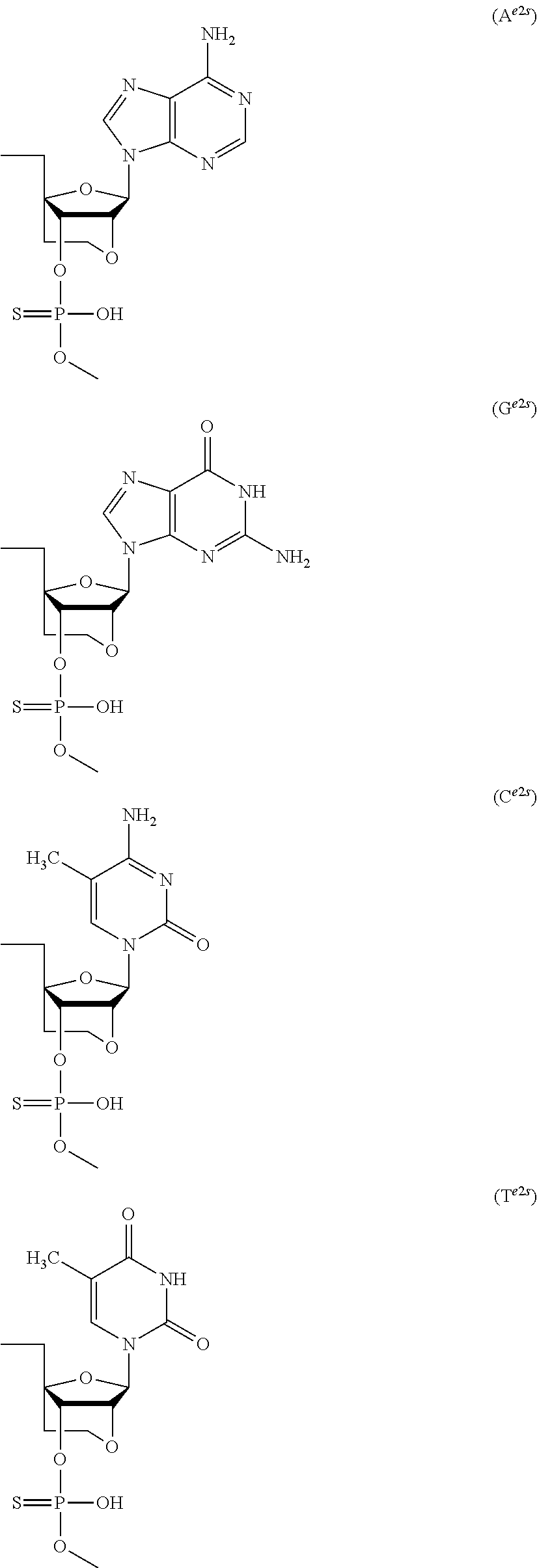


| MMLV-reverse transcriptase (Invitrogen: 200 U/μl) | 1 μl | |
| Human placenta ribonuclease inhibitor (Takara: 40 U/μl) | 1 μl | |
| DTT (attached to MMLV-reverse transcriptase) | 1 μl | |
| Buffer (attached to MMLV-reverse transcriptase) | 4 μl | |
| dNTPs (attached to Takara Ex Taq) | 5 μl | |
6. The resultant solution was kept at 37° C. for 1 hr, and then heated at 95° C. for 5 min.
7. After the reaction, the solution was stored at −80° C.
PCR Reaction
| Reverse transcription product | 3 | μl | ||
| Forward primer (10 pmol/μl) | 1 | μl | ||
| Reverse primer (10 pmol/μl) | 1 | μl | ||
| dNTP (attached to TAKARA Ex Taq) | 2 | μl | ||
| Buffer (attached to TAKARA Ex Taq) | 2 | μl | ||
| Ex Taq (TAKARA) | 0.1 | μl | ||
| Sterilized | 11 | μl | ||
2. After the above-mentioned treatment at 94° C. for 4 min, 35 cycles of 94° C. for 1 min/60° C. for 1 min/72° C. for 3 min were performed.
3. Then, the reaction solution was heated at 72° C. for 7 min.
| Forward primer: | |
| (SEQ ID NO: 8) | |
| GCA TGC TCA AGA GGA ACT TCC (exon 17) | |
| Reverse primer: | |
| (SEQ ID NO: 9) | |
| TAG CAA CTG GCA GAA TTC GAT (exon 20) |
3. The PCR product was analyzed by 2% agarose gel electrophoresis.
[Results]
| TABLE 1 | ||
| Oligonucleotide | Skipping (%) | |
| S-oligo | 2 | |
| AO1 Example 1 | 80 | |
| TABLE 2 | |||
| Oligonucleotide | Skipping (%) | ||
| AO1 Example 1 | 88 | ||
| AO14 Example 2 | 29 | ||
| AO15 Example 3 | 3 | ||
| AO16 Example 4 | 4 | ||
| AO18 Example 5 | 92 | ||
| AO19 Example 6 | 5 | ||
| AO25 Example 7 | 83 | ||
| AO17 Example 13 | 39 | ||
| AO24 Example 14 | 14 | ||
| TABLE 3 | ||
| Oligonucleotide | Skipping (%) | |
| AO18 Example 5 | 90 | |
| AO50 Example 8 | 53 | |
| AO51 Example 9 | 55 | |
| AO52 Example 10 | 97 | |
| AO53 Example 11 | 55 | |
| AO54 Example 12 | 91 | |
| MMLV-reverse transcriptase (Invitrogen: 200 U/μl) | 1 μl | |
| Human placenta ribonuclease inhibitor (Takara: 40 U/μl) | 1 μl | |
| DTT (attached to MMLV-reverse transcriptase) | 1 μl | |
| Buffer (attached to MMLV-reverse transcriptase) | 4 μl | |
| dNTPs (attached to Takara Ex Tag) | 5 μl | |
6. The resultant solution was kept at 37° C. for 1 hr, and then heated at 95° C. for 5 min.
7. After the reaction, the solution was stored at −80° C.
PCR Reaction
| Reverse transcription product | 3 μl | |
| Forward primer (10 pmol/μl) | 1 μl | |
| Reverse primer (10 pmol/μl) | 1 μl | |
| dNTP (attached to TAKARA Ex Taq) | 2 μl | |
| Buffer (attached to TAKARA Ex Taq) | 2 μl | |
| Ex Taq (TAKARA) | 0.1 μl | |
| Sterilized | 11 μl | |
2. After the above-mentioned treatment at 94° C. for 4 min, 35 cycles of 94° C. for 1 min/60° C. for 1 min/72° C. for 3 min were performed.
3. Then, the reaction solution was heated at 72° C. for 7 min.
| Forward primer: |
| (SEQ ID NO: 26) |
| 5′-GGT ATC AGT ACA AGA GGC AGG CTG-3′ (exon 40) |
| Reverse primer: |
| (SEQ ID NO: 27) |
| 5′-CAC TTC TAA TAG GGC TTG TG-3′ (exon 42) |
| Forward primer: | |
| (SEQ ID NO: 28) | |
| 5′-GCT GAA CAG TTT CTC AGA AAG ACA CAA-3′ | |
| (exon 44) | |
| Reverse primer: | |
| (SEQ ID NO: 29) | |
| 5′-TCC ACT GGA GAT TTG TCT GC-3′ | |
| (exon 47) |
4. The PCR product was analyzed by 2% agarose gel electrophoresis.
[Results]
| MMLV-reverse transcriptase (Invitrogen: 200 U/μl) | 1 μl |
| Human placenta ribonuclease inhibitor (Takara: 40 U/μl) | 1 μl |
| DTT (attached to MMLV-reverse transcriptase) | 1 μl |
| Buffer (attached to MMLV-reverse transcriptase) | 4 μl |
| dNTPs (attached to Takara Ex Taq) | 5 μl |
6. The resultant solution was kept at 37° C. for 1 hr, and then heated at 95° C. for 5 min.
7. After the reaction, the solution was stored at −80° C.
PCR Reaction
| Reverse transcription product | 3 μl | ||
| Forward primer (10 pmol/μl) | 1 μl | ||
| Reverse primer (10 pmol/μl) | 1 μl | ||
| dNTP (attached to TAKARA Ex Taq) | 2 μl | ||
| Buffer (attached to TAKARA Ex Taq) | 2 μl | ||
| Ex Taq (TAKARA) | 0.1 μl | ||
| Sterilized | 11 μl | ||
2. After the above-mentioned treatment at 94° C. for 4 min, 35 cycles of 94° C. for 1 min/60° C. for 1 min/72° C. for 3 min were performed.
3. Then, the reaction solution was heated at 72° C. for 7 min.
| Forward: | |
| (SEQ ID NO: 79) | |
| 5′-TAGTCTACAACAAAGCTCAGGT-3′ (exon 43) | |
| Reverse: | |
| (SEQ ID NO: 80) | |
| 5′-CTTCCCCAGTTGCATTCAAT-3′ (exon 45) |
Exons 50 and 51:
| Forward: | |
| (SEQ ID NO: 81) | |
| 5′-CAAGGAGAAATTGAAGCTCAA-3′ (exon 48) | |
| Reverse: | |
| (SEQ ID NO: 82) | |
| 5′-CGATCCGTAATGATTGTTCTAGC-3′ (exon 52) |
Exon 53:
| Forward: | |
| (SEQ ID NO: 83) | |
| 5′-TGGACAGAACTTACCGACTGG-3′ (exon 51) | |
| Reverse: | |
| (SEQ ID NO: 84) | |
| 5′-GGCGGAGGTCTTTGGCCAAC-3′ (exon 54) |
Exon 55:
| Forward: | |
| (SEQ ID NO: 85) | |
| 5′-AAGGATTCAACACAATGGCTGG-3′ (exon 53) | |
| Reverse: | |
| (SEQ ID NO: 86) | |
| 5′-GTAACAGGACTGCATCATCG-3′ (exon 56) |
3. The PCR product was analyzed by 2% agarose gel electrophoresis.
[Results]
| Any one of the compounds of | 500 mg |
| Examples 1 to 99 or a salt thereof | |
| Sodium chloride | 8.6 g |
| Potassium chloride | 0.3 g |
| Calcium chloride | 0.33 g |
| Distilled water for injection | to give a total volume of 1000 ml |
| Any one of the compounds of | 100 mg |
| Examples 1 to 99 or a salt thereof | |
| Sodium chloride | 8.3 g |
| Potassium chloride | 0.3 g |
| Calcium chloride | 0.33 g |
| Sodium hydrogenphosphate 12H2O | 1.8 g |
| 1N HCl | appropriate amount (pH 7.4) |
| Distilled water for injection | to give a total volume of 1000 ml |
| Any one of the compounds of | 100 mg |
| Examples 1 to 99 or a salt thereof | |
| Sodium chloride | 8.3 g |
| Potassium chloride | 0.3 g |
| Calcium chloride | 0.33 g |
| Glucose | 0.4 g |
| Sodium hydrogenphosphate 12H2O | 1.8 g |
| 1N HCl | appropriate amount (pH 7.4) |
| Distilled water for injection | to give a total volume of 1000 ml |
Claims (18)
Priority Applications (3)
| Application Number | Priority Date | Filing Date | Title |
|---|---|---|---|
| US13/673,466 US9657049B2 (en) | 2002-11-25 | 2012-11-09 | ENA nucleic acid pharmaceuticals capable of modifying splicing of mRNA precursors |
| US14/258,663 US9243026B2 (en) | 2002-11-25 | 2014-04-22 | ENA nucleic acid pharmaceuticals capable of modifying splicing of mRNA precursors |
| US14/858,404 US9657050B2 (en) | 2002-11-25 | 2015-09-18 | ENA nucleic acid pharmaceuticals capable of modifying splicing of mRNA precursors |
Applications Claiming Priority (8)
| Application Number | Priority Date | Filing Date | Title |
|---|---|---|---|
| JP2002340857 | 2002-11-25 | ||
| JP2002-340857 | 2002-11-25 | ||
| JP2003204381 | 2003-07-31 | ||
| JP2003-204381 | 2003-07-31 | ||
| PCT/JP2003/014915 WO2004048570A1 (en) | 2002-11-25 | 2003-11-21 | ENA NUCLEIC ACID DRUGS MODIFYING SPLICING IN mRNA PRECURSOR |
| US53625805A | 2005-12-13 | 2005-12-13 | |
| US12/847,237 US8624019B2 (en) | 2002-11-25 | 2010-07-30 | ENA nucleic acid drugs modifying splicing in mRNA precursor |
| US13/673,466 US9657049B2 (en) | 2002-11-25 | 2012-11-09 | ENA nucleic acid pharmaceuticals capable of modifying splicing of mRNA precursors |
Related Parent Applications (1)
| Application Number | Title | Priority Date | Filing Date |
|---|---|---|---|
| US12/847,237 Division US8624019B2 (en) | 2002-11-25 | 2010-07-30 | ENA nucleic acid drugs modifying splicing in mRNA precursor |
Related Child Applications (1)
| Application Number | Title | Priority Date | Filing Date |
|---|---|---|---|
| US14/258,663 Division US9243026B2 (en) | 2002-11-25 | 2014-04-22 | ENA nucleic acid pharmaceuticals capable of modifying splicing of mRNA precursors |
Publications (2)
| Publication Number | Publication Date |
|---|---|
| US20130090465A1 US20130090465A1 (en) | 2013-04-11 |
| US9657049B2 true US9657049B2 (en) | 2017-05-23 |
Family
ID=32396255
Family Applications (5)
| Application Number | Title | Priority Date | Filing Date |
|---|---|---|---|
| US10/536,258 Expired - Lifetime US7902160B2 (en) | 2002-11-25 | 2003-11-21 | ENA nucleic acid drugs modifying splicing in mRNA precursor |
| US12/847,237 Expired - Fee Related US8624019B2 (en) | 2002-11-25 | 2010-07-30 | ENA nucleic acid drugs modifying splicing in mRNA precursor |
| US13/673,466 Expired - Fee Related US9657049B2 (en) | 2002-11-25 | 2012-11-09 | ENA nucleic acid pharmaceuticals capable of modifying splicing of mRNA precursors |
| US14/258,663 Expired - Lifetime US9243026B2 (en) | 2002-11-25 | 2014-04-22 | ENA nucleic acid pharmaceuticals capable of modifying splicing of mRNA precursors |
| US14/858,404 Expired - Fee Related US9657050B2 (en) | 2002-11-25 | 2015-09-18 | ENA nucleic acid pharmaceuticals capable of modifying splicing of mRNA precursors |
Family Applications Before (2)
| Application Number | Title | Priority Date | Filing Date |
|---|---|---|---|
| US10/536,258 Expired - Lifetime US7902160B2 (en) | 2002-11-25 | 2003-11-21 | ENA nucleic acid drugs modifying splicing in mRNA precursor |
| US12/847,237 Expired - Fee Related US8624019B2 (en) | 2002-11-25 | 2010-07-30 | ENA nucleic acid drugs modifying splicing in mRNA precursor |
Family Applications After (2)
| Application Number | Title | Priority Date | Filing Date |
|---|---|---|---|
| US14/258,663 Expired - Lifetime US9243026B2 (en) | 2002-11-25 | 2014-04-22 | ENA nucleic acid pharmaceuticals capable of modifying splicing of mRNA precursors |
| US14/858,404 Expired - Fee Related US9657050B2 (en) | 2002-11-25 | 2015-09-18 | ENA nucleic acid pharmaceuticals capable of modifying splicing of mRNA precursors |
Country Status (7)
| Country | Link |
|---|---|
| US (5) | US7902160B2 (en) |
| EP (9) | EP2530153B1 (en) |
| JP (6) | JP4777777B2 (en) |
| AU (1) | AU2003284638A1 (en) |
| CA (4) | CA2507125C (en) |
| ES (6) | ES2509140T3 (en) |
| WO (1) | WO2004048570A1 (en) |
Cited By (8)
| Publication number | Priority date | Publication date | Assignee | Title |
|---|---|---|---|---|
| US11168141B2 (en) | 2018-08-02 | 2021-11-09 | Dyne Therapeutics, Inc. | Muscle targeting complexes and uses thereof for treating dystrophinopathies |
| US11369689B2 (en) | 2018-08-02 | 2022-06-28 | Dyne Therapeutics, Inc. | Muscle targeting complexes and uses thereof for treating dystrophinopathies |
| US11679161B2 (en) | 2021-07-09 | 2023-06-20 | Dyne Therapeutics, Inc. | Muscle targeting complexes and uses thereof for treating facioscapulohumeral muscular dystrophy |
| US11771776B2 (en) | 2021-07-09 | 2023-10-03 | Dyne Therapeutics, Inc. | Muscle targeting complexes and uses thereof for treating dystrophinopathies |
| US11787869B2 (en) | 2018-08-02 | 2023-10-17 | Dyne Therapeutics, Inc. | Methods of using muscle targeting complexes to deliver an oligonucleotide to a subject having facioscapulohumeral muscular dystrophy or a disease associated with muscle weakness |
| US12128109B2 (en) | 2021-07-09 | 2024-10-29 | Dyne Therapeutics, Inc. | Muscle targeting complexes and formulations for treating dystrophinopathies |
| US12239717B2 (en) | 2021-07-09 | 2025-03-04 | Dyne Therapeutics, Inc. | Muscle targeting complexes and uses thereof for treating dystrophinopathies |
| US12428487B2 (en) | 2018-08-02 | 2025-09-30 | Dyne Therapeutics, Inc. | Complexes comprising an anti-transferrin receptor antibody linked to an oligonicleotide and method of delivering oligonucleotide to a subject |
Families Citing this family (58)
| Publication number | Priority date | Publication date | Assignee | Title |
|---|---|---|---|---|
| KR20020097241A (en) | 2000-05-04 | 2002-12-31 | 에이브이아이 바이오파마 인코포레이티드 | Splice-region antisense composition and method |
| CA2507125C (en) | 2002-11-25 | 2014-04-22 | Masafumi Matsuo | Ena nucleic acid pharmaceuticals capable of modifying splicing of mrna precursors |
| USRE48960E1 (en) | 2004-06-28 | 2022-03-08 | The University Of Western Australia | Antisense oligonucleotides for inducing exon skipping and methods of use thereof |
| SI1766010T1 (en) * | 2004-06-28 | 2011-06-30 | Univ Western Australia | Antisense oligonucleotides for inducing exon skipping and methods of use thereof |
| CA2605512A1 (en) * | 2005-04-22 | 2006-10-26 | Academisch Ziekenhuis Leiden | Modulation of exon recognition in pre-mrna by interfering with the binding of sr proteins and by interfering with secondary rna structure. |
| WO2007123391A1 (en) | 2006-04-20 | 2007-11-01 | Academisch Ziekenhuis Leiden | Therapeutic intervention in a genetic disease in an individual by modifying expression of an aberrantly expressed gene. |
| EP1857548A1 (en) | 2006-05-19 | 2007-11-21 | Academisch Ziekenhuis Leiden | Means and method for inducing exon-skipping |
| CA2660523C (en) | 2006-08-11 | 2019-03-19 | Prosensa Technologies B.V. | Methods and means for treating dna repeat instability associated genetic disorders |
| WO2009008725A2 (en) | 2007-07-12 | 2009-01-15 | Prosensa Technologies B.V. | Molecules for targeting compounds to various selected organs, tissues or tumor cells |
| CN103212085A (en) | 2007-07-12 | 2013-07-24 | 普罗森那技术公司 | Molecules for targeting compounds to various selected organs or tissues |
| USRE48468E1 (en) | 2007-10-26 | 2021-03-16 | Biomarin Technologies B.V. | Means and methods for counteracting muscle disorders |
| PL2203173T3 (en) | 2007-10-26 | 2016-06-30 | Academisch Ziekenhuis Leiden | Means and methods for counteracting muscle disorders |
| CA2714120A1 (en) | 2008-02-08 | 2009-08-13 | Prosensa Holding Bv | Methods and means for treating dna repeat instability associated genetic disorders |
| EP2119783A1 (en) | 2008-05-14 | 2009-11-18 | Prosensa Technologies B.V. | Method for efficient exon (44) skipping in Duchenne Muscular Dystrophy and associated means |
| CA3066050A1 (en) * | 2008-10-24 | 2010-04-29 | Sarepta Therapeutics, Inc. | Multiple exon skipping compositions for dmd |
| CA2759899A1 (en) | 2009-04-24 | 2010-10-28 | Prosensa Technologies B.V. | Oligonucleotide comprising an inosine for treating dmd |
| WO2011057350A1 (en) | 2009-11-12 | 2011-05-19 | The University Of Western Australia | Antisense molecules and methods for treating pathologies |
| AU2014280918B2 (en) * | 2009-12-18 | 2016-11-17 | Arrowhead Pharmaceuticals, Inc. | Organic compositions to treat HSF1-related diseases |
| EP2513309A2 (en) | 2009-12-18 | 2012-10-24 | Novartis AG | Organic compositions to treat hsf1-related diseases |
| WO2011078672A1 (en) | 2009-12-24 | 2011-06-30 | Prosensa Technologies B.V. | Molecule for treating an inflammatory disorder |
| TWI541024B (en) | 2010-09-01 | 2016-07-11 | 日本新藥股份有限公司 | Antisense nucleic acid |
| WO2013033407A2 (en) | 2011-08-30 | 2013-03-07 | The Regents Of The University Of California | Identification of small molecules that enhance therapeutic exon skipping |
| CN117721110A (en) | 2011-12-28 | 2024-03-19 | 日本新药株式会社 | antisense nucleic acid |
| BR112014016640A2 (en) * | 2012-01-04 | 2021-03-16 | Quark Pharmaceuticals Inc | composed of double-stranded RNA for casp2 and its uses |
| BR112014018427B1 (en) * | 2012-01-27 | 2021-11-03 | Biomarin Technologies B.V. | RNA MODULATOR OLIGONUCLEOTIDES WITH IMPROVED FEATURES FOR THE TREATMENT OF DUCHENNE AND BECKER'S MUSCULAR DYSTROPHY |
| JP6928025B2 (en) * | 2012-01-27 | 2021-09-01 | バイオマリン テクノロジーズ ベー.フェー. | RNA-regulated oligonucleotides with improved features for the treatment of Duchenne and Becker muscular dystrophy |
| ES2798301T3 (en) * | 2012-06-18 | 2020-12-10 | Daiichi Sankyo Co Ltd | Intermediate for production of nucleoside analogues, and procedure for their production |
| MX366485B (en) | 2013-03-14 | 2019-07-10 | Sarepta Therapeutics Inc | COMPOSITIONS FOR EXON JUMPING FOR THE TREATMENT OF MUSCULAR DYSTROPHY. |
| US20140329762A1 (en) | 2013-03-15 | 2014-11-06 | Sarepta Therapeutics, Inc. | Compositions for treating muscular dystrophy |
| BR112016020618B1 (en) * | 2014-03-12 | 2023-04-04 | Nippon Shinyaku Co., Ltd. | ANTISENSE OLIGOMER, PHARMACEUTICAL COMPOSITION, AND, USE OF AN ANTISENSE OLIGOMER |
| RS59764B1 (en) | 2014-06-17 | 2020-02-28 | Nippon Shinyaku Co Ltd | Antisense nucleic acid for use in the treatment of duchenne's muscular dystrophy |
| JP6384845B2 (en) | 2015-09-15 | 2018-09-05 | 日本新薬株式会社 | Antisense nucleic acid |
| MA45328A (en) | 2016-04-01 | 2019-02-06 | Avidity Biosciences Llc | NUCLEIC ACID-POLYPEPTIDE COMPOSITIONS AND USES THEREOF |
| EP3478697A1 (en) | 2016-06-30 | 2019-05-08 | Sarepta Therapeutics, Inc. | Exon skipping oligomers for muscular dystrophy |
| LT3554553T (en) | 2016-12-19 | 2022-08-25 | Sarepta Therapeutics, Inc. | Exon skipping oligomer conjugates for muscular dystrophy |
| PL3554554T3 (en) | 2016-12-19 | 2022-12-19 | Sarepta Therapeutics, Inc. | Exon-skipping oligomer conjugates in muscular dystrophy |
| DK3554552T3 (en) | 2016-12-19 | 2022-10-24 | Sarepta Therapeutics Inc | EXON SKIPPING OLIGOMER CONJUGATES AGAINST MUSCULAR DYSTROPHY |
| CA3047894A1 (en) | 2016-12-28 | 2018-07-05 | Daiichi Sankyo Company, Limited | Therapeutic drug for alport's syndrome |
| SG10202107429WA (en) | 2017-01-06 | 2021-08-30 | Avidity Biosciences Inc | Nucleic acid-polypeptide compositions and methods of inducing exon skipping |
| US11963974B2 (en) | 2017-03-10 | 2024-04-23 | National Center For Child Health And Development | Antisense oligonucleotide and composition for prevention or treatment of glycogen storage disease type Ia |
| GB201711809D0 (en) | 2017-07-21 | 2017-09-06 | Governors Of The Univ Of Alberta | Antisense oligonucleotide |
| EA201991450A1 (en) | 2017-09-22 | 2019-12-30 | Сарепта Терапьютикс, Инк. | OLIGOMER CONJUGATES FOR EXONISM SKIP IN MUSCULAR DYSTROPHY |
| EP3687577A1 (en) | 2017-09-28 | 2020-08-05 | Sarepta Therapeutics, Inc. | Combination therapies for treating muscular dystrophy |
| US20200248178A1 (en) | 2017-09-28 | 2020-08-06 | Sarepta Therapeutics, Inc. | Combination therapies for treating muscular dystrophy |
| CN115976028B (en) | 2018-03-09 | 2025-03-25 | 第一三共株式会社 | Drugs for the treatment of glycogenopathies type Ia |
| US10765760B2 (en) | 2018-05-29 | 2020-09-08 | Sarepta Therapeutics, Inc. | Exon skipping oligomer conjugates for muscular dystrophy |
| BR112020026542A2 (en) | 2018-06-26 | 2021-04-06 | Nippon Shinyaku Co., Ltd. | COMPOSITION THAT UNDERSTANDS ANTISENSE OLIGONUCLEOTIDE AND USE OF THE SAME FOR TREATMENT OF DUCHENNE MUSCULAR DYSTROPHY |
| WO2021049504A1 (en) | 2019-09-10 | 2021-03-18 | 第一三共株式会社 | Galnac-oligonucleotide conjugate for liver-targeted delivery use, and method for producing same |
| IL292286A (en) | 2019-10-18 | 2022-06-01 | Daiichi Sankyo Co Ltd | Method for producing bicyclic phosphoramidite |
| BR112022012114A2 (en) | 2019-12-19 | 2022-09-06 | Nippon Shinyaku Co Ltd | ANTISENSE NUCLEIC ACID THAT ALLOWS THE LEAP OF EXONS |
| MY209476A (en) | 2019-12-26 | 2025-07-11 | Nippon Shinyaku Co Ltd | Antisense nucleic acid that induces skipping of exon 50 |
| KR20220145865A (en) | 2020-02-28 | 2022-10-31 | 니뽄 신야쿠 가부시키가이샤 | Antisense nucleic acid that induces skipping of exon 51 |
| US11987795B2 (en) | 2020-11-24 | 2024-05-21 | The Broad Institute, Inc. | Methods of modulating SLC7A11 pre-mRNA transcripts for diseases and conditions associated with expression of SLC7A11 |
| US12286630B2 (en) | 2021-04-30 | 2025-04-29 | Sarepta Therapeutics, Inc. | Treatment methods for muscular dystrophy |
| IL309626A (en) | 2021-06-23 | 2024-02-01 | Nippon Shinyaku Co Ltd | Combination of antisense oligomers |
| US20240390508A1 (en) | 2021-08-21 | 2024-11-28 | Takeda Pharmaceutical Company Limited | Human transferrin receptor binding peptide-drug conjugate |
| EP4215614A1 (en) | 2022-01-24 | 2023-07-26 | Dynacure | Combination therapy for dystrophin-related diseases |
| CN119013401A (en) | 2022-03-17 | 2024-11-22 | 萨勒普塔医疗公司 | Phosphorodiamidite morpholines substituted oligomer conjugates |
Citations (14)
| Publication number | Priority date | Publication date | Assignee | Title |
|---|---|---|---|---|
| WO1993020227A1 (en) | 1992-03-31 | 1993-10-14 | Abbott Laboratories | Method of multiplex ligase chain reaction |
| US5525470A (en) * | 1994-01-26 | 1996-06-11 | Hybridon, Inc. | Method of sequencing [short] oligonucleotides |
| US5563255A (en) * | 1994-05-31 | 1996-10-08 | Isis Pharmaceuticals, Inc. | Antisense oligonucleotide modulation of raf gene expression |
| US5853990A (en) * | 1996-07-26 | 1998-12-29 | Edward E. Winger | Real time homogeneous nucleotide assay |
| WO2000047599A1 (en) | 1999-02-12 | 2000-08-17 | Sankyo Company, Limited | Novel nucleosides and oligonucleotide analogues |
| EP1054058A1 (en) | 1999-05-21 | 2000-11-22 | Jcr Pharmaceuticals Co., Ltd. | Pharmaceutical composition for treatment of Duchenne muscular dystrophy |
| WO2001036443A1 (en) | 1999-11-19 | 2001-05-25 | Isis Pharmaceuticals, Inc. | Antisense modulation of nck-2 expression |
| EP1160318A2 (en) | 2000-04-26 | 2001-12-05 | Jcr Pharmaceuticals Co., Ltd. | Medicament for treatment of Duchenne muscular dystrophy |
| EP1191097A1 (en) | 2000-09-21 | 2002-03-27 | Leids Universitair Medisch Centrum | Induction of exon skipping in eukaryotic cells |
| EP1191098A2 (en) | 2000-08-25 | 2002-03-27 | Jcr Pharmaceuticals Co., Ltd. | Pharmaceutical composition for treatment of duchenne muscular dystrophy |
| US6436635B1 (en) * | 1992-11-06 | 2002-08-20 | Boston University | Solid phase sequencing of double-stranded nucleic acids |
| JP2002325582A (en) | 2000-08-25 | 2002-11-12 | Masafumi Matsuo | Therapeutic agent for duchenne muscular dystrophy |
| US20030219770A1 (en) * | 2001-11-08 | 2003-11-27 | Eshleman James R. | Methods and systems of nucleic acid sequencing |
| WO2004083446A2 (en) | 2003-03-21 | 2004-09-30 | Academisch Ziekenhuis Leiden | Modulation of exon recognition in pre-mrna by interfering with the secondary rna structure |
Family Cites Families (11)
| Publication number | Priority date | Publication date | Assignee | Title |
|---|---|---|---|---|
| JP2544164B2 (en) | 1987-11-28 | 1996-10-16 | 新明工業株式会社 | Piston ring assembly device |
| JPH0787982A (en) | 1993-01-29 | 1995-04-04 | Sankyo Co Ltd | Modified oligodeoxyribonucleotide |
| NZ503765A (en) | 1997-09-12 | 2002-04-26 | Exiqon As | Bi-cyclic and tri-cyclic nucleotide analogues |
| JPH11140930A (en) | 1997-11-13 | 1999-05-25 | Matsushita Electric Works Ltd | Shower device |
| US6261840B1 (en) | 2000-01-18 | 2001-07-17 | Isis Pharmaceuticals, Inc. | Antisense modulation of PTP1B expression |
| WO2001083695A2 (en) * | 2000-04-28 | 2001-11-08 | Xiao Xiao | Dna sequences encoding dystrophin minigenes and methods of use thereof |
| RU2165149C1 (en) | 2000-07-03 | 2001-04-20 | Шапошников Валерий Геннадьевич | "sugar wool" products forming and packaging method |
| US6920153B2 (en) * | 2000-07-17 | 2005-07-19 | Nortel Networks Limited | Architecture and addressing scheme for storage interconnect and emerging storage service providers |
| JP3781687B2 (en) | 2001-02-23 | 2006-05-31 | 松下電器産業株式会社 | Genetic diagnostic apparatus and genetic diagnostic method |
| JP2003204381A (en) | 2002-01-04 | 2003-07-18 | Hitachi Ltd | Information communication terminal device |
| CA2507125C (en) * | 2002-11-25 | 2014-04-22 | Masafumi Matsuo | Ena nucleic acid pharmaceuticals capable of modifying splicing of mrna precursors |
-
2003
- 2003-11-21 CA CA2507125A patent/CA2507125C/en not_active Expired - Lifetime
- 2003-11-21 ES ES09011130.3T patent/ES2509140T3/en not_active Expired - Lifetime
- 2003-11-21 ES ES12182257.1T patent/ES2566632T3/en not_active Expired - Lifetime
- 2003-11-21 EP EP12182249.8A patent/EP2530153B1/en not_active Expired - Lifetime
- 2003-11-21 CA CA2942791A patent/CA2942791C/en not_active Expired - Lifetime
- 2003-11-21 EP EP12182258.9A patent/EP2530156B1/en not_active Expired - Lifetime
- 2003-11-21 EP EP12182257.1A patent/EP2530155B1/en not_active Expired - Lifetime
- 2003-11-21 ES ES12182258.9T patent/ES2554660T3/en not_active Expired - Lifetime
- 2003-11-21 JP JP2005510284A patent/JP4777777B2/en not_active Expired - Lifetime
- 2003-11-21 ES ES12182252.2T patent/ES2566629T3/en not_active Expired - Lifetime
- 2003-11-21 WO PCT/JP2003/014915 patent/WO2004048570A1/en not_active Ceased
- 2003-11-21 EP EP03774151A patent/EP1568769A4/en not_active Withdrawn
- 2003-11-21 EP EP09011130.3A patent/EP2135948B1/en not_active Expired - Lifetime
- 2003-11-21 ES ES11155689.0T patent/ES2561851T3/en not_active Expired - Lifetime
- 2003-11-21 CA CA3001404A patent/CA3001404C/en not_active Expired - Lifetime
- 2003-11-21 EP EP11155689.0A patent/EP2386636B1/en not_active Expired - Lifetime
- 2003-11-21 CA CA2796924A patent/CA2796924C/en not_active Expired - Lifetime
- 2003-11-21 ES ES12182249.8T patent/ES2566628T3/en not_active Expired - Lifetime
- 2003-11-21 AU AU2003284638A patent/AU2003284638A1/en not_active Abandoned
- 2003-11-21 US US10/536,258 patent/US7902160B2/en not_active Expired - Lifetime
- 2003-11-21 EP EP12182252.2A patent/EP2530154B1/en not_active Expired - Lifetime
- 2003-11-21 EP EP11155691A patent/EP2392660A3/en not_active Withdrawn
- 2003-11-21 EP EP11155685A patent/EP2374885A3/en not_active Withdrawn
-
2010
- 2010-04-09 JP JP2010090504A patent/JP5138722B2/en not_active Expired - Lifetime
- 2010-07-30 US US12/847,237 patent/US8624019B2/en not_active Expired - Fee Related
-
2012
- 2012-02-10 JP JP2012027325A patent/JP5486028B2/en not_active Expired - Lifetime
- 2012-11-09 US US13/673,466 patent/US9657049B2/en not_active Expired - Fee Related
-
2014
- 2014-01-20 JP JP2014007759A patent/JP5802770B2/en not_active Expired - Lifetime
- 2014-04-22 US US14/258,663 patent/US9243026B2/en not_active Expired - Lifetime
-
2015
- 2015-05-12 JP JP2015097462A patent/JP6382150B2/en not_active Expired - Lifetime
- 2015-09-18 US US14/858,404 patent/US9657050B2/en not_active Expired - Fee Related
-
2016
- 2016-05-11 JP JP2016095419A patent/JP2016182122A/en active Pending
Patent Citations (26)
| Publication number | Priority date | Publication date | Assignee | Title |
|---|---|---|---|---|
| WO1993020227A1 (en) | 1992-03-31 | 1993-10-14 | Abbott Laboratories | Method of multiplex ligase chain reaction |
| US6436635B1 (en) * | 1992-11-06 | 2002-08-20 | Boston University | Solid phase sequencing of double-stranded nucleic acids |
| US5525470A (en) * | 1994-01-26 | 1996-06-11 | Hybridon, Inc. | Method of sequencing [short] oligonucleotides |
| US5563255A (en) * | 1994-05-31 | 1996-10-08 | Isis Pharmaceuticals, Inc. | Antisense oligonucleotide modulation of raf gene expression |
| US5853990A (en) * | 1996-07-26 | 1998-12-29 | Edward E. Winger | Real time homogeneous nucleotide assay |
| WO2000047599A1 (en) | 1999-02-12 | 2000-08-17 | Sankyo Company, Limited | Novel nucleosides and oligonucleotide analogues |
| JP2000297097A (en) | 1999-02-12 | 2000-10-24 | Sankyo Co Ltd | New nucleoside and oligonucleotide analogues |
| EP1152009A1 (en) | 1999-02-12 | 2001-11-07 | Sankyo Company, Limited | Novel nucleosides and oligonucleotide analogues |
| EP1054058A1 (en) | 1999-05-21 | 2000-11-22 | Jcr Pharmaceuticals Co., Ltd. | Pharmaceutical composition for treatment of Duchenne muscular dystrophy |
| JP2000325085A (en) | 1999-05-21 | 2000-11-28 | Masafumi Matsuo | Pharmaceutical composition for treatment of duchenne muscular dystrophy |
| US20010056077A1 (en) | 1999-05-21 | 2001-12-27 | Jcr Pharmaceuticals Co., Ltd | Pharmaceutical composition for treatment of duchenne muscular dystrophy |
| WO2001036443A1 (en) | 1999-11-19 | 2001-05-25 | Isis Pharmaceuticals, Inc. | Antisense modulation of nck-2 expression |
| JP2002010790A (en) | 2000-04-26 | 2002-01-15 | Masafumi Matsuo | Therapeutic agent for duchenne muscular dystrophy |
| EP1160318A2 (en) | 2000-04-26 | 2001-12-05 | Jcr Pharmaceuticals Co., Ltd. | Medicament for treatment of Duchenne muscular dystrophy |
| US6653467B1 (en) | 2000-04-26 | 2003-11-25 | Jcr Pharmaceutical Co., Ltd. | Medicament for treatment of Duchenne muscular dystrophy |
| US20020055481A1 (en) | 2000-08-25 | 2002-05-09 | Jcr Pharmaceuticals Co., Ltd. | Pharmaceutical composition for treatment of Duchenne muscular dystrophy |
| JP2002325582A (en) | 2000-08-25 | 2002-11-12 | Masafumi Matsuo | Therapeutic agent for duchenne muscular dystrophy |
| EP1191098A2 (en) | 2000-08-25 | 2002-03-27 | Jcr Pharmaceuticals Co., Ltd. | Pharmaceutical composition for treatment of duchenne muscular dystrophy |
| EP1191097A1 (en) | 2000-09-21 | 2002-03-27 | Leids Universitair Medisch Centrum | Induction of exon skipping in eukaryotic cells |
| WO2002024906A1 (en) | 2000-09-21 | 2002-03-28 | Academisch Ziekenhuis Leiden | Induction of exon skipping in eukaryotic cells |
| US20030235845A1 (en) | 2000-09-21 | 2003-12-25 | Van Ommen Garrit-Jan Boudewijn | Induction of exon skipping in eukaryotic cells |
| US20080209581A1 (en) | 2000-09-21 | 2008-08-28 | Academisch Ziekenhuis Leiden | Induction of exon skipping in eukaryotic cells |
| US20090228998A1 (en) | 2000-09-21 | 2009-09-10 | Academisch Ziekenhuis Leiden | Induction of exon skipping in eukaryotic cells |
| US20030219770A1 (en) * | 2001-11-08 | 2003-11-27 | Eshleman James R. | Methods and systems of nucleic acid sequencing |
| WO2004083446A2 (en) | 2003-03-21 | 2004-09-30 | Academisch Ziekenhuis Leiden | Modulation of exon recognition in pre-mrna by interfering with the secondary rna structure |
| WO2004083432A1 (en) | 2003-03-21 | 2004-09-30 | Academisch Ziekenhuis Leiden | Modulation of exon recognition in pre-mrna by interfering with the secondary rna structure |
Non-Patent Citations (63)
| Title |
|---|
| "Program and Abstracts 2003 Annual Meeting", The American Journal of Human Genetics, vol. 73, No. 5, Nov. 2003, 1 page with cover sheet. |
| AARTSMA-RUS ANNEMIEKE ET AL: "Functional analysis of 114 exon-internal AONs for targeted DMD exon skipping: indication for steric hindrance of SR protein binding sites.", OLIGONUCLEOTIDES., MARY ANN LIEBERT, NEW YORK, NY., US, vol. 15, no. 4, 1 December 2005 (2005-12-01), US, pages 284 - 297, XP002406791, ISSN: 1545-4576, DOI: 10.1089/oli.2005.15.284 |
| Agus Surono et al.: "Circular dystrophin RNAs consisting of exons that were skipped by alternative splicing", Human Molecular Genetics, vol. 8, No. 3, pp. 493-500, 1999. |
| Agus Surono et al.: "Six Novel Transcripts That Remove a huge Intron Ranging from 250 to 800 kb Are Produced by Alternative Splicing of the 5′ Region of the Dystrophin Gene in Human Skeletal Muscle", Biochemical and Biophysical Research Communications, vol. 239, No. 3, pp. 895-899, 1997. |
| Annemieke Aartsma-Rus et al., "Functional analysis of 114 Exon-Internal AON's for Targeted DMD Exon Skipping: Indication for Steric Hindrance of SR Protein Binding Sites", Oligonucleotides, XP002406791, vol. 15, No. 4, 2005, pp. 284-297. |
| Annemieke Aartsma-Rus, et al., "Targeted exon skipping as a potential gene correction therapy for Duchenne muscular dystrophy", Neuromuscular Disorders 12 (2002) S71-S77. |
| ASAKAWA J; SATOH C; KODAIRA M; HIYAMA K; FUKUDA K: "[Accurate detection of heterozygous carriers of a deletion or a duplication by combined PCR and HPLC] .", TAMPAKUSHITSU KAKUSAN KOSO - PROTEIN, NUCLEIC ACID AND ENZYME = TANPAKUSHITSU-KAKUSAN-KÔSO, KYORITSU SHUPPAN, TOKYO,, JP, vol. 38, no. 16, 1 December 1993 (1993-12-01), JP, pages 2723 - 2727, XP009158480, ISSN: 0039-9450 |
| Beroud, et al., "Multiexon Skipping Leading to an Artificial DMD Protein Lacking Amino Acids from Exons 45 Through 55 Could Rescue Up to 63% of Patients With Duchenne Muscular Dystrophy", Human Mutation, 28(2), pp. 196-202, 2007. |
| Book of reports about studies conducted by the grants for commission of studies on mental and nerve diseases from Ministry of Health, Labour and Welfare on 2002, (Jul. 28, 2003), p. 590 (w/partial English translation). |
| Bremmer-Bout (Mol. Ther. 10(2): 232-240, 2004). |
| Buck et al. (Biotechniques, 1999, 27:528-536). * |
| Chieko Ishigaki et al.: Early cardiac failure in a child with Becker muscular dystrophy is due to an abnormally low amount of dystrophin transcript lacking exon 13, Acta Paediatrica Japonica, vol. 39, pp. 685-689, 1997. |
| Christopher J. Mann, et al., "Antisense-induced exon skipping and synthesis of dystrophin in the mdx mouse", PNAS, vol. 98, No. 1 (2001), p. 42-47. |
| Christopher J. Mann, et al., "Improved antisense oligonucleotide induced exon skipping in the mdx mouse model of muscular dystrophy", The Journal of Gene Medicine, vol. 4, No. 6 (Nov.-Dec. 2002), p. 644-654. |
| D-H. Chen et al.: "A novel deletion of the dystrophin S-promoter region cosegregating with metal", Neurology, vol. 52, pp. 638-640, 1999. |
| Elizabeth M. McNally, et al., "Mild and Severe Muscular Dystrophy Caused by a Single γ-Sarcoglycan Mutation", American Journal of Human Genetics, vol. 59, No. 5, XP009128432, Nov. 1996, pp. 1040-1047. |
| Extended European Search Report Issued Aug. 2, 2012 in Patent Application No. 11155689.0. |
| Extended European Search Report issued Feb. 11, 2010, in Application No. 09011130.3-2404 / 2135948. |
| Fernada Gabriella De Angelis, et al., "Chimeric snRNA molecules carrying antisense sequences against the splice junctions of exon 51 of the dystrophin pre-mRNA induce exon skipping and restoration of a dystrophin synthesis in Δ48-50 DMD cells", PNAS, vol. 99, No. 14, (Jul. 2002), p. 9456-9461. |
| Gebski et al (Hum. Mol. Gen. 12(15): 1801-1811, 2003). |
| GenBank Accession M18533 (2000). * |
| HARDING P L; FALL A M; HONEYMAN K; FLETCHER S; WILTON S D: "The influence of antisense oligonucleotide length on dystrophin exon skipping.", MOLECULAR THERAPY, ACADEMIC PRESS, US, vol. 15, no. 1, 1 January 2007 (2007-01-01), US, pages 157 - 166, XP009101408, ISSN: 1525-0016, DOI: 10.1038/sj.mt.6300006 |
| Harding, PL, et al., "The Influence of Antisense Oligonucleotide Length on Dystrophin Exon Skipping," Molecular Therapy, vol. 15, No. 1, Jan. 2007, pp. 157-166, XP009101408. |
| Journal Clinical Rehabilitation., vol. 12, No. 10 (Oct. 2003) p. 900-906. |
| Judith C. T. van Deutekom et al., "Advances in Duchenne Muscular Dystrophy Gene Therapy", Nature Reviews Genetics, XP002993824, vol. 4, Oct. 2003, pp. 774-783. |
| Judith C. T. Van Deutekom, et al., Antisense-induced exon skipping restores dystrophin expression in DMD patient derived muscle cells, Human Molecular Genetics, (2001), vol. 10, No. 15, 1547-1554. |
| Jun-ichi Asakawa et al., "Accurate Detection of Heterozygous Carriers of a Deletion or a Duplication by Combined PCR and HPLC", Tanpakushitsu Kakusan Koso. Protein, Nucleic Acid, Enzyme, XP009158480, vol. 38, No. 16, 1993, pp. 2723-2727. |
| K. E. Wells et al., "Enhanced in vivo delivery of antisense oligonucleotides to restore dystrophin expression in adult mdx mouse muscle", FEBS Letters, XP004460888, vol. 552, No. 2-3, 2003, pp. 145-149. |
| Koji Morita, et al., 2′-O,4′-C-Ethylene-Bridged Nucleic Acids (ENA): Highly Nuclease-Resistant and Thermodynamically Stable Oligonucleotides for Antisense Drug, Bioorganic & Medicinal Chemistry Letters, vol. 12, No. 1 (Jan. 2002), p. 73-76. |
| Lu et al (Nature Medicine 9(8) 1009-1014, 2003). |
| Luciana C. B. Dolinsky, "Denaturing Gradient Gel Electrophoresis (DGGE) for Mutation Detection in Duchenne Muscular Dystrophy (DMD)", Methods in Molecular Biology, XP002673981, vol. 217, 2003, pp. 165-175. |
| Mariko Yagi, et al., "Establishment of Antisense ENAs Inducing the Skipping of Exons 45 and 46 of the Dystrophin Gene", Journal of Japanese Society for Inherited Metabolic Diseases, vol. 19, No. 2, Oct. 2003, p. 154 with English translation. |
| Masafumi Matsuo et al.: "Gene Diagnosis in the Field of Child Neurology: Introductory Remarks", No To Hattatsu, vol. 30, pp. 121-122, 1998. |
| Masafumi Matsuo, "Duchenne and Becker Muscular Dystrophy: From Gene Diagnosis to Molecular Therapy", IUBMB Life, vol. 53, No. 3 (Mar. 2002), p. 147-152. |
| Masanori Ino-ue et al.: "Genotype and Electroretinal Heterogeneity in Duchenne Muscular Dystrophy", Exp. Eye Res., vol. 65, pp. 861-864, 1997. |
| Matsuo (Brain and Dev. 18: 167-172, 1996). |
| MCNALLY E M; PASSOS-BUENO M R; BOENNEMANN C G; VAINZOF M; DE SÁ MOREIRA E; LIDOV H G; OTHMANE K B; DENTON P H; VANCE J M; ZATZ M; : "Mild and severe muscular dystrophy caused by a single gamma-sarcoglycan mutation.", AMERICAN JOURNAL OF HUMAN GENETICS, AMERICAN SOCIETY OF HUMAN GENETICS, CHICAGO, IL., US, vol. 59, no. 5, 1 November 1996 (1996-11-01), US, pages 1040 - 1047, XP009128432, ISSN: 0002-9297 |
| N. Tachi et al.: "Deficiency of syntrophin, dystroglycan, and merosin in a female infant with a congenital muscular dystrophy phenotype lacking cysteine-rich and C-terminal domains of dystrophin", Neurology, vol. 49, pp. 579-583, 1997. |
| Nobuyuki Shiga et al.: "Disruption of the Splicing Enhancer Sequence within Exon 27 of the Dystrophin Gene by a Nonsense Mutation Induces Partial Skipping of the Exon and is Responsible for Becker Muscular Dystrophy", J. Clin. Invest., vol. 100, No. 9, pp. 2204-2210, Nov. 1997. |
| Nobuyuki Shiga et al.: "Study on Mutations Affecting the Muscle Promoter/First Exon of the Dystrophin Gene in 92 Japanese Dilated Cardiomyopathy Patients", American Journal of Medical Genetics, vol. 79, pp. 226-227, 1998. |
| Office Action issued Jan. 17, 2011, in Canada Patent Application No. 2,507,125. |
| Office Action issued Nov. 26, 2013 in Japanese Patent Application No. 2012-027325 with English language translation. |
| POTTER N. T.: "Neurogenetics : methods and protocols", vol. 217, 1 January 2003, HUMANA PRESS, Totowa, NJ, ISBN: 978-0-89603-990-2, article DOLINSKY LUCIANA C B: "Denaturing gradient gel electrophoresis (DGGE) for mutation detection in Duchenne muscular dystrophy (DMD).", pages: 165 - 175, XP002673981 |
| R J GARDNER, M BOBROW, AND R G ROBERTS: "The identification of point mutations in Duchenne muscular dystrophy patients by using reverse-transcription PCR and the protein truncation test.", AMERICAN JOURNAL OF HUMAN GENETICS, AMERICAN SOCIETY OF HUMAN GENETICS, CHICAGO, IL., US, vol. 57, no. 2, 1 August 1995 (1995-08-01), US, pages 311 - 320, XP002673980, ISSN: 0002-9297 |
| Rebecca J. Gardner et al., "The Identification of Point Mutations in Duchenne Muscular Dystrophy Patients by Using Reverse-Transcription PCR and the Protein Truncation Test", American Journal of Human Genetics, XP002673980, vol. 57, No. 2, 1995, pp. 311-320. |
| Scheuerbrandt, "Research Approaches for a Therapy of Duchenne Muscular Dystrophy", Parent Project Muscular Dystrophy, action duchenne, TREAT-NMD, pp. 1-20, Apr. 30, 2009, http://www.cureduchenne.org/2009/05/research-approaches-for-a-therapy-of-duchenne-muscular-dystrophy/,. |
| SURONO AGUS; VAN KHANH TRAN; TAKESHIMA YASUHIRO; WADA HIROKO; YAGI MARIKO; TAKAGI MIHO; KOIZUMI MAKOTO; MATSUO MASAFUMI: "Chimeric RNA/ethylene-bridged nucleic acids promote dystrophin expression in myocytes of duchenne muscular dystrophy by inducing skipping of the nonsense mutation-encoding exon.", HUMAN GENE THERAPY, MARY ANN LIEBERT, INC. PUBLISHERS, US, vol. 15, no. 8, 1 August 2004 (2004-08-01), US, pages 749 - 757, XP009101403, ISSN: 1043-0342, DOI: 10.1089/1043034041648444 |
| Surono, A., et al., "Chimeric RNA/Ethylene-Bridged Nucleic Acids Promote Dystrophin Expression in Myocytes of Duchenne Muscular Dystrophy by Inducing Skipping of the Nonsense Mutation-Encoding Exon," Human Gene Therapy, vol. 15, Aug. 2004, pp. 749-757, XP009101403. |
| Suryono Yudha Patria et al: "A simple explanation for a case of incompatibility with the reading frame theory in Duchenne muscular dystrophy: failure to detect an aberrant restriction fragment in Southern blot analysis", Brain & Development, vol. 21, pp. 386-389, 1999. |
| Switzer, "Nucleotides: Uncommon, Modified and Synthetic", in Encyclopedia of Life Sciences, copyright 2001, John Wiley & Sons, Ltd, retrieved from http://onlinelibrary.wiley.com/doi/10.1038/npg.els.0001334/pdf). * |
| TAKESHIMA Y., ET AL.: "MODULATION OF IN VITRO SPLICING OF THE UPSTREAM INTRON BY MODIFYINGAN INTRA-EXON SEQUENCE WHICH IS DELETED FROM THE DYSTROPHIN GENE INDYSTROPHIN KOBE.", JOURNAL OF CLINICAL INVESTIGATION, AMERICAN SOCIETY FOR CLINICAL INVESTIGATION, US, vol. 95, no. 2, 1 February 1995 (1995-02-01), US, pages 515 - 520., XP000939311, ISSN: 0021-9738, DOI: 10.1172/JCI117693 |
| Takeshima, et al., Intravenous Infusion of an Antisense Oligonucleotide Results in Exon Skipping in Muscle Dystrophin mRNA of Duchenne Muscular Dystrophy, Pediatric Research, vol. 59, No. 5, 2006, pp. 690-694. |
| VAN DEUTEKOM J C T, VAN OMMEN G-J B: "Advances in Duchenne Muscular Dystrophy Gene Therapy.", NATURE REVIEWS GENETICS, MACMILLAN MAGAZINES, GB, vol. 4, 1 October 2003 (2003-10-01), GB, pages 774 - 783, XP002993824 |
| van Deutekom, "Local Dystrophin Restoration with Antisense Oligonucleotide PRO051", The New England Journal of Medicine, vol. 357; 26, pp. 2677-2686, 2007. |
| Wahlestedt et al (Proc. Nat. Acad. Sci. USA (May 9, 2000) vol. 97, No. 10, pp. 5633-5638). |
| WELLS, K.E. FLETCHER, S. MANN, C.J. WILTON, S.D. WELLS, D.J.: "Enhanced in vivo delivery of antisense oligonucleotides to restore dystrophin expression in adult mdx mouse muscle", FEBS LETTERS., ELSEVIER, AMSTERDAM., NL, vol. 552, no. 2-3, 25 September 2003 (2003-09-25), NL, pages 145 - 149, XP004460888, ISSN: 0014-5793, DOI: 10.1016/S0014-5793(03)00904-9 |
| Yasuhiro Takeshima et al.: "Molecular genetics and problems found in genetic diagnosis of Duchenne/Becker muscular dystrophy", Nihon Rinsho, vol. 55, No. 12, pp. 3120-3125, 1997. |
| Yasuhiro Takeshima, et al., "Modulation of in Vitro Splicing of the Upstream Intron by Modifying an Intra-Exon Sequence Which is deleted from the Dystrophin Gene in Dystrophin Kobe", Journal of Clinical Investigation, American Society for Clinical Investigation, vol. 95, No. 2, XP-000939311, Feb. 1, 1995, 6 pages. |
| Yasuhiro Takeshima, et al., "Molecular Therapy for Duchenne Muscular Dystrophy", J. Clin. Rehabil., vol. 12, No. 10, Oct. 2003, pp. 900-906 with English translation. |
| Yasuhiro Takeshima, et al., "Oligonucleotides against a splicing enhancer sequence led to dystrophin production in muscle cells from a Duchenne muscular dystrophy patient", Brain & Development, vol. 23, No. 8 (2001), p. 788-790. |
| Yokota et al. (Ann. Neurol. 65; 667-676, 2009). |
| Zacharias Aloysius Dwi Pramono et al.: "A Novel Cryptic Exon in Intron 2 of the Human Dystrophin Gene Evolved from an Intron by Acquiring Consensus Sequences for Splicing at Different Stages of Anthropoid Evolution", Biochemical and Biophysical Research Communications, vol. 267, No. 1, pp. 321-328, 2000. |
| Zacharias Aloysius Dwi Pramono, et al., "Induction of Exon Skipping of the Dystrophin Transcript in Lymphoblastoid Cells by Transfecting an Antisense Oligodeoxynucleotide Complementary to an Exon Recognition Sequence", Biochemical and Biophysical Research Communications, vol. 226, No. 2 (1996), p. 445-449. |
Cited By (31)
| Publication number | Priority date | Publication date | Assignee | Title |
|---|---|---|---|---|
| US12012460B2 (en) | 2018-08-02 | 2024-06-18 | Dyne Therapeutics, Inc. | Muscle-targeting complexes comprising an anti-transferrin receptor antibody linked to an oligonucleotide |
| US12325753B2 (en) | 2018-08-02 | 2025-06-10 | Dyne Therapeutics, Inc. | Method of using an anti-transferrin receptor antibody to deliver an oligonucleotide to a subject having facioscapulohumeral muscular dystrophy |
| US11369689B2 (en) | 2018-08-02 | 2022-06-28 | Dyne Therapeutics, Inc. | Muscle targeting complexes and uses thereof for treating dystrophinopathies |
| US11497815B2 (en) | 2018-08-02 | 2022-11-15 | Dyne Therapeutics, Inc. | Muscle targeting complexes and uses thereof for treating dystrophinopathies |
| US11633496B2 (en) | 2018-08-02 | 2023-04-25 | Dyne Therapeutics, Inc. | Muscle targeting complexes and uses thereof for treating dystrophinopathies |
| US12478687B2 (en) | 2018-08-02 | 2025-11-25 | Dyne Therapeutics, Inc. | United states |
| US12428487B2 (en) | 2018-08-02 | 2025-09-30 | Dyne Therapeutics, Inc. | Complexes comprising an anti-transferrin receptor antibody linked to an oligonicleotide and method of delivering oligonucleotide to a subject |
| US11787869B2 (en) | 2018-08-02 | 2023-10-17 | Dyne Therapeutics, Inc. | Methods of using muscle targeting complexes to deliver an oligonucleotide to a subject having facioscapulohumeral muscular dystrophy or a disease associated with muscle weakness |
| US11795234B2 (en) | 2018-08-02 | 2023-10-24 | Dyne Therapeutics, Inc. | Methods of producing muscle-targeting complexes comprising an anti-transferrin receptor antibody linked to an oligonucleotide |
| US11795233B2 (en) | 2018-08-02 | 2023-10-24 | Dyne Therapeutics, Inc. | Muscle-targeting complex comprising an anti-transferrin receptor antibody linked to an oligonucleotide |
| US11833217B2 (en) | 2018-08-02 | 2023-12-05 | Dyne Therapeutics, Inc. | Muscle targeting complexes and uses thereof for treating dystrophinopathies |
| US12357703B2 (en) | 2018-08-02 | 2025-07-15 | Dyne Therapeutics, Inc. | Muscle-targeting complexes comprising an anti-transferin receptor antibody linked to an oligonucleotide and method of use thereof to induce exon skipping |
| US12329825B1 (en) | 2018-08-02 | 2025-06-17 | Dyne Therapeutics, Inc. | Muscle targeting complexes comprising an anti-transferrin receptor antibody linked to an oligonucleotide and method of use thereof to induce exon skipping of exon 44 of dystrophin in a subject |
| US12005124B2 (en) | 2018-08-02 | 2024-06-11 | Dyne Therapeutics, Inc. | Muscle targeting complexes and uses thereof for treating dystrophinopathies |
| US11248056B1 (en) | 2018-08-02 | 2022-02-15 | Dyne Therapeutics, Inc. | Muscle targeting complexes and uses thereof for treating dystrophinopathies |
| US11168141B2 (en) | 2018-08-02 | 2021-11-09 | Dyne Therapeutics, Inc. | Muscle targeting complexes and uses thereof for treating dystrophinopathies |
| US12173079B2 (en) | 2018-08-02 | 2024-12-24 | Dyne Therapeutics, Inc. | Muscle-targeting complexes comprising an anti-transferrin receptor antibody linked to an oligonucleotide |
| US12263225B2 (en) | 2018-08-02 | 2025-04-01 | Dyne Therapeutics, Inc. | Muscle-targeting complexes comprising an anti-transferrin receptor antibody linked to an oligonucleotide and methods of use thereof to target dystrophin and to treat Duchenne muscular dystrophy |
| US12440575B2 (en) | 2021-07-09 | 2025-10-14 | Dyne Therapeutics, Inc. | Muscle targeting complexes and uses thereof for treating dystrophinopathies |
| US12239717B2 (en) | 2021-07-09 | 2025-03-04 | Dyne Therapeutics, Inc. | Muscle targeting complexes and uses thereof for treating dystrophinopathies |
| US12239716B2 (en) | 2021-07-09 | 2025-03-04 | Dyne Therapeutics, Inc. | Muscle targeting complexes and uses thereof for treating dystrophinopathies |
| US12144867B2 (en) | 2021-07-09 | 2024-11-19 | Dyne Therapeutics, Inc. | Muscle targeting complexes and uses thereof for treating dystrophinopathies |
| US12144868B2 (en) | 2021-07-09 | 2024-11-19 | Dyne Therapeutics, Inc. | Muscle targeting complexes and uses thereof for treating dystrophinopathies |
| US11844843B2 (en) | 2021-07-09 | 2023-12-19 | Dyne Therapeutics, Inc. | Muscle targeting complexes and uses thereof for treating facioscapulohumeral muscular dystrophy |
| US11986537B2 (en) | 2021-07-09 | 2024-05-21 | Dyne Therapeutics, Inc. | Muscle targeting complexes and uses thereof for treating dystrophinopathies |
| US12128109B2 (en) | 2021-07-09 | 2024-10-29 | Dyne Therapeutics, Inc. | Muscle targeting complexes and formulations for treating dystrophinopathies |
| US12397062B2 (en) | 2021-07-09 | 2025-08-26 | Dyne Therapeutics, Inc. | Muscle targeting complexes and uses thereof for treating dystrophinopathies |
| US12403203B2 (en) | 2021-07-09 | 2025-09-02 | Dyne Therapeutics, Inc. | Muscle targeting complexes and uses thereof for treating dystrophinopathies |
| US11771776B2 (en) | 2021-07-09 | 2023-10-03 | Dyne Therapeutics, Inc. | Muscle targeting complexes and uses thereof for treating dystrophinopathies |
| US12329824B1 (en) | 2021-07-09 | 2025-06-17 | Dyne Therapeutics, Inc. | Muscle targeting complexes and uses thereof for treating dystrophinopathies |
| US11679161B2 (en) | 2021-07-09 | 2023-06-20 | Dyne Therapeutics, Inc. | Muscle targeting complexes and uses thereof for treating facioscapulohumeral muscular dystrophy |
Also Published As
Similar Documents
| Publication | Publication Date | Title |
|---|---|---|
| US9657049B2 (en) | ENA nucleic acid pharmaceuticals capable of modifying splicing of mRNA precursors | |
| US10683322B2 (en) | Antisense nucleic acids | |
| KR102368918B1 (en) | Oligonucleotide therapy for leber congenital amaurosis | |
| TW202043470A (en) | Rnai agents for inhibiting expression of hif-2 alpha (epas1), compositions thereof, and methods of use |
Legal Events
| Date | Code | Title | Description |
|---|---|---|---|
| AS | Assignment |
Owner name: DAIICHI SANKYO COMPANY, LIMITED, JAPAN Free format text: ASSIGNMENT OF ASSIGNORS INTEREST;ASSIGNOR:KNC LABORATORIES CO., LTD.;REEL/FRAME:029970/0465 Effective date: 20120725 |
|
| AS | Assignment |
Owner name: ORPHAN DISEASE TREATMENT INSTITUTE CO., LTD., JAPA Free format text: ASSIGNMENT OF ASSIGNORS INTEREST;ASSIGNOR:NONPROFIT ORGANIZATION TRANSLATIONAL RESEARCH ORGANIZATION OF DUCHENNE MUSCULAR DYSTROPHY;REEL/FRAME:030319/0247 Effective date: 20130419 |
|
| AS | Assignment |
Owner name: TAKESHIMA, YASUHIRO, JAPAN Free format text: INDIVIDUAL ADDRESS CHANGE;ASSIGNORS:MATSUO, MASAFUMI;TAKESHIMA, YASUHIRO;REEL/FRAME:037459/0888 Effective date: 20160104 Owner name: MATSUO, MASAFUMI, JAPAN Free format text: INDIVIDUAL ADDRESS CHANGE;ASSIGNORS:MATSUO, MASAFUMI;TAKESHIMA, YASUHIRO;REEL/FRAME:037459/0888 Effective date: 20160104 |
|
| STCF | Information on status: patent grant |
Free format text: PATENTED CASE |
|
| MAFP | Maintenance fee payment |
Free format text: PAYMENT OF MAINTENANCE FEE, 4TH YEAR, LARGE ENTITY (ORIGINAL EVENT CODE: M1551); ENTITY STATUS OF PATENT OWNER: LARGE ENTITY Year of fee payment: 4 |
|
| AS | Assignment |
Owner name: DAIICHI SANKYO COMPANY, LIMITED, JAPAN Free format text: ASSIGNMENT OF ASSIGNORS INTEREST;ASSIGNOR:ORPHAN DISEASE TREATMENT INSTITUTE CO., LTD.;REEL/FRAME:057270/0430 Effective date: 20210806 |
|
| FEPP | Fee payment procedure |
Free format text: MAINTENANCE FEE REMINDER MAILED (ORIGINAL EVENT CODE: REM.); ENTITY STATUS OF PATENT OWNER: LARGE ENTITY |
|
| LAPS | Lapse for failure to pay maintenance fees |
Free format text: PATENT EXPIRED FOR FAILURE TO PAY MAINTENANCE FEES (ORIGINAL EVENT CODE: EXP.); ENTITY STATUS OF PATENT OWNER: LARGE ENTITY |
|
| STCH | Information on status: patent discontinuation |
Free format text: PATENT EXPIRED DUE TO NONPAYMENT OF MAINTENANCE FEES UNDER 37 CFR 1.362 |
|
| FP | Lapsed due to failure to pay maintenance fee |
Effective date: 20250523 |