EP2135948B1 - ENA nucleic acid drugs modifying splicing in mRNA precursor - Google Patents
ENA nucleic acid drugs modifying splicing in mRNA precursor Download PDFInfo
- Publication number
- EP2135948B1 EP2135948B1 EP09011130.3A EP09011130A EP2135948B1 EP 2135948 B1 EP2135948 B1 EP 2135948B1 EP 09011130 A EP09011130 A EP 09011130A EP 2135948 B1 EP2135948 B1 EP 2135948B1
- Authority
- EP
- European Patent Office
- Prior art keywords
- compound
- dna
- oligonucleotide
- group
- synthetic oligonucleotide
- Prior art date
- Legal status (The legal status is an assumption and is not a legal conclusion. Google has not performed a legal analysis and makes no representation as to the accuracy of the status listed.)
- Expired - Lifetime
Links
- 0 CC[C@](C(*C)C1*)O[C@@]1N(C=CC(N)=N1)C1=O Chemical compound CC[C@](C(*C)C1*)O[C@@]1N(C=CC(N)=N1)C1=O 0.000 description 10
- XKUVJSCTFWQLQA-FCYNSUMHSA-N CCC(CCOC12)(C1OP(O)(OC)=O)O[C@H]2N(C=C(C)C(N)=N1)C1=O Chemical compound CCC(CCOC12)(C1OP(O)(OC)=O)O[C@H]2N(C=C(C)C(N)=N1)C1=O XKUVJSCTFWQLQA-FCYNSUMHSA-N 0.000 description 1
- YXSWXLPMUUWKMC-DGWNVUOJSA-N CCC(CCO[C@@H]12)([C@@H]1OP(O)(OC)=O)OC2N(C=C(C)C(N1)=O)C1=O Chemical compound CCC(CCO[C@@H]12)([C@@H]1OP(O)(OC)=O)OC2N(C=C(C)C(N1)=O)C1=O YXSWXLPMUUWKMC-DGWNVUOJSA-N 0.000 description 1
- YFYDMJJNLYHOBP-UPLNTUIUSA-O CCC(CO[C@@H]12)(C1OP(O)([OH+]C)=O)O[C@H]2N(C=C(C)C(N)=N1)C1=O Chemical compound CCC(CO[C@@H]12)(C1OP(O)([OH+]C)=O)O[C@H]2N(C=C(C)C(N)=N1)C1=O YFYDMJJNLYHOBP-UPLNTUIUSA-O 0.000 description 1
- VXGJNAYWLYWJBK-UHFFFAOYSA-N CCC(OCC1(C[n]2c3ncnc(N)c3nc2)OC)=C1OP(O)(OC)=S Chemical compound CCC(OCC1(C[n]2c3ncnc(N)c3nc2)OC)=C1OP(O)(OC)=S VXGJNAYWLYWJBK-UHFFFAOYSA-N 0.000 description 1
- TYGUNNRGQLQJGL-MZXJOCFISA-N CCC(O[C@H](C1OC)[n]2c(N=C(C)NC3N)c3nc2)=C1OP(O)(OC)=S Chemical compound CCC(O[C@H](C1OC)[n]2c(N=C(C)NC3N)c3nc2)=C1OP(O)(OC)=S TYGUNNRGQLQJGL-MZXJOCFISA-N 0.000 description 1
- DIKZJCUGEQKNLX-UHFFFAOYSA-N CCC([O]=C(C1OC)N(CCC=O)C(N=C)=O)=C1OP(O)(OC)=S Chemical compound CCC([O]=C(C1OC)N(CCC=O)C(N=C)=O)=C1OP(O)(OC)=S DIKZJCUGEQKNLX-UHFFFAOYSA-N 0.000 description 1
Images

Classifications
-
- C—CHEMISTRY; METALLURGY
- C07—ORGANIC CHEMISTRY
- C07H—SUGARS; DERIVATIVES THEREOF; NUCLEOSIDES; NUCLEOTIDES; NUCLEIC ACIDS
- C07H21/00—Compounds containing two or more mononucleotide units having separate phosphate or polyphosphate groups linked by saccharide radicals of nucleoside groups, e.g. nucleic acids
- C07H21/04—Compounds containing two or more mononucleotide units having separate phosphate or polyphosphate groups linked by saccharide radicals of nucleoside groups, e.g. nucleic acids with deoxyribosyl as saccharide radical
-
- A—HUMAN NECESSITIES
- A61—MEDICAL OR VETERINARY SCIENCE; HYGIENE
- A61P—SPECIFIC THERAPEUTIC ACTIVITY OF CHEMICAL COMPOUNDS OR MEDICINAL PREPARATIONS
- A61P21/00—Drugs for disorders of the muscular or neuromuscular system
-
- A—HUMAN NECESSITIES
- A61—MEDICAL OR VETERINARY SCIENCE; HYGIENE
- A61P—SPECIFIC THERAPEUTIC ACTIVITY OF CHEMICAL COMPOUNDS OR MEDICINAL PREPARATIONS
- A61P21/00—Drugs for disorders of the muscular or neuromuscular system
- A61P21/04—Drugs for disorders of the muscular or neuromuscular system for myasthenia gravis
-
- C—CHEMISTRY; METALLURGY
- C12—BIOCHEMISTRY; BEER; SPIRITS; WINE; VINEGAR; MICROBIOLOGY; ENZYMOLOGY; MUTATION OR GENETIC ENGINEERING
- C12N—MICROORGANISMS OR ENZYMES; COMPOSITIONS THEREOF; PROPAGATING, PRESERVING, OR MAINTAINING MICROORGANISMS; MUTATION OR GENETIC ENGINEERING; CULTURE MEDIA
- C12N15/00—Mutation or genetic engineering; DNA or RNA concerning genetic engineering, vectors, e.g. plasmids, or their isolation, preparation or purification; Use of hosts therefor
- C12N15/09—Recombinant DNA-technology
- C12N15/11—DNA or RNA fragments; Modified forms thereof; Non-coding nucleic acids having a biological activity
- C12N15/113—Non-coding nucleic acids modulating the expression of genes, e.g. antisense oligonucleotides; Antisense DNA or RNA; Triplex- forming oligonucleotides; Catalytic nucleic acids, e.g. ribozymes; Nucleic acids used in co-suppression or gene silencing
-
- A—HUMAN NECESSITIES
- A61—MEDICAL OR VETERINARY SCIENCE; HYGIENE
- A61K—PREPARATIONS FOR MEDICAL, DENTAL OR TOILETRY PURPOSES
- A61K38/00—Medicinal preparations containing peptides
-
- A—HUMAN NECESSITIES
- A61—MEDICAL OR VETERINARY SCIENCE; HYGIENE
- A61K—PREPARATIONS FOR MEDICAL, DENTAL OR TOILETRY PURPOSES
- A61K48/00—Medicinal preparations containing genetic material which is inserted into cells of the living body to treat genetic diseases; Gene therapy
-
- C—CHEMISTRY; METALLURGY
- C12—BIOCHEMISTRY; BEER; SPIRITS; WINE; VINEGAR; MICROBIOLOGY; ENZYMOLOGY; MUTATION OR GENETIC ENGINEERING
- C12N—MICROORGANISMS OR ENZYMES; COMPOSITIONS THEREOF; PROPAGATING, PRESERVING, OR MAINTAINING MICROORGANISMS; MUTATION OR GENETIC ENGINEERING; CULTURE MEDIA
- C12N2310/00—Structure or type of the nucleic acid
- C12N2310/10—Type of nucleic acid
- C12N2310/11—Antisense
-
- C—CHEMISTRY; METALLURGY
- C12—BIOCHEMISTRY; BEER; SPIRITS; WINE; VINEGAR; MICROBIOLOGY; ENZYMOLOGY; MUTATION OR GENETIC ENGINEERING
- C12N—MICROORGANISMS OR ENZYMES; COMPOSITIONS THEREOF; PROPAGATING, PRESERVING, OR MAINTAINING MICROORGANISMS; MUTATION OR GENETIC ENGINEERING; CULTURE MEDIA
- C12N2310/00—Structure or type of the nucleic acid
- C12N2310/30—Chemical structure
- C12N2310/32—Chemical structure of the sugar
- C12N2310/323—Chemical structure of the sugar modified ring structure
- C12N2310/3231—Chemical structure of the sugar modified ring structure having an additional ring, e.g. LNA, ENA
-
- C—CHEMISTRY; METALLURGY
- C12—BIOCHEMISTRY; BEER; SPIRITS; WINE; VINEGAR; MICROBIOLOGY; ENZYMOLOGY; MUTATION OR GENETIC ENGINEERING
- C12N—MICROORGANISMS OR ENZYMES; COMPOSITIONS THEREOF; PROPAGATING, PRESERVING, OR MAINTAINING MICROORGANISMS; MUTATION OR GENETIC ENGINEERING; CULTURE MEDIA
- C12N2320/00—Applications; Uses
- C12N2320/30—Special therapeutic applications
- C12N2320/33—Alteration of splicing
Definitions
- the present invention relates to ENA nucleic acid pharmaceuticals capable of modifying splicing of mRNA precursors. More specifically, the present invention relates to antisense oligonucleotide compounds to splicing enhancer sequences within exon 45 of the dystrophin gene, as well as therapeutic agents for muscular dystrophy comprising the compounds.
- Muscular dystrophy which is a genetic muscular disease, is roughly classified into Duchenne muscular dystrophy (DMD) and Becker muscular dystrophy (BMD).
- DMD is the most frequently occurring genetic muscular disease and occurs at a ratio of 1 per 3,500 male births.
- DMD patients show symptoms of weakening of muscles in their childhood; thereafter, muscular atrophy progresses consistently and results in death at the age of around 20.
- BMD Becker muscular dystrophy
- dystrophin protein disappears completely from patients' skeletal muscles.
- dystrophin protein is produced from in-frame mRNA in BMD patient-derived muscle tissues, though the protein is incomplete.
- a method for treating DMD there is known a method in which an out-frame mutation (the reading frame of amino acids is shifted) is converted to an in-frame mutation (the reading frame is maintained) by modifying dystrophin mRNA ( Matsuo M., Brain Dev 1996; 18:167-172 ).
- SESs splicing enhancer sequences
- Aartsma-Rus et al discusses gene correction therapies aimed at restoration of the reading frame in Duchenne muscular dystrophy patients.
- Aartsma-Rus et al report that antisense oligoribonucleotides could induce skipping of 11 Duchenne muscular dystrophy exons in cultured human muscle cells.
- WO 2004/083446 describes methods for generating olignonucleotides with which an exon may be skipped in a pre-mRNA and thus excluded from a produced mRNA thereof.
- EP-A-1 191 098 describes a DNA representing the splicing enhancer sequence (SES) in exon 45 of human dystrophin gene, and suggests that this DNA serves as a template in preparation of the antisense oligonucleotide, which can be used to induce exon 45 skipping to restore the reading frame of dystrophin mRNA.
- SES splicing enhancer sequence
- the present inventors have succeeded in designing and synthesizing those nucleotide sequences and antisense oligonucleotide compounds which have higher exon skipping effect on exon 45 of the dystrophin gene.
- the present invention has been achieved.
- the present invention may be summarized as follows.
- oligonucleotide used in the present invention encompasses not only oligo DNA or oligo RNA, but also an oligonucleotide in which at least one D-ribofuranose constituting the oligonucleotide is 2'-O-alkylated; an oligonucleotide in which at least one D-ribofuranose constituting the oligonucleotide is 2'-O,4'-C-alkylenated; an oligonucleotide in which at least one phosphate constituting the oligonucleotide is thioated; or a combination thereof.
- Such oligonucleotides in which at least one D-ribofuranose constituting the oligonucleotides is 2'-O-alkylated or 2'-0,4'-C-alkylenated have high binding strength to RNA and high resistance to nuclease. Thus, they are expected to produce higher therapeutic effect than natural nucleotides (i.e. oligo DNA or oligo RNA). Further, an oligonucleotide in which at least one phosphate constituting the oligonucleotide is thioated also has high resistance to nuclease and, thus, is expected to produce higher therapeutic effect than natural nucleotides (i.e. oligo DNA or oligo RNA). An oligonucleotide comprising both the modified sugar and the modified phosphate as described above has still higher resistance to nuclease and, thus, is expected to produce still higher therapeutic effect.
- examples of the modification of sugar include, but are not limited to, 2'-O-alkylation (e.g. 2'-O-methylation, 2'-O-aminoethylation, 2'-O-propylation, 2'-O-allylation, 2'-O-methoxyethylation, 2'-O-butylation, 2'-O-pentylation, or 2'-O-propargylation) of D-ribofuranose; 2'-O,4'-C-alkylenation (e.g.
- examples of the modification of phosphate include, but are not limited to, phosphorothioate, methylphosphonate, methylthiophosphonate, phosphorodithioate and phosphoroamidate.
- examples of the alkoxy group with 1-6 carbon atoms include, but are not limited to, methoxy group, aminoethoxy group, propoxy group, allyloxy group, methoxyethoxy group, butoxy group, pentyloxy group, and propargyloxy group.
- alkylene group with 1-5 carbon atoms examples include, but are not limited to, methylene group, ethylene group, propylene group, tetramethylene group and pentamethylene group.
- Preferable examples of the compound represented by general formula (III') include the following compounds.
- (m-1) HO-G e2p -C e2p -C e2p -G e2p -C e2p -U mp -G mp -C mp -C mp -C mp -A e2p -A e2p -T e2p -G e2p -C e2p -CH 2 CH 2 OH;
- ( m-2) HO-G e2p -C e2p -C e2p -G e2p -C e2p -U ms -G ms -C ms -C ms -C ms -C ms -A e2p -A e2p -T e2p -G e2p -C e2p -CH 2 CH 2 OH;
- Preferable examples of the compound represented by general formula (III") include the following compounds. (III"-1)HO-G mp -A e2p -A mp -A mp -A mp -A mp -C e2p -G mp -C e2p -C e2p -G mp -C mp -C e2p -A mp -T e2p -U mp -U mp -C e2p -T e2p -CH 2 CH 2 OH; (III"-2)HO-G mp -C e2p -C e2p -G mp -C e2p -C mp -A mp -T e2p -U mp -U mp -C e2p -U mp -C e2p -G e2p -CH 2 CH 2 OH; (III"-2)HO-G mp -
- a e1p , G e1p , C e1p , T e1p , A e2p , G e2p , C e2p , T e2p , A mp , G mp , C mp , U mp , A e1s , G e1s , C e1s , T e1s , A e2s , G e2s , C e2s , T e2s , A ms , G ms , C ms , U ms and Ph are groups having the following structures, respectively.
- salts of the oligonucleotide of the invention refers to salts of the oligonucleotide of the invention (e.g. oligonucleotide having the nucleotide sequence as shown in any one of SEQ ID NOS: 15, 14 and 16) or salts of those compounds represented by general formula (III').
- salts include metal salts such as alkali metal salts (e.g. sodium salts, potassium salts, lithium salts), alkaline earth metal salts (e.g. calcium salts, magnesium salts), aluminium salts, iron salts, zinc salts, copper salts, nickel salts, cobalt salts and the like; amine salts such as inorganic salts (e.g.
- ammonium salts organic salts [e.g. t-octylamine salts, dibenzylamine salts, morpholine salts, glucosamine salts, phenylglycine alkyl ester salts, ethylenediamine salts, N-methylglucamine salts, guanidine salts, diethylamine salts, triethylamine salts, dicyclohexylamine salts; N',N'-dibenzylethylenediamine salts, chloroprocaine salts, procaine salts, diethanolamine salts, N-benzyl-phenetylamine salts, piperazine salts, tetramethylammonium salts, tris(hydroxymethyl)aminomethane salts] and the like; inorganic acid salts such as halogenated hydroacid salts (e.g.
- organic acid salts such as lower alkane sulfonates (e.g. methan
- the oligonucleotide of the invention the compounds represented by general formula (III') (hereinafter, referred to as the "compound of the invention") and pharmacologically acceptable salts thereof are effective as pharmaceuticals for treating muscular dystrophy.
- the compound of the invention may be synthesized based on the method described in the literature ( Nucleic Acids Research, 12: 4539 (1984 )) using a commercial synthesizer (e.g. PerkinElmer Model 392 employing the phosphoroamidite method).
- a commercial synthesizer e.g. PerkinElmer Model 392 employing the phosphoroamidite method.
- commercial reagents are available for natural nucleosides and 2'-O-methylnucleosides (i.e. 2'-O-methylguanosine, 2'-O-methyladenosine, 2'-O-methylcytosine and 2'-O-methyluridine).
- 2'-O-alkyl-guanosine, -adenosine, -cytosine and -uridine where the alkyl group has 2-6 carbon atoms, they may be synthesized or purchased as described below.
- 2'-O-aminoethyl-guanosine, -adenosine, -cytosine and -uridine may be synthesized according to Blommers et al., Biochemistry (1998), 37: 17714-17725 .
- 2'-O-propyl-guanosine, -adenosine, -cytosine and -uridine may be synthesized according to Lesnik, E.A. et al., Biochemistry (1993), 32: 7832-7838 .
- 2'-O-allyl-guanosine, -adenosine, -cytosine and -uridine are commercially available.
- 2'-O-methoxyethyl-guanosine, -adenosine, -cytosine and -uridine may be synthesized according to U.S. Patent No. 6261840 or Martin, P., Helv. Chim. Acta. (1995) 78: 486-504 .
- 2'-O-butyl-guanosine, -adenosine, -cytosine and -uridine may be synthesized according to Lesnik, E.A. et al., Biochemistry (1993), 32: 7832-7838 .
- 2'-O-pentyl-guanosine, -adenosine, -cytosine and -uridine may be synthesized according to Lesnik, E.A. et al., Biochemistry (1993), 32: 7832-7838 .
- 2'-O,4'-C-methylene-guanosine, -adenosine, 5-methyl-cytosine and -thymidine may be synthesized according to the method described in WO99/14226 .
- 2'-O,4'-C-alkylene-guanosine and -adenosine where the alkylene group has 2-5 carbon atoms, 5-methyl-cytosine and -thymidine may be synthesized according to the method described in WO00/47599 .
- thioate derivatives may be obtained based on the methods described in Tetrahedron Letters, 32, 3005 (1991 ) and J. Am. Chem. Soc., 112, 1253 (1990 ), using sulfur and a reagent such as tetraethylthiuram disulfide (TETD; Applied Biosystems) or Beaucage reagent (Glen Research) which reacts with a trivalent phosphate to form a thioate.
- TETD tetraethylthiuram disulfide
- Beaucage reagent Beaucage reagent
- DPG controlled pore glass
- 3'-amino-Modifier C3 CPG 3'-amino-Modifier C7 CPG, Glyceryl CPG (Glen Research), 3'-specer C3 SynBase CPG 1000 or 3'-specer C9 SynBase CPG 1000 (Link Technologies) allows synthesis of oligonucleotides to which a hydroxyalkylphosphate group or aminoalkylphosphate group is attached at the 3' end.
- the compounds of the present invention and pharmacologically acceptable salts thereof have an effect of inducing skipping of exon 45 of the dystrophin gene.
- the compounds of the invention represented by general formula (III') and pharmacologically acceptable salts thereof have high binding strength to RNA and high resistance to nuclease. Therefore, the compounds of the invention and pharmacologically acceptable salts thereof are useful as pharmaceuticals for treating muscular dystrophy.
- the compound or a pharmacologically acceptable salt or ester thereof may be administered by itself.
- the compound or a pharmacologically acceptable salt or ester thereof may be mixed with appropriate pharmacologically acceptable excipients or diluents, prepared into tablets, capsules, granules, powders, syrups, etc. and administered orally; or prepared into injections, suppositories, patches, external medicines, etc. and administered parenterally.
- excipients e.g. sugar derivatives (such as lactose, white sugar, glucose, mannitol and sorbitol), starch derivatives (such as corn starch, potato starch, ⁇ starch and dextrin), cellulose derivatives (such as crystalline cellulose), gum arabic, dextran, pullulan and the like; and inorganic excipients e.g. sugar derivatives (such as lactose, white sugar, glucose, mannitol and sorbitol), starch derivatives (such as corn starch, potato starch, ⁇ starch and dextrin), cellulose derivatives (such as crystalline cellulose), gum arabic, dextran, pullulan and the like; and inorganic excipients e.g.
- sugar derivatives such as lactose, white sugar, glucose, mannitol and sorbitol
- starch derivatives such as corn starch, potato starch, ⁇ starch and dextrin
- cellulose derivatives
- silicate derivatives such as light silicic acid anhydride, synthetic aluminium silicate, calcium silicate and magnesium aluminate metasilicate
- phosphates such as calcium hydrogenphosphate
- carbonates such as calcium carbonate
- sulfates such as calcium sulfate
- lubricants e.g.
- stearic acid such as stearic acid, calcium stearate, and magnesium stearate
- talc colloidal silica
- waxes such as bees wax and spermaceti
- boric acid adipic acid
- sulfates such as sodium sulfate; glycol; fumaric acid; sodium benzoate; DL leucine; lauryl sulfates such as sodium lauryl sulfate and magnesium lauryl sulfate
- silicic acid materials such as silicic acid anhydride and silicic acid hydrate; above-mentioned starch derivatives
- binders e.g.
- colloidal clay such as bentonite, Veegum
- metal hydroxides such as magnesium hydroxide, aluminium hydroxide
- anionic surfactants such as sodium lauryl sulfate, calcium stearate
- cation surfactants such as benzalkonium chloride
- nonionic surfactants such as polyoxyethylene alkyl ethers, polyoxyethylene sorbitan fatty acid esters, sucrose fatty acid ester), stabilizers (e.g.
- paraoxybenzoic acid esters such as methyl paraben, propyl paraben; alcohols such as chlorobutanol, benzyl alcohol, phenylethyl alcohol; benzalkonium chloride; phenols such as phenol, cresol; thimerosal; dehydroacetic acid; sorbic acid), flavoring/aromatic agents (e.g. conventionally used sweeteners, acidifiers, aromatics, etc.) or diluents.
- alcohols such as chlorobutanol, benzyl alcohol, phenylethyl alcohol
- benzalkonium chloride phenols such as phenol, cresol; thimerosal
- dehydroacetic acid sorbic acid
- flavoring/aromatic agents e.g. conventionally used sweeteners, acidifiers, aromatics, etc.
- the therapeutic agent of the present invention comprises preferably 0.05-5 ⁇ moles/ml of the compound of the invention or a pharmacologically acceptable salt thereof, 0.02-10% w/v of carbohydrates or polyhydric alcohols, and 0.01-0.4% w/v of pharmacologically acceptable surfactants. More preferable range for the content of the compound of the invention or a pharmacologically acceptable salt thereof is 0.1-1 ⁇ moles/ml.
- monosaccharides and/or disaccharides are especially preferable.
- these carbohydrates and polyhydric alcohols include, but are not limited to, glucose, galactose, mannose, lactose, maltose, mannitol and sorbitol. These may be used alone or in combination.
- surfactants include, but are not limited to, polyoxyethylene sorbitan mono- to tri-esters, alkyl phenyl polyoxyethylene, sodium taurocholate, sodium cholate and polyhydric alcohol esters. Especially preferable are polyoxyethylene sorbitan mono- to tri-esters, where especially preferable esters are oleates, laurates, stearates and palmitates. These surfactants may be used alone or in combination.
- the therapeutic agent of the invention comprises 0.03-0.09 M of pharmacologically acceptable neutral salt, e.g. sodium chloride, potassium chloride and/or calcium chloride.
- pharmacologically acceptable neutral salt e.g. sodium chloride, potassium chloride and/or calcium chloride.
- the therapeutic agent of the invention may comprise 0.002-0.05 M of pharmacologically acceptable buffer.
- pharmacologically acceptable buffers include sodium citrate, sodium glycinate, sodium phosphate and tris(hydroxymethyl)aminomethane. These buffers may be used alone or in combination.
- the above-described therapeutic agent of the invention may be supplied in the state of solution. However, considering the storing of the therapeutic agent for some period of time, usually, it is preferable to lyophilize the therapeutic agent for the purpose of stabilizing the antisense oligonucleotide and thereby preventing the lowering of its therapeutic effect.
- the lyophilized therapeutic agent may be reconstructed with a dissolving liquid (e.g. distilled water for injection) at the time of use, and used in the state of solution.
- a dissolving liquid e.g. distilled water for injection
- the therapeutic agent of the invention encompasses such a lyophilized therapeutic agent to be reconstructed with a dissolving liquid at the time of use so that individual components fall under specific concentration ranges.
- the therapeutic agent may further contain albumin or amino acids such as glycine.
- the compound or salt may be administered orally or intravenously at a dose of about 0.1-100 mg/kg body weight per day, preferably 1-50 mg/kg body weight per day for adult patients once a day or divided into several portions.
- the dose and the number of times of administration may be appropriately changed depending on the type of disease, conditions, the age of the patient, the route of administration, etc.
- the compound of the invention or a pharmacologically acceptable salt thereof may be prepared by methods well-known to those skilled in the art, sterilized by conventional methods and then formulated into, for example, an injection solution with a concentration of 1200 ⁇ g/ml.
- This solution is, for example, drip-fed to the patient intravenously in the form of infusion so that the antisense oligonucleotide is administered to the patient at a dose of, for example, 20 mg/kg body weight.
- Such administration may be repeated, for example, 4 times at intervals of 2 weeks.
- this treatment is repeated appropriately. If therapeutic effect is recognized and yet no definite side effect is observed, this treatment is continued; in principle, the administration is continued throughout life time.
- Fig.1 shows the effects of the compounds of Examples 2-5 (AO33, A085, AO86 and AO87) on exon 45 skipping.
- the subject compound was synthesized with an automated nucleic acid synthesizer (PerkinElmer ABI model 394 DNA/RNA synthesizer) using a 40 nmol DNA program.
- concentrations of solvents, reagents and phosphoroamidites at individual synthesis cycles were the same as used in the synthesis of natural oligonucleotides.
- the solvents, reagents and phosphoroamidites of 2'-O-methylnucleoside (adenosine form: product No. 27-1822-41; guanosine form: product No. 27-1826-41; citydine form: product No. 27-1823-02; uridine form: product No. 27-1825-42) were products from Amersham Pharmacia.
- Example 28 those compounds disclosed in Example 28 (5'-O-dimethoxytrityl-2'-O,4'-C-ethylene-6-N-benzoyladenosine-3'-O-(2-cyano ethyl N,N-diisopropyl)phosphoroamidite), Example 41 (5'-O-dimethoxytrityl-2'-O,4'-C-ethylene-N-isobutylylguanosine-3'-O-(2-cyanoethyl N,N-diisopropyl)phosphoroamidite), Example 36 (5'-O-dimethoxytrityl-2'-O,4'-C-ethylene-4-N-benzoyl-5-methylcitydine-3'-O- (2-cyanoethyl N,N-diisopropyl)phosphoroamidite), and Example 23 (5'-O-dimethoxytrityl-2'-O,4'-C-ethylene-5-
- the subject compound was synthesized using approx. 0.25 ⁇ mol of a modified control pore glass (CPG) (disclosed in Example 12b of Japanese Unexamined Patent Publication No. H7-87982 ) as a solid support. However, the time period for condensation of amidites was 15 min.
- CPG modified control pore glass
- the protected oligonucleotide analogue having the sequence of interest was treated with concentrated aqueous ammonia to thereby cut out the oligomer from the support and, at the same time, remove the protective cyanoethyl groups on phosphorus atoms and the protective groups on nucleic acid bases.
- the nucleotide sequence of the subject compound is complementary to the nucleotides Nos. 6133-6155 of dystrophin cDNA (Gene Bank accession No. NM_004006.1).
- Example 2 having a sequence of interest was synthesized in the same manner as the compound of Example 1 was synthesized. After deprotection, the resultant product was purified by reversed phase HPLC [Shimadzu model LC-10VP; column: Merck, Chromolith Performance RP-18e (4.6 x 100 mm); solution A: 5% acetonitrile, 0.1 M aqueous triethylamine acetate (TEAA), pH 7.0; solution B: acetonitrile B%: 10% ⁇ 45% (10 min, linear gradient); 60°C; 2 ml/min; 254 nm]. The fraction eluted at 7.36 min was collected.
- the nucleotide sequence of the subject compound is complementary to the nucleotides Nos. 6696-6710 of dystrophin cDNA (Gene Bank accession No. NM_004006.1).
- Example 3 having a sequence of interest was synthesized in the same manner as the compound of Example 1 was synthesized. After deprotection, the resultant product was purified by reversed phase HPLC [Shimadzu model LC-10VP; column: Merck, Chromolith Performance RP-18e (4.6 x 100 mm); solution A: 5% acetonitrile, 0.1 M aqueous triethylamine acetate (TEAA), pH 7.0; solution B: acetonitrile B%: 10% ⁇ 46% (8 min, linear gradient); 60°C; 2 ml/min; 254 nm]. The fraction eluted at 5.32 min was collected.
- the nucleotide sequence of the subject compound is complementary to the nucleotides Nos. 6691-6708 of dystrophin cDNA (Gene Bank accession No. NM_004006.1).
- Example 4 having a sequence of interest was synthesized in the same manner as the compound of Example 1 was synthesized. After deprotection, the resultant product was purified by reversed phase HPLC [Shimadzu model LC-10VP; column: Merck, Chromolith Performance RP-18e (4.6 x 100 mm); solution A: 5% acetonitrile, 0.1 M aqueous triethylamine acetate (TEAA), pH 7.0; solution B: acetonitrile B%: 10% ⁇ 46% (8 min, linear gradient); 60°C; 2 ml/min; 254 nm]. The fraction eluted at 7.10 min was collected.
- the nucleotide sequence of the subject compound is complementary to the nucleotides Nos. 6699-6716 of dystrophin cDNA (Gene Bank accession No. NM_004006.1).
- Example 5 having a sequence of interest was synthesized in the same manner as the compound of Example 1 was synthesized. After deprotection, the resultant product was purified by reversed phase HPLC [Shimadzu model LC-10VP; column: Merck, Chromolith Performance RP-18e (4.6 x 100 mm); solution A: 5% acetonitrile, 0.1 M aqueous triethylamine acetate (TEAA), pH 7.0; solution B: acetonitrile B%: 10% ⁇ 46% (8 min, linear gradient); 60°C; 2 ml/min; 254 nm]. The fraction eluted at 5.63 min was collected.
- the nucleotide sequence of the subject compound is complementary to the nucleotides Nos. 6710-6727 of dystrophin cDNA(Gene Bank accession No. NM_004006.1).
- Example 6 having a sequence of interest was synthesized in the same manner as the compound of Example 1 was synthesized. However, the portion with a phosphorothioate bond was sulfurized by treating with a mixed solution of 0.02 M xanthane hydride/acetonitrile-pyridine (9:1 mixture) for 15 min, instead of the oxidation step with iodine-H 2 O.
- the resultant product was purified by reversed phase HPLC [Shimadzu model LC-10VP; column: Merck, Chromolith Performance RP-18e (4.6 x 100 mm); solution A: 5% acetonitrile, 0.1 M aqueous triethylamine acetate (TEAA), pH 7.0; solution B: acetonitrile B%: 10% ⁇ 46% (8 min, linear gradient); 60°C; 2 ml/min; 254 nm]. The fraction eluted at 6.57 min was collected. After the solvent was distilled off under reduced pressure, 80% aqueous acetic acid solution was added to the residue, which was then left for 20 min to remove the DMTr group.
- the nucleotide sequence of the subject compound is complementary to the nucleotides Nos. 6691-6708 of dystrophin cDNA (Gene Bank accession No. NM_004006.1).
- hAON4 [FAM-CUG CUU CCU CCA ACC (SEQ ID NO: 23); all the nucleotides are 2'-O-methylnucleotide and linked with each other by a phosphorothioate bond] which is disclosed in a document ( van Deutekom, J.C.T. et al. (2001) Hum. Mol. Genet. 10, 1547-1554 ) and known as an oligonucleotide that induces exon 46 skipping was synthesized according to the above document.
- FAM is a fluorescence group with the following structure.
- hAON6 [FAM-GUU AUC UGC UUC CUC CAA CC (SEQ ID NO: 24); all the nucleotides are 2'-O-methylnucleotide and linked with each other by a phosphorothioate bond] which is disclosed in a document ( van Deutekom, J.C.T. et al. (2001) Hum. Mol. Genet. 10, 1547-1554 ) and known as an oligonucleotide that induces exon 46 skipping was synthesized according to the above document.
- hAON8 [FAM-GCU UUU CUU UUA GUU GCU GC (SEQ ID NO: 25); all the nucleotides are 2'-O-methylnucleotide and linked with each other by a phosphorothioate bond] which is disclosed in a document ( van Deutekom, J.C.T. et al. (2001) Hum. Mol. Genet. 10, 1547-1554 ) and known as an oligonucleotide that induces exon 46 skipping was synthesized according to the above document.
- a primary culture of myoblast cells was established as described below.
- Myoblast cells were transfected with the compounds prepared in Examples (ENAs) as described below.
- the resultant gel was stained with ethidium bromide.
- the resultant band (A) (where an exon was skipped) and band (B) (where an exon was not skipped) were visualized with a gel photographing device (Printgraph Model AE-6911FXFD; ATTO) and quantitatively determined with ATTO Densitograph ver.4.1 for the Macintosh.
- the values obtained were put into the formula A/(A+B)x100 to obtain skipping efficiency (%). 5.
- the band where skipping had occurred was cut out, and the PCR product was subcloned into pT7 Blue-T vector (Novagen), followed by sequencing reaction with Thermo Sequenase TM II dye terminator cycle sequencing kit (Amersham Pharmacia Biotec) and confirmation of the nucleotide sequence with ABI PRISM 310 Genetic Analyzer (Applied Biosystems).
- the reaction procedures were according to the manual attached to the kit.
- any one of the compounds of Examples 1 to 6 or a salt thereof is dissolved to prepare a solution of a specific volume.
- the resultant solution is filtered with a membrane filter 0.22 ⁇ m in pore size to thereby obtain a preparation for intravenous administration.
- Any one of the compounds of Examples 1 to 6 or a salt thereof 500 mg Sodium chloride 8.6 g Potassium chloride 0.3 g Calcium chloride 0.33 g Distilled water for injection to give a total volume of 1000 ml
- any one of the compounds of Examples 1 to 6 or a salt thereof is dissolved to prepare a solution of a specific volume.
- the resultant solution is filtered with a filter 15 nm in pore size (PLANOVE 15: Asahi Kasei) to thereby obtain a preparation for intravenous administration.
- Any one of the compounds of Examples 1 to 6 or a salt thereof 100 mg Sodium chloride 8.3 g Potassium chloride 0.3 g Calcium chloride 0.33 g Sodium hydrogenphosphate ⁇ 12H 2 O 1.8 g 1N HCl appropriate amount (pH 7.4) Distilled water for injection to give a total volume of 1000 ml
- any one of the compounds of Examples 1 to 6 or a salt thereof is dissolved to prepare a solution of a specific volume.
- the resultant solution is filtered with a filter 35 nm in pore size (PLANOVE 35: Asahi Kasei) to thereby obtain a preparation for intravenous administration.
- Any one of the compounds of Examples 1 to 6 or a salt thereof 100 mg Sodium chloride 8.3 g Potassium chloride 0.3 g Calcium chloride 0.33 g Glucose 0.4 g Sodium hydrogenphosphate ⁇ 12H 2 O 1.8 g 1N HCl appropriate amount (pH 7.4) Distilled water for injection to give a total volume of 1000 ml
- the compounds of the present invention and pharmacologically acceptable salts thereof have an effect of inducing skipping of exon 45 of the dystrophin gene and thus useful as pharmaceuticals for treating muscular dystrophy.
- SEQ ID NO: 10 shows the nucleotide sequence of the oligonucleotide prepared in Example 1 (AO20).
- SEQ ID NO: 14 shows the nucleotide sequence of the oligonucleotide prepared in Example 2 (AO33).
- SEQ ID NO: 15 shows the nucleotide sequence of the oligonucleotides prepared in Examples 3 and 6 (AO85 and SO88).
- SEQ ID NO: 16 shows the nucleotide sequence of the oligonucleotide prepared in Example 4 (AO86).
- SEQ ID NO: 17 shows the nucleotide sequence of the oligonucleotide prepared in Example 5 (AO87).
- SEQ ID NO: 23 shows the nucleotide sequence of the oligonucleotide prepared in Reference Example 1.
- SEQ ID NO: 24 shows the nucleotide sequence of the oligonucleotide prepared in Reference Example 2.
- SEQ ID NO: 25 shows the nucleotide sequence of the oligonucleotide prepared in Reference Example 3.
- SEQ ID NO: 28 shows the nucleotide sequence of the forward primer (for the PCR reaction for detecting exon 45 skipping) used in Test Example 2.
- SEQ ID NO: 29 shows the nucleotide sequence of the reverse primer (for the PCR reaction for detecting exon 45 skipping) used in Test Example 2.
Landscapes
- Health & Medical Sciences (AREA)
- Life Sciences & Earth Sciences (AREA)
- Chemical & Material Sciences (AREA)
- Engineering & Computer Science (AREA)
- Genetics & Genomics (AREA)
- Organic Chemistry (AREA)
- Molecular Biology (AREA)
- Biomedical Technology (AREA)
- Biotechnology (AREA)
- Biochemistry (AREA)
- Bioinformatics & Cheminformatics (AREA)
- General Health & Medical Sciences (AREA)
- General Engineering & Computer Science (AREA)
- Wood Science & Technology (AREA)
- Zoology (AREA)
- Plant Pathology (AREA)
- Microbiology (AREA)
- Biophysics (AREA)
- Physics & Mathematics (AREA)
- General Chemical & Material Sciences (AREA)
- Chemical Kinetics & Catalysis (AREA)
- Public Health (AREA)
- Animal Behavior & Ethology (AREA)
- Pharmacology & Pharmacy (AREA)
- Nuclear Medicine, Radiotherapy & Molecular Imaging (AREA)
- Medicinal Chemistry (AREA)
- Veterinary Medicine (AREA)
- Physical Education & Sports Medicine (AREA)
- Orthopedic Medicine & Surgery (AREA)
- Neurology (AREA)
- Pharmaceuticals Containing Other Organic And Inorganic Compounds (AREA)
- Medicines That Contain Protein Lipid Enzymes And Other Medicines (AREA)
- Saccharide Compounds (AREA)
Description
- The present invention relates to ENA nucleic acid pharmaceuticals capable of modifying splicing of mRNA precursors. More specifically, the present invention relates to antisense oligonucleotide compounds to splicing enhancer sequences within exon 45 of the dystrophin gene, as well as therapeutic agents for muscular dystrophy comprising the compounds.
- Muscular dystrophy, which is a genetic muscular disease, is roughly classified into Duchenne muscular dystrophy (DMD) and Becker muscular dystrophy (BMD). DMD is the most frequently occurring genetic muscular disease and occurs at a ratio of 1 per 3,500 male births. DMD patients show symptoms of weakening of muscles in their childhood; thereafter, muscular atrophy progresses consistently and results in death at the age of around 20. Currently, there is no effective therapeutic for DMD. Development of therapeutics is strongly demanded by DMD patients throughout the world. BMD in many cases occurs in adulthood and most of the patients are capable of normal survival though slight weakening of muscles is observed. Mutations of deletions in the dystrophin gene have been identified in 2/3 of DMD and BMD cases. The progress of clinical symptoms in DMD or BMD patients is predictable depending on whether such deletions disrupt the translational reading frame of mRNA or maintain that reading frame (Monaco A.P. et al., Genomics 1988: 2:90-95). Although molecular biological understanding of DMD has been thus deepened, no effective method for treating DMD has been established yet.
- When DMD patients have a frame shift mutation, dystrophin protein disappears completely from patients' skeletal muscles. On the other hand, dystrophin protein is produced from in-frame mRNA in BMD patient-derived muscle tissues, though the protein is incomplete. As a method for treating DMD, there is known a method in which an out-frame mutation (the reading frame of amino acids is shifted) is converted to an in-frame mutation (the reading frame is maintained) by modifying dystrophin mRNA (Matsuo M., Brain Dev 1996; 18:167-172). Recently, it has been reported that the mdx mouse synthesized a deletion-containing dystrophin as a result of induction of exon skipping with an oligonucleotide complementary to the splicing consensus sequence of the dystrophin gene (Wilton S.D. et al., Neuromusc Disord 1999: 9:330-338; Mann C.J. et al., Proc Natl Acad Sci USA 2001: 98:42-47). In these studies, exon skipping is induced using as a target the splicing consensus sequence located on the border between two exons.
- It is asserted that splicing is regulated by splicing enhancer sequences (SESs). In fact, it has been demonstrated that by disrupting the SES within exon 19 of the dystrophin gene with an antisense oligonucleotide complementary thereto, complete skipping of exon 19 occurs in normal lymphoblastoid cells (Takeshima Y et al., J Clin Invest 1995: 95:515-520; Pramono Z.A. et al., Biochem Biophys Res Commun 1996: 226:445-449).
- It has been also reported that by introducing an oligonucleotide complementary to the SES within exon 19 of the dystrophin gene to thereby induce exon skipping, a deletion-containing dystrophin was successfully produced in muscular cells derived from DMD patients carrying exon 20 deletion (Takeshima Y et al., Brain & Development 2001: 23:788-790; Japanese Unexamined Patent Publication No.
H11-140930 2002-10790 - At present, oligonucleotide analogues having stable and excellent antisense activity are being developed (Japanese Unexamined Patent Publication No.
2000-297097 - Aartsma-Rus et al (Neuromuscular Disorders (2002) 12-S71-S77) discusses gene correction therapies aimed at restoration of the reading frame in Duchenne muscular dystrophy patients. Aartsma-Rus et al report that antisense oligoribonucleotides could induce skipping of 11 Duchenne muscular dystrophy exons in cultured human muscle cells.
WO 2004/083446 describes methods for generating olignonucleotides with which an exon may be skipped in a pre-mRNA and thus excluded from a produced mRNA thereof. -
EP-A-1 191 098 describes a DNA representing the splicing enhancer sequence (SES) in exon 45 of human dystrophin gene, and suggests that this DNA serves as a template in preparation of the antisense oligonucleotide, which can be used to induce exon 45 skipping to restore the reading frame of dystrophin mRNA. - It is an object of the present invention to provide therapeutics with broader applicable range and higher efficacy, by improving antisense oligonucleotides to the SES within exon 45 of the dystrophin gene.
- As a result of extensive and intensive researches toward the achievement of the above-described object, the present inventors have succeeded in designing and synthesizing those nucleotide sequences and antisense oligonucleotide compounds which have higher exon skipping effect on exon 45 of the dystrophin gene. Thus, the present invention has been achieved.
- The present invention may be summarized as follows.
- [1] An oligonucleotide compound capable of inducing exon 45 of the dystrophin gene to skip, which is an oligonucleotide represented by the nucleotide sequence as shown in any one of SEQ ID NOs 15, 14 and 16 wherein at least one of the nucleosides constituting the oligonucleotide is modified by 2'-O, 4'-C alkylenation of D-ribofuranose or a compound represented by the general formula (III'); or a pharmacologically acceptable salt thereof, optionally wherein at least one of the sugars and/or the phosphates constituting the oligonucleotide is modified, wherein said general formula (III') is defined as follows:
BT'3-BM'3-BB'3 (III')
where BT'3 is a group represented by any one of the following (3a') to (3c'):- (3a')HO-, (3b')HO-Bc-, or (3c')HO-Bg-Bc-
BM'3 is a group represented by the following formula (3'):
-Bc-Bg-Bc-Bt-Bg-Bc-Bc-Bc-Ba-Ba- (3')
BB'3 is a group represented by any one of the following (32a') to (32i'): - (32a')-CH2CH2OH, (32b')-Bt-CH2CH2OH,
- (32c')-Bt-Bg-CH2CH2OH, (32d')-Bt-Bg-Bc-CH2CH2OH,
- (32e')-Bt-Bg-Bc-Bc-CH2CH2OH, (32f')-Bt-Bg-Bc-Bc-Ba-CH2CH2OH,
- (32g')-Bt-Bg-Bc-Bc-Ba-Bt-CH2CH2OH, (32h')-Bt-Bg-Bc-Bc-Ba-Bt-Bc-CH2CH2OH, or
- (32i')-Bt-Bg-Bc-Bc-Ba-Bt-Bc-Bc-CH2CH2OH,
where Bg is a group represented by the following formula (G1) or (G2); Ba is a group represented by the following formula (A1) or (A2); Bc is a group represented by the following formula (C1) or (C2); and Bt is a group represented by the following formula (U1) or (T2):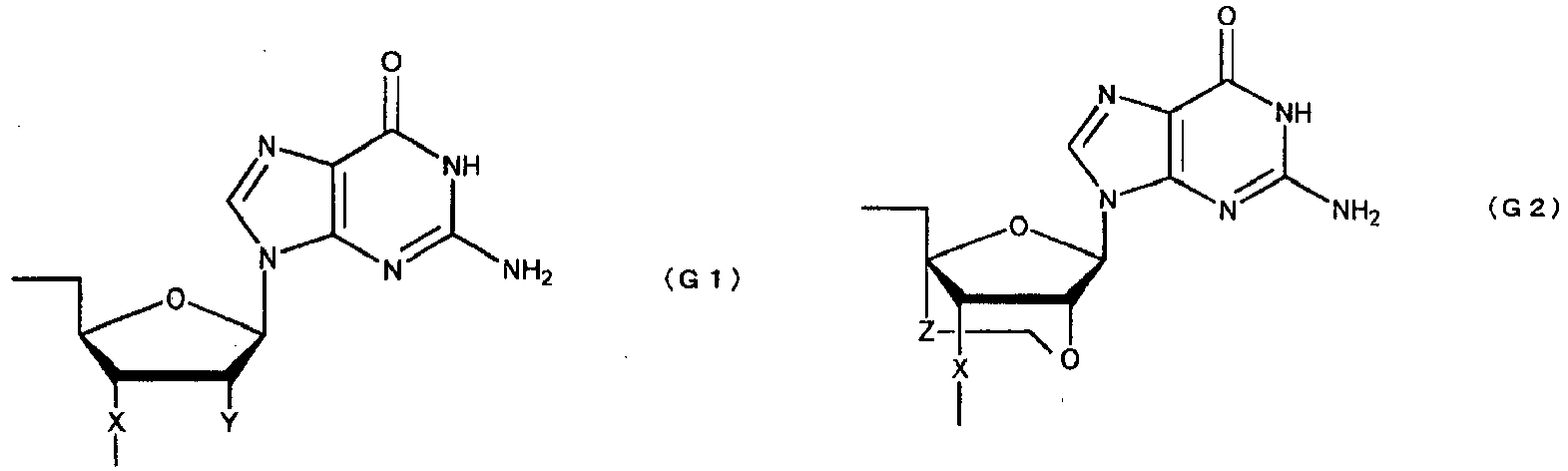


provided that at least one of the nucleosides constituting the compound represented by formula (III') has a 2'-O,4'-C-alkylene group.
- (3a')HO-, (3b')HO-Bc-, or (3c')HO-Bg-Bc-
- [2] The compound of [1] above or a pharmacologically acceptable salt thereof, wherein the sugar constituting the oligonucleotide is D-ribofuranose and the modification of the sugar is 2'-O-alkylation and/or 2'-O,4'-C-alkylenation of the D-ribofuranose.
- [3] The compound of [1] or [2] above or a pharmacologically acceptable salt thereof, wherein the modification of the phosphate is thioation of the phosphate group.
- [4] The compound of [1], [2] or [3] above or a pharmacologically acceptable salt thereof which is represented by any one of the formulae selected from the group consisting of (A033), (AO85), (AO88) and (AO86), or a pharmaceutically acceptable salt thereof:
- (AO33): HO-Ge2p-Ce2p-Ce2p-Ge2p-Ce2p-Ump-Gmp-Cmp-Cmp-Cmp-Ae2p-Ae2p-Te2p-Ge2p-Ce2p-CH2CH2OH (SEQ ID NO: 14)
- (AO85): HO-Ce2p-Gmp-Ce2p-Te2p-Gmp-Cmp-Ce2p-Ce2p-Amp-Amp-Te2p-Gmp-Ce2p-Ce2p-Amp-Ump-Ce2p-Ce2p-CH2CH2OH (SEQ ID NO: 15)
- (AO88): HO-Ce2s-Gms-Ce2s-Te2s-Gms-Cms-Ce2s-Ce2s-Ams-Ams-Te2s-Gms-Ce2s-Ce2s-Ams-Ums-Ce2s-Ce2s-CH2CH2OH (SEQ ID NO: 15)
- (AO86): HO-Ce2p-Amp-Gmp-Te2p-Te2p-Ump-Gmp-Ce2p-Ce2p-Gmp-Ce2p-Te2p-Gmp-Ce2p-Ce2p-Ce2p-Amp-Amp-CH2CH2OH (SEQ ID NO: 16)
wherein Ae1p , Ge1p, Ce1p, Te1p, Ae2p, Ge2p, Ce2p, Te2p, Amp, Gmp, Cmp, Ump, Ae1s, Ge1s, Ce1s, Te1s, Ae2s, Ge2s, Ce2s, Te2s, Ams, Gms, Cms, and Ums are groups having the following structures, respectively:


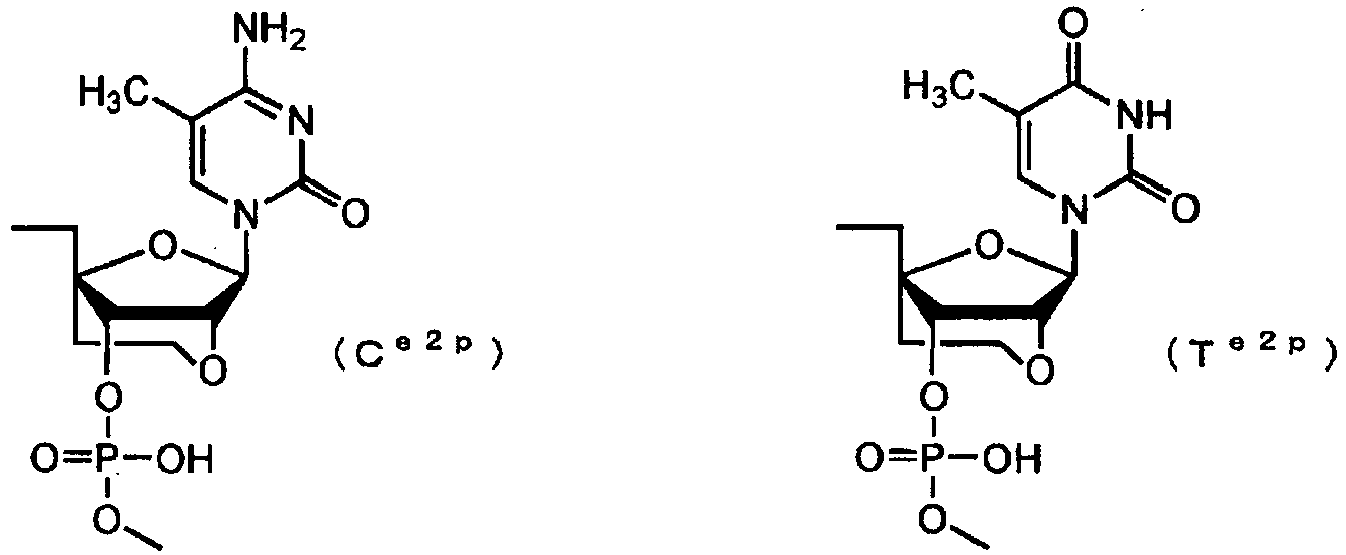


- [5] A therapeutic agent for muscular dystrophy, comprising the compound of any one of [1] to [4] above or a pharmacologically acceptable salt thereof.
- [6] The therapeutic agent of [5] above, whose target of treatment is those patients in which the total number of the amino acids in the open reading frame of the dystrophin gene will be a multiple of 3 when exon 45 of the dystrophin gene has been skipped.
- [7] A compound according to any one of [1] to [4] above or a therapeutic agent according to [5] or [6] above for use in the treatment of muscular dystrophy.
- [8] Use of a compound according to any one of [1] or [4] above in the manufacture of a medicament for treating muscular dystrophy.
- [9] Use according to [8] above wherein the target of treatment is those patients in which the total number of the amino acids in the open reading frame of the dystrophin gene will be a multiple of 3 when exon 45 of the dystrophin gene has been skipped.
- [10] A therapeutic agent according to [5] or [6], a compound or therapeutic agent according to [7] or a use according to [8] or [9] wherein said muscular dystrophy is Duchenne muscular dystrophy.
- The term "oligonucleotide" used in the present invention encompasses not only oligo DNA or oligo RNA, but also an oligonucleotide in which at least one D-ribofuranose constituting the oligonucleotide is 2'-O-alkylated; an oligonucleotide in which at least one D-ribofuranose constituting the oligonucleotide is 2'-O,4'-C-alkylenated; an oligonucleotide in which at least one phosphate constituting the oligonucleotide is thioated; or a combination thereof. Such oligonucleotides in which at least one D-ribofuranose constituting the oligonucleotides is 2'-O-alkylated or 2'-0,4'-C-alkylenated have high binding strength to RNA and high resistance to nuclease. Thus, they are expected to produce higher therapeutic effect than natural nucleotides (i.e. oligo DNA or oligo RNA). Further, an oligonucleotide in which at least one phosphate constituting the oligonucleotide is thioated also has high resistance to nuclease and, thus, is expected to produce higher therapeutic effect than natural nucleotides (i.e. oligo DNA or oligo RNA). An oligonucleotide comprising both the modified sugar and the modified phosphate as described above has still higher resistance to nuclease and, thus, is expected to produce still higher therapeutic effect.
- With respect to the oligonucleotide of the present invention, examples of the modification of sugar include, but are not limited to, 2'-O-alkylation (e.g. 2'-O-methylation, 2'-O-aminoethylation, 2'-O-propylation, 2'-O-allylation, 2'-O-methoxyethylation, 2'-O-butylation, 2'-O-pentylation, or 2'-O-propargylation) of D-ribofuranose; 2'-O,4'-C-alkylenation (e.g. 2'-O,4'-C-ethylenation, 2'-0,4'-C-methylenation, 2'-O,4'-C-propylenatio 2'-O,4'-C-tetramethylatio or 2'-O,4'-C-pentamethylation) of D-ribofuranose; 3'-deoxy-3'-amino-2'-deoxy-D-ribofuranose; and 3'-deoxy-3'-amino-2'-deoxy-2'-fluoro-D-ribofuranose.
- With respect to the oligonucleotide of the present invention, examples of the modification of phosphate include, but are not limited to, phosphorothioate, methylphosphonate, methylthiophosphonate, phosphorodithioate and phosphoroamidate.
- With respect to Yin formulas (G1), (A1), (C1) and (U1), examples of the alkoxy group with 1-6 carbon atoms include, but are not limited to, methoxy group, aminoethoxy group, propoxy group, allyloxy group, methoxyethoxy group, butoxy group, pentyloxy group, and propargyloxy group.
- With respect to Z in formulas (G2), (A2), (C2) and (T2), examples of the alkylene group with 1-5 carbon atoms include, but are not limited to, methylene group, ethylene group, propylene group, tetramethylene group and pentamethylene group.
- Preferable examples of the compound represented by general formula (III') include the following compounds.
(m-1) HO-Ge2p-Ce2p-Ce2p-Ge2p-Ce2p-Ump-Gmp-Cmp-Cmp-Cmp-Ae2p-Ae2p-Te2p-Ge2p-Ce2p-CH2CH2OH; ( m-2) HO-Ge2p-Ce2p-Ce2p-Ge2p-Ce2p-Ums-Gms-Cms-Cms-Cms-Ae2p-Ae2p-Te2p-Ge2p-Ce2p-CH2CH2OH; (m-3) HO-Ge2s-Ce2ps-Ce2s-Ge2s-Ce2s-Ums-Gms-Cms-Cms-Cms-Ae2s-Ae2s-Te2s-Ge2s-Ce2s-CH2CH2OH; (m-4) H O-Ce2p-Gmp-Ce2p-Te2p-Gmp-Cmp-Cmp-Ce2p-Ce2p-Amp-Amp-Te2p-Gmp-Ce2p-Ce2p-Amp-Ump-Ce2p-Ce2p-CH2CH2OH; (m-5) HO-Ce2p-Gms-Ce2p-Te2p-Gms-Cms-Ce2p-Ce2p-Ams-Ams-Te2p-Gms-Ce2p-Ce2p-Ams-Ums-Ce2p-Ce2p-CH 2CH2OH; (m-6) HO-Ce2s-Gms-Ce2s-Te2s-Gms-Cms-Ce2s-Ce2s-Ams-Ams-Te2s-Gms-Ce2s-Ce2s-Ams-Ums-Ce2s-Ce2s-CH2CH2OH; (m-7) HO-Ge1p-Ce1p-Ce1p-Ge1p-Ce1p-Ue1p-Gmp-Cmp-Cmp-Cmp-Ae1p-Ae1p-Te1p-Ge1p-Ce 1p-CH2CH2OH; (m-8) HO-Ge1p-Ce1p-Ce1p-Ge1p-Ce1p-Ums-Gms-Cms-Cms-Cms-Ae1p-Ae1p-Te1p-Ge1p-Ce1p-CH2CH2OH; (m-9) HO-Ge1s-Ce1s-Ce1s-Ge1s-Ce1s-Ums-Gms-Cms-Cms-Cms-Ae1s-Ae1s-Te1s-Ge1s-Ce1s-CH2 CH2OH; (m-10) HO-Ce1p-Gmp-Ce1p-Te1p-Gmp-Ce1p-Ce1p-Ce1p-Amp-Amp-Te1p-Gmp-Ce1p-Ce1p-Amp-Ump-Ce1p-Ce1p-CH2CH2OH; (m-11) HO-Ce1p-Gms-Ce1p-Te1p-Gms-Ce1p-Ce1p-Ce1p-Ams-Ams-Te1p-Gms-Ce1p-Ce 1p-Ams-Ums-Ce1p-Ce1p-CH2CH2OH; (m-12) HO-Ce1s-Gms-Ce1s-Te1s-Gms-Ce1s-Ce1s-Ce1s-Ams-Ams-Te1s-G ms-Ce1s-Ce1s-Ams-Ums-Ce1s-Ce1s-CH2CH2OH
Especially preferable are (m-1) to (m-6). - Preferable examples of the compound represented by general formula (III") include the following compounds.
(III"-1)HO-Gmp-Ae2p-Amp-Amp-Amp-Ce2p-Gmp-Ce2p-Ce2p-Gmp-Cmp-Ce2p-Amp-Te2p-Ump-Ump-Ce2p-Te2p-CH 2CH2OH; (III"-2)HO-Gmp-Ce2p-Ce2p-Gmp-Ce2p-Cmp-Amp-Te2p-Ump-Ump-Ce2p-Ump-Ce2p-Amp-Amp-Ce2p-Ae2p-Gmp-CH2CH2OH; (III"-3)HO-Ce2p-Amp-Te2P-Amp-Amp-Te2p-GmP-Amp-Ae2p-Amp-Amp-Ce2p-Gmp-Cmp-Ce2p-Gmp-Ce2p-Ce2p-CH2CH2OH; (III"-4)HO-Gmp-Ae1p-Amp-Amp-Amp-Ce1p-Gmp-Ce1p-Ce1p-Gmp-Cmp-Ce1p-Amp-Te1p-Ump-Ump-Ce1p-Te1p-CH2CH2OH; (III"-5)HO-Gmp-Ce1p-Ce1p-Gmp-Ce1p-Cmp-Amp-Te1p-Ump-Ump-Ce1p-Ump-Ce1p-Amp-Amp-Ce1p-Ae1p-Gmp-CH2CH2OH; (III"-6)HO-Ce1p-Amp-Te1p-Amp-Amp-Te1p-Gmp-Amp-Ae1p-Amp-Amp-Ce1p-Gmp-Cmp-Ce1p-Gmp-Ce1p-Ce1p-CH 2CH2OH; (III"-7)HO-Gms-Ae2p-Ams-Ams-Ams-Ce2p-Gms-Ce2p-Ge2p-Gms-Cms-Ce2p-Ams-Te2p-Ums-Ums-Ce2p-Te2p-CH2CH2OH; (III" -8)HO-Gms-Ce2p-Ce2p-Gms-Ce2p-Cms-Ams-Te2p-Ums-Ums-Ce2p-Ums-Ce2p-Ams-Ams-Ce2p-Ae2p-Gms-CH2CH2OH; (III"-9)HO-Ce2p-Ams-Te2p-Ams-Ams-Te2p-Gms-Ams-Ae2p-Ams-Ams-Ce2p-Gms-Cms-Ce2p-Gms-Ce2p-Ce2p-CH2CH2OH; (III"-10)HO-Gms-Ae1p-Ams-Ams-Ams-Ce1p-Gms-Ce1p-Ce1p-Gms-Cms-Ce1p-Ams-Te1p-Ums-Ums-Ce1p-Te1p-CH2CH2OH; (III" -11)HO-Gms-Ce1p-Ce1p-Gms-Ce1p-Cms-Ams-Te1p-Ums-Ums-Ce1p-Ums-Ce1p-Ams-Ams-Ce1p-Ae1p-Gms-CH2 CH2OH; (III"-12)HO-Ce1p-Ams-Te1p-Ams-Ams-Te1p-Gms-Ams-Ae1p-Ams-Ams-Ce1p-Gms-Cms-Ce1p-Gms-Ce1p-Ce1p-CH2CH2OH; (III"-13)HO-Gms-Ae2s-Ams-Ams-Ams-Ce2s-Gms-Ce2s-Ce2s-Gms-Cms-Ce2s-Ams-Te2s-Ums-Ums-Ce2s-Te2s-CH2CH2OH; (III"-14)HO-Gms-Ce2s-Ce2s-Gms-Ce2s-Cms-Ams-Te2s-Ums-Ums-Ce2s-Ums-Ce2s-Ams-Ams-Ce2s-Ae2s-Gms-CH2CH2OH; (III"-15)HO-Ce2s-Ams-Te2s-Ams-Ams-Te2s-Gms-Ams-Ae2s-Ams-Ams-Ce2s-Gms-Cms-Ce2s-Gms-Ce2s-Ce2s-CH2CH2OH; (III"-16)HO-Gms-Ae1s-Ams-Ams-Ams-Ce1s-Gms-Ce1s-Ce1s-Gms-Cms-Ce1s-Ams-Te1s-Ums-Ums-Ce1s-Te1s-CH2CH2OH; (III"-17)HO-Gms-Ce1s-Ce1s-Gms-Ce1s-Cms-Ams-Te1s-Ums-Ums-Ce1s-Ums-Ce1s-Ams-Ams-Ce1s-Ae1s-Gms-CH2 CH2OH; (III" -18)HO-Ce1s-Ams-Te1s-Ams-Ams-Te1s-Gms-Ams-Ae1s-Ams-Ams-Ce1s-Gms-Cms-Ce1s-Gms-Ce1s-Ce1s-CH2CH2OH
Especially preferable are (III"-1), (III"-2), (III"-3), (III"-13), (III"-14) and (III"-15). - In the present specification, Ae1p, Ge1p, Ce1p, Te1p, Ae2p, Ge2p, Ce2p, Te2p, Amp, Gmp, Cmp, Ump, Ae1s, Ge1s, Ce1s, Te1s, Ae2s, Ge2s, Ce2s, Te2s, Ams, Gms, Cms, Ums and Ph are groups having the following structures, respectively.


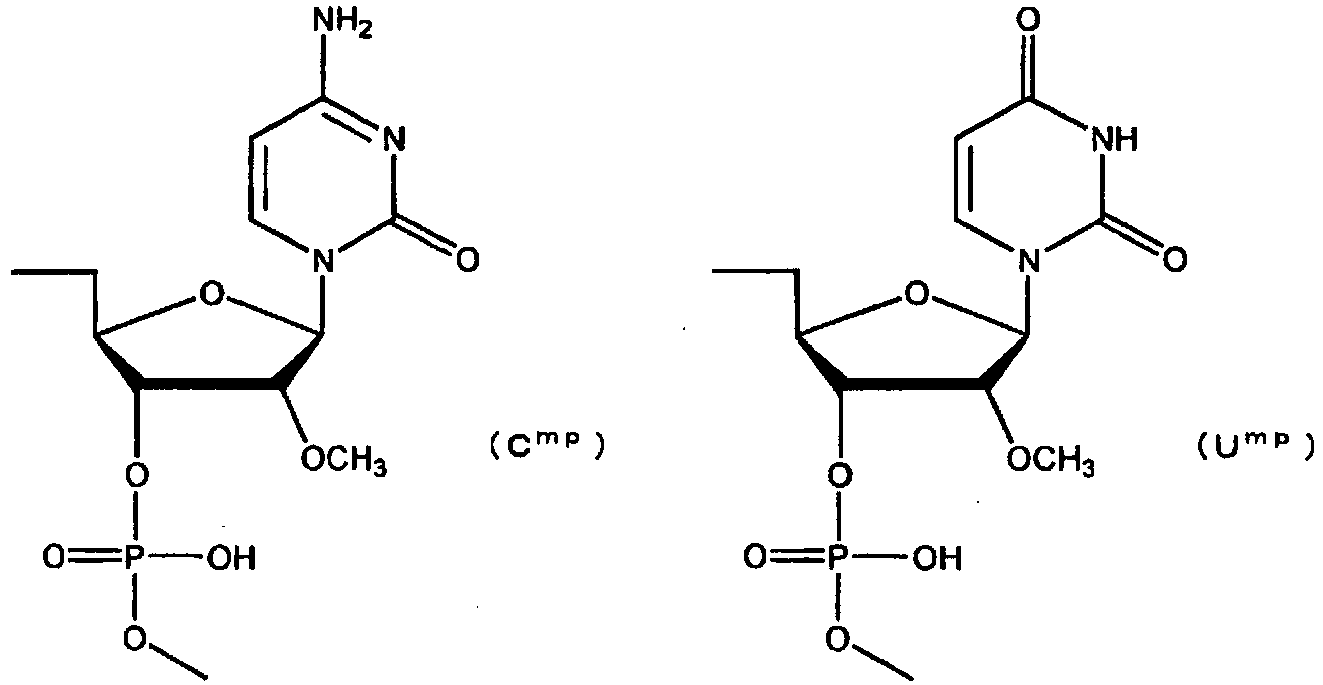

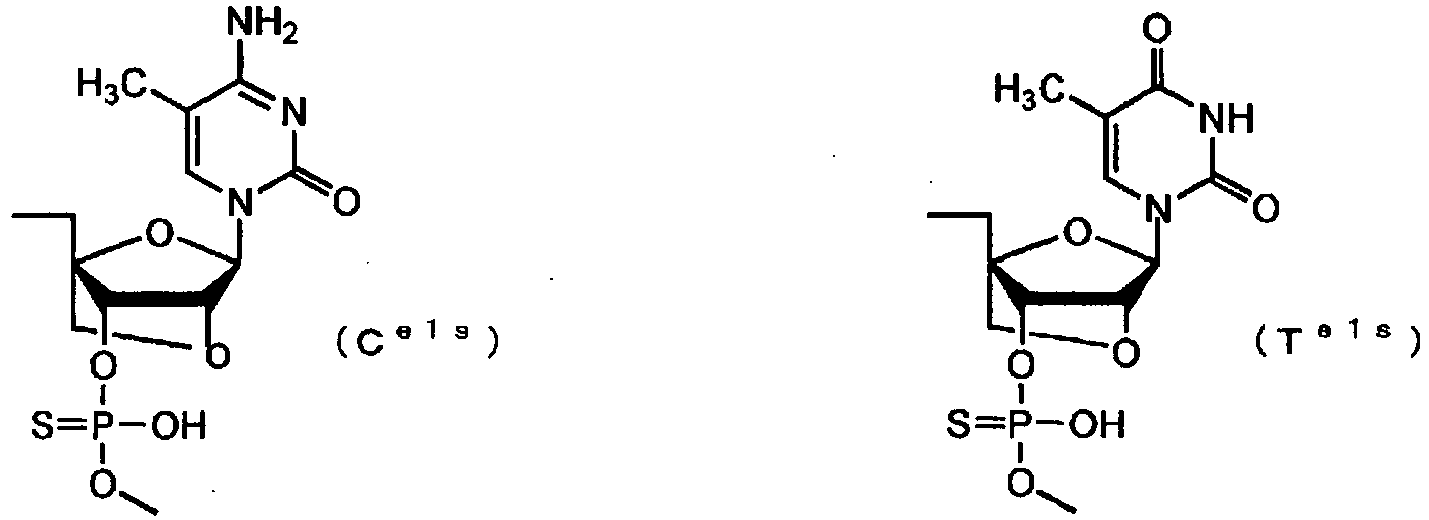


- The term "pharmacologically acceptable salt thereof" used in the present specification refers to salts of the oligonucleotide of the invention (e.g. oligonucleotide having the nucleotide sequence as shown in any one of SEQ ID NOS: 15, 14 and 16) or salts of those compounds represented by general formula (III'). Examples of such salts include metal salts such as alkali metal salts (e.g. sodium salts, potassium salts, lithium salts), alkaline earth metal salts (e.g. calcium salts, magnesium salts), aluminium salts, iron salts, zinc salts, copper salts, nickel salts, cobalt salts and the like; amine salts such as inorganic salts (e.g. ammonium salts), organic salts [e.g. t-octylamine salts, dibenzylamine salts, morpholine salts, glucosamine salts, phenylglycine alkyl ester salts, ethylenediamine salts, N-methylglucamine salts, guanidine salts, diethylamine salts, triethylamine salts, dicyclohexylamine salts; N',N'-dibenzylethylenediamine salts, chloroprocaine salts, procaine salts, diethanolamine salts, N-benzyl-phenetylamine salts, piperazine salts, tetramethylammonium salts, tris(hydroxymethyl)aminomethane salts] and the like; inorganic acid salts such as halogenated hydroacid salts (e.g. hydrofluorates, hydrochlorides, hydrobromates, hydriodates), nitrates, perchlorates, sulfates, phosphates and the like; organic acid salts such as lower alkane sulfonates (e.g. methanesulfonates, trifluoromethanesulfonates, ethanesulfonates), aryl sulfonates (e.g. benzensulfonates, p-toluenesulfonates), acetates, malates, fumarates, succinates, citrates, tartrates, oxalates, maleates and the like; and amino acid salts (e.g. glycine salts, lysine salts, arginine salts, ornithine salts, glutamates, aspartates). These salts may be prepared according to known methods.
- It should be noted that compounds represented by general formula (III') may occur as hydrates and that such hydrates are also included in the present invention.
- The oligonucleotide of the invention, the compounds represented by general formula (III') (hereinafter, referred to as the "compound of the invention") and pharmacologically acceptable salts thereof are effective as pharmaceuticals for treating muscular dystrophy.
- The compound of the invention may be synthesized based on the method described in the literature (Nucleic Acids Research, 12: 4539 (1984)) using a commercial synthesizer (e.g. PerkinElmer Model 392 employing the phosphoroamidite method). As to the phosphoroamidite reagents used in the synthesis, commercial reagents are available for natural nucleosides and 2'-O-methylnucleosides (i.e. 2'-O-methylguanosine, 2'-O-methyladenosine, 2'-O-methylcytosine and 2'-O-methyluridine). As to 2'-O-alkyl-guanosine, -adenosine, -cytosine and -uridine where the alkyl group has 2-6 carbon atoms, they may be synthesized or purchased as described below.
- 2'-O-aminoethyl-guanosine, -adenosine, -cytosine and -uridine may be synthesized according to Blommers et al., Biochemistry (1998), 37: 17714-17725.
- 2'-O-propyl-guanosine, -adenosine, -cytosine and -uridine may be synthesized according to Lesnik, E.A. et al., Biochemistry (1993), 32: 7832-7838.
- 2'-O-allyl-guanosine, -adenosine, -cytosine and -uridine are commercially available. 2'-O-methoxyethyl-guanosine, -adenosine, -cytosine and -uridine may be synthesized according to
U.S. Patent No. 6261840 or Martin, P., Helv. Chim. Acta. (1995) 78: 486-504. - 2'-O-butyl-guanosine, -adenosine, -cytosine and -uridine may be synthesized according to Lesnik, E.A. et al., Biochemistry (1993), 32: 7832-7838.
- 2'-O-pentyl-guanosine, -adenosine, -cytosine and -uridine may be synthesized according to Lesnik, E.A. et al., Biochemistry (1993), 32: 7832-7838.
- 2'-O-propargyl-guanosine, -adenosine, -cytosine and -uridine are commercially available.
- 2'-O,4'-C-methylene-guanosine, -adenosine, 5-methyl-cytosine and -thymidine may be synthesized according to the method described in
WO99/14226 WO00/47599 - In the thioation of phosphate groups, thioate derivatives may be obtained based on the methods described in Tetrahedron Letters, 32, 3005 (1991) and J. Am. Chem. Soc., 112, 1253 (1990), using sulfur and a reagent such as tetraethylthiuram disulfide (TETD; Applied Biosystems) or Beaucage reagent (Glen Research) which reacts with a trivalent phosphate to form a thioate.
- With respect to the controlled pore glass (DPG) used in the synthesizer, use of a modified CPG (described in Example 12b of Japanese Unexamined Patent Publication No.
H7-87982 - The compounds of the present invention and pharmacologically acceptable salts thereof have an effect of inducing skipping of exon 45 of the dystrophin gene. The compounds of the invention represented by general formula (III') and pharmacologically acceptable salts thereof have high binding strength to RNA and high resistance to nuclease. Therefore, the compounds of the invention and pharmacologically acceptable salts thereof are useful as pharmaceuticals for treating muscular dystrophy.
- When the compound of the invention or a pharmacologically acceptable salt thereof is used as a therapeutic for muscular dystrophy, the compound or a pharmacologically acceptable salt or ester thereof may be administered by itself. Alternatively, the compound or a pharmacologically acceptable salt or ester thereof may be mixed with appropriate pharmacologically acceptable excipients or diluents, prepared into tablets, capsules, granules, powders, syrups, etc. and administered orally; or prepared into injections, suppositories, patches, external medicines, etc. and administered parenterally.
- These formulations may be prepared by well-known methods using additives such as excipients [organic excipients e.g. sugar derivatives (such as lactose, white sugar, glucose, mannitol and sorbitol), starch derivatives (such as corn starch, potato starch, α starch and dextrin), cellulose derivatives (such as crystalline cellulose), gum arabic, dextran, pullulan and the like; and inorganic excipients e.g. silicate derivatives (such as light silicic acid anhydride, synthetic aluminium silicate, calcium silicate and magnesium aluminate metasilicate), phosphates (such as calcium hydrogenphosphate), carbonates (such as calcium carbonate), sulfates (such as calcium sulfate) and the like], lubricants (e.g. metal salts of stearic acid such as stearic acid, calcium stearate, and magnesium stearate; talc; colloidal silica; waxes such as bees wax and spermaceti; boric acid; adipic acid; sulfates such as sodium sulfate; glycol; fumaric acid; sodium benzoate; DL leucine; lauryl sulfates such as sodium lauryl sulfate and magnesium lauryl sulfate; silicic acid materials such as silicic acid anhydride and silicic acid hydrate; above-mentioned starch derivatives), binders (e.g. hydroxypropylcellulose, hydroxypropylmethylcellulose, polyvinylpyrrolidone, macrogol, compounds enumerated above as excipients), disintegrants (e.g. cellulose derivatives such as low-substituted hydroxypropylcellulose, carboxymethylcellulose, calcium carboxymethylcellulose, internally crosslinked sodium carboxymethylcellulose; chemically modifies starches/celluloses such as carboxymethyl starch, sodium carboxymethyl starch, crosslinked polyvinylpyrrolidone), emulsifiers (e.g. colloidal clay such as bentonite, Veegum; metal hydroxides such as magnesium hydroxide, aluminium hydroxide; anionic surfactants such as sodium lauryl sulfate, calcium stearate; cation surfactants such as benzalkonium chloride; nonionic surfactants such as polyoxyethylene alkyl ethers, polyoxyethylene sorbitan fatty acid esters, sucrose fatty acid ester), stabilizers (e.g. paraoxybenzoic acid esters such as methyl paraben, propyl paraben; alcohols such as chlorobutanol, benzyl alcohol, phenylethyl alcohol; benzalkonium chloride; phenols such as phenol, cresol; thimerosal; dehydroacetic acid; sorbic acid), flavoring/aromatic agents (e.g. conventionally used sweeteners, acidifiers, aromatics, etc.) or diluents.
- The therapeutic agent of the present invention comprises preferably 0.05-5 µmoles/ml of the compound of the invention or a pharmacologically acceptable salt thereof, 0.02-10% w/v of carbohydrates or polyhydric alcohols, and 0.01-0.4% w/v of pharmacologically acceptable surfactants. More preferable range for the content of the compound of the invention or a pharmacologically acceptable salt thereof is 0.1-1 µmoles/ml.
- For the above carbohydrates, monosaccharides and/or disaccharides are especially preferable. Examples of these carbohydrates and polyhydric alcohols include, but are not limited to, glucose, galactose, mannose, lactose, maltose, mannitol and sorbitol. These may be used alone or in combination.
- Preferable examples of surfactants include, but are not limited to, polyoxyethylene sorbitan mono- to tri-esters, alkyl phenyl polyoxyethylene, sodium taurocholate, sodium cholate and polyhydric alcohol esters. Especially preferable are polyoxyethylene sorbitan mono- to tri-esters, where especially preferable esters are oleates, laurates, stearates and palmitates. These surfactants may be used alone or in combination.
- More preferably, the therapeutic agent of the invention comprises 0.03-0.09 M of pharmacologically acceptable neutral salt, e.g. sodium chloride, potassium chloride and/or calcium chloride.
- Still more preferably, the therapeutic agent of the invention may comprise 0.002-0.05 M of pharmacologically acceptable buffer. Examples of preferable buffers include sodium citrate, sodium glycinate, sodium phosphate and tris(hydroxymethyl)aminomethane. These buffers may be used alone or in combination.
- The above-described therapeutic agent of the invention may be supplied in the state of solution. However, considering the storing of the therapeutic agent for some period of time, usually, it is preferable to lyophilize the therapeutic agent for the purpose of stabilizing the antisense oligonucleotide and thereby preventing the lowering of its therapeutic effect. The lyophilized therapeutic agent may be reconstructed with a dissolving liquid (e.g. distilled water for injection) at the time of use, and used in the state of solution. Thus, the therapeutic agent of the invention encompasses such a lyophilized therapeutic agent to be reconstructed with a dissolving liquid at the time of use so that individual components fall under specific concentration ranges. In order to enhance the solubility of the lyophilized product, the therapeutic agent may further contain albumin or amino acids such as glycine.
- When the compound of the invention or a pharmacologically acceptable salt thereof is administered to humans, for example, the compound or salt may be administered orally or intravenously at a dose of about 0.1-100 mg/kg body weight per day, preferably 1-50 mg/kg body weight per day for adult patients once a day or divided into several portions. The dose and the number of times of administration may be appropriately changed depending on the type of disease, conditions, the age of the patient, the route of administration, etc.
- Administration of the compound of the invention or a pharmacologically acceptable salt thereof to DMD patients may be performed, for example, as described below. Briefly, the compound of the invention or a pharmacologically acceptable salt thereof may be prepared by methods well-known to those skilled in the art, sterilized by conventional methods and then formulated into, for example, an injection solution with a concentration of 1200 µg/ml. This solution is, for example, drip-fed to the patient intravenously in the form of infusion so that the antisense oligonucleotide is administered to the patient at a dose of, for example, 20 mg/kg body weight. Such administration may be repeated, for example, 4 times at intervals of 2 weeks. Then, while confirming the therapeutic effect using indicators such as expression of dystrophin protein in muscle biopsy tissues, serum creatine kinase levels and clinical symptoms, this treatment is repeated appropriately. If therapeutic effect is recognized and yet no definite side effect is observed, this treatment is continued; in principle, the administration is continued throughout life time.
- The present specification includes the contents disclosed in the specifications and/or drawings of the Japanese Patent Applications No.
2002-340857 No. 2003-204381 -
Fig.1 shows the effects of the compounds of Examples 2-5 (AO33, A085, AO86 and AO87) on exon 45 skipping. - Hereinbelow, the present invention will be described specifically with reference to the following Examples. These Examples are provided only for the purpose of illustration, and they are not intended to limit the present invention.
- The subject compound was synthesized with an automated nucleic acid synthesizer (PerkinElmer ABI model 394 DNA/RNA synthesizer) using a 40 nmol DNA program. The concentrations of solvents, reagents and phosphoroamidites at individual synthesis cycles were the same as used in the synthesis of natural oligonucleotides. The solvents, reagents and phosphoroamidites of 2'-O-methylnucleoside (adenosine form: product No. 27-1822-41; guanosine form: product No. 27-1826-41; citydine form: product No. 27-1823-02; uridine form: product No. 27-1825-42) were products from Amersham Pharmacia. As non-natural phosphoroamidites, those compounds disclosed in Example 28
(5'-O-dimethoxytrityl-2'-O,4'-C-ethylene-6-N-benzoyladenosine-3'-O-(2-cyano ethyl N,N-diisopropyl)phosphoroamidite), Example 41 (5'-O-dimethoxytrityl-2'-O,4'-C-ethylene-N-isobutylylguanosine-3'-O-(2-cyanoethyl N,N-diisopropyl)phosphoroamidite), Example 36 (5'-O-dimethoxytrityl-2'-O,4'-C-ethylene-4-N-benzoyl-5-methylcitydine-3'-O- (2-cyanoethyl N,N-diisopropyl)phosphoroamidite), and Example 23 (5'-O-dimethoxytrityl-2'-O,4'-C-ethylene-5-methyluridine-3'-O-(2-cyanoethyl N,N-diisopropyl)phosphoroamidite) of Japanese Unexamined Patent Publication No.2000-297097 H7-87982 - The protected oligonucleotide analogue having the sequence of interest was treated with concentrated aqueous ammonia to thereby cut out the oligomer from the support and, at the same time, remove the protective cyanoethyl groups on phosphorus atoms and the protective groups on nucleic acid bases. The solvent was distilled off under reduced pressure, and the resultant residue was purified by reversed phase HPLC [Shimadzu model LC-10VP; column: Merck, Chromolith Performance RP-18e (4.6 x 100 mm); solution A: 5% acetonitrile, 0.1 M aqueous triethylamine acetate (TEAA), pH 7.0; solution B: acetonitrile B%: 10% →55% (10 min, linear gradient); 60°C; 2 ml/min; 254 nm]. The fraction eluted at 6.29 min was collected. After the solvent was distilled off under reduced pressure, 80% aqueous acetic acid solution was added to the residue, which was then left for 20 min to remove the DMTr group. After distilling off the solvent, the resultant residue was dissolved in 0.5 ml of water and filtered with Ultrafree-MC (Millipore: product No. UFC4 OHV 25). The solvent was distilled off to thereby obtain the compound of interest (0.473 A260 units) (λmas (H2O) = 259 nm). When analyzed by reversed phase HPLC [column: Merck, Chromolith Performance RP-18e (4.6 x 100 mm); solution A: 5% acetonitrile, 0.1 M aqueous triethylamine acetate (TEAA), pH 7.0; solution B: 25% acetonitrile, 0.1 M TEAA B%: 10% → 65% (10 min, linear gradient); 60°C; 2 ml/min; 254 nm], the subject compound was eluted at 7.62 min. The compound was identified by negative ion ESI mass spectrometric analysis (calculated value: 7980.34).
- The nucleotide sequence of the subject compound is complementary to the nucleotides Nos. 6133-6155 of dystrophin cDNA (Gene Bank accession No. NM_004006.1).
- The compound of Example 2 having a sequence of interest was synthesized in the same manner as the compound of Example 1 was synthesized. After deprotection, the resultant product was purified by reversed phase HPLC [Shimadzu model LC-10VP; column: Merck, Chromolith Performance RP-18e (4.6 x 100 mm); solution A: 5% acetonitrile, 0.1 M aqueous triethylamine acetate (TEAA), pH 7.0; solution B: acetonitrile B%: 10% →45% (10 min, linear gradient); 60°C; 2 ml/min; 254 nm]. The fraction eluted at 7.36 min was collected. After the solvent was distilled off under reduced pressure, 80% aqueous acetic acid solution was added to the residue, which was then left for 20 min to remove the DMTr group. After distilling off the solvent, the resultant residue was dissolved in 0.5 ml of water and filtered with Ultrafree-MC (Millipore: product No. UFC4 OHV 25). The solvent was distilled off to thereby obtain the compound of interest (12.70 A260 units) (λmax (H2O) = 261 nm). When analyzed by reversed phase HPLC [column: Merck, Chromolith Performance RP-18e (4.6 x 100 mm); solution A: 5% acetonitrile, 0.1 M aqueous triethylamine acetate (TEAA), pH 7.0; solution B: 25% acetonitrile, 0.1 M TEAA B%: 15% → 60% (10 min, linear gradient); 60°C; 2 ml/min; 254 nm], the subject compound was eluted at 7.92 min. The compound was identified by negative ion ESI mass spectrometric analysis (calculated value: 5250.59; measured value: 5250.61).
- The nucleotide sequence of the subject compound is complementary to the nucleotides Nos. 6696-6710 of dystrophin cDNA (Gene Bank accession No. NM_004006.1).
- The compound of Example 3 having a sequence of interest was synthesized in the same manner as the compound of Example 1 was synthesized. After deprotection, the resultant product was purified by reversed phase HPLC [Shimadzu model LC-10VP; column: Merck, Chromolith Performance RP-18e (4.6 x 100 mm); solution A: 5% acetonitrile, 0.1 M aqueous triethylamine acetate (TEAA), pH 7.0; solution B: acetonitrile B%: 10% →46% (8 min, linear gradient); 60°C; 2 ml/min; 254 nm]. The fraction eluted at 5.32 min was collected. After the solvent was distilled off under reduced pressure, 80% aqueous acetic acid solution was added to the residue, which was then left for 20 min to remove the DMTr group. After distilling off the solvent, the resultant residue was dissolved in 0.5 ml of water and filtered with Ultrafree-MC (Millipore: product No. UFC4 OHV 25). The solvent was distilled off to thereby obtain the compound of interest (7.93 A260 units) (λmax (H2O) = 261 nm). When analyzed by reversed phase HPLC [column: Merck, Chromolith Performance RP-18e (4.6 x 100 mm); solution A: 5% acetonitrile, 0.1 M aqueous triethylamine acetate (TEAA), pH 7.0; solution B: 25% acetonitrile, 0.1 M TEAA B%: 20% → 80% (10 min, linear gradient); 60°C; 2 ml/min; 254 nm], the subject compound was eluted at 5.63 min. The compound was identified by negative ion ESI mass spectrometric analysis (calculated value: 6263.34; measured value: 6263.40).
- The nucleotide sequence of the subject compound is complementary to the nucleotides Nos. 6691-6708 of dystrophin cDNA (Gene Bank accession No. NM_004006.1).
- The compound of Example 4 having a sequence of interest was synthesized in the same manner as the compound of Example 1 was synthesized. After deprotection, the resultant product was purified by reversed phase HPLC [Shimadzu model LC-10VP; column: Merck, Chromolith Performance RP-18e (4.6 x 100 mm); solution A: 5% acetonitrile, 0.1 M aqueous triethylamine acetate (TEAA), pH 7.0; solution B: acetonitrile B%: 10% →46% (8 min, linear gradient); 60°C; 2 ml/min; 254 nm]. The fraction eluted at 7.10 min was collected. After the solvent was distilled off under reduced pressure, 80% aqueous acetic acid solution was added to the residue, which was then left for 20 min to remove the DMTr group. After distilling off the solvent, the resultant residue was dissolved in 0.5 ml of water and filtered with Ultrafree-MC (Millipore: product No. UFC4 OHV 25). The solvent was distilled off to thereby obtain the compound of interest (9.01 A260 units) (λmax (H2O) = 260 nm). When analyzed by reversed phase HPLC [column: Merck, Chromolith Performance RP-18e (4.6 x 100 mm); solution A: 5% acetonitrile, 0.1 M aqueous triethylamine acetate (TEAA), pH 7.0; solution B: 25% acetonitrile, 0.1 M TEAA B%: 20% → 80% (8 min, linear gradient); 60°C; 2 ml/min; 254 nm], the subject compound was eluted at 6.27 min. The compound was identified by negative ion ESI mass spectrometric analysis (calculated value: 6304.35; measured value: 6304.47).
- The nucleotide sequence of the subject compound is complementary to the nucleotides Nos. 6699-6716 of dystrophin cDNA (Gene Bank accession No. NM_004006.1).
- The compound of Example 5 having a sequence of interest was synthesized in the same manner as the compound of Example 1 was synthesized. After deprotection, the resultant product was purified by reversed phase HPLC [Shimadzu model LC-10VP; column: Merck, Chromolith Performance RP-18e (4.6 x 100 mm); solution A: 5% acetonitrile, 0.1 M aqueous triethylamine acetate (TEAA), pH 7.0; solution B: acetonitrile B%: 10% →46% (8 min, linear gradient); 60°C; 2 ml/min; 254 nm]. The fraction eluted at 5.63 min was collected. After the solvent was distilled off under reduced pressure, 80% aqueous acetic acid solution was added to the residue, which was then left for 20 min to remove the DMTr group. After distilling off the solvent, the resultant residue was dissolved in 0.5 ml of water and filtered with Ultrafree-MC (Millipore: product No. UFC4 OHV 25). The solvent was distilled off to thereby obtain the compound of interest (8.65 A260 units) (λmax (H2O) = 259 nm). When analyzed by reversed phase HPLC [column: Merck, Chromolith Performance RP-18e (4.6 x 100 mm); solution A: 5% acetonitrile, 0.1 M aqueous triethylamine acetate (TEAA), pH 7.0; solution B: 25% acetonitrile, 0.1 M TEAA B%: 20% → 80% (10 min, linear gradient); 60°C; 2 ml/min; 254 nm], the subject compound was eluted at 6.06 min. The compound was identified by negative ion ESI mass spectrometric analysis (calculated value: 6331.33; measured value: 6331.14).
- The nucleotide sequence of the subject compound is complementary to the nucleotides Nos. 6710-6727 of dystrophin cDNA(Gene Bank accession No. NM_004006.1).
- The compound of Example 6 having a sequence of interest was synthesized in the same manner as the compound of Example 1 was synthesized. However, the portion with a phosphorothioate bond was sulfurized by treating with a mixed solution of 0.02 M xanthane hydride/acetonitrile-pyridine (9:1 mixture) for 15 min, instead of the oxidation step with iodine-H2O. After deprotection, the resultant product was purified by reversed phase HPLC [Shimadzu model LC-10VP; column: Merck, Chromolith Performance RP-18e (4.6 x 100 mm); solution A: 5% acetonitrile, 0.1 M aqueous triethylamine acetate (TEAA), pH 7.0; solution B: acetonitrile B%: 10% →46% (8 min, linear gradient); 60°C; 2 ml/min; 254 nm]. The fraction eluted at 6.57 min was collected. After the solvent was distilled off under reduced pressure, 80% aqueous acetic acid solution was added to the residue, which was then left for 20 min to remove the DMTr group. After distilling off the solvent, the resultant residue was dissolved in 0.5 ml of water and filtered with Ultrafree-MC (Millipore: product No. UFC4 OHV 25). The solvent was distilled off to thereby obtain the compound of interest (12.02 A260 units) (λmax (H2O) = 262 nm). When analyzed by ion exchange [column: Tosoh TSK-gel DEAE-5PW (7.5 x 75 mm); solution A: 20% acetonitrile; solution B: 20% acetonitrile, 67 mM phosphate buffer (pH 6.8), 1.5 M KBr; gradient: solution B 20→60% (10 min, linear gradient); 40°C; 2 ml/min], the subject compound was eluted at 7.11 min. The compound was identified by negative ion ESI mass spectrometric analysis (calculated value: 6552.54; measured value: 6553.12).
- The nucleotide sequence of the subject compound is complementary to the nucleotides Nos. 6691-6708 of dystrophin cDNA (Gene Bank accession No. NM_004006.1).
- hAON4 [FAM-CUG CUU CCU CCA ACC (SEQ ID NO: 23); all the nucleotides are 2'-O-methylnucleotide and linked with each other by a phosphorothioate bond] which is disclosed in a document (van Deutekom, J.C.T. et al. (2001) Hum. Mol. Genet. 10, 1547-1554) and known as an oligonucleotide that induces exon 46 skipping was synthesized according to the above document.
- FAM is a fluorescence group with the following structure.

- hAON6 [FAM-GUU AUC UGC UUC CUC CAA CC (SEQ ID NO: 24); all the nucleotides are 2'-O-methylnucleotide and linked with each other by a phosphorothioate bond] which is disclosed in a document (van Deutekom, J.C.T. et al. (2001) Hum. Mol. Genet. 10, 1547-1554) and known as an oligonucleotide that induces exon 46 skipping was synthesized according to the above document.
- hAON8 [FAM-GCU UUU CUU UUA GUU GCU GC (SEQ ID NO: 25); all the nucleotides are 2'-O-methylnucleotide and linked with each other by a phosphorothioate bond] which is disclosed in a document (van Deutekom, J.C.T. et al. (2001) Hum. Mol. Genet. 10, 1547-1554) and known as an oligonucleotide that induces exon 46 skipping was synthesized according to the above document.
- A primary culture of myoblast cells was established as described below.
- 1. Muscle tissue samples taken from the rectus muscle of the thigh of Duchenne muscular dystrophy patients were cut into fine pieces and washed with PBS twice.
- 2. The muscle tissue from 1 above was treated with Difco Bacto™ tripton 250 (5% solution in PBS) at 37°C for 30 min to thereby obtain free cells enzymatically.
- 3. The free cells from 2 above were washed with DMEM (containing 20% FBS) twice.
- 4. The cells from 3 above were suspended in DMEM (containing 20% FBS and 4% ultroser G).
- 5. The suspension cells from 4 were passed through a mesh (Becton Dickinson: cell strainer 35-2360) to recover only free cells.
- 6. The recovered cells from 5 above were seeded on gelatin-coated dishes.
- 7. The cells were cultured at 37°C in an atmosphere of 5% CO2 in air.
- Differentiation of muscular cells was induced as described below.
- 1. Cultured cells obtained above were seeded on 6-well plates (gelatin coated). When cells became confluent, the medium was exchanged with DMEM (containing 2% horse serum (HS)).
- 2. After a 4 day cultivation, the cells were transfected with the compounds prepared in Examples (ENAs) as described below.
- Myoblast cells were transfected with the compounds prepared in Examples (ENAs) as described below.
- 1. 200 pmol of each of the compounds prepared in Examples (10 µg/20 µl milliQ) was dissolved in 100 µl of Opti-MEM (GIBCO-BRL).
- 2. 6 µl of Plus reagent (GIBCO-BRL) was added to the solution from 1 above, which was then left at room temperature for 15 min.
- 3. In another tube, 8 µl of Lipofectamine (GIBCO-BRL) was dissolved in 100 µl of Opti-MEM.
- 4. After completion of the treatment of 2 above, the solution from 3 above was added to the solution from 2 above. The resultant solution was left at room temperature for another 15 min.
- 5. Myoblast cells 4 days after the start of the induction of differentiation were washed with PBS once. Then, 800 µl of Opti-MEM was added thereto.
- 6. After completion of the treatment of 4 above, the treated solution was added to the cells from 5 above.
- 7. The cells from 6 above were cultured at 37°C in an atmosphere of 5% CO2 in air for 3 hr. Then, 500 µl of DMEM (containing 6% HS) was added to each well.
- 8. Cells were cultured further.
- RNA was extracted as described below.
- 1. ENA-transfected cells were cultured for 2 days and then washed with PBS once. To these cells, 500 µl of ISOGEN (Nippon Gene) was added.
- 2. The cells were left at room temperature for 5 min, followed by recovery of ISOGEN in each well into tubes.
- 3. RNA was extracted according to the protocol of ISOGEN (Nippon Gene).
- 4. Finally, RNA was dissolved in 20 µl of DEPW.
- Reverse transcription was performed as described below.
- 1. To 2 µg of RNA, DEPW (sterilized water treated with diethylpyrocarbonate) was added to make a 6 µl solution.
- 2. To the solution from 1 above, 2 µl of random hexamer (Invitrogen: 3 µg/µl product was diluted to 20-fold before use) was added.
- 3. The resultant solution was heated at 65° for 10 min.
- 4. Then, the solution was cooled on ice for 2 min.
- 5. To the above reaction solution, the following was added:
- MMLV-reverse transcriptase (Invitrogen: 200U/µl) 1 µl
- Human placenta ribonuclease inhibitor (Takara: 40U/µl) 1 µl
- DTT (attached to MMLV-reverse transcriptase) 1 µl
- Buffer (attached to MMLV-reverse transcriptase) 4 µl
- dNTPs (attached to Takara Ex Taq) 5 µl
- 6. The resultant solution was kept at 37°C for 1 hr, and then heated at 95°C for 5 min.
- 7. After the reaction, the solution was stored at -80°C.
- PCR reaction was performed as described below.
- 1. The following components were mixed and then heated at 94°C for 4 min.
Reverse transcription product 3 µl
Forward primer (10 pmol/µl) 1 µl
Reverse primer (10pmol/µl) 1 µl
dNTP (attached to TAKARA Ex Taq) 2 µl
Buffer (attached to TAKARA Ex Taq) 2 µl
Ex Taq (TAKARA) 0.1 µl
Sterilized water 11 µl - 2. After the above-mentioned treatment at 94°C for 4 min, 35 cycles of 94°C for 1 min/60°C for 1 min/72°C for 3 min were performed.
- 3. Then, the reaction solution was heated at 72°C for 7 min.
The nucleotide sequences of the forward and reverse primers used in the PCR for detecting exon 45 skipping were as described below.
Forward primer: 5'-GCT GAA CAG TTT CTC AGA AAG ACA CAA-3' (exon 44) (SEQ ID NO: 28) Reverse primer: 5'-TCC ACT GGA GAT TTG TCT GC-3' (exon 47) (SEQ ID NO: 29) - 4. The PCR product was analyzed by 2% agarose gel electrophoresis.
- The resultant gel was stained with ethidium bromide. The resultant band (A) (where an exon was skipped) and band (B) (where an exon was not skipped) were visualized with a gel photographing device (Printgraph Model AE-6911FXFD; ATTO) and quantitatively determined with ATTO Densitograph ver.4.1 for the Macintosh. The values obtained were put into the formula A/(A+B)x100 to obtain skipping efficiency (%). 5. The band where skipping had occurred was cut out, and the PCR product was subcloned into pT7 Blue-T vector (Novagen), followed by sequencing reaction with Thermo Sequenase TM II dye terminator cycle sequencing kit (Amersham Pharmacia Biotec) and confirmation of the nucleotide sequence with ABI PRISM 310 Genetic Analyzer (Applied Biosystems). The reaction procedures were according to the manual attached to the kit.
- The results of exon 45 skipping are shown in
Fig. 1 . Exon 45 skipping occurred when the compounds of Examples 2 to 5 were used. - According to the following prescription, necessary amounts of base components are mixed and dissolved. To this solution, any one of the compounds of Examples 1 to 6 or a salt thereof is dissolved to prepare a solution of a specific volume. The resultant solution is filtered with a membrane filter 0.22 µm in pore size to thereby obtain a preparation for intravenous administration.
Any one of the compounds of Examples 1 to 6 or a salt thereof 500 mg Sodium chloride 8.6 g Potassium chloride 0.3 g Calcium chloride 0.33 g Distilled water for injection to give a total volume of 1000 ml - According to the following prescription, necessary amounts of base components are mixed and dissolved. To this solution, any one of the compounds of Examples 1 to 6 or a salt thereof is dissolved to prepare a solution of a specific volume. The resultant solution is filtered with a filter 15 nm in pore size (PLANOVE 15: Asahi Kasei) to thereby obtain a preparation for intravenous administration.
Any one of the compounds of Examples 1 to 6 or a salt thereof 100 mg Sodium chloride 8.3 g Potassium chloride 0.3 g Calcium chloride 0.33 g Sodium hydrogenphosphate· 12H2O 1.8 g 1N HCl appropriate amount (pH 7.4) Distilled water for injection to give a total volume of 1000 ml - According to the following prescription, necessary amounts of base components are mixed and dissolved. To this solution, any one of the compounds of Examples 1 to 6 or a salt thereof is dissolved to prepare a solution of a specific volume. The resultant solution is filtered with a filter 35 nm in pore size (PLANOVE 35: Asahi Kasei) to thereby obtain a preparation for intravenous administration.
Any one of the compounds of Examples 1 to 6 or a salt thereof 100 mg Sodium chloride 8.3 g Potassium chloride 0.3 g Calcium chloride 0.33 g Glucose 0.4 g Sodium hydrogenphosphate· 12H2O 1.8 g 1N HCl appropriate amount (pH 7.4) Distilled water for injection to give a total volume of 1000 ml - The compounds of the present invention and pharmacologically acceptable salts thereof have an effect of inducing skipping of exon 45 of the dystrophin gene and thus useful as pharmaceuticals for treating muscular dystrophy.
- SEQ ID NO: 10 shows the nucleotide sequence of the oligonucleotide prepared in Example 1 (AO20). SEQ ID NO: 14 shows the nucleotide sequence of the oligonucleotide prepared in Example 2 (AO33). SEQ ID NO: 15 shows the nucleotide sequence of the oligonucleotides prepared in Examples 3 and 6 (AO85 and SO88). SEQ ID NO: 16 shows the nucleotide sequence of the oligonucleotide prepared in Example 4 (AO86). SEQ ID NO: 17 shows the nucleotide sequence of the oligonucleotide prepared in Example 5 (AO87). SEQ ID NO: 23 shows the nucleotide sequence of the oligonucleotide prepared in Reference Example 1. SEQ ID NO: 24 shows the nucleotide sequence of the oligonucleotide prepared in Reference Example 2. SEQ ID NO: 25 shows the nucleotide sequence of the oligonucleotide prepared in Reference Example 3. SEQ ID NO: 28 shows the nucleotide sequence of the forward primer (for the PCR reaction for detecting exon 45 skipping) used in Test Example 2. SEQ ID NO: 29 shows the nucleotide sequence of the reverse primer (for the PCR reaction for detecting exon 45 skipping) used in Test Example 2.
-
- <110> Kobe University SANKYO CO., LTD.
- <120> ENA nucleic acid pharmaceuticals capable of modifying splicing
of mRMA precursors - <130> N94646A
- <150>
JP 2002-340857
<151> 2002-11-25 - <150>
JP 2003-204381
<151> 2003-07-31 - <160> 88
- <170> PatentIn version 3.1
- <210> 1
<211> 31
<212> DNA
<213> synthetic oligonucleotide - <400> 1
gcctgagctg atctgctggc atcttgcagt t 31 - <210> 2
<211> 15
<212> DNA
<213> synthetic oligonucleotide - <400> 2
gatctgctgg catct 15 - <210> 3
<211> 22
<212> DNA
<213> synthetic oligonucleotide - <400> 3
gatctgctgg catcttgcag tt 22 - <210> 4
<211> 19
<212> DNA
<213> synthetic oligonucleotide - <400> 4
agctgatctg ctggcatct 19 - <210> 5
<211> 24
<212> DNA
<213> synthetic oligonucleotide - <400> 5
gcctgagctg atctgctggc atct 24 - <210> 6
<211> 20
<212> DNA
<213> synthetic oligonucleotide - <400> 6
gatctgctgg catcttgcag 20 - <210> 7
<211> 18
<212> DNA
<213> synthetic oligonucleotide - <400> 7
gatctgctgg catcttgc 18 - <210> 8
<211> 21
<212> DNA
<213> synthetic oligonucleotide - <400> 8
gcatgctcaa gaggaacttc c 21 - <210> 9
<211> 21
<212> DNA
<213> synthetic oligonucleotide - <400> 9
tagcaactgg cagaattcga t 21 - <210> 10
<211> 23
<212> DNA
<213> synthetic oligonucleotide - <400> 10
agttgagtct tcgaaactga gca 23 - <210> 11
<211> 18
<212> DNA
<213> synthetic oligonucleotide - <400> 11
aaactgagca aatttgct 18 - <210> 12
<211> 18
<212> DNA
<213> synthetic oligonucleotide - <400> 12
ttgagtcttc aaaactga 18 - <210> 13
<211> 18
<212> DNA
<213> synthetic oligonucleotide - <400> 13
gtgcaaagtt gagtcttc 18 - <210> 14
<211> 15
<212> DNA
<213> synthetic oligonucleotide - <400> 14
gccgctgccc aatgc 15 - <210> 15
<211> 18
<212> DNA
<213> synthetic oligonucleotide - <400> 15
cgctgcccaa tgccatcc 18 - <210> 16
<211> 18
<212> DNA
<213> synthetic oligonucleotide - <400> 16
cagtttgccg ctgcccaa 18 - <210> 17
<211> 18
<212> DNA
<213> synthetic oligonucleotide - <400> 17
tgttctgaca acagtttg 18 - <210> 18
<211> 20
<212> DNA
<213> synthetic oligonucleotide - <400> 18
gcttttcttt tagttgctgc 20 - <210> 19
<211> 22
<212> DNA
<213> synthetic oligonucleotide - <400> 19
cttttagttg ctgctctttt cc 22 - <210> 20
<211> 18
<212> DNA
<213> synthetic oligonucleotide - <400> 20
ttttccaggt tcaagtgg 18 - <210> 21
<211> 15
<212> DNA
<213> synthetic oligonucleotide - <400> 21
ctgcttcctc caacc 15 - <210> 22
<211> 20
<212> DNA
<213> synthetic oligonucleotide - <400> 22
gttatctgct tcctccaacc 20 - <210> 23
<211> 15
<212> DNA
<213> synthetic oligonucleotide - <400> 23
cugcuuccuc caacc 15 - <210> 24
<211> 20
<212> DNA
<213> synthetic oligonucleotide - <400> 24
guuaucugcu uccuccaacc 20 - <210> 25
<211> 20
<212> DNA
<213> synthetic oligonucleotide - <400> 25
gcuuuucuuu uaguugcugc 20 - <210> 26
<211> 24
<212> DNA
<213> synthetic oligonucleotide - <400> 26
ggtatcagta caagaggcag gctg 24 - <210> 27
<211> 20
<212> DNA
<213> synthetic oligonucleotide - <400> 27
cacttctaat agggcttgtg 20 - <210> 28
<211> 27
<212> DNA
<213> synthetic oligonucleotide - <400> 28
gctgaacagt ttctcagaaa gacacaa 27 - <210> 29
<211> 20
<212> DNA
<213> synthetic oligonucleotide - <400> 29
tccactggag atttgtctgc 20 - <210> 30
<211> 18
<212> DNA
<213> synthetic oligonucleotide - <400> 30
gaaaacgccg ccatuuct 18 - <210> 31
<211> 18
<212> DNA
<213> synthetic oligonucleotide - <400> 31
ctgutagcca ctgattaa 18 - <210> 32
<211> 18
<212> DNA
<213> synthetic oligonucleotide - <400> 32
tgagaaactg tucagcut 18 - <210> 33
<211> 18
<212> DNA
<213> synthetic oligonucleotide - <400> 33
caggaattug tgucuutc 18 - <210> 34
<211> 18
<212> DNA
<213> synthetic oligonucleotide - <400> 34
gtauttagca tgutccca 18 - <210> 35
<211> 18
<212> DNA
<213> synthetic oligonucleotide - <400> 35
agcatgttcc caatuctc 18 - <210> 36
<211> 18
<212> DNA
<213> synthetic oligonucleotide - <400> 36
gccgccatuu cucaacag 18 - <210> 37
<211> 18
<212> DNA
<213> synthetic oligonucleotide - <400> 37
cataatgaaa acgccgcc 18 - <210> 38
<211> 18
<212> DNA
<213> synthetic oligonucleotide - <400> 38
tucccaatuc tcaggaat 18 - <210> 39
<211> 18
<212> DNA
<213> synthetic oligonucleotide - <400> 39
ccautugtau ttagcatg 18 - <210> 40
<211> 18
<212> DNA
<213> synthetic oligonucleotide - <400> 40
ctcagatcuu ctaacuuc 18 - <210> 41
<211> 18
<212> DNA
<213> synthetic oligonucleotide - <400> 41
accgcctucc actcagag 18 - <210> 42
<211> 18
<212> DNA
<213> synthetic oligonucleotide - <400> 42
tcttgaagta aacggtut 18 - <210> 43
<211> 18
<212> DNA
<213> synthetic oligonucleotide - <400> 43
ggctgcttug ccctcagc 18 - <210> 44
<211> 18
<212> DNA
<213> synthetic oligonucleotide - <400> 44
agtccaggag ctaggtca 18 - <210> 45
<211> 18
<212> DNA
<213> synthetic oligonucleotide - <400> 45
gctccaatag tggtcagt 18 - <210> 46
<211> 18
<212> DNA
<213> synthetic oligonucleotide - <400> 46
gctaggtcag gctgcttu 18 - <210> 47
<211> 18
<212> DNA
<213> synthetic oligonucleotide - <400> 47
gcagccuctc gctcactc 18 - <210> 48
<211> 18
<212> DNA
<213> synthetic oligonucleotide - <400> 48
tcuuccaaag cagccuct 18 - <210> 49
<211> 18
<212> DNA
<213> synthetic oligonucleotide - <400> 49
tgcagtaatc uatgagtt 18 - <210> 50
<211> 18
<212> DNA
<213> synthetic oligonucleotide - <400> 50
gttucagcut ctgtaagc 18 - <210> 51
<211> 18
<212> DNA
<213> synthetic oligonucleotide - <400> 51
tgtaggacat tggcagtt 18 - <210> 52
<211> 18
<212> DNA
<213> synthetic oligonucleotide - <400> 52
tccttacggg tagcaucc 18 - <210> 53
<211> 18
<212> DNA
<213> synthetic oligonucleotide - <400> 53
agctcututa ctcccttg 18 - <210> 54
<211> 18
<212> DNA
<213> synthetic oligonucleotide - <400> 54
ccautgutuc aucagctc 18 - <210> 55
<211> 18
<212> DNA
<213> synthetic oligonucleotide - <400> 55
ctatgagttt cttccaaa 18 - <210> 56
<211> 20
<212> DNA
<213> synthetic oligonucleotide - <400> 56
tgtgtcacca gaguaacagt 20 - <210> 57
<211> 20
<212> DNA
<213> synthetic oligonucleotide - <400> 57
aggttguguc accagagtaa 20 - <210> 58
<211> 20
<212> DNA
<213> synthetic oligonucleotide - <400> 58
agtaaccaca gguugtgtca 20 - <210> 59
<211> 20
<212> DNA
<213> synthetic oligonucleotide - <400> 59
ttgatcaagc agagaaagcc 20 - <210> 60
<211> 20
<212> DNA
<213> synthetic oligonucleotide - <400> 60
cacccucugu gauuutataa 20 - <210> 61
<211> 20
<212> DNA
<213> synthetic oligonucleotide - <400> 61
acccaccauc acccuctgtg 20 - <210> 62
<211> 20
<212> DNA
<213> synthetic oligonucleotide - <400> 62
cctcaagguc acccaccatc 20 - <210> 63
<211> 18
<212> DNA
<213> synthetic oligonucleotide - <400> 63
taacagucug aguaggag 18 - <210> 64
<211> 18
<212> DNA
<213> synthetic oligonucleotide - <400> 64
ggcatuucua guutggag 18 - <210> 65
<211> 18
<212> DNA
<213> synthetic oligonucleotide - <400> 65
agccagucgg uaagttct 18 - <210> 66
<211> 18
<212> DNA
<213> synthetic oligonucleotide - <400> 66
agtttggaga uggcagtt 18 - <210> 67
<211> 18
<212> DNA
<213> synthetic oligonucleotide - <400> 67
ctgattctga attcuutc 18 - <210> 68
<211> 18
<212> DNA
<213> synthetic oligonucleotide - <400> 68
ttcttgtact tcatccca 18 - <210> 69
<211> 18
<212> DNA
<213> synthetic oligonucleotide - <400> 69
ccuccggttc tgaaggtg 18 - <210> 70
<211> 18
<212> DNA
<213> synthetic oligonucleotide - <400> 70
cattucautc aactgttg 18 - <210> 71
<211> 18
<212> DNA
<213> synthetic oligonucleotide - <400> 71
ttccttagct uccagcca 18 - <210> 72
<211> 18
<212> DNA
<213> synthetic oligonucleotide - <400> 72
taagacctgc tcagcutc 18 - <210> 73
<211> 18
<212> DNA
<213> synthetic oligonucleotide - <400> 73
cttggctctg gcctgucc 18 - <210> 74
<211> 18
<212> DNA
<213> synthetic oligonucleotide - <400> 74
ctcctuccat gactcaag 18 - <210> 75
<211> 18
<212> DNA
<213> synthetic oligonucleotide - <400> 75
ctgaaggtgt tcttgtac 18 - <210> 76
<211> 18
<212> DNA
<213> synthetic oligonucleotide - <400> 76
ttccagccat tgtgttga 18 - <210> 77
<211> 18
<212> DNA
<213> synthetic oligonucleotide - <400> 77
ctcagctuct tccttagc 18 - <210> 78
<211> 18
<212> DNA
<213> synthetic oligonucleotide - <400> 78
gcttcutccu tagcutcc 18 - <210> 79
<211> 22
<212> DNA
<213> synthetic oligonucleotide - <400> 79
tagtctacaa caaagctcag gt 22 - <210> 80
<211> 20
<212> DNA
<213> synthetic oligonucleotide - <400> 80
cttccccagt tgcattcaat 20 - <210> 81
<211> 21
<212> DNA
<213> synthetic oligonucleotide - <400> 81
caaggagaaa ttgaagctca a 21 - <210> 82
<211> 23
<212> DNA
<213> synthetic oligonucleotide - <400> 82
cgatccgtaa tgattgttct agc 23 - <210> 83
<211> 21
<212> DNA
<213> synthetic oligonucleotide - <400> 83
tggacagaac ttaccgactg g 21 - <210> 84
<211> 20
<212> DNA
<213> synthetic oligonucleotide - <400> 84
ggcggaggtc tttggccaac 20 - <210> 85
<211> 22
<212> DNA
<213> synthetic oligonucleotide - <400> 85
aaggattcaa cacaatggct gg 22 - <210> 86
<211> 20
<212> DNA
<213> synthetic oligonucleotide - <400> 86
gtaacaggac tgcatcatcg 20 - <210> 87
<211> 18
<212> DNA
<213> synthetic oligonucleotide - <400> 87
ggcattucta guttggag 18 - <210> 88
<211> 18
<212> DNA
<213> synthetic oligonucleotide - <400> 88
agtutggaga tggcagtt 18
Claims (10)
- An oligonucleotide compound capable of inducing exon 45 of the dystrophin gene to skip, which is an oligonucleotide represented by the nucleotide sequence as shown in any one of SEQ ID NOs 15, 14 and 16 wherein at least one of the nucleosides constituting the oligonucleotide is modified by 2'-O, 4'-C alkylenation of D-ribofuranose or a compound represented by the general formula (III'); or a pharmacologically acceptable salt thereof, optionally wherein at least one of the sugars and/or the phosphates constituting the oligonucleotide is modified,
wherein said general formula (III) is defined as follows:
BT'3-BM'3-BB'3 (III')
where BT'3 is a group represented by any one of the following (3a') to (3c'):(3a')HO-, (3b')HO-Bc-, or (3c')HO-Bg-Bc-BB'3 is a group represented by any one of the following (32a') to (32i'):
BM'3 is a group represented by the following formula (3'):
-Bc-Bg-Bc-Bt-Bg-Bc-Bc-Bc-Ba-Ba- (3')
(32a')-CH2CH2OH, (32b')-Bt-CH2CH2OH,(32c')-Bt-Bg-CH2CH2OH, (32d')-Bt-Bg-Bc-CH2CH2OH,(32e')-Bt-Bg-Bc-Bc-CH2CH2OH, (32f')-Bt-Bg-Bc-Bc-Ba-CH2CH2OH,(32g')-Bt-Bg-Bc-Bc-Ba-Bt-CH2CH2OH, (32h')-Bt-Bg-Bc-Bc-Ba-Bt-Bc-CH2CH2OH,or (32i')-Bt-Bg-Bc-Bc-Ba-Bt-Bc-Bc-CH2CH2OH,
where Bg is a group represented by the following formula (G1) or (G2); Ba is a group represented by the following formula (A1) or (A2); Bc is a group represented by the following formula (C1) or (C2); and Bt is a group represented by the following formula (U1) or (T2):


provided that at least one of the nucleosides constituting the compound represented by formula (III') has a 2'-O,4'-C-alkylene group. - The compound or pharmacologically acceptable salt according to claim 1 wherein the sugar constituting the oligonucleotide is D-ribofuranose and the modification of the sugar is 2'-O-alkylation and/or 2'-O,4'-C-alkylenation of the D-ribofuranose.
- The compound or pharmacologically acceptable salt according to claim 1 or 2, wherein the modification of the phosphate is thioation of the phosphate group.
- The compound according to any one of claims 1 to 3, which is represented by any one of the formulae selected from the group consisting of (A033), (AO85 (AO88) and (AO86), or a pharmacologically acceptable salt thereof
(AO33): HO-Ge2p-Ce2p-Ce2p-Ge2p-Ce2p-Ump-Gmp-Cmp-Cmp-Cmp-Ae2p-Ae2p-Te2p-Ge2p-Ce2p-CH2CH2OH (SEQ ID NO: 14)
(AO85): HO-Ce2p-GmP-Ce2p-Te2p-Gmp-Cmp-Ce2p-Ce2p-Amp-Amp-Te2p-Gmp-Ce2p-Ce2p-Amp-Ump-Ce2p-Ce2p- CH2CH2OH (SEQ ID NO: 15)
(AO88): HO-Ce2s-Gms-Ce2s-Te2s-Gms-Cms-Ce2s-Ce2s-Ams-Ams-Te2s-Gms-Ce2s-Ce2s-Ams-Ums-Ce2s-Ce2s-CH2CH2OH (SEQ ID NO: 15)
(AO86): HO-Ce2p-Amp-Gmp-Te2p-Te2p-Ump-Gmp-Ce2p-Ce2p-Gmp-Ce2p-Te2p-Gmp-Ce2p-Ce2p-Ce2p-Amp-Amp- CH2CH2OH (SEQ ID NO: 16)
wherein Ae1p, Ge1p, Ce1p, Te1p, Ae2p, Ge2p, Ce2p, Te2p, Amp, Gmp, Cmp, Ump, Ae1s, Ge1s, Ce1s, Te1s, Ae2s, Ge2s, Ce2s, Te2s, Ams, Gms, Cms, and Ums are groups having the following structures, respectively:


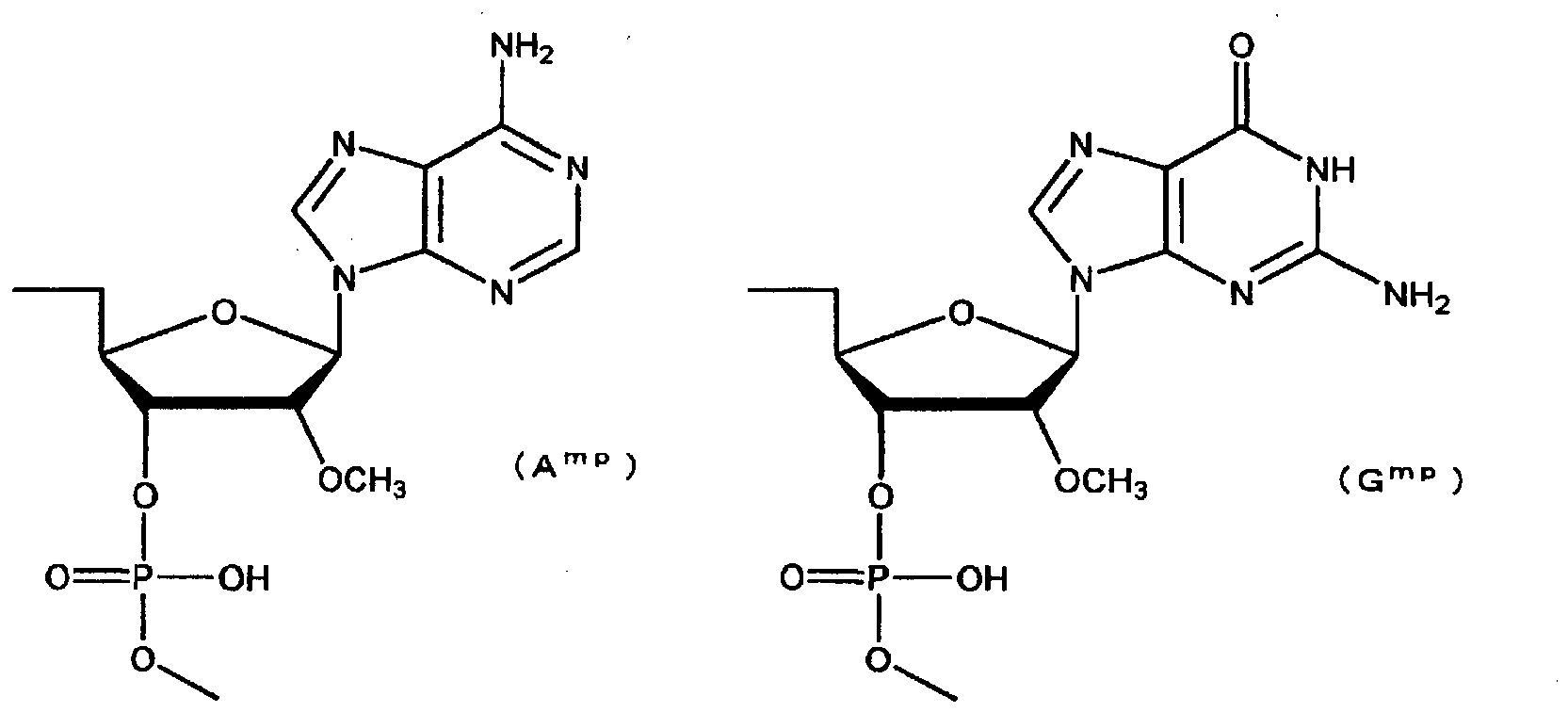


- A therapeutic agent for muscular dystrophy, comprising the compound according to any one of claims 1- 4 or a pharmacologically acceptable salt thereof.
- The therapeutic agent according to claim 5, whose target of treatment is those patients in which the total number of the amino acids in the open reading frame of the dystrophin gene will be a multiple of 3 when exon 45 of the dystrophin gene has been skipped.
- A compound according to any one of claims 1 to 4 or a therapeutic agent according to claim 5 or 6 for use in the treatment of muscular dystrophy.
- Use of a compound according to any one of claims 1 to 4 in the manufacture of a medicament for treating muscular dystrophy.
- Use according to claim 8, wherein the target of treatment is those patients in which the total number of the amino acids in the open reading frame of the dystrophin gene will be a multiple of 3 when exon 45 of the dystrophin gene has been skipped.
- A therapeutic agent according to claim 5 or 6, a compound or therapeutic agent according to claim 7 or a use according to claim 8 or 9 wherein said muscular dystrophy is Duchenne muscular dystrophy.
Priority Applications (7)
| Application Number | Priority Date | Filing Date | Title |
|---|---|---|---|
| EP11155685A EP2374885A3 (en) | 2002-11-25 | 2003-11-21 | ENA nucleic acid drugs modifying splicing in mRNA precursor |
| EP12182249.8A EP2530153B1 (en) | 2002-11-25 | 2003-11-21 | ENA nucleic acid drugs modifying splicing in mRNA precursor |
| EP11155691A EP2392660A3 (en) | 2002-11-25 | 2003-11-21 | ENA Nucleic Acid Drugs Modifying Splicing in mRNA Precursor |
| EP12182258.9A EP2530156B1 (en) | 2002-11-25 | 2003-11-21 | ENA nucleic acid drugs modifying splicing in mRNA precursor |
| EP12182257.1A EP2530155B1 (en) | 2002-11-25 | 2003-11-21 | ENA nucleic acid drugs modifying splicing in mRNA precursor |
| EP11155689.0A EP2386636B1 (en) | 2002-11-25 | 2003-11-21 | Ena nucleic acid drugs modifying splicing in mrna precursor |
| EP12182252.2A EP2530154B1 (en) | 2002-11-25 | 2003-11-21 | ENA nucleic acid drugs modifying splicing in mRNA precursor |
Applications Claiming Priority (3)
| Application Number | Priority Date | Filing Date | Title |
|---|---|---|---|
| JP2002340857 | 2002-11-25 | ||
| JP2003204381 | 2003-07-31 | ||
| EP03774151A EP1568769A4 (en) | 2002-11-25 | 2003-11-21 | ENA NUCLEIC ACID DRUGS MODIFYING SPLICING IN mRNA PRECURSOR |
Related Parent Applications (2)
| Application Number | Title | Priority Date | Filing Date |
|---|---|---|---|
| EP03774151A Division EP1568769A4 (en) | 2002-11-25 | 2003-11-21 | ENA NUCLEIC ACID DRUGS MODIFYING SPLICING IN mRNA PRECURSOR |
| EP03774151.9 Division | 2003-11-21 |
Related Child Applications (12)
| Application Number | Title | Priority Date | Filing Date |
|---|---|---|---|
| EP12182252.2A Division-Into EP2530154B1 (en) | 2002-11-25 | 2003-11-21 | ENA nucleic acid drugs modifying splicing in mRNA precursor |
| EP12182252.2A Division EP2530154B1 (en) | 2002-11-25 | 2003-11-21 | ENA nucleic acid drugs modifying splicing in mRNA precursor |
| EP11155685A Division-Into EP2374885A3 (en) | 2002-11-25 | 2003-11-21 | ENA nucleic acid drugs modifying splicing in mRNA precursor |
| EP12182249.8A Division-Into EP2530153B1 (en) | 2002-11-25 | 2003-11-21 | ENA nucleic acid drugs modifying splicing in mRNA precursor |
| EP12182249.8A Division EP2530153B1 (en) | 2002-11-25 | 2003-11-21 | ENA nucleic acid drugs modifying splicing in mRNA precursor |
| EP11155691A Division-Into EP2392660A3 (en) | 2002-11-25 | 2003-11-21 | ENA Nucleic Acid Drugs Modifying Splicing in mRNA Precursor |
| EP12182258.9A Division-Into EP2530156B1 (en) | 2002-11-25 | 2003-11-21 | ENA nucleic acid drugs modifying splicing in mRNA precursor |
| EP12182258.9A Division EP2530156B1 (en) | 2002-11-25 | 2003-11-21 | ENA nucleic acid drugs modifying splicing in mRNA precursor |
| EP11155689.0A Division-Into EP2386636B1 (en) | 2002-11-25 | 2003-11-21 | Ena nucleic acid drugs modifying splicing in mrna precursor |
| EP11155689.0A Division EP2386636B1 (en) | 2002-11-25 | 2003-11-21 | Ena nucleic acid drugs modifying splicing in mrna precursor |
| EP12182257.1A Division EP2530155B1 (en) | 2002-11-25 | 2003-11-21 | ENA nucleic acid drugs modifying splicing in mRNA precursor |
| EP12182257.1A Division-Into EP2530155B1 (en) | 2002-11-25 | 2003-11-21 | ENA nucleic acid drugs modifying splicing in mRNA precursor |
Publications (3)
| Publication Number | Publication Date |
|---|---|
| EP2135948A2 EP2135948A2 (en) | 2009-12-23 |
| EP2135948A3 EP2135948A3 (en) | 2010-03-17 |
| EP2135948B1 true EP2135948B1 (en) | 2014-09-17 |
Family
ID=32396255
Family Applications (9)
| Application Number | Title | Priority Date | Filing Date |
|---|---|---|---|
| EP12182249.8A Expired - Lifetime EP2530153B1 (en) | 2002-11-25 | 2003-11-21 | ENA nucleic acid drugs modifying splicing in mRNA precursor |
| EP12182258.9A Expired - Lifetime EP2530156B1 (en) | 2002-11-25 | 2003-11-21 | ENA nucleic acid drugs modifying splicing in mRNA precursor |
| EP12182257.1A Expired - Lifetime EP2530155B1 (en) | 2002-11-25 | 2003-11-21 | ENA nucleic acid drugs modifying splicing in mRNA precursor |
| EP03774151A Withdrawn EP1568769A4 (en) | 2002-11-25 | 2003-11-21 | ENA NUCLEIC ACID DRUGS MODIFYING SPLICING IN mRNA PRECURSOR |
| EP09011130.3A Expired - Lifetime EP2135948B1 (en) | 2002-11-25 | 2003-11-21 | ENA nucleic acid drugs modifying splicing in mRNA precursor |
| EP11155689.0A Expired - Lifetime EP2386636B1 (en) | 2002-11-25 | 2003-11-21 | Ena nucleic acid drugs modifying splicing in mrna precursor |
| EP12182252.2A Expired - Lifetime EP2530154B1 (en) | 2002-11-25 | 2003-11-21 | ENA nucleic acid drugs modifying splicing in mRNA precursor |
| EP11155691A Withdrawn EP2392660A3 (en) | 2002-11-25 | 2003-11-21 | ENA Nucleic Acid Drugs Modifying Splicing in mRNA Precursor |
| EP11155685A Withdrawn EP2374885A3 (en) | 2002-11-25 | 2003-11-21 | ENA nucleic acid drugs modifying splicing in mRNA precursor |
Family Applications Before (4)
| Application Number | Title | Priority Date | Filing Date |
|---|---|---|---|
| EP12182249.8A Expired - Lifetime EP2530153B1 (en) | 2002-11-25 | 2003-11-21 | ENA nucleic acid drugs modifying splicing in mRNA precursor |
| EP12182258.9A Expired - Lifetime EP2530156B1 (en) | 2002-11-25 | 2003-11-21 | ENA nucleic acid drugs modifying splicing in mRNA precursor |
| EP12182257.1A Expired - Lifetime EP2530155B1 (en) | 2002-11-25 | 2003-11-21 | ENA nucleic acid drugs modifying splicing in mRNA precursor |
| EP03774151A Withdrawn EP1568769A4 (en) | 2002-11-25 | 2003-11-21 | ENA NUCLEIC ACID DRUGS MODIFYING SPLICING IN mRNA PRECURSOR |
Family Applications After (4)
| Application Number | Title | Priority Date | Filing Date |
|---|---|---|---|
| EP11155689.0A Expired - Lifetime EP2386636B1 (en) | 2002-11-25 | 2003-11-21 | Ena nucleic acid drugs modifying splicing in mrna precursor |
| EP12182252.2A Expired - Lifetime EP2530154B1 (en) | 2002-11-25 | 2003-11-21 | ENA nucleic acid drugs modifying splicing in mRNA precursor |
| EP11155691A Withdrawn EP2392660A3 (en) | 2002-11-25 | 2003-11-21 | ENA Nucleic Acid Drugs Modifying Splicing in mRNA Precursor |
| EP11155685A Withdrawn EP2374885A3 (en) | 2002-11-25 | 2003-11-21 | ENA nucleic acid drugs modifying splicing in mRNA precursor |
Country Status (7)
| Country | Link |
|---|---|
| US (5) | US7902160B2 (en) |
| EP (9) | EP2530153B1 (en) |
| JP (6) | JP4777777B2 (en) |
| AU (1) | AU2003284638A1 (en) |
| CA (4) | CA2507125C (en) |
| ES (6) | ES2509140T3 (en) |
| WO (1) | WO2004048570A1 (en) |
Cited By (5)
| Publication number | Priority date | Publication date | Assignee | Title |
|---|---|---|---|---|
| US9018368B2 (en) | 2004-06-28 | 2015-04-28 | The University Of Western Australia | Antisense oligonucleotides for inducing exon skipping and methods of use thereof |
| US9217148B2 (en) | 2013-03-14 | 2015-12-22 | Sarepta Therapeutics, Inc. | Exon skipping compositions for treating muscular dystrophy |
| US9234198B1 (en) | 2008-10-24 | 2016-01-12 | Sarepta Therapeutics, Inc. | Multiple exon skipping compositions for DMD |
| US9506058B2 (en) | 2013-03-15 | 2016-11-29 | Sarepta Therapeutics, Inc. | Compositions for treating muscular dystrophy |
| US9758783B2 (en) | 2009-11-12 | 2017-09-12 | The University Of Western Australia | Antisense molecules and methods for treating pathologies |
Families Citing this family (61)
| Publication number | Priority date | Publication date | Assignee | Title |
|---|---|---|---|---|
| KR20020097241A (en) | 2000-05-04 | 2002-12-31 | 에이브이아이 바이오파마 인코포레이티드 | Splice-region antisense composition and method |
| CA2507125C (en) | 2002-11-25 | 2014-04-22 | Masafumi Matsuo | Ena nucleic acid pharmaceuticals capable of modifying splicing of mrna precursors |
| USRE48960E1 (en) | 2004-06-28 | 2022-03-08 | The University Of Western Australia | Antisense oligonucleotides for inducing exon skipping and methods of use thereof |
| CA2605512A1 (en) * | 2005-04-22 | 2006-10-26 | Academisch Ziekenhuis Leiden | Modulation of exon recognition in pre-mrna by interfering with the binding of sr proteins and by interfering with secondary rna structure. |
| WO2007123391A1 (en) | 2006-04-20 | 2007-11-01 | Academisch Ziekenhuis Leiden | Therapeutic intervention in a genetic disease in an individual by modifying expression of an aberrantly expressed gene. |
| EP1857548A1 (en) | 2006-05-19 | 2007-11-21 | Academisch Ziekenhuis Leiden | Means and method for inducing exon-skipping |
| CA2660523C (en) | 2006-08-11 | 2019-03-19 | Prosensa Technologies B.V. | Methods and means for treating dna repeat instability associated genetic disorders |
| WO2009008725A2 (en) | 2007-07-12 | 2009-01-15 | Prosensa Technologies B.V. | Molecules for targeting compounds to various selected organs, tissues or tumor cells |
| CN103212085A (en) | 2007-07-12 | 2013-07-24 | 普罗森那技术公司 | Molecules for targeting compounds to various selected organs or tissues |
| USRE48468E1 (en) | 2007-10-26 | 2021-03-16 | Biomarin Technologies B.V. | Means and methods for counteracting muscle disorders |
| PL2203173T3 (en) | 2007-10-26 | 2016-06-30 | Academisch Ziekenhuis Leiden | Means and methods for counteracting muscle disorders |
| CA2714120A1 (en) | 2008-02-08 | 2009-08-13 | Prosensa Holding Bv | Methods and means for treating dna repeat instability associated genetic disorders |
| EP2119783A1 (en) | 2008-05-14 | 2009-11-18 | Prosensa Technologies B.V. | Method for efficient exon (44) skipping in Duchenne Muscular Dystrophy and associated means |
| CA2759899A1 (en) | 2009-04-24 | 2010-10-28 | Prosensa Technologies B.V. | Oligonucleotide comprising an inosine for treating dmd |
| AU2014280918B2 (en) * | 2009-12-18 | 2016-11-17 | Arrowhead Pharmaceuticals, Inc. | Organic compositions to treat HSF1-related diseases |
| EP2513309A2 (en) | 2009-12-18 | 2012-10-24 | Novartis AG | Organic compositions to treat hsf1-related diseases |
| WO2011078672A1 (en) | 2009-12-24 | 2011-06-30 | Prosensa Technologies B.V. | Molecule for treating an inflammatory disorder |
| TWI541024B (en) | 2010-09-01 | 2016-07-11 | 日本新藥股份有限公司 | Antisense nucleic acid |
| WO2013033407A2 (en) | 2011-08-30 | 2013-03-07 | The Regents Of The University Of California | Identification of small molecules that enhance therapeutic exon skipping |
| CN117721110A (en) | 2011-12-28 | 2024-03-19 | 日本新药株式会社 | antisense nucleic acid |
| BR112014016640A2 (en) * | 2012-01-04 | 2021-03-16 | Quark Pharmaceuticals Inc | composed of double-stranded RNA for casp2 and its uses |
| BR112014018427B1 (en) * | 2012-01-27 | 2021-11-03 | Biomarin Technologies B.V. | RNA MODULATOR OLIGONUCLEOTIDES WITH IMPROVED FEATURES FOR THE TREATMENT OF DUCHENNE AND BECKER'S MUSCULAR DYSTROPHY |
| JP6928025B2 (en) * | 2012-01-27 | 2021-09-01 | バイオマリン テクノロジーズ ベー.フェー. | RNA-regulated oligonucleotides with improved features for the treatment of Duchenne and Becker muscular dystrophy |
| ES2798301T3 (en) * | 2012-06-18 | 2020-12-10 | Daiichi Sankyo Co Ltd | Intermediate for production of nucleoside analogues, and procedure for their production |
| BR112016020618B1 (en) * | 2014-03-12 | 2023-04-04 | Nippon Shinyaku Co., Ltd. | ANTISENSE OLIGOMER, PHARMACEUTICAL COMPOSITION, AND, USE OF AN ANTISENSE OLIGOMER |
| RS59764B1 (en) | 2014-06-17 | 2020-02-28 | Nippon Shinyaku Co Ltd | Antisense nucleic acid for use in the treatment of duchenne's muscular dystrophy |
| JP6384845B2 (en) | 2015-09-15 | 2018-09-05 | 日本新薬株式会社 | Antisense nucleic acid |
| MA45328A (en) | 2016-04-01 | 2019-02-06 | Avidity Biosciences Llc | NUCLEIC ACID-POLYPEPTIDE COMPOSITIONS AND USES THEREOF |
| EP3478697A1 (en) | 2016-06-30 | 2019-05-08 | Sarepta Therapeutics, Inc. | Exon skipping oligomers for muscular dystrophy |
| LT3554553T (en) | 2016-12-19 | 2022-08-25 | Sarepta Therapeutics, Inc. | Exon skipping oligomer conjugates for muscular dystrophy |
| PL3554554T3 (en) | 2016-12-19 | 2022-12-19 | Sarepta Therapeutics, Inc. | Exon-skipping oligomer conjugates in muscular dystrophy |
| DK3554552T3 (en) | 2016-12-19 | 2022-10-24 | Sarepta Therapeutics Inc | EXON SKIPPING OLIGOMER CONJUGATES AGAINST MUSCULAR DYSTROPHY |
| CA3047894A1 (en) | 2016-12-28 | 2018-07-05 | Daiichi Sankyo Company, Limited | Therapeutic drug for alport's syndrome |
| SG10202107429WA (en) | 2017-01-06 | 2021-08-30 | Avidity Biosciences Inc | Nucleic acid-polypeptide compositions and methods of inducing exon skipping |
| US11963974B2 (en) | 2017-03-10 | 2024-04-23 | National Center For Child Health And Development | Antisense oligonucleotide and composition for prevention or treatment of glycogen storage disease type Ia |
| GB201711809D0 (en) | 2017-07-21 | 2017-09-06 | Governors Of The Univ Of Alberta | Antisense oligonucleotide |
| EA201991450A1 (en) | 2017-09-22 | 2019-12-30 | Сарепта Терапьютикс, Инк. | OLIGOMER CONJUGATES FOR EXONISM SKIP IN MUSCULAR DYSTROPHY |
| EP3687577A1 (en) | 2017-09-28 | 2020-08-05 | Sarepta Therapeutics, Inc. | Combination therapies for treating muscular dystrophy |
| US20200248178A1 (en) | 2017-09-28 | 2020-08-06 | Sarepta Therapeutics, Inc. | Combination therapies for treating muscular dystrophy |
| CN115976028B (en) | 2018-03-09 | 2025-03-25 | 第一三共株式会社 | Drugs for the treatment of glycogenopathies type Ia |
| US10765760B2 (en) | 2018-05-29 | 2020-09-08 | Sarepta Therapeutics, Inc. | Exon skipping oligomer conjugates for muscular dystrophy |
| BR112020026542A2 (en) | 2018-06-26 | 2021-04-06 | Nippon Shinyaku Co., Ltd. | COMPOSITION THAT UNDERSTANDS ANTISENSE OLIGONUCLEOTIDE AND USE OF THE SAME FOR TREATMENT OF DUCHENNE MUSCULAR DYSTROPHY |
| SG11202100934PA (en) | 2018-08-02 | 2021-02-25 | Dyne Therapeutics Inc | Muscle targeting complexes and uses thereof for treating dystrophinopathies |
| US11168141B2 (en) | 2018-08-02 | 2021-11-09 | Dyne Therapeutics, Inc. | Muscle targeting complexes and uses thereof for treating dystrophinopathies |
| US20220193250A1 (en) | 2018-08-02 | 2022-06-23 | Dyne Therapeutics, Inc. | Muscle targeting complexes and uses thereof for treating facioscapulohumeral muscular dystrophy |
| US12018087B2 (en) | 2018-08-02 | 2024-06-25 | Dyne Therapeutics, Inc. | Muscle-targeting complexes comprising an anti-transferrin receptor antibody linked to an oligonucleotide and methods of delivering oligonucleotide to a subject |
| WO2021049504A1 (en) | 2019-09-10 | 2021-03-18 | 第一三共株式会社 | Galnac-oligonucleotide conjugate for liver-targeted delivery use, and method for producing same |
| IL292286A (en) | 2019-10-18 | 2022-06-01 | Daiichi Sankyo Co Ltd | Method for producing bicyclic phosphoramidite |
| BR112022012114A2 (en) | 2019-12-19 | 2022-09-06 | Nippon Shinyaku Co Ltd | ANTISENSE NUCLEIC ACID THAT ALLOWS THE LEAP OF EXONS |
| MY209476A (en) | 2019-12-26 | 2025-07-11 | Nippon Shinyaku Co Ltd | Antisense nucleic acid that induces skipping of exon 50 |
| KR20220145865A (en) | 2020-02-28 | 2022-10-31 | 니뽄 신야쿠 가부시키가이샤 | Antisense nucleic acid that induces skipping of exon 51 |
| US11987795B2 (en) | 2020-11-24 | 2024-05-21 | The Broad Institute, Inc. | Methods of modulating SLC7A11 pre-mRNA transcripts for diseases and conditions associated with expression of SLC7A11 |
| US12286630B2 (en) | 2021-04-30 | 2025-04-29 | Sarepta Therapeutics, Inc. | Treatment methods for muscular dystrophy |
| IL309626A (en) | 2021-06-23 | 2024-02-01 | Nippon Shinyaku Co Ltd | Combination of antisense oligomers |
| US11771776B2 (en) | 2021-07-09 | 2023-10-03 | Dyne Therapeutics, Inc. | Muscle targeting complexes and uses thereof for treating dystrophinopathies |
| US11638761B2 (en) | 2021-07-09 | 2023-05-02 | Dyne Therapeutics, Inc. | Muscle targeting complexes and uses thereof for treating Facioscapulohumeral muscular dystrophy |
| AU2022309028A1 (en) | 2021-07-09 | 2024-01-25 | Dyne Therapeutics, Inc. | Muscle targeting complexes and formulations for treating dystrophinopathies |
| US11969475B2 (en) | 2021-07-09 | 2024-04-30 | Dyne Therapeutics, Inc. | Muscle targeting complexes and uses thereof for treating facioscapulohumeral muscular dystrophy |
| US20240390508A1 (en) | 2021-08-21 | 2024-11-28 | Takeda Pharmaceutical Company Limited | Human transferrin receptor binding peptide-drug conjugate |
| EP4215614A1 (en) | 2022-01-24 | 2023-07-26 | Dynacure | Combination therapy for dystrophin-related diseases |
| CN119013401A (en) | 2022-03-17 | 2024-11-22 | 萨勒普塔医疗公司 | Phosphorodiamidite morpholines substituted oligomer conjugates |
Family Cites Families (25)
| Publication number | Priority date | Publication date | Assignee | Title |
|---|---|---|---|---|
| JP2544164B2 (en) | 1987-11-28 | 1996-10-16 | 新明工業株式会社 | Piston ring assembly device |
| ES2153379T3 (en) * | 1992-03-31 | 2001-03-01 | Abbott Lab | LIGASA REACTION PROCEDURE IN MULTIPLEX CHAIN. |
| US6436635B1 (en) * | 1992-11-06 | 2002-08-20 | Boston University | Solid phase sequencing of double-stranded nucleic acids |
| JPH0787982A (en) | 1993-01-29 | 1995-04-04 | Sankyo Co Ltd | Modified oligodeoxyribonucleotide |
| US5525470A (en) * | 1994-01-26 | 1996-06-11 | Hybridon, Inc. | Method of sequencing [short] oligonucleotides |
| US5563255A (en) * | 1994-05-31 | 1996-10-08 | Isis Pharmaceuticals, Inc. | Antisense oligonucleotide modulation of raf gene expression |
| US5853990A (en) * | 1996-07-26 | 1998-12-29 | Edward E. Winger | Real time homogeneous nucleotide assay |
| NZ503765A (en) | 1997-09-12 | 2002-04-26 | Exiqon As | Bi-cyclic and tri-cyclic nucleotide analogues |
| JPH11140930A (en) | 1997-11-13 | 1999-05-25 | Matsushita Electric Works Ltd | Shower device |
| EP1152009B2 (en) | 1999-02-12 | 2017-09-06 | Daiichi Sankyo Company, Limited | Novel nucleosides and oligonucleotide analogues |
| JP2000325085A (en) * | 1999-05-21 | 2000-11-28 | Masafumi Matsuo | Pharmaceutical composition for treatment of duchenne muscular dystrophy |
| US6165728A (en) | 1999-11-19 | 2000-12-26 | Isis Pharmaceuticals Inc. | Antisense modulation of NCK-2 expression |
| US6261840B1 (en) | 2000-01-18 | 2001-07-17 | Isis Pharmaceuticals, Inc. | Antisense modulation of PTP1B expression |
| US6653467B1 (en) | 2000-04-26 | 2003-11-25 | Jcr Pharmaceutical Co., Ltd. | Medicament for treatment of Duchenne muscular dystrophy |
| WO2001083695A2 (en) * | 2000-04-28 | 2001-11-08 | Xiao Xiao | Dna sequences encoding dystrophin minigenes and methods of use thereof |
| RU2165149C1 (en) | 2000-07-03 | 2001-04-20 | Шапошников Валерий Геннадьевич | "sugar wool" products forming and packaging method |
| US6920153B2 (en) * | 2000-07-17 | 2005-07-19 | Nortel Networks Limited | Architecture and addressing scheme for storage interconnect and emerging storage service providers |
| US6727355B2 (en) * | 2000-08-25 | 2004-04-27 | Jcr Pharmaceuticals Co., Ltd. | Pharmaceutical composition for treatment of Duchenne muscular dystrophy |
| JP4836366B2 (en) * | 2000-08-25 | 2011-12-14 | 雅文 松尾 | Duchenne muscular dystrophy treatment |
| EP1191097A1 (en) | 2000-09-21 | 2002-03-27 | Leids Universitair Medisch Centrum | Induction of exon skipping in eukaryotic cells |
| JP3781687B2 (en) | 2001-02-23 | 2006-05-31 | 松下電器産業株式会社 | Genetic diagnostic apparatus and genetic diagnostic method |
| WO2003056030A2 (en) * | 2001-11-08 | 2003-07-10 | The Johns Hopkins University | Methods and systems of nucleic acid sequencing |
| JP2003204381A (en) | 2002-01-04 | 2003-07-18 | Hitachi Ltd | Information communication terminal device |
| CA2507125C (en) * | 2002-11-25 | 2014-04-22 | Masafumi Matsuo | Ena nucleic acid pharmaceuticals capable of modifying splicing of mrna precursors |
| WO2004083432A1 (en) * | 2003-03-21 | 2004-09-30 | Academisch Ziekenhuis Leiden | Modulation of exon recognition in pre-mrna by interfering with the secondary rna structure |
-
2003
- 2003-11-21 CA CA2507125A patent/CA2507125C/en not_active Expired - Lifetime
- 2003-11-21 ES ES09011130.3T patent/ES2509140T3/en not_active Expired - Lifetime
- 2003-11-21 ES ES12182257.1T patent/ES2566632T3/en not_active Expired - Lifetime
- 2003-11-21 EP EP12182249.8A patent/EP2530153B1/en not_active Expired - Lifetime
- 2003-11-21 CA CA2942791A patent/CA2942791C/en not_active Expired - Lifetime
- 2003-11-21 EP EP12182258.9A patent/EP2530156B1/en not_active Expired - Lifetime
- 2003-11-21 EP EP12182257.1A patent/EP2530155B1/en not_active Expired - Lifetime
- 2003-11-21 ES ES12182258.9T patent/ES2554660T3/en not_active Expired - Lifetime
- 2003-11-21 JP JP2005510284A patent/JP4777777B2/en not_active Expired - Lifetime
- 2003-11-21 ES ES12182252.2T patent/ES2566629T3/en not_active Expired - Lifetime
- 2003-11-21 WO PCT/JP2003/014915 patent/WO2004048570A1/en not_active Ceased
- 2003-11-21 EP EP03774151A patent/EP1568769A4/en not_active Withdrawn
- 2003-11-21 EP EP09011130.3A patent/EP2135948B1/en not_active Expired - Lifetime
- 2003-11-21 ES ES11155689.0T patent/ES2561851T3/en not_active Expired - Lifetime
- 2003-11-21 CA CA3001404A patent/CA3001404C/en not_active Expired - Lifetime
- 2003-11-21 EP EP11155689.0A patent/EP2386636B1/en not_active Expired - Lifetime
- 2003-11-21 CA CA2796924A patent/CA2796924C/en not_active Expired - Lifetime
- 2003-11-21 ES ES12182249.8T patent/ES2566628T3/en not_active Expired - Lifetime
- 2003-11-21 AU AU2003284638A patent/AU2003284638A1/en not_active Abandoned
- 2003-11-21 US US10/536,258 patent/US7902160B2/en not_active Expired - Lifetime
- 2003-11-21 EP EP12182252.2A patent/EP2530154B1/en not_active Expired - Lifetime
- 2003-11-21 EP EP11155691A patent/EP2392660A3/en not_active Withdrawn
- 2003-11-21 EP EP11155685A patent/EP2374885A3/en not_active Withdrawn
-
2010
- 2010-04-09 JP JP2010090504A patent/JP5138722B2/en not_active Expired - Lifetime
- 2010-07-30 US US12/847,237 patent/US8624019B2/en not_active Expired - Fee Related
-
2012
- 2012-02-10 JP JP2012027325A patent/JP5486028B2/en not_active Expired - Lifetime
- 2012-11-09 US US13/673,466 patent/US9657049B2/en not_active Expired - Fee Related
-
2014
- 2014-01-20 JP JP2014007759A patent/JP5802770B2/en not_active Expired - Lifetime
- 2014-04-22 US US14/258,663 patent/US9243026B2/en not_active Expired - Lifetime
-
2015
- 2015-05-12 JP JP2015097462A patent/JP6382150B2/en not_active Expired - Lifetime
- 2015-09-18 US US14/858,404 patent/US9657050B2/en not_active Expired - Fee Related
-
2016
- 2016-05-11 JP JP2016095419A patent/JP2016182122A/en active Pending
Cited By (33)
| Publication number | Priority date | Publication date | Assignee | Title |
|---|---|---|---|---|
| US9018368B2 (en) | 2004-06-28 | 2015-04-28 | The University Of Western Australia | Antisense oligonucleotides for inducing exon skipping and methods of use thereof |
| US9447415B2 (en) | 2004-06-28 | 2016-09-20 | The University Of Western Australia | Antisense oligonucleotides for inducing exon skipping and methods of use thereof |
| US9035040B2 (en) | 2004-06-28 | 2015-05-19 | The University Of Western Australia | Antisense oligonucleotides for inducing exon skipping and methods of use thereof |
| US9175286B2 (en) | 2004-06-28 | 2015-11-03 | The University Of Western Australia | Antisense oligonucleotides for inducing exon skipping and methods of use thereof |
| US10995337B2 (en) | 2004-06-28 | 2021-05-04 | The University Of Western Australia | Antisense oligonucleotides for inducing exon skipping and methods of use thereof |
| US10968450B2 (en) | 2004-06-28 | 2021-04-06 | The University Of Western Australia | Antisense oligonucleotides for inducing exon skipping and methods of use thereof |
| US9249416B2 (en) | 2004-06-28 | 2016-02-02 | The University Of Western Australia | Antisense oligonucleotides for inducing exon skipping and methods of use thereof |
| US9422555B2 (en) | 2004-06-28 | 2016-08-23 | The University Of Western Australia | Antisense oligonucleotides for inducing exon skipping and methods of use thereof |
| US9024007B2 (en) | 2004-06-28 | 2015-05-05 | The University Of Western Australia | Antisense oligonucleotides for inducing exon skipping and methods of use thereof |
| US10266827B2 (en) | 2004-06-28 | 2019-04-23 | The University Of Western Australia | Antisense oligonucleotides for inducing exon skipping and methods of use thereof |
| US9441229B2 (en) | 2004-06-28 | 2016-09-13 | The University Of Western Australia | Antisense oligonucleotides for inducing exon skipping and methods of use thereof |
| US10781451B2 (en) | 2004-06-28 | 2020-09-22 | The University Of Western Australia | Antisense oligonucleotides for inducing exon skipping and methods of use thereof |
| USRE47769E1 (en) | 2004-06-28 | 2019-12-17 | The University Of Western Australia | Antisense oligonucleotides for inducing exon skipping and methods of use thereof |
| USRE47751E1 (en) | 2004-06-28 | 2019-12-03 | The University Of Western Australia | Antisense oligonucleotides for inducing exon skipping and methods of use thereof |
| USRE47691E1 (en) | 2004-06-28 | 2019-11-05 | The University Of Western Australia | Antisense oligonucleotides for inducing exon skipping and methods of use thereof |
| US9605262B2 (en) | 2004-06-28 | 2017-03-28 | The University Of Western Australia | Antisense oligonucleotides for inducing exon skipping and methods of use thereof |
| US10421966B2 (en) | 2004-06-28 | 2019-09-24 | The University Of Western Australia | Antisense oligonucleotides for inducing exon skipping and methods of use thereof |
| US9994851B2 (en) | 2004-06-28 | 2018-06-12 | The University Of Western Australia | Antisense oligonucleotides for inducing exon skipping and methods of use thereof |
| US9434948B2 (en) | 2008-10-24 | 2016-09-06 | Sarepta Therapeutics, Inc. | Multiple exon skipping compositions for DMD |
| US9453225B2 (en) | 2008-10-24 | 2016-09-27 | Sarepta Therapeutics, Inc. | Multiple exon skipping compositions for DMD |
| US9234198B1 (en) | 2008-10-24 | 2016-01-12 | Sarepta Therapeutics, Inc. | Multiple exon skipping compositions for DMD |
| US9447416B2 (en) | 2008-10-24 | 2016-09-20 | Sarepta Therapeutics, Inc. | Multiple exon skipping compositions for DMD |
| US9447417B2 (en) | 2008-10-24 | 2016-09-20 | Sarepta Therapeutics, Inc. | Multiple exon skipping compositions for DMD |
| US9758783B2 (en) | 2009-11-12 | 2017-09-12 | The University Of Western Australia | Antisense molecules and methods for treating pathologies |
| US10287586B2 (en) | 2009-11-12 | 2019-05-14 | The University Of Western Australia | Antisense molecules and methods for treating pathologies |
| US10781450B2 (en) | 2009-11-12 | 2020-09-22 | Sarepta Therapeutics, Inc. | Antisense molecules and methods for treating pathologies |
| US11447776B2 (en) | 2009-11-12 | 2022-09-20 | The University Of Western Australia | Antisense molecules and methods for treating pathologies |
| US10907154B2 (en) | 2013-03-14 | 2021-02-02 | Sarepta Therapeutics, Inc. | Exon skipping compositions for treating muscular dystrophy |
| US9217148B2 (en) | 2013-03-14 | 2015-12-22 | Sarepta Therapeutics, Inc. | Exon skipping compositions for treating muscular dystrophy |
| US11932851B2 (en) | 2013-03-14 | 2024-03-19 | Sarepta Therapeutics, Inc. | Exon skipping compositions for treating muscular dystrophy |
| US9506058B2 (en) | 2013-03-15 | 2016-11-29 | Sarepta Therapeutics, Inc. | Compositions for treating muscular dystrophy |
| US10364431B2 (en) | 2013-03-15 | 2019-07-30 | Sarepta Therapeutics, Inc. | Compositions for treating muscular dystrophy |
| US10337003B2 (en) | 2013-03-15 | 2019-07-02 | Sarepta Therapeutics, Inc. | Compositions for treating muscular dystrophy |
Also Published As
Similar Documents
| Publication | Publication Date | Title |
|---|---|---|
| EP2135948B1 (en) | ENA nucleic acid drugs modifying splicing in mRNA precursor | |
| EP2612917B1 (en) | Antisense nucleic acid | |
| JP2025166835A (en) | Use of SCAMP3 inhibitors to treat hepatitis B virus infection | |
| CN114867856A (en) | Use of SARAF inhibitors for the treatment of hepatitis B virus infection | |
| JP7627495B2 (en) | Antisense oligonucleotides that alter splicing of DUX4 pre-mRNA | |
| JP6934695B2 (en) | Nucleic acid medicine and its use | |
| JPWO2019009299A1 (en) | ENA antisense oligonucleotide that suppresses α-synuclein expression | |
| JP2007104971A (en) | Antisense oligonucleotide for splicing control of myostatin | |
| EP3728592B1 (en) | Oligonucleotides comprising a phosphorodithioate internucleoside linkage | |
| EP3816286A1 (en) | Myocardial dysfunction therapeutic agent | |
| CN114829601A (en) | Use of SBDS inhibitors for the treatment of hepatitis b virus infection | |
| EP3146970B1 (en) | Nucleic acid drug for inducing skipping of variant exon of cd44 gene and increasing expression of normal type cd44 mrna | |
| HK40065915A (en) | Antisense oligonucleotide capable of altering splicing of dux4 pre-mrna | |
| HK40078456A (en) | Use of sbds inhibitors for treating hepatitis b virus infection | |
| HK40077333A (en) | Use of saraf inhibitors for treating hepatitis b virus infection | |
| HK40040396A (en) | Myocardial dysfunction therapeutic agent | |
| WO2019111791A1 (en) | Antisense oligonucleotide capable of cancelling intron retention in dystrophin gene |
Legal Events
| Date | Code | Title | Description |
|---|---|---|---|
| PUAI | Public reference made under article 153(3) epc to a published international application that has entered the european phase |
Free format text: ORIGINAL CODE: 0009012 |
|
| AC | Divisional application: reference to earlier application |
Ref document number: 1568769 Country of ref document: EP Kind code of ref document: P |
|
| AK | Designated contracting states |
Kind code of ref document: A2 Designated state(s): AT BE BG CH CY CZ DE DK EE ES FI FR GB GR HU IE IT LI LU MC NL PT RO SE SI SK TR |
|
| PUAL | Search report despatched |
Free format text: ORIGINAL CODE: 0009013 |
|
| AK | Designated contracting states |
Kind code of ref document: A3 Designated state(s): AT BE BG CH CY CZ DE DK EE ES FI FR GB GR HU IE IT LI LU MC NL PT RO SE SI SK TR |
|
| 17P | Request for examination filed |
Effective date: 20100910 |
|
| 17Q | First examination report despatched |
Effective date: 20101008 |
|
| RAP1 | Party data changed (applicant data changed or rights of an application transferred) |
Owner name: KNC LABORATORIES CO., LTD Owner name: TAKESHIMA, YASUHIRO Owner name: NONPROFIT ORGANIZATION TRANSLATIONAL RESEARCH ORGA Owner name: MATSUO, MASAFUMI |
|
| RIN1 | Information on inventor provided before grant (corrected) |
Inventor name: TAKESHIMA, YASUHIRO Inventor name: MATSUO, MASAFUMI Inventor name: KOIZUMI, MAKOTO |
|
| RAP1 | Party data changed (applicant data changed or rights of an application transferred) |
Owner name: NONPROFIT ORGANIZATION TRANSLATIONAL RESEARCH ORGA Owner name: MATSUO, MASAFUMI Owner name: KNC LABORATORIES CO., LTD Owner name: TAKESHIMA, YASUHIRO |
|
| RAP1 | Party data changed (applicant data changed or rights of an application transferred) |
Owner name: TAKESHIMA, YASUHIRO Owner name: DAIICHI SANKYO COMPANY, LIMITED Owner name: NONPROFIT ORGANIZATION TRANSLATIONAL RESEARCH ORGA Owner name: MATSUO, MASAFUMI |
|
| RIN1 | Information on inventor provided before grant (corrected) |
Inventor name: KOIZUMI, MAKOTO Inventor name: TAKESHIMA, YASUHIRO Inventor name: MATSUO, MASAFUMI |
|
| RAP1 | Party data changed (applicant data changed or rights of an application transferred) |
Owner name: ORPHAN DISEASE TREATMENT INSTITUTE CO., LTD. Owner name: MATSUO, MASAFUMI Owner name: DAIICHI SANKYO COMPANY, LIMITED Owner name: TAKESHIMA, YASUHIRO |
|
| GRAP | Despatch of communication of intention to grant a patent |
Free format text: ORIGINAL CODE: EPIDOSNIGR1 |
|
| INTG | Intention to grant announced |
Effective date: 20140306 |
|
| RAP1 | Party data changed (applicant data changed or rights of an application transferred) |
Owner name: TAKESHIMA, YASUHIRO Owner name: DAIICHI SANKYO COMPANY, LIMITED Owner name: MATSUO, MASAFUMI Owner name: ORPHAN DISEASE TREATMENT INSTITUTE CO., LTD. |
|
| RIN1 | Information on inventor provided before grant (corrected) |
Inventor name: MATSUO, MASAFUMI Inventor name: TAKESHIMA, YASUHIRO Inventor name: KOIZUMI, MAKOTO |
|
| GRAS | Grant fee paid |
Free format text: ORIGINAL CODE: EPIDOSNIGR3 |
|
| GRAA | (expected) grant |
Free format text: ORIGINAL CODE: 0009210 |
|
| RAP1 | Party data changed (applicant data changed or rights of an application transferred) |
Owner name: ORPHAN DISEASE TREATMENT INSTITUTE CO., LTD. Owner name: DAIICHI SANKYO COMPANY, LIMITED Owner name: TAKESHIMA, YASUHIRO Owner name: MATSUO, MASAFUMI |
|
| AC | Divisional application: reference to earlier application |
Ref document number: 1568769 Country of ref document: EP Kind code of ref document: P |
|
| AK | Designated contracting states |
Kind code of ref document: B1 Designated state(s): AT BE BG CH CY CZ DE DK EE ES FI FR GB GR HU IE IT LI LU MC NL PT RO SE SI SK TR |
|
| REG | Reference to a national code |
Ref country code: GB Ref legal event code: FG4D |
|
| REG | Reference to a national code |
Ref country code: CH Ref legal event code: EP |
|
| REG | Reference to a national code |
Ref country code: IE Ref legal event code: FG4D |
|
| REG | Reference to a national code |
Ref country code: AT Ref legal event code: REF Ref document number: 687732 Country of ref document: AT Kind code of ref document: T Effective date: 20141015 |
|
| REG | Reference to a national code |
Ref country code: ES Ref legal event code: FG2A Ref document number: 2509140 Country of ref document: ES Kind code of ref document: T3 Effective date: 20141017 |
|
| REG | Reference to a national code |
Ref country code: DE Ref legal event code: R096 Ref document number: 60346773 Country of ref document: DE Effective date: 20141030 |
|
| PG25 | Lapsed in a contracting state [announced via postgrant information from national office to epo] |
Ref country code: FI Free format text: LAPSE BECAUSE OF FAILURE TO SUBMIT A TRANSLATION OF THE DESCRIPTION OR TO PAY THE FEE WITHIN THE PRESCRIBED TIME-LIMIT Effective date: 20140917 Ref country code: SE Free format text: LAPSE BECAUSE OF FAILURE TO SUBMIT A TRANSLATION OF THE DESCRIPTION OR TO PAY THE FEE WITHIN THE PRESCRIBED TIME-LIMIT Effective date: 20140917 Ref country code: GR Free format text: LAPSE BECAUSE OF FAILURE TO SUBMIT A TRANSLATION OF THE DESCRIPTION OR TO PAY THE FEE WITHIN THE PRESCRIBED TIME-LIMIT Effective date: 20141218 |
|
| REG | Reference to a national code |
Ref country code: NL Ref legal event code: VDEP Effective date: 20140917 |
|
| PG25 | Lapsed in a contracting state [announced via postgrant information from national office to epo] |
Ref country code: CY Free format text: LAPSE BECAUSE OF FAILURE TO SUBMIT A TRANSLATION OF THE DESCRIPTION OR TO PAY THE FEE WITHIN THE PRESCRIBED TIME-LIMIT Effective date: 20140917 |
|
| REG | Reference to a national code |
Ref country code: AT Ref legal event code: MK05 Ref document number: 687732 Country of ref document: AT Kind code of ref document: T Effective date: 20140917 |
|
| PG25 | Lapsed in a contracting state [announced via postgrant information from national office to epo] |
Ref country code: NL Free format text: LAPSE BECAUSE OF FAILURE TO SUBMIT A TRANSLATION OF THE DESCRIPTION OR TO PAY THE FEE WITHIN THE PRESCRIBED TIME-LIMIT Effective date: 20140917 |
|
| PG25 | Lapsed in a contracting state [announced via postgrant information from national office to epo] |
Ref country code: CZ Free format text: LAPSE BECAUSE OF FAILURE TO SUBMIT A TRANSLATION OF THE DESCRIPTION OR TO PAY THE FEE WITHIN THE PRESCRIBED TIME-LIMIT Effective date: 20140917 Ref country code: SK Free format text: LAPSE BECAUSE OF FAILURE TO SUBMIT A TRANSLATION OF THE DESCRIPTION OR TO PAY THE FEE WITHIN THE PRESCRIBED TIME-LIMIT Effective date: 20140917 Ref country code: RO Free format text: LAPSE BECAUSE OF FAILURE TO SUBMIT A TRANSLATION OF THE DESCRIPTION OR TO PAY THE FEE WITHIN THE PRESCRIBED TIME-LIMIT Effective date: 20140917 Ref country code: PT Free format text: LAPSE BECAUSE OF FAILURE TO SUBMIT A TRANSLATION OF THE DESCRIPTION OR TO PAY THE FEE WITHIN THE PRESCRIBED TIME-LIMIT Effective date: 20150119 Ref country code: EE Free format text: LAPSE BECAUSE OF FAILURE TO SUBMIT A TRANSLATION OF THE DESCRIPTION OR TO PAY THE FEE WITHIN THE PRESCRIBED TIME-LIMIT Effective date: 20140917 |
|
| PG25 | Lapsed in a contracting state [announced via postgrant information from national office to epo] |
Ref country code: AT Free format text: LAPSE BECAUSE OF FAILURE TO SUBMIT A TRANSLATION OF THE DESCRIPTION OR TO PAY THE FEE WITHIN THE PRESCRIBED TIME-LIMIT Effective date: 20140917 |
|
| REG | Reference to a national code |
Ref country code: DE Ref legal event code: R097 Ref document number: 60346773 Country of ref document: DE |
|
| PG25 | Lapsed in a contracting state [announced via postgrant information from national office to epo] |
Ref country code: MC Free format text: LAPSE BECAUSE OF FAILURE TO SUBMIT A TRANSLATION OF THE DESCRIPTION OR TO PAY THE FEE WITHIN THE PRESCRIBED TIME-LIMIT Effective date: 20140917 Ref country code: BE Free format text: LAPSE BECAUSE OF NON-PAYMENT OF DUE FEES Effective date: 20141130 Ref country code: LU Free format text: LAPSE BECAUSE OF FAILURE TO SUBMIT A TRANSLATION OF THE DESCRIPTION OR TO PAY THE FEE WITHIN THE PRESCRIBED TIME-LIMIT Effective date: 20141121 |
|
| REG | Reference to a national code |
Ref country code: CH Ref legal event code: PL |
|
| PLBE | No opposition filed within time limit |
Free format text: ORIGINAL CODE: 0009261 |
|
| STAA | Information on the status of an ep patent application or granted ep patent |
Free format text: STATUS: NO OPPOSITION FILED WITHIN TIME LIMIT |
|
| PG25 | Lapsed in a contracting state [announced via postgrant information from national office to epo] |
Ref country code: DK Free format text: LAPSE BECAUSE OF FAILURE TO SUBMIT A TRANSLATION OF THE DESCRIPTION OR TO PAY THE FEE WITHIN THE PRESCRIBED TIME-LIMIT Effective date: 20140917 Ref country code: LI Free format text: LAPSE BECAUSE OF NON-PAYMENT OF DUE FEES Effective date: 20141130 Ref country code: CH Free format text: LAPSE BECAUSE OF NON-PAYMENT OF DUE FEES Effective date: 20141130 |
|
| 26N | No opposition filed |
Effective date: 20150618 |
|
| REG | Reference to a national code |
Ref country code: IE Ref legal event code: MM4A |
|
| REG | Reference to a national code |
Ref country code: FR Ref legal event code: PLFP Year of fee payment: 13 |
|
| PG25 | Lapsed in a contracting state [announced via postgrant information from national office to epo] |
Ref country code: IE Free format text: LAPSE BECAUSE OF NON-PAYMENT OF DUE FEES Effective date: 20141121 |
|
| PG25 | Lapsed in a contracting state [announced via postgrant information from national office to epo] |
Ref country code: SI Free format text: LAPSE BECAUSE OF FAILURE TO SUBMIT A TRANSLATION OF THE DESCRIPTION OR TO PAY THE FEE WITHIN THE PRESCRIBED TIME-LIMIT Effective date: 20140917 |
|
| PG25 | Lapsed in a contracting state [announced via postgrant information from national office to epo] |
Ref country code: BG Free format text: LAPSE BECAUSE OF FAILURE TO SUBMIT A TRANSLATION OF THE DESCRIPTION OR TO PAY THE FEE WITHIN THE PRESCRIBED TIME-LIMIT Effective date: 20140917 |
|
| PG25 | Lapsed in a contracting state [announced via postgrant information from national office to epo] |
Ref country code: HU Free format text: LAPSE BECAUSE OF FAILURE TO SUBMIT A TRANSLATION OF THE DESCRIPTION OR TO PAY THE FEE WITHIN THE PRESCRIBED TIME-LIMIT; INVALID AB INITIO Effective date: 20031121 Ref country code: TR Free format text: LAPSE BECAUSE OF FAILURE TO SUBMIT A TRANSLATION OF THE DESCRIPTION OR TO PAY THE FEE WITHIN THE PRESCRIBED TIME-LIMIT Effective date: 20140917 |
|
| REG | Reference to a national code |
Ref country code: FR Ref legal event code: PLFP Year of fee payment: 14 |
|
| REG | Reference to a national code |
Ref country code: FR Ref legal event code: PLFP Year of fee payment: 15 |
|
| REG | Reference to a national code |
Ref country code: FR Ref legal event code: PLFP Year of fee payment: 16 |
|
| REG | Reference to a national code |
Ref country code: DE Ref legal event code: R081 Ref document number: 60346773 Country of ref document: DE Owner name: DAIICHI SANKYO COMPANY, LIMITED, JP Free format text: FORMER OWNERS: DAIICHI SANKYO CO., LTD., TOKYO, JP; MATSUO, MASAFUMI, KOBE-SHI, HYOGO-KEN, JP; ORPHAN DISEASE TREATMENT INSTITUTE CO., LTD., TOKYO, JP; TAKESHIMA, YASUHIRO, NISHINOMIYA-SHI, HYOGO-KEN, JP Ref country code: DE Ref legal event code: R081 Ref document number: 60346773 Country of ref document: DE Owner name: DAIICHI SANKYO CO., LIMITED, JP Free format text: FORMER OWNERS: DAIICHI SANKYO CO., LTD., TOKYO, JP; MATSUO, MASAFUMI, KOBE-SHI, HYOGO-KEN, JP; ORPHAN DISEASE TREATMENT INSTITUTE CO., LTD., TOKYO, JP; TAKESHIMA, YASUHIRO, NISHINOMIYA-SHI, HYOGO-KEN, JP Ref country code: DE Ref legal event code: R081 Ref document number: 60346773 Country of ref document: DE Owner name: TAKESHIMA, YASUHIRO, NISHINOMIYA-SHI, JP Free format text: FORMER OWNERS: DAIICHI SANKYO CO., LTD., TOKYO, JP; MATSUO, MASAFUMI, KOBE-SHI, HYOGO-KEN, JP; ORPHAN DISEASE TREATMENT INSTITUTE CO., LTD., TOKYO, JP; TAKESHIMA, YASUHIRO, NISHINOMIYA-SHI, HYOGO-KEN, JP Ref country code: DE Ref legal event code: R081 Ref document number: 60346773 Country of ref document: DE Owner name: MATSUO, MASAFUMI, KOBE-SHI, JP Free format text: FORMER OWNERS: DAIICHI SANKYO CO., LTD., TOKYO, JP; MATSUO, MASAFUMI, KOBE-SHI, HYOGO-KEN, JP; ORPHAN DISEASE TREATMENT INSTITUTE CO., LTD., TOKYO, JP; TAKESHIMA, YASUHIRO, NISHINOMIYA-SHI, HYOGO-KEN, JP Ref country code: DE Ref legal event code: R081 Ref document number: 60346773 Country of ref document: DE Owner name: DAIICHI SANKYO CO., LTD., JP Free format text: FORMER OWNERS: DAIICHI SANKYO CO., LTD., TOKYO, JP; MATSUO, MASAFUMI, KOBE-SHI, HYOGO-KEN, JP; ORPHAN DISEASE TREATMENT INSTITUTE CO., LTD., TOKYO, JP; TAKESHIMA, YASUHIRO, NISHINOMIYA-SHI, HYOGO-KEN, JP |
|
| REG | Reference to a national code |
Ref country code: ES Ref legal event code: PC2A Owner name: DAIICHI SANKYO COMPANY, LIMITED Effective date: 20210929 |
|
| REG | Reference to a national code |
Ref country code: GB Ref legal event code: 732E Free format text: REGISTERED BETWEEN 20210923 AND 20210929 |
|
| REG | Reference to a national code |
Ref country code: DE Ref legal event code: R081 Ref document number: 60346773 Country of ref document: DE Owner name: TAKESHIMA, YASUHIRO, NISHINOMIYA-SHI, JP Free format text: FORMER OWNERS: DAIICHI SANKYO CO., LTD., TOKYO, JP; MATSUO, MASAFUMI, KOBE-SHI, HYOGO-KEN, JP; TAKESHIMA, YASUHIRO, NISHINOMIYA-SHI, HYOGO-KEN, JP Ref country code: DE Ref legal event code: R081 Ref document number: 60346773 Country of ref document: DE Owner name: MATSUO, MASAFUMI, KOBE-SHI, JP Free format text: FORMER OWNERS: DAIICHI SANKYO CO., LTD., TOKYO, JP; MATSUO, MASAFUMI, KOBE-SHI, HYOGO-KEN, JP; TAKESHIMA, YASUHIRO, NISHINOMIYA-SHI, HYOGO-KEN, JP Ref country code: DE Ref legal event code: R081 Ref document number: 60346773 Country of ref document: DE Owner name: DAIICHI SANKYO COMPANY, LIMITED, JP Free format text: FORMER OWNERS: DAIICHI SANKYO CO., LTD., TOKYO, JP; MATSUO, MASAFUMI, KOBE-SHI, HYOGO-KEN, JP; TAKESHIMA, YASUHIRO, NISHINOMIYA-SHI, HYOGO-KEN, JP |
|
| REG | Reference to a national code |
Ref country code: DE Ref legal event code: R081 Ref document number: 60346773 Country of ref document: DE Owner name: TAKESHIMA, YASUHIRO, NISHINOMIYA-SHI, JP Free format text: FORMER OWNERS: DAIICHI SANKYO CO., LIMITED, TOKYO, JP; MATSUO, MASAFUMI, KOBE-SHI, HYOGO-KEN, JP; TAKESHIMA, YASUHIRO, NISHINOMIYA-SHI, HYOGO-KEN, JP Ref country code: DE Ref legal event code: R081 Ref document number: 60346773 Country of ref document: DE Owner name: MATSUO, MASAFUMI, KOBE-SHI, JP Free format text: FORMER OWNERS: DAIICHI SANKYO CO., LIMITED, TOKYO, JP; MATSUO, MASAFUMI, KOBE-SHI, HYOGO-KEN, JP; TAKESHIMA, YASUHIRO, NISHINOMIYA-SHI, HYOGO-KEN, JP Ref country code: DE Ref legal event code: R081 Ref document number: 60346773 Country of ref document: DE Owner name: DAIICHI SANKYO COMPANY, LIMITED, JP Free format text: FORMER OWNERS: DAIICHI SANKYO CO., LIMITED, TOKYO, JP; MATSUO, MASAFUMI, KOBE-SHI, HYOGO-KEN, JP; TAKESHIMA, YASUHIRO, NISHINOMIYA-SHI, HYOGO-KEN, JP |
|
| PGFP | Annual fee paid to national office [announced via postgrant information from national office to epo] |
Ref country code: GB Payment date: 20220930 Year of fee payment: 20 |
|
| PGFP | Annual fee paid to national office [announced via postgrant information from national office to epo] |
Ref country code: FR Payment date: 20221010 Year of fee payment: 20 |
|
| PGFP | Annual fee paid to national office [announced via postgrant information from national office to epo] |
Ref country code: IT Payment date: 20221011 Year of fee payment: 20 Ref country code: ES Payment date: 20221206 Year of fee payment: 20 Ref country code: DE Payment date: 20220930 Year of fee payment: 20 |
|
| REG | Reference to a national code |
Ref country code: DE Ref legal event code: R071 Ref document number: 60346773 Country of ref document: DE |
|
| REG | Reference to a national code |
Ref country code: ES Ref legal event code: FD2A Effective date: 20231201 |
|
| REG | Reference to a national code |
Ref country code: GB Ref legal event code: PE20 Expiry date: 20231120 |
|
| PG25 | Lapsed in a contracting state [announced via postgrant information from national office to epo] |
Ref country code: GB Free format text: LAPSE BECAUSE OF EXPIRATION OF PROTECTION Effective date: 20231120 |
|
| PG25 | Lapsed in a contracting state [announced via postgrant information from national office to epo] |
Ref country code: ES Free format text: LAPSE BECAUSE OF EXPIRATION OF PROTECTION Effective date: 20231122 |
|
| PG25 | Lapsed in a contracting state [announced via postgrant information from national office to epo] |
Ref country code: GB Free format text: LAPSE BECAUSE OF EXPIRATION OF PROTECTION Effective date: 20231120 Ref country code: ES Free format text: LAPSE BECAUSE OF EXPIRATION OF PROTECTION Effective date: 20231122 |