EP1857548A1 - Means and method for inducing exon-skipping - Google Patents
Means and method for inducing exon-skipping Download PDFInfo
- Publication number
- EP1857548A1 EP1857548A1 EP06076078A EP06076078A EP1857548A1 EP 1857548 A1 EP1857548 A1 EP 1857548A1 EP 06076078 A EP06076078 A EP 06076078A EP 06076078 A EP06076078 A EP 06076078A EP 1857548 A1 EP1857548 A1 EP 1857548A1
- Authority
- EP
- European Patent Office
- Prior art keywords
- exon
- aon
- skipping
- cell
- mrna
- Prior art date
- Legal status (The legal status is an assumption and is not a legal conclusion. Google has not performed a legal analysis and makes no representation as to the accuracy of the status listed.)
- Withdrawn
Links
- 238000000034 method Methods 0.000 title claims abstract description 32
- 230000001939 inductive effect Effects 0.000 title description 3
- 108091034117 Oligonucleotide Proteins 0.000 claims description 110
- 239000000074 antisense oligonucleotide Substances 0.000 claims description 105
- 238000012230 antisense oligonucleotides Methods 0.000 claims description 105
- 210000004027 cell Anatomy 0.000 claims description 37
- 125000003729 nucleotide group Chemical group 0.000 claims description 27
- 108020004999 messenger RNA Proteins 0.000 claims description 24
- 239000002773 nucleotide Substances 0.000 claims description 23
- 108091032973 (ribonucleotides)n+m Proteins 0.000 claims description 22
- 238000009396 hybridization Methods 0.000 claims description 15
- 108091027974 Mature messenger RNA Proteins 0.000 claims description 9
- 239000002243 precursor Substances 0.000 claims description 7
- 239000003623 enhancer Substances 0.000 claims description 3
- 210000005260 human cell Anatomy 0.000 claims description 2
- 108700024394 Exon Proteins 0.000 abstract description 32
- 230000008685 targeting Effects 0.000 abstract description 12
- 230000001105 regulatory effect Effects 0.000 abstract 1
- 108090000623 proteins and genes Proteins 0.000 description 26
- 102000004169 proteins and genes Human genes 0.000 description 20
- 206010013801 Duchenne Muscular Dystrophy Diseases 0.000 description 12
- 108020005067 RNA Splice Sites Proteins 0.000 description 8
- 238000012217 deletion Methods 0.000 description 7
- 230000037430 deletion Effects 0.000 description 7
- 230000000694 effects Effects 0.000 description 7
- 150000003384 small molecules Chemical class 0.000 description 7
- 238000013459 approach Methods 0.000 description 6
- 230000035772 mutation Effects 0.000 description 6
- 238000010240 RT-PCR analysis Methods 0.000 description 5
- 241000700605 Viruses Species 0.000 description 5
- 108020004707 nucleic acids Proteins 0.000 description 5
- 102000039446 nucleic acids Human genes 0.000 description 5
- 150000007523 nucleic acids Chemical class 0.000 description 5
- 230000008569 process Effects 0.000 description 5
- 238000001890 transfection Methods 0.000 description 5
- 108020004414 DNA Proteins 0.000 description 4
- 108010067390 Viral Proteins Proteins 0.000 description 4
- 230000000903 blocking effect Effects 0.000 description 4
- 238000002474 experimental method Methods 0.000 description 4
- 238000012986 modification Methods 0.000 description 4
- 230000004048 modification Effects 0.000 description 4
- 201000006935 Becker muscular dystrophy Diseases 0.000 description 3
- 108010069091 Dystrophin Proteins 0.000 description 3
- 208000034826 Genetic Predisposition to Disease Diseases 0.000 description 3
- 208000026350 Inborn Genetic disease Diseases 0.000 description 3
- 206010028980 Neoplasm Diseases 0.000 description 3
- 229920002873 Polyethylenimine Polymers 0.000 description 3
- RYYWUUFWQRZTIU-UHFFFAOYSA-N Thiophosphoric acid Chemical group OP(O)(S)=O RYYWUUFWQRZTIU-UHFFFAOYSA-N 0.000 description 3
- 230000001594 aberrant effect Effects 0.000 description 3
- 230000007717 exclusion Effects 0.000 description 3
- 208000016361 genetic disease Diseases 0.000 description 3
- 239000013598 vector Substances 0.000 description 3
- 201000003542 Factor VIII deficiency Diseases 0.000 description 2
- 208000009292 Hemophilia A Diseases 0.000 description 2
- 101000587430 Homo sapiens Serine/arginine-rich splicing factor 2 Proteins 0.000 description 2
- 102100034343 Integrase Human genes 0.000 description 2
- 101710203526 Integrase Proteins 0.000 description 2
- 101710163270 Nuclease Proteins 0.000 description 2
- 102000043276 Oncogene Human genes 0.000 description 2
- 108010039259 RNA Splicing Factors Proteins 0.000 description 2
- 102000015097 RNA Splicing Factors Human genes 0.000 description 2
- 102100029666 Serine/arginine-rich splicing factor 2 Human genes 0.000 description 2
- JLCPHMBAVCMARE-UHFFFAOYSA-N [3-[[3-[[3-[[3-[[3-[[3-[[3-[[3-[[3-[[3-[[3-[[5-(2-amino-6-oxo-1H-purin-9-yl)-3-[[3-[[3-[[3-[[3-[[3-[[5-(2-amino-6-oxo-1H-purin-9-yl)-3-[[5-(2-amino-6-oxo-1H-purin-9-yl)-3-hydroxyoxolan-2-yl]methoxy-hydroxyphosphoryl]oxyoxolan-2-yl]methoxy-hydroxyphosphoryl]oxy-5-(5-methyl-2,4-dioxopyrimidin-1-yl)oxolan-2-yl]methoxy-hydroxyphosphoryl]oxy-5-(6-aminopurin-9-yl)oxolan-2-yl]methoxy-hydroxyphosphoryl]oxy-5-(6-aminopurin-9-yl)oxolan-2-yl]methoxy-hydroxyphosphoryl]oxy-5-(6-aminopurin-9-yl)oxolan-2-yl]methoxy-hydroxyphosphoryl]oxy-5-(6-aminopurin-9-yl)oxolan-2-yl]methoxy-hydroxyphosphoryl]oxyoxolan-2-yl]methoxy-hydroxyphosphoryl]oxy-5-(5-methyl-2,4-dioxopyrimidin-1-yl)oxolan-2-yl]methoxy-hydroxyphosphoryl]oxy-5-(4-amino-2-oxopyrimidin-1-yl)oxolan-2-yl]methoxy-hydroxyphosphoryl]oxy-5-(5-methyl-2,4-dioxopyrimidin-1-yl)oxolan-2-yl]methoxy-hydroxyphosphoryl]oxy-5-(5-methyl-2,4-dioxopyrimidin-1-yl)oxolan-2-yl]methoxy-hydroxyphosphoryl]oxy-5-(6-aminopurin-9-yl)oxolan-2-yl]methoxy-hydroxyphosphoryl]oxy-5-(6-aminopurin-9-yl)oxolan-2-yl]methoxy-hydroxyphosphoryl]oxy-5-(4-amino-2-oxopyrimidin-1-yl)oxolan-2-yl]methoxy-hydroxyphosphoryl]oxy-5-(4-amino-2-oxopyrimidin-1-yl)oxolan-2-yl]methoxy-hydroxyphosphoryl]oxy-5-(4-amino-2-oxopyrimidin-1-yl)oxolan-2-yl]methoxy-hydroxyphosphoryl]oxy-5-(6-aminopurin-9-yl)oxolan-2-yl]methoxy-hydroxyphosphoryl]oxy-5-(4-amino-2-oxopyrimidin-1-yl)oxolan-2-yl]methyl [5-(6-aminopurin-9-yl)-2-(hydroxymethyl)oxolan-3-yl] hydrogen phosphate Polymers Cc1cn(C2CC(OP(O)(=O)OCC3OC(CC3OP(O)(=O)OCC3OC(CC3O)n3cnc4c3nc(N)[nH]c4=O)n3cnc4c3nc(N)[nH]c4=O)C(COP(O)(=O)OC3CC(OC3COP(O)(=O)OC3CC(OC3COP(O)(=O)OC3CC(OC3COP(O)(=O)OC3CC(OC3COP(O)(=O)OC3CC(OC3COP(O)(=O)OC3CC(OC3COP(O)(=O)OC3CC(OC3COP(O)(=O)OC3CC(OC3COP(O)(=O)OC3CC(OC3COP(O)(=O)OC3CC(OC3COP(O)(=O)OC3CC(OC3COP(O)(=O)OC3CC(OC3COP(O)(=O)OC3CC(OC3COP(O)(=O)OC3CC(OC3COP(O)(=O)OC3CC(OC3COP(O)(=O)OC3CC(OC3COP(O)(=O)OC3CC(OC3CO)n3cnc4c(N)ncnc34)n3ccc(N)nc3=O)n3cnc4c(N)ncnc34)n3ccc(N)nc3=O)n3ccc(N)nc3=O)n3ccc(N)nc3=O)n3cnc4c(N)ncnc34)n3cnc4c(N)ncnc34)n3cc(C)c(=O)[nH]c3=O)n3cc(C)c(=O)[nH]c3=O)n3ccc(N)nc3=O)n3cc(C)c(=O)[nH]c3=O)n3cnc4c3nc(N)[nH]c4=O)n3cnc4c(N)ncnc34)n3cnc4c(N)ncnc34)n3cnc4c(N)ncnc34)n3cnc4c(N)ncnc34)O2)c(=O)[nH]c1=O JLCPHMBAVCMARE-UHFFFAOYSA-N 0.000 description 2
- 230000000692 anti-sense effect Effects 0.000 description 2
- 230000008901 benefit Effects 0.000 description 2
- 230000015572 biosynthetic process Effects 0.000 description 2
- 230000015556 catabolic process Effects 0.000 description 2
- 238000012258 culturing Methods 0.000 description 2
- 230000002950 deficient Effects 0.000 description 2
- 238000006731 degradation reaction Methods 0.000 description 2
- 201000010099 disease Diseases 0.000 description 2
- 208000037265 diseases, disorders, signs and symptoms Diseases 0.000 description 2
- 238000005516 engineering process Methods 0.000 description 2
- 230000002255 enzymatic effect Effects 0.000 description 2
- 238000001476 gene delivery Methods 0.000 description 2
- 238000010348 incorporation Methods 0.000 description 2
- 230000002452 interceptive effect Effects 0.000 description 2
- 230000003278 mimic effect Effects 0.000 description 2
- 125000004573 morpholin-4-yl group Chemical class N1(CCOCC1)* 0.000 description 2
- 108091008819 oncoproteins Proteins 0.000 description 2
- 238000003786 synthesis reaction Methods 0.000 description 2
- 230000001225 therapeutic effect Effects 0.000 description 2
- 210000001519 tissue Anatomy 0.000 description 2
- 238000013519 translation Methods 0.000 description 2
- 210000004881 tumor cell Anatomy 0.000 description 2
- 239000003981 vehicle Substances 0.000 description 2
- 230000009385 viral infection Effects 0.000 description 2
- WROTXLSEMHAZEA-UHFFFAOYSA-N 4-diaminophosphoryloxymorpholine Chemical compound NP(N)(=O)ON1CCOCC1 WROTXLSEMHAZEA-UHFFFAOYSA-N 0.000 description 1
- 239000004475 Arginine Substances 0.000 description 1
- 108010039209 Blood Coagulation Factors Proteins 0.000 description 1
- 102000015081 Blood Coagulation Factors Human genes 0.000 description 1
- 206010006187 Breast cancer Diseases 0.000 description 1
- 208000026310 Breast neoplasm Diseases 0.000 description 1
- 208000005623 Carcinogenesis Diseases 0.000 description 1
- 102100026735 Coagulation factor VIII Human genes 0.000 description 1
- 206010009944 Colon cancer Diseases 0.000 description 1
- 108020004635 Complementary DNA Proteins 0.000 description 1
- 206010010510 Congenital hypothyroidism Diseases 0.000 description 1
- 241000702421 Dependoparvovirus Species 0.000 description 1
- 102000001039 Dystrophin Human genes 0.000 description 1
- VGGSQFUCUMXWEO-UHFFFAOYSA-N Ethene Chemical compound C=C VGGSQFUCUMXWEO-UHFFFAOYSA-N 0.000 description 1
- 239000005977 Ethylene Substances 0.000 description 1
- 101000911390 Homo sapiens Coagulation factor VIII Proteins 0.000 description 1
- 101001053946 Homo sapiens Dystrophin Proteins 0.000 description 1
- 208000009905 Neurofibromatoses Diseases 0.000 description 1
- 108010029485 Protein Isoforms Proteins 0.000 description 1
- 102000001708 Protein Isoforms Human genes 0.000 description 1
- RZEQTVHJZCIUBT-WDSKDSINSA-N Ser-Arg Chemical compound OC[C@H](N)C(=O)N[C@H](C(O)=O)CCCNC(N)=N RZEQTVHJZCIUBT-WDSKDSINSA-N 0.000 description 1
- MTCFGRXMJLQNBG-UHFFFAOYSA-N Serine Natural products OCC(N)C(O)=O MTCFGRXMJLQNBG-UHFFFAOYSA-N 0.000 description 1
- 102000009843 Thyroglobulin Human genes 0.000 description 1
- 108010034949 Thyroglobulin Proteins 0.000 description 1
- 208000026911 Tuberous sclerosis complex Diseases 0.000 description 1
- 102000044209 Tumor Suppressor Genes Human genes 0.000 description 1
- 108700025716 Tumor Suppressor Genes Proteins 0.000 description 1
- 239000011543 agarose gel Substances 0.000 description 1
- 238000004458 analytical method Methods 0.000 description 1
- ODKSFYDXXFIFQN-UHFFFAOYSA-N arginine Natural products OC(=O)C(N)CCCNC(N)=N ODKSFYDXXFIFQN-UHFFFAOYSA-N 0.000 description 1
- 239000003114 blood coagulation factor Substances 0.000 description 1
- 230000036952 cancer formation Effects 0.000 description 1
- 231100000504 carcinogenesis Toxicity 0.000 description 1
- 230000004700 cellular uptake Effects 0.000 description 1
- 239000003153 chemical reaction reagent Substances 0.000 description 1
- 208000029742 colonic neoplasm Diseases 0.000 description 1
- 230000000295 complement effect Effects 0.000 description 1
- 230000003247 decreasing effect Effects 0.000 description 1
- 230000007812 deficiency Effects 0.000 description 1
- 230000002939 deleterious effect Effects 0.000 description 1
- 230000001419 dependent effect Effects 0.000 description 1
- 238000013461 design Methods 0.000 description 1
- GNBHRKFJIUUOQI-UHFFFAOYSA-N fluorescein Chemical compound O1C(=O)C2=CC=CC=C2C21C1=CC=C(O)C=C1OC1=CC(O)=CC=C21 GNBHRKFJIUUOQI-UHFFFAOYSA-N 0.000 description 1
- 239000012634 fragment Substances 0.000 description 1
- 238000010230 functional analysis Methods 0.000 description 1
- 238000001415 gene therapy Methods 0.000 description 1
- 238000003780 insertion Methods 0.000 description 1
- 230000037431 insertion Effects 0.000 description 1
- 231100000518 lethal Toxicity 0.000 description 1
- 230000001665 lethal effect Effects 0.000 description 1
- 239000002502 liposome Substances 0.000 description 1
- 238000004519 manufacturing process Methods 0.000 description 1
- 239000003550 marker Substances 0.000 description 1
- 230000000873 masking effect Effects 0.000 description 1
- 239000000463 material Substances 0.000 description 1
- 230000001394 metastastic effect Effects 0.000 description 1
- 206010061289 metastatic neoplasm Diseases 0.000 description 1
- 239000000203 mixture Substances 0.000 description 1
- 210000003205 muscle Anatomy 0.000 description 1
- 210000000663 muscle cell Anatomy 0.000 description 1
- 201000006938 muscular dystrophy Diseases 0.000 description 1
- 239000013642 negative control Substances 0.000 description 1
- 201000004931 neurofibromatosis Diseases 0.000 description 1
- 239000008194 pharmaceutical composition Substances 0.000 description 1
- 230000000750 progressive effect Effects 0.000 description 1
- 238000012797 qualification Methods 0.000 description 1
- 238000012163 sequencing technique Methods 0.000 description 1
- 208000024891 symptom Diseases 0.000 description 1
- 238000002560 therapeutic procedure Methods 0.000 description 1
- 229960002175 thyroglobulin Drugs 0.000 description 1
- 208000009999 tuberous sclerosis Diseases 0.000 description 1
- 231100000588 tumorigenic Toxicity 0.000 description 1
- 230000000381 tumorigenic effect Effects 0.000 description 1
- 239000013603 viral vector Substances 0.000 description 1
- 230000001018 virulence Effects 0.000 description 1
Images


Classifications
-
- A—HUMAN NECESSITIES
- A61—MEDICAL OR VETERINARY SCIENCE; HYGIENE
- A61K—PREPARATIONS FOR MEDICAL, DENTAL OR TOILETRY PURPOSES
- A61K48/00—Medicinal preparations containing genetic material which is inserted into cells of the living body to treat genetic diseases; Gene therapy
- A61K48/0008—Medicinal preparations containing genetic material which is inserted into cells of the living body to treat genetic diseases; Gene therapy characterised by an aspect of the 'non-active' part of the composition delivered, e.g. wherein such 'non-active' part is not delivered simultaneously with the 'active' part of the composition
- A61K48/0016—Medicinal preparations containing genetic material which is inserted into cells of the living body to treat genetic diseases; Gene therapy characterised by an aspect of the 'non-active' part of the composition delivered, e.g. wherein such 'non-active' part is not delivered simultaneously with the 'active' part of the composition wherein the nucleic acid is delivered as a 'naked' nucleic acid, i.e. not combined with an entity such as a cationic lipid
-
- A—HUMAN NECESSITIES
- A61—MEDICAL OR VETERINARY SCIENCE; HYGIENE
- A61P—SPECIFIC THERAPEUTIC ACTIVITY OF CHEMICAL COMPOUNDS OR MEDICINAL PREPARATIONS
- A61P21/00—Drugs for disorders of the muscular or neuromuscular system
- A61P21/04—Drugs for disorders of the muscular or neuromuscular system for myasthenia gravis
-
- A—HUMAN NECESSITIES
- A61—MEDICAL OR VETERINARY SCIENCE; HYGIENE
- A61P—SPECIFIC THERAPEUTIC ACTIVITY OF CHEMICAL COMPOUNDS OR MEDICINAL PREPARATIONS
- A61P35/00—Antineoplastic agents
-
- A—HUMAN NECESSITIES
- A61—MEDICAL OR VETERINARY SCIENCE; HYGIENE
- A61P—SPECIFIC THERAPEUTIC ACTIVITY OF CHEMICAL COMPOUNDS OR MEDICINAL PREPARATIONS
- A61P5/00—Drugs for disorders of the endocrine system
- A61P5/14—Drugs for disorders of the endocrine system of the thyroid hormones, e.g. T3, T4
-
- A—HUMAN NECESSITIES
- A61—MEDICAL OR VETERINARY SCIENCE; HYGIENE
- A61P—SPECIFIC THERAPEUTIC ACTIVITY OF CHEMICAL COMPOUNDS OR MEDICINAL PREPARATIONS
- A61P7/00—Drugs for disorders of the blood or the extracellular fluid
- A61P7/04—Antihaemorrhagics; Procoagulants; Haemostatic agents; Antifibrinolytic agents
-
- C—CHEMISTRY; METALLURGY
- C12—BIOCHEMISTRY; BEER; SPIRITS; WINE; VINEGAR; MICROBIOLOGY; ENZYMOLOGY; MUTATION OR GENETIC ENGINEERING
- C12N—MICROORGANISMS OR ENZYMES; COMPOSITIONS THEREOF; PROPAGATING, PRESERVING, OR MAINTAINING MICROORGANISMS; MUTATION OR GENETIC ENGINEERING; CULTURE MEDIA
- C12N15/00—Mutation or genetic engineering; DNA or RNA concerning genetic engineering, vectors, e.g. plasmids, or their isolation, preparation or purification; Use of hosts therefor
- C12N15/09—Recombinant DNA-technology
- C12N15/11—DNA or RNA fragments; Modified forms thereof; Non-coding nucleic acids having a biological activity
- C12N15/111—General methods applicable to biologically active non-coding nucleic acids
-
- C—CHEMISTRY; METALLURGY
- C12—BIOCHEMISTRY; BEER; SPIRITS; WINE; VINEGAR; MICROBIOLOGY; ENZYMOLOGY; MUTATION OR GENETIC ENGINEERING
- C12N—MICROORGANISMS OR ENZYMES; COMPOSITIONS THEREOF; PROPAGATING, PRESERVING, OR MAINTAINING MICROORGANISMS; MUTATION OR GENETIC ENGINEERING; CULTURE MEDIA
- C12N15/00—Mutation or genetic engineering; DNA or RNA concerning genetic engineering, vectors, e.g. plasmids, or their isolation, preparation or purification; Use of hosts therefor
- C12N15/09—Recombinant DNA-technology
- C12N15/87—Introduction of foreign genetic material using processes not otherwise provided for, e.g. co-transformation
- C12N15/90—Stable introduction of foreign DNA into chromosome
- C12N15/902—Stable introduction of foreign DNA into chromosome using homologous recombination
- C12N15/907—Stable introduction of foreign DNA into chromosome using homologous recombination in mammalian cells
-
- C—CHEMISTRY; METALLURGY
- C12—BIOCHEMISTRY; BEER; SPIRITS; WINE; VINEGAR; MICROBIOLOGY; ENZYMOLOGY; MUTATION OR GENETIC ENGINEERING
- C12N—MICROORGANISMS OR ENZYMES; COMPOSITIONS THEREOF; PROPAGATING, PRESERVING, OR MAINTAINING MICROORGANISMS; MUTATION OR GENETIC ENGINEERING; CULTURE MEDIA
- C12N2310/00—Structure or type of the nucleic acid
- C12N2310/10—Type of nucleic acid
- C12N2310/11—Antisense
-
- C—CHEMISTRY; METALLURGY
- C12—BIOCHEMISTRY; BEER; SPIRITS; WINE; VINEGAR; MICROBIOLOGY; ENZYMOLOGY; MUTATION OR GENETIC ENGINEERING
- C12N—MICROORGANISMS OR ENZYMES; COMPOSITIONS THEREOF; PROPAGATING, PRESERVING, OR MAINTAINING MICROORGANISMS; MUTATION OR GENETIC ENGINEERING; CULTURE MEDIA
- C12N2310/00—Structure or type of the nucleic acid
- C12N2310/30—Chemical structure
- C12N2310/31—Chemical structure of the backbone
- C12N2310/315—Phosphorothioates
-
- C—CHEMISTRY; METALLURGY
- C12—BIOCHEMISTRY; BEER; SPIRITS; WINE; VINEGAR; MICROBIOLOGY; ENZYMOLOGY; MUTATION OR GENETIC ENGINEERING
- C12N—MICROORGANISMS OR ENZYMES; COMPOSITIONS THEREOF; PROPAGATING, PRESERVING, OR MAINTAINING MICROORGANISMS; MUTATION OR GENETIC ENGINEERING; CULTURE MEDIA
- C12N2310/00—Structure or type of the nucleic acid
- C12N2310/30—Chemical structure
- C12N2310/32—Chemical structure of the sugar
- C12N2310/321—2'-O-R Modification
-
- C—CHEMISTRY; METALLURGY
- C12—BIOCHEMISTRY; BEER; SPIRITS; WINE; VINEGAR; MICROBIOLOGY; ENZYMOLOGY; MUTATION OR GENETIC ENGINEERING
- C12N—MICROORGANISMS OR ENZYMES; COMPOSITIONS THEREOF; PROPAGATING, PRESERVING, OR MAINTAINING MICROORGANISMS; MUTATION OR GENETIC ENGINEERING; CULTURE MEDIA
- C12N2310/00—Structure or type of the nucleic acid
- C12N2310/30—Chemical structure
- C12N2310/35—Nature of the modification
- C12N2310/351—Conjugate
- C12N2310/3517—Marker; Tag
-
- C—CHEMISTRY; METALLURGY
- C12—BIOCHEMISTRY; BEER; SPIRITS; WINE; VINEGAR; MICROBIOLOGY; ENZYMOLOGY; MUTATION OR GENETIC ENGINEERING
- C12N—MICROORGANISMS OR ENZYMES; COMPOSITIONS THEREOF; PROPAGATING, PRESERVING, OR MAINTAINING MICROORGANISMS; MUTATION OR GENETIC ENGINEERING; CULTURE MEDIA
- C12N2320/00—Applications; Uses
- C12N2320/30—Special therapeutic applications
- C12N2320/33—Alteration of splicing
Definitions
- the invention relates to oligonucleotides and equivalents thereof and the use thereof for inducing exclusion of exons from mRNA.
- Anti-sense technology has developed considerably in recent years.
- the general field of anti-sense technology can be divided into several areas. One of these area's is the field of exon skipping.
- small molecules are added to the cell to specifically interfere with the splicing of one messenger RNA (mRNA) and more specifically, with the incorporation of, or the rather the lack of incorporation of a specific exon in the mature mRNA.
- mRNA messenger RNA
- the small molecules are thought to act by hybridising to specific locations on the pre-mRNA.
- the hybridisation is thought to interfere with either the enzymatic process of splicing or the recognition of exons.
- exon skipping focuses on the specific exclusion of one or more exons from the mature mRNA.
- This approach is, for instance, of use in genes that are subject to alternative splicing.
- small molecules can be designed redirecting the splicing machinery such that a specific alternative is more efficiently made.
- skipping levels are improved by targeting an exon with two or more exon internal AON.
- the invention provides a method for determining whether the efficiency can be increased with which an exon is excluded from a mature mRNA in a cell that produces an exon containing precursor of said mRNA said method comprising providing said cell with a first anti-sense oligonucleotide (AON) that can hybridise to an exon internal part of said exon, and determining whether said efficiency is increased upon providing said cell with a second AON that can hybridise to another exon internal part of said exon.
- AON anti-sense oligonucleotide
- the efficiency increase is preferably determined by comparing the level with the efficiency of either AON alone.
- a method of the invention also provides additional robustness when compared to a method of exon skipping using a single AON.
- the invention therefore further provides a method for inducing exon skipping in a pre-mRNA that is produced by a cell comprising providing said cell with at least two AON that can hybridise to different exon internal parts of an exon on said pre-mRNA and culturing said cell to allow splicing of said pre-mRNA.
- a sequence is usually referred to as an exon because the sequence is part of a pre-mRNA that ends up in a mature mRNA.
- a pre-mRNA contains at least one intron.
- the first exon contains the cap-site whereas the last exon typically contains the polyA signal.
- exon skipping is preferentially directed to internal exons.
- An internal exon is any one of exons 2 to exon n-1, wherein n is the total number of exons in said pre-mRNA. When an exon is skipped it is no longer included into a mature mRNA. This feature could be viewed by some as to imply that the sequence is no longer an exon but rather a (part of) an intron.
- An exon is therefore defined herein as a sequence present in a pre-mRNA, that is incorporated into a mature mRNA by the splicing machinery of the cell that is expressing said pre-mRNA, when said cell is not provided with an AON that induces skipping of said exon.
- a method of exon skipping in the present invention is therefore also referred to as a method for changing an exonic sequence into an intronic sequence, alternatively, a method of the invention is a method for masking an exonic sequence such that, when masked, said exonic sequence is no longer recognized as an exon by the splicing machinery of a cell.
- a cell can be provided with an AON in a number of different ways.
- said AON is provided to said cell by incorporating said AON into a gene delivery vehicle, preferably a liposome.
- said AON is provided to said cell by means a vector that expresses said AON or a precursor thereof.
- said vector comprises a viral vector, preferably an adeno-associated virus vector.
- the invention further provides a gene delivery vehicle comprising at least two exon internal AON specific for the same exon.
- exon-internal AON induces skipping of an exon by hindering the binding of so-called SR (Ser-Arg) proteins that bind to exonic splice enhancer (ESE) sites.
- ESE exonic splice enhancer
- exons can contain so-called independent ESE sites. This means that when the activity of one ESE site is blocked or hindered by, for instance, the presence of an AON on said exon, another independent ESE on said exon remains functional.
- Blocking or hindering of an ESE site can be achieved in various ways.
- hybridisation of said AON can alter the secondary structure of the exon such that SR proteins can no longer bind to said ESE site.
- said AON overlaps at least part of a predicted ESE site on the targeted exon. In this way binding of SR proteins to said site is sterically blocked by the hybridisation of said AON thereto. It is preferred that said AON overlaps at least one predicted ESE site. As predicted ESE sites have a tendency to cluster it is preferred that, said AON overlaps at least two and preferably at least three predicted ESE sites on said exon.
- a hybridisation site of said first AON on RNA of said exon overlaps at least one predicted ESE site on said exon RNA.
- said a hybridisation site of said second AON on said exon RNA overlaps at least one predicted ESE site on said exon RNA. It is not preferred to target said first and said second AON to a single predicted ESE site on said exon RNA. Although this might be the case, it is preferred that said first AON targets a different ESE than said second AON. This can be achieved in various ways. Targeting of the same ESE is preferably avoided by avoiding significant overlap in the hybridisation sites of said AON on said exon RNA.
- a hybridisation site of said first AON and a hybridisation site of said second AON exhibit less than 5 consecutive nucleotides overlap. More preferably, said sites have less than 3 and more preferably less than 1 or no overlap. Such overlap can easily be avoided by selection of the AON.
- an AON of the invention preferably has a linear and continuous hybridisation site on said exon RNA, overlap is preferably avoided by avoiding significant sequence identity in the used AONs. In this respect it is preferred that said first and said second AON have less than 5 consecutive nucleotides sequence identity.
- said first and said second hybridisation site on said exon RNA have less than 3 consecutive nucleotides overlap, more preferably less than 2, and preferably less than 1 nucleotide or no overlap.
- said first and said second AON preferably have less than 3 consecutive nucleotides sequence identity, more preferably less than 2 and preferably less than 1 nucleotide sequence identity.
- said exon comprises at least two independent ESE sites.
- Said first AON is preferably targeted to at least two independent ESE sites and said second AON to a second thereof.
- sequence identity preferably refers to identity using the nucleotides A, C, G or T, wherein T may be replaced by a U.
- nucleotide analogues have been generated. Some of these have the same binding characteristics in kind and amount as the mentioned classic or natural nucleotides. However, most of them mimic the binding characteristics in kind but not in amount. In many cases the binding strength of an analogue to the complementary nucleotide is lower than that of the corresponding classical nucleotide.
- analogues that mimic the binding characteristics of two or more of the classical nucleotides and there are also nucleotide analogues that are incorporated efficiently in a nucleic acid but that do not exhibit significant selectivity for, or binding to, a particular classic nucleotide on the opposing strand.
- a person skilled in the art is familiar with the particulars of these and similar analogues and can use them in an AON of the invention as long as the AON is capable of hybridising to the hybridisation site on the exon RNA.
- An AON of the invention preferably comprises between 14-40 nucleotides or analogues thereof. Preferably said AON comprises between 14-25 nucleotides or analogues thereof. An AON of the invention preferably comprises less than 10% nucleotide analogues. An AON preferably comprises less than 4 nucleotide analogues, preferably less than 3, more preferably less than 2.
- An AON of the invention is preferably a modified oligonucleotide.
- said AON comprises one or more 2'-O-methyl oligoribonucleotides, which render the AON resistant to RNase H induced degradation of DNA/RNA hybrids.
- a phosphorothiate backbone can be used to increase the stability of AONs against nucleases and to enhance cellular uptake.
- An AON of the invention has in a preferred embodiment a full length phosphorothioate backbone and all bases (nucleotides) have a 2'-O-methyl modification.
- morpholino phosphorodiamidate DNA morpholinos
- LNA locked nucleic acids
- ENA ethylene bridged nucleic acids
- An exon internal part of an exon is a part that does not exhibit overlap with a 5'- or 3'- end of the exon.
- a 5'- and 3'-end of an exon contains the sequence information that is relevant for the joining region of the exon.
- An exon internal part of the exon is at least one and at least two and more preferably at least 5 nucleotides internal to the exon boundary.
- An exon internal AON may, in addition to the exon internal part as defined herein above, also have nucleotides that extend to the boundary of the exon or beyond. This is however, preferably not the case.
- a method of the invention preferably further comprises including said first and said second AON in a set of AON when provision of said cell with said second AON increases the efficiency with which said exon is excluded from said mature mRNA in a cell that produces a precursor of said mRNA.
- the invention also provides a set comprising at least two AON wherein at least a first of said AON can hybridise to an exon internal part of an exon and a second of said AON can hybridise to another exon internal part of said exon.
- said set is obtained by a method of the invention.
- said first and said second of said AON are targeted to ESE sites on said exon RNA. More preferably, said first and said second of said AON are targeted to independent ESE sites on said exon RNA.
- a set of the invention can be used in many ways.
- said set is used to at least in part decrease the production of an aberrant protein in a cell.
- Such proteins can for instance be onco-proteins or viral proteins.
- tumors not only the presence of an onco-protein but also its relative level of expression have been associated to the phenotype of the tumor cell.
- viral proteins not only the presence of viral proteins but also the amount of viral protein in a cell determines the virulence of a particular virus.
- the timing of expression in the life cycle and the balance in the amount of certain viral proteins in a cell determines the whether viruses are efficiently or inefficiently produced.
- a set of the invention it is possible to lower the amount of aberrant protein in a cell such that for instance a tumor cell becomes less tumorigenic (metastatic) and/or a virus infected cell produces less virus.
- a set of the invention is used to convert said aberrant protein into a functional protein.
- said functional protein is capable of performing a function of a protein normally present in a cell but absent in the cells to be treated. Very often even partial restoration of function results in significantly improved performance of the cell thus treated.
- This aspect of the invention is particularly suited for the restoration of expression of defective genes. This is achieved by causing the specific skipping of targeted exons, thus bypassing or correcting deleterious mutations (typically stop-mutations or frameshifting point mutations, single- or multi-exon deletions or insertions leading to translation termination).
- exon skipping gene therapy requires the administration of much smaller therapeutic reagents, typically, but not limited to, AON comprising or mimicking between about 14-40 nucleotides.
- AON of 14-25 nucleotides are used since these molecules are easier to produce and enter the cell more effectively.
- the set of the invention allows more flexibility in the subsequent design of effective and safe exon skipping strategies and/or administration systems.
- An important additional advantage of a gene function restoring set of AON is that it restores (at least some of) the activity of the endogenous gene, which still possesses most or all of its gene-regulatory circuitry, thus ensuring proper expression levels and the synthesis of tissue-specific isoforms.
- This aspect of the invention can in principle be applied to any genetic disease or genetic predisposition to disease, in which targeted skipping of specific exons restores the translational reading frame when this has been disrupted by the original mutation.
- This application is particularly useful when translation of an internally slightly shorter or altered protein is fully or partly functional.
- Preferred embodiments for which this application can be of therapeutic value are: predisposition to second hit mutations in tumor suppressor genes, e.g. those involved in breast cancer, colon cancer, tuberous sclerosis, neurofibromatosis etc., - where (partial) restoration of activity would preclude the manifestation of nullosomy by second hit mutations and thus would protect against tumorigenesis.
- Another preferred embodiment involves the (partial) restoration of defective gene products which have a direct disease causing effect, e.g., hemophilia A (clotting factor VIII deficiency, some forms of congenital hypothyroidism (due to thyroglobulin synthesis deficiency) and Duchenne Muscular Dystrophy (DMB), in which frameshifting deletions, duplications and stop mutations in the X-linked dystrophin gene cause severe, progressive muscle degradation.
- DMD is typically lethal in late adolescence or early adulthood, while non-frameshifting deletions or duplications in the same gene cause the much milder Becker muscular dystrophy (BMD), compatible with a life expectancy between 35-40 y to normal.
- a method of the invention preferably further comprises providing said set to a human cell.
- the invention provides a set of AON obtainable by a method of the invention.
- said set comprises at least one AON of table 1 or table 2.
- the invention provides a set comprising at least AON of table 1 and/or table 2.
- said set of at least two AON of table 1 and/or table 2 comprises h2AON1 and h2AON3, h43AON1 and h43AON2, h43AON1 and h43AON3, h43AON1 and h43AON4, h43AON1 and h43AON5, h43AON2 and h43AON5, h43AON3 and h43AON5, h43AON4 and h43AON5, h45AON1 and h45AON4, h45AON1 and h45AON5, h45AON1 and h45AON9, h45AON2 and h45AON3, h45AON2 and h45AON4, h45AON2 and h45AON5, h45AON3 and h45AON4, h45AON3 and h45AON3 and h45AON
- said set of at least two AON of table 1 and/or table 2 comprises h43AON1 and h43AON3, h45AON1 and h45AON4, h45AON1 and h45AON5, h45AON1 and h45AON9, h45AON2 and h45AON3, h45AON2 and h45AON4, h45AON3 and h45AON4, h45AON3 and h45AON5, h45AON3 and h45AON9, h45AON4 and h45AON5, h45AON5 and h45AON9, h46AON9 and h46AON21, h47AON1 and h47AON3, h47AON1 and h47AON5, h47AON2 and h47AON3, h47AON2 and h47AON5, h47AON3 and h47AON4, h47AON3 and
- said set of at least two AON of table 1 and/or table 2 comprises h45AON1 and h45AON4, h45AON1 and h45AON5, h45AON1 and h45AON9, h45AON2 and h45AON3, h45AON3 and h45AON4, h45AON3 and h45AON5, h45AON3 and h45AON9, h45AON4 and h45AON5, h45AON5 and h45AON9, h47AON1 and h47AON3, h47AON1 and h47AON5, h47AON2 and h47AON3, h47AON2 and h47AON5, h47AON3 and h47AON4, h47AON3 and h47AON5, h47AON3 and h47AON6, h47AON4 and h47AON5, h47AON5 and
- the present invention further provides an AON of table 2.
- said AON of table 2 is h33AONl, h33AON2, h44AON3, h44AON4, h45AON11 or h52AON3.
- the invention further provides a method for the treatment of an individual suffering from a tumor, a virus infection and or a genetic disease and/or genetic predisposition, comprising administering a set of AON of the invention to said individual.
- the invention further provides a pharmaceutical composition comprising a set of AON according to the invention.
- said set is used for the treatment of an individual suffering from a tumor, a virus infection and or a genetic disease and/or genetic predisposition.
- said set is used for the treatment of Duchenne Muscular Dystrophy (DMD).
- DMD Duchenne Muscular Dystrophy
- the invention also provides a cell that produces an exon containing precursor of an mRNA, wherein said cell comprises a first AON that can hybridise to an exon internal part of said exon, and a second AON that can hybridise to another exon internal part of said exon.
- All AONs used for the double targeting experiments were previously described (see Supplementary Table 1) ((11, 14, 15). All AONs contain 2-O-methyl RNA, phosphorothioate backbones and 5' fluorescein labels and were manufactured by Eurogentec (Belgium). (RT-) PCR primers were chosen in exons flanking the skipped exons (Eurogentec, Belgium; sequences available upon request).
- Control and DMD patient-derived myotube cultures were obtained as described previously (9, 22).
- transfections were performed at least twice with 200 nM of each AON.
- polyethylenimine PEI, ExGen 500, MBI Fermentas
- PEI polyethylenimine
- ExGen 500 MBI Fermentas
- 2 to 3,5 ⁇ l PEI per ⁇ g AON Depending on the number of effective AONs available for each of the targeted exons, different combinations of AONs were tested (Supplementary Table 1). Separate solutions of AON-PEI complexes were prepared for each AON. Transfection efficiencies were generally over 80% based on the presence of nuclear fluorescent signals.
- the distance to the 3' and 5' splice sites is determined from the first (3' splice site) or last (5' splice site) nucleotide in the target sequence 4
- This AON targets part of the ESE deleted in the deletion Kobe (Matsuo et al., 1990; Matsuo et al., 1991) 6 Previously published (van Deutekom et al., 2001) 7 Previously published (Aartsma-Rus et al., 2002) 8 Previously published (van Deutekom et al., 2001; Aartsma-Rus et al., 2003; Aartsma-Rus et al., 2004) Table 2 AON name targeted human dystrophin exon sequence effective h33AON1 33 cugacguccagucuuuauc yes h33AON2 33 gggauuuuccgucu
Landscapes
- Health & Medical Sciences (AREA)
- Life Sciences & Earth Sciences (AREA)
- Engineering & Computer Science (AREA)
- Genetics & Genomics (AREA)
- Chemical & Material Sciences (AREA)
- Biomedical Technology (AREA)
- Organic Chemistry (AREA)
- Bioinformatics & Cheminformatics (AREA)
- General Health & Medical Sciences (AREA)
- Molecular Biology (AREA)
- Biotechnology (AREA)
- General Engineering & Computer Science (AREA)
- Zoology (AREA)
- Wood Science & Technology (AREA)
- Pharmacology & Pharmacy (AREA)
- Public Health (AREA)
- Veterinary Medicine (AREA)
- Medicinal Chemistry (AREA)
- Animal Behavior & Ethology (AREA)
- Biochemistry (AREA)
- Nuclear Medicine, Radiotherapy & Molecular Imaging (AREA)
- General Chemical & Material Sciences (AREA)
- Plant Pathology (AREA)
- Microbiology (AREA)
- Biophysics (AREA)
- Physics & Mathematics (AREA)
- Chemical Kinetics & Catalysis (AREA)
- Cell Biology (AREA)
- Mycology (AREA)
- Epidemiology (AREA)
- Diabetes (AREA)
- Hematology (AREA)
- Endocrinology (AREA)
- Neurology (AREA)
- Orthopedic Medicine & Surgery (AREA)
- Physical Education & Sports Medicine (AREA)
- Pharmaceuticals Containing Other Organic And Inorganic Compounds (AREA)
- Medicines That Contain Protein Lipid Enzymes And Other Medicines (AREA)
- Measuring Or Testing Involving Enzymes Or Micro-Organisms (AREA)
- Micro-Organisms Or Cultivation Processes Thereof (AREA)
Abstract
In the present invention means and method are provided for optimising exon-skipping using exon-internal AON. We show that skipping efficiencies are improved by targeting putative splicing regulatory sequences (ESEs) within an exon. Such double targeting may be particularly useful for exons with which efficient skipping was difficult to obtain prior to the invention.
Description
- The invention relates to oligonucleotides and equivalents thereof and the use thereof for inducing exclusion of exons from mRNA.
- Anti-sense technology has developed considerably in recent years. The general field of anti-sense technology can be divided into several areas. One of these area's is the field of exon skipping.
- In this field, small molecules are added to the cell to specifically interfere with the splicing of one messenger RNA (mRNA) and more specifically, with the incorporation of, or the rather the lack of incorporation of a specific exon in the mature mRNA.
- In the field of exon skipping, two general approaches can be distinguished. One approach focuses on interfering with enzymatic process of splicing, i.e. the physical joining of exonic sequences. The other approach relies on interfering with the 'logistics' of the splicing process, i.e. the recognition of exons by the splicing machinery. Both approaches use small molecules to obtain the desired effects. The small molecules all share the characteristic of nucleic acids to be able to 'hybridise' to complementary sequences. Examples of such small molecules are, of course, RNA and DNA, and also modified RNA and DNA such as LNA and morpholinos and nucleic acid mimics such as PNA. These molecules are further referred to by the general term small molecules or the more frequently used term anti-sense oligonucleotide (AON).
- The small molecules are thought to act by hybridising to specific locations on the pre-mRNA. The hybridisation is thought to interfere with either the enzymatic process of splicing or the recognition of exons.
- At present, exon skipping focuses on the specific exclusion of one or more exons from the mature mRNA. However, it is also possible to redirect the splicing machinery such that other exons are included into the mRNA. This approach is, for instance, of use in genes that are subject to alternative splicing. In these situations, small molecules can be designed redirecting the splicing machinery such that a specific alternative is more efficiently made.
- In the present invention it has been found that the exon-skipping process can be made more efficient. Much of the earlier work on exon skipping was done using AONs that were directed toward exon skipping in the dystrophin gene. To date we have identified a series of 114 exon-internal AONs to induce the skipping of 35 exons in cultured muscle cells (14). Our data suggest that effective exon-internal AONs are likely to act by steric hindrance of binding of a member of the serine/arginine-rich (SR) protein family to exonic splicing enhancer (ESE) sites (15). SR proteins bind to exonic sequence motives and recruit other splicing factors to mediate splicing (19). For most exons that we studied, AON-targeting of a single ESE was sufficient to induce significant levels of exon skipping (14). However, for some exons the skipping efficiencies were low to zero. In the present invention we demonstrated that skipping levels are improved by targeting an exon with two or more exon internal AON. To this end the invention provides a method for determining whether the efficiency can be increased with which an exon is excluded from a mature mRNA in a cell that produces an exon containing precursor of said mRNA
said method comprising
providing said cell with a first anti-sense oligonucleotide (AON) that can hybridise to an exon internal part of said exon, and determining whether said efficiency is increased upon providing said cell with a second AON that can hybridise to another exon internal part of said exon. The efficiency increase is preferably determined by comparing the level with the efficiency of either AON alone. The term increased efficiency as used herein refers to the situation wherein (i) the amount of mRNA from which the targeted exon is excluded is higher than with either AON alone, or wherein (ii) the time span within which exclusion of the targeted exon can be detected in said cell is increased or (iii) a combination of both. A method of the invention also provides additional robustness when compared to a method of exon skipping using a single AON. The invention therefore further provides a method for inducing exon skipping in a pre-mRNA that is produced by a cell comprising providing said cell with at least two AON that can hybridise to different exon internal parts of an exon on said pre-mRNA and culturing said cell to allow splicing of said pre-mRNA. - A sequence is usually referred to as an exon because the sequence is part of a pre-mRNA that ends up in a mature mRNA. A pre-mRNA contains at least one intron. The first exon contains the cap-site whereas the last exon typically contains the polyA signal. In the present invention exon skipping is preferentially directed to internal exons. An internal exon is any one of
exons 2 to exon n-1, wherein n is the total number of exons in said pre-mRNA. When an exon is skipped it is no longer included into a mature mRNA. This feature could be viewed by some as to imply that the sequence is no longer an exon but rather a (part of) an intron. An exon is therefore defined herein as a sequence present in a pre-mRNA, that is incorporated into a mature mRNA by the splicing machinery of the cell that is expressing said pre-mRNA, when said cell is not provided with an AON that induces skipping of said exon. A method of exon skipping in the present invention is therefore also referred to as a method for changing an exonic sequence into an intronic sequence, alternatively, a method of the invention is a method for masking an exonic sequence such that, when masked, said exonic sequence is no longer recognized as an exon by the splicing machinery of a cell. - A cell can be provided with an AON in a number of different ways. In a preferred embodiment said AON is provided to said cell by incorporating said AON into a gene delivery vehicle, preferably a liposome. In another preferred embodiment said AON is provided to said cell by means a vector that expresses said AON or a precursor thereof. In a preferred embodiment said vector comprises a viral vector, preferably an adeno-associated virus vector. Thus the invention further provides a gene delivery vehicle comprising at least two exon internal AON specific for the same exon.
- Using at least two exon internal AON specific for the same exon to skip said exon makes a method of the invention more robust. Moreover, it allows efficient skipping of exons that do not skip efficiently when using only one AON. Without being bound by theory it is believed that an exon-internal AON induces skipping of an exon by hindering the binding of so-called SR (Ser-Arg) proteins that bind to exonic splice enhancer (ESE) sites. In the present invention it was found among others that exons can contain so-called independent ESE sites. This means that when the activity of one ESE site is blocked or hindered by, for instance, the presence of an AON on said exon, another independent ESE on said exon remains functional. As this ESE remains functional, the exon is still efficiently incorporated into the mRNA. This effect can be counteracted by targeting all of the independent ESE sites on said exon. In this case essentially all of the ESE sites are targeted by an AON thereby blocking or hindering binding of SR proteins to said ESE sites which subsequently leads to efficient skipping of the thus targeted exon.
- Blocking or hindering of an ESE site can be achieved in various ways. For instance, hybridisation of said AON can alter the secondary structure of the exon such that SR proteins can no longer bind to said ESE site. In a preferred embodiment said AON overlaps at least part of a predicted ESE site on the targeted exon. In this way binding of SR proteins to said site is sterically blocked by the hybridisation of said AON thereto. It is preferred that said AON overlaps at least one predicted ESE site. As predicted ESE sites have a tendency to cluster it is preferred that, said AON overlaps at least two and preferably at least three predicted ESE sites on said exon. Thus in a preferred embodiment a hybridisation site of said first AON on RNA of said exon overlaps at least one predicted ESE site on said exon RNA. Preferably, said a hybridisation site of said second AON on said exon RNA overlaps at least one predicted ESE site on said exon RNA.
It is not preferred to target said first and said second AON to a single predicted ESE site on said exon RNA. Although this might be the case, it is preferred that said first AON targets a different ESE than said second AON. This can be achieved in various ways. Targeting of the same ESE is preferably avoided by avoiding significant overlap in the hybridisation sites of said AON on said exon RNA. Thus preferably a hybridisation site of said first AON and a hybridisation site of said second AON exhibit less than 5 consecutive nucleotides overlap. More preferably, said sites have less than 3 and more preferably less than 1 or no overlap. Such overlap can easily be avoided by selection of the AON. As an AON of the invention preferably has a linear and continuous hybridisation site on said exon RNA, overlap is preferably avoided by avoiding significant sequence identity in the used AONs. In this respect it is preferred that said first and said second AON have less than 5 consecutive nucleotides sequence identity. Preferably said first and said second hybridisation site on said exon RNA have less than 3 consecutive nucleotides overlap, more preferably less than 2, and preferably less than 1 nucleotide or no overlap. Similarly, said first and said second AON preferably have less than 3 consecutive nucleotides sequence identity, more preferably less than 2 and preferably less than 1 nucleotide sequence identity. In a preferred embodiment said exon comprises at least two independent ESE sites. Said first AON is preferably targeted to at least two independent ESE sites and said second AON to a second thereof. - The qualification "sequence identity" as used herein preferably refers to identity using the nucleotides A, C, G or T, wherein T may be replaced by a U. In recent years, many different nucleotide analogues have been generated. Some of these have the same binding characteristics in kind and amount as the mentioned classic or natural nucleotides. However, most of them mimic the binding characteristics in kind but not in amount. In many cases the binding strength of an analogue to the complementary nucleotide is lower than that of the corresponding classical nucleotide. There are also analogues that mimic the binding characteristics of two or more of the classical nucleotides and there are also nucleotide analogues that are incorporated efficiently in a nucleic acid but that do not exhibit significant selectivity for, or binding to, a particular classic nucleotide on the opposing strand. A person skilled in the art is familiar with the particulars of these and similar analogues and can use them in an AON of the invention as long as the AON is capable of hybridising to the hybridisation site on the exon RNA.
- An AON of the invention preferably comprises between 14-40 nucleotides or analogues thereof. Preferably said AON comprises between 14-25 nucleotides or analogues thereof. An AON of the invention preferably comprises less than 10% nucleotide analogues. An AON preferably comprises less than 4 nucleotide analogues, preferably less than 3, more preferably less than 2.
- An AON of the invention is preferably a modified oligonucleotide. In a particularly preferred embodiment said AON comprises one or more 2'-O-methyl oligoribonucleotides, which render the AON resistant to RNase H induced degradation of DNA/RNA hybrids. Additionally, a phosphorothiate backbone can be used to increase the stability of AONs against nucleases and to enhance cellular uptake. An AON of the invention has in a preferred embodiment a full length phosphorothioate backbone and all bases (nucleotides) have a 2'-O-methyl modification. Alternatively, morpholino phosphorodiamidate DNA (morpholinos), locked nucleic acids (LNA) and ethylene bridged nucleic acids (ENA) oligos have been used to modulate splicing. An AON of the present invention can therefore also have these modifications. These modifications render the oligos RNase H and nuclease resistant and increase the affinity for the target RNA. For the ENA and LNA modification this increase is accompanied by a decreased sequence specificity.
- An exon internal part of an exon, is a part that does not exhibit overlap with a 5'- or 3'- end of the exon. A 5'- and 3'-end of an exon contains the sequence information that is relevant for the joining region of the exon. An exon internal part of the exon is at least one and at least two and more preferably at least 5 nucleotides internal to the exon boundary. An exon internal AON may, in addition to the exon internal part as defined herein above, also have nucleotides that extend to the boundary of the exon or beyond. This is however, preferably not the case.
- A method of the invention preferably further comprises including said first and said second AON in a set of AON when provision of said cell with said second AON increases the efficiency with which said exon is excluded from said mature mRNA in a cell that produces a precursor of said mRNA.
- Said set is subsequently preferably used to obtain exon skipping in target cells that express said pre-mRNA. The invention also provides a set comprising at least two AON wherein at least a first of said AON can hybridise to an exon internal part of an exon and a second of said AON can hybridise to another exon internal part of said exon. In a preferred embodiment of the invention said set is obtained by a method of the invention. In a particularly preferred embodiment said first and said second of said AON are targeted to ESE sites on said exon RNA. More preferably, said first and said second of said AON are targeted to independent ESE sites on said exon RNA.
- A set of the invention can be used in many ways. In one embodiment said set is used to at least in part decrease the production of an aberrant protein in a cell. Such proteins can for instance be onco-proteins or viral proteins. In many tumors not only the presence of an onco-protein but also its relative level of expression have been associated to the phenotype of the tumor cell. Similarly, not only the presence of viral proteins but also the amount of viral protein in a cell determines the virulence of a particular virus. Moreover, for efficient multiplication and spread of a virus the timing of expression in the life cycle and the balance in the amount of certain viral proteins in a cell determines the whether viruses are efficiently or inefficiently produced. Using a set of the invention it is possible to lower the amount of aberrant protein in a cell such that for instance a tumor cell becomes less tumorigenic (metastatic) and/or a virus infected cell produces less virus.
In a preferred embodiment a set of the invention is used to convert said aberrant protein into a functional protein. In one embodiment said functional protein is capable of performing a function of a protein normally present in a cell but absent in the cells to be treated. Very often even partial restoration of function results in significantly improved performance of the cell thus treated. - Due to the better performance, such cells can also have a selective advantage over unmodified cells thus aiding to the effectiveness of the treatment.
This aspect of the invention is particularly suited for the restoration of expression of defective genes. This is achieved by causing the specific skipping of targeted exons, thus bypassing or correcting deleterious mutations (typically stop-mutations or frameshifting point mutations, single- or multi-exon deletions or insertions leading to translation termination). - Compared to gene-introduction strategies, exon skipping gene therapy requires the administration of much smaller therapeutic reagents, typically, but not limited to, AON comprising or mimicking between about 14-40 nucleotides. In a preferred embodiment AON of 14-25 nucleotides are used since these molecules are easier to produce and enter the cell more effectively. The set of the invention allows more flexibility in the subsequent design of effective and safe exon skipping strategies and/or administration systems. An important additional advantage of a gene function restoring set of AON is that it restores (at least some of) the activity of the endogenous gene, which still possesses most or all of its gene-regulatory circuitry, thus ensuring proper expression levels and the synthesis of tissue-specific isoforms.
This aspect of the invention can in principle be applied to any genetic disease or genetic predisposition to disease, in which targeted skipping of specific exons restores the translational reading frame when this has been disrupted by the original mutation. This application is particularly useful when translation of an internally slightly shorter or altered protein is fully or partly functional. Preferred embodiments for which this application can be of therapeutic value are: predisposition to second hit mutations in tumor suppressor genes, e.g. those involved in breast cancer, colon cancer, tuberous sclerosis, neurofibromatosis etc., - where (partial) restoration of activity would preclude the manifestation of nullosomy by second hit mutations and thus would protect against tumorigenesis. Another preferred embodiment involves the (partial) restoration of defective gene products which have a direct disease causing effect, e.g., hemophilia A (clotting factor VIII deficiency, some forms of congenital hypothyroidism (due to thyroglobulin synthesis deficiency) and Duchenne Muscular Dystrophy (DMB), in which frameshifting deletions, duplications and stop mutations in the X-linked dystrophin gene cause severe, progressive muscle degradation. DMD is typically lethal in late adolescence or early adulthood, while non-frameshifting deletions or duplications in the same gene cause the much milder Becker muscular dystrophy (BMD), compatible with a life expectancy between 35-40 y to normal. In the embodiment as applied to DMD, the present invention enables exon skipping to extend an existing deletion (or alter the mRNA product of an existing duplication) by as many adjacent exons as required to restore the reading frame and generate an internally slightly shortened, but still functional protein. Based on the much milder clinical symptoms of BMD patients with the equivalent of this induced deletion, the disease in the DMD patients would have a much milder course after AON-therapy. Considering the many clinical uses of sets of the invention, a method of the invention preferably further comprises providing said set to a human cell. In one embodiment, the invention provides a set of AON obtainable by a method of the invention. In a preferred embodiment said set comprises at least one AON of table 1 or table 2. In a preferred embodiment the invention provides a set comprising at least AON of table 1 and/or table 2.
In a preferred aspect of this embodiment said set of at least two AON of table 1 and/or table 2 comprises h2AON1 and h2AON3, h43AON1 and h43AON2, h43AON1 and h43AON3, h43AON1 and h43AON4, h43AON1 and h43AON5, h43AON2 and h43AON5, h43AON3 and h43AON5, h43AON4 and h43AON5, h45AON1 and h45AON4, h45AON1 and h45AON5, h45AON1 and h45AON9, h45AON2 and h45AON3, h45AON2 and h45AON4, h45AON2 and h45AON5, h45AON3 and h45AON4, h45AON3 and h45AON5, h45AON3 and h45AON9, h45AON4 and h45AON5, h45AON5 and h45AON9, h46AON4 and h46AON8, h46AON4 and h46AON20, h46AON4 and h46AON22, h46AON6 and h46AON21, h46AON8 and h46AON22, h46AON8 and h46AON23, h46AON8 and h46AON26, h46AON9 and h46AON21, h46AON9 and h46AON22, h46AON9 and h46AON26, h46AON22 and h46AON24, h46AON24 and h46AON26, h47AON1 and h47AON3, h47AON1 and h47AON5, h47AON2 and h47AON3, h47AON2 and h47AON5, h47AON3 and h47AON4, h47AON3 and h47AON5, h47AON3 and h47AON6, h47AON4 and h47AON5, h47AON5 and h47AON6, h48AON1 and h48AON4, h48AON1 and h48AON6, h48AON1 and h48AON8, h48AON1 and h48AON9, h48AON1 and h48AON10, h48AON2 and h48AON10, h48AON3 and h48AON4, h48AON4 and h48AON6, h48AON6 and h48AON8, h48AON6 and h48AON9, h48AON6 and h48AON10, h48AON7 and h48AON9, h57AON1 and h57AON3 and/or h57AON2 and h57AON3. In a preferred embodiment said set of at least two AON of table 1 and/or table 2 comprises h43AON1 and h43AON3, h45AON1 and h45AON4, h45AON1 and h45AON5, h45AON1 and h45AON9, h45AON2 and h45AON3, h45AON2 and h45AON4, h45AON3 and h45AON4, h45AON3 and h45AON5, h45AON3 and h45AON9, h45AON4 and h45AON5, h45AON5 and h45AON9, h46AON9 and h46AON21, h47AON1 and h47AON3, h47AON1 and h47AON5, h47AON2 and h47AON3, h47AON2 and h47AON5, h47AON3 and h47AON4, h47AON3 and h47AON5, h47AON3 and h47AON6, h47AON4 and h47AON5, h47AON5 and h47AON6, h48AON1 and h48AON4, h48AON1 and h48AON8, h48AON3 and h48AON4, h57AON1 and h57AON3, h57AON2 and h57AON3. In a particularly preferred embodiment said set of at least two AON of table 1 and/or table 2 comprises h45AON1 and h45AON4, h45AON1 and h45AON5, h45AON1 and h45AON9, h45AON2 and h45AON3, h45AON3 and h45AON4, h45AON3 and h45AON5, h45AON3 and h45AON9, h45AON4 and h45AON5, h45AON5 and h45AON9, h47AON1 and h47AON3, h47AON1 and h47AON5, h47AON2 and h47AON3, h47AON2 and h47AON5, h47AON3 and h47AON4, h47AON3 and h47AON5, h47AON3 and h47AON6, h47AON4 and h47AON5, h47AON5 and h47AON6, h57AON1 and h57AON3, h57AON2 and h57AON3. The present invention further provides an AON of table 2. Preferably, said AON of table 2 is h33AONl, h33AON2, h44AON3, h44AON4, h45AON11 or h52AON3.
In one aspect the invention further provides a method for the treatment of an individual suffering from a tumor, a virus infection and or a genetic disease and/or genetic predisposition, comprising administering a set of AON of the invention to said individual. The invention further provides a pharmaceutical composition comprising a set of AON according to the invention. Preferably said set is used for the treatment of an individual suffering from a tumor, a virus infection and or a genetic disease and/or genetic predisposition.
Preferably, said set is used for the treatment of Duchenne Muscular Dystrophy (DMD). - The invention also provides a cell that produces an exon containing precursor of an mRNA, wherein said cell comprises a first AON that can hybridise to an exon internal part of said exon, and a second AON that can hybridise to another exon internal part of said exon.
- We hypothesized that by targeting multiple ESEs within one exon, skipping efficiencies might be increased for exons that could not be skipped at high levels using individual AONs. The relative locations of the AONs to putative ESEs (as predicted by ESEfinder) are depicted for each of these exons in Fig. 1A.
- We first tested double targeting for 2 unskippable exons (
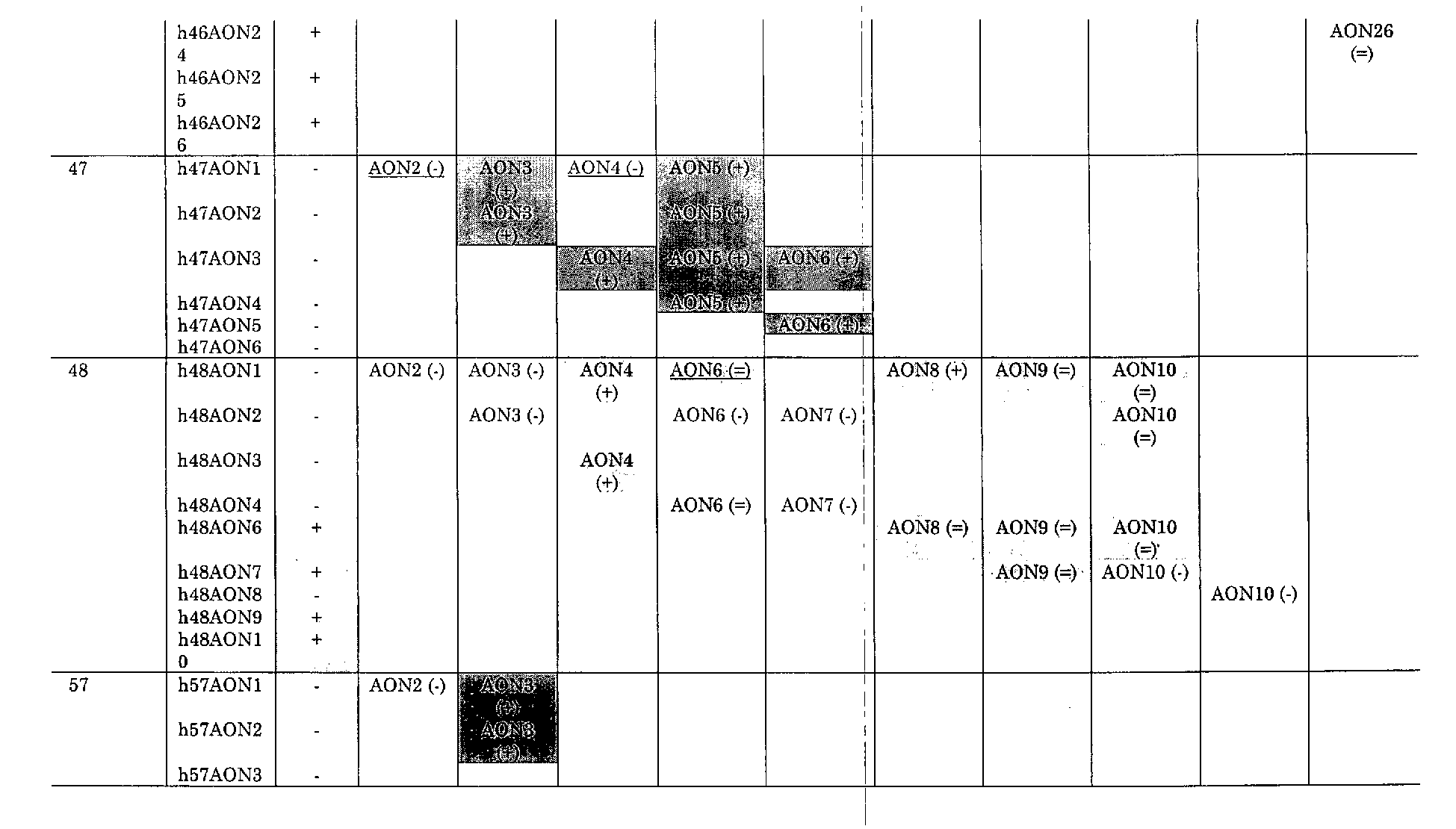
exon 47 and 57). When human control myotube cultures were treated with different combinations of these AONs, significant levels ofexon - Supplementary Table 1). Interestingly, for
exon 47 only combinations of non-overlapping AONs induced exon skipping, while those that do overlap were ineffective (Supplementary Table 1). Similarly, forexon 57 the combination of AONs that nearly overlap (h57AON1 and 2) did not induce exon skipping. This fits with our hypothesis that two mutually exclusive ESE sites are present in these exons. - For both
exon 2 andexon 45 only a single AON reproducibly induced low levels of exon skipping (h2AON1 and h45AON5, respectively). Considerably higher levels ofexon 45 skipping could be induced by combining the effective h45AON5 with ineffective AONs, as well as by combining two individually ineffective AONs (e.g. h45AON3 and h45AON9) (Fig. ID). Thus for this exon two effective ESEs are likely to be present as well. In contrast, combinations of AONs did not increase skipping efficiencies forexon 2. In fact, combining the effective h2AON1 with the ineffective h2AON2 abolishedexon 2 skipping (Fig. 1E). This interference was not observed for a combination of h2AON1 with h2AON3 (which overlaps less than h2AON2). Forexons exon 48 with a combination of 3 different AONs, which still did not improve skipping levels. Thus, it seems more likely that the splicing of this exon is largely independent of ESE sites. This is supported by the fact that the splice sites predicted are perfect (3' splice site) or near perfect (5' splice site) and that only a few ESEs are predicted forexon 48. - Finally, we used combinations of
exon 46 specific AONs, some of which were already very efficient individually. We aimed to increase skipping levels to (near) 100%. However, none of the combinations used further improved skipping levels when compared to single targeting (Supplementary Table 1). - This indicates that blocking one ESE site is sufficient to perturb the correct splicing of this exon. It is possible that the ESE sites of this exon are dependent on each other, so that by blocking one, more or all ESEs are inactivated. Alternatively, the secondary structure of the pre-mRNA may be changed upon AON binding so that the other ESE sites are no longer available for SR protein binding.
- Interestingly, once more (partly) overlapping combinations appeared to negatively interfere with the individual exon skipping capacities, irrespective of whether the single AONs were effective or ineffective. It was expected that combinations of two ineffective, overlapping AONs would also be ineffective, since they either both target no functional ESE site or both target the same of two (or more) mutually exclusive ESE sites. For combinations of overlapping, effective AONs this finding was unexpected. It is possible, however, that these AONs compete with each other, and force one another to detach from the target transcript in a dynamic process, thereby making the target site available again for SR proteins. Upon binding SR proteins will recruit other splicing factors to the splice sites, and thus enhance exon inclusion rather than exon skipping.
- All AONs used for the double targeting experiments were previously described (see Supplementary Table 1) ((11, 14, 15). All AONs contain 2-O-methyl RNA, phosphorothioate backbones and 5' fluorescein labels and were manufactured by Eurogentec (Belgium). (RT-) PCR primers were chosen in exons flanking the skipped exons (Eurogentec, Belgium; sequences available upon request).
- Control and DMD patient-derived myotube cultures were obtained as described previously (9, 22). For the exon skipping experiments, transfections were performed at least twice with 200 nM of each AON. In all experiments polyethylenimine (PEI, ExGen 500, MBI Fermentas) was used according to the manufacturer's instructions, with 2 to 3,5 µl PEI per µg AON. Depending on the number of effective AONs available for each of the targeted exons, different combinations of AONs were tested (Supplementary Table 1). Separate solutions of AON-PEI complexes were prepared for each AON. Transfection efficiencies were generally over 80% based on the presence of nuclear fluorescent signals. RNA was isolated 24-48 hours after transfection and RT-PCR analysis was performed as described previously (14). Successful transfection of each AON was confirmed by RT-PCR analysis with primers in the exons flanking the targeted exon(s). PCR fragments were isolated from the agarose gel and sequencing analysis was performed as described previously (10).
Table 1. Characteristics of used AONs AON Sequence Targeted exon Skip1 ESEfinder values over threshold2 Distance from3 Length Fraction open4 %GC SF2/ASF2 SC35 SRp40 SRp55 3' SS3 5' SS h2AON17 cccauuuugugaauguuuucuuuu 2 ++ 1,49 1,54 3,37 1,12 19 21 24 0,29 29% h2AON27 uugugcauuuacccauuuugug 2 - 1,49 1,44 1,40 2,71 32 10 22 0,32 36% h2AON37 gaaaauugugcauuuacccauuuu 2 - 1,59 1,44 1,40 2,71 35 5 24 0,29 29% h8AON1 cuuccuggauggcuucaau 8 ++ 1,31 0,12 2,57 2,57 26 139 19 0,53 47% h8AON3 guacauuaagauggacuuc 8 ++ -1,19 0,70 1,82 3,22 84 81 19 0,53 37% h17AON1 ccauuacaguugucuguguu 17 ++ 3,77 2,92 3,04 2,91 36 122 20 0,40 40% h17AON2 uaaucugccucuucuuuugg 17 + 1,76 -0,68 3,83 1,54 132 26 20 0,60 40% h19AON7 ucugcuggcaucuugc 19 + 2,83 1,92 2,26 2,46 39 35 16 0,56 56% h29AON17 uauccucugaaugucgcauc 29 ++ 5,74 1,07 4,60 3,53 15 117 20 0,30 45% h29AON27 gguuauccucugaaugucgc 29 ++ 5,74 1,07 4,60 2,04 18 114 20 0,40 50% h29AON4 ccaucuguuagggucugug 29 ++ 3,09 3,24 2,40 2,91 59 74 19 0,58 53% h29AON6 ucugugccaauaugcgaauc 29 ++ 1,26 3,28 2,33 4,33 45 87 20 0,55 45% h29AON9 uuaaaugucucaaguucc 29 + 1,83 1,41 1,09 1,39 105 29 18 0,28 33% h29AON10 guaguucccuccaacg 29 - 1,61 0,79 1,68 -0,11 127 9 16 0,44 56% h29AON11 cauguaguucccucc 29 + 0,13 1,95 3,63 3,16 131 6 15 0,67 53% h40AON17 gagccuuuuuucuucuuug 40 ++ 1,31 -0,39 1,44 0,77 13 123 19 0,58 37% h40AON27 uccuuucaucucugggcuc 40 ++ 2,81 2,76 3,93 1,21 127 9 19 0,47 53% h41AON17 cuccucuuucuucuucugc 41 ++ 3,82 -0,39 1,53 0,93 18 148 19 0,74 47% h41AON2 7 cuucgaaacugagcaaauuu 41 + 2,39 2,62 1,32 0,86 145 20 20 0,50 35% h42AON17 cuugugagacaugagug 42 + 2,89 3,20 5,76 3,14 90 90 17 0,47 47% h42AON2 7 cagagacuccucuugcuu 42 + 3,23 3,37 1,98 1,19 175 4 18 0,00 50% h43AON17 ugcugcugucuucuugcu 43 - 1,83 1,47 3,61 2,83 52 105 18 0,39 50% h43AON2 7 uuguuaacuuuuucccauu 43 + -0,78 1,06 -0,24 0,10 134 22 19 0,63 26% h43AON3 uguuaacuuuuucccauugg 43 - 0,50 1,06 4,15 0,10 132 23 20 0,55 35% h43AON4 cauuuuguuaacuuuuuccc 43 - -0,78 1,06 1,11 0,06 137 18 20 0,45 30% h43AON58 cuguagcuucacccuuucc 43 ++ 1,37 2,97 1,43 2,57 90 66 19 0,37 53% h44AON17 cgccgccauuucucaacag 44 ++ 0,25 0,64 0,86 2,51 15 116 19 0,26 58% h44AON27 uuuguauuuagcauguuccc 44 ++ -0,64 1,47 2,01 2,41 87 43 20 0,40 35% h45AON17 gcugaauuauuucuucccc 45 - 1,79 1,01 3,07 2,41 58 101 19 0,37 42% h45AON27 uuuuucugucugacagcug 45 - 3,03 0,82 2,07 0,93 154 5 19 0,74 42% h45AON3 ucuguuuuugaggauugc 45 - 0,37 1,82 1,97 1,85 75 85 18 0,39 39% h45AON4 ccaccgcagauucaggc 45 - 3,27 1,45 1,81 3,39 122 39 17 0,47 65% h45AON58 gcccaaugccauccugg 45 + 0,50 2,30 1,19 0,35 6 155 17 0,29 65% h45AON98 uuugcagaccuccugcc 45 - 3,96 3,20 0,86 2,56 137 24 17 0,65 59% h46AON46 cugcuuccuccaacc 46 + 2,34 2,82 1,68 0,01 63 72 15 0,07 60% h46AON66 guuaucugcuuccuccaacc 46 + 2,34 2,82 1,68 2,46 63 67 20 0,15 50% h46AON86 gcuuuucuuuuaguugcugc 46 ++ -1,14 1,08 3,52 1,04 115 15 20 0,60 40% h46AON96 uuaguugcugcucuu 46 0,66 1,30 0,51 2,83 111 24 15 1,00 40% h46AON20 gaaauucugacaagauauucu 46 + 1,35 1,08 2,07 1,48 15 114 21 0,48 29% h46AON21 uaaaacaaauucauu 46 -2,28 -0,40 -0,72 0,83 47 88 15 0,40 13% h46AON22 uccagguucaagugggauac 46 ++ 2,39 3,47 3,70 0,78 90 40 20 0,60 50% h46AON23 uuccagguucaagug 46 ++ 1,61 1,03 1,47 0,78 96 39 15 0,53 47% h46AON24 ucaagcuuuucuuuuag 46 + -1,19 -1,09 3,52 0,18 122 11 17 0,35 29% h46AON25 cugacaagauauucuu 46 + -0,80 1,08 0,74 1,48 14 120 16 0,88 31% h46AON26 agguucaagugggauacua 46 ++ 2,39 3,47 3,70 2,09 88 43 19 0,79 42% h47AON17 ucuugcucuucugggcuu 47 - 3,82 1,55 3,68 1,21 87 47 18 0,22 50% h47AON27 cuugagcuuauuuucaaguuu 47 - -0,89 2,17 2,20 0,53 101 30 21 0,48 29% h47AON3 uccaguuucauuuaauuguuug 47 - 1,70 0,22 2,76 1,02 39 91 22 0,45 27% h47AON4 cugcuugagcuuauuuucaaguu 47 - 0,74 2,17 2,20 0,53 103 26 23 0,39 35% h47AON5 agcacuuacaagcacgggu 47 - -1,37 2,05 1,25 2,07 63 70 19 0,53 53% h47AON6 uucaaguuuaucuugcucuuc 47 - 1,11 0,96 0,74 -0,40 94 37 21 0,33 33% h48AON17 uuucuccuuguuucuc 48 - 0,83 0,08 2,44 1,38 19 153 16 0,81 38% h48AON27 uuauaaauuuccaacugauuc 48 - 0,64 1,50 2,33 1,31 133 34 21 0,48 24% h48AON3 ggucuuuuauuugagcuuc 48 - 0,01 1,72 2,83 1,58 37 132 19 0,74 37% h48AON4 cuucaagcuuuuuuucaagcu 48 - -1,34 1,32 2,32 0,42 62 105 21 0,62 33% h48AON6 gcuucaauuucuccuuguu 48 + 0,83 0,34 1,62 2,57 23 146 19 0,63 37% h48AON7 uuuauuugagcuucaauuu 48 + 0,01 1,72 1,62 2,57 32 137 19 0,68 21% h48AON8 gcugcccaaggucuuuu 48 - 0,91 1,96 0,25 1,90 48 123 17 0,53 53% h48AON9 cuucaaggucuucaagcuuuu 48 + 0,91 1,96 2,32 2,21 71 96 21 0,62 38% h48AON10 uaacugcucuucaaggucuuc 48 + 0,91 1,96 2,32 2,21 79 88 21 0,48 43% h49AON 17 cuuccacauccgguuguuu 49 ++ 3,02 0,52 1,96 3,41 25 60 19 0,42 47% h49AON27 guggcugguuuuuccuugu 49 ++ 0,56 0,05 0,70 1,38 60 25 19 0,32 47% h5OAON 17 cucagagcucagaucuu 50 ++ 1,69 3,02 2,71 -0,03 11 83 17 0,24 47% h50AON27 ggcugcuuugcccuc 50 + 1,10 1,37 1,41 2,83 60 36 15 0,47 67% h51AON17 ucaaggaagauggcauuucu 51 ++ -0,31 1,48 1,35 0,41 68 147 20 0,70 40% h51AON24 gaaagccagucgguaaguuc 51 - 1,77 1,14 4,90 2,04 132 83 20 0,80 50% h51AON27 cacccaccaucaccc 51 - 0,39 1,74 0,38 1,31 181 39 15 0,00 67% h51AON27 ccucugugauuuuauaacuugau 51 ++ 2,68 2,27 3,94 2,91 160 52 23 0,22 30% h51AON29 ugauauccucaaggucaccc 51 ++ 1,67 1,91 2,88 2,82 191 24 20 0,25 50% h52AON1 uugcuggucuuguuuuuc 52 + 1,56 3,61 2,44 0,52 69 33 18 0,50 39% h52AON2 ccguaaugauuguucu 52 - -0,07 1,11 2,28 -0,80 97 7 16 0,25 38% h53AON17 cuguugccuccgguucug 53 + 3,08 2,26 1,63 0,77 45 151 18 0,78 61% h53AON27 uuggcucuggccuguccu 53 - 2,20 4,04 3,40 0,21 128 68 18 0,50 61% h54AON1 uacauuugucugccacugg 54 ++ 3,77 1,64 4,00 1,88 21 118 18 0,56 50% h54AON2 cccggagaaguuucaggg 54 ++ 3,14 1,80 3,54 1,34 58 80 19 0,58 58% h55AON1 cuguugcaguaaucuaugag 55 + 0,74 4,82 4,92 2,92 33 139 20 0,65 40% h55AON2 ugccauuguuucaucagcucuuu 55 + 2,70 2,29 3,46 1,27 167 2 23 0,52 39% h55AON3 ugcaguaaucuaugaguuuc 55 + 0,74 4,82 4,92 2,41 29 143 20 0,60 35% h55AON5 uccuguaggacauuggcagu 55 ++ 3,03 2,67 5,66 2,34 104 68 20 0,35 50% h55AON6 gagucuucuaggagccuu 55 ++ 0,87 5,77 3,36 0,33 139 35 18 0,28 50% h56AON1 uuuuuuggcuguuuucaucc 56 + 2,77 1,56 2,52 2,22 48 107 20 0,55 35% h56AON2 guucacuccacuugaaguuc 56 - 0,78 1,88 4,04 1,52 129 26 20 0,35 45% h56AON3 ccuuccagggaucucagg 56 + 1,81 5,52 3,68 0,27 69 88 18 0,56 61% h57AON1 uaggugccugccggcuu 57 - 2,11 3,30 2,54 2,03 97 45 17 0,41 65% h57AON2 cugaacugcuggaaagucgcc 57 - 2,47 1,95 2,77 2,41 118 20 21 0,57 57% h57AON3 uucagcuguagccacacc 57 - 2,83 4,73 4,81 4,10 64 77 18 0,28 56% h58AON1 uucuuuaguuuucaauucccuc 58 - 0,63 1,70 2,52 1,60 9 92 22 0,64 32% h58AON2 gaguuucucuaguccuucc 58 + 1,65 3,45 2,18 0,68 86 18 19 0,37 47% h59AON1 caauuuuucccacucaguauu 59 - 1,77 0,34 3,53 2,23 66 184 21 0,57 33% h59AON2 uugaaguuccuggagucuu 59 ++ 1,31 4,84 3,26 1,34 134 118 19 0,47 42% h60AON1 guucucuuucagaggcgc 60 + 0,66 3,66 2,29 3,00 19 112 18 0,56 56% h60AON2 gugcugagguuauacggug 60 - 2,87 2,56 4,08 2,78 92 38 19 0,84 53% h61AON1 gucccugugggcuucaug 61 - 5,26 2,92 5,97 2,57 31 31 19 0,37 58% h61AON2 gugcugagaugcuggacc 61 + 2,28 3,32 4,43 3,64 51 12 18 0,56 61% h62AON1 uggcucucucccaggg 62 ++ 1,08 0,33 1,89 -0,50 15 32 16 0,50 69% h62AON2 gggcacuuuguuuggcg 62 1,70 0,56 1,71 0,09 37 9 17 0,47 59% h63AON1 ggucccagcaaguuguuug 63 + 1,70 0,97 3,16 1,25 11 34 19 0,79 53% h63AON2 guagagcucugucauuuuggg 63 + 2,81 2,57 3,12 0,93 33 10 21 0,38 48% h71AON1 gccagaaguugaucagagu 71 ++ 0,12 3,35 4,36 1,47 8 14 19 0,79 47% h71AON2 ucuacuggccagaaguug 71 ++ 1,37 4,61 4,36 1,47 16 7 18 0,50 50% h72AON1 ugaguaucaucgugugaaag 72 ++ 6,59 0,60 6,02 0,25 20 28 20 0,60 40% h72AON2 gcauaauguucaaugcgug 72 + 0,77 2,43 1,26 2,14 42 7 19 0,47 42% h73AON1 gauccauugcuguuuucc 73 ++ 1,22 0,89 2,16 2,47 13 37 18 0,39 44% h73AON2 gagaugcuaucauuuagauaa 73 + -0,48 0,68 2,28 3,64 31 16 21 0,29 29% h74AON1 cuggcucaggggggagu 74 ++ 1,35 2,39 2,35 1,39 51 93 17 0,59 71% h74AON2 uccccucuuuccucacucu 74 + 3,04 0,33 1,68 2,82 72 70 19 0,16 53% h75AON1 ccuuuauguucgugcugcu 75 ++ 3,64 1,41 3,39 2,83 33 194 19 0,21 47% h75AON2 ggcggccuuuguguugac 75 ++ 1,51 1,11 3,71 1,12 144 84 18 0,39 61% h76AON1 gagagguagaaggagagga 76 - 0,08 1,28 3,53 3,22 37 70 19 0,32 53% h76AON2 auaggcugacugcugucgg 76 + 3,23 1,47 4,30 1,58 65 42 19 0,32 58% h77AON1 uuguguccuggggagga 77 ++ 4,26 3,50 3,57 -0,18 20 58 17 0,47 59% h77AON2 ugcuccaucaccuccucu 77 ++ 2,43 0,32 -0,21 1,65 47 30 18 0,39 56% h78AON1 gcuuuccagggguauuuc 78 ++ 1,81 4,04 3,32 0,62 4 12 18 0,78 50% h78AON2 cauuggcuuuccagggg 78 ++ 1,81 2,95 3,32 0,27 10 7 17 0,71 59% 1++ Exon skipping observed in over 25% of transcripts in normal control myotube cultures; + exon skipping observed in up to 25% of transcripts; - no exon skipping detected
2For each AON the highest value is gives for each of the SR proteins
3Number of nucleotides between the AONs and the 5' and 3' splice sites (SS) in nucleotides. The distance to the 3' and 5' splice sites is determined from the first (3' splice site) or last (5' splice site) nucleotide in the target sequence
4The fraction of available nucleotides targeted by the AON in the predicted secondary RNA structure over the total length of the AON
5This AON targets part of the ESE deleted in the deletion Kobe (Matsuo et al., 1990; Matsuo et al., 1991)
6Previously published (van Deutekom et al., 2001)
7Previously published (Aartsma-Rus et al., 2002)
8Previously published (van Deutekom et al., 2001; Aartsma-Rus et al., 2003; Aartsma-Rus et al., 2004)Table 2 AON name targeted human dystrophin exon sequence effective h33AON1 33 cugacguccagucuuuauc yes h33AON2 33 gggauuuuccgucugcuu yes h44AON3 44 ccgccauuucucaacag yes h44AON4 44 uucucaggaauuugugucuuu yes h45AON10 45 caguuugccgcugccca no h45AON11 45 guugcauucaauguucugac yes h45AON12 45 auuuuuccuguagaauacugg no h52AON3 52 gcuggucuuguuuuucaa yes h52AON4 52 uggucuuguuuuucaaauuu no h52AON5 52 gucuuguuuuucaaauuuug no h52AON6 52 cuuguuuuucaaauuuuggg no h52AON7 52 uguuuuucaaauuuugggc no h64AONl 64 uccuauaagcugagaaucug no h64AON2 64 gccuucugcagucuucgg no 

-
- Figure 1. Double targeting. (A). Relative locations of AONs and putative ESE sites within
exons exons exon exon 57 combinations containing h57AON3 were most efficient, while forexon 47 all non-overlapping combinations induced comparable levels ofexon 47 skipping. In some cases an additional band could be observed in theexon 47 PCR, which was slightly shorter than the wild type product. This band was not reproducible, was observed both in treated and non-treated samples, and appeared to be an a-specific PRC product containing DMD exons 72-74. (D). Forexon 45 only one of the available AONs reproducibly induced skipping, albeit at low levels (h45AON5). Very low levels of exon skipping were occasionally observed for h45AON1 and h45AON4, but this was not reproducible.Exon 45 skipping could be achieved at much higher levels using combinations of AONs. The highest levels ofexon 45 skipping were observed for combinations of h45AON5 and h45AON1 or h45AON3 and for h45AON1 and h45AON9. In contrast, a mixture of the overlapping h45AON2 and h45AON9 was ineffective. (E). Forexon 2 only overlapping AONs were available. When the effective h2AON1 was combined with the ineffective, overlapping h2AON2, no skipping could be induced. This effect was not seen when h2AON1 was combined with the ineffective, less overlapping h2AON3. The sequence of the mentioned AON is given in article Aartsma-Rus A, et al. (2005). Functional analysis of 114 exon-internal AONs for targeted DMD exon skipping: indication for steric hindrance of SR protein binding sites. Oligonucleotides 15: 284-297.
NT is non transfected, -RT is negative control, M is 100 bp size marker. -
- 1. Emery AE. (2002). The muscular dystrophies. Lancet 359: 687-95.
- 2. Monaco AP, Bertelson CJ, Liechti-Gallati S, Moser H, and Kunkel LM. (1988). An explanation for the phenotypic differences between patients bearing partial deletions of the DMD locus. Genomics 2: 90-95.
- 3. Hoffman EP, et al. (1988). Characterization of dystrophin in muscle-biopsy specimens from patients with Duchenne's or Becker's muscular dystrophy. N Engl J Med 318: 1363-1368.
- 4. Koenig M, Hoffman EP, Bertelson CJ, Monaco AP, Feener C, and Kunkel LM. (1987). Complete cloning of the Duchenne muscular dystrophy (DMD) cDNA and preliminary genomic organization of the DMD gene in normal and affected individuals. Cell 50: 509-517.
- 5. Yoshida M, and Ozawa E. (1990). Glycoprotein complex anchoring dystrophin to sarcolemma. J Biochem (Tokyo) 108: 748-752.
- 6. Hoffman EP, Brown RH, Jr., and Kunkel LM. (1987). Dystrophin: the protein product of the Duchenne muscular dystrophy locus. Cell 51: 919-928.
- 7. Lu QL, et al. (2003). Functional amounts of dystrophin produced by skipping the mutated exon in the mdx dystrophic mouse. Nat Med 8: 1009-1014.
- 8. van Deutekom JC, and van Ommen GJ. (2003). Advances in Duchenne muscular dystrophy gene therapy. Nat Rev Genet 4: 774-783.
- 9. Aartsma-Rus A, et al. (2003). Therapeutic antisense-induced exon skipping in cultured muscle cells from six different DMD patients. Hum Mol Genet 12: 907-914.
- 10. van Deutekom JC, et al. (2001). Antisense-induced exon skipping restores dystrophin expression in DMD patient derived muscle cells. Hum Mol Genet 10: 1547-1554.
- 11. Aartsma-Rus A, et al. (2004). Antisense-induced multiexon skipping for duchenne muscular dystrophy makes more sense. Am J Hum Genet 74: 83-92.
- 12. Bremmer-Bout M, et al. (2004). Targeted Exon Skipping in Transgenic hDMD Mice: a Model for Direct Pre-clinical Screening of Human-specific Antisense Oligonucleotides. Molecular Therapy 10: 232-240.
- 13. Lu QL, et al. (2005). Systemic delivery of antisense oligoribonucleotide restores dystrophin expression in body-wide skeletal muscles. Proc. Natl. Acad. Sci. U.S.A. 102: 198-203.
- 14. Aartsma-Rus A, Bremmer-Bout M, Janson A, Den Dunnen J, van Ommen G, and van Deutekom J. (2002). Targeted exon skipping as a potential gene correction therapy for Duchenne muscular dystrophy. Neuromuscul Disord 12: S71-S77.
- 15. Aartsma-Rus A, et al. (2005). Functional analysis of 114 exon-internal AONs for targeted DMD exon skipping: indication for steric hindrance of SR protein binding sites. Oligonucleotides 15: 284-297.
- 16. Stojdl DF, and Bell JC. (1999). SR protein kinases: the splice of life. Biochem Cell Biol 77: 293-298.
- 17. Fokkema IF, den Dunnen JT, and Taschner PE. (2005). LOVD: easy creation of a locus-specific sequence variation database using an "LSDB-in-a-box" approach. Hum. Mutat. 26: 63-68.
- 18. England SB, et al. (1990). Very mild muscular dystrophy associated with the deletion of 46% of dystrophin. Nature 343: 180-182.
- 19. Mirabella M, et al. (1998). Giant dystrophin deletion associated with congenital cataract and mild muscular dystrophy. Neurology 51: 592-595.
- 20. Bushby KM, Appleton R, Anderson LV, Welch JL, Kelly P, and Gardner-Medwin D. (1995). Deletion status and intellectual impairment in Duchenne muscular dystrophy. Dev Med Child Neurol 37: 260-269.
- 21. Tennyson CN, Klamut HJ, and Worton RG. (1995). The human dystrophin gene requires 16 hours to be transcribed and is cotranscriptionally spliced. Nat Genet 9: 184-190.
- 22. Havenga MJ, et al. (2002). Exploiting the natural diversity in adenovirus tropism for therapy and prevention of disease. J Virol 76: 4612-4620.
-
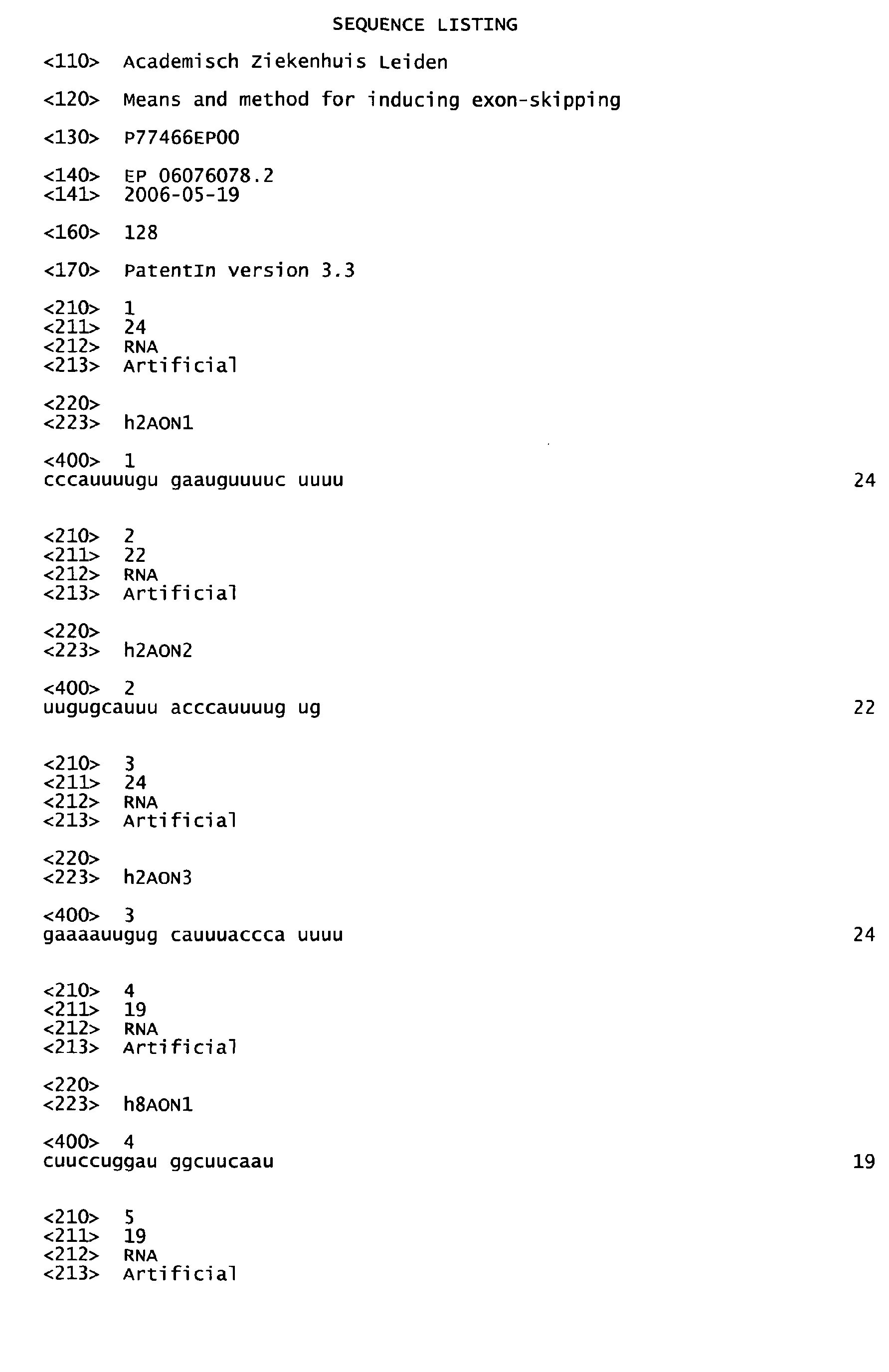
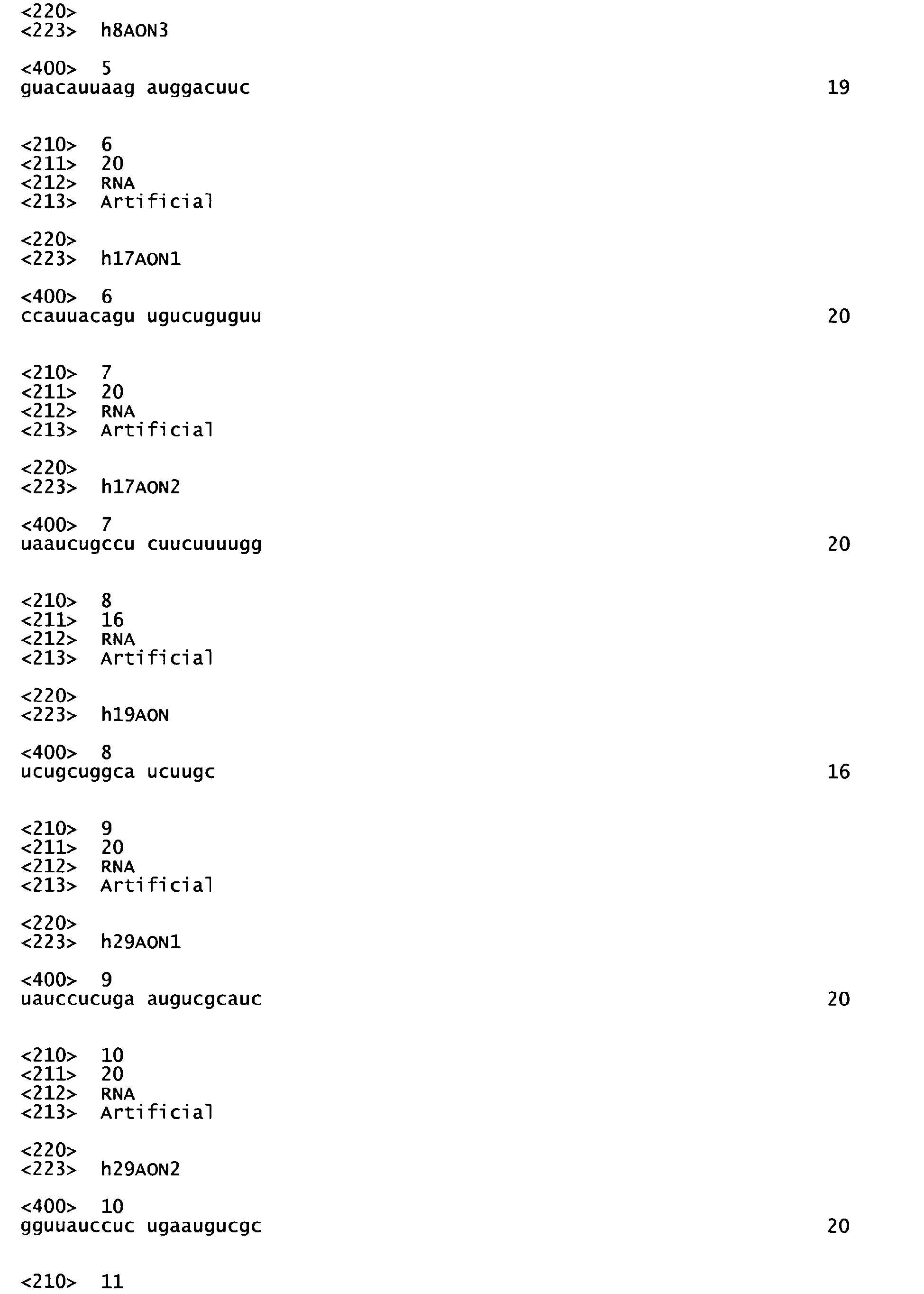
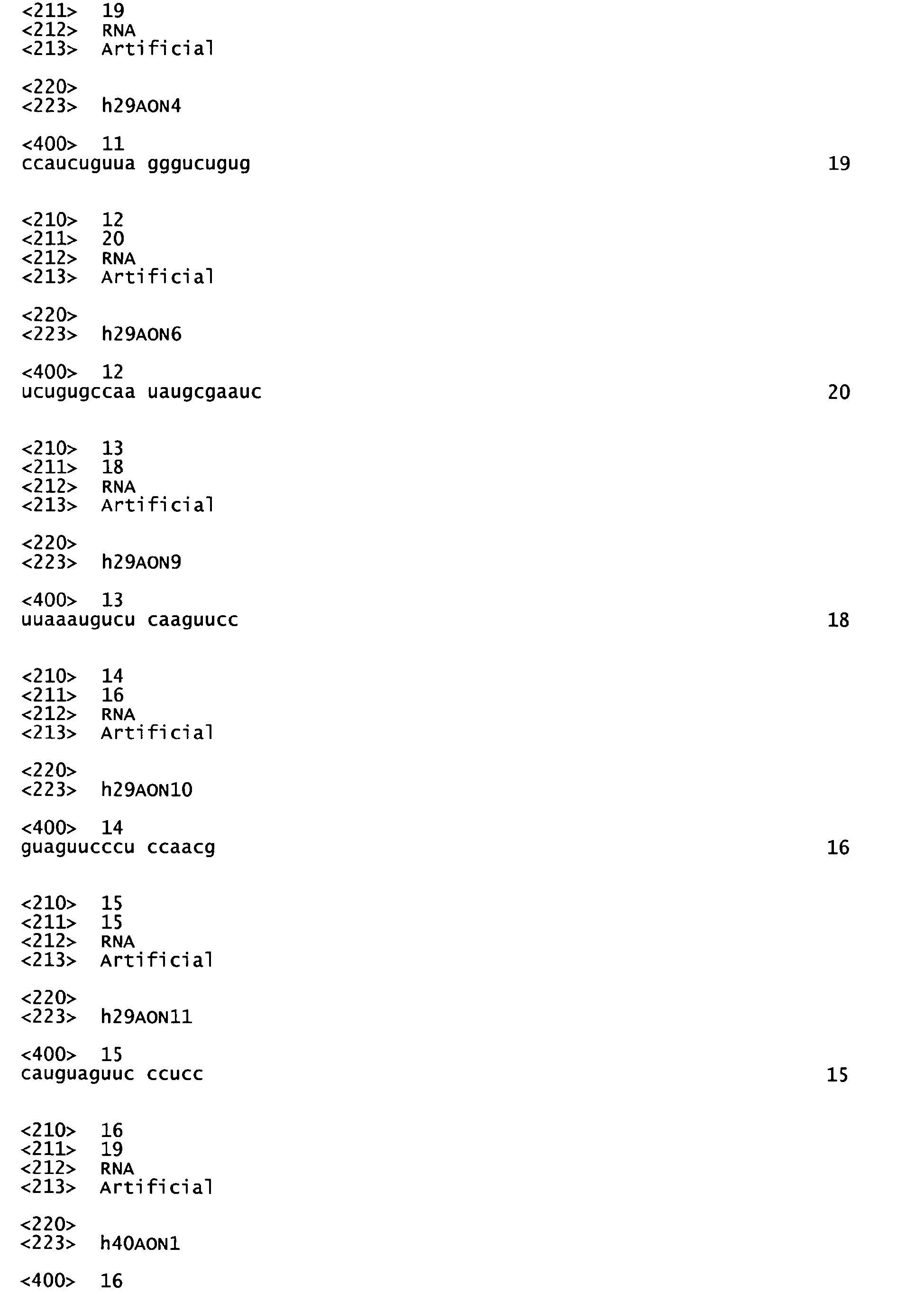

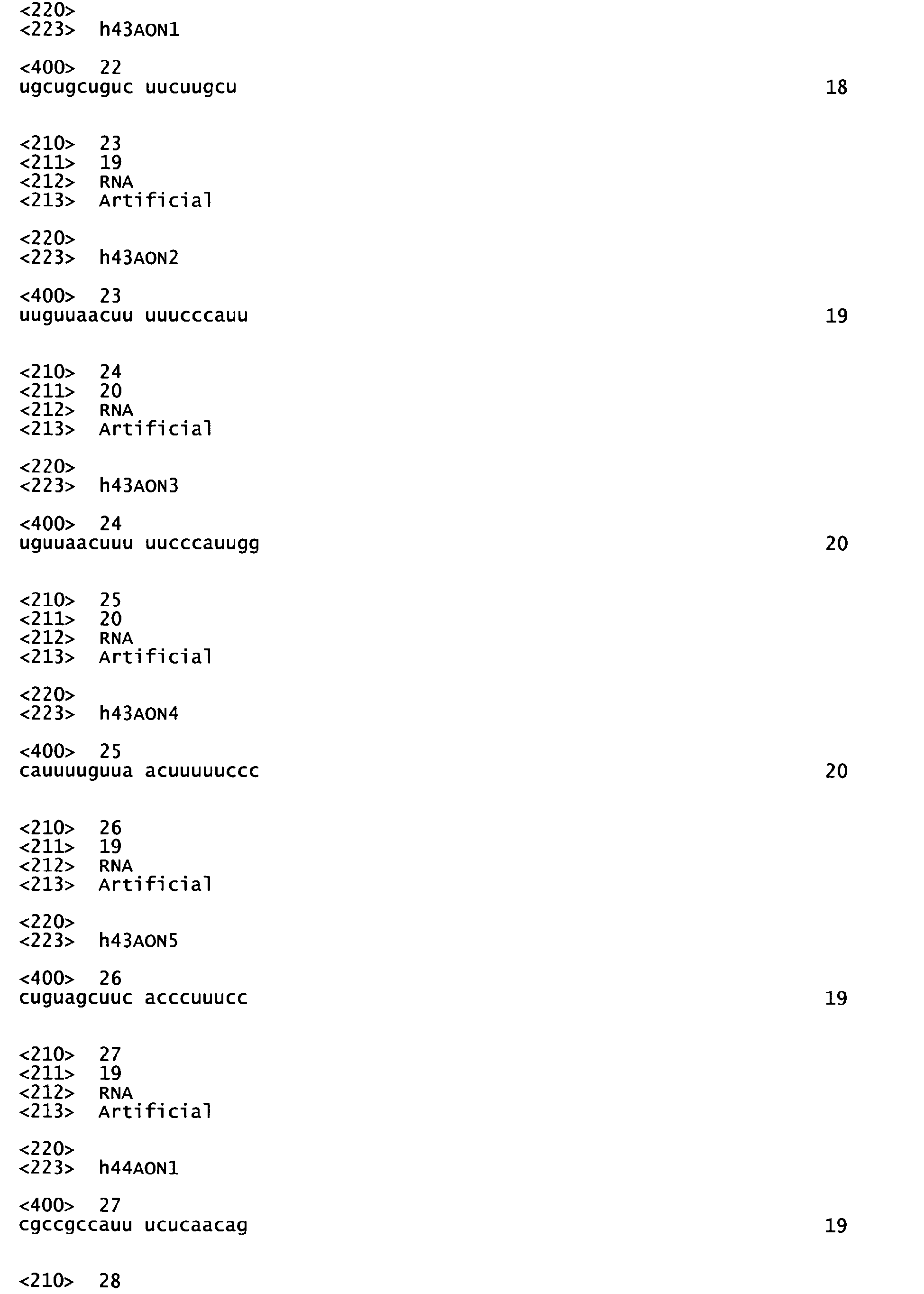

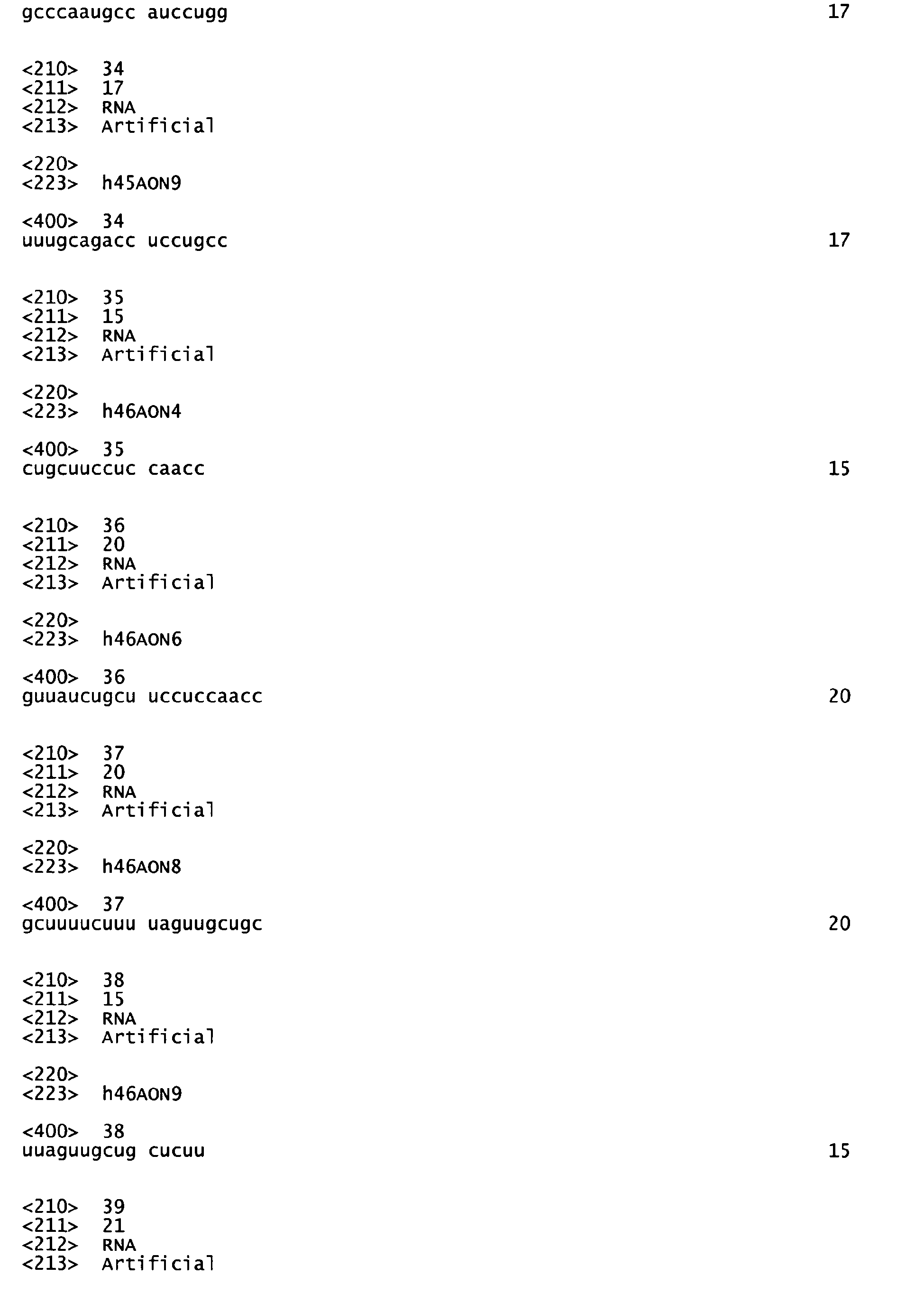
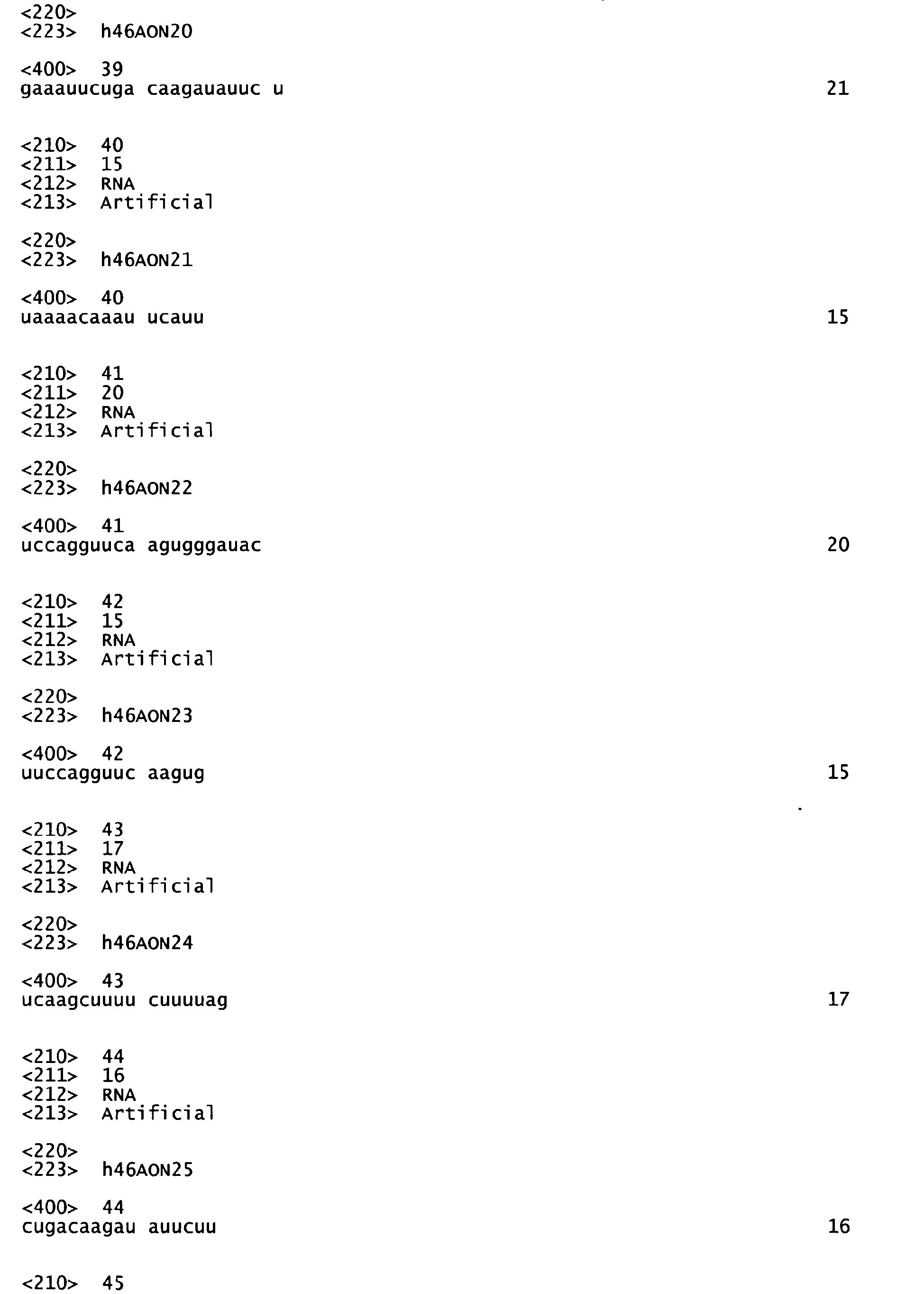


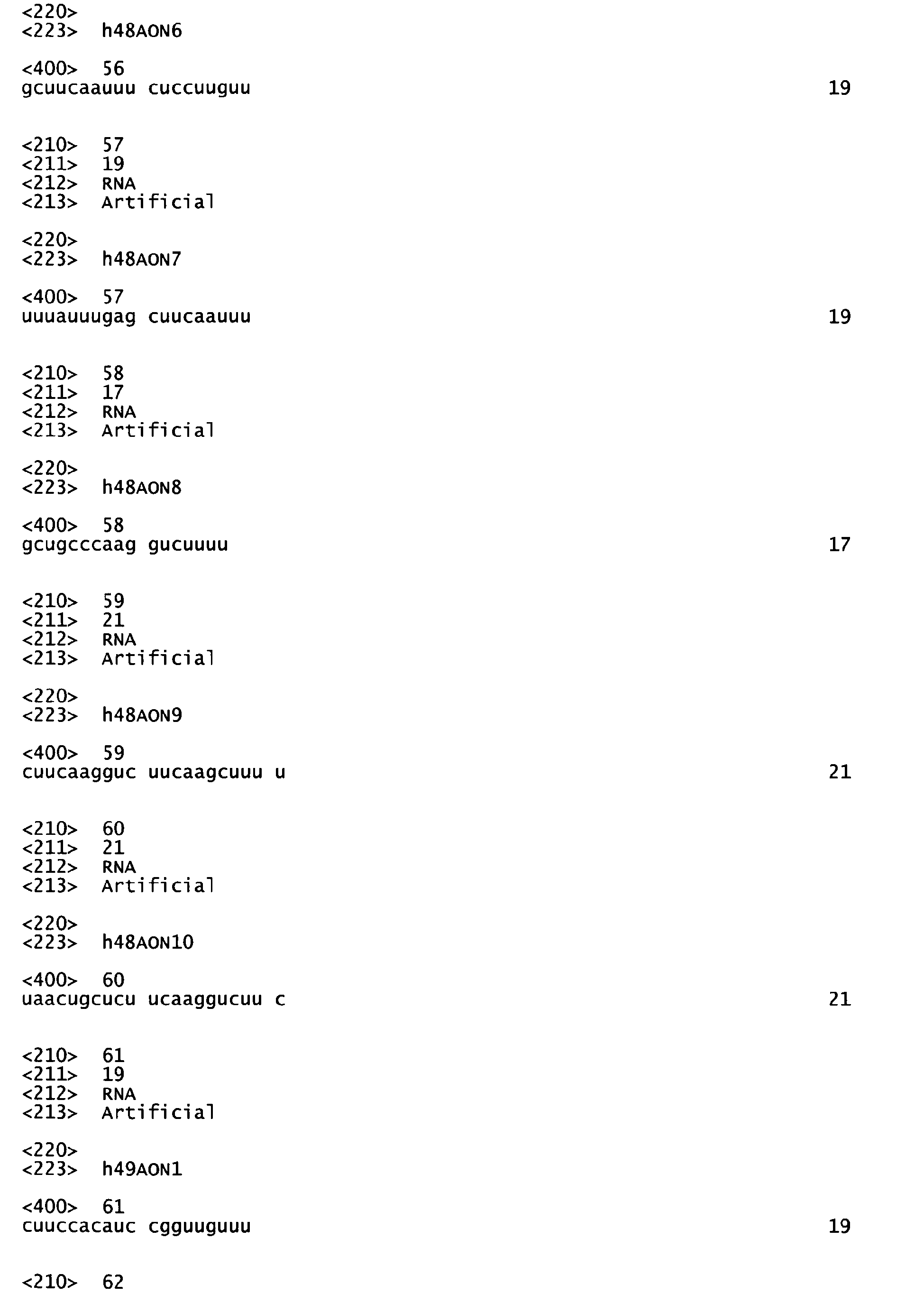


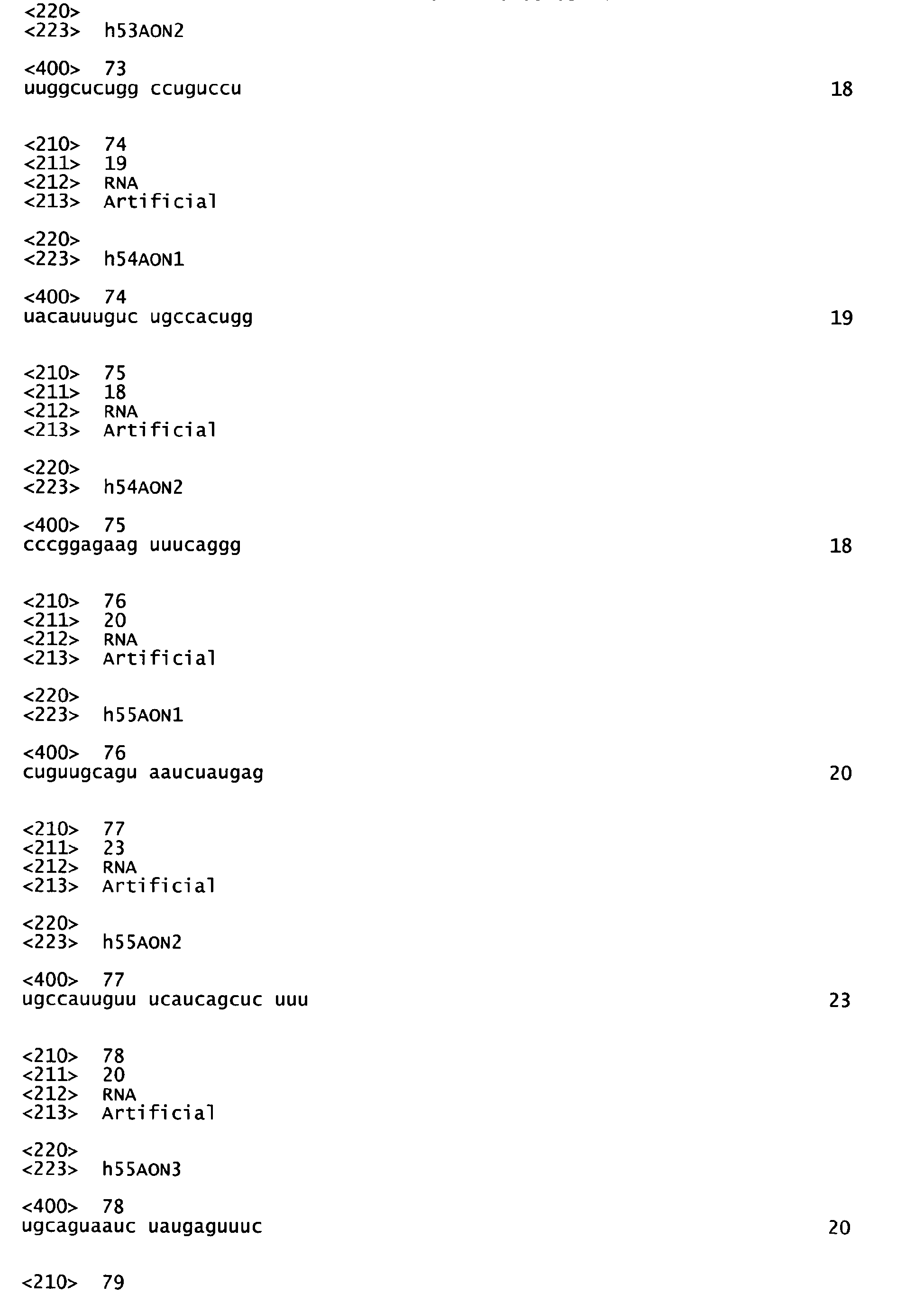
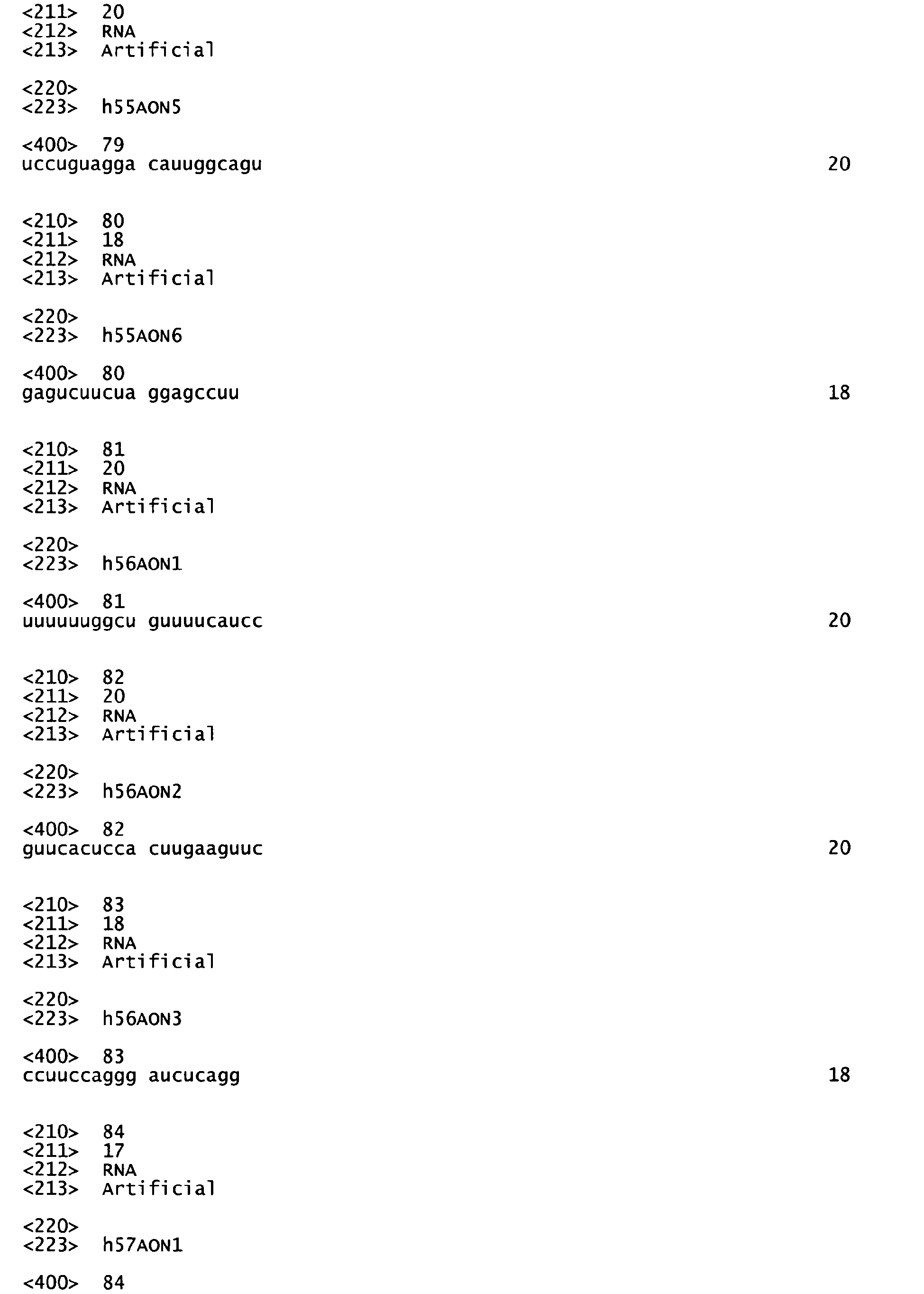
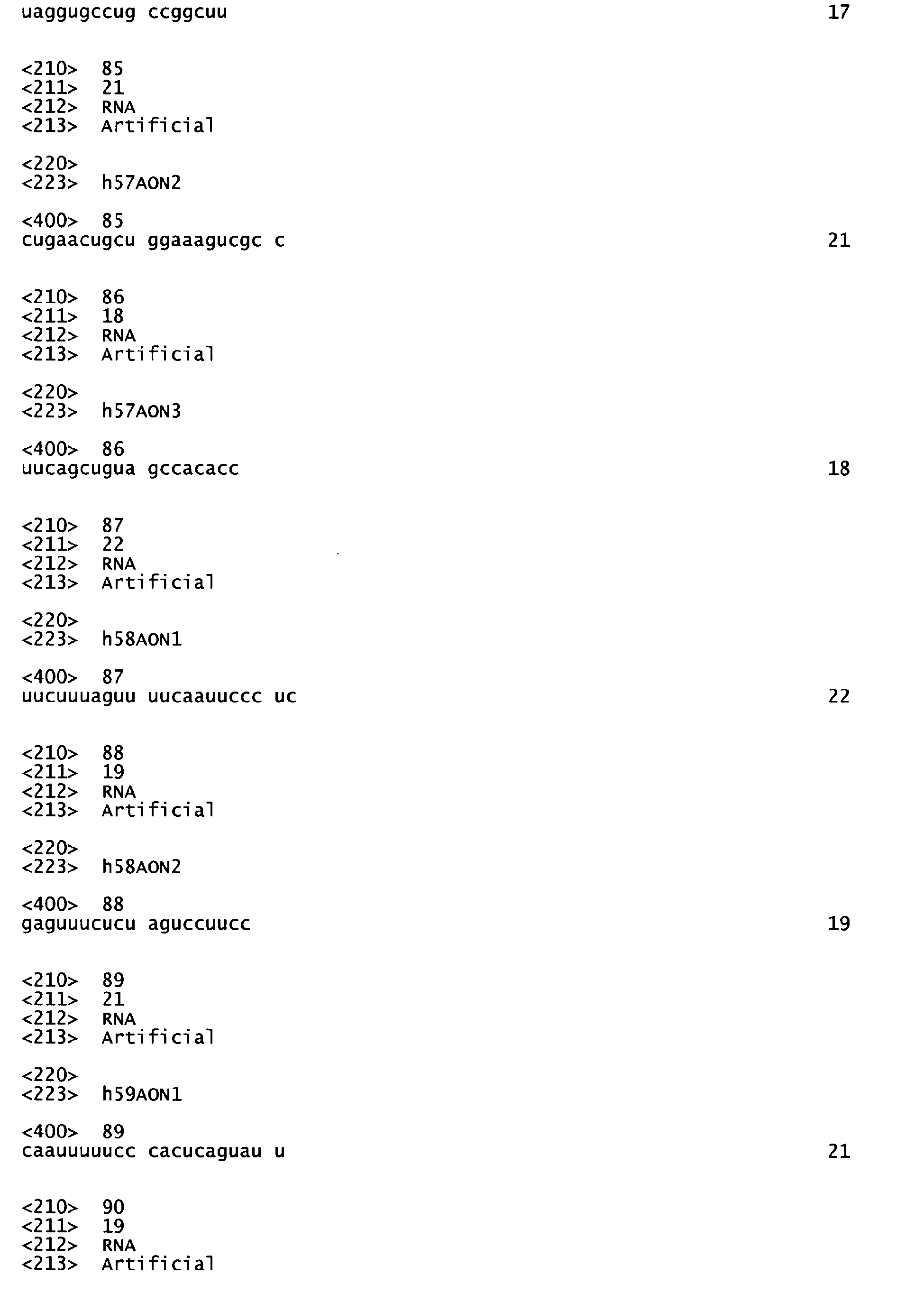
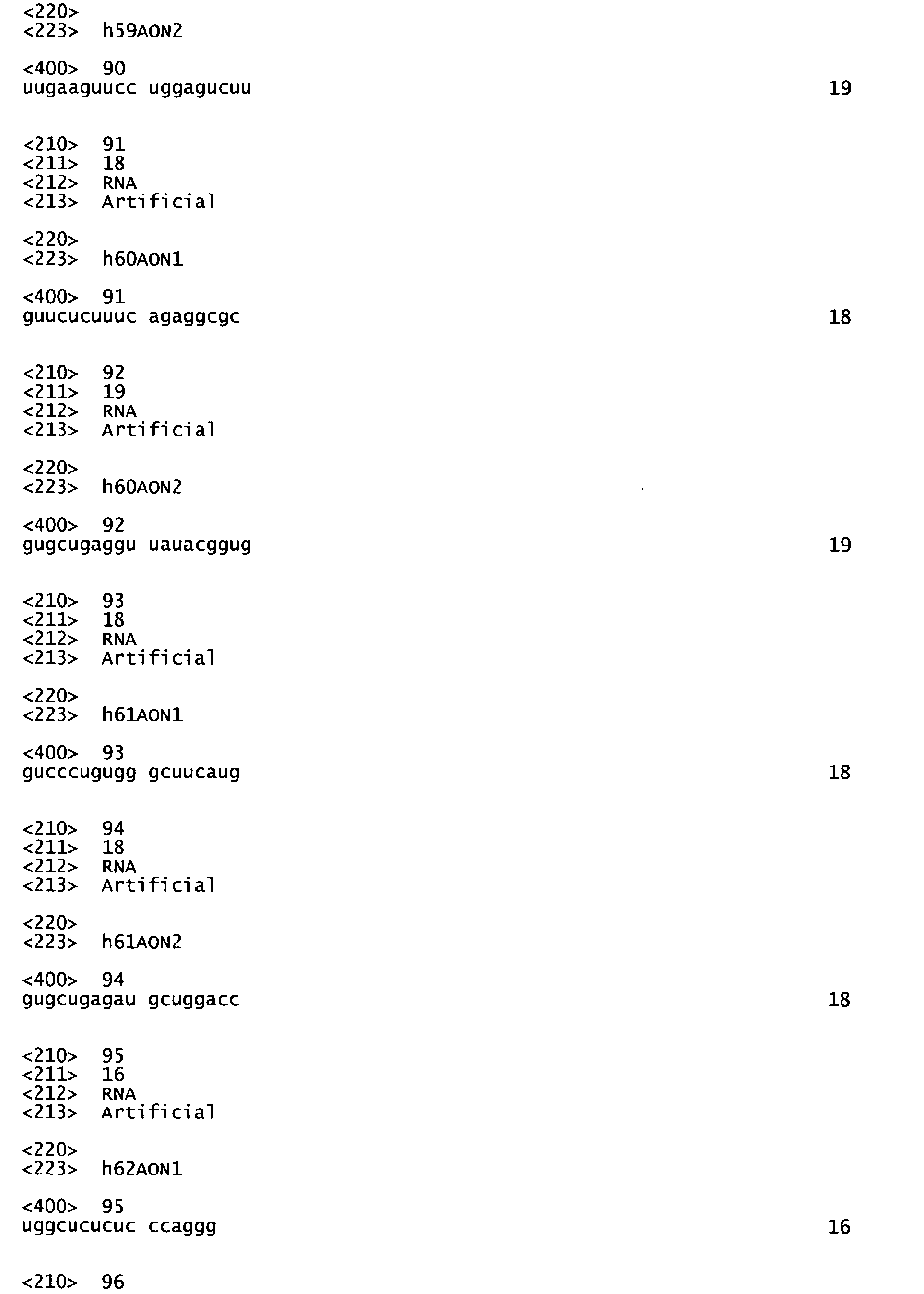


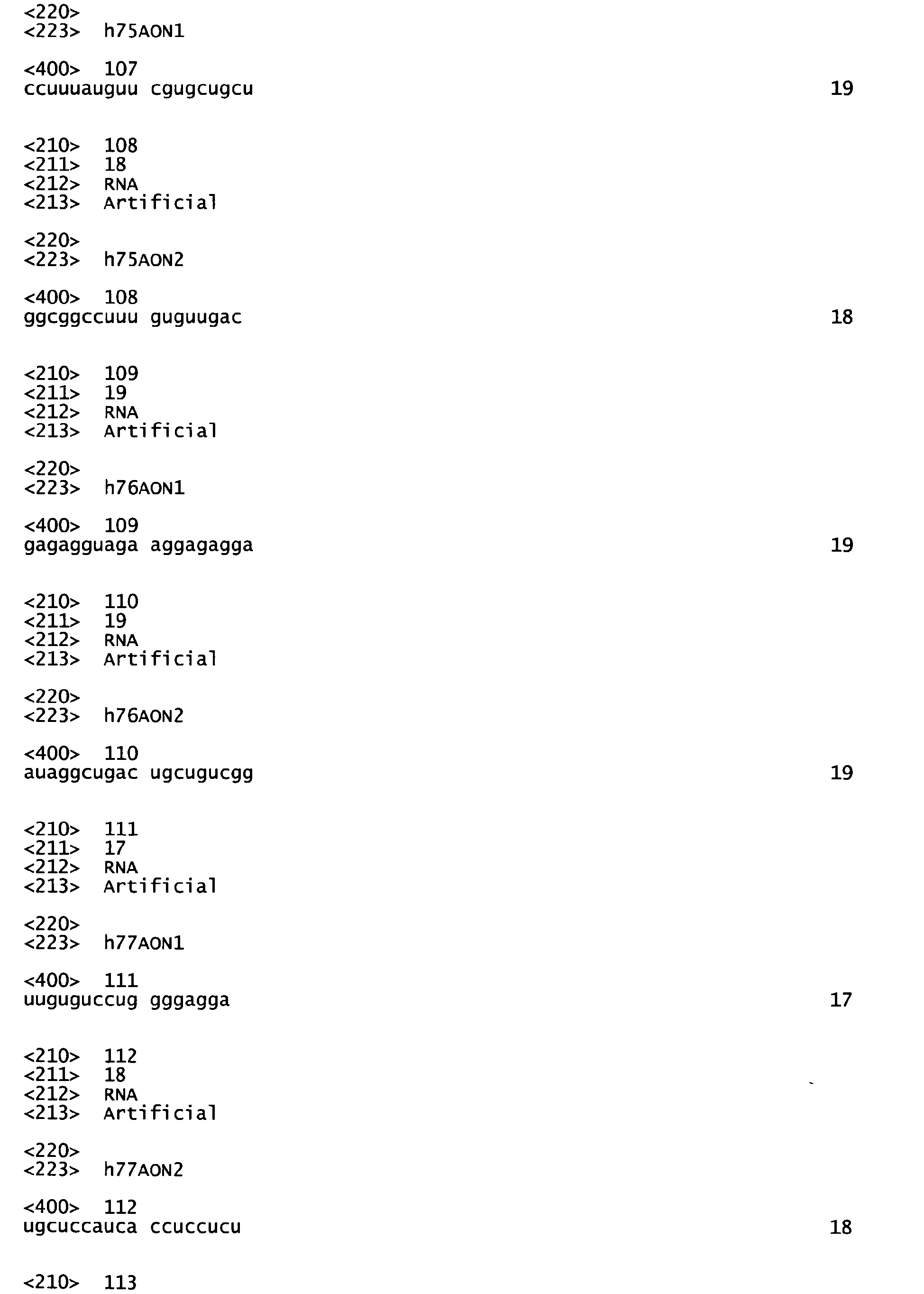
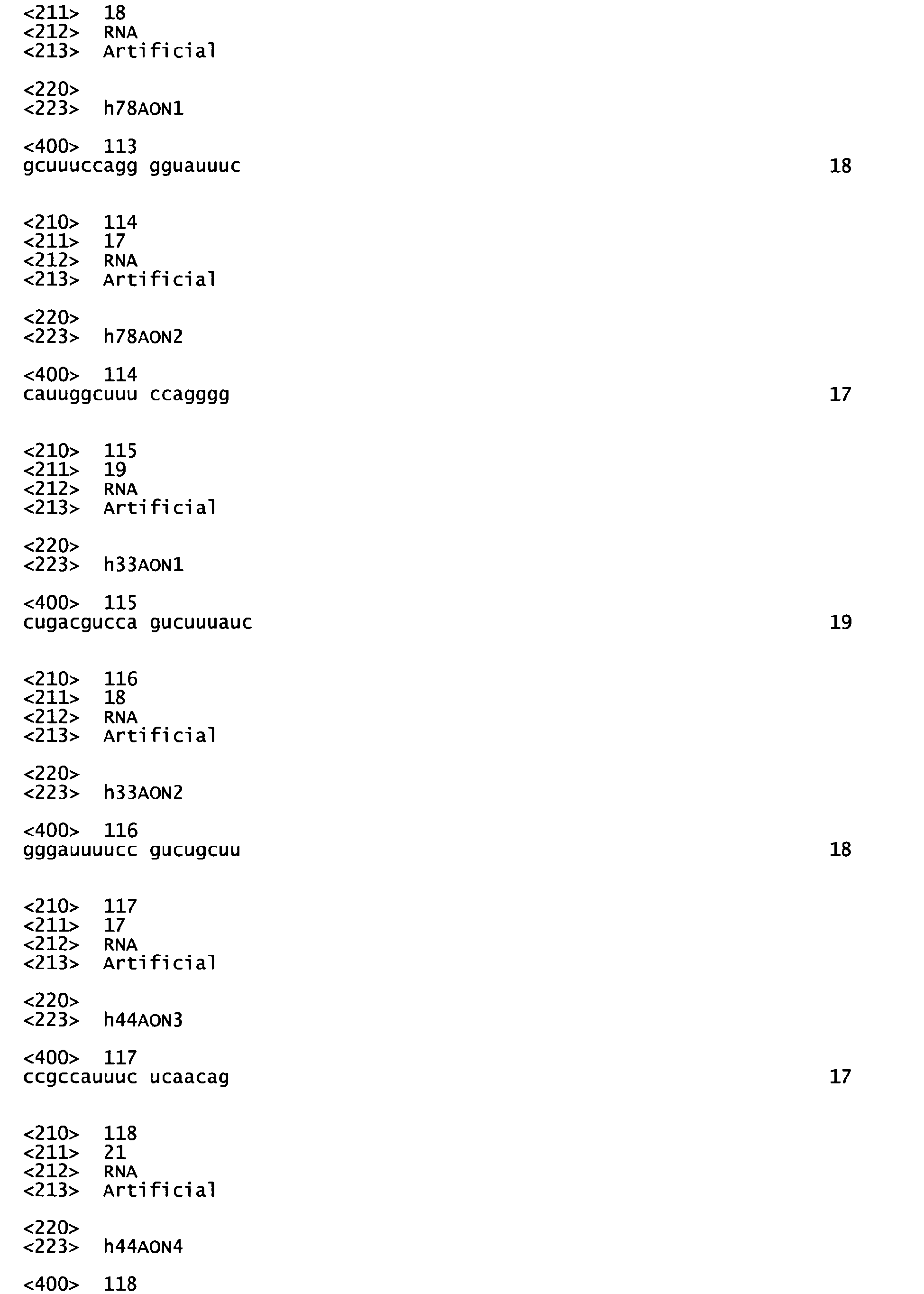
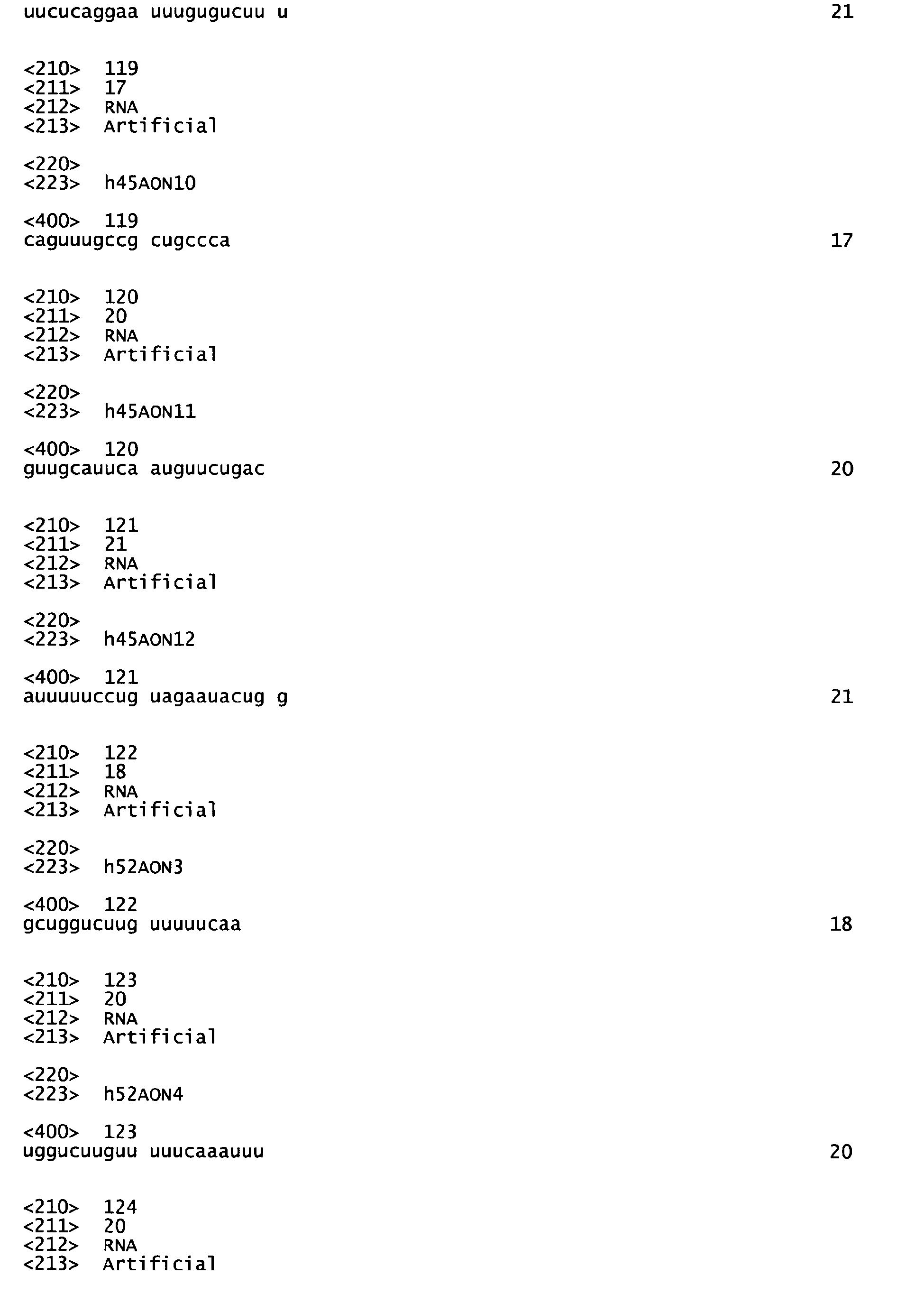

Claims (11)
- A method for determining whether the efficiency can be increased with which an exon is excluded from a mature mRNA in a cell that produces an exon containing precursor of said mRNA
said method comprising
providing said cell with a first anti-sense oligonucleotide (AON) that can hybridise to an exon internal part of said exon, and determining whether said efficiency is increased upon providing said cell with a second AON that can hybridise to another exon internal part of said exon. - A method according to claim 1, wherein a hybridisation site of said first AON and a hybridisation site of said second AON exhibit less than 5 nucleotides overlap.
- A method according to claim 1 or claim 2, wherein a hybridisation site of said first AON on RNA of said exon overlaps a predicted exonic splicing enhancer (ESE) site on said exon RNA.
- A method according to any one of claims 1-3, wherein a hybridisation site of said second AON on RNA of said exon overlaps a predicted ESE site on said exon RNA.
- A method according to any one of claims 1-4, wherein said exon comprises at least two independent ESE sites.
- A method according to any one of claims 1-5, further comprising including said first and said second AON in a set of AON when provision of said cell with said second AON increases the efficiency with which said exon is excluded from said mature mRNA in a cell that produces a precursor of said mRNA.
- A method according to claim 6, further comprising providing said set to a human cell.
- A set of AON obtainable by a method according to claim 6 or claim 7.
- A set of AON according to claim 8, comprising at least one AON of table 1 or table 2.
- An AON of table 2.
- A cell that produces an exon containing precursor of an mRNA, wherein said cell comprises a first AON that can hybridise to an exon internal part of said exon, and a second AON that can hybridise to another exon internal part of said exon.
Priority Applications (12)
| Application Number | Priority Date | Filing Date | Title |
|---|---|---|---|
| EP06076078A EP1857548A1 (en) | 2006-05-19 | 2006-05-19 | Means and method for inducing exon-skipping |
| US12/300,629 US8361979B2 (en) | 2006-05-19 | 2007-03-18 | Means and method for inducing exon-skipping |
| CA002652408A CA2652408A1 (en) | 2006-05-19 | 2007-05-18 | Means and method for inducing exon-skipping |
| AU2007253360A AU2007253360A1 (en) | 2006-05-19 | 2007-05-18 | Means and method for inducing exon-skipping |
| CNA2007800181575A CN101448945A (en) | 2006-05-19 | 2007-05-18 | Means and methods for inducing exon skipping |
| PCT/EP2007/054842 WO2007135105A1 (en) | 2006-05-19 | 2007-05-18 | Means and method for inducing exon-skipping |
| NZ572886A NZ572886A (en) | 2006-05-19 | 2007-05-18 | Means and method for inducing exon-skipping |
| EP07729286.0A EP2027267B1 (en) | 2006-05-19 | 2007-05-18 | Means and method for inducing exon-skipping |
| JP2009510471A JP2009537129A (en) | 2006-05-19 | 2007-05-18 | Means and methods for inducing exon skipping |
| ES07729286.0T ES2614980T3 (en) | 2006-05-19 | 2007-05-18 | Means and method for inducing exon skipping |
| CN2012101756303A CN102676529A (en) | 2006-05-19 | 2007-05-18 | Antisense oligonucleotide |
| JP2012070033A JP2012147790A (en) | 2006-05-19 | 2012-03-26 | Means and method for inducing exon-skipping |
Applications Claiming Priority (1)
| Application Number | Priority Date | Filing Date | Title |
|---|---|---|---|
| EP06076078A EP1857548A1 (en) | 2006-05-19 | 2006-05-19 | Means and method for inducing exon-skipping |
Publications (1)
| Publication Number | Publication Date |
|---|---|
| EP1857548A1 true EP1857548A1 (en) | 2007-11-21 |
Family
ID=36646053
Family Applications (2)
| Application Number | Title | Priority Date | Filing Date |
|---|---|---|---|
| EP06076078A Withdrawn EP1857548A1 (en) | 2006-05-19 | 2006-05-19 | Means and method for inducing exon-skipping |
| EP07729286.0A Active EP2027267B1 (en) | 2006-05-19 | 2007-05-18 | Means and method for inducing exon-skipping |
Family Applications After (1)
| Application Number | Title | Priority Date | Filing Date |
|---|---|---|---|
| EP07729286.0A Active EP2027267B1 (en) | 2006-05-19 | 2007-05-18 | Means and method for inducing exon-skipping |
Country Status (9)
| Country | Link |
|---|---|
| US (1) | US8361979B2 (en) |
| EP (2) | EP1857548A1 (en) |
| JP (2) | JP2009537129A (en) |
| CN (2) | CN101448945A (en) |
| AU (1) | AU2007253360A1 (en) |
| CA (1) | CA2652408A1 (en) |
| ES (1) | ES2614980T3 (en) |
| NZ (1) | NZ572886A (en) |
| WO (1) | WO2007135105A1 (en) |
Cited By (16)
| Publication number | Priority date | Publication date | Assignee | Title |
|---|---|---|---|---|
| WO2010050802A3 (en) * | 2008-10-27 | 2010-08-12 | Academisch Ziekenhuis Leiden | Methods and means for efficient skipping of at least one of the following exons of the human duchenne muscular dystrophy gene: 43, 46, 50- 53. |
| CN102256606A (en) * | 2007-10-26 | 2011-11-23 | 莱顿教学医院 | Methods and means for efficiently skipping at least one of exons 43, 46, 50-53 of the human Duchenne muscular dystrophy gene |
| US8263760B2 (en) | 2008-02-08 | 2012-09-11 | Prosensa Holding Bv | Methods and means for treating DNA repeat instability associated genetic disorders |
| US8450474B2 (en) | 2004-06-28 | 2013-05-28 | The University Of Western Australia | Antisense oligonucleotides for inducing exon skipping and methods of use thereof |
| DE102012103041A1 (en) | 2012-04-10 | 2013-10-10 | Eberhard-Karls-Universität Tübingen Universitätsklinikum | New isolated antisense-oligonucleotide comprising sequence that is hybridized to messenger RNA-splicing-sequence of mutation-bearing exons of pre-messenger RNA of titin-gene and induces skipping of exons, used to treat heart disease |
| US8609065B2 (en) | 2007-07-12 | 2013-12-17 | Prosensa Technologies B.V. | Molecules for targeting compounds to various selected organs, tissues or tumor cells |
| US8637483B2 (en) | 2009-11-12 | 2014-01-28 | The University Of Western Australia | Antisense molecules and methods for treating pathologies |
| US8802645B2 (en) | 2009-12-24 | 2014-08-12 | Prosensa Technologies B.V. | Molecule for treating an inflammatory disorder |
| US8865883B2 (en) | 2008-10-24 | 2014-10-21 | Sarepta Therapeutics, Inc. | Multiple exon skipping compositions for DMD |
| US9139828B2 (en) | 2008-05-14 | 2015-09-22 | Prosensa Technologies B.V. | Method for efficient exon (44) skipping in duchenne muscular dystrophy and associated means |
| US9217148B2 (en) | 2013-03-14 | 2015-12-22 | Sarepta Therapeutics, Inc. | Exon skipping compositions for treating muscular dystrophy |
| US9506058B2 (en) | 2013-03-15 | 2016-11-29 | Sarepta Therapeutics, Inc. | Compositions for treating muscular dystrophy |
| US10179912B2 (en) | 2012-01-27 | 2019-01-15 | Biomarin Technologies B.V. | RNA modulating oligonucleotides with improved characteristics for the treatment of duchenne and becker muscular dystrophy |
| US10533171B2 (en) | 2009-04-24 | 2020-01-14 | Biomarin Technologies B.V. | Oligonucleotide comprising an inosine for treating DMD |
| USRE48468E1 (en) | 2007-10-26 | 2021-03-16 | Biomarin Technologies B.V. | Means and methods for counteracting muscle disorders |
| USRE48960E1 (en) | 2004-06-28 | 2022-03-08 | The University Of Western Australia | Antisense oligonucleotides for inducing exon skipping and methods of use thereof |
Families Citing this family (63)
| Publication number | Priority date | Publication date | Assignee | Title |
|---|---|---|---|---|
| WO2004083432A1 (en) | 2003-03-21 | 2004-09-30 | Academisch Ziekenhuis Leiden | Modulation of exon recognition in pre-mrna by interfering with the secondary rna structure |
| CA2596506C (en) | 2005-02-09 | 2021-04-06 | Avi Biopharma, Inc. | Antisense composition and method for treating muscle atrophy |
| CA2660523C (en) | 2006-08-11 | 2019-03-19 | Prosensa Technologies B.V. | Methods and means for treating dna repeat instability associated genetic disorders |
| US8084601B2 (en) | 2008-09-11 | 2011-12-27 | Royal Holloway And Bedford New College Royal Holloway, University Of London | Oligomers |
| US20120149756A1 (en) | 2009-04-10 | 2012-06-14 | Associatin Institut de Myologie | Tricyclo-dna antisense oligonucleotides, compositions, and methods for the treatment of disease |
| ITTO20090487A1 (en) * | 2009-06-26 | 2010-12-27 | Univ Ferrara | ANTISENSE OLIGONUCLEOTIDS ACTS TO INDOCATE EXONIC SKIPPING AND THEIR USE AS MEDICATION FOR THE TREATMENT OF DUCHENNE MUSCULAR DYSTROPHY (DMD) |
| US20120270930A1 (en) | 2009-10-29 | 2012-10-25 | Academisch Ziekenhuis Leiden H.O.D.N. Lumc | Methods and compositions for dysferlin exon-skipping |
| IT1400425B1 (en) * | 2010-06-08 | 2013-05-31 | Amsterdam Molecular Therapeutics Bv | MODIFIED SNRNAS FOR USE IN THERAPY. |
| CA2807187C (en) * | 2010-08-05 | 2019-06-11 | Academisch Ziekenhuis Leiden H.O.D.N. Lumc | Antisense oligonucleotide directed removal of proteolytic cleavage sites from proteins. |
| TWI541024B (en) | 2010-09-01 | 2016-07-11 | 日本新藥股份有限公司 | Antisense nucleic acid |
| MX2013009191A (en) * | 2011-02-08 | 2013-11-04 | Charlotte Mecklenburg Hospital | Antisense oligonucleotides. |
| US20140088174A1 (en) | 2011-04-05 | 2014-03-27 | Academisch Ziekenhuis Leiden H.O.D.N. Lumc | Compounds and methods for altering activin receptor-like kinase signaling |
| ES2646716T3 (en) * | 2011-09-05 | 2017-12-15 | Stichting Katholieke Universiteit | Antisense oligonucleotides for the treatment of Leber congenital amaurosis |
| US20130085139A1 (en) | 2011-10-04 | 2013-04-04 | Royal Holloway And Bedford New College | Oligomers |
| CN117721110A (en) | 2011-12-28 | 2024-03-19 | 日本新药株式会社 | antisense nucleic acid |
| CA2877644A1 (en) * | 2012-07-03 | 2014-01-09 | Prosensa Technologies B.V. | Oligonucleotide for the treatment of muscular dystrophy patients |
| WO2015171918A2 (en) | 2014-05-07 | 2015-11-12 | Louisiana State University And Agricultural And Mechanical College | Compositions and uses for treatment thereof |
| CA2950876A1 (en) | 2014-06-10 | 2015-12-17 | Erasmus University Medical Center Rotterdam | Methods for characterizing alternatively or aberrantly spliced mrna isoforms |
| GB201410693D0 (en) | 2014-06-16 | 2014-07-30 | Univ Southampton | Splicing modulation |
| RS59764B1 (en) | 2014-06-17 | 2020-02-28 | Nippon Shinyaku Co Ltd | Antisense nucleic acid for use in the treatment of duchenne's muscular dystrophy |
| SG11201702682PA (en) | 2014-10-03 | 2017-04-27 | Cold Spring Harbor Lab | Targeted augmentation of nuclear gene output |
| US10525076B2 (en) | 2015-02-20 | 2020-01-07 | Rosalind Franklin University Of Medicine And Science | Antisense compounds targeting genes associated with cystic fibrosis |
| GB201503408D0 (en) | 2015-02-27 | 2015-04-15 | Proqr Therapeutics N V | Oligonucleotides |
| GB201504124D0 (en) * | 2015-03-11 | 2015-04-22 | Proqr Therapeutics B V | Oligonucleotides |
| MA41795A (en) | 2015-03-18 | 2018-01-23 | Sarepta Therapeutics Inc | EXCLUSION OF AN EXON INDUCED BY ANTISENSE COMPOUNDS IN MYOSTATIN |
| HK1245826A1 (en) * | 2015-05-21 | 2018-08-31 | Wings Therapeutics, Inc. | Antisense oligonucleotides to treat dystrophic epidermolysis bullosa |
| JP6384845B2 (en) | 2015-09-15 | 2018-09-05 | 日本新薬株式会社 | Antisense nucleic acid |
| US10196639B2 (en) | 2015-10-09 | 2019-02-05 | University Of Southampton | Modulation of gene expression and screening for deregulated protein expression |
| EP3858993A1 (en) | 2015-10-09 | 2021-08-04 | Sarepta Therapeutics, Inc. | Compositions and methods for treating duchenne muscular dystrophy and related disorders |
| JP7049248B2 (en) | 2015-12-14 | 2022-04-06 | コールド スプリング ハーバー ラボラトリー | Autosomal dominant mental retardation-5 and antisense oligomers for the treatment of Dravet syndrome |
| US11096956B2 (en) | 2015-12-14 | 2021-08-24 | Stoke Therapeutics, Inc. | Antisense oligomers and uses thereof |
| WO2017136435A1 (en) | 2016-02-01 | 2017-08-10 | The Usa, As Represented By The Secretary, Department Of Health And Human Services Office Of Technology Transfer National Institute Of Health | Compounds for modulating fc-epsilon-ri-beta expression and uses thereof |
| MA45328A (en) | 2016-04-01 | 2019-02-06 | Avidity Biosciences Llc | NUCLEIC ACID-POLYPEPTIDE COMPOSITIONS AND USES THEREOF |
| SG10202107429WA (en) | 2017-01-06 | 2021-08-30 | Avidity Biosciences Inc | Nucleic acid-polypeptide compositions and methods of inducing exon skipping |
| GB201711809D0 (en) | 2017-07-21 | 2017-09-06 | Governors Of The Univ Of Alberta | Antisense oligonucleotide |
| SG11202001103QA (en) | 2017-08-11 | 2020-03-30 | Agency Science Tech & Res | Method for screening splicing variants or events |
| KR102318434B1 (en) | 2017-08-25 | 2021-11-01 | 스톡 테라퓨틱스, 인크. | Antisense oligomers for the treatment of conditions and diseases |
| EP3720448A4 (en) | 2017-12-06 | 2021-11-03 | Avidity Biosciences, Inc. | COMPOSITIONS AND METHODS FOR THE TREATMENT OF MUSCLE ATROPHY AND MYOTONIC DYSTROPHY |
| CA3092817A1 (en) * | 2018-03-02 | 2019-09-06 | Academisch Ziekenhuis Leiden H.O.D.N. Lumc | Inhibition of polyomavirus replication |
| US12060558B2 (en) | 2018-05-04 | 2024-08-13 | Stoke Therapeutics, Inc. | Methods and compositions for treatment of cholesteryl ester storage disease |
| US11168141B2 (en) | 2018-08-02 | 2021-11-09 | Dyne Therapeutics, Inc. | Muscle targeting complexes and uses thereof for treating dystrophinopathies |
| US12018087B2 (en) | 2018-08-02 | 2024-06-25 | Dyne Therapeutics, Inc. | Muscle-targeting complexes comprising an anti-transferrin receptor antibody linked to an oligonucleotide and methods of delivering oligonucleotide to a subject |
| SG11202100934PA (en) | 2018-08-02 | 2021-02-25 | Dyne Therapeutics Inc | Muscle targeting complexes and uses thereof for treating dystrophinopathies |
| US20220193250A1 (en) | 2018-08-02 | 2022-06-23 | Dyne Therapeutics, Inc. | Muscle targeting complexes and uses thereof for treating facioscapulohumeral muscular dystrophy |
| GB201812980D0 (en) | 2018-08-09 | 2018-09-26 | Univ Oxford Innovation Ltd | Cell-penetrating peptides |
| GB201812972D0 (en) | 2018-08-09 | 2018-09-26 | Univ Oxford Innovation Ltd | Cell-penetrating peptides |
| WO2020089325A1 (en) | 2018-11-02 | 2020-05-07 | Biomarin Technologies B.V. | Bispecific antisense oligonucleotides for dystrophin exon skipping |
| BR112021010982A2 (en) | 2018-12-07 | 2021-08-31 | Oxford University Innovation Limited | BINDERS |
| JP7545411B2 (en) * | 2019-04-09 | 2024-09-04 | エンビサジェニックス, インコーポレイテッド | Cancer-specific molecules and methods of use thereof |
| US12497615B2 (en) | 2019-04-25 | 2025-12-16 | Avidity Biosciences, Inc. | Nucleic acid compositions and methods of multi-exon skipping |
| BR112022012114A2 (en) | 2019-12-19 | 2022-09-06 | Nippon Shinyaku Co Ltd | ANTISENSE NUCLEIC ACID THAT ALLOWS THE LEAP OF EXONS |
| TW202144572A (en) | 2020-03-19 | 2021-12-01 | 美商亞維代堤生物科學公司 | Compositions and methods of treating facioscapulohumeral muscular dystrophy |
| IL298063A (en) | 2020-05-11 | 2023-01-01 | Stoke Therapeutics Inc | Opa1 antisense oligomers for treatment of conditions and diseases |
| WO2022173811A1 (en) * | 2021-02-12 | 2022-08-18 | Rosalind Franklin University Of Medicine And Science | Antisense compounds targeting genes associated with cystic fibrosis |
| KR20240012425A (en) | 2021-05-10 | 2024-01-29 | 엔트라다 테라퓨틱스, 인크. | Compositions and methods for intracellular therapeutics |
| KR20240038967A (en) | 2021-06-23 | 2024-03-26 | 엔트라다 테라퓨틱스, 인크. | Antisense compounds and methods for targeting CUG repeats |
| IL309626A (en) | 2021-06-23 | 2024-02-01 | Nippon Shinyaku Co Ltd | Combination of antisense oligomers |
| US11638761B2 (en) | 2021-07-09 | 2023-05-02 | Dyne Therapeutics, Inc. | Muscle targeting complexes and uses thereof for treating Facioscapulohumeral muscular dystrophy |
| US11771776B2 (en) | 2021-07-09 | 2023-10-03 | Dyne Therapeutics, Inc. | Muscle targeting complexes and uses thereof for treating dystrophinopathies |
| US11969475B2 (en) | 2021-07-09 | 2024-04-30 | Dyne Therapeutics, Inc. | Muscle targeting complexes and uses thereof for treating facioscapulohumeral muscular dystrophy |
| AU2022309028A1 (en) | 2021-07-09 | 2024-01-25 | Dyne Therapeutics, Inc. | Muscle targeting complexes and formulations for treating dystrophinopathies |
| EP4215614A1 (en) | 2022-01-24 | 2023-07-26 | Dynacure | Combination therapy for dystrophin-related diseases |
| US12071621B2 (en) | 2022-04-05 | 2024-08-27 | Avidity Biosciences, Inc. | Anti-transferrin receptor antibody-PMO conjugates for inducing DMD exon 44 skipping |
Citations (1)
| Publication number | Priority date | Publication date | Assignee | Title |
|---|---|---|---|---|
| WO2006000057A1 (en) * | 2004-06-28 | 2006-01-05 | SMITHKLINE BEECHAM CORPORATION, doing business as GLAXOSMITHKLINE | Antisense oligonucleotides for inducing exon skipping and methods of use thereof |
Family Cites Families (91)
| Publication number | Priority date | Publication date | Assignee | Title |
|---|---|---|---|---|
| US5034506A (en) | 1985-03-15 | 1991-07-23 | Anti-Gene Development Group | Uncharged morpholino-based polymers having achiral intersubunit linkages |
| US5541308A (en) * | 1986-11-24 | 1996-07-30 | Gen-Probe Incorporated | Nucleic acid probes for detection and/or quantitation of non-viral organisms |
| DE3834636A1 (en) | 1988-10-11 | 1990-04-19 | Max Planck Gesellschaft | METHOD FOR ANALYZING LENGTH POLYMORPHISMS IN DNA AREAS |
| US5766847A (en) | 1988-10-11 | 1998-06-16 | Max-Planck-Gesellschaft Zur Forderung Der Wissenschaften E.V. | Process for analyzing length polymorphisms in DNA regions |
| US5608046A (en) | 1990-07-27 | 1997-03-04 | Isis Pharmaceuticals, Inc. | Conjugated 4'-desmethyl nucleoside analog compounds |
| FR2675803B1 (en) | 1991-04-25 | 1996-09-06 | Genset Sa | CLOSED, ANTISENSE AND SENSE OLIGONUCLEOTIDES AND THEIR APPLICATIONS. |
| EP0558697A1 (en) | 1991-06-28 | 1993-09-08 | Massachusetts Institute Of Technology | Localized oligonucleotide therapy |
| JPH07501204A (en) | 1991-06-28 | 1995-02-09 | マサチューセッツ インスティテュート オブ テクノロジー | Topical oligonucleotide therapy |
| US6200747B1 (en) | 1992-01-28 | 2001-03-13 | North Shore University Hospital Research Corp. | Method and kits for detection of fragile X specific, GC-rich DNA sequences |
| US5869252A (en) | 1992-03-31 | 1999-02-09 | Abbott Laboratories | Method of multiplex ligase chain reaction |
| US5418139A (en) | 1993-02-10 | 1995-05-23 | University Of Iowa Research Foundation | Method for screening for cardiomyopathy |
| CA2116280A1 (en) | 1993-03-05 | 1994-09-06 | Marcy E. Macdonald | Huntingtin dna, protein and uses thereof |
| US5741645A (en) | 1993-06-29 | 1998-04-21 | Regents Of The University Of Minnesota | Gene sequence for spinocerebellar ataxia type 1 and method for diagnosis |
| US5627263A (en) | 1993-11-24 | 1997-05-06 | La Jolla Cancer Research Foundation | Integrin-binding peptides |
| DE4342605A1 (en) | 1993-12-14 | 1995-06-22 | Buna Gmbh | Functionalized olefin homo- and copolymers |
| US5962332A (en) | 1994-03-17 | 1999-10-05 | University Of Massachusetts | Detection of trinucleotide repeats by in situ hybridization |
| EP0758403B1 (en) | 1994-05-05 | 1998-06-24 | Beckman Instruments, Inc. | Oligonucleotide repeat arrays |
| US5968909A (en) | 1995-08-04 | 1999-10-19 | Hybridon, Inc. | Method of modulating gene expression with reduced immunostimulatory response |
| US5854223A (en) | 1995-10-06 | 1998-12-29 | The Trustees Of Columbia University In The City Of New York | S-DC28 as an antirestenosis agent after balloon injury |
| US6300060B1 (en) | 1995-11-09 | 2001-10-09 | Dana-Farber Cancer Institute, Inc. | Method for predicting the risk of prostate cancer morbidity and mortality |
| EP0882061B1 (en) | 1996-02-14 | 2004-05-19 | Isis Pharmaceuticals, Inc. | Sugar-modified gapped oligonucleotides |
| EP0869186A4 (en) | 1996-07-18 | 2002-04-03 | Srl Inc | DIAGNOSTIC PROCESS FOR TYPE 2 SPINO-CEREBELLEUS ATAXIA AND PRIMERS FOR THIS PROCESS |
| CA2241173A1 (en) | 1996-10-30 | 1998-05-07 | Srl, Inc. | Cdna fragment of causative gene of spinocerebellar ataxia type 2 |
| US5853995A (en) | 1997-01-07 | 1998-12-29 | Research Development Foundation | Large scale genotyping of diseases and a diagnostic test for spinocerebellar ataxia type 6 |
| US20020137890A1 (en) | 1997-03-31 | 2002-09-26 | Genentech, Inc. | Secreted and transmembrane polypeptides and nucleic acids encoding the same |
| AU7265298A (en) | 1997-04-29 | 1998-11-24 | Trustees Of Boston University | Methods and compositions for targeted dna differential display |
| US6329501B1 (en) | 1997-05-29 | 2001-12-11 | Auburn University | Methods and compositions for targeting compounds to muscle |
| US6280938B1 (en) | 1997-08-19 | 2001-08-28 | Regents Of The University Of Minnesota | SCA7 gene and method of use |
| US6514755B1 (en) | 1998-08-18 | 2003-02-04 | Regents Of The University Of Minnesota | SCA7 gene and methods of use |
| US6794499B2 (en) * | 1997-09-12 | 2004-09-21 | Exiqon A/S | Oligonucleotide analogues |
| US6130207A (en) | 1997-11-05 | 2000-10-10 | South Alabama Medical Science Foundation | Cell-specific molecule and method for importing DNA into a nucleus |
| JP3012923B2 (en) | 1998-01-26 | 2000-02-28 | 新潟大学長 | Drug for treating CAG repeat disease |
| KR100280219B1 (en) | 1998-02-26 | 2001-04-02 | 이수빈 | Diagnostic Method and Diagnostic Reagent of Neuropsychiatric Disease Using Trinucleic Acid Repeat Sequence |
| US6322978B1 (en) | 1998-04-20 | 2001-11-27 | Joslin Diabetes Center, Inc. | Repeat polymorphism in the frataxin gene and uses therefore |
| JP2002525382A (en) | 1998-09-25 | 2002-08-13 | ザ チルドレンズ メディカル センター コーポレイション | Short peptide that selectively regulates protein kinase activity |
| US6172216B1 (en) | 1998-10-07 | 2001-01-09 | Isis Pharmaceuticals Inc. | Antisense modulation of BCL-X expression |
| US6399575B1 (en) | 1998-11-10 | 2002-06-04 | Auburn University | Methods and compositions for targeting compounds to the central nervous system |
| US20030064944A1 (en) * | 2001-06-21 | 2003-04-03 | Isis Pharmaceuticals Inc. | Antisense modulation of transforming growth factor beta receptor II expression |
| US6133031A (en) | 1999-08-19 | 2000-10-17 | Isis Pharmaceuticals Inc. | Antisense inhibition of focal adhesion kinase expression |
| US20040226056A1 (en) | 1998-12-22 | 2004-11-11 | Myriad Genetics, Incorporated | Compositions and methods for treating neurological disorders and diseases |
| US20020049173A1 (en) | 1999-03-26 | 2002-04-25 | Bennett C. Frank | Alteration of cellular behavior by antisense modulation of mRNA processing |
| US6379698B1 (en) | 1999-04-06 | 2002-04-30 | Isis Pharmaceuticals, Inc. | Fusogenic lipids and vesicles |
| JP2000325085A (en) | 1999-05-21 | 2000-11-28 | Masafumi Matsuo | Pharmaceutical composition for treatment of duchenne muscular dystrophy |
| US20030236214A1 (en) | 1999-06-09 | 2003-12-25 | Wolff Jon A. | Charge reversal of polyion complexes and treatment of peripheral occlusive disease |
| WO2000078813A2 (en) | 1999-06-18 | 2000-12-28 | Emory University | Huntington disease cellular model: stably transfected pc12 cells expressing mutant huntingtin |
| EP1133993A1 (en) | 2000-03-10 | 2001-09-19 | Max-Planck-Gesellschaft zur Förderung der Wissenschaften e.V. | Substances for the treatment of spinal muscular atrophy |
| AU4819101A (en) | 2000-04-13 | 2001-10-30 | University Of British Columbia, The | Modulating cell survival by modulating huntingtin function |
| US6653467B1 (en) | 2000-04-26 | 2003-11-25 | Jcr Pharmaceutical Co., Ltd. | Medicament for treatment of Duchenne muscular dystrophy |
| WO2001083695A2 (en) | 2000-04-28 | 2001-11-08 | Xiao Xiao | Dna sequences encoding dystrophin minigenes and methods of use thereof |
| AU2001259706A1 (en) | 2000-05-09 | 2001-11-20 | Reliable Biopharmaceutical, Inc. | Polymeric compounds useful as prodrugs |
| CN1326990A (en) | 2000-06-07 | 2001-12-19 | 上海博德基因开发有限公司 | New polypeptide-human DNA-like CGG repeative conjugated protein 16.17 and polynucleotide for encoding such polypeptide |
| US20030124523A1 (en) | 2000-06-22 | 2003-07-03 | Asselbergs Fredericus Alphonsus Maria | Organic compounds |
| US6794192B2 (en) | 2000-06-29 | 2004-09-21 | Pfizer Inc. | Target |
| RU2165149C1 (en) | 2000-07-03 | 2001-04-20 | Шапошников Валерий Геннадьевич | "sugar wool" products forming and packaging method |
| US6727355B2 (en) | 2000-08-25 | 2004-04-27 | Jcr Pharmaceuticals Co., Ltd. | Pharmaceutical composition for treatment of Duchenne muscular dystrophy |
| EP1191097A1 (en) | 2000-09-21 | 2002-03-27 | Leids Universitair Medisch Centrum | Induction of exon skipping in eukaryotic cells |
| US6869777B2 (en) | 2000-10-06 | 2005-03-22 | Regents Of The University Of Michigan | Mini-dystrophin nucleic acid sequences |
| US6623927B1 (en) | 2000-11-08 | 2003-09-23 | Council Of Scientific And Industrial Research | Method of detection of allelic variants of SCA2 gene |
| AU2002236499A1 (en) | 2000-11-30 | 2002-06-11 | Uab Research Foundation | Receptor-mediated uptake of peptides that bind the human transferrin receptor |
| US6902896B2 (en) | 2001-05-11 | 2005-06-07 | Regents Of The University Of Minnesota | Intron associated with myotonic dystrophy type 2 and methods of use |
| US20050277133A1 (en) | 2001-05-18 | 2005-12-15 | Sirna Therapeutics, Inc. | RNA interference mediated treatment of polyglutamine (polyQ) repeat expansion diseases using short interfering nucleic acid (siNA) |
| EP1627061B1 (en) | 2001-05-18 | 2009-08-12 | Sirna Therapeutics, Inc. | RNA INTERFERENCE MEDIATED INHIBITION OF GENE EXPRESSION USING CHEMICALLY MODIFIED SHORT INTERFERING NUCLEIC ACID (siNA) |
| IL143379A (en) | 2001-05-24 | 2013-11-28 | Yissum Res Dev Co | Antisense oligonucleotide against the r isophorm of human ache and uses thereof |
| WO2003013437A2 (en) | 2001-08-07 | 2003-02-20 | University Of Delaware | Compositions and methods for the prevention and treatment of huntington's disease |
| JP2005507244A (en) | 2001-08-10 | 2005-03-17 | ノバルティス アクチエンゲゼルシャフト | Peptides that bind to atherosclerotic lesions |
| US20060074034A1 (en) | 2001-09-17 | 2006-04-06 | Collins Douglas A | Cobalamin mediated delivery of nucleic acids, analogs and derivatives thereof |
| KR20030035047A (en) | 2001-10-29 | 2003-05-09 | (주)바이오코돈 | Use of BMP-4 gene and its gene product for treatment and diagnosis of Lichen Planus |
| WO2003037172A2 (en) | 2001-11-01 | 2003-05-08 | Gpc Biotech Inc. | Endothelial-cell binding peptides for diagnosis and therapy |
| US20030134790A1 (en) | 2002-01-11 | 2003-07-17 | University Of Medicine And Dentistry Of New Jersey | Bone Morphogenetic Protein-2 And Bone Morphogenetic Protein-4 In The Treatment And Diagnosis Of Cancer |
| WO2003069330A1 (en) | 2002-02-11 | 2003-08-21 | The Trustees Of Columbia University In The City Of New York | System and method for identifying proteins involved in force-initiated signal transduction |
| US20050096284A1 (en) | 2002-02-20 | 2005-05-05 | Sirna Therapeutics, Inc. | RNA interference mediated treatment of polyglutamine (polyQ) repeat expansion diseases using short interfering nucleic acid (siNA) |
| CA2476182A1 (en) | 2002-03-01 | 2003-09-12 | The Administrators Of The Tulane Educational Fund | Conjugates of therapeutic or cytotoxic agents and biologically active peptides |
| US20040101852A1 (en) | 2002-11-21 | 2004-05-27 | Isis Pharmaceuticals Inc. | Modulation of CGG triplet repeat binding protein 1 expression |
| ITRM20020253A1 (en) | 2002-05-08 | 2003-11-10 | Univ Roma | SNRNA CHEMICAL MOLECULES WITH ANTISENSE SEQUENCES FOR SPLICING JUNCTIONS OF THE DYSTROPHINE GENE AND THERAPEUTIC APPLICATIONS. |
| EP1380644A1 (en) | 2002-07-08 | 2004-01-14 | Kylix B.V. | The use of specified TCF target genes to identify drugs for the treatment of cancer, in particular colorectal cancer, in which TCF/beta-catenin/WNT signalling plays a central role |
| WO2004011060A2 (en) | 2002-07-26 | 2004-02-05 | Mirus Corporation | Delivery of molecules and complexes to mammalian cells in vivo |
| US20050255086A1 (en) | 2002-08-05 | 2005-11-17 | Davidson Beverly L | Nucleic acid silencing of Huntington's Disease gene |
| EP1529105B1 (en) | 2002-08-12 | 2012-10-03 | Société de commercialisation des produits de la recherche appliquée SOCPRA Sciences Santé et Humaines s.e.c. | Methods to reprogram splice site selection in pre-messenger rnas |
| GB0219143D0 (en) | 2002-08-16 | 2002-09-25 | Univ Leicester | Modified tailed oligonucleotides |
| EP2305813A3 (en) | 2002-11-14 | 2012-03-28 | Dharmacon, Inc. | Fuctional and hyperfunctional sirna |
| CA2507125C (en) | 2002-11-25 | 2014-04-22 | Masafumi Matsuo | Ena nucleic acid pharmaceuticals capable of modifying splicing of mrna precursors |
| GB0228079D0 (en) | 2002-12-02 | 2003-01-08 | Laxdale Ltd | Huntington's Disease |
| WO2004083432A1 (en) * | 2003-03-21 | 2004-09-30 | Academisch Ziekenhuis Leiden | Modulation of exon recognition in pre-mrna by interfering with the secondary rna structure |
| AU2004239114B2 (en) | 2003-05-14 | 2008-03-13 | Japan Science And Technology Agency | Inhibition of the expression of huntingtin gene |
| JP5110877B2 (en) | 2003-06-02 | 2012-12-26 | ワイス・エルエルシー | Use of myostatin (GDF8) inhibitors in combination with corticosteroids to treat neuromuscular disorders |
| ATE387217T1 (en) | 2003-07-11 | 2008-03-15 | Lbr Medbiotech B V | MANNOSE-6-PHOSPHATE RECEPTOR-MEDIATED GENE TRANSFER TO MUSCLE CELLS |
| JP2007508030A (en) | 2003-10-14 | 2007-04-05 | カーネル・バイオファーマ・インコーポレイテッド | Two-phase PNA conjugate for delivering PNA across the blood brain barrier |
| US20050191636A1 (en) | 2004-03-01 | 2005-09-01 | Biocept, Inc. | Detection of STRP, such as fragile X syndrome |
| EP1735443A2 (en) | 2004-04-14 | 2006-12-27 | Sirna Therapeutics, Inc. | RNA INTERFERENCE MEDIATED TREATMENT OF POLYGLUTAMINE (POLYQ) REPEAT EXPANSION DISEASES USING SHORT INTERFERING NUCLEIC ACID (siNA) |
| CA2566286A1 (en) * | 2004-05-11 | 2005-12-08 | Rnai Co., Ltd. | Polynucleotide causing rna interfere and method of regulating gene expression with the use of the same |
| EP1618881A1 (en) | 2004-07-20 | 2006-01-25 | Santhera Pharmaceuticals (Schweiz) GmbH | Use of non-glucocorticoid steroids for the treatment of muscular dystrophy |
-
2006
- 2006-05-19 EP EP06076078A patent/EP1857548A1/en not_active Withdrawn
-
2007
- 2007-03-18 US US12/300,629 patent/US8361979B2/en active Active
- 2007-05-18 AU AU2007253360A patent/AU2007253360A1/en not_active Abandoned
- 2007-05-18 NZ NZ572886A patent/NZ572886A/en not_active IP Right Cessation
- 2007-05-18 CN CNA2007800181575A patent/CN101448945A/en active Pending
- 2007-05-18 EP EP07729286.0A patent/EP2027267B1/en active Active
- 2007-05-18 WO PCT/EP2007/054842 patent/WO2007135105A1/en not_active Ceased
- 2007-05-18 JP JP2009510471A patent/JP2009537129A/en active Pending
- 2007-05-18 CA CA002652408A patent/CA2652408A1/en not_active Abandoned
- 2007-05-18 CN CN2012101756303A patent/CN102676529A/en active Pending
- 2007-05-18 ES ES07729286.0T patent/ES2614980T3/en active Active
-
2012
- 2012-03-26 JP JP2012070033A patent/JP2012147790A/en active Pending
Patent Citations (1)
| Publication number | Priority date | Publication date | Assignee | Title |
|---|---|---|---|---|
| WO2006000057A1 (en) * | 2004-06-28 | 2006-01-05 | SMITHKLINE BEECHAM CORPORATION, doing business as GLAXOSMITHKLINE | Antisense oligonucleotides for inducing exon skipping and methods of use thereof |
Non-Patent Citations (3)
| Title |
|---|
| AARTSMA-RUS ANNEMIEKE ET AL: "Functional analysis of 114 exon-internal AONs for targeted DMD exon skipping: indication for steric hindrance of SR protein binding sites.", OLIGONUCLEOTIDES. DEC 2005, vol. 15, no. 4, December 2005 (2005-12-01), pages 284 - 297, XP002406791, ISSN: 1545-4576 * |
| AARTSMA-RUS ANNEMIEKE ET AL: "Targeted exon skipping as a potential gene correction therapy for Duchenne muscular dystrophy.", NEUROMUSCULAR DISORDERS : NMD. OCT 2002, vol. 12 Suppl 1, October 2002 (2002-10-01), pages S71 - S77, XP002250906, ISSN: 0960-8966 * |
| AARTSMA-RUS ET AL: "Exploring the Frontiers of Therapeutic Exon Skipping for Duchenne Muscular Dystrophy by Double Targeting within One or Multiple Exons", MOLECULAR THERAPY, ACADEMIC PRESS, SAN DIEGO, CA,, US, vol. 14, no. 3, September 2006 (2006-09-01), pages 401 - 407, XP002406793, ISSN: 1525-0016 * |
Cited By (68)
| Publication number | Priority date | Publication date | Assignee | Title |
|---|---|---|---|---|
| US9018368B2 (en) | 2004-06-28 | 2015-04-28 | The University Of Western Australia | Antisense oligonucleotides for inducing exon skipping and methods of use thereof |
| US10995337B2 (en) | 2004-06-28 | 2021-05-04 | The University Of Western Australia | Antisense oligonucleotides for inducing exon skipping and methods of use thereof |
| US9605262B2 (en) | 2004-06-28 | 2017-03-28 | The University Of Western Australia | Antisense oligonucleotides for inducing exon skipping and methods of use thereof |
| US8450474B2 (en) | 2004-06-28 | 2013-05-28 | The University Of Western Australia | Antisense oligonucleotides for inducing exon skipping and methods of use thereof |
| US8455634B2 (en) | 2004-06-28 | 2013-06-04 | The University Of Western Australia | Antisense oligonucleotides for inducing exon skipping and methods of use thereof |
| US8455636B2 (en) | 2004-06-28 | 2013-06-04 | The University Of Western Australia | Antisense oligonucleotides for inducing exon skipping and methods of use thereof |
| US8455635B2 (en) | 2004-06-28 | 2013-06-04 | The University Of Western Australia | Antisense oligonucleotides for inducing exon skipping and methods of use thereof |
| US8476423B2 (en) | 2004-06-28 | 2013-07-02 | The University of Western Austrailia | Antisense oligonucleotides for inducing exon skipping and methods of use thereof |
| US8486907B2 (en) | 2004-06-28 | 2013-07-16 | The University Of Western Australia | Antisense oligonucleotides for inducing exon skipping and methods of use thereof |
| US8524880B2 (en) | 2004-06-28 | 2013-09-03 | The University Of Western Australia | Antisense oligonucleotides for inducing exon skipping and methods of use thereof |
| US9994851B2 (en) | 2004-06-28 | 2018-06-12 | The University Of Western Australia | Antisense oligonucleotides for inducing exon skipping and methods of use thereof |
| US9249416B2 (en) | 2004-06-28 | 2016-02-02 | The University Of Western Australia | Antisense oligonucleotides for inducing exon skipping and methods of use thereof |
| USRE48960E1 (en) | 2004-06-28 | 2022-03-08 | The University Of Western Australia | Antisense oligonucleotides for inducing exon skipping and methods of use thereof |
| US9422555B2 (en) | 2004-06-28 | 2016-08-23 | The University Of Western Australia | Antisense oligonucleotides for inducing exon skipping and methods of use thereof |
| US10968450B2 (en) | 2004-06-28 | 2021-04-06 | The University Of Western Australia | Antisense oligonucleotides for inducing exon skipping and methods of use thereof |
| US10227590B2 (en) | 2004-06-28 | 2019-03-12 | The University Of Western Australia | Antisense oligonucleotides for inducing exon skipping and methods of use thereof |
| US9024007B2 (en) | 2004-06-28 | 2015-05-05 | The University Of Western Australia | Antisense oligonucleotides for inducing exon skipping and methods of use thereof |
| US10781451B2 (en) | 2004-06-28 | 2020-09-22 | The University Of Western Australia | Antisense oligonucleotides for inducing exon skipping and methods of use thereof |
| US9447415B2 (en) | 2004-06-28 | 2016-09-20 | The University Of Western Australia | Antisense oligonucleotides for inducing exon skipping and methods of use thereof |
| US10266827B2 (en) | 2004-06-28 | 2019-04-23 | The University Of Western Australia | Antisense oligonucleotides for inducing exon skipping and methods of use thereof |
| USRE47769E1 (en) | 2004-06-28 | 2019-12-17 | The University Of Western Australia | Antisense oligonucleotides for inducing exon skipping and methods of use thereof |
| US9441229B2 (en) | 2004-06-28 | 2016-09-13 | The University Of Western Australia | Antisense oligonucleotides for inducing exon skipping and methods of use thereof |
| US9175286B2 (en) | 2004-06-28 | 2015-11-03 | The University Of Western Australia | Antisense oligonucleotides for inducing exon skipping and methods of use thereof |
| US9035040B2 (en) | 2004-06-28 | 2015-05-19 | The University Of Western Australia | Antisense oligonucleotides for inducing exon skipping and methods of use thereof |
| USRE47751E1 (en) | 2004-06-28 | 2019-12-03 | The University Of Western Australia | Antisense oligonucleotides for inducing exon skipping and methods of use thereof |
| USRE47691E1 (en) | 2004-06-28 | 2019-11-05 | The University Of Western Australia | Antisense oligonucleotides for inducing exon skipping and methods of use thereof |
| US10421966B2 (en) | 2004-06-28 | 2019-09-24 | The University Of Western Australia | Antisense oligonucleotides for inducing exon skipping and methods of use thereof |
| US8609065B2 (en) | 2007-07-12 | 2013-12-17 | Prosensa Technologies B.V. | Molecules for targeting compounds to various selected organs, tissues or tumor cells |
| US10876114B2 (en) | 2007-10-26 | 2020-12-29 | Biomarin Technologies B.V. | Methods and means for efficient skipping of at least one of the following exons of the human Duchenne muscular dystrophy gene: 43, 46, 50-53 |
| CN105647921A (en) * | 2007-10-26 | 2016-06-08 | 莱顿教学医院 | Methods and means for efficient skipping of at least one exons 43, 46, 50-53 in human duchenne muscular dystrophy gene |
| US9243245B2 (en) | 2007-10-26 | 2016-01-26 | Academisch Ziekenhuis Leiden | Means and methods for counteracting muscle disorders |
| US9926557B2 (en) | 2007-10-26 | 2018-03-27 | Biomarin Technologies B.V. | Methods and means for efficient skipping of exon 45 in Duchenne muscular dystrophy pre-mRNA |
| CN102256606A (en) * | 2007-10-26 | 2011-11-23 | 莱顿教学医院 | Methods and means for efficiently skipping at least one of exons 43, 46, 50-53 of the human Duchenne muscular dystrophy gene |
| USRE48468E1 (en) | 2007-10-26 | 2021-03-16 | Biomarin Technologies B.V. | Means and methods for counteracting muscle disorders |
| US9499818B2 (en) | 2007-10-26 | 2016-11-22 | BioMarin Technologies, B.V. | Methods and means for efficient skipping of at least one of the exons 51-53, 55, 57 and 59 of the human duchenne muscular dystrophy gene |
| US11427820B2 (en) | 2007-10-26 | 2022-08-30 | Biomarin Technologies B.V. | Methods and means for efficient skipping of exon 45 in Duchenne muscular dystrophy pre-mRNA |
| US8263760B2 (en) | 2008-02-08 | 2012-09-11 | Prosensa Holding Bv | Methods and means for treating DNA repeat instability associated genetic disorders |
| US9139828B2 (en) | 2008-05-14 | 2015-09-22 | Prosensa Technologies B.V. | Method for efficient exon (44) skipping in duchenne muscular dystrophy and associated means |
| US10246707B2 (en) | 2008-05-14 | 2019-04-02 | Biomarin Technologies B.V. | Method for efficient exon (44) skipping in duchenne muscular dystrophy and associated means |
| US8871918B2 (en) | 2008-10-24 | 2014-10-28 | Sarepta Therapeutics, Inc. | Multiple exon skipping compositions for DMD |
| US9434948B2 (en) | 2008-10-24 | 2016-09-06 | Sarepta Therapeutics, Inc. | Multiple exon skipping compositions for DMD |
| US9453225B2 (en) | 2008-10-24 | 2016-09-27 | Sarepta Therapeutics, Inc. | Multiple exon skipping compositions for DMD |
| US9447416B2 (en) | 2008-10-24 | 2016-09-20 | Sarepta Therapeutics, Inc. | Multiple exon skipping compositions for DMD |
| US9447417B2 (en) | 2008-10-24 | 2016-09-20 | Sarepta Therapeutics, Inc. | Multiple exon skipping compositions for DMD |
| US9234198B1 (en) | 2008-10-24 | 2016-01-12 | Sarepta Therapeutics, Inc. | Multiple exon skipping compositions for DMD |
| US8865883B2 (en) | 2008-10-24 | 2014-10-21 | Sarepta Therapeutics, Inc. | Multiple exon skipping compositions for DMD |
| AU2009310558B2 (en) * | 2008-10-27 | 2014-09-04 | Academisch Ziekenhuis Leiden | Methods and means for efficient skipping of at least one of the following exons of the human Duchenne muscular dystrophy gene: 43, 46, 50- 53. |
| WO2010050802A3 (en) * | 2008-10-27 | 2010-08-12 | Academisch Ziekenhuis Leiden | Methods and means for efficient skipping of at least one of the following exons of the human duchenne muscular dystrophy gene: 43, 46, 50- 53. |
| AU2009310558A8 (en) * | 2008-10-27 | 2015-01-22 | Academisch Ziekenhuis Leiden | Methods and means for efficient skipping of at least one of the following exons of the human Duchenne muscular dystrophy gene: 43, 46, 50- 53. |
| US11034956B2 (en) | 2009-04-24 | 2021-06-15 | Biomarin Technologies B.V. | Oligonucleotide comprising an inosine for treating DMD |
| US10533171B2 (en) | 2009-04-24 | 2020-01-14 | Biomarin Technologies B.V. | Oligonucleotide comprising an inosine for treating DMD |
| US11634714B2 (en) | 2009-04-24 | 2023-04-25 | Biomarin Technologies B.V. | Oligonucleotide comprising an inosine for treating DMD |
| US8637483B2 (en) | 2009-11-12 | 2014-01-28 | The University Of Western Australia | Antisense molecules and methods for treating pathologies |
| US9228187B2 (en) | 2009-11-12 | 2016-01-05 | The University Of Western Australia | Antisense molecules and methods for treating pathologies |
| US9758783B2 (en) | 2009-11-12 | 2017-09-12 | The University Of Western Australia | Antisense molecules and methods for treating pathologies |
| US10287586B2 (en) | 2009-11-12 | 2019-05-14 | The University Of Western Australia | Antisense molecules and methods for treating pathologies |
| US10781450B2 (en) | 2009-11-12 | 2020-09-22 | Sarepta Therapeutics, Inc. | Antisense molecules and methods for treating pathologies |
| US11447776B2 (en) | 2009-11-12 | 2022-09-20 | The University Of Western Australia | Antisense molecules and methods for treating pathologies |
| US8802645B2 (en) | 2009-12-24 | 2014-08-12 | Prosensa Technologies B.V. | Molecule for treating an inflammatory disorder |
| US10913946B2 (en) | 2012-01-27 | 2021-02-09 | Biomarin Technologies B.V. | RNA modulating oligonucleotides with improved characteristics for the treatment of Duchenne and Becker muscular dystrophy |
| US10179912B2 (en) | 2012-01-27 | 2019-01-15 | Biomarin Technologies B.V. | RNA modulating oligonucleotides with improved characteristics for the treatment of duchenne and becker muscular dystrophy |
| DE102012103041A1 (en) | 2012-04-10 | 2013-10-10 | Eberhard-Karls-Universität Tübingen Universitätsklinikum | New isolated antisense-oligonucleotide comprising sequence that is hybridized to messenger RNA-splicing-sequence of mutation-bearing exons of pre-messenger RNA of titin-gene and induces skipping of exons, used to treat heart disease |
| US10907154B2 (en) | 2013-03-14 | 2021-02-02 | Sarepta Therapeutics, Inc. | Exon skipping compositions for treating muscular dystrophy |
| US9217148B2 (en) | 2013-03-14 | 2015-12-22 | Sarepta Therapeutics, Inc. | Exon skipping compositions for treating muscular dystrophy |
| US11932851B2 (en) | 2013-03-14 | 2024-03-19 | Sarepta Therapeutics, Inc. | Exon skipping compositions for treating muscular dystrophy |
| US10364431B2 (en) | 2013-03-15 | 2019-07-30 | Sarepta Therapeutics, Inc. | Compositions for treating muscular dystrophy |
| US10337003B2 (en) | 2013-03-15 | 2019-07-02 | Sarepta Therapeutics, Inc. | Compositions for treating muscular dystrophy |
| US9506058B2 (en) | 2013-03-15 | 2016-11-29 | Sarepta Therapeutics, Inc. | Compositions for treating muscular dystrophy |
Also Published As
| Publication number | Publication date |
|---|---|
| US20090269755A1 (en) | 2009-10-29 |
| CA2652408A1 (en) | 2007-11-29 |
| EP2027267B1 (en) | 2016-11-16 |
| EP2027267A1 (en) | 2009-02-25 |
| US8361979B2 (en) | 2013-01-29 |
| CN101448945A (en) | 2009-06-03 |
| JP2012147790A (en) | 2012-08-09 |
| JP2009537129A (en) | 2009-10-29 |
| CN102676529A (en) | 2012-09-19 |
| AU2007253360A1 (en) | 2007-11-29 |
| NZ572886A (en) | 2011-11-25 |
| WO2007135105A1 (en) | 2007-11-29 |
| ES2614980T3 (en) | 2017-06-02 |
Similar Documents
| Publication | Publication Date | Title |
|---|---|---|
| EP2027267B1 (en) | Means and method for inducing exon-skipping | |
| Dunckley et al. | Modification of splicing in the dystrophin gene in cultured Mdx muscle cells by antisense oligoribonucleotides | |
| AU2007282224B2 (en) | Methods and means for treating DNA repeat instability associated genetic disorders | |
| US20190177725A1 (en) | METHODS AND MEANS FOR EFFICIENT SKIPPING OF EXON 45 IN DUCHENNE MUSCULAR DYSTROPHY PRE-mRNA | |
| KR101958491B1 (en) | Antisense Molecules and Methods for Treating Pathologies | |
| CN102171342B (en) | Effective exon (44) skipping method and related means in Duchenne muscular dystrophy | |
| EP1877555A2 (en) | Modulation of exon recognition in pre-mrna by interfering with the binding of sr proteins and by interfering with secondary rna structure. | |
| JP2025020293A (en) | Antisense oligonucleotides rescue aberrant splicing of ABCA4 | |
| US20240414062A9 (en) | Use of inverted terminal repeats (itrs) from adeno-associated virus serotypes 8 and rh.39 in gene therapy vectors | |
| HK1131186A (en) | Means and method for inducing exon-skipping | |
| EP3824086A1 (en) | Antisense oligonucleotides rescue aberrant splicing of abca4 | |
| US11739324B2 (en) | Antisense oligonucleotides rescue aberrant splicing of ABCA4 | |
| WO2021023863A1 (en) | Antisense oligonucleotides rescue aberrant splicing of abca4 | |
| HK1227924A1 (en) | Antisense molecules and methods for treating pathologies | |
| HK1184489A (en) | Antisense molecules and methods for treating pathologies | |
| HK1160169B (en) | Methods and means for efficient skipping of exon 45 in duchenne muscular dystrophy pre-mrna |
Legal Events
| Date | Code | Title | Description |
|---|---|---|---|
| PUAI | Public reference made under article 153(3) epc to a published international application that has entered the european phase |
Free format text: ORIGINAL CODE: 0009012 |
|
| AK | Designated contracting states |
Kind code of ref document: A1 Designated state(s): AT BE BG CH CY CZ DE DK EE ES FI FR GB GR HU IE IS IT LI LT LU LV MC NL PL PT RO SE SI SK TR |
|
| AX | Request for extension of the european patent |
Extension state: AL BA HR MK YU |
|
| AKX | Designation fees paid | ||
| REG | Reference to a national code |
Ref country code: DE Ref legal event code: 8566 |
|
| STAA | Information on the status of an ep patent application or granted ep patent |
Free format text: STATUS: THE APPLICATION IS DEEMED TO BE WITHDRAWN |
|
| 18D | Application deemed to be withdrawn |
Effective date: 20080523 |