US12286630B2 - Treatment methods for muscular dystrophy - Google Patents
Treatment methods for muscular dystrophy Download PDFInfo
- Publication number
- US12286630B2 US12286630B2 US17/732,757 US202217732757A US12286630B2 US 12286630 B2 US12286630 B2 US 12286630B2 US 202217732757 A US202217732757 A US 202217732757A US 12286630 B2 US12286630 B2 US 12286630B2
- Authority
- US
- United States
- Prior art keywords
- seq
- conjugate
- magnesium
- antisense oligomer
- pharmaceutically acceptable
- Prior art date
- Legal status (The legal status is an assumption and is not a legal conclusion. Google has not performed a legal analysis and makes no representation as to the accuracy of the status listed.)
- Active, expires
Links
Images


Classifications
-
- A—HUMAN NECESSITIES
- A61—MEDICAL OR VETERINARY SCIENCE; HYGIENE
- A61K—PREPARATIONS FOR MEDICAL, DENTAL OR TOILETRY PURPOSES
- A61K48/00—Medicinal preparations containing genetic material which is inserted into cells of the living body to treat genetic diseases; Gene therapy
-
- C—CHEMISTRY; METALLURGY
- C12—BIOCHEMISTRY; BEER; SPIRITS; WINE; VINEGAR; MICROBIOLOGY; ENZYMOLOGY; MUTATION OR GENETIC ENGINEERING
- C12N—MICROORGANISMS OR ENZYMES; COMPOSITIONS THEREOF; PROPAGATING, PRESERVING, OR MAINTAINING MICROORGANISMS; MUTATION OR GENETIC ENGINEERING; CULTURE MEDIA
- C12N15/00—Mutation or genetic engineering; DNA or RNA concerning genetic engineering, vectors, e.g. plasmids, or their isolation, preparation or purification; Use of hosts therefor
- C12N15/09—Recombinant DNA-technology
- C12N15/11—DNA or RNA fragments; Modified forms thereof; Non-coding nucleic acids having a biological activity
- C12N15/113—Non-coding nucleic acids modulating the expression of genes, e.g. antisense oligonucleotides; Antisense DNA or RNA; Triplex- forming oligonucleotides; Catalytic nucleic acids, e.g. ribozymes; Nucleic acids used in co-suppression or gene silencing
- C12N15/1138—Non-coding nucleic acids modulating the expression of genes, e.g. antisense oligonucleotides; Antisense DNA or RNA; Triplex- forming oligonucleotides; Catalytic nucleic acids, e.g. ribozymes; Nucleic acids used in co-suppression or gene silencing against receptors or cell surface proteins
-
- A—HUMAN NECESSITIES
- A61—MEDICAL OR VETERINARY SCIENCE; HYGIENE
- A61K—PREPARATIONS FOR MEDICAL, DENTAL OR TOILETRY PURPOSES
- A61K31/00—Medicinal preparations containing organic active ingredients
- A61K31/70—Carbohydrates; Sugars; Derivatives thereof
- A61K31/7088—Compounds having three or more nucleosides or nucleotides
-
- A—HUMAN NECESSITIES
- A61—MEDICAL OR VETERINARY SCIENCE; HYGIENE
- A61K—PREPARATIONS FOR MEDICAL, DENTAL OR TOILETRY PURPOSES
- A61K47/00—Medicinal preparations characterised by the non-active ingredients used, e.g. carriers or inert additives; Targeting or modifying agents chemically bound to the active ingredient
- A61K47/50—Medicinal preparations characterised by the non-active ingredients used, e.g. carriers or inert additives; Targeting or modifying agents chemically bound to the active ingredient the non-active ingredient being chemically bound to the active ingredient, e.g. polymer-drug conjugates
- A61K47/51—Medicinal preparations characterised by the non-active ingredients used, e.g. carriers or inert additives; Targeting or modifying agents chemically bound to the active ingredient the non-active ingredient being chemically bound to the active ingredient, e.g. polymer-drug conjugates the non-active ingredient being a modifying agent
- A61K47/62—Medicinal preparations characterised by the non-active ingredients used, e.g. carriers or inert additives; Targeting or modifying agents chemically bound to the active ingredient the non-active ingredient being chemically bound to the active ingredient, e.g. polymer-drug conjugates the non-active ingredient being a modifying agent the modifying agent being a protein, peptide or polyamino acid
- A61K47/64—Drug-peptide, drug-protein or drug-polyamino acid conjugates, i.e. the modifying agent being a peptide, protein or polyamino acid which is covalently bonded or complexed to a therapeutically active agent
-
- A—HUMAN NECESSITIES
- A61—MEDICAL OR VETERINARY SCIENCE; HYGIENE
- A61P—SPECIFIC THERAPEUTIC ACTIVITY OF CHEMICAL COMPOUNDS OR MEDICINAL PREPARATIONS
- A61P21/00—Drugs for disorders of the muscular or neuromuscular system
-
- C—CHEMISTRY; METALLURGY
- C12—BIOCHEMISTRY; BEER; SPIRITS; WINE; VINEGAR; MICROBIOLOGY; ENZYMOLOGY; MUTATION OR GENETIC ENGINEERING
- C12N—MICROORGANISMS OR ENZYMES; COMPOSITIONS THEREOF; PROPAGATING, PRESERVING, OR MAINTAINING MICROORGANISMS; MUTATION OR GENETIC ENGINEERING; CULTURE MEDIA
- C12N15/00—Mutation or genetic engineering; DNA or RNA concerning genetic engineering, vectors, e.g. plasmids, or their isolation, preparation or purification; Use of hosts therefor
- C12N15/09—Recombinant DNA-technology
- C12N15/11—DNA or RNA fragments; Modified forms thereof; Non-coding nucleic acids having a biological activity
- C12N15/113—Non-coding nucleic acids modulating the expression of genes, e.g. antisense oligonucleotides; Antisense DNA or RNA; Triplex- forming oligonucleotides; Catalytic nucleic acids, e.g. ribozymes; Nucleic acids used in co-suppression or gene silencing
-
- C—CHEMISTRY; METALLURGY
- C12—BIOCHEMISTRY; BEER; SPIRITS; WINE; VINEGAR; MICROBIOLOGY; ENZYMOLOGY; MUTATION OR GENETIC ENGINEERING
- C12N—MICROORGANISMS OR ENZYMES; COMPOSITIONS THEREOF; PROPAGATING, PRESERVING, OR MAINTAINING MICROORGANISMS; MUTATION OR GENETIC ENGINEERING; CULTURE MEDIA
- C12N2310/00—Structure or type of the nucleic acid
- C12N2310/10—Type of nucleic acid
- C12N2310/11—Antisense
-
- C—CHEMISTRY; METALLURGY
- C12—BIOCHEMISTRY; BEER; SPIRITS; WINE; VINEGAR; MICROBIOLOGY; ENZYMOLOGY; MUTATION OR GENETIC ENGINEERING
- C12N—MICROORGANISMS OR ENZYMES; COMPOSITIONS THEREOF; PROPAGATING, PRESERVING, OR MAINTAINING MICROORGANISMS; MUTATION OR GENETIC ENGINEERING; CULTURE MEDIA
- C12N2310/00—Structure or type of the nucleic acid
- C12N2310/30—Chemical structure
- C12N2310/31—Chemical structure of the backbone
- C12N2310/314—Phosphoramidates
- C12N2310/3145—Phosphoramidates with the nitrogen in 3' or 5'-position
-
- C—CHEMISTRY; METALLURGY
- C12—BIOCHEMISTRY; BEER; SPIRITS; WINE; VINEGAR; MICROBIOLOGY; ENZYMOLOGY; MUTATION OR GENETIC ENGINEERING
- C12N—MICROORGANISMS OR ENZYMES; COMPOSITIONS THEREOF; PROPAGATING, PRESERVING, OR MAINTAINING MICROORGANISMS; MUTATION OR GENETIC ENGINEERING; CULTURE MEDIA
- C12N2310/00—Structure or type of the nucleic acid
- C12N2310/30—Chemical structure
- C12N2310/32—Chemical structure of the sugar
- C12N2310/323—Chemical structure of the sugar modified ring structure
- C12N2310/3233—Morpholino-type ring
-
- C—CHEMISTRY; METALLURGY
- C12—BIOCHEMISTRY; BEER; SPIRITS; WINE; VINEGAR; MICROBIOLOGY; ENZYMOLOGY; MUTATION OR GENETIC ENGINEERING
- C12N—MICROORGANISMS OR ENZYMES; COMPOSITIONS THEREOF; PROPAGATING, PRESERVING, OR MAINTAINING MICROORGANISMS; MUTATION OR GENETIC ENGINEERING; CULTURE MEDIA
- C12N2310/00—Structure or type of the nucleic acid
- C12N2310/30—Chemical structure
- C12N2310/35—Nature of the modification
- C12N2310/351—Conjugate
- C12N2310/3513—Protein; Peptide
-
- C—CHEMISTRY; METALLURGY
- C12—BIOCHEMISTRY; BEER; SPIRITS; WINE; VINEGAR; MICROBIOLOGY; ENZYMOLOGY; MUTATION OR GENETIC ENGINEERING
- C12N—MICROORGANISMS OR ENZYMES; COMPOSITIONS THEREOF; PROPAGATING, PRESERVING, OR MAINTAINING MICROORGANISMS; MUTATION OR GENETIC ENGINEERING; CULTURE MEDIA
- C12N2320/00—Applications; Uses
- C12N2320/30—Special therapeutic applications
- C12N2320/33—Alteration of splicing
-
- C—CHEMISTRY; METALLURGY
- C12—BIOCHEMISTRY; BEER; SPIRITS; WINE; VINEGAR; MICROBIOLOGY; ENZYMOLOGY; MUTATION OR GENETIC ENGINEERING
- C12N—MICROORGANISMS OR ENZYMES; COMPOSITIONS THEREOF; PROPAGATING, PRESERVING, OR MAINTAINING MICROORGANISMS; MUTATION OR GENETIC ENGINEERING; CULTURE MEDIA
- C12N2320/00—Applications; Uses
- C12N2320/30—Special therapeutic applications
- C12N2320/35—Special therapeutic applications based on a specific dosage / administration regimen
Definitions
- the present disclosure relates to new dosing regimens for treating muscular dystrophy in a patient suffering from Duchenne muscular dystrophy (DMD) with an antisense oligonucleotide conjugate that causes skipping of an exon in the human dystrophin gene. It also provides methods for reducing toxicity associated with the treatments involving antisense oligonucleotide CPP conjugates.
- DMD Duchenne muscular dystrophy
- Dystrophin is a critical structural protein that protects muscle from repeated strain-induced injury, affecting skeletal, diaphragmatic, and cardiac muscles.
- Duchenne muscular dystrophy is a rare, serious, life-threatening, X-linked recessive degenerative neuromuscular disease caused by mutations in the dystrophin gene. These mutations disrupt the reading frame of dystrophin messenger ribonucleic acid (mRNA), preventing the translation of functional dystrophin protein.
- mRNA messenger ribonucleic acid
- Any exonic mutation that changes the reading frame of the exon, or introduces a stop codon, or is characterized by removal of an entire out of frame exon or exons, or duplications of one or more exons has the potential to disrupt production of functional dystrophin, resulting in DMD.
- the absence of dystrophin protein is the direct cause of the disease and patients follow a predictable disease course with a relentlessly progressive deterioration of skeletal muscle function from early childhood leading to premature death, usually before 30 years of age
- Duchenne muscular dystrophy is caused by a defect in the expression of the protein dystrophin.
- the gene encoding the protein contains 79 exons spread out over more than 2 million nucleotides of DNA. Any exonic mutation that changes the reading frame of the exon, or introduces a stop codon, or is characterized by removal of an entire out of frame exon or exons, or duplications of one or more exons, has the potential to disrupt production of functional dystrophin, resulting in DMD.
- BMD Becker muscular dystrophy
- Antisense oligonucleotides e.g., splice switching oligonucleotides (SSOs) have been successfully used for the treatment of DMD to induce alternative splicing of pre-mRNAs by steric blockade of the spliceosome.
- SSOs have been specifically designed to target specific regions of the pre-mRNA, typically exons to induce the skipping of a mutation of the DMD gene thereby restoring these out-of-frame mutations in-frame to enable the production of internally shortened, yet functional dystrophin protein.
- Such antisense oligomers have been known to target completely within the exon (so called exon internal sequences) or at a splice donor or splice acceptor junction that crosses from the exon into a portion of the intron.
- eteplirsen is a phosphorodiamidate morpholino oligomer (PMO) designed to skip exon 51 of the human dystrophin gene in patients with DMD who are amenable to exon 51 skipping to restore the read frame and produce a functional shorter form of the dystrophin protein.
- PMO phosphorodiamidate morpholino oligomer
- FDA United States Food and Drug Administration
- golodirsen (Vyondys 53®), also an antisense oligonucleotide of the PMO subclass, has been recently approved for the treatment of DMD in patients with a confirmed mutation of the DMD gene that is amenable to exon 53 skipping.
- Magnesium deficiency is an electrolyte disturbance in which there is a low level of magnesium in the body.
- causes of hypomagnesemia can include exposure to certain drugs.
- Hypomagnesemia can result in multiple symptoms. Symptoms include tremor, poor coordination, muscle spasms, loss of appetite, personality changes, and nystagmus.
- Complications may include seizures or cardiac arrest such as from torsade de pointes. Those with low magnesium often have low potassium.
- hypomagnesemia is typically based on finding low blood magnesium levels.
- Normal magnesium levels can fluctuate between about 0.6 to about 1.1 mmol/L (about 1.5 to about 2.7 mg/dL) with levels less than about 0.6 mmol/L (about 1.5 mg/dL) usually defining hypomagnesemia.
- antisense oligomer conjugates such as PPMOs
- PPMOs antisense oligomer conjugates
- the disclosure relates to a method of treating a patient with Duchenne muscular dystrophy (DMD) in need thereof who has a mutation that is amenable to exon skipping, comprising administering to the patient an antisense oligomer conjugate of Formula (I):
- each Nu is a nucleobase, which, taken together, form a targeting sequence complementary to an exon annealing site in the dystrophin pre-mRNA;
- T′ is a moiety selected from:
- R 100 a cell-penetrating peptide
- R 200 is hydrogen
- R 1 is C 1 -C 6 alkyl
- conjugate is administered in a dose effective to provide a mean area under the curve (AUC) of the conjugate, or the pharmaceutically acceptable salt thereof between about 100 and about 200 ug ⁇ h/mL, between about 120 and about 240 ug ⁇ h/mL, or between about 200 and about 500 ug ⁇ h/mL.
- AUC mean area under the curve
- R 100 is a CPP, wherein the CPP is attached to the 3′-end of the oligomer by an amide bond at the CPP carboxy terminus.
- R 100 is a substituent “Z,” defined as the combination of a CPP and a linker that bridges the CPP at its carboxy terminus to the 3′-end of the oligonucleotide.
- the present disclosure relates to a method of treating a patient with Duchenne muscular dystrophy (DMD) in need thereof who has a mutation that is amenable to exon 51 skipping, comprising administering to the patient an antisense oligomer conjugate of Formula (I):
- n 1-40;
- each Nu is a nucleobase, which, taken together, form a targeting sequence complementary to an exon annealing site in the dystrophin pre-mRNA;
- T′ is a moiety selected from:
- R 100 a cell-penetrating peptide
- R 200 is hydrogen
- R 1 is C 1 -C 6 alkyl
- conjugate or a pharmaceutically acceptable salt thereof, is administered at a dose equivalent to about 300 mg to about 1500 mg of the ⁇ 6HCl salt of the conjugate once every four weeks, to achieve a mean AUC of between about between about 100 and about 200 ug ⁇ h/mL, between about 120 and about 240 ug ⁇ h/mL, or between about 200 and about 500 ug ⁇ h/mL.
- the conjugate, or a pharmaceutically acceptable salt thereof is administered at a dose equivalent to about 300 mg to about 1200 mg, about 300 mg to about 1000 mg, about 300 mg to about 750 mg, about 300 mg to about 500 mg, about 400 mg to about 1400 mg, about 400 mg to about 1100 mg, about 400 mg to about 900 mg, about 400 mg to about 600 mg, about 500 mg to about 1500 mg, about 500 mg to about 1300 mg, about 500 mg to about 1000 mg, about 500 mg to about 950 mg, about 500 mg to about 850 mg, about 500 mg to about 750 mg, about 500 mg to about 650 mg, about 600 mg to about 1400 mg, about 600 mg to about 1300 mg, about 600 mg to about 1200 mg, about 600 mg to about 1000, or about 600 mg to about 900 mg of the ⁇ 6HCl salt of the conjugate.
- the conjugate, or a pharmaceutically acceptable salt thereof is administered at a dose effective to provide a mean AUC of between about 100 and about 200 ug ⁇ h/mL. In some aspects, the conjugate, or a pharmaceutically acceptable salt thereof, is administered at a dose effective to provide a mean AUC of between about 120 and about 240 ug ⁇ h/mL.
- the conjugate, or a pharmaceutically acceptable salt thereof is administered at a dose effective to provide a mean AUC of between about 200 and about 500 ug ⁇ h/mL.
- the conjugate, or a pharmaceutically acceptable salt thereof is administered at a dose equivalent to about 300 mg, about 350 mg, about 400 mg, about 450 mg, about 500 mg, about 550 mg, about 600 mg, about 650 mg, about 700 mg, about 750 mg, about 800 mg, about 850 mg, or about 900 mg of the ⁇ 6HCl salt of the conjugate.
- the conjugate, or a pharmaceutically acceptable salt thereof is administered at a dose equivalent to about 950 mg, about 1000 mg, about 1050 mg, about 1100 mg, about 1150 mg, about 1200 mg, about 1250 mg, about 1300 mg, about 1350 mg, about 1400 mg, about 1450 mg, or about 1500 mg of the ⁇ 6HCl salt of the conjugate.
- the cell-penetrating peptide is chosen from RXRRXRRXRRXR- (SEQ ID NO: 18), RFFRFFRFFR- (SEQ ID NO: 19), RXRRXRRXRRXRXB- (SEQ ID NO: 20), RFFRFFRFFRG- (SEQ ID NO: 21), RRRRRRG- (SEQ ID NO: 22), RRRRRR- (SEQ ID NO: 23), RRRRRG- (SEQ ID NO: 24), or RRRRR- (SEQ ID NO: 25), wherein R is arginine, X is 6-aminohexanoic acid, B is ⁇ -alanine, F is phenylalanine, and G is glycine.
- the cell-penetrating peptide is chosen from RRRRRRG- (SEQ ID NO: 22), RRRRRR- (SEQ ID NO: 23), RRRRRG- (SEQ ID NO: 24), or RRRRR- (SEQ ID NO: 25), wherein R is arginine and G is glycine.
- the cell-penetrating peptide is RRRRRRG- (SEQ ID NO: 22), wherein R is arginine and G is glycine.
- the antisense oligomer of the antisense oligomer conjugate has n+2 base pairs, where n in formula (I) is 1 to 40, optionally 13-38, optionally 13-28, optionally 13-23 or optionally 13-18.
- n in formula (I) is 1 to 40, optionally 13-38, optionally 13-28, optionally 13-23 or optionally 13-18.
- the oligomer is 15-40, 15-35, 15-30, 15-25, or 15-20 nucleotides in length.
- the antisense oligomer conjugate causes skipping of an exon in the human dystrophin gene.
- the exon is chosen from exon 44, 45, 50, 51, 52, or 53. In certain aspects, the exon is chosen from exon 45, 51, or 53.
- the present disclosure provides a method of treating a patient with DMD in need thereof who has a mutation that is amenable to exon skipping, comprising administering to the patient an antisense oligomer conjugate of Formula (III):
- each Nu is a nucleobase, which, taken together, form a targeting sequence that is complementary to an exon annealing site in the dystrophin pre-mRNA.
- the present disclosure provides a method of treating a patient with DMD in need thereof who has a mutation that is amenable to exon 51 skipping, comprising administering to the patient an antisense oligomer conjugate has Formula (IV):
- the antisense oligomer conjugate has Formula (IVA):
- the antisense oligomer conjugate has Formula (IVB):
- an antisense oligomer conjugate of Formula (IVB) is an HCl (hydrochloric acid) salt thereof.
- the HCl salt is a ⁇ 6HCl salt.
- the present disclosure provides a method of treating a patient with DMD in need thereof who has a mutation that is amenable to exon 45 skipping, comprising administering to the patient an antisense oligomer conjugate has Formula (VI):
- the antisense oligomer conjugate has Formula (VIA):
- the antisense oligomer conjugate is according to Formula (VIB):
- an antisense oligomer conjugate of Formula (VIB) is an HCl (hydrochloric acid) salt thereof.
- the HCl salt is a ⁇ 6HCl salt.
- the present disclosure provides a method of treating a patient with DMD in need thereof who has a mutation that is amenable to exon 53 skipping, comprising administering to the patient an antisense oligomer conjugate has Formula (VIII):
- the antisense oligomer conjugate has Formula (VIIIA):
- the antisense oligomer conjugate has Formula (VIIIB):
- an antisense oligomer conjugate of Formula (VIIIB) is an HCl (hydrochloric acid) salt thereof.
- the HCl salt is a ⁇ 6HCl salt.
- the antisense oligomer conjugate, or a pharmaceutically acceptable salt thereof is administered at a dose equivalent to about 300 mg to about 700 mg of the ⁇ 6HCl salt of the conjugate once every four weeks to a patient that weighs from about 10 kg to about 25 kg.
- the antisense oligomer conjugate, or a pharmaceutically acceptable salt thereof is administered at a dose equivalent to about 600 mg of the ⁇ 6HCl salt of the conjugate once every four weeks to a patient that weighs from about 10 kg to about 25 kg.
- the antisense oligomer conjugate, or a pharmaceutically acceptable salt thereof is administered at a dose equivalent to about 900 mg to about 1200 mg of the ⁇ 6HCl salt of the conjugate once every four weeks to a patient that weighs from about 10 kg to about 25 kg.
- the antisense oligomer conjugate, or a pharmaceutically acceptable salt thereof is administered at a dose equivalent to about 1100 mg of the ⁇ 6HCl salt of the conjugate once every four weeks to a patient that weighs from about 10 kg to about 25 kg.
- the antisense oligomer conjugate, or a pharmaceutically acceptable salt thereof is administered at a dose equivalent to about 750 mg of the ⁇ 6HCl salt of the conjugate once every four weeks to a patient that weighs greater than or equal to about 18 kg to less than about 50 kg.
- the antisense oligomer conjugate, or a pharmaceutically acceptable salt thereof is administered at a dose equivalent to about 1250 mg of the ⁇ 6HCl salt of the conjugate once every four weeks to a patient that weighs greater than or equal to about 18 kg to less than about 50 kg.
- the antisense oligomer conjugate, or a pharmaceutically acceptable salt thereof is administered at a dose equivalent to about 600 mg to about 800 mg of the ⁇ 6HCl salt of the conjugate once every four weeks to a patient that weighs from about 25 kg to about 50 kg.
- the antisense oligomer conjugate, or a pharmaceutically acceptable salt thereof is administered at a dose equivalent to about 650 mg of the ⁇ 6HCl salt of the conjugate once every four weeks to a patient that weighs from about 25 kg to about 50 kg.
- the antisense oligomer conjugate, or a pharmaceutically acceptable salt thereof is administered at a dose equivalent to about 1200 mg of the ⁇ 6HCl salt of the conjugate once every four weeks to a patient that weighs from about 25 kg to about 50 kg.
- the antisense oligomer conjugate, or a pharmaceutically acceptable salt thereof is administered at a dose equivalent to about 600 mg to about 900 mg of the ⁇ 6HCl salt of the conjugate once every four weeks to a patient that weighs from about 50 kg to about 100 kg.
- the antisense oligomer conjugate, or a pharmaceutically acceptable salt thereof is administered at a dose equivalent to about 700 mg to about 900 mg of the ⁇ 6HCl salt of the conjugate once every four weeks to a patient that weighs from about 50 kg to about 100 kg.
- the antisense oligomer conjugate, or a pharmaceutically acceptable salt thereof is administered at a dose equivalent to about 750 mg of the ⁇ 6HCl salt of the conjugate once every four weeks to a patient that weighs from about 50 kg to about 100 kg.
- the antisense oligomer conjugate, or a pharmaceutically acceptable salt thereof is administered at a dose equivalent to about 1200 mg to about 1600 mg of the ⁇ 6HCl salt of the conjugate once every four weeks to a patient that weighs from about 50 kg to about 100 kg.
- the antisense oligomer conjugate, or a pharmaceutically acceptable salt thereof is administered at a dose equivalent to about 1400 mg of the ⁇ 6HCl salt of the conjugate once every four weeks to a patient that weighs from about 50 kg to about 100 kg.
- the antisense oligomer conjugate, or a pharmaceutically acceptable salt thereof is administered at a dose equivalent to about 850 mg of the ⁇ 6HCl salt of the conjugate once every four weeks to a patient that weighs greater than or equal to about 50 kg.
- the antisense oligomer conjugate, or a pharmaceutically acceptable salt thereof is administered at a dose equivalent to about 1350 mg of the ⁇ 6HCl salt of the conjugate once every four weeks to a patient that weighs greater than or equal to about 50 kg.
- the antisense oligomer conjugate, or a pharmaceutically acceptable salt thereof is administered at a dose equivalent to about 600 mg to about 900 mg of the 6HCl salt of the conjugate once every four weeks to a patient that weighs from about 65 kg to about 150 kg.
- the antisense oligomer conjugate, or a pharmaceutically acceptable salt thereof is administered at a dose equivalent to about 700 mg to about 900 mg of the ⁇ 6HCl salt of the conjugate once every four weeks to a patient that weighs from about 65 kg to about 150 kg.
- the antisense oligomer conjugate, or a pharmaceutically acceptable salt thereof is administered at a dose equivalent to about 750 mg of the ⁇ 6HCl salt of the conjugate once every four weeks to a patient that weighs from about 65 kg to about 150 kg.
- the antisense oligomer conjugate, or a pharmaceutically acceptable salt thereof is administered at a dose equivalent to about 1200 mg to about 1600 mg of the ⁇ 6HCl salt of the conjugate once every four weeks to a patient that weighs from about 65 kg to about 150 kg.
- the antisense oligomer conjugate, or a pharmaceutically acceptable salt thereof is administered at a dose equivalent to about 1400 mg of the ⁇ 6HCl salt of the conjugate once every four weeks to a patient that weighs from about 65 kg to about 150 kg.
- the present disclosure also provides a method of treating a patient with Duchenne muscular dystrophy (DMD) in need thereof who has a mutation that is amenable to exon 51 skipping, comprising administering to the patient an antisense oligomer conjugate of Formula (I):
- n 1-40;
- each Nu is a nucleobase, which, taken together, form a targeting sequence complementary to an exon annealing site in the dystrophin pre-mRNA;
- T′ is a moiety selected from:
- R 100 a cell-penetrating peptide
- R 200 is hydrogen
- R 1 is C 1 -C 6 alkyl
- the conjugate is administered at a dose equivalent to the dose of the ⁇ 6 HCl salt of the conjugate according to the following schedule:
- the antisense oligomer conjugate, or a pharmaceutically acceptable salt thereof is administered at a dose equivalent to about 600 mg, or about 1100 mg, of the ⁇ 6HCl salt of the conjugate once every four weeks to a patient that weighs from about 10 kg to about 25 kg.
- the antisense oligomer conjugate, or a pharmaceutically acceptable salt thereof is administered at a dose equivalent to about 750 mg, or about 1250 mg, of the ⁇ 6HCl salt of the conjugate once every four weeks to a patient that weighs from about 18 kg to about 50 kg.
- the antisense oligomer conjugate, or a pharmaceutically acceptable salt thereof is administered at a dose equivalent to about 650 mg, or about 1200 mg, of the ⁇ 6HCl salt of the conjugate once every four weeks to a patient that weighs from about 25 kg to about 50 kg.
- the antisense oligomer conjugate, or a pharmaceutically acceptable salt thereof is administered at a dose equivalent to about 750 mg, or about 1400 mg, of the ⁇ 6HCl salt of the conjugate once every four weeks to a patient that weighs from about 50 kg to about 100 kg.
- the antisense oligomer conjugate, or a pharmaceutically acceptable salt thereof is administered at a dose equivalent to about 850 mg, or about 1350 mg, of the ⁇ 6HCl salt of the conjugate once every four weeks to a patient that weighs greater than or equal to 50 kg.
- the present disclosure provides a method of treating a patient in need thereof, comprising administering to the patient an antisense oligomer conjugate, and further comprising administering a magnesium supplement to the patient.
- the present disclosure also provides a method of treating a patient with Duchenne muscular dystrophy (DMD) in need thereof who has a mutation that is amenable to exon skipping, comprising administering to the patient an antisense oligomer conjugate of Formula (I), as described herein, and further comprising administering a magnesium supplement to the patient.
- DMD Duchenne muscular dystrophy
- the present disclosure also provides a method of treating a patient with Duchenne muscular dystrophy (DMD) with an antisense oligomer conjugate, comprising administering to the patient:
- DMD Duchenne muscular dystrophy
- n 1-40;
- each Nu is a nucleobase, which, taken together, form a targeting sequence complementary to an exon annealing site in the dystrophin pre-mRNA;
- T′ is a moiety selected from:
- R 100 a cell-penetrating peptide
- R 200 is hydrogen
- R 1 is C 1 -C 6 alkyl
- the conjugate, or a pharmaceutically acceptable salt thereof is administered at a dose equivalent to about 300 mg to about 1200 mg, about 300 mg to about 1000 mg, about 300 mg to about 750 mg, about 300 mg to about 500 mg, about 400 mg to about 1400 mg, about 400 mg to about 1100 mg, about 400 mg to about 900 mg, about 400 mg to about 600 mg, about 500 mg to about 1500 mg, about 500 mg to about 1300 mg, about 500 mg to about 1000 mg, about 500 mg to about 950 mg, about 500 mg to about 850 mg, about 500 mg to about 750 mg, about 500 mg to about 650 mg, about 600 mg to about 1400 mg, about 600 mg to about 1200 mg, about 600 mg to about 1200 mg, about 600 mg to about 1000, or about 600 mg to about 900 mg of the ⁇ 6HCl salt of the conjugate.
- the conjugate, or a pharmaceutically acceptable salt thereof is administered at a dose equivalent to about 300 mg, about 350 mg, about 400 mg, about 450 mg, about 500 mg, about 550 mg, about 600 mg, about 650 mg, about 700 mg, about 750 mg, about 800 mg, about 850 mg, or about 900 mg of the ⁇ 6HCl salt of the conjugate.
- the conjugate, or a pharmaceutically acceptable salt thereof is administered at a dose equivalent to about 950 mg, about 1000 mg, about 1050 mg, about 1100 mg, about 1150 mg, about 1200 mg, about 1250 mg, about 1300 mg, about 1350 mg, about 1400 mg, about 1450 mg, or about 1500 mg of the ⁇ 6HCl salt of the conjugate.
- the cell-penetrating peptide is chosen from RXRRXRRXRRXR (SEQ ID NO: 18), RFFRFFRFFR (SEQ ID NO: 19), RXRRXRRXRRXRXB (SEQ ID NO: 20), RFFRFFRFFRG (SEQ ID NO: 21), RRRRRRG (SEQ ID NO: 22), RRRRRR (SEQ ID NO: 23), RRRRRG (SEQ ID NO: 24), or RRRRR (SEQ ID NO: 25), wherein R is arginine, X is 6-aminohexanoic acid, B is ⁇ -alanine, F is phenylalanine, and G is glycine.
- the cell-penetrating peptide is chosen from RRRRRRG (SEQ ID NO: 22), RRRRRR (SEQ ID NO: 23), RRRRRG (SEQ ID NO: 24), or RRRRR (SEQ ID NO: 25), wherein R is arginine and G is glycine.
- the cell-penetrating peptide is RRRRRRG (SEQ ID NO: 22), wherein R is arginine and G is glycine.
- the antisense oligomer conjugate, or a pharmaceutically acceptable salt thereof causes skipping of an exon in the human dystrophin gene.
- the exon is chosen from exon 44, 45, 50, 51, 52, or 53. In certain aspects, the exon is chosen from exon 45, 51, or 53.
- the magnesium supplement is administered in an amount effective to provide a normal serum magnesium level. In certain aspects, the magnesium supplement is administered at a dose equivalent to about 100 to about 2400 mg magnesium oxide per day. In other aspects, the magnesium supplement is administered at a dose equivalent to about 400 to about 2400 mg magnesium oxide per day.
- the method of the present disclosure further comprises measuring serum magnesium level of said patient at two or more weeks from said administration. In some additional aspects, the method of the present disclosure comprises administering a second dose of magnesium supplement, at a dose based upon the measured serum magnesium level.
- the magnesium supplement is chosen from magnesium oxide, magnesium citrate, magnesium carbonate, magnesium hydrogen phosphate, magnesium glycerophosphate, magnesium trisilicate, magnesium hydroxide, magnesium hydroxide carbonate, magnesium acetate, magnesium citrate, magnesium lactate, magnesium gluconate, magnesium chloride, magnesium aspartate, magnesium caprilate, magnesium ascorbate; magnesium taurate, magnesium malate, and magnesium diglycinate, magnesium pidulate, or magnesium sulfate.
- the magnesium supplement is from magnesium oxide.
- FIG. 1 demonstrates the difference in initial body weights of animals in two 12-week non-human primate (NHP) studies.
- FIG. 2 depicts plasma exposure versus body weight in NHPs after administration of PPMO-1.
- FIG. 3 depicts area under the curve (AUC) and plasma peak concentration (C max ) versus body weight in NHPs after administration of PPMO-1. Higher body weight is associated with higher AUC and C max .
- FIG. 4 is a graph depicting plasma peak concentration (C max ) of PPMO-1 at 20 and 30 mg/kg in human DMD patients.
- FIG. 5 depicts the correlation between plasma peak concentration (C max ) and body weight of DMD patients that were administered either 20 mg/kg PPMO-1 (bottom) or 30 mg/kg PPMO-1 (top).
- the present disclosure relates to novel dosing methods for treating muscular dystrophy, such as DMD and BMD, by administering an antisense oligomer conjugate, or a pharmaceutically acceptable salt thereof, specifically designed to induce exon skipping in the human dystrophin gene.
- the present disclosure also provides therapeutically effective dosing regimens that minimize unwanted side-effects associated with administration of an antisense oligomer conjugate. Specifically, the disclosure provides methods for reducing the frequency and severity of hypomagnesemia in a patient that is being treated with administering an antisense oligomer conjugate.
- alkyl refers to a saturated straight or branched hydrocarbon.
- the alkyl group is a primary, secondary, or tertiary hydrocarbon.
- the alkyl group includes one to ten carbon atoms, i.e., C 1 to C 10 alkyl.
- the alkyl group includes one to six carbon atoms, i.e., C 1 to C 6 alkyl.
- the alkyl group is selected from the group consisting of methyl, CF 3 , CCl 3 , CFCl 2 , CF 2 C 1 , ethyl, CH 2 CF 3 , CF 2 CF 3 , propyl, isopropyl, butyl, isobutyl, sec-butyl, t-butyl, pentyl, isopentyl, neopentyl, hexyl, isohexyl, 3-methylpentyl, 2,2-dimethylbutyl, and 2,3-dimethylbutyl.
- the term includes both substituted and unsubstituted alkyl groups, including halogenated alkyl groups.
- the alkyl group is a fluorinated alkyl group.
- moieties with which the alkyl group can be substituted are selected from the group consisting of halogen (fluoro, chloro, bromo, or iodo), hydroxyl, amino, alkylamino, arylamino, alkoxy, aryloxy, nitro, cyano, sulfonic acid, sulfate, phosphonic acid, phosphate, or phosphonate, either unprotected, or protected as necessary, as known to those skilled in the art, for example, as taught in Greene, et al., Protective Groups in Organic Synthesis, John Wiley and Sons, Second Edition, 1991, hereby incorporated by reference.
- “Amenable to exon skipping” as used herein with regard to a subject or patient is intended to include subjects and patients having one or more mutations in the dystrophin gene which, absent the skipping of the particular exon of the dystrophin pre-mRNA, causes the reading frame to be out-of-frame thereby disrupting translation of the pre-mRNA leading to an inability of the subject or patient to produce functional or semi-functional dystrophin. Determining whether a patient has a mutation in the dystrophin gene that is amenable to exon skipping is well within the purview of one of skill in the art (see, e.g., Aartsma-Rus et al. (2009) Hum Mutat. 30:293-299; Gurvich et al., Hum Mutat. 2009; 30(4) 633-640; and Fletcher et al. (2010) Molecular Therapy 18(6) 1218-1223.).
- oligomer and “oligonucleotide” are used interchangeably and refer to a sequence of subunits connected by intersubunit linkages.
- the term “oligomer” is used in reference to an “antisense oligomer.”
- each subunit consists of: (i) a ribose sugar or a derivative thereof; and (ii) a nucleobase bound thereto, such that the order of the base-pairing moieties forms a base sequence that is complementary to a target sequence in a nucleic acid (typically an RNA) by Watson-Crick base pairing, to form a nucleic acid:oligomer heteroduplex within the target sequence with the proviso that either the subunit, the intersubunit linkage, or both are not naturally occurring.
- the antisense oligomer is a PMO.
- complementarity refers to two or more oligomers (i.e., each comprising a nucleobase sequence) that are related with one another by Watson-Crick base-pairing rules.
- nucleobase sequence “T-G-A (5′ ⁇ 3′) is complementary to the nucleobase sequence “A-C-T (3′ ⁇ 5′).”
- Complementarity may be “partial,” in which less than all of the nucleobases of a given nucleobase sequence are matched to the other nucleobase sequence according to base pairing rules.
- an antisense oligomer conjugate administered to a mammalian subject, either as a single dose or as part of a series of doses, which is effective to produce a desired therapeutic effect.
- this effect is typically brought about by inhibiting translation or natural splice-processing of a selected target sequence, or producing a clinically meaningful amount of dystrophin (statistical significance).
- “enhance” or “enhancing,” or “increase” or “increasing,” or “stimulate” or “stimulating,” refers generally to the ability of one or more antisense oligomer conjugates or pharmaceutical compositions to produce or cause a greater physiological response (i.e., downstream effects) in a cell or a subject, as compared to the response caused by either no antisense oligomer conjugate or a control compound.
- a greater physiological response may include increased expression of a functional form of a dystrophin protein, or increased dystrophin-related biological activity in muscle tissue, among other responses apparent from the understanding in the art and the description herein.
- Increased muscle function can also be measured, including increases or improvements in muscle function by about 1%, 2%, 3%, 4%, 5%, 6%, 7%, 8%, 9%, 10%, 11%, 12%, 13%, 14%, 15%, 16%, 17%, 18%, 19%, 20%, 25%, 30%, 35%, 40%, 45%, 50%, 55%, 60%, 65%, 70%, 75%, 80%, 85%, 90%, 95%, or 100%.
- the percentage of muscle fibers that express a functional dystrophin can also be measured, including increased dystrophin expression in about 1%, 2%, 5%, 15%, 16%, 17%, 18%, 19%, 20%, 25%, 30%, 35%, 40%, 45%, 50%, 55%, 60%, 65%, 70%, 75%, 80%, 85%, 90%, 95%, or 100% of muscle fibers. For instance, it has been shown that around 40% of muscle function improvement can occur if 25-30% of fibers express dystrophin (see, e.g., DelloRusso et al, Proc Natl Acad Sci USA 99: 12979-12984, 2002).
- An “increased” or “enhanced” amount is typically a “statistically significant” amount, and may include an increase that is 1.1, 1.2, 2, 3, 4, 5, 6, 7, 8, 9, 10, 15, 20, 30, 40, 50 or more times (e.g., 500, 1000 times, including all integers and decimal points in between and above 1), e.g., 1.5, 1.6, 1.7, 1.8, etc.) the amount produced by no antisense oligomer conjugate (the absence of an agent) or a control compound.
- the terms “function” and “functional” and the like refer to a biological, enzymatic, or therapeutic function.
- a “functional” dystrophin protein refers generally to a dystrophin protein having sufficient biological activity to reduce the progressive degradation of muscle tissue that is otherwise characteristic of muscular dystrophy, typically as compared to the altered or “defective” form of dystrophin protein that is present in certain subjects with DMD or BMD.
- a functional dystrophin protein may have about 10%, 20%, 30%, 40%, 50%, 60%, 70%, 80%, 90%, or 100% (including all integers in between) of the in vivo biological activity of wild-type dystrophin, as measured according to routine techniques in the art. Included are truncated forms of dystrophin, such as those forms that are produced following the administration of certain of the exon-skipping antisense oligomer conjugates of the present disclosure.
- mismatch refers to one or more nucleobases (whether contiguous or separate) in an oligomer nucleobase sequence that are not matched to a target pre-mRNA according to base pairing rules. While perfect complementarity is often desired, some embodiments can include one or more but preferably 6, 5, 4, 3, 2, or 1 mismatches with respect to the target pre-mRNA. Variations at any location within the oligomer are included. In certain embodiments, antisense oligomer conjugates of the disclosure include variations in nucleobase sequence near the termini variations in the interior, and if present are typically within about 6, 5, 4, 3, 2, or 1 subunits of the 5′ and/or 3′ terminus.
- morpholino refers to a phosphorodiamidate morpholino oligomer of the following general structure:
- Morpholinos as described herein include all stereoisomers and tautomers of the foregoing general structure.
- the synthesis, structures, and binding characteristics of morpholino oligomers are detailed in U.S. Pat. Nos. 5,698,685; 5,217,866; 5,142,047; 5,034,506; 5,166,315; 5,521,063; 5,506,337; 8,076,476; and 8,299,206; all of which are incorporated herein by reference.
- a morpholino oligo is conjugated at the 5′ or 3′ end of the oligomer with a “tail” moiety to increase its stability and/or solubility.
- exemplary tails include:
- TAG or “EG3” refers to the following tail moiety:
- GT refers to the following tail moiety:
- antisense oligomer CPP conjugate antisense oligomer conjugate
- antisense oligomer conjugate antisense oligomer conjugate
- PPMO refers to a conjugate where a PMO has been conjugated to a cell-penetrating peptide. CPPs are described more fully hereinbelow.
- CPP's for use herein include —(RXR) 4 —R a , —R—(FFR) 3 —R a , —B—X—(RXR) 4 —R a , —B—X—R—(FFR) 3 —R a , -GLY-R—(FFR) 3 —R a , -GLY-R 5 —R a and —R 5 —R a , -GLY-R 6 —R a and —R 6 —R a , wherein R a is selected from H, acyl, acetyl, benzoyl, and stearoyl, and wherein R is arginine, X is 6-aminohexanoic acid, B is ⁇ -alanine, F is phenylalanine and GLY (or G) is glycine.
- R 6 is meant to indicate a peptide of six (6) arginine residues linked together via amide bonds (and not a single substituent e.g. R 6 ).
- R a is H or acyl.
- R a is acetyl.
- Exemplary CPPs are provided in Table 1, below.
- the CPP is chosen from one of the following sequences:
- RXR 4 RXRRXRRXRRXR (SEQ ID NO: 18) (RFF) 3 R RFFRFFRFFR (SEQ ID NO: 19) (RXR) 4 XB RXRRXRRXRRXRXB (SEQ ID NO: 20) (RFF) 3 RXB RFFRFFRFFRXB (SEQ ID NO: 26) (RFF) 3 RG RFFRFFRFFRG (SEQ ID NO: 21) R 6 G RRRRRRG (SEQ ID NO: 22) R 6 RRRRRR (SEQ ID NO: 23) R 5 G RRRRRG (SEQ ID NO: 24) R 5 RRRRR (SEQ ID NO: 25)
- nucleobase (Nu), “base pairing moiety” or “base” are used interchangeably to refer to a purine or pyrimidine base found in naturally occurring, or “native” DNA or RNA (e.g., uracil, thymine, adenine, cytosine, and guanine), as well as analogs of these naturally occurring purines and pyrimidines. These analogs may confer improved properties, such as binding affinity, to the oligomer.
- Exemplary analogs include hypoxanthine (the base component of inosine); 2,6-diaminopurine; 5-methyl cytosine; C5-propynyl-modified pyrimidines; 10-(9-(aminoethoxy)phenoxazinyl) (G-clamp) and the like.
- base pairing moieties include, but are not limited to, uracil, thymine, adenine, cytosine, guanine and hypoxanthine (inosine) having their respective amino groups protected by acyl protecting groups, 2-fluorouracil, 2-fluorocytosine, 5-bromouracil, 5-iodouracil, 2,6-diaminopurine, azacytosine, pyrimidine analogs such as pseudoisocytosine and pseudouracil and other modified nucleobases such as 8-substituted purines, xanthine, or hypoxanthine (the latter two being the natural degradation products).
- base pairing moieties include, but are not limited to, expanded-size nucleobases in which one or more benzene rings has been added. Nucleic acid base replacements described in: the Glen Research catalog (www.glenresearch.com); Krueger A T et al., Acc. Chem. Res., 2007, 40, 141-150; Kool, E T, Acc. Chem. Res., 2002, 35, 936-943; Benner S. A., et al., Nat. Rev. Genet., 2005, 6, 553-543; Romesberg, F. E., et al., Curr. Opin. Chem. Biol., 2003, 7, 723-733; and Hirao, I., Curr.
- exposure refers to dose (PPMO input to the body) and various measures of acute or integrated PPMO concentrations in plasma and other biological fluid (e.g., Cmax, Cmin, Css, AUC).
- response refers to a direct measure of the pharmacologic effect of the drug. Response includes a broad range of endpoints or biomarkers ranging from a potential or accepted surrogate (e.g., effects on blood pressure, magnesium levels, or cardiac output) to the full range of short-term or longterm clinical effects related to efficacy and safety.
- parenteral administration and “administered parenterally” as used herein means modes of administration other than enteral and topical administration, usually by injection, and includes, without limitation, intravenous, intramuscular, intraarterial, intrathecal, intracapsular, intraorbital, intracardiac, intradermal, intraperitoneal, transtracheal, subcutaneous, subcuticular, intraarticular, subcapsular, subarachnoid, intraspinal and intrasternal injection and infusion.
- a set of brackets used within a structural formula indicate that the structural feature between the brackets is repeated.
- the brackets used can be “[” and “],” and in certain embodiments, brackets used to indicate repeating structural features can be “(” and “).”
- the number of repeat iterations of the structural feature between the brackets is the number indicated outside the brackets such as 2, 3, 4, 5, 6, 7, and so forth. In various embodiments, the number of repeat iterations of the structural feature between the brackets is indicated by a variable indicated outside the brackets such as “n”.
- a straight bond or a squiggly bond drawn to a chiral carbon or phosphorous atom within a structural formula indicates that the stereochemistry of the chiral carbon or phosphorous is undefined and is intended to include all forms of the chiral center. Examples of such illustrations are depicted below.
- the present description provides methods for reducing the severity and frequency of hypomagnesemia in DMD patients.
- the incidence rate of hypomagnesemia in DMD patients is generally no greater than that in healthy individuals.
- the present inventors have observed that patients treated with an antisense oligomer CPP conjugate (e.g., PPMO), higher exposure (AUC values) correlates with the severity and frequency of hypomagnesemia (magnesium deficiency).
- the methods described herein can result in decreased toxicity associated with abnormal magnesium levels associated with administration of with an antisense oligomer CPP conjugate (e.g., PPMO) in a human patient.
- the present disclosure provides methods for treating hypomagnesemia associated with administering an antisense oligomer CPP conjugate (e.g., PPMO) to a patient to effect exon skipping by administering a magnesium supplement to a patient being treated with an antisense oligomer CPP conjugate.
- the patient is a DMD patient.
- the antisense oligomer CPP conjugate is an antisense oligomer CPP conjugate of Formula (I) or a pharmaceutically acceptable salt thereof.
- the antisense oligomer CPP conjugate is an antisense oligomer CPP conjugate of Formula (IVB) or a pharmaceutically acceptable salt thereof.
- the antisense oligomer CPP conjugate is an antisense oligomer CPP conjugate of Formula (VIB) or a pharmaceutically acceptable salt thereof. In some aspects, the antisense oligomer CPP conjugate is an antisense oligomer CPP conjugate of Formula (VIIIB) or a pharmaceutically acceptable salt thereof.
- the present disclosure provides methods for preventing hypomagnesemia associated with administering an antisense oligomer CPP conjugate (e.g., PPMO) to a patient to effect exon skipping by administering a magnesium supplement to a patient being treated with an antisense oligomer CPP conjugate.
- the patient is a DMD patient.
- the antisense oligomer CPP conjugate is an antisense oligomer CPP conjugate of Formula (I) or a pharmaceutically acceptable salt thereof.
- the antisense oligomer CPP conjugate is an antisense oligomer CPP conjugate of Formula (IVB) or a pharmaceutically acceptable salt thereof.
- the antisense oligomer CPP conjugate is an antisense oligomer CPP conjugate of Formula (VIB) or a pharmaceutically acceptable salt thereof. In some aspects, the antisense oligomer CPP conjugate is an antisense oligomer CPP conjugate of Formula (VIIIB) or a pharmaceutically acceptable salt thereof.
- the present disclosure provides methods for maintaining normal serum magnesium levels in a patient to whom an antisense oligomer conjugate (e.g., PPMO) is being administered, by administering a magnesium supplement to a patient being treated with an antisense oligomer CPP conjugate.
- the patient is a DMD patient.
- the antisense oligomer CPP conjugate is an antisense oligomer CPP conjugate of Formula (I) or a pharmaceutically acceptable salt thereof.
- the antisense oligomer CPP conjugate is an antisense oligomer CPP conjugate of Formula (IVB) or a pharmaceutically acceptable salt thereof.
- the antisense oligomer CPP conjugate is an antisense oligomer CPP conjugate of Formula (VIB) or a pharmaceutically acceptable salt thereof. In some aspects, the antisense oligomer CPP conjugate is an antisense oligomer CPP conjugate of Formula (VIIIB) or a pharmaceutically acceptable salt thereof.
- hypomagnesemia in a patient can be diagnosed by a physical exam, symptoms, medical history, and a laboratory test to test the magnesium body content.
- the means for detecting the magnesium body contents include the detection of blood levels of magnesium, in the patient's plasma or in the serum (whose anomalies generally indicate a disorder in magnesium metabolism and are, normally, the starting point for a set of further specific tests); the detection of magnesium levels in the urine (which gives a measure of the elimination of magnesium via urine, and is normally associated with protein intake, being the Mg/urea ratio in the urine quite constant); the detection of magnesium levels in the spinal fluid; the detection of erythrocytic magnesium (which shows the amount of Mg contained in the bone marrow when erythropoiesis occurs and allows, therefore, an indirect medullary exploration as concerns magnesium); the detection of lymphocytic magnesium; nuclear magnetic resonance with 25 Mg (which evidences any modifications in the subcellular distribution of magnesium and in the different chemical-physical structures); and, the detection of
- hypomagnesemia is defined according to the CTCAE (Common Terminology Criteria for Adverse Events) or magnesium reduction level:
- Severe hypomagnesemia usually results in concentrations of ⁇ 0.9 mg/dL ( ⁇ 0.4 mmol/L).
- An aspect of the present disclosure includes treating a patient diagnosed with hypomagnesemia by administering to the patient a magnesium supplement.
- magnesium refers to Mg +2 ions, either in a form of free ions in a salt or in a form of a complex.
- magnesium supplement is administered prophylactically, without first testing for hypomagnesemia.
- An aspect of the present disclosure includes treating a patient with Duchenne muscular dystrophy (DMD) with an antisense oligomer CPP conjugate, comprising administering to the patient: (i) an antisense oligonucleotide CPP conjugate that includes a morpholino phosphorodiamidate antisense oligomer that is: (a) 100% complementary to a portion of an exon of the human dystrophin pre-mRNA, and (b) 15 to 50 nucleotides in length, wherein the antisense oligonucleotide is administered intravenously; and a magnesium supplement.
- DMD Duchenne muscular dystrophy
- an antisense oligomer CPP conjugate that includes a morpholino phosphorodiamidate antisense oligomer that is: (a) 100% complementary to a portion of an exon of the human dystrophin pre-mRNA, and (b) 15 to 50 nu
- the oligomer is 15-40, 15-35, 15-30, 15-25, or 15-20 nucleotides in length. In some aspects, the oligo is 30, 29, 28, 27, 26, 25, 24, 23, 22, 21, 20, 19, 18, 17, 16, or 15 nucleotides in length. In one aspect, the oligo is 30 nucleotides in length.
- the antisense oligomer CPP conjugate is an antisense oligomer CPP conjugate of Formula (I) or a pharmaceutically acceptable salt thereof. In some aspects, the antisense oligomer CPP conjugate is an antisense oligomer CPP conjugate of Formula (IVB) or a pharmaceutically acceptable salt thereof.
- the antisense oligomer CPP conjugate is an antisense oligomer CPP conjugate of Formula (VIB) or a pharmaceutically acceptable salt thereof. In some aspects, the antisense oligomer CPP conjugate is an antisense oligomer CPP conjugate of Formula (VIIIB) or a pharmaceutically acceptable salt thereof.
- magnesium supplement is administered to a patient orally.
- Magnesium-containing products for oral administration include, for example, magnesium oxide, magnesium citrate, magnesium carbonate, magnesium hydrogen phosphate, magnesium glycerophosphate, magnesium trisilicate, magnesium hydroxide, magnesium hydroxide carbonate, magnesium acetate, magnesium citrate, magnesium lactate, magnesium gluconate, magnesium chloride, magnesium aspartate, magnesium caprilate, magnesium ascorbate; magnesium taurate, magnesium malate, and magnesium diglycinate, magnesium pidulate or magnesium sulfate.
- the magnesium supplement is magnesium oxide.
- magnesium supplement is administered to a patient intravenously.
- Intravenously administered magnesium includes, for example, magnesium sulfate.
- magnesium acetate, magnesium ascorbate, magnesium citrate and magnesium lactate provide for a diffusional gradient of magnesium in the upper small intestine where some passive absorption of magnesium occurs.
- Magnesium oxide is converted to magnesium chloride in the stomach, and offers the advantage of a high ionic magnesium content, since 60% by weight of the magnesium oxide molecule is elemental magnesium.
- Magnesium diglycinate represents a form of magnesium that is absorbed in part as an intact dipeptide in the proximal small intestine via a dipeptide transport pathway and therefore provides a third absorptive mechanism for magnesium.
- the dose amounts referred to herein refer to the amount equivalent to the amount of magnesium oxide.
- the dose may range from about 5 mg to about 1000 mg or more. In some aspects, the dose may range from about 5 mg to about 900 mg, about 850 mg, about 800 mg, about 750 mg, about 700 mg, about 650 mg, about 600 mg, about 550 mg, about 500 mg, about 450 mg, about 400 mg, about 350 mg, about 300 mg, about 250 mg, about 200 mg, about 150 mg, about 100 mg, or to about 50 mg.
- the dose may range from about 15 mg to about 900 mg, about 850 mg, about 800 mg, about 750 mg, about 700 mg, about 650 mg, about 600 mg, about 550 mg, about 500 mg, about 450 mg, about 400 mg, about 350 mg, about 300 mg, about 250 mg, about 200 mg, about 150 mg, about 100 mg, or to about 50 mg.
- the dose may range from about 30 mg to about 900 mg, about 850 mg, about 800 mg, about 750 mg, about 700 mg, about 650 mg, about 600 mg, about 550 mg, about 500 mg, about 450 mg, about 400 mg, about 350 mg, about 300 mg, about 250 mg, about 200 mg, about 150 mg, about 100 mg, or to about 50 mg.
- the dose may range from about 200 mg to about 900 mg, about 850 mg, about 800 mg, about 750 mg, about 700 mg, about 650 mg, about 600 mg, about 550 mg, about 500 mg, about 450 mg, about 400 mg, about 350 mg, about 300 mg, to about 250 mg. In some aspects, the dose may range from about 300 mg to about 900 mg, about 850 mg, about 800 mg, about 750 mg, about 700 mg, about 650 mg, about 600 mg, about 550 mg, about 500 mg, about 450 mg, about 400 mg, or to about 350 mg. In some aspects, the dose may range from about 400 mg to about 900 mg, about 850 mg, about 800 mg, about 750 mg, about 700 mg, about 650 mg, about 600 mg, about 550 mg, about 500 mg, or to about 450 mg.
- Specific dosages of the magnesium supplement include about 5 mg, about 10 mg, about 15 mg, about 20 mg, about 25 mg, about 30 mg, about 35 mg, about 40 mg, about 45 mg, 50 mg, 55 mg, 60 mg, 65 mg, 70 mg, 75 mg, 80 mg, 85 mg, 90 mg, 95 mg, about 100 mg, about 105 mg, about 110 mg, about 115 mg, about 120 mg, about 125 mg, about 130 mg, about 135 mg, about 140 mg, about 145 mg, about 150 mg, about 155 mg, about 160 mg, about 165 mg, about 170 mg, about 175 mg, about 180 mg, about 185 mg, about 190 mg, about 200 mg, about 205 mg, about 210 mg, about 215 mg, about 220 mg, about 225 mg, about 230 mg, about 235 mg 240 mg, about 245 mg, about 250 mg, about 255 mg, about 260 mg, about 265 mg, about 270 mg, about 275 mg, about 280 mg, about 285 mg, about 290 mg, about 2
- the present disclosure provides methods for treating or preventing hypomagnesemia associated with administering an antisense oligomer CPP conjugate of Formulas (IVB), or a pharmaceutically acceptable salt thereof to a patient to effect exon skipping by administering a magnesium supplement to a patient being treated with an antisense oligomer CPP conjugate, wherein the magnesium supplement dose is about 400 mg to 900 mg.
- the present disclosure provides methods for treating or preventing hypomagnesemia associated with administering an antisense oligomer CPP conjugate of Formulas (VIB), or a pharmaceutically acceptable salt thereof to a patient to effect exon skipping by administering a magnesium supplement to a patient being treated with an antisense oligomer CPP conjugate, wherein the magnesium supplement dose is about 400 mg to 900 mg.
- the present disclosure provides methods for treating or preventing hypomagnesemia associated with administering an antisense oligomer CPP conjugate of Formulas (VIIIB), or a pharmaceutically acceptable salt thereof to a patient to effect exon skipping by administering a magnesium supplement to a patient being treated with an antisense oligomer CPP conjugate, wherein the magnesium supplement dose is about 400 mg to 900 mg.
- a dose of a magnesium supplement is equivalent to about 400 mg of magnesium oxide. In another aspect, a dose of a magnesium supplement is equivalent to about 800 mg of magnesium oxide.
- the dose may range from about 1000 mg to about 2400 mg, about 1000 mg to about 2000 mg, about 1000 mg to about 1500 mg, about 1050 mg to about 2400 mg, about 1050 mg to about 2000 mg, about 1050 mg to about 1500 mg, 1100 mg to about 2400 mg, about 1100 mg to about 2000 mg, about 1100 mg to about 1500 mg, 1200 mg to about 2400 mg, about 120 mg to about 2000 mg, about 12 mg to about 1500 mg, 1500 mg to about 2400 mg, or about 1500 mg to about 2000 mg.
- Specific doses of magnesium can include about 1000 mg, about 1050 mg, about 1100 mg.
- Higher dosages may be used as short-term regimes (e.g. less than about one month) and may taper into dosages in the lower end of the ranges. In many such instances it will be advantageous to not to fall below about 40 to 100 mg per day of magnesium when tapering the dose.
- the appropriate dose of magnesium may be based on the condition of any subject, as assessed by a number of variables of import. Alternatively, the dosages may depend on the mode of administration. Alternatively, magnesium dose may vary with the amounts of an antisense oligomer CPP conjugate. Appropriate dosages may depend on numerous factors, and may be readily determined by one of skill in the art.
- a magnesium supplement is administered once daily. In other aspect, the magnesium supplement is administered twice daily. In yet other aspects, the magnesium supplement is administered three times a day. More frequent daily administration of the magnesium supplement, as determined by a treating physician, is also contemplated by the present disclosure.
- a magnesium supplement and an antisense oligomer CPP conjugate can be administered to an individual in any order.
- a magnesium supplement and an antisense oligomer CPP conjugate are administered simultaneously.
- a magnesium supplement and an antisense oligomer CPP conjugate can be administered within the same hour of each other.
- a magnesium supplement and an antisense oligomer CPP conjugate can also be administered within about 2 hours, about 3 hours, about 4 hours, about 5 hours, about 6 hours, about 7 hours, about 8 hours, about 9 hours, about 10 hours, about 11 hours, about 12 hours, about 13 hours, about 14 hours, about 15 hours, about 16 hours, about 17 hours, about 18 hours, about 19 hours, about 20 hours, about 21 hours, about 22 hours, ab about 23 hours, or about 24 hours of each other.
- an antisense oligomer CPP conjugate can be administered once every 2, 3, 4, 5, 6, 7, 8, 9, 10, 11, 12, 13, 14 days, or every 1, 2, 3, 4, 5, 6, 7, 8, 9, 10, 11, 12 weeks, while a magnesium supplement is administered once, twice, three time, four times, or more daily.
- an antisense oligomer CPP conjugate can be administered once every 1, 2, 3, 4, 5, 6, 7, 8, 9, 10, 11, 12 months, while a magnesium supplement is administered once, twice, three time, four times, or more daily.
- Magnesium supplementation can also begin prior to initiation of a treatment regimen with an antisense oligomer CPP conjugate.
- a patient can begin magnesium supplementation 1, 2, 3, 4, 5, 6, 7, 8, 9, 10, 11, 12, 13, 14, 15, 16, 17, 18, 19, 20, 21, 22, 23, 24, 25, 26, 27, 28, 29, 30, 31, or more days prior to the first treatment with an antisense oligomer CPP conjugate.
- Magnesium supplementation can also begin after initiation of a treatment regimen with an antisense oligomer CPP conjugate.
- a patient can begin magnesium supplementation 1, 2, 3, 4, 5, 6, 7, 8, 9, 10, 11, 12, 13, 14, 15, 16, 17, 18, 19, 20, 21, 22, 23, 24, 25, 26, 27, 28, 29, 30, 31, or more days after the first treatment with an antisense oligomer CPP conjugate.
- any of these magnesium supplement aspects can be combined with one of the PPMO dosing aspects described below.
- Serum magnesium level of a patient should be measured regularly during treatment with an antisense oligomer CPP conjugate.
- serum magnesium level of a patient is measured prior to administering an antisense oligomer CPP conjugate.
- serum magnesium level of the patient is measured at two or more weeks from the administration of the conjugate.
- the dose of the magnesium supplement can be adjusted up or down to maintain a normal serum magnesium level.
- administering a second dose of magnesium supplement, at a dose based upon the measured serum magnesium level is also contemplated by the present disclosure.
- the present disclosure provides novel dosing regimens developed to optimize dystrophin expression and minimize hypomagnesemia concerns in human patients.
- the antisense oligomer conjugate, or a pharmaceutically acceptable salt thereof is administered at a dose effective to provide a targeted mean AUC so as to maximize dystrophin expression and minimize hypomagnesemia in a patient.
- the antisense oligomer CPP conjugate, or a pharmaceutically acceptable salt thereof is administered at a dose effective to provide the mean AUC of between about 100 and about 200 ug ⁇ h/mL, between about 100 and about 190 ug ⁇ h/mL, between about 100 and about 180 ug ⁇ h/mL, between about 100 and about 170 ug ⁇ h/mL, between about 100 and about 160 ug ⁇ h/mL, between about 100 and about 150 ug ⁇ h/mL, between about 100 and about 140 ug ⁇ h/mL, between about 100 and about 130 ug ⁇ h/mL, between about 100 and about 120 ug ⁇ h/mL, or between about 100 and about 110 ug ⁇ h/mL.
- the antisense oligomer CPP conjugate, or a pharmaceutically acceptable salt thereof is administered at a dose effective to provide the mean AUC is between about 110 and about 200 ug ⁇ h/mL, between about 120 and about 200 ug ⁇ h/mL, between about 130 and about 200 ug ⁇ h/mL, between about 140 and about 200 ug ⁇ h/mL, between about 150 and about 200 ug ⁇ h/mL, between about 160 and about 200 ug ⁇ h/mL, between about 170 and about 200 ug ⁇ h/mL, between about 180 and about 200 ug ⁇ h/mL, or between about 190 and about 200 ug ⁇ h/mL.
- the antisense oligomer CPP conjugate, or a pharmaceutically acceptable salt thereof is administered at a dose effective to provide the mean AUC is between about 110 and about 190 ug ⁇ h/mL, between about 120 and about 190 ug ⁇ h/mL, between about 130 and about 190 ug ⁇ h/mL, between about 140 and about 190 ug ⁇ h/mL, between about 150 and about 190 ug ⁇ h/mL, between about 160 and about 190 ug ⁇ h/mL, between about 170 and about 190 ug ⁇ h/mL, or between about 180 and about 190 ug ⁇ h/mL.
- the antisense oligomer CPP conjugate, or a pharmaceutically acceptable salt thereof is administered at a dose effective to provide the mean AUC is between about 110 and about 180 ug ⁇ h/mL, between about 120 and about 180 ug ⁇ h/mL, between about 130 and about 180 ug ⁇ h/mL, between about 140 and about 180 ug ⁇ h/mL, between about 150 and about 180 ug ⁇ h/mL, between about 160 and about 180 ug ⁇ h/mL, or between about 170 and about 180 ug ⁇ h/mL.
- the antisense oligomer CPP conjugate, or a pharmaceutically acceptable salt thereof is administered at a dose effective to provide the mean AUC is between about 110 and about 170 ug ⁇ h/mL, between about 120 and about 170 ug ⁇ h/mL, between about 130 and about 170 ug ⁇ h/mL, between about 140 and about 170 ug ⁇ h/mL, between about 150 and about 170 ug ⁇ h/mL, or between about 160 and about 170 ug ⁇ h/mL.
- the antisense oligomer CPP conjugate, or a pharmaceutically acceptable salt thereof is administered at a dose effective to provide the mean AUC is between about 110 and about 160 ug ⁇ h/mL, between about 120 and about 160 ug ⁇ h/mL, between about 130 and about 160 ug ⁇ h/mL, between about 140 and about 160 ug ⁇ h/mL, or between about 150 and about 160 ug ⁇ h/mL.
- the antisense oligomer CPP conjugate, or a pharmaceutically acceptable salt thereof is administered at a dose effective to provide the mean AUC is between about 110 and about 150 ug ⁇ h/mL, between about 120 and about 150 ug ⁇ h/mL, between about 130 and about 150 ug ⁇ h/mL, or between about 140 and about 150 ug ⁇ h/mL.
- the antisense oligomer CPP conjugate, or a pharmaceutically acceptable salt thereof is administered at a dose effective to provide the mean AUC is between about 120 and about 240 ug ⁇ h/mL, between about 120 and about 230 ug ⁇ h/mL, between about 120 and about 220 ug ⁇ h/mL, between about 120 and about 210 ug ⁇ h/mL, between about 120 and about 200 ug ⁇ h/mL, between about 120 and about 190 ug ⁇ h/mL, between about 120 and about 180 ug ⁇ h/mL, between about 120 and about 170 ug ⁇ h/mL, between about 120 and about 160 ug ⁇ h/mL, between about 120 and about 150 ug ⁇ h/mL, between about 120 and about 140 ug ⁇ h/mL, or between about 120 and about 130 ug ⁇ h/mL.
- the antisense oligomer CPP conjugate, or a pharmaceutically acceptable salt thereof is administered at a dose effective to provide the mean AUC is between about 130 and about 200 ug ⁇ h/mL, between about 130 and about 190 ug ⁇ h/mL, between about 130 and about 180 ug ⁇ h/mL, between about 130 and about 170 ug ⁇ h/mL, between about 130 and about 160 ug ⁇ h/mL, between about 130 and about 150 ug ⁇ h/mL, or between about 130 and about 140 ug ⁇ h/mL.
- the antisense oligomer CPP conjugate, or a pharmaceutically acceptable salt thereof is administered at a dose effective to provide the mean AUC is between about 140 and about 200 ug ⁇ h/mL, between about 140 and about 190 ug ⁇ h/mL, between about 140 and about 180 ug ⁇ h/mL, between about 140 and about 170 ug ⁇ h/mL, between about 140 and about 160 ug ⁇ h/mL, or between about 140 and about 150 ug ⁇ h/mL.
- the antisense oligomer CPP conjugate, or a pharmaceutically acceptable salt thereof is administered at a dose effective to provide the mean AUC is between about 150 and about 200 ug ⁇ h/mL, between about 150 and about 190 ug ⁇ h/mL, between about 150 and about 180 ug ⁇ h/mL, between about 150 and about 170 ug ⁇ h/mL, or between about 150 and about 160 ug ⁇ h/mL.
- the antisense oligomer CPP conjugate, or a pharmaceutically acceptable salt thereof is administered at a dose effective to provide the mean AUC is between about 160 and about 200 ug ⁇ h/mL, between about 160 and about 190 ug ⁇ h/mL, between about 160 and about 180 ug ⁇ h/mL, or between about 160 and about 170 ug ⁇ h/mL.
- the antisense oligomer CPP conjugate, or a pharmaceutically acceptable salt thereof is administered at a dose effective to provide the mean AUC is between about 170 and about 200 ug ⁇ h/mL, between about 170 and about 190 ug ⁇ h/mL, or between about 170 and about 180 ug ⁇ h/mL.
- the antisense oligomer CPP conjugate, or a pharmaceutically acceptable salt thereof is administered at a dose effective to provide the mean AUC is between about 130 and about 240 ug ⁇ h/mL, between about 140 and about 240 ug ⁇ h/mL, between about 150 and about 240 ug ⁇ h/mL, between about 160 and about 240 ug ⁇ h/mL, between about 170 and about 240 ug ⁇ h/mL, between about 180 and about 240 ug ⁇ h/mL, between about 190 and about 240 ug ⁇ h/mL, between about 200 and about 240 ug ⁇ h/mL, between about 210 and about 240 ug ⁇ h/mL, between about 220 and about 240 ug ⁇ h/mL, or between about 230 and about 240 ug ⁇ h/mL.
- the antisense oligomer CPP conjugate, or a pharmaceutically acceptable salt thereof is administered at a dose effective to provide the mean AUC is between about 130 and about 230 ug ⁇ h/mL, between about 140 and about 230 ug ⁇ h/mL, between about 150 and about 230 ug ⁇ h/mL, between about 160 and about 230 ug ⁇ h/mL, between about 170 and about 230 ug ⁇ h/mL, between about 180 and about 230 ug ⁇ h/mL, between about 190 and about 230 ug ⁇ h/mL, between about 200 and about 230 ug ⁇ h/mL, between about 210 and about 230 ug ⁇ h/mL, or between about 220 and about 230 ug ⁇ h/mL.
- the antisense oligomer CPP conjugate, or a pharmaceutically acceptable salt thereof is administered at a dose effective to provide the mean AUC is between about 130 and about 220 ug ⁇ h/mL, between about 140 and about 220 ug ⁇ h/mL, between about 150 and about 220 ug ⁇ h/mL, between about 160 and about 220 ug ⁇ h/mL, between about 170 and about 220 ug ⁇ h/mL, between about 180 and about 220 ug ⁇ h/mL, or between about 190 and about 220 ug ⁇ h/mL, between about 200 and about 220 ug ⁇ h/mL, or between about 210 and about 220 ug ⁇ h/mL.
- the antisense oligomer CPP conjugate, or a pharmaceutically acceptable salt thereof is administered at a dose effective to provide the mean AUC is between about 130 and about 210 ug ⁇ h/mL, between about 140 and about 210 ug ⁇ h/mL, between about 150 and about 210 ug ⁇ h/mL, between about 160 and about 210 ug ⁇ h/mL, between about 170 and about 210 ug ⁇ h/mL, between about 180 and about 210 ug ⁇ h/mL, between about 190 and about 210 ug ⁇ h/mL, or between about 200 and about 210 ug ⁇ h/mL.
- the antisense oligomer CPP conjugate, or a pharmaceutically acceptable salt thereof is administered at a dose effective to provide the mean AUC is between about 130 and about 190 ug ⁇ h/mL, between about 140 and about 190 ug ⁇ h/mL, between about 150 and about 190 ug ⁇ h/mL, or between about 160 and about 190 ug ⁇ h/mL, between about 170 and about 190 ug ⁇ h/mL, or between about 180 and about 190 ug ⁇ h/mL.
- the antisense oligomer CPP conjugate, or a pharmaceutically acceptable salt thereof is administered at a dose effective to provide the mean AUC is between about 130 and about 180 ug ⁇ h/mL, between about 140 and about 180 ug ⁇ h/mL, between about 150 and about 180 ug ⁇ h/mL, between about 160 and about 180 ug ⁇ h/mL, or between about 170 and about 180 ug ⁇ h/mL.
- the antisense oligomer CPP conjugate, or a pharmaceutically acceptable salt thereof is administered at a dose effective to provide the mean AUC is between about 130 and about 170 ug ⁇ h/mL, between about 140 and about 170 ug ⁇ h/mL, between about 150 and about 170 ug ⁇ h/mL, or between about 160 and about 170 ug ⁇ h/mL.
- the antisense oligomer CPP conjugate, or a pharmaceutically acceptable salt thereof is administered at a dose effective to provide the mean AUC is between about 130 and about 160 ug ⁇ h/mL, between about 140 and about 160 ug ⁇ h/mL, or between about 150 and about 160 ug ⁇ h/mL.
- the antisense oligomer CPP conjugate, or a pharmaceutically acceptable salt thereof is administered at a dose effective to provide the mean AUC is between about 130 and about 150 ug ⁇ h/mL, or between about 140 and about 150 ug ⁇ h/mL.
- the antisense oligomer CPP conjugate, or a pharmaceutically acceptable salt thereof is administered at a dose effective to provide the mean AUC is between about 140 and about 240 ug ⁇ h/mL, between about 140 and about 230 ug ⁇ h/mL, between about 140 and about 220 ug ⁇ h/mL, between about 140 and about 210 ug ⁇ h/mL, between about 140 and about 200 ug ⁇ h/mL, between about 140 and about 190 ug ⁇ h/mL, between about 140 and about 180 ug ⁇ h/mL, between about 140 and about 170 ug ⁇ h/mL, between about 140 and about 160 ug ⁇ h/mL, or between about 140 and about 150 ug ⁇ h/mL.
- the antisense oligomer CPP conjugate, or a pharmaceutically acceptable salt thereof is administered at a dose effective to provide the mean AUC is between about 150 and about 240 ug ⁇ h/mL, between about 150 and about 230 ug ⁇ h/mL, between about 150 and about 220 ug ⁇ h/mL, between about 150 and about 210 ug ⁇ h/mL, between about 150 and about 200 ug ⁇ h/mL, between about 150 and about 190 ug ⁇ h/mL, between about 150 and about 180 ug ⁇ h/mL, between about 150 and about 170 ug ⁇ h/mL, or between about 150 and about 160 ug ⁇ h/mL.
- the antisense oligomer CPP conjugate, or a pharmaceutically acceptable salt thereof is administered at a dose effective to provide the mean AUC is between about 160 and about 240 ug ⁇ h/mL, between about 160 and about 230 ug ⁇ h/mL, between about 160 and about 220 ug ⁇ h/mL, between about 160 and about 210 ug ⁇ h/mL, between about 160 and about 200 ug ⁇ h/mL, between about 160 and about 200 ug ⁇ h/mL, between about 160 and about 180 ug ⁇ h/mL, or between about 160 and about 170 ug ⁇ h/mL.
- the antisense oligomer CPP conjugate, or a pharmaceutically acceptable salt thereof is administered at a dose effective to provide the mean AUC is between about 170 and about 240 ug ⁇ h/mL, between about 170 and about 230 ug ⁇ h/mL, between about 170 and about 220 ug ⁇ h/mL, between about 170 and about 210 ug ⁇ h/mL, between about 170 and about 200 ug ⁇ h/mL, between about 170 and about 190 ug ⁇ h/mL, or between about 170 and about 180 ug ⁇ h/mL.
- the antisense oligomer CPP conjugate, or a pharmaceutically acceptable salt thereof is administered at a dose effective to provide the mean AUC is between about 180 and about 240 ug ⁇ h/mL, between about 180 and about 230 ug ⁇ h/mL, between about 180 and about 220 ug ⁇ h/mL, or between about 180 and about 210 ug ⁇ h/mL, between about 180 and about 200 ug ⁇ h/mL, or between about 180 and about 190 ug ⁇ h/mL.
- the antisense oligomer CPP conjugate, or a pharmaceutically acceptable salt thereof is administered at a dose effective to provide the mean AUC is between about 190 and about 240 ug ⁇ h/mL, between about 190 and about 230 ug ⁇ h/mL, between about 190 and about 220 ug ⁇ h/mL, between about 190 and about 210 ug ⁇ h/mL, or between about 190 and about 200 ug ⁇ h/mL.
- the antisense oligomer CPP conjugate, or a pharmaceutically acceptable salt thereof is administered at a dose effective to provide the mean AUC is between about 200 and about 240 ug ⁇ h/mL, between about 200 and about 230 ug ⁇ h/mL, between about 200 and about 220 ug ⁇ h/mL, or between about 200 and about 210 ug ⁇ h/mL.
- the antisense oligomer CPP conjugate, or a pharmaceutically acceptable salt thereof is administered at a dose effective to provide the mean AUC is between about 210 and about 240 ug ⁇ h/mL, between about 210 and about 230 ug ⁇ h/mL, or between about 210 and about 220 ug ⁇ h/mL.
- the antisense oligomer CPP conjugate, or a pharmaceutically acceptable salt thereof is administered at a dose effective to provide the mean AUC is between about 200 and about 500 ug ⁇ h/mL, between about 200 and about 490 ug ⁇ h/mL, between about 200 and about 480 ug ⁇ h/mL, between about 200 and about 470 ug ⁇ h/mL, between about 200 and about 460 ug ⁇ h/mL, between about 200 and about 450 ug ⁇ h/mL, between about 200 and about 440 ug ⁇ h/mL, between about 200 and about 430 ug ⁇ h/mL, between about 200 and about 420 ug ⁇ h/mL, between about 200 and about 410 ug ⁇ h/mL, between about 200 and about 400 ug ⁇ h/mL, between about 200 and about 390 ug ⁇ h/mL, between about 200 and about 380 ug ⁇ h/mL, between about 200 and about 370 u
- the antisense oligomer CPP conjugate, or a pharmaceutically acceptable salt thereof is administered at a dose effective to provide the mean AUC is between about 210 and about 500 ug ⁇ h/mL, between about 210 and about 490 ug ⁇ h/mL, between about 210 and about 480 ug ⁇ h/mL, between about 210 and about 470 ug ⁇ h/mL, between about 210 and about 460 ug ⁇ h/mL, between about 210 and about 450 ug ⁇ h/mL, between about 210 and about 440 ug ⁇ h/mL, between about 210 and about 430 ug ⁇ h/mL, between about 210 and about 420 ug ⁇ h/mL, between about 210 and about 410 ug ⁇ h/mL, between about 210 and about 400 ug ⁇ h/mL, between about 210 and about 390 ug ⁇ h/mL, between about 210 and about 380 ug ⁇ h/mL,
- the antisense oligomer CPP conjugate, or a pharmaceutically acceptable salt thereof is administered at a dose effective to provide the mean AUC of between about 220 and about 500 ug ⁇ h/mL, between about 220 and about 490 ug ⁇ h/mL, between about 220 and about 480 ug ⁇ h/mL, between about 220 and about 470 ug ⁇ h/mL, between about 220 and about 460 ug ⁇ h/mL, between about 220 and about 450 ug ⁇ h/mL, between about 220 and about 440 ug ⁇ h/mL, between about 220 and about 430 ug ⁇ h/mL, between about 220 and about 420 ug ⁇ h/mL, between about 220 and about 410 ug ⁇ h/mL, between about 220 and about 400 ug ⁇ h/mL, between about 220 and about 390 ug ⁇ h/mL, between about 220 and about 380 ug ⁇ h/mL,
- the antisense oligomer CPP conjugate, or a pharmaceutically acceptable salt thereof is administered at a dose effective to provide the mean AUC of between about 230 and about 500 ug ⁇ h/mL, between about 230 and about 490 ug ⁇ h/mL, between about 230 and about 480 ug ⁇ h/mL, between about 230 and about 470 ug ⁇ h/mL, between about 230 and about 460 ug ⁇ h/mL, between about 230 and about 450 ug ⁇ h/mL, between about 230 and about 440 ug ⁇ h/mL, between about 230 and about 430 ug ⁇ h/mL, between about 230 and about 420 ug ⁇ h/mL, between about 230 and about 410 ug ⁇ h/mL, between about 230 and about 400 ug ⁇ h/mL, between about 230 and about 390 ug ⁇ h/mL, between about 230 and about 380 ug ⁇ h/mL,
- the antisense oligomer CPP conjugate, or a pharmaceutically acceptable salt thereof is administered at a dose effective to provide the mean AUC of between about 240 and about 500 ug ⁇ h/mL, between about 240 and about 490 ug ⁇ h/mL, between about 240 and about 480 ug ⁇ h/mL, between about 240 and about 470 ug ⁇ h/mL, between about 240 and about 460 ug ⁇ h/mL, between about 240 and about 450 ug ⁇ h/mL, between about 240 and about 440 ug ⁇ h/mL, between about 240 and about 430 ug ⁇ h/mL, between about 240 and about 420 ug ⁇ h/mL, between about 240 and about 410 ug ⁇ h/mL, between about 240 and about 400 ug ⁇ h/mL, between about 240 and about 390 ug ⁇ h/mL, between about 240 and about 380 ug ⁇ h/mL,
- the antisense oligomer CPP conjugate, or a pharmaceutically acceptable salt thereof is administered at a dose effective to provide the mean AUC of between about 300 and about 500 ug ⁇ h/mL, between about 300 and about 490 ug ⁇ h/mL, between about 300 and about 480 ug ⁇ h/mL, between about 300 and about 470 ug ⁇ h/mL, between about 300 and about 460 ug ⁇ h/mL, between about 300 and about 450 ug ⁇ h/mL, between about 300 and about 440 ug ⁇ h/mL, between about 300 and about 430 ug ⁇ h/mL, between about 300 and about 420 ug ⁇ h/mL, between about 300 and about 410 ug ⁇ h/mL, between about 300 and about 400 ug ⁇ h/mL, between about 300 and about 390 ug ⁇ h/mL, between about 300 and about 380 ug ⁇ h/mL, between about 300 and about 370 u
- the antisense oligomer CPP conjugate, or a pharmaceutically acceptable salt thereof is administered at a dose effective to provide the mean AUC of between about 325 and about 500 ug ⁇ h/mL, between about 325 and about 490 ug ⁇ h/mL, between about 325 and about 480 ug ⁇ h/mL, between about 325 and about 470 ug ⁇ h/mL, between about 325 and about 460 ug ⁇ h/mL, between about 325 and about 450 ug ⁇ h/mL, between about 325 and about 440 ug ⁇ h/mL, between about 325 and about 430 ug ⁇ h/mL, between about 325 and about 420 ug ⁇ h/mL, between about 325 and about 410 ug ⁇ h/mL, between about 325 and about 400 ug ⁇ h/mL, between about 325 and about 390 ug ⁇ h/mL, between about 325 and about 380 ug ⁇ h/mL,
- the antisense oligomer CPP conjugate, or a pharmaceutically acceptable salt thereof is administered at a dose effective to provide the mean AUC of between about 330 and about 500 ug ⁇ h/mL, between about 330 and about 490 ug ⁇ h/mL, between about 330 and about 480 ug ⁇ h/mL, between about 330 and about 470 ug ⁇ h/mL, between about 330 and about 460 ug ⁇ h/mL, between about 330 and about 450 ug ⁇ h/mL, between about 330 and about 440 ug ⁇ h/mL, between about 330 and about 430 ug ⁇ h/mL, between about 330 and about 420 ug ⁇ h/mL, between about 330 and about 410 ug ⁇ h/mL, between about 330 and about 400 ug ⁇ h/mL, between about 330 and about 390 ug ⁇ h/mL, between about 330 and about 380 ug ⁇ h/mL,
- the antisense oligomer CPP conjugate, or a pharmaceutically acceptable salt thereof is administered at a dose effective to provide the mean AUC of between about 335 and about 500 ug ⁇ h/mL, between about 335 and about 490 ug ⁇ h/mL, between about 335 and about 480 ug ⁇ h/mL, between about 335 and about 470 ug ⁇ h/mL, between about 335 and about 460 ug ⁇ h/mL, between about 335 and about 450 ug ⁇ h/mL, between about 335 and about 440 ug ⁇ h/mL, between about 335 and about 430 ug ⁇ h/mL, between about 335 and about 420 ug ⁇ h/mL, between about 335 and about 410 ug ⁇ h/mL, between about 335 and about 400 ug ⁇ h/mL, between about 335 and about 390 ug ⁇ h/mL, between about 335 and about 380 ug ⁇ h/mL,
- the antisense oligomer CPP conjugate, or a pharmaceutically acceptable salt thereof is administered at a dose effective to provide the mean AUC of between about 340 and about 500 ug ⁇ h/mL, between about 340 and about 490 ug ⁇ h/mL, between about 340 and about 480 ug ⁇ h/mL, between about 340 and about 470 ug ⁇ h/mL, between about 340 and about 460 ug ⁇ h/mL, between about 340 and about 450 ug ⁇ h/mL, between about 340 and about 440 ug ⁇ h/mL, between about 340 and about 430 ug ⁇ h/mL, between about 340 and about 420 ug ⁇ h/mL, between about 340 and about 410 ug ⁇ h/mL, between about 340 and about 400 ug ⁇ h/mL, between about 340 and about 390 ug ⁇ h/mL, between about 340 and about 380 ug ⁇ h/mL,
- the antisense oligomer CPP conjugate, or a pharmaceutically acceptable salt thereof is administered at a dose effective to provide a mean AUC of about 100 ug ⁇ h/mL, about 110 ug ⁇ h/mL, about 120 ug ⁇ h/mL, about 130 ug ⁇ h/mL, about 140 ug ⁇ h/mL, about 150 ug ⁇ h/mL, about 160 ug ⁇ h/mL, about 170 ug ⁇ h/mL, about 171 ug ⁇ h/mL, about 175 ug ⁇ h/mL, about 178 ug ⁇ h/mL, about 180 ug ⁇ h/mL, about 190 ug ⁇ h/mL, about 200 ug ⁇ h/mL, about 210 ug ⁇ h/mL, about 220 ug ⁇ h/mL, about 230 ug ⁇ h/mL, about 240 ug ⁇ h/mL, about 250 ug ⁇ h
- the antisense oligomer CPP conjugate, or a pharmaceutically acceptable salt thereof is administered at a dose effective to provide a targeted mean C max of the conjugate, or a pharmaceutically acceptable salt thereof, so as to maximize dystrophin expression and minimize hypomagnesemia in a patient.
- the antisense oligomer CPP conjugate, or a pharmaceutically acceptable salt thereof is administered at a dose effective to provide the mean C max of the conjugate, or a pharmaceutically acceptable salt thereof, of between about 70 and about 150 ug/ml, between about 70 and about 140 ug/ml, between about 70 and about 130 ug/ml, between about 70 and about 120 ug/ml, between about 70 and about 110 ug/ml, between about 70 and about 100 ug/ml, between about 70 and about 90 ug/ml, or between about 70 and about 80 ug/ml.
- the antisense oligomer CPP conjugate, or a pharmaceutically acceptable salt thereof is administered at a dose effective to provide the mean C max of the conjugate, or a pharmaceutically acceptable salt thereof, of between about 75 and about 150 ug/ml, between about 75 and about 140 ug/ml, between about 75 and about 130 ug/ml, between about 75 and about 120 ug/ml, between about 75 and about 110 ug/ml, between about 75 and about 100 ug/ml, between about 75 and about 90 ug/ml, or between about 75 and about 80 ug/ml.
- the antisense oligomer CPP conjugate, or a pharmaceutically acceptable salt thereof is administered at a dose effective to provide the mean C max of the conjugate, or a pharmaceutically acceptable salt thereof, of between about 80 and about 150 ug/ml, between about 80 and about 140 ug/ml, between about 80 and about 130 ug/ml, between about 80 and about 120 ug/ml, between about 80 and about 110 ug/ml, between about 80 and about 100 ug/ml, or between about 80 and about 90 ug/ml.
- the antisense oligomer CPP conjugate, or a pharmaceutically acceptable salt thereof is administered at a dose effective to provide the mean C max of the conjugate, or a pharmaceutically acceptable salt thereof, of between about 85 and about 150 ug/ml, between about 85 and about 140 ug/ml, between about 85 and about 130 ug/ml, between about 85 and about 120 ug/ml, between about 85 and about 110 ug/ml, between about 85 and about 100 ug/ml, or between about 85 and about 90 ug/ml.
- the antisense oligomer CPP conjugate, or a pharmaceutically acceptable salt thereof is administered at a dose effective to provide the mean C max of the conjugate, or a pharmaceutically acceptable salt thereof, of between about 90 and about 150 ug/ml, between about 90 and about 140 ug/ml, between about 90 and about 130 ug/ml, between about 90 and about 120 ug/ml, between about 90 and about 110 ug/ml, or between about 90 and about 100 ug/ml.
- the antisense oligomer CPP conjugate, or a pharmaceutically acceptable salt thereof is administered at a dose effective to provide the mean C max of the conjugate, or a pharmaceutically acceptable salt thereof, of between about 95 and about 150 ug/ml, between about 95 and about 140 ug/ml, between about 95 and about 130 ug/ml, between about 95 and about 120 ug/ml, between about 95 and about 110 ug/ml, or between about 95 and about 100 ug/ml.
- the antisense oligomer CPP conjugate, or a pharmaceutically acceptable salt thereof is administered at a dose effective to provide the mean C max of the conjugate, or a pharmaceutically acceptable salt thereof, of between about 100 and about 150 ug/ml, between about 100 and about 140 ug/ml, between about 100 and about 130 ug/ml, between about 100 and about 120 ug/ml, or between about 100 and about 110 ug/ml.
- the antisense oligomer CPP conjugate, or a pharmaceutically acceptable salt thereof is administered at a dose effective to provide the mean C max of the conjugate, or a pharmaceutically acceptable salt thereof, of between about 130 and about 250 ug/ml, between about 140 and about 250 ug/ml, between about 150 and about 250 ug/ml, between about 160 and about 250 ug/ml, between about 170 and about 250 ug/ml, between about 180 and about 250 ug/ml, between about 190 and about 250 ug/ml, between about 200 and about 250 ug/ml, between about 210 and about 250 ug/ml, between about 220 and about 250 ug/ml, between about 230 and about 250 ug/ml, or between about 240 and about 250 ug/ml.
- the antisense oligomer CPP conjugate, or a pharmaceutically acceptable salt thereof is administered at a dose effective to provide the mean C max of the conjugate, or a pharmaceutically acceptable salt thereof, of between about 130 and about 200 ug/ml, between about 140 and about 200 ug/ml, between about 150 and about 200 ug/ml, between about 160 and about 200 ug/ml, between about 170 and about 200 ug/ml, between about 180 and about 200 ug/ml, or between about 190 and about 200 ug/ml.
- the antisense oligomer CPP conjugate, or a pharmaceutically acceptable salt thereof is administered at a dose effective to provide the mean C max of the conjugate, or a pharmaceutically acceptable salt thereof, of between about 130 and about 180 ug/ml, between about 140 and about 180 ug/ml, between about 150 and about 180 ug/ml, between about 160 and about 180 ug/ml, or between about 170 and about 180 ug/ml.
- the antisense oligomer CPP conjugate, or a pharmaceutically acceptable salt thereof is administered at a dose effective to provide the mean C max of the conjugate, or a pharmaceutically acceptable salt thereof, of between about 130 and about 170 ug/ml, between about 140 and about 170 ug/ml, between about 150 and about 170 ug/ml, or between about 160 and about 170 ug/ml.
- the antisense oligomer conjugate, or a pharmaceutically acceptable salt thereof is administered at a dose effective to provide the mean C max of the conjugate, or a pharmaceutically acceptable salt thereof, of about 80 ug/ml, about 85 ug/ml, about 90 ug/ml, about 95 ug/ml, about 100 ug/ml, about 105 ug/ml, about 110 ug/ml, about 115 ug/ml, about 120 ug/ml, about 125 ug/ml, about 130 ug/ml, about 135 ug/ml, about 140 ug/ml, about 145 ug/ml, about 150 ug/ml, about 155 ug/ml, about 160 ug/ml, about 165 ug/ml, about 170 ug/ml, about 175 ug/ml, about 180 ug/ml, about 185 u
- the antisense oligomer conjugate, or a pharmaceutically acceptable salt thereof is administered at a dose of about 300 mg to about 900 mg, about 300 mg to about 850 mg, about 300 mg to about 800 mg, about 300 mg to about 850 mg, about 300 mg to about 800 mg, about 300 mg to about 750 mg, about 300 mg to about 700 mg, about 300 mg to about 650 mg, about 300 mg to about 600 mg, about 300 mg to about 550 mg, about 300 mg to about 500 mg, about 300 mg to about 450 mg, about 300 mg to about 400 mg, or about 300 mg.
- the antisense oligomer conjugate, or a pharmaceutically acceptable salt thereof is administered at a dose equivalent to the dose of the ⁇ 6HCl salt of the conjugate of about 350 mg to about 900 mg, about 400 mg to about 900 mg, about 500 mg to about 900 mg, about 550 mg to about 900 mg, about 600 mg to about 800 mg, about 650 mg to about 900 mg, about 700 mg to about 900 mg, about 750 mg to about 900 mg, about 800 mg to about 900 mg, or about 850 mg to about 900 mg.
- the antisense oligomer conjugate, or a pharmaceutically acceptable salt thereof is administered at a dose equivalent to the dose of the ⁇ 6HCl salt of the conjugate of about 350 mg to about 850 mg, about 400 mg to about 850 mg, about 500 mg to about 850 mg, about 550 mg to about 850 mg, about 600 mg to about 800 mg, about 650 mg to about 850 mg, about 700 mg to about 850 mg, about 750 mg to about 850 mg, or about 800 mg to about 850 mg.
- the antisense oligomer conjugate, or a pharmaceutically acceptable salt thereof is administered at a dose equivalent to the dose of the ⁇ 6HCl salt of the conjugate of about 350 mg to about 800 mg, about 400 mg to about 800 mg, about 500 mg to about 800 mg, about 550 mg to about 800 mg, about 600 mg to about 800 mg, about 650 mg to about 800 mg, about 700 mg to about 800 mg, or about 750 mg to about 800 mg.
- the antisense oligomer conjugate, or a pharmaceutically acceptable salt thereof is administered at a dose equivalent to the dose of the ⁇ 6HCl salt of the conjugate of about 350 mg to about 750 mg, about 400 mg to about 750 mg, about 500 mg to about 750 mg, about 550 mg to about 750 mg, about 600 mg to about 750 mg, about 650 mg to about 750 mg, or about 700 mg to about 750 mg.
- the antisense oligomer conjugate, or a pharmaceutically acceptable salt thereof is administered at a dose equivalent to the dose of the ⁇ 6HCl salt of the conjugate of about 350 mg to about 700 mg, about 400 mg to about 700 mg, about 500 mg to about 700 mg, about 550 mg to about 700 mg, about 600 mg to about 700 mg, or about 650 mg to about 700 mg.
- the antisense oligomer conjugate, or a pharmaceutically acceptable salt thereof is administered at a dose equivalent to the dose of the ⁇ 6HCl salt of the conjugate of about 400 mg to about 900 mg, about 400 mg to about 850 mg, about 400 mg to about 800 mg, about 400 mg to about 750 mg, about 400 mg to about 700 mg, about 400 mg to about 650 mg, about 400 mg to about 600 mg, about 400 mg to about 550 mg, about 400 mg to about 500 mg, or about 400 mg to about 450 mg.
- the antisense oligomer conjugate, or a pharmaceutically acceptable salt thereof is administered at a dose equivalent to the dose of the ⁇ 6HCl salt of the conjugate of about 950 mg to about 1500 mg, about 900 mg to about 1500 mg, about 850 mg to about 1500 mg, or about 800 mg to about 1500 mg.
- the antisense oligomer conjugate, or a pharmaceutically acceptable salt thereof is administered at a dose equivalent to the dose of the ⁇ 6HCl salt of the conjugate of about 950 mg to about 1450 mg, about 900 mg to about 1450 mg, about 850 mg to about 1450 mg, or about 800 mg to about 1450 mg.
- the antisense oligomer conjugate, or a pharmaceutically acceptable salt thereof is administered at a dose equivalent to the dose of the ⁇ 6HCl salt of the conjugate of about 950 mg to about 1400 mg, about 900 mg to about 1400 mg, about 850 mg to about 1400 mg, or about 800 mg to about 1400 mg.
- the antisense oligomer conjugate, or a pharmaceutically acceptable salt thereof is administered at a dose equivalent to the dose of the ⁇ 6HCl salt of the conjugate of about 950 mg to about 1350 mg, about 900 mg to about 1350 mg, about 850 mg to about 1350 mg, or about 800 mg to about 1350 mg.
- the antisense oligomer conjugate, or a pharmaceutically acceptable salt thereof is administered at a dose equivalent to the dose of the ⁇ 6HCl salt of the conjugate of about 950 mg to about 1300 mg, about 900 mg to about 1300 mg, about 850 mg to about 1300 mg, or about 800 mg to about 1300 mg.
- the antisense oligomer conjugate, or a pharmaceutically acceptable salt thereof is administered at a dose equivalent to the dose of the ⁇ 6HCl salt of the conjugate of about 950 mg to about 1250 mg, about 900 mg to about 1250 mg, about 850 mg to about 1250 mg, or about 800 mg to about 1250 mg.
- the antisense oligomer conjugate, or a pharmaceutically acceptable salt thereof is administered at a dose equivalent to the dose of the ⁇ 6HCl salt of the conjugate of about 950 mg to about 1200 mg, about 900 mg to about 1200 mg, about 850 mg to about 1200 mg, about 800 mg to about 1200 mg, about 900 mg to about 1100 mg, about 900 mg to about 1000 mg, about 800 mg to about 1100 mg, about 800 mg to about 1000 mg.
- the antisense oligomer conjugate, or a pharmaceutically acceptable salt thereof is administered at a dose equivalent to the dose of the ⁇ 6HCl salt of the conjugate of about 1000 mg to about 1500 mg, about 1000 mg to about 1450 mg, about 1000 mg to about 1400 mg, about 1000 mg to about 1350 mg, about 1000 mg to about 1300 mg, about 1000 mg to about 1250 mg, about 1000 mg to about 1200 mg, about 1000 mg to about 1150 mg, or about 1000 mg to about 1100 mg.
- the antisense oligomer conjugate, or a pharmaceutically acceptable salt thereof is administered at a dose equivalent to about 300 mg, about 350 mg, about 400 mg, about 450 mg, about 500 mg, about 550 mg, about 600 mg, about 650 mg, about 700 mg, about 750 mg, about 800 mg, about 850 mg, or about 900 mg of the ⁇ 6HCl salt of the conjugate.
- the antisense oligomer conjugate, or a pharmaceutically acceptable salt thereof is administered at a dose equivalent to about 950 mg, about 1000 mg, about 1050 mg, about 1100 mg, about 1150 mg, about 1200 mg, about 1250 mg, about 1300 mg, about 1350 mg, about 1400 mg, about 1450 mg, or about 1500 mg of the ⁇ 6HCl salt of the conjugate.
- the antisense oligomer conjugate, or a pharmaceutically acceptable salt thereof is administered according to patient weight.
- the following weight bands are contemplated by the present disclosure: from about 5 kg to about 25 kg, from about 10 kg to about 25 kg, from about 15 kg to about 25 kg, from about 20 kg to about 25 kg, from about 18 kg to about 50 kg, from about 25 kg to about 50 kg, from about 30 kg to about 50 kg, from about 35 kg to about 50 kg, from about 40 kg to about 50 kg, from about 50 kg to about 100 kg, from about 55 kg to about 100 kg, from about 60 kg to about 100 kg, from about 65 kg to about 100 kg, from about 70 kg to about 100 kg, from about 75 kg to about 100 kg, from about 80 kg to about 100 kg, from about 85 kg to about 100 kg, from about 90 kg to about 100 kg, from about 50 kg to about 90 kg, from about 55 kg to about 90 kg, from about 60 kg to about 90 kg, from about 65 kg to about 90 kg, from about 70 kg to about 90 kg, from about 75 kg
- weight bands are also contemplated by the present disclosure: from greater than or equal to 5 kg to less than 25 kg, from greater than or equal to 10 kg to less than 25 kg, from greater than or equal to 15 kg to less than 25 kg, from greater than or equal to 20 kg to less than 25 kg, from greater than or equal to 18 kg to less than 50 kg, from greater than or equal to 25 kg to less than 50 kg, from greater than or equal to 30 kg to less than 50 kg, from greater than or equal to 35 kg to less than 50 kg, from greater than or equal to 40 kg to less than 50 kg, greater than or equal to 50 kg, from greater than or equal to 50 kg to less than 100 kg, from greater than or equal to 55 kg to less than 100 kg, from greater than or equal to 60 kg to less than 100 kg, from greater than or equal to 65 kg to less than 100 kg, from greater than or equal to 70 kg to less than 100 kg, from greater than or equal to 75 kg to less than 100 kg, from greater than or equal to 80 kg to less than 100 kg, from greater than or equal to 85 kg to
- weight bands are also contemplated by the present disclosure: from about 5 kg to about 20 kg, from about 10 kg to about 20 kg, from about 15 kg to about 20 kg, from about 25 kg to about 40 kg, from about 30 kg to about 40 kg, from about 35 kg to about 40 kg, from about 18 kg to about 50 kg, from about 50 kg to about 90 kg, from about 55 kg to about 90 kg, from about 60 kg to about 90 kg, from about 65 kg to about 90 kg, from about 70 kg to about 90 kg, from about 75 kg to about 90 kg, from about 80 kg to about 90 kg, or from about 85 kg to about 90 kg.
- weight bands are also contemplated by the present disclosure: from greater than or equal to 5 kg to less than 20 kg, from greater than or equal to 10 kg to less than 20 kg, from greater than or equal to 15 kg to less than 20 kg, from greater than or equal to 25 kg to less than 40 kg, from greater than or equal to 30 kg to less than 40 kg, from greater than or equal to 35 kg to less than 40 kg, from greater than or equal to 50 kg to less than 90 kg, from greater than or equal to 55 kg to less than 90 kg, from greater than or equal to 60 kg to less than 90 kg, from greater than or equal to 65 kg to less than 90 kg, from greater than or equal to 70 kg to less than 90 kg, from greater than or equal to 75 kg to less than 90 kg, from greater than or equal to 80 kg to less than 90 kg, or from greater than or equal to 85 kg to less than 90 kg.
- weight bands are also contemplated by the present disclosure: from about 5 kg to about 15 kg, from about 10 kg to about 15 kg, from about 25 kg to about 30 kg, from about 30 kg to about 35 kg, from about 30 kg to about 45 kg, from about 50 kg to about 85 kg, from about 55 kg to about 85 kg, from about 60 kg to about 85 kg, from about 65 kg to about 85 kg, from about 70 kg to about 85 kg, from about 75 kg to about 85 kg, from about 50 kg to about 75 kg, from about 55 kg to about 75 kg, from about 60 kg to about 75 kg, from about 65 kg to about 75 kg, from about 70 kg to about 75 kg or from about 80 kg to about 85 kg.
- weight bands are also contemplated by the present disclosure: from greater than or equal to 5 kg to less than 15 kg, from greater than or equal to 10 kg to less than 15 kg, from greater than or equal to 25 kg to less than 30 kg, from greater than or equal to 30 kg to less than 35 kg, from greater than or equal to 30 kg to less than 45 kg, from greater than or equal to 50 kg to less than 85 kg, from greater than or equal to 55 kg to less than 85 kg, from greater than or equal to 60 kg to less than 85 kg, from greater than or equal to 65 kg to less than 85 kg, from greater than or equal to 70 kg to less than 85 kg, from greater than or equal to 75 kg to less than 85 kg, from greater than or equal to 50 kg to less than 75 kg, from greater than or equal to 55 kg to less than 75 kg, from greater than or equal to 60 kg to less than 75 kg, from greater than or equal to 65 kg to less than 75 kg, from greater than or equal to 70 kg to less than 75 kg or from greater than or equal to 80 kg to less than 85 kg.
- weight bands are also contemplated by the present disclosure: from about 10 kg to about 50 kg, from about 10 kg to about 45 kg, from about 10 kg to about 40 kg, from about 10 kg to about 35 kg, from about 15 kg to about 50 kg, from about 15 kg to about 45 kg, from about 15 kg to about 40 kg, from about 15 kg to about 35 kg, from about 20 kg to about 50 kg, from about 20 kg to about 45 kg, from about 20 kg to about 40 kg, from about 20 kg to about 35 kg, from about 25 kg to about 50 kg, from about 25 kg to about 45 kg, from about 25 kg to about 40 kg, or from about 25 kg to about 35 kg.
- weight bands are also contemplated by the present disclosure: from greater than or equal to 10 kg to less than 50 kg, from greater than or equal to 10 kg to less than 45 kg, from greater than or equal to 10 kg to less than 40 kg, from greater than or equal to 10 kg to less than 35 kg, from greater than or equal to 15 kg to less than 50 kg, from greater than or equal to 15 kg to less than 45 kg, from greater than or equal to 15 kg to less than 40 kg, from greater than or equal to 15 kg to less than 35 kg, from greater than or equal to 20 kg to less than 50 kg, from greater than or equal to 20 kg to less than 45 kg, from greater than or equal to 20 kg to less than 40 kg, from greater than or equal to 20 kg to less than 35 kg, from greater than or equal to 25 kg to less than 50 kg, from greater than or equal to 25 kg to less than 45 kg, from greater than or equal to 25 kg to less than 40 kg, or from greater than or equal to 25 kg to less than 35 kg.
- weight bands are also contemplated by the present disclosure: from about 20 kg to about 110 kg, from about 30 kg to about 110 kg, from about 40 kg to about 110 kg, from about 50 kg to about 110 kg, from about 60 kg to about 110 kg, from about 20 kg to about 100 kg, from about 30 kg to about 100 kg, from about 40 kg to about 100 kg, from about 50 kg to about 100 kg, from about 60 kg to about 100 kg, from about 20 kg to about 90 kg, from about 30 kg to about 90 kg, from about 40 kg to about 90 kg, from about 50 kg to about 90 kg, or from about 60 kg to about 90 kg.
- weight bands are also contemplated by the present disclosure: from greater than or equal to 20 kg to less than 110 kg, from greater than or equal to 30 kg to less than 110 kg, from greater than or equal to 40 kg to less than 110 kg, from greater than or equal to 50 kg to less than 110 kg, from greater than or equal to 60 kg to less than 110 kg, from greater than or equal to 20 kg to less than 100 kg, from greater than or equal to 30 kg to less than 100 kg, from greater than or equal to 40 kg to less than 100 kg, from greater than or equal to 50 kg to less than 100 kg, from greater than or equal to 60 kg to less than 100 kg, from greater than or equal to 20 kg to less than 90 kg, from greater than or equal to 30 kg to less than 90 kg, from greater than or equal to 40 kg to less than 90 kg, from greater than or equal to 50 kg to less than 90 kg, or from greater than or equal to 60 kg to less than 90 kg.
- the antisense oligomer conjugate, or a pharmaceutically acceptable salt thereof is administered according to the weight bands at a dose effective to achieve a mean AUC of between about 100 and about 200 ug ⁇ h/mL in a patient within a particular weight band. In other aspects, the antisense oligomer conjugate, or a pharmaceutically acceptable salt thereof, is administered according to the weight bands at a dose effective to achieve a mean AUC of between about 120 and about 240 ug ⁇ h/mL in a patient within a particular weight band.
- the antisense oligomer conjugate, or a pharmaceutically acceptable salt thereof is administered according to the weight bands at a dose effective to achieve a mean AUC of between about 200 and about 500 ug ⁇ h/mL in a patient within a particular weight band.
- the antisense oligomer conjugate, or a pharmaceutically acceptable salt thereof is administered at a dose equivalent to the dose of the ⁇ 6HCl salt of the conjugate according to the following schedule:
- the antisense oligomer conjugate, or a pharmaceutically acceptable salt thereof is administered at a dose equivalent to the dose of the ⁇ 6HCl salt of the conjugate according to the following schedule:
- the antisense oligomer conjugate, or a pharmaceutically acceptable salt thereof is administered at a dose equivalent to the dose of the ⁇ 6HCl salt of the conjugate according to the following schedule:
- the antisense oligomer conjugate, or a pharmaceutically acceptable salt thereof is administered to a patient that weighs from about 5 kg to about 25 kg, from about 10 kg to about 25 kg, from about 15 kg to about 25 kg, from about 20 kg to about 25 kg, 5 kg to about 20 kg, from about 10 kg to about 20 kg, or from about 15 kg to about 20 kg at a dose equivalent to the dose of the ⁇ 6HCl salt of the conjugate of from about 300 mg to about 750 mg, about 350 mg to about 750 mg, about 400 mg to about 750 mg, about 450 mg to about 750 mg, about 400 mg to about 750 mg, about 450 mg to about 750 mg, about 500 mg to about 750 mg, about 550 mg to about 750 mg, about 600 mg to about 750 mg, about 650 mg to about 750 mg, 300 mg to about 700 mg, about 350 mg to about 700 mg, about 400 mg to about 700 mg, about 450 mg to about 700 mg, about 400 mg to about 700 mg, about 450 mg to about 700 mg,
- the antisense oligomer conjugate, or a pharmaceutically acceptable salt thereof is administered to a patient that weighs from about 25 kg to about 50 kg, from about 30 kg to about 50 kg, from about 35 kg to about 50 kg, from about 40 kg to about 50 kg, from about 25 kg to about 40 kg, from about 30 kg to about 40 kg, from about 35 kg to about 40 kg, from about 25 kg to about 30 kg, from about 30 kg to about 45 kg, from about 35 kg to about 45 kg, from about 40 kg to about 45 kg, from about 30 kg to about 35 kg, from about 35 kg to about 45 kg, from about 25 kg to about 45 kg, from about 25 kg to about 35 kg, or from about 35 kg to about 45 kg at a dose equivalent to the dose of the ⁇ 6HCl salt of the conjugate of from about 600 mg to about 800 mg, about 650 mg to about 800 mg, about 700 mg to about 800 mg, about 750 mg to about 800 mg, about 600 mg to about 750 mg, about 650 mg to about 750 mg, about 700 mg
- the antisense oligomer conjugate, or a pharmaceutically acceptable salt thereof is administered to a patient that weighs from about 5 kg to about 25 kg, from about 10 kg to about 25 kg, from about 15 kg to about 25 kg, from about 20 kg to about 25 kg, 5 kg to about 20 kg, from about 10 kg to about 20 kg, or from about 15 kg to about 20 kg at a dose equivalent to the dose of the ⁇ 6HCl salt of the conjugate of from about 900 mg to about 1200 mg, about 850 mg to about 1200 mg, about 800 mg to about 1200 mg, about 900 mg to about 1100 mg, about 900 mg to about 1000 mg, about 800 mg to about 1100 mg, or about 800 mg to about 1000 mg.
- the antisense oligomer conjugate, or a pharmaceutically acceptable salt thereof is administered to a patient that weighs from about 25 kg to about 50 kg, from about 30 kg to about 50 kg, from about 35 kg to about 50 kg, from about 40 kg to about 50 kg, from about 25 kg to about 40 kg, from about 30 kg to about 40 kg, from about 35 kg to about 40 kg, from about 25 kg to about 30 kg, from about 30 kg to about 45 kg, from about 35 kg to about 45 kg, from about 40 kg to about 45 kg, from about 30 kg to about 35 kg, from about 35 kg to about 45 kg, from about 25 kg to about 45 kg, from about 25 kg to about 35 kg, or from about 35 kg to about 45 kg at a dose equivalent to the dose of the ⁇ 6HCl salt of the conjugate of from about 1000 mg to about 1300 mg, about 1000 mg to about 1250 mg, about 1000 mg to about 1200 mg, about 1000 mg to about 1150 mg, about 1050 mg to about 1100 mg, about 1050 mg to about 1300 mg,
- the antisense oligomer conjugate, or a pharmaceutically acceptable salt thereof is administered to a patient that weighs from about 50 kg to about 100 kg, from about 55 kg to about 100 kg, from about 60 kg to about 100 kg, from about 65 kg to about 100 kg, from about 70 kg to about 100 kg, from about 75 kg to about 100 kg, from about 80 kg to about 100 kg, from about 85 kg to about 100 kg, or from about 90 kg to about 100 kg, from about 50 kg to about 90 kg, from about 55 kg to about 90 kg, from about 60 kg to about 90 kg, from about 65 kg to about 90 kg, from about 70 kg to about 90 kg, from about 75 kg to about 90 kg, from about 80 kg to about 90 kg, or from about 85 kg to about 90 kg at a dose equivalent to the dose of the ⁇ 6HCl salt of the conjugate of from about 1200 mg to about 1500 mg, 1000 mg to about 1500 mg, about 1000 mg to about 1450 mg, about 1000 mg to about 1400 mg, about 1000 mg to about 1350 mg, about 1000 mg
- the antisense oligomer conjugate, or a pharmaceutically acceptable salt thereof is administered to a patient that weighs from about 5 kg to about 25 kg, from about 10 kg to about 25 kg, from about 15 kg to about 25 kg, from about 20 kg to about 25 kg, 5 kg to about 20 kg, from about 10 kg to about 20 kg, or from about 15 kg to about 20 kg at a dose equivalent to the dose of the ⁇ 6HCl salt of the conjugate of about 550 mg, 600 mg, about 650 mg, or about 700 mg.
- the antisense oligomer conjugate, or a pharmaceutically acceptable salt thereof is administered to a patient that weighs from about 5 kg to about 25 kg, from about 10 kg to about 25 kg, from about 15 kg to about 25 kg, from about 20 kg to about 25 kg, 5 kg to about 20 kg, from about 10 kg to about 20 kg, or from about 15 kg to about 20 kg at a dose equivalent to the dose of the ⁇ 6HCl salt of the conjugate of about 1050 mg, 1100 mg, 1150 mg, or about 1200 mg.
- the antisense oligomer conjugate, or a pharmaceutically acceptable salt thereof is administered to a patient that weighs from about 25 kg to about 50 kg, from about 30 kg to about 50 kg, from about 35 kg to about 50 kg, from about 40 kg to about 50 kg, from about 25 kg to about 40 kg, from about 30 kg to about 40 kg, from about 35 kg to about 40 kg, from about 25 kg to about 30 kg, from about 30 kg to about 45 kg, from about 35 kg to about 45 kg, from about 40 kg to about 45 kg, from about 30 kg to about 35 kg, from about 35 kg to about 45 kg, from about 25 kg to about 45 kg, from about 25 kg to about 35 kg, or from about 35 kg to about 45 kg at a dose equivalent to the dose of the ⁇ 6HCl salt of the conjugate of about 600 mg, about 650 mg, about 700 mg, or about 700 mg.
- the antisense oligomer conjugate, or a pharmaceutically acceptable salt thereof is administered to a patient that weighs from about 25 kg to about 50 kg, from about 30 kg to about 50 kg, from about 35 kg to about 50 kg, from about 40 kg to about 50 kg, from about 25 kg to about 40 kg, from about 30 kg to about 40 kg, from about 35 kg to about 40 kg, from about 25 kg to about 30 kg, from about 30 kg to about 45 kg, from about 35 kg to about 45 kg, from about 40 kg to about 45 kg, from about 30 kg to about 35 kg, from about 35 kg to about 45 kg, from about 25 kg to about 45 kg, from about 25 kg to about 35 kg, or from about 35 kg to about 45 kg at a dose equivalent to the dose of the ⁇ 6HCl salt of the conjugate of about 1100 mg, about 1150 mg, about 1200 mg, about 1250 mg, or about 1300 mg.
- the antisense oligomer conjugate, or a pharmaceutically acceptable salt thereof is administered to a patient that weighs from about 50 kg to about 100 kg, from about 55 kg to about 100 kg, from about 60 kg to about 100 kg, from about 65 kg to about 100 kg, from about 70 kg to about 100 kg, from about 75 kg to about 100 kg, from about 80 kg to about 100 kg, from about 85 kg to about 100 kg, or from about 90 kg to about 100 kg, from about 50 kg to about 90 kg, from about 55 kg to about 90 kg, from about 60 kg to about 90 kg, from about 65 kg to about 90 kg, from about 70 kg to about 90 kg, from about 75 kg to about 90 kg, from about 80 kg to about 90 kg, or from about 85 kg to about 90 kg at a dose equivalent to the dose of the ⁇ 6HCl salt of the conjugate of about 700 mg, about 750 mg, about 800 mg, or about 850 mg.
- the antisense oligomer conjugate, or a pharmaceutically acceptable salt thereof is administered to a patient that weighs from about 50 kg to about 100 kg, from about 55 kg to about 100 kg, from about 60 kg to about 100 kg, from about 65 kg to about 100 kg, from about 70 kg to about 100 kg, from about 75 kg to about 100 kg, from about 80 kg to about 100 kg, from about 85 kg to about 100 kg, or from about 90 kg to about 100 kg, from about 50 kg to about 90 kg, from about 55 kg to about 90 kg, from about 60 kg to about 90 kg, from about 65 kg to about 90 kg, from about 70 kg to about 90 kg, from about 75 kg to about 90 kg, from about 80 kg to about 90 kg, or from about 85 kg to about 90 kg at a dose equivalent to the dose of the ⁇ 6HCl salt of the conjugate of about 1300 mg, about 1350 mg, about 1400 mg, about 1450 mg, about 1500 mg, or about 1550 mg.
- the antisense oligomer conjugate, or a pharmaceutically acceptable salt thereof is administered to a patient that weighs from about 80 kg to about 100 kg, from about 85 kg to about 100 kg, from about 90 kg to about 100 kg, from about 95 kg to about 100 kg, from about 80 kg to about 90 kg, from about 75 kg to about 90 kg, from about 75 kg to about 95 kg, from about 75 kg to about 80 kg, or from about 80 kg to about 90 kg, at a dose equivalent to the dose of the ⁇ 6HCl salt of the conjugate of about 700 mg, about 750 mg, about 800 mg, about 850 mg, about 900 mg, about 950 mg, or about 1100 mg.
- the antisense oligomer conjugate, or a pharmaceutically acceptable salt thereof is administered to a patient that weighs from about 80 kg to about 100 kg, from about 85 kg to about 100 kg, from about 90 kg to about 100 kg, from about 95 kg to about 100 kg, from about 80 kg to about 90 kg, from about 75 kg to about 90 kg, from about 75 kg to about 95 kg, from about 75 kg to about 80 kg, or from about 80 kg to about 90 kg, at a dose equivalent to the dose of the ⁇ 6HCl salt of the conjugate of about 1100 mg, about 1150 mg, about 1200 mg, about 1250 mg, about 1300 mg, about 1350 mg, or about 1400 mg.
- the antisense oligomer conjugate, or a pharmaceutically acceptable salt thereof is administered to a patient that weighs from more that about 45 kg, about 50 kg, about 55 kg, about 60 kg, or about 65 kg, at a dose equivalent to the dose of the ⁇ 6HCl salt of the conjugate of about 700 mg, about 750 mg, about 800 mg, about 850 mg, about 900 mg, about 950 mg, or about 1000 mg.
- the antisense oligomer conjugate, or a pharmaceutically acceptable salt thereof is administered to a patient that weighs from more that about 45 kg, about 50 kg, about 55 kg, about 60 kg, or about 65 kg, at a dose equivalent to the dose of the ⁇ 6HCl salt of the conjugate of about 1100 mg, about 1150 mg, about 1200 mg, about 1250 mg, about 1300 mg, about 1350 mg, about 1400 mg, or about 1450 mg.
- the antisense oligomer conjugate, or a pharmaceutically acceptable salt thereof may be administered as two, three, four, five, six or more sub-doses administered separately at appropriate intervals throughout the day, optionally, in unit dosage forms.
- dosing is one administration per day.
- dosing is one or more administration per every 2, 3, 4, 5, 6, 7, 8, 9, 10, 11, 12, 13, 14 days, or every 1, 2, 3, 4, 5, 6, 7, 8, 9, 10, 11, 12 weeks, or every 1, 2, 3, 4, 5, 6, 7, 8, 9, 10, 11, 12 months, as needed, to maintain the desired expression of a functional dystrophin protein.
- dosing is one or more administrations once every two weeks.
- dosing is one administration once every two weeks.
- dosing is one or more administrations every month.
- dosing is one administration every month.
- cell-penetrating peptides for example, an arginine-rich peptide transport moiety
- CPP cell-penetrating peptides
- Exemplary CPPs are provided in Table 1.
- Y b is: NH- (CHR)-C(O) - wherein n is 2 to 7 and each R is independently, at each occurrence, hydrogen or methyl.
- n is 2 to 7 and each R is independently, at each occurrence, hydrogen or methyl.
- an antisense oligonucleotide comprises a substituent “Z,” defined as the combination of a CPP and a linker.
- the linker bridges the CPP at its carboxy terminus to the 3′-end and/or the 5′-end of the oligonucleotide.
- an antisense oligonucleotide may comprise only one CPP linked to the 3′ end of the oligomer. In other embodiments, an antisense oligonucleotide may comprise only one CPP linked to the 5′ end of the oligomer.
- the linker within Z may comprise, for example, 1, 2, 3, 4, or 5 amino acids.
- the linker may comprise 1, 2, 3, 4, or 5 of a glycine moiety, wherein the CPP is attached to the glycine moiety by an amide bond at the CPP carboxy terminus.
- the linker comprises one glycine moiety.
- Z is selected from:
- the CPP is an arginine-rich peptide as defined above and seen in Table 1.
- the arginine-rich CPP is —R 6 —R a , (i.e., six arginine residues), wherein R a is selected from H, acyl, acetyl, benzoyl, and stearoyl. In certain embodiments, R a is acetyl.
- Z is —C(O)CH 2 NH-R 6 —R a covalently bonded to an antisense oligomer of the disclosure at the 5′ and/or 3′ end of the oligomer, wherein R a is H, acyl, acetyl, benzoyl, or stearoyl to cap the amino terminus of the R 6 .
- R a is acetyl.
- the CPP is —R 6 —R a and the linker is —C(O)CH 2 NH—, (i.e. GLY).
- This particular example of Z ⁇ —C(O)CH 2 NH-R 6 —R a is also exemplified by the following structure:
- R a is selected from H, acyl, acetyl, benzoyl, and stearoyl. In some embodiments, R a H or acyl. In some embodiments, R a is acetyl.
- the CPP is —R 6 —R a , also exemplified as the following formula:
- R a is selected from H, acyl, acetyl, benzoyl, and stearoyl.
- the CPP is SEQ ID NO: 128.
- R a is H or acyl.
- R a is acetyl.
- the CPP is —(RXR) 4 —R a , also exemplified as the following formula:
- the CPP is —R—(FFR) 3 —R a , also exemplified as the following formula:
- Z is selected from:
- CPP is attached to the linker moiety by an amide bond at the CPP carboxy terminus, and wherein the CPP is selected from:
- R a is H or acyl. In some embodiments, R a is acetyl.
- “-G-R 6 ” or “-G-R 6 -Ac” is conjugated to the 3′ end of an antisense oligomer of the disclosure and is of the following formula:
- the disclosure provides antisense oligomers according to Formula (I):
- R 100 a cell-penetrating peptide
- R 200 is hydrogen
- IV is C 1 -C 6 alkyl
- an antisense oligomer conjugate of the disclosure is according to Formula (II):
- each Nu is a nucleobase which taken together form a targeting sequence
- T is a moiety selected from:
- R 1 is C 1 -C 6 alkyl; wherein the targeting sequence is complementary to an annealing site in the dystrophin pre-RNA.
- the antisense oligonucleotide conjugate in the composition comprises a sequence that is complementary to 15 to 35 nucleobases of an exon 44, exon 45, exon 50, exon 51, exon 52, or exon 53 target region of the dystrophin pre-mRNA. Oligonucleotide sequences designed to target and skip these dystrophin exons have been described in the art. See for example, the following PCT published applications and issued US patents: WO2018/129384, WO2019/060775, WO2020/219820 WO2018/007475, WO2018/091544, WO2020/089325, WO2004/048570, WO2020/028832, WO2017/062862, U.S.
- a number of exemplary targeting sequences are described below. These sequences can be provided as morpholino targeting sequences and incorporated into the antisense oligonucleotide conjugates of Formula I.
- the targeting sequence is complementary to an exon 51 annealing site in the dystrophin pre-mRNA. In some aspects, the site is designated as H51A(+66+95). In some aspects, the targeting sequence is complementary to an exon 45 annealing site in the dystrophin pre-mRNA. In some aspects, the site is designated as H45A( ⁇ 03+19). In some aspects, the targeting sequence is complementary to an exon 53 annealing site in the dystrophin pre-mRNA. In some aspects, the site is designated as H53A(+36+60).
- T is N
- R 1 is methyl, CF 3 , CCl 3 , CFCl 2 , CF 2 Cl, ethyl, CH 2 CF 3 , CF 2 CF 3 , propyl, isopropyl, butyl, isobutyl, sec-butyl, t-butyl, pentyl, isopentyl, neopentyl, hexyl, isohexyl, 3-methylpentyl, 2,2-dimethylbutyl, or 2,3-dimethylbutyl.
- an antisense oligomer conjugate of Formula (I) is an HCl (hydrochloric acid) salt thereof.
- the HCl salt is a ⁇ 6HCl salt.
- each Nu is independently selected from cytosine (C), guanine (G), thymine (T), adenine (A), 5-methylcytosine (5mC), uracil (U), and hypoxanthine (I).
- the targeting sequence is 5′-CTCCAACATCAAGGAAGATGGCATTTCTAG-3′, wherein each thymine (T) is optionally uracil (U) (SEQ ID NO: 31).
- T is N
- each thymine (T) is optionally uracil (U) (SEQ ID NO: 31).
- T is N
- targeting sequence is 5′-CTCCAACATCAAGGAAGATGGCATTTCTAG-3′ (SEQ ID NO: 32).
- the targeting sequence is 5′-CAATGCCATCCTGGAGTTCCTG-3′, wherein each thymine (T) is optionally uracil (U) (SEQ ID NO: 28).
- T is N
- each thymine (T) is optionally uracil (U) (SEQ ID NO: 28).
- T is N
- targeting sequence is 5′-CAATGCCATCCTGGAGTTCCTG-3′ (SEQ ID NO: 27).
- the targeting sequence is 5′-GTTGCCTCCGGTTCTGAAGGTGTTC-3′, wherein each thymine (T) is optionally uracil (U) (SEQ ID NO: 30).
- T is N
- each thymine (T) is optionally uracil (U) (SEQ ID NO: 30).
- T is N
- an antisense oligomer conjugate of the disclosure is according to Formula (III):
- each Nu is a nucleobase which taken together to form a targeting sequence that is complementary to an exon 51 annealing site in the dystrophin pre-mRNA designated as H51A(+66+95).
- each Nu is independently selected from cytosine (C), guanine (G), thymine (T), adenine (A), 5-methylcytosine (5mC), uracil (U), and hypoxanthine (I).
- each Nu from 1 to 30 and 5′ to 3′ is:
- each X is independently
- an antisense oligomer conjugate of Formula (III) is an HCl (hydrochloric acid) salt thereof.
- the HCl salt is a ⁇ 6HCl salt.
- an antisense oligomer conjugate of the disclosure is according to Formula (IIIA):
- each Nu is a nucleobase which taken together to form a targeting sequence that is complementary to an exon 51 annealing site in the dystrophin pre-mRNA designated as H51A(+66+95).
- each Nu is independently selected from cytosine (C), guanine (G), thymine (T), adenine (A), 5-methylcytosine (5mC), uracil (U), and hypoxanthine (I).
- each Nu from 1 to 30 and 5′ to 3′ is:
- each X is
- the targeting sequence is 5′-CTCCAACATCAAGGAAGATGGCATTTCTAG-3′ wherein each thymine (T) is optionally uracil (U) (SEQ ID NO: 31).
- the targeting sequence is 5′-CTCCAACATCAAGGAAGATGGCATTTCTAG-3′ (SEQ ID NO: 32).
- an antisense oligomer conjugate of the disclosure is according to Formula (IV):
- an antisense oligomer conjugate of the disclosure is according to Formula (IVA):
- an antisense oligomer conjugate of Formula (IVB) is an HCl (hydrochloric acid) salt thereof.
- the HCl salt is a ⁇ 6HCl salt.
- an antisense oligomer conjugate of the disclosure is according to Formula (IVC):
- an antisense oligomer conjugate of the disclosure is according to Formula (V):
- each Nu is a nucleobase which taken together form a targeting sequence that is complementary to an exon 45 annealing site in the dystrophin pre-mRNA designated as H45A( ⁇ 03-+19).
- each Nu is independently selected from cytosine (C), guanine (G), thymine (T), adenine (A), 5-methylcytosine (5mC), uracil (U), and hypoxanthine (I).
- each Nu from 1 to 22 and 5′ to 3′ is:
- each X is independently
- an antisense oligomer conjugate of Formula (V) is an HCl (hydrochloric acid) salt thereof.
- the HCl salt is a ⁇ 6HCl salt.
- an antisense oligomer conjugate of the disclosure is according to Formula (VA):
- each Nu is a nucleobase which taken together form a targeting sequence that is complementary to an exon 45 annealing site in the dystrophin pre-mRNA designated as H45A( ⁇ 03+19).
- each Nu is independently selected from cytosine (C), guanine (G), thymine (T), adenine (A), 5-methylcytosine (5mC), uracil (U), and hypoxanthine (I).
- each Nu from 1 to 30 and 5′ to 3′ is:
- the targeting sequence is 5′-CAATGCCATCCTGGAGTTCCTG-3′ wherein each thymine (T) is optionally uracil (U) (SEQ ID NO: 28).
- the targeting sequence is 5′-CAATGCCATCCTGGAGTTCCTG-3′ (SEQ ID NO: 27).
- an antisense oligomer conjugate of the disclosure is according to Formula (VI):
- an antisense oligomer conjugate of Formula (VI) is an HCl (hydrochloric acid) salt thereof.
- the HCl salt is a ⁇ 6HCl salt.
- an antisense oligomer conjugate of the disclosure is according to Formula (VIA):
- the antisense oligomer conjugate is according to Formula (VIB):
- an antisense oligomer conjugate of Formula (VIB) is an HCl (hydrochloric acid) salt thereof.
- the HCl salt is a ⁇ 6HCl salt.
- an antisense oligomer conjugate of the disclosure is according to Formula (VIC):
- an antisense oligomer conjugate of the disclosure is according to Formula (VII):
- each Nu is a nucleobase which taken together form a targeting sequence that is complementary to an exon 53 annealing site in the dystrophin pre-mRNA designated as H53A(+36+60).
- each Nu is independently selected from cytosine (C), guanine (G), thymine (T), adenine (A), 5-methylcytosine (5mC), uracil (U), and hypoxanthine (I).
- each Nu from 1 to 25 and 5′ to 3′ is:
- each X is independently
- an antisense oligomer conjugate of Formula (VII) is an HCl (hydrochloric acid) salt thereof.
- the HCl salt is a ⁇ 6HCl salt.
- an antisense oligomer conjugate of the disclosure is according to Formula (VITA):
- each Nu is a nucleobase which taken together form a targeting sequence that is complementary to an exon 53 annealing site in the dystrophin pre-mRNA designated as H53A(+36+60).
- each Nu is independently selected from cytosine (C), guanine (G), thymine (T), adenine (A), 5-methylcytosine (5mC), uracil (U), and hypoxanthine (I).
- each Nu from 1 to 25 and 5′ to 3′ is:
- each X is
- the targeting sequence is 5′-GTTGCCTCCGGTTCTGAAGGTGTTC-3′ wherein each thymine (T) is optionally uracil (U) (SEQ ID NO: 30).
- the targeting sequence is 5′-GTTGCCTCCGGTTCTGAAGGTGTTC-3′ (SEQ ID NO: 29).
- an antisense oligomer conjugate of the disclosure is according to Formula (VIII):
- an antisense oligomer conjugate of Formula (VIII) is an HCl (hydrochloric acid) salt thereof.
- the HCl salt is a ⁇ 6HCl salt.
- an antisense oligomer conjugate of the disclosure is according to Formula (VIIIA):
- the antisense oligomer conjugate is according to Formula (VIIIB):
- an antisense oligomer conjugate of Formula (VIIIB) is an HCl (hydrochloric acid) salt thereof.
- the HCl salt is a ⁇ 6HCl salt.
- an antisense oligomer conjugate of the disclosure is according to Formula (VIIIC):
- the disclosure provides an antisense oligomer conjugate, or a pharmaceutically acceptable salt thereof, capable of binding a selected target to induce exon skipping in the human dystrophin gene, wherein the antisense oligomer conjugate, or a pharmaceutically acceptable salt thereof, comprises a sequence of bases that is complementary to an exon 51 target region of the dystrophin pre-mRNA designated as an annealing site; wherein the base sequence and annealing site are selected from one of the following:
- H51D(+16-07) CTC ATA CCT TCT GCT TGA TGA TC (SEQ ID NO: 567) H50D(+103+127) GGG ATC CAG TAT ACT TAC AGG CTC C (SEQ ID NO: 568) H51A(+61+82) GAA GAT GGC ATT TCT AGT TTG G (SEQ ID NO: 569) H51A(+61+83) GGA AGA TGG CAT TTC TAG TTT GG (SEQ ID NO: 570) H51A(+61+89) CAT CAA GGA AGA TGG CAT TTC TAG TTT GG (SEQ ID NO: 571) H51A(+66+89) CAT CAA GGA AGA TGG CAT TTC TAG (SEQ ID NO: 572) H51A(+66+93) CCA ACA TCA AGG AAG ATG GCA TTT CTA G (SEQ ID NO: 573) H
- the base sequence and annealing site are selected from one of the following:
- Gm is methylated guanine
- Am is methylated adenine
- m5C is
- the disclosure provides antisense oligomers of Formula (IX):
- the base sequence and annealing site are selected from one of the following:
- Gm is methylated guanine
- Am is methylated adenine
- m5C is
- the disclosure provides antisense oligomers of Formula (X):
- the base sequence and annealing site are selected from one of the following:
- Gm is methylated guanine
- Am is methylated adenine
- m5C is
- the disclosure provides antisense oligomers of Formula (XA):
- the base sequence and annealing site are selected from one of the following:
- Gm is methylated guanine
- Am is methylated adenine
- m5C is
- antisense oligomer conjugates of the disclosure are composed of RNA nucleobases and DNA nucleobases (often referred to in the art simply as “base”).
- RNA bases are commonly known as adenine (A), uracil (U), cytosine (C) and guanine (G).
- DNA bases are commonly known as adenine (A), thymine (T), cytosine (C) and guanine (G).
- antisense oligomer conjugates of the disclosure are composed of cytosine (C), guanine (G), thymine (T), adenine (A), 5-methylcytosine (5mC), uracil (U), and hypoxanthine (I).
- RNA bases or DNA bases in an oligomer may be modified or substituted with a base other than a RNA base or DNA base.
- Oligomers containing a modified or substituted base include oligomers in which one or more purine or pyrimidine bases most commonly found in nucleic acids are replaced with less common or non-natural bases.
- Purine bases comprise a pyrimidine ring fused to an imidazole ring, as described by the following general formula.
- Adenine and guanine are the two purine nucleobases most commonly found in nucleic acids.
- Other naturally-occurring purines include, but not limited to, N 6 -methyladenine, N 2 -methylguanine, hypoxanthine, and 7-methylguanine.
- Pyrimidine bases comprise a six-membered pyrimidine ring as described by the following general formula.
- Cytosine, uracil, and thymine are the pyrimidine bases most commonly found in nucleic acids. Other naturally-occurring pyrimidines include, but not limited to, 5-methylcytosine, 5-hydroxymethylcytosine, pseudouracil, and 4-thiouracil. In one embodiment, the oligomers described herein contain thymine bases in place of uracil.
- 5-halouracil 5-propynyluracil, 5-propynylcytosine, 5-aminomethyluracil, 5-hydroxymethyluracil, 5-aminomethylcytosine, 5-hydroxymethylcytosine, Super T), 7-deazaguanine, 7-deazaadenine, 7-aza-2,6-diaminopurine, 8-aza-7-deazaguanine, 8-aza-7-deazaadenine, 8-aza-7-deaza-2,6-diaminopurine, Super G, Super A, and N4-ethylcytosine, or derivatives thereof; N 2 -cyclopentylguanine (cPent-G), N 2 -cyclopentyl-2-aminopurine (cPent-AP), and N 2 -propyl aminopurine (Pr-AP), pseudouracil, or derivatives thereof; and degenerate or universal bases, like 2,6-difluorotoluene or absent bases like a basic
- Pseudouracil is a naturally occurring isomerized version of uracil, with a C-glycoside rather than the regular N-glycoside as in uridine.
- Pseudouridine-containing synthetic mRNA may have an improved safety profile compared to uridine-containing mPvNA (WO 2009127230, incorporated here in its entirety by reference).
- nucleobases are particularly useful for increasing the binding affinity of the antisense oligomer conjugates of the disclosure. These include 5-substituted pyrimidines, 6-azapyrimidines, and N-2, N-6, and O-6 substituted purines, including 2-aminopropyladenine, 5-propynyluracil, and 5-propynylcytosine. 5-methylcytosine substitutions have been shown to increase nucleic acid duplex stability by 0.6-1.2° C. and are presently preferred base substitutions, even more particularly when combined with 2′-O-methoxyethyl sugar modifications. Additional exemplary modified nucleobases include those wherein at least one hydrogen atom of the nucleobase is replaced with fluorine.
- antisense oligomer conjugates described herein may contain a basic functional group, such as amino or alkylamino, and are, thus, capable of forming pharmaceutically-acceptable salts with pharmaceutically-acceptable acids.
- pharmaceutically-acceptable salts refers to the relatively non-toxic, inorganic and organic acid addition salts of antisense oligomer conjugates of the present disclosure. These salts can be prepared in situ in the administration vehicle or the dosage form manufacturing process, or by separately reacting a purified antisense oligomer conjugate of the disclosure in its free base form with a suitable organic or inorganic acid, and isolating the salt thus formed during subsequent purification.
- Representative salts include the hydrobromide, hydrochloride, sulfate, bisulfate, phosphate, nitrate, acetate, valerate, oleate, palmitate, stearate, laurate, benzoate, lactate, tosylate, citrate, maleate, fumarate, succinate, tartrate, naphthylate, mesylate, glucoheptonate, lactobionate, and laurylsulphonate salts and the like. (See, e.g., Berge et al. (1977) “Pharmaceutical Salts”, J. Pharm. Sci. 66:1-19).
- the pharmaceutically acceptable salts of the subject antisense oligomer conjugates include the conventional nontoxic salts or quaternary ammonium salts of the antisense oligomer conjugates, e.g., from non-toxic organic or inorganic acids.
- such conventional nontoxic salts include those derived from inorganic acids such as hydrochloric, hydrobromic, sulfuric, sulfamic, phosphoric, nitric, and the like; and the salts prepared from organic acids such as acetic, propionic, succinic, glycolic, stearic, lactic, malic, tartaric, citric, ascorbic, palmitic, maleic, hydroxymaleic, phenylacetic, glutamic, benzoic, salicyclic, sulfanilic, 2-acetoxybenzoic, fumaric, toluenesulfonic, methanesulfonic, ethane disulfonic, oxalic, isothionic, and the like.
- inorganic acids such as hydrochloric, hydrobromic, sulfuric, sulfamic, phosphoric, nitric, and the like
- organic acids such as acetic, propionic, succinic, glycolic, stearic,
- the antisense oligomer conjugates of the present disclosure may contain one or more acidic functional groups and, thus, are capable of forming pharmaceutically-acceptable salts with pharmaceutically-acceptable bases.
- pharmaceutically-acceptable salts in these instances refers to the relatively non-toxic, inorganic and organic base addition salts of antisense oligomer conjugates of the present disclosure.
- salts can likewise be prepared in situ in the administration vehicle or the dosage form manufacturing process, or by separately reacting the purified antisense oligomer conjugate in its free acid form with a suitable base, such as the hydroxide, carbonate, or bicarbonate of a pharmaceutically-acceptable metal cation, with ammonia, or with a pharmaceutically-acceptable organic primary, secondary, or tertiary amine.
- a suitable base such as the hydroxide, carbonate, or bicarbonate of a pharmaceutically-acceptable metal cation, with ammonia, or with a pharmaceutically-acceptable organic primary, secondary, or tertiary amine.
- Representative alkali or alkaline earth salts include the lithium, sodium, potassium, calcium, magnesium, and aluminum salts and the like.
- Representative organic amines useful for the formation of base addition salts include ethylamine, diethylamine, ethylenediamine, ethanolamine, diethanolamine, piperazine and the like. (See, e.
- an antisense oligomer conjugate of the present disclosure While it is possible for an antisense oligomer conjugate of the present disclosure to be administered alone, it is preferable to administer the antisense oligomer conjugate as a pharmaceutical formulation (composition).
- the antisense oligomer conjugate of the formulation is according to Formula (I).
- the disclosure provides pharmaceutical compositions that include the antisense oligomers, or a pharmaceutically acceptable salt thereof, of the disclosure, and a pharmaceutically acceptable carrier.
- the pharmaceutically acceptable carrier is a saline solution that includes a phosphate buffer.
- phrases “pharmaceutically acceptable” means the substance or composition must be compatible, chemically and/or toxicologically, with the other ingredients comprising a formulation, and/or the subject being treated therewith.
- pharmaceutically-acceptable carrier means a non-toxic, inert solid, semi-solid or liquid filler, diluent, encapsulating material, or formulation auxiliary of any type.
- materials which can serve as pharmaceutically acceptable carriers are: sugars such as lactose, glucose, and sucrose; starches such as corn starch and potato starch; cellulose and its derivatives such as sodium carboxymethyl cellulose, ethyl cellulose, and cellulose acetate; powdered tragacanth; malt; gelatin; talc; excipients such as cocoa butter and suppository waxes; oils such as peanut oil, cottonseed oil, safflower oil, sesame oil, olive oil, corn oil, and soybean oil; glycols such as propylene glycol; esters such as ethyl oleate and ethyl laurate; agar; buffering agents such as magnesium hydroxide and aluminum hydroxide; alginic acid
- nucleic acid molecules which can be applicable to the antisense oligomer conjugates of the present disclosure, are described, for example, in: Akhtar et al., 1992, Trends Cell Bio., 2:139; Delivery Strategies for Antisense Oligonucleotide Therapeutics, ed. Akhtar, 1995, CRC Press; and Sullivan et al., PCT WO 94/02595. These and other protocols can be utilized for the delivery of virtually any nucleic acid molecule, including the antisense oligomer conjugates of the present disclosure.
- compositions of the present disclosure may be specially formulated for administration in solid or liquid form, including those adapted for the following: (1) oral administration, for example, drenches (aqueous or non-aqueous solutions or suspensions), tablets (targeted for buccal, sublingual, or systemic absorption), boluses, powders, granules, pastes for application to the tongue; (2) parenteral administration, for example, by subcutaneous, intramuscular, intravenous, or epidural injection as, for example, a sterile solution or suspension, or sustained-release formulation; (3) topical application, for example, as a cream, ointment, or a controlled-release patch or spray applied to the skin; (4) intravaginally or intrarectally, for example, as a pessary, cream, or foam; (5) sublingually; (6) ocularly; (7) transdermally; or (8) nasally.
- oral administration for example, drenches (aqueous or non-aqueous solutions or suspensions), tablets (targete
- materials that can serve as pharmaceutically-acceptable carriers include, without limitation: (1) sugars, such as lactose, glucose and sucrose; (2) starches, such as corn starch and potato starch; (3) cellulose, and its derivatives, such as sodium carboxymethyl cellulose, ethyl cellulose, and cellulose acetate; (4) powdered tragacanth; (5) malt; (6) gelatin; (7) talc; (8) excipients, such as cocoa butter and suppository waxes; (9) oils, such as peanut oil, cottonseed oil, safflower oil, sesame oil, olive oil, corn oil, and soybean oil; (10) glycols, such as propylene glycol; (11) polyols, such as glycerin, sorbitol, mannitol, and polyethylene glycol; (12) esters, such as ethyl oleate and ethyl laurate; (13) agar; (14) buffering agents, such as magnesium hydro
- agents suitable for formulation with the antisense oligomer conjugates of the instant disclosure include: PEG conjugated nucleic acids; phospholipid conjugated nucleic acids; nucleic acids containing lipophilic moieties; phosphorothioates; P-glycoprotein inhibitors (such as Pluronic P85) which can enhance entry of drugs into various tissues; biodegradable polymers, such as poly (D,L-lactide-coglycolide) microspheres for sustained release delivery after implantation (Emerich, D F et al., 1999, Cell Transplant, 8, 47-58) Alkermes, Inc.
- nanoparticles such as those made of polybutylcyanoacrylate, which can deliver drugs across the blood brain barrier and can alter neuronal uptake mechanisms (Prog Neuropsychopharmacol Biol Psychiatry, 23, 941-949, 1999).
- compositions comprising surface-modified liposomes containing poly(ethylene glycol) (“PEG”) lipids (PEG-modified, branched and unbranched or combinations thereof, or long-circulating liposomes or stealth liposomes).
- PEG poly(ethylene glycol)
- Oligomer conjugates of the disclosure can also comprise covalently attached PEG molecules of various molecular weights.
- These formulations offer a method for increasing the accumulation of drugs in target tissues. This class of drug carriers resists opsonization and elimination by the mononuclear phagocytic system (MPS or RES), thereby enabling longer blood circulation times and enhanced tissue exposure for the encapsulated drug (Lasic et al. Chem. Rev.
- the present disclosure includes antisense oligomer conjugate pharmaceutical compositions prepared for delivery as described in U.S. Pat. Nos. 6,692,911; 7,163,695; and 7,070,807.
- the present disclosure provides an antisense oligomer conjugate of the present disclosure in a composition comprising copolymers of lysine and histidine (HK) (as described in U.S. Pat. Nos.
- the present disclosure provides antisense oligomer conjugates in pharmaceutical compositions comprising gluconic-acid-modified polyhistidine or gluconylated-polyhistidine/transferrin-polylysine.
- PEG e.g., branched or unbranched PEG or a mixture of both
- PEG e.g., branched or unbranched PEG or a mixture of both
- PEG e.g., branched or unbranched PEG or a mixture of both
- PEG e.g., branched or unbranched PEG or a mixture of both
- PEG e.g., branched or unbranched PEG or a mixture of both
- PEG e.g., branched or unbranched PEG or a mixture of both
- PEG e.g., branched or unbranched PEG or a mixture of both
- PEG e.g., branched or unbranched PEG or
- wetting agents such as sodium lauryl sulfate and magnesium stearate
- coloring agents such as sodium lauryl sulfate and magnesium stearate
- coloring agents such as sodium lauryl sulfate and magnesium stearate
- coating agents such as sweetening agents, flavoring agents, perfuming agents, preservatives, and antioxidants
- sweetening agents such as sodium lauryl sulfate and magnesium stearate
- sweetening agents such as sodium lauryl sulfate and magnesium stearate
- flavoring agents such as sodium lauryl sulfate and magnesium stearate
- coating agents such as sodium lauryl sulfate and magnesium stearate
- sweetening agents such as sodium lauryl sulfate and magnesium stearate
- sweetening agents such as sodium lauryl sulfate and magnesium stearate
- sweetening agents such as sodium lauryl sulfate and magnesium stearate
- antioxidants examples include: (1) water soluble antioxidants, such as ascorbic acid, cysteine hydrochloride, sodium bisulfate, sodium metabisulfite, sodium sulfite and the like; (2) oil-soluble antioxidants, such as ascorbyl palmitate, butylated hydroxyanisole (BHA), butylated hydroxytoluene (BHT), lecithin, propyl gallate, alpha-tocopherol, and the like; and (3) metal chelating agents, such as citric acid, ethylenediamine tetraacetic acid (EDTA), sorbitol, tartaric acid, phosphoric acid, and the like.
- water soluble antioxidants such as ascorbic acid, cysteine hydrochloride, sodium bisulfate, sodium metabisulfite, sodium sulfite and the like
- oil-soluble antioxidants such as ascorbyl palmitate, butylated hydroxyanisole (BHA), butylated hydroxytoluene (BHT), le
- Methods of preparing these formulations or pharmaceutical compositions include the step of bringing into association an antisense oligomer conjugate of the present disclosure with the carrier and, optionally, one or more accessory ingredients.
- the formulations are prepared by uniformly and intimately bringing into association an antisense oligomer conjugate of the present disclosure with liquid carriers, or finely divided solid carriers, or both, and then, if necessary, shaping the product.
- Formulations of the disclosure suitable for oral administration may be in the form of capsules, cachets, pills, tablets, lozenges (using a flavored basis, usually sucrose and acacia or tragacanth), powders, granules, or as a solution or a suspension in an aqueous or non-aqueous liquid, or as an oil-in-water or water-in-oil liquid emulsion, or as an elixir or syrup, or as pastilles (using an inert base, such as gelatin and glycerin, or sucrose and acacia) and/or as mouth washes and the like, each containing a predetermined amount of an antisense oligomer conjugate of the present disclosure as an active ingredient.
- An antisense oligomer conjugate of the present disclosure may also be administered as a bolus, electuary, or paste.
- compositions suitable for parenteral administration may comprise one or more oligomer conjugates of the disclosure in combination with one or more pharmaceutically-acceptable sterile isotonic aqueous or nonaqueous solutions, dispersions, suspensions or emulsions, or sterile powders which may be reconstituted into sterile injectable solutions or dispersions just prior to use, which may contain sugars, alcohols, antioxidants, buffers, bacteriostats, solutes which render the formulation isotonic with the blood of the intended recipient or suspending or thickening agents.
- aqueous and nonaqueous carriers examples include water, ethanol, polyols (such as glycerol, propylene glycol, polyethylene glycol, and the like), and suitable mixtures thereof, vegetable oils, such as olive oil, and injectable organic esters, such as ethyl oleate.
- polyols such as glycerol, propylene glycol, polyethylene glycol, and the like
- vegetable oils such as olive oil
- injectable organic esters such as ethyl oleate.
- Proper fluidity can be maintained, for example, by the use of coating materials, such as lecithin, by the maintenance of the required particle size in the case of dispersions, and by the use of surfactants.
- the antisense oligomer conjugate of the pharmaceutical composition is according to Formula (I).
- compositions may also contain adjuvants such as preservatives, wetting agents, emulsifying agents, and dispersing agents. Prevention of the action of microorganisms upon the subject oligomer conjugates may be ensured by the inclusion of various antibacterial and antifungal agents, for example, paraben, chlorobutanol, phenol sorbic acid, and the like. It may also be desirable to include isotonic agents, such as sugars, sodium chloride, and the like into the compositions. In addition, prolonged absorption of the injectable pharmaceutical form may be brought about by the inclusion of agents which delay absorption such as aluminum monostearate and gelatin.
- adjuvants such as preservatives, wetting agents, emulsifying agents, and dispersing agents.
- the absorption of the drug in order to prolong the effect of a drug, it is desirable to slow the absorption of the drug from subcutaneous or intramuscular injection. This may be accomplished by the use of a liquid suspension of crystalline or amorphous material having poor water solubility, among other methods known in the art. The rate of absorption of the drug then depends upon its rate of dissolution which, in turn, may depend upon crystal size and crystalline form. Alternatively, delayed absorption of a parenterally-administered drug form is accomplished by dissolving or suspending the drug in an oil vehicle.
- Injectable depot forms may be made by forming microencapsule matrices of the subject oligomer conjugates in biodegradable polymers such as polylactide-polyglycolide. Depending on the ratio of oligomer to polymer, and the nature of the particular polymer employed, the rate of oligomer release can be controlled. Examples of other biodegradable polymers include poly(orthoesters) and poly(anhydrides). Depot injectable formulations may also prepared by entrapping the drug in liposomes or microemulsions that are compatible with body tissues.
- biodegradable polymers such as polylactide-polyglycolide.
- Depot injectable formulations may also prepared by entrapping the drug in liposomes or microemulsions that are compatible with body tissues.
- the antisense oligomer conjugates of the present disclosure are administered as pharmaceuticals, to humans and animals, they can be given per se or as a pharmaceutical composition containing, for example, 0.1 to 99% (more preferably, 10 to 30%) of the antisense oligomer conjugate in combination with a pharmaceutically acceptable carrier.
- an antisense oligomer conjugate is administered in a liquid pharmaceutical formulation, wherein the concentration of the conjugate is about 50 mg/ml.
- the antisense oligomer conjugates of the present disclosure which may be used in a suitable hydrated form, and/or the pharmaceutical compositions of the present disclosure, may be formulated into pharmaceutically-acceptable dosage forms by conventional methods known to those of skill in the art.
- Actual dosage levels of the active ingredients in the pharmaceutical compositions of this disclosure may be varied so as to obtain an amount of the active ingredient which is effective to achieve the desired therapeutic response for a particular patient, composition, and mode of administration, without being unacceptably toxic to the patient.
- the disclosure provides a method for treating DMD in a subject in need thereof wherein the subject has a mutation of the dystrophin gene that is amenable to exon skipping, the method comprising administering to the subject an antisense oligomer CPP conjugate according to the dosing regimens described herein.
- the exon is exon 44, exon 45, exon 50, exon 51, exon 52, or exon 53 of the human dystrophin gene.
- the disclosure provides a method of restoring an mRNA reading frame to induce dystrophin production in a subject having a mutation of the dystrophin gene that is amenable to exon skipping (for example, exon 44, exon 45, exon 50, exon 51, exon 52, exon 53 skipping), the method comprising administering to the subject an antisense oligomer CPP conjugate according to the dosing regimens described herein.
- exon skipping for example, exon 44, exon 45, exon 50, exon 51, exon 52, exon 53 skipping
- the disclosure provides a method of excluding an exon (for example, exon 44, exon 45, exon 50, exon 51, exon 52, exon 53) from dystrophin pre-mRNA during mRNA processing in a subject having a mutation of the dystrophin gene that is amenable to exon skipping, the method comprising administering to the subject an antisense oligomer CPP conjugate according to the dosing regimens described herein.
- an exon for example, exon 44, exon 45, exon 50, exon 51, exon 52, exon 53
- the disclosure provides a method of binding exon (for example, exon 44, exon 45, exon 50, exon 51, exon 52, exon 53) of dystrophin pre-mRNA in a subject having a mutation of the dystrophin gene that is amenable to exon skipping (for example, exon 44, exon 45, exon 50, exon 51, exon 52, exon 53 skipping), the method comprising administering to the subject an antisense oligomer CPP conjugate according to the dosing regimens described herein.
- exon skipping for example, exon 44, exon 45, exon 50, exon 51, exon 52, exon 53 skipping
- the disclosure provides a method of targeting an exposure level of an antisense oligomer CPP conjugate in a patient with DMD who has a mutation that is amenable to exon skipping (for example, exon 44, exon 45, exon 50, exon 51, exon 52, exon 53 skipping), the method comprising administering to the subject an antisense oligomer CPP conjugate according to the dosing regimens described herein.
- exon skipping for example, exon 44, exon 45, exon 50, exon 51, exon 52, exon 53 skipping
- the disclosure provides a method of reducing the severity and/or frequency of hypomagnesemia in a patient who is being treated with an antisense oligomer CPP conjugate, the method comprising administering to the subject an antisense oligomer CPP conjugate according to the dosing regimens described herein and a magnesium supplement.
- the disclosure provides a method for alleviating one or more symptoms of DMD in a human patient, comprising administering to the patient an antisense oligomer CPP conjugate according to the dosing regimens described herein, wherein the patient is receiving a steroid treatment.
- the conjugate is administered to induce exon (for example, exon 44, exon 45, exon 50, exon 51, exon 52, exon 53 of the human dystrophin gene) skipping.
- the administration of the conjugate according to the dosing regimens described herein and the steroid treatments are started at the same time.
- the patient was receiving the steroid treatment prior to the administration of the antisense oligomer CPP conjugate according to the dosing regimens described herein.
- said steroid is administered at least one day, more preferred at least one week, more preferred at least two weeks, more preferred at least three weeks prior to administering the antisense oligomer CPP conjugate according to the dosing regimens described herein.
- the prior steroid treatment is for a period of at least three weeks prior to the administration of the antisense oligomer CPP conjugate according to the dosing regimens described herein.
- the steroid is a glucocorticosteroid.
- the glucocorticosteroid can be chosen from, for example, prednisone, dexamethasone, prednisolone, or deflazacort. Dose ranges of a steroid (e.g., a glucocorticosteroid) to be used in the therapeutic applications as described herein are designed on the basis of rising dose studies in clinical trials for which rigorous protocol requirements exist.
- the usual doses are about 0.5-1.0 mg/kg/day, preferably about 0.75 mg/kg/day for prednisone and prednisolone, and about 0.4-1.4 mg/kg/day, preferably about 0.9 mg/kg/day for deflazacort.
- treatment results in an increase in novel dystrophin production in a patient by 1%, 5%, 10%, 20%, 30%, 40%, 50%, 60%, 70%, 80%, 90%, or 100% (including all integers in between).
- treatment increases the number of dystrophin-positive fibers to at least about 20%, about 30%, about 40%, about 50%, about 60%, about 70%, about 80%, about 90%, or about 95% to 100% of normal in the subject.
- treatment increases the number of dystrophin-positive fibers to about 20% to about 60%, or about 30% to about 50%, of normal in the subject.
- the percent of dystrophin-positive fibers in a patient following treatment can be determined by a muscle biopsy using known techniques. For example, a muscle biopsy may be taken from a suitable muscle, such as the biceps brachii muscle in a patient.
- Analysis of the percentage of positive dystrophin fibers may be performed pre-treatment and/or post-treatment or at time points throughout the course of treatment.
- a post-treatment biopsy is taken from the contralateral muscle from the pre-treatment biopsy.
- Pre- and post-treatment dystrophin expression analysis may be performed using any suitable assay for dystrophin.
- immunohistochemical detection is performed on tissue sections from the muscle biopsy using an antibody that is a marker for dystrophin, such as a monoclonal or a polyclonal antibody.
- the MANDYS106 antibody can be used which is a highly sensitive marker for dystrophin. Any suitable secondary antibody may be used.
- the percent dystrophin-positive fibers are calculated by dividing the number of positive fibers by the total fibers counted. Normal muscle samples have 100% dystrophin-positive fibers. Therefore, the percent dystrophin-positive fibers can be expressed as a percentage of normal.
- a baseline can be set using sections of pre-treatment muscles from a patient when counting dystrophin-positive fibers in post-treatment muscles. This may be used as a threshold for counting dystrophin-positive fibers in sections of post-treatment muscle in that patient.
- antibody-stained tissue sections can also be used for dystrophin quantification using Bioquant image analysis software (Bioquant Image Analysis Corporation, Milwaukee, TN). The total dystrophin fluorescence signal intensity can be reported as a percentage of normal.
- Western blot analysis with monoclonal or polyclonal anti-dystrophin antibodies can be used to determine the percentage of dystrophin positive fibers.
- the anti-dystrophin antibody NCL-Dys1 from Leica Biosystems may be used.
- the percentage of dystrophin-positive fibers can also be analyzed by determining the expression of the components of the sarcoglycan complex ( ⁇ , ⁇ ) and/or neuronal NOS.
- treatment with an antisense oligomer conjugate of the disclosure slows or reduces the progressive respiratory muscle dysfunction and/or failure in patients with DMD that would be expected without treatment.
- treatment with an antisense oligomer conjugate of the disclosure may reduce or eliminate the need for ventilation assistance that would be expected without treatment.
- measurements of respiratory function for tracking the course of the disease, as well as the evaluation of potential therapeutic interventions include maximum inspiratory pressure (MIP), maximum expiratory pressure (MEP), and forced vital capacity (FVC).
- MIP and MEP measure the level of pressure a person can generate during inhalation and exhalation, respectively, and are sensitive measures of respiratory muscle strength.
- MIP is a measure of diaphragm muscle weakness.
- MEP may decline before changes in other pulmonary function tests, including MIP and FVC.
- MEP may be an early indicator of respiratory dysfunction.
- FVC may be used to measure the total volume of air expelled during forced exhalation after maximum inspiration. In patients with DMD, FVC increases concomitantly with physical growth until the early teens. However, as growth slows or is stunted by disease progression, and muscle weakness progresses, the vital capacity enters a descending phase and declines at an average rate of about 8 to 8.5 percent per year after 10 to 12 years of age.
- MIP percent predicted MIP adjusted for weight
- MEP percent predicted MEP adjusted for age
- FVC percent predicted FVC adjusted for age and height
- subject and patient as used herein include any animal that exhibits a symptom, or is at risk for exhibiting a symptom, which can be treated with an antisense oligomer conjugate of the disclosure, such as a subject (or patient) that has or is at risk for having DMD or BMD, or any of the symptoms associated with these conditions (e.g., muscle fiber loss).
- Suitable subjects (or patients) include laboratory animals (such as mouse, rat, rabbit, or guinea pig), farm animals, and domestic animals or pets (such as a cat or dog).
- Non-human primates and, preferably, human patients (or subjects) are included.
- dystrophin in a subject (or patient) having a mutation of the dystrophin gene that is amenable to exon skipping for example, exon 44, exon 45, exon 50, exon 51, exon 52, exon 53 skipping.
- systemic administration means the administration of a compound, drug or other material other than directly into the central nervous system, such that it enters the patient's system and, thus, is subject to metabolism and other like processes, for example, subcutaneous administration.
- the phase “targeting sequence” refers to a sequence of nucleobases of an oligomer that is complementary to a sequence of nucleotides in a target pre-mRNA.
- the sequence of nucleotides in the target pre-mRNA is an exon 51 annealing site in the dystrophin pre-mRNA designated as H51A(+66+95).
- the sequence of nucleotides in the target pre-mRNA is an exon 45 annealing site in the dystrophin pre-mRNA designated as H45A( ⁇ 03+19).
- the sequence of nucleotides in the target pre-mRNA is an exon 53 annealing site in the dystrophin pre-mRNA designated as H53A(+36+60).
- Treatment of a subject (e.g. a mammal, such as a human) is any type of intervention used in an attempt to alter the natural course of the subject.
- Treatment includes, but is not limited to, administration of an antisense oligomer conjugate or a pharmaceutical composition thereof, and may be performed either prophylactically or subsequent to the initiation of a pathologic event or contact with an etiologic agent.
- Treatment includes any desirable effect on the symptoms or pathology of a disease or condition associated with the dystrophin protein, as in certain forms of muscular dystrophy, and may include, for example, minimal changes or improvements in one or more measurable markers of the disease or condition being treated.
- prophylactic treatments which can be directed to reducing the rate of progression of the disease or condition being treated, delaying the onset of that disease or condition, or reducing the severity of its onset. “Treatment” or “prophylaxis” does not necessarily indicate complete eradication, cure, or prevention of the disease or condition, or associated symptoms thereof.
- treatment with an antisense oligomer CPP conjugate of the disclosure increases novel dystrophin production, delays disease progression, slows or reduces the loss of ambulation, reduces muscle inflammation, reduces muscle damage, improves muscle function, reduces loss of pulmonary function, and/or enhances muscle regeneration that would be expected without treatment.
- treatment maintains, delays, or slows disease progression.
- treatment maintains ambulation or reduces the loss of ambulation.
- treatment maintains pulmonary function or reduces loss of pulmonary function.
- treatment maintains or increases a stable walking distance in a patient, as measured by, for example, the 6 Minute Walk Test (6MWT).
- 6MWT 6 Minute Walk Test
- treatment maintains or reduces the time to walk/run 10 meters (i.e., the 10 meter walk/run test). In some embodiments, treatment maintains or reduces the time to stand from supine (i.e, time to stand test). In some embodiments, treatment maintains or reduces the time to climb four standard stairs (i.e., the four-stair climb test). In some embodiments, treatment maintains or reduces muscle inflammation in the patient, as measured by, for example, MRI (e.g., MRI of the leg muscles). In some embodiments, MM measures T2 and/or fat fraction to identify muscle degeneration. MM can identify changes in muscle structure and composition caused by inflammation, edema, muscle damage, and fat infiltration.
- treatment with an antisense oligomer conjugate of the disclosure increases novel dystrophin production and slows or reduces the loss of ambulation that would be expected without treatment.
- treatment may stabilize, maintain, improve or increase walking ability (e.g., stabilization of ambulation) in the subject.
- treatment maintains or increases a stable walking distance in a patient, as measured by, for example, the 6 Minute Walk Test (6MWT), described by McDonald, et al. (Muscle Nerve, 2010; 42:966-74, herein incorporated by reference).
- a change in the 6 Minute Walk Distance (6MWD) may be expressed as an absolute value, a percentage change or a change in the %-predicted value.
- treatment maintains or improves a stable walking distance in a 6MWT from a 20% deficit in the subject relative to a healthy peer.
- the performance of a DMD patient in the 6MWT relative to the typical performance of a healthy peer can be determined by calculating a %-predicted value.
- the %-predicted 6MWD may be calculated using the following equation for males: 196.72+(39.81 ⁇ age) ⁇ (1.36 ⁇ age 2 )+(132.28 ⁇ height in meters).
- the %-predicted 6MWD may be calculated using the following equation: 188.61+(51.50 ⁇ age) ⁇ (1.86 ⁇ age 2 )+(86.10 ⁇ height in meters) (Henricson et al. PLoS Curr., 2012, version 2, herein incorporated by reference).
- treatment with an antisense oligomer increases the stable walking distance in the patient from baseline to greater than 3, 5, 6, 7, 8, 9, 10, 15, 20, 25, 30, or 50 meters (including all integers in between).
- Loss of muscle function in patients with DMD may occur against the background of normal childhood growth and development. Indeed, younger children with DMD may show an increase in distance walked during 6MWT over the course of about 1 year despite progressive muscular impairment.
- the 6MWD from patients with DMD is compared to typically developing control subjects and to existing normative data from age and sex matched subjects.
- normal growth and development can be accounted for using an age and height based equation fitted to normative data. Such an equation can be used to convert 6MWD to a percent-predicted (%-predicted) value in subjects with DMD.
- analysis of %-predicted 6MWD data represents a method to account for normal growth and development, and may show that gains in function at early ages (e.g., less than or equal to age 7) represent stable rather than improving abilities in patients with DMD (Henricson et al. PLoS Curr., 2012, version 2, herein incorporated by reference).
- the first letter designates the species (e.g. H: human, M: murine, C: canine).
- “#” designates target dystrophin exon number.
- “A/D” indicates acceptor or donor splice site at the beginning and end of the exon, respectively.
- (x y) represents the annealing coordinates where “ ⁇ ” or “+” indicate intronic or exonic sequences respectively. For example, A( ⁇ 6+18) would indicate the last 6 bases of the intron preceding the target exon and the first 18 bases of the target exon. The closest splice site would be the acceptor so these coordinates would be preceded with an “A”.
- Describing annealing coordinates at the donor splice site could be D(+2-18) where the last 2 exonic bases and the first 18 intronic bases correspond to the annealing site of the antisense molecule.
- BMD milder form of dystrophinopathy
- BMD milder form of dystrophinopathy
- the ability to convert an out-of-frame mutation to an in-frame mutation would hypothetically preserve the mRNA reading frame and produce an internally shortened yet functional dystrophin protein.
- Antisense oligomer conjugates of the disclosure were designed to accomplish this.
- Clinical outcomes for analyzing the effect of an antisense oligomer conjugate that is complementary to a target region of the human dystrophin pre-mRNA and induces exon skipping include percent dystrophin positive fibers (PDPF), six-minute walk test (6MWT), loss of ambulation (LOA), North Star Ambulatory Assessment (NSAA), pulmonary function tests (PFT), ability to rise (from a supine position) without external support, de novo dystrophin production, and other functional measures.
- PDPF percent dystrophin positive fibers
- 6MWT six-minute walk test
- LOA loss of ambulation
- NSAA North Star Ambulatory Assessment
- PFT pulmonary function tests
- the present disclosure provides methods for producing dystrophin in a subject having a mutation of the dystrophin gene that is amenable to exon skipping (e.g., exon 44, 45, 50, 51, 52, 53), the method comprising administering to the subject an antisense oligomer conjugate, or pharmaceutically acceptable salt thereof, as described herein.
- the present disclosure provides methods for restoring an mRNA reading frame to induce dystrophin protein production in a subject with Duchenne muscular dystrophy (DMD) who has a mutation of the dystrophin gene that is amenable to exon skipping (e.g., exon 44, 45, 50, 51, 52, 53). Protein production can be measured by reverse-transcription polymerase chain reaction (RT-PCR), western blot analysis, or immunohistochemistry (IHC).
- RT-PCR reverse-transcription polymerase chain reaction
- IHC immunohistochemistry
- the present disclosure provides methods for treating DMD in a subject in need thereof, wherein the subject has a mutation of the dystrophin gene that is amenable to exon skipping (e.g., exon 44, 45, 50, 51, 52, 53), the method comprising administering to the subject an antisense oligomer conjugate, or pharmaceutically acceptable salt thereof, as described herein.
- treatment of the subject is measured by delay of disease progression.
- treatment of the subject is measured by maintenance of ambulation in the subject or reduction of loss of ambulation in the subject.
- ambulation is measured using the 6 Minute Walk Test (6MWT).
- ambulation is measured using the North Start Ambulatory Assessment (NSAA).
- the present disclosure provides methods for maintaining pulmonary function or reducing loss of pulmonary function in a subject with DMD, wherein the subject has a mutation of the DMD gene that is amenable to exon skipping (e.g., exon 44, 45, 50, 51, 52, 53), the method comprising administering to the subject an antisense oligomer conjugate, or pharmaceutically acceptable salt thereof, as described herein.
- pulmonary function is measured as Maximum Expiratory Pressure (MEP).
- MIP Maximum Inspiratory Pressure
- FVC Forced Vital Capacity
- the methods of the present disclosure include administering to a subject with DMD a pharmaceutical formulation comprising an antisense oligomer conjugate, or pharmaceutically acceptable salt thereof, as described herein, wherein the concentration of the conjugate in the formulation is about 50 mg/ml.
- an antisense oligomer conjugate as described herein for use in therapy there is described an antisense oligomer conjugate as described herein for use in the treatment of Duchenne muscular dystrophy. In certain embodiments, there is described an antisense oligomer conjugate as described herein for use in the manufacture of a medicament for use in therapy. In certain embodiments, there is described an antisense oligomer conjugate as described herein for use in the manufacture of a medicament for the treatment of Duchenne muscular dystrophy.
- Non-human primates received three 1-hour IV infusions of vehicle control or PPMO-1 at dose levels of 30 or 60 mg/kg on Days 1, 29, and 57.
- PPMO-1 is an antisense oligo CPP conjugate with the following structure:
- Blood samples were collected predose and at 1, 2, 4, 8, 12, 16, and 24 hours post-infusion for plasma PK analysis after the first and third doses.
- animals in Study 1 had higher initial body weight than animals in Study 2.
- animals in Study 1 had higher plasma AUC (AUC last (h* ⁇ g/mL) and C max ( ⁇ g/kg) exposures at the same 60 mg/kg dose than animals in Study 1.
- First and last dose PK were used in the analysis.
- C max of PPMO-1 at 20 mg/kg in Study 5051-102 was 2.6 ⁇ higher than that at 20 mg/kg in Study 5051-201.
- the observed C max difference was associated with pronounced body weight difference, 55.9 ⁇ 17.1 kg in 5051-102 vs. 33.0 ⁇ 16.5 kg (Mean ⁇ SD).
- a good correlation was observed between C max and body weight at 20 and 30 mg/kg ( FIG. 5 ).
- a body-weight based, fixed mg/kg approach for a broad DMD patient population with body-weight range of about 10 to about 100 kg may cause evidently variable drug exposure and lead to heterogenous outcome of treatment effect on efficacy and safety.
- the drug exposure may fall below optimal target exposure range, leading to suboptimal efficacy or even no efficacy, whereas for patients with heavier body weight, the drug exposure may exceed optimal target exposure range, leading to potential safety issue.
- a body-weight-band approach has been developed to bin the DMD patients into certain body weight band and different dose is chosen within each body weight band to achieve targeted drug exposure.
- Target exposure was defined based on clinical data on exposure vs. response relationship on efficacy and safety.
- a population pharmacokinetic model was developed based on the existing clinical data of SRP-5051, and the simulation was conducted to inform the body weight band and dose selection to achieve the target exposure across the DMD population.
- a similar methodology was described in Model-Based Approach for Optimization of Atazanir Dose Recommendations for HIV-Infected Pediatric Patients (Hong, Y. et al, Antimicrobial Agents and Chemotherapy , December 2011, p. 5746-5752).
- AUC area under the plasma concentration vs. time curve
- Table 2A demonstrates the body weight band approach for lower target exposure.
- the targeted DMD population in the study is binned into two body-weight tiers (18 to 50 kg, and >50 kg) and a flat dose is used within each tier to achieve target exposure.
- Two target exposures for the study are selected by anchoring drug plasma exposure of those patients who previously underwent muscle biopsy at 20 and 30 mg/kg, respectively, as follows:
- these two target exposures differ by ⁇ 1.7 ⁇ with slightly overlapping AUCs (overlapped AUC from 200 to 240 ⁇ g ⁇ h/mL), which is a reasonable difference for exposure separation for assessing the optimal balance between benefit and risk.
- the proposed target exposure is supported by existing nonclinical safety data.
- the higher target AUC (300 ⁇ g ⁇ h/mL) is about 1.6 ⁇ , 2.7 ⁇ , and 1.3 ⁇ lower than that at the NOAEL of 60 mg/kg in the SR-19-051 (NHP non-GLP), SR-20-027 (NHP GLP), and SR-20-028 (juvenile rat GLP) studies, respectively.
- Higher safety margins exist for the lower target AUC with about 2.7 ⁇ , 4.6 ⁇ , and 2.2 ⁇ lower, respectively.
- the body-weight-tiered dose regimen targeting two exposures maximizes the opportunity of achieving an optimal benefit and risk ratio.
- the disclosure relates to a method of treating a patient with Duchenne muscular dystrophy (DMD) in need thereof who has a mutation that is amenable to exon skipping, comprising administering to the patient an antisense oligomer conjugate of Formula (IV), as described above, wherein the conjugate is administered in a dose effective to provide a mean area under the curve (AUC) of the conjugate, or the pharmaceutically acceptable salt thereof between about 100 and about 200 ug ⁇ h/mL, between about 120 and about 240 ug ⁇ h/mL, or is between about 200 and about 500 ug ⁇ h/mL.
- AUC mean area under the curve
- the disclosure relates to a method of treating a patient with Duchenne muscular dystrophy (DMD) in need thereof who has a mutation that is amenable to exon skipping, comprising administering to the patient an antisense oligomer conjugate of Formula (IV), as described above, wherein the conjugate, or a pharmaceutically acceptable salt thereof, is administered at a dose equivalent to about 300 mg to about 1500 mg of the 6HCl salt of the conjugate once every four weeks, to achieve a mean AUC of between about between about 100 and about 200 ug ⁇ h/mL, between about 120 and about 240 ug ⁇ h/mL, or between about 200 and about 500 ug ⁇ h/mL.
- DMD Duchenne muscular dystrophy
- the conjugate of formula (IV), or a pharmaceutically acceptable salt thereof is administered at a dose effective to provide a mean AUC of between about 100 and about 200 ug ⁇ h/mL. In another embodiment, the conjugate of formula (IV), or a pharmaceutically acceptable salt thereof, is administered at a dose effective to provide a mean AUC of between about 120 and about 240 ug ⁇ h/mL. In another embodiment, the conjugate of formula (IV), or a pharmaceutically acceptable salt thereof, is administered at a dose effective to provide a mean AUC of between about 200 and about 500 ug ⁇ h/mL.
- the conjugate of formula (IV), or a pharmaceutically acceptable salt thereof is administered at a dose equivalent to about 300 mg, about 350 mg, about 400 mg, about 450 mg, about 500 mg, about 550 mg, about 600 mg, about 650 mg, about 700 mg, about 750 mg, about 800 mg, about 850 mg, or about 900 mg of the 6HCl salt of the conjugate.
- the conjugate of formula (IV), or a pharmaceutically acceptable salt thereof is administered at a dose equivalent to about 950 mg, about 1000 mg, about 1050 mg, about 1100 mg, about 1150 mg, about 1200 mg, about 1250 mg, about 1300 mg, about 1350 mg, about 1400 mg, about 1450 mg, or about 1500 mg of the 6HCl salt of the conjugate.
- the conjugate of formula (IV), or a pharmaceutically acceptable salt thereof is administered at a dose equivalent to about 300 mg to about 700 mg of the 6HCl salt of the conjugate once every four weeks to a patient that weighs from about 10 kg to about 25 kg.
- the conjugate of formula (IV), or a pharmaceutically acceptable salt thereof is administered at a dose equivalent to about 600 mg of the 6HCl salt of the conjugate once every four weeks to a patient that weighs from about 10 kg to about 25 kg.
- the conjugate of formula (IV), or a pharmaceutically acceptable salt thereof is administered at a dose equivalent to about 900 mg to about 1200 mg of the 6HCl salt of the conjugate once every four weeks to a patient that weighs from about 10 kg to about 25 kg.
- the conjugate of formula (IV), or a pharmaceutically acceptable salt thereof is administered at a dose equivalent to about 1100 mg of the 6HCl salt of the conjugate once every four weeks to a patient that weighs from about 10 kg to about 25 kg.
- the conjugate of formula (IV), or a pharmaceutically acceptable salt thereof is administered at a dose equivalent to about 750 mg to about 1250 mg of the 6HCl salt of the conjugate once every four weeks to a patient that weighs from about 18 kg to about 50 kg.
- the conjugate of formula (IV), or a pharmaceutically acceptable salt thereof is administered at a dose equivalent to about 600 mg to about 800 mg of the 6HCl salt of the conjugate once every four weeks to a patient that weighs from about 25 kg to about 50 kg.
- the conjugate of formula (IV), or a pharmaceutically acceptable salt thereof is administered at a dose equivalent to about 650 mg of the 6HCl salt of the conjugate once every four weeks to a patient that weighs from about 25 kg to about 50 kg.
- the conjugate of formula (IV), or a pharmaceutically acceptable salt thereof is administered at a dose equivalent to about 1000 mg of the 6HCl salt of the conjugate to about 1300 mg once every four weeks to a patient that weighs from about 25 kg to about 50 kg.
- the conjugate of formula (IV), or a pharmaceutically acceptable salt thereof is administered at a dose equivalent to about 1200 mg of the 6HCl salt of the conjugate once every four weeks to a patient that weighs from about 25 kg to about 50 kg.
- the conjugate of formula (IV), or a pharmaceutically acceptable salt thereof is administered at a dose equivalent to about 750 mg of the 6HCl salt of the conjugate once every four weeks to a patient that weighs from about 18 kg to about 50 kg.
- the conjugate of formula (IV), or a pharmaceutically acceptable salt thereof is administered at a dose equivalent to about 1250 mg of the 6HCl salt of the conjugate once every four weeks to a patient that weighs from about 18 kg to about 50 kg.
- the conjugate of formula (IV), or a pharmaceutically acceptable salt thereof is administered at a dose equivalent to about 700 mg to about 900 mg of the 6HCl salt of the conjugate once every four weeks to a patient that weighs from about 50 kg to about 100 kg.
- the conjugate of formula (IV), or a pharmaceutically acceptable salt thereof is administered at a dose equivalent to about 750 mg of the 6HCl salt of the conjugate once every four weeks to a patient that weighs from about 50 kg to about 100 kg.
- the conjugate of formula (IV), or a pharmaceutically acceptable salt thereof is administered at a dose equivalent to about 1200 mg to about 1500 mg of the 6HCl salt of the conjugate once every four weeks to a patient that weighs from about 50 kg to about 100 kg.
- the conjugate of formula (IV), or a pharmaceutically acceptable salt thereof is administered at a dose equivalent to about 1400 mg of the 6HCl salt of the conjugate once every four weeks to a patient that weighs from about 50 kg to about 100 kg.
- the conjugate of formula (IV), or a pharmaceutically acceptable salt thereof is administered at a dose equivalent to about 850 mg of the 6HCl salt of the conjugate once every four weeks to a patient that weighs greater than or equal to about 50 kg.
- the conjugate of formula (IV), or a pharmaceutically acceptable salt thereof is administered at a dose equivalent to about 1350 mg of the 6HCl salt of the conjugate once every four weeks to a patient that weighs greater than or equal to about 50 kg.
- the disclosure relates to a method of treating a patient with Duchenne muscular dystrophy (DMD) in need thereof who has a mutation that is amenable to exon skipping, comprising administering to the patient an antisense oligomer conjugate of Formula (VI), as described above, wherein the conjugate is administered in a dose effective to provide a mean area under the curve (AUC) of the conjugate, or the pharmaceutically acceptable salt thereof between about 100 and about 200 ug ⁇ h/mL, 120 and about 240 ug ⁇ h/mL, or is between about 200 and about 500 ug ⁇ h/mL.
- AUC mean area under the curve
- the disclosure relates to a method of treating a patient with Duchenne muscular dystrophy (DMD) in need thereof who has a mutation that is amenable to exon skipping, comprising administering to the patient an antisense oligomer conjugate of Formula (VI), as described above, wherein the conjugate, or a pharmaceutically acceptable salt thereof, is administered at a dose equivalent to about 300 mg to about 1500 mg of the 6HCl salt of the conjugate once every four weeks, to achieve a mean AUC of between about between about 100 and about 200 ug ⁇ h/mL, between about 120 and about 240 ug ⁇ h/mL, or between about 200 and about 500 ug ⁇ h/mL.
- DMD Duchenne muscular dystrophy
- the conjugate of formula (VI), or a pharmaceutically acceptable salt thereof is administered at a dose effective to provide a mean AUC of between about 100 and about 200 ug ⁇ h/mL. In another embodiment, the conjugate of formula (VI), or a pharmaceutically acceptable salt thereof, is administered at a dose effective to provide a mean AUC of between about 120 and about 240 ug ⁇ h/mL. In another embodiment, the conjugate of formula (VI), or a pharmaceutically acceptable salt thereof, is administered at a dose effective to provide a mean AUC of between about 200 and about 500 ug ⁇ h/mL.
- the conjugate of formula (VI), or a pharmaceutically acceptable salt thereof is administered at a dose equivalent to about 300 mg, about 350 mg, about 400 mg, about 450 mg, about 500 mg, about 550 mg, about 600 mg, about 650 mg, about 700 mg, about 750 mg, about 800 mg, about 850 mg, or about 900 mg of the 6HCl salt of the conjugate.
- the conjugate of formula (VI), or a pharmaceutically acceptable salt thereof is administered at a dose equivalent to about 950 mg, about 1000 mg, about 1050 mg, about 1100 mg, about 1150 mg, about 1200 mg, about 1250 mg, about 1300 mg, about 1350 mg, about 1400 mg, about 1450 mg, or about 1500 mg of the 6HCl salt of the conjugate.
- the conjugate of formula (VI), or a pharmaceutically acceptable salt thereof is administered at a dose equivalent to about 300 mg to about 700 mg of the 6HCl salt of the conjugate once every four weeks to a patient that weighs from about 10 kg to about 25 kg.
- the conjugate of formula (VI), or a pharmaceutically acceptable salt thereof is administered at a dose equivalent to about 600 mg of the 6HCl salt of the conjugate once every four weeks to a patient that weighs from about 10 kg to about 25 kg.
- the conjugate of formula (VI), or a pharmaceutically acceptable salt thereof is administered at a dose equivalent to about 900 mg to about 1200 mg of the 6HCl salt of the conjugate once every four weeks to a patient that weighs from about 10 kg to about 25 kg.
- the conjugate of formula (VI), or a pharmaceutically acceptable salt thereof is administered at a dose equivalent to about 1100 mg of the 6HCl salt of the conjugate once every four weeks to a patient that weighs from about 10 kg to about 25 kg.
- the conjugate of formula (VI), or a pharmaceutically acceptable salt thereof is administered at a dose equivalent to about 750 mg of the 6HCl salt of the conjugate once every four weeks to a patient that weighs from about 18 kg to about 50 kg.
- the conjugate of formula (VI), or a pharmaceutically acceptable salt thereof is administered at a dose equivalent to about 1250 mg of the 6HCl salt of the conjugate once every four weeks to a patient that weighs from about 18 kg to about 50 kg.
- the conjugate of formula (VI), or a pharmaceutically acceptable salt thereof is administered at a dose equivalent to about 600 mg to about 800 mg of the 6HCl salt of the conjugate once every four weeks to a patient that weighs from about 25 kg to about 50 kg.
- the conjugate of formula (VI), or a pharmaceutically acceptable salt thereof is administered at a dose equivalent to about 650 mg of the 6HCl salt of the conjugate once every four weeks to a patient that weighs from about 25 kg to about 50 kg.
- the conjugate of formula (VI), or a pharmaceutically acceptable salt thereof is administered at a dose equivalent to about 1000 mg of the 6HCl salt of the conjugate to about 1300 mg once every four weeks to a patient that weighs from about 25 kg to about 50 kg.
- the conjugate of formula (VI), or a pharmaceutically acceptable salt thereof is administered at a dose equivalent to about 1200 mg of the 6HCl salt of the conjugate once every four weeks to a patient that weighs from about 25 kg to about 50 kg.
- the conjugate of formula (VI), or a pharmaceutically acceptable salt thereof is administered at a dose equivalent to about 700 mg to about 900 mg of the 6HCl salt of the conjugate once every four weeks to a patient that weighs from about 50 kg to about 100 kg.
- the conjugate of formula (VI), or a pharmaceutically acceptable salt thereof is administered at a dose equivalent to about 750 mg to about 950 mg of the 6HCl salt of the conjugate once every four weeks to a patient that weighs greater than or equal to about 50 kg.
- the conjugate of formula (VI), or a pharmaceutically acceptable salt thereof is administered at a dose equivalent to about 1250 mg to about 1500 mg of the 6HCl salt of the conjugate once every four weeks to a patient that weighs from about 50 kg to about 100 kg.
- the conjugate of formula (VI), or a pharmaceutically acceptable salt thereof is administered at a dose equivalent to about 750 mg of the 6HCl salt of the conjugate once every four weeks to a patient that weighs from about 50 kg to about 100 kg.
- the conjugate of formula (VI), or a pharmaceutically acceptable salt thereof is administered at a dose equivalent to about 1200 mg to about 1500 mg of the 6HCl salt of the conjugate once every four weeks to a patient that weighs from about 50 kg to about 100 kg.
- the conjugate of formula (VI), or a pharmaceutically acceptable salt thereof is administered at a dose equivalent to about 1400 mg of the 6HCl salt of the conjugate once every four weeks to a patient that weighs from about 50 kg to about 100 kg.
- the conjugate of formula (VI), or a pharmaceutically acceptable salt thereof is administered at a dose equivalent to about 850 mg of the 6HCl salt of the conjugate once every four weeks to a patient that weighs greater than or equal to about 50 kg.
- the conjugate of formula (VI), or a pharmaceutically acceptable salt thereof is administered at a dose equivalent to about 1350 mg of the 6HCl salt of the conjugate once every four weeks to a patient that weighs greater than or equal to about 50 kg.
- the disclosure relates to a method of treating a patient with Duchenne muscular dystrophy (DMD) in need thereof who has a mutation that is amenable to exon skipping, comprising administering to the patient an antisense oligomer conjugate of Formula (VIII), as described above, wherein the conjugate is administered in a dose effective to provide a mean area under the curve (AUC) of the conjugate, or the pharmaceutically acceptable salt thereof between about 100 and about 200 ug ⁇ h/mL, between about 120 and about 240 ug ⁇ h/mL, or is between about 200 and about 500 ug ⁇ h/mL.
- AUC mean area under the curve
- the disclosure relates to a method of treating a patient with Duchenne muscular dystrophy (DMD) in need thereof who has a mutation that is amenable to exon skipping, comprising administering to the patient an antisense oligomer conjugate of Formula (VIII), as described above, wherein the conjugate, or a pharmaceutically acceptable salt thereof, is administered at a dose equivalent to about 300 mg to about 1500 mg of the 6HCl salt of the conjugate once every four weeks, to achieve a mean AUC of between about between about 100 and about 200 ug ⁇ h/mL, between about 120 and about 240 ug ⁇ h/mL, or between about 200 and about 500 ug ⁇ h/mL.
- DMD Duchenne muscular dystrophy
- the conjugate of formula (VIII), or a pharmaceutically acceptable salt thereof is administered at a dose effective to provide a mean AUC of between about 100 and about 200 ug ⁇ h/mL. In another embodiment, the conjugate of formula (VIII), or a pharmaceutically acceptable salt thereof, is administered at a dose effective to provide a mean AUC of between about 120 and about 240 ug ⁇ h/mL. In another embodiment, the conjugate of formula (VIII), or a pharmaceutically acceptable salt thereof, is administered at a dose effective to provide a mean AUC of between about 200 and about 500 ug ⁇ h/mL.
- the conjugate of formula (VIII), or a pharmaceutically acceptable salt thereof is administered at a dose equivalent to about 300 mg, about 350 mg, about 400 mg, about 450 mg, about 500 mg, about 550 mg, about 600 mg, about 650 mg, about 700 mg, about 750 mg, about 800 mg, about 850 mg, or about 900 mg of the 6HCl salt of the conjugate.
- the conjugate of formula (VIII), or a pharmaceutically acceptable salt thereof is administered at a dose equivalent to about 950 mg, about 1000 mg, about 1050 mg, about 1100 mg, about 1150 mg, about 1200 mg, about 1250 mg, about 1300 mg, about 1350 mg, about 1400 mg, about 1450 mg, or about 1500 mg of the 6HCl salt of the conjugate.
- the conjugate of formula (VIII), or a pharmaceutically acceptable salt thereof is administered at a dose equivalent to about 300 mg to about 700 mg of the 6HCl salt of the conjugate once every four weeks to a patient that weighs from about 10 kg to about 25 kg.
- the conjugate of formula (VIII), or a pharmaceutically acceptable salt thereof is administered at a dose equivalent to about 600 mg of the 6HCl salt of the conjugate once every four weeks to a patient that weighs from about 10 kg to about 25 kg.
- the conjugate of formula (VIII), or a pharmaceutically acceptable salt thereof is administered at a dose equivalent to about 900 mg to about 1200 mg of the 6HCl salt of the conjugate once every four weeks to a patient that weighs from about 10 kg to about 25 kg.
- the conjugate of formula (VIII), or a pharmaceutically acceptable salt thereof is administered at a dose equivalent to about 1100 mg of the 6HCl salt of the conjugate once every four weeks to a patient that weighs from about 10 kg to about 25 kg.
- the conjugate of formula (VIII), or a pharmaceutically acceptable salt thereof is administered at a dose equivalent to about 750 mg of the 6HCl salt of the conjugate once every four weeks to a patient that weighs from about 18 kg to about 50 kg.
- the conjugate of formula (VIII), or a pharmaceutically acceptable salt thereof is administered at a dose equivalent to about 1250 mg of the 6HCl salt of the conjugate once every four weeks to a patient that weighs from about 18 kg to about 50 kg.
- the conjugate of formula (VIII), or a pharmaceutically acceptable salt thereof is administered at a dose equivalent to about 600 mg to about 800 mg of the 6HCl salt of the conjugate once every four weeks to a patient that weighs from about 25 kg to about 50 kg.
- the conjugate of formula (VIII), or a pharmaceutically acceptable salt thereof is administered at a dose equivalent to about 1000 mg of the 6HCl salt of the conjugate to about 1300 mg once every four weeks to a patient that weighs from about 25 kg to about 50 kg.
- the conjugate of formula (VIII), or a pharmaceutically acceptable salt thereof is administered at a dose equivalent to about 1200 mg to about 1500 mg of the 6HCl salt of the conjugate once every four weeks to a patient that weighs from about 50 kg to about 100 kg.
- the conjugate of formula (VIII), or a pharmaceutically acceptable salt thereof is administered at a dose equivalent to about 1400 mg of the 6HCl salt of the conjugate once every four weeks to a patient that weighs from about 50 kg to about 100 kg.
- the conjugate of formula (VIII), or a pharmaceutically acceptable salt thereof is administered at a dose equivalent to about 850 mg of the 6HCl salt of the conjugate once every four weeks to a patient that weighs greater than about 50 kg.
- the conjugate of formula (VIII), or a pharmaceutically acceptable salt thereof is administered at a dose equivalent to about 1350 mg of the 6HCl salt of the conjugate once every four weeks to a patient that weighs greater than about 50 kg.
- One embodiment of the present disclosure relates to a method of targeting an exposure level of an antisense oligomer conjugate of Formula (IV), as described above, or a pharmaceutically acceptable salt thereof, in a patient with Duchenne muscular dystrophy (DMD) who has a mutation that is amenable to exon 51 skipping, comprising administering to the patient the conjugate, or a pharmaceutically acceptable salt thereof, at a dose equivalent to about 300 mg to about 900 mg of the ⁇ 6HCl salt of the conjugate once every four weeks to achieve the exposure level corresponding to an AUC of between about 100 and about 200 ug ⁇ h/mL.
- DMD Duchenne muscular dystrophy
- One embodiment of the present disclosure relates to a method of targeting an exposure level of an antisense oligomer conjugate of Formula (IV), as described above, or a pharmaceutically acceptable salt thereof, in a patient with Duchenne muscular dystrophy (DMD) who has a mutation that is amenable to exon 51 skipping, comprising administering to the patient the conjugate, or a pharmaceutically acceptable salt thereof, at a dose equivalent to about 700 mg to about 900 mg of the ⁇ 6HCl salt of the conjugate once every four weeks to achieve the exposure level corresponding to an AUC of between about 120 and about 240 ug ⁇ h/mL.
- DMD Duchenne muscular dystrophy
- One embodiment of the present disclosure relates to a method of targeting an exposure level of an antisense oligomer conjugate of Formula (IV), as described above, or a pharmaceutically acceptable salt thereof, in a patient with Duchenne muscular dystrophy (DMD) who has a mutation that is amenable to exon 51 skipping, comprising administering to the patient the conjugate, or a pharmaceutically acceptable salt thereof, at a dose equivalent to about 800 mg to about 1400 mg of the ⁇ 6HCl salt of the conjugate once every four weeks to achieve the exposure level corresponding to an AUC of between about 200 and about 500 ug ⁇ h/mL.
- DMD Duchenne muscular dystrophy
- One embodiment of the present disclosure relates to a method of targeting an exposure level of an antisense oligomer conjugate of Formula (IV), as described above, or a pharmaceutically acceptable salt thereof, in a patient with Duchenne muscular dystrophy (DMD) who has a mutation that is amenable to exon 51 skipping, comprising administering to the patient the conjugate, or a pharmaceutically acceptable salt thereof, at a dose equivalent to about 950 mg to about 1500 mg of the ⁇ 6HCl salt of the conjugate once every four weeks to achieve the exposure level corresponding to an AUC of between about 200 and about 500 ug ⁇ h/mL.
- DMD Duchenne muscular dystrophy
- One embodiment of the present disclosure relates to a method of targeting an exposure level of an antisense oligomer conjugate of Formula (IV), as described above, or a pharmaceutically acceptable salt thereof, in a patient with Duchenne muscular dystrophy (DMD) who has a mutation that is amenable to exon 51 skipping, comprising administering to the patient the conjugate, or a pharmaceutically acceptable salt thereof, at a dose equivalent to the dose of the ⁇ 6HCl salt of the conjugate according to the following schedule:
- One embodiment of the present disclosure relates to a method of treating DMD in a patient comprising administering to the patient an antisense oligomer conjugate of Formula (IV), as described above, or a pharmaceutically acceptable salt thereof, wherein the conjugate, or a pharmaceutically acceptable salt thereof, is administered at a dose equivalent to the dose of the ⁇ 6HCl salt of the conjugate according to the following schedule:
- One embodiment of the present disclosure relates to a method of treating DMD in a patient comprising administering to the patient an antisense oligomer conjugate of Formula (VI), as described above, or a pharmaceutically acceptable salt thereof, wherein the conjugate, or a pharmaceutically acceptable salt thereof, is administered at a dose equivalent to the dose of the ⁇ 6HCl salt of the conjugate according to the following schedule:
- One embodiment of the present disclosure relates to a method of treating DMD in a patient comprising administering to the patient an antisense oligomer conjugate of Formula (VIII), as described above, or a pharmaceutically acceptable salt thereof, wherein the conjugate, or a pharmaceutically acceptable salt thereof, is administered at a dose equivalent to the dose of the ⁇ 6HCl salt of the conjugate according to the following schedule:
- One embodiment of the present disclosure relates to a method of treating DMD in a patient comprising administering to the patient an antisense oligomer conjugate of Formula (VIII), as described above, or a pharmaceutically acceptable salt thereof, wherein the conjugate, or a pharmaceutically acceptable salt thereof, is administered at a dose equivalent to the dose of the ⁇ 6HCl salt of the conjugate according to the following schedule:
- One embodiment of the present disclosure relates to a method of treating a patient with Duchenne muscular dystrophy (DMD) with an antisense oligomer conjugate, comprising administering to the patient:
- DMD Duchenne muscular dystrophy
- One embodiment of the present disclosure relates to a method of treating a patient with Duchenne muscular dystrophy (DMD) with an antisense oligomer conjugate, comprising administering to the patient:
- DMD Duchenne muscular dystrophy
- the conjugate of Formula (IV), or a pharmaceutically acceptable salt thereof is administered at a dose equivalent to about 300 mg to about 1200 mg, about 300 mg to about 1000 mg, about 300 mg to about 750 mg, about 300 mg to about 500 mg, about 400 mg to about 1400 mg, about 400 mg to about 1100 mg, about 400 mg to about 900 mg, about 400 mg to about 600 mg, about 500 mg to about 1500 mg, about 500 mg to about 1300 mg, about 500 mg to about 1000 mg, about 500 mg to about 950 mg, about 500 mg to about 850 mg, about 500 mg to about 750 mg, about 500 mg to about 650 mg, about 600 mg to about 1400 mg, about 600 mg to about 1200 mg, about 600 mg to about 1200 mg, about 600 mg to about 1000, or about 600 mg to about 900 mg of the 6HCl salt of the conjugate; and the magnesium supplement is administered at a dose sufficient to normalize patient's serum magnesium level.
- the conjugate is administered once every four weeks.
- the magnesium magnesium is administered once every four weeks.
- the conjugate of Formula (IV), or a pharmaceutically acceptable salt thereof is administered at a dose equivalent to about 300 mg, about 350 mg, about 400 mg, about 450 mg, about 500 mg, about 550 mg, about 600 mg, about 650 mg, about 700 mg, about 750 mg, about 800 mg, about 850 mg, or about 900 mg of the 6HCl salt of the conjugate, and the magnesium supplement is administered at a dose sufficient to normalize patient's serum magnesium level.
- the conjugate is administered once every four weeks.
- the magnesium supplement is administered at a dose equivalent to about 400 to about 2400 mg magnesium oxide per day.
- the conjugate of Formula (IV), or a pharmaceutically acceptable salt thereof is administered at a dose equivalent to about 950 mg, about 1000 mg, about 1050 mg, about 1100 mg, about 1150 mg, about 1200 mg, about 1250 mg, about 1300 mg, about 1350 mg, about 1400 mg, about 1450 mg, or about 1500 mg of the 6HCl salt of the conjugate, and the magnesium supplement is administered at a dose sufficient to normalize patient's serum magnesium level.
- the conjugate is administered once every four weeks.
- the magnesium supplement is administered at a dose equivalent to about 400 to about 2400 mg magnesium oxide per day.
- the conjugate of Formula (IV), or a pharmaceutically acceptable salt thereof is administered at a dose equivalent to about 20 mg/kg, about 30 mg/kg, or about 40 mg/kg of the 6HCl salt of the conjugate once every 4 weeks, and the magnesium supplement is administered at a dose sufficient to normalize patient's serum magnesium level.
- the conjugate is administered once every four weeks.
- the magnesium supplement is administered at a dose equivalent to about 400 to about 2400 mg magnesium oxide per day.
- One embodiment of the present disclosure relates to a method of treating a patient with Duchenne muscular dystrophy (DMD) with an antisense oligomer conjugate, comprising administering to the patient:
- DMD Duchenne muscular dystrophy
- the conjugate of Formula (VI), or a pharmaceutically acceptable salt thereof is administered at a dose equivalent to about 300 mg to about 1200 mg, about 300 mg to about 1000 mg, about 300 mg to about 750 mg, about 300 mg to about 500 mg, about 400 mg to about 1400 mg, about 400 mg to about 1100 mg, about 400 mg to about 900 mg, about 400 mg to about 600 mg, about 500 mg to about 1500 mg, about 500 mg to about 1300 mg, about 500 mg to about 1000 mg, about 500 mg to about 950 mg, about 500 mg to about 850 mg, about 500 mg to about 750 mg, about 500 mg to about 650 mg, about 600 mg to about 1400 mg, about 600 mg to about 1200 mg, about 600 mg to about 1200 mg, about 600 mg to about 1000, or about 600 mg to about 900 mg of the 6HCl salt of the conjugate; and the magnesium supplement is administered at a dose sufficient to normalize patient's serum magnesium level.
- the conjugate is administered once every four weeks.
- the magnesium magnesium is administered once every four weeks.
- the conjugate of Formula (VI), or a pharmaceutically acceptable salt thereof is administered at a dose equivalent to about 300 mg, about 350 mg, about 400 mg, about 450 mg, about 500 mg, about 550 mg, about 600 mg, about 650 mg, about 700 mg, about 750 mg, about 800 mg, about 850 mg, or about 900 mg of the 6HCl salt of the conjugate, and the magnesium supplement is administered at a dose sufficient to normalize patient's serum magnesium level.
- the conjugate is administered once every four weeks.
- the magnesium supplement is administered at a dose equivalent to about 400 to about 2400 mg magnesium oxide per day.
- the conjugate of Formula (VI), or a pharmaceutically acceptable salt thereof is administered at a dose equivalent to about 950 mg, about 1000 mg, about 1050 mg, about 1100 mg, about 1150 mg, about 1200 mg, about 1250 mg, about 1300 mg, about 1350 mg, about 1400 mg, about 1450 mg, or about 1500 mg of the 6HCl salt of the conjugate, and the magnesium supplement is administered at a dose sufficient to normalize patient's serum magnesium level.
- the conjugate is administered once every four weeks.
- the magnesium supplement is administered at a dose equivalent to about 400 to about 2400 mg magnesium oxide per day.
- the conjugate of Formula (VI), or a pharmaceutically acceptable salt thereof is administered at a dose equivalent to about 20 mg/kg, about 30 mg/kg, or about 40 mg/kg of the 6HCl salt of the conjugate once every 4 weeks, and the magnesium supplement is administered at a dose sufficient to normalize patient's serum magnesium level.
- the conjugate is administered once every four weeks.
- the magnesium supplement is administered at a dose equivalent to about 400 to about 2400 mg magnesium oxide per day.
- One embodiment of the present disclosure relates to a method of treating a patient with Duchenne muscular dystrophy (DMD) with an antisense oligomer conjugate, comprising administering to the patient:
- DMD Duchenne muscular dystrophy
- the conjugate of Formula (VIII), or a pharmaceutically acceptable salt thereof is administered at a dose equivalent to about 300 mg to about 1200 mg, about 300 mg to about 1000 mg, about 300 mg to about 750 mg, about 300 mg to about 500 mg, about 400 mg to about 1400 mg, about 400 mg to about 1100 mg, about 400 mg to about 900 mg, about 400 mg to about 600 mg, about 500 mg to about 1500 mg, about 500 mg to about 1300 mg, about 500 mg to about 1000 mg, about 500 mg to about 950 mg, about 500 mg to about 850 mg, about 500 mg to about 750 mg, about 500 mg to about 650 mg, about 600 mg to about 1400 mg, about 600 mg to about 1200 mg, about 600 mg to about 1200 mg, about 600 mg to about 1000, or about 600 mg to about 900 mg of the 6HCl salt of the conjugate; and the magnesium supplement is administered at a dose sufficient to normalize patient's serum magnesium level.
- the conjugate is administered once every four weeks. In one embodiments, the
- the conjugate of Formula (VIII), or a pharmaceutically acceptable salt thereof is administered at a dose equivalent to about 300 mg, about 350 mg, about 400 mg, about 450 mg, about 500 mg, about 550 mg, about 600 mg, about 650 mg, about 700 mg, about 750 mg, about 800 mg, about 850 mg, or about 900 mg of the 6HCl salt of the conjugate, and the magnesium supplement is administered at a dose sufficient to normalize patient's serum magnesium level.
- the conjugate is administered once every four weeks.
- the magnesium supplement is administered at a dose equivalent to about 400 to about 2400 mg magnesium oxide per day.
- the conjugate of Formula (VIII), or a pharmaceutically acceptable salt thereof is administered at a dose equivalent to about 950 mg, about 1000 mg, about 1050 mg, about 1100 mg, about 1150 mg, about 1200 mg, about 1250 mg, about 1300 mg, about 1350 mg, about 1400 mg, about 1450 mg, or about 1500 mg of the 6HCl salt of the conjugate, and the magnesium supplement is administered at a dose sufficient to normalize patient's serum magnesium level.
- the conjugate is administered once every four weeks.
- the magnesium supplement is administered at a dose equivalent to about 400 to about 2400 mg magnesium oxide per day.
Landscapes
- Health & Medical Sciences (AREA)
- Life Sciences & Earth Sciences (AREA)
- Engineering & Computer Science (AREA)
- Genetics & Genomics (AREA)
- Chemical & Material Sciences (AREA)
- Bioinformatics & Cheminformatics (AREA)
- Biomedical Technology (AREA)
- Organic Chemistry (AREA)
- Molecular Biology (AREA)
- General Health & Medical Sciences (AREA)
- Biotechnology (AREA)
- Wood Science & Technology (AREA)
- General Engineering & Computer Science (AREA)
- Zoology (AREA)
- Animal Behavior & Ethology (AREA)
- Medicinal Chemistry (AREA)
- Public Health (AREA)
- Veterinary Medicine (AREA)
- Pharmacology & Pharmacy (AREA)
- Biochemistry (AREA)
- Microbiology (AREA)
- Physics & Mathematics (AREA)
- Biophysics (AREA)
- Plant Pathology (AREA)
- General Chemical & Material Sciences (AREA)
- Orthopedic Medicine & Surgery (AREA)
- Physical Education & Sports Medicine (AREA)
- Neurology (AREA)
- Chemical Kinetics & Catalysis (AREA)
- Nuclear Medicine, Radiotherapy & Molecular Imaging (AREA)
- Epidemiology (AREA)
- Proteomics, Peptides & Aminoacids (AREA)
- Pharmaceuticals Containing Other Organic And Inorganic Compounds (AREA)
- Medicinal Preparation (AREA)
- Medicines Containing Material From Animals Or Micro-Organisms (AREA)
- Medicines That Contain Protein Lipid Enzymes And Other Medicines (AREA)
- Peptides Or Proteins (AREA)
Abstract
Description


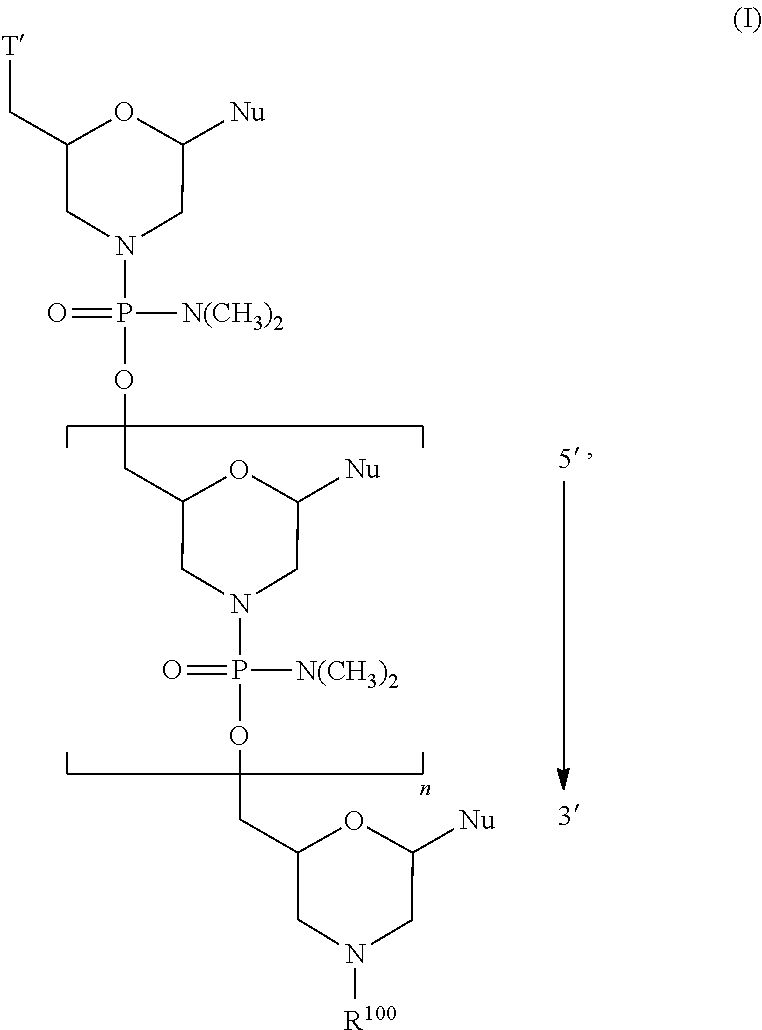

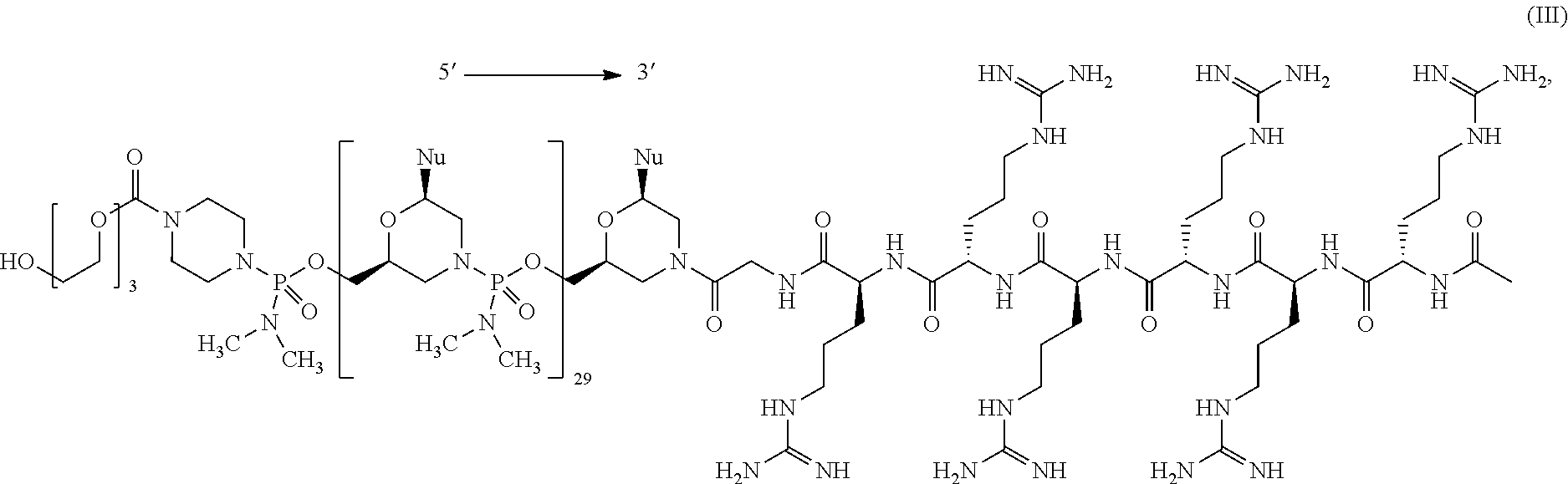
or a pharmaceutically acceptable salt thereof,
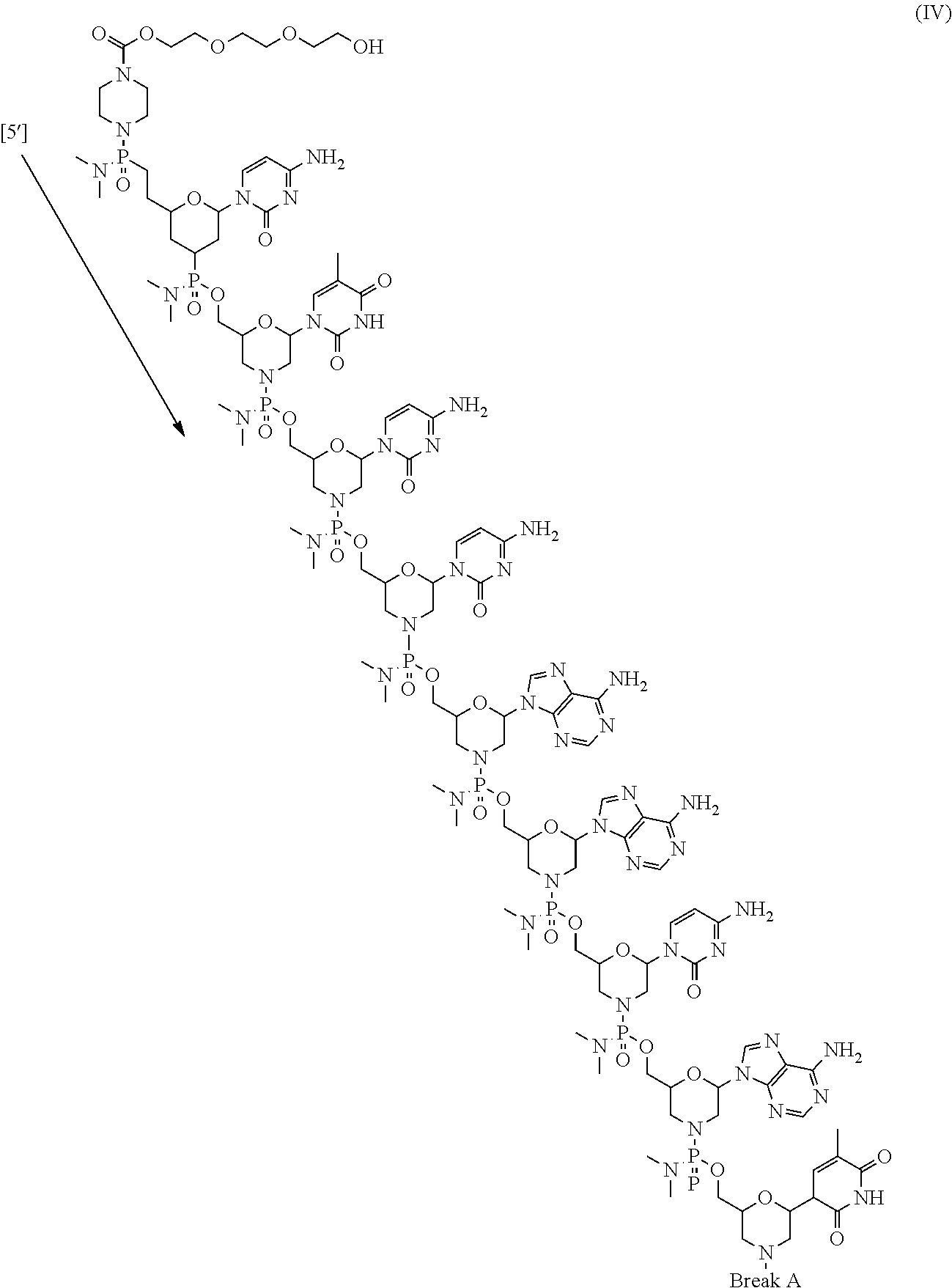

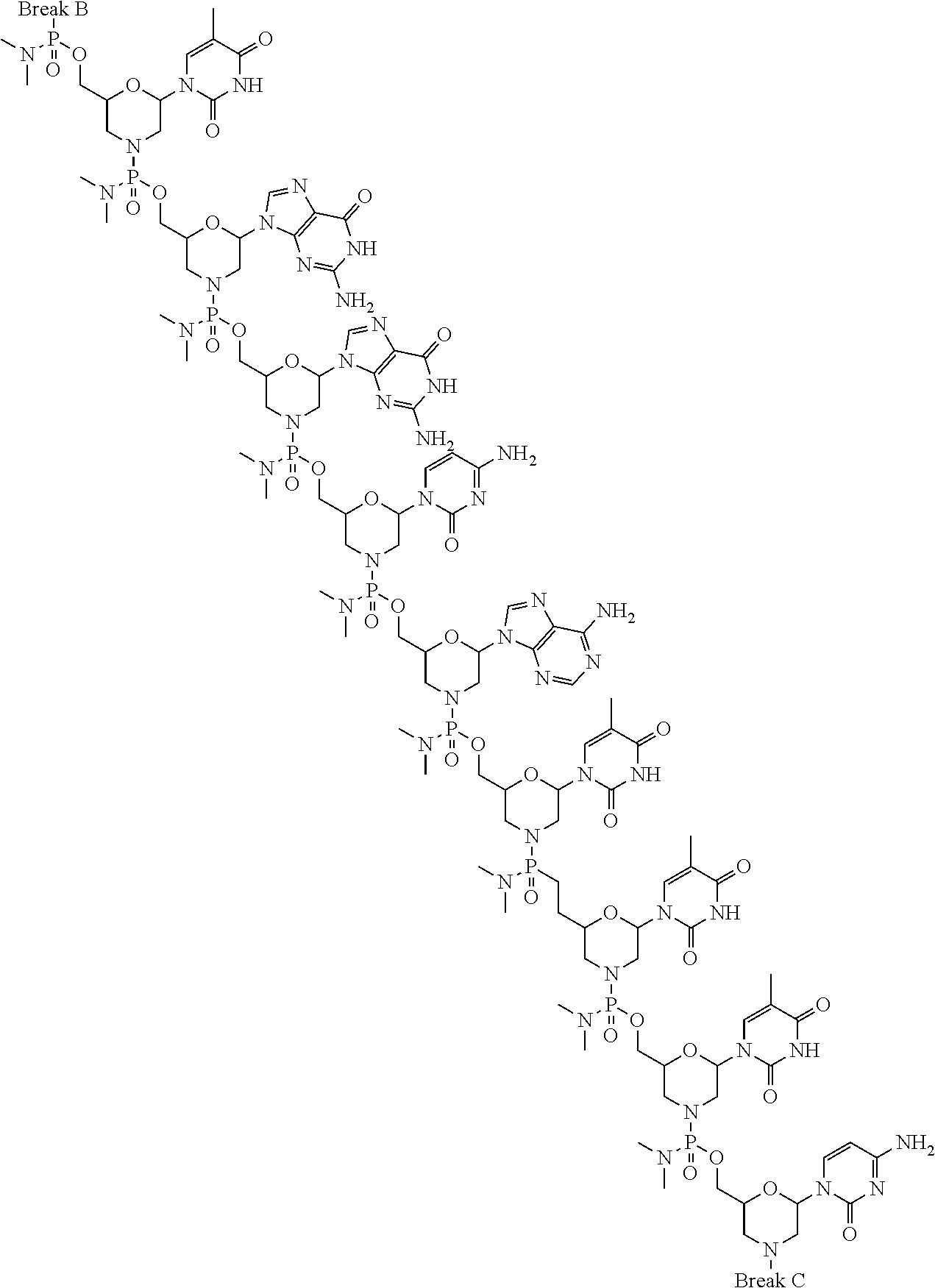
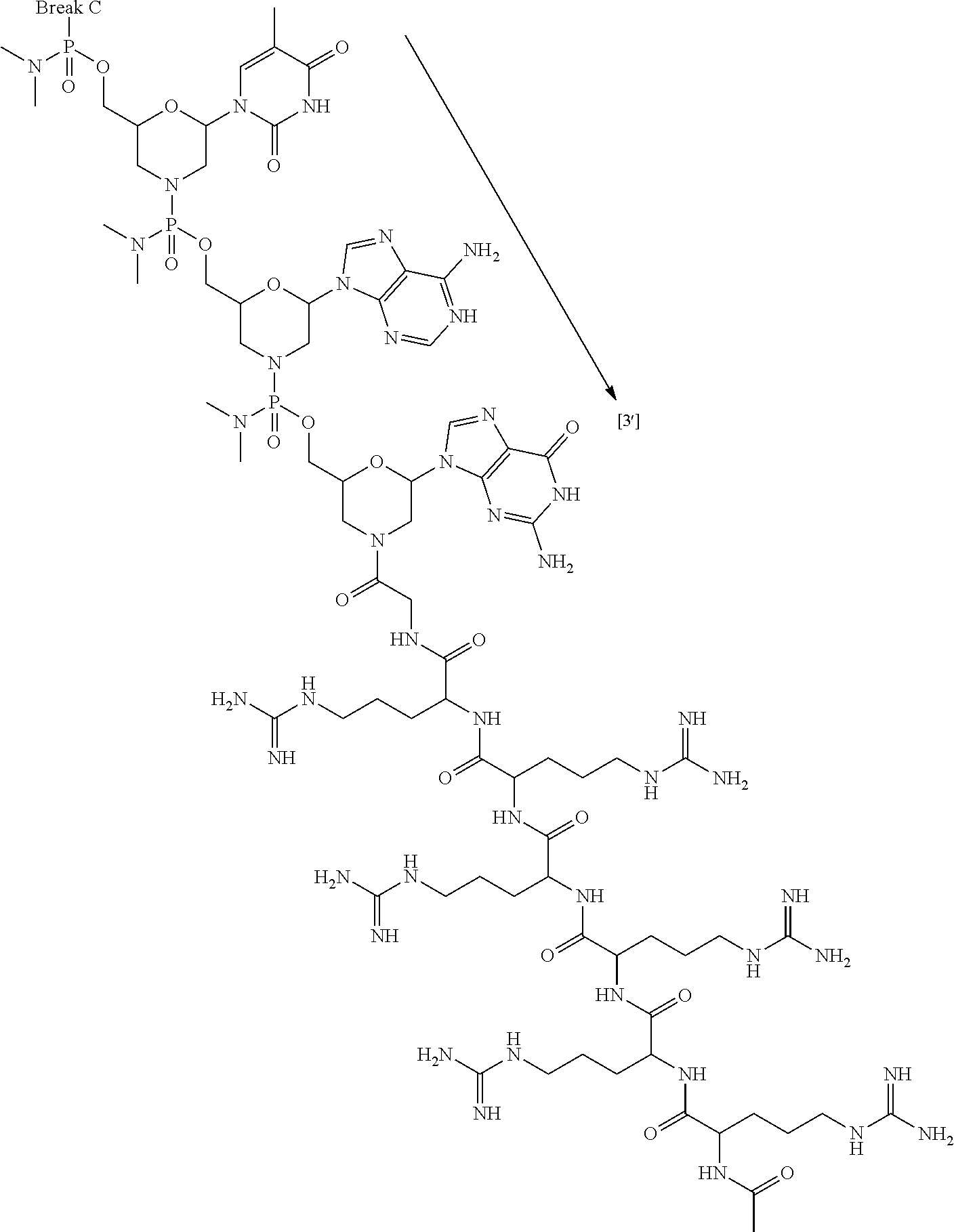
or a pharmaceutically acceptable salt thereof.
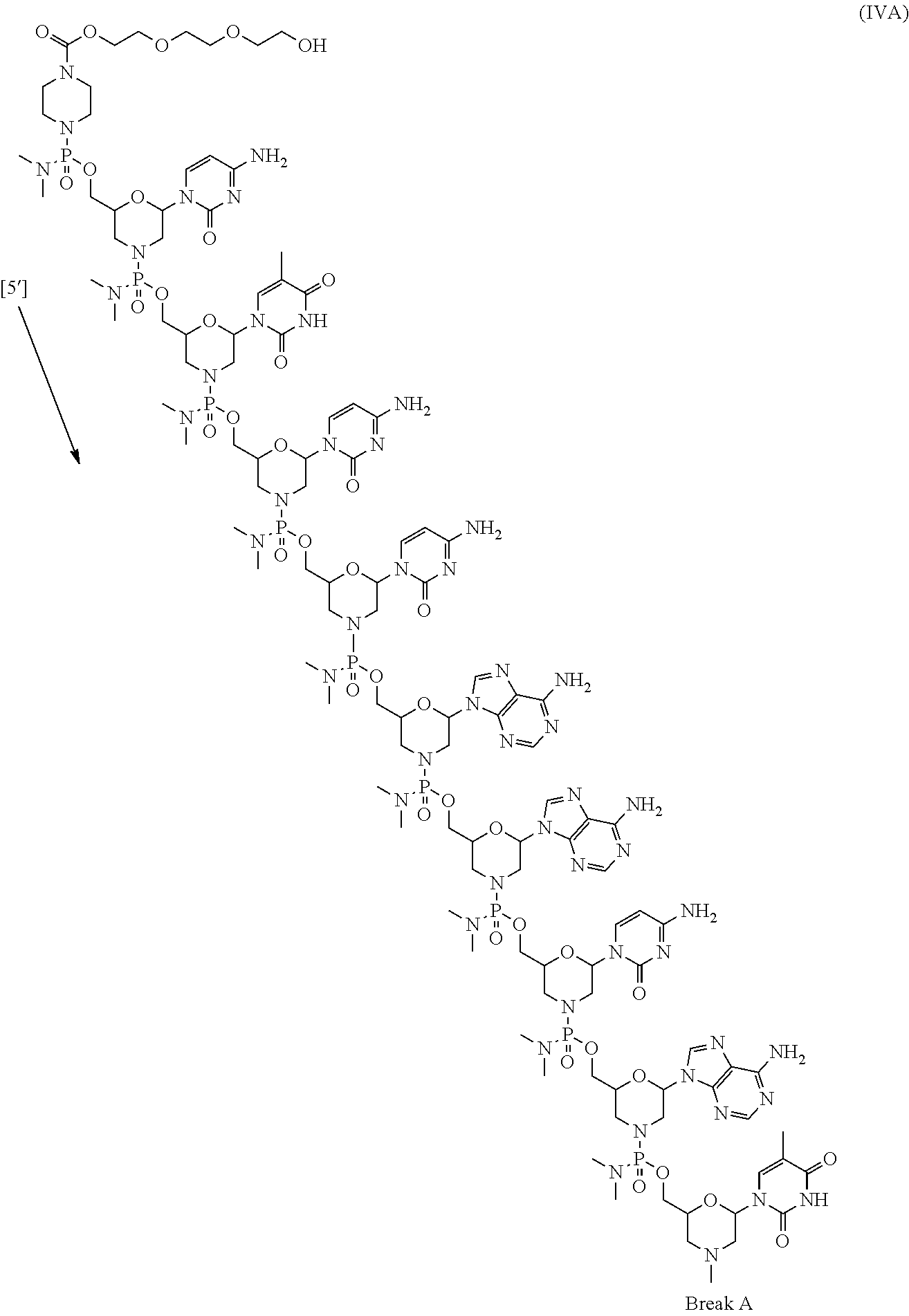


or a pharmaceutically acceptable salt thereof.

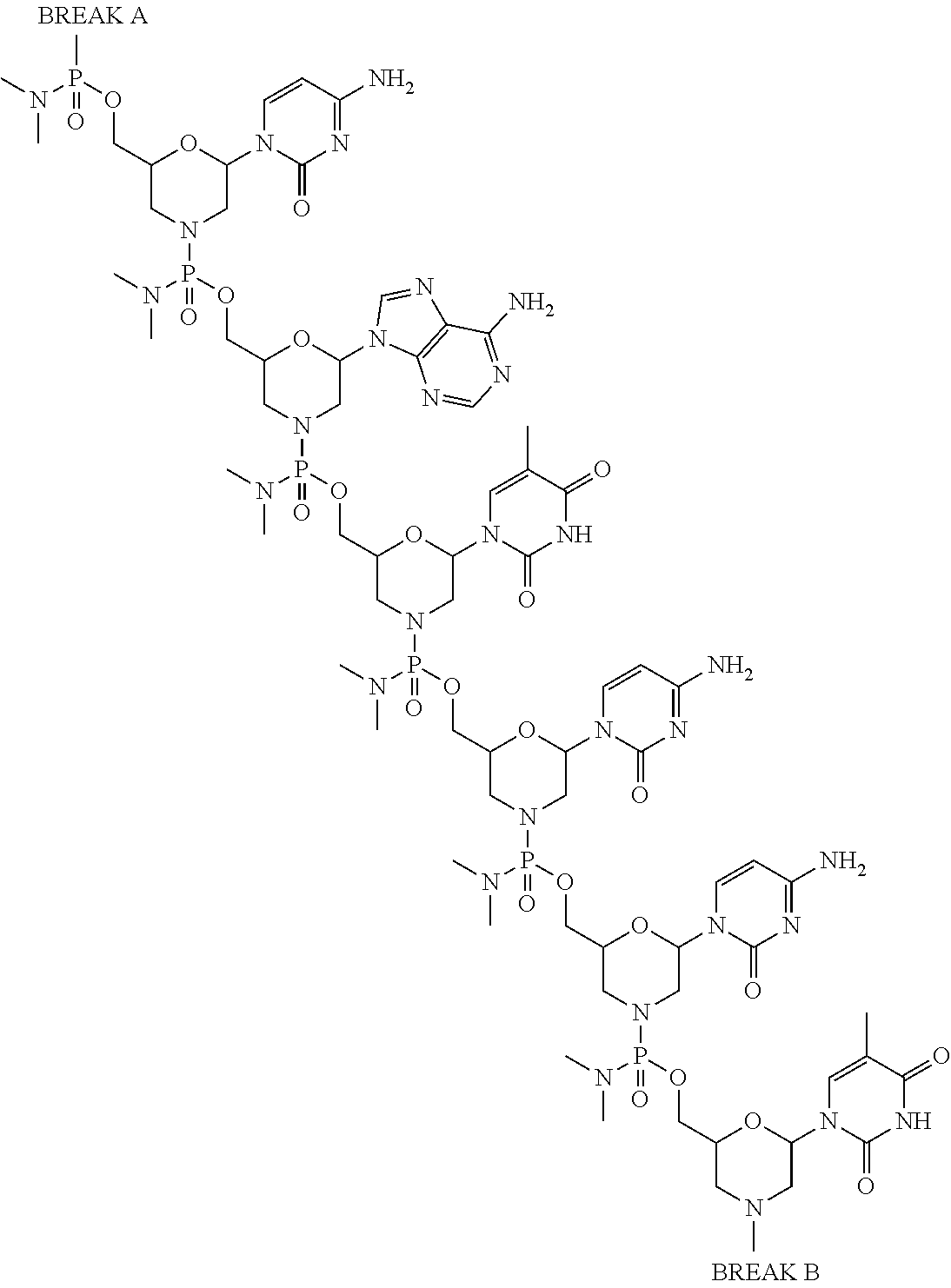
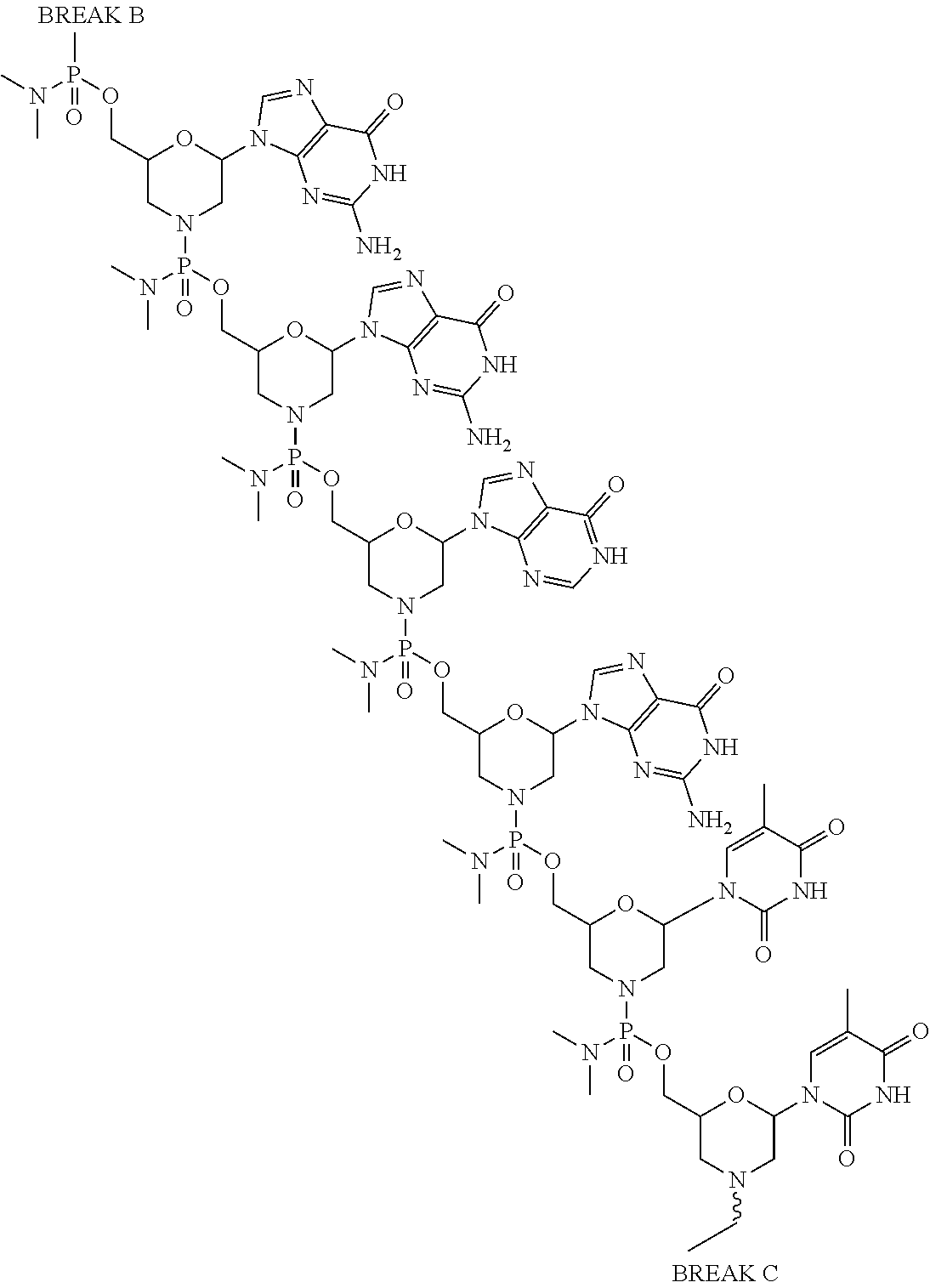

or a pharmaceutically acceptable salt thereof.

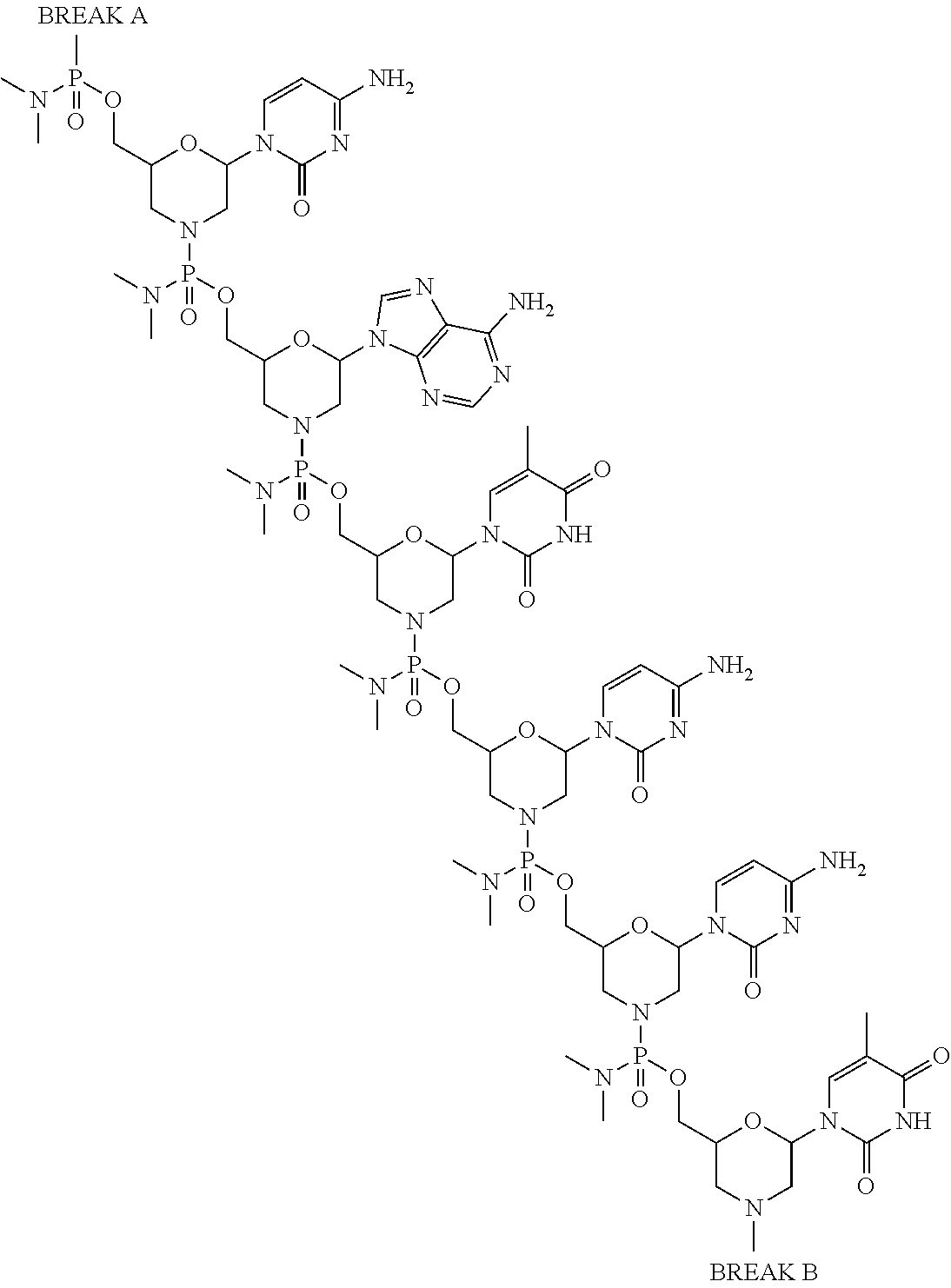
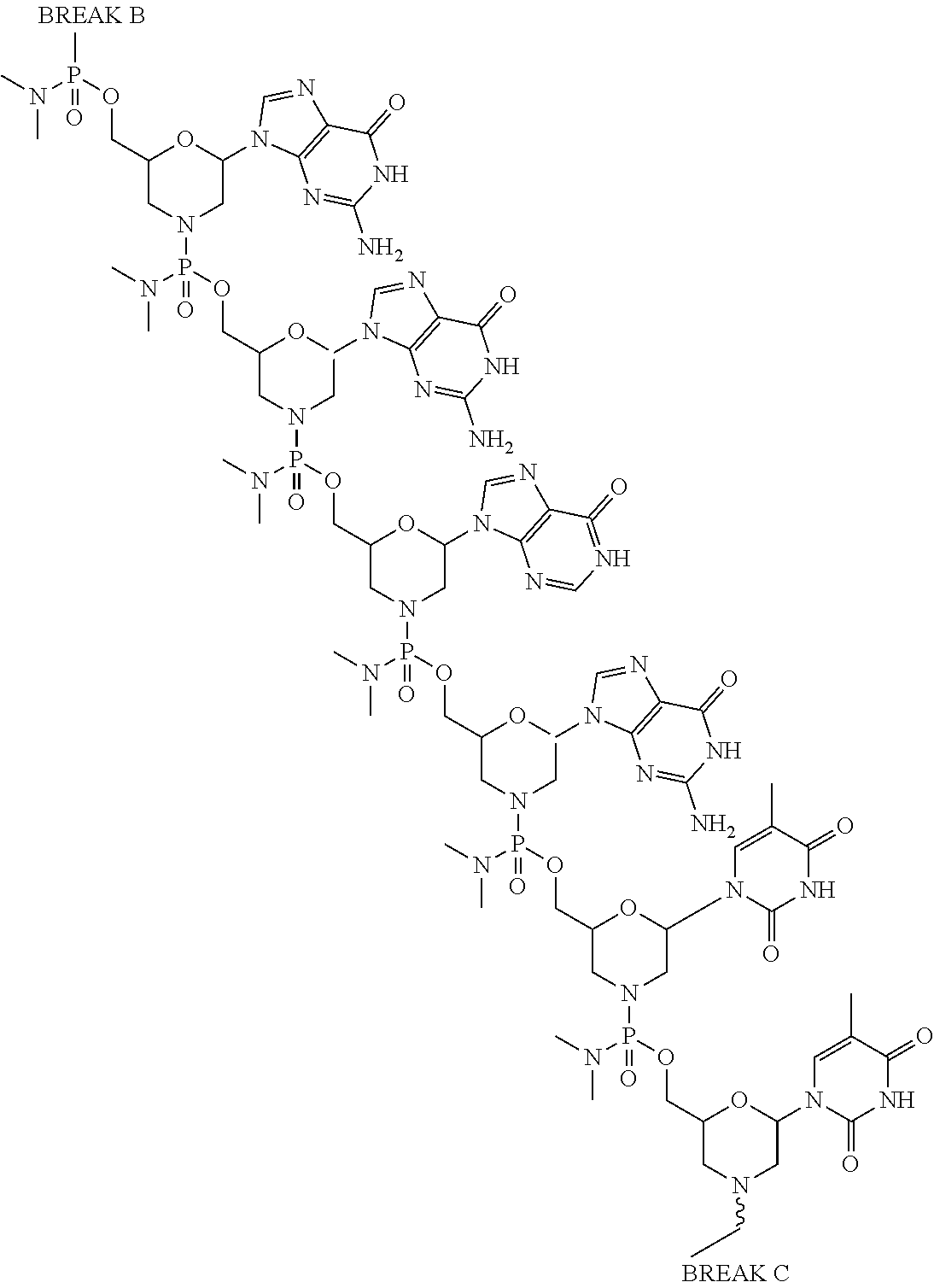

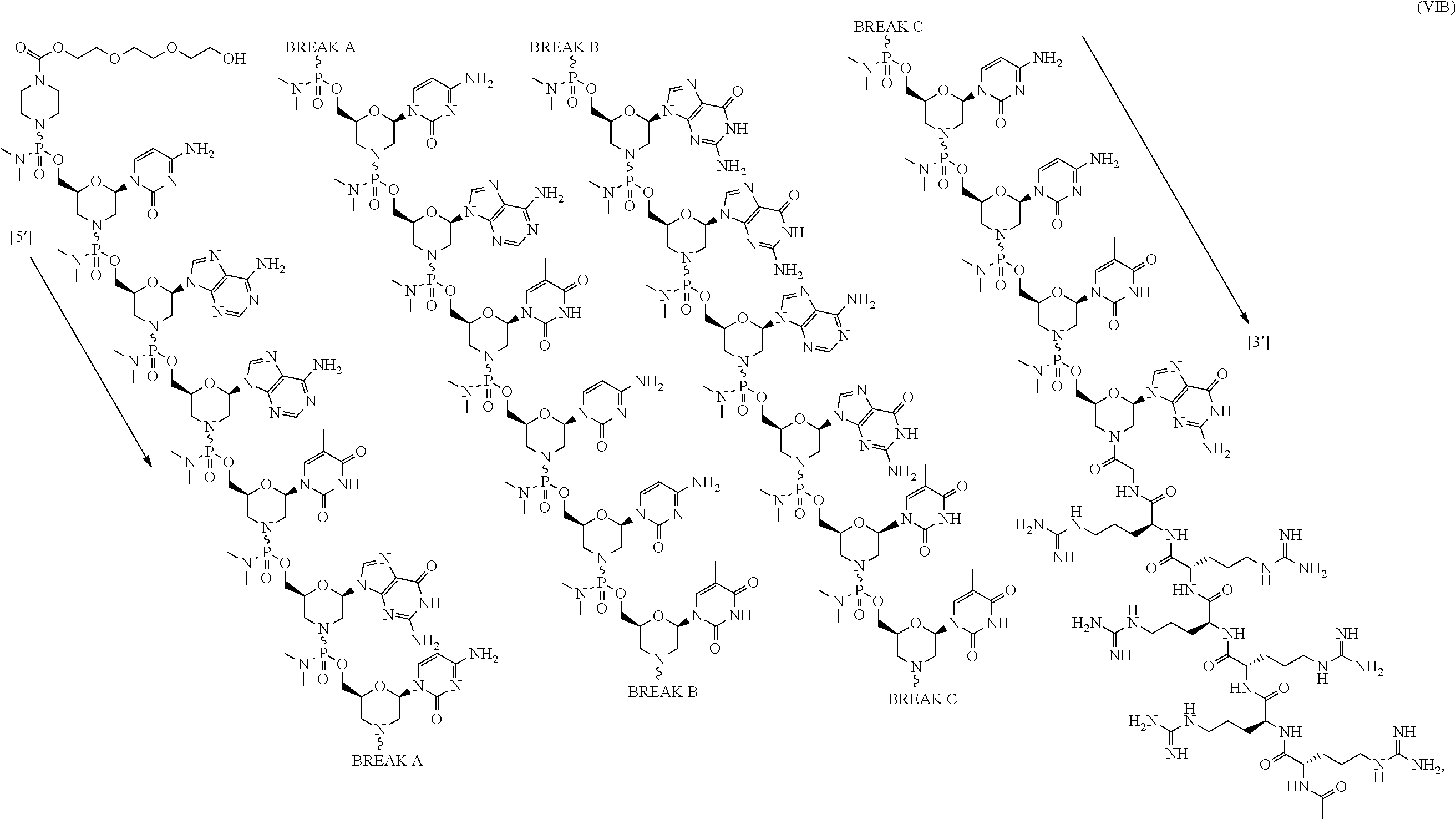
or a pharmaceutically acceptable salt thereof.
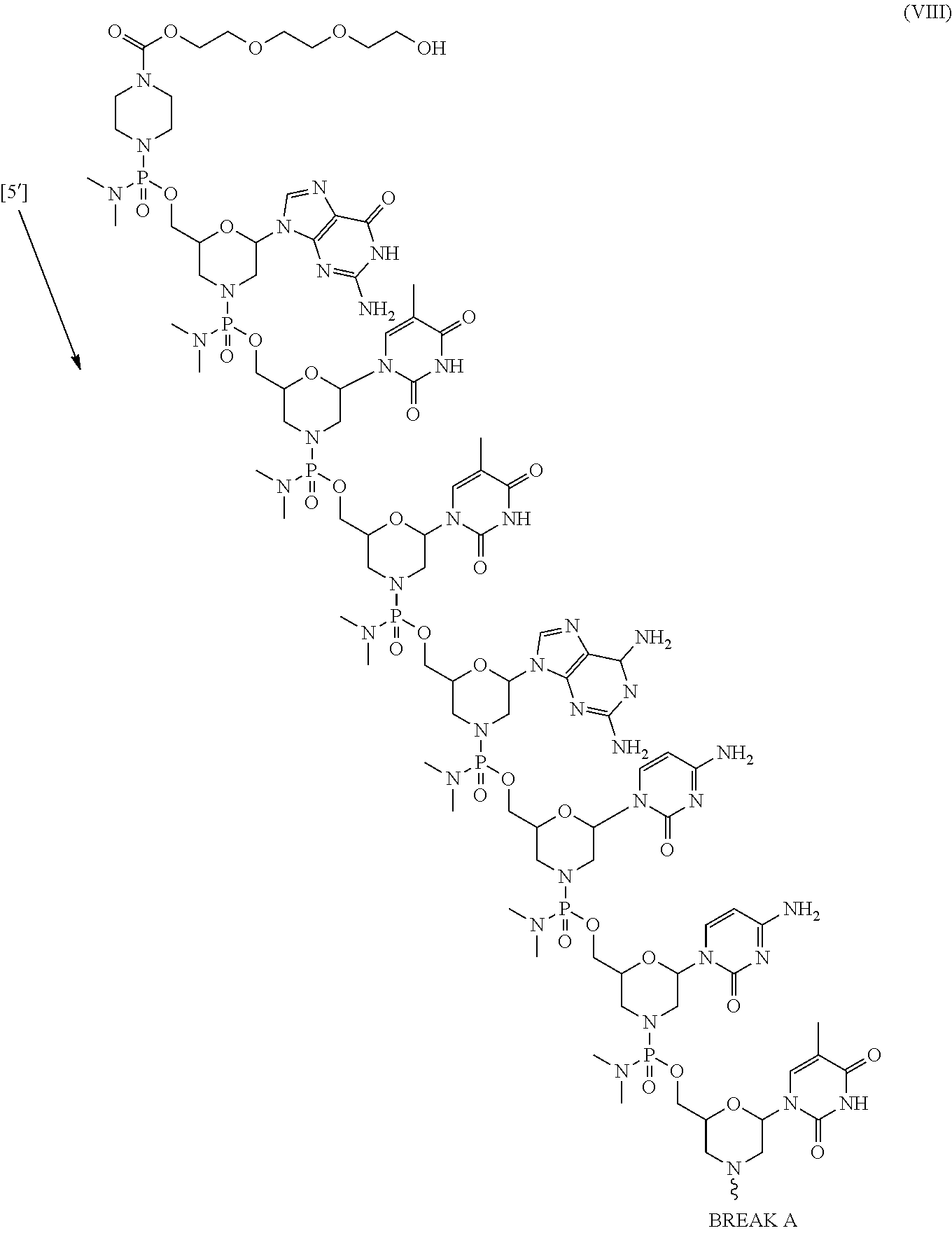
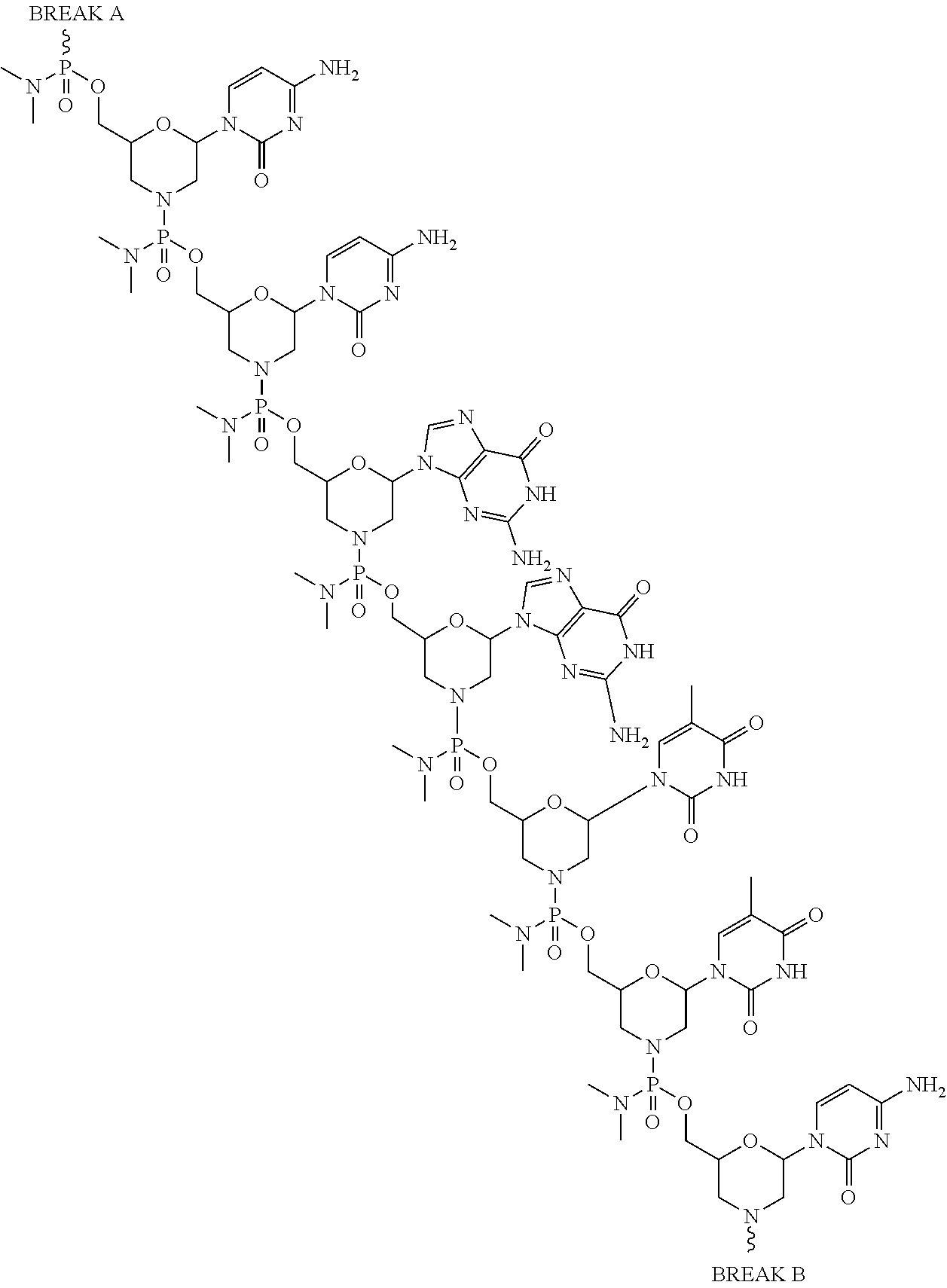

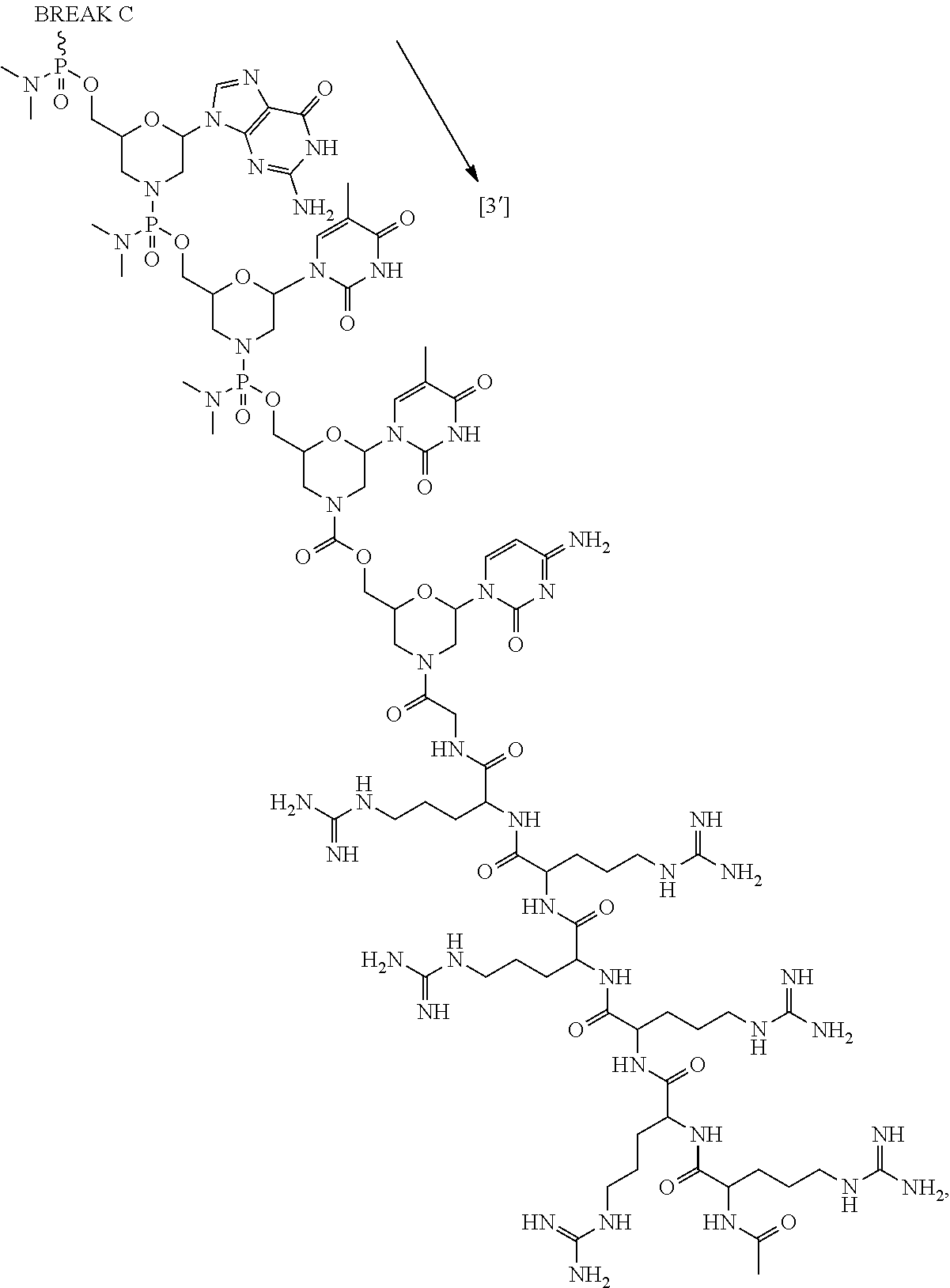
or a pharmaceutically acceptable salt thereof.


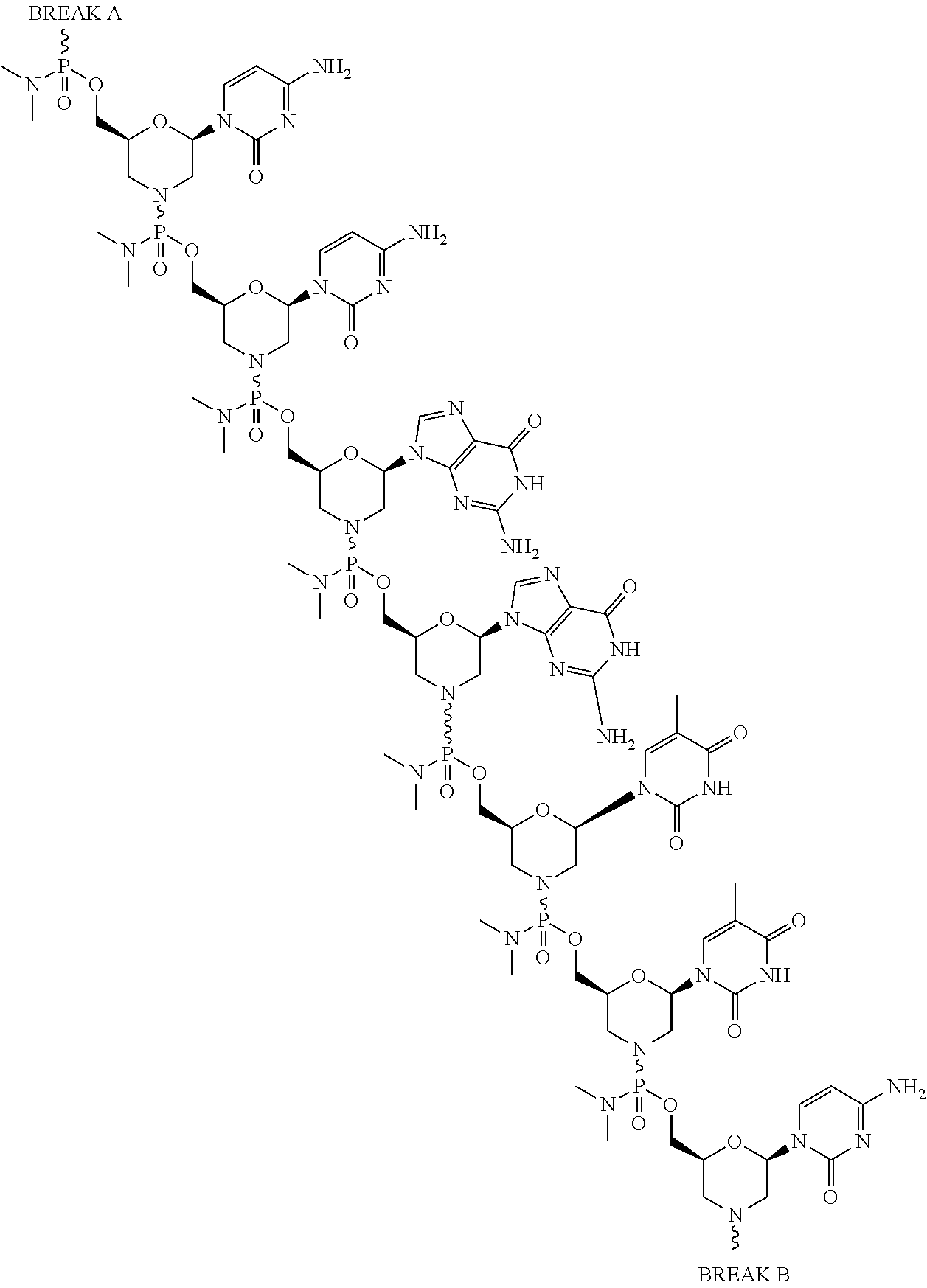
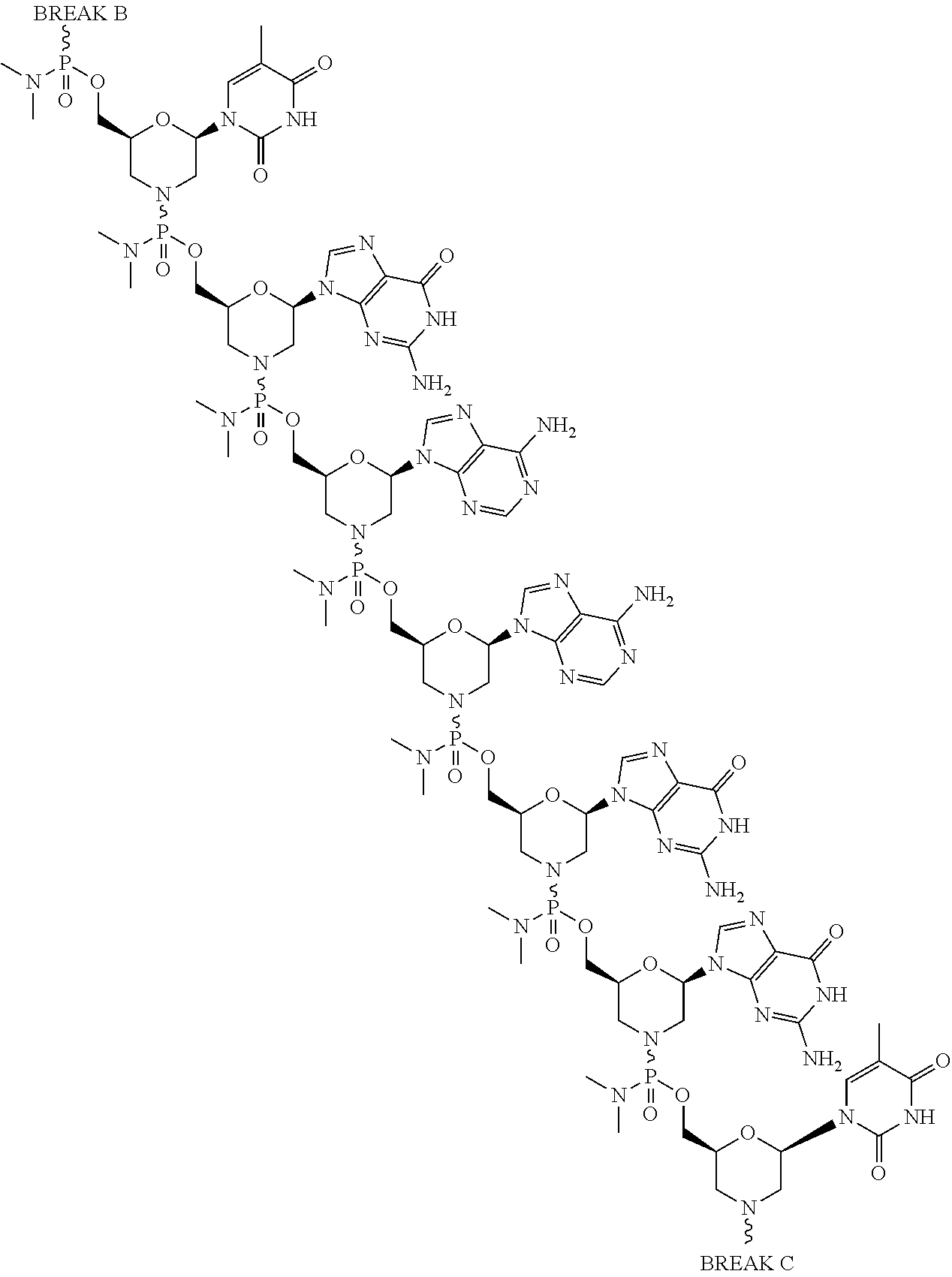
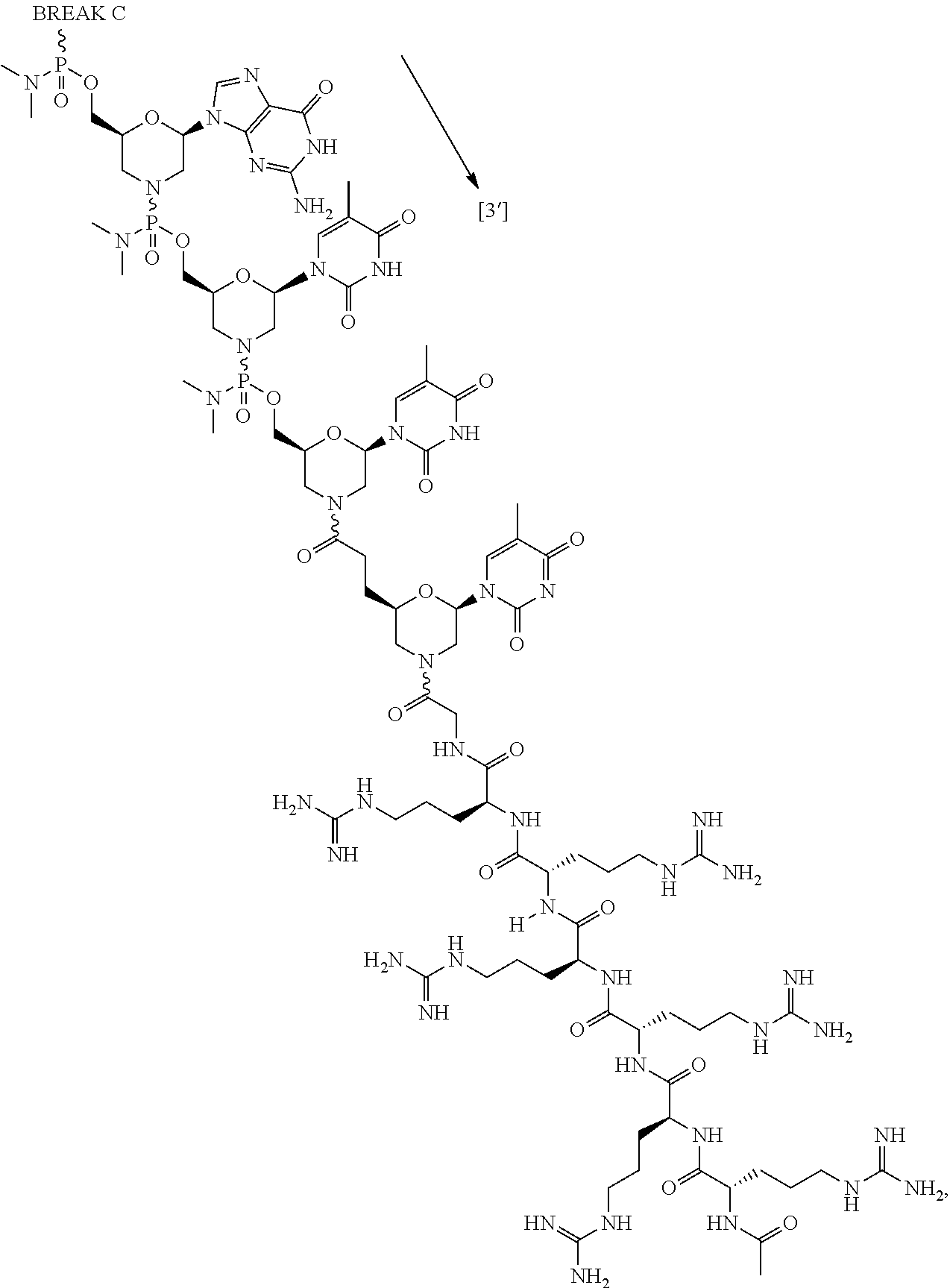
or a pharmaceutically acceptable salt thereof.

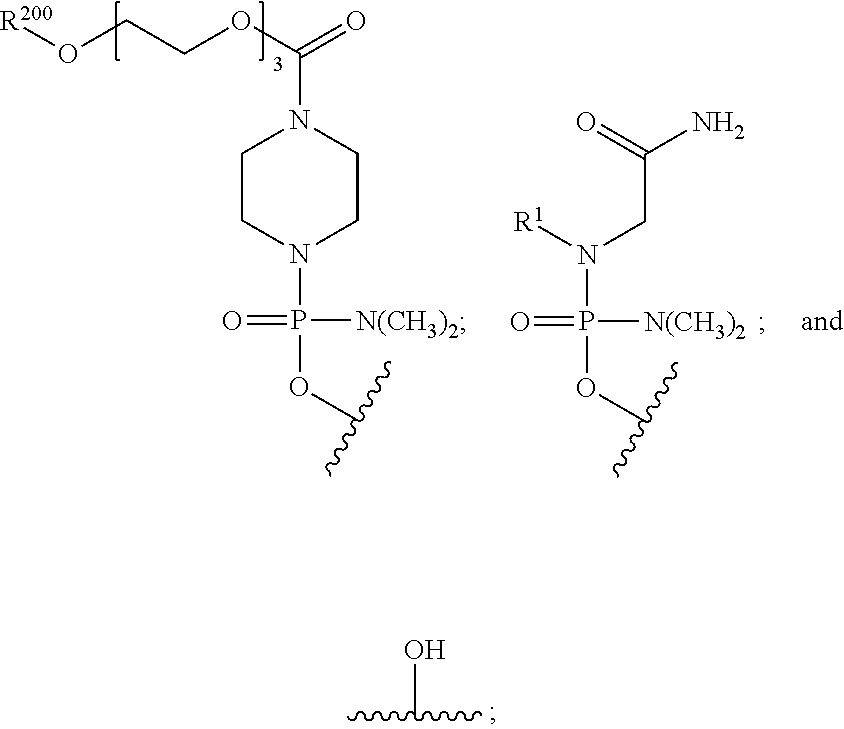
wherein
-
- i) about 300 mg to about 700 mg, or about 900 mg to about 1200 mg, once every four weeks for a patient that weighs from about 10 kg to about 25 kg;
- ii) about 600 mg to about 800 mg, or about 1000 mg to about 1300 mg, once every four weeks for a patient that weighs from about 25 kg to about 50 kg; or
- iii) about 700 mg to about 900 mg, or about 1200 mg to about 1500 mg, once every four weeks for a patient that weighs from about 50 kg to about 100 kg;
to achieve a mean AUC between about 100 and about 200 ug·h/mL, or is between about 200 and about 500 ug·h/mL, respectively.
-
- iv) about 300 mg to about 700 mg, or about 900 mg to about 1200 mg, once every four weeks for a patient that weighs from about 10 kg to about 25 kg;
- v) about 500 mg to about 800 mg, or about 1000 mg to about 1300 mg, once every four weeks for a patient that weighs from about 25 kg to about 50 kg; or
- vi) about 700 mg to about 900 mg, or about 1200 mg to about 1500 mg, once every four weeks for a patient that weighs from about 50 kg to about 100 kg; to achieve a mean AUC between about 100 and about 200 ug·h/mL, or is between about 200 and about 500 ug·h/mL, respectively.

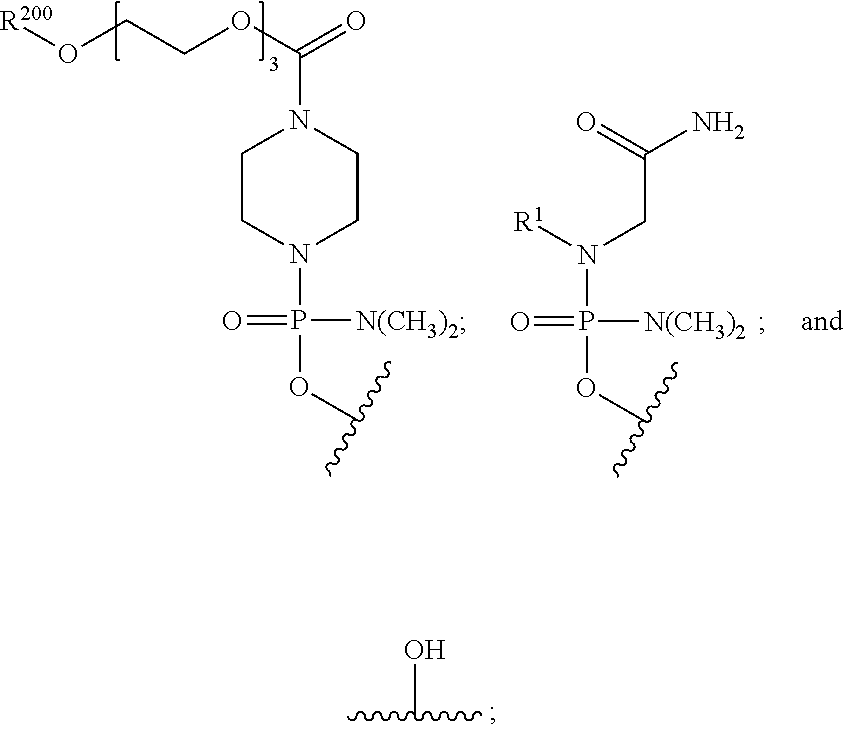

and as described in FIG. 2 of Summerton, J., et al., Antisense & Nucleic Acid Drug Development, 7: 187-195 (1997). Morpholinos as described herein include all stereoisomers and tautomers of the foregoing general structure. The synthesis, structures, and binding characteristics of morpholino oligomers are detailed in U.S. Pat. Nos. 5,698,685; 5,217,866; 5,142,047; 5,034,506; 5,166,315; 5,521,063; 5,506,337; 8,076,476; and 8,299,206; all of which are incorporated herein by reference.
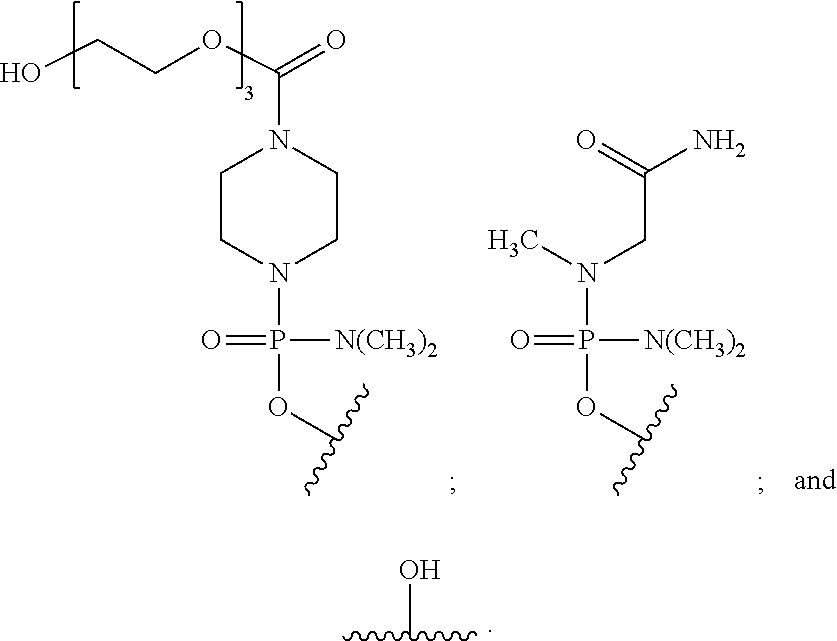


| Name | Sequence | ||
| (RXR)4 | RXRRXRRXRRXR (SEQ ID NO: 18) | ||
| (RFF)3R | RFFRFFRFFR (SEQ ID NO: 19) | ||
| (RXR)4XB | RXRRXRRXRRXRXB (SEQ ID NO: 20) | ||
| (RFF)3RXB | RFFRFFRFFRXB (SEQ ID NO: 26) | ||
| (RFF)3RG | RFFRFFRFFRG (SEQ ID NO: 21) | ||
| R6G | RRRRRRG (SEQ ID NO: 22) | ||
| R6 | RRRRRR (SEQ ID NO: 23) | ||
| R5G | RRRRRG (SEQ ID NO: 24) | ||
| R5 | RRRRR (SEQ ID NO: 25) | ||


Management of Hypomagnesemia
| |
|
Grade 3 | |
Grade 5 |
| <LLN-1.2 | <1.2-0.9 | <0.9-0.7 | <0.7 mg/dL; <0.3 | Death |
| mg/dL; <LLN- | mg/dL; <0.5- | mg/dL; <0.4- | mmol/L; | |
| 0.5 mmol/L | 0.4 mmol/L | 0.3 mmol/L | life-threatening | |
| consequences | ||||
-
- vii) about 300 mg to about 700 mg, or about 900 mg to about 1200 mg, once every four weeks for a patient that weighs from about 10 kg to about 25 kg;
- viii) about 600 mg to about 800 mg, or about 1000 mg to about 1300 mg, once every four weeks for a patient that weighs from about 25 kg to about 50 kg; or
-
- x) about 500 mg to about 700 mg, or about 1000 mg to about 1200 mg, once every four weeks for a patient that weighs from about 15 kg to about 40 kg; or
- xi) about 600 mg to about 800 mg, or about 1100 mg to about 1400 mg, once every four weeks for a patient that weighs from about 40 kg to about 100 kg;
-
- xii) about 750 mg to about 1250 mg, once every four weeks for a patient that weighs greater than or equal to about 18 kg to less than about 50 kg; or
- xiii) about 850 mg to about 1350 mg, once every four weeks for a patient that weighs greater than or equal to about 50 kg;
| TABLE 1 |
| Exemplary Carrier Peptide Sequences |
| Name | Sequence (Amino to Carboxy Terminus or 5′ to 3′) |
| (RFF)3; CP0407 | RFFRFFRFF-aa (SEQ ID NO: 89) |
| RTR | RTRTRFLRRT-aa (SEQ ID NO: 90) |
| RFFR | RFFRFFRFFR-aa (SEQ ID NO: 91) |
| KTR | KTRTKFLKKT-aa (SEQ ID NO: 92) |
| KFF | KFFKFFKFF-aa (SEQ ID NO: 93) |
| KFFK | KFFKFFKFFK-aa (SEQ ID NO: 94) |
| (RFF)2 | RFFRFF-aa (SEQ ID NO: 95) |
| (RFF)2R | RFFRFFR-aa (SEQ ID NO: 96) |
| RX | RXXRXXR-aa (SEQ ID NO: 97) |
| (RXR)4; P007 | RXRRXRRXRRXR-aa (SEQ ID NO: 98) |
| Tat47_58 | YGRKKRRQRRR-aa (SEQ ID NO: 99) |
| Tat48_58 | GRKKRRQRRR-aa (SEQ ID NO: 100) |
| Tat49_58 | RKKRRQRRR-aa (SEQ ID NO: 101) |
| Penetratin | RQIKIWFQNRRMKWKKGG-aa (SEQ ID NO: 102) |
| Transportan | GWTLNSAGYLLGKINLKALAALAKKIL-aa (SEQ ID |
| NO: 103) | |
| 2XHph-1 | YARVRRRGPRGYARVRRRGPRR-aa (SEQ ID NO: 104) |
| Hph-1 | YARVRRRGPRR-aa (SEQ ID NO: 105) |
| Sim-2 | AKAARQAAR-aa (SEQ ID NO: 106) |
| HSV1 VP22 | DAATATRGRSAASRPTERPRAPARSASRPRRPVE-aa |
| (SEQ ID NO: 107) | |
| Pep-1 | KETWWETWWTEWSQPKKKRKV-aa (SEQ ID NO: 108) |
| Pep-2 | KETWFETWFTEWSQPKKKRKV-aa (SEQ ID NO: 109) |
| ANTP | RQIKIWFQNRRMKWKK-aa (SEQ ID NO: 110) |
| R6Pen | RRRRRR-RQIKIWFQNRRMKWKKGG-aa (SEQ ID NO: |
| 111) | |
| rTat | RRRQRRKKRC-aa (SEQ ID NO: 112) |
| pTat | CYGRKKRRQRRR-aa (SEQ ID NO: 113) |
| R9F2 | RRRRRRRRRFFC-aa (SEQ ID NO: 114) |
| R9CF2, | RRRRRRRRRCFF-aa (SEQ ID NO: 115) |
| RRRRRRRRRCFF | |
| R8CF2R | RRRRRRRRCFFR-aa (SEQ ID NO: 116) |
| R6CF2R3 | RRRRRRCFFRRR-aa (SEQ ID NO: 117) |
| R5FCFR4 | RRRRRFCFRRRR-aa (SEQ ID NO: 118) |
| R5F2R4 | RRRRRFFRRRR-aa (SEQ ID NO: 119) |
| R4CF2R5 | RRRRCFFRRRRR-aa (SEQ ID NO: 120) |
| R2CF2R7 | RRCFFRRRRRRR-aa (SEQ ID NO: 121) |
| CF2R9 | CFFRRRRRRRRR-aa (SEQ ID NO: 122) |
| CR9F2 | CRRRRRRRRRFF-aa (SEQ ID NO: 123) |
| F2R9 | FFRRRRRRRRR-aa (SEQ ID NO: 124) |
| R5F2CF2R4 | RRRRRFFCFFRRRR-aa (SEQ ID NO: 125) |
| R9I2 | RRRRRRRRRII-aa (SEQ ID NO: 126) |
| R8F3 | RRRRRRRRFFF-aa (SEQ ID NO: 127) |
| R9F4 | RRRRRRRRRFFFF-aa (SEQ ID NO: 128) |
| R5F2 | RRRRRRRRFF-aa (SEQ ID NO: 129) |
| R6F2 | RRRRRRFF-aa (SEQ ID NO: 130) |
| R5F2 | RRRRRFF-aa (SEQ ID NO: 131) |
| (RRX)3RR | RRXRRXRRXRR-aa (SEQ ID NO: 132) |
| (RXR)4 | RXRRXRRXRRXR-aa (SEQ ID NO: 98) |
| (XRR)4 | XRRXRRXRRXRR-aa (SEQ ID NO: 134) |
| (RX)5RR | RXRXRXRXRXR-aa (SEQ ID NO: 135) |
| (RXR)3 | RXRRXRRXR-aa (SEQ ID NO: 136) |
| (RXR)2R | RXRRXRR-aa (SEQ ID NO: 137) |
| (RXR)2 | RXRRXR-aa (SEQ ID NO: 138) |
| (RKX)3RK | RKXRKXRKXRK-aa (SEQ ID NO: 139) |
| (RHX)3RH | RHXRHXRHXRH-aa (SEQ ID NO: 140) |
| RsCF2R | RRRRRRRRCFFR-aa (SEQ ID NO: 116) |
| (RRX)3RR | RRXRRXRRXRR-aa (SEQ ID NO: 132) |
| (RXR)4; P007 | RXRRXRRXRRXR-aa (SEQ ID NO: 98) |
| (XRR)4 | XRRXRRXRRXRR-aa (SEQ ID NO: 134) |
| (RX)5R | RXRXRXRXRXR-aa (SEQ ID NO: 135) |
| (RX)7R | RXRXRXRXRXRXR-aa (SEQ ID NO: 146) |
| (RXR)5 | RXRRXRRXRRXRRXR-aa (SEQ ID NO: 147) |
| (RXRRBR)2; B | RXRRBRRXRRBR-aa (SEQ ID NO: 148) |
| (RXR)3RBR | RXRRXRRXRRBR-aa (SEQ ID NO: 149) |
| (RB)5RXRBR | RBRBRBRBRBRXRBR-aa (SEQ ID NO: 150) |
| RBRBRBRXRBRBR | RBRBRBRXRBRBRBR-aa (SEQ ID NO: 151) |
| BR | |
| X(RB)3RX(RB)3R-X | XRBRBRBRXRBRBRBR-aa (SEQ ID NO: 152) |
| (RBRX)4 | RBRXRBRXRBRXRBR-aa (SEQ ID NO: 153) |
| (RB)4 (RX)3R | RBRBRBRBRXRXRXR-aa (SEQ ID NO: 154) |
| RX(RB)2RX(RB)3R | RXRBRBRXRBRBRBR-aa (SEQ ID NO: 155) |
| (RB)7R | RBRBRBRBRBRBRBR-aa (SEQ ID NO: 156) |
| R4 | tg-RRRR-aa (SEQ ID NO: 157) |
| R5 | tg-RRRRR-aa (SEQ ID NO: 158) |
| R6 | tg-RRRRRR-aa (SEQ ID NO: 159) |
| R7 | tg-RRRRRRR-aa (SEQ ID NO: 160) |
| R8 | tg-RRRRRRRR-aa (SEQ ID NO: 161) |
| R5GR4 | tg-RRRRRGRRRR-aa (SEQ ID NO: 162) |
| R5F2R4 | tg-RRRRRFFRRRR-aa (SEQ ID NO: 163) |
| Tat | tg-RKKRRQRRR-aa (SEQ ID NO: 164) |
| rTat | tg-RRRQRRKKR-aa (SEQ ID NO: 165) |
| RXRRXR-aa (SEQ ID NO: 138) | |
| RBRRBR-aa (SEQ ID NO: 167) | |
| RXRRBR-aa (SEQ ID NO: 168) | |
| RBRRXR-aa (SEQ ID NO: 169) | |
| RXRYbRXR-aa (SEQ ID NO: 170) | |
| RBRYbRBR-aa (SEQ ID NO: 171) | |
| RXRYbRBR-aa (SEQ ID NO: 172) | |
| RBRYbRXR-aa (SEQ ID NO: 173) | |
| RXRILFQYRXR-aa (SEQ ID NO: 174) | |
| RBRILFQYRBR-aa (SEQ ID NO: 175) | |
| RXRILFQYRBR-aa (SEQ ID NO: 176) | |
| RBRILFQYRXR-aa (SEQ ID NO: 177) | |
| RXRRXRRXR-aa (SEQ ID NO: 136) | |
| RBRRBRRBR-aa (SEQ ID NO: 179) | |
| RXRRBRRXR-aa (SEQ ID NO: 180) | |
| RXRRBRRBR-aa (SEQ ID NO: 181) | |
| RXRRXRRBR-aa (SEQ ID NO: 182) | |
| RBRRXRRBR-aa (SEQ ID NO: 183) | |
| RBRRXRRXR-aa (SEQ ID NO: 184) | |
| RBRRBRRXR-aa (SEQ ID NO: 185) | |
| RXRYbRXRRXR-aa (SEQ ID NO: 186) | |
| RXRRXRYbRXR-aa (SEQ ID NO: 187) | |
| RXRILFQYRXRRXR-aa (SEQ ID NO: 188) | |
| RXRRXRILFQYRXR-aa (SEQ ID NO: 189) | |
| RXRYbRXRYRXR-aa (SEQ ID NO: 190) | |
| RXRILFQYRXRILFQYRXR-aa (SEQ ID NO: 191) | |
| RXRILFQYRXRYbRXR-aa (SEQ ID NO: 192) | |
| RXRYbRXRILFQYRXR-aa (SEQ ID NO: 193) | |
| RBRYbRBRRBR-aa (SEQ ID NO: 194) | |
| RBRRBRYbRBR-aa (SEQ ID NO: 195) | |
| RBRILFQYRBRRBR-aa (SEQ ID NO: 196) | |
| RBRRBRILFQYRBR-aa (SEQ ID NO: 197) | |
| RBRYRBRYbRBR-aa (SEQ ID NO: 198) | |
| RBRILFQYRBRILFQYRBR-aa (SEQ ID NO: 199) | |
| RBRYbRBRILFQYRBR-aa (SEQ ID NO: 200) | |
| RBRILFQYRBRYbRBR-aa (SEQ ID NO: 201) | |
| RXRYbRBRRXR-aa (SEQ ID NO: 202) | |
| RXRRBRYbRXR-aa (SEQ ID NO: 203) | |
| RXRILFQYRBRRXR-aa (SEQ ID NO: 204) | |
| RXRRBRILFQYRXR-aa (SEQ ID NO: 205) | |
| RXRYbRBRYbRXR-aa (SEQ ID NO: 206) | |
| RXRILFQYRBRILFQYRXR-aa (SEQ ID NO: 207) | |
| RXRYbRBRILFQYRXR-aa (SEQ ID NO: 208) | |
| RXRILFQYRBRYbRXR-aa (SEQ ID NO: 209) | |
| RXRYbRBRRBR-aa (SEQ ID NO: 210) | |
| RXRRBRYbRBR-aa (SEQ ID NO: 211) | |
| RXRILFQYRBRRBR-aa (SEQ ID NO: 212) | |
| RXRRBRILFQYRBR-aa (SEQ ID NO: 213) | |
| RXRYbRBRYbRBR-aa (SEQ ID NO: 214) | |
| RXRILFQYRBRILFQYRBR-aa (SEQ ID NO: 215) | |
| RXRYbRBRILFQYRBR-aa (SEQ ID NO: 216) | |
| RXRILFQYRBRYbRBR-aa (SEQ ID NO: 217) | |
| RXRYbRXRRBR-aa (SEQ ID NO: 218) | |
| RXRRXRYbRBR-aa (SEQ ID NO: 219) | |
| RXRILFQYRXRRBR-aa (SEQ ID NO: 220) | |
| RXRRXRILFQYRBR-aa (SEQ ID NO: 221) | |
| RXRYbRXRYbRBR-aa (SEQ ID NO: 222) | |
| RXRILFQYRXRILFQYRBR-aa (SEQ ID NO: 223) | |
| RXRYbRXRILFQYRBR-aa (SEQ ID NO: 224) | |
| RXRILFQYRXRYbRBR-aa (SEQ ID NO: 225) | |
| RBRYbRXRRBR-aa (SEQ ID NO: 226) | |
| RBRRXRYbRBR-aa (SEQ ID NO: 227) | |
| RBRILFQYRXRRBR-aa (SEQ ID NO: 228) | |
| RBRRXRILFQYRBR-aa (SEQ ID NO: 229) | |
| RBRYbRXRYbRBR-aa (SEQ ID NO: 230) | |
| RBRILFQYRXRILFQYRBR-aa (SEQ ID NO: 231) | |
| RBRYbRXRILFQYRBR-aa (SEQ ID NO: 232) | |
| RBRILFQYRXRYbRBR-aa (SEQ ID NO: 233) | |
| RBRYbRXRRXR-aa (SEQ ID NO: 234) | |
| RBRRXRYbRXR-aa (SEQ ID NO: 235) | |
| RBRILFQYRXRRXR-aa (SEQ ID NO: 236) | |
| RBRRXRILFQYRXR-aa (SEQ ID NO: 237) | |
| RBRYbRXRYbRXR-aa (SEQ ID NO: 238) | |
| RBRILFQYRXRILFQYRXR-aa (SEQ ID NO: 239) | |
| RBRYbRXRILFQYRXR-aa (SEQ ID NO: 240) | |
| RBRILFQYRXRYbRXR-aa (SEQ ID NO: 241) | |
| RBRYbRBRRXR-aa (SEQ ID NO: 242) | |
| RBRRBRYbRXR-aa (SEQ ID NO: 243) | |
| RBRILFQYRBRRXR-aa (SEQ ID NO: 244) | |
| RBRRBRILFQYRXR-aa (SEQ ID NO: 245) | |
| RBRYbRBRYbRXR-aa (SEQ ID NO: 246) | |
| RBRILFQYRBRILFQYRXR-aa (SEQ ID NO: 247) | |
| RBRYbRBRILFQYRXR-aa (SEQ ID NO: 248) | |
| RBRILFQYRBRYbRXR-aa (SEQ ID NO: 249) | |
| RXRRXRRXRRXR-aa (SEQ ID NO: 98) | |
| RXRRBRRXRILFQYRXRBRXR-aa (SEQ ID NO: 251) | |
| RXRRBRRXRRBR-aa (SEQ ID NO: 148) | |
| YGRKKRRQRRRP-aa (SEQ ID NO: 253) | |
| RXRRXRRXRRXRXBASSLNIAXC-aa (SEQ ID NO: 254) | |
| RXRRBRRXRILFQYRXRBRXRBASSLNIAXC-aa (SEQ | |
| ID NO: 255) | |
| RXRRBRRXRASSLNIARXRBRXRBC-aa (SEQ ID NO: | |
| 256) | |
| RXRRBRRXRRBRXBASSLNIA-aa (SEQ ID NO: 257) | |
| THRPPMWSPVWP-aa (SEQ ID NO: 258) | |
| HRPPMWSPVWP-aa (SEQ ID NO: 259) | |
| THRPPMWSPV-aa (SEQ ID NO: 260) | |
| THRPPMWSP-aa (SEQ ID NO: 261) | |
| THRPPMWSPVFP-aa (SEQ ID NO: 262) | |
| THRPPMWSPVYP-aa (SEQ ID NO: 263) | |
| THRPPMWSPAWP-aa (SEQ ID NO: 264) | |
| THRPPMWSPLWP-aa (SEQ ID NO: 265) | |
| THRPPMWSPIWP-aa (SEQ ID NO: 266) | |
| THRPPMWTPVVWP-aa (SEQ ID NO: 267) | |
| THRPPMFSPVWP-aa (SEQ ID NO: 268) | |
| THRPPMWS-aa (SEQ ID NO: 269) | |
| HRPPMWSPVW-aa (SEQ ID NO: 270) | |
| THRPPMYSPVWP-aa (SEQ ID NO: 271) | |
| THRPPnleWSPVWP-aa (nle = norleucine)(SEQ ID NO: | |
| 272) | |
| THKPPMWSPVWP-aa (SEQ ID NO: 273) | |
| SHRPPMWSPVWP-aa (SEQ ID NO: 274) | |
| STFTHPR-aa (SEQ ID NO: 275) | |
| YDIDNRR-aa (SEQ ID NO: 276) | |
| AYKPVGR-aa (SEQ ID NO: 277) | |
| HAIYPRH-aa (SEQ ID NO: 278) | |
| HTPNSTH-aa (SEQ ID NO: 279) | |
| ASSPVHR-aa (SEQ ID NO: 280) | |
| SSLPLRK-aa (SEQ ID NO: 281) | |
| KKRS-aa (SEQ ID NO: 282) | |
| KRSK-aa (SEQ ID NO: 283) | |
| KKRSK-aa (SEQ ID NO: 284) | |
| KSRK-aa (SEQ ID NO: 285) | |
| SRKR-aa (SEQ ID NO: 286) | |
| RKRK-aa (SEQ ID NO: 287) | |
| KSRKR-aa (SEQ ID NO: 288) | |
| QHPPWRV-aa (SEQ ID NO: 289) | |
| THPPTTH-aa (SEQ ID NO: 290) | |
| YKHTPTT-aa (SEQ ID NO: 291) | |
| QGMHRGT-aa (SEQ ID NO: 292) | |
| SRKRK-aa (SEQ ID NO: 293) | |
| KSRKRK-aa (SEQ ID NO: 294) | |
| PKKKRKV-aa (SEQ ID NO: 295) | |
| GKKRSKV-aa (SEQ ID NO: 296) | |
| KSRKRKL-aa (SEQ ID NO: 297) | |
| HSPSKIP-aa (SEQ ID NO: 298) | |
| HMATFHY-aa (SEQ ID NO: 299) | |
| AQPNKFK-aa (SEQ ID NO: 300) | |
| NLTRLHT-aa (SEQ ID NO: 301) | |
| KKKR-aa (SEQ ID NO: 302) | |
| KKRK-aa (SEQ ID NO: 303) | |
| KKKRK-aa (SEQ ID NO: 304) | |
| RRRRRRQIKIWFQNRRMKWKKGGC-aa (SEQ ID NO: | |
| 305) | |
| RRRRRRRQIKIWFQNRRMKWKKGGC-aa (SEQ ID NO: | |
| 306) | |
| RQIKIWFQNRRMKWKKGGC-aa (SEQ ID NO: 307) | |
| RRRRRRRQIKIWFQNRRMKWKKC-aa (SEQ ID NO: | |
| 308) | |
| RXRRXRRXRRQIKIWFQNRRMKWKKGGC-aa (SEQ ID | |
| NO: 309) | |
| RRRRRRRQIKILFQNRXRXRXRXC-aa (SEQ ID NO: | |
| 310) | |
| RXRRXRRXRRXRC-aa (SEQ ID NO: 311) | |
| RXRRXRRXRRXRXC-aa (SEQ ID NO: 312) | |
| RXRRXRRXRIKILFQNRRMKWKKGGC-aa (SEQ ID NO: | |
| 313) | |
| RXRRXRRXRIKILFQNRRMKWKKC-aa (SEQ ID NO: | |
| 314) | |
| RXRRXRRXRIKILFQNRMKWKKC-aa (SEQ ID NO: 315) | |
| RXRRXRRXRIKILFQNXRMKWKKC-aa (SEQ ID NO: | |
| 316) | |
| RXRRXRRXRIKILFQNHRMKWKKC-aa (SEQ ID NO: | |
| 317) | |
| RXRRXRRXRIKILFQNXRMKWKKC-aa (SEQ ID NO: | |
| 316) | |
| RXRRXRRXRIKILFQNXRMKWKKC-aa (SEQ ID NO: | |
| 316) | |
| RXRRXRRXRIKILFQNXRMKWKAC-aa (SEQ ID NO: | |
| 320) | |
| RXRRXRRXRIKILFQNXRMKWHKAC-aa (SEQ ID NO: | |
| 321) | |
| RXRRXRRXRIKILFQNXRMKWHRC-aa (SEQ ID NO: | |
| 322) | |
| RXRXRXRXRIKILFQNRRMKWKKC-aa (SEQ ID NO: | |
| 323) | |
| RARARARARIKILFQNRRMKWKKC-aa (SEQ ID NO: | |
| 324) | |
| RXRRXRRXRIXILFQNXRMKWHKAC-aa (SEQ ID NO: | |
| 3253) | |
| RXRRXRRXRIHILFQNXRMKWHKAC-aa (SEQ ID NO: | |
| 326) | |
| RXRRXRRXRIRILFQNXRMKWHKAC-aa (SEQ ID NO: | |
| 327) | |
| RXRRXRRXRIXILFQYXRMKWHKAC-aa (SEQ ID NO: | |
| 328) | |
| RXRRXRRXRLYSPLSFQXRMKWHKAC-aa (SEQ ID | |
| NO: 329) | |
| RXRRXRRXRISILFQYXRMKWHKAC-aa (SEQ ID NO: | |
| 330) | |
| RXRRXRRXRILFQYXRMKWHKAC-aa (SEQ ID NO: | |
| 331) | |
| RXRRXRIXILFQYXRMKWHKAC-aa (SEQ ID NO: 332) | |
| RXRRARRXRIHILFQYXRMKWHKAC-aa (SEQ ID NO: | |
| 333) | |
| RARRXRRARIHILFQYXRMKWHKAC-aa (SEQ ID NO: | |
| 334) | |
| RXRRXRRXRIHILFQYXRMKWHKAC-aa (SEQ ID NO: | |
| 335) | |
| RXRRXRRXRIXILFQNXRMKWHKAC-aa (SEQ ID NO: | |
| 325) | |
| RXRRXRRXRIHILFQNXRMKWHKAC-aa (SEQ ID NO: | |
| 326) | |
| RXRRXRRXRIKILFQNRRMKWHK-aa (SEQ ID NO: 338) | |
| RXRRXRRXRIKILFQNXRMKWHK-aa (SEQ ID NO: 339) | |
| RXRRXRRXRIXILFQNRRMKWHK-aa (SEQ ID NO: 340) | |
| RXRRXRRXRIXILFQNXRMKWHK-aa (SEQ ID NO: 341) | |
| RXRRXRRXRIHILFQNRRMKWHK-aa (SEQ ID NO: 342) | |
| RXRRXRRXRIHILFQNXRMKWHK-aa (SEQ ID NO: 343) | |
| RXRRXRRXRIRILFQNRRMKWHK-aa (SEQ ID NO: 344) | |
| RXRRXRRXRIRILFQNXRMKWHK-aa (SEQ ID NO: 345) | |
| RXRRXRRXRIILFQNRRMKWHK-aa (SEQ ID NO: 346) | |
| RXRRXRRXRIILFQNXRMKWHK-aa (SEQ ID NO: 347) | |
| RXRRXRRXRKILFQNRRMKWHK-aa (SEQ ID NO: 348) | |
| RXRRXRRXRKILFQNXRMKWHK-aa (SEQ ID NO: 349) | |
| RXRRXRRXRXILFQNRRMKWHK-aa (SEQ ID NO: 350) | |
| RXRRXRRXRXILFQNXRMKWHK-aa (SEQ ID NO: 351) | |
| RXRRXRRXRHILFQNRRMKWHK-aa (SEQ ID NO: 352) | |
| RXRRXRRXRHILFQNXRMKWHK-aa (SEQ ID NO: 353) | |
| RXRRXRRXRRILFQNRRMKWHK-aa (SEQ ID NO: 354) | |
| RXRRXRRXRRILFQNXRMKWHK-aa (SEQ ID NO: 355) | |
| RXRRXRRXRILFQNRRMKWHK-aa (SEQ ID NO: 356) | |
| RXRRXRRXRILFQNXRMKWHK-aa (SEQ ID NO: 357) | |
| RXRRXRRXRIKILFQYRRMKWHK-aa (SEQ ID NO: 358) | |
| RXRRXRRXRIKILFQYXRMKWHK-aa (SEQ ID NO: 359) | |
| RXRRXRRXRIXILFQYRRMKWHK-aa (SEQ ID NO: 360) | |
| RXRRXRRXRIXILFQYXRMKWHK-aa (SEQ ID NO: 361) | |
| RXRRXRRXRIHILFQYRRMKWHK-aa (SEQ ID NO: 362) | |
| RXRRXRRXRIHILFQYXRMKWHK-aa (SEQ ID NO: 363) | |
| RXRRXRRXRIRILFQYRRMKWHK-aa (SEQ ID NO: 364) | |
| RXRRXRRXRIRILFQYXRMKWHK-aa (SEQ ID NO: 365) | |
| RXRRXRRXRIILFQYRRMKWHK-aa (SEQ ID NO: 366) | |
| RXRRXRRXRIILFQYXRMKWHK-aa (SEQ ID NO: 367) | |
| RXRRXRRXRKILFQYRRMKWHK-aa (SEQ ID NO: 368) | |
| RXRRXRRXRKILFQYXRMKWHK-aa (SEQ ID NO: 369) | |
| RXRRXRRXRXILFQYRRMKWHK-aa (SEQ ID NO: 370) | |
| RXRRXRRXRXILFQYXRMKWHK-aa (SEQ ID NO: 371) | |
| RXRRXRRXRHILFQYRRMKWHK-aa (SEQ ID NO: 372) | |
| RXRRXRRXRHILFQYXRMKWHK-aa (SEQ ID NO: 373) | |
| RXRRXRRXRRILFQYRRMKWHK-aa (SEQ ID NO: 374) | |
| RXRRXRRXRRILFQYXRMKWHK-aa (SEQ ID NO: 375) | |
| RXRRXRRXRILFQYRRMKWHK-aa (SEQ ID NO: 376) | |
| RXRRXRRXRILFQYXRMKWHK-aa (SEQ ID NO: 377) | |
| RXRRXRRXR-aa (SEQ ID NO: 136) | |
| RXRRXRRXRRXR-aa (SEQ ID NO: 98) | |
| RARRAR-aa (SEQ ID NO: 380) | |
| RARRARRAR-aa (SEQ ID NO: 381) | |
| RARRARRARRAR-aa (SEQ ID NO: 382) | |
| RXRRXRI-aa (SEQ ID NO: 383) | |
| RXRRARRXR-aa (SEQ ID NO: 384) | |
| RARRXRRAR-aa (SEQ ID NO: 385) | |
| RRRRR-aa (SEQ ID NO: 386) | |
| RRRRRR-aa (SEQ ID NO: 387) | |
| RRRRRRR-aa (SEQ ID NO: 388) | |
| RXRRXRRXRRXRC-aa (SEQ ID NO: 311) | |
| RXRRXRRXRRXRXC-aa (SEQ ID NO: 312) | |
| RXRRXRRXRIKILFQNRRMKWKKGGC-aa (SEQ ID NO: | |
| 313) | |
| RXRRXRRXRIKILFQNRRMKWKKC-aa (SEQ ID NO: | |
| 314) | |
| RXRRXRRXRIKILFQNRMKWKKC-aa (SEQ ID NO: 315) | |
| RXRRXRRXRIKILFQNXRMKWKKC-aa (SEQ ID NO: | |
| 316) | |
| RXRRXRRXRIKILFQNHRMKWKKC-aa (SEQ ID NO: | |
| 317) | |
| RXRRXRRXRIKILFQNXRMKWKKC-aa (SEQ ID NO: | |
| 316) | |
| RXRRXRRXRIKILFQNXRMKWKKC-aa (SEQ ID NO: | |
| 316) | |
| RXRRXRRXRIKILFQNXRMKWKAC-aa (SEQ ID NO: | |
| 320) | |
| RXRRXRRXRIKILFQNXRMKWHKAC-aa (SEQ ID NO: | |
| 321) | |
| RXRRXRRXRIKILFQNXRMKWHRC-aa (SEQ ID NO: | |
| 322) | |
| RXRXRXRXRIKILFQNRRMKWKKC-aa (SEQ ID NO: | |
| 323) | |
| RARARARARIKILFQNRRMKWKKC-aa (SEQ ID NO: | |
| 324) | |
| RXRRXRRXRIXILFQNXRMKWHKAC-aa (SEQ ID NO: | |
| 325) | |
| RXRRXRRXRIHILFQNXRMKWHKAC-aa (SEQ ID NO: | |
| 326) | |
| RXRRXRRXRIRILFQNXRMKWHKAC-aa (SEQ ID NO: | |
| 327) | |
| RXRRXRRXRIXILFQYXRMKWHKAC-aa (SEQ ID NO: | |
| 328) | |
| RXRRXRRXRLYSPLSFQXRMKWHKAC-aa (SEQ ID | |
| NO: 329) | |
| RRMKWHK-aa (SEQ ID NO: 408) | |
| XRMKWHK-aa (SEQ ID NO: 409) | |
| XXXXXXXXXXXXXXILFQXXRMKWHK-aa (SEQ ID | |
| NO: 410) | |
| XXXXXXXXXXXXXXILFQXXRMKWHK-aa (SEQ ID | |
| NO: 410) | |
| RRRRRRRQIKILFQNPKKKRKVGGC-aa (SEQ ID NO: | |
| 412) | |
| HHFFRRRRRRRRRFFC-aa (SEQ ID NO: 413) | |
| HHHHHHRRRRRRRRRFFC-aa (SEQ ID NO: 414) | |
| HHHHHHFFRRRRRRRRRFFC-aa (SEQ ID NO: 415) | |
| HHHHHXXRRRRRRRRRFFC-aa (SEQ ID NO: 416) | |
| HHHHHHXXFFRRRRRRRRRFFC-aa (SEQ ID NO: 417) | |
| HHHXRRRRRRRRRFFXHHHC-aa (SEQ ID NO: 418) | |
| XRMKWHK-aa (SEQ ID NO: 409) | |
| XRWKWHK-aa (SEQ ID NO: 420) | |
| RXRARXR-aa (SEQ ID NO: 421) | |
| RXRXRXR-aa (SEQ ID NO: 422) | |
| RARXRAR-aa (SEQ ID NO: 423) | |
| RXRAR-aa (SEQ ID NO: 424) | |
| XXXXXXXXXXXXXXILFQXXHMKWHK-aa (SEQ ID | |
| NO: 425) | |
| XXXXXXXXXXXXXXILFQXXRWKWHK-aa (SEQ ID | |
| NO: 426) | |
| XXXXXXXXXXXXXXILFQXXHWKWHK-aa (SEQ ID | |
| NO: 427) | |
| XXXXXXXXXXXXXXILFQXRXRARXR-aa (SEQ ID | |
| NO: 428) | |
| XXXXXXXXXXXXXXILFQXRXRXRXR-aa (SEQ ID | |
| NO: 429) | |
| XXXXXXXXXXXXXXILFQXRXRRXR-aa (SEQ ID NO: | |
| 430) | |
| XXXXXXXXXXXXXXILFQXRARXRAR-aa (SEQ ID | |
| NO: 431) | |
| XXXXXXXXXXXXXXILFQXRXRARXR-aa (SEQ ID | |
| NO: 428) | |
| XXXXXXXXXXXXXXILFQXRXRAR-aa (SEQ ID NO: | |
| 433) | |
| XXXXXXXXXXXXXXILIQXXRMKWHK-aa (SEQ ID | |
| NO: 434) | |
| XXXXXXXXXXXXXXILIQXXHMKWHK-aa (SEQ ID | |
| NO: 435) | |
| XXXXXXXXXXXXXXILIQXXRWKWHK-aa (SEQ ID | |
| NO: 436) | |
| XXXXXXXXXXXXXXILIQXXHWKWHK-aa (SEQ ID | |
| NO: 437) | |
| XXXXXXXXXXXXXXILIQXRXRARXR-aa (SEQ ID NO: | |
| 438) | |
| XXXXXXXXXXXXXXILIQXRXRXRXR-aa (SEQ ID NO: | |
| 439) | |
| XXXXXXXXXXXXXXILIQXRXRRXR-aa (SEQ ID NO: | |
| 440) | |
| XXXXXXXXXXXXXXILIQXRARXRAR-aa (SEQ ID NO: | |
| 441) | |
| XXXXXXXXXXXXXXILIQXRXRARXR-aa (SEQ ID NO: | |
| 438) | |
| XXXXXXXXXXXXXXILIQXRXRAR-aa (SEQ ID NO: | |
| 443) | |
| XXXXXXXXXXXXXXILFQXXHMKWHK-aa (SEQ ID | |
| NO: 425) | |
| XXXXXXXXXXXXXXILFQXXRWKWHK-aa (SEQ ID | |
| NO: 426) | |
| XXXXXXXXXXXXXXILFQXXHWKWHK-aa (SEQ ID | |
| NO: 427) | |
| XXXXXXXXXXXXXXILFQXRXRARXR-aa (SEQ ID | |
| NO: 428) | |
| XXXXXXXXXXXXXXILFQXRXRXRXR-aa (SEQ ID | |
| NO: 429) | |
| XXXXXXXXXXXXXXILFQXRXRRXR-aa (SEQ ID NO: | |
| 430) | |
| XXXXXXXXXXXXXXILFQXRARXRAR-aa (SEQ ID | |
| NO: 431) | |
| XXXXXXXXXXXXXXILFQXRXRARXR-aa (SEQ ID | |
| NO: 428) | |
| XXXXXXXXXXXXXXILFQXRXRAR-aa (SEQ ID NO: | |
| 433) | |
| XXXXXXXXXXXXXXILIQXXRMKWHK-aa (SEQ ID | |
| NO: 434) | |
| XXXXXXXXXXXXXXILIQXXHMKWHK-aa (SEQ ID | |
| NO: 435) | |
| XXXXXXXXXXXXXXILIQXXRWKWHK-aa (SEQ ID | |
| NO: 436) | |
| XXXXXXXXXXXXXXILIQXXHWKWHK-aa (SEQ ID | |
| NO: 437) | |
| XXXXXXXXXXXXXXILIQXRXRARXR-aa (SEQ ID NO: | |
| 438) | |
| XXXXXXXXXXXXXXILIQXRXRXRXR-aa (SEQ ID NO: | |
| 439) | |
| XXXXXXXXXXXXXXILIQXRXRRXR-aa (SEQ ID NO: | |
| 440) | |
| XXXXXXXXXXXXXXILIQXRARXRAR-aa (SEQ ID NO: | |
| 441) | |
| XXXXXXXXXXXXXXILIQXRXRARXR-aa (SEQ ID NO: | |
| 438) | |
| XXXXXXXXXXXXXXILIQXRXRAR-aa (SEQ ID NO: | |
| 443) | |
| RXRRARRXRRARXA-aa (SEQ ID NO: 463) | |
| RXRRARRXRILFQYXHMKWHKAC-aa (SEQ ID NO: | |
| 464) | |
| RXRRARRXRILFQYXRMKWHKAC-aa (SEQ ID NO: | |
| 465) | |
| RXRRARRXRILFQYXRWKWHKAC-aa (SEQ ID NO: | |
| 466) | |
| RXRRXRRXRRXRC-aa (SEQ ID NO: 311) | |
| RXRRXRRXRIXILFQNXRMKWHKAC-aa (SEQ ID NO: | |
| 325) | |
| RXRRXRRXRIHILFQNXRMKWHKAC-aa (SEQ ID NO: | |
| 326) | |
| RXRRXRRXRIXILFQYXRMKWHKAC-aa (SEQ ID NO: | |
| 328) | |
| RXRRXRRXRLYSPLSFQXRMKWHKAC-aa (SEQ ID | |
| NO: 329) | |
| RXRRXRRXRILFQYXRMKWHKAC-aa (SEQ ID NO: | |
| 331) | |
| RXRRXRIXILFQYXRMKWHKAC-aa (SEQ ID NO: 332) | |
| RARRXRRARILFQYXRMKWHKAC-aa (SEQ ID NO: | |
| 474) | |
| RXRRARRXRILFQYXRMKWHKAC-aa (SEQ ID NO: | |
| 465) | |
| RARRXRRARILFQYXRMKWHKAC-aa (SEQ ID NO: | |
| 474) | |
| RXRRARRXRILFQYXRMKWHKAC-aa (SEQ ID NO: | |
| 465) | |
| RXRRARRXRILFQYXHMKWHKAC-aa (SEQ ID NO: | |
| 464) | |
| RXRRARRXRILFQYXRMKWHKAC-aa (SEQ ID NO: | |
| 465) | |
| RXRRARRXRILFQYXRWKWHKAC-aa (SEQ ID NO: | |
| 466) | |
| RXRRARRXRILFQYXHWKWHKAC-aa (SEQ ID NO: | |
| 481) | |
| RXRRARRXRILFQYRXRARXRAC-aa (SEQ ID NO: 482) | |
| RXRRARRXRILFQYRXRXRXRAC-aa (SEQ ID NO: 483) | |
| RXRRARRXRILIQYXRMKWHKAC-aa (SEQ ID NO: | |
| 484) | |
| RXRRXRILFQYRXRRXRC-aa (SEQ ID NO: 485) | |
| RXRRARRXRILFQYRXRARXRAC-aa (SEQ ID NO: 482) | |
| RXRRARRXRILFQYRXRXRXRAC-aa (SEQ ID NO: 483) | |
| RXRRARRXRILIQYXRMKWHKAC-aa (SEQ ID NO: | |
| 484) | |
| RXRRXRILFQYRXRRXRCYS-aa (SEQ ID NO: 489) | |
| RARRXRRARILFQYRARXRARAC-aa (SEQ ID NO: 490) | |
| RARRXRRARILFQYRXRARXRAC-aa (SEQ ID NO: 491) | |
| RARRXRRARILFQYRXRRXRAC-aa (SEQ ID NO: 492) | |
| RARRXRRARILFQYRXRARXAC-aa (SEQ ID NO: 493) | |
| RXRRARRXRILFQYRXRRXRAC-aa (SEQ ID NO: 494) | |
| RXRRARRXRILFQYRXRARXAC-aa (SEQ ID NO: 495) | |
| RXRRARRXRIHILFQNXRMKWHKAC-aa (SEQ ID NO: | |
| 496) | |
| RXRRARRXRRARXAC-aa (SEQ ID NO: 497) | |
| RXRRARRXRILFQYXHMKWHK-aa (SEQ ID NO: 498) | |
| RXRRARRXRILFQYXRMKWHK-aa (SEQ ID NO: 499) | |
| RXRRARRXRILFQYXRWKWHK-aa (SEQ ID NO: 500) | |
| RXRRARRXRILFQYXRMKWHK-aa (SEQ ID NO: 499) | |
| RXRRARRXRILFQYRXRARXR-aa (SEQ ID NO: 502) | |
| RXRRARRXRILFQYRXRXRXR-aa (SEQ ID NO: 503) | |
| RXRRARRXRILFQYRXRRXR-aa (SEQ ID NO: 504) | |
| RXRRARRXRILFQYRARXRAR-aa (SEQ ID NO: 505) | |
| RXRRARRXRILFQYRXRAR-aa (SEQ ID NO: 506) | |
| RXRRARRXRILIQYXHMKWHK-aa (SEQ ID NO: 507) | |
| RXRRARRXRILIQYXRMKWHK-aa (SEQ ID NO: 508) | |
| RXRRARRXRILIQYXRWKWHK-aa (SEQ ID NO: 509) | |
| RXRRARRXRILIQYXRMKWHK-aa (SEQ ID NO: 508) | |
| RXRRARRXRILIQYRXRARXR-aa (SEQ ID NO: 511) | |
| RXRRARRXRILIQYRXRXRXR-aa (SEQ ID NO: 512) | |
| RXRRARRXRILIQYRXRRXR-aa (SEQ ID NO: 513) | |
| RXRRARRXRILIQYRARXRAR-aa (SEQ ID NO: 514) | |
| RXRRARRXRILIQYRXRAR-aa (SEQ ID NO: 515) | |
| RARRXRRARILFQYXHMKWHK-aa (SEQ ID NO: 516) | |
| RARRXRRARILFQYXRMKWHK-aa (SEQ ID NO: 517) | |
| RARRXRRARILFQYXRWKWHK-aa (SEQ ID NO: 518) | |
| RARRXRRARILFQYXRMKWHK-aa (SEQ ID NO: 517) | |
| RARRXRRARILFQYRXRARXR-aa (SEQ ID NO: 520) | |
| RARRXRRARILFQYRXRXRXR-aa (SEQ ID NO: 521) | |
| RARRXRRARILFQYRXRRXR-aa (SEQ ID NO: 522) | |
| RARRXRRARILFQYRARXRAR-aa (SEQ ID NO: 523) | |
| RARRXRRARILFQYRXRAR-aa (SEQ ID NO: 524) | |
| RARRXRRARILIQYXHMKWHK-aa (SEQ ID NO: 525) | |
| RARRXRRARILIQYXRMKWHK-aa (SEQ ID NO: 526) | |
| RARRXRRARILIQYXRWKWHK-aa (SEQ ID NO: 527) | |
| RARRXRRARILIQYXRMKWHK-aa (SEQ ID NO: 526) | |
| RARRXRRARILIQYRXRARXR-aa (SEQ ID NO: 529) | |
| RARRXRRARILIQYRXRXRXR-aa (SEQ ID NO: 530) | |
| RARRXRRARILIQYRXRRXR-aa (SEQ ID NO: 531) | |
| RARRXRRARILIQYRARXRAR-aa (SEQ ID NO: 532) | |
| RARRXRRARILIQYRXRAR-aa (SEQ ID NO: 533) | |
| RXRRXRILFQYXHMKWHK-aa (SEQ ID NO: 534) | |
| RXRRXRILFQYXRMKWHK-aa (SEQ ID NO: 535) | |
| RXRRXRILFQYXRWKWHK-aa (SEQ ID NO: 536) | |
| RXRRXRILFQYXRMKWHK-aa (SEQ ID NO: 535) | |
| RXRRXRILFQYRXRARXR-aa (SEQ ID NO: 538) | |
| RXRRXRILFQYRXRXRXR-aa (SEQ ID NO: 539) | |
| RXRRXRILFQYRXRRXR-aa (SEQ ID NO: 540) | |
| RXRRXRILFQYRARXRAR-aa (SEQ ID NO: 541) | |
| RXRRXRILFQYRXRAR-aa (SEQ ID NO: 542) | |
| RXRRXRILIQYXHMKWHK-aa (SEQ ID NO: 543) | |
| RXRRXRILIQYXRMKWHK-aa (SEQ ID NO: 544) | |
| RXRRXRILIQYXRWKWHK-aa (SEQ ID NO: 545) | |
| RXRRXRILIQYXRMKWHK-aa (SEQ ID NO: 544) | |
| RXRRXRILIQYRXRARXR-aa (SEQ ID NO: 547) | |
| RXRRXRILIQYRXRXRXR-aa (SEQ ID NO: 548) | |
| RXRRXRILIQYRXRRXR-aa (SEQ ID NO: 549) | |
| RXRRXRILIQYRARXRAR-aa (SEQ ID NO: 550) | |
| RXRRXRILIQYRXRAR-aa (SEQ ID NO: 551) | |
| PRPXXXXXXXXXXXPRG-aa (SEQ ID NO: 552) | |
| RRRRRRRR-aa (SEQ ID NO: 553) | |
| RRMKWKK-aa (SEQ ID NO: 554) | |
| PKKKRKV-aa (SEQ ID NO: 295) | |
| CKDEPQRRSARLSAKPAPPKPEPKPKKAPAKK-aa (SEQ | |
| ID NO: 556) | |
| RKKRRQRRR-aa (SEQ ID NO: 101) | |
| RKKRRQRR-aa (SEQ ID NO: 558) | |
| RKKRRQR-aa (SEQ ID NO: 559) | |
| KKRRQRRR-aa (SEQ ID NO: 560) | |
| KKRRQRRR-aa (SEQ ID NO: 560) | |
| AKKRRQRRR-aa (SEQ ID NO: 562) | |
| RAKRRQRRR-aa (SEQ ID NO: 563) | |
| RKARRQRRR-aa (SEQ ID NO: 564) | |
| RKKARQRRR-aa (SEQ ID NO: 565) | |
| CRWRWKCCKK-aa (SEQ ID NO: 566) | |
| aa = glycine or proline; B = 3-alanine; X = 6-aminohexanoic acid; tg. = unmodified amino terminus, or the amino terminal capped with an acetyl, benzoyl or stearoyl group (i.e., an acetyl amide, benzoyl amide or stearoyl amide) and Yb is: NH- (CHR)-C(O) - wherein n is 2 to 7 and each R is independently, at each occurrence, hydrogen or methyl. For simplicity, not all sequences are noted with a terminal tg group; however, each of the above sequences may comprise an unmodified amino terminus or an amino terminus capped with an acetyl, benzoyl or stearoyl group. | |
-
- —C(O)(CH2)5NH—CPP;
- —C(O)(CH2)2NH—CPP;
- —C(O)(CH2)2NHC(O)(CH2)5NH—CPP;
- —C(O)CH2NH—CPP; and the formula:
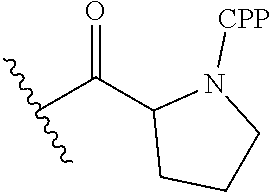

wherein Ra is selected from H, acyl, acetyl, benzoyl, and stearoyl. In some embodiments, Ra H or acyl. In some embodiments, Ra is acetyl.

wherein Ra is selected from H, acyl, acetyl, benzoyl, and stearoyl. In certain embodiments, the CPP is SEQ ID NO: 128. In some embodiments, Ra is H or acyl. In some embodiments, Ra is acetyl.
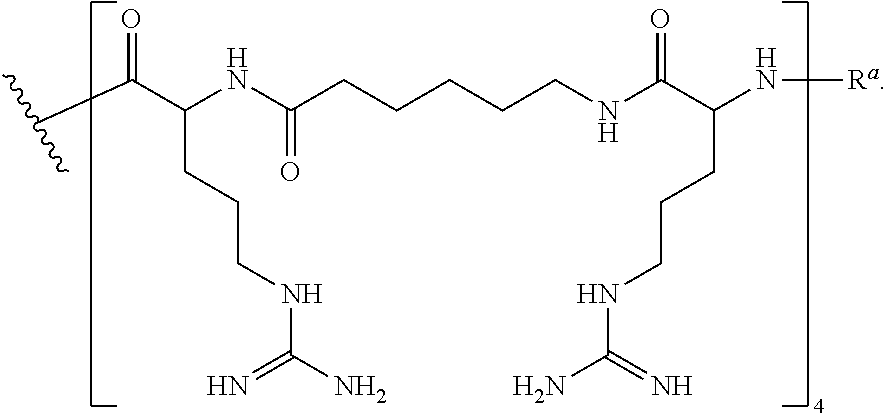

-
- —C(O)(CH2)5NH—CPP;
- —C(O)(CH2)2NH—CPP;
- —C(O)(CH2)2NHC(O)(CH2)5NH—CPP;
- —C(O)CH2NH—CPP, and the formula:

wherein the CPP is attached to the linker moiety by an amide bond at the CPP carboxy terminus, and wherein the CPP is selected from:
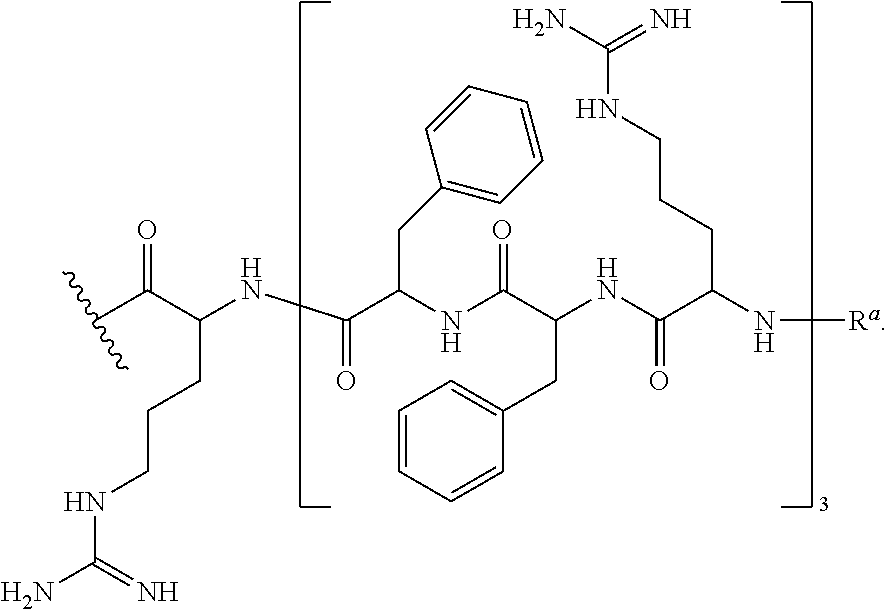
(—R—(FFR)3—Ra),

(—(RXR)4—Ra),
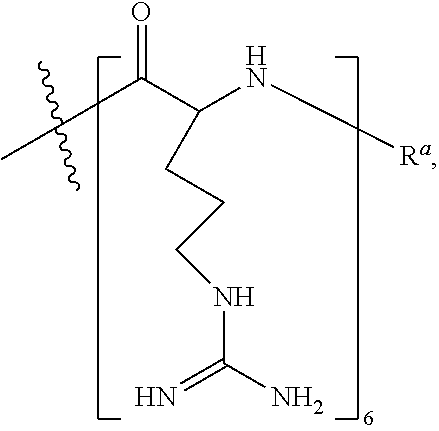
and (—R6—Ra). In some embodiments, Ra is H or acyl. In some embodiments, Ra is acetyl.
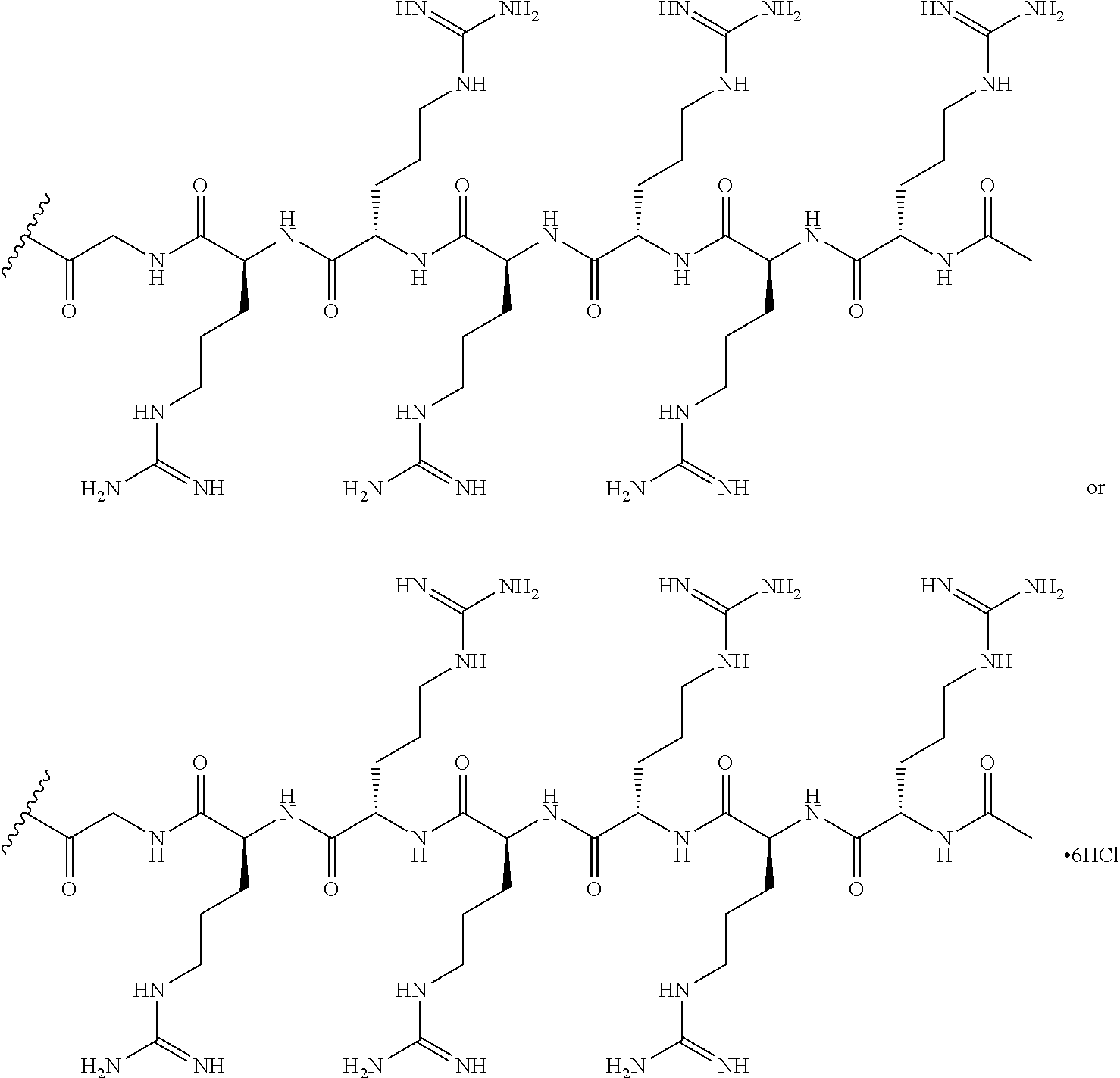
Antisense Oligomer CPP Conjugates

or a pharmaceutically acceptable salt thereof, wherein:
n is 1-40;
each Nu is a nucleobase, which, taken together form a targeting sequence that is complementary to an exon annealing site in the dystrophin pre-mRNA;
T′ is a moiety selected from:

wherein
R100 a cell-penetrating peptide,
R200 is hydrogen, and
IV is C1-C6 alkyl.

or a pharmaceutically acceptable salt thereof, wherein:
each Nu is a nucleobase which taken together form a targeting sequence;
T is a moiety selected from:

R1 is C1-C6 alkyl;
wherein the targeting sequence is complementary to an annealing site in the dystrophin pre-RNA.


and the targeting sequence is 5′-CTCCAACATCAAGGAAGATGGCATTTCTAG-3′, wherein each thymine (T) is optionally uracil (U) (SEQ ID NO: 31).
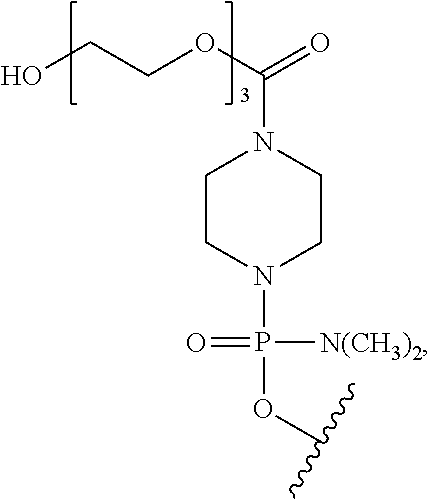
and the targeting sequence is 5′-CTCCAACATCAAGGAAGATGGCATTTCTAG-3′ (SEQ ID NO: 32).
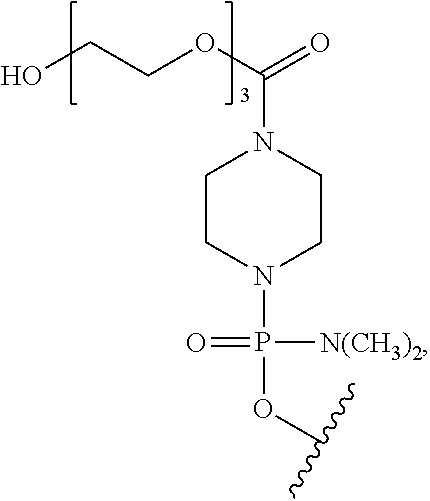
and the targeting sequence is 5′-CAATGCCATCCTGGAGTTCCTG-3′, wherein each thymine (T) is optionally uracil (U) (SEQ ID NO: 28).
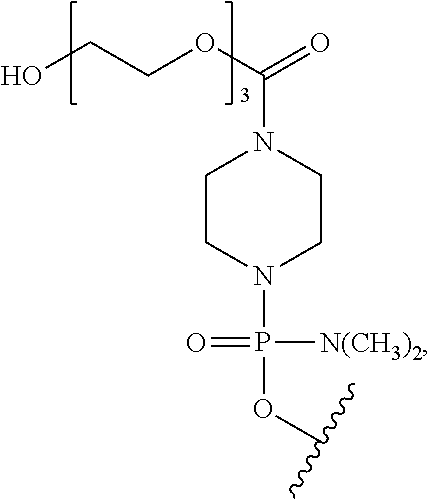
and the targeting sequence is 5′-CAATGCCATCCTGGAGTTCCTG-3′ (SEQ ID NO: 27).
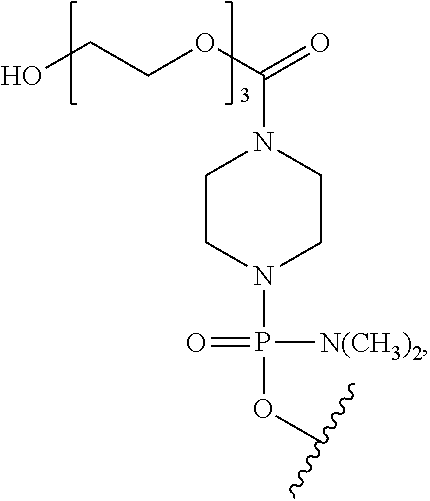
and the targeting sequence is 5′-GTTGCCTCCGGTTCTGAAGGTGTTC-3′, wherein each thymine (T) is optionally uracil (U) (SEQ ID NO: 30).

and the targeting sequence is 5′-GTTGCCTCCGGTTCTGAAGGTGTTC-3′ (SEQ ID NO: 29).
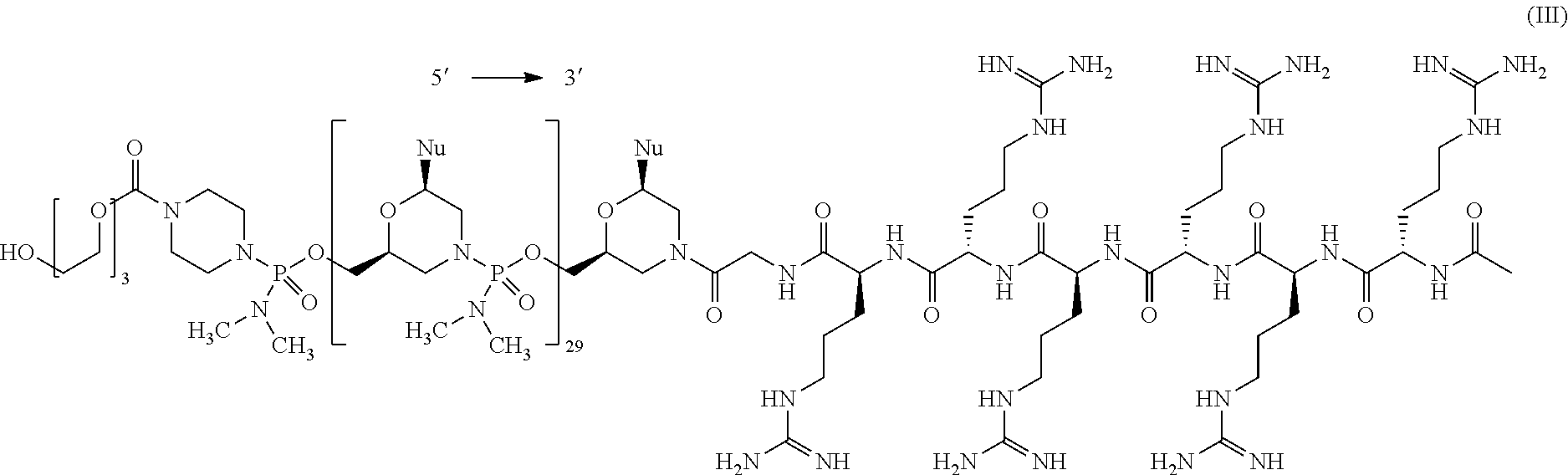
| Position | |||
| No. 5′ | |||
| to 3′ | Nu | ||
| 1 | C | ||
| 2 | X | ||
| 3 | C | ||
| 4 | C | ||
| 5 | A | ||
| 6 | A | ||
| 7 | C | ||
| 8 | A | ||
| 9 | X | ||
| 10 | C | ||
| 11 | A | ||
| 12 | A | ||
| 13 | G | ||
| 14 | G | ||
| 15 | A | ||
| 16 | A | ||
| 17 | G | ||
| 18 | A | ||
| 19 | X | ||
| 20 | G | ||
| 21 | G | ||
| 22 | C | ||
| 23 | A | ||
| 24 | X | ||
| 25 | X | ||
| 26 | X | ||
| 27 | C | ||
| 28 | X | ||
| 29 | A | ||
| 30 | G | ||
wherein A is

C is

G is

and X is


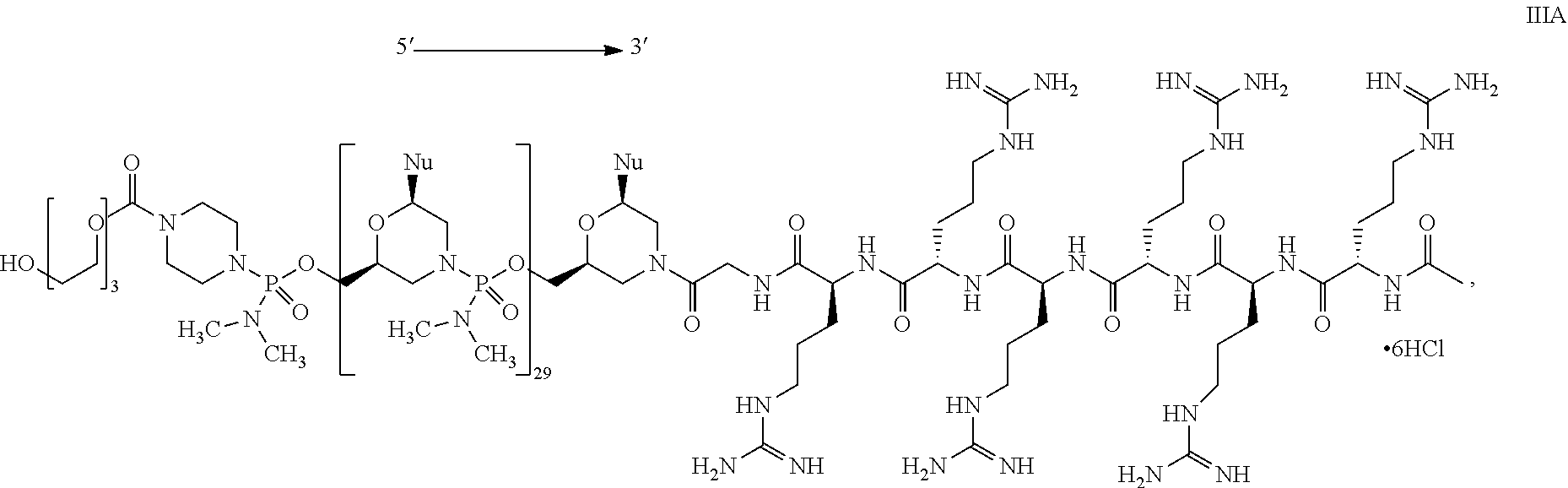
wherein each Nu is a nucleobase which taken together to form a targeting sequence that is complementary to an exon 51 annealing site in the dystrophin pre-mRNA designated as H51A(+66+95).
| Position | |||
| No. 5′ | |||
| to 3′ | Nu | ||
| 1 | C | ||
| 2 | X | ||
| 3 | C | ||
| 4 | C | ||
| 5 | A | ||
| 6 | A | ||
| 7 | C | ||
| 8 | A | ||
| 9 | X | ||
| 10 | C | ||
| 11 | A | ||
| 12 | A | ||
| 13 | G | ||
| 14 | G | ||
| 15 | A | ||
| 16 | A | ||
| 17 | G | ||
| 18 | A | ||
| 19 | X | ||
| 20 | G | ||
| 21 | G | ||
| 22 | C | ||
| 23 | A | ||
| 24 | X | ||
| 25 | X | ||
| 26 | X | ||
| 27 | C | ||
| 28 | X | ||
| 29 | A | ||
| 30 | G | ||
wherein A is
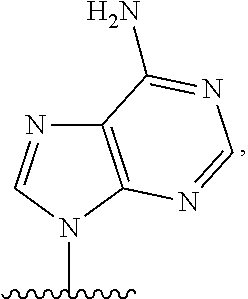
C is

G is

and X is

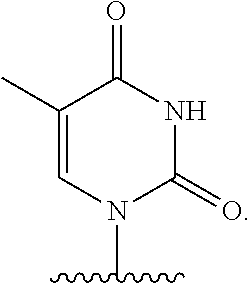
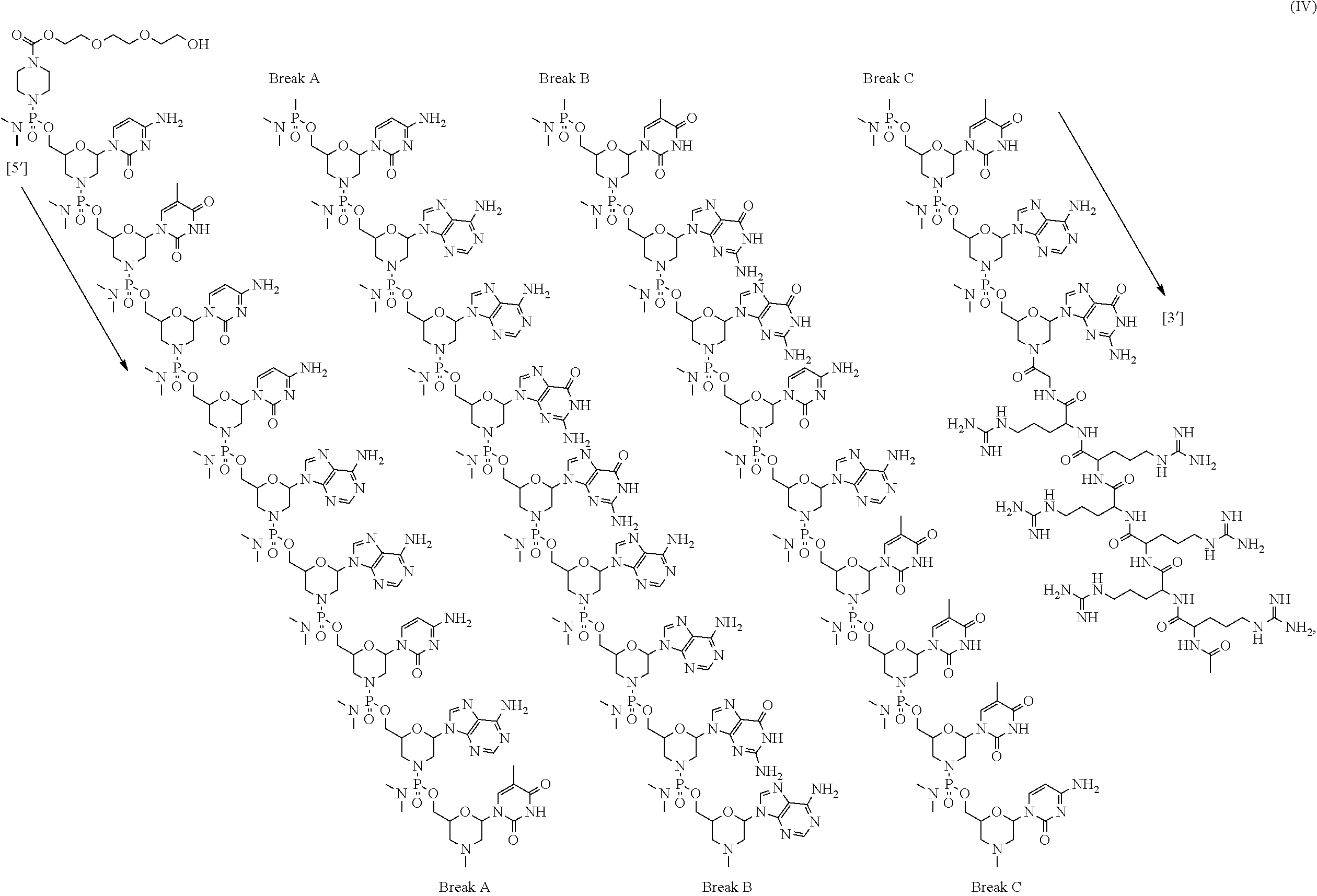
or a pharmaceutically acceptable salt thereof.
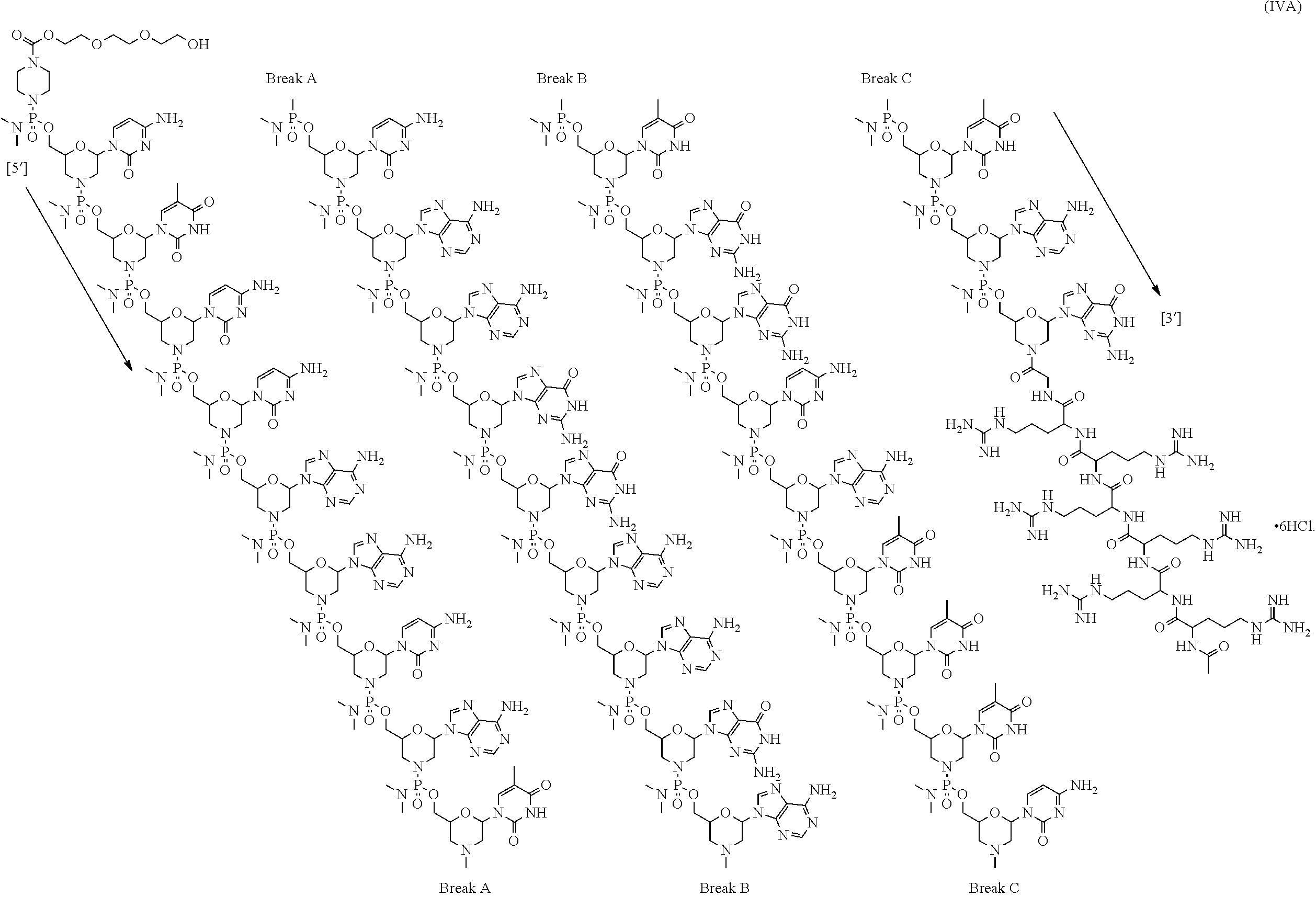

or a pharmaceutically acceptable salt thereof.


or a pharmaceutically acceptable salt thereof, wherein:
each Nu is a nucleobase which taken together form a targeting sequence that is complementary to an exon 45 annealing site in the dystrophin pre-mRNA designated as H45A(−03-+19).
| Position | |||
| No. 5′ to | |||
| 3′ | Nu | ||
| 1 | C | ||
| 2 | X | ||
| 3 | C | ||
| 4 | C | ||
| 5 | A | ||
| 6 | A | ||
| 7 | C | ||
| 8 | A | ||
| 9 | X | ||
| 10 | C | ||
| 11 | A | ||
| 12 | A | ||
| 13 | G | ||
| 14 | G | ||
| 15 | A | ||
| 16 | A | ||
| 17 | G | ||
| 18 | A | ||
| 19 | X | ||
| 20 | G | ||
| 21 | G | ||
| 22 | C | ||
| 23 | A | ||
| 24 | X | ||
| 25 | X | ||
| 26 | X | ||
| 27 | C | ||
| 28 | X | ||
| 29 | A | ||
| 30 | G | ||
wherein A is

C is

G is

and X is

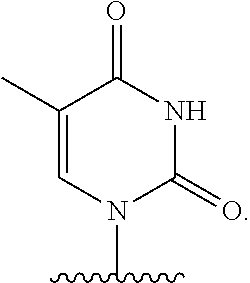
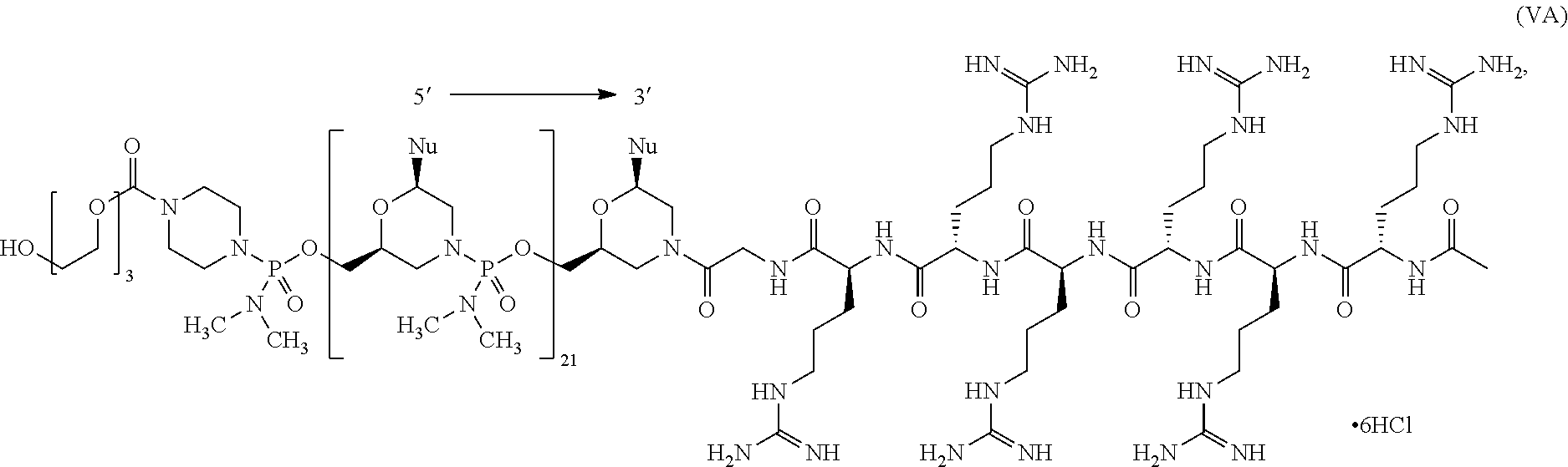
wherein each Nu is a nucleobase which taken together form a targeting sequence that is complementary to an exon 45 annealing site in the dystrophin pre-mRNA designated as H45A(−03+19).
| Position | |||
| No. 5′ | |||
| to 3′ | Nu | ||
| 1 | C | ||
| 2 | A | ||
| 3 | A | ||
| 4 | X | ||
| 5 | G | ||
| 6 | C | ||
| 7 | C | ||
| 8 | A | ||
| 9 | X | ||
| 10 | C | ||
| 11 | C | ||
| 12 | X | ||
| 13 | G | ||
| 14 | G | ||
| 15 | A | ||
| 16 | G | ||
| 17 | X | ||
| 18 | X | ||
| 19 | C | ||
| 20 | C | ||
| 21 | X | ||
| 22 | G | ||
wherein A is

C is

G is

and X is
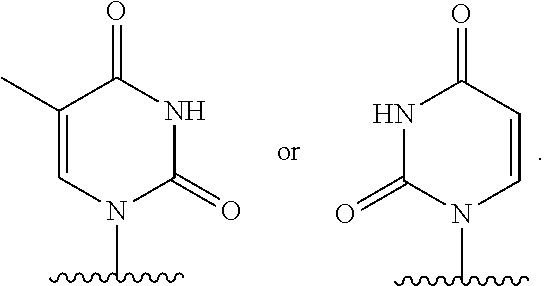
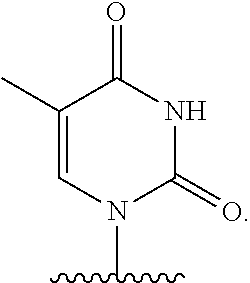

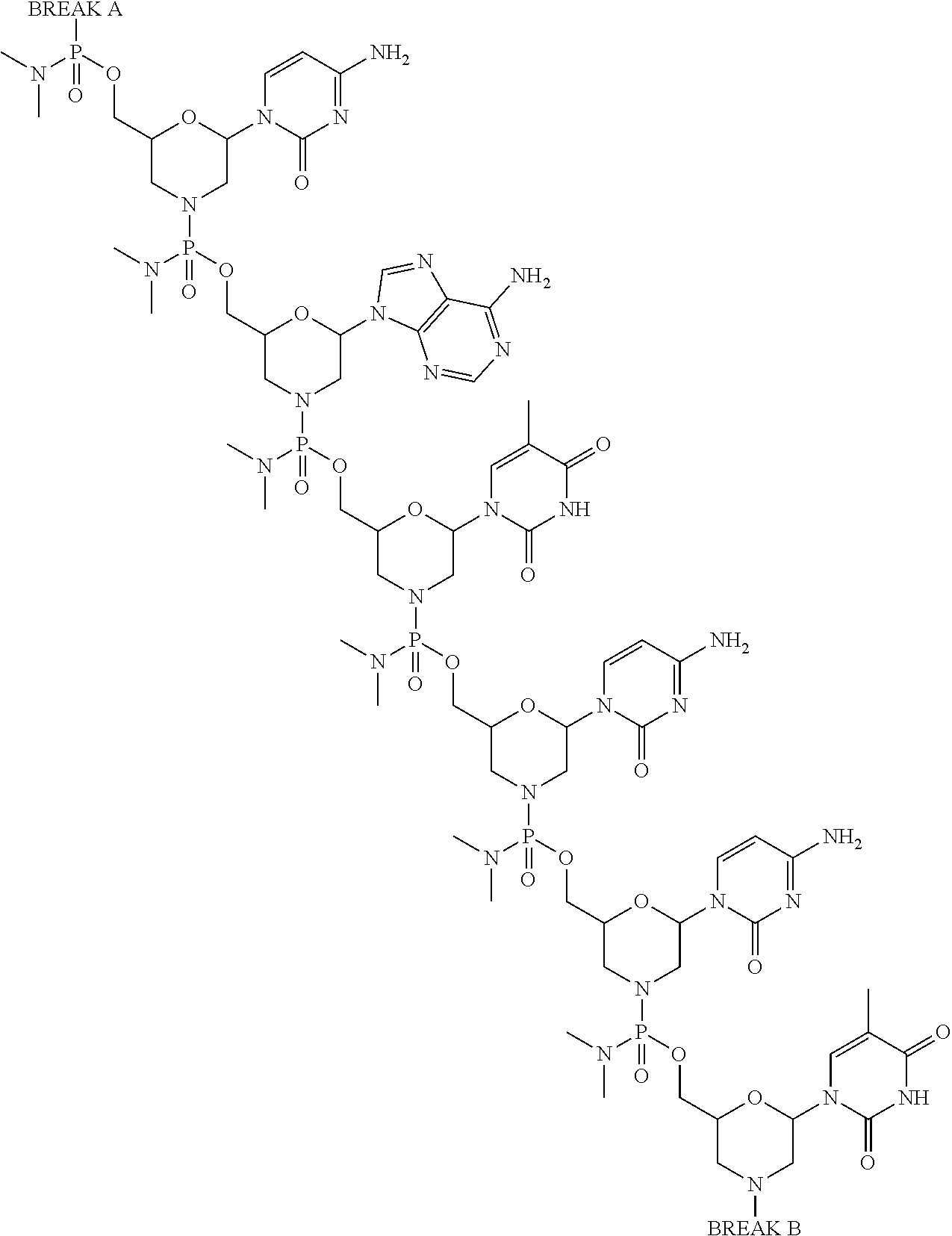

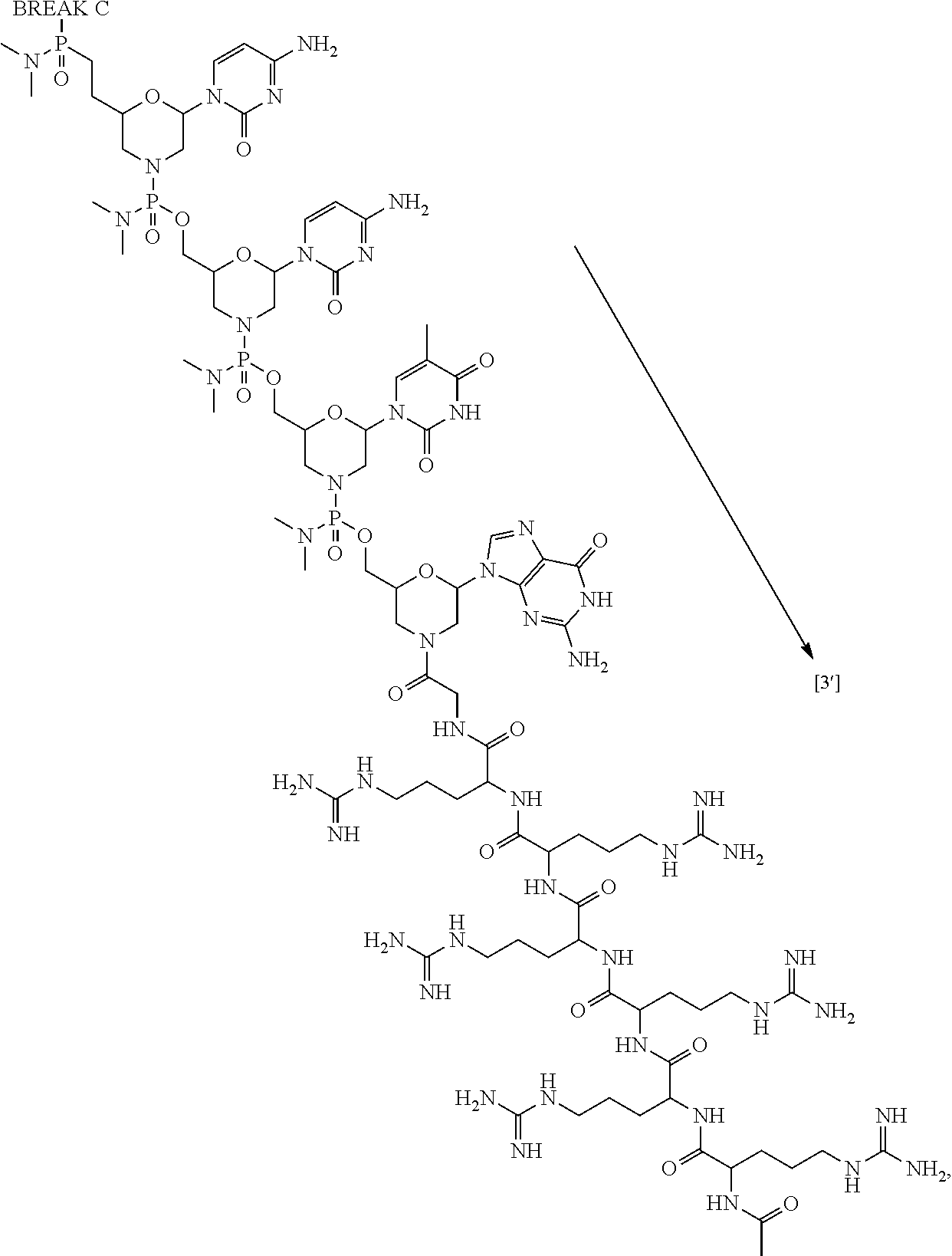
or a pharmaceutically acceptable salt thereof.


or a pharmaceutically acceptable salt thereof.
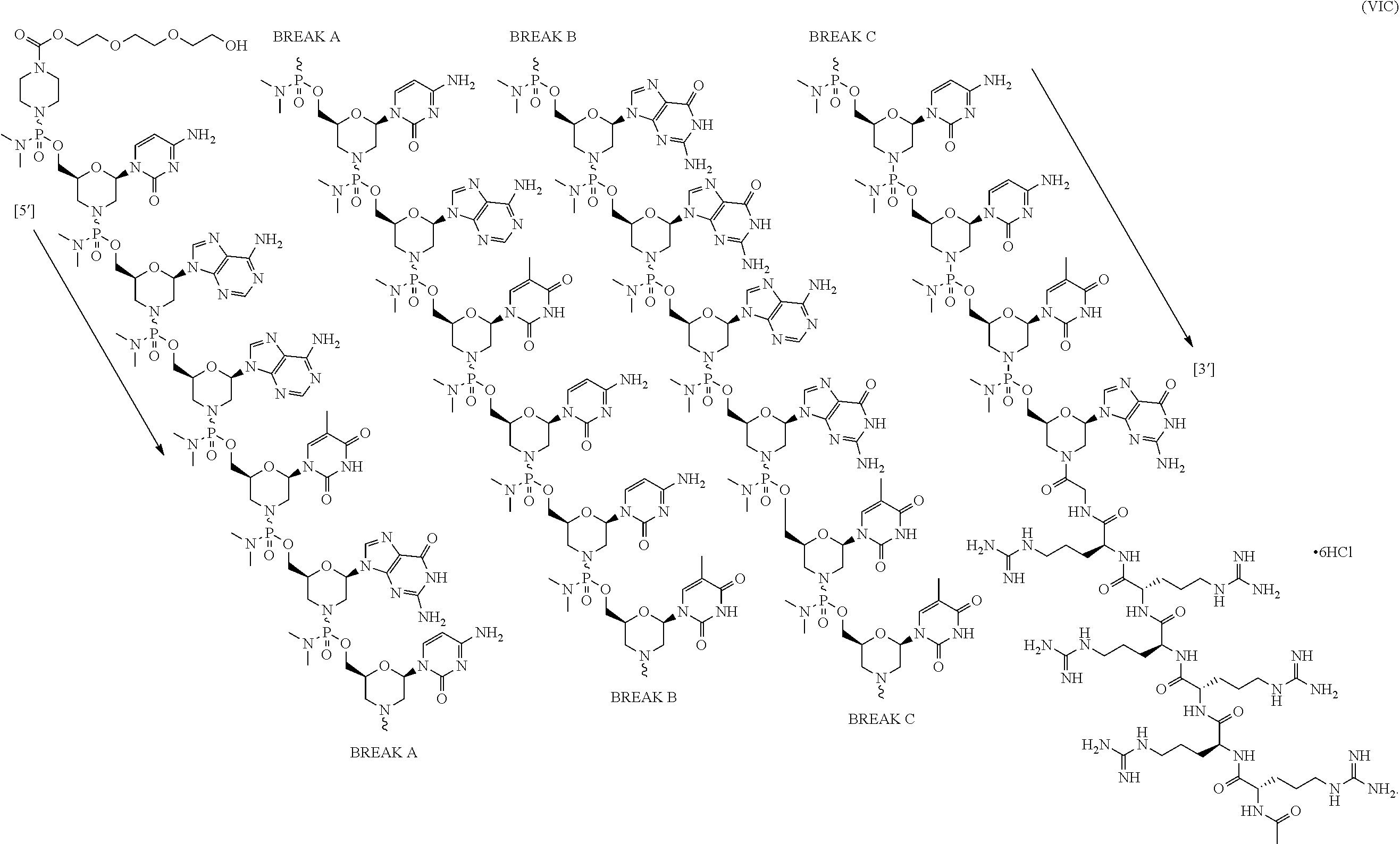

or a pharmaceutically acceptable salt thereof, wherein:
each Nu is a nucleobase which taken together form a targeting sequence that is complementary to an exon 53 annealing site in the dystrophin pre-mRNA designated as H53A(+36+60).
| Position | |||
| No. 5′ | |||
| to 3′ | Nu | ||
| 1 | G | ||
| 2 | X | ||
| 3 | X | ||
| 4 | G | ||
| 5 | C | ||
| 6 | C | ||
| 7 | X | ||
| 8 | C | ||
| 9 | C | ||
| 10 | G | ||
| 11 | G | ||
| 12 | X | ||
| 13 | X | ||
| 14 | C | ||
| 15 | X | ||
| 16 | G | ||
| 17 | A | ||
| 18 | A | ||
| 19 | G | ||
| 20 | G | ||
| 21 | X | ||
| 22 | G | ||
| 23 | X | ||
| 24 | X | ||
| 25 | C | ||
wherein A is

C is
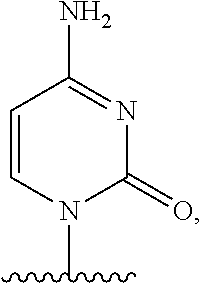
G is
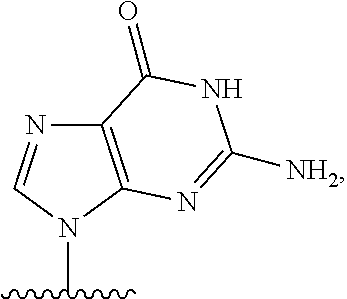
and X is

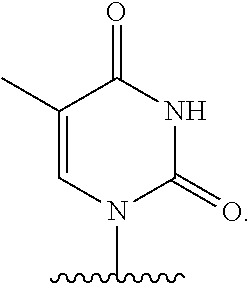
In Some embodiments, an antisense oligomer conjugate of Formula (VII) is an HCl (hydrochloric acid) salt thereof. In certain embodiments, the HCl salt is a ·6HCl salt. In some embodiments, including, for example, some embodiments of Formula (VII), an antisense oligomer conjugate of the disclosure is according to Formula (VITA):

wherein each Nu is a nucleobase which taken together form a targeting sequence that is complementary to an exon 53 annealing site in the dystrophin pre-mRNA designated as H53A(+36+60).
| Position | |||
| No. 5′ | |||
| to 3′ | Nu | ||
| 1 | G | ||
| 2 | X | ||
| 3 | X | ||
| 4 | G | ||
| 5 | C | ||
| 6 | C | ||
| 7 | X | ||
| 8 | C | ||
| 9 | C | ||
| 10 | G | ||
| 11 | G | ||
| 12 | X | ||
| 13 | X | ||
| 14 | C | ||
| 15 | X | ||
| 16 | G | ||
| 17 | A | ||
| 18 | A | ||
| 19 | G | ||
| 20 | G | ||
| 21 | X | ||
| 22 | G | ||
| 23 | X | ||
| 24 | X | ||
| 25 | C | ||
wherein A is
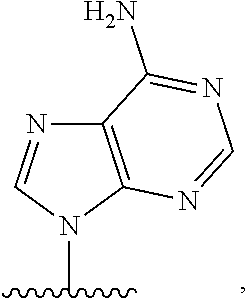
C is

G is
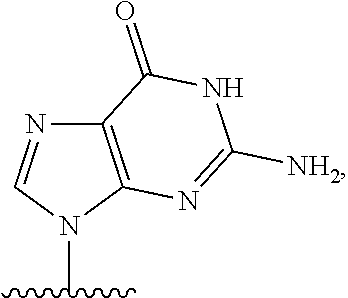
and X is


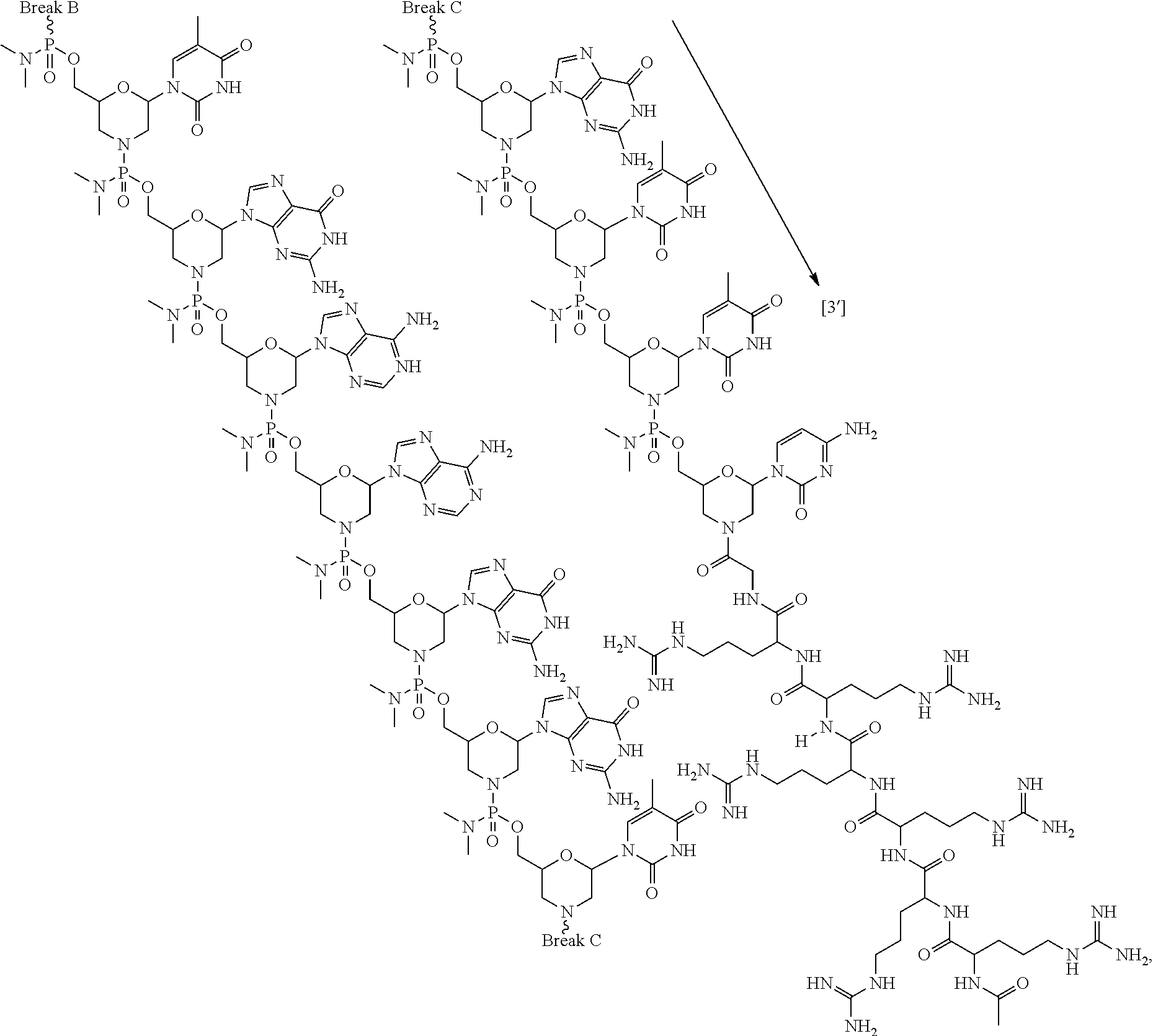
or a pharmaceutically acceptable salt thereof.
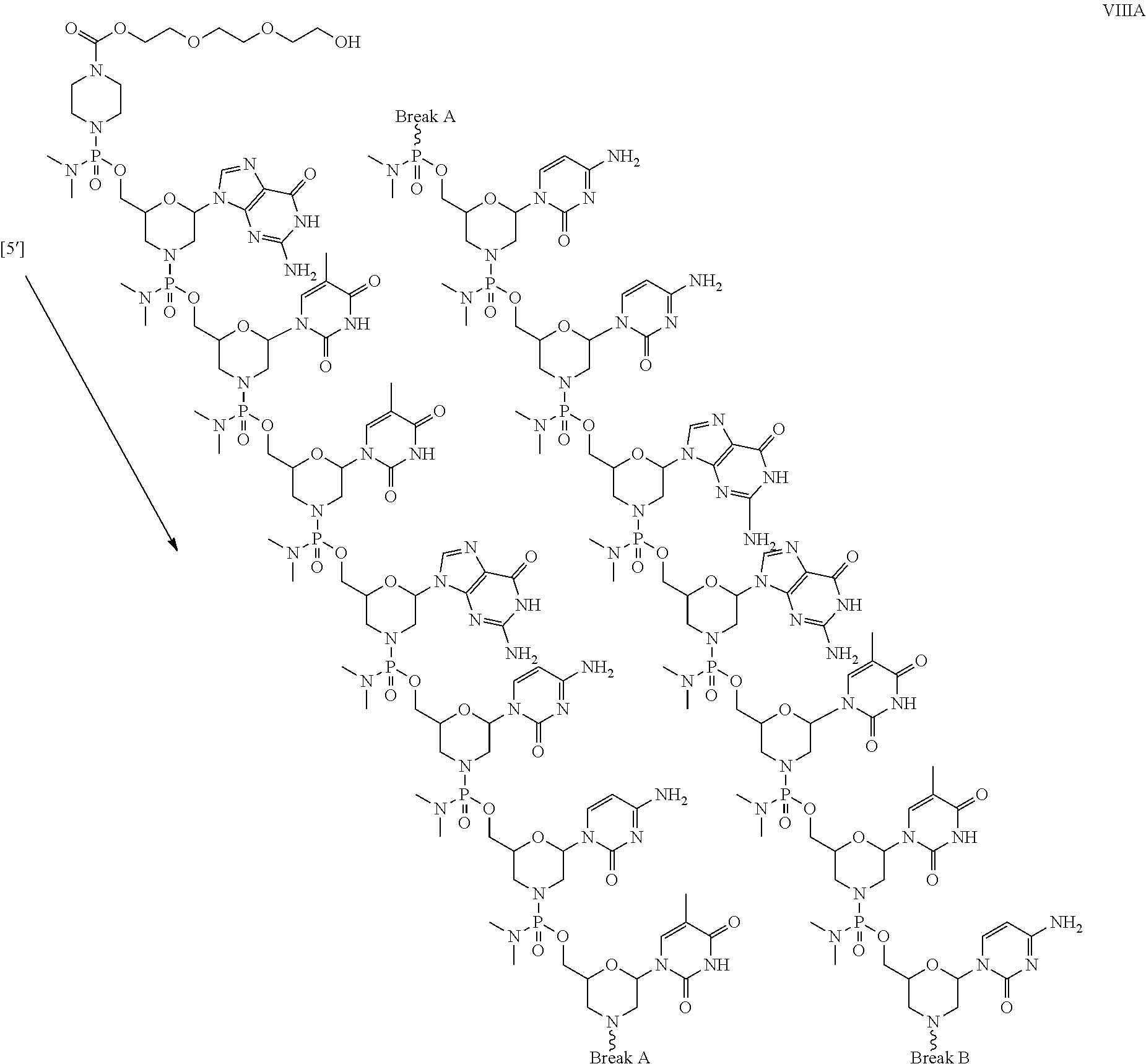
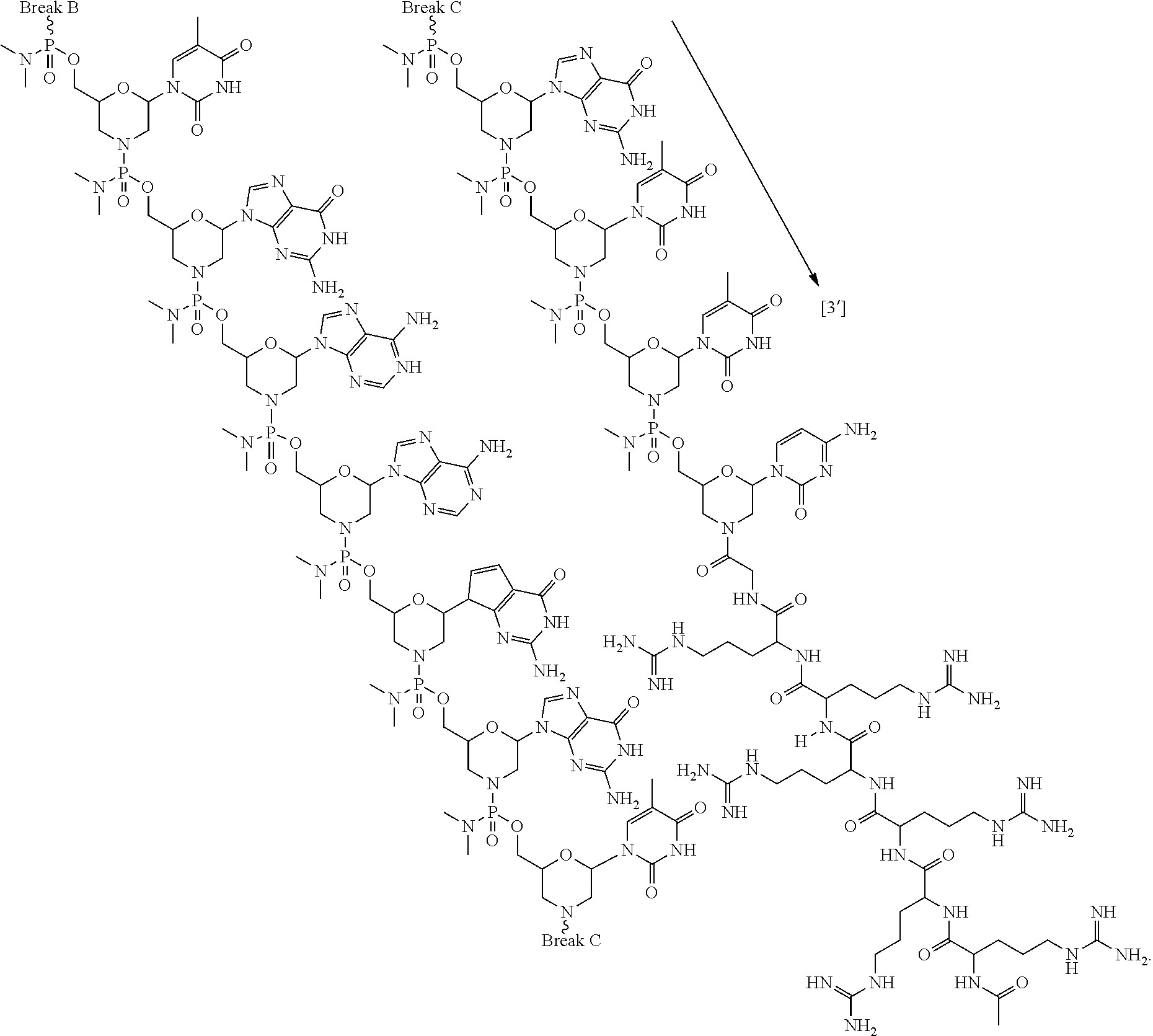

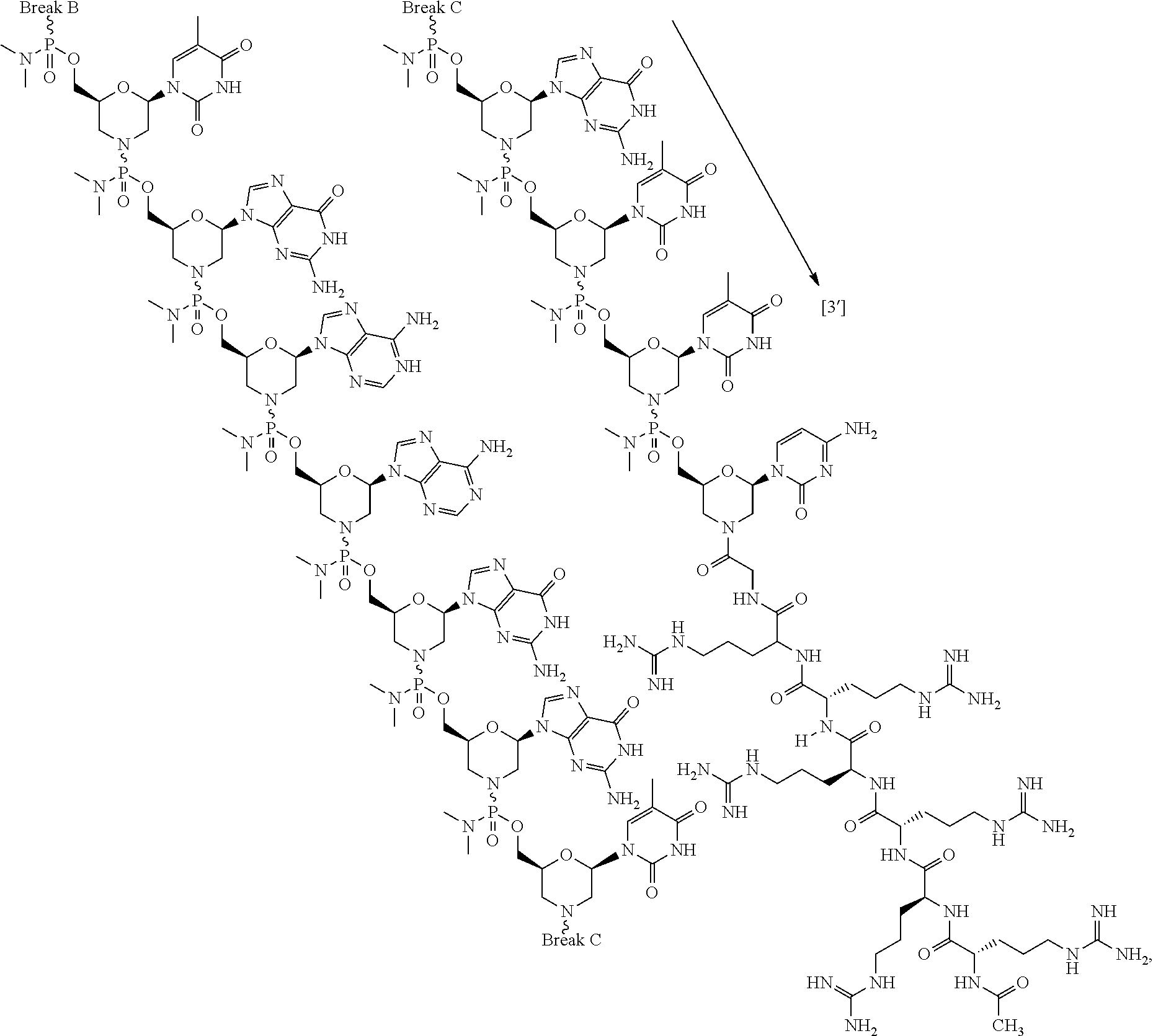
or a pharmaceutically acceptable salt thereof.
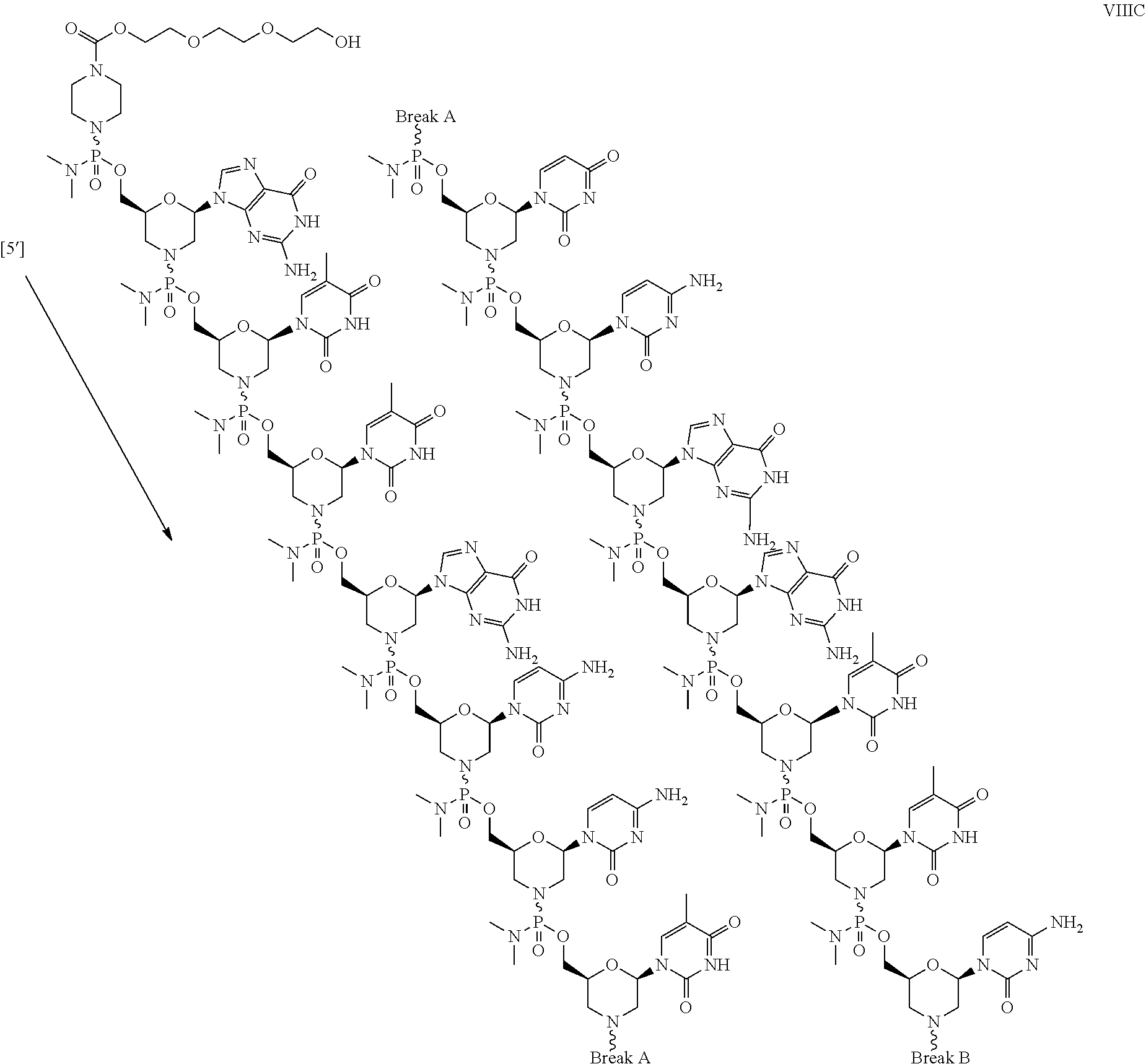
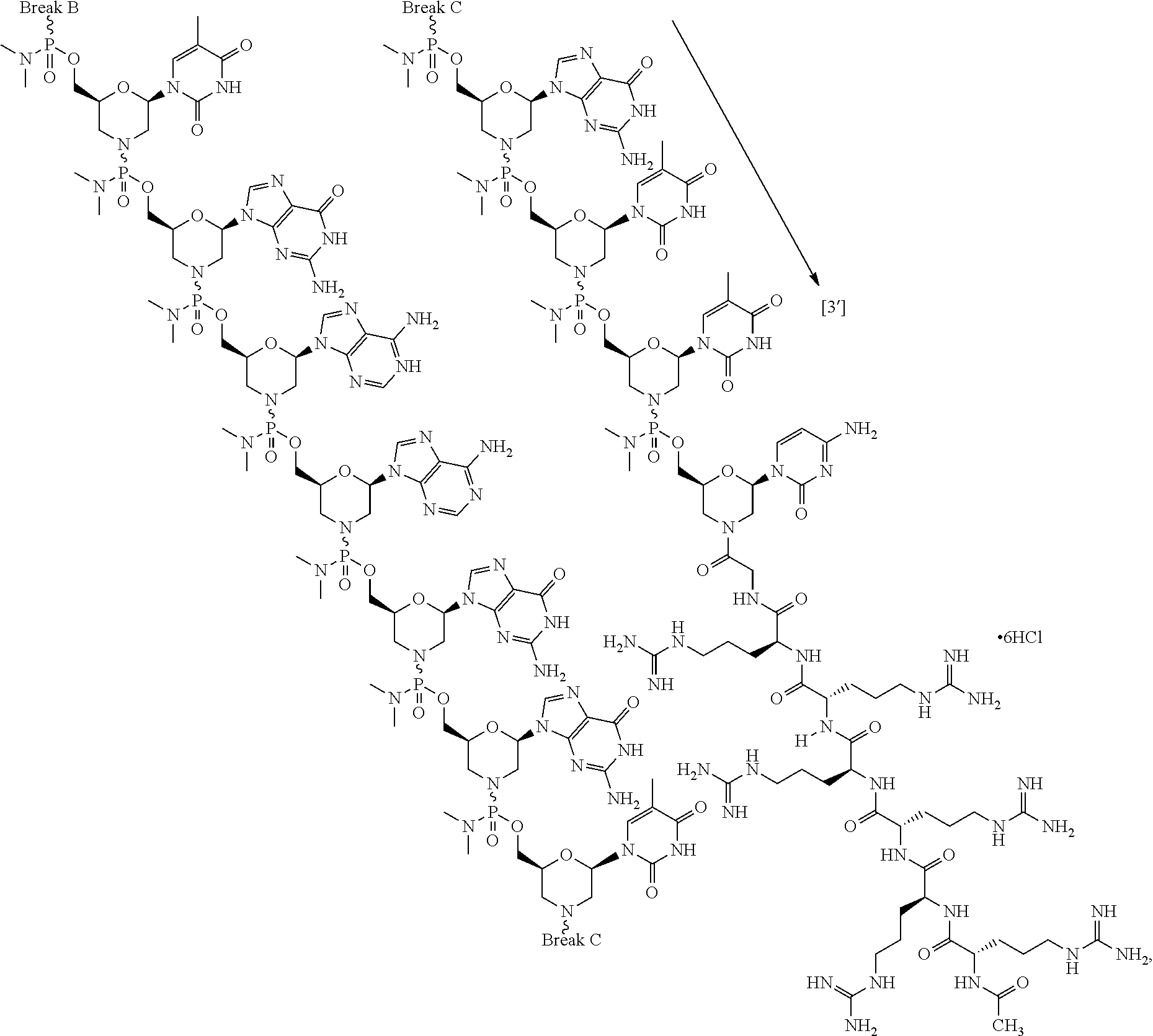
| Annealing Site | Base Sequence [5′ to 3′] |
| H51D(+16-07) | CTC ATA CCT TCT GCT TGA TGA TC (SEQ ID NO: 567) |
| H50D(+103+127) | GGG ATC CAG TAT ACT TAC AGG CTC C (SEQ ID NO: 568) |
| H51A(+61+82) | GAA GAT GGC ATT TCT AGT TTG G (SEQ ID NO: 569) |
| H51A(+61+83) | GGA AGA TGG CAT TTC TAG TTT GG (SEQ ID NO: 570) |
| H51A(+61+89) | CAT CAA GGA AGA TGG CAT TTC TAG TTT GG (SEQ ID NO: 571) |
| H51A(+66+89) | CAT CAA GGA AGA TGG CAT TTC TAG (SEQ ID NO: 572) |
| H51A(+66+93) | CCA ACA TCA AGG AAG ATG GCA TTT CTA G (SEQ ID NO: 573) |
| H51A(+69+92) | CAA CAT CAA GGA AGA TGG CAT TTC (SEQ ID NO: 574) |
| H51A(+69+96) | CCT CCA ACA TCA AGG AAG ATG GCA TTT C (SEQ ID NO: 575) |
| H51A(+74+96) | CCT CCA ACA TCA AGG AAG ATG GC (SEQ ID NO: 576) |
| H51A(+74+99) | GTA CCT CCA ACA TCA AGG AAG ATG GC (SEQ ID NO: 577) |
| H51A(+74+100) | GGT ACC TCC AAC ATC AAG GAA GAT GGC (SEQ ID NO: 578) |
| H51A(+74+102) | CAG GTA CCT CCA ACA TCA AGG AAG ATG GC (SEQ ID NO: 579) |
| H51A(+74+103) | GCA GGT ACC TCC AAC ATC AAG GAA GAT GGC (SEQ ID NO: 580) |
| H51A(+75+96) | CCT CCA ACA TCA AGG AAG ATG G (SEQ ID NO: 581) |
| H51A(+75+99) | GTA CCT CCA ACA TCA AGG AAG ATG G (SEQ ID NO: 582) |
| H51A(+76+99) | GTA CCT CCA ACA TCA AGG AAG ATG (SEQ ID NO: 583) |
| H51A(+76+105) | GAG CAG GTA CCT CCA ACA TCA AGG AAG ATG (SEQ ID NO: 584) |
| H51A(+80+103) | GCA GGT ACC TCC AAC ATC AAG GAA G (SEQ ID NO: 585) |
| H51A(+80+105) | GAG CAG GTA CCT CCA ACA TCA AGG AAG (SEQ ID NO: 586) |
| H51A(+80+107) | CAG AGC AGG TAC CTC CAA CAT CAA GGA AG (SEQ ID NO: 587) |
| H51A(+80+108) | CCA GAG CAG GTA CCT CCA ACA TCA AGG AAG (SEQ ID NO: 588) |
| H51A(+83+103) | GCA GGT ACC TCC AAC ATC AAG G (SEQ ID NO: 589) |
| H51A(+83+105) | GAG CAG GTA CCT CCA ACA TCA AGG (SEQ ID NO: 590) |
| H51A(+83+107) | CAG AGC AGG TAC CTC CAA CAT CAA GG (SEQ ID NO: 591) |
| H51A(+83+109) | GCC AGA GCA GGT ACC TCC AAC ATC AAG G (SEQ ID NO: 592) |
| H51A(+84+107) | CAG AGC AGG TAC CTC CAA CAT CAA G (SEQ ID NO: 593) |
| H51A(+84+111) | CTG CCA GAG CAG GTA CCT CCA ACA TCA AG (SEQ ID NO: 594) |
| H51A(+84+105) | GAG CAG GTA CCT CCA ACA TCA AG (SEQ ID NO: 595) |
| H51A(+87+109) | GCC AGA GCA GGT ACC TCC AAC ATC (SEQ ID NO: 596) |
| H51A(+93+116) | GAA ATC TGC CAG AGC AGG TAC CTC (SEQ ID NO: 597) |
| H51A(+75+100) | GGT ACC TCC AAC ATC AAG GAA GAT GG (SEQ ID NO: 598) |
| H51A(+74+101) | AGG TAC CTC CAA CAT CAA GGA AGA TGG C (SEQ ID NO: 599) |
| H51A(+74+98) | TAC CTC CAA CAT CAA GGA AGA TGG C (SEQ ID NO: 600) |
| H51A(+74+97) | ACC TCC AAC ATC AAG GAA GAT GGC (SEQ ID NO: 601) |
| H51A(+74+94) | TCC AAC ATC AAG GAA GAT GGC (SEQ ID NO: 602) |
| H51A(+74+93) | CCA ACA TCA AGG AAG ATG GC (SEQ ID NO: 603) |
| H51A(+74+92) | CAA CAT CAA GGA AGA TGG C (SEQ ID NO: 604) |
| H51A(+69+99) | GTA CCT CCA ACA TCA AGG AAG ATG GCA TTT C (SEQ ID NO: 605) |
| H51A(+70+99) | GTA CCT CCA ACA TCA AGG AAG ATG GCA TTT (SEQ ID NO: 606) |
| H51A(+71+99) | GTA CCT CCA ACA TCA AGG AAG ATG GCA TT (SEQ ID NO: 607) |
| H51A(+72+99) | GTA CCT CCA ACA TCA AGG AAG ATG GCA T (SEQ ID NO: 608) |
| H51A(+73+99) | GTA CCT CCA ACA TCA AGG AAG ATG GCA (SEQ ID NO: 609) |
| H51A(+77+99) | GTA CCT CCA ACA TCA AGG AAG AT (SEQ ID NO: 610) |
| H51A(+78+99) | GTA CCT CCA ACA TCA AGG AAG A (SEQ ID NO: 611) |
| H51A(+79+99) | GTA CCT CCA ACA TCA AGG AAG |
| H51.SA.(-60-36) | GAA GAA AAA GAA AAA TTA GAA ACA C (SEQ ID NO: 613) |
| H51.SA.(-50-26) | AAG GAA AAA AGA AGA AAA AGA AAA A (SEQ ID NO: 614) |
| H51.SA.(-45-21) | GCA AAA AGG AAA AAA GAA GAA AAA G (SEQ ID NO: 615) |
| H51.SA.(-40-16) | TTT TTG CAA AAA GGA AAA AAG AAG A (SEQ ID NO: 616) |
| H51.SA.(-35-11) | TTG GGT TTT TGC AAA AAG GAA AAA A (SEQ ID NO: 617) |
| H51.SA.(-30-6) | ATA TTT TGG GTT TTT GCA AAA AGG A (SEQ ID NO: 618) |
| H51.SA.(-25-1) | CTA AAA TAT TTT GGG TTT TTG CAA A (SEQ ID NO: 619) |
| H51.SA.(-20+5) | AGG AGC TAA AAT ATT TTG GGT TTT T (SEQ ID NO: 620) |
| H51.SA.(-15+10) | TGA GTA GGA GCT AAA ATA TTT TGG G (SEQ ID NO: 621) |
| H51.SA.(-10+15) | CAG TCT GAG TAG GAG CTA AAA TAT T (SEQ ID NO: 622) |
| H51.SA.(-5+20) | AGT AAC AGT CTG AGT AGG AGC TAA A (SEQ ID NO: 623) |
| H51.SA.(-1+24) | CCA GAG TAA CAG TCT GAG TAG GAG C (SEQ ID NO: 624) |
| H51.SA.(-65-41) | AAA AGA AAA ATT AGA AAC ACA AGC T (SEQ ID NO: 625) |
| H51.SA.(-70-46) | AAA AAT TAG AAA CAC AAG CTA AAG A (SEQ ID NO: 626) |
| H51.SA.(-75-51) | TTA GAA ACA CAA GCT AAA GAG CCA A (SEQ ID NO: 627) |
| H51.SA.(-80-56) | AAC ACA AGC TAA AGA GCC AAT TTC A (SEQ ID NO: 628) |
| H51.SA.(-85-61) | AAG CTA AAG AGC CAA TTT CAA TAA C (SEQ ID NO: 629) |
| H51.SA.(-90-66) | AAA GAG CCA ATT TCA ATA ACA ATA A (SEQ ID NO: 630) |
| H51.SA.(-95-71) | GCC AAT TTC AAT AAC AAT AAG TCA A (SEQ ID NO: 631) |
| H51.SA.(-100-76) | TTT CAA TAA CAA TAA GTC AAA TTT A (SEQ ID NO: 632) |
| H51A(+1+30) | GTG TCA CCA GAG TAA CAG TCT GAG TAG GAG (SEQ ID NO: 633) |
| H51A(+10+39) | CCA CAG GTT GTG TCA CCA GAG TAA CAG TCT (SEQ ID NO: 634) |
| H51A(+6+35) | AG GTT GTG TCA CCA GA GTA ACA GTC TGA GT (SEQ ID NO: 635) |
| H51A(+49+78) | ATG GCA TTT CTA GTT TGG AGA TGG CAG TTT (SEQ ID NO: 636) |
| H51A(+1+25) | ACC AGA GTA ACA GTC TGA GTA GGA G (SEQ ID NO: 637) |
| H51A(+4+28) | GTC ACC AGA GTA ACA GTC TGA GTA G (SEQ ID NO: 638) |
| H51A(+16+40) | ACC ACA GGT TGT GTC ACC AGA GTA A (SEQ ID NO: 639) |
| H51A(+21+45) | TAG TAA CCA CAG GTT GTG TCA CCA G (SEQ ID NO: 640) |
| H51A(+26+50) | TTC CTT AGT AAC CAC AGG TTG TGT C (SEQ ID NO: 641) |
| H51A(+31+55) | GCA GTT TCC TTA GTA ACC ACA GGT T (SEQ ID NO: 642) |
| H51A(+36+60) | AGA TGG CAG TTT CCT TAG TAA CCA C (SEQ ID NO: 643) |
| H51A(+41+65) | TTT GGA GAT GGC AGT TTC CTT AGT A (SEQ ID NO: 644) |
| H51A(+86+110) | TGC CAG AGC AGG TAC CTC CAA CAT C (SEQ ID NO: 645) |
| H51A(+91+115) | AAA TCT GCC AGA GCA GGT ACC TCC A (SEQ ID NO: 646) |
| H51A(+96+120) | GGT TGA AAT CTG CCA GAG CAG GTA C (SEQ ID NO: 647) |
| H51A(+101+125) | AGC CCG GTT GAA ATC TGC CAG AGC A (SEQ ID NO: 648) |
| H51A(+106+130) | GTC CAA GCC CGG TTG AAA TCT GCC A (SEQ ID NO: 649) |
| H51A(+111+135) | GTT CTG TCC AAG CCC GGT TGA AAT C (SEQ ID NO: 650) |
| H51A(+116+140) | GGT AAG TTC TGT CCA AGC CCG GTT G (SEQ ID NO: 651) |
| H51A(+121+145) | CAG TCG GTA AGT TCT GTC CAA GCC C (SEQ ID NO: 652) |
| H51A(+126+150) | AAA GCC AGT CGG TAA GTT CTG TCC A (SEQ ID NO: 653) |
| H51A(+131+155) | CAG AGA AAG CCA GTC GGT AAG TTC T (SEQ ID NO: 654) |
| H51A(+136+160) | TCA AGC AGA GAA AGC CAG TCG GTA A (SEQ ID NO: 655) |
| H51A(+141+165) | CTT GAT CAA GCA GAG AAA GCC AGT C (SEQ ID NO: 656) |
| H51A(+146+170) | TAT AAC TTG ATC AAG CAG AGA AAG C (SEQ ID NO: 657) |
| H51A(+151+175) | GAT TTT ATA ACT TGA TCA AGC AGA G (SEQ ID NO: 658) |
| H51A(+156+180) | TCT GTG ATT TTA TAA CTT GAT CAA G (SEQ ID NO: 659) |
| H51A(+161+185) | CAC CCT CTG TGA TTT TAT AAC TTG A (SEQ ID NO: 660) |
| H51A(+166+190) | ACC ATC ACC CTC TGT GAT TTT ATA A (SEQ ID NO: 661) |
| H51A(+171+195) | CAC CCA CCA TCA CCC TCT GTG ATT T (SEQ ID NO: 662) |
| H51A(+176+200) | AAG GTC ACC CAC CAT CAC CCT CTG T (SEQ ID NO: 663) |
| H51A(+181+205) | TCC TCA AGG TCA CCC ACC ATC ACC C (SEQ ID NO: 664) |
| H51A(+186+210) | TGA TAT CCT CAA GGT CAC CCA CCA T (SEQ ID NO: 665) |
| H51A(+191+215) | CTC GTT GAT ATC CTC AAG GTC ACC C (SEQ ID NO: 666) |
| H51A(+196+220) | ATC ATC TCG TTG ATA TCC TCA AGG T (SEQ ID NO: 667) |
| H51A(+201+225) | TGA TGA TCA TCT CGT TGA TAT CCT C (SEQ ID NO: 668) |
| H51A(+206+230) | CTG CTT GAT GAT CAT CTC GTT GAT A (SEQ ID NO: 669) |
| H51D(+211-02) | ACC TTC TGC TTG ATG ATC ATC TCG T (SEQ ID NO: 670) |
| H51D(+214-05) | CAT ACC TTC TGC TTG ATG ATC ATC T (SEQ ID NO: 671) |
| H51D(+217-08) | TCT CAT ACC TTC TGC TTG ATG ATC A (SEQ ID NO: 672) |
| H51D(+220-11) | TTT TCT CAT ACC TTC TGC TTG ATG A (SEQ ID NO: 673) |
| H51D(+223-14) | ATT TTT TCT CAT ACC TTC TGC TTG A (SEQ ID NO: 674) |
| H51D(+226-17) | ATC ATT TTT TCT CAT ACC TTC TGC T (SEQ ID NO: 675) |
| H51D(+229-20) | TTT ATC ATT TTT TCT CAT ACC TTC T (SEQ ID NO: 676) |
| H51D(+232-23) | ACT TTT ATC ATT TTT TCT CAT ACC T (SEQ ID NO: 677) |
| H51D(-02-26) | CCA ACT TTT ATC ATT TTT TCT CAT A (SEQ ID NO: 678) |
| H51A(+1+30) | GTG TCA CCA GAG TAA CAG TCT GAG TAG GAG (SEQ ID NO: 633) |
wherein A is
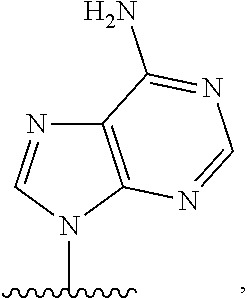
C is

G is

and T is

| Annealing Site | Base Sequence [5′ to 3′] |
| H51A(+66+95) | CTC CAA CAT CAA GGA AGA TGG CAT TTC TAG (SEQ ID NO: 679) |
| H51A(+74+97) | ACC TCC AAC ATC AAG GAA GAT GGC (SEQ ID NO: 601) |
| H51A(+70+99) | GTA CCT CCA ACA TCA AGG AAG ATG GCA TTT (SEQ ID NO: 606) |
| H51A(+72+99) | GTA CCT CCA ACA TCA AGG AAG ATG GCA T (SEQ ID NO: 608) |
| H51A(+68+87) | TCA AGG AAG ATG GCA TTT CT (SEQ ID NO: 680) |
| H51A(+68+87) | UCA AGG AmAGm AmUGm GmCA UUU CU (SEQ ID NO: 681) |
| H53A(+36+60) | GTT GCC TCC GGT TCT GAA GGT GTT C (SEQ ID NO: 682) |
| H53A(+36+60) | GTT G5mC5mC T5mC5mC GGT T5mC T GAA GGT GTT 5Mc (SEQ ID NO: 683) |
| H53A(+36+56) | CCT CCG GTT CTG AAG GTG TTC (SEQ ID NO: 684) |
| H53A(+23+47) | CTG AAG GTG TTC TTG TAC TTC ATC C (SEQ ID NO: 34) |
| H53A(+32+56) | CCT CCG GTT CTG AAG GTG TTC TTG T (SEQ ID NO: 685) |
| H53A(+33+60) | GTT GCC TCC GGT TCT GAA GGT GTT CTT G (SEQ ID NO: 686) |
| H53A(+30+59) | TTG CCT CCG GTT CTG AAG GTG TTC TTG TAC (SEQ ID NO: 687) |
| H53A(+39+62) | CTG TTG CCT CCG GTT CTG AAG GTG (SEQ ID NO: 688) |
| H53A(+36+69) | CAT TCA ACT GTT GCC TCC GGT TCT GAA GGT G (SEQ ID NO: 689) |
| H53A(+45+62) | CTG TTG CCT CCG GTT CTG (SEQ ID NO: 690) |
| H45A(-03+19) | CAA TGC CAT CCT GGA GTT CCT G (SEQ ID NO: 691) |
| H45A(-09+25) | GCT GCC CAA TGC CAT CCT GGA GTT CCT GTA AGA T (SEQ ID NO: 692) |
| H45A(-03+25) | GCT GCC CAA TGC CAT CCT GGA GTT CCT G (SEQ ID NO: 693) |
| H45A(-06+25) | GCT GCC CAA TGC CAT CCT GGA GTT CCT GTA A (SEQ ID NO: 694) |
| H45A(-12+19) | CAA TGC CAT CCT GGA GTT CCT GTA AGA TAC C (SEQ ID NO: 695) |
| H45A(-09+19) | CAA TGC CAT CCT GGA GTT CCT GTA AGA T (SEQ ID NO: 696) |
| H45A(-12+16) | TGC CAT CCT GGA GTT CCT GTA AGA TAC C (SEQ ID NO: 697) |
| H45A(-14+25) | GCT GCC CAA TGC CAT CCT GGA GTT CCT GTA AGA TAC CAA |
| (SEQ ID NO: 698) | |
| H45A(-08+19) | CAA TGC CAT CCT GGA GTT CCT GTA AGA (SEQ ID NO: 699) |
| HM45A(-07+25) | GCT GCC CAA TGC CAT CCT GGA GTT CCT GTA AG (SEQ ID NO: 700) |
| H45A(-12+22) | GCC CAA TGC CAT CCT GGA GTT CCT GTA AGA TAC C (SEQ ID NO: |
| 701) | |
| H45A(-09+22) | GCC CAA TGC CAT CCT GGA GTT CCT GTA AGA T (SEQ ID NO: 702) |
| H45A(-09+30) | TTG CCG CTG CCC AAT GCC ATC CTG GAG TTC CTG TAA GAT (SEQ ID |
| NO: 703) | |
| H45A(-06+22) | GCC CAA TGC CAT CCT GGA GTT CCT GTA A (SEQ ID NO: 704) |
| H45A(-06+28) | GCC GCT GCC CAA TGC CAT CCT GGA GTT CCT GTA A (SEQ ID NO: |
| 705) | |
| H45A(-03+22) | GCC CAA TGC CAT CCT GGA GTT CCT G (SEQ ID NO: 706) |
| H45A(-03+28) | GCC GCT GCC CAA TGC CAT CCT GGA GTT CCT G (SEQ ID NO: 707) |
| H45A(+9+26) | m5C-G-m5C-T-G-C-m5C-m5C-A-A-T-G-m5C-m5C-A-U-m5C-m5C (SEQ ID |
| NO: 708) | |
| H44A(-10+15) | GAT CTG TCA AAT CGC CTG CAG GTA A (SEQ ID NO: 709) |
| H44A(-07+15) | GAT CTG TCA AAT CGC CTG CAG G (SEQ ID NO: 710) |
| H44M(-07+17) | CAG ATC TGT CAA ATC GCC TGC AGG (SEQ ID NO: 711) |
| H44A(-08+15) | GAT CTG TCA AAT CGC CTG CAG GT (SEQ ID NO: 712) |
| H44A(-06+15) | GAT CTG TCA AAT CGC CTG CAG (SEQ ID NO: 713) |
| H44A(-08+17) | CAG ATC TGT CAA ATC GCC TGC AGG T (SEQ ID NO: 714) |
| H44A(-06+17) | CAG ATC TGT CAA ATC GCC TGC AG (SEQ ID NO: 715) |
| H50D(+04-18) | GGG ATC CAG TAT ACT TAC AGG C (SEQ ID NO: 716) |
| H50D(+07-18) | GGG ATC CAG TAT ACT TAC AGG CTC C (SEQ ID NO: 568) |
| H50D(+07-16) | GAT CCA GTA TAC TTA CAG GCT CC (SEQ ID NO: 717) |
| H50D(+07-17) | GGA TCC AGT ATA CTT ACA GGC TCC (SEQ ID NO: 718) |
| H50A(-19+07) | ACT TCC TCT TTA ACA GAA AAG CAT AC (SEQ ID NO: 719) |
| H50D(+07-15) | ATC CAG TAT ACT TAC AGG CTC C (SEQ ID NO: 720) |
| H50A(-02+23) | GAG CTC AGA TCT TCT AAC TTC CTC T (SEQ ID NO: 721) |
| H50D(+06-18) | GGG ATC CAG TAT ACT TAC AGG CTC (SEQ ID NO: 722) |
| H50D(+07-20) | ATG GGA TCC AGT ATA CTT ACA GGC TCC (SEQ ID NO: 723) |
| H52A(-01+24) | CTG TTC CAA ATC CTG CAT TGT TGC C (SEQ ID NO: 724) |

C is
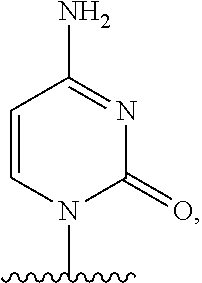
G is

T is

U is

Gm is methylated guanine, Am is methylated adenine, and m5C is


or a pharmaceutically acceptable salt thereof, where each Nu from 1 to n and 5′ to 3′ corresponds to the nucleobases in the following sequences:
| Annealing Site | Sequence [5′ to 3′] |
| H51A(+61+90) | ACA TCA AGG AAG ATG GCA TTT CTA GTT TGG (SEQ ID NO: 725) |
| H51D(+16-07) | CTC ATA CCT TCT GCT TGA TGA TC (SEQ ID NO: 567) |
| H50D(+103+127) | GGG ATC CAG TAT ACT TAC AGG CTC C (SEQ ID NO: 568) |
| H51A(+81+105) | GAG CAG GTA CCT CCA ACA TCA AGG AA (SEQ ID NO: 33) |
| H51A(+71+100) | GGT ACC TCC AAC ATC AAG GAA GAT GGC ATT (SEQ ID NO: 726) |
| H51A(+48+73) | ATT TCT AGT TTG GAG ATG GCA GTT TC (SEQ ID NO: 727) |
| H51A(+59+84) | GGA AGA TGG CAT TTC TAG TTT GGA G (SEQ ID NO: 728) |
| H51A(+64+88) | CAT CAA GGA AGA TGG CAT TTC TAG TT (SEQ ID NO: 729) |
| H51A(+89+113) | ATC TGC CAG AGC AGG TAC CTC CAA C (SEQ ID NO: 730) |
| H51A(+49+68) | TAG TTT GGA GAT GGC AGT TT (SEQ ID NO: 731) |
| H51A(+64+83) | GGA AGA TGG CAT TTC TAG TT (SEQ ID NO: 732) |
| H51A(+80+98) | TAC CTC CAA CAT CAA GGA AG (SEQ ID NO: 733) |
| H51A(+94+113) | ATC TGC CAG AGC AGG TAC CT (SEQ ID NO: 734) |
| H51A(+109+128) | CCA AGC CCG GTT GAA ATC TG (SEQ ID NO: 735) |
| H51A(+61+82) | GAA GAT GGC ATT TCT AGT TTG G (SEQ ID NO: 569) |
| H51A(+61+83) | GGA AGA TGG CAT TTC TAG TTT GG (SEQ ID NO: 570) |
| H51A(+61+89) | CAT CAA GGA AGA TGG CAT TTC TAG TTT GG (SEQ ID NO: 571) |
| H51A(+66+89) | CAT CAA GGA AGA TGG CAT TTC TAG (SEQ ID NO: 572) |
| H51A(+66+93) | CCA ACA TCA AGG AAG ATG GCA TTT CTA G (SEQ ID NO: 573) |
| H51A(+69+92) | CAA CAT CAA GGA AGA TGG CAT TTC (SEQ ID NO: 574) |
| H51A(+69+96) | CCT CCA ACA TCA AGG AAG ATG GCA TTT C (SEQ ID NO: 575) |
| H51A(+74+96) | CCT CCA ACA TCA AGG AAG ATG GC (SEQ ID NO: 576) |
| H51A(+74+99) | GTA CCT CCA ACA TCA AGG AAG ATG GC (SEQ ID NO: 577) |
| H51A(+74+100) | GGT ACC TCC AAC ATC AAG GAA GAT GGC (SEQ ID NO: 578) |
| H51A(+74+102) | CAG GTA CCT CCA ACA TCA AGG AAG ATG GC (SEQ ID NO: 579) |
| H51A(+74+103) | GCA GGT ACC TCC AAC ATC AAG GAA GAT GGC (SEQ ID NO: 580) |
| H51A(+75+96) | CCT CCA ACA TCA AGG AAG ATG G (SEQ ID NO: 581) |
| H51A(+75+99) | GTA CCT CCA ACA TCA AGG AAG ATG G (SEQ ID NO: 582) |
| H51A(+76+99) | GTA CCT CCA ACA TCA AGG AAG ATG (SEQ ID NO: 583) |
| H51A(+76+105) | GAG CAG GTA CCT CCA ACA TCA AGG AAG ATG (SEQ ID NO: 584) |
| H51A(+80+103) | GCA GGT ACC TCC AAC ATC AAG GAA G (SEQ ID NO: 585) |
| H51A(+80+105) | GAG CAG GTA CCT CCA ACA TCA AGG AAG (SEQ ID NO: 586) |
| H51A(+80+107) | CAG AGC AGG TAC CTC CAA CAT CAA GGA AG (SEQ ID NO: 587) |
| H51A(+80+108) | CCA GAG CAG GTA CCT CCA ACA TCA AGG AAG (SEQ ID NO: 588) |
| H51A(+83+103) | GCA GGT ACC TCC AAC ATC AAG G (SEQ ID NO: 589) |
| H51A(+83+105) | GAG CAG GTA CCT CCA ACA TCA AGG (SEQ ID NO: 590) |
| H51A(+83+107) | CAG AGC AGG TAC CTC CAA CAT CAA GG (SEQ ID NO: 591) |
| H51A(+83+109) | GCC AGA GCA GGT ACC TCC AAC ATC AAG G (SEQ ID NO: 592) |
| H51A(+84+107) | CAG AGC AGG TAC CTC CAA CAT CAA G (SEQ ID NO: 593) |
| H51A(+84+111) | CTG CCA GAG CAG GTA CCT CCA ACA TCA AG (SEQ ID NO: 594) |
| H51A(+84+105) | GAG CAG GTA CCT CCA ACA TCA AG (SEQ ID NO: 595) |
| H51A(+87+109) | GCC AGA GCA GGT ACC TCC AAC ATC (SEQ ID NO: 596) |
| H51A(+93+116) | GAA ATC TGC CAG AGC AGG TAC CTC (SEQ ID NO: 597) |
| H51A(+75+100) | GGT ACC TCC AAC ATC AAG GAA GAT GG (SEQ ID NO: 598) |
| H51A(+74+101) | AGG TAC CTC CAA CAT CAA GGA AGA TGG C (SEQ ID NO: 599) |
| H51A(+74+98) | TAC CTC CAA CAT CAA GGA AGA TGG C (SEQ ID NO: 600) |
| H51A(+74+97) | ACC TCC AAC ATC AAG GAA GAT GGC (SEQ ID NO: 601) |
| H51A(+74+94) | TCC AAC ATC AAG GAA GAT GGC (SEQ ID NO: 602) |
| H51A(+74+93) | CCA ACA TCA AGG AAG ATG GC (SEQ ID NO: 603) |
| H51A(+74+92) | CAA CAT CAA GGA AGA TGG C (SEQ ID NO: 604) |
| H51A(+69+99) | GTA CCT CCA ACA TCA AGG AAG ATG GCA TTT C (SEQ ID NO: 605) |
| H51A(+70+99) | GTA CCT CCA ACA TCA AGG AAG ATG GCA TTT (SEQ ID NO: 606) |
| H51A(+71+99) | GTA CCT CCA ACA TCA AGG AAG ATG GCA TT (SEQ ID NO: 607) |
| H51A(+72+99) | GTA CCT CCA ACA TCA AGG AAG ATG GCA T (SEQ ID NO: 608) |
| H51A(+73+99) | GTA CCT CCA ACA TCA AGG AAG ATG GCA (SEQ ID NO: 609) |
| H51A(+77+99) | GTA CCT CCA ACA TCA AGG AAG AT (SEQ ID NO: 610) |
| H51A(+78+99) | GTA CCT CCA ACA TCA AGG AAG A (SEQ ID NO: 611) |
| H51A(+79+99) | GTA CCT CCA ACA TCA AGG AAG |
| H51.SA.(-60-36) | GAA GAA AAA GAA AAA TTA GAA ACA C (SEQ ID NO: 613) |
| H51.SA.(-50-26) | AAG GAA AAA AGA AGA AAA AGA AAA A (SEQ ID NO: 614) |
| H51.SA.(-45-21) | GCA AAA AGG AAA AAA GAA GAA AAA G (SEQ ID NO: 615) |
| H51.SA.(-40-16) | TTT TTG CAA AAA GGA AAA AAG AAG A (SEQ ID NO: 616) |
| H51.SA.(-35-11) | TTG GGT TTT TGC AAA AAG GAA AAA A (SEQ ID NO: 617) |
| H51.SA.(-30-6) | ATA TTT TGG GTT TTT GCA AAA AGG A (SEQ ID NO: 618) |
| H51.SA.(-25-1) | CTA AAA TAT TTT GGG TTT TTG CAA A (SEQ ID NO: 619) |
| H51.SA.(-20+5) | AGG AGC TAA AAT ATT TTG GGT TTT T (SEQ ID NO: 620) |
| H51.SA.(-15+10) | TGA GTA GGA GCT AAA ATA TTT TGG G (SEQ ID NO: 621) |
| H51.SA.(-10+15) | CAG TCT GAG TAG GAG CTA AAA TAT T (SEQ ID NO: 622) |
| H51.SA.(-5+20) | AGT AAC AGT CTG AGT AGG AGC TAA A (SEQ ID NO: 623) |
| H51.SA.(-1+24) | CCA GAG TAA CAG TCT GAG TAG GAG C (SEQ ID NO: 624) |
| H51.SA.(-65-41) | AAA AGA AAA ATT AGA AAC ACA AGC T (SEQ ID NO: 625) |
| H51.SA.(-70-46) | AAA AAT TAG AAA CAC AAG CTA AAG A (SEQ ID NO: 626) |
| H51.SA.(-75-51) | TTA GAA ACA CAA GCT AAA GAG CCA A (SEQ ID NO: 627) |
| H51.SA.(-80-56) | AAC ACA AGC TAA AGA GCC AAT TTC A (SEQ ID NO: 628) |
| H51.SA.(-85-61) | AAG CTA AAG AGC CAA TTT CAA TAA C (SEQ ID NO: 629) |
| H51.SA.(-90-66) | AAA GAG CCA ATT TCA ATA ACA ATA A (SEQ ID NO: 630) |
| H51.SA.(-95-71) | GCC AAT TTC AAT AAC AAT AAG TCA A (SEQ ID NO: 631) |
| H51.SA.(-100-76) | TTT CAA TAA CAA TAA GTC AAA TTT A (SEQ ID NO: 632) |
| H51A(+1+30) | GTG TCA CCA GAG TAA CAG TCT GAG TAG GAG (SEQ ID NO: 633) |
| H51A(+10+39) | CCA CAG GTT GTG TCA CCA GAG TAA CAG TCT (SEQ ID NO: 634) |
| H51A(+6+35) | AGG TTG TGT CAC CAG AGT AAC AGT CTG AGT (SEQ ID NO: 736) |
| H51A(+49+78) | ATG GCA TTT CTA GTT TGG AGA TGG CAG TTT (SEQ ID NO: 636) |
| H51A(+1+25) | ACC AGA GTA ACA GTC TGA GTA GGA G (SEQ ID NO: 637) |
| H51A(+4+28) | GTC ACC AGA GTA ACA GTC TGA GTA G (SEQ ID NO: 638) |
| H51A(+16+40) | ACC ACA GGT TGT GTC ACC AGA GTA A (SEQ ID NO: 639) |
| H51A(+21+45) | TAG TAA CCA CAG GTT GTG TCA CCA G (SEQ ID NO: 640) |
| H51A(+26+50) | TTC CTT AGT AAC CAC AGG TTG TGT C (SEQ ID NO: 641) |
| H51A(+31+55) | GCA GTT TCC TTA GTA ACC ACA GGT T (SEQ ID NO: 642) |
| H51A(+36+60) | AGA TGG CAG TTT CCT TAG TAA CCA C (SEQ ID NO: 643) |
| H51A(+41+65) | TTT GGA GAT GGC AGT TTC CTT AGT A (SEQ ID NO: 644) |
| H51A(+86+110) | TGC CAG AGC AGG TAC CTC CAA CAT C (SEQ ID NO: 645) |
| H51A(+91+115) | AAA TCT GCC AGA GCA GGT ACC TCC A (SEQ ID NO: 646) |
| H51A(+96+120) | GGT TGA AAT CTG CCA GAG CAG GTA C (SEQ ID NO: 647) |
| H51A(+101+125) | AGC CCG GTT GAA ATC TGC CAG AGC A (SEQ ID NO: 648) |
| H51A(+106+130) | GTC CAA GCC CGG TTG AAA TCT GCC A (SEQ ID NO: 649) |
| H51A(+111+135) | GTT CTG TCC AAG CCC GGT TGA AAT C (SEQ ID NO: 650) |
| H51A(+116+140) | GGT AAG TTC TGT CCA AGC CCG GTT G (SEQ ID NO: 651) |
| H51A(+121+145) | CAG TCG GTA AGT TCT GTC CAA GCC C (SEQ ID NO: 652) |
| H51A(+126+150) | AAA GCC AGT CGG TAA GTT CTG TCC A (SEQ ID NO: 653) |
| H51A(+131+155) | CAG AGA AAG CCA GTC GGTA AGT TCT (SEQ ID NO: 737) |
| H51A(+136+160) | TCA AGC AGA GAA AGC CAG TCG GTA A (SEQ ID NO: 655) |
| H51A(+141+165) | CTT GAT CAA GCA GAG AAA GCC AGT C (SEQ ID NO: 656) |
| H51A(+146+170) | TAT AAC TTGA TCA AGC AGA GAA AGC (SEQ ID NO: 738) |
| H51A(+151+175) | GAT TTT ATA ACT TGA TCA AGC AGA G (SEQ ID NO: 658) |
| H51A(+156+180) | TCT GTG ATT TTA TAA CTT GAT CAA G (SEQ ID NO: 659) |
| H51A(+161+185) | CAC CCT CTG TGA TTT TAT AAC TTG A (SEQ ID NO: 660) |
| H51A(+166+190) | ACC ATC ACC CTC TGT GAT TTT ATA A (SEQ ID NO: 661) |
| H51A(+171+195) | CAC CCA CCA TCA CCC TCT GTG ATT T (SEQ ID NO: 662) |
| H51A(+176+200) | AAG GTC ACC CAC CAT CAC CCT CTG T (SEQ ID NO: 663) |
| H51A(+181+205) | TCC TCA AGG TCA CCC ACC ATC ACC C (SEQ ID NO: 664) |
| H51A(+186+210) | TGA TAT CCT CAA GGT CAC CCA CCA T (SEQ ID NO: 665) |
| H51A(+191+215) | CTC GTT GAT ATC CTC AAG GTC ACC C (SEQ ID NO: 666) |
| H51A(+196+220) | ATC ATC TCG TTG ATA TCC TCA AGG T (SEQ ID NO: 667) |
| H51A(+201+225) | TGA TGA TCA TCT CGT TGA TAT CCT C (SEQ ID NO: 668) |
| H51A(+206+230) | CTG CTT GAT GAT CAT CTC GTT GAT A (SEQ ID NO: 669) |
| H51D(+211-02) | ACC TTC TGC TTG ATG ATC ATC TCG T (SEQ ID NO: 670) |
| H51D(+214-05) | CAT ACC TTC TGC TTG ATG ATC ATC T (SEQ ID NO: 671) |
| H51D(+217-08) | TCT CAT ACC TTC TGC TTG ATG ATC A (SEQ ID NO: 672) |
| H51D(+220-11) | TTT TCT CAT ACC TTC TGC TTG ATG A (SEQ ID NO: 673) |
| H51D(+223-14) | ATT TTT TCT CAT ACC TTC TGC TTG A (SEQ ID NO: 674) |
| H51D(+226-17) | ATC ATT TTT TCT CAT ACC TTC TGC T (SEQ ID NO: 675) |
| H51D(+229-20) | TTT ATC ATT TTT TCT CAT ACC TTC T (SEQ ID NO: 676) |
| H51D(+232-23) | ACT TTT ATC ATT TTT TCT CAT ACC T (SEQ ID NO: 677) |
| H51D(-02-26) | CCA ACT TTT ATC ATT TTT TCT CAT A (SEQ ID NO: 678) |
| H51A(+1+30) | GTG TCA CCA GAG TAA CAG TCT GAG TAG GAG (SEQ ID NO: 633) |
wherein A is

C is
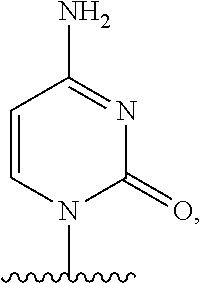
G is

and T is

| Annealing Site | Base Sequence [5′ to 3′] |
| H51A(+66+95) | CTC CAA CAT CAA GGA AGA TGG CAT TTC TAG (SEQ ID NO: 679) |
| H51A(+74+97) | ACC TCC AAC ATC AAG GAA GAT GGC (SEQ ID NO: 601) |
| H51A(+70+99) | GTA CCT CCA ACA TCA AGG AAG ATG GCA TTT (SEQ ID NO: 606) |
| H51A(+72+99) | GTA CCT CCA ACA TCA AGG AAG ATG GCA T (SEQ ID NO: 608) |
| H51A(+68+87) | TCA AGG AAG ATG GCA TTT CT (SEQ ID NO: 680) |
| H51A(+68+87) | UCA AGG AmAGm AmUGm GmCA UUU CU (SEQ ID NO: 681) |
| H53A(+36+60) | GTT GCC TCC GGT TCT GAA GGT GTT C (SEQ ID NO: 682) |
| H53A(+36+60) | GTT G5mC5mC T5mC5mC GGT T5mC T GAA GGT GTT 5mC (SEQ ID NO: |
| 683) | |
| H53A(+36+56) | CCT CCG GTT CTG AAG GTG TTC (SEQ ID NO: 684) |
| H53A(+23+47) | CTG AAG GTG TTC TTG TAC TTC ATC C (SEQ ID NO: 34) |
| H53A(+32+56) | CCT CCG GTT CTG AAG GTG TTC TTG T (SEQ ID NO: 685) |
| H53A(+33+60) | GTT GCC TCC GGT TCT GAA GGT GTT CTT G (SEQ ID NO: 686) |
| H53A(+30+59) | TTG CCT CCG GTT CTG AAG GTG TTC TTG TAC (SEQ ID NO: 687) |
| H53A(+39+62) | CTG TTG CCT CCG GTT CTG AAG GTG (SEQ ID NO: 688) |
| H53A(+36+69) | CAT TCA ACT GTT GCC TCC GGT TCT GAA GGT G (SEQ ID NO: 689) |
| H53A(+45+62) | CTG TTG CCT CCG GTT CTG (SEQ ID NO: 690) |
| H45A(-03+19) | CAA TGC CAT CCT GGA GTT CCT G (SEQ ID NO: 691) |
| H45A(-09+25) | GCT GCC CAA TGC CAT CCT GGA GTT CCT GT A AGA T (SEQ ID NO: |
| 692) | |
| H45A(-03+25) | GCT GCC CAA TGC CAT CCT GGA GTT CCT G (SEQ ID NO: 693) |
| H45A(-06+25) | GCT GCC CAA TGC CAT CCT GGA GTT CCT GT A A (SEQ ID NO: 694) |
| H45A(-12+19) | CAA TGC CAT CCT GGA GTT CCT GTA AGA TAC C (SEQ ID NO: 695) |
| H45A(-09+19) | CAA TGC CAT CCT GGA GTT CCT GTA AGA T (SEQ ID NO: 696) |
| H45A(-12+16) | TGC CAT CCT GGA GTT CCT GTA AGA TAC C (SEQ ID NO: 697) |
| H45A(-14+25) | GCT GCC CAA TGC CAT CCT GGA GTT CCT GTA AGA TAC CAA (SEQ |
| ID NO: 698) | |
| H45A(-08+19) | CAA TGC CAT CCT GGA GTT CCT GTA AGA (SEQ ID NO: 699) |
| HM45A(-07+25) | GCT GCC CAA TGC CAT CCT GGA GTT CCT GTA AG (SEQ ID NO: 700) |
| H45A(-12+22) | GCC CAA TGC CAT CCT GGA GTT CCT GTA AGA TAC C (SEQ ID NO: |
| 701) | |
| H45A(-09+22) | GCC CAA TGC CAT CCT GGA GTT CCT GTA AGA T (SEQ ID NO: 702) |
| H45A(-09+30) | TTG CCG CTG CCC AAT GCC ATC CTG GAG TTC CTG TAA GAT (SEQ |
| ID NO: 703) | |
| H45A(-06+22) | GCC CAA TGC CAT CCT GGA GTT CCT GTA A (SEQ ID NO: 704) |
| H45A(-06+28) | GCC GCT GCC CAA TGC CAT CCT GGA GTT CCT GTA A (SEQ ID NO: |
| 705) | |
| H45A(-03+22) | GCC CAA TGC CAT CCT GGA GTT CCT G (SEQ ID NO: 706) |
| H45A(-03+28) | GCC GCT GCC CAA TGC CAT CCT GGA GTT CCT G (SEQ ID NO: 707) |
| H45A(+9+26) | m5C-G-m5C-T-G-C-m5C-m5C-A-A-T-G-m5C-m5C-A-U-m5C-m5C (SEQ ID |
| NO: 708) | |
| H44A(-10+15) | GAT CTG TCA AAT CGC CTG CAG GTA A (SEQ ID NO: 709) |
| H44A(-07+15) | GAT CTG TCA AAT CGC CTG CAG G (SEQ ID NO: 710) |
| H44M(-07+17) | CAG ATC TGT CAA ATC GCC TGC AGG (SEQ ID NO: 711) |
| H44A(-08+15) | GAT CTG TCA AAT CGC CTG CAG GT (SEQ ID NO: 712) |
| H44A(-06+15) | GAT CTG TCA AAT CGC CTG CAG (SEQ ID NO: 713) |
| H44A(-08+17) | CAG ATC TGT CAA ATC GCC TGC AGG T (SEQ ID NO: 714) |
| H44A(-06+17) | CAG ATC TGT CAA ATC GCC TGC AG (SEQ ID NO: 715) |
| H50D(+04-18) | GGG ATC CAG TAT ACT TAC AGG C (SEQ ID NO: 716) |
| H50D(+07-18) | GGG ATC CAG TAT ACT TAC AGG CTC C (SEQ ID NO: 568) |
| H50D(+07-16) | GAT CCA GTA TAC TTA CAG GCT CC (SEQ ID NO: 717) |
| H50D(+07-17) | GGA TCC AGT ATA CTT ACA GGC TCC (SEQ ID NO: 718) |
| H50A(-19+07) | ACT TCC TCT TTA ACA GAA AAG CAT AC (SEQ ID NO: 719) |
| H50D(+07-15) | ATC CAG TAT ACT TAC AGG CTC C (SEQ ID NO: 720) |
| H50A(-02+23) | GAG CTC AGA TCT TCT AAC TTC CTC T (SEQ ID NO: 721) |
| H50D(+06-18) | GGG ATC CAG TAT ACT TAC AGG CTC (SEQ ID NO: 722) |
| H50D(+07-20) | ATG GGA TCC AGT ATA CTT ACA GGC TCC (SEQ ID NO: 723) |
| H52A(-01+24) | CTG TTC CAA ATC CTG CAT TGT TGC C (SEQ ID NO: 724) |

C is
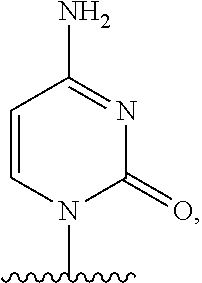
G is

T is
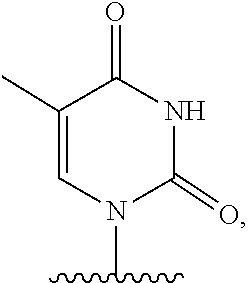
U is

Gm is methylated guanine, Am is methylated adenine, and m5C is
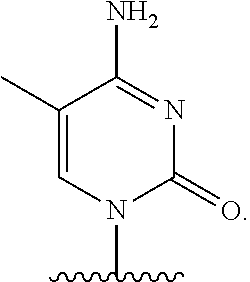

or a pharmaceutically acceptable salt thereof, where each Nu from 1 to (n+1) and 5′ to 3′ corresponds to the nucleobases in the following sequences:
| Annealing Site | Sequence [5′ to 3′] |
| H51A(+61+90) | ACA TCA AGG AAG ATG GCA TTT CTA GTT TGG (SEQ ID NO: 725) |
| H51D(+16-07) | CTC ATA CCT TCT GCT TGA TGA TC (SEQ ID NO: 567) |
| H50D(+103+127) | GGG ATC CAG TAT ACT TAC AGG CTC C (SEQ ID NO: 568) |
| H51A(+81+105) | GAG CAG GTA CCT CCA ACA TCA AGG AA (SEQ ID NO: 33) |
| H51A(+71+100) | GGT ACC TCC AAC ATC AAG GAA GAT GGC ATT (SEQ ID NO: 726) |
| H51A(+48+73) | ATT TCT AGT TTG GAG ATG GCA GTT TC (SEQ ID NO: 727) |
| H51A(+59+84) | GGA AGA TGG CAT TTC TAG TTT GGA G (SEQ ID NO: 728) |
| H51A(+64+88) | CAT CAA GGA AGA TGG CAT TTC TAG TT (SEQ ID NO: 729) |
| H51A(+89+113) | ATC TGC CAG AGC AGG TAC CTC CAA C (SEQ ID NO: 730) |
| H51A(+49+68) | TAG TTT GGA GAT GGC AGT TT (SEQ ID NO: 731) |
| H51A(+64+83) | GGA AGA TGG CAT TTC TAG TT (SEQ ID NO: 732) |
| H51A(+80+98) | TAC CTC CAA CAT CAA GGA AG (SEQ ID NO: 733) |
| H51A(+94+113) | ATC TGC CAG AGC AGG TAC CT (SEQ ID NO: 734) |
| H51A(+109+128) | CCA AGC CCG GTT GAA ATC TG (SEQ ID NO: 735) |
| H51A(+61+82) | GAA GAT GGC ATT TCT AGT TTG G (SEQ ID NO: 569) |
| H51A(+61+83) | GGA AGA TGG CAT TTC TAG TTT GG (SEQ ID NO: 570) |
| H51A(+61+89) | CAT CAA GGA AGA TGG CAT TTC TAG TTT GG (SEQ ID NO: 571) |
| H51A(+66+89) | CAT CAA GGA AGA TGG CAT TTC TAG (SEQ ID NO: 572) |
| H51A(+66+93) | CCA ACA TCA AGG AAG ATG GCA TTT CTA G (SEQ ID NO: 573) |
| H51A(+69+92) | CAA CAT CAA GGA AGA TGG CAT TTC (SEQ ID NO: 574) |
| H51A(+69+96) | CCT CCA ACA TCA AGG AAG ATG GCA TTT C (SEQ ID NO: 575) |
| H51A(+74+96) | CCT CCA ACA TCA AGG AAG ATG GC (SEQ ID NO: 576) |
| H51A(+74+99) | GTA CCT CCA ACA TCA AGG AAG ATG GC (SEQ ID NO: 577) |
| H51A(+74+100) | GGT ACC TCC AAC ATC AAG GAA GAT GGC (SEQ ID NO: 578) |
| H51A(+74+102) | CAG GTA CCT CCA ACA TCA AGG AAG ATG GC (SEQ ID NO: 579) |
| H51A(+74+103) | GCA GGT ACC TCC AAC ATC AAG GAA GAT GGC (SEQ ID NO: 580) |
| H51A(+75+96) | CCT CCA ACA TCA AGG AAG ATG G (SEQ ID NO: 581) |
| H51A(+75+99) | GTA CCT CCA ACA TCA AGG AAG ATG G (SEQ ID NO: 582) |
| H51A(+76+99) | GTA CCT CCA ACA TCA AGG AAG ATG (SEQ ID NO: 583) |
| H51A(+76+105) | GAG CAG GTA CCT CCA ACA TCA AGG AAG ATG (SEQ ID NO: 584) |
| H51A(+80+103) | GCA GGT ACC TCC AAC ATC AAG GAA G (SEQ ID NO: 585) |
| H51A(+80+105) | GAG CAG GTA CCT CCA ACA TCA AGG AAG (SEQ ID NO: 586) |
| H51A(+80+107) | CAG AGC AGG TAC CTC CAA CAT CAA GGA AG (SEQ ID NO: 587) |
| H51A(+80+108) | CCA GAG CAG GTA CCT CCA ACA TCA AGG AAG (SEQ ID NO: 588) |
| H51A(+83+103) | GCA GGT ACC TCC AAC ATC AAG G (SEQ ID NO: 589) |
| H51A(+83+105) | GAG CAG GTA CCT CCA ACA TCA AGG (SEQ ID NO: 590) |
| H51A(+83+107) | CAG AGC AGG TAC CTC CAA CAT CAA GG (SEQ ID NO: 591) |
| H51A(+83+109) | GCC AGA GCA GGT ACC TCC AAC ATC AAG G (SEQ ID NO: 592) |
| H51A(+84+107) | CAG AGC AGG TAC CTC CAA CAT CAA G (SEQ ID NO: 593) |
| H51A(+84+111) | CTG CCA GAG CAG GTA CCT CCA ACA TCA AG (SEQ ID NO: 594) |
| H51A(+84+105) | GAG CAG GTA CCT CCA ACA TCA AG (SEQ ID NO: 595) |
| H51A(+87+109) | GCC AGA GCA GGT ACC TCC AAC ATC (SEQ ID NO: 596) |
| H51A(+93+116) | GAA ATC TGC CAG AGC AGG TAC CTC (SEQ ID NO: 597) |
| H51A(+75+100) | GGT ACC TCC AAC ATC AAG GAA GAT GG (SEQ ID NO: 598) |
| H51A(+74+101) | AGG TAC CTC CAA CAT CAA GGA AGA TGG C (SEQ ID NO: 599) |
| H51A(+74+98) | TAC CTC CAA CAT CAA GGA AGA TGG C (SEQ ID NO: 600) |
| H51A(+74+97) | ACC TCC AAC ATC AAG GAA GAT GGC (SEQ ID NO: 601) |
| H51A(+74+94) | TCC AAC ATC AAG GAA GAT GGC (SEQ ID NO: 602) |
| H51A(+74+93) | CCA ACA TCA AGG AAG ATG GC (SEQ ID NO: 603) |
| H51A(+74+92) | CAA CAT CAA GGA AGA TGG C (SEQ ID NO: 604) |
| H51A(+69+99) | GTA CCT CCA ACA TCA AGG AAG ATG GCA TTT C (SEQ ID NO: 605) |
| H51A(+70+99) | GTA CCT CCA ACA TCA AGG AAG ATG GCA TTT (SEQ ID NO: 606) |
| H51A(+71+99) | GTA CCT CCA ACA TCA AGG AAG ATG GCA TT (SEQ ID NO: 607) |
| H51A(+72+99) | GTA CCT CCA ACA TCA AGG AAG ATG GCA T (SEQ ID NO: 608) |
| H51A(+73+99) | GTA CCT CCA ACA TCA AGG AAG ATG GCA (SEQ ID NO: 609) |
| H51A(+77+99) | GTA CCT CCA ACA TCA AGG AAG AT (SEQ ID NO: 610) |
| H51A(+78+99) | GTA CCT CCA ACA TCA AGG AAG A (SEQ ID NO: 611) |
| H51A(+79+99) | GTA CCT CCA ACA TCA AGG AAG |
| H51.SA.(-60-36) | GAA GAA AAA GAA AAA TTA GAA ACA C (SEQ ID NO: 613) |
| H51.SA.(-50-26) | AAG GAA AAA AGA AGA AAA AGA AAA A (SEQ ID NO: 614) |
| H51.SA.(-45-21) | GCA AAA AGG AAA AAA GAA GAA AAA G (SEQ ID NO: 615) |
| H51.SA.(-40-16) | TTT TTG CAA AAA GGA AAA AAG AAG A (SEQ ID NO: 616) |
| H51.SA.(-35-11) | TTG GGT TTT TGC AAA AAG GAA AAA A (SEQ ID NO: 617) |
| H51.SA.(-30-6) | ATA TTT TGG GTT TTT GCA AAA AGG A (SEQ ID NO: 618) |
| H51.SA.(-25-1) | CTA AAA TAT TTT GGG TTT TTG CAA A (SEQ ID NO: 619) |
| H51.SA.(-20+5) | AGG AGC TAA AAT ATT TTG GGT TTT T (SEQ ID NO: 620) |
| H51.SA.(-15+10) | TGA GTA GGA GCT AAA ATA TTT TGG G (SEQ ID NO: 621) |
| H51.SA.(-10+15) | CAG TCT GAG TAG GAG CTA AAA TAT T (SEQ ID NO: 622) |
| H51.SA.(-5+20) | AGT AAC AGT CTG AGT AGG AGC TAA A (SEQ ID NO: 623) |
| H51.SA.(-1+24) | CCA GAG TAA CAG TCT GAG TAG GAG C (SEQ ID NO: 624) |
| H51.SA.(-65-41) | AAA AGA AAA ATT AGA AAC ACA AGC T (SEQ ID NO: 625) |
| H51.SA.(-70-46) | AAA AAT TAG AAA CAC AAG CTA AAG A (SEQ ID NO: 626) |
| H51.SA.(-75-51) | TTA GAA ACA CAA GCT AAA GAG CCA A (SEQ ID NO: 627) |
| H51.SA.(-80-56) | AAC ACA AGC TAA AGA GCC AAT TTC A (SEQ ID NO: 628) |
| H51.SA.(-85-61) | AAG CTA AAG AGC CAA TTT CAA TAA C (SEQ ID NO: 629) |
| H51.SA.(-90-66) | AAA GAG CCA ATT TCA ATA ACA ATA A (SEQ ID NO: 630) |
| H51.SA.(-95-71) | GCC AAT TTC AAT AAC AAT AAG TCA A (SEQ ID NO: 631) |
| H51.SA.(-100-76) | TTT CAA TAA CAA TAA GTC AAA TTT A (SEQ ID NO: 632) |
| H51A(+1+30) | GTG TCA CCA GAG TAA CAG TCT GAG TAG GAG (SEQ ID NO: 633) |
| H51A(+10+39) | CCA CAG GTT GTG TCA CCA GAG TAA CAG TCT (SEQ ID NO: 634) |
| H51A(+6+35) | AGG TTG TGT CAC CAG AGT AAC AGT CTG AGT (SEQ ID NO: 736) |
| H51A(+49+78) | ATG GCA TTT CTA GTT TGG AGA TGG CAG TTT (SEQ ID NO: 636) |
| H51A(+1+25) | ACC AGA GTA ACA GTC TGA GTA GGA G (SEQ ID NO: 637) |
| H51A(+4+28) | GTC ACC AGA GTA ACA GTC TGA GTA G (SEQ ID NO: 638) |
| H51A(+16+40) | ACC ACA GGT TGT GTC ACC AGA GTA A (SEQ ID NO: 639) |
| H51A(+21+45) | TAG TAA CCA CAG GTT GTG TCA CCA G (SEQ ID NO: 640) |
| H51A(+26+50) | TTC CTT AGT AAC CAC AGG TTG TGT C (SEQ ID NO: 641) |
| H51A(+31+55) | GCA GTT TCC TTA GTA ACC ACA GGT T (SEQ ID NO: 642) |
| H51A(+36+60) | AGA TGG CAG TTT CCT TAG TAA CCA C (SEQ ID NO: 643) |
| H51A(+41+65) | TTT GGA GAT GGC AGT TTC CTT AGT A (SEQ ID NO: 644) |
| H51A(+86+110) | TGC CAG AGC AGG TAC CTC CAA CAT C (SEQ ID NO: 645) |
| H51A(+91+115) | AAA TCT GCC AGA GCA GGT ACC TCC A (SEQ ID NO: 646) |
| H51A(+96+120) | GGT TGA AAT CTG CCA GAG CAG GTA C (SEQ ID NO: 647) |
| H51A(+101+125) | AGC CCG GTT GAA ATC TGC CAG AGC A (SEQ ID NO: 648) |
| H51A(+106+130) | GTC CAA GCC CGG TTG AAA TCT GCC A (SEQ ID NO: 649) |
| H51A(+111+135) | GTT CTG TCC AAG CCC GGT TGA AAT C (SEQ ID NO: 650) |
| H51A(+116+140) | GGT AAG TTC TGT CCA AGC CCG GTT G (SEQ ID NO: 651) |
| H51A(+121+145) | CAG TCG GTA AGT TCT GTC CAA GCC C (SEQ ID NO: 652) |
| H51A(+126+150) | AAA GCC AGT CGG TAA GTT CTG TCC A (SEQ ID NO: 653) |
| H51A(+131+155) | CAG AGA AAG CCA GTC GGTA AGT TCT (SEQ ID NO: 737) |
| H51A(+136+160) | TCA AGC AGA GAA AGC CAG TCG GTA A (SEQ ID NO: 655) |
| H51A(+141+165) | CTT GAT CAA GCA GAG AAA GCC AGT C (SEQ ID NO: 656) |
| H51A(+146+170) | TAT AAC TTGA TCA AGC AGA GAA AGC (SEQ ID NO: 738) |
| H51A(+151+175) | GAT TTT ATA ACT TGA TCA AGC AGA G (SEQ ID NO: 658) |
| H51A(+156+180) | TCT GTG ATT TTA TAA CTT GAT CAA G (SEQ ID NO: 659) |
| H51A(+161+185) | CAC CCT CTG TGA TTT TAT AAC TTG A (SEQ ID NO: 660) |
| H51A(+166+190) | ACC ATC ACC CTC TGT GAT TTT ATA A (SEQ ID NO: 661) |
| H51A(+171+195) | CAC CCA CCA TCA CCC TCT GTG ATT T (SEQ ID NO: 662) |
| H51A(+176+200) | AAG GTC ACC CAC CAT CAC CCT CTG T (SEQ ID NO: 663) |
| H51A(+181+205) | TCC TCA AGG TCA CCC ACC ATC ACC C (SEQ ID NO: 664) |
| H51A(+186+210) | TGA TAT CCT CAA GGT CAC CCA CCA T (SEQ ID NO: 665) |
| H51A(+191+215) | CTC GTT GAT ATC CTC AAG GTC ACC C (SEQ ID NO: 666) |
| H51A(+196+220) | ATC ATC TCG TTG ATA TCC TCA AGG T (SEQ ID NO: 667) |
| H51A(+201+225) | TGA TGA TCA TCT CGT TGA TAT CCT C (SEQ ID NO: 668) |
| H51A(+206+230) | CTG CTT GAT GAT CAT CTC GTT GAT A (SEQ ID NO: 669) |
| H51D(+211-02) | ACC TTC TGC TTG ATG ATC ATC TCG T (SEQ ID NO: 670) |
| H51D(+214-05) | CAT ACC TTC TGC TTG ATG ATC ATC T (SEQ ID NO: 671) |
| H51D(+217-08) | TCT CAT ACC TTC TGC TTG ATG ATC A (SEQ ID NO: 672) |
| H51D(+220-11) | TTT TCT CAT ACC TTC TGC TTG ATG A (SEQ ID NO: 673) |
| H51D(+223-14) | ATT TTT TCT CAT ACC TTC TGC TTG A (SEQ ID NO: 674) |
| H51D(+226-17) | ATC ATT TTT TCT CAT ACC TTC TGC T (SEQ ID NO: 675) |
| H51D(+229-20) | TTT ATC ATT TTT TCT CAT ACC TTC T (SEQ ID NO: 676) |
| H51D(+232-23) | ACT TTT ATC ATT TTT TCT CAT ACC T (SEQ ID NO: 677) |
| H51D(-02-26) | CCA ACT TTT ATC ATT TTT TCT CAT A (SEQ ID NO: 678) |
| H51A(+1+30) | GTG TCA CCA GAG TAA CAG TCT GAG TAG GAG (SEQ ID NO: 633) |
wherein A is

C is
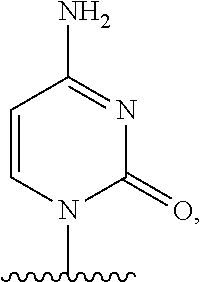
G is

and T is

| Annealing Site | Base Sequence [5′ to 3′] |
| H51A(+66+95) | CTC CAA CAT CAA GGA AGA TGG CAT TTC TAG (SEQ ID NO: 679) |
| H51A(+74+97) | ACC TCC AAC ATC AAG GAA GAT GGC (SEQ ID NO: 601) |
| H51A(+70+99) | GTA CCT CCA ACA TCA AGG AAG ATG GCA TTT (SEQ ID NO: 606) |
| H51A(+72+99) | GTA CCT CCA ACA TCA AGG AAG ATG GCA T (SEQ ID NO: 608) |
| H51A(+68+87) | TCA AGG AAG ATG GCA TTT CT (SEQ ID NO: 680) |
| H51A(+68+87) | UCA AGG AmAGm AmUGm GmCA UUU CU (SEQ ID NO: 681) |
| H53A(+36+60) | GTT GCC TCC GGT TCT GAA GGT GTT C (SEQ ID NO: 682) |
| H53A(+36+60) | GTT G5mC5mC T5mC5mC GGT T5mC T GAA GGT GTT 5mC (SEQ ID NO: |
| 683) | |
| H53A(+36+56) | CCT CCG GTT CTG AAG GTG TTC (SEQ ID NO: 684) |
| H53A(+23+47) | CTG AAG GTG TTC TTG TAC TTC ATC C (SEQ ID NO: 34) |
| H53A(+32+56) | CCT CCG GTT CTG AAG GTG TTC TTG T (SEQ ID NO: 685) |
| H53A(+33+60) | GTT GCC TCC GGT TCT GAA GGT GTT CTT G (SEQ ID NO: 686) |
| H53A(+30+59) | TTG CCT CCG GTT CTG AAG GTG TTC TTG TAC (SEQ ID NO: 687) |
| H53A(+39+62) | CTG TTG CCT CCG GTT CTG AAG GTG (SEQ ID NO: 688) |
| H53A(+36+69) | CAT TCA ACT GTT GCC TCC GGT TCT GAA GGT G (SEQ ID NO: 689) |
| H53A(+45+62) | CTG TTG CCT CCG GTT CTG (SEQ ID NO: 690) |
| H45A(-03+19) | CAA TGC CAT CCT GGA GTT CCT G (SEQ ID NO: 691) |
| H45A(-09+25) | GCT GCC CAA TGC CAT CCT GGA GTT CCT GTA AGA T (SEQ ID NO: 692) |
| H45A(-03+25) | GCT GCC CAA TGC CAT CCT GGA GTT CCT G (SEQ ID NO: 693) |
| H45A(-06+25) | GCT GCC CAA TGC CAT CCT GGA GTT CCT GTA A (SEQ ID NO: 694) |
| H45A(-12+19) | CAA TGC CAT CCT GGA GTT CCT GTA AGA TAC C (SEQ ID NO: 695) |
| H45A(-09+19) | CAA TGC CAT CCT GGA GTT CCT GTA AGA T (SEQ ID NO: 696) |
| H45A(-12+16) | TGC CAT CCT GGA GTT CCT GT A AGA TAC C (SEQ ID NO: 697) |
| H45A(-14+25) | GCT GCC CAA TGC CAT CCT GGA GTT CCT GTA AGA TAC CAA (SEQ ID |
| NO: 698) | |
| H45A(-08+19) | CAA TGC CAT CCT GGA GTT CCT GTA AGA (SEQ ID NO: 699) |
| HM45A(-07+25) | GCT GCC CAA TGC CAT CCT GGA GTT CCT GTA AG (SEQ ID NO: 700) |
| H45A(-12+22) | GCC CAA TGC CAT CCT GGA GTT CCT GTA AGA TAC C (SEQ ID NO: 701) |
| H45A(-09+22) | GCC CAA TGC CAT CCT GGA GTT CCT GTA AGA T (SEQ ID NO: 702) |
| H45A(-09+30) | TTG CCG CTG CCC AAT GCC ATC CTG GAG TTC CTG TAA GAT (SEQ ID |
| NO: 703) | |
| H45A(-06+22) | GCC CAA TGC CAT CCT GGA GTT CCT GTA A (SEQ ID NO: 704) |
| H45A(-06+28) | GCC GCT GCC CAA TGC CAT CCT GGA GTT CCT GTA A (SEQ ID NO: 705) |
| H45A(-03+22) | GCC CAA TGC CAT CCT GGA GTT CCT G (SEQ ID NO: 706) |
| H45A(-03+28) | GCC GCT GCC CAA TGC CAT CCT GGA GTT CCT G (SEQ ID NO: 707) |
| H45A(+9+26) | m5C-G-m5C-T-G-C-m5C-m5C-A-A-T-G-m5C-m5C-A-U-m5C-m5C (SEQ ID |
| NO: 708) | |
| H44A(-10+15) | GAT CTG TCA AAT CGC CTG CAG GTA A (SEQ ID NO: 709) |
| H44A(-07+15) | GAT CTG TCA AAT CGC CTG CAG G (SEQ ID NO: 710) |
| H44M(-07+17) | CAG ATC TGT CAA ATC GCC TGC AGG (SEQ ID NO: 711) |
| H44A(-08+15) | GAT CTG TCA AAT CGC CTG CAG GT (SEQ ID NO: 712) |
| H44A(-06+15) | GAT CTG TCA AAT CGC CTG CAG (SEQ ID NO: 713) |
| H44A(-08+17) | CAG ATC TGT CAA ATC GCC TGC AGG T (SEQ ID NO: 714) |
| H44A(-06+17) | CAG ATC TGT CAA ATC GCC TGC AG (SEQ ID NO: 715) |
| H50D(+04-18) | GGG ATC CAG TAT ACT TAC AGG C (SEQ ID NO: 716) |
| H50D(+07-18) | GGG ATC CAG TAT ACT TAC AGG CTC C (SEQ ID NO: 568) |
| H50D(+07-16) | GAT CCA GTA TAC TTA CAG GCT CC (SEQ ID NO: 717) |
| H50D(+07-17) | GGA TCC AGT ATA CTT ACA GGC TCC (SEQ ID NO: 718) |
| H50A(-19+07) | ACT TCC TCT TTA ACA GAA AAG CAT AC (SEQ ID NO: 719) |
| H50D(+07-15) | ATC CAG TAT ACT TAC AGG CTC C (SEQ ID NO: 720) |
| H50A(-02+23) | GAG CTC AGA TCT TCT AAC TTC CTC T (SEQ ID NO: 721) |
| H50D(+06-18) | GGG ATC CAG TAT ACT TAC AGG CTC (SEQ ID NO: 722) |
| H50D(+07-20) | ATG GGA TCC AGT ATA CTT ACA GGC TCC (SEQ ID NO: 723) |
| H52A(-01+24) | CTG TTC CAA ATC CTG CAT TGT TGC C (SEQ ID NO: 724) |

C is
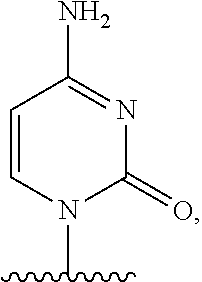
G is
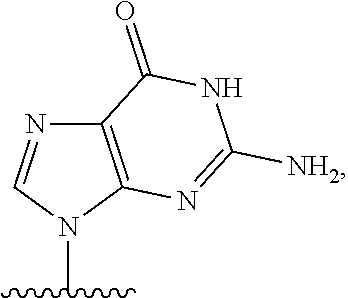
T is

U is
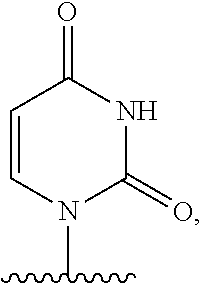
Gm is methylated guanine, Am is methylated adenine, and m5C is
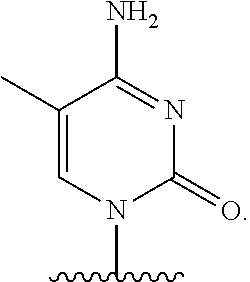

where each Nu from 1 to (n+1) and 5′ to 3′ corresponds to the nucleobases in the following sequences:
| Annealing Site | Sequence [5′ to 3′] |
| H51A(+61+90) | ACA TCA AGG AAG ATG GCA TTT CT A GTT TGG (SEQ ID NO: 725) |
| H51D(+16-07) | CTC ATA CCT TCT GCT TGA TGA TC (SEQ ID NO: 567) |
| H50D(+103+127) | GGG ATC CAG TAT ACT TAC AGG CTC C (SEQ ID NO: 568) |
| H51A(+81+105) | GAG CAG GTA CCT CCA ACA TCA AGG AA (SEQ ID NO: 33) |
| H51A(+71+100) | GGT ACC TCC AAC ATC AAG GAA GAT GGC ATT (SEQ ID NO: 726) |
| H51A(+48+73) | ATT TCT AGT TTG GAG ATG GCA GTT TC (SEQ ID NO: 727) |
| H51A(+59+84) | GGA AGA TGG CAT TTC TAG TTT GGA G (SEQ ID NO: 728) |
| H51A(+64+88) | CAT CAA GGA AGA TGG CAT TTC TAG TT (SEQ ID NO: 729) |
| H51A(+89+113) | ATC TGC CAG AGC AGG TAC CTC CAA C (SEQ ID NO: 730) |
| H51A(+49+68) | TAG TTT GGA GAT GGC AGT TT (SEQ ID NO: 731) |
| H51A(+64+83) | GGA AGA TGG CAT TTC TAG TT (SEQ ID NO: 732) |
| H51A(+80+98) | TAC CTC CAA CAT CAA GGA AG (SEQ ID NO: 733) |
| H51A(+94+113) | ATC TGC CAG AGC AGG TAC CT (SEQ ID NO: 734) |
| H51A(+109+128) | CCA AGC CCG GTT GAA ATC TG (SEQ ID NO: 735) |
| H51A(+61+82) | GAA GAT GGC ATT TCT AGT TTG G (SEQ ID NO: 569) |
| H51A(+61+83) | GGA AGA TGG CAT TTC TAG TTT GG (SEQ ID NO: 570) |
| H51A(+61+89) | CAT CAA GGA AGA TGG CAT TTC TAG TTT GG (SEQ ID NO: 571) |
| H51A(+66+89) | CAT CAA GGA AGA TGG CAT TTC TAG (SEQ ID NO: 572) |
| H51A(+66+93) | CCA ACA TCA AGG AAG ATG GCA TTT CTA G (SEQ ID NO: 573) |
| H51A(+69+92) | CAA CAT CAA GGA AGA TGG CAT TTC (SEQ ID NO: 574) |
| H51A(+69+96) | CCT CCA ACA TCA AGG AAG ATG GCA TTT C (SEQ ID NO: 575) |
| H51A(+74+96) | CCT CCA ACA TCA AGG AAG ATG GC (SEQ ID NO: 576) |
| H51A(+74+99) | GTA CCT CCA ACA TCA AGG AAG ATG GC (SEQ ID NO: 577) |
| H51A(+74+100) | GGT ACC TCC AAC ATC AAG GAA GAT GGC (SEQ ID NO: 578) |
| H51A(+74+102) | CAG GTA CCT CCA ACA TCA AGG AAG ATG GC (SEQ ID NO: 579) |
| H51A(+74+103) | GCA GGT ACC TCC AAC ATC AAG GAA GAT GGC (SEQ ID NO: 580) |
| H51A(+75+96) | CCT CCA ACA TCA AGG AAG ATG G (SEQ ID NO: 581) |
| H51A(+75+99) | GTA CCT CCA ACA TCA AGG AAG ATG G (SEQ ID NO: 582) |
| H51A(+76+99) | GTA CCT CCA ACA TCA AGG AAG ATG (SEQ ID NO: 583) |
| H51A(+76+105) | GAG CAG GTA CCT CCA ACA TCA AGG AAG ATG (SEQ ID NO: 584) |
| H51A(+80+103) | GCA GGT ACC TCC AAC ATC AAG GAA G (SEQ ID NO: 585) |
| H51A(+80+105) | GAG CAG GTA CCT CCA ACA TCA AGG AAG (SEQ ID NO: 586) |
| H51A(+80+107) | CAG AGC AGG TAC CTC CAA CAT CAA GGA AG (SEQ ID NO: 587) |
| H51A(+80+108) | CCA GAG CAG GTA CCT CCA ACA TCA AGG AAG (SEQ ID NO: 588) |
| H51A(+83+103) | GCA GGT ACC TCC AAC ATC AAG G (SEQ ID NO: 589) |
| H51A(+83+105) | GAG CAG GTA CCT CCA ACA TCA AGG (SEQ ID NO: 590) |
| H51A(+83+107) | CAG AGC AGG TAC CTC CAA CAT CAA GG (SEQ ID NO: 591) |
| H51A(+83+109) | GCC AGA GCA GGT ACC TCC AAC ATC AAG G (SEQ ID NO: 592) |
| H51A(+84+107) | CAG AGC AGG TAC CTC CAA CAT CAA G (SEQ ID NO: 593) |
| H51A(+84+111) | CTG CCA GAG CAG GTA CCT CCA ACA TCA AG (SEQ ID NO: 594) |
| H51A(+84+105) | GAG CAG GTA CCT CCA ACA TCA AG (SEQ ID NO: 595) |
| H51A(+87+109) | GCC AGA GCA GGT ACC TCC AAC ATC (SEQ ID NO: 596) |
| H51A(+93+116) | GAA ATC TGC CAG AGC AGG TAC CTC (SEQ ID NO: 597) |
| H51A(+75+100) | GGT ACC TCC AAC ATC AAG GAA GAT GG (SEQ ID NO: 598) |
| H51A(+74+101) | AGG TAC CTC CAA CAT CAA GGA AGA TGG C (SEQ ID NO: 599) |
| H51A(+74+98) | TAC CTC CAA CAT CAA GGA AGA TGG C (SEQ ID NO: 600) |
| H51A(+74+97) | ACC TCC AAC ATC AAG GAA GAT GGC (SEQ ID NO: 601) |
| H51A(+74+94) | TCC AAC ATC AAG GAA GAT GGC (SEQ ID NO: 602) |
| H51A(+74+93) | CCA ACA TCA AGG AAG ATG GC (SEQ ID NO: 603) |
| H51A(+74+92) | CAA CAT CAA GGA AGA TGG C (SEQ ID NO: 604) |
| H51A(+69+99) | GTA CCT CCA ACA TCA AGG AAG ATG GCA TTT C (SEQ ID NO: 605) |
| H51A(+70+99) | GTA CCT CCA ACA TCA AGG AAG ATG GCA TTT (SEQ ID NO: 606) |
| H51A(+71+99) | GTA CCT CCA ACA TCA AGG AAG ATG GCA TT (SEQ ID NO: 607) |
| H51A(+72+99) | GTA CCT CCA ACA TCA AGG AAG ATG GCA T (SEQ ID NO: 608) |
| H51A(+73+99) | GTA CCT CCA ACA TCA AGG AAG ATG GCA (SEQ ID NO: 609) |
| H51A(+77+99) | GTA CCT CCA ACA TCA AGG AAG AT (SEQ ID NO: 610) |
| H51A(+78+99) | GTA CCT CCA AC A TCA AGG AAG A (SEQ ID NO: 611) |
| H51A(+79+99) | GTA CCT CCA ACA TCA AGG AAG |
| H51.SA.(-60-36) | GAA GAA AAA GAA AAA TTA GAA ACA C (SEQ ID NO: 613) |
| H51.SA.(-50-26) | AAG GAA AAA AGA AGA AAA AGA AAA A (SEQ ID NO: 614) |
| H51.SA.(-45-21) | GCA AAA AGG AAA AAA GAA GAA AAA G (SEQ ID NO: 615) |
| H51.SA.(-40-16) | TTT TTG CAA AAA GGA AAA AAG AAG A (SEQ ID NO: 616) |
| H51.SA.(-35-11) | TTG GGT TTT TGC AAA AAG GAA AAA A (SEQ ID NO: 617) |
| H51.SA.(-30-6) | ATA TTT TGG GTT TTT GCA AAA AGG A (SEQ ID NO: 618) |
| H51.SA.(-25-1) | CTA AAA TAT TTT GGG TTT TTG CAA A (SEQ ID NO: 619) |
| H51.SA.(-20+5) | AGG AGC TAA AAT ATT TTG GGT TTT T (SEQ ID NO: 620) |
| H51.SA.(-15+10) | TGA GTA GGA GCT AAA ATA TTT TGG G (SEQ ID NO: 621) |
| H51.SA.(-10+15) | CAG TCT GAG TAG GAG CTA AAA TAT T (SEQ ID NO: 622) |
| H51.SA.(-5+20) | AGT AAC AGT CTG AGT AGG AGC TAA A (SEQ ID NO: 623) |
| H51.SA.(-1+24) | CCA GAG TAA CAG TCT GAG TAG GAG C (SEQ ID NO: 624) |
| H51.SA.(-65-41) | AAA AGA AAA ATT AGA AAC ACA AGC T (SEQ ID NO: 625) |
| H51.SA.(-70-46) | AAA AAT TAG AAA CAC AAG CTA AAG A (SEQ ID NO: 626) |
| H51.SA.(-75-51) | TTA GAA ACA CAA GCT AAA GAG CCA A (SEQ ID NO: 627) |
| H51.SA.(-80-56) | AAC ACA AGC TAA AGA GCC AAT TTC A (SEQ ID NO: 628) |
| H51.SA.(-85-61) | AAG CTA AAG AGC CAA TTT CAA TAA C (SEQ ID NO: 629) |
| H51.SA.(-90-66) | AAA GAG CCA ATT TCA ATA ACA ATA A (SEQ ID NO: 630) |
| H51.SA.(-95-71) | GCC AAT TTC AAT AAC AAT AAG TCA A (SEQ ID NO: 631) |
| H51.SA.(-100-76) | TTT CAA TAA CAA TAA GTC AAA TTT A (SEQ ID NO: 632) |
| H51A(+1+30) | GTG TCA CCA GAG TAA CAG TCT GAG TAG GAG (SEQ ID NO: 633) |
| H51A(+10+39) | CCA CAG GTT GTG TCA CCA GAG TAA CAG TCT (SEQ ID NO: 634) |
| H51A(+6+35) | AGG TTG TGT CAC CAG AGT AAC AGT CTG AGT (SEQ ID NO: 736) |
| H51A(+49+78) | ATG GCA TTT CTA GTT TGG AGA TGG CAG TTT (SEQ ID NO: 636) |
| H51A(+1+25) | ACC AGA GTA ACA GTC TGA GTA GGA G (SEQ ID NO: 637) |
| H51A(+4+28) | GTC ACC AGA GTA ACA GTC TGA GTA G (SEQ ID NO: 638) |
| H51A(+16+40) | ACC ACA GGT TGT GTC ACC AGA GTA A (SEQ ID NO: 639) |
| H51A(+21+45) | TAG TAA CCA CAG GTT GTG TCA CCA G (SEQ ID NO: 640) |
| H51A(+26+50) | TTC CTT AGT AAC CAC AGG TTG TGT C (SEQ ID NO: 641) |
| H51A(+31+55) | GCA GTT TCC TTA GTA ACC ACA GGT T (SEQ ID NO: 642) |
| H51A(+36+60) | AGA TGG CAG TTT CCT TAG TAA CCA C (SEQ ID NO: 643) |
| H51A(+41+65) | TTT GGA GAT GGC AGT TTC CTT AGT A (SEQ ID NO: 644) |
| H51A(+86+110) | TGC CAG AGC AGG TAC CTC CAA CAT C (SEQ ID NO: 645) |
| H51A(+91+115) | AAA TCT GCC AGA GCA GGT ACC TCC A (SEQ ID NO: 646) |
| H51A(+96+120) | GGT TGA AAT CTG CCA GAG CAG GTA C (SEQ ID NO: 647) |
| H51A(+101+125) | AGC CCG GTT GAA ATC TGC CAG AGC A (SEQ ID NO: 648) |
| H51A(+106+130) | GTC CAA GCC CGG TTG AAA TCT GCC A (SEQ ID NO: 649) |
| H51A(+111+135) | GTT CTG TCC AAG CCC GGT TGA AAT C (SEQ ID NO: 650) |
| H51A(+116+140) | GGT AAG TTC TGT CCA AGC CCG GTT G (SEQ ID NO: 651) |
| H51A(+121+145) | CAG TCG GTA AGT TCT GTC CAA GCC C (SEQ ID NO: 652) |
| H51A(+126+150) | AAA GCC AGT CGG TAA GTT CTG TCC A (SEQ ID NO: 653) |
| H51A(+131+155) | CAG AGA AAG CCA GTC GGTA AGT TCT (SEQ ID NO: 737) |
| H51A(+136+160) | TCA AGC AGA GAA AGC CAG TCG GT A A (SEQ ID NO: 655) |
| H51A(+141+165) | CTT GAT CAA GCA GAG AAA GCC AGT C (SEQ ID NO: 656) |
| H51A(+146+170) | TAT AAC TTGA TCA AGC AGA GAA AGC (SEQ ID NO: 738) |
| H51A(+151+175) | GAT TTT ATA ACT TGA TCA AGC AGA G (SEQ ID NO: 658) |
| H51A(+156+180) | TCT GTG ATT TTA TAA CTT GAT CAA G (SEQ ID NO: 659) |
| H51A(+161+185) | CAC CCT CTG TGA TTT TAT AAC TTG A (SEQ ID NO: 660) |
| H51A(+166+190) | ACC ATC ACC CTC TGT GAT TTT ATA A (SEQ ID NO: 661) |
| H51A(+171+195) | CAC CCA CCA TCA CCC TCT GTG ATT T (SEQ ID NO: 662) |
| H51A(+176+200) | AAG GTC ACC CAC CAT CAC CCT CTG T (SEQ ID NO: 663) |
| H51A(+181+205) | TCC TCA AGG TCA CCC ACC ATC ACC C (SEQ ID NO: 664) |
| H51A(+186+210) | TGA TAT CCT CAA GGT CAC CCA CCA T (SEQ ID NO: 665) |
| H51A(+191+215) | CTC GTT GAT ATC CTC AAG GTC ACC C (SEQ ID NO: 666) |
| H51A(+196+220) | ATC ATC TCG TTG ATA TCC TCA AGG T (SEQ ID NO: 667) |
| H51A(+201+225) | TGA TGA TCA TCT CGT TGA TAT CCT C (SEQ ID NO: 668) |
| H51A(+206+230) | CTG CTT GAT GAT CAT CTC GTT GAT A (SEQ ID NO: 669) |
| H51D(+211-02) | ACC TTC TGC TTG ATG ATC ATC TCG T (SEQ ID NO: 670) |
| H51D(+214-05) | CAT ACC TTC TGC TTG ATG ATC ATC T (SEQ ID NO: 671) |
| H51D(+217-08) | TCT CAT ACC TTC TGC TTG ATG ATC A (SEQ ID NO: 672) |
| H51D(+220-11) | TTT TCT CAT ACC TTC TGC TTG ATG A (SEQ ID NO: 673) |
| H51D(+223-14) | ATT TTT TCT CAT ACC TTC TGC TTG A (SEQ ID NO: 674) |
| H51D(+226-17) | ATC ATT TTT TCT CAT ACC TTC TGC T (SEQ ID NO: 675) |
| H51D(+229-20) | TTT ATC ATT TTT TCT CAT ACC TTC T (SEQ ID NO: 676) |
| H51D(+232-23) | ACT TTT ATC ATT TTT TCT CAT ACC T (SEQ ID NO: 677) |
| H51D(-02-26) | CCA ACT TTT ATC ATT TTT TCT CAT A (SEQ ID NO: 678) |
| H51A(+1+30) | GTG TCA CCA GAG TAA CAG TCT GAG TAG GAG (SEQ ID NO: 633) |
wherein A is

C is

G is
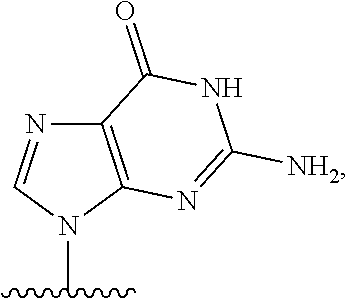
and T is

| Annealing Site | Base Sequence [5′ to 3′] |
| H51A(+66+95) | CTC CAA CAT CAA GGA AGA TGG CAT TTC TAG (SEQ ID NO: 679) |
| H51A(+74+97) | ACC TCC AAC ATC AAG GAA GAT GGC (SEQ ID NO: 601) |
| H51A(+70+99) | GTA CCT CCA ACA TCA AGG AAG ATG GCA TTT (SEQ ID NO: 606) |
| H51A(+72+99) | GTA CCT CCA ACA TCA AGG AAG ATG GCA T (SEQ ID NO: 608) |
| H51A(+68+87) | TCA AGG AAG ATG GCA TTT CT (SEQ ID NO: 680) |
| H51A(+68+87) | UCA AGG AmAGm AmUGm GmCA UUU CU (SEQ ID NO: 681) |
| H53A(+36+60) | GTT GCC TCC GGT TCT GAA GGT GTT C (SEQ ID NO: 682) |
| H53A(+36+60) | GTT G5mC5mC T5mC5mC GGT T5mC T GAA GGT GTT 5mC (SEQ ID NO: |
| 683) | |
| H53A(+36+56) | CCT CCG GTT CTG AAG GTG TTC (SEQ ID NO: 684) |
| H53A(+23+47) | CTG AAG GTG TTC TTG TAC TTC ATC C (SEQ ID NO: 34) |
| H53A(+32+56) | CCT CCG GTT CTG AAG GTG TTC TTG T (SEQ ID NO: 685) |
| H53A(+33+60) | GTT GCC TCC GGT TCT GAA GGT GTT CTT G (SEQ ID NO: 686) |
| H53A(+30+59) | TTG CCT CCG GTT CTG AAG GTG TTC TTG TAC (SEQ ID NO: 687) |
| H53A(+39+62) | CTG TTG CCT CCG GTT CTG AAG GTG (SEQ ID NO: 688) |
| H53A(+36+69) | CAT TCA ACT GTT GCC TCC GGT TCT GAA GGT G (SEQ ID NO: 689) |
| H53A(+45+62) | CTG TTG CCT CCG GTT CTG (SEQ ID NO: 690) |
| H45A(-03+19) | CAA TGC CAT CCT GGA GTT CCT G (SEQ ID NO: 691) |
| H45A(-09+25) | GCT GCC CAA TGC CAT CCT GGA GTT CCT GTA AGA T (SEQ ID NO: 692) |
| H45A(-03+25) | GCT GCC CAA TGC CAT CCT GGA GTT CCT G (SEQ ID NO: 693) |
| H45A(-06+25) | GCT GCC CAA TGC CAT CCT GGA GTT CCT GTA A (SEQ ID NO: 694) |
| H45A(-12+19) | CAA TGC CAT CCT GGA GTT CCT GTA AGA TAC C (SEQ ID NO: 695) |
| H45A(-09+19) | CAA TGC CAT CCT GGA GTT CCT GTA AGA T (SEQ ID NO: 696) |
| H45A(-12+16) | TGC CAT CCT GGA GTT CCT GTA AGA TAC C (SEQ ID NO: 697) |
| H45A(-14+25) | GCT GCC CAA TGC CAT CCT GGA GTT CCT GTA AGA TAC CAA (SEQ ID |
| NO: 698) | |
| H45A(-08+19) | CAA TGC CAT CCT GGA GTT CCT GTA AGA (SEQ ID NO: 699) |
| HM45A(-07+25) | GCT GCC CAA TGC CAT CCT GGA GTT CCT GTA AG (SEQ ID NO: 700) |
| H45A(-12+22) | GCC CAA TGC CAT CCT GGA GTT CCT GTA AGA TAC C (SEQ ID NO: 701) |
| H45A(-09+22) | GCC CAA TGC CAT CCT GGA GTT CCT GTA AGA T (SEQ ID NO: 702) |
| H45A(-09+30) | TTG CCG CTG CCC AAT GCC ATC CTG GAG TTC CTG TAA GAT (SEQ ID |
| NO: 703) | |
| H45A(-06+22) | GCC CAA TGC CAT CCT GGA GTT CCT GTA A (SEQ ID NO: 704) |
| H45A(-06+28) | GCC GCT GCC CAA TGC CAT CCT GGA GTT CCT GTA A (SEQ ID NO: 705) |
| H45A(-03+22) | GCC CAA TGC CAT CCT GGA GTT CCT G (SEQ ID NO: 706) |
| H45A(-03+28) | GCC GCT GCC CAA TGC CAT CCT GGA GTT CCT G (SEQ ID NO: 707) |
| H45A(+9+26) | m5C-G-m5C-T-G-C-m5C-m5C-A-A-T-G-m5C-m5C-A-U-m5C-m5C |
| (SEQ ID NO: 708) | |
| H44A(-10+15) | GAT CTG TCA AAT CGC CTG CAG GTA A (SEQ ID NO: 709) |
| H44A(-07+15) | GAT CTG TCA AAT CGC CTG CAG G (SEQ ID NO: 710) |
| H44M(-07+17) | CAG ATC TGT CAA ATC GCC TGC AGG (SEQ ID NO: 711) |
| H44A(-08+15) | GAT CTG TCA AAT CGC CTG CAG GT (SEQ ID NO: 712) |
| H44A(-06+15) | GAT CTG TCA AAT CGC CTG CAG (SEQ ID NO: 713) |
| H44A(-08+17) | CAG ATC TGT CAA ATC GCC TGC AGG T (SEQ ID NO: 714) |
| H44A(-06+17) | CAG ATC TGT CAA ATC GCC TGC AG (SEQ ID NO: 715) |
| H50D(+04-18) | GGG ATC CAG TAT ACT TAC AGG C (SEQ ID NO: 716) |
| H50D(+07-18) | GGG ATC CAG TAT ACT TAC AGG CTC C (SEQ ID NO: 568) |
| H50D(+07-16) | GAT CCA GTA TAC TTA CAG GCT CC (SEQ ID NO: 717) |
| H50D(+07-17) | GGA TCC AGT ATA CTT ACA GGC TCC (SEQ ID NO: 718) |
| H50A(-19+07) | ACT TCC TCT TTA ACA GAA AAG CAT AC (SEQ ID NO: 719) |
| H50D(+07-15) | ATC CAG TAT ACT TAC AGG CTC C (SEQ ID NO: 720) |
| H50A(-02+23) | GAG CTC AGA TCT TCT AAC TTC CTC T (SEQ ID NO: 721) |
| H50D(+06-18) | GGG ATC CAG TAT ACT TAC AGG CTC (SEQ ID NO: 722) |
| H50D(+07-20) | ATG GGA TCC AGT ATA CTT ACA GGC TCC (SEQ ID NO: 723) |
| H52A(-01+24) | CTG TTC CAA ATC CTG CAT TGT TGC C (SEQ ID NO: 724) |

C is
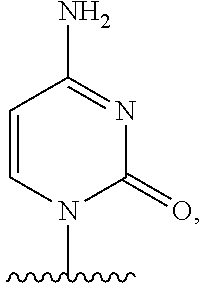
G is
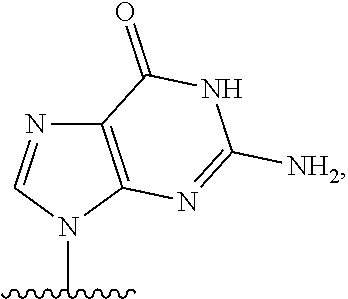
T is

U is
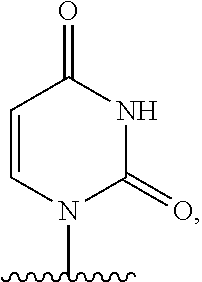
Gm is methylated guanine, Am is methylated adenine, and m5C is

Nucleobase Modifications and Substitutions


H#A/D(x:y).

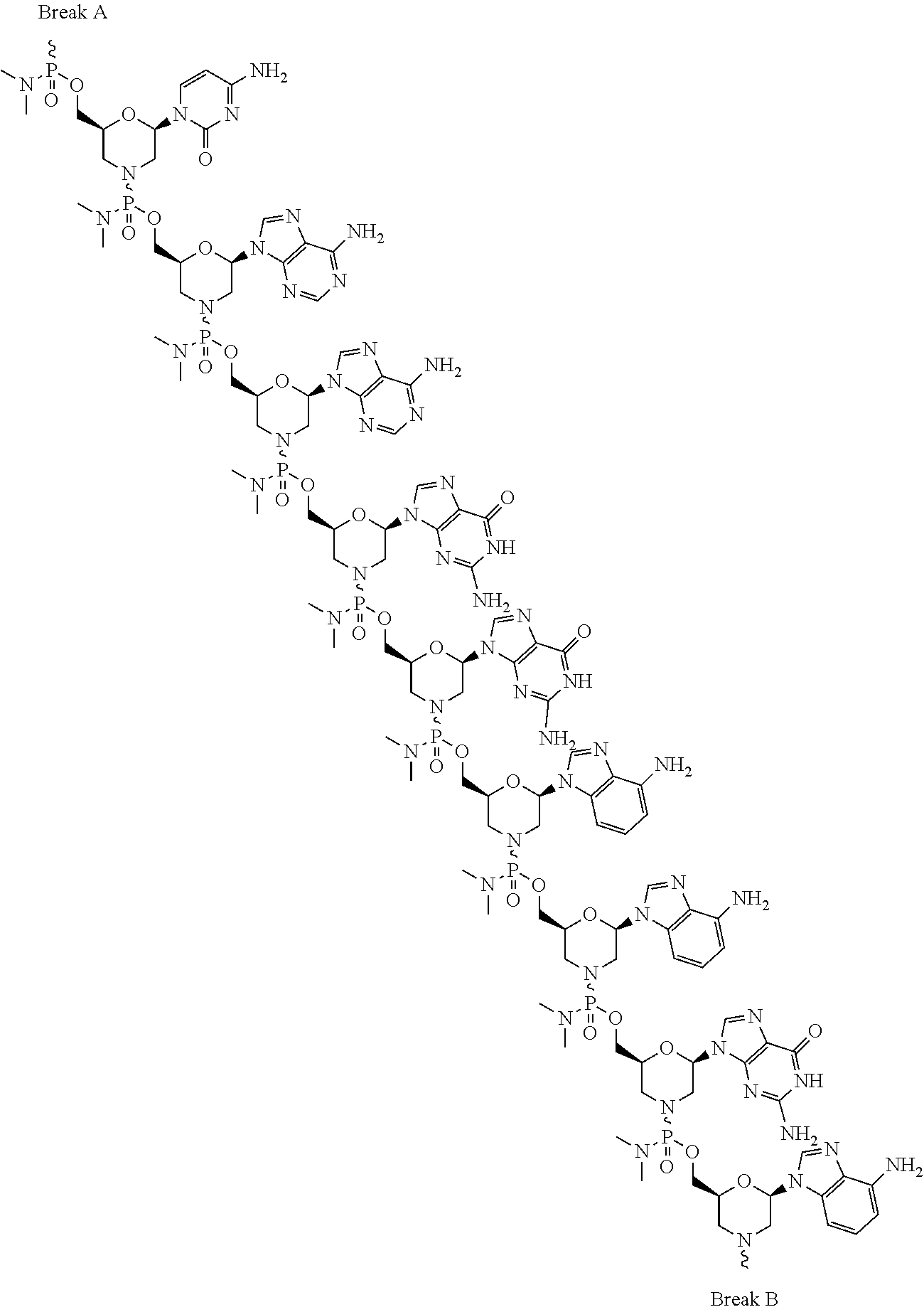

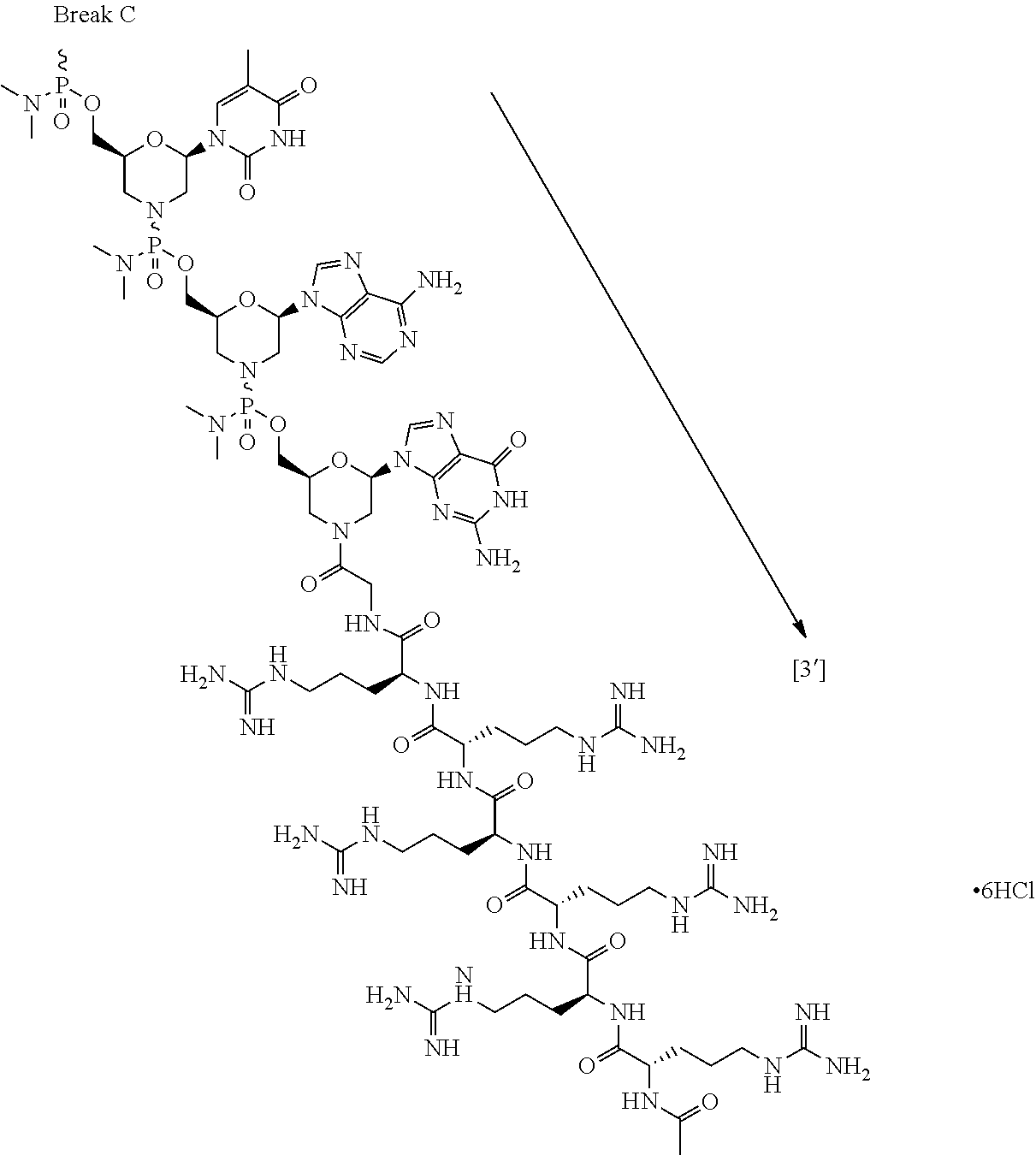
-
- If the number of body weight band=1, a flat dose of 1200 mg is anticipated to achieve target exposure across the body weight from 15 to 100 kg.
- If the number of body weight band=2, 15-40 kg is selected as the first band with flat dose of 1100 mg and 40-100 kg is selected as the second band with flat dose of 1300 mg.
- If the number of body weight band=3, 15-25 kg is selected as the first band with flat dose of 1100 mg, 25-50 kg as the second band with flat dose of 1200 mg and 15-25 kg as the third band with flat dose of 1400 mg.
- The more body weight bands are chosen, the less variability of drug exposure is anticipated.
- For those patients with the body weight less than 15 kg, a different dose may be selected based on their pharmacokinetic characteristics.
- Overall, this demonstrates that the body weight band approach (with the band number ≥1 and flat dose within each band, e.g. 900-1800 mg) can adequately achieve the target higher exposure.
| TABLE 2 |
| Body weight band dosing for PPMO-1 to achieve |
| a lower (A) and higher (B) target exposure. |
| (A) |
| Body | # of | Proposed | ||
| weight | BW | dose | Simulated AUC | Simulated Cmax |
| range | Band | mg | Median | 95 | Median | 95 |
|
| 15 ≤ x ≤ 25 kg | 3 | 600 | 152 | [104, 222] | 95 | [69, 128] |
| 25 ≤ x ≤ 50 kg | 650 | 150 | [102, 219] | 95 | [69, 128] | |
| 50 ≤ x ≤ 100 kg | 750 | 157 | [107, 228] | 98 | [72, 132] | |
| 15 ≤ x ≤ 40 |
2 | 600 | 145 | [98, 212] | 91 | [66, 124] |
| 40 ≤ x ≤ 100 kg | 700 | 147 | [100, 216] | 93 | [68, 125] | |
| 15 ≤ x ≤ 25 |
1 | 700 | 180 | [119, 264] | 110 | [79, 151] |
| 25 ≤ x ≤ 50 kg | 163 | [112, 234] | 102 | [75, 138] | ||
| 50 ≤ x ≤ 100 kg | 145 | [99, 212] | 92 | [68, 124] | ||
| (B) |
| Body | # of | Proposed | ||
| weight | BW | dose | Simulated AUC | Simulated Cmax |
| range | Band | mg | Median | 95 | Median | 95 |
|
| 15 ≤ x ≤ 25 kg | 3 | 1100 | 293 | [199, 433] | 174 | [127, 236] | |
| 25 ≤ x ≤ 50 kg | 1200 | 292 | [197, 429] | 176 | [128, 237] | ||
| 50 ≤ x ≤ 100 kg | 1400 | 308 | [208, 451] | 184 | [136, 247] | ||
| 15 ≤ x ≤ 40 |
2 | 1100 | 280 | [188, 412] | 168 | [121, 228] | |
| 40 ≤ x ≤ 100 kg | 1300 | 288 | [195, 426] | 173 | [127, 234] | ||
| 15 ≤ x ≤ 25 |
1 | 1200 | 321 | [213, 476] | 190 | [136, 260] | |
| 25 ≤ x ≤ 50 kg | 292 | [200, 425] | 175 | [129, 238] | |||
| 50 ≤ x ≤ 100 kg | 260 | [177, 383] | 158 | [117, 213] | |||
| TABLE 3 |
| Weight-tiered Dosing Regimen to Achieve |
| Target Exposure Range Across 18 to 100 kg |
| Target Exposure | Body | Simulated Exposure | |
| (AUC0-24 hr) | Weight | SRP-5051 | (AUC0-24 hr) median and |
| median and range | Tier* | Dose | 95 |
| 180 μg · h/mL | ≥18 | 750 | mg | 171 μg · h/mL (126, 234) |
| (120-240 μg · | but <50 kg | |||
| h/mL) | ≥50 kg | 850 | mg | 178 μg · h/mL (130, 243) |
| 300 μg · h/mL | ≥18 | 1250 | mg | 296 μg · h/mL (218, 420) |
| (200-500 μg · | but <50 kg | |||
| h/mL) | ≥50 kg | 1350 | mg | 298 μg · h/mL (217, 406) |
| AUC = area under the concentration-time curve | ||||
| *For simulation purposes, the upper boundary of body weight is set as 100 kg. | ||||
-
- i) about 300 mg to about 700 mg, or about 900 mg to about 1200 mg, once every four weeks for a patient that weighs from about 10 kg to about 25 kg;
- ii) about 600 mg to about 800 mg, or about 1000 mg to about 1300 mg, once every four weeks for a patient that weighs from about 25 kg to about 50 kg; or
- iii) about 700 mg to about 900 mg, or about 1200 mg to about 1500 mg, once every four weeks for a patient that weighs from about 50 kg to about 100 kg; to achieve the exposure level corresponding to an AUC of between about 100 and about 200 ug·h/mL, or is between about 200 and about 500 ug·h/mL.
-
- i) about 500 mg to about 700 mg, or about 1000 mg to about 1200 mg, once every four weeks for a patient that weighs from about 15 kg to about 40 kg; or
- ii) about 600 mg to about 800 mg, or about 1100 mg to about 1400 mg, once every four weeks for a patient that weighs from about 40 kg to about 100 kg;
-
- i) about 500 mg to about 700 mg, or about 1000 mg to about 1200 mg, once every four weeks for a patient that weighs from about 15 kg to about 40 kg; or
- ii) about 600 mg to about 800 mg, or about 1100 mg to about 1400 mg, once every four weeks for a patient that weighs from about 40 kg to about 100 kg;
-
- i) about 500 mg to about 700 mg, or about 1000 mg to about 1200 mg, once every four weeks for a patient that weighs from about 15 kg to about 40 kg; or
- ii) about 600 mg to about 800 mg, or about 1100 mg to about 1400 mg, once every four weeks for a patient that weighs from about 40 kg to about 100 kg; to achieve a mean AUC between about 100 and about 200 ug·h/mL, or is between about 200 and about 500 ug·h/mL.
-
- iii) about 700 mg to about 800 mg, or about 1200 mg to about 1250 mg, once every four weeks for a patient that weighs from about 18 kg to about 50 kg; or
- iv) about 800 mg to about 900 mg, or about 1300 mg to about 1400 mg, once every four weeks for a patient that weighs from about 40 kg to about 100 kg;
-
- i) an antisense oligomer conjugate of Formula (IV); and
- ii) a magnesium supplement,
wherein the conjugate, or a pharmaceutically acceptable salt thereof, is administered at a dose equivalent to about 20 mg/kg, about 30 mg/kg, or about 40 mg/kg of the 6HCl salt of the conjugate once every 4 weeks, and wherein the magnesium supplement is administered at a dose sufficient to normalize patient's serum magnesium level
-
- iii) an antisense oligomer conjugate of Formula (IV); and
- iv) a magnesium supplement.
-
- v) an antisense oligomer conjugate of Formula (VI); and
- vi) a magnesium supplement.
-
- vii) an antisense oligomer conjugate of Formula (VIII); and
- viii) a magnesium supplement.
Claims (22)


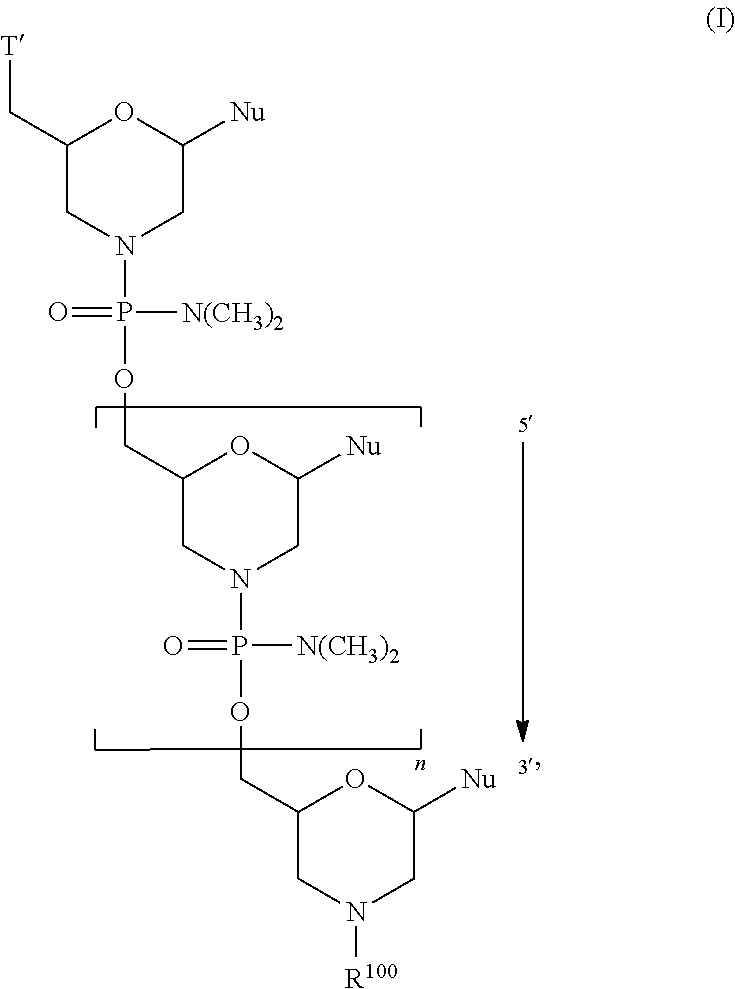


Priority Applications (1)
| Application Number | Priority Date | Filing Date | Title |
|---|---|---|---|
| US17/732,757 US12286630B2 (en) | 2021-04-30 | 2022-04-29 | Treatment methods for muscular dystrophy |
Applications Claiming Priority (3)
| Application Number | Priority Date | Filing Date | Title |
|---|---|---|---|
| US202163182327P | 2021-04-30 | 2021-04-30 | |
| US202163249721P | 2021-09-29 | 2021-09-29 | |
| US17/732,757 US12286630B2 (en) | 2021-04-30 | 2022-04-29 | Treatment methods for muscular dystrophy |
Publications (2)
| Publication Number | Publication Date |
|---|---|
| US20230193282A1 US20230193282A1 (en) | 2023-06-22 |
| US12286630B2 true US12286630B2 (en) | 2025-04-29 |
Family
ID=81749386
Family Applications (1)
| Application Number | Title | Priority Date | Filing Date |
|---|---|---|---|
| US17/732,757 Active 2042-09-09 US12286630B2 (en) | 2021-04-30 | 2022-04-29 | Treatment methods for muscular dystrophy |
Country Status (11)
| Country | Link |
|---|---|
| US (1) | US12286630B2 (en) |
| EP (1) | EP4330395A1 (en) |
| JP (1) | JP2024519451A (en) |
| KR (1) | KR20240004609A (en) |
| AU (1) | AU2022267324A1 (en) |
| BR (1) | BR112023021849A2 (en) |
| CA (1) | CA3216839A1 (en) |
| CO (1) | CO2023016203A2 (en) |
| IL (1) | IL307937A (en) |
| MX (1) | MX2023012559A (en) |
| WO (1) | WO2022232478A1 (en) |
Families Citing this family (6)
| Publication number | Priority date | Publication date | Assignee | Title |
|---|---|---|---|---|
| US20220193250A1 (en) | 2018-08-02 | 2022-06-23 | Dyne Therapeutics, Inc. | Muscle targeting complexes and uses thereof for treating facioscapulohumeral muscular dystrophy |
| US12018087B2 (en) | 2018-08-02 | 2024-06-25 | Dyne Therapeutics, Inc. | Muscle-targeting complexes comprising an anti-transferrin receptor antibody linked to an oligonucleotide and methods of delivering oligonucleotide to a subject |
| SG11202100934PA (en) | 2018-08-02 | 2021-02-25 | Dyne Therapeutics Inc | Muscle targeting complexes and uses thereof for treating dystrophinopathies |
| US11168141B2 (en) | 2018-08-02 | 2021-11-09 | Dyne Therapeutics, Inc. | Muscle targeting complexes and uses thereof for treating dystrophinopathies |
| US11771776B2 (en) | 2021-07-09 | 2023-10-03 | Dyne Therapeutics, Inc. | Muscle targeting complexes and uses thereof for treating dystrophinopathies |
| US11969475B2 (en) | 2021-07-09 | 2024-04-30 | Dyne Therapeutics, Inc. | Muscle targeting complexes and uses thereof for treating facioscapulohumeral muscular dystrophy |
Citations (42)
| Publication number | Priority date | Publication date | Assignee | Title |
|---|---|---|---|---|
| US5034506A (en) | 1985-03-15 | 1991-07-23 | Anti-Gene Development Group | Uncharged morpholino-based polymers having achiral intersubunit linkages |
| US5142047A (en) | 1985-03-15 | 1992-08-25 | Anti-Gene Development Group | Uncharged polynucleotide-binding polymers |
| US5166315A (en) | 1989-12-20 | 1992-11-24 | Anti-Gene Development Group | Sequence-specific binding polymers for duplex nucleic acids |
| US5217866A (en) | 1985-03-15 | 1993-06-08 | Anti-Gene Development Group | Polynucleotide assay reagent and method |
| WO1994002595A1 (en) | 1992-07-17 | 1994-02-03 | Ribozyme Pharmaceuticals, Inc. | Method and reagent for treatment of animal diseases |
| US5506337A (en) | 1985-03-15 | 1996-04-09 | Antivirals Inc. | Morpholino-subunit combinatorial library and method |
| WO1996010390A1 (en) | 1994-09-30 | 1996-04-11 | Inex Pharmaceuticals Corp. | Novel compositions for the introduction of polyanionic materials into cells |
| WO1996010392A1 (en) | 1994-09-30 | 1996-04-11 | The University Of British Columbia | Bilayer stabilizing components and their use in forming programmable fusogenic liposomes |
| WO1996010391A1 (en) | 1994-09-30 | 1996-04-11 | The University Of British Columbia | Polyethylene glycol modified ceramide lipids and liposome uses thereof |
| US5521063A (en) | 1985-03-15 | 1996-05-28 | Antivirals Inc. | Polynucleotide reagent containing chiral subunits and methods of use |
| US6683173B2 (en) | 1998-04-03 | 2004-01-27 | Epoch Biosciences, Inc. | Tm leveling methods |
| US6692911B2 (en) | 1998-02-19 | 2004-02-17 | Massachusetts Institute Of Technology | Cell delivery compositions |
| WO2004048570A1 (en) | 2002-11-25 | 2004-06-10 | Nonprofit Organization Translational Research Organization Of Duchenne Muscular Dystrophy | ENA NUCLEIC ACID DRUGS MODIFYING SPLICING IN mRNA PRECURSOR |
| WO2004097017A2 (en) | 2003-04-29 | 2004-11-11 | Avi Biopharma, Inc. | Compositions for enhancing transport and antisense efficacy of nucleic acid analog into cells |
| US7070807B2 (en) | 1999-12-29 | 2006-07-04 | Mixson A James | Branched histidine copolymers and methods for using same |
| US7163695B2 (en) | 1999-12-29 | 2007-01-16 | Mixson A James | Histidine copolymer and methods for using same |
| WO2009005793A2 (en) | 2007-06-29 | 2009-01-08 | Avi Biopharma, Inc. | Tissue specific peptide conjugates and methods |
| WO2009127230A1 (en) | 2008-04-16 | 2009-10-22 | Curevac Gmbh | MODIFIED (m)RNA FOR SUPPRESSING OR AVOIDING AN IMMUNOSTIMULATORY RESPONSE AND IMMUNOSUPPRESSIVE COMPOSITION |
| US8076476B2 (en) | 2007-11-15 | 2011-12-13 | Avi Biopharma, Inc. | Synthesis of morpholino oligomers using doubly protected guanine morpholino subunits |
| US8299206B2 (en) | 2007-11-15 | 2012-10-30 | Avi Biopharma, Inc. | Method of synthesis of morpholino oligomers |
| WO2012150960A1 (en) | 2011-05-05 | 2012-11-08 | Avi Biopharma, Inc. | Peptide oligonucleotide conjugates |
| US20120289457A1 (en) | 2011-05-05 | 2012-11-15 | Avi Biopharma, Inc. | Peptide oligonucleotide conjugates |
| US8969551B2 (en) | 2010-09-30 | 2015-03-03 | Nippon Shinyaku Co., Ltd. | Morpholino nucleic acid derivatives |
| WO2017062862A2 (en) | 2015-10-09 | 2017-04-13 | Wave Life Sciences Ltd. | Oligonucleotide compositions and methods thereof |
| US9840706B2 (en) | 2014-06-17 | 2017-12-12 | Nippon Shinyaku Co., Ltd. | Antisense nucleic acids |
| WO2018007475A1 (en) | 2016-07-05 | 2018-01-11 | Biomarin Technologies B.V. | Pre-mrna splice switching or modulating oligonucleotides comprising bicyclic scaffold moieties, with improved characteristics for the treatment of genetic disorders |
| WO2018091544A1 (en) | 2016-11-16 | 2018-05-24 | Biomarin Pharmaceutical, Inc. | Substances for targeting various selected organs or tissues |
| US9988629B2 (en) | 2014-03-12 | 2018-06-05 | Nippon Shinyaku Co., Ltd. | Antisense nucleic acids |
| WO2018118627A1 (en) * | 2016-12-19 | 2018-06-28 | Sarepta Therapeutics, Inc. | Exon skipping oligomer conjugates for muscular dystrophy |
| WO2018129384A1 (en) | 2017-01-06 | 2018-07-12 | Avidity Biosciences Llc | Nucleic acid-polypeptide compositions and methods of inducing exon skipping |
| WO2019060775A1 (en) | 2017-09-22 | 2019-03-28 | Avidity Biosciences Llc | Nucleic acid-polypeptide compositions and methods of inducing exon skipping |
| WO2020004675A1 (en) | 2018-06-26 | 2020-01-02 | 日本新薬株式会社 | Composition comprising antisense oligonucleotide and use thereof for treatment of duchenne muscular dystrophy |
| WO2020028832A1 (en) | 2018-08-02 | 2020-02-06 | Dyne Therapeutics, Inc. | Muscle targeting complexes and uses thereof for treating dystrophinopathies |
| WO2020089325A1 (en) | 2018-11-02 | 2020-05-07 | Biomarin Technologies B.V. | Bispecific antisense oligonucleotides for dystrophin exon skipping |
| US10683322B2 (en) | 2010-09-01 | 2020-06-16 | Nippon Shinyaku Co., Ltd. | Antisense nucleic acids |
| WO2020158792A1 (en) | 2019-01-30 | 2020-08-06 | 国立研究開発法人国立精神・神経医療研究センター | Nucleic acid delivery complex |
| US10781448B2 (en) | 2011-12-28 | 2020-09-22 | Nippon Shinyaku Co., Ltd. | Antisense nucleic acids |
| WO2020214763A1 (en) * | 2019-04-18 | 2020-10-22 | Sarepta Therapeutics, Inc. | Compositions for treating muscular dystrophy |
| WO2020219820A1 (en) | 2019-04-25 | 2020-10-29 | Avidity Biosciences, Inc. | Nucleic acid compositions and methods of multi-exon skipping |
| US10851373B2 (en) | 2015-09-15 | 2020-12-01 | Nippon Shinyaku Co., Ltd. | Antisense nucleic acids |
| US10888578B2 (en) | 2016-12-19 | 2021-01-12 | Sarepta Therapeutics, Inc. | Exon skipping oligomer conjugates for muscular dystrophy |
| US11000600B2 (en) | 2016-12-19 | 2021-05-11 | Sarepta Therapeutics, Inc. | Exon skipping oligomer conjugates for muscular dystrophy |
-
2022
- 2022-04-29 US US17/732,757 patent/US12286630B2/en active Active
- 2022-04-29 WO PCT/US2022/026887 patent/WO2022232478A1/en not_active Ceased
- 2022-04-29 EP EP22724552.9A patent/EP4330395A1/en active Pending
- 2022-04-29 CA CA3216839A patent/CA3216839A1/en active Pending
- 2022-04-29 MX MX2023012559A patent/MX2023012559A/en unknown
- 2022-04-29 JP JP2023563991A patent/JP2024519451A/en active Pending
- 2022-04-29 KR KR1020237040520A patent/KR20240004609A/en active Pending
- 2022-04-29 AU AU2022267324A patent/AU2022267324A1/en active Pending
- 2022-04-29 IL IL307937A patent/IL307937A/en unknown
- 2022-04-29 BR BR112023021849A patent/BR112023021849A2/en unknown
-
2023
- 2023-11-29 CO CONC2023/0016203A patent/CO2023016203A2/en unknown
Patent Citations (48)
| Publication number | Priority date | Publication date | Assignee | Title |
|---|---|---|---|---|
| US5698685A (en) | 1985-03-15 | 1997-12-16 | Antivirals Inc. | Morpholino-subunit combinatorial library and method |
| US5521063A (en) | 1985-03-15 | 1996-05-28 | Antivirals Inc. | Polynucleotide reagent containing chiral subunits and methods of use |
| US5217866A (en) | 1985-03-15 | 1993-06-08 | Anti-Gene Development Group | Polynucleotide assay reagent and method |
| US5506337A (en) | 1985-03-15 | 1996-04-09 | Antivirals Inc. | Morpholino-subunit combinatorial library and method |
| US5034506A (en) | 1985-03-15 | 1991-07-23 | Anti-Gene Development Group | Uncharged morpholino-based polymers having achiral intersubunit linkages |
| US5142047A (en) | 1985-03-15 | 1992-08-25 | Anti-Gene Development Group | Uncharged polynucleotide-binding polymers |
| US5166315A (en) | 1989-12-20 | 1992-11-24 | Anti-Gene Development Group | Sequence-specific binding polymers for duplex nucleic acids |
| WO1994002595A1 (en) | 1992-07-17 | 1994-02-03 | Ribozyme Pharmaceuticals, Inc. | Method and reagent for treatment of animal diseases |
| WO1996010391A1 (en) | 1994-09-30 | 1996-04-11 | The University Of British Columbia | Polyethylene glycol modified ceramide lipids and liposome uses thereof |
| WO1996010390A1 (en) | 1994-09-30 | 1996-04-11 | Inex Pharmaceuticals Corp. | Novel compositions for the introduction of polyanionic materials into cells |
| WO1996010392A1 (en) | 1994-09-30 | 1996-04-11 | The University Of British Columbia | Bilayer stabilizing components and their use in forming programmable fusogenic liposomes |
| US6692911B2 (en) | 1998-02-19 | 2004-02-17 | Massachusetts Institute Of Technology | Cell delivery compositions |
| US6683173B2 (en) | 1998-04-03 | 2004-01-27 | Epoch Biosciences, Inc. | Tm leveling methods |
| US7070807B2 (en) | 1999-12-29 | 2006-07-04 | Mixson A James | Branched histidine copolymers and methods for using same |
| US7163695B2 (en) | 1999-12-29 | 2007-01-16 | Mixson A James | Histidine copolymer and methods for using same |
| WO2004048570A1 (en) | 2002-11-25 | 2004-06-10 | Nonprofit Organization Translational Research Organization Of Duchenne Muscular Dystrophy | ENA NUCLEIC ACID DRUGS MODIFYING SPLICING IN mRNA PRECURSOR |
| US20130090465A1 (en) | 2002-11-25 | 2013-04-11 | Masafumi Matsuo | ENA NUCLEIC ACID PHARMACEUTICALS CAPABLE OF MODIFYING SPLICING OF mRNA PRECURSORS |
| WO2004097017A2 (en) | 2003-04-29 | 2004-11-11 | Avi Biopharma, Inc. | Compositions for enhancing transport and antisense efficacy of nucleic acid analog into cells |
| WO2009005793A2 (en) | 2007-06-29 | 2009-01-08 | Avi Biopharma, Inc. | Tissue specific peptide conjugates and methods |
| US8076476B2 (en) | 2007-11-15 | 2011-12-13 | Avi Biopharma, Inc. | Synthesis of morpholino oligomers using doubly protected guanine morpholino subunits |
| US8299206B2 (en) | 2007-11-15 | 2012-10-30 | Avi Biopharma, Inc. | Method of synthesis of morpholino oligomers |
| WO2009127230A1 (en) | 2008-04-16 | 2009-10-22 | Curevac Gmbh | MODIFIED (m)RNA FOR SUPPRESSING OR AVOIDING AN IMMUNOSTIMULATORY RESPONSE AND IMMUNOSUPPRESSIVE COMPOSITION |
| US10683322B2 (en) | 2010-09-01 | 2020-06-16 | Nippon Shinyaku Co., Ltd. | Antisense nucleic acids |
| US8969551B2 (en) | 2010-09-30 | 2015-03-03 | Nippon Shinyaku Co., Ltd. | Morpholino nucleic acid derivatives |
| US9161948B2 (en) | 2011-05-05 | 2015-10-20 | Sarepta Therapeutics, Inc. | Peptide oligonucleotide conjugates |
| US20120289457A1 (en) | 2011-05-05 | 2012-11-15 | Avi Biopharma, Inc. | Peptide oligonucleotide conjugates |
| WO2012150960A1 (en) | 2011-05-05 | 2012-11-08 | Avi Biopharma, Inc. | Peptide oligonucleotide conjugates |
| US10781448B2 (en) | 2011-12-28 | 2020-09-22 | Nippon Shinyaku Co., Ltd. | Antisense nucleic acids |
| US9988629B2 (en) | 2014-03-12 | 2018-06-05 | Nippon Shinyaku Co., Ltd. | Antisense nucleic acids |
| US9840706B2 (en) | 2014-06-17 | 2017-12-12 | Nippon Shinyaku Co., Ltd. | Antisense nucleic acids |
| US10851373B2 (en) | 2015-09-15 | 2020-12-01 | Nippon Shinyaku Co., Ltd. | Antisense nucleic acids |
| WO2017062862A2 (en) | 2015-10-09 | 2017-04-13 | Wave Life Sciences Ltd. | Oligonucleotide compositions and methods thereof |
| WO2018007475A1 (en) | 2016-07-05 | 2018-01-11 | Biomarin Technologies B.V. | Pre-mrna splice switching or modulating oligonucleotides comprising bicyclic scaffold moieties, with improved characteristics for the treatment of genetic disorders |
| WO2018091544A1 (en) | 2016-11-16 | 2018-05-24 | Biomarin Pharmaceutical, Inc. | Substances for targeting various selected organs or tissues |
| US10888578B2 (en) | 2016-12-19 | 2021-01-12 | Sarepta Therapeutics, Inc. | Exon skipping oligomer conjugates for muscular dystrophy |
| US11000600B2 (en) | 2016-12-19 | 2021-05-11 | Sarepta Therapeutics, Inc. | Exon skipping oligomer conjugates for muscular dystrophy |
| US11382981B2 (en) | 2016-12-19 | 2022-07-12 | Sarepta Therapeutics, Inc. | Exon skipping oligomer conjugates for muscular dystrophy |
| WO2018118627A1 (en) * | 2016-12-19 | 2018-06-28 | Sarepta Therapeutics, Inc. | Exon skipping oligomer conjugates for muscular dystrophy |
| WO2018129384A1 (en) | 2017-01-06 | 2018-07-12 | Avidity Biosciences Llc | Nucleic acid-polypeptide compositions and methods of inducing exon skipping |
| WO2019060775A1 (en) | 2017-09-22 | 2019-03-28 | Avidity Biosciences Llc | Nucleic acid-polypeptide compositions and methods of inducing exon skipping |
| WO2020004675A1 (en) | 2018-06-26 | 2020-01-02 | 日本新薬株式会社 | Composition comprising antisense oligonucleotide and use thereof for treatment of duchenne muscular dystrophy |
| US20210261963A1 (en) | 2018-06-26 | 2021-08-26 | Nippon Shinyaku Co., Ltd. | Composition comprising antisense oligonucleotide and use thereof for treatment of duchenne muscular dystrophy |
| WO2020028832A1 (en) | 2018-08-02 | 2020-02-06 | Dyne Therapeutics, Inc. | Muscle targeting complexes and uses thereof for treating dystrophinopathies |
| WO2020089325A1 (en) | 2018-11-02 | 2020-05-07 | Biomarin Technologies B.V. | Bispecific antisense oligonucleotides for dystrophin exon skipping |
| WO2020158792A1 (en) | 2019-01-30 | 2020-08-06 | 国立研究開発法人国立精神・神経医療研究センター | Nucleic acid delivery complex |
| US20220127606A1 (en) | 2019-01-30 | 2022-04-28 | National Center Of Neurology And Psychiatry | Nucleic acid delivery complex |
| WO2020214763A1 (en) * | 2019-04-18 | 2020-10-22 | Sarepta Therapeutics, Inc. | Compositions for treating muscular dystrophy |
| WO2020219820A1 (en) | 2019-04-25 | 2020-10-29 | Avidity Biosciences, Inc. | Nucleic acid compositions and methods of multi-exon skipping |
Non-Patent Citations (37)
| Title |
|---|
| "The Glen Research Catalog," www.glenresearch.com, accessed at https://www.glenresearch.com/site-content, accessed on Aug. 22, 2022. |
| Aartsma-Rus, et al., "Theoretic applicability of antisense-mediated exon skipping for Duchenne muscular dystrophy mutations," Hum. Mutat. 30(3):293-299, Wiley, United States (Mar. 2009). |
| Akhtar, S., Delivery Strategies for Antisense Oligonucleotide Therapeutics, First Edition, CRC Press, Boca Raton, Florida, United States (1995). |
| Akhtar, S., et al., "Cellular uptake and intracellular fate of antisense oligonucleotides," Trends Cell Biol 2(5):139-144, Cell Press, United States (May 1992). |
| Amantana, A., et al., "Pharmacokinetics, biodistribution, stability and toxicity of a cell-penetrating peptide-morpholino oligomer conjugate," Bioconjug Chem 18(4):1325-1331. American Chemical Society, United States (Aug. 2007).[KC2]. |
| Benner, S.A., and Sismour, A., "Synthetic biology," Nat. Rev. Genet. 6(7):533-543, Nature Publishing Group, Germany (Jul. 2005). |
| Berge, S.M., et al., "Pharmaceutical Salts," J. Pharm. Sci. 66(1):1-19, Elsevier, Netherlands (Jan. 1977). |
| Chiu, Y.L. and Rana, T.M., "siRNA function in RNAi: a chemical modification analysis," RNA 9(9):1034-1048, Cold Spring Harbor Laboratory Press, United States (Sep. 2003). |
| Clinical Trial NCT03375255 , printed from ClinicalTrials.gov, NCT03375255, version 19, Mar. 26, 2020, pp. 1-13 (Year: 2020). * |
| Dellorusso, C., et al., "Functional correction of adult mdx mouse muscle using gutted adenoviral vectors expressing full-length dystrophin," Proc Natl Acad Sci USA 99(20):12979-12984, National Academy of Sciences, United States (Sep. 2002). |
| Emerich, D.F., et al., "Biocompatibility of poly (DL-lactide-co-glycolide) microspheres implanted into the brain," Cell Transplant 8(1):47-58, Sage Publications, Inc., United States (Feb. 1999). |
| Fletcher, S., et al., "Dystrophin isoform induction in vivo by antisense-mediated alternative splicing," Mol. Ther. 18(6):1218-1223, Cell Press, United States (Jun. 2010). |
| Greene, T.W., et al., Protective Groups in Organic Synthesis, Second Edition, John Wiley and Sons, United States (1991). |
| Gurvich, O.L., et al., "DMD exon 1 truncating point mutations: amelioration of phenotype by alternative translation initiation in exon 6," Hum. Mutat. 30(4):633-640, Wiley, United States (Apr. 2009). |
| Henricson, E., et al., "Percent-predicted 6-minute walk distance in duchenne muscular dystrophy to account for maturational influences," PLOS Curr. 4:RRN122297, PLOS, United States (Jan. 2012). |
| Henry, A.A., and Romesberg, F.E., "Beyond A, C, G and T: augmenting nature's alphabet," Curr. Opin. Chem. Biol. 7(6):727-733, Elsevier, Netherlands (Dec. 2003). |
| Hirao, I., "Unnatural base pair systems for DNA/RNA-based biotechnology," Curr. Opin. Chem. Biol. 10(6):622-627, Elsevier, Netherlands (Dec. 2006). |
| Hong, Y., et al., "Model-based approach for optimization of atazanavir dose recommendations for HIV-infected pediatric patients," Antimicrrob. Agents Chemother. 55(12):5746-5752, Oxford University Press, United Kingdom (Dec. 2011). |
| International Search Report and Written Opinion for International Application No. PCT/US2022/026887, European Patent Office, Netherlands, mailed on Jul. 21, 2022, 12 pages. |
| Ishiwata, H., et al., "Physical-chemistry characteristics and biodistribution of poly(ethylene glycol)-coated liposomes using poly(oxyethylene) cholesteryl ether," Chem. Pharm. Bull. 43:1005-1011, Pharmaceutical Society of Japan, Japan (Jun. 1995). |
| Kool, E.T., "Replacing the nucleobases in DNA with designer molecules," Acc. Chem. Res. 35(11):936-943, American Chemical Society, United States (Nov. 2002). |
| Krueger, A.T., et al., "Synthesis and properties of size-expanded DNAs: toward designed, functional genetic systems," Acc. Chem. Res. 40(2):141-150, American Chemical Society, United States (Feb. 2007). |
| Lasic, D.D., et al., "Liposomes revisited," Science 267(5202):1275-1276, American Association for the Advancement of Science, United States (1995). |
| Lasic, D.D., et al., "The "Stealth" Liposome: A Prototypical Biomaterial," Chem. Rev. 95(8):2601-2627, American Chemical Society, United States (1995). |
| Limbach, P.A., et al., "Summary: the modified nucleosides of RNA," Nucleic Acids Res. 22(12):2183-2196, Oxford University Press, United Kingdom (Jun. 1994). |
| Liu, Y., et al., "Cationic liposome-mediated intravenous gene delivery," J. Biol. Chem. 270(42):24864-24870, Elsevier, Netherlands (Oct. 1995). |
| Mann, C.J., et al., "Improved antisense oligonucleotide induced exon skipping in the mdx mouse model of muscular dystrophy," J. Gene. Med. 4(6):644-654, Wiley, United States (Dec. 2002). |
| McDonald, C.M., et al., "The 6-minute walk test in Duchenne/Becker muscular dystrophy: Longitudinal observations," Muscle Nerve 42(6):966-974, Wiley, United States (Dec. 2010). |
| Monaco, A.P., et al., "An explanation for the phenotypic differences between patients bearing partial deletions of the DMD locus," Genomics 2(1):90-95, Elsevier, Netherlands (Jan. 1988). |
| Mukashyaka, M., et al., "Pharmacokinetic/Pharmacodynamic Modeling of a Cell-Penetrating Peptide Phosphorodiamidate Morpholino Oligomer in mdx Mice," Pharm Res 38(10:1731-1745, Springer New York, United States (Oct. 2021). |
| Oku, N., et al., "Real-time analysis of liposomal trafficking in tumor-bearing mice by use of positron emission tomography," Biochim. Biophys. Acta. 1238:86-90, Elsevier, Netherlands (Aug. 1995). |
| Peacock, H., et al., "Nucleobase and ribose modifications control immunostimulation by a microRNA-122-mimetic RNA," J. Am. Chem. Soc. 133(24):9200-9203, American Chemical Society, United States (Jun. 2011). |
| Revankar, T. and Rao, S., "DNA with Altered Bases," in Comprehensive Natural Products Chemistry, Kool, E.T., ed., pp. 313-339, Pergamon Press, United Kingdom (1999). |
| Sarepta Therapeutics, Inc.: "Sarepta Therapeutics Reports Positive Clinical Results from Phase 2 Momentum Study of SRP-5051 in Patients with Duchenne Muscular Dystrophy Amenable to Skipping Exon 51," accessed at https://investorrelations.sarepta.com/node/20641/pdf, 3 pages. |
| Schroeder, U., et al., "Diffusion enhancement of drugs by loaded nanoparticles in vitro," Prog. Neuropsychopharmacol. Biol. Psychiatry 23(5):941-949, Elsevier, Netherlands (Jul. 1999). |
| Shabashvili, A., "Sarepta and Solid: the future of DMD therapy—Life Sciences Finance," lifescifin.com, accessed at https://lifescifin.com/2021/05/20/sarepta-and-solid-the-future-of-dmd-therapy/, 11 pages. |
| Summerton, J., et al., "Morpholino antisense oligomers: design, preparation, and properties," Antisense Nucleic Acid Drug Dev. 7(3):185-195, Mary Ann Liebert, Inc., United States (Jun. 1997). |
Also Published As
| Publication number | Publication date |
|---|---|
| CO2023016203A2 (en) | 2024-02-15 |
| KR20240004609A (en) | 2024-01-11 |
| US20230193282A1 (en) | 2023-06-22 |
| IL307937A (en) | 2023-12-01 |
| AU2022267324A9 (en) | 2023-12-21 |
| JP2024519451A (en) | 2024-05-14 |
| AU2022267324A1 (en) | 2023-12-14 |
| WO2022232478A1 (en) | 2022-11-03 |
| CA3216839A1 (en) | 2022-11-03 |
| BR112023021849A2 (en) | 2023-12-19 |
| EP4330395A1 (en) | 2024-03-06 |
| MX2023012559A (en) | 2023-12-15 |
Similar Documents
| Publication | Publication Date | Title |
|---|---|---|
| US12286630B2 (en) | Treatment methods for muscular dystrophy | |
| US20220193246A1 (en) | Compositions for treating muscular dystrophy | |
| US20200248178A1 (en) | Combination therapies for treating muscular dystrophy | |
| US20210145852A1 (en) | Combination Therapies for Treating Muscular Dystrophy | |
| US20250195667A1 (en) | Phosphorodiamidate morpholino oligomer conjugates | |
| US20250290069A1 (en) | Exon skipping oligomers for muscular dystrophy | |
| US20230109466A1 (en) | Compositions for treatment of polycystic kidney disease | |
| US20200254002A1 (en) | Combination therapies for treating muscular dystrophy | |
| CN112384222A (en) | Exon skipping oligomer conjugates for muscular dystrophy | |
| CN113660939A (en) | Using Casimerson to Treat Muscular Dystrophy | |
| US20240141350A1 (en) | Methods for treatment of polycystic kidney disease | |
| US20240294913A1 (en) | Methods and Compositions for Treatment of Polycystic Kidney Disease | |
| US20220096517A1 (en) | MicroRNA Compounds and Methods for Modulating MIR-10B Activity | |
| US20240327831A1 (en) | Compositions comprising exon skipping oligonucleotide conjugates for treating muscular dystrophy | |
| TW202035695A (en) | Exon skipping oligomer conjugates for muscular dystrophy | |
| US20250333745A1 (en) | Methods and compositions for treatment of polycystic kidney disease | |
| TW202442241A (en) | Methods for treating polycystic kidney disease | |
| US20210220386A1 (en) | Exon skipping oligomers and oligomer conjugates for muscular dystrophy | |
| CN117203337A (en) | Muscular Dystrophy Treatment | |
| CN112639097A (en) | Exon skipping oligomers for muscular dystrophy | |
| US20240218365A1 (en) | Formulation of an antisense oligomer conjugate | |
| WO2025231388A1 (en) | Methods and compositions for treating pompe disease |
Legal Events
| Date | Code | Title | Description |
|---|---|---|---|
| FEPP | Fee payment procedure |
Free format text: ENTITY STATUS SET TO UNDISCOUNTED (ORIGINAL EVENT CODE: BIG.); ENTITY STATUS OF PATENT OWNER: LARGE ENTITY |
|
| STPP | Information on status: patent application and granting procedure in general |
Free format text: DOCKETED NEW CASE - READY FOR EXAMINATION |
|
| STPP | Information on status: patent application and granting procedure in general |
Free format text: NON FINAL ACTION MAILED |
|
| STPP | Information on status: patent application and granting procedure in general |
Free format text: RESPONSE TO NON-FINAL OFFICE ACTION ENTERED AND FORWARDED TO EXAMINER |
|
| STPP | Information on status: patent application and granting procedure in general |
Free format text: NOTICE OF ALLOWANCE MAILED -- APPLICATION RECEIVED IN OFFICE OF PUBLICATIONS |
|
| AS | Assignment |
Owner name: SAREPTA THERAPEUTICS, INC., MASSACHUSETTS Free format text: ASSIGNMENT OF ASSIGNORS INTEREST;ASSIGNORS:SUN, HUADONG;EAST, LILLY;TINSLEY, JON;AND OTHERS;SIGNING DATES FROM 20220720 TO 20250109;REEL/FRAME:069865/0358 |
|
| STCF | Information on status: patent grant |
Free format text: PATENTED CASE |
|
| AS | Assignment |
Owner name: JPMORGAN CHASE BANK, N.A. AS ADMINISTRATIVE AGENT, ILLINOIS Free format text: SECURITY INTEREST;ASSIGNOR:SAREPTA THERAPEUTICS, INC.;REEL/FRAME:071218/0445 Effective date: 20250213 |