US20180344614A1 - Hair compositions providing improved in-use wet feel - Google Patents
Hair compositions providing improved in-use wet feel Download PDFInfo
- Publication number
- US20180344614A1 US20180344614A1 US16/001,064 US201816001064A US2018344614A1 US 20180344614 A1 US20180344614 A1 US 20180344614A1 US 201816001064 A US201816001064 A US 201816001064A US 2018344614 A1 US2018344614 A1 US 2018344614A1
- Authority
- US
- United States
- Prior art keywords
- hair care
- care composition
- weight
- cationic
- mol
- Prior art date
- Legal status (The legal status is an assumption and is not a legal conclusion. Google has not performed a legal analysis and makes no representation as to the accuracy of the status listed.)
- Granted
Links
- 239000000203 mixture Substances 0.000 title claims abstract description 265
- 125000002091 cationic group Chemical group 0.000 claims abstract description 131
- 229920000642 polymer Polymers 0.000 claims abstract description 97
- 239000004094 surface-active agent Substances 0.000 claims abstract description 52
- 239000006260 foam Substances 0.000 claims abstract description 45
- 229920001059 synthetic polymer Polymers 0.000 claims abstract description 30
- 239000000443 aerosol Substances 0.000 claims abstract description 13
- 244000007835 Cyamopsis tetragonoloba Species 0.000 claims abstract 7
- 239000000178 monomer Substances 0.000 claims description 63
- 125000000217 alkyl group Chemical group 0.000 claims description 38
- QAOWNCQODCNURD-UHFFFAOYSA-L Sulfate Chemical compound [O-]S([O-])(=O)=O QAOWNCQODCNURD-UHFFFAOYSA-L 0.000 claims description 18
- 229920000371 poly(diallyldimethylammonium chloride) polymer Polymers 0.000 claims description 18
- 125000003545 alkoxy group Chemical group 0.000 claims description 13
- 229920001577 copolymer Polymers 0.000 claims description 12
- 150000002148 esters Chemical class 0.000 claims description 12
- 239000004088 foaming agent Substances 0.000 claims description 12
- 238000000034 method Methods 0.000 claims description 12
- 125000002877 alkyl aryl group Chemical group 0.000 claims description 10
- 125000004104 aryloxy group Chemical group 0.000 claims description 9
- ATUOYWHBWRKTHZ-UHFFFAOYSA-N Propane Chemical compound CCC ATUOYWHBWRKTHZ-UHFFFAOYSA-N 0.000 claims description 8
- 229920001519 homopolymer Polymers 0.000 claims description 8
- NNPPMTNAJDCUHE-UHFFFAOYSA-N isobutane Chemical compound CC(C)C NNPPMTNAJDCUHE-UHFFFAOYSA-N 0.000 claims description 8
- 150000008051 alkyl sulfates Chemical class 0.000 claims description 7
- 229910052757 nitrogen Inorganic materials 0.000 claims description 7
- 229910052717 sulfur Inorganic materials 0.000 claims description 7
- RTZKZFJDLAIYFH-UHFFFAOYSA-N Diethyl ether Chemical compound CCOCC RTZKZFJDLAIYFH-UHFFFAOYSA-N 0.000 claims description 6
- 229910052760 oxygen Inorganic materials 0.000 claims description 6
- 229910052799 carbon Inorganic materials 0.000 claims description 4
- 125000000524 functional group Chemical group 0.000 claims description 4
- 229910052736 halogen Inorganic materials 0.000 claims description 4
- 150000002367 halogens Chemical class 0.000 claims description 4
- 239000001282 iso-butane Substances 0.000 claims description 4
- 239000007791 liquid phase Substances 0.000 claims description 4
- 239000001294 propane Substances 0.000 claims description 4
- LVZWSLJZHVFIQJ-UHFFFAOYSA-N Cyclopropane Chemical compound C1CC1 LVZWSLJZHVFIQJ-UHFFFAOYSA-N 0.000 claims description 3
- 150000004703 alkoxides Chemical class 0.000 claims description 3
- 125000005248 alkyl aryloxy group Chemical group 0.000 claims description 3
- 125000001118 alkylidene group Chemical group 0.000 claims description 3
- 125000003368 amide group Chemical group 0.000 claims description 3
- 125000003118 aryl group Chemical group 0.000 claims description 3
- XLYOFNOQVPJJNP-UHFFFAOYSA-M hydroxide Chemical compound [OH-] XLYOFNOQVPJJNP-UHFFFAOYSA-M 0.000 claims description 3
- IJDNQMDRQITEOD-UHFFFAOYSA-N n-butane Chemical compound CCCC IJDNQMDRQITEOD-UHFFFAOYSA-N 0.000 claims description 3
- 229910052698 phosphorus Inorganic materials 0.000 claims description 3
- -1 for example Substances 0.000 description 91
- 229920001296 polysiloxane Polymers 0.000 description 62
- 244000303965 Cyamopsis psoralioides Species 0.000 description 59
- 239000011734 sodium Substances 0.000 description 39
- 229910052708 sodium Inorganic materials 0.000 description 39
- 229940083542 sodium Drugs 0.000 description 39
- DGAQECJNVWCQMB-PUAWFVPOSA-M Ilexoside XXIX Chemical compound C[C@@H]1CC[C@@]2(CC[C@@]3(C(=CC[C@H]4[C@]3(CC[C@@H]5[C@@]4(CC[C@@H](C5(C)C)OS(=O)(=O)[O-])C)C)[C@@H]2[C@]1(C)O)C)C(=O)O[C@H]6[C@@H]([C@H]([C@@H]([C@H](O6)CO)O)O)O.[Na+] DGAQECJNVWCQMB-PUAWFVPOSA-M 0.000 description 34
- 125000004432 carbon atom Chemical group C* 0.000 description 31
- 229920002472 Starch Polymers 0.000 description 30
- 235000019698 starch Nutrition 0.000 description 29
- OMDQUFIYNPYJFM-XKDAHURESA-N (2r,3r,4s,5r,6s)-2-(hydroxymethyl)-6-[[(2r,3s,4r,5s,6r)-4,5,6-trihydroxy-3-[(2s,3s,4s,5s,6r)-3,4,5-trihydroxy-6-(hydroxymethyl)oxan-2-yl]oxyoxan-2-yl]methoxy]oxane-3,4,5-triol Chemical class O[C@@H]1[C@@H](O)[C@@H](O)[C@@H](CO)O[C@@H]1OC[C@@H]1[C@@H](O[C@H]2[C@H]([C@@H](O)[C@H](O)[C@@H](CO)O2)O)[C@H](O)[C@H](O)[C@H](O)O1 OMDQUFIYNPYJFM-XKDAHURESA-N 0.000 description 27
- VEXZGXHMUGYJMC-UHFFFAOYSA-M Chloride anion Chemical compound [Cl-] VEXZGXHMUGYJMC-UHFFFAOYSA-M 0.000 description 27
- 229920000926 Galactomannan Polymers 0.000 description 27
- 239000000839 emulsion Substances 0.000 description 27
- 239000008107 starch Substances 0.000 description 27
- NIXOWILDQLNWCW-UHFFFAOYSA-M Acrylate Chemical compound [O-]C(=O)C=C NIXOWILDQLNWCW-UHFFFAOYSA-M 0.000 description 26
- HRPVXLWXLXDGHG-UHFFFAOYSA-N Acrylamide Chemical compound NC(=O)C=C HRPVXLWXLXDGHG-UHFFFAOYSA-N 0.000 description 25
- 0 [2*]C([H])(O[3*])C([H])([H])S(=O)(=O)OC Chemical compound [2*]C([H])(O[3*])C([H])([H])S(=O)(=O)OC 0.000 description 23
- XLYOFNOQVPJJNP-UHFFFAOYSA-N water Substances O XLYOFNOQVPJJNP-UHFFFAOYSA-N 0.000 description 22
- QGZKDVFQNNGYKY-UHFFFAOYSA-O Ammonium Chemical compound [NH4+] QGZKDVFQNNGYKY-UHFFFAOYSA-O 0.000 description 21
- 230000003750 conditioning effect Effects 0.000 description 20
- 239000000463 material Substances 0.000 description 19
- 229920000881 Modified starch Polymers 0.000 description 18
- 235000019426 modified starch Nutrition 0.000 description 18
- 239000002453 shampoo Substances 0.000 description 18
- 239000004368 Modified starch Substances 0.000 description 17
- 239000003795 chemical substances by application Substances 0.000 description 17
- 239000003945 anionic surfactant Substances 0.000 description 16
- 229920003118 cationic copolymer Polymers 0.000 description 16
- 229930195733 hydrocarbon Natural products 0.000 description 15
- 239000002202 Polyethylene glycol Substances 0.000 description 14
- 125000000129 anionic group Chemical group 0.000 description 14
- 229930182830 galactose Natural products 0.000 description 14
- 150000002430 hydrocarbons Chemical class 0.000 description 14
- 229920001223 polyethylene glycol Polymers 0.000 description 14
- 239000000047 product Substances 0.000 description 13
- 239000004215 Carbon black (E152) Substances 0.000 description 12
- NEHMKBQYUWJMIP-UHFFFAOYSA-N chloromethane Chemical compound ClC NEHMKBQYUWJMIP-UHFFFAOYSA-N 0.000 description 12
- 239000004615 ingredient Substances 0.000 description 12
- 239000003380 propellant Substances 0.000 description 12
- 150000003839 salts Chemical class 0.000 description 12
- 239000002888 zwitterionic surfactant Substances 0.000 description 12
- 150000001298 alcohols Chemical class 0.000 description 11
- 239000007788 liquid Substances 0.000 description 11
- 239000002280 amphoteric surfactant Substances 0.000 description 10
- QXNVGIXVLWOKEQ-UHFFFAOYSA-N Disodium Chemical compound [Na][Na] QXNVGIXVLWOKEQ-UHFFFAOYSA-N 0.000 description 9
- HEMHJVSKTPXQMS-UHFFFAOYSA-M Sodium hydroxide Chemical compound [OH-].[Na+] HEMHJVSKTPXQMS-UHFFFAOYSA-M 0.000 description 9
- 125000002496 methyl group Chemical group [H]C([H])([H])* 0.000 description 9
- 239000002245 particle Substances 0.000 description 9
- WQZGKKKJIJFFOK-QTVWNMPRSA-N D-mannopyranose Chemical compound OC[C@H]1OC(O)[C@@H](O)[C@@H](O)[C@@H]1O WQZGKKKJIJFFOK-QTVWNMPRSA-N 0.000 description 8
- LYCAIKOWRPUZTN-UHFFFAOYSA-N Ethylene glycol Chemical compound OCCO LYCAIKOWRPUZTN-UHFFFAOYSA-N 0.000 description 8
- PMZURENOXWZQFD-UHFFFAOYSA-L Sodium Sulfate Chemical compound [Na+].[Na+].[O-]S([O-])(=O)=O PMZURENOXWZQFD-UHFFFAOYSA-L 0.000 description 8
- 229920013822 aminosilicone Polymers 0.000 description 8
- 150000001450 anions Chemical class 0.000 description 8
- 229920006317 cationic polymer Polymers 0.000 description 8
- 150000001875 compounds Chemical class 0.000 description 8
- 239000003995 emulsifying agent Substances 0.000 description 8
- 239000012530 fluid Substances 0.000 description 8
- 125000002887 hydroxy group Chemical group [H]O* 0.000 description 8
- 230000004048 modification Effects 0.000 description 8
- 238000012986 modification Methods 0.000 description 8
- 239000003921 oil Substances 0.000 description 8
- 235000019198 oils Nutrition 0.000 description 8
- 239000002904 solvent Substances 0.000 description 8
- 229920003171 Poly (ethylene oxide) Polymers 0.000 description 7
- KCXMKQUNVWSEMD-UHFFFAOYSA-N benzyl chloride Chemical compound ClCC1=CC=CC=C1 KCXMKQUNVWSEMD-UHFFFAOYSA-N 0.000 description 7
- 229940073608 benzyl chloride Drugs 0.000 description 7
- 230000000052 comparative effect Effects 0.000 description 7
- 239000006185 dispersion Substances 0.000 description 7
- 229930182478 glucoside Natural products 0.000 description 7
- 125000000311 mannosyl group Chemical group C1([C@@H](O)[C@@H](O)[C@H](O)[C@H](O1)CO)* 0.000 description 7
- 238000005259 measurement Methods 0.000 description 7
- 229920000435 poly(dimethylsiloxane) Polymers 0.000 description 7
- 125000001453 quaternary ammonium group Chemical group 0.000 description 7
- 238000006467 substitution reaction Methods 0.000 description 7
- 150000003467 sulfuric acid derivatives Chemical class 0.000 description 7
- IJGRMHOSHXDMSA-UHFFFAOYSA-N Atomic nitrogen Chemical compound N#N IJGRMHOSHXDMSA-UHFFFAOYSA-N 0.000 description 6
- CERQOIWHTDAKMF-UHFFFAOYSA-N Methacrylic acid Chemical compound CC(=C)C(O)=O CERQOIWHTDAKMF-UHFFFAOYSA-N 0.000 description 6
- DNIAPMSPPWPWGF-UHFFFAOYSA-N Propylene glycol Chemical compound CC(O)CO DNIAPMSPPWPWGF-UHFFFAOYSA-N 0.000 description 6
- 125000002947 alkylene group Chemical group 0.000 description 6
- 230000008901 benefit Effects 0.000 description 6
- 238000006243 chemical reaction Methods 0.000 description 6
- 229940096362 cocoamphoacetate Drugs 0.000 description 6
- SFNALCNOMXIBKG-UHFFFAOYSA-N ethylene glycol monododecyl ether Chemical compound CCCCCCCCCCCCOCCO SFNALCNOMXIBKG-UHFFFAOYSA-N 0.000 description 6
- SUMDYPCJJOFFON-UHFFFAOYSA-N isethionic acid Chemical class OCCS(O)(=O)=O SUMDYPCJJOFFON-UHFFFAOYSA-N 0.000 description 6
- 229940050176 methyl chloride Drugs 0.000 description 6
- PUAQLLVFLMYYJJ-UHFFFAOYSA-N 2-aminopropiophenone Chemical compound CC(N)C(=O)C1=CC=CC=C1 PUAQLLVFLMYYJJ-UHFFFAOYSA-N 0.000 description 5
- OYINQIKIQCNQOX-UHFFFAOYSA-M 2-hydroxybutyl(trimethyl)azanium;chloride Chemical compound [Cl-].CCC(O)C[N+](C)(C)C OYINQIKIQCNQOX-UHFFFAOYSA-M 0.000 description 5
- 208000001840 Dandruff Diseases 0.000 description 5
- 229920002907 Guar gum Polymers 0.000 description 5
- MHAJPDPJQMAIIY-UHFFFAOYSA-N Hydrogen peroxide Chemical compound OO MHAJPDPJQMAIIY-UHFFFAOYSA-N 0.000 description 5
- 229920000289 Polyquaternium Polymers 0.000 description 5
- ZLMJMSJWJFRBEC-UHFFFAOYSA-N Potassium Chemical compound [K] ZLMJMSJWJFRBEC-UHFFFAOYSA-N 0.000 description 5
- 150000003863 ammonium salts Chemical class 0.000 description 5
- 230000015556 catabolic process Effects 0.000 description 5
- 239000001913 cellulose Substances 0.000 description 5
- 229920002678 cellulose Polymers 0.000 description 5
- 230000001143 conditioned effect Effects 0.000 description 5
- 238000006731 degradation reaction Methods 0.000 description 5
- 150000002194 fatty esters Chemical class 0.000 description 5
- JZMJDSHXVKJFKW-UHFFFAOYSA-M methyl sulfate(1-) Chemical compound COS([O-])(=O)=O JZMJDSHXVKJFKW-UHFFFAOYSA-M 0.000 description 5
- 239000004530 micro-emulsion Substances 0.000 description 5
- 125000004433 nitrogen atom Chemical group N* 0.000 description 5
- JRZJOMJEPLMPRA-UHFFFAOYSA-N olefin Natural products CCCCCCCC=C JRZJOMJEPLMPRA-UHFFFAOYSA-N 0.000 description 5
- 239000002304 perfume Substances 0.000 description 5
- 239000011591 potassium Substances 0.000 description 5
- 229910052700 potassium Inorganic materials 0.000 description 5
- 239000003755 preservative agent Substances 0.000 description 5
- 150000003856 quaternary ammonium compounds Chemical class 0.000 description 5
- 239000000243 solution Substances 0.000 description 5
- VKZRWSNIWNFCIQ-WDSKDSINSA-N (2s)-2-[2-[[(1s)-1,2-dicarboxyethyl]amino]ethylamino]butanedioic acid Chemical compound OC(=O)C[C@@H](C(O)=O)NCCN[C@H](C(O)=O)CC(O)=O VKZRWSNIWNFCIQ-WDSKDSINSA-N 0.000 description 4
- RXOAQHLXPJYRNS-UHFFFAOYSA-N (4-benzoylphenyl)methyl-dimethylazanium;ethyl prop-2-enoate;chloride Chemical compound [Cl-].CCOC(=O)C=C.C1=CC(C[NH+](C)C)=CC=C1C(=O)C1=CC=CC=C1 RXOAQHLXPJYRNS-UHFFFAOYSA-N 0.000 description 4
- HIXDQWDOVZUNNA-UHFFFAOYSA-N 2-(3,4-dimethoxyphenyl)-5-hydroxy-7-methoxychromen-4-one Chemical compound C=1C(OC)=CC(O)=C(C(C=2)=O)C=1OC=2C1=CC=C(OC)C(OC)=C1 HIXDQWDOVZUNNA-UHFFFAOYSA-N 0.000 description 4
- XMVBHZBLHNOQON-UHFFFAOYSA-N 2-butyl-1-octanol Chemical compound CCCCCCC(CO)CCCC XMVBHZBLHNOQON-UHFFFAOYSA-N 0.000 description 4
- SVTBMSDMJJWYQN-UHFFFAOYSA-N 2-methylpentane-2,4-diol Chemical compound CC(O)CC(C)(C)O SVTBMSDMJJWYQN-UHFFFAOYSA-N 0.000 description 4
- LFQSCWFLJHTTHZ-UHFFFAOYSA-N Ethanol Chemical compound CCO LFQSCWFLJHTTHZ-UHFFFAOYSA-N 0.000 description 4
- PEDCQBHIVMGVHV-UHFFFAOYSA-N Glycerine Chemical compound OCC(O)CO PEDCQBHIVMGVHV-UHFFFAOYSA-N 0.000 description 4
- 229910019142 PO4 Inorganic materials 0.000 description 4
- 241000282372 Panthera onca Species 0.000 description 4
- GSEJCLTVZPLZKY-UHFFFAOYSA-N Triethanolamine Chemical compound OCCN(CCO)CCO GSEJCLTVZPLZKY-UHFFFAOYSA-N 0.000 description 4
- XFOZBWSTIQRFQW-UHFFFAOYSA-M benzyl-dimethyl-prop-2-enylazanium;chloride Chemical compound [Cl-].C=CC[N+](C)(C)CC1=CC=CC=C1 XFOZBWSTIQRFQW-UHFFFAOYSA-M 0.000 description 4
- 239000013522 chelant Substances 0.000 description 4
- 125000004985 dialkyl amino alkyl group Chemical group 0.000 description 4
- 150000001991 dicarboxylic acids Chemical class 0.000 description 4
- 235000014113 dietary fatty acids Nutrition 0.000 description 4
- SZXQTJUDPRGNJN-UHFFFAOYSA-N dipropylene glycol Chemical compound OCCCOCCCO SZXQTJUDPRGNJN-UHFFFAOYSA-N 0.000 description 4
- GLSRFBDXBWZNLH-UHFFFAOYSA-L disodium;2-chloroacetate;2-(4,5-dihydroimidazol-1-yl)ethanol;hydroxide Chemical compound [OH-].[Na+].[Na+].[O-]C(=O)CCl.OCCN1CCN=C1 GLSRFBDXBWZNLH-UHFFFAOYSA-L 0.000 description 4
- ILRSCQWREDREME-UHFFFAOYSA-N dodecanamide Chemical compound CCCCCCCCCCCC(N)=O ILRSCQWREDREME-UHFFFAOYSA-N 0.000 description 4
- 239000000194 fatty acid Substances 0.000 description 4
- 229930195729 fatty acid Natural products 0.000 description 4
- 150000004665 fatty acids Chemical class 0.000 description 4
- 150000002191 fatty alcohols Chemical class 0.000 description 4
- 238000009472 formulation Methods 0.000 description 4
- 239000000665 guar gum Substances 0.000 description 4
- 235000010417 guar gum Nutrition 0.000 description 4
- 229960002154 guar gum Drugs 0.000 description 4
- 125000004435 hydrogen atom Chemical group [H]* 0.000 description 4
- 229910052751 metal Inorganic materials 0.000 description 4
- 239000002184 metal Substances 0.000 description 4
- 239000007908 nanoemulsion Substances 0.000 description 4
- 239000002736 nonionic surfactant Substances 0.000 description 4
- 150000002924 oxiranes Chemical class 0.000 description 4
- 235000021317 phosphate Nutrition 0.000 description 4
- 125000002924 primary amino group Chemical group [H]N([H])* 0.000 description 4
- QQONPFPTGQHPMA-UHFFFAOYSA-N propylene Natural products CC=C QQONPFPTGQHPMA-UHFFFAOYSA-N 0.000 description 4
- ROSDSFDQCJNGOL-UHFFFAOYSA-N protonated dimethyl amine Natural products CNC ROSDSFDQCJNGOL-UHFFFAOYSA-N 0.000 description 4
- 229940100486 rice starch Drugs 0.000 description 4
- FSYKKLYZXJSNPZ-UHFFFAOYSA-N sarcosine Chemical compound C[NH2+]CC([O-])=O FSYKKLYZXJSNPZ-UHFFFAOYSA-N 0.000 description 4
- 229920006395 saturated elastomer Polymers 0.000 description 4
- 229920005573 silicon-containing polymer Polymers 0.000 description 4
- 229940096501 sodium cocoamphoacetate Drugs 0.000 description 4
- QUCDWLYKDRVKMI-UHFFFAOYSA-M sodium;3,4-dimethylbenzenesulfonate Chemical compound [Na+].CC1=CC=C(S([O-])(=O)=O)C=C1C QUCDWLYKDRVKMI-UHFFFAOYSA-M 0.000 description 4
- 125000001424 substituent group Chemical group 0.000 description 4
- KDYFGRWQOYBRFD-UHFFFAOYSA-L succinate(2-) Chemical compound [O-]C(=O)CCC([O-])=O KDYFGRWQOYBRFD-UHFFFAOYSA-L 0.000 description 4
- 150000003871 sulfonates Chemical class 0.000 description 4
- BDHFUVZGWQCTTF-UHFFFAOYSA-N sulfonic acid Chemical group OS(=O)=O BDHFUVZGWQCTTF-UHFFFAOYSA-N 0.000 description 4
- 125000006702 (C1-C18) alkyl group Chemical group 0.000 description 3
- 238000005160 1H NMR spectroscopy Methods 0.000 description 3
- IXOCGRPBILEGOX-UHFFFAOYSA-N 3-[3-(dodecanoylamino)propyl-dimethylazaniumyl]-2-hydroxypropane-1-sulfonate Chemical compound CCCCCCCCCCCC(=O)NCCC[N+](C)(C)CC(O)CS([O-])(=O)=O IXOCGRPBILEGOX-UHFFFAOYSA-N 0.000 description 3
- DDGPBVIAYDDWDH-UHFFFAOYSA-N 3-[dodecyl(dimethyl)azaniumyl]-2-hydroxypropane-1-sulfonate Chemical compound CCCCCCCCCCCC[N+](C)(C)CC(O)CS([O-])(=O)=O DDGPBVIAYDDWDH-UHFFFAOYSA-N 0.000 description 3
- NOWKCMXCCJGMRR-UHFFFAOYSA-N Aziridine Chemical compound C1CN1 NOWKCMXCCJGMRR-UHFFFAOYSA-N 0.000 description 3
- KWIUHFFTVRNATP-UHFFFAOYSA-N Betaine Natural products C[N+](C)(C)CC([O-])=O KWIUHFFTVRNATP-UHFFFAOYSA-N 0.000 description 3
- 229920002261 Corn starch Polymers 0.000 description 3
- 241000196324 Embryophyta Species 0.000 description 3
- IAYPIBMASNFSPL-UHFFFAOYSA-N Ethylene oxide Chemical compound C1CO1 IAYPIBMASNFSPL-UHFFFAOYSA-N 0.000 description 3
- 239000004354 Hydroxyethyl cellulose Substances 0.000 description 3
- 229920000663 Hydroxyethyl cellulose Polymers 0.000 description 3
- KWIUHFFTVRNATP-UHFFFAOYSA-O N,N,N-trimethylglycinium Chemical compound C[N+](C)(C)CC(O)=O KWIUHFFTVRNATP-UHFFFAOYSA-O 0.000 description 3
- 229910003849 O-Si Inorganic materials 0.000 description 3
- 229910003872 O—Si Inorganic materials 0.000 description 3
- ZMANZCXQSJIPKH-UHFFFAOYSA-N Triethylamine Chemical compound CCN(CC)CC ZMANZCXQSJIPKH-UHFFFAOYSA-N 0.000 description 3
- 229920004482 WACKER® Polymers 0.000 description 3
- NJSSICCENMLTKO-HRCBOCMUSA-N [(1r,2s,4r,5r)-3-hydroxy-4-(4-methylphenyl)sulfonyloxy-6,8-dioxabicyclo[3.2.1]octan-2-yl] 4-methylbenzenesulfonate Chemical compound C1=CC(C)=CC=C1S(=O)(=O)O[C@H]1C(O)[C@@H](OS(=O)(=O)C=2C=CC(C)=CC=2)[C@@H]2OC[C@H]1O2 NJSSICCENMLTKO-HRCBOCMUSA-N 0.000 description 3
- 239000002253 acid Substances 0.000 description 3
- 150000003926 acrylamides Chemical class 0.000 description 3
- 125000003342 alkenyl group Chemical group 0.000 description 3
- 150000001350 alkyl halides Chemical class 0.000 description 3
- 150000001408 amides Chemical class 0.000 description 3
- 229960003237 betaine Drugs 0.000 description 3
- MRUAUOIMASANKQ-UHFFFAOYSA-O carboxymethyl-[3-(dodecanoylamino)propyl]-dimethylazanium Chemical compound CCCCCCCCCCCC(=O)NCCC[N+](C)(C)CC(O)=O MRUAUOIMASANKQ-UHFFFAOYSA-O 0.000 description 3
- 150000001768 cations Chemical class 0.000 description 3
- 235000013339 cereals Nutrition 0.000 description 3
- 229940080421 coco glucoside Drugs 0.000 description 3
- MTHSVFCYNBDYFN-UHFFFAOYSA-N diethylene glycol Chemical compound OCCOCCO MTHSVFCYNBDYFN-UHFFFAOYSA-N 0.000 description 3
- 235000013870 dimethyl polysiloxane Nutrition 0.000 description 3
- VAYGXNSJCAHWJZ-UHFFFAOYSA-N dimethyl sulfate Chemical compound COS(=O)(=O)OC VAYGXNSJCAHWJZ-UHFFFAOYSA-N 0.000 description 3
- 125000006222 dimethylaminomethyl group Chemical group [H]C([H])([H])N(C([H])([H])[H])C([H])([H])* 0.000 description 3
- UYMKPFRHYYNDTL-UHFFFAOYSA-N ethenamine Chemical compound NC=C UYMKPFRHYYNDTL-UHFFFAOYSA-N 0.000 description 3
- 125000001495 ethyl group Chemical group [H]C([H])([H])C([H])([H])* 0.000 description 3
- 239000000499 gel Substances 0.000 description 3
- 235000019447 hydroxyethyl cellulose Nutrition 0.000 description 3
- 229940071190 laureth sulfosuccinate Drugs 0.000 description 3
- 229940094506 lauryl betaine Drugs 0.000 description 3
- IZWSFJTYBVKZNK-UHFFFAOYSA-N lauryl sulfobetaine Chemical compound CCCCCCCCCCCC[N+](C)(C)CCCS([O-])(=O)=O IZWSFJTYBVKZNK-UHFFFAOYSA-N 0.000 description 3
- TWNIBLMWSKIRAT-VFUOTHLCSA-N levoglucosan Chemical group O[C@@H]1[C@@H](O)[C@H](O)[C@H]2CO[C@@H]1O2 TWNIBLMWSKIRAT-VFUOTHLCSA-N 0.000 description 3
- DVEKCXOJTLDBFE-UHFFFAOYSA-N n-dodecyl-n,n-dimethylglycinate Chemical compound CCCCCCCCCCCC[N+](C)(C)CC([O-])=O DVEKCXOJTLDBFE-UHFFFAOYSA-N 0.000 description 3
- 239000012071 phase Substances 0.000 description 3
- 125000001997 phenyl group Chemical group [H]C1=C([H])C([H])=C(*)C([H])=C1[H] 0.000 description 3
- NBIIXXVUZAFLBC-UHFFFAOYSA-K phosphate Chemical compound [O-]P([O-])([O-])=O NBIIXXVUZAFLBC-UHFFFAOYSA-K 0.000 description 3
- 239000010452 phosphate Substances 0.000 description 3
- 229920000233 poly(alkylene oxides) Polymers 0.000 description 3
- 229920000098 polyolefin Polymers 0.000 description 3
- WHMDPDGBKYUEMW-UHFFFAOYSA-N pyridine-2-thiol Chemical class SC1=CC=CC=N1 WHMDPDGBKYUEMW-UHFFFAOYSA-N 0.000 description 3
- 150000003242 quaternary ammonium salts Chemical class 0.000 description 3
- 235000019333 sodium laurylsulphate Nutrition 0.000 description 3
- HVFAVOFILADWEZ-UHFFFAOYSA-M sodium;2-[2-(dodecanoylamino)ethyl-(2-hydroxyethyl)amino]acetate Chemical compound [Na+].CCCCCCCCCCCC(=O)NCCN(CCO)CC([O-])=O HVFAVOFILADWEZ-UHFFFAOYSA-M 0.000 description 3
- RTVVXRKGQRRXFJ-UHFFFAOYSA-N sodium;2-sulfobutanedioic acid Chemical compound [Na].OC(=O)CC(C(O)=O)S(O)(=O)=O RTVVXRKGQRRXFJ-UHFFFAOYSA-N 0.000 description 3
- 241000894007 species Species 0.000 description 3
- 239000000126 substance Substances 0.000 description 3
- 150000003460 sulfonic acids Chemical class 0.000 description 3
- 229920002554 vinyl polymer Polymers 0.000 description 3
- PUPZLCDOIYMWBV-UHFFFAOYSA-N (+/-)-1,3-Butanediol Chemical compound CC(O)CCO PUPZLCDOIYMWBV-UHFFFAOYSA-N 0.000 description 2
- 125000004178 (C1-C4) alkyl group Chemical group 0.000 description 2
- CDOOAUSHHFGWSA-OWOJBTEDSA-N (e)-1,3,3,3-tetrafluoroprop-1-ene Chemical compound F\C=C\C(F)(F)F CDOOAUSHHFGWSA-OWOJBTEDSA-N 0.000 description 2
- DOGQRRGVLIGIEG-UHFFFAOYSA-N 1-(prop-2-enoylamino)butane-2-sulfonic acid Chemical class CCC(S(O)(=O)=O)CNC(=O)C=C DOGQRRGVLIGIEG-UHFFFAOYSA-N 0.000 description 2
- OVSKIKFHRZPJSS-UHFFFAOYSA-N 2,4-D Chemical compound OC(=O)COC1=CC=C(Cl)C=C1Cl OVSKIKFHRZPJSS-UHFFFAOYSA-N 0.000 description 2
- PRAMZQXXPOLCIY-UHFFFAOYSA-N 2-(2-methylprop-2-enoyloxy)ethanesulfonic acid Chemical class CC(=C)C(=O)OCCS(O)(=O)=O PRAMZQXXPOLCIY-UHFFFAOYSA-N 0.000 description 2
- HZAXFHJVJLSVMW-UHFFFAOYSA-N 2-Aminoethan-1-ol Chemical compound NCCO HZAXFHJVJLSVMW-UHFFFAOYSA-N 0.000 description 2
- VMSBGXAJJLPWKV-UHFFFAOYSA-N 2-ethenylbenzenesulfonic acid Chemical class OS(=O)(=O)C1=CC=CC=C1C=C VMSBGXAJJLPWKV-UHFFFAOYSA-N 0.000 description 2
- OSCJHTSDLYVCQC-UHFFFAOYSA-N 2-ethylhexyl 4-[[4-[4-(tert-butylcarbamoyl)anilino]-6-[4-(2-ethylhexoxycarbonyl)anilino]-1,3,5-triazin-2-yl]amino]benzoate Chemical compound C1=CC(C(=O)OCC(CC)CCCC)=CC=C1NC1=NC(NC=2C=CC(=CC=2)C(=O)NC(C)(C)C)=NC(NC=2C=CC(=CC=2)C(=O)OCC(CC)CCCC)=N1 OSCJHTSDLYVCQC-UHFFFAOYSA-N 0.000 description 2
- QENRKQYUEGJNNZ-UHFFFAOYSA-N 2-methyl-1-(prop-2-enoylamino)propane-1-sulfonic acid Chemical compound CC(C)C(S(O)(=O)=O)NC(=O)C=C QENRKQYUEGJNNZ-UHFFFAOYSA-N 0.000 description 2
- KGIGUEBEKRSTEW-UHFFFAOYSA-N 2-vinylpyridine Chemical compound C=CC1=CC=CC=N1 KGIGUEBEKRSTEW-UHFFFAOYSA-N 0.000 description 2
- VFKZECOCJCGZQK-UHFFFAOYSA-M 3-hydroxypropyl(trimethyl)azanium;chloride Chemical compound [Cl-].C[N+](C)(C)CCCO VFKZECOCJCGZQK-UHFFFAOYSA-M 0.000 description 2
- KFDVPJUYSDEJTH-UHFFFAOYSA-N 4-ethenylpyridine Chemical compound C=CC1=CC=NC=C1 KFDVPJUYSDEJTH-UHFFFAOYSA-N 0.000 description 2
- ZWAPMFBHEQZLGK-UHFFFAOYSA-N 5-(dimethylamino)-2-methylidenepentanamide Chemical compound CN(C)CCCC(=C)C(N)=O ZWAPMFBHEQZLGK-UHFFFAOYSA-N 0.000 description 2
- QTBSBXVTEAMEQO-UHFFFAOYSA-M Acetate Chemical compound CC([O-])=O QTBSBXVTEAMEQO-UHFFFAOYSA-M 0.000 description 2
- BTBUEUYNUDRHOZ-UHFFFAOYSA-N Borate Chemical compound [O-]B([O-])[O-] BTBUEUYNUDRHOZ-UHFFFAOYSA-N 0.000 description 2
- ZOXJGFHDIHLPTG-UHFFFAOYSA-N Boron Chemical compound [B] ZOXJGFHDIHLPTG-UHFFFAOYSA-N 0.000 description 2
- WKBOTKDWSSQWDR-UHFFFAOYSA-N Bromine atom Chemical group [Br] WKBOTKDWSSQWDR-UHFFFAOYSA-N 0.000 description 2
- SOGAXMICEFXMKE-UHFFFAOYSA-N Butylmethacrylate Chemical compound CCCCOC(=O)C(C)=C SOGAXMICEFXMKE-UHFFFAOYSA-N 0.000 description 2
- ZGUQWPALXSPTJV-UHFFFAOYSA-K CN(C)(CO)CC(=O)[O-].CN(C)(CO)CC[O-].CNCS(=O)(=O)[O-].O=P([O-])(O)OCO Chemical compound CN(C)(CO)CC(=O)[O-].CN(C)(CO)CC[O-].CNCS(=O)(=O)[O-].O=P([O-])(O)OCO ZGUQWPALXSPTJV-UHFFFAOYSA-K 0.000 description 2
- 240000008886 Ceratonia siliqua Species 0.000 description 2
- 235000013912 Ceratonia siliqua Nutrition 0.000 description 2
- 102000008186 Collagen Human genes 0.000 description 2
- 108010035532 Collagen Proteins 0.000 description 2
- LCGLNKUTAGEVQW-UHFFFAOYSA-N Dimethyl ether Chemical compound COC LCGLNKUTAGEVQW-UHFFFAOYSA-N 0.000 description 2
- IAZDPXIOMUYVGZ-UHFFFAOYSA-N Dimethylsulphoxide Chemical compound CS(C)=O IAZDPXIOMUYVGZ-UHFFFAOYSA-N 0.000 description 2
- YCKRFDGAMUMZLT-UHFFFAOYSA-N Fluorine atom Chemical compound [F] YCKRFDGAMUMZLT-UHFFFAOYSA-N 0.000 description 2
- WQZGKKKJIJFFOK-GASJEMHNSA-N Glucose Natural products OC[C@H]1OC(O)[C@H](O)[C@@H](O)[C@@H]1O WQZGKKKJIJFFOK-GASJEMHNSA-N 0.000 description 2
- KFZMGEQAYNKOFK-UHFFFAOYSA-N Isopropanol Chemical compound CC(C)O KFZMGEQAYNKOFK-UHFFFAOYSA-N 0.000 description 2
- JLVVSXFLKOJNIY-UHFFFAOYSA-N Magnesium ion Chemical compound [Mg+2] JLVVSXFLKOJNIY-UHFFFAOYSA-N 0.000 description 2
- 240000003183 Manihot esculenta Species 0.000 description 2
- 235000016735 Manihot esculenta subsp esculenta Nutrition 0.000 description 2
- 229920000057 Mannan Polymers 0.000 description 2
- BAPJBEWLBFYGME-UHFFFAOYSA-N Methyl acrylate Chemical compound COC(=O)C=C BAPJBEWLBFYGME-UHFFFAOYSA-N 0.000 description 2
- 238000005481 NMR spectroscopy Methods 0.000 description 2
- 239000004435 Oxo alcohol Substances 0.000 description 2
- 101000611641 Rattus norvegicus Protein phosphatase 1 regulatory subunit 15A Proteins 0.000 description 2
- 108010077895 Sarcosine Proteins 0.000 description 2
- PPBRXRYQALVLMV-UHFFFAOYSA-N Styrene Chemical compound C=CC1=CC=CC=C1 PPBRXRYQALVLMV-UHFFFAOYSA-N 0.000 description 2
- HCHKCACWOHOZIP-UHFFFAOYSA-N Zinc Chemical compound [Zn] HCHKCACWOHOZIP-UHFFFAOYSA-N 0.000 description 2
- FMRLDPWIRHBCCC-UHFFFAOYSA-L Zinc carbonate Chemical compound [Zn+2].[O-]C([O-])=O FMRLDPWIRHBCCC-UHFFFAOYSA-L 0.000 description 2
- 150000001252 acrylic acid derivatives Chemical class 0.000 description 2
- 238000005882 aldol condensation reaction Methods 0.000 description 2
- 150000001338 aliphatic hydrocarbons Chemical class 0.000 description 2
- 229910052783 alkali metal Inorganic materials 0.000 description 2
- 150000001340 alkali metals Chemical class 0.000 description 2
- 125000005233 alkylalcohol group Chemical group 0.000 description 2
- 125000005529 alkyleneoxy group Chemical group 0.000 description 2
- 125000003277 amino group Chemical group 0.000 description 2
- 125000004103 aminoalkyl group Chemical group 0.000 description 2
- 238000004458 analytical method Methods 0.000 description 2
- 239000007864 aqueous solution Substances 0.000 description 2
- 125000001797 benzyl group Chemical group [H]C1=C([H])C([H])=C(C([H])=C1[H])C([H])([H])* 0.000 description 2
- 238000009835 boiling Methods 0.000 description 2
- 229910052796 boron Inorganic materials 0.000 description 2
- GDTBXPJZTBHREO-UHFFFAOYSA-N bromine Chemical group BrBr GDTBXPJZTBHREO-UHFFFAOYSA-N 0.000 description 2
- 229910052794 bromium Chemical group 0.000 description 2
- WERYXYBDKMZEQL-UHFFFAOYSA-N butane-1,4-diol Chemical compound OCCCCO WERYXYBDKMZEQL-UHFFFAOYSA-N 0.000 description 2
- 239000006227 byproduct Substances 0.000 description 2
- 150000001720 carbohydrates Chemical class 0.000 description 2
- 235000014633 carbohydrates Nutrition 0.000 description 2
- 150000001735 carboxylic acids Chemical class 0.000 description 2
- 239000000969 carrier Substances 0.000 description 2
- 239000002738 chelating agent Substances 0.000 description 2
- 239000000460 chlorine Substances 0.000 description 2
- 229910052801 chlorine Inorganic materials 0.000 description 2
- 150000001805 chlorine compounds Chemical class 0.000 description 2
- 239000003240 coconut oil Substances 0.000 description 2
- 235000019864 coconut oil Nutrition 0.000 description 2
- 229920001436 collagen Polymers 0.000 description 2
- 235000009508 confectionery Nutrition 0.000 description 2
- 239000008120 corn starch Substances 0.000 description 2
- 239000002537 cosmetic Substances 0.000 description 2
- 239000003599 detergent Substances 0.000 description 2
- PXBRQCKWGAHEHS-UHFFFAOYSA-N dichlorodifluoromethane Chemical compound FC(F)(Cl)Cl PXBRQCKWGAHEHS-UHFFFAOYSA-N 0.000 description 2
- 238000009792 diffusion process Methods 0.000 description 2
- 229940008099 dimethicone Drugs 0.000 description 2
- 239000004205 dimethyl polysiloxane Substances 0.000 description 2
- QKQCPXJIOJLHAL-UHFFFAOYSA-L disodium;2-[2-(carboxylatomethoxy)ethyl-[2-(dodecanoylamino)ethyl]amino]acetate Chemical compound [Na+].[Na+].CCCCCCCCCCCC(=O)NCCN(CC([O-])=O)CCOCC([O-])=O QKQCPXJIOJLHAL-UHFFFAOYSA-L 0.000 description 2
- 125000003438 dodecyl group Chemical group [H]C([H])([H])C([H])([H])C([H])([H])C([H])([H])C([H])([H])C([H])([H])C([H])([H])C([H])([H])C([H])([H])C([H])([H])C([H])([H])C([H])([H])* 0.000 description 2
- 238000002296 dynamic light scattering Methods 0.000 description 2
- 230000000694 effects Effects 0.000 description 2
- 238000004945 emulsification Methods 0.000 description 2
- 239000011737 fluorine Substances 0.000 description 2
- 229910052731 fluorine Inorganic materials 0.000 description 2
- 239000003205 fragrance Substances 0.000 description 2
- 238000005227 gel permeation chromatography Methods 0.000 description 2
- 239000008103 glucose Substances 0.000 description 2
- 235000011187 glycerol Nutrition 0.000 description 2
- 150000004820 halides Chemical class 0.000 description 2
- 150000008282 halocarbons Chemical class 0.000 description 2
- BXWNKGSJHAJOGX-UHFFFAOYSA-N hexadecan-1-ol Chemical compound CCCCCCCCCCCCCCCCO BXWNKGSJHAJOGX-UHFFFAOYSA-N 0.000 description 2
- 239000003752 hydrotrope Substances 0.000 description 2
- WGCNASOHLSPBMP-UHFFFAOYSA-N hydroxyacetaldehyde Natural products OCC=O WGCNASOHLSPBMP-UHFFFAOYSA-N 0.000 description 2
- WQYVRQLZKVEZGA-UHFFFAOYSA-N hypochlorite Chemical compound Cl[O-] WQYVRQLZKVEZGA-UHFFFAOYSA-N 0.000 description 2
- 229910052500 inorganic mineral Inorganic materials 0.000 description 2
- 229940116335 lauramide Drugs 0.000 description 2
- 229910001425 magnesium ion Inorganic materials 0.000 description 2
- 150000002739 metals Chemical class 0.000 description 2
- FQPSGWSUVKBHSU-UHFFFAOYSA-N methacrylamide Chemical compound CC(=C)C(N)=O FQPSGWSUVKBHSU-UHFFFAOYSA-N 0.000 description 2
- 239000011707 mineral Substances 0.000 description 2
- 235000010755 mineral Nutrition 0.000 description 2
- 238000002156 mixing Methods 0.000 description 2
- 150000002763 monocarboxylic acids Chemical class 0.000 description 2
- GLDOVTGHNKAZLK-UHFFFAOYSA-N octadecan-1-ol Chemical compound CCCCCCCCCCCCCCCCCCO GLDOVTGHNKAZLK-UHFFFAOYSA-N 0.000 description 2
- CXQXSVUQTKDNFP-UHFFFAOYSA-N octamethyltrisiloxane Chemical class C[Si](C)(C)O[Si](C)(C)O[Si](C)(C)C CXQXSVUQTKDNFP-UHFFFAOYSA-N 0.000 description 2
- 239000003960 organic solvent Substances 0.000 description 2
- 239000003346 palm kernel oil Substances 0.000 description 2
- 235000019865 palm kernel oil Nutrition 0.000 description 2
- 239000012188 paraffin wax Substances 0.000 description 2
- 150000002978 peroxides Chemical class 0.000 description 2
- UEZVMMHDMIWARA-UHFFFAOYSA-M phosphonate Chemical compound [O-]P(=O)=O UEZVMMHDMIWARA-UHFFFAOYSA-M 0.000 description 2
- 229920013639 polyalphaolefin Polymers 0.000 description 2
- 238000006116 polymerization reaction Methods 0.000 description 2
- 229920001592 potato starch Polymers 0.000 description 2
- 125000001436 propyl group Chemical group [H]C([*])([H])C([H])([H])C([H])([H])[H] 0.000 description 2
- 238000011160 research Methods 0.000 description 2
- YGSDEFSMJLZEOE-UHFFFAOYSA-N salicylic acid Chemical compound OC(=O)C1=CC=CC=C1O YGSDEFSMJLZEOE-UHFFFAOYSA-N 0.000 description 2
- 239000002002 slurry Substances 0.000 description 2
- 229940048842 sodium xylenesulfonate Drugs 0.000 description 2
- 230000006641 stabilisation Effects 0.000 description 2
- 238000011105 stabilization Methods 0.000 description 2
- 239000007858 starting material Substances 0.000 description 2
- 150000005846 sugar alcohols Polymers 0.000 description 2
- DIORMHZUUKOISG-UHFFFAOYSA-N sulfoformic acid Chemical compound OC(=O)S(O)(=O)=O DIORMHZUUKOISG-UHFFFAOYSA-N 0.000 description 2
- 229920001897 terpolymer Polymers 0.000 description 2
- ZIBGPFATKBEMQZ-UHFFFAOYSA-N triethylene glycol Chemical compound OCCOCCOCCO ZIBGPFATKBEMQZ-UHFFFAOYSA-N 0.000 description 2
- UZNHKBFIBYXPDV-UHFFFAOYSA-N trimethyl-[3-(2-methylprop-2-enoylamino)propyl]azanium;chloride Chemical compound [Cl-].CC(=C)C(=O)NCCC[N+](C)(C)C UZNHKBFIBYXPDV-UHFFFAOYSA-N 0.000 description 2
- OEIXGLMQZVLOQX-UHFFFAOYSA-N trimethyl-[3-(prop-2-enoylamino)propyl]azanium;chloride Chemical compound [Cl-].C[N+](C)(C)CCCNC(=O)C=C OEIXGLMQZVLOQX-UHFFFAOYSA-N 0.000 description 2
- GETQZCLCWQTVFV-UHFFFAOYSA-N trimethylamine Chemical group CN(C)C GETQZCLCWQTVFV-UHFFFAOYSA-N 0.000 description 2
- UMQCZSNKDUWJRI-UHFFFAOYSA-M tris(2-hydroxyethyl)-octadecylazanium;chloride Chemical compound [Cl-].CCCCCCCCCCCCCCCCCC[N+](CCO)(CCO)CCO UMQCZSNKDUWJRI-UHFFFAOYSA-M 0.000 description 2
- NLVXSWCKKBEXTG-UHFFFAOYSA-N vinylsulfonic acid Chemical compound OS(=O)(=O)C=C NLVXSWCKKBEXTG-UHFFFAOYSA-N 0.000 description 2
- 238000005406 washing Methods 0.000 description 2
- 238000005303 weighing Methods 0.000 description 2
- 239000011701 zinc Substances 0.000 description 2
- 229910052725 zinc Inorganic materials 0.000 description 2
- 239000011667 zinc carbonate Substances 0.000 description 2
- 229910000010 zinc carbonate Inorganic materials 0.000 description 2
- 235000004416 zinc carbonate Nutrition 0.000 description 2
- DNIAPMSPPWPWGF-VKHMYHEASA-N (+)-propylene glycol Chemical compound C[C@H](O)CO DNIAPMSPPWPWGF-VKHMYHEASA-N 0.000 description 1
- XMAYWYJOQHXEEK-OZXSUGGESA-N (2R,4S)-ketoconazole Chemical compound C1CN(C(=O)C)CCN1C(C=C1)=CC=C1OC[C@@H]1O[C@@](CN2C=NC=C2)(C=2C(=CC(Cl)=CC=2)Cl)OC1 XMAYWYJOQHXEEK-OZXSUGGESA-N 0.000 description 1
- JNYAEWCLZODPBN-JGWLITMVSA-N (2r,3r,4s)-2-[(1r)-1,2-dihydroxyethyl]oxolane-3,4-diol Chemical class OC[C@@H](O)[C@H]1OC[C@H](O)[C@H]1O JNYAEWCLZODPBN-JGWLITMVSA-N 0.000 description 1
- NMRPBPVERJPACX-UHFFFAOYSA-N (3S)-octan-3-ol Natural products CCCCCC(O)CC NMRPBPVERJPACX-UHFFFAOYSA-N 0.000 description 1
- 125000004209 (C1-C8) alkyl group Chemical group 0.000 description 1
- 125000005913 (C3-C6) cycloalkyl group Chemical group 0.000 description 1
- MOUZJOLAMBUMFE-KTKRTIGZSA-N (Z)-N-[2-[2-(2-hydroxyethoxy)ethoxy]ethyl]octadec-9-enamide Chemical compound CCCCCCCC\C=C/CCCCCCCC(=O)NCCOCCOCCO MOUZJOLAMBUMFE-KTKRTIGZSA-N 0.000 description 1
- NKJOXAZJBOMXID-UHFFFAOYSA-N 1,1'-Oxybisoctane Chemical compound CCCCCCCCOCCCCCCCC NKJOXAZJBOMXID-UHFFFAOYSA-N 0.000 description 1
- ZORQXIQZAOLNGE-UHFFFAOYSA-N 1,1-difluorocyclohexane Chemical compound FC1(F)CCCCC1 ZORQXIQZAOLNGE-UHFFFAOYSA-N 0.000 description 1
- NPNPZTNLOVBDOC-UHFFFAOYSA-N 1,1-difluoroethane Chemical compound CC(F)F NPNPZTNLOVBDOC-UHFFFAOYSA-N 0.000 description 1
- LDVVTQMJQSCDMK-UHFFFAOYSA-N 1,3-dihydroxypropan-2-yl formate Chemical compound OCC(CO)OC=O LDVVTQMJQSCDMK-UHFFFAOYSA-N 0.000 description 1
- YPFDHNVEDLHUCE-UHFFFAOYSA-N 1,3-propanediol Substances OCCCO YPFDHNVEDLHUCE-UHFFFAOYSA-N 0.000 description 1
- 229940035437 1,3-propanediol Drugs 0.000 description 1
- HXKKHQJGJAFBHI-UHFFFAOYSA-N 1-aminopropan-2-ol Chemical compound CC(O)CN HXKKHQJGJAFBHI-UHFFFAOYSA-N 0.000 description 1
- LDMOEFOXLIZJOW-UHFFFAOYSA-N 1-dodecanesulfonic acid Chemical compound CCCCCCCCCCCCS(O)(=O)=O LDMOEFOXLIZJOW-UHFFFAOYSA-N 0.000 description 1
- CMCBDXRRFKYBDG-UHFFFAOYSA-N 1-dodecoxydodecane Chemical compound CCCCCCCCCCCCOCCCCCCCCCCCC CMCBDXRRFKYBDG-UHFFFAOYSA-N 0.000 description 1
- FDCJDKXCCYFOCV-UHFFFAOYSA-N 1-hexadecoxyhexadecane Chemical compound CCCCCCCCCCCCCCCCOCCCCCCCCCCCCCCCC FDCJDKXCCYFOCV-UHFFFAOYSA-N 0.000 description 1
- HBXWUCXDUUJDRB-UHFFFAOYSA-N 1-octadecoxyoctadecane Chemical compound CCCCCCCCCCCCCCCCCCOCCCCCCCCCCCCCCCCCC HBXWUCXDUUJDRB-UHFFFAOYSA-N 0.000 description 1
- IIZPXYDJLKNOIY-JXPKJXOSSA-N 1-palmitoyl-2-arachidonoyl-sn-glycero-3-phosphocholine Chemical compound CCCCCCCCCCCCCCCC(=O)OC[C@H](COP([O-])(=O)OCC[N+](C)(C)C)OC(=O)CCC\C=C/C\C=C/C\C=C/C\C=C/CCCCC IIZPXYDJLKNOIY-JXPKJXOSSA-N 0.000 description 1
- CSHOPPGMNYULAD-UHFFFAOYSA-N 1-tridecoxytridecane Chemical compound CCCCCCCCCCCCCOCCCCCCCCCCCCC CSHOPPGMNYULAD-UHFFFAOYSA-N 0.000 description 1
- LEZWWPYKPKIXLL-UHFFFAOYSA-N 1-{2-(4-chlorobenzyloxy)-2-(2,4-dichlorophenyl)ethyl}imidazole Chemical compound C1=CC(Cl)=CC=C1COC(C=1C(=CC(Cl)=CC=1)Cl)CN1C=NC=C1 LEZWWPYKPKIXLL-UHFFFAOYSA-N 0.000 description 1
- SMZOUWXMTYCWNB-UHFFFAOYSA-N 2-(2-methoxy-5-methylphenyl)ethanamine Chemical compound COC1=CC=C(C)C=C1CCN SMZOUWXMTYCWNB-UHFFFAOYSA-N 0.000 description 1
- DPBJAVGHACCNRL-UHFFFAOYSA-N 2-(dimethylamino)ethyl prop-2-enoate Chemical compound CN(C)CCOC(=O)C=C DPBJAVGHACCNRL-UHFFFAOYSA-N 0.000 description 1
- WOFPPJOZXUTRAU-UHFFFAOYSA-N 2-Ethyl-1-hexanol Natural products CCCCC(O)CCC WOFPPJOZXUTRAU-UHFFFAOYSA-N 0.000 description 1
- GOXQRTZXKQZDDN-UHFFFAOYSA-N 2-Ethylhexyl acrylate Chemical compound CCCCC(CC)COC(=O)C=C GOXQRTZXKQZDDN-UHFFFAOYSA-N 0.000 description 1
- XULHFMYCBKQGEE-MRXNPFEDSA-N 2-Hexyl-1-decanol Natural products CCCCCCCC[C@H](CO)CCCCCC XULHFMYCBKQGEE-MRXNPFEDSA-N 0.000 description 1
- QNMCWJOEQBZQHB-UHFFFAOYSA-N 2-Hexyl-1-octanol Chemical compound CCCCCCC(CO)CCCCCC QNMCWJOEQBZQHB-UHFFFAOYSA-N 0.000 description 1
- NIXOWILDQLNWCW-UHFFFAOYSA-N 2-Propenoic acid Natural products OC(=O)C=C NIXOWILDQLNWCW-UHFFFAOYSA-N 0.000 description 1
- CYPKANIKIWLVMF-UHFFFAOYSA-N 2-[(2-oxo-3,4-dihydro-1h-quinolin-5-yl)oxy]acetic acid Chemical compound N1C(=O)CCC2=C1C=CC=C2OCC(=O)O CYPKANIKIWLVMF-UHFFFAOYSA-N 0.000 description 1
- LNEXUGPWTFNCSO-UHFFFAOYSA-N 2-[(2-pyridin-1-ium-1-ylacetyl)amino]ethyl octadecanoate;chloride Chemical compound [Cl-].CCCCCCCCCCCCCCCCCC(=O)OCCNC(=O)C[N+]1=CC=CC=C1 LNEXUGPWTFNCSO-UHFFFAOYSA-N 0.000 description 1
- FKMHSNTVILORFA-UHFFFAOYSA-N 2-[2-(2-dodecoxyethoxy)ethoxy]ethanol Chemical compound CCCCCCCCCCCCOCCOCCOCCO FKMHSNTVILORFA-UHFFFAOYSA-N 0.000 description 1
- LCZVSXRMYJUNFX-UHFFFAOYSA-N 2-[2-(2-hydroxypropoxy)propoxy]propan-1-ol Chemical compound CC(O)COC(C)COC(C)CO LCZVSXRMYJUNFX-UHFFFAOYSA-N 0.000 description 1
- FSKNXCHJIFBRBT-UHFFFAOYSA-N 2-[2-[2-(dodecylamino)ethylamino]ethylamino]acetic acid Chemical compound CCCCCCCCCCCCNCCNCCNCC(O)=O FSKNXCHJIFBRBT-UHFFFAOYSA-N 0.000 description 1
- FDKNTODVCFVEDJ-UHFFFAOYSA-N 2-[3-(dodecylamino)propylamino]acetic acid Chemical compound CCCCCCCCCCCCNCCCNCC(O)=O FDKNTODVCFVEDJ-UHFFFAOYSA-N 0.000 description 1
- ZKWJQNCOTNUNMF-QXMHVHEDSA-N 2-[dimethyl-[3-[[(z)-octadec-9-enoyl]amino]propyl]azaniumyl]acetate Chemical compound CCCCCCCC\C=C/CCCCCCCC(=O)NCCC[N+](C)(C)CC([O-])=O ZKWJQNCOTNUNMF-QXMHVHEDSA-N 0.000 description 1
- FAOVRYZLXQUFRR-UHFFFAOYSA-N 2-butyldecan-1-ol Chemical compound CCCCCCCCC(CO)CCCC FAOVRYZLXQUFRR-UHFFFAOYSA-N 0.000 description 1
- BNTLPYDMDDEHHD-UHFFFAOYSA-N 2-butylnonan-1-ol Chemical compound CCCCCCCC(CO)CCCC BNTLPYDMDDEHHD-UHFFFAOYSA-N 0.000 description 1
- WBIQQQGBSDOWNP-UHFFFAOYSA-N 2-dodecylbenzenesulfonic acid Chemical compound CCCCCCCCCCCCC1=CC=CC=C1S(O)(=O)=O WBIQQQGBSDOWNP-UHFFFAOYSA-N 0.000 description 1
- LTHQZRHTXDZWGX-UHFFFAOYSA-N 2-ethyldecan-1-ol Chemical compound CCCCCCCCC(CC)CO LTHQZRHTXDZWGX-UHFFFAOYSA-N 0.000 description 1
- YIWUKEYIRIRTPP-UHFFFAOYSA-N 2-ethylhexan-1-ol Chemical compound CCCCC(CC)CO YIWUKEYIRIRTPP-UHFFFAOYSA-N 0.000 description 1
- WDQMWEYDKDCEHT-UHFFFAOYSA-N 2-ethylhexyl 2-methylprop-2-enoate Chemical compound CCCCC(CC)COC(=O)C(C)=C WDQMWEYDKDCEHT-UHFFFAOYSA-N 0.000 description 1
- UKFQWAVMIMCNEH-UHFFFAOYSA-N 2-ethylpentan-1-ol Chemical compound CCCC(CC)CO UKFQWAVMIMCNEH-UHFFFAOYSA-N 0.000 description 1
- OVNMDGHHVKQVQA-UHFFFAOYSA-N 2-ethylundecan-1-ol Chemical compound CCCCCCCCCC(CC)CO OVNMDGHHVKQVQA-UHFFFAOYSA-N 0.000 description 1
- CTIFKKWVNGEOBU-UHFFFAOYSA-N 2-hexadecylbenzenesulfonic acid Chemical compound CCCCCCCCCCCCCCCCC1=CC=CC=C1S(O)(=O)=O CTIFKKWVNGEOBU-UHFFFAOYSA-N 0.000 description 1
- XULHFMYCBKQGEE-UHFFFAOYSA-N 2-hexyl-1-Decanol Chemical compound CCCCCCCCC(CO)CCCCCC XULHFMYCBKQGEE-UHFFFAOYSA-N 0.000 description 1
- 229940095095 2-hydroxyethyl acrylate Drugs 0.000 description 1
- 229940044192 2-hydroxyethyl methacrylate Drugs 0.000 description 1
- OMIGHNLMNHATMP-UHFFFAOYSA-N 2-hydroxyethyl prop-2-enoate Chemical compound OCCOC(=O)C=C OMIGHNLMNHATMP-UHFFFAOYSA-N 0.000 description 1
- FVEWVVDBRQZLSJ-QTWKXRMISA-N 2-hydroxyethyl-dimethyl-[3-[[(2r,3s,4r,5r)-2,3,4,5,6-pentahydroxyhexanoyl]amino]propyl]azanium;chloride Chemical compound [Cl-].OCC[N+](C)(C)CCCNC(=O)[C@H](O)[C@@H](O)[C@H](O)[C@H](O)CO FVEWVVDBRQZLSJ-QTWKXRMISA-N 0.000 description 1
- SCHAAFQMJJWGJM-UHFFFAOYSA-N 2-methyldodecan-1-ol Chemical compound CCCCCCCCCCC(C)CO SCHAAFQMJJWGJM-UHFFFAOYSA-N 0.000 description 1
- FGZXHVORLPLICA-UHFFFAOYSA-N 2-methylundecan-1-ol Chemical compound CCCCCCCCCC(C)CO FGZXHVORLPLICA-UHFFFAOYSA-N 0.000 description 1
- QWHHBVWZZLQUIH-UHFFFAOYSA-N 2-octylbenzenesulfonic acid Chemical compound CCCCCCCCC1=CC=CC=C1S(O)(=O)=O QWHHBVWZZLQUIH-UHFFFAOYSA-N 0.000 description 1
- NYVWQUGCZOIWAC-UHFFFAOYSA-N 2-pentylheptan-1-ol Chemical compound CCCCCC(CO)CCCCC NYVWQUGCZOIWAC-UHFFFAOYSA-N 0.000 description 1
- DHMRGSATSWRQFT-UHFFFAOYSA-N 2-pentylnonan-1-ol Chemical compound CCCCCCCC(CO)CCCCC DHMRGSATSWRQFT-UHFFFAOYSA-N 0.000 description 1
- SPFBHWHDOHCHHB-UHFFFAOYSA-N 2-pentyloctan-1-ol Chemical compound CCCCCCC(CO)CCCCC SPFBHWHDOHCHHB-UHFFFAOYSA-N 0.000 description 1
- AGBXYHCHUYARJY-UHFFFAOYSA-N 2-phenylethenesulfonic acid Chemical class OS(=O)(=O)C=CC1=CC=CC=C1 AGBXYHCHUYARJY-UHFFFAOYSA-N 0.000 description 1
- RDVXPVLRPMHRBN-UHFFFAOYSA-N 2-propyldecan-1-ol Chemical compound CCCCCCCCC(CO)CCC RDVXPVLRPMHRBN-UHFFFAOYSA-N 0.000 description 1
- HCILTAHXZXLTAS-UHFFFAOYSA-N 2-propylnonan-1-ol Chemical compound CCCCCCCC(CO)CCC HCILTAHXZXLTAS-UHFFFAOYSA-N 0.000 description 1
- AEDQNOLIADXSBB-UHFFFAOYSA-N 3-(dodecylazaniumyl)propanoate Chemical compound CCCCCCCCCCCCNCCC(O)=O AEDQNOLIADXSBB-UHFFFAOYSA-N 0.000 description 1
- DROZLXWIFIWJMU-UHFFFAOYSA-N 3-hydroxypropyl(18-methylnonadecyl)azanium;chloride Chemical compound [Cl-].CC(C)CCCCCCCCCCCCCCCCC[NH2+]CCCO DROZLXWIFIWJMU-UHFFFAOYSA-N 0.000 description 1
- LIFHMKCDDVTICL-UHFFFAOYSA-N 6-(chloromethyl)phenanthridine Chemical compound C1=CC=C2C(CCl)=NC3=CC=CC=C3C2=C1 LIFHMKCDDVTICL-UHFFFAOYSA-N 0.000 description 1
- ZCYVEMRRCGMTRW-UHFFFAOYSA-N 7553-56-2 Chemical compound [I] ZCYVEMRRCGMTRW-UHFFFAOYSA-N 0.000 description 1
- RZVAJINKPMORJF-UHFFFAOYSA-N Acetaminophen Chemical compound CC(=O)NC1=CC=C(O)C=C1 RZVAJINKPMORJF-UHFFFAOYSA-N 0.000 description 1
- NLHHRLWOUZZQLW-UHFFFAOYSA-N Acrylonitrile Chemical compound C=CC#N NLHHRLWOUZZQLW-UHFFFAOYSA-N 0.000 description 1
- CPELXLSAUQHCOX-UHFFFAOYSA-M Bromide Chemical compound [Br-] CPELXLSAUQHCOX-UHFFFAOYSA-M 0.000 description 1
- 230000005653 Brownian motion process Effects 0.000 description 1
- WLTGPXJZABAMEL-UHFFFAOYSA-O CCC(C)(C)C(=O)NCCC[N+](C)(C)CC(O)C[N+](C)(C)C.[Cl-].[Cl-] Chemical compound CCC(C)(C)C(=O)NCCC[N+](C)(C)CC(O)C[N+](C)(C)C.[Cl-].[Cl-] WLTGPXJZABAMEL-UHFFFAOYSA-O 0.000 description 1
- UYMWWVRYFSFKSI-UHFFFAOYSA-O CCC(C)(C)C(=O)NC[N+](C)(C)CC(=O)CC[N+](C)(C)CC(O)C[N+](C)(C)C Chemical compound CCC(C)(C)C(=O)NC[N+](C)(C)CC(=O)CC[N+](C)(C)CC(O)C[N+](C)(C)C UYMWWVRYFSFKSI-UHFFFAOYSA-O 0.000 description 1
- YJWXZFGKWXQPNB-UHFFFAOYSA-O CCC(C)(C)C(=O)NC[N+](C)(C)CC(=O)CC[N+](C)(C)CCC[N+](C)(C)C.[Cl-].[Cl-].[Cl-] Chemical compound CCC(C)(C)C(=O)NC[N+](C)(C)CC(=O)CC[N+](C)(C)CCC[N+](C)(C)C.[Cl-].[Cl-].[Cl-] YJWXZFGKWXQPNB-UHFFFAOYSA-O 0.000 description 1
- WIQVDQRFHPNRHB-MOAHSKHNSA-K CCN(C)(C)CC(=O)[O-].CNCS(=O)(=O)[O-].O=P([O-])(O)OCO.[2H]CN(C)(C)CC[O-] Chemical compound CCN(C)(C)CC(=O)[O-].CNCS(=O)(=O)[O-].O=P([O-])(O)OCO.[2H]CN(C)(C)CC[O-] WIQVDQRFHPNRHB-MOAHSKHNSA-K 0.000 description 1
- 239000001884 Cassia gum Substances 0.000 description 1
- ZAMOUSCENKQFHK-UHFFFAOYSA-N Chlorine atom Chemical compound [Cl] ZAMOUSCENKQFHK-UHFFFAOYSA-N 0.000 description 1
- VOPWNXZWBYDODV-UHFFFAOYSA-N Chlorodifluoromethane Chemical compound FC(F)Cl VOPWNXZWBYDODV-UHFFFAOYSA-N 0.000 description 1
- SNPLKNRPJHDVJA-ZETCQYMHSA-N D-panthenol Chemical compound OCC(C)(C)[C@@H](O)C(=O)NCCCO SNPLKNRPJHDVJA-ZETCQYMHSA-N 0.000 description 1
- XMSXQFUHVRWGNA-UHFFFAOYSA-N Decamethylcyclopentasiloxane Chemical compound C[Si]1(C)O[Si](C)(C)O[Si](C)(C)O[Si](C)(C)O[Si](C)(C)O1 XMSXQFUHVRWGNA-UHFFFAOYSA-N 0.000 description 1
- 239000004338 Dichlorodifluoromethane Substances 0.000 description 1
- RUPBZQFQVRMKDG-UHFFFAOYSA-M Didecyldimethylammonium chloride Chemical compound [Cl-].CCCCCCCCCC[N+](C)(C)CCCCCCCCCC RUPBZQFQVRMKDG-UHFFFAOYSA-M 0.000 description 1
- 239000005630 Diquat Substances 0.000 description 1
- SNRUBQQJIBEYMU-UHFFFAOYSA-N Dodecane Natural products CCCCCCCCCCCC SNRUBQQJIBEYMU-UHFFFAOYSA-N 0.000 description 1
- 102000004190 Enzymes Human genes 0.000 description 1
- 108090000790 Enzymes Proteins 0.000 description 1
- IMROMDMJAWUWLK-UHFFFAOYSA-N Ethenol Chemical compound OC=C IMROMDMJAWUWLK-UHFFFAOYSA-N 0.000 description 1
- JIGUQPWFLRLWPJ-UHFFFAOYSA-N Ethyl acrylate Chemical compound CCOC(=O)C=C JIGUQPWFLRLWPJ-UHFFFAOYSA-N 0.000 description 1
- 241000220485 Fabaceae Species 0.000 description 1
- KRHYYFGTRYWZRS-UHFFFAOYSA-M Fluoride anion Chemical compound [F-] KRHYYFGTRYWZRS-UHFFFAOYSA-M 0.000 description 1
- 240000005979 Hordeum vulgare Species 0.000 description 1
- 235000007340 Hordeum vulgare Nutrition 0.000 description 1
- VEXZGXHMUGYJMC-UHFFFAOYSA-N Hydrochloric acid Chemical compound Cl VEXZGXHMUGYJMC-UHFFFAOYSA-N 0.000 description 1
- WOBHKFSMXKNTIM-UHFFFAOYSA-N Hydroxyethyl methacrylate Chemical compound CC(=C)C(=O)OCCO WOBHKFSMXKNTIM-UHFFFAOYSA-N 0.000 description 1
- 235000019759 Maize starch Nutrition 0.000 description 1
- VVQNEPGJFQJSBK-UHFFFAOYSA-N Methyl methacrylate Chemical compound COC(=O)C(C)=C VVQNEPGJFQJSBK-UHFFFAOYSA-N 0.000 description 1
- AOMUHOFOVNGZAN-UHFFFAOYSA-N N,N-bis(2-hydroxyethyl)dodecanamide Chemical compound CCCCCCCCCCCC(=O)N(CCO)CCO AOMUHOFOVNGZAN-UHFFFAOYSA-N 0.000 description 1
- MMBILEWCGWTAOV-UHFFFAOYSA-N N-(2-Hydroxypropyl)dodecanamide Chemical compound CCCCCCCCCCCC(=O)NCC(C)O MMBILEWCGWTAOV-UHFFFAOYSA-N 0.000 description 1
- QZXSMBBFBXPQHI-UHFFFAOYSA-N N-(dodecanoyl)ethanolamine Chemical compound CCCCCCCCCCCC(=O)NCCO QZXSMBBFBXPQHI-UHFFFAOYSA-N 0.000 description 1
- JHIXEZNTXMFXEK-UHFFFAOYSA-N N-(tetradecanoyl)ethanolamine Chemical compound CCCCCCCCCCCCCC(=O)NCCO JHIXEZNTXMFXEK-UHFFFAOYSA-N 0.000 description 1
- BSVFUPCBTKZEAP-UHFFFAOYSA-O NC(=O)C(C)=CCCC[N+](C)(C)C Chemical group NC(=O)C(C)=CCCC[N+](C)(C)C BSVFUPCBTKZEAP-UHFFFAOYSA-O 0.000 description 1
- 240000007594 Oryza sativa Species 0.000 description 1
- 235000007164 Oryza sativa Nutrition 0.000 description 1
- CBENFWSGALASAD-UHFFFAOYSA-N Ozone Chemical compound [O-][O+]=O CBENFWSGALASAD-UHFFFAOYSA-N 0.000 description 1
- 235000019482 Palm oil Nutrition 0.000 description 1
- 244000046052 Phaseolus vulgaris Species 0.000 description 1
- 235000010627 Phaseolus vulgaris Nutrition 0.000 description 1
- ABLZXFCXXLZCGV-UHFFFAOYSA-N Phosphorous acid Chemical group OP(O)=O ABLZXFCXXLZCGV-UHFFFAOYSA-N 0.000 description 1
- 229920000604 Polyethylene Glycol 200 Polymers 0.000 description 1
- 229920002565 Polyethylene Glycol 400 Polymers 0.000 description 1
- 229920002582 Polyethylene Glycol 600 Polymers 0.000 description 1
- 229910007161 Si(CH3)3 Inorganic materials 0.000 description 1
- 229910008051 Si-OH Inorganic materials 0.000 description 1
- 229910006358 Si—OH Inorganic materials 0.000 description 1
- DBMJMQXJHONAFJ-UHFFFAOYSA-M Sodium laurylsulphate Chemical compound [Na+].CCCCCCCCCCCCOS([O-])(=O)=O DBMJMQXJHONAFJ-UHFFFAOYSA-M 0.000 description 1
- HVUMOYIDDBPOLL-XWVZOOPGSA-N Sorbitan monostearate Chemical compound CCCCCCCCCCCCCCCCCC(=O)OC[C@@H](O)[C@H]1OC[C@H](O)[C@H]1O HVUMOYIDDBPOLL-XWVZOOPGSA-N 0.000 description 1
- VBIIFPGSPJYLRR-UHFFFAOYSA-M Stearyltrimethylammonium chloride Chemical compound [Cl-].CCCCCCCCCCCCCCCCCC[N+](C)(C)C VBIIFPGSPJYLRR-UHFFFAOYSA-M 0.000 description 1
- ULUAUXLGCMPNKK-UHFFFAOYSA-N Sulfobutanedioic acid Chemical class OC(=O)CC(C(O)=O)S(O)(=O)=O ULUAUXLGCMPNKK-UHFFFAOYSA-N 0.000 description 1
- NINIDFKCEFEMDL-UHFFFAOYSA-N Sulfur Chemical compound [S] NINIDFKCEFEMDL-UHFFFAOYSA-N 0.000 description 1
- 235000019486 Sunflower oil Nutrition 0.000 description 1
- XTXRWKRVRITETP-UHFFFAOYSA-N Vinyl acetate Chemical compound CC(=O)OC=C XTXRWKRVRITETP-UHFFFAOYSA-N 0.000 description 1
- MZVQCMJNVPIDEA-UHFFFAOYSA-N [CH2]CN(CC)CC Chemical group [CH2]CN(CC)CC MZVQCMJNVPIDEA-UHFFFAOYSA-N 0.000 description 1
- 238000010521 absorption reaction Methods 0.000 description 1
- 150000001242 acetic acid derivatives Chemical class 0.000 description 1
- 125000002777 acetyl group Chemical group [H]C([H])([H])C(*)=O 0.000 description 1
- 230000002378 acidificating effect Effects 0.000 description 1
- 229920006322 acrylamide copolymer Polymers 0.000 description 1
- 239000011149 active material Substances 0.000 description 1
- 125000001931 aliphatic group Chemical group 0.000 description 1
- 150000001336 alkenes Chemical class 0.000 description 1
- 150000004996 alkyl benzenes Chemical class 0.000 description 1
- 150000005215 alkyl ethers Chemical class 0.000 description 1
- 230000029936 alkylation Effects 0.000 description 1
- 238000005804 alkylation reaction Methods 0.000 description 1
- 239000000956 alloy Substances 0.000 description 1
- 229910045601 alloy Inorganic materials 0.000 description 1
- 235000001014 amino acid Nutrition 0.000 description 1
- BTBJBAZGXNKLQC-UHFFFAOYSA-N ammonium lauryl sulfate Chemical compound [NH4+].CCCCCCCCCCCCOS([O-])(=O)=O BTBJBAZGXNKLQC-UHFFFAOYSA-N 0.000 description 1
- 229940063953 ammonium lauryl sulfate Drugs 0.000 description 1
- 229910021417 amorphous silicon Inorganic materials 0.000 description 1
- 230000000845 anti-microbial effect Effects 0.000 description 1
- 239000004599 antimicrobial Substances 0.000 description 1
- 239000003963 antioxidant agent Substances 0.000 description 1
- 235000006708 antioxidants Nutrition 0.000 description 1
- 239000002216 antistatic agent Substances 0.000 description 1
- 238000013459 approach Methods 0.000 description 1
- 239000008365 aqueous carrier Substances 0.000 description 1
- 238000000889 atomisation Methods 0.000 description 1
- 238000005311 autocorrelation function Methods 0.000 description 1
- FMBMJZOGMAKBLM-UHFFFAOYSA-N azane;sulfo dodecanoate Chemical compound [NH4+].CCCCCCCCCCCC(=O)OS([O-])(=O)=O FMBMJZOGMAKBLM-UHFFFAOYSA-N 0.000 description 1
- 125000000656 azaniumyl group Chemical group [H][N+]([H])([H])[*] 0.000 description 1
- 150000003851 azoles Chemical class 0.000 description 1
- VGTOUOZCVUBDBV-UHFFFAOYSA-M benzyl-dimethyl-tetradecylazanium;1,1-dioxo-1,2-benzothiazol-3-olate Chemical compound C1=CC=C2C([O-])=NS(=O)(=O)C2=C1.CCCCCCCCCCCCCC[N+](C)(C)CC1=CC=CC=C1 VGTOUOZCVUBDBV-UHFFFAOYSA-M 0.000 description 1
- 230000005540 biological transmission Effects 0.000 description 1
- 230000015572 biosynthetic process Effects 0.000 description 1
- MKHVZQXYWACUQC-UHFFFAOYSA-N bis(2-hydroxyethyl)azanium;dodecyl sulfate Chemical compound OCCNCCO.CCCCCCCCCCCCOS(O)(=O)=O MKHVZQXYWACUQC-UHFFFAOYSA-N 0.000 description 1
- 229920001400 block copolymer Polymers 0.000 description 1
- 150000001649 bromium compounds Chemical class 0.000 description 1
- 238000005537 brownian motion Methods 0.000 description 1
- 239000000872 buffer Substances 0.000 description 1
- BMRWNKZVCUKKSR-UHFFFAOYSA-N butane-1,2-diol Chemical compound CCC(O)CO BMRWNKZVCUKKSR-UHFFFAOYSA-N 0.000 description 1
- OWBTYPJTUOEWEK-UHFFFAOYSA-N butane-2,3-diol Chemical compound CC(O)C(C)O OWBTYPJTUOEWEK-UHFFFAOYSA-N 0.000 description 1
- CQEYYJKEWSMYFG-UHFFFAOYSA-N butyl acrylate Chemical compound CCCCOC(=O)C=C CQEYYJKEWSMYFG-UHFFFAOYSA-N 0.000 description 1
- 235000019318 cassia gum Nutrition 0.000 description 1
- 239000004359 castor oil Substances 0.000 description 1
- 235000019438 castor oil Nutrition 0.000 description 1
- 229960000541 cetyl alcohol Drugs 0.000 description 1
- 238000007385 chemical modification Methods 0.000 description 1
- 239000007795 chemical reaction product Substances 0.000 description 1
- 239000003153 chemical reaction reagent Substances 0.000 description 1
- 125000001309 chloro group Chemical group Cl* 0.000 description 1
- 150000001860 citric acid derivatives Chemical class 0.000 description 1
- 238000004140 cleaning Methods 0.000 description 1
- MRUAUOIMASANKQ-UHFFFAOYSA-N cocamidopropyl betaine Chemical compound CCCCCCCCCCCC(=O)NCCC[N+](C)(C)CC([O-])=O MRUAUOIMASANKQ-UHFFFAOYSA-N 0.000 description 1
- 229940073507 cocamidopropyl betaine Drugs 0.000 description 1
- 229940031728 cocamidopropylamine oxide Drugs 0.000 description 1
- 229940047648 cocoamphodiacetate Drugs 0.000 description 1
- 239000003086 colorant Substances 0.000 description 1
- 239000007859 condensation product Substances 0.000 description 1
- 229940099112 cornstarch Drugs 0.000 description 1
- 239000008406 cosmetic ingredient Substances 0.000 description 1
- 239000004064 cosurfactant Substances 0.000 description 1
- 229920006037 cross link polymer Polymers 0.000 description 1
- 238000004132 cross linking Methods 0.000 description 1
- 125000000753 cycloalkyl group Chemical group 0.000 description 1
- 229940086555 cyclomethicone Drugs 0.000 description 1
- 125000002704 decyl group Chemical group [H]C([H])([H])C([H])([H])C([H])([H])C([H])([H])C([H])([H])C([H])([H])C([H])([H])C([H])([H])C([H])([H])C([H])([H])* 0.000 description 1
- SHLKYEAQGUCTIO-UHFFFAOYSA-N diazanium;4-dodecoxy-4-oxo-3-sulfobutanoate Chemical compound [NH4+].[NH4+].CCCCCCCCCCCCOC(=O)C(S(O)(=O)=O)CC([O-])=O.CCCCCCCCCCCCOC(=O)C(S(O)(=O)=O)CC([O-])=O SHLKYEAQGUCTIO-UHFFFAOYSA-N 0.000 description 1
- 235000019404 dichlorodifluoromethane Nutrition 0.000 description 1
- 125000006264 diethylaminomethyl group Chemical group [H]C([H])([H])C([H])([H])N(C([H])([H])*)C([H])([H])C([H])([H])[H] 0.000 description 1
- 239000003085 diluting agent Substances 0.000 description 1
- 125000000118 dimethyl group Chemical group [H]C([H])([H])* 0.000 description 1
- REZZEXDLIUJMMS-UHFFFAOYSA-M dimethyldioctadecylammonium chloride Chemical compound [Cl-].CCCCCCCCCCCCCCCCCC[N+](C)(C)CCCCCCCCCCCCCCCCCC REZZEXDLIUJMMS-UHFFFAOYSA-M 0.000 description 1
- SYJFEGQWDCRVNX-UHFFFAOYSA-N diquat Chemical compound C1=CC=[N+]2CC[N+]3=CC=CC=C3C2=C1 SYJFEGQWDCRVNX-UHFFFAOYSA-N 0.000 description 1
- 229940047642 disodium cocoamphodiacetate Drugs 0.000 description 1
- 229940079857 disodium cocoamphodipropionate Drugs 0.000 description 1
- 229940079868 disodium laureth sulfosuccinate Drugs 0.000 description 1
- 229940079881 disodium lauroamphodiacetate Drugs 0.000 description 1
- 229940079886 disodium lauryl sulfosuccinate Drugs 0.000 description 1
- QUOSBWWYRCGTMI-UHFFFAOYSA-L disodium;2-[2-(carboxylatomethoxy)ethyl-[2-(decanoylamino)ethyl]amino]acetate Chemical compound [Na+].[Na+].CCCCCCCCCC(=O)NCCN(CC([O-])=O)CCOCC([O-])=O QUOSBWWYRCGTMI-UHFFFAOYSA-L 0.000 description 1
- WSJWDSLADWXTMK-UHFFFAOYSA-L disodium;2-[2-(carboxylatomethoxy)ethyl-[2-(octanoylamino)ethyl]amino]acetate Chemical compound [Na+].[Na+].CCCCCCCC(=O)NCCN(CC([O-])=O)CCOCC([O-])=O WSJWDSLADWXTMK-UHFFFAOYSA-L 0.000 description 1
- HQYLVDYBSIUTBB-UHFFFAOYSA-L disodium;3-[2-(2-carboxylatoethoxy)ethyl-[2-(dodecanoylamino)ethyl]amino]propanoate Chemical compound [Na+].[Na+].CCCCCCCCCCCC(=O)NCCN(CCC([O-])=O)CCOCCC([O-])=O HQYLVDYBSIUTBB-UHFFFAOYSA-L 0.000 description 1
- WVYSISRGVMAJBR-XXAVUKJNSA-L disodium;3-[2-(2-carboxylatoethoxy)ethyl-[2-[[(z)-octadec-9-enoyl]amino]ethyl]amino]propanoate Chemical compound [Na+].[Na+].CCCCCCCC\C=C/CCCCCCCC(=O)NCCN(CCC([O-])=O)CCOCCC([O-])=O WVYSISRGVMAJBR-XXAVUKJNSA-L 0.000 description 1
- KJDVLQDNIBGVMR-UHFFFAOYSA-L disodium;3-[2-aminoethyl-[2-(2-carboxylatoethoxy)ethyl]amino]propanoate Chemical compound [Na+].[Na+].[O-]C(=O)CCN(CCN)CCOCCC([O-])=O KJDVLQDNIBGVMR-UHFFFAOYSA-L 0.000 description 1
- KSDGSKVLUHKDAL-UHFFFAOYSA-L disodium;3-[2-carboxylatoethyl(dodecyl)amino]propanoate Chemical compound [Na+].[Na+].CCCCCCCCCCCCN(CCC([O-])=O)CCC([O-])=O KSDGSKVLUHKDAL-UHFFFAOYSA-L 0.000 description 1
- YGAXLGGEEQLLKV-UHFFFAOYSA-L disodium;4-dodecoxy-4-oxo-2-sulfonatobutanoate Chemical compound [Na+].[Na+].CCCCCCCCCCCCOC(=O)CC(C([O-])=O)S([O-])(=O)=O YGAXLGGEEQLLKV-UHFFFAOYSA-L 0.000 description 1
- KHIQYZGEUSTKSB-UHFFFAOYSA-L disodium;4-dodecoxy-4-oxo-3-sulfobutanoate Chemical compound [Na+].[Na+].CCCCCCCCCCCCOC(=O)C(S(O)(=O)=O)CC([O-])=O.CCCCCCCCCCCCOC(=O)C(S(O)(=O)=O)CC([O-])=O KHIQYZGEUSTKSB-UHFFFAOYSA-L 0.000 description 1
- CRBREIOFEDVXGE-UHFFFAOYSA-N dodecoxybenzene Chemical compound CCCCCCCCCCCCOC1=CC=CC=C1 CRBREIOFEDVXGE-UHFFFAOYSA-N 0.000 description 1
- GVGUFUZHNYFZLC-UHFFFAOYSA-N dodecyl benzenesulfonate;sodium Chemical compound [Na].CCCCCCCCCCCCOS(=O)(=O)C1=CC=CC=C1 GVGUFUZHNYFZLC-UHFFFAOYSA-N 0.000 description 1
- QVBODZPPYSSMEL-UHFFFAOYSA-N dodecyl sulfate;2-hydroxyethylazanium Chemical compound NCCO.CCCCCCCCCCCCOS(O)(=O)=O QVBODZPPYSSMEL-UHFFFAOYSA-N 0.000 description 1
- LFBHUVPMVQYDHF-UHFFFAOYSA-M dodecyl-(3-hydroxypropyl)-dimethylazanium;chloride Chemical compound [Cl-].CCCCCCCCCCCC[N+](C)(C)CCCO LFBHUVPMVQYDHF-UHFFFAOYSA-M 0.000 description 1
- 229940060296 dodecylbenzenesulfonic acid Drugs 0.000 description 1
- 238000001035 drying Methods 0.000 description 1
- 229960003913 econazole Drugs 0.000 description 1
- 229920001971 elastomer Polymers 0.000 description 1
- 239000000806 elastomer Substances 0.000 description 1
- 238000000921 elemental analysis Methods 0.000 description 1
- 230000001804 emulsifying effect Effects 0.000 description 1
- 230000032050 esterification Effects 0.000 description 1
- 238000005886 esterification reaction Methods 0.000 description 1
- 125000001301 ethoxy group Chemical group [H]C([H])([H])C([H])([H])O* 0.000 description 1
- SUPCQIBBMFXVTL-UHFFFAOYSA-N ethyl 2-methylprop-2-enoate Chemical compound CCOC(=O)C(C)=C SUPCQIBBMFXVTL-UHFFFAOYSA-N 0.000 description 1
- VEVFSWCSRVJBSM-HOFKKMOUSA-N ethyl 4-[4-[[(2r,4s)-2-(2,4-dichlorophenyl)-2-(imidazol-1-ylmethyl)-1,3-dioxolan-4-yl]methoxy]phenyl]piperazine-1-carboxylate Chemical compound C1CN(C(=O)OCC)CCN1C(C=C1)=CC=C1OC[C@@H]1O[C@@](CN2C=NC=C2)(C=2C(=CC(Cl)=CC=2)Cl)OC1 VEVFSWCSRVJBSM-HOFKKMOUSA-N 0.000 description 1
- VUFOSBDICLTFMS-UHFFFAOYSA-M ethyl-hexadecyl-dimethylazanium;bromide Chemical compound [Br-].CCCCCCCCCCCCCCCC[N+](C)(C)CC VUFOSBDICLTFMS-UHFFFAOYSA-M 0.000 description 1
- 238000002474 experimental method Methods 0.000 description 1
- 230000001815 facial effect Effects 0.000 description 1
- 239000003925 fat Substances 0.000 description 1
- 235000019197 fats Nutrition 0.000 description 1
- 238000001914 filtration Methods 0.000 description 1
- 150000004675 formic acid derivatives Chemical class 0.000 description 1
- 229940083124 ganglion-blocking antiadrenergic secondary and tertiary amines Drugs 0.000 description 1
- 150000002306 glutamic acid derivatives Chemical class 0.000 description 1
- ZEMPKEQAKRGZGQ-XOQCFJPHSA-N glycerol triricinoleate Natural products CCCCCC[C@@H](O)CC=CCCCCCCCC(=O)OC[C@@H](COC(=O)CCCCCCCC=CC[C@@H](O)CCCCCC)OC(=O)CCCCCCCC=CC[C@H](O)CCCCCC ZEMPKEQAKRGZGQ-XOQCFJPHSA-N 0.000 description 1
- 125000005908 glyceryl ester group Chemical group 0.000 description 1
- 125000003055 glycidyl group Chemical group C(C1CO1)* 0.000 description 1
- 239000000118 hair dye Substances 0.000 description 1
- 150000003944 halohydrins Chemical group 0.000 description 1
- 125000000623 heterocyclic group Chemical group 0.000 description 1
- 125000004051 hexyl group Chemical group [H]C([H])([H])C([H])([H])C([H])([H])C([H])([H])C([H])([H])C([H])([H])* 0.000 description 1
- 229940051250 hexylene glycol Drugs 0.000 description 1
- 125000001183 hydrocarbyl group Chemical group 0.000 description 1
- 229910052739 hydrogen Inorganic materials 0.000 description 1
- XMBWDFGMSWQBCA-UHFFFAOYSA-N hydrogen iodide Chemical compound I XMBWDFGMSWQBCA-UHFFFAOYSA-N 0.000 description 1
- 239000000413 hydrolysate Substances 0.000 description 1
- 230000007062 hydrolysis Effects 0.000 description 1
- 238000006460 hydrolysis reaction Methods 0.000 description 1
- 239000012535 impurity Substances 0.000 description 1
- 239000011630 iodine Substances 0.000 description 1
- 229910052740 iodine Inorganic materials 0.000 description 1
- 229940045996 isethionic acid Drugs 0.000 description 1
- 229960004125 ketoconazole Drugs 0.000 description 1
- 235000019388 lanolin Nutrition 0.000 description 1
- 150000002605 large molecules Chemical class 0.000 description 1
- 229940075468 lauramidopropyl betaine Drugs 0.000 description 1
- 229940031726 laureth-10 Drugs 0.000 description 1
- 229940057905 laureth-3 Drugs 0.000 description 1
- LAPRIVJANDLWOK-UHFFFAOYSA-N laureth-5 Chemical compound CCCCCCCCCCCCOCCOCCOCCOCCOCCO LAPRIVJANDLWOK-UHFFFAOYSA-N 0.000 description 1
- 229940071188 lauroamphodiacetate Drugs 0.000 description 1
- 229940096989 lauryl aminopropylglycine Drugs 0.000 description 1
- 239000000787 lecithin Substances 0.000 description 1
- 235000010445 lecithin Nutrition 0.000 description 1
- 229940067606 lecithin Drugs 0.000 description 1
- 235000021374 legumes Nutrition 0.000 description 1
- 229920005610 lignin Polymers 0.000 description 1
- 229920002521 macromolecule Polymers 0.000 description 1
- 230000007246 mechanism Effects 0.000 description 1
- PGXWDLGWMQIXDT-UHFFFAOYSA-N methylsulfinylmethane;hydrate Chemical compound O.CS(C)=O PGXWDLGWMQIXDT-UHFFFAOYSA-N 0.000 description 1
- 239000003094 microcapsule Substances 0.000 description 1
- 229940069822 monoethanolamine lauryl sulfate Drugs 0.000 description 1
- LPUQAYUQRXPFSQ-DFWYDOINSA-M monosodium L-glutamate Chemical compound [Na+].[O-]C(=O)[C@@H](N)CCC(O)=O LPUQAYUQRXPFSQ-DFWYDOINSA-M 0.000 description 1
- 125000004573 morpholin-4-yl group Chemical group N1(CCOCC1)* 0.000 description 1
- 125000001064 morpholinomethyl group Chemical group [H]C([H])(*)N1C([H])([H])C([H])([H])OC([H])([H])C1([H])[H] 0.000 description 1
- 125000001421 myristyl group Chemical group [H]C([*])([H])C([H])([H])C([H])([H])C([H])([H])C([H])([H])C([H])([H])C([H])([H])C([H])([H])C([H])([H])C([H])([H])C([H])([H])C([H])([H])C([H])([H])C([H])([H])[H] 0.000 description 1
- SKDZEPBJPGSFHS-UHFFFAOYSA-N n,n-bis(2-hydroxyethyl)tetradecanamide Chemical compound CCCCCCCCCCCCCC(=O)N(CCO)CCO SKDZEPBJPGSFHS-UHFFFAOYSA-N 0.000 description 1
- KKXWPVVBVWBKBL-UHFFFAOYSA-N n,n-diethylethanamine;dodecyl hydrogen sulfate Chemical compound CC[NH+](CC)CC.CCCCCCCCCCCCOS([O-])(=O)=O KKXWPVVBVWBKBL-UHFFFAOYSA-N 0.000 description 1
- BOUCRWJEKAGKKG-UHFFFAOYSA-N n-[3-(diethylaminomethyl)-4-hydroxyphenyl]acetamide Chemical compound CCN(CC)CC1=CC(NC(C)=O)=CC=C1O BOUCRWJEKAGKKG-UHFFFAOYSA-N 0.000 description 1
- GOQYKNQRPGWPLP-UHFFFAOYSA-N n-heptadecyl alcohol Natural products CCCCCCCCCCCCCCCCCO GOQYKNQRPGWPLP-UHFFFAOYSA-N 0.000 description 1
- QJGQUHMNIGDVPM-UHFFFAOYSA-N nitrogen group Chemical group [N] QJGQUHMNIGDVPM-UHFFFAOYSA-N 0.000 description 1
- GSGDTSDELPUTKU-UHFFFAOYSA-N nonoxybenzene Chemical compound CCCCCCCCCOC1=CC=CC=C1 GSGDTSDELPUTKU-UHFFFAOYSA-N 0.000 description 1
- HLERILKGMXJNBU-UHFFFAOYSA-N norvaline betaine Chemical compound CCCC(C([O-])=O)[N+](C)(C)C HLERILKGMXJNBU-UHFFFAOYSA-N 0.000 description 1
- 238000000655 nuclear magnetic resonance spectrum Methods 0.000 description 1
- QDYGCAOQFANHSG-UHFFFAOYSA-N octadecoxybenzene Chemical compound CCCCCCCCCCCCCCCCCCOC1=CC=CC=C1 QDYGCAOQFANHSG-UHFFFAOYSA-N 0.000 description 1
- WLGDAKIJYPIYLR-UHFFFAOYSA-N octane-1-sulfonic acid Chemical compound CCCCCCCCS(O)(=O)=O WLGDAKIJYPIYLR-UHFFFAOYSA-N 0.000 description 1
- 125000002347 octyl group Chemical group [H]C([*])([H])C([H])([H])C([H])([H])C([H])([H])C([H])([H])C([H])([H])C([H])([H])C([H])([H])[H] 0.000 description 1
- 125000001117 oleyl group Chemical group [H]C([*])([H])C([H])([H])C([H])([H])C([H])([H])C([H])([H])C([H])([H])C([H])([H])C([H])([H])/C([H])=C([H])\C([H])([H])C([H])([H])C([H])([H])C([H])([H])C([H])([H])C([H])([H])C([H])([H])C([H])([H])[H] 0.000 description 1
- 229920001542 oligosaccharide Polymers 0.000 description 1
- 150000002482 oligosaccharides Chemical class 0.000 description 1
- 239000007800 oxidant agent Substances 0.000 description 1
- 239000001254 oxidized starch Substances 0.000 description 1
- 235000013808 oxidized starch Nutrition 0.000 description 1
- 125000004430 oxygen atom Chemical group O* 0.000 description 1
- 239000003002 pH adjusting agent Substances 0.000 description 1
- 238000004806 packaging method and process Methods 0.000 description 1
- 239000002540 palm oil Substances 0.000 description 1
- 125000000913 palmityl group Chemical group [H]C([*])([H])C([H])([H])C([H])([H])C([H])([H])C([H])([H])C([H])([H])C([H])([H])C([H])([H])C([H])([H])C([H])([H])C([H])([H])C([H])([H])C([H])([H])C([H])([H])C([H])([H])C([H])([H])[H] 0.000 description 1
- 229940101267 panthenol Drugs 0.000 description 1
- 235000020957 pantothenol Nutrition 0.000 description 1
- 239000011619 pantothenol Substances 0.000 description 1
- FJKROLUGYXJWQN-UHFFFAOYSA-N papa-hydroxy-benzoic acid Natural products OC(=O)C1=CC=C(O)C=C1 FJKROLUGYXJWQN-UHFFFAOYSA-N 0.000 description 1
- 229940086615 peg-6 cocamide Drugs 0.000 description 1
- PNJWIWWMYCMZRO-UHFFFAOYSA-N pent‐4‐en‐2‐one Natural products CC(=O)CC=C PNJWIWWMYCMZRO-UHFFFAOYSA-N 0.000 description 1
- 239000010702 perfluoropolyether Substances 0.000 description 1
- 150000004965 peroxy acids Chemical class 0.000 description 1
- XYFCBTPGUUZFHI-UHFFFAOYSA-O phosphonium Chemical compound [PH4+] XYFCBTPGUUZFHI-UHFFFAOYSA-O 0.000 description 1
- 150000003013 phosphoric acid derivatives Chemical class 0.000 description 1
- 150000003014 phosphoric acid esters Chemical class 0.000 description 1
- 230000026731 phosphorylation Effects 0.000 description 1
- 238000006366 phosphorylation reaction Methods 0.000 description 1
- 229920003023 plastic Polymers 0.000 description 1
- 239000004033 plastic Substances 0.000 description 1
- 229920000058 polyacrylate Polymers 0.000 description 1
- 229920002523 polyethylene Glycol 1000 Polymers 0.000 description 1
- 229920001451 polypropylene glycol Polymers 0.000 description 1
- 229920000166 polytrimethylene carbonate Polymers 0.000 description 1
- 229960003975 potassium Drugs 0.000 description 1
- ONQDVAFWWYYXHM-UHFFFAOYSA-M potassium lauryl sulfate Chemical compound [K+].CCCCCCCCCCCCOS([O-])(=O)=O ONQDVAFWWYYXHM-UHFFFAOYSA-M 0.000 description 1
- 229940116985 potassium lauryl sulfate Drugs 0.000 description 1
- 239000012286 potassium permanganate Substances 0.000 description 1
- 239000000843 powder Substances 0.000 description 1
- 150000003141 primary amines Chemical class 0.000 description 1
- 230000008569 process Effects 0.000 description 1
- 238000012545 processing Methods 0.000 description 1
- ULWHHBHJGPPBCO-UHFFFAOYSA-N propane-1,1-diol Chemical compound CCC(O)O ULWHHBHJGPPBCO-UHFFFAOYSA-N 0.000 description 1
- CIBMHJPPKCXONB-UHFFFAOYSA-N propane-2,2-diol Chemical compound CC(C)(O)O CIBMHJPPKCXONB-UHFFFAOYSA-N 0.000 description 1
- NHARPDSAXCBDDR-UHFFFAOYSA-N propyl 2-methylprop-2-enoate Chemical compound CCCOC(=O)C(C)=C NHARPDSAXCBDDR-UHFFFAOYSA-N 0.000 description 1
- PNXMTCDJUBJHQJ-UHFFFAOYSA-N propyl prop-2-enoate Chemical compound CCCOC(=O)C=C PNXMTCDJUBJHQJ-UHFFFAOYSA-N 0.000 description 1
- 125000004805 propylene group Chemical group [H]C([H])([H])C([H])([*:1])C([H])([H])[*:2] 0.000 description 1
- 235000018102 proteins Nutrition 0.000 description 1
- 108090000623 proteins and genes Proteins 0.000 description 1
- 102000004169 proteins and genes Human genes 0.000 description 1
- UKHVLWKBNNSRRR-TYYBGVCCSA-M quaternium-15 Chemical compound [Cl-].C1N(C2)CN3CN2C[N+]1(C/C=C/Cl)C3 UKHVLWKBNNSRRR-TYYBGVCCSA-M 0.000 description 1
- 229940096792 quaternium-15 Drugs 0.000 description 1
- 229940032044 quaternium-18 Drugs 0.000 description 1
- 229940097319 quaternium-22 Drugs 0.000 description 1
- 230000009257 reactivity Effects 0.000 description 1
- 239000013557 residual solvent Substances 0.000 description 1
- 239000006254 rheological additive Substances 0.000 description 1
- 235000009566 rice Nutrition 0.000 description 1
- 229960004889 salicylic acid Drugs 0.000 description 1
- 238000007790 scraping Methods 0.000 description 1
- 150000003335 secondary amines Chemical class 0.000 description 1
- VIDTVPHHDGRGAF-UHFFFAOYSA-N selenium sulfide Chemical compound [Se]=S VIDTVPHHDGRGAF-UHFFFAOYSA-N 0.000 description 1
- 229960005265 selenium sulfide Drugs 0.000 description 1
- 239000000344 soap Substances 0.000 description 1
- 150000003385 sodium Chemical class 0.000 description 1
- CQQFHQIXAHHOHI-UHFFFAOYSA-M sodium 3-[2-(dodecanoylamino)ethyl-(2-hydroxyethyl)amino]-2-hydroxypropane-1-sulfonate Chemical compound CCCCCCCCCCCC(=O)NCCN(CCO)CC(CS(=O)(=O)[O-])O.[Na+] CQQFHQIXAHHOHI-UHFFFAOYSA-M 0.000 description 1
- 229940079781 sodium cocoyl glutamate Drugs 0.000 description 1
- 229940079776 sodium cocoyl isethionate Drugs 0.000 description 1
- APSBXTVYXVQYAB-UHFFFAOYSA-M sodium docusate Chemical group [Na+].CCCCC(CC)COC(=O)CC(S([O-])(=O)=O)C(=O)OCC(CC)CCCC APSBXTVYXVQYAB-UHFFFAOYSA-M 0.000 description 1
- 229940080264 sodium dodecylbenzenesulfonate Drugs 0.000 description 1
- 229940091855 sodium lauraminopropionate Drugs 0.000 description 1
- 229940057950 sodium laureth sulfate Drugs 0.000 description 1
- 229940045944 sodium lauroyl glutamate Drugs 0.000 description 1
- 229940048106 sodium lauroyl isethionate Drugs 0.000 description 1
- 229940007636 sodium lauroyl methyl isethionate Drugs 0.000 description 1
- KSAVQLQVUXSOCR-UHFFFAOYSA-M sodium lauroyl sarcosinate Chemical compound [Na+].CCCCCCCCCCCC(=O)N(C)CC([O-])=O KSAVQLQVUXSOCR-UHFFFAOYSA-M 0.000 description 1
- 229940045885 sodium lauroyl sarcosinate Drugs 0.000 description 1
- 229940079862 sodium lauryl sarcosinate Drugs 0.000 description 1
- 229940048109 sodium methyl cocoyl taurate Drugs 0.000 description 1
- 239000001488 sodium phosphate Substances 0.000 description 1
- 229910000162 sodium phosphate Inorganic materials 0.000 description 1
- 229910052938 sodium sulfate Inorganic materials 0.000 description 1
- 235000011152 sodium sulphate Nutrition 0.000 description 1
- IWIUXJGIDSGWDN-UQKRIMTDSA-M sodium;(2s)-2-(dodecanoylamino)pentanedioate;hydron Chemical compound [Na+].CCCCCCCCCCCC(=O)N[C@H](C([O-])=O)CCC(O)=O IWIUXJGIDSGWDN-UQKRIMTDSA-M 0.000 description 1
- SLBXZQMMERXQAL-UHFFFAOYSA-M sodium;1-dodecoxy-4-hydroxy-1,4-dioxobutane-2-sulfonate Chemical compound [Na+].CCCCCCCCCCCCOC(=O)C(S(O)(=O)=O)CC([O-])=O SLBXZQMMERXQAL-UHFFFAOYSA-M 0.000 description 1
- IKGKWKGYFJBGQJ-UHFFFAOYSA-M sodium;2-(dodecanoylamino)acetate Chemical compound [Na+].CCCCCCCCCCCC(=O)NCC([O-])=O IKGKWKGYFJBGQJ-UHFFFAOYSA-M 0.000 description 1
- SXHLENDCVBIJFO-UHFFFAOYSA-M sodium;2-[2-(2-dodecoxyethoxy)ethoxy]ethyl sulfate Chemical compound [Na+].CCCCCCCCCCCCOCCOCCOCCOS([O-])(=O)=O SXHLENDCVBIJFO-UHFFFAOYSA-M 0.000 description 1
- KLYDBHUQNXKACI-UHFFFAOYSA-M sodium;2-[2-(2-tridecoxyethoxy)ethoxy]ethyl sulfate Chemical compound [Na+].CCCCCCCCCCCCCOCCOCCOCCOS([O-])(=O)=O KLYDBHUQNXKACI-UHFFFAOYSA-M 0.000 description 1
- ADWNFGORSPBALY-UHFFFAOYSA-M sodium;2-[dodecyl(methyl)amino]acetate Chemical compound [Na+].CCCCCCCCCCCCN(C)CC([O-])=O ADWNFGORSPBALY-UHFFFAOYSA-M 0.000 description 1
- BRMSVEGRHOZCAM-UHFFFAOYSA-M sodium;2-dodecanoyloxyethanesulfonate Chemical compound [Na+].CCCCCCCCCCCC(=O)OCCS([O-])(=O)=O BRMSVEGRHOZCAM-UHFFFAOYSA-M 0.000 description 1
- NVIZQHFCDBQNPH-UHFFFAOYSA-M sodium;2-dodecanoyloxypropane-1-sulfonate Chemical compound [Na+].CCCCCCCCCCCC(=O)OC(C)CS([O-])(=O)=O NVIZQHFCDBQNPH-UHFFFAOYSA-M 0.000 description 1
- GIPRGFRQMWSHAK-UHFFFAOYSA-M sodium;2-propan-2-ylbenzenesulfonate Chemical compound [Na+].CC(C)C1=CC=CC=C1S([O-])(=O)=O GIPRGFRQMWSHAK-UHFFFAOYSA-M 0.000 description 1
- HWCHICTXVOMIIF-UHFFFAOYSA-M sodium;3-(dodecylamino)propanoate Chemical compound [Na+].CCCCCCCCCCCCNCCC([O-])=O HWCHICTXVOMIIF-UHFFFAOYSA-M 0.000 description 1
- LLKGTXLYJMUQJX-UHFFFAOYSA-M sodium;3-[2-carboxyethyl(dodecyl)amino]propanoate Chemical compound [Na+].CCCCCCCCCCCCN(CCC(O)=O)CCC([O-])=O LLKGTXLYJMUQJX-UHFFFAOYSA-M 0.000 description 1
- KVCGISUBCHHTDD-UHFFFAOYSA-M sodium;4-methylbenzenesulfonate Chemical compound [Na+].CC1=CC=C(S([O-])(=O)=O)C=C1 KVCGISUBCHHTDD-UHFFFAOYSA-M 0.000 description 1
- DUXXGJTXFHUORE-UHFFFAOYSA-M sodium;4-tridecylbenzenesulfonate Chemical compound [Na+].CCCCCCCCCCCCCC1=CC=C(S([O-])(=O)=O)C=C1 DUXXGJTXFHUORE-UHFFFAOYSA-M 0.000 description 1
- HQCFDOOSGDZRII-UHFFFAOYSA-M sodium;tridecyl sulfate Chemical compound [Na+].CCCCCCCCCCCCCOS([O-])(=O)=O HQCFDOOSGDZRII-UHFFFAOYSA-M 0.000 description 1
- 239000007909 solid dosage form Substances 0.000 description 1
- 239000008259 solid foam Substances 0.000 description 1
- 239000001593 sorbitan monooleate Substances 0.000 description 1
- 235000011069 sorbitan monooleate Nutrition 0.000 description 1
- 229940035049 sorbitan monooleate Drugs 0.000 description 1
- 239000001587 sorbitan monostearate Substances 0.000 description 1
- 235000011076 sorbitan monostearate Nutrition 0.000 description 1
- 229940035048 sorbitan monostearate Drugs 0.000 description 1
- 238000002798 spectrophotometry method Methods 0.000 description 1
- 238000010561 standard procedure Methods 0.000 description 1
- 125000004079 stearyl group Chemical group [H]C([*])([H])C([H])([H])C([H])([H])C([H])([H])C([H])([H])C([H])([H])C([H])([H])C([H])([H])C([H])([H])C([H])([H])C([H])([H])C([H])([H])C([H])([H])C([H])([H])C([H])([H])C([H])([H])C([H])([H])C([H])([H])[H] 0.000 description 1
- 238000012916 structural analysis Methods 0.000 description 1
- 125000000547 substituted alkyl group Chemical group 0.000 description 1
- AGGIJOLULBJGTQ-UHFFFAOYSA-N sulfoacetic acid Chemical class OC(=O)CS(O)(=O)=O AGGIJOLULBJGTQ-UHFFFAOYSA-N 0.000 description 1
- 239000011593 sulfur Substances 0.000 description 1
- 239000002600 sunflower oil Substances 0.000 description 1
- 239000000725 suspension Substances 0.000 description 1
- 238000003786 synthesis reaction Methods 0.000 description 1
- 235000012222 talc Nutrition 0.000 description 1
- 239000003760 tallow Substances 0.000 description 1
- 239000000213 tara gum Substances 0.000 description 1
- 235000010491 tara gum Nutrition 0.000 description 1
- 229940104261 taurate Drugs 0.000 description 1
- 150000003512 tertiary amines Chemical class 0.000 description 1
- 238000010998 test method Methods 0.000 description 1
- 238000012360 testing method Methods 0.000 description 1
- UWHCKJMYHZGTIT-UHFFFAOYSA-N tetraethylene glycol Chemical compound OCCOCCOCCOCCO UWHCKJMYHZGTIT-UHFFFAOYSA-N 0.000 description 1
- 125000000383 tetramethylene group Chemical group [H]C([H])([*:1])C([H])([H])C([H])([H])C([H])([H])[*:2] 0.000 description 1
- 230000000930 thermomechanical effect Effects 0.000 description 1
- 239000002562 thickening agent Substances 0.000 description 1
- 235000015961 tonic Nutrition 0.000 description 1
- 230000001256 tonic effect Effects 0.000 description 1
- 229960000716 tonics Drugs 0.000 description 1
- 238000002834 transmittance Methods 0.000 description 1
- 125000005209 triethanolammonium group Chemical class 0.000 description 1
- XFNJVJPLKCPIBV-UHFFFAOYSA-P trimethylenediaminium Chemical compound [NH3+]CCC[NH3+] XFNJVJPLKCPIBV-UHFFFAOYSA-P 0.000 description 1
- 125000004417 unsaturated alkyl group Chemical group 0.000 description 1
- 125000000391 vinyl group Chemical group [H]C([*])=C([H])[H] 0.000 description 1
- 235000013343 vitamin Nutrition 0.000 description 1
- 239000011782 vitamin Substances 0.000 description 1
- 229940088594 vitamin Drugs 0.000 description 1
- 229930003231 vitamin Natural products 0.000 description 1
- 229940100445 wheat starch Drugs 0.000 description 1
- PICXIOQBANWBIZ-UHFFFAOYSA-N zinc;1-oxidopyridine-2-thione Chemical compound [Zn+2].[O-]N1C=CC=CC1=S.[O-]N1C=CC=CC1=S PICXIOQBANWBIZ-UHFFFAOYSA-N 0.000 description 1
Classifications
-
- A—HUMAN NECESSITIES
- A61—MEDICAL OR VETERINARY SCIENCE; HYGIENE
- A61K—PREPARATIONS FOR MEDICAL, DENTAL OR TOILETRY PURPOSES
- A61K8/00—Cosmetics or similar toiletry preparations
- A61K8/18—Cosmetics or similar toiletry preparations characterised by the composition
- A61K8/72—Cosmetics or similar toiletry preparations characterised by the composition containing organic macromolecular compounds
- A61K8/73—Polysaccharides
- A61K8/737—Galactomannans, e.g. guar; Derivatives thereof
-
- A—HUMAN NECESSITIES
- A61—MEDICAL OR VETERINARY SCIENCE; HYGIENE
- A61K—PREPARATIONS FOR MEDICAL, DENTAL OR TOILETRY PURPOSES
- A61K8/00—Cosmetics or similar toiletry preparations
- A61K8/02—Cosmetics or similar toiletry preparations characterised by special physical form
- A61K8/04—Dispersions; Emulsions
- A61K8/046—Aerosols; Foams
-
- A—HUMAN NECESSITIES
- A61—MEDICAL OR VETERINARY SCIENCE; HYGIENE
- A61K—PREPARATIONS FOR MEDICAL, DENTAL OR TOILETRY PURPOSES
- A61K8/00—Cosmetics or similar toiletry preparations
- A61K8/18—Cosmetics or similar toiletry preparations characterised by the composition
- A61K8/30—Cosmetics or similar toiletry preparations characterised by the composition containing organic compounds
- A61K8/31—Hydrocarbons
- A61K8/315—Halogenated hydrocarbons
-
- A—HUMAN NECESSITIES
- A61—MEDICAL OR VETERINARY SCIENCE; HYGIENE
- A61K—PREPARATIONS FOR MEDICAL, DENTAL OR TOILETRY PURPOSES
- A61K8/00—Cosmetics or similar toiletry preparations
- A61K8/18—Cosmetics or similar toiletry preparations characterised by the composition
- A61K8/72—Cosmetics or similar toiletry preparations characterised by the composition containing organic macromolecular compounds
- A61K8/81—Cosmetics or similar toiletry preparations characterised by the composition containing organic macromolecular compounds obtained by reactions involving only carbon-to-carbon unsaturated bonds
- A61K8/817—Compositions of homopolymers or copolymers of compounds having one or more unsaturated aliphatic radicals, each having only one carbon-to-carbon double bond, and at least one being terminated by a single or double bond to nitrogen or by a heterocyclic ring containing nitrogen; Compositions or derivatives of such polymers, e.g. vinylimidazol, vinylcaprolactame, allylamines (Polyquaternium 6)
-
- A—HUMAN NECESSITIES
- A61—MEDICAL OR VETERINARY SCIENCE; HYGIENE
- A61Q—SPECIFIC USE OF COSMETICS OR SIMILAR TOILETRY PREPARATIONS
- A61Q5/00—Preparations for care of the hair
- A61Q5/02—Preparations for cleaning the hair
-
- A—HUMAN NECESSITIES
- A61—MEDICAL OR VETERINARY SCIENCE; HYGIENE
- A61K—PREPARATIONS FOR MEDICAL, DENTAL OR TOILETRY PURPOSES
- A61K2800/00—Properties of cosmetic compositions or active ingredients thereof or formulation aids used therein and process related aspects
- A61K2800/40—Chemical, physico-chemical or functional or structural properties of particular ingredients
- A61K2800/54—Polymers characterized by specific structures/properties
- A61K2800/542—Polymers characterized by specific structures/properties characterized by the charge
- A61K2800/5426—Polymers characterized by specific structures/properties characterized by the charge cationic
Definitions
- the present invention relates to hair care compositions. More particularly hair care compositions providing improved in-use wet feel, including hair care compositions that can be delivered in a foam form.
- Described herein is a hair care composition that enables new product opportunities and consumer benefits by addressing the current disadvantages associated with hair care compositions.
- the in-use wet feel for many shampoos is not optimal.
- the final rinse friction is high and many consumers think that their hair feels clean, but complain that the hair does not feel conditioned.
- other shampoos, including conditioning shampoos have low final rinse friction and the hair can feel slippery or in some cases slimy and many consumers think that their hair feels conditioned, but not clean.
- hair care compositions like shampoos, in the form of a foam. Delivery of a hair care composition, including shampoos, in the form of foam represents an attractive consumer concept.
- One benefit of a shampoo delivered via foam is that it can be readily spread on hair and can enable hair cleansing without leaving significant residue on the hair because the structuring effect of foam enables the use of compositions without polymeric or waxy structurants.
- the level of surfactant due to the low density of the foam, it can be desirable to increase the level of surfactant to deliver enough detersive surfactant during each use. This high concentration of surfactant can give the composition a high anionic charge, which can make it difficult to incorporate cationic polymers.
- Cationic polymers can help form coacervates during use, which can improve the wet feel. It can also be difficult to add a high concentration of cationic polymers because cationic polymers can increase the viscosity of the composition, which can make it difficult for the composition to be delivered via a foam form.
- hair care compositions comprising a combination of a high charge density cationic synthetic polymer, such as polydiallyldimethylammonium chloride (polyDADMAC), and a cationic guar polymer, can improve the in-use wet feel of hair care compositions, including when the hair care composition is delivered via a foam form.
- a high charge density cationic synthetic polymer such as polydiallyldimethylammonium chloride (polyDADMAC)
- polyDADMAC polydiallyldimethylammonium chloride
- a hair care composition includes from about 20% to about 45%, by weight, of a detersive surfactant; from about 0.01% to about 2.5% by weight of a cationic synthetic polymer comprising a homopolymer and/or a copolymer, charge density from about 2 to about 10 meq/g, and a molecular weight from about 1,000 g/mol to about 2,000,000 g/mol; and from about 0.01% to about 2.5% by weight of a cationic guar polymer comprising a molecular weight from about 50,000 g/mol to about 2,500,000 g/mol and charge density from about 0.1 meq/g to about 2.5 meq/g.
- a hair care composition includes from about 20% to about 45%, by weight, of a detersive surfactant; from about 0.05% to about 1.5%, by weight, of a cationic synthetic polymer including a homopolymer and/or a copolymer charge density from about 2 to about 10 meq/g, and a molecular weight from about 1,000 g/mol to about 2,000,000 g/mol; and from about 0.05% to about 1.5%, by weight, of a cationic guar polymer with a molecular weight from about 50,000 g/mol to about 2,500,000 g/mol and charge density from about 0.1 to about 2.5 meq/g.
- the hair care composition produces a final rinse friction of from about 600 gf to about 2000 gf and a delta final to initial of from about 100 gf to about 600 gf.
- a hair care composition includes from about 20% to about 45%, by weight, of a detersive surfactant; from about 0.2% to about 1%, by weight, of a cationic guar polymer with a molecular weight from about 50,000 g/mol to about 2,500,000 g/mol and charge density from about 0.1 to about 2.5 meq/g; and from about 0.1% to about 1% by weight of polydiallyldimethylammonium chloride.
- charge density means the ratio of the number of positive charges on a monomeric unit (of which a polymer is comprised) to the M.Wt. of said monomeric unit. The charge density multiplied by the polymer M.Wt. determines the number of positively charged sites on a given polymer chain.
- charge density is measured using standard elemental analysis of percentage nitrogen known to one skilled in the art. This value of percentage nitrogen, corrected for total protein analysis, can then be used to calculate the number or equivalence of positive charges per gram of polymer.
- the charge density is a function of the monomers used in the synthesis.
- Standard NMR techniques know to one skilled in the art would be used to confirm that ratio of cationic and non-ionic monomers in the polymer. This would then be used to calculate the number or equivalence of positive charger per gram of polymer. Once these values are known, the charge density is reported in milliequivalence (meq) per gram of cationic polymer.
- fluid includes liquids and gels.
- mixtures is meant to include a simple combination of materials and any compounds that may result from their combination.
- molecular weight refers to the weight average molecular weight unless otherwise stated. Molecular weight is measured using industry standard method, gel permeation chromatography (“GPC”).
- personal care composition includes products such as shampoos, conditioners, conditioning shampoos, shower gels, liquid hand cleansers, hair colorants, facial cleansers, laundry detergent, dish detergent, and other surfactant-based liquid compositions.
- component or composition levels are in reference to the active portion of that component or composition, and are exclusive of impurities, for example, residual solvents or by-products, which may be present in commercially available sources of such components or compositions.
- composition comprises from 1% to 5% fatty alcohol
- a composition comprising 2% stearyl alcohol and 1% cetyl alcohol and no other fatty alcohol, would fall within this scope.
- the amount of each particular ingredient or mixtures thereof described hereinafter can account for up to 100% (or 100%) of the total amount of the ingredient(s) in the hair care composition.
- the hair care composition can provide a more optimal in-use wet feel. This can suggest to the consumer that the hair is both clean and conditioned. Compositions with optimal in-use wet feel have relatively low final rinse friction in combination with a relatively high difference between the final to initial friction. It has been found that hair care compositions comprising a combination of a high charge density cationic synthetic polymer, such as polydiallyldimethylammonium chloride (polyDADMAC), and a cationic guar polymer, can improve the in-use wet feel of hair care compositions, including when the hair care composition is delivered via a foam form.
- a high charge density cationic synthetic polymer such as polydiallyldimethylammonium chloride (polyDADMAC)
- polyDADMAC polydiallyldimethylammonium chloride
- a cationic guar polymer can improve the in-use wet feel of hair care compositions, including when the hair care composition is delivered via a foam form.
- the hair care composition can produce a final rinse friction from about 600 gf to about 2000 gf, from about 700 gf to about 1900 gf, from about 800 gf to about 1800 gf, from about 900 gf to about 1700 gf, from about 950 gf to about 1650 gf, from about 1000 gf to about 1600 gf.
- the hair care composition can produce a final rinse friction from about 1000 gf to about 2000 gf, from about 1100 gf to about 1900 gf, from about 1200 gf to about 1800 gf, from about 1300 gf to about 1700 gf, from about 1350 gf to about 1650 gf, from about 1400 gf to about 1600 gf.
- the hair care composition can produce a final rinse friction of less than 1800, less than 1700, less than 1650, less than 1600, and/or less than 1550.
- the hair care composition can produce a delta final to initial (calculated by subtracting the final rinse friction from the initial rinse friction) of from about 100 gf to about 600 gf, from about 150 gf to about 550 gf, from about 180 to about 500 gf, from about 200 gf to about 500 gf, from about 200 gf to about 450 gf, from about 250 to about 400 gf, and/or from about 275 gf to about 375 gf.
- the hair care composition can produce a delta final to initial of at least 200 gf, 225 gf, at least 250 gf, and/or at least 300 gf.
- the hair care composition may have a liquid phase viscosity of from about 1 centipoise (cP) to about 15,000 cP, from about 10 cP to about 12,000 cP, from about 20 cP to about 10,000 cP, from about 50 cP to about 8,000 cP, from about 100 cP to about 5000 cP, from about 250 cP to about 3000 cP, and/or from about 500 cP to about 2500 cP.
- cP centipoise
- the hair care compositions described herein can include one or more detersive surfactants.
- the detersive surfactant can be selected from anionic surfactants, amphoteric surfactants, zwitterionic surfactants, and combinations thereof.
- the concentration of the detersive surfactant in the composition should be sufficient to provide the desired cleaning and lather performance.
- the hair care composition can comprise a total detersive surfactant level of from about 20% to about 45%, by weight, from about 25% to about 45%, by weight, and/or from about 25% to about 40%, by weight, from about 30% to about 40% by weigh, from about 30% to about 35%, by weight.
- the hair care composition can comprise a total detersive surfactant level of from greater than 15%, greater than 18%, greater than 20%, greater than 22%, and/or greater than 25%, by weight.
- the detersive surfactant can comprise an anionic surfactant.
- Suitable anionic detersive surfactant components for use in the composition herein can include those which are known for use in hair care or other personal care compositions, including shampoos.
- Suitable anionic surfactants for hair care compositions described herein can include alkyl sulfates and alkyl ether sulfates, water-soluble olefin sulfonates, beta-alkyloxy alkane sulfonates, other sulfonates, succinate surfactants, other sulfonates, and/or other surfactants that are substantially free of sulfates.
- the hair care composition may comprise from about 10% to about 40%, from about 15% to about 36%, from about 18% to about 32%, and/or from about 20% to about 28%, by weight of one or more anionic detersive surfactants.
- Anionic surfactants suitable for use herein include alkyl sulfates and alkyl ether sulfates of the formula ROSO 3 M and RO(C 2 H 4 O) x SO 3 M, wherein R can be a linear or branched alkyl or alkenyl chain of from about 8 to about 18 carbon atoms, x can be from 1 to 10, and M is a water-soluble cation such as ammonium, sodium, potassium, and triethanolamine cation or salts of the divalent magnesium ion with two anionic surfactant anions.
- the alkyl ether sulfates may be made as condensation products of ethylene oxide and monohydric alcohols having from about 8 to about 24 carbon atoms.
- the alcohols can be derived from fats such as coconut oil, palm oil, palm kernel oil, or tallow, or can be synthetic.
- composition can also include anionic alkyl sulfates and alkyl ether sulfate surfactants having branched alkyl chains which are synthesized from C8 to C18 branched alcohols which may be selected from: Guerbet alcohols, aldol condensation derived alcohols, oxo alcohols and mixtures thereof.
- Non-limiting examples of the 2-alkyl branched alcohols include oxo alcohols such as 2-methyl-1-undecanol, 2-ethyl-1-decanol, 2-propyl-1-nonanol, 2-butyl 1-octanol, 2-methyl-1-dodecanol, 2-ethyl-1-undecanol, 2-propyl-1-decanol, 2-butyl-1-nonanol, 2-pentyl-1-octanol, 2-pentyl-1-heptanol, and those sold under the tradenames LIAL® (Sasol), ISALCHEM® (Sasol), and NEODOL® (Shell), and Guerbet and aldol condensation derived alcohols such as 2-ethyl-1-hexanol, 2-propyl-1-butanol, 2-butyl-1-octanol, 2-butyl-1-decanol, 2-pentyl-1-non
- the anionic alkyl sulfates and alkyl ether sulfates may also include those synthesized from C8 to C18 branched alcohols derived from butylene or propylene which are sold under the trade names EXXALTM (Exxon) and Marlipal® (Sasol).
- EXXALTM Exxon
- Marlipal® Marlipal®
- Exemplary surfactants of this subclass are sodium trideceth-2 sulfates and sodium trideceth-3 sulfates.
- the composition can also include sodium tridecyl sulfate.
- Suitable surfactants that are substantially free of sulfates can include isethionates, sarcosinates, sulfonates, sulfosuccinates, sulfoacetates, glycinates, glutamates, glucose carboxylates, amphoacetates. taurates, other acyl aminoacids, betaines, sultaines, and/or phosphate esters.
- Suitable surfactants that are substantially free of sulfates can contain carboxylic acids.
- the composition can contain suitable anionic detersive surfactants, which can include water-soluble olefin sulfonates which have the general formula R 1 —SO 3 M where R 1 is a straight or branched chain, saturated, aliphatic hydrocarbon radical having from 10 to 24 carbon atoms, 10 to 18 carbon atoms, or from 13 to 15 carbon atoms; and M is a water-soluble cation such as ammonium, sodium, potassium, triethanolamine cation, or salts of the divalent magnesium ion with two anionic surfactant anions.
- suitable olefin sulfonates such as sodium paraffin sulfonates can be produced through the reaction of SO 2 and O 2 with a suitable chain length paraffin.
- Suitable anionic detersive surfactants can include beta-alkyloxy alkane sulfonates. Beta-alkyloxy alkane sulfonates surfactants conform to Formula I:
- R 2 is a straight chain alkyl group having from about 6 to about 20 carbon atoms
- R 3 is a lower alkyl group having from about 1 to about 3 carbon atoms, preferably 1 carbon atom
- M is a water-soluble cation as previously described in the water-soluble olefin sulfonates.
- Suitable anionic detersive surfactants can include isethionate surfactants.
- suitable isethionate surfactants can include the reaction product of fatty acids esterified with isethionic acid and neutralized with sodium hydroxide.
- Suitable fatty acids for isethionate surfactants can be derived from coconut oil or palm kernel oil including amides of methyl tauride.
- Detersive anionic surfactants can be succinate surfactants.
- suitable succinate surfactants can include disodium N-octadecylsulfo succinnate, disodium lauryl sulfosuccinate, diammonium lauryl sulfosuccinate, laureth sulfosuccinate, tetrasodium N-(1,2-dicarboxyethyl)-N-octadecylsulfosuccinnate, diamyl ester of sodium sulfosuccinic acid, dihexyl ester of sodium sulfosuccinic acid, and dioctyl esters of sodium sulfosuccinic acid.
- anionic surfactants suitable for use herein include, but are not limited to, ammonium lauryl sulfate, ammonium laureth sulfate, triethylamine lauryl sulfate, triethylamine laureth sulfate, triethanolamine lauryl sulfate, triethanolamine laureth sulfate, monoethanolamine lauryl sulfate, monoethanolamine laureth sulfate, diethanolamine lauryl sulfate, diethanolamine laureth sulfate, lauric monoglyceride sodium sulfate, sodium lauryl sulfate, sodium laureth sulfate, potassium laureth sulfate, sodium lauryl sarcosinate, sodium lauroyl sarcosinate, sodium lauryl sarcosine, sodium cocoyl sarcosine, ammonium cocoyl sulfate, ammonium lauroy
- the hair care composition may comprise from about 0% to about 20%, from about 0.5% to about 15%, from about 1% to about 10%, by weight, of one or more co-surfactants selected from the group consisting of amphoteric surfactants, zwitterionic surfactants, non-ionic surfactants, and mixtures thereof.
- the composition can comprise a co-surfactant selected from the group consisting of: amphoteric surfactants, zwitterionic surfactants, and mixtures thereof.
- suitable zwitterionic or amphoteric surfactants are described in U.S. Pat. No. 5,104,646 (Bolich Jr. et al.), U.S. Pat. No. 5,106,609 (Bolich Jr. et al.).
- Amphoteric surfactants suitable for use in the composition are well known in the art, and include those surfactants broadly described as derivatives of aliphatic secondary and tertiary amines in which the aliphatic radical can be straight or branched chain and wherein one of the aliphatic substituents contains from about 8 to about 18 carbon atoms and one contains an anionic group such as carboxy, sulfonate, sulfate, phosphate, or phosphonate.
- the amphoteric surfactant can be selected from the group consisting of: sodium cocaminopropionate, sodium cocaminodipropionate, sodium cocoamphoacetate, sodium cocoamphohydroxypropylsulfonate, sodium cocoamphopropionate, sodium comamphopropionate, sodium lauraminopropionate, sodium lauroamphoacetate, sodium lauroamphohydroxypropylsulfonate, sodium lauroamphopropionate, sodium comamphopropionate, sodium lauriminodipropionate, ammonium cocaminopropionate, ammonium cocaminodipropionate, ammonium cocoamphoacetate, ammonium cocoamphohydroxypropylsulfonate, ammonium cocoamphopropionate, ammonium comamphopropionate, ammonium lauraminopropionate, ammonium lauroamphoacetate, ammonium lauroamphohydroxypropylsulfonate, ammonium la
- amphoteric surfactant can be a surfactant according to the following structure:
- R 10 is a C-linked monovalent substituent selected from the group consisting of: substituted alkyl systems comprising 9 to 15 carbon atoms, unsubstituted alkyl systems comprising 9 to 15 carbon atoms, straight alkyl systems comprising 9 to 15 carbon atoms, branched alkyl systems comprising 9 to 15 carbon atoms, and unsaturated alkyl systems comprising 9 to 15 carbon atoms; and wherein R 11 , R 12 , and R 13 are each independently selected from the group consisting of: C-linked divalent straight alkyl systems comprising 1 to 3 carbon atoms, and C-linked divalent branched alkyl systems comprising 1 to 3 carbon atoms; and wherein M is a monovalent counterion selected from the group consisting of sodium, ammonium and protonated triethanolamine.
- the amphoteric surfactant is selected from the group consisting of: sodium cocoamphoacetate, sodium cocoamphodiacetate, sodium lauroamphoacetate, sodium lauroamphodiacetate, ammonium lauroamphoacetate, ammonium cocoamphoacetate, triethanolamine lauroamphoacetate, triethanolamine cocoamphoacetate, and mixtures thereof.
- the detersive surfactant system may comprise at least 1%, by weight, of the composition, of one or more zwitterionic surfactants which possess a hydroxyl group in their molecular structure.
- the zwitterionic surfactant can be a derivative of an aliphatic quaternary ammonium, phosphonium, and sulfonium compound, in which the aliphatic radicals are straight or branched chain, and wherein one of the aliphatic substituents contains from about 8 to about 18 carbon atoms and one contains an anionic group such as carboxy, sulfonate, sulfate, phosphate or phosphonate.
- the zwitterionic surfactant is selected from the group consisting of: cocamidoethyl betaine, cocamidopropylamine oxide, cocamidopropyl betaine, cocamidopropyl dimethylaminohydroxypropyl hydrolyzed collagen, cocamidopropyldimonium hydroxypropyl hydrolyzed collagen, cocamidopropyl hydroxysultaine, cocobetaineamido amphopropionate, coco-betaine, coco-hydroxysultaine, coco/oleamidopropyl betaine, coco-sultaine, lauramidopropyl betaine, lauryl betaine, lauryl hydroxysultaine, lauryl sultaine, and mixtures thereof.
- the zwitterionic surfactant can be selected from the group consisting of: lauryl hydroxysultaine, cocamidopropyl hydroxysultaine, coco-betaine, coco-hydroxysultaine, coco-sultaine, lauryl betaine, lauryl sultaine, and mixtures thereof.
- the co-surfactant can be selected from the group consisting of: zwitterionic surfactants, amphoteric surfactants, non-ionic surfactants, and mixtures thereof.
- the surfactant can be an anionic surfactant and the composition further comprises a co-surfactant, wherein the co-surfactant is selected from the group consisting of: zwitterionic surfactants, amphoteric surfactants, non-ionic surfactants, and mixtures thereof.
- the cosurfactant can be a non-ionic surfactant selected from the group consisting of: Cocamide, Cocamide Methyl MEA, Cocamide DEA, Cocamide MEA, Cocamide MIPA, Lauramide DEA, Lauramide MEA, Lauramide MIPA, Myristamide DEA, Myristamide MEA, PEG-20 Cocamide MEA, PEG-2 Cocamide, PEG-3 Cocamide, PEG-4 Cocamide, PEG-5 Cocamide, PEG-6 Cocamide, PEG-7 Cocamide, PEG-3 Lauramide, PEG-5 Lauramide, PEG-3 Oleamide, PPG-2 Cocamide, PPG-2 Hydroxyethyl Cocamide, and mixtures thereof.
- the co-surfactant can be a zwitterionic surfactant, wherein the zwitterionic surfactant is selected from the group consisting of: lauryl hydroxysultaine, cocamidopropyl hydroxysultaine, coco-betaine, coco-hydroxysultaine, cocosultaine, lauryl betaine, lauryl sultaine, and mixtures thereof.
- the hair care composition can comprise (a) a cationic guar polymer, wherein the cationic guar polymer can have a weight average M.Wt. of less than about 2.5 million g/mol, and wherein the cationic guar polymer can have a charge density of from about 0.1 meq/g to about 2.5 meq/g.
- the composition can comprise from about 0.01% to about 2.2%, from about 0.05% to about 2%, from about 0.1% to about 1.8%, from 0.2% to about 1.6%, from 0.25% to about 1.5%, and/or from 0.3% to about 1.4%, cationic guar polymer, by total weight of the composition.
- the hair care composition can comprise from about 0.05% to less than 1%, from about 0.05% to about 0.9%, from about 0.1% to about 0.8%, from about 0.2% to about 0.7%, and/or from about 0.2% to about 0.5% of cationic guar polymer, by total weight of the composition.
- the hair care composition can comprise from about 0.25% to about 1.1%, from about 0.3% to about 0.9%, and/or from about 0.4% to about 0.8% of cationic guar polymer, by total weight of the composition.
- Cationic guar polymers are cationically substituted galactomannan (guar) gum derivatives.
- Guar gum for use in preparing these guar gum derivatives is typically obtained as a naturally occurring material from the seeds of the guar plant.
- the guar molecule itself is a straight chain mannan, which is branched at regular intervals with single membered galactose units on alternative mannose units. The mannose units are linked to each other by means of ⁇ (1-4) glycosidic linkages. The galactose branching arises by way of an ⁇ (1-6) linkage.
- Cationic derivatives of the guar gums are obtained by reaction between the hydroxyl groups of the polygalactomannan and reactive quaternary ammonium compounds. The degree of substitution of the cationic groups onto the guar structure should be sufficient to provide the requisite cationic charge density described above.
- the cationic guar polymer can have a weight average M.Wt. of less than 2.2 million g/mol, or from about 150 thousand g/mol to about 2 million g/mol, or from about 200 thousand to about 1.9 million g/mol, or from about 300 thousand to about 1.8 million g/mol, or from about 400 thousand to about 1.7 million g/mol, or from about 500,000 g/mol to about 1.6 million g/mol.
- the cationic guar polymer can have a weight average charge density of from about 0.2 meq/g to about 2.2 meg/g, or from about 0.3 meq/g to about 2.0 meg/g, or from about 0.4 meq/g to about 1.9 meg/g, or from about 0.5 meq/g to about 1.8 meg/g, or from about 0.6 meq/g to about 1.7 meg/g, or from about 0.6 meq/g to about 1.5 meq/g, or from about 0.6 meq/g to about 1.3 meg/g, and/or from about 0.7 meq/g to about 1.0 meg/g.
- the cationic guar polymer may be formed from quaternary ammonium compounds.
- the quaternary ammonium compounds for forming the cationic guar polymer can conform to the general formula 1:
- R 3 , R 4 and R 5 are methyl or ethyl groups;
- R 6 is either an epoxyalkyl group of the general formula 2:
- R 6 is a halohydrin group of the general formula 3:
- R 7 is a C 1 to C3 alkylene
- X is chlorine or bromine
- Z is an anion such as Cl—, Br—, I— or HSO 4 —.
- the cationic guar polymer can conform to the general formula 4:
- R 8 is guar gum; and wherein R 4 , R 5 , R 6 and R 7 are as defined above; and wherein Z is a halogen.
- the cationic guar polymer can conform to Formula 5:
- Suitable cationic guar polymers can include cationic guar gum derivatives, such as guar hydroxypropyltrimonium chloride.
- the cationic guar polymer is a guar hydroxypropyltrimonium chloride.
- Specific examples of guar hydroxypropyltrimonium chlorides include the Jaguar® series commercially available from Rhone-Poulenc Incorporated, for example Jaguar® C-500, commercially available from Rhodia.
- Jaguar® C-500 has a charge density of 0.8 meq/g and a molecular weight of 500,000 g/mol.
- Another guar hydroxypropyltrimonium chloride with a charge density of about 1.1 meq/g and a molecular weight of about 500,000 g/mol is available from Ashland.
- a further guar hydroxypropyltrimonium chloride with a charge density of about 1.5 meq/g and a molecular weight of about 500,000 g/mole is available from Ashland.
- guar hydroxypropyltrimonium chloride are: Hi-Care 1000, which has a charge density of about 0.7 meq/g and a Molecular weight of about 600,000 g/mole is available from Rhodia; N-Hance 3269 and N-Hance 3270, which have a charge density of about 0.7 meq/g and a molecular weight of about 425,000 g/mol are available from Ashland; N-Hance 3271 which has a charge density of about 0.7 meq/g and a molecular weight of about 500,000 g/mol and is available from Ashland; BF-13, which is a borate (boron) free guar of charge density of about 1.1 meq/g and molecular weight of about 800,000 and BF-17, which is a borate (boron) free guar of charge density of about 1.7 meq/g and M.
- Hi-Care 1000 which has a charge density of about 0.7 meq/g and a Molecular weight of about 600,000
- N-Hance CG17 has a charge density of about 1.0 meq/g and a molecular weight of about 1,600,000 g/mol and is available from Ashland; and N-Hance 3196 has a charge density of about 0.7 meq/g and a molecular weight of 1,700,000 g/mol and is available from Ashland.
- the hair care composition can include (b) a cationic synthetic polymer, wherein the cationic synthetic polymer can have a weight average M.Wt. of from about 1,000 g/mol to about 2.0 million g/mol, and wherein the cationic guar polymer can have a charge density of from about 2 meq/g to about 10 meq/g.
- the hair care composition can comprise a cationic synthetic polymer from about 0.01% to about 2.5% by total weight of the composition.
- the cationic synthetic polymers may be formed from
- the cationic polymers can be water soluble or dispersible, non-crosslinked, and cationic synthetic polymers having the following structure:
- A may be one or more of the following cationic moieties:
- R2′ H, C1-C4 linear or branched alkyl and R3 as:
- cationic monomers include aminoalkyl (meth)acrylates, (meth)aminoalkyl (meth)acrylamides; monomers comprising at least one secondary, tertiary or quaternary amine function, or a heterocyclic group containing a nitrogen atom, vinylamine or ethylenimine; diallyldialkyl ammonium salts; their mixtures, their salts, and macromonomers deriving from therefrom.
- cationic monomers include dimethylaminoethyl (meth)acrylate, dimethylaminopropyl (meth)acrylate, ditertiobutylaminoethyl (meth)acrylate, dimethylaminomethyl (meth)acrylamide, dimethylaminopropyl (meth)acrylamide, ethylenimine, vinylamine, 2-vinylpyridine, 4-vinylpyridine, trimethylammonium ethyl (meth)acrylate chloride, trimethylammonium ethyl (meth)acrylate methyl sulphate, dimethylammonium ethyl (meth)acrylate benzyl chloride, 4-benzoylbenzyl dimethylammonium ethyl acrylate chloride, trimethyl ammonium ethyl (meth)acrylamido chloride, trimethyl ammonium propyl (meth)acrylamido chloride, vinylbenzyl trimethyl ammonium chloride, dial
- Suitable cationic monomers include those which comprise a quaternary ammonium group of formula —NR 3 + , wherein R, which is identical or different, represents a hydrogen atom, an alkyl group comprising 1 to 10 carbon atoms, or a benzyl group, optionally carrying a hydroxyl group, and comprise an anion (counter-ion).
- R which is identical or different, represents a hydrogen atom, an alkyl group comprising 1 to 10 carbon atoms, or a benzyl group, optionally carrying a hydroxyl group, and comprise an anion (counter-ion).
- anions are halides such as chlorides, bromides, sulphates, hydrosulphates, alkylsulphates (for example comprising 1 to 6 carbon atoms), phosphates, citrates, formates, and acetates.
- Suitable cationic monomers include trimethylammonium ethyl (meth)acrylate chloride, trimethylammonium ethyl (meth)acrylate methyl sulphate, dimethylammonium ethyl (meth)acrylate benzyl chloride, 4-benzoylbenzyl dimethylammonium ethyl acrylate chloride, trimethyl ammonium ethyl (meth)acrylamido chloride, trimethyl ammonium propyl (meth)acrylamido chloride, vinylbenzyl trimethyl ammonium chloride.
- Additional suitable cationic monomers include trimethyl ammonium propyl (meth)acrylamido chloride.
- Examples of monomers bearing a negative charge include alpha ethylenically unsaturated monomers comprising a phosphate or phosphonate group, alpha ethylenically unsaturated monocarboxylic acids, monoalkylesters of alpha ethylenically unsaturated dicarboxylic acids, monoalkylamides of alpha ethylenically unsaturated dicarboxylic acids, alpha ethylenically unsaturated compounds comprising a sulphonic acid group, and salts of alpha ethylenically unsaturated compounds comprising a sulphonic acid group.
- Suitable monomers with a negative charge include acrylic acid, methacrylic acid, vinyl sulphonic acid, salts of vinyl sulfonic acid, vinylbenzene sulphonic acid, salts of vinylbenzene sulphonic acid, alpha-acrylamidomethylpropanesulphonic acid, salts of alpha-acrylamidomethylpropanesulphonic acid, 2-sulphoethyl methacrylate, salts of 2-sulphoethyl methacrylate, acrylamido-2-methylpropanesulphonic acid (AMPS), salts of acrylamido-2-methylpropanesulphonic acid, and styrenesulphonate (SS).
- acrylic acid methacrylic acid, vinyl sulphonic acid, salts of vinyl sulfonic acid, vinylbenzene sulphonic acid, salts of vinylbenzene sulphonic acid, alpha-acrylamidomethylpropanesulphonic acid, salts of alpha-acrylamidomethylpropanesulphonic acid
- nonionic monomers examples include vinyl acetate, amides of alpha ethylenically unsaturated carboxylic acids, esters of an alpha ethylenically unsaturated monocarboxylic acids with an hydrogenated or fluorinated alcohol, polyethylene oxide (meth)acrylate (i.e. polyethoxylated (meth)acrylic acid), monoalkylesters of alpha ethylenically unsaturated dicarboxylic acids, monoalkylamides of alpha ethylenically unsaturated dicarboxylic acids, vinyl nitriles, vinylamine amides, vinyl alcohol, vinyl pyrolidone, and vinyl aromatic compounds.
- vinyl acetate examples include vinyl acetate, amides of alpha ethylenically unsaturated carboxylic acids, esters of an alpha ethylenically unsaturated monocarboxylic acids with an hydrogenated or fluorinated alcohol, polyethylene oxide (meth)acrylate (i.e.
- Suitable nonionic monomers include styrene, acrylamide, methacrylamide, acrylonitrile, methylacrylate, ethylacrylate, n-propylacrylate, n-butylacrylate, methylmethacrylate, ethylmethacrylate, n-propylmethacrylate, n-butylmethacrylate, 2-ethyl-hexyl acrylate, 2-ethyl-hexyl methacrylate, 2-hydroxyethylacrylate and 2-hydroxyethylmethacrylate.
- the anionic counterion (X—) in association with the cationic synthetic polymers may be any known counterion so long as the polymers remain soluble or dispersible in water, in the hair care composition, or in a coacervate phase of the hair care composition, and so long as the counterions are physically and chemically compatible with the essential components of the hair care composition or do not otherwise unduly impair product performance, stability or aesthetics.
- Non limiting examples of such counterions include halides (e.g., chlorine, fluorine, bromine, iodine), sulfate and methylsulfate.
- the cationic synthetic polymer can have a weight average M.Wt. of from about 1,500 g/mol to about 1.8 million g/mol, or from about 2,000 g/mol to about 1.7 million g/mol, or from about 3,000 g/mol to about 1.6 million g/mol, or from about 4,000 g/mol to about 1.5 million g/mol, or from about 5,000 g/mol to about 1.6 million g/mol, or from about 6,000 g/mol to about 1.5 million g/mol, or from about 7,000 g/mol to about 1.4 million g/mol, or from about 8,000 g/mol to about 1.4 million g/mol, or from about 9,000 g/mol to about 1.3 million g/mol, or from about 10,000 g/mol to about 1.2 million g/mol or from about 11,000 g/mol to about 1.1 million g/mol, or from about 25,000 g/mol to about 750,000 g/mol, or from about 50,000 g/mol to about 500,000
- the cationic synthetic polymer can have a weight average charge density of from about 2.2 meq/g to about 9.5 meg/g, or from about 2.5 meq/g to about 8 meg/g, or from about 3 meq/g to about 8 meg/g, or from about 3.5 meq/g to about 7.5 meg/g, and/or from about 4 meq/g to about 7 meg/g.
- the composition can comprise a cationic synthetic polymer from about 0.05% to about 2.2%, or from about 0.05% to about 2%, or from about 0.1% to about 1.8%, or from about 0.1% to about 1.6%, or from about 0.15% to about 1.5%, or from about 0.15% to about 1.4%, from about 0.2% to about 1.3%, or from about 0.2% to about 1.2%, from about 0.2% to about 1%, and/or from 0.2% to 0.8%, by total weight of the composition.
- a cationic synthetic polymer from about 0.05% to about 2.2%, or from about 0.05% to about 2%, or from about 0.1% to about 1.8%, or from about 0.1% to about 1.6%, or from about 0.15% to about 1.5%, or from about 0.15% to about 1.4%, from about 0.2% to about 1.3%, or from about 0.2% to about 1.2%, from about 0.2% to about 1%, and/or from 0.2% to 0.8%, by total weight of the composition.
- the cationic synthetic polymer can comprise polydiallyldimethylammonium chloride (polyDADMAC).
- PolyDADMAC is also known as polyquaternium-6.
- Specific examples of polyDADMAC are Mirapol® 100 series from Solvay, MerquatTM 100 series from Lubrizol and Salcare® SC 30 from BASF.
- Mirapol® 100s has a charge density of 6.2 meq/g and a molecular weight of 150,000 g/mol, is available from Solvay.
- the hair care composition may further comprise (c) a cationic non-guar galactomannan polymer, (d) a cationic starch polymer, (e) a cationic copolymer of acrylamide monomers and cationic monomers, (f) a cationic cellulose polymer or (g) a mixture of such polymers
- the dispersion compositions can comprise a galactomannan polymer derivative having a mannose to galactose ratio of between 5:1 and 1:1 on a monomer to monomer basis, the galactomannan polymer derivative selected from the group consisting of a cationic galactomannan polymer derivative and an amphoteric galactomannan polymer derivative having a net positive charge.
- the term “cationic galactomannan” refers to a galactomannan polymer to which a cationic group is added.
- amphoteric galactomannan refers to a galactomannan polymer to which a cationic group and an anionic group are added such that the polymer has a net positive charge.
- Galactomannan polymers are present in the endosperm of seeds of the Leguminosae family. Galactomannan polymers are made up of a combination of mannose monomers and galactose monomers.
- the galactomannan molecule is a straight chain mannan branched at regular intervals with single membered galactose units on specific mannose units.
- the mannose units are linked to each other by means of ⁇ (1-4) glycosidic linkages.
- the galactose branching arises by way of an ⁇ (1-6) linkage.
- the ratio of mannose monomers to galactose monomers varies according to the species of the plant and also is affected by climate.
- Non Guar Galactomannan polymer derivatives can have a ratio of mannose to galactose of greater than 2:1 on a monomer to monomer basis. Suitable ratios of mannose to galactose can be greater than about 3:1, and the ratio of mannose to galactose can be greater than about 4:1. Analysis of mannose to galactose ratios is well known in the art and is typically based on the measurement of the galactose content.
- the gum for use in preparing the non-guar galactomannan polymer derivatives is typically obtained as naturally occurring material such as seeds or beans from plants.
- examples of various non-guar galactomannan polymers include but are not limited to Tara gum (3 parts mannose/1 part galactose), Locust bean or Carob (4 parts mannose/1 part galactose), and Cassia gum (5 parts mannose/1 part galactose).
- the galactomannan polymer derivative can be a cationic derivative of the non-guar galactomannan polymer, which is obtained by reaction between the hydroxyl groups of the polygalactomannan polymer and reactive quaternary ammonium compounds.
- Suitable quaternary ammonium compounds for use in forming the cationic galactomannan polymer derivatives include those conforming to the general formulas 1-5, as defined above.
- Cationic non-guar galactomannan polymer derivatives formed from the reagents described above are represented by the general formula 6:
- the cationic galactomannan derivative can be a gum hydroxypropyltrimethylammonium chloride, which can be more specifically represented by the general formula 7:
- the galactomannan polymer derivative can be an amphoteric galactomannan polymer derivative having a net positive charge, obtained when the cationic galactomannan polymer derivative further comprises an anionic group.
- the cationic non-guar galactomannan can have a ratio of mannose to galactose that is greater than about 4:1.
- the dispersion compositions may comprise a galactomannan polymer derivative, by weight, of the composition.
- the hair care compositions can comprise from about 0.05% to about 2%, by weight, of the composition, of a galactomannan polymer derivative.
- the dispersion compositions can comprise water-soluble cationically modified starch polymers.
- cationically modified starch refers to a starch to which a cationic group is added prior to degradation of the starch to a smaller molecular weight, or wherein a cationic group is added after modification of the starch to achieve a desired molecular weight.
- the definition of the term “cationically modified starch” also includes amphoterically modified starch.
- amphoterically modified starch refers to a starch hydrolysate to which a cationic group and an anionic group are added.
- the dispersion compositions can comprise cationically modified starch polymers at a range of about 0.01% to about 10%, and/or from about 0.05% to about 5%, by weight, of the composition.
- the cationically modified starch polymers disclosed herein can have a percent of bound nitrogen of from about 0.5% to about 4%.
- the dispersion compositions can include starch polymers that is chemically modified by the addition of amino and/or ammonium groups into the starch molecules.
- these ammonium groups may include substituents such as hydroxypropyl trimmonium chloride, trimethylhydroxypropyl ammonium chloride, dimethylstearylhydroxypropyl ammonium chloride, and dimethyldodecylhydroxypropyl ammonium chloride. See Solarek, D. B., Cationic Starches in Modified Starches: Properties and Uses, Wurzburg, O. B., Ed., CRC Press, Inc., Boca Raton, Fla. 1986, pp 113-125.
- the cationic groups may be added to the starch prior to degradation to a smaller molecular weight or the cationic groups may be added after such modification.
- the cationically modified starch polymers can generally have a degree of substitution of a cationic group from about 0.1 to about 7.
- the “degree of substitution” of the cationically modified starch polymers is an average measure of the number of hydroxyl groups on each anhydroglucose unit which is derivatized by substituent groups. Since each anhydroglucose unit has three potential hydroxyl groups available for substitution, the maximum possible degree of substitution is 3.
- the degree of substitution is expressed as the number of moles of substituent groups per mole of anhydroglucose unit, on a molar average basis.
- the degree of substitution may be determined using proton nuclear magnetic resonance spectroscopy (“.sup.1H NMR”) methods well known in the art.
- Suitable .sup.1H NMR techniques include those described in “Observation on NMR Spectra of Starches in Dimethyl Sulfoxide, Iodine-Complexing, and Solvating in Water-Dimethyl Sulfoxide”, Qin-Ji Peng and Arthur S. Perlin, Carbohydrate Research, 160 (1987), 57-72; and “An Approach to the Structural Analysis of Oligosaccharides by NMR Spectroscopy”, J. Howard Bradbury and J. Grant Collins, Carbohydrate Research, 71, (1979), 15-25.
- the source of starch before chemical modification can be chosen from a variety of sources such as tubers, legumes, cereal, and grains.
- Non-limiting examples of this source starch may include corn starch, wheat starch, rice starch, waxy corn starch, oat starch, cassaya starch, waxy barley, waxy rice starch, glutenous rice starch, sweet rice starch, amioca, potato starch, tapioca starch, oat starch, sago starch, sweet rice, or mixtures thereof.
- Cationically modified starch polymers can be selected from degraded cationic maize starch, cationic tapioca, cationic potato starch, and mixtures thereof.
- the starch prior to degradation or after modification to a smaller molecular weight, may comprise one or more additional modifications.
- these modifications may include cross-linking, stabilization reactions, phosphorylations, and hydrolyzations.
- Stabilization reactions may include alkylation and esterification.
- the cationically modified starch polymers may be incorporated into the composition in the form of hydrolyzed starch (e.g., acid, enzyme, or alkaline degradation), oxidized starch (e.g., peroxide, peracid, hypochlorite, alkaline, or any other oxidizing agent), physically/mechanically degraded starch (e.g., via the thermo-mechanical energy input of the processing equipment), or combinations thereof.
- hydrolyzed starch e.g., acid, enzyme, or alkaline degradation
- oxidized starch e.g., peroxide, peracid, hypochlorite, alkaline, or any other oxidizing agent
- physically/mechanically degraded starch e.g., via the thermo-mechanical energy input of the processing equipment
- An optimal form of the starch is one which is readily soluble in water and forms a substantially clear (% Transmittance.gtoreq.80 at 600 nm) solution in water.
- the transparency of the composition is measured by Ultra-Violet/Visible (UV/VIS) spectrophotometry, which determines the absorption or transmission of UV/VIS light by a sample, using a Gretag Macbeth Colorimeter Color i 5 according to the related instructions.
- a light wavelength of 600 nm has been shown to be adequate for characterizing the degree of clarity of cosmetic compositions.
- Suitable cationically modified starch for use in compositions is available from known starch suppliers.
- Nonionic modified starch that could be further derivatized to a cationically modified starch as is known in the art can be suitable.
- Other suitable modified starch starting materials may be quaternized, as is known in the art, to produce the cationically modified starch polymer suitable for use in the invention.
- a starch slurry is prepared by mixing granular starch in water. The temperature is raised to about 35° C. An aqueous solution of potassium permanganate is then added at a concentration of about 50 ppm based on starch. The pH is raised to about 11.5 with sodium hydroxide and the slurry is stirred sufficiently to prevent settling of the starch. Then, about a 30% solution of hydrogen peroxide diluted in water is added to a level of about 1% of peroxide based on starch. The pH of about 11.5 is then restored by adding additional sodium hydroxide. The reaction is completed over about a 1 to about 20 hour period. The mixture is then neutralized with dilute hydrochloric acid. The degraded starch is recovered by filtration followed by washing and drying.
- the dispersion composition can comprise a cationic copolymer of an acrylamide monomer and a cationic monomer.
- the cationic copolymer can be a synthetic cationic copolymer of acrylamide monomers and cationic monomers.
- the cationic copolymer can comprise:
- each of v, v′, and v′′ is independently an integer of from 1 to 6
- w is zero or an integer of from 1 to 10
- X ⁇ is an anion.
- the above structure may be referred to as diquat.
- the above structure may be referred to as triquat.
- the acrylamide monomer can be either acrylamide or methacrylamide.
- the cationic copolymer (b) can be AM:TRIQUAT which is a copolymer of acrylamide and 1,3-Propanediaminium,N-[2-[[[dimethyl[3-[(2-methyl-1-oxo-2-propenyl)amino]propyl]ammonio]acetyl]amino]ethyl]2-hydroxy-N,N,N′,N′,N-pentamethyl-, trichloride.
- AM:TRIQUAT is also known as polyquaternium 76 (PQ76).
- AM:TRIQUAT may have a charge density of 1.6 meq/g and a M.Wt. of 1.1 million g/mol.
- the cationic copolymer can be an acrylamide monomer and a cationic monomer, wherein the cationic monomer is selected from the group consisting of: dimethylaminoethyl (meth)acrylate, dimethylaminopropyl (meth)acrylate, ditertiobutylaminoethyl (meth)acrylate, dimethylaminomethyl (meth)acrylamide, dimethylaminopropyl (meth)acrylamide; ethylenimine, vinylamine, 2-vinylpyridine, 4-vinylpyridine; trimethylammonium ethyl (meth)acrylate chloride, trimethylammonium ethyl (meth)acrylate methyl sulphate, dimethylammonium ethyl (meth)acrylate benzyl chloride, 4-benzoylbenzyl dimethylammonium ethyl acrylate chloride, trimethyl ammonium ethyl (meth)acrylamido chlor
- the cationic copolymer comprises a cationic monomer selected from the group consisting of: cationic monomers include trimethylammonium ethyl (meth)acrylate chloride, trimethylammonium ethyl (meth)acrylate methyl sulphate, dimethylammonium ethyl (meth)acrylate benzyl chloride, 4-benzoylbenzyl dimethylammonium ethyl acrylate chloride, trimethyl ammonium ethyl (meth)acrylamido chloride, trimethyl ammonium propyl (meth)acrylamido chloride, vinylbenzyl trimethyl ammonium chloride, and mixtures thereof.
- cationic monomers include trimethylammonium ethyl (meth)acrylate chloride, trimethylammonium ethyl (meth)acrylate methyl sulphate, dimethylammonium ethyl (meth)acrylate benzyl chloride, 4-benzoyl
- the cationic copolymer can be water-soluble.
- the cationic copolymer can be formed from (1) copolymers of (meth)acrylamide and cationic monomers based on (meth)acrylamide, and/or hydrolysis-stable cationic monomers, (2) terpolymers of (meth)acrylamide, monomers based on cationic (meth)acrylic acid esters, and monomers based on (meth)acrylamide, and/or hydrolysis-stable cationic monomers.
- Monomers based on cationic (meth)acrylic acid esters may be cationized esters of the (meth)acrylic acid containing a quaternized N atom.
- Cationized esters of the (meth)acrylic acid containing a quaternized N atom can be quaternized dialkylaminoalkyl (meth)acrylates with C1 to C3 in the alkyl and alkylene groups.
- the cationized esters of the (meth)acrylic acid containing a quaternized N atom are selected from the group consisting of: ammonium salts of dimethylaminomethyl (meth)acrylate, dimethylaminoethyl (meth)acrylate, dimethylaminopropyl (meth)acrylate, diethylaminomethyl (meth)acrylate, diethylaminoethyl (meth)acrylate; and diethylaminopropyl (meth)acrylate quaternized with methyl chloride.
- the cationized esters of the (meth)acrylic acid containing a quaternized N atom can be dimethylaminoethyl acrylate, which may be quaternized with an alkyl halide, or with methyl chloride or benzyl chloride or dimethyl sulfate (ADAME-Quat).
- the cationic monomer when based on (meth)acrylamides can be quaternized dialkylaminoalkyl(meth)acrylamides with C1 to C3 in the alkyl and alkylene groups, or dimethylaminopropylacrylamide, which is quaternized with an alkyl halide, or methyl chloride or benzyl chloride or dimethyl sulfate.
- the cationic monomer based on a (meth)acrylamide is a quaternized dialkylaminoalkyl(meth)acrylamide with C1 to C3 in the alkyl and alkylene groups.
- the cationic monomer based on a (meth)acrylamide is dimethylaminopropylacrylamide, which is quaternized with an alkyl halide, especially methyl chloride or benzyl chloride or dimethyl sulfate.
- the cationic monomer is a hydrolysis-stable cationic monomer.
- Hydrolysis-stable cationic monomers can be, in addition to a dialkylaminoalkyl(meth)acrylamide, all monomers that can be regarded as stable to the OECD hydrolysis test.
- the cationic monomer is hydrolysis-stable and the hydrolysis-stable cationic monomer is selected from the group consisting of: diallyldimethylammonium chloride and water-soluble, cationic styrene derivatives.
- the cationic copolymer is a terpolymer of acrylamide, 2-dimethylammoniumethyl (meth)acrylate quaternized with methyl chloride (ADAME-Q) and 3-dimethylammoniumpropyl(meth)acrylamide quaternized with methyl chloride (DIMAPA-Q).
- the cationic copolymer is formed from acrylamide and acrylamidopropyltrimethylammonium chloride, wherein the acrylamidopropyltrimethylammonium chloride has a charge density of from about 1.0 meq/g to about 3.0 meq/g.
- the cationic copolymer is a trimethylammoniopropylmethacrylamide chloride-N-Acrylamide copolymer, which is also known as AM:MAPTAC.
- AM:MAPTAC may have a charge density of about 1.3 meq/g and a M.Wt. of about 1.1 million g/mol.
- the cationic copolymer is AM:ATPAC.
- AM:ATPAC may have a charge density of about 1.8 meq/g and a M.Wt. of about 1.1 million g/mol.
- Suitable cationic cellulose polymers are salts of hydroxyethyl cellulose reacted with trimethyl ammonium substituted epoxide, referred to in the industry (CTFA) as Polyquaternium 10 and available from Dwo/Amerchol Corp. (Edison, N.J., USA) in their Polymer LR, JR, and KG series of polymers.
- CTFA trimethyl ammonium substituted epoxide
- Other suitable types of cationic cellulose include the polymeric quaternary ammonium salts of hydroxyethyl cellulose reacted with lauryl dimethyl ammonium-substituted epoxide referred to in the industry (CTFA) as Polyquaternium 24. These materials are available from Dow/Amerchol Corp. under the tradename Polymer LM-200.
- cationic cellulose examples include the polymeric quaternary ammonium salts of hydroxyethyl cellulose reacted with lauryl dimethyl ammonium-substituted epoxide and trimethyl ammonium substituted epoxide referred to in the industry (CTFA) as Polyquaternium 67. These materials are available from Dow/Amerchol Corp. under the tradename SoftCAT Polymer SL-5, SoftCAT Polymer SL-30, Polymer SL-60, Polymer SL-100, Polymer SK-L, Polymer SK-M, Polymer SK-MH, and Polymer SK-H.
- CTFA trimethyl ammonium substituted epoxide
- the hair care composition can comprise from about 0% to about 20%, from about 0.5% to about 18%, from about 1% to about 16%, from about 1.5% to about 14%, from about 1.5% to about 12%, from about 1.5% to about 10%, from about 1.5% to about 8%, and/or from about 1.5% to about 6%, by weight, of one of more silicone polymers.
- the silicone polymer can be added into the hair care composition as an aqueous pre-emulsion.
- the silicone pre-emulsion can comprise one or more silicone polymers and an emulsifying system.
- the silicone polymer content in the silicone pre-emulsion can be from about 10%, by weight, to about 70%, by weight, or about 15%, by weight, to about 60%, by weight, or from about 18%, by weight, to about 50%, by weight.
- the silicone emulsion can have an average particle size of less than 500 nm, alternatively 300 nm, alternatively less than about 200 nm, and alternatively less than about 100 nm.
- the silicone emulsion can have an average particle size of from about 5 nm to about 500 nm, from about 10-nm to about 400 nm, and/or from about 20 nm to about 300 nm.
- the silicone emulsion can be in the form of a nano-emulsion.
- the particle size of the one or more silicones may be measured by dynamic light scattering (DLS).
- DLS dynamic light scattering
- a Malvern Zetasizer Nano ZEN3600 system using He—Ne laser 633 nm may be used for the measurement at 25° C.
- the autocorrelation function may be analyzed using the Zetasizer Software provided by Malvern Instruments, which determines the effective hydrodynamic radius, using the Stokes-Einstein equation:
- k B is the Boltzmann Constant
- T is the absolute temperature
- D is the mean diffusion coefficient of the scattering species
- R is the hydrodynamic radius of particles.
- Particle size i.e. hydrodynamic radius
- Particle size may be obtained by correlating the observed speckle pattern that arises due to Brownian motion and solving the Stokes-Einstein equation, which relates the particle size to the measured diffusion constant, as is known in the art.
- the one or more silicones may be in the form of a nanoemulsion.
- the nanoemulsion may comprise any silicone suitable for application to the skin and/or hair.
- the one or more silicones may include in their molecular structure polar functional groups such as Si—OH (present in dimethiconols), primary amines, secondary amines, tertiary amines, and quaternary ammonium salts.
- the one or more silicones may be selected from the group consisting of aminosilicones, pendant quaternary ammonium silicones, terminal quaternary ammonium silicones, amino polyalkylene oxide silicones, quaternary ammonium polyalkylene oxide silicones, and amino morpholino silicones.
- the one or more silicones may comprise:
- G is chosen from a hydrogen atom, a phenyl group, OH group, and C 1 -C 8 alkyl groups, for example methyl, a is an integer ranging from 0 to 3, and in one embodiment a is 0, b is chosen from 0 and 1, and in one embodiment b is 1, m and n are numbers such that the sum (n+m) can range for example from 1 to 2 000, such as for example from 50 to 150, wherein n can be for example chosen from numbers ranging from 0 to 1 999, such as for example from 49 to 149, and wherein m can be chosen from numbers ranging for example from 1 to 2 000, such as for example from 1 to 10; R′ is a monovalent group of formula —C q H 2q L in which q is a number from 2 to 8 and L is an optionally quaternized amine group chosen from the groups:
- R′′ can be chosen from a hydrogen atom, phenyl groups, benzyl groups, and saturated monovalent hydrocarbon-based groups, such as for example an alkyl group comprising from 1 to 20 carbon atoms, and A ⁇ is chosen from halide ions such as, for example, fluoride, chloride, bromide and iodide.
- Additional said at least one aminosilicone of the invention include: (b) pendant quaternary ammonium silicones of formula (VII):
- R 5 is chosen from monovalent hydrocarbon-based groups comprising from 1 to 18 carbon atoms, such as C 1 -C 18 alkyl groups and C 2 -C 18 alkenyl groups, for example methyl
- R 6 is chosen from divalent hydrocarbon-based groups, such as divalent C 1 -C 18 alkylene groups and divalent C 1 -C 18 alkylenoxy groups, for example C 1 -C 8 alkylenoxy groups, wherein said R 6 is bonded to the Si by way of an SiC bond
- Q ⁇ is an anion that can be for example chosen from halide ions, such as chloride, and organic acid salts (such as acetate)
- r is an average statistical value ranging from 2 to 20, such as from 2 to 8
- s is an average statistical value ranging from 20 to 200, such as from 20 to 50.
- a silicone which falls within this class is the silicone sold by the company Union Carbide under the name “Ucar Silicone ALE 56”.
- At least one aminosilicone include:
- groups R 7 which may be identical or different, are each chosen from monovalent hydrocarbon-based groups comprising from 1 to 18 carbon atoms, such as C 1 -C 18 alkyl groups, for example methyl, C 2 -C 18 alkenyl groups, and rings comprising 5 or 6 carbon atoms;
- R 6 is chosen from divalent hydrocarbon-based groups, such as divalent C 1 -C 18 alkylene groups and divalent C 1 -C 18 alkylenoxy, for example C 1 -C 8 , group connected to the Si by an SiC bond;
- R 8 which may be identical or different, represent a hydrogen atom, a monovalent hydrocarbon-based group comprising from 1 to 18 carbon atoms, and in particular a C 1 -C 18 alkyl group, a C 2 -C 18 alkenyl group or a group —R 6 —NHCOR 7 ;
- X ⁇ is an anion such as a halide ion, in particular chloride, or an organic acid salt
- silicones are described, for example, in application EP-A-0 530 974, the disclosure of which is incorporated by reference herein. Silicones falling within this class are the silicones sold by the company Eovnik under the names Abil Quat 3270, Abil Quat 3272, Abil Quat 3474 and Abil ME 45. Further examples of said at least one aminosilicone include: d) quaternary ammonium and polyalkylene oxide silicones wherein the quaternary nitrogen groups are located in the polysiloxane backbone, at the termini, or both. Such silicones are described in PCT Publication No. WO 2002/010257, the disclosure of which is incorporated by reference herein. Silicones falling within this class are the silicones sold by the company Momentive under the names Silsoft Q. (e) Aminofunctional silicones having morpholino groups of formula (V):
- Aminofunctional silicones of this kind bear the INCI name: Amodimethicone/Morpholinomethyl Silsesquioxane Copolymer.
- a particularly suitable amodimethicone is the product having the commercial name Wacker Belsil® ADM 8301E.
- aminosilicones include the compounds having the following INCI names: Silicone Quaternium-1, Silicone Quaternium-2, Silicone Quaternium-3, Silicone Quaternium-4, Silicone Quaternium-5, Silicone Quaternium-6, Silicone Quaternium-7, Silicone Quaternium-8, Silicone Quaternium-9, Silicone Quaternium-10, Silicone Quaternium-11, Silicone Quaternium-12, Silicone Quaternium-15, Silicone Quaternium-16, Silicone Quaternium-17, Silicone Quaternium-18, Silicone Quaternium-20, Silicone Quaternium-21, Silicone Quaternium-22, Quaternium-80, as well as Silicone Quaternium-2 Panthenol Succinate and Silicone Quaternium-16/Glycidyl Dimethicone Crosspolymer.
- the aminosilicones can be supplied in the form of a nanoemulsion and include MEM 9049, MEM 8177, MEM 0959, MEM 8194, SME 253, and Silsoft Q.
- the one or more silicones may include dimethicones, and/or dimethiconols.
- the dimethiconols are hydroxyl terminated dimethylsilicones represented by the general chemical formulas
- R is an alkyl group (preferably R is methyl or ethyl, more preferably methyl) and x is an integer up to about 500, chosen to achieve the desired molecular weight.
- Commercial dimethiconols typically are sold as mixtures with dimethicone or cyclomethicone (e.g., Dow Coming® 1401, 1402, and 1403 fluids).
- the emulsion further includes an anionic surfactant that participates in providing high internal phase viscosity emulsions having particle sizes in the range from about 30 nm to about 10 micron.
- the anionic surfactant is selected from organic sulfonic acids. Most common sulfonic acids used in the present process are alkylaryl sulfonic acid; alkylaryl polyoxyethylene sulphonic acid; alkyl sulfonic acid; and alkyl polyoxyethylene sulfonic acid. General formulas of the sulfonic acids are as shown below:
- R16 which may differ, is a monovalent hydrocarbon radical having at least 6 carbon atoms.
- R16 include hexyl, octyl, decyl, dodecyl, cetyl, stearyl, myristyl, and oleyl.
- ‘m’ is an integer from 1 to 25.
- Exemplary anionic surfactants include but are not limited to octylbenzene sulfonic acid; dodecylbenzene sulfonic acid; cetylbenzene sulfonic acid; alpha-octyl sulfonic acid; alpha-dodecyl sulfonic acid; alpha-cetyl sulfonic acid; polyoxyethylene octylbenzene sulfonic acid; polyoxyethylene dodecylbenzene sulfonic acid; polyoxyethylene cetylbenzene sulfonic acid; polyoxyethylene octyl sulfonic acid; polyoxyethylene dodecyl sulfonic acid; and polyoxyethylene cetyl sulfonic acid.
- anionic surfactant 1 to 15% anionic surfactant is used in the emulsion process.
- 3-10% anionic surfactant can be used to obtain an optimum result.
- the silicone emulsion may further include an additional emulsifier together with the anionic surfactant, which along with the controlled temperature of emulsification and polymerization, facilitates making the emulsion in a simple and faster 5 way.
- Non-ionic emulsifiers having a hydrophilic lipophilic balance (HLB) value of 10 to 19 are suitable and include polyoxyalkylene alkyl ether, polyoxyalkylene alkylphenyl ethers and polyoxyalkylene sorbitan esters.
- Some useful emulsifiers having an HLB value of 10 to 19 include, but are not limited to, polyethylene glycol octyl ether; polyethylene glycol lauryl ether; polyethylene glycol tridecyl ether; polyethylene glycol cetyl ether; polyethylene glycol stearyl ether; polyethylene glycol nonylphenyl ether; polyethylene glycol dodecylphenyl ether; polyethylene glycol cetylphenyl ether; polyethylene glycol stearylphenyl ether; polyethylene glycol sorbitan mono stearate; and polyethylene glycol sorbitan mono oleate.
- the hair care composition comprises water-miscible solvent or combination of water-miscible solvent.
- the content of the water-miscible solvent is from about 0 wt % to about 15 wt %, from about 0.5 wt % to about 12 wt %, from about 1 wt % to about 10 wt %, from about 2 wt % to about 10 wt %.
- Suitable water miscible solvents include, but are not limited to, dipropylene glycol, tripropylene glycol, diethylene glycol, ethylene glycol, propylene glycol, glycerin, 1,3-propane diol, 2,2-propanediol, 1,2-butanediol, 1,3-butanediol, 1,4-butanediol, 2,3-butanediol, 2-methyl-2,4-pentanediol, and mixtures thereof.
- the hair care composition may comprise two or more water miscible solvents, wherein at least one of the solvents is dipropylene glycol.
- the hair care compositions may have a pH in the range from about 2 to about 10, at 25° C.
- the hair care composition has a pH in the range from about 4 to about 7, which may help to solubilize minerals and redox metals already deposited on the hair.
- the hair care composition can also be effective toward washing out the existing minerals and redox metals deposits, which can reduce cuticle distortion and thereby reduce cuticle chipping and damage.
- the hair care composition can also comprise a hydrotope or mixture of hydrotrope.
- Suitable hydrotrope include, but are not limited to alkali metal or ammonium salt of a lower alkyl benzene sulphonates such as Sodium Xylene Sulfonate (SXS), sodium cumene sulphonate, sodium toluene sulphonate and mixtures thereof.
- the hair care composition may further comprise one or more optional ingredients, including benefit agents Suitable benefit agents include, but are not limited to conditioning agents, cationic polymers silicone emulsions, anti-dandruff actives, gel networks, chelating agents, and, natural oils such as sun flower oil or castor oil. Additional suitable optional ingredients include but are not limited to perfumes, perfume microcapsules, colorants, particles, anti-microbials, foam busters, anti-static agents, rheology modifiers and thickeners, suspension materials and structurants, pH adjusting agents and buffers, preservatives, pearlescent agents, solvents, diluents, anti-oxidants, vitamins and combinations thereof.
- benefit agents include, but are not limited to conditioning agents, cationic polymers silicone emulsions, anti-dandruff actives, gel networks, chelating agents, and, natural oils such as sun flower oil or castor oil. Additional suitable optional ingredients include but are not limited to perfumes, perfume microcapsules, colorants, particles, anti-microbials
- CTFA Cosmetic Ingredient Handbook, Tenth Edition (published by the Cosmetic, Toiletry, and Fragrance Association, Inc., Washington, D.C.) (2004) (hereinafter “CTFA”), describes a wide variety of nonlimiting materials that can be added to the composition herein.
- the conditioning agent of the hair care compositions described herein may also comprise at least one organic conditioning agents, either alone or in combination with other conditioning agents, such as the silicones described above.
- organic conditioning agents are described below.
- Suitable organic conditioning agents for use as conditioning agents in hair care compositions include, but are not limited to, hydrocarbon oils having at least about 10 carbon atoms, such as cyclic hydrocarbons, straight chain aliphatic hydrocarbons (saturated or unsaturated), and branched chain aliphatic hydrocarbons (saturated or unsaturated), including polymers and mixtures thereof.
- Hydrocarbon oils can be from about C 12 to about C 19 .
- Branched chain hydrocarbon oils, including hydrocarbon polymers typically will contain more than 19 carbon atoms.
- Organic conditioning oils for use in the hair care compositions described herein also include liquid polyolefins, including liquid poly- ⁇ -olefins and/or hydrogenated liquid poly- ⁇ -olefins.
- Polyolefins for use herein are prepared by polymerization of C 4 to about C 14 olefenic monomers, and in one embodiment from about C 6 to about C 12 .
- Suitable organic conditioning agents for use as a conditioning agent in the hair care compositions described herein include fatty esters having at least 10 carbon atoms. These fatty esters include esters with hydrocarbyl chains derived from fatty acids or alcohols. The hydrocarbyl radicals of the fatty esters hereof may include or have covalently bonded thereto other compatible functionalities, such as amides and alkoxy moieties (e.g., ethoxy or ether linkages, etc.). Other oligomeric or polymeric esters, prepared from unsaturated glyceryl esters can also be used as conditioning materials.
- Fluorinated compounds suitable for delivering conditioning to hair as organic conditioning agents include perfluoropolyethers, perfluorinated olefins, fluorine based specialty polymers that may be in a fluid or elastomer form similar to the silicone fluids previously described, and perfluorinated dimethicones.
- Suitable organic conditioning oils for use in the hair care compositions described herein include, but are not limited to, fatty alcohols having at least about 10 carbon atoms, about 10 to about 22 carbon atoms, and in one embodiment about 12 to about 16 carbon atoms.
- Suitable organic conditioning oils for use in the hair care compositions described herein include, but are not limited to, alkyl glucosides and alkyl glucoside derivatives.
- suitable alkyl glucosides and alkyl glucoside derivatives include Glucam E-10, Glucam E-20, Glucam P-10, and Glucquat 125 commercially available from Amerchol.
- conditioning agents include polyethylene glycols and polypropylene glycols having a molecular weight of up to about 2,000,000 such as those with CTFA names PEG-200, PEG-400, PEG-600, PEG-1000, PEG-2M, PEG-7M, PEG-14M, PEG-45M and mixtures thereof.
- anionic and nonionic emulsifiers can be used in the hair care compositions.
- the anionic and nonionic emulsifiers can be either monomeric or polymeric in nature.
- Monomeric examples include, by way of illustrating and not limitation, alkyl ethoxylates, alkyl sulfates, soaps, and fatty esters and their derivatives.
- Polymeric examples include, by way of illustrating and not limitation, polyacrylates, polyethylene glycols, and block copolymers and their derivatives.
- Naturally occurring emulsifiers such as lanolins, lecithin and lignin and their derivatives are also non-limiting examples of useful emulsifiers.
- the hair care composition can also comprise a chelant.
- Suitable chelants include those listed in A E Martell & R M Smith, Critical Stability Constants, Vol. 1, Plenum Press, New York & London (1974) and A E Martell & R D Hancock, Metal Complexes in Aqueous Solution, Plenum Press, New York & London (1996) both incorporated herein by reference.
- salts and derivatives thereof means the salts and derivatives comprising the same functional structure (e.g., same chemical backbone) as the chelant they are referring to and that have similar or better chelating properties. This term include alkali metal, alkaline earth, ammonium, substituted ammonium (i.e.
- derivatives also includes “chelating surfactant” compounds, such as those exemplified in U.S. Pat. No. 5,284,972, and large molecules comprising one or more chelating groups having the same functional structure as the parent chelants, such as polymeric EDDS (ethylenediaminedisuccinic acid) disclosed in U.S. Pat. No. 5,747,440.
- chelating surfactant such as those exemplified in U.S. Pat. No. 5,284,972
- large molecules comprising one or more chelating groups having the same functional structure as the parent chelants, such as polymeric EDDS (ethylenediaminedisuccinic acid) disclosed in U.S. Pat. No. 5,747,440.
- Levels of the EDDS chelant in the hair care compositions can be as low as about 0.01 wt % or even as high as about 10 wt %, but above the higher level (i.e., 10 wt %) formulation and/or human safety concerns may arise.
- the level of the EDDS chelant may be at least about 0.05 wt %, at least about 0.1 wt %, at least about 0.25 wt %, at least about 0.5 wt %, at least about 1 wt %, or at least about 2 wt % of the hair care composition. Levels above about 4 wt % can be used but may not result in additional benefit.
- Anti-dandruff agents suitable for use in hair care compositions include pyridinethione salts, azoles (e.g., ketoconazole, econazole, and elubiol), selenium sulfide, particulate sulfur, salicylic acid, and mixtures thereof.
- a typical anti-dandruff agent is pyridinethione salt.
- Hair care compositions can also include a zinc-containing layered material.
- An example of a zinc-containing layered material can include zinc carbonate materials. Of these, zinc carbonate and pyridinethione salts (particularly zinc pyridinethione or “ZPT) are common in the composition, and often present together.
- the hair care compositions can be in the form of pourable liquids (under ambient conditions). Such compositions will therefore typically comprise a carrier, which is present at a level of from about 40% to about 80%, alternatively from about 45% to about 75%, alternatively from about 50% to about 70%, by weight, of the hair care composition.
- the carrier may comprise water, or a miscible mixture of water and organic solvent, and in one aspect may comprise water with minimal or no significant concentrations of organic solvent, except as otherwise incidentally incorporated into the composition as minor ingredients of other essential or optional components.
- Carriers useful in the hair care compositions include water and water solutions of lower alkyl alcohols and polyhydric alcohols.
- the lower alkyl alcohols useful herein are monohydric alcohols having 1 to 6 carbons, in one aspect, ethanol and isopropanol.
- Exemplary polyhydric alcohols useful herein include propylene glycol, hexylene glycol, glycerin, and propane diol.
- the hair care compositions may be presented in typical hair care formulations. They may be in the form of solutions, dispersion, emulsions, powders, talcs, encapsulated, spheres, spongers, solid dosage forms, foams, and other delivery mechanisms.
- the compositions may be hair tonics, leave-on hair products such as treatment, and styling products, rinse-off hair products such as shampoos and personal cleansing products, and treatment products; and any other form that may be applied to hair.
- the hair care composition in the form of a foam can have a density of from about 0.02 g/cm 3 to about 0.35 g/cm 3 , alternatively from about 0.025 g/cm 3 to about 0.30 g/cm 3 , and alternatively from about 0.03 g/cm 3 to about 0.25 g/cm 3 .
- the composition can be stored and dispensed from an aerosol foam dispenser that may comprise a reservoir for holding the hair care composition.
- the reservoir may be made out of any suitable material selected from the group consisting of plastic, metal, alloy, laminate, and combinations thereof.
- the reservoir may be for one-time use.
- the reservoir may be removable from the aerosol foam dispenser.
- the reservoir may be integrated with the aerosol foam dispenser.
- there may be two or more reservoirs.
- the reservoir may be comprised of a material selected from the group consisting of rigid materials, flexible materials, and combinations thereof.
- the reservoir may be comprised of a rigid material if it does not collapse under external atmospheric pressure when it is subject to an interior partial vacuum.
- the hair composition can be stored and dispensed from a mechanical foam dispenser.
- suitable pump dispensers include those described in WO 2004/078903, WO 2004/078901, and WO 2005/078063 and may be supplied by Albea (60 Electric Ave., Thomaston, Conn. 06787 USA) or Rieke Packaging Systems (500 West Seventh St., Auburn, Ind. 46706).
- the hair care composition described herein may comprise from about from about 1% to about 10% propellant, alternatively from about 2% to about 8% propellant, alternatively from about 2.5% to about 7% propellant, and alternatively from about 3% to about 6% propellant, by weight, of the hair care composition.
- the propellant may comprise one or more volatile materials, which in a gaseous state, may carry the other components of the hair care composition in particulate or droplet form.
- the propellant may have a boiling point within the range of from about ⁇ 45° C. to about 5° C.
- the propellant may be liquefied when packaged in convention aerosol containers under pressure. The rapid boiling of the propellant upon leaving the aerosol foam dispenser may aid in the atomization of the other components of the hair care composition.
- Aerosol propellants which may be employed in the aerosol composition may include the chemically-inert hydrocarbons such as propane, n-butane, isobutane, cyclopropane, and mixtures thereof, as well as halogenated hydrocarbons such as dichlorodifluoromethane, 1,1-dichloro-1,1,2,2-tetrafluoroethane, 1-chloro-1,1-difluoro-2,2-trifluoroethane, 1-chloro-1,1-difluoroethylene, 1,1-difluoroethane, dimethyl ether, monochlorodifluoromethane, trans-1,3,3,3-tetrafluoropropene, and mixtures thereof.
- chemically-inert hydrocarbons such as propane, n-butane, isobutane, cyclopropane, and mixtures thereof
- halogenated hydrocarbons such as dichlorodifluoromethane, 1,1-dich
- the propellant may comprise hydrocarbons such as isobutane, propane, and butane—these materials may be used for their low ozone reactivity and may be used as individual components where their vapor pressures at 21.1° C. range from about 1.17 Bar to about 7.45 Bar, alternatively from about 1.17 Bar to about 4.83 Bar, and alternatively from about 2.14 Bar to about 3.79 Bar.
- the foaming agent may comprise hydrofluoroolefins (HFOs).
- the viscosities of the examples are measured by a Cone/Plate Controlled Stress Brookfield Rheometer R/S Plus, by Brookfield Engineering Laboratories, Stoughton, Mass.
- the cone used (Spindle C-75-1) has a diameter of 75 mm and 1° angle.
- the viscosity is determined using a steady state flow experiment at constant shear rate of 2 s ⁇ 1 and at temperature of 26.5° C.
- the sample size is 2.5 ml and the total measurement reading time is 3 minutes.
- a switch of 4 grams general population hair at 8 inches length is used for the measurement. Water temperature is set at 100° F., hardness is 7 grain per gallon, and flow rate is 1.6 liter per minute.
- For shampoos in liquid form 0.2 ml of a liquid shampoo is applied on the hair switch in a zigzag pattern uniformly to cover the entire hair length, using a syringe.
- foam shampoo is dispensed to a weighing pan on a balance.
- 0.2 grams of foam shampoo is taken out from weighing pan and applied on the hair switch uniformly to cover the entire hair length via a spatula. The hair switch is then 1st lathered for 30 seconds, rinse with water for 30 seconds, and 2nd lathered for 30 seconds.
- Water flow rate is then reduced to 0.2 liter per minute.
- the hair switch is sandwiched with a clamp under 1800 gram of force and pulled through the entire length while the water is running at the low flow rate.
- the pull time is 30 second.
- Friction is measured with a friction analyzer with a load cell of 5 kg. Repeat the pull under rinse for total of 21 times. Total 21 friction values are collected.
- the final rinse friction is the average friction of the last 7 points and initial rinse friction is the average of the initial 7 points.
- the delta final to initial is calculated by subtracting the final rinse friction from the initial rinse friction.
- Foam density is measured by placing a 100 ml beaker onto a mass balance, tarring the mass of the beaker and then dispensing product from the aerosol container into the 100 ml beaker until the volume of the foam is above the rim of the vessel.
- the foam is made level with the top of the beaker by scraping a spatula across it within 10 seconds of dispensing the foam above the rim of the vessel.
- the resulting mass of the 100 ml of foam is then divided by the volume (100) to determine the foam density in units of g/ml.
- Foam volume is measured by placing a weigh boat onto a mass balance, tarring the mass of the weigh boat and then dispensing the desired amount of product from the aerosol container. The grams of foam dispensed is determined and then divided by the density of foam as determined from the Foam Density methodology to reach a volume of foam in ml or cm 3 .
- Examples A to E may be preferred by consumers over Comparative Examples 1-7 because they can provide a more optimal in-use wet feel that can suggest to the consumer that the hair is both clean and conditioned.
- Compositions with optimal in-use wet feel have relatively low final rinse friction in combination with a relatively high delta final to initial.
- the final rinse friction of Examples A-E ranges from 1352 to 1632 gf. This is lower than the final rinse friction for the stable Comparative Examples 1 and 3-7, which range from 1656 to 2104 gf.
- the delta final to initial for Examples A-E ranges from 253-362 gf. Note, Comparative Example 2 is not acceptable to consumers because it not stable and separated into two phases and formed coacervates in the bottle.
- Polyquaternium 6 PolyDADMAC, MW of 150,000, CD of 6.2, trade name: Mirapol® 100s, 31.5% active, from Solvay
- Examples F to J may be preferred by consumers over Comparative Examples 8-13 because they can provide a more optimal in-use wet feel.
- the final rinse friction for Examples F-J ranges from 1257-1635 gf. This is significantly lower than the wet feel friction for the stable Comparative Examples 8-13, which range from 1809 to 2375.
- the delta final to initial for Examples F-J ranges from 289-381gf.
- A may be one or more of the following cationic moieties:
- R2′ H, C1-C4 linear or branched alkyl and R3 as:
Landscapes
- Life Sciences & Earth Sciences (AREA)
- Health & Medical Sciences (AREA)
- Animal Behavior & Ethology (AREA)
- General Health & Medical Sciences (AREA)
- Public Health (AREA)
- Veterinary Medicine (AREA)
- Birds (AREA)
- Epidemiology (AREA)
- Chemical & Material Sciences (AREA)
- Dispersion Chemistry (AREA)
- Cosmetics (AREA)
Abstract
Description
- The present invention relates to hair care compositions. More particularly hair care compositions providing improved in-use wet feel, including hair care compositions that can be delivered in a foam form.
- Described herein is a hair care composition that enables new product opportunities and consumer benefits by addressing the current disadvantages associated with hair care compositions. In particular, the in-use wet feel for many shampoos, is not optimal. For instance, when using some shampoos, like clarifying shampoos, the final rinse friction is high and many consumers think that their hair feels clean, but complain that the hair does not feel conditioned. On the other hand, other shampoos, including conditioning shampoos, have low final rinse friction and the hair can feel slippery or in some cases slimy and many consumers think that their hair feels conditioned, but not clean.
- Also, it can be desirable to deliver hair care compositions, like shampoos, in the form of a foam. Delivery of a hair care composition, including shampoos, in the form of foam represents an attractive consumer concept. One benefit of a shampoo delivered via foam is that it can be readily spread on hair and can enable hair cleansing without leaving significant residue on the hair because the structuring effect of foam enables the use of compositions without polymeric or waxy structurants. However, due to the low density of the foam, it can be desirable to increase the level of surfactant to deliver enough detersive surfactant during each use. This high concentration of surfactant can give the composition a high anionic charge, which can make it difficult to incorporate cationic polymers. Cationic polymers can help form coacervates during use, which can improve the wet feel. It can also be difficult to add a high concentration of cationic polymers because cationic polymers can increase the viscosity of the composition, which can make it difficult for the composition to be delivered via a foam form.
- Therefore, there is a need for hair care composition that provide a more optimal in-use wet feel that suggests to the consumer that the hair is both clean and conditioned. It has been found that hair care compositions comprising a combination of a high charge density cationic synthetic polymer, such as polydiallyldimethylammonium chloride (polyDADMAC), and a cationic guar polymer, can improve the in-use wet feel of hair care compositions, including when the hair care composition is delivered via a foam form.
- According to one embodiment, a hair care composition includes from about 20% to about 45%, by weight, of a detersive surfactant; from about 0.01% to about 2.5% by weight of a cationic synthetic polymer comprising a homopolymer and/or a copolymer, charge density from about 2 to about 10 meq/g, and a molecular weight from about 1,000 g/mol to about 2,000,000 g/mol; and from about 0.01% to about 2.5% by weight of a cationic guar polymer comprising a molecular weight from about 50,000 g/mol to about 2,500,000 g/mol and charge density from about 0.1 meq/g to about 2.5 meq/g.
- According to another embodiment, a hair care composition includes from about 20% to about 45%, by weight, of a detersive surfactant; from about 0.05% to about 1.5%, by weight, of a cationic synthetic polymer including a homopolymer and/or a copolymer charge density from about 2 to about 10 meq/g, and a molecular weight from about 1,000 g/mol to about 2,000,000 g/mol; and from about 0.05% to about 1.5%, by weight, of a cationic guar polymer with a molecular weight from about 50,000 g/mol to about 2,500,000 g/mol and charge density from about 0.1 to about 2.5 meq/g. The hair care composition produces a final rinse friction of from about 600 gf to about 2000 gf and a delta final to initial of from about 100 gf to about 600 gf.
- According to another embodiment, a hair care composition includes from about 20% to about 45%, by weight, of a detersive surfactant; from about 0.2% to about 1%, by weight, of a cationic guar polymer with a molecular weight from about 50,000 g/mol to about 2,500,000 g/mol and charge density from about 0.1 to about 2.5 meq/g; and from about 0.1% to about 1% by weight of polydiallyldimethylammonium chloride.
- While the specification concludes with claims particularly pointing out and distinctly claiming the invention, it is believed that the present disclosure will be better understood from the following description.
- As used herein, the articles including “a” and “an” when used in a claim, are understood to mean one or more of what is claimed or described.
- The term “charge density” as used herein, means the ratio of the number of positive charges on a monomeric unit (of which a polymer is comprised) to the M.Wt. of said monomeric unit. The charge density multiplied by the polymer M.Wt. determines the number of positively charged sites on a given polymer chain. For cationic guars, charge density is measured using standard elemental analysis of percentage nitrogen known to one skilled in the art. This value of percentage nitrogen, corrected for total protein analysis, can then be used to calculate the number or equivalence of positive charges per gram of polymer. For the cationic copolymers, the charge density is a function of the monomers used in the synthesis. Standard NMR techniques know to one skilled in the art would be used to confirm that ratio of cationic and non-ionic monomers in the polymer. This would then be used to calculate the number or equivalence of positive charger per gram of polymer. Once these values are known, the charge density is reported in milliequivalence (meq) per gram of cationic polymer.
- As used herein, “comprising” means that other steps and other ingredients which do not affect the end result can be added. This term encompasses the terms “consisting of” and “consisting essentially of”.
- As used herein, the term “fluid” includes liquids and gels.
- As used herein, “mixtures” is meant to include a simple combination of materials and any compounds that may result from their combination.
- As used herein, “molecular weight” or “M.Wt.” refers to the weight average molecular weight unless otherwise stated. Molecular weight is measured using industry standard method, gel permeation chromatography (“GPC”).
- As used herein, “personal care composition” includes products such as shampoos, conditioners, conditioning shampoos, shower gels, liquid hand cleansers, hair colorants, facial cleansers, laundry detergent, dish detergent, and other surfactant-based liquid compositions.
- As used herein, the terms “include,” “includes,” and “including,” are meant to be non-limiting and are understood to mean “comprise,” “comprises,” and “comprising,” respectively.
- All percentages, parts and ratios are based upon the total weight of the compositions of the present invention, unless otherwise specified. All such weights as they pertain to listed ingredients are based on the active level and, therefore, do not include carriers or by-products that may be included in commercially available materials.
- Unless otherwise noted, all component or composition levels are in reference to the active portion of that component or composition, and are exclusive of impurities, for example, residual solvents or by-products, which may be present in commercially available sources of such components or compositions.
- It should be understood that every maximum numerical limitation given throughout this specification includes every lower numerical limitation, as if such lower numerical limitations were expressly written herein. Every minimum numerical limitation given throughout this specification will include every higher numerical limitation, as if such higher numerical limitations were expressly written herein. Every numerical range given throughout this specification will include every narrower numerical range that falls within such broader numerical range, as if such narrower numerical ranges were all expressly written herein.
- Where amount ranges are given, these are to be understood as being the total amount of said ingredient in the composition, or where more than one species fall within the scope of the ingredient definition, the total amount of all ingredients fitting that definition, in the composition.
- For example, if the composition comprises from 1% to 5% fatty alcohol, then a composition comprising 2% stearyl alcohol and 1% cetyl alcohol and no other fatty alcohol, would fall within this scope.
- The amount of each particular ingredient or mixtures thereof described hereinafter can account for up to 100% (or 100%) of the total amount of the ingredient(s) in the hair care composition.
- The hair care composition can provide a more optimal in-use wet feel. This can suggest to the consumer that the hair is both clean and conditioned. Compositions with optimal in-use wet feel have relatively low final rinse friction in combination with a relatively high difference between the final to initial friction. It has been found that hair care compositions comprising a combination of a high charge density cationic synthetic polymer, such as polydiallyldimethylammonium chloride (polyDADMAC), and a cationic guar polymer, can improve the in-use wet feel of hair care compositions, including when the hair care composition is delivered via a foam form.
- The hair care composition can produce a final rinse friction from about 600 gf to about 2000 gf, from about 700 gf to about 1900 gf, from about 800 gf to about 1800 gf, from about 900 gf to about 1700 gf, from about 950 gf to about 1650 gf, from about 1000 gf to about 1600 gf. The hair care composition can produce a final rinse friction from about 1000 gf to about 2000 gf, from about 1100 gf to about 1900 gf, from about 1200 gf to about 1800 gf, from about 1300 gf to about 1700 gf, from about 1350 gf to about 1650 gf, from about 1400 gf to about 1600 gf. The hair care composition can produce a final rinse friction of less than 1800, less than 1700, less than 1650, less than 1600, and/or less than 1550.
- The hair care composition can produce a delta final to initial (calculated by subtracting the final rinse friction from the initial rinse friction) of from about 100 gf to about 600 gf, from about 150 gf to about 550 gf, from about 180 to about 500 gf, from about 200 gf to about 500 gf, from about 200 gf to about 450 gf, from about 250 to about 400 gf, and/or from about 275 gf to about 375 gf. The hair care composition can produce a delta final to initial of at least 200 gf, 225 gf, at least 250 gf, and/or at least 300 gf.
- The hair care composition may have a liquid phase viscosity of from about 1 centipoise (cP) to about 15,000 cP, from about 10 cP to about 12,000 cP, from about 20 cP to about 10,000 cP, from about 50 cP to about 8,000 cP, from about 100 cP to about 5000 cP, from about 250 cP to about 3000 cP, and/or from about 500 cP to about 2500 cP.
- A. Detersive Surfactant
- The hair care compositions described herein can include one or more detersive surfactants. The detersive surfactant can be selected from anionic surfactants, amphoteric surfactants, zwitterionic surfactants, and combinations thereof.
- The concentration of the detersive surfactant in the composition should be sufficient to provide the desired cleaning and lather performance. The hair care composition can comprise a total detersive surfactant level of from about 20% to about 45%, by weight, from about 25% to about 45%, by weight, and/or from about 25% to about 40%, by weight, from about 30% to about 40% by weigh, from about 30% to about 35%, by weight. The hair care composition can comprise a total detersive surfactant level of from greater than 15%, greater than 18%, greater than 20%, greater than 22%, and/or greater than 25%, by weight.
- The detersive surfactant can comprise an anionic surfactant. Suitable anionic detersive surfactant components for use in the composition herein can include those which are known for use in hair care or other personal care compositions, including shampoos. Suitable anionic surfactants for hair care compositions described herein can include alkyl sulfates and alkyl ether sulfates, water-soluble olefin sulfonates, beta-alkyloxy alkane sulfonates, other sulfonates, succinate surfactants, other sulfonates, and/or other surfactants that are substantially free of sulfates.
- The hair care composition may comprise from about 10% to about 40%, from about 15% to about 36%, from about 18% to about 32%, and/or from about 20% to about 28%, by weight of one or more anionic detersive surfactants.
- Anionic surfactants suitable for use herein include alkyl sulfates and alkyl ether sulfates of the formula ROSO3M and RO(C2H4O)xSO3M, wherein R can be a linear or branched alkyl or alkenyl chain of from about 8 to about 18 carbon atoms, x can be from 1 to 10, and M is a water-soluble cation such as ammonium, sodium, potassium, and triethanolamine cation or salts of the divalent magnesium ion with two anionic surfactant anions. The alkyl ether sulfates may be made as condensation products of ethylene oxide and monohydric alcohols having from about 8 to about 24 carbon atoms. The alcohols can be derived from fats such as coconut oil, palm oil, palm kernel oil, or tallow, or can be synthetic.
-
TABLE 1 Examples of Typical Alkyl Sulfates and Alky Ether Sulfates SLE > Surfactant Supplier Activity SLS SLE1S SLE2S SLE3S 3S Sodium Stepan 29% by 100 0 0 0 0 Lauryl STEOL weight Sulfate SLS Sodium Stepan 26% by 45.5 26.3 11.8 0.07 16.33 Laureth-1 STEOL weight Sulfate SLES-1 Sodium Stepan 28% by 18 16.7 12.6 12.4 40.30 Laureth-3 STEOL weight Sulfate SLES-3 - The composition can also include anionic alkyl sulfates and alkyl ether sulfate surfactants having branched alkyl chains which are synthesized from C8 to C18 branched alcohols which may be selected from: Guerbet alcohols, aldol condensation derived alcohols, oxo alcohols and mixtures thereof. Non-limiting examples of the 2-alkyl branched alcohols include oxo alcohols such as 2-methyl-1-undecanol, 2-ethyl-1-decanol, 2-propyl-1-nonanol, 2-butyl 1-octanol, 2-methyl-1-dodecanol, 2-ethyl-1-undecanol, 2-propyl-1-decanol, 2-butyl-1-nonanol, 2-pentyl-1-octanol, 2-pentyl-1-heptanol, and those sold under the tradenames LIAL® (Sasol), ISALCHEM® (Sasol), and NEODOL® (Shell), and Guerbet and aldol condensation derived alcohols such as 2-ethyl-1-hexanol, 2-propyl-1-butanol, 2-butyl-1-octanol, 2-butyl-1-decanol, 2-pentyl-1-nonanol, 2-hexyl-1-octanol, 2-hexyl-1-decanol and those sold under the tradename ISOFOL® (Sasol) or sold as alcohol ethoxylates and alkoxylates under the tradenames LUTENSOL XP® (BASF) and LUTENSOL XL® (BASF).
- The anionic alkyl sulfates and alkyl ether sulfates may also include those synthesized from C8 to C18 branched alcohols derived from butylene or propylene which are sold under the trade names EXXAL™ (Exxon) and Marlipal® (Sasol). This includes anionic surfactants of the subclass of sodium trideceth-n sulfates (STnS), where n is between about 0.5 and about 3.5. Exemplary surfactants of this subclass are sodium trideceth-2 sulfates and sodium trideceth-3 sulfates. The composition can also include sodium tridecyl sulfate.
- Suitable surfactants that are substantially free of sulfates can include isethionates, sarcosinates, sulfonates, sulfosuccinates, sulfoacetates, glycinates, glutamates, glucose carboxylates, amphoacetates. taurates, other acyl aminoacids, betaines, sultaines, and/or phosphate esters. Suitable surfactants that are substantially free of sulfates can contain carboxylic acids.
- The composition can contain suitable anionic detersive surfactants, which can include water-soluble olefin sulfonates which have the general formula R1—SO3M where R1 is a straight or branched chain, saturated, aliphatic hydrocarbon radical having from 10 to 24 carbon atoms, 10 to 18 carbon atoms, or from 13 to 15 carbon atoms; and M is a water-soluble cation such as ammonium, sodium, potassium, triethanolamine cation, or salts of the divalent magnesium ion with two anionic surfactant anions. Suitable olefin sulfonates such as sodium paraffin sulfonates can be produced through the reaction of SO2 and O2 with a suitable chain length paraffin.
- Suitable anionic detersive surfactants can include beta-alkyloxy alkane sulfonates. Beta-alkyloxy alkane sulfonates surfactants conform to Formula I:
-
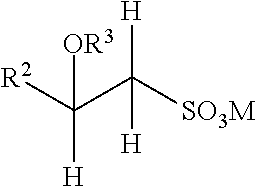
- where R2 is a straight chain alkyl group having from about 6 to about 20 carbon atoms, R3 is a lower alkyl group having from about 1 to about 3 carbon atoms, preferably 1 carbon atom, and M is a water-soluble cation as previously described in the water-soluble olefin sulfonates.
- Suitable anionic detersive surfactants can include isethionate surfactants. For example, suitable isethionate surfactants can include the reaction product of fatty acids esterified with isethionic acid and neutralized with sodium hydroxide. Suitable fatty acids for isethionate surfactants can be derived from coconut oil or palm kernel oil including amides of methyl tauride.
- Detersive anionic surfactants can be succinate surfactants. Examples of suitable succinate surfactants can include disodium N-octadecylsulfo succinnate, disodium lauryl sulfosuccinate, diammonium lauryl sulfosuccinate, laureth sulfosuccinate, tetrasodium N-(1,2-dicarboxyethyl)-N-octadecylsulfosuccinnate, diamyl ester of sodium sulfosuccinic acid, dihexyl ester of sodium sulfosuccinic acid, and dioctyl esters of sodium sulfosuccinic acid.
- Examples of additional anionic surfactants suitable for use herein include, but are not limited to, ammonium lauryl sulfate, ammonium laureth sulfate, triethylamine lauryl sulfate, triethylamine laureth sulfate, triethanolamine lauryl sulfate, triethanolamine laureth sulfate, monoethanolamine lauryl sulfate, monoethanolamine laureth sulfate, diethanolamine lauryl sulfate, diethanolamine laureth sulfate, lauric monoglyceride sodium sulfate, sodium lauryl sulfate, sodium laureth sulfate, potassium laureth sulfate, sodium lauryl sarcosinate, sodium lauroyl sarcosinate, sodium lauryl sarcosine, sodium cocoyl sarcosine, ammonium cocoyl sulfate, ammonium lauroyl sulfate, sodium cocoyl sulfate, sodium lauroyl sulfate, potassium cocoyl sulfate, potassium lauryl sulfate, monoethanolamine cocoyl sulfate, sodium trideceth-1 sulfate, sulfate, sodium trideceth-2 sulfate, sulfate, sodium trideceth-3 sulfate, sodium tridecyl sulfate, sodium methyl lauroyl taurate, sodium methyl cocoyl taurate, sodium lauroyl isethionate, sodium cocoyl isethionate (“SCI”), sodium lauroyl methyl isethionate (“SLMI”), sodium laureth sulfosuccinate, sodium lauryl sulfosuccinate, sodium C12-C14 olefin sulfonate, sodium tridecyl benzene sulfonate, sodium dodecyl benzene sulfonate, sodium lauroyl glycinate, sodium cocoamphoacetate, sodium cocoyl glutamate, sodium lauroyl glutamate, sodium lauryl glucose carboxylate, sodium phosphate ester surfactants, and fatty acid surfactants. and mixtures thereof.
- The hair care composition may comprise from about 0% to about 20%, from about 0.5% to about 15%, from about 1% to about 10%, by weight, of one or more co-surfactants selected from the group consisting of amphoteric surfactants, zwitterionic surfactants, non-ionic surfactants, and mixtures thereof. The composition can comprise a co-surfactant selected from the group consisting of: amphoteric surfactants, zwitterionic surfactants, and mixtures thereof. Non-limiting examples of suitable zwitterionic or amphoteric surfactants are described in U.S. Pat. No. 5,104,646 (Bolich Jr. et al.), U.S. Pat. No. 5,106,609 (Bolich Jr. et al.).
- Amphoteric surfactants suitable for use in the composition are well known in the art, and include those surfactants broadly described as derivatives of aliphatic secondary and tertiary amines in which the aliphatic radical can be straight or branched chain and wherein one of the aliphatic substituents contains from about 8 to about 18 carbon atoms and one contains an anionic group such as carboxy, sulfonate, sulfate, phosphate, or phosphonate. The amphoteric surfactant can be selected from the group consisting of: sodium cocaminopropionate, sodium cocaminodipropionate, sodium cocoamphoacetate, sodium cocoamphohydroxypropylsulfonate, sodium cocoamphopropionate, sodium comamphopropionate, sodium lauraminopropionate, sodium lauroamphoacetate, sodium lauroamphohydroxypropylsulfonate, sodium lauroamphopropionate, sodium comamphopropionate, sodium lauriminodipropionate, ammonium cocaminopropionate, ammonium cocaminodipropionate, ammonium cocoamphoacetate, ammonium cocoamphohydroxypropylsulfonate, ammonium cocoamphopropionate, ammonium comamphopropionate, ammonium lauraminopropionate, ammonium lauroamphoacetate, ammonium lauroamphohydroxypropylsulfonate, ammonium lauroamphopropionate, ammonium comamphopropionate, ammonium lauriminodipropionate, triethanonlamine cocaminopropionate, triethanonlamine cocaminodipropionate, triethanonlamine cocoamphoacetate, triethanonlamine cocoamphohydroxypropylsulfonate, triethanonlamine cocoamphopropionate, triethanonlamine cornamphopropionate, triethanonlamine lauraminopropionate, triethanonlamine lauroamphoacetate, triethanonlamine lauroamphohydroxypropylsulfonate, triethanonlamine lauroamphopropionate, triethanonlamine comamphopropionate, triethanonlamine lauriminodipropionate, cocoamphodipropionic acid, disodium caproamphodiacetate, disodium caproamphoadipropionate, disodium capryloamphodiacetate, disodium capryloamphodipriopionate, disodium cocoamphocarboxyethylhydroxypropylsulfonate, disodium cocoamphodiacetate, disodium cocoamphodipropionate, disodium dicarboxyethylcocopropylenediamine, disodium laureth-5 carboxyamphodiacetate, disodium lauriminodipropionate, disodium lauroamphodiacetate, disodium lauroamphodipropionate, disodium oleoamphodipropionate, disodium PPG-2-isodecethyl-7 carboxyamphodiacetate, lauraminopropionic acid, lauroamphodipropionic acid, lauryl aminopropylglycine, lauryl diethylenediaminoglycine, and mixtures thereof.
- The amphoteric surfactant can be a surfactant according to the following structure:
-

- wherein R10 is a C-linked monovalent substituent selected from the group consisting of: substituted alkyl systems comprising 9 to 15 carbon atoms, unsubstituted alkyl systems comprising 9 to 15 carbon atoms, straight alkyl systems comprising 9 to 15 carbon atoms, branched alkyl systems comprising 9 to 15 carbon atoms, and unsaturated alkyl systems comprising 9 to 15 carbon atoms; and wherein R11, R12, and R13 are each independently selected from the group consisting of: C-linked divalent straight alkyl systems comprising 1 to 3 carbon atoms, and C-linked divalent branched alkyl systems comprising 1 to 3 carbon atoms; and wherein M is a monovalent counterion selected from the group consisting of sodium, ammonium and protonated triethanolamine. The amphoteric surfactant is selected from the group consisting of: sodium cocoamphoacetate, sodium cocoamphodiacetate, sodium lauroamphoacetate, sodium lauroamphodiacetate, ammonium lauroamphoacetate, ammonium cocoamphoacetate, triethanolamine lauroamphoacetate, triethanolamine cocoamphoacetate, and mixtures thereof.
- The detersive surfactant system may comprise at least 1%, by weight, of the composition, of one or more zwitterionic surfactants which possess a hydroxyl group in their molecular structure. The zwitterionic surfactant can be a derivative of an aliphatic quaternary ammonium, phosphonium, and sulfonium compound, in which the aliphatic radicals are straight or branched chain, and wherein one of the aliphatic substituents contains from about 8 to about 18 carbon atoms and one contains an anionic group such as carboxy, sulfonate, sulfate, phosphate or phosphonate. The zwitterionic surfactant is selected from the group consisting of: cocamidoethyl betaine, cocamidopropylamine oxide, cocamidopropyl betaine, cocamidopropyl dimethylaminohydroxypropyl hydrolyzed collagen, cocamidopropyldimonium hydroxypropyl hydrolyzed collagen, cocamidopropyl hydroxysultaine, cocobetaineamido amphopropionate, coco-betaine, coco-hydroxysultaine, coco/oleamidopropyl betaine, coco-sultaine, lauramidopropyl betaine, lauryl betaine, lauryl hydroxysultaine, lauryl sultaine, and mixtures thereof. The zwitterionic surfactant can be selected from the group consisting of: lauryl hydroxysultaine, cocamidopropyl hydroxysultaine, coco-betaine, coco-hydroxysultaine, coco-sultaine, lauryl betaine, lauryl sultaine, and mixtures thereof.
- The co-surfactant can be selected from the group consisting of: zwitterionic surfactants, amphoteric surfactants, non-ionic surfactants, and mixtures thereof. The surfactant can be an anionic surfactant and the composition further comprises a co-surfactant, wherein the co-surfactant is selected from the group consisting of: zwitterionic surfactants, amphoteric surfactants, non-ionic surfactants, and mixtures thereof. The cosurfactant can be a non-ionic surfactant selected from the group consisting of: Cocamide, Cocamide Methyl MEA, Cocamide DEA, Cocamide MEA, Cocamide MIPA, Lauramide DEA, Lauramide MEA, Lauramide MIPA, Myristamide DEA, Myristamide MEA, PEG-20 Cocamide MEA, PEG-2 Cocamide, PEG-3 Cocamide, PEG-4 Cocamide, PEG-5 Cocamide, PEG-6 Cocamide, PEG-7 Cocamide, PEG-3 Lauramide, PEG-5 Lauramide, PEG-3 Oleamide, PPG-2 Cocamide, PPG-2 Hydroxyethyl Cocamide, and mixtures thereof. The co-surfactant can be a zwitterionic surfactant, wherein the zwitterionic surfactant is selected from the group consisting of: lauryl hydroxysultaine, cocamidopropyl hydroxysultaine, coco-betaine, coco-hydroxysultaine, cocosultaine, lauryl betaine, lauryl sultaine, and mixtures thereof.
- B. Cationic Polymers
- (a) Cationic Guar Polymer
- The hair care composition can comprise (a) a cationic guar polymer, wherein the cationic guar polymer can have a weight average M.Wt. of less than about 2.5 million g/mol, and wherein the cationic guar polymer can have a charge density of from about 0.1 meq/g to about 2.5 meq/g.
- The composition can comprise from about 0.01% to about 2.2%, from about 0.05% to about 2%, from about 0.1% to about 1.8%, from 0.2% to about 1.6%, from 0.25% to about 1.5%, and/or from 0.3% to about 1.4%, cationic guar polymer, by total weight of the composition. The hair care composition can comprise from about 0.05% to less than 1%, from about 0.05% to about 0.9%, from about 0.1% to about 0.8%, from about 0.2% to about 0.7%, and/or from about 0.2% to about 0.5% of cationic guar polymer, by total weight of the composition. The hair care composition can comprise from about 0.25% to about 1.1%, from about 0.3% to about 0.9%, and/or from about 0.4% to about 0.8% of cationic guar polymer, by total weight of the composition.
- Cationic guar polymers are cationically substituted galactomannan (guar) gum derivatives. Guar gum for use in preparing these guar gum derivatives is typically obtained as a naturally occurring material from the seeds of the guar plant. The guar molecule itself is a straight chain mannan, which is branched at regular intervals with single membered galactose units on alternative mannose units. The mannose units are linked to each other by means of β(1-4) glycosidic linkages. The galactose branching arises by way of an α(1-6) linkage. Cationic derivatives of the guar gums are obtained by reaction between the hydroxyl groups of the polygalactomannan and reactive quaternary ammonium compounds. The degree of substitution of the cationic groups onto the guar structure should be sufficient to provide the requisite cationic charge density described above.
- The cationic guar polymer can have a weight average M.Wt. of less than 2.2 million g/mol, or from about 150 thousand g/mol to about 2 million g/mol, or from about 200 thousand to about 1.9 million g/mol, or from about 300 thousand to about 1.8 million g/mol, or from about 400 thousand to about 1.7 million g/mol, or from about 500,000 g/mol to about 1.6 million g/mol.
- The cationic guar polymer can have a weight average charge density of from about 0.2 meq/g to about 2.2 meg/g, or from about 0.3 meq/g to about 2.0 meg/g, or from about 0.4 meq/g to about 1.9 meg/g, or from about 0.5 meq/g to about 1.8 meg/g, or from about 0.6 meq/g to about 1.7 meg/g, or from about 0.6 meq/g to about 1.5 meq/g, or from about 0.6 meq/g to about 1.3 meg/g, and/or from about 0.7 meq/g to about 1.0 meg/g.
- The cationic guar polymer may be formed from quaternary ammonium compounds. The quaternary ammonium compounds for forming the cationic guar polymer can conform to the general formula 1:
-

- wherein where R3, R4 and R5 are methyl or ethyl groups; R6 is either an epoxyalkyl group of the general formula 2:
-

- or R6 is a halohydrin group of the general formula 3:
-

- wherein R7 is a C1 to C3 alkylene; X is chlorine or bromine, and Z is an anion such as Cl—, Br—, I— or HSO4—.
- The cationic guar polymer can conform to the general formula 4:
-

- wherein R8 is guar gum; and wherein R4, R5, R6 and R7 are as defined above; and wherein Z is a halogen. The cationic guar polymer can conform to Formula 5:
-

- Suitable cationic guar polymers can include cationic guar gum derivatives, such as guar hydroxypropyltrimonium chloride. The cationic guar polymer is a guar hydroxypropyltrimonium chloride. Specific examples of guar hydroxypropyltrimonium chlorides include the Jaguar® series commercially available from Rhone-Poulenc Incorporated, for example Jaguar® C-500, commercially available from Rhodia. Jaguar® C-500 has a charge density of 0.8 meq/g and a molecular weight of 500,000 g/mol. Another guar hydroxypropyltrimonium chloride with a charge density of about 1.1 meq/g and a molecular weight of about 500,000 g/mol is available from Ashland. A further guar hydroxypropyltrimonium chloride with a charge density of about 1.5 meq/g and a molecular weight of about 500,000 g/mole is available from Ashland.
- Other suitable guar hydroxypropyltrimonium chloride are: Hi-Care 1000, which has a charge density of about 0.7 meq/g and a Molecular weight of about 600,000 g/mole is available from Rhodia; N-Hance 3269 and N-Hance 3270, which have a charge density of about 0.7 meq/g and a molecular weight of about 425,000 g/mol are available from Ashland; N-Hance 3271 which has a charge density of about 0.7 meq/g and a molecular weight of about 500,000 g/mol and is available from Ashland; BF-13, which is a borate (boron) free guar of charge density of about 1.1 meq/g and molecular weight of about 800,000 and BF-17, which is a borate (boron) free guar of charge density of about 1.7 meq/g and M. W.t of about 800,000 both available from Ashland; N-Hance CG17 has a charge density of about 1.0 meq/g and a molecular weight of about 1,600,000 g/mol and is available from Ashland; and N-Hance 3196 has a charge density of about 0.7 meq/g and a molecular weight of 1,700,000 g/mol and is available from Ashland.
- (b) Cationic Synthetic Polymer
- The hair care composition can include (b) a cationic synthetic polymer, wherein the cationic synthetic polymer can have a weight average M.Wt. of from about 1,000 g/mol to about 2.0 million g/mol, and wherein the cationic guar polymer can have a charge density of from about 2 meq/g to about 10 meq/g. The hair care composition can comprise a cationic synthetic polymer from about 0.01% to about 2.5% by total weight of the composition.
- The cationic synthetic polymers may be formed from
- i) one or more cationic monomer units, and optionally
- ii) one or more monomer units bearing a negative charge, and/or
- iii) a nonionic monomer,
- wherein the subsequent charge of the copolymer is positive. The ratio of the three types of monomers is given by “m”, “p” and “q” where “m” is the number of cationic monomers, “p” is the number of monomers bearing a negative charge and “q” is the number of nonionic monomers
- The cationic polymers can be water soluble or dispersible, non-crosslinked, and cationic synthetic polymers having the following structure:
-

- where A, may be one or more of the following cationic moieties:
-

- where @=amido, alkylamido, ester, ether, alkyl or alkylaryl;
where Y=C1-C22 alkyl, alkoxy, alkylidene, alkyl or aryloxy;
where ψ=C1-C22 alkyl, alkyloxy, alkyl aryl or alkyl arylox;
where Z=C1-C22 alkyl, alkyloxy, aryl or aryloxy;
where R1=H, C1-C4 linear or branched alkyl;
where s=0 or 1, n=0 or ≥1;
where T and R7=C1-C22 alkyl; and
where X—=halogen, hydroxide, alkoxide, sulfate or alkylsulfate. - Where the monomer bearing a negative charge is defined by R2′=H, C1-C4 linear or branched alkyl and R3 as:
-

- where D=O, N, or S;
where Q=NH2 or O;
where u=1-6;
where t=0-1; and
where J=oxygenated functional group containing the following elements P, S, C. - Where the nonionic monomer is defined by R2″=H, C1-C4 linear or branched alkyl, R6=linear or branched alkyl, alkyl aryl, aryl oxy, alkyloxy, alkylaryl oxy and β is defined as
-

- and
where G′ and G″ are, independently of one another, O, S or N—H and L=0 or 1. - Examples of cationic monomers include aminoalkyl (meth)acrylates, (meth)aminoalkyl (meth)acrylamides; monomers comprising at least one secondary, tertiary or quaternary amine function, or a heterocyclic group containing a nitrogen atom, vinylamine or ethylenimine; diallyldialkyl ammonium salts; their mixtures, their salts, and macromonomers deriving from therefrom.
- Further examples of cationic monomers include dimethylaminoethyl (meth)acrylate, dimethylaminopropyl (meth)acrylate, ditertiobutylaminoethyl (meth)acrylate, dimethylaminomethyl (meth)acrylamide, dimethylaminopropyl (meth)acrylamide, ethylenimine, vinylamine, 2-vinylpyridine, 4-vinylpyridine, trimethylammonium ethyl (meth)acrylate chloride, trimethylammonium ethyl (meth)acrylate methyl sulphate, dimethylammonium ethyl (meth)acrylate benzyl chloride, 4-benzoylbenzyl dimethylammonium ethyl acrylate chloride, trimethyl ammonium ethyl (meth)acrylamido chloride, trimethyl ammonium propyl (meth)acrylamido chloride, vinylbenzyl trimethyl ammonium chloride, diallyldimethyl ammonium chloride.
- Suitable cationic monomers include those which comprise a quaternary ammonium group of formula —NR3 +, wherein R, which is identical or different, represents a hydrogen atom, an alkyl group comprising 1 to 10 carbon atoms, or a benzyl group, optionally carrying a hydroxyl group, and comprise an anion (counter-ion). Examples of anions are halides such as chlorides, bromides, sulphates, hydrosulphates, alkylsulphates (for example comprising 1 to 6 carbon atoms), phosphates, citrates, formates, and acetates.
- Suitable cationic monomers include trimethylammonium ethyl (meth)acrylate chloride, trimethylammonium ethyl (meth)acrylate methyl sulphate, dimethylammonium ethyl (meth)acrylate benzyl chloride, 4-benzoylbenzyl dimethylammonium ethyl acrylate chloride, trimethyl ammonium ethyl (meth)acrylamido chloride, trimethyl ammonium propyl (meth)acrylamido chloride, vinylbenzyl trimethyl ammonium chloride.
- Additional suitable cationic monomers include trimethyl ammonium propyl (meth)acrylamido chloride.
- Examples of monomers bearing a negative charge include alpha ethylenically unsaturated monomers comprising a phosphate or phosphonate group, alpha ethylenically unsaturated monocarboxylic acids, monoalkylesters of alpha ethylenically unsaturated dicarboxylic acids, monoalkylamides of alpha ethylenically unsaturated dicarboxylic acids, alpha ethylenically unsaturated compounds comprising a sulphonic acid group, and salts of alpha ethylenically unsaturated compounds comprising a sulphonic acid group.
- Suitable monomers with a negative charge include acrylic acid, methacrylic acid, vinyl sulphonic acid, salts of vinyl sulfonic acid, vinylbenzene sulphonic acid, salts of vinylbenzene sulphonic acid, alpha-acrylamidomethylpropanesulphonic acid, salts of alpha-acrylamidomethylpropanesulphonic acid, 2-sulphoethyl methacrylate, salts of 2-sulphoethyl methacrylate, acrylamido-2-methylpropanesulphonic acid (AMPS), salts of acrylamido-2-methylpropanesulphonic acid, and styrenesulphonate (SS).
- Examples of nonionic monomers include vinyl acetate, amides of alpha ethylenically unsaturated carboxylic acids, esters of an alpha ethylenically unsaturated monocarboxylic acids with an hydrogenated or fluorinated alcohol, polyethylene oxide (meth)acrylate (i.e. polyethoxylated (meth)acrylic acid), monoalkylesters of alpha ethylenically unsaturated dicarboxylic acids, monoalkylamides of alpha ethylenically unsaturated dicarboxylic acids, vinyl nitriles, vinylamine amides, vinyl alcohol, vinyl pyrolidone, and vinyl aromatic compounds.
- Suitable nonionic monomers include styrene, acrylamide, methacrylamide, acrylonitrile, methylacrylate, ethylacrylate, n-propylacrylate, n-butylacrylate, methylmethacrylate, ethylmethacrylate, n-propylmethacrylate, n-butylmethacrylate, 2-ethyl-hexyl acrylate, 2-ethyl-hexyl methacrylate, 2-hydroxyethylacrylate and 2-hydroxyethylmethacrylate.
- The anionic counterion (X—) in association with the cationic synthetic polymers may be any known counterion so long as the polymers remain soluble or dispersible in water, in the hair care composition, or in a coacervate phase of the hair care composition, and so long as the counterions are physically and chemically compatible with the essential components of the hair care composition or do not otherwise unduly impair product performance, stability or aesthetics. Non limiting examples of such counterions include halides (e.g., chlorine, fluorine, bromine, iodine), sulfate and methylsulfate.
- The cationic synthetic polymer can have a weight average M.Wt. of from about 1,500 g/mol to about 1.8 million g/mol, or from about 2,000 g/mol to about 1.7 million g/mol, or from about 3,000 g/mol to about 1.6 million g/mol, or from about 4,000 g/mol to about 1.5 million g/mol, or from about 5,000 g/mol to about 1.6 million g/mol, or from about 6,000 g/mol to about 1.5 million g/mol, or from about 7,000 g/mol to about 1.4 million g/mol, or from about 8,000 g/mol to about 1.4 million g/mol, or from about 9,000 g/mol to about 1.3 million g/mol, or from about 10,000 g/mol to about 1.2 million g/mol or from about 11,000 g/mol to about 1.1 million g/mol, or from about 25,000 g/mol to about 750,000 g/mol, or from about 50,000 g/mol to about 500,000 g/mol, or from about 75,000 g/mol to about 300,000 g/mol, and/or from about 100,000 g/mol to about 200,000 g/mol.
- The cationic synthetic polymer can have a weight average charge density of from about 2.2 meq/g to about 9.5 meg/g, or from about 2.5 meq/g to about 8 meg/g, or from about 3 meq/g to about 8 meg/g, or from about 3.5 meq/g to about 7.5 meg/g, and/or from about 4 meq/g to about 7 meg/g.
- The composition can comprise a cationic synthetic polymer from about 0.05% to about 2.2%, or from about 0.05% to about 2%, or from about 0.1% to about 1.8%, or from about 0.1% to about 1.6%, or from about 0.15% to about 1.5%, or from about 0.15% to about 1.4%, from about 0.2% to about 1.3%, or from about 0.2% to about 1.2%, from about 0.2% to about 1%, and/or from 0.2% to 0.8%, by total weight of the composition.
- The cationic synthetic polymer can comprise polydiallyldimethylammonium chloride (polyDADMAC). PolyDADMAC is also known as polyquaternium-6. Specific examples of polyDADMAC are Mirapol® 100 series from Solvay, Merquat™ 100 series from Lubrizol and Salcare® SC 30 from BASF. For example, Mirapol® 100s has a charge density of 6.2 meq/g and a molecular weight of 150,000 g/mol, is available from Solvay.
- The hair care composition may further comprise (c) a cationic non-guar galactomannan polymer, (d) a cationic starch polymer, (e) a cationic copolymer of acrylamide monomers and cationic monomers, (f) a cationic cellulose polymer or (g) a mixture of such polymers
- (c) Cationic Non-Guar Galactomannan Polymers
- The dispersion compositions can comprise a galactomannan polymer derivative having a mannose to galactose ratio of between 5:1 and 1:1 on a monomer to monomer basis, the galactomannan polymer derivative selected from the group consisting of a cationic galactomannan polymer derivative and an amphoteric galactomannan polymer derivative having a net positive charge. As used herein, the term “cationic galactomannan” refers to a galactomannan polymer to which a cationic group is added. The term “amphoteric galactomannan” refers to a galactomannan polymer to which a cationic group and an anionic group are added such that the polymer has a net positive charge.
- Galactomannan polymers are present in the endosperm of seeds of the Leguminosae family. Galactomannan polymers are made up of a combination of mannose monomers and galactose monomers. The galactomannan molecule is a straight chain mannan branched at regular intervals with single membered galactose units on specific mannose units. The mannose units are linked to each other by means of β (1-4) glycosidic linkages. The galactose branching arises by way of an α (1-6) linkage. The ratio of mannose monomers to galactose monomers varies according to the species of the plant and also is affected by climate. Non Guar Galactomannan polymer derivatives can have a ratio of mannose to galactose of greater than 2:1 on a monomer to monomer basis. Suitable ratios of mannose to galactose can be greater than about 3:1, and the ratio of mannose to galactose can be greater than about 4:1. Analysis of mannose to galactose ratios is well known in the art and is typically based on the measurement of the galactose content.
- The gum for use in preparing the non-guar galactomannan polymer derivatives is typically obtained as naturally occurring material such as seeds or beans from plants. Examples of various non-guar galactomannan polymers include but are not limited to Tara gum (3 parts mannose/1 part galactose), Locust bean or Carob (4 parts mannose/1 part galactose), and Cassia gum (5 parts mannose/1 part galactose).
- The galactomannan polymer derivative can be a cationic derivative of the non-guar galactomannan polymer, which is obtained by reaction between the hydroxyl groups of the polygalactomannan polymer and reactive quaternary ammonium compounds. Suitable quaternary ammonium compounds for use in forming the cationic galactomannan polymer derivatives include those conforming to the general formulas 1-5, as defined above.
- Cationic non-guar galactomannan polymer derivatives formed from the reagents described above are represented by the general formula 6:
-
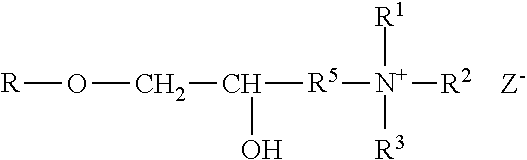
- wherein R is the gum. The cationic galactomannan derivative can be a gum hydroxypropyltrimethylammonium chloride, which can be more specifically represented by the general formula 7:
-

- The galactomannan polymer derivative can be an amphoteric galactomannan polymer derivative having a net positive charge, obtained when the cationic galactomannan polymer derivative further comprises an anionic group.
- The cationic non-guar galactomannan can have a ratio of mannose to galactose that is greater than about 4:1. The dispersion compositions may comprise a galactomannan polymer derivative, by weight, of the composition. The hair care compositions can comprise from about 0.05% to about 2%, by weight, of the composition, of a galactomannan polymer derivative.
- (d) Cationically Modified Starch Polymer
- The dispersion compositions can comprise water-soluble cationically modified starch polymers. As used herein, the term “cationically modified starch” refers to a starch to which a cationic group is added prior to degradation of the starch to a smaller molecular weight, or wherein a cationic group is added after modification of the starch to achieve a desired molecular weight. The definition of the term “cationically modified starch” also includes amphoterically modified starch. The term “amphoterically modified starch” refers to a starch hydrolysate to which a cationic group and an anionic group are added.
- The dispersion compositions can comprise cationically modified starch polymers at a range of about 0.01% to about 10%, and/or from about 0.05% to about 5%, by weight, of the composition.
- The cationically modified starch polymers disclosed herein can have a percent of bound nitrogen of from about 0.5% to about 4%.
- The dispersion compositions can include starch polymers that is chemically modified by the addition of amino and/or ammonium groups into the starch molecules. Non-limiting examples of these ammonium groups may include substituents such as hydroxypropyl trimmonium chloride, trimethylhydroxypropyl ammonium chloride, dimethylstearylhydroxypropyl ammonium chloride, and dimethyldodecylhydroxypropyl ammonium chloride. See Solarek, D. B., Cationic Starches in Modified Starches: Properties and Uses, Wurzburg, O. B., Ed., CRC Press, Inc., Boca Raton, Fla. 1986, pp 113-125. The cationic groups may be added to the starch prior to degradation to a smaller molecular weight or the cationic groups may be added after such modification.
- The cationically modified starch polymers can generally have a degree of substitution of a cationic group from about 0.1 to about 7. As used herein, the “degree of substitution” of the cationically modified starch polymers is an average measure of the number of hydroxyl groups on each anhydroglucose unit which is derivatized by substituent groups. Since each anhydroglucose unit has three potential hydroxyl groups available for substitution, the maximum possible degree of substitution is 3. The degree of substitution is expressed as the number of moles of substituent groups per mole of anhydroglucose unit, on a molar average basis. The degree of substitution may be determined using proton nuclear magnetic resonance spectroscopy (“.sup.1H NMR”) methods well known in the art. Suitable .sup.1H NMR techniques include those described in “Observation on NMR Spectra of Starches in Dimethyl Sulfoxide, Iodine-Complexing, and Solvating in Water-Dimethyl Sulfoxide”, Qin-Ji Peng and Arthur S. Perlin, Carbohydrate Research, 160 (1987), 57-72; and “An Approach to the Structural Analysis of Oligosaccharides by NMR Spectroscopy”, J. Howard Bradbury and J. Grant Collins, Carbohydrate Research, 71, (1979), 15-25.
- The source of starch before chemical modification can be chosen from a variety of sources such as tubers, legumes, cereal, and grains. Non-limiting examples of this source starch may include corn starch, wheat starch, rice starch, waxy corn starch, oat starch, cassaya starch, waxy barley, waxy rice starch, glutenous rice starch, sweet rice starch, amioca, potato starch, tapioca starch, oat starch, sago starch, sweet rice, or mixtures thereof.
- Cationically modified starch polymers can be selected from degraded cationic maize starch, cationic tapioca, cationic potato starch, and mixtures thereof.
- The starch, prior to degradation or after modification to a smaller molecular weight, may comprise one or more additional modifications. For example, these modifications may include cross-linking, stabilization reactions, phosphorylations, and hydrolyzations. Stabilization reactions may include alkylation and esterification.
- The cationically modified starch polymers may be incorporated into the composition in the form of hydrolyzed starch (e.g., acid, enzyme, or alkaline degradation), oxidized starch (e.g., peroxide, peracid, hypochlorite, alkaline, or any other oxidizing agent), physically/mechanically degraded starch (e.g., via the thermo-mechanical energy input of the processing equipment), or combinations thereof.
- An optimal form of the starch is one which is readily soluble in water and forms a substantially clear (% Transmittance.gtoreq.80 at 600 nm) solution in water. The transparency of the composition is measured by Ultra-Violet/Visible (UV/VIS) spectrophotometry, which determines the absorption or transmission of UV/VIS light by a sample, using a Gretag Macbeth Colorimeter Color i 5 according to the related instructions. A light wavelength of 600 nm has been shown to be adequate for characterizing the degree of clarity of cosmetic compositions.
- Suitable cationically modified starch for use in compositions is available from known starch suppliers. Nonionic modified starch that could be further derivatized to a cationically modified starch as is known in the art can be suitable. Other suitable modified starch starting materials may be quaternized, as is known in the art, to produce the cationically modified starch polymer suitable for use in the invention.
- Starch Degradation Procedure: A starch slurry is prepared by mixing granular starch in water. The temperature is raised to about 35° C. An aqueous solution of potassium permanganate is then added at a concentration of about 50 ppm based on starch. The pH is raised to about 11.5 with sodium hydroxide and the slurry is stirred sufficiently to prevent settling of the starch. Then, about a 30% solution of hydrogen peroxide diluted in water is added to a level of about 1% of peroxide based on starch. The pH of about 11.5 is then restored by adding additional sodium hydroxide. The reaction is completed over about a 1 to about 20 hour period. The mixture is then neutralized with dilute hydrochloric acid. The degraded starch is recovered by filtration followed by washing and drying.
- (e) Cationic Copolymer of an Acrylamide Monomer and a Cationic Monomer
- The dispersion composition can comprise a cationic copolymer of an acrylamide monomer and a cationic monomer. The cationic copolymer can be a synthetic cationic copolymer of acrylamide monomers and cationic monomers.
- The cationic copolymer can comprise:
-
- (i) an acrylamide monomer of the following Formula AM:
-

-
- where R9 is H or C1-4 alkyl; and R10 and R11 are independently selected from the group consisting of H, C1-4 alkyl, CH2OCH3, CH2OCH2CH(CH3)2, and phenyl, or together are C3-6cycloalkyl; and
- (ii) a cationic monomer conforming to Formula CM:
-
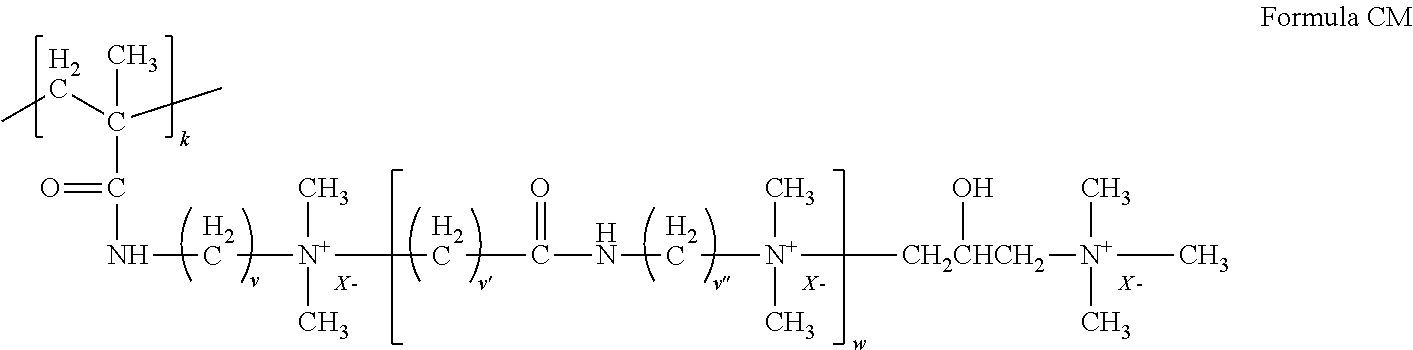
- where k=1, each of v, v′, and v″ is independently an integer of from 1 to 6, w is zero or an integer of from 1 to 10, and X− is an anion.
- The cationic monomer can conform to Formula CM and where k=1, v=3 and w=0, z=1 and X− is Cl− to form the following structure:
-

- The above structure may be referred to as diquat. The cationic monomer can conform to Formula CM and wherein v and v″ are each 3, v′=1, w=1, y=1 and X− is Cl−, such as:
-
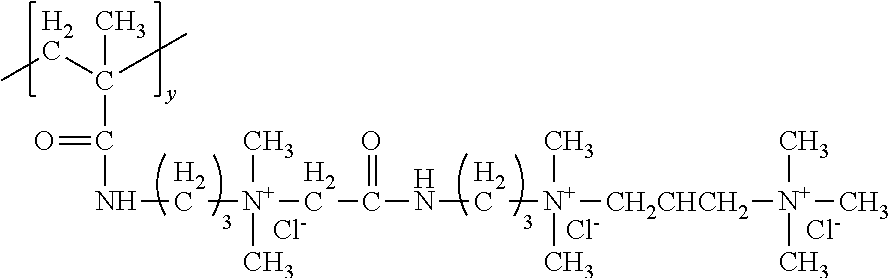
- The above structure may be referred to as triquat.
- The acrylamide monomer can be either acrylamide or methacrylamide.
- The cationic copolymer (b) can be AM:TRIQUAT which is a copolymer of acrylamide and 1,3-Propanediaminium,N-[2-[[[dimethyl[3-[(2-methyl-1-oxo-2-propenyl)amino]propyl]ammonio]acetyl]amino]ethyl]2-hydroxy-N,N,N′,N′,N-pentamethyl-, trichloride. AM:TRIQUAT is also known as polyquaternium 76 (PQ76). AM:TRIQUAT may have a charge density of 1.6 meq/g and a M.Wt. of 1.1 million g/mol.
- The cationic copolymer can be an acrylamide monomer and a cationic monomer, wherein the cationic monomer is selected from the group consisting of: dimethylaminoethyl (meth)acrylate, dimethylaminopropyl (meth)acrylate, ditertiobutylaminoethyl (meth)acrylate, dimethylaminomethyl (meth)acrylamide, dimethylaminopropyl (meth)acrylamide; ethylenimine, vinylamine, 2-vinylpyridine, 4-vinylpyridine; trimethylammonium ethyl (meth)acrylate chloride, trimethylammonium ethyl (meth)acrylate methyl sulphate, dimethylammonium ethyl (meth)acrylate benzyl chloride, 4-benzoylbenzyl dimethylammonium ethyl acrylate chloride, trimethyl ammonium ethyl (meth)acrylamido chloride, trimethyl ammonium propyl (meth)acrylamido chloride, vinylbenzyl trimethyl ammonium chloride, diallyldimethyl ammonium chloride, and mixtures thereof.
- The cationic copolymer comprises a cationic monomer selected from the group consisting of: cationic monomers include trimethylammonium ethyl (meth)acrylate chloride, trimethylammonium ethyl (meth)acrylate methyl sulphate, dimethylammonium ethyl (meth)acrylate benzyl chloride, 4-benzoylbenzyl dimethylammonium ethyl acrylate chloride, trimethyl ammonium ethyl (meth)acrylamido chloride, trimethyl ammonium propyl (meth)acrylamido chloride, vinylbenzyl trimethyl ammonium chloride, and mixtures thereof.
- The cationic copolymer can be water-soluble. The cationic copolymer can be formed from (1) copolymers of (meth)acrylamide and cationic monomers based on (meth)acrylamide, and/or hydrolysis-stable cationic monomers, (2) terpolymers of (meth)acrylamide, monomers based on cationic (meth)acrylic acid esters, and monomers based on (meth)acrylamide, and/or hydrolysis-stable cationic monomers. Monomers based on cationic (meth)acrylic acid esters may be cationized esters of the (meth)acrylic acid containing a quaternized N atom. Cationized esters of the (meth)acrylic acid containing a quaternized N atom can be quaternized dialkylaminoalkyl (meth)acrylates with C1 to C3 in the alkyl and alkylene groups. The cationized esters of the (meth)acrylic acid containing a quaternized N atom are selected from the group consisting of: ammonium salts of dimethylaminomethyl (meth)acrylate, dimethylaminoethyl (meth)acrylate, dimethylaminopropyl (meth)acrylate, diethylaminomethyl (meth)acrylate, diethylaminoethyl (meth)acrylate; and diethylaminopropyl (meth)acrylate quaternized with methyl chloride. The cationized esters of the (meth)acrylic acid containing a quaternized N atom can be dimethylaminoethyl acrylate, which may be quaternized with an alkyl halide, or with methyl chloride or benzyl chloride or dimethyl sulfate (ADAME-Quat). The cationic monomer when based on (meth)acrylamides can be quaternized dialkylaminoalkyl(meth)acrylamides with C1 to C3 in the alkyl and alkylene groups, or dimethylaminopropylacrylamide, which is quaternized with an alkyl halide, or methyl chloride or benzyl chloride or dimethyl sulfate.
- The cationic monomer based on a (meth)acrylamide is a quaternized dialkylaminoalkyl(meth)acrylamide with C1 to C3 in the alkyl and alkylene groups. The cationic monomer based on a (meth)acrylamide is dimethylaminopropylacrylamide, which is quaternized with an alkyl halide, especially methyl chloride or benzyl chloride or dimethyl sulfate.
- The cationic monomer is a hydrolysis-stable cationic monomer. Hydrolysis-stable cationic monomers can be, in addition to a dialkylaminoalkyl(meth)acrylamide, all monomers that can be regarded as stable to the OECD hydrolysis test. The cationic monomer is hydrolysis-stable and the hydrolysis-stable cationic monomer is selected from the group consisting of: diallyldimethylammonium chloride and water-soluble, cationic styrene derivatives.
- The cationic copolymer is a terpolymer of acrylamide, 2-dimethylammoniumethyl (meth)acrylate quaternized with methyl chloride (ADAME-Q) and 3-dimethylammoniumpropyl(meth)acrylamide quaternized with methyl chloride (DIMAPA-Q). The cationic copolymer is formed from acrylamide and acrylamidopropyltrimethylammonium chloride, wherein the acrylamidopropyltrimethylammonium chloride has a charge density of from about 1.0 meq/g to about 3.0 meq/g.
- The cationic copolymer is a trimethylammoniopropylmethacrylamide chloride-N-Acrylamide copolymer, which is also known as AM:MAPTAC. AM:MAPTAC may have a charge density of about 1.3 meq/g and a M.Wt. of about 1.1 million g/mol. The cationic copolymer is AM:ATPAC. AM:ATPAC may have a charge density of about 1.8 meq/g and a M.Wt. of about 1.1 million g/mol.
- (f) Cationic Cellulose Polymers
- Suitable cationic cellulose polymers are salts of hydroxyethyl cellulose reacted with trimethyl ammonium substituted epoxide, referred to in the industry (CTFA) as Polyquaternium 10 and available from Dwo/Amerchol Corp. (Edison, N.J., USA) in their Polymer LR, JR, and KG series of polymers. Other suitable types of cationic cellulose include the polymeric quaternary ammonium salts of hydroxyethyl cellulose reacted with lauryl dimethyl ammonium-substituted epoxide referred to in the industry (CTFA) as Polyquaternium 24. These materials are available from Dow/Amerchol Corp. under the tradename Polymer LM-200. Other suitable types of cationic cellulose include the polymeric quaternary ammonium salts of hydroxyethyl cellulose reacted with lauryl dimethyl ammonium-substituted epoxide and trimethyl ammonium substituted epoxide referred to in the industry (CTFA) as Polyquaternium 67. These materials are available from Dow/Amerchol Corp. under the tradename SoftCAT Polymer SL-5, SoftCAT Polymer SL-30, Polymer SL-60, Polymer SL-100, Polymer SK-L, Polymer SK-M, Polymer SK-MH, and Polymer SK-H.
- C. Silicone Emulsions
- The hair care composition can comprise from about 0% to about 20%, from about 0.5% to about 18%, from about 1% to about 16%, from about 1.5% to about 14%, from about 1.5% to about 12%, from about 1.5% to about 10%, from about 1.5% to about 8%, and/or from about 1.5% to about 6%, by weight, of one of more silicone polymers. The silicone polymer can be added into the hair care composition as an aqueous pre-emulsion. The silicone pre-emulsion can comprise one or more silicone polymers and an emulsifying system. The silicone polymer content in the silicone pre-emulsion can be from about 10%, by weight, to about 70%, by weight, or about 15%, by weight, to about 60%, by weight, or from about 18%, by weight, to about 50%, by weight.
- The silicone emulsion can have an average particle size of less than 500 nm, alternatively 300 nm, alternatively less than about 200 nm, and alternatively less than about 100 nm. The silicone emulsion can have an average particle size of from about 5 nm to about 500 nm, from about 10-nm to about 400 nm, and/or from about 20 nm to about 300 nm. The silicone emulsion can be in the form of a nano-emulsion.
- The particle size of the one or more silicones may be measured by dynamic light scattering (DLS). A Malvern Zetasizer Nano ZEN3600 system using He—Ne laser 633 nm may be used for the measurement at 25° C.
- The autocorrelation function may be analyzed using the Zetasizer Software provided by Malvern Instruments, which determines the effective hydrodynamic radius, using the Stokes-Einstein equation:
-
- wherein kB is the Boltzmann Constant, T is the absolute temperature, is the viscosity of the medium, D is the mean diffusion coefficient of the scattering species, and R is the hydrodynamic radius of particles.
- Particle size (i.e. hydrodynamic radius) may be obtained by correlating the observed speckle pattern that arises due to Brownian motion and solving the Stokes-Einstein equation, which relates the particle size to the measured diffusion constant, as is known in the art.
- For each sample, 3 measurements may be made and Z-average values may be reported as the particle size.
- The one or more silicones may be in the form of a nanoemulsion. The nanoemulsion may comprise any silicone suitable for application to the skin and/or hair.
- The one or more silicones may include in their molecular structure polar functional groups such as Si—OH (present in dimethiconols), primary amines, secondary amines, tertiary amines, and quaternary ammonium salts. The one or more silicones may be selected from the group consisting of aminosilicones, pendant quaternary ammonium silicones, terminal quaternary ammonium silicones, amino polyalkylene oxide silicones, quaternary ammonium polyalkylene oxide silicones, and amino morpholino silicones.
- The one or more silicones may comprise:
- (a) at least one aminosilicone corresponding to formula (V):
-
R′aG3-a-Si(OSiG2)n-(OSiGbR′2-b)m—O—SiG3-a-R′a (I) - in which:
- G is chosen from a hydrogen atom, a phenyl group, OH group, and C1-C8 alkyl groups, for example methyl,
a is an integer ranging from 0 to 3, and in one embodiment a is 0,
b is chosen from 0 and 1, and in one embodiment b is 1,
m and n are numbers such that the sum (n+m) can range for example from 1 to 2 000, such as for example from 50 to 150, wherein n can be for example chosen from numbers ranging from 0 to 1 999, such as for example from 49 to 149, and wherein m can be chosen from numbers ranging for example from 1 to 2 000, such as for example from 1 to 10;
R′ is a monovalent group of formula —CqH2qL in which q is a number from 2 to 8 and L is an optionally quaternized amine group chosen from the groups: -
—NR″—CH2—CH2—N′(R1)2, -
—N(R″)2, -
N+(R″)3A−, -
N+H(R″)2A−, -
N+H2(R″)A−, and -
—N(R″)—CH2—CH2—N+R″H2A−, - in which R″ can be chosen from a hydrogen atom, phenyl groups, benzyl groups, and saturated monovalent hydrocarbon-based groups, such as for example an alkyl group comprising from 1 to 20 carbon atoms, and A− is chosen from halide ions such as, for example, fluoride, chloride, bromide and iodide.
- The one or more silicones may include those corresponding to formula (1) wherein a=0, G=methyl, m and n are numbers such that the sum (n+m) can range for example from 1 to 2 000, such as for example from 50 to 150, wherein n can be for example chosen from numbers ranging from 0 to 1 999, such as for example from 49 to 149, and wherein m can be chosen from numbers ranging for example from 1 to 2 000, such as for example from 1 to 10; and L is —N(CH3)2 or —NH2, alternatively —NH2.
- Additional said at least one aminosilicone of the invention include:
(b) pendant quaternary ammonium silicones of formula (VII): -

- in which:
R5 is chosen from monovalent hydrocarbon-based groups comprising from 1 to 18 carbon atoms, such as C1-C18 alkyl groups and C2-C18alkenyl groups, for example methyl;
R6 is chosen from divalent hydrocarbon-based groups, such as divalent C1-C18 alkylene groups and divalent C1-C18 alkylenoxy groups, for example C1-C8 alkylenoxy groups, wherein said R6 is bonded to the Si by way of an SiC bond;
Q− is an anion that can be for example chosen from halide ions, such as chloride, and organic acid salts (such as acetate);
r is an average statistical value ranging from 2 to 20, such as from 2 to 8;
s is an average statistical value ranging from 20 to 200, such as from 20 to 50. - Such aminosilicones are described more particularly in U.S. Pat. No. 4,185,087, the disclosure of which is incorporated by reference herein.
- A silicone which falls within this class is the silicone sold by the company Union Carbide under the name “Ucar Silicone ALE 56”.
- Further examples of said at least one aminosilicone include:
- c) quaternary ammonium silicones of formula (VIIb):
-

- in
which:
groups R7, which may be identical or different, are each chosen from monovalent hydrocarbon-based groups comprising from 1 to 18 carbon atoms, such as C1-C18 alkyl groups, for example methyl, C2-C18 alkenyl groups, and rings comprising 5 or 6 carbon atoms;
R6 is chosen from divalent hydrocarbon-based groups, such as divalent C1-C18 alkylene groups and divalent C1-C18alkylenoxy, for example C1-C8, group connected to the Si by an SiC bond;
R8, which may be identical or different, represent a hydrogen atom, a monovalent hydrocarbon-based group comprising from 1 to 18 carbon atoms, and in particular a C1-C18 alkyl group, a C2-C18 alkenyl group or a group —R6—NHCOR7;
X− is an anion such as a halide ion, in particular chloride, or an organic acid salt (acetate, etc.); r represents an average statistical value from 2 to 200 and in particular from 5 to 100.
Such silicones are described, for example, in application EP-A-0 530 974, the disclosure of which is incorporated by reference herein.
Silicones falling within this class are the silicones sold by the company Eovnik under the names Abil Quat 3270, Abil Quat 3272, Abil Quat 3474 and Abil ME 45.
Further examples of said at least one aminosilicone include:
d) quaternary ammonium and polyalkylene oxide silicones
wherein the quaternary nitrogen groups are located in the polysiloxane backbone, at the termini, or both.
Such silicones are described in PCT Publication No. WO 2002/010257, the disclosure of which is incorporated by reference herein.
Silicones falling within this class are the silicones sold by the company Momentive under the names Silsoft Q.
(e) Aminofunctional silicones having morpholino groups of formula (V): -

- in which
-
- A denotes a structural unit (I), (II), or (III) bound via —O—
-

-
-
- or an oligomeric or polymeric residue, bound via —O—, containing structural units of formulas (I), (II), or (III), or half of a connecting oxygen atom to a structural unit (III), or denotes —OH,
- * denotes a bond to one of the structural units (I), (II), or (III), or denotes a terminal group B (Si-bound) or D (O-bound),
- B denotes an —OH, —O—Si(CH3)3, —O—Si(CH3)20H, —O—Si(CH3)20CH3 group,
- D denotes an —H, —Si(CH3)3, —Si(CH3)2OH, —Si(CH3)2OCH3 group,
- a, b, and c denote integers between 0 and 1000, with the provision that a+b+c>0,
- m, n, and o denote integers between 1 and 1000.
-
- Aminofunctional silicones of this kind bear the INCI name: Amodimethicone/Morpholinomethyl Silsesquioxane Copolymer. A particularly suitable amodimethicone is the product having the commercial name Wacker Belsil® ADM 8301E.
- Examples of such silicones are available from the following suppliers:
- offered by the company Dow Corning: Fluids: 2-8566, AP 6087, AP 6088, DC 8040 Fluid, fluid 8822A DC, DC 8803 & 8813 polymer, 7-6030, AP-8104, AP 8201; Emulsions: CE-8170 AF Micro Emulsion, 2-8177, 2-8194 Microemulsion, 9224 Emulsion, DC 1872 Emulsion, 939, 949, 959, DC 5-7113 Quat Microemulsion, DC 5-7070 Emulsion, DC CE-8810, CE 8401 Emulsion, CE 1619, Dow Corning Toray SS-3551, Dow Corning Toray SS-3552;
offered by the company Wacker: Wacker Belsil ADM 652, ADM 656, 1100, 1600, 1650 (fluids) ADM 6060 (linear amodimethicone) emulsion; ADM 6057 E (branched amodimethicone) emulsion; ADM 8020 VP (micro emulsion); SLM 28040 (micro emulsion); DM5500 emulsion;
offered by the Company Momentive: Silsoft 331, SF1708, SME 253 & 254 (emulsion), SM2125 (emulsion), SM 2658 (emulsion), Silsoft Q (emulsion)
offered by the company Shin-Etsu: KF-889, KF-8675, KF-8004, X-52-2265 (emulsion);
offered by the Company Siltech Silicones: Siltech E-2145, E-Siltech 2145-35;
offered by the company Evonik Industries: Abil T Quat 60th - Some non-limiting examples of aminosilicones include the compounds having the following INCI names: Silicone Quaternium-1, Silicone Quaternium-2, Silicone Quaternium-3, Silicone Quaternium-4, Silicone Quaternium-5, Silicone Quaternium-6, Silicone Quaternium-7, Silicone Quaternium-8, Silicone Quaternium-9, Silicone Quaternium-10, Silicone Quaternium-11, Silicone Quaternium-12, Silicone Quaternium-15, Silicone Quaternium-16, Silicone Quaternium-17, Silicone Quaternium-18, Silicone Quaternium-20, Silicone Quaternium-21, Silicone Quaternium-22, Quaternium-80, as well as Silicone Quaternium-2 Panthenol Succinate and Silicone Quaternium-16/Glycidyl Dimethicone Crosspolymer.
- The aminosilicones can be supplied in the form of a nanoemulsion and include MEM 9049, MEM 8177, MEM 0959, MEM 8194, SME 253, and Silsoft Q.
- The one or more silicones may include dimethicones, and/or dimethiconols. The dimethiconols are hydroxyl terminated dimethylsilicones represented by the general chemical formulas
-

- wherein R is an alkyl group (preferably R is methyl or ethyl, more preferably methyl) and x is an integer up to about 500, chosen to achieve the desired molecular weight. Commercial dimethiconols typically are sold as mixtures with dimethicone or cyclomethicone (e.g., Dow Coming® 1401, 1402, and 1403 fluids).
- According to another aspect of the silicone emulsion, the emulsion further includes an anionic surfactant that participates in providing high internal phase viscosity emulsions having particle sizes in the range from about 30 nm to about 10 micron. The anionic surfactant is selected from organic sulfonic acids. Most common sulfonic acids used in the present process are alkylaryl sulfonic acid; alkylaryl polyoxyethylene sulphonic acid; alkyl sulfonic acid; and alkyl polyoxyethylene sulfonic acid. General formulas of the sulfonic acids are as shown below:
-
R16C6H4SO3H (I) -
R16C6H4O(C2H4O)mSO3H (II) -
R16SO3H (III) -
R16O(C2H4O)mSO3H (IV) - Where R16, which may differ, is a monovalent hydrocarbon radical having at least 6 carbon atoms. Non-limiting examples of R16 include hexyl, octyl, decyl, dodecyl, cetyl, stearyl, myristyl, and oleyl. ‘m’ is an integer from 1 to 25. Exemplary anionic surfactants include but are not limited to octylbenzene sulfonic acid; dodecylbenzene sulfonic acid; cetylbenzene sulfonic acid; alpha-octyl sulfonic acid; alpha-dodecyl sulfonic acid; alpha-cetyl sulfonic acid; polyoxyethylene octylbenzene sulfonic acid; polyoxyethylene dodecylbenzene sulfonic acid; polyoxyethylene cetylbenzene sulfonic acid; polyoxyethylene octyl sulfonic acid; polyoxyethylene dodecyl sulfonic acid; and polyoxyethylene cetyl sulfonic acid. Generally, 1 to 15% anionic surfactant is used in the emulsion process. For example, 3-10% anionic surfactant can be used to obtain an optimum result. The silicone emulsion may further include an additional emulsifier together with the anionic surfactant, which along with the controlled temperature of emulsification and polymerization, facilitates making the emulsion in a simple and faster 5 way. Non-ionic emulsifiers having a hydrophilic lipophilic balance (HLB) value of 10 to 19 are suitable and include polyoxyalkylene alkyl ether, polyoxyalkylene alkylphenyl ethers and polyoxyalkylene sorbitan esters. Some useful emulsifiers having an HLB value of 10 to 19 include, but are not limited to, polyethylene glycol octyl ether; polyethylene glycol lauryl ether; polyethylene glycol tridecyl ether; polyethylene glycol cetyl ether; polyethylene glycol stearyl ether; polyethylene glycol nonylphenyl ether; polyethylene glycol dodecylphenyl ether; polyethylene glycol cetylphenyl ether; polyethylene glycol stearylphenyl ether; polyethylene glycol sorbitan mono stearate; and polyethylene glycol sorbitan mono oleate.
- D. Water Miscible Solvent
- The hair care composition comprises water-miscible solvent or combination of water-miscible solvent. The content of the water-miscible solvent is from about 0 wt % to about 15 wt %, from about 0.5 wt % to about 12 wt %, from about 1 wt % to about 10 wt %, from about 2 wt % to about 10 wt %. Suitable water miscible solvents include, but are not limited to, dipropylene glycol, tripropylene glycol, diethylene glycol, ethylene glycol, propylene glycol, glycerin, 1,3-propane diol, 2,2-propanediol, 1,2-butanediol, 1,3-butanediol, 1,4-butanediol, 2,3-butanediol, 2-methyl-2,4-pentanediol, and mixtures thereof. The hair care composition may comprise two or more water miscible solvents, wherein at least one of the solvents is dipropylene glycol.
- The hair care compositions may have a pH in the range from about 2 to about 10, at 25° C. Alternatively, the hair care composition has a pH in the range from about 4 to about 7, which may help to solubilize minerals and redox metals already deposited on the hair. Thus, the hair care composition can also be effective toward washing out the existing minerals and redox metals deposits, which can reduce cuticle distortion and thereby reduce cuticle chipping and damage.
- The hair care composition can also comprise a hydrotope or mixture of hydrotrope. Suitable hydrotrope include, but are not limited to alkali metal or ammonium salt of a lower alkyl benzene sulphonates such as Sodium Xylene Sulfonate (SXS), sodium cumene sulphonate, sodium toluene sulphonate and mixtures thereof.
- E. Optional Ingredients
- The hair care composition may further comprise one or more optional ingredients, including benefit agents Suitable benefit agents include, but are not limited to conditioning agents, cationic polymers silicone emulsions, anti-dandruff actives, gel networks, chelating agents, and, natural oils such as sun flower oil or castor oil. Additional suitable optional ingredients include but are not limited to perfumes, perfume microcapsules, colorants, particles, anti-microbials, foam busters, anti-static agents, rheology modifiers and thickeners, suspension materials and structurants, pH adjusting agents and buffers, preservatives, pearlescent agents, solvents, diluents, anti-oxidants, vitamins and combinations thereof.
- Such optional ingredients should be physically and chemically compatible with the components of the composition, and should not otherwise unduly impair product stability, aesthetics, or performance. The CTFA Cosmetic Ingredient Handbook, Tenth Edition (published by the Cosmetic, Toiletry, and Fragrance Association, Inc., Washington, D.C.) (2004) (hereinafter “CTFA”), describes a wide variety of nonlimiting materials that can be added to the composition herein.
- 1. Non-Silicone Conditioning Agents
- The conditioning agent of the hair care compositions described herein may also comprise at least one organic conditioning agents, either alone or in combination with other conditioning agents, such as the silicones described above. Non-limiting examples of organic conditioning agents are described below.
- a. Hydrocarbon Oils
- Suitable organic conditioning agents for use as conditioning agents in hair care compositions include, but are not limited to, hydrocarbon oils having at least about 10 carbon atoms, such as cyclic hydrocarbons, straight chain aliphatic hydrocarbons (saturated or unsaturated), and branched chain aliphatic hydrocarbons (saturated or unsaturated), including polymers and mixtures thereof. Straight chain hydrocarbon oils can be from about C12 to about C19. Branched chain hydrocarbon oils, including hydrocarbon polymers, typically will contain more than 19 carbon atoms.
- b. Polyolefins
- Organic conditioning oils for use in the hair care compositions described herein also include liquid polyolefins, including liquid poly-α-olefins and/or hydrogenated liquid poly-α-olefins. Polyolefins for use herein are prepared by polymerization of C4 to about C14 olefenic monomers, and in one embodiment from about C6 to about C12.
- c. Fatty Esters
- Other suitable organic conditioning agents for use as a conditioning agent in the hair care compositions described herein include fatty esters having at least 10 carbon atoms. These fatty esters include esters with hydrocarbyl chains derived from fatty acids or alcohols. The hydrocarbyl radicals of the fatty esters hereof may include or have covalently bonded thereto other compatible functionalities, such as amides and alkoxy moieties (e.g., ethoxy or ether linkages, etc.). Other oligomeric or polymeric esters, prepared from unsaturated glyceryl esters can also be used as conditioning materials.
- d. Fluorinated Conditioning Compounds
- Fluorinated compounds suitable for delivering conditioning to hair as organic conditioning agents include perfluoropolyethers, perfluorinated olefins, fluorine based specialty polymers that may be in a fluid or elastomer form similar to the silicone fluids previously described, and perfluorinated dimethicones.
- e. Fatty Alcohols
- Other suitable organic conditioning oils for use in the hair care compositions described herein include, but are not limited to, fatty alcohols having at least about 10 carbon atoms, about 10 to about 22 carbon atoms, and in one embodiment about 12 to about 16 carbon atoms.
- f. Alkyl Glucosides and Alkyl Glucoside Derivatives
- Suitable organic conditioning oils for use in the hair care compositions described herein include, but are not limited to, alkyl glucosides and alkyl glucoside derivatives. Specific non-limiting examples of suitable alkyl glucosides and alkyl glucoside derivatives include Glucam E-10, Glucam E-20, Glucam P-10, and Glucquat 125 commercially available from Amerchol.
- g. Polyethylene Glycols
- Additional compounds useful herein as conditioning agents include polyethylene glycols and polypropylene glycols having a molecular weight of up to about 2,000,000 such as those with CTFA names PEG-200, PEG-400, PEG-600, PEG-1000, PEG-2M, PEG-7M, PEG-14M, PEG-45M and mixtures thereof.
- 2. Emulsifiers
- A variety of anionic and nonionic emulsifiers can be used in the hair care compositions. The anionic and nonionic emulsifiers can be either monomeric or polymeric in nature. Monomeric examples include, by way of illustrating and not limitation, alkyl ethoxylates, alkyl sulfates, soaps, and fatty esters and their derivatives. Polymeric examples include, by way of illustrating and not limitation, polyacrylates, polyethylene glycols, and block copolymers and their derivatives. Naturally occurring emulsifiers such as lanolins, lecithin and lignin and their derivatives are also non-limiting examples of useful emulsifiers.
- 3. Chelating Agents
- The hair care composition can also comprise a chelant. Suitable chelants include those listed in A E Martell & R M Smith, Critical Stability Constants, Vol. 1, Plenum Press, New York & London (1974) and A E Martell & R D Hancock, Metal Complexes in Aqueous Solution, Plenum Press, New York & London (1996) both incorporated herein by reference. When related to chelants, the term “salts and derivatives thereof” means the salts and derivatives comprising the same functional structure (e.g., same chemical backbone) as the chelant they are referring to and that have similar or better chelating properties. This term include alkali metal, alkaline earth, ammonium, substituted ammonium (i.e. monoethanolammonium, diethanolammonium, triethanolammonium) salts, esters of chelants having an acidic moiety and mixtures thereof, in particular all sodium, potassium or ammonium salts. The term “derivatives” also includes “chelating surfactant” compounds, such as those exemplified in U.S. Pat. No. 5,284,972, and large molecules comprising one or more chelating groups having the same functional structure as the parent chelants, such as polymeric EDDS (ethylenediaminedisuccinic acid) disclosed in U.S. Pat. No. 5,747,440.
- Levels of the EDDS chelant in the hair care compositions can be as low as about 0.01 wt % or even as high as about 10 wt %, but above the higher level (i.e., 10 wt %) formulation and/or human safety concerns may arise. The level of the EDDS chelant may be at least about 0.05 wt %, at least about 0.1 wt %, at least about 0.25 wt %, at least about 0.5 wt %, at least about 1 wt %, or at least about 2 wt % of the hair care composition. Levels above about 4 wt % can be used but may not result in additional benefit.
- 4. Anti-Dandruff Actives
- Anti-dandruff agents suitable for use in hair care compositions include pyridinethione salts, azoles (e.g., ketoconazole, econazole, and elubiol), selenium sulfide, particulate sulfur, salicylic acid, and mixtures thereof. A typical anti-dandruff agent is pyridinethione salt. Hair care compositions can also include a zinc-containing layered material. An example of a zinc-containing layered material can include zinc carbonate materials. Of these, zinc carbonate and pyridinethione salts (particularly zinc pyridinethione or “ZPT) are common in the composition, and often present together.
- 5. Aqueous Carrier
- The hair care compositions can be in the form of pourable liquids (under ambient conditions). Such compositions will therefore typically comprise a carrier, which is present at a level of from about 40% to about 80%, alternatively from about 45% to about 75%, alternatively from about 50% to about 70%, by weight, of the hair care composition. The carrier may comprise water, or a miscible mixture of water and organic solvent, and in one aspect may comprise water with minimal or no significant concentrations of organic solvent, except as otherwise incidentally incorporated into the composition as minor ingredients of other essential or optional components.
- Carriers useful in the hair care compositions include water and water solutions of lower alkyl alcohols and polyhydric alcohols. The lower alkyl alcohols useful herein are monohydric alcohols having 1 to 6 carbons, in one aspect, ethanol and isopropanol. Exemplary polyhydric alcohols useful herein include propylene glycol, hexylene glycol, glycerin, and propane diol.
- F. Product Form
- The hair care compositions may be presented in typical hair care formulations. They may be in the form of solutions, dispersion, emulsions, powders, talcs, encapsulated, spheres, spongers, solid dosage forms, foams, and other delivery mechanisms. The compositions may be hair tonics, leave-on hair products such as treatment, and styling products, rinse-off hair products such as shampoos and personal cleansing products, and treatment products; and any other form that may be applied to hair.
- The hair care composition in the form of a foam can have a density of from about 0.02 g/cm3 to about 0.35 g/cm3, alternatively from about 0.025 g/cm3 to about 0.30 g/cm3, and alternatively from about 0.03 g/cm3 to about 0.25 g/cm3.
- G. Foam Dispenser
- The composition can be stored and dispensed from an aerosol foam dispenser that may comprise a reservoir for holding the hair care composition. The reservoir may be made out of any suitable material selected from the group consisting of plastic, metal, alloy, laminate, and combinations thereof. The reservoir may be for one-time use. In an embodiment, the reservoir may be removable from the aerosol foam dispenser. Alternatively, the reservoir may be integrated with the aerosol foam dispenser. In an embodiment, there may be two or more reservoirs.
- The reservoir may be comprised of a material selected from the group consisting of rigid materials, flexible materials, and combinations thereof. The reservoir may be comprised of a rigid material if it does not collapse under external atmospheric pressure when it is subject to an interior partial vacuum.
- Alternatively, the hair composition can be stored and dispensed from a mechanical foam dispenser. Non-limiting examples of suitable pump dispensers include those described in WO 2004/078903, WO 2004/078901, and WO 2005/078063 and may be supplied by Albea (60 Electric Ave., Thomaston, Conn. 06787 USA) or Rieke Packaging Systems (500 West Seventh St., Auburn, Ind. 46706).
- H. Foaming Agent
- The hair care composition described herein may comprise from about from about 1% to about 10% propellant, alternatively from about 2% to about 8% propellant, alternatively from about 2.5% to about 7% propellant, and alternatively from about 3% to about 6% propellant, by weight, of the hair care composition.
- The propellant may comprise one or more volatile materials, which in a gaseous state, may carry the other components of the hair care composition in particulate or droplet form. The propellant may have a boiling point within the range of from about −45° C. to about 5° C. The propellant may be liquefied when packaged in convention aerosol containers under pressure. The rapid boiling of the propellant upon leaving the aerosol foam dispenser may aid in the atomization of the other components of the hair care composition.
- Aerosol propellants which may be employed in the aerosol composition may include the chemically-inert hydrocarbons such as propane, n-butane, isobutane, cyclopropane, and mixtures thereof, as well as halogenated hydrocarbons such as dichlorodifluoromethane, 1,1-dichloro-1,1,2,2-tetrafluoroethane, 1-chloro-1,1-difluoro-2,2-trifluoroethane, 1-chloro-1,1-difluoroethylene, 1,1-difluoroethane, dimethyl ether, monochlorodifluoromethane, trans-1,3,3,3-tetrafluoropropene, and mixtures thereof. The propellant may comprise hydrocarbons such as isobutane, propane, and butane—these materials may be used for their low ozone reactivity and may be used as individual components where their vapor pressures at 21.1° C. range from about 1.17 Bar to about 7.45 Bar, alternatively from about 1.17 Bar to about 4.83 Bar, and alternatively from about 2.14 Bar to about 3.79 Bar. The foaming agent may comprise hydrofluoroolefins (HFOs).
- A. Cone/Plate Viscosity Measurement
- The viscosities of the examples are measured by a Cone/Plate Controlled Stress Brookfield Rheometer R/S Plus, by Brookfield Engineering Laboratories, Stoughton, Mass. The cone used (Spindle C-75-1) has a diameter of 75 mm and 1° angle. The viscosity is determined using a steady state flow experiment at constant shear rate of 2 s−1 and at temperature of 26.5° C. The sample size is 2.5 ml and the total measurement reading time is 3 minutes.
- B. Hair Wet Feel Friction Measurement (Final Rinse Friction and Initial Rinse Friction):
- A switch of 4 grams general population hair at 8 inches length is used for the measurement. Water temperature is set at 100° F., hardness is 7 grain per gallon, and flow rate is 1.6 liter per minute. For shampoos in liquid form, 0.2 ml of a liquid shampoo is applied on the hair switch in a zigzag pattern uniformly to cover the entire hair length, using a syringe. For shampoo in aerosol foam form, foam shampoo is dispensed to a weighing pan on a balance. 0.2 grams of foam shampoo is taken out from weighing pan and applied on the hair switch uniformly to cover the entire hair length via a spatula. The hair switch is then 1st lathered for 30 seconds, rinse with water for 30 seconds, and 2nd lathered for 30 seconds. Water flow rate is then reduced to 0.2 liter per minute. The hair switch is sandwiched with a clamp under 1800 gram of force and pulled through the entire length while the water is running at the low flow rate. The pull time is 30 second. Friction is measured with a friction analyzer with a load cell of 5 kg. Repeat the pull under rinse for total of 21 times. Total 21 friction values are collected. The final rinse friction is the average friction of the last 7 points and initial rinse friction is the average of the initial 7 points. The delta final to initial is calculated by subtracting the final rinse friction from the initial rinse friction.
- C. Foam Density & Foam Volume
- Foam density is measured by placing a 100 ml beaker onto a mass balance, tarring the mass of the beaker and then dispensing product from the aerosol container into the 100 ml beaker until the volume of the foam is above the rim of the vessel. The foam is made level with the top of the beaker by scraping a spatula across it within 10 seconds of dispensing the foam above the rim of the vessel. The resulting mass of the 100 ml of foam is then divided by the volume (100) to determine the foam density in units of g/ml.
- Foam volume is measured by placing a weigh boat onto a mass balance, tarring the mass of the weigh boat and then dispensing the desired amount of product from the aerosol container. The grams of foam dispensed is determined and then divided by the density of foam as determined from the Foam Density methodology to reach a volume of foam in ml or cm3.
- The following are non-limiting examples of the hair care composition described herein. The examples were prepared by conventional formulation and mixing techniques. It will be appreciated that other modifications of the present invention within the skill of those in the shampoo formulation art can be undertaken without departing from the spirit and scope of this invention. All parts, percentages, and ratios herein are by weight unless otherwise specified. Some components may come from suppliers as dilute solutions. The amount stated reflects the weight percent of the active material, unless otherwise specified.
-
TABLE 2 Comparative Examples of Hair Care Compositions in Foam Form Comp. Comp. Comp. Comp. Comp. Comp. Comp. Ex. 1 Ex. 2 Ex. 3 Ex. 4 Ex. 5 Ex. 6 Ex. 7 Viscosity (cps) 1441 not 3989 3805 5734 6518 5428 stable Final rinse 2104 1089 1656 1732 1784 1882 1823 friction (gf) Delta final to 361 154 435 365 354 454 401 initial Sodium laureth- 18 18 18 18 18 18 18 1-sulfate1 Branched sodium 8 8 8 8 8 8 8 trideceth-2-sulfate ST2S2 Cocoamidopropyl betaine3 2 2 2 2 2 2 2 Sodium 2 2 2 2 2 2 2 Lauroamphoacetate4 Fragrance 2.4 2.4 2.4 2.4 2.4 2.4 2.4 Dipropylene 4 4 4 4 4 4 4 glycol Guar, Hydroxyl- — — 0.8 0.8 — — 0.4 propyl Trimonium Chloride, n-Hance 32716 Guar, — — — — 0.4 0.4 0.2 Hydroxylpropyl Trimonium Chloride, n-Hance CG177 Polyquaternium-68 — 0.8 — — — — — Polyox N-12K9 — — — 0.2 — 0.2 0.2 HFO (propellant)10 7.0 7.0 7.0 7.0 7.0 7.0 7.0 Preservatives, pH Adjust as needed, up to 1% adjusters Water Q.S. Q.S. Q.S. Q.S. Q.S. Q.S. Q.S. -
TABLE 3 Examples of Hair Care Compositions in Foam Form Ex. A Ex. B Ex. C Ex. D Ex. E Viscosity (cps) 7557 6351 5122 4647 3421 Final Rinse Friction (gf) 1592 1352 1632 1405 1475 Delta Final to initial 335 253 362 269 289 Sodium laureth-1-sulfate 18 18 18 18 18 SLE1S1 Branched sodium 8 8 8 8 8 trideceth-2-sulfate ST2S2 Cocoamidopropyl 2 2 2 2 2 betaine3 Sodium 2 2 2 2 2 Lauroamphoacetate4 Perfume 2.4 2.4 2.4 2.4 2.4 Dipropylene glycol 4 4 4 4 4 Guar, Hydroxylpropyl — — 0.4 0.4 0.8 Trimonium Chloride, n-Hance 32716 Guar, Hydroxylpropyl 0.4 0.4 0.2 0.2 — Trimonium Chloride, n-Hance CG177 Polyquaternium-68 0.2 0.4 0.2 0.4 0.4 PEO N-12K9 0.2 0.2 0.2 0.2 0.2 HFO (propellant)10 7.0 7.0 7.0 7.0 7.0 Preservatives, pH Adjust as needed, up to 1% adjusters Water Q.S. Q.S. Q.S. Q.S. Q.S. - Examples A to E may be preferred by consumers over Comparative Examples 1-7 because they can provide a more optimal in-use wet feel that can suggest to the consumer that the hair is both clean and conditioned. Compositions with optimal in-use wet feel have relatively low final rinse friction in combination with a relatively high delta final to initial. The final rinse friction of Examples A-E ranges from 1352 to 1632 gf. This is lower than the final rinse friction for the stable Comparative Examples 1 and 3-7, which range from 1656 to 2104 gf. The delta final to initial for Examples A-E ranges from 253-362 gf. Note, Comparative Example 2 is not acceptable to consumers because it not stable and separated into two phases and formed coacervates in the bottle.
-
TABLE 4 Comparative Examples of Hair Care Compositions in Compact Liquid Form Comp. Comp. Comp. Comp. Comp. Comp. Ex. 8 Ex. 9 Ex. 10 Ex. 11 Ex. 12 Ex. 13 Viscosity (cps) 1441 3989 3805 5428 1949 2046 Final rinse 2375 1873 1821 1853 2053 1809 friction (gf) Delta final to 488 388 407 362 410 462 initial Sodium laureth- 18 18 18 18 — 26 1-sulfate SLE1S1 Branched sodium 8 8 8 8 — — trideceth-2- sulfate ST2S2 Cocoamido- 2 2 2 2 — 4 propyl betaine3 Sodium 2 2 2 2 — — Lauro- amphoacetate4 Disodium — — — — 10 — Laureth Sulfosuccinate11 Coco Glucoside12 — — — — 9.8 — Sodium — — — — 11.85 — Coco- amphoacetate13 Perfume 2.4 2.4 2.4 2.4 2.4 2.4 Dipropylene 4 4 4 4 4 4 glycol Guar, — — — — 0.4 0.4 Hydroxylpropyl Trimonium Chloride, Jaguar C-5005 Guar, — 0.8 0.8 0.4 — — Hydroxylpropyl Trimonium Chloride, n-Hance 32716 Guar, — — — 0.2 — — Hydroxylpropyl Trimonium Chloride, n-Hance CG177 PEO N-12K9 — — 0.2 0.2 — — Preservatives, pH Adjust as needed, up to 1% adjusters Water Q.S. Q.S. Q.S. Q.S. Q.S. Q.S. -
TABLE 5 Examples of Hair Care Compositions in Compact Liquid Form Ex. F Ex. G Ex. H Ex. I Ex. J Viscosity (cps) 3421 5122 4647 2196 1844 Final rinse friction (gf) 1562 1635 1480 1257 1419 Delta final to initial 357 342 289 381 306 Sodium laureth-1- 18 18 18 — 26 sulfate SLE1S1 Branched sodium 8 8 8 — — trideceth-2- sulfate ST2S2 Cocoamidopropyl 2 2 2 — 4 betaine3 Sodium 2 2 2 — — Lauroamphoacetate4 Disodium Laureth — — — 10 — sulfosuccinate11 Coco Glucoside12 — — — 9.8 — Sodium — — — 11.85 — cocoamphoacetate13 Perfume 2.4 2.4 2.4 2.4 2.4 Dipropylene glycol 4 4 4 4 4 Guar, Hydroxylpropyl — — — 0.4 0.4 Trimonium Chloride, Jaguar C-5005 Guar, Hydroxylpropyl 0.8 0.4 0.4 — — Trimonium Chloride, n-Hance 32716 Guar, Hydroxylpropyl — 0.2 0.2 — — Trimonium Chloride, n-Hance CG177 Polyquaternium-68 0.4 0.2 0.4 0.4 0.4 PEO N-12K9 0.2 0.2 0.2 — — Preservatives, Adjust as needed, up to 1% pH adjusters Water Q.S. Q.S. Q.S. Q.S. Q.S. -
- 1. Sodium Laureth (1 molar ethylene oxide) sulfate at 70% active, supplier: Stephan Co
- 2. Sodium Tridecyl Ether Sulfate (2 molar ethylene oxide), Stepan ST2S-65 (Steol-TD 402 65) 65% active, supplier: Stephan Co
- 3. Tegobetaine F-B, 30% active, supplier: Goldschmidt Chemical
- 4. NaLaa (Miranol Ultra L32) at 32% active level, supplier: Solvay
- 5. Jaguar C500, MW of 500,000, CD of 0.7, from Solvay
- 6. N-Hance 3271, MW of 500,000, CD of 0.7, from Ashland
- 7. N-Hance CG17, MW of 1,600,000, CD of 1.0, from Ashland
- 8. Polyquaternium 6, PolyDADMAC, MW of 150,000, CD of 6.2, trade name: Mirapol® 100s, 31.5% active, from Solvay
-
- 9. Polyox WSR N-12K, polyethylene oxide, MW of 1,000,000, from Dow.
- 10. Hydrofluoroolefins (HFO-1234ze), from Honeywell
- 11. Disodium Laureth Sulfosuccinate, Texapon SB 3, 40% active, from BASF
- 12. Coco Glucoside, Plantaren 818 UP, C8-16 fatty alcohol glucoside, 52% active, from BASF
- 13. Sodium Cocoamphoacetate (NaCaa), Dehyton MC, 39% active, from BASF
- Examples F to J may be preferred by consumers over Comparative Examples 8-13 because they can provide a more optimal in-use wet feel. The final rinse friction for Examples F-J ranges from 1257-1635 gf. This is significantly lower than the wet feel friction for the stable Comparative Examples 8-13, which range from 1809 to 2375. The delta final to initial for Examples F-J ranges from 289-381gf.
-
-
- A. A hair care composition comprising:
- a. from about 20% to about 45%, alternatively from about 25% to about 40%, alternatively from about 30% to about 40%, by weight, of a detersive surfactant;
- b. from about 0.01% to about 2.5%, by weight, of a cationic synthetic polymer comprising a homopolymer and/or a copolymer, charge density from about 2 to about 10 meq/g, and a molecular weight from about 1,000 g/mol to about 2,000,000 g/mol;
- c. from about 0.01% to about 2.5%, by weight, of a cationic guar polymer comprising a molecular weight from about comprising a molecular weight from about 50,000 g/mol to about 2,500,000 g/mol and charge density from about 0.1 to about 2.5 meq/g; and charge density from about 0.1 meq/g to about 2.5 meq/g.
- B. A hair care composition comprising:
- a. from about 20% to about 45%, by weight, of a detersive surfactant;
- b. from about 0.05% to about 1.5%, by weight, of a cationic synthetic polymer comprising a homopolymer and/or a copolymer charge density from about 2 to about 10 meq/g, and a molecular weight from about 1,000 g/mol to about 2,000,000 g/mol;
- c. from about 0.05 weight % to about 1.5 weight % of a cationic guar polymer comprising a molecular weight from about 50,000 g/mol to about 2,500,000 g/mol and charge density from about 0.1 to about 2.5 meq/g;
- wherein the hair care composition produces a final rinse friction of from about 600 gf to about 2000 gf; and
- wherein the hair care composition produces a delta final to initial of from about 100 gf to about 600 gf.
- C. The hair care composition according to Paragraphs A-B, wherein the composition comprises from about 0.05% to about 2.2%, alternatively from about 0.05% to about 2%, alternatively from about 0.1% to about 1.8%, alternatively from about 0.1% to about 1.6%, alternatively from about 0.15% to about 1.5%, alternatively from about 0.15% to about 1.4%, alternatively from about 0.2% to about 1.3%, alternatively from 0.2% to about 1.2% cationic synthetic polymer, by total weight of the composition.
- D. The hair care composition according to Paragraphs A-C wherein the composition comprises from about 0.01% to about 2.2%, alternatively from about 0.05% to about 2%, alternatively from about 0.1% to about 1.8%, alternatively from 0.2% to about 1.6%, alternatively from 0.25% to about 1.5%, alternatively from 0.3% to about 1.4%, cationic guar polymer, by total weight of the composition.
- E. The hair care composition according to Paragraphs A-C wherein the composition comprises from about 0.05% to about 0.9%, alternatively from about 0.1% to about 0.8%, alternatively from about 0.2% to about 0.7%, alternatively from about 0.2% to about 0.5% of cationic guar polymer, by total weight of the composition.
- F. The hair care composition according to Paragraphs A-C wherein the composition comprises from about 0.25% to about 1.1%, alternatively from about 0.3% to about 0.9%, alternatively from about 0.4% to about 0.8% of cationic guar polymer, by total weight of the composition.
- G. The hair care composition according to Paragraphs A-F wherein the cationic synthetic polymer has the following structure
- A. A hair care composition comprising:
-
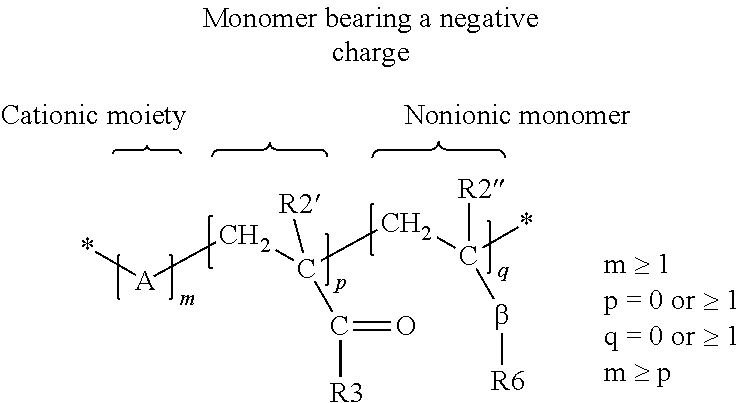
- where A, may be one or more of the following cationic moieties:
-

- where @=amido, alkylamido, ester, ether, alkyl or alkylaryl;
where Y=C1-C22 alkyl, alkoxy, alkylidene, alkyl or aryloxy;
where ψ=C1-C22 alkyl, alkyloxy, alkyl aryl or alkyl arylox;
where Z=C1-C22 alkyl, alkyloxy, aryl or aryloxy;
where R1=H, C1-C4 linear or branched alkyl;
where s=0 or 1, n=0 or 1;
where T and R7=C1-C22 alkyl; and
where X—=halogen, hydroxide, alkoxide, sulfate or alkylsulfate. - Where the monomer bearing a negative charge is defined by R2′=H, C1-C4 linear or branched alkyl and R3 as:
-

- where D=O, N, or S;
where Q=NH2 or O;
where u=1-6;
where t=0-1; and
where J=oxygenated functional group containing the following elements P, S, C. - Where the nonionic monomer is defined by R2″=H, C1-C4 linear or branched alkyl, R6=linear or branched alkyl, alkyl aryl, aryl oxy, alkyloxy, alkylaryl oxy and β is defined as
-

- and
where G′ and G″ are, independently of one another, O, S or N—H and L=0 or 1. -
- H. The hair care composition according to Paragraphs A-G wherein the cationic synthetic polymer has the following structure wherein the cationic synthetic polymer is selected from the group consisting of homopolymer polydiallyldimethylammonium chloride, copolymer polydiallyldimethylammonium chloride, and combinations thereof.
- I. The hair care composition according to Paragraphs A-H, wherein the cationic synthetic polymer comprises polydiallyldimethylammonium chloride.
- J. The hair care composition according to Paragraph I, wherein the composition comprises from about 0.2% to about 0.6%, by weight, of a polydiallyldimethylammonium chloride.
- K. The hair care composition of according to Paragraphs A-J wherein the composition has a liquid phase viscosity of about 1 centipoise (cP) to about 15,000 cP, alternatively from about 10 cP to about 12,000 cP, alternatively from about 20 cP to about 10,000 cP, alternatively from about 50 cP to about 8,000 cP, alternatively from about 100 cP to about 5000 cP, alternatively from about 250 cP to about 3000 cP, alternatively from about 500 cP to about 2500 cP.
- L. The hair care composition according to Paragraphs A-K, wherein said hair care composition is dispensed as a foam.
- M. The hair care composition according to Paragraph L, wherein the density of the foam is from about 0.01 g/cm′ to about 0.50 g/cm3, alternatively from about 0.02 g/cm3 to about 0.40 g/cm3, alternatively from about 0.03 g/cm3 to about 0.35 g/cm3.
- N. The hair care composition according to Paragraphs A-M, further comprising from about 1 to 15% of a foaming agent.
- O. The hair care composition according to Paragraphs A-N, further comprising a foaming agent and wherein the foaming agent is selected from the group consisting of hydrocarbons, halogenated hydrocarbons, and combinations thereof.
- P. The hair care composition according to Paragraphs A-O, further comprising a foaming agent and wherein the foaming agent is selected from the group consisting of propane, n-butane, isobutane, cyclopropane, and combinations thereof.
- Q. The hair care composition according to Paragraphs A-P, further comprising a foaming agent and wherein the foaming agent comprises hydrofluroolefin (HFO).
- R. The hair care composition according to Paragraphs A-Q, wherein the composition has a pH of from about 5 to about 7.
- S. The hair care composition according to Paragraphs A-R, further comprising an anti-dandruff active.
- T. The hair care composition according to Paragraphs A-S, wherein the hair care composition produces a final rinse friction final rinse friction from about 600 gf to about 2000 gf, alternatively from about 700 gf to about 1900 gf, alternatively from about 800 gf to about 1800 gf, alternatively from about 900 gf to about 1700 gf, alternatively from about 950 gf to about 1650 gf, alternatively from about 1000 gf to about 1600 gf.
- U. The hair care composition according to Paragraphs A-T wherein the hair care composition produces a final rinse friction from about 1000 gf to about 2000 gf, alternatively from about 1100 gf to about 1900 gf, alternatively from about 1200 gf to about 1800 gf, alternatively from about 1300 gf to about 1700 gf, alternatively from about 1350 gf to about 1650 gf, alternatively from about 1400 gf to about 1600 gf.
- V. The hair care composition according to Paragraphs A-U, wherein the hair care composition produces a delta final to initial of from about 100 gf to about 600 gf, alternatively from about 150 gf to about 550 gf, alternatively from about 180 to about 500 gf, alternatively from about 200 gf to about 450 gf.
- W. The hair care composition according to Paragraphs A-V, wherein the hair care composition produces a delta final to initial of from about 100 gf to about 600 gf, alternatively from about 200 gf to about 500 gf, alternatively from about 250 to about 400 gf, alternatively from about 275 gf to about 375 gf.
- X. The hair care composition according to Paragraphs A-W, wherein the hair care composition produces a delta final to initial of at least 200 gf, alternatively at least 225 gf, alternatively at least 250 gf, and/or alternatively at least 300 gf.
- Y. The hair care composition according to Paragraphs A-X, wherein the molecular weight of the cationic synthetic polymer is from about 6,000 g/mol to about 1.5 million g/mol, alternatively from about 8,000 g/mol to about 1.4 million g/mol, alternatively from about 10,000 g/mol to about 1.2 million g/mol, alternatively from about 25,000 g/mol to about 750,000 g/mol, alternatively from about 50,000 g/mol to about 500,000 g/mol, alternatively from about 100,000 g/mol to about 200,000 g/mol.
- Z. The hair care composition according to Paragraphs A-Y, wherein the charge density of the cationic synthetic polymer is from about 2.5 meq/g to about 8 meg/g, alternatively from about 3.5 meq/g to about 7.5 meg/g, alternatively from about 4 meq/g to about 7 meg/g.
- AA. The hair care composition according to Paragraphs A-Z, wherein the compositions comprise from about 25% to about 45%, alternatively from about 25% to about 40%, alternatively from about 30% to about 40%, alternatively from about 30% to about 35%, by weight, total detersive surfactant.
- BB. The hair care composition according to Paragraphs A-AA, wherein the molecular weight of the cationic guar polymer is from about 150,000 g/mol to about 2 million g/mol, alternatively from about 300,000 g/mol to about 1.8 million g/mol, alternatively from about 400,000 g/mol to about 1.7 million g/mol, alternatively from about 500,000 g/mol to about 1.6 million g/mol.
- CC. The hair care composition according to Paragraphs A-BB, wherein the charge density of the cationic guar polymer is from about 0.2 meq/g to about 2.2 meg/g, alternatively from about 0.4 meq/g to about 1.9 meg/g, alternatively from about 0.5 meq/g to about 1.8 meg/g, alternatively from about 0.6 meq/g to about 1.3 meg/g, alternatively from about 0.7 meq/g to about 1.0 meg/g.
- DD. A method of treating hair, the method comprising:
- a. applying to the hair the hair care composition according to Paragraphs A-CC, wherein the hair care composition is dispensed from an aerosol foam dispenser as a dosage of foam;
- b. rinsing the hair care composition;
- c. optionally applying to the hair a second hair care composition.
- The dimensions and values disclosed herein are not to be understood as being strictly limited to the exact numerical values recited. Instead, unless otherwise specified, each such dimension is intended to mean both the recited value and a functionally equivalent range surrounding that value. For example, a dimension disclosed as “40 mm” is intended to mean “about 40 mm”
- Every document cited herein, including any cross referenced or related patent or application and any patent application or patent to which this application claims priority or benefit thereof, is hereby incorporated herein by reference in its entirety unless expressly excluded or otherwise limited. The citation of any document is not an admission that it is prior art with respect to any invention disclosed or claimed herein or that it alone, or in any combination with any other reference or references, teaches, suggests or discloses any such invention. Further, to the extent that any meaning or definition of a term in this document conflicts with any meaning or definition of the same term in a document incorporated by reference, the meaning or definition assigned to that term in this document shall govern.
- While particular embodiments of the present invention have been illustrated and described, it would be obvious to those skilled in the art that various other changes and modifications can be made without departing from the spirit and scope of the invention. It is therefore intended to cover in the appended claims all such changes and modifications that are within the scope of this invention.
Claims (20)


Priority Applications (1)
| Application Number | Priority Date | Filing Date | Title |
|---|---|---|---|
| US16/001,064 US11679073B2 (en) | 2017-06-06 | 2018-06-06 | Hair compositions providing improved in-use wet feel |
Applications Claiming Priority (2)
| Application Number | Priority Date | Filing Date | Title |
|---|---|---|---|
| US201762515833P | 2017-06-06 | 2017-06-06 | |
| US16/001,064 US11679073B2 (en) | 2017-06-06 | 2018-06-06 | Hair compositions providing improved in-use wet feel |
Publications (2)
| Publication Number | Publication Date |
|---|---|
| US20180344614A1 true US20180344614A1 (en) | 2018-12-06 |
| US11679073B2 US11679073B2 (en) | 2023-06-20 |
Family
ID=64459064
Family Applications (1)
| Application Number | Title | Priority Date | Filing Date |
|---|---|---|---|
| US16/001,064 Active 2040-10-25 US11679073B2 (en) | 2017-06-06 | 2018-06-06 | Hair compositions providing improved in-use wet feel |
Country Status (1)
| Country | Link |
|---|---|
| US (1) | US11679073B2 (en) |
Cited By (28)
| Publication number | Priority date | Publication date | Assignee | Title |
|---|---|---|---|---|
| US10311575B2 (en) | 2016-03-23 | 2019-06-04 | The Procter And Gamble Company | Imaging method for determining stray fibers |
| US10426713B2 (en) | 2017-10-10 | 2019-10-01 | The Procter And Gamble Company | Method of treating hair or skin with a personal care composition in a foam form |
| US10441519B2 (en) | 2016-10-21 | 2019-10-15 | The Procter And Gamble Company | Low viscosity hair care composition comprising a branched anionic/linear anionic surfactant mixture |
| US10653590B2 (en) | 2016-10-21 | 2020-05-19 | The Procter And Gamble Company | Concentrated shampoo dosage of foam for providing hair care benefits comprising an anionic/zwitterionic surfactant mixture |
| US10799434B2 (en) | 2016-10-21 | 2020-10-13 | The Procter & Gamble Company | Concentrated shampoo dosage of foam for providing hair care benefits |
| US10842720B2 (en) | 2016-10-21 | 2020-11-24 | The Procter And Gamble Company | Dosage of foam comprising an anionic/zwitterionic surfactant mixture |
| US10888505B2 (en) | 2016-10-21 | 2021-01-12 | The Procter And Gamble Company | Dosage of foam for delivering consumer desired dosage volume, surfactant amount, and scalp health agent amount in an optimal formulation space |
| US10912732B2 (en) | 2017-12-20 | 2021-02-09 | The Procter And Gamble Company | Clear shampoo composition containing silicone polymers |
| US11116705B2 (en) | 2017-10-10 | 2021-09-14 | The Procter And Gamble Company | Compact shampoo composition containing sulfate-free surfactants |
| US11116704B2 (en) | 2017-10-10 | 2021-09-14 | The Procter And Gamble Company | Compact shampoo composition |
| US11116703B2 (en) | 2017-10-10 | 2021-09-14 | The Procter And Gamble Company | Compact shampoo composition containing sulfate-free surfactants |
| US11129783B2 (en) | 2016-10-21 | 2021-09-28 | The Procter And Gamble Plaza | Stable compact shampoo products with low viscosity and viscosity reducing agent |
| US11141370B2 (en) | 2017-06-06 | 2021-10-12 | The Procter And Gamble Company | Hair compositions comprising a cationic polymer mixture and providing improved in-use wet feel |
| US11141361B2 (en) | 2016-10-21 | 2021-10-12 | The Procter And Gamble Plaza | Concentrated shampoo dosage of foam designating hair volume benefits |
| US11154467B2 (en) | 2016-10-21 | 2021-10-26 | The Procter And Gamble Plaza | Concentrated shampoo dosage of foam designating hair conditioning benefits |
| US11224567B2 (en) | 2017-06-06 | 2022-01-18 | The Procter And Gamble Company | Hair compositions comprising a cationic polymer/silicone mixture providing improved in-use wet feel |
| US11291616B2 (en) | 2015-04-23 | 2022-04-05 | The Procter And Gamble Company | Delivery of surfactant soluble anti-dandruff agent |
| US11318073B2 (en) | 2018-06-29 | 2022-05-03 | The Procter And Gamble Company | Low surfactant aerosol antidandruff composition |
| US11446217B2 (en) | 2016-03-03 | 2022-09-20 | The Procter & Gamble Company | Aerosol antidandruff composition |
| US11679073B2 (en) | 2017-06-06 | 2023-06-20 | The Procter & Gamble Company | Hair compositions providing improved in-use wet feel |
| US11679065B2 (en) | 2020-02-27 | 2023-06-20 | The Procter & Gamble Company | Compositions with sulfur having enhanced efficacy and aesthetics |
| US11771635B2 (en) | 2021-05-14 | 2023-10-03 | The Procter & Gamble Company | Shampoo composition |
| US11819474B2 (en) | 2020-12-04 | 2023-11-21 | The Procter & Gamble Company | Hair care compositions comprising malodor reduction materials |
| US11980679B2 (en) | 2019-12-06 | 2024-05-14 | The Procter & Gamble Company | Sulfate free composition with enhanced deposition of scalp active |
| US11986543B2 (en) | 2021-06-01 | 2024-05-21 | The Procter & Gamble Company | Rinse-off compositions with a surfactant system that is substantially free of sulfate-based surfactants |
| US12226505B2 (en) | 2018-10-25 | 2025-02-18 | The Procter & Gamble Company | Compositions having enhanced deposition of surfactant-soluble anti-dandruff agents |
| US12427099B2 (en) | 2020-11-23 | 2025-09-30 | The Procter & Gamble Company | Personal care composition |
| US12458575B2 (en) | 2021-12-09 | 2025-11-04 | The Procter & Gamble Company | Sulfate free personal cleansing composition comprising effective preservation |
Citations (1)
| Publication number | Priority date | Publication date | Assignee | Title |
|---|---|---|---|---|
| WO2016172405A1 (en) * | 2015-04-23 | 2016-10-27 | The Procter & Gamble Company | A low viscosity hair care composition |
Family Cites Families (406)
| Publication number | Priority date | Publication date | Assignee | Title |
|---|---|---|---|---|
| US2879231A (en) | 1950-10-13 | 1959-03-24 | Colgate Palmolive Co | Shampoo composition |
| US3709437A (en) | 1968-09-23 | 1973-01-09 | Hershel Earl Wright | Method and device for producing foam |
| LU63168A1 (en) | 1971-05-14 | 1973-01-22 | ||
| GB1423179A (en) | 1973-05-16 | 1976-01-28 | Wilkinson Sword Ltd | Pressurised shaving foam dispensers |
| US4309119A (en) | 1979-07-03 | 1982-01-05 | Goldwell Gmbh, Chemische Fabrik H.E. Dotter | Applicator device for cosmetic preparations |
| DE2926796C2 (en) | 1979-07-03 | 1986-11-13 | Goldwell Gmbh, Chemische Fabrik H.E. Dotter, 6100 Darmstadt | Cosmetics applicator with piston moved by propellant gas - has gas chamber vented by opening of dispensing valve as cosmetic is introduced |
| US4329334A (en) | 1980-11-10 | 1982-05-11 | Colgate-Palmolive Company | Anionic-amphoteric based antimicrobial shampoo |
| JPS58113300A (en) | 1981-12-26 | 1983-07-06 | ライオン株式会社 | Shampoo - Composition |
| JPS61236708A (en) | 1985-04-12 | 1986-10-22 | Shiseido Co Ltd | Cosmetic |
| US4686254A (en) | 1985-08-05 | 1987-08-11 | The B. F. Goodrich Company | Suspension composition for aqueous surfactant systems |
| LU86429A1 (en) | 1986-05-16 | 1987-12-16 | Oreal | COSMETIC COMPOSITIONS CONTAINING A CATIONIC POLYMER AND AN ANIONIC POLYMER AS A THICKENING AGENT |
| US4726945A (en) | 1986-06-17 | 1988-02-23 | Colgate-Palmolive Co. | Hair rinse conditioner |
| US5294644A (en) | 1986-06-27 | 1994-03-15 | Isp Investments Inc. | Surface active lactams |
| US4867971A (en) | 1988-04-22 | 1989-09-19 | Colgate-Palmolive Company | Low pH shampoo containing climbazole |
| US4997641A (en) | 1990-04-09 | 1991-03-05 | Colgate-Palmolive Company | Hair conditioning shampoo containing C6 -C10 alkyl sulfate or alkyl alkoxy sulfate |
| GB9009824D0 (en) | 1990-04-27 | 1990-06-20 | Procter & Gamble | Cleaning products |
| WO1991014759A1 (en) | 1990-03-27 | 1991-10-03 | The Procter & Gamble Company | Foaming personal cleansing product with foam enhancing polymer |
| JP2883700B2 (en) | 1990-08-24 | 1999-04-19 | 花王株式会社 | Hair cosmetics |
| US5500217A (en) | 1991-02-05 | 1996-03-19 | Zeneca Limited | Personal care formulations |
| CA2068124A1 (en) | 1991-05-24 | 1992-11-25 | Daniel J. Halloran | Optically clear hair care compositions containing amino-functional silicone microemulsions |
| JP3069802B2 (en) | 1991-06-12 | 2000-07-24 | 山発産業株式会社 | Hair dye |
| US5417965A (en) | 1991-06-24 | 1995-05-23 | Helene Curtis, Inc. | Stable conditioning shampoo having a high foam level containing a silicone conditioner, a cationic quaternary acrylate copolymer, an anionic surfactant and polyethyleneimine |
| US5221530A (en) | 1991-06-24 | 1993-06-22 | Helene Curtis, Inc. | Mild conditioning shampoo with a high foam level containing an anionic surfactant-cationic acrylate/acrylamide copolymer conditioning agent |
| GB9123422D0 (en) | 1991-11-05 | 1991-12-18 | Unilever Plc | Detergent composition |
| US5830440A (en) | 1991-11-21 | 1998-11-03 | L'oreal | Aqueous aerosol hair spray |
| WO1993009761A1 (en) | 1991-11-22 | 1993-05-27 | Richardson-Vicks Inc. | Combined personal cleansing and moisturizing compositions |
| WO1993019723A1 (en) | 1992-03-31 | 1993-10-14 | Alberto-Culver Company | Emulsifier compositions for applying silicone oil to hair |
| NZ247676A (en) | 1992-06-08 | 1995-04-27 | Colgate Palmolive Co | Anionic surfactant compositions containing alkyl sulphates as viscosity modifiers; hair shampoo |
| CA2135641A1 (en) | 1992-06-16 | 1993-12-23 | Allen D. Urfer | Viscosity-adjusted surfactant concentrate compositions |
| CA2078375A1 (en) | 1992-09-16 | 1994-03-17 | Hamed A. Mohamed | Anti headache and pain hair/bath shampoo |
| US5701665A (en) | 1993-01-19 | 1997-12-30 | The Whitaker Corporation | Pi signal frequency filter method of manufacture |
| DE4315396A1 (en) | 1993-05-08 | 1994-11-10 | Henkel Kgaa | Hair-softening compositions |
| US5635469A (en) | 1993-06-10 | 1997-06-03 | The Procter & Gamble Company | Foaming cleansing products |
| US5364031A (en) | 1993-06-10 | 1994-11-15 | The Procter & Gamble Company | Foam dispensing nozzles and dispensers employing said nozzles |
| DE69413692T2 (en) | 1993-07-12 | 1999-05-20 | The Procter & Gamble Co., Cincinnati, Ohio | Strongly foaming anti-dandruff shampoos |
| US5441659A (en) | 1993-11-12 | 1995-08-15 | E. I. Du Pont De Nemours And Company | Compositions including a fluoroamine and a second component |
| US5409695A (en) | 1994-02-22 | 1995-04-25 | Dow Corning Corporation | Method of increasing deposition of silicone conditioner to hair |
| JPH07252134A (en) | 1994-03-11 | 1995-10-03 | Kao Corp | Skin cleanser |
| GB9406555D0 (en) | 1994-03-31 | 1994-05-25 | Unilever Plc | Shampoo composition |
| US5578298A (en) | 1994-05-27 | 1996-11-26 | General Electric Company | Microemulsions for high viscosity amino silicone fluids and gums and their preparation |
| AU3896395A (en) | 1994-10-11 | 1996-05-02 | James A. Monson | Dispensing apparatus for foaming compositions and method |
| US5624666A (en) | 1995-01-20 | 1997-04-29 | The Procter & Gamble Company | Anti-dandruff shampoos with particulate active agent and cationic polymer |
| EP0728475A3 (en) | 1995-02-21 | 1997-03-19 | Kao Corp | Skin cleanser |
| DE69535095D1 (en) | 1995-02-23 | 2006-08-10 | Ecolab Inc | DEVICE FOR DISTRIBUTING COMFORTABLE VISCOUS SOLUTION AND ITS USE TO DISTRIBUTE |
| GB9507130D0 (en) | 1995-04-06 | 1995-05-31 | Unilever Plc | Hair treatment composition |
| US6231844B1 (en) | 1995-04-13 | 2001-05-15 | The Procter & Gamble Company | Nonionic surfactant foaming agents for foaming cosmetic compositions |
| FR2733417B1 (en) | 1995-04-25 | 1997-06-06 | Oreal | FOAMING OIL-IN-WATER EMULSION BASED ON NON-IONIC SURFACTANTS, A FATTY PHASE AND A CATIONIC OR ANIONIC POLYMER CROSS-LINKED AND USE IN TOPICAL APPLICATION |
| JPH08310924A (en) | 1995-05-22 | 1996-11-26 | Masaki Nakamura | Shampoo and macromolecular compound remover |
| US5853618A (en) | 1995-07-13 | 1998-12-29 | The Procter & Gamble Company | Foam |
| JP3458256B2 (en) | 1995-07-21 | 2003-10-20 | ライオン株式会社 | Hair cleaning composition |
| US6268431B1 (en) | 1995-09-01 | 2001-07-31 | The Procter & Gamble Company | Hair styling shampoos containing low Tg latex polymer particles |
| US5985939A (en) | 1995-10-11 | 1999-11-16 | E.I. Du Pont De Nemours And Company | Processes for producing aerosol propellants that include butane or isobutane |
| JP3480165B2 (en) | 1995-12-23 | 2003-12-15 | 花王株式会社 | Acidic semi-permanent hair dye composition for aerosol injection |
| TW446563B (en) | 1996-01-16 | 2001-07-21 | Colgate Palmolive Co | Low static conditioning shampoo |
| KR19990082074A (en) | 1996-01-29 | 1999-11-15 | 데이비드 엠 모이어 | Shampoo composition with improved antimicrobial depositability |
| EG21623A (en) | 1996-04-16 | 2001-12-31 | Procter & Gamble | Mid-chain branced surfactants |
| MA24137A1 (en) | 1996-04-16 | 1997-12-31 | Procter & Gamble | MANUFACTURE OF BRANCHED SURFACES. |
| PH11997056158B1 (en) | 1996-04-16 | 2001-10-15 | Procter & Gamble | Mid-chain branched primary alkyl sulphates as surfactants |
| WO1997039089A1 (en) | 1996-04-16 | 1997-10-23 | The Procter & Gamble Company | Liquid cleaning compositions containing selected mid-chain branched surfactants |
| FR2751221B1 (en) | 1996-07-17 | 1998-09-04 | Oreal | PRESSURIZED COMPOSITION BASED ON FIXING POLYMER, SOLVENT AND OXYALKYLENATED SILICONE, AND RESULTING FOAM |
| US5980877A (en) | 1996-10-25 | 1999-11-09 | The Procter & Gamble Company | Conditioning shampoo composition |
| GB9624874D0 (en) | 1996-11-29 | 1997-01-15 | Unilever Plc | Composition |
| EP0964674A2 (en) | 1996-12-19 | 1999-12-22 | Rhodia Inc. | Liquid delivery systems |
| GB9626463D0 (en) | 1996-12-20 | 1997-02-05 | Procter & Gamble | Packaged personal cleansing product |
| JP2964226B2 (en) | 1997-01-17 | 1999-10-18 | 三洋化成工業株式会社 | Detergent composition |
| DE19714369A1 (en) | 1997-04-08 | 1998-10-15 | Henkel Kgaa | Means for cleaning hard surfaces |
| EP0874041A1 (en) | 1997-04-22 | 1998-10-28 | The Procter & Gamble Company | Detergent compositions |
| US6284225B1 (en) | 1997-09-29 | 2001-09-04 | Helene Curtis, Inc. | Propellant compositions comprising a hydrofluorocarbon and a hydrocarbon |
| CN1187036C (en) | 1997-10-14 | 2005-02-02 | 普罗克特和甘保尔公司 | Personal cleansing compositions comprising mid-chain branched surfactants |
| US6015547A (en) | 1997-10-27 | 2000-01-18 | Church & Dwight Co., Inc. | Stable solution of zinc ions and bicarbonate and/or carbonate ions |
| US5944229A (en) | 1997-10-30 | 1999-08-31 | Micro Matic Usa, Inc. | Drum valve system with tamper evident cap |
| EP1032354A1 (en) | 1997-11-12 | 2000-09-06 | The Procter & Gamble Company | Conditioning shampoo compositions |
| CN1286612A (en) | 1997-11-12 | 2001-03-07 | 宝洁公司 | Conditioning shampoo compositions |
| WO1999024013A1 (en) | 1997-11-12 | 1999-05-20 | The Procter & Gamble Company | Conditioning shampoo compositions |
| GB9726969D0 (en) | 1997-12-19 | 1998-02-18 | Unilever Plc | Mousse-forming shampoo compositions |
| FR2773069B1 (en) | 1997-12-29 | 2001-02-02 | Oreal | COSMETIC COMPOSITION COMPRISING AT LEAST ONE AMIDOETHERCARBOXYLIC ACID SURFACTANT AND AT LEAST ONE ASSOCIATION OF AN ANIONIC POLYMER AND A CATIONIC POLYMER |
| GB9804720D0 (en) | 1998-03-05 | 1998-04-29 | Unilever Plc | Shampoo compositions |
| GB9807269D0 (en) | 1998-04-03 | 1998-06-03 | Unilever Plc | Detergent compositions |
| EP1071396A1 (en) | 1998-04-24 | 2001-01-31 | The Procter & Gamble Company | Cleansing articles for skin and/or hair which also deposits skin care actives |
| BR9913490A (en) | 1998-08-28 | 2001-09-25 | Myelos Corp | Cyclic prosaposine and its uses |
| US6110451A (en) | 1998-12-18 | 2000-08-29 | Calgon Corporation | Synergistic combination of cationic and ampholytic polymers for cleansing and/or conditioning keratin based substrates |
| FR2789574B1 (en) | 1999-02-16 | 2001-03-30 | Oreal | DETERGENT COSMETIC COMPOSITIONS CONTAINING ANIONIC HYDROXYALKYLETHER SURFACTANT AND CATIONIC POLYMER AND USES THEREOF |
| US6649155B1 (en) | 1999-05-03 | 2003-11-18 | The Procter & Gamble Company | Anti-dandruff and conditioning shampoos containing certain cationic polymers |
| US6451300B1 (en) | 1999-05-03 | 2002-09-17 | The Procter & Gamble Company | Anti-dandruff and conditioning shampoos containing polyalkylene glycols and cationic polymers |
| US6827795B1 (en) | 1999-05-26 | 2004-12-07 | Procter & Gamble Company | Detergent composition comprising polymeric suds enhancers which have improved mildness and skin feel |
| GB9913951D0 (en) | 1999-06-15 | 1999-08-18 | Unilever Plc | Mousse-forming shampoo compositions |
| FR2798285B1 (en) | 1999-09-15 | 2003-08-08 | Oreal | COSMETIC COMPOSITION, PARTICULARLY FOR CLEANING THE SKIN |
| JP3634988B2 (en) | 1999-10-15 | 2005-03-30 | 三洋化成工業株式会社 | Anionic surfactant and detergent composition |
| JP3634991B2 (en) | 1999-11-01 | 2005-03-30 | 三洋化成工業株式会社 | Anionic surfactant and detergent composition |
| JP3634996B2 (en) | 1999-11-19 | 2005-03-30 | 三洋化成工業株式会社 | Anionic surfactant and detergent and water-soluble lubricant composition containing the same |
| GB9928822D0 (en) | 1999-12-06 | 2000-02-02 | Unilever Plc | Stable high glycerol liquids comprising N-acyl amino acids and/or salts |
| GB9929969D0 (en) | 1999-12-17 | 2000-02-09 | Unilever Plc | Packaged liquid cleansing composition |
| DE19961256A1 (en) | 1999-12-18 | 2001-06-21 | Clariant Gmbh | Cosmetic preparations |
| WO2001048021A1 (en) | 1999-12-29 | 2001-07-05 | Union Carbide Chemicals & Plastics | Highly charged cationic cellulose ethers |
| DE10002513A1 (en) | 2000-01-21 | 2001-08-16 | Wella Ag | Composition for a hair treatment composition in the form of an aerosol foam |
| US6635702B1 (en) | 2000-04-11 | 2003-10-21 | Noveon Ip Holdings Corp. | Stable aqueous surfactant compositions |
| DE10053728A1 (en) | 2000-10-30 | 2002-05-16 | Kao Chemicals Europe Sl | Transparent aqueous compositions comprising hydrophobic silicone oils |
| JP2002226889A (en) | 2000-11-30 | 2002-08-14 | Sanyo Chem Ind Ltd | Detergent composition |
| JP2002179552A (en) | 2000-12-08 | 2002-06-26 | Shiseido Co Ltd | Cleansing agent composition |
| DE10111288A1 (en) | 2001-03-09 | 2002-09-12 | Wella Ag | Anti-dandruff agents |
| FR2822680B1 (en) | 2001-03-30 | 2003-05-16 | Oreal | DETERGENT COSMETIC COMPOSITIONS CONTAINING AN ANIONIC SURFACTANT DERIVED FROM AMINO ACIDS AND A SOLUBLE CONDITIONING AGENT AND USES THEREOF |
| US6992054B2 (en) | 2001-05-14 | 2006-01-31 | Unilever Home & Personal Care Usa, Division Of Conopco, Inc. | Damp cleansing wipe |
| EP1269974A1 (en) | 2001-06-18 | 2003-01-02 | Unilever Plc | Hair styling compositions |
| US20030022799A1 (en) | 2001-07-27 | 2003-01-30 | Alvarado Robert M. | A shampoo foaming composition which comprises an alkyl ether sulfate, a sorbitan derivative, a betaine, an alkylamido alkylamine, an alkoxylated carboxylic acid, and an organic salt |
| JP5041113B2 (en) | 2001-08-20 | 2012-10-03 | ライオン株式会社 | Liquid detergent composition |
| US20030083210A1 (en) | 2001-08-24 | 2003-05-01 | Unilever Home And Personal Care Usa, Division Of Conopco, Inc. | Lamellar post foaming cleansing composition and dispensing system |
| DE10142476A1 (en) | 2001-08-31 | 2003-03-20 | Wella Ag | Gel-shaped hair treatment composition containing itaconic acid monoester / acrylate copolymer |
| US6695743B2 (en) | 2001-09-13 | 2004-02-24 | Toyota Jidosha Kabushiki Kaisha | Vehicular lockup clutch-equipped transmission control apparatus and control method thereof |
| US20030108501A1 (en) | 2001-10-03 | 2003-06-12 | Hofrichter Brian David | Shampoo containing a cationic polymer and particles |
| US6642194B2 (en) | 2001-11-07 | 2003-11-04 | Chemsil Silicones, Inc. | Clear conditioning detersive compositions and methods for making the same |
| AU2002301803B2 (en) | 2001-11-08 | 2004-09-09 | L'oreal | Cosmetic compositions containing an aminosilicone and a conditioner, and uses thereof |
| AU2002301801B2 (en) | 2001-11-08 | 2004-09-30 | L'oreal | Cosmetic compositions containing an aminosilicone and a conditioner, and uses thereof |
| FR2831803B1 (en) | 2001-11-08 | 2004-07-30 | Oreal | COSMETIC COMPOSITIONS CONTAINING AN AMINO SILICONE AND A THICKENING AGENT AND THEIR USES |
| EP1458337B1 (en) | 2001-12-21 | 2016-05-04 | Solvay USA Inc. | Stable surfactant compositions for suspending components |
| US6726729B2 (en) | 2001-12-28 | 2004-04-27 | Unilever Home & Personal Care Usa, Division Of Conopco, Inc. | Gradual permanent coloring of hair using dye intermediates in a shampoo base |
| JP2003201217A (en) | 2001-12-28 | 2003-07-18 | Daizo:Kk | Aerosol composition for hair |
| US20030161802A1 (en) | 2002-02-05 | 2003-08-28 | Flammer Linda J. | Anti-dandruff and anti-itch compositions containing sensate and sensate enhancer-containing compounds |
| FR2836631B1 (en) | 2002-03-01 | 2006-06-23 | Oreal | AEROSOL FOAM COMPRISING THE COMBINATION OF A VINYLPYRROLIDONE CATIONIC POLYMER AND A CELLULOSIC COMPOUND AND USES IN COSMETICS |
| JP2003277246A (en) | 2002-03-22 | 2003-10-02 | Takasago Internatl Corp | Deodorant composition |
| US6858217B2 (en) | 2002-03-22 | 2005-02-22 | Unilever Home & Personal Care Usa Division Of Conopco, Inc. | Stabilization of terpenoids in cosmetic compositions |
| US20030228272A1 (en) | 2002-03-27 | 2003-12-11 | Zahid Amjad | Novel antidandruff conditioning shampoo |
| MXPA04009513A (en) | 2002-04-22 | 2005-01-25 | Procter & Gamble | Personal care compositions comprising a zinc containing material in an aqueous surfactant composition. |
| CN1646085A (en) | 2002-04-22 | 2005-07-27 | 宝洁公司 | Shampoo containing a cationic guar derivative |
| BR0309945A (en) | 2002-05-10 | 2005-02-22 | Unilever Nv | Hair conditioning composition, methods for the preparation of hair conditioning composition, uses of a composition and method of cleaning and conditioning hair |
| US20050202984A1 (en) | 2003-03-18 | 2005-09-15 | Schwartz James R. | Composition comprising zinc-containing layered material with a high relative zinc lability |
| US8367048B2 (en) | 2002-06-04 | 2013-02-05 | The Procter & Gamble Company | Shampoo containing a gel network |
| CN1658824A (en) | 2002-06-04 | 2005-08-24 | 宝洁公司 | Conditioning shampoo composition containing select cationic conditioning polymers |
| US8491877B2 (en) | 2003-03-18 | 2013-07-23 | The Procter & Gamble Company | Composition comprising zinc-containing layered material with a high relative zinc lability |
| GB0222500D0 (en) | 2002-09-27 | 2002-11-06 | Unilever Plc | Packaged personal care compositions |
| GB0228877D0 (en) | 2002-12-11 | 2003-01-15 | Unilever Plc | Shampoo compositions |
| US6979668B2 (en) | 2002-12-16 | 2005-12-27 | Generex Pharmaceuticals Incorporated | Cleaning compound for and method of cleaning valves and actuators of metered dose dispensers containing pharmaceutical compositions |
| GB0229733D0 (en) | 2002-12-23 | 2003-01-29 | Unilever Plc | Hair treatment compositions |
| US6824079B2 (en) | 2003-01-24 | 2004-11-30 | S. C. Johnson & Son, Inc. | Aerosol dispenser assembly and method of reducing the particle size of a dispensed product |
| EP1507845B1 (en) | 2003-02-28 | 2007-01-03 | The Procter & Gamble Company | Foam-generating kit containing a foam-generating dispenser and a composition containing a high level of surfactant |
| JP2006519373A (en) | 2003-02-28 | 2006-08-24 | インペリアル・ケミカル・インダストリーズ・ピーエルシー | Bubble evaluation |
| US7402554B2 (en) | 2003-02-28 | 2008-07-22 | The Procter & Gamble Company | Foam-generating kit containing a foam-generating dispenser and a composition containing a high level of surfactant |
| US7651992B2 (en) | 2003-02-28 | 2010-01-26 | The Procter & Gamble Company | Foam-generating kit containing a foam-generating dispenser and a composition containing a high level of surfactant |
| US20040191331A1 (en) | 2003-03-18 | 2004-09-30 | The Procter & Gamble Company | Composition comprising particulate zinc materials having a defined crystallite size |
| JP4220824B2 (en) | 2003-04-17 | 2009-02-04 | 花王株式会社 | Hair cleanser |
| BRPI0410450A (en) | 2003-05-23 | 2006-06-13 | Procter & Gamble | transparent personal care compositions containing a cationic conditioning polymer and anionic surfactant system. |
| US6743760B1 (en) | 2003-05-29 | 2004-06-01 | Colgate-Palmolive Company | Transparent conditioning shampoo |
| US20050026805A1 (en) | 2003-07-14 | 2005-02-03 | Ici Americas, Inc. | Solvated nonionic surfactants and fatty acids |
| JP2006528635A (en) | 2003-07-22 | 2006-12-21 | ローディア インコーポレイティド | A novel branched sulfate used in personal care formulations |
| WO2005023975A1 (en) | 2003-09-03 | 2005-03-17 | Henkel Kommanditgesellschaft Auf Aktien | Multi-phase cosmetic agent for cleansing hair and skin |
| KR100553321B1 (en) | 2003-09-29 | 2006-02-20 | 김선무 | Spray Shampoo |
| DE10356869A1 (en) | 2003-12-03 | 2005-07-07 | Beiersdorf Ag | Surfactant-containing preparation with licochalcone A |
| ATE496615T1 (en) | 2003-12-05 | 2011-02-15 | Kpss Kao Gmbh | HAIR CONDITIONING AND CLEANSING COMPOSITION |
| US20050136011A1 (en) | 2003-12-23 | 2005-06-23 | Unilever Home & Personal Care Usa, Division Of Conopco, Inc. | Mousse product and method for conditioning hair |
| JP2005187359A (en) | 2003-12-25 | 2005-07-14 | Lion Corp | Hair cleaning composition for non-aerosol foam discharge container |
| JP2007517805A (en) | 2004-01-16 | 2007-07-05 | ザ プロクター アンド ギャンブル カンパニー | Conditioning shampoo composition |
| US7541320B2 (en) | 2004-01-23 | 2009-06-02 | Unilever Home & Personal Care Usa, Division Of Conopco, Inc. | Mild, viscous cleansing composition with versatile compatibility and enhanced conditioning |
| CN1917853A (en) | 2004-02-10 | 2007-02-21 | 宝洁公司 | Conditioning compositions comprising hydrophobically modified crosslinked cationic thickening polymers |
| JP2005232113A (en) | 2004-02-23 | 2005-09-02 | Lion Corp | Hair cosmetics |
| US8623341B2 (en) | 2004-07-02 | 2014-01-07 | The Procter & Gamble Company | Personal care compositions containing cationically modified starch and an anionic surfactant system |
| US20060057075A1 (en) | 2004-08-02 | 2006-03-16 | Moshe Arkin | Pharmaceutical and cosmeceutical wash-off mousse shampoo compositions, processes for preparing the same and uses thereof |
| US20080261844A1 (en) | 2004-09-03 | 2008-10-23 | Beiersdorf Ag | Multicolor Cosmetics |
| US7666825B2 (en) | 2004-10-08 | 2010-02-23 | The Procter & Gamble Company | Stable, patterned multi-phased personal care composition |
| US20060079421A1 (en) | 2004-10-08 | 2006-04-13 | Wagner Julie A | Stable multi-phased personal care composition |
| US20060079419A1 (en) | 2004-10-08 | 2006-04-13 | Julie Ann Wagner | Depositable solids |
| US7531497B2 (en) | 2004-10-08 | 2009-05-12 | The Procter & Gamble Company | Personal care composition containing a cleansing phase and a benefit phase |
| US20060079420A1 (en) | 2004-10-08 | 2006-04-13 | Wagner Julie A | Multi-phase personal cleansing composition |
| US20060079418A1 (en) | 2004-10-08 | 2006-04-13 | Wagner Julie A | Stable multi-phased personal care composition |
| US7659233B2 (en) | 2004-10-25 | 2010-02-09 | Conopco, Inc. | Personal care compositions with silicones and dihydroxypropyl trialkyl ammonium salts |
| US8124063B2 (en) | 2004-10-25 | 2012-02-28 | Conopco, Inc. | Method for moisturizing human skin using dihydroxypropyltri(C1-C3 alkyl) ammonium salts |
| AU2005298910B2 (en) | 2004-10-25 | 2008-05-29 | Unilever Plc | Personal care compositions with glycerin and hydroxypropyl quaternary ammonium salts |
| JP3912546B2 (en) | 2004-10-28 | 2007-05-09 | ライオン株式会社 | Shampoo composition |
| US20060090777A1 (en) | 2004-11-01 | 2006-05-04 | Hecht Stacie E | Multiphase cleaning compositions having ionic liquid phase |
| DE102004054278A1 (en) | 2004-11-10 | 2006-06-01 | Wella Ag | Clear, biphasic, foam-forming aerosol hair styling product |
| US20060110415A1 (en) | 2004-11-22 | 2006-05-25 | Bioderm Research | Topical Delivery System for Cosmetic and Pharmaceutical Agents |
| US7776318B2 (en) | 2004-11-26 | 2010-08-17 | L'oreal S.A. | Liquid cleaning composition comprising at least one anionic surfactant and its use for cleansing human keratin materials |
| JP4527655B2 (en) | 2004-11-30 | 2010-08-18 | ライオン株式会社 | Cleaner composition in former container |
| JP2008521860A (en) | 2004-12-04 | 2008-06-26 | ユニリーバー・ナームローゼ・ベンノートシヤープ | Shampoo composition comprising cationic polymer and anionic surfactant mixture |
| JP4558514B2 (en) | 2005-01-11 | 2010-10-06 | 日本メナード化粧品株式会社 | Liquid detergent composition |
| US7977288B2 (en) | 2005-01-12 | 2011-07-12 | Amcol International Corporation | Compositions containing cationically surface-modified microparticulate carrier for benefit agents |
| US20060183662A1 (en) | 2005-02-16 | 2006-08-17 | Unilever Home & Personal Care Usa, Division Of Conopco, Inc. | Liquid cleansing composition with unique sensory properties |
| JP2008531740A (en) | 2005-03-07 | 2008-08-14 | デブ ワールドワイド ヘルスケア インコーポレーテッド | High alcohol content foamable composition containing a silicone based surfactant |
| WO2006113117A1 (en) | 2005-04-13 | 2006-10-26 | The Procter & Gamble Company | Mild, structured, multiphase personal cleansing compositions |
| US7820609B2 (en) | 2005-04-13 | 2010-10-26 | The Procter & Gamble Company | Mild, structured, multi-phase personal cleansing compositions comprising density modifiers |
| DE102005018668A1 (en) | 2005-04-21 | 2006-11-02 | Henkel Kgaa | Body cleansing composition with reduced water content |
| DE202005009618U1 (en) | 2005-06-20 | 2005-09-08 | Wella Ag | Delivery system for spraying a cosmetic composition comprises a pressure-resistant pack, a capillary spray head and a composition including a propellant and a detergent |
| CN101208134A (en) | 2005-06-24 | 2008-06-25 | 宝洁公司 | Transparent conditioning composition comprising coacervate |
| EP2100601B1 (en) | 2005-10-24 | 2012-06-27 | Precision Dermatology, Inc. | Topical pharmaceutical foam composition |
| JP2007131687A (en) | 2005-11-09 | 2007-05-31 | Sunstar Inc | Transparent detergent composition |
| EP1957036A1 (en) | 2005-12-08 | 2008-08-20 | Unilever Plc | Shampoo compositions containing a combination of cationic polymers |
| US9427391B2 (en) | 2006-01-09 | 2016-08-30 | The Procter & Gamble Company | Personal care compositions containing cationic synthetic copolymer and a detersive surfactant |
| US20080206179A1 (en) | 2006-01-09 | 2008-08-28 | Marjorie Mossman Peffly | Personal Care Compositions Containing Cationic Synthetic Copolymer and a Detersive Surfactant |
| US20070160555A1 (en) | 2006-01-09 | 2007-07-12 | Staudigel James A | Personal care compositions containing cationically modified starch and an anionic surfactant system |
| CA2645459A1 (en) | 2006-03-22 | 2007-10-04 | The Procter & Gamble Company | Aerosol product comprising a foaming concentrate composition comprising particulate materials |
| ES2664604T3 (en) | 2006-05-11 | 2018-04-20 | Evonik Degussa Gmbh | Personal care compositions containing functionalized polymers |
| CN101077331A (en) | 2006-05-22 | 2007-11-28 | 花王株式会社 | Aqueous hair cleansing agent |
| US20070292380A1 (en) | 2006-06-16 | 2007-12-20 | James Anthony Staudigel | Hair conditioning composition containing a non-guar galactomannan polymer derivative |
| JP2008001626A (en) | 2006-06-22 | 2008-01-10 | Lion Corp | Transparent shampoo composition |
| EP1894603B1 (en) | 2006-09-04 | 2014-11-19 | Takasago International Corporation | Encapsulation of bulky fragrance molecules |
| US20080260655A1 (en) | 2006-11-14 | 2008-10-23 | Dov Tamarkin | Substantially non-aqueous foamable petrolatum based pharmaceutical and cosmetic compositions and their uses |
| US8349296B2 (en) | 2006-12-21 | 2013-01-08 | Kpss-Kao Professional Salon Services Gmbh | Aerosol foam composition |
| US20080260665A1 (en) | 2007-01-08 | 2008-10-23 | Laurence Guerchet | Nail varnish comprising at least one polycondensate and at least one polyoxyalkylene copolymer |
| JP2008214292A (en) | 2007-03-06 | 2008-09-18 | Masao Ando | Agent for shampooing |
| US8349300B2 (en) | 2007-04-19 | 2013-01-08 | The Procter & Gamble Company | Personal care compositions containing at least two cationic polymers and an anionic surfactant |
| US20080299054A1 (en) | 2007-05-30 | 2008-12-04 | Conopco, Inc., D/B/A Unilever | Personal care compositions with enhanced fragrance delivery |
| KR100876329B1 (en) | 2007-06-18 | 2008-12-29 | 황성규 | Aerosol Spray Waterless Shampoo |
| FR2917968B1 (en) | 2007-06-29 | 2010-02-26 | Oreal | DETERGENT COSMETIC COMPOSITIONS COMPRISING FOUR SURFACTANTS, CATIONIC POLYMER AND BENEFICATED AGENT AND USE |
| EP2018841A1 (en) | 2007-07-26 | 2009-01-28 | KPSS-Kao Professional Salon Services GmbH | Color enhancing shampoo composition |
| US8253799B2 (en) | 2007-07-27 | 2012-08-28 | Sportvision, Inc. | Detecting an object in an image using camera registration data indexed to location or camera sensors |
| BRPI0814053A2 (en) | 2007-07-27 | 2015-01-06 | Procter & Gamble | CONDITIONING COMPOSITION UNDERSTANDING A DOUBLE CATIONIC, AMINO SILICONE AND SILICONE RESIN TENSIVE SYSTEM |
| US20090029900A1 (en) | 2007-07-27 | 2009-01-29 | The Procter & Gamble Company | Personal care article for sequentially dispensing compositions with distinct fragrance characters |
| EP2022468A1 (en) | 2007-08-07 | 2009-02-11 | KPSS-Kao Professional Salon Services GmbH | Conditioning composition for hair |
| DE102007040909A1 (en) | 2007-08-30 | 2009-03-05 | Clariant International Ltd. | Aqueous concentrates of isethionate, taurate and betaine |
| EP2042216B1 (en) | 2007-09-28 | 2015-09-09 | Omega Pharma Nordic AB | Body and hair cleansing formulations |
| JP5005495B2 (en) | 2007-10-19 | 2012-08-22 | ホーユー株式会社 | Shampoo composition |
| US9968535B2 (en) | 2007-10-26 | 2018-05-15 | The Procter & Gamble Company | Personal care compositions comprising undecyl sulfates |
| JP5688293B2 (en) | 2007-12-21 | 2015-03-25 | ビーエーエスエフ ソシエタス・ヨーロピアBasf Se | Anti-dandruff composition containing peptide |
| EP2242476A2 (en) | 2008-01-14 | 2010-10-27 | Foamix Ltd. | Poloxamer foamable pharmaceutical compositions with active agents and/or therapeutic cells and uses |
| MX2010007867A (en) | 2008-01-18 | 2010-08-09 | Procter & Gamble | Concentrated personal cleansing compositions. |
| US8936796B2 (en) | 2008-02-25 | 2015-01-20 | The Procter & Gamble Company | Hair care compositions comprising sucrose polyesters |
| US8437556B1 (en) | 2008-02-26 | 2013-05-07 | Hrl Laboratories, Llc | Shape-based object detection and localization system |
| US20090312224A1 (en) | 2008-06-13 | 2009-12-17 | Conopco, Inc., D/B/A Unilever | Method of Reducing Viscosity of Concentrated Liquid Cleansers by Selection of Perfume Components |
| US20110165107A1 (en) | 2008-06-19 | 2011-07-07 | Franciscus Derks | Volume up shampoos |
| US8691301B2 (en) | 2008-06-30 | 2014-04-08 | Kimberly-Clark Worldwide, Inc. | Surfactant gas pressurized liquid composition and method and package for delivering |
| DE102008050430A1 (en) | 2008-10-08 | 2010-04-15 | Henkel Ag & Co. Kgaa | Anti-dandruff and anti-relapse shampoo |
| AU2009312895A1 (en) | 2008-11-07 | 2010-05-14 | Unilever Plc | Concentrated shampoo composition |
| US20110319790A1 (en) | 2008-11-25 | 2011-12-29 | B.G. Negev Technologies And Applications Ltd. | Pharmaceutical composition and system for permeabilizing fetal membranes |
| EP2196186A1 (en) | 2008-12-15 | 2010-06-16 | KPSS-Kao Professional Salon Services GmbH | Cleansing composition |
| US8124577B2 (en) | 2009-01-21 | 2012-02-28 | Stepan Company | Personal care compositions of sulfonated estolides and other derivatives of fatty acids and uses thereof |
| JP2012524038A (en) | 2009-04-15 | 2012-10-11 | ロディア オペレーションズ | How to treat damaged hair |
| MX2011012790A (en) | 2009-06-04 | 2011-12-16 | Procter & Gamble | Multiple product system for hair. |
| JP5653007B2 (en) | 2009-06-12 | 2015-01-14 | ホーユー株式会社 | Hair treatment composition |
| BRPI1010140B8 (en) | 2009-06-24 | 2022-06-14 | Unilever Nv | Conditioning shampoo composition |
| JP5849047B2 (en) | 2009-06-24 | 2016-01-27 | ユニリーバー・ナームローゼ・ベンノートシヤープ | Anti-dandruff shampoo with gel network structure |
| US8343469B2 (en) | 2009-07-02 | 2013-01-01 | Hercules Incorporated | Cationic synthetic polymers with improved solubility and performance in surfactant-based systems and use in personal care and household applications |
| EP2277499A1 (en) | 2009-07-22 | 2011-01-26 | KPSS-Kao Professional Salon Services GmbH | Method for levelling hair colour |
| AR078363A1 (en) | 2009-09-14 | 2011-11-02 | Procter & Gamble | COMPACT FLUID DETERGENT COMPOSITION FOR LAUNDRY |
| EP2511363A1 (en) | 2009-12-08 | 2012-10-17 | Shiseido Company, Ltd. | Cleanser composition, method for generating foam, foam, and method for washing hair |
| US8771765B1 (en) | 2009-12-22 | 2014-07-08 | Ailin Fernandez | Method and composition for treatment of hair loss |
| US20110166370A1 (en) | 2010-01-12 | 2011-07-07 | Charles Winston Saunders | Scattered Branched-Chain Fatty Acids And Biological Production Thereof |
| JP5548464B2 (en) | 2010-01-26 | 2014-07-16 | 株式会社ミルボン | Washing soap |
| JP2011190221A (en) | 2010-03-16 | 2011-09-29 | Milbon Co Ltd | Hair treatment agent |
| US8263538B2 (en) | 2010-03-31 | 2012-09-11 | Conopco, Inc. | Personal wash cleanser with mild surfactant systems comprising defined alkanoyl compounds and defined fatty acyl isethionate surfactant product |
| JP4912483B2 (en) | 2010-04-12 | 2012-04-11 | 株式会社 資生堂 | Concentrated liquid detergent composition and method for producing the same |
| MX336922B (en) | 2010-04-21 | 2016-02-05 | Procter & Gamble | Liquid cleaning and/or cleansing composition. |
| US9186642B2 (en) | 2010-04-28 | 2015-11-17 | The Procter & Gamble Company | Delivery particle |
| US20110268778A1 (en) | 2010-04-28 | 2011-11-03 | Jiten Odhavji Dihora | Delivery particles |
| US20110269657A1 (en) | 2010-04-28 | 2011-11-03 | Jiten Odhavji Dihora | Delivery particles |
| US8300949B2 (en) | 2010-05-18 | 2012-10-30 | Sharp Laboratories Of America, Inc. | Edge detection technique having improved feature visibility |
| CA2802070A1 (en) | 2010-06-09 | 2011-12-15 | The Procter & Gamble Company | Method for preparing a non-ionic surfactant stable personal care dispersion |
| JP5667790B2 (en) | 2010-06-15 | 2015-02-12 | 株式会社 資生堂 | Cleaning composition |
| EP2407144A1 (en) | 2010-07-13 | 2012-01-18 | The Procter & Gamble Company | Aerosol hairspray product for styling and/or shaping hair |
| JP5763762B2 (en) | 2010-07-15 | 2015-08-12 | ザ プロクター アンド ギャンブルカンパニー | Hair washing method |
| DE102010038952A1 (en) | 2010-08-05 | 2012-02-09 | Henkel Ag & Co. Kgaa | Preservative compositions and cosmetics containing these |
| CA2805704A1 (en) | 2010-08-18 | 2012-02-23 | Unilever Plc | Anti-dandruff shampoo |
| AU2011297347B2 (en) | 2010-08-31 | 2014-02-27 | Otsuka Pharmaceutical Co., Ltd. | Composition for cleaning scalp and head hair |
| FR2964317B1 (en) | 2010-09-06 | 2013-04-12 | Oreal | COSMETIC COMPOSITION COMPRISING A FIXING POLYMER AND A PARTICULAR THICKENER AND STAPLING USES |
| DE102010043074A1 (en) | 2010-10-28 | 2012-05-03 | Henkel Ag & Co. Kgaa | Active substance combination and hair treatment agent for dandruff III |
| EP2645986B1 (en) | 2010-12-02 | 2015-02-25 | Unilever PLC | Anti-dandruff shampoo |
| DE102010055817A1 (en) | 2010-12-23 | 2012-06-28 | Henkel Ag & Co. Kgaa | Foaming agent-containing foamable cosmetic composition for skin and body care |
| US9701430B2 (en) | 2011-05-16 | 2017-07-11 | The Procter & Gamble Company | Components for aerosol dispenser |
| US9296550B2 (en) | 2013-10-23 | 2016-03-29 | The Procter & Gamble Company | Recyclable plastic aerosol dispenser |
| JP5970244B2 (en) | 2011-06-03 | 2016-08-17 | 株式会社ダイゾー | Aerosol composition and aerosol product |
| WO2012170171A1 (en) | 2011-06-10 | 2012-12-13 | Lubrizol Advanced Materials, Inc. | Cassia derivatives |
| EP2532343A1 (en) | 2011-06-10 | 2012-12-12 | KPSS-Kao Professional Salon Services GmbH | Hair cleansing composition |
| PH12013502576B1 (en) | 2011-06-10 | 2019-01-18 | Procter & Gamble | Personal care compositions |
| DE102011078382A1 (en) | 2011-06-30 | 2013-01-03 | Evonik Goldschmidt Gmbh | Microemulsion of quaternary ammonium group-containing polysiloxanes, their preparation and use |
| DE102011079539A1 (en) | 2011-07-21 | 2013-01-24 | Henkel Ag & Co. Kgaa | Performance Enhanced Drug Combination and Hair Treatments for Dandruff II |
| WO2013019969A2 (en) | 2011-08-03 | 2013-02-07 | Melaleuca, Inc. | Hair care compositions |
| US20130045285A1 (en) | 2011-08-15 | 2013-02-21 | Qing Stella | Methods of Enhancing Skin Hydration and Improving Non-Diseased Skin |
| US20130244922A1 (en) | 2011-09-13 | 2013-09-19 | E I Du Pont De Nemours And Company | Azeotropic compositions comprising methyl perfluoropentene ethers for cleaning applications |
| US9155768B2 (en) | 2011-09-30 | 2015-10-13 | Elc Management Llc | Regimen for reducing the appearance of thinning hair |
| WO2013052802A2 (en) | 2011-10-07 | 2013-04-11 | The Procter & Gamble Company | Shampoo composition containing a gel network |
| MX339329B (en) | 2011-10-07 | 2016-05-20 | Procter & Gamble | Personal care compositions and methods of making same. |
| DE102011084888A1 (en) | 2011-10-20 | 2013-04-25 | Henkel Ag & Co. Kgaa | Mild cosmetic cleaner |
| JP2014532717A (en) | 2011-11-03 | 2014-12-08 | プレシジョン ダーマトロジー インコーポレイテッドPrecision Dermatology, Inc. | Stable skin aerosol foam with reactive propellant |
| DE102011086632A1 (en) | 2011-11-18 | 2013-05-23 | Henkel Ag & Co. Kgaa | Hair care products containing selected nonionic polymers and cationic silicones |
| US9724283B2 (en) | 2011-12-01 | 2017-08-08 | L'oreal | Hair cleansing composition |
| US20130189212A1 (en) | 2012-01-24 | 2013-07-25 | Galaxy Surfactants Ltd. | Novel Surfactant Composition |
| JP2013151434A (en) | 2012-01-24 | 2013-08-08 | Milbon Co Ltd | Shampoo |
| JP5702317B2 (en) | 2012-02-15 | 2015-04-15 | 株式会社オプティム | Sales promotion server, sales promotion method, and sales promotion program |
| US8699751B2 (en) | 2012-03-02 | 2014-04-15 | The Procter & Gamble Company | Method for quantifying the effective height of fibers emanating from a surface |
| US8675919B2 (en) | 2012-03-02 | 2014-03-18 | The Procter & Gamble Company | Method for quantifying the number of free fibers emanating from a surface |
| CN104321386B (en) | 2012-03-29 | 2018-04-10 | 莫门蒂夫性能材料有限责任公司 | Low-viscosity polyorganosiloxanes containing quaternary ammonium groups, their production and use |
| IN2014MN01906A (en) | 2012-03-29 | 2015-07-10 | Momentive Performance Mat Inc | |
| US9364421B2 (en) | 2012-03-30 | 2016-06-14 | Kose Corporation | Hair cosmetic |
| CN104220040A (en) | 2012-04-20 | 2014-12-17 | 宝洁公司 | Hair care composition comprising metathesized unsaturated polyol esters |
| MX355080B (en) | 2012-04-20 | 2018-04-03 | Procter & Gamble | Improving skin appearance with increase in skin chroma. |
| EP2840928A1 (en) | 2012-04-27 | 2015-03-04 | The Procter & Gamble Company | Applicator assembly for applying a composition |
| CN109010128B (en) | 2012-05-22 | 2021-12-21 | 联合利华知识产权控股有限公司 | Personal care compositions comprising a cooling active and a copolymer containing acrylamidopropyltrimethylammonium chloride |
| CN102697670B (en) | 2012-06-13 | 2014-07-30 | 广州温雅日用化妆品有限公司 | Foaming agent type shampoo |
| CN102697668B (en) | 2012-06-13 | 2013-08-07 | 广州温雅日用化妆品有限公司 | Hair washing method of foaming agent type shampoo |
| JP5947121B2 (en) | 2012-06-22 | 2016-07-06 | 花王株式会社 | Liquid cleaner in non-gas former container |
| JP6046394B2 (en) | 2012-06-29 | 2016-12-14 | ホーユー株式会社 | Hair cleaning composition |
| US20140039066A1 (en) | 2012-08-03 | 2014-02-06 | Piped Limited | Formulation for gritty foam dispenser |
| KR101608606B1 (en) | 2012-08-16 | 2016-04-01 | 도요 에어로졸 고교 가부시키가이샤 | Foam-forming aerosol product |
| US9537116B2 (en) | 2012-08-22 | 2017-01-03 | 3M Innovative Properties Company | Transparent OLED light extraction |
| DE102012216293A1 (en) | 2012-09-13 | 2014-03-13 | Henkel Ag & Co. Kgaa | Hair care products containing anti-dandruff active ingredients and selected plant-based cationic surfactants |
| CN102851015B (en) | 2012-09-28 | 2014-12-24 | 四川仁智油田技术服务股份有限公司 | Foam drainage agent with high temperature resistance, high condensate oil resistance and hypersalinity resistance and preparation method |
| CN104661646B (en) | 2012-10-11 | 2017-10-27 | 道康宁公司 | Waterborne organic silicon polyethers microemulsion |
| DE102012219218A1 (en) | 2012-10-22 | 2014-04-24 | Henkel Ag & Co. Kgaa | Surfactant-containing foams |
| CN102895151B (en) | 2012-10-22 | 2014-04-16 | 广州立白企业集团有限公司 | Sulfate-free hair cleanser and preparation method thereof |
| JP6108594B2 (en) | 2012-11-06 | 2017-04-05 | 株式会社ミルボン | shampoo |
| JP6092576B2 (en) | 2012-11-06 | 2017-03-08 | 株式会社ミルボン | Effervescent aerosol products |
| JP2013091642A (en) | 2012-11-07 | 2013-05-16 | Milbon Co Ltd | Foaming aerosol product |
| KR20140060882A (en) | 2012-11-13 | 2014-05-21 | 농업회사법인주식회사청명 | Shampoo compositions and preparation method thereof |
| AU2013344990B2 (en) | 2012-11-14 | 2018-03-08 | Edgewell Personal Care Brands, Llc | Packaged products including a personal care medium and a non-flammable volatile agent stored within an aerosol container |
| US8983156B2 (en) | 2012-11-23 | 2015-03-17 | Icad, Inc. | System and method for improving workflow efficiences in reading tomosynthesis medical image data |
| US8778910B2 (en) | 2012-12-07 | 2014-07-15 | Conopco, Inc. | Concentrated lamellar liquid personal cleansing composition |
| EP2953503B1 (en) | 2013-02-07 | 2020-07-22 | Noxell Corporation | Method of treating hair with foam |
| BR112015021530A2 (en) | 2013-03-08 | 2017-07-18 | Lubrizol Advanced Mat Inc | personal care composition and method for mitigating the loss of deposited silicone |
| KR20150126894A (en) | 2013-03-08 | 2015-11-13 | 루브리졸 어드밴스드 머티어리얼스, 인코포레이티드 | Improved foaming performance in cleansing compositions through the use of nonionic, amphiphilic polymers |
| EP2969021B1 (en) | 2013-03-15 | 2019-08-07 | ISP Investments LLC | Hair care compositions comprising polyelectrolyte complexes for durable benefits |
| CN105050578B (en) | 2013-03-21 | 2018-06-26 | 狮王株式会社 | Shampoo compositions |
| JP6291031B2 (en) | 2013-04-05 | 2018-03-14 | ザ プロクター アンド ギャンブル カンパニー | Personal care composition containing pre-emulsified formulation |
| US9572912B2 (en) | 2013-04-19 | 2017-02-21 | Theracell, Inc. | Demineralized bone fibers having controlled geometry and shapes and methods thereof |
| US20140335041A1 (en) | 2013-05-10 | 2014-11-13 | The Procter & Gamble Company | Shampoo compositions and methods of making same |
| US20140348884A1 (en) | 2013-05-22 | 2014-11-27 | The Procter & Gamble Company | Shampoo composition with associative thickeners |
| CN105338953B (en) | 2013-05-22 | 2018-09-28 | 宝洁公司 | Methods to achieve improved product rheology, cosmetic consumer acceptance and deposition |
| MX2015016675A (en) | 2013-06-04 | 2016-07-15 | Vyome Biosciences Pvt Ltd | Coated particles and compositions comprising same. |
| US20150021496A1 (en) | 2013-07-17 | 2015-01-22 | Muhammad Imran Shabbir | Method to assist gel analysis and processing and apparatus for the same |
| US9580670B2 (en) | 2013-07-29 | 2017-02-28 | The Procter & Gamble Company | Consumer product compositions comprising organopolysiloxane conditioning polymers |
| BR112016001974B1 (en) | 2013-07-30 | 2021-04-06 | Unilever Ip Holdings B.V. | PROCESS FOR THE PREPARATION OF A PARTICLE, PARTICLE OBTAINED FROM THE PROCESS, NET COMPOSITION, COMPOSITION FOR DOMESTIC CARE OR PERSONAL CARE AND METHOD OF TREATING A SUBSTRATE |
| CN103356408A (en) | 2013-08-06 | 2013-10-23 | 珀莱雅化妆品股份有限公司 | Conditioning shampoo composition free of sulfates and dioxan |
| WO2015033351A1 (en) | 2013-09-06 | 2015-03-12 | Jubilant Life Sciences Limited | Anti-dandruff compositions and hair care formulations containing zinc pyrithione and quaternary ammonium salt |
| FR3010900B1 (en) | 2013-09-24 | 2017-02-17 | Oreal | COSMETIC COMPOSITION COMPRISING AN ASSOCIATION OF SURFACTANTS AGAINST CARBOXYLATE, ACYL-ISETHIONATE, AND ALKYL (POLY) GLYCOSIDE. |
| WO2015047786A1 (en) | 2013-09-27 | 2015-04-02 | The Procter & Gamble Company | Hair conditioning compositions comprising low viscosity emulsified silicone polymers |
| RU2688667C2 (en) | 2013-10-07 | 2019-05-22 | Геркулес Ллк | Dihydroxyalkyl substituted polygalactomannan and methods for production and use thereof |
| CN112826760A (en) | 2013-10-18 | 2021-05-25 | 荷兰联合利华有限公司 | hair care composition |
| EP3057663B1 (en) | 2013-10-18 | 2019-12-04 | Unilever N.V. | Hair care composition |
| US10604332B2 (en) | 2013-10-23 | 2020-03-31 | The Procter & Gamble Company | Aerosol container having valve cup with integral bag |
| JP6282849B2 (en) | 2013-11-21 | 2018-02-21 | 株式会社ダイゾー | Emulsion type aerosol composition |
| US9006162B1 (en) | 2013-12-09 | 2015-04-14 | L'oreal | Cleansing composition with increased conditioning effect |
| DE102013226274A1 (en) | 2013-12-17 | 2015-06-18 | Henkel Ag & Co. Kgaa | Mild cosmetic cleaner |
| EP3086854A1 (en) | 2013-12-23 | 2016-11-02 | Lubrizol Advanced Materials, Inc. | Suspension and stability agent for antidandruff hair care compositions |
| JP6449544B2 (en) | 2014-02-13 | 2019-01-09 | ロレアル | Cleaning composition |
| JP6028231B2 (en) | 2014-04-11 | 2016-11-16 | パナソニックIpマネジメント株式会社 | Assembled battery |
| DE102014207386A1 (en) | 2014-04-17 | 2015-10-22 | Evonik Degussa Gmbh | Surfactant compositions and high oily formulations containing these |
| US10064810B2 (en) | 2014-05-01 | 2018-09-04 | Avon Products, Inc. | Matte cosmetic compositions |
| EP3154506A1 (en) | 2014-06-16 | 2017-04-19 | The Procter & Gamble Company | Method of treating hair with a concentrated conditioner |
| WO2015195542A1 (en) | 2014-06-16 | 2015-12-23 | The Procter & Gamble Company | Method of treating hair with a concentrated conditioner |
| CN107072927A (en) | 2014-06-16 | 2017-08-18 | 宝洁公司 | The method that hair is handled using concentrated type conditioner |
| CA2966790C (en) | 2014-11-18 | 2023-04-04 | Unilever Plc | Low ph composition comprising specific preservative systems |
| CN105769617A (en) | 2014-12-24 | 2016-07-20 | 阎珊珊 | Preparation of smoothing shampoo |
| US9265727B1 (en) | 2015-01-14 | 2016-02-23 | Delcor Asset Corporation | Spray foam corticosteroid product |
| IN2015MU00865A (en) | 2015-03-16 | 2015-04-10 | Galaxy Surfactants Ltd | |
| DE102015204987A1 (en) | 2015-03-19 | 2016-09-22 | Beiersdorf Aktiengesellschaft | Hair shampoo with improved care performance containing silicones |
| US20160303043A1 (en) | 2015-04-16 | 2016-10-20 | Kate Somerville Skincare, LLC | Self-foaming compositions and methods |
| EP3285879A1 (en) | 2015-04-23 | 2018-02-28 | The Procter and Gamble Company | Low viscosity hair care composition |
| WO2016172481A1 (en) | 2015-04-23 | 2016-10-27 | The Procter & Gamble Company | Concentrated personal cleansing compositions and methods |
| MX377163B (en) | 2015-04-23 | 2025-03-07 | Procter & Gamble | Low viscosity hair care composition |
| WO2016172478A1 (en) | 2015-04-23 | 2016-10-27 | The Procter & Gamble Company | Concentrated personal cleansing compositions and methods |
| BR112017022584A2 (en) * | 2015-04-23 | 2018-07-17 | Procter & Gamble | hair care regimen using a concentrated aerosol foam conditioner |
| MX367204B (en) | 2015-04-23 | 2019-08-07 | Procter & Gamble | Concentrated personal cleansing compositions and methods. |
| WO2016172468A1 (en) | 2015-04-23 | 2016-10-27 | The Procter & Gamble Company | Concentrated personal cleansing compositions |
| CN114601744B (en) | 2015-04-23 | 2024-12-20 | 宝洁公司 | Delivery of surfactant-soluble anti-dandruff agents |
| US20160309871A1 (en) | 2015-04-23 | 2016-10-27 | The Procter & Gamble Company | Method of achieving targeted delivery/application of hair |
| WO2016172400A1 (en) | 2015-04-23 | 2016-10-27 | The Procter & Gamble Company | Low viscosity hair care composition |
| CN107847767A (en) | 2015-04-23 | 2018-03-27 | 宝洁公司 | Hair-care care composition |
| EP3285723A1 (en) | 2015-04-23 | 2018-02-28 | The Procter and Gamble Company | A low viscosity hair care composition |
| JP6867309B2 (en) | 2015-07-22 | 2021-04-28 | ロレアル | Compositions Containing Amino Acid Surfactants for Cleansing Keratin Substances |
| DE102015217502A1 (en) | 2015-09-14 | 2017-03-16 | Henkel Ag & Co. Kgaa | Cleaning compositions with biosurfactants in a foam dispenser |
| KR102418098B1 (en) | 2015-09-23 | 2022-07-08 | (주)아모레퍼시픽 | A transparent composition for hair |
| US10273437B2 (en) | 2015-10-08 | 2019-04-30 | Illinois Tool Works Inc. | Low flammability solvent composition |
| EP3389610B1 (en) | 2015-12-15 | 2024-04-17 | The Procter & Gamble Company | Hair cleansing composition |
| CN108697607B (en) | 2016-02-16 | 2021-10-15 | 罗地亚经营管理公司 | Sulfate-free personal care compositions and methods of using such compositions |
| EP3402574B1 (en) | 2016-02-19 | 2026-02-04 | Colgate-Palmolive Company | Personal care compositions |
| CN105726393A (en) | 2016-03-02 | 2016-07-06 | 王玉芹 | Hair caring, brightening and washing composition with plant extract |
| CN108697609A (en) | 2016-03-03 | 2018-10-23 | 宝洁公司 | Aerosol anti-dandruff composition |
| WO2017165191A2 (en) | 2016-03-23 | 2017-09-28 | The Procter & Gamble Company | Imaging method for determining stray fibers |
| CN109219652A (en) | 2016-04-04 | 2019-01-15 | D·谢尔利夫 | Method for cleaning articles using nonflammable, azeotropic or azeotrope-like compositions |
| US10835480B2 (en) | 2016-04-22 | 2020-11-17 | The Procter And Gamble Company | Method of forming a silicone layer |
| WO2017184199A1 (en) | 2016-04-22 | 2017-10-26 | The Procter & Gamble Company | Delivery of surfactant soluble agent |
| JP2019513772A (en) | 2016-04-22 | 2019-05-30 | ザ プロクター アンド ギャンブル カンパニー | How to form a silicone layer |
| EP3445327A1 (en) | 2016-04-22 | 2019-02-27 | The Procter and Gamble Company | Method of forming a silicone layer |
| FR3052057B1 (en) | 2016-06-02 | 2020-04-24 | L'oreal | COMPOSITION COMPRISING AN ANIONIC SURFACTANT, ORGANOSILANE AND POLYOXYALKYLENATED OR QUATERNIZED AMINO SILICONE, AND COSMETIC PROCESSING METHOD |
| JP2018012673A (en) | 2016-07-22 | 2018-01-25 | 名古屋エアゾール株式会社 | Aerosol composition for cosmetics |
| BR112018077297A2 (en) | 2016-08-05 | 2019-04-02 | Oreal | hair cosmetic and hair care process |
| US10435359B2 (en) | 2016-09-01 | 2019-10-08 | Exxonmobil Chemical Patents Inc. | Alkylaromatic sulfonate compositions from mixed hydrocarbons |
| WO2018075845A1 (en) | 2016-10-21 | 2018-04-26 | The Procter & Gamble Company | Concentrated shampoo dosage of foam for providing hair care benefits |
| EP3528894A1 (en) | 2016-10-21 | 2019-08-28 | The Procter and Gamble Company | Concentrated shampoo dosage of foam for providing hair care benefits |
| US11154467B2 (en) | 2016-10-21 | 2021-10-26 | The Procter And Gamble Plaza | Concentrated shampoo dosage of foam designating hair conditioning benefits |
| WO2018075855A1 (en) | 2016-10-21 | 2018-04-26 | The Procter & Gamble Company | Dosage of foam for delivering consumer desired dosage volume, surfactant amount, and scalp health agent amount in an optimal formulation space |
| WO2018075832A1 (en) | 2016-10-21 | 2018-04-26 | The Procter & Gamble Company | Stable compact shampoo products with low viscosity and viscosity reducing agent |
| CN109862941A (en) | 2016-10-21 | 2019-06-07 | 宝洁公司 | Concentrated shampoo foam formulation for providing hair care benefits |
| EP3528899B1 (en) | 2016-10-21 | 2024-04-10 | The Procter & Gamble Company | Dosage of foam for delivering consumer desired dosage volume and surfactant amount in an optimal formulation space |
| US20180110714A1 (en) | 2016-10-21 | 2018-04-26 | The Procter & Gamble Company | Concentrated shampoo comprising a hydrofluoroolefin or a hydrochlorofluoroolefin for delivering compositional and foam dosage property benefits |
| CN109789070A (en) | 2016-10-21 | 2019-05-21 | 宝洁公司 | Aerosol hair care composition comprising HFO foaming agent and water-miscible solvent |
| US11141361B2 (en) | 2016-10-21 | 2021-10-12 | The Procter And Gamble Plaza | Concentrated shampoo dosage of foam designating hair volume benefits |
| WO2018075833A1 (en) | 2016-10-21 | 2018-04-26 | The Procter & Gamble Company | Low viscosity hair care composition |
| US10485637B2 (en) | 2016-10-26 | 2019-11-26 | Dental Milling Solutions, LLC | Dental prosthetic assemblies and coupling systems |
| US10265261B2 (en) | 2016-10-31 | 2019-04-23 | L'oreal | Cleansing compositions with conditioning properties |
| CN106750361B (en) | 2016-11-25 | 2019-05-17 | 广州市浪奇实业股份有限公司 | A kind of lignin sulfonate modified object and its application and the shampoo comprising the modifier |
| JP7082138B2 (en) | 2017-04-26 | 2022-06-07 | ザ プロクター アンド ギャンブル カンパニー | Compositions containing thickening polymers |
| JP6943976B2 (en) | 2017-04-26 | 2021-10-06 | ザ プロクター アンド ギャンブル カンパニーThe Procter & Gamble Company | Compositions with anionic and cationic polymers |
| JP7227129B2 (en) | 2017-05-12 | 2023-02-21 | ザ プロクター アンド ギャンブル カンパニー | Composition with scalp health agent with increased adhesion |
| US11679073B2 (en) | 2017-06-06 | 2023-06-20 | The Procter & Gamble Company | Hair compositions providing improved in-use wet feel |
| US11224567B2 (en) | 2017-06-06 | 2022-01-18 | The Procter And Gamble Company | Hair compositions comprising a cationic polymer/silicone mixture providing improved in-use wet feel |
| MX390519B (en) | 2017-06-06 | 2025-03-20 | Procter & Gamble | Hair compositions in a foam form providing improved in-use wet feel |
| US11141370B2 (en) | 2017-06-06 | 2021-10-12 | The Procter And Gamble Company | Hair compositions comprising a cationic polymer mixture and providing improved in-use wet feel |
| JP2020536876A (en) | 2017-10-10 | 2020-12-17 | ザ プロクター アンド ギャンブル カンパニーThe Procter & Gamble Company | Compact shampoo composition containing amino acid-based anionic surfactant and cationic polymer |
| EP3694480B1 (en) | 2017-10-10 | 2024-08-28 | The Procter & Gamble Company | Compact shampoo composition containing sulfate-free surfactants |
| CN111278511B (en) | 2017-10-10 | 2023-06-02 | 宝洁公司 | Compact shampoo compositions |
| CN111201010A (en) | 2017-10-10 | 2020-05-26 | 宝洁公司 | Method for treating hair or skin with a personal care composition in foam form |
| US20190117543A1 (en) | 2017-10-20 | 2019-04-25 | The Procter & Gamble Company | Stable Hair Care Compositions Comprising Soluble Salt |
| CN111225653A (en) | 2017-10-20 | 2020-06-02 | 宝洁公司 | Dense aerosol hair care composition comprising hydrocarbon blowing agent |
| WO2019079696A1 (en) | 2017-10-20 | 2019-04-25 | The Procter & Gamble Company | Compact aerosol hair care composition comprising hydrocarbon foaming agent |
| CN111556743B (en) | 2017-12-20 | 2023-07-18 | 宝洁公司 | Clarifying shampoo composition comprising silicone polymer |
| MX394321B (en) | 2017-12-20 | 2025-03-04 | Procter & Gamble | Low viscosity conditioner composition containing silicone polymers |
| US20190307298A1 (en) | 2018-04-06 | 2019-10-10 | The Procter & Gamble Company | Foam dispenser |
| US11318073B2 (en) | 2018-06-29 | 2022-05-03 | The Procter And Gamble Company | Low surfactant aerosol antidandruff composition |
| US12226505B2 (en) | 2018-10-25 | 2025-02-18 | The Procter & Gamble Company | Compositions having enhanced deposition of surfactant-soluble anti-dandruff agents |
-
2018
- 2018-06-06 US US16/001,064 patent/US11679073B2/en active Active
Patent Citations (1)
| Publication number | Priority date | Publication date | Assignee | Title |
|---|---|---|---|---|
| WO2016172405A1 (en) * | 2015-04-23 | 2016-10-27 | The Procter & Gamble Company | A low viscosity hair care composition |
Cited By (34)
| Publication number | Priority date | Publication date | Assignee | Title |
|---|---|---|---|---|
| US11291616B2 (en) | 2015-04-23 | 2022-04-05 | The Procter And Gamble Company | Delivery of surfactant soluble anti-dandruff agent |
| US11446217B2 (en) | 2016-03-03 | 2022-09-20 | The Procter & Gamble Company | Aerosol antidandruff composition |
| US10311575B2 (en) | 2016-03-23 | 2019-06-04 | The Procter And Gamble Company | Imaging method for determining stray fibers |
| US10653590B2 (en) | 2016-10-21 | 2020-05-19 | The Procter And Gamble Company | Concentrated shampoo dosage of foam for providing hair care benefits comprising an anionic/zwitterionic surfactant mixture |
| US10799434B2 (en) | 2016-10-21 | 2020-10-13 | The Procter & Gamble Company | Concentrated shampoo dosage of foam for providing hair care benefits |
| US10842720B2 (en) | 2016-10-21 | 2020-11-24 | The Procter And Gamble Company | Dosage of foam comprising an anionic/zwitterionic surfactant mixture |
| US10888505B2 (en) | 2016-10-21 | 2021-01-12 | The Procter And Gamble Company | Dosage of foam for delivering consumer desired dosage volume, surfactant amount, and scalp health agent amount in an optimal formulation space |
| US11154467B2 (en) | 2016-10-21 | 2021-10-26 | The Procter And Gamble Plaza | Concentrated shampoo dosage of foam designating hair conditioning benefits |
| US10441519B2 (en) | 2016-10-21 | 2019-10-15 | The Procter And Gamble Company | Low viscosity hair care composition comprising a branched anionic/linear anionic surfactant mixture |
| US11202740B2 (en) | 2016-10-21 | 2021-12-21 | The Procter And Gamble Company | Concentrated shampoo dosage of foam for providing hair care benefits |
| US11129783B2 (en) | 2016-10-21 | 2021-09-28 | The Procter And Gamble Plaza | Stable compact shampoo products with low viscosity and viscosity reducing agent |
| US11141361B2 (en) | 2016-10-21 | 2021-10-12 | The Procter And Gamble Plaza | Concentrated shampoo dosage of foam designating hair volume benefits |
| US11679073B2 (en) | 2017-06-06 | 2023-06-20 | The Procter & Gamble Company | Hair compositions providing improved in-use wet feel |
| US11224567B2 (en) | 2017-06-06 | 2022-01-18 | The Procter And Gamble Company | Hair compositions comprising a cationic polymer/silicone mixture providing improved in-use wet feel |
| US11141370B2 (en) | 2017-06-06 | 2021-10-12 | The Procter And Gamble Company | Hair compositions comprising a cationic polymer mixture and providing improved in-use wet feel |
| US11116705B2 (en) | 2017-10-10 | 2021-09-14 | The Procter And Gamble Company | Compact shampoo composition containing sulfate-free surfactants |
| US11129775B2 (en) | 2017-10-10 | 2021-09-28 | The Procter And Gamble Company | Method of treating hair or skin with a personal care composition in a foam form |
| US11116703B2 (en) | 2017-10-10 | 2021-09-14 | The Procter And Gamble Company | Compact shampoo composition containing sulfate-free surfactants |
| US11116704B2 (en) | 2017-10-10 | 2021-09-14 | The Procter And Gamble Company | Compact shampoo composition |
| US11992540B2 (en) | 2017-10-10 | 2024-05-28 | The Procter & Gamble Company | Sulfate free personal cleansing composition comprising low inorganic salt |
| US11607373B2 (en) | 2017-10-10 | 2023-03-21 | The Procter & Gamble Company | Sulfate free clear personal cleansing composition comprising low inorganic salt |
| US10426713B2 (en) | 2017-10-10 | 2019-10-01 | The Procter And Gamble Company | Method of treating hair or skin with a personal care composition in a foam form |
| US11904036B2 (en) | 2017-10-10 | 2024-02-20 | The Procter & Gamble Company | Sulfate free clear personal cleansing composition comprising low inorganic salt |
| US10912732B2 (en) | 2017-12-20 | 2021-02-09 | The Procter And Gamble Company | Clear shampoo composition containing silicone polymers |
| US11318073B2 (en) | 2018-06-29 | 2022-05-03 | The Procter And Gamble Company | Low surfactant aerosol antidandruff composition |
| US12226505B2 (en) | 2018-10-25 | 2025-02-18 | The Procter & Gamble Company | Compositions having enhanced deposition of surfactant-soluble anti-dandruff agents |
| US11980679B2 (en) | 2019-12-06 | 2024-05-14 | The Procter & Gamble Company | Sulfate free composition with enhanced deposition of scalp active |
| US11679065B2 (en) | 2020-02-27 | 2023-06-20 | The Procter & Gamble Company | Compositions with sulfur having enhanced efficacy and aesthetics |
| US12427099B2 (en) | 2020-11-23 | 2025-09-30 | The Procter & Gamble Company | Personal care composition |
| US11819474B2 (en) | 2020-12-04 | 2023-11-21 | The Procter & Gamble Company | Hair care compositions comprising malodor reduction materials |
| US11771635B2 (en) | 2021-05-14 | 2023-10-03 | The Procter & Gamble Company | Shampoo composition |
| US12409125B2 (en) | 2021-05-14 | 2025-09-09 | The Procter & Gamble Company | Shampoo compositions containing a sulfate-free surfactant system and sclerotium gum thickener |
| US11986543B2 (en) | 2021-06-01 | 2024-05-21 | The Procter & Gamble Company | Rinse-off compositions with a surfactant system that is substantially free of sulfate-based surfactants |
| US12458575B2 (en) | 2021-12-09 | 2025-11-04 | The Procter & Gamble Company | Sulfate free personal cleansing composition comprising effective preservation |
Also Published As
| Publication number | Publication date |
|---|---|
| US11679073B2 (en) | 2023-06-20 |
Similar Documents
| Publication | Publication Date | Title |
|---|---|---|
| US11679073B2 (en) | Hair compositions providing improved in-use wet feel | |
| US11224567B2 (en) | Hair compositions comprising a cationic polymer/silicone mixture providing improved in-use wet feel | |
| US11141370B2 (en) | Hair compositions comprising a cationic polymer mixture and providing improved in-use wet feel | |
| EP3634364B1 (en) | Hair compositions in a foam form providing improved in-use wet feel | |
| US11129783B2 (en) | Stable compact shampoo products with low viscosity and viscosity reducing agent | |
| US10441519B2 (en) | Low viscosity hair care composition comprising a branched anionic/linear anionic surfactant mixture | |
| US10912732B2 (en) | Clear shampoo composition containing silicone polymers | |
| US9949914B2 (en) | Low viscosity hair care composition | |
| US20190117545A1 (en) | Compact aerosol hair care composition comprising hydrocarbon foaming agent | |
| US20180110704A1 (en) | Aerosol hair care compositions comprising hfo foaming agent and water miscible solvents | |
| US20190117544A1 (en) | Compact aerosol hair care composition comprising hydrocarbon foaming agent | |
| US20190117543A1 (en) | Stable Hair Care Compositions Comprising Soluble Salt | |
| WO2016172405A1 (en) | A low viscosity hair care composition | |
| CN110709057B (en) | Hair care compositions providing improved in-use moisturized feel |
Legal Events
| Date | Code | Title | Description |
|---|---|---|---|
| FEPP | Fee payment procedure |
Free format text: ENTITY STATUS SET TO UNDISCOUNTED (ORIGINAL EVENT CODE: BIG.); ENTITY STATUS OF PATENT OWNER: LARGE ENTITY |
|
| AS | Assignment |
Owner name: THE PROCTER & GAMBLE COMPANY, OHIO Free format text: ASSIGNMENT OF ASSIGNORS INTEREST;ASSIGNORS:ZHAO, JEAN JIANQUN;HOEL, ERIC MICHAEL;HUTTON, HOWARD DAVID, III;AND OTHERS;SIGNING DATES FROM 20180508 TO 20180514;REEL/FRAME:046224/0075 |
|
| STPP | Information on status: patent application and granting procedure in general |
Free format text: DOCKETED NEW CASE - READY FOR EXAMINATION |
|
| STPP | Information on status: patent application and granting procedure in general |
Free format text: NON FINAL ACTION MAILED |
|
| STPP | Information on status: patent application and granting procedure in general |
Free format text: RESPONSE TO NON-FINAL OFFICE ACTION ENTERED AND FORWARDED TO EXAMINER |
|
| STPP | Information on status: patent application and granting procedure in general |
Free format text: NON FINAL ACTION MAILED |
|
| STPP | Information on status: patent application and granting procedure in general |
Free format text: RESPONSE TO NON-FINAL OFFICE ACTION ENTERED AND FORWARDED TO EXAMINER |
|
| STPP | Information on status: patent application and granting procedure in general |
Free format text: FINAL REJECTION MAILED |
|
| STPP | Information on status: patent application and granting procedure in general |
Free format text: RESPONSE AFTER FINAL ACTION FORWARDED TO EXAMINER |
|
| STCV | Information on status: appeal procedure |
Free format text: NOTICE OF APPEAL FILED |
|
| STCV | Information on status: appeal procedure |
Free format text: NOTICE OF APPEAL FILED |
|
| STCF | Information on status: patent grant |
Free format text: PATENTED CASE |