US20140335041A1 - Shampoo compositions and methods of making same - Google Patents
Shampoo compositions and methods of making same Download PDFInfo
- Publication number
- US20140335041A1 US20140335041A1 US13/891,484 US201313891484A US2014335041A1 US 20140335041 A1 US20140335041 A1 US 20140335041A1 US 201313891484 A US201313891484 A US 201313891484A US 2014335041 A1 US2014335041 A1 US 2014335041A1
- Authority
- US
- United States
- Prior art keywords
- cationic
- meth
- polymer
- shampoo composition
- chloride
- Prior art date
- Legal status (The legal status is an assumption and is not a legal conclusion. Google has not performed a legal analysis and makes no representation as to the accuracy of the status listed.)
- Abandoned
Links
- 239000000203 mixture Substances 0.000 title claims abstract description 159
- 239000002453 shampoo Substances 0.000 title claims abstract description 94
- 238000000034 method Methods 0.000 title claims abstract description 20
- 125000002091 cationic group Chemical group 0.000 claims abstract description 132
- 229920001296 polysiloxane Polymers 0.000 claims abstract description 68
- 229920002472 Starch Polymers 0.000 claims abstract description 56
- 235000019698 starch Nutrition 0.000 claims abstract description 55
- 239000008107 starch Substances 0.000 claims abstract description 51
- 239000004094 surface-active agent Substances 0.000 claims abstract description 38
- 240000003183 Manihot esculenta Species 0.000 claims abstract description 27
- 235000016735 Manihot esculenta subsp esculenta Nutrition 0.000 claims abstract description 27
- 229920013750 conditioning polymer Polymers 0.000 claims abstract description 20
- 229920000642 polymer Polymers 0.000 claims description 93
- 239000000178 monomer Substances 0.000 claims description 62
- 210000004209 hair Anatomy 0.000 claims description 59
- -1 dimethylaminoethyl Chemical group 0.000 claims description 46
- NIXOWILDQLNWCW-UHFFFAOYSA-M Acrylate Chemical compound [O-]C(=O)C=C NIXOWILDQLNWCW-UHFFFAOYSA-M 0.000 claims description 35
- OMDQUFIYNPYJFM-XKDAHURESA-N (2r,3r,4s,5r,6s)-2-(hydroxymethyl)-6-[[(2r,3s,4r,5s,6r)-4,5,6-trihydroxy-3-[(2s,3s,4s,5s,6r)-3,4,5-trihydroxy-6-(hydroxymethyl)oxan-2-yl]oxyoxan-2-yl]methoxy]oxane-3,4,5-triol Chemical compound O[C@@H]1[C@@H](O)[C@@H](O)[C@@H](CO)O[C@@H]1OC[C@@H]1[C@@H](O[C@H]2[C@H]([C@@H](O)[C@H](O)[C@@H](CO)O2)O)[C@H](O)[C@H](O)[C@H](O)O1 OMDQUFIYNPYJFM-XKDAHURESA-N 0.000 claims description 32
- HRPVXLWXLXDGHG-UHFFFAOYSA-N Acrylamide Chemical group NC(=O)C=C HRPVXLWXLXDGHG-UHFFFAOYSA-N 0.000 claims description 32
- 229920000926 Galactomannan Polymers 0.000 claims description 32
- XLYOFNOQVPJJNP-UHFFFAOYSA-N water Substances O XLYOFNOQVPJJNP-UHFFFAOYSA-N 0.000 claims description 27
- VEXZGXHMUGYJMC-UHFFFAOYSA-M Chloride anion Chemical compound [Cl-] VEXZGXHMUGYJMC-UHFFFAOYSA-M 0.000 claims description 24
- 229920000881 Modified starch Polymers 0.000 claims description 22
- 235000019426 modified starch Nutrition 0.000 claims description 22
- 239000004368 Modified starch Substances 0.000 claims description 21
- 239000003795 chemical substances by application Substances 0.000 claims description 20
- 125000000217 alkyl group Chemical group 0.000 claims description 19
- 150000002191 fatty alcohols Chemical class 0.000 claims description 18
- QAOWNCQODCNURD-UHFFFAOYSA-L Sulfate Chemical compound [O-]S([O-])(=O)=O QAOWNCQODCNURD-UHFFFAOYSA-L 0.000 claims description 17
- 229920006317 cationic polymer Polymers 0.000 claims description 16
- 208000001840 Dandruff Diseases 0.000 claims description 14
- 239000003945 anionic surfactant Substances 0.000 claims description 10
- KCXMKQUNVWSEMD-UHFFFAOYSA-N benzyl chloride Chemical compound ClCC1=CC=CC=C1 KCXMKQUNVWSEMD-UHFFFAOYSA-N 0.000 claims description 9
- 229940073608 benzyl chloride Drugs 0.000 claims description 9
- 239000000839 emulsion Substances 0.000 claims description 9
- 150000002148 esters Chemical class 0.000 claims description 9
- 125000003545 alkoxy group Chemical group 0.000 claims description 8
- 230000003741 hair volume Effects 0.000 claims description 8
- 239000004973 liquid crystal related substance Substances 0.000 claims description 7
- JZMJDSHXVKJFKW-UHFFFAOYSA-M methyl sulfate(1-) Chemical compound COS([O-])(=O)=O JZMJDSHXVKJFKW-UHFFFAOYSA-M 0.000 claims description 7
- RXOAQHLXPJYRNS-UHFFFAOYSA-N (4-benzoylphenyl)methyl-dimethylazanium;ethyl prop-2-enoate;chloride Chemical compound [Cl-].CCOC(=O)C=C.C1=CC(C[NH+](C)C)=CC=C1C(=O)C1=CC=CC=C1 RXOAQHLXPJYRNS-UHFFFAOYSA-N 0.000 claims description 6
- 125000002877 alkyl aryl group Chemical group 0.000 claims description 6
- 125000004104 aryloxy group Chemical group 0.000 claims description 6
- XFOZBWSTIQRFQW-UHFFFAOYSA-M benzyl-dimethyl-prop-2-enylazanium;chloride Chemical compound [Cl-].C=CC[N+](C)(C)CC1=CC=CC=C1 XFOZBWSTIQRFQW-UHFFFAOYSA-M 0.000 claims description 6
- 230000002535 lyotropic effect Effects 0.000 claims description 6
- 229910052757 nitrogen Inorganic materials 0.000 claims description 6
- ROSDSFDQCJNGOL-UHFFFAOYSA-N protonated dimethyl amine Natural products CNC ROSDSFDQCJNGOL-UHFFFAOYSA-N 0.000 claims description 6
- VKZRWSNIWNFCIQ-WDSKDSINSA-N (2s)-2-[2-[[(1s)-1,2-dicarboxyethyl]amino]ethylamino]butanedioic acid Chemical group OC(=O)C[C@@H](C(O)=O)NCCN[C@H](C(O)=O)CC(O)=O VKZRWSNIWNFCIQ-WDSKDSINSA-N 0.000 claims description 5
- 239000002280 amphoteric surfactant Substances 0.000 claims description 5
- 150000001450 anions Chemical class 0.000 claims description 5
- 229910052717 sulfur Inorganic materials 0.000 claims description 5
- 125000004178 (C1-C4) alkyl group Chemical group 0.000 claims description 4
- NOWKCMXCCJGMRR-UHFFFAOYSA-N Aziridine Chemical compound C1CN1 NOWKCMXCCJGMRR-UHFFFAOYSA-N 0.000 claims description 4
- RTZKZFJDLAIYFH-UHFFFAOYSA-N Diethyl ether Chemical compound CCOCC RTZKZFJDLAIYFH-UHFFFAOYSA-N 0.000 claims description 4
- NJSSICCENMLTKO-HRCBOCMUSA-N [(1r,2s,4r,5r)-3-hydroxy-4-(4-methylphenyl)sulfonyloxy-6,8-dioxabicyclo[3.2.1]octan-2-yl] 4-methylbenzenesulfonate Chemical compound C1=CC(C)=CC=C1S(=O)(=O)O[C@H]1C(O)[C@@H](OS(=O)(=O)C=2C=CC(C)=CC=2)[C@@H]2OC[C@H]1O2 NJSSICCENMLTKO-HRCBOCMUSA-N 0.000 claims description 4
- 239000002738 chelating agent Substances 0.000 claims description 4
- 125000006222 dimethylaminomethyl group Chemical group [H]C([H])([H])N(C([H])([H])[H])C([H])([H])* 0.000 claims description 4
- UYMKPFRHYYNDTL-UHFFFAOYSA-N ethenamine Chemical compound NC=C UYMKPFRHYYNDTL-UHFFFAOYSA-N 0.000 claims description 4
- 229910052760 oxygen Inorganic materials 0.000 claims description 4
- KGIGUEBEKRSTEW-UHFFFAOYSA-N 2-vinylpyridine Chemical compound C=CC1=CC=CC=N1 KGIGUEBEKRSTEW-UHFFFAOYSA-N 0.000 claims description 3
- KFDVPJUYSDEJTH-UHFFFAOYSA-N 4-ethenylpyridine Chemical compound C=CC1=CC=NC=C1 KFDVPJUYSDEJTH-UHFFFAOYSA-N 0.000 claims description 3
- 125000005248 alkyl aryloxy group Chemical group 0.000 claims description 3
- 150000008051 alkyl sulfates Chemical class 0.000 claims description 3
- 125000000524 functional group Chemical group 0.000 claims description 3
- 229910052736 halogen Inorganic materials 0.000 claims description 3
- 150000002367 halogens Chemical class 0.000 claims description 3
- PICXIOQBANWBIZ-UHFFFAOYSA-N zinc;1-oxidopyridine-2-thione Chemical group [Zn+2].[O-]N1C=CC=CC1=S.[O-]N1C=CC=CC1=S PICXIOQBANWBIZ-UHFFFAOYSA-N 0.000 claims description 3
- 125000005913 (C3-C6) cycloalkyl group Chemical group 0.000 claims description 2
- 150000004703 alkoxides Chemical class 0.000 claims description 2
- 125000001118 alkylidene group Chemical group 0.000 claims description 2
- 125000003368 amide group Chemical group 0.000 claims description 2
- 125000003118 aryl group Chemical group 0.000 claims description 2
- 229910052799 carbon Inorganic materials 0.000 claims description 2
- 230000001143 conditioned effect Effects 0.000 claims description 2
- 229910052739 hydrogen Inorganic materials 0.000 claims description 2
- XLYOFNOQVPJJNP-UHFFFAOYSA-M hydroxide Chemical compound [OH-] XLYOFNOQVPJJNP-UHFFFAOYSA-M 0.000 claims description 2
- 125000001997 phenyl group Chemical group [H]C1=C([H])C([H])=C(*)C([H])=C1[H] 0.000 claims description 2
- 229910052698 phosphorus Inorganic materials 0.000 claims description 2
- 229940043810 zinc pyrithione Drugs 0.000 claims description 2
- 244000007835 Cyamopsis tetragonoloba Species 0.000 claims 1
- 239000003093 cationic surfactant Substances 0.000 claims 1
- 239000002736 nonionic surfactant Substances 0.000 claims 1
- 229920005604 random copolymer Polymers 0.000 claims 1
- 230000003750 conditioning effect Effects 0.000 abstract description 22
- 230000008901 benefit Effects 0.000 abstract description 12
- 244000303965 Cyamopsis psoralioides Species 0.000 description 41
- 239000002245 particle Substances 0.000 description 22
- 239000000463 material Substances 0.000 description 20
- 229920003118 cationic copolymer Polymers 0.000 description 18
- 150000003839 salts Chemical class 0.000 description 17
- 239000000047 product Substances 0.000 description 16
- 229930182830 galactose Natural products 0.000 description 14
- 239000004615 ingredient Substances 0.000 description 14
- 0 C.[3*][N+]([4*])([5*])[6*] Chemical compound C.[3*][N+]([4*])([5*])[6*] 0.000 description 13
- 229940057950 sodium laureth sulfate Drugs 0.000 description 13
- 125000000129 anionic group Chemical group 0.000 description 12
- NEHMKBQYUWJMIP-UHFFFAOYSA-N chloromethane Chemical compound ClC NEHMKBQYUWJMIP-UHFFFAOYSA-N 0.000 description 12
- SXHLENDCVBIJFO-UHFFFAOYSA-M sodium;2-[2-(2-dodecoxyethoxy)ethoxy]ethyl sulfate Chemical compound [Na+].CCCCCCCCCCCCOCCOCCOCCOS([O-])(=O)=O SXHLENDCVBIJFO-UHFFFAOYSA-M 0.000 description 12
- OVSKIKFHRZPJSS-UHFFFAOYSA-N 2,4-D Chemical compound OC(=O)COC1=CC=C(Cl)C=C1Cl OVSKIKFHRZPJSS-UHFFFAOYSA-N 0.000 description 11
- BXWNKGSJHAJOGX-UHFFFAOYSA-N hexadecan-1-ol Chemical compound CCCCCCCCCCCCCCCCO BXWNKGSJHAJOGX-UHFFFAOYSA-N 0.000 description 11
- 230000000052 comparative effect Effects 0.000 description 10
- 235000019333 sodium laurylsulphate Nutrition 0.000 description 10
- HEMHJVSKTPXQMS-UHFFFAOYSA-M Sodium hydroxide Chemical compound [OH-].[Na+] HEMHJVSKTPXQMS-UHFFFAOYSA-M 0.000 description 9
- DBMJMQXJHONAFJ-UHFFFAOYSA-M Sodium laurylsulphate Chemical compound [Na+].CCCCCCCCCCCCOS([O-])(=O)=O DBMJMQXJHONAFJ-UHFFFAOYSA-M 0.000 description 9
- HCHKCACWOHOZIP-UHFFFAOYSA-N Zinc Chemical compound [Zn] HCHKCACWOHOZIP-UHFFFAOYSA-N 0.000 description 9
- YBBJKCMMCRQZMA-UHFFFAOYSA-N pyrithione Chemical class ON1C=CC=CC1=S YBBJKCMMCRQZMA-UHFFFAOYSA-N 0.000 description 9
- 229910052725 zinc Inorganic materials 0.000 description 9
- 239000011701 zinc Substances 0.000 description 9
- WQZGKKKJIJFFOK-QTVWNMPRSA-N D-mannopyranose Chemical compound OC[C@H]1OC(O)[C@@H](O)[C@@H](O)[C@@H]1O WQZGKKKJIJFFOK-QTVWNMPRSA-N 0.000 description 8
- CERQOIWHTDAKMF-UHFFFAOYSA-N Methacrylic acid Chemical compound CC(=C)C(O)=O CERQOIWHTDAKMF-UHFFFAOYSA-N 0.000 description 8
- 241000282372 Panthera onca Species 0.000 description 8
- 125000004432 carbon atom Chemical group C* 0.000 description 8
- 230000008021 deposition Effects 0.000 description 8
- SFNALCNOMXIBKG-UHFFFAOYSA-N ethylene glycol monododecyl ether Chemical compound CCCCCCCCCCCCOCCO SFNALCNOMXIBKG-UHFFFAOYSA-N 0.000 description 8
- 210000003128 head Anatomy 0.000 description 8
- 230000004048 modification Effects 0.000 description 8
- 238000012986 modification Methods 0.000 description 8
- GLDOVTGHNKAZLK-UHFFFAOYSA-N octadecan-1-ol Chemical compound CCCCCCCCCCCCCCCCCCO GLDOVTGHNKAZLK-UHFFFAOYSA-N 0.000 description 8
- 238000006467 substitution reaction Methods 0.000 description 8
- LYCAIKOWRPUZTN-UHFFFAOYSA-N Ethylene glycol Chemical compound OCCO LYCAIKOWRPUZTN-UHFFFAOYSA-N 0.000 description 7
- VYPSYNLAJGMNEJ-UHFFFAOYSA-N Silicium dioxide Chemical compound O=[Si]=O VYPSYNLAJGMNEJ-UHFFFAOYSA-N 0.000 description 7
- FAPWRFPIFSIZLT-UHFFFAOYSA-M Sodium chloride Chemical compound [Na+].[Cl-] FAPWRFPIFSIZLT-UHFFFAOYSA-M 0.000 description 7
- 239000001913 cellulose Substances 0.000 description 7
- 229920002678 cellulose Polymers 0.000 description 7
- 125000000311 mannosyl group Chemical group C1([C@@H](O)[C@@H](O)[C@H](O)[C@H](O1)CO)* 0.000 description 7
- 229910052708 sodium Inorganic materials 0.000 description 7
- 239000011734 sodium Substances 0.000 description 7
- IJGRMHOSHXDMSA-UHFFFAOYSA-N Atomic nitrogen Chemical compound N#N IJGRMHOSHXDMSA-UHFFFAOYSA-N 0.000 description 6
- DGAQECJNVWCQMB-PUAWFVPOSA-M Ilexoside XXIX Chemical compound C[C@@H]1CC[C@@]2(CC[C@@]3(C(=CC[C@H]4[C@]3(CC[C@@H]5[C@@]4(CC[C@@H](C5(C)C)OS(=O)(=O)[O-])C)C)[C@@H]2[C@]1(C)O)C)C(=O)O[C@H]6[C@@H]([C@H]([C@@H]([C@H](O6)CO)O)O)O.[Na+] DGAQECJNVWCQMB-PUAWFVPOSA-M 0.000 description 6
- 229960000541 cetyl alcohol Drugs 0.000 description 6
- 238000006243 chemical reaction Methods 0.000 description 6
- 239000003995 emulsifying agent Substances 0.000 description 6
- 238000009472 formulation Methods 0.000 description 6
- 229940050176 methyl chloride Drugs 0.000 description 6
- WHMDPDGBKYUEMW-UHFFFAOYSA-N pyridine-2-thiol Chemical class SC1=CC=CC=N1 WHMDPDGBKYUEMW-UHFFFAOYSA-N 0.000 description 6
- 150000003856 quaternary ammonium compounds Chemical class 0.000 description 6
- 239000000243 solution Substances 0.000 description 6
- 239000000126 substance Substances 0.000 description 6
- 229920001059 synthetic polymer Polymers 0.000 description 6
- 238000011282 treatment Methods 0.000 description 6
- OYINQIKIQCNQOX-UHFFFAOYSA-M 2-hydroxybutyl(trimethyl)azanium;chloride Chemical compound [Cl-].CCC(O)C[N+](C)(C)C OYINQIKIQCNQOX-UHFFFAOYSA-M 0.000 description 5
- LFQSCWFLJHTTHZ-UHFFFAOYSA-N Ethanol Chemical compound CCO LFQSCWFLJHTTHZ-UHFFFAOYSA-N 0.000 description 5
- 229920002907 Guar gum Polymers 0.000 description 5
- QGZKDVFQNNGYKY-UHFFFAOYSA-O ammonium group Chemical group [NH4+] QGZKDVFQNNGYKY-UHFFFAOYSA-O 0.000 description 5
- 230000015556 catabolic process Effects 0.000 description 5
- 150000001875 compounds Chemical class 0.000 description 5
- 229920001577 copolymer Polymers 0.000 description 5
- 238000006731 degradation reaction Methods 0.000 description 5
- 125000002887 hydroxy group Chemical group [H]O* 0.000 description 5
- 125000004433 nitrogen atom Chemical group N* 0.000 description 5
- 239000003921 oil Substances 0.000 description 5
- 235000019198 oils Nutrition 0.000 description 5
- 229960002026 pyrithione Drugs 0.000 description 5
- 229920002261 Corn starch Polymers 0.000 description 4
- IAZDPXIOMUYVGZ-UHFFFAOYSA-N Dimethylsulphoxide Chemical compound CS(C)=O IAZDPXIOMUYVGZ-UHFFFAOYSA-N 0.000 description 4
- IAYPIBMASNFSPL-UHFFFAOYSA-N Ethylene oxide Chemical compound C1CO1 IAYPIBMASNFSPL-UHFFFAOYSA-N 0.000 description 4
- 206010019049 Hair texture abnormal Diseases 0.000 description 4
- 229910019142 PO4 Inorganic materials 0.000 description 4
- 239000004698 Polyethylene Substances 0.000 description 4
- 229920000289 Polyquaternium Polymers 0.000 description 4
- 150000001298 alcohols Chemical class 0.000 description 4
- 125000002947 alkylene group Chemical group 0.000 description 4
- 150000003863 ammonium salts Chemical class 0.000 description 4
- 239000013522 chelant Substances 0.000 description 4
- 125000004985 dialkyl amino alkyl group Chemical group 0.000 description 4
- 150000001991 dicarboxylic acids Chemical class 0.000 description 4
- 239000003205 fragrance Substances 0.000 description 4
- 238000005227 gel permeation chromatography Methods 0.000 description 4
- 239000000665 guar gum Substances 0.000 description 4
- 235000010417 guar gum Nutrition 0.000 description 4
- 229960002154 guar gum Drugs 0.000 description 4
- 230000002209 hydrophobic effect Effects 0.000 description 4
- 229910052751 metal Inorganic materials 0.000 description 4
- 239000002184 metal Substances 0.000 description 4
- 238000002156 mixing Methods 0.000 description 4
- GOQYKNQRPGWPLP-UHFFFAOYSA-N n-heptadecyl alcohol Natural products CCCCCCCCCCCCCCCCCO GOQYKNQRPGWPLP-UHFFFAOYSA-N 0.000 description 4
- 150000002924 oxiranes Chemical class 0.000 description 4
- 235000021317 phosphate Nutrition 0.000 description 4
- 229920000573 polyethylene Polymers 0.000 description 4
- 229940100486 rice starch Drugs 0.000 description 4
- 239000011780 sodium chloride Substances 0.000 description 4
- 239000007787 solid Substances 0.000 description 4
- 238000005160 1H NMR spectroscopy Methods 0.000 description 3
- QYYMDNHUJFIDDQ-UHFFFAOYSA-N 5-chloro-2-methyl-1,2-thiazol-3-one;2-methyl-1,2-thiazol-3-one Chemical compound CN1SC=CC1=O.CN1SC(Cl)=CC1=O QYYMDNHUJFIDDQ-UHFFFAOYSA-N 0.000 description 3
- LIFHMKCDDVTICL-UHFFFAOYSA-N 6-(chloromethyl)phenanthridine Chemical compound C1=CC=C2C(CCl)=NC3=CC=CC=C3C2=C1 LIFHMKCDDVTICL-UHFFFAOYSA-N 0.000 description 3
- 241000196324 Embryophyta Species 0.000 description 3
- FPVVYTCTZKCSOJ-UHFFFAOYSA-N Ethylene glycol distearate Chemical compound CCCCCCCCCCCCCCCCCC(=O)OCCOC(=O)CCCCCCCCCCCCCCCCC FPVVYTCTZKCSOJ-UHFFFAOYSA-N 0.000 description 3
- VEXZGXHMUGYJMC-UHFFFAOYSA-N Hydrochloric acid Chemical compound Cl VEXZGXHMUGYJMC-UHFFFAOYSA-N 0.000 description 3
- 239000004354 Hydroxyethyl cellulose Substances 0.000 description 3
- 229920000663 Hydroxyethyl cellulose Polymers 0.000 description 3
- ZLMJMSJWJFRBEC-UHFFFAOYSA-N Potassium Chemical compound [K] ZLMJMSJWJFRBEC-UHFFFAOYSA-N 0.000 description 3
- DNIAPMSPPWPWGF-UHFFFAOYSA-N Propylene glycol Chemical compound CC(O)CO DNIAPMSPPWPWGF-UHFFFAOYSA-N 0.000 description 3
- PMZURENOXWZQFD-UHFFFAOYSA-L Sodium Sulfate Chemical compound [Na+].[Na+].[O-]S([O-])(=O)=O PMZURENOXWZQFD-UHFFFAOYSA-L 0.000 description 3
- ZMANZCXQSJIPKH-UHFFFAOYSA-N Triethylamine Chemical compound CCN(CC)CC ZMANZCXQSJIPKH-UHFFFAOYSA-N 0.000 description 3
- FMRLDPWIRHBCCC-UHFFFAOYSA-L Zinc carbonate Chemical compound [Zn+2].[O-]C([O-])=O FMRLDPWIRHBCCC-UHFFFAOYSA-L 0.000 description 3
- 150000003926 acrylamides Chemical class 0.000 description 3
- 150000001350 alkyl halides Chemical class 0.000 description 3
- 230000000845 anti-microbial effect Effects 0.000 description 3
- 239000004599 antimicrobial Substances 0.000 description 3
- 238000001816 cooling Methods 0.000 description 3
- 239000008120 corn starch Substances 0.000 description 3
- VAYGXNSJCAHWJZ-UHFFFAOYSA-N dimethyl sulfate Chemical compound COS(=O)(=O)OC VAYGXNSJCAHWJZ-UHFFFAOYSA-N 0.000 description 3
- 125000001495 ethyl group Chemical group [H]C([H])([H])C([H])([H])* 0.000 description 3
- 150000002194 fatty esters Chemical class 0.000 description 3
- 239000000835 fiber Substances 0.000 description 3
- 239000012530 fluid Substances 0.000 description 3
- 235000019447 hydroxyethyl cellulose Nutrition 0.000 description 3
- RAXXELZNTBOGNW-UHFFFAOYSA-N imidazole Natural products C1=CNC=N1 RAXXELZNTBOGNW-UHFFFAOYSA-N 0.000 description 3
- 229910052500 inorganic mineral Inorganic materials 0.000 description 3
- TWNIBLMWSKIRAT-VFUOTHLCSA-N levoglucosan Chemical group O[C@@H]1[C@@H](O)[C@H](O)[C@H]2CO[C@@H]1O2 TWNIBLMWSKIRAT-VFUOTHLCSA-N 0.000 description 3
- 238000004519 manufacturing process Methods 0.000 description 3
- 238000005259 measurement Methods 0.000 description 3
- FQPSGWSUVKBHSU-UHFFFAOYSA-N methacrylamide Chemical compound CC(=C)C(N)=O FQPSGWSUVKBHSU-UHFFFAOYSA-N 0.000 description 3
- 235000010755 mineral Nutrition 0.000 description 3
- 239000011707 mineral Substances 0.000 description 3
- NBIIXXVUZAFLBC-UHFFFAOYSA-K phosphate Chemical compound [O-]P([O-])([O-])=O NBIIXXVUZAFLBC-UHFFFAOYSA-K 0.000 description 3
- 239000010452 phosphate Substances 0.000 description 3
- 229920003217 poly(methylsilsesquioxane) Polymers 0.000 description 3
- 229910052700 potassium Inorganic materials 0.000 description 3
- 239000011591 potassium Substances 0.000 description 3
- 239000003755 preservative agent Substances 0.000 description 3
- 125000002924 primary amino group Chemical group [H]N([H])* 0.000 description 3
- 239000000377 silicon dioxide Substances 0.000 description 3
- 125000001424 substituent group Chemical group 0.000 description 3
- 238000010998 test method Methods 0.000 description 3
- 229920002554 vinyl polymer Polymers 0.000 description 3
- 239000011667 zinc carbonate Substances 0.000 description 3
- 235000004416 zinc carbonate Nutrition 0.000 description 3
- 229910000010 zinc carbonate Inorganic materials 0.000 description 3
- 239000002888 zwitterionic surfactant Substances 0.000 description 3
- OWEGWHBOCFMBLP-UHFFFAOYSA-N 1-(4-chlorophenoxy)-1-(1H-imidazol-1-yl)-3,3-dimethylbutan-2-one Chemical compound C1=CN=CN1C(C(=O)C(C)(C)C)OC1=CC=C(Cl)C=C1 OWEGWHBOCFMBLP-UHFFFAOYSA-N 0.000 description 2
- DOGQRRGVLIGIEG-UHFFFAOYSA-N 1-(prop-2-enoylamino)butane-2-sulfonic acid Chemical class CCC(S(O)(=O)=O)CNC(=O)C=C DOGQRRGVLIGIEG-UHFFFAOYSA-N 0.000 description 2
- SMZOUWXMTYCWNB-UHFFFAOYSA-N 2-(2-methoxy-5-methylphenyl)ethanamine Chemical compound COC1=CC=C(C)C=C1CCN SMZOUWXMTYCWNB-UHFFFAOYSA-N 0.000 description 2
- PRAMZQXXPOLCIY-UHFFFAOYSA-N 2-(2-methylprop-2-enoyloxy)ethanesulfonic acid Chemical class CC(=C)C(=O)OCCS(O)(=O)=O PRAMZQXXPOLCIY-UHFFFAOYSA-N 0.000 description 2
- HIXDQWDOVZUNNA-UHFFFAOYSA-N 2-(3,4-dimethoxyphenyl)-5-hydroxy-7-methoxychromen-4-one Chemical compound C=1C(OC)=CC(O)=C(C(C=2)=O)C=1OC=2C1=CC=C(OC)C(OC)=C1 HIXDQWDOVZUNNA-UHFFFAOYSA-N 0.000 description 2
- HZAXFHJVJLSVMW-UHFFFAOYSA-N 2-Aminoethan-1-ol Chemical compound NCCO HZAXFHJVJLSVMW-UHFFFAOYSA-N 0.000 description 2
- NIXOWILDQLNWCW-UHFFFAOYSA-N 2-Propenoic acid Natural products OC(=O)C=C NIXOWILDQLNWCW-UHFFFAOYSA-N 0.000 description 2
- VMSBGXAJJLPWKV-UHFFFAOYSA-N 2-ethenylbenzenesulfonic acid Chemical class OS(=O)(=O)C1=CC=CC=C1C=C VMSBGXAJJLPWKV-UHFFFAOYSA-N 0.000 description 2
- QENRKQYUEGJNNZ-UHFFFAOYSA-N 2-methyl-1-(prop-2-enoylamino)propane-1-sulfonic acid Chemical compound CC(C)C(S(O)(=O)=O)NC(=O)C=C QENRKQYUEGJNNZ-UHFFFAOYSA-N 0.000 description 2
- SVTBMSDMJJWYQN-UHFFFAOYSA-N 2-methylpentane-2,4-diol Chemical compound CC(O)CC(C)(C)O SVTBMSDMJJWYQN-UHFFFAOYSA-N 0.000 description 2
- VFKZECOCJCGZQK-UHFFFAOYSA-M 3-hydroxypropyl(trimethyl)azanium;chloride Chemical compound [Cl-].C[N+](C)(C)CCCO VFKZECOCJCGZQK-UHFFFAOYSA-M 0.000 description 2
- ZWAPMFBHEQZLGK-UHFFFAOYSA-N 5-(dimethylamino)-2-methylidenepentanamide Chemical compound CN(C)CCCC(=C)C(N)=O ZWAPMFBHEQZLGK-UHFFFAOYSA-N 0.000 description 2
- 229940100484 5-chloro-2-methyl-4-isothiazolin-3-one Drugs 0.000 description 2
- BTBUEUYNUDRHOZ-UHFFFAOYSA-N Borate Chemical compound [O-]B([O-])[O-] BTBUEUYNUDRHOZ-UHFFFAOYSA-N 0.000 description 2
- ZOXJGFHDIHLPTG-UHFFFAOYSA-N Boron Chemical compound [B] ZOXJGFHDIHLPTG-UHFFFAOYSA-N 0.000 description 2
- WKBOTKDWSSQWDR-UHFFFAOYSA-N Bromine atom Chemical group [Br] WKBOTKDWSSQWDR-UHFFFAOYSA-N 0.000 description 2
- SOGAXMICEFXMKE-UHFFFAOYSA-N Butylmethacrylate Chemical compound CCCCOC(=O)C(C)=C SOGAXMICEFXMKE-UHFFFAOYSA-N 0.000 description 2
- QQONPFPTGQHPMA-UHFFFAOYSA-N C=CC Chemical compound C=CC QQONPFPTGQHPMA-UHFFFAOYSA-N 0.000 description 2
- VPCHJAVVTXHXEZ-UHFFFAOYSA-O CCC(C)(C)C(=O)NC[N+](C)(C)CC(=O)CC[N+](C)(C)CC(O)C[N+](C)(C)C.[CH3-].[CH3-].[CH3-] Chemical compound CCC(C)(C)C(=O)NC[N+](C)(C)CC(=O)CC[N+](C)(C)CC(O)C[N+](C)(C)C.[CH3-].[CH3-].[CH3-] VPCHJAVVTXHXEZ-UHFFFAOYSA-O 0.000 description 2
- WIQVDQRFHPNRHB-MOAHSKHNSA-K CCN(C)(C)CC(=O)[O-].CNCS(=O)(=O)[O-].O=P([O-])(O)OCO.[2H]CN(C)(C)CC[O-] Chemical compound CCN(C)(C)CC(=O)[O-].CNCS(=O)(=O)[O-].O=P([O-])(O)OCO.[2H]CN(C)(C)CC[O-] WIQVDQRFHPNRHB-MOAHSKHNSA-K 0.000 description 2
- 239000004215 Carbon black (E152) Substances 0.000 description 2
- 240000008886 Ceratonia siliqua Species 0.000 description 2
- 235000013912 Ceratonia siliqua Nutrition 0.000 description 2
- PEDCQBHIVMGVHV-UHFFFAOYSA-N Glycerine Chemical compound OCC(O)CO PEDCQBHIVMGVHV-UHFFFAOYSA-N 0.000 description 2
- MHAJPDPJQMAIIY-UHFFFAOYSA-N Hydrogen peroxide Chemical compound OO MHAJPDPJQMAIIY-UHFFFAOYSA-N 0.000 description 2
- KFZMGEQAYNKOFK-UHFFFAOYSA-N Isopropanol Chemical compound CC(C)O KFZMGEQAYNKOFK-UHFFFAOYSA-N 0.000 description 2
- 229920000057 Mannan Polymers 0.000 description 2
- BAPJBEWLBFYGME-UHFFFAOYSA-N Methyl acrylate Chemical compound COC(=O)C=C BAPJBEWLBFYGME-UHFFFAOYSA-N 0.000 description 2
- 238000005481 NMR spectroscopy Methods 0.000 description 2
- PPBRXRYQALVLMV-UHFFFAOYSA-N Styrene Chemical compound C=CC1=CC=CC=C1 PPBRXRYQALVLMV-UHFFFAOYSA-N 0.000 description 2
- QAOWNCQODCNURD-UHFFFAOYSA-N Sulfuric acid Chemical compound OS(O)(=O)=O QAOWNCQODCNURD-UHFFFAOYSA-N 0.000 description 2
- 125000002777 acetyl group Chemical group [H]C([H])([H])C(*)=O 0.000 description 2
- 239000002253 acid Substances 0.000 description 2
- 150000001252 acrylic acid derivatives Chemical class 0.000 description 2
- 239000011149 active material Substances 0.000 description 2
- 125000005233 alkylalcohol group Chemical group 0.000 description 2
- 150000001408 amides Chemical class 0.000 description 2
- 125000004103 aminoalkyl group Chemical group 0.000 description 2
- 238000004458 analytical method Methods 0.000 description 2
- 239000007864 aqueous solution Substances 0.000 description 2
- 230000015572 biosynthetic process Effects 0.000 description 2
- 229910052796 boron Inorganic materials 0.000 description 2
- GDTBXPJZTBHREO-UHFFFAOYSA-N bromine Chemical group BrBr GDTBXPJZTBHREO-UHFFFAOYSA-N 0.000 description 2
- 229910052794 bromium Chemical group 0.000 description 2
- 150000001720 carbohydrates Chemical class 0.000 description 2
- 235000014633 carbohydrates Nutrition 0.000 description 2
- 239000000969 carrier Substances 0.000 description 2
- 235000013339 cereals Nutrition 0.000 description 2
- 238000007385 chemical modification Methods 0.000 description 2
- 239000007795 chemical reaction product Substances 0.000 description 2
- 239000000460 chlorine Substances 0.000 description 2
- 229910052801 chlorine Inorganic materials 0.000 description 2
- 150000001805 chlorine compounds Chemical class 0.000 description 2
- DHNRXBZYEKSXIM-UHFFFAOYSA-N chloromethylisothiazolinone Chemical compound CN1SC(Cl)=CC1=O DHNRXBZYEKSXIM-UHFFFAOYSA-N 0.000 description 2
- 238000004140 cleaning Methods 0.000 description 2
- 229960003344 climbazole Drugs 0.000 description 2
- 229940098691 coco monoethanolamide Drugs 0.000 description 2
- 235000009508 confectionery Nutrition 0.000 description 2
- SUCKQWWOYOOODR-UHFFFAOYSA-K copper;zinc;carbonate;hydroxide Chemical compound [OH-].[Cu+2].[Zn+2].[O-]C([O-])=O SUCKQWWOYOOODR-UHFFFAOYSA-K 0.000 description 2
- 239000002537 cosmetic Substances 0.000 description 2
- 239000006185 dispersion Substances 0.000 description 2
- NOPFSRXAKWQILS-UHFFFAOYSA-N docosan-1-ol Chemical compound CCCCCCCCCCCCCCCCCCCCCCO NOPFSRXAKWQILS-UHFFFAOYSA-N 0.000 description 2
- QVBODZPPYSSMEL-UHFFFAOYSA-N dodecyl sulfate;2-hydroxyethylazanium Chemical compound NCCO.CCCCCCCCCCCCOS(O)(=O)=O QVBODZPPYSSMEL-UHFFFAOYSA-N 0.000 description 2
- 235000013305 food Nutrition 0.000 description 2
- 229930182478 glucoside Natural products 0.000 description 2
- 150000004820 halides Chemical class 0.000 description 2
- 238000010438 heat treatment Methods 0.000 description 2
- 229930195733 hydrocarbon Natural products 0.000 description 2
- 150000002430 hydrocarbons Chemical class 0.000 description 2
- WQYVRQLZKVEZGA-UHFFFAOYSA-N hypochlorite Chemical compound Cl[O-] WQYVRQLZKVEZGA-UHFFFAOYSA-N 0.000 description 2
- 238000010348 incorporation Methods 0.000 description 2
- SUMDYPCJJOFFON-UHFFFAOYSA-N isethionic acid Chemical compound OCCS(O)(=O)=O SUMDYPCJJOFFON-UHFFFAOYSA-N 0.000 description 2
- 239000007788 liquid Substances 0.000 description 2
- AMXOYNBUYSYVKV-UHFFFAOYSA-M lithium bromide Chemical compound [Li+].[Br-] AMXOYNBUYSYVKV-UHFFFAOYSA-M 0.000 description 2
- 239000004530 micro-emulsion Substances 0.000 description 2
- 150000002763 monocarboxylic acids Chemical class 0.000 description 2
- 229940069822 monoethanolamine lauryl sulfate Drugs 0.000 description 2
- 238000000569 multi-angle light scattering Methods 0.000 description 2
- 239000003960 organic solvent Substances 0.000 description 2
- UOURRHZRLGCVDA-UHFFFAOYSA-D pentazinc;dicarbonate;hexahydroxide Chemical compound [OH-].[OH-].[OH-].[OH-].[OH-].[OH-].[Zn+2].[Zn+2].[Zn+2].[Zn+2].[Zn+2].[O-]C([O-])=O.[O-]C([O-])=O UOURRHZRLGCVDA-UHFFFAOYSA-D 0.000 description 2
- 239000002304 perfume Substances 0.000 description 2
- 150000002978 peroxides Chemical class 0.000 description 2
- UEZVMMHDMIWARA-UHFFFAOYSA-M phosphonate Chemical compound [O-]P(=O)=O UEZVMMHDMIWARA-UHFFFAOYSA-M 0.000 description 2
- 229920001223 polyethylene glycol Polymers 0.000 description 2
- ONQDVAFWWYYXHM-UHFFFAOYSA-M potassium lauryl sulfate Chemical compound [K+].CCCCCCCCCCCCOS([O-])(=O)=O ONQDVAFWWYYXHM-UHFFFAOYSA-M 0.000 description 2
- 229940116985 potassium lauryl sulfate Drugs 0.000 description 2
- 229920001592 potato starch Polymers 0.000 description 2
- 230000008569 process Effects 0.000 description 2
- 125000001453 quaternary ammonium group Chemical group 0.000 description 2
- 150000003242 quaternary ammonium salts Chemical class 0.000 description 2
- 238000011160 research Methods 0.000 description 2
- YGSDEFSMJLZEOE-UHFFFAOYSA-N salicylic acid Chemical compound OC(=O)C1=CC=CC=C1O YGSDEFSMJLZEOE-UHFFFAOYSA-N 0.000 description 2
- 210000004761 scalp Anatomy 0.000 description 2
- 239000002002 slurry Substances 0.000 description 2
- 241000894007 species Species 0.000 description 2
- 230000006641 stabilisation Effects 0.000 description 2
- 238000011105 stabilization Methods 0.000 description 2
- 150000005846 sugar alcohols Polymers 0.000 description 2
- DIORMHZUUKOISG-UHFFFAOYSA-N sulfoformic acid Chemical compound OC(=O)S(O)(=O)=O DIORMHZUUKOISG-UHFFFAOYSA-N 0.000 description 2
- BDHFUVZGWQCTTF-UHFFFAOYSA-N sulfonic acid Chemical group OS(=O)=O BDHFUVZGWQCTTF-UHFFFAOYSA-N 0.000 description 2
- 229920001897 terpolymer Polymers 0.000 description 2
- UZNHKBFIBYXPDV-UHFFFAOYSA-N trimethyl-[3-(2-methylprop-2-enoylamino)propyl]azanium;chloride Chemical compound [Cl-].CC(=C)C(=O)NCCC[N+](C)(C)C UZNHKBFIBYXPDV-UHFFFAOYSA-N 0.000 description 2
- OEIXGLMQZVLOQX-UHFFFAOYSA-N trimethyl-[3-(prop-2-enoylamino)propyl]azanium;chloride Chemical compound [Cl-].C[N+](C)(C)CCCNC(=O)C=C OEIXGLMQZVLOQX-UHFFFAOYSA-N 0.000 description 2
- GETQZCLCWQTVFV-UHFFFAOYSA-N trimethylamine Chemical group CN(C)C GETQZCLCWQTVFV-UHFFFAOYSA-N 0.000 description 2
- NLVXSWCKKBEXTG-UHFFFAOYSA-N vinylsulfonic acid Chemical compound OS(=O)(=O)C=C NLVXSWCKKBEXTG-UHFFFAOYSA-N 0.000 description 2
- 239000003643 water by type Substances 0.000 description 2
- NOOLISFMXDJSKH-UTLUCORTSA-N (+)-Neomenthol Chemical compound CC(C)[C@@H]1CC[C@@H](C)C[C@@H]1O NOOLISFMXDJSKH-UTLUCORTSA-N 0.000 description 1
- XMAYWYJOQHXEEK-OZXSUGGESA-N (2R,4S)-ketoconazole Chemical compound C1CN(C(=O)C)CCN1C(C=C1)=CC=C1OC[C@@H]1O[C@@](CN2C=NC=C2)(C=2C(=CC(Cl)=CC=2)Cl)OC1 XMAYWYJOQHXEEK-OZXSUGGESA-N 0.000 description 1
- LDVVTQMJQSCDMK-UHFFFAOYSA-N 1,3-dihydroxypropan-2-yl formate Chemical compound OCC(CO)OC=O LDVVTQMJQSCDMK-UHFFFAOYSA-N 0.000 description 1
- IIZPXYDJLKNOIY-JXPKJXOSSA-N 1-palmitoyl-2-arachidonoyl-sn-glycero-3-phosphocholine Chemical compound CCCCCCCCCCCCCCCC(=O)OC[C@H](COP([O-])(=O)OCC[N+](C)(C)C)OC(=O)CCC\C=C/C\C=C/C\C=C/C\C=C/CCCCC IIZPXYDJLKNOIY-JXPKJXOSSA-N 0.000 description 1
- LEZWWPYKPKIXLL-UHFFFAOYSA-N 1-{2-(4-chlorobenzyloxy)-2-(2,4-dichlorophenyl)ethyl}imidazole Chemical compound C1=CC(Cl)=CC=C1COC(C=1C(=CC(Cl)=CC=1)Cl)CN1C=NC=C1 LEZWWPYKPKIXLL-UHFFFAOYSA-N 0.000 description 1
- WCOXQTXVACYMLM-UHFFFAOYSA-N 2,3-bis(12-hydroxyoctadecanoyloxy)propyl 12-hydroxyoctadecanoate Chemical compound CCCCCCC(O)CCCCCCCCCCC(=O)OCC(OC(=O)CCCCCCCCCCC(O)CCCCCC)COC(=O)CCCCCCCCCCC(O)CCCCCC WCOXQTXVACYMLM-UHFFFAOYSA-N 0.000 description 1
- DPBJAVGHACCNRL-UHFFFAOYSA-N 2-(dimethylamino)ethyl prop-2-enoate Chemical group CN(C)CCOC(=O)C=C DPBJAVGHACCNRL-UHFFFAOYSA-N 0.000 description 1
- GOXQRTZXKQZDDN-UHFFFAOYSA-N 2-Ethylhexyl acrylate Chemical compound CCCCC(CC)COC(=O)C=C GOXQRTZXKQZDDN-UHFFFAOYSA-N 0.000 description 1
- CYPKANIKIWLVMF-UHFFFAOYSA-N 2-[(2-oxo-3,4-dihydro-1h-quinolin-5-yl)oxy]acetic acid Chemical compound N1C(=O)CCC2=C1C=CC=C2OCC(=O)O CYPKANIKIWLVMF-UHFFFAOYSA-N 0.000 description 1
- BMYCCWYAFNPAQC-UHFFFAOYSA-N 2-[dodecyl(methyl)azaniumyl]acetate Chemical compound CCCCCCCCCCCCN(C)CC(O)=O BMYCCWYAFNPAQC-UHFFFAOYSA-N 0.000 description 1
- WDQMWEYDKDCEHT-UHFFFAOYSA-N 2-ethylhexyl 2-methylprop-2-enoate Chemical compound CCCCC(CC)COC(=O)C(C)=C WDQMWEYDKDCEHT-UHFFFAOYSA-N 0.000 description 1
- 229940095095 2-hydroxyethyl acrylate Drugs 0.000 description 1
- 229940044192 2-hydroxyethyl methacrylate Drugs 0.000 description 1
- OMIGHNLMNHATMP-UHFFFAOYSA-N 2-hydroxyethyl prop-2-enoate Chemical compound OCCOC(=O)C=C OMIGHNLMNHATMP-UHFFFAOYSA-N 0.000 description 1
- AGBXYHCHUYARJY-UHFFFAOYSA-N 2-phenylethenesulfonic acid Chemical class OS(=O)(=O)C=CC1=CC=CC=C1 AGBXYHCHUYARJY-UHFFFAOYSA-N 0.000 description 1
- DROZLXWIFIWJMU-UHFFFAOYSA-N 3-hydroxypropyl(18-methylnonadecyl)azanium;chloride Chemical compound [Cl-].CC(C)CCCCCCCCCCCCCCCCC[NH2+]CCCO DROZLXWIFIWJMU-UHFFFAOYSA-N 0.000 description 1
- ASFAFOSQXBRFMV-LJQANCHMSA-N 3-n-(2-benzyl-1,3-dihydroxypropan-2-yl)-1-n-[(1r)-1-(4-fluorophenyl)ethyl]-5-[methyl(methylsulfonyl)amino]benzene-1,3-dicarboxamide Chemical compound N([C@H](C)C=1C=CC(F)=CC=1)C(=O)C(C=1)=CC(N(C)S(C)(=O)=O)=CC=1C(=O)NC(CO)(CO)CC1=CC=CC=C1 ASFAFOSQXBRFMV-LJQANCHMSA-N 0.000 description 1
- FEEPYEXHXJWMAX-UHFFFAOYSA-N 6-benzyl-2,6-diazaspiro[3.4]octane Chemical compound C=1C=CC=CC=1CN(C1)CCC21CNC2 FEEPYEXHXJWMAX-UHFFFAOYSA-N 0.000 description 1
- ZCYVEMRRCGMTRW-UHFFFAOYSA-N 7553-56-2 Chemical compound [I] ZCYVEMRRCGMTRW-UHFFFAOYSA-N 0.000 description 1
- NLHHRLWOUZZQLW-UHFFFAOYSA-N Acrylonitrile Chemical compound C=CC#N NLHHRLWOUZZQLW-UHFFFAOYSA-N 0.000 description 1
- 239000004382 Amylase Substances 0.000 description 1
- 102000013142 Amylases Human genes 0.000 description 1
- 108010065511 Amylases Proteins 0.000 description 1
- 229920000945 Amylopectin Polymers 0.000 description 1
- KWIUHFFTVRNATP-UHFFFAOYSA-N Betaine Natural products C[N+](C)(C)CC([O-])=O KWIUHFFTVRNATP-UHFFFAOYSA-N 0.000 description 1
- CAQWNKXTMBFBGI-UHFFFAOYSA-N C.[Na] Chemical compound C.[Na] CAQWNKXTMBFBGI-UHFFFAOYSA-N 0.000 description 1
- AMDCCIZNAHSJQG-UHFFFAOYSA-O CCC(C)(C)C(=O)NCCC[N+](C)(C)CC(=O)CCCC[N+](C)(C)CC(O)C[N+](C)(C)C.[Cl-].[Cl-].[Cl-] Chemical compound CCC(C)(C)C(=O)NCCC[N+](C)(C)CC(=O)CCCC[N+](C)(C)CC(O)C[N+](C)(C)C.[Cl-].[Cl-].[Cl-] AMDCCIZNAHSJQG-UHFFFAOYSA-O 0.000 description 1
- WLTGPXJZABAMEL-UHFFFAOYSA-O CCC(C)(C)C(=O)NCCC[N+](C)(C)CC(O)C[N+](C)(C)C.[Cl-].[Cl-] Chemical compound CCC(C)(C)C(=O)NCCC[N+](C)(C)CC(O)C[N+](C)(C)C.[Cl-].[Cl-] WLTGPXJZABAMEL-UHFFFAOYSA-O 0.000 description 1
- 239000001884 Cassia gum Substances 0.000 description 1
- ZAMOUSCENKQFHK-UHFFFAOYSA-N Chlorine atom Chemical compound [Cl] ZAMOUSCENKQFHK-UHFFFAOYSA-N 0.000 description 1
- 244000037364 Cinnamomum aromaticum Species 0.000 description 1
- NOOLISFMXDJSKH-UHFFFAOYSA-N DL-menthol Natural products CC(C)C1CCC(C)CC1O NOOLISFMXDJSKH-UHFFFAOYSA-N 0.000 description 1
- RWSOTUBLDIXVET-UHFFFAOYSA-N Dihydrogen sulfide Chemical class S RWSOTUBLDIXVET-UHFFFAOYSA-N 0.000 description 1
- 239000005630 Diquat Substances 0.000 description 1
- 102000004190 Enzymes Human genes 0.000 description 1
- 108090000790 Enzymes Proteins 0.000 description 1
- IMROMDMJAWUWLK-UHFFFAOYSA-N Ethenol Chemical compound OC=C IMROMDMJAWUWLK-UHFFFAOYSA-N 0.000 description 1
- JIGUQPWFLRLWPJ-UHFFFAOYSA-N Ethyl acrylate Chemical compound CCOC(=O)C=C JIGUQPWFLRLWPJ-UHFFFAOYSA-N 0.000 description 1
- 241000220485 Fabaceae Species 0.000 description 1
- PXGOKWXKJXAPGV-UHFFFAOYSA-N Fluorine Chemical compound FF PXGOKWXKJXAPGV-UHFFFAOYSA-N 0.000 description 1
- 240000005979 Hordeum vulgare Species 0.000 description 1
- 235000007340 Hordeum vulgare Nutrition 0.000 description 1
- WOBHKFSMXKNTIM-UHFFFAOYSA-N Hydroxyethyl methacrylate Chemical compound CC(=C)C(=O)OCCO WOBHKFSMXKNTIM-UHFFFAOYSA-N 0.000 description 1
- 239000004976 Lyotropic liquid crystal Substances 0.000 description 1
- 239000004991 Lytropic liquid crystal Substances 0.000 description 1
- FYYHWMGAXLPEAU-UHFFFAOYSA-N Magnesium Chemical compound [Mg] FYYHWMGAXLPEAU-UHFFFAOYSA-N 0.000 description 1
- 235000019759 Maize starch Nutrition 0.000 description 1
- VVQNEPGJFQJSBK-UHFFFAOYSA-N Methyl methacrylate Chemical compound COC(=O)C(C)=C VVQNEPGJFQJSBK-UHFFFAOYSA-N 0.000 description 1
- 229920003347 Microthene® Polymers 0.000 description 1
- KWIUHFFTVRNATP-UHFFFAOYSA-O N,N,N-trimethylglycinium Chemical compound C[N+](C)(C)CC(O)=O KWIUHFFTVRNATP-UHFFFAOYSA-O 0.000 description 1
- BSVFUPCBTKZEAP-UHFFFAOYSA-O NC(=O)C(C)=CCCC[N+](C)(C)C Chemical group NC(=O)C(C)=CCCC[N+](C)(C)C BSVFUPCBTKZEAP-UHFFFAOYSA-O 0.000 description 1
- CTQNGGLPUBDAKN-UHFFFAOYSA-N O-Xylene Chemical compound CC1=CC=CC=C1C CTQNGGLPUBDAKN-UHFFFAOYSA-N 0.000 description 1
- 240000007594 Oryza sativa Species 0.000 description 1
- 235000007164 Oryza sativa Nutrition 0.000 description 1
- 244000046052 Phaseolus vulgaris Species 0.000 description 1
- 235000010627 Phaseolus vulgaris Nutrition 0.000 description 1
- ABLZXFCXXLZCGV-UHFFFAOYSA-N Phosphorous acid Chemical group OP(O)=O ABLZXFCXXLZCGV-UHFFFAOYSA-N 0.000 description 1
- 229920003171 Poly (ethylene oxide) Polymers 0.000 description 1
- 229920000604 Polyethylene Glycol 200 Polymers 0.000 description 1
- 229920002565 Polyethylene Glycol 400 Polymers 0.000 description 1
- 229920002582 Polyethylene Glycol 600 Polymers 0.000 description 1
- 108010077895 Sarcosine Proteins 0.000 description 1
- NINIDFKCEFEMDL-UHFFFAOYSA-N Sulfur Chemical compound [S] NINIDFKCEFEMDL-UHFFFAOYSA-N 0.000 description 1
- 235000019486 Sunflower oil Nutrition 0.000 description 1
- ATJFFYVFTNAWJD-UHFFFAOYSA-N Tin Chemical compound [Sn] ATJFFYVFTNAWJD-UHFFFAOYSA-N 0.000 description 1
- GSEJCLTVZPLZKY-UHFFFAOYSA-N Triethanolamine Chemical compound OCCN(CCO)CCO GSEJCLTVZPLZKY-UHFFFAOYSA-N 0.000 description 1
- XTXRWKRVRITETP-UHFFFAOYSA-N Vinyl acetate Chemical compound CC(=O)OC=C XTXRWKRVRITETP-UHFFFAOYSA-N 0.000 description 1
- 229920004482 WACKER® Polymers 0.000 description 1
- QCWXUUIWCKQGHC-UHFFFAOYSA-N Zirconium Chemical compound [Zr] QCWXUUIWCKQGHC-UHFFFAOYSA-N 0.000 description 1
- MZVQCMJNVPIDEA-UHFFFAOYSA-N [CH2]CN(CC)CC Chemical group [CH2]CN(CC)CC MZVQCMJNVPIDEA-UHFFFAOYSA-N 0.000 description 1
- 230000002159 abnormal effect Effects 0.000 description 1
- 238000010521 absorption reaction Methods 0.000 description 1
- 150000001242 acetic acid derivatives Chemical class 0.000 description 1
- 230000002378 acidificating effect Effects 0.000 description 1
- 229920006322 acrylamide copolymer Polymers 0.000 description 1
- 125000001931 aliphatic group Chemical group 0.000 description 1
- 229910052783 alkali metal Inorganic materials 0.000 description 1
- 150000001340 alkali metals Chemical class 0.000 description 1
- 230000029936 alkylation Effects 0.000 description 1
- 238000005804 alkylation reaction Methods 0.000 description 1
- 208000026935 allergic disease Diseases 0.000 description 1
- 239000004411 aluminium Substances 0.000 description 1
- 229910052782 aluminium Inorganic materials 0.000 description 1
- XAGFODPZIPBFFR-UHFFFAOYSA-N aluminium Chemical compound [Al] XAGFODPZIPBFFR-UHFFFAOYSA-N 0.000 description 1
- 150000001412 amines Chemical group 0.000 description 1
- 229920013822 aminosilicone Polymers 0.000 description 1
- BTBJBAZGXNKLQC-UHFFFAOYSA-N ammonium lauryl sulfate Chemical compound [NH4+].CCCCCCCCCCCCOS([O-])(=O)=O BTBJBAZGXNKLQC-UHFFFAOYSA-N 0.000 description 1
- 229940063953 ammonium lauryl sulfate Drugs 0.000 description 1
- 235000019418 amylase Nutrition 0.000 description 1
- 230000000843 anti-fungal effect Effects 0.000 description 1
- 239000003963 antioxidant agent Substances 0.000 description 1
- 235000006708 antioxidants Nutrition 0.000 description 1
- 239000002216 antistatic agent Substances 0.000 description 1
- 238000013459 approach Methods 0.000 description 1
- 239000012298 atmosphere Substances 0.000 description 1
- FMBMJZOGMAKBLM-UHFFFAOYSA-N azane;sulfo dodecanoate Chemical compound [NH4+].CCCCCCCCCCCC(=O)OS([O-])(=O)=O FMBMJZOGMAKBLM-UHFFFAOYSA-N 0.000 description 1
- 125000000656 azaniumyl group Chemical group [H][N+]([H])([H])[*] 0.000 description 1
- 150000003851 azoles Chemical class 0.000 description 1
- 239000002585 base Substances 0.000 description 1
- 125000001797 benzyl group Chemical group [H]C1=C([H])C([H])=C(C([H])=C1[H])C([H])([H])* 0.000 description 1
- 229960003237 betaine Drugs 0.000 description 1
- 230000005540 biological transmission Effects 0.000 description 1
- MKHVZQXYWACUQC-UHFFFAOYSA-N bis(2-hydroxyethyl)azanium;dodecyl sulfate Chemical compound OCCNCCO.CCCCCCCCCCCCOS(O)(=O)=O MKHVZQXYWACUQC-UHFFFAOYSA-N 0.000 description 1
- 229920001400 block copolymer Polymers 0.000 description 1
- 150000003842 bromide salts Chemical class 0.000 description 1
- 239000000872 buffer Substances 0.000 description 1
- CQEYYJKEWSMYFG-UHFFFAOYSA-N butyl acrylate Chemical compound CCCCOC(=O)C=C CQEYYJKEWSMYFG-UHFFFAOYSA-N 0.000 description 1
- 239000006227 byproduct Substances 0.000 description 1
- 229910052793 cadmium Inorganic materials 0.000 description 1
- BDOSMKKIYDKNTQ-UHFFFAOYSA-N cadmium atom Chemical compound [Cd] BDOSMKKIYDKNTQ-UHFFFAOYSA-N 0.000 description 1
- NKCVNYJQLIWBHK-UHFFFAOYSA-N carbonodiperoxoic acid Chemical compound OOC(=O)OO NKCVNYJQLIWBHK-UHFFFAOYSA-N 0.000 description 1
- 150000001735 carboxylic acids Chemical class 0.000 description 1
- 235000019318 cassia gum Nutrition 0.000 description 1
- 239000004359 castor oil Substances 0.000 description 1
- 235000019438 castor oil Nutrition 0.000 description 1
- 150000001768 cations Chemical class 0.000 description 1
- 239000003153 chemical reaction reagent Substances 0.000 description 1
- 125000001309 chloro group Chemical group Cl* 0.000 description 1
- 229940069078 citric acid / sodium citrate Drugs 0.000 description 1
- 150000001860 citric acid derivatives Chemical class 0.000 description 1
- 239000011280 coal tar Substances 0.000 description 1
- 229940096362 cocoamphoacetate Drugs 0.000 description 1
- 229940047648 cocoamphodiacetate Drugs 0.000 description 1
- 239000003086 colorant Substances 0.000 description 1
- 210000001520 comb Anatomy 0.000 description 1
- 239000000306 component Substances 0.000 description 1
- 229940099112 cornstarch Drugs 0.000 description 1
- 239000008278 cosmetic cream Substances 0.000 description 1
- 239000008406 cosmetic ingredient Substances 0.000 description 1
- 238000004132 cross linking Methods 0.000 description 1
- 239000003599 detergent Substances 0.000 description 1
- 235000014113 dietary fatty acids Nutrition 0.000 description 1
- 125000006264 diethylaminomethyl group Chemical group [H]C([H])([H])C([H])([H])N(C([H])([H])*)C([H])([H])C([H])([H])[H] 0.000 description 1
- 239000003085 diluting agent Substances 0.000 description 1
- 229940008099 dimethicone Drugs 0.000 description 1
- 125000000118 dimethyl group Chemical group [H]C([H])([H])* 0.000 description 1
- 239000004205 dimethyl polysiloxane Substances 0.000 description 1
- 235000013870 dimethyl polysiloxane Nutrition 0.000 description 1
- SYJFEGQWDCRVNX-UHFFFAOYSA-N diquat Chemical compound C1=CC=[N+]2CC[N+]3=CC=CC=C3C2=C1 SYJFEGQWDCRVNX-UHFFFAOYSA-N 0.000 description 1
- KPUWHANPEXNPJT-UHFFFAOYSA-N disiloxane Chemical class [SiH3]O[SiH3] KPUWHANPEXNPJT-UHFFFAOYSA-N 0.000 description 1
- QKQCPXJIOJLHAL-UHFFFAOYSA-L disodium;2-[2-(carboxylatomethoxy)ethyl-[2-(dodecanoylamino)ethyl]amino]acetate Chemical compound [Na+].[Na+].CCCCCCCCCCCC(=O)NCCN(CC([O-])=O)CCOCC([O-])=O QKQCPXJIOJLHAL-UHFFFAOYSA-L 0.000 description 1
- 229960000735 docosanol Drugs 0.000 description 1
- GVGUFUZHNYFZLC-UHFFFAOYSA-N dodecyl benzenesulfonate;sodium Chemical compound [Na].CCCCCCCCCCCCOS(=O)(=O)C1=CC=CC=C1 GVGUFUZHNYFZLC-UHFFFAOYSA-N 0.000 description 1
- LFBHUVPMVQYDHF-UHFFFAOYSA-M dodecyl-(3-hydroxypropyl)-dimethylazanium;chloride Chemical compound [Cl-].CCCCCCCCCCCC[N+](C)(C)CCCO LFBHUVPMVQYDHF-UHFFFAOYSA-M 0.000 description 1
- 238000001035 drying Methods 0.000 description 1
- 229960003913 econazole Drugs 0.000 description 1
- 238000000921 elemental analysis Methods 0.000 description 1
- 230000032050 esterification Effects 0.000 description 1
- 238000005886 esterification reaction Methods 0.000 description 1
- SUPCQIBBMFXVTL-UHFFFAOYSA-N ethyl 2-methylprop-2-enoate Chemical compound CCOC(=O)C(C)=C SUPCQIBBMFXVTL-UHFFFAOYSA-N 0.000 description 1
- VEVFSWCSRVJBSM-HOFKKMOUSA-N ethyl 4-[4-[[(2r,4s)-2-(2,4-dichlorophenyl)-2-(imidazol-1-ylmethyl)-1,3-dioxolan-4-yl]methoxy]phenyl]piperazine-1-carboxylate Chemical compound C1CN(C(=O)OCC)CCN1C(C=C1)=CC=C1OC[C@@H]1O[C@@](CN2C=NC=C2)(C=2C(=CC(Cl)=CC=2)Cl)OC1 VEVFSWCSRVJBSM-HOFKKMOUSA-N 0.000 description 1
- 230000001815 facial effect Effects 0.000 description 1
- 239000000194 fatty acid Substances 0.000 description 1
- 229930195729 fatty acid Natural products 0.000 description 1
- 150000004665 fatty acids Chemical class 0.000 description 1
- 238000001914 filtration Methods 0.000 description 1
- 230000009969 flowable effect Effects 0.000 description 1
- 229910052731 fluorine Inorganic materials 0.000 description 1
- 239000011737 fluorine Substances 0.000 description 1
- 239000006260 foam Substances 0.000 description 1
- 150000004675 formic acid derivatives Chemical class 0.000 description 1
- 229940083124 ganglion-blocking antiadrenergic secondary and tertiary amines Drugs 0.000 description 1
- 150000004676 glycans Chemical class 0.000 description 1
- 235000011187 glycerol Nutrition 0.000 description 1
- ZEMPKEQAKRGZGQ-XOQCFJPHSA-N glycerol triricinoleate Natural products CCCCCC[C@@H](O)CC=CCCCCCCCC(=O)OC[C@@H](COC(=O)CCCCCCCC=CC[C@@H](O)CCCCCC)OC(=O)CCCCCCCC=CC[C@H](O)CCCCCC ZEMPKEQAKRGZGQ-XOQCFJPHSA-N 0.000 description 1
- 150000003944 halohydrins Chemical group 0.000 description 1
- 229910001385 heavy metal Inorganic materials 0.000 description 1
- 125000000623 heterocyclic group Chemical group 0.000 description 1
- 229940051250 hexylene glycol Drugs 0.000 description 1
- 238000004128 high performance liquid chromatography Methods 0.000 description 1
- 125000004435 hydrogen atom Chemical group [H]* 0.000 description 1
- 239000000413 hydrolysate Substances 0.000 description 1
- 230000007062 hydrolysis Effects 0.000 description 1
- 238000006460 hydrolysis reaction Methods 0.000 description 1
- 150000004679 hydroxides Chemical class 0.000 description 1
- 125000004356 hydroxy functional group Chemical group O* 0.000 description 1
- 230000003752 improving hair Effects 0.000 description 1
- 238000011065 in-situ storage Methods 0.000 description 1
- 238000002347 injection Methods 0.000 description 1
- 239000007924 injection Substances 0.000 description 1
- 239000011630 iodine Substances 0.000 description 1
- 229910052740 iodine Inorganic materials 0.000 description 1
- 150000002500 ions Chemical class 0.000 description 1
- 230000001788 irregular Effects 0.000 description 1
- 229940045996 isethionic acid Drugs 0.000 description 1
- 239000003410 keratolytic agent Substances 0.000 description 1
- 229960004125 ketoconazole Drugs 0.000 description 1
- 235000019388 lanolin Nutrition 0.000 description 1
- 150000002605 large molecules Chemical class 0.000 description 1
- 229940071188 lauroamphodiacetate Drugs 0.000 description 1
- 239000000787 lecithin Substances 0.000 description 1
- 235000010445 lecithin Nutrition 0.000 description 1
- 229940067606 lecithin Drugs 0.000 description 1
- 235000021374 legumes Nutrition 0.000 description 1
- 229920005610 lignin Polymers 0.000 description 1
- 229920002521 macromolecule Polymers 0.000 description 1
- 229910052749 magnesium Inorganic materials 0.000 description 1
- 239000011777 magnesium Substances 0.000 description 1
- 230000007246 mechanism Effects 0.000 description 1
- 239000000155 melt Substances 0.000 description 1
- 238000002844 melting Methods 0.000 description 1
- 230000008018 melting Effects 0.000 description 1
- 229940041616 menthol Drugs 0.000 description 1
- 125000002496 methyl group Chemical group [H]C([H])([H])* 0.000 description 1
- PGXWDLGWMQIXDT-UHFFFAOYSA-N methylsulfinylmethane;hydrate Chemical compound O.CS(C)=O PGXWDLGWMQIXDT-UHFFFAOYSA-N 0.000 description 1
- 239000003094 microcapsule Substances 0.000 description 1
- KKXWPVVBVWBKBL-UHFFFAOYSA-N n,n-diethylethanamine;dodecyl hydrogen sulfate Chemical compound CC[NH+](CC)CC.CCCCCCCCCCCCOS([O-])(=O)=O KKXWPVVBVWBKBL-UHFFFAOYSA-N 0.000 description 1
- BOUCRWJEKAGKKG-UHFFFAOYSA-N n-[3-(diethylaminomethyl)-4-hydroxyphenyl]acetamide Chemical compound CCN(CC)CC1=CC(NC(C)=O)=CC=C1O BOUCRWJEKAGKKG-UHFFFAOYSA-N 0.000 description 1
- 238000000655 nuclear magnetic resonance spectrum Methods 0.000 description 1
- 229920001542 oligosaccharide Polymers 0.000 description 1
- 150000002482 oligosaccharides Chemical class 0.000 description 1
- 239000011368 organic material Substances 0.000 description 1
- 239000007800 oxidant agent Substances 0.000 description 1
- 239000001254 oxidized starch Substances 0.000 description 1
- 235000013808 oxidized starch Nutrition 0.000 description 1
- 239000003002 pH adjusting agent Substances 0.000 description 1
- 125000000913 palmityl group Chemical group [H]C([*])([H])C([H])([H])C([H])([H])C([H])([H])C([H])([H])C([H])([H])C([H])([H])C([H])([H])C([H])([H])C([H])([H])C([H])([H])C([H])([H])C([H])([H])C([H])([H])C([H])([H])C([H])([H])[H] 0.000 description 1
- FJKROLUGYXJWQN-UHFFFAOYSA-N papa-hydroxy-benzoic acid Natural products OC(=O)C1=CC=C(O)C=C1 FJKROLUGYXJWQN-UHFFFAOYSA-N 0.000 description 1
- 238000005192 partition Methods 0.000 description 1
- PNJWIWWMYCMZRO-UHFFFAOYSA-N pent‐4‐en‐2‐one Natural products CC(=O)CC=C PNJWIWWMYCMZRO-UHFFFAOYSA-N 0.000 description 1
- 150000004965 peroxy acids Chemical class 0.000 description 1
- XYFCBTPGUUZFHI-UHFFFAOYSA-O phosphonium Chemical compound [PH4+] XYFCBTPGUUZFHI-UHFFFAOYSA-O 0.000 description 1
- 150000003013 phosphoric acid derivatives Chemical class 0.000 description 1
- 230000026731 phosphorylation Effects 0.000 description 1
- 238000006366 phosphorylation reaction Methods 0.000 description 1
- 229910052615 phyllosilicate Inorganic materials 0.000 description 1
- 229920000435 poly(dimethylsiloxane) Polymers 0.000 description 1
- 229920000058 polyacrylate Polymers 0.000 description 1
- 229920002523 polyethylene Glycol 1000 Polymers 0.000 description 1
- 229920000098 polyolefin Polymers 0.000 description 1
- 229920001451 polypropylene glycol Polymers 0.000 description 1
- 229920001282 polysaccharide Polymers 0.000 description 1
- 239000005017 polysaccharide Substances 0.000 description 1
- 229960003975 potassium Drugs 0.000 description 1
- 239000012286 potassium permanganate Substances 0.000 description 1
- 239000000843 powder Substances 0.000 description 1
- 238000002360 preparation method Methods 0.000 description 1
- 150000003141 primary amines Chemical class 0.000 description 1
- 238000012545 processing Methods 0.000 description 1
- ULWHHBHJGPPBCO-UHFFFAOYSA-N propane-1,1-diol Chemical compound CCC(O)O ULWHHBHJGPPBCO-UHFFFAOYSA-N 0.000 description 1
- NHARPDSAXCBDDR-UHFFFAOYSA-N propyl 2-methylprop-2-enoate Chemical compound CCCOC(=O)C(C)=C NHARPDSAXCBDDR-UHFFFAOYSA-N 0.000 description 1
- 125000001436 propyl group Chemical group [H]C([*])([H])C([H])([H])C([H])([H])[H] 0.000 description 1
- PNXMTCDJUBJHQJ-UHFFFAOYSA-N propyl prop-2-enoate Chemical compound CCCOC(=O)C=C PNXMTCDJUBJHQJ-UHFFFAOYSA-N 0.000 description 1
- 230000001681 protective effect Effects 0.000 description 1
- 108090000623 proteins and genes Proteins 0.000 description 1
- 102000004169 proteins and genes Human genes 0.000 description 1
- 229920005989 resin Polymers 0.000 description 1
- 239000011347 resin Substances 0.000 description 1
- 239000006254 rheological additive Substances 0.000 description 1
- 235000009566 rice Nutrition 0.000 description 1
- 229960004889 salicylic acid Drugs 0.000 description 1
- FSYKKLYZXJSNPZ-UHFFFAOYSA-N sarcosine Chemical compound C[NH2+]CC([O-])=O FSYKKLYZXJSNPZ-UHFFFAOYSA-N 0.000 description 1
- 229920006395 saturated elastomer Polymers 0.000 description 1
- 150000003335 secondary amines Chemical class 0.000 description 1
- VIDTVPHHDGRGAF-UHFFFAOYSA-N selenium sulfide Chemical compound [Se]=S VIDTVPHHDGRGAF-UHFFFAOYSA-N 0.000 description 1
- 229940095673 shampoo product Drugs 0.000 description 1
- 229920002545 silicone oil Polymers 0.000 description 1
- 229920002050 silicone resin Polymers 0.000 description 1
- 239000000344 soap Substances 0.000 description 1
- 235000010234 sodium benzoate Nutrition 0.000 description 1
- 239000004299 sodium benzoate Substances 0.000 description 1
- 229940079776 sodium cocoyl isethionate Drugs 0.000 description 1
- 229940080264 sodium dodecylbenzenesulfonate Drugs 0.000 description 1
- KSAVQLQVUXSOCR-UHFFFAOYSA-M sodium lauroyl sarcosinate Chemical compound [Na+].CCCCCCCCCCCC(=O)N(C)CC([O-])=O KSAVQLQVUXSOCR-UHFFFAOYSA-M 0.000 description 1
- 229940045885 sodium lauroyl sarcosinate Drugs 0.000 description 1
- 229940079862 sodium lauryl sarcosinate Drugs 0.000 description 1
- 229910052938 sodium sulfate Inorganic materials 0.000 description 1
- 235000011152 sodium sulphate Nutrition 0.000 description 1
- DUXXGJTXFHUORE-UHFFFAOYSA-M sodium;4-tridecylbenzenesulfonate Chemical compound [Na+].CCCCCCCCCCCCCC1=CC=C(S([O-])(=O)=O)C=C1 DUXXGJTXFHUORE-UHFFFAOYSA-M 0.000 description 1
- GBPOWOIWSYUZMH-UHFFFAOYSA-N sodium;trihydroxy(methyl)silane Chemical compound [Na+].C[Si](O)(O)O GBPOWOIWSYUZMH-UHFFFAOYSA-N 0.000 description 1
- 239000007909 solid dosage form Substances 0.000 description 1
- 239000008259 solid foam Substances 0.000 description 1
- 239000002904 solvent Substances 0.000 description 1
- 238000002798 spectrophotometry method Methods 0.000 description 1
- 230000000087 stabilizing effect Effects 0.000 description 1
- 239000007858 starting material Substances 0.000 description 1
- 229940012831 stearyl alcohol Drugs 0.000 description 1
- 238000012916 structural analysis Methods 0.000 description 1
- BDHFUVZGWQCTTF-UHFFFAOYSA-M sulfonate Chemical compound [O-]S(=O)=O BDHFUVZGWQCTTF-UHFFFAOYSA-M 0.000 description 1
- 239000011593 sulfur Substances 0.000 description 1
- 150000003467 sulfuric acid derivatives Chemical class 0.000 description 1
- 239000002600 sunflower oil Substances 0.000 description 1
- 239000000375 suspending agent Substances 0.000 description 1
- 239000000725 suspension Substances 0.000 description 1
- 238000003786 synthesis reaction Methods 0.000 description 1
- 235000012222 talc Nutrition 0.000 description 1
- 239000000213 tara gum Substances 0.000 description 1
- 235000010491 tara gum Nutrition 0.000 description 1
- 150000003512 tertiary amines Chemical class 0.000 description 1
- 238000012360 testing method Methods 0.000 description 1
- 230000000930 thermomechanical effect Effects 0.000 description 1
- 239000002562 thickening agent Substances 0.000 description 1
- 229910052718 tin Inorganic materials 0.000 description 1
- 235000015961 tonic Nutrition 0.000 description 1
- 230000001256 tonic effect Effects 0.000 description 1
- 229960000716 tonics Drugs 0.000 description 1
- 230000001988 toxicity Effects 0.000 description 1
- 231100000419 toxicity Toxicity 0.000 description 1
- 238000002834 transmittance Methods 0.000 description 1
- 125000005209 triethanolammonium group Chemical class 0.000 description 1
- XFNJVJPLKCPIBV-UHFFFAOYSA-P trimethylenediaminium Chemical compound [NH3+]CCC[NH3+] XFNJVJPLKCPIBV-UHFFFAOYSA-P 0.000 description 1
- HRXKRNGNAMMEHJ-UHFFFAOYSA-K trisodium citrate Chemical compound [Na+].[Na+].[Na+].[O-]C(=O)CC(O)(CC([O-])=O)C([O-])=O HRXKRNGNAMMEHJ-UHFFFAOYSA-K 0.000 description 1
- 125000000391 vinyl group Chemical group [H]C([*])=C([H])[H] 0.000 description 1
- 239000011782 vitamin Substances 0.000 description 1
- 235000013343 vitamin Nutrition 0.000 description 1
- 229940088594 vitamin Drugs 0.000 description 1
- 229930003231 vitamin Natural products 0.000 description 1
- 238000005406 washing Methods 0.000 description 1
- 229940100445 wheat starch Drugs 0.000 description 1
- 239000008096 xylene Substances 0.000 description 1
- 150000003751 zinc Chemical class 0.000 description 1
- MQWLIFWNJWLDCI-UHFFFAOYSA-L zinc;carbonate;hydrate Chemical compound O.[Zn+2].[O-]C([O-])=O MQWLIFWNJWLDCI-UHFFFAOYSA-L 0.000 description 1
- 229910052726 zirconium Inorganic materials 0.000 description 1
Classifications
-
- A—HUMAN NECESSITIES
- A61—MEDICAL OR VETERINARY SCIENCE; HYGIENE
- A61K—PREPARATIONS FOR MEDICAL, DENTAL OR TOILETRY PURPOSES
- A61K8/00—Cosmetics or similar toiletry preparations
- A61K8/18—Cosmetics or similar toiletry preparations characterised by the composition
- A61K8/72—Cosmetics or similar toiletry preparations characterised by the composition containing organic macromolecular compounds
- A61K8/84—Cosmetics or similar toiletry preparations characterised by the composition containing organic macromolecular compounds obtained by reactions otherwise than those involving only carbon-carbon unsaturated bonds
- A61K8/89—Polysiloxanes
- A61K8/891—Polysiloxanes saturated, e.g. dimethicone, phenyl trimethicone, C24-C28 methicone or stearyl dimethicone
-
- A—HUMAN NECESSITIES
- A61—MEDICAL OR VETERINARY SCIENCE; HYGIENE
- A61K—PREPARATIONS FOR MEDICAL, DENTAL OR TOILETRY PURPOSES
- A61K8/00—Cosmetics or similar toiletry preparations
- A61K8/18—Cosmetics or similar toiletry preparations characterised by the composition
- A61K8/72—Cosmetics or similar toiletry preparations characterised by the composition containing organic macromolecular compounds
- A61K8/73—Polysaccharides
- A61K8/732—Starch; Amylose; Amylopectin; Derivatives thereof
-
- A—HUMAN NECESSITIES
- A61—MEDICAL OR VETERINARY SCIENCE; HYGIENE
- A61K—PREPARATIONS FOR MEDICAL, DENTAL OR TOILETRY PURPOSES
- A61K8/00—Cosmetics or similar toiletry preparations
- A61K8/18—Cosmetics or similar toiletry preparations characterised by the composition
- A61K8/72—Cosmetics or similar toiletry preparations characterised by the composition containing organic macromolecular compounds
- A61K8/73—Polysaccharides
- A61K8/731—Cellulose; Quaternized cellulose derivatives
-
- A—HUMAN NECESSITIES
- A61—MEDICAL OR VETERINARY SCIENCE; HYGIENE
- A61K—PREPARATIONS FOR MEDICAL, DENTAL OR TOILETRY PURPOSES
- A61K8/00—Cosmetics or similar toiletry preparations
- A61K8/18—Cosmetics or similar toiletry preparations characterised by the composition
- A61K8/72—Cosmetics or similar toiletry preparations characterised by the composition containing organic macromolecular compounds
- A61K8/73—Polysaccharides
- A61K8/737—Galactomannans, e.g. guar; Derivatives thereof
-
- A—HUMAN NECESSITIES
- A61—MEDICAL OR VETERINARY SCIENCE; HYGIENE
- A61K—PREPARATIONS FOR MEDICAL, DENTAL OR TOILETRY PURPOSES
- A61K8/00—Cosmetics or similar toiletry preparations
- A61K8/18—Cosmetics or similar toiletry preparations characterised by the composition
- A61K8/72—Cosmetics or similar toiletry preparations characterised by the composition containing organic macromolecular compounds
- A61K8/81—Cosmetics or similar toiletry preparations characterised by the composition containing organic macromolecular compounds obtained by reactions involving only carbon-to-carbon unsaturated bonds
- A61K8/8141—Compositions of homopolymers or copolymers of compounds having one or more unsaturated aliphatic radicals, each having only one carbon-to-carbon double bond, and at least one being terminated by only one carboxyl radical, or of salts, anhydrides, esters, amides, imides or nitriles thereof; Compositions of derivatives of such polymers
- A61K8/8158—Homopolymers or copolymers of amides or imides, e.g. (meth) acrylamide; Compositions of derivatives of such polymers
-
- A—HUMAN NECESSITIES
- A61—MEDICAL OR VETERINARY SCIENCE; HYGIENE
- A61K—PREPARATIONS FOR MEDICAL, DENTAL OR TOILETRY PURPOSES
- A61K8/00—Cosmetics or similar toiletry preparations
- A61K8/18—Cosmetics or similar toiletry preparations characterised by the composition
- A61K8/72—Cosmetics or similar toiletry preparations characterised by the composition containing organic macromolecular compounds
- A61K8/84—Cosmetics or similar toiletry preparations characterised by the composition containing organic macromolecular compounds obtained by reactions otherwise than those involving only carbon-carbon unsaturated bonds
-
- A—HUMAN NECESSITIES
- A61—MEDICAL OR VETERINARY SCIENCE; HYGIENE
- A61K—PREPARATIONS FOR MEDICAL, DENTAL OR TOILETRY PURPOSES
- A61K8/00—Cosmetics or similar toiletry preparations
- A61K8/18—Cosmetics or similar toiletry preparations characterised by the composition
- A61K8/72—Cosmetics or similar toiletry preparations characterised by the composition containing organic macromolecular compounds
- A61K8/84—Cosmetics or similar toiletry preparations characterised by the composition containing organic macromolecular compounds obtained by reactions otherwise than those involving only carbon-carbon unsaturated bonds
- A61K8/89—Polysiloxanes
-
- A—HUMAN NECESSITIES
- A61—MEDICAL OR VETERINARY SCIENCE; HYGIENE
- A61Q—SPECIFIC USE OF COSMETICS OR SIMILAR TOILETRY PREPARATIONS
- A61Q5/00—Preparations for care of the hair
- A61Q5/02—Preparations for cleaning the hair
-
- A—HUMAN NECESSITIES
- A61—MEDICAL OR VETERINARY SCIENCE; HYGIENE
- A61Q—SPECIFIC USE OF COSMETICS OR SIMILAR TOILETRY PREPARATIONS
- A61Q5/00—Preparations for care of the hair
- A61Q5/12—Preparations containing hair conditioners
Definitions
- the present invention relates to a shampoo composition and methods of making and using the same. More specifically, it relates to a shampoo composition including a detersive surfactant, a cationic conditioning polymer, silicone grafted tapioca starch, and a carrier.
- Shampoo compositions comprising various combinations of detersive surfactants, conditioning agents, and carriers are known. These products typically comprise an anionic detersive surfactant in combination with a conditioning agent such as a cationic conditioning polymer, a silicone, a hydrocarbon oil, a fatty ester, or combinations thereof. These products have become more popular among consumers as a means of conveniently obtaining hair conditioning and cleansing performance all from a single shampoo product.
- a conditioning agent such as a cationic conditioning polymer, a silicone, a hydrocarbon oil, a fatty ester, or combinations thereof.
- rinse off shampoo compositions which delivers both hair volume and root lift without resulting in negative hair feel tradeoffs, such as dry hair, stickiness or lack of conditioning.
- rinse off compositions a number of attempts have been made to address aspects of volume or hair feel with limited success.
- solid particles to shampoo compositions to separate hair fibers, including smooth round particles polyethylene with irregular shaped silica particles to help minimize the hair feel tradeoff, however a negative hair feel is associated with these compositions.
- a separate silicone can be added to volumizing compositions.
- the addition of silicones can result in a tradeoff in the root lift of volume benefit of the composition and may further result in a greasy feeling to the hair.
- a silicone graft to the dry particles (solid) and including these particles in a shampoo composition results in a better hair feel without trading off volume.
- the volume and hair feel benefits are further improved in combination with a deposition polymer, resulting in a hair volumizing composition with good feel that further mitigates the impact of moisture on hair (frizziness).
- a shampoo composition comprising a combination of silicone grafted starch, such as tapioca, plus a cationic deposition polymer results in desirable root lift/volume and good hair feel combinations.
- a good combination of benefits is especially realized in using silicone grafted tapioca starch when it is used at a level from about 0.1% to about 5%.
- a shampoo composition comprising from about 0.01% to about 5% by weight of the composition of a silicone grafted tapioca starch; from about 2 wt % to about 50 wt % of a detersive surfactant; from about 0.01 wt % to about 5 wt % of a cationic conditioning polymer; and a carrier.
- compositions, methods, uses, kits, and processes of the present invention can comprise, consist of, and consist essentially of the elements and limitations of the invention described herein, as well as any of the additional or optional ingredients, components, steps, or limitations described herein.
- substantially free from or “substantially free of” as used herein means less than about 1%, or less than about 0.8%, or less than about 0.5%, or less than about 0.3%, or about 0%, by total weight of the composition.
- “Hair,” as used herein, means mammalian hair including scalp hair, facial hair and body hair, particularly on hair on the human head and scalp.
- Cosmetically acceptable means that the compositions, formulations or components described are suitable for use in contact with human keratinous tissue without undue toxicity, incompatibility, instability, allergic response, and the like. All compositions described herein which have the purpose of being directly applied to keratinous tissue are limited to those being cosmetically acceptable.
- Derivatives includes but is not limited to, amide, ether, ester, amino, carboxyl, acetyl, acid, and/or alcohol derivatives of a given compound.
- molecular weight refers to the weight average molecular weight.
- the weight average molecular weight may be measured by gel permeation chromatography.
- Molecular Weight will be referred to herein as M. Wt.
- charge density means the ratio of the number of positive charges on a monomeric unit of which a polymer is comprised to the M.Wt. of said monomeric unit. The charge density multiplied by the polymer M.Wt. determines the number of positively charged sites on a given polymer chain.
- charge density is measured using standard elemental analysis of percentage nitrogen known to one skilled in the art. This value of percentage nitrogen, corrected for total protein analysis, can then be used to calculate the number or equivalence of positive charges per gram of polymer.
- the charge density is a function of the monomers used in the synthesis. Standard NMR techniques known to one skilled in the art would be used to confirm that ratio of cationic and non-ionic monomers in the polymer. This would then be used to calculate the number or equivalence of positive charges per gram of polymer. Once these values are know, the charge density is reported in milliequivalence (meq) per gram of cationic polymer.
- (meth)acrylamide as used herein means methylacrylamide or acrylamide.
- (meth)acrylic acid as used herein means acrylic acid or methacrylic acid.
- a shampoo composition including a detersive surfactant, a cationic conditioning polymer, and a carrier.
- compositions according to the first aspect as well as the other aspects and other relevant components, are described in detail hereinafter. All components of the composition described herein should be physically and chemically compatible with the essential components described herein, and should not otherwise unduly impair product stability, aesthetics or performance.
- a hair care composition such as a shampoo composition
- a shampoo composition comprising: a) a silicone grafted tapioca starch; b) a detersive surfactant; c) a cationic conditioning polymer; and d) a carrier, as well as an e) an optional benefit agent.
- the shampoo composition delivers good hair volume (as determined by the Mannequin Head Hair Volume Rating) without also resulting in trade off in the hair feel (as determined by the Hair Feel test method).
- Both the silicone grafted tapioca starch shampoo (Example 2) and the silica/polyethylene shampoo (Comparative Example A) show better hair volume than the control shampoo with no particles (Comparative Example B). These images were shown to panelists who graded the hair volume of the mannequin heads and statistically the silicone grafted tapioca starch shampoo was graded as providing better volume. See Table 1.
- the silicone grafted starch is a water insoluble particle (under ambient conditions) that has been modified to improve slip or smooth feel when the starch is applied to a surface.
- Silicone grafted starches suitable for producing the benefits of hair feel and root lift/volume include the silicone grafted t tapioca starches made by Akzo Nobel. The trade name is Dry Flo TS and the NCl name is Tapioca Starch Polymethylsilsesquioxane. It is produced by a reaction of methyl sodium siliconate (polymethylsilsesquioxane) and tapioca starch. Tapioca starch is sourced from the Cassaya root by standard means know in the art. This silicone grafted tapioca starch is commercially available as CAS no. 68989-12-8. In one embodiment the tapioca starch comprises about 83% amylopectin and about 17% amylase.
- the silicone grafted tapioca starch can be formed using any known means, including, but not limited to those methods described in U.S. Pat. Nos. 7,375,214, 7,799,909, 6,037,466, 2,852,404, 5,672,699, and 5,776,476.
- the silicone grafted starch can be added to a hair shampoo or cleansing treatment at a level of from about 0.01% to about 5%, from about 0.1 to about 2%, from about 0.5 to about 1.5%, and/or from about 0.5 to about 1% by weight of the hair treatment composition.
- the shampoo composition also comprises a cationic deposition polymer.
- cationic deposition polymers can include at least one of (a) a cationic guar polymer, (b) a cationic non-guar galactomannan polymer, (c) a cationic tapioca polymer, (d) a cationic copolymer of acrylamide monomers and cationic monomers, and/or (e) a synthetic, non-crosslinked, cationic polymer, which may or may not form lyotropic liquid crystals upon combination with the detersive surfactant (f) a cationic cellulose polymer.
- the cationic deposition polymer can be a mixture of deposition polymers.
- the shampoo composition comprises a cationic guar polymer, which is a cationically substituted galactomannan (guar) gum derivatives.
- Guar gum for use in preparing these guar gum derivatives is typically obtained as a naturally occurring material from the seeds of the guar plant.
- the guar molecule itself is a straight chain mannan, which is branched at regular intervals with single membered galactose units on alternative mannose units. The mannose units are linked to each other by means of ⁇ (1-4) glycosidic linkages. The galactose branching arises by way of an ⁇ (1-6) linkage.
- Cationic derivatives of the guar gums are obtained by reaction between the hydroxyl groups of the polygalactomannan and reactive quaternary ammonium compounds.
- the degree of substitution of the cationic groups onto the guar structure must be sufficient to provide the requisite cationic charge density described above.
- the cationic guar polymer has a weight average M.Wt. of less than about 2.5 million g/mol, and has a charge density of from about 0.05 meq/g to about 2.5 meq/g. In an embodiment, the cationic guar polymer has a weight average M.Wt. of less than 1.5 million g/mol, or from about 150 thousand to about 1.5 million g/mol, or from about 200 thousand to about 1.5 million g/mol, or from about 300 thousand to about 1.5 million g/mol, or from about 700,000 thousand to about 1.5 million g/mol.
- the cationic guar polymer has a charge density of from about 0.2 to about 2.2 meq/g, or from about 0.3 to about 2.0 meq/g, or from about 0.4 to about 1.8 meq/g; or from about 0.5 meq/g to about 1.7 meq/g.
- the cationic guar polymer has a weight average M.Wt. of less than about lmillion g/mol, and has a charge density of from about 0.1 meq/g to about 2.5 meq/g. In an embodiment, the cationic guar polymer has a weight average M.Wt.
- the cationic guar polymer has a charge density of from about 0.2 to about 2.2 meq/g, or from about 0.3 to about 2.0 meq/g, or from about 0.4 to about 1.8 meq/g; or from about 0.5 meq/g to about 1.5 meq/g.
- the composition comprises from about 0.01% to less than about 0.7%, or from about 0.04% to about 0.55%, or from about 0.08% to about 0.5%, or from about 0.16% to about 0.5%, or from about 0.2% to about 0.5%, or from about 0.3% to about 0.5%, or from about 0.4% to about 0.5%, of cationic guar polymer (a), by total weight of the composition.
- the cationic guar polymer may be formed from quaternary ammonium compounds.
- the quaternary ammonium compounds for forming the cationic guar polymer conform to the general formula 1:
- R 3 , R 4 and R 5 are methyl or ethyl groups;
- R 6 is either an epoxyalkyl group of the general formula 2:
- R 6 is a halohydrin group of the general formula 3:
- R 7 is a C 1 to C 3 alkylene
- X is chlorine or bromine
- Z is an anion such as Cl—, Br—, I— or HSO 4 —.
- the cationic guar polymer conforms to the general formula 4:
- R 8 is guar gum; and wherein R 4 , R 5 , R 6 and R 7 are as defined above; and wherein Z is a halogen.
- the cationic guar polymer conforms to Formula 5:
- Suitable cationic guar polymers include cationic guar gum derivatives, such as guar hydroxypropyltrimonium chloride.
- the cationic guar polymer is a guar hydroxypropyltrimonium chloride.
- Specific examples of guar hydroxypropyltrimonium chlorides include the Jaguar® series commercially available from Rhone-Poulenc Incorporated, for example Jaguar® C-500, commercially available from Rhodia.
- Jaguar® C-500 has a charge density of 0.8 meq/g and a M.Wt. of 500,000 g/mole.
- Jaguar® C-17 which has a cationic charge density of about 0.6 meq/g and a M.Wt.
- guar hydroxypropyltrimonium chloride which has a charge density of about 1.1 meq/g and a M.Wt. of about 500,000 g/mole is available from ASI, a charge density of about 1.5 meq/g and a M.Wt. of about 500,000 g/mole is available from ASI.
- guar hydroxypropyltrimonium chloride are: Hi-Care 1000, which has a charge density of about 0.7 meq/g and a M.Wt. of about 600,000 g/mole and is available from Rhodia; N-Hance 3269 and N-Hance 3270, which has a charge density of about 0.7 meq/g and a M.Wt. of about 425,000 g/mole and is available from ASI; N-Hance 3196, which has a charge density of about 0.8 and a M. Wt. Of about 1,100,000 g/mole and is available from ASI. AquaCat CG518 has a charge density of about 0.9 meq/g and a M.Wt.
- BF-13 which is a borate (boron) free guar of charge density of about 1.1 meq/g and M. W.t of about 800,000
- BF-17 which is a borate (boron) free guar of charge density of about 1.7 meq/g and M. W.t of about 800,000 both available from ASI.
- the shampoo compositions of the present invention comprise a galactomannan polymer derivative having a mannose to galactose ratio of greater than 2:1 on a monomer to monomer basis, the galactomannan polymer derivative selected from the group consisting of a cationic galactomannan polymer derivative and an amphoteric galactomannan polymer derivative having a net positive charge.
- the term “cationic galactomannan” refers to a galactomannan polymer to which a cationic group is added.
- amphoteric galactomannan refers to a galactomannan polymer to which a cationic group and an anionic group are added such that the polymer has a net positive charge.
- Galactomannan polymers are present in the endosperm of seeds of the Leguminosae family. Galactomannan polymers are made up of a combination of mannose monomers and galactose monomers.
- the galactomannan molecule is a straight chain mannan branched at regular intervals with single membered galactose units on specific mannose units.
- the mannose units are linked to each other by means of ⁇ (1-4) glycosidic linkages.
- the galactose branching arises by way of an ⁇ (1-6) linkage.
- the ratio of mannose monomers to galactose monomers varies according to the species of the plant and also is affected by climate.
- Non Guar Galactomannan polymer derivatives of the present invention have a ratio of mannose to galactose of greater than 2:1 on a monomer to monomer basis. Suitable ratios of mannose to galactose can be greater than about 3:1, and the ratio of mannose to galactose can be greater than about 4:1. Analysis of mannose to galactose ratios is well known in the art and is typically based on the measurement of the galactose content.
- the gum for use in preparing the non-guar galactomannan polymer derivatives is typically obtained as naturally occurring material such as seeds or beans from plants.
- examples of various non-guar galactomannan polymers include but are not limited to Tara gum (3 parts mannose/1 part galactose), Locust bean or Carob (4 parts mannose/1 part galactose), and Cassia gum (5 parts mannose/1 part galactose).
- the non-guar galactomannan polymer derivatives have a M. Wt. from about 1,000 to about 10,000,000, and/or form about 5,000 to about 3,000,000.
- the shampoo compositions of the present invention include galactomannan polymer derivatives which have a cationic charge density from about 0.5 meq/g to about 7 meq/g.
- the galactomannan polymer derivatives have a cationic charge density from about 1 meq/g to about 5 meq/g.
- the degree of substitution of the cationic groups onto the galactomannan structure should be sufficient to provide the requisite cationic charge density.
- the galactomannan polymer derivative is a cationic derivative of the non-guar galactomannan polymer, which is obtained by reaction between the hydroxyl groups of the polygalactomannan polymer and reactive quaternary ammonium compounds.
- Suitable quaternary ammonium compounds for use in forming the cationic galactomannan polymer derivatives include those conforming to the general formulas 1-5, as defined above.
- Cationic non-guar galactomannan polymer derivatives formed from the reagents described above are represented by the general formula 6:
- the cationic galactomannan derivative can be a gum hydroxypropyltrimethylammonium chloride, which can be more specifically represented by the general formula 7:
- the galactomannan polymer derivative is an amphoteric galactomannan polymer derivative having a net positive charge, obtained when the cationic galactomannan polymer derivative further comprises an anionic group.
- the cationic non-guar galactomannan has a ratio of mannose to galactose is greater than about 4:1, a M.Wt. of about 100,000 to about 500,000, and/or from about 150,000 to about 400,000 and a cationic charge density from about 1 meq/g to about 5 meq/g, and/or from 2 meq/g to about 4 meq/g and is a derived from a cassia plant.
- the shampoo compositions of the present invention comprise at least about 0.05% of a galactomannan polymer derivative by weight of the composition. In one embodiment of the present invention, the shampoo compositions comprise from about 0.05% to about 2%, by weight of the composition, of a galactomannan polymer derivative.
- the shampoo compositions of the present invention comprise water-soluble cationically modified starch polymers.
- cationically modified starch refers to a starch to which a cationic group is added prior to degradation of the starch to a smaller molecular weight, or wherein a cationic group is added after modification of the starch to achieve a desired molecular weight.
- the definition of the term “cationically modified starch” also includes amphoterically modified starch.
- amphoterically modified starch refers to a starch hydrolysate to which a cationic group and an anionic group are added.
- the shampoo compositions of the present invention comprise cationically modified starch polymers at a range of about 0.01% to about 10%, and/or from about 0.05% to about 5%, by weight of the composition.
- the cationically modified starch polymers disclosed herein have a percent of bound nitrogen of from about 0.5% to about 4%.
- the cationically modified starch polymers for use in the shampoo compositions of the present invention have a molecular weight from about 850,000 to about 15,000,000 and/or from about 900,000 to about 5,000,000.
- the term “molecular weight” refers to the weight average molecular weight.
- the weight average molecular weight may be measured by gel permeation chromatography (“GPC”) using a Waters 600E HPLC pump and Waters 717 auto-sampler equipped with a Polymer Laboratories PL Gel MIXED-A GPC column (Part Number 1110-6200, 600.times.7.5 mm, 20 um) at a column temperature of 55.degree. C.
- the shampoo compositions of the present invention include cationically modified starch polymers which have a charge density of from about 0.2 meq/g to about 5 meq/g, and/or from about 0.2 meq/g to about 2 meq/g.
- the chemical modification to obtain such a charge density includes, but is not limited to, the addition of amino and/or ammonium groups into the starch molecules.
- Non-limiting examples of these ammonium groups may include substituents such as hydroxypropyl trimmonium chloride, trimethylhydroxypropyl ammonium chloride, dimethylstearylhydroxypropyl ammonium chloride, and dimethyldodecylhydroxypropyl ammonium chloride. See Solarek, D.
- the cationic groups may be added to the starch prior to degradation to a smaller molecular weight or the cationic groups may be added after such modification.
- the cationically modified starch polymers of the present invention generally have a degree of substitution of a cationic group from about 0.2 to about 2.5.
- the “degree of substitution” of the cationically modified starch polymers is an average measure of the number of hydroxyl groups on each anhydroglucose unit which is derivatized by substituent groups. Since each anhydroglucose unit has three potential hydroxyl groups available for substitution, the maximum possible degree of substitution is 3.
- the degree of substitution is expressed as the number of moles of substituent groups per mole of anhydroglucose unit, on a molar average basis.
- the degree of substitution may be determined using proton nuclear magnetic resonance spectroscopy (“.sup. 1 H NMR”) methods well known in the art.
- Suitable .sup. 1 H NMR techniques include those described in “Observation on NMR Spectra of Starches in Dimethyl Sulfoxide, Iodine-Complexing, and Solvating in Water-Dimethyl Sulfoxide”, Qin-Ji Peng and Arthur S. Perlin, Carbohydrate Research, 160 (1987), 57-72; and “An Approach to the Structural Analysis of Oligosaccharides by NMR Spectroscopy”, J. Howard Bradbury and J. Grant Collins, Carbohydrate Research, 71, (1979), 15-25.
- the source of starch before chemical modification can be chosen from a variety of sources such as tubers, legumes, cereal, and grains.
- Non-limiting examples of this source starch may include corn starch, wheat starch, rice starch, waxy corn starch, oat starch, cassaya starch, waxy barley, waxy rice starch, glutenous rice starch, sweet rice starch, amioca, potato starch, tapioca starch, oat starch, sago starch, sweet rice, or mixtures thereof.
- cationically modified starch polymers are selected from degraded cationic maize starch, cationic tapioca, cationic potato starch, and mixtures thereof. In another embodiment, cationically modified starch polymers are cationic corn starch and cationic tapioca.
- the starch prior to degradation or after modification to a smaller molecular weight, may comprise one or more additional modifications.
- these modifications may include cross-linking, stabilization reactions, phosphorylations, and hydrolyzations.
- Stabilization reactions may include alkylation and esterification.
- the cationically modified starch polymers in the present invention may be incorporated into the composition in the form of hydrolyzed starch (e.g., acid, enzyme, or alkaline degradation), oxidized starch (e.g., peroxide, peracid, hypochlorite, alkaline, or any other oxidizing agent), physically/mechanically degraded starch (e.g., via the thermo-mechanical energy input of the processing equipment), or combinations thereof.
- hydrolyzed starch e.g., acid, enzyme, or alkaline degradation
- oxidized starch e.g., peroxide, peracid, hypochlorite, alkaline, or any other oxidizing agent
- physically/mechanically degraded starch e.g., via the thermo-mechanical energy input of the processing equipment
- An optimal form of the starch is one which is readily soluble in water and forms a substantially clear (% Transmittance.gtoreq.80 at 600 nm) solution in water.
- the transparency of the composition is measured by Ultra-Violet/Visible (UV/VIS) spectrophotometry, which determines the absorption or transmission of UV/VIS light by a sample, using a Gretag Macbeth Colorimeter Color i 5 according to the related instructions.
- a light wavelength of 600 nm has been shown to be adequate for characterizing the degree of clarity of cosmetic compositions.
- Suitable cationically modified starch for use in compositions of the present invention is available from known starch suppliers. Also suitable for use in the present invention is nonionic modified starch that could be further derivatized to a cationically modified starch as is known in the art. Other suitable modified starch starting materials may be quaternized, as is known in the art, to produce the cationically modified starch polymer suitable for use in the invention.
- a starch slurry is prepared by mixing granular starch in water. The temperature is raised to about 35° C. An aqueous solution of potassium permanganate is then added at a concentration of about 50 ppm based on starch. The pH is raised to about 11.5 with sodium hydroxide and the slurry is stirred sufficiently to prevent settling of the starch. Then, about a 30% solution of hydrogen peroxide diluted in water is added to a level of about 1% of peroxide based on starch. The pH of about 11.5 is then restored by adding additional sodium hydroxide. The reaction is completed over about a 1 to about 20 hour period. The mixture is then neutralized with dilute hydrochloric acid. The degraded starch is recovered by filtration followed by washing and drying.
- the shampoo composition comprises a cationic copolymer of an acrylamide monomer and a cationic monomer, wherein the copolymer has a charge density of from about 1.0 meq/g to about 3.0 meq/g.
- the cationic copolymer is a synthetic cationic copolymer of acrylamide monomers and cationic monomers.
- the cationic copolymer comprises:
- R 9 is H or C 1-4 alkyl
- R 10 and R 11 are independently selected from the group consisting of H, C 1-4 alkyl, CH 2 OCH 3 , CH 2 OCH 2 CH(CH 3 ) 2 , and phenyl, or together are C 3-6 cycloalkyl
- each of v, v′, and v′′ is independently an integer of from 1 to 6
- w is zero or an integer of from 1 to 10
- X ⁇ is an anion.
- the above structure may be referred to as triquat.
- the acrylamide monomer is either acrylamide or methacrylamide.
- the cationic copolymer (b) is AM:TRIQUAT which is a copolymer of acrylamide and 1,3-Propanediaminium,N-[2-[[[dimethyl[3-[(2-methyl-1-oxo-2-propenyl)amino]propyl]ammonio]acetyl]amino]ethyl]2-hydroxy-N,N,N′,N′,N′-pentamethyl-, trichloride.
- AM:TRIQUAT is also known as polyquaternium 76 (PQ76).
- AM:TRIQUAT may have a charge density of 1.6 meq/g and a M.Wt. of 1.1 million g/mol.
- the cationic copolymer is of an acrylamide monomer and a cationic monomer, wherein the cationic monomer is selected from the group consisting of: dimethylamino ethyl (meth)acrylate, dimethylaminopropyl (meth)acrylate, ditertiobutylamino ethyl (meth)acrylate, dimethylaminomethyl (meth)acrylamide, dimethylaminopropyl (meth)acrylamide; ethylenimine, vinylamine, 2-vinylpyridine, 4-vinylpyridine; trimethylammonium ethyl (meth)acrylate chloride, trimethylammonium ethyl (meth)acrylate methyl sulphate, dimethylammonium ethyl (meth)acrylate benzyl chloride, 4-benzoylbenzyl dimethylammonium ethyl acrylate chloride, trimethyl ammonium ethyl (meth)acrylate
- the cationic copolymer comprises a cationic monomer selected from the group consisting of: cationic monomers include trimethylammonium ethyl (meth)acrylate chloride, trimethylammonium ethyl (meth)acrylate methyl sulphate, dimethylammonium ethyl (meth)acrylate benzyl chloride, 4-benzoylbenzyl dimethylammonium ethyl acrylate chloride, trimethyl ammonium ethyl (meth)acrylamido chloride, trimethyl ammonium propyl (meth)acrylamido chloride, vinylbenzyl trimethyl ammonium chloride, and mixtures thereof.
- cationic monomers include trimethylammonium ethyl (meth)acrylate chloride, trimethylammonium ethyl (meth)acrylate methyl sulphate, dimethylammonium ethyl (meth)acrylate benzyl chloride, 4-benzoyl
- the cationic copolymer is water-soluble.
- the cationic copolymer is formed from (1) copolymers of (meth)acrylamide and cationic monomers based on (meth)acrylamide, and/or hydrolysis-stable cationic monomers, (2) terpolymers of (meth)acrylamide, monomers based on cationic (meth)acrylic acid esters, and monomers based on (meth)acrylamide, and/or hydrolysis-stable cationic monomers.
- Monomers based on cationic (meth)acrylic acid esters may be cationized esters of the (meth)acrylic acid containing a quaternized N atom.
- cationized esters of the (meth)acrylic acid containing a quaternized N atom are quaternized dialkylaminoalkyl (meth)acrylates with C1 to C3 in the alkyl and alkylene groups.
- the cationized esters of the (meth)acrylic acid containing a quaternized N atom are selected from the group consisting of: ammonium salts of dimethylaminomethyl (meth)acrylate, dimethylaminoethyl (meth)acrylate, dimethylaminopropyl (meth)acrylate, diethylaminomethyl (meth)acrylate, diethylaminoethyl (meth)acrylate; and diethylaminopropyl (meth)acrylate quaternized with methyl chloride.
- the cationized esters of the (meth)acrylic acid containing a quaternized N atom is dimethylaminoethyl acrylate, which is quaternized with an alkyl halide, or with methyl chloride or benzyl chloride or dimethyl sulfate (ADAME-Quat).
- the cationic monomer when based on (meth)acrylamides are quaternized dialkylaminoalkyl(meth)acrylamides with C1 to C3 in the alkyl and alkylene groups, or dimethylaminopropylacrylamide, which is quaternized with an alkyl halide, or methyl chloride or benzyl chloride or dimethyl sulfate.
- the cationic monomer based on a (meth)acrylamide is a quaternized dialkylaminoalkyl(meth)acrylamide with C1 to C3 in the alkyl and alkylene groups.
- the cationic monomer based on a (meth)acrylamide is dimethylaminopropylacrylamide, which is quaternized with an alkyl halide, especially methyl chloride or benzyl chloride or dimethyl sulfate.
- the cationic monomer is a hydrolysis-stable cationic monomer.
- Hydrolysis-stable cationic monomers can be, in addition to a dialkylaminoalkyl(meth)acrylamide, all monomers that can be regarded as stable to the OECD hydrolysis test.
- the cationic monomer is hydrolysis-stable and the hydrolysis-stable cationic monomer is selected from the group consisting of: diallyldimethylammonium chloride and water-soluble, cationic styrene derivatives.
- the cationic copolymer is a terpolymer of acrylamide, 2-dimethylammoniumethyl (meth)acrylate quaternized with methyl chloride (ADAME-Q) and 3-dimethylammoniumpropyl(meth)acrylamide quaternized with methyl chloride (DIMAPA-Q).
- the cationic copolymer is formed from acrylamide and acrylamidopropyltrimethylammonium chloride, wherein the acrylamidopropyltrimethylammonium chloride has a charge density of from about 1.0 meq/g to about 3.0 meq/g.
- the cationic copolymer has a charge density of from about 1.1 meq/g to about 2.5 meq/g, or from about 1.1 meq/g to about 2.3 meq/g, or from about 1.2 meq/g to about 2.2 meq/g, or from about 1.2 meq/g to about 2.1 meq/g, or from about 1.3 meq/g to about 2.0 meq/g, or from about 1.3 meq/g to about 1.9 meq/g.
- the cationic copolymer has a M.Wt. from about 100 thousand g/mol to about 2 million g/mol, or from about 300 thousand g/mol to about 1.8 million g/mol, or from about 500 thousand g/mol to about 1.6 million g/mol, or from about 700 thousand g/mol to about 1.4 million g/mol, or from about 900 thousand g/mol to about 1.2 million g/mol.
- the cationic copolymer is a trimethylammoniopropylmethacrylamide chloride-N-Acrylamide copolymer, which is also known as AM:MAPTAC.
- AM:MAPTAC may have a charge density of about 1.3 meq/g and a M.Wt. of about 1.1 million g/mol.
- the cationic copolymer is AM:ATPAC.
- AM:ATPAC may have a charge density of about 1.8 meq/g and a M.Wt. of about 1.1 million g/mol.
- the shampoo composition comprises a cationic synthetic polymer that may be formed from
- the cationic polymers are water soluble or dispersible, non-crosslinked, synthetic cationic polymers having the following structure:
- A may be one or more of the following cationic moieties:
- R2′ H, C1-C4 linear or branched alkyl and R3 as:
- cationic monomers include aminoalkyl (meth)acrylates, (meth)aminoalkyl (meth)acrylamides; monomers comprising at least one secondary, tertiary or quaternary amine function, or a heterocyclic group containing a nitrogen atom, vinylamine or ethylenimine; diallyldialkyl ammonium salts; their mixtures, their salts, and macromonomers deriving from therefrom.
- cationic monomers include dimethylaminoethyl (meth)acrylate, dimethylaminopropyl (meth)acrylate, ditertiobutylaminoethyl (meth)acrylate, dimethylaminomethyl (meth)acrylamide, dimethylaminopropyl (meth)acrylamide, ethylenimine, vinylamine, 2-vinylpyridine, 4-vinylpyridine, trimethylammonium ethyl (meth)acrylate chloride, trimethylammonium ethyl (meth)acrylate methyl sulphate, dimethylammonium ethyl (meth)acrylate benzyl chloride, 4-benzoylbenzyl dimethylammonium ethyl acrylate chloride, trimethyl ammonium ethyl (meth)acrylamido chloride, trimethyl ammonium propyl (meth)acrylamido chloride, vinylbenzyl trimethyl ammonium chloride, dial
- Suitable cationic monomers include those which comprise a quaternary ammonium group of formula —NR 3 + , wherein R, which is identical or different, represents a hydrogen atom, an alkyl group comprising 1 to 10 carbon atoms, or a benzyl group, optionally carrying a hydroxyl group, and comprise an anion (counter-ion).
- R which is identical or different, represents a hydrogen atom, an alkyl group comprising 1 to 10 carbon atoms, or a benzyl group, optionally carrying a hydroxyl group, and comprise an anion (counter-ion).
- anions are halides such as chlorides, bromides, sulphates, hydrosulphates, alkylsulphates (for example comprising 1 to 6 carbon atoms), phosphates, citrates, formates, and acetates.
- Suitable cationic monomers include trimethylammonium ethyl (meth)acrylate chloride, trimethylammonium ethyl (meth)acrylate methyl sulphate, dimethylammonium ethyl (meth)acrylate benzyl chloride, 4-benzoylbenzyl dimethylammonium ethyl acrylate chloride, trimethyl ammonium ethyl (meth)acrylamido chloride, trimethyl ammonium propyl (meth)acrylamido chloride, vinylbenzyl trimethyl ammonium chloride.
- Additional suitable cationic monomers include trimethyl ammonium propyl (meth)acrylamido chloride.
- Examples of monomers bearing a negative charge include alpha ethylenically unsaturated monomers comprising a phosphate or phosphonate group, alpha ethylenically unsaturated monocarboxylic acids, monoalkylesters of alpha ethylenically unsaturated dicarboxylic acids, monoalkylamides of alpha ethylenically unsaturated dicarboxylic acids, alpha ethylenically unsaturated compounds comprising a sulphonic acid group, and salts of alpha ethylenically unsaturated compounds comprising a sulphonic acid group.
- Suitable monomers with a negative charge include acrylic acid, methacrylic acid, vinyl sulphonic acid, salts of vinyl sulfonic acid, vinylbenzene sulphonic acid, salts of vinylbenzene sulphonic acid, alpha-acrylamidomethylpropanesulphonic acid, salts of alpha-acrylamidomethylpropanesulphonic acid, 2-sulphoethyl methacrylate, salts of 2-sulphoethyl methacrylate, acrylamido-2-methylpropanesulphonic acid (AMPS), salts of acrylamido-2-methylpropanesulphonic acid, and styrenesulphonate (SS).
- acrylic acid methacrylic acid, vinyl sulphonic acid, salts of vinyl sulfonic acid, vinylbenzene sulphonic acid, salts of vinylbenzene sulphonic acid, alpha-acrylamidomethylpropanesulphonic acid, salts of alpha-acrylamidomethylpropanesulphonic acid
- nonionic monomers examples include vinyl acetate, amides of alpha ethylenically unsaturated carboxylic acids, esters of an alpha ethylenically unsaturated monocarboxylic acids with an hydrogenated or fluorinated alcohol, polyethylene oxide (meth)acrylate (i.e. polyethoxylated (meth)acrylic acid), monoalkylesters of alpha ethylenically unsaturated dicarboxylic acids, monoalkylamides of alpha ethylenically unsaturated dicarboxylic acids, vinyl nitriles, vinylamine amides, vinyl alcohol, vinyl pyrolidone, and vinyl aromatic compounds.
- vinyl acetate examples include vinyl acetate, amides of alpha ethylenically unsaturated carboxylic acids, esters of an alpha ethylenically unsaturated monocarboxylic acids with an hydrogenated or fluorinated alcohol, polyethylene oxide (meth)acrylate (i.e.
- Suitable nonionic monomers include styrene, acrylamide, methacrylamide, acrylonitrile, methylacrylate, ethylacrylate, n-propylacrylate, n-butylacrylate, methylmethacrylate, ethylmethacrylate, n-propylmethacrylate, n-butylmethacrylate, 2-ethyl-hexyl acrylate, 2-ethyl-hexyl methacrylate, 2-hydroxyethylacrylate and 2-hydroxyethylmethacrylate.
- the anionic counterion (X ⁇ ) in association with the synthetic cationic polymers may be any known counterion so long as the polymers remain soluble or dispersible in water, in the shampoo composition, or in a coacervate phase of the shampoo composition, and so long as the counterions are physically and chemically compatible with the essential components of the shampoo composition or do not otherwise unduly impair product performance, stability or aesthetics.
- Non limiting examples of such counterions include halides (e.g., chlorine, fluorine, bromine, iodine), sulfate and methylsulfate.
- the cationic polymer described herein aids in providing damaged hair, particularly chemically treated hair, with a surrogate hydrophobic F-layer.
- the microscopically thin F-layer provides natural weatherproofing, while helping to seal in moisture and prevent further damage. Chemical treatments damage the hair cuticle and strip away its protective F-layer. As the F-layer is stripped away, the hair becomes increasingly hydrophilic. It has been found that when lyotropic liquid crystals are applied to chemically treated hair, the hair becomes more hydrophobic and more virgin-like, in both look and feel.
- Lyotropic liquid crystals are formed by combining the synthetic cationic polymers described herein with the aforementioned anionic detersive surfactant component of the shampoo composition.
- the synthetic cationic polymer has a relatively high charge density. It should be noted that some synthetic polymers having a relatively high cationic charge density do not form lyotropic liquid crystals, primarily due to their abnormal linear charge densities. Such synthetic cationic polymers are described in WO 94/06403 to Reich et al.
- the synthetic polymers described herein can be formulated in a stable shampoo composition that provides improved conditioning performance, with respect to damaged hair.
- Cationic synthetic polymers that can form lyotropic liquid crystals have a cationic charge density of from about 2 meq/gm to about 7 meq/gm, and/or from about 3 meq/gm to about 7 meq/gm, and/or from about 4 meq/gm to about 7 meq/gm. In some embodiments, the cationic charge density is about 6.2 meq/gm.
- the polymers also have a M. Wt. of from about 1,000 to about 5,000,000, and/or from about 10,000 to about 2,000,000, and/or from about 100,000 to about 2,000,000.
- cationic synthetic polymers that provide enhanced conditioning and deposition of benefit agents but do not necessarily form lytropic liquid crystals have a cationic charge density of from about 0.7 meq/gm to about 7 meq/gm, and/or from about 0.8 meq/gm to about 5 meq/gm, and/or from about 1.0 meq/gm to about 3 meq/gm.
- the polymers also have a M. Wt. of from about 1,000 to about 5,000,000, from about 10,000 to about 2,000,000, and from about 100,000 to about 2,000,000.
- the concentration of the cationic polymers ranges about 0.025% to about 5%, from about 0.1% to about 3%, and/or from about 0.2% to about 1%, by weight of the shampoo composition.
- Suitable cationic cellulose polymers are salts of hydroxyethyl cellulose reacted with trimethyl ammonium substituted epoxide, referred to in the industry (CTFA) as Polyquaternium 10 and available from Dwo/Amerchol Corp. (Edison, N.J., USA) in their Polymer LR, JR, and KG series of polymers.
- CTFA trimethyl ammonium substituted epoxide
- Other suitable types of cationic cellulose include the polymeric quaternary ammonium salts of hydroxyethyl cellulose reacted with lauryl dimethyl ammonium-substituted epoxide referred to in the industry (CTFA) as Polyquaternium 24. These materials are available from Dow/Amerchol Corp. under the tradename Polymer LM-200.
- cationic cellulose examples include the polymeric quaternary ammonium salts of hydroxyethyl cellulose reacted with lauryl dimethyl ammonium-substituted epoxide and trimethyl ammonium substituted epoxide referred to in the industry (CTFA) as Polyquaternium 67. These materials are available from Dow/Amerchol Corp. under the tradename SoftCAT Polymer SL-5, SoftCAT Polymer SL-30, Polymer SL-60, Polymer SL-100, Polymer SK-L, Polymer SK-M, Polymer SK-MH, and Polymer SK-H.
- CTFA trimethyl ammonium substituted epoxide
- the shampoo composition comprises a plurality of cationic conditioning polymers.
- the weight ratio of a first cationic conditioning polymer to a second cationic conditioning polymer is from about 1000:1 to about 2:1.
- the weight ratio of the first cationic conditioning polymer to the second cationic conditioning polymer is from about 1000:1 to about 4:1.
- weight ratio of the first cationic conditioning polymer to the second cationic conditioning polymer is from about 800:1 to about 4:1, or from about 500:1 to about 4:1, or from about 100:1 to about 5:1, or from about 100:1 to about 6:1, or from about 50:1 to about 6.5:1, or from about 50:1 to about 7:1, or from about 50:1 to about 8.3:1, or from about 50:1 to about 16.7:1
- the shampoo composition of the present invention includes a detersive surfactant, which provides cleaning performance to the composition.
- the detersive surfactant in turn comprises an anionic surfactant, amphoteric or zwitterionic surfactants, or mixtures thereof.
- detersive surfactants are set forth in U.S. Pat. No. 6,649,155; U.S. Patent Application Publication No. 2008/0317698; and U.S. Patent Application Publication No. 2008/0206355, which are incorporated herein by reference in their entirety.
- the concentration of the detersive surfactant component in the shampoo composition should be sufficient to provide the desired cleaning and lather performance, and generally ranges from about 2 wt % to about 50 wt %, from about 5 wt % to about 30 wt %, from about 8 wt % to about 25 wt %, or from about 10 wt % to about 20 wt %.
- the shampoo composition may comprise a detersive surfactant in an amount of about 5 wt %, about 10 wt %, about 12 wt %, about 15 wt %, about 17 wt %, about 18 wt %, or about 20 wt %, for example.
- Anionic surfactants suitable for use in the compositions are the alkyl and alkyl ether sulfates.
- Other suitable anionic surfactants are the water-soluble salts of organic, sulfuric acid reaction products.
- Still other suitable anionic surfactants are the reaction products of fatty acids esterified with isethionic acid and neutralized with sodium hydroxide.
- Other similar anionic surfactants are described in U.S. Pat. Nos. 2,486,921; 2,486,922; and 2,396,278, which are incorporated herein by reference in their entirety.
- Exemplary anionic surfactants for use in the shampoo composition include ammonium lauryl sulfate, ammonium laureth sulfate, triethylamine lauryl sulfate, triethylamine laureth sulfate, triethanolamine lauryl sulfate, triethanolamine laureth sulfate, monoethanolamine lauryl sulfate, monoethanolamine laureth sulfate, diethanolamine lauryl sulfate, diethanolamine laureth sulfate, lauric monoglyceride sodium sulfate, sodium lauryl sulfate, sodium laureth sulfate, potassium lauryl sulfate, potassium laureth sulfate, sodium lauryl sarcosinate, sodium lauroyl sarcosinate, lauryl sarcosine, cocoyl sarcosine, ammonium cocoyl sulfate, ammonium la
- Suitable amphoteric or zwitterionic surfactants for use in the shampoo composition herein include those which are known for use in shampoo or other personal care cleansing. Concentrations of such amphoteric surfactants range from about 0.5 wt % to about 20 wt %, and from about 1 wt % to about 10 wt %. Non limiting examples of suitable zwitterionic or amphoteric surfactants are described in U.S. Pat. Nos. 5,104,646 and 5,106,609, which are incorporated herein by reference in their entirety.
- Amphoteric detersive surfactants suitable for use in the shampoo composition include those surfactants broadly described as derivatives of aliphatic secondary and tertiary amines in which the aliphatic radical can be straight or branched chain and wherein one of the aliphatic substituents contains from about 8 to about 18 carbon atoms and one contains an anionic group such as carboxy, sulfonate, sulfate, phosphate, or phosphonate.
- Exemplary amphoteric detersive surfactants for use in the present shampoo composition include cocoamphoacetate, cocoamphodiacetate, lauroamphoacetate, lauroamphodiacetate, and mixtures thereof.
- Zwitterionic detersive surfactants suitable for use in the shampoo composition include those surfactants broadly described as derivatives of aliphatic quaternaryammonium, phosphonium, and sulfonium compounds, in which the aliphatic radicals can be straight or branched chain, and wherein one of the aliphatic substituents contains from about 8 to about 18 carbon atoms and one contains an anionic group such as carboxy, sulfonate, sulfate, phosphate or phosphonate.
- zwitterionics such as betaines are selected.
- Non limiting examples of other anionic, zwitterionic, amphoteric or optional additional surfactants suitable for use in the compositions are described in McCutcheon's, Emulsifiers and Detergents, 1989 Annual, published by M. C. Publishing Co., and U.S. Pat. Nos. 3,929,678, 2,658,072; 2,438,091; 2,528,378, which are incorporated herein by reference in their entirety.
- the composition comprises an anionic surfactant and a non-ionic co-surfactant.
- the surfactant system is free, or substantially free of sulfate materials. Suitable sulfate free surfactants are disclosed in WO publication 2011/120780 and WO publication 2011/049932.
- the shampoo compositions can be in the form of pourable liquids (under ambient conditions). Such compositions will therefore typically comprise a carrier, which is present at a level of from about 20 wt % to about 95 wt %, or even from about 60 wt % to about 85 wt %.
- the carrier may comprise water, or a miscible mixture of water and organic solvent, and in one aspect may comprise water with minimal or no significant concentrations of organic solvent, except as otherwise incidentally incorporated into the composition as minor ingredients of other essential or optional components.
- the carrier useful in embodiments of the shampoo compositions of the present invention includes water and water solutions of lower alkyl alcohols and polyhydric alcohols.
- the lower alkyl alcohols useful herein are monohydric alcohols having 1 to 6 carbons, in one aspect, ethanol and isopropanol.
- Exemplary polyhydric alcohols useful herein include propylene glycol, hexylene glycol, glycerin, and propane diol.
- the shampoo composition may further comprise one or more optional ingredients, including benefit agents Suitable benefit agents include, but are not limited to conditioning agents, silicone emulsions, anti-dandruff actives, gel networks, chelating agents, and, natural oils such as sun flower oil or castor oil. Additional suitable optional ingredients include but are not limited to perfumes, perfume microcapsules, colorants, particles, anti-microbials, foam busters, anti-static agents, rheology modifiers and thickeners, suspension materials and structurants, pH adjusting agents and buffers, preservatives, pearlescent agents, solvents, diluents, anti-oxidants, vitamins and combinations thereof.
- benefit agents include, but are not limited to conditioning agents, silicone emulsions, anti-dandruff actives, gel networks, chelating agents, and, natural oils such as sun flower oil or castor oil. Additional suitable optional ingredients include but are not limited to perfumes, perfume microcapsules, colorants, particles, anti-microbials, foam busters, anti-static agents,
- CTFA Cosmetic Ingredient Handbook, Tenth Edition (published by the Cosmetic, Toiletry, and Fragrance Association, Inc., Washington, D.C.) (2004) (hereinafter “CTFA”), describes a wide variety of nonlimiting materials that can be added to the composition herein.
- the conditioning agent of the compositions of the present invention can be a silicone conditioning agent.
- the silicone conditioning agent may comprise volatile silicone, non-volatile silicone, or combinations thereof.
- the concentration of the silicone conditioning agent typically ranges from about 0.01% to about 10%, by weight of the composition, from about 0.1% to about 8%, from about 0.1% to about 5%, and/or from about 0.2% to about 3%.
- suitable silicone conditioning agents, and optional suspending agents for the silicone are described in U.S. Reissue Pat. No. 34,584, U.S. Pat. No. 5,104,646, and U.S. Pat. No. 5,106,609, which descriptions are incorporated herein by reference.
- the silicone conditioning agents for use in the compositions of the present invention can have a viscosity, as measured at 25° C., from about 20 to about 2,000,000 centistokes (“csk”), from about 1,000 to about 1,800,000 csk, from about 50,000 to about 1,500,000 csk, and/or from about 100,000 to about 1,500,000 csk.
- the dispersed silicone conditioning agent particles typically have a volume average particle diameter ranging from about 0.01 micrometer to about 50 micrometer.
- the volume average particle diameters typically range from about 0.01 micrometer to about 4 micrometer, from about 0.01 micrometer to about 2 micrometer, from about 0.01 micrometer to about 0.5 micrometer.
- the volume average particle diameters typically range from about 5 micrometer to about 125 micrometer, from about 10 micrometer to about 90 micrometer, from about 15 micrometer to about 70 micrometer, and/or from about 20 micrometer to about 50 micrometer.
- Silicone emulsions suitable for use in the embodiments of the present invention include, but are not limited to, emulsions of insoluble polysiloxanes prepared in accordance with the descriptions provided in U.S. Pat. No. 4,476,282 and U.S. Patent Application Publication No. 2007/0276087. Accordingly, suitable insoluble polysiloxanes include polysiloxanes such as alpha, omega hydroxy-terminated polysiloxanes or alpha, omega alkoxy-terminated polysiloxanes having a molecular weight within the range from about 50,000 to about 500,000 g/mol. The insoluble polysiloxane can have an average molecular weight within the range from about 50,000 to about 500,000 g/mol.
- the insoluble polysiloxane may have an average molecular weight within the range from about 60,000 to about 400,000; from about 75,000 to about 300,000; from about 100,000 to about 200,000; or the average molecular weight may be about 150,000 g/mol.
- the insoluble polysiloxane can have an average particle size within the range from about 30 nm to about 10 micron.
- the average particle size may be within the range from about 40 nm to about 5 micron, from about 50 nm to about lmicron, from about 75 nm to about 500 nm, or about 100 nm, for example.
- the average molecular weight of the insoluble polysiloxane, the viscosity of the silicone emulsion, and the size of the particle comprising the insoluble polysiloxane are determined by methods commonly used by those skilled in the art, such as the methods disclosed in Smith, A. L. The Analytical Chemistry of Silicones , John Wiley & Sons, Inc.: New York, 1991.
- the viscosity of the silicone emulsion can be measured at 30° C. with a Brookfield viscosimeter with spindle 6 at 2.5 rpm.
- the silicone emulsion may further include an additional emulsifier together with the anionic surfactant,
- silicone fluids including but not limited to, silicone oils, which are flowable materials having viscosity less than about 1,000,000 csk as measured at 25° C.; ii) aminosilicones, which contain at least one primary, secondary or tertiary amine; iii) cationic silicones, which contain at least one quaternary ammonium functional group; iv) silicone gums; which include materials having viscosity greater or equal to 1,000,000 csk as measured at 25° C.; v) silicone resins, which include highly cross-linked polymeric siloxane systems; vi) high refractive index silicones, having refractive index of at least 1.46, and vii) mixtures thereof
- the conditioning agent of the shampoo compositions of the present invention may also comprise at least one organic conditioning material such as oil or wax, either alone or in combination with other conditioning agents, such as the silicones described above.
- the organic material can be non-polymeric, oligomeric or polymeric. It may be in the form of oil or wax and may be added in the formulation neat or in a pre-emulsified form.
- organic conditioning materials include, but are not limited to: i) hydrocarbon oils; ii) polyolefins, iii) fatty esters, iv) fluorinated conditioning compounds, v) fatty alcohols, vi) alkyl glucosides and alkyl glucoside derivatives; vii) quaternary ammonium compounds; viii) polyethylene glycols and polypropylene glycols having a molecular weight of up to about 2,000,000 including those with CTFA names PEG-200, PEG-400, PEG-600, PEG-1000, PEG-2M, PEG-7M, PEG-14M, PEG-45M and mixtures thereof.
- anionic and nonionic emulsifiers can be used in the shampoo composition of the present invention.
- the anionic and nonionic emulsifiers can be either monomeric or polymeric in nature.
- Monomeric examples include, by way of illustrating and not limitation, alkyl ethoxylates, alkyl sulfates, soaps, and fatty esters and their derivatives.
- Polymeric examples include, by way of illustrating and not limitation, polyacrylates, polyethylene glycols, and block copolymers and their derivatives.
- Naturally occurring emulsifiers such as lanolins, lecithin and lignin and their derivatives are also non-limiting examples of useful emulsifiers.
- the shampoo composition can also comprise a chelant.
- Suitable chelants include those listed in A E Martell & R M Smith, Critical Stability Constants, Vol. 1, Plenum Press, New York & London (1974) and A E Martell & R D Hancock, Metal Complexes in Aqueous Solution, Plenum Press, New York & London (1996) both incorporated herein by reference.
- salts and derivatives thereof means the salts and derivatives comprising the same functional structure (e.g., same chemical backbone) as the chelant they are referring to and that have similar or better chelating properties. This term include alkali metal, alkaline earth, ammonium, substituted ammonium (i.e.
- derivatives also includes “chelating surfactant” compounds, such as those exemplified in U.S. Pat. No. 5,284,972, and large molecules comprising one or more chelating groups having the same functional structure as the parent chelants, such as polymeric EDDS (ethylenediaminedisuccinic acid) disclosed in U.S. Pat. No. 5,747,440.
- chelating surfactant such as those exemplified in U.S. Pat. No. 5,284,972
- large molecules comprising one or more chelating groups having the same functional structure as the parent chelants, such as polymeric EDDS (ethylenediaminedisuccinic acid) disclosed in U.S. Pat. No. 5,747,440.
- Levels of the EDDS chelant in the shampoo compositions can be as low as about 0.01 wt % or even as high as about 10 wt %, but above the higher level (i.e., 10 wt %) formulation and/or human safety concerns may arise.
- the level of the EDDS chelant may be at least about 0.05 wt %, at least about 0.1 wt %, at least about 0.25 wt %, at least about 0.5 wt %, at least about 1 wt %, or at least about 2 wt % by weight of the shampoo composition. Levels above about 4 wt % can be used but may not result in additional benefit.
- the shampoo composition comprises an anti-dandruff active, which may be an anti-dandruff active particulate.
- the anti-dandruff active can be selected from the group consisting of: pyridinethione salts; azoles, such as an imidazole such as ketoconazole, econazole, climbazole and elubiol; selenium sulphide; coal tar, particulate sulfur; keratolytic agents such as salicylic acid; and mixtures thereof.
- the anti-dandruff particulate is a pyridinethione salt.
- Pyridinethione particulates are suitable particulate anti-dandruff actives.
- the anti-dandruff active is a 1-hydroxy-2-pyridinethione salt and is in particulate form.
- the concentration of pyridinethione anti-dandruff particulate ranges from about 0.01 wt % to about 5 wt %, or from about 0.1 wt % to about 3 wt %, or from about 0.1 wt % to about 2 wt %.
- the pyridinethione salts are those formed from heavy metals such as zinc, tin, cadmium, magnesium, aluminium and zirconium, generally zinc, typically the zinc salt of 1-hydroxy-2-pyridinethione (known as “zinc pyridinethione” or “ZPT”), commonly 1-hydroxy-2-pyridinethione salts in platelet particle form.
- ZPT zinc pyridinethione
- the 1-hydroxy-2-pyridinethione salts in platelet particle form have an average particle size of up to about 20 microns, or up to about 5 microns, or up to about 2.5 microns. Salts formed from other cations, such as sodium, may also be suitable.
- Pyridinethione anti-dandruff actives are described, for example, in U.S. Pat. No.
- the anti-dandruff active can also be selected from polyvalent metal salts of pyrithione, the composition further comprises one or more anti-fungal and/or anti-microbial actives.
- Embodiments of the present invention may also comprise a combination of anti-microbial actives.
- the composition comprises an effective amount of a zinc-containing layered material. In an embodiment, the composition comprises from about 0.001 wt % to about 10 wt %, or from about 0.01 wt % to about 7 wt %, or from about 0.1 wt % to about 5 wt % of a zinc-containing layered material (ZLMs), by total weight of the composition.
- ZLMs zinc-containing layered material
- the ZLM is selected from the group consisting of: hydrozincite (zinc carbonate hydroxide), aurichalcite (zinc copper carbonate hydroxide), rosasite (copper zinc carbonate hydroxide), and mixtures thereof.
- Related minerals that are zinc-containing may also be included in the composition.
- Natural ZLMs can also occur wherein anionic layer species such as clay-type minerals (e.g., phyllosilicates) contain ion-exchanged zinc gallery ions. All of these natural materials can also be obtained synthetically or formed in situ in a composition or during a production process.
- the composition comprises basic zinc carbonate.
- Basic zinc carbonate which also may be referred to commercially as “Zinc Carbonate” or “Zinc Carbonate Basic” or “Zinc Hydroxy Carbonate”, is a synthetic version consisting of materials similar to naturally occurring hydrozincite.
- the ratio of zinc-containing layered material to pyrithione or a polyvalent metal salt of pyrithione is from about 5:100 to about 10:1, or from about 2:10 to about 5:1, or from about 1:2 to about 3:1.
- the shampoo composition may also comprise fatty alcohol gel networks. These gel networks are formed by combining fatty alcohols and surfactants in the ratio of from about 1:1 to about 40:1, from about 2:1 to about 20:1, and/or from about 3:1 to about 10:1.
- the formation of a gel network involves heating a dispersion of the fatty alcohol in water with the surfactant to a temperature above the melting point of the fatty alcohol. During the mixing process, the fatty alcohol melts, allowing the surfactant to partition into the fatty alcohol droplets. The surfactant brings water along with it into the fatty alcohol. This changes the isotropic fatty alcohol drops into liquid crystalline phase drops. When the mixture is cooled below the chain melt temperature, the liquid crystal phase is converted into a solid crystalline gel network.
- the gel network contributes a stabilizing benefit to cosmetic creams and hair conditioners. In addition, they deliver conditioned feel benefits for hair conditioners.
- the fatty alcohol can be included in the fatty alcohol gel network at a level by weight of from about 0.05 wt % to about 14 wt %.
- the fatty alcohol may be present in an amount ranging from about 1 wt % to about 10 wt %, and/or from about 6 wt % to about 8 wt %.
- the fatty alcohols useful herein include those having from about 10 to about 40 carbon atoms, from about 12 to about 22 carbon atoms, from about 16 to about 22 carbon atoms, and/or about 16 to about 18 carbon atoms. These fatty alcohols can be straight or branched chain alcohols and can be saturated or unsaturated. Nonlimiting examples of fatty alcohols include cetyl alcohol, stearyl alcohol, behenyl alcohol, and mixtures thereof. Mixtures of cetyl and stearyl alcohol in a ratio of from about 20:80 to about 80:20 are suitable.
- Gel network preparation A vessel is charged with water and the water is heated to about 74° C. Cetyl alcohol, stearyl alcohol, and SLES surfactant are added to the heated water. After incorporation, the resulting mixture is passed through a heat exchanger where the mixture is cooled to about 35° C. Upon cooling, the fatty alcohols and surfactant crystallized to form a crystalline gel network. Table 3 provides the components and their respective amounts for the gel network composition.
- the shampoo compositions of the present invention may be presented in typical shampoo formulations. They may be in the form of solutions, dispersion, emulsions, powders, talcs, encapsulated, spheres, spongers, solid dosage forms, foams, and other delivery mechanisms.
- the compositions of the embodiments of the present invention may be hair tonics, leave-on hair products such as treatment, and styling products, rinse-off hair products such as shampoos, and treatment products; and any other form that may be applied to hair.
- the shampoo compositions may be provided in the form of a porous, dissolvable solid structure having a percent open cell content of from about 80% to about 100%, such as those disclosed in U.S. Patent Application Publication Nos. 2009/0232873; and 2010/0179083, which are incorporated herein by reference in their entirety.
- the shampoo composition can have a viscosity of 4,000 cP to 20,000 cP, or from about 6,000 cP to about 12,000 cP, or from about 8,000 cP to about 11,000 cP, measured at 26.6° C. with a Brookfield R/S Plus Rheometer at 2 s ⁇ 1 .
- cP means centipoises.
- the shampoo compositions are generally prepared by conventional. Such methods include mixing of the ingredients in one or more steps to a relatively uniform state, with or without heating, cooling, application of vacuum, and the like.
- the compositions are prepared such as to optimize stability (physical stability, chemical stability, photostability) and/or delivery of the active materials.
- the shampoo composition may be in a single phase or a single product, or the shampoo composition may be in a separate phases or separate products. If two products are used, the products may be used together, at the same time or sequentially.
- the shampoo compositions of the present invention can be applied to the hair and rinsed off with water.
- the shampoo compositions may deliver improved styling of the hair, once the hair is dried.
- the shampoo compositions may further deliver consumer desired conditioning and volume after product application, rinsing and the hair is dry.
- the mannequin head hair was parted in the middle providing two equal halves.
- compositions can be prepared by conventional formulation and mixing techniques. It will be appreciated that other modifications of the present invention within the skill of those in the shampoo formulation art can be undertaken without departing from the spirit and scope of this invention. All parts, percentages, and ratios herein are by weight unless otherwise specified. Some components may come from suppliers as dilute solutions. The amount stated reflects the weight percent of the active material, unless otherwise specified.
- the water is heated to about 74° C. and the Cetyl Alcohol, Stearyl Alcohol, and the SLES Surfactant are added to it. After incorporation, this mixture was passed through a heat exchanger where it was cooled to about 35° C. As a result of this cooling step, the Fatty Alcohols and surfactant crystallized to form a crystalline gel network. Ingredient Wt.
Landscapes
- Health & Medical Sciences (AREA)
- Life Sciences & Earth Sciences (AREA)
- Animal Behavior & Ethology (AREA)
- General Health & Medical Sciences (AREA)
- Public Health (AREA)
- Veterinary Medicine (AREA)
- Birds (AREA)
- Epidemiology (AREA)
- Dermatology (AREA)
- Cosmetics (AREA)
Abstract
The present invention relates to a shampoo composition and methods of using the same. The shampoo composition includes a silicone grafted tapioca starch, a detersive surfactant, a cationic conditioning polymer, and a carrier. The shampoo composition can provide both conditioning and volume benefits.
Description
- The present invention relates to a shampoo composition and methods of making and using the same. More specifically, it relates to a shampoo composition including a detersive surfactant, a cationic conditioning polymer, silicone grafted tapioca starch, and a carrier.
- Shampoo compositions comprising various combinations of detersive surfactants, conditioning agents, and carriers are known. These products typically comprise an anionic detersive surfactant in combination with a conditioning agent such as a cationic conditioning polymer, a silicone, a hydrocarbon oil, a fatty ester, or combinations thereof. These products have become more popular among consumers as a means of conveniently obtaining hair conditioning and cleansing performance all from a single shampoo product.
- Historically it has been difficult to provide a rinse off shampoo composition which delivers both hair volume and root lift without resulting in negative hair feel tradeoffs, such as dry hair, stickiness or lack of conditioning. In rinse off compositions a number of attempts have been made to address aspects of volume or hair feel with limited success. For creation of hair volume for example, the addition of solid particles to shampoo compositions to separate hair fibers, including smooth round particles polyethylene with irregular shaped silica particles to help minimize the hair feel tradeoff, however a negative hair feel is associated with these compositions. To further improve hair feel, a separate silicone can be added to volumizing compositions. However, the addition of silicones can result in a tradeoff in the root lift of volume benefit of the composition and may further result in a greasy feeling to the hair.
- It has been found that providing a silicone graft to the dry particles (solid) and including these particles in a shampoo composition results in a better hair feel without trading off volume. The volume and hair feel benefits are further improved in combination with a deposition polymer, resulting in a hair volumizing composition with good feel that further mitigates the impact of moisture on hair (frizziness). In particular, using a shampoo composition comprising a combination of silicone grafted starch, such as tapioca, plus a cationic deposition polymer results in desirable root lift/volume and good hair feel combinations. A good combination of benefits is especially realized in using silicone grafted tapioca starch when it is used at a level from about 0.1% to about 5%.
- A shampoo composition comprising from about 0.01% to about 5% by weight of the composition of a silicone grafted tapioca starch; from about 2 wt % to about 50 wt % of a detersive surfactant; from about 0.01 wt % to about 5 wt % of a cationic conditioning polymer; and a carrier.
- All percentages are by weight of the total composition, unless stated otherwise. All ratios are weight ratios, unless specifically stated otherwise. All ranges are inclusive and combinable. The number of significant digits conveys neither a limitation on the indicated amounts nor on the accuracy of the measurements. The term “molecular weight” or “M.Wt.” as used herein refers to the weight average molecular weight unless otherwise stated. “QS” means sufficient quantity for 100%.
- All numerical amounts are understood to be modified by the word “about” unless otherwise specifically indicated. Unless otherwise indicated, all measurements are understood to be made at 25° C. and at ambient conditions, where “ambient conditions” means conditions under about one atmosphere of pressure and at about 50% relative humidity. All such weights percents (wt %) as they pertain to listed ingredients are based on the active level and do not include carriers or by-products that may be included in commercially available materials, unless otherwise specified.
- Herein, “comprising” means that other steps and other ingredients which do not affect the end result can be added. This term encompasses the terms “consisting of” and “consisting essentially of”. The compositions, methods, uses, kits, and processes of the present invention can comprise, consist of, and consist essentially of the elements and limitations of the invention described herein, as well as any of the additional or optional ingredients, components, steps, or limitations described herein.
- The term “substantially free from” or “substantially free of” as used herein means less than about 1%, or less than about 0.8%, or less than about 0.5%, or less than about 0.3%, or about 0%, by total weight of the composition.
- “Hair,” as used herein, means mammalian hair including scalp hair, facial hair and body hair, particularly on hair on the human head and scalp.
- “Cosmetically acceptable,” as used herein, means that the compositions, formulations or components described are suitable for use in contact with human keratinous tissue without undue toxicity, incompatibility, instability, allergic response, and the like. All compositions described herein which have the purpose of being directly applied to keratinous tissue are limited to those being cosmetically acceptable.
- “Derivatives,” as used herein, includes but is not limited to, amide, ether, ester, amino, carboxyl, acetyl, acid, and/or alcohol derivatives of a given compound.
- As used herein, the term “molecular weight” refers to the weight average molecular weight. The weight average molecular weight may be measured by gel permeation chromatography. Molecular Weight will be referred to herein as M. Wt.
- The term “charge density” as used herein, means the ratio of the number of positive charges on a monomeric unit of which a polymer is comprised to the M.Wt. of said monomeric unit. The charge density multiplied by the polymer M.Wt. determines the number of positively charged sites on a given polymer chain. For cationic guars, cationic non-guar galactomannans, cationic tapioca, and cationic cellulose, charge density is measured using standard elemental analysis of percentage nitrogen known to one skilled in the art. This value of percentage nitrogen, corrected for total protein analysis, can then be used to calculate the number or equivalence of positive charges per gram of polymer. For the cationic copolymers, the charge density is a function of the monomers used in the synthesis. Standard NMR techniques known to one skilled in the art would be used to confirm that ratio of cationic and non-ionic monomers in the polymer. This would then be used to calculate the number or equivalence of positive charges per gram of polymer. Once these values are know, the charge density is reported in milliequivalence (meq) per gram of cationic polymer.
- The term “(meth)acrylamide” as used herein means methylacrylamide or acrylamide. The term “(meth)acrylic acid” as used herein means acrylic acid or methacrylic acid.
- In accordance with embodiments of the present invention, a shampoo composition is provided, the composition including a detersive surfactant, a cationic conditioning polymer, and a carrier.
- The features of the composition according to the first aspect, as well as the other aspects and other relevant components, are described in detail hereinafter. All components of the composition described herein should be physically and chemically compatible with the essential components described herein, and should not otherwise unduly impair product stability, aesthetics or performance.
- Described herein is a hair care composition, such as a shampoo composition comprising: a) a silicone grafted tapioca starch; b) a detersive surfactant; c) a cationic conditioning polymer; and d) a carrier, as well as an e) an optional benefit agent. The shampoo composition delivers good hair volume (as determined by the Mannequin Head Hair Volume Rating) without also resulting in trade off in the hair feel (as determined by the Hair Feel test method). Both the silicone grafted tapioca starch shampoo (Example 2) and the silica/polyethylene shampoo (Comparative Example A) show better hair volume than the control shampoo with no particles (Comparative Example B). These images were shown to panelists who graded the hair volume of the mannequin heads and statistically the silicone grafted tapioca starch shampoo was graded as providing better volume. See Table 1.
-
TABLE 1 Mannequin Head Hair Volume Rating Comparative Comparative Comparative Exp. 2 Exp. B Exp. A Exp. B Average Volume 8.8 5.7 7.6 6.9 Rating Base size 20 19 1 = no Volume 10 = High Volume - Traditionally, including particles in a shampoo results in a trade off in consumer desired hair feel. However, in the shampoo composition comprising silicone grafted tapioca starch the Average Panelist Hair Feel Ratings of the silicone grafted tapioca starch product is at least equal to the Shampoo Control with no particles (Comparative Example B) and rates a better score than the silica/polyethylene shampoo (Comparative Example A). (See Table 2)
-
TABLE 2 Average Panelist Hair Feel Ratings 1 = Best Comparative Comparative 5 = Worst Exp. B Example 2 Exp. A N = 5 Average St. Dev. Average St. Dev. Average St. Dev. Dry Comb 2.60 0.55 2.20 0.45 3.40 1.34 Dry Smooth 1.80 0.45 1.60 0.55 2.40 1.14 Dry IFF 1.80 0.45 1.60 0.55 2.40 0.55 - A. Silicone Grafted Tapioca Starch
- The silicone grafted starch is a water insoluble particle (under ambient conditions) that has been modified to improve slip or smooth feel when the starch is applied to a surface.
- Silicone grafted starches suitable for producing the benefits of hair feel and root lift/volume include the silicone grafted t tapioca starches made by Akzo Nobel. The trade name is Dry Flo TS and the NCl name is Tapioca Starch Polymethylsilsesquioxane. It is produced by a reaction of methyl sodium siliconate (polymethylsilsesquioxane) and tapioca starch. Tapioca starch is sourced from the Cassaya root by standard means know in the art. This silicone grafted tapioca starch is commercially available as CAS no. 68989-12-8. In one embodiment the tapioca starch comprises about 83% amylopectin and about 17% amylase. This is grafted to sodium methyl siliconate. The silicone grafted tapioca starch can be formed using any known means, including, but not limited to those methods described in U.S. Pat. Nos. 7,375,214, 7,799,909, 6,037,466, 2,852,404, 5,672,699, and 5,776,476.
- The silicone grafted starch can be added to a hair shampoo or cleansing treatment at a level of from about 0.01% to about 5%, from about 0.1 to about 2%, from about 0.5 to about 1.5%, and/or from about 0.5 to about 1% by weight of the hair treatment composition.
- B. Deposition Polymer
- The shampoo composition also comprises a cationic deposition polymer. These cationic deposition polymers can include at least one of (a) a cationic guar polymer, (b) a cationic non-guar galactomannan polymer, (c) a cationic tapioca polymer, (d) a cationic copolymer of acrylamide monomers and cationic monomers, and/or (e) a synthetic, non-crosslinked, cationic polymer, which may or may not form lyotropic liquid crystals upon combination with the detersive surfactant (f) a cationic cellulose polymer. Additionally, the cationic deposition polymer can be a mixture of deposition polymers.
- (1) Cationic Guar Polymers
- According to an embodiment of the present invention, the shampoo composition comprises a cationic guar polymer, which is a cationically substituted galactomannan (guar) gum derivatives. Guar gum for use in preparing these guar gum derivatives is typically obtained as a naturally occurring material from the seeds of the guar plant. The guar molecule itself is a straight chain mannan, which is branched at regular intervals with single membered galactose units on alternative mannose units. The mannose units are linked to each other by means of β(1-4) glycosidic linkages. The galactose branching arises by way of an α(1-6) linkage. Cationic derivatives of the guar gums are obtained by reaction between the hydroxyl groups of the polygalactomannan and reactive quaternary ammonium compounds. The degree of substitution of the cationic groups onto the guar structure must be sufficient to provide the requisite cationic charge density described above.
- According to one embodiment, the cationic guar polymer has a weight average M.Wt. of less than about 2.5 million g/mol, and has a charge density of from about 0.05 meq/g to about 2.5 meq/g. In an embodiment, the cationic guar polymer has a weight average M.Wt. of less than 1.5 million g/mol, or from about 150 thousand to about 1.5 million g/mol, or from about 200 thousand to about 1.5 million g/mol, or from about 300 thousand to about 1.5 million g/mol, or from about 700,000 thousand to about 1.5 million g/mol. In one embodiment, the cationic guar polymer has a charge density of from about 0.2 to about 2.2 meq/g, or from about 0.3 to about 2.0 meq/g, or from about 0.4 to about 1.8 meq/g; or from about 0.5 meq/g to about 1.7 meq/g.
- According to one embodiment, the cationic guar polymer has a weight average M.Wt. of less than about lmillion g/mol, and has a charge density of from about 0.1 meq/g to about 2.5 meq/g. In an embodiment, the cationic guar polymer has a weight average M.Wt. of less than 900 thousand g/mol, or from about 150 thousand to about 800 thousand g/mol, or from about 200 thousand to about 700 thousand g/mol, or from about 300 thousand to about 700 thousand g/mol, or from about 400 thousand to about 600 thousand g/mol.from about 150 thousand to about 800 thousand g/mol, or from about 200 thousand to about 700 thousand g/mol, or from about 300 thousand to about 700 thousand g/mol, or from about 400 thousand to about 600 thousand g/mol. In one embodiment, the cationic guar polymer has a charge density of from about 0.2 to about 2.2 meq/g, or from about 0.3 to about 2.0 meq/g, or from about 0.4 to about 1.8 meq/g; or from about 0.5 meq/g to about 1.5 meq/g.
- In an embodiment, the composition comprises from about 0.01% to less than about 0.7%, or from about 0.04% to about 0.55%, or from about 0.08% to about 0.5%, or from about 0.16% to about 0.5%, or from about 0.2% to about 0.5%, or from about 0.3% to about 0.5%, or from about 0.4% to about 0.5%, of cationic guar polymer (a), by total weight of the composition.
- The cationic guar polymer may be formed from quaternary ammonium compounds. In an embodiment, the quaternary ammonium compounds for forming the cationic guar polymer conform to the general formula 1:
-

- wherein where R3, R4 and R5 are methyl or ethyl groups; R6 is either an epoxyalkyl group of the general formula 2:
-

- or R6 is a halohydrin group of the general formula 3:
-

- wherein R7 is a C1 to C3 alkylene; X is chlorine or bromine, and Z is an anion such as Cl—, Br—, I— or HSO4—.
- In an embodiment, the cationic guar polymer conforms to the general formula 4:
-

- wherein R8 is guar gum; and wherein R4, R5, R6 and R7 are as defined above; and wherein Z is a halogen. In an embodiment, the cationic guar polymer conforms to Formula 5:
-

- Suitable cationic guar polymers include cationic guar gum derivatives, such as guar hydroxypropyltrimonium chloride. In an embodiment, the cationic guar polymer is a guar hydroxypropyltrimonium chloride. Specific examples of guar hydroxypropyltrimonium chlorides include the Jaguar® series commercially available from Rhone-Poulenc Incorporated, for example Jaguar® C-500, commercially available from Rhodia. Jaguar® C-500 has a charge density of 0.8 meq/g and a M.Wt. of 500,000 g/mole. Jaguar® C-17, which has a cationic charge density of about 0.6 meq/g and a M.Wt. of about 2.2 million g/mol and is available from Rhodia Company. Jaguar® C 13S which has a M.Wt. of 2.2 million g/mol and a cationic charge density of about 0.8 meq/g (available from Rhodia Company). Other suitable guar hydroxypropyltrimonium chloride are: guar hydroxypropyltrimonium chloride which has a charge density of about 1.1 meq/g and a M.Wt. of about 500,000 g/mole is available from ASI, a charge density of about 1.5 meq/g and a M.Wt. of about 500,000 g/mole is available from ASI.
- Other suitable guar hydroxypropyltrimonium chloride are: Hi-Care 1000, which has a charge density of about 0.7 meq/g and a M.Wt. of about 600,000 g/mole and is available from Rhodia; N-Hance 3269 and N-Hance 3270, which has a charge density of about 0.7 meq/g and a M.Wt. of about 425,000 g/mole and is available from ASI; N-Hance 3196, which has a charge density of about 0.8 and a M. Wt. Of about 1,100,000 g/mole and is available from ASI. AquaCat CG518 has a charge density of about 0.9 meq/g and a M.Wt. of about 50,000 g/mole and is available from ASI. BF-13, which is a borate (boron) free guar of charge density of about 1.1 meq/g and M. W.t of about 800,000 and BF-17, which is a borate (boron) free guar of charge density of about 1.7 meq/g and M. W.t of about 800,000 both available from ASI.
- (2) Cationic Non-Guar Galactomannan Polymers
- The shampoo compositions of the present invention comprise a galactomannan polymer derivative having a mannose to galactose ratio of greater than 2:1 on a monomer to monomer basis, the galactomannan polymer derivative selected from the group consisting of a cationic galactomannan polymer derivative and an amphoteric galactomannan polymer derivative having a net positive charge. As used herein, the term “cationic galactomannan” refers to a galactomannan polymer to which a cationic group is added. The term “amphoteric galactomannan” refers to a galactomannan polymer to which a cationic group and an anionic group are added such that the polymer has a net positive charge.
- Galactomannan polymers are present in the endosperm of seeds of the Leguminosae family. Galactomannan polymers are made up of a combination of mannose monomers and galactose monomers. The galactomannan molecule is a straight chain mannan branched at regular intervals with single membered galactose units on specific mannose units. The mannose units are linked to each other by means of β (1-4) glycosidic linkages. The galactose branching arises by way of an α (1-6) linkage. The ratio of mannose monomers to galactose monomers varies according to the species of the plant and also is affected by climate. Non Guar Galactomannan polymer derivatives of the present invention have a ratio of mannose to galactose of greater than 2:1 on a monomer to monomer basis. Suitable ratios of mannose to galactose can be greater than about 3:1, and the ratio of mannose to galactose can be greater than about 4:1. Analysis of mannose to galactose ratios is well known in the art and is typically based on the measurement of the galactose content.
- The gum for use in preparing the non-guar galactomannan polymer derivatives is typically obtained as naturally occurring material such as seeds or beans from plants. Examples of various non-guar galactomannan polymers include but are not limited to Tara gum (3 parts mannose/1 part galactose), Locust bean or Carob (4 parts mannose/1 part galactose), and Cassia gum (5 parts mannose/1 part galactose).
- In one embodiment of the invention, the non-guar galactomannan polymer derivatives have a M. Wt. from about 1,000 to about 10,000,000, and/or form about 5,000 to about 3,000,000.
- The shampoo compositions of the present invention include galactomannan polymer derivatives which have a cationic charge density from about 0.5 meq/g to about 7 meq/g. In one embodiment of the present invention, the galactomannan polymer derivatives have a cationic charge density from about 1 meq/g to about 5 meq/g. The degree of substitution of the cationic groups onto the galactomannan structure should be sufficient to provide the requisite cationic charge density.
- In one embodiment of the present invention, the galactomannan polymer derivative is a cationic derivative of the non-guar galactomannan polymer, which is obtained by reaction between the hydroxyl groups of the polygalactomannan polymer and reactive quaternary ammonium compounds. Suitable quaternary ammonium compounds for use in forming the cationic galactomannan polymer derivatives include those conforming to the general formulas 1-5, as defined above.
- Cationic non-guar galactomannan polymer derivatives formed from the reagents described above are represented by the general formula 6:
-

- wherein R is the gum. The cationic galactomannan derivative can be a gum hydroxypropyltrimethylammonium chloride, which can be more specifically represented by the general formula 7:
-

- In another embodiment of the invention, the galactomannan polymer derivative is an amphoteric galactomannan polymer derivative having a net positive charge, obtained when the cationic galactomannan polymer derivative further comprises an anionic group.
- In one embodiment of the invention the cationic non-guar galactomannan has a ratio of mannose to galactose is greater than about 4:1, a M.Wt. of about 100,000 to about 500,000, and/or from about 150,000 to about 400,000 and a cationic charge density from about 1 meq/g to about 5 meq/g, and/or from 2 meq/g to about 4 meq/g and is a derived from a cassia plant.
- The shampoo compositions of the present invention comprise at least about 0.05% of a galactomannan polymer derivative by weight of the composition. In one embodiment of the present invention, the shampoo compositions comprise from about 0.05% to about 2%, by weight of the composition, of a galactomannan polymer derivative.
- (3) Cationically Modified Starch Polymer
- The shampoo compositions of the present invention comprise water-soluble cationically modified starch polymers. As used herein, the term “cationically modified starch” refers to a starch to which a cationic group is added prior to degradation of the starch to a smaller molecular weight, or wherein a cationic group is added after modification of the starch to achieve a desired molecular weight. The definition of the term “cationically modified starch” also includes amphoterically modified starch. The term “amphoterically modified starch” refers to a starch hydrolysate to which a cationic group and an anionic group are added.
- The shampoo compositions of the present invention comprise cationically modified starch polymers at a range of about 0.01% to about 10%, and/or from about 0.05% to about 5%, by weight of the composition.
- The cationically modified starch polymers disclosed herein have a percent of bound nitrogen of from about 0.5% to about 4%.
- The cationically modified starch polymers for use in the shampoo compositions of the present invention have a molecular weight from about 850,000 to about 15,000,000 and/or from about 900,000 to about 5,000,000. As used herein, the term “molecular weight” refers to the weight average molecular weight. The weight average molecular weight may be measured by gel permeation chromatography (“GPC”) using a Waters 600E HPLC pump and Waters 717 auto-sampler equipped with a Polymer Laboratories PL Gel MIXED-A GPC column (Part Number 1110-6200, 600.times.7.5 mm, 20 um) at a column temperature of 55.degree. C. and at a flow rate of 1.0 ml/min (mobile phase consisting of Dimethylsulfoxide with 0.1% Lithium Bromide), and using a Wyatt DAWN EOS MALLS (multi-angle laser light scattering detector) and Wyatt Optilab DSP (interferometric refractometer) detectors arranged in series (using a do/dc of 0.066), all at detector temperatures of 50° C., with a method created by using a Polymer Laboratories narrow dispersed Polysaccharide standard (Mw=47,300), with an injection volume of 200 μl.
- The shampoo compositions of the present invention include cationically modified starch polymers which have a charge density of from about 0.2 meq/g to about 5 meq/g, and/or from about 0.2 meq/g to about 2 meq/g. The chemical modification to obtain such a charge density includes, but is not limited to, the addition of amino and/or ammonium groups into the starch molecules. Non-limiting examples of these ammonium groups may include substituents such as hydroxypropyl trimmonium chloride, trimethylhydroxypropyl ammonium chloride, dimethylstearylhydroxypropyl ammonium chloride, and dimethyldodecylhydroxypropyl ammonium chloride. See Solarek, D. B., Cationic Starches in Modified Starches: Properties and Uses, Wurzburg, O. B., Ed., CRC Press, Inc., Boca Raton, Fla. 1986, pp 113-125. The cationic groups may be added to the starch prior to degradation to a smaller molecular weight or the cationic groups may be added after such modification.
- The cationically modified starch polymers of the present invention generally have a degree of substitution of a cationic group from about 0.2 to about 2.5. As used herein, the “degree of substitution” of the cationically modified starch polymers is an average measure of the number of hydroxyl groups on each anhydroglucose unit which is derivatized by substituent groups. Since each anhydroglucose unit has three potential hydroxyl groups available for substitution, the maximum possible degree of substitution is 3. The degree of substitution is expressed as the number of moles of substituent groups per mole of anhydroglucose unit, on a molar average basis. The degree of substitution may be determined using proton nuclear magnetic resonance spectroscopy (“.sup.1H NMR”) methods well known in the art. Suitable .sup.1H NMR techniques include those described in “Observation on NMR Spectra of Starches in Dimethyl Sulfoxide, Iodine-Complexing, and Solvating in Water-Dimethyl Sulfoxide”, Qin-Ji Peng and Arthur S. Perlin, Carbohydrate Research, 160 (1987), 57-72; and “An Approach to the Structural Analysis of Oligosaccharides by NMR Spectroscopy”, J. Howard Bradbury and J. Grant Collins, Carbohydrate Research, 71, (1979), 15-25.
- The source of starch before chemical modification can be chosen from a variety of sources such as tubers, legumes, cereal, and grains. Non-limiting examples of this source starch may include corn starch, wheat starch, rice starch, waxy corn starch, oat starch, cassaya starch, waxy barley, waxy rice starch, glutenous rice starch, sweet rice starch, amioca, potato starch, tapioca starch, oat starch, sago starch, sweet rice, or mixtures thereof.
- In one embodiment of the present invention, cationically modified starch polymers are selected from degraded cationic maize starch, cationic tapioca, cationic potato starch, and mixtures thereof. In another embodiment, cationically modified starch polymers are cationic corn starch and cationic tapioca.
- The starch, prior to degradation or after modification to a smaller molecular weight, may comprise one or more additional modifications. For example, these modifications may include cross-linking, stabilization reactions, phosphorylations, and hydrolyzations. Stabilization reactions may include alkylation and esterification.
- The cationically modified starch polymers in the present invention may be incorporated into the composition in the form of hydrolyzed starch (e.g., acid, enzyme, or alkaline degradation), oxidized starch (e.g., peroxide, peracid, hypochlorite, alkaline, or any other oxidizing agent), physically/mechanically degraded starch (e.g., via the thermo-mechanical energy input of the processing equipment), or combinations thereof.
- An optimal form of the starch is one which is readily soluble in water and forms a substantially clear (% Transmittance.gtoreq.80 at 600 nm) solution in water. The transparency of the composition is measured by Ultra-Violet/Visible (UV/VIS) spectrophotometry, which determines the absorption or transmission of UV/VIS light by a sample, using a Gretag Macbeth Colorimeter Color i 5 according to the related instructions. A light wavelength of 600 nm has been shown to be adequate for characterizing the degree of clarity of cosmetic compositions.
- Suitable cationically modified starch for use in compositions of the present invention is available from known starch suppliers. Also suitable for use in the present invention is nonionic modified starch that could be further derivatized to a cationically modified starch as is known in the art. Other suitable modified starch starting materials may be quaternized, as is known in the art, to produce the cationically modified starch polymer suitable for use in the invention.
- Starch Degradation Procedure: In one embodiment of the present invention, a starch slurry is prepared by mixing granular starch in water. The temperature is raised to about 35° C. An aqueous solution of potassium permanganate is then added at a concentration of about 50 ppm based on starch. The pH is raised to about 11.5 with sodium hydroxide and the slurry is stirred sufficiently to prevent settling of the starch. Then, about a 30% solution of hydrogen peroxide diluted in water is added to a level of about 1% of peroxide based on starch. The pH of about 11.5 is then restored by adding additional sodium hydroxide. The reaction is completed over about a 1 to about 20 hour period. The mixture is then neutralized with dilute hydrochloric acid. The degraded starch is recovered by filtration followed by washing and drying.
- (4) Cationic copolymer of an Acrylamide Monomer and a Cationic Monomer
- According to an embodiment of the present invention, the shampoo composition comprises a cationic copolymer of an acrylamide monomer and a cationic monomer, wherein the copolymer has a charge density of from about 1.0 meq/g to about 3.0 meq/g. In an embodiment, the cationic copolymer is a synthetic cationic copolymer of acrylamide monomers and cationic monomers.
- In an embodiment, the cationic copolymer comprises:
-
- (i) an acrylamide monomer of the following Formula AM:
-

- where R9 is H or C1-4 alkyl; and R10 and R11 are independently selected from the group consisting of H, C1-4 alkyl, CH2OCH3, CH2OCH2CH(CH3)2, and phenyl, or together are C3-6cycloalkyl; and
-
- (ii) a cationic monomer conforming to Formula CM:
-
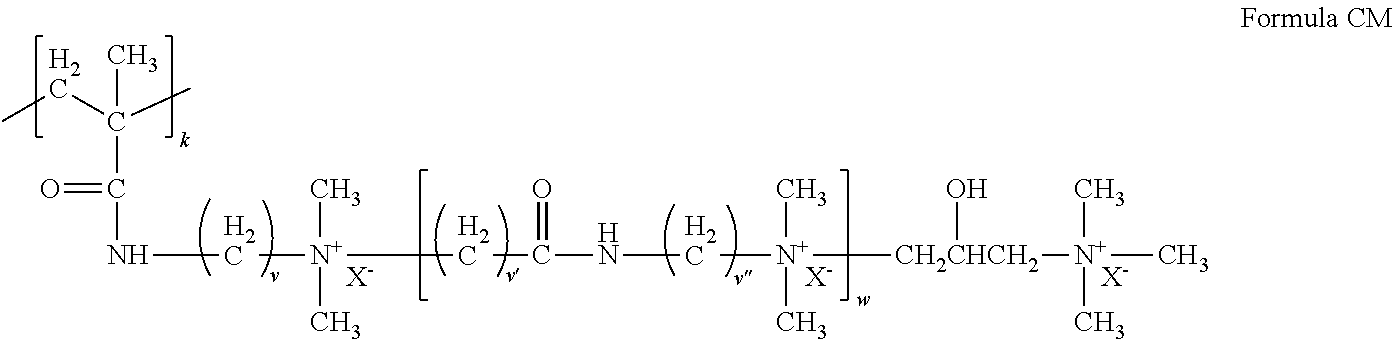
- where k=1, each of v, v′, and v″ is independently an integer of from 1 to 6, w is zero or an integer of from 1 to 10, and X− is an anion.
- In an embodiment, cationic monomer conforming to Formula CM and where k=1, v=3 and w=0, z=1 and X− is Cl− to form the following structure:
-

- The above structure may be referred to as diquat. In another embodiment, the cationic monomer conforms to Formula CM and wherein v and v″ are each 3, v′=1, w=1, y=1 and X− is Cl−, such as:
-

- The above structure may be referred to as triquat.
- In an embodiment, the acrylamide monomer is either acrylamide or methacrylamide.
- In an embodiment, the cationic copolymer (b) is AM:TRIQUAT which is a copolymer of acrylamide and 1,3-Propanediaminium,N-[2-[[[dimethyl[3-[(2-methyl-1-oxo-2-propenyl)amino]propyl]ammonio]acetyl]amino]ethyl]2-hydroxy-N,N,N′,N′,N′-pentamethyl-, trichloride. AM:TRIQUAT is also known as polyquaternium 76 (PQ76). AM:TRIQUAT may have a charge density of 1.6 meq/g and a M.Wt. of 1.1 million g/mol.
- In an alternative embodiment, the cationic copolymer is of an acrylamide monomer and a cationic monomer, wherein the cationic monomer is selected from the group consisting of: dimethylamino ethyl (meth)acrylate, dimethylaminopropyl (meth)acrylate, ditertiobutylamino ethyl (meth)acrylate, dimethylaminomethyl (meth)acrylamide, dimethylaminopropyl (meth)acrylamide; ethylenimine, vinylamine, 2-vinylpyridine, 4-vinylpyridine; trimethylammonium ethyl (meth)acrylate chloride, trimethylammonium ethyl (meth)acrylate methyl sulphate, dimethylammonium ethyl (meth)acrylate benzyl chloride, 4-benzoylbenzyl dimethylammonium ethyl acrylate chloride, trimethyl ammonium ethyl (meth)acrylamido chloride, trimethyl ammonium propyl (meth)acrylamido chloride, vinylbenzyl trimethyl ammonium chloride, diallyldimethyl ammonium chloride, and mixtures thereof.
- In an embodiment, the cationic copolymer comprises a cationic monomer selected from the group consisting of: cationic monomers include trimethylammonium ethyl (meth)acrylate chloride, trimethylammonium ethyl (meth)acrylate methyl sulphate, dimethylammonium ethyl (meth)acrylate benzyl chloride, 4-benzoylbenzyl dimethylammonium ethyl acrylate chloride, trimethyl ammonium ethyl (meth)acrylamido chloride, trimethyl ammonium propyl (meth)acrylamido chloride, vinylbenzyl trimethyl ammonium chloride, and mixtures thereof.
- In an embodiment, the cationic copolymer is water-soluble. In an embodiment, the cationic copolymer is formed from (1) copolymers of (meth)acrylamide and cationic monomers based on (meth)acrylamide, and/or hydrolysis-stable cationic monomers, (2) terpolymers of (meth)acrylamide, monomers based on cationic (meth)acrylic acid esters, and monomers based on (meth)acrylamide, and/or hydrolysis-stable cationic monomers. Monomers based on cationic (meth)acrylic acid esters may be cationized esters of the (meth)acrylic acid containing a quaternized N atom. In an embodiment, cationized esters of the (meth)acrylic acid containing a quaternized N atom are quaternized dialkylaminoalkyl (meth)acrylates with C1 to C3 in the alkyl and alkylene groups. In an embodiment, the cationized esters of the (meth)acrylic acid containing a quaternized N atom are selected from the group consisting of: ammonium salts of dimethylaminomethyl (meth)acrylate, dimethylaminoethyl (meth)acrylate, dimethylaminopropyl (meth)acrylate, diethylaminomethyl (meth)acrylate, diethylaminoethyl (meth)acrylate; and diethylaminopropyl (meth)acrylate quaternized with methyl chloride. In an embodiment, the cationized esters of the (meth)acrylic acid containing a quaternized N atom is dimethylaminoethyl acrylate, which is quaternized with an alkyl halide, or with methyl chloride or benzyl chloride or dimethyl sulfate (ADAME-Quat). In an embodiment, the cationic monomer when based on (meth)acrylamides are quaternized dialkylaminoalkyl(meth)acrylamides with C1 to C3 in the alkyl and alkylene groups, or dimethylaminopropylacrylamide, which is quaternized with an alkyl halide, or methyl chloride or benzyl chloride or dimethyl sulfate.
- In an embodiment, the cationic monomer based on a (meth)acrylamide is a quaternized dialkylaminoalkyl(meth)acrylamide with C1 to C3 in the alkyl and alkylene groups. In an embodiment, the cationic monomer based on a (meth)acrylamide is dimethylaminopropylacrylamide, which is quaternized with an alkyl halide, especially methyl chloride or benzyl chloride or dimethyl sulfate.
- In an embodiment, the cationic monomer is a hydrolysis-stable cationic monomer. Hydrolysis-stable cationic monomers can be, in addition to a dialkylaminoalkyl(meth)acrylamide, all monomers that can be regarded as stable to the OECD hydrolysis test. In an embodiment, the cationic monomer is hydrolysis-stable and the hydrolysis-stable cationic monomer is selected from the group consisting of: diallyldimethylammonium chloride and water-soluble, cationic styrene derivatives.
- In an embodiment, the cationic copolymer is a terpolymer of acrylamide, 2-dimethylammoniumethyl (meth)acrylate quaternized with methyl chloride (ADAME-Q) and 3-dimethylammoniumpropyl(meth)acrylamide quaternized with methyl chloride (DIMAPA-Q). In an embodiment, the cationic copolymer is formed from acrylamide and acrylamidopropyltrimethylammonium chloride, wherein the acrylamidopropyltrimethylammonium chloride has a charge density of from about 1.0 meq/g to about 3.0 meq/g.
- In an embodiment, the cationic copolymer has a charge density of from about 1.1 meq/g to about 2.5 meq/g, or from about 1.1 meq/g to about 2.3 meq/g, or from about 1.2 meq/g to about 2.2 meq/g, or from about 1.2 meq/g to about 2.1 meq/g, or from about 1.3 meq/g to about 2.0 meq/g, or from about 1.3 meq/g to about 1.9 meq/g.
- In an embodiment, the cationic copolymer has a M.Wt. from about 100 thousand g/mol to about 2 million g/mol, or from about 300 thousand g/mol to about 1.8 million g/mol, or from about 500 thousand g/mol to about 1.6 million g/mol, or from about 700 thousand g/mol to about 1.4 million g/mol, or from about 900 thousand g/mol to about 1.2 million g/mol.
- In an embodiment, the cationic copolymer is a trimethylammoniopropylmethacrylamide chloride-N-Acrylamide copolymer, which is also known as AM:MAPTAC. AM:MAPTAC may have a charge density of about 1.3 meq/g and a M.Wt. of about 1.1 million g/mol. In an embodiment, the cationic copolymer is AM:ATPAC. AM:ATPAC may have a charge density of about 1.8 meq/g and a M.Wt. of about 1.1 million g/mol.
- (5) Cationic Synthetic Polymer
- According to an embodiment of the present invention, the shampoo composition comprises a cationic synthetic polymer that may be formed from
- i) one or more cationic monomer units, and optionally
- ii) one or more monomer units bearing a negative charge, and/or
- iii) a nonionic monomer,
- wherein the subsequent charge of the copolymer is positive. The ratio of the three types of monomers is given by “m”, “p” and “q” where “m” is the number of cationic monomers, “p” is the number of monomers bearing a negative charge and “q” is the number of nonionic monomers
- In one embodiment, the cationic polymers are water soluble or dispersible, non-crosslinked, synthetic cationic polymers having the following structure:
-

- where A, may be one or more of the following cationic moieties:
-
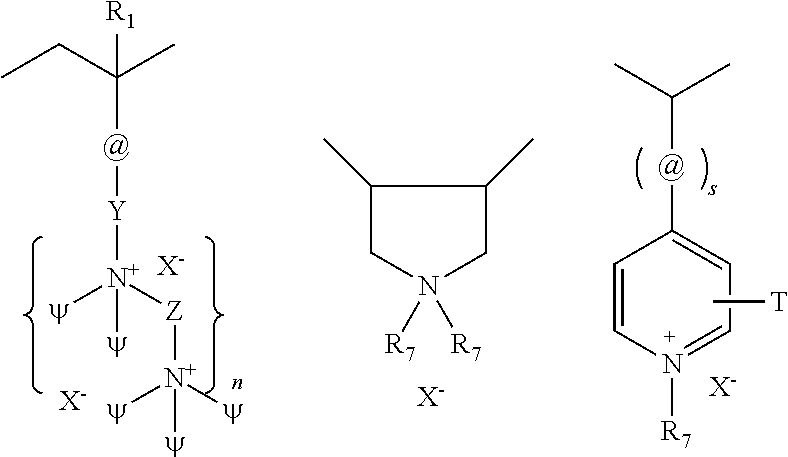
- where @=amido, alkylamido, ester, ether, alkyl or alkylaryl;
where Y=C1-C22 alkyl, alkoxy, alkylidene, alkyl or aryloxy;
where ψ=C1-C22 alkyl, alkyloxy, alkyl aryl or alkyl arylox;
where Z=C1-C22 alkyl, alkyloxy, aryl or aryloxy;
where R1=H, C1-C4 linear or branched alkyl;
where s=0 or 1, n=0 or 1;
where T and R7=C1-C22 alkyl; and
where X−=halogen, hydroxide, alkoxide, sulfate or alkylsulfate. - Where the monomer bearing a negative charge is defined by R2′=H, C1-C4 linear or branched alkyl and R3 as:
-

- where D=O, N, or S;
where Q=NH2 or O;
where u=1-6;
where t=0-1; and
where J=oxygenated functional group containing the following elements P, S, C. - Where the nonionic monomer is defined by R2″=H, C1-C4 linear or branched alkyl, R6=linear or branched alkyl, alkyl aryl, aryl oxy, alkyloxy, alkylaryl oxy and β is defined as
-

- and
where G′ and G″ are, independently of one another, O, S or N—H and L=0 or 1. - Examples of cationic monomers include aminoalkyl (meth)acrylates, (meth)aminoalkyl (meth)acrylamides; monomers comprising at least one secondary, tertiary or quaternary amine function, or a heterocyclic group containing a nitrogen atom, vinylamine or ethylenimine; diallyldialkyl ammonium salts; their mixtures, their salts, and macromonomers deriving from therefrom.
- Further examples of cationic monomers include dimethylaminoethyl (meth)acrylate, dimethylaminopropyl (meth)acrylate, ditertiobutylaminoethyl (meth)acrylate, dimethylaminomethyl (meth)acrylamide, dimethylaminopropyl (meth)acrylamide, ethylenimine, vinylamine, 2-vinylpyridine, 4-vinylpyridine, trimethylammonium ethyl (meth)acrylate chloride, trimethylammonium ethyl (meth)acrylate methyl sulphate, dimethylammonium ethyl (meth)acrylate benzyl chloride, 4-benzoylbenzyl dimethylammonium ethyl acrylate chloride, trimethyl ammonium ethyl (meth)acrylamido chloride, trimethyl ammonium propyl (meth)acrylamido chloride, vinylbenzyl trimethyl ammonium chloride, diallyldimethyl ammonium chloride.
- Suitable cationic monomers include those which comprise a quaternary ammonium group of formula —NR3 +, wherein R, which is identical or different, represents a hydrogen atom, an alkyl group comprising 1 to 10 carbon atoms, or a benzyl group, optionally carrying a hydroxyl group, and comprise an anion (counter-ion). Examples of anions are halides such as chlorides, bromides, sulphates, hydrosulphates, alkylsulphates (for example comprising 1 to 6 carbon atoms), phosphates, citrates, formates, and acetates.
- Suitable cationic monomers include trimethylammonium ethyl (meth)acrylate chloride, trimethylammonium ethyl (meth)acrylate methyl sulphate, dimethylammonium ethyl (meth)acrylate benzyl chloride, 4-benzoylbenzyl dimethylammonium ethyl acrylate chloride, trimethyl ammonium ethyl (meth)acrylamido chloride, trimethyl ammonium propyl (meth)acrylamido chloride, vinylbenzyl trimethyl ammonium chloride.
- Additional suitable cationic monomers include trimethyl ammonium propyl (meth)acrylamido chloride.
- Examples of monomers bearing a negative charge include alpha ethylenically unsaturated monomers comprising a phosphate or phosphonate group, alpha ethylenically unsaturated monocarboxylic acids, monoalkylesters of alpha ethylenically unsaturated dicarboxylic acids, monoalkylamides of alpha ethylenically unsaturated dicarboxylic acids, alpha ethylenically unsaturated compounds comprising a sulphonic acid group, and salts of alpha ethylenically unsaturated compounds comprising a sulphonic acid group.
- Suitable monomers with a negative charge include acrylic acid, methacrylic acid, vinyl sulphonic acid, salts of vinyl sulfonic acid, vinylbenzene sulphonic acid, salts of vinylbenzene sulphonic acid, alpha-acrylamidomethylpropanesulphonic acid, salts of alpha-acrylamidomethylpropanesulphonic acid, 2-sulphoethyl methacrylate, salts of 2-sulphoethyl methacrylate, acrylamido-2-methylpropanesulphonic acid (AMPS), salts of acrylamido-2-methylpropanesulphonic acid, and styrenesulphonate (SS).
- Examples of nonionic monomers include vinyl acetate, amides of alpha ethylenically unsaturated carboxylic acids, esters of an alpha ethylenically unsaturated monocarboxylic acids with an hydrogenated or fluorinated alcohol, polyethylene oxide (meth)acrylate (i.e. polyethoxylated (meth)acrylic acid), monoalkylesters of alpha ethylenically unsaturated dicarboxylic acids, monoalkylamides of alpha ethylenically unsaturated dicarboxylic acids, vinyl nitriles, vinylamine amides, vinyl alcohol, vinyl pyrolidone, and vinyl aromatic compounds.
- Suitable nonionic monomers include styrene, acrylamide, methacrylamide, acrylonitrile, methylacrylate, ethylacrylate, n-propylacrylate, n-butylacrylate, methylmethacrylate, ethylmethacrylate, n-propylmethacrylate, n-butylmethacrylate, 2-ethyl-hexyl acrylate, 2-ethyl-hexyl methacrylate, 2-hydroxyethylacrylate and 2-hydroxyethylmethacrylate.
- The anionic counterion (X−) in association with the synthetic cationic polymers may be any known counterion so long as the polymers remain soluble or dispersible in water, in the shampoo composition, or in a coacervate phase of the shampoo composition, and so long as the counterions are physically and chemically compatible with the essential components of the shampoo composition or do not otherwise unduly impair product performance, stability or aesthetics. Non limiting examples of such counterions include halides (e.g., chlorine, fluorine, bromine, iodine), sulfate and methylsulfate.
- In one embodiment, the cationic polymer described herein aids in providing damaged hair, particularly chemically treated hair, with a surrogate hydrophobic F-layer. The microscopically thin F-layer provides natural weatherproofing, while helping to seal in moisture and prevent further damage. Chemical treatments damage the hair cuticle and strip away its protective F-layer. As the F-layer is stripped away, the hair becomes increasingly hydrophilic. It has been found that when lyotropic liquid crystals are applied to chemically treated hair, the hair becomes more hydrophobic and more virgin-like, in both look and feel. Without being limited to any theory, it is believed that the lyotropic liquid crystal complex creates a hydrophobic layer or film, which coats the hair fibers and protects the hair, much like the natural F-layer protects the hair. The hydrophobic layer returns the hair to a generally virgin-like, healthier state. Lyotropic liquid crystals are formed by combining the synthetic cationic polymers described herein with the aforementioned anionic detersive surfactant component of the shampoo composition. The synthetic cationic polymer has a relatively high charge density. It should be noted that some synthetic polymers having a relatively high cationic charge density do not form lyotropic liquid crystals, primarily due to their abnormal linear charge densities. Such synthetic cationic polymers are described in WO 94/06403 to Reich et al. The synthetic polymers described herein can be formulated in a stable shampoo composition that provides improved conditioning performance, with respect to damaged hair.
- Cationic synthetic polymers that can form lyotropic liquid crystals have a cationic charge density of from about 2 meq/gm to about 7 meq/gm, and/or from about 3 meq/gm to about 7 meq/gm, and/or from about 4 meq/gm to about 7 meq/gm. In some embodiments, the cationic charge density is about 6.2 meq/gm. The polymers also have a M. Wt. of from about 1,000 to about 5,000,000, and/or from about 10,000 to about 2,000,000, and/or from about 100,000 to about 2,000,000.
- In another embodiment of the invention cationic synthetic polymers that provide enhanced conditioning and deposition of benefit agents but do not necessarily form lytropic liquid crystals have a cationic charge density of from about 0.7 meq/gm to about 7 meq/gm, and/or from about 0.8 meq/gm to about 5 meq/gm, and/or from about 1.0 meq/gm to about 3 meq/gm. The polymers also have a M. Wt. of from about 1,000 to about 5,000,000, from about 10,000 to about 2,000,000, and from about 100,000 to about 2,000,000.
- The concentration of the cationic polymers ranges about 0.025% to about 5%, from about 0.1% to about 3%, and/or from about 0.2% to about 1%, by weight of the shampoo composition.
- (6) Cationic Cellulose Polymers
- Suitable cationic cellulose polymers are salts of hydroxyethyl cellulose reacted with trimethyl ammonium substituted epoxide, referred to in the industry (CTFA) as Polyquaternium 10 and available from Dwo/Amerchol Corp. (Edison, N.J., USA) in their Polymer LR, JR, and KG series of polymers. Other suitable types of cationic cellulose include the polymeric quaternary ammonium salts of hydroxyethyl cellulose reacted with lauryl dimethyl ammonium-substituted epoxide referred to in the industry (CTFA) as Polyquaternium 24. These materials are available from Dow/Amerchol Corp. under the tradename Polymer LM-200. Other suitable types of cationic cellulose include the polymeric quaternary ammonium salts of hydroxyethyl cellulose reacted with lauryl dimethyl ammonium-substituted epoxide and trimethyl ammonium substituted epoxide referred to in the industry (CTFA) as Polyquaternium 67. These materials are available from Dow/Amerchol Corp. under the tradename SoftCAT Polymer SL-5, SoftCAT Polymer SL-30, Polymer SL-60, Polymer SL-100, Polymer SK-L, Polymer SK-M, Polymer SK-MH, and Polymer SK-H.
- In an embodiment, the shampoo composition comprises a plurality of cationic conditioning polymers. According to one embodiment, where two cationic conditioning polymers are present, the weight ratio of a first cationic conditioning polymer to a second cationic conditioning polymer is from about 1000:1 to about 2:1. In an embodiment, the weight ratio of the first cationic conditioning polymer to the second cationic conditioning polymer is from about 1000:1 to about 4:1. In an embodiment, weight ratio of the first cationic conditioning polymer to the second cationic conditioning polymer is from about 800:1 to about 4:1, or from about 500:1 to about 4:1, or from about 100:1 to about 5:1, or from about 100:1 to about 6:1, or from about 50:1 to about 6.5:1, or from about 50:1 to about 7:1, or from about 50:1 to about 8.3:1, or from about 50:1 to about 16.7:1
- B. Detersive Surfactant
- The shampoo composition of the present invention includes a detersive surfactant, which provides cleaning performance to the composition. The detersive surfactant in turn comprises an anionic surfactant, amphoteric or zwitterionic surfactants, or mixtures thereof. Various examples and descriptions of detersive surfactants are set forth in U.S. Pat. No. 6,649,155; U.S. Patent Application Publication No. 2008/0317698; and U.S. Patent Application Publication No. 2008/0206355, which are incorporated herein by reference in their entirety.
- The concentration of the detersive surfactant component in the shampoo composition should be sufficient to provide the desired cleaning and lather performance, and generally ranges from about 2 wt % to about 50 wt %, from about 5 wt % to about 30 wt %, from about 8 wt % to about 25 wt %, or from about 10 wt % to about 20 wt %. Accordingly, the shampoo composition may comprise a detersive surfactant in an amount of about 5 wt %, about 10 wt %, about 12 wt %, about 15 wt %, about 17 wt %, about 18 wt %, or about 20 wt %, for example.
- Anionic surfactants suitable for use in the compositions are the alkyl and alkyl ether sulfates. Other suitable anionic surfactants are the water-soluble salts of organic, sulfuric acid reaction products. Still other suitable anionic surfactants are the reaction products of fatty acids esterified with isethionic acid and neutralized with sodium hydroxide. Other similar anionic surfactants are described in U.S. Pat. Nos. 2,486,921; 2,486,922; and 2,396,278, which are incorporated herein by reference in their entirety.
- Exemplary anionic surfactants for use in the shampoo composition include ammonium lauryl sulfate, ammonium laureth sulfate, triethylamine lauryl sulfate, triethylamine laureth sulfate, triethanolamine lauryl sulfate, triethanolamine laureth sulfate, monoethanolamine lauryl sulfate, monoethanolamine laureth sulfate, diethanolamine lauryl sulfate, diethanolamine laureth sulfate, lauric monoglyceride sodium sulfate, sodium lauryl sulfate, sodium laureth sulfate, potassium lauryl sulfate, potassium laureth sulfate, sodium lauryl sarcosinate, sodium lauroyl sarcosinate, lauryl sarcosine, cocoyl sarcosine, ammonium cocoyl sulfate, ammonium lauroyl sulfate, sodium cocoyl sulfate, sodium lauroyl sulfate, potassium cocoyl sulfate, potassium lauryl sulfate, triethanolamine lauryl sulfate, triethanolamine lauryl sulfate, monoethanolamine cocoyl sulfate, monoethanolamine lauryl sulfate, sodium tridecyl benzene sulfonate, sodium dodecyl benzene sulfonate, sodium cocoyl isethionate and combinations thereof. In a further embodiment of the present invention, the anionic surfactant is sodium lauryl sulfate or sodium laureth sulfate.
- Suitable amphoteric or zwitterionic surfactants for use in the shampoo composition herein include those which are known for use in shampoo or other personal care cleansing. Concentrations of such amphoteric surfactants range from about 0.5 wt % to about 20 wt %, and from about 1 wt % to about 10 wt %. Non limiting examples of suitable zwitterionic or amphoteric surfactants are described in U.S. Pat. Nos. 5,104,646 and 5,106,609, which are incorporated herein by reference in their entirety.
- Amphoteric detersive surfactants suitable for use in the shampoo composition include those surfactants broadly described as derivatives of aliphatic secondary and tertiary amines in which the aliphatic radical can be straight or branched chain and wherein one of the aliphatic substituents contains from about 8 to about 18 carbon atoms and one contains an anionic group such as carboxy, sulfonate, sulfate, phosphate, or phosphonate. Exemplary amphoteric detersive surfactants for use in the present shampoo composition include cocoamphoacetate, cocoamphodiacetate, lauroamphoacetate, lauroamphodiacetate, and mixtures thereof.
- Zwitterionic detersive surfactants suitable for use in the shampoo composition include those surfactants broadly described as derivatives of aliphatic quaternaryammonium, phosphonium, and sulfonium compounds, in which the aliphatic radicals can be straight or branched chain, and wherein one of the aliphatic substituents contains from about 8 to about 18 carbon atoms and one contains an anionic group such as carboxy, sulfonate, sulfate, phosphate or phosphonate. In another embodiment, zwitterionics such as betaines are selected.
- Non limiting examples of other anionic, zwitterionic, amphoteric or optional additional surfactants suitable for use in the compositions are described in McCutcheon's, Emulsifiers and Detergents, 1989 Annual, published by M. C. Publishing Co., and U.S. Pat. Nos. 3,929,678, 2,658,072; 2,438,091; 2,528,378, which are incorporated herein by reference in their entirety.
- In an embodiment, the composition comprises an anionic surfactant and a non-ionic co-surfactant. In another embodiment the surfactant system is free, or substantially free of sulfate materials. Suitable sulfate free surfactants are disclosed in WO publication 2011/120780 and WO publication 2011/049932.
- C. Carrier
- The shampoo compositions can be in the form of pourable liquids (under ambient conditions). Such compositions will therefore typically comprise a carrier, which is present at a level of from about 20 wt % to about 95 wt %, or even from about 60 wt % to about 85 wt %. The carrier may comprise water, or a miscible mixture of water and organic solvent, and in one aspect may comprise water with minimal or no significant concentrations of organic solvent, except as otherwise incidentally incorporated into the composition as minor ingredients of other essential or optional components.
- The carrier useful in embodiments of the shampoo compositions of the present invention includes water and water solutions of lower alkyl alcohols and polyhydric alcohols. The lower alkyl alcohols useful herein are monohydric alcohols having 1 to 6 carbons, in one aspect, ethanol and isopropanol. Exemplary polyhydric alcohols useful herein include propylene glycol, hexylene glycol, glycerin, and propane diol.
- D. Optional Ingredients
- In accordance with embodiments of the present invention, the shampoo composition may further comprise one or more optional ingredients, including benefit agents Suitable benefit agents include, but are not limited to conditioning agents, silicone emulsions, anti-dandruff actives, gel networks, chelating agents, and, natural oils such as sun flower oil or castor oil. Additional suitable optional ingredients include but are not limited to perfumes, perfume microcapsules, colorants, particles, anti-microbials, foam busters, anti-static agents, rheology modifiers and thickeners, suspension materials and structurants, pH adjusting agents and buffers, preservatives, pearlescent agents, solvents, diluents, anti-oxidants, vitamins and combinations thereof.
- Such optional ingredients should be physically and chemically compatible with the components of the composition, and should not otherwise unduly impair product stability, aesthetics, or performance. The CTFA Cosmetic Ingredient Handbook, Tenth Edition (published by the Cosmetic, Toiletry, and Fragrance Association, Inc., Washington, D.C.) (2004) (hereinafter “CTFA”), describes a wide variety of nonlimiting materials that can be added to the composition herein.
- 1. Silicones
- The conditioning agent of the compositions of the present invention can be a silicone conditioning agent. The silicone conditioning agent may comprise volatile silicone, non-volatile silicone, or combinations thereof. The concentration of the silicone conditioning agent typically ranges from about 0.01% to about 10%, by weight of the composition, from about 0.1% to about 8%, from about 0.1% to about 5%, and/or from about 0.2% to about 3%. Non-limiting examples of suitable silicone conditioning agents, and optional suspending agents for the silicone, are described in U.S. Reissue Pat. No. 34,584, U.S. Pat. No. 5,104,646, and U.S. Pat. No. 5,106,609, which descriptions are incorporated herein by reference. The silicone conditioning agents for use in the compositions of the present invention can have a viscosity, as measured at 25° C., from about 20 to about 2,000,000 centistokes (“csk”), from about 1,000 to about 1,800,000 csk, from about 50,000 to about 1,500,000 csk, and/or from about 100,000 to about 1,500,000 csk. The dispersed silicone conditioning agent particles typically have a volume average particle diameter ranging from about 0.01 micrometer to about 50 micrometer. For small particle application to hair, the volume average particle diameters typically range from about 0.01 micrometer to about 4 micrometer, from about 0.01 micrometer to about 2 micrometer, from about 0.01 micrometer to about 0.5 micrometer. For larger particle application to hair, the volume average particle diameters typically range from about 5 micrometer to about 125 micrometer, from about 10 micrometer to about 90 micrometer, from about 15 micrometer to about 70 micrometer, and/or from about 20 micrometer to about 50 micrometer.
- Additional material on silicones including sections discussing silicone fluids, gums, and resins, as well as manufacture of silicones, are found in Encyclopedia of Polymer Science and Engineering, vol. 15, 2d ed., pp 204-308, John Wiley & Sons, Inc. (1989), incorporated herein by reference.
- Silicone emulsions suitable for use in the embodiments of the present invention include, but are not limited to, emulsions of insoluble polysiloxanes prepared in accordance with the descriptions provided in U.S. Pat. No. 4,476,282 and U.S. Patent Application Publication No. 2007/0276087. Accordingly, suitable insoluble polysiloxanes include polysiloxanes such as alpha, omega hydroxy-terminated polysiloxanes or alpha, omega alkoxy-terminated polysiloxanes having a molecular weight within the range from about 50,000 to about 500,000 g/mol. The insoluble polysiloxane can have an average molecular weight within the range from about 50,000 to about 500,000 g/mol. For example, the insoluble polysiloxane may have an average molecular weight within the range from about 60,000 to about 400,000; from about 75,000 to about 300,000; from about 100,000 to about 200,000; or the average molecular weight may be about 150,000 g/mol. The insoluble polysiloxane can have an average particle size within the range from about 30 nm to about 10 micron. The average particle size may be within the range from about 40 nm to about 5 micron, from about 50 nm to about lmicron, from about 75 nm to about 500 nm, or about 100 nm, for example.
- The average molecular weight of the insoluble polysiloxane, the viscosity of the silicone emulsion, and the size of the particle comprising the insoluble polysiloxane are determined by methods commonly used by those skilled in the art, such as the methods disclosed in Smith, A. L. The Analytical Chemistry of Silicones, John Wiley & Sons, Inc.: New York, 1991. For example, the viscosity of the silicone emulsion can be measured at 30° C. with a Brookfield viscosimeter with spindle 6 at 2.5 rpm. The silicone emulsion may further include an additional emulsifier together with the anionic surfactant,
- Other classes of silicones suitable for use in compositions of the present invention include but are not limited to: i) silicone fluids, including but not limited to, silicone oils, which are flowable materials having viscosity less than about 1,000,000 csk as measured at 25° C.; ii) aminosilicones, which contain at least one primary, secondary or tertiary amine; iii) cationic silicones, which contain at least one quaternary ammonium functional group; iv) silicone gums; which include materials having viscosity greater or equal to 1,000,000 csk as measured at 25° C.; v) silicone resins, which include highly cross-linked polymeric siloxane systems; vi) high refractive index silicones, having refractive index of at least 1.46, and vii) mixtures thereof
- 2. Organic Conditioning Materials
- The conditioning agent of the shampoo compositions of the present invention may also comprise at least one organic conditioning material such as oil or wax, either alone or in combination with other conditioning agents, such as the silicones described above. The organic material can be non-polymeric, oligomeric or polymeric. It may be in the form of oil or wax and may be added in the formulation neat or in a pre-emulsified form. Some non-limiting examples of organic conditioning materials include, but are not limited to: i) hydrocarbon oils; ii) polyolefins, iii) fatty esters, iv) fluorinated conditioning compounds, v) fatty alcohols, vi) alkyl glucosides and alkyl glucoside derivatives; vii) quaternary ammonium compounds; viii) polyethylene glycols and polypropylene glycols having a molecular weight of up to about 2,000,000 including those with CTFA names PEG-200, PEG-400, PEG-600, PEG-1000, PEG-2M, PEG-7M, PEG-14M, PEG-45M and mixtures thereof.
- 3. Emusifiers
- A variety of anionic and nonionic emulsifiers can be used in the shampoo composition of the present invention. The anionic and nonionic emulsifiers can be either monomeric or polymeric in nature. Monomeric examples include, by way of illustrating and not limitation, alkyl ethoxylates, alkyl sulfates, soaps, and fatty esters and their derivatives. Polymeric examples include, by way of illustrating and not limitation, polyacrylates, polyethylene glycols, and block copolymers and their derivatives. Naturally occurring emulsifiers such as lanolins, lecithin and lignin and their derivatives are also non-limiting examples of useful emulsifiers.
- 4. Chelating Agents
- The shampoo composition can also comprise a chelant. Suitable chelants include those listed in A E Martell & R M Smith, Critical Stability Constants, Vol. 1, Plenum Press, New York & London (1974) and A E Martell & R D Hancock, Metal Complexes in Aqueous Solution, Plenum Press, New York & London (1996) both incorporated herein by reference. When related to chelants, the term “salts and derivatives thereof” means the salts and derivatives comprising the same functional structure (e.g., same chemical backbone) as the chelant they are referring to and that have similar or better chelating properties. This term include alkali metal, alkaline earth, ammonium, substituted ammonium (i.e. monoethanolammonium, diethanolammonium, triethanolammonium) salts, esters of chelants having an acidic moiety and mixtures thereof, in particular all sodium, potassium or ammonium salts. The term “derivatives” also includes “chelating surfactant” compounds, such as those exemplified in U.S. Pat. No. 5,284,972, and large molecules comprising one or more chelating groups having the same functional structure as the parent chelants, such as polymeric EDDS (ethylenediaminedisuccinic acid) disclosed in U.S. Pat. No. 5,747,440.
- Levels of the EDDS chelant in the shampoo compositions can be as low as about 0.01 wt % or even as high as about 10 wt %, but above the higher level (i.e., 10 wt %) formulation and/or human safety concerns may arise. In an embodiment, the level of the EDDS chelant may be at least about 0.05 wt %, at least about 0.1 wt %, at least about 0.25 wt %, at least about 0.5 wt %, at least about 1 wt %, or at least about 2 wt % by weight of the shampoo composition. Levels above about 4 wt % can be used but may not result in additional benefit.
- 5. Anti-Dandruff Agent
- According to an embodiment, the shampoo composition comprises an anti-dandruff active, which may be an anti-dandruff active particulate. The anti-dandruff active can be selected from the group consisting of: pyridinethione salts; azoles, such as an imidazole such as ketoconazole, econazole, climbazole and elubiol; selenium sulphide; coal tar, particulate sulfur; keratolytic agents such as salicylic acid; and mixtures thereof. In an embodiment, the anti-dandruff particulate is a pyridinethione salt.
- Pyridinethione particulates are suitable particulate anti-dandruff actives. In an embodiment, the anti-dandruff active is a 1-hydroxy-2-pyridinethione salt and is in particulate form. In an embodiment, the concentration of pyridinethione anti-dandruff particulate ranges from about 0.01 wt % to about 5 wt %, or from about 0.1 wt % to about 3 wt %, or from about 0.1 wt % to about 2 wt %. In an embodiment, the pyridinethione salts are those formed from heavy metals such as zinc, tin, cadmium, magnesium, aluminium and zirconium, generally zinc, typically the zinc salt of 1-hydroxy-2-pyridinethione (known as “zinc pyridinethione” or “ZPT”), commonly 1-hydroxy-2-pyridinethione salts in platelet particle form. In an embodiment, the 1-hydroxy-2-pyridinethione salts in platelet particle form have an average particle size of up to about 20 microns, or up to about 5 microns, or up to about 2.5 microns. Salts formed from other cations, such as sodium, may also be suitable. Pyridinethione anti-dandruff actives are described, for example, in U.S. Pat. No. 2,809,971; U.S. Pat. No. 3,236,733; U.S. Pat. No. 3,753,196; U.S. Pat. No. 3,761,418; U.S. Pat. No. 4,345,080; U.S. Pat. No. 4,323,683; U.S. Pat. No. 4,379,753; and U.S. Pat. No. 4,470,982.
- The anti-dandruff active can also be selected from polyvalent metal salts of pyrithione, the composition further comprises one or more anti-fungal and/or anti-microbial actives. Embodiments of the present invention may also comprise a combination of anti-microbial actives.
- In an embodiment, the composition comprises an effective amount of a zinc-containing layered material. In an embodiment, the composition comprises from about 0.001 wt % to about 10 wt %, or from about 0.01 wt % to about 7 wt %, or from about 0.1 wt % to about 5 wt % of a zinc-containing layered material (ZLMs), by total weight of the composition.
- Many ZLMs occur naturally as minerals. In an embodiment, the ZLM is selected from the group consisting of: hydrozincite (zinc carbonate hydroxide), aurichalcite (zinc copper carbonate hydroxide), rosasite (copper zinc carbonate hydroxide), and mixtures thereof. Related minerals that are zinc-containing may also be included in the composition. Natural ZLMs can also occur wherein anionic layer species such as clay-type minerals (e.g., phyllosilicates) contain ion-exchanged zinc gallery ions. All of these natural materials can also be obtained synthetically or formed in situ in a composition or during a production process.
- Another common class of ZLMs, which are often, but not always, synthetic, is layered double hydroxides or hydroxy double salts. In an embodiment, the composition comprises basic zinc carbonate. Basic zinc carbonate, which also may be referred to commercially as “Zinc Carbonate” or “Zinc Carbonate Basic” or “Zinc Hydroxy Carbonate”, is a synthetic version consisting of materials similar to naturally occurring hydrozincite.
- In embodiments having a zinc-containing layered material and a pyrithione or polyvalent metal salt of pyrithione, the ratio of zinc-containing layered material to pyrithione or a polyvalent metal salt of pyrithione is from about 5:100 to about 10:1, or from about 2:10 to about 5:1, or from about 1:2 to about 3:1.
- 6. Gel Networks
- The shampoo composition may also comprise fatty alcohol gel networks. These gel networks are formed by combining fatty alcohols and surfactants in the ratio of from about 1:1 to about 40:1, from about 2:1 to about 20:1, and/or from about 3:1 to about 10:1. The formation of a gel network involves heating a dispersion of the fatty alcohol in water with the surfactant to a temperature above the melting point of the fatty alcohol. During the mixing process, the fatty alcohol melts, allowing the surfactant to partition into the fatty alcohol droplets. The surfactant brings water along with it into the fatty alcohol. This changes the isotropic fatty alcohol drops into liquid crystalline phase drops. When the mixture is cooled below the chain melt temperature, the liquid crystal phase is converted into a solid crystalline gel network. The gel network contributes a stabilizing benefit to cosmetic creams and hair conditioners. In addition, they deliver conditioned feel benefits for hair conditioners.
- The fatty alcohol can be included in the fatty alcohol gel network at a level by weight of from about 0.05 wt % to about 14 wt %. For example, the fatty alcohol may be present in an amount ranging from about 1 wt % to about 10 wt %, and/or from about 6 wt % to about 8 wt %.
- The fatty alcohols useful herein include those having from about 10 to about 40 carbon atoms, from about 12 to about 22 carbon atoms, from about 16 to about 22 carbon atoms, and/or about 16 to about 18 carbon atoms. These fatty alcohols can be straight or branched chain alcohols and can be saturated or unsaturated. Nonlimiting examples of fatty alcohols include cetyl alcohol, stearyl alcohol, behenyl alcohol, and mixtures thereof. Mixtures of cetyl and stearyl alcohol in a ratio of from about 20:80 to about 80:20 are suitable.
- Gel network preparation: A vessel is charged with water and the water is heated to about 74° C. Cetyl alcohol, stearyl alcohol, and SLES surfactant are added to the heated water. After incorporation, the resulting mixture is passed through a heat exchanger where the mixture is cooled to about 35° C. Upon cooling, the fatty alcohols and surfactant crystallized to form a crystalline gel network. Table 3 provides the components and their respective amounts for the gel network composition.
-
TABLE 3 Gel network components Ingredient Wt. % Water 78.27% Cetyl Alcohol 4.18% Steary Alcohol 7.52% Sodium laureth-3 sulfate (28% Active) 10.00% 5-Chloro-2-methyl-4-isothiazolin-3-one, Kathon CG 0.03% - The shampoo compositions of the present invention may be presented in typical shampoo formulations. They may be in the form of solutions, dispersion, emulsions, powders, talcs, encapsulated, spheres, spongers, solid dosage forms, foams, and other delivery mechanisms. The compositions of the embodiments of the present invention may be hair tonics, leave-on hair products such as treatment, and styling products, rinse-off hair products such as shampoos, and treatment products; and any other form that may be applied to hair.
- According to one embodiment, the shampoo compositions may be provided in the form of a porous, dissolvable solid structure having a percent open cell content of from about 80% to about 100%, such as those disclosed in U.S. Patent Application Publication Nos. 2009/0232873; and 2010/0179083, which are incorporated herein by reference in their entirety.
- The shampoo composition can have a viscosity of 4,000 cP to 20,000 cP, or from about 6,000 cP to about 12,000 cP, or from about 8,000 cP to about 11,000 cP, measured at 26.6° C. with a Brookfield R/S Plus Rheometer at 2 s−1. cP means centipoises.
- The shampoo compositions are generally prepared by conventional. Such methods include mixing of the ingredients in one or more steps to a relatively uniform state, with or without heating, cooling, application of vacuum, and the like. The compositions are prepared such as to optimize stability (physical stability, chemical stability, photostability) and/or delivery of the active materials. The shampoo composition may be in a single phase or a single product, or the shampoo composition may be in a separate phases or separate products. If two products are used, the products may be used together, at the same time or sequentially.
- The shampoo compositions of the present invention can be applied to the hair and rinsed off with water. The shampoo compositions may deliver improved styling of the hair, once the hair is dried. The shampoo compositions may further deliver consumer desired conditioning and volume after product application, rinsing and the hair is dry.
- A. Mannequin Head Treatment Method
- The mannequin head hair was parted in the middle providing two equal halves.
- Thoroughly saturate both sides of the mannequin with water. Then, 10 ml of shampoo is applied to the hair and worked in to generate lather. Each side of the mannequin head is then rinsed for 30 seconds. With two separate combs, one per side of the head—the hair is combed through to detangle. A blow dryer is then used to remove some of the excess water to achieve slightly damp hair. Then a round brush is used with the blow dryer to provide a bit of style. Sections of hair are dried with round brush and blow dryer, starting at the bottom and working up to the crown until the head is completely dry.
- B. Hair Feel Test Method
- The panelist grade hair feel scores on 6 gram hair switches. The scale is a 1-5 scale with 1=Best and 5=Worst. So, a 1 rating on Dry Comb score means that the Dry hair is very easy to comb. A 1 rating for Smoothness means that the Dry hair is soft and very smooth to the touch and a 1 rating for Dry IFF means that the dry hair has very little inter-fiber friction when hairs are rubbed against each other.
- The following examples illustrate the present invention. The exemplified compositions can be prepared by conventional formulation and mixing techniques. It will be appreciated that other modifications of the present invention within the skill of those in the shampoo formulation art can be undertaken without departing from the spirit and scope of this invention. All parts, percentages, and ratios herein are by weight unless otherwise specified. Some components may come from suppliers as dilute solutions. The amount stated reflects the weight percent of the active material, unless otherwise specified.
-
-
Ingredient 1 2 3 4 5 Water q.s. q.s. q.s. q.s. q.s. Silicone Grafted Tapioca 0.5 1.0 1.0 0.25 2.0 Starch 1 Polyquaterium 76 2 0.25 — — — 0.1 Polquaterium 10 3 — 0.25 0.25 — — Polyquaterium 6 4 — — — 0.1 — Guar — — — — 0.2 Hydroxpropyltrimonium Chloride 5 Sodium Laureth Sulfate 21.43 35.71 35.71 — — (SLE3S-28% active) 6 Sodium Laureth Sulfate — — — 44.83 37.93 (SLE1S-29% active) 7 Sodium Lauryl Sulfate (SLS-29% 12.07 24.14 24.14 — — active) 8 Coco monoethanolamide 9 1.0 0.5 0.5 — — Cocoamdopropyl Betaine 2.5 — — 3.33 5.0 (30% active) 10 Ethylene Glycol Disterate 11 — 1.5 1.5 — — 330M silicone 712 1.43 — 1.43 — — Silicone microemulsion 13 — — — — 4 Trihydroxystearn 14 0.25 — 0.25 0.25 0.25 Sodium Chloride 15 Adjust as 1.0 Adjust as Adjust as Adjust as needed for needed for needed for needed for viscosity viscosity viscosity viscosity Fragrance 0.7 0.6 0.7 0.7 0.7 Preservatives, pH adjusters Up to 1% As needed Up to 1% Up to 1% Up to 1% 1 Dry Flo TS; supplier National Starch/Akzo Nobel Surface Chemistry 2 Acrylamide: Triquat cationic polymer, trade name: Mirapol AT from Rhodia, 3 KG30M cationic cellulose polymer from Amerchol Dow 4 Polydadmac, trade name: Mirapol 100S from Rhodia 5 Jaguar C500 from Rhodia 6 Sodium Laureth (3 molar ethylene oxide) Sulfate at 28% active, supplier: P&G 7 Sodium Laureth (1 molar ethylene oxide) sulfate at 29% active, supplier: P&G 8 Sodium Lauryl Sulfate at 29% active, supplier: P&G 9 Coco monethanolamide at 85% active, supplier: Stephan Co or supplier Evonik. 10 Tegobetaine F-B, 30% active, supplier: Goldschmidt Chemical 11 Ethylene Glycol Disterate at 100% active, supplier: Goldschmidt Chemical or supplier Evonik, 12 330M silicone, 100% active, supplier: Momentive (silicone used by P&G to make a 70% active, 30 um emulsion) 13 Belsil 3560 VP silicone microemulsion from Wacker, 60,000 cst internal viscosity of silicone, approx. 125 nm 14 Thixin R from Rheox Inc. 15 Sodium Chloride USP (food grade) from Morton -
-
Ingredient 6 7 8 9 10 11 12 Water q.s. q.s. q.s. q.s. q.s. q.s. q.s. Polyquaterium 76 1 0.01 — — — 0.01 — — Guar, Hydroxylpropyl Trimonium Chloride 2 — 0.25 — — 0.3 0.4 0.5 Guar, Hydroxylpropyl Trimonium Chloride 3 — — — 0.25 — — — Polyquaterium 6 4 — — 0.25 — — — — Sodium Laureth Sulfate (SLE3S) 5 6 6 — — 6.0 — 10.0 Sodium Laureth Sulfate (SLE1S) 6 — — 10.5 10.5 — 12 — Sodium Lauryl Sulfate (SLS) 7 7 8 1.5 1.5 7.0 — 6 Silicone 8 0.75 1.00 0.5 1.00 — — 1.00 Gel Network 9 — — — 27.3 — — — Cocoamidopropyl Betaine 10 1.0 1.75 1.0 2.00 1.0 1.0 — Cocoamide MEA 11 — — — 0.85 — 1.0 — Ethylene Glycol Distearate 12 1.50 2.50 1.50 1.50 2.50 1.5 1.5 Zinc Pyrithione 13 1.0 1.0 — 1.0 1.0 1.0 1.0 Zinc Carbonate 14 1.61 1.61 — 1.61 1.6 1.6 1.6 Climbazole — 1.0 — — — — Sodium Benzoate 0.25 0.25 0.25 0.25 0.25 0.25 0.25 5-Chloro-2-methyl-4-isothiazolin-3-one, 0.0005 0.0005 0.0005 0.0005 0.0005 0.0005 0.0005 Kathon CG Sodium Chloride/Ammonium Xylene Visc. Visc. Visc. Visc. Visc. Visc. Visc. Sulfonate QS QS QS QS QS QS QS Citric Acid/Sodium Citrate Dihydrate pH QS Hydrochloric Acid 6N solution pH to 7 pH to 7 pH to 7 pH to 7 pH to 7 pH to 7 pH to 7 Menthol 0.3 — — — — 0.5 0.4 Fragrance 0.7 0.7 0.7 0.7 0.7 0.8 0.9 Silicone Grafted Tapioca Starch 15 0.25 1.0 0.5 1.0 1.5 0.25 0.5 1 Mirapol AT-1, Copolymer of Acrylamide(AM) and TRIQUAT, MW = 1,000,000; CD = 1.6 meq./gram; Supplier Rhodia 2 Jaguar C500, MW - 500,000, CD = 0.7, supplier Rhodia 3 Jaguar C17 available from Rhodia 4 Mirapol 100S, supplier Rhodia 5 Sodium Laureth Sulfate, supplier P&G 6 Sodium Laureth Sulfate, supplier P&G 7 Sodium Lauryl Sulfate, supplier P&G 8 Dimethicone Fluid, Viscasil 330M; 30 micron particle size; supplier Momentive Silicones 9 Gel Networks; See Composition below. The water is heated to about 74° C. and the Cetyl Alcohol, Stearyl Alcohol, and the SLES Surfactant are added to it. After incorporation, this mixture was passed through a heat exchanger where it was cooled to about 35° C. As a result of this cooling step, the Fatty Alcohols and surfactant crystallized to form a crystalline gel network. Ingredient Wt. % Water 86.14% Cetyl Alcohol 3.46% Steary Alcohol 6.44% Sodium laureth-3 sulfate (28% Active) 3.93% 5-Chloro-2-methyl-4-isothiazolin-3- 0.03% one, Kathon CG 10 Tegobetaine F-B, supplier Evonik 11 Monamid CMA, supplier Evonik 12 Ethylene Glycol Distearate, EGDS Pure, supplier Evonik 13 ZPT from Arch Chemical 14 Zinc carbonate from the Bruggeman Group 15 Dry Flo TS; supplier National Starch/Akzo Nobel Surface Chemistry -
-
Ingredient Comp. Ex. A Comp. Ex. B Water q.s. q.s. Polyquaterium 10 1 0.25 0.25 Sodium Laureth Sulfate (SLE3S-28% 35.71 35.71 active) 2 Sodium Lauryl Sulfate (SLS-29% 24.14 24.14 active) 3 Cocomonoethanol amide 4 0.5 0.5 Ethylene Glycol Distearate5 1.5 1.5 Tapioca Starch — — Polymethylsilsesquioxane6 Precipitated Silica7 0.25 — Polyethylene 8 0.75 — Sodium Chloride 9 1.0 1.0 Fragrance 0.6 0.6 Preservatives As needed As needed 1 JR30M, from Amerchol/DOW 2 Sodium Laureth (3 molar ethylene oxide) Sulfate at 28% active, supplier: P&G 3 Sodium Lauryl Sulfate at 29% active, supplier: P&G 4 CMEA, 85% active, supplier Evonik 5EGDS Pure, 100% active, supplier Evonik 6Dry Flo TS, 100% active, supplier Azko Nobel 7Sipernat 22LS, supplier Evonik 8 Microthene FN51000, supplier Quantum 9 Salt (food grade), supplier Morton 1 JR30M, from Amerchol/DOW 2 Sodium Laureth (3 molar ethylene oxide) Sulfate at 28% active, supplier: P&G 3 Sodium Lauryl Sulfate at 29% active, supplier: P&G 4 CMEA, 85% active, supplier Evonik 5EGDS Pure, 100% active, supplier Evonik - The dimensions and values disclosed herein are not to be understood as being strictly limited to the exact numerical values recited. Instead, unless otherwise specified, each such dimension is intended to mean both the recited value and a functionally equivalent range surrounding that value. For example, a dimension disclosed as “40 mm” is intended to mean “about 40 mm.”
- Every document cited herein, including any cross referenced or related patent or application, is hereby incorporated herein by reference in its entirety unless expressly excluded or otherwise limited. The citation of any document is not an admission that it is prior art with respect to any invention disclosed or claimed herein or that it alone, or in any combination with any other reference or references, teaches, suggests or discloses any such invention. Further, to the extent that any meaning or definition of a term in this document conflicts with any meaning or definition of the same term in a document incorporated by reference, the meaning or definition assigned to that term in this document shall govern.
- While particular embodiments of the present invention have been illustrated and described, it would be obvious to those skilled in the art that various other changes and modifications can be made without departing from the spirit and scope of the invention. It is therefore intended to cover in the appended claims all such changes and modifications that are within the scope of this invention.
Claims (18)
1. A shampoo composition comprising:
a. from about 0.01% to about 5% by weight of the composition of a silicone grafted tapioca starch;
b. from about 2 wt % to about 50 wt % of a detersive surfactant;
c. from about 0.01 wt % to about 5 wt % of a cationic conditioning polymer; and
d. a carrier.
2. The shampoo composition of claim 1 , wherein the cationic conditioning polymer is a cationic galactomannon polymer derivative.
3. The shampoo composition of claim 2 , wherein the cationic galactomannan polymer derivative is a non-guar cationic polymer.
4. The shampoo composition of claim 1 , wherein the cationic conditioning polymer is a cationic modified starch.
5. The shampoo composition of claim 1 , wherein the cationic condition polymer is a synthetic random copolymer having a net positive charge comprising:
(i) an acrylamide monomer of the following Formula AM:

where R9 is H or C1-4 alkyl; and R10 and R11 are independently selected from the group consisting of H, C1-4 alkyl, CH2OCH3, CH2OCH2CH(CH3)2, and phenyl, or together are C3-6cycloalkyl; and
(ii) a cationic monomer conforming to Formula CM:

where k=1, each of v, v′, and v″ is independently an integer of from 1 to 6, w is zero or an integer of from 1 to 10, and X− is an anion.
6. The shampoo composition of claim 1 , wherein the cationic conditioning polymer is a synthetic, non-crosslinked, cationic polymer having a cationic charge density of from about 2 meq/gm to about 7 meq/gm, and wherein said synthetic, non-crosslinked, cationic polymer forms lyotropic liquid crystals upon combination with said detersive surfactant.
7. The shampoo composition of claim 1 , wherein the cationic conditioning polymers are water soluble or dispersible, non-crosslinked, synthetic cationic polymers having the structure:

where A, may be one or more of the following cationic moieties:

where @=amido, alkylamido, ester, ether, alkyl or alkylaryl;
where Y=C1-C22 alkyl, alkoxy, alkylidene, alkyl or aryloxy;
where ψ=C1-C22 alkyl, alkyloxy, alkyl aryl or alkyl aryloxy;
where Z=C1-C22 alkyl, alkyloxy, aryl or aryloxy;
where R1=H, C1-C4 linear or branched alkyl;
where s=0 or 1, n=0 or 1;
where T and R7=C1-C22 alkyl;
where X−=halogen, hydroxide, alkoxide, sulfate or alkylsulfate;
where the monomer bearing a negative charge is defined by R2′=H, C1-C4 linear or branched alkyl and R3 as:

where D=O, N, or S;
where Q=NH2 or O;
where u=1-6;
where t=0-1;
where J=oxygenated functional group containing the following elements P, S, C;
where the nonionic monomer is defined by R2″=H, C1-C4 linear or branched alkyl, R6=linear or branched alkyl, alkyl aryl, aryl oxy, alkyloxy, alkylaryl oxy and β is defined as

and
where G′ and G″ are, independently of one another, O, S or N—H and L=0 or 1.
8. The shampoo composition of claim 1 , wherein said cationic conditioning polymer is a synthetic, non-crosslinked, cationic polymer comprising monomers selected from the group consisting of dimethylaminoethyl (meth)acrylate, dimethylaminopropyl (meth)acrylate, ditertiobutylaminoethyl (meth)acrylate, dimethylaminomethyl (meth)acrylamide, dimethylaminopropyl (meth)acrylamide; ethylenimine, vinylamine, 2-vinylpyridine, 4-vinylpyridine, trimethylammonium ethyl (meth)acrylate chloride, trimethylammonium ethyl (meth)acrylate methyl sulphate, dimethylammonium ethyl (meth)acrylate benzyl chloride, 4-benzoylbenzyl dimethylammonium ethyl acrylate chloride, trimethyl ammonium ethyl (meth)acrylamido chloride, trimethyl ammonium propyl (meth)acrylamido chloride, vinylbenzyl trimethyl ammonium chloride, diallyldimethyl ammonium chloride, trimethylammonium ethyl (meth)acrylate chloride, trimethylammonium ethyl (meth)acrylate methyl sulphate, dimethylammonium ethyl (meth)acrylate benzyl chloride, 4-benzoylbenzyl dimethylammonium ethyl acrylate chloride, trimethyl ammonium ethyl (meth)acrylamido chloride, trimethyl ammonium propyl (meth)acrylamido chloride, vinylbenzyl trimethyl ammonium chloride and trimethyl ammonium propyl (meth)acrylamido chloride.
9. The shampoo composition of claim 1 , wherein the detersive surfactant is selected from an anionic surfactant, cationic surfactant, non-ionic surfactant, amphoteric surfactants, or mixtures thereof.
10. The shampoo composition of claim 1 , wherein the detersive surfactant is present in an amount ranging from about 5 wt % to about 25 wt %.
11. The shampoo composition of claim 1 , further comprising a gel network comprising a fatty alcohol and a surfactant.
12. The shampoo composition of claim 1 , further comprising a silicone emulsion.
13. The shampoo composition of claim 1 , further comprising a chelating agent.
14. The shampoo composition of claim 13 , wherein the chelating agent is EDDS.
15. The shampoo composition of claim 1 , further comprising an anti-dandruff agent.
16. The shampoo composition of claim 1 , wherein the anti-dandruff agent is zinc pyrithione.
17. A method of achieving conditioned hair comprising applying the composition of claim 1 .
18. A method of achieving hair volume comprising applying the composition of claim 1 .
Priority Applications (5)
| Application Number | Priority Date | Filing Date | Title |
|---|---|---|---|
| US13/891,484 US20140335041A1 (en) | 2013-05-10 | 2013-05-10 | Shampoo compositions and methods of making same |
| PCT/US2014/037428 WO2014182989A1 (en) | 2013-05-10 | 2014-05-09 | Shampoo compositions and methods of making same |
| EP14727363.5A EP2994199A1 (en) | 2013-05-10 | 2014-05-09 | Shampoo compositions and methods of making same |
| JP2016513106A JP2016518414A (en) | 2013-05-10 | 2014-05-09 | Shampoo composition and method for producing the same |
| CN201480025793.0A CN105188851A (en) | 2013-05-10 | 2014-05-09 | Shampoo compositions and methods of making same |
Applications Claiming Priority (1)
| Application Number | Priority Date | Filing Date | Title |
|---|---|---|---|
| US13/891,484 US20140335041A1 (en) | 2013-05-10 | 2013-05-10 | Shampoo compositions and methods of making same |
Publications (1)
| Publication Number | Publication Date |
|---|---|
| US20140335041A1 true US20140335041A1 (en) | 2014-11-13 |
Family
ID=50842404
Family Applications (1)
| Application Number | Title | Priority Date | Filing Date |
|---|---|---|---|
| US13/891,484 Abandoned US20140335041A1 (en) | 2013-05-10 | 2013-05-10 | Shampoo compositions and methods of making same |
Country Status (5)
| Country | Link |
|---|---|
| US (1) | US20140335041A1 (en) |
| EP (1) | EP2994199A1 (en) |
| JP (1) | JP2016518414A (en) |
| CN (1) | CN105188851A (en) |
| WO (1) | WO2014182989A1 (en) |
Cited By (41)
| Publication number | Priority date | Publication date | Assignee | Title |
|---|---|---|---|---|
| US20170051234A1 (en) * | 2015-08-21 | 2017-02-23 | Ecolab Usa Inc. | Pyrithione preservative system in solid rinse aid products |
| US9820928B1 (en) | 2016-04-27 | 2017-11-21 | Corn Products Development, Inc. | Modified polysaccharides |
| WO2018071353A1 (en) * | 2016-10-10 | 2018-04-19 | The Procter & Gamble Company | Personal care compositions substantially free of sulfated surfactants and containing a gel network |
| US20180344612A1 (en) * | 2017-06-06 | 2018-12-06 | The Procter & Gamble Company | Hair compositions providing improved in-use wet feel |
| WO2018226777A1 (en) * | 2017-06-06 | 2018-12-13 | The Procter & Gamble Company | Hair care compositions providing improved in-use wet feel |
| US20190060187A1 (en) * | 2015-10-29 | 2019-02-28 | Conopco, Inc., D/B/A Unilever | Personal cleansing compositions |
| US10311575B2 (en) | 2016-03-23 | 2019-06-04 | The Procter And Gamble Company | Imaging method for determining stray fibers |
| US20190192407A1 (en) * | 2016-09-07 | 2019-06-27 | Conopco, Inc., D/B/A Unilever | Antimicrobial personal cleansing compositions |
| US10426713B2 (en) | 2017-10-10 | 2019-10-01 | The Procter And Gamble Company | Method of treating hair or skin with a personal care composition in a foam form |
| US10441519B2 (en) | 2016-10-21 | 2019-10-15 | The Procter And Gamble Company | Low viscosity hair care composition comprising a branched anionic/linear anionic surfactant mixture |
| US10653590B2 (en) | 2016-10-21 | 2020-05-19 | The Procter And Gamble Company | Concentrated shampoo dosage of foam for providing hair care benefits comprising an anionic/zwitterionic surfactant mixture |
| US10799434B2 (en) | 2016-10-21 | 2020-10-13 | The Procter & Gamble Company | Concentrated shampoo dosage of foam for providing hair care benefits |
| US10842720B2 (en) | 2016-10-21 | 2020-11-24 | The Procter And Gamble Company | Dosage of foam comprising an anionic/zwitterionic surfactant mixture |
| US10888505B2 (en) | 2016-10-21 | 2021-01-12 | The Procter And Gamble Company | Dosage of foam for delivering consumer desired dosage volume, surfactant amount, and scalp health agent amount in an optimal formulation space |
| US10912732B2 (en) | 2017-12-20 | 2021-02-09 | The Procter And Gamble Company | Clear shampoo composition containing silicone polymers |
| US11116704B2 (en) | 2017-10-10 | 2021-09-14 | The Procter And Gamble Company | Compact shampoo composition |
| US11116703B2 (en) | 2017-10-10 | 2021-09-14 | The Procter And Gamble Company | Compact shampoo composition containing sulfate-free surfactants |
| US11116705B2 (en) | 2017-10-10 | 2021-09-14 | The Procter And Gamble Company | Compact shampoo composition containing sulfate-free surfactants |
| US11129783B2 (en) | 2016-10-21 | 2021-09-28 | The Procter And Gamble Plaza | Stable compact shampoo products with low viscosity and viscosity reducing agent |
| US11141361B2 (en) | 2016-10-21 | 2021-10-12 | The Procter And Gamble Plaza | Concentrated shampoo dosage of foam designating hair volume benefits |
| US11154467B2 (en) | 2016-10-21 | 2021-10-26 | The Procter And Gamble Plaza | Concentrated shampoo dosage of foam designating hair conditioning benefits |
| US11224567B2 (en) | 2017-06-06 | 2022-01-18 | The Procter And Gamble Company | Hair compositions comprising a cationic polymer/silicone mixture providing improved in-use wet feel |
| US11291616B2 (en) | 2015-04-23 | 2022-04-05 | The Procter And Gamble Company | Delivery of surfactant soluble anti-dandruff agent |
| US11318073B2 (en) | 2018-06-29 | 2022-05-03 | The Procter And Gamble Company | Low surfactant aerosol antidandruff composition |
| US11446217B2 (en) | 2016-03-03 | 2022-09-20 | The Procter & Gamble Company | Aerosol antidandruff composition |
| US11497691B2 (en) | 2018-12-14 | 2022-11-15 | The Procter & Gamble Company | Shampoo composition comprising sheet-like microcapsules |
| US11576849B2 (en) * | 2017-03-30 | 2023-02-14 | Conopco, Inc. | Antimicrobial personal cleansing compositions |
| US11628126B2 (en) | 2018-06-05 | 2023-04-18 | The Procter & Gamble Company | Clear cleansing composition |
| US11633072B2 (en) | 2021-02-12 | 2023-04-25 | The Procter & Gamble Company | Multi-phase shampoo composition with an aesthetic design |
| US11679073B2 (en) | 2017-06-06 | 2023-06-20 | The Procter & Gamble Company | Hair compositions providing improved in-use wet feel |
| US11679065B2 (en) | 2020-02-27 | 2023-06-20 | The Procter & Gamble Company | Compositions with sulfur having enhanced efficacy and aesthetics |
| US11771635B2 (en) | 2021-05-14 | 2023-10-03 | The Procter & Gamble Company | Shampoo composition |
| US11819474B2 (en) | 2020-12-04 | 2023-11-21 | The Procter & Gamble Company | Hair care compositions comprising malodor reduction materials |
| US11896689B2 (en) | 2019-06-28 | 2024-02-13 | The Procter & Gamble Company | Method of making a clear personal care comprising microcapsules |
| US11932448B2 (en) | 2020-02-14 | 2024-03-19 | The Procter & Gamble Company | Bottle adapted for storing a liquid composition with an aesthetic design suspended therein |
| US11980679B2 (en) | 2019-12-06 | 2024-05-14 | The Procter & Gamble Company | Sulfate free composition with enhanced deposition of scalp active |
| US11986543B2 (en) | 2021-06-01 | 2024-05-21 | The Procter & Gamble Company | Rinse-off compositions with a surfactant system that is substantially free of sulfate-based surfactants |
| US12053130B2 (en) | 2021-02-12 | 2024-08-06 | The Procter & Gamble Company | Container containing a shampoo composition with an aesthetic design formed by bubbles |
| US12226505B2 (en) | 2018-10-25 | 2025-02-18 | The Procter & Gamble Company | Compositions having enhanced deposition of surfactant-soluble anti-dandruff agents |
| US12427099B2 (en) | 2020-11-23 | 2025-09-30 | The Procter & Gamble Company | Personal care composition |
| US12458575B2 (en) | 2021-12-09 | 2025-11-04 | The Procter & Gamble Company | Sulfate free personal cleansing composition comprising effective preservation |
Families Citing this family (2)
| Publication number | Priority date | Publication date | Assignee | Title |
|---|---|---|---|---|
| CN109394571B (en) | 2018-12-07 | 2020-07-24 | 上海万华科聚化工科技发展有限公司 | Composition containing aqueous nonionic polyurethane dispersion and preparation method thereof |
| EP4110263A4 (en) * | 2020-02-27 | 2024-04-17 | Henkel AG & Co. KGaA | A personal care product and a method for making a personal care product by an additive process |
Citations (3)
| Publication number | Priority date | Publication date | Assignee | Title |
|---|---|---|---|---|
| US6864314B1 (en) * | 1999-05-26 | 2005-03-08 | Dominic Wai-Kwing Yeung | Block polymers, compositions and methods of use for foams, laundry detergents, shower rinses and coagulants |
| US20090074696A1 (en) * | 2007-09-14 | 2009-03-19 | Biganska Olga | cosmetic composition comprising a cationic copolymer and a starch and cosmetic treatment process thereof |
| WO2012104362A2 (en) * | 2011-02-03 | 2012-08-09 | Akzo Nobel Chemicals International B.V. | Modified starches for use in personal care applications |
-
2013
- 2013-05-10 US US13/891,484 patent/US20140335041A1/en not_active Abandoned
-
2014
- 2014-05-09 EP EP14727363.5A patent/EP2994199A1/en not_active Withdrawn
- 2014-05-09 JP JP2016513106A patent/JP2016518414A/en not_active Withdrawn
- 2014-05-09 WO PCT/US2014/037428 patent/WO2014182989A1/en not_active Ceased
- 2014-05-09 CN CN201480025793.0A patent/CN105188851A/en active Pending
Patent Citations (3)
| Publication number | Priority date | Publication date | Assignee | Title |
|---|---|---|---|---|
| US6864314B1 (en) * | 1999-05-26 | 2005-03-08 | Dominic Wai-Kwing Yeung | Block polymers, compositions and methods of use for foams, laundry detergents, shower rinses and coagulants |
| US20090074696A1 (en) * | 2007-09-14 | 2009-03-19 | Biganska Olga | cosmetic composition comprising a cationic copolymer and a starch and cosmetic treatment process thereof |
| WO2012104362A2 (en) * | 2011-02-03 | 2012-08-09 | Akzo Nobel Chemicals International B.V. | Modified starches for use in personal care applications |
Cited By (59)
| Publication number | Priority date | Publication date | Assignee | Title |
|---|---|---|---|---|
| US11291616B2 (en) | 2015-04-23 | 2022-04-05 | The Procter And Gamble Company | Delivery of surfactant soluble anti-dandruff agent |
| US20220213413A1 (en) * | 2015-08-21 | 2022-07-07 | Ecolab Usa Inc. | Pyrithione preservative system and c1-c12 ethoxylated alcohol in hard surface cleaning products |
| US20170051234A1 (en) * | 2015-08-21 | 2017-02-23 | Ecolab Usa Inc. | Pyrithione preservative system in solid rinse aid products |
| US10081781B2 (en) * | 2015-08-21 | 2018-09-25 | Ecolab Usa Inc. | Pyrithione preservative system in solid rinse aid products |
| US10781403B2 (en) | 2015-08-21 | 2020-09-22 | Ecolab Usa Inc. | Pyrithione preservative system in solid rinse aid products |
| US11312925B2 (en) * | 2015-08-21 | 2022-04-26 | Ecolab Usa Inc. | Pyrithione preservative system and C1-C12 ethoxylated alcohol in hard surface cleaning products |
| US11680229B2 (en) * | 2015-08-21 | 2023-06-20 | Ecolab Usa Inc. | Pyrithione preservative system and C1-C12 ethoxylated alcohol in solid rinse aid compositions |
| US20180355286A1 (en) * | 2015-08-21 | 2018-12-13 | Ecolab Usa Inc. | Pyrithione preservative system in solid rinse aid products |
| US10865363B2 (en) * | 2015-08-21 | 2020-12-15 | Ecolab Usa Inc. | Pyrithione preservative system in solid rinse aid products |
| US20190060187A1 (en) * | 2015-10-29 | 2019-02-28 | Conopco, Inc., D/B/A Unilever | Personal cleansing compositions |
| US10688025B2 (en) * | 2015-10-29 | 2020-06-23 | Conopco, Inc. | Personal cleansing compositions comprising a cationic polymer mixture |
| US11446217B2 (en) | 2016-03-03 | 2022-09-20 | The Procter & Gamble Company | Aerosol antidandruff composition |
| US10311575B2 (en) | 2016-03-23 | 2019-06-04 | The Procter And Gamble Company | Imaging method for determining stray fibers |
| US10143643B2 (en) | 2016-04-27 | 2018-12-04 | Corn Products Development, Inc. | Modified polysaccharides |
| US9820928B1 (en) | 2016-04-27 | 2017-11-21 | Corn Products Development, Inc. | Modified polysaccharides |
| US20190192407A1 (en) * | 2016-09-07 | 2019-06-27 | Conopco, Inc., D/B/A Unilever | Antimicrobial personal cleansing compositions |
| US12268765B2 (en) | 2016-10-10 | 2025-04-08 | The Procter & Gamble Company | Personal care compositions substantially free of sulfated surfactants and containing a gel network |
| WO2018071353A1 (en) * | 2016-10-10 | 2018-04-19 | The Procter & Gamble Company | Personal care compositions substantially free of sulfated surfactants and containing a gel network |
| US11154467B2 (en) | 2016-10-21 | 2021-10-26 | The Procter And Gamble Plaza | Concentrated shampoo dosage of foam designating hair conditioning benefits |
| US10441519B2 (en) | 2016-10-21 | 2019-10-15 | The Procter And Gamble Company | Low viscosity hair care composition comprising a branched anionic/linear anionic surfactant mixture |
| US10888505B2 (en) | 2016-10-21 | 2021-01-12 | The Procter And Gamble Company | Dosage of foam for delivering consumer desired dosage volume, surfactant amount, and scalp health agent amount in an optimal formulation space |
| US10653590B2 (en) | 2016-10-21 | 2020-05-19 | The Procter And Gamble Company | Concentrated shampoo dosage of foam for providing hair care benefits comprising an anionic/zwitterionic surfactant mixture |
| US10799434B2 (en) | 2016-10-21 | 2020-10-13 | The Procter & Gamble Company | Concentrated shampoo dosage of foam for providing hair care benefits |
| US11202740B2 (en) | 2016-10-21 | 2021-12-21 | The Procter And Gamble Company | Concentrated shampoo dosage of foam for providing hair care benefits |
| US10842720B2 (en) | 2016-10-21 | 2020-11-24 | The Procter And Gamble Company | Dosage of foam comprising an anionic/zwitterionic surfactant mixture |
| US11129783B2 (en) | 2016-10-21 | 2021-09-28 | The Procter And Gamble Plaza | Stable compact shampoo products with low viscosity and viscosity reducing agent |
| US11141361B2 (en) | 2016-10-21 | 2021-10-12 | The Procter And Gamble Plaza | Concentrated shampoo dosage of foam designating hair volume benefits |
| US11576849B2 (en) * | 2017-03-30 | 2023-02-14 | Conopco, Inc. | Antimicrobial personal cleansing compositions |
| US20180344612A1 (en) * | 2017-06-06 | 2018-12-06 | The Procter & Gamble Company | Hair compositions providing improved in-use wet feel |
| US11141370B2 (en) * | 2017-06-06 | 2021-10-12 | The Procter And Gamble Company | Hair compositions comprising a cationic polymer mixture and providing improved in-use wet feel |
| US11224567B2 (en) | 2017-06-06 | 2022-01-18 | The Procter And Gamble Company | Hair compositions comprising a cationic polymer/silicone mixture providing improved in-use wet feel |
| US11679073B2 (en) | 2017-06-06 | 2023-06-20 | The Procter & Gamble Company | Hair compositions providing improved in-use wet feel |
| WO2018226777A1 (en) * | 2017-06-06 | 2018-12-13 | The Procter & Gamble Company | Hair care compositions providing improved in-use wet feel |
| US10426713B2 (en) | 2017-10-10 | 2019-10-01 | The Procter And Gamble Company | Method of treating hair or skin with a personal care composition in a foam form |
| US11116704B2 (en) | 2017-10-10 | 2021-09-14 | The Procter And Gamble Company | Compact shampoo composition |
| US11116705B2 (en) | 2017-10-10 | 2021-09-14 | The Procter And Gamble Company | Compact shampoo composition containing sulfate-free surfactants |
| US11992540B2 (en) | 2017-10-10 | 2024-05-28 | The Procter & Gamble Company | Sulfate free personal cleansing composition comprising low inorganic salt |
| US11129775B2 (en) | 2017-10-10 | 2021-09-28 | The Procter And Gamble Company | Method of treating hair or skin with a personal care composition in a foam form |
| US11607373B2 (en) | 2017-10-10 | 2023-03-21 | The Procter & Gamble Company | Sulfate free clear personal cleansing composition comprising low inorganic salt |
| US11904036B2 (en) | 2017-10-10 | 2024-02-20 | The Procter & Gamble Company | Sulfate free clear personal cleansing composition comprising low inorganic salt |
| US11116703B2 (en) | 2017-10-10 | 2021-09-14 | The Procter And Gamble Company | Compact shampoo composition containing sulfate-free surfactants |
| US10912732B2 (en) | 2017-12-20 | 2021-02-09 | The Procter And Gamble Company | Clear shampoo composition containing silicone polymers |
| US11628126B2 (en) | 2018-06-05 | 2023-04-18 | The Procter & Gamble Company | Clear cleansing composition |
| US12128116B2 (en) | 2018-06-05 | 2024-10-29 | The Procter & Gamble Company | Clear cleansing composition |
| US11318073B2 (en) | 2018-06-29 | 2022-05-03 | The Procter And Gamble Company | Low surfactant aerosol antidandruff composition |
| US12226505B2 (en) | 2018-10-25 | 2025-02-18 | The Procter & Gamble Company | Compositions having enhanced deposition of surfactant-soluble anti-dandruff agents |
| US11497691B2 (en) | 2018-12-14 | 2022-11-15 | The Procter & Gamble Company | Shampoo composition comprising sheet-like microcapsules |
| US11896689B2 (en) | 2019-06-28 | 2024-02-13 | The Procter & Gamble Company | Method of making a clear personal care comprising microcapsules |
| US11980679B2 (en) | 2019-12-06 | 2024-05-14 | The Procter & Gamble Company | Sulfate free composition with enhanced deposition of scalp active |
| US11932448B2 (en) | 2020-02-14 | 2024-03-19 | The Procter & Gamble Company | Bottle adapted for storing a liquid composition with an aesthetic design suspended therein |
| US11679065B2 (en) | 2020-02-27 | 2023-06-20 | The Procter & Gamble Company | Compositions with sulfur having enhanced efficacy and aesthetics |
| US12427099B2 (en) | 2020-11-23 | 2025-09-30 | The Procter & Gamble Company | Personal care composition |
| US11819474B2 (en) | 2020-12-04 | 2023-11-21 | The Procter & Gamble Company | Hair care compositions comprising malodor reduction materials |
| US11633072B2 (en) | 2021-02-12 | 2023-04-25 | The Procter & Gamble Company | Multi-phase shampoo composition with an aesthetic design |
| US12053130B2 (en) | 2021-02-12 | 2024-08-06 | The Procter & Gamble Company | Container containing a shampoo composition with an aesthetic design formed by bubbles |
| US11771635B2 (en) | 2021-05-14 | 2023-10-03 | The Procter & Gamble Company | Shampoo composition |
| US12409125B2 (en) | 2021-05-14 | 2025-09-09 | The Procter & Gamble Company | Shampoo compositions containing a sulfate-free surfactant system and sclerotium gum thickener |
| US11986543B2 (en) | 2021-06-01 | 2024-05-21 | The Procter & Gamble Company | Rinse-off compositions with a surfactant system that is substantially free of sulfate-based surfactants |
| US12458575B2 (en) | 2021-12-09 | 2025-11-04 | The Procter & Gamble Company | Sulfate free personal cleansing composition comprising effective preservation |
Also Published As
| Publication number | Publication date |
|---|---|
| CN105188851A (en) | 2015-12-23 |
| JP2016518414A (en) | 2016-06-23 |
| WO2014182989A1 (en) | 2014-11-13 |
| EP2994199A1 (en) | 2016-03-16 |
Similar Documents
| Publication | Publication Date | Title |
|---|---|---|
| US20140335041A1 (en) | Shampoo compositions and methods of making same | |
| EP2903696B1 (en) | Shampoo composition comprising low viscosity emulsified silicone polymers | |
| US10532013B2 (en) | Method of achieving improved product rheology, cosmetic consumer acceptance and deposition | |
| US11497691B2 (en) | Shampoo composition comprising sheet-like microcapsules | |
| US10912719B2 (en) | Personal care composition and method of making | |
| US12409125B2 (en) | Shampoo compositions containing a sulfate-free surfactant system and sclerotium gum thickener | |
| CN104755139B (en) | Include the shampoo Compositions of low viscosity silicone polymer | |
| US20250195353A1 (en) | Personal care composition formed with glyceride ester crystals having improved coacervate properties | |
| US20150011450A1 (en) | Amphoteric Ter-Polymers For Use in Personal Care Compositions | |
| US20230118201A1 (en) | Conditioning shampoo composition | |
| HK1208833B (en) | Shampoo composition comprising low viscosity silicone polymers | |
| HK1208834B (en) | Shampoo composition comprising low viscosity emulsified silicone polymers |
Legal Events
| Date | Code | Title | Description |
|---|---|---|---|
| AS | Assignment |
Owner name: THE PROCTER & GAMBLE COMPANY, OHIO Free format text: ASSIGNMENT OF ASSIGNORS INTEREST;ASSIGNORS:PEFFLY, MARJORIE MOSSMAN;HUTTON, HOWARD DAVID, III;SIGNING DATES FROM 20130429 TO 20130515;REEL/FRAME:030612/0439 |
|
| STCB | Information on status: application discontinuation |
Free format text: ABANDONED -- FAILURE TO RESPOND TO AN OFFICE ACTION |