CN111225653A - Dense aerosol hair care composition comprising hydrocarbon blowing agent - Google Patents
Dense aerosol hair care composition comprising hydrocarbon blowing agent Download PDFInfo
- Publication number
- CN111225653A CN111225653A CN201880067200.5A CN201880067200A CN111225653A CN 111225653 A CN111225653 A CN 111225653A CN 201880067200 A CN201880067200 A CN 201880067200A CN 111225653 A CN111225653 A CN 111225653A
- Authority
- CN
- China
- Prior art keywords
- sodium
- sulfate
- hair care
- care composition
- cationic
- Prior art date
- Legal status (The legal status is an assumption and is not a legal conclusion. Google has not performed a legal analysis and makes no representation as to the accuracy of the status listed.)
- Pending
Links
Classifications
-
- A—HUMAN NECESSITIES
- A61—MEDICAL OR VETERINARY SCIENCE; HYGIENE
- A61K—PREPARATIONS FOR MEDICAL, DENTAL OR TOILETRY PURPOSES
- A61K8/00—Cosmetics or similar toiletry preparations
- A61K8/18—Cosmetics or similar toiletry preparations characterised by the composition
- A61K8/30—Cosmetics or similar toiletry preparations characterised by the composition containing organic compounds
- A61K8/46—Cosmetics or similar toiletry preparations characterised by the composition containing organic compounds containing sulfur
- A61K8/463—Cosmetics or similar toiletry preparations characterised by the composition containing organic compounds containing sulfur containing sulfuric acid derivatives, e.g. sodium lauryl sulfate
-
- A—HUMAN NECESSITIES
- A61—MEDICAL OR VETERINARY SCIENCE; HYGIENE
- A61K—PREPARATIONS FOR MEDICAL, DENTAL OR TOILETRY PURPOSES
- A61K31/00—Medicinal preparations containing organic active ingredients
- A61K31/33—Heterocyclic compounds
- A61K31/395—Heterocyclic compounds having nitrogen as a ring hetero atom, e.g. guanethidine or rifamycins
- A61K31/41—Heterocyclic compounds having nitrogen as a ring hetero atom, e.g. guanethidine or rifamycins having five-membered rings with two or more ring hetero atoms, at least one of which being nitrogen, e.g. tetrazole
- A61K31/4164—1,3-Diazoles
-
- A—HUMAN NECESSITIES
- A61—MEDICAL OR VETERINARY SCIENCE; HYGIENE
- A61K—PREPARATIONS FOR MEDICAL, DENTAL OR TOILETRY PURPOSES
- A61K31/00—Medicinal preparations containing organic active ingredients
- A61K31/33—Heterocyclic compounds
- A61K31/395—Heterocyclic compounds having nitrogen as a ring hetero atom, e.g. guanethidine or rifamycins
- A61K31/435—Heterocyclic compounds having nitrogen as a ring hetero atom, e.g. guanethidine or rifamycins having six-membered rings with one nitrogen as the only ring hetero atom
- A61K31/44—Non condensed pyridines; Hydrogenated derivatives thereof
- A61K31/4412—Non condensed pyridines; Hydrogenated derivatives thereof having oxo groups directly attached to the heterocyclic ring
-
- A—HUMAN NECESSITIES
- A61—MEDICAL OR VETERINARY SCIENCE; HYGIENE
- A61K—PREPARATIONS FOR MEDICAL, DENTAL OR TOILETRY PURPOSES
- A61K31/00—Medicinal preparations containing organic active ingredients
- A61K31/60—Salicylic acid; Derivatives thereof
-
- A—HUMAN NECESSITIES
- A61—MEDICAL OR VETERINARY SCIENCE; HYGIENE
- A61K—PREPARATIONS FOR MEDICAL, DENTAL OR TOILETRY PURPOSES
- A61K8/00—Cosmetics or similar toiletry preparations
- A61K8/02—Cosmetics or similar toiletry preparations characterised by special physical form
- A61K8/04—Dispersions; Emulsions
- A61K8/046—Aerosols; Foams
-
- A—HUMAN NECESSITIES
- A61—MEDICAL OR VETERINARY SCIENCE; HYGIENE
- A61K—PREPARATIONS FOR MEDICAL, DENTAL OR TOILETRY PURPOSES
- A61K8/00—Cosmetics or similar toiletry preparations
- A61K8/18—Cosmetics or similar toiletry preparations characterised by the composition
- A61K8/30—Cosmetics or similar toiletry preparations characterised by the composition containing organic compounds
- A61K8/31—Hydrocarbons
-
- A—HUMAN NECESSITIES
- A61—MEDICAL OR VETERINARY SCIENCE; HYGIENE
- A61K—PREPARATIONS FOR MEDICAL, DENTAL OR TOILETRY PURPOSES
- A61K8/00—Cosmetics or similar toiletry preparations
- A61K8/18—Cosmetics or similar toiletry preparations characterised by the composition
- A61K8/30—Cosmetics or similar toiletry preparations characterised by the composition containing organic compounds
- A61K8/33—Cosmetics or similar toiletry preparations characterised by the composition containing organic compounds containing oxygen
- A61K8/34—Alcohols
- A61K8/345—Alcohols containing more than one hydroxy group
-
- A—HUMAN NECESSITIES
- A61—MEDICAL OR VETERINARY SCIENCE; HYGIENE
- A61K—PREPARATIONS FOR MEDICAL, DENTAL OR TOILETRY PURPOSES
- A61K8/00—Cosmetics or similar toiletry preparations
- A61K8/18—Cosmetics or similar toiletry preparations characterised by the composition
- A61K8/30—Cosmetics or similar toiletry preparations characterised by the composition containing organic compounds
- A61K8/40—Cosmetics or similar toiletry preparations characterised by the composition containing organic compounds containing nitrogen
- A61K8/44—Aminocarboxylic acids or derivatives thereof, e.g. aminocarboxylic acids containing sulfur; Salts; Esters or N-acylated derivatives thereof
-
- A—HUMAN NECESSITIES
- A61—MEDICAL OR VETERINARY SCIENCE; HYGIENE
- A61K—PREPARATIONS FOR MEDICAL, DENTAL OR TOILETRY PURPOSES
- A61K8/00—Cosmetics or similar toiletry preparations
- A61K8/18—Cosmetics or similar toiletry preparations characterised by the composition
- A61K8/30—Cosmetics or similar toiletry preparations characterised by the composition containing organic compounds
- A61K8/40—Cosmetics or similar toiletry preparations characterised by the composition containing organic compounds containing nitrogen
- A61K8/44—Aminocarboxylic acids or derivatives thereof, e.g. aminocarboxylic acids containing sulfur; Salts; Esters or N-acylated derivatives thereof
- A61K8/442—Aminocarboxylic acids or derivatives thereof, e.g. aminocarboxylic acids containing sulfur; Salts; Esters or N-acylated derivatives thereof substituted by amido group(s)
-
- A—HUMAN NECESSITIES
- A61—MEDICAL OR VETERINARY SCIENCE; HYGIENE
- A61K—PREPARATIONS FOR MEDICAL, DENTAL OR TOILETRY PURPOSES
- A61K8/00—Cosmetics or similar toiletry preparations
- A61K8/18—Cosmetics or similar toiletry preparations characterised by the composition
- A61K8/30—Cosmetics or similar toiletry preparations characterised by the composition containing organic compounds
- A61K8/46—Cosmetics or similar toiletry preparations characterised by the composition containing organic compounds containing sulfur
- A61K8/466—Cosmetics or similar toiletry preparations characterised by the composition containing organic compounds containing sulfur containing sulfonic acid derivatives; Salts
-
- A—HUMAN NECESSITIES
- A61—MEDICAL OR VETERINARY SCIENCE; HYGIENE
- A61K—PREPARATIONS FOR MEDICAL, DENTAL OR TOILETRY PURPOSES
- A61K8/00—Cosmetics or similar toiletry preparations
- A61K8/18—Cosmetics or similar toiletry preparations characterised by the composition
- A61K8/72—Cosmetics or similar toiletry preparations characterised by the composition containing organic macromolecular compounds
- A61K8/73—Polysaccharides
- A61K8/737—Galactomannans, e.g. guar; Derivatives thereof
-
- A—HUMAN NECESSITIES
- A61—MEDICAL OR VETERINARY SCIENCE; HYGIENE
- A61K—PREPARATIONS FOR MEDICAL, DENTAL OR TOILETRY PURPOSES
- A61K8/00—Cosmetics or similar toiletry preparations
- A61K8/18—Cosmetics or similar toiletry preparations characterised by the composition
- A61K8/72—Cosmetics or similar toiletry preparations characterised by the composition containing organic macromolecular compounds
- A61K8/84—Cosmetics or similar toiletry preparations characterised by the composition containing organic macromolecular compounds obtained by reactions otherwise than those involving only carbon-carbon unsaturated bonds
- A61K8/89—Polysiloxanes
- A61K8/891—Polysiloxanes saturated, e.g. dimethicone, phenyl trimethicone, C24-C28 methicone or stearyl dimethicone
- A61K8/892—Polysiloxanes saturated, e.g. dimethicone, phenyl trimethicone, C24-C28 methicone or stearyl dimethicone modified by a hydroxy group, e.g. dimethiconol
-
- A—HUMAN NECESSITIES
- A61—MEDICAL OR VETERINARY SCIENCE; HYGIENE
- A61Q—SPECIFIC USE OF COSMETICS OR SIMILAR TOILETRY PREPARATIONS
- A61Q5/00—Preparations for care of the hair
- A61Q5/006—Antidandruff preparations
-
- A—HUMAN NECESSITIES
- A61—MEDICAL OR VETERINARY SCIENCE; HYGIENE
- A61Q—SPECIFIC USE OF COSMETICS OR SIMILAR TOILETRY PREPARATIONS
- A61Q5/00—Preparations for care of the hair
- A61Q5/02—Preparations for cleaning the hair
-
- A—HUMAN NECESSITIES
- A61—MEDICAL OR VETERINARY SCIENCE; HYGIENE
- A61Q—SPECIFIC USE OF COSMETICS OR SIMILAR TOILETRY PREPARATIONS
- A61Q5/00—Preparations for care of the hair
- A61Q5/12—Preparations containing hair conditioners
-
- A—HUMAN NECESSITIES
- A61—MEDICAL OR VETERINARY SCIENCE; HYGIENE
- A61K—PREPARATIONS FOR MEDICAL, DENTAL OR TOILETRY PURPOSES
- A61K2800/00—Properties of cosmetic compositions or active ingredients thereof or formulation aids used therein and process related aspects
- A61K2800/40—Chemical, physico-chemical or functional or structural properties of particular ingredients
- A61K2800/59—Mixtures
- A61K2800/596—Mixtures of surface active compounds
Landscapes
- Health & Medical Sciences (AREA)
- Life Sciences & Earth Sciences (AREA)
- Public Health (AREA)
- Veterinary Medicine (AREA)
- Animal Behavior & Ethology (AREA)
- General Health & Medical Sciences (AREA)
- Epidemiology (AREA)
- Birds (AREA)
- Chemical & Material Sciences (AREA)
- Medicinal Chemistry (AREA)
- Pharmacology & Pharmacy (AREA)
- Dermatology (AREA)
- Emergency Medicine (AREA)
- Dispersion Chemistry (AREA)
- Cosmetics (AREA)
Abstract
The present invention relates to an aerosol, compact hair care composition comprising: about 23 wt% to about 45 wt% total surfactant; from about 15% to about 40% by weight of an anionic surfactant; less than about 0.5 wt% zwitterionic surfactant; from about 0.5% to about 6% by weight of a material selected from the group consisting of water-miscible solvents, hydrotropes, and mixtures thereof; about 3 wt% to about 15 wt% hydrocarbon blowing agent; wherein the ratio of zwitterionic surfactant to water-miscible solvent or hydrotrope is less than about 2.
Description
Technical Field
The present invention relates to a compact hair care composition comprising: a surfactant, wherein less than 0.5% by weight of the surfactant is zwitterionic; from about 0.5% to about 6% by weight of a water-miscible solvent or hydrotrope; and a hydrocarbon blowing agent.
Background
Described herein is an aerosol foam for personal cleansing applications that is an attractive form for consumers. Hair care products delivered via foam, such as shampoos, are easy to apply to hair and are capable of cleansing hair without leaving a noticeable residue on the hair, because the structuring effect of the foam enables the use of compositions that do not contain polymeric or waxy structurants, resulting in cleaner and glossier hair. However, due to the low density of the foam, high concentrations of surfactant may be required to provide sufficient amounts of detersive surfactant for each use.
Shampoo performance depends not only on its cleansing ability, but also on usage characteristics such as foam quantity, foam creaminess, wet hair feel during rinsing and cleansing feel during rinsing. Typically, shampoo compositions contain zwitterionic surfactants to enhance lather during shampoo use. However, it has been observed that the incorporation of higher levels of zwitterionic surfactant in a dense composition delivered in the form of an aerosol foam using a hydrocarbon blowing agent presents particular problems such as (a) high viscosity (preventing easy dispensing) and (b) a reduction in shampoo performance.
Based on the foregoing, there is a need for a low viscosity, concentrated cleaning composition that is delivered as an aerosol foam, wherein the composition exhibits a good consumer experience in use. The inventors of the present invention have surprisingly found that certain compositions can solve the above problems. More specifically, a shampoo composition comprising from about 20 wt% to about 45 wt% total surfactant; less than about 0.5 wt% zwitterionic surfactant; from about 0.5% to about 6% by weight of a water-miscible solvent or hydrotrope; and about 3 wt% to about 15 wt% hydrocarbon blowing agent. These hair care compositions exhibit a sufficiently low viscosity to be delivered as an aerosol foam; produce a good amount of foam with a creamy texture when applied to the hair of a consumer; and has good feeling of wetness and cleanliness when rinsed with water.
Disclosure of Invention
A compact hair care composition comprising from about 20 wt.% to about 45 wt.% total surfactant; from about 5% to about 45% by weight of one or more anionic surfactants; less than about 0.5 wt% zwitterionic surfactant; from about 0.5% to about 6% by weight of a viscosity reducing agent selected from the group consisting of water-miscible solvents, hydrotropes, and mixtures thereof; about 3 wt% to about 15 wt% hydrocarbon blowing agent;
wherein the ratio of zwitterionic surfactant to the viscosity reducer is less than about 2.
Detailed Description
As used herein, articles including "a" and "an" when used in a claim should be understood to mean one or more of what is claimed or described.
As used herein, "comprising" means that other steps and other ingredients that do not affect the end result can be added. The term encompasses the terms "consisting of … …" and "consisting essentially of … …".
As used herein, "mixture" is intended to include simple combinations of substances as well as any compounds that may result from their combination.
As used herein, "molecular weight" or "m.wt." means weight average molecular weight unless otherwise indicated. Molecular weight was measured using industry standard methods, gel permeation chromatography ("GPC").
As used herein, "personal care compositions" include liquid compositions such as shampoos, shower gels, liquid hand cleaners, hair colorants, facial cleaners, laundry detergents, dish detergents, and other surfactant-based liquid compositions. The compositions described herein can be used in personal care compositions.
As used herein, the terms "comprising," "including," and "containing" are intended to be non-limiting and are understood to mean "having," "having," and "encompassing," respectively.
All percentages, parts and ratios are based on the total weight of the composition of the present invention, unless otherwise specified. All such weights as they pertain to listed ingredients are based on the active level and, therefore, do not include carriers or by-products that may be included in commercially available materials.
Unless otherwise indicated, all component or composition levels are in terms of the active portion of the component or composition and are exclusive of impurities, e.g., residual solvents or by-products, which may be present in commercially available sources of such components or compositions.
It should be understood that every maximum numerical limitation given throughout this specification includes every lower numerical limitation, as if such lower numerical limitations were expressly written herein. Every minimum numerical limitation given throughout this specification will include every higher numerical limitation, as if such higher numerical limitations were expressly written herein. Every numerical range given throughout this specification will include every narrower numerical range that falls within such broader numerical range, as if such narrower numerical ranges were all expressly written herein.
The hair care composition comprises from about 20 wt% to about 45 wt% total surfactant; less than about 0.5 wt% zwitterionic surfactant; from about 0.5% to about 6% by weight of a water-miscible solvent or hydrotrope; and about 3 wt% to about 15 wt% hydrocarbon blowing agent. The hair care composition may be a shampoo, and may be a concentrated shampoo. The hair care composition comprises about (a)20 wt% to about 45 wt% total surfactant; (b) less than about 0.5 wt% zwitterionic surfactant; (c) from about 0.5% to about 6% by weight of a viscosity reducing agent selected from the group consisting of water-miscible solvents, hydrotropes, and combinations thereof; (d) about 3 wt% to about 15 wt% hydrocarbon blowing agent; wherein the ratio of zwitterionic surfactant to water-miscible solvent or hydrotrope is less than about 2. The ratio of zwitterionic surfactant to viscosity reducing agent selected from the group consisting of water miscible solvents, hydrotropes, and combinations thereof is from about 0 to about 2.
A. Surface active agent
The hair care composition can comprise a total surfactant content of from about 20 wt% to about 45 wt%, from about 20 wt% to about 40 wt%. The total surfactant can include, but is not limited to, anionic surfactants, amphoteric/zwitterionic surfactants, nonionic surfactants, and combinations thereof. The hair care composition may comprise from about 5% to about 45% by weight of anionic surfactant. Or from about 10% to about 35% by weight of an anionic surfactant. Further, the surfactant comprises less than 0.5 wt% zwitterionic surfactant, alternatively from about 0 wt% to about 0.5 wt%, from about 0 wt% to about 0.3 wt%, alternatively from about 0 wt% to about 0.1 wt%.
Suitable anionic detersive surfactant components for use in the compositions herein include those known for use in hair care or other personal care shampoo compositions. The anionic detersive surfactant may be a combination of sodium lauryl sulphate and polyoxyethylene lauryl ether n-sodium sulphate. Alternatively, the anionic detersive surfactant may be sodium laureth sulfate with an average of 1 mole ethoxylate. The concentration of the anionic surfactant component in the composition should be sufficient to provide the desired cleaning and lather performance.
Anionic surfactants suitable for use herein include those having the formula ROSO3M and RO (C)2H4O)xSO3Alkyl and alkyl ether sulfates of M, wherein R is an alkyl or alkenyl group having from about 8 to about 18 carbon atoms, x is from 1 to 10, and M is a water-soluble cation such as ammonium, sodium, potassium, and triethanolamine cations, or a salt of a divalent magnesium ion having two anionic surfactant anions. The alkyl ether sulfates may be prepared as condensation products of ethylene oxide and monohydric alcohols having from about 8 to about 24 carbon atoms. The alcohol may be derived from a fat, such as coconut oil, palm kernel oil, or tallow, or may be synthetic.
Table 1: examples of typical alkyl and alkyl ether sulfates
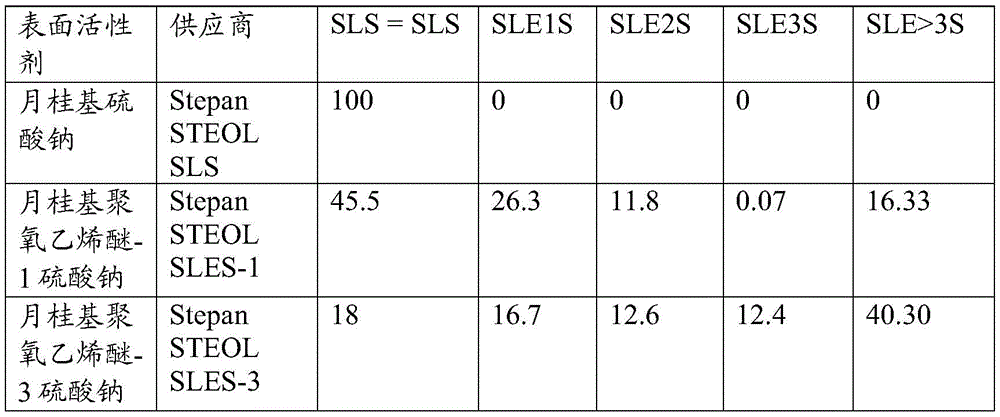
The composition may further comprise an anionic surfactant selected from the group consisting of:
a)R1O(CH2CHR30)yS03M;
b)CH3(CH2)CHR2CH2O(CH2CHR30)zS03m; and
c) a mixture of these with a further component,
wherein R is1Represents CH3(CH2)10,R2Represents H or a hydrocarbon radical comprising 1 to 4 carbon atoms, such that z and R2In (b) the sum of the carbon atoms is 8, R3Is H or CH3Y is 7, when y is not zero (0), y has an average value of about 1, and M is a monovalent or divalent positively charged cation.
The composition may also comprise anionic alkyl sulfate and alkyl ether sulfate surfactants having branched alkyl chains synthesized from C8 to C182-alkyl branched alcohols which may be selected from: guerbet alcohols, alditols, oxo alcohols, and mixtures thereofA compound (I) is provided. Non-limiting examples of 2-alkyl branched alcohols include Guerbet alcohols such as 2-methyl-1-undecanol, 2-ethyl-1-decanol, 2-methyl-1-dodecanol, 2-butyl-1-octanol, 2-butyl-1-nonanol, 2-ethyl-1-undecanol, 2-propyl-1-nonanol, 2-pentyl-1-octanol, 2-pentyl-1-heptanol, and the like under the trade names Those sold under the trade name (Sasol), and oxo alcohols, e.g. under the trade name
 (Sasol)、
 (Sasol)、
 (Shell), other suitable anionic surfactants include those of the formula [ R ]1-SO3M]Water-soluble salts of organic sulfonic acids of (a). R1Is a straight chain aliphatic hydrocarbon group having 13 to 17 carbon atoms, alternatively 13 to 15 carbon atoms. M is a water-soluble cation such as ammonium, sodium, potassium and triethanolamine cations or a salt of a divalent magnesium ion bearing two anionic surfactant anions. These materials are passed over SO2And O2With normal alkanes (C) of suitable chain length14-C17) Is prepared and is commercially sold as sodium alkanesulfonate.
Some non-limiting examples of surfactants are:
alkyl sulfates
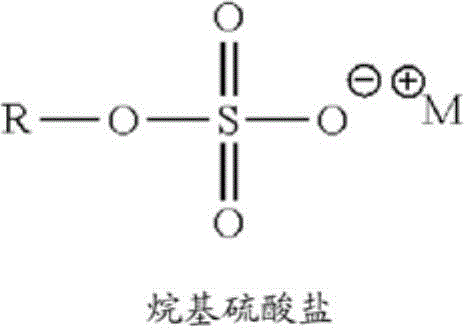
Wherein R is C8-C24Alkyl (linear or branched, saturated or unsaturated) or mixtures thereof, and M+Is a monovalent cation. Examples include sodium lauryl sulfate (where R is C)12Alkyl radical, and M+Is Na+)、Ammonium lauryl sulfate (wherein R is C)12Alkyl radical, and M+Is NH3 +) And sodium coco sulfate (wherein R is cocoalkyl, and M is+Is Na+);
Alkyl ether sulfates
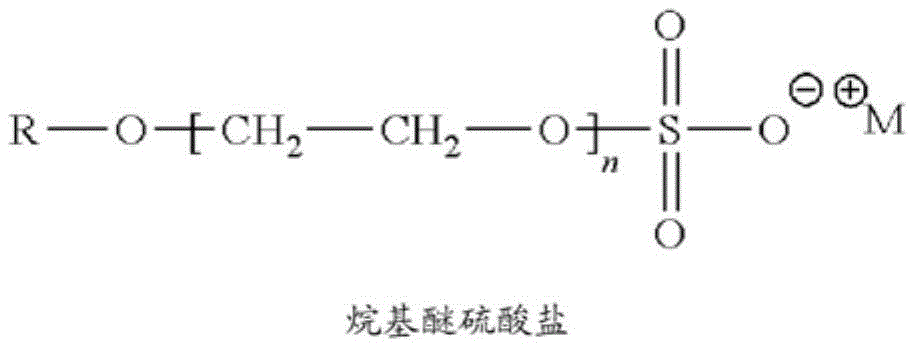
Wherein R is C8-C24Alkyl (linear or branched, saturated or unsaturated) or mixtures thereof, n ═ 1 to 12, and M+Is a monovalent cation. Examples include sodium laureth sulfate (wherein R is C)12Alkyl radical and M+Is Na+N-1-3), ammonium laureth sulfate (wherein R is C)12Alkyl radical, M+Is NH3 +N-1-3), and sodium trideceth sulfate (wherein R is C)13Alkyl radical, M+Is Na+And n is 1-4).
Some non-limiting examples of sulfonate surfactants are:
alkyl glyceryl ether sulfonate:
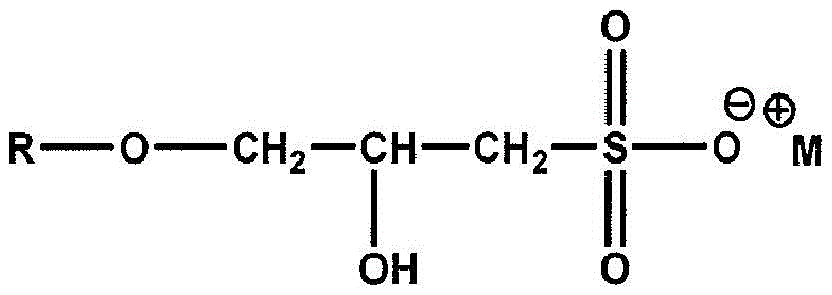
Wherein R ═ C8-C24Alkyl (linear or branched, saturated or unsaturated) or mixtures thereof, and M+Monovalent cations such as sodium cocoglyceryl ether sulfonate (R ═ cocoalkyl, M+=Na+);
α -olefin sulfonates prepared by sulfonating long chain α -olefins α -olefin sulfonates consisting of mixtures of olefin sulfonates,
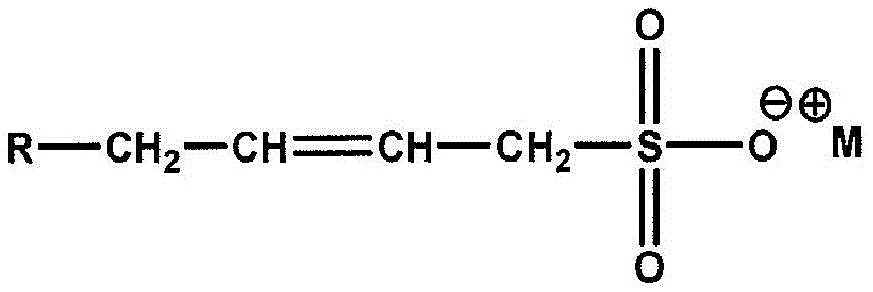
wherein R ═ C8-C18Alkyl or mixtures thereof, and M+Monovalent cation。
Hydroxyalkyl sulfonates:

Wherein R ═ C4-C18Alkyl or mixtures thereof, and M+Monovalent cation. Examples include sodium C12-14 olefin sulfonate (R ═ C)8-C10Alkyl radical, M+=Na+) And sodium olefin sulfonate C14-16 (R ═ C)10-C12Alkyl radical, M+=Na+)。
Suitable anionic surfactants may be surfactants having a tail with an alkyl chain of 8 or more carbon atoms, including but not limited to the following surfactants: sodium trideceth sulfate, sodium C8-13 alkyl sulfate, sodium C8-15 alkyl sulfate, sodium C8-18 alkyl sulfate, sodium C8-13 alkyl polyoxyethylene ether sulfate, sodium C8-13 alkyl polyoxyethylene ether-n sulfate, sodium C8-14 alkyl polyoxyethylene ether-n sulfate, and combinations thereof. All other salts of the above surfactants are useful, such as TEA salts, DEA salts, ammonia salts, potassium salts. Useful alkoxylates include ethylene oxide, propylene oxide and EO/PO mixed alkoxylates. Phosphates, carboxylates, and sulfonates prepared from branched alcohols are also useful anionic branched surfactants. Branched surfactants may be derived from synthetic alcohols such as primary alcohols derived from liquid hydrocarbons produced from Fischer-Tropsch compressed syngas, for example Safol from Sasol North America, Houston, TexTM23 alcohol; synthetic alcohols such as Neodol 23 alcohol available from Shell Chemicals, USA; can be derived from synthetically prepared alcohols such as those described in U.S. patent 6,335,312 to coffiniffaf et al, 1.1.2002. Suitable examples of alcohols are SafolTM 23 and NeodolTM 23. Suitable examples of alkoxylated alcohols are SafolTM 23-3 and NeodolTM 23-3. The sulfate may be prepared in high purity by conventional methods from a sulfur-based SO3 gas stream process, a chlorosulfonic acid process, a sulfuric acid process, or a oleum process. The preparation via gas flow in the falling film reactor isA suitable sulfation process. The anionic surfactant may also be STnS, where n may define the average number of moles of ethoxylation. n may range from about 0 to about 3.5, about 0.5 to about 3.5, about 1.1 to about 3.5, about 1.8 to about 3, or n may be about 2 or 3.
Examples of additional anionic surfactants suitable for use herein include, but are not limited to, ammonium lauryl sulfate, ammonium laureth sulfate, triethylamine lauryl sulfate, triethylamine laureth sulfate, triethanolamine lauryl sulfate, triethanolamine laureth sulfate, monoethanolamine lauryl sulfate, monoethanolamine laureth sulfate, diethanolamine lauryl sulfate, diethanolamine laureth sulfate, sodium lauryl sulfate, sodium laureth sulfate, potassium laureth sulfate, sodium lauryl sarcosinate, sodium lauroyl sarcosinate, lauryl sarcosine, cocoyl sarcosine, ammonium cocoyl sulfate, ammonium lauroyl sulfate, sodium cocoyl sulfate, sodium lauroyl sulfate, potassium cocoyl sulfate, potassium lauryl sulfate, sodium lauroyl sarcosinate, lauryl sulfate, sodium lauroyl sulfate, sodium cocoyl sulfate, potassium lauryl sulfate, sodium lauryl sulfate, lauryl sulfate, Monoethanolamine cocoyl sulfate, sodium trideceth sulfate, sodium tridecyl sulfate, sodium methyl lauroyl taurate, sodium methyl cocoyl taurate, sodium lauroyl isethionate, sodium cocoyl isethionate, sodium laureth sulfosuccinate, sodium lauryl sulfosuccinate, sodium tridecylbenzenesulfonate, sodium dodecylbenzenesulfonate, and mixtures thereof.
Additional anionic surfactants suitable for use herein include, but are not limited to, acyl isethionates, acyl methyl isethionates, acyl glutamates, acyl glycinates, acyl sarcosinates, acyl alanates, acyl taurates, sulfosuccinates, alkylbenzene sulfonates, alkyl ether carboxylates, alkyl amphoacetates, α -olefin sulfonates, and mixtures thereof examples of such suitable anionic surfactants include, but are not limited to, sodium cocoyl isethionate, sodium lauroyl isethionate, sodium cocoyl glutamate, disodium cocoyl glutamate, sodium lauroyl glutamate, sodium cocoyl alanine, sodium lauroyl glycinate, sodium cocoyl glycinate, sodium laureth sulfosuccinate, disodium laureth sulfosuccinate, sodium lauryl sulfosuccinate, disodium lauryl sulfosuccinate, sodium lauryl glucarate, sodium cocoyl glucarate sodium acetate, sodium lauroyl amphoacetate, sodium lauroyl amphotaurate, sodium cocoyl taurate, sodium methyl cocoyl taurate, and mixtures thereof.
The hair care composition comprises from about 0% to about 25%, from about 1% to about 23%, from about 2% to about 20%, from about 1% to about 15%, from about 1% to about 10% by weight of one or more co-surfactants selected from the group consisting of amphoteric surfactants, zwitterionic surfactants, nonionic surfactants, and mixtures thereof. The hair care composition comprises from about 0 wt.% to about 0.5 wt.% of a zwitterionic surfactant.
Suitable zwitterionic surfactants for use herein include, but are not limited to, derivatives of aliphatic quaternary ammonium, phosphonium, and sulfonium compounds, in which the aliphatic radicals can be straight or branched chain, and wherein one of the aliphatic substituents contains from about 8 to about 18 carbon atoms, and one contains an anionic group, such as carboxy, sulfonate, sulfate, phosphate, or phosphonate.
Suitable co-surfactants for use herein include zwitterionic molecules having hydroxyl groups and positive and negative charges within the same molecule.
Suitable zwitterionic cosurfactants having hydroxyl groups in their molecular structure are:
alkylhydroxysulfobetaines

Wherein R is a group having C8To C24Alkyl groups of carbon chains (saturated or unsaturated) or mixtures thereof. Examples include lauryl hydroxysultaine (wherein R is lauryl; C12H25) And cocohydroxysultaine (wherein R is cocoalkyl).
Alkylamidoalkylhydroxysultaines:

Wherein RCO ═ C6-C24Acyl (saturated or unsaturated) or mixtures thereof. Examples include cocamidopropyl hydroxysultaine (RCO ═ cocoyl, x ═ 3), lauramidopropyl hydroxysultaine (RCO ═ lauroyl, and x ═ 3), myristamidopropyl hydroxysultaine (RCO ═ myristoyl, and x ═ 3), and oleylamidopropyl hydroxysultaine (RCO ═ oleoyl, and x ═ 3).
Alkyl amphoacetate salt
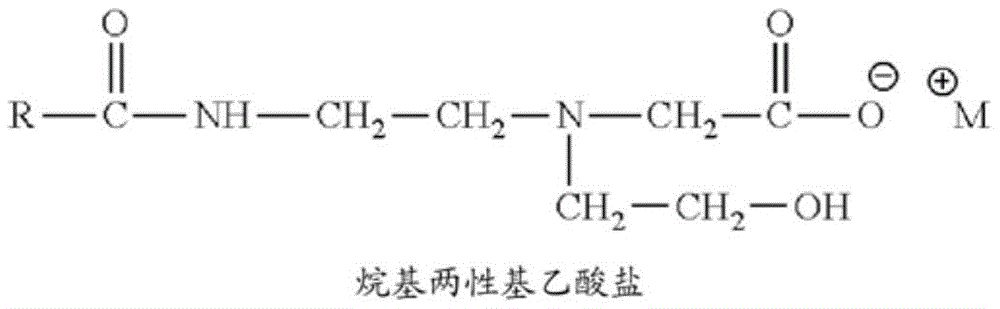
Wherein R is a group having C6To C24Alkyl of a carbon chain (saturated or unsaturated) or mixtures thereof, and M+Is a monovalent cation. Examples include sodium lauroamphoacetate (wherein R is lauryl, andM+is Na+) And sodium cocoamphoacetate (wherein R is coconut oil, and M is+Is Na+)。
Alkylamphopropionates
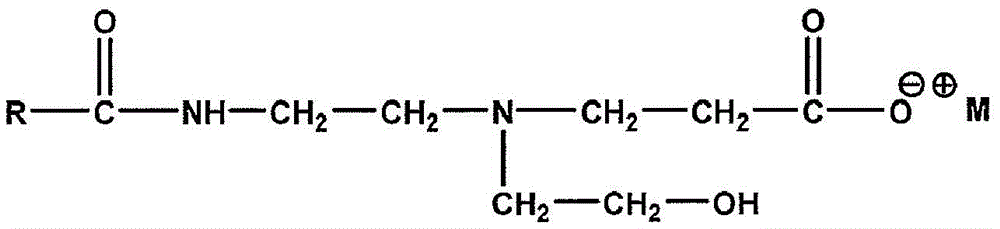
Wherein RCO ═ C6-C24Acyl (saturated or unsaturated) or mixtures thereof, and M+Monovalent cation. Examples include sodium lauroamphopropionate (RCO ═ lauroyl, and M+=Na+) And sodium cocoamphopropionate (RCO ═ cocoyl, and M+=Na+)。
Alkyl ampho hydroxypropyl sulfonate:
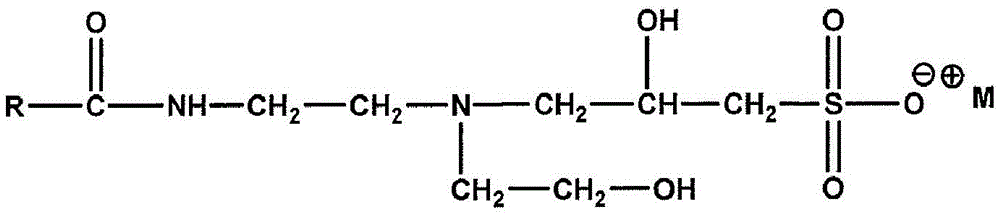
Wherein RCO ═ C6-C24Acyl (saturated or unsaturated) or mixtures thereof, and M+Examples include sodium lauroamphohydroxypropyl sulfonate (RCO ═ lauroyl, and M)+=Na+) And sodium cocoyl amphohydroxypropyl sulfonate (RCO ═ cocoyl, and M+=Na+)。
Alkyl phosphobetaine:
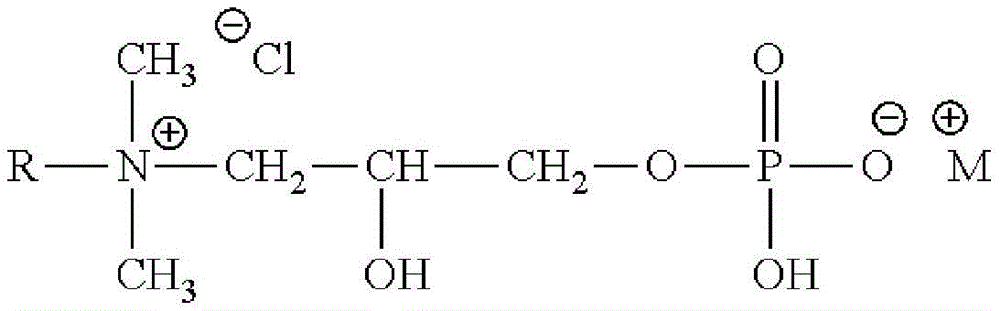
Wherein R ═ C6-C24Alkyl (saturated or unsaturated) or mixtures thereof, and M+Monovalent cations such as sodium coco phosphate PG-dimethyl ammonium chloride (where R is cocoalkyl, and M is a salt of a carboxylic acid such as sodium coco-phosphate PG-dimethyl ammonium chloride+=Na+);
An amphoteric hydroxyalkyl phosphate of the formula:
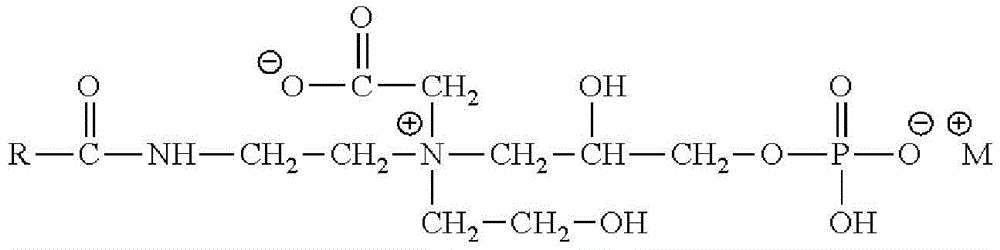
Amphoteric detersive surfactants suitable for use in the hair care composition include those surfactants broadly described as derivatives of aliphatic secondary and tertiary amines in which the aliphatic radical can be straight or branched chain, and wherein one of the aliphatic substituents contains from about 8 to about 18 carbon atoms and one contains an anionic group such as carboxy, sulfonate, sulfate, phosphate, or phosphonate. Exemplary amphoteric detersive surfactants for use in the hair care compositions of the present invention include sodium cocoamphoacetate, sodium cocoamphodiacetate, sodium lauroamphoacetate, disodium lauroamphodiacetate, sodium cocoaminopropionate, sodium cocoaminodipropionate, sodium cocoamphohydroxypropyl sulfonate, sodium cocopropionate, sodium corn oleoyl amphopropionate, sodium lauryl aminopropionate, sodium lauroamphohydroxypropyl sulfonate, sodium lauroamphopropionate, sodium lauroamphodipropionate, sodium lauriminodipropionate, ammonium cocoaminoaminopropionate, ammonium cocoaminodipropionate, ammonium cocoamphoacetate, ammonium cocoamphohydroxypropyl sulfonate, ammonium cocoamphopropionate, ammonium zeaoleoyl amphopropionate, ammonium lauroamphopropionate, ammonium lauroamphoacetate, ammonium lauroamphohydroxypropyl sulfonate, ammonium lauroamphoacetate, Ammonium lauroyl amphopropionate, ammonium corn oleoyl amphopropionate, ammonium laurimidodipropionate, triethanolamine cocoyl aminopropionate, triethanolamine cocoyl aminodipropionate, triethanolamine cocoyl amphoacetate, triethanolamine cocoyl amphohydroxypropyl sulfonate, triethanolamine cocoyl amphopropionate, triethanolamine corn oleoyl amphopropionate, triethanolamine lauryl aminopropionate, triethanolamine lauroyl amphoacetate, triethanolamine lauroyl amphohydroxypropyl sulfonate, triethanolamine lauroyl amphopropionate, triethanolamine corn oleoyl amphopropionate, triethanolamine lauryl iminodipropionate, disodium decanoyl amphodiacetate, disodium decanoyl amphodipropionate, disodium octanoyl amphodiacetate, disodium octanoyl amphodipropionate, disodium cocoyl amphocarboxylate, Coconut oilDisodium acylamphodiacetate, disodium cocoamphodipropionate, disodium dicarboxyethyl-cocoamphopropane diamine, disodium laureth-5-carboxyamphodiacetate, disodium lauriminodipropionate, disodium lauroamphodipropionate, disodium oleylamphodipropionate, disodium PPG-2-isodecylether-7 carboxyamphodiacetate, lauryl aminopropionic acid, lauroamphodipropionic acid, lauryl aminopropylglycine, lauryl diethylenediaminoglycine, and mixtures thereof. Suitable amphoteric surfactants also include amidobetaines and amidosulfobetaines, wherein RCONH (CH)2)3Group (wherein R is C11-C17Alkyl) to the nitrogen atom of the betaine, may also be used in the present invention. The hair care composition may comprise from about 0 wt% to about 15 wt%, from about 0.5 wt% to about 12 wt%, from about 1 wt% to about 8 wt%, and from about 2 wt% to about 12 wt%, from about 0 wt% to about 10 wt%, from about 0.5 wt% to about 10 wt%, from about 1 wt% to about 10 wt%, and from about 2 wt% to about 5 wt% of the nonionic surfactant.
Suitable nonionic surfactants may be selected from: cocamide, Cocamide methyl MEA, Cocamide DEA, Cocamide MEA, Cocamide MIPA, lauramide DEA, lauramide MEA, lauramide MIPA, myristamide DEA, myristamide MEA, PEG-20 Cocamide MEA, PEG-2 Cocamide, PEG-3 Cocamide, PEG-4 Cocamide, PEG-5 Cocamide, PEG-6 Cocamide, PEG-7 Cocamide, PEG-3 lauramide, PEG-5 lauramide, PEG-3 oleamide, PPG-2 Cocamide, PPG-2 hydroxyethyl Cocamide, and mixtures thereof.
Suitable nonionic surfactants include those described in "Detergents and Emulsifiers" north american edition of McCutcheon (1986), and "Functional Materials" north american edition of McCutcheon (1992). Suitable nonionic surfactants for use in the hair care composition include, but are not limited to, polyoxyethylene alkylphenols, polyoxyethylene alcohols, polyoxyethylene polypropylene glycols, glycerol esters of alkanoic acids, polyglycerol esters of alkanoic acids, propylene glycol esters of alkanoic acids, sorbitol esters of alkanoic acids, polyoxyethylene glycol esters of alkanoic acids, polyoxyethylene alkanoic acids, alkanolamides, N-alkylpyrrolidones, alkyl glycosides, alkyl polyglucosides, alkylamine oxides, and polyoxyethylene silicones.
Representative polyoxyethylene alcohols include those having an alkyl chain in the range of C9-C16 and from about 1 to about 110 alkoxy groups, including but not limited to, polyoxyethylene lauryl ether-3, polyoxyethylene lauryl ether-23, polyoxyethylene cetyl ether-10, polyoxyethylene stearyl ether-100, polyoxyethylene behenyl ether-10, and the trade names 91、
91、 23、
23、 25、
25、 45、
45、 135、
135、 67、
67、 PC100、
 PC 200、
 PC 600 is commercially available from Shell Chemicals (Houston, Texas), and mixtures thereof.
Also commercially available areCan be used for Polyoxyethylene fatty esters commercially available under the trade name Uniqema (Wilmington, Delaware), including but not limited to
 30、
30、 35、
35、 52、
52、 56、
56、 58、
58、 72、
72、 76、
76、 78、
78、 93、
93、 97、
97、 98、
98、 721. And mixtures thereof.
Suitable alkyl glycosides and alkyl polyglucosides can be represented by the formula (S) n-O-R, wherein S is a sugar moiety such as glucose, fructose, glucose, fructose, glucose,mannose, galactose, etc.; n is an integer from about 1 to about 1000, and R is a C8-C30 alkyl group. Examples of long chain alcohols from which the alkyl group may be derived include decyl alcohol, lauryl alcohol, myristyl alcohol, cetyl alcohol, stearyl alcohol, oleyl alcohol, and the like. Examples of such surfactants include alkyl polyglucosides, wherein S is a glucose moiety, R is a C8-20 alkyl group, and n is an integer from about 1 to about 9. Commercially available examples of these surfactants include those under the trade name 325CS、
 600CS and
 625CS) decyl polyglucoside and lauryl polyglucoside from Cognis (Ambler, Pa). Also useful herein are sucrose ester surfactants such as sucrose cocoate, and sucrose laurate, and also available under the trade name TritonTMBG-10 and TritonTMCG-110 is an alkyl polyglucoside available from The Dow Chemical Company (Houston, Tx).
Other nonionic surfactants suitable for use are glyceryl esters and polyglyceryl esters, including but not limited to glyceryl monoesters, glyceryl monoesters of C12-22 saturated, unsaturated and branched fatty acids such as glyceryl oleate, glyceryl monostearate, glyceryl monopalmitate, glyceryl monobehenate, and mixtures thereof, and polyglyceryl esters of C12-22 saturated, unsaturated and branched fatty acids such as polyglyceryl-4 isostearate, polyglyceryl-3 oleate, polyglyceryl-2-sesquioleate, triglyceryl diisostearate, diglyceryl monooleate, tetraglyceryl monooleate, and mixtures thereof.
Also useful as nonionic surfactants herein are sorbitan esters. Sorbitan esters of C12-22 saturated, unsaturated, and branched fatty acids may be used herein. These sorbitan esters typically comprise mixtures of mono-, di-, tri-esters, and the like. Process for preparing suitable sorbitan estersRepresentative examples include sorbitan monolaurate (R) ((R)) 20) Sorbitan monopalmitate (b)
 40) Sorbitan monostearate (C)
 60) Sorbitan tristearate (C)
 65) Sorbitan monooleate (f)
 80) Sorbitan trioleate (
 85) And sorbitan isostearate.
Also suitable for use herein are alkoxylated derivatives of sorbitan esters, including but not limited to polyoxyethylene (20) sorbitan monolaurate (all available from Uniqema 20) Polyoxyethylene (20) sorbitan monopalmitate: (
 40) Polyoxyethylene (20) sorbitan monostearate (C)
 60) Polyoxyethylene (20) sorbitan monooleate (C: (A))
 80) Polyoxyethylene (4) sorbitan monolaurate: (
 21) Polyoxyethylene (4) sorbitan monostearate (C)
 61) Polyoxyethylene (5) sorbitan monooleate (C: (A))
 81) And mixtures thereof.
Also suitable for use herein are alkylphenol ethoxylates, including but not limited to nonylphenol ethoxylate (Tergitol available from the dow Chemical Company (Houston, Tx.)TMNP-4, NP-6, NP-7, NP-8, NP-9, NP-10, NP-11, NP-12, NP-13, NP-15, NP-30, NP-40, NP-50, NP-55, NP-70) and octylphenol ethoxylate (Triton available from The Dow chemical Company (Houston, Tx)TMX-15、X-35、X-45、X-114、X-100、X-102、X-165、X-305、X-405、X-705)。
Also suitable for use herein are alkanolamides, including Cocamide Monoethanolamine (CMEA), and tertiary alkylamine oxides, including laurylamine oxide and cocoylamine oxide.
The nonionic surfactants useful herein have an HLB (hydrophilic lipophilic balance) of at least 8, in one embodiment greater than 10, and in another embodiment greater than 12. HLB denotes the balance between hydrophilic and lipophilic moieties in a surfactant molecule, and is generally used as a method of classification. The HLB values of commonly used surfactants are readily available in the literature (e.g., HLB indices in McCutcheon's Emulsifiers and Detergents (MC Publishing co., 2004)).
Non-limiting examples of other anionic, zwitterionic, amphoteric and nonionic additional surfactants suitable for use in hair care compositions are described in McCutcheon's Emulsifiers and detergents (dated 1989, by m.c. publishing Co.) and U.S. Pat. nos. 3,929,678, 2,658,072; 2,438, 091; 2,528,378, which are incorporated herein by reference in their entirety.
B. Water-miscible solvents and hydrotropes
The hair care composition may comprise a viscosity reducing agent selected from a water miscible solvent, a hydrotrope, or a combination thereof. The water-miscible solvent is present in an amount of about 0.5 wt.% to about 6 wt.%, about 0.5 wt.% to about 5 wt.%, about 0.5 wt.% to about 4 wt.%, about 0.5 wt.% to about 3 wt.%, about 0.5 wt.% to about 2 wt.%, about 0.5 wt.% to about 1 wt.%. Suitable water-miscible solvents include, but are not limited to, dipropylene glycol, tripropylene glycol, diethylene glycol, ethylene glycol, propylene glycol, glycerol, 1, 3-propanediol, 2-propanediol, 1, 2-butanediol, 1, 3-butanediol, 1, 4-butanediol, 2, 3-butanediol, 2-methyl-2, 4-pentanediol and mixtures thereof. The hair care composition may comprise two or more water miscible solvents, wherein at least one of the solvents is dipropylene glycol.
The hair care composition may comprise one or more hydrotropes. The hydrotrope is present in an amount of about 0 wt% to about 6 wt%, about 0.01 wt% to about 4 wt%, about 0.5 wt% to about 3 wt%, about 0.01 wt% to about 2 wt%. Suitable classes of hydrotropes include C6-C12 aliphatic alcohols, lower alkyl aryl sulfonates, naphthalene sulfonates, benzene sulfonates, ureas and derivatives, C1-C6 carboxylic acid sulfates, C1-C6 carboxylic acid sulfonates, C1-C6 hydrocarboxylates, C2-C4 organic diacids, short chain alkyl sulfates, and mixtures thereof. Non-limiting examples of hydrotropes include sodium xylene sulfonate, ammonium xylene sulfonate, potassium xylene sulfonate, calcium xylene sulfonate, sodium cumene sulfonate, ammonium cumene sulfonate, potassium cumene sulfonate, calcium cumene sulfonate, sodium toluene sulfonate, ammonium toluene sulfonate, potassium toluene sulfonate, calcium toluene sulfonate, sodium naphthalene sulfonate, ammonium naphthalene sulfonate, potassium naphthalene sulfonate, calcium naphthalene sulfonate, sodium benzene sulfonate, ammonium benzene sulfonate, potassium benzene sulfonate, calcium benzene sulfonate, succinic acid and its sodium, potassium and ammonium salts, glutaric acid and its sodium, potassium and ammonium salts, adipic acid and its sodium, potassium and ammonium salts, citric acid and its sodium, potassium and ammonium salts, acetic acid and its sodium, potassium and ammonium salts, propionic acid and its sodium, potassium and ammonium salts, sulfosuccinic acid sodium, potassium and ammonium salts, phthalic acid sodium, potassium and ammonium salts, sulfoacetic acid, potassium and ammonium salts, sodium, Sodium, potassium and ammonium meta-sulfobenzoate, sodium, potassium and ammonium sulfosuccinate diester, urea, methanol, ethanol, propanol, butanol, and mixtures thereof. Suitable hydrotropes include sodium xylene sulfonate, ammonium xylene sulfonate and potassium xylene sulfonate.
The hair care composition may have a pH in the range of from about 2 to about 10 at 25 ℃. Alternatively, the hair care composition has a pH in the range of about 4 to about 7, which can help solubilize minerals and redox metals that have deposited on the hair. Thus, the hair care composition may also be effective in washing out existing mineral and redox metal deposits, which may reduce cuticle distortion, thereby reducing cuticle breakage and damage.
C. Aqueous carrier
The composition may comprise from about 45% to about 78% by weight, from about 50% to about 75% by weight, from about 55% to about 70% by weight water, from about 60% to about 68% by weight water.
D. Cationic polymers
The hair care composition may further comprise a cationic polymer. These cationic polymers may include at least one of the following: (a) a cationic guar polymer, (b) a cationic non-guar galactomannan polymer, (c) a cationic tapioca polymer, (d) a cationic copolymer of an acrylamide monomer and a cationic monomer, and/or (e) a synthetic, non-crosslinked, cationic polymer which may or may not form lyotropic liquid crystals upon combination with a detersive surfactant, (f) a cationic cellulose polymer. Additionally, the cationic polymer can be a mixture of cationic polymers.
The hair care composition may comprise a cationic guar polymer which is a cationically substituted galactomannan (guar) gum derivative the guar used to prepare these guar derivatives is typically obtained in the form of naturally occurring material from the seed of the guar plant the guar molecule itself is a linear mannan branched at regular intervals with a single galactose unit on alternating mannose units the mannose units are linked to each other via β (1-4) glycosidic linkages the galactose branching occurs via α (1-6) linkages the cationic derivative of the guar is obtained by reaction between the hydroxyl groups of the polygalactomannan and a reactive quaternary ammonium compound the degree of substitution of the cationic groups onto the guar structure should be sufficient to provide the desired cationic charge density as described above.
The cationic polymer may include, but is not limited to, a cationic guar polymer having a weight average molecular weight of less than 2,000,000g/mol, or from about 10,000g/mol to about 2,000,000g/mol, or from about 50,000g/mol to about 2,000,000g/mol, or from about 100,000g/mol to about 2,000,000g/mol, or from about 10,000g/mol to about 1,000,000g/mol, or from about 25,000g/mol to about 1,000,000g/mol, or from about 50,000g/mol to about 1,000,000g/mol, or from about 100,000g/mol to about 1,000,000 g/mol. The cationic guar polymer may have from about 0.2meq/g to about 2.2meq/g, or from about 0.3meq/g to about 2.0meq/g, or from about 0.4meq/g to about 1.8 meq/g; or a charge density of about 0.5meq/g to about 1.7 meq/g.
The cationic guar polymer may have a weight average molecular weight of less than about 1,000,000g/mol and a charge density of about 0.1meq/g to about 2.5 meq/g. In one embodiment, the cationic guar polymer has a weight average molecular weight of less than 950,000g/mol, or from about 10,000g/mol to about 900,000g/mol, or from about 25,000g/mol to about 900,000g/mol, or from about 50,000g/mol to about 900,000g/mol, or from about 100,000g/mol to about 900,000g/mol, from about 150,000g/mol to about 800,000 g/mol. The cationic guar polymer may have from about 0.2meq/g to about 2.2meq/g, or from about 0.3meq/g to about 2.0meq/g, or from about 0.4meq/g to about 1.8 meq/g; or a charge density of about 0.5meq/g to about 1.5 meq/g.
The hair care composition may comprise from about 0.05% to about 2%, from about 0.05% to about 1.8%, from about 0.05% to about 1.5%, from about 0.05% to about 1.2%, from 0.05% to about 1%, from about 0.05% to about 0.9%, from about 0.1% to about 0.8%, or from about 0.2% to about 0.7%, by total weight of the composition, of the cationic polymer (a).
The cationic guar polymer may be formed from a quaternary ammonium compound. The quaternary ammonium compound used to form the cationic guar polymer may correspond to formula 1:

wherein R is3、R4And R5Is a methyl or ethyl group; r6Is an epoxyalkyl group having the general formula 2:
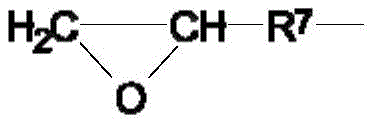
or R6Is a halohydrin group having general formula 3:
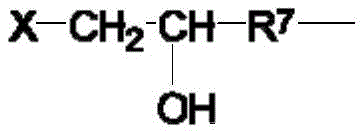
wherein R is7Is C1To C3An alkylene group; x is chlorine or bromine and Z is an anion, such as Cl-, Br-, I-or HSO4-。
The cationic guar polymer may correspond to formula 4:
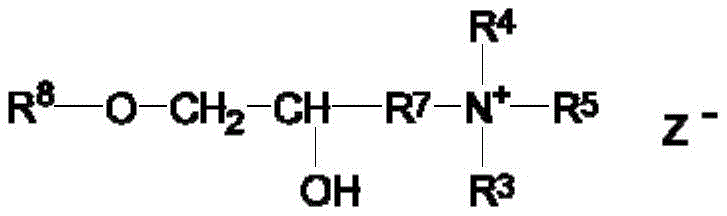
wherein R is8Is guar gum; and wherein R4、R5、R6And R7As defined above; and wherein Z is halogen. The cationic guar polymer may conform to formula 5:
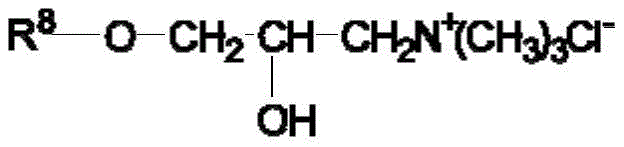
suitable cationic guar polymers include cationic guar derivatives such as guar hydroxypropyltrimonium chloride. The cationic guar polymer may be guar hydroxypropyltrimonium chloride. Specific examples of guar hydroxypropyltrimonium chloride include those commercially available from Rhone-Poulenc Incorporated Series, e.g. commercially available from Rhodia
 C-500。
 C-500 has a charge density of 0.8meq/g and a weight average molecular weight of 500,000 g/mol. Other suitable guar hydroxypropyltrimonium chlorides are: guar hydroxypropyltrimonium chloride having a charge density of about 1.1meq/g and a weight average molecular weight of about 500,000g/mol and available from ASI, guar hydroxypropyltrimonium chloride having a charge density of about 1.5meq/g and a weight average molecular weight of about 500,000g/mol and available from ASI. Other suitable guar hydroxypropyltrimonium chlorides are: Hi-Care 1000 having a charge density of about 0.7meq/g and a weight average molecular weight of about 600,000g/mol and available from Rhodia; N-Hance 3269 and N-Hance 3270 having a charge density of about 0.7meq/g and a weight average molecular weight of about 425,000g/mol, and are available from ASI; N-Hance3271 having a charge density of about 0.7meq/g and a weight average molecular weight of about 500,000g/mol and available from Ashland; AquaCat CG518 has a charge density of about 0.9meq/g and a molecular weight of about 50,000g/mol and is available from ASI. BF-13, which is a borate (boron) -free guar having a charge density of about 1.1meq/g and a weight average molecular weight of about 800,000, and BF-17, which is a borate (boron) -free guar having a charge density of about 1.7meq/g and a m.w.t of about 800,000, both available from ASI.
Other suitable guar hydroxypropyltrimonium chlorides are: N-Hance CG17, having a charge density of about 1.0meq/g and a weight average molecular weight of about 1,600,000g/mol, and available from Ashland; and N-Hance 3196, having a charge density of about 0.7meq/g and a weight average molecular weight of 1,700,000g/mol, and is available from Ashland.
The hair care composition may comprise a galactomannan polymer derivative having a mannose to galactose ratio, on a monomer to monomer basis, of greater than 2:1, the galactomannan polymer derivative being selected from the group consisting of cationic galactomannan polymer derivatives and amphoteric galactomannan polymer derivatives having a net positive charge. As used herein, the term "cationic galactomannan" refers to a galactomannan polymer to which cationic groups are added. The term "amphoteric galactomannan" refers to a galactomannan polymer to which cationic and anionic groups are added such that the polymer has a net positive charge.
Galactomannan polymers are present in the endosperm of leguminous seeds galactomannan polymers are composed of a combination of mannose and galactose monomers, the galactomannan molecules are linear mannans branched at regular intervals on specific mannose units in single segments of galactose units, the mannose units are linked to each other via β (1-4) glycosidic linkages, galactose branching occurs via α (1-6) linkages, the ratio of mannose monomers to galactose monomers varies depending on the variety of the plant, and is also affected by climate.
Gums for the preparation of non-guar galactomannan polymer derivatives are generally available in the form of naturally occurring materials, such as seeds or legume fruits from plants. Examples of various non-guar galactomannan polymers include, but are not limited to, tara gum (3 parts mannose per 1 part galactose), carob or carob gum (4 parts mannose per 1 part galactose), and cassia gum (5 parts mannose per 1 part galactose).
The non-guar galactomannan polymer derivative may have an m.wt. of from about 1,000 to about 1,000,000, and/or from about 5,000 to about 900,000.
The hair care composition may further comprise a galactomannan polymer derivative having a cationic charge density of from about 0.5meq/g to about 7 meq/g. The galactomannan polymer derivative may have a cationic charge density of about 1meq/g to about 5 meq/g. The degree of substitution of the cationic groups on the galactomannan structure should be sufficient to provide the desired cationic charge density.
The galactomannan polymer derivative may be a cationic derivative of a non-guar galactomannan polymer obtained from the reaction between hydroxyl groups of the polygalactomannan polymer and a reactive quaternary ammonium compound. Suitable quaternary ammonium compounds for forming the cationic galactomannan polymer derivative include those conforming to the general formulae 1 to 5 as defined above.
The cationic non-guar galactomannan polymer derivatives formed from the above agents are represented by the general formula 6:
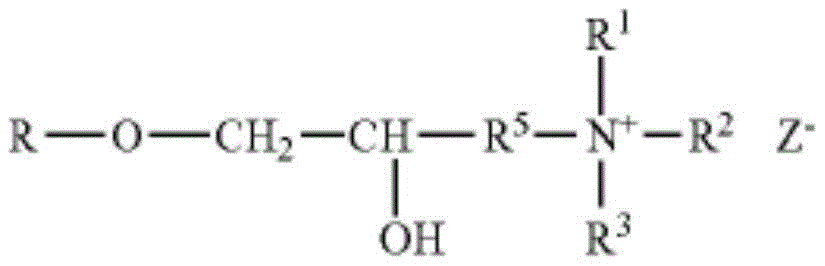
wherein R is a gum. The cationic galactomannan derivative may be a gum hydroxypropyltrimethylammonium chloride, which may be more specifically represented by formula 7:

alternatively, the galactomannan polymer derivative may be an amphoteric galactomannan polymer derivative having a net positive charge, which is obtained when the cationic galactomannan polymer derivative further comprises anionic groups.
The cationic non-guar galactomannan may have a ratio of mannose to galactose of greater than about 4:1, a weight average molecular weight of from about 50,000g/mol to about 1,000,000g/mol, and/or from about 100,000g/mol to about 900,000g/mol, and a cationic charge density of from about 1meq/g to about 5meq/g, and/or from 2meq/g to about 4meq/g, and may also be derived from cinnamon plants.
The hair care composition may comprise at least about 0.05% by weight of the composition of a galactomannan polymer derivative, or from about 0.05% to about 2% by weight of the composition of a galactomannan polymer derivative.
The hair care composition may comprise a water-soluble cationically modified starch polymer. As used herein, the term "cationically modified starch" refers to a starch to which cationic groups have been added before the starch is degraded to have a smaller molecular weight, or to which cationic groups have been added after the starch has been modified to obtain a desired molecular weight. The term "cationically modified starch" is also defined to include amphiphilically modified starches. The term "amphiphilically modified starch" refers to a starch hydrolysate to which cationic and anionic groups have been added.
The hair care composition may comprise a cationically modified starch polymer in the range from about 0.01% to about 10%, and/or from about 0.05% to about 5% by weight of the composition.
The cationically modified starch polymers disclosed herein have a bound nitrogen percentage of from about 0.5% to about 4%.
The cationically modified starch polymer used in the hair care composition can have a weight average molecular weight of from about 50,000g/mol to about 1,000,000g/mol, and/or from about 100,000g/mol to about 1,000,000 g/mol.
The hair care composition may comprise a cationically modified starch polymer having a charge density of from about 0.2meq/g to about 5meq/g, and/or from about 0.2meq/g to about 2 meq/g. Chemical modifications to achieve such charge densities include, but are not limited to, the addition of amino and/or ammonium groups to the starch molecule. Non-limiting examples of these ammonium groups may include substituents such as hydroxypropyl trimethyl ammonium chloride, trimethyl hydroxypropyl ammonium chloride, dimethyl stearyl hydroxypropyl ammonium chloride, and dimethyl dodecyl hydroxypropyl ammonium chloride. See Solarek, d.b., Cationic Starches in Modified starteches: propertiesand Uses (Wurzburg, O.B. ed., CRC Press, Inc., Boca Raton, Fla.1986, pp. 113-125). The cationic groups may be added to the starch before the starch is degraded to have a smaller molecular weight, or they may be added thereto after such modification.
The cationically modified starch polymers typically have a degree of substitution of cationic groups of from about 0.2 to about 2.5. As used herein, the "degree of substitution" of a cationically modified starch polymer is an average measure of the number of hydroxyl groups per anhydroglucose unit derived from the substituent. Since each anhydroglucose unit has three hydroxyl groups that can be substituted, the maximum possible degree of substitution is 3. The degree of substitution is expressed as moles of substituent per mole of anhydroglucose unit on a molar average basis. The degree of substitution can be determined using proton nuclear magnetic resonance spectroscopy (". sup.1h NMR") methods well known in the art. Suitable. sup.1H NMR techniques include those described in "bservation on NMR Spectra of Starches in Dimethyl Sulfoxide, Iodine-Complexing, and Solvating in Water-Dimethyl Sulfoxide", Qin-Ji Pen and Arthur S.Perlin, Carbohydrate Research, 160(1987), 57-72; and "An apparatus to the structural Analysis of Oligosaccharides by NMR Spectroscopy", J.Howard Bradbury and J.Grant Collins, Carbohydrate Research, 71, (1979), 15-25.
The source of starch prior to chemical modification may be selected from a variety of sources such as tubers, legumes, cereals and foodstuffs. Non-limiting examples of such sources of starch may include corn starch, wheat starch, rice starch, waxy corn starch, oat starch, tapioca starch (cassaya starch), waxy barley starch, waxy rice starch, gluten rice starch, glutinous rice starch, amylopectin, potato starch, tapioca starch (tapioca starch), oat starch, sago starch, sweet rice starch, or mixtures thereof.
The cationically modified starch polymer can be selected from the group consisting of degraded cationic corn starch, cationic tapioca, cationic potato starch, and mixtures thereof. Alternatively, the cationically modified starch polymer is cationic corn starch and cationic tapioca.
The starch may include one or more additional modifications before degrading to have a smaller molecular weight or after modifying to have a smaller molecular weight. For example, these modifications may include cross-linking, stabilization reactions, phosphorylation, and hydrolysis. The stabilization reactions may include alkylation and esterification.
The cationically modified starch polymer can be incorporated into the composition in the form of hydrolyzed starch (e.g., acid, enzymatic, or alkaline degradation), oxidized starch (e.g., peroxide, peracid, hypochlorite, alkali, or any other oxidizing agent), physically/mechanically degraded starch (e.g., via thermal mechanical energy input of the treatment device), or a combination thereof.
The best form of starch is one that readily dissolves in water and forms a substantially clear (transmission at 600 nm. gtoreq.80) solution in water. The transparency of the composition was determined by ultraviolet/visible (UV/VIS) spectrophotometry, which measures the absorption or transmission of UV/VIS light by a sample using a Gretag Macbeth Colorimeter Color i 5 according to the relevant instructions. It has been shown that a wavelength of light of 600nm is sufficient to characterize the transparency of a cosmetic composition.
Suitable cationically modified starches for use in hair care compositions are available from known starch suppliers. Also suitable for use in the hair care composition are nonionic modified starches which may be further derivatized to cationic modified starches as is known in the art. Other suitable modified starch materials may be quaternized as is known in the art to produce cationic modified starch polymers suitable for use in hair care compositions.
And (3) starch degradation process: starch slurry can be made by mixing granular starch in water. The temperature was raised to about 35 ℃. An aqueous solution of potassium permanganate was then added at a concentration of about 50ppm, based on starch. The pH was raised to about 11.5 with sodium hydroxide and the slurry was stirred well to prevent the starch from settling. A solution of about 30% hydrogen peroxide diluted in water was then added to bring the peroxide level to about 1% based on starch. The pH was then restored to about 11.5 by the addition of additional sodium hydroxide. The reaction is completed over a period of about 1 to about 20 hours. The mixture was then neutralized with dilute hydrochloric acid. Degraded starch is recovered by filtration followed by washing and drying.
The hair care composition may comprise a cationic copolymer of an acrylamide monomer and a cationic monomer, wherein the copolymer has a charge density of from about 1.0meq/g to about 3.0 meq/g. The cationic copolymer can be a synthetic cationic copolymer of acrylamide monomers and cationic monomers.
The cationic copolymer may comprise:
(i) an acrylamide monomer having the formula AM:
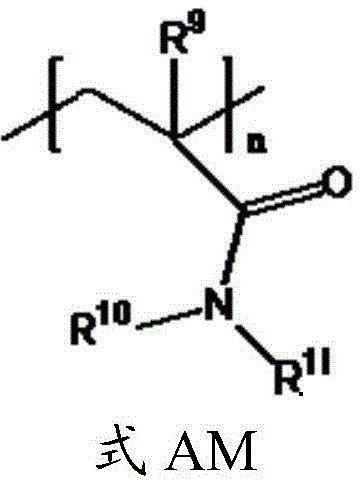
wherein R is9Is H or C1-4An alkyl group; and R is10And R11Independently selected from H, C1-4Alkyl radical, CH2OCH3、CH2OCH2CH(CH3)2And phenyl, or together are C3-6A cycloalkyl group; and
(ii) cationic monomers conforming to the formula CM:
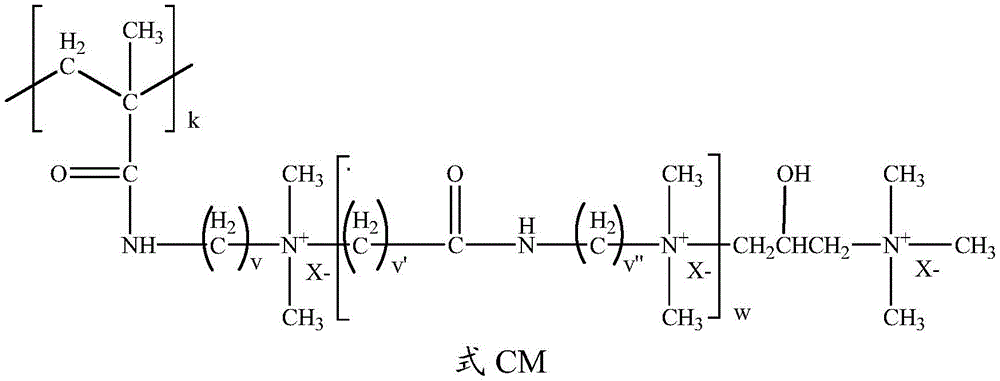
wherein k is 1, each of v, v' and v "is independently an integer from 1 to 6, w is zero or an integer from 1 to 10, and X is-Is an anion.
The cationic monomer may conform to formula CM, and wherein k ═ 1, v ═ 3, and w ═ 0, z ═ 1, and X-Is Cl-To form the following structure:
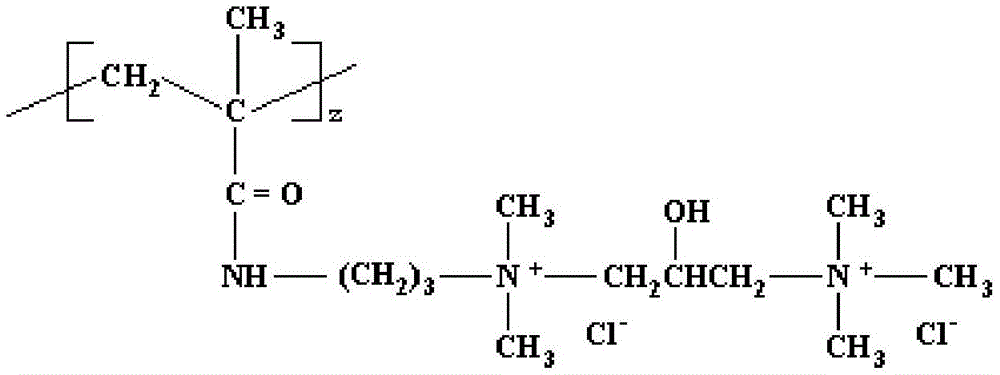
the above structure may be referred to as a diquaternary ammonium salt. Alternatively, the cationic monomer may conform to formula CM, and wherein v and v "are each 3, v' ═ 1, w ═ 1, y ═ 1, and X is-Is Cl-Such as:
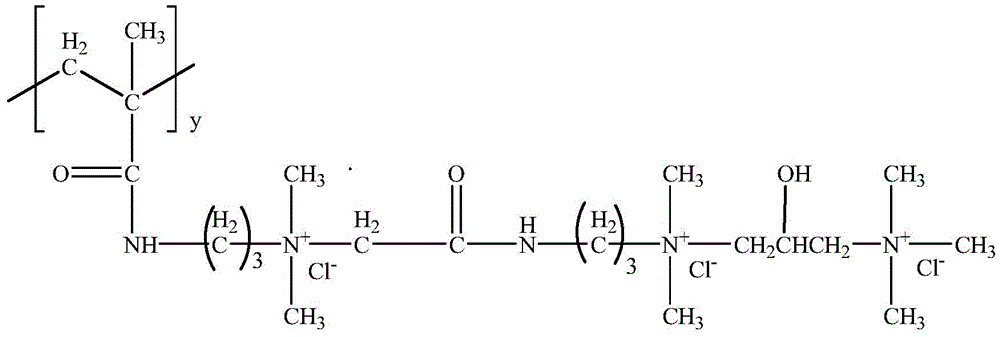
the above structure may be referred to as a tri-quaternary ammonium salt.
Suitable acrylamide monomers include, but are not limited to, acrylamide or methacrylamide.
The cationic copolymer can be an acrylamide monomer and a cationic monomer, wherein the cationic monomer is selected from the group consisting of: dimethylaminoethyl (meth) acrylate, dimethylaminopropyl (meth) acrylate, di-tert-butylaminoethyl (meth) acrylate, dimethylaminomethyl (meth) acrylamide, dimethylaminopropyl (meth) acrylamide; ethyleneimine, vinylamine, 2-vinylpyridine, 4-vinylpyridine; trimethyl ammonium chloride ethyl (meth) acrylate, trimethyl ammonium methyl sulfate ethyl (meth) acrylate, dimethyl benzyl ammonium chloride ethyl (meth) acrylate, 4-benzoylbenzyl dimethyl ammonium chloride ethyl acrylate, trimethyl ammonium chloride ethyl (meth) acrylamide, trimethyl ammonium chloride propyl (meth) acrylamide, vinyl benzyl trimethyl ammonium chloride, diallyl dimethyl ammonium chloride, and mixtures thereof.
The cationic copolymer may comprise a cationic monomer selected from the group consisting of: the cationic monomer comprises trimethyl ammonium chloride ethyl (meth) acrylate, trimethyl ammonium methyl sulfate ethyl (meth) acrylate, dimethyl benzyl ammonium chloride ethyl (meth) acrylate, 4-benzoyl benzyl dimethyl ammonium chloride ethyl acrylate, trimethyl ammonium chloride ethyl (meth) acrylamide, trimethyl ammonium chloride propyl (meth) acrylamide, vinyl benzyl trimethyl ammonium chloride, and mixtures thereof.
The cationic copolymer may be water soluble. The cationic copolymer is formed from: (1) a copolymer of (meth) acrylamide and a cationic (meth) acrylamide-based monomer and/or a hydrolysis-stable cationic monomer, (2) a terpolymer of (meth) acrylamide, a cationic (meth) acrylate-based monomer, and a (meth) acrylamide-based monomer, and/or a hydrolysis-stable cationic monomer. The cationic (meth) acrylate-based monomer may be a cationized ester of (meth) acrylic acid containing a quaternized N atom. The cationized ester of (meth) acrylic acid containing a quaternized N atom can be a quaternized dialkylaminoalkyl (meth) acrylate having C1-C3 in the alkyl and alkylene groups. Suitable cationised esters of (meth) acrylic acid containing a quaternised N atom may be selected from: ammonium salts of dimethylaminomethyl (meth) acrylate, dimethylaminoethyl (meth) acrylate, dimethylaminopropyl (meth) acrylate, diethylaminomethyl (meth) acrylate, diethylaminoethyl (meth) acrylate quaternized with methyl chloride; and ammonium salts of diethylaminopropyl (meth) acrylate. The cationic ester of (meth) acrylic acid containing a quaternized N atom can be dimethylaminoethyl acrylate (ADAME-Quat) quaternized with an alkyl halide or with methyl or benzyl chloride or dimethyl sulfate. When based on (meth) acrylamide, the cationic monomer may be a quaternized dialkylaminoalkyl (meth) acrylamide having C1-C3 in the alkyl and alkylene groups, or dimethylaminopropyl acrylamide, which is quaternized with an alkyl halide or with methyl or benzyl chloride or dimethyl sulfate.
Suitable cationic (meth) acrylamide-based monomers include quaternized dialkylaminoalkyl (meth) acrylamides having C1 to C3 in the alkyl and alkylene groups. The (meth) acrylamide-based cationic monomer may be dimethylaminopropyl acrylamide, which is quaternized with an alkyl halide, especially methyl chloride, or benzyl chloride or dimethyl sulfate.
The cationic monomer can be a hydrolytically stable cationic monomer. The hydrolytically stable cationic monomer may be all monomers that can be considered stable by OECD hydrolysis testing, in addition to the dialkylaminoalkyl (meth) acrylamide. The cationic monomer can be hydrolytically stable, and the hydrolytically stable cationic monomer can be selected from the group consisting of: diallyl dimethyl ammonium chloride and a water-soluble cationic styrene derivative.
The cationic copolymer can be a terpolymer of acrylamide, 2-dimethylammonium ethyl (meth) acrylate quaternized with methyl chloride (ADAME-Q), and 3-dimethylammonium propyl (meth) acrylamide quaternized with methyl chloride (DIMAPA-Q). The cationic copolymer can be formed from acrylamide and acrylamidopropyltrimethylammonium chloride, wherein the acrylamidopropyltrimethylammonium chloride has a charge density of from about 1.0meq/g to about 3.0 meq/g.
The cationic copolymer may have a charge density of from about 1.1meq/g to about 2.5meq/g, or from about 1.1meq/g to about 2.3meq/g, or from about 1.2meq/g to about 2.2meq/g, or from about 1.2meq/g to about 2.1meq/g, or from about 1.3meq/g to about 2.0meq/g, or from about 1.3meq/g to about 1.9 meq/g.
The cationic copolymer can have a weight average molecular weight of from about 10,000g/mol to about 1,000,000g/mol, or from about 25,000g/mol to about 1,000,000g/mol, or from about 50,000g/mol to about 1,000,000g/mol, or from about 100,000g/mol to about 1,000,000g/mol, or from about 150,000g/mol to about 1,000,000 g/mol.
Cationic synthetic polymers
The hair care composition may comprise a cationic synthetic polymer which may be formed from
i) One or more cationic monomer units, and optionally
ii) one or more negatively charged monomer units, and/or
iii) a non-ionic monomer, wherein,
wherein the subsequent charge of the copolymer is positive. The ratios of the three types of monomers are given as "m", "p" and "q", where "m" is the number of cationic monomers, "p" is the number of negatively charged monomers, and "q" is the number of nonionic monomers
The cationic polymer may be a water-soluble or water-dispersible non-crosslinked and synthetic cationic polymer having the structure:
monomers having a negative charge
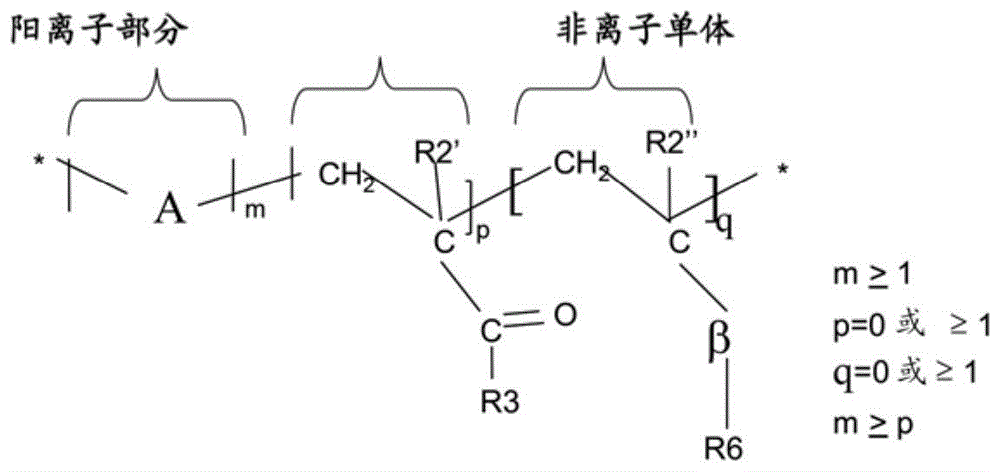
Wherein a may be one or more of the following cationic moieties:
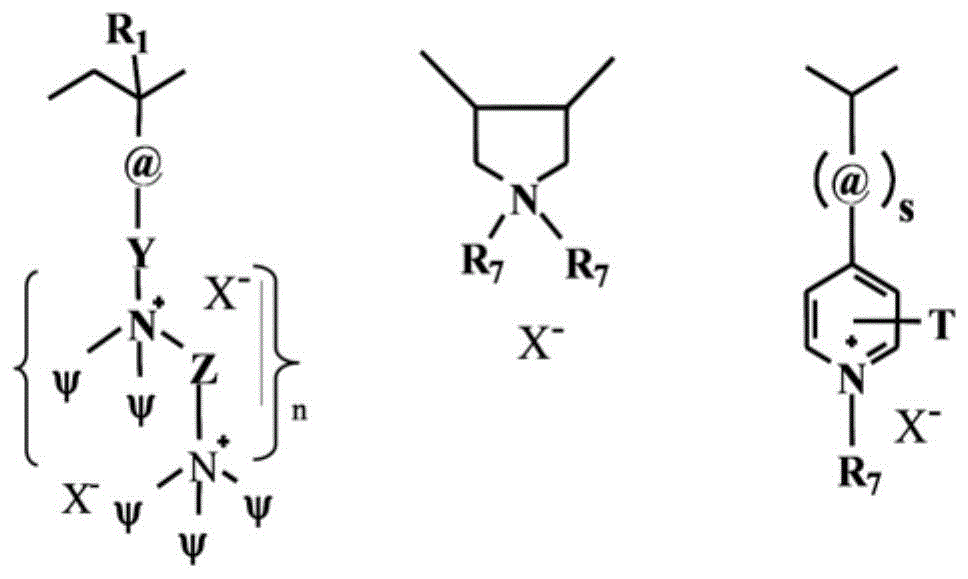
wherein @ acylamino, alkylamido, ester, ether, alkyl, or alkylaryl;
wherein Y is C1-C22 alkyl, alkoxy, alkylidene, alkyl, or aryloxy;
wherein ψ ═ C1-C22 alkyl, alkoxy, alkylaryl, or alkylaryloxy; .
Wherein Z is C1-C22 alkyl, alkoxy, aryl, or aryloxy;
wherein R1 is H, C1-C4 straight or branched chain alkyl;
wherein s is 0 or 1, n is 0 or more than 1;
wherein T and R7 ═ C1-C22 alkyl; and
wherein X-is halogen, hydroxide, alkanol, sulfate or alkylsulfate.
Wherein the negatively charged monomer is defined by: r2' ═ H, C1-C4 straight or branched chain alkyl, and R3 is:

wherein D is O, N, or S;
wherein Q is NH2Or O;
wherein u is 1 to 6;
wherein t is 0 to 1; and
wherein J ═ an oxygenated functional group containing the following element P, S, C.
Wherein the nonionic monomer is defined by R2 ″ -H, C1-C4 straight or branched chain alkyl, R6 ═ straight or branched chain alkyl, alkylaryl, aryloxy, alkoxy, alkylaryloxy, and β is defined as
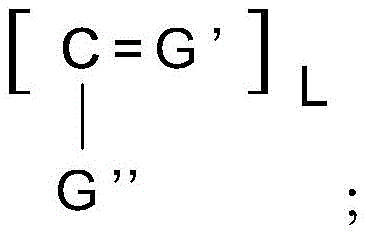
Wherein G' and G "are independently from each other O, S or N-H, and L ═ 0 or 1.
Examples of the cationic monomer include aminoalkyl (meth) acrylates, (meth) aminoalkyl (meth) acrylamides; monomers comprising at least one secondary, tertiary or quaternary ammonium functional group, or a heterocyclic group containing a nitrogen atom, a vinylamine or an ethyleneimine; diallyldialkylammonium salts; mixtures thereof, salts thereof and macromers derived therefrom.
Further examples of cationic monomers include dimethylaminoethyl (meth) acrylate, dimethylaminopropyl (meth) acrylate, di-tert-butylaminoethyl (meth) acrylate, dimethylaminomethyl (meth) acrylamide, dimethylaminopropyl (meth) acrylamide, ethyleneimine, vinylamine, 2-vinylpyridine, 4-vinylpyridine, trimethylammonium chloride ethyl (meth) acrylate, trimethylmethylammonium sulfate ethyl (meth) acrylate, dimethylbenzylammonium chloride ethyl (meth) acrylate, 4-benzoylbenzyldimethylammonium chloride ethyl acrylate, trimethylammonium chloride ethyl (meth) acrylamide, trimethylammonium chloride propyl (meth) acrylamide, vinylbenzyltrimethylammonium chloride, diallyldimethylammonium chloride.
Suitable cationic monomers include those comprising the formula-NR3 +Wherein R, which are identical or different, represent a hydrogen atom, an alkyl group comprising from 1 to 10 carbon atoms, or a benzyl group, optionally carrying a hydroxyl group, and comprising an anion (counterion). Examples of anions are halides (such as chloride, bromide), sulfate, hydrogen sulfate, alkyl sulfates (e.g., containing 1 to 6 carbon atoms), phosphate, citrate, formate, and acetate.
Suitable cationic monomers include trimethyl ammonium chloride ethyl (meth) acrylate, trimethyl ammonium methyl sulfate ethyl (meth) acrylate, dimethyl benzyl ammonium chloride ethyl (meth) acrylate, 4-benzoylbenzyldimethyl ammonium chloride ethyl acrylate, trimethyl ammonium chloride ethyl (meth) acrylamide, trimethyl ammonium chloride propyl (meth) acrylamide, vinylbenzyltrimethyl ammonium chloride.
Additional suitable cationic monomers include trimethyl ammonium chloride propyl (meth) acrylamide.
Examples of the monomer having a negative charge include α -ethylenically unsaturated monomer containing a phosphate group or a phosphonate group, α -ethylenically unsaturated monocarboxylic acid, a monoalkyl ester of α -ethylenically unsaturated dicarboxylic acid, a monoalkylamide of α -ethylenically unsaturated dicarboxylic acid, α -ethylenically unsaturated compound containing a sulfonic acid group, and a salt of α -ethylenically unsaturated compound containing a sulfonic acid group.
Suitable monomers having a negative charge include acrylic acid, methacrylic acid, vinylsulfonic acid, salts of vinylsulfonic acid, vinylbenzenesulfonic acid, salts of vinylbenzenesulfonic acid, α -acrylamidomethylpropanesulfonic acid, salts of α -acrylamidomethylpropanesulfonic acid, 2-sulfoethyl methacrylate, salts of 2-sulfoethyl methacrylate, acrylamido-2-methylpropanesulfonic Acid (AMPS), salts of acrylamido-2-methylpropanesulfonic acid, and styrenesulfonate (SS).
Examples of nonionic monomers include vinyl acetate, α -amides of ethylenically unsaturated carboxylic acids, esters of α -ethylenically unsaturated monocarboxylic acids with hydrogenated or fluorinated alcohols, polyethylene oxide (meth) acrylates (i.e., polyethoxylated (meth) acrylic acid), monoalkyl esters of α -ethylenically unsaturated dicarboxylic acids, monoalkylamides of α -ethylenically unsaturated dicarboxylic acids, vinyl nitriles, vinyl amine amides, vinyl alcohols, vinyl pyrrolidones, and vinyl aromatics.
Suitable nonionic monomers include styrene, acrylamide, methacrylamide, acrylonitrile, methyl acrylate, ethyl acrylate, n-propyl acrylate, n-butyl acrylate, methyl methacrylate, ethyl methacrylate, n-propyl methacrylate, n-butyl methacrylate, 2-ethyl-hexyl acrylate, 2-ethyl-hexyl methacrylate, 2-hydroxyethyl acrylate, and 2-hydroxyethyl methacrylate.
The anionic counterion (X-) associated with the synthetic cationic polymer can be any known counterion so long as the polymer remains soluble or dispersible in water, in the hair care composition, or in a coacervate phase in the hair care composition, and so long as the counterion is physically and chemically compatible with the essential components of the hair care composition, or does not otherwise unduly impair product performance, stability, or aesthetics. Non-limiting examples of such counterions include halide ions (e.g., chloride, fluoride, bromide, iodide), sulfate, and methosulfate.
The concentration of the cationic polymer ranges from about 0.025% to about 5%, from about 0.1% to about 3%, and/or from about 0.2% to about 1%, by weight of the hair care composition.
Suitable cationic cellulose polymers are the salts of hydroxyethyl cellulose reacted with trimethylammonium substituted epoxide, known in the industry (CTFA) as polyquaternium 10 and available from Dow/Amerchol Corp. (Edison, n.j., USA) as their Polymer LR, JR and KG Polymer series. Other suitable types of cationic cellulose include the polymeric quaternary ammonium salts of hydroxyethyl cellulose reacted with lauryl dimethyl ammonium-substituted epoxide, referred to in the industry (CTFA) as polyquaternary ammonium salts 24. These materials are available from Dow/Amerchol Corp, under the trade name Polymer LM-200. Other suitable types of cationic cellulose include the polymeric quaternary ammonium salts of hydroxyethyl cellulose reacted with lauryl dimethyl ammonium-substituted epoxide and trimethyl ammonium-substituted epoxide, which are known in the industry (CTFA) as polyquaternary ammonium salts 67. These materials are available from Dow/Amerchol Corp, under the trade names SoftCAT Polymer SL-5, SoftCAT Polymer SL-30, Polymer SL-60, Polymer SL-100, Polymer SK-L, Polymer SK-M, Polymer SK-MH, and Polymer SK-H.
E. Conditioning agent
The hair care composition may comprise one or more conditioning agents. Conditioning agents include materials used to provide specific conditioning benefits to hair and/or skin. Conditioning agents useful in the hair care compositions of the present invention generally include water-insoluble, water-dispersible, non-volatile, liquid that can form emulsified liquid particles. Suitable conditioning agents for use in the hair care composition are those conditioning agents which are generally characterized as silicones (e.g., silicone oils, cationic silicones, silicone gums, high refractive silicones, and silicone resins), organic conditioning oils (e.g., hydrocarbon oils, polyolefins, and fatty acid esters), or combinations thereof, or those conditioning agents which otherwise form liquid dispersed particles in an aqueous surfactant matrix.
1. Silicone conditioning agents
The hair care composition may comprise from about 0 wt% to about 20 wt%, or from about 6 wt% to about 18 wt%; and alternatively from about 8 wt% to about 16 wt% of one of a plurality of siloxanes having a particle size of less than about 300nm, alternatively less than about 200nm, and alternatively less than about 100 nm. The silicone may be in the form of a nanoemulsion.
The particle size of the one or more siloxanes can be measured by Dynamic Light Scattering (DLS). A Malvern Zetasizer Nano ZEN3600 system (www.malvern.com) using a He-Ne laser 633nm was used for the measurements at 25 ℃.
The autocorrelation function can be analyzed using Zetasizer software supplied by Malvern Instruments, which determines the effective hydrodynamic radius using the Stokes-Einstein equation:

wherein k isBFor the Boltzmann constant, T is the absolute temperature, η is the viscosity of the medium, D is the average diffusion coefficient of the scattering substance, and R is the hydrodynamic radius of the particle.
The particle size (i.e., hydrodynamic radius) can be obtained by correlating the observed speckle pattern due to brownian motion with solving the Stokes-Einstein equation, which relates particle size to the measured diffusion constant, as is known in the art.
For each sample, 3 measurements can be made and the Z-average can be reported as particle size.
The one or more silicones can be in the form of a nanoemulsion. The nanoemulsion may comprise any silicone suitable for application to the skin or hair.
One or more siloxanes may contain polar functional groups such as Si-OH (in the form of dimethiconol), primary amines, secondary amines, tertiary amines, and quaternary ammonium salts in their molecular structure. The one or more silicones may be selected from aminosilicones, pendant quaternary ammonium silicones, terminal quaternary ammonium silicones, aminopolyalkyleneoxides, quaternary polyalkyleneoxides, and aminomorpholine silicones.
The one or more silicones may comprise:
(a) at least one aminosiloxane corresponding to formula (V):
R′aG3-a—Si(OSiG2)n—(OSiGbR′2-b)m—O—SiG3-a—R′a(I)
wherein:
g is selected from the group consisting of a hydrogen atom, a phenyl group, an OH group and C1-C8The alkyl groups, such as methyl groups,
a is an integer ranging from 0 to 3, and in one embodiment a is 0,
b is selected from 0 and 1, and in one embodiment b is 1,
m and n are numbers such that the sum (n + m) may be in the range of, for example, 1 to 2000, such as, for example, 50 to 150, wherein n may be selected, for example, from a number in the range of 0 to 1999, such as, for example, 49 to 149, and wherein m may be selected, for example, from a number in the range of 1 to 2000, such as, for example, 1 to 10;
r' is formula-CqH2qA monovalent group of L, wherein q is a number from 2 to 8, and L is an optional quaternized amine group selected from the group consisting of:
—NR″—CH2—CH2—N′(R1)2,
—N(R″)2,
—N+(R″)3A-,
—N+H(R″)2A-,
—N+H2(R″)A-and are and
—N(R″)—CH2—CH2—N+R″H2A-,
wherein R' can be selected from the group consisting of a hydrogen atom, a phenyl group, a benzyl group and a saturated monovalent hydrocarbon-based group, such as for example an alkyl group comprising from 1 to 20 carbon atoms, and A-Selected from the group consisting of halide ions such as, for example, fluoride, chloride, bromide and iodide.
The one or more siloxanes may include those corresponding to formula (1), wherein a ═ 0, G ═ methyl, m and n are numbers such that the sum (n + m) may range, for example, from 1 to 2000, such as, for example, from 50 to 150, wherein n may be selected, for example, from numbers ranging from 0 to 1999, such as, for example, from 49 to 149, and wherein m may be selected, for example, from numbers ranging from 1 to 2000, such as, for example, from 1 to 10; and L is-N (CH)3)2or-NH2or-NH2。
The additional at least one aminosilicone of the present invention comprises:
(b) a pendant quaternary ammonium siloxane having the formula (VII):
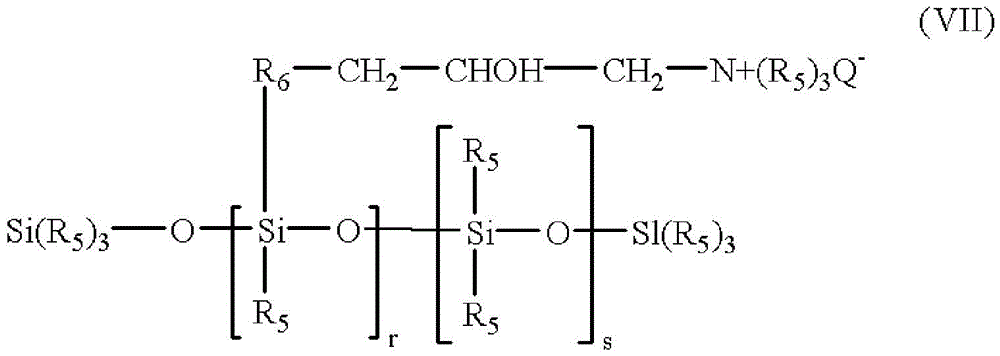
wherein:
R5selected from monovalent hydrocarbon-based groups containing 1 to 18 carbon atoms, such as C1-C18Alkyl radical and C2-C18Alkenyl groups such as methyl;
R6selected from divalent hydrocarbon-based groups, such as divalent C1-C18Alkylene radical and divalent C1-C18Alkyleneoxy radicals, e.g. C1-C8An alkyleneoxy group, wherein R is6Bonded to Si through SiC bonds;
Q-is an anion, which may for example be selected from halide ions, such as chloride ions, and organic acid salts (such as acetate salts);
r is an average statistical value in the range of 2 to 20, such as 2 to 8;
s is a statistical average in the range of 20 to 200, such as 20 to 50.
Such aminosiloxanes are more particularly described in U.S. Pat. No. 4,185,087, the disclosure of which is incorporated herein by reference.
Silicones belonging to this class are the silicones sold by the company Union Carbide under the name "Ucar Silicone ALE 56".
Further examples of the at least one aminosiloxane include:
c) a quaternary ammonium siloxane having formula (VIIb):
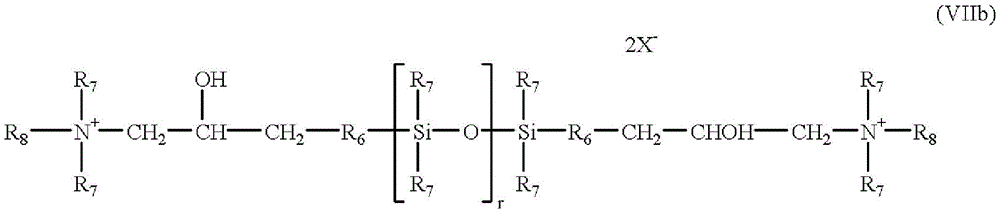
wherein:
radical R7May be the same or different and are each selected from the group consisting of 1 to 18 carbon atomsBased on monovalent hydrocarbons, such as C1-C18Alkyl radicals, e.g. methyl, C2-C18An alkenyl group, and a ring containing 5 or 6 carbon atoms;
R6selected from divalent hydrocarbon-based groups, such as divalent C1-C18Alkylene radical and divalent C1-C18Alkyleneoxy groups, e.g. C, connected to Si by SiC bonds1-C8A group;
R8which may be the same or different, represent a hydrogen atom, a monovalent hydrocarbon-based group containing 1 to 18 carbon atoms, and in particular C1-C18Alkyl radical, C2-C18Alkenyl radicals or radicals-R6—NHCOR7;
X-Is an anion such as a halide ion, specifically a chloride ion, or an organic acid salt (acetate, etc.);
r represents a statistical average of 2 to 200, and specifically 5 to 100.
Such siloxanes are described, for example, in patent application EP-A-0530974, the disclosure of which is incorporated herein by reference.
Silicones belonging to this class are the silicones sold by the company Eovnik under the trade names Abil Quat 3270, Abil Quat 3272, Abil Quat 3474 and Abil ME 45.
Further examples of the at least one aminosiloxane include:
d) quaternary ammonium and polyalkylene oxide siloxanes
Wherein the quaternary nitrogen groups are located in the polysiloxane backbone, at the terminal ends, or both.
Such siloxanes are described in PCT patent publication WO 2002/010257, the disclosure of which is incorporated herein by reference.
Silicones belonging to this class are those sold under the name Silsoft Q by the company Momentive.
(e) An amino-functional siloxane having a morpholino group of formula (V):
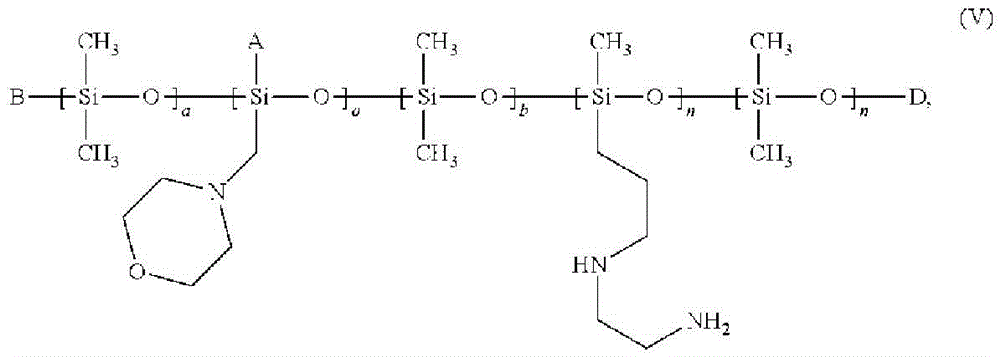
wherein
A represents a structural unit (I), (II) or (III) bonded via-O-
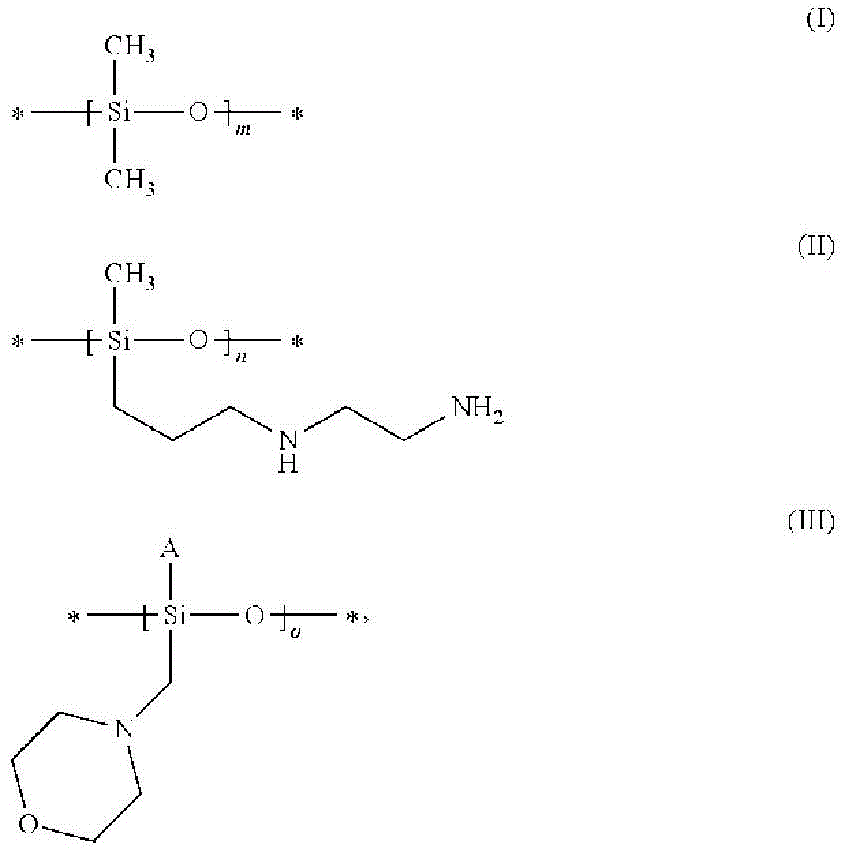
Or oligomeric or polymeric residues which are bonded via-O-, comprise structural units of the formula (I), (II) or (III) or are half of the linking oxygen atoms to structural unit (III) or represent-OH,
represents a bond to one of the structural units (I), (II) or (III), or represents a terminal group B (Si-bonded) or D (O-bonded)
B represents-OH, -O-Si (CH)3)3、—O—Si(CH3)2OH、—O—Si(CH3) A group of 2OCH3 is present,
d represents-H, -Si (CH)3)3、—Si(CH3)2OH、—Si(CH3)2OCH3The radical(s) is (are),
a. b and c represent integers from 0 to 1000, with the proviso that a + b + c >0,
m, n and o represent an integer of 1 to 1000.
Such amino-functional silicones have INCI names: amino-terminated polydimethylsiloxane/morpholinomethylsilsesquioxane copolymers. A particularly suitable amino-terminated polydimethylsiloxane is that having the trade name Wacker A product of ADM 8301E.
Examples of such silicones are available from the following suppliers:
supplied by the company Dow Corning: fluid: 2-8566, AP 6087, AP 6088, DC 8040 fluid, fluid 8822 adc, DC 8803 and 8813 polymer, 7-6030, AP-8104, AP 8201; emulsion: CE-8170AF microemulsion, 2-8177, 2-8194 microemulsion, 9224 emulsion, 939, 949, 959, DC 5-7113Quat microemulsion, DC 5-7070 emulsion, DCCE-8810, CE 8401 emulsion, CE 1619, Dow Corning Toray SS-3551, Dow Corning Toray SS-3552;
supplied by the company Wacker: wacker Belsil ADM 652, ADM 656, 1100, 1600, 1650 (fluid) ADM 6060 (linear amino-terminated polydimethylsiloxane) emulsion; ADM 6057E (branched amino terminated polydimethylsiloxane) emulsion; ADM 8020VP (microemulsion); SLM 28040 (microemulsion);
supplied by the company Momentive: silsoft 331, SF1708, SME 253 and 254 (emulsion), SM2125 (emulsion), SM 2658 (emulsion), Silsoft Q (emulsion)
Supplied by the company Shin-Etsu: KF-889, KF-867S, KF-8004, X-52-2265 (emulsion);
supplied by the company Siltech Silicones: siltech E-2145, E-Siltech 2145-35;
supplied by the company Evonik Industries: abil T Quat 60th
Some non-limiting examples of aminosilicones include compounds having the following INCI designations: polysiloxane quaternary ammonium salt-1, polysiloxane quaternary ammonium salt-2, polysiloxane quaternary ammonium salt-3, polysiloxane quaternary ammonium salt-4, polysiloxane quaternary ammonium salt-5, polysiloxane quaternary ammonium salt-6, polysiloxane quaternary ammonium salt-7, polysiloxane quaternary ammonium salt-8, polysiloxane quaternary ammonium salt-9, polysiloxane quaternary ammonium salt-10, polysiloxane quaternary ammonium salt-11, polysiloxane quaternary ammonium salt-12, polysiloxane quaternary ammonium salt-15, polysiloxane quaternary ammonium salt-16, polysiloxane quaternary ammonium salt-17, polysiloxane quaternary ammonium salt-18, polysiloxane quaternary ammonium salt-20, polysiloxane quaternary ammonium salt-21, polysiloxane quaternary ammonium salt-22, polysiloxane quaternary ammonium salt-80, and polysiloxane quaternary ammonium salt-2 panthenol succinate and polysiloxane quaternary ammonium salt-16/glycidyl polydimethylsiloxane cross-linked poly (meth) acrylate A compound (I) is provided.
Aminosilicones may be provided in the form of nanoemulsions and include MEM 9049, MEM 8177, MEM 0959, MEM 8194, SME 253, and Silsoft Q.
The one or more silicones may comprise polydimethylsiloxane and/or dimethiconol. The dimethiconol is hydroxyl-terminated polydimethylsiloxane represented by the following chemical formula

And
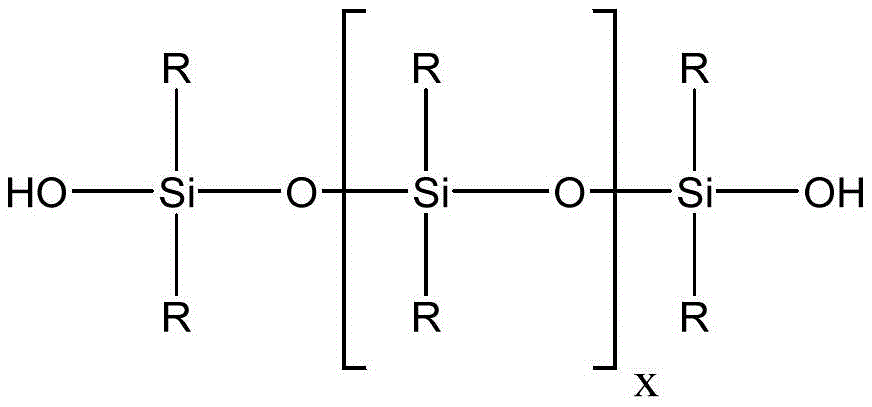
wherein R is an alkyl group (preferably R is methyl or ethyl, more preferably methyl) and x is an integer up to about 500, selected to achieve the desired molecular weight. Commercial dimethiconols are typically sold as mixtures with dimethicone or cyclomethicones (e.g., Dow 1401. 1402 and 1403 fluids).
2. Non-silicone conditioning agents
The conditioning agents in the hair care compositions described herein may also include at least one organic conditioning agent, used alone or in combination with other conditioning agents such as the silicones described above. Non-limiting examples of organic conditioning agents are described below.
a. Hydrocarbon oil
Suitable organic conditioning agents for use as conditioning agents in the hair care composition include, but are not limited to, hydrocarbon oils having at least about 10 carbon atoms, such as cyclic hydrocarbons, straight chain aliphatic hydrocarbons (saturated or unsaturated), and branched chain aliphatic hydrocarbons (saturated or unsaturated) (including polymers), and mixtures thereof. The linear hydrocarbon oil may be about C12To about C19. Branched hydrocarbon oils (including hydrocarbon polymers) will typically contain more than 19 carbon atoms.
b. Polyolefins
The organic conditioning agents used in the hair care compositions described herein may also include liquid polyolefins, including liquid poly- α -olefins and/or hydrogenated liquid poly- α -olefins4To about C14Olefin monomer of (2), about C6To about C12By polymerization of the olefin monomer(s) of (a).
c. Fatty acid esters
Other suitable organic conditioning agents for use as conditioning agents in the hair care compositions described herein include fatty acid esters having at least 10 carbon atoms. These fatty acid esters include esters having a hydrocarbyl chain derived from a fatty acid or alcohol. The hydrocarbyl group of the fatty acid ester can include or have covalently bonded thereto other compatible functional groups such as amide and alkoxy moieties (e.g., ethoxy or ether linkages, etc.). Other oligomeric or polymeric esters prepared from unsaturated glycerides may also be used as conditioning materials.
d. Fluorinated conditioning compounds
Fluorinated compounds useful as organic conditioning agents suitable for delivering conditioning benefits to hair include perfluoropolyethers, perfluorinated olefins, specific fluorine-based polymers that can be in fluid or elastomeric form similar to the aforementioned silicone fluids, and perfluorinated polydimethylsiloxanes.
e. Fatty alcohols
Other organic conditioning oils suitable for use in the hair care compositions described herein include, but are not limited to, fatty alcohols having at least about 10 carbon atoms, from about 10 to about 22 carbon atoms, or from about 12 to about 16 carbon atoms.
f. Alkyl glucosides and alkyl glucoside derivatives
Suitable organic conditioning oils for use in the hair care compositions described herein include, but are not limited to, alkyl glucosides and alkyl glucoside derivatives. Specific non-limiting examples of suitable alkyl glucosides and alkyl glucoside derivatives include Glucam E-10, Glucam E-20, Glucam P-10, and Glucquat 125, which are commercially available from Amerchol.
g. Polyethylene glycol
Additional compounds useful herein as conditioning agents include polyethylene glycols and polypropylene glycols having a weight average molecular weight of up to about 2,000,000, such as those designated by CTFA as PEG-200, PEG-400, PEG-600, PEG-1000, PEG-2M, PEG-7M, PEG-14M, PEG-45M, and mixtures thereof.
F. Aerosol foam dispenser
The aerosol foam dispenser may comprise a reservoir for holding the hair care composition. The reservoir may be made of any suitable material selected from the group consisting of plastics, metals, alloys, laminates, and combinations thereof. The reservoir may be for a single use. The reservoir may be removed from the aerosol foam dispenser. Alternatively, the reservoir may be integral with the aerosol foam dispenser. There may be two or more reservoirs.
The reservoir may be comprised of a material selected from the group consisting of a rigid material, a flexible material, and combinations thereof. When an internal partial vacuum is applied to the reservoir, the reservoir may be comprised of a rigid material if it does not collapse under external atmospheric pressure.
G. Foaming agent
Hydrocarbon blowing agent
The hair care compositions described herein may comprise a lathering agent. The hair care compositions described herein may comprise from about 1% to about 20% of a foaming agent, alternatively from about 2% to about 18% of a foaming agent, and alternatively from about 3% to about 15% of a foaming agent, by weight of the hair care composition. The foaming agent may be a propellant. The hair care compositions described herein can comprise from about 1% to about 20% propellant, alternatively from about 2% to about 18% propellant, and alternatively from about 3% to about 15% propellant, by weight of the hair care composition.
The foaming agent/propellant used in the hair care compositions of the present invention may be selected from chemically inert hydrocarbons such as propane, n-butane, isobutane, n-pentane, isopentane and mixtures thereof; compressed gases such as carbon dioxide, nitrous oxide, nitrogen, compressed air, and mixtures thereof; and mixtures of one or more hydrocarbons and compressed gas. Blowing agents may include blends of hydrocarbons such as isobutane, propane, and butane, including but not limited to hydrocarbon blend A-46 (15.2% propane, 84.8% isobutane), hydrocarbon blend NP-46 (25.9% propane, 74.1% n-butane), hydrocarbon blend NIP-46 (21.9% propane, 31.3% isobutane, 46.8% n-butane), and other non-limiting hydrocarbon blends named A-31, NP-31, NIP-31, A-70, NP-70, NIP-70, A-85, NP-85, A-108. The blowing agent may include compressed gases including, but not limited to, carbon dioxide and nitrous oxide.
The foaming agent/propellant used in the hair care compositions described herein may be selected from propane, isobutane, n-butane, isopentane, pentane, and mixtures thereof.
The blowing agent may be hydrocarbon blend A-46 (15.2% propane, 84.8% isobutane).
H. Viscosity of the oil
The hair care composition can have a liquid phase viscosity of less than about 8000 centipoise (cP), or from about 1cP to about 8000cP, or from about 2cP to about 8000cP, or from about 10cP to about 8000cP, or from about 20cP to about 2500cP, or from about 50cP to about 2000cP, measured at 26.5 ℃ (measured at 26.5 ℃), as defined herein.
I. Density of foam
The foam dispensed from the aerosol package has a foam density of from about 0.03g/ml to about 0.35 g/ml. The foam may also have from about 0.05g/cm3 to about 0.35g/cm3, alternatively from about 0.08g/cm3 to about 0.25g/cm3, alternatively from about 0.08g/cm3 to about 0.2g/cm3, alternatively from about 0.08g/cm3 to about 0.18g/cm3, alternatively from about 0.08g/cm3 to about 0.15g/cm3, alternatively from about 0.08g/cm3 to about 0.12g/cm 3; alternatively from about 0.1g/cm3 to about 0.12g/cm 3; alternatively from about 0.12g/cm3 to about 0.2g/cm 3; or a foam density of about 0.15g/cm3 to about 0.2g/cm 3.
J. Perfume
The hair care composition may comprise from about 0.5% to about 7%, alternatively from about 1% to about 6%, and alternatively from about 2% to about 5%, by weight of the hair care composition, of a perfume.
The hair care composition can have a silicone to perfume ratio of from about 95:5 to about 50:50, alternatively from about 90:10 to about 60:40, and alternatively from about 85:15 to about 70: 30.
Examples of suitable fragrances can be provided in the CTFA (cosmetics, toiletries, and perfume association) international guidelines for buyers in 1992, published by the CFTA publication and OPD 1993 catalogue of chemical buyers, year 80 yearbook, published by schnell publishing co. A variety of perfume components may be present in the hair care composition.
K. Optional ingredients
The hair conditioning compositions described herein may optionally comprise one or more additional components known for use in hair care or personal care products, provided that the additional components are physically and chemically compatible with the essential components described herein, or do not otherwise unduly impair product stability, aesthetics or performance. The optional ingredients mentioned above are most typically those materials which are approved for use in cosmetics and described in reference books such as "CTFA Cosmetic Ingredient Handbook" second edition (The Cosmetic, Toiletries, and france Association, inc.1988, 1992). The individual concentrations of such additional components may range from about 0.001 wt% to about 10 wt%, by weight of the conditioning composition.
Emulsifiers suitable for use as optional ingredients herein include mono-and diglycerides, fatty alcohols, polyglycerol esters, propylene glycol esters, sorbitan esters, and other emulsifiers known or otherwise commonly used to stabilize air interfaces, such as those used, for example, during the preparation of aerated foodstuffs such as cakes and other baked goods and confectionery products or during the stabilization of cosmetics such as hair mousses.
Other non-limiting examples of such optional ingredients include preservatives, perfumes or fragrances, cationic polymers, viscosity modifiers, colorants or dyes, conditioners, hair bleaches, thickeners, moisturizers, foaming agents, additional surfactants or nonionic co-surfactants, emollients, pharmaceutical actives, vitamins or nutrients, sunscreens, deodorants, sensates, botanical extracts, nutrients, astringents, cosmetic particles, absorbent particles, binder particles, hair fixatives, fibers, reactive agents, skin lightening agents, skin tanning agents, anti-dandruff agents, perfumes, exfoliants, acids, bases, humectants, enzymes, suspending agents, pH modifiers, hair colorants, permanent waving agents, pigment particles, anti-acne agents, antimicrobial agents, sunscreen agents, tanning agents, exfoliating particles, hair growth or restoration agents, Insect repellants, shaving lotions, non-volatile solvents or diluents (water soluble and water insoluble), co-solvents or other additional solvents, and similar other materials.
Non-limiting examples of anti-dandruff agents include one material or a mixture selected from the group consisting of: azoles such as climbazole, ketoconazole, itraconazole, econazole and conazole; hydroxypyridinones, such as octopirox (octopirox ethanolamine), ciclopirox, rilopirox and MEA-hydroxyoctoxy pyridone; keratolytic agents, such as salicylic acid and other hydroxy acids; strobilurins such as azoxystrobin and metal chelators such as 1, 10-phenanthroline. In another embodiment, the azole antimicrobial is an imidazole selected from the group consisting of: benzimidazole, benzothiazole, bifonazole, butoconazole nitrate, climbazole, clotrimazole, kruconazole, ebuconazole, econazole, neoconazole, fenticonazole, fluconazole, 10-triazole, isoconazole, ketoconazole, lanoconazole, metronidazole, miconazole, nyconazole, omoconazole, oxiconazole nitrate, sertaconazole, sulconazole nitrate, tioconazole, thiazole, and mixtures thereof, or the azole antimicrobial agent is a triazole selected from the group consisting of: terconazole, itraconazole, and mixtures thereof. In one embodiment, the azole antimicrobial active is ketoconazole. In one embodiment, the only antimicrobial active is ketoconazole.
Test method
Viscosity cone/plate viscosity measurement
The viscosity of the formulation was measured by a Brookfield Engineering Laboratories, Stoughton, Mass cone/plate controlled stress Brookfield rheometer R/S Plus. The cone used (main axis C-75-1) has a diameter of 75mm and an angle of 1 deg.. Viscosity Using steady-state flow experiment at a temperature of 26.5 ℃ in 2s-1Constant shear rate measurement of (2). The sample size was 2.5ml and the total measurement reading time was 3 minutes.
Foam density and foam volume
Foam density was measured by placing a 100ml beaker on a mass balancer, tare the mass of the beaker, and then dispensing the product from the aerosol container into the 100ml beaker until the foam volume was above the container rim. Within 10 seconds of dispensing the foam beyond the edge of the container, the foam was made flush with the top of the beaker by scraping the top of the beaker with a spatula. The mass of the resulting 100ml foam was then divided by the volume (100) to determine the density of the foam in g/ml.
The foam volume was measured by placing the weigh boat on a mass balancer, weighing the mass of the boat tare, and then dispensing the desired amount of product from the aerosol container. The grams of foam dispensed was determined and then divided by the foam density as determined by the foam density method to give the foam volume in ml.
Evaluation of hair moisturized feel during Hair washing Process
Measurements were made using 4 grams of a common population hair switch 8 inches in length. The water temperature was set at 100F (7 grains per gallon hardness) and the flow rate was 1.6 liters per minute. The switches were thoroughly moistened with tap water and squeezed from top to bottom once using the index and middle fingers to remove excess water. A 0.2g amount of foamed shampoo was applied evenly to the switches.
(a) Foam evaluation during Hair washing
The switches were then foamed for 30 seconds using an extrusion technique, while evaluating the following:
i) creaminess (look and feel, after 30 seconds of foaming) of the foam.
Scale 0 to 10.
0 ═ creaminess free; 10 ═ very creamy
ii) amount of foam (visually, after 30 seconds of pressing).
Scale 0 to 10.
0 ═ low foam; high foam 10.
(b) Drag and drop flush count
After step (a), the switches were rinsed with water for 30 seconds while gently squeezing the hair switches. Analysts evaluate drag-and-drop flush counts using the following method:
once rinsing begins, the analyst squeezes the hair between the thumb and fingers of the non-dominant hand with moderate pressure, and makes a stroke from the top to the bottom of the hair switch. The number of strokes is counted until an increase in resistance of the middle part of the hair switch is consistently felt in two consecutive strokes. The frequency of strokes is from 1 stroke per second to a maximum of 20 strokes in total.
Calibration: 0-1-20
(c) Feeling of cleanliness after rinsing
After rinsing (as described in the steps above), the feel of the hair was evaluated by pressing the hair from top to bottom once with the thumb and twice with two adjacent fingers with moderate pressure. A scale of 0 to 10 was used to evaluate the post rinse clean feel. Higher numbers are preferred for cleaner feel, with suitable clean hair feel values above about 5.
Calibration: 0-low (dirty); high (clean) 10 ═ high
All composition evaluations were repeated with three switches and the results were the average of these three replicates.
Method of cleaning hair
The methods of cleansing hair described herein comprise (1) providing a hair care composition as described herein, (2) dispensing the hair care composition as a liquid or foam using a mechanical foam dispenser or an aerosol foam dispenser; (3) applying the composition to hair; and (4) rinsing the composition from the hair. The hair care composition can form a stable foam. The foam substantially retains its volume from dispensing to application to the hair, and thus the foam formulation is stable.
Examples
The following examples illustrate the hair care compositions described herein. Exemplary compositions can be prepared by conventional formulation and mixing techniques. It is to be understood that other modifications may be made by one skilled in the art of shampoo formulations without departing from the spirit and scope of the invention. All parts, percentages and ratios herein are by weight unless otherwise indicated. Some of the components may come from suppliers as dilute solutions. The amounts shown reflect the weight percent of active material, unless otherwise indicated.
The following are non-limiting examples of hair care compositions described herein.
Examples and results

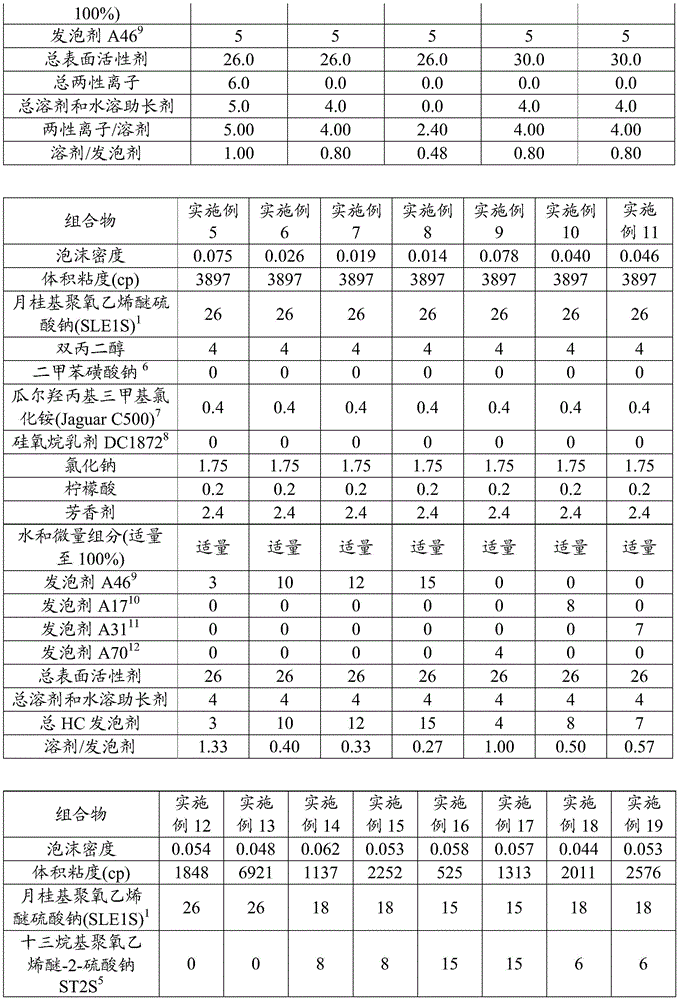

1. Sodium laureth (1 mole ethyleneoxy) sulfate, 70% active, supplier: stepan Co
2. Sodium tridecylether sulfate (2 moles ethylene oxide), Stepan ST2S-65(Steol-TD 40265) 65% active, supplier: stepan Co
3. Sodium lauryl sulfate, available from Stepan Company
4. Sodium laureth-3 sulfate from Stepan Company
NaLaa (Miranol Ultra L32) 32% activity content, supplier: solvay
6. Sodium xylene sulfonate from Stepan Company
Jaguar C500, MW of 500,000, CD of 0.7, available from Solvay
DC 1872 Silicone emulsion (Dimethylsiloxanol) with an average particle size of 30nm, from Dow Corning
9. Foaming agent A46 (a mixture of 84.85% by weight of isobutane and 15.15% by weight of propane), DiversifiedCpc International (Channahon US)
10. Foaming agent A17 (n-butane), converted Cpc International (Channahon US)
11. Foaming agent A31 (isobutane), converted Cpc International (Channahon US)
12. Blowing agent A70 (propane 42.9% and isobutane 57.1%) dispersed Cpc International (Channahon US)
The dimensions and values disclosed herein are not to be understood as being strictly limited to the exact numerical values recited. Rather, unless otherwise specified, each such dimension is intended to mean both the recited value and a functionally equivalent range surrounding that value. For example, a dimension disclosed as "40 mm" is intended to mean "about 40 mm".
Each document cited herein, including any cross referenced or related patent or patent application and any patent application or patent to which this application claims priority or its benefits, is hereby incorporated by reference in its entirety unless expressly excluded or otherwise limited. The citation of any document is not an admission that it is prior art with any disclosure of the invention or the claims herein or that it alone, or in combination with any one or more of the references, teaches, suggests or discloses any such invention. Further, to the extent that any meaning or definition of a term in this document conflicts with any meaning or definition of the same term in a document incorporated by reference, the meaning or definition assigned to that term in this document shall govern.
While particular embodiments of the present invention have been illustrated and described, it would be obvious to those skilled in the art that various other changes and modifications can be made without departing from the spirit and scope of the invention. It is therefore intended to cover in the appended claims all such changes and modifications that are within the scope of this invention.
Claims (15)
1. A compact hair care composition comprising:
(a) from about 20 wt% to about 45 wt% total surfactant;
(b) from about 5% to about 45% by weight of one or more anionic surfactants;
(c) less than about 0.5 wt% zwitterionic surfactant;
(d) from about 0.5% to about 6% by weight of a viscosity reducing agent selected from the group consisting of water-miscible solvents, hydrotropes, and mixtures thereof;
(e) about 3 wt% to about 15 wt% hydrocarbon blowing agent;
wherein the ratio of zwitterionic surfactant to the viscosity reducer is less than about 2.
2. A compact hair care composition according to claim 1, wherein the ratio of zwitterionic surfactant to said viscosity reducer is from about 1.5 to about 0, preferably wherein the ratio of zwitterionic surfactant to said viscosity reducer is from about 1 to about 0.
3. A compact hair care composition according to claim 1 having a foam density of from about 0.01g/mL to about 0.35 g/mL.
4. A compact hair care composition according to claim 1 having a viscosity of from about 1cP to about 8000cP at 26.5 ℃.
5. A compact hair care composition according to claim 1 wherein said composition further comprises from about 0.1% to about 25% by weight of one or more co-surfactants selected from amphoteric surfactants, nonionic surfactants, and mixtures thereof, preferably wherein said composition further comprises from about 2% to about 20% by weight of one or more co-surfactants selected from amphoteric surfactants, nonionic surfactants, and mixtures thereof.
6. A compact hair care composition according to claim 1, wherein said hair care composition further comprises from about 0.05% to 5% by weight of a silicone conditioning agent, preferably wherein said silicone conditioning agent comprises one of a plurality of quaternary ammonium salts in its molecular structure, preferably wherein said silicone conditioning agent is a dimethiconol microemulsion.
7. A compact hair care composition according to claim 1, wherein said composition further comprises from about 0.1% to about 5% by weight of one or more anti-dandruff actives.
8. A compact hair care composition according to claim 11, wherein said anti-dandruff active is selected from the group comprising: octopirox ethanolamine, climbazole, and salicylic acid, and mixtures thereof.
9. A compact hair care composition according to claim 1, wherein said hair care composition further comprises from about 0.05% to about 2% by weight of said hair care composition of one or more cationic polymers.
10. A compact hair care composition according to claim 13 wherein said cationic polymer is selected from the group consisting of guar hydroxypropyltrimonium chloride, polyquaternium-6, polyquaternium-7, polyquaternium-10, polyquaternium-39, polyquaternium-67, and mixtures thereof, preferably wherein said guar hydroxypropyltrimonium chloride has a weight average molecular weight of from about 100,000g/m to about 2,000,000g/m and a charge density of from about 0.2meg/g to about 2.2 meg/g.
11. The compact hair care composition of claim 1, wherein the anionic surfactant is selected from sodium trideceth sulfate, sodium C12-13 alkyl sulfate, sodium C12-15 alkyl sulfate, sodium C12-18 alkyl sulfate, sodium C12-13 alkyl polyoxyethylene ether sulfate, sodium C12-13 alkyl polyoxyethylene ether-n sulfate, sodium C12-14 alkyl polyoxyethylene ether-n sulfate, and combinations thereof.
12. A compact hair care composition according to claim 1, wherein said anionic surfactant is selected from the group consisting of ammonium lauryl sulfate, ammonium laureth sulfate, triethylamine lauryl sulfate, triethylamine laureth sulfate, triethanolamine lauryl sulfate, triethanolamine laureth sulfate, monoethanolamine lauryl sulfate, monoethanolamine laureth sulfate, diethanolamine lauryl sulfate, diethanolamine laureth sulfate, sodium laureth monoglyceride laurate sulfate, sodium lauryl sulfate, sodium laureth sulfate, potassium laureth sulfate, ammonium cocoyl sulfate, ammonium lauroyl sulfate, sodium cocoyl sulfate, sodium lauroyl sulfate, potassium cocoyl sulfate, potassium lauryl sulfate, monoethanolamine cocoyl sulfate, sodium trideceth-1 sulfate, sodium trideceth-2 sulfate, sodium trideceth-3 sulfate, sodium trideceth sulfate, sodium lauryl sarcosinate, cocoyl sarcosinate, sodium lauryl sarcosinate, sodium lauroyl sarcosinate, acyl sarcosinate, taurates, sodium methyl lauroyl taurate, sodium methyl cocoyl taurate, sodium lauroyl glycinyl glutamate, sodium lauryl sulfosuccinate, disodium lauryl sulfosuccinate, sodium lauryl sulfosuccinate, sodium lauryl sulfosuccinate, sodium.
13. A compact hair care composition according to claim 1 wherein said hair care composition comprises from about 0.01% to about 6% of a water miscible solvent selected from dipropylene glycol, tripropylene glycol, diethylene glycol, ethylene glycol, propylene glycol, glycerin, 1, 3-propanediol, 2-propanediol, 1, 2-butanediol, 1, 3-butanediol, 1, 4-butanediol, 2, 3-butanediol, 2-methyl-2, 4-pentanediol, and mixtures thereof.
14. A compact hair care composition according to claim 1, wherein said hair care composition further comprises from about 0.5% to about 7% by weight of a perfume.
15. A method of cleansing hair comprising:
a) applying a compact hair care composition according to claim 1 to the hair,
b) rinsing the hair.
Applications Claiming Priority (3)
| Application Number | Priority Date | Filing Date | Title |
|---|---|---|---|
| US201762574766P | 2017-10-20 | 2017-10-20 | |
| US62/574,766 | 2017-10-20 | ||
| PCT/US2018/056674 WO2019079697A1 (en) | 2017-10-20 | 2018-10-19 | Compact aerosol hair care composition comprising hydrocarbon foaming agent |
Publications (1)
| Publication Number | Publication Date |
|---|---|
| CN111225653A true CN111225653A (en) | 2020-06-02 |
Family
ID=64110254
Family Applications (1)
| Application Number | Title | Priority Date | Filing Date |
|---|---|---|---|
| CN201880067200.5A Pending CN111225653A (en) | 2017-10-20 | 2018-10-19 | Dense aerosol hair care composition comprising hydrocarbon blowing agent |
Country Status (6)
| Country | Link |
|---|---|
| US (1) | US20190117545A1 (en) |
| EP (1) | EP3697378A1 (en) |
| JP (1) | JP2020536947A (en) |
| CN (1) | CN111225653A (en) |
| MX (1) | MX2020003323A (en) |
| WO (1) | WO2019079697A1 (en) |
Families Citing this family (28)
| Publication number | Priority date | Publication date | Assignee | Title |
|---|---|---|---|---|
| CN114601744B (en) | 2015-04-23 | 2024-12-20 | 宝洁公司 | Delivery of surfactant-soluble anti-dandruff agents |
| CN108697609A (en) | 2016-03-03 | 2018-10-23 | 宝洁公司 | Aerosol anti-dandruff composition |
| WO2018075855A1 (en) | 2016-10-21 | 2018-04-26 | The Procter & Gamble Company | Dosage of foam for delivering consumer desired dosage volume, surfactant amount, and scalp health agent amount in an optimal formulation space |
| EP3528899B1 (en) | 2016-10-21 | 2024-04-10 | The Procter & Gamble Company | Dosage of foam for delivering consumer desired dosage volume and surfactant amount in an optimal formulation space |
| EP3528894A1 (en) | 2016-10-21 | 2019-08-28 | The Procter and Gamble Company | Concentrated shampoo dosage of foam for providing hair care benefits |
| US11141361B2 (en) | 2016-10-21 | 2021-10-12 | The Procter And Gamble Plaza | Concentrated shampoo dosage of foam designating hair volume benefits |
| US11154467B2 (en) | 2016-10-21 | 2021-10-26 | The Procter And Gamble Plaza | Concentrated shampoo dosage of foam designating hair conditioning benefits |
| WO2018075833A1 (en) | 2016-10-21 | 2018-04-26 | The Procter & Gamble Company | Low viscosity hair care composition |
| WO2018075832A1 (en) | 2016-10-21 | 2018-04-26 | The Procter & Gamble Company | Stable compact shampoo products with low viscosity and viscosity reducing agent |
| CN109862941A (en) | 2016-10-21 | 2019-06-07 | 宝洁公司 | Concentrated shampoo foam formulation for providing hair care benefits |
| US11141370B2 (en) | 2017-06-06 | 2021-10-12 | The Procter And Gamble Company | Hair compositions comprising a cationic polymer mixture and providing improved in-use wet feel |
| US11679073B2 (en) | 2017-06-06 | 2023-06-20 | The Procter & Gamble Company | Hair compositions providing improved in-use wet feel |
| US11224567B2 (en) | 2017-06-06 | 2022-01-18 | The Procter And Gamble Company | Hair compositions comprising a cationic polymer/silicone mixture providing improved in-use wet feel |
| EP3694480B1 (en) | 2017-10-10 | 2024-08-28 | The Procter & Gamble Company | Compact shampoo composition containing sulfate-free surfactants |
| CN111201010A (en) | 2017-10-10 | 2020-05-26 | 宝洁公司 | Method for treating hair or skin with a personal care composition in foam form |
| JP2020536876A (en) | 2017-10-10 | 2020-12-17 | ザ プロクター アンド ギャンブル カンパニーThe Procter & Gamble Company | Compact shampoo composition containing amino acid-based anionic surfactant and cationic polymer |
| CN111278511B (en) | 2017-10-10 | 2023-06-02 | 宝洁公司 | Compact shampoo compositions |
| CN111556743B (en) | 2017-12-20 | 2023-07-18 | 宝洁公司 | Clarifying shampoo composition comprising silicone polymer |
| US11318073B2 (en) | 2018-06-29 | 2022-05-03 | The Procter And Gamble Company | Low surfactant aerosol antidandruff composition |
| US12226505B2 (en) | 2018-10-25 | 2025-02-18 | The Procter & Gamble Company | Compositions having enhanced deposition of surfactant-soluble anti-dandruff agents |
| WO2021113583A1 (en) | 2019-12-06 | 2021-06-10 | The Procter & Gamble Company | Sulfate free composition with enhanced deposition of scalp active |
| CN115151310B (en) | 2020-02-27 | 2024-12-20 | 宝洁公司 | Sulfur-containing anti-dandruff compositions with enhanced efficacy and aesthetics |
| MX2023005560A (en) | 2020-11-23 | 2023-05-29 | Procter & Gamble | Personal care compositions free of sulfated surfactants. |
| JP7768985B2 (en) | 2020-12-04 | 2025-11-12 | ザ プロクター アンド ギャンブル カンパニー | Hair care compositions containing malodor-reducing substances |
| US11771635B2 (en) | 2021-05-14 | 2023-10-03 | The Procter & Gamble Company | Shampoo composition |
| US11986543B2 (en) | 2021-06-01 | 2024-05-21 | The Procter & Gamble Company | Rinse-off compositions with a surfactant system that is substantially free of sulfate-based surfactants |
| JP7538789B2 (en) * | 2021-11-29 | 2024-08-22 | 花王株式会社 | Hair cosmetic kit |
| EP4444431A1 (en) | 2021-12-09 | 2024-10-16 | The Procter & Gamble Company | Sulfate free personal cleansing composition comprising effective preservation |
Citations (4)
| Publication number | Priority date | Publication date | Assignee | Title |
|---|---|---|---|---|
| US2879231A (en) * | 1950-10-13 | 1959-03-24 | Colgate Palmolive Co | Shampoo composition |
| US20020028182A1 (en) * | 1996-12-20 | 2002-03-07 | Geoffrey George Dawson | Packaged personal cleansing product |
| WO2016172405A1 (en) * | 2015-04-23 | 2016-10-27 | The Procter & Gamble Company | A low viscosity hair care composition |
| WO2017106398A1 (en) * | 2015-12-15 | 2017-06-22 | The Procter & Gamble Company | Hair cleansing composition |
Family Cites Families (23)
| Publication number | Priority date | Publication date | Assignee | Title |
|---|---|---|---|---|
| US2438091A (en) | 1943-09-06 | 1948-03-16 | American Cyanamid Co | Aspartic acid esters and their preparation |
| US2528378A (en) | 1947-09-20 | 1950-10-31 | John J Mccabe Jr | Metal salts of substituted quaternary hydroxy cycloimidinic acid metal alcoholates and process for preparation of same |
| US2658072A (en) | 1951-05-17 | 1953-11-03 | Monsanto Chemicals | Process of preparing amine sulfonates and products obtained thereof |
| DE2437090A1 (en) | 1974-08-01 | 1976-02-19 | Hoechst Ag | CLEANING SUPPLIES |
| US4185087A (en) | 1977-12-28 | 1980-01-22 | Union Carbide Corporation | Hair conditioning compositions containing dialkylamino hydroxy organosilicon compounds and their derivatives |
| JP2883700B2 (en) * | 1990-08-24 | 1999-04-19 | 花王株式会社 | Hair cosmetics |
| GB9116871D0 (en) | 1991-08-05 | 1991-09-18 | Unilever Plc | Hair care composition |
| CN1187036C (en) | 1997-10-14 | 2005-02-02 | 普罗克特和甘保尔公司 | Personal cleansing compositions comprising mid-chain branched surfactants |
| GB9726969D0 (en) * | 1997-12-19 | 1998-02-18 | Unilever Plc | Mousse-forming shampoo compositions |
| EP1309649B1 (en) | 2000-07-27 | 2004-07-07 | GE Bayer Silicones GmbH & Co. KG | Polyammonium-polysiloxane compounds, methods for the production and use thereof |
| US20030022799A1 (en) * | 2001-07-27 | 2003-01-30 | Alvarado Robert M. | A shampoo foaming composition which comprises an alkyl ether sulfate, a sorbitan derivative, a betaine, an alkylamido alkylamine, an alkoxylated carboxylic acid, and an organic salt |
| US20050026805A1 (en) * | 2003-07-14 | 2005-02-03 | Ici Americas, Inc. | Solvated nonionic surfactants and fatty acids |
| JP2005232113A (en) * | 2004-02-23 | 2005-09-02 | Lion Corp | Hair cosmetics |
| US9968535B2 (en) * | 2007-10-26 | 2018-05-15 | The Procter & Gamble Company | Personal care compositions comprising undecyl sulfates |
| JP2013091642A (en) * | 2012-11-07 | 2013-05-16 | Milbon Co Ltd | Foaming aerosol product |
| US8778910B2 (en) * | 2012-12-07 | 2014-07-15 | Conopco, Inc. | Concentrated lamellar liquid personal cleansing composition |
| JP6282849B2 (en) * | 2013-11-21 | 2018-02-21 | 株式会社ダイゾー | Emulsion type aerosol composition |
| WO2015195542A1 (en) * | 2014-06-16 | 2015-12-23 | The Procter & Gamble Company | Method of treating hair with a concentrated conditioner |
| EP3285723A1 (en) * | 2015-04-23 | 2018-02-28 | The Procter and Gamble Company | A low viscosity hair care composition |
| CN108697609A (en) * | 2016-03-03 | 2018-10-23 | 宝洁公司 | Aerosol anti-dandruff composition |
| EP3528894A1 (en) * | 2016-10-21 | 2019-08-28 | The Procter and Gamble Company | Concentrated shampoo dosage of foam for providing hair care benefits |
| CN109862941A (en) * | 2016-10-21 | 2019-06-07 | 宝洁公司 | Concentrated shampoo foam formulation for providing hair care benefits |
| US11141361B2 (en) * | 2016-10-21 | 2021-10-12 | The Procter And Gamble Plaza | Concentrated shampoo dosage of foam designating hair volume benefits |
-
2018
- 2018-10-19 CN CN201880067200.5A patent/CN111225653A/en active Pending
- 2018-10-19 WO PCT/US2018/056674 patent/WO2019079697A1/en not_active Ceased
- 2018-10-19 JP JP2020521359A patent/JP2020536947A/en active Pending
- 2018-10-19 US US16/165,044 patent/US20190117545A1/en not_active Abandoned
- 2018-10-19 EP EP18797462.1A patent/EP3697378A1/en not_active Withdrawn
- 2018-10-19 MX MX2020003323A patent/MX2020003323A/en unknown
Patent Citations (4)
| Publication number | Priority date | Publication date | Assignee | Title |
|---|---|---|---|---|
| US2879231A (en) * | 1950-10-13 | 1959-03-24 | Colgate Palmolive Co | Shampoo composition |
| US20020028182A1 (en) * | 1996-12-20 | 2002-03-07 | Geoffrey George Dawson | Packaged personal cleansing product |
| WO2016172405A1 (en) * | 2015-04-23 | 2016-10-27 | The Procter & Gamble Company | A low viscosity hair care composition |
| WO2017106398A1 (en) * | 2015-12-15 | 2017-06-22 | The Procter & Gamble Company | Hair cleansing composition |
Also Published As
| Publication number | Publication date |
|---|---|
| EP3697378A1 (en) | 2020-08-26 |
| JP2020536947A (en) | 2020-12-17 |
| US20190117545A1 (en) | 2019-04-25 |
| MX2020003323A (en) | 2020-07-28 |
| WO2019079697A1 (en) | 2019-04-25 |
Similar Documents
| Publication | Publication Date | Title |
|---|---|---|
| CN111225653A (en) | Dense aerosol hair care composition comprising hydrocarbon blowing agent | |
| CN109715131B (en) | Low viscosity hair care compositions | |
| CN111225654A (en) | Dense aerosol hair care composition comprising hydrocarbon blowing agent | |
| JP6952768B2 (en) | Stable compact shampoo product with low viscosity and containing viscosity reducing agent | |
| CN110709052B (en) | Hair composition in foam form providing improved moisturized feel in application | |
| US10912732B2 (en) | Clear shampoo composition containing silicone polymers | |
| JP6908699B2 (en) | Concentrated shampoo containing hydrofluoroolefin or hydrochlorofluoroolefin to deliver the characteristic advantages of composition and foam dose | |
| US20230125210A1 (en) | Sulfate free personal cleansing composition comprising low inorganic salt | |
| EP3528778A1 (en) | Aerosol hair care compositions comprising hfo foaming agent and water miscible solvents | |
| WO2019079693A1 (en) | Stable hair care compositions comprising soluble salt | |
| CN114601744A (en) | Delivery of surfactant-soluble anti-dandruff agents | |
| WO2016172405A1 (en) | A low viscosity hair care composition | |
| CN110709057B (en) | Hair care compositions providing improved in-use moisturized feel |
Legal Events
| Date | Code | Title | Description |
|---|---|---|---|
| PB01 | Publication | ||
| PB01 | Publication | ||
| SE01 | Entry into force of request for substantive examination | ||
| SE01 | Entry into force of request for substantive examination |