US20130064887A1 - Pharmaceutical compositions - Google Patents
Pharmaceutical compositions Download PDFInfo
- Publication number
- US20130064887A1 US20130064887A1 US13/413,702 US201213413702A US2013064887A1 US 20130064887 A1 US20130064887 A1 US 20130064887A1 US 201213413702 A US201213413702 A US 201213413702A US 2013064887 A1 US2013064887 A1 US 2013064887A1
- Authority
- US
- United States
- Prior art keywords
- pharmaceutical composition
- composition according
- film
- coating
- linagliptin
- Prior art date
- Legal status (The legal status is an assumption and is not a legal conclusion. Google has not performed a legal analysis and makes no representation as to the accuracy of the status listed.)
- Abandoned
Links
- 239000008194 pharmaceutical composition Substances 0.000 title claims abstract description 86
- 238000000034 method Methods 0.000 claims abstract description 45
- 229940123518 Sodium/glucose cotransporter 2 inhibitor Drugs 0.000 claims abstract description 15
- 229940090124 dipeptidyl peptidase 4 (dpp-4) inhibitors for blood glucose lowering Drugs 0.000 claims abstract description 12
- DNIAPMSPPWPWGF-UHFFFAOYSA-N Propylene glycol Chemical group CC(O)CO DNIAPMSPPWPWGF-UHFFFAOYSA-N 0.000 claims description 84
- XZWYZXLIPXDOLR-UHFFFAOYSA-N metformin Chemical compound CN(C)C(=N)NC(N)=N XZWYZXLIPXDOLR-UHFFFAOYSA-N 0.000 claims description 79
- LTXREWYXXSTFRX-QGZVFWFLSA-N Linagliptin Chemical compound N=1C=2N(C)C(=O)N(CC=3N=C4C=CC=CC4=C(C)N=3)C(=O)C=2N(CC#CC)C=1N1CCC[C@@H](N)C1 LTXREWYXXSTFRX-QGZVFWFLSA-N 0.000 claims description 70
- 229960002397 linagliptin Drugs 0.000 claims description 65
- 239000000203 mixture Substances 0.000 claims description 61
- 238000000576 coating method Methods 0.000 claims description 57
- 208000001072 type 2 diabetes mellitus Diseases 0.000 claims description 53
- 239000001866 hydroxypropyl methyl cellulose Substances 0.000 claims description 51
- 229920003088 hydroxypropyl methyl cellulose Polymers 0.000 claims description 51
- 235000010979 hydroxypropyl methyl cellulose Nutrition 0.000 claims description 51
- 239000011248 coating agent Substances 0.000 claims description 50
- UFVKGYZPFZQRLF-UHFFFAOYSA-N hydroxypropyl methyl cellulose Chemical group OC1C(O)C(OC)OC(CO)C1OC1C(O)C(O)C(OC2C(C(O)C(OC3C(C(O)C(O)C(CO)O3)O)C(CO)O2)O)C(CO)O1 UFVKGYZPFZQRLF-UHFFFAOYSA-N 0.000 claims description 50
- 239000008186 active pharmaceutical agent Substances 0.000 claims description 49
- NOESYZHRGYRDHS-UHFFFAOYSA-N insulin Chemical compound N1C(=O)C(NC(=O)C(CCC(N)=O)NC(=O)C(CCC(O)=O)NC(=O)C(C(C)C)NC(=O)C(NC(=O)CN)C(C)CC)CSSCC(C(NC(CO)C(=O)NC(CC(C)C)C(=O)NC(CC=2C=CC(O)=CC=2)C(=O)NC(CCC(N)=O)C(=O)NC(CC(C)C)C(=O)NC(CCC(O)=O)C(=O)NC(CC(N)=O)C(=O)NC(CC=2C=CC(O)=CC=2)C(=O)NC(CSSCC(NC(=O)C(C(C)C)NC(=O)C(CC(C)C)NC(=O)C(CC=2C=CC(O)=CC=2)NC(=O)C(CC(C)C)NC(=O)C(C)NC(=O)C(CCC(O)=O)NC(=O)C(C(C)C)NC(=O)C(CC(C)C)NC(=O)C(CC=2NC=NC=2)NC(=O)C(CO)NC(=O)CNC2=O)C(=O)NCC(=O)NC(CCC(O)=O)C(=O)NC(CCCNC(N)=N)C(=O)NCC(=O)NC(CC=3C=CC=CC=3)C(=O)NC(CC=3C=CC=CC=3)C(=O)NC(CC=3C=CC(O)=CC=3)C(=O)NC(C(C)O)C(=O)N3C(CCC3)C(=O)NC(CCCCN)C(=O)NC(C)C(O)=O)C(=O)NC(CC(N)=O)C(O)=O)=O)NC(=O)C(C(C)CC)NC(=O)C(CO)NC(=O)C(C(C)O)NC(=O)C1CSSCC2NC(=O)C(CC(C)C)NC(=O)C(NC(=O)C(CCC(N)=O)NC(=O)C(CC(N)=O)NC(=O)C(NC(=O)C(N)CC=1C=CC=CC=1)C(C)C)CC1=CN=CN1 NOESYZHRGYRDHS-UHFFFAOYSA-N 0.000 claims description 45
- YZGOOQZXQOPQNT-DNNBANOASA-N (2r,3r,4s,5s,6r)-2-[4-chloro-3-[[4-[(3s)-oxolan-3-yl]oxyphenyl]methyl]phenyl]-6-(hydroxymethyl)oxane-2,3,4,5-tetrol Chemical compound O[C@@H]1[C@@H](O)[C@H](O)[C@@H](CO)O[C@]1(O)C1=CC=C(Cl)C(CC=2C=CC(O[C@@H]3COCC3)=CC=2)=C1 YZGOOQZXQOPQNT-DNNBANOASA-N 0.000 claims description 41
- OETHQSJEHLVLGH-UHFFFAOYSA-N metformin hydrochloride Chemical compound Cl.CN(C)C(=N)N=C(N)N OETHQSJEHLVLGH-UHFFFAOYSA-N 0.000 claims description 41
- 229960004329 metformin hydrochloride Drugs 0.000 claims description 41
- 238000013265 extended release Methods 0.000 claims description 36
- 239000002202 Polyethylene glycol Substances 0.000 claims description 34
- 229920001223 polyethylene glycol Polymers 0.000 claims description 34
- 238000009472 formulation Methods 0.000 claims description 31
- 229960003105 metformin Drugs 0.000 claims description 31
- 239000012729 immediate-release (IR) formulation Substances 0.000 claims description 28
- 239000007888 film coating Substances 0.000 claims description 25
- 238000009501 film coating Methods 0.000 claims description 25
- 229940125396 insulin Drugs 0.000 claims description 22
- 102000004877 Insulin Human genes 0.000 claims description 21
- 108090001061 Insulin Proteins 0.000 claims description 21
- 239000000546 pharmaceutical excipient Substances 0.000 claims description 21
- 229920003091 Methocel™ Polymers 0.000 claims description 17
- 229930064664 L-arginine Natural products 0.000 claims description 16
- 235000014852 L-arginine Nutrition 0.000 claims description 16
- 239000003795 chemical substances by application Substances 0.000 claims description 16
- 230000002641 glycemic effect Effects 0.000 claims description 16
- ODKSFYDXXFIFQN-BYPYZUCNSA-N L-arginine Chemical compound OC(=O)[C@@H](N)CCCN=C(N)N ODKSFYDXXFIFQN-BYPYZUCNSA-N 0.000 claims description 15
- 239000000454 talc Substances 0.000 claims description 15
- 229910052623 talc Inorganic materials 0.000 claims description 15
- 239000004014 plasticizer Substances 0.000 claims description 12
- LYCAIKOWRPUZTN-UHFFFAOYSA-N Ethylene glycol Chemical compound OCCO LYCAIKOWRPUZTN-UHFFFAOYSA-N 0.000 claims description 8
- 239000003086 colorant Substances 0.000 claims description 7
- 239000003381 stabilizer Substances 0.000 claims description 7
- 238000002560 therapeutic procedure Methods 0.000 claims description 6
- 239000003472 antidiabetic agent Substances 0.000 claims description 5
- 229920003125 hypromellose 2910 Polymers 0.000 claims description 4
- 229940031672 hypromellose 2910 Drugs 0.000 claims description 4
- 208000030159 metabolic disease Diseases 0.000 claims description 4
- 239000000049 pigment Substances 0.000 claims description 4
- DTHNMHAUYICORS-KTKZVXAJSA-N Glucagon-like peptide 1 Chemical compound C([C@@H](C(=O)N[C@@H]([C@@H](C)CC)C(=O)N[C@@H](C)C(=O)N[C@@H](CC=1C2=CC=CC=C2NC=1)C(=O)N[C@@H](CC(C)C)C(=O)N[C@@H](C(C)C)C(=O)N[C@@H](CCCCN)C(=O)NCC(=O)N[C@@H](CCCNC(N)=N)C(N)=O)NC(=O)[C@H](CCC(O)=O)NC(=O)[C@H](CCCCN)NC(=O)[C@H](C)NC(=O)[C@H](C)NC(=O)[C@H](CCC(N)=O)NC(=O)CNC(=O)[C@H](CCC(O)=O)NC(=O)[C@H](CC(C)C)NC(=O)[C@H](CC=1C=CC(O)=CC=1)NC(=O)[C@H](CO)NC(=O)[C@H](CO)NC(=O)[C@@H](NC(=O)[C@H](CC(O)=O)NC(=O)[C@H](CO)NC(=O)[C@@H](NC(=O)[C@H](CC=1C=CC=CC=1)NC(=O)[C@@H](NC(=O)CNC(=O)[C@H](CCC(O)=O)NC(=O)[C@H](C)NC(=O)[C@@H](N)CC=1N=CNC=1)[C@@H](C)O)[C@@H](C)O)C(C)C)C1=CC=CC=C1 DTHNMHAUYICORS-KTKZVXAJSA-N 0.000 claims 2
- 102100025101 GATA-type zinc finger protein 1 Human genes 0.000 claims 1
- 101710198884 GATA-type zinc finger protein 1 Proteins 0.000 claims 1
- 102100024295 Maltase-glucoamylase Human genes 0.000 claims 1
- 229940123464 Thiazolidinedione Drugs 0.000 claims 1
- 108010028144 alpha-Glucosidases Proteins 0.000 claims 1
- 208000016097 disease of metabolism Diseases 0.000 claims 1
- 229920000642 polymer Polymers 0.000 claims 1
- 150000001467 thiazolidinediones Chemical class 0.000 claims 1
- 229940000425 combination drug Drugs 0.000 abstract description 18
- LJVNRPAERZRHDF-UHFFFAOYSA-N 1-carbamimidoyl-1,2-dimethylguanidine Chemical compound CN=C(N)N(C)C(N)=N LJVNRPAERZRHDF-UHFFFAOYSA-N 0.000 abstract description 17
- 208000037265 diseases, disorders, signs and symptoms Diseases 0.000 abstract description 15
- 238000002360 preparation method Methods 0.000 abstract description 15
- 239000003814 drug Substances 0.000 abstract description 12
- 201000010099 disease Diseases 0.000 abstract description 11
- 229940079593 drug Drugs 0.000 abstract description 11
- 230000008569 process Effects 0.000 abstract description 6
- 239000008103 glucose Substances 0.000 description 65
- WQZGKKKJIJFFOK-GASJEMHNSA-N Glucose Natural products OC[C@H]1OC(O)[C@H](O)[C@@H](O)[C@@H]1O WQZGKKKJIJFFOK-GASJEMHNSA-N 0.000 description 64
- 210000004369 blood Anatomy 0.000 description 40
- 239000008280 blood Substances 0.000 description 40
- 239000003826 tablet Substances 0.000 description 38
- 206010022489 Insulin Resistance Diseases 0.000 description 34
- 239000007787 solid Substances 0.000 description 30
- -1 poly(ethylene oxide) Polymers 0.000 description 27
- 239000000725 suspension Substances 0.000 description 27
- 206010012601 diabetes mellitus Diseases 0.000 description 26
- 238000011282 treatment Methods 0.000 description 25
- 201000009104 prediabetes syndrome Diseases 0.000 description 23
- 150000001875 compounds Chemical class 0.000 description 21
- XLYOFNOQVPJJNP-UHFFFAOYSA-N water Substances O XLYOFNOQVPJJNP-UHFFFAOYSA-N 0.000 description 18
- 208000002705 Glucose Intolerance Diseases 0.000 description 15
- 210000002966 serum Anatomy 0.000 description 15
- 208000008589 Obesity Diseases 0.000 description 14
- LEHOTFFKMJEONL-UHFFFAOYSA-N Uric Acid Chemical compound N1C(=O)NC(=O)C2=C1NC(=O)N2 LEHOTFFKMJEONL-UHFFFAOYSA-N 0.000 description 14
- 235000020824 obesity Nutrition 0.000 description 14
- 208000001145 Metabolic Syndrome Diseases 0.000 description 13
- 201000000690 abdominal obesity-metabolic syndrome Diseases 0.000 description 12
- 229920003171 Poly (ethylene oxide) Polymers 0.000 description 11
- 239000008184 oral solid dosage form Substances 0.000 description 11
- 208000004611 Abdominal Obesity Diseases 0.000 description 10
- 206010018429 Glucose tolerance impaired Diseases 0.000 description 10
- 238000004519 manufacturing process Methods 0.000 description 10
- 239000011159 matrix material Substances 0.000 description 10
- 230000000291 postprandial effect Effects 0.000 description 9
- 239000000243 solution Substances 0.000 description 9
- 208000001280 Prediabetic State Diseases 0.000 description 8
- GWEVSGVZZGPLCZ-UHFFFAOYSA-N Titan oxide Chemical compound O=[Ti]=O GWEVSGVZZGPLCZ-UHFFFAOYSA-N 0.000 description 8
- HQKMJHAJHXVSDF-UHFFFAOYSA-L magnesium stearate Chemical compound [Mg+2].CCCCCCCCCCCCCCCCCC([O-])=O.CCCCCCCCCCCCCCCCCC([O-])=O HQKMJHAJHXVSDF-UHFFFAOYSA-L 0.000 description 8
- 230000009467 reduction Effects 0.000 description 8
- 239000004475 Arginine Substances 0.000 description 7
- 206010060378 Hyperinsulinaemia Diseases 0.000 description 7
- 206010033307 Overweight Diseases 0.000 description 7
- 239000004372 Polyvinyl alcohol Substances 0.000 description 7
- ODKSFYDXXFIFQN-UHFFFAOYSA-N arginine Natural products OC(=O)C(N)CCCNC(N)=N ODKSFYDXXFIFQN-UHFFFAOYSA-N 0.000 description 7
- 235000009697 arginine Nutrition 0.000 description 7
- 238000007446 glucose tolerance test Methods 0.000 description 7
- 230000003451 hyperinsulinaemic effect Effects 0.000 description 7
- 201000008980 hyperinsulinism Diseases 0.000 description 7
- 230000001771 impaired effect Effects 0.000 description 7
- UQSXHKLRYXJYBZ-UHFFFAOYSA-N iron oxide Inorganic materials [Fe]=O UQSXHKLRYXJYBZ-UHFFFAOYSA-N 0.000 description 7
- 229920002451 polyvinyl alcohol Polymers 0.000 description 7
- 238000011321 prophylaxis Methods 0.000 description 7
- 206010065941 Central obesity Diseases 0.000 description 6
- HVYWMOMLDIMFJA-DPAQBDIFSA-N cholesterol Chemical compound C1C=C2C[C@@H](O)CC[C@]2(C)[C@@H]2[C@@H]1[C@@H]1CC[C@H]([C@H](C)CCCC(C)C)[C@@]1(C)CC2 HVYWMOMLDIMFJA-DPAQBDIFSA-N 0.000 description 6
- 239000000843 powder Substances 0.000 description 6
- 238000012545 processing Methods 0.000 description 6
- 238000009097 single-agent therapy Methods 0.000 description 6
- TVWHNULVHGKJHS-UHFFFAOYSA-N Uric acid Natural products N1C(=O)NC(=O)C2NC(=O)NC21 TVWHNULVHGKJHS-UHFFFAOYSA-N 0.000 description 5
- 238000003556 assay Methods 0.000 description 5
- 230000035487 diastolic blood pressure Effects 0.000 description 5
- 230000006872 improvement Effects 0.000 description 5
- 235000013980 iron oxide Nutrition 0.000 description 5
- 239000000314 lubricant Substances 0.000 description 5
- 239000000047 product Substances 0.000 description 5
- 230000035488 systolic blood pressure Effects 0.000 description 5
- 238000012360 testing method Methods 0.000 description 5
- 230000001225 therapeutic effect Effects 0.000 description 5
- 210000001519 tissue Anatomy 0.000 description 5
- 229940116269 uric acid Drugs 0.000 description 5
- 210000002237 B-cell of pancreatic islet Anatomy 0.000 description 4
- 208000004930 Fatty Liver Diseases 0.000 description 4
- 206010019708 Hepatic steatosis Diseases 0.000 description 4
- 206010020772 Hypertension Diseases 0.000 description 4
- 201000001431 Hyperuricemia Diseases 0.000 description 4
- 206010021036 Hyponatraemia Diseases 0.000 description 4
- 206010054805 Macroangiopathy Diseases 0.000 description 4
- 229920000168 Microcrystalline cellulose Polymers 0.000 description 4
- 206010067584 Type 1 diabetes mellitus Diseases 0.000 description 4
- 230000005784 autoimmunity Effects 0.000 description 4
- 230000037396 body weight Effects 0.000 description 4
- 208000035475 disorder Diseases 0.000 description 4
- 208000010706 fatty liver disease Diseases 0.000 description 4
- 239000012467 final product Substances 0.000 description 4
- 230000002496 gastric effect Effects 0.000 description 4
- 208000004104 gestational diabetes Diseases 0.000 description 4
- 201000001421 hyperglycemia Diseases 0.000 description 4
- 239000004615 ingredient Substances 0.000 description 4
- 235000019359 magnesium stearate Nutrition 0.000 description 4
- 230000014759 maintenance of location Effects 0.000 description 4
- 239000000463 material Substances 0.000 description 4
- 239000008108 microcrystalline cellulose Substances 0.000 description 4
- 229940016286 microcrystalline cellulose Drugs 0.000 description 4
- 235000019813 microcrystalline cellulose Nutrition 0.000 description 4
- 208000008338 non-alcoholic fatty liver disease Diseases 0.000 description 4
- 239000002904 solvent Substances 0.000 description 4
- 231100000240 steatosis hepatitis Toxicity 0.000 description 4
- 239000004408 titanium dioxide Substances 0.000 description 4
- 230000004584 weight gain Effects 0.000 description 4
- 235000019786 weight gain Nutrition 0.000 description 4
- 102000017011 Glycated Hemoglobin A Human genes 0.000 description 3
- 108010014663 Glycated Hemoglobin A Proteins 0.000 description 3
- 201000005569 Gout Diseases 0.000 description 3
- 206010019280 Heart failures Diseases 0.000 description 3
- 229920002153 Hydroxypropyl cellulose Polymers 0.000 description 3
- 208000013016 Hypoglycemia Diseases 0.000 description 3
- 208000000913 Kidney Calculi Diseases 0.000 description 3
- 206010029148 Nephrolithiasis Diseases 0.000 description 3
- 208000005735 Water intoxication Diseases 0.000 description 3
- 230000002159 abnormal effect Effects 0.000 description 3
- 238000009825 accumulation Methods 0.000 description 3
- 210000000577 adipose tissue Anatomy 0.000 description 3
- 239000008199 coating composition Substances 0.000 description 3
- 208000029078 coronary artery disease Diseases 0.000 description 3
- 238000001514 detection method Methods 0.000 description 3
- 238000011161 development Methods 0.000 description 3
- 238000003745 diagnosis Methods 0.000 description 3
- 238000004090 dissolution Methods 0.000 description 3
- 239000000975 dye Substances 0.000 description 3
- 238000005516 engineering process Methods 0.000 description 3
- 230000029142 excretion Effects 0.000 description 3
- 239000007941 film coated tablet Substances 0.000 description 3
- 230000006870 function Effects 0.000 description 3
- 210000002216 heart Anatomy 0.000 description 3
- 239000001863 hydroxypropyl cellulose Substances 0.000 description 3
- 235000010977 hydroxypropyl cellulose Nutrition 0.000 description 3
- 230000002218 hypoglycaemic effect Effects 0.000 description 3
- 238000010348 incorporation Methods 0.000 description 3
- VBMVTYDPPZVILR-UHFFFAOYSA-N iron(2+);oxygen(2-) Chemical class [O-2].[Fe+2] VBMVTYDPPZVILR-UHFFFAOYSA-N 0.000 description 3
- 208000017169 kidney disease Diseases 0.000 description 3
- 210000004185 liver Anatomy 0.000 description 3
- 230000007774 longterm Effects 0.000 description 3
- 230000035935 pregnancy Effects 0.000 description 3
- 230000002265 prevention Effects 0.000 description 3
- 239000007921 spray Substances 0.000 description 3
- 210000002784 stomach Anatomy 0.000 description 3
- 230000008961 swelling Effects 0.000 description 3
- 208000024891 symptom Diseases 0.000 description 3
- 150000003626 triacylglycerols Chemical class 0.000 description 3
- UFTFJSFQGQCHQW-UHFFFAOYSA-N triformin Chemical compound O=COCC(OC=O)COC=O UFTFJSFQGQCHQW-UHFFFAOYSA-N 0.000 description 3
- 210000002700 urine Anatomy 0.000 description 3
- 208000024172 Cardiovascular disease Diseases 0.000 description 2
- 208000007342 Diabetic Nephropathies Diseases 0.000 description 2
- 206010054044 Diabetic microangiopathy Diseases 0.000 description 2
- 206010056559 Graft infection Diseases 0.000 description 2
- 108010023302 HDL Cholesterol Proteins 0.000 description 2
- DGAQECJNVWCQMB-PUAWFVPOSA-M Ilexoside XXIX Chemical compound C[C@@H]1CC[C@@]2(CC[C@@]3(C(=CC[C@H]4[C@]3(CC[C@@H]5[C@@]4(CC[C@@H](C5(C)C)OS(=O)(=O)[O-])C)C)[C@@H]2[C@]1(C)O)C)C(=O)O[C@H]6[C@@H]([C@H]([C@@H]([C@H](O6)CO)O)O)O.[Na+] DGAQECJNVWCQMB-PUAWFVPOSA-M 0.000 description 2
- 229920003096 Methocel™ K100M Polymers 0.000 description 2
- 239000008118 PEG 6000 Substances 0.000 description 2
- 229920002584 Polyethylene Glycol 6000 Polymers 0.000 description 2
- 108010076181 Proinsulin Proteins 0.000 description 2
- 208000001647 Renal Insufficiency Diseases 0.000 description 2
- 235000021355 Stearic acid Nutrition 0.000 description 2
- 206010052779 Transplant rejections Diseases 0.000 description 2
- 239000004480 active ingredient Substances 0.000 description 2
- 238000004458 analytical method Methods 0.000 description 2
- 229940125708 antidiabetic agent Drugs 0.000 description 2
- 239000007864 aqueous solution Substances 0.000 description 2
- 210000000227 basophil cell of anterior lobe of hypophysis Anatomy 0.000 description 2
- WQZGKKKJIJFFOK-VFUOTHLCSA-N beta-D-glucose Chemical compound OC[C@H]1O[C@@H](O)[C@H](O)[C@@H](O)[C@@H]1O WQZGKKKJIJFFOK-VFUOTHLCSA-N 0.000 description 2
- 239000011230 binding agent Substances 0.000 description 2
- 230000036765 blood level Effects 0.000 description 2
- 235000012000 cholesterol Nutrition 0.000 description 2
- 238000007906 compression Methods 0.000 description 2
- 230000006835 compression Effects 0.000 description 2
- 230000003111 delayed effect Effects 0.000 description 2
- 201000009101 diabetic angiopathy Diseases 0.000 description 2
- 208000033679 diabetic kidney disease Diseases 0.000 description 2
- 235000005911 diet Nutrition 0.000 description 2
- 230000037213 diet Effects 0.000 description 2
- 238000007907 direct compression Methods 0.000 description 2
- 229940088679 drug related substance Drugs 0.000 description 2
- 238000003255 drug test Methods 0.000 description 2
- 230000001610 euglycemic effect Effects 0.000 description 2
- 239000012530 fluid Substances 0.000 description 2
- 238000005469 granulation Methods 0.000 description 2
- 230000003179 granulation Effects 0.000 description 2
- 230000013632 homeostatic process Effects 0.000 description 2
- 238000001990 intravenous administration Methods 0.000 description 2
- 208000028867 ischemia Diseases 0.000 description 2
- 210000004153 islets of langerhan Anatomy 0.000 description 2
- 201000006370 kidney failure Diseases 0.000 description 2
- 238000002156 mixing Methods 0.000 description 2
- 208000010125 myocardial infarction Diseases 0.000 description 2
- 206010053219 non-alcoholic steatohepatitis Diseases 0.000 description 2
- 229940002612 prodrug Drugs 0.000 description 2
- 239000000651 prodrug Substances 0.000 description 2
- 239000008213 purified water Substances 0.000 description 2
- 230000004044 response Effects 0.000 description 2
- 230000002441 reversible effect Effects 0.000 description 2
- 150000003839 salts Chemical class 0.000 description 2
- 239000011734 sodium Substances 0.000 description 2
- 229910052708 sodium Inorganic materials 0.000 description 2
- 239000012453 solvate Substances 0.000 description 2
- 238000005507 spraying Methods 0.000 description 2
- 238000010561 standard procedure Methods 0.000 description 2
- 208000011580 syndromic disease Diseases 0.000 description 2
- 239000007916 tablet composition Substances 0.000 description 2
- 238000002054 transplantation Methods 0.000 description 2
- 210000002438 upper gastrointestinal tract Anatomy 0.000 description 2
- VOUAQYXWVJDEQY-QENPJCQMSA-N 33017-11-7 Chemical compound OC(=O)CC[C@H](N)C(=O)N[C@@H](C)C(=O)N[C@@H](CCC(O)=O)C(=O)N[C@@H](CC(O)=O)C(=O)N[C@@H](CC(C)C)C(=O)N[C@@H](CCC(N)=O)C(=O)N[C@@H](C(C)C)C(=O)NCC(=O)N[C@@H](CCC(N)=O)C(=O)N[C@@H](C(C)C)C(=O)N[C@@H](CCC(O)=O)C(=O)N[C@@H](CC(C)C)C(=O)NCC(=O)NCC(=O)NCC(=O)N1CCC[C@H]1C(=O)NCC(=O)N[C@@H](C)C(=O)NCC(=O)N[C@@H](CO)C(=O)N[C@@H](CC(C)C)C(=O)N[C@@H](CCC(N)=O)C(=O)N1[C@H](C(=O)N[C@@H](CC(C)C)C(=O)N[C@@H](C)C(=O)N[C@@H](CC(C)C)C(=O)N[C@@H](CCC(O)=O)C(=O)NCC(=O)N[C@@H](CO)C(=O)N[C@@H](CC(C)C)C(=O)N[C@@H](CCC(N)=O)C(O)=O)CCC1 VOUAQYXWVJDEQY-QENPJCQMSA-N 0.000 description 1
- 208000010444 Acidosis Diseases 0.000 description 1
- 208000004476 Acute Coronary Syndrome Diseases 0.000 description 1
- 102100031786 Adiponectin Human genes 0.000 description 1
- 108010076365 Adiponectin Proteins 0.000 description 1
- 206010001580 Albuminuria Diseases 0.000 description 1
- 206010002383 Angina Pectoris Diseases 0.000 description 1
- 206010003210 Arteriosclerosis Diseases 0.000 description 1
- 108010075254 C-Peptide Proteins 0.000 description 1
- AEKKACPBESGOKM-MRXNPFEDSA-N CC#CCN1C(N2CCC[C@@H](C)C2)=NC2=C1C(=O)N(CC1=NC3=CC=CC=C3C(C)=N1)C(=O)N2 Chemical compound CC#CCN1C(N2CCC[C@@H](C)C2)=NC2=C1C(=O)N(CC1=NC3=CC=CC=C3C(C)=N1)C(=O)N2 AEKKACPBESGOKM-MRXNPFEDSA-N 0.000 description 1
- 208000031229 Cardiomyopathies Diseases 0.000 description 1
- 208000002177 Cataract Diseases 0.000 description 1
- GHLXFMWRPBVKOP-UHFFFAOYSA-O Cc1c(cccc2)c2nc(CN(C(c([n]2CC#CC)c(N3)nc2N(CCC2)CC2[NH3+])=O)C3=O)n1 Chemical compound Cc1c(cccc2)c2nc(CN(C(c([n]2CC#CC)c(N3)nc2N(CCC2)CC2[NH3+])=O)C3=O)n1 GHLXFMWRPBVKOP-UHFFFAOYSA-O 0.000 description 1
- 201000003883 Cystic fibrosis Diseases 0.000 description 1
- 208000002249 Diabetes Complications Diseases 0.000 description 1
- 208000008960 Diabetic foot Diseases 0.000 description 1
- 206010063547 Diabetic macroangiopathy Diseases 0.000 description 1
- 206010056340 Diabetic ulcer Diseases 0.000 description 1
- 208000032928 Dyslipidaemia Diseases 0.000 description 1
- 239000004097 EU approved flavor enhancer Substances 0.000 description 1
- 208000005189 Embolism Diseases 0.000 description 1
- 206010016262 Fatty liver alcoholic Diseases 0.000 description 1
- 208000034826 Genetic Predisposition to Disease Diseases 0.000 description 1
- WHUUTDBJXJRKMK-UHFFFAOYSA-N Glutamic acid Natural products OC(=O)C(N)CCC(O)=O WHUUTDBJXJRKMK-UHFFFAOYSA-N 0.000 description 1
- 108010010234 HDL Lipoproteins Proteins 0.000 description 1
- 206010019233 Headaches Diseases 0.000 description 1
- 101001135589 Homo sapiens Tyrosine-protein phosphatase non-receptor type 22 Proteins 0.000 description 1
- 208000031226 Hyperlipidaemia Diseases 0.000 description 1
- 206010062016 Immunosuppression Diseases 0.000 description 1
- 206010061218 Inflammation Diseases 0.000 description 1
- 102100023915 Insulin Human genes 0.000 description 1
- 208000031773 Insulin resistance syndrome Diseases 0.000 description 1
- OUYCCCASQSFEME-QMMMGPOBSA-N L-tyrosine Chemical compound OC(=O)[C@@H](N)CC1=CC=C(O)C=C1 OUYCCCASQSFEME-QMMMGPOBSA-N 0.000 description 1
- JVTAAEKCZFNVCJ-UHFFFAOYSA-M Lactate Chemical compound CC(O)C([O-])=O JVTAAEKCZFNVCJ-UHFFFAOYSA-M 0.000 description 1
- 208000017170 Lipid metabolism disease Diseases 0.000 description 1
- 206010028813 Nausea Diseases 0.000 description 1
- BEFVCLMMBJEVNM-SJSRKZJXSA-N OC[C@H]1O[C@@H](C2=CC(CC3=CC=C(OC4CCCC4)C=C3)=C(Cl)C=C2)[C@H](O)[C@@H](O)[C@@H]1O Chemical compound OC[C@H]1O[C@@H](C2=CC(CC3=CC=C(OC4CCCC4)C=C3)=C(Cl)C=C2)[C@H](O)[C@@H](O)[C@@H]1O BEFVCLMMBJEVNM-SJSRKZJXSA-N 0.000 description 1
- 235000021314 Palmitic acid Nutrition 0.000 description 1
- 208000030831 Peripheral arterial occlusive disease Diseases 0.000 description 1
- 238000001069 Raman spectroscopy Methods 0.000 description 1
- 208000017442 Retinal disease Diseases 0.000 description 1
- 206010038923 Retinopathy Diseases 0.000 description 1
- 108091006269 SLC5A2 Proteins 0.000 description 1
- 102000058081 Sodium-Glucose Transporter 2 Human genes 0.000 description 1
- 208000007718 Stable Angina Diseases 0.000 description 1
- 208000006011 Stroke Diseases 0.000 description 1
- 102100033138 Tyrosine-protein phosphatase non-receptor type 22 Human genes 0.000 description 1
- 208000007814 Unstable Angina Diseases 0.000 description 1
- 206010047700 Vomiting Diseases 0.000 description 1
- 102000004248 Zinc Transporter 8 Human genes 0.000 description 1
- 108090000702 Zinc Transporter 8 Proteins 0.000 description 1
- 238000010521 absorption reaction Methods 0.000 description 1
- 230000007950 acidosis Effects 0.000 description 1
- 208000026545 acidosis disease Diseases 0.000 description 1
- 239000000654 additive Substances 0.000 description 1
- 229940127003 anti-diabetic drug Drugs 0.000 description 1
- 239000007900 aqueous suspension Substances 0.000 description 1
- 208000011775 arteriosclerosis disease Diseases 0.000 description 1
- 206010003246 arthritis Diseases 0.000 description 1
- 210000001188 articular cartilage Anatomy 0.000 description 1
- 230000009286 beneficial effect Effects 0.000 description 1
- UHOVQNZJYSORNB-UHFFFAOYSA-N benzene Substances C1=CC=CC=C1 UHOVQNZJYSORNB-UHFFFAOYSA-N 0.000 description 1
- 238000001574 biopsy Methods 0.000 description 1
- 230000015572 biosynthetic process Effects 0.000 description 1
- 230000036772 blood pressure Effects 0.000 description 1
- 210000000476 body water Anatomy 0.000 description 1
- 230000003925 brain function Effects 0.000 description 1
- 230000001364 causal effect Effects 0.000 description 1
- 230000001684 chronic effect Effects 0.000 description 1
- 238000000748 compression moulding Methods 0.000 description 1
- 238000012790 confirmation Methods 0.000 description 1
- 239000013078 crystal Substances 0.000 description 1
- 210000000805 cytoplasm Anatomy 0.000 description 1
- 230000002354 daily effect Effects 0.000 description 1
- 230000007547 defect Effects 0.000 description 1
- 230000006735 deficit Effects 0.000 description 1
- 238000007872 degassing Methods 0.000 description 1
- 230000001079 digestive effect Effects 0.000 description 1
- 208000010643 digestive system disease Diseases 0.000 description 1
- 239000003085 diluting agent Substances 0.000 description 1
- 230000003292 diminished effect Effects 0.000 description 1
- 239000007884 disintegrant Substances 0.000 description 1
- 239000002552 dosage form Substances 0.000 description 1
- 239000013583 drug formulation Substances 0.000 description 1
- 230000002526 effect on cardiovascular system Effects 0.000 description 1
- 230000002255 enzymatic effect Effects 0.000 description 1
- 210000003743 erythrocyte Anatomy 0.000 description 1
- MVPICKVDHDWCJQ-UHFFFAOYSA-N ethyl 3-pyrrolidin-1-ylpropanoate Chemical compound CCOC(=O)CCN1CCCC1 MVPICKVDHDWCJQ-UHFFFAOYSA-N 0.000 description 1
- 238000011156 evaluation Methods 0.000 description 1
- 230000003203 everyday effect Effects 0.000 description 1
- 210000003722 extracellular fluid Anatomy 0.000 description 1
- 238000001125 extrusion Methods 0.000 description 1
- 239000000796 flavoring agent Substances 0.000 description 1
- 235000019634 flavors Nutrition 0.000 description 1
- 235000019264 food flavour enhancer Nutrition 0.000 description 1
- 235000003599 food sweetener Nutrition 0.000 description 1
- 239000012458 free base Substances 0.000 description 1
- 210000001035 gastrointestinal tract Anatomy 0.000 description 1
- 235000013922 glutamic acid Nutrition 0.000 description 1
- 239000004220 glutamic acid Substances 0.000 description 1
- 230000036252 glycation Effects 0.000 description 1
- 231100000869 headache Toxicity 0.000 description 1
- 230000036541 health Effects 0.000 description 1
- 208000019622 heart disease Diseases 0.000 description 1
- 230000002440 hepatic effect Effects 0.000 description 1
- 238000009478 high shear granulation Methods 0.000 description 1
- 238000000265 homogenisation Methods 0.000 description 1
- 150000004677 hydrates Chemical class 0.000 description 1
- 239000000017 hydrogel Substances 0.000 description 1
- 239000008172 hydrogenated vegetable oil Substances 0.000 description 1
- 229920001477 hydrophilic polymer Polymers 0.000 description 1
- 230000003345 hyperglycaemic effect Effects 0.000 description 1
- 229960003943 hypromellose Drugs 0.000 description 1
- 238000003384 imaging method Methods 0.000 description 1
- 230000001506 immunosuppresive effect Effects 0.000 description 1
- 230000004054 inflammatory process Effects 0.000 description 1
- 238000001802 infusion Methods 0.000 description 1
- 239000007924 injection Substances 0.000 description 1
- 238000001746 injection moulding Methods 0.000 description 1
- 238000002955 isolation Methods 0.000 description 1
- 210000003734 kidney Anatomy 0.000 description 1
- 230000006651 lactation Effects 0.000 description 1
- 208000019423 liver disease Diseases 0.000 description 1
- 238000011866 long-term treatment Methods 0.000 description 1
- 238000009476 low shear granulation Methods 0.000 description 1
- 210000003750 lower gastrointestinal tract Anatomy 0.000 description 1
- 210000004072 lung Anatomy 0.000 description 1
- 206010025482 malaise Diseases 0.000 description 1
- 230000000873 masking effect Effects 0.000 description 1
- 235000012054 meals Nutrition 0.000 description 1
- 238000005259 measurement Methods 0.000 description 1
- 238000012544 monitoring process Methods 0.000 description 1
- NAFSTSRULRIERK-UHFFFAOYSA-M monosodium urate Chemical compound [Na+].N1C([O-])=NC(=O)C2=C1NC(=O)N2 NAFSTSRULRIERK-UHFFFAOYSA-M 0.000 description 1
- 230000008693 nausea Effects 0.000 description 1
- 201000001119 neuropathy Diseases 0.000 description 1
- 230000007823 neuropathy Effects 0.000 description 1
- 230000000269 nucleophilic effect Effects 0.000 description 1
- QIQXTHQIDYTFRH-UHFFFAOYSA-N octadecanoic acid Chemical compound CCCCCCCCCCCCCCCCCC(O)=O QIQXTHQIDYTFRH-UHFFFAOYSA-N 0.000 description 1
- OQCDKBAXFALNLD-UHFFFAOYSA-N octadecanoic acid Natural products CCCCCCCC(C)CCCCCCCCC(O)=O OQCDKBAXFALNLD-UHFFFAOYSA-N 0.000 description 1
- 238000007410 oral glucose tolerance test Methods 0.000 description 1
- 230000003204 osmotic effect Effects 0.000 description 1
- 150000002943 palmitic acids Chemical class 0.000 description 1
- 230000002093 peripheral effect Effects 0.000 description 1
- 208000033808 peripheral neuropathy Diseases 0.000 description 1
- 229920006254 polymer film Polymers 0.000 description 1
- 239000003755 preservative agent Substances 0.000 description 1
- 238000003825 pressing Methods 0.000 description 1
- 201000001474 proteinuria Diseases 0.000 description 1
- 208000037803 restenosis Diseases 0.000 description 1
- 230000000717 retained effect Effects 0.000 description 1
- 230000033764 rhythmic process Effects 0.000 description 1
- 238000009490 roller compaction Methods 0.000 description 1
- 238000012216 screening Methods 0.000 description 1
- 230000028327 secretion Effects 0.000 description 1
- 229940045902 sodium stearyl fumarate Drugs 0.000 description 1
- 239000008247 solid mixture Substances 0.000 description 1
- 230000006641 stabilisation Effects 0.000 description 1
- 238000011105 stabilization Methods 0.000 description 1
- 230000000087 stabilizing effect Effects 0.000 description 1
- 239000008117 stearic acid Substances 0.000 description 1
- 238000003860 storage Methods 0.000 description 1
- 239000000126 substance Substances 0.000 description 1
- 239000003765 sweetening agent Substances 0.000 description 1
- 238000002636 symptomatic treatment Methods 0.000 description 1
- 238000010189 synthetic method Methods 0.000 description 1
- 210000002435 tendon Anatomy 0.000 description 1
- 238000011287 therapeutic dose Methods 0.000 description 1
- 231100000331 toxic Toxicity 0.000 description 1
- 230000002588 toxic effect Effects 0.000 description 1
- OUYCCCASQSFEME-UHFFFAOYSA-N tyrosine Natural products OC(=O)C(N)CC1=CC=C(O)C=C1 OUYCCCASQSFEME-UHFFFAOYSA-N 0.000 description 1
- 230000002792 vascular Effects 0.000 description 1
- 230000008673 vomiting Effects 0.000 description 1
- 230000004580 weight loss Effects 0.000 description 1
- 230000029663 wound healing Effects 0.000 description 1
Classifications
-
- A—HUMAN NECESSITIES
- A61—MEDICAL OR VETERINARY SCIENCE; HYGIENE
- A61K—PREPARATIONS FOR MEDICAL, DENTAL OR TOILETRY PURPOSES
- A61K9/00—Medicinal preparations characterised by special physical form
- A61K9/20—Pills, tablets, discs, rods
-
- A—HUMAN NECESSITIES
- A61—MEDICAL OR VETERINARY SCIENCE; HYGIENE
- A61K—PREPARATIONS FOR MEDICAL, DENTAL OR TOILETRY PURPOSES
- A61K9/00—Medicinal preparations characterised by special physical form
- A61K9/20—Pills, tablets, discs, rods
- A61K9/2072—Pills, tablets, discs, rods characterised by shape, structure or size; Tablets with holes, special break lines or identification marks; Partially coated tablets; Disintegrating flat shaped forms
- A61K9/2086—Layered tablets, e.g. bilayer tablets; Tablets of the type inert core-active coat
- A61K9/209—Layered tablets, e.g. bilayer tablets; Tablets of the type inert core-active coat containing drug in at least two layers or in the core and in at least one outer layer
-
- A—HUMAN NECESSITIES
- A61—MEDICAL OR VETERINARY SCIENCE; HYGIENE
- A61K—PREPARATIONS FOR MEDICAL, DENTAL OR TOILETRY PURPOSES
- A61K31/00—Medicinal preparations containing organic active ingredients
- A61K31/13—Amines
- A61K31/155—Amidines (), e.g. guanidine (H2N—C(=NH)—NH2), isourea (N=C(OH)—NH2), isothiourea (—N=C(SH)—NH2)
-
- A—HUMAN NECESSITIES
- A61—MEDICAL OR VETERINARY SCIENCE; HYGIENE
- A61K—PREPARATIONS FOR MEDICAL, DENTAL OR TOILETRY PURPOSES
- A61K31/00—Medicinal preparations containing organic active ingredients
- A61K31/33—Heterocyclic compounds
- A61K31/395—Heterocyclic compounds having nitrogen as a ring hetero atom, e.g. guanethidine or rifamycins
- A61K31/495—Heterocyclic compounds having nitrogen as a ring hetero atom, e.g. guanethidine or rifamycins having six-membered rings with two or more nitrogen atoms as the only ring heteroatoms, e.g. piperazine or tetrazines
- A61K31/505—Pyrimidines; Hydrogenated pyrimidines, e.g. trimethoprim
- A61K31/519—Pyrimidines; Hydrogenated pyrimidines, e.g. trimethoprim ortho- or peri-condensed with heterocyclic rings
- A61K31/52—Purines, e.g. adenine
- A61K31/522—Purines, e.g. adenine having oxo groups directly attached to the heterocyclic ring, e.g. hypoxanthine, guanine, acyclovir
-
- A—HUMAN NECESSITIES
- A61—MEDICAL OR VETERINARY SCIENCE; HYGIENE
- A61K—PREPARATIONS FOR MEDICAL, DENTAL OR TOILETRY PURPOSES
- A61K31/00—Medicinal preparations containing organic active ingredients
- A61K31/70—Carbohydrates; Sugars; Derivatives thereof
- A61K31/7028—Compounds having saccharide radicals attached to non-saccharide compounds by glycosidic linkages
- A61K31/7034—Compounds having saccharide radicals attached to non-saccharide compounds by glycosidic linkages attached to a carbocyclic compound, e.g. phloridzin
-
- A—HUMAN NECESSITIES
- A61—MEDICAL OR VETERINARY SCIENCE; HYGIENE
- A61K—PREPARATIONS FOR MEDICAL, DENTAL OR TOILETRY PURPOSES
- A61K31/00—Medicinal preparations containing organic active ingredients
- A61K31/70—Carbohydrates; Sugars; Derivatives thereof
- A61K31/7042—Compounds having saccharide radicals and heterocyclic rings
- A61K31/7048—Compounds having saccharide radicals and heterocyclic rings having oxygen as a ring hetero atom, e.g. leucoglucosan, hesperidin, erythromycin, nystatin, digitoxin or digoxin
-
- A—HUMAN NECESSITIES
- A61—MEDICAL OR VETERINARY SCIENCE; HYGIENE
- A61K—PREPARATIONS FOR MEDICAL, DENTAL OR TOILETRY PURPOSES
- A61K45/00—Medicinal preparations containing active ingredients not provided for in groups A61K31/00 - A61K41/00
- A61K45/06—Mixtures of active ingredients without chemical characterisation, e.g. antiphlogistics and cardiaca
-
- A—HUMAN NECESSITIES
- A61—MEDICAL OR VETERINARY SCIENCE; HYGIENE
- A61K—PREPARATIONS FOR MEDICAL, DENTAL OR TOILETRY PURPOSES
- A61K9/00—Medicinal preparations characterised by special physical form
- A61K9/0012—Galenical forms characterised by the site of application
- A61K9/0053—Mouth and digestive tract, i.e. intraoral and peroral administration
-
- A—HUMAN NECESSITIES
- A61—MEDICAL OR VETERINARY SCIENCE; HYGIENE
- A61K—PREPARATIONS FOR MEDICAL, DENTAL OR TOILETRY PURPOSES
- A61K9/00—Medicinal preparations characterised by special physical form
- A61K9/20—Pills, tablets, discs, rods
- A61K9/2004—Excipients; Inactive ingredients
- A61K9/2022—Organic macromolecular compounds
- A61K9/205—Polysaccharides, e.g. alginate, gums; Cyclodextrin
- A61K9/2054—Cellulose; Cellulose derivatives, e.g. hydroxypropyl methylcellulose
-
- A—HUMAN NECESSITIES
- A61—MEDICAL OR VETERINARY SCIENCE; HYGIENE
- A61K—PREPARATIONS FOR MEDICAL, DENTAL OR TOILETRY PURPOSES
- A61K9/00—Medicinal preparations characterised by special physical form
- A61K9/20—Pills, tablets, discs, rods
- A61K9/28—Dragees; Coated pills or tablets, e.g. with film or compression coating
- A61K9/2806—Coating materials
- A61K9/2813—Inorganic compounds
-
- A—HUMAN NECESSITIES
- A61—MEDICAL OR VETERINARY SCIENCE; HYGIENE
- A61K—PREPARATIONS FOR MEDICAL, DENTAL OR TOILETRY PURPOSES
- A61K9/00—Medicinal preparations characterised by special physical form
- A61K9/20—Pills, tablets, discs, rods
- A61K9/28—Dragees; Coated pills or tablets, e.g. with film or compression coating
- A61K9/2806—Coating materials
- A61K9/2833—Organic macromolecular compounds
- A61K9/2853—Organic macromolecular compounds obtained otherwise than by reactions only involving carbon-to-carbon unsaturated bonds, e.g. polyethylene glycol, polyethylene oxide, poloxamers, poly(lactide-co-glycolide)
-
- A—HUMAN NECESSITIES
- A61—MEDICAL OR VETERINARY SCIENCE; HYGIENE
- A61K—PREPARATIONS FOR MEDICAL, DENTAL OR TOILETRY PURPOSES
- A61K9/00—Medicinal preparations characterised by special physical form
- A61K9/20—Pills, tablets, discs, rods
- A61K9/28—Dragees; Coated pills or tablets, e.g. with film or compression coating
- A61K9/2806—Coating materials
- A61K9/2833—Organic macromolecular compounds
- A61K9/286—Polysaccharides, e.g. gums; Cyclodextrin
- A61K9/2866—Cellulose; Cellulose derivatives, e.g. hydroxypropyl methylcellulose
-
- A—HUMAN NECESSITIES
- A61—MEDICAL OR VETERINARY SCIENCE; HYGIENE
- A61P—SPECIFIC THERAPEUTIC ACTIVITY OF CHEMICAL COMPOUNDS OR MEDICINAL PREPARATIONS
- A61P1/00—Drugs for disorders of the alimentary tract or the digestive system
- A61P1/16—Drugs for disorders of the alimentary tract or the digestive system for liver or gallbladder disorders, e.g. hepatoprotective agents, cholagogues, litholytics
-
- A—HUMAN NECESSITIES
- A61—MEDICAL OR VETERINARY SCIENCE; HYGIENE
- A61P—SPECIFIC THERAPEUTIC ACTIVITY OF CHEMICAL COMPOUNDS OR MEDICINAL PREPARATIONS
- A61P13/00—Drugs for disorders of the urinary system
- A61P13/02—Drugs for disorders of the urinary system of urine or of the urinary tract, e.g. urine acidifiers
-
- A—HUMAN NECESSITIES
- A61—MEDICAL OR VETERINARY SCIENCE; HYGIENE
- A61P—SPECIFIC THERAPEUTIC ACTIVITY OF CHEMICAL COMPOUNDS OR MEDICINAL PREPARATIONS
- A61P13/00—Drugs for disorders of the urinary system
- A61P13/12—Drugs for disorders of the urinary system of the kidneys
-
- A—HUMAN NECESSITIES
- A61—MEDICAL OR VETERINARY SCIENCE; HYGIENE
- A61P—SPECIFIC THERAPEUTIC ACTIVITY OF CHEMICAL COMPOUNDS OR MEDICINAL PREPARATIONS
- A61P17/00—Drugs for dermatological disorders
- A61P17/02—Drugs for dermatological disorders for treating wounds, ulcers, burns, scars, keloids, or the like
-
- A—HUMAN NECESSITIES
- A61—MEDICAL OR VETERINARY SCIENCE; HYGIENE
- A61P—SPECIFIC THERAPEUTIC ACTIVITY OF CHEMICAL COMPOUNDS OR MEDICINAL PREPARATIONS
- A61P25/00—Drugs for disorders of the nervous system
-
- A—HUMAN NECESSITIES
- A61—MEDICAL OR VETERINARY SCIENCE; HYGIENE
- A61P—SPECIFIC THERAPEUTIC ACTIVITY OF CHEMICAL COMPOUNDS OR MEDICINAL PREPARATIONS
- A61P27/00—Drugs for disorders of the senses
- A61P27/02—Ophthalmic agents
-
- A—HUMAN NECESSITIES
- A61—MEDICAL OR VETERINARY SCIENCE; HYGIENE
- A61P—SPECIFIC THERAPEUTIC ACTIVITY OF CHEMICAL COMPOUNDS OR MEDICINAL PREPARATIONS
- A61P27/00—Drugs for disorders of the senses
- A61P27/02—Ophthalmic agents
- A61P27/12—Ophthalmic agents for cataracts
-
- A—HUMAN NECESSITIES
- A61—MEDICAL OR VETERINARY SCIENCE; HYGIENE
- A61P—SPECIFIC THERAPEUTIC ACTIVITY OF CHEMICAL COMPOUNDS OR MEDICINAL PREPARATIONS
- A61P3/00—Drugs for disorders of the metabolism
-
- A—HUMAN NECESSITIES
- A61—MEDICAL OR VETERINARY SCIENCE; HYGIENE
- A61P—SPECIFIC THERAPEUTIC ACTIVITY OF CHEMICAL COMPOUNDS OR MEDICINAL PREPARATIONS
- A61P3/00—Drugs for disorders of the metabolism
- A61P3/04—Anorexiants; Antiobesity agents
-
- A—HUMAN NECESSITIES
- A61—MEDICAL OR VETERINARY SCIENCE; HYGIENE
- A61P—SPECIFIC THERAPEUTIC ACTIVITY OF CHEMICAL COMPOUNDS OR MEDICINAL PREPARATIONS
- A61P3/00—Drugs for disorders of the metabolism
- A61P3/06—Antihyperlipidemics
-
- A—HUMAN NECESSITIES
- A61—MEDICAL OR VETERINARY SCIENCE; HYGIENE
- A61P—SPECIFIC THERAPEUTIC ACTIVITY OF CHEMICAL COMPOUNDS OR MEDICINAL PREPARATIONS
- A61P3/00—Drugs for disorders of the metabolism
- A61P3/08—Drugs for disorders of the metabolism for glucose homeostasis
-
- A—HUMAN NECESSITIES
- A61—MEDICAL OR VETERINARY SCIENCE; HYGIENE
- A61P—SPECIFIC THERAPEUTIC ACTIVITY OF CHEMICAL COMPOUNDS OR MEDICINAL PREPARATIONS
- A61P3/00—Drugs for disorders of the metabolism
- A61P3/08—Drugs for disorders of the metabolism for glucose homeostasis
- A61P3/10—Drugs for disorders of the metabolism for glucose homeostasis for hyperglycaemia, e.g. antidiabetics
-
- A—HUMAN NECESSITIES
- A61—MEDICAL OR VETERINARY SCIENCE; HYGIENE
- A61P—SPECIFIC THERAPEUTIC ACTIVITY OF CHEMICAL COMPOUNDS OR MEDICINAL PREPARATIONS
- A61P43/00—Drugs for specific purposes, not provided for in groups A61P1/00-A61P41/00
-
- A—HUMAN NECESSITIES
- A61—MEDICAL OR VETERINARY SCIENCE; HYGIENE
- A61P—SPECIFIC THERAPEUTIC ACTIVITY OF CHEMICAL COMPOUNDS OR MEDICINAL PREPARATIONS
- A61P9/00—Drugs for disorders of the cardiovascular system
-
- A—HUMAN NECESSITIES
- A61—MEDICAL OR VETERINARY SCIENCE; HYGIENE
- A61P—SPECIFIC THERAPEUTIC ACTIVITY OF CHEMICAL COMPOUNDS OR MEDICINAL PREPARATIONS
- A61P9/00—Drugs for disorders of the cardiovascular system
- A61P9/04—Inotropic agents, i.e. stimulants of cardiac contraction; Drugs for heart failure
-
- A—HUMAN NECESSITIES
- A61—MEDICAL OR VETERINARY SCIENCE; HYGIENE
- A61P—SPECIFIC THERAPEUTIC ACTIVITY OF CHEMICAL COMPOUNDS OR MEDICINAL PREPARATIONS
- A61P9/00—Drugs for disorders of the cardiovascular system
- A61P9/06—Antiarrhythmics
-
- A—HUMAN NECESSITIES
- A61—MEDICAL OR VETERINARY SCIENCE; HYGIENE
- A61P—SPECIFIC THERAPEUTIC ACTIVITY OF CHEMICAL COMPOUNDS OR MEDICINAL PREPARATIONS
- A61P9/00—Drugs for disorders of the cardiovascular system
- A61P9/10—Drugs for disorders of the cardiovascular system for treating ischaemic or atherosclerotic diseases, e.g. antianginal drugs, coronary vasodilators, drugs for myocardial infarction, retinopathy, cerebrovascula insufficiency, renal arteriosclerosis
Definitions
- the present invention relates to pharmaceutical compositions containing a fixed dose combination (FDC) comprising a DPP-4 inhibitor drug (particularly 1-[(4-methyl-quinazolin-2-yl)methyl]-3-methyl-7-(2-butyn-1-yl)-8-(3-(R)-amino-piperidin-1-yl)-xanthine, also named linagliptin) and/or a SGLT-2 inhibitor drug (particularly 1-chloro-4-(8-D-glucopyranos-1-yl)-2-[4-((S)-tetrahydrofuran-3-yloxy)-benzyl]-benzene, also named Compound “A” herein), and metformin (particularly metformin hydrochloride) in extended release form (metformin XR); processes for the preparation thereof, and their use to treat certain diseases.
- FDC fixed dose combination
- DPP-4 inhibitor drug particularly 1-[(4-methyl-quinazolin-2-yl)methyl]-3-
- the present invention relates to a pharmaceutical composition
- a pharmaceutical composition comprising a fixed dose combination of an extended release form of metformin hydrochloride, optionally seal coated, which is further coated with an immediate release form of 1-[(4-methyl-quinazolin-2-yl)methyl]-3-methyl-7-(2-butyn-1-yl)-8-(3-(R)-amino-piperidin-1-yl)-xanthine (linagliptin) and/or 1-chloro-4-( ⁇ -D-glucopyranos-1-yl)-2-[4-((S)-tetrahydrofuran-3-yloxy)-benzyl]-benzene (Compound “A”).
- the present invention relates to a pharmaceutical composition, particularly a solid preparation (e.g. an oral solid dosage form, such as e.g. a tablet), comprising or consisting essentially of
- the present invention relates to a pharmaceutical composition, particularly a solid preparation (e.g. an oral solid dosage form, such as a tablet) of a selected dipeptidyl peptidase-4 (DPP-4) inhibitor (preferably linagliptin, particularly in immediate release form) and metformin (particularly metformin hydrochloride) in extended release form (metformin XR).
- a pharmaceutical composition particularly a solid preparation (e.g. an oral solid dosage form, such as a tablet), comprising a fixed dose combination of an extended release form of metformin hydrochloride, optionally seal coated, and further coated with an immediate release form of linagliptin.
- the present invention relates to a pharmaceutical composition, particularly a solid preparation (e.g. an oral solid dosage form, such as a tablet) of a selected SGLT-2 inhibitor (preferably 1-chloro-4-( ⁇ -D-glucopyranos-1-yl)-2-[4-((S)-tetrahydrofuran-3-yloxy)-benzyl]-benzene, particularly in immediate release form) and metformin (particularly metformin hydrochloride) in extended release form (metformin XR).
- a pharmaceutical composition particularly a solid preparation (e.g.
- an oral solid dosage form such as a tablet
- an oral solid dosage form comprising a fixed dose combination of an extended release form of metformin hydrochloride, optionally seal coated, and further coated with an immediate release form of 1-chloro-4-( ⁇ -D-glucopyranos-1-yl)-2-[4-((S)-tetrahydrofuran-3-yloxy)-benzyl]-benzene.
- the present invention relates to a pharmaceutical composition, particularly a solid preparation (e.g. an oral solid dosage form, such as e.g. a tablet), comprising
- a first component, part or composition comprising metformin (particularly metformin hydrochloride) in extended release form and one or more excipients
- a second component, part or composition comprising a selected dipeptidyl peptidase-4 (DPP-4) inhibitor (preferably linagliptin), particularly in immediate release form, and one or more excipients.
- DPP-4 dipeptidyl peptidase-4
- the present invention relates to a pharmaceutical composition, particularly a solid preparation (e.g. an oral solid dosage form, such as a tablet), comprising an extended release form of metformin hydrochloride, optionally seal coated, and further coated with an immediate release form of linagliptin.
- a pharmaceutical composition particularly a solid preparation (e.g. an oral solid dosage form, such as a tablet), comprising an extended release form of metformin hydrochloride, optionally seal coated, and further coated with an immediate release form of linagliptin.
- the present invention relates to a pharmaceutical composition, particularly a solid preparation (e.g. an oral solid dosage form, such as e.g. a tablet), comprising
- a first component, part or composition comprising metformin (particularly metformin hydrochloride) in extended release form and one or more excipients
- a second component, part or composition comprising a selected SGLT-2 inhibitor (preferably 1-chloro-4-( ⁇ -D-glucopyranos-1-yl)-2-[4-((S)-tetrahydrofuran-3-yloxy)-benzyl]-benzene), particularly in immediate release form, and one or more excipients.
- SGLT-2 inhibitor preferably 1-chloro-4-( ⁇ -D-glucopyranos-1-yl)-2-[4-((S)-tetrahydrofuran-3-yloxy)-benzyl]-benzene
- the present invention relates to a pharmaceutical composition, particularly a solid preparation (e.g. an oral solid dosage form, such as a tablet), comprising an extended release form of metformin hydrochloride, optionally seal coated, and further coated with an immediate release form of 1-chloro-4-( ⁇ -D-glucopyranos-1-yl)-2-[4-((S)-tetrahydrofuran-3-yloxy)-benzyl]-benzene.
- a pharmaceutical composition particularly a solid preparation (e.g. an oral solid dosage form, such as a tablet), comprising an extended release form of metformin hydrochloride, optionally seal coated, and further coated with an immediate release form of 1-chloro-4-( ⁇ -D-glucopyranos-1-yl)-2-[4-((S)-tetrahydrofuran-3-yloxy)-benzyl]-benzene.
- a pharmaceutical composition particularly a solid preparation (e.g. an oral solid dosage form, such as a tablet
- the present invention relates to a pharmaceutical composition, particularly a solid preparation (e.g. an oral solid dosage form, such as e.g. a tablet), comprising
- the present invention relates to a pharmaceutical composition, particularly a solid preparation (e.g. an oral solid dosage form, such as e.g. a tablet), comprising
- compositions of this invention comprise an inner core formulation of metformin hydrochloride comprising a swellable and/or extended release material.
- compositions of this invention comprise an inner extended release core which is a formulation (e.g. matrix formulation) comprising metformin hydrochloride, a swellable and/or extended release material, and one or more further excipients.
- a formulation e.g. matrix formulation
- compositions of this invention comprise an outer coat of active pharmaceutical ingredient (API) (linagliptin and/or 1-chloro-4-( ⁇ -D-glucopyranos-1-yl)-2-[4-((S)-tetrahydrofuran-3-yloxy)-benzyl]-benzene) in an immediate release polymer film.
- API active pharmaceutical ingredient
- the present invention relates to a coating process (e.g. coating technology and processing conditions) and immediate release coating formulations of active pharmaceutical ingredients (API) in low doses (typically in doses of 0.5 to 25 mg) on top of tablet cores comprising active pharmaceutical ingredients (API) in high doses (typically in doses of 500-1500 mg) preferably, but not exclusively on extended release tablets.
- a coating process e.g. coating technology and processing conditions
- API active pharmaceutical ingredients
- An aim of the present invention is to provide a pharmaceutical composition comprising a combination of a selected DPP-4 inhibitor (preferably linagliptin, particularly in immediate release form), and metformin (particularly metformin hydrochloride) in extended release form.
- a pharmaceutical composition comprising a combination of a selected SGLT-2 inhibitor (preferably 1-chloro-4-( ⁇ -D-glucopyranos-1-yl)-2-[4-((S)-tetrahydrofuran-3-yloxy)-benzyl]-benzene, particularly in immediate release form), and metformin (particularly metformin hydrochloride) in extended release form.
- the objectives of are to identify suitable formulations and processing conditions, such as e.g. of a coat of linagliptin or of 1-chloro-4-( ⁇ -D-glucopyranos-1-yl)-2-[4-((S)-tetrahydrofuran-3-yloxy)-benzyl]-benzene on top metformin XR cores, providing adequate:
- a particular objective of the present invention is to provide a pharmaceutical composition and suitable coating process with very broad range of drug substance (linagliptin or Compound “A”)/drug substance (metformin) ratio: 1:400-1:40. And the ratio of very low dosed API, e.g. linagliptin with 1 mg or 2.5 mg to very high dosed metformin with 1000 mg and more. And the suitable immediate release dissolution of the low dosed API with high dosed extended release metformin.
- the unit dosage strength of the metformin hydrochloride for incorporation into the fixed-dose combination of the present invention is 500, 750, 850 or 1000 milligrams, or even more (e.g. 1500 mg).
- metformin hydrochloride represent the dosage strengths approved in the U.S. for marketing to treat Type 2 diabetes.
- the unit dosage strength of linagliptin for incorporation into the fixed-dose combination of the present invention is 2.5 or 5 milligrams, or even less (e.g. 0.5 mg or 1 mg).
- the unit dosage strength of 1-chloro-4-( ⁇ -D-glucopyranos-1-yl)-2-[4-((S)-tetrahydrofuran-3-yloxy)-benzyl]-benzene for incorporation into the fixed-dose combination of the present invention is 5, 10, 12.5 or 25 milligrams.
- dosage strengths for 1-chloro-4-( ⁇ -D-glucopyranos-1-yl)-2-[4-((S)-tetrahydrofuran-3-yloxy)-benzyl]-benzene and metformin hydrochloride in the fixed-dose combinations of the present invention are the following:
- the first part in the present invention is a part (composition, particularly solid composition, e.g. a solid pharmaceutical composition for oral administration, e.g. tablet) comprising metformin (particularly metformin hydrochloride) in extended release form, particularly an extended release formulation of metformin.
- composition particularly solid composition, e.g. a solid pharmaceutical composition for oral administration, e.g. tablet
- metformin particularly metformin hydrochloride
- Exemplary extended release formulations of metformin are disclosed in U.S. Pat. No. 6,340,475; U.S. Pat. No. 6,488,962; U.S. Pat. No. 6,635,280; U.S. Pat. No. 6,723,340; U.S. Pat. No. 7,780,987; U.S. Pat. No. 6,866,866; U.S. Pat. No. 6,495,162; U.S. Pat. No. 6,790,459; U.S. Pat. No. 6,866,866; U.S. Pat. No. 6,475,521; and U.S. Pat. No. 6,660,300; the disclosures of which are incorporated herein in their entireties.
- the fixed-dose combination products of the present invention comprise—as first part—an inner core matrix formulation with metformin hydrochloride dispersed therein, said matrix formulation containing an extended release material.
- the matrix formulation is compressed into a tablet form.
- the fixed-dose combination products of the present invention comprise—as first part—an inner core extended release formulation comprising metformin hydrochloride, hydroxypropyl methylcellulose (hypromellose), polyethylene oxide, microcrystalline cellulose, and magnesium stearate.
- the extended release material of the matrix comprises poly(ethylene oxide) and/or hydroxypropyl methylcellulose (HPMC), preferably a combination of poly(ethylene oxide) and hydroxypropyl methylcellulose (HPMC), preferably at a weight ratio that causes the matrix to swell upon contact with gastric fluid to a size large enough to provide gastric retention.
- HPMC hydroxypropyl methylcellulose
- the poly(ethylene oxide) component of the matrix may limit initial release of the drug and may impart gastric retention through swelling.
- the hydroxypropyl methylcellulose (HPMC) component may lower the amount of poly(ethylene oxide) required while still allowing the swelling to occur.
- the poly(ethylene oxide) has a viscosity average molecular weight of from about 2,000,000 to about 10,000,000 daltons, more preferably from about 4,000,000 to about 7,000,000 daltons.
- the hydroxypropyl methylcellulose has a viscosity of from about 4,000 centipoise to about 200,000 centipoise, more preferably from about 50,000 to about 200,000 centipoise, even more preferably 80,000 centipoise to about 120,000 centipoise, measured as a 2% solution in water.
- the poly(ethylene oxide) has a viscosity average molecular weight of from about 4,000,000 to about 7,000,000 daltons
- the hydroxypropyl methylcellulose (HPMC) has a viscosity of from about 80,000 centipoise to about 120,000 centipoise, measured as a 2% solution in water.
- the weight ratio of the poly(ethylene oxide) to hydroxypropyl methylcellulose (HPMC) is within the range from about 1:3 to 3:1, preferably 1:2 to 2:1. In a further embodiment, the weight ratio of the poly(ethylene oxide) and hydroxypropyl methylcellulose (HPMC) in combination constitutes from about 15% to about 90%, or from about 30% to about 65%, or from about 40% to about 50%, by weight of the metformin part.
- Tablet cores in accordance with this invention can be prepared by common tabletting methods that involve mixing, comminution, and fabrication steps commonly practiced by and well known to those skilled in the art of manufacturing drug formulations. Examples of such techniques are:
- lubricants When tablets are made by direct compression, the addition of lubricants may be helpful and is sometimes important to promote powder flow and to prevent breaking of the tablet when the pressure is relieved.
- typical lubricants are magnesium stearate (in a concentration of from 0.25% to 3% by weight, preferably about 1% or less by weight, in the powder mix), stearic acid (0.5% to 3% by weight), and hydrogenated vegetable oil (preferably hydrogenated and refined triglycerides of stearic and palmitic acids at about 1% to 5% by weight, most preferably about 2% by weight).
- Additional excipients may be added, such as e.g. granulating aids (e.g. low molecular weight HPMC at 2-5% by weight), binders (e.g. microcrystalline cellulose), and additives to enhance powder flowability, tablet hardness, and tablet friability and to reduce adherence to the die wall.
- granulating aids e.g. low molecular weight HPMC at 2-5% by weight
- binders e.g. microcrystalline cellulose
- additives to enhance powder flowability, tablet hardness, and tablet friability and to reduce adherence to the die wall.
- An exemplary extended release metformin tablet core comprises metformin hydrochloride, a combination of poly(ethylene oxide) and hydroxypropyl methylcellulose (e.g. Methocel K100M) as a matrix for a swellable extended release tablet, microcrystalline cellulose as binder, low molecular weight hydroxypropyl methylcellulose (e.g. Methocel E5) as granulating aid, and magnesium stearate as lubricant.
- metformin hydrochloride a combination of poly(ethylene oxide) and hydroxypropyl methylcellulose (e.g. Methocel K100M) as a matrix for a swellable extended release tablet, microcrystalline cellulose as binder, low molecular weight hydroxypropyl methylcellulose (e.g. Methocel E5) as granulating aid, and magnesium stearate as lubricant.
- composition of a representative metformin core tablet is provided as follows: metformin hydrochloride, e.g. 49.97% by weight of the first part, poly(ethylene oxide), e.g. 26.50% by weight of the first part, hydroxypropyl methylcellulose (e.g. Methocel K100M), e.g. 16.08% by weight of the first part, microcrystalline cellulose, e.g. 4.99% by weight of the first part, low molecular weight hydroxypropyl methylcellulose (e.g. Methocel E5), e.g. 1.70% by weight of the first part, and
- metformin hydrochloride e.g. 49.97% by weight of the first part
- poly(ethylene oxide) e.g. 26.50% by weight of the first part
- hydroxypropyl methylcellulose e.g. Methocel K100M
- microcrystalline cellulose e.g. 4.99% by weight of the first part
- magnesium stearate e.g. 0.75% by weight of the first part.
- Tablets may be formulated by dry blending a granulation comprising metformin hydrochloride and low molecular weight HPMC (e.g. Methocel E5) and the remaining excipients listed above, followed by pressing on a tablet press.
- HPMC low molecular weight HPMC
- a lubricant sodium stearyl fumarate may be mentioned (e.g. at about 0.25-3% by weight).
- the metformin extended release formulation allows for targeted, controlled delivery of metformin to the upper gastrointestinal (GI) tract.
- the metformin extended release formulation is a hydrogel matrix system and contains a swelling hydrophilic polymer and further excipients, which may allow the metformin tablet core to be retained in the stomach (‘gastric retention’) for approximately eight to nine hours. During this time, the tablet core's metformin is steadily delivered to the upper GI tract at the desired rate and time, without potentially irritating ‘burst’ of drug. This gradual, extended release typically allows for more of the metformin drug to be absorbed in the upper GI tract and minimizes the amount of drug that passes through to the lower GI tract.
- the second part in the present invention is a part (composition, particularly film coat) comprising linagliptin in immediate release form.
- the fixed-dose combination products of the present invention comprise—as second part—a film coat formulation of linagliptin, said film coat formulation comprising linagliptin, a stabilizer for stabilizing linagliptin (e.g. a basic and/or nucleophilic excipient, preferably L-arginine as stabilizer), a film-coating agent (such as e.g. hydroxypropyl methylcellulose, e.g. Hypromellose 2910, Methocel E5, or Methocel E15), a plasticizer (such as e.g. polyethylene glycol, e.g. Macrogol 400, 6000 or 8000, or propylene glycol), and, optionally, a glidant (such as e.g. talc).
- a stabilizer for stabilizing linagliptin e.g. a basic and/or nucleophilic excipient, preferably L-arginine as stabilizer
- a film-coating agent such as
- the weight ratio of the L-arginine to linagliptin is within the range from about 2:1 to about 1:1, up to about 0.2:1.
- composition of a representative linagliptin containing film coat is provided as follows:
- the amount of L-arginine may be in the range from 0.5 mg to 10 mg.
- the arginine amount may be substituted by hydroxypropyl methylcellulose (HPMC).
- polyethylene glycol and propylene glycol are mutually exclusive in above composition, i.e. if polyethylene glycol is present then propylene glycol is absent, or if propylene glycol is present then polyethylene glycol is absent.
- composition of a representative linagliptin containing film coat suspension further comprises water, e.g. from about 240 mg to about 1440 mg, especially in the range from 904 mg to 1440 mg.
- the total solids concentration of the suspension is from about 4% to about 12.5% w/w, especially from 4% to 6% w/w.
- Viscosity may be from about 10 mPas to 110 mPas (e.g. 46-56 mPas).
- the sum solids of the linagliptin coating suspension is from about 50 mg to about 120 mg.
- the sum solids is 60 mg of solid amount of the film coating suspension for 2.5 mg linagliptin, and 120 mg sum solid amount of the film coating suspension for 5 mg linagliptin. Therefore with the same formulation of linagliptin and double coating time (i.e. double amount of coating suspension) it is possible to prepare the higher dose range of linagliptin. Hence different dosage strengths can be achieved by altering coating (spraying) times.
- the second part in the present invention is a part (composition, particularly film coat) comprising 1-chloro-4-( ⁇ -D-glucopyranos-1-yl)-2-[4-((S)-tetrahydrofuran-3-yloxy)-benzyl]-benzene in immediate release form.
- the fixed-dose combination products of the present invention comprise—as second part—a film coat formulation of 1-chloro-4-( ⁇ -D-glucopyranos-1-yl)-2-[4-((S)-tetrahydrofuran-3-yloxy)-benzyl]-benzene, said film coat formulation comprising 1-chloro-4-( ⁇ -D-glucopyranos-1-yl)-2-[4-((S)-tetrahydrofuran-3-yloxy)-benzyl]-benzene, a film-coating agent (such as e.g. hydroxypropyl methylcellulose, e.g.
- Hypromellose 2910 Methocel E5, or Methocel E15
- a plasticizer such as e.g. polyethylene glycol, e.g. Macrogol 400, 6000 or 8000, or propylene glycol
- a glidant such as e.g. talc
- composition of a representative 1-chloro-4-( ⁇ -D-glucopyranos-1-yl)-2-[4-((S)-tetrahydrofuran-3-yloxy)-benzyl]-benzene containing film coat is provided as follows:
- the arginine amount may be substituted by hydroxypropyl methylcellulose (HPMC).
- HPMC hydroxypropyl methylcellulose
- polyethylene glycol and propylene glycol are mutually exclusive in above composition, i.e. if polyethylene glycol is present then propylene glycol is absent, or if propylene glycol is present then polyethylene glycol is absent.
- composition of a representative 1-chloro-4-( ⁇ -D-glucopyranos-1-yl)-2-[4-((S)-tetrahydrofuran-3-yloxy)-benzyl]-benzene containing film coat suspension further comprises water, e.g. from about 240 mg to about 1440 mg, especially in the range from 904 mg to 1440 mg.
- the total solids concentration of the suspension is from about 4% to about 12.5% w/w, especially from 4% to 6% w/w.
- the sum solids of the 1-chloro-4-( ⁇ -D-glucopyranos-1-yl)-2-[4-((S)-tetrahydrofuran-3-yloxy)-benzyl]-benzene coating suspension is from about 50 mg to about 120 mg.
- the sum solids is 60 mg of solid amount of the film coating suspension for 12.5 mg 1-chloro-4-( ⁇ -D-glucopyranos-1-yl)-2-[4-((S)-tetrahydrofuran-3-yloxy)-benzyl]-benzene, and 120 mg sum solid amount of the film coating suspension for 25 mg 1-chloro-4-( ⁇ -D-glucopyranos-1-yl)-2-[4-((S)-tetrahydrofuran-3-yloxy)-benzyl]-benzene.
- L-Arginine is preferably necessary for the stabilization of linagliptin.
- a seal coat may be used between the metformin XR core and the linagliptin-containing film coat.
- a seal coat is present between the metformin XR core and the linagliptin-containing film coat (optionally further containing L-arginine).
- the seal coat is absent between the metformin XR core and the linagliptin-containing film coat (preferably further containing L-arginine).
- the seal coating of metformin XR cores is optional.
- a seal coat is present between the metformin XR core and the Compound “A” containing film coat.
- the seal coat is absent between the metformin XR core and the Compound “A” containing film coat.
- a film coat comprising a mixture of hydroxypropylcellulose and hydroxypropyl methylcellulose, or a mixture of polyvinyl alcohol (PVA) and polyethylene glycol (PEG); or a commercial film-coat such as Opadry®, Opadry II® or other Opardy IR film coat, which are formulated powder blends provided by Colorcon, may be used.
- PVA polyvinyl alcohol
- PEG polyethylene glycol
- Opadry®, Opadry II® or other Opardy IR film coat which are formulated powder blends provided by Colorcon
- API-containing film coat compositions comprising one or more of the following ingredients of Tables 1 or 2 may be provided, e.g. as follows from Tables 1 or 2:
- the film-coating agent used is highly viscous.
- the film-coating agent used is low viscous.
- Film coating suspensions/solutions of API (linagliptin or Compound “A”) according to this invention can be prepared by common methods, such as follows:
- the film-coating agent hydroxypropyl methylcellulose (HPMC), the plasticizer polyethylene glycol (PEG) (e.g. Macrogol 400, 6000 or 8000) or, as alternative plasticizer, propylene glycol (PG) and water are dissolved and mixed by a suitable mixer (e.g. by propeller mixer) to produce the API-free coating solution.
- a suitable mixer e.g. by propeller mixer
- the glidant talc suspended in water is added and the obtained suspension is homogenized. Talc may be used optionally.
- the API (linagliptin or Compound “A”) and—preferably in case of linagliptin—the stabilizer L-arginine are dissolved or suspended in water and added to the aqueous solution of HPMC, PEG or PG, and, optional talc, and dispersed by a suitable mixer (e.g. by propeller mixer) to provide the API coating suspension.
- a suitable mixer e.g. by propeller mixer
- the film-coating agent hydroxypropyl methylcellulose (HPMC) and water are dissolved and mixed by a suitable mixer (e.g. by Ultraturrax).
- the stabilizer L-arginine (which is present in case of linagliptin, and may be absent in case of Compound “A”), the plasticizer polyethylene glycol (PEG) (e.g. Macrogol 400, 6000 or 8000) or propylene glycol (PG), optional talc, and water are dispersed, e.g. by homogenization using e.g. ultra turrax.
- PEG polyethylene glycol
- PG propylene glycol
- the aqueous suspension of PEG or PG, optional L-arginine and optional talc are added to the aqueous HPMC solution and mixed/homogenized.
- the API (linagliptin or Compound “A”) is dissolved or suspended in water and added to the aqueous solution of HPMC, PEG or PG, optional L-arginine and optional talc to provide the API coating suspension.
- the film-coating operation is carried out in a conventional film coater.
- the API linagliptin or Compound “A”
- the API coating suspension/solution are coated at metformin XR cores via coating process.
- Preliminary preheating of the cores may be necessary, due to need of equilibrium of water amount of the cores.
- the spray rate and air flow through the coating pan is adjusted to produce a uniform coating and coverage of the entire width of the tablet bed.
- the amount of the coating suspension applied can be controlled by percent weight gain of tablet cores and typically ranges from about 4 to about 12.5%.
- this range results in linagliptin drug assay close to the desired 2.5 mg or 5 mg with a standard deviation of about 2-4% for content uniformity assay of linagliptin.
- the duration of the coating step is about 4-10 hours. The duration of the coating step depends on batch size, process parameters like spray rate and solid concentrations of the coating suspension.
- this range results in Compound “A” drug assay close to the desired 5 mg, 12.5 mg, 10 mg or 25 mg with a standard deviation of about 2-4% for content uniformity assay of Compound “A”.
- the duration of the coating step is about 4-10 hours. The duration of the coating step depends on batch size, process parameters like spray rate and solid concentrations of the coating suspension.
- the API coating suspension is applied to the tablet cores containing the metformin XR formulation and the amount of solids deposited in the API film layer is controlled to achieve the desired API doses.
- the weight of the cores and film coated tablets may be controlled by percent weight gain during the coating process.
- a PAT method e.g. online NIR or Raman method for end point detection of assay of API may be used.
- An optional seal coat may separate the metformin XR core from the API-containing film coat.
- a coating suspension is prepared and the tablet cores may be coated with the seal coating suspension using standard film coater.
- the film coating solvent is a volatile component, which does not remain in the final product.
- a typical seal film-coat comprises a film coating agent, a plasticizer, and, optionally, a glidant, one or more pigments and/or colors.
- the metformin XR core may be seal coated using a seal coating agent (and a plasticizer), such as with a mixture of hydroxypropylcellulose and hydroxypropyl methylcellulose, a mixture of polyvinyl alcohol (PVA) and polyethylene glycol (PEG), a mixture of hydroxypropyl methylcellulose and either polyethylene glycol (PEG) or propylene glycol (PG), or any other suitable immediate-release film-coating agent(s).
- a commercial film-coat is Opadry®, Opadry II® or other Opardy IR film coat, which are formulated powder blend provided by Colorcon.
- the seal coat may further comprise a glidant.
- the final pharmaceutical compositions of the present invention are tablets. Such tablets may be further film-coated with a final film over-coat, such as with a mixture of hydroxypropylcellulose and hydroxypropyl methylcellulose containing titanium dioxide and/or other coloring agents, such as iron oxides, dyes, and lakes; a mixture of polyvinyl alcohol (PVA) and polyethylene glycol (PEG) containing titanium dioxide and/or other coloring agents, such as iron oxides, dyes, and lakes; a mixture of hydroxypropyl methylcellulose and either polyethylene glycol (PEG) or propylene glycol (PG) containing titanium dioxide and/or other coloring agents, such as iron oxides, dyes, and lakes; or any other suitable immediate-release film-coating agent(s).
- the coat may provide taste masking and additional stability to the final tablet.
- a commercial film-coat is Opadry®, Opadry II® or other Opardy IR film coat, which are formulated powder blend provided by Colorcon.
- a coating suspension is prepared and the tablet cores are coated with the coating suspension, typically for the API-free film over-coat to a weight gain of about 2-4%, preferably about 3%, using standard film coater.
- the film coating solvent is a volatile component, which does not remain in the final product.
- a typical film-coat comprise a film coating agent, a plasticizer, and, optionally, a glidant, one or more pigments and/or colors.
- the film coat may comprise hydroxypropylmethylcellulose (HPMC), propylene glycol or polyethylene glycol, talc and, optionally, titanium dioxide and/or iron oxide (e.g. iron oxide yellow and/or red).
- the pharmaceutical tablet compositions of the present invention may also contain one or more additional formulation ingredients selected from a wide variety of excipients known in the pharmaceutical formulation art. According to the desired properties of the pharmaceutical composition, any number of ingredients may be selected, alone or in combination, based upon their known uses in preparing tablet compositions. Such ingredients include, but are not limited to, diluents, compression aids, glidants, disintegrants, lubricants, flavors, flavor enhancers, sweeteners, and preservatives.
- tablette as used herein is intended to encompass compressed pharmaceutical dosage formulations of all shapes and sizes.
- the present invention also provides methods particularly for treating Type 2 diabetes by orally administering to a host in need of such treatment a therapeutically effective amount of one of the fixed-dose combination pharmaceutical compositions of the present invention.
- the host in need of such treatment is a human.
- the pharmaceutical composition is in the dosage form of a tablet.
- the pharmaceutical compositions comprising the fixed-dose combination may be administered once-daily (QD), twice-daily (BID), thrice-daily (TID), or four-times daily.
- linagliptin refers to linagliptin, a pharmaceutically acceptable salt thereof, a hydrate or solvate thereof, or a polymorphic form thereof. Crystalline forms are described in WO 2007/128721. Preferred crystalline forms are the polymorphs A and B described therein. In particular, linagliptin is the free base 1-[(4-methyl-quinazolin-2-yl)methyl]-3-methyl-7-(2-butyn-1-yl)-8-(3-(R)-amino-piperidin-1-yl)-xanthine. As linagliptin or a pharmaceutically acceptable salt thereof, linagliptin is preferred. Methods for the manufacture of linagliptin are described in the patent applications WO 2004/018468 and WO 2006/048427 for example.
- the definition of the SGLT2 inhibitor in particular 1-chloro-4-( ⁇ -D-glucopyranos-1-yl)-2-[4-((S)-tetrahydrofuran-3-yloxy)-benzyl]-benzene (Compound “A”), also comprises its hydrates, solvates and polymorphic forms thereof, and prodrugs thereof.
- therapeutic effects can be achieved, which make it useful for treating and/or preventing certain diseases, disorders or conditions, such as e.g. those described herein.
- a treatment or prophylaxis according to this invention is advantageously suitable in those patients in need of such treatment or prophylaxis who are diagnosed of one or more of the conditions selected from the group consisting of overweight and obesity, in particular class I obesity, class II obesity, class III obesity, visceral obesity and abdominal obesity.
- a treatment or prophylaxis according to this invention is advantageously suitable in those patients in which a weight increase is contraindicated.
- the pharmaceutical composition as well as the methods according to the present invention allow a reduction of the HbA1c value to a desired target range, for example ⁇ 7% and preferably ⁇ 6.5%, for a higher number of patients and for a longer time of therapeutic treatment compared with a corresponding monotherapy.
- the pharmaceutical composition according to this invention and in particular the active ingredients therein exhibits a very good efficacy with regard to glycemic control, in particular in view of a reduction of fasting plasma glucose, postprandial plasma glucose and/or glycosylated hemoglobin (HbA1c).
- HbA1c fasting plasma glucose, postprandial plasma glucose and/or glycosylated hemoglobin
- the present invention also discloses the use of the pharmaceutical composition for improving glycemic control in patients having type 2 diabetes or showing first signs of pre-diabetes.
- the invention also includes diabetes prevention. If therefore a pharmaceutical composition according to this invention is used to improve the glycemic control as soon as one of the above-mentioned signs of pre-diabetes is present, the onset of manifest type 2 diabetes mellitus can be delayed or prevented.
- the pharmaceutical composition according to this invention is particularly suitable in the treatment of patients with insulin dependency, i.e. in patients who are treated or otherwise would be treated or need treatment with an insulin or a derivative of insulin or a substitute of insulin or a formulation comprising an insulin or a derivative or substitute thereof.
- patients include patients with diabetes type 2 and patients with diabetes type 1.
- ITT impaired glucose tolerance
- IGF impaired fasting blood glucose
- a method for improving glycemic control in patients, in particular in adult patients, with type 2 diabetes mellitus as an adjunct to diet and exercise is provided.
- a pharmaceutical composition according to this invention is particularly suitable in the treatment of patients who are diagnosed having one or more of the following conditions
- composition according to this invention is particularly suitable in the treatment of patients who are diagnosed having one or more of the following conditions
- ITT impaired glucose tolerance
- IGF impaired fasting blood glucose
- metabolic syndrome suffer from an increased risk of developing a cardiovascular disease, such as for example myocardial infarction, coronary heart disease, heart insufficiency, thromboembolic events.
- a glycemic control according to this invention may result in a reduction of the cardiovascular risks.
- a pharmaceutical composition according to this invention exhibits a good safety profile. Therefore, a treatment or prophylaxis according to this invention is advantageously possible in those patients for which the mono-therapy with another antidiabetic drug is contraindicated and/or who have an intolerance against such drugs at therapeutic doses.
- a treatment or prophylaxis according to this invention may be advantageously possible in those patients showing or having an increased risk for one or more of the following disorders: renal insufficiency or diseases, cardiac diseases, cardiac failure, hepatic diseases, pulmonal diseases, catabolytic states and/or danger of lactate acidosis, or female patients being pregnant or during lactation.
- a pharmaceutical composition according to this invention results in no risk or in a low risk of hypoglycemia. Therefore, a treatment or prophylaxis according to this invention is also advantageously possible in those patients showing or having an increased risk for hypoglycemia.
- a pharmaceutical composition according to this invention is particularly suitable in the long term treatment or prophylaxis of the diseases and/or conditions as described hereinbefore and hereinafter, in particular in the long term glycemic control in patients with type 2 diabetes mellitus.
- long term indicates a treatment of or administration in a patient within a period of time longer than 12 weeks, preferably longer than 25 weeks, even more preferably longer than 1 year.
- a particularly preferred embodiment of the present invention provides a method for therapy, preferably oral therapy, for improvement, especially long term improvement, of glycemic control in patients with type 2 diabetes mellitus, especially in patients with late stage type 2 diabetes mellitus, in particular in patients additionally diagnosed of overweight, obesity (including class I, class II and/or class III obesity), visceral obesity and/or abdominal obesity.
- a method for therapy preferably oral therapy, for improvement, especially long term improvement, of glycemic control in patients with type 2 diabetes mellitus, especially in patients with late stage type 2 diabetes mellitus, in particular in patients additionally diagnosed of overweight, obesity (including class I, class II and/or class III obesity), visceral obesity and/or abdominal obesity.
- complications of diabetes mellitus such as cataracts and micro- and macrovascular diseases, such as dyslipidemia, nephropathy, retinopathy, neuropathy, tissue ischaemia, diabetic foot, arteriosclerosis, myocardial infarction, acute coronary syndrome, unstable angina pectoris, stable angina pectoris, stroke, peripheral arterial occlusive disease, cardio
- tissue ischaemia particularly comprises diabetic macroangiopathy, diabetic microangiopathy, impaired wound healing and diabetic ulcer.
- micro- and macrovascular diseases and “micro- and macrovascular complications” are used interchangeably in this application.
- a method for preventing, slowing the progression of, delaying or treating a metabolic disorder selected from the group consisting of type 2 diabetes mellitus, impaired glucose tolerance (IGT), impaired fasting blood glucose (IFG), hyperglycemia, postprandial hyperglycemia, overweight, obesity, metabolic syndrome, gestational diabetes and diabetes related to cystic fibrosis in a patient in need thereof characterized in that a pharmaceutical composition according to the invention is administered to the patient.
- a method for improving glycemic control and/or for reducing of fasting plasma glucose, of postprandial plasma glucose and/or of glycosylated hemoglobin HbA1c in a patient in need thereof characterized in that a pharmaceutical composition according to the invention is administered to the patient.
- the pharmaceutical composition according to this invention may also have valuable disease-modifying properties with respect to diseases or conditions related to impaired glucose tolerance (IGT), impaired fasting blood glucose (IFG), insulin resistance and/or metabolic syndrome.
- ITT impaired glucose tolerance
- IGF impaired fasting blood glucose
- a method for preventing, slowing, delaying or reversing progression from impaired glucose tolerance (IGT), impaired fasting blood glucose (IFG), insulin resistance and/or from metabolic syndrome to type 2 diabetes mellitus in a patient in need thereof characterized in that a pharmaceutical composition according to the invention is administered to the patient.
- a pharmaceutical composition according to this invention an improvement of the glycemic control in patients in need thereof is obtainable, also those conditions and/or diseases related to or caused by an increased blood glucose level may be treated.
- a method for reducing body weight and/or body fat or preventing an increase in body weight and/or body fat or facilitating a reduction in body weight and/or body fat in a patient in need thereof characterized in that a pharmaceutical composition according to the invention is administered to the patient.
- an abnormal accumulation of ectopic fat, in particular of the liver may be reduced or inhibited. Therefore, according to another aspect of the present invention, there is provided a method for preventing, slowing, delaying or treating diseases or conditions attributed to an abnormal accumulation of ectopic fat, in particular of the liver, in a patient in need thereof characterized in that a pharmaceutical composition according to the invention is administered to the patient.
- liver fat Diseases or conditions which are attributed to an abnormal accumulation of liver fat are particularly selected from the group consisting of general fatty liver, non-alcoholic fatty liver (NAFL), non-alcoholic steatohepatitis (NASH), hyperalimen-tation-induced fatty liver, diabetic fatty liver, alcoholic-induced fatty liver or toxic fatty liver.
- NAFL non-alcoholic fatty liver
- NASH non-alcoholic steatohepatitis
- hyperalimen-tation-induced fatty liver diabetic fatty liver
- alcoholic-induced fatty liver or toxic fatty liver.
- Another aspect of the invention provides a method for maintaining and/or improving the insulin sensitivity and/or for treating or preventing hyperinsulinemia and/or insulin resistance in a patient in need thereof characterized in that a pharmaceutical composition according to the invention is administered to the patient.
- a method for preventing, slowing progression of, delaying, or treating new onset diabetes after transplantation (NODAT) and/or post-transplant metabolic syndrome (PTMS) in a patient in need thereof characterized in that a pharmaceutical composition according to the invention is administered to the patient.
- NODAT new onset diabetes after transplantation
- PTMS post-transplant metabolic syndrome
- a method for preventing, delaying, or reducing NODAT and/or PTMS associated complications including micro- and macrovascular diseases and events, graft rejection, infection, and death in a patient in need thereof characterized in that a pharmaceutical composition according to the invention is administered to the patient.
- the pharmaceutical composition according to the invention is capable of facilitating the lowering of serum total urate levels in the patient. Therefore according to another aspect of the invention, there is provided a method for treating hyperuricemia and hyperuricemia-associated conditions, such as for example gout, hypertension and renal failure, in a patient in need thereof characterized in that a pharmaceutical composition according to the invention is administered to the patient.
- a pharmaceutical composition increases the urine excretion of glucose. This increase in osmotic excretion and water release and the lowering of urate levels are beneficial as a treatment or prevention for kidney stones. Therefore in a further aspect of the invention, there is provided a method for treating or preventing kidney stones in a patient in need thereof characterized in that a pharmaceutical composition according to the invention is administered to the patient.
- the invention also relates to a pharmaceutical composition according to this invention for use in a method as described hereinbefore and hereinafter.
- the invention also relates to a use of a pharmaceutical composition according to this invention for the manufacture of a medicament for use in a method as described hereinbefore and hereinafter.
- active ingredient of a pharmaceutical composition according to the present invention means the SGLT2 inhibitor, the DPP-4 inhibitor and/or metformin according to the present invention.
- body mass index or “BMI” of a human patient is defined as the weight in kilograms divided by the square of the height in meters, such that BMI has units of kg/m 2 .
- weight is defined as the condition wherein the individual has a BMI greater than or 25 kg/m 2 and less than 30 kg/m 2 .
- overweight and “pre-obese” are used interchangeably.
- the term “obesity” is defined as the condition wherein the individual has a BMI equal to or greater than 30 kg/m 2 .
- the term obesity may be categorized as follows: the term “class I obesity” is the condition wherein the BMI is equal to or greater than 30 kg/m 2 but lower than 35 kg/m 2 ; the term “class II obesity” is the condition wherein the BMI is equal to or greater than 35 kg/m 2 but lower than 40 kg/m 2 ; the term “class III obesity” is the condition wherein the BMI is equal to or greater than 40 kg/m 2 .
- visceral obesity is defined as the condition wherein a waist-to-hip ratio of greater than or equal to 1.0 in men and 0.8 in women is measured. It defines the risk for insulin resistance and the development of pre-diabetes.
- abdominal obesity is usually defined as the condition wherein the waist circumference is >40 inches or 102 cm in men, and is >35 inches or 94 cm in women. With regard to a Japanese ethnicity or Japanese patients abdominal obesity may be defined as waist circumference ⁇ 85 cm in men and ⁇ 90 cm in women (see e.g. investigating committee for the diagnosis of metabolic syndrome in Japan).
- euglycemia is defined as the condition in which a subject has a fasting blood glucose concentration within the normal range, greater than 70 mg/dL (3.89 mmol/L) and less than 100 mg/dL (5.6 mmol/L).
- fasting has the usual meaning as a medical term.
- hypoglycemia is defined as the condition in which a subject has a fasting blood glucose concentration above the normal range, greater than 100 mg/dL (5.6 mmol/L).
- fasting has the usual meaning as a medical term.
- hypoglycemia is defined as the condition in which a subject has a blood glucose concentration below the normal range, in particular below 70 mg/dL (3.89 mmol/L) or even below 60 mg/dl.
- postprandial hyperglycemia is defined as the condition in which a subject has a 2 hour postprandial blood glucose or serum glucose concentration greater than 200 mg/dL (11.1 mmol/L).
- IGF paired fasting blood glucose
- a subject with “normal fasting glucose” has a fasting glucose concentration smaller than 100 mg/dl, i.e. smaller than 5.6 mmol/l.
- ITT paired glucose tolerance
- the abnormal glucose tolerance i.e. the 2 hour postprandial blood glucose or serum glucose concentration can be measured as the blood sugar level in mg of glucose per dL of plasma 2 hours after taking 75 g of glucose after a fast.
- a subject with “normal glucose tolerance” has a 2 hour postprandial blood glucose or serum glucose concentration smaller than 140 mg/dl (7.8 mmol/L).
- hyperinsulinemia is defined as the condition in which a subject with insulin resistance, with or without euglycemia, has fasting or postprandial serum or plasma insulin concentration elevated above that of normal, lean individuals without insulin resistance, having a waist-to-hip ratio ⁇ 1.0 (for men) or ⁇ 0.8 (for women).
- Insulin-sensitizing As insulin-sensitizing, “insulin resistance-improving” or “insulin resistance-lowering” are synonymous and used interchangeably.
- insulin resistance is defined as a state in which circulating insulin levels in excess of the normal response to a glucose load are required to maintain the euglycemic state (Ford E S, et al. JAMA . (2002) 287:356-9).
- a method of determining insulin resistance is the euglycaemic-hyperinsulinaemic clamp test. The ratio of insulin to glucose is determined within the scope of a combined insulin-glucose infusion technique. There is found to be insulin resistance if the glucose absorption is below the 25th percentile of the background population investigated (WHO definition).
- insulin resistance the response of a patient with insulin resistance to therapy, insulin sensitivity and hyperinsulinemia may be quantified by assessing the “homeostasis model assessment to insulin resistance (HOMA-IR)” score, a reliable indicator of insulin resistance (Katsuki A, et al. Diabetes Care 2001; 24: 362-5). Further reference is made to methods for the determination of the HOMA-index for insulin sensitivity (Matthews et al., Diabetologia 1985, 28:412-19), of the ratio of intact proinsulin to insulin (Forst et al., Diabetes 2003, 52(Supp1.1): A459) and to an euglycemic clamp study.
- HOMA-IR homeostasis model assessment to insulin resistance
- HOMA-IR score is calculated with the formula (Galvin P, et al. Diabet Med 1992; 9:921-8):
- HOMA-IR [fasting serum insulin( ⁇ U/mL)] ⁇ [fasting plasma glucose(mmol/L)/22.5]
- the patient's triglyceride concentration is used, for example, as increased triglyceride levels correlate significantly with the presence of insulin resistance.
- Patients with a predisposition for the development of IGT or IFG or type 2 diabetes are those having euglycemia with hyperinsulinemia and are by definition, insulin resistant.
- a typical patient with insulin resistance is usually overweight or obese, but this is not always the case. If insulin resistance can be detected, this is a particularly strong indication of the presence of pre-diabetes. Thus, it may be that in order to maintain glucose homoeostasis a person have e.g. 2-3 times as high endogenous insulin production as a healthy person, without this resulting in any clinical symptoms.
- beta-cell function can be measured for example by determining a HOMA-index for beta-cell function (Matthews et al., Diabetologia 1985, 28:412-19), the ratio of intact proinsulin to insulin (Forst et al., Diabetes 2003, 52(Supp1.1): A459), the insulin/C-peptide secretion after an oral glucose tolerance test or a meal tolerance test, or by employing a hyperglycemic clamp study and/or minimal modeling after a frequently sampled intravenous glucose tolerance test (Stumvoll et al., Eur J Clin Invest 2001, 31: 380-81).
- pre-diabetes is the condition wherein an individual is pre-disposed to the development of type 2 diabetes.
- Pre-diabetes extends the definition of impaired glucose tolerance to include individuals with a fasting blood glucose within the high normal range 100 mg/dL (J. B. Meigs, et al. Diabetes 2003; 52:1475-1484) and fasting hyperinsulinemia (elevated plasma insulin concentration).
- the scientific and medical basis for identifying pre-diabetes as a serious health threat is laid out in a Position Statement entitled “The Prevention or Delay of Type 2 Diabetes” issued jointly by the American Diabetes Association and the National Institute of Diabetes and Digestive and Kidney Diseases (Diabetes Care 2002; 25:742-749).
- insulin resistance is defined as the clinical condition in which an individual has a HOMA-IR score >4.0 or a HOMA-IR score above the upper limit of normal as defined for the laboratory performing the glucose and insulin assays.
- type 1 diabetes is defined as the condition in which a subject has, in the presence of autoimmunity towards the pancreatic beta-cell or insulin, a fasting blood glucose or serum glucose concentration greater than 125 mg/dL (6.94 mmol/L). If a glucose tolerance test is carried out, the blood sugar level of a diabetic will be in excess of 200 mg of glucose per dL (11.1 mmol/l) of plasma 2 hours after 75 g of glucose have been taken on an empty stomach, in the presence of autoimmunity towards the pancreatic beta cell or insulin. In a glucose tolerance test 75 g of glucose are administered orally to the patient being tested after 10-12 hours of fasting and the blood sugar level is recorded immediately before taking the glucose and 1 and 2 hours after taking it.
- the presence of autoimmunity towards the pancreatic beta-cell may be observed by detection of circulating islet cell autoantibodies [“type 1A diabetes mellitus”], i.e., at least one of: GAD65 [glutamic acid decarboxylase-65], ICA [islet-cell cytoplasm], IA-2 [intracytoplasmatic domain of the tyrosine phosphatase-like protein IA-2], ZnT8 [zinc-transporter-8] or anti-insulin; or other signs of autoimmunity without the presence of typical circulating autoantibodies [type 1B diabetes], i.e. as detected through pancreatic biopsy or imaging).
- a genetic predisposition is present (e.g. HLA, INS VNTR and PTPN22), but this is not always the case.
- type 2 diabetes is defined as the condition in which a subject has a fasting blood glucose or serum glucose concentration greater than 125 mg/dL (6.94 mmol/L).
- the measurement of blood glucose values is a standard procedure in routine medical analysis. If a glucose tolerance test is carried out, the blood sugar level of a diabetic will be in excess of 200 mg of glucose per dL (11.1 mmol/l) of plasma 2 hours after 75 g of glucose have been taken on an empty stomach. In a glucose tolerance test 75 g of glucose are administered orally to the patient being tested after 10-12 hours of fasting and the blood sugar level is recorded immediately before taking the glucose and 1 and 2 hours after taking it.
- the blood sugar level before taking the glucose will be between 60 and 110 mg per dL of plasma, less than 200 mg per dL 1 hour after taking the glucose and less than 140 mg per dL after 2 hours. If after 2 hours the value is between 140 and 200 mg, this is regarded as abnormal glucose tolerance.
- late stage type 2 diabetes mellitus includes patients with a secondary drug failure, indication for insulin therapy and progression to micro- and macrovascular complications e.g. diabetic nephropathy, or coronary heart disease (CHD).
- CHD coronary heart disease
- HbA1c refers to the product of a non-enzymatic glycation of the haemoglobin B chain. Its determination is well known to one skilled in the art. In monitoring the treatment of diabetes mellitus the HbA1c value is of exceptional importance. As its production depends essentially on the blood sugar level and the life of the erythrocytes, the HbA1c in the sense of a “blood sugar memory” reflects the average blood sugar levels of the preceding 4-6 weeks. Diabetic patients whose HbA1c value is consistently well adjusted by intensive diabetes treatment (i.e. ⁇ 6.5% of the total haemoglobin in the sample), are significantly better protected against diabetic microangiopathy.
- metformin on its own achieves an average improvement in the HbA1c value in the diabetic of the order of 1.0-1.5%.
- This reduction of the HbA1C value is not sufficient in all diabetics to achieve the desired target range of ⁇ 6.5% and preferably ⁇ 6% HbA1c.
- insufficient glycemic control” or “inadequate glycemic control” in the scope of the present invention means a condition wherein patients show HbA1c values above 6.5%, in particular above 7.0%, even more preferably above 7.5%, especially above 8%.
- the “metabolic syndrome”, also called “syndrome X” (when used in the context of a metabolic disorder), also called the “dysmetabolic syndrome” is a syndrome complex with the cardinal feature being insulin resistance (Laaksonen D E, et al. Am J Epidemiol 2002; 156:1070-7).
- diagnosis of the metabolic syndrome is made when three or more of the following risk factors are present:
- Triglycerides and HDL cholesterol in the blood can also be determined by standard methods in medical analysis and are described for example in Thomas L (Editor): “Labor and Diagnose”, TH-Books Verlagsgesellschaft mbH, Frankfurt/Main, 2000.
- hypertension is diagnosed if the systolic blood pressure (SBP) exceeds a value of 140 mm Hg and diastolic blood pressure (DBP) exceeds a value of 90 mm Hg. If a patient is suffering from manifest diabetes it is currently recommended that the systolic blood pressure be reduced to a level below 130 mm Hg and the diastolic blood pressure be lowered to below 80 mm Hg.
- SBP systolic blood pressure
- DBP diastolic blood pressure
- NODAT new onset diabetes after transplantation
- PTMS post-transplant metabolic syndrome
- IDF International Diabetes Federation
- PTMS post-transplant metabolic syndrome
- NODAT and/or PTMS are associated with an increased risk of micro- and macrovascular disease and events, graft rejection, infection, and death.
- a number of predictors have been identified as potential risk factors related to NODAT and/or PTMS including a higher age at transplant, male gender, the pre-transplant body mass index, pre-transplant diabetes, and immunosuppression.
- gestational diabetes denotes a form of the diabetes which develops during pregnancy and usually ceases again immediately after the birth.
- Gestational diabetes is diagnosed by a screening test which is carried out between the 24th and 28th weeks of pregnancy. It is usually a simple test in which the blood sugar level is measured one hour after the administration of 50 g of glucose solution. If this 1 h level is above 140 mg/dl, gestational diabetes is suspected. Final confirmation may be obtained by a standard glucose tolerance test, for example with 75 g of glucose.
- hyperuricemia denotes a condition of high serum total urate levels.
- uric acid concentrations between 3.6 mg/dL (ca. 214 ⁇ mol/L) and 8.3 mg/dL (ca. 494 ⁇ mol/L) are considered normal by the American Medical Association.
- High serum total urate levels, or hyperuricemia are often associated with several maladies. For example, high serum total urate levels can lead to a type of arthritis in the joints kown as gout. Gout is a condition created by a build up of monosodium urate or uric acid crystals on the articular cartilage of joints, tendons and surrounding tissues due to elevated concentrations of total urate levels in the blood stream.
- uric acid The build up of urate or uric acid on these tissues provokes an inflammatory reaction of these tissues. Saturation levels of uric acid in urine may result in kidney stone formation when the uric acid or urate crystallizes in the kidney. Additionally, high serum total urate levels are often associated with the so-called metabolic syndrome, including cardiovascular disease and hypertension.
- hyponatremia denotes a condition of a positive balance of water with or without a deficit of sodium, which is recognized when the plasma sodium falls below the level of 135 mml/L.
- Hyponatremia is a condition which can occur in isolation in individuals that over-consume water; however, more often hyponatremia is a complication of medication or other underlying medical condition that leas to a diminished excretion of water.
- Hyponatremia may lead to water intoxication, which occurs when the normal tonicity of extracellular fluid falls below the safe limit, due to retention of excess water. Water intoxication is a potentially fatal disturbance in brain function. Typical symptoms of water intoxication include nausea, vomiting, headache and malaise.
- treatment and “treating” comprise therapeutic treatment of patients having already developed said condition, in particular in manifest form.
- Therapeutic treatment may be symptomatic treatment in order to relieve the symptoms of the specific indication or causal treatment in order to reverse or partially reverse the conditions of the indication or to stop or slow down progression of the disease.
- compositions and methods of the present invention may be used for instance as therapeutic treatment over a period of time as well as for chronic therapy.
- prophylactically treating “preventively treating” and “preventing” are used interchangeably and comprise a treatment of patients at risk to develop a condition mentioned hereinbefore, thus reducing said risk.
Landscapes
- Health & Medical Sciences (AREA)
- Life Sciences & Earth Sciences (AREA)
- Chemical & Material Sciences (AREA)
- General Health & Medical Sciences (AREA)
- Veterinary Medicine (AREA)
- Public Health (AREA)
- Animal Behavior & Ethology (AREA)
- Medicinal Chemistry (AREA)
- Pharmacology & Pharmacy (AREA)
- Bioinformatics & Cheminformatics (AREA)
- Engineering & Computer Science (AREA)
- Epidemiology (AREA)
- Chemical Kinetics & Catalysis (AREA)
- Organic Chemistry (AREA)
- Nuclear Medicine, Radiotherapy & Molecular Imaging (AREA)
- General Chemical & Material Sciences (AREA)
- Diabetes (AREA)
- Hematology (AREA)
- Obesity (AREA)
- Cardiology (AREA)
- Heart & Thoracic Surgery (AREA)
- Molecular Biology (AREA)
- Urology & Nephrology (AREA)
- Ophthalmology & Optometry (AREA)
- Endocrinology (AREA)
- Emergency Medicine (AREA)
- Inorganic Chemistry (AREA)
- Physiology (AREA)
- Nutrition Science (AREA)
- Dermatology (AREA)
- Neurology (AREA)
- Neurosurgery (AREA)
- Biomedical Technology (AREA)
- Gastroenterology & Hepatology (AREA)
- Child & Adolescent Psychology (AREA)
- Vascular Medicine (AREA)
- Hospice & Palliative Care (AREA)
- Acyclic And Carbocyclic Compounds In Medicinal Compositions (AREA)
- Medicinal Preparation (AREA)
- Pharmaceuticals Containing Other Organic And Inorganic Compounds (AREA)
Abstract
The present invention relates to pharmaceutical compositions comprising fixed dose combinations of a DPP-4 inhibitor drug and/or a SGLT-2 inhibitor drug, and metformin XR, processes for the preparation thereof, and their use to treat certain diseases.
Description
- The present invention relates to pharmaceutical compositions containing a fixed dose combination (FDC) comprising a DPP-4 inhibitor drug (particularly 1-[(4-methyl-quinazolin-2-yl)methyl]-3-methyl-7-(2-butyn-1-yl)-8-(3-(R)-amino-piperidin-1-yl)-xanthine, also named linagliptin) and/or a SGLT-2 inhibitor drug (particularly 1-chloro-4-(8-D-glucopyranos-1-yl)-2-[4-((S)-tetrahydrofuran-3-yloxy)-benzyl]-benzene, also named Compound “A” herein), and metformin (particularly metformin hydrochloride) in extended release form (metformin XR); processes for the preparation thereof, and their use to treat certain diseases.
- In particular, the present invention relates to a pharmaceutical composition comprising a fixed dose combination of an extended release form of metformin hydrochloride, optionally seal coated, which is further coated with an immediate release form of 1-[(4-methyl-quinazolin-2-yl)methyl]-3-methyl-7-(2-butyn-1-yl)-8-(3-(R)-amino-piperidin-1-yl)-xanthine (linagliptin) and/or 1-chloro-4-(β-D-glucopyranos-1-yl)-2-[4-((S)-tetrahydrofuran-3-yloxy)-benzyl]-benzene (Compound “A”).
- Further, the present invention relates to a pharmaceutical composition, particularly a solid preparation (e.g. an oral solid dosage form, such as e.g. a tablet), comprising or consisting essentially of
-
- a) an inner extended release core comprising metformin (particularly metformin hydrochloride) and one or more excipients;
- b) an optional intermediate seal coating; and
- c) an outer immediate release coating comprising at least one active pharmaceutical ingredient selected from
- a DPP-4 inhibitor, preferably linagliptin, and
- a SGLT-2 inhibitor, preferably Compound “A”,
- and one or more excipients.
- In a more detailed aspect, the present invention relates to a pharmaceutical composition, particularly a solid preparation (e.g. an oral solid dosage form, such as a tablet) of a selected dipeptidyl peptidase-4 (DPP-4) inhibitor (preferably linagliptin, particularly in immediate release form) and metformin (particularly metformin hydrochloride) in extended release form (metformin XR). In one embodiment of this aspect, the present invention relates to a pharmaceutical composition, particularly a solid preparation (e.g. an oral solid dosage form, such as a tablet), comprising a fixed dose combination of an extended release form of metformin hydrochloride, optionally seal coated, and further coated with an immediate release form of linagliptin.
- In another more detailed aspect, the present invention relates to a pharmaceutical composition, particularly a solid preparation (e.g. an oral solid dosage form, such as a tablet) of a selected SGLT-2 inhibitor (preferably 1-chloro-4-(β-D-glucopyranos-1-yl)-2-[4-((S)-tetrahydrofuran-3-yloxy)-benzyl]-benzene, particularly in immediate release form) and metformin (particularly metformin hydrochloride) in extended release form (metformin XR). In one embodiment of this aspect, the present invention relates to a pharmaceutical composition, particularly a solid preparation (e.g. an oral solid dosage form, such as a tablet), comprising a fixed dose combination of an extended release form of metformin hydrochloride, optionally seal coated, and further coated with an immediate release form of 1-chloro-4-(β-D-glucopyranos-1-yl)-2-[4-((S)-tetrahydrofuran-3-yloxy)-benzyl]-benzene.
- In a further more detailed aspect, the present invention relates to a pharmaceutical composition, particularly a solid preparation (e.g. an oral solid dosage form, such as e.g. a tablet), comprising
- a first component, part or composition comprising metformin (particularly metformin hydrochloride) in extended release form and one or more excipients, and
a second component, part or composition comprising a selected dipeptidyl peptidase-4 (DPP-4) inhibitor (preferably linagliptin), particularly in immediate release form, and one or more excipients. - In particular, the present invention relates to a pharmaceutical composition, particularly a solid preparation (e.g. an oral solid dosage form, such as a tablet), comprising an extended release form of metformin hydrochloride, optionally seal coated, and further coated with an immediate release form of linagliptin.
- In another further more detailed aspect, the present invention relates to a pharmaceutical composition, particularly a solid preparation (e.g. an oral solid dosage form, such as e.g. a tablet), comprising
- a first component, part or composition comprising metformin (particularly metformin hydrochloride) in extended release form and one or more excipients, and
a second component, part or composition comprising a selected SGLT-2 inhibitor (preferably 1-chloro-4-(β-D-glucopyranos-1-yl)-2-[4-((S)-tetrahydrofuran-3-yloxy)-benzyl]-benzene), particularly in immediate release form, and one or more excipients. - In particular, the present invention relates to a pharmaceutical composition, particularly a solid preparation (e.g. an oral solid dosage form, such as a tablet), comprising an extended release form of metformin hydrochloride, optionally seal coated, and further coated with an immediate release form of 1-chloro-4-(β-D-glucopyranos-1-yl)-2-[4-((S)-tetrahydrofuran-3-yloxy)-benzyl]-benzene.
- In a yet further more detailed aspect, the present invention relates to a pharmaceutical composition, particularly a solid preparation (e.g. an oral solid dosage form, such as e.g. a tablet), comprising
-
- a) an inner extended release core comprising metformin (particularly metformin hydrochloride) and one or more excipients,
- b) an optional seal coating, and
- c) an outer immediate release coating comprising a selected dipeptidyl peptidase-4 (DPP-4) inhibitor (preferably linagliptin) and one or more excipients.
- In another yet further more detailed aspect, the present invention relates to a pharmaceutical composition, particularly a solid preparation (e.g. an oral solid dosage form, such as e.g. a tablet), comprising
-
- a) an inner extended release core comprising metformin (particularly metformin hydrochloride) and one or more excipients,
- b) an optional seal coating, and
- c) an outer immediate release coating comprising a selected SGLT-2 inhibitor (preferably 1-chloro-4-(β-D-glucopyranos-1-yl)-2-[4-((S)-tetrahydrofuran-3-yloxy)-benzyl]-benzene) and one or more excipients.
- Particularly, the pharmaceutical compositions of this invention comprise an inner core formulation of metformin hydrochloride comprising a swellable and/or extended release material.
- In an embodiment, the pharmaceutical compositions of this invention comprise an inner extended release core which is a formulation (e.g. matrix formulation) comprising metformin hydrochloride, a swellable and/or extended release material, and one or more further excipients.
- Particularly, the pharmaceutical compositions of this invention comprise an outer coat of active pharmaceutical ingredient (API) (linagliptin and/or 1-chloro-4-(β-D-glucopyranos-1-yl)-2-[4-((S)-tetrahydrofuran-3-yloxy)-benzyl]-benzene) in an immediate release polymer film.
- Further, the present invention relates to a coating process (e.g. coating technology and processing conditions) and immediate release coating formulations of active pharmaceutical ingredients (API) in low doses (typically in doses of 0.5 to 25 mg) on top of tablet cores comprising active pharmaceutical ingredients (API) in high doses (typically in doses of 500-1500 mg) preferably, but not exclusively on extended release tablets. Anyhow, essential parts of the formulation and the process of this invention may be also applicable to any other fixed dose combination with the described setting.
- An aim of the present invention is to provide a pharmaceutical composition comprising a combination of a selected DPP-4 inhibitor (preferably linagliptin, particularly in immediate release form), and metformin (particularly metformin hydrochloride) in extended release form. Another aim of the present invention is to provide a pharmaceutical composition comprising a combination of a selected SGLT-2 inhibitor (preferably 1-chloro-4-(β-D-glucopyranos-1-yl)-2-[4-((S)-tetrahydrofuran-3-yloxy)-benzyl]-benzene, particularly in immediate release form), and metformin (particularly metformin hydrochloride) in extended release form.
- The objectives of are to identify suitable formulations and processing conditions, such as e.g. of a coat of linagliptin or of 1-chloro-4-(β-D-glucopyranos-1-yl)-2-[4-((S)-tetrahydrofuran-3-yloxy)-benzyl]-benzene on top metformin XR cores, providing adequate:
-
- Chemical stability of the API (particularly linagliptin) in the API film coat,
- Assay of linagliptin or 1-chloro-4-(β-D-glucopyranos-1-yl)-2-[4-((S)-tetrahydrofuran-3-yloxy)-benzyl]-benzene in the API film-coat (e.g. 95-105%),
- Content uniformity of linagliptin or 1-chloro-4-(β-D-glucopyranos-1-yl)-2-[4-((S)-tetrahydrofuran-3-yloxy)-benzyl]-benzene (e.g. RSD <3%) in the API film-coat,
- Low defect rate of the API-film during film coating process,
- Fast dissolution of the API from the API film-coat and no changes of XR Metformin HCl dissolution, due to the API coating with immediate release of linagliptin or 1-chloro-4-(β-D-glucopyranos-1-yl)-2-[4-((S)-tetrahydrofuran-3-yloxy)-benzyl]-benzene,
- Processing aspects of coating process/technology, processing conditions and immediate release API (linagliptin or Compound “A”) coating formulations (API film coat),
- Processing aspects of coating process/technology, processing conditions and immediate release API (linagliptin or Compound “A”) coating formulations on top of metformin extended release tablets.
- A particular objective of the present invention is to provide a pharmaceutical composition and suitable coating process with very broad range of drug substance (linagliptin or Compound “A”)/drug substance (metformin) ratio: 1:400-1:40. And the ratio of very low dosed API, e.g. linagliptin with 1 mg or 2.5 mg to very high dosed metformin with 1000 mg and more. And the suitable immediate release dissolution of the low dosed API with high dosed extended release metformin.
- The unit dosage strength of the metformin hydrochloride for incorporation into the fixed-dose combination of the present invention is 500, 750, 850 or 1000 milligrams, or even more (e.g. 1500 mg).
- These unit dosage strengths of metformin hydrochloride represent the dosage strengths approved in the U.S. for marketing to treat Type 2 diabetes.
- The unit dosage strength of linagliptin for incorporation into the fixed-dose combination of the present invention is 2.5 or 5 milligrams, or even less (e.g. 0.5 mg or 1 mg). The unit dosage strength of 1-chloro-4-(β-D-glucopyranos-1-yl)-2-[4-((S)-tetrahydrofuran-3-yloxy)-benzyl]-benzene for incorporation into the fixed-dose combination of the present invention is 5, 10, 12.5 or 25 milligrams.
- Specific embodiments of dosage strengths for linagliptin and metformin hydrochloride in the fixed-dose combinations of the present invention are the following:
- (1) 5 milligrams of linagliptin and 1000 milligrams metformin hydrochloride;
(2) 2.5 milligrams of linagliptin and 1000 milligrams metformin hydrochloride;
(3) 2.5 milligrams of linagliptin and 750 milligrams metformin hydrochloride. - Specific embodiments of dosage strengths for 1-chloro-4-(β-D-glucopyranos-1-yl)-2-[4-((S)-tetrahydrofuran-3-yloxy)-benzyl]-benzene and metformin hydrochloride in the fixed-dose combinations of the present invention are the following:
- (1) 25 milligrams of 1-chloro-4-(β-D-glucopyranos-1-yl)-2-[4-((S)-tetrahydrofuran-3-yloxy)-benzyl]-benzene and 1000 milligrams metformin hydrochloride;
- (2) 12.5 milligrams of 1-chloro-4-(β-D-glucopyranos-1-yl)-2-[4-((S)-tetrahydrofuran-3-yloxy)-benzyl]-benzene and 1000 milligrams metformin hydrochloride;
- (3) 12.5 milligrams of 1-chloro-4-(β-D-glucopyranos-1-yl)-2-[4-((S)-tetrahydrofuran-3-yloxy)-benzyl]-benzene and 750 milligrams metformin hydrochloride;
- (4) 10 milligrams of 1-chloro-4-(β-D-glucopyranos-1-yl)-2-[4-((S)-tetrahydrofuran-3-yloxy)-benzyl]-benzene and 1000 milligrams metformin hydrochloride;
- (5) 10 milligrams of 1-chloro-4-(β-D-glucopyranos-1-yl)-2-[4-((S)-tetrahydrofuran-3-yloxy)-benzyl]-benzene and 750 milligrams metformin hydrochloride;
- (6) 5 milligrams of 1-chloro-4-(β-D-glucopyranos-1-yl)-2-[4-((S)-tetrahydrofuran-3-yloxy)-benzyl]-benzene and 1000 milligrams metformin hydrochloride;
- (7) 5 milligrams of 1-chloro-4-(β-D-glucopyranos-1-yl)-2-[4-((S)-tetrahydrofuran-3-yloxy)-benzyl]-benzene and 750 milligrams metformin hydrochloride.
- The first part in the present invention is a part (composition, particularly solid composition, e.g. a solid pharmaceutical composition for oral administration, e.g. tablet) comprising metformin (particularly metformin hydrochloride) in extended release form, particularly an extended release formulation of metformin.
- Exemplary extended release formulations of metformin are disclosed in U.S. Pat. No. 6,340,475; U.S. Pat. No. 6,488,962; U.S. Pat. No. 6,635,280; U.S. Pat. No. 6,723,340; U.S. Pat. No. 7,780,987; U.S. Pat. No. 6,866,866; U.S. Pat. No. 6,495,162; U.S. Pat. No. 6,790,459; U.S. Pat. No. 6,866,866; U.S. Pat. No. 6,475,521; and U.S. Pat. No. 6,660,300; the disclosures of which are incorporated herein in their entireties.
- A particular extended release formulation of metformin is described in U.S. Pat. No. 6,723,340, the disclosure of which is incorporated herein in its entirety.
- In an embodiment, the fixed-dose combination products of the present invention comprise—as first part—an inner core matrix formulation with metformin hydrochloride dispersed therein, said matrix formulation containing an extended release material. The matrix formulation is compressed into a tablet form.
- In particular, the fixed-dose combination products of the present invention comprise—as first part—an inner core extended release formulation comprising metformin hydrochloride, hydroxypropyl methylcellulose (hypromellose), polyethylene oxide, microcrystalline cellulose, and magnesium stearate.
- A particular extended release formulation of metformin is described in U.S. Pat. No. 6,723,340 as follows:
- In an embodiment, the extended release material of the matrix comprises poly(ethylene oxide) and/or hydroxypropyl methylcellulose (HPMC), preferably a combination of poly(ethylene oxide) and hydroxypropyl methylcellulose (HPMC), preferably at a weight ratio that causes the matrix to swell upon contact with gastric fluid to a size large enough to provide gastric retention.
- The poly(ethylene oxide) component of the matrix may limit initial release of the drug and may impart gastric retention through swelling. The hydroxypropyl methylcellulose (HPMC) component may lower the amount of poly(ethylene oxide) required while still allowing the swelling to occur.
- Preferably, the poly(ethylene oxide) has a viscosity average molecular weight of from about 2,000,000 to about 10,000,000 daltons, more preferably from about 4,000,000 to about 7,000,000 daltons.
- Preferably, the hydroxypropyl methylcellulose (HPMC) has a viscosity of from about 4,000 centipoise to about 200,000 centipoise, more preferably from about 50,000 to about 200,000 centipoise, even more preferably 80,000 centipoise to about 120,000 centipoise, measured as a 2% solution in water.
- More preferably, the poly(ethylene oxide) has a viscosity average molecular weight of from about 4,000,000 to about 7,000,000 daltons, and the hydroxypropyl methylcellulose (HPMC) has a viscosity of from about 80,000 centipoise to about 120,000 centipoise, measured as a 2% solution in water.
- In an embodiment, the weight ratio of the poly(ethylene oxide) to hydroxypropyl methylcellulose (HPMC) is within the range from about 1:3 to 3:1, preferably 1:2 to 2:1. In a further embodiment, the weight ratio of the poly(ethylene oxide) and hydroxypropyl methylcellulose (HPMC) in combination constitutes from about 15% to about 90%, or from about 30% to about 65%, or from about 40% to about 50%, by weight of the metformin part.
- Tablet cores in accordance with this invention can be prepared by common tabletting methods that involve mixing, comminution, and fabrication steps commonly practiced by and well known to those skilled in the art of manufacturing drug formulations. Examples of such techniques are:
- (1) Direct compression using appropriate punches and dies, typically fitted to a suitable rotary tabletting press;
(2) Injection or compression molding;
(3) Granulation by fluid bed, by low or high shear granulation, or by roller compaction, followed by compression; and
(4) Extrusion of a paste into a mold or to an extrudate to be cut into lengths. - When tablets are made by direct compression, the addition of lubricants may be helpful and is sometimes important to promote powder flow and to prevent breaking of the tablet when the pressure is relieved. Examples of typical lubricants are magnesium stearate (in a concentration of from 0.25% to 3% by weight, preferably about 1% or less by weight, in the powder mix), stearic acid (0.5% to 3% by weight), and hydrogenated vegetable oil (preferably hydrogenated and refined triglycerides of stearic and palmitic acids at about 1% to 5% by weight, most preferably about 2% by weight).
- Additional excipients may be added, such as e.g. granulating aids (e.g. low molecular weight HPMC at 2-5% by weight), binders (e.g. microcrystalline cellulose), and additives to enhance powder flowability, tablet hardness, and tablet friability and to reduce adherence to the die wall.
- An exemplary extended release metformin tablet core comprises metformin hydrochloride, a combination of poly(ethylene oxide) and hydroxypropyl methylcellulose (e.g. Methocel K100M) as a matrix for a swellable extended release tablet, microcrystalline cellulose as binder, low molecular weight hydroxypropyl methylcellulose (e.g. Methocel E5) as granulating aid, and magnesium stearate as lubricant.
- The composition of a representative metformin core tablet is provided as follows: metformin hydrochloride, e.g. 49.97% by weight of the first part, poly(ethylene oxide), e.g. 26.50% by weight of the first part, hydroxypropyl methylcellulose (e.g. Methocel K100M), e.g. 16.08% by weight of the first part, microcrystalline cellulose, e.g. 4.99% by weight of the first part, low molecular weight hydroxypropyl methylcellulose (e.g. Methocel E5), e.g. 1.70% by weight of the first part, and
- magnesium stearate, e.g. 0.75% by weight of the first part.
- Tablets may be formulated by dry blending a granulation comprising metformin hydrochloride and low molecular weight HPMC (e.g. Methocel E5) and the remaining excipients listed above, followed by pressing on a tablet press.
- Such an extended release matrix formulation of metformin is disclosed in U.S. Pat. No. 6,723,340 (e.g. Example 3), the disclosure of which is incorporated herein in its entirety.
- As further example of a lubricant sodium stearyl fumarate may be mentioned (e.g. at about 0.25-3% by weight).
- In a further embodiment, the metformin extended release formulation allows for targeted, controlled delivery of metformin to the upper gastrointestinal (GI) tract. In a further embodiment, the metformin extended release formulation is a hydrogel matrix system and contains a swelling hydrophilic polymer and further excipients, which may allow the metformin tablet core to be retained in the stomach (‘gastric retention’) for approximately eight to nine hours. During this time, the tablet core's metformin is steadily delivered to the upper GI tract at the desired rate and time, without potentially irritating ‘burst’ of drug. This gradual, extended release typically allows for more of the metformin drug to be absorbed in the upper GI tract and minimizes the amount of drug that passes through to the lower GI tract.
- In one variant, the second part in the present invention is a part (composition, particularly film coat) comprising linagliptin in immediate release form.
- In a particular embodiment, the fixed-dose combination products of the present invention comprise—as second part—a film coat formulation of linagliptin, said film coat formulation comprising linagliptin, a stabilizer for stabilizing linagliptin (e.g. a basic and/or nucleophilic excipient, preferably L-arginine as stabilizer), a film-coating agent (such as e.g. hydroxypropyl methylcellulose, e.g. Hypromellose 2910, Methocel E5, or Methocel E15), a plasticizer (such as e.g. polyethylene glycol, e.g. Macrogol 400, 6000 or 8000, or propylene glycol), and, optionally, a glidant (such as e.g. talc).
- In an embodiment, the weight ratio of the L-arginine to linagliptin is within the range from about 2:1 to about 1:1, up to about 0.2:1.
- The composition of a representative linagliptin containing film coat is provided as follows:
-
- linagliptin, e.g. 2.5 mg or 5 mg;
- L-arginine, e.g. depending from need of stabilizer amount, e.g. in the range from about 0.5 mg to about 10 mg (e.g. 5 mg);
- hydroxypropyl methylcellulose (e.g. Methocel E5, Methocel E15, or Pharmacoat 603 or 606), e.g. from about 25 mg to about 40 mg (especially from 34.5 mg to 38 mg, or 34.5 mg);
- polyethylene glycol (e.g. Macrogol 400, 6000 or 8000), e.g. from about 0 to about 12 mg;
- propylene glycol, e.g. from about 0 mg to about 15 mg (especially 9 mg); and
- talc, e.g. from about 0 mg to about 15 mg (especially 9 mg).
- Depending from need of stabilizer the amount of L-arginine may be in the range from 0.5 mg to 10 mg. With different dose and different arginine amount, the arginine amount may be substituted by hydroxypropyl methylcellulose (HPMC).
- In an embodiment, polyethylene glycol and propylene glycol are mutually exclusive in above composition, i.e. if polyethylene glycol is present then propylene glycol is absent, or if propylene glycol is present then polyethylene glycol is absent.
- The composition of a representative linagliptin containing film coat suspension further comprises water, e.g. from about 240 mg to about 1440 mg, especially in the range from 904 mg to 1440 mg. The total solids concentration of the suspension is from about 4% to about 12.5% w/w, especially from 4% to 6% w/w. Viscosity may be from about 10 mPas to 110 mPas (e.g. 46-56 mPas).
- The sum solids of the linagliptin coating suspension is from about 50 mg to about 120 mg. For example, the sum solids is 60 mg of solid amount of the film coating suspension for 2.5 mg linagliptin, and 120 mg sum solid amount of the film coating suspension for 5 mg linagliptin. Therefore with the same formulation of linagliptin and double coating time (i.e. double amount of coating suspension) it is possible to prepare the higher dose range of linagliptin. Hence different dosage strengths can be achieved by altering coating (spraying) times.
- In another variant, the second part in the present invention is a part (composition, particularly film coat) comprising 1-chloro-4-(β-D-glucopyranos-1-yl)-2-[4-((S)-tetrahydrofuran-3-yloxy)-benzyl]-benzene in immediate release form.
- In another particular embodiment, the fixed-dose combination products of the present invention comprise—as second part—a film coat formulation of 1-chloro-4-(β-D-glucopyranos-1-yl)-2-[4-((S)-tetrahydrofuran-3-yloxy)-benzyl]-benzene, said film coat formulation comprising 1-chloro-4-(β-D-glucopyranos-1-yl)-2-[4-((S)-tetrahydrofuran-3-yloxy)-benzyl]-benzene, a film-coating agent (such as e.g. hydroxypropyl methylcellulose, e.g. Hypromellose 2910, Methocel E5, or Methocel E15), a plasticizer (such as e.g. polyethylene glycol, e.g. Macrogol 400, 6000 or 8000, or propylene glycol), and, optionally, a glidant (such as e.g. talc).
- The composition of a representative 1-chloro-4-(β-D-glucopyranos-1-yl)-2-[4-((S)-tetrahydrofuran-3-yloxy)-benzyl]-benzene containing film coat is provided as follows:
-
- 1-chloro-4-(β-D-glucopyranos-1-yl)-2-[4-((S)-tetrahydrofuran-3-yloxy)-benzyl]-benzene, e.g. 5 mg, 10 mg, 12.5 mg or 25 mg;
- optionally, L-arginine, e.g. from about 5 mg to about 25 mg;
- hydroxypropyl methylcellulose (e.g. Methocel E5, Methocel E15, or Pharmacoat 603 or 606), e.g. from about 25 mg to about 40 mg (especially from 34.5 mg to 38 mg, or 34.5 mg);
- polyethylene glycol (e.g. Macrogol 400, 6000 or 8000), e.g. from about 0 to about 12 mg;
- propylene glycol, e.g. from about 0 mg to about 15 mg (especially 9 mg); and
- talc, e.g. from about 0 mg to about 15 mg (especially 9 mg).
- With different dose and different arginine amount, the arginine amount may be substituted by hydroxypropyl methylcellulose (HPMC).
- In an embodiment, polyethylene glycol and propylene glycol are mutually exclusive in above composition, i.e. if polyethylene glycol is present then propylene glycol is absent, or if propylene glycol is present then polyethylene glycol is absent.
- The composition of a representative 1-chloro-4-(β-D-glucopyranos-1-yl)-2-[4-((S)-tetrahydrofuran-3-yloxy)-benzyl]-benzene containing film coat suspension further comprises water, e.g. from about 240 mg to about 1440 mg, especially in the range from 904 mg to 1440 mg. The total solids concentration of the suspension is from about 4% to about 12.5% w/w, especially from 4% to 6% w/w.
- The sum solids of the 1-chloro-4-(β-D-glucopyranos-1-yl)-2-[4-((S)-tetrahydrofuran-3-yloxy)-benzyl]-benzene coating suspension is from about 50 mg to about 120 mg. For example, the sum solids is 60 mg of solid amount of the film coating suspension for 12.5 mg 1-chloro-4-(β-D-glucopyranos-1-yl)-2-[4-((S)-tetrahydrofuran-3-yloxy)-benzyl]-benzene, and 120 mg sum solid amount of the film coating suspension for 25 mg 1-chloro-4-(β-D-glucopyranos-1-yl)-2-[4-((S)-tetrahydrofuran-3-yloxy)-benzyl]-benzene. Therefore with the same formulation of 1-chloro-4-(β-D-glucopyranos-1-yl)-2-[4-((S)-tetrahydrofuran-3-yloxy)-benzyl]-benzene and double coating time (i.e. double amount of coating suspension) it is possible to prepare the higher dose range of 1-chloro-4-(β-D-glucopyranos-1-yl)-2-[4-((S)-tetrahydrofuran-3-yloxy)-benzyl]-benzene. Hence different dosage strengths can be achieved by altering coating (spraying) times.
- L-Arginine is preferably necessary for the stabilization of linagliptin. Alternatively, a seal coat may be used between the metformin XR core and the linagliptin-containing film coat. In one embodiment, a seal coat is present between the metformin XR core and the linagliptin-containing film coat (optionally further containing L-arginine). In another embodiment, the seal coat is absent between the metformin XR core and the linagliptin-containing film coat (preferably further containing L-arginine).
- For Compound “A” preferably no arginine is necessary. For Compound “A” the seal coating of metformin XR cores is optional. In one embodiment, a seal coat is present between the metformin XR core and the Compound “A” containing film coat. In another embodiment, the seal coat is absent between the metformin XR core and the Compound “A” containing film coat.
- Alternatively, for the API (linagliptin or Compound “A”) containing film coat, a film coat comprising a mixture of hydroxypropylcellulose and hydroxypropyl methylcellulose, or a mixture of polyvinyl alcohol (PVA) and polyethylene glycol (PEG); or a commercial film-coat such as Opadry®, Opadry II® or other Opardy IR film coat, which are formulated powder blends provided by Colorcon, may be used. With Opadry II or PVA based API coating higher solid concentrations and shorter coating time durations are possible, therefore it works in a range of 10-30%, especially 20% solid concentration. This higher solid concentration, e.g. 20%, typically results in a shorter coating time, e.g. 2-5 hours.
- For example, further versions of API-containing film coat compositions comprising one or more of the following ingredients of Tables 1 or 2 may be provided, e.g. as follows from Tables 1 or 2:
-
TABLE 1 Example formulations for API-coating of linagliptin on top of metformin XR cores PEG-containing PG-containing PG-containing PEG-containing version version version Further Further version (reduced arginine) (low DL) (high DL) version version Composition (e.g. 2.5 mg (e.g. 5 mg (e.g. 2.5 mg (e.g. 2.5 mg (e.g. 2.5 mg (e.g. 5 mg (% w/w) API) API) API) API) API) API) Linagliptin 4.20 4.39 4.55 5.29 4.16 4.16 HPMC (e.g 67.23 70.18 72.73 70.55 — — Pharmacoat 615) * HPMC (e.g — — — — 57.5 57.5 Methocel E5) Polyethylene glycol 20.17 21.05 — — 15 15 (e.g. PEG 6000) Propylene glycol — — 3.64 3.53 — — L-Arginine 8.40 4.39 9.09 10.58 8.33 8.33 Talc — — 10.00 10.05 15 15 Purified water ** ** ** ** ** ** Total 100.00 100.00 100.00 100.00 100.00 100.00 Solid content of 5.95 5.70 5.50 5.67 4.0 4.0 suspension (%) * Alternative Methocel E15 ** Solvent is a volatile component, which does not remain in the final product - In one embodiment of the API coatings of this invention, the film-coating agent used is highly viscous.
- In another embodiment of the API coatings of this invention, the film-coating agent used is low viscous.
-
TABLE 2 Further Example formulations for API-coating of linagliptin on top of metformin XR cores: PEG- containing PG- PG- PEG- version containing containing containing (reduced version version version arginine) (low DL) (high DL) Composition (e.g. 2.5 (e.g. 5 (e.g. 2.5 (e.g. 2.5 (% w/w) mg API) mg API) mg API) mg API) Linagliptin 4.20 4.39 4.55 5.29 HPMC (e.g. 67.23 70.18 72.73 70.55 Pharmacoat 615) Polyethylene glycol 20.17 21.05 — — (e.g. PEG 6000) Propylene glycol — — 3.64 3.53 L-Arginine 8.40 4.39 9.09 10.58 Talc — — 10.00 10.05 Purified water ** ** ** ** Total 100.00 100.00 100.00 100.00 Solid content of 5.95 5.70 5.50 5.67 suspension (%) **Solvent is a volatile component, which does not remain in the final product - Film coating suspensions/solutions of API (linagliptin or Compound “A”) according to this invention can be prepared by common methods, such as follows:
- The film-coating agent hydroxypropyl methylcellulose (HPMC), the plasticizer polyethylene glycol (PEG) (e.g. Macrogol 400, 6000 or 8000) or, as alternative plasticizer, propylene glycol (PG) and water are dissolved and mixed by a suitable mixer (e.g. by propeller mixer) to produce the API-free coating solution. Optionally, the glidant talc suspended in water is added and the obtained suspension is homogenized. Talc may be used optionally. The API (linagliptin or Compound “A”) and—preferably in case of linagliptin—the stabilizer L-arginine are dissolved or suspended in water and added to the aqueous solution of HPMC, PEG or PG, and, optional talc, and dispersed by a suitable mixer (e.g. by propeller mixer) to provide the API coating suspension.
- Alternatively, the film-coating agent hydroxypropyl methylcellulose (HPMC) and water are dissolved and mixed by a suitable mixer (e.g. by Ultraturrax).
- The stabilizer L-arginine (which is present in case of linagliptin, and may be absent in case of Compound “A”), the plasticizer polyethylene glycol (PEG) (e.g. Macrogol 400, 6000 or 8000) or propylene glycol (PG), optional talc, and water are dispersed, e.g. by homogenization using e.g. ultra turrax.
- After degassing of the HPMC solution (or directly after manufacturing of the HPMC solution), the aqueous suspension of PEG or PG, optional L-arginine and optional talc are added to the aqueous HPMC solution and mixed/homogenized.
- The API (linagliptin or Compound “A”) is dissolved or suspended in water and added to the aqueous solution of HPMC, PEG or PG, optional L-arginine and optional talc to provide the API coating suspension.
- The film-coating operation is carried out in a conventional film coater. The API (linagliptin or Compound “A”) coating suspension/solution are coated at metformin XR cores via coating process.
- Preliminary preheating of the cores may be necessary, due to need of equilibrium of water amount of the cores.
- The spray rate and air flow through the coating pan is adjusted to produce a uniform coating and coverage of the entire width of the tablet bed. The amount of the coating suspension applied can be controlled by percent weight gain of tablet cores and typically ranges from about 4 to about 12.5%.
- In one aspect, this range results in linagliptin drug assay close to the desired 2.5 mg or 5 mg with a standard deviation of about 2-4% for content uniformity assay of linagliptin. The duration of the coating step is about 4-10 hours. The duration of the coating step depends on batch size, process parameters like spray rate and solid concentrations of the coating suspension.
- In another aspect, this range results in Compound “A” drug assay close to the desired 5 mg, 12.5 mg, 10 mg or 25 mg with a standard deviation of about 2-4% for content uniformity assay of Compound “A”. The duration of the coating step is about 4-10 hours. The duration of the coating step depends on batch size, process parameters like spray rate and solid concentrations of the coating suspension.
- The API coating suspension is applied to the tablet cores containing the metformin XR formulation and the amount of solids deposited in the API film layer is controlled to achieve the desired API doses.
- The weight of the cores and film coated tablets may be controlled by percent weight gain during the coating process. Instead of or in addition to weight gain method a PAT method, e.g. online NIR or Raman method for end point detection of assay of API may be used.
- An optional seal coat may separate the metformin XR core from the API-containing film coat. Typically, for the preparation of film-coated tablets a coating suspension is prepared and the tablet cores may be coated with the seal coating suspension using standard film coater. The film coating solvent is a volatile component, which does not remain in the final product. A typical seal film-coat comprises a film coating agent, a plasticizer, and, optionally, a glidant, one or more pigments and/or colors.
- The metformin XR core may be seal coated using a seal coating agent (and a plasticizer), such as with a mixture of hydroxypropylcellulose and hydroxypropyl methylcellulose, a mixture of polyvinyl alcohol (PVA) and polyethylene glycol (PEG), a mixture of hydroxypropyl methylcellulose and either polyethylene glycol (PEG) or propylene glycol (PG), or any other suitable immediate-release film-coating agent(s). A commercial film-coat is Opadry®, Opadry II® or other Opardy IR film coat, which are formulated powder blend provided by Colorcon. Optionally the seal coat may further comprise a glidant.
- The final pharmaceutical compositions of the present invention are tablets. Such tablets may be further film-coated with a final film over-coat, such as with a mixture of hydroxypropylcellulose and hydroxypropyl methylcellulose containing titanium dioxide and/or other coloring agents, such as iron oxides, dyes, and lakes; a mixture of polyvinyl alcohol (PVA) and polyethylene glycol (PEG) containing titanium dioxide and/or other coloring agents, such as iron oxides, dyes, and lakes; a mixture of hydroxypropyl methylcellulose and either polyethylene glycol (PEG) or propylene glycol (PG) containing titanium dioxide and/or other coloring agents, such as iron oxides, dyes, and lakes; or any other suitable immediate-release film-coating agent(s). The coat may provide taste masking and additional stability to the final tablet. A commercial film-coat is Opadry®, Opadry II® or other Opardy IR film coat, which are formulated powder blend provided by Colorcon.
- Preferably, for the preparation of film-coated tablets a coating suspension is prepared and the tablet cores are coated with the coating suspension, typically for the API-free film over-coat to a weight gain of about 2-4%, preferably about 3%, using standard film coater. The film coating solvent is a volatile component, which does not remain in the final product. A typical film-coat comprise a film coating agent, a plasticizer, and, optionally, a glidant, one or more pigments and/or colors. For example, the film coat may comprise hydroxypropylmethylcellulose (HPMC), propylene glycol or polyethylene glycol, talc and, optionally, titanium dioxide and/or iron oxide (e.g. iron oxide yellow and/or red).
- The pharmaceutical tablet compositions of the present invention may also contain one or more additional formulation ingredients selected from a wide variety of excipients known in the pharmaceutical formulation art. According to the desired properties of the pharmaceutical composition, any number of ingredients may be selected, alone or in combination, based upon their known uses in preparing tablet compositions. Such ingredients include, but are not limited to, diluents, compression aids, glidants, disintegrants, lubricants, flavors, flavor enhancers, sweeteners, and preservatives.
- The term “tablet” as used herein is intended to encompass compressed pharmaceutical dosage formulations of all shapes and sizes.
- The present invention also provides methods particularly for treating Type 2 diabetes by orally administering to a host in need of such treatment a therapeutically effective amount of one of the fixed-dose combination pharmaceutical compositions of the present invention. In one embodiment the host in need of such treatment is a human. In another embodiment the pharmaceutical composition is in the dosage form of a tablet. The pharmaceutical compositions comprising the fixed-dose combination may be administered once-daily (QD), twice-daily (BID), thrice-daily (TID), or four-times daily.
- The term “linagliptin” as employed herein refers to linagliptin, a pharmaceutically acceptable salt thereof, a hydrate or solvate thereof, or a polymorphic form thereof. Crystalline forms are described in WO 2007/128721. Preferred crystalline forms are the polymorphs A and B described therein. In particular, linagliptin is the free base 1-[(4-methyl-quinazolin-2-yl)methyl]-3-methyl-7-(2-butyn-1-yl)-8-(3-(R)-amino-piperidin-1-yl)-xanthine. As linagliptin or a pharmaceutically acceptable salt thereof, linagliptin is preferred. Methods for the manufacture of linagliptin are described in the patent applications WO 2004/018468 and WO 2006/048427 for example.
-
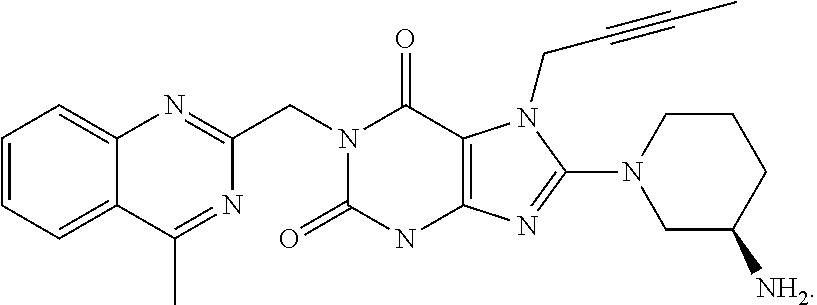
- According to this invention, it is to be understood that the definition of the SGLT2 inhibitor, in particular 1-chloro-4-(β-D-glucopyranos-1-yl)-2-[4-((S)-tetrahydrofuran-3-yloxy)-benzyl]-benzene (Compound “A”), also comprises its hydrates, solvates and polymorphic forms thereof, and prodrugs thereof. With regard to the preferred 1-chloro-4-(β-D-glucopyranos-1-yl)-2-[4-((S)-tetrahydrofuran-3-yloxy)-benzyl]-benzene an advantageous crystalline form is described in the international patent application WO 2006/117359 which hereby is incorporated herein in its entirety. This crystalline form possesses good solubility properties which enable a good bioavailability of the SGLT2 inhibitor. Furthermore, the crystalline form is physico-chemically stable and thus provides a good shelf-life stability of the pharmaceutical composition.
-

- Methods for the manufacture of SGLT2 inhibitors according to this invention and of prodrugs thereof are known to the one skilled in the art. Advantageously, the compounds according to this invention can be prepared using synthetic methods as described in the literature, including patent applications as cited hereinbefore. Preferred methods of manufacture, in particular of 1-chloro-4-(β-D-glucopyranos-1-yl)-2-[4-((S)-tetrahydrofuran-3-yloxy)-benzyl]-benzene, are described in the WO 2006/120208.
- For avoidance of any doubt, the disclosure of each of the foregoing documents cited above in connection with the specified SGLT2 or DPP-4 inhibitors is specifically incorporated herein by reference in its entirety.
- As described herein by the administration of the pharmaceutical composition according to this invention, therapeutic effects can be achieved, which make it useful for treating and/or preventing certain diseases, disorders or conditions, such as e.g. those described herein.
- Therefore, a treatment or prophylaxis according to this invention is advantageously suitable in those patients in need of such treatment or prophylaxis who are diagnosed of one or more of the conditions selected from the group consisting of overweight and obesity, in particular class I obesity, class II obesity, class III obesity, visceral obesity and abdominal obesity. In addition a treatment or prophylaxis according to this invention is advantageously suitable in those patients in which a weight increase is contraindicated. The pharmaceutical composition as well as the methods according to the present invention allow a reduction of the HbA1c value to a desired target range, for example <7% and preferably <6.5%, for a higher number of patients and for a longer time of therapeutic treatment compared with a corresponding monotherapy.
- The pharmaceutical composition according to this invention and in particular the active ingredients therein exhibits a very good efficacy with regard to glycemic control, in particular in view of a reduction of fasting plasma glucose, postprandial plasma glucose and/or glycosylated hemoglobin (HbA1c). By administering a pharmaceutical composition according to this invention, a reduction of HbA1c equal to or greater than preferably 0.5%, even more preferably equal to or greater than 1.0% can be achieved and the reduction is particularly in the range from 1.0% to 2.0%.
- Furthermore, the method and/or use according to this invention is advantageously applicable in those patients who show one, two or more of the following conditions:
- (a) a fasting blood glucose or serum glucose concentration greater than 110 mg/dL, in particular greater than 125 mg/dL;
- (b) a postprandial plasma glucose equal to or greater than 140 mg/dL;
- (c) an HbA1c value equal to or greater than 6.5%, in particular equal to or greater than 7.0%, especially equal to or greater than 7.5%, even more particularly equal to or greater than 8.0%.
- The present invention also discloses the use of the pharmaceutical composition for improving glycemic control in patients having type 2 diabetes or showing first signs of pre-diabetes. Thus, the invention also includes diabetes prevention. If therefore a pharmaceutical composition according to this invention is used to improve the glycemic control as soon as one of the above-mentioned signs of pre-diabetes is present, the onset of manifest type 2 diabetes mellitus can be delayed or prevented.
- Furthermore, the pharmaceutical composition according to this invention is particularly suitable in the treatment of patients with insulin dependency, i.e. in patients who are treated or otherwise would be treated or need treatment with an insulin or a derivative of insulin or a substitute of insulin or a formulation comprising an insulin or a derivative or substitute thereof. These patients include patients with diabetes type 2 and patients with diabetes type 1.
- Therefore, according to a preferred embodiment of the present invention, there is provided a method for improving glycemic control and/or for reducing of fasting plasma glucose, of postprandial plasma glucose and/or of glycosylated hemoglobin HbA1c in a patient in need thereof who is diagnosed with impaired glucose tolerance (IGT), impaired fasting blood glucose (IFG) with insulin resistance, with metabolic syndrome and/or with type 2 or type 1 diabetes mellitus characterized in that a pharmaceutical composition as defined hereinbefore and hereinafter is administered to the patient.
- According to another preferred embodiment of the present invention, there is provided a method for improving glycemic control in patients, in particular in adult patients, with type 2 diabetes mellitus as an adjunct to diet and exercise.
- Therefore, the method and/or use according to this invention is advantageously applicable in those patients who show one, two or more of the following conditions:
- (a) insufficient glycemic control with diet and exercise alone;
- (b) insufficient glycemic control despite oral monotherapy with metformin, in particular despite oral monotherapy at a maximal tolerated dose of metformin;
- (c) insufficient glycemic control despite oral monotherapy with another antidiabetic agent, in particular despite oral monotherapy at a maximal tolerated dose of the other antidiabetic agent.
- The lowering of the blood glucose level by the administration of a pharmaceutical composition according to this invention is insulin-independent. Therefore, a pharmaceutical composition according to this invention is particularly suitable in the treatment of patients who are diagnosed having one or more of the following conditions
-
- insulin resistance,
- hyperinsulinemia,
- pre-diabetes,
- type 2 diabetes mellitus, particular having a late stage type 2 diabetes mellitus,
- type 1 diabetes mellitus.
- Furthermore, a pharmaceutical composition according to this invention is particularly suitable in the treatment of patients who are diagnosed having one or more of the following conditions
- (a) obesity (including class I, II and/or III obesity), visceral obesity and/or abdominal obesity,
- (b) triglyceride blood level ≧150 mg/dL,
- (c) HDL-cholesterol blood level <40 mg/dL in female patients and <50 mg/dL in male patients,
- (d) a systolic blood pressure ≧130 mm Hg and a diastolic blood pressure 85 mm Hg,
- (e) a fasting blood glucose level ≧110 mg/dL.
- It is assumed that patients diagnosed with impaired glucose tolerance (IGT), impaired fasting blood glucose (IFG), with insulin resistance and/or with metabolic syndrome suffer from an increased risk of developing a cardiovascular disease, such as for example myocardial infarction, coronary heart disease, heart insufficiency, thromboembolic events. A glycemic control according to this invention may result in a reduction of the cardiovascular risks.
- A pharmaceutical composition according to this invention exhibits a good safety profile. Therefore, a treatment or prophylaxis according to this invention is advantageously possible in those patients for which the mono-therapy with another antidiabetic drug is contraindicated and/or who have an intolerance against such drugs at therapeutic doses. In particular, a treatment or prophylaxis according to this invention may be advantageously possible in those patients showing or having an increased risk for one or more of the following disorders: renal insufficiency or diseases, cardiac diseases, cardiac failure, hepatic diseases, pulmonal diseases, catabolytic states and/or danger of lactate acidosis, or female patients being pregnant or during lactation.
- Furthermore, it can be found that the administration of a pharmaceutical composition according to this invention results in no risk or in a low risk of hypoglycemia. Therefore, a treatment or prophylaxis according to this invention is also advantageously possible in those patients showing or having an increased risk for hypoglycemia.
- A pharmaceutical composition according to this invention is particularly suitable in the long term treatment or prophylaxis of the diseases and/or conditions as described hereinbefore and hereinafter, in particular in the long term glycemic control in patients with type 2 diabetes mellitus.
- The term “long term” as used hereinbefore and hereinafter indicates a treatment of or administration in a patient within a period of time longer than 12 weeks, preferably longer than 25 weeks, even more preferably longer than 1 year.
- Therefore, a particularly preferred embodiment of the present invention provides a method for therapy, preferably oral therapy, for improvement, especially long term improvement, of glycemic control in patients with type 2 diabetes mellitus, especially in patients with late stage type 2 diabetes mellitus, in particular in patients additionally diagnosed of overweight, obesity (including class I, class II and/or class III obesity), visceral obesity and/or abdominal obesity.
- According to another aspect of the invention, there is provided a method for preventing, slowing the progression of, delaying or treating of a condition or disorder selected from the group consisting of complications of diabetes mellitus such as cataracts and micro- and macrovascular diseases, such as dyslipidemia, nephropathy, retinopathy, neuropathy, tissue ischaemia, diabetic foot, arteriosclerosis, myocardial infarction, acute coronary syndrome, unstable angina pectoris, stable angina pectoris, stroke, peripheral arterial occlusive disease, cardiomyopathy, heart failure, heart rhythm disorders and vascular restenosis, in a patient in need thereof characterized in that a pharmaceutical composition according to the invention is administered to the patient. In particular one or more aspects of diabetic nephropathy such as hyperperfusion, proteinuria and albuminuria may be treated, their progression slowed or their onset delayed or prevented. The term “tissue ischaemia” particularly comprises diabetic macroangiopathy, diabetic microangiopathy, impaired wound healing and diabetic ulcer. The terms “micro- and macrovascular diseases” and “micro- and macrovascular complications” are used interchangeably in this application.
- According to another aspect of the invention, there is provided a method for preventing, slowing the progression of, delaying or treating a metabolic disorder selected from the group consisting of type 2 diabetes mellitus, impaired glucose tolerance (IGT), impaired fasting blood glucose (IFG), hyperglycemia, postprandial hyperglycemia, overweight, obesity, metabolic syndrome, gestational diabetes and diabetes related to cystic fibrosis in a patient in need thereof characterized in that a pharmaceutical composition according to the invention is administered to the patient.
- According to another aspect of the invention, there is provided a method for improving glycemic control and/or for reducing of fasting plasma glucose, of postprandial plasma glucose and/or of glycosylated hemoglobin HbA1c in a patient in need thereof characterized in that a pharmaceutical composition according to the invention is administered to the patient.
- The pharmaceutical composition according to this invention may also have valuable disease-modifying properties with respect to diseases or conditions related to impaired glucose tolerance (IGT), impaired fasting blood glucose (IFG), insulin resistance and/or metabolic syndrome.
- According to another aspect of the invention, there is provided a method for preventing, slowing, delaying or reversing progression from impaired glucose tolerance (IGT), impaired fasting blood glucose (IFG), insulin resistance and/or from metabolic syndrome to type 2 diabetes mellitus in a patient in need thereof characterized in that a pharmaceutical composition according to the invention is administered to the patient.
- As by the use of a pharmaceutical composition according to this invention, an improvement of the glycemic control in patients in need thereof is obtainable, also those conditions and/or diseases related to or caused by an increased blood glucose level may be treated.
- By the administration of a pharmaceutical composition according to this invention excessive blood glucose levels are not converted to insoluble storage forms, like fat, but excreted through the urine of the patient. It can be seen that loss of fat may account for the majority of the observed weight loss whereas no significant changes in body water or protein content are observed. Therefore, no gain in weight or even a reduction in body weight is the result.
- According to another aspect of the invention, there is provided a method for reducing body weight and/or body fat or preventing an increase in body weight and/or body fat or facilitating a reduction in body weight and/or body fat in a patient in need thereof characterized in that a pharmaceutical composition according to the invention is administered to the patient.
- By the administration of a combination or pharmaceutical composition according to the present invention, an abnormal accumulation of ectopic fat, in particular of the liver, may be reduced or inhibited. Therefore, according to another aspect of the present invention, there is provided a method for preventing, slowing, delaying or treating diseases or conditions attributed to an abnormal accumulation of ectopic fat, in particular of the liver, in a patient in need thereof characterized in that a pharmaceutical composition according to the invention is administered to the patient. Diseases or conditions which are attributed to an abnormal accumulation of liver fat are particularly selected from the group consisting of general fatty liver, non-alcoholic fatty liver (NAFL), non-alcoholic steatohepatitis (NASH), hyperalimen-tation-induced fatty liver, diabetic fatty liver, alcoholic-induced fatty liver or toxic fatty liver.
- Another aspect of the invention provides a method for maintaining and/or improving the insulin sensitivity and/or for treating or preventing hyperinsulinemia and/or insulin resistance in a patient in need thereof characterized in that a pharmaceutical composition according to the invention is administered to the patient.
- According to another aspect of the invention, there is provided a method for preventing, slowing progression of, delaying, or treating new onset diabetes after transplantation (NODAT) and/or post-transplant metabolic syndrome (PTMS) in a patient in need thereof characterized in that a pharmaceutical composition according to the invention is administered to the patient.
- According to a further aspect of the invention, there is provided a method for preventing, delaying, or reducing NODAT and/or PTMS associated complications including micro- and macrovascular diseases and events, graft rejection, infection, and death in a patient in need thereof characterized in that a pharmaceutical composition according to the invention is administered to the patient.
- The pharmaceutical composition according to the invention is capable of facilitating the lowering of serum total urate levels in the patient. Therefore according to another aspect of the invention, there is provided a method for treating hyperuricemia and hyperuricemia-associated conditions, such as for example gout, hypertension and renal failure, in a patient in need thereof characterized in that a pharmaceutical composition according to the invention is administered to the patient.
- The administration of a pharmaceutical composition increases the urine excretion of glucose. This increase in osmotic excretion and water release and the lowering of urate levels are beneficial as a treatment or prevention for kidney stones. Therefore in a further aspect of the invention, there is provided a method for treating or preventing kidney stones in a patient in need thereof characterized in that a pharmaceutical composition according to the invention is administered to the patient.
- The invention also relates to a pharmaceutical composition according to this invention for use in a method as described hereinbefore and hereinafter.
- The invention also relates to a use of a pharmaceutical composition according to this invention for the manufacture of a medicament for use in a method as described hereinbefore and hereinafter.
- The term “active ingredient” of a pharmaceutical composition according to the present invention means the SGLT2 inhibitor, the DPP-4 inhibitor and/or metformin according to the present invention.
- The term “body mass index” or “BMI” of a human patient is defined as the weight in kilograms divided by the square of the height in meters, such that BMI has units of kg/m2.
- The term “overweight” is defined as the condition wherein the individual has a BMI greater than or 25 kg/m2 and less than 30 kg/m2. The terms “overweight” and “pre-obese” are used interchangeably.
- The term “obesity” is defined as the condition wherein the individual has a BMI equal to or greater than 30 kg/m2. According to a WHO definition the term obesity may be categorized as follows: the term “class I obesity” is the condition wherein the BMI is equal to or greater than 30 kg/m2 but lower than 35 kg/m2; the term “class II obesity” is the condition wherein the BMI is equal to or greater than 35 kg/m2 but lower than 40 kg/m2; the term “class III obesity” is the condition wherein the BMI is equal to or greater than 40 kg/m2.
- The term “visceral obesity” is defined as the condition wherein a waist-to-hip ratio of greater than or equal to 1.0 in men and 0.8 in women is measured. It defines the risk for insulin resistance and the development of pre-diabetes.
- The term “abdominal obesity” is usually defined as the condition wherein the waist circumference is >40 inches or 102 cm in men, and is >35 inches or 94 cm in women. With regard to a Japanese ethnicity or Japanese patients abdominal obesity may be defined as waist circumference ≧85 cm in men and ≧90 cm in women (see e.g. investigating committee for the diagnosis of metabolic syndrome in Japan).
- The term “euglycemia” is defined as the condition in which a subject has a fasting blood glucose concentration within the normal range, greater than 70 mg/dL (3.89 mmol/L) and less than 100 mg/dL (5.6 mmol/L). The word “fasting” has the usual meaning as a medical term.
- The term “hyperglycemia” is defined as the condition in which a subject has a fasting blood glucose concentration above the normal range, greater than 100 mg/dL (5.6 mmol/L). The word “fasting” has the usual meaning as a medical term.
- The term “hypoglycemia” is defined as the condition in which a subject has a blood glucose concentration below the normal range, in particular below 70 mg/dL (3.89 mmol/L) or even below 60 mg/dl.
- The term “postprandial hyperglycemia” is defined as the condition in which a subject has a 2 hour postprandial blood glucose or serum glucose concentration greater than 200 mg/dL (11.1 mmol/L).
- The term “impaired fasting blood glucose” or “IFG” is defined as the condition in which a subject has a fasting blood glucose concentration or fasting serum glucose concentration in a range from 100 to 125 mg/dl (i.e. from 5.6 to 6.9 mmol/l), in particular greater than 110 mg/dL and less than 126 mg/dl (7.00 mmol/L). A subject with “normal fasting glucose” has a fasting glucose concentration smaller than 100 mg/dl, i.e. smaller than 5.6 mmol/l.
- The term “impaired glucose tolerance” or “IGT” is defined as the condition in which a subject has a 2 hour postprandial blood glucose or serum glucose concentration greater than 140 mg/dl (7.8 mmol/L) and less than 200 mg/dL (11.11 mmol/L). The abnormal glucose tolerance, i.e. the 2 hour postprandial blood glucose or serum glucose concentration can be measured as the blood sugar level in mg of glucose per dL of plasma 2 hours after taking 75 g of glucose after a fast. A subject with “normal glucose tolerance” has a 2 hour postprandial blood glucose or serum glucose concentration smaller than 140 mg/dl (7.8 mmol/L).
- The term “hyperinsulinemia” is defined as the condition in which a subject with insulin resistance, with or without euglycemia, has fasting or postprandial serum or plasma insulin concentration elevated above that of normal, lean individuals without insulin resistance, having a waist-to-hip ratio <1.0 (for men) or <0.8 (for women).
- The terms “insulin-sensitizing”, “insulin resistance-improving” or “insulin resistance-lowering” are synonymous and used interchangeably.
- The term “insulin resistance” is defined as a state in which circulating insulin levels in excess of the normal response to a glucose load are required to maintain the euglycemic state (Ford E S, et al. JAMA. (2002) 287:356-9). A method of determining insulin resistance is the euglycaemic-hyperinsulinaemic clamp test. The ratio of insulin to glucose is determined within the scope of a combined insulin-glucose infusion technique. There is found to be insulin resistance if the glucose absorption is below the 25th percentile of the background population investigated (WHO definition). Rather less laborious than the clamp test are so called minimal models in which, during an intravenous glucose tolerance test, the insulin and glucose concentrations in the blood are measured at fixed time intervals and from these the insulin resistance is calculated. With this method, it is not possible to distinguish between hepatic and peripheral insulin resistance.
- Furthermore, insulin resistance, the response of a patient with insulin resistance to therapy, insulin sensitivity and hyperinsulinemia may be quantified by assessing the “homeostasis model assessment to insulin resistance (HOMA-IR)” score, a reliable indicator of insulin resistance (Katsuki A, et al. Diabetes Care 2001; 24: 362-5). Further reference is made to methods for the determination of the HOMA-index for insulin sensitivity (Matthews et al., Diabetologia 1985, 28:412-19), of the ratio of intact proinsulin to insulin (Forst et al., Diabetes 2003, 52(Supp1.1): A459) and to an euglycemic clamp study. In addition, plasma adiponectin levels can be monitored as a potential surrogate of insulin sensitivity. The estimate of insulin resistance by the homeostasis assessment model (HOMA)-IR score is calculated with the formula (Galvin P, et al. Diabet Med 1992; 9:921-8):
-
HOMA-IR=[fasting serum insulin(μU/mL)]×[fasting plasma glucose(mmol/L)/22.5] - As a rule, other parameters are used in everyday clinical practice to assess insulin resistance. Preferably, the patient's triglyceride concentration is used, for example, as increased triglyceride levels correlate significantly with the presence of insulin resistance.
- Patients with a predisposition for the development of IGT or IFG or type 2 diabetes are those having euglycemia with hyperinsulinemia and are by definition, insulin resistant. A typical patient with insulin resistance is usually overweight or obese, but this is not always the case. If insulin resistance can be detected, this is a particularly strong indication of the presence of pre-diabetes. Thus, it may be that in order to maintain glucose homoeostasis a person have e.g. 2-3 times as high endogenous insulin production as a healthy person, without this resulting in any clinical symptoms.
- The methods to investigate the function of pancreatic beta-cells are similar to the above methods with regard to insulin sensitivity, hyperinsulinemia or insulin resistance: An improvement of beta-cell function can be measured for example by determining a HOMA-index for beta-cell function (Matthews et al., Diabetologia 1985, 28:412-19), the ratio of intact proinsulin to insulin (Forst et al., Diabetes 2003, 52(Supp1.1): A459), the insulin/C-peptide secretion after an oral glucose tolerance test or a meal tolerance test, or by employing a hyperglycemic clamp study and/or minimal modeling after a frequently sampled intravenous glucose tolerance test (Stumvoll et al., Eur J Clin Invest 2001, 31: 380-81).
- The term “pre-diabetes” is the condition wherein an individual is pre-disposed to the development of type 2 diabetes. Pre-diabetes extends the definition of impaired glucose tolerance to include individuals with a fasting blood glucose within the high normal range 100 mg/dL (J. B. Meigs, et al. Diabetes 2003; 52:1475-1484) and fasting hyperinsulinemia (elevated plasma insulin concentration). The scientific and medical basis for identifying pre-diabetes as a serious health threat is laid out in a Position Statement entitled “The Prevention or Delay of Type 2 Diabetes” issued jointly by the American Diabetes Association and the National Institute of Diabetes and Digestive and Kidney Diseases (Diabetes Care 2002; 25:742-749).
- Individuals likely to have insulin resistance are those who have two or more of the following attributes: 1) overweight or obese, 2) high blood pressure, 3) hyperlipidemia, 4) one or more 1st degree relative with a diagnosis of IGT or IFG or type 2 diabetes. Insulin resistance can be confirmed in these individuals by calculating the HOMA-IR score. For the purpose of this invention, insulin resistance is defined as the clinical condition in which an individual has a HOMA-IR score >4.0 or a HOMA-IR score above the upper limit of normal as defined for the laboratory performing the glucose and insulin assays.
- The term “type 1 diabetes” is defined as the condition in which a subject has, in the presence of autoimmunity towards the pancreatic beta-cell or insulin, a fasting blood glucose or serum glucose concentration greater than 125 mg/dL (6.94 mmol/L). If a glucose tolerance test is carried out, the blood sugar level of a diabetic will be in excess of 200 mg of glucose per dL (11.1 mmol/l) of plasma 2 hours after 75 g of glucose have been taken on an empty stomach, in the presence of autoimmunity towards the pancreatic beta cell or insulin. In a glucose tolerance test 75 g of glucose are administered orally to the patient being tested after 10-12 hours of fasting and the blood sugar level is recorded immediately before taking the glucose and 1 and 2 hours after taking it. The presence of autoimmunity towards the pancreatic beta-cell may be observed by detection of circulating islet cell autoantibodies [“type 1A diabetes mellitus”], i.e., at least one of: GAD65 [glutamic acid decarboxylase-65], ICA [islet-cell cytoplasm], IA-2 [intracytoplasmatic domain of the tyrosine phosphatase-like protein IA-2], ZnT8 [zinc-transporter-8] or anti-insulin; or other signs of autoimmunity without the presence of typical circulating autoantibodies [type 1B diabetes], i.e. as detected through pancreatic biopsy or imaging). Typically a genetic predisposition is present (e.g. HLA, INS VNTR and PTPN22), but this is not always the case.
- The term “type 2 diabetes” is defined as the condition in which a subject has a fasting blood glucose or serum glucose concentration greater than 125 mg/dL (6.94 mmol/L). The measurement of blood glucose values is a standard procedure in routine medical analysis. If a glucose tolerance test is carried out, the blood sugar level of a diabetic will be in excess of 200 mg of glucose per dL (11.1 mmol/l) of plasma 2 hours after 75 g of glucose have been taken on an empty stomach. In a glucose tolerance test 75 g of glucose are administered orally to the patient being tested after 10-12 hours of fasting and the blood sugar level is recorded immediately before taking the glucose and 1 and 2 hours after taking it. In a healthy subject, the blood sugar level before taking the glucose will be between 60 and 110 mg per dL of plasma, less than 200 mg per dL 1 hour after taking the glucose and less than 140 mg per dL after 2 hours. If after 2 hours the value is between 140 and 200 mg, this is regarded as abnormal glucose tolerance.
- The term “late stage type 2 diabetes mellitus” includes patients with a secondary drug failure, indication for insulin therapy and progression to micro- and macrovascular complications e.g. diabetic nephropathy, or coronary heart disease (CHD).
- The term “HbA1c” refers to the product of a non-enzymatic glycation of the haemoglobin B chain. Its determination is well known to one skilled in the art. In monitoring the treatment of diabetes mellitus the HbA1c value is of exceptional importance. As its production depends essentially on the blood sugar level and the life of the erythrocytes, the HbA1c in the sense of a “blood sugar memory” reflects the average blood sugar levels of the preceding 4-6 weeks. Diabetic patients whose HbA1c value is consistently well adjusted by intensive diabetes treatment (i.e. <6.5% of the total haemoglobin in the sample), are significantly better protected against diabetic microangiopathy. For example, metformin on its own achieves an average improvement in the HbA1c value in the diabetic of the order of 1.0-1.5%. This reduction of the HbA1C value is not sufficient in all diabetics to achieve the desired target range of <6.5% and preferably <6% HbA1c.
- The term “insufficient glycemic control” or “inadequate glycemic control” in the scope of the present invention means a condition wherein patients show HbA1c values above 6.5%, in particular above 7.0%, even more preferably above 7.5%, especially above 8%.
- The “metabolic syndrome”, also called “syndrome X” (when used in the context of a metabolic disorder), also called the “dysmetabolic syndrome” is a syndrome complex with the cardinal feature being insulin resistance (Laaksonen D E, et al. Am J Epidemiol 2002; 156:1070-7). According to the ATP III/NCEP guidelines (Executive Summary of the Third Report of the National Cholesterol Education Program (NCEP) Expert Panel on Detection, Evaluation, and Treatment of High Blood Cholesterol in Adults (Adult Treatment Panel III) JAMA: Journal of the American Medical Association (2001) 285:2486-2497), diagnosis of the metabolic syndrome is made when three or more of the following risk factors are present:
-
- 1. Abdominal obesity, defined as waist circumference >40 inches or 102 cm in men, and >35 inches or 94 cm in women; or with regard to a Japanese ethnicity or Japanese patients defined as waist circumference ≧85 cm in men and ≧90 cm in women;
- 2. Triglycerides: ≧150 mg/dL
- 3. HDL-cholesterol <40 mg/dL in men
- 4. Blood pressure≧130/85 mm Hg (SBP ≧130 or DBP ≧85)
- 5. Fasting blood glucose≧100 mg/dL
- The NCEP definitions have been validated (Laaksonen D E, et al. Am J Epidemiol. (2002) 156:1070-7). Triglycerides and HDL cholesterol in the blood can also be determined by standard methods in medical analysis and are described for example in Thomas L (Editor): “Labor and Diagnose”, TH-Books Verlagsgesellschaft mbH, Frankfurt/Main, 2000.
- According to a commonly used definition, hypertension is diagnosed if the systolic blood pressure (SBP) exceeds a value of 140 mm Hg and diastolic blood pressure (DBP) exceeds a value of 90 mm Hg. If a patient is suffering from manifest diabetes it is currently recommended that the systolic blood pressure be reduced to a level below 130 mm Hg and the diastolic blood pressure be lowered to below 80 mm Hg.
- The definitions of NODAT (new onset diabetes after transplantation) and PTMS (post-transplant metabolic syndrome) follow closely that of the American Diabetes Association diagnostic criteria for type 2 diabetes, and that of the International Diabetes Federation (IDF) and the American Heart Association/National Heart, Lung, and Blood Institute, for the metabolic syndrome. NODAT and/or PTMS are associated with an increased risk of micro- and macrovascular disease and events, graft rejection, infection, and death. A number of predictors have been identified as potential risk factors related to NODAT and/or PTMS including a higher age at transplant, male gender, the pre-transplant body mass index, pre-transplant diabetes, and immunosuppression.
- The term “gestational diabetes” (diabetes of pregnancy) denotes a form of the diabetes which develops during pregnancy and usually ceases again immediately after the birth. Gestational diabetes is diagnosed by a screening test which is carried out between the 24th and 28th weeks of pregnancy. It is usually a simple test in which the blood sugar level is measured one hour after the administration of 50 g of glucose solution. If this 1 h level is above 140 mg/dl, gestational diabetes is suspected. Final confirmation may be obtained by a standard glucose tolerance test, for example with 75 g of glucose.
- The term “hyperuricemia” denotes a condition of high serum total urate levels. In human blood, uric acid concentrations between 3.6 mg/dL (ca. 214 μmol/L) and 8.3 mg/dL (ca. 494 μmol/L) are considered normal by the American Medical Association. High serum total urate levels, or hyperuricemia, are often associated with several maladies. For example, high serum total urate levels can lead to a type of arthritis in the joints kown as gout. Gout is a condition created by a build up of monosodium urate or uric acid crystals on the articular cartilage of joints, tendons and surrounding tissues due to elevated concentrations of total urate levels in the blood stream. The build up of urate or uric acid on these tissues provokes an inflammatory reaction of these tissues. Saturation levels of uric acid in urine may result in kidney stone formation when the uric acid or urate crystallizes in the kidney. Additionally, high serum total urate levels are often associated with the so-called metabolic syndrome, including cardiovascular disease and hypertension.
- The term “hyponatremia” denotes a condition of a positive balance of water with or without a deficit of sodium, which is recognized when the plasma sodium falls below the level of 135 mml/L. Hyponatremia is a condition which can occur in isolation in individuals that over-consume water; however, more often hyponatremia is a complication of medication or other underlying medical condition that leas to a diminished excretion of water. Hyponatremia may lead to water intoxication, which occurs when the normal tonicity of extracellular fluid falls below the safe limit, due to retention of excess water. Water intoxication is a potentially fatal disturbance in brain function. Typical symptoms of water intoxication include nausea, vomiting, headache and malaise.
- The terms “treatment” and “treating” comprise therapeutic treatment of patients having already developed said condition, in particular in manifest form. Therapeutic treatment may be symptomatic treatment in order to relieve the symptoms of the specific indication or causal treatment in order to reverse or partially reverse the conditions of the indication or to stop or slow down progression of the disease. Thus the compositions and methods of the present invention may be used for instance as therapeutic treatment over a period of time as well as for chronic therapy.
- The terms “prophylactically treating”, “preventively treating” and “preventing” are used interchangeably and comprise a treatment of patients at risk to develop a condition mentioned hereinbefore, thus reducing said risk.
Claims (27)
1. A pharmaceutical composition comprising
a) an inner extended release core comprising metformin or metformin hydrochloride and one or more excipients;
b) an optional intermediate seal coating; and
c) an outer immediate release coating comprising at least one active pharmaceutical ingredient selected from a DPP-4 inhibitor and a SGLT-2 inhibitor, and one or more excipients.
2. The pharmaceutical composition according to claim 1 , wherein the inner extended release core a) is a formulation comprising metformin hydrochloride, a swellable and/or extended release polymer, and one or more further excipients.
3. The pharmaceutical composition according to claim 1 , wherein the outer immediate release coating c) is a film coat formulation comprising linagliptin, L-arginine as stabilizer, a film-coating agent, a plasticizer, and, optionally, a glidant.
4. The pharmaceutical composition according to claim 3 , wherein the weight ratio of the L-arginine to linagliptin is within the range from about 2:1 to about 1:1, or up to about 0.2:1.
5. The pharmaceutical composition according to claim 1 , wherein the outer immediate release coating c) is a film coat formulation comprising 1-chloro-4-(β-D-glucopyranos-1-yl)-2-[4-((S)-tetrahydrofuran-3-yloxy)-benzyl]-benzene, a film-coating agent, a plasticizer, and, optionally, a glidant.
6. The pharmaceutical composition according to claim 3 , wherein the film-coating agent is hydroxypropyl methylcellulose, e.g. Hypromellose 2910, Methocel E5, or Methocel E15.
7. The pharmaceutical composition according to claim 5 , wherein the film-coating agent is hydroxypropyl methylcellulose, e.g. Hypromellose 2910, Methocel E5, or Methocel E15.
8. The pharmaceutical composition according to claim 3 , wherein the plastizicer is polyethylene glycol, e.g. Macrogol 400, 6000 or 8000.
9. The pharmaceutical composition according to claim 5 , wherein the plastizicer is polyethylene glycol, e.g. Macrogol 400, 6000 or 8000.
10. The pharmaceutical composition according to claim 3 , wherein the plastizicer is propylene glycol.
11. The pharmaceutical composition according to claim 5 , wherein the plastizicer is propylene glycol
12. The pharmaceutical composition according to claim 3 , wherein the optional glidant is talc.
13. The pharmaceutical composition according to claim 5 , wherein the optional glidant is talc.
14. The pharmaceutical composition according to claim 1 wherein the seal coating is present.
15. The pharmaceutical composition according to claim 14 , wherein the seal coating comprises a film-coating agent, a plasticizer, and, optionally, a glidant, one or more pigments and/or colors.
16. The pharmaceutical composition according to claim 1 , wherein the seal coating is absent.
17. The pharmaceutical composition according to claim 1 , wherein the metformin hydrochloride is present in a unit dosage strength of 500, 750, 850, 1000 or 1500 mg.
18. The pharmaceutical composition according to claim 1 , wherein the DPP-4 inhibitor is linagliptin and is present in a unit dosage strength of 0.5, 1, 2.5 or 5 mg.
19. The pharmaceutical composition according to claim 1 , wherein the SGLT-2 inhibitor is 1-chloro-4-(β-D-glucopyranos-1-yl)-2-[4-((S)-tetrahydrofuran-3-yloxy)-benzyl]-benzene and is present in a unit dosage strength of 5, 10, 12.5 or 25 mg.
20. The pharmaceutical composition according to claim 1 , which is a tablet for oral administration.
21. The tablet according to claim 20 further comprising an outer film over-coat.
22. The tablet according to claim 21 , wherein the outer film over-coat comprises a film-coating agent, a plasticizer, and, optionally, a glidant, one or more pigments and/or colors.
23. A method of using the pharmaceutical composition according to claim 1 for treating, preventing, slowing the progression, or delaying the onset of metabolic diseases either in type 2 diabetes patients who have not been previously treated with an antihyperglycemic agent,
or in type 2 diabetes patients with insufficient glycemic control despite therapy with one or two conventional antihyperglycemic agents selected from metformin, sulphonylureas, thiazolidinediones, glinides, alpha-glucosidase blockers, GLP-1 or GLP-1 analogues, and insulin or insulin analogues.
24. The method of claim 23 , wherein the metabolic disease is type 2 diabetes mellitus and conditions related thereto.
25. The method of claim 23 , wherein the DPP-4 inhibitor is linagliptin and the SGLT-2 inhibitor is 1-chloro-4-(β-D-glucopyranos-1-yl)-2-[4-((S)-tetrahydrofuran-3-yloxy)-benzyl]-benzene.
26. A pharmaceutical composition comprising
a) an inner extended release core comprising metformin hydrochloride and one or more excipients;
b) an optional intermediate seal coating; and
c) an outer immediate release coating comprising at least one active pharmaceutical ingredient selected from linagliptin, and 1-chloro-4-(β-D-glucopyranos-1-yl)-2-[4-((S)-tetrahydrofuran-3-yloxy)-benzyl]-benzene, and one or more excipients.
27. The pharmaceutical composition according to claim 26 which is a tablet for oral administration.
Priority Applications (4)
| Application Number | Priority Date | Filing Date | Title |
|---|---|---|---|
| US15/140,865 US20160235680A1 (en) | 2011-03-07 | 2016-04-28 | Pharmaceutical compositions |
| US15/906,414 US10596120B2 (en) | 2011-03-07 | 2018-02-27 | Pharmaceutical compositions |
| US16/732,635 US20200297639A1 (en) | 2011-03-07 | 2020-01-02 | Pharmaceutical compositions |
| US17/123,366 US11564886B2 (en) | 2011-03-07 | 2020-12-16 | Pharmaceutical compositions |
Applications Claiming Priority (4)
| Application Number | Priority Date | Filing Date | Title |
|---|---|---|---|
| EP11157240 | 2011-03-07 | ||
| EP11157240.0 | 2011-03-07 | ||
| EP11158358.9 | 2011-03-15 | ||
| EP11158358 | 2011-03-15 |
Related Child Applications (1)
| Application Number | Title | Priority Date | Filing Date |
|---|---|---|---|
| US15/140,865 Continuation US20160235680A1 (en) | 2011-03-07 | 2016-04-28 | Pharmaceutical compositions |
Publications (1)
| Publication Number | Publication Date |
|---|---|
| US20130064887A1 true US20130064887A1 (en) | 2013-03-14 |
Family
ID=45808965
Family Applications (5)
| Application Number | Title | Priority Date | Filing Date |
|---|---|---|---|
| US13/413,702 Abandoned US20130064887A1 (en) | 2011-03-07 | 2012-03-07 | Pharmaceutical compositions |
| US15/140,865 Abandoned US20160235680A1 (en) | 2011-03-07 | 2016-04-28 | Pharmaceutical compositions |
| US15/906,414 Active US10596120B2 (en) | 2011-03-07 | 2018-02-27 | Pharmaceutical compositions |
| US16/732,635 Abandoned US20200297639A1 (en) | 2011-03-07 | 2020-01-02 | Pharmaceutical compositions |
| US17/123,366 Active US11564886B2 (en) | 2011-03-07 | 2020-12-16 | Pharmaceutical compositions |
Family Applications After (4)
| Application Number | Title | Priority Date | Filing Date |
|---|---|---|---|
| US15/140,865 Abandoned US20160235680A1 (en) | 2011-03-07 | 2016-04-28 | Pharmaceutical compositions |
| US15/906,414 Active US10596120B2 (en) | 2011-03-07 | 2018-02-27 | Pharmaceutical compositions |
| US16/732,635 Abandoned US20200297639A1 (en) | 2011-03-07 | 2020-01-02 | Pharmaceutical compositions |
| US17/123,366 Active US11564886B2 (en) | 2011-03-07 | 2020-12-16 | Pharmaceutical compositions |
Country Status (16)
| Country | Link |
|---|---|
| US (5) | US20130064887A1 (en) |
| EP (1) | EP2683366A1 (en) |
| JP (2) | JP2014507456A (en) |
| KR (1) | KR20140052970A (en) |
| CN (1) | CN103391771A (en) |
| AR (1) | AR085689A1 (en) |
| BR (1) | BR112013022789A2 (en) |
| CA (1) | CA2826640A1 (en) |
| CL (1) | CL2013002505A1 (en) |
| EA (1) | EA201300987A1 (en) |
| IL (1) | IL227528A0 (en) |
| MX (1) | MX2013010187A (en) |
| PH (1) | PH12013501842A1 (en) |
| SG (1) | SG193338A1 (en) |
| UY (1) | UY33937A (en) |
| WO (1) | WO2012120040A1 (en) |
Cited By (36)
| Publication number | Priority date | Publication date | Assignee | Title |
|---|---|---|---|---|
| US20110195917A1 (en) * | 2007-08-16 | 2011-08-11 | Boehringer Ingelheim International Gmbh | Pharmaceutical composition comprising a glucopyranosyl-substituted benzene derivate |
| US20110237526A1 (en) * | 2009-09-30 | 2011-09-29 | Boehringer Ingelheim International Gmbh | Method for the preparation of a crystalline form |
| US8557782B2 (en) | 2006-05-03 | 2013-10-15 | Boehringer Ingelheim International Gmbh | Glucopyranosyl-substituted benzonitrile derivatives, pharmaceutical compositions containing such compounds, their use and process for their manufacture |
| US9024010B2 (en) | 2009-09-30 | 2015-05-05 | Boehringer Ingelheim International Gmbh | Processes for preparing of glucopyranosyl-substituted benzyl-benzene derivatives |
| US9127034B2 (en) | 2005-05-10 | 2015-09-08 | Boehringer Ingelheim International Gmbh | Processes for preparing of glucopyranosyl-substituted benzyl-benzene derivates and intermediates therein |
| US9192617B2 (en) | 2012-03-20 | 2015-11-24 | Boehringer Ingelheim International Gmbh | Pharmaceutical composition, methods for treating and uses thereof |
| US20160106677A1 (en) * | 2014-10-17 | 2016-04-21 | Boehringer Ingelheim International Gmbh | Pharmaceutical composition and uses thereof |
| US20160361326A1 (en) * | 2015-06-12 | 2016-12-15 | Board Of Supervisors Of Louisiana State University And Agricultural And Mechanical College | Method of treating hyperglycemia and diabetes and of increasing adsorption and efficacy of vitamin d |
| US9526728B2 (en) | 2014-02-28 | 2016-12-27 | Boehringer Ingelheim International Gmbh | Medical use of a DPP-4 inhibitor |
| US9555001B2 (en) | 2012-03-07 | 2017-01-31 | Boehringer Ingelheim International Gmbh | Pharmaceutical composition and uses thereof |
| US9603851B2 (en) | 2010-05-05 | 2017-03-28 | Boehringer Ingelheim International Gmbh | Combination therapy |
| US9713618B2 (en) | 2012-05-24 | 2017-07-25 | Boehringer Ingelheim International Gmbh | Method for modifying food intake and regulating food preference with a DPP-4 inhibitor |
| US9751855B2 (en) | 2004-11-05 | 2017-09-05 | Boehringer Ingelheim International Gmbh | Process for the preparation of chiral 8-(3-aminopiperidin-1-yl)-xanthines |
| US9815837B2 (en) | 2006-05-04 | 2017-11-14 | Boehringer Ingelheim International Gmbh | Polymorphs |
| US9902751B2 (en) | 2013-12-30 | 2018-02-27 | Mylan Laboratories Limited | Process for the preparation of empagliflozin |
| US9949998B2 (en) | 2013-04-05 | 2018-04-24 | Boehringer Ingelheim International Gmbh | Pharmaceutical composition, methods for treating and uses thereof |
| US9949997B2 (en) | 2013-04-05 | 2018-04-24 | Boehringer Ingelheim International Gmbh | Pharmaceutical composition, methods for treating and uses thereof |
| US20180185291A1 (en) | 2011-03-07 | 2018-07-05 | Boehringer Ingelheim International Gmbh | Pharmaceutical compositions |
| US10022379B2 (en) | 2008-04-03 | 2018-07-17 | Boehringer Ingelheim International Gmbh | DPP-IV inhibitor combined with a further antidiabetic agent, tablets comprising such formulations, their use and process for their preparation |
| US10023574B2 (en) | 2002-08-21 | 2018-07-17 | Boehringer Ingelheim International Gmbh | 8-[3-amino-piperidin-1-yl]-xanthines, the preparation thereof and their use as pharmaceutical compositions |
| US10034877B2 (en) | 2008-08-06 | 2018-07-31 | Boehringer Ingelheim International Gmbh | Treatment for diabetes in patients inappropriate for metformin therapy |
| US10080754B2 (en) | 2006-05-04 | 2018-09-25 | Boehringer Ingelheim International Gmbh | Uses of DPP IV inhibitors |
| US10092571B2 (en) | 2009-11-27 | 2018-10-09 | Boehringer Ingelheim International Gmbh | Treatment of genotyped diabetic patients with DPP-IV inhibitors such as linagliptin |
| US10155000B2 (en) | 2016-06-10 | 2018-12-18 | Boehringer Ingelheim International Gmbh | Medical use of pharmaceutical combination or composition |
| US10195203B2 (en) | 2012-05-14 | 2019-02-05 | Boehringr Ingelheim International GmbH | Use of a DPP-4 inhibitor in podocytes related disorders and/or nephrotic syndrome |
| US10406172B2 (en) | 2009-02-13 | 2019-09-10 | Boehringer Ingelheim International Gmbh | Pharmaceutical composition, methods for treating and uses thereof |
| US10610489B2 (en) | 2009-10-02 | 2020-04-07 | Boehringer Ingelheim International Gmbh | Pharmaceutical composition, pharmaceutical dosage form, process for their preparation, methods for treating and uses thereof |
| US11033552B2 (en) | 2006-05-04 | 2021-06-15 | Boehringer Ingelheim International Gmbh | DPP IV inhibitor formulations |
| US11666590B2 (en) | 2013-04-18 | 2023-06-06 | Boehringer Ingelheim International Gmbh | Pharmaceutical composition, methods for treating and uses thereof |
| US11813275B2 (en) | 2013-04-05 | 2023-11-14 | Boehringer Ingelheim International Gmbh | Pharmaceutical composition, methods for treating and uses thereof |
| US11911388B2 (en) | 2008-10-16 | 2024-02-27 | Boehringer Ingelheim International Gmbh | Treatment for diabetes in patients with insufficient glycemic control despite therapy with an oral or non-oral antidiabetic drug |
| US11911387B2 (en) | 2010-11-15 | 2024-02-27 | Boehringer Ingelheim International Gmbh | Vasoprotective and cardioprotective antidiabetic therapy |
| US12263153B2 (en) | 2016-11-10 | 2025-04-01 | Boehringer Ingelheim International Gmbh | Pharmaceutical composition, methods for treating and uses thereof |
| US12312352B2 (en) | 2012-05-14 | 2025-05-27 | Boehringer Ingelheim International Gmbh | Use of a DPP-4 inhibitor in SIRS and/or sepsis |
| US12433906B2 (en) | 2013-04-05 | 2025-10-07 | Boehringer Ingelheim International Gmbh | Pharmaceutical composition, methods for treating and uses thereof |
| US12527810B2 (en) | 2009-02-13 | 2026-01-20 | Boehringer Ingelheim International Gmbh | Pharmaceutical composition, methods for treating and uses thereof |
Families Citing this family (25)
| Publication number | Priority date | Publication date | Assignee | Title |
|---|---|---|---|---|
| UY32030A (en) | 2008-08-06 | 2010-03-26 | Boehringer Ingelheim Int | "TREATMENT FOR DIABETES IN INAPPROPRIATE PATIENTS FOR THERAPY WITH METFORMIN" |
| AU2009331471B2 (en) | 2008-12-23 | 2015-09-03 | Boehringer Ingelheim International Gmbh | Salt forms of organic compound |
| AR074990A1 (en) | 2009-01-07 | 2011-03-02 | Boehringer Ingelheim Int | TREATMENT OF DIABETES IN PATIENTS WITH AN INAPPROPRIATE GLUCEMIC CONTROL THROUGH METFORMIN THERAPY |
| KR20220025926A (en) | 2010-06-24 | 2022-03-03 | 베링거 인겔하임 인터내셔날 게엠베하 | Diabetes therapy |
| CN103781788B (en) | 2011-07-15 | 2016-08-17 | 勃林格殷格翰国际有限公司 | Quinazoline, its preparation and the purposes in pharmaceutical composition thereof being substituted |
| TR201202948A2 (en) * | 2012-03-15 | 2012-07-23 | Ali̇ Rai̇f İlaç Sanayi̇ A.Ş. | Tablet formulation comprising dapaglyphlosin and prolonged release metaphormin. |
| TWI606848B (en) * | 2012-10-08 | 2017-12-01 | Lg生命科學股份有限公司 | Combination drug comprising gemigliptin and metformin, and method for the preparation thereof |
| EP2908806A1 (en) | 2012-10-09 | 2015-08-26 | Boehringer Ingelheim International GmbH | Use of selectively moisture-adjusted tabletting material in the production of mechanically stable tablets which contain at least one hydrate-forming active substance and/or adjuvant relevant to the mechanical stability of the tablets, particularly arginine-containing tablets |
| WO2014080384A1 (en) * | 2012-11-26 | 2014-05-30 | Ranbaxy Laboratories Limited | Pharmaceutical composition of linagliptin |
| CA2812016A1 (en) | 2013-04-05 | 2014-10-05 | Boehringer Ingelheim International Gmbh | Pharmaceutical composition, methods for treating and uses thereof |
| WO2015107536A2 (en) * | 2013-12-09 | 2015-07-23 | Intas Pharmaceuticals Limited | Fixed dose combination comprising linagliptin and metformin hci |
| CN104840960A (en) * | 2014-02-14 | 2015-08-19 | 广东东阳光药业有限公司 | Antidiabetic pharmaceutical composition and preparation method thereof |
| KR101526825B1 (en) * | 2014-12-23 | 2015-06-08 | 주식회사 한독 | Pharmaceutical Compositions for The Treatment of Diabetes |
| CN104856970B (en) * | 2015-06-23 | 2017-08-25 | 张磊 | A kind of vildagliptin tablet for treating type II diabetes |
| WO2017093419A1 (en) * | 2015-12-04 | 2017-06-08 | Boehringer Ingelheim International Gmbh | Pharmaceutical composition, methods for treating and uses thereof |
| CN105496970A (en) * | 2015-12-18 | 2016-04-20 | 北京华禧联合科技发展有限公司 | Composition containing linagliptin and preparation method thereof |
| CN106421794A (en) * | 2016-09-27 | 2017-02-22 | 黑龙江珍宝岛药业股份有限公司 | Drug compound for treating type II diabetes and preparation method thereof |
| KR102469957B1 (en) * | 2017-06-30 | 2022-11-24 | 한미약품 주식회사 | Pharmaceutical composition comprising linagliptin and metformin with improved stability |
| WO2019030610A1 (en) * | 2017-08-11 | 2019-02-14 | Solutions In Innovative Research Pvt. Ltd. | Directly compressible dual drug releasing pharmaceutical compositions |
| TR201721824A2 (en) * | 2017-12-26 | 2019-07-22 | Sanovel Ilac Sanayi Ve Ticaret Anonim Sirketi | A MODIFIED EMISSION COMBINATION CONTAINING LINAGLIPTIN AND METFORMIN |
| KR102687535B1 (en) * | 2018-07-06 | 2024-07-24 | 한미약품 주식회사 | Pharmaceutical formulation including amorphous dapagliflozin l-proline and preparation method thereof |
| KR20210084053A (en) | 2019-12-27 | 2021-07-07 | (주)휴온스 | Pharmaceutical composite formulation comprising empagliflozin and metformin and method for manufacturing the same |
| US20250082641A1 (en) * | 2021-07-26 | 2025-03-13 | Unison Pharmaceuticals Pvt. Ltd. | A pharmaceutical composition comprising combination of sglt2 inhibitor and dpp-iv inhibitor |
| EP4403168A1 (en) | 2023-01-18 | 2024-07-24 | Adamed Pharma S.A. | Fixed-dose combination composition of metformin and empagliflozin |
| KR20240176609A (en) | 2023-06-16 | 2024-12-24 | 주식회사 경보제약 | Composite tablet comprising linagliptin and metformin |
Citations (8)
| Publication number | Priority date | Publication date | Assignee | Title |
|---|---|---|---|---|
| US6448323B1 (en) * | 1999-07-09 | 2002-09-10 | Bpsi Holdings, Inc. | Film coatings and film coating compositions based on polyvinyl alcohol |
| WO2003035177A2 (en) * | 2001-10-25 | 2003-05-01 | Depomed, Inc. | Optimal polymer mixtures for gastric retentive tablets |
| WO2007136151A1 (en) * | 2006-05-23 | 2007-11-29 | Hanall Pharmaceutical Co., Ltd. | Matrix tablets providing an extended release of metformin |
| WO2009121945A2 (en) * | 2008-04-03 | 2009-10-08 | Boehringer Ingelheim International Gmbh | New formulations, tablets comprising such formulations, their use and process for their preparation |
| US20100179191A1 (en) * | 2006-08-15 | 2010-07-15 | Boehringer Ingelheim International Gmbh | Glucopyranosyl-substituted cyclopropylbenzene derivatives, pharmaceutical compositions containing such compounds, their use as sglt inhibitors and process for their manufacture |
| WO2010140111A1 (en) * | 2009-06-02 | 2010-12-09 | Ranbaxy Laboratories Limited | Pharmaceutical compositions containing a combination of an antihistamine and a decongestant |
| US20100330177A1 (en) * | 2008-02-05 | 2010-12-30 | Merck Sharp & Dohme Corp. | Pharmaceutical compositions of a combination of metformin and a dipeptidyl peptidase-iv inhibitor |
| US20120041069A1 (en) * | 2008-10-17 | 2012-02-16 | Nectid Inc. | Sglt2 inhibitor dosage forms |
Family Cites Families (244)
| Publication number | Priority date | Publication date | Assignee | Title |
|---|---|---|---|---|
| US3174901A (en) | 1963-01-31 | 1965-03-23 | Jan Marcel Didier Aron Samuel | Process for the oral treatment of diabetes |
| NL167151C (en) | 1971-04-09 | 1981-11-16 | Acf Chemiefarma Nv | PROCESS FOR THE PREPARATION OF MEDICINAL PRODUCTS WITH ANTI-PARASITARY ACTION ON THE BASIS OF HALOGEN CONTAINING THE 2,2'-METHYLENE DIFENOL DERIVATIVES, AND METHOD FOR PREPARING THESE MEDICINAL COMPOUNDS. |
| NO154918C (en) | 1977-08-27 | 1987-01-14 | Bayer Ag | ANALOGUE PROCEDURE FOR THE PREPARATION OF THERAPEUTIC ACTIVE DERIVATIVES OF 3,4,5-TRIHYDROXYPIPERIDINE. |
| DE2758025A1 (en) | 1977-12-24 | 1979-07-12 | Bayer Ag | Tri:hydroxy-piperidine derivs. - useful as glucosidase inhibitors for treating diabetes etc. and as animal feed additives |
| DE2951135A1 (en) | 1979-12-19 | 1981-06-25 | Hoechst Ag, 6230 Frankfurt | SULFONYL UREAS, METHOD FOR THE PRODUCTION THEREOF, PHARMACEUTICAL PREPARATIONS BASED ON THESE COMPOUNDS AND THEIR USE |
| JPS5639056A (en) | 1980-07-16 | 1981-04-14 | Kanebo Ltd | Preparation of n,n,n',n'-tetraacylated nucleus halogenated aromatic diamine |
| JPS58164502A (en) | 1982-03-26 | 1983-09-29 | Chugai Pharmaceut Co Ltd | Herbicidal composition |
| US4786755A (en) | 1985-06-03 | 1988-11-22 | Warner-Lambert Company | Diphenic acid monoamides |
| US4602023A (en) | 1985-06-03 | 1986-07-22 | Warner-Lambert Company | Diphenic acid monoamides |
| US4802924A (en) * | 1986-06-19 | 1989-02-07 | Colorcon, Inc. | Coatings based on polydextrose for aqueous film coating of pharmaceutical food and confectionary products |
| US4786023A (en) | 1987-08-19 | 1988-11-22 | Harris Leverett D | Drafting implement holder |
| DK0853950T3 (en) | 1994-08-22 | 2002-11-25 | Kinetic Concepts Inc | Wound drainage canisters |
| GB9523752D0 (en) | 1995-11-21 | 1996-01-24 | Pfizer Ltd | Pharmaceutical formulations |
| DE122010000020I1 (en) | 1996-04-25 | 2010-07-08 | Prosidion Ltd | Method for lowering the blood glucose level in mammals |
| US5807580A (en) * | 1996-10-30 | 1998-09-15 | Mcneil-Ppc, Inc. | Film coated tablet compositions having enhanced disintegration characteristics |
| ATE273084T1 (en) * | 1997-01-06 | 2004-08-15 | Bpsi Holdings Inc | FILM COATINGS AND FILM COATING COMPOSITIONS BASED ON DEXTRIN |
| AU6024998A (en) | 1997-01-15 | 1998-08-07 | Glycomed Incorporated | Aryl c-glycoside compounds and sulfated esters thereof |
| WO1998055107A1 (en) | 1997-06-06 | 1998-12-10 | Depomed, Inc. | Gastric-retentive oral drug dosage forms for controlled release of highly soluble drugs |
| US6635280B2 (en) | 1997-06-06 | 2003-10-21 | Depomed, Inc. | Extending the duration of drug release within the stomach during the fed mode |
| JPH11124392A (en) | 1997-10-21 | 1999-05-11 | Sankyo Co Ltd | C-glycosylated aryltin compound |
| CA2819705C (en) | 1998-02-02 | 2014-07-08 | Trustees Of Tufts College | Method of regulating glucose metabolism, and reagents related thereto |
| EA003101B1 (en) | 1998-03-19 | 2002-12-26 | Бристол-Майерз Сквибб Компани | Biphasic controlled release delivery system for high solubility pharmaceuticals and method |
| US6099859A (en) | 1998-03-20 | 2000-08-08 | Andrx Pharmaceuticals, Inc. | Controlled release oral tablet having a unitary core |
| US6613806B1 (en) | 1999-01-29 | 2003-09-02 | Basf Corporation | Enhancement of the efficacy of benzoylbenzenes |
| UA71994C2 (en) | 1999-08-31 | 2005-01-17 | Kissei Pharmaceutical | Glucopyranosyloxypyrazole derivatives, a pharmaceutical composition containing these derivatives and intermediate compounds for the preparation thereof |
| PH12000002657B1 (en) | 1999-10-12 | 2006-02-21 | Bristol Myers Squibb Co | C-aryl glucoside SGLT2 inhibitors |
| US6515117B2 (en) | 1999-10-12 | 2003-02-04 | Bristol-Myers Squibb Company | C-aryl glucoside SGLT2 inhibitors and method |
| DK1741446T3 (en) | 2000-01-21 | 2008-06-02 | Novartis Pharma Ag | Combinations containing dipeptidyl peptidase IV inhibitors and antidiabetic agents |
| JP4456768B2 (en) | 2000-02-02 | 2010-04-28 | 壽製薬株式会社 | Drug containing C-glycoside |
| US6627611B2 (en) | 2000-02-02 | 2003-09-30 | Kotobuki Pharmaceutical Co Ltd | C-glycosides and preparation of thereof as antidiabetic agents |
| AR028253A1 (en) | 2000-03-16 | 2003-04-30 | Pfizer Prod Inc | INHIBITORS OF THE GLUCOGENO FOSFORILASA |
| US6683056B2 (en) | 2000-03-30 | 2004-01-27 | Bristol-Myers Squibb Company | O-aryl glucoside SGLT2 inhibitors and method |
| US6627634B2 (en) | 2000-04-08 | 2003-09-30 | Boehringer Ingelheim Pharma Kg | Bicyclic heterocycles, pharmaceutical compositions containing them, their use, and processes for preparing them |
| GB0014969D0 (en) | 2000-06-19 | 2000-08-09 | Smithkline Beecham Plc | Novel method of treatment |
| US6488962B1 (en) | 2000-06-20 | 2002-12-03 | Depomed, Inc. | Tablet shapes to enhance gastric retention of swellable controlled-release oral dosage forms |
| JP2004502690A (en) | 2000-07-04 | 2004-01-29 | ノボ ノルディスク アクティーゼルスカブ | Heterocyclic compounds that are inhibitors of the enzyme DPP-IV |
| EA005994B1 (en) | 2000-09-29 | 2005-08-25 | Киссеи Фармасьютикал Ко., Лтд. | Glucopyranosyloxybenzylbenzene derivatives and medical compositions containing the same |
| US6866866B1 (en) | 2000-11-03 | 2005-03-15 | Andrx Labs, Llc | Controlled release metformin compositions |
| US6790459B1 (en) | 2000-11-03 | 2004-09-14 | Andrx Labs, Llc | Methods for treating diabetes via administration of controlled release metformin |
| US7053060B2 (en) | 2000-11-30 | 2006-05-30 | Kissei Pharmaceutical Co., Ltd. | Glucopyranosyloxybenzylbenzene derivatives, medicinal compositions containing the same and intermediates in the production thereof |
| US7019012B2 (en) | 2000-12-20 | 2006-03-28 | Boehringer Ingelheim International Pharma Gmbh & Co. Kg | Quinazoline derivatives and pharmaceutical compositions containing them |
| WO2002051836A1 (en) | 2000-12-27 | 2002-07-04 | Kyowa Hakko Kogyo Co., Ltd. | Dipeptidyl peptidase iv inhibitor |
| KR100701437B1 (en) | 2000-12-28 | 2007-03-30 | 깃세이 야쿠힌 고교 가부시키가이샤 | Glucopyranosyloxypyrazole derivatives and pharmaceutical uses thereof |
| TWI255817B (en) | 2001-02-14 | 2006-06-01 | Kissei Pharmaceutical | Glucopyranosyloxybenzylbenzene derivatives and medicinal use thereof |
| SI1757606T1 (en) | 2001-02-24 | 2009-10-31 | Boehringer Ingelheim Pharma | Xanthine derivatives for use as medicaments as well as the process for their preparation |
| US6936590B2 (en) | 2001-03-13 | 2005-08-30 | Bristol Myers Squibb Company | C-aryl glucoside SGLT2 inhibitors and method |
| JP3698067B2 (en) | 2001-03-30 | 2005-09-21 | Jsr株式会社 | Monomer having electron-withdrawing group and electron-donating group, copolymer using the same, and proton conducting membrane |
| DE60209343T2 (en) | 2001-04-11 | 2006-10-26 | Bristol-Myers Squibb Co. | AMINO ACID COMPLEXES OF C-ARYL GLYCOSIDES FOR THE TREATMENT OF DIABETES AND METHODS |
| ATE374181T1 (en) | 2001-06-27 | 2007-10-15 | Smithkline Beecham Corp | FLUORPYRROLIDINES AS DIPEPTIDYLPEPTIDASE INHIBITORS |
| JP2005502624A (en) | 2001-07-03 | 2005-01-27 | ノボ ノルディスク アクティーゼルスカブ | Purine derivatives inhibiting DPP-IV for the treatment of diabetes |
| US6869947B2 (en) | 2001-07-03 | 2005-03-22 | Novo Nordisk A/S | Heterocyclic compounds that are inhibitors of the enzyme DPP-IV |
| WO2003020737A1 (en) | 2001-09-05 | 2003-03-13 | Bristol-Myers Squibb Company | O-pyrazole glucoside sglt2 inhibitors and method of use |
| EP1463727A2 (en) | 2001-09-19 | 2004-10-06 | Novo Nordisk A/S | Heterocyclic compounds that are inhibitors of the enzyme dpp-iv |
| WO2003031458A1 (en) | 2001-10-12 | 2003-04-17 | Dana-Farber Cancer Institute | Methods for synthesis of diarylmethanes |
| WO2003032997A1 (en) | 2001-10-17 | 2003-04-24 | Boehringer Ingelheim Pharma Gmbh & Co. Kg | Pyrimidine derivatives, pharmaceutical agent containing said compounds, use and method for making same |
| US6861440B2 (en) | 2001-10-26 | 2005-03-01 | Hoffmann-La Roche Inc. | DPP IV inhibitors |
| AU2003201274A1 (en) | 2002-01-11 | 2003-07-24 | Novo Nordisk A/S | Compositions comprising inhibitors of dpp-iv and nep enzymes for the treatment of diabetes |
| MXPA04008164A (en) | 2002-02-21 | 2005-05-17 | Biovail Lab Inc | Controlled release dosage forms. |
| GB0206215D0 (en) | 2002-03-15 | 2002-05-01 | Novartis Ag | Organic compounds |
| JP4424203B2 (en) | 2002-04-26 | 2010-03-03 | 味の素株式会社 | Diabetes prevention and treatment |
| DE10231370B4 (en) | 2002-07-11 | 2006-04-06 | Sanofi-Aventis Deutschland Gmbh | Thiophene glycoside derivatives, medicaments containing these compounds and methods of making these medicaments |
| TWI254635B (en) | 2002-08-05 | 2006-05-11 | Yamanouchi Pharma Co Ltd | Azulene derivative and salt thereof |
| JP4540475B2 (en) | 2002-08-08 | 2010-09-08 | キッセイ薬品工業株式会社 | Pyrazole derivative, pharmaceutical composition containing the same, pharmaceutical use thereof and production intermediate thereof |
| US7407955B2 (en) | 2002-08-21 | 2008-08-05 | Boehringer Ingelheim Pharma Gmbh & Co., Kg | 8-[3-amino-piperidin-1-yl]-xanthines, the preparation thereof and their use as pharmaceutical compositions |
| EA016166B1 (en) | 2002-08-21 | 2012-02-28 | Бёрингер Ингельхайм Фарма Гмбх & Ко. Кг | 8-[3-amino-piperidin-1-yl]-xanthines, the preparation thereof and their use as pharmaceutical compositions |
| DE10251927A1 (en) | 2002-11-08 | 2004-05-19 | Boehringer Ingelheim Pharma Gmbh & Co. Kg | New 1,7,8-trisubstituted xanthine derivatives, are dipeptidylpeptidase-IV inhibitors useful e.g. for treating diabetes mellitus type I or II, arthritis or obesity |
| US7482337B2 (en) | 2002-11-08 | 2009-01-27 | Boehringer Ingelheim Pharma Gmbh & Co. Kg | Xanthine derivatives, the preparation thereof and their use as pharmaceutical compositions |
| AU2003276572A1 (en) | 2002-11-15 | 2004-06-15 | Ranbaxy Laboratories Limited | Pharmaceutical dosage forms of biguanide-sulfonylurea combinations |
| JP3567162B1 (en) | 2002-11-20 | 2004-09-22 | 日本たばこ産業株式会社 | 4-oxoquinoline compounds and their use as HIV integrase inhibitors |
| DE60329318D1 (en) | 2002-11-20 | 2009-10-29 | Japan Tobacco Inc | 4-OXOCHINOLINE COMPOUNDS AND THEIR USE AS HIV INTEGRASE INHIBITORS |
| UY28103A1 (en) | 2002-12-03 | 2004-06-30 | Boehringer Ingelheim Pharma | NEW IMIDAZO-PIRIDINONAS REPLACED, ITS PREPARATION AND ITS EMPLOYMENT AS MEDICATIONS |
| US7109192B2 (en) | 2002-12-03 | 2006-09-19 | Boehringer Ingelheim Pharma Gmbh & Co Kg | Substituted imidazo-pyridinones and imidazo-pyridazinones, the preparation thereof and their use as pharmaceutical compositions |
| JP4651934B2 (en) | 2002-12-04 | 2011-03-16 | キッセイ薬品工業株式会社 | Benzylphenol derivative, pharmaceutical composition containing it, and pharmaceutical use thereof |
| DE10258007B4 (en) | 2002-12-12 | 2006-02-09 | Sanofi-Aventis Deutschland Gmbh | Aromatic fluoroglycoside derivatives, medicaments containing these compounds and methods for the preparation of these medicaments |
| DE10258008B4 (en) | 2002-12-12 | 2006-02-02 | Sanofi-Aventis Deutschland Gmbh | Heterocyclic fluoroglycoside derivatives, medicaments containing these compounds and methods of making these medicaments |
| BR0317929A (en) | 2003-01-03 | 2006-04-11 | Bristol Myers Squibb Co | methods of producing c-aryl glycoside sglt2 inhibitors |
| ES2295816T3 (en) | 2003-01-14 | 2008-04-16 | Arena Pharmaceuticals, Inc. | ARILO AND HETEROARILO 1,2,3-TRISUSTITUTED DERIVATIVES AS METABOLISM MODULATORS, AND PROFILAXIS AND TREATMENT OF DISORDERS RELATED TO THE SAME, SUCH AS DIABETES AND HYPERGLUCEMIA. |
| US7164015B2 (en) | 2003-02-27 | 2007-01-16 | Bristol-Myers Squibb Company | Non-cryogenic process for forming glycosides |
| US7442387B2 (en) | 2003-03-06 | 2008-10-28 | Astellas Pharma Inc. | Pharmaceutical composition for controlled release of active substances and manufacturing method thereof |
| WO2004080990A1 (en) | 2003-03-14 | 2004-09-23 | Astellas Pharma Inc. | C-glycoside derivatives and salts thereof |
| US7674486B2 (en) | 2003-05-14 | 2010-03-09 | Indus Biotech Pvt. Ltd. | Synergistic composition for the treatment of diabetes mellitus |
| CN1835962A (en) | 2003-06-03 | 2006-09-20 | 加利福尼亚大学董事会 | Compositions and methods for treatment of disease with acetylated disaccharides |
| JP2004359630A (en) | 2003-06-06 | 2004-12-24 | Yamanouchi Pharmaceut Co Ltd | Difluorodiphenylmethane derivative and its salt |
| MXPA05013904A (en) | 2003-06-20 | 2006-02-24 | Hoffmann La Roche | Pyrido` 2, 1-a - isoquinoline derivatives as dpp-iv inhibitors. |
| US20050027236A1 (en) | 2003-07-30 | 2005-02-03 | Medtronic Ave, Inc. | Aspiration catheter having a variable over-the-wire length and methods of use |
| CA2549015A1 (en) | 2003-08-01 | 2005-02-10 | Janssen Pharmaceutica N.V. | Substituted fused heterocyclic c-glycosides |
| EA015104B1 (en) | 2003-08-01 | 2011-06-30 | Мицубиси Танабе Фарма Корпорейшн | Novel compounds having inhibitory activity against sodium-dependant transporter |
| US6995183B2 (en) | 2003-08-01 | 2006-02-07 | Bristol Myers Squibb Company | Adamantylglycine-based inhibitors of dipeptidyl peptidase IV and methods |
| JP4131216B2 (en) | 2003-08-20 | 2008-08-13 | Jsr株式会社 | Polyarylene, production method thereof, solid polymer electrolyte and proton conducting membrane |
| JP4520988B2 (en) | 2003-08-26 | 2010-08-11 | ベーリンガー インゲルハイム インターナショナル ゲゼルシャフト ミット ベシュレンクテル ハフツング | Glucopyranosyloxy-pyrazole, pharmaceutical compositions containing these compounds, their use and methods for their preparation |
| US7375090B2 (en) | 2003-08-26 | 2008-05-20 | Boehringer Ingelheim International Gmbh | Glucopyranosyloxy-pyrazoles, pharmaceutical compositions containing these compounds, the use thereof and processed for the preparation thereof |
| US20050085680A1 (en) | 2003-10-21 | 2005-04-21 | Joseph Auerbach | Method for industrial decontamination |
| KR20130105741A (en) | 2003-11-17 | 2013-09-25 | 노파르티스 아게 | Use of dipeptidyl peptidase iv inhibitors |
| DE10355304A1 (en) | 2003-11-27 | 2005-06-23 | Boehringer Ingelheim Pharma Gmbh & Co. Kg | Novel 8- (piperazin-1-yl) and 8 - ([1,4] diazepan-1-yl) xanthines, their preparation and their use as pharmaceuticals |
| US7371732B2 (en) | 2003-12-22 | 2008-05-13 | Boehringer Ingelheim International Gmbh | Glucopyranosyloxy-substituted aromatic compounds, medicaments containing such compounds, their use and process for their manufacture |
| DE10361133A1 (en) | 2003-12-22 | 2005-07-21 | Boehringer Ingelheim Pharma Gmbh & Co. Kg | Glucopyranosyloxy-substituted aromatics, medicaments containing these compounds, their use and processes for their preparation |
| BR122018014389B1 (en) | 2004-01-20 | 2023-04-25 | Novartis Ag | PROCESS FOR PREPARING PHARMACEUTICAL TABLETS BY DIRECT COMPRESSION |
| US7501426B2 (en) | 2004-02-18 | 2009-03-10 | Boehringer Ingelheim International Gmbh | 8-[3-amino-piperidin-1-yl]-xanthines, their preparation and their use as pharmaceutical compositions |
| JP4733058B2 (en) | 2004-02-18 | 2011-07-27 | ベーリンガー インゲルハイム インターナショナル ゲゼルシャフト ミット ベシュレンクテル ハフツング | 8- [3-Amino-piperidin-1-yl] -xanthine, its preparation and its use in the form of DPP-IV inhibitors |
| BRPI0508259A (en) | 2004-03-04 | 2007-07-31 | Kissei Pharmaceutical | fused heterocyclic derivative, medicinal composition containing same, and medicinal use thereof |
| WO2005085265A1 (en) | 2004-03-04 | 2005-09-15 | Kissei Pharmaceutical Co., Ltd. | Fused heterocycle derivative, medicinal composition containing the same, and medicinal use thereof |
| GEP20094679B (en) | 2004-03-15 | 2009-05-10 | Takeda Pharmaceuticals Co | Dipeptidyl peptidase inhibitors |
| JP4181605B2 (en) | 2004-03-16 | 2008-11-19 | ベーリンガー インゲルハイム インターナショナル ゲゼルシャフト ミット ベシュレンクテル ハフツング | Glucopyranosyl-substituted phenyl derivatives, pharmaceuticals containing the compounds, and uses and production methods thereof |
| CA2566108C (en) | 2004-05-12 | 2010-04-06 | Pfizer Products Inc. | Proline derivatives and their use as dipeptidyl peptidase iv inhibitors |
| US7935723B2 (en) | 2004-06-04 | 2011-05-03 | Novartis Pharma Ag | Use of organic compounds |
| US7393836B2 (en) | 2004-07-06 | 2008-07-01 | Boehringer Ingelheim International Gmbh | D-xylopyranosyl-substituted phenyl derivatives, medicaments containing such compounds, their use and process for their manufacture |
| US20070293690A1 (en) | 2004-07-08 | 2007-12-20 | Hiroshi Tomiyama | Process for Production of Azulene Derivatives and Intermediates for the Synthesis of the Same |
| CA2573209A1 (en) | 2004-07-14 | 2006-01-19 | Novartis Ag | Combination of dpp-iv inhibitors and compounds modulating 5-ht3 and/or 5-ht4 receptors |
| DE102004034690A1 (en) | 2004-07-17 | 2006-02-02 | Boehringer Ingelheim Pharma Gmbh & Co. Kg | Methylidene-D-xylopyranosyl and oxo-D-xylopyranosyl-substituted phenyls, medicaments containing these compounds, their use and processes for their preparation |
| TW200606129A (en) | 2004-07-26 | 2006-02-16 | Chugai Pharmaceutical Co Ltd | Novel cyclohexane derivative, its prodrug, its salt and diabetic therapeutic agent containing the same |
| EP1773800A1 (en) | 2004-07-27 | 2007-04-18 | Boehringer Ingelheim International GmbH | D-glucopyranosyl phenyl-substituted cyclene, medicaments containing these compounds, their use, and method for the production thereof |
| US7689086B2 (en) | 2004-07-30 | 2010-03-30 | University Of Connecticut | Resonant leaky-mode optical devices and associated methods |
| WO2006018150A1 (en) | 2004-08-11 | 2006-02-23 | Boehringer Ingelheim International Gmbh | D-xylopyranosyl-phenyl-substituited cyclene, medicaments containing said compounds, use thereof and method for the production thereof |
| EP1930011B1 (en) | 2004-08-23 | 2011-08-17 | Teva Pharmaceutical Industries Ltd | Crystalline form of ibandronate sodium |
| DE102004044221A1 (en) | 2004-09-14 | 2006-03-16 | Boehringer Ingelheim Pharma Gmbh & Co. Kg | New 3-methyl-7-butynyl xanthines, their preparation and their use as pharmaceuticals |
| AR051446A1 (en) | 2004-09-23 | 2007-01-17 | Bristol Myers Squibb Co | C-ARYL GLUCOSIDS AS SELECTIVE INHIBITORS OF GLUCOSE CONVEYORS (SGLT2) |
| DE102004048388A1 (en) | 2004-10-01 | 2006-04-06 | Boehringer Ingelheim Pharma Gmbh & Co. Kg | D-pyranosyl-substituted phenyls, pharmaceutical compositions containing them, their use and processes for their preparation |
| KR20070073887A (en) | 2004-10-12 | 2007-07-10 | 그렌마크 파머수티칼스 에스. 아. | Novel dipeptidyl peptidase IV inhibitors, pharmaceutical compositions containing them, and processes for their preparation |
| US20090253752A1 (en) | 2004-10-25 | 2009-10-08 | Bryan Burkey | Combination of dpp-iv inhibitor, ppar antidiabetic and metmorfin |
| DE102004054054A1 (en) | 2004-11-05 | 2006-05-11 | Boehringer Ingelheim Pharma Gmbh & Co. Kg | Process for preparing chiral 8- (3-amino-piperidin-1-yl) -xanthines |
| JP2008524162A (en) | 2004-12-16 | 2008-07-10 | ベーリンガー インゲルハイム インターナショナル ゲゼルシャフト ミット ベシュレンクテル ハフツング | Glucopyranosyl-substituted benzene derivative, drug containing the compound, use thereof and production method thereof |
| DE102004063099B4 (en) | 2004-12-22 | 2009-02-12 | Sanofi-Aventis Deutschland Gmbh | Process for the preparation of thiophene glycoside derivatives |
| DOP2006000008A (en) | 2005-01-10 | 2006-08-31 | Arena Pharm Inc | COMBINED THERAPY FOR THE TREATMENT OF DIABETES AND RELATED AFFECTIONS AND FOR THE TREATMENT OF AFFECTIONS THAT IMPROVE THROUGH AN INCREASE IN THE BLOOD CONCENTRATION OF GLP-1 |
| GT200600008A (en) | 2005-01-18 | 2006-08-09 | FORMULATION OF DIRECT COMPRESSION AND PROCESS | |
| TW200637869A (en) | 2005-01-28 | 2006-11-01 | Chugai Pharmaceutical Co Ltd | The spiroketal derivatives and the use as therapeutical agent for diabetes of the same |
| ATE445608T1 (en) | 2005-02-23 | 2009-10-15 | Boehringer Ingelheim Int | GLUCOPYRANOSYL-SUBSTITUTED ((HETERO)ARYLETHYNYL-BENZYL)-BENZENE DERIVATIVES AND THEIR USE AS INHIBITORS OF THE SODIUM-DEPENDENT GLUCOSE CO-TRANSPORTER TYPE 2 (SGLT2) |
| ATE453656T1 (en) | 2005-04-15 | 2010-01-15 | Boehringer Ingelheim Int | GLUCOPYRANOSYL-SUBSTITUTED (HETEROARYLOXY-BENZYL)-BENZENE DERIVATIVES AS SGLT INHIBITORS |
| US7723309B2 (en) | 2005-05-03 | 2010-05-25 | Boehringer Ingelheim International Gmbh | Crystalline forms of 1-chloro-4-(β-D-glucopyranos-1-yl)-2-[4-((R)-tetrahydrofuran-3-yloxy)-benzyl]-benzene, a method for its preparation and the use thereof for preparing medicaments |
| UA91546C2 (en) | 2005-05-03 | 2010-08-10 | Бьорінгер Інгельхайм Інтернаціональ Гмбх | Crystalline form of 1-chloro-4-(я-d-glucopyranos-1-yl)-2-[4-((s)-tetrahydrofuran-3-yloxy)-benzyl]-benzene, a method for its preparation and the use thereof for preparing medicaments |
| US7772191B2 (en) | 2005-05-10 | 2010-08-10 | Boehringer Ingelheim International Gmbh | Processes for preparing of glucopyranosyl-substituted benzyl-benzene derivatives and intermediates therein |
| GT200600218A (en) | 2005-06-10 | 2007-03-28 | FORMULATION AND PROCESS OF DIRECT COMPRESSION | |
| WO2007000445A1 (en) | 2005-06-29 | 2007-01-04 | Boehringer Ingelheim International Gmbh | Glucopyranosyl-substituted benzyl-benzene derivatives, medicaments containing such compounds, their use and process for their manufacture |
| AR054871A1 (en) | 2005-07-27 | 2007-07-25 | Boehringer Ingelheim Int | DERIVATIVES OF (HETERO) CICLOALQUILETINIL-BENCIL) -BENZENE REPLACED WITH GLUCOPIRANOSIL, MEDICINES CONTAINING SUCH COMPOUNDS, ITS USE AND PROCESS FOR MANUFACTURING |
| UY29694A1 (en) | 2005-07-28 | 2007-02-28 | Boehringer Ingelheim Int | METHODS TO PREVENT AND TREAT METABOLIC AND NEW DISORDERS DERIVED FROM PIRAZOL-O-GLUCOSIDO |
| DE102005035891A1 (en) | 2005-07-30 | 2007-02-08 | Boehringer Ingelheim Pharma Gmbh & Co. Kg | 8- (3-amino-piperidin-1-yl) -xanthines, their preparation and their use as pharmaceuticals |
| JP5175191B2 (en) | 2005-08-30 | 2013-04-03 | ベーリンガー インゲルハイム インターナショナル ゲゼルシャフト ミット ベシュレンクテル ハフツング | Glycopyranosyl-substituted benzylbenzene derivative, pharmaceutical containing the compound, and use and production method thereof |
| TW200745075A (en) | 2005-09-08 | 2007-12-16 | Boehringer Ingelheim Int | Crystalline forms of 1-chloro-4-(β-D-glucopyranos-1-yl)-2-(4-ethynyl-benzyl)-benzene, methods for its preparation and the use thereof for preparing medicaments |
| ME02005B (en) | 2005-09-14 | 2012-08-31 | Takeda Pharmaceuticals Co | Dipeptidyl peptidase inhibitors for treating diabetes |
| AR056195A1 (en) | 2005-09-15 | 2007-09-26 | Boehringer Ingelheim Int | PROCEDURES TO PREPARE DERIVATIVES OF (ETINIL-BENCIL) -BENZENE REPLACED GLUCOPYRANOSIL AND INTERMEDIATE COMPOUNDS OF THE SAME |
| JP5072848B2 (en) | 2005-09-20 | 2012-11-14 | ノバルティス アーゲー | Use of a DPP-IV inhibitor to reduce hypoglycemic events |
| JOP20180109A1 (en) | 2005-09-29 | 2019-01-30 | Novartis Ag | New Formulation |
| NZ567627A (en) | 2005-09-30 | 2011-08-26 | Boehringer Ingelheim Vetmed | Granulation process for making a divisible tablet containing meloxicam |
| EP1962827A4 (en) | 2005-12-16 | 2011-02-16 | Merck Sharp & Dohme | PHARMACEUTICAL COMPOSITIONS CONTAINING COMBINATIONS OF DIPEPTIDYLPEPTIDASE 4 INHIBITORS WITH METFORMIN |
| CA2633484A1 (en) | 2005-12-23 | 2007-06-28 | Novartis Ag | Condensed heterocyclic compounds useful as dpp-iv inhibitors |
| US20090054512A1 (en) | 2006-01-06 | 2009-02-26 | Foley James E | Use of organic compounds |
| US7745414B2 (en) | 2006-02-15 | 2010-06-29 | Boehringer Ingelheim International Gmbh | Glucopyranosyl-substituted benzonitrile derivatives, pharmaceutical compositions containing such compounds, their use and process for their manufacture |
| US8784886B2 (en) | 2006-03-09 | 2014-07-22 | GlaxoSmithKline, LLC | Coating capsules with active pharmaceutical ingredients |
| US20070264370A1 (en) * | 2006-03-31 | 2007-11-15 | Jeffers Michael G | Composition and methods for the treatment of joint pain using Angelica gigas Nakai extract and powder as combined with Glucosamine Sulfate, or Chondroitin Sulfate and HCL, or MSM, or aspirin, or Celedrin, and as combinations thereof in powder, pill, capsule, spray, liquid, and gelcap form |
| PE20071221A1 (en) | 2006-04-11 | 2007-12-14 | Arena Pharm Inc | GPR119 RECEPTOR AGONISTS IN METHODS TO INCREASE BONE MASS AND TO TREAT OSTEOPOROSIS AND OTHER CONDITIONS CHARACTERIZED BY LOW BONE MASS, AND COMBINED THERAPY RELATED TO THESE AGONISTS |
| PE20080697A1 (en) | 2006-05-03 | 2008-08-05 | Boehringer Ingelheim Int | BENZONITRILE DERIVATIVES SUBSTITUTED WITH GLUCOPYRANOSIL, PHARMACEUTICAL COMPOSITIONS CONTAINING COMPOUNDS OF THIS TYPE, THEIR USE AND PROCEDURE FOR THEIR MANUFACTURE |
| EP1852108A1 (en) | 2006-05-04 | 2007-11-07 | Boehringer Ingelheim Pharma GmbH & Co.KG | DPP IV inhibitor formulations |
| PE20080251A1 (en) | 2006-05-04 | 2008-04-25 | Boehringer Ingelheim Int | USES OF DPP IV INHIBITORS |
| KR101452915B1 (en) | 2006-05-04 | 2014-10-21 | 베링거 인겔하임 인터내셔날 게엠베하 | Polymorphism |
| KR20070111099A (en) | 2006-05-16 | 2007-11-21 | 영진약품공업주식회사 | Novel crystalline forms of cytagliptin hydrochloride, methods for their preparation and pharmaceutical compositions comprising the same |
| SI2269583T1 (en) | 2006-06-16 | 2014-12-31 | Lek Pharmaceuticals D.D. | Pharmaceutical composition comprising hydrochlorothiazide and telmisartan |
| WO2007149797A2 (en) | 2006-06-19 | 2007-12-27 | Novartis Ag | Use of organic compounds |
| WO2007148185A2 (en) | 2006-06-21 | 2007-12-27 | Pfizer Products Inc. | Substituted 3 -amino- pyrrolidino-4 -lactams as dpp inhibitors |
| WO2008017670A1 (en) | 2006-08-08 | 2008-02-14 | Boehringer Ingelheim International Gmbh | Pyrrolo [3, 2 -d] pyrimidines as dpp-iv inhibitors for the treatment of diabetes mellitus |
| JP2010501010A (en) | 2006-08-17 | 2010-01-14 | ウェルスタット セラピューティクス コーポレイション | Combination treatment for metabolic disorders |
| US20080221174A1 (en) | 2006-08-30 | 2008-09-11 | Jagotec Ag | Controlled release nisoldipine compositions |
| JP5372759B2 (en) | 2006-09-21 | 2013-12-18 | ベーリンガー インゲルハイム インターナショナル ゲゼルシャフト ミット ベシュレンクテル ハフツング | Glucopyranosyl-substituted difluorobenzyl-benzene derivatives, pharmaceuticals containing the compounds and methods of use and preparation thereof |
| EP2086991A1 (en) | 2006-10-27 | 2009-08-12 | Boehringer Ingelheim International GmbH | CRYSTALLINE FORM OF 4-(ß-D-GLUCOPYRANOS-1-YL)-1-METHYL-2-[4-((S)-TETRAHYDROFURAN-3-YLOXY)-BENZYL]-BENZENE, A METHOD FOR ITS PREPARATION AND THE USE THEREOF FOR PREPARING MEDICAMENTS |
| US7956201B2 (en) | 2006-11-06 | 2011-06-07 | Hoffman-La Roche Inc. | Process for the preparation of (S)-4-fluoromethyl-dihydro-furan-2-one |
| US7879806B2 (en) | 2006-11-06 | 2011-02-01 | Boehringer Ingelheim International Gmbh | Glucopyranosyl-substituted benzyl-benzonitrile derivates, medicaments containing such compounds, their use and process for their manufacture |
| AR063627A1 (en) * | 2006-11-09 | 2009-02-04 | Boehringer Ingelheim Int | COMBINED THERAPY WITH SGL INHIBITORS T-2 AND ITS PHARMACEUTICAL COMPOSITIONS |
| WO2008062273A2 (en) | 2006-11-20 | 2008-05-29 | Cadila Pharmaceuticals Limited | Solid oral dosage form having antidiabetic drug combination |
| WO2008090210A1 (en) | 2007-01-26 | 2008-07-31 | Boehringer Ingelheim International Gmbh | Methods for preventing and treating neurodegenerative disorders |
| EP2114937B1 (en) | 2007-01-26 | 2011-06-29 | Sanofi-Aventis | Phenothiazin derivates, method for the production thereof and use thereof as pharmaceuticals |
| EA015180B1 (en) | 2007-02-01 | 2011-06-30 | Такеда Фармасьютикал Компани Лимитед | Solid preparation comprising alogliptin and pioglitazone |
| PE20081734A1 (en) | 2007-02-01 | 2009-01-19 | Takeda Pharmaceutical | TABLET COMPARING 2 - [[6 - [(3R) -3-AMINO-1-PIPERIDINYL] -3,4-DIHYDRO-3-METHYL-2,4-DIOXO-1 (2H) -PYRIMIDINYL] METHYL] -BENZONITRILE AND MICROCRYSTALLINE CELLULOSE |
| ITFI20070042A1 (en) | 2007-02-21 | 2008-08-22 | Laboratori Guidotti Spa | PHARMACEUTICAL FORMULATION AND COMPRESSED INCLUDING THIS FORMULATION. |
| WO2008101938A1 (en) | 2007-02-21 | 2008-08-28 | Boehringer Ingelheim International Gmbh | Glucopyranosyl-substituted benzyl-benzonitrile derivatives, medicaments containing such compounds, their use and process for their manufacture |
| WO2008101939A1 (en) | 2007-02-21 | 2008-08-28 | Boehringer Ingelheim International Gmbh | Tetrasubstituted glucopyranosylated benzene derivatives, medicaments containing such compounds, their use and process for their manufacture |
| WO2008113000A1 (en) | 2007-03-15 | 2008-09-18 | Nectid, Inc. | Anti-diabetic combinations comprising a slow release biguanide composition and an immediate release dipeptidyl peptidase iv inhibitor composition |
| TW200904454A (en) | 2007-03-22 | 2009-02-01 | Bristol Myers Squibb Co | Methods for treating obesity employing an SGLT2 inhibitor and compositions thereof |
| AR065809A1 (en) | 2007-03-22 | 2009-07-01 | Bristol Myers Squibb Co | PHARMACEUTICAL FORMULATIONS CONTAINING AN SGLT2 INHIBITOR |
| EP2143443B1 (en) | 2007-04-03 | 2014-11-19 | Mitsubishi Tanabe Pharma Corporation | A combination of dipeptidyl peptidase iv inhibitor and sweetener for use in the treatment of obesity |
| PE20090696A1 (en) | 2007-04-20 | 2009-06-20 | Bristol Myers Squibb Co | CRYSTALLINE FORMS OF SAXAGLIPTIN AND PROCESSES FOR PREPARING THEM |
| WO2008144346A2 (en) | 2007-05-18 | 2008-11-27 | Bristol-Myers Squibb Company | Crystal structures of sglt2 inhibitors and processes for their preparation |
| US8629171B2 (en) * | 2007-08-08 | 2014-01-14 | Bristol-Myers Squibb Company | Crystalline form of methyl ((1S)-1-((25)-2-(5-(4'-(2-((25)-1((2S)-2-((methoxycarbonyl)amino)-3-methylbutanoyl)-2-pyrrolidinyl)-1H-imidazol-2-yl)-1-pyrrolidinyl)carbonyl)-2-methylpropyl)carbamate dihydrochloride salt |
| UY31291A1 (en) | 2007-08-16 | 2009-03-31 | PHARMACEUTICAL COMPOSITION THAT INCLUDES A DERIVATIVE OF PIRAZOL-0-GLUCOSIDO | |
| CL2008002427A1 (en) | 2007-08-16 | 2009-09-11 | Boehringer Ingelheim Int | Pharmaceutical composition comprising 1-chloro-4- (bd-glucopyranos-1-yl) -2- [4 - ((s) -tetrahydrofuran-3-yloxy) benzyl] -benzene combined with 1 - [(4-methylquinazolin- 2-yl) methyl] -3-methyl-7- (2-butyn-1-yl) -8- (3- (r) -aminopiperidin-1-yl) xanthine; and its use to treat type 2 diabetes mellitus. |
| FR2920023B1 (en) | 2007-08-16 | 2013-02-08 | Sanofi Aventis | 3-DISUBSTITUTED INDOL-2-ONE DERIVATIVES, THEIR PREPARATION AND THERAPEUTIC USE THEREOF |
| PE20090987A1 (en) | 2007-08-16 | 2009-08-14 | Boehringer Ingelheim Int | PHARMACEUTICAL COMPOSITION INCLUDING A DERIVATIVE OF PIRAZOL-O-GLUCOSIDE |
| PE20090603A1 (en) | 2007-08-16 | 2009-06-11 | Boehringer Ingelheim Int | PHARMACEUTICAL COMPOSITION INCLUDING A SGLT2 INHIBITOR AND A DPP IV INHIBITOR |
| NZ600126A (en) | 2007-08-17 | 2013-12-20 | Boehringer Ingelheim Int | Purine derivatives for use in the treatment of fap-related diseases |
| CN101801371B (en) | 2007-09-10 | 2012-11-28 | 詹森药业有限公司 | Process for the preparation of compounds useful as SGLT inhibitors |
| MX2010005245A (en) | 2007-11-16 | 2010-06-01 | Novo Nordisk As | Pharmaceutical compositions containing insulin and an insulinotropic peptide. |
| CN101234105A (en) | 2008-01-09 | 2008-08-06 | 北京润德康医药技术有限公司 | Pharmaceutical composition containing diabetosan and vildagliptin and preparation thereof |
| CL2008003653A1 (en) | 2008-01-17 | 2010-03-05 | Mitsubishi Tanabe Pharma Corp | Use of a glucopyranosyl-derived sglt inhibitor and a selected dppiv inhibitor to treat diabetes; and pharmaceutical composition. |
| EP2259676A4 (en) * | 2008-03-04 | 2011-03-16 | Merck Sharp & Dohme | PHARMACEUTICAL COMPOSITIONS OF A COMBINATION OF METFORMIN AND A DIPEPTIDYL PEPTIDASE-IV INHIBITOR |
| US8551524B2 (en) * | 2008-03-14 | 2013-10-08 | Iycus, Llc | Anti-diabetic combinations |
| BRPI0909469A2 (en) | 2008-03-31 | 2015-12-29 | Metabolex Inc | aryl oxymethylene compounds and uses thereof |
| PE20100156A1 (en) | 2008-06-03 | 2010-02-23 | Boehringer Ingelheim Int | NAFLD TREATMENT |
| UY32030A (en) | 2008-08-06 | 2010-03-26 | Boehringer Ingelheim Int | "TREATMENT FOR DIABETES IN INAPPROPRIATE PATIENTS FOR THERAPY WITH METFORMIN" |
| WO2010018217A2 (en) | 2008-08-15 | 2010-02-18 | Boehringer Ingelheim International Gmbh | Organic compounds for wound healing |
| MX2011002558A (en) | 2008-09-10 | 2011-04-26 | Boehringer Ingelheim Int | Combination therapy for the treatment of diabetes and related conditions. |
| UY32177A (en) | 2008-10-16 | 2010-05-31 | Boehringer Ingelheim Int | TREATMENT OF DIABETES IN PATIENTS WITH INSUFFICIENT GLUCEMIC CONTROL TO WEIGHT THERAPY WITH DRUG, ORAL OR NOT, ANTIDIABÉTICO |
| AU2009331471B2 (en) | 2008-12-23 | 2015-09-03 | Boehringer Ingelheim International Gmbh | Salt forms of organic compound |
| AR074990A1 (en) | 2009-01-07 | 2011-03-02 | Boehringer Ingelheim Int | TREATMENT OF DIABETES IN PATIENTS WITH AN INAPPROPRIATE GLUCEMIC CONTROL THROUGH METFORMIN THERAPY |
| AR075204A1 (en) | 2009-01-29 | 2011-03-16 | Boehringer Ingelheim Int | DPP-4 INHIBITORS AND PHARMACEUTICAL COMPOSITIONS THAT INCLUDE THEM, USEFUL TO TREAT METABOLIC DISEASES IN PEDIATRIC PATIENTS, PARTICULARLY MELLITUS DIABETES TYPE 2 |
| PT2395983T (en) | 2009-02-13 | 2020-07-03 | Boehringer Ingelheim Int | Pharmaceutical composition comprising a sglt2 inhibitor, a dpp-iv inhibitor and optionally a further antidiabetic agent and uses thereof |
| UY32427A (en) | 2009-02-13 | 2010-09-30 | Boheringer Ingelheim Internat Gmbh | PHARMACEUTICAL COMPOSITION, PHARMACEUTICAL FORM, PROCEDURE FOR PREPARATION, METHODS OF TREATMENT AND USES OF THE SAME |
| AU2010212823B2 (en) | 2009-02-13 | 2016-01-28 | Boehringer Ingelheim International Gmbh | Antidiabetic medications comprising a DPP-4 inhibitor (linagliptin) optionally in combination with other antidiabetics |
| DK2395968T3 (en) | 2009-02-13 | 2024-03-04 | Boehringer Ingelheim Int | PHARMACEUTICAL COMPOSITION COMPRISING GLUCOPYRANOSYL DIPHENYLMETHANE DERIVATIVES, PHARMACEUTICAL DOSAGE FORM THEREOF, PROCEDURE FOR THEIR PREPARATION AND USES THEREOF FOR IMPROVING GLYCEMIC CONTROL IN A PATIENT |
| CN102316875A (en) | 2009-02-13 | 2012-01-11 | 贝林格尔.英格海姆国际有限公司 | SGLT-2 inhibitors for the treatment of type 1 diabetes, type 2 diabetes, impaired glucose tolerance or hyperglycemia |
| JP2012528170A (en) | 2009-05-27 | 2012-11-12 | ブリストル−マイヤーズ スクイブ カンパニー | Method for treating type 2 diabetic patients resistant to prior treatment with another anti-diabetic drug using SGLT2 inhibitors and compositions thereof |
| JP2012530135A (en) | 2009-06-15 | 2012-11-29 | メルク・シャープ・エンド・ドーム・コーポレイション | Combination pharmaceutical composition of dipeptidyl peptidase-4 inhibitor and pioglitazone |
| ES2546762T3 (en) | 2009-09-30 | 2015-09-28 | Boehringer Ingelheim International Gmbh | Procedures for preparing glucopyranosyl substituted benzyl benzene derivatives |
| EA020798B1 (en) | 2009-09-30 | 2015-01-30 | Бёрингер Ингельхайм Интернациональ Гмбх | Method for the preparation of a crystalline form of 1-chloro-4-(beta-d-glucopyranos-1-yl)-2-[4-((s)-tetrahydrofuran-3-yloxy)benzyl]benzene |
| UY32919A (en) | 2009-10-02 | 2011-04-29 | Boehringer Ingelheim Int | Pharmaceutical composition, pharmaceutical dosage form, procedure for its preparation, methods for its treatment and its uses |
| NZ598170A (en) | 2009-10-02 | 2014-06-27 | Boehringer Ingelheim Int | Pharmaceutical compositions comprising bi-1356 and metformin |
| CA2780939C (en) * | 2009-11-13 | 2018-06-12 | Bristol-Myers Squibb Company | Bilayer tablet formulations |
| CN102740839B (en) | 2009-11-13 | 2015-05-06 | 阿斯利康(瑞典)有限公司 | immediate release tablet |
| KR20120107080A (en) | 2009-11-27 | 2012-09-28 | 베링거 인겔하임 인터내셔날 게엠베하 | Treatment of genotyped diabetic patients with dpp-iv inhibitors such as linagliptin |
| WO2011113947A1 (en) | 2010-03-18 | 2011-09-22 | Boehringer Ingelheim International Gmbh | Combination of a gpr119 agonist and the dpp-iv inhibitor linagliptin for use in the treatment of diabetes and related conditions |
| EP2368552A1 (en) | 2010-03-25 | 2011-09-28 | Boehringer Ingelheim Vetmedica GmbH | 1-[(3-cyano-pyridin-2-yl)methyl]-3-methyl-7-(2-butyn-1-yl)-8-[3-(r)-amino-piperidin-1-yl]-xanthine for the treatment of a metabolic disorder of a predominantly carnivorous non-human animal |
| WO2011120923A1 (en) | 2010-03-30 | 2011-10-06 | Boehringer Ingelheim International Gmbh | Pharmaceutical composition comprising an sglt2 inhibitor and a ppar- gamma agonist and uses thereof |
| KR101927068B1 (en) | 2010-05-05 | 2018-12-10 | 베링거 인겔하임 인터내셔날 게엠베하 | Sequential Combination Therapy by the Weight Reducing Treatment Followed by the DPP-4 Inhibitor |
| MX2012012438A (en) | 2010-05-05 | 2012-11-29 | Boehringer Ingelheim Int | Pharmaceutical formulations comprising pioglitazone and linagliptin. |
| CN103037849A (en) * | 2010-06-22 | 2013-04-10 | 安成国际药业股份有限公司 | Controlled release compositions with reduced food effect |
| KR20220025926A (en) | 2010-06-24 | 2022-03-03 | 베링거 인겔하임 인터내셔날 게엠베하 | Diabetes therapy |
| AU2011295837B2 (en) | 2010-09-03 | 2015-06-18 | Astrazeneca Uk Limited | Drug formulations using water soluble antioxidants |
| US20120283169A1 (en) | 2010-11-08 | 2012-11-08 | Boehringer Ingelheim International Gmbh | Pharmaceutical composition, methods for treating and uses thereof |
| AR083878A1 (en) | 2010-11-15 | 2013-03-27 | Boehringer Ingelheim Int | VASOPROTECTORA AND CARDIOPROTECTORA ANTIDIABETIC THERAPY, LINAGLIPTINA, TREATMENT METHOD |
| BR112013019026A2 (en) | 2011-02-01 | 2016-10-04 | Astrazeneca Uk Ltd | pharmaceutical formulations including an amine compound |
| US20130035281A1 (en) | 2011-02-09 | 2013-02-07 | Boehringer Ingelheim International Gmbh | Pharmaceutical composition, methods for treating and uses thereof |
| UY33937A (en) | 2011-03-07 | 2012-09-28 | Boehringer Ingelheim Int | PHARMACEUTICAL COMPOSITIONS CONTAINING DPP-4 AND / OR SGLT-2 AND METFORMIN INHIBITORS |
| WO2012163990A1 (en) | 2011-06-03 | 2012-12-06 | Boehringer Ingelheim International Gmbh | Sglt-2 inhibitors for treating metabolic disorders in patients treated with neuroleptic agents |
| US20130035298A1 (en) | 2011-07-08 | 2013-02-07 | Boehringer Ingelheim International Gmbh | Pharmaceutical composition, methods for treating and uses thereof |
| US9555001B2 (en) | 2012-03-07 | 2017-01-31 | Boehringer Ingelheim International Gmbh | Pharmaceutical composition and uses thereof |
| US9192617B2 (en) | 2012-03-20 | 2015-11-24 | Boehringer Ingelheim International Gmbh | Pharmaceutical composition, methods for treating and uses thereof |
| CA2878625A1 (en) | 2012-07-11 | 2014-01-16 | Elcelyx Therapeutics, Inc. | Compositions comprising statins, biguanides and further agents for reducing cardiometabolic risk |
| US20160000816A1 (en) | 2013-04-05 | 2016-01-07 | Boehringer Ingelheim International Gmbh | Pharmaceutical composition, methods for treating and uses thereof |
| HK1213818A1 (en) | 2013-04-05 | 2016-07-15 | 勃林格殷格翰国际有限公司 | Therapeutic uses of empagliflozin |
| ES2702174T3 (en) | 2013-04-05 | 2019-02-27 | Boehringer Ingelheim Int | Therapeutic uses of empagliflozin |
| DK2986304T3 (en) | 2013-04-18 | 2022-04-04 | Boehringer Ingelheim Int | PHARMACEUTICAL COMPOSITION, TREATMENT PROCEDURES AND USES. |
| US20160106677A1 (en) | 2014-10-17 | 2016-04-21 | Boehringer Ingelheim International Gmbh | Pharmaceutical composition and uses thereof |
| EP3288561B1 (en) | 2015-04-30 | 2021-03-31 | Boehringer Ingelheim International GmbH | Methods and pharmaceutical compositions comprising a sglt2 inhibitor for treating or improving erectile dysfunction |
| EP3362055B1 (en) | 2015-10-15 | 2023-01-18 | Boehringer Ingelheim International GmbH | Sglt-2 inhibitor for use in the treatment of a metabolic myopathy |
| WO2017093419A1 (en) | 2015-12-04 | 2017-06-08 | Boehringer Ingelheim International Gmbh | Pharmaceutical composition, methods for treating and uses thereof |
| CN118286237A (en) | 2016-03-16 | 2024-07-05 | 勃林格殷格翰国际有限公司 | Pharmaceutical composition containing empagliflozin and use thereof |
| WO2018069243A1 (en) | 2016-10-13 | 2018-04-19 | Boehringer Ingelheim International Gmbh | Process for preparing glucopyranosyl-substituted benzyl-benzene derivatives |
| CN109922813A (en) | 2016-11-10 | 2019-06-21 | 勃林格殷格翰国际有限公司 | Pharmaceutical composition, treatment method and application thereof |
-
2012
- 2012-03-06 UY UY0001033937A patent/UY33937A/en unknown
- 2012-03-06 AR ARP120100726A patent/AR085689A1/en unknown
- 2012-03-07 SG SG2013067137A patent/SG193338A1/en unknown
- 2012-03-07 JP JP2013557082A patent/JP2014507456A/en active Pending
- 2012-03-07 WO PCT/EP2012/053910 patent/WO2012120040A1/en not_active Ceased
- 2012-03-07 EA EA201300987A patent/EA201300987A1/en unknown
- 2012-03-07 CA CA2826640A patent/CA2826640A1/en not_active Abandoned
- 2012-03-07 MX MX2013010187A patent/MX2013010187A/en unknown
- 2012-03-07 BR BR112013022789A patent/BR112013022789A2/en not_active IP Right Cessation
- 2012-03-07 PH PH1/2013/501842A patent/PH12013501842A1/en unknown
- 2012-03-07 KR KR1020137023750A patent/KR20140052970A/en not_active Withdrawn
- 2012-03-07 US US13/413,702 patent/US20130064887A1/en not_active Abandoned
- 2012-03-07 CN CN2012800102057A patent/CN103391771A/en active Pending
- 2012-03-07 EP EP12707593.5A patent/EP2683366A1/en not_active Withdrawn
-
2013
- 2013-07-18 IL IL227528A patent/IL227528A0/en unknown
- 2013-08-30 CL CL2013002505A patent/CL2013002505A1/en unknown
-
2015
- 2015-09-11 JP JP2015179811A patent/JP2016000756A/en active Pending
-
2016
- 2016-04-28 US US15/140,865 patent/US20160235680A1/en not_active Abandoned
-
2018
- 2018-02-27 US US15/906,414 patent/US10596120B2/en active Active
-
2020
- 2020-01-02 US US16/732,635 patent/US20200297639A1/en not_active Abandoned
- 2020-12-16 US US17/123,366 patent/US11564886B2/en active Active
Patent Citations (8)
| Publication number | Priority date | Publication date | Assignee | Title |
|---|---|---|---|---|
| US6448323B1 (en) * | 1999-07-09 | 2002-09-10 | Bpsi Holdings, Inc. | Film coatings and film coating compositions based on polyvinyl alcohol |
| WO2003035177A2 (en) * | 2001-10-25 | 2003-05-01 | Depomed, Inc. | Optimal polymer mixtures for gastric retentive tablets |
| WO2007136151A1 (en) * | 2006-05-23 | 2007-11-29 | Hanall Pharmaceutical Co., Ltd. | Matrix tablets providing an extended release of metformin |
| US20100179191A1 (en) * | 2006-08-15 | 2010-07-15 | Boehringer Ingelheim International Gmbh | Glucopyranosyl-substituted cyclopropylbenzene derivatives, pharmaceutical compositions containing such compounds, their use as sglt inhibitors and process for their manufacture |
| US20100330177A1 (en) * | 2008-02-05 | 2010-12-30 | Merck Sharp & Dohme Corp. | Pharmaceutical compositions of a combination of metformin and a dipeptidyl peptidase-iv inhibitor |
| WO2009121945A2 (en) * | 2008-04-03 | 2009-10-08 | Boehringer Ingelheim International Gmbh | New formulations, tablets comprising such formulations, their use and process for their preparation |
| US20120041069A1 (en) * | 2008-10-17 | 2012-02-16 | Nectid Inc. | Sglt2 inhibitor dosage forms |
| WO2010140111A1 (en) * | 2009-06-02 | 2010-12-09 | Ranbaxy Laboratories Limited | Pharmaceutical compositions containing a combination of an antihistamine and a decongestant |
Cited By (58)
| Publication number | Priority date | Publication date | Assignee | Title |
|---|---|---|---|---|
| US10023574B2 (en) | 2002-08-21 | 2018-07-17 | Boehringer Ingelheim International Gmbh | 8-[3-amino-piperidin-1-yl]-xanthines, the preparation thereof and their use as pharmaceutical compositions |
| US10202383B2 (en) | 2002-08-21 | 2019-02-12 | Boehringer Ingelheim International Gmbh | 8-[3-amino-piperidin-1-yl]-xanthines, the preparation thereof and their use as pharmaceutical compositions |
| US9751855B2 (en) | 2004-11-05 | 2017-09-05 | Boehringer Ingelheim International Gmbh | Process for the preparation of chiral 8-(3-aminopiperidin-1-yl)-xanthines |
| US9127034B2 (en) | 2005-05-10 | 2015-09-08 | Boehringer Ingelheim International Gmbh | Processes for preparing of glucopyranosyl-substituted benzyl-benzene derivates and intermediates therein |
| US10442795B2 (en) | 2005-05-10 | 2019-10-15 | Boehringer Ingelheim International Gmbh | Processes for preparing of glucopyranosyl-substituted benzyl-benzene derivatives and intermediates therein |
| US8557782B2 (en) | 2006-05-03 | 2013-10-15 | Boehringer Ingelheim International Gmbh | Glucopyranosyl-substituted benzonitrile derivatives, pharmaceutical compositions containing such compounds, their use and process for their manufacture |
| US12171767B2 (en) | 2006-05-04 | 2024-12-24 | Boehringer Ingelheim International Gmbh | Uses of DPP IV inhibitors |
| US11919903B2 (en) | 2006-05-04 | 2024-03-05 | Boehringer Ingelheim International Gmbh | Polymorphs |
| US12178819B2 (en) | 2006-05-04 | 2024-12-31 | Boehringer Ingelheim International Gmbh | DPP IV inhibitor formulations |
| US11033552B2 (en) | 2006-05-04 | 2021-06-15 | Boehringer Ingelheim International Gmbh | DPP IV inhibitor formulations |
| US10301313B2 (en) | 2006-05-04 | 2019-05-28 | Boehringer Ingelheim International Gmbh | Polymorphs |
| US11291668B2 (en) | 2006-05-04 | 2022-04-05 | Boehringer Ingelheim International Gmbh | Uses of DPP IV inhibitors |
| US10080754B2 (en) | 2006-05-04 | 2018-09-25 | Boehringer Ingelheim International Gmbh | Uses of DPP IV inhibitors |
| US9815837B2 (en) | 2006-05-04 | 2017-11-14 | Boehringer Ingelheim International Gmbh | Polymorphs |
| US11084819B2 (en) | 2006-05-04 | 2021-08-10 | Boehringer Ingelheim International Gmbh | Polymorphs |
| US20110195917A1 (en) * | 2007-08-16 | 2011-08-11 | Boehringer Ingelheim International Gmbh | Pharmaceutical composition comprising a glucopyranosyl-substituted benzene derivate |
| US8551957B2 (en) | 2007-08-16 | 2013-10-08 | Boehringer Ingelheim International Gmbh | Pharmaceutical composition comprising a glucopyranosyl-substituted benzene derivate |
| US10022379B2 (en) | 2008-04-03 | 2018-07-17 | Boehringer Ingelheim International Gmbh | DPP-IV inhibitor combined with a further antidiabetic agent, tablets comprising such formulations, their use and process for their preparation |
| US10973827B2 (en) | 2008-04-03 | 2021-04-13 | Boehringer Ingelheim International Gmbh | DPP-IV inhibitor combined with a further antidiabetic agent, tablets comprising such formulations, their use and process for their preparation |
| US10034877B2 (en) | 2008-08-06 | 2018-07-31 | Boehringer Ingelheim International Gmbh | Treatment for diabetes in patients inappropriate for metformin therapy |
| US11911388B2 (en) | 2008-10-16 | 2024-02-27 | Boehringer Ingelheim International Gmbh | Treatment for diabetes in patients with insufficient glycemic control despite therapy with an oral or non-oral antidiabetic drug |
| US12527810B2 (en) | 2009-02-13 | 2026-01-20 | Boehringer Ingelheim International Gmbh | Pharmaceutical composition, methods for treating and uses thereof |
| US12115179B2 (en) | 2009-02-13 | 2024-10-15 | Boehringer Ingelheim International Gmbh | Pharmaceutical composition, methods for treating and uses thereof |
| US10406172B2 (en) | 2009-02-13 | 2019-09-10 | Boehringer Ingelheim International Gmbh | Pharmaceutical composition, methods for treating and uses thereof |
| US9873714B2 (en) | 2009-09-30 | 2018-01-23 | Boehringer Ingelheim International Gmbh | Processes for preparing of glucopyranosyl-substituted benzyl-benzene derivatives |
| US9024010B2 (en) | 2009-09-30 | 2015-05-05 | Boehringer Ingelheim International Gmbh | Processes for preparing of glucopyranosyl-substituted benzyl-benzene derivatives |
| US8802842B2 (en) | 2009-09-30 | 2014-08-12 | Boehringer Ingelheim International Gmbh | Method for the preparation of a crystalline form |
| US20110237526A1 (en) * | 2009-09-30 | 2011-09-29 | Boehringer Ingelheim International Gmbh | Method for the preparation of a crystalline form |
| US10610489B2 (en) | 2009-10-02 | 2020-04-07 | Boehringer Ingelheim International Gmbh | Pharmaceutical composition, pharmaceutical dosage form, process for their preparation, methods for treating and uses thereof |
| US10092571B2 (en) | 2009-11-27 | 2018-10-09 | Boehringer Ingelheim International Gmbh | Treatment of genotyped diabetic patients with DPP-IV inhibitors such as linagliptin |
| US10004747B2 (en) | 2010-05-05 | 2018-06-26 | Boehringer Ingelheim International Gmbh | Combination therapy |
| US9603851B2 (en) | 2010-05-05 | 2017-03-28 | Boehringer Ingelheim International Gmbh | Combination therapy |
| US11911387B2 (en) | 2010-11-15 | 2024-02-27 | Boehringer Ingelheim International Gmbh | Vasoprotective and cardioprotective antidiabetic therapy |
| US11564886B2 (en) | 2011-03-07 | 2023-01-31 | Boehringer Ingelheim International Gmbh | Pharmaceutical compositions |
| US10596120B2 (en) | 2011-03-07 | 2020-03-24 | Boehringer Ingelheim International Gmbh | Pharmaceutical compositions |
| US20180185291A1 (en) | 2011-03-07 | 2018-07-05 | Boehringer Ingelheim International Gmbh | Pharmaceutical compositions |
| US9555001B2 (en) | 2012-03-07 | 2017-01-31 | Boehringer Ingelheim International Gmbh | Pharmaceutical composition and uses thereof |
| US9192617B2 (en) | 2012-03-20 | 2015-11-24 | Boehringer Ingelheim International Gmbh | Pharmaceutical composition, methods for treating and uses thereof |
| US10195203B2 (en) | 2012-05-14 | 2019-02-05 | Boehringr Ingelheim International GmbH | Use of a DPP-4 inhibitor in podocytes related disorders and/or nephrotic syndrome |
| US12312352B2 (en) | 2012-05-14 | 2025-05-27 | Boehringer Ingelheim International Gmbh | Use of a DPP-4 inhibitor in SIRS and/or sepsis |
| US9713618B2 (en) | 2012-05-24 | 2017-07-25 | Boehringer Ingelheim International Gmbh | Method for modifying food intake and regulating food preference with a DPP-4 inhibitor |
| US10258637B2 (en) | 2013-04-05 | 2019-04-16 | Boehringer Ingelheim International Gmbh | Pharmaceutical composition, methods for treating and uses thereof |
| US12433906B2 (en) | 2013-04-05 | 2025-10-07 | Boehringer Ingelheim International Gmbh | Pharmaceutical composition, methods for treating and uses thereof |
| US11813275B2 (en) | 2013-04-05 | 2023-11-14 | Boehringer Ingelheim International Gmbh | Pharmaceutical composition, methods for treating and uses thereof |
| US11833166B2 (en) | 2013-04-05 | 2023-12-05 | Boehringer Ingelheim International Gmbh | Pharmaceutical composition, methods for treating and uses thereof |
| US9949997B2 (en) | 2013-04-05 | 2018-04-24 | Boehringer Ingelheim International Gmbh | Pharmaceutical composition, methods for treating and uses thereof |
| US9949998B2 (en) | 2013-04-05 | 2018-04-24 | Boehringer Ingelheim International Gmbh | Pharmaceutical composition, methods for treating and uses thereof |
| US11090323B2 (en) | 2013-04-05 | 2021-08-17 | Boehringer Ingelheim International Gmbh | Pharmaceutical composition, methods for treating and uses thereof |
| US11918596B2 (en) | 2013-04-05 | 2024-03-05 | Boehringer Ingelheim International Gmbh | Pharmaceutical composition, methods for treating and uses thereof |
| US11666590B2 (en) | 2013-04-18 | 2023-06-06 | Boehringer Ingelheim International Gmbh | Pharmaceutical composition, methods for treating and uses thereof |
| US12427162B2 (en) | 2013-04-18 | 2025-09-30 | Boehringer Ingelheim International Gmbh | Pharmaceutical composition, methods for treating and uses thereof |
| US9902751B2 (en) | 2013-12-30 | 2018-02-27 | Mylan Laboratories Limited | Process for the preparation of empagliflozin |
| US9526728B2 (en) | 2014-02-28 | 2016-12-27 | Boehringer Ingelheim International Gmbh | Medical use of a DPP-4 inhibitor |
| US20160106677A1 (en) * | 2014-10-17 | 2016-04-21 | Boehringer Ingelheim International Gmbh | Pharmaceutical composition and uses thereof |
| US20160361326A1 (en) * | 2015-06-12 | 2016-12-15 | Board Of Supervisors Of Louisiana State University And Agricultural And Mechanical College | Method of treating hyperglycemia and diabetes and of increasing adsorption and efficacy of vitamin d |
| US12364700B2 (en) | 2016-06-10 | 2025-07-22 | Boehringer Ingelheim International Gmbh | Medical use of pharmaceutical combination or composition |
| US10155000B2 (en) | 2016-06-10 | 2018-12-18 | Boehringer Ingelheim International Gmbh | Medical use of pharmaceutical combination or composition |
| US12263153B2 (en) | 2016-11-10 | 2025-04-01 | Boehringer Ingelheim International Gmbh | Pharmaceutical composition, methods for treating and uses thereof |
Also Published As
| Publication number | Publication date |
|---|---|
| PH12013501842A1 (en) | 2013-10-14 |
| JP2016000756A (en) | 2016-01-07 |
| EA201300987A1 (en) | 2014-03-31 |
| US20180185291A1 (en) | 2018-07-05 |
| KR20140052970A (en) | 2014-05-07 |
| EP2683366A1 (en) | 2014-01-15 |
| US10596120B2 (en) | 2020-03-24 |
| US20160235680A1 (en) | 2016-08-18 |
| US20200297639A1 (en) | 2020-09-24 |
| CN103391771A (en) | 2013-11-13 |
| AR085689A1 (en) | 2013-10-23 |
| US20210267902A1 (en) | 2021-09-02 |
| MX2013010187A (en) | 2013-09-26 |
| UY33937A (en) | 2012-09-28 |
| SG193338A1 (en) | 2013-10-30 |
| US11564886B2 (en) | 2023-01-31 |
| CA2826640A1 (en) | 2012-09-13 |
| WO2012120040A1 (en) | 2012-09-13 |
| CL2013002505A1 (en) | 2014-03-28 |
| IL227528A0 (en) | 2013-09-30 |
| JP2014507456A (en) | 2014-03-27 |
| NZ613301A (en) | 2015-12-24 |
| BR112013022789A2 (en) | 2016-12-06 |
Similar Documents
| Publication | Publication Date | Title |
|---|---|---|
| US11564886B2 (en) | Pharmaceutical compositions | |
| US20220287980A1 (en) | Pharmaceutical composition and uses thereof | |
| US20220331326A1 (en) | Pharmaceutical composition, pharmaceutical dosage form, process for their preparation, methods for treating and uses thereof | |
| US20160106677A1 (en) | Pharmaceutical composition and uses thereof | |
| US20240115506A1 (en) | Pharmaceutical composition, methods for treating and uses thereof | |
| AU2012224649A1 (en) | Pharmaceutical compositions comprising metformin and a DPP-4 inhibitor or SGLT-2 inhibitor | |
| NZ613301B2 (en) | Pharmaceutical compositions comprising metformin and a dpp-4 inhibitor or a sglt-2 inhibitor | |
| TW201249480A (en) | Pharmaceutical compositions | |
| HK1187242A (en) | Pharmaceutical compositions comprising metformin and a dpp-4 inhibitor or a sglt-2 inhibitor |
Legal Events
| Date | Code | Title | Description |
|---|---|---|---|
| AS | Assignment |
Owner name: BOEHRINGER INGELHEIM INTERNATIONAL GMBH, GERMANY Free format text: ASSIGNMENT OF ASSIGNORS INTEREST;ASSIGNORS:ITO, MASANORI;EGUSA, KENJI;MESSERSCHMID, ROMAN;AND OTHERS;SIGNING DATES FROM 20120313 TO 20120315;REEL/FRAME:028340/0140 |
|
| STCB | Information on status: application discontinuation |
Free format text: EXPRESSLY ABANDONED -- DURING EXAMINATION |