US20100166788A1 - Immunogens from uropathogenic escherichia coli - Google Patents
Immunogens from uropathogenic escherichia coli Download PDFInfo
- Publication number
- US20100166788A1 US20100166788A1 US12/377,572 US37757207A US2010166788A1 US 20100166788 A1 US20100166788 A1 US 20100166788A1 US 37757207 A US37757207 A US 37757207A US 2010166788 A1 US2010166788 A1 US 2010166788A1
- Authority
- US
- United States
- Prior art keywords
- amino acid
- acid sequence
- sequence
- polypeptides
- protein
- Prior art date
- Legal status (The legal status is an assumption and is not a legal conclusion. Google has not performed a legal analysis and makes no representation as to the accuracy of the status listed.)
- Abandoned
Links
- 241000588724 Escherichia coli Species 0.000 title abstract description 38
- 108090000765 processed proteins & peptides Proteins 0.000 claims abstract description 146
- 102000004196 processed proteins & peptides Human genes 0.000 claims abstract description 140
- 229920001184 polypeptide Polymers 0.000 claims abstract description 124
- 239000000203 mixture Substances 0.000 claims abstract description 109
- 230000002163 immunogen Effects 0.000 claims abstract description 29
- 150000001413 amino acids Chemical class 0.000 claims description 93
- 239000012528 membrane Substances 0.000 claims description 58
- 238000000034 method Methods 0.000 claims description 50
- 239000012634 fragment Substances 0.000 claims description 33
- 238000004519 manufacturing process Methods 0.000 claims description 25
- 230000028993 immune response Effects 0.000 claims description 20
- 239000003814 drug Substances 0.000 claims description 13
- 208000015181 infectious disease Diseases 0.000 claims description 13
- 210000003719 b-lymphocyte Anatomy 0.000 claims description 12
- 239000008194 pharmaceutical composition Substances 0.000 claims description 8
- 239000003937 drug carrier Substances 0.000 claims description 6
- 230000001681 protective effect Effects 0.000 claims description 4
- 239000012646 vaccine adjuvant Substances 0.000 claims description 4
- 229940124931 vaccine adjuvant Drugs 0.000 claims description 4
- 125000003275 alpha amino acid group Chemical group 0.000 claims 16
- 108090000623 proteins and genes Proteins 0.000 abstract description 77
- 230000001717 pathogenic effect Effects 0.000 abstract description 29
- 210000000987 immune system Anatomy 0.000 abstract description 6
- 230000001413 cellular effect Effects 0.000 abstract description 3
- 108091007433 antigens Proteins 0.000 description 104
- 102000036639 antigens Human genes 0.000 description 104
- 239000000427 antigen Substances 0.000 description 103
- 150000007523 nucleic acids Chemical class 0.000 description 89
- 108020004707 nucleic acids Proteins 0.000 description 81
- 102000039446 nucleic acids Human genes 0.000 description 81
- 239000002671 adjuvant Substances 0.000 description 76
- 102000004169 proteins and genes Human genes 0.000 description 51
- 235000018102 proteins Nutrition 0.000 description 49
- 235000001014 amino acid Nutrition 0.000 description 45
- 229940024606 amino acid Drugs 0.000 description 43
- 229960005486 vaccine Drugs 0.000 description 43
- 239000013598 vector Substances 0.000 description 37
- -1 aromatic amino acids Chemical class 0.000 description 31
- 210000004027 cell Anatomy 0.000 description 28
- 230000000295 complement effect Effects 0.000 description 28
- 239000013615 primer Substances 0.000 description 25
- 239000002243 precursor Substances 0.000 description 24
- 241000894006 Bacteria Species 0.000 description 23
- 125000004169 (C1-C6) alkyl group Chemical group 0.000 description 22
- 239000000839 emulsion Substances 0.000 description 22
- 238000002649 immunization Methods 0.000 description 22
- 239000002773 nucleotide Substances 0.000 description 22
- 125000003729 nucleotide group Chemical group 0.000 description 22
- 108091034117 Oligonucleotide Proteins 0.000 description 21
- 108020004414 DNA Proteins 0.000 description 20
- 239000000243 solution Substances 0.000 description 18
- 150000001875 compounds Chemical class 0.000 description 17
- PRAKJMSDJKAYCZ-UHFFFAOYSA-N dodecahydrosqualene Natural products CC(C)CCCC(C)CCCC(C)CCCCC(C)CCCC(C)CCCC(C)C PRAKJMSDJKAYCZ-UHFFFAOYSA-N 0.000 description 17
- 229930182490 saponin Natural products 0.000 description 17
- 235000017709 saponins Nutrition 0.000 description 17
- 150000007949 saponins Chemical class 0.000 description 17
- 108091028043 Nucleic acid sequence Proteins 0.000 description 15
- 210000001322 periplasm Anatomy 0.000 description 15
- 239000002158 endotoxin Substances 0.000 description 14
- 229920006008 lipopolysaccharide Polymers 0.000 description 14
- 239000001397 quillaja saponaria molina bark Substances 0.000 description 14
- 150000003839 salts Chemical class 0.000 description 14
- 241000699670 Mus sp. Species 0.000 description 13
- FAPWRFPIFSIZLT-UHFFFAOYSA-M Sodium chloride Chemical compound [Na+].[Cl-] FAPWRFPIFSIZLT-UHFFFAOYSA-M 0.000 description 13
- 241000700605 Viruses Species 0.000 description 13
- 210000000805 cytoplasm Anatomy 0.000 description 13
- 238000009472 formulation Methods 0.000 description 13
- 229910019142 PO4 Inorganic materials 0.000 description 12
- 238000009396 hybridization Methods 0.000 description 12
- 239000002245 particle Substances 0.000 description 12
- 241000701806 Human papillomavirus Species 0.000 description 11
- 125000000623 heterocyclic group Chemical group 0.000 description 11
- 230000003053 immunization Effects 0.000 description 11
- NBIIXXVUZAFLBC-UHFFFAOYSA-K phosphate Chemical compound [O-]P([O-])([O-])=O NBIIXXVUZAFLBC-UHFFFAOYSA-K 0.000 description 11
- 235000021317 phosphate Nutrition 0.000 description 11
- 230000029662 T-helper 1 type immune response Effects 0.000 description 10
- JLCPHMBAVCMARE-UHFFFAOYSA-N [3-[[3-[[3-[[3-[[3-[[3-[[3-[[3-[[3-[[3-[[3-[[5-(2-amino-6-oxo-1H-purin-9-yl)-3-[[3-[[3-[[3-[[3-[[3-[[5-(2-amino-6-oxo-1H-purin-9-yl)-3-[[5-(2-amino-6-oxo-1H-purin-9-yl)-3-hydroxyoxolan-2-yl]methoxy-hydroxyphosphoryl]oxyoxolan-2-yl]methoxy-hydroxyphosphoryl]oxy-5-(5-methyl-2,4-dioxopyrimidin-1-yl)oxolan-2-yl]methoxy-hydroxyphosphoryl]oxy-5-(6-aminopurin-9-yl)oxolan-2-yl]methoxy-hydroxyphosphoryl]oxy-5-(6-aminopurin-9-yl)oxolan-2-yl]methoxy-hydroxyphosphoryl]oxy-5-(6-aminopurin-9-yl)oxolan-2-yl]methoxy-hydroxyphosphoryl]oxy-5-(6-aminopurin-9-yl)oxolan-2-yl]methoxy-hydroxyphosphoryl]oxyoxolan-2-yl]methoxy-hydroxyphosphoryl]oxy-5-(5-methyl-2,4-dioxopyrimidin-1-yl)oxolan-2-yl]methoxy-hydroxyphosphoryl]oxy-5-(4-amino-2-oxopyrimidin-1-yl)oxolan-2-yl]methoxy-hydroxyphosphoryl]oxy-5-(5-methyl-2,4-dioxopyrimidin-1-yl)oxolan-2-yl]methoxy-hydroxyphosphoryl]oxy-5-(5-methyl-2,4-dioxopyrimidin-1-yl)oxolan-2-yl]methoxy-hydroxyphosphoryl]oxy-5-(6-aminopurin-9-yl)oxolan-2-yl]methoxy-hydroxyphosphoryl]oxy-5-(6-aminopurin-9-yl)oxolan-2-yl]methoxy-hydroxyphosphoryl]oxy-5-(4-amino-2-oxopyrimidin-1-yl)oxolan-2-yl]methoxy-hydroxyphosphoryl]oxy-5-(4-amino-2-oxopyrimidin-1-yl)oxolan-2-yl]methoxy-hydroxyphosphoryl]oxy-5-(4-amino-2-oxopyrimidin-1-yl)oxolan-2-yl]methoxy-hydroxyphosphoryl]oxy-5-(6-aminopurin-9-yl)oxolan-2-yl]methoxy-hydroxyphosphoryl]oxy-5-(4-amino-2-oxopyrimidin-1-yl)oxolan-2-yl]methyl [5-(6-aminopurin-9-yl)-2-(hydroxymethyl)oxolan-3-yl] hydrogen phosphate Polymers Cc1cn(C2CC(OP(O)(=O)OCC3OC(CC3OP(O)(=O)OCC3OC(CC3O)n3cnc4c3nc(N)[nH]c4=O)n3cnc4c3nc(N)[nH]c4=O)C(COP(O)(=O)OC3CC(OC3COP(O)(=O)OC3CC(OC3COP(O)(=O)OC3CC(OC3COP(O)(=O)OC3CC(OC3COP(O)(=O)OC3CC(OC3COP(O)(=O)OC3CC(OC3COP(O)(=O)OC3CC(OC3COP(O)(=O)OC3CC(OC3COP(O)(=O)OC3CC(OC3COP(O)(=O)OC3CC(OC3COP(O)(=O)OC3CC(OC3COP(O)(=O)OC3CC(OC3COP(O)(=O)OC3CC(OC3COP(O)(=O)OC3CC(OC3COP(O)(=O)OC3CC(OC3COP(O)(=O)OC3CC(OC3COP(O)(=O)OC3CC(OC3CO)n3cnc4c(N)ncnc34)n3ccc(N)nc3=O)n3cnc4c(N)ncnc34)n3ccc(N)nc3=O)n3ccc(N)nc3=O)n3ccc(N)nc3=O)n3cnc4c(N)ncnc34)n3cnc4c(N)ncnc34)n3cc(C)c(=O)[nH]c3=O)n3cc(C)c(=O)[nH]c3=O)n3ccc(N)nc3=O)n3cc(C)c(=O)[nH]c3=O)n3cnc4c3nc(N)[nH]c4=O)n3cnc4c(N)ncnc34)n3cnc4c(N)ncnc34)n3cnc4c(N)ncnc34)n3cnc4c(N)ncnc34)O2)c(=O)[nH]c1=O JLCPHMBAVCMARE-UHFFFAOYSA-N 0.000 description 10
- 239000000872 buffer Substances 0.000 description 10
- 239000010452 phosphate Substances 0.000 description 10
- 235000010482 polyoxyethylene sorbitan monooleate Nutrition 0.000 description 10
- 229920000053 polysorbate 80 Polymers 0.000 description 10
- 239000000523 sample Substances 0.000 description 10
- YYGNTYWPHWGJRM-UHFFFAOYSA-N (6E,10E,14E,18E)-2,6,10,15,19,23-hexamethyltetracosa-2,6,10,14,18,22-hexaene Chemical compound CC(C)=CCCC(C)=CCCC(C)=CCCC=C(C)CCC=C(C)CCC=C(C)C YYGNTYWPHWGJRM-UHFFFAOYSA-N 0.000 description 9
- 108091032973 (ribonucleotides)n+m Proteins 0.000 description 9
- 102000004127 Cytokines Human genes 0.000 description 9
- 108090000695 Cytokines Proteins 0.000 description 9
- PEDCQBHIVMGVHV-UHFFFAOYSA-N Glycerine Chemical compound OCC(O)CO PEDCQBHIVMGVHV-UHFFFAOYSA-N 0.000 description 9
- BHEOSNUKNHRBNM-UHFFFAOYSA-N Tetramethylsqualene Natural products CC(=C)C(C)CCC(=C)C(C)CCC(C)=CCCC=C(C)CCC(C)C(=C)CCC(C)C(C)=C BHEOSNUKNHRBNM-UHFFFAOYSA-N 0.000 description 9
- 230000001580 bacterial effect Effects 0.000 description 9
- 238000006243 chemical reaction Methods 0.000 description 9
- 230000003308 immunostimulating effect Effects 0.000 description 9
- 206010022000 influenza Diseases 0.000 description 9
- 229910052500 inorganic mineral Inorganic materials 0.000 description 9
- 239000011707 mineral Substances 0.000 description 9
- 230000008569 process Effects 0.000 description 9
- 229940031439 squalene Drugs 0.000 description 9
- TUHBEKDERLKLEC-UHFFFAOYSA-N squalene Natural products CC(=CCCC(=CCCC(=CCCC=C(/C)CCC=C(/C)CC=C(C)C)C)C)C TUHBEKDERLKLEC-UHFFFAOYSA-N 0.000 description 9
- 239000003981 vehicle Substances 0.000 description 9
- 125000000041 C6-C10 aryl group Chemical group 0.000 description 8
- 108020004705 Codon Proteins 0.000 description 8
- LFQSCWFLJHTTHZ-UHFFFAOYSA-N Ethanol Chemical compound CCO LFQSCWFLJHTTHZ-UHFFFAOYSA-N 0.000 description 8
- 210000001744 T-lymphocyte Anatomy 0.000 description 8
- ILRRQNADMUWWFW-UHFFFAOYSA-K aluminium phosphate Chemical compound O1[Al]2OP1(=O)O2 ILRRQNADMUWWFW-UHFFFAOYSA-K 0.000 description 8
- 239000000499 gel Substances 0.000 description 8
- 230000001965 increasing effect Effects 0.000 description 8
- 239000003550 marker Substances 0.000 description 8
- 229940035032 monophosphoryl lipid a Drugs 0.000 description 8
- 231100000252 nontoxic Toxicity 0.000 description 8
- 230000003000 nontoxic effect Effects 0.000 description 8
- 238000002360 preparation method Methods 0.000 description 8
- 238000003786 synthesis reaction Methods 0.000 description 8
- 230000029069 type 2 immune response Effects 0.000 description 8
- 229940001007 aluminium phosphate Drugs 0.000 description 7
- 229910000147 aluminium phosphate Inorganic materials 0.000 description 7
- 230000003321 amplification Effects 0.000 description 7
- 230000029087 digestion Effects 0.000 description 7
- 238000002347 injection Methods 0.000 description 7
- 239000007924 injection Substances 0.000 description 7
- 230000004048 modification Effects 0.000 description 7
- 238000012986 modification Methods 0.000 description 7
- 238000003199 nucleic acid amplification method Methods 0.000 description 7
- 239000002953 phosphate buffered saline Substances 0.000 description 7
- 238000006467 substitution reaction Methods 0.000 description 7
- 239000003053 toxin Substances 0.000 description 7
- 231100000765 toxin Toxicity 0.000 description 7
- 108700012359 toxins Proteins 0.000 description 7
- 238000011282 treatment Methods 0.000 description 7
- 208000019206 urinary tract infection Diseases 0.000 description 7
- 230000003612 virological effect Effects 0.000 description 7
- XLYOFNOQVPJJNP-UHFFFAOYSA-N water Substances O XLYOFNOQVPJJNP-UHFFFAOYSA-N 0.000 description 7
- 125000004191 (C1-C6) alkoxy group Chemical group 0.000 description 6
- WEVYAHXRMPXWCK-UHFFFAOYSA-N Acetonitrile Chemical compound CC#N WEVYAHXRMPXWCK-UHFFFAOYSA-N 0.000 description 6
- 108091026890 Coding region Proteins 0.000 description 6
- NYHBQMYGNKIUIF-UUOKFMHZSA-N Guanosine Chemical compound C1=NC=2C(=O)NC(N)=NC=2N1[C@@H]1O[C@H](CO)[C@@H](O)[C@H]1O NYHBQMYGNKIUIF-UUOKFMHZSA-N 0.000 description 6
- 201000005702 Pertussis Diseases 0.000 description 6
- DBMJMQXJHONAFJ-UHFFFAOYSA-M Sodium laurylsulphate Chemical compound [Na+].CCCCCCCCCCCCOS([O-])(=O)=O DBMJMQXJHONAFJ-UHFFFAOYSA-M 0.000 description 6
- 238000004458 analytical method Methods 0.000 description 6
- 239000012472 biological sample Substances 0.000 description 6
- 230000015572 biosynthetic process Effects 0.000 description 6
- 239000003153 chemical reaction reagent Substances 0.000 description 6
- 210000001151 cytotoxic T lymphocyte Anatomy 0.000 description 6
- 239000003599 detergent Substances 0.000 description 6
- 229940079593 drug Drugs 0.000 description 6
- HNDVDQJCIGZPNO-UHFFFAOYSA-N histidine Natural products OC(=O)C(N)CC1=CN=CN1 HNDVDQJCIGZPNO-UHFFFAOYSA-N 0.000 description 6
- 238000001727 in vivo Methods 0.000 description 6
- GZQKNULLWNGMCW-PWQABINMSA-N lipid A (E. coli) Chemical group O1[C@H](CO)[C@@H](OP(O)(O)=O)[C@H](OC(=O)C[C@@H](CCCCCCCCCCC)OC(=O)CCCCCCCCCCCCC)[C@@H](NC(=O)C[C@@H](CCCCCCCCCCC)OC(=O)CCCCCCCCCCC)[C@@H]1OC[C@@H]1[C@@H](O)[C@H](OC(=O)C[C@H](O)CCCCCCCCCCC)[C@@H](NC(=O)C[C@H](O)CCCCCCCCCCC)[C@@H](OP(O)(O)=O)O1 GZQKNULLWNGMCW-PWQABINMSA-N 0.000 description 6
- BDAGIHXWWSANSR-UHFFFAOYSA-N methanoic acid Natural products OC=O BDAGIHXWWSANSR-UHFFFAOYSA-N 0.000 description 6
- 239000011780 sodium chloride Substances 0.000 description 6
- 239000000126 substance Substances 0.000 description 6
- 230000004083 survival effect Effects 0.000 description 6
- 239000000725 suspension Substances 0.000 description 6
- 230000009885 systemic effect Effects 0.000 description 6
- 238000002965 ELISA Methods 0.000 description 5
- 108090001030 Lipoproteins Proteins 0.000 description 5
- 102000004895 Lipoproteins Human genes 0.000 description 5
- 101710116435 Outer membrane protein Proteins 0.000 description 5
- 108090000631 Trypsin Proteins 0.000 description 5
- 102000004142 Trypsin Human genes 0.000 description 5
- XSQUKJJJFZCRTK-UHFFFAOYSA-N Urea Chemical compound NC(N)=O XSQUKJJJFZCRTK-UHFFFAOYSA-N 0.000 description 5
- 238000013459 approach Methods 0.000 description 5
- 238000003556 assay Methods 0.000 description 5
- 150000001720 carbohydrates Chemical class 0.000 description 5
- 125000003178 carboxy group Chemical group [H]OC(*)=O 0.000 description 5
- 238000010367 cloning Methods 0.000 description 5
- GVJHHUAWPYXKBD-UHFFFAOYSA-N d-alpha-tocopherol Natural products OC1=C(C)C(C)=C2OC(CCCC(C)CCCC(C)CCCC(C)C)(C)CCC2=C1C GVJHHUAWPYXKBD-UHFFFAOYSA-N 0.000 description 5
- 238000001415 gene therapy Methods 0.000 description 5
- 125000001475 halogen functional group Chemical group 0.000 description 5
- 150000002632 lipids Chemical class 0.000 description 5
- 239000011859 microparticle Substances 0.000 description 5
- 238000010172 mouse model Methods 0.000 description 5
- 230000035772 mutation Effects 0.000 description 5
- 239000008188 pellet Substances 0.000 description 5
- 238000010647 peptide synthesis reaction Methods 0.000 description 5
- 239000013612 plasmid Substances 0.000 description 5
- 238000001556 precipitation Methods 0.000 description 5
- 239000000047 product Substances 0.000 description 5
- 230000010076 replication Effects 0.000 description 5
- 239000007787 solid Substances 0.000 description 5
- 238000004885 tandem mass spectrometry Methods 0.000 description 5
- 230000001225 therapeutic effect Effects 0.000 description 5
- 239000012588 trypsin Substances 0.000 description 5
- 239000000277 virosome Substances 0.000 description 5
- GVJHHUAWPYXKBD-IEOSBIPESA-N α-tocopherol Chemical compound OC1=C(C)C(C)=C2O[C@@](CCC[C@H](C)CCC[C@H](C)CCCC(C)C)(C)CCC2=C1C GVJHHUAWPYXKBD-IEOSBIPESA-N 0.000 description 5
- YBJHBAHKTGYVGT-ZKWXMUAHSA-N (+)-Biotin Chemical compound N1C(=O)N[C@@H]2[C@H](CCCCC(=O)O)SC[C@@H]21 YBJHBAHKTGYVGT-ZKWXMUAHSA-N 0.000 description 4
- 0 *CC([7*])CCCC(CC[5*])COP(=O)(O)OCC[1*]CCOP(=O)(O)OCC(CC[2*])CCCC([3*])C[4*].[2*]CCC(CCCC([3*])C[4*])CN([12*])([13*])CC[1*]CCN([12*])([13*])CC(CC[2*])CCCC([6*])C[7*].[2*]CCC(CCCC([3*])C[4*])COP(=O)(OCC)OCC[1*]CCOP(=O)(OCC)OCC(CC[2*])CCCC([5*])C[7*] Chemical compound *CC([7*])CCCC(CC[5*])COP(=O)(O)OCC[1*]CCOP(=O)(O)OCC(CC[2*])CCCC([3*])C[4*].[2*]CCC(CCCC([3*])C[4*])CN([12*])([13*])CC[1*]CCN([12*])([13*])CC(CC[2*])CCCC([6*])C[7*].[2*]CCC(CCCC([3*])C[4*])COP(=O)(OCC)OCC[1*]CCOP(=O)(OCC)OCC(CC[2*])CCCC([5*])C[7*] 0.000 description 4
- 241000606153 Chlamydia trachomatis Species 0.000 description 4
- 241000701022 Cytomegalovirus Species 0.000 description 4
- RTZKZFJDLAIYFH-UHFFFAOYSA-N Diethyl ether Chemical compound CCOCC RTZKZFJDLAIYFH-UHFFFAOYSA-N 0.000 description 4
- 241000606768 Haemophilus influenzae Species 0.000 description 4
- 108700020354 N-acetylmuramyl-threonyl-isoglutamine Proteins 0.000 description 4
- 101500027983 Rattus norvegicus Octadecaneuropeptide Proteins 0.000 description 4
- PRXRUNOAOLTIEF-ADSICKODSA-N Sorbitan trioleate Chemical compound CCCCCCCC\C=C/CCCCCCCC(=O)OC[C@@H](OC(=O)CCCCCCC\C=C/CCCCCCCC)[C@H]1OC[C@H](O)[C@H]1OC(=O)CCCCCCC\C=C/CCCCCCCC PRXRUNOAOLTIEF-ADSICKODSA-N 0.000 description 4
- 229930182558 Sterol Natural products 0.000 description 4
- 206010043376 Tetanus Diseases 0.000 description 4
- 159000000013 aluminium salts Chemical class 0.000 description 4
- 230000000890 antigenic effect Effects 0.000 description 4
- HVYWMOMLDIMFJA-DPAQBDIFSA-N cholesterol Chemical compound C1C=C2C[C@@H](O)CC[C@]2(C)[C@@H]2[C@@H]1[C@@H]1CC[C@H]([C@H](C)CCCC(C)C)[C@@]1(C)CC2 HVYWMOMLDIMFJA-DPAQBDIFSA-N 0.000 description 4
- 230000034994 death Effects 0.000 description 4
- 231100000517 death Toxicity 0.000 description 4
- 206010013023 diphtheria Diseases 0.000 description 4
- 230000000694 effects Effects 0.000 description 4
- 239000007850 fluorescent dye Substances 0.000 description 4
- 238000001476 gene delivery Methods 0.000 description 4
- 230000005847 immunogenicity Effects 0.000 description 4
- 230000001976 improved effect Effects 0.000 description 4
- 238000000338 in vitro Methods 0.000 description 4
- 238000011534 incubation Methods 0.000 description 4
- 230000001939 inductive effect Effects 0.000 description 4
- 238000003780 insertion Methods 0.000 description 4
- 230000037431 insertion Effects 0.000 description 4
- 239000002502 liposome Substances 0.000 description 4
- 239000000463 material Substances 0.000 description 4
- 125000001360 methionine group Chemical group N[C@@H](CCSC)C(=O)* 0.000 description 4
- 238000002493 microarray Methods 0.000 description 4
- 230000000813 microbial effect Effects 0.000 description 4
- 230000016379 mucosal immune response Effects 0.000 description 4
- JXTPJDDICSTXJX-UHFFFAOYSA-N n-Triacontane Natural products CCCCCCCCCCCCCCCCCCCCCCCCCCCCCC JXTPJDDICSTXJX-UHFFFAOYSA-N 0.000 description 4
- 229940046166 oligodeoxynucleotide Drugs 0.000 description 4
- 229920000642 polymer Polymers 0.000 description 4
- 229920000136 polysorbate Polymers 0.000 description 4
- 239000002987 primer (paints) Substances 0.000 description 4
- 239000012460 protein solution Substances 0.000 description 4
- 238000011160 research Methods 0.000 description 4
- 230000004044 response Effects 0.000 description 4
- 238000012552 review Methods 0.000 description 4
- 239000007921 spray Substances 0.000 description 4
- 229940032094 squalane Drugs 0.000 description 4
- 235000003702 sterols Nutrition 0.000 description 4
- UMGDCJDMYOKAJW-UHFFFAOYSA-N thiourea Chemical compound NC(N)=S UMGDCJDMYOKAJW-UHFFFAOYSA-N 0.000 description 4
- 235000010384 tocopherol Nutrition 0.000 description 4
- 229960001295 tocopherol Drugs 0.000 description 4
- 239000011732 tocopherol Substances 0.000 description 4
- 229930003799 tocopherol Natural products 0.000 description 4
- 238000013519 translation Methods 0.000 description 4
- 238000011144 upstream manufacturing Methods 0.000 description 4
- QKNYBSVHEMOAJP-UHFFFAOYSA-N 2-amino-2-(hydroxymethyl)propane-1,3-diol;hydron;chloride Chemical compound Cl.OCC(N)(CO)CO QKNYBSVHEMOAJP-UHFFFAOYSA-N 0.000 description 3
- OSWFIVFLDKOXQC-UHFFFAOYSA-N 4-(3-methoxyphenyl)aniline Chemical compound COC1=CC=CC(C=2C=CC(N)=CC=2)=C1 OSWFIVFLDKOXQC-UHFFFAOYSA-N 0.000 description 3
- TZYVRXZQAWPIAB-FCLHUMLKSA-N 5-amino-3-[(2r,3r,4s,5r)-3,4-dihydroxy-5-(hydroxymethyl)oxolan-2-yl]-4h-[1,3]thiazolo[4,5-d]pyrimidine-2,7-dione Chemical compound O=C1SC=2C(=O)NC(N)=NC=2N1[C@@H]1O[C@H](CO)[C@@H](O)[C@H]1O TZYVRXZQAWPIAB-FCLHUMLKSA-N 0.000 description 3
- 108010039939 Cell Wall Skeleton Proteins 0.000 description 3
- 241001647372 Chlamydia pneumoniae Species 0.000 description 3
- MIKUYHXYGGJMLM-GIMIYPNGSA-N Crotonoside Natural products C1=NC2=C(N)NC(=O)N=C2N1[C@H]1O[C@@H](CO)[C@H](O)[C@@H]1O MIKUYHXYGGJMLM-GIMIYPNGSA-N 0.000 description 3
- NYHBQMYGNKIUIF-UHFFFAOYSA-N D-guanosine Natural products C1=2NC(N)=NC(=O)C=2N=CN1C1OC(CO)C(O)C1O NYHBQMYGNKIUIF-UHFFFAOYSA-N 0.000 description 3
- 108010074328 Interferon-gamma Proteins 0.000 description 3
- 108010065805 Interleukin-12 Proteins 0.000 description 3
- 108010002350 Interleukin-2 Proteins 0.000 description 3
- 102000000588 Interleukin-2 Human genes 0.000 description 3
- 108090000978 Interleukin-4 Proteins 0.000 description 3
- 108010002616 Interleukin-5 Proteins 0.000 description 3
- 108090001005 Interleukin-6 Proteins 0.000 description 3
- FFEARJCKVFRZRR-BYPYZUCNSA-N L-methionine Chemical compound CSCC[C@H](N)C(O)=O FFEARJCKVFRZRR-BYPYZUCNSA-N 0.000 description 3
- 108010052285 Membrane Proteins Proteins 0.000 description 3
- 201000009906 Meningitis Diseases 0.000 description 3
- 241001465754 Metazoa Species 0.000 description 3
- 229910003827 NRaRb Inorganic materials 0.000 description 3
- RVGRUAULSDPKGF-UHFFFAOYSA-N Poloxamer Chemical compound C1CO1.CC1CO1 RVGRUAULSDPKGF-UHFFFAOYSA-N 0.000 description 3
- 229920003171 Poly (ethylene oxide) Polymers 0.000 description 3
- 108010076504 Protein Sorting Signals Proteins 0.000 description 3
- 206010037596 Pyelonephritis Diseases 0.000 description 3
- 206010040047 Sepsis Diseases 0.000 description 3
- 241000193985 Streptococcus agalactiae Species 0.000 description 3
- RHTNTTODYGNRSP-UHFFFAOYSA-N Tolazoline hydrochloride Chemical compound Cl.C=1C=CC=CC=1CC1=NCCN1 RHTNTTODYGNRSP-UHFFFAOYSA-N 0.000 description 3
- VQQVWGVXDIPORV-UHFFFAOYSA-N Tryptanthrine Chemical class C1=CC=C2C(=O)N3C4=CC=CC=C4C(=O)C3=NC2=C1 VQQVWGVXDIPORV-UHFFFAOYSA-N 0.000 description 3
- 108060008682 Tumor Necrosis Factor Proteins 0.000 description 3
- 102000000852 Tumor Necrosis Factor-alpha Human genes 0.000 description 3
- 229910052782 aluminium Inorganic materials 0.000 description 3
- WNROFYMDJYEPJX-UHFFFAOYSA-K aluminium hydroxide Chemical compound [OH-].[OH-].[OH-].[Al+3] WNROFYMDJYEPJX-UHFFFAOYSA-K 0.000 description 3
- 239000000227 bioadhesive Substances 0.000 description 3
- 230000003115 biocidal effect Effects 0.000 description 3
- 210000004369 blood Anatomy 0.000 description 3
- 239000008280 blood Substances 0.000 description 3
- 239000000969 carrier Substances 0.000 description 3
- 238000004113 cell culture Methods 0.000 description 3
- 210000004520 cell wall skeleton Anatomy 0.000 description 3
- 229940038705 chlamydia trachomatis Drugs 0.000 description 3
- 235000012000 cholesterol Nutrition 0.000 description 3
- 210000000349 chromosome Anatomy 0.000 description 3
- 230000000052 comparative effect Effects 0.000 description 3
- OPTASPLRGRRNAP-UHFFFAOYSA-N cytosine Chemical class NC=1C=CNC(=O)N=1 OPTASPLRGRRNAP-UHFFFAOYSA-N 0.000 description 3
- 238000012217 deletion Methods 0.000 description 3
- 230000037430 deletion Effects 0.000 description 3
- 238000004925 denaturation Methods 0.000 description 3
- 230000036425 denaturation Effects 0.000 description 3
- 238000001514 detection method Methods 0.000 description 3
- 201000010099 disease Diseases 0.000 description 3
- 208000037265 diseases, disorders, signs and symptoms Diseases 0.000 description 3
- 238000001962 electrophoresis Methods 0.000 description 3
- 150000002148 esters Chemical class 0.000 description 3
- 238000002474 experimental method Methods 0.000 description 3
- 239000013604 expression vector Substances 0.000 description 3
- 235000019253 formic acid Nutrition 0.000 description 3
- 230000004927 fusion Effects 0.000 description 3
- 230000002068 genetic effect Effects 0.000 description 3
- 230000013595 glycosylation Effects 0.000 description 3
- 238000006206 glycosylation reaction Methods 0.000 description 3
- ZRALSGWEFCBTJO-UHFFFAOYSA-O guanidinium Chemical compound NC(N)=[NH2+] ZRALSGWEFCBTJO-UHFFFAOYSA-O 0.000 description 3
- 229940029575 guanosine Drugs 0.000 description 3
- 230000036039 immunity Effects 0.000 description 3
- 230000000968 intestinal effect Effects 0.000 description 3
- 239000007788 liquid Substances 0.000 description 3
- 210000002540 macrophage Anatomy 0.000 description 3
- 239000011159 matrix material Substances 0.000 description 3
- 230000001404 mediated effect Effects 0.000 description 3
- 229930182817 methionine Natural products 0.000 description 3
- JMUHBNWAORSSBD-WKYWBUFDSA-N mifamurtide Chemical compound CCCCCCCCCCCCCCCC(=O)OC[C@@H](OC(=O)CCCCCCCCCCCCCCC)COP(O)(=O)OCCNC(=O)[C@H](C)NC(=O)CC[C@H](C(N)=O)NC(=O)[C@H](C)NC(=O)[C@@H](C)O[C@H]1[C@H](O)[C@@H](CO)OC(O)[C@@H]1NC(C)=O JMUHBNWAORSSBD-WKYWBUFDSA-N 0.000 description 3
- 229960005225 mifamurtide Drugs 0.000 description 3
- 239000000178 monomer Substances 0.000 description 3
- 230000003232 mucoadhesive effect Effects 0.000 description 3
- 125000001446 muramyl group Chemical group N[C@@H](C=O)[C@@H](O[C@@H](C(=O)*)C)[C@H](O)[C@H](O)CO 0.000 description 3
- 229920002401 polyacrylamide Polymers 0.000 description 3
- 229920000056 polyoxyethylene ether Polymers 0.000 description 3
- 239000000244 polyoxyethylene sorbitan monooleate Substances 0.000 description 3
- 229940068968 polysorbate 80 Drugs 0.000 description 3
- 239000000843 powder Substances 0.000 description 3
- 239000002244 precipitate Substances 0.000 description 3
- 230000000069 prophylactic effect Effects 0.000 description 3
- 238000000746 purification Methods 0.000 description 3
- 108020003175 receptors Proteins 0.000 description 3
- 102000005962 receptors Human genes 0.000 description 3
- 238000003259 recombinant expression Methods 0.000 description 3
- 210000002966 serum Anatomy 0.000 description 3
- 239000007790 solid phase Substances 0.000 description 3
- 238000001179 sorption measurement Methods 0.000 description 3
- 239000006228 supernatant Substances 0.000 description 3
- 238000012360 testing method Methods 0.000 description 3
- 150000003584 thiosemicarbazones Chemical class 0.000 description 3
- 210000001519 tissue Anatomy 0.000 description 3
- 101150088820 tolR gene Proteins 0.000 description 3
- 238000013518 transcription Methods 0.000 description 3
- 230000035897 transcription Effects 0.000 description 3
- 241000701161 unidentified adenovirus Species 0.000 description 3
- 241001430294 unidentified retrovirus Species 0.000 description 3
- 238000002255 vaccination Methods 0.000 description 3
- HDTRYLNUVZCQOY-UHFFFAOYSA-N α-D-glucopyranosyl-α-D-glucopyranoside Natural products OC1C(O)C(O)C(CO)OC1OC1C(O)C(O)C(O)C(CO)O1 HDTRYLNUVZCQOY-UHFFFAOYSA-N 0.000 description 2
- AXTGOJVKRHFYBT-XAZAIFFQSA-N (1r,2r,3r,6s,7s,8r)-3-(hydroxymethyl)-2,3,5,6,7,8-hexahydro-1h-pyrrolizine-1,2,6,7-tetrol Chemical compound O[C@@H]1[C@@H](O)CN2[C@H](CO)[C@@H](O)[C@H](O)[C@H]21 AXTGOJVKRHFYBT-XAZAIFFQSA-N 0.000 description 2
- MZOFCQQQCNRIBI-VMXHOPILSA-N (3s)-4-[[(2s)-1-[[(2s)-1-[[(1s)-1-carboxy-2-hydroxyethyl]amino]-4-methyl-1-oxopentan-2-yl]amino]-5-(diaminomethylideneamino)-1-oxopentan-2-yl]amino]-3-[[2-[[(2s)-2,6-diaminohexanoyl]amino]acetyl]amino]-4-oxobutanoic acid Chemical compound OC[C@@H](C(O)=O)NC(=O)[C@H](CC(C)C)NC(=O)[C@H](CCCN=C(N)N)NC(=O)[C@H](CC(O)=O)NC(=O)CNC(=O)[C@@H](N)CCCCN MZOFCQQQCNRIBI-VMXHOPILSA-N 0.000 description 2
- 125000003088 (fluoren-9-ylmethoxy)carbonyl group Chemical group 0.000 description 2
- 102000040650 (ribonucleotides)n+m Human genes 0.000 description 2
- VDCRFBBZFHHYGT-IOSLPCCCSA-N 2-amino-9-[(2r,3r,4s,5r)-3,4-dihydroxy-5-(hydroxymethyl)oxolan-2-yl]-7-prop-2-enyl-3h-purine-6,8-dione Chemical compound O=C1N(CC=C)C=2C(=O)NC(N)=NC=2N1[C@@H]1O[C@H](CO)[C@@H](O)[C@H]1O VDCRFBBZFHHYGT-IOSLPCCCSA-N 0.000 description 2
- RHKWIGHJGOEUSM-UHFFFAOYSA-N 3h-imidazo[4,5-h]quinoline Chemical class C1=CN=C2C(N=CN3)=C3C=CC2=C1 RHKWIGHJGOEUSM-UHFFFAOYSA-N 0.000 description 2
- QFVHZQCOUORWEI-UHFFFAOYSA-N 4-[(4-anilino-5-sulfonaphthalen-1-yl)diazenyl]-5-hydroxynaphthalene-2,7-disulfonic acid Chemical compound C=12C(O)=CC(S(O)(=O)=O)=CC2=CC(S(O)(=O)=O)=CC=1N=NC(C1=CC=CC(=C11)S(O)(=O)=O)=CC=C1NC1=CC=CC=C1 QFVHZQCOUORWEI-UHFFFAOYSA-N 0.000 description 2
- KDCGOANMDULRCW-UHFFFAOYSA-N 7H-purine Chemical compound N1=CNC2=NC=NC2=C1 KDCGOANMDULRCW-UHFFFAOYSA-N 0.000 description 2
- ATRRKUHOCOJYRX-UHFFFAOYSA-N Ammonium bicarbonate Chemical compound [NH4+].OC([O-])=O ATRRKUHOCOJYRX-UHFFFAOYSA-N 0.000 description 2
- 229910000013 Ammonium bicarbonate Inorganic materials 0.000 description 2
- 101710109637 Antigen 43 Proteins 0.000 description 2
- 208000031729 Bacteremia Diseases 0.000 description 2
- 241000588832 Bordetella pertussis Species 0.000 description 2
- 125000001433 C-terminal amino-acid group Chemical group 0.000 description 2
- 101710132601 Capsid protein Proteins 0.000 description 2
- 102000014914 Carrier Proteins Human genes 0.000 description 2
- 108010078791 Carrier Proteins Proteins 0.000 description 2
- 102000053642 Catalytic RNA Human genes 0.000 description 2
- 108090000994 Catalytic RNA Proteins 0.000 description 2
- LZZYPRNAOMGNLH-UHFFFAOYSA-M Cetrimonium bromide Chemical compound [Br-].CCCCCCCCCCCCCCCC[N+](C)(C)C LZZYPRNAOMGNLH-UHFFFAOYSA-M 0.000 description 2
- 150000008574 D-amino acids Chemical class 0.000 description 2
- 241000305071 Enterobacterales Species 0.000 description 2
- 102000004190 Enzymes Human genes 0.000 description 2
- 108090000790 Enzymes Proteins 0.000 description 2
- ZHNUHDYFZUAESO-UHFFFAOYSA-N Formamide Chemical compound NC=O ZHNUHDYFZUAESO-UHFFFAOYSA-N 0.000 description 2
- 241000700721 Hepatitis B virus Species 0.000 description 2
- 241000282412 Homo Species 0.000 description 2
- 101000878213 Homo sapiens Inactive peptidyl-prolyl cis-trans isomerase FKBP6 Proteins 0.000 description 2
- 241000701828 Human papillomavirus type 11 Species 0.000 description 2
- 102100036984 Inactive peptidyl-prolyl cis-trans isomerase FKBP6 Human genes 0.000 description 2
- 102100037850 Interferon gamma Human genes 0.000 description 2
- 108090000174 Interleukin-10 Proteins 0.000 description 2
- XEEYBQQBJWHFJM-UHFFFAOYSA-N Iron Chemical compound [Fe] XEEYBQQBJWHFJM-UHFFFAOYSA-N 0.000 description 2
- COLNVLDHVKWLRT-QMMMGPOBSA-N L-phenylalanine Chemical compound OC(=O)[C@@H](N)CC1=CC=CC=C1 COLNVLDHVKWLRT-QMMMGPOBSA-N 0.000 description 2
- QIVBCDIJIAJPQS-VIFPVBQESA-N L-tryptophane Chemical compound C1=CC=C2C(C[C@H](N)C(O)=O)=CNC2=C1 QIVBCDIJIAJPQS-VIFPVBQESA-N 0.000 description 2
- OUYCCCASQSFEME-QMMMGPOBSA-N L-tyrosine Chemical compound OC(=O)[C@@H](N)CC1=CC=C(O)C=C1 OUYCCCASQSFEME-QMMMGPOBSA-N 0.000 description 2
- 102000003960 Ligases Human genes 0.000 description 2
- 108090000364 Ligases Proteins 0.000 description 2
- 239000006137 Luria-Bertani broth Substances 0.000 description 2
- 102000004083 Lymphotoxin-alpha Human genes 0.000 description 2
- 108090000542 Lymphotoxin-alpha Proteins 0.000 description 2
- 102000018697 Membrane Proteins Human genes 0.000 description 2
- 125000001429 N-terminal alpha-amino-acid group Chemical group 0.000 description 2
- 108091061960 Naked DNA Proteins 0.000 description 2
- 241000588652 Neisseria gonorrhoeae Species 0.000 description 2
- 241000588650 Neisseria meningitidis Species 0.000 description 2
- 108010079246 OMPA outer membrane proteins Proteins 0.000 description 2
- 208000002606 Paramyxoviridae Infections Diseases 0.000 description 2
- 108091093037 Peptide nucleic acid Proteins 0.000 description 2
- 102000002278 Ribosomal Proteins Human genes 0.000 description 2
- 108010000605 Ribosomal Proteins Proteins 0.000 description 2
- 241000219287 Saponaria Species 0.000 description 2
- 241000710960 Sindbis virus Species 0.000 description 2
- 241000191967 Staphylococcus aureus Species 0.000 description 2
- 108091081024 Start codon Proteins 0.000 description 2
- 241000193990 Streptococcus sp. 'group B' Species 0.000 description 2
- 229930006000 Sucrose Natural products 0.000 description 2
- CZMRCDWAGMRECN-UGDNZRGBSA-N Sucrose Chemical compound O[C@H]1[C@H](O)[C@@H](CO)O[C@@]1(CO)O[C@@H]1[C@H](O)[C@@H](O)[C@H](O)[C@@H](CO)O1 CZMRCDWAGMRECN-UGDNZRGBSA-N 0.000 description 2
- 230000024932 T cell mediated immunity Effects 0.000 description 2
- HDTRYLNUVZCQOY-WSWWMNSNSA-N Trehalose Natural products O[C@@H]1[C@@H](O)[C@@H](O)[C@@H](CO)O[C@@H]1O[C@@H]1[C@H](O)[C@@H](O)[C@@H](O)[C@@H](CO)O1 HDTRYLNUVZCQOY-WSWWMNSNSA-N 0.000 description 2
- 239000007983 Tris buffer Substances 0.000 description 2
- QIVBCDIJIAJPQS-UHFFFAOYSA-N Tryptophan Natural products C1=CC=C2C(CC(N)C(O)=O)=CNC2=C1 QIVBCDIJIAJPQS-UHFFFAOYSA-N 0.000 description 2
- 206010046865 Vaccinia virus infection Diseases 0.000 description 2
- 108010067390 Viral Proteins Proteins 0.000 description 2
- ZSLZBFCDCINBPY-ZSJPKINUSA-N acetyl-CoA Chemical compound O[C@@H]1[C@H](OP(O)(O)=O)[C@@H](COP(O)(=O)OP(O)(=O)OCC(C)(C)[C@@H](O)C(=O)NCCC(=O)NCCSC(=O)C)O[C@H]1N1C2=NC=NC(N)=C2N=C1 ZSLZBFCDCINBPY-ZSJPKINUSA-N 0.000 description 2
- 230000002378 acidificating effect Effects 0.000 description 2
- 230000003213 activating effect Effects 0.000 description 2
- 125000002015 acyclic group Chemical group 0.000 description 2
- 238000012382 advanced drug delivery Methods 0.000 description 2
- NWMHDZMRVUOQGL-CZEIJOLGSA-N almurtide Chemical compound OC(=O)CC[C@H](C(N)=O)NC(=O)[C@H](C)NC(=O)CO[C@@H]([C@H](O)[C@H](O)CO)[C@@H](NC(C)=O)C=O NWMHDZMRVUOQGL-CZEIJOLGSA-N 0.000 description 2
- HDTRYLNUVZCQOY-LIZSDCNHSA-N alpha,alpha-trehalose Chemical compound O[C@@H]1[C@@H](O)[C@H](O)[C@@H](CO)O[C@@H]1O[C@@H]1[C@H](O)[C@@H](O)[C@H](O)[C@@H](CO)O1 HDTRYLNUVZCQOY-LIZSDCNHSA-N 0.000 description 2
- 229910021502 aluminium hydroxide Inorganic materials 0.000 description 2
- 235000012538 ammonium bicarbonate Nutrition 0.000 description 2
- 239000001099 ammonium carbonate Substances 0.000 description 2
- 238000010171 animal model Methods 0.000 description 2
- 239000003242 anti bacterial agent Substances 0.000 description 2
- 230000000692 anti-sense effect Effects 0.000 description 2
- 229960002685 biotin Drugs 0.000 description 2
- 235000020958 biotin Nutrition 0.000 description 2
- 239000011616 biotin Substances 0.000 description 2
- UDSAIICHUKSCKT-UHFFFAOYSA-N bromophenol blue Chemical compound C1=C(Br)C(O)=C(Br)C=C1C1(C=2C=C(Br)C(O)=C(Br)C=2)C2=CC=CC=C2S(=O)(=O)O1 UDSAIICHUKSCKT-UHFFFAOYSA-N 0.000 description 2
- 125000002091 cationic group Chemical group 0.000 description 2
- AXTGOJVKRHFYBT-UHFFFAOYSA-N causarine Natural products OC1C(O)CN2C(CO)C(O)C(O)C21 AXTGOJVKRHFYBT-UHFFFAOYSA-N 0.000 description 2
- 239000013592 cell lysate Substances 0.000 description 2
- 238000005119 centrifugation Methods 0.000 description 2
- 239000002299 complementary DNA Substances 0.000 description 2
- 238000007796 conventional method Methods 0.000 description 2
- 239000012228 culture supernatant Substances 0.000 description 2
- 238000012258 culturing Methods 0.000 description 2
- XUJNEKJLAYXESH-UHFFFAOYSA-N cysteine Natural products SCC(N)C(O)=O XUJNEKJLAYXESH-UHFFFAOYSA-N 0.000 description 2
- 235000018417 cysteine Nutrition 0.000 description 2
- 201000003146 cystitis Diseases 0.000 description 2
- 238000013461 design Methods 0.000 description 2
- 238000001784 detoxification Methods 0.000 description 2
- 239000001177 diphosphate Substances 0.000 description 2
- XPPKVPWEQAFLFU-UHFFFAOYSA-J diphosphate(4-) Chemical compound [O-]P([O-])(=O)OP([O-])([O-])=O XPPKVPWEQAFLFU-UHFFFAOYSA-J 0.000 description 2
- 235000011180 diphosphates Nutrition 0.000 description 2
- 229960003983 diphtheria toxoid Drugs 0.000 description 2
- LOKCTEFSRHRXRJ-UHFFFAOYSA-I dipotassium trisodium dihydrogen phosphate hydrogen phosphate dichloride Chemical compound P(=O)(O)(O)[O-].[K+].P(=O)(O)([O-])[O-].[Na+].[Na+].[Cl-].[K+].[Cl-].[Na+] LOKCTEFSRHRXRJ-UHFFFAOYSA-I 0.000 description 2
- 239000003623 enhancer Substances 0.000 description 2
- 230000002255 enzymatic effect Effects 0.000 description 2
- 229940088598 enzyme Drugs 0.000 description 2
- 238000000605 extraction Methods 0.000 description 2
- 238000013467 fragmentation Methods 0.000 description 2
- 238000006062 fragmentation reaction Methods 0.000 description 2
- 238000004108 freeze drying Methods 0.000 description 2
- 230000006870 function Effects 0.000 description 2
- 229930195712 glutamate Natural products 0.000 description 2
- 150000004676 glycans Chemical class 0.000 description 2
- 229930182470 glycoside Natural products 0.000 description 2
- 210000002443 helper t lymphocyte Anatomy 0.000 description 2
- 238000004128 high performance liquid chromatography Methods 0.000 description 2
- 229930186900 holotoxin Natural products 0.000 description 2
- XLYOFNOQVPJJNP-UHFFFAOYSA-M hydroxide Chemical compound [OH-] XLYOFNOQVPJJNP-UHFFFAOYSA-M 0.000 description 2
- DOUYETYNHWVLEO-UHFFFAOYSA-N imiquimod Chemical compound C1=CC=CC2=C3N(CC(C)C)C=NC3=C(N)N=C21 DOUYETYNHWVLEO-UHFFFAOYSA-N 0.000 description 2
- 239000002955 immunomodulating agent Substances 0.000 description 2
- 229940121354 immunomodulator Drugs 0.000 description 2
- 239000003022 immunostimulating agent Substances 0.000 description 2
- 230000006872 improvement Effects 0.000 description 2
- 229940029583 inactivated polio vaccine Drugs 0.000 description 2
- 238000007918 intramuscular administration Methods 0.000 description 2
- JYJIGFIDKWBXDU-MNNPPOADSA-N inulin Chemical compound O[C@H]1[C@H](O)[C@@H](CO)O[C@@]1(CO)OC[C@]1(OC[C@]2(OC[C@]3(OC[C@]4(OC[C@]5(OC[C@]6(OC[C@]7(OC[C@]8(OC[C@]9(OC[C@]%10(OC[C@]%11(OC[C@]%12(OC[C@]%13(OC[C@]%14(OC[C@]%15(OC[C@]%16(OC[C@]%17(OC[C@]%18(OC[C@]%19(OC[C@]%20(OC[C@]%21(OC[C@]%22(OC[C@]%23(OC[C@]%24(OC[C@]%25(OC[C@]%26(OC[C@]%27(OC[C@]%28(OC[C@]%29(OC[C@]%30(OC[C@]%31(OC[C@]%32(OC[C@]%33(OC[C@]%34(OC[C@]%35(OC[C@]%36(O[C@@H]%37[C@@H]([C@@H](O)[C@H](O)[C@@H](CO)O%37)O)[C@H]([C@H](O)[C@@H](CO)O%36)O)[C@H]([C@H](O)[C@@H](CO)O%35)O)[C@H]([C@H](O)[C@@H](CO)O%34)O)[C@H]([C@H](O)[C@@H](CO)O%33)O)[C@H]([C@H](O)[C@@H](CO)O%32)O)[C@H]([C@H](O)[C@@H](CO)O%31)O)[C@H]([C@H](O)[C@@H](CO)O%30)O)[C@H]([C@H](O)[C@@H](CO)O%29)O)[C@H]([C@H](O)[C@@H](CO)O%28)O)[C@H]([C@H](O)[C@@H](CO)O%27)O)[C@H]([C@H](O)[C@@H](CO)O%26)O)[C@H]([C@H](O)[C@@H](CO)O%25)O)[C@H]([C@H](O)[C@@H](CO)O%24)O)[C@H]([C@H](O)[C@@H](CO)O%23)O)[C@H]([C@H](O)[C@@H](CO)O%22)O)[C@H]([C@H](O)[C@@H](CO)O%21)O)[C@H]([C@H](O)[C@@H](CO)O%20)O)[C@H]([C@H](O)[C@@H](CO)O%19)O)[C@H]([C@H](O)[C@@H](CO)O%18)O)[C@H]([C@H](O)[C@@H](CO)O%17)O)[C@H]([C@H](O)[C@@H](CO)O%16)O)[C@H]([C@H](O)[C@@H](CO)O%15)O)[C@H]([C@H](O)[C@@H](CO)O%14)O)[C@H]([C@H](O)[C@@H](CO)O%13)O)[C@H]([C@H](O)[C@@H](CO)O%12)O)[C@H]([C@H](O)[C@@H](CO)O%11)O)[C@H]([C@H](O)[C@@H](CO)O%10)O)[C@H]([C@H](O)[C@@H](CO)O9)O)[C@H]([C@H](O)[C@@H](CO)O8)O)[C@H]([C@H](O)[C@@H](CO)O7)O)[C@H]([C@H](O)[C@@H](CO)O6)O)[C@H]([C@H](O)[C@@H](CO)O5)O)[C@H]([C@H](O)[C@@H](CO)O4)O)[C@H]([C@H](O)[C@@H](CO)O3)O)[C@H]([C@H](O)[C@@H](CO)O2)O)[C@@H](O)[C@H](O)[C@@H](CO)O1 JYJIGFIDKWBXDU-MNNPPOADSA-N 0.000 description 2
- 230000005865 ionizing radiation Effects 0.000 description 2
- 239000006193 liquid solution Substances 0.000 description 2
- 239000006194 liquid suspension Substances 0.000 description 2
- 238000001840 matrix-assisted laser desorption--ionisation time-of-flight mass spectrometry Methods 0.000 description 2
- 210000001806 memory b lymphocyte Anatomy 0.000 description 2
- 108020004999 messenger RNA Proteins 0.000 description 2
- 238000012544 monitoring process Methods 0.000 description 2
- GKTNLYAAZKKMTQ-UHFFFAOYSA-N n-[bis(dimethylamino)phosphinimyl]-n-methylmethanamine Chemical compound CN(C)P(=N)(N(C)C)N(C)C GKTNLYAAZKKMTQ-UHFFFAOYSA-N 0.000 description 2
- 230000003472 neutralizing effect Effects 0.000 description 2
- 239000002777 nucleoside Substances 0.000 description 2
- 150000003833 nucleoside derivatives Chemical class 0.000 description 2
- 239000007764 o/w emulsion Substances 0.000 description 2
- 229940066429 octoxynol Drugs 0.000 description 2
- 229920002113 octoxynol Polymers 0.000 description 2
- 229920001542 oligosaccharide Polymers 0.000 description 2
- 150000002482 oligosaccharides Chemical class 0.000 description 2
- UNEIHNMKASENIG-UHFFFAOYSA-N para-chlorophenylpiperazine Chemical compound C1=CC(Cl)=CC=C1N1CCNCC1 UNEIHNMKASENIG-UHFFFAOYSA-N 0.000 description 2
- 244000052769 pathogen Species 0.000 description 2
- 210000003819 peripheral blood mononuclear cell Anatomy 0.000 description 2
- COLNVLDHVKWLRT-UHFFFAOYSA-N phenylalanine Natural products OC(=O)C(N)CC1=CC=CC=C1 COLNVLDHVKWLRT-UHFFFAOYSA-N 0.000 description 2
- 239000008363 phosphate buffer Substances 0.000 description 2
- 150000003904 phospholipids Chemical class 0.000 description 2
- 150000003013 phosphoric acid derivatives Chemical class 0.000 description 2
- 229920001606 poly(lactic acid-co-glycolic acid) Polymers 0.000 description 2
- 230000008488 polyadenylation Effects 0.000 description 2
- 229920001282 polysaccharide Polymers 0.000 description 2
- 239000005017 polysaccharide Substances 0.000 description 2
- 230000002265 prevention Effects 0.000 description 2
- 230000037452 priming Effects 0.000 description 2
- 230000002685 pulmonary effect Effects 0.000 description 2
- 150000003230 pyrimidines Chemical class 0.000 description 2
- 230000002285 radioactive effect Effects 0.000 description 2
- 238000003127 radioimmunoassay Methods 0.000 description 2
- 230000003362 replicative effect Effects 0.000 description 2
- BXNMTOQRYBFHNZ-UHFFFAOYSA-N resiquimod Chemical compound C1=CC=CC2=C(N(C(COCC)=N3)CC(C)(C)O)C3=C(N)N=C21 BXNMTOQRYBFHNZ-UHFFFAOYSA-N 0.000 description 2
- 108091092562 ribozyme Proteins 0.000 description 2
- 238000012216 screening Methods 0.000 description 2
- 238000010845 search algorithm Methods 0.000 description 2
- 238000002415 sodium dodecyl sulfate polyacrylamide gel electrophoresis Methods 0.000 description 2
- 238000001228 spectrum Methods 0.000 description 2
- 150000003432 sterols Chemical class 0.000 description 2
- 230000000638 stimulation Effects 0.000 description 2
- 239000005720 sucrose Substances 0.000 description 2
- 239000013589 supplement Substances 0.000 description 2
- 239000004094 surface-active agent Substances 0.000 description 2
- 239000003826 tablet Substances 0.000 description 2
- 229960000814 tetanus toxoid Drugs 0.000 description 2
- 230000002103 transcriptional effect Effects 0.000 description 2
- 238000012546 transfer Methods 0.000 description 2
- 230000032258 transport Effects 0.000 description 2
- XETCRXVKJHBPMK-MJSODCSWSA-N trehalose 6,6'-dimycolate Chemical compound C([C@@H]1[C@H]([C@H](O)[C@@H](O)[C@@H](O[C@@H]2[C@@H]([C@@H](O)[C@H](O)[C@@H](COC(=O)C(CCCCCCCCCCC3C(C3)CCCCCCCCCCCCCCCCCC)C(O)CCCCCCCCCCCCCCCCCCCCCCCCC)O2)O)O1)O)OC(=O)C(C(O)CCCCCCCCCCCCCCCCCCCCCCCCC)CCCCCCCCCCC1CC1CCCCCCCCCCCCCCCCCC XETCRXVKJHBPMK-MJSODCSWSA-N 0.000 description 2
- 239000001226 triphosphate Substances 0.000 description 2
- 235000011178 triphosphate Nutrition 0.000 description 2
- UNXRWKVEANCORM-UHFFFAOYSA-N triphosphoric acid Chemical compound OP(O)(=O)OP(O)(=O)OP(O)(O)=O UNXRWKVEANCORM-UHFFFAOYSA-N 0.000 description 2
- LENZDBCJOHFCAS-UHFFFAOYSA-N tris Chemical compound OCC(N)(CO)CO LENZDBCJOHFCAS-UHFFFAOYSA-N 0.000 description 2
- OUYCCCASQSFEME-UHFFFAOYSA-N tyrosine Natural products OC(=O)C(N)CC1=CC=C(O)C=C1 OUYCCCASQSFEME-UHFFFAOYSA-N 0.000 description 2
- 241000712461 unidentified influenza virus Species 0.000 description 2
- 208000007089 vaccinia Diseases 0.000 description 2
- 230000001018 virulence Effects 0.000 description 2
- 238000001262 western blot Methods 0.000 description 2
- DGVVWUTYPXICAM-UHFFFAOYSA-N β‐Mercaptoethanol Chemical compound OCCS DGVVWUTYPXICAM-UHFFFAOYSA-N 0.000 description 2
- AXTGOJVKRHFYBT-PPOMMRCSSA-N (1r,2r,3r,6s,7r,8r)-3-(hydroxymethyl)-2,3,5,6,7,8-hexahydro-1h-pyrrolizine-1,2,6,7-tetrol Chemical compound O[C@H]1[C@@H](O)CN2[C@H](CO)[C@@H](O)[C@H](O)[C@H]21 AXTGOJVKRHFYBT-PPOMMRCSSA-N 0.000 description 1
- AXTGOJVKRHFYBT-JKVYXWIHSA-N (1r,2r,3s,6s,7s,8r)-3-(hydroxymethyl)-2,3,5,6,7,8-hexahydro-1h-pyrrolizine-1,2,6,7-tetrol Chemical compound O[C@@H]1[C@@H](O)CN2[C@@H](CO)[C@@H](O)[C@H](O)[C@H]21 AXTGOJVKRHFYBT-JKVYXWIHSA-N 0.000 description 1
- MTCFGRXMJLQNBG-REOHCLBHSA-N (2S)-2-Amino-3-hydroxypropansäure Chemical compound OC[C@H](N)C(O)=O MTCFGRXMJLQNBG-REOHCLBHSA-N 0.000 description 1
- KIUKXJAPPMFGSW-DNGZLQJQSA-N (2S,3S,4S,5R,6R)-6-[(2S,3R,4R,5S,6R)-3-Acetamido-2-[(2S,3S,4R,5R,6R)-6-[(2R,3R,4R,5S,6R)-3-acetamido-2,5-dihydroxy-6-(hydroxymethyl)oxan-4-yl]oxy-2-carboxy-4,5-dihydroxyoxan-3-yl]oxy-5-hydroxy-6-(hydroxymethyl)oxan-4-yl]oxy-3,4,5-trihydroxyoxane-2-carboxylic acid Chemical compound CC(=O)N[C@H]1[C@H](O)O[C@H](CO)[C@@H](O)[C@@H]1O[C@H]1[C@H](O)[C@@H](O)[C@H](O[C@H]2[C@@H]([C@@H](O[C@H]3[C@@H]([C@@H](O)[C@H](O)[C@H](O3)C(O)=O)O)[C@H](O)[C@@H](CO)O2)NC(C)=O)[C@@H](C(O)=O)O1 KIUKXJAPPMFGSW-DNGZLQJQSA-N 0.000 description 1
- NNWQLZWAZSJGLY-VKHMYHEASA-N (2s)-2-azaniumyl-4-azidobutanoate Chemical compound OC(=O)[C@@H](N)CCN=[N+]=[N-] NNWQLZWAZSJGLY-VKHMYHEASA-N 0.000 description 1
- YHQZWWDVLJPRIF-JLHRHDQISA-N (4R)-4-[[(2S,3R)-2-[acetyl-[(3R,4R,5S,6R)-3-amino-4-[(1R)-1-carboxyethoxy]-5-hydroxy-6-(hydroxymethyl)oxan-2-yl]amino]-3-hydroxybutanoyl]amino]-5-amino-5-oxopentanoic acid Chemical compound C(C)(=O)N([C@@H]([C@H](O)C)C(=O)N[C@H](CCC(=O)O)C(N)=O)C1[C@H](N)[C@@H](O[C@@H](C(=O)O)C)[C@H](O)[C@H](O1)CO YHQZWWDVLJPRIF-JLHRHDQISA-N 0.000 description 1
- UGXDVELKRYZPDM-XLXQKPBQSA-N (4r)-4-[[(2s,3r)-2-[[(2r)-2-[(2r,3r,4r,5r)-2-acetamido-4,5,6-trihydroxy-1-oxohexan-3-yl]oxypropanoyl]amino]-3-hydroxybutanoyl]amino]-5-amino-5-oxopentanoic acid Chemical compound OC(=O)CC[C@H](C(N)=O)NC(=O)[C@H]([C@H](O)C)NC(=O)[C@@H](C)O[C@@H]([C@H](O)[C@H](O)CO)[C@@H](NC(C)=O)C=O UGXDVELKRYZPDM-XLXQKPBQSA-N 0.000 description 1
- BGHRHIHHDCODHX-UHFFFAOYSA-N 1,1-didodecoxy-2,2-dimethylhexane-1,6-diamine Chemical compound CCCCCCCCCCCCOC(C(C)(C)CCCCN)(N)OCCCCCCCCCCCC BGHRHIHHDCODHX-UHFFFAOYSA-N 0.000 description 1
- PRPYWMVCMRUCOA-UHFFFAOYSA-N 1-(2-methylpropyl)-2-n-propylimidazo[4,5-c]quinoline-2,4-diamine Chemical compound C1=CC=CC2=C(N(C(NCCC)=N3)CC(C)C)C3=C(N)N=C21 PRPYWMVCMRUCOA-UHFFFAOYSA-N 0.000 description 1
- CEEKOUDXRWSIHJ-UHFFFAOYSA-N 1-(2-methylpropyl)-2-propylsulfanylimidazo[4,5-c]quinolin-4-amine Chemical compound C1=CC=CC2=C(N(C(SCCC)=N3)CC(C)C)C3=C(N)N=C21 CEEKOUDXRWSIHJ-UHFFFAOYSA-N 0.000 description 1
- LOAOIHRUSGLJNH-UHFFFAOYSA-N 1-[4-amino-2-(propylamino)imidazo[4,5-c]quinolin-1-yl]-2-methylpropan-2-ol Chemical compound C1=CC=CC2=C(N(C(NCCC)=N3)CC(C)(C)O)C3=C(N)N=C21 LOAOIHRUSGLJNH-UHFFFAOYSA-N 0.000 description 1
- UMNNMWFVVHRSDM-UHFFFAOYSA-N 1-[4-amino-2-[methyl(propyl)amino]imidazo[4,5-c]quinolin-1-yl]-2-methylpropan-2-ol Chemical compound C1=CC=CC2=C(N(C(N(C)CCC)=N3)CC(C)(C)O)C3=C(N)N=C21 UMNNMWFVVHRSDM-UHFFFAOYSA-N 0.000 description 1
- IIZPXYDJLKNOIY-JXPKJXOSSA-N 1-palmitoyl-2-arachidonoyl-sn-glycero-3-phosphocholine Chemical compound CCCCCCCCCCCCCCCC(=O)OC[C@H](COP([O-])(=O)OCC[N+](C)(C)C)OC(=O)CCC\C=C/C\C=C/C\C=C/C\C=C/CCCCC IIZPXYDJLKNOIY-JXPKJXOSSA-N 0.000 description 1
- PXFBZOLANLWPMH-UHFFFAOYSA-N 16-Epiaffinine Natural products C1C(C2=CC=CC=C2N2)=C2C(=O)CC2C(=CC)CN(C)C1C2CO PXFBZOLANLWPMH-UHFFFAOYSA-N 0.000 description 1
- HCQFIHRPZXGXCK-UHFFFAOYSA-N 1h-benzimidazol-2-amine;1h-quinolin-2-one Chemical compound C1=CC=C2NC(N)=NC2=C1.C1=CC=C2NC(=O)C=CC2=C1 HCQFIHRPZXGXCK-UHFFFAOYSA-N 0.000 description 1
- XBHQOFFGGAPTOF-UHFFFAOYSA-N 2-[[4-amino-1-(2-methylpropyl)imidazo[4,5-c]quinolin-2-yl]-methylamino]ethanol Chemical compound C1=CC=CC2=C3N(CC(C)C)C(N(C)CCO)=NC3=C(N)N=C21 XBHQOFFGGAPTOF-UHFFFAOYSA-N 0.000 description 1
- JDPCOTDCJCPHAX-UHFFFAOYSA-N 2-[[4-amino-1-(2-methylpropyl)imidazo[4,5-c]quinolin-2-yl]-methylamino]ethyl acetate Chemical compound C1=CC=CC2=C3N(CC(C)C)C(N(C)CCOC(C)=O)=NC3=C(N)N=C21 JDPCOTDCJCPHAX-UHFFFAOYSA-N 0.000 description 1
- PFCLMNDDPTZJHQ-XLPZGREQSA-N 2-amino-7-[(2r,4s,5r)-4-hydroxy-5-(hydroxymethyl)oxolan-2-yl]-1h-pyrrolo[2,3-d]pyrimidin-4-one Chemical compound C1=CC=2C(=O)NC(N)=NC=2N1[C@H]1C[C@H](O)[C@@H](CO)O1 PFCLMNDDPTZJHQ-XLPZGREQSA-N 0.000 description 1
- IPDRDKDSUUICMP-UHFFFAOYSA-N 2-benzylsulfanyl-1-(2-methylpropyl)imidazo[4,5-c]quinolin-4-amine Chemical compound N=1C2=C(N)N=C3C=CC=CC3=C2N(CC(C)C)C=1SCC1=CC=CC=C1 IPDRDKDSUUICMP-UHFFFAOYSA-N 0.000 description 1
- QBZUNKUEGZZDKZ-UHFFFAOYSA-N 2-n,2-n-dimethyl-1-(2-methylpropyl)imidazo[4,5-c]quinoline-2,4-diamine Chemical compound C1=CC=CC2=C3N(CC(C)C)C(N(C)C)=NC3=C(N)N=C21 QBZUNKUEGZZDKZ-UHFFFAOYSA-N 0.000 description 1
- NPZAROHMGGHDPW-UHFFFAOYSA-N 2-n-butyl-1-(2-methylpropyl)imidazo[4,5-c]quinoline-2,4-diamine Chemical compound C1=CC=CC2=C(N(C(NCCCC)=N3)CC(C)C)C3=C(N)N=C21 NPZAROHMGGHDPW-UHFFFAOYSA-N 0.000 description 1
- XWBPYBCOIBWQGA-UHFFFAOYSA-N 2-n-butyl-2-n-methyl-1-(2-methylpropyl)imidazo[4,5-c]quinoline-2,4-diamine Chemical compound C1=CC=CC2=C(N(C(N(C)CCCC)=N3)CC(C)C)C3=C(N)N=C21 XWBPYBCOIBWQGA-UHFFFAOYSA-N 0.000 description 1
- NVRJEKABHZWCLT-UHFFFAOYSA-N 2-n-ethyl-2-n-methyl-1-(2-methylpropyl)imidazo[4,5-c]quinoline-2,4-diamine Chemical compound C1=CC=CC2=C(N(C(N(C)CC)=N3)CC(C)C)C3=C(N)N=C21 NVRJEKABHZWCLT-UHFFFAOYSA-N 0.000 description 1
- NHENDFIAUHZKHD-UHFFFAOYSA-N 2-n-methyl-1-(2-methylpropyl)-2-n-pentylimidazo[4,5-c]quinoline-2,4-diamine Chemical compound C1=CC=CC2=C(N(C(N(C)CCCCC)=N3)CC(C)C)C3=C(N)N=C21 NHENDFIAUHZKHD-UHFFFAOYSA-N 0.000 description 1
- FNJDXMQQFKYYFB-UHFFFAOYSA-N 2-n-methyl-1-(2-methylpropyl)-2-n-prop-2-enylimidazo[4,5-c]quinoline-2,4-diamine Chemical compound C1=CC=CC2=C3N(CC(C)C)C(N(C)CC=C)=NC3=C(N)N=C21 FNJDXMQQFKYYFB-UHFFFAOYSA-N 0.000 description 1
- IAPDFTAHNUUPEA-UHFFFAOYSA-N 2-n-methyl-1-(2-methylpropyl)-2-n-propylimidazo[4,5-c]quinoline-2,4-diamine Chemical compound C1=CC=CC2=C(N(C(N(C)CCC)=N3)CC(C)C)C3=C(N)N=C21 IAPDFTAHNUUPEA-UHFFFAOYSA-N 0.000 description 1
- BWIQMBLDRUXPEN-UHFFFAOYSA-N 2-n-methyl-1-(2-methylpropyl)imidazo[4,5-c]quinoline-2,4-diamine Chemical compound C1=CC=CC2=C(N(C(NC)=N3)CC(C)C)C3=C(N)N=C21 BWIQMBLDRUXPEN-UHFFFAOYSA-N 0.000 description 1
- UMCMPZBLKLEWAF-BCTGSCMUSA-N 3-[(3-cholamidopropyl)dimethylammonio]propane-1-sulfonate Chemical compound C([C@H]1C[C@H]2O)[C@H](O)CC[C@]1(C)[C@@H]1[C@@H]2[C@@H]2CC[C@H]([C@@H](CCC(=O)NCCC[N+](C)(C)CCCS([O-])(=O)=O)C)[C@@]2(C)[C@@H](O)C1 UMCMPZBLKLEWAF-BCTGSCMUSA-N 0.000 description 1
- APBDGKHMCANNEH-UHFFFAOYSA-N 4-amino-1-(2-methylpropyl)-3h-imidazo[4,5-c]quinolin-2-one Chemical compound NC1=NC2=CC=CC=C2C2=C1NC(=O)N2CC(C)C APBDGKHMCANNEH-UHFFFAOYSA-N 0.000 description 1
- FWMNVWWHGCHHJJ-SKKKGAJSSA-N 4-amino-1-[(2r)-6-amino-2-[[(2r)-2-[[(2r)-2-[[(2r)-2-amino-3-phenylpropanoyl]amino]-3-phenylpropanoyl]amino]-4-methylpentanoyl]amino]hexanoyl]piperidine-4-carboxylic acid Chemical compound C([C@H](C(=O)N[C@H](CC(C)C)C(=O)N[C@H](CCCCN)C(=O)N1CCC(N)(CC1)C(O)=O)NC(=O)[C@H](N)CC=1C=CC=CC=1)C1=CC=CC=C1 FWMNVWWHGCHHJJ-SKKKGAJSSA-N 0.000 description 1
- LFSSQJVAUYCMJC-UHFFFAOYSA-N 4-n,4-n-dibenzyl-1-(2-methoxy-2-methylpropyl)-2-n-propylimidazo[4,5-c]quinoline-2,4-diamine Chemical compound N1=C2C=CC=CC2=C2N(CC(C)(C)OC)C(NCCC)=NC2=C1N(CC=1C=CC=CC=1)CC1=CC=CC=C1 LFSSQJVAUYCMJC-UHFFFAOYSA-N 0.000 description 1
- YVKSFIVQBWDSHR-UHFFFAOYSA-N 4-n,4-n-dibenzyl-2-n,2-n-dimethyl-1-(2-methylpropyl)imidazo[4,5-c]quinoline-2,4-diamine Chemical compound N1=C2C=CC=CC2=C2N(CC(C)C)C(N(C)C)=NC2=C1N(CC=1C=CC=CC=1)CC1=CC=CC=C1 YVKSFIVQBWDSHR-UHFFFAOYSA-N 0.000 description 1
- LWEOGJDQDPSCLA-UHFFFAOYSA-N 4-n,4-n-dibenzyl-2-n-butyl-1-(2-methylpropyl)imidazo[4,5-c]quinoline-2,4-diamine Chemical compound N1=C2C=CC=CC2=C2N(CC(C)C)C(NCCCC)=NC2=C1N(CC=1C=CC=CC=1)CC1=CC=CC=C1 LWEOGJDQDPSCLA-UHFFFAOYSA-N 0.000 description 1
- GYSNQANFUBOXHG-UHFFFAOYSA-N 4-n,4-n-dibenzyl-2-n-butyl-2-n-methyl-1-(2-methylpropyl)imidazo[4,5-c]quinoline-2,4-diamine Chemical compound N1=C2C=CC=CC2=C2N(CC(C)C)C(N(C)CCCC)=NC2=C1N(CC=1C=CC=CC=1)CC1=CC=CC=C1 GYSNQANFUBOXHG-UHFFFAOYSA-N 0.000 description 1
- FZPBBKFWRJLOIU-UHFFFAOYSA-N 4-n,4-n-dibenzyl-2-n-methyl-1-(2-methylpropyl)imidazo[4,5-c]quinoline-2,4-diamine Chemical compound N1=C2C=CC=CC2=C2N(CC(C)C)C(NC)=NC2=C1N(CC=1C=CC=CC=1)CC1=CC=CC=C1 FZPBBKFWRJLOIU-UHFFFAOYSA-N 0.000 description 1
- 101710154868 60 kDa heat shock protein, mitochondrial Proteins 0.000 description 1
- 102100038222 60 kDa heat shock protein, mitochondrial Human genes 0.000 description 1
- PXBWLHQLSCMJEM-IOSLPCCCSA-N 9-[(2r,3r,4s,5r)-3,4-dihydroxy-5-(hydroxymethyl)-2-methyloxolan-2-yl]-3h-purin-6-one Chemical compound C1=NC2=C(O)N=CN=C2N1[C@]1(C)O[C@H](CO)[C@@H](O)[C@H]1O PXBWLHQLSCMJEM-IOSLPCCCSA-N 0.000 description 1
- 208000030507 AIDS Diseases 0.000 description 1
- 102000021527 ATP binding proteins Human genes 0.000 description 1
- 108091011108 ATP binding proteins Proteins 0.000 description 1
- 108010042708 Acetylmuramyl-Alanyl-Isoglutamine Proteins 0.000 description 1
- HRPVXLWXLXDGHG-UHFFFAOYSA-N Acrylamide Chemical compound NC(=O)C=C HRPVXLWXLXDGHG-UHFFFAOYSA-N 0.000 description 1
- 241001439211 Almeida Species 0.000 description 1
- 238000006412 Alper carbonylation reaction Methods 0.000 description 1
- GUBGYTABKSRVRQ-XLOQQCSPSA-N Alpha-Lactose Chemical compound O[C@@H]1[C@@H](O)[C@@H](O)[C@@H](CO)O[C@H]1O[C@@H]1[C@@H](CO)O[C@H](O)[C@H](O)[C@H]1O GUBGYTABKSRVRQ-XLOQQCSPSA-N 0.000 description 1
- 241000710929 Alphavirus Species 0.000 description 1
- 102100033899 Ankyrin repeat and SOCS box protein 14 Human genes 0.000 description 1
- 108020000948 Antisense Oligonucleotides Proteins 0.000 description 1
- 101100049754 Archaeoglobus fulgidus (strain ATCC 49558 / DSM 4304 / JCM 9628 / NBRC 100126 / VC-16) wtpB gene Proteins 0.000 description 1
- 239000004475 Arginine Substances 0.000 description 1
- DCXYFEDJOCDNAF-UHFFFAOYSA-N Asparagine Natural products OC(=O)C(N)CC(N)=O DCXYFEDJOCDNAF-UHFFFAOYSA-N 0.000 description 1
- 241000271566 Aves Species 0.000 description 1
- 101100457845 Azotobacter vinelandii modA gene Proteins 0.000 description 1
- 241000193738 Bacillus anthracis Species 0.000 description 1
- 101100203377 Bacillus subtilis (strain 168) slp gene Proteins 0.000 description 1
- 101100320236 Bacillus subtilis (strain 168) ydcG gene Proteins 0.000 description 1
- 208000035143 Bacterial infection Diseases 0.000 description 1
- 231100000699 Bacterial toxin Toxicity 0.000 description 1
- ROFVEXUMMXZLPA-UHFFFAOYSA-N Bipyridyl Chemical group N1=CC=CC=C1C1=CC=CC=N1 ROFVEXUMMXZLPA-UHFFFAOYSA-N 0.000 description 1
- 241001118702 Border disease virus Species 0.000 description 1
- 241000283690 Bos taurus Species 0.000 description 1
- 238000009010 Bradford assay Methods 0.000 description 1
- 101710117545 C protein Proteins 0.000 description 1
- 125000000882 C2-C6 alkenyl group Chemical group 0.000 description 1
- 125000003601 C2-C6 alkynyl group Chemical group 0.000 description 1
- MUMOLHONSJYYEK-HJWRWDBZSA-N CCCC/C=C\CCCCCCCCOC(CCCN)(C(C)(C)C)N Chemical compound CCCC/C=C\CCCCCCCCOC(CCCN)(C(C)(C)C)N MUMOLHONSJYYEK-HJWRWDBZSA-N 0.000 description 1
- QJLCNQLRCQZBOR-DLVLWLMSSA-N CCCCCC/C=C\CCCCCCCCCC(=O)NC1/C(=O/CC[C@@H](CCCCCCC)OC)[C@H](OP(=O)(O)O)[C@@H](COC)O[C@H]1OC[C@H]1O[C@H](OP(=O)(O)O)[C@H](NC(=O)CC(=O)CCCCCCCCCCC)/C(=O\CCCCCCCCCC)[C@@H]1O Chemical compound CCCCCC/C=C\CCCCCCCCCC(=O)NC1/C(=O/CC[C@@H](CCCCCCC)OC)[C@H](OP(=O)(O)O)[C@@H](COC)O[C@H]1OC[C@H]1O[C@H](OP(=O)(O)O)[C@H](NC(=O)CC(=O)CCCCCCCCCCC)/C(=O\CCCCCCCCCC)[C@@H]1O QJLCNQLRCQZBOR-DLVLWLMSSA-N 0.000 description 1
- DGXUYFQHKBMXBP-FYQCQOFQSA-N CCCCCCCCCCCC(=O)CC(=O)N[C@H](COCC[C@@H](CCCCCCC)OC(=O)CCCCCCCCCCC)COP(=O)(O)OCCNC(=O)NCCOP(=O)(O)OC[C@@H](COCC[C@@H](CCCCCCC)OC(=O)CCCCCCCCCCC)NC(=O)CC(=O)CCCCCCCCCCC.CCCCCCCCCCCCCC(=O)N[C@@H](COCC[C@@H](CCCCCCC)OC(=O)CCCCCCCCCCC)CO[PH](=O)(=O)OCCNC(=O)NCCO[PH](=O)(=O)OC[C@@H](COCC[C@@H](CCCCCCC)OC(=O)CCCCCCCCCCC)NC(=O)CCCCCCCCCCCCC.[NaH].[NaH] Chemical compound CCCCCCCCCCCC(=O)CC(=O)N[C@H](COCC[C@@H](CCCCCCC)OC(=O)CCCCCCCCCCC)COP(=O)(O)OCCNC(=O)NCCOP(=O)(O)OC[C@@H](COCC[C@@H](CCCCCCC)OC(=O)CCCCCCCCCCC)NC(=O)CC(=O)CCCCCCCCCCC.CCCCCCCCCCCCCC(=O)N[C@@H](COCC[C@@H](CCCCCCC)OC(=O)CCCCCCCCCCC)CO[PH](=O)(=O)OCCNC(=O)NCCO[PH](=O)(=O)OC[C@@H](COCC[C@@H](CCCCCCC)OC(=O)CCCCCCCCCCC)NC(=O)CCCCCCCCCCCCC.[NaH].[NaH] DGXUYFQHKBMXBP-FYQCQOFQSA-N 0.000 description 1
- 108010071134 CRM197 (non-toxic variant of diphtheria toxin) Proteins 0.000 description 1
- 101100039010 Caenorhabditis elegans dis-3 gene Proteins 0.000 description 1
- 101100454808 Caenorhabditis elegans lgg-2 gene Proteins 0.000 description 1
- 241000282472 Canis lupus familiaris Species 0.000 description 1
- 108090000565 Capsid Proteins Proteins 0.000 description 1
- 229920002134 Carboxymethyl cellulose Polymers 0.000 description 1
- 208000032840 Catheter-Related Infections Diseases 0.000 description 1
- 101710199179 Cell division protein FtsA Proteins 0.000 description 1
- 102100023321 Ceruloplasmin Human genes 0.000 description 1
- 101710104159 Chaperonin GroEL Proteins 0.000 description 1
- 101710108115 Chaperonin GroEL, chloroplastic Proteins 0.000 description 1
- 102000001326 Chemokine CCL4 Human genes 0.000 description 1
- 108010055165 Chemokine CCL4 Proteins 0.000 description 1
- 229920001661 Chitosan Polymers 0.000 description 1
- 206010008631 Cholera Diseases 0.000 description 1
- 241000193163 Clostridioides difficile Species 0.000 description 1
- 101710094648 Coat protein Proteins 0.000 description 1
- 108010060123 Conjugate Vaccines Proteins 0.000 description 1
- FBPFZTCFMRRESA-KVTDHHQDSA-N D-Mannitol Chemical compound OC[C@@H](O)[C@@H](O)[C@H](O)[C@H](O)CO FBPFZTCFMRRESA-KVTDHHQDSA-N 0.000 description 1
- 239000011627 DL-alpha-tocopherol Substances 0.000 description 1
- 235000001815 DL-alpha-tocopherol Nutrition 0.000 description 1
- 102000053602 DNA Human genes 0.000 description 1
- 239000003155 DNA primer Substances 0.000 description 1
- 101710082494 DNA protection during starvation protein Proteins 0.000 description 1
- 229940032024 DPT vaccine Drugs 0.000 description 1
- 108010030718 DegP protease Proteins 0.000 description 1
- 101710088194 Dehydrogenase Proteins 0.000 description 1
- 102100037840 Dehydrogenase/reductase SDR family member 2, mitochondrial Human genes 0.000 description 1
- 241000710829 Dengue virus group Species 0.000 description 1
- 241000702421 Dependoparvovirus Species 0.000 description 1
- 108010073112 Dihydrolipoyllysine-residue acetyltransferase Proteins 0.000 description 1
- 102000009093 Dihydrolipoyllysine-residue acetyltransferase Human genes 0.000 description 1
- 101710196859 Dipeptide-binding protein Proteins 0.000 description 1
- 101100242529 Drosophila melanogaster Pal2 gene Proteins 0.000 description 1
- 101710201198 Elongation factor Tu-A Proteins 0.000 description 1
- 241000196324 Embryophyta Species 0.000 description 1
- 108010067770 Endopeptidase K Proteins 0.000 description 1
- 241000194032 Enterococcus faecalis Species 0.000 description 1
- 101710146739 Enterotoxin Proteins 0.000 description 1
- 206010066919 Epidemic polyarthritis Diseases 0.000 description 1
- 241001337814 Erysiphe glycines Species 0.000 description 1
- 101000825617 Escherichia coli (strain K12) Chaperone protein Skp Proteins 0.000 description 1
- 101000878139 Escherichia coli (strain K12) Ferrichrome outer membrane transporter/phage receptor Proteins 0.000 description 1
- 101000972876 Escherichia coli (strain K12) Lipoprotein NlpE Proteins 0.000 description 1
- 101100242134 Escherichia coli (strain K12) mdoD gene Proteins 0.000 description 1
- 101100255696 Escherichia coli (strain K12) rutA gene Proteins 0.000 description 1
- 241001426329 Escherichia coli 536 Species 0.000 description 1
- 241000617590 Escherichia coli K1 Species 0.000 description 1
- 241000206602 Eukaryota Species 0.000 description 1
- 101710122878 F17 fimbrial protein Proteins 0.000 description 1
- 101710114384 Ferrienterobactin receptor Proteins 0.000 description 1
- 108010040721 Flagellin Proteins 0.000 description 1
- 241000710781 Flaviviridae Species 0.000 description 1
- 241000710831 Flavivirus Species 0.000 description 1
- 241000710198 Foot-and-mouth disease virus Species 0.000 description 1
- 208000000666 Fowlpox Diseases 0.000 description 1
- 101710107802 Fructose-bisphosphate aldolase class 1 Proteins 0.000 description 1
- 108700007698 Genetic Terminator Regions Proteins 0.000 description 1
- JZNWSCPGTDBMEW-UHFFFAOYSA-N Glycerophosphorylethanolamin Natural products NCCOP(O)(=O)OCC(O)CO JZNWSCPGTDBMEW-UHFFFAOYSA-N 0.000 description 1
- 102100021181 Golgi phosphoprotein 3 Human genes 0.000 description 1
- 101710116987 Heat shock protein 60, mitochondrial Proteins 0.000 description 1
- 102000002812 Heat-Shock Proteins Human genes 0.000 description 1
- 108010004889 Heat-Shock Proteins Proteins 0.000 description 1
- 101710168840 Hemin receptor Proteins 0.000 description 1
- 101710147195 Hemolysin A Proteins 0.000 description 1
- 101710147203 Hemolysin C Proteins 0.000 description 1
- 101710169113 Hemolysin, chromosomal Proteins 0.000 description 1
- 101710091816 Hemolysin-activating lysine-acyltransferase HlyC Proteins 0.000 description 1
- 241000711549 Hepacivirus C Species 0.000 description 1
- 229940124872 Hepatitis B virus vaccine Drugs 0.000 description 1
- 241000724675 Hepatitis E virus Species 0.000 description 1
- 241000709721 Hepatovirus A Species 0.000 description 1
- 102000018713 Histocompatibility Antigens Class II Human genes 0.000 description 1
- 108010027412 Histocompatibility Antigens Class II Proteins 0.000 description 1
- 101000925508 Homo sapiens Ankyrin repeat and SOCS box protein 14 Proteins 0.000 description 1
- 101100005713 Homo sapiens CD4 gene Proteins 0.000 description 1
- 101000957351 Homo sapiens Myc-associated zinc finger protein Proteins 0.000 description 1
- 101000669447 Homo sapiens Toll-like receptor 4 Proteins 0.000 description 1
- 241000702617 Human parvovirus B19 Species 0.000 description 1
- 206010061598 Immunodeficiency Diseases 0.000 description 1
- 102000008394 Immunoglobulin Fragments Human genes 0.000 description 1
- 108010021625 Immunoglobulin Fragments Proteins 0.000 description 1
- 102000017727 Immunoglobulin Variable Region Human genes 0.000 description 1
- 108010067060 Immunoglobulin Variable Region Proteins 0.000 description 1
- 238000012404 In vitro experiment Methods 0.000 description 1
- SIKJAQJRHWYJAI-UHFFFAOYSA-N Indole Chemical class C1=CC=C2NC=CC2=C1 SIKJAQJRHWYJAI-UHFFFAOYSA-N 0.000 description 1
- 206010061218 Inflammation Diseases 0.000 description 1
- 229930010555 Inosine Natural products 0.000 description 1
- UGQMRVRMYYASKQ-KQYNXXCUSA-N Inosine Chemical compound O[C@@H]1[C@H](O)[C@@H](CO)O[C@H]1N1C2=NC=NC(O)=C2N=C1 UGQMRVRMYYASKQ-KQYNXXCUSA-N 0.000 description 1
- 102000008070 Interferon-gamma Human genes 0.000 description 1
- 108010050904 Interferons Proteins 0.000 description 1
- 102000014150 Interferons Human genes 0.000 description 1
- 108010002352 Interleukin-1 Proteins 0.000 description 1
- 108010002586 Interleukin-7 Proteins 0.000 description 1
- 108010063738 Interleukins Proteins 0.000 description 1
- 102000015696 Interleukins Human genes 0.000 description 1
- 229920001202 Inulin Polymers 0.000 description 1
- 108090000769 Isomerases Proteins 0.000 description 1
- 102000004195 Isomerases Human genes 0.000 description 1
- 241000710842 Japanese encephalitis virus Species 0.000 description 1
- XUJNEKJLAYXESH-REOHCLBHSA-N L-Cysteine Chemical compound SC[C@H](N)C(O)=O XUJNEKJLAYXESH-REOHCLBHSA-N 0.000 description 1
- ONIBWKKTOPOVIA-BYPYZUCNSA-N L-Proline Chemical compound OC(=O)[C@@H]1CCCN1 ONIBWKKTOPOVIA-BYPYZUCNSA-N 0.000 description 1
- QNAYBMKLOCPYGJ-REOHCLBHSA-N L-alanine Chemical compound C[C@H](N)C(O)=O QNAYBMKLOCPYGJ-REOHCLBHSA-N 0.000 description 1
- 150000008575 L-amino acids Chemical class 0.000 description 1
- ODKSFYDXXFIFQN-BYPYZUCNSA-P L-argininium(2+) Chemical compound NC(=[NH2+])NCCC[C@H]([NH3+])C(O)=O ODKSFYDXXFIFQN-BYPYZUCNSA-P 0.000 description 1
- DCXYFEDJOCDNAF-REOHCLBHSA-N L-asparagine Chemical compound OC(=O)[C@@H](N)CC(N)=O DCXYFEDJOCDNAF-REOHCLBHSA-N 0.000 description 1
- CKLJMWTZIZZHCS-REOHCLBHSA-N L-aspartic acid Chemical compound OC(=O)[C@@H](N)CC(O)=O CKLJMWTZIZZHCS-REOHCLBHSA-N 0.000 description 1
- WHUUTDBJXJRKMK-VKHMYHEASA-N L-glutamic acid Chemical compound OC(=O)[C@@H](N)CCC(O)=O WHUUTDBJXJRKMK-VKHMYHEASA-N 0.000 description 1
- ZDXPYRJPNDTMRX-VKHMYHEASA-N L-glutamine Chemical compound OC(=O)[C@@H](N)CCC(N)=O ZDXPYRJPNDTMRX-VKHMYHEASA-N 0.000 description 1
- HNDVDQJCIGZPNO-YFKPBYRVSA-N L-histidine Chemical compound OC(=O)[C@@H](N)CC1=CN=CN1 HNDVDQJCIGZPNO-YFKPBYRVSA-N 0.000 description 1
- AGPKZVBTJJNPAG-WHFBIAKZSA-N L-isoleucine Chemical compound CC[C@H](C)[C@H](N)C(O)=O AGPKZVBTJJNPAG-WHFBIAKZSA-N 0.000 description 1
- ROHFNLRQFUQHCH-YFKPBYRVSA-N L-leucine Chemical compound CC(C)C[C@H](N)C(O)=O ROHFNLRQFUQHCH-YFKPBYRVSA-N 0.000 description 1
- KDXKERNSBIXSRK-YFKPBYRVSA-N L-lysine Chemical compound NCCCC[C@H](N)C(O)=O KDXKERNSBIXSRK-YFKPBYRVSA-N 0.000 description 1
- AYFVYJQAPQTCCC-GBXIJSLDSA-N L-threonine Chemical compound C[C@@H](O)[C@H](N)C(O)=O AYFVYJQAPQTCCC-GBXIJSLDSA-N 0.000 description 1
- KZSNJWFQEVHDMF-BYPYZUCNSA-N L-valine Chemical compound CC(C)[C@H](N)C(O)=O KZSNJWFQEVHDMF-BYPYZUCNSA-N 0.000 description 1
- 101150012565 LRIT1 gene Proteins 0.000 description 1
- GUBGYTABKSRVRQ-QKKXKWKRSA-N Lactose Natural products OC[C@H]1O[C@@H](O[C@H]2[C@H](O)[C@@H](O)C(O)O[C@@H]2CO)[C@H](O)[C@@H](O)[C@H]1O GUBGYTABKSRVRQ-QKKXKWKRSA-N 0.000 description 1
- 229920002884 Laureth 4 Polymers 0.000 description 1
- 241000589242 Legionella pneumophila Species 0.000 description 1
- ROHFNLRQFUQHCH-UHFFFAOYSA-N Leucine Natural products CC(C)CC(N)C(O)=O ROHFNLRQFUQHCH-UHFFFAOYSA-N 0.000 description 1
- 101710105045 Lipoprotein E Proteins 0.000 description 1
- 241000186779 Listeria monocytogenes Species 0.000 description 1
- 208000035752 Live birth Diseases 0.000 description 1
- 101710126443 Long-chain fatty acid transport protein Proteins 0.000 description 1
- 239000006142 Luria-Bertani Agar Substances 0.000 description 1
- 108010074338 Lymphokines Proteins 0.000 description 1
- 102000008072 Lymphokines Human genes 0.000 description 1
- KDXKERNSBIXSRK-UHFFFAOYSA-N Lysine Natural products NCCCCC(N)C(O)=O KDXKERNSBIXSRK-UHFFFAOYSA-N 0.000 description 1
- 239000004472 Lysine Substances 0.000 description 1
- 102000043129 MHC class I family Human genes 0.000 description 1
- 108091054437 MHC class I family Proteins 0.000 description 1
- 102000007651 Macrophage Colony-Stimulating Factor Human genes 0.000 description 1
- 108010046938 Macrophage Colony-Stimulating Factor Proteins 0.000 description 1
- 102000009571 Macrophage Inflammatory Proteins Human genes 0.000 description 1
- 108010009474 Macrophage Inflammatory Proteins Proteins 0.000 description 1
- 101710125418 Major capsid protein Proteins 0.000 description 1
- 101710183187 Major outer membrane lipoprotein Proteins 0.000 description 1
- 241000124008 Mammalia Species 0.000 description 1
- 229930195725 Mannitol Natural products 0.000 description 1
- 201000005505 Measles Diseases 0.000 description 1
- 241000712079 Measles morbillivirus Species 0.000 description 1
- 108090000301 Membrane transport proteins Proteins 0.000 description 1
- 102000003939 Membrane transport proteins Human genes 0.000 description 1
- 206010058780 Meningitis neonatal Diseases 0.000 description 1
- 102000008109 Mixed Function Oxygenases Human genes 0.000 description 1
- 108010074633 Mixed Function Oxygenases Proteins 0.000 description 1
- 241001092142 Molina Species 0.000 description 1
- ZOKXTWBITQBERF-UHFFFAOYSA-N Molybdenum Chemical compound [Mo] ZOKXTWBITQBERF-UHFFFAOYSA-N 0.000 description 1
- 241000588655 Moraxella catarrhalis Species 0.000 description 1
- 208000005647 Mumps Diseases 0.000 description 1
- 241000699666 Mus <mouse, genus> Species 0.000 description 1
- 101100462972 Mus musculus Pcdh8 gene Proteins 0.000 description 1
- 101100477497 Mus musculus Shcbp1 gene Proteins 0.000 description 1
- 102100038750 Myc-associated zinc finger protein Human genes 0.000 description 1
- 108010062010 N-Acetylmuramoyl-L-alanine Amidase Proteins 0.000 description 1
- 108700015872 N-acetyl-nor-muramyl-L-alanyl-D-isoglutamine Proteins 0.000 description 1
- 102100023315 N-acetyllactosaminide beta-1,6-N-acetylglucosaminyl-transferase Human genes 0.000 description 1
- 108010056664 N-acetyllactosaminide beta-1,6-N-acetylglucosaminyltransferase Proteins 0.000 description 1
- PYUSHNKNPOHWEZ-YFKPBYRVSA-N N-formyl-L-methionine Chemical group CSCC[C@@H](C(O)=O)NC=O PYUSHNKNPOHWEZ-YFKPBYRVSA-N 0.000 description 1
- 125000000729 N-terminal amino-acid group Chemical group 0.000 description 1
- 241001644525 Nastus productus Species 0.000 description 1
- 241000588653 Neisseria Species 0.000 description 1
- 241001174901 Neisseria meningitidis alpha275 Species 0.000 description 1
- 241000921898 Neisseria meningitidis serogroup A Species 0.000 description 1
- 241000588677 Neisseria meningitidis serogroup B Species 0.000 description 1
- 241000947238 Neisseria meningitidis serogroup C Species 0.000 description 1
- 241001573069 Neisseria meningitidis serogroup Y Species 0.000 description 1
- 206010028980 Neoplasm Diseases 0.000 description 1
- 108700019961 Neoplasm Genes Proteins 0.000 description 1
- 102000048850 Neoplasm Genes Human genes 0.000 description 1
- 102000005348 Neuraminidase Human genes 0.000 description 1
- 108010006232 Neuraminidase Proteins 0.000 description 1
- 238000000636 Northern blotting Methods 0.000 description 1
- 241000714209 Norwalk virus Species 0.000 description 1
- 101710163270 Nuclease Proteins 0.000 description 1
- 101710141454 Nucleoprotein Proteins 0.000 description 1
- 101710176509 Osmotically-inducible protein Y Proteins 0.000 description 1
- 101710116996 Outer membrane lipoprotein SlyB Proteins 0.000 description 1
- 101710203379 Outer membrane porin C Proteins 0.000 description 1
- 101710203389 Outer membrane porin F Proteins 0.000 description 1
- 101710117895 Outer membrane porin protein LC Proteins 0.000 description 1
- 101710160101 Outer membrane protein C Proteins 0.000 description 1
- 101710160104 Outer membrane protein F Proteins 0.000 description 1
- 101710154642 Outer membrane protein Slp Proteins 0.000 description 1
- 101710122441 Outer membrane protein TolC Proteins 0.000 description 1
- 101710168275 Outer membrane protein X Proteins 0.000 description 1
- 101710175553 Outer membrane usher protein FimD Proteins 0.000 description 1
- 108091081548 Palindromic sequence Proteins 0.000 description 1
- 241001631646 Papillomaviridae Species 0.000 description 1
- 108091005804 Peptidases Proteins 0.000 description 1
- 102000035195 Peptidases Human genes 0.000 description 1
- 108010013639 Peptidoglycan Proteins 0.000 description 1
- 101710178358 Peptidoglycan-associated lipoprotein Proteins 0.000 description 1
- 102100040283 Peptidyl-prolyl cis-trans isomerase B Human genes 0.000 description 1
- 108010020062 Peptidylprolyl Isomerase Proteins 0.000 description 1
- 241001442654 Percnon planissimum Species 0.000 description 1
- 108010081690 Pertussis Toxin Proteins 0.000 description 1
- 241000710778 Pestivirus Species 0.000 description 1
- 108700023175 Phosphate acetyltransferases Proteins 0.000 description 1
- 101710183389 Pneumolysin Proteins 0.000 description 1
- 208000000474 Poliomyelitis Diseases 0.000 description 1
- 229920002732 Polyanhydride Polymers 0.000 description 1
- 229920000954 Polyglycolide Polymers 0.000 description 1
- 229920001710 Polyorthoester Polymers 0.000 description 1
- 101710194892 Polysialic acid transport protein KpsD Proteins 0.000 description 1
- 239000004372 Polyvinyl alcohol Substances 0.000 description 1
- 241000605862 Porphyromonas gingivalis Species 0.000 description 1
- 241000288906 Primates Species 0.000 description 1
- 241000350158 Prioria balsamifera Species 0.000 description 1
- 101710083689 Probable capsid protein Proteins 0.000 description 1
- 101710123137 Probable fructose-bisphosphate aldolase class 1 Proteins 0.000 description 1
- ONIBWKKTOPOVIA-UHFFFAOYSA-N Proline Natural products OC(=O)C1CCCN1 ONIBWKKTOPOVIA-UHFFFAOYSA-N 0.000 description 1
- 239000004365 Protease Substances 0.000 description 1
- 101710188053 Protein D Proteins 0.000 description 1
- 241000125945 Protoparvovirus Species 0.000 description 1
- 241000589517 Pseudomonas aeruginosa Species 0.000 description 1
- 206010037660 Pyrexia Diseases 0.000 description 1
- LCTONWCANYUPML-UHFFFAOYSA-M Pyruvate Chemical compound CC(=O)C([O-])=O LCTONWCANYUPML-UHFFFAOYSA-M 0.000 description 1
- 101710181816 Pyruvate-formate-lyase deactivase Proteins 0.000 description 1
- 206010037742 Rabies Diseases 0.000 description 1
- 241000700159 Rattus Species 0.000 description 1
- 108020004511 Recombinant DNA Proteins 0.000 description 1
- 101710132893 Resolvase Proteins 0.000 description 1
- 241000725643 Respiratory syncytial virus Species 0.000 description 1
- 108091028664 Ribonucleotide Proteins 0.000 description 1
- 241000710942 Ross River virus Species 0.000 description 1
- 241000702670 Rotavirus Species 0.000 description 1
- 239000012722 SDS sample buffer Substances 0.000 description 1
- 240000004808 Saccharomyces cerevisiae Species 0.000 description 1
- 241000710961 Semliki Forest virus Species 0.000 description 1
- 101710158446 Septum site-determining protein MinD Proteins 0.000 description 1
- MTCFGRXMJLQNBG-UHFFFAOYSA-N Serine Natural products OCC(N)C(O)=O MTCFGRXMJLQNBG-UHFFFAOYSA-N 0.000 description 1
- 208000019802 Sexually transmitted disease Diseases 0.000 description 1
- 101710084578 Short neurotoxin 1 Proteins 0.000 description 1
- 241000580858 Simian-Human immunodeficiency virus Species 0.000 description 1
- 241000700584 Simplexvirus Species 0.000 description 1
- 108020004682 Single-Stranded DNA Proteins 0.000 description 1
- 240000002493 Smilax officinalis Species 0.000 description 1
- 235000008981 Smilax officinalis Nutrition 0.000 description 1
- 229920002125 Sokalan® Polymers 0.000 description 1
- 101710202138 Soluble lytic murein transglycosylase Proteins 0.000 description 1
- 239000004147 Sorbitan trioleate Substances 0.000 description 1
- 238000002105 Southern blotting Methods 0.000 description 1
- 241000191940 Staphylococcus Species 0.000 description 1
- 241000193998 Streptococcus pneumoniae Species 0.000 description 1
- 241000193996 Streptococcus pyogenes Species 0.000 description 1
- 241001505901 Streptococcus sp. 'group A' Species 0.000 description 1
- RYYWUUFWQRZTIU-UHFFFAOYSA-N Thiophosphoric acid Chemical class OP(O)(S)=O RYYWUUFWQRZTIU-UHFFFAOYSA-N 0.000 description 1
- AYFVYJQAPQTCCC-UHFFFAOYSA-N Threonine Natural products CC(O)C(N)C(O)=O AYFVYJQAPQTCCC-UHFFFAOYSA-N 0.000 description 1
- 239000004473 Threonine Substances 0.000 description 1
- 241000710771 Tick-borne encephalitis virus Species 0.000 description 1
- 102000008235 Toll-Like Receptor 9 Human genes 0.000 description 1
- 108010060818 Toll-Like Receptor 9 Proteins 0.000 description 1
- 102100039360 Toll-like receptor 4 Human genes 0.000 description 1
- 101710182223 Toxin B Proteins 0.000 description 1
- 101710182532 Toxin a Proteins 0.000 description 1
- 108090000992 Transferases Proteins 0.000 description 1
- 102000004357 Transferases Human genes 0.000 description 1
- DTQVDTLACAAQTR-UHFFFAOYSA-N Trifluoroacetic acid Chemical compound OC(=O)C(F)(F)F DTQVDTLACAAQTR-UHFFFAOYSA-N 0.000 description 1
- 239000013504 Triton X-100 Substances 0.000 description 1
- 229920004890 Triton X-100 Polymers 0.000 description 1
- 102100040653 Tryptophan 2,3-dioxygenase Human genes 0.000 description 1
- 101710136122 Tryptophan 2,3-dioxygenase Proteins 0.000 description 1
- 101710117021 Tyrosine-protein phosphatase YopH Proteins 0.000 description 1
- 208000025609 Urogenital disease Diseases 0.000 description 1
- KZSNJWFQEVHDMF-UHFFFAOYSA-N Valine Natural products CC(C)C(N)C(O)=O KZSNJWFQEVHDMF-UHFFFAOYSA-N 0.000 description 1
- 241000710959 Venezuelan equine encephalitis virus Species 0.000 description 1
- 206010051511 Viral diarrhoea Diseases 0.000 description 1
- 229930003779 Vitamin B12 Natural products 0.000 description 1
- 241000710886 West Nile virus Species 0.000 description 1
- 241000710772 Yellow fever virus Species 0.000 description 1
- ZWELIJXAKMASLK-UGKPPGOTSA-N [(2r,3r,4r,5r)-4-acetyloxy-5-(5-amino-2-oxo-[1,3]thiazolo[4,5-d]pyrimidin-3-yl)-2-(hydroxymethyl)oxolan-3-yl] acetate Chemical compound CC(=O)O[C@@H]1[C@H](OC(=O)C)[C@@H](CO)O[C@H]1N1C(=O)SC2=CN=C(N)N=C21 ZWELIJXAKMASLK-UGKPPGOTSA-N 0.000 description 1
- XQOCHQXIAPXLKG-UHFFFAOYSA-N [H]C12C(O)C(C)CN1C(CO)C(O)C2O Chemical compound [H]C12C(O)C(C)CN1C(CO)C(O)C2O XQOCHQXIAPXLKG-UHFFFAOYSA-N 0.000 description 1
- OJFDKHTZOUZBOS-CITAKDKDSA-N acetoacetyl-CoA Chemical compound O[C@@H]1[C@H](OP(O)(O)=O)[C@@H](COP(O)(=O)OP(O)(=O)OCC(C)(C)[C@@H](O)C(=O)NCCC(=O)NCCSC(=O)CC(=O)C)O[C@H]1N1C2=NC=NC(N)=C2N=C1 OJFDKHTZOUZBOS-CITAKDKDSA-N 0.000 description 1
- 230000021736 acetylation Effects 0.000 description 1
- 238000006640 acetylation reaction Methods 0.000 description 1
- 239000002253 acid Substances 0.000 description 1
- 230000009471 action Effects 0.000 description 1
- 239000004480 active ingredient Substances 0.000 description 1
- 125000002252 acyl group Chemical group 0.000 description 1
- 230000000240 adjuvant effect Effects 0.000 description 1
- 238000013019 agitation Methods 0.000 description 1
- 235000004279 alanine Nutrition 0.000 description 1
- 125000003342 alkenyl group Chemical group 0.000 description 1
- 150000005215 alkyl ethers Chemical class 0.000 description 1
- 125000000217 alkyl group Chemical group 0.000 description 1
- 125000000304 alkynyl group Chemical group 0.000 description 1
- 125000000266 alpha-aminoacyl group Chemical group 0.000 description 1
- 230000004075 alteration Effects 0.000 description 1
- AZDRQVAHHNSJOQ-UHFFFAOYSA-N alumane Chemical class [AlH3] AZDRQVAHHNSJOQ-UHFFFAOYSA-N 0.000 description 1
- 239000004411 aluminium Substances 0.000 description 1
- XAGFODPZIPBFFR-UHFFFAOYSA-N aluminium Chemical compound [Al] XAGFODPZIPBFFR-UHFFFAOYSA-N 0.000 description 1
- 229910000329 aluminium sulfate Inorganic materials 0.000 description 1
- 239000005557 antagonist Substances 0.000 description 1
- PYKYMHQGRFAEBM-UHFFFAOYSA-N anthraquinone Natural products CCC(=O)c1c(O)c2C(=O)C3C(C=CC=C3O)C(=O)c2cc1CC(=O)OC PYKYMHQGRFAEBM-UHFFFAOYSA-N 0.000 description 1
- 230000000845 anti-microbial effect Effects 0.000 description 1
- 230000000840 anti-viral effect Effects 0.000 description 1
- 238000010913 antigen-directed enzyme pro-drug therapy Methods 0.000 description 1
- 239000004599 antimicrobial Substances 0.000 description 1
- 239000000074 antisense oligonucleotide Substances 0.000 description 1
- 238000012230 antisense oligonucleotides Methods 0.000 description 1
- ODKSFYDXXFIFQN-UHFFFAOYSA-N arginine Natural products OC(=O)C(N)CCCNC(N)=N ODKSFYDXXFIFQN-UHFFFAOYSA-N 0.000 description 1
- 238000013528 artificial neural network Methods 0.000 description 1
- 125000003118 aryl group Chemical group 0.000 description 1
- 229960001230 asparagine Drugs 0.000 description 1
- 235000009582 asparagine Nutrition 0.000 description 1
- 229940009098 aspartate Drugs 0.000 description 1
- 229940065181 bacillus anthracis Drugs 0.000 description 1
- 208000022362 bacterial infectious disease Diseases 0.000 description 1
- 239000000688 bacterial toxin Substances 0.000 description 1
- 239000011324 bead Substances 0.000 description 1
- 150000008366 benzophenones Chemical class 0.000 description 1
- 230000004071 biological effect Effects 0.000 description 1
- 239000012620 biological material Substances 0.000 description 1
- 238000010170 biological method Methods 0.000 description 1
- 210000003443 bladder cell Anatomy 0.000 description 1
- 238000006664 bond formation reaction Methods 0.000 description 1
- 108010006025 bovine growth hormone Proteins 0.000 description 1
- 210000004556 brain Anatomy 0.000 description 1
- 159000000007 calcium salts Chemical class 0.000 description 1
- 201000011510 cancer Diseases 0.000 description 1
- 239000002775 capsule Substances 0.000 description 1
- 239000004202 carbamide Substances 0.000 description 1
- 239000001768 carboxy methyl cellulose Substances 0.000 description 1
- 235000010948 carboxy methyl cellulose Nutrition 0.000 description 1
- 239000008112 carboxymethyl-cellulose Substances 0.000 description 1
- 210000004970 cd4 cell Anatomy 0.000 description 1
- 210000000170 cell membrane Anatomy 0.000 description 1
- 239000006285 cell suspension Substances 0.000 description 1
- 210000002421 cell wall Anatomy 0.000 description 1
- 230000007969 cellular immunity Effects 0.000 description 1
- 230000030570 cellular localization Effects 0.000 description 1
- 230000036755 cellular response Effects 0.000 description 1
- 210000003850 cellular structure Anatomy 0.000 description 1
- 108010040093 cellulose synthase Proteins 0.000 description 1
- 230000008859 change Effects 0.000 description 1
- 238000012512 characterization method Methods 0.000 description 1
- 230000005591 charge neutralization Effects 0.000 description 1
- SQQXRXKYTKFFSM-UHFFFAOYSA-N chembl1992147 Chemical compound OC1=C(OC)C(OC)=CC=C1C1=C(C)C(C(O)=O)=NC(C=2N=C3C4=NC(C)(C)N=C4C(OC)=C(O)C3=CC=2)=C1N SQQXRXKYTKFFSM-UHFFFAOYSA-N 0.000 description 1
- 239000003795 chemical substances by application Substances 0.000 description 1
- 150000001841 cholesterols Chemical class 0.000 description 1
- 230000002759 chromosomal effect Effects 0.000 description 1
- 239000007979 citrate buffer Substances 0.000 description 1
- 238000003776 cleavage reaction Methods 0.000 description 1
- 229940031670 conjugate vaccine Drugs 0.000 description 1
- 230000021615 conjugation Effects 0.000 description 1
- 229920001577 copolymer Polymers 0.000 description 1
- 239000006071 cream Substances 0.000 description 1
- 125000000753 cycloalkyl group Chemical group 0.000 description 1
- 125000000151 cysteine group Chemical group N[C@@H](CS)C(=O)* 0.000 description 1
- 229940104302 cytosine Drugs 0.000 description 1
- 230000001086 cytosolic effect Effects 0.000 description 1
- 230000002498 deadly effect Effects 0.000 description 1
- 239000008367 deionised water Substances 0.000 description 1
- 229940009976 deoxycholate Drugs 0.000 description 1
- KXGVEGMKQFWNSR-LLQZFEROSA-N deoxycholic acid Chemical compound C([C@H]1CC2)[C@H](O)CC[C@]1(C)[C@@H]1[C@@H]2[C@@H]2CC[C@H]([C@@H](CCC(O)=O)C)[C@@]2(C)[C@@H](O)C1 KXGVEGMKQFWNSR-LLQZFEROSA-N 0.000 description 1
- 239000005547 deoxyribonucleotide Substances 0.000 description 1
- 125000002637 deoxyribonucleotide group Chemical group 0.000 description 1
- 230000001419 dependent effect Effects 0.000 description 1
- 230000008021 deposition Effects 0.000 description 1
- 238000011161 development Methods 0.000 description 1
- 239000003085 diluting agent Substances 0.000 description 1
- 229960005097 diphtheria vaccines Drugs 0.000 description 1
- 229940042396 direct acting antivirals thiosemicarbazones Drugs 0.000 description 1
- 150000002016 disaccharides Chemical class 0.000 description 1
- 239000006196 drop Substances 0.000 description 1
- 238000012377 drug delivery Methods 0.000 description 1
- 239000012636 effector Substances 0.000 description 1
- 235000013601 eggs Nutrition 0.000 description 1
- 239000003995 emulsifying agent Substances 0.000 description 1
- 238000005516 engineering process Methods 0.000 description 1
- 230000002708 enhancing effect Effects 0.000 description 1
- 229940032049 enterococcus faecalis Drugs 0.000 description 1
- 239000000147 enterotoxin Substances 0.000 description 1
- 231100000655 enterotoxin Toxicity 0.000 description 1
- 230000007613 environmental effect Effects 0.000 description 1
- 210000002615 epidermis Anatomy 0.000 description 1
- 210000002919 epithelial cell Anatomy 0.000 description 1
- 210000003527 eukaryotic cell Anatomy 0.000 description 1
- 238000001943 fluorescence-activated cell sorting Methods 0.000 description 1
- 108020001507 fusion proteins Proteins 0.000 description 1
- 102000037865 fusion proteins Human genes 0.000 description 1
- 108010090623 galactose binding protein Proteins 0.000 description 1
- 238000012239 gene modification Methods 0.000 description 1
- 230000005017 genetic modification Effects 0.000 description 1
- 238000011239 genetic vaccination Methods 0.000 description 1
- 235000013617 genetically modified food Nutrition 0.000 description 1
- ZDXPYRJPNDTMRX-UHFFFAOYSA-N glutamine Natural products OC(=O)C(N)CCC(N)=O ZDXPYRJPNDTMRX-UHFFFAOYSA-N 0.000 description 1
- 244000000058 gram-negative pathogen Species 0.000 description 1
- 230000012010 growth Effects 0.000 description 1
- 239000003102 growth factor Substances 0.000 description 1
- 239000001963 growth medium Substances 0.000 description 1
- 244000005709 gut microbiome Species 0.000 description 1
- 229940047650 haemophilus influenzae Drugs 0.000 description 1
- 230000036541 health Effects 0.000 description 1
- 108010037896 heparin-binding hemagglutinin Proteins 0.000 description 1
- 239000005556 hormone Substances 0.000 description 1
- 229940088597 hormone Drugs 0.000 description 1
- 229940124866 human papillomavirus vaccine Drugs 0.000 description 1
- 230000028996 humoral immune response Effects 0.000 description 1
- 230000004727 humoral immunity Effects 0.000 description 1
- 229920002674 hyaluronan Polymers 0.000 description 1
- 229960003160 hyaluronic acid Drugs 0.000 description 1
- 239000000017 hydrogel Substances 0.000 description 1
- 150000002431 hydrogen Chemical class 0.000 description 1
- 229910052739 hydrogen Inorganic materials 0.000 description 1
- 239000001257 hydrogen Substances 0.000 description 1
- 150000004679 hydroxides Chemical class 0.000 description 1
- 125000002887 hydroxy group Chemical group [H]O* 0.000 description 1
- 229940124669 imidazoquinoline Drugs 0.000 description 1
- 229960002751 imiquimod Drugs 0.000 description 1
- 210000002865 immune cell Anatomy 0.000 description 1
- 238000003018 immunoassay Methods 0.000 description 1
- 238000003119 immunoblot Methods 0.000 description 1
- 230000002998 immunogenetic effect Effects 0.000 description 1
- 230000016784 immunoglobulin production Effects 0.000 description 1
- 230000000091 immunopotentiator Effects 0.000 description 1
- 230000004957 immunoregulator effect Effects 0.000 description 1
- 230000002779 inactivation Effects 0.000 description 1
- 230000004054 inflammatory process Effects 0.000 description 1
- 229960003971 influenza vaccine Drugs 0.000 description 1
- 230000002401 inhibitory effect Effects 0.000 description 1
- 239000007972 injectable composition Substances 0.000 description 1
- 238000011081 inoculation Methods 0.000 description 1
- 239000002054 inoculum Substances 0.000 description 1
- 229960003786 inosine Drugs 0.000 description 1
- 230000010354 integration Effects 0.000 description 1
- 230000003993 interaction Effects 0.000 description 1
- 229960003130 interferon gamma Drugs 0.000 description 1
- 229940047124 interferons Drugs 0.000 description 1
- 229940047122 interleukins Drugs 0.000 description 1
- 230000003834 intracellular effect Effects 0.000 description 1
- 238000007912 intraperitoneal administration Methods 0.000 description 1
- 238000001990 intravenous administration Methods 0.000 description 1
- 229940065638 intron a Drugs 0.000 description 1
- 229940029339 inulin Drugs 0.000 description 1
- 230000009545 invasion Effects 0.000 description 1
- 229910052742 iron Inorganic materials 0.000 description 1
- JXDYKVIHCLTXOP-UHFFFAOYSA-N isatin Chemical class C1=CC=C2C(=O)C(=O)NC2=C1 JXDYKVIHCLTXOP-UHFFFAOYSA-N 0.000 description 1
- 238000001155 isoelectric focusing Methods 0.000 description 1
- 238000002955 isolation Methods 0.000 description 1
- 229960000310 isoleucine Drugs 0.000 description 1
- AGPKZVBTJJNPAG-UHFFFAOYSA-N isoleucine Natural products CCC(C)C(N)C(O)=O AGPKZVBTJJNPAG-UHFFFAOYSA-N 0.000 description 1
- 150000002545 isoxazoles Chemical class 0.000 description 1
- 238000005304 joining Methods 0.000 description 1
- KQYACACELNVFOY-UHFFFAOYSA-N kazuarin-6-O-alpha-D-glucoside Natural products C1N2C(CO)C(O)C(O)C2C(O)C1OC1OC(CO)C(O)C(O)C1O KQYACACELNVFOY-UHFFFAOYSA-N 0.000 description 1
- 230000002147 killing effect Effects 0.000 description 1
- 238000002372 labelling Methods 0.000 description 1
- 239000008101 lactose Substances 0.000 description 1
- 229940062711 laureth-9 Drugs 0.000 description 1
- 239000000787 lecithin Substances 0.000 description 1
- 235000010445 lecithin Nutrition 0.000 description 1
- 229940067606 lecithin Drugs 0.000 description 1
- 229940115932 legionella pneumophila Drugs 0.000 description 1
- 230000021633 leukocyte mediated immunity Effects 0.000 description 1
- 239000003446 ligand Substances 0.000 description 1
- 230000000670 limiting effect Effects 0.000 description 1
- 230000029226 lipidation Effects 0.000 description 1
- 238000001294 liquid chromatography-tandem mass spectrometry Methods 0.000 description 1
- 210000004185 liver Anatomy 0.000 description 1
- 230000005923 long-lasting effect Effects 0.000 description 1
- 229950005634 loxoribine Drugs 0.000 description 1
- 239000006166 lysate Substances 0.000 description 1
- 230000002101 lytic effect Effects 0.000 description 1
- 229920002521 macromolecule Polymers 0.000 description 1
- 108040007791 maltose transporting porin activity proteins Proteins 0.000 description 1
- 239000000594 mannitol Substances 0.000 description 1
- 235000010355 mannitol Nutrition 0.000 description 1
- 238000013507 mapping Methods 0.000 description 1
- 238000001819 mass spectrum Methods 0.000 description 1
- 230000008774 maternal effect Effects 0.000 description 1
- 229940041323 measles vaccine Drugs 0.000 description 1
- 230000007246 mechanism Effects 0.000 description 1
- 239000002609 medium Substances 0.000 description 1
- 229910052751 metal Inorganic materials 0.000 description 1
- 239000002184 metal Substances 0.000 description 1
- MYWUZJCMWCOHBA-VIFPVBQESA-N methamphetamine Chemical compound CN[C@@H](C)CC1=CC=CC=C1 MYWUZJCMWCOHBA-VIFPVBQESA-N 0.000 description 1
- 244000005700 microbiome Species 0.000 description 1
- 239000004005 microsphere Substances 0.000 description 1
- 210000004925 microvascular endothelial cell Anatomy 0.000 description 1
- 238000002156 mixing Methods 0.000 description 1
- 101150033385 modB gene Proteins 0.000 description 1
- 238000001823 molecular biology technique Methods 0.000 description 1
- 238000010369 molecular cloning Methods 0.000 description 1
- 229910052750 molybdenum Inorganic materials 0.000 description 1
- 239000011733 molybdenum Substances 0.000 description 1
- ZLVYMPOQNJTFSG-QMMMGPOBSA-N monoiodotyrosine Chemical compound OC(=O)[C@@H](NI)CC1=CC=C(O)C=C1 ZLVYMPOQNJTFSG-QMMMGPOBSA-N 0.000 description 1
- 230000001459 mortal effect Effects 0.000 description 1
- 208000010805 mumps infectious disease Diseases 0.000 description 1
- 229940095293 mumps vaccine Drugs 0.000 description 1
- SCIFESDRCALIIM-UHFFFAOYSA-N n-methylphenylalanine Chemical compound CNC(C(O)=O)CC1=CC=CC=C1 SCIFESDRCALIIM-UHFFFAOYSA-N 0.000 description 1
- 210000004897 n-terminal region Anatomy 0.000 description 1
- 230000007935 neutral effect Effects 0.000 description 1
- 239000002736 nonionic surfactant Substances 0.000 description 1
- 239000002674 ointment Substances 0.000 description 1
- 238000005457 optimization Methods 0.000 description 1
- 239000007935 oral tablet Substances 0.000 description 1
- 229940096978 oral tablet Drugs 0.000 description 1
- 229960005030 other vaccine in atc Drugs 0.000 description 1
- 230000003647 oxidation Effects 0.000 description 1
- 238000007254 oxidation reaction Methods 0.000 description 1
- 239000006179 pH buffering agent Substances 0.000 description 1
- 101150077062 pal gene Proteins 0.000 description 1
- 230000007918 pathogenicity Effects 0.000 description 1
- 108010021711 pertactin Proteins 0.000 description 1
- 229940066827 pertussis vaccine Drugs 0.000 description 1
- 238000002823 phage display Methods 0.000 description 1
- 239000000546 pharmaceutical excipient Substances 0.000 description 1
- 239000012071 phase Substances 0.000 description 1
- 238000009521 phase II clinical trial Methods 0.000 description 1
- WTJKGGKOPKCXLL-RRHRGVEJSA-N phosphatidylcholine Chemical compound CCCCCCCCCCCCCCCC(=O)OC[C@H](COP([O-])(=O)OCC[N+](C)(C)C)OC(=O)CCCCCCCC=CCCCCCCCC WTJKGGKOPKCXLL-RRHRGVEJSA-N 0.000 description 1
- 150000008104 phosphatidylethanolamines Chemical class 0.000 description 1
- 150000008300 phosphoramidites Chemical class 0.000 description 1
- 230000026731 phosphorylation Effects 0.000 description 1
- 238000006366 phosphorylation reaction Methods 0.000 description 1
- 229940031999 pneumococcal conjugate vaccine Drugs 0.000 description 1
- ONJQDTZCDSESIW-UHFFFAOYSA-N polidocanol Chemical compound CCCCCCCCCCCCOCCOCCOCCOCCOCCOCCOCCOCCOCCO ONJQDTZCDSESIW-UHFFFAOYSA-N 0.000 description 1
- 229960000502 poloxamer Drugs 0.000 description 1
- 229920001983 poloxamer Polymers 0.000 description 1
- 229920000747 poly(lactic acid) Polymers 0.000 description 1
- 239000002745 poly(ortho ester) Substances 0.000 description 1
- 229920001610 polycaprolactone Polymers 0.000 description 1
- 239000004632 polycaprolactone Substances 0.000 description 1
- 108010094020 polyglycine Proteins 0.000 description 1
- 229940051841 polyoxyethylene ether Drugs 0.000 description 1
- 229950008882 polysorbate Drugs 0.000 description 1
- 229920002451 polyvinyl alcohol Polymers 0.000 description 1
- 230000004481 post-translational protein modification Effects 0.000 description 1
- 230000001323 posttranslational effect Effects 0.000 description 1
- 230000003389 potentiating effect Effects 0.000 description 1
- 238000012545 processing Methods 0.000 description 1
- 229940002612 prodrug Drugs 0.000 description 1
- 239000000651 prodrug Substances 0.000 description 1
- 238000011321 prophylaxis Methods 0.000 description 1
- 150000003212 purines Chemical class 0.000 description 1
- 150000003233 pyrroles Chemical class 0.000 description 1
- HNJBEVLQSNELDL-UHFFFAOYSA-N pyrrolidin-2-one Chemical compound O=C1CCCN1 HNJBEVLQSNELDL-UHFFFAOYSA-N 0.000 description 1
- 238000011002 quantification Methods 0.000 description 1
- 125000001567 quinoxalinyl group Chemical class N1=C(C=NC2=CC=CC=C12)* 0.000 description 1
- 239000000376 reactant Substances 0.000 description 1
- 230000022532 regulation of transcription, DNA-dependent Effects 0.000 description 1
- 230000001105 regulatory effect Effects 0.000 description 1
- 239000011347 resin Substances 0.000 description 1
- 229920005989 resin Polymers 0.000 description 1
- 229950010550 resiquimod Drugs 0.000 description 1
- 108091008146 restriction endonucleases Proteins 0.000 description 1
- 238000004007 reversed phase HPLC Methods 0.000 description 1
- 239000002336 ribonucleotide Substances 0.000 description 1
- 125000002652 ribonucleotide group Chemical group 0.000 description 1
- 102200107884 rs74315436 Human genes 0.000 description 1
- 201000005404 rubella Diseases 0.000 description 1
- 229960003131 rubella vaccine Drugs 0.000 description 1
- 229920006395 saturated elastomer Polymers 0.000 description 1
- 230000007017 scission Effects 0.000 description 1
- 238000012163 sequencing technique Methods 0.000 description 1
- 239000013605 shuttle vector Substances 0.000 description 1
- 150000003384 small molecules Chemical class 0.000 description 1
- 239000000344 soap Substances 0.000 description 1
- 239000001509 sodium citrate Substances 0.000 description 1
- NLJMYIDDQXHKNR-UHFFFAOYSA-K sodium citrate Chemical compound O.O.[Na+].[Na+].[Na+].[O-]C(=O)CC(O)(CC([O-])=O)C([O-])=O NLJMYIDDQXHKNR-UHFFFAOYSA-K 0.000 description 1
- 159000000000 sodium salts Chemical class 0.000 description 1
- 235000019337 sorbitan trioleate Nutrition 0.000 description 1
- 229960000391 sorbitan trioleate Drugs 0.000 description 1
- 241000894007 species Species 0.000 description 1
- 230000004936 stimulating effect Effects 0.000 description 1
- 229940031000 streptococcus pneumoniae Drugs 0.000 description 1
- 238000010254 subcutaneous injection Methods 0.000 description 1
- 239000007929 subcutaneous injection Substances 0.000 description 1
- 229940031626 subunit vaccine Drugs 0.000 description 1
- 150000005846 sugar alcohols Chemical class 0.000 description 1
- 150000003467 sulfuric acid derivatives Chemical class 0.000 description 1
- 239000000829 suppository Substances 0.000 description 1
- 239000006188 syrup Substances 0.000 description 1
- 235000020357 syrup Nutrition 0.000 description 1
- 230000008685 targeting Effects 0.000 description 1
- 229960002766 tetanus vaccines Drugs 0.000 description 1
- 238000002560 therapeutic procedure Methods 0.000 description 1
- RYYWUUFWQRZTIU-UHFFFAOYSA-K thiophosphate Chemical compound [O-]P([O-])([O-])=S RYYWUUFWQRZTIU-UHFFFAOYSA-K 0.000 description 1
- 229960000984 tocofersolan Drugs 0.000 description 1
- 101150061964 tolA gene Proteins 0.000 description 1
- 101150014665 tolB gene Proteins 0.000 description 1
- 101150026694 tolQ gene Proteins 0.000 description 1
- 238000011200 topical administration Methods 0.000 description 1
- 230000000699 topical effect Effects 0.000 description 1
- 231100000331 toxic Toxicity 0.000 description 1
- 230000002588 toxic effect Effects 0.000 description 1
- 231100000419 toxicity Toxicity 0.000 description 1
- 230000001988 toxicity Effects 0.000 description 1
- 238000010361 transduction Methods 0.000 description 1
- 230000026683 transduction Effects 0.000 description 1
- 238000001890 transfection Methods 0.000 description 1
- 230000009466 transformation Effects 0.000 description 1
- 150000003918 triazines Chemical class 0.000 description 1
- GPRLSGONYQIRFK-MNYXATJNSA-N triton Chemical compound [3H+] GPRLSGONYQIRFK-MNYXATJNSA-N 0.000 description 1
- 238000000539 two dimensional gel electrophoresis Methods 0.000 description 1
- 238000005199 ultracentrifugation Methods 0.000 description 1
- 210000000689 upper leg Anatomy 0.000 description 1
- 101150047507 ushA gene Proteins 0.000 description 1
- 239000004474 valine Substances 0.000 description 1
- 229940021648 varicella vaccine Drugs 0.000 description 1
- 229920002554 vinyl polymer Polymers 0.000 description 1
- 239000013603 viral vector Substances 0.000 description 1
- 235000019163 vitamin B12 Nutrition 0.000 description 1
- 239000011715 vitamin B12 Substances 0.000 description 1
- 238000005406 washing Methods 0.000 description 1
- 238000009736 wetting Methods 0.000 description 1
- 239000000080 wetting agent Substances 0.000 description 1
- 101150061889 ydgH gene Proteins 0.000 description 1
- 229940051021 yellow-fever virus Drugs 0.000 description 1
- 101150065896 ygiW gene Proteins 0.000 description 1
Classifications
-
- A—HUMAN NECESSITIES
- A61—MEDICAL OR VETERINARY SCIENCE; HYGIENE
- A61K—PREPARATIONS FOR MEDICAL, DENTAL OR TOILETRY PURPOSES
- A61K39/00—Medicinal preparations containing antigens or antibodies
- A61K39/02—Bacterial antigens
- A61K39/025—Enterobacteriales, e.g. Enterobacter
- A61K39/0258—Escherichia
-
- A—HUMAN NECESSITIES
- A61—MEDICAL OR VETERINARY SCIENCE; HYGIENE
- A61P—SPECIFIC THERAPEUTIC ACTIVITY OF CHEMICAL COMPOUNDS OR MEDICINAL PREPARATIONS
- A61P31/00—Antiinfectives, i.e. antibiotics, antiseptics, chemotherapeutics
- A61P31/04—Antibacterial agents
-
- A—HUMAN NECESSITIES
- A61—MEDICAL OR VETERINARY SCIENCE; HYGIENE
- A61P—SPECIFIC THERAPEUTIC ACTIVITY OF CHEMICAL COMPOUNDS OR MEDICINAL PREPARATIONS
- A61P37/00—Drugs for immunological or allergic disorders
-
- A—HUMAN NECESSITIES
- A61—MEDICAL OR VETERINARY SCIENCE; HYGIENE
- A61P—SPECIFIC THERAPEUTIC ACTIVITY OF CHEMICAL COMPOUNDS OR MEDICINAL PREPARATIONS
- A61P37/00—Drugs for immunological or allergic disorders
- A61P37/02—Immunomodulators
- A61P37/04—Immunostimulants
-
- Y—GENERAL TAGGING OF NEW TECHNOLOGICAL DEVELOPMENTS; GENERAL TAGGING OF CROSS-SECTIONAL TECHNOLOGIES SPANNING OVER SEVERAL SECTIONS OF THE IPC; TECHNICAL SUBJECTS COVERED BY FORMER USPC CROSS-REFERENCE ART COLLECTIONS [XRACs] AND DIGESTS
- Y02—TECHNOLOGIES OR APPLICATIONS FOR MITIGATION OR ADAPTATION AGAINST CLIMATE CHANGE
- Y02A—TECHNOLOGIES FOR ADAPTATION TO CLIMATE CHANGE
- Y02A50/00—TECHNOLOGIES FOR ADAPTATION TO CLIMATE CHANGE in human health protection, e.g. against extreme weather
- Y02A50/30—Against vector-borne diseases, e.g. mosquito-borne, fly-borne, tick-borne or waterborne diseases whose impact is exacerbated by climate change
Definitions
- This invention is in the field of Escherichia coli biology, and in particular relates to immunogens for use in immunising against extraintestinal pathogenic E. coli (ExPEC) strains.
- E. coli can also be a deadly pathogen.
- E. coli strains have traditionally been classified as either commensal or pathogenic, and pathogenic strains are then sub-classified as intestinal or extraintestinal strains. More recent taxonomic techniques such as multilocus enzyme electrophoresis (MLEE) classify E. coli into five phylogenetic groups (A, B1, B2, D & E), and these groupings do not match the traditional ones. For instance, MLEE group B1 includes both commensal and pathogenic strains, and group D includes both intestinal and extraintestinal strains.
- MLEE group B1 includes both commensal and pathogenic strains
- group D includes both intestinal and extraintestinal strains.
- E. coli The extraintestinal pathogenic strains (or ‘ExPEC’ strains [1]) of E. coli fall into MLEE groups B2 and D, and include both uropathogenic (UPEC) strains and meningitis/sepsis-associated (MNEC) strains.
- UPEC strains cause urinary tract infections (UTIs), and are the most common form of cystitis. They also cause pyelonephritis (and its complications such as sepsis) and catheter-associated infections.
- UTIs urinary tract infections
- MNEC strains cause neonatal meningitis (0.1 cases per 1000 live births) with case fatality rates ranging from 25 to 40%, and are also responsible for around 1 ⁇ 6 of sepsis cases.
- ExPEC vaccines including a need to move away from crude cell lysates and towards better-defined molecules, and a need to identify further antigens that are suitable for inclusion in vaccines, particularly antigens that are prevalent among clinical ExPEC strains without also being found in commensal strains.
- Reference 10 used the genome sequence of UPEC (O6:K2:H1) strain CFT073 [11,12] to identify sequences not present in non-pathogenic E. coli strains.
- Reference 13 discloses a comparison of the genome sequence of E. coli human pyelonephritis isolate 536 (O6:K15:H31), an UPEC, with sequence data for strains CFT073 (UPEC), EDL933 (enterohemorrhagic) and MG1655 (non-pathogenic laboratory strain).
- Genome sequences of pathogenic strains are available in the databases under accession numbers AE005174 (gi:56384585), BA000007 (gi:47118301) and NC-004431 (gi:26245917).
- a sequence from a non-pathogenic strain is available under accession number U00096 (gi:48994873).
- the inventors have identified various genes that can be included in immunogenic compositions specific for pathogenic E. coli strains.
- the genes are from uropathogenic strains (UPEC) but are absent from non-pathogenic strains, and their encoded proteins have cellular locations which render them accessible to the immune system.
- UPEC uropathogenic strains
- the invention relates to a polypeptide comprising: (a) an amino acid sequence selected from the group consisting of SEQ ID NOs 1, 2, 3, 4, 5, 6, 7, 8, 9, 10, 11, 12, 13, 14, 15, 16, 17, 18, 19, 20, 21, 22, 23, 24, 25, 26, 27, 28, 29, 30, 31, 32, 33, 34, 35, 36, 37, 38, 39, 40, 41, 42, 43, 44, 45, 46, 47, 48, 49, 50, 51, 52, 53, 54, 55, 56, 57, 58, 59, 60, 61, 62, 63, 64, 65, 66, 67, 68, 69, 70, 71, 72, 73, 74, 75, 76, 77, 78, 79, 80, 81, 82, 83, 84, 85, 86, 87, 88, 89, 90, 91, 92, 93, 94, 95, 96, 97, 98, 99, 100, 101, 102, 103, 104, 105, 106,
- the invention in another aspect, relates to a polypeptide comprising: (a) an amino acid sequence selected from the group consisting of SEQ ID NOs 1, 2, 3, 4, 5, 6, and 7; (b) an amino acid sequence having at least 80% sequence identity to an amino acid sequence of (a); (c) an amino acid sequence which is a fragment of at least 10 consecutive amino acids from an amino acid sequence of (a); or (d) an amino acid sequence having at least 80% sequence identity to an amino acid sequence of (a) and including a fragment of at least 10 consecutive amino acids from an amino acid sequence of (a).
- polypeptides of this aspect of the invention comprise a fragment which comprises at least one B-cell epitope of (a).
- the present invention further relates to immunogenic compositions comprising one or more outer membrane vesicles (OMVs) expressing one or more polypeptides comprising: (a) an amino acid sequence selected from the group consisting of SEQ ID NOs 1, 2, 3, 4, 5, 6, and 7; (b) an amino acid sequence having at least 80% sequence identity to an amino acid sequence of (a); (c) an amino acid sequence which is a fragment of at least 10 consecutive amino acids from an amino acid sequence of (a); or (d) an amino acid sequence having at least 80% sequence identity to an amino acid sequence of (a) and including a fragment of at least 10 consecutive amino acids from an amino acid sequence of (a).
- the immunogenic composition of this aspect of the invention comprises one or more polypeptides comprising a fragment which comprises at least one B-cell epitope of (a).
- polypeptides of the invention can be used in medicine and in the manufacture of a medicament for raising an immune response in a patient.
- the present invention also relates to a pharmaceutical composition comprising a polypeptide of the invention in admixture with a pharmaceutically acceptable carrier.
- the invention further relates to a pharmaceutical composition comprising two or more polypeptides of the invention in admixture with a pharmaceutically acceptable carrier.
- the pharmaceutical compositions of the invention further comprise a vaccine adjuvant.
- the present invention also relates to methods for raising an immune response in a patient, comprising administering to the patient a pharmaceutical composition or immunogenic composition of the invention.
- the immune response is protective against ExPEC infection.
- the inventors have identified various and polypeptides that can be included in immunogenic compositions specific for pathogenic E. coli strains.
- the polypeptides have cellular locations which render them accessible to the immune system.
- the genes encoding the polypeptides were initially identified as being present in uropathogenic strain 536 but absent from non-pathogenic strains.
- the invention provides polypeptides comprising the amino acid sequences disclosed in the examples. These amino acid sequences are given in the sequence listing as SEQ ID NOs 1 to 167. A preferred subset of SEQ ID NOs 1 to 167 is given in Table 2.
- polypeptide may, compared to the sequences of the examples, include one or more (e.g. 1, 2, 3, 4, 5, 6, 7, 8, 9, 10, etc.) conservative amino acid replacements i.e. replacements of one amino acid with another which has a related side chain.
- conservative amino acid replacements i.e. replacements of one amino acid with another which has a related side chain.
- Genetically-encoded amino acids are generally divided into four families: (1) acidic i.e. aspartate, glutamate; (2) basic i.e. lysine, arginine, histidine; (3) non-polar i.e. alanine, valine, leucine, isoleucine, proline, phenylalanine, methionine, tryptophan; and (4) uncharged polar i.e.
- the polypeptides may have one or more (e.g. 1, 2, 3, 4, 5, 6, 7, 8, 9, 10, etc.) single amino acid deletions relative to a reference sequence.
- the polypeptides may also include one or more (e.g. 1, 2, 3, 4, 5, 6, 7, 8, 9, 10, etc.) insertions (e.g. each of 1, 2, 3, 4 or 5 amino acids) relative to a reference sequence.
- Preferred polypeptides include polypeptides that are lipidated, that are located in the outer membrane, that are located in the inner membrane, or that are located in the periplasm. Particularly preferred polypeptides are those that fall into more than one of these categories e.g. lipidated polypeptides that are located in the outer membrane. Lipoproteins may have a N-terminal cysteine to which lipid is covalently attached, following post-translational processing of the signal peptide.
- the invention further provides polypeptides comprising fragments of the amino acid sequences disclosed in the examples.
- the fragments should comprise at least n consecutive amino acids from the sequences and, depending on the particular sequence, n is 7 or more (e.g. 8, 10, 12, 14, 16, 18, 20, 22, 24, 26, 28, 30, 35, 40, 45, 50, 60, 70, 80, 90, 100 or more).
- the fragment may comprise at least one T-cell or, preferably, a B-cell epitope of the sequence.
- T- and B-cell epitopes can be identified empirically (e.g. using PEPSCAN [14,15] or similar methods), or they can be predicted (e.g.
- polypeptides of the invention are (a) the N-terminal signal peptides of the polypeptides of the invention, (b) the polypeptides, but without their N-terminal signal peptides, (c) the polypeptides, but without their N-terminal amino acid residue.
- the invention further provides truncated sequences of the polypeptides of the invention.
- the sequences may be truncated at the N-terminus and/or the C-terminus. Truncation may involve a single amino acid or a longer sequence.
- a truncated sequence preferably retains at least one epitope of the pre-truncation sequence.
- the invention provides truncated sequence, SEQ ID NO: 168 which is amino acids 21-470 of SEQ ID NO:56.
- the invention also provides polypeptides comprising amino acid sequences that have sequence identity to, and comprise fragments of, the amino acid sequences disclosed in the examples.
- the degree of sequence identity is preferably greater than 50% (e.g. 60%, 70%, 75%, 80%, 85%, 90%, 91%, 92%, 93%, 94%, 95%, 96%, 97%, 98%, 99% or more)
- the fragments should comprise at least n consecutive amino acids from the sequences and, depending on the particular sequence, n is 7 or more (e.g. 8, 10, 12, 14, 16, 18, 20, 22, 24, 26, 28, 30, 35, 40, 45, 50, 60, 70, 80, 90, 100 or more).
- Polypeptides of the invention can be prepared in many ways e.g. by chemical synthesis (in whole or in part), by digesting longer polypeptides using proteases, by translation from RNA, by purification from cell culture (e.g. from recombinant expression), from the organism itself (e.g. after bacterial culture, or direct from patients), etc.
- a preferred method for production of peptides ⁇ 40 amino acids long involves in vitro chemical synthesis [29,30].
- Solid-phase peptide synthesis is particularly preferred, such as methods based on tBoc or Fmoc [31] chemistry.
- Enzymatic synthesis [32] may also be used in part or in full.
- biological synthesis may be used e.g.
- the polypeptides may be produced by translation. This may be carried out in vitro or in vivo. Biological methods are in general restricted to the production of polypeptides based on L-amino acids, but manipulation of translation machinery (e.g. of aminoacyl tRNA molecules) can be used to allow the introduction of D-amino acids (or of other non natural amino acids, such as iodotyrosine or methylphenylalanine, azidohomoalanine, etc.) [33]. Where D-amino acids are included, however, it is preferred to use chemical synthesis. Polypeptides of the invention may have covalent modifications at the C-terminus and/or N-terminus.
- Polypeptides of the invention can take various forms (e.g. native, fusions, glycosylated, non-glycosylated, lipidated, non-lipidated, phosphorylated, non-phosphorylated, myristoylated, non-myristoylated, monomeric, multimeric, particulate, denatured, etc.).
- Polypeptides of the invention are preferably provided in purified or substantially purified form i.e. substantially free from other polypeptides (e.g. free from naturally-occurring polypeptides), particularly from other ExPEC or host cell polypeptides, and are generally at least about 50% pure (by weight), and usually at least about 90% pure i.e. less than about 50%, and more preferably less than about 10% (e.g. 5% or less) of a composition is made up of other expressed polypeptides.
- Polypeptides of the invention are preferably ExPEC polypeptides.
- Polypeptides of the invention may be attached to a solid support.
- Polypeptides of the invention may comprise a detectable label (e.g. a radioactive or fluorescent label, or a biotin label).
- polypeptide refers to amino acid polymers of any length.
- the polymer may be linear or branched, it may comprise modified amino acids, and it may be interrupted by non-amino acids.
- the terms also encompass an amino acid polymer that has been modified naturally or by intervention; for example, disulfide bond formation, glycosylation, lipidation, acetylation, phosphorylation, or any other manipulation or modification, such as conjugation with a labeling component.
- polypeptides containing one or more analogs of an amino acid including, for example, unnatural amino acids, etc.
- Polypeptides can occur as single chains or associated chains.
- Polypeptides of the invention can be naturally or non-naturally glycosylated (i.e. the polypeptide has a glycosylation pattern that differs from the glycosylation pattern found in the corresponding naturally occurring polypeptide).
- Polypeptides of the invention may be at least 40 amino acids long (e.g. at least 40, 50, 60, 70, 80, 90, 100, 120, 140, 160, 180, 200, 220, 240, 260, 280, 300, 350, 400, 450, 500 or more). Polypeptides of the invention may be shorter than 500 amino acids (e.g. no longer than 40, 50, 60, 70, 80, 90, 100, 120, 140, 160, 180, 200, 220, 240, 260, 280, 300, 350, 400 or 450 amino acids).
- the invention provides polypeptides comprising a sequence —X—Y— or —Y—X—, wherein: —X— is an amino acid sequence as defined above and —Y— is not a sequence as defined above i.e. the invention provides fusion proteins.
- —X— is an amino acid sequence as defined above
- —Y— is not a sequence as defined above i.e. the invention provides fusion proteins.
- the invention provides a process for producing polypeptides of the invention, comprising culturing a host cell of to the invention under conditions which induce polypeptide expression.
- the invention provides a process for producing a polypeptide of the invention, wherein the polypeptide is synthesised in part or in whole using chemical means.
- the invention provides a composition comprising two or more polypeptides of the invention.
- the invention also provides a hybrid polypeptide represented by the formula NH 2 -A-[-X-L-] n -B—COOH, wherein X is a polypeptide of the invention as defined above, L is an optional linker amino acid sequence, A is an optional N-terminal amino acid sequence, B is an optional C-terminal amino acid sequence, and n is an integer greater than 1.
- the value of n is between 2 and x, and the value of x is typically 3, 4, 5, 6, 7, 8, 9 or 10.
- —X— may be the same or different.
- linker amino acid sequence -L- may be present or absent.
- the hybrid may be NH 2 —X 1 -L 1 -X 2 -L 2 -COOH, NH 2 —X 1 —X 2 —COOH, NH 2 —X 1 -L 1 -X 2 —COOH, NH 2 —X 1 —X 2 -L 2 -COOH, etc.
- Linker amino acid sequence(s) -L- will typically be short (e.g. 20 or fewer amino acids i.e. 19, 18, 17, 16, 15, 14, 13, 12, 11, 10, 9, 8, 7, 6, 5, 4, 3, 2, 1).
- Other suitable linker amino acid sequences will be apparent to those skilled in the art.
- -A- and -B- are optional sequences which will typically be short (e.g. 40 or fewer amino acids i.e. 39, 38, 37, 36, 35, 34, 33, 32, 31, 30, 29, 28, 27, 26, 25, 24, 23, 22, 21, 20, 19, 18, 17, 16, 15, 14, 13, 12, 11, 10, 9, 8, 7, 6, 5, 4, 3, 2, 1).
- Other suitable N-terminal and C-terminal amino acid sequences will be apparent to those skilled in the art.
- polypeptides of the invention can be expressed recombinantly and used to screen patient sera by immunoblot. A positive reaction between the polypeptide and patient serum indicates that the patient has previously mounted an immune response to the protein in question i.e. the protein is an immunogen. This method can also be used to identify immunodominant proteins.
- the invention provides antibodies that bind to polypeptides of the invention. These may be polyclonal or monoclonal and may be produced by any suitable means (e.g. by recombinant expression). To increase compatibility with the human immune system, the antibodies may be chimeric or humanised [e.g. refs. 34 & 35], or fully human antibodies may be used. The antibodies may include a detectable label (e.g. for diagnostic assays). Antibodies of the invention may be attached to a solid support. Antibodies of the invention are preferably neutralising antibodies.
- Monoclonal antibodies are particularly useful in identification and purification of the individual polypeptides against which they are directed.
- Monoclonal antibodies of the invention may also be employed as reagents in immunoassays, radioimmunoassays (RIA) or enzyme-linked immunosorbent assays (ELISA), etc.
- the antibodies can be labelled with an analytically-detectable reagent such as a radioisotope, a fluorescent molecule or an enzyme.
- the monoclonal antibodies produced by the above method may also be used for the molecular identification and characterization (epitope mapping) of polypeptides of the invention.
- Antibodies of the invention are preferably specific to ExPEC strains of E. coli, i.e. they bind preferentially to ExPEC E. coli relative to other bacteria (e.g. relative to non-ExPEC E. coli and relative to non- E. coli bacteria). More preferably, the antibodies are specific to UPEC strains i.e. they bind preferentially to UPEC bacteria relative to other bacteria, including other ExPEC E. coli.
- Antibodies of the invention are preferably provided in purified or substantially purified form. Typically, the antibody will be present in a composition that is substantially free of other polypeptides e.g. where less than 90% (by weight), usually less than 60% and more usually less than 50% of the composition is made up of other polypeptides.
- Antibodies of the invention can be of any isotype (e.g. IgA, IgG, IgM i.e. an ⁇ , ⁇ or ⁇ heavy chain), but will generally be IgG. Within the IgG isotype, antibodies may be IgG1, lgG2, IgG3 or IgG4 subclass. Antibodies of the invention may have a ⁇ or a ⁇ light chain.
- IgA IgG
- IgM i.e. an ⁇ , ⁇ or ⁇ heavy chain
- Antibodies of the invention can take various forms, including whole antibodies, antibody fragments such as F(ab′) 2 and F(ab) fragments, Fv fragments (non-covalent heterodimers), single-chain antibodies such as single chain Fv molecules (scFv), minibodies, oligobodies, etc.
- antibody does not imply any particular origin, and includes antibodies obtained through non-conventional processes, such as phage display.
- the invention provides a process for detecting polypeptides of the invention, comprising the steps of: (a) contacting an antibody of the invention with a biological sample under conditions suitable for the formation of an antibody-antigen complexes; and (b) detecting said complexes.
- the invention provides a process for detecting antibodies of the invention, comprising the steps of: (a) contacting a polypeptide of the invention with a biological sample (e.g. a blood or serum sample) under conditions suitable for the formation of an antibody-antigen complexes; and (b) detecting said complexes.
- a biological sample e.g. a blood or serum sample
- Preferred antibodies bind to a polypeptide of the invention with substantially greater affinity than antibodies known in the art.
- the affinity is at least 1.5-fold, 2-fold, 5-fold 10-fold, 100-fold, 10 3 -fold, 10 4 -fold, 10 5 -fold, 10 6 -fold etc. stronger than antibodies known in the art.
- the invention also provides nucleic acid comprising a nucleotide sequence encoding the polypeptides of the invention.
- the invention also provides nucleic acid comprising nucleotide sequences having sequence identity to such nucleotide sequences. Identity between sequences is preferably determined by the Smith-Waterman homology search algorithm as described above. Such nucleic acids include those using alternative codons to encode the same amino acid.
- the invention also provides nucleic acid which can hybridize to these nucleic acids.
- Hybridization reactions can be performed under conditions of different “stringency”. Conditions that increase stringency of a hybridization reaction of widely known and published in the art [e.g. page 7.52 of reference 297]. Examples of relevant conditions include (in order of increasing stringency): incubation temperatures of 25° C., 37° C., 50° C., 55° C.
- Hybridization techniques and their optimization are well known in the art [e.g. see refs 36, 37, 297, 299, etc.].
- nucleic acid of the invention hybridizes to a target under low stringency conditions; in other embodiments it hybridizes under intermediate stringency conditions; in preferred embodiments, it hybridizes under high stringency conditions.
- An exemplary set of low stringency hybridization conditions is 50° C. and 10 ⁇ SSC.
- An exemplary set of intermediate stringency hybridization conditions is 55° C. and 1 ⁇ SSC.
- An exemplary set of high stringency hybridization conditions is 68° C. and 0.1 ⁇ SSC.
- Nucleic acid comprising fragments of these sequences are also provided. These should comprise at least n consecutive nucleotides from the sequences and, depending on the particular sequence, n is 10 or more (e.g. 12, 14, 15, 18, 20, 25, 30, 35, 40, 50, 60, 70, 80, 90, 100, 150, 200 or more). Preferred fragments are those that are common to a nucleic acid sequence of the invention and to a nucleic acid sequence identified in any of references 5, 6, 8, 10 and 11.
- the invention provides nucleic acid of formula 5′-X—Y—Z-3′, wherein: —X— is a nucleotide sequence consisting of x nucleotides; —Z— is a nucleotide sequence consisting of z nucleotides; —Y— is a nucleotide sequence consisting of either (a) a fragment of a nucleic acid sequence encoding one of SEQ ID NOS: 1 to 168 or (b) the complement of (a); and said nucleic acid 5′-X—Y—Z-3′ is neither (i) a fragment of either a nucleic acid sequence encoding one of SEQ ID NOS: 1 to 168 nor (ii) the complement of (i).
- the —X— and/or —Z— moieties may comprise a promoter sequence (or its complement).
- the invention includes nucleic acid comprising sequences complementary to these sequences (e.g. for antisense or probing, or for use as primers).
- Nucleic acids of the invention can be used in hybridisation reactions (e.g. Northern or Southern blots, or in nucleic acid microarrays or ‘gene chips’) and amplification reactions (e.g. PCR, SDA, SSSR, LCR, TMA, NASBA, etc.) and other nucleic acid techniques.
- hybridisation reactions e.g. Northern or Southern blots, or in nucleic acid microarrays or ‘gene chips’
- amplification reactions e.g. PCR, SDA, SSSR, LCR, TMA, NASBA, etc.
- Nucleic acid according to the invention can take various forms (e.g. single-stranded, double-stranded, vectors, primers, probes, labelled etc.). Nucleic acids of the invention may be circular or branched, but will generally be linear. Unless otherwise specified or required, any embodiment of the invention that utilizes a nucleic acid may utilize both the double-stranded form and each of two complementary single-stranded forms which make up the double-stranded form. Primers and probes are generally single-stranded, as are antisense nucleic acids.
- Nucleic acids of the invention are preferably provided in purified or substantially purified form i.e. substantially free from other nucleic acids (e.g. free from naturally-occurring nucleic acids), particularly from other ExPEC or host cell nucleic acids, generally being at least about 50% pure (by weight), and usually at least about 90% pure. Nucleic acids of the invention are preferably ExPEC nucleic acids.
- Nucleic acids of the invention may be prepared in many ways e.g. by chemical synthesis (e.g. phosphoramidite synthesis of DNA) in whole or in part, by digesting longer nucleic acids using nucleases (e.g. restriction enzymes), by joining shorter nucleic acids or nucleotides (e.g. using ligases or polymerases), from genomic or cDNA libraries, etc.
- nucleases e.g. restriction enzymes
- ligases or polymerases e.g. using ligases or polymerases
- Nucleic acid of the invention may be attached to a solid support (e.g. a bead, plate, filter, film, slide, microarray support, resin, etc.). Nucleic acid of the invention may be labelled e.g. with a radioactive or fluorescent label, or a biotin label. This is particularly useful where the nucleic acid is to be used in detection techniques e.g. where the nucleic acid is a primer or as a probe.
- a solid support e.g. a bead, plate, filter, film, slide, microarray support, resin, etc.
- Nucleic acid of the invention may be labelled e.g. with a radioactive or fluorescent label, or a biotin label. This is particularly useful where the nucleic acid is to be used in detection techniques e.g. where the nucleic acid is a primer or as a probe.
- nucleic acid includes in general means a polymeric form of nucleotides of any length, which contain deoxyribonucleotides, ribonucleotides, and/or their analogs. It includes DNA, RNA, DNA/RNA hybrids. It also includes DNA or RNA analogs, such as those containing modified backbones (e.g. peptide nucleic acids (PNAs) or phosphorothioates) or modified bases.
- PNAs peptide nucleic acids
- the invention includes mRNA, tRNA, rRNA, ribozymes, DNA, cDNA, recombinant nucleic acids, branched nucleic acids, plasmids, vectors, probes, primers, etc. Where nucleic acid of the invention takes the form of RNA, it may or may not have a 5′ cap.
- Nucleic acids of the invention comprise sequences, but they may also comprise non-ExPEC sequences (e.g. in nucleic acids of formula 5′-X—Y—Z-3′, as defined above). This is particularly useful for primers, which may thus comprise a first sequence complementary to a nucleic acid target and a second sequence which is not complementary to the nucleic acid target. Any such non-complementary sequences in the primer are preferably 5′ to the complementary sequences. Typical non-complementary sequences comprise restriction sites or promoter sequences.
- Nucleic acids of the invention may be part of a vector i.e. part of a nucleic acid construct designed for transduction/transfection of one or more cell types.
- Vectors may be, for example, “cloning vectors” which are designed for isolation, propagation and replication of inserted nucleotides, “expression vectors” which are designed for expression of a nucleotide sequence in a host cell, “viral vectors” which is designed to result in the production of a recombinant virus or virus-like particle, or “shuttle vectors”, which comprise the attributes of more than one type of vector.
- Preferred vectors are plasmids.
- a “host cell” includes an individual cell or cell culture which can be or has been a recipient of exogenous nucleic acid.
- Host cells include progeny of a single host cell, and the progeny may not necessarily be completely identical (in morphology or in total DNA complement) to the original parent cell due to natural, accidental, or deliberate mutation and/or change.
- Host cells include cells transfected or infected in vivo or in vitro with nucleic acid of the invention.
- nucleic acid is DNA
- U in a RNA sequence
- T in the DNA
- RNA RNA
- T in a DNA sequence
- complement or “complementary” when used in relation to nucleic acids refers to Watson-Crick base pairing.
- the complement of C is G
- the complement of G is C
- the complement of A is T (or U)
- the complement of T is A.
- bases such as I (the purine inosine) e.g. to complement pyrimidines (C or T).
- the terms also imply a direction—the complement of 5′-ACAGT-3′ is 5′-ACTGT-3′ rather than 5′-TGTCA-3′.
- Nucleic acids of the invention can be used, for example: to produce polypeptides; as hybridization probes for the detection of nucleic acid in biological samples; to generate additional copies of the nucleic acids; to generate ribozymes or antisense oligonucleotides; as single-stranded DNA primers or probes; or as triple-strand forming oligonucleotides.
- the invention provides a process for producing nucleic acid of the invention, wherein the nucleic acid is synthesised in part or in whole using chemical means.
- the invention provides vectors comprising nucleotide sequences of the invention (e.g. cloning or expression vectors) and host cells transformed with such vectors.
- nucleotide sequences of the invention e.g. cloning or expression vectors
- the invention also provides a kit comprising primers (e.g. PCR primers) for amplifying a template sequence contained within an ExPEC nucleic acid sequence, the kit comprising a first primer and a second primer, wherein the first primer is substantially complementary to said template sequence and the second primer is substantially complementary to a complement of said template sequence, wherein the parts of said primers which have substantial complementarity define the termini of the template sequence to be amplified.
- the first primer and/or the second primer may include a detectable label (e.g. a fluorescent label).
- the invention also provides a kit comprising first and second single-stranded oligonucleotides which allow amplification of a ExPEC template nucleic acid sequence contained in a single- or double-stranded nucleic acid (or mixture thereof), wherein: (a) the first oligonucleotide comprises a primer sequence which is substantially complementary to said template nucleic acid sequence; (b) the second oligonucleotide comprises a primer sequence which is substantially complementary to the complement of said template nucleic acid sequence; (c) the first oligonucleotide and/or the second oligonucleotide comprise(s) sequence which is not complementary to said template nucleic acid; and (d) said primer sequences define the termini of the template sequence to be amplified.
- the non-complementary sequence(s) of feature (c) are preferably upstream of (i.e. 5′ to) the primer sequences.
- One or both of these (c) sequences may comprise a restriction site [e.g. ref. 38] or a promoter sequence [e.g. 39].
- the first oligonucleotide and/or the second oligonucleotide may include a detectable label (e.g. a fluorescent label).
- the invention provides a process for detecting nucleic acid of the invention, comprising: (a) contacting a nucleic probe according to the invention with a biological sample under hybridising conditions to form duplexes; and (b) detecting said duplexes.
- the invention provides a process for detecting in a biological sample (e.g. blood), comprising contacting nucleic acid according to the invention with the biological sample under hybridising conditions.
- the process may involve nucleic acid amplification (e.g. PCR, SDA, SSSR, LCR, TMA, NASBA, etc.) or hybridisation (e.g. microarrays, blots, hybridisation with a probe in solution etc.).
- PCR detection of ExPEC in clinical samples has been reported [e.g. see ref. 40].
- Clinical assays based on nucleic acid are described in general in ref. 41.
- the invention provides a process for preparing a fragment of a target sequence, wherein the fragment is prepared by extension of a nucleic acid primer.
- the target sequence and/or the primer are nucleic acids of the invention.
- the primer extension reaction may involve nucleic acid amplification (e.g. PCR, SDA, SSSR, LCR, TMA, NASBA, etc.).
- Nucleic acid amplification according to the invention may be quantitative and/or real-time.
- nucleic acids are preferably at least 7 nucleotides in length (e.g. 8, 9, 10, 11, 12, 13, 14, 15, 16, 17, 18, 19, 20, 21, 22, 23, 24, 25, 26, 27, 28, 29, 30, 31, 32, 33, 34, 35, 36, 37, 38, 39, 40, 45, 50, 55, 60, 65, 70, 75, 80, 90, 100, 110, 120, 130, 140, 150, 160, 170, 180, 190, 200, 225, 250, 275, 300 nucleotides or longer).
- nucleic acids are preferably at most 500 nucleotides in length (e.g. 450, 400, 350, 300, 250, 200, 150, 140, 130, 120, 110, 100, 90, 80, 75, 70, 65, 60, 55, 50, 45, 40, 39, 38,.37, 36, 35, 34, 33, 32, 31, 30, 29, 28, 27, 26, 25, 24, 23, 22, 21, 20, 19, 18, 17, 16, 15 nucleotides or shorter).
- Primers and probes of the invention, and other nucleic acids used for hybridization are preferably between 10 and 30 nucleotides in length (e.g. 10, 11, 12, 13, 14, 15, 16, 17, 18, 19, 20, 21, 22, 23, 24, 25, 26, 27, 28, 29, or 30 nucleotides).
- Reference 42 describes the preparation of vesicles from a uropathogenic (UPEC) strain by the knockout of mltA (a murein lytic transglycosylase) or one or more of the components of the E. coli Tol-Pal complex [43], such as tolA, tolQ, tolB, pal and/or tolR.
- mltA murein lytic transglycosylase
- Tol-Pal complex such as tolA, tolQ, tolB, pal and/or tolR.
- One way of obtaining such improvements is to up-regulate the expression of the polypeptides of the invention.
- Many different genetic strategies for increasing the expression of a target protein are well-known in the art and can be distinguished into two broad categories: one relying on modifications of the chromosome (e.g. replacement of the wild-type promoter with a stronger promoter, inactivation of natural repressor genes, etc.) to increase expression of an endogenous gene, and the other based on recombinant expression by episomal elements (e.g. high-copy number plasmids, vectors harboring an engineered target gene, etc.) or integration of a exogenous gene in the chromosome. Practical examples for each of these approaches can be found in references 44 to 50.
- Another way of increasing vesicle immunogenicity and selectivity is to down-regulate the expression of immunodominant non-protective antigens or to down-regulate proteins that are homologous to proteins found in commensal strains. Further improvements can be achieved by detoxification of the Lipid A moiety of LPS. Similar changes have been previously described to produce improved vesicles from other Gram-negative pathogens (see for example references 51 & 52).
- the invention provides a pathogenic Escherichia coli bacterium (particularly a UPEC) having a knockout of mltA and/or of a component of its Tol-Pal complex, and one or more of (i) a chromosomal gene encoding a polypeptide of the invention under the control of a promoter that provides higher expression levels of the polypeptide than the promoter that is naturally associated with the gene encoding the polypeptide; or (ii) an autonomously-replicating extrachromosomal element encoding a polypeptide of the invention, and optionally also (iii) a genetic modification to reduce the toxicity of the Lipid A moiety of E. coli LPS relative to wild-type LPS.
- the invention also provides vesicles obtainable by culturing such a bacterium, such as the vesicles that, during culture of the bacterium, are released into the culture medium.
- the invention provides immunogenic compositions comprising one or more outer membrane vesicles (OMVs) expressing one or more polypeptides of the invention.
- OMVs outer membrane vesicles
- the invention provides an immunogenic composition comprising one or more OMVs expressing one or more polypeptides comprising: (a) an amino acid sequence selected from the group consisting of SEQ ID NOs 1 to 168; (b) an amino acid sequence having at least 80% sequence identity to an amino acid sequence of (a); (c) an amino acid sequence which is a fragment of at least 10 consecutive amino acids from an amino acid sequence of (a); or (d) an amino acid sequence having at least 80% sequence identity to an amino acid sequence of (a) and including a fragment of at least 10 consecutive amino acids from an amino acid sequence of (a).
- the immunogenic composition comprises a polypeptide comprising a fragment which comprises at least one B-cell epitope of an amino acid sequence selected from the group consisting of SEQ ID NOs 1-168.
- compositions comprising: (a) polypeptide, antibody, vesicles and/or nucleic acid of the invention; and (b) a pharmaceutically acceptable carrier.
- compositions may be suitable as immunogenic compositions, for instance, or as diagnostic reagents, or as vaccines.
- Vaccines according to the invention may either be prophylactic (i.e. to prevent infection) or therapeutic (i.e. to treat infection), but will typically be prophylactic.
- a ‘pharmaceutically acceptable carrier’ includes any carrier that does not itself induce the production of antibodies harmful to the individual receiving the composition.
- Suitable carriers are typically large, slowly metabolised macromolecules such as proteins, polysaccharides, polylactic acids, polyglycolic acids, polymeric amino acids, amino acid copolymers, sucrose, trehalose, lactose, and lipid aggregates (such as oil droplets or liposomes).
- Such carriers are well known to those of ordinary skill in the art.
- the vaccines may also contain diluents, such as water, saline, glycerol, etc. Additionally, auxiliary substances, such as wetting or emulsifying agents, pH buffering substances, and the like, may be present. Sterile pyrogen-free, phosphate-buffered physiologic saline is a typical carrier. A thorough discussion of pharmaceutically acceptable excipients is available in ref. 294.
- compositions of the invention may include an antimicrobial, particularly if packaged in a multiple dose format.
- compositions of the invention may comprise detergent e.g. a Tween (polysorbate), such as Tween 80.
- Detergents are generally present at low levels e.g. ⁇ 0.01%.
- compositions of the invention may include sodium salts (e.g. sodium chloride) to give tonicity.
- sodium salts e.g. sodium chloride
- a concentration of 10 ⁇ 2 mg/ml NaCl is typical.
- compositions of the invention will generally include a buffer.
- a phosphate buffer is typical.
- compositions of the invention may comprise a sugar alcohol (e.g. mannitol) or a disaccharide (e.g. sucrose or trehalose) e.g. at around 15-30 mg/ml (e.g. 25 mg/ml), particularly if they are to be lyophilised or if they include material which has been reconstituted from lyophilised material.
- a sugar alcohol e.g. mannitol
- a disaccharide e.g. sucrose or trehalose
- the pH of a composition for lyophilisation may be adjusted to around 6.1 prior to lyophilisation.
- compositions will usually include a vaccine adjuvant.
- the adjuvant may be selected from one or more of the group consisting of a TH1 adjuvant and TH2 adjuvant, further discussed below.
- Adjuvants which may be used in compositions of the invention include, but are not limited to:
- Mineral containing compositions suitable for use as adjuvants in the invention include mineral salts, such as aluminium salts and calcium salts.
- the invention includes mineral salts such as hydroxides (e.g. oxyhydroxides), phosphates (e.g. hydroxyphosphates, orthophosphates), sulphates, etc. [e.g. see chapters 8 & 9 of ref. 53], or mixtures of different mineral compounds (e.g. a mixture of a phosphate and a hydroxide adjuvant, optionally with an excess of the phosphate), with the compounds taking any suitable form (e.g. gel, crystalline, amorphous, etc.), and with adsorption to the salt(s) being preferred.
- Mineral containing compositions may also be formulated as a particle of metal salt [54].
- a typical aluminium phosphate adjuvant is amorphous aluminium hydroxyphosphate with PO 4 /Al molar ratio between 0.84 and 0.92, included at 0.6 mg Al 3+ /ml.
- Adsorption with a low dose of aluminium phosphate may be used e.g. between 50 and 100 ⁇ g Al 3+ per conjugate per dose.
- an aluminium phosphate it used and it is desired not to adsorb an antigen to the adjuvant, this is favoured by including free phosphate ions in solution (e.g. by the use of a phosphate buffer).
- Suspensions of aluminium salts used to prepare compositions of the invention may contain a buffer (e.g. a phosphate or a histidine or a Tris buffer), but this is not always necessary.
- the suspensions are preferably sterile and pyrogen-free.
- a suspension may include free aqueous phosphate ions e.g. present at a concentration between 1.0 and 20 mM, preferably between 5 and 15 mM, and more preferably about 10 mM.
- the suspensions may also comprise sodium chloride.
- the invention can use a mixture of both an aluminium hydroxide and an aluminium phosphate.
- there may be more aluminium phosphate than hydroxide e.g. a weight ratio of at least 2:1 e.g. ⁇ 5:1, ⁇ 6:1, ⁇ 7:1, ⁇ 8:1, ⁇ 9:1, etc.
- Aluminum salts may be included in vaccines of the invention such that the dose of Al 3+ is between 0.2 and 1.0 mg per dose.
- Oil emulsion compositions suitable for use as adjuvants in the invention include squalene-water emulsions, such as MF59 (5% Squalene, 0.5% Tween 80, and 0.5% Span 85, formulated into submicron particles using a microfluidizer) [Chapter 10 of ref. 53; see also refs. 55-57, chapter 12 of ref. 58].
- MF59 is used as the adjuvant in the FLUADTM influenza virus trivalent subunit vaccine.
- the emulsion advantageously includes citrate ions e.g. 10 mM sodium citrate buffer.
- Particularly preferred adjuvants for use in the compositions are submicron oil-in-water emulsions.
- Preferred submicron oil-in-water emulsions for use herein are squalene/water emulsions optionally containing varying amounts of MTP-PE, such as a submicron oil-in-water emulsion containing 4-5% w/v squalene, 0.25-1.0% w/v Tween 80 (polyoxyelthylenesorbitan monooleate), and/or 0.25-1.0% Span 85 (sorbitan trioleate), and, optionally, N-acetylmuramyl-L-alanyl-D-isogluatminyl-L-alanine-2-(1′-2′-dipalmitoyl-sn-glycero-3-hydroxyphosphophoryloxy)-ethylamine (MTP-PE).
- MTP-PE N-acetylmuramyl-L-alany
- An emulsion of squalene, a tocopherol, and Tween 80 can be used.
- the emulsion may include phosphate buffered saline. It may also include Span 85 (e.g. at 1%) and/or lecithin. These emulsions may have from 2 to 10% squalene, from 2 to 10% tocopherol and from 0.3 to 3% Tween 80, and the weight ratio of squalene:tocopherol is preferably ⁇ 1 as this provides a more stable emulsion.
- One such emulsion can be made by dissolving Tween 80 in PBS to give a 2% solution, then mixing 90 ml of this solution with a mixture of (5 g of DL- ⁇ -tocopherol and 5 ml squalene), then microfluidising the mixture.
- the resulting emulsion may have submicron oil droplets e.g. with an average diameter of between 100 and 250 nm, preferably about 180 nm.
- Triton detergent e.g. Triton X-100
- An emulsion of squalane, polysorbate 80 and poloxamer 401 (“PluronicTM L121”) can be used.
- the emulsion can be formulated in phosphate buffered saline, pH 7.4.
- This emulsion is a useful delivery vehicle for muramyl dipeptides, and has been used with threonyl-MDP in the “SAF-1” adjuvant [61] (0.05-1% Thr-MDP, 5% squalane, 2.5% Pluronic L121 and 0.2% polysorbate 80). It can also be used without the Thr-MDP, as in the “AF” adjuvant [62] (5% squalane, 1.25% Pluronic L121 and 0.2% polysorbate 80). Microfluidisation is preferred.
- CFA Complete Freund's adjuvant
- IFA incomplete Freund's adjuvant
- Saponin formulations may also be used as adjuvants in the invention.
- Saponins are a heterologous group of sterol glycosides and triterpenoid glycosides that are found in the bark, leaves, stems, roots and even flowers of a wide range of plant species. Saponins isolated from the bark of the Quillaia saponaria Molina tree have been widely studied as adjuvants. Saponin can also be commercially obtained from Smilax ornata (sarsaprilla), Gypsophilla paniculata (brides veil), and Saponaria officianalis (soap root).
- Saponin adjuvant formulations include purified formulations, such as QS21, as well as lipid formulations, such as ISCOMs.
- Saponin compositions have been purified using HPLC and RP-HPLC. Specific purified fractions using these techniques have been identified, including QS7, QS17, QS18, QS21, QH-A, QH-B and QH-C.
- the saponin is QS21.
- a method of production of QS21 is disclosed in ref. 63.
- Saponin formulations may also comprise a sterol, such as cholesterol [64].
- ISCOMs immunostimulating complexs
- phospholipid such as phosphatidylethanolamine or phosphatidylcholine.
- Any known saponin can be used in ISCOMs.
- the ISCOM includes one or more of QuilA, QHA and QHC.
- ISCOMs are further described in refs. 64-66.
- the ISCOMS may be devoid of additional detergent(s) [67].
- Virosomes and virus-like particles can also be used as adjuvants in the invention.
- These structures generally contain one or more proteins from a virus optionally combined or formulated with a phospholipid. They are generally non-pathogenic, non-replicating and generally do not contain any of the native viral genome.
- the viral proteins may be recombinantly produced or isolated from whole viruses.
- viral proteins suitable for use in virosomes or VLPs include proteins derived from influenza virus (such as HA or NA), Hepatitis B virus (such as core or capsid proteins), Hepatitis E virus, measles virus, Sindbis virus, Rotavirus, Foot-and-Mouth Disease virus, Retrovirus, Norwalk virus, human Papilloma virus, HIV, RNA-phages, Q ⁇ -phage (such as coat proteins), GA-phage, fr-phage, AP205 phage, and Ty (such as retrotransposon Ty protein p1).
- VLPs are discussed further in refs. 70-75.
- Virosomes are discussed further in, for example, ref. 76
- Adjuvants suitable for use in the invention include bacterial or microbial derivatives such as non-toxic derivatives of enterobacterial lipopolysaccharide (LPS), Lipid A derivatives, immunostimulatory oligonucleotides and ADP-ribosylating toxins and detoxified derivatives thereof.
- LPS enterobacterial lipopolysaccharide
- Lipid A derivatives Lipid A derivatives
- immunostimulatory oligonucleotides and ADP-ribosylating toxins and detoxified derivatives thereof.
- Non-toxic derivatives of LPS include monophosphoryl lipid A (MPL) and 3-O-deacylated MPL (3dMPL).
- 3dMPL is a mixture of 3 de-O-acylated monophosphoryl lipid A with 4, 5 or 6 acylated chains.
- a preferred “small particle” form of 3 De-O-acylated monophosphoryl lipid A is disclosed in ref. 77. Such “small particles” of 3dMPL are small enough to be sterile filtered through a 0.22 ⁇ m membrane [77].
- Other non-toxic LPS derivatives include monophosphoryl lipid A mimics, such as aminoalkyl glucosaminide phosphate derivatives e.g. RC-529 [78,79].
- Lipid A derivatives include derivatives of lipid A from Escherichia coli such as OM-174.
- OM-174 is described for example in refs. 80 & 81.
- Immunostimulatory oligonucleotides suitable for use as adjuvants in the invention include nucleotide sequences containing a CpG motif (a dinucleotide sequence containing an unmethylated cytosine linked by a phosphate bond to a guanosine). Double-stranded RNAs and oligonucleotides containing palindromic or poly(dG) sequences have also been shown to be immunostimulatory.
- the CpG's can include nucleotide modifications/analogs such as phosphorothioate modifications and can be double-stranded or single-stranded.
- References 82, 83 and 84 disclose possible analog substitutions e.g. replacement of guanosine with 2′-deoxy-7-deazaguanosine.
- the adjuvant effect of CpG oligonucleotides is further discussed in refs. 85-90.
- the CpG sequence may be directed to TLR9, such as the motif GTCGTT or TTCGTT [91].
- the CpG sequence may be specific for inducing a Th1 immune response, such as a CpG-A ODN, or it may be more specific for inducing a B cell response, such a CpG-B ODN.
- CpG-A and CpG-B ODNs are discussed in refs. 92-94.
- the CpG is a CpG-A ODN.
- the CpG oligonucleotide is constructed so that the 5′ end is accessible for receptor recognition.
- two CpG oligonucleotide sequences may be attached at their 3′ ends to form “immunomers”. See, for example, refs. 91 & 95-97.
- immunostimulatory oligonucleotides include a double-stranded RNA, or an oligonucleotide containing a palindromic sequence, or an oligonucleotide containing a poly(dG) sequence.
- Bacterial ADP-ribosylating toxins and detoxified derivatives thereof may be used as adjuvants in the invention.
- the protein is derived from E. coli ( E. coli heat labile enterotoxin “LT”), cholera (“CT”), or pertussis (“PT”).
- LT E. coli heat labile enterotoxin
- CT cholera
- PT pertussis
- the use of detoxified ADP-ribosylating toxins as mucosal adjuvants is described in ref. 98 and as parenteral adjuvants in ref. 99.
- the toxin or toxoid is preferably in the form of a holotoxin, comprising both A and B subunits.
- the A subunit contains a detoxifying mutation; preferably the B subunit is not mutated.
- the adjuvant is a detoxified LT mutant such as LT-K63, LT-R72, and LT-G192.
- LT-K63 LT-K63
- LT-R72 LT-G192.
- ADP-ribosylating toxins and detoxified derivaties thereof, particularly LT-K63 and LT-R72, as adjuvants can be found in refs. 100-107.
- Numerical reference for amino acid substitutions is preferably based on the alignments of the A and B subunits of ADP-ribosylating toxins set forth in ref. 108.
- Human immunomodulators suitable for use as adjuvants in the invention include cytokines, such as interleukins (e.g. IL-1, IL-2, IL-4, IL-5, IL-6, IL-7, IL-12 [110], etc.) [111], interferons (e.g. interferon- ⁇ ), macrophage colony stimulating factor, tumor necrosis factor and macrophage inflammatory protein-lalpha (MIP-1alpha) and MIP-1beta [112].
- interleukins e.g. IL-1, IL-2, IL-4, IL-5, IL-6, IL-7, IL-12 [110], etc.
- interferons e.g. interferon- ⁇
- macrophage colony stimulating factor e.g. interferon- ⁇
- MIP-1alpha macrophage inflammatory protein-lalpha
- MIP-1beta MIP-1beta
- Bioadhesives and mucoadhesives may also be used as adjuvants in the invention.
- Suitable bioadhesives include esterified hyaluronic acid microspheres [113] or mucoadhesives such as cross-linked derivatives of poly(acrylic acid), polyvinyl alcohol, polyvinyl pyrollidone, polysaccharides and carboxymethylcellulose. Chitosan and derivatives thereof may also be used as adjuvants in the invention [114].
- Microparticles may also be used as adjuvants in the invention.
- Microparticles i.e. a particle of ⁇ 100 nm to ⁇ 150 ⁇ m in diameter, more preferably ⁇ 200 nm to ⁇ 30 ⁇ m in diameter, and most preferably ⁇ 500 nm to ⁇ 10 ⁇ m in diameter
- materials that are biodegradable and non-toxic e.g. a poly( ⁇ -hydroxy acid), a polyhydroxybutyric acid, a polyorthoester, a polyanhydride, a polycaprolactone, etc.
- a negatively-charged surface e.g. with SDS
- a positively-charged surface e.g. with a cationic detergent, such as CTAB
- liposome formulations suitable for use as adjuvants are described in refs. 115-117.
- Adjuvants suitable for use in the invention include polyoxyethylene ethers and polyoxyethylene esters [118]. Such formulations further include polyoxyethylene sorbitan ester surfactants in combination with an octoxynol [119] as well as polyoxyethylene alkyl ethers or ester surfactants in combination with at least one additional non-ionic surfactant such as an octoxynol [120].
- Preferred polyoxyethylene ethers are selected from the following group: polyoxyethylene-9-lauryl ether (laureth 9), polyoxyethylene-9-steoryl ether, polyoxytheylene-8-steoryl ether, polyoxyethylene-4-lauryl ether, polyoxyethylene-35-lauryl ether, and polyoxyethylene-23-lauryl ether.
- Phosphazene adjuvants include poly[di(carboxylatophenoxy)phosphazene] (“PCPP”) as described, for example, in refs. 121 and 122.
- PCPP poly[di(carboxylatophenoxy)phosphazene]
- muramyl peptides suitable for use as adjuvants in the invention include N-acetyl-muramyl-L-threonyl-D-isoglutamine (thr-MDP), N-acetyl-normuramyl-L-alanyl-D-isoglutamine (nor-MDP), and N-acetylmuramyl-L-alanyl-D-isoglutaminyl-L-alanine-2-(1′-2′-dipalmitoyl-sn-glycero-3-hydroxyphosphoryloxy)-ethylamine MTP-PE).
- thr-MDP N-acetyl-muramyl-L-threonyl-D-isoglutamine
- nor-MDP N-acetyl-normuramyl-L-alanyl-D-isoglutaminyl-L-alanine-2-(1′-2′-dipalmitoyl-
- Imidazoquinoline adjuvants include Imiquimod (“R-837”) [123,124], Resiquimod (“R-848”) [125], and their analogs; and salts thereof (e.g. the hydrochloride salts). Further details about immunostimulatory imidazoquinolines can be found in references 126 to 130.
- thiosemicarbazone compounds as well as methods of formulating, manufacturing, and screening for compounds all suitable for use as adjuvants in the invention include those described in ref. 131.
- the thiosemicarbazones are particularly effective in the stimulation of human peripheral blood mononuclear cells for the production of cytokines, such as TNF- ⁇ .
- tryptanthrin compounds as well as methods of formulating, manufacturing, and screening for compounds all suitable for use as adjuvants in the invention include those described in ref. 132.
- the tryptanthrin compounds are particularly effective in the stimulation of human peripheral blood mononuclear cells for the production of cytokines, such as TNF- ⁇ .
- nucleoside analogs can be used as adjuvants, such as (a) Isatorabine (ANA-245; 7-thia-8-oxoguanosine):
- Adjuvants containing lipids linked to a phosphate-containing acyclic backbone include the TLR4 antagonist E5564 [136,137]:
- SIPs Small Molecule Immunopotentiators
- SMIPs include:
- One adjuvant is an outer membrane protein proteosome preparation prepared from a first Gram-negative bacterium in combination with a liposaccharide preparation derived from a second Gram-negative bacterium, wherein the outer membrane protein proteosome and liposaccharide preparations form a stable non-covalent adjuvant complex.
- Such complexes include “IVX-908”, a complex comprised of Neisseria meningitidis outer membrane and lipopolysaccharides. They have been used as adjuvants for influenza vaccines [138].
- R is selected from the group comprising hydrogen, straight or branched, unsubstituted or substituted, saturated or unsaturated acyl, alkyl (e.g. cycloalkyl), alkenyl, alkynyl and aryl groups, or a pharmaceutically acceptable salt or derivative thereof.
- alkyl e.g. cycloalkyl
- alkenyl alkynyl and aryl groups
- pharmaceutically acceptable salt or derivative thereof examples include, but are not limited to: casuarine, casuarine-6- ⁇ -D-glucopyranose, 3-epi-casuarine, 7-epi-casuarine, 3,7-diepi-casuarine, etc.
- the invention may also comprise combinations of one or more of the adjuvants identified above.
- the following combinations may be used as adjuvant compositions in the invention: (1) a saponin and an oil-in-water emulsion [150]; (2) a saponin (e.g. QS21)+a non-toxic LPS derivative (e.g. 3dMPL) [151]; (3) a saponin (e.g. QS21)+a non-toxic LPS derivative (e.g. 3dMPL)+a cholesterol; (4) a saponin (e.g.
- RibiTM adjuvant system (RAS), (Ribi Immunochem) containing 2% squalene, 0.2% Tween 80, and one or more bacterial cell wall components from the group consisting of monophosphorylipid A (MPL), trehalose dimycolate (TDM), and cell wall skeleton (CWS), preferably MPL+CWS (DetoxTM); (8) one or more mineral salts (such as an aluminum salt)+a non-toxic derivative of LPS (such as 3dMPL); and (9) one or more mineral salts (such as an aluminum salt)+an immunostimulatory oligonucleotide (such as a nucleotide sequence including a CpG motif).
- RAS RibiTM adjuvant system
- Ribi Immunochem containing 2% squalene, 0.2% Tween 80, and one or more bacterial cell wall components from the group consisting of monophosphorylipid A (MPL), trehalose dimycolate (TDM), and cell wall skeleton (C
- compositions of the invention will preferably elicit both a cell mediated immune response as well as a humoral immune response in order to effectively address a uropathogenic infection.
- This immune response will preferably induce long lasting (e.g. neutralising) antibodies and a cell mediated immunity that can quickly respond upon exposure to UPEC-associated antigens.
- CD8 T cells can express a CD8 co-receptor and are commonly referred to as cytotoxic T lymphocytes (CTLs).
- CTLs cytotoxic T lymphocytes
- CD8 T cells are able to recognized or interact with antigens displayed on MHC Class I molecules.
- CD4 T cells can express a CD4 co-receptor and are commonly referred to as T helper cells.
- CD4 T cells are able to recognize antigenic peptides bound to MHC class H molecules. Upon interaction with a MHC class II molecule, the CD4 cells can secrete factors such as cytokines.
- helper T cells or CD4 + cells can be further divided into two functionally distinct subsets: TH1 phenotype and TH2 phenotypes which differ in their cytokine and effector function.
- Activated TH1 cells enhance cellular immunity (including an increase in antigen-specific CTL production) and are therefore of particular value in responding to intracellular infections.
- Activated TH1 cells may secrete one or more of IL-2, IFN- ⁇ , and TNF- ⁇ .
- a TH1 immune response may result in local inflammatory reactions by activating macrophages, NK (natural killer) cells, and CD8 cytotoxic T cells (CTLs).
- a TH1 immune response may also act to expand the immune response by stimulating growth of B and T cells with IL-12.
- TH1 stimulated B cells may secrete IgG2a.
- Activated TH2 cells enhance antibody production and are therefore of particular value in responding to extracellular infections.
- Activated TH2 cells may secrete one or more of IL-4, IL-5, IL-6, and IL-10.
- a TH2 immune response may result in the production of IgG1, IgE, IgA and memory B cells for future protection.
- An enhanced immune response may include one or more of an enhanced TH1 immune response and a TH2 immune response.
- An enhanced TH1 immune response may include one or more of an increase in CTLs, an increase in one or more of the cytokines associated with a TH1 immune response (such as IL-2, IFN- ⁇ , and TNF- ⁇ ), an increase in activated macrophages, an increase in NK activity, or an increase in the production of IgG2a.
- the enhanced TH1 immune response will include an increase in IgG2a production.
- An enhanced TH2 immune response may include one or more of an increase in one or more of the cytokines associated with a TH2 immune response (such as IL-4, IL-5, IL-6 and IL-10), or an increase in the production of IgG1, IgE, IgA and memory B cells.
- the enhanced TH2 immune resonse will include an increase in IgG1 production.
- a TH1 immune response may be elicited using a TH1 adjuvant.
- a TH1 adjuvant will generally elicit increased levels of IgG2a production relative to immunization of the antigen without adjuvant.
- TH1 adjuvants suitable for use in the invention may include for example saponin formulations, virosomes and virus like particles, non-toxic derivatives of enterobacterial lipopolysaccharide (LPS), immunostimulatory oligonucleotides.
- LPS enterobacterial lipopolysaccharide
- Immunostimulatory oligonucleotides such as oligonucleotides containing a CpG motif, are preferred TH1 adjuvants for use in the invention.
- a TH2 immune response may be elicited using a TH2 adjuvant.
- a TH2 adjuvant will generally elicit increased levels of IgG1 production relative to immunization of the antigen without adjuvant.
- TH2 adjuvants suitable for use in the invention include, for example, mineral containing compositions, oil-emulsions, and ADP-ribosylating toxins and detoxified derivatives hereof. Mineral containing compositions, such as aluminium salts are preferred TH2 adjuvants for use in the invention.
- the invention includes a composition comprising a combination of a TH1 adjuvant and a TH2 adjuvant.
- a composition comprising a combination of a TH1 adjuvant and a TH2 adjuvant.
- such a composition elicits an enhanced TH1 and an enhanced TH2 response i.e. an increase in the production of both IgG1 and IgG2a production relative to immunization without an adjuvant.
- the composition comprising a combination of a TH1 and a TH2 adjuvant elicits an increased TH1 and/or an increased TH2 immune response relative to immunization with a single adjuvant (i.e. relative to immunization with a TH1 adjuvant alone or immunization with a TH2 adjuvant alone).
- the immune response may be one or both of a TH1 immune response and a TH2 response.
- immune response provides for one or both of an enhanced TH1 response and an enhanced TH2 response.
- the enhanced immune response may be one or both of a systemic and a mucosal immune response.
- the immune response provides for one or both of an enhanced systemic and an enhanced mucosal immune response.
- the mucosal immune response is a TH2 immune response.
- the mucosal immune response includes an increase in the production of IgA.
- aluminium hydroxide or aluminium phosphate adjuvant is particularly preferred, and antigens are generally adsorbed to these salts.
- compositions of the invention is preferably between 6 and 8, preferably about 7. Stable pH may be maintained by the use of a buffer. Where a composition comprises an aluminium hydroxide salt, it is preferred to use a histidine buffer [154].
- the composition may be sterile and/or pyrogen-free. Compositions of the invention may be isotonic with respect to humans.
- compositions may be presented in vials, or they may be presented in ready-filled syringes.
- the syringes may be supplied with or without needles.
- a syringe will include a single dose of the composition, whereas a vial may include a single dose or multiple doses.
- injectable compositions will usually be liquid solutions or suspensions. Alternatively, they may be presented in solid form (e.g. freeze-dried) for solution or suspension in liquid vehicles prior to injection.
- compositions of the invention may be packaged in unit dose form or in multiple dose form.
- vials are preferred to pre-filled syringes.
- Effective dosage volumes can be routinely established, but a typical human dose of the composition for injection has a volume of 0.5 ml.
- kits may comprise two vials, or it may comprise one ready-filled syringe and one vial, with the contents of the syringe being used to reactivate the contents of the vial prior to injection.
- the invention provides for a kit comprising a first component and a second component, wherein: the first component comprises one or more polypeptide, antibody, vesicle and/or nucleic acid of the invention; and the second component comprises one or more of the following: instructions for administering a composition to a patient, a syringe or other delivery device, an adjuvant, and/or a pharmaceutically acceptable formulating solution.
- the invention also provides a delivery device (e.g. a syringe) pre-filled with the immunogenic compositions of the invention.
- a delivery device e.g. a syringe
- Immunogenic compositions used as vaccines comprise an immunologically effective amount of antigen(s), as well as any other components, as needed.
- immunologically effective amount it is meant that the administration of that amount to an individual, either in a single dose or as part of a series, is effective for treatment or prevention. This amount varies depending upon the health and physical condition of the individual to be treated, age, the taxonomic group of individual to be treated (e.g. non-human primate, primate, etc.), the capacity of the individual's immune system to synthesise antibodies, the degree of protection desired, the formulation of the vaccine, the treating doctor's assessment of the medical situation, and other relevant factors. It is expected that the amount will fall in a relatively broad range that can be determined through routine trials, and a typical quantity of each antigen per dose is between 0.1 ⁇ g and 1 mg per antigen.
- the immunogenic compositions described above include polypeptide antigens from UPEC.
- nucleic acid preferably DNA e.g. in the form of a plasmid
- Nucleic acid immunisation is now a developed field (e.g. see references 155 to 162 etc.), and has been applied to many vaccines.
- the nucleic acid encoding the immunogen is expressed in vivo after delivery to a patient and the expressed immunogen then stimulates the immune system.
- the active ingredient will typically take the form of a nucleic acid vector comprising: (i) a promoter; (ii) a sequence encoding the immunogen, operably linked to the promoter; and optionally (iii) a selectable marker.
- Preferred vectors may further comprise (iv) an origin of replication; and (v) a transcription terminator downstream of and operably linked to (ii).
- (i) and (v) will be eukaryotic and (iii) and (iv) will be prokaryotic.
- Preferred promoters are viral promoters e.g. from cytomegalovirus (CMV).
- the vector may also include transcriptional regulatory sequences (e.g. enhancers) in addition to the promoter and which interact functionally with the promoter.
- Preferred vectors include the immediate-early CMV enhancer/promoter, and more preferred vectors also include CMV intron A.
- the promoter is operably linked to a downstream sequence encoding an immunogen, such that expression of the immunogen-encoding sequence is under the promoter's control.
- a marker preferably functions in a microbial host (e.g. in a prokaryote, in a bacteria, in a yeast).
- the marker is preferably a prokaryotic selectable marker (e.g. transcribed under the control of a prokaryotic promoter).
- prokaryotic selectable marker e.g. transcribed under the control of a prokaryotic promoter.
- typical markers are antibiotic resistance genes.
- the vector of the invention is preferably an autonomously replicating episomal or extrachromosomal vector, such as a plasmid.
- the vector of the invention preferably comprises an origin of replication. It is preferred that the origin of replication is active in prokaryotes but not in eukaryotes.
- Preferred vectors thus include a prokaryotic marker for selection of the vector, a prokaryotic origin of replication, but a eukaryotic promoter for driving transcription of the immunogen-encoding sequence.
- the vectors will therefore (a) be amplified and selected in prokaryotic hosts without polypeptide expression, but (b) be expressed in eukaryotic hosts without being amplified. This arrangement is ideal for nucleic acid immunization vectors.
- the vector of the invention may comprise a eukaryotic transcriptional terminator sequence downstream of the coding sequence. This can enhance transcription levels.
- the vector of the invention preferably comprises a polyadenylation sequence.
- a preferred polyadenylation sequence is from bovine growth hormone.
- the vector of the invention may comprise a multiple cloning site.
- the vector may comprise a second eukaryotic coding sequence.
- the vector may also comprise an IRES upstream of said second sequence in order to permit translation of a second eukaryotic polypeptide from the same transcript as the immunogen.
- the immunogen-coding sequence may be downstream of an IRES.
- the vector of the invention may comprise unmethylated CpG motifs e.g. unmethylated DNA sequences which have in common a cytosine preceding a guanosine, flanked by two 5′ purines and two 3′ pyrimidines. In their unmethylated form these DNA motifs have been demonstrated to be potent stimulators of several types of immune cell.
- Vectors may be delivered in a targeted way.
- Receptor-mediated DNA therapy techniques are described in, for example, references 163 to 168.
- Therapeutic compositions containing a nucleic acid are administered in a range of about 100 ng to about 200 mg of DNA for local administration in a gene therapy protocol. Concentration ranges of about 500 ng to about 50 mg, about 1 ⁇ g to about 2 mg, about 5 ⁇ g to about 500 ⁇ g, and about 20 ⁇ g to about 100 ⁇ g of DNA can also be used during a gene therapy protocol.
- Factors such as method of action (e.g. for enhancing or inhibiting levels of the encoded gene product) and efficacy of transformation and expression are considerations which will affect the dosage required for ultimate efficacy.
- Vectors can be delivered using gene delivery vehicles.
- the gene delivery vehicle can be of viral or non-viral origin (see generally references 169 to 172).
- Viral-based vectors for delivery of a desired nucleic acid and expression in a desired cell are well known in the art.
- Exemplary viral-based vehicles include, but are not limited to, recombinant retroviruses (e.g. references 173 to 183), alphavirus-based vectors (e.g. Sindbis virus vectors, Semliki forest virus (ATCC VR-67; ATCC VR-1247), Ross River virus (ATCC VR-373; ATCC VR-1246) and Venezuelan equine encephalitis virus (ATCC VR-923; ATCC VR-1250; ATCC VR 11249; ATCC VR-532); hybrids or chimeras of these viruses may also be used (e.g. U.S. Publication No.
- poxvirus vectors e.g. vaccinia, fowlpox, canarypox, modified vaccinia Ankara, etc.
- adenovirus vectors e.g. see refs. 184 to 189.
- AAV adeno-associated virus
- Non-viral delivery vehicles and methods can also be employed, including, but not limited to, polycationic condensed DNA linked or unlinked to killed adenovirus alone [e.g. 190], ligand-linked DNA [191], eukaryotic cell delivery vehicles cells [e.g. refs. 192 to 196] and nucleic charge neutralization or fusion with cell membranes. Naked DNA can also be employed. Exemplary naked DNA introduction methods are described in refs. 197 and 198. Liposomes (e.g. immunoliposomes) that can act as gene delivery vehicles are described in refs. 199 to 203. Additional approaches are described in references 204 & 205.
- non-viral delivery suitable for use includes mechanical delivery systems such as the approach described in ref. 205.
- the coding sequence and the product of expression of such can be delivered through deposition of photopolymerized hydrogel materials or use of ionizing radiation [e.g. refs. 206 & 207].
- Other conventional methods for gene delivery that can be used for delivery of the coding sequence include, for example, use of hand-held gene transfer particle gun [208] or use of ionizing radiation for activating transferred genes [206 & 207].
- Delivery DNA using PLG ⁇ poly(lactide-co-glycolide) ⁇ microparticles is a particularly preferred method e.g. by adsorption to the microparticles, which are optionally treated to have a negatively-charged surface (e.g. treated with SDS) or a positively-charged surface (e.g. treated with a cationic detergent, such as CTAB).
- a negatively-charged surface e.g. treated with SDS
- a positively-charged surface e.g. treated with a cationic detergent, such as CTAB
- the invention also provides a method of treating a patient, comprising administering to the patient a therapeutically effective amount of a composition of the invention.
- the patient may either be at risk from the disease themselves or may be a pregnant woman (‘maternal immunisation’ [209]).
- the invention provides nucleic acid, polypeptide, vesicle or antibody of the invention for use as medicaments (e.g. as immunogenic compositions or as vaccines, or in a method of treating a patient) or as diagnostic reagents. It also provides the use of nucleic acid, polypeptide, vesicle or antibody of the invention in the manufacture of: (i) a medicament for treating or preventing disease and/or infection caused by an ExPEC bacterium; (ii) a diagnostic reagent for detecting the presence of or of antibodies raised against an ExPEC bacterium; and/or (iii) a reagent which can raise antibodies against an ExPEC bacterium.
- Said ExPEC bacterium can be of any serotype or strain.
- the ExPEC bacterium is a UPEC strain.
- the invention is useful for the prevention and/or treatment of diseases such as bacteremia, meningitis, a urinary tract infection, pyelonephritis and/or cystitis.
- diseases such as bacteremia, meningitis, a urinary tract infection, pyelonephritis and/or cystitis.
- the invention is particularly useful for the treatment of urinary tract infections.
- the patient is preferably a human.
- the human is preferably an adult (e.g. aged between 20 and 55).
- a vaccine intended for children or adolescents may also be administered to adults e.g. to assess safety, dosage, immunogenicity, etc.
- Female patients are a preferred subset, with sexually-active females aged 20-55 being a particularly preferred patient group.
- Another groups of patients is females aged 12-20, particularly for prophylactic use.
- Dogs which may be carriers of ExPEC [210,211].
- One way of checking efficacy of therapeutic treatment involves monitoring infection after administration of the composition of the invention.
- One way of checking efficacy of prophylactic treatment involves monitoring immune responses against an administered polypeptide after administration.
- Immunogenicity of compositions of the invention can be determined by administering them to test subjects (e.g. children 12-16 months age, or animal models e.g. a mouse model) and then determining standard parameters including ELISA titres (GMT) of IgG. These immune responses will generally be determined around 4 weeks after administration of the composition, and compared to values determined before administration of the composition. Where more than one dose of the composition is administered, more than one post-administration determination may be made.
- Various mouse models of UTI are available [e.g. refs. 212 & 213-214].
- Administration of polypeptide antigens is a preferred method of treatment for inducing immunity.
- Administration of antibodies of the invention is another preferred method of treatment. This method of passive immunisation is particularly useful for newborn children or for pregnant women. This method will typically use monoclonal antibodies, which will be humanised or fully human.
- compositions of the invention will generally be administered directly to a patient.
- Direct delivery may be accomplished by parenteral injection (e.g. subcutaneously, intraperitoneally, intravenously, intramuscularly, or to the interstitial space of a tissue), or by rectal, oral (e.g. tablet, spray), vaginal, topical, transdermal, transcutaneous, intranasal, sublingual, ocular, aural, pulmonary or other mucosal administration.
- Intramuscular administration to the thigh or the upper arm is preferred.
- Injection may be via a needle (e.g. a hypodermic needle), but needle-free injection may alternatively be used.
- a typical intramuscular dose is 0.5 ml.
- the invention may be used to elicit systemic and/or mucosal immunity.
- the enhanced systemic and/or mucosal immunity is reflected in an enhanced TH1 and/or TH2 immune response.
- the enhanced immune response includes an increase in the production of IgG 1 and/or IgG2a and/or IgA.
- Dosage treatment can be a single dose schedule or a multiple dose schedule. Multiple doses may be used in a primary immunisation schedule and/or in a booster immunisation schedule. A primary dose schedule may be followed by a booster dose schedule. In a multiple dose schedule the various doses may be given by the same or different routes e.g. a parenteral prime and mucosal boost, a mucosal prime and parenteral boost, etc. Suitable timing between priming doses (e.g. between 4-16 weeks), and between priming and boosting, can be routinely determined.
- a primary course of vaccination may include 1-10 separate doses, followed by other doses given at subsequent time intervals required to maintain and/or reinforce an immune response, for example, at 1-4 months for a second dose, and if needed, a subsequent dose or doses after several months.
- a single dose schedule may comprise one administration or multiple administrations (collectively a single dose schedule).
- a multiple dose schedule comprises multiple doses, wherein each dose may comprise one administration or multiple administrations.
- compositions may be prepared in various forms.
- the compositions may be prepared as injectables, either as liquid solutions or suspensions.
- Solid forms suitable for solution in, or suspension in, liquid vehicles prior to injection can also be prepared (e.g. a lyophilised or a spray-freeze dried composition).
- the composition may be prepared for topical administration e.g. as an ointment, cream or powder.
- the composition be prepared for oral administration e.g. as a tablet or capsule, as a spray or as a syrup (optionally flavoured).
- the composition may be prepared for pulmonary administration e.g. as an inhaler, using a fine powder or a spray.
- the composition may be prepared as a suppository or pessary.
- the composition may be prepared for nasal, aural or ocular administration e.g. as spray, drops, gel or powder [e.g. refs 215 & 216].
- the composition may be in kit form, designed such that a combined composition is reconstituted just prior to administration to a patient.
- kits may comprise one or more antigens in liquid form and one or more lyophilised antigens.
- compositions of the invention may be administered to patients at substantially the same time as (e.g. during the same medical consultation or visit to a healthcare professional) other vaccines e.g. at substantially the same time as a measles vaccine, a mumps vaccine, a rubella vaccine, a MMR vaccine, a varicella vaccine, a MMRV vaccine, a diphtheria vaccine, a tetanus vaccine, a pertussis vaccine, a DTP vaccine, a conjugated H.
- other vaccines e.g. at substantially the same time as a measles vaccine, a mumps vaccine, a rubella vaccine, a MMR vaccine, a varicella vaccine, a MMRV vaccine, a diphtheria vaccine, a tetanus vaccine, a pertussis vaccine, a DTP vaccine, a conjugated H.
- influenzae type b vaccine a human papillomavirus vaccine, an inactivated poliovirus vaccine, a hepatitis B virus vaccine, a pneumococcal conjugate vaccine, a meningococcal conjugate vaccine, etc.
- they may be administered to patients at substantially the same time as (e.g. during the same medical consultation or visit to a healthcare professional) an antibiotic, and in particular an antibiotic compound active against UPEC.
- the invention also provides a composition comprising a polypeptide or the invention and one or more of the following further antigens:
- composition may comprise one or more of these further antigens.
- antigens of the invention are combined with one or more additional, non- E. coli antigens suitable for use in a vaccine designed to protect females against genitourinary and/or sexually transmitted diseases.
- the antigens may be combined with an antigen derived from the group consisting of Streptococcus agalactiae, Chlamydia trachomatis, Neisseria gonorrhoeae, papillomavirus and herpes simplex virus.
- human papillomavirus antigens may be from one or more of the strains, HPV 16, HPV 18, HPV 6 and/or HPV 11.
- Preferred gonococcal antigens include one or more of ngs13 (OmpA), OmpH, ngs576 (peptidyl-prolyl cis/trans isomerase (PPIase) protein), ngs41 and ngs117.
- HPV antigens include one or more from the strains HPV 16, HPV 18, HPV 6 and HPV 11.
- Chlamydia trachomatis antigens include one or more of: CT045, CT089, CT242, CT316, CT381. CT396, CT398, CT444, CT467, CT547, CT587, CT823, CT761 and specific combinations of these antigens as disclosed in reference 273.
- Chlamydia pneumoniae antigens include one or more of: CPn0324, Cpn0301, Cpn0482, Cpn0503, Cpn0525, Cpn0558, Cpn0584, Cpn0800, Cpn0979, Cpn0498, Cpn0300, Cpn0042, Cpn0013, Cpn450, CpnO661, Cpn0557, Cpn0904, Clpn0795, Cpn0186 and Cpn0604 and specific combinations of these antigens as disclosed in reference 274.
- Preferred GBS antigens include one or more of GBS80, GBS 104, GBS 59, GBS 67, GBS 322 and GBS 276.
- the antigen combinations of the invention are combined with one or more additional, non-ExPEC antigens suitable for use in a vaccine designed to protect elderly or immunocompromised individuals.
- the antigen combinations may be combined with an antigen derived from the group consisting of Enterococcus faecalis, Staphylococcus aureus, Staphylococcus epidermis, Pseudomonas aeruginosa, Legionella pneumophila, Listeria monocytogenes, Neisseria meningitidies, influenza, and Parainfluenza virus (‘PIV’).
- Toxic protein antigens may be detoxified where necessary (e.g. detoxification of pertussis toxin by chemical and/or genetic means [240]).
- diphtheria antigen is included in the composition it is preferred also to include tetanus antigen and pertussis antigens. Similarly, where a tetanus antigen is included it is preferred also to include diphtheria and pertussis antigens. Similarly, where a pertussis antigen is included it is preferred also to include diphtheria and tetanus antigens. DTP combinations are thus preferred.
- Saccharide antigens are preferably in the form of conjugates.
- Carrier proteins for the conjugates include bacterial toxins (such as diphtheria toxoid or tetanus toxoid), the N. meningitidis outer membrane protein [275], synthetic peptides [276,277], heat shock proteins [278,279], pertussis proteins [280,281], protein D from H. influenzae [282,283], cytokines [284], lymphokines [284], H. influenzae proteins, hormones [284], growth factors [284], toxin A or B from C.
- iron-uptake proteins [286]
- artificial proteins comprising multiple human CD4+T cell epitopes from various pathogen-derived antigens [287] such as the N19 protein [288], pneumococcal surface protein PspA [289], pneumolysin [290], etc.
- a preferred carrier protein is CRM197 protein [291].
- Antigens in the composition will typically be present at a concentration of at least 1 ⁇ g/ml each. In general, the concentration of any given antigen will be sufficient to elicit an immune response against that antigen.
- Antigens are preferably adsorbed to an aluminium salt.
- composition “comprising” encompasses “including” as well as “consisting” e.g. a composition “comprising” X may consist exclusively of X or may include something additional e.g. X+Y.
- the N-terminus residues in the amino acid sequences in the sequence listing are given as the amino acid encoded by the first codon in the corresponding nucleotide sequence. Where the first codon is not ATG, it will be understood that it will be translated as methionine when the codon is a start codon, but will be translated as the indicated non-Met amino acid when the sequence is at the C-terminus of a fusion partner.
- the invention specifically discloses and encompasses each of the amino acid sequences of the sequence listing having a N-terminus methionine residue (e.g. a formyl-methionine residue) in place of any indicated non-Met residue. It also specifically discloses and encompasses each of the amino acid sequences of the sequence listing starting at any internal methionine residues in the sequences.
- sequences disclosed herein were originally identified in the 536 strain. Genome sequences of several other strains of E. coli are available. Standard search and alignment techniques can be used to identify in any of these (or other) further genome sequences the homolog of any particular sequence of the present invention. Moreover, the sequences can be used to design primers for amplification of homologous sequences from other strains. Thus the invention is not limited to strain 536 sequences, but rather encompasses such variants and homologs from other strains of E. coli, particularly ExPEC and UPEC strains. In general, suitable variants of a particular SEQ ID NO include its allelic variants, its polymorphic forms, its homologs, its orthologs, its paralogs, its mutants, etc.
- polypeptides used with the invention may, compared to the 536 sequence, include one or more (e.g. 1, 2, 3, 4, 5, 6, 7, 8, 9, etc.) amino acid substitutions, insertions, deletions, etc. as disclosed above.
- nucleic acids and polypeptides of the invention may include sequences that:
- nucleic acids and polypeptides of the invention may additionally have further sequences to the N-terminus/5′ and/or C-terminus/3′ of these sequences (a) to (d).
- the invention does not encompass the polypeptides disclosed in reference 27, reference 28, U.S. Provisional Application No. 60/654,632 (filed Feb. 18, 2005; priority application for refs 27 & 28) or U.S. Provisional Application No. 60/712,720 (filed Aug. 29, 2005; priority application for ref. 28).
- Computer-based comparative and predictive tools were used to identify 93 polypeptides from the UPEC 536 strain, using criteria such as (a) less than 90% sequence identity with two commensal strains (mg1655, DH10B), (b) have a length greater than 100 amino acids, (c) have a non-cytoplasmic cellular localisation, and (d) are common to another UPEC strain (CFT073) but are not found in an MNEC strain (IHE3034). These sequences are listed in the sequence listing. Their amino acid sequences are SEQ ID NOS: 8 to 100.
- SEQ ID NOs 166 and 167 were identified.
- SEQ ID NOs 1-167 are listed in the sequence listing. They are also referred to by ‘RECP’ nomenclature, as shown in Table 4.
- the invention provides a credible utility for these polypeptides, namely in the provision of immunogenic compositions as described herein.
- polypeptides may be cloned, expressed and purified.
- the purified antigens may then be used to immunise mice, whose sera can be analysed by Western blot, ELISA and FACS, and further tested in both in vitro and in vivo experiments.
- Suitable in vitro experiments include testing the ability of antibodies to induce complement-mediated bacterial killing and/or opsonophagocytosis activity, to block binding of ExPEC strains (or the purified antigen) to human epithelial cells (e.g. in bladder cells) or other cell lines, and/or to inhibit adhesion/invasion of E. coli bacteria (e.g, K1 strain) to brain microvascular endothelial cells (BMEC).
- BMEC brain microvascular endothelial cells
- Suitable in vivo experiments include active and/or passive systemic immunisations and challenge in mouse models of UTI (adult mice), protection by active or passive immunisations against bacteremia and meningitis in 5-day-old rats challenged with E. coli K1 strain, and immunisation and intraperitoneal infection of adult mice with an ExPEC strain.
- the importance of the proteins to the bacterial life-cycle may be tested by creating isogenic knockout mutants.
- the mutants can also be used to ensure that sera raised by an antigen are specific for that antigen.
- Microarrays may be used to study expression patterns. Conservation and/or variability is assessed by sequencing the genes from multiple different ExPEC strains.
- the invention also provides an E. coli in which one or more of the polypeptides of the invention has/have been knocked out.
- a knockout mutation may be situated in the coding region of the gene or may lie within its transcriptional control regions (e.g. within its promoter).
- a knockout mutation will reduce the level of mRNA encoding the antigen to ⁇ 1% of that produced by the wild-type bacterium, preferably ⁇ 0.5%, more preferably ⁇ 0.1%, and most preferably to 0%.
- Proteomic assays were carried out in order to select predicted surface-exposed proteins, which are specific for UPEC strains and absent in non-pathogenic strains (commensal and laboratory strains). Once selected these proteins may be expressed and purified and used to immunize mice.
- the first step consists in amplifying independently the upstream and downstream regions of the target gene (tolR) and the resistance marker cassette.
- the two PCR products obtained in step 1 are mixed with the amplification producer of the AB cassette at equimolar concentrations and submitted to a second round of PCR (a three way PCR) to generate a resistance marker cassette flanked by upstream and downstream 500 bp (or more) regions homologous to the target gene.
- large amounts (1 ⁇ g) of the desired linear DNA are electroporated into lamda-red competent cells.
- LB media was inoculated with bacteria grown on plates and incubated overnight at 37° C. under gentle shaking. The culture was used to inoculate 200 ml of LB at OD600 0.1. Bacteria were grown to OD600 0.4 (or as specified). Culture was centrifuged for 10 minutes at 4000 ⁇ g and the supernatant was filtered through a 0.22 mm filter to remove residual bacteria.
- Precipitation was performed by adding to the culture supernatant 10% final of a solution at 100% (w/v) TCA, 0.4% (w/v) deoxycholate. The precipitation was allowed to proceed for 30 minutes at 4° C. Precipitate was recovered by 10 minutes centrifugation at 20000 ⁇ g at 4° C. The pellet was washed once with 10% TCA (w/v) and twice with absolute ethanol. The pellet was dried with speed vac, and stored at ⁇ 20° C.
- the wild type and mutated strains were subjected to SDS polyacrylamide gel electrophoresis from which it could be observed that there were many more bands in the supernatant of the mutated strains than the wildtype strains. Randomly picked bands demonstrated that most of the proteins in the supernatant were membrane proteins, indicating enrichment in membrane content.
- Culture supernatant was ultracentrifuged at 200000 ⁇ g for 2 hours at 4° C. The pellet was washed with PBS, resuspended in PBS, and stored at ⁇ 20° C.
- Vesicles Prior to the guanidinium denaturation, Vesicles were precipitated with ethanol. 10 ⁇ g of OMV in PBS were precipitate by adding cold absolute ethanol to 90% final. Precipitation was allowed to proceed for 20 minutes at ⁇ 20° C. Precipitate was recovered by 10 minutes centrifugation at 13000 ⁇ g. Pellet was resuspended with 50 ml, 6M guanidinium, 15 mM DTT, 200 mM Tris-HCl, pH 8.0. Denaturation was allowed to proceed for 60 minutes at 60° C. Prior to digestion, solution was diluted 1 ⁇ 8 with a solution of 1.5M Tris pH 8.0 and 5 mg of trypsin were added to the diluted solution. Digestion was allowed to proceed overnight at 37° C. Reaction was stopped by adding 0.1% final of formic acid. Peptides were extracted using Oasis extraction cartridges. Peptides were analyzed by LC coupled MS-MS.
- Proteins were quantified with the Bradford method, using the BSA as standard.
- Samples were analyzed with a sodium dodecyl sulfate (SDS) 4-12% polyacrylamide gel, using a Mini-Protean II electrophoresis apparatus. Samples were suspended in SDS sample buffer (0.06 M Tris-HCl pH 6.8, 10% (v/v) glycerol, 2% (w/v) SDS, 5% (v/v) 2-mercaptoethanol, 10 mg/ml bromophenol blue) and heated to 100° C. for 5 min before SDS-polyacrylamide gel electrophoreis. After the run, gels were stained with Coomassie Blue
- Protein bands or spots were excised from gels, washed with 50 mM ammonium bicarbonate/acetonitrile (50/50, v/v) twice, washed once with pure acetonitrile and air-dried.
- the dried spots were digested at 37° C. for 2 h by adding 7 to 10 ml of a solution containing 5 mM ammonium bicarbonate, 0.012 mg of sequencing-grade trypsin. After digestion 0.6 ml were loaded on a matrix pre-spotted target and air-dried. Spots were washed with 0.6 ml of a solution of 70% ethanol, 0.1% trifluoracetic acid. Mass spectra were acquired on an ultraflex MALDI TOF mass spectrometer.
- Spectra were externally calibrated by using a combination of standards pre-spotted on the target. Protein identification was carried out by both automatic and manual comparisons of experimentally generated monoisotopic peaks of peptides in the mass range of 700 to 3,000 Da with computer-generated fingerprints, using the Mascot program.
- the first dimension was run using a IPGphor Isoelectric Focusing Unit, applying sequentially 150 V for 35 minutes, 500 V for 35 minutes, 1,000 V for 30 minutes, 2,600 V for 10 minutes, 3,500 V for 15 minutes, 4,200 V for 15 minutes, and finally 5,000 V to reach 10 kVh.
- the strips were equilibrated by two 10 minute -incubations in 4 M urea, 2 M thiourea, 30% glycerol, 2% SDS, 5 mM TBP, 50 Mm Tris HCl pH 8.8, 2.5% acrylamide, Bromo phenol Blue 0.2%: Proteins were then separated on linear 4-12% precasted polyacrylamide gels.
- Peptides were separated by nano-LC on a CapLC HPLC system connected to a Q-ToF Micro ESI mass spectrometer equipped with a nanospray source. Samples were loaded onto an Atlantis C18 NanoEase column (100 ⁇ m i.d. ⁇ 100 mm), through a C18 trap column (300 ⁇ m i.d. ⁇ 5 mm). Peptides were eluted with a 50-min gradient from 2% to 60% of 95% ACN, in a solution of 0.1% formic acid at a flow rate of 400 nl/minute.
- the eluted peptides were subjected to an automated data-dependent acquisition program, using the MassLynx software, version 4.0, where a MS survey scan was used to automatically select multi-charged peptides over the m/z range of 400-2,000 for further MS/MS fragmentation. Up to three different components where subjected to MS/MS fragmentation at the same time. After data acquisition, the individual MS/MS spectra were combined, smoothed and centroided by MassLynx. Search and identification of peptides were performed in batch mode with a licensed version of MASCOT.
- the MASCOT search parameters were: (1) species: ExPEC (2) allowed number of missed cleavages (only for trypsin digestion): 6; (3) variable post-translational modifications: methionine oxidation; (4) peptide tolerance: ⁇ 500 ppm; (5) MS/MS tolerance: ⁇ 0.3 Da and (6): peptide charge: from +1 to +4. As for the previous platform, only significant hits as defined by MASCOT probability analysis were considered.
- the score thresholds for acceptance of protein identifications from at least one peptide were set by MASCOT as 18 for trypsin digestion and 36 for proteinase K digestion.
- the experimental model uses 5 week old-CD1 outbreed mice which are challenged with intravenous inoculation of virulent UPEC 536 E. coli strain.
- the challenge dose has been experimentally determined as the amount of bacteria able to kill 80% of adult mice within 4 days and corresponds to 4 ⁇ 10 7 cfu/mouse for the 536 strain.
- SEQ ID NO 168 which corresponds to the N-terminal region (amino acids 21-470) of SEQ ID NO 56, was cloned, expressed and purified.
- the purified antigens were used to immunize mice in the experimental mouse model in the following way. Mice are immunized three times by subcutaneous injection of 150 ⁇ l of protein solution using freund's adjuvants as shown in the table below:
- mice Immunized mice: Day 0 75 ⁇ l of saline solution 75 ⁇ l of protein solution (20 ⁇ g) 75 ⁇ l of complete 75 ⁇ l of complete freund's adjuvant freund's adjuvant Day 21 75 ⁇ l of saline solution 75 ⁇ l of protein solution (20 ⁇ g) 75 ⁇ l of incomplete 75 ⁇ l of incomplete freund's adjuvant freund's adjuvant Day 35 75 ⁇ l of saline solution 75 ⁇ l of protein solution (20 ⁇ g) 75 ⁇ l of incomplete 75 ⁇ l of incomplete freund's adjuvant freund's adjuvant
- Blood samples are colleccted the day before the first immunization (preimmune serum), at day 34 and 48 (day before challenge). Sera from immunized animals are tested by western blot and ELISA to determine the antibodies titer.
- E. coli UPEC 536 strain is streaked on LB agar plate from frozen stock and incubated overnight (ON) at 37° C. in incubator.
- the culture is centrifuged and the pellet resuspended in the same volume with physiological solution and used for challenge undiluted.
- the culture is plated using a standard plate count method to verify the inoculum.
- 100 ⁇ l of the cell suspension containing 4 ⁇ 10 7 UPEC 536 bacteria is injected intravenously, using a 1 ml syringe, to control and immunized mice. The number of deaths in each animal group at 24, 48, 72 and 96 hours after infection are recorded.
- the protection due to vaccination is evaluated by comparison of the survival in the vaccinated group and the survival in control group of mice at 96 hours from the challenge. Percentage of survival relative to controls is calculated using the formula:
- E.coli 536 strain sequences SEQ ID NO: 1 (RECP04801) MTMKLIKTLVAVSALSMMSFGVFAQSVSATASTLDRAEAKIAAQAAEQGA SYKITSARVENRVYMTAELLK SEQ ID NO: 2 (RECP04667) VVNGHTDVIGSTSIRHILAVRQSTLLQIDTLIRQLAEISAMTVSIGGKTA LDWAMKQDFRCGFWLMEKPEIAMKAITRNLDRELWRDLMQRSGMLSLMDA QARETWYRSLEYDNVPEISEANILNTFKQLHQNKDEVFERGVINVFRGLN WNYKTNLPCKFGSKIIVNNLVRWDRWGFHIVTGQQADRVADLERMLHLFS GWPIPDNRENIIIRLDDHIQSAQGQECYEYEDEMFSIRYFKKGSAHITFR KPELIDRLNDIIAKYYPEIIPYNI SEQ ID NO: 3 (RECP03768) MP
- Vaccine Adjuvants Preparation Methods and Research Protocols (Volume 42 of Methods in Molecular Medicine series). ISBN: 1-59259-083-7. Ed. O'Hagan.
Landscapes
- Health & Medical Sciences (AREA)
- Life Sciences & Earth Sciences (AREA)
- Immunology (AREA)
- Pharmacology & Pharmacy (AREA)
- Veterinary Medicine (AREA)
- Public Health (AREA)
- Chemical & Material Sciences (AREA)
- General Health & Medical Sciences (AREA)
- Medicinal Chemistry (AREA)
- Animal Behavior & Ethology (AREA)
- General Chemical & Material Sciences (AREA)
- Organic Chemistry (AREA)
- Nuclear Medicine, Radiotherapy & Molecular Imaging (AREA)
- Chemical Kinetics & Catalysis (AREA)
- Epidemiology (AREA)
- Engineering & Computer Science (AREA)
- Microbiology (AREA)
- Mycology (AREA)
- Bioinformatics & Cheminformatics (AREA)
- Communicable Diseases (AREA)
- Oncology (AREA)
- Peptides Or Proteins (AREA)
- Medicines Containing Antibodies Or Antigens For Use As Internal Diagnostic Agents (AREA)
- Medicines That Contain Protein Lipid Enzymes And Other Medicines (AREA)
Abstract
Disclosed herein are various polypeptides that can be included in immunogenic compositions specific for pathogenic E. coli strains. The polypeptides have cellular locations which render them accessible to the immune system. The genes encoding the polypeptides were initially identified as being present in uropathogenic strain 536 but absent from non-pathogenic strains.
Description
- All documents cited herein are incorporated by reference in their entirety.
- This invention is in the field of Escherichia coli biology, and in particular relates to immunogens for use in immunising against extraintestinal pathogenic E. coli (ExPEC) strains.
- Few microorganisms are as versatile as E. coli. As well as being an important member of the normal intestinal microflora of mammals, it has been widely exploited as a host in recombinant DNA technology. In addition, however, E. coli can also be a deadly pathogen.
- E. coli strains have traditionally been classified as either commensal or pathogenic, and pathogenic strains are then sub-classified as intestinal or extraintestinal strains. More recent taxonomic techniques such as multilocus enzyme electrophoresis (MLEE) classify E. coli into five phylogenetic groups (A, B1, B2, D & E), and these groupings do not match the traditional ones. For instance, MLEE group B1 includes both commensal and pathogenic strains, and group D includes both intestinal and extraintestinal strains.
- The extraintestinal pathogenic strains (or ‘ExPEC’ strains [1]) of E. coli fall into MLEE groups B2 and D, and include both uropathogenic (UPEC) strains and meningitis/sepsis-associated (MNEC) strains. UPEC strains cause urinary tract infections (UTIs), and are the most common form of cystitis. They also cause pyelonephritis (and its complications such as sepsis) and catheter-associated infections. MNEC strains cause neonatal meningitis (0.1 cases per 1000 live births) with case fatality rates ranging from 25 to 40%, and are also responsible for around ⅙ of sepsis cases.
- Most previous ExPEC vaccines have been based on cell lysates or on cellular structures. SOLCOUROVAC™ includes ten different heat-killed bacteria including six ExPEC strains, and a successful phase H clinical trial was reported in reference 2. URO-VAXOM™ is an oral tablet vaccine containing lyophilised bacterial lysates of 18 selected E. coli strains [3]. Baxter Vaccines developed a UTI vaccine based on pili from 6 to 10 different strains, but this product has been abandoned. MedImmune developed a product called MEDI 516 based on the FimH adhesin complex [4], but phase II clinical trials shows inadequate efficacy. Moreover, there was a risk with this vaccine that it would also affect non-pathogenic FimH+ve strains in the normal intestinal flora, and it was expected that this vaccine would be effective against UPEC strains only, because of its bladder-specific adherence mechanism, leaving other ExPEC strains uncontrolled.
- There is thus a need for improved ExPEC vaccines, including a need to move away from crude cell lysates and towards better-defined molecules, and a need to identify further antigens that are suitable for inclusion in vaccines, particularly antigens that are prevalent among clinical ExPEC strains without also being found in commensal strains.
- One way of addressing these needs was reported in reference 5, where the inventors looked for genes present in genomes of MLEE types B2 and D but absent from MLEE types A and B1. Further comparative approaches, based on subtractive hybridisation, were reported in references 6 and 7. Virulence genes in ExPEC strains have also been identified in reference 8. Reference 9 discloses an analysis of four pathogenicity islands in UPEC E. coli strain 536.
- Reference 10 used the genome sequence of UPEC (O6:K2:H1) strain CFT073 [11,12] to identify sequences not present in non-pathogenic E. coli strains. Reference 13 discloses a comparison of the genome sequence of E. coli human pyelonephritis isolate 536 (O6:K15:H31), an UPEC, with sequence data for strains CFT073 (UPEC), EDL933 (enterohemorrhagic) and MG1655 (non-pathogenic laboratory strain). Genome sequences of pathogenic strains are available in the databases under accession numbers AE005174 (gi:56384585), BA000007 (gi:47118301) and NC-004431 (gi:26245917). A sequence from a non-pathogenic strain is available under accession number U00096 (gi:48994873).
- It is an object of the invention to provide further antigens for use in immunisation against pathogenic E. coli strains, particularly ExPEC strains, and more particularly UPEC strains.
- The inventors have identified various genes that can be included in immunogenic compositions specific for pathogenic E. coli strains. The genes are from uropathogenic strains (UPEC) but are absent from non-pathogenic strains, and their encoded proteins have cellular locations which render them accessible to the immune system.
- In one aspect, the invention relates to a polypeptide comprising: (a) an amino acid sequence selected from the group consisting of SEQ ID NOs 1, 2, 3, 4, 5, 6, 7, 8, 9, 10, 11, 12, 13, 14, 15, 16, 17, 18, 19, 20, 21, 22, 23, 24, 25, 26, 27, 28, 29, 30, 31, 32, 33, 34, 35, 36, 37, 38, 39, 40, 41, 42, 43, 44, 45, 46, 47, 48, 49, 50, 51, 52, 53, 54, 55, 56, 57, 58, 59, 60, 61, 62, 63, 64, 65, 66, 67, 68, 69, 70, 71, 72, 73, 74, 75, 76, 77, 78, 79, 80, 81, 82, 83, 84, 85, 86, 87, 88, 89, 90, 91, 92, 93, 94, 95, 96, 97, 98, 99, 100, 101, 102, 103, 104, 105, 106, 107, 108, 109, 110, 111, 112, 113, 114, 115, 116, 117, 118, 119, 120, 121, 122, 123, 124, 125, 126, 127, 128, 129, 130, 131, 132, 133, 134, 135, 136, 137, 138, 139, 140, 141, 142, 143, 144, 145, 146, 147, 148, 149, 150, 151, 152, 153, 154, 155, 156, 157, 158, 159, 160, 161, 162, 163, 164, 165, 166 and 167; (b) an amino acid sequence having at least 80% sequence identity to an amino acid sequence of (a); (c) an amino acid sequence which is a fragment of at least 10 consecutive amino acids from an amino acid sequence of (a); or (d) an amino acid sequence having at least 80% sequence identity to an amino acid sequence of (a) and including a fragment of at least 10 consecutive amino acids from an amino acid sequence of (a). in a particular embodiment, polypeptides of this aspect of the invention comprise a fragment which comprises at least one B-cell epitope of (a).
- In another aspect, the invention relates to a polypeptide comprising: (a) an amino acid sequence selected from the group consisting of SEQ ID NOs 1, 2, 3, 4, 5, 6, and 7; (b) an amino acid sequence having at least 80% sequence identity to an amino acid sequence of (a); (c) an amino acid sequence which is a fragment of at least 10 consecutive amino acids from an amino acid sequence of (a); or (d) an amino acid sequence having at least 80% sequence identity to an amino acid sequence of (a) and including a fragment of at least 10 consecutive amino acids from an amino acid sequence of (a). In a particular embodiment, polypeptides of this aspect of the invention comprise a fragment which comprises at least one B-cell epitope of (a).
- The present invention further relates to immunogenic compositions comprising one or more outer membrane vesicles (OMVs) expressing one or more polypeptides comprising: (a) an amino acid sequence selected from the group consisting of SEQ ID NOs 1, 2, 3, 4, 5, 6, and 7; (b) an amino acid sequence having at least 80% sequence identity to an amino acid sequence of (a); (c) an amino acid sequence which is a fragment of at least 10 consecutive amino acids from an amino acid sequence of (a); or (d) an amino acid sequence having at least 80% sequence identity to an amino acid sequence of (a) and including a fragment of at least 10 consecutive amino acids from an amino acid sequence of (a). In a particular embodiment, the immunogenic composition of this aspect of the invention comprises one or more polypeptides comprising a fragment which comprises at least one B-cell epitope of (a).
- The polypeptides of the invention can be used in medicine and in the manufacture of a medicament for raising an immune response in a patient.
- The present invention also relates to a pharmaceutical composition comprising a polypeptide of the invention in admixture with a pharmaceutically acceptable carrier. The invention further relates to a pharmaceutical composition comprising two or more polypeptides of the invention in admixture with a pharmaceutically acceptable carrier. In a particular embodiment, the pharmaceutical compositions of the invention further comprise a vaccine adjuvant.
- The present invention also relates to methods for raising an immune response in a patient, comprising administering to the patient a pharmaceutical composition or immunogenic composition of the invention. In a particular embodiment, the immune response is protective against ExPEC infection.
- Further aspects of the invention are described below.
- The inventors have identified various and polypeptides that can be included in immunogenic compositions specific for pathogenic E. coli strains. The polypeptides have cellular locations which render them accessible to the immune system. The genes encoding the polypeptides were initially identified as being present in uropathogenic strain 536 but absent from non-pathogenic strains.
- Polypeptides
- The invention provides polypeptides comprising the amino acid sequences disclosed in the examples. These amino acid sequences are given in the sequence listing as SEQ ID NOs 1 to 167. A preferred subset of SEQ ID NOs 1 to 167 is given in Table 2.
- The invention also provides polypeptides comprising amino acid sequences that have sequence identity to the amino acid sequences disclosed in the examples (i.e. to SEQ ID NOs 1 to 168). Depending on the particular sequence, the degree of sequence identity is preferably greater than 50% (e.g. 60%, 70%, 75%, 80%, 85%, 90%, 91%, 92%, 93%, 94%, 95%, 96%, 97%, 98%, 99% or more). These polypeptides include homologs, orthologs, allelic variants and mutants. Typically, 50% identity or more between two polypeptide sequences is considered to be an indication of functional equivalence. Identity between polypeptides is preferably determined by the Smith-Waterman homology search algorithm as implemented in the MPSRCH program (Oxford Molecular), using an affine gap search with parameters gap open penalty=12 and gap extension penalty=1.
- These polypeptide may, compared to the sequences of the examples, include one or more (e.g. 1, 2, 3, 4, 5, 6, 7, 8, 9, 10, etc.) conservative amino acid replacements i.e. replacements of one amino acid with another which has a related side chain. Genetically-encoded amino acids are generally divided into four families: (1) acidic i.e. aspartate, glutamate; (2) basic i.e. lysine, arginine, histidine; (3) non-polar i.e. alanine, valine, leucine, isoleucine, proline, phenylalanine, methionine, tryptophan; and (4) uncharged polar i.e. glycine, asparagine, glutamine, cysteine, serine, threonine, tyrosine. Phenylalanine, tryptophan, and tyrosine are sometimes classified jointly as aromatic amino acids. In general, substitution of single amino acids within these families does not have a major effect on the biological activity. The polypeptides may have one or more (e.g. 1, 2, 3, 4, 5, 6, 7, 8, 9, 10, etc.) single amino acid deletions relative to a reference sequence. The polypeptides may also include one or more (e.g. 1, 2, 3, 4, 5, 6, 7, 8, 9, 10, etc.) insertions (e.g. each of 1, 2, 3, 4 or 5 amino acids) relative to a reference sequence.
- Preferred polypeptides include polypeptides that are lipidated, that are located in the outer membrane, that are located in the inner membrane, or that are located in the periplasm. Particularly preferred polypeptides are those that fall into more than one of these categories e.g. lipidated polypeptides that are located in the outer membrane. Lipoproteins may have a N-terminal cysteine to which lipid is covalently attached, following post-translational processing of the signal peptide.
- The invention further provides polypeptides comprising fragments of the amino acid sequences disclosed in the examples. The fragments should comprise at least n consecutive amino acids from the sequences and, depending on the particular sequence, n is 7 or more (e.g. 8, 10, 12, 14, 16, 18, 20, 22, 24, 26, 28, 30, 35, 40, 45, 50, 60, 70, 80, 90, 100 or more). The fragment may comprise at least one T-cell or, preferably, a B-cell epitope of the sequence. T- and B-cell epitopes can be identified empirically (e.g. using PEPSCAN [14,15] or similar methods), or they can be predicted (e.g. using the Jameson-Wolf antigenic index [16], matrix-based approaches [17], TEPITOPE [18], neural networks [19], OptiMer & EpiMer [20,21], ADEPT [22], Tsites [23], hydrophilicity [24], antigenic index [25] or the methods disclosed in reference 26, etc.).
- Other preferred fragments are (a) the N-terminal signal peptides of the polypeptides of the invention, (b) the polypeptides, but without their N-terminal signal peptides, (c) the polypeptides, but without their N-terminal amino acid residue. Thus the invention further provides truncated sequences of the polypeptides of the invention. The sequences may be truncated at the N-terminus and/or the C-terminus. Truncation may involve a single amino acid or a longer sequence. A truncated sequence preferably retains at least one epitope of the pre-truncation sequence. For example, the invention provides truncated sequence, SEQ ID NO: 168 which is amino acids 21-470 of SEQ ID NO:56.
- Other preferred fragments are those that are common to a polypeptide of the invention and to a polypeptide identified in any of references 5, 6, 8, 10 and 11.
- Other preferred fragments are those that are common to a polypeptide of the invention and to a polypeptide identified in reference 27, reference 28, U.S. Provisional Application No. 60/654,632 (filed Feb. 18, 2005; priority application for refs 27 & 28) or U.S. Provisional Application No. 60/712,720 (filed Aug. 29, 2005; priority application for ref. 28).
- The invention also provides polypeptides comprising amino acid sequences that have sequence identity to, and comprise fragments of, the amino acid sequences disclosed in the examples. Depending on the particular sequence, the degree of sequence identity is preferably greater than 50% (e.g. 60%, 70%, 75%, 80%, 85%, 90%, 91%, 92%, 93%, 94%, 95%, 96%, 97%, 98%, 99% or more), and the fragments should comprise at least n consecutive amino acids from the sequences and, depending on the particular sequence, n is 7 or more (e.g. 8, 10, 12, 14, 16, 18, 20, 22, 24, 26, 28, 30, 35, 40, 45, 50, 60, 70, 80, 90, 100 or more).
- Polypeptides of the invention can be prepared in many ways e.g. by chemical synthesis (in whole or in part), by digesting longer polypeptides using proteases, by translation from RNA, by purification from cell culture (e.g. from recombinant expression), from the organism itself (e.g. after bacterial culture, or direct from patients), etc. A preferred method for production of peptides <40 amino acids long involves in vitro chemical synthesis [29,30]. Solid-phase peptide synthesis is particularly preferred, such as methods based on tBoc or Fmoc [31] chemistry. Enzymatic synthesis [32] may also be used in part or in full. As an alternative to chemical synthesis, biological synthesis may be used e.g. the polypeptides may be produced by translation. This may be carried out in vitro or in vivo. Biological methods are in general restricted to the production of polypeptides based on L-amino acids, but manipulation of translation machinery (e.g. of aminoacyl tRNA molecules) can be used to allow the introduction of D-amino acids (or of other non natural amino acids, such as iodotyrosine or methylphenylalanine, azidohomoalanine, etc.) [33]. Where D-amino acids are included, however, it is preferred to use chemical synthesis. Polypeptides of the invention may have covalent modifications at the C-terminus and/or N-terminus.
- Polypeptides of the invention can take various forms (e.g. native, fusions, glycosylated, non-glycosylated, lipidated, non-lipidated, phosphorylated, non-phosphorylated, myristoylated, non-myristoylated, monomeric, multimeric, particulate, denatured, etc.).
- Polypeptides of the invention are preferably provided in purified or substantially purified form i.e. substantially free from other polypeptides (e.g. free from naturally-occurring polypeptides), particularly from other ExPEC or host cell polypeptides, and are generally at least about 50% pure (by weight), and usually at least about 90% pure i.e. less than about 50%, and more preferably less than about 10% (e.g. 5% or less) of a composition is made up of other expressed polypeptides. Polypeptides of the invention are preferably ExPEC polypeptides.
- Polypeptides of the invention may be attached to a solid support. Polypeptides of the invention may comprise a detectable label (e.g. a radioactive or fluorescent label, or a biotin label).
- The term “polypeptide” refers to amino acid polymers of any length. The polymer may be linear or branched, it may comprise modified amino acids, and it may be interrupted by non-amino acids. The terms also encompass an amino acid polymer that has been modified naturally or by intervention; for example, disulfide bond formation, glycosylation, lipidation, acetylation, phosphorylation, or any other manipulation or modification, such as conjugation with a labeling component. Also included within the definition are, for example, polypeptides containing one or more analogs of an amino acid (including, for example, unnatural amino acids, etc.), as well as other modifications known in the art. Polypeptides can occur as single chains or associated chains. Polypeptides of the invention can be naturally or non-naturally glycosylated (i.e. the polypeptide has a glycosylation pattern that differs from the glycosylation pattern found in the corresponding naturally occurring polypeptide).
- Polypeptides of the invention may be at least 40 amino acids long (e.g. at least 40, 50, 60, 70, 80, 90, 100, 120, 140, 160, 180, 200, 220, 240, 260, 280, 300, 350, 400, 450, 500 or more). Polypeptides of the invention may be shorter than 500 amino acids (e.g. no longer than 40, 50, 60, 70, 80, 90, 100, 120, 140, 160, 180, 200, 220, 240, 260, 280, 300, 350, 400 or 450 amino acids).
- The invention provides polypeptides comprising a sequence —X—Y— or —Y—X—, wherein: —X— is an amino acid sequence as defined above and —Y— is not a sequence as defined above i.e. the invention provides fusion proteins. Where the N-terminus codon of a polypeptide-coding sequence is not ATG then that codon will be translated as the standard amino acid for that codon rather than as a Met, which occurs when the codon is translated as a start codon.
- The invention provides a process for producing polypeptides of the invention, comprising culturing a host cell of to the invention under conditions which induce polypeptide expression.
- The invention provides a process for producing a polypeptide of the invention, wherein the polypeptide is synthesised in part or in whole using chemical means.
- The invention provides a composition comprising two or more polypeptides of the invention.
- The invention also provides a hybrid polypeptide represented by the formula NH2-A-[-X-L-]n-B—COOH, wherein X is a polypeptide of the invention as defined above, L is an optional linker amino acid sequence, A is an optional N-terminal amino acid sequence, B is an optional C-terminal amino acid sequence, and n is an integer greater than 1. The value of n is between 2 and x, and the value of x is typically 3, 4, 5, 6, 7, 8, 9 or 10. Preferably n is 2, 3 or 4; it is more preferably 2 or 3; most preferably, n=2. For each n instances, —X— may be the same or different. For each n instances of [—X-L-], linker amino acid sequence -L- may be present or absent. For instance, when n=2 the hybrid may be NH2—X1-L1-X2-L2-COOH, NH2—X1—X2—COOH, NH2—X1-L1-X2—COOH, NH2—X1—X2-L2-COOH, etc. Linker amino acid sequence(s) -L- will typically be short (e.g. 20 or fewer amino acids i.e. 19, 18, 17, 16, 15, 14, 13, 12, 11, 10, 9, 8, 7, 6, 5, 4, 3, 2, 1). Examples include short peptide sequences which facilitate cloning, poly-glycine linkers (i.e. Glyn where n=2, 3, 4, 5, 6, 7, 8, 9, 10 or more), and histidine tags (i.e. His, where n=3, 4, 5, 6, 7, 8, 9, 10 or more). Other suitable linker amino acid sequences will be apparent to those skilled in the art. -A- and -B- are optional sequences which will typically be short (e.g. 40 or fewer amino acids i.e. 39, 38, 37, 36, 35, 34, 33, 32, 31, 30, 29, 28, 27, 26, 25, 24, 23, 22, 21, 20, 19, 18, 17, 16, 15, 14, 13, 12, 11, 10, 9, 8, 7, 6, 5, 4, 3, 2, 1). Examples include leader sequences to direct polypeptide trafficking, or short peptide sequences which facilitate cloning or purification (e.g. histidine tags i.e. Hisn where n=3, 4, 5, 6, 7, 8, 9, 10 or more). Other suitable N-terminal and C-terminal amino acid sequences will be apparent to those skilled in the art.
- Various tests can be used to assess the in vivo immunogenicity of polypeptides of the invention. For example, polypeptides can be expressed recombinantly and used to screen patient sera by immunoblot. A positive reaction between the polypeptide and patient serum indicates that the patient has previously mounted an immune response to the protein in question i.e. the protein is an immunogen. This method can also be used to identify immunodominant proteins.
- Antibodies
- The invention provides antibodies that bind to polypeptides of the invention. These may be polyclonal or monoclonal and may be produced by any suitable means (e.g. by recombinant expression). To increase compatibility with the human immune system, the antibodies may be chimeric or humanised [e.g. refs. 34 & 35], or fully human antibodies may be used. The antibodies may include a detectable label (e.g. for diagnostic assays). Antibodies of the invention may be attached to a solid support. Antibodies of the invention are preferably neutralising antibodies.
- Monoclonal antibodies are particularly useful in identification and purification of the individual polypeptides against which they are directed. Monoclonal antibodies of the invention may also be employed as reagents in immunoassays, radioimmunoassays (RIA) or enzyme-linked immunosorbent assays (ELISA), etc. In these applications, the antibodies can be labelled with an analytically-detectable reagent such as a radioisotope, a fluorescent molecule or an enzyme. The monoclonal antibodies produced by the above method may also be used for the molecular identification and characterization (epitope mapping) of polypeptides of the invention.
- Antibodies of the invention are preferably specific to ExPEC strains of E. coli, i.e. they bind preferentially to ExPEC E. coli relative to other bacteria (e.g. relative to non-ExPEC E. coli and relative to non-E. coli bacteria). More preferably, the antibodies are specific to UPEC strains i.e. they bind preferentially to UPEC bacteria relative to other bacteria, including other ExPEC E. coli.
- Antibodies of the invention are preferably provided in purified or substantially purified form. Typically, the antibody will be present in a composition that is substantially free of other polypeptides e.g. where less than 90% (by weight), usually less than 60% and more usually less than 50% of the composition is made up of other polypeptides.
- Antibodies of the invention can be of any isotype (e.g. IgA, IgG, IgM i.e. an α, γ or μ heavy chain), but will generally be IgG. Within the IgG isotype, antibodies may be IgG1, lgG2, IgG3 or IgG4 subclass. Antibodies of the invention may have a κ or a λ light chain.
- Antibodies of the invention can take various forms, including whole antibodies, antibody fragments such as F(ab′)2 and F(ab) fragments, Fv fragments (non-covalent heterodimers), single-chain antibodies such as single chain Fv molecules (scFv), minibodies, oligobodies, etc. The term “antibody” does not imply any particular origin, and includes antibodies obtained through non-conventional processes, such as phage display.
- The invention provides a process for detecting polypeptides of the invention, comprising the steps of: (a) contacting an antibody of the invention with a biological sample under conditions suitable for the formation of an antibody-antigen complexes; and (b) detecting said complexes.
- The invention provides a process for detecting antibodies of the invention, comprising the steps of: (a) contacting a polypeptide of the invention with a biological sample (e.g. a blood or serum sample) under conditions suitable for the formation of an antibody-antigen complexes; and (b) detecting said complexes.
- Preferred antibodies bind to a polypeptide of the invention with substantially greater affinity than antibodies known in the art. Preferably, the affinity is at least 1.5-fold, 2-fold, 5-fold 10-fold, 100-fold, 103-fold, 104-fold, 105-fold, 106-fold etc. stronger than antibodies known in the art.
- Nucleic Acids
- The invention also provides nucleic acid comprising a nucleotide sequence encoding the polypeptides of the invention. The invention also provides nucleic acid comprising nucleotide sequences having sequence identity to such nucleotide sequences. Identity between sequences is preferably determined by the Smith-Waterman homology search algorithm as described above. Such nucleic acids include those using alternative codons to encode the same amino acid.
- The invention also provides nucleic acid which can hybridize to these nucleic acids. Hybridization reactions can be performed under conditions of different “stringency”. Conditions that increase stringency of a hybridization reaction of widely known and published in the art [e.g. page 7.52 of reference 297]. Examples of relevant conditions include (in order of increasing stringency): incubation temperatures of 25° C., 37° C., 50° C., 55° C. and 68° C.; buffer concentrations of 10×SSC, 6×SSC, 1×SSC, 0.1×SSC (where SSC is 0.15 M NaCl and 15 mM citrate buffer) and their equivalents using other buffer systems; formamide concentrations of 0%, 25%, 50%, and 75%; incubation times from 5 minutes to 24 hours; 1, 2, or more washing steps; wash incubation times of 1, 2, or 15 minutes; and wash solutions of 6×SSC, 1×SSC, 0.1×SSC, or de-ionized water. Hybridization techniques and their optimization are well known in the art [e.g. see refs 36, 37, 297, 299, etc.].
- In some embodiments, nucleic acid of the invention hybridizes to a target under low stringency conditions; in other embodiments it hybridizes under intermediate stringency conditions; in preferred embodiments, it hybridizes under high stringency conditions. An exemplary set of low stringency hybridization conditions is 50° C. and 10×SSC. An exemplary set of intermediate stringency hybridization conditions is 55° C. and 1×SSC. An exemplary set of high stringency hybridization conditions is 68° C. and 0.1×SSC.
- Nucleic acid comprising fragments of these sequences are also provided. These should comprise at least n consecutive nucleotides from the sequences and, depending on the particular sequence, n is 10 or more (e.g. 12, 14, 15, 18, 20, 25, 30, 35, 40, 50, 60, 70, 80, 90, 100, 150, 200 or more). Preferred fragments are those that are common to a nucleic acid sequence of the invention and to a nucleic acid sequence identified in any of references 5, 6, 8, 10 and 11.
- The invention provides nucleic acid of formula 5′-X—Y—Z-3′, wherein: —X— is a nucleotide sequence consisting of x nucleotides; —Z— is a nucleotide sequence consisting of z nucleotides; —Y— is a nucleotide sequence consisting of either (a) a fragment of a nucleic acid sequence encoding one of SEQ ID NOS: 1 to 168 or (b) the complement of (a); and said nucleic acid 5′-X—Y—Z-3′ is neither (i) a fragment of either a nucleic acid sequence encoding one of SEQ ID NOS: 1 to 168 nor (ii) the complement of (i). The —X— and/or —Z— moieties may comprise a promoter sequence (or its complement).
- The invention includes nucleic acid comprising sequences complementary to these sequences (e.g. for antisense or probing, or for use as primers).
- Nucleic acids of the invention can be used in hybridisation reactions (e.g. Northern or Southern blots, or in nucleic acid microarrays or ‘gene chips’) and amplification reactions (e.g. PCR, SDA, SSSR, LCR, TMA, NASBA, etc.) and other nucleic acid techniques.
- Nucleic acid according to the invention can take various forms (e.g. single-stranded, double-stranded, vectors, primers, probes, labelled etc.). Nucleic acids of the invention may be circular or branched, but will generally be linear. Unless otherwise specified or required, any embodiment of the invention that utilizes a nucleic acid may utilize both the double-stranded form and each of two complementary single-stranded forms which make up the double-stranded form. Primers and probes are generally single-stranded, as are antisense nucleic acids.
- Nucleic acids of the invention are preferably provided in purified or substantially purified form i.e. substantially free from other nucleic acids (e.g. free from naturally-occurring nucleic acids), particularly from other ExPEC or host cell nucleic acids, generally being at least about 50% pure (by weight), and usually at least about 90% pure. Nucleic acids of the invention are preferably ExPEC nucleic acids.
- Nucleic acids of the invention may be prepared in many ways e.g. by chemical synthesis (e.g. phosphoramidite synthesis of DNA) in whole or in part, by digesting longer nucleic acids using nucleases (e.g. restriction enzymes), by joining shorter nucleic acids or nucleotides (e.g. using ligases or polymerases), from genomic or cDNA libraries, etc.
- Nucleic acid of the invention may be attached to a solid support (e.g. a bead, plate, filter, film, slide, microarray support, resin, etc.). Nucleic acid of the invention may be labelled e.g. with a radioactive or fluorescent label, or a biotin label. This is particularly useful where the nucleic acid is to be used in detection techniques e.g. where the nucleic acid is a primer or as a probe.
- The term “nucleic acid” includes in general means a polymeric form of nucleotides of any length, which contain deoxyribonucleotides, ribonucleotides, and/or their analogs. It includes DNA, RNA, DNA/RNA hybrids. It also includes DNA or RNA analogs, such as those containing modified backbones (e.g. peptide nucleic acids (PNAs) or phosphorothioates) or modified bases. Thus the invention includes mRNA, tRNA, rRNA, ribozymes, DNA, cDNA, recombinant nucleic acids, branched nucleic acids, plasmids, vectors, probes, primers, etc. Where nucleic acid of the invention takes the form of RNA, it may or may not have a 5′ cap.
- Nucleic acids of the invention comprise sequences, but they may also comprise non-ExPEC sequences (e.g. in nucleic acids of formula 5′-X—Y—Z-3′, as defined above). This is particularly useful for primers, which may thus comprise a first sequence complementary to a nucleic acid target and a second sequence which is not complementary to the nucleic acid target. Any such non-complementary sequences in the primer are preferably 5′ to the complementary sequences. Typical non-complementary sequences comprise restriction sites or promoter sequences.
- Nucleic acids of the invention may be part of a vector i.e. part of a nucleic acid construct designed for transduction/transfection of one or more cell types. Vectors may be, for example, “cloning vectors” which are designed for isolation, propagation and replication of inserted nucleotides, “expression vectors” which are designed for expression of a nucleotide sequence in a host cell, “viral vectors” which is designed to result in the production of a recombinant virus or virus-like particle, or “shuttle vectors”, which comprise the attributes of more than one type of vector. Preferred vectors are plasmids. A “host cell” includes an individual cell or cell culture which can be or has been a recipient of exogenous nucleic acid. Host cells include progeny of a single host cell, and the progeny may not necessarily be completely identical (in morphology or in total DNA complement) to the original parent cell due to natural, accidental, or deliberate mutation and/or change. Host cells include cells transfected or infected in vivo or in vitro with nucleic acid of the invention.
- Where a nucleic acid is DNA, it will be appreciated that “U” in a RNA sequence will be replaced by “T” in the DNA. Similarly, where a nucleic acid is RNA, it will be appreciated that “T” in a DNA sequence will be replaced by “U” in the RNA.
- The term “complement” or “complementary” when used in relation to nucleic acids refers to Watson-Crick base pairing. Thus the complement of C is G, the complement of G is C, the complement of A is T (or U), and the complement of T (or U) is A. It is also possible to use bases such as I (the purine inosine) e.g. to complement pyrimidines (C or T). The terms also imply a direction—the complement of 5′-ACAGT-3′ is 5′-ACTGT-3′ rather than 5′-TGTCA-3′.
- Nucleic acids of the invention can be used, for example: to produce polypeptides; as hybridization probes for the detection of nucleic acid in biological samples; to generate additional copies of the nucleic acids; to generate ribozymes or antisense oligonucleotides; as single-stranded DNA primers or probes; or as triple-strand forming oligonucleotides.
- The invention provides a process for producing nucleic acid of the invention, wherein the nucleic acid is synthesised in part or in whole using chemical means.
- The invention provides vectors comprising nucleotide sequences of the invention (e.g. cloning or expression vectors) and host cells transformed with such vectors.
- The invention also provides a kit comprising primers (e.g. PCR primers) for amplifying a template sequence contained within an ExPEC nucleic acid sequence, the kit comprising a first primer and a second primer, wherein the first primer is substantially complementary to said template sequence and the second primer is substantially complementary to a complement of said template sequence, wherein the parts of said primers which have substantial complementarity define the termini of the template sequence to be amplified. The first primer and/or the second primer may include a detectable label (e.g. a fluorescent label).
- The invention also provides a kit comprising first and second single-stranded oligonucleotides which allow amplification of a ExPEC template nucleic acid sequence contained in a single- or double-stranded nucleic acid (or mixture thereof), wherein: (a) the first oligonucleotide comprises a primer sequence which is substantially complementary to said template nucleic acid sequence; (b) the second oligonucleotide comprises a primer sequence which is substantially complementary to the complement of said template nucleic acid sequence; (c) the first oligonucleotide and/or the second oligonucleotide comprise(s) sequence which is not complementary to said template nucleic acid; and (d) said primer sequences define the termini of the template sequence to be amplified. The non-complementary sequence(s) of feature (c) are preferably upstream of (i.e. 5′ to) the primer sequences. One or both of these (c) sequences may comprise a restriction site [e.g. ref. 38] or a promoter sequence [e.g. 39]. The first oligonucleotide and/or the second oligonucleotide may include a detectable label (e.g. a fluorescent label).
- The invention provides a process for detecting nucleic acid of the invention, comprising: (a) contacting a nucleic probe according to the invention with a biological sample under hybridising conditions to form duplexes; and (b) detecting said duplexes.
- The invention provides a process for detecting in a biological sample (e.g. blood), comprising contacting nucleic acid according to the invention with the biological sample under hybridising conditions. The process may involve nucleic acid amplification (e.g. PCR, SDA, SSSR, LCR, TMA, NASBA, etc.) or hybridisation (e.g. microarrays, blots, hybridisation with a probe in solution etc.). PCR detection of ExPEC in clinical samples has been reported [e.g. see ref. 40]. Clinical assays based on nucleic acid are described in general in ref. 41.
- The invention provides a process for preparing a fragment of a target sequence, wherein the fragment is prepared by extension of a nucleic acid primer. The target sequence and/or the primer are nucleic acids of the invention. The primer extension reaction may involve nucleic acid amplification (e.g. PCR, SDA, SSSR, LCR, TMA, NASBA, etc.).
- Nucleic acid amplification according to the invention may be quantitative and/or real-time.
- For certain embodiments of the invention, nucleic acids are preferably at least 7 nucleotides in length (e.g. 8, 9, 10, 11, 12, 13, 14, 15, 16, 17, 18, 19, 20, 21, 22, 23, 24, 25, 26, 27, 28, 29, 30, 31, 32, 33, 34, 35, 36, 37, 38, 39, 40, 45, 50, 55, 60, 65, 70, 75, 80, 90, 100, 110, 120, 130, 140, 150, 160, 170, 180, 190, 200, 225, 250, 275, 300 nucleotides or longer).
- For certain embodiments of the invention, nucleic acids are preferably at most 500 nucleotides in length (e.g. 450, 400, 350, 300, 250, 200, 150, 140, 130, 120, 110, 100, 90, 80, 75, 70, 65, 60, 55, 50, 45, 40, 39, 38,.37, 36, 35, 34, 33, 32, 31, 30, 29, 28, 27, 26, 25, 24, 23, 22, 21, 20, 19, 18, 17, 16, 15 nucleotides or shorter).
- Primers and probes of the invention, and other nucleic acids used for hybridization, are preferably between 10 and 30 nucleotides in length (e.g. 10, 11, 12, 13, 14, 15, 16, 17, 18, 19, 20, 21, 22, 23, 24, 25, 26, 27, 28, 29, or 30 nucleotides).
- Vesicles
- Reference 42 describes the preparation of vesicles from a uropathogenic (UPEC) strain by the knockout of mltA (a murein lytic transglycosylase) or one or more of the components of the E. coli Tol-Pal complex [43], such as tolA, tolQ, tolB, pal and/or tolR. These vesicles can be improved by making one or more further genetic changes to the chromosome of the bacterium or through insertion of episomal elements (e.g. expression vectors) in order to increase the amount of and/or immunoaccessibility of protective antigens on the surface the vesicles.
- One way of obtaining such improvements is to up-regulate the expression of the polypeptides of the invention. Many different genetic strategies for increasing the expression of a target protein are well-known in the art and can be distinguished into two broad categories: one relying on modifications of the chromosome (e.g. replacement of the wild-type promoter with a stronger promoter, inactivation of natural repressor genes, etc.) to increase expression of an endogenous gene, and the other based on recombinant expression by episomal elements (e.g. high-copy number plasmids, vectors harboring an engineered target gene, etc.) or integration of a exogenous gene in the chromosome. Practical examples for each of these approaches can be found in references 44 to 50.
- Another way of increasing vesicle immunogenicity and selectivity is to down-regulate the expression of immunodominant non-protective antigens or to down-regulate proteins that are homologous to proteins found in commensal strains. Further improvements can be achieved by detoxification of the Lipid A moiety of LPS. Similar changes have been previously described to produce improved vesicles from other Gram-negative pathogens (see for example references 51 & 52).
- All the above strategies can be used either alone or in combination to obtain improved vesicles for use in immunogenic compositions. The invention provides a pathogenic Escherichia coli bacterium (particularly a UPEC) having a knockout of mltA and/or of a component of its Tol-Pal complex, and one or more of (i) a chromosomal gene encoding a polypeptide of the invention under the control of a promoter that provides higher expression levels of the polypeptide than the promoter that is naturally associated with the gene encoding the polypeptide; or (ii) an autonomously-replicating extrachromosomal element encoding a polypeptide of the invention, and optionally also (iii) a genetic modification to reduce the toxicity of the Lipid A moiety of E. coli LPS relative to wild-type LPS.
- The invention also provides vesicles obtainable by culturing such a bacterium, such as the vesicles that, during culture of the bacterium, are released into the culture medium.
- In a particular aspect, the invention provides immunogenic compositions comprising one or more outer membrane vesicles (OMVs) expressing one or more polypeptides of the invention. In a particular embodiment, the invention provides an immunogenic composition comprising one or more OMVs expressing one or more polypeptides comprising: (a) an amino acid sequence selected from the group consisting of SEQ ID NOs 1 to 168; (b) an amino acid sequence having at least 80% sequence identity to an amino acid sequence of (a); (c) an amino acid sequence which is a fragment of at least 10 consecutive amino acids from an amino acid sequence of (a); or (d) an amino acid sequence having at least 80% sequence identity to an amino acid sequence of (a) and including a fragment of at least 10 consecutive amino acids from an amino acid sequence of (a). In a further embodiment, the immunogenic composition comprises a polypeptide comprising a fragment which comprises at least one B-cell epitope of an amino acid sequence selected from the group consisting of SEQ ID NOs 1-168.
- Pharmaceutical Compositions
- The invention provides compositions comprising: (a) polypeptide, antibody, vesicles and/or nucleic acid of the invention; and (b) a pharmaceutically acceptable carrier. These compositions may be suitable as immunogenic compositions, for instance, or as diagnostic reagents, or as vaccines. Vaccines according to the invention may either be prophylactic (i.e. to prevent infection) or therapeutic (i.e. to treat infection), but will typically be prophylactic.
- A ‘pharmaceutically acceptable carrier’ includes any carrier that does not itself induce the production of antibodies harmful to the individual receiving the composition. Suitable carriers are typically large, slowly metabolised macromolecules such as proteins, polysaccharides, polylactic acids, polyglycolic acids, polymeric amino acids, amino acid copolymers, sucrose, trehalose, lactose, and lipid aggregates (such as oil droplets or liposomes). Such carriers are well known to those of ordinary skill in the art. The vaccines may also contain diluents, such as water, saline, glycerol, etc. Additionally, auxiliary substances, such as wetting or emulsifying agents, pH buffering substances, and the like, may be present. Sterile pyrogen-free, phosphate-buffered physiologic saline is a typical carrier. A thorough discussion of pharmaceutically acceptable excipients is available in ref. 294.
- Compositions of the invention may include an antimicrobial, particularly if packaged in a multiple dose format.
- Compositions of the invention may comprise detergent e.g. a Tween (polysorbate), such as Tween 80. Detergents are generally present at low levels e.g. <0.01%.
- Compositions of the invention may include sodium salts (e.g. sodium chloride) to give tonicity. A concentration of 10±2 mg/ml NaCl is typical.
- Compositions of the invention will generally include a buffer. A phosphate buffer is typical.
- Compositions of the invention may comprise a sugar alcohol (e.g. mannitol) or a disaccharide (e.g. sucrose or trehalose) e.g. at around 15-30 mg/ml (e.g. 25 mg/ml), particularly if they are to be lyophilised or if they include material which has been reconstituted from lyophilised material. The pH of a composition for lyophilisation may be adjusted to around 6.1 prior to lyophilisation.
- Polypeptides of the invention may be administered in conjunction with other immunoregulatory agents. In particular, compositions will usually include a vaccine adjuvant. The adjuvant may be selected from one or more of the group consisting of a TH1 adjuvant and TH2 adjuvant, further discussed below. Adjuvants which may be used in compositions of the invention include, but are not limited to:
- A. Mineral-Containing Compositions
- Mineral containing compositions suitable for use as adjuvants in the invention include mineral salts, such as aluminium salts and calcium salts. The invention includes mineral salts such as hydroxides (e.g. oxyhydroxides), phosphates (e.g. hydroxyphosphates, orthophosphates), sulphates, etc. [e.g. see chapters 8 & 9 of ref. 53], or mixtures of different mineral compounds (e.g. a mixture of a phosphate and a hydroxide adjuvant, optionally with an excess of the phosphate), with the compounds taking any suitable form (e.g. gel, crystalline, amorphous, etc.), and with adsorption to the salt(s) being preferred. Mineral containing compositions may also be formulated as a particle of metal salt [54].
- A typical aluminium phosphate adjuvant is amorphous aluminium hydroxyphosphate with PO4/Al molar ratio between 0.84 and 0.92, included at 0.6 mg Al3+/ml. Adsorption with a low dose of aluminium phosphate may be used e.g. between 50 and 100 μg Al3+ per conjugate per dose. Where an aluminium phosphate it used and it is desired not to adsorb an antigen to the adjuvant, this is favoured by including free phosphate ions in solution (e.g. by the use of a phosphate buffer).
- The point of zero charge (PZC) of aluminium phosphate is inversely related to the degree of substitution of phosphate for hydroxyl, and this degree of substitution can vary depending on reaction conditions and concentration of reactants used for preparing the salt by precipitation. PZC is also altered by changing the concentration of free phosphate ions in solution (more phosphate=more acidic PZC) or by adding a buffer such as a histidine buffer (makes PZC more basic). Aluminium phosphates used according to the invention will generally have a PZC of between 4.0 and 7.0, more preferably between 5.0 and 6.5 e.g. about 5.7.
- Suspensions of aluminium salts used to prepare compositions of the invention may contain a buffer (e.g. a phosphate or a histidine or a Tris buffer), but this is not always necessary. The suspensions are preferably sterile and pyrogen-free. A suspension may include free aqueous phosphate ions e.g. present at a concentration between 1.0 and 20 mM, preferably between 5 and 15 mM, and more preferably about 10 mM. The suspensions may also comprise sodium chloride.
- The invention can use a mixture of both an aluminium hydroxide and an aluminium phosphate. In this case there may be more aluminium phosphate than hydroxide e.g. a weight ratio of at least 2:1 e.g. ≧5:1, ≧6:1, ≧7:1, ≧8:1, ≧9:1, etc.
- Aluminum salts may be included in vaccines of the invention such that the dose of Al3+ is between 0.2 and 1.0 mg per dose.
- B. Oil Emulsions
- Oil emulsion compositions suitable for use as adjuvants in the invention include squalene-water emulsions, such as MF59 (5% Squalene, 0.5% Tween 80, and 0.5% Span 85, formulated into submicron particles using a microfluidizer) [Chapter 10 of ref. 53; see also refs. 55-57, chapter 12 of ref. 58]. MF59 is used as the adjuvant in the FLUADTM influenza virus trivalent subunit vaccine. The emulsion advantageously includes citrate ions e.g. 10 mM sodium citrate buffer.
- Particularly preferred adjuvants for use in the compositions are submicron oil-in-water emulsions. Preferred submicron oil-in-water emulsions for use herein are squalene/water emulsions optionally containing varying amounts of MTP-PE, such as a submicron oil-in-water emulsion containing 4-5% w/v squalene, 0.25-1.0% w/v Tween 80 (polyoxyelthylenesorbitan monooleate), and/or 0.25-1.0% Span 85 (sorbitan trioleate), and, optionally, N-acetylmuramyl-L-alanyl-D-isogluatminyl-L-alanine-2-(1′-2′-dipalmitoyl-sn-glycero-3-hydroxyphosphophoryloxy)-ethylamine (MTP-PE). Submicron oil-in-water emulsions, methods of making the same and immunostimulating agents, such as muramyl peptides, for use in the compositions, are described in detail in references 55 & 59-60.
- An emulsion of squalene, a tocopherol, and Tween 80 can be used. The emulsion may include phosphate buffered saline. It may also include Span 85 (e.g. at 1%) and/or lecithin. These emulsions may have from 2 to 10% squalene, from 2 to 10% tocopherol and from 0.3 to 3% Tween 80, and the weight ratio of squalene:tocopherol is preferably ≦1 as this provides a more stable emulsion. One such emulsion can be made by dissolving Tween 80 in PBS to give a 2% solution, then mixing 90 ml of this solution with a mixture of (5 g of DL-α-tocopherol and 5 ml squalene), then microfluidising the mixture. The resulting emulsion may have submicron oil droplets e.g. with an average diameter of between 100 and 250 nm, preferably about 180 nm.
- An emulsion of squalene, a tocopherol, and a Triton detergent (e.g. Triton X-100) can be used.
- An emulsion of squalane, polysorbate 80 and poloxamer 401 (“Pluronic™ L121”) can be used. The emulsion can be formulated in phosphate buffered saline, pH 7.4. This emulsion is a useful delivery vehicle for muramyl dipeptides, and has been used with threonyl-MDP in the “SAF-1” adjuvant [61] (0.05-1% Thr-MDP, 5% squalane, 2.5% Pluronic L121 and 0.2% polysorbate 80). It can also be used without the Thr-MDP, as in the “AF” adjuvant [62] (5% squalane, 1.25% Pluronic L121 and 0.2% polysorbate 80). Microfluidisation is preferred.
- Complete Freund's adjuvant (CFA) and incomplete Freund's adjuvant (IFA) may also be used as adjuvants in the invention.
- C. Saponin Formulations [Chapter 22 of ref. 53]
- Saponin formulations may also be used as adjuvants in the invention. Saponins are a heterologous group of sterol glycosides and triterpenoid glycosides that are found in the bark, leaves, stems, roots and even flowers of a wide range of plant species. Saponins isolated from the bark of the Quillaia saponaria Molina tree have been widely studied as adjuvants. Saponin can also be commercially obtained from Smilax ornata (sarsaprilla), Gypsophilla paniculata (brides veil), and Saponaria officianalis (soap root). Saponin adjuvant formulations include purified formulations, such as QS21, as well as lipid formulations, such as ISCOMs.
- Saponin compositions have been purified using HPLC and RP-HPLC. Specific purified fractions using these techniques have been identified, including QS7, QS17, QS18, QS21, QH-A, QH-B and QH-C. Preferably, the saponin is QS21. A method of production of QS21 is disclosed in ref. 63. Saponin formulations may also comprise a sterol, such as cholesterol [64].
- Combinations of saponins and cholesterols can be used to form unique particles called immunostimulating complexs (ISCOMs) [chapter 23 of ref. 53]. ISCOMs typically also include a phospholipid such as phosphatidylethanolamine or phosphatidylcholine. Any known saponin can be used in ISCOMs. Preferably, the ISCOM includes one or more of QuilA, QHA and QHC. ISCOMs are further described in refs. 64-66. Optionally, the ISCOMS may be devoid of additional detergent(s) [67].
- A review of the development of saponin based adjuvants can be found in refs. 68 & 69.
- D. Virosomes and Virus-Like Particles
- Virosomes and virus-like particles (VLPs) can also be used as adjuvants in the invention. These structures generally contain one or more proteins from a virus optionally combined or formulated with a phospholipid. They are generally non-pathogenic, non-replicating and generally do not contain any of the native viral genome. The viral proteins may be recombinantly produced or isolated from whole viruses. These viral proteins suitable for use in virosomes or VLPs include proteins derived from influenza virus (such as HA or NA), Hepatitis B virus (such as core or capsid proteins), Hepatitis E virus, measles virus, Sindbis virus, Rotavirus, Foot-and-Mouth Disease virus, Retrovirus, Norwalk virus, human Papilloma virus, HIV, RNA-phages, Qβ-phage (such as coat proteins), GA-phage, fr-phage, AP205 phage, and Ty (such as retrotransposon Ty protein p1). VLPs are discussed further in refs. 70-75. Virosomes are discussed further in, for example, ref. 76
- E. Bacterial or Microbial Derivatives
- Adjuvants suitable for use in the invention include bacterial or microbial derivatives such as non-toxic derivatives of enterobacterial lipopolysaccharide (LPS), Lipid A derivatives, immunostimulatory oligonucleotides and ADP-ribosylating toxins and detoxified derivatives thereof.
- Non-toxic derivatives of LPS include monophosphoryl lipid A (MPL) and 3-O-deacylated MPL (3dMPL). 3dMPL is a mixture of 3 de-O-acylated monophosphoryl lipid A with 4, 5 or 6 acylated chains. A preferred “small particle” form of 3 De-O-acylated monophosphoryl lipid A is disclosed in ref. 77. Such “small particles” of 3dMPL are small enough to be sterile filtered through a 0.22 μm membrane [77]. Other non-toxic LPS derivatives include monophosphoryl lipid A mimics, such as aminoalkyl glucosaminide phosphate derivatives e.g. RC-529 [78,79].
- Lipid A derivatives include derivatives of lipid A from Escherichia coli such as OM-174. OM-174 is described for example in refs. 80 & 81.
- Immunostimulatory oligonucleotides suitable for use as adjuvants in the invention include nucleotide sequences containing a CpG motif (a dinucleotide sequence containing an unmethylated cytosine linked by a phosphate bond to a guanosine). Double-stranded RNAs and oligonucleotides containing palindromic or poly(dG) sequences have also been shown to be immunostimulatory.
- The CpG's can include nucleotide modifications/analogs such as phosphorothioate modifications and can be double-stranded or single-stranded. References 82, 83 and 84 disclose possible analog substitutions e.g. replacement of guanosine with 2′-deoxy-7-deazaguanosine. The adjuvant effect of CpG oligonucleotides is further discussed in refs. 85-90.
- The CpG sequence may be directed to TLR9, such as the motif GTCGTT or TTCGTT [91]. The CpG sequence may be specific for inducing a Th1 immune response, such as a CpG-A ODN, or it may be more specific for inducing a B cell response, such a CpG-B ODN. CpG-A and CpG-B ODNs are discussed in refs. 92-94. Preferably, the CpG is a CpG-A ODN.
- Preferably, the CpG oligonucleotide is constructed so that the 5′ end is accessible for receptor recognition. Optionally, two CpG oligonucleotide sequences may be attached at their 3′ ends to form “immunomers”. See, for example, refs. 91 & 95-97.
- Other immunostimulatory oligonucleotides include a double-stranded RNA, or an oligonucleotide containing a palindromic sequence, or an oligonucleotide containing a poly(dG) sequence.
- Bacterial ADP-ribosylating toxins and detoxified derivatives thereof may be used as adjuvants in the invention. Preferably, the protein is derived from E. coli (E. coli heat labile enterotoxin “LT”), cholera (“CT”), or pertussis (“PT”). The use of detoxified ADP-ribosylating toxins as mucosal adjuvants is described in ref. 98 and as parenteral adjuvants in ref. 99. The toxin or toxoid is preferably in the form of a holotoxin, comprising both A and B subunits. Preferably, the A subunit contains a detoxifying mutation; preferably the B subunit is not mutated. Preferably, the adjuvant is a detoxified LT mutant such as LT-K63, LT-R72, and LT-G192. The use of ADP-ribosylating toxins and detoxified derivaties thereof, particularly LT-K63 and LT-R72, as adjuvants can be found in refs. 100-107. Numerical reference for amino acid substitutions is preferably based on the alignments of the A and B subunits of ADP-ribosylating toxins set forth in ref. 108.
- Compounds of formula I, II or III, or salts thereof, can also be used as adjuvants:
-
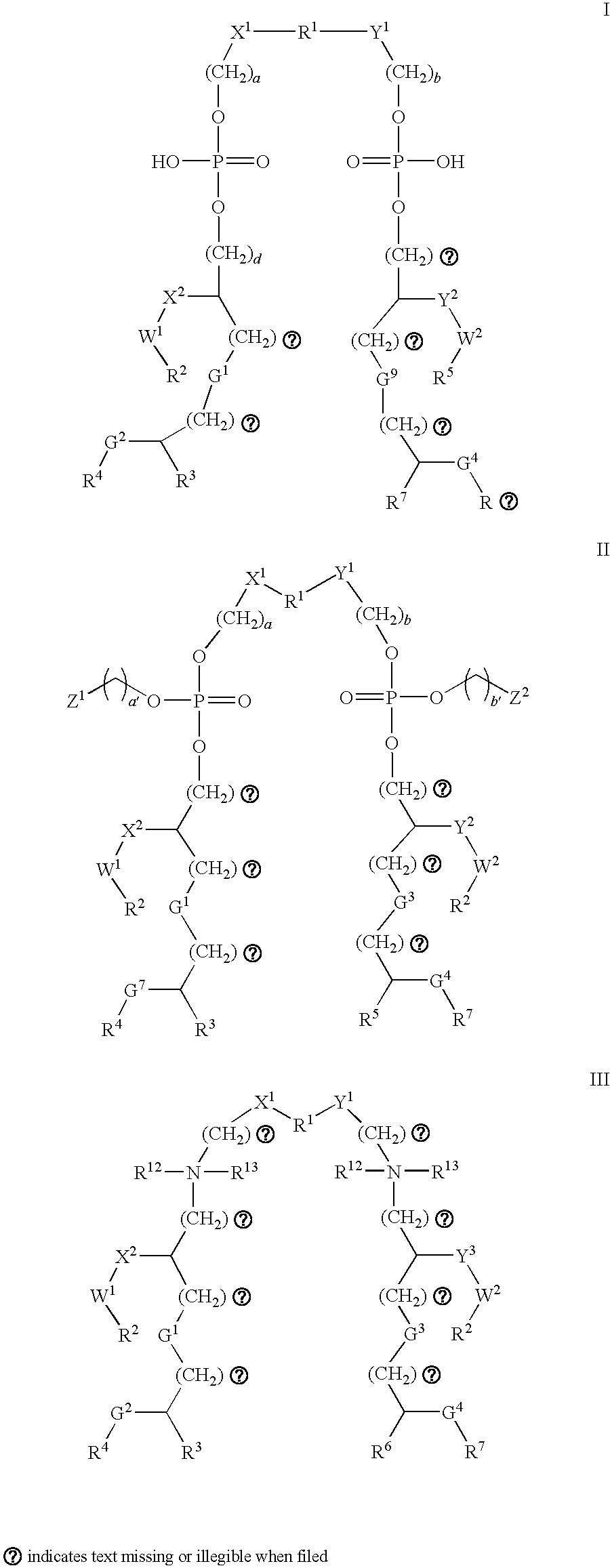
- as defined in reference 109, such as ‘ER 803058’, ‘ER 803732’, ‘ER 804053’, ER 804058’, ‘ER 804059’, ‘ER 804442’, ‘ER 804680’, ‘ER 804764’, ER 803022 or ‘ER 804057’ e.g.:
-

- F. Human Immunomodulators
- Human immunomodulators suitable for use as adjuvants in the invention include cytokines, such as interleukins (e.g. IL-1, IL-2, IL-4, IL-5, IL-6, IL-7, IL-12 [110], etc.) [111], interferons (e.g. interferon-γ), macrophage colony stimulating factor, tumor necrosis factor and macrophage inflammatory protein-lalpha (MIP-1alpha) and MIP-1beta [112].
- G. Bioadhesives and Mucoadhesives
- Bioadhesives and mucoadhesives may also be used as adjuvants in the invention. Suitable bioadhesives include esterified hyaluronic acid microspheres [113] or mucoadhesives such as cross-linked derivatives of poly(acrylic acid), polyvinyl alcohol, polyvinyl pyrollidone, polysaccharides and carboxymethylcellulose. Chitosan and derivatives thereof may also be used as adjuvants in the invention [114].
- H. Microparticles
- Microparticles may also be used as adjuvants in the invention. Microparticles (i.e. a particle of ˜100 nm to ˜150 μm in diameter, more preferably ˜200 nm to ˜30 μm in diameter, and most preferably ˜500 nm to ˜10 μm in diameter) formed from materials that are biodegradable and non-toxic (e.g. a poly(α-hydroxy acid), a polyhydroxybutyric acid, a polyorthoester, a polyanhydride, a polycaprolactone, etc.), with poly(lactide-co-glycolide) are preferred, optionally treated to have a negatively-charged surface (e.g. with SDS) or a positively-charged surface (e.g. with a cationic detergent, such as CTAB).
- I. Liposomes (Chapters 13 & 14 of ref 53)
- Examples of liposome formulations suitable for use as adjuvants are described in refs. 115-117.
- J. Polyoxyethylene Ether and Polyoxyethylene Ester Formulations
- Adjuvants suitable for use in the invention include polyoxyethylene ethers and polyoxyethylene esters [118]. Such formulations further include polyoxyethylene sorbitan ester surfactants in combination with an octoxynol [119] as well as polyoxyethylene alkyl ethers or ester surfactants in combination with at least one additional non-ionic surfactant such as an octoxynol [120]. Preferred polyoxyethylene ethers are selected from the following group: polyoxyethylene-9-lauryl ether (laureth 9), polyoxyethylene-9-steoryl ether, polyoxytheylene-8-steoryl ether, polyoxyethylene-4-lauryl ether, polyoxyethylene-35-lauryl ether, and polyoxyethylene-23-lauryl ether.
- K Phosphazenes e.g. PCPP.
- Phosphazene adjuvants include poly[di(carboxylatophenoxy)phosphazene] (“PCPP”) as described, for example, in refs. 121 and 122.
- L. Muramyl Peptides
- Examples of muramyl peptides suitable for use as adjuvants in the invention include N-acetyl-muramyl-L-threonyl-D-isoglutamine (thr-MDP), N-acetyl-normuramyl-L-alanyl-D-isoglutamine (nor-MDP), and N-acetylmuramyl-L-alanyl-D-isoglutaminyl-L-alanine-2-(1′-2′-dipalmitoyl-sn-glycero-3-hydroxyphosphoryloxy)-ethylamine MTP-PE).
- M. Imidazoquinoline Compounds.
- Imidazoquinoline adjuvants include Imiquimod (“R-837”) [123,124], Resiquimod (“R-848”) [125], and their analogs; and salts thereof (e.g. the hydrochloride salts). Further details about immunostimulatory imidazoquinolines can be found in references 126 to 130.
- N. Thiosemicarbazone Compounds.
- Examples of thiosemicarbazone compounds, as well as methods of formulating, manufacturing, and screening for compounds all suitable for use as adjuvants in the invention include those described in ref. 131. The thiosemicarbazones are particularly effective in the stimulation of human peripheral blood mononuclear cells for the production of cytokines, such as TNF-α.
- O. Tryptanthrin Compounds.
- Examples of tryptanthrin compounds, as well as methods of formulating, manufacturing, and screening for compounds all suitable for use as adjuvants in the invention include those described in ref. 132. The tryptanthrin compounds are particularly effective in the stimulation of human peripheral blood mononuclear cells for the production of cytokines, such as TNF-α.
- P. Nucleoside Analogs
- Various nucleoside analogs can be used as adjuvants, such as (a) Isatorabine (ANA-245; 7-thia-8-oxoguanosine):
-

- and prodrugs thereof; (b) ANA975; (c) ANA-025-1; (d) ANA380; (e) the compounds disclosed in references 133 to 135; (f) a compound having the formula:
-
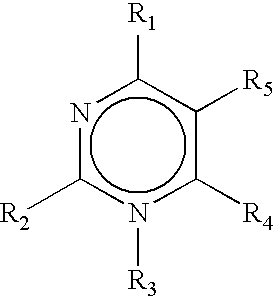
-
- wherein:
- R1 and R2 are each independently H, halo, —NRaRb, —OH, C1-6 alkoxy, substituted C1-6 alkoxy, heterocyclyl, substituted heterocyclyl, C6-10 aryl, substituted C6-10 aryl, C1-6 alkyl, or substituted C1-6 alkyl;
- R3 is absent, H, C1-6 alkyl, substituted C1-6 alkyl, C6-10 aryl, substituted C6-10 aryl, heterocyclyl, or substituted heterocyclyl;
- R4 and R5 are each independently H, halo, heterocyclyl, substituted heterocyclyl, —C(O)—Rd, C1-6 alkyl, substituted C1-6 alkyl, or bound together to form a 5 membered ring as in R4-5:
- wherein:
-

-
-
-
- the binding being achieved at the bonds indicated by a

- the binding being achieved at the bonds indicated by a
- X1 and X2 are each independently N, C, O, or S;
- R8 is H, halo, —OH, C1-6 alkyl, C2-6 alkenyl, C2-6 alkynyl, —OH, —NRaRb, —(CH2)n—O—Rc, —O—(C1-6 alkyl), —S(O)pRe, or —C(O)—Rd;
- R9 is H, C1-6 alkyl, substituted C1-6 alkyl, heterocyclyl, substituted heterocyclyl or R9a, wherein R9a is:
-
-
-

-
-
-
- the binding being achieved at the bond indicated by a
- the binding being achieved at the bond indicated by a
- R10 and R11 are each independently H, halo, C1-6 alkoxy, substituted C1-6 alkoxy, —NRaRb, or —OH;
- each Ra and Rb is independently H, C1-6 alkyl, substituted C1-6 alkyl, —C(O)Rd, C6-10 aryl;
- each Rc is independently H, phosphate, diphosphate, triphosphate, C1-6 alkyl, or substituted C1-6 alkyl;
- each Rd is independently H, halo, C1-6 alkyl, substituted C1-6 alkyl, C1-6 alkoxy, substituted C1-6 alkoxy, —NH2, —NH(C1-6 alkyl), —NH(substituted C1-6 alkyl), —N(C1-6 alkyl)2, —N(substituted C1-6 alkyl)2, C6-10 aryl, or heterocyclyl;
- each Re is independently H, C1-6 alkyl, substituted C1-6 alkyl, C6-10 aryl, substituted C6-10 aryl, heterocyclyl, or substituted heterocyclyl;
- each Rf is independently H, C1-6 alkyl, substituted C1-6 alkyl, —C(O)Rd, phosphate, diphosphate, or triphosphate;
- each n is independently 0, 1, 2, or 3;
- each p is independently 0, 1, or 2; or
-
- or (g) a pharmaceutically acceptable salt of any of (a) to (f), a tautomer of any of (a) to (f), or a pharmaceutically acceptable salt of the tautomer.
-
- Q. Lipids Linked to a Phosphate-Containing Acyclic Backbone
- Adjuvants containing lipids linked to a phosphate-containing acyclic backbone include the TLR4 antagonist E5564 [136,137]:
-
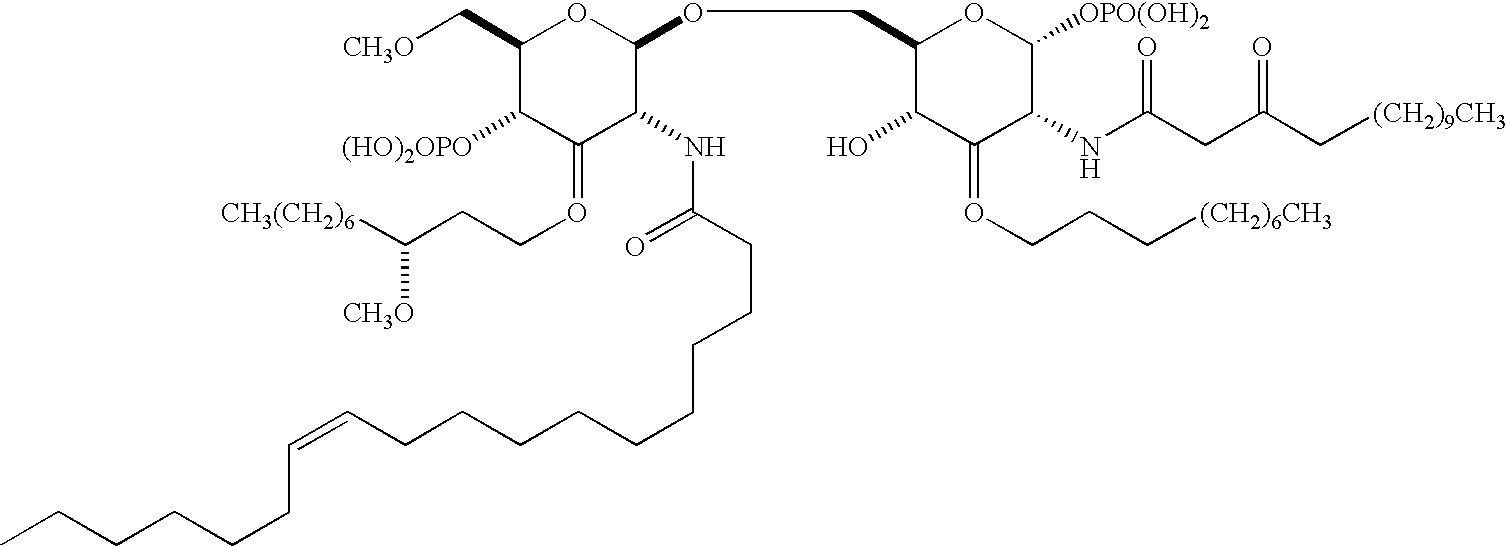
- R. Small Molecule Immunopotentiators (SMIPs)
- SMIPs include:
-
- N2-methyl-1-(2-methylpropyl)-1H-imidazo[4,5-c]quinoline-2,4-diamine;
- N2,N2-dimethyl-1-(2-methylpropyl)-1H-imidazo[4,5-c]quinoline-2,4-diamine;
- N2-ethyl-N2-methyl-1-(2-methylpropyl)-1H-imidazo[4,5-c]quinoline-2,4-diamine;
- N2-methyl-1-(2-methylpropyl)-N2-propyl-1H-imidazo[4,5-c]quinoline-2,4-diamine;
- 1-(2-methylpropyl)-N2-propyl-1H-imidazo[4,5-c]quinoline-2,4-diamine;
- N2-butyl-1-(2-methylpropyl)-1H-imidazo[4,5-c]quinoline-2,4-diamine;
- N2-butyl-N2-methyl-1-(2-methylpropyl)-1H-imidazo[4,5-c]quinoline-2,4-diamine;
- N2-methyl-1-(2-methylpropyl)-N2-pentyl-1H-imidazo[4,5-c]quinoline-2,4-diamine;
- N2-methyl-1-(2-methylpropyl)-N2-prop-2-enyl-1H-imidazo[4,5-c]quinoline-2,4-diamine;
- 1-(2-methylpropyl)-2-[(phenylmethyl)thio]-1H-imidazo[4,5-c]quinolin-4-amine;
- 1-(2-methylpropyl)-2-(propylthio)-1H-imidazo[4,5-c]quinolin-4-amine;
- 2-[[4-amino-1-(2-methylpropyl)-1H-imidazo[4,5-c]quinolin-2-yl](methyl)amino]ethanol;
- 2-[[4-amino-1-(2-methylpropyl)-1H-imidazo[4,5-c]quinolin-2-yl](methyl)amino]ethyl acetate;
- 4-amino-1-(2-methylpropyl)-1,3-dihydro-2H-imidazo[4,5-c]quinolin-2-one;
- N2-butyl-1-(2-methylpropyl)-N4,N4-bis(phenylmethyl)-1H-imidazo[4,5-c]quinoline-2,4-diamine;
- N2-butyl-N2-methyl-1-(2-methylpropyl)-N4,N4-bis(phenylmethyl)-1H-imidazo[4,5-c]quinoline-2,4-diamine;
- N2-methyl-1-(2-methylpropyl)-N4,N4-bis(phenylmethyl)-1H-imidazo[4,5-c]quinoline-2,4-diamine;
- N2,N2-dimethyl-1-(2-methylpropyl)-N4,N4-bis(phenylmethyl)-1H-imidazo[4,5-c]quinoline-2,4-diamine;
- 1-{4-amino-2-[methyl(propyl)amino]-1H-imidazo[4,5-c]quinolin-1-yl}-2-methylpropan-2-ol;
- 1-[4-amino-2-(propylamino)-1H-imidazo[4,5-c]quinolin-1-yl]-2-methylpropan-2-ol;
- N4,N4-dibenzyl-1-(2-methoxy-2-methylpropyl)-N2-propyl-1H-imidazo[4,5-c]quinoline-2,4-diamine.
- S. Proteosomes
- One adjuvant is an outer membrane protein proteosome preparation prepared from a first Gram-negative bacterium in combination with a liposaccharide preparation derived from a second Gram-negative bacterium, wherein the outer membrane protein proteosome and liposaccharide preparations form a stable non-covalent adjuvant complex. Such complexes include “IVX-908”, a complex comprised of Neisseria meningitidis outer membrane and lipopolysaccharides. They have been used as adjuvants for influenza vaccines [138].
- T. Other Adjuvants
- Other substances that act as immunostimulating agents are disclosed in references 53 and 58. Further useful adjuvant substances include:
-
- Methyl inosine 5′-monophosphate (“MIMP”) [139].
- A polyhydroxlated pyrrolizidine compound [140], such as one having formula:
-
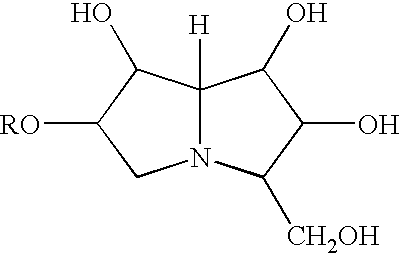
- where R is selected from the group comprising hydrogen, straight or branched, unsubstituted or substituted, saturated or unsaturated acyl, alkyl (e.g. cycloalkyl), alkenyl, alkynyl and aryl groups, or a pharmaceutically acceptable salt or derivative thereof. Examples include, but are not limited to: casuarine, casuarine-6-α-D-glucopyranose, 3-epi-casuarine, 7-epi-casuarine, 3,7-diepi-casuarine, etc.
-
- A gamma inulin [141] or derivative thereof, such as algammulin.
- Compounds disclosed in reference 142.
- Compounds disclosed in reference 143, including: Acylpiperazine compounds, Indoledione compounds, Tetrahydraisoquinoline (THIQ) compounds, Benzocyclodione compounds, Aminoazavinyl compounds, Aminobenzimidazole quinolinone (ABIQ) compounds [144,145], Hydrapthalamide compounds, Benzophenone compounds, Isoxazole compounds, Sterol compounds, Quinazilinone compounds, Pyrrole compounds [146], Anthraquinone compounds, Quinoxaline compounds, Triazine compounds, Pyrazalopyrimidine compounds, and Benzazole compounds [147].
- Loxoribine (7-allyl-8-oxoguanosine) [148].
- A formulation of a cationic lipid and a (usually neutral) co-lipid, such as aminopropyl-dimethyl-myristoleyloxy-propanaminium bromide-diphytanoylphosphatidyl-ethanolamine (“Vaxfectin™”) or aminopropyl-dimethyl-bis-dodecyloxy-propanaminium bromide-dioleoylphosphatidyl-ethanolamine (“GAP-DLRIE:DOPE”). Formulations containing (±)-N-(3-aminopropyl)-N,N-dimethyl-2,3-bis(syn-9-tetradeceneyloxy)-1-propanaminium salts are preferred [149].
- The invention may also comprise combinations of one or more of the adjuvants identified above. For example, the following combinations may be used as adjuvant compositions in the invention: (1) a saponin and an oil-in-water emulsion [150]; (2) a saponin (e.g. QS21)+a non-toxic LPS derivative (e.g. 3dMPL) [151]; (3) a saponin (e.g. QS21)+a non-toxic LPS derivative (e.g. 3dMPL)+a cholesterol; (4) a saponin (e.g. QS21)+3dMPL+IL-12 (optionally +a sterol) [152]; (5) combinations of 3dMPL with, for example, QS21 and/or oil-in-water emulsions [153]; (6) SAF, containing 10% squalane, 0.4% Tween 80™, 5% pluronic-block polymer L121, and thr-MDP, either microfluidized into a submicron emulsion or vortexed to generate a larger particle size emulsion. (7) Ribi™ adjuvant system (RAS), (Ribi Immunochem) containing 2% squalene, 0.2% Tween 80, and one or more bacterial cell wall components from the group consisting of monophosphorylipid A (MPL), trehalose dimycolate (TDM), and cell wall skeleton (CWS), preferably MPL+CWS (Detox™); (8) one or more mineral salts (such as an aluminum salt)+a non-toxic derivative of LPS (such as 3dMPL); and (9) one or more mineral salts (such as an aluminum salt)+an immunostimulatory oligonucleotide (such as a nucleotide sequence including a CpG motif).
- The compositions of the invention will preferably elicit both a cell mediated immune response as well as a humoral immune response in order to effectively address a uropathogenic infection. This immune response will preferably induce long lasting (e.g. neutralising) antibodies and a cell mediated immunity that can quickly respond upon exposure to UPEC-associated antigens.
- Two types of T cells, CD4 and CD8 cells, are generally thought necessary to initiate and/or enhance cell mediated immunity and humoral immunity. CD8 T cells can express a CD8 co-receptor and are commonly referred to as cytotoxic T lymphocytes (CTLs). CD8 T cells are able to recognized or interact with antigens displayed on MHC Class I molecules. CD4 T cells can express a CD4 co-receptor and are commonly referred to as T helper cells. CD4 T cells are able to recognize antigenic peptides bound to MHC class H molecules. Upon interaction with a MHC class II molecule, the CD4 cells can secrete factors such as cytokines. These secreted cytokines can activate B cells, cytotoxic T cells, macrophages, and other cells that participate in an immune response. Helper T cells or CD4+ cells can be further divided into two functionally distinct subsets: TH1 phenotype and TH2 phenotypes which differ in their cytokine and effector function.
- Activated TH1 cells enhance cellular immunity (including an increase in antigen-specific CTL production) and are therefore of particular value in responding to intracellular infections. Activated TH1 cells may secrete one or more of IL-2, IFN-γ, and TNF-β. A TH1 immune response may result in local inflammatory reactions by activating macrophages, NK (natural killer) cells, and CD8 cytotoxic T cells (CTLs). A TH1 immune response may also act to expand the immune response by stimulating growth of B and T cells with IL-12. TH1 stimulated B cells may secrete IgG2a.
- Activated TH2 cells enhance antibody production and are therefore of particular value in responding to extracellular infections. Activated TH2 cells may secrete one or more of IL-4, IL-5, IL-6, and IL-10. A TH2 immune response may result in the production of IgG1, IgE, IgA and memory B cells for future protection.
- An enhanced immune response may include one or more of an enhanced TH1 immune response and a TH2 immune response. An enhanced TH1 immune response may include one or more of an increase in CTLs, an increase in one or more of the cytokines associated with a TH1 immune response (such as IL-2, IFN-γ, and TNF-β), an increase in activated macrophages, an increase in NK activity, or an increase in the production of IgG2a. Preferably, the enhanced TH1 immune response will include an increase in IgG2a production. An enhanced TH2 immune response may include one or more of an increase in one or more of the cytokines associated with a TH2 immune response (such as IL-4, IL-5, IL-6 and IL-10), or an increase in the production of IgG1, IgE, IgA and memory B cells. Preferably, the enhanced TH2 immune resonse will include an increase in IgG1 production.
- A TH1 immune response may be elicited using a TH1 adjuvant. A TH1 adjuvant will generally elicit increased levels of IgG2a production relative to immunization of the antigen without adjuvant. TH1 adjuvants suitable for use in the invention may include for example saponin formulations, virosomes and virus like particles, non-toxic derivatives of enterobacterial lipopolysaccharide (LPS), immunostimulatory oligonucleotides. Immunostimulatory oligonucleotides, such as oligonucleotides containing a CpG motif, are preferred TH1 adjuvants for use in the invention.
- A TH2 immune response may be elicited using a TH2 adjuvant. A TH2 adjuvant will generally elicit increased levels of IgG1 production relative to immunization of the antigen without adjuvant. TH2 adjuvants suitable for use in the invention include, for example, mineral containing compositions, oil-emulsions, and ADP-ribosylating toxins and detoxified derivatives hereof. Mineral containing compositions, such as aluminium salts are preferred TH2 adjuvants for use in the invention.
- Preferably, the invention includes a composition comprising a combination of a TH1 adjuvant and a TH2 adjuvant. Preferably, such a composition elicits an enhanced TH1 and an enhanced TH2 response i.e. an increase in the production of both IgG1 and IgG2a production relative to immunization without an adjuvant. Still more preferably, the composition comprising a combination of a TH1 and a TH2 adjuvant elicits an increased TH1 and/or an increased TH2 immune response relative to immunization with a single adjuvant (i.e. relative to immunization with a TH1 adjuvant alone or immunization with a TH2 adjuvant alone).
- The immune response may be one or both of a TH1 immune response and a TH2 response. Preferably, immune response provides for one or both of an enhanced TH1 response and an enhanced TH2 response.
- The enhanced immune response may be one or both of a systemic and a mucosal immune response. Preferably, the immune response provides for one or both of an enhanced systemic and an enhanced mucosal immune response. Preferably the mucosal immune response is a TH2 immune response. Preferably, the mucosal immune response includes an increase in the production of IgA.
- The use of an aluminium hydroxide or aluminium phosphate adjuvant is particularly preferred, and antigens are generally adsorbed to these salts.
- The pH of compositions of the invention is preferably between 6 and 8, preferably about 7. Stable pH may be maintained by the use of a buffer. Where a composition comprises an aluminium hydroxide salt, it is preferred to use a histidine buffer [154]. The composition may be sterile and/or pyrogen-free. Compositions of the invention may be isotonic with respect to humans.
- Compositions may be presented in vials, or they may be presented in ready-filled syringes. The syringes may be supplied with or without needles. A syringe will include a single dose of the composition, whereas a vial may include a single dose or multiple doses. Injectable compositions will usually be liquid solutions or suspensions. Alternatively, they may be presented in solid form (e.g. freeze-dried) for solution or suspension in liquid vehicles prior to injection.
- Compositions of the invention may be packaged in unit dose form or in multiple dose form. For multiple dose forms, vials are preferred to pre-filled syringes. Effective dosage volumes can be routinely established, but a typical human dose of the composition for injection has a volume of 0.5 ml.
- Where a composition of the invention is to be prepared extemporaneously prior to use (e.g. where a component is presented in lyophilised form) and is presented as a kit, the kit may comprise two vials, or it may comprise one ready-filled syringe and one vial, with the contents of the syringe being used to reactivate the contents of the vial prior to injection.
- Thus the invention provides for a kit comprising a first component and a second component, wherein: the first component comprises one or more polypeptide, antibody, vesicle and/or nucleic acid of the invention; and the second component comprises one or more of the following: instructions for administering a composition to a patient, a syringe or other delivery device, an adjuvant, and/or a pharmaceutically acceptable formulating solution.
- The invention also provides a delivery device (e.g. a syringe) pre-filled with the immunogenic compositions of the invention.
- Immunogenic compositions used as vaccines comprise an immunologically effective amount of antigen(s), as well as any other components, as needed. By ‘immunologically effective amount’, it is meant that the administration of that amount to an individual, either in a single dose or as part of a series, is effective for treatment or prevention. This amount varies depending upon the health and physical condition of the individual to be treated, age, the taxonomic group of individual to be treated (e.g. non-human primate, primate, etc.), the capacity of the individual's immune system to synthesise antibodies, the degree of protection desired, the formulation of the vaccine, the treating doctor's assessment of the medical situation, and other relevant factors. It is expected that the amount will fall in a relatively broad range that can be determined through routine trials, and a typical quantity of each antigen per dose is between 0.1 μg and 1 mg per antigen.
- Nucleic Acid Immunisation
- The immunogenic compositions described above include polypeptide antigens from UPEC. As an alternative to using proteins antigens in the immunogenic compositions of the invention, nucleic acid (preferably DNA e.g. in the form of a plasmid) encoding the antigen may be used, to give compositions, methods and uses based on nucleic acid immunisation. Nucleic acid immunisation is now a developed field (e.g. see references 155 to 162 etc.), and has been applied to many vaccines.
- The nucleic acid encoding the immunogen is expressed in vivo after delivery to a patient and the expressed immunogen then stimulates the immune system. The active ingredient will typically take the form of a nucleic acid vector comprising: (i) a promoter; (ii) a sequence encoding the immunogen, operably linked to the promoter; and optionally (iii) a selectable marker. Preferred vectors may further comprise (iv) an origin of replication; and (v) a transcription terminator downstream of and operably linked to (ii). In general, (i) and (v) will be eukaryotic and (iii) and (iv) will be prokaryotic.
- Preferred promoters are viral promoters e.g. from cytomegalovirus (CMV). The vector may also include transcriptional regulatory sequences (e.g. enhancers) in addition to the promoter and which interact functionally with the promoter. Preferred vectors include the immediate-early CMV enhancer/promoter, and more preferred vectors also include CMV intron A. The promoter is operably linked to a downstream sequence encoding an immunogen, such that expression of the immunogen-encoding sequence is under the promoter's control.
- Where a marker is used, it preferably functions in a microbial host (e.g. in a prokaryote, in a bacteria, in a yeast). The marker is preferably a prokaryotic selectable marker (e.g. transcribed under the control of a prokaryotic promoter). For convenience, typical markers are antibiotic resistance genes.
- The vector of the invention is preferably an autonomously replicating episomal or extrachromosomal vector, such as a plasmid.
- The vector of the invention preferably comprises an origin of replication. It is preferred that the origin of replication is active in prokaryotes but not in eukaryotes.
- Preferred vectors thus include a prokaryotic marker for selection of the vector, a prokaryotic origin of replication, but a eukaryotic promoter for driving transcription of the immunogen-encoding sequence. The vectors will therefore (a) be amplified and selected in prokaryotic hosts without polypeptide expression, but (b) be expressed in eukaryotic hosts without being amplified. This arrangement is ideal for nucleic acid immunization vectors.
- The vector of the invention may comprise a eukaryotic transcriptional terminator sequence downstream of the coding sequence. This can enhance transcription levels. Where the coding sequence does not have its own, the vector of the invention preferably comprises a polyadenylation sequence. A preferred polyadenylation sequence is from bovine growth hormone.
- The vector of the invention may comprise a multiple cloning site.
- In addition to sequences encoding the immunogen and a marker, the vector may comprise a second eukaryotic coding sequence. The vector may also comprise an IRES upstream of said second sequence in order to permit translation of a second eukaryotic polypeptide from the same transcript as the immunogen. Alternatively, the immunogen-coding sequence may be downstream of an IRES.
- The vector of the invention may comprise unmethylated CpG motifs e.g. unmethylated DNA sequences which have in common a cytosine preceding a guanosine, flanked by two 5′ purines and two 3′ pyrimidines. In their unmethylated form these DNA motifs have been demonstrated to be potent stimulators of several types of immune cell.
- Vectors may be delivered in a targeted way. Receptor-mediated DNA therapy techniques are described in, for example, references 163 to 168. Therapeutic compositions containing a nucleic acid are administered in a range of about 100 ng to about 200 mg of DNA for local administration in a gene therapy protocol. Concentration ranges of about 500 ng to about 50 mg, about 1 μg to about 2 mg, about 5 μg to about 500 μg, and about 20 μg to about 100 μg of DNA can also be used during a gene therapy protocol. Factors such as method of action (e.g. for enhancing or inhibiting levels of the encoded gene product) and efficacy of transformation and expression are considerations which will affect the dosage required for ultimate efficacy. Where greater expression is desired over a larger area of tissue, larger amounts of vector or the same amounts re-administered in a successive protocol of administrations, or several administrations to different adjacent or close tissue portions may be required to effect a positive therapeutic outcome. In all cases, routine experimentation in clinical trials will determine specific ranges for optimal therapeutic effect.
- Vectors can be delivered using gene delivery vehicles. The gene delivery vehicle can be of viral or non-viral origin (see generally references 169 to 172).
- Viral-based vectors for delivery of a desired nucleic acid and expression in a desired cell are well known in the art. Exemplary viral-based vehicles include, but are not limited to, recombinant retroviruses (e.g. references 173 to 183), alphavirus-based vectors (e.g. Sindbis virus vectors, Semliki forest virus (ATCC VR-67; ATCC VR-1247), Ross River virus (ATCC VR-373; ATCC VR-1246) and Venezuelan equine encephalitis virus (ATCC VR-923; ATCC VR-1250; ATCC VR 11249; ATCC VR-532); hybrids or chimeras of these viruses may also be used (e.g. U.S. Publication No. US20030148262; International Publication No. WO02/099035)), poxvirus vectors (e.g. vaccinia, fowlpox, canarypox, modified vaccinia Ankara, etc.), adenovirus vectors, and adeno-associated virus (AAV) vectors (e.g. see refs. 184 to 189). Administration of DNA linked to killed adenovirus [190] can also be employed.
- Non-viral delivery vehicles and methods can also be employed, including, but not limited to, polycationic condensed DNA linked or unlinked to killed adenovirus alone [e.g. 190], ligand-linked DNA [191], eukaryotic cell delivery vehicles cells [e.g. refs. 192 to 196] and nucleic charge neutralization or fusion with cell membranes. Naked DNA can also be employed. Exemplary naked DNA introduction methods are described in refs. 197 and 198. Liposomes (e.g. immunoliposomes) that can act as gene delivery vehicles are described in refs. 199 to 203. Additional approaches are described in references 204 & 205.
- Further non-viral delivery suitable for use includes mechanical delivery systems such as the approach described in ref. 205. Moreover, the coding sequence and the product of expression of such can be delivered through deposition of photopolymerized hydrogel materials or use of ionizing radiation [e.g. refs. 206 & 207]. Other conventional methods for gene delivery that can be used for delivery of the coding sequence include, for example, use of hand-held gene transfer particle gun [208] or use of ionizing radiation for activating transferred genes [206 & 207].
- Delivery DNA using PLG {poly(lactide-co-glycolide)} microparticles is a particularly preferred method e.g. by adsorption to the microparticles, which are optionally treated to have a negatively-charged surface (e.g. treated with SDS) or a positively-charged surface (e.g. treated with a cationic detergent, such as CTAB).
- Pharmaceutical Uses
- The invention also provides a method of treating a patient, comprising administering to the patient a therapeutically effective amount of a composition of the invention. The patient may either be at risk from the disease themselves or may be a pregnant woman (‘maternal immunisation’ [209]).
- The invention provides nucleic acid, polypeptide, vesicle or antibody of the invention for use as medicaments (e.g. as immunogenic compositions or as vaccines, or in a method of treating a patient) or as diagnostic reagents. It also provides the use of nucleic acid, polypeptide, vesicle or antibody of the invention in the manufacture of: (i) a medicament for treating or preventing disease and/or infection caused by an ExPEC bacterium; (ii) a diagnostic reagent for detecting the presence of or of antibodies raised against an ExPEC bacterium; and/or (iii) a reagent which can raise antibodies against an ExPEC bacterium. Said ExPEC bacterium can be of any serotype or strain. Preferably the ExPEC bacterium is a UPEC strain.
- The invention is useful for the prevention and/or treatment of diseases such as bacteremia, meningitis, a urinary tract infection, pyelonephritis and/or cystitis. The invention is particularly useful for the treatment of urinary tract infections.
- The patient is preferably a human. The human is preferably an adult (e.g. aged between 20 and 55). A vaccine intended for children or adolescents may also be administered to adults e.g. to assess safety, dosage, immunogenicity, etc. Female patients are a preferred subset, with sexually-active females aged 20-55 being a particularly preferred patient group. Another groups of patients is females aged 12-20, particularly for prophylactic use.
- Other possible patient animals include dogs, which may be carriers of ExPEC [210,211].
- One way of checking efficacy of therapeutic treatment involves monitoring infection after administration of the composition of the invention. One way of checking efficacy of prophylactic treatment involves monitoring immune responses against an administered polypeptide after administration. Immunogenicity of compositions of the invention can be determined by administering them to test subjects (e.g. children 12-16 months age, or animal models e.g. a mouse model) and then determining standard parameters including ELISA titres (GMT) of IgG. These immune responses will generally be determined around 4 weeks after administration of the composition, and compared to values determined before administration of the composition. Where more than one dose of the composition is administered, more than one post-administration determination may be made. Various mouse models of UTI are available [e.g. refs. 212 & 213-214].
- Administration of polypeptide antigens is a preferred method of treatment for inducing immunity. Administration of antibodies of the invention is another preferred method of treatment. This method of passive immunisation is particularly useful for newborn children or for pregnant women. This method will typically use monoclonal antibodies, which will be humanised or fully human.
- Compositions of the invention will generally be administered directly to a patient. Direct delivery may be accomplished by parenteral injection (e.g. subcutaneously, intraperitoneally, intravenously, intramuscularly, or to the interstitial space of a tissue), or by rectal, oral (e.g. tablet, spray), vaginal, topical, transdermal, transcutaneous, intranasal, sublingual, ocular, aural, pulmonary or other mucosal administration. Intramuscular administration to the thigh or the upper arm is preferred. Injection may be via a needle (e.g. a hypodermic needle), but needle-free injection may alternatively be used. A typical intramuscular dose is 0.5 ml.
- The invention may be used to elicit systemic and/or mucosal immunity. Preferably the enhanced systemic and/or mucosal immunity is reflected in an enhanced TH1 and/or TH2 immune response. Preferably, the enhanced immune response includes an increase in the production of IgG 1 and/or IgG2a and/or IgA.
- Dosage treatment can be a single dose schedule or a multiple dose schedule. Multiple doses may be used in a primary immunisation schedule and/or in a booster immunisation schedule. A primary dose schedule may be followed by a booster dose schedule. In a multiple dose schedule the various doses may be given by the same or different routes e.g. a parenteral prime and mucosal boost, a mucosal prime and parenteral boost, etc. Suitable timing between priming doses (e.g. between 4-16 weeks), and between priming and boosting, can be routinely determined. For example, a primary course of vaccination may include 1-10 separate doses, followed by other doses given at subsequent time intervals required to maintain and/or reinforce an immune response, for example, at 1-4 months for a second dose, and if needed, a subsequent dose or doses after several months. A single dose schedule may comprise one administration or multiple administrations (collectively a single dose schedule). A multiple dose schedule comprises multiple doses, wherein each dose may comprise one administration or multiple administrations.
- Bacterial infections affect various areas of the body and so compositions may be prepared in various forms. For example, the compositions may be prepared as injectables, either as liquid solutions or suspensions. Solid forms suitable for solution in, or suspension in, liquid vehicles prior to injection can also be prepared (e.g. a lyophilised or a spray-freeze dried composition). The composition may be prepared for topical administration e.g. as an ointment, cream or powder. The composition be prepared for oral administration e.g. as a tablet or capsule, as a spray or as a syrup (optionally flavoured). The composition may be prepared for pulmonary administration e.g. as an inhaler, using a fine powder or a spray. The composition may be prepared as a suppository or pessary. The composition may be prepared for nasal, aural or ocular administration e.g. as spray, drops, gel or powder [e.g. refs 215 & 216]. The composition may be in kit form, designed such that a combined composition is reconstituted just prior to administration to a patient. Such kits may comprise one or more antigens in liquid form and one or more lyophilised antigens.
- Compositions of the invention may be administered to patients at substantially the same time as (e.g. during the same medical consultation or visit to a healthcare professional) other vaccines e.g. at substantially the same time as a measles vaccine, a mumps vaccine, a rubella vaccine, a MMR vaccine, a varicella vaccine, a MMRV vaccine, a diphtheria vaccine, a tetanus vaccine, a pertussis vaccine, a DTP vaccine, a conjugated H. influenzae type b vaccine, a human papillomavirus vaccine, an inactivated poliovirus vaccine, a hepatitis B virus vaccine, a pneumococcal conjugate vaccine, a meningococcal conjugate vaccine, etc. Similarly, they may be administered to patients at substantially the same time as (e.g. during the same medical consultation or visit to a healthcare professional) an antibiotic, and in particular an antibiotic compound active against UPEC.
- Further Antigenic Components of Compositions of the Invention
- The invention also provides a composition comprising a polypeptide or the invention and one or more of the following further antigens:
-
- a saccharide antigen from N. meningitidis serogroup A, C, W135 and/or Y (preferably all four), such as the oligosaccharide disclosed in ref. 217 from serogroup C [see also ref. 218] or the oligosaccharides of ref. 219.
- an antigen from N. meningitidis serogroup B such as those disclosed in refs. 220-228, etc.
- a saccharide antigen from Streptococcus pneumoniae [e.g. 229, 230, 231].
- an antigen from hepatitis A virus, such as inactivated virus [e.g. 232, 233].
- an antigen from hepatitis B virus, such as the surface and/or core antigens [e.g. 233, 234].
- an antigen from hepatitis C virus [e.g. 235].
- an antigen from HIV [236]
- a diphtheria antigen, such as a diphtheria toxoid [e.g. chapter 3 of ref. 237] e.g. the CRM197 mutant [e.g. 238].
- a tetanus antigen, such as a tetanus toxoid [e.g. chapter 4 of ref. 237].
- an antigen from Bordetella pertussis, such as pertussis holotoxin (PT) and filamentous haemagglutinin (FHA) from B. pertussis, optionally also in combination with pertactin and/or agglutinogens 2 and 3 [e.g. refs. 239 & 240].
- a saccharide antigen from Haemophilus influenzae B [e.g. 218].
- polio antigen(s) [e.g. 241, 242] such as IPV.
- measles, mumps and/or rubella antigens [e.g. chapters 9, 10 & 11 of ref. 237].
- varicella antigens.
- influenza antigen(s) [e.g. chapter 19 of ref. 237], such as the haemagglutinin and/or neuraminidase surface proteins. Influenza antigens may be derived from interpandemic (annual) flu strains. Influenza antigens may be derived from strains with the potential to cause a pandemic outbreak (i.e., influenza strains with new haemagglutinin compared to the haemagglutinin in currently circulating strains, or influenza strains which are pathogenic in avian subjects and have the potential to be transmitted horizontally in the human population, or influenza strains which are pathogenic to humans). Influenza antigens may be derived from viruses grown in eggs or cell culture.
- an antigen from Moraxella catarrhalis [e.g. 243].
- a saccharide antigen from Streptococcus agalactiae (group B streptococcus).
- an protein antigen from Streptococcus agalactiae (group B streptococcus) [e.g. 244-249]
- an antigen from N. gonorrhoeae [e.g. 220-222 and 250].
- an antigen from Chlamydia pneumoniae [e.g. refs. 251 to 257] or a combination of antigens from C. pneumoniae [e.g. 258].
- an antigen from Chlamydia trachomatis, or a combination of antigens from C. trachomatis [e.g. 259].
- an antigen from Porphyromonas gingivalis [e.g. 260].
- rabies antigen(s) [e.g. 261] such as lyophilised inactivated virus [e.g. 262, RabAvert™].
- antigen(s) from a paramyxovirus such as respiratory syncytial virus (RSV [263, 264]) and/or parainfluenza virus (PIV3 [265]).
- an antigen from Bacillus anthracis [e.g. 266, 267, 268].
- an antigen from Streptococcus pyogenes (group A streptococcus) [e.g. 245, 269, 270].
- an antigen from Staphylococcus aureus [e.g. 271].
- an antigen from a virus in the flaviviridae family (genus flavivirus), such as from yellow fever virus, Japanese encephalitis virus, four serotypes of Dengue viruses, tick-borne encephalitis virus, West Nile virus.
- a pestivirus antigen, such as from classical porcine fever virus, bovine viral diarrhoea virus, and/or border disease virus.
- a parvovirus antigen e.g. from parvovirus B19.
- a human papilloma virus (HPV) antigen [272]
- The composition may comprise one or more of these further antigens.
- In another embodiment, antigens of the invention are combined with one or more additional, non-E. coli antigens suitable for use in a vaccine designed to protect females against genitourinary and/or sexually transmitted diseases. For example, the antigens may be combined with an antigen derived from the group consisting of Streptococcus agalactiae, Chlamydia trachomatis, Neisseria gonorrhoeae, papillomavirus and herpes simplex virus. Where human papillomavirus antigens are used, they may be from one or more of the strains, HPV 16, HPV 18, HPV 6 and/or HPV 11.
- Preferred gonococcal antigens include one or more of ngs13 (OmpA), OmpH, ngs576 (peptidyl-prolyl cis/trans isomerase (PPIase) protein), ngs41 and ngs117.
- Preferred HPV antigens include one or more from the strains HPV 16, HPV 18, HPV 6 and HPV 11.
- Preferred Chlamydia trachomatis antigens include one or more of: CT045, CT089, CT242, CT316, CT381. CT396, CT398, CT444, CT467, CT547, CT587, CT823, CT761 and specific combinations of these antigens as disclosed in reference 273.
- Preferred Chlamydia pneumoniae antigens include one or more of: CPn0324, Cpn0301, Cpn0482, Cpn0503, Cpn0525, Cpn0558, Cpn0584, Cpn0800, Cpn0979, Cpn0498, Cpn0300, Cpn0042, Cpn0013, Cpn450, CpnO661, Cpn0557, Cpn0904, Clpn0795, Cpn0186 and Cpn0604 and specific combinations of these antigens as disclosed in reference 274.
- Preferred GBS antigens include one or more of GBS80, GBS 104, GBS 59, GBS 67, GBS 322 and GBS 276.
- In another embodiment, the antigen combinations of the invention are combined with one or more additional, non-ExPEC antigens suitable for use in a vaccine designed to protect elderly or immunocompromised individuals. For example, the antigen combinations may be combined with an antigen derived from the group consisting of Enterococcus faecalis, Staphylococcus aureus, Staphylococcus epidermis, Pseudomonas aeruginosa, Legionella pneumophila, Listeria monocytogenes, Neisseria meningitidies, influenza, and Parainfluenza virus (‘PIV’).
- Toxic protein antigens may be detoxified where necessary (e.g. detoxification of pertussis toxin by chemical and/or genetic means [240]).
- Where a diphtheria antigen is included in the composition it is preferred also to include tetanus antigen and pertussis antigens. Similarly, where a tetanus antigen is included it is preferred also to include diphtheria and pertussis antigens. Similarly, where a pertussis antigen is included it is preferred also to include diphtheria and tetanus antigens. DTP combinations are thus preferred.
- Saccharide antigens are preferably in the form of conjugates. Carrier proteins for the conjugates include bacterial toxins (such as diphtheria toxoid or tetanus toxoid), the N. meningitidis outer membrane protein [275], synthetic peptides [276,277], heat shock proteins [278,279], pertussis proteins [280,281], protein D from H. influenzae [282,283], cytokines [284], lymphokines [284], H. influenzae proteins, hormones [284], growth factors [284], toxin A or B from C. difficile [285], iron-uptake proteins [286], artificial proteins comprising multiple human CD4+T cell epitopes from various pathogen-derived antigens [287] such as the N19 protein [288], pneumococcal surface protein PspA [289], pneumolysin [290], etc. A preferred carrier protein is CRM197 protein [291].
- Antigens in the composition will typically be present at a concentration of at least 1 μg/ml each. In general, the concentration of any given antigen will be sufficient to elicit an immune response against that antigen.
- Antigens are preferably adsorbed to an aluminium salt.
- General
- The term “comprising” encompasses “including” as well as “consisting” e.g. a composition “comprising” X may consist exclusively of X or may include something additional e.g. X+Y.
- The term “about” in relation to a numerical value x means, for example, x±10%.
- The word “substantially” does not exclude “completely” e.g. a composition which is “substantially free” from Y may be completely free from Y. Where necessary, the word “substantially” may be omitted from the definition of the invention.
- The N-terminus residues in the amino acid sequences in the sequence listing are given as the amino acid encoded by the first codon in the corresponding nucleotide sequence. Where the first codon is not ATG, it will be understood that it will be translated as methionine when the codon is a start codon, but will be translated as the indicated non-Met amino acid when the sequence is at the C-terminus of a fusion partner. The invention specifically discloses and encompasses each of the amino acid sequences of the sequence listing having a N-terminus methionine residue (e.g. a formyl-methionine residue) in place of any indicated non-Met residue. It also specifically discloses and encompasses each of the amino acid sequences of the sequence listing starting at any internal methionine residues in the sequences.
- The sequences disclosed herein were originally identified in the 536 strain. Genome sequences of several other strains of E. coli are available. Standard search and alignment techniques can be used to identify in any of these (or other) further genome sequences the homolog of any particular sequence of the present invention. Moreover, the sequences can be used to design primers for amplification of homologous sequences from other strains. Thus the invention is not limited to strain 536 sequences, but rather encompasses such variants and homologs from other strains of E. coli, particularly ExPEC and UPEC strains. In general, suitable variants of a particular SEQ ID NO include its allelic variants, its polymorphic forms, its homologs, its orthologs, its paralogs, its mutants, etc.
- Thus, for instance, polypeptides used with the invention may, compared to the 536 sequence, include one or more (e.g. 1, 2, 3, 4, 5, 6, 7, 8, 9, etc.) amino acid substitutions, insertions, deletions, etc. as disclosed above.
- As indicated in the above text, nucleic acids and polypeptides of the invention may include sequences that:
-
- (a) are identical (i.e. 100% identical) to the sequences disclosed in the sequence listing;
- (b) share sequence identity with the sequences disclosed in the sequence listing;
- (c) have 1, 2, 3, 4, 5, 6, 7, 8, 9 or 10 single nucleotide or amino acid alterations (deletions, insertions, substitutions), which may be at separate locations or may be contiguous, as compared to the sequences of (a) or (b); and
- (d) when aligned with a particular sequence from the sequence listing using a pairwise alignment algorithm, a moving window of x monomers (amino acids or nucleotides) moving from start (N-terminus or 5′) to end (C-terminus of 3′), such that for an alignment that extends to p monomers (where p>x) there are p−x+1 such windows, each window has at least xy identical aligned monomers, where: x is selected from 20, 25, 30, 35, 40, 45, 50, 60, 70, 80, 90, 100, 150, 200; y is selected from 0.50, 0.60, 0.70, 0.75, 0.80, 0.85, 0.90, 0.91, 0.92, 0.93, 0.94, 0.95, 0.96, 0.97, 0.98, 0.99; and if xy is not an integer then it is rounded up to the nearest integer. The preferred pairwise alignment algorithm is the Needleman-Wunsch global alignment algorithm [292), using default parameters (e.g. with Gap opening penalty=10.0, and with Gap extension penalty=0.5, using the EBLOSUM62 scoring matrix). This algorithm is conveniently implemented in the needle tool in the EMBOSS package [293].
- The nucleic acids and polypeptides of the invention may additionally have further sequences to the N-terminus/5′ and/or C-terminus/3′ of these sequences (a) to (d).
- The practice of the present invention will employ, unless otherwise indicated, conventional methods of chemistry, biochemistry, molecular biology, immunology and pharmacology, within the skill of the art. Such techniques are explained fully in the literature. See, e.g., references 294-301, etc.
- In some embodiments, the invention does not encompass the polypeptides disclosed in reference 27, reference 28, U.S. Provisional Application No. 60/654,632 (filed Feb. 18, 2005; priority application for refs 27 & 28) or U.S. Provisional Application No. 60/712,720 (filed Aug. 29, 2005; priority application for ref. 28).
- Below are examples of specific embodiments or modes for carrying out the present invention. The examples are offered for illustrative purposes only, and are not intended to limit the scope of the present invention in any way.
- Efforts have been made to ensure accuracy with respect to numbers used (e.g., amounts, temperatures, etc.), but some experimental error and deviation should, of course, be allowed for.
- Computer-based comparative and predictive tools were used to identify 93 polypeptides from the UPEC 536 strain, using criteria such as (a) less than 90% sequence identity with two commensal strains (mg1655, DH10B), (b) have a length greater than 100 amino acids, (c) have a non-cytoplasmic cellular localisation, and (d) are common to another UPEC strain (CFT073) but are not found in an MNEC strain (IHE3034). These sequences are listed in the sequence listing. Their amino acid sequences are SEQ ID NOS: 8 to 100.
- In parallel studies, assays were carried out (see below) in order to select surface-exposed proteins, which are specific for UPEC strains and absent in non-pathogenic strains (commensal and laboratory strains). 76 polypeptides were identified, 11 of which had less than 80% homology with commensal strains (mg1655). The sequences of these 11 polypeptides are listed in the sequence listing and their amino acid sequences are SEQ ID NOS 1 to 10 and SEQ ID NO 85. The sequences of 7 of these polypeptides were identified by this method but not by the computer-based method. These sequences are listed in the sequence listing and their amino acid sequences are SEQ ID NOS 1 to 7. Table 1 shows the 76 polypeptides that were identified in this way (SEQ ID NOs 1 to 10, 85 and 101-165).
- In further work, SEQ ID NOs 166 and 167 were identified.
- SEQ ID NOs 1-167 are listed in the sequence listing. They are also referred to by ‘RECP’ nomenclature, as shown in Table 4.
- The invention provides a credible utility for these polypeptides, namely in the provision of immunogenic compositions as described herein.
- These polypeptides may be cloned, expressed and purified. The purified antigens may then be used to immunise mice, whose sera can be analysed by Western blot, ELISA and FACS, and further tested in both in vitro and in vivo experiments. Suitable in vitro experiments include testing the ability of antibodies to induce complement-mediated bacterial killing and/or opsonophagocytosis activity, to block binding of ExPEC strains (or the purified antigen) to human epithelial cells (e.g. in bladder cells) or other cell lines, and/or to inhibit adhesion/invasion of E. coli bacteria (e.g, K1 strain) to brain microvascular endothelial cells (BMEC). Suitable in vivo experiments include active and/or passive systemic immunisations and challenge in mouse models of UTI (adult mice), protection by active or passive immunisations against bacteremia and meningitis in 5-day-old rats challenged with E. coli K1 strain, and immunisation and intraperitoneal infection of adult mice with an ExPEC strain.
- The importance of the proteins to the bacterial life-cycle may be tested by creating isogenic knockout mutants. The mutants can also be used to ensure that sera raised by an antigen are specific for that antigen. Microarrays may be used to study expression patterns. Conservation and/or variability is assessed by sequencing the genes from multiple different ExPEC strains. The invention also provides an E. coli in which one or more of the polypeptides of the invention has/have been knocked out. A knockout mutation may be situated in the coding region of the gene or may lie within its transcriptional control regions (e.g. within its promoter). A knockout mutation will reduce the level of mRNA encoding the antigen to <1% of that produced by the wild-type bacterium, preferably <0.5%, more preferably <0.1%, and most preferably to 0%.
- Proteomic assays were carried out in order to select predicted surface-exposed proteins, which are specific for UPEC strains and absent in non-pathogenic strains (commensal and laboratory strains). Once selected these proteins may be expressed and purified and used to immunize mice.
- It is known from reference 43 that a mutation in any of the tol-pal genes of E. coli results in the formation of vesicles containing native outer membrane proteins. Proteins present in vesicles of UPEC strains and which had low homology to commensal strains such as mg1655 were selected as a small potential group of proteins that could be used as potential antigens.
- Lambda Red-Mediated Gene Manipulation in Commensal and Pathogenic E. Coli
- This method is a rapid PCR-based method used to inactivate the tolR gene from the wild-type E. coli l strains [302]. Briefly, the first step consists in amplifying independently the upstream and downstream regions of the target gene (tolR) and the resistance marker cassette. The two PCR products obtained in step 1 are mixed with the amplification producer of the AB cassette at equimolar concentrations and submitted to a second round of PCR (a three way PCR) to generate a resistance marker cassette flanked by upstream and downstream 500 bp (or more) regions homologous to the target gene. In the third step, large amounts (1 μg) of the desired linear DNA are electroporated into lamda-red competent cells.
- Vesicle Preparation
- 1. Vesicle Preparation by Precipitation with TCA
- LB media was inoculated with bacteria grown on plates and incubated overnight at 37° C. under gentle shaking. The culture was used to inoculate 200 ml of LB at OD600 0.1. Bacteria were grown to OD600 0.4 (or as specified). Culture was centrifuged for 10 minutes at 4000×g and the supernatant was filtered through a 0.22 mm filter to remove residual bacteria.
- The same experiments were also performed under iron limiting conditions by adding Dipyridyl (0.25 mM) to the LB media.
- Precipitation was performed by adding to the culture supernatant 10% final of a solution at 100% (w/v) TCA, 0.4% (w/v) deoxycholate. The precipitation was allowed to proceed for 30 minutes at 4° C. Precipitate was recovered by 10 minutes centrifugation at 20000×g at 4° C. The pellet was washed once with 10% TCA (w/v) and twice with absolute ethanol. The pellet was dried with speed vac, and stored at −20° C.
- The wild type and mutated strains were subjected to SDS polyacrylamide gel electrophoresis from which it could be observed that there were many more bands in the supernatant of the mutated strains than the wildtype strains. Randomly picked bands demonstrated that most of the proteins in the supernatant were membrane proteins, indicating enrichment in membrane content.
- 2. Vesicle Preparation by Ultracentrifugation
- Culture supernatant was ultracentrifuged at 200000×g for 2 hours at 4° C. The pellet was washed with PBS, resuspended in PBS, and stored at −20° C.
- 3. Guanidinium Denaturation of the Vesicles
- Prior to the guanidinium denaturation, Vesicles were precipitated with ethanol. 10 μg of OMV in PBS were precipitate by adding cold absolute ethanol to 90% final. Precipitation was allowed to proceed for 20 minutes at −20° C. Precipitate was recovered by 10 minutes centrifugation at 13000×g. Pellet was resuspended with 50 ml, 6M guanidinium, 15 mM DTT, 200 mM Tris-HCl, pH 8.0. Denaturation was allowed to proceed for 60 minutes at 60° C. Prior to digestion, solution was diluted ⅛ with a solution of 1.5M Tris pH 8.0 and 5 mg of trypsin were added to the diluted solution. Digestion was allowed to proceed overnight at 37° C. Reaction was stopped by adding 0.1% final of formic acid. Peptides were extracted using Oasis extraction cartridges. Peptides were analyzed by LC coupled MS-MS.
- 4. Surface Digestion
- 5 mg of trypsin were added to 10 mg of vesicles in PBS and incubated at 37° C. for 3 hours. Reaction was stopped by adding 0.1% final of formic acid. Peptides were recovered and desalted with Oasis extraction cartridge. Peptides were analyzed with LC coupled MSMS.
- Vesicle Analysis
- Protein Quantification
- Proteins were quantified with the Bradford method, using the BSA as standard.
- SDS-PAGE
- Samples were analyzed with a sodium dodecyl sulfate (SDS) 4-12% polyacrylamide gel, using a Mini-Protean II electrophoresis apparatus. Samples were suspended in SDS sample buffer (0.06 M Tris-HCl pH 6.8, 10% (v/v) glycerol, 2% (w/v) SDS, 5% (v/v) 2-mercaptoethanol, 10 mg/ml bromophenol blue) and heated to 100° C. for 5 min before SDS-polyacrylamide gel electrophoreis. After the run, gels were stained with Coomassie Blue
- MALDI-TOF Mass Spectrometry.
- Protein bands or spots were excised from gels, washed with 50 mM ammonium bicarbonate/acetonitrile (50/50, v/v) twice, washed once with pure acetonitrile and air-dried. The dried spots were digested at 37° C. for 2 h by adding 7 to 10 ml of a solution containing 5 mM ammonium bicarbonate, 0.012 mg of sequencing-grade trypsin. After digestion 0.6 ml were loaded on a matrix pre-spotted target and air-dried. Spots were washed with 0.6 ml of a solution of 70% ethanol, 0.1% trifluoracetic acid. Mass spectra were acquired on an ultraflex MALDI TOF mass spectrometer. Spectra were externally calibrated by using a combination of standards pre-spotted on the target. Protein identification was carried out by both automatic and manual comparisons of experimentally generated monoisotopic peaks of peptides in the mass range of 700 to 3,000 Da with computer-generated fingerprints, using the Mascot program.
- Bi-Dimensional Electrophoresis
- 200 mg of vesicles were resuspended in an Immobiline re-swelling solution (7M urea, 2M thiourea, 2% (w/v) CHAPS (2% w/v) ASB14, 2% (v/v) IPG buffer pH 3-10 NL, 2 mM TBP, 65 mM DTT), and adsorbed overnight on 7 cm Immobiline DryStrips (pH 3-10 NL). Proteins were then separated by 2D electrophoresis. The first dimension was run using a IPGphor Isoelectric Focusing Unit, applying sequentially 150 V for 35 minutes, 500 V for 35 minutes, 1,000 V for 30 minutes, 2,600 V for 10 minutes, 3,500 V for 15 minutes, 4,200 V for 15 minutes, and finally 5,000 V to reach 10 kVh. For the second dimension, the strips were equilibrated by two 10 minute -incubations in 4 M urea, 2 M thiourea, 30% glycerol, 2% SDS, 5 mM TBP, 50 Mm Tris HCl pH 8.8, 2.5% acrylamide, Bromo phenol Blue 0.2%: Proteins were then separated on linear 4-12% precasted polyacrylamide gels.
- Gels were stained with colloidal Coomassie Blue and scanned with a Personal Densitometer SI. Images were analyzed with Image Master 2D Elite software.
- Nano-LC/MS/MS
- Peptides were separated by nano-LC on a CapLC HPLC system connected to a Q-ToF Micro ESI mass spectrometer equipped with a nanospray source. Samples were loaded onto an Atlantis C18 NanoEase column (100 μm i.d.×100 mm), through a C18 trap column (300 μm i.d.×5 mm). Peptides were eluted with a 50-min gradient from 2% to 60% of 95% ACN, in a solution of 0.1% formic acid at a flow rate of 400 nl/minute. The eluted peptides were subjected to an automated data-dependent acquisition program, using the MassLynx software, version 4.0, where a MS survey scan was used to automatically select multi-charged peptides over the m/z range of 400-2,000 for further MS/MS fragmentation. Up to three different components where subjected to MS/MS fragmentation at the same time. After data acquisition, the individual MS/MS spectra were combined, smoothed and centroided by MassLynx. Search and identification of peptides were performed in batch mode with a licensed version of MASCOT. The MASCOT search parameters were: (1) species: ExPEC (2) allowed number of missed cleavages (only for trypsin digestion): 6; (3) variable post-translational modifications: methionine oxidation; (4) peptide tolerance: ±500 ppm; (5) MS/MS tolerance: ±0.3 Da and (6): peptide charge: from +1 to +4. As for the previous platform, only significant hits as defined by MASCOT probability analysis were considered. The score thresholds for acceptance of protein identifications from at least one peptide were set by MASCOT as 18 for trypsin digestion and 36 for proteinase K digestion.
- Results
- As a result of the above analyses, 76 antigens were identified from the 536 strain as shown in Table 1. 11 of these sequences had a very low homology with commensal strains (mg1655) (SEQ ID NOS 1-10 and SEQ ID NO 85). The sequences of 7 of these polypeptides were identified by this method but not by the computer-based method. These sequences are listed in the sequence listing and their amino acid sequences are SEQ ID NOS 1 to 7. Table 1 shows the 76 polypeptides that were identified in this way.
- Antigen Analysis
- Mouse Model of Systemic Infection
- To screen a large number of antigens selected by comparative genome analysis between pathogenic and non pathogenic E. coli strains, a protection model based on a classical virulence assay has been established. Alternative experimental models that may also be used include those outlined in references 212-214.
- The experimental model (immunization and infection) uses 5 week old-CD1 outbreed mice which are challenged with intravenous inoculation of virulent UPEC 536 E. coli strain. The challenge dose has been experimentally determined as the amount of bacteria able to kill 80% of adult mice within 4 days and corresponds to 4×10⁷ cfu/mouse for the 536 strain.
- Immunization Protocol
- A large number of antigens from UPEC 536 strain were cloned, expressed and purified. In addition SEQ ID NO 168, which corresponds to the N-terminal region (amino acids 21-470) of SEQ ID NO 56, was cloned, expressed and purified. The purified antigens were used to immunize mice in the experimental mouse model in the following way. Mice are immunized three times by subcutaneous injection of 150 μl of protein solution using freund's adjuvants as shown in the table below:
-
Control mice: Immunized mice: Day 0 75 μl of saline solution 75 μl of protein solution (20 μg) 75 μl of complete 75 μl of complete freund's adjuvant freund's adjuvant Day 21 75 μl of saline solution 75 μl of protein solution (20 μg) 75 μl of incomplete 75 μl of incomplete freund's adjuvant freund's adjuvant Day 35 75 μl of saline solution 75 μl of protein solution (20 μg) 75 μl of incomplete 75 μl of incomplete freund's adjuvant freund's adjuvant - Blood samples are colleccted the day before the first immunization (preimmune serum), at day 34 and 48 (day before challenge). Sera from immunized animals are tested by western blot and ELISA to determine the antibodies titer.
- Challenge
- At day 48 E. coli UPEC 536 strain is streaked on LB agar plate from frozen stock and incubated overnight (ON) at 37° C. in incubator. At Day 49 the ON plate-culture is used to inoculate 50 ml of LB medium to have an O.D.600=0.1, and grown for 1.5 hours at 37° C. under agitation until the bacterial culture reaches an O.D.600=1.3 which corresponds to 4×10⁸ cfu/ml for the UPEC 536 strain. The culture is centrifuged and the pellet resuspended in the same volume with physiological solution and used for challenge undiluted. The culture is plated using a standard plate count method to verify the inoculum. 100 μl of the cell suspension containing 4×10⁷ UPEC 536 bacteria is injected intravenously, using a 1 ml syringe, to control and immunized mice. The number of deaths in each animal group at 24, 48, 72 and 96 hours after infection are recorded.
- The protection due to vaccination is evaluated by comparison of the survival in the vaccinated group and the survival in control group of mice at 96 hours from the challenge. Percentage of survival relative to controls is calculated using the formula:
-
- Results
- The results can be seen in Table 3 which demonstrates that the % survival of the mice after challenge with UPEC 536 is increased following immunization with antigens of the invention.
- It will be understood that the invention has been described by way of example only and modifications may be made whilst remaining within the scope and spirit of the invention.
-
TABLE 1 Polypeptide from strain 536 Length Annotation Psort recp00182 810 Hypothetical Protein outer membrane recp00955 346 Outer membrane protein A precursor periplasmic space recp03768 1024 Hemolysin A inner membrane recp03614 219 Outer membrane protein outer membrane recp04758 394 Elongation factor Tu-A cytoplasm recp00156 747 Ferrichrome-iron receptor outer membrane recp00821 171 Outer membrane protein X precursor outer membrane recp01147 360 Outer membrane porin protein LC outer membrane precursor recp02564 245 LIPOPROTEIN, COML FAMILY outer membrane recp03085 493 Outer membrane protein tolC outer membrane recp00198 236 COPPER HOMEOSTASIS PROTEIN CUTF outer membrane recp00751 173 Peptidoglycan-associated lipoprotein outer membrane recp02152 332 D-galactose-binding protein inner membrane recp02221 375 Outer membrane protein C precursor outer membrane recp03591 1157 Cellulose synthase operon C protein periplasmic space Recp02237 562 Hypothetical Protein periplasmic space Recp00167 474 PROTEASE DO (EC 3.4.21.—) outer membrane Recp02453 344 Lipoprotein-34 precursor outer membrane Recp00092 420 Cell division protein ftsA inner membrane Recp00183 161 Histone-like protein HLP-1 precursor periplasmic space Recp01092 213 putative lipoprotein outer membrane Recp02481 392 Hypothetical Protein outer membrane Recp03191 678 GS60 ANTIGEN outer membrane Recp03194 191 Hypothetical Protein outer membrane Recp03399 270 Peptidyl-prolyl cis-trans isomerase (EC periplasmic space 5.2.1.8) Recp04801 71 Hypothetical Protein periplasmic space Recp00778 427 Putative lipoprotein ybHC precursor outer membrane Recp01607 700 Acetyl-CoA:acetoacetyl-CoA cytoplasm transferase alpha subunit (EC 2.8.3.—) Recp01205 270 Septum site-determining protein minD cytoplasm Recp01576 155 Outer membrane lipoprotein slyB outer membrane precursor Recp02965 948 Antigen 43 precursor outer membrane Recp00323 1042 Antigen 43 precursor inner membrane recp00299 725 Hypothetical Protein outer membrane recp00752 263 Hypothetical Protein periplasmic space recp00933 362 Outer membrane protein F precursor outer membrane recp01276 891 Aldehyde-alcohol dehydrogenase inner membrane recp01416 539 Protein ydcG precursor inner membrane recp01834 167 Ferritin-like protein 2 cytoplasm recp01846 555 Flagellin cytoplasm recp02458 487 Hypothetical Protein inner membrane recp02979 558 Polysialic acid transport protein kpsD outer membrane recp03533 524 Dipeptide-binding protein periplasmic space recp03742 409 Hypothetical Protein inner membrane recp03841 471 Tryptophanase (EC 4.1.99.1) cytoplasm recp04121 628 Vitamin B12 receptor precursor inner membrane recp04474 1024 Hemolysin, chromosomal inner membrane recp04553 878 Outer membrane usher protein fimD inner membrane recp04625 645 Soluble lytic murein transglycosylase periplasmic space (EC 3.2.1.—) recp04667 274 Putative ATP binding protein SugR cytoplasm recp01536 314 Protein ydgH precursor periplasmic space recp00086 438 UDP-N-acetylmuramoylalanine--D- inner membrane glutamate ligase (EC 6.3.2.9) Recp00769 229 Molybdenum transport system inner membrane permease protein modB Recp01006 363 Putative monooxygenase ycdM inner membrane Recp01611 78 Major outer membrane lipoprotein outer membrane precursor Recp01750 518 Hypothetical Protein inner membrane Recp02349 446 Long-chain fatty acid transport protein outer membrane precursor Recp04188 446 Maltoporin precursor outer membrane Recp00053 237 Hypothetical Protein cytoplasm Recp00054 191 Peptidyl-prolyl cis-trans isomerase (EC periplasmic space 5.2.1.8) Recp00118 630 Dihydrolipoamide acetyltransferase inner membrane component of pyruvate dehydrogenase Recp00535 550 Protein ushA precursor periplasmic space Recp00750 430 TolB protein outer membrane Recp01673 112 Osmotically inducible lipoprotein E outer membrane precursor Recp02416 191 putative lipoprotein outer membrane Recp02876 230 PERIPLASMIC IMMUNOGENIC cytoplasm PROTEIN Recp03068 130 Protein ygiW precursor periplasmic space recp03340 127 LSU ribosomal protein L17P cytoplasm recp03342 206 SSU ribosomal protein S4P cytoplasm recp03556 188 Outer membrane protein slp precursor outer membrane recp04322 548 60 kDa chaperonin cytoplasm recp04464 205 PapA protein outer membrane recp04606 201 Osmotically inducible protein Y periplasmic space precursor recp00609 749 Ferrienterobactin receptor precursor outer membrane recp02100 350 Fructose-bisphosphate aldolase class I cytoplasm recp02302 714 Phosphate acetyltransferase inner membrane recp03559 660 Hemin receptor outer membrane -
TABLE 2 7 preferred pathogenic E.coli 536 strain sequences SEQ ID NO: 1 (RECP04801) MTMKLIKTLVAVSALSMMSFGVFAQSVSATASTLDRAEAKIAAQAAEQGA SYKITSARVENRVYMTAELLK SEQ ID NO: 2 (RECP04667) VVNGHTDVIGSTSIRHILAVRQSTLLQIDTLIRQLAEISAMTVSIGGKTA LDWAMKQDFRCGFWLMEKPEIAMKAITRNLDRELWRDLMQRSGMLSLMDA QARETWYRSLEYDNVPEISEANILNTFKQLHQNKDEVFERGVINVFRGLN WNYKTNLPCKFGSKIIVNNLVRWDRWGFHIVTGQQADRVADLERMLHLFS GWPIPDNRENIIIRLDDHIQSAQGQECYEYEDEMFSIRYFKKGSAHITFR KPELIDRLNDIIAKYYPEIIPYNI SEQ ID NO: 3 (RECP03768) MPTITTAQIKSTLQSAKQSAANKLHSAGQSTKDALKKAAEQTRNAGNRLI LLIPKDYKGQGSSLNDLVRTADELGIEVQYDEKNGTAITKQVFGTAEKLI GLTERGVTIFAPQLDKLLQKYQKAGNKLGGSAENIGDNLGKAGSVLSTFQ NFLGTALSSMKIDELIKKQKSGSNVSSSELAKASIELINQLVDTAASINN NVNSFSQQLNKLGSVLSNTKHLNGVGNKLQNLPNLDNIGAGLDTVSGILS VISASFILSNADADTGTKAAAGVELTTKVLGNVGKGISQYIIAQRAAQGL STSAAAAGLIASAVTLAISPLSFLSIADKFKRANKIEEYSQRFKKLGYDG DSLLAAFHKETGAIDASLTTISTVLASVSSGISAAATTSLVGAPVSALVG AVTGIISGILEASKQAMFEHVASKMADVIAEWEKKHGKNYFENGYDARHA AFLEDNFKILSQYNKEYSVERSVLITQQHWDTLIGELAGVTRNGDKTLSG KSYIDYYEEGKRLEKKPDEFQKQVFDPLKGNIDLSDSKSSTLLKFVTPLL TPGEEIRERRQSGKYEYITELLVKGVDKWTVKGVQDKGSVYDYSNLIQHA SVGNNQYREIRIESHLGDGDDKVFLAAGSANIYAGKGHDVVYYDKTDTGY LTIDGTKATEAGNYTVTRVLGGDVKVLQEVVKEQEVSVGKRTEKTQYRSY EFTHINGTDLTETDNLYSVEELIGTNRADKFFGSKFTDIFHGADGDDHIE GNDGNDRLYGDKGNDTLRGGNGDDQLYGGDGNDKLTGGVGNNYLNGGDGD DELQVQGNSLAKNVLSGGKGNDKLYGSEGADLLDGGEGNDLLKGGYGNDI YRYLSGYGHHIIDDDGGKDDKLSLADIDFRDVAFKREGNDLIMYKAEGNV LSIGHKNGITFRNWFEKESGDISNHQIEQIFDKDGRVITPDSLKKAFEYQ QSNNQANYVYGEYASTYADLDNLNPLINEISKIISAAGNFDVKEERSAAS LLQLSGNASDFSYGRNSITLTASA SEQ ID NO: 4 (RECP03742) MELIMPLSRRNFIQNAVLGISAAGLSAAFALAKNISSSTAHIISKTSGHA DTSTSKSLHIISLDRLEASAKDVMTEAAYAYIAHGAGDEWTYHENRRAFS DYPLLPHRLSGVAAHSIDIRTDLLGHHLEHPLLIAPMGAHMFVHPEGEVI AAAGAEKAGALYESSGASNRSLEDIAKASKGPKWFQLYFNADAGVTRSLL ERAKAAGYSAIIITADALGPGTSDAFLSMSSPFPAGATFGNHDPRYGGKG DFFNQKVELTPADIEFVKKITGLPVIVKGILRGEDAVVAIDAGADAIQVS NHGGRQIDGVPSAISQLQEVAARVGHKVPVIFDSGIRRGIDVVRAISLGA TAVAVGRPVLYGIAAGGVGGVASVIEHLKTELRTAMLLSGARTLKDLSQG FIRNKETEH SEQ ID NO: 5 (RECP01846) MAQVINTNSLSLITQNNINKNQSALSSSIERLSSGLRINSAKDDAAGQAI ANRFTSNIKGLTQAARNANDGISVAQTTEGALSEINNNLQRIRELTVQAS TGTNSDSDLDSIQDEIKSRLDEIDRVSGQTQFNGVNVLAKDGSMKIQVGA NDGQTITIDLKKIDSDTLGLSGFNVNGKGAVANTAATKDDLVAASVSAAV GNEYTVSAGLSKSTAADVIASLTDGATVTAAGVSNGFAAGATGNAYKFNQ ANNTFTYNTTSTAAELQSYLTPKAGDTATFSVEIGSTKQDVVLASDGKIT AKDGSKLYIDTTGNLTQNGGGTLEEATLNGLAFNHSGPAAAVQSTITTAD GTSIVLAGSGDFGTTKTAGAINVTGAVISADALLSASKATGFTSGAYTVG TDGVVKSGGNDVYNKADGTGLTTDNTTKYYLQDDGSVTNGSGKAVYVDAT GKLTTDAETKAATTADPLKALDEAISSIOKFRSSLGAVQNRLDSAVTNLN NTTTNLSEAQSRIQDADYATEVSNMSKAQIIQQAGNSVLAKANQVPQQVL SLLQG SEQ ID NO: 6 (RECP03559) MSRPQFTSLRLSLLALAVSATLPTFAFATETMTVTATGNARSSFEAPMMV SVIDTSAPENQTATSATDLLRYVPGITLDGTGRTNGQDVNMRGYDHRGVL VLVDGVRQGTDTGHLNGTFLDPALIKRVEIVRGPSALLYGSGALGGVISY DTVDAKDLLQEGQSSGFRVFGTGGTGDHSLGLGASAFGRTENLDGIVAWS SRDRGDLRQSNGETAPNDESINNMLAKGTWQIDSAQSLSGLVRYYNNDAR EPKNPQTVEASDSSNPMVDRSTIQRDAQLSYKLAPQGNDWLNADAKIYWS EVRINAQNTGSSGSYREQITKGARLENRSTLFADSFASHLLTYGGEYYRQ EQHPGGATTGFPQAKIDFSSGWLQDEITLRDLPITLLGGTRYDSYRGSSD GYKDVDADKWSSRAGMTINPTNWLMLFGSYAQAFRAPTMGEMYNDSKHFS IGRFYTNYWVPNPNLRPETHETQEYGFGLRFODLMLSNDALEFKASYFDT KAKDYISTTVDFAAATTMSYNVPNAKIWGWDVMTKYTTDLFSLDVAYNRT RGKDTDTGEYISSINPDTVTSTLNIPIAHSGFSVGWVGTFADRSTHISSS YSKQPGYGVNDFYVSYQGQQALKGMTTTLVLGNAFDKEYWSPQGIPQDGR NGKIFVSYQW SEQ ID NO: 7 (RECP04474) MPTITTAQIKSTLQSAKQSAANKLHSAGQSTKDALKKAAEQTRNAGNRLI LLIPKDYKGQGSSLNDLVRTADEIGIEVQYDEKNGTAITKQVFGTAEKLI GLTERGVTIFAPQLDKLLQKYQKAGNKLGGSAENIGDNLGKAGSVLSTFQ NFLGTALSSMKIDELIKKQKSGGNVSSSELAKASIELINQLVDTAASLNN NVNSFSQQLNKLGSVLSNTKHLNGVGNKLQNLPNLDNIGAGLDTVSGILS AISASFILSNADADTGTKAAAGVELTTKVLGNVGKGISQYIIAQRAAQGL STSAAAAGLIASVVTLAISPLSFLSIADKFKRANKIEEYSQRFKKLGYDG DSLLAAFHKETGAIDASLTTISTVLASVSSGISAAATTSLVGAPVSALVG AVTGIISGILEASKQAMFEHVASKMADVIAEWEKKHGKNYFENGYDARHA AFLEDNFEILSQYNKEYSVERSVLITQQHWDTLIGELAGVTRNGDKTLSG KSYIDYYEEGKRLEKEPDEFQKQVFDPLKGNIDLSVIKSSTLLKFITPLL TPGKEIRERRQSGKYEYITELLVKGVDKWTVKGVQDKGSVYDYSNLIQHA SVGNNQYREIRIESHLGDGDDKVFLSAGSANIYAGKGHDVVYYDKTDTGY LTIDGTKATEAGNYTVTRVLGGDVKVLQEVVKEQEVSVGKRTEKTQYRSY EFTHINGTDLTETDNLYSVEELIGTNRADKFFGSKFTDIFHGADGDDHIE GNDGNDRLYGDKGNDTLRGGNGDDQLYGGDGNDKLTGGVGNNYLNGGDGD DELQVOGNSLAKNVLSGGKGNDKLYGSEGADLLDGGEGNDLLKGGYGNDI YRYLSGYGHHIIDDDGGKDDKLSLADIDFRDVAFKREGNDLIMYKAEGNV LSIGHKNGITFRNWFEKESGDISNHQIEQIFDKDGRVITPDSLKKAFEYQ QSNNQANYVYGEYASTYADLDNLNPLINEISKIISAAGNFDVKEERSAAS LLQLSGNASDFSYGRNSITLTASA -
TABLE 3 Animal model SEQ survival Survival ID immun. ctrl. Protection Antigens Annotation NO: (%) (%) % Recp02040 Lipopolysaccharide 95 6/10 (60) 3/10 (30) 43 N-acetylglucosaminyltransferase Recp03760 Hypothetical Protein 80 4/10 (40) 1/10 (10) 33 Recp03740 F17 fimbrial protein precursor 73 5/10 (50) 3/10 (30) 28.5 Recp03761 Hypothetical Protein 81 5/10 (50) 3/10 (30) 28.5 Recp02934 PapH protein 65 5/10 (50) 3/10 (30) 28.5 Recp01398A Putative surface-exposed 186 3/8 (37.5) 1/10 (10) 30 virulence protein bigA Recp04460 PapJ protein 98 4/8 (50) 1/10 (10) 44 Recp04462 PapC protein 15 6/8 (75) 1/10 (10) 72 Recp04463 PapH protein 187 3/8 (37.5) 1/10 (10) 30 Recp04475 Hemolysin C 188 4/8 (50) 1/10 (10) 44 -
TABLE 4 SEQ ID NO Name 1 RECP04801 2 RECP04667 3 RECP03768 4 RECP03742 5 RECP01846 6 RECP03559 7 RECP04474 8 RECP02965 9 RECP00299 10 RECP02979 11 RECP00065 12 RECP00145 13 RECP00286 14 RECP02936 15 RECP04462 16 RECP04479 17 RECP01388 18 RECP04480 19 RECP00323 20 RECP01887 21 RECP01896 22 RECP01897 23 RECP01900 24 RECP01903 25 RECP01904 26 RECP01907 27 RECP02039 28 RECP02042 29 RECP02043 30 RECP02338 31 RECP04656 32 RECP01901 33 RECP02045 34 RECP02046 35 RECP03810 36 RECP04478 37 RECP00289 38 RECP02782 39 RECP03743 40 RECP03745 41 RECP04453 42 RECP04456 43 RECP04458 44 RECP04496 45 RECP04540 46 RECP04705 47 RECP03665 48 RECP03771 49 RECP04505 50 RECP00271 51 RECP00274 52 RECP00318 53 RECP01184 54 RECP01306 55 RECP01307 56 RECP01398 57 RECP02717 58 RECP02774 59 RECP02778 60 RECP02929 61 RECP02930 62 RECP02931 63 RECP02932 64 RECP02933 65 RECP02934 66 RECP02935 67 RECP02956 68 RECP02963 69 RECP03142 70 RECP03144 71 RECP03145 72 RECP03146 73 RECP03740 74 RECP03747 75 RECP03755 76 RECP03756 77 RECP03757 78 RECP03758 79 RECP03759 80 RECP03760 81 RECP03761 82 RECP03764 83 RECP03766 84 RECP03776 85 RECP04464 86 RECP04575 87 RECP04740 88 RECP04742 89 RECP00320 90 RECP02779 91 RECP02962 92 RECP02993 93 RECP03765 94 RECP04686 95 RECP02040 96 RECP02195 97 RECP02476 98 RECP04460 99 RECP03796 100 RECP04046 101 RECP00182 102 RECP00955 103 RECP03614 104 RECP04758 105 RECP00156 106 RECP00821 107 RECP01147 108 RECP02564 109 RECP03085 110 RECP00198 111 RECP00751 112 RECP02152 113 RECP02221 114 RECP03591 115 RECP02237 116 RECP00167 117 RECP02453 118 RECP00092 119 RECP00183 120 RECP01092 121 RECP02481 122 RECP03191 123 RECP03194 124 RECP03399 125 RECP00778 126 RECP01607 127 RECP01205 128 RECP01576 129 RECP00323 130 RECP00752 131 RECP00933 132 RECP01276 133 RECP01416 134 RECP01834 135 RECP02458 136 RECP03533 137 RECP03841 138 RECP04121 139 RECP04553 140 RECP04625 141 RECP01536 142 RECP00086 143 RECP00769 144 RECP01006 145 RECP01611 146 RECP01750 147 RECP02349 148 RECP04188 149 RECP00053 150 RECP00054 151 RECP00118 152 RECP00535 153 RECP00750 154 RECP01673 155 RECP02416 156 RECP02876 157 RECP03068 158 RECP03340 159 RECP03342 160 RECP03556 161 RECP04322 162 RECP04606 163 RECP00609 164 RECP02100 165 RECP02302 166 RECP1398A 167 RECP04463 168 RECP04476 - [1] Russo & Johnson (2000) J Infect Dis 181:1753-1754.
- [2] Uehling et al. (1997) J Urol 157:2049-2052.
- [3] Tammen (1990) Br J Urol 65:6-9.
- [4] Langermann et al. (1997) Science 276:607-611.
- [5] WO03/074553.
- [6] WO01/66572.
- [7] Janke et al. (2001) FEMS Microbiol Lett 199:61-66.
- [8] WO2004/005535.
- [9] Dobrindt et al. (2002) Infect Immun 70:6365-6372.
- [10] US2003/0165870.
- [11] Welch et al. (2002) Proc Natl Acad Sci USA 99:17020-17024.
- [12] American Type Culture Collection: ATCC 700928.
- [13] European Journal of Biochemistry 2003; 1 Supplement 1 Jul.: abstract P1.3-11.
- [14] Geysen et al. (1984) PNAS USA 81:3998-4002.
- [15] Carter (1994) Methods Mol Biol 36:207-223.
- [16] Jameson, B A et al. 1988, CABIOS 4(1):181-186.
- [17] Raddrizzani & Hammer (2000) Brief Bioinform 1(2):179-189.
- [18] De Lalla et al. (1999) J. Innunol. 163:1725-1729.
- [19] Brusic et al. (1998) Bioinformatics 14(2):121-130
- [20] Meister et al. (1995) Vaccine 13(6):581-591.
- [21] Roberts et al. (1996) AIDS Res Hum Retroviruses 12(7):593-610.
- [22] Maksyutov & Zagrebelnaya (1993) Comput Appl Biosci 9(3):291-297.
- [23] Feller & de la Cruz (1991) Nature 349(6311):720-721.
- [24] Hopp (1993) Peptide Research 6:183-190.
- [25] Welling et al. (1985) FEBS Lett. 188:215-218.
- [26] Davenport et al. (1995) Immunogenetics 42:392-397.
- [27] WO2006/091517.
- [28] WO2006/089264.
- [29] Bodanszky (1993) Principles of Peptide Synthesis (ISBN: 0387564314).
- [30] Fields et al. (1997) Meth Enzymol 289: Solid-Phase Peptide Synthesis. ISBN: 0121821900.
- [31] Chan & White (2000) Fmoc Solid Phase Peptide Synthesis. ISBN: 0199637245.
- [32] Kullmann (1987) Enzymatic Peptide Synthesis. ISBN: 0849368413.
- [33] Ibba (1996) Biotechnol Genet Eng Rev 13:197-216.
- [34] Breedveld (2000) Lancet 355(9205):735-740.
- [35] Gorman & Clark (1990) Semin. Immunol. 2:457-466.
- [36] U.S. Pat. No. 5,707,829
- [37] Current Protocols in Molecular Biology (F. M. Ausubel et al. eds., 1987) Supplement 30.
- [38] EP-B-0509612.
- [39] EP-B-0505012.
- [40] Johnson & Stell (2001) J Clin Microbial 39:3712-3717.
- [41] Tang et al. (1997) Clin. Chem. 43:2021-2038.
- [42] WO2006/046143
- [43] Bernadac et al. (1998) J Bacteriol 180(18):4872-4878.
- [44] EP-1441036.
- [45] Sorensen & Mortensen (2005) Journal of Biotechnology 115:113-128.
- [46] Meynial-Salles et al. (2005) Applied and Environmental Microbiology 71:2140-2144.
- [47] US2004/0209370.
- [48] WO00/68253.
- [49] WO97/04110.
- [50] Alper et al. (2005) Proc. Natl. Acad. Sci. USA 102:12678-12683.
- [51] WO 01/09350.
- [52] European patent 0624376.
- [53] Vaccine Design . . . (1995) eds. Powell & Newman. ISBN: 030644867X. Plenum.
- [54] WO00/23105.
- [55] WO90/14837.
- [56] Podda (2001) Vaccine 19:2673-2680.
- [57] Frey et al. (2003) Vaccine 21:4234-4237.
- [58] Vaccine Adjuvants: Preparation Methods and Research Protocols (Volume 42 of Methods in Molecular Medicine series). ISBN: 1-59259-083-7. Ed. O'Hagan.
- [59] U.S. Pat. No. 6,299,884.
- [60] U.S. Pat. No. 6,451,325.
- [61] Allison & Byars (1992) Res Immunol 143:519-525.
- [62] Hariharan et al. (1995) Cancer Res 55:3486-3489.
- [63] U.S. Pat. No. 5,057,540.
- [64] WO96/33739.
- [65] EP-A-0109942.
- [66] WO96/11711.
- [67] WO00/07621.
- [68] Barr et al. (1998) Advanced Drug Delivery Reviews 32:247-271.
- [69] Sjolanderet et al. (1998) Advanced Drug Delivery Reviews 32:321-338.
- [70] Niikura et al. (2002) Virology 293:273-280.
- [71] Lenz et al. (2001) J Immunol 166:5346-5355.
- [72] Pinto et al. (2003) J Infect Dis 188:327-338.
- [73] Gerber et al. (2001) Virol 75:4752-4760.
- [74] WO03/024480
- [75] WO03/024481
- [76] Gluck et al. (2002) Vaccine 20:B10-816.
- [77] EP-A-0689454.
- [78] Johnson et al. (1999) Bioorg Med Chem Lett 9:2273-2278.
- [79] Evans et al. (2003) Expert Rev Vaccines 2:219-229.
- [80] Meraldi et al. (2003) Vaccine 21:2485-2491.
- [81] Pajak et al. (2003) Vaccine 21:836-842.
- [82] Kandimalla et al. (2003) Nucleic Acids Research 31:2393-2400.
- [83] WO02/26757.
- [84] WO99/62923.
- [85] Krieg (2003) Nature Medicine 9:831-835.
- [86] McCluskie et al. (2002) FEMS Immunology and Medical Microbiology 32:179-185.
- [87] WO98/40100.
- [88] U.S. Pat. No. 6,207,646.
- [89] U.S. Pat. No. 6,239,116.
- [90] U.S. Pat. No. 6,429,199.
- [91] Kandimalla et al. (2003) Biochemical Society Transactions 31 (part 3):654-658.
- [92] Blackwell et al. (2003) J Immunol 170:4061-4068.
- [93] Krieg (2002) Trends Immunol 23:64-65.
- [94] WO01/95935.
- [95] Kandimalla et al. (2003) BBRC 306:948-953.
- [96] Bhagat et al. (2003) BBRC 300:853-861.
- [97] WO03/035836.
- [98] WO95/17211.
- [99] WO98/42375.
- [100] Beignon et al. (2002) Infect Immun 70:3012-3019.
- [101] Pizza et al. (2001) Vaccine 19:2534-2541.
- [102] Pizza et al. (2000) Int J Med Microbiol 290:455-461.
- [103] Scharton-Kersten et al. (2000) Infect Immun 68:5306-5313.
- [104] Ryan et al. (1999) Infect Immun 67:6270-6280.
- [105] Partidos et al. (1999) Immunol Lett 67:209-216.
- [106] Peppoloni et al. (2003) Expert Rev Vaccines 2:285-293.
- [107] Pine et al. (2002) J Control Release 85:263-270.
- [108] Domenighini et al. (1995) Mol Microbiol 15:1165-1167.
- [109] WO03/011223.
- [110] WO99/40936.
- [111] WO99/44636.
- [112] Lillard J W et al., (2003) Blood 101(3):807-814. Epub 2002 September 12.
- [113] Singh et al] (2001) J Cont Release 70:267-276.
- [114] WO99/27960.
- [115] U.S. Pat. No. 6,090,406
- [116] U.S. Pat. No. 5,916,588
- [117] EP-A-0626169.
- [118] WO99/52549.
- [119] WO01/21207.
- [120] WO01/21152.
- [121] Andrianov et al. (1998) Biomaterials 19:109-115.
- [122] Payne et al. (1998) Adv Drug Delivery Review 31:185-196.
- [123] U.S. Pat. No. 4,680,338.
- [124] U.S. Pat. No. 4,988,815.
- [125] WO92/15582.
- [126] Stanley (2002) Clin Exp Dermatol 27:571-577.
- [127] Wu et al. (2004) Antiviral Res. 64(2):79-83.
- [128] Vasilakos et al. (2000) Cell Immunol. 204(1):64-74.
- [129] U.S. Pat. Nos. 4,689,338, 4,929,624, 5,238,944, 5,266,575, 5,268,376, 5,346,905, 5,352,784, 5,389,640, 5,395,937, 5,482,936, 5,494,916, 5,525,612, 6,083,505, 6,440,992, 6,627,640, 6,656,938, 6,660,735, 6,660,747, 6,664,260, 6,664,264, 6,664,265, 6,667,312, 6,670,372, 6,677,347, 6,677,348, 6,677,349, 6,683,088, 6,703,402, 6,743,920, 6,800,624, 6,809,203, 6,888,000 and 6,924,293.
- [130] Jones (2003) Curr Opin Investig Drugs 4:214-218.
- [131] WO04/60308
- [132] WO04/64759.
- [133] U.S. Pat. No. 6,924,271.
- [134] US2005/0070556.
- [135] U.S. Pat. No. 5,658,731.
- [136] Wong et al. (2003) J Clin Pharmacol 43(7):735-42.
- [137] US2005/0215517.
- [138] WO02/072012.
- [139] Signorelli & Hadden (2003) Int Immunopharmacol 3(8):1177-1186.
- [140] WO2004/064715.
- [141] Cooper (1995) Pharm Biotechnol 6:559-580.
- [142] WO2006/002422
- [143] WO2004/87153.
- [144] U.S. Pat. No. 6,605,617.
- [145] WO02/18383.
- [146] WO2004/018455.
- [147] WO03/082272.
- [148] U.S. Pat. No. 5,011,828.
- [149] U.S. Pat. No. 6,586,409.
- [150] WO99/11241.
- [151] WO94/00153.
- [152] WO98/57659.
- [153] European patent applications 0835318, 0735898 and 0761231.
- [154] WO03/009869.
- [155] Donnelly et al. (1997) Annu Rev Immunol 15:617-648.
- [156] Strugnell et al. (1997) Immunol Cell Biol 75(4):364-369.
- [157] Cui (2005) Adv Genet 54:257-89.
- [158] Robinson & Torres (1997) Seminars in Immunol 9:271-283.
- [159] Brunham et al. (2000) J Infect Dis 181 Suppl 3:S538-S543.
- [160] Svanholm et al. (2000) Scand J Immunol 51(4):345-353.
- [161] DNA Vaccination—Genetic Vaccination (1998) eds. Koprowski et al. (ISBN 3540633928).
- [162] Gene Vaccination: Theory and Practice (1998) ed. Raz (ISBN 3540644288).
- [163] Findeis et al., Trends Biotechnol. (1993) 11:202.
- [164] Chiou et al. (1994) Gene Therapeutics: Methods And Applications Of Direct Gene Transfer. ed. Wolff.
- [165] Wu et al., J. Biol. Chem. (1988) 263:621.
- [166] Wu et al., J. Biol. Chem. (1994) 269:542.
- [167] Zenke et al., Proc. Natl. Acad. Sci. (USA) (1990) 87:3655.
- [168] Wu et al., J. Biol. Chem. (1991) 266:338.
- [169] Jolly, Cancer Gene Therapy (1994) 1:51.
- [170] Kimura, Human Gene Therapy (1994) 5:845.
- [171] Connelly, Human Gene Therapy (1995) 1:185.
- [172] Kaplitt, Nature Genetics (1994) 6:148.
- [173] WO 90/07936.
- [174] WO 94/03622.
- [175] WO 93/25698.
- [176] WO 93/25234.
- [177] U.S. Pat. No. 5,219,740.
- [178] WO 93/11230.
- [179] WO 93/10218.
- [180] U.S. Pat. No. 4,777,127.
- [181] GB 2,200,651.
- [182] EP-A-0 345 242.
- [183] WO 91/02805.
- [184] WO 94/12649.
- [185] WO 93/03769.
- [186] WO 93/19191.
- [187] WO 94/28938.
- [188] WO 95/11984.
- [189] WO 95/00655.
- [190] Curiel, Hum. Gene Ther. (1992) 3:147.
- [191] Wu, J. Biol. Chem. (1989) 264:16985.
- [192] U.S. Pat. No. 5,814,482.
- [193] WO 95/07994.
- [194] WO 96/17072.
- [195] WO 95/30763.
- [196] WO 97/42338.
- [197] WO 90/11092.
- [198] U.S. Pat. No. 5,580,859.
- [199] U.S. Pat. No. 5,422,120.
- [200] WO 95/13796.
- [201] WO 94/23697.
- [202] WO 91/14445.
- [203] EP 0524968.
- [204] Philip, Mol. Cell Biol. (1994)14:2411.
- [205] Woffendin, Proc. Natl. Acad. Sci. (1994) 91:11581.
- [206] U.S. Pat. No. 5,206,152.
- [207] WO 92/11033.
- [208] U.S. Pat. No. 5,149,655.
- [209] Glezen & Alpers (1999) Clin. Infect. Dis. 28:219-224.
- [210] Johnson et al. (2001) Infect Immun 69:1306-1314.
- [211] Johnson et al. (2001) J Infect Dis 183:897-906 (see also 183:1546).
- [212] Johnson, Hopkins (1998) Infection and Immunity 66:6063-6064.
- [213] Bahrani-Mougeot et al.; Molecular Microbiology (2002) 45(4), 1079-1093
- [214] Johnson et al., Infection and Immunity, (1998) 3059-3065
- [215] Almeida & Alpar (1996) J. Drug Targeting 3:455-467.
- [216] Agarwal & Mishra (1999) Indian J Exp Biol 37:6-16.
- [217] Costantino et al. (1992) Vaccine 10:691-698.
- [218] Costantino et al. (1999) Vaccine 17:1251-1263.
- [219] International patent application WO03/007985.
- [220] WO 99/24578.
- [221] WO 99/36544.
- [222] WO 99/57280.
- [223] WO 00/66791.
- [224] WO 01/64922.
- [225] WO 01/64920.
- [226] WO 03/020756.
- [227] WO 2004/032958.
- [228] WO 2004/048404.
- [229] Watson (2000) Pediatr Infect Dis J 19:331-332.
- [230] Rubin (2000) Pediatr Clin North Am 47:269-285.
- [231] Jedrzejas (2001) Microbiol Mol Biol Rev 65:187-207.
- [232] Bell (2000) Pediatr Infect Dis J 19:1187-1188.
- [233] Iwarson (1995) APMIS 103:321-326.
- [234] Gerlich et al. (1990) Vaccine 8 Suppl:S63-68 & 79-80.
- [235] Hsu et al. (1999) Clin Liver Dis 3:901-915.
- [236] Stratov et al. (2004) Curr Drug Tgts 5(1):71-88.
- [237] Plotkin et al. (eds) (2003) Vaccines, 4th edition (W.B. Saunders Company)
- [238] Del Guidice et al. (1998) Molecular Aspects of Medicine 19:1-70.
- [239] Gustafsson et al. (1996) N. Engl. J. Med. 334:349-355.
- [240] Rappuoli et al. (1991) TIBTECH 9:232-238.
- [241] Sutter et al. (2000) Pediatr Clin North Am 47:287-308.
- [242] Zimmerman & Spann (1999) Am Fam Physician 59:113-118, 125-126.
- [243] McMichael (2000) Vaccine 19 Suppl 1:S101-S107.
- [244] Schuchat (1999) Lancet 353(9146):51-56.
- [245] WO02/34771.
- [246] WO 99/54457.
- [247] WO 04/01846.
- [248] WO 04/041157.
- [249] WO 05/028618.
- [250] WO 02/079243.
- [251] WO 02/02606.
- [252] Kalman et al. (1999) Nature Genetics 21:385-389.
- [253] Read et al. (2000) Nucleic Acids Res 28:1397-1406.
- [254] Shirai et al. (2000) J. Infect. Dis. 181(Suppl 3):S524-S527.
- [255] WO 99/27105.
- [256] WO 00/27994.
- [257] WO 00/37494.
- [258] WO2005/084306.
- [259] WO2005/002619.
- [260] Ross et al. (2001) Vaccine 19:4135-4142.
- [261] Dreesen (1997) Vaccine 15 Suppl:S2-S6.
- [262] MMWR Morb Mortal Wkly Rep 1998 Jan. 16; 47(1):12, 19.
- [263] Anderson (2000) Vaccine 19 Suppl 1:S59-S65.
- [264] Kahn (2000) Curr Opin Pediatr 12:257-262.
- [265] Crowe (1995) Vaccine 13:415-421.
- [266] Modlin et al. (2001) J Toxicol Clin Toxicol 39:85-100.
- [267] Demicheli et al. (1998) Vaccine 16:880-884.
- [268] Stepanov et al. (1996) J Biotechnol 44:155-160.
- [269] Dale (1999) Infect Dis Clin North Am 13:227-43, viii.
- [270] Ferretti et al. (2001) PNAS USA 98: 4658-4663.
- [271] Kuroda et al. (2001) Lancet 357(9264):1225-1240; see also pages 1218-1219.
- [272] WO 00/09699.
- [273] WO 05/002619
- [274] WO 05/084306
- [275] EP-A-0372501
- [276] EP-A-0378881
- [277] EP-A-0427347
- [278] WO93/17712
- [279] WO94/03208
- [280] WO98/58668
- [281] EP-A-0471177
- [282] EP-A-0594610.
- [283] WO00/56360
- [284] WO91/01146
- [285] WO00/61761
- [286] WO01/72337
- [287] Falugi et al. (2001) Eur J Immunol 31:3816-3824.
- [288] Baraldo et al, (2004) Infect Immun.72:4884-4887
- [289] WO02/091998.
- [290] Kuo et al. (1995) Infect Immun 63:2706-2713.
- [291] Research Disclosure, 453077 (January 2002)
- [292] Needleman & Wunsch (1970) J. Mol. Biol. 48, 443-453.
- [293] Rice et al. (2000) Trends Genet 16:276-277.
- [294] Gennaro (2000) Remington: The Science and Practice of Pharmacy. 20th edition, ISBN: 0683306472.
- [295] Methods In Enzymology (S. Colowick and N. Kaplan, eds., Academic Press, Inc.)
- [296] Handbook of Experimental Immunology, Vols. I-IV (D. M. Weir and C. C. Blackwell, eds, 1986, Blackwell Scientific Publications)
- [297] Sambrook et al. (2001) Molecular Cloning: A Laboratory Manual, 3rd edition (Cold Spring Harbor Laboratory Press).
- [298] Handbook of Surface and Colloidal Chemistry (Birdi, K. S. ed., CRC Press, 1997)
- [299] Ausubel et al. (eds) (2002) Short protocols in molecular biology, 5th edition (Current Protocols).
- [300] Molecular Biology Techniques: An Intensive Laboratory Course, (Ream et al., eds., 1998, Academic Press)
- [301] PCR (Introduction to Biotechniques Series), 2nd ed. (Newton & Graham eds., 1997, Springer Verlag)
- [302] Murphy (1998) J. Bacteriol 180:2063-2071.
Claims (11)
1. A polypeptide comprising: (a) an amino acid sequence selected from the group consisting of SEQ ID NOs 1, 2, 3, 4, 5, 6, 7, 8, 9, 10, 11, 12, 13, 14, 15, 16, 17, 18, 19, 20, 21, 22, 23, 24, 25, 26, 27, 28, 29, 30, 31, 32, 33, 34, 35, 36, 37, 38, 39, 40, 41, 42, 43, 44, 45, 46, 47, 48, 49, 50, 51, 52, 53, 54, 55, 56, 57, 58, 59, 60, 61, 62, 63, 64, 65, 66, 67, 68, 69, 70, 71, 72, 73, 74, 75, 76, 77, 78, 79, 80, 81, 82, 83, 84, 85, 86, 87, 88, 89, 90, 91, 92, 93, 94, 95, 96, 97, 98, 99, 100, 101, 102, 103, 104, 105, 106, 107, 108, 109, 110, 111, 112, 113, 114, 115, 116, 117, 118, 119, 120, 121, 122, 123, 124, 125, 126, 127, 128, 129, 130, 131, 132, 133, 134, 135, 136, 137, 138, 139, 140, 141, 142, 143, 144, 145, 146, 147, 148, 149, 150, 151, 152, 153, 154, 155, 156, 157, 158, 159, 160, 161, 162, 163, 164, 165, 166, 167 and 168; (b) an amino acid sequence having at least 80% sequence identity to an amino acid sequence of (a); (c) an amino acid sequence which is a fragment of at least 10 consecutive amino acids from an amino acid sequence of (a); or (d) an amino acid sequence having at least 80% sequence identity to an amino acid sequence of (a) and including a fragment of at least 10 consecutive amino acids from an amino acid sequence of (a).
2. The polypeptide of claim 1 , wherein said fragment comprises at least one B-cell epitope of (a).
3. The polypeptide of claim 1 or claim 2 , for use in medicine.
4. A pharmaceutical composition comprising the polypeptide of claim 1 or claim 2 , in admixture with a pharmaceutically acceptable carrier.
5. A pharmaceutical composition comprising two or more polypeptides of claim 1 or claim 2 , in admixture with a pharmaceutically acceptable carrier.
6. The composition of claim 4 or claim 5 , further comprising a vaccine adjuvant.
7. An immunogenic composition comprising one or more outer membrane vesicles (OMVs) expressing one or more polypeptides comprising: (a) an amino acid sequence selected from the group consisting of SEQ ID NOs 1, 2, 3, 4, 5, 6, and 7 (b) an amino acid sequence having at least 80% sequence identity to an amino acid sequence of (a); (c) an amino acid sequence which is a fragment of at least 10 consecutive amino acids from an amino acid sequence of (a); or (d) an amino acid sequence having at least 80% sequence identity to an amino acid sequence of (a) and including a fragment of at least 10 consecutive amino acids from an amino acid sequence of (a).
8. The immunogenic composition of claim 7 , wherein said fragment comprises at least one B-cell epitope of (a).
9. Use of the polypeptide of claim 1 or claim 2 , or the immunogenic composition of claim 7 or claim 8 , in the manufacture of a medicament for raising an immune response in a patient.
10. A method for raising an immune response in a patient, comprising the step of administering to the patient the pharmaceutical composition of any one of claims 4 to 6 or the immunogenic composition of claim 7 or claim 8 .
11. The use as claimed in claim 9 , or the method of claim 10 , wherein the immune response is protective against ExPEC infection.
Priority Applications (1)
| Application Number | Priority Date | Filing Date | Title |
|---|---|---|---|
| US12/377,572 US20100166788A1 (en) | 2006-08-16 | 2007-08-15 | Immunogens from uropathogenic escherichia coli |
Applications Claiming Priority (3)
| Application Number | Priority Date | Filing Date | Title |
|---|---|---|---|
| US83897506P | 2006-08-16 | 2006-08-16 | |
| US12/377,572 US20100166788A1 (en) | 2006-08-16 | 2007-08-15 | Immunogens from uropathogenic escherichia coli |
| PCT/IB2007/003306 WO2008020330A2 (en) | 2006-08-16 | 2007-08-15 | Immunogens from uropathogenic escherichia coli |
Publications (1)
| Publication Number | Publication Date |
|---|---|
| US20100166788A1 true US20100166788A1 (en) | 2010-07-01 |
Family
ID=39082411
Family Applications (2)
| Application Number | Title | Priority Date | Filing Date |
|---|---|---|---|
| US12/377,572 Abandoned US20100166788A1 (en) | 2006-08-16 | 2007-08-15 | Immunogens from uropathogenic escherichia coli |
| US13/603,391 Abandoned US20130004531A1 (en) | 2006-08-16 | 2012-09-04 | Immunogens from uropathogenic escherichia coli |
Family Applications After (1)
| Application Number | Title | Priority Date | Filing Date |
|---|---|---|---|
| US13/603,391 Abandoned US20130004531A1 (en) | 2006-08-16 | 2012-09-04 | Immunogens from uropathogenic escherichia coli |
Country Status (6)
| Country | Link |
|---|---|
| US (2) | US20100166788A1 (en) |
| EP (2) | EP2064230A2 (en) |
| JP (1) | JP2010500399A (en) |
| AU (1) | AU2007285484B2 (en) |
| CA (1) | CA2659552A1 (en) |
| WO (1) | WO2008020330A2 (en) |
Cited By (6)
| Publication number | Priority date | Publication date | Assignee | Title |
|---|---|---|---|---|
| US20130004531A1 (en) * | 2006-08-16 | 2013-01-03 | Robert Koch Institute | Immunogens from uropathogenic escherichia coli |
| WO2014152508A1 (en) * | 2013-03-15 | 2014-09-25 | The Board Of Trustees Of The University Of Arkansas | Compositions and methods of enhancing immune responses to enteric pathogens |
| US20150086592A1 (en) * | 2013-09-25 | 2015-03-26 | Sequoia Sciences, Inc | Compositions of vaccines and adjuvants and methods for the treatment of urinary tract infections |
| US20180022830A1 (en) * | 2015-02-13 | 2018-01-25 | National University Corporation Kyoto Institute Of Technology | Peptides having affinity for polydimethylsiloxane, and uses thereof |
| WO2020240268A1 (en) | 2019-05-31 | 2020-12-03 | Universidad De Chile | An immunogenic formulation that induces protection against shiga toxin-producing escherichia coli (stec) |
| WO2022178020A1 (en) * | 2021-02-16 | 2022-08-25 | Duke University | Vaccine compositions and methods for the treatment and prevention of urinary tract infections |
Families Citing this family (44)
| Publication number | Priority date | Publication date | Assignee | Title |
|---|---|---|---|---|
| US7082569B2 (en) | 2001-01-17 | 2006-07-25 | Outlooksoft Corporation | Systems and methods providing dynamic spreadsheet functionality |
| JP2012502972A (en) | 2008-09-18 | 2012-02-02 | ノバルティス アーゲー | Combination of vaccine adjuvant |
| ITMI20090946A1 (en) | 2009-05-28 | 2010-11-29 | Novartis Ag | EXPRESSION OF RECOMBINANT PROTEINS |
| WO2011004263A2 (en) | 2009-07-07 | 2011-01-13 | Novartis Ag | Conserved escherichia coli immunogens |
| US8858958B2 (en) | 2009-08-27 | 2014-10-14 | Novartis Ag | Adjuvant comprising aluminum, oligonucleotide and polycation |
| US9950062B2 (en) | 2009-09-02 | 2018-04-24 | Glaxosmithkline Biologicals Sa | Compounds and compositions as TLR activity modulators |
| EP2590676B1 (en) | 2010-07-06 | 2016-08-17 | GlaxoSmithKline Biologicals SA | Virion-like delivery particles for self-replicating rna molecules |
| PT2591114T (en) | 2010-07-06 | 2016-08-02 | Glaxosmithkline Biologicals Sa | Immunisation of large mammals with low doses of rna |
| BR112013000244A2 (en) | 2010-07-06 | 2016-05-17 | Novartis Ag | lipid liposomes having advantageous pka for administration of rna |
| LT3243526T (en) | 2010-07-06 | 2020-02-10 | Glaxosmithkline Biologicals S.A. | Delivery of rna to trigger multiple immune pathways |
| US9192661B2 (en) | 2010-07-06 | 2015-11-24 | Novartis Ag | Delivery of self-replicating RNA using biodegradable polymer particles |
| US9770463B2 (en) | 2010-07-06 | 2017-09-26 | Glaxosmithkline Biologicals Sa | Delivery of RNA to different cell types |
| EP4066857B1 (en) | 2010-08-31 | 2022-12-21 | GlaxoSmithKline Biologicals SA | Pegylated liposomes for delivery of immunogen-encoding rna |
| WO2012031046A2 (en) | 2010-08-31 | 2012-03-08 | Novartis Ag | Lipids suitable for liposomal delivery of protein-coding rna |
| CN103313725B (en) | 2010-09-01 | 2016-06-29 | 诺华有限公司 | Immunopotentiator Adsorbs Insoluble Metal Ions |
| EP3520813B1 (en) | 2010-10-11 | 2023-04-19 | GlaxoSmithKline Biologicals S.A. | Antigen delivery platforms |
| WO2012082914A1 (en) | 2010-12-14 | 2012-06-21 | Novartis Ag | Flow cytometry analysis of materials adsorbed to metal salts |
| EP2667852B1 (en) | 2011-01-27 | 2016-11-09 | GlaxoSmithKline Biologicals SA | Adjuvant nanoemulsions with crystallisation inhibitors |
| CA2828844C (en) | 2011-03-02 | 2020-07-14 | Novartis Ag | Combination vaccines with lower doses of antigen and/or adjuvant |
| WO2012129483A1 (en) | 2011-03-24 | 2012-09-27 | Novartis Ag | Adjuvant nanoemulsions with phospholipids |
| US11896636B2 (en) | 2011-07-06 | 2024-02-13 | Glaxosmithkline Biologicals Sa | Immunogenic combination compositions and uses thereof |
| RU2014104090A (en) | 2011-07-06 | 2015-08-20 | Новартис Аг | LIPOSOMES WITH AN EFFECTIVE N: P RATIO FOR DELIVERY OF PHK MOLECULES |
| SI2750707T1 (en) | 2011-08-31 | 2019-02-28 | Glaxosmithkline Biologicals Sa | Pegylated liposomes for delivery of immunogen-encoding rna |
| JP6325986B2 (en) | 2012-03-07 | 2018-05-16 | ノバルティス アーゲー | Immunologically useful arginine salt |
| EP2822586A1 (en) | 2012-03-07 | 2015-01-14 | Novartis AG | Adjuvanted formulations of streptococcus pneumoniae antigens |
| MX372965B (en) | 2012-03-08 | 2020-04-01 | Glaxosmithkline Biologicals Sa | ADJUVATED FORMULATIONS OF DIPHTHERIA, TETANUS AND PERTUSSUS (DTP) BOOSTER VACCINES. |
| EP4056198A3 (en) | 2012-09-18 | 2022-12-07 | GlaxoSmithKline Biologicals SA | Outer membrane vesicles |
| WO2014136086A1 (en) | 2013-03-08 | 2014-09-12 | Novartis Ag | Lipids and lipid compositions for the delivery of active agents |
| WO2015095346A1 (en) | 2013-12-19 | 2015-06-25 | Novartis Ag | Lipids and lipid compositions for the delivery of active agents |
| PL3083556T3 (en) | 2013-12-19 | 2020-06-29 | Novartis Ag | Lipids and lipid compositions for the delivery of active agents |
| CL2014001126A1 (en) * | 2014-04-29 | 2014-08-29 | Univ Chile | Pharmaceutical composition useful as a vaccine against Escherichia coli bacteria producing shigatoxins (stec), comprising at least one antigen or an immunogenic outer membrane protein or associated immunogenic protein and conserved in stec strains. |
| RU2572713C1 (en) * | 2014-06-26 | 2016-01-20 | Государственное бюджетное образовательное учреждение высшего профессионального образования "Ивановская государственная медицинская академия" Министерства здравоохранения Российской Федерации | Method of treating symptom-free bacteriospermia |
| US10342761B2 (en) | 2014-07-16 | 2019-07-09 | Novartis Ag | Method of encapsulating a nucleic acid in a lipid nanoparticle host |
| ES2969956T3 (en) | 2014-09-05 | 2024-05-23 | Novartis Ag | Lipids and lipid compositions for the delivery of active agents |
| EP3061826A1 (en) | 2015-02-27 | 2016-08-31 | Novartis AG | Flavivirus replicons |
| GB201617470D0 (en) * | 2016-10-14 | 2016-11-30 | Linnane Pharma Ab | Novel therapy |
| KR20190139209A (en) * | 2017-02-13 | 2019-12-17 | 알렉산드레 에듀아르도 노윌 | Immunogenic Compositions for Modulating the Immune System and Methods of Treating Bacterial Infections in Individuals |
| US12458604B2 (en) | 2020-10-14 | 2025-11-04 | The Trustees Of The University Of Pennsylvania | Methods of lipid nanoparticle manufacture and compositions derived therefrom |
| EP4387597A1 (en) | 2021-08-16 | 2024-06-26 | GlaxoSmithKline Biologicals SA | Freeze-drying of lipid nanoparticles (lnps) encapsulating rna and formulations thereof |
| US20250134824A1 (en) | 2021-08-16 | 2025-05-01 | Glaxosmithkline Biologicals Sa | Low-dose lyophilized rna vaccines and methods for preparing and using the same |
| GB202303019D0 (en) | 2023-03-01 | 2023-04-12 | Glaxosmithkline Biologicals Sa | Method of lyophilisation |
| WO2024254147A1 (en) * | 2023-06-06 | 2024-12-12 | Syntiron Llc | Compositions and methods for generating immunity to bacterial infection |
| CN116949027B (en) * | 2023-07-19 | 2024-12-24 | 浙江中医药大学 | A uropathogenic Escherichia coli recombinant protein composition LS, its construction, expression, purification method and application |
| GB202311382D0 (en) | 2023-07-25 | 2023-09-06 | Glaxosmithkline Biologicals Sa | Lyophilised compostion |
Citations (2)
| Publication number | Priority date | Publication date | Assignee | Title |
|---|---|---|---|---|
| US6610836B1 (en) * | 1999-01-29 | 2003-08-26 | Genome Therapeutics Corporation | Nucleic acid amino acid sequences relating to Klebsiella pneumoniae for diagnostics and therapeutics |
| US7504108B2 (en) * | 2001-11-30 | 2009-03-17 | University Of Maryland, Baltimore | Proteins in enteroaggregative Escherichia coli (EAEC) useful for diagnosis and therapy of EAEC infections |
Family Cites Families (162)
| Publication number | Priority date | Publication date | Assignee | Title |
|---|---|---|---|---|
| SE8205892D0 (en) | 1982-10-18 | 1982-10-18 | Bror Morein | IMMUNOGENT MEMBRANE PROTEIN COMPLEX, SET FOR PREPARATION AND USE THEREOF |
| IL73534A (en) | 1983-11-18 | 1990-12-23 | Riker Laboratories Inc | 1h-imidazo(4,5-c)quinoline-4-amines,their preparation and pharmaceutical compositions containing certain such compounds |
| US6090406A (en) | 1984-04-12 | 2000-07-18 | The Liposome Company, Inc. | Potentiation of immune responses with liposomal adjuvants |
| US5916588A (en) | 1984-04-12 | 1999-06-29 | The Liposome Company, Inc. | Peptide-containing liposomes, immunogenic liposomes and methods of preparation and use |
| US4683202A (en) | 1985-03-28 | 1987-07-28 | Cetus Corporation | Process for amplifying nucleic acid sequences |
| US4777127A (en) | 1985-09-30 | 1988-10-11 | Labsystems Oy | Human retrovirus-related products and methods of diagnosing and treating conditions associated with said retrovirus |
| US4680338A (en) | 1985-10-17 | 1987-07-14 | Immunomedics, Inc. | Bifunctional linker |
| US5011828A (en) | 1985-11-15 | 1991-04-30 | Michael Goodman | Immunostimulating guanine derivatives, compositions and methods |
| GB8702816D0 (en) | 1987-02-07 | 1987-03-11 | Al Sumidaie A M K | Obtaining retrovirus-containing fraction |
| US5219740A (en) | 1987-02-13 | 1993-06-15 | Fred Hutchinson Cancer Research Center | Retroviral gene transfer into diploid fibroblasts for gene therapy |
| US5057540A (en) | 1987-05-29 | 1991-10-15 | Cambridge Biotech Corporation | Saponin adjuvant |
| US5206152A (en) | 1988-04-08 | 1993-04-27 | Arch Development Corporation | Cloning and expression of early growth regulatory protein genes |
| US5422120A (en) | 1988-05-30 | 1995-06-06 | Depotech Corporation | Heterovesicular liposomes |
| AP129A (en) | 1988-06-03 | 1991-04-17 | Smithkline Biologicals S A | Expression of retrovirus gag protein eukaryotic cells |
| NZ230423A (en) | 1988-08-25 | 1993-08-26 | Liposome Co Inc | A dosage form comprising an antigen and a multilamellar liposome comprising dimyristolyphosphatidylcholine (dmpc) and cholesterol |
| DE3841091A1 (en) | 1988-12-07 | 1990-06-13 | Behringwerke Ag | SYNTHETIC ANTIGENS, METHOD FOR THEIR PRODUCTION AND THEIR USE |
| US5238944A (en) | 1988-12-15 | 1993-08-24 | Riker Laboratories, Inc. | Topical formulations and transdermal delivery systems containing 1-isobutyl-1H-imidazo[4,5-c]quinolin-4-amine |
| CA2006700A1 (en) | 1989-01-17 | 1990-07-17 | Antonello Pessi | Synthetic peptides and their use as universal carriers for the preparation of immunogenic conjugates suitable for the development of synthetic vaccines |
| JP2752788B2 (en) | 1989-01-23 | 1998-05-18 | カイロン コーポレイション | Recombinant therapy for infection and hyperproliferative disorders |
| EP1026253B2 (en) | 1989-03-21 | 2012-12-19 | Vical Incorporated | Expression of exogenous polynucleotide sequences in a vertebrate |
| US5703055A (en) | 1989-03-21 | 1997-12-30 | Wisconsin Alumni Research Foundation | Generation of antibodies through lipid mediated DNA delivery |
| US4929624A (en) | 1989-03-23 | 1990-05-29 | Minnesota Mining And Manufacturing Company | Olefinic 1H-imidazo(4,5-c)quinolin-4-amines |
| HU212924B (en) | 1989-05-25 | 1996-12-30 | Chiron Corp | Adjuvant formulation comprising a submicron oil droplet emulsion |
| EP0482068A1 (en) | 1989-07-14 | 1992-04-29 | American Cyanamid Company | Cytokine and hormone carriers for conjugate vaccines |
| AU648261B2 (en) | 1989-08-18 | 1994-04-21 | Novartis Vaccines And Diagnostics, Inc. | Recombinant retroviruses delivering vector constructs to target cells |
| US5585362A (en) | 1989-08-22 | 1996-12-17 | The Regents Of The University Of Michigan | Adenovirus vectors for gene therapy |
| US4988815A (en) | 1989-10-26 | 1991-01-29 | Riker Laboratories, Inc. | 3-Amino or 3-nitro quinoline compounds which are intermediates in preparing 1H-imidazo[4,5-c]quinolines |
| IT1237764B (en) | 1989-11-10 | 1993-06-17 | Eniricerche Spa | SYNTHETIC PEPTIDES USEFUL AS UNIVERSAL CARRIERS FOR THE PREPARATION OF IMMUNOGENIC CONJUGATES AND THEIR USE FOR THE DEVELOPMENT OF SYNTHETIC VACCINES. |
| NZ237464A (en) | 1990-03-21 | 1995-02-24 | Depotech Corp | Liposomes with at least two separate chambers encapsulating two separate biologically active substances |
| US5658731A (en) | 1990-04-09 | 1997-08-19 | Europaisches Laboratorium Fur Molekularbiologie | 2'-O-alkylnucleotides as well as polymers which contain such nucleotides |
| SE466259B (en) | 1990-05-31 | 1992-01-20 | Arne Forsgren | PROTEIN D - AN IGD BINDING PROTEIN FROM HAEMOPHILUS INFLUENZAE, AND THE USE OF THIS FOR ANALYSIS, VACCINES AND PURPOSE |
| US5149655A (en) | 1990-06-21 | 1992-09-22 | Agracetus, Inc. | Apparatus for genetic transformation |
| DE69113564T2 (en) | 1990-08-13 | 1996-05-30 | American Cyanamid Co | Bordetella pertussis fiber hemagglutinin as a carrier for conjugated vaccine. |
| ES2144414T3 (en) | 1990-12-20 | 2000-06-16 | Arch Dev Corp The University O | CONTROL OF THE EXPRESSION OF A GENE THROUGH IONIZING RADIATION. |
| US5389640A (en) | 1991-03-01 | 1995-02-14 | Minnesota Mining And Manufacturing Company | 1-substituted, 2-substituted 1H-imidazo[4,5-c]quinolin-4-amines |
| JP2955019B2 (en) | 1991-03-01 | 1999-10-04 | ミネソタ マイニング アンド マニュファクチャリング カンパニー | 1-substituted, 2-substituted 1H-imidazo [4,5-c] quinolin-4-amine |
| AU663725B2 (en) | 1991-08-20 | 1995-10-19 | United States Of America, Represented By The Secretary, Department Of Health And Human Services, The | Adenovirus mediated transfer of genes to the gastrointestinal tract |
| US5268376A (en) | 1991-09-04 | 1993-12-07 | Minnesota Mining And Manufacturing Company | 1-substituted 1H-imidazo[4,5-c]quinolin-4-amines |
| US5266575A (en) | 1991-11-06 | 1993-11-30 | Minnesota Mining And Manufacturing Company | 2-ethyl 1H-imidazo[4,5-ciquinolin-4-amines |
| WO1993010218A1 (en) | 1991-11-14 | 1993-05-27 | The United States Government As Represented By The Secretary Of The Department Of Health And Human Services | Vectors including foreign genes and negative selective markers |
| GB9125623D0 (en) | 1991-12-02 | 1992-01-29 | Dynal As | Cell modification |
| IT1262896B (en) | 1992-03-06 | 1996-07-22 | CONJUGATE COMPOUNDS FORMED FROM HEAT SHOCK PROTEIN (HSP) AND OLIGO-POLY-SACCHARIDES, THEIR USE FOR THE PRODUCTION OF VACCINES. | |
| FR2688514A1 (en) | 1992-03-16 | 1993-09-17 | Centre Nat Rech Scient | Defective recombinant adenoviruses expressing cytokines and antitumour drugs containing them |
| IL105325A (en) | 1992-04-16 | 1996-11-14 | Minnesota Mining & Mfg | Immunogen/vaccine adjuvant composition |
| WO1993025234A1 (en) | 1992-06-08 | 1993-12-23 | The Regents Of The University Of California | Methods and compositions for targeting specific tissue |
| JPH09507741A (en) | 1992-06-10 | 1997-08-12 | アメリカ合衆国 | Vector particles resistant to inactivation by human serum |
| NZ253137A (en) | 1992-06-25 | 1996-08-27 | Smithkline Beecham Biolog | Vaccine comprising antigen and/or antigenic composition, qs21 (quillaja saponaria molina extract) and 3 de-o-acylated monophosphoryl lipid a. |
| IL102687A (en) | 1992-07-30 | 1997-06-10 | Yeda Res & Dev | Conjugates of poorly immunogenic antigens and synthetic pepide carriers and vaccines comprising them |
| GB2269175A (en) | 1992-07-31 | 1994-02-02 | Imperial College | Retroviral vectors |
| EP1024198A3 (en) | 1992-12-03 | 2002-05-29 | Genzyme Corporation | Pseudo-adenoviral vectors for the gene therapy of haemophiliae |
| US5395937A (en) | 1993-01-29 | 1995-03-07 | Minnesota Mining And Manufacturing Company | Process for preparing quinoline amines |
| US5776468A (en) | 1993-03-23 | 1998-07-07 | Smithkline Beecham Biologicals (S.A.) | Vaccine compositions containing 3-0 deacylated monophosphoryl lipid A |
| WO1994023697A1 (en) | 1993-04-22 | 1994-10-27 | Depotech Corporation | Cyclodextrin liposomes encapsulating pharmacologic compounds and methods for their use |
| DK0624376T3 (en) | 1993-05-13 | 2000-07-24 | American Cyanamid Co | Preparation and use of LOS-depleted outer membrane proteins of gram-negative cocci |
| DE69434486T2 (en) | 1993-06-24 | 2006-07-06 | Advec Inc. | ADENOVIRUS VECTORS FOR GENE THERAPY |
| ES2149276T3 (en) | 1993-07-15 | 2000-11-01 | Minnesota Mining & Mfg | IMIDAZO (4,5-C) PIRIDIN-4-AMINAS. |
| US5352784A (en) | 1993-07-15 | 1994-10-04 | Minnesota Mining And Manufacturing Company | Fused cycloalkylimidazopyridines |
| CA2523216C (en) | 1993-09-15 | 2010-11-16 | Chiron Corporation | Recombinant alphavirus vectors |
| US6015686A (en) | 1993-09-15 | 2000-01-18 | Chiron Viagene, Inc. | Eukaryotic layered vector initiation systems |
| ATE314482T1 (en) | 1993-10-25 | 2006-01-15 | Canji Inc | RECOMBINANT ADENOVIRUS VECTOR AND METHOD OF USE |
| RO116341B1 (en) | 1993-11-16 | 2001-01-30 | Depotech Corp La Jolia | Multivesicle liposome and process for producing the same |
| GB9326174D0 (en) | 1993-12-22 | 1994-02-23 | Biocine Sclavo | Mucosal adjuvant |
| GB9326253D0 (en) | 1993-12-23 | 1994-02-23 | Smithkline Beecham Biolog | Vaccines |
| AU2585395A (en) | 1994-05-09 | 1995-11-29 | Chiron Corporation | Retroviral vectors having a reduced recombination rate |
| US6207646B1 (en) | 1994-07-15 | 2001-03-27 | University Of Iowa Research Foundation | Immunostimulatory nucleic acid molecules |
| US6239116B1 (en) | 1994-07-15 | 2001-05-29 | University Of Iowa Research Foundation | Immunostimulatory nucleic acid molecules |
| US6429199B1 (en) | 1994-07-15 | 2002-08-06 | University Of Iowa Research Foundation | Immunostimulatory nucleic acid molecules for activating dendritic cells |
| AUPM873294A0 (en) | 1994-10-12 | 1994-11-03 | Csl Limited | Saponin preparations and use thereof in iscoms |
| AU4594996A (en) | 1994-11-30 | 1996-06-19 | Chiron Viagene, Inc. | Recombinant alphavirus vectors |
| US5482936A (en) | 1995-01-12 | 1996-01-09 | Minnesota Mining And Manufacturing Company | Imidazo[4,5-C]quinoline amines |
| UA56132C2 (en) | 1995-04-25 | 2003-05-15 | Смітклайн Бічем Байолоджікалс С.А. | Vaccine composition (variants), method for stabilizing qs21 providing resistance against hydrolysis (variants), method for manufacturing vaccine |
| GB9513261D0 (en) | 1995-06-29 | 1995-09-06 | Smithkline Beecham Biolog | Vaccines |
| AU6489996A (en) | 1995-07-14 | 1997-02-18 | Somatogen, Inc. | Methods for increasing protein expression |
| US5707829A (en) | 1995-08-11 | 1998-01-13 | Genetics Institute, Inc. | DNA sequences and secreted proteins encoded thereby |
| EP0953052B1 (en) | 1996-05-06 | 2009-03-04 | Oxford BioMedica (UK) Limited | Crossless retroviral vectors |
| DK1005368T3 (en) | 1997-03-10 | 2010-01-04 | Ottawa Hospital Res Inst | Use of nucleic acids containing non-methylated CpG dinucleotide in combination with alum as adjuvants |
| US6818222B1 (en) | 1997-03-21 | 2004-11-16 | Chiron Corporation | Detoxified mutants of bacterial ADP-ribosylating toxins as parenteral adjuvants |
| GB9712347D0 (en) | 1997-06-14 | 1997-08-13 | Smithkline Beecham Biolog | Vaccine |
| GB9713156D0 (en) | 1997-06-20 | 1997-08-27 | Microbiological Res Authority | Vaccines |
| EP1009382B1 (en) | 1997-09-05 | 2003-06-18 | GlaxoSmithKline Biologicals S.A. | Oil in water emulsions containing saponins |
| AU9363798A (en) | 1997-11-06 | 1999-05-31 | Chiron S.P.A. | Neisserial antigens |
| EP1032674B1 (en) | 1997-11-21 | 2007-01-24 | Serono Genetics Institute S.A. | (chlamydia pneumoniae) genomic sequence and polypeptides, fragments thereof and uses thereof, in particular for the diagnosis, prevention and treatment of infection |
| GB9725084D0 (en) | 1997-11-28 | 1998-01-28 | Medeva Europ Ltd | Vaccine compositions |
| CA2317815A1 (en) | 1998-01-14 | 1999-07-22 | Chiron S.P.A. | Neisseria meningitidis antigens |
| IL137809A0 (en) | 1998-02-12 | 2001-10-31 | American Cyanamid Co | Pneumococcal and meningococcal vaccines formulated with interleukin-12 |
| US6303114B1 (en) | 1998-03-05 | 2001-10-16 | The Medical College Of Ohio | IL-12 enhancement of immune responses to T-independent antigens |
| KR20010042573A (en) | 1998-04-09 | 2001-05-25 | 장 스테판느 | Adjuvant compositions |
| GB9808327D0 (en) | 1998-04-20 | 1998-06-17 | Chiron Spa | Antidiotypic compounds |
| PT1944371E (en) | 1998-05-01 | 2015-07-13 | Novartis Ag | Neisseria meningitidis antigens and compositions |
| US6562798B1 (en) | 1998-06-05 | 2003-05-13 | Dynavax Technologies Corp. | Immunostimulatory oligonucleotides with modified bases and methods of use thereof |
| US6110929A (en) | 1998-07-28 | 2000-08-29 | 3M Innovative Properties Company | Oxazolo, thiazolo and selenazolo [4,5-c]-quinolin-4-amines and analogs thereof |
| GB9817052D0 (en) | 1998-08-05 | 1998-09-30 | Smithkline Beecham Biolog | Vaccine |
| WO2000009699A2 (en) | 1998-08-14 | 2000-02-24 | Chiron Corporation | Method for producing yeast expressed hpv types 6 and 16 capsid proteins |
| CN100406060C (en) | 1998-10-16 | 2008-07-30 | 史密丝克莱恩比彻姆生物有限公司 | Adjuvant composition |
| AU1722300A (en) | 1998-11-12 | 2000-05-29 | Regents Of The University Of California, The | Chlamydia pneumoniae genome sequence |
| GB9828000D0 (en) | 1998-12-18 | 1999-02-10 | Chiron Spa | Antigens |
| US20030130212A1 (en) | 1999-01-14 | 2003-07-10 | Rossignol Daniel P. | Administration of an anti-endotoxin drug by intravenous infusion |
| US6551600B2 (en) | 1999-02-01 | 2003-04-22 | Eisai Co., Ltd. | Immunological adjuvant compounds compositions and methods of use thereof |
| DE122009000054I1 (en) | 1999-03-19 | 2009-12-31 | Glaxosmithkline Biolog Sa | VACCINE AGAINST BACTERIAL ANTIGENE |
| ATE272410T1 (en) | 1999-03-26 | 2004-08-15 | Vical Inc | ADJUVANT COMPOSITIONS FOR INCREASE THE IMMUNE RESPONSE TO POLYNUCLEOTIDE-BASED VACCINES |
| EP1165796A2 (en) | 1999-04-09 | 2002-01-02 | Techlab, Inc. | Recombinant clostridium toxin a protein carrier for polysaccharide conjugate vaccines |
| CA2371032A1 (en) | 1999-04-30 | 2000-11-09 | Chiron Corporation | Neisseria genomic sequences and methods of their use |
| AU5561599A (en) | 1999-05-05 | 2000-11-21 | Sterrenbeld Biotechnologie North America, Inc. | Dna promoter sequence for gene expression |
| US6331539B1 (en) | 1999-06-10 | 2001-12-18 | 3M Innovative Properties Company | Sulfonamide and sulfamide substituted imidazoquinolines |
| GB9918319D0 (en) | 1999-08-03 | 1999-10-06 | Smithkline Beecham Biolog | Vaccine composition |
| AU765824B2 (en) | 1999-09-24 | 2003-10-02 | Smithkline Beecham Biologicals (Sa) | Vaccines |
| CO5200838A1 (en) | 1999-09-24 | 2002-09-27 | Smithkline Beecham Corp | VACCINES |
| CA2396871A1 (en) | 2000-01-20 | 2001-12-20 | Ottawa Health Research Institute | Immunostimulatory nucleic acids for inducing a th2 immune response |
| EP1790660B1 (en) | 2000-02-28 | 2012-06-20 | Novartis Vaccines and Diagnostics S.r.l. | Heterologous expression of neisserial proteins |
| EP1328641A2 (en) | 2000-03-10 | 2003-07-23 | Institut National De La Sante Et De La Recherche Medicale (Inserm) | Polynucleotides isolated from e. coli of nature b2/d+ a-, and uses thereof |
| GB0007432D0 (en) | 2000-03-27 | 2000-05-17 | Microbiological Res Authority | Proteins for use as carriers in conjugate vaccines |
| WO2002002606A2 (en) | 2000-07-03 | 2002-01-10 | Chiron S.P.A. | Immunisation against chlamydia pneumoniae |
| ATE448226T1 (en) | 2000-09-01 | 2009-11-15 | Novartis Vaccines & Diagnostic | AZA HETEROCYCLIC DERIVATIVES AND THEIR THERAPEUTIC USE |
| AP1666A (en) | 2000-09-11 | 2006-09-29 | Chiron Corp | Quinolinone derivatives as tyrosine kinase inhibitors. |
| WO2002026757A2 (en) | 2000-09-26 | 2002-04-04 | Hybridon, Inc. | Modulation of immunostimulatory activity of immunostimulatory oligonucleotide analogs by positional chemical changes |
| NZ594877A (en) | 2000-10-27 | 2012-07-27 | Novartis Vaccines & Diagnostic | Nucleic acids and proteins from streptococcus groups A & B |
| US6660735B2 (en) | 2000-12-08 | 2003-12-09 | 3M Innovative Properties Company | Urea substituted imidazoquinoline ethers |
| US6664260B2 (en) | 2000-12-08 | 2003-12-16 | 3M Innovative Properties Company | Heterocyclic ether substituted imidazoquinolines |
| US6664265B2 (en) | 2000-12-08 | 2003-12-16 | 3M Innovative Properties Company | Amido ether substituted imidazoquinolines |
| UA74852C2 (en) | 2000-12-08 | 2006-02-15 | 3M Innovative Properties Co | Urea-substituted imidazoquinoline ethers |
| US6677347B2 (en) | 2000-12-08 | 2004-01-13 | 3M Innovative Properties Company | Sulfonamido ether substituted imidazoquinolines |
| US6677348B2 (en) | 2000-12-08 | 2004-01-13 | 3M Innovative Properties Company | Aryl ether substituted imidazoquinolines |
| US6664264B2 (en) | 2000-12-08 | 2003-12-16 | 3M Innovative Properties Company | Thioether substituted imidazoquinolines |
| US6667312B2 (en) | 2000-12-08 | 2003-12-23 | 3M Innovative Properties Company | Thioether substituted imidazoquinolines |
| US6660747B2 (en) | 2000-12-08 | 2003-12-09 | 3M Innovative Properties Company | Amido ether substituted imidazoquinolines |
| GB0103424D0 (en) | 2001-02-12 | 2001-03-28 | Chiron Spa | Gonococcus proteins |
| AU2002245636B2 (en) | 2001-03-09 | 2004-10-14 | Id Biomedical Corporation Of Quebec | A novel proteosome-liposaccharide vaccine adjuvant |
| US20030035806A1 (en) | 2001-05-11 | 2003-02-20 | D'ambra Anello J. | Novel meningitis conjugate vaccine |
| ATE472335T1 (en) | 2001-05-31 | 2010-07-15 | Novartis Vaccines & Diagnostic | CHIMERE ALPHAVIRUS REPLICON PARTICLES |
| GB0115176D0 (en) | 2001-06-20 | 2001-08-15 | Chiron Spa | Capular polysaccharide solubilisation and combination vaccines |
| WO2003009869A1 (en) | 2001-07-26 | 2003-02-06 | Chiron Srl. | Vaccines comprising aluminium adjuvants and histidine |
| GB0121591D0 (en) | 2001-09-06 | 2001-10-24 | Chiron Spa | Hybrid and tandem expression of neisserial proteins |
| ES2335979T3 (en) | 2001-09-14 | 2010-04-07 | Cytos Biotechnology Ag | IMMUNOSTIMULATOR CPG PACKAGING IN VIRUS SIMILAR PARTICLES: PREPARATION METHOD AND ITS USE. |
| JP4360906B2 (en) | 2001-09-14 | 2009-11-11 | サイトス バイオテクノロジー アーゲー | In vivo activation of antigen-presenting cells to enhance the immune response induced by virus-like particles |
| WO2003035836A2 (en) | 2001-10-24 | 2003-05-01 | Hybridon Inc. | Modulation of immunostimulatory properties of oligonucleotide-based compounds by optimal presentation of 5' ends |
| US7321033B2 (en) | 2001-11-27 | 2008-01-22 | Anadys Pharmaceuticals, Inc. | 3-B-D-ribofuranosylthiazolo [4,5-d] pyrimidine nucleosides and uses thereof |
| MXPA04004966A (en) | 2001-11-27 | 2006-03-21 | Anadys Pharmaceuticals Inc | 3-beta-D-RIBOFURANOSYLTHIAZOLO[4,5-d. |
| US6677349B1 (en) | 2001-12-21 | 2004-01-13 | 3M Innovative Properties Company | Sulfonamide and sulfamide substituted imidazoquinolines |
| US20030165870A1 (en) | 2002-03-01 | 2003-09-04 | Blattner Frederick R. | Novel sequences of E. coli CFT073 |
| EP1342784A1 (en) * | 2002-03-06 | 2003-09-10 | Mutabilis S.A. | ExPEC-specific proteins, genes encoding them and uses thereof |
| ATE447404T1 (en) | 2002-03-29 | 2009-11-15 | Novartis Vaccines & Diagnostic | SUBSTITUTED BENZAZOLES AND THEIR USE AS RAF-KINASE INHIBITORS |
| WO2003101949A2 (en) | 2002-05-29 | 2003-12-11 | 3M Innovative Properties Company | Process for imidazo[4,5-c]pyridin-4-amines |
| US6909196B2 (en) | 2002-06-21 | 2005-06-21 | Micron Technology, Inc. | Method and structures for reduced parasitic capacitance in integrated circuit metallizations |
| FR2842210B1 (en) | 2002-07-09 | 2012-12-14 | Mutabilis | PATHOGENICITY DETERMINANTS FOR USE AS TARGETS FOR PREPARING AND CONTROLLING BACTERIAL INFECTIONS AND / OR SYSTEMIC DISSEMINATION |
| JP2006501243A (en) | 2002-08-23 | 2006-01-12 | カイロン コーポレイション | A pyrrole-based inhibitor of glycogen synthase kinase 3 |
| ES2504166T3 (en) | 2002-09-13 | 2014-10-08 | Novartis Vaccines And Diagnostics, Inc. | Group B strep vaccine |
| EP2351579B1 (en) | 2002-10-11 | 2016-09-21 | Novartis Vaccines and Diagnostics S.r.l. | Polypeptide vaccines for broad protection against hypervirulent meningococcal lineages |
| GB0227346D0 (en) | 2002-11-22 | 2002-12-31 | Chiron Spa | 741 |
| US20040209370A1 (en) | 2002-12-19 | 2004-10-21 | Wonchul Suh | Method for chromosomal engineering |
| CA2511646A1 (en) | 2002-12-27 | 2004-07-22 | Chiron Corporation | Thiosemicarbazones as anti-virals and immunopotentiators |
| EP1594524B1 (en) | 2003-01-21 | 2012-08-15 | Novartis Vaccines and Diagnostics, Inc. | Use of tryptanthrin compounds for immune potentiation |
| GB0301554D0 (en) | 2003-01-23 | 2003-02-26 | Molecularnature Ltd | Immunostimulatory compositions |
| EP1441036A1 (en) | 2003-01-27 | 2004-07-28 | Université de Nantes | Method for the identification and isolation of strong bacterial promoters |
| EP1608369B1 (en) | 2003-03-28 | 2013-06-26 | Novartis Vaccines and Diagnostics, Inc. | Use of organic compounds for immunopotentiation |
| RU2352356C2 (en) | 2003-06-26 | 2009-04-20 | Новартис Вэксинес Энд Дайэгностикс, Инк. | IMMUNOGENE COMPOSITION ON BASIS OF ANTIGEN Chlamydia trachomatis (VERSIONS) AND ITS USE |
| CA2537742C (en) | 2003-09-15 | 2014-07-22 | Chiron Corporation | Immunogenic compositions for streptococcus agalactiae |
| JP2007526318A (en) | 2004-03-02 | 2007-09-13 | カイロン コーポレイション | Immunogenic composition against Chlamydiapneumoniae |
| JP2008504292A (en) | 2004-06-24 | 2008-02-14 | ノバルティス ヴァクシンズ アンド ダイアグノスティクス, インコーポレイテッド | Immune enhancement compounds |
| GB0424092D0 (en) * | 2004-10-29 | 2004-12-01 | Chiron Srl | Immunogenic bacterial vesicles with outer membrane proteins |
| SG164344A1 (en) | 2005-02-18 | 2010-09-29 | Novartis Vaccines & Diagnostics Srl | Immunogens from uropathogenic escherichia coli |
| DK2351772T3 (en) | 2005-02-18 | 2016-09-05 | Glaxosmithkline Biologicals Sa | Proteins and nucleic acids from meningitis / sepsis-associated Escherichia coli |
| US20100166788A1 (en) * | 2006-08-16 | 2010-07-01 | Novartis Vaccines And Diagnostics | Immunogens from uropathogenic escherichia coli |
-
2007
- 2007-08-15 US US12/377,572 patent/US20100166788A1/en not_active Abandoned
- 2007-08-15 CA CA002659552A patent/CA2659552A1/en not_active Abandoned
- 2007-08-15 JP JP2009524256A patent/JP2010500399A/en active Pending
- 2007-08-15 AU AU2007285484A patent/AU2007285484B2/en not_active Ceased
- 2007-08-15 WO PCT/IB2007/003306 patent/WO2008020330A2/en not_active Ceased
- 2007-08-15 EP EP07825559A patent/EP2064230A2/en not_active Withdrawn
- 2007-08-15 EP EP12194903.6A patent/EP2586790A3/en not_active Withdrawn
-
2012
- 2012-09-04 US US13/603,391 patent/US20130004531A1/en not_active Abandoned
Patent Citations (2)
| Publication number | Priority date | Publication date | Assignee | Title |
|---|---|---|---|---|
| US6610836B1 (en) * | 1999-01-29 | 2003-08-26 | Genome Therapeutics Corporation | Nucleic acid amino acid sequences relating to Klebsiella pneumoniae for diagnostics and therapeutics |
| US7504108B2 (en) * | 2001-11-30 | 2009-03-17 | University Of Maryland, Baltimore | Proteins in enteroaggregative Escherichia coli (EAEC) useful for diagnosis and therapy of EAEC infections |
Cited By (16)
| Publication number | Priority date | Publication date | Assignee | Title |
|---|---|---|---|---|
| US20130004531A1 (en) * | 2006-08-16 | 2013-01-03 | Robert Koch Institute | Immunogens from uropathogenic escherichia coli |
| EA033538B1 (en) * | 2013-03-15 | 2019-10-31 | Univ Arkansas | Compositions and methods of enhancing immune responses to enteric pathogens |
| WO2014152508A1 (en) * | 2013-03-15 | 2014-09-25 | The Board Of Trustees Of The University Of Arkansas | Compositions and methods of enhancing immune responses to enteric pathogens |
| CN105142653A (en) * | 2013-03-15 | 2015-12-09 | 阿肯色大学评议会 | Compositions and methods of enhancing immune responses to enteric pathogens |
| US20160038581A1 (en) * | 2013-03-15 | 2016-02-11 | The Board Of Trustees Of The University Of Arkansas | Compositions and methods of enhancing immune responses to enteric pathogens |
| US11013792B2 (en) | 2013-03-15 | 2021-05-25 | The Board Of Trustees Of The University Of Arkansas | Compositions and methods of enhancing immune responses to enteric pathogens |
| AU2014239557B2 (en) * | 2013-03-15 | 2019-01-03 | The Board Of Trustees Of The University Of Arkansas | Compositions and methods of enhancing immune responses to enteric pathogens |
| CN105142653B (en) * | 2013-03-15 | 2019-11-15 | 阿肯色大学评议会 | Compositions and methods for enhancing immune response to enteric pathogens |
| US10716840B2 (en) | 2013-03-15 | 2020-07-21 | The Board Of Trustees Of The University Of Arkansas | Compositions and methods of enhancing immune responses to enteric pathogens |
| US10376571B2 (en) * | 2013-03-15 | 2019-08-13 | The Board Of Trustees Of The University Of Arkansas | Compositions and methods of enhancing immune responses to enteric pathogens |
| EP3578190A1 (en) * | 2013-03-15 | 2019-12-11 | The Board of Trustees of the University of Arkansas | Compositions and methods of enhancing immune responses to enteric pathogens |
| US20150086592A1 (en) * | 2013-09-25 | 2015-03-26 | Sequoia Sciences, Inc | Compositions of vaccines and adjuvants and methods for the treatment of urinary tract infections |
| US20180022830A1 (en) * | 2015-02-13 | 2018-01-25 | National University Corporation Kyoto Institute Of Technology | Peptides having affinity for polydimethylsiloxane, and uses thereof |
| WO2020240268A1 (en) | 2019-05-31 | 2020-12-03 | Universidad De Chile | An immunogenic formulation that induces protection against shiga toxin-producing escherichia coli (stec) |
| WO2022178020A1 (en) * | 2021-02-16 | 2022-08-25 | Duke University | Vaccine compositions and methods for the treatment and prevention of urinary tract infections |
| US12491237B2 (en) | 2021-02-16 | 2025-12-09 | Duke University | Vaccine compositions and methods for the treatment and prevention of urinary tract infections |
Also Published As
| Publication number | Publication date |
|---|---|
| AU2007285484B2 (en) | 2013-05-02 |
| US20130004531A1 (en) | 2013-01-03 |
| AU2007285484A1 (en) | 2008-02-21 |
| WO2008020330A8 (en) | 2008-06-05 |
| CA2659552A1 (en) | 2008-02-21 |
| WO2008020330A9 (en) | 2008-10-23 |
| JP2010500399A (en) | 2010-01-07 |
| WO2008020330A2 (en) | 2008-02-21 |
| EP2586790A3 (en) | 2013-08-14 |
| EP2586790A2 (en) | 2013-05-01 |
| WO2008020330A3 (en) | 2009-03-19 |
| EP2064230A2 (en) | 2009-06-03 |
Similar Documents
| Publication | Publication Date | Title |
|---|---|---|
| AU2007285484B2 (en) | Immunogens from uropathogenic Escherichia coli | |
| US8062644B2 (en) | Immunogens from uropathogenic Escherichia coli | |
| EP1858920B1 (en) | Proteins and nucleic acids from meningitis/sepsis-associated escherichia coli | |
| EP2451833B1 (en) | Conserved escherichia coli immunogens | |
| US10058600B2 (en) | Detoxified Escherichia coli immunogens | |
| HK1183044A (en) | Immunogens from uropathogenic escherichia coli | |
| HK1160659A (en) | Proteins and nucleic acids from meningitis/sepsis-associated escherichia coli | |
| HK1111173B (en) | Immunogens from uropathogenic escherichia coli | |
| AU2012241070A1 (en) | Immunogens from uropathogenic Escherichia Coli | |
| HK1160659B (en) | Proteins and nucleic acids from meningitis/sepsis-associated escherichia coli |
Legal Events
| Date | Code | Title | Description |
|---|---|---|---|
| STCB | Information on status: application discontinuation |
Free format text: ABANDONED -- FAILURE TO RESPOND TO AN OFFICE ACTION |