EP0953052B1 - Crossless retroviral vectors - Google Patents
Crossless retroviral vectors Download PDFInfo
- Publication number
- EP0953052B1 EP0953052B1 EP97924603A EP97924603A EP0953052B1 EP 0953052 B1 EP0953052 B1 EP 0953052B1 EP 97924603 A EP97924603 A EP 97924603A EP 97924603 A EP97924603 A EP 97924603A EP 0953052 B1 EP0953052 B1 EP 0953052B1
- Authority
- EP
- European Patent Office
- Prior art keywords
- sequence
- cell line
- line according
- producer cell
- gag
- Prior art date
- Legal status (The legal status is an assumption and is not a legal conclusion. Google has not performed a legal analysis and makes no representation as to the accuracy of the status listed.)
- Expired - Lifetime
Links
- 239000013598 vector Substances 0.000 title claims abstract description 234
- 230000001177 retroviral effect Effects 0.000 title claims abstract description 209
- 230000014509 gene expression Effects 0.000 claims abstract description 224
- 238000004806 packaging method and process Methods 0.000 claims abstract description 98
- 239000002773 nucleotide Substances 0.000 claims abstract description 54
- 125000003729 nucleotide group Chemical group 0.000 claims abstract description 53
- 108020004566 Transfer RNA Proteins 0.000 claims abstract description 14
- 108090000623 proteins and genes Proteins 0.000 claims description 124
- 150000007523 nucleic acids Chemical group 0.000 claims description 52
- 102000039446 nucleic acids Human genes 0.000 claims description 49
- 108020004707 nucleic acids Proteins 0.000 claims description 49
- 241001430294 unidentified retrovirus Species 0.000 claims description 47
- 230000008488 polyadenylation Effects 0.000 claims description 40
- 108700004025 env Genes Proteins 0.000 claims description 37
- 108020004705 Codon Proteins 0.000 claims description 36
- 101150030339 env gene Proteins 0.000 claims description 35
- 238000011144 upstream manufacturing Methods 0.000 claims description 33
- 108700004029 pol Genes Proteins 0.000 claims description 31
- 102000004169 proteins and genes Human genes 0.000 claims description 31
- 108700004026 gag Genes Proteins 0.000 claims description 29
- 241000700605 Viruses Species 0.000 claims description 28
- 101150088264 pol gene Proteins 0.000 claims description 25
- 101150098622 gag gene Proteins 0.000 claims description 24
- 108010006025 bovine growth hormone Proteins 0.000 claims description 20
- 230000000692 anti-sense effect Effects 0.000 claims description 18
- 108091026890 Coding region Proteins 0.000 claims description 17
- 230000004071 biological effect Effects 0.000 claims description 12
- 230000006820 DNA synthesis Effects 0.000 claims description 11
- 108010076504 Protein Sorting Signals Proteins 0.000 claims description 10
- 101800001693 R-peptide Proteins 0.000 claims description 9
- 230000002163 immunogen Effects 0.000 claims description 9
- 108010002350 Interleukin-2 Proteins 0.000 claims description 8
- 102000000588 Interleukin-2 Human genes 0.000 claims description 8
- 108091028043 Nucleic acid sequence Proteins 0.000 claims description 8
- 241000701161 unidentified adenovirus Species 0.000 claims description 8
- -1 1L-11 Proteins 0.000 claims description 6
- 241000714177 Murine leukemia virus Species 0.000 claims description 6
- 150000001875 compounds Chemical class 0.000 claims description 6
- 102000013462 Interleukin-12 Human genes 0.000 claims description 5
- 108010065805 Interleukin-12 Proteins 0.000 claims description 5
- 231100000331 toxic Toxicity 0.000 claims description 5
- 230000002588 toxic effect Effects 0.000 claims description 5
- 108010054218 Factor VIII Proteins 0.000 claims description 4
- 102000001690 Factor VIII Human genes 0.000 claims description 4
- 102000018251 Hypoxanthine Phosphoribosyltransferase Human genes 0.000 claims description 4
- 108010091358 Hypoxanthine Phosphoribosyltransferase Proteins 0.000 claims description 4
- 102000003812 Interleukin-15 Human genes 0.000 claims description 4
- 108090000172 Interleukin-15 Proteins 0.000 claims description 4
- 108010002386 Interleukin-3 Proteins 0.000 claims description 4
- 102000000646 Interleukin-3 Human genes 0.000 claims description 4
- 102000004388 Interleukin-4 Human genes 0.000 claims description 4
- 108090000978 Interleukin-4 Proteins 0.000 claims description 4
- 108010002616 Interleukin-5 Proteins 0.000 claims description 4
- 102000000743 Interleukin-5 Human genes 0.000 claims description 4
- 108090001005 Interleukin-6 Proteins 0.000 claims description 4
- 102000004889 Interleukin-6 Human genes 0.000 claims description 4
- 102100024640 Low-density lipoprotein receptor Human genes 0.000 claims description 4
- 239000003145 cytotoxic factor Substances 0.000 claims description 4
- 229960000301 factor viii Drugs 0.000 claims description 4
- 238000006467 substitution reaction Methods 0.000 claims description 4
- 108010066676 Abrin Proteins 0.000 claims description 3
- 102100036664 Adenosine deaminase Human genes 0.000 claims description 3
- 108090000994 Catalytic RNA Proteins 0.000 claims description 3
- 102000053642 Catalytic RNA Human genes 0.000 claims description 3
- 108010049048 Cholera Toxin Proteins 0.000 claims description 3
- 102000009016 Cholera Toxin Human genes 0.000 claims description 3
- 102000000311 Cytosine Deaminase Human genes 0.000 claims description 3
- 108010080611 Cytosine Deaminase Proteins 0.000 claims description 3
- 108700004714 Gelonium multiflorum GEL Proteins 0.000 claims description 3
- 101001063392 Homo sapiens Lymphocyte function-associated antigen 3 Proteins 0.000 claims description 3
- 108010064593 Intercellular Adhesion Molecule-1 Proteins 0.000 claims description 3
- 102100037877 Intercellular adhesion molecule 1 Human genes 0.000 claims description 3
- 102100037872 Intercellular adhesion molecule 2 Human genes 0.000 claims description 3
- 101710148794 Intercellular adhesion molecule 2 Proteins 0.000 claims description 3
- 108010002352 Interleukin-1 Proteins 0.000 claims description 3
- 102000000589 Interleukin-1 Human genes 0.000 claims description 3
- 108090000174 Interleukin-10 Proteins 0.000 claims description 3
- 108010002586 Interleukin-7 Proteins 0.000 claims description 3
- 108090001007 Interleukin-8 Proteins 0.000 claims description 3
- 108010002335 Interleukin-9 Proteins 0.000 claims description 3
- 108010001831 LDL receptors Proteins 0.000 claims description 3
- 102100030984 Lymphocyte function-associated antigen 3 Human genes 0.000 claims description 3
- 235000009074 Phytolacca americana Nutrition 0.000 claims description 3
- 108700033844 Pseudomonas aeruginosa toxA Proteins 0.000 claims description 3
- 108010039491 Ricin Proteins 0.000 claims description 3
- 108010079723 Shiga Toxin Proteins 0.000 claims description 3
- 230000000840 anti-viral effect Effects 0.000 claims description 3
- 108091092562 ribozyme Proteins 0.000 claims description 3
- FUSNMLFNXJSCDI-UHFFFAOYSA-N tolnaftate Chemical compound C=1C=C2C=CC=CC2=CC=1OC(=S)N(C)C1=CC=CC(C)=C1 FUSNMLFNXJSCDI-UHFFFAOYSA-N 0.000 claims description 3
- 101000929495 Homo sapiens Adenosine deaminase Proteins 0.000 claims description 2
- 102000000704 Interleukin-7 Human genes 0.000 claims description 2
- 241000713666 Lentivirus Species 0.000 claims description 2
- 241001275115 Phytolacca bogotensis Species 0.000 claims 1
- 239000003053 toxin Substances 0.000 claims 1
- 231100000765 toxin Toxicity 0.000 claims 1
- 230000015572 biosynthetic process Effects 0.000 abstract description 10
- 241001068263 Replication competent viruses Species 0.000 abstract description 8
- 238000003786 synthesis reaction Methods 0.000 abstract description 4
- 210000004027 cell Anatomy 0.000 description 184
- 239000012634 fragment Substances 0.000 description 66
- 239000013612 plasmid Substances 0.000 description 53
- 241000713869 Moloney murine leukemia virus Species 0.000 description 42
- 238000000034 method Methods 0.000 description 38
- 230000001052 transient effect Effects 0.000 description 33
- 239000000543 intermediate Substances 0.000 description 32
- 229920001610 polycaprolactone Polymers 0.000 description 28
- WQZGKKKJIJFFOK-FPRJBGLDSA-N beta-D-galactose Chemical compound OC[C@H]1O[C@@H](O)[C@H](O)[C@@H](O)[C@H]1O WQZGKKKJIJFFOK-FPRJBGLDSA-N 0.000 description 27
- 108010005774 beta-Galactosidase Proteins 0.000 description 27
- 239000002245 particle Substances 0.000 description 27
- 108020004414 DNA Proteins 0.000 description 26
- 206010028980 Neoplasm Diseases 0.000 description 23
- 238000010276 construction Methods 0.000 description 23
- 239000000047 product Substances 0.000 description 23
- 102100034343 Integrase Human genes 0.000 description 21
- 108091032973 (ribonucleotides)n+m Proteins 0.000 description 20
- 239000013615 primer Substances 0.000 description 20
- 101710132601 Capsid protein Proteins 0.000 description 19
- 102100037623 Centromere protein V Human genes 0.000 description 19
- 101710189818 Non-structural protein 2a Proteins 0.000 description 19
- 101710151911 Phosphoprotein p30 Proteins 0.000 description 19
- 208000037265 diseases, disorders, signs and symptoms Diseases 0.000 description 19
- 230000007423 decrease Effects 0.000 description 18
- 238000004519 manufacturing process Methods 0.000 description 17
- 201000010099 disease Diseases 0.000 description 16
- 108010061833 Integrases Proteins 0.000 description 15
- 241001465754 Metazoa Species 0.000 description 15
- 239000013613 expression plasmid Substances 0.000 description 15
- 239000003550 marker Substances 0.000 description 15
- 230000003612 virological effect Effects 0.000 description 15
- 108010027225 gag-pol Fusion Proteins Proteins 0.000 description 14
- 230000004048 modification Effects 0.000 description 14
- 238000012986 modification Methods 0.000 description 14
- 239000006228 supernatant Substances 0.000 description 14
- 239000000427 antigen Substances 0.000 description 13
- 108091007433 antigens Proteins 0.000 description 13
- 102000036639 antigens Human genes 0.000 description 13
- 150000001413 amino acids Chemical class 0.000 description 12
- 238000003556 assay Methods 0.000 description 12
- 108091034117 Oligonucleotide Proteins 0.000 description 11
- 108091081024 Start codon Proteins 0.000 description 11
- 239000003795 chemical substances by application Substances 0.000 description 11
- 210000004881 tumor cell Anatomy 0.000 description 11
- 230000002829 reductive effect Effects 0.000 description 10
- 238000004458 analytical method Methods 0.000 description 9
- 230000010076 replication Effects 0.000 description 9
- 108091008146 restriction endonucleases Proteins 0.000 description 9
- 230000002441 reversible effect Effects 0.000 description 9
- 238000012546 transfer Methods 0.000 description 9
- 241000725303 Human immunodeficiency virus Species 0.000 description 8
- 239000000203 mixture Substances 0.000 description 8
- 238000012360 testing method Methods 0.000 description 8
- 229930193140 Neomycin Natural products 0.000 description 7
- 239000002246 antineoplastic agent Substances 0.000 description 7
- 229960004927 neomycin Drugs 0.000 description 7
- 230000001717 pathogenic effect Effects 0.000 description 7
- 230000006798 recombination Effects 0.000 description 7
- 238000005215 recombination Methods 0.000 description 7
- YQYJSBFKSSDGFO-UHFFFAOYSA-N Epihygromycin Natural products OC1C(O)C(C(=O)C)OC1OC(C(=C1)O)=CC=C1C=C(C)C(=O)NC1C(O)C(O)C2OCOC2C1O YQYJSBFKSSDGFO-UHFFFAOYSA-N 0.000 description 6
- 102000008070 Interferon-gamma Human genes 0.000 description 6
- 108010074328 Interferon-gamma Proteins 0.000 description 6
- 101000702488 Rattus norvegicus High affinity cationic amino acid transporter 1 Proteins 0.000 description 6
- 108020005038 Terminator Codon Proteins 0.000 description 6
- 231100000433 cytotoxic Toxicity 0.000 description 6
- 230000001472 cytotoxic effect Effects 0.000 description 6
- 238000001514 detection method Methods 0.000 description 6
- 229940044627 gamma-interferon Drugs 0.000 description 6
- 230000028993 immune response Effects 0.000 description 6
- 230000002401 inhibitory effect Effects 0.000 description 6
- 238000003780 insertion Methods 0.000 description 6
- 230000037431 insertion Effects 0.000 description 6
- 238000002360 preparation method Methods 0.000 description 6
- 238000010361 transduction Methods 0.000 description 6
- 230000026683 transduction Effects 0.000 description 6
- 102000040650 (ribonucleotides)n+m Human genes 0.000 description 5
- IAZDPXIOMUYVGZ-UHFFFAOYSA-N Dimethylsulphoxide Chemical compound CS(C)=O IAZDPXIOMUYVGZ-UHFFFAOYSA-N 0.000 description 5
- 229920000209 Hexadimethrine bromide Polymers 0.000 description 5
- 241001364944 Mus terricolor Species 0.000 description 5
- 102000006601 Thymidine Kinase Human genes 0.000 description 5
- 108020004440 Thymidine kinase Proteins 0.000 description 5
- 230000001413 cellular effect Effects 0.000 description 5
- 238000010367 cloning Methods 0.000 description 5
- 229940079593 drug Drugs 0.000 description 5
- 239000003814 drug Substances 0.000 description 5
- 230000012010 growth Effects 0.000 description 5
- 208000015181 infectious disease Diseases 0.000 description 5
- 230000001404 mediated effect Effects 0.000 description 5
- 239000008194 pharmaceutical composition Substances 0.000 description 5
- 238000002560 therapeutic procedure Methods 0.000 description 5
- 238000013519 translation Methods 0.000 description 5
- 210000002845 virion Anatomy 0.000 description 5
- 238000001262 western blot Methods 0.000 description 5
- 241000282414 Homo sapiens Species 0.000 description 4
- 108010000521 Human Growth Hormone Proteins 0.000 description 4
- 102000002265 Human Growth Hormone Human genes 0.000 description 4
- 239000000854 Human Growth Hormone Substances 0.000 description 4
- 102100034349 Integrase Human genes 0.000 description 4
- 241000699666 Mus <mouse, genus> Species 0.000 description 4
- 241000714474 Rous sarcoma virus Species 0.000 description 4
- 101800001690 Transmembrane protein gp41 Proteins 0.000 description 4
- 210000004102 animal cell Anatomy 0.000 description 4
- 238000006243 chemical reaction Methods 0.000 description 4
- 238000012217 deletion Methods 0.000 description 4
- 230000037430 deletion Effects 0.000 description 4
- 230000029087 digestion Effects 0.000 description 4
- 239000003085 diluting agent Substances 0.000 description 4
- 238000010790 dilution Methods 0.000 description 4
- 239000012895 dilution Substances 0.000 description 4
- 239000012530 fluid Substances 0.000 description 4
- 238000001727 in vivo Methods 0.000 description 4
- 238000002347 injection Methods 0.000 description 4
- 239000007924 injection Substances 0.000 description 4
- 230000003834 intracellular effect Effects 0.000 description 4
- 239000000463 material Substances 0.000 description 4
- 231100001083 no cytotoxicity Toxicity 0.000 description 4
- 108010089520 pol Gene Products Proteins 0.000 description 4
- XLYOFNOQVPJJNP-UHFFFAOYSA-N water Substances O XLYOFNOQVPJJNP-UHFFFAOYSA-N 0.000 description 4
- QRBLKGHRWFGINE-UGWAGOLRSA-N 2-[2-[2-[[2-[[4-[[2-[[6-amino-2-[3-amino-1-[(2,3-diamino-3-oxopropyl)amino]-3-oxopropyl]-5-methylpyrimidine-4-carbonyl]amino]-3-[(2r,3s,4s,5s,6s)-3-[(2s,3r,4r,5s)-4-carbamoyl-3,4,5-trihydroxy-6-(hydroxymethyl)oxan-2-yl]oxy-4,5-dihydroxy-6-(hydroxymethyl)- Chemical compound N=1C(C=2SC=C(N=2)C(N)=O)CSC=1CCNC(=O)C(C(C)=O)NC(=O)C(C)C(O)C(C)NC(=O)C(C(O[C@H]1[C@@]([C@@H](O)[C@H](O)[C@H](CO)O1)(C)O[C@H]1[C@@H]([C@](O)([C@@H](O)C(CO)O1)C(N)=O)O)C=1NC=NC=1)NC(=O)C1=NC(C(CC(N)=O)NCC(N)C(N)=O)=NC(N)=C1C QRBLKGHRWFGINE-UGWAGOLRSA-N 0.000 description 3
- 102100024321 Alkaline phosphatase, placental type Human genes 0.000 description 3
- 108091003079 Bovine Serum Albumin Proteins 0.000 description 3
- 102000053602 DNA Human genes 0.000 description 3
- 239000006144 Dulbecco’s modified Eagle's medium Substances 0.000 description 3
- 101710091045 Envelope protein Proteins 0.000 description 3
- 241000588724 Escherichia coli Species 0.000 description 3
- LFQSCWFLJHTTHZ-UHFFFAOYSA-N Ethanol Chemical compound CCO LFQSCWFLJHTTHZ-UHFFFAOYSA-N 0.000 description 3
- PEDCQBHIVMGVHV-UHFFFAOYSA-N Glycerine Chemical compound OCC(O)CO PEDCQBHIVMGVHV-UHFFFAOYSA-N 0.000 description 3
- 241000701024 Human betaherpesvirus 5 Species 0.000 description 3
- 102100034353 Integrase Human genes 0.000 description 3
- 101710203526 Integrase Proteins 0.000 description 3
- 102000014150 Interferons Human genes 0.000 description 3
- 108010050904 Interferons Proteins 0.000 description 3
- LTQCLFMNABRKSH-UHFFFAOYSA-N Phleomycin Natural products N=1C(C=2SC=C(N=2)C(N)=O)CSC=1CCNC(=O)C(C(O)C)NC(=O)C(C)C(O)C(C)NC(=O)C(C(OC1C(C(O)C(O)C(CO)O1)OC1C(C(OC(N)=O)C(O)C(CO)O1)O)C=1NC=NC=1)NC(=O)C1=NC(C(CC(N)=O)NCC(N)C(N)=O)=NC(N)=C1C LTQCLFMNABRKSH-UHFFFAOYSA-N 0.000 description 3
- 108010035235 Phleomycins Proteins 0.000 description 3
- 102100033237 Pro-epidermal growth factor Human genes 0.000 description 3
- 101710188315 Protein X Proteins 0.000 description 3
- 108010092799 RNA-directed DNA polymerase Proteins 0.000 description 3
- 241000700584 Simplexvirus Species 0.000 description 3
- FAPWRFPIFSIZLT-UHFFFAOYSA-M Sodium chloride Chemical compound [Na+].[Cl-] FAPWRFPIFSIZLT-UHFFFAOYSA-M 0.000 description 3
- 108020004417 Untranslated RNA Proteins 0.000 description 3
- 102000039634 Untranslated RNA Human genes 0.000 description 3
- JLCPHMBAVCMARE-UHFFFAOYSA-N [3-[[3-[[3-[[3-[[3-[[3-[[3-[[3-[[3-[[3-[[3-[[5-(2-amino-6-oxo-1H-purin-9-yl)-3-[[3-[[3-[[3-[[3-[[3-[[5-(2-amino-6-oxo-1H-purin-9-yl)-3-[[5-(2-amino-6-oxo-1H-purin-9-yl)-3-hydroxyoxolan-2-yl]methoxy-hydroxyphosphoryl]oxyoxolan-2-yl]methoxy-hydroxyphosphoryl]oxy-5-(5-methyl-2,4-dioxopyrimidin-1-yl)oxolan-2-yl]methoxy-hydroxyphosphoryl]oxy-5-(6-aminopurin-9-yl)oxolan-2-yl]methoxy-hydroxyphosphoryl]oxy-5-(6-aminopurin-9-yl)oxolan-2-yl]methoxy-hydroxyphosphoryl]oxy-5-(6-aminopurin-9-yl)oxolan-2-yl]methoxy-hydroxyphosphoryl]oxy-5-(6-aminopurin-9-yl)oxolan-2-yl]methoxy-hydroxyphosphoryl]oxyoxolan-2-yl]methoxy-hydroxyphosphoryl]oxy-5-(5-methyl-2,4-dioxopyrimidin-1-yl)oxolan-2-yl]methoxy-hydroxyphosphoryl]oxy-5-(4-amino-2-oxopyrimidin-1-yl)oxolan-2-yl]methoxy-hydroxyphosphoryl]oxy-5-(5-methyl-2,4-dioxopyrimidin-1-yl)oxolan-2-yl]methoxy-hydroxyphosphoryl]oxy-5-(5-methyl-2,4-dioxopyrimidin-1-yl)oxolan-2-yl]methoxy-hydroxyphosphoryl]oxy-5-(6-aminopurin-9-yl)oxolan-2-yl]methoxy-hydroxyphosphoryl]oxy-5-(6-aminopurin-9-yl)oxolan-2-yl]methoxy-hydroxyphosphoryl]oxy-5-(4-amino-2-oxopyrimidin-1-yl)oxolan-2-yl]methoxy-hydroxyphosphoryl]oxy-5-(4-amino-2-oxopyrimidin-1-yl)oxolan-2-yl]methoxy-hydroxyphosphoryl]oxy-5-(4-amino-2-oxopyrimidin-1-yl)oxolan-2-yl]methoxy-hydroxyphosphoryl]oxy-5-(6-aminopurin-9-yl)oxolan-2-yl]methoxy-hydroxyphosphoryl]oxy-5-(4-amino-2-oxopyrimidin-1-yl)oxolan-2-yl]methyl [5-(6-aminopurin-9-yl)-2-(hydroxymethyl)oxolan-3-yl] hydrogen phosphate Polymers Cc1cn(C2CC(OP(O)(=O)OCC3OC(CC3OP(O)(=O)OCC3OC(CC3O)n3cnc4c3nc(N)[nH]c4=O)n3cnc4c3nc(N)[nH]c4=O)C(COP(O)(=O)OC3CC(OC3COP(O)(=O)OC3CC(OC3COP(O)(=O)OC3CC(OC3COP(O)(=O)OC3CC(OC3COP(O)(=O)OC3CC(OC3COP(O)(=O)OC3CC(OC3COP(O)(=O)OC3CC(OC3COP(O)(=O)OC3CC(OC3COP(O)(=O)OC3CC(OC3COP(O)(=O)OC3CC(OC3COP(O)(=O)OC3CC(OC3COP(O)(=O)OC3CC(OC3COP(O)(=O)OC3CC(OC3COP(O)(=O)OC3CC(OC3COP(O)(=O)OC3CC(OC3COP(O)(=O)OC3CC(OC3COP(O)(=O)OC3CC(OC3CO)n3cnc4c(N)ncnc34)n3ccc(N)nc3=O)n3cnc4c(N)ncnc34)n3ccc(N)nc3=O)n3ccc(N)nc3=O)n3ccc(N)nc3=O)n3cnc4c(N)ncnc34)n3cnc4c(N)ncnc34)n3cc(C)c(=O)[nH]c3=O)n3cc(C)c(=O)[nH]c3=O)n3ccc(N)nc3=O)n3cc(C)c(=O)[nH]c3=O)n3cnc4c3nc(N)[nH]c4=O)n3cnc4c(N)ncnc34)n3cnc4c(N)ncnc34)n3cnc4c(N)ncnc34)n3cnc4c(N)ncnc34)O2)c(=O)[nH]c1=O JLCPHMBAVCMARE-UHFFFAOYSA-N 0.000 description 3
- 230000010261 cell growth Effects 0.000 description 3
- 108091092356 cellular DNA Proteins 0.000 description 3
- 230000008859 change Effects 0.000 description 3
- 208000035475 disorder Diseases 0.000 description 3
- 238000005516 engineering process Methods 0.000 description 3
- 108010078428 env Gene Products Proteins 0.000 description 3
- 230000002255 enzymatic effect Effects 0.000 description 3
- 239000001963 growth medium Substances 0.000 description 3
- 238000002744 homologous recombination Methods 0.000 description 3
- 230000006801 homologous recombination Effects 0.000 description 3
- 230000010354 integration Effects 0.000 description 3
- 239000002609 medium Substances 0.000 description 3
- 108020004999 messenger RNA Proteins 0.000 description 3
- 231100001221 nontumorigenic Toxicity 0.000 description 3
- 238000000053 physical method Methods 0.000 description 3
- 239000013600 plasmid vector Substances 0.000 description 3
- 238000001556 precipitation Methods 0.000 description 3
- 230000003405 preventing effect Effects 0.000 description 3
- 108090000765 processed proteins & peptides Proteins 0.000 description 3
- 238000012545 processing Methods 0.000 description 3
- 102000005962 receptors Human genes 0.000 description 3
- 108020003175 receptors Proteins 0.000 description 3
- 238000002741 site-directed mutagenesis Methods 0.000 description 3
- 239000000243 solution Substances 0.000 description 3
- 230000001225 therapeutic effect Effects 0.000 description 3
- 238000001890 transfection Methods 0.000 description 3
- 238000011282 treatment Methods 0.000 description 3
- MTVWFVDWRVYDOR-UHFFFAOYSA-N 3,4-Dihydroxyphenylglycol Chemical compound OCC(O)C1=CC=C(O)C(O)=C1 MTVWFVDWRVYDOR-UHFFFAOYSA-N 0.000 description 2
- 102000007469 Actins Human genes 0.000 description 2
- 108010085238 Actins Proteins 0.000 description 2
- 108020005544 Antisense RNA Proteins 0.000 description 2
- IJGRMHOSHXDMSA-UHFFFAOYSA-N Atomic nitrogen Chemical compound N#N IJGRMHOSHXDMSA-UHFFFAOYSA-N 0.000 description 2
- 241000713826 Avian leukosis virus Species 0.000 description 2
- 241000283707 Capra Species 0.000 description 2
- 239000003155 DNA primer Substances 0.000 description 2
- 102100024746 Dihydrofolate reductase Human genes 0.000 description 2
- 108010053187 Diphtheria Toxin Proteins 0.000 description 2
- 102000016607 Diphtheria Toxin Human genes 0.000 description 2
- 101800001467 Envelope glycoprotein E2 Proteins 0.000 description 2
- 102000004190 Enzymes Human genes 0.000 description 2
- 108090000790 Enzymes Proteins 0.000 description 2
- 101800003838 Epidermal growth factor Proteins 0.000 description 2
- 201000003542 Factor VIII deficiency Diseases 0.000 description 2
- 241000282324 Felis Species 0.000 description 2
- 101710177291 Gag polyprotein Proteins 0.000 description 2
- 108010017213 Granulocyte-Macrophage Colony-Stimulating Factor Proteins 0.000 description 2
- 102100039620 Granulocyte-macrophage colony-stimulating factor Human genes 0.000 description 2
- 208000009292 Hemophilia A Diseases 0.000 description 2
- 108010070875 Human Immunodeficiency Virus tat Gene Products Proteins 0.000 description 2
- 108090000177 Interleukin-11 Proteins 0.000 description 2
- FBOZXECLQNJBKD-ZDUSSCGKSA-N L-methotrexate Chemical compound C=1N=C2N=C(N)N=C(N)C2=NC=1CN(C)C1=CC=C(C(=O)N[C@@H](CCC(O)=O)C(O)=O)C=C1 FBOZXECLQNJBKD-ZDUSSCGKSA-N 0.000 description 2
- 101710125418 Major capsid protein Proteins 0.000 description 2
- 241000713821 Mason-Pfizer monkey virus Species 0.000 description 2
- 239000000637 Melanocyte-Stimulating Hormone Substances 0.000 description 2
- 108010007013 Melanocyte-Stimulating Hormones Proteins 0.000 description 2
- 241000713862 Moloney murine sarcoma virus Species 0.000 description 2
- 241001529936 Murinae Species 0.000 description 2
- 108020004485 Nonsense Codon Proteins 0.000 description 2
- 240000007643 Phytolacca americana Species 0.000 description 2
- 108010076039 Polyproteins Proteins 0.000 description 2
- 101710172711 Structural protein Proteins 0.000 description 2
- 101800001271 Surface protein Proteins 0.000 description 2
- 108010006785 Taq Polymerase Proteins 0.000 description 2
- 229960004150 aciclovir Drugs 0.000 description 2
- MKUXAQIIEYXACX-UHFFFAOYSA-N aciclovir Chemical compound N1C(N)=NC(=O)C2=C1N(COCCO)C=N2 MKUXAQIIEYXACX-UHFFFAOYSA-N 0.000 description 2
- 210000001367 artery Anatomy 0.000 description 2
- 230000001580 bacterial effect Effects 0.000 description 2
- 230000008901 benefit Effects 0.000 description 2
- 210000004369 blood Anatomy 0.000 description 2
- 239000008280 blood Substances 0.000 description 2
- 239000000872 buffer Substances 0.000 description 2
- 239000000969 carrier Substances 0.000 description 2
- 238000004113 cell culture Methods 0.000 description 2
- 230000032823 cell division Effects 0.000 description 2
- 238000012761 co-transfection Methods 0.000 description 2
- 230000000295 complement effect Effects 0.000 description 2
- 239000002299 complementary DNA Substances 0.000 description 2
- 239000003184 complementary RNA Substances 0.000 description 2
- 239000012531 culture fluid Substances 0.000 description 2
- 230000003247 decreasing effect Effects 0.000 description 2
- 108020001096 dihydrofolate reductase Proteins 0.000 description 2
- 239000003937 drug carrier Substances 0.000 description 2
- 238000004520 electroporation Methods 0.000 description 2
- 230000008030 elimination Effects 0.000 description 2
- 238000003379 elimination reaction Methods 0.000 description 2
- 229940116977 epidermal growth factor Drugs 0.000 description 2
- 239000013604 expression vector Substances 0.000 description 2
- 239000012894 fetal calf serum Substances 0.000 description 2
- 210000002950 fibroblast Anatomy 0.000 description 2
- 238000001415 gene therapy Methods 0.000 description 2
- 230000009395 genetic defect Effects 0.000 description 2
- 230000002068 genetic effect Effects 0.000 description 2
- 230000002458 infectious effect Effects 0.000 description 2
- 230000005764 inhibitory process Effects 0.000 description 2
- 229940079322 interferon Drugs 0.000 description 2
- 239000003446 ligand Substances 0.000 description 2
- 238000001638 lipofection Methods 0.000 description 2
- 239000002502 liposome Substances 0.000 description 2
- 201000001441 melanoma Diseases 0.000 description 2
- 229960000485 methotrexate Drugs 0.000 description 2
- 238000010899 nucleation Methods 0.000 description 2
- 230000008520 organization Effects 0.000 description 2
- 108010031345 placental alkaline phosphatase Proteins 0.000 description 2
- 229940002612 prodrug Drugs 0.000 description 2
- 239000000651 prodrug Substances 0.000 description 2
- 230000006337 proteolytic cleavage Effects 0.000 description 2
- 230000009467 reduction Effects 0.000 description 2
- 238000009877 rendering Methods 0.000 description 2
- 238000012216 screening Methods 0.000 description 2
- 238000010561 standard procedure Methods 0.000 description 2
- 230000002103 transcriptional effect Effects 0.000 description 2
- 239000001226 triphosphate Substances 0.000 description 2
- 235000011178 triphosphate Nutrition 0.000 description 2
- VBEQCZHXXJYVRD-GACYYNSASA-N uroanthelone Chemical compound C([C@@H](C(=O)N[C@H](C(=O)N[C@@H](CS)C(=O)N[C@@H](CC(N)=O)C(=O)N[C@@H](CS)C(=O)N[C@H](C(=O)N[C@@H]([C@@H](C)CC)C(=O)NCC(=O)N[C@@H](CC=1C=CC(O)=CC=1)C(=O)N[C@@H](CO)C(=O)NCC(=O)N[C@@H](CC(O)=O)C(=O)N[C@@H](CCCNC(N)=N)C(=O)N[C@@H](CS)C(=O)N[C@@H](CCC(N)=O)C(=O)N[C@@H]([C@@H](C)O)C(=O)N[C@@H](CCCNC(N)=N)C(=O)N[C@@H](CC(O)=O)C(=O)N[C@@H](CC(C)C)C(=O)N[C@@H](CCCNC(N)=N)C(=O)N[C@@H](CC=1C2=CC=CC=C2NC=1)C(=O)N[C@@H](CC=1C2=CC=CC=C2NC=1)C(=O)N[C@@H](CCC(O)=O)C(=O)N[C@@H](CC(C)C)C(=O)N[C@@H](CCCNC(N)=N)C(O)=O)C(C)C)[C@@H](C)O)NC(=O)[C@H](CO)NC(=O)[C@H](CC(O)=O)NC(=O)[C@H](CC(C)C)NC(=O)[C@H](CO)NC(=O)[C@H](CCC(O)=O)NC(=O)[C@@H](NC(=O)[C@H](CC=1NC=NC=1)NC(=O)[C@H](CCSC)NC(=O)[C@H](CS)NC(=O)[C@@H](NC(=O)CNC(=O)CNC(=O)[C@H](CC(N)=O)NC(=O)[C@H](CC(C)C)NC(=O)[C@H](CS)NC(=O)[C@H](CC=1C=CC(O)=CC=1)NC(=O)CNC(=O)[C@H](CC(O)=O)NC(=O)[C@H](CC=1C=CC(O)=CC=1)NC(=O)[C@H](CO)NC(=O)[C@H](CO)NC(=O)[C@H]1N(CCC1)C(=O)[C@H](CS)NC(=O)CNC(=O)[C@H]1N(CCC1)C(=O)[C@H](CC=1C=CC(O)=CC=1)NC(=O)[C@H](CO)NC(=O)[C@@H](N)CC(N)=O)C(C)C)[C@@H](C)CC)C1=CC=C(O)C=C1 VBEQCZHXXJYVRD-GACYYNSASA-N 0.000 description 2
- 108700001624 vesicular stomatitis virus G Proteins 0.000 description 2
- 244000052613 viral pathogen Species 0.000 description 2
- IPVFGAYTKQKGBM-BYPJNBLXSA-N 1-[(2r,3s,4r,5r)-3-fluoro-4-hydroxy-5-(hydroxymethyl)oxolan-2-yl]-5-iodopyrimidine-2,4-dione Chemical compound F[C@H]1[C@H](O)[C@@H](CO)O[C@H]1N1C(=O)NC(=O)C(I)=C1 IPVFGAYTKQKGBM-BYPJNBLXSA-N 0.000 description 1
- BFSVOASYOCHEOV-UHFFFAOYSA-N 2-diethylaminoethanol Chemical compound CCN(CC)CCO BFSVOASYOCHEOV-UHFFFAOYSA-N 0.000 description 1
- FWMNVWWHGCHHJJ-SKKKGAJSSA-N 4-amino-1-[(2r)-6-amino-2-[[(2r)-2-[[(2r)-2-[[(2r)-2-amino-3-phenylpropanoyl]amino]-3-phenylpropanoyl]amino]-4-methylpentanoyl]amino]hexanoyl]piperidine-4-carboxylic acid Chemical compound C([C@H](C(=O)N[C@H](CC(C)C)C(=O)N[C@H](CCCCN)C(=O)N1CCC(N)(CC1)C(O)=O)NC(=O)[C@H](N)CC=1C=CC=CC=1)C1=CC=CC=C1 FWMNVWWHGCHHJJ-SKKKGAJSSA-N 0.000 description 1
- GIMSJJHKKXRFGV-BYPJNBLXSA-N 4-amino-1-[(2r,3s,4r,5r)-3-fluoro-4-hydroxy-5-(hydroxymethyl)oxolan-2-yl]-5-iodopyrimidin-2-one Chemical compound C1=C(I)C(N)=NC(=O)N1[C@H]1[C@@H](F)[C@H](O)[C@@H](CO)O1 GIMSJJHKKXRFGV-BYPJNBLXSA-N 0.000 description 1
- OCKGFTQIICXDQW-ZEQRLZLVSA-N 5-[(1r)-1-hydroxy-2-[4-[(2r)-2-hydroxy-2-(4-methyl-1-oxo-3h-2-benzofuran-5-yl)ethyl]piperazin-1-yl]ethyl]-4-methyl-3h-2-benzofuran-1-one Chemical compound C1=C2C(=O)OCC2=C(C)C([C@@H](O)CN2CCN(CC2)C[C@H](O)C2=CC=C3C(=O)OCC3=C2C)=C1 OCKGFTQIICXDQW-ZEQRLZLVSA-N 0.000 description 1
- OPIFSICVWOWJMJ-AEOCFKNESA-N 5-bromo-4-chloro-3-indolyl beta-D-galactoside Chemical compound O[C@@H]1[C@@H](O)[C@@H](O)[C@@H](CO)O[C@H]1OC1=CNC2=CC=C(Br)C(Cl)=C12 OPIFSICVWOWJMJ-AEOCFKNESA-N 0.000 description 1
- KDCGOANMDULRCW-UHFFFAOYSA-N 7H-purine Chemical compound N1=CNC2=NC=NC2=C1 KDCGOANMDULRCW-UHFFFAOYSA-N 0.000 description 1
- 208000030507 AIDS Diseases 0.000 description 1
- 108700001666 APC Genes Proteins 0.000 description 1
- 108010089996 B-domain-deleted factor VIII Proteins 0.000 description 1
- 102000005738 B7 Antigens Human genes 0.000 description 1
- 108010045634 B7 Antigens Proteins 0.000 description 1
- 241000894006 Bacteria Species 0.000 description 1
- 241000283690 Bos taurus Species 0.000 description 1
- 241000714266 Bovine leukemia virus Species 0.000 description 1
- 208000026310 Breast neoplasm Diseases 0.000 description 1
- 101100148606 Caenorhabditis elegans pst-1 gene Proteins 0.000 description 1
- 241001227713 Chiron Species 0.000 description 1
- 108091062157 Cis-regulatory element Proteins 0.000 description 1
- 102100026735 Coagulation factor VIII Human genes 0.000 description 1
- 108010071942 Colony-Stimulating Factors Proteins 0.000 description 1
- 206010010099 Combined immunodeficiency Diseases 0.000 description 1
- 201000003883 Cystic fibrosis Diseases 0.000 description 1
- 241000701022 Cytomegalovirus Species 0.000 description 1
- FBPFZTCFMRRESA-KVTDHHQDSA-N D-Mannitol Chemical compound OC[C@@H](O)[C@@H](O)[C@H](O)[C@H](O)CO FBPFZTCFMRRESA-KVTDHHQDSA-N 0.000 description 1
- HOOWCUZPEFNHDT-UHFFFAOYSA-N DHPG Natural products OC(=O)C(N)C1=CC(O)=CC(O)=C1 HOOWCUZPEFNHDT-UHFFFAOYSA-N 0.000 description 1
- 102000012410 DNA Ligases Human genes 0.000 description 1
- 108010061982 DNA Ligases Proteins 0.000 description 1
- 108020001019 DNA Primers Proteins 0.000 description 1
- 230000004544 DNA amplification Effects 0.000 description 1
- 229920002307 Dextran Polymers 0.000 description 1
- 101100364969 Dictyostelium discoideum scai gene Proteins 0.000 description 1
- 102000001301 EGF receptor Human genes 0.000 description 1
- 108060006698 EGF receptor Proteins 0.000 description 1
- 102100038132 Endogenous retrovirus group K member 6 Pro protein Human genes 0.000 description 1
- 101710121417 Envelope glycoprotein Proteins 0.000 description 1
- 241000714165 Feline leukemia virus Species 0.000 description 1
- 208000015872 Gaucher disease Diseases 0.000 description 1
- 108700028146 Genetic Enhancer Elements Proteins 0.000 description 1
- 241000713813 Gibbon ape leukemia virus Species 0.000 description 1
- WQZGKKKJIJFFOK-GASJEMHNSA-N Glucose Natural products OC[C@H]1OC(O)[C@H](O)[C@@H](O)[C@@H]1O WQZGKKKJIJFFOK-GASJEMHNSA-N 0.000 description 1
- 201000005569 Gout Diseases 0.000 description 1
- 206010018634 Gouty Arthritis Diseases 0.000 description 1
- 102000004269 Granulocyte Colony-Stimulating Factor Human genes 0.000 description 1
- 108010017080 Granulocyte Colony-Stimulating Factor Proteins 0.000 description 1
- 241000711549 Hepacivirus C Species 0.000 description 1
- 241000700721 Hepatitis B virus Species 0.000 description 1
- 108010033040 Histones Proteins 0.000 description 1
- 101000911390 Homo sapiens Coagulation factor VIII Proteins 0.000 description 1
- 101001012157 Homo sapiens Receptor tyrosine-protein kinase erbB-2 Proteins 0.000 description 1
- 108091006905 Human Serum Albumin Proteins 0.000 description 1
- 102000008100 Human Serum Albumin Human genes 0.000 description 1
- 241000598436 Human T-cell lymphotropic virus Species 0.000 description 1
- 241000701044 Human gammaherpesvirus 4 Species 0.000 description 1
- 208000000563 Hyperlipoproteinemia Type II Diseases 0.000 description 1
- 206010061598 Immunodeficiency Diseases 0.000 description 1
- 208000029462 Immunodeficiency disease Diseases 0.000 description 1
- 208000026350 Inborn Genetic disease Diseases 0.000 description 1
- 102000003746 Insulin Receptor Human genes 0.000 description 1
- 108010001127 Insulin Receptor Proteins 0.000 description 1
- 102100022339 Integrin alpha-L Human genes 0.000 description 1
- 102000006992 Interferon-alpha Human genes 0.000 description 1
- 108010047761 Interferon-alpha Proteins 0.000 description 1
- 102000003996 Interferon-beta Human genes 0.000 description 1
- 108090000467 Interferon-beta Proteins 0.000 description 1
- 108020004684 Internal Ribosome Entry Sites Proteins 0.000 description 1
- 108091092195 Intron Proteins 0.000 description 1
- ZQISRDCJNBUVMM-UHFFFAOYSA-N L-Histidinol Natural products OCC(N)CC1=CN=CN1 ZQISRDCJNBUVMM-UHFFFAOYSA-N 0.000 description 1
- ZQISRDCJNBUVMM-YFKPBYRVSA-N L-histidinol Chemical compound OC[C@@H](N)CC1=CNC=N1 ZQISRDCJNBUVMM-YFKPBYRVSA-N 0.000 description 1
- GUBGYTABKSRVRQ-QKKXKWKRSA-N Lactose Natural products OC[C@H]1O[C@@H](O[C@H]2[C@H](O)[C@@H](O)C(O)O[C@@H]2CO)[C@H](O)[C@@H](O)[C@H]1O GUBGYTABKSRVRQ-QKKXKWKRSA-N 0.000 description 1
- 108700005090 Lethal Genes Proteins 0.000 description 1
- 108010064548 Lymphocyte Function-Associated Antigen-1 Proteins 0.000 description 1
- 108700001646 MCC Genes Proteins 0.000 description 1
- 241000282553 Macaca Species 0.000 description 1
- 241000124008 Mammalia Species 0.000 description 1
- 229930195725 Mannitol Natural products 0.000 description 1
- 108010090054 Membrane Glycoproteins Proteins 0.000 description 1
- 102000012750 Membrane Glycoproteins Human genes 0.000 description 1
- 241000699660 Mus musculus Species 0.000 description 1
- 101100364971 Mus musculus Scai gene Proteins 0.000 description 1
- 108060008487 Myosin Proteins 0.000 description 1
- 102000003505 Myosin Human genes 0.000 description 1
- 108010032605 Nerve Growth Factor Receptors Proteins 0.000 description 1
- 102000007339 Nerve Growth Factor Receptors Human genes 0.000 description 1
- 108020003217 Nuclear RNA Proteins 0.000 description 1
- 102000043141 Nuclear RNA Human genes 0.000 description 1
- 108090001074 Nucleocapsid Proteins Proteins 0.000 description 1
- 108700020796 Oncogene Proteins 0.000 description 1
- 108700026244 Open Reading Frames Proteins 0.000 description 1
- 241000283973 Oryctolagus cuniculus Species 0.000 description 1
- 208000018737 Parkinson disease Diseases 0.000 description 1
- 241001494479 Pecora Species 0.000 description 1
- 108091005804 Peptidases Proteins 0.000 description 1
- 241000009328 Perro Species 0.000 description 1
- 102000010780 Platelet-Derived Growth Factor Human genes 0.000 description 1
- 108010038512 Platelet-Derived Growth Factor Proteins 0.000 description 1
- 239000004365 Protease Substances 0.000 description 1
- 101710150344 Protein Rev Proteins 0.000 description 1
- 101710149951 Protein Tat Proteins 0.000 description 1
- 241000700159 Rattus Species 0.000 description 1
- 102100030086 Receptor tyrosine-protein kinase erbB-2 Human genes 0.000 description 1
- 241000712909 Reticuloendotheliosis virus Species 0.000 description 1
- 240000004808 Saccharomyces cerevisiae Species 0.000 description 1
- 206010039491 Sarcoma Diseases 0.000 description 1
- HDBOEVPDIDDEPC-CIUDSAMLSA-N Ser-Lys-Asn Chemical compound [H]N[C@@H](CO)C(=O)N[C@@H](CCCCN)C(=O)N[C@@H](CC(N)=O)C(O)=O HDBOEVPDIDDEPC-CIUDSAMLSA-N 0.000 description 1
- 108020004682 Single-Stranded DNA Proteins 0.000 description 1
- 101150052859 Slc9a1 gene Proteins 0.000 description 1
- 241000713675 Spumavirus Species 0.000 description 1
- 210000000662 T-lymphocyte subset Anatomy 0.000 description 1
- 241000589499 Thermus thermophilus Species 0.000 description 1
- 108010022394 Threonine synthase Proteins 0.000 description 1
- 206010052779 Transplant rejections Diseases 0.000 description 1
- 239000007983 Tris buffer Substances 0.000 description 1
- 206010045261 Type IIa hyperlipidaemia Diseases 0.000 description 1
- 108090000848 Ubiquitin Proteins 0.000 description 1
- 102000044159 Ubiquitin Human genes 0.000 description 1
- 101900150902 Varicella-zoster virus Thymidine kinase Proteins 0.000 description 1
- 241000251539 Vertebrata <Metazoa> Species 0.000 description 1
- 108010003533 Viral Envelope Proteins Proteins 0.000 description 1
- 108020000999 Viral RNA Proteins 0.000 description 1
- 108700025700 Wilms Tumor Genes Proteins 0.000 description 1
- 239000002253 acid Substances 0.000 description 1
- 150000007513 acids Chemical class 0.000 description 1
- 230000004913 activation Effects 0.000 description 1
- 201000009628 adenosine deaminase deficiency Diseases 0.000 description 1
- 230000000735 allogeneic effect Effects 0.000 description 1
- 125000000539 amino acid group Chemical group 0.000 description 1
- 230000003321 amplification Effects 0.000 description 1
- 238000013459 approach Methods 0.000 description 1
- 230000006472 autoimmune response Effects 0.000 description 1
- 208000036556 autosomal recessive T cell-negative B cell-negative NK cell-negative due to adenosine deaminase deficiency severe combined immunodeficiency Diseases 0.000 description 1
- 239000011324 bead Substances 0.000 description 1
- WQZGKKKJIJFFOK-VFUOTHLCSA-N beta-D-glucose Chemical compound OC[C@H]1O[C@@H](O)[C@H](O)[C@@H](O)[C@@H]1O WQZGKKKJIJFFOK-VFUOTHLCSA-N 0.000 description 1
- 230000033228 biological regulation Effects 0.000 description 1
- 230000006696 biosynthetic metabolic pathway Effects 0.000 description 1
- 210000000481 breast Anatomy 0.000 description 1
- 210000004899 c-terminal region Anatomy 0.000 description 1
- 238000011965 cell line development Methods 0.000 description 1
- 230000006037 cell lysis Effects 0.000 description 1
- 210000000170 cell membrane Anatomy 0.000 description 1
- 210000003855 cell nucleus Anatomy 0.000 description 1
- 239000006285 cell suspension Substances 0.000 description 1
- 230000006790 cellular biosynthetic process Effects 0.000 description 1
- 239000013599 cloning vector Substances 0.000 description 1
- 239000002131 composite material Substances 0.000 description 1
- 230000006378 damage Effects 0.000 description 1
- 230000007547 defect Effects 0.000 description 1
- 230000007812 deficiency Effects 0.000 description 1
- 230000000779 depleting effect Effects 0.000 description 1
- 239000008121 dextrose Substances 0.000 description 1
- 206010012601 diabetes mellitus Diseases 0.000 description 1
- 102000004419 dihydrofolate reductase Human genes 0.000 description 1
- LOKCTEFSRHRXRJ-UHFFFAOYSA-I dipotassium trisodium dihydrogen phosphate hydrogen phosphate dichloride Chemical compound P(=O)(O)(O)[O-].[K+].P(=O)(O)([O-])[O-].[Na+].[Na+].[Cl-].[K+].[Cl-].[Na+] LOKCTEFSRHRXRJ-UHFFFAOYSA-I 0.000 description 1
- 241001493065 dsRNA viruses Species 0.000 description 1
- 230000002500 effect on skin Effects 0.000 description 1
- 238000001493 electron microscopy Methods 0.000 description 1
- 239000003623 enhancer Substances 0.000 description 1
- 208000037828 epithelial carcinoma Diseases 0.000 description 1
- 201000001386 familial hypercholesterolemia Diseases 0.000 description 1
- 239000012091 fetal bovine serum Substances 0.000 description 1
- 239000000945 filler Substances 0.000 description 1
- 229960002963 ganciclovir Drugs 0.000 description 1
- IRSCQMHQWWYFCW-UHFFFAOYSA-N ganciclovir Chemical compound O=C1NC(N)=NC2=C1N=CN2COC(CO)CO IRSCQMHQWWYFCW-UHFFFAOYSA-N 0.000 description 1
- 238000007429 general method Methods 0.000 description 1
- 208000016361 genetic disease Diseases 0.000 description 1
- 238000010438 heat treatment Methods 0.000 description 1
- 230000003054 hormonal effect Effects 0.000 description 1
- 102000057593 human F8 Human genes 0.000 description 1
- 210000005260 human cell Anatomy 0.000 description 1
- 229960000900 human factor viii Drugs 0.000 description 1
- 238000009396 hybridization Methods 0.000 description 1
- 230000003463 hyperproliferative effect Effects 0.000 description 1
- 210000002865 immune cell Anatomy 0.000 description 1
- 230000003832 immune regulation Effects 0.000 description 1
- 210000000987 immune system Anatomy 0.000 description 1
- 230000007813 immunodeficiency Effects 0.000 description 1
- 230000002998 immunogenetic effect Effects 0.000 description 1
- 238000000338 in vitro Methods 0.000 description 1
- 230000000415 inactivating effect Effects 0.000 description 1
- 238000010348 incorporation Methods 0.000 description 1
- 230000001939 inductive effect Effects 0.000 description 1
- 230000036512 infertility Effects 0.000 description 1
- 230000008595 infiltration Effects 0.000 description 1
- 238000001764 infiltration Methods 0.000 description 1
- 210000004969 inflammatory cell Anatomy 0.000 description 1
- 230000000977 initiatory effect Effects 0.000 description 1
- 230000003993 interaction Effects 0.000 description 1
- 229940047124 interferons Drugs 0.000 description 1
- 229940076264 interleukin-3 Drugs 0.000 description 1
- 229940028885 interleukin-4 Drugs 0.000 description 1
- 229940100602 interleukin-5 Drugs 0.000 description 1
- 229940100601 interleukin-6 Drugs 0.000 description 1
- 239000008101 lactose Substances 0.000 description 1
- 208000032839 leukemia Diseases 0.000 description 1
- 210000000265 leukocyte Anatomy 0.000 description 1
- 239000007788 liquid Substances 0.000 description 1
- 239000006193 liquid solution Substances 0.000 description 1
- 239000006166 lysate Substances 0.000 description 1
- 238000012423 maintenance Methods 0.000 description 1
- 239000000594 mannitol Substances 0.000 description 1
- 235000010355 mannitol Nutrition 0.000 description 1
- 239000011159 matrix material Substances 0.000 description 1
- 230000007246 mechanism Effects 0.000 description 1
- 210000002752 melanocyte Anatomy 0.000 description 1
- 239000012528 membrane Substances 0.000 description 1
- 230000004060 metabolic process Effects 0.000 description 1
- 238000010369 molecular cloning Methods 0.000 description 1
- 238000002703 mutagenesis Methods 0.000 description 1
- 231100000350 mutagenesis Toxicity 0.000 description 1
- 230000035772 mutation Effects 0.000 description 1
- 230000001338 necrotic effect Effects 0.000 description 1
- 239000013642 negative control Substances 0.000 description 1
- 238000007857 nested PCR Methods 0.000 description 1
- 229910052757 nitrogen Inorganic materials 0.000 description 1
- 231100000252 nontoxic Toxicity 0.000 description 1
- 230000003000 nontoxic effect Effects 0.000 description 1
- 238000003199 nucleic acid amplification method Methods 0.000 description 1
- 231100000590 oncogenic Toxicity 0.000 description 1
- 230000002246 oncogenic effect Effects 0.000 description 1
- 238000012856 packing Methods 0.000 description 1
- 230000001575 pathological effect Effects 0.000 description 1
- 230000037361 pathway Effects 0.000 description 1
- 210000005259 peripheral blood Anatomy 0.000 description 1
- 239000011886 peripheral blood Substances 0.000 description 1
- 239000002953 phosphate buffered saline Substances 0.000 description 1
- BLFWHYXWBKKRHI-JYBILGDPSA-N plap Chemical compound N([C@@H](CC(C)C)C(=O)N[C@@H]([C@@H](C)CC)C(=O)N[C@@H](C)C(=O)N[C@@H](CCCCN)C(=O)N[C@@H](C(C)C)C(=O)N[C@@H](CC(C)C)C(=O)N[C@@H]([C@@H](C)O)C(=O)N[C@@H]([C@@H](C)O)C(=O)N[C@@H](CCC(O)=O)C(=O)N1[C@@H](CCC1)C(=O)N1[C@@H](CCC1)C(=O)N[C@@H]([C@@H](C)CC)C(=O)N[C@@H]([C@@H](C)CC)C(=O)N[C@@H]([C@@H](C)O)C(=O)N1[C@@H](CCC1)C(=O)N[C@@H](C(C)C)C(=O)N[C@@H](CCCNC(N)=N)C(=O)N[C@@H](CCCNC(N)=N)C(O)=O)C(=O)[C@@H]1CCCN1C(=O)[C@H](CO)NC(=O)[C@@H](N)CCC(O)=O BLFWHYXWBKKRHI-JYBILGDPSA-N 0.000 description 1
- 229920001184 polypeptide Polymers 0.000 description 1
- 230000004481 post-translational protein modification Effects 0.000 description 1
- 230000001124 posttranscriptional effect Effects 0.000 description 1
- 230000003389 potentiating effect Effects 0.000 description 1
- 230000001566 pro-viral effect Effects 0.000 description 1
- 230000008569 process Effects 0.000 description 1
- 102000004196 processed proteins & peptides Human genes 0.000 description 1
- 238000011321 prophylaxis Methods 0.000 description 1
- 230000009145 protein modification Effects 0.000 description 1
- 230000002797 proteolythic effect Effects 0.000 description 1
- 238000010188 recombinant method Methods 0.000 description 1
- 230000022532 regulation of transcription, DNA-dependent Effects 0.000 description 1
- 230000004044 response Effects 0.000 description 1
- 238000013207 serial dilution Methods 0.000 description 1
- 210000003491 skin Anatomy 0.000 description 1
- 239000011780 sodium chloride Substances 0.000 description 1
- 239000007787 solid Substances 0.000 description 1
- 230000000087 stabilizing effect Effects 0.000 description 1
- 238000010186 staining Methods 0.000 description 1
- 210000000130 stem cell Anatomy 0.000 description 1
- 230000004936 stimulating effect Effects 0.000 description 1
- 230000001629 suppression Effects 0.000 description 1
- 102000004217 thyroid hormone receptors Human genes 0.000 description 1
- 108090000721 thyroid hormone receptors Proteins 0.000 description 1
- 210000001519 tissue Anatomy 0.000 description 1
- 238000011200 topical administration Methods 0.000 description 1
- 239000012049 topical pharmaceutical composition Substances 0.000 description 1
- 238000013518 transcription Methods 0.000 description 1
- 230000035897 transcription Effects 0.000 description 1
- 230000002463 transducing effect Effects 0.000 description 1
- 238000011830 transgenic mouse model Methods 0.000 description 1
- 230000010474 transient expression Effects 0.000 description 1
- 238000003146 transient transfection Methods 0.000 description 1
- 102000035160 transmembrane proteins Human genes 0.000 description 1
- 108091005703 transmembrane proteins Proteins 0.000 description 1
- 125000002264 triphosphate group Chemical class [H]OP(=O)(O[H])OP(=O)(O[H])OP(=O)(O[H])O* 0.000 description 1
- LENZDBCJOHFCAS-UHFFFAOYSA-N tris Chemical compound OCC(N)(CO)CO LENZDBCJOHFCAS-UHFFFAOYSA-N 0.000 description 1
- 239000003656 tris buffered saline Substances 0.000 description 1
- 230000004565 tumor cell growth Effects 0.000 description 1
- 230000004614 tumor growth Effects 0.000 description 1
- 108010020532 tyrosyl-proline Proteins 0.000 description 1
- 229960005486 vaccine Drugs 0.000 description 1
- 230000029812 viral genome replication Effects 0.000 description 1
- 210000000605 viral structure Anatomy 0.000 description 1
- 239000013603 viral vector Substances 0.000 description 1
Images


Classifications
-
- C—CHEMISTRY; METALLURGY
- C12—BIOCHEMISTRY; BEER; SPIRITS; WINE; VINEGAR; MICROBIOLOGY; ENZYMOLOGY; MUTATION OR GENETIC ENGINEERING
- C12N—MICROORGANISMS OR ENZYMES; COMPOSITIONS THEREOF; PROPAGATING, PRESERVING, OR MAINTAINING MICROORGANISMS; MUTATION OR GENETIC ENGINEERING; CULTURE MEDIA
- C12N15/00—Mutation or genetic engineering; DNA or RNA concerning genetic engineering, vectors, e.g. plasmids, or their isolation, preparation or purification; Use of hosts therefor
- C12N15/09—Recombinant DNA-technology
- C12N15/63—Introduction of foreign genetic material using vectors; Vectors; Use of hosts therefor; Regulation of expression
- C12N15/79—Vectors or expression systems specially adapted for eukaryotic hosts
- C12N15/85—Vectors or expression systems specially adapted for eukaryotic hosts for animal cells
- C12N15/86—Viral vectors
-
- C—CHEMISTRY; METALLURGY
- C12—BIOCHEMISTRY; BEER; SPIRITS; WINE; VINEGAR; MICROBIOLOGY; ENZYMOLOGY; MUTATION OR GENETIC ENGINEERING
- C12N—MICROORGANISMS OR ENZYMES; COMPOSITIONS THEREOF; PROPAGATING, PRESERVING, OR MAINTAINING MICROORGANISMS; MUTATION OR GENETIC ENGINEERING; CULTURE MEDIA
- C12N2740/00—Reverse transcribing RNA viruses
- C12N2740/00011—Details
- C12N2740/10011—Retroviridae
- C12N2740/13011—Gammaretrovirus, e.g. murine leukeamia virus
- C12N2740/13051—Methods of production or purification of viral material
- C12N2740/13052—Methods of production or purification of viral material relating to complementing cells and packaging systems for producing virus or viral particles
Definitions
- the present invention relates generally to producer cell lines comprising retroviral vectors for use in gene transfer, and more specifically, retroviral vectors which are constructed such that the formation of replication competent virus by recombination is precluded.
- Retroviruses are RNA viruses which can replicate and integrate into a host cell's genome through a DNA intermediate. This DNA intermediate, or provirus, may be stably integrated into the host's cellular DNA. Retroviruses are known to be responsible for a wide variety of diseases in both man and animals, including for example AIDS and a wide variety of cancers.
- retroviruses can cause disease, they also have a number of properties that lead them to be considered as one of the most promising techniques for genetic therapy of disease. These properties include: (1) efficient entry of genetic material (the vector genome) into cells; (2) an active efficient process of entry into the target cell nucleus; (3) relatively high levels of gene expression; (4) minimal pathological effects on target cells; and (5) the potential to target particular cellular subtypes through control of the vector-target cell binding and tissue-specific control of gene expression.
- a foreign gene of interest may be incorporated into the retrovirus in place of normal retroviral RNA.
- the foreign gene is also introduced into the cell, and may then be integrated into the host's cellular DNA as if it were the retrovirus itself. Expression of this foreign gene within the host results in expression of foreign protein by the host cell.
- retroviral vector systems which have been developed for gene therapy are based on murine retroviruses. Briefly, these retroviruses exist in two forms, as proviruses integrated into a host's cellular DNA, or as free virions.
- the virion form of the virus contains the structural and enzymatic proteins of the retrovirus (including reverse transcriptase), two RNA copies of the viral genome, and portions of the cell's plasma membrane in which is embedded the viral envelope glycoprotein.
- the genome is organized into four main regions: the Long Terminal Repeat (LTR), and the gag , pol, and env genes.
- LTR Long Terminal Repeat
- the LTR may be found at both ends of the proviral genome, is a composite of the 5' and 3' ends of the RNA genome, and contains cis -acting elements necessary for the initiation and termination of transcription.
- the three genes gag , pol, and env are located between the terminal LTRs.
- the gag and pol genes encode, respectively, internal viral structures and enzymatic proteins (such as integrase).
- the env gene encodes the envelope glycoprotein (designated gp70 and p15e) which confers infectivity and host range specificity of the virus, as well as the "R" peptide of undetermined function.
- retroviral vector contains long terminal repeats (LTRs), the foreign DNA to be transferred and a packaging sequence (y).
- LTRs long terminal repeats
- y packaging sequence
- This retroviral vector will not reproduce by itself because the genes which encode structural and envelope proteins arc not included within the vector genome.
- the PCL contains genes encoding the gag , pol, and env proteins, but does not contain the packaging signal "y".
- a PCL can only form empty virion particles by itself
- the retroviral vector is introduced into the PCL, thereby creating a vector-producing cell line (VCL).
- VCL manufactures virion particles containing only the retroviral vector's (foreign) genome, and therefore has previously been considered to be a safe retrovirus vector for therapeutic use.
- VCLs There are, however, several shortcomings with the current use of VCLs.
- One issue involves the generation of "live virus” (i.e. , replication competent retrovirus; RCR) by the VCL.
- RCR can be produced in conventional producer cells when: (1) The vector genome and the helper genomes recombine with each other; (2) The vector genome or helper genome recombines with homologous cryptic endogenous retroviral elements in the producer cell; or (3) Cryptic endogenous retroviral elements reactivate (e.g. , xenotropic retroviruses in mouse cells).
- a third issue is the ability to make sufficient retroviral vector particles at a suitable concentration to: (1) treat a large number of cells ( e.g. , 10 8 - 10 10 ); and (2) manufacture vector particles at a commercially viable cost.
- helper virus elements are used in the more recent approaches to constructing safer packaging cell lines.
- One of the more recent approaches to constructing safer packaging cell lines involves the use of complementary portions of helper virus elements, divided among two separate plasmids, one containing gag and pol, and the other containing env ( see, Markowitz et al., J. Virol. 62:1120-1124 ; and Markowitz et al., Virology 167:600-606, 1988 .
- One benefit of this double-plasmid system is that three recombination events arc required to generate a replication competent genome. Nevertheless, these double-plasmid vectors have also suffered from the drawback of including portions of the retroviral LTRs, and therefore remain capable of producing infectious virus.
- the present invention overcomes the difficulties of recombination and low titer associated with many of the prior packaging cell lines, and further provides other related advantages.
- the present invention provides a producer cell line, comprising a gag / pol expression cassette, an env expression cassette and a retroviral vector construct, wherein there is no sequence overlap between the gag / pol expression cassette and the env expression cassette, and no sequence overlap between the env expression cassette and the retroviral vector construct, with the proviso that said retroviral vector construct overlaps with at least 4 nucleotides of a 5' terminal end of a gag / pol gene encoded within said gag / pol expression cassette.
- Retroviral vector constructs used in the present invention may be constructed from one or more retroviruses, including, for example, a wide variety of amphotropic, ecotropic, xenotropic, and polytropic viruses ( see e.g. , Figures 17A ,B and C).
- retroviral vector constructs used in the present invention include one or more heterologous sequences.
- the retroviral vector construct may further comprise a heterologous sequence that is at least x kb in length, wherein x is selected from the group consisting of 1, 2, 3, 4,5, 6, 7 and 8.
- the heterologous sequence may be gene encoding a cytotoxic protein, such as, for example, ricin; abrin, diphtheria toxin, cholera toxin, gelonin, pokeweed, antiviral protein, tritin, Shigella toxin, and Pseudomonas exotoxin A.
- the heterologous sequence may be an antisense sequence, or an immune accessory molecule.
- immune accessory molecules include IL-1, IL-3, IL-4, IL-5, IL-6, IL-7, IL-8, IL-9, IL-10, IL-11. IL-13, and IL-14.
- Particularly preferred immune accessory molecules may be selected from the group consisting of IL-2, IL-12, IL-15 and gamma-interferon, or the group consisting of ICAM-1, ICAM-2, b-microglobin, LFA3.
- HLA class I and HLA class II molecules include IL-1, IL-3, IL-4, IL-5, IL-6, IL-7, IL-8, IL-9, IL-10, IL-11. IL-13, and IL-14.
- Particularly preferred immune accessory molecules may be selected from the group consisting of IL-2, IL-12, IL-15 and gamma-interferon, or the group consisting of ICAM-1, ICAM-2, b-microglobin, LFA3.
- HLA class I and HLA class II molecules include IL
- the heterologous sequence may encode a gene product that activates a compound with little or no cytotoxicity into a toxic product.
- Representative examples of such gene products include type thymidine kinases such as HSVTK and VZVTK as well as other prodrug-converting enzymes such as cytosine deaminase.
- the heterologous sequence may be a ribozyme.
- the heterologous sequence is a replacement gene, which encode proteins such as Factor VIII, ADA, HPRT, CF and the LDL Receptor.
- the heterologous sequence encodes an immunogenic portion of a virus selected from the group consisting of HBV, HCV, HPV, EBV, FeLV, FIV, and HIV.
- gag / pol expression cassettes comprising a promoter operably linked to a gaglpol gene, and a polyadenylation sequence, wherein a 3' terminal end of the gag / pol gene has been deleted without effecting the biological activity of integrase.
- a 5' terminal end of the gaglpol gene may be modified to contain codons which are degenerate for gag.
- the 5' terminal end of the gag / pol gene may lack a retroviral packaging signal sequence.
- the 3' terminal end may have deleted so that nucleotides downstream of nucleotide 5751 or any nucleotide between nucleotide 5751 and 5777 of SEQ ID NO: 1 are deleted.
- env expression cassettes comprising a promoter operably linked to an env gene, and a polyadenylation sequence, wherein no more than 6 retroviral nucleotides are included upstream of the env gene.
- env expression cassettes are described comprising a promoter operably linked to an env gene, and a polyadenylation sequence, wherein the env expression cassette does not contain a consecutive sequence of more than 8 nucleotides which are found in gag / pol gene.
- env expression cassettes are described comprising a promoter operably linked to an env gene, and a polyadenylation sequence, wherein a 3' terminal end of the env gene has been deleted without effecting the biological activity of env.
- the 3' terminal end of the gene may have been deleted such that a complete R peptide is not produced by the expression cassette.
- the env gene may be derived from a type C retrovirus, and the 3' terminal end has been deleted such that the env gene includes less than 18 nucleic acids which encode the R peptide.
- the 3' terminal end may have been deleted downstream from nucleotide 7748 of SEQ ID NO:1.
- promoters of the gaglpol and env expression cassettes described above are heterologous promoters, such as CMV IE, the HVTK promoter, RSV promoter, Adenovirus major-later promoter and the SV40 promoter.
- the polyadenylation sequence may be a heterologous polyadenylation sequence, such as the SV40 late poly A Signal and the SV40 early poly A Signal.
- packaging cell lines comprising a gaglpol expression cassette and an env expression cassette wherein the gaglpol expression cassette lacks a consecutive sequence of greater than 20. preferably greater than 15, more preferably greater than 10, and most preferably greater than 8 consecutive nucleotides which are found in the env expression cassette.
- Producer cell lines are described comprising a gaglpol expression cassette, env expression cassette, and a retroviral vector construct, wherein the gag / pol expression cassette, env expression cassette and retroviral vector construct lack a consecutive sequence of greater than 20, preferably greater than 15, more preferably greater than 10, and most preferably greater than 8 nucleotides in common. Representative examples of such retroviral vector constructs, gaglpol and env expression cassettes are described more detail below.
- producer cell lines comprising a packaging cell line as described above, and a retroviral vector construct.
- Producer cell lines are described comprising a gaglpol expression cassette, env expression cassette and a retroviral vector construct, wherein the gaglpol expression cassette, env expression cassette and retroviral vector construct lack a consecutive sequence of greater than eight nucleotides in common.
- packaging cell lines are described which 'mix and match' various elements of the above described retroviral vector constructs, gag / pol expression cassettes, and env expression cassettes. Briefly, many previous packaging cell lines have three areas of overlap: (1) between the retroviral vector construct and the gaglpol expression cassette; (2) between the gag / pol expression cassette and the env expression cassette: and/or (3) between the env expression cassette and the retroviral vector. As described herein, packaging cell lines and producer cell lines with reduced sequence overlap can be produced with no sequence overlap in area 1, area 2, or, area 3 only, a combination of any two ( e.g. .
- producer cell lines are described a gag / pol expression cassette, an env expression cassette and a retroviral vector construct, wherein a 3' terminal end of a gag / pol gene encoded within said gag / pol expression cassette lacks homology with a 5' terminal end of an env gene encoded within said env expression cassette, and wherein a 3' terminal end of said env gene lacks homology with said retroviral vector construct, with the proviso that said retroviral vector construct overlaps with at least 4 nucleotides (and as many as 8, 10, 15, 20, or more nucleotides) of a 5' terminal end of said gaglpol gene encoded within said gaglpol expression cassette.
- the phase "lack homology" means that the two cassettes or cassette and construct lack at least 3 or 4, and preferably more than 8,
- kits for producing a packaging cell line comprising the steps of (a) introducing a gaglpol expression cassette as described above into an animal cell; (b) selecting a cell containing a gaglpol expression cassette which expresses high levels of gaglpol, (c) introducing an env expression cassette into said selected cell, and (d) selecting a cell which expresses high levels of env and thereby producing the packaging cell.
- the env expression cassette may be introduced into the cell first, followed by, the gag / pol expression cassette.
- Methods are described for producing recombinant retroviral particles comprising the step of introducing a retroviral vector construct into a packaging cell as described above.
- the retroviral vector construct is one of the retroviral vector constructs described above.
- sequence overlap is not eliminated, for example, between the retroviral vector construct and the gaglpol expression cassette.
- Retroviral vector construct refers to an assembly which is, capable of directing the expression of a sequence(s) or gene(s) of interest.
- the retroviral vector construct must include a 5' LTR a tRNA binding site, a packaging signal, an origin of second strand DNA synthesis and a 3' LTR.
- a wide variety of heterologous sequences may be included within the vector construct, including for example, sequences which encode a protein (e.g. . cytotoxic protein, disease-associated antigen, immune accessory molecule, or replacement gene), or which are useful as a molecule itself ( e.g. , as a ribozyme or antisense sequence).
- the heterologous sequence may merely be a "stuffer” or “filler” sequence, which is of a size sufficient to allow production of viral particles containing the RNA genome.
- the heterologous sequence is at least 1. 2, 3, 4. 5, 6. 7 or 8 kB in length.
- the retroviral vector construct may also include transcriptional promoter/enhancer or locus defining element(s), or other elements which control gene expression by means such as alternate splicing, nuclear RNA export, post-translational modification of messenger, or post-transcriptional modification of protein.
- the retroviral vector construct may also include selectable markers such as Nco, TK, hygromycin, phleomycin, histidinol, human placental Alkaline Phosphatase, NGFR or DHFR, as well as one or more specific restriction sites and a translation termination sequence.
- “Expression cassette” refers to an assembly which is capable of directing the expression of the sequence(s) or gene(s) of interest.
- the expression cassette must include a promoter which, when transcribed, is operably linked to the sequence(s) or gene(s) of interest, as well at a polyadenylation sequence. Furthermore, both the promoter and the polyadenylation sequence are from a source which is heterologous to the helper elements ( i.e. gaglpol and env ).
- Expression cassettes used in the present invention may be utilized to express a gaglpol gene or an env gene. In addition, the expression cassettes may also be utilized to express one or more heterologous sequences either from a gaglpol and/or env expression cassette, or from a entirely different expression cassette.
- the expression cassettes described herein may be contained within a plasmid construct.
- the plasmid construct may also include a bacterial origin of replication, one or more selectable markers, a signal which allows the plasmid construct to exist as single-stranded DNA (e.g. , a M13 origin of replication), a multiple cloning site, and a "mammalian" origin of replication (e.g., a SV40 or adenovirus origin of replication).
- Retroviral vector constructs comprising a 5' LTR, a tRNA binding site, a packaging signal, an origin of second strand DNA synthesis and a 3' LTR, wherein the vector construct lacks gaglpol or env coding sequences.
- LTRs Long Terminal Repeats
- U5 Long Terminal Repeats
- U3 Three elements, designated U5, R and U3.
- These elements contain a variety of signals which are responsible for the biological activity of a retrovirus, including for example, promoter and enhancer elements which are located within U3. LTR's may be readily identified in the provirus due to their precise duplication at either end of the genome.
- the tRNA binding site and origin of second strand DNA synthesis are also important for a retrovirus to be biologically active, and may be readily identified by one of skill in the art.
- tRNA binds to a retroviral tRNA binding site by Watson-Crick base pairing, and is carried with the retrovirus genome into a viral particle.
- the tRNA is then utilized as a primer for DNA synthesis by reverse transcriptase.
- the tRNA binding site may be readily identified based upon its location just downstream from the 5' LTR.
- the origin of second strand DNA synthesis is, as its name implies, important for the second strand DNA synthesis of a retrovirus. This region, which is also referred to as the poly-purine tract, is located just upstream of the 3' LTR.
- retroviral vector constructs of the present invention also comprise a packaging signal, as well as one or more heterologous sequences, each of which is discussed in more detail below.
- Retroviral vector constructs useful in the present invention may be readily constructed from a wide variety of retroviruses, including for example, B, C, and D type retroviruses as well as spumaviruses and lentiviruses (see RNA Tumor Viruses. Second Edition. Cold Spring Harbor Laboratory. 1985 ). Briefly, viruses are often classified according to their morphology as seen under electron microscopy. Type "B" retroviruses appear to have an eccentric core, while type “C” retroviruses have a central core. Type “D” retroviruses have a morphology intermediate between type B and type C retroviruses.
- retroviruses include those set forth below in Figures 17A , B and C ( see RNA Tumor Viruses at pages 2-7 ), as well as a variety of xenotropic retroviruses (e.g. , NZB-X1, NZB-X2 and NZB 9-1 ( see O'Neill et al., J. Vir. 53:100-106. 1985 )) and polytropic retroviruses (e.g. , MCF and MCF-MLV (see Kelly et al., J. Vir. 45(1):291-299, 1983 )).
- xenotropic retroviruses e.g. , NZB-X1, NZB-X2 and NZB 9-1 ( see O'Neill et al., J. Vir. 53:100-106. 1985 )
- polytropic retroviruses e.g. , MCF and MCF-MLV (see Kelly et al., J. Vir. 45(1):291-299,
- retroviruses for the preparation or construction of retroviral vector constructs used in the present invention include retroviruses selected from the group consisting of Avian Leukosis Virus, Bovine Leukemia Virus, Murine Leukemia Virus. Mink-Cell Focus-inducing Virus. Murine Sarcoma Virus. Reticuloendotheliosis virus, Gibbon Ape Leukemia Virus, Mason Pfizer Monkey Virus, and Rous Sarcoma Virus.
- Particularly preferred Murine Leukemia Viruses include 4070A and 1504A ( Hartley and Rowe, J. Virol. 19:19-25, 1976 ), Abelson (ATCC No. VR-999), Friend (ATCC No.
- Rous Sarcoma Viruses include Bratislava, Bryan high titer (e.g. , ATCC Nos. VR-334. VR-657, VR-726. VR-659, and VR-728), Bryan standard, Carr-Zilber, Engelbreth-Holm, Harris, Moscow ( e.g. , ATCC Nos. VR-772, and 45033), and Schmidt-Ruppin (e.g. ATCC Nos. VR-724, VR-725, VR-354).
- retroviral vector constructs may be readily utilized in order in assemble or construct retroviral vector constructs, packaging cells, or producer cells useful in the present invention given the disclosure provided herein, and standard recombinant techniques (e.g.. Sambrook et al, Molecular Cloning: A Laboratory Manual. 2d ed., Cold Spring Harbor Laboratory Press, 1989 ; Kunkle, PNAS 82:488, 1985 ). Further, within certain embodiments of the invention, portions of the retroviral vector construct may be derived from different retroviruses.
- the retrovector LTRs may be derived from a Murine Sarcoma Virus, a tRNA binding site from a Rous Sarcoma Virus, a packaging signal from a Murine Leukemia Virus, and an origin of second strand synthesis from an Avian Leukosis Virus.
- portions of a packaging cell line may be derived from different viruses (e.g. , a gaglpol expression cassette may be constructed from a Moloney Murine Leukemia Virus, and an env expression cassette from a Mason Pfizer Monkey virus).
- the retroviral vector constructs wich are described herein have packaging signals, and which lack both gaglpol and env coding sequences.
- a packaging signal should be understood to refer to that sequence of nucleotides which is not required for synthesis, processing or translation of viral RNA or assembly of virions, but which is required in cis for encapsidation of genomic RNA ( see Mann et al.. Cell 33:153-159. 1983 ; RNA Tumor Viruses, Second Editi on, supra ).
- the phrase "lacks gag / pol or env coding sequences" should be understood to refer to retrovectors which contain less than 20.
- retroviral vector constructs are set forth in more detail below and in Example 1.
- retroviral vector constructs which lack gaglpol or env sequences may be accomplished by preparing retroviral vector constructs which lack an extended packaging signal.
- extended packaging signal refers to a sequence of nucleotides beyond the minimum core sequence which is required for packaging, that allows increased viral titer due to enhanced packaging.
- the minimum core packaging signal is encoded by the sequence (counting from the 5' LTR cap site) from approximately nucleotide 144 of SEQ. I.D. No. 1, up through the Pst I site (nucleotide 567 of SEQ. I.D. No. 1).
- the extended packaging signal of MoMLV includes the sequence beyond nucleotide 567 up through the start of the gaglpol gene (nucleotide 621), and beyond nucleotide 1040.
- retroviral vector constructs which lack extended packaging signal may be constructed from the MoMLV by deleting or truncating the packaging signal downstream of nucleotide 567.
- the packaging signal that extends into, or overlaps with, retroviral gaglpol sequence is deleted or truncated.
- the packaging signal is deleted or truncated downstream of the start of the gag / pol gene (nucleotide 621 of SEQ ID NO: 1).
- the packaging signal is terminated at nucleotide 570. 575, 580, 585, 590, 595, 600, 610, 615 or 617 of SEQ ID NO: 1.
- retroviral vector constructs which include a packaging signal that extends beyond the start of the gag / pol gene (e.g. . for MoMLV, beyond nucleotide 621 of SEQ ID NO: 1).
- a packaging signal that extends beyond the start of the gag / pol gene (e.g. . for MoMLV, beyond nucleotide 621 of SEQ ID NO: 1).
- packaging cell lines for the production of recombinant viral particles wherein the 5' terminal end of the gaglpol gene in a gaglpol expression cassette has been modified to contain codons which are degenerate for gag.
- Such gag / pol expression cassettes are described in more detail below in section 2, and in Example 3.
- the packaging signal that extends beyond the start of the gag / pol gene was modified in order to contain one, two or more stop codons within the gag / pol reading frame. Most preferably, one of the stop codons eliminates the start site and/or has two or three base pair substitutions.
- One representative example of such modifications is provided below in Example 9.
- retroviral vector constructs comprising a 5' LTR, a tRNA binding site, a packaging signal, an origin of second strand DNA synthesis and a 3' LTR. wherein the retrovector plasmid construct does not contain a retroviral nucleic acid sequence upstream of the 5' LTR.
- the phrase "does not contain a retroviral nucleic acid sequence upstream of the 5' LTR should be understood to mean that the retrovector plasmid construct contains less than 20, preferably less than 15, more preferably less-than 10, and most preferably less than 8 consecutive nucleotides which are found in a retrovirus, and more specifically, in a retrovirus which is homologous to the retroviral vector construct, upstream of and/or contiguous with the 5' LTR.
- the retrovector plasmid constructs do not contain an env coding sequence (as discussed below) upstream of the 5' LTR.
- An example of such retrovector plasmid constructs is set forth in more detail below in Example 1.
- retrovector plasmid constructs comprising a 5' LTR, a tRNA binding site, a packaging signal, an origin of second strand DNA synthesis and a 3' LTR, wherein the retrovector plasmid construct does not contain a retroviral packaging signal sequence downstream of the 3' LTR.
- packaging signal sequence should be understood to mean a sequence sufficient to allow packaging of the RNA genome.
- retrovector plasmid constructs comprising a 5' LTR. a tRNA binding site, a packaging signal, an origin of second strand DNA synthesis and a 3' LTR, wherein the retrovector plasmid construct does not contain envelope sequences upstream of the 3' LTR.
- envelope sequence should be understood to mean envelope coding as well as flanking untranslated sequences.
- retroviral gag / pol genes contain a gag region which encodes a variety of structural proteins that make up the core matrix and nucleocapsid, and a pol region which contains genes which encode (1) a protease for the processing of gaglpol and env proteins, (2) a reverse transcriptase polymerase. (3) an RNase H, and (4) an integrase, which is necessary for integration of the retroviral provector into the host genome.
- retroviral gag / pol genes may be utilized to construct the gag / pol expression cassettes useful in the present invention
- a variety of other non-retroviral (and non-viral) genes may also be utilized to construct the gag / pol expression cassette.
- a gene which encodes retroviral RNase H may be replaced with genes which encode bacterial ( e.g., E. coli or Thermus thermophilus) RNase H.
- a retroviral integrate gene may be replaced by other genes with similar function (e.g., yeast retrotransposon TY3 integrase).
- gag / pol expression cassettes comprising a promoter operably linked to a gag / pol gene, and a polyadenylation sequence, wherein the gag / pol gene has been modified to contain codons which are degenerate for gag.
- the extended packaging signal of the retrovirus overlaps with sequences which encode gag and pol.
- Elimination of such overlap may be accomplished by modifying the gaglpol gene (and more specifically, regions which overlap with the retroviral vector construct such as the extended packaging signal) to contain codons that are degenerate (i.e. , that "wobble") for gag.
- codons may be selected wich encode biologically active gag/pol protein (i.e. , capable of producing a competent retroviral particle, in combination with an env expressing element, and a RNA genome), and which lack any packaging signal sequence, including in particular, extended packaging signal sequence.
- the phrase "lacks any retroviral packaging signal sequence” should be understood to mean that the gaglpol expression cassette contains less than 20, preferably less than 15, more preferably less than 10, and most preferably less than 8 consecutive nucleotides which are identical to a sequence found in a retroviral packaging signal (e.g., in the case of MoMLV, extending up and through the Xho 1 site at approximately nucleotide number 1561).
- a particularly preferred example of such modified codons which are degenerate for gag is shown in Figure 10 . and in Example 3, although the present invention should not be so limited. In particular at least 25, 50, 75, 100, 125 or 135 gag codons may be modified or "wobbled" from the native gag sequence within the gag / pol expression cassettes of the present invention.
- any potential overlap between the gag / pol gene and the env gene in order to prohibit the possibility of homologous recombination. This may be accomplished in at least two principal ways: (1) by deleting a portion of the gaglpol gene which encodes the integrase protein, and in particular, that portion of the gene which encodes the integrase protein which overlaps with the env coding sequence, or (2) by selecting codons which are degenerate for integrase and/or env.
- gag / pol expression cassettes comprising a promoter operably linked to a gag / pol gene, and a polyadenylation sequence or signal, wherein a 3' terminal end of the gene has been deleted without effecting the biological activity of the integrase.
- the biological activity of integrase may be readily determined by detection of an integration event, either by DNA analysis or by expression of a transduced gene; see Roth et al., J. Vir. 65(4):2141-2145,1991 .
- the gaglpol gene is encoded by nucleotides 621 through 5834.
- the protein integrase is encoded by nucleotides 4610 through nucleotide 5834.
- a portion of the gag / pol sequence which encodes integrase also encodes env (which begins at nucleotide 5776).
- the 3' terminal end of the gag / pol gene may be deleted or truncated in order to prevent crossover with the env gene, without effecting the biological activity of the integrase.
- the gag / pol gene may be deleted at any nucleotide downstream (3') from the beginning of the integrase coding sequence, and preferably prior to the start of the env gene sequence.
- gag/pol is a MoMLV sequence; and the gag / pol gene may be deleted at any nucleotide between nucleotides 4610 and 5776 (of SEQ. I.D. No. 1), including for example, at nucleotides 5775. 5770; 5765. 5760, 5755, 5750.
- the gag / pol expression cassette may contain sequences encoding gag/pol (and including integrase), while lacking any sequence found in an env gene.
- the phrase "lacking any sequence found in an env gene" should be understood to mean that the gaglpol expression cassette does not contain at least 20. preferably at least 15, more preferably at least 10, and most preferably less than 8 consecutive nucleotides which are identical to an env sequence, and preferably which are found in an env expression cassette which will he utilized along with the gaglpol expression cassette to form a packaging cell.
- Such expression cassettes may be readily prepared by selecting codons which are degenerate for integrase, and which do not encode biologically active env. ( See Morgenstern and Land, Nuc. Acids Res. 18:3587-3596, 1990 .)
- the gaglpol expression cassette may contain a heterologous promoter, and/or heterologous polyadenylation sequence.
- heterologous promoters or polyadenylation sequences refers to promoters or polyadenylation sequences which are from a different source from which the gag / pol gene (and preferably the env gene and retroviral vector construct) is derived from.
- suitable promoters include the Cytomegalovirus Immediate Early (“CMV IE”) promoter, the Herpes Simplex Virus Thymidine Kinase (“HSVTK”) promoter, the Rous Sarcoma Virus (“RSV”) promoter, the Adenovirus major-late promoter and the SV 40 promoter.
- suitable polyadenylation signals include the SV 40 late polyadenylation signal and the SV40 early polyadenylation signal.
- gag / pol expression cassettes such as those described above will not co-encapsidate along with a replication competent virus.
- One representative method for determination of co-encapsidation is set forth below in Example 8.
- env expression cassettes which, in combination with the gag / pol expression cassettes and retroviral vector constructs described above, preclude formation of replication competent virus by homologous recombination, as well as to confer a particular specificity of the resultant vector particle (e.g. , amphotropic, ecotropic, xenotropic or polytropic; see Figure 17 , as well as the discussion above).
- the env gene encodes two principal proteins, the surface glycoprotein "SU” and the transmembrane protein "TM”, which are translated as a polyprotein, and subsequently separated by proteolytic cleavage.
- SU and TM proteins are the gp120 protein and gp41 protein in HIV, and the gp70 protein and p15c protein in MoMLV.
- a third protein designated the "R" peptide" of undetermined function is also expressed from the env gene and separated from the polyprotein by proteolytic cleavage.
- the R peptide is designated "p2".
- env expression cassettes may be constructed given the disclosure provided herein, and utilized within the present invention to preclude homologous recombination.
- env expression cassettes are described comprising a promoter operably linked to an env gene, wherein no more than 6. 8, 10, 15, or 20 consecutive retroviral nucleotides are included upstream (5') of and/or contiguous with said env gene.
- env expression cassettes are described comprising a promoter operably linked to an env gene, wherein the env expression cassette does not contain a consecutive sequence of greater than 20, preferably less than 15, more preferably less than 10. and most preferably less than 8 or 6 consecutive nucleotides which are found in a gag / pol gene, and in particular, in a gaglpol expression cassette that will be utilized along with the env expression cassette to create a packaging cell line.
- env expression cassettes comprising a promoter operably linked to an env gene, and a polyadenylation sequence, wherein a 3' terminal end of the env gene has been deleted without effecting the biological activity of env.
- biological activity of env refers to the ability of envelope protein to be expressed on the surface of a virus or vector particle, and to allow for a successful infection of a host cell.
- One practical method for assessing biological activity is to transiently transfect the env expression cassette into a cell containing a previously determined functional gaglpol expression cassette, and a retroviral vector construct which expresses a selectable marker.
- Another method for assessing biological activity is to either stably transfect the env expression cassette together with a retroviral vector construct coding for a selectable marker into a cell containing a previously determined functional gag / pol expression cassette, or, transducing this gag/pol expressing cell in a transient and/or stable manner with a retroviral vector coding for the env gene and a selectable marker.
- a biologically functional env expression cassette will allow vector particles produced in that transfected cell, to transmit the selectable marker to a naive sensitive cell such that it becomes resistant to the marker drug selection.
- the 3' terminal end of the env gene is deleted or truncated such that a complete R peptide is not produced by the expression cassette.
- sequence encoding the R peptide (which begins at nucleotide 7734) is deleted, truncated, or, for example, terminated by insertion of a stop codon at nucleotide 7740, 7745, 7747, 7750, 7755, 7760, 7765, 7770, 7775, 7780, or any nucleotide in between.
- heterologous promoters refers to sequences which are from a different source from which the gag / pol gene (and preferably the env gene and retroviral vector construct) is derived from.
- suitable promoters include the CMV IE promoter, the HSVTK promoter, the RSV promoter, the Adenovirus major-late promoter and the SV 40 promoters.
- suitable polyadenylation signals include the SV 40 late polyadenylation signal and the SV40 early polyadenylation signal, and the bovine growth hormone termination/polyadenylation sequence.
- any such termination/polyadenylation sequence will not have any 10 bp stretch which has more than 80% homology to a retroviral construct.
- Envelope expression cassettes that contain no MoMLV noncoding sequences can also be created.
- noncoding bases on the 5' of envelope prior to the start AUG codon can be deleted as described in Example 4.
- Another method of 5' end modification is to substitute the 5' untranslated RNA leader of MoMLV envelope with an alternate leader.
- the 5' untranslated RNA sequence can be a leader from another protein or an entirely synthetic leader.
- the leader may also contain one or more introns. The only requirements for the leader are that it contains a Kozak sequence sufficient for efficient translation of the amphotropic envelope.
- Representative leader sequences may also include untranslated RNA leaders for envelope proteins from other viruses.
- VSV-g Vesicular Stomatitis Virus -G protein
- HSV-gD protein Herpes Simplex Virus(HSV) gB protein
- HSV-gD protein Herpes Simplex Virus(HSV) gB protein
- the 5' untranslated leader sequence is inserted so that it spans the sequence between the eucaryotic promoter start site and the amphotropic envelope start codon.
- the retroviral vector constructs, gag / pol expression cassettes, and env expression cassettes used in the present invention may contain (and express) one or more heterologous sequences.
- the heterologous sequence need not code for a particular protein, but may be merely included in order to improve efficiency of viral particle production.
- heterologous sequences of at least 1 kb or greater are particularly preferred:
- heterologous sequences may be utilized within the context of the present invention, including for example, cytotoxic genes, antisense sequences, sequences which encode gene products that activate a compound with little or no cytotoxicity (i.e., a "prodrug") into a toxic product, sequences which encode immunogenic portions of disease-associated antigens and sequences which encode immune accessory molecules.
- cytotoxic genes include the genes which encode proteins such as ricin ( Lamb et al., Eur. J. Biochem. 148:265-270, 1985 ), abrin ( Wood et al., Eur. J. Biochem. 198:723-732, 1991 ; Evensen, et al., J. of Biol. Chem.
- Antisense RNA may be utilized as a cytotoxic gene in order to induce a potent Class 1 restricted response. Briefly, in addition to binding RNA and thereby preventing translation of a specific mRNA, high levels of specific antisense sequences may be utilized to induce the increased expression of interferons (including gamma-interferon), due to the formation of large quantities of double-stranded RNA. The increased expression of gamma interferon, in turn, boosts the expression of MHC Class 1 antigens.
- Preferred antisense sequences for use in this regard include actin RNA, myosin RNA, and histone RNA. Antisense RNA which forms a mismatch with actin RNA is particularly preferred.
- antisense sequences which inhibit, for example, tumor cell growth, viral replication, or a genetic disease by preventing the cellular synthesis of critical proteins needed for cell growth.
- antisense sequences include antisense thymidine kinase, antisense dihydrofolate reductase ( Maher and Dolnick, Arch. Biochem. & Biophys. 253:214-220, 1987 ; Bzik et al.. PNAS 84:8360-8364, 1987 ), antisense HER2 ( Coussens et al., Science 230:1132-1139. 1985 ), antisense ABL ( Fainstein, et al..
- gag / pol expression cassettes and env expression cassettes which direct the expression of a gene product that activates a compound with little or no cytotoxicity (i.e.. a "prodrug") into a toxic product.
- gene products include varicella zoster virus thymidine kinase (V7.VTK), herpes simplex virus thymidine kinase (HSVTK) ( Field et al., J. Gen. Virol. 49:115-124, 1980 ; Munir et al.. Protein Engineering 7(1):83-89, 1994 ; Black and Loeb. Biochem 32(43):11618-11626. 1993 ), and E.
- WO 93/01281 entitled “Cytosine Deaminase Negative Selection System for Gene Transfer Techniques and Therapies”
- WO 93/08843 entitled “Trapped Cells and Use Thereof as a Drug”
- WO 93/08844 entitled “Transformant Cells for the Prophylaxis or Treatment of Diseases Caused by Viruses, Particularly Pathogenic Retroviruses”
- WO 90/07936 entitled “Recombinant Therapies for Infection and Hyperproliferative Disorders.”
- retroviral vector constructs which direct the expression of a HSVTK gene downstream, and under the transcriptional control of an HIV promoter (which is known to be transcriptionally silent except when activated by HIV tat protein).
- expression of the tat gene product in human cells infected with HIV and carrying the vector construct causes increased production of HSVTK.
- the cells are then exposed to a drug such as ganciclovir, acyclovir or its analogues (FIAU, FIAC, DHPG).
- a drug such as ganciclovir, acyclovir or its analogues (FIAU, FIAC, DHPG).
- FIAU ganciclovir
- FIAC FIAC
- DHPG a drug
- Such drugs are known to be phosphorylated by HSVTK (but not by cellular thymidine kinase) to their corresponding active nucleotide triphosphate forms.
- Acyclovir and FIAU triphosphates inhibit cellular polymerases in general, leading to the specific destruction of cells expressing HSVTK in transgenic mice ( see Borrelli et al., Proc. Natl. A cad. Sci. USA 85:7572. 1988 ). Those cells containing the recombinant vector and expressing HIV tat protein are selectively killed by the presence of a specific dose of these drugs.
- Retroviral vector constructs, gag / pol expression cassettes and env expression cassettes described herein may also direct the expression of one or more sequences which encode immunogenic portions of disease-associated antigens.
- antigens are deemed to be "disease-associated” if they are either associated with rendering a cell (or organism) diseased, or arc associated with the disease-state in general but are not required or essential for rendering the cell diseased.
- antigens are considered to be “immunogenic” if they are capable, under appropriate conditions, of causing an immune response (either cell-mediated or humoral). Immunogenic "portions" may be of variable size, but are preferably at least 9 amino acids long, and may include the entire antigen.
- altered cellular components which are normally associated with tumor cells include ras* (wherein "*” is understood to refer to antigens which have been altered to be non-tumorigenic), p53*, Rb*, altered protein encoded by Wilms' tumor gene, ubiquitin*, mucin, protein encoded by the DCC.
- APC and MCC genes, as well as receptors or receptor-like structures such as neu, thyroid hormone receptor, Platelet Derived Growth Factor ("PDGF”) receptor, insulin receptor, Epidermal Growth Factor (“EGF”) receptor, and the Colony Stimulating Factor (“CSF”) receptor.
- PDGF Platelet Derived Growth Factor
- EGF Epidermal Growth Factor
- CSF Colony Stimulating Factor
- Disease-associated antigens should also be understood to include all or portions of various eukaryotic, prokaryotic or viral pathogens.
- viral pathogens include the Hepatitis B Virus ("HBV") and Hepatitis C Virus (“HCV”; see WO 93/15207 ), Human Papiloma Virus (“HPV”; see WO 92/05248 ; WO 90/10459 ; EPO 133,123 ), Epstein-Barr Virus (“EBV”; see EPO 173,254 : JP 1,128,788 ; and U.S. Patent Nos.
- FeLV Feline Leukemia Virus
- EPO 377,842 WO 90/08832
- WO 93/09238 Feline.
- Immunodeficiency Virus (FIV”; U.S. Patent No. 5,037,753 ; WO 92/15684 ; WO 90/13573 ; and JP 4,126,085 ), HTLV I and II, and Human Immunodeficiency Virus (“HIV”; see WO 93/02805 ).
- the retroviral vector constructs, gag / pol expression cassettes and env expression cassettes described above may also direct the expression of one or more immune accessory molecules.
- immune accessory molecules refers to molecules which can either increase or decrease the recognition, presentation or activation of an immune response (either cell-mediated or humoral).
- Representative examples of immune accessory molecules include a interferon, b interferon, IL-1, IL-2. IL-3, IL-4, IL-5, IL-6, IL-7 ( U.S. Patent No.4,965,195 ), IL-8, IL-9, IL-10, IL-11, IL-12 ( Wolf et al., J. Immun.
- ICAM-1 ( Simmons ct al., Nature 331:624-627, 1988 ), ICAM-2 ( Singer, Science 255: 1671, 1992 ), h-microglobulin ( Parnes et al., PNAS 78:2253-2257, 1981 ), LFA-1 ( Altmann et al., Nature 338: 521, 1989 ), LFA3 ( Wallner et al., J. Exp. Med 166(4):923-932, 1987 ), HLA Class 1, HLA Class II molecules, B7 ( Freeman et al., J. Immun. 143:2714, 1989 ), and B7-2.
- the heterologous gene encodes gamma-interferon.
- retroviral vector constructs described herein may direct the expression of more than one heterologous sequence. Such multiple sequences may be controlled either by a single promoter, or preferably, by additional secondary promoters (e.g. , Internal Ribosome Binding Sites or "IRBS” also known as Internal Ribosome Entry Sites or “IRES”). Retroviral vector constructs are described herein which direct the expression of heterologous sequences which act synergically. For example, retroviral vector constructs are described which direct the expression of a molecule such as IL-15, IL-12, IL-2, gamma interferon, or other molecule which acts to increase cell-mediated presentation in the T H 1 pathway, along with an immunogenic portion of a disease-associated antigen. In such cases, immune presentation and processing of the disease-associated antigen will be increased due to the presence of the immune accessory molecule.
- IRBS Internal Ribosome Binding Sites
- IRES Internal Ribosome Entry Sites
- replacement genes refers to a nucleic acid molecule which encodes a therapeutic protein that is capable of preventing, inhibiting, stabilizing or reversing an inherited or noninherited genetic defect.
- replacement genes include disorders in metabolism, immune regulation, hormonal regulation, and enzymatic or membrane associated structural function.
- CF Cystic Fibrosis
- ADA Adenosine Deaminase deficiency
- b-globin disorders Hemophilia A & B (Factor VIII-deficiencies; see Wood et al., Nature 312:330, 1984 ), Gaucher disease, diabetes, forms of gouty arthritis and Lesch-Nylan disease (due to "HPRT" deficiencies; see Jolly et al., PNAS 80:477-481. 1983 ) and Familial Hypercholesterolemia (LDL Receptor mutations; see Yamamoto et al., Cell 39:27-38, 1984 ).
- sequences which encode the above-described heterologous genes may be readily obtained from a variety of sources.
- plasmids which contain sequences that encode immune accessory molecules may be obtained from a depository such as the American Type Culture Collection (ATCC, Rockville, Maryland), or from commercial sources such as British Bio-Technology Limited (Cowley. Oxford England).
- Representative sources sequences which encode the above-noted immune accessory molecules include BBG 12 (containing the GM-CSF gene coding for the mature protein of 127 amino acids), BBG 6 (which contains sequences encoding gamma interferon), ATCC No. 39656 (which contains sequences encoding TNF), ATCC No. 20663 (which contains sequences encoding alpha interferon).
- known cDNA sequences which encode cytotoxic genes or other heterologous genes may be obtained from cells which express or contain such sequences. Briefly, within one embodiment mRNA from a cell which expresses the gene of interest is reverse transcribed with reverse transcriptasc using oligo dT or random primers. The single stranded cDNA may then be amplified by PCR (see U.S. Patent Nos. 4,683.202 , 4,683,195 and 4,800,159 . See also PCR Technology: Principles and Applications for DNA Amplification, Erlich (ed.). Stockton Press, 1989 all of which are incorporated by reference herein in their entirety) utilizing oligonucleotide primers complementary to sequences on either side of desired sequences.
- a double stranded DNA is denatured by heating in the presence of heat stable Taq polymerase, sequence specific DNA primers, ATP. CTP. GTT and TTP. Double-stranded DNA is produced when synthesis is complete. This cycle may be repeated many times, resulting in a factorial amplification of the desired DNA.
- Sequences which encode the above-described genes may also be synthesized, for example, on an Applied Biosystems Inc. DNA synthesizer (e.g. , ABI DNA synthesizer model 392 (Foster City, California)).
- the gag / pol expression cassettes and env expression cassettes may be used to generate transduction competent retroviral vector particles by introducing them into an appropriate parent cell line in order to create a packaging cell line, followed by introduction of a retroviral vector construct, in order to create a producer cell line ( see WO 92/05266 ).
- Such packaging cell lines upon introduction of an N2-type vector construct ( Armentano et al., J. of Vir. 61(5):1647-1650, 1987 ) produce a titer of greater than 10 5 cfu/ml, and preferably greater than 10-fold. 20-fold, 50-fold, or 100-fold higher titer than similar transduced PA317 cells ( Miller and Buttimore. Mol. and Cell. Biol. 6(8):2895-2902. 1986 ).
- kits for creating packaging cell lines comprising the steps of (a) introducing a gag / pol expression cassette according into an animal cell, (b) selecting a cell containing a gag / pol expression cassette which expresses high levels of gag / pol, (c) introducing an env expression cassette into the selected cell, and (d) selecting a cell which expresses high levels of env, and thereby creating the packaging cell.
- Methods for creating packaging cell lines comprising the steps of (a) introducing an env expression cassette into an animal cell (b) selecting a cell which expresses high levels of env, (c) introducing a gag / pol expression cassette into the selected cell, and (d) selecting a cell containing a gag / pol expression cassette which expresses high levels of gag / pol, and thereby creating the packaging cell.
- high levels of gag/pol or env refers to packaging cells which produce at least z times greater gag/pol or env protein than PA317 cells, wherein z is selected from the group consisting of 1, 2, 3, 4, 5, 6, 7, 8, 9 or 10.
- a wide variety of animal cells may be utilized to prepare the packaging cells useful in the context of the present invention, including for example cells obtained from vertebrates, warm-blooded animals, or, mammals such as human, feline, goat, bovine, sheep, caprine, macaque, dog, rat and mouse cells.
- Particularly preferred cell lines for use in the preparation of packaging cell lines useful in the context of the present invention are those that lack genomic sequences which are homologous to the retroviral vector construct, gag / pol expression cassette and env expression cassette to be utilized. Methods for determining homology may be readily accomplished by, for example, hybridization analysis (see Martin el al., PNAS 78:4892-4896, 1981 ; see also WO 92/05266 ).
- Expression cassettes used in the present invention may be introduced into cells by numerous techniques, including for example, transfection by various physical methods, such as electroporation, DEAE dextran, lipofection ( Felgner et al., Proc. Natl. Acad. Sci. USA 84:7413-7417, 1989 ), direct DNA injection ( Acsadi et al., Nature 352:815-818, 1991 ); microprojectile bombardment ( Williams et al., PNAS 88:2726-2730, 1991 ), liposomes of several types ( see e.g., Wang et al., PNAS 84:7851-7855.
- electroporation DEAE dextran
- lipofection Felgner et al., Proc. Natl. Acad. Sci. USA 84:7413-7417, 1989
- direct DNA injection Acsadi et al., Nature 352:815-818, 1991
- microprojectile bombardment Williams et al.,
- Producer cell lines may then be readily prepared by introducing a retroviral vector construct into a packaging cell line via transfection as described above, or, via transduction .
- Producer cell lines are described comprising a gag / pol expression cassette, an env expression cassette, and a retroviral vector construct, wherein the gag / pol expression cassette, env expression cassette and retroviral vector construct lack a consecutive sequence of greater than 20, preferably 15, more preferably 10, and most preferably 10 or 8 nucleotides in common.
- compositions comprising a recombinant viral particle as described above, in combination with a pharmaceutically acceptable carrier or diluent.
- Such pharmaceutical compositions may be prepared either as a liquid solution, or as a solid form ( e.g., lyophilized) which is suspended in a solution prior to administration.
- the composition may be prepared with suitable carriers or diluents for topical administration, injection, or oral, nasal, vaginal, sub-lingual, inhalant or rectal administration.
- compositions are nontoxic to recipients at the dosages and concentrations employed.
- Representative examples of carriers or diluents for injectable solutions include water, isotonic saline solutions which are preferably buffered at a physiological pH (such as phosphate-buffered saline or Tris-buffered saline), mannitol, dextrose, glycerol, and ethanol, as well as polypeptides or proteins such as human serum albumin.
- a particularly preferred composition comprises a retroviral vector construct or recombinant viral particle in 1 mg/ml HSA, 18.75 mM Tris, pH 7.2, 37.5 mM NaCl and 40.0 mg/ml lactose.
- the recombinant vector since the recombinant vector represents approximately 1 mg of material, it may be less than 1% of high molecular weight material, and less than 1/100,000 of the total material (including water). This composition is stable at -70°C for at least six months.
- compositions useful in the context of the present invention may also additionally include factors which stimulate cell division, and hence, uptake and incorporation of a recombinant retroviral vector.
- factors which stimulate cell division, and hence, uptake and incorporation of a recombinant retroviral vector include Melanocyte Stimulating Hormone (MSH), for melanomas or epidermal growth factor for breast or other epithelial carcinomas.
- MSH Melanocyte Stimulating Hormone
- Methods are described for inhibiting or destroying pathogenic agents in a warm-blooded animal, comprising administering to a warm-blooded animal a recombinant viral particle as described above, such that the pathogenic agent is inhibited or destroyed.
- Recombinant viral particles may be administered in vivo, or ex vivo.
- Representative routes for in vivo administration include intradermally ("i.d.”), intracranially ("i.c.”), intraperitoneally (“i.p.”), intrathecally (“i.t.”), intravenously (“i.v.”), subcutaneously (“s.c.”), intramuscularly (“i.m.”) or even directly into a tumor.
- cytotoxic genes, antisense sequences, gene products, retroviral vector constructs or viral particles used in the present invention may also be administered to a warm-blooded animal by a variety of other methods.
- Representative examples include transfection by various physical methods, such as lipofection ( Felgner et al., Proc. Natl. Acad Sci.
- retroviral particles may be utilized in order to directly treat pathogenic agents such as a tumor.
- Some of the retroviral particles or retroviral vector constructs described above may be directly administered to a tumor, for example, by direct injection into several different locations within the body of tumor.
- arteries which serve a tumor may be identified, and the vector injected into such an artery, in order to deliver the vector directly into the tumor.
- a tumor which has a necrotic center may be aspirated, and the vector injected directly into the now empty center of the tumor.
- the retroviral vector construct may be directly administered to the surface of the tumor, for example, by application of a topical pharmaceutical composition containing the retroviral vector construct, or preferably, a recombinant retroviral particle.
- inhibiting the growth of a selected tumor in a warm-blooded animal comprising the steps of (a) removing tumor cells associated with the selected tumor from a warm-blooded animal, (b) infecting the removed cells with a retroviral vector construct which directs the expression of at least one anti-tumor agent, and (c) delivering the infected cells to a warm-blooded animal, such that the growth of the selected tumor is inhibited by immune responses generated against the gene-modified tumor cell.
- inhibiting the growth of a selected tumor refers to either (1) the direct inhibition of tumor cell division, or (2) immune cell mediated tumor cell lysis, or both, which leads to a suppression in the net expansion of tumor cells.
- Inhibition of tumor growth by either of these two mechanisms may be readily determined by one of ordinary skill in the art based upon a number of well known methods (see U.S. Serial No. 08/032,846 ).
- Examples of compounds or molecules which act as anti-tumor agents include immune accessory molecules, cytotoxic genes, and antisense sequences as discussed above ( see also U.S. Serial No. 08/032.846 ).
- Cells may be removed from a variety of locations including, for example, from a selected tumor.
- a vector construct may be inserted into non-tumorigenic cells, including for example, cells from the skin (dermal fibroblasts), or from the blood (e.g. , peripheral blood leukocytes). If desired, particular fractions of cells such as a T cell subset or stem cells may also be specifically removed from the blood (see , for example, PCT WO 91/16116 , an application entitled "Immunoselection Device and Method").
- Vector constructs may then be contacted with the removed cells utilizing any of the above-described techniques, followed by the return of the cells to the warm-blooded animal, preferably to or within the vicinity of a tumor.
- a single cell suspension may be generated by, for example, physical disruption or proteolytic digestion.
- division of the cells may be increased by addition of various factors such as melanocyte stimulating factor for melanomas or epidermal growth factor for breast carcinomas, in order to enhance uptake, genomic integration and expression of the recombinant viral vector.
- the removed cells may not only be returned to the same animal, but may also be utilized to inhibit the growth of selected tumor cells in another, allogeneic, animal. In such a case it is generally preferable to have histocompatibility matched animals (although not always, see , e.g. Yamamoto et al., "Efficacy of Experimental FIV Vaccines," Ist International Conference of FIV Researcher, University of California at Davis, September 1991).
- the above-described methods may additionally comprise the steps of depleting fibroblasts or other non-contaminating tumor cells subsequent to removing tumor cells from a warm-blooded animal, and/or the step of inactivating the cells, for example, by irradiation.
- anti-tumor agents may be administered either concurently or sequentially, in order to inhibit the growth of a selected tumor in accordance with the methods of the present invention.
- an anti-tumor agent such as g-IFN may be co-administered or sequentially administered to a warm-blooded animal along with other anti-tumor agents such as IL-2, or IL-12, in order to inhibit or destroy a pathogenic agent.
- Such therapeutic compositions may be administered directly utilizing a single vector construct which directs the expression of at least two anti-tumor agents, or, within other embodiments, expressed from independent vector constructs.
- one anti-tumor agent e.g. , g-IFN
- other tumor agents e.g. . IL-2
- arc administered directly e.g. , as a pharmaceutical composition intravenously.
- Retroviral vector constructs which deliver and express both a g-IFN gene and another gene encoding IL-2, may be administered to the patient.
- one gene may be expressed from the retrovector LTR and the other may utilize an additional transcriptional promoter found between the LTRs, or may be expressed as a polycistronic mRNA, possibly utilizing an internal ribosome binding site.
- the patient's immune system is activated due to the expression of g-IFN. Infiltration of the dying tumor with inflammatory cells, in turn, increases immune presentation and further improves the patient's immune response against the tumor.
- any of the retroviral vector constructs described herein may be delivered not only as a recombinant viral particle, but as direct nucleic acid vectors.
- Such vectors may be delivered utilizing any appropriate physical method of gene transfer including for example, those which have been discussed above.
- This example describes the construction of a retroviral vector construct using site-specific mutagenesis.
- a MoMLV retroviral vector construct is prepared wherein the packaging signal "Y" of the retrovector is terminated at basepair 617 of SEQ ID NO: 1, thereby eliminating the ATG start of gag.
- no crossover can occur between the retroviral vector construct and the gaglpol expression cassette which is described below in Example 3.
- pMLV-K Miller, J. Virol 49:214-222, 1984 - an infectious clone derived from pMLV-1 Shinnick et al., Nature, 293:543-548, 1981
- Eco 57I a 1.9kb fragment is isolated: ( Eco 571 cuts upstream from the 3' LTR, thereby removing all env coding segments from the retroviral vector construct.)
- T4 polymerase New England Biolabs
- all four deoxynucleotides and cloned into the EcoRV site of phagemid pBluescript II KS+ (Stratagene, San Diego, Calif.).
- pKS2+ Eco 57I-L TR(+) A new EcoRI site is then created in construct pKS2+ Eco 57I-L TR(+) in order to remove the ATG start codon of gag.
- an Eco RI site is created using the single stranded mutagenesis method of Kunkle (PNAS 82:488, 1985 ).
- pKS2+ Eco 57I-LTR(+) is a pBluescript TM II + phagemid (Strategene, San Diego, Calif.) containing an Eco57I fragment from pMLV-K. It includes the MoMLV LTR and downstream sequence to basepair 1378. When single stranded phagemid is generated the sense sequence of MoMLV is isolated.
- the oligonucleotide 5'-GGT AAC AGT CTG GCC C GA ATT C TC AGA CAA ATA CAG (SEQ ID NO: 2), is created and used to generate an Eco RI site at basepairs 617-622.
- This construct is designated pKS2+LTR-EcoRI ( Figure 3 ).
- This example describes modification of the extended packaging signal (Y+) by site-specific mutagenesis.
- the modification will substitute a stop codon, TAA, at the normal ATG start site of gag (position 621-623 of SEQ ID NO: 1), and an additional stop codon TAG at position 637-639 of SEQ ID NO: 1.
- an Eco 57I - Eco RI fragment (MoMLV basepairs 7770 to approx. 1040) from pN2 ( Amentano et al., J. Virol. 61:1647-1650, 1987 ) is first cloned into pBluescript II KS+ phagemid at the Sac II and Eco RI sites (compatible). Single stranded phagemid containing antisense MoMLV sequence, is generated using helper phage M13K07 (Stratagene, San Diego, Calif.).
- the oligonucleotide 5'-CTG TAT TTG TCT GAG AAT TAA GGC T AG ACT GTT ACC AC (SEQ ID NO: 3) is synthesized, and utilize according to the method of Kunkle as described above, in order to modify the sequence within the Y region to encode stop codons at nucleotides 621-623 and 637-639.
- Retroviral packaging sequence which is downstream from the 3' LTR is deleted essentially as described below. Briefly, pKS2+ Eco 57I-LTR(-) ( Figure 2 ) is digested with Ball and Hinc II, and relegated excluding the Ball to Hinc II DNA which contains the packaging region of MoMLV.
- Constructs prepared in sections A arid C above, or alternatively from sections B and C above, are combined with a plasmid vector as described below, in order to create a retrovector backbone containing all elements required in cis, and excluding all sequences of 8 nucleic acids or more contained in the retroviral portion of the gag-pol and env expression elements (see Examples 3 and 4).
- This example describes the insertion of a gene of interest, gp120, gp41, and rev along with a selectable marker into either pR1 or pR2.
- the sequence encoding gp120, gp41 and rev is taken from construct pKT1 ( Figure 6 ; see also Chada et al., J. Vir. 67:3409-3417, 1993 ); note that this vector is also referred to as N2IIIBenv.
- pKT1 is first digested at the unique Asu II site (position 5959). The ends are blunted, and an Xho I linker is ligated at that site. (New England Biolabs). The construct is then digested with Xho I, and a 4314 bp fragment containing HIV envelope (gp120 and gp41), rev, SV40 early promoter and G418 resistance genes is isolated.
- pR1 or pR2 is digested at the unique Eco R1 restriction site, blunted, and Sal I linkers (New England Biolabs) are ligated in.
- the 4314 bp KT1 fragment is then ligated into pR1 or pR2 at the new Sal I sites, and the correct orientation is determined (see Figures 7 and 8 ).
- the HIV genes are expressed from the MLV LTR, and G418 resistance is expressed from the SV40 promoter.
- a vector is first created in order to form the backbone for both the gag / pol and env expression cassettes. Briefly, pBluescript SK- phagemid (Stratagene, San Diego, Calif.; GenBank accession number 52324; referred to as "SK-”) is digested with Spe I and blunt ended with Klenow. A blunt end Dra I fragment of SV40 (Fiers et al., "Complete nucleotide sequence of SV40 DNA” Nature 273:113-120, 1978 ) from DraI (bp 2366) to DraI (bp2729) is then inserted into SK-, and a construct isolated in which the SV40 late polyadenylation signal is oriented opposite to the LacZ gene of SK-. This construct is designated SK-SV40A.
- HCMV-IE Human Cytomegalovirus Major Immediate Early Promoter
- Hinc II, bp 140, to Eag I , bp814 is isolated after digestion with Hinc II and Eag I , and the Eag I site blunt ended.
- the 674 blunt ended fragment is ligated into SK-SV40A.
- the final construct, designated pHCMV-PA is then isolated (see Figure 11 ).
- This construct contains the HCMV promoter oriented in opposite orientation to the LacZ gene, and upstream from the late polyadenylation signal of SV40.
- gag / pol expression cassettes that lack non-coding sequences upstream from the gag start, thereby reducing recombination potential between the gag-pol expression element and Y+ sequence of a retroviral vector construct, and inhibiting co-packaging of the gag-pol expression element along with the retrovector.
- 448 bp of DNA is synthesized with the following features: 5' ATATATATAT ATCGAT(ClaI site) ACCATG(start codon, position 621) (SEQ ID NO: 4), followed by 410 bp encoding 136+ amino acid residues using alternative codons (see Figures 9 and 10 ), followed by GGCGCC( Nar I site)AAACCTAAAC 3' (SEQ ID NO: 5).
- each of oligos 15 through 24 (set forth below in Table 1) are added to a PCR reaction tube such that the final concentration for each is 1 ⁇ M.
- Oligos 25 and 26 are added to the tube such that the final concentration for each is 3 ⁇ M.
- 1.2 uL of 2.5 mM stock deoxynucleotide triphosphates (dG, dA, dT, dC) are added to the tube.
- a top aqueous layer is added as follows: 5 ⁇ L 10X PCR buffer, 7.5 ⁇ L dimethylsulfoxide, 1.5 ⁇ L Taq polymerase (Perkin-Elmer) and 36 ⁇ L water. Forty cycles of PCR are then performed as follows: 94_C, 30 seconds; 56_C, 30 seconds; and 72_C, 30 seconds.
- the PCR product is stored at -20_C until assembly of the gag / pol expression cassette.
- Table 1 SEQ. ID. No. Sequence 15 16 17 18 19 20 21 22 23 24 25 5' ATA TAT ATA TAT CGA TAC C 3' 26 5' GTT TAG GTT TGG CGC CGA GG 3'
- pCMV gag / pol is constructed. Briefly, MoMLV sequence from Pst 1 (BP567) to Nhe 1 (bp 7847) is cloned into the Pst 1 -Xba 1 sites of pUC19 (New England Biolabs). The resultant intermediate is digested with Hin dIII and Xho I, and a 1008 bp fragment containing the gag leader sequence is isolated. The same intermediate is also digested with XhoI and Sca I , and a 4312 bp fragment containing the remaining gag and pol sequences is isolated. The two isolated fragments are then cloned into the HindIII and Sma I sites of pHCMV-PA, described above. The resultant construct, designated CMV gag / pol ( Figure 12 ) expresses MoMLV gag and pol genes.
- a 5531 basepair Sna BI - Xma I fragment containing a portion of the CMV IE promoter and all of gag-pol except the final 28 codons is isolated from pCMV gag-pol. This fragment is cloned into the Sna BI and Xma I sites of pHCMV-PA. This construct expresses five new amino acids at the carboxy-terminus (Ser-Lys-Asn-Tyr-Pro) (SEQ ID NO: 6) (pCMV gpSma).
- these five amino acids may be eliminated by digesting pCMVgp Sma I with Sma I and adding an Nhe I (termination codons in three phases) linker (5' - CTA GCT AGC TAG) (SEQ ID NO: 14; New England Biolabs) at the end of the truncated pol sequence.
- This construct is designated pCMV gp Nhe. Both of these constructs eliminates potential crossover between gag / pol and env expression cassettes.
- Parts B and C from above are combined to provide an expression vector containing a CMV IE promoter, gag-pol sequence starting from the new Cla I site (followed by ACC ATG and 412 bp of alternative or "wobble" gag coding sequence) and terminating at the Sma I site (MoMLV position 5750) followed by an SV40 polyadenylation signal, essentially as described below.
- the approximately 451 bp double stranded wobble fragment from part A is ligated into pCR'II TA cloning vector (Invitrogen Corp.).
- the wobble PCR product naturally contains a 3' A-overhang at each end, allowing for cloning into the 3' T-overhang of pCR'II.
- the 422 bp Cla I - Nar I wobble fragment from the pCR'II clone is removed and is ligated into the Cla I (Position 679, Figure pCMV gp Sma) and Nar I (Position 1585) sites of pCMVgp Sma I (Part B) (or pCMV gp Nhe).
- the Cla I site at position 5114 is methylated and not cut with Cla I
- the product of that ligation is digested with Nar I, and the MLV-K Nar I fragment (positions 1035 to 1378) is inserted (SEQ ID NO: 1). This construct is designated pCMVgp -X ( Figure 14 ).
- a new 3' end of the envelope expression element is created by terminating the sequence which encodes the R-peptide downstream from the end of the transmembrane region (pulse).
- construct pHCMV-PA described above, is first modified by digestion with Not I (position 1097), blunted and relegated to obliterate the overlapping Bluescript Eag I site at the same position.
- pCMV Envam-Eag-X-less is then constructed by digesting the modified pHCMV-PA with Eag I (position 671 and Sma 1 (position 712) and ligating in two fragments. The first is an EagI - NcoI fragment from 4070A (positions 1-1455) (SEQ ID NO: 13).
- the second is an MLV-K envelope fragment, Nco I - Pvu II (positions 7227-7747) (SEQ ID NO: 1).
- the resultant construct from the three-way ligation contains the HCMV promoter followed by the SU (GP70) coding sequence of the 4070A envelope, the TM (p15e) coding sequence of MoMLV, and sequence encoding 8 residues of the R-peptide.
- this envelope expression cassette (pCMV Env am-Eag-X-less) ( Figure 18 ) shares no sequence with crossless retrovector backbones described in Example 1.
- Parts A and B from above are combined to complete an amphotropic expression element containing the CMV promoter, 4070A SU, MoMLV TM and SV40 polyadenylation signal in a Bluescript SK- plasmid vector.
- This construct is called pCMVenv-X ( Figure 15 ). Briefly, the construct described in part A with a new Eagl restriction site is digested with Eag 1 and XhoI, and a 571 bp fragment is isolated.
- pCMV Envam-Eag-X-less is digested with Kpn I and Eag I and the 695 bp fragment is reserved.
- pCMV Envam-Eag-X-less (from part B) is digested with Kpn I and Xho I and the 4649 bp fragment is reserved. These two fragments are ligated together along with the 571 bp Eag I to Xho I fragment digested from the PCR construct from part A.
- pCMVenv-X shares no sequence with crossless retrovector backbones nor the gag-pol expression element pCMVgp-X.
- the materials for these tests consist of a cell line used for transient expression (typically 293 cells. ATCC #CRL 1573), a target cell line sensitive to infection (typically HIT 1080 cells, ATCC #CCL 121) and either pRgpNeo ( Figure 16 ) or pLARNL ( Emi et al., J. Virol 65:1202-1207, 1991 ).
- the two later plasmids express rescuable retrovectors that confer G418 resistance and also express gag-pol, in the case of RgpNeo or env, in the case of pLARNL.
- RgpNeo Figure 16
- the plasmid is co-transfected with pLARNL at a 1: ratio into 293 cells. After 12 hours, the media is replaced with normal growth media. After an additional 24 hours, supernatant fluid is removed from the 293 cells, filtered through a 0.45 mm filter, and placed on HT 1080 target cells. Twenty-four hours after that treatment, the media is replaced with growth media containing 800 ⁇ g/ml G418. G418 resistant colonies are scored after one week. The positive appearance of colonies indicates that all elements are functional and active in the original co-transfection.
- This example describes the production of packing and producer cell lines utilizing the above described retroviral vector constructs, gag / pol expression cassettes, and env expression cassettes, which preclude the formation of replication competent virus.
- a parent cell line which lacks sequences which are homologous to Murine Leukemia Viruses, such as the dog cell line D-17 (ATCC No. CCL 183).
- the gaglpol expression cassettes are then introduced into the cell by electroporation, along with a selectable marker plasmid such as DHFR ( Simonsen et al., PNAS 80:2495-2499, 1983 ). Resistant colonies are then selected, expanded in 6 well plates to confluence, and assayed for expression of gag/pol by Western Blots. Clones are also screened for the production of high titer vector particles after transduction with pLARNL.
- the highest titer clones are then electroporated with an env expression cassette and a selectable marker plasmid such as hygromycin (see Gritz and Davies, Gene 25:179-188, 1983 ). Resistant colonies are selected, expanded in 6 well plates to confluency, and assayed for expression of env by Western Blots. Clones are also screened for the production of high titer vector particles after transduction with a retroviral vector construct.
- a selectable marker plasmid such as hygromycin
- Resultant packaging cell lines may be stored in liquid Nitrogen at 10 x 10 6 cells per vial, in DMEM containing 10% irradiated Fetal Bovine Serum, and 8% DMSO. Further testing may be accomplished in order to confirm sterility, and lack of helper virus production. Preferably, both an S+L- assay and a Mus dunni marker rescue assay should be performed in order to confirm a lack of helper virus production.
- retroviral vector construct as described above in Example 1 is electroporated into a xenotropic packaging cell line made utilizing the methods described above. After 24-48 hours, supernatant fluid is removed from the xenotropic packaging cell line, and utilized to transduce a second packaging cell line, thereby creating the final producer cell line.
- This example describes a sensitive assay for the detection of replication competent retrovirus ("RCR").
- RCR replication competent retrovirus
- 5 x 10 5 vector-producing cells are cocultivated with an equal number of Mus dunni cells (Lander and Chattopadhyay, J Virol. 52 :695, 1984). Mus dunni cells are particularly preferred for helper virus detection because they are sensitive to nearly all murine leukemia-related viruses, and contain no known endogenous viruses.
- the cells are split approximately 1 to 10, and 5 x 10 5 fresh Mus dunni cells are added.
- supernatant fluid is removed from cultures, filtered through a 0.45 mm filter, and subjected to a marker rescue assay.
- culture fluid is removed from a MdH tester cell line ( Mus dunny cells containing pLHL (a hygromycin resistance marker retroviral vector; see Palmer et al., PNAS 84(4):1055-1059, 1987 ) and replaced with the culture fluid to be tested.
- Polybrene is added to a final concentration of 4 mg/ml.
- medium is removed and replaced with 2 ml of fresh DMEM containing 10% Fetal Calf Serum.
- supernatant fluid is removed, filtered, and transferred to HT1080 cells.
- Polybrene is added to a final concentration of 4mg/ml.
- This example describes a sensitive assay for the detection of encapsidation of RNA from constructs containing wobble or normal gag sequence.
- a fragment of DNA from a "wobble" gag / pol expression cassette (Example 3), containing the CMV promoter and gag sequence to the Xho I site (MoMLV position 1561) is ligated to a SV40 neo-3' LTR DNA fragment from N2 (Armentano et al., supra) or KT-3 (see WO 91/02805 or WO 92/05266 ).
- This construct is diagrammatically illustrated in Figure 19A , and is not expected to be encapsidated in packaging cell lines such as DA or HX ( see WO 92/05266 ) because it lacks a 5' LTR and primer binding site.
- a second construct is also made, similar to the first except that the wobble sequence is replaced by normal gag sequence. Similar to the first construct; the RNA transcribed from this DNA is not expected to be encapsidated. This construct is diagrammatically illustrated in Figure 19B .
- This example describes modification of the extended packaging signal ( ⁇ +) by PCR on the template KT-1 using primers that introduce two stop codons in the extended packaging signal sequence.
- the template pKT-1 contains the modification ATT at the normal ATG start site of gag (position 621-623 of SEQ ID NO: 1).
- the start site was further modified to the stop codon, TAA, and an additional stop codon TGA was added to replace the codon TTA at position 645-647 of SEQ ID NO: 1.
- PCR reactions were carried out on pKT1, each introducing one stop codon.
- the primers for the PCR were designed such that the two PCR products had overlapping regions and a splice-overlap extension PCR (SOE-PCR) was carried out with the two PCR products in order to combine the two introduced stop codons on one strand.
- SOE-PCR splice-overlap extension PCR
- the first set of oligonucleotides introducing the change from ATT to TAA were 5'-GGG-AGT-GGT-AAC-AGT-CTG-GCC-TTA-ATT-CTC-AG (SEQ ID NO: 27) and 5'-CGG-TCG-ACC-TCG-AGA-ATT-AAT-TC (SEQ ID NO: 28) and the second set of oligonucleotides introducing the change from TTA to TGA were 5'CTG-GGA-GAC-GTC-CCA-GGG-ACT-TC (SEQ ID NO: 29) and 5'GGC-CAG-ACT-GTT-ACC-ACT-CCC-TGA-AGT-17G-AC (SEQ ID NO: 30).
- the flanking primers of the final 708 base pair PCR product introduced the Aat II and the Xho I sites, at the 5' and 3', respectively.
- the ends of the 708 base pair product were blunted and phosphorylated and the product introduced into the Sma I and Eco RV digested vector pBluescript SK-(Stratagene, San Diego, Calif.).
- the resulting plasmid was designated pBA-2, and is shown diagramatically in Figure 20 .
- Retroviral envelope sequence was removed upstream of the 3' LTR between the Cla I site and the TAG stop codon of the envelope coding sequence.
- the DNA sequence was modified by PCR such that the TAG stop codon was replaced by a Cla I site and the 97 nucleotides upstream from this new Cla I site to the original Cla I site were deleted, as well as the 212 base pairs of retroviral sequence downstream of the 3' LTR.
- PCR 5'-CATCGATAAA ATAAAAGATT TTATTTAGTC (SEQ ID NO: 31) and 5'-CAAATGAAAG ACCCCCGCTG AC (SEQ ID NO: 32) and the template was pKT1.
- the PCR product was cloned into pPCRII (Invitrogen, San Diego, Calif.) using the TA cloning kit (Invitrogen, San Diego, Calif.) and called pBA-1.
- pBA-2 (described in section A above) was digested with Xba I and Aat II which deleted a part of the multiple cloning site and into this linearized vector the 780 base pair fragment from Nhe I to Aat II from pKT1 was cloned, resulting in the plasmid pBA-3.
- This plasmid pBA-3 combined the shortened 5' LTR with the above described packaging region including the two introduced stop codons.
- pBA-1 was digested with Cla I and Apa I resulting in a 640 base pair fragment that was cloned into the Cla I and Apa I digested pBA-3 resulting in the plasmid pBA-4.
- This plasmid combines the above described 5' LTR and the packaging signal with the 3' LTR.
- pBA-4 was digested with Apa I and Eco RI, ends blunted and religated in order to remove extraneous 3' polylinker sites, resulting in plasmid pBA-5a.
- pBA-5a was cut with NotI (blunted) and EcoRI and introduced into Sma I and Eco RI digested pUC 18 (GIBCO/BRL, Gaithersburg, MD) resulting in pBA-5b.
- This construct moved the retroviral vector from a pBluescript into an alternate pUC18 vector.
- This example describes the insertion of two genes of interest, gp120(HIVenv/rev) and HSV-TK along with the neomycin gene into pBA-5b. Briefly, the sequence encoding gp120 was taken from construct pKT1 ( Figure 6 ; see also Chada et al., J. Vir. 67:3409-3417, 1993 ). This vector is also referred to as N2IIIBenv.
- the HSV-TK gene was retrieved by digesting pBH-1 (PCT#UU 091-02805) with Xho I and Eco RI resulting in a 1.2 kb fragment.
- the neomycin gene driven by the SV40 promoter was retrieved by digesting pKT1 with Eco RI and BstBI resulting in a 1.3 kb fragment. Both fragments were cloned into a Xho I and Cla I digested pBA-5b resulting in the retroviral vector pMO-TK.
- HIVenv/rev and neomycin genes were retrieved by digesting pKT1 with Xho I and BstBI resulting in a 4.4 kb fragment which was cloned into the Xho I and Cla I digested pBA-5b resulting in the retroviral vector pBA-6b.
- Retroviral vectors pKT1 or pBA-6 were transfected into DA packaging cells via CaPO 4 -precipitation using the ProFection kit from Promega according to manufacturer's protocol (Promega, Madison, WI). The transient supernatant was collected 48 hours posttransfection, sterile-filtered (0.45 mm) and placed on HT 1080 target cells (HT 1080 cells, ATCC #CCL 121) in the presence of 8 mg polybrene/ml. Twenty-four hours after that treatment, the media is replaced with growth media containing 800 ⁇ g/ml G418. G418 resistant colonies are scored after one week The positive appearance of colonies indicates that all elements are functional and active in the original co-transfection.
- the transfected DA cells were cultured in selection media containing 800 ⁇ g/ml G418 for two weeks or until the untransfected control cells were dead. Titer of the supernatants from the confluent vector producing pools was determined as described above.
- Table 2 Transient and stable neo titer of pKT-1 versus pBA-6b retroviral vectors in transfected and selected non-clonal DA vector producing pools. Retroviralvector coding tor HlVenv/rev plus neo Transient neo titer in CFU/ml pKT-1 5.0x10 4 pBA-6b (cross-less retroviral vector) 2.5x10 4 Stable neo titer in CFU/ml pKT-1 5.6x10 6 pBA-6b (cross-less retroviral vector) 6.7x10 6
- the supernatants from the above described selected non-clonal pools DA/KT1 and DA/BA-6b were used to transduced HT 1080 target cells as described above.
- G-418 resistant colonies were selected as described above and the pools were named HT 1080/kit1 and HT 1080/BA-6b.
- the DA/KT1, DA/BA-6b vector producer pools as well as the HT 1080/KT1 and HT 1080/BA-6b pools were lysed and gp120 and rev protein levels were estimated by Western Blot analysis according to standard procedures.
- Table 3 Comparison of pKTI and pBA-6b retroviral vector with regard to gp120 and rev expression levels in transduced and selected non-clonal DA vector producing pools and transduced and selected target cells.
- G-418 selected pools analyzed gp120 expression levels Rev expression levels DA - - DA/KT1 + + DA/BA-6b ++ + HT-1080 - - HT-1080/KTI +++ + HT-1080/BA-6b +++ +
- the retroviral vectors pBH1 or pMO-TK were transduced into various packaging cell lines using transient transfection produced VSV-G pseudotyped vectors as described in PCT/US91/06852 entitled “Packaging Cells” and PCT/US91/05699 entitled “Viral Particles Having Altered Host Range.”
- the following packaging cell lines were used: DA, HA, HP, HX, 2A, 2X, as described in PCT/US91/06852 and PCT/U S91 /05699 .
- the transduced packaging cell line pools were cultured in selection media containing 800 ⁇ g/ml G418 for two weeks or until the untransfected control cells were dead. Titers of the supernatants from the confluent vector producing pools were determined as described above.
- TK expression levels were determined by Western Blot analysis of lysates of the specified vector producing pools.
- Table 4 Comparison of pBH-1 and pMO-TK in various packaging cell lines with regard to neo titers and TK expression levels in the transduced and selected vector producing pools.
- G-418 selected-pools analyzed Stable neo titers (CFU/ml) TK expression levels DA/BH-I 6.0x10 5 ++ DA/MO-TK 1.3x10 6 ++ HA/BH-I 3.7x10 5 +++ HA/MO-TK 1.6x10 5 +++ HP/BH-I ⁇ 1x10 3 ++ HP/MO-TK ⁇ 1x10 3 ++ HX/BH-T 3.5x10 3 ++ HX/MO-TK 1.0x10 5 ++ 2A/BH-I 1.3x10 5 + 2A/MO-TK 1.7x10 5 + 2X/BH-I 3.2x10 5 + 2X/MO-TK 5.2x10 5 +
- the Long Bovine Growth Hormone (BGH) termination-polyadenylation sequence (positions 2330-2551 of Genebank sequence # BOVGHGH) was PCR amplifies from the plasmid pCDNA3 (Invitrogen Corp, San Diego CA) using the forward primer 5'CCTAT GAGCT C GCCTTCTAG TTGCCAGC (SEQ ID NO: 33) (positions 2330-2346 of Genebank sequence # BOVGHGH) containing a restriction site for Sac I restriction endonuclease (underlined) and the reverse primer 5' CCTAT GAATT C GCGGCCGCC ATAGAGCCCA CCGCATCC (SEQ ID NO: 34) (positions 2551-2531 of Genebank sequence # BOVGHGH) containing restriction sites for EcoR I and Not I(underlined).
- BGH Long Bovine Growth Hormone
- the PCR fragment was digested with Sac I and Eco R I and inserted into Sac I/ Eco R I digested pBGS131 vector (American Type Culture Collection #37443) to create pBGS-long BGH.
- the short BGH termination-polyadenylation sequence (positions 2415-2463 of Genebank sequence # BOVGHGH) was PCR amplified using the forward primer 5'TATATAT GAG CTC TAATAAA ATGAGGAAAT TGCATCGCAT TGTC (SEQ ID NO: 35) (positions 2415-2445 of Genebank sequence # BOVGHGH) containing a restriction site for Sac I restriction endonuclease (underlined) and the reverse primer 5'CCTAT GAATT CGCGGCCGC A TAGAATGACA CCTACTCAGA CAATGCGA (SEQ ID NO: 36) (positions 2463-2436 of Genebank sequence # BOVGHGH) containing the restriction sites for EcoR I and Not I (underlined).
- a template was not required because the primer sequence
- the entire MoMLV amphotropic envelope coding region was PCR amplified from the plasmid pCMVenvAmDra (described in PCT/US91/06852 example 2) using the forward primer GCTCGTTTAG TGAACCGTCA, G (SEQ ID NO: 37) (positions 606-631 of pCMVenvAmDra) and the reverse primer TATCCGAGCT C ATGGCTCGT ACTCTATGG (SEQ ID NO: 38) (positions 3136-3118 of pCMVenvAmDra).
- the reverse primer contains the restriction site for Sac I restriction endonuclease (underlined) directly after the stop codon of amphotropic envelope (bold).
- the PCR fragment was digested with Sac I and Bgl II and inserted into Sac I / Bgl II digested pBGS-long BGH and pBGS-short BGH vector to create pBGSAmEnv-long BGH and pBGSAmENV-short BGH respectively.
- Sac I and Bgl II The PCR fragment was digested with Sac I and Bgl II and inserted into Sac I / Bgl II digested pBGS-long BGH and pBGS-short BGH vector to create pBGSAmEnv-long BGH and pBGSAmENV-short BGH respectively.
- These constructs contain amphotropic envelope with no MoMLV sequence past the termination codon, followed by the BGH termination-polyadenylation sequence.
- the plasmid pCMVenvAmDra (described in PCT/US91/06852 , Example 2) was digested with BstB I and Not I restriction endonucleases. This digest removes approximately 210 bases of the 3' coding region of amphotropic envelope, approximately 75 MoMLV 3'noncoding bases, and the SV40 termination-polyadenylation sequence.
- the small BstB I/Not I fragment of the plasmids pBGSAmEnv-long BGH and pBGSAmENV-short BGH was inserted into the BstB I / Not I digested pCMVenvAmDra expression plasmid to create pCMVenvAmDra/LBGH and pCMVenvAmDra/SBGH respectively.
- the small BstB I / Not I fragment of the plasmids pBGSAmEnv-long BGH and pBGSAmENV-short BGH was also inserted into BstB IlNot I digested plasmid pCMVenv-X (Example 4) to create the plasmids pCMVenvX-long BGH and plasmids pCMVenvX-short BGH.
- the entire MoMLV amphotropic envelope coding region was PCR amplified from the plasmid pCMVenvAmDra (described in PCT/US91/06852 , Example 2) using the forward primer 5' CACCTAT GCT AGC CACCATG GCGCGTTCAA CGCTCTC (SEQ ID NO: 39) containing a restriction site for NheI restriction endonuclease (underlined) and the reverse primer 5' CACCTAT GCG GCCGC TCATG GCTCGTACTC TATGGG (SEQ ID NO: 40) containing a restriction site for NotI restriction endonuclease (underlined).
- the PCR fragment was digested with NotI and NheI and inserted into a NotI / NheI digested pCI vector (Promega Corp, Madison WI) to create pCI/envam.
- the PCR fragment contains the entire coding region of the envelope gene including the NheI site followed by the Kozak sequence CACC upstream of the ATG start codon and the TCA stop codon followed by the NotI site.
- the entire MoMLV amphotropic envelope coding region was PCR amplified from the plasmid pCMVenvAmDra (described in PCT/US91/06852 , Example 2) using the forward primer 5' CACCTATGCG GCCGC CACCA TGGCGCGTTC AACGCTCTC (SEQ ID NO: 41) containing a restriction site for NotI restriction endonuclease (underlined) and the reverse primer 5' CACCTAT GCG GCCGC TCATG GCTCGTACTC TATGGG (SEQ ID NO: 40) containing a restriction site for NotI restriction endonuclease (underlined).
- the PCR fragment was digested with NotI and inserted into the NotI digested pCMVb vector (Clontech Laboratories Inc., Palo Alto, CA) deleting the b-galactosidase gene from pCMVb to create pCMV-b/envarn.
- the PCR fragment contains the entire coding region of the envelope gene including the NotI site followed by the Kozak sequence CACC upstream of the ATG start codon and the TCA stop codon followed by the NotI site.
- the plasmid pCMVenvAmDra/LBGH/EAG del was constructed from the plasmid pCMVenvAmDra/LBGH (described in example 12-c) by deletion of 441 base pairs from the agI site at position 695 to the EagI site at position at 1136 just upstream of the env start codon. This was accomplished by digesting pCMVenvAmDra/LBGH with agI and gel purifying the resulting bands of 2,227 and 3,573 base pairs. These two fragments were then ligated together and screened for correct orientation, such that the env start site was positioned downstream of the CMV promoter. The resulting construct was named pCMVenvAmDra/LBGH/EAG del.
- This example describes several modifications of the MoMLV gag/pol expression plasmid pSCV10 ( PCT/US91/06852 , WO 92/05266 ) resulting in decreased or eliminated sequence homology to the retroviral backbone and envelope expression constructs.
- This example describes the gag / pol expression plasmid cassette that contains wobbled non-coding sequences upstream from the gag start site, thereby reducing recombination potential between the gag / pol expression element and the extended packaging signal of a retroviral vector construct, and inhibiting co-packaging of the gag / pol expression element along with the retrovector.
- a 406 bp DNA fragment with a ClaI site at the 5' end (underlined) and a NarI site at the 3' end (underlined) was synthesized by Operon (Operon Technologies Inc, Alameda CA). The sequence of the 406 bp DNA fragment was verified and is provided in Table 5.
- the synthesized DNA was transferred to a shuttle plasmid as a ClaI-NarI fragment to create the plasmid pWOB.
- the ClaI-NarI fragment from pWOB was isolated by ClaI-NarI digest, and the 406 bp fragment cloned into the ClaI-NarI site of pSCV10 to create the plasmid pSCV10/wob (-NarI fragment) which resulted in the loss of the 481 bp NarI-NarI fragment just downstream of the wobbled ClaI-NarI fragment.
- This example describes the gag / pol expression plasmid cassette that eliminated the MoMLV sequence upstream of the ATG start codon in order to prevent sequence overlap to the retroviral backbone.
- a new ClaI site followed by an ideal Kozak translational start sequence was introduced upstream of the start codon of the gaglpol construct pSCV 10 by PCR using the forward primer 5' CGAATCGATA CCATGGGCCA GACTGTTACC AC (SEQ ID NO: 43) (the ClaI site is underlined) and the reverse primer 5' CATTCTGCAG AGCAGAAGGT AAC (SEQ ID NO: 44) containing a restriction site for PstI (underlined).
- the PCR fragment was digested with ClaI and PstI and the 131 bp fragment cloned into pSCV 10 replacing the existing ClaI-PstI DNA fragment to create the plasmid pSCV10/5'truncated g/p.
- This example describes the construction of the 5' truncated gaglpol construct analogous to that described under section B above in the pCI (Promega Corp, Madison, WI) vector backbone.
- fragments were prepared for a three-way ligation as follows: pCI was digested with SmaI and NotI and the 4 kb fragment was isolated. pSCV10 was digested with XhoI and NotI and the 4.7 kb fragment was isolated. pSCV10/5' truncated g/p as described in section B was digested with ClaI, filled in with Klenow to blunt, then digested with XhoI and the 0.95 kb fragment was isolated. These three fragments were then ligated together to give the final plasmid pCI/5'truncated g/p.
- This example describes the construction of the 5' truncated and wobbled gaglpol construct in the pCI vector where the 5' truncation as described in section C and the wobbled gag sequences as described in section A were combined.
- the wobbled gaglpol sequence (0.47 kb) was retrieved from plasmid pSCV10/wob (-NarI fragment) as described in section A above by digestion with ClaI and XhoI. This fragment was cloned into the ClaI-XhoI digested pBluescript SK- (Stratagene, San Diego, CA) to create pBluescript/wob (- NarI fragment).
- This plasmid was digested with EcoRI and NarI to retrieve the wobbled gag sequence and the EcoRI-NarI fragment cloned into the EcoRI-NarI digested pCI/5' truncated g/p described in section C above in order to create pCI/5'truncated wob g/p.
- This example describes the construction of the 5' and 3' truncated gaglpol construct in the pCI vector where the 5' truncation as described in section C is combined with the following 3'truncation upstream of the stop codon eliminating the DNA sequence coding for the last 28 amino acids of the pol protein.
- the plasmid pCI/5'truncated g/p described in section C was linearized with the restriction enzyme SmaI which is located 84 bases upstream of the gaglpol termination codon in the open reading frame of gaglpol.
- the linearized plasmid was ligated to the oligonucleotide 5' TAAGCGGCCG CTTA (SEQ ID NO: 45).
- This oligonucleotide is self-complementary and forms a palindromic duplex containing a TAA termination codon and a NotI restriction endonclease site.
- the reaction was purified by GeneClean and digested with SmaI to recut any vector that did not contain an insert.
- the reaction was used to transform XL1 Blue E. coli (Stratagene, San Diego, CA) and plasmid DNA from a correct clone was then digested with NotI. NotI cuts in the inserted oligonucleotide as well as just upstream of the SV40 termination/polyadenylation site of the pCI vector.
- the digested plasmids were purified by Geneclean and religated to recircularize.
- Bacteria were transformed and clones were identified which deleted the sequences between the NotI site introduced by the oligonucleotide and the NotI site in the pCI vector. These sequences include sequences encoding the last 28 amino acids of gag/pol as well as MoMLV sequences and vector sequences carried over from pSCV 10.
- the resulting gaglpol construct was named pCI-GPM.
- the identically shortened gaglpol region was cloned by standard techniques into a pSCV10 background expression cassette. This expression plasmid was named pSCV10/5',3'tr.
- This example describes the construction of the 5' and 3' truncated and wobbled gaglpol construct in the pCI vector combining the 5' truncation and wobbled gaglpol sequence from section D above with the 3'truncation described in section E above.
- pCI/5'truncated wob g/p was linearized with SmaI and all further steps leading to the 3'truncation of gaglpol were carried out as described in section E above, leading to the 5' and 3' truncated and wobbled gaglpol construct in pCI named pCI-WGPM.
- PCLs based on various combinations of the gaglpol and env expression cassettes described above and in Examples 12 and 13.
- the three unmodified retroviral components gaglpol, env and retroviral vector result in three areas of sequence overlap (area 1-3) in a VCL as shown in Figure 22A .
- PCLs/VCLs with reduced sequence overlap can be produced with elimination of any combination of these three sequence overlap areas for example, a PCL/VCL may eliminate sequence overlap of area 1, area 2 or area 3 only, a combination of any two or all three areas.
- PCLs with these gaglpol and env expression plasmids in conjunction with a retroviral vector derived from pBA-5b result in VCLs where sequence overlap areas 2 and 3 are eliminated and area 1 is reduced ( Figure 22 B) .
- the cell lines HT 1080 (ATCC #CCL 121) and D17 (ATCC #CCL 183) were used as parent cell lines to establish the PCLs.
- gaglpol plasmid pSCV10/5',3'tr. or pCI-GMP was co-transfected together with a phleomycin r expressing marker plasmid into HT 1080 and D17 cells, respectively, via CaPO 4 -precipitation using the ProFection kit from Promega according to manufacturer's protocol (Promega, Madison, WI).
- the transfected cells were selected with media containing zeocin TM (Invitrogen, Carlsbad, CA) at a concentration of 150 mg/ml for HT 1080 cells and 170 mg/ml for D17 cells until untransfected control cells were dead.
- HT 1080 and D17 gag/pol pools were dilution cloned into 96-well microtiter plates according to standard protocols where clonality was ensured by seeding cell densities that yield a maximum of 30% of wells with cell growth.
- HT 1080 and D17 derived gag/pol intermediate clones were isolated and analyzed for intracellular p30 expression levels in a standard Western blot using primary p30-specific goat antibodies and secondary, HRP-labeled rabbit anti-goat antibodies. These gag/pol clones were compared to HTSCV21 and D17 4-15 which are the HT 1080 and D17 gag/pol intermediate clones for the PCLs HA and DA, respectively ( PCT #WO 92/05266 ).
- DA and HA have all three areas of sequence overlap ( Figure 22 A) .
- Results of the p30 Western are shown below in Table 6.
- Table 6 HT 1080 and D 17 derived clones screened for intracellular p30 levels after introduction of gaglpol expression cassettes pSCV 10/5',3'tr.
- the 18 HT 1080 and 12 D17 gag/pol intermediates with the highest p30 expression levels were analyzed for titer potential.
- a retroviral ecotropic env expressing vector and a retroviral vector coding for ⁇ -gal and neo r were co-introduced into the gag/pol intermediate clones, transient and stable supernatants harvested and ⁇ -gal titers determined on 3T3 target cells using either a standard blue X-gal staining procedure or a "Galactolight assay.”
- this assay allows rapid determination of ⁇ -gal vector titers by chemiluminescent detection of transfer of ⁇ -gal expression to HT 1080 target cells. (Tripix, New Bedford, MA). Expression was compared to a standard curve for transfer of expression versus titer generated by serial dilutions of a known titer reference ⁇ -gal vector.
- Table 7 Transient ⁇ -gal titers from transduced pools of HT 1080 gag/pol intermediates Crone# Transient ⁇ -gal titer (CFU/ml) x-fold titer decrease (HTSCV21:HT 1080 gag/pol intermediate) 1 178 11 2 750 3 6 345 6 12 728 3 14 545 4 18 113 18 38 263 8 41 1100 2 42 (3) (660) 47 83 24 53 573 3 57 95 21 59 850 2 62 518 4 67 440 5 69 0 - 70 375 5 90 1300 2 HTSCV21 1975
- transient titers show a strong decrease in titer potential when compared to D 17 4-15, but for the stable titers, six out of the 12 gag/pol intermediates show 0-6 fold decrease in comparison to D17 4-15.
- a total of 6 D17 and 4 HT 1080 gag/pol intermediates with the highest titer potential were co-transfected with the env expression plasmid pCMV-b/envam described in Example 12 and a methotrexate r expressing marker plasmid into the HT 1080 and D17gag/pol intermediate clones via CaPO 4 -precipitation using the ProFection kit from Promega according to manufacturer's protocol (Promega, Madison, WI).
- the transfected cells were selected with media containing methotrexate at a concentration of 2x10 -7 M until untransfected control cells were dead.
- HT 1080 and D 17 derived PCL pools were dilution cloned into 96-well microtiter plates according to standard protocols where clonality was ensured by seeding cell densities that yield a maximum of 30% of wells with cell growth.
- HAII and DAII Several hundred HT 1080 and D 17 derived PCL clones named HAII and DAII, respectively, were isolated and analyzed for titer potential.
- the same transduction assay as described for the first round was repeated with the top clones from round one using standardized PCL cell numbers.
- the top clones from round two were used to transduce with several retroviral vectors, supernatant from transient and stable pools were harvested, filtered, HT 1080 target cells transduced, and transient and stable titers determined.
- Table 9 Data on the titer potential analysis of the second round of screening is shown below in Table 9 on a small selection of representative DAII and HAII PCL clones.
- Table 9 Transient ⁇ -gal titer on VCL pools from transduced HAII and DAII PCLs determined by Galactolight readout.
- the top DAII and HAII PCL clones gave a 4-5 fold reduced titer potential when measured as a transient ⁇ -gal pool. A large percentage of these DAII and HAII PCL clones gave a 10-15 fold decrease in titer potential.
- Table 10 shows a summary of titer potentials on VCL pools of the top HAII clones, with HAII#41#55 as the overall best PCL.
- Table 10 PCL clone# transient factor VIII stable PLAP (BAAP) stable neo (BAAP) stable neo (KT-1) transient hGH transient factor VIII HAII: 12#78 1.1E5 5.0E4 1.6E4 5.3E5 36,000 7.7E4 12#86 8.8E4 6.6E4 1.1E4 8.4E5 29,200 7.
- PCLs with the gaglpol expression plasmid cassette pCI-WGPM described in Example 13 F and the env expression plasmid pCMV-b/envam described in Example 12 E are produced in producer cell lines where sequence overlap between all three areas of homology is completely eliminated ( Figure 22 C) .
- the cell lines HT 1080 (ATCC #CCL 121) and D17 (ATCC #CCL 183) were used as parent cell lines to establish the PCLs.
- gaglpol plasmid pCI-WGPM was co-transfected together with a phleomycin r expressing marker plasmid into HT 1080 and D17 cells, selected and dilution cloned as described above.
- HT 1080 and D17 derived clones were isolated and analyzed for intracellular p30 expression levels as described above. Results of the p30 Western are shown below in Table 11.
- Table 11 HT 1080 and D 17 derived clones screened for intracellular p30 levels after introduction of gaglpol expression cassette pCI-WGPM Gag/pol intermediates #clones screened for p30 #clones positive for p30 - (%) p30 expression levels D-17g/p (pCI-WGPM) 82 36 (44%) 3-4 clones have p30 levels comparable to D17 4-15 HT-1080g/p (pCI-WGPM) 96 26 (27%) 3-4 clones have p30 levels that are comparable to HTSCV21
- the titer potential measured within the range indicates decreases in titer potential of 10-200 fold in most clones.
- the same transduction assay as described for the first round was repeated with the top clones from round one using standardized PCL cell numbers.
- the top clones from round two were used to transduce with several retroviral vectors, supernatant from transient and stable pools harvested, filtered, HT 1080 target cells transduced and titers determined.
- Table 14 Data on the titer potential analysis of the first and second round of screening is shown below in Table 14 on a small selection of representative DAII and HAII PCL clones.
- Table 14 Transient ⁇ -gal titer on VCL pools from transduced HAII and DAII PCLs determined by Galactolight readout.
- the best DAIIwob PCL clone shows a 4-fold reduction in titer but most clones show >10-fold reduction.
- the best HAIIwob PCL clone shows a 50-fold reduced titer potential and most HAIIwob clones have >100-fold reduced titer potential.
- the DAII wob and HAIIwob PCL clones gave in average about a 5-50 fold lower titer potential when compared to DAII and HAII PCLs.
Landscapes
- Life Sciences & Earth Sciences (AREA)
- Health & Medical Sciences (AREA)
- Genetics & Genomics (AREA)
- Engineering & Computer Science (AREA)
- Bioinformatics & Cheminformatics (AREA)
- Wood Science & Technology (AREA)
- Biomedical Technology (AREA)
- Organic Chemistry (AREA)
- Biotechnology (AREA)
- General Engineering & Computer Science (AREA)
- Chemical & Material Sciences (AREA)
- Zoology (AREA)
- Molecular Biology (AREA)
- Biophysics (AREA)
- Virology (AREA)
- Plant Pathology (AREA)
- Physics & Mathematics (AREA)
- Biochemistry (AREA)
- General Health & Medical Sciences (AREA)
- Microbiology (AREA)
- Micro-Organisms Or Cultivation Processes Thereof (AREA)
- Ceramic Products (AREA)
- Road Signs Or Road Markings (AREA)
- Traffic Control Systems (AREA)
- Circuit For Audible Band Transducer (AREA)
- Transition And Organic Metals Composition Catalysts For Addition Polymerization (AREA)
Abstract
Description
- The present invention relates generally to producer cell lines comprising retroviral vectors for use in gene transfer, and more specifically, retroviral vectors which are constructed such that the formation of replication competent virus by recombination is precluded.
- Retroviruses are RNA viruses which can replicate and integrate into a host cell's genome through a DNA intermediate. This DNA intermediate, or provirus, may be stably integrated into the host's cellular DNA. Retroviruses are known to be responsible for a wide variety of diseases in both man and animals, including for example AIDS and a wide variety of cancers.
- Although retroviruses can cause disease, they also have a number of properties that lead them to be considered as one of the most promising techniques for genetic therapy of disease. These properties include: (1) efficient entry of genetic material (the vector genome) into cells; (2) an active efficient process of entry into the target cell nucleus; (3) relatively high levels of gene expression; (4) minimal pathological effects on target cells; and (5) the potential to target particular cellular subtypes through control of the vector-target cell binding and tissue-specific control of gene expression. In using a retrovirus for genetic therapy, a foreign gene of interest may be incorporated into the retrovirus in place of normal retroviral RNA. When the retrovirus injects its RNA into a cell, the foreign gene is also introduced into the cell, and may then be integrated into the host's cellular DNA as if it were the retrovirus itself. Expression of this foreign gene within the host results in expression of foreign protein by the host cell.
- Most retroviral vector systems which have been developed for gene therapy are based on murine retroviruses. Briefly, these retroviruses exist in two forms, as proviruses integrated into a host's cellular DNA, or as free virions. The virion form of the virus contains the structural and enzymatic proteins of the retrovirus (including reverse transcriptase), two RNA copies of the viral genome, and portions of the cell's plasma membrane in which is embedded the viral envelope glycoprotein. The genome is organized into four main regions: the Long Terminal Repeat (LTR), and the gag, pol, and env genes. The LTR may be found at both ends of the proviral genome, is a composite of the 5' and 3' ends of the RNA genome, and contains cis-acting elements necessary for the initiation and termination of transcription. The three genes gag, pol, and env are located between the terminal LTRs. The gag and pol genes encode, respectively, internal viral structures and enzymatic proteins (such as integrase). The env gene encodes the envelope glycoprotein (designated gp70 and p15e) which confers infectivity and host range specificity of the virus, as well as the "R" peptide of undetermined function.
- An important consideration in using retroviruses for gene therapy is the availability of "safe" retroviruses. Packaging cell lines and vector producing cell lines have been developed to meet this concern. Briefly, this methodology employs the use of two components, a retroviral vector and a packaging cell line (PCL). The retroviral vector contains long terminal repeats (LTRs), the foreign DNA to be transferred and a packaging sequence (y). This retroviral vector will not reproduce by itself because the genes which encode structural and envelope proteins arc not included within the vector genome. The PCL contains genes encoding the gag, pol, and env proteins, but does not contain the packaging signal "y". Thus, a PCL can only form empty virion particles by itself Within this general method, the retroviral vector is introduced into the PCL, thereby creating a vector-producing cell line (VCL). This VCL manufactures virion particles containing only the retroviral vector's (foreign) genome, and therefore has previously been considered to be a safe retrovirus vector for therapeutic use.
- There are, however, several shortcomings with the current use of VCLs. One issue involves the generation of "live virus" (i.e., replication competent retrovirus; RCR) by the VCL. Briefly, RCR can be produced in conventional producer cells when: (1) The vector genome and the helper genomes recombine with each other; (2) The vector genome or helper genome recombines with homologous cryptic endogenous retroviral elements in the producer cell; or (3) Cryptic endogenous retroviral elements reactivate (e.g., xenotropic retroviruses in mouse cells).
- Another issue is the propensity of mouse based VCLs to package endogenous retrovirus-like elements (which can contain oncogenic gene sequences) at efficiencies close to that with which they package the desired retroviral vector. Such elements, because of their retrovirus-like structure, are transmitted to the target cell to be treated at frequencies that parallel its transfer of the desired retroviral vector sequence.
- A third issue is the ability to make sufficient retroviral vector particles at a suitable concentration to: (1) treat a large number of cells (e.g., 108 - 1010); and (2) manufacture vector particles at a commercially viable cost.
- In order to construct safer PCLs, researchers have generated deletions of the 5' LTR and portions of the 3' LTR of helper elements (see, Miller and Buttimore, Mol. Cell. Biol. 6:2895-2902, 1986). When such cells are used, two recombination events are necessary to form the wild-type, replication competent genome. Nevertheless, results from several laboratories have indicated that even when several deletions are present, RCR may still be generated (see, Bosselman et al., Mol. Cell. Biol 7:1797-1806, 1987; Danos and Mulligan, Proc. Nat'l. Acad. Sci. USA 81:6460-6464, 1988). In addition, cell lines containing both 5' and 3' LTR deletions which have been constructed have thus far not proven useful since they produce relatively low titers (Dougherty et art, J. Virol. 63:3209-3212, 1989).
- One of the more recent approaches to constructing safer packaging cell lines involves the use of complementary portions of helper virus elements, divided among two separate plasmids, one containing gag and pol, and the other containing env (see, Markowitz et al., J. Virol. 62:1120-1124; and Markowitz et al., Virology 167:600-606, 1988. One benefit of this double-plasmid system is that three recombination events arc required to generate a replication competent genome. Nevertheless, these double-plasmid vectors have also suffered from the drawback of including portions of the retroviral LTRs, and therefore remain capable of producing infectious virus.
- The present invention overcomes the difficulties of recombination and low titer associated with many of the prior packaging cell lines, and further provides other related advantages.
- Briefly stated, the present invention provides a producer cell line, comprising a gag/pol expression cassette, an env expression cassette and a retroviral vector construct, wherein there is no sequence overlap between the gag/pol expression cassette and the env expression cassette, and no sequence overlap between the env expression cassette and the retroviral vector construct, with the proviso that said retroviral vector construct overlaps with at least 4 nucleotides of a 5' terminal end of a gag/pol gene encoded within said gag/pol expression cassette.
- Retroviral vector constructs used in the present invention may be constructed from one or more retroviruses, including, for example, a wide variety of amphotropic, ecotropic, xenotropic, and polytropic viruses (see e.g.,
Figures 17A ,B and C). - As noted above, retroviral vector constructs used in the present invention include one or more heterologous sequences. The retroviral vector construct may further comprise a heterologous sequence that is at least x kb in length, wherein x is selected from the group consisting of 1, 2, 3, 4,5, 6, 7 and 8. The heterologous sequence may be gene encoding a cytotoxic protein, such as, for example, ricin; abrin, diphtheria toxin, cholera toxin, gelonin, pokeweed, antiviral protein, tritin, Shigella toxin, and Pseudomonas exotoxin A. The heterologous sequence may be an antisense sequence, or an immune accessory molecule. Representative examples of immune accessory molecules include IL-1, IL-3, IL-4, IL-5, IL-6, IL-7, IL-8, IL-9, IL-10, IL-11. IL-13, and IL-14. Particularly preferred immune accessory molecules may be selected from the group consisting of IL-2, IL-12, IL-15 and gamma-interferon, or the group consisting of ICAM-1, ICAM-2, b-microglobin, LFA3. HLA class I and HLA class II molecules.
- Furthermore, the heterologous sequence may encode a gene product that activates a compound with little or no cytotoxicity into a toxic product. Representative examples of such gene products include type thymidine kinases such as HSVTK and VZVTK as well as other prodrug-converting enzymes such as cytosine deaminase. Furthermore, the heterologous sequence may be a ribozyme. Furthermore, the heterologous sequence is a replacement gene, which encode proteins such as Factor VIII, ADA, HPRT, CF and the LDL Receptor. Furthermore, the heterologous sequence encodes an immunogenic portion of a virus selected from the group consisting of HBV, HCV, HPV, EBV, FeLV, FIV, and HIV.
- Furthermore, gag/pol expression cassettes are described, comprising a promoter operably linked to a gaglpol gene, and a polyadenylation sequence, wherein the gag/pol gene has been modified to contain codons which are degenerate for gag. Furthermore, the 5' terminal end of the gaglpol gene may lack a retroviral packaging signal sequence. gag/pol expression cassettes are described comprising a promoter operably linked to a gaglpol gene, and a polyadenylation sequence, wherein the expression cassette does not co-encapsidate with a replication competent virus.
- Furthermore, gag/pol expression cassettes are described comprising a promoter operably linked to a gaglpol gene, and a polyadenylation sequence, wherein a 3' terminal end of the gag/pol gene has been deleted without effecting the biological activity of integrase. A 5' terminal end of the gaglpol gene may be modified to contain codons which are degenerate for gag. The 5' terminal end of the gag/pol gene may lack a retroviral packaging signal sequence. The 3' terminal end may have deleted so that nucleotides downstream of nucleotide 5751 or any nucleotide between nucleotide 5751 and 5777 of SEQ ID NO: 1 are deleted.
- Furthermore, env expression cassettes are described comprising a promoter operably linked to an env gene, and a polyadenylation sequence, wherein no more than 6 retroviral nucleotides are included upstream of the env gene. env expression cassettes are described comprising a promoter operably linked to an env gene, and a polyadenylation sequence, wherein the env expression cassette does not contain a consecutive sequence of more than 8 nucleotides which are found in gag/pol gene. env expression cassettes are described comprising a promoter operably linked to an env gene, and a polyadenylation sequence, wherein a 3' terminal end of the env gene has been deleted without effecting the biological activity of env. The 3' terminal end of the gene may have been deleted such that a complete R peptide is not produced by the expression cassette. The env gene may be derived from a type C retrovirus, and the 3' terminal end has been deleted such that the env gene includes less than 18 nucleic acids which encode the R peptide. The 3' terminal end may have been deleted downstream from nucleotide 7748 of SEQ ID NO:1.
- Furthermore the promoters of the gaglpol and env expression cassettes described above are heterologous promoters, such as CMV IE, the HVTK promoter, RSV promoter, Adenovirus major-later promoter and the SV40 promoter. The polyadenylation sequence may be a heterologous polyadenylation sequence, such as the SV40 late poly A Signal and the SV40 early poly A Signal.
- Furthermore packaging cell lines are described, comprising a gaglpol expression cassette and an env expression cassette wherein the gaglpol expression cassette lacks a consecutive sequence of greater than 20. preferably greater than 15, more preferably greater than 10, and most preferably greater than 8 consecutive nucleotides which are found in the env expression cassette. Producer cell lines are described comprising a gaglpol expression cassette, env expression cassette, and a retroviral vector construct, wherein the gag/pol expression cassette, env expression cassette and retroviral vector construct lack a consecutive sequence of greater than 20, preferably greater than 15, more preferably greater than 10, and most preferably greater than 8 nucleotides in common. Representative examples of such retroviral vector constructs, gaglpol and env expression cassettes are described more detail below.
- Furthermore, producer cell lines are described comprising a packaging cell line as described above, and a retroviral vector construct. Producer cell lines are described comprising a gaglpol expression cassette, env expression cassette and a retroviral vector construct, wherein the gaglpol expression cassette, env expression cassette and retroviral vector construct lack a consecutive sequence of greater than eight nucleotides in common.
- Furthermore packaging cell lines are described which 'mix and match' various elements of the above described retroviral vector constructs, gag/pol expression cassettes, and env expression cassettes. Briefly, many previous packaging cell lines have three areas of overlap: (1) between the retroviral vector construct and the gaglpol expression cassette; (2) between the gag/pol expression cassette and the env expression cassette: and/or (3) between the env expression cassette and the retroviral vector. As described herein, packaging cell lines and producer cell lines with reduced sequence overlap can be produced with no sequence overlap in
area 1,area 2, or,area 3 only, a combination of any two (e.g.. no sequence overlap inareas areas areas - Furthermore methods of producing a packaging cell line are described comprising the steps of (a) introducing a gaglpol expression cassette as described above into an animal cell; (b) selecting a cell containing a gaglpol expression cassette which expresses high levels of gaglpol, (c) introducing an env expression cassette into said selected cell, and (d) selecting a cell which expresses high levels of env and thereby producing the packaging cell. The env expression cassette may be introduced into the cell first, followed by, the gag/pol expression cassette. Methods are described for producing recombinant retroviral particles comprising the step of introducing a retroviral vector construct into a packaging cell as described above. For example, the retroviral vector construct is one of the retroviral vector constructs described above. As noted above, within any of the methods described herein not all areas of sequence overlap must be eliminated. Thus, within certain methods sequence overlap is not eliminated, for example, between the retroviral vector construct and the gaglpol expression cassette.
- These and other aspects of the present invention will become evident upon reference to the following detailed description and attached drawings. In addition, various references are set forth below which describe in more detail certain procedures or compositions (e.g.. plasmids, etc.),
-
-
Figure 1 is a schematic illustration of pKS2+Eco57I-LTR(+). -
Figure 2 is a schematic illustration of pKS2+Eco57I-LTR(-). -
Figure 3 is a schematic illustration of pKS2+LTR-EcoRI. -
Figure 4 is a schematic illustration of pR1. -
Figure 5 is a schematic illustration of pR2. -
Figure 6 is a schematic illustration of pKT1. -
Figure 7 is a schematic illustration of pRI-HIVenv. -
Figure 8 is a schematic illustration of pR2-HIVenv. -
Figure 9 is a representative "prewobble" sequence for a MoMLV gag/pol (see also SEQ I.D. Nos. 11 and 12). -
Figure 10 is a representative "wobble" sequence for a MoMLV gaglpol (see also SEQ. I.D. Nos. 9 and 10). -
Figure 11 is a schematic illustration of pHCMV-PA. -
Figure 12 is a schematic illustration of pCMV gaglpol. -
Figure 13 is a schematic illustration of pCMVgpSma. -
Figure 14 is a schematic illustration otpCMVgp-X. -
Figure 15 is a schematic illustration of pCMV env-X. -
Figure 16 is a schematic illustration of pRgpNeo. -
Figures 17A , B and C comprise a table which sets forth a variety of retroviruses which may be utilized to construct the retroviral vector constructs, gag/pol expression cassettes and env expression cassettes of the present invention. -
Figure 18 is a schematic illustration of pCMV Envam-Eag-X-less. -
Figure 19A is a diagrammatic illustration of a "wobble" -gag construct.Figure 19B is a diagrammatic illustration of a "normal" -gag constructs. -
Figure 20 is a description of all modifications carried out on retroviral vector as shown in A), resulting in the cross-less retroviral vector shown in B). The cross-less retroviral backbone cloned into a prokaryotic vector is called pBA-5. -
Figure 21 depicts retroviral amphotropic envelope constructs starting with the pCMVenvAMDraI at the top of the page and modifications thereof. The exact modifications in the envelope constructs are described in the examples. -
Figures 22A, 22B and 22C are schematics showing retrovirus with three regions (A), one region (B) and no region (C) of sequence overlap. - Prior to setting forth the invention, it may be helpful to an understanding thereof to first set forth definitions of certain terms that will be used hereinafter.
- "Retroviral vector construct" refers to an assembly which is, capable of directing the expression of a sequence(s) or gene(s) of interest. Briefly, the retroviral vector construct must include a 5' LTR a tRNA binding site, a packaging signal, an origin of second strand DNA synthesis and a 3' LTR. A wide variety of heterologous sequences may be included within the vector construct, including for example, sequences which encode a protein (e.g.. cytotoxic protein, disease-associated antigen, immune accessory molecule, or replacement gene), or which are useful as a molecule itself (e.g., as a ribozyme or antisense sequence). Alternatively, the heterologous sequence may merely be a "stuffer" or "filler" sequence, which is of a size sufficient to allow production of viral particles containing the RNA genome. Preferably, the heterologous sequence is at least 1. 2, 3, 4. 5, 6. 7 or 8 kB in length.
- The retroviral vector construct may also include transcriptional promoter/enhancer or locus defining element(s), or other elements which control gene expression by means such as alternate splicing, nuclear RNA export, post-translational modification of messenger, or post-transcriptional modification of protein. Optionally, the retroviral vector construct may also include selectable markers such as Nco, TK, hygromycin, phleomycin, histidinol, human placental Alkaline Phosphatase, NGFR or DHFR, as well as one or more specific restriction sites and a translation termination sequence.
- "Expression cassette" refers to an assembly which is capable of directing the expression of the sequence(s) or gene(s) of interest. The expression cassette must include a promoter which, when transcribed, is operably linked to the sequence(s) or gene(s) of interest, as well at a polyadenylation sequence. Furthermore, both the promoter and the polyadenylation sequence are from a source which is heterologous to the helper elements (i.e.. gaglpol and env). Expression cassettes used in the present invention may be utilized to express a gaglpol gene or an env gene. In addition, the expression cassettes may also be utilized to express one or more heterologous sequences either from a gaglpol and/or env expression cassette, or from a entirely different expression cassette.
- Furthermore the expression cassettes described herein may be contained within a plasmid construct. In addition to the components of the expression cassette, the plasmid construct may also include a bacterial origin of replication, one or more selectable markers, a signal which allows the plasmid construct to exist as single-stranded DNA (e.g., a M13 origin of replication), a multiple cloning site, and a "mammalian" origin of replication (e.g., a SV40 or adenovirus origin of replication).
- The following sections describe the preparation of retroviral vector constructs, gaglpol expression cassettes, and env expression cassettes.
- Retroviral vector constructs are described comprising a 5' LTR, a tRNA binding site, a packaging signal, an origin of second strand DNA synthesis and a 3' LTR, wherein the vector construct lacks gaglpol or env coding sequences. Briefly, Long Terminal Repeats ("LTRs") are subdivided into three elements, designated U5, R and U3. These elements contain a variety of signals which are responsible for the biological activity of a retrovirus, including for example, promoter and enhancer elements which are located within U3. LTR's may be readily identified in the provirus due to their precise duplication at either end of the genome.
- The tRNA binding site and origin of second strand DNA synthesis are also important for a retrovirus to be biologically active, and may be readily identified by one of skill in the art. For example, tRNA binds to a retroviral tRNA binding site by Watson-Crick base pairing, and is carried with the retrovirus genome into a viral particle. The tRNA is then utilized as a primer for DNA synthesis by reverse transcriptase. The tRNA binding site may be readily identified based upon its location just downstream from the 5' LTR. Similarly, the origin of second strand DNA synthesis is, as its name implies, important for the second strand DNA synthesis of a retrovirus. This region, which is also referred to as the poly-purine tract, is located just upstream of the 3' LTR.
- In addition to 5' and 3' LTRs, a tRNA binding site, and an origin of second strand DNA synthesis, retroviral vector constructs of the present invention also comprise a packaging signal, as well as one or more heterologous sequences, each of which is discussed in more detail below.
- Retroviral vector constructs useful in the present invention may be readily constructed from a wide variety of retroviruses, including for example, B, C, and D type retroviruses as well as spumaviruses and lentiviruses (see RNA Tumor Viruses. Second Edition. Cold Spring Harbor Laboratory. 1985). Briefly, viruses are often classified according to their morphology as seen under electron microscopy. Type "B" retroviruses appear to have an eccentric core, while type "C" retroviruses have a central core. Type "D" retroviruses have a morphology intermediate between type B and type C retroviruses. Representative examples of suitable retroviruses include those set forth below in
Figures 17A , B and C (see RNA Tumor Viruses at pages 2-7), as well as a variety of xenotropic retroviruses (e.g., NZB-X1, NZB-X2 and NZB9-1 (see O'Neill et al., J. Vir. 53:100-106. 1985)) and polytropic retroviruses (e.g., MCF and MCF-MLV (see Kelly et al., J. Vir. 45(1):291-299, 1983)). Such retroviruses may be readily obtained from depositories or collections such as the American Type Culture Collection ("ATCC"; Rockville. Maryland), or isolated from known sources using commonly available techniques. - Particularly preferred retroviruses for the preparation or construction of retroviral vector constructs used in the present invention include retroviruses selected from the group consisting of Avian Leukosis Virus, Bovine Leukemia Virus, Murine Leukemia Virus. Mink-Cell Focus-inducing Virus. Murine Sarcoma Virus. Reticuloendotheliosis virus, Gibbon Ape Leukemia Virus, Mason Pfizer Monkey Virus, and Rous Sarcoma Virus. Particularly preferred Murine Leukemia Viruses include 4070A and 1504A (Hartley and Rowe, J. Virol. 19:19-25, 1976), Abelson (ATCC No. VR-999), Friend (ATCC No. VR-245), Graffi, Gross (ATCC No. VR-590), Kirsten, Harvey Sarcoma Virus and Rauscher (ATCC No. VR-998), and Moloney Murine Leukemia Virus (ATCC No. VR-190). Particularly preferred Rous Sarcoma Viruses include Bratislava, Bryan high titer (e.g., ATCC Nos. VR-334. VR-657, VR-726. VR-659, and VR-728), Bryan standard, Carr-Zilber, Engelbreth-Holm, Harris, Prague (e.g., ATCC Nos. VR-772, and 45033), and Schmidt-Ruppin (e.g. ATCC Nos. VR-724, VR-725, VR-354).
- Any of the above retroviruses may be readily utilized in order in assemble or construct retroviral vector constructs, packaging cells, or producer cells useful in the present invention given the disclosure provided herein, and standard recombinant techniques (e.g.. Sambrook et al, Molecular Cloning: A Laboratory Manual. 2d ed., Cold Spring Harbor Laboratory Press, 1989; Kunkle, PNAS 82:488, 1985). Further, within certain embodiments of the invention, portions of the retroviral vector construct may be derived from different retroviruses. For example, the retrovector LTRs may be derived from a Murine Sarcoma Virus, a tRNA binding site from a Rous Sarcoma Virus, a packaging signal from a Murine Leukemia Virus, and an origin of second strand synthesis from an Avian Leukosis Virus. Similarly, portions of a packaging cell line may be derived from different viruses (e.g., a gaglpol expression cassette may be constructed from a Moloney Murine Leukemia Virus, and an env expression cassette from a Mason Pfizer Monkey virus).
- The retroviral vector constructs wich are described herein have packaging signals, and which lack both gaglpol and env coding sequences. As utilized within the context of the present invention, a packaging signal should be understood to refer to that sequence of nucleotides which is not required for synthesis, processing or translation of viral RNA or assembly of virions, but which is required in cis for encapsidation of genomic RNA (see Mann et al.. Cell 33:153-159. 1983; RNA Tumor Viruses, Second Edition, supra). Further, as utilized herein, the phrase "lacks gag/pol or env coding sequences" should be understood to refer to retrovectors which contain less than 20. preferably less than 15, more preferably less than 10, and most preferably less than 8 consecutive nucleotides which are found in gag/pol or env genes, and in particular, within gag/pol or env expression cassettes that are used to construct packaging cell lines for the retroviral vector construct. Representative examples of such retroviral vector constructs are set forth in more detail below and in Example 1.
- As an illustration, within one embodiment of the invention construction of retroviral vector constructs which lack gaglpol or env sequences may be accomplished by preparing retroviral vector constructs which lack an extended packaging signal. As utilized herein, the phrase "extended packaging signal" refers to a sequence of nucleotides beyond the minimum core sequence which is required for packaging, that allows increased viral titer due to enhanced packaging. As an example, for the Murine Leukemia Virus MoMLV, the minimum core packaging signal is encoded by the sequence (counting from the 5' LTR cap site) from approximately nucleotide 144 of SEQ. I.D. No. 1, up through the Pst I site (nucleotide 567 of SEQ. I.D. No. 1). The extended packaging signal of MoMLV includes the sequence beyond nucleotide 567 up through the start of the gaglpol gene (nucleotide 621), and beyond nucleotide 1040. Thus, retroviral vector constructs which lack extended packaging signal may be constructed from the MoMLV by deleting or truncating the packaging signal downstream of nucleotide 567.
- Herewith retroviral vector constructs are described wherein the packaging signal that extends into, or overlaps with, retroviral gaglpol sequence is deleted or truncated. For example, in the representative case of MoMLV: the packaging signal is deleted or truncated downstream of the start of the gag/pol gene (nucleotide 621 of SEQ ID NO: 1). For example the packaging signal is terminated at nucleotide 570. 575, 580, 585, 590, 595, 600, 610, 615 or 617 of SEQ ID NO: 1.
- Herewith retroviral vector constructs are described which include a packaging signal that extends beyond the start of the gag/pol gene (e.g.. for MoMLV, beyond nucleotide 621 of SEQ ID NO: 1). When such retroviral vector constructs are utilized, it is preferable to utilize packaging cell lines for the production of recombinant viral particles wherein the 5' terminal end of the gaglpol gene in a gaglpol expression cassette has been modified to contain codons which are degenerate for gag. Such gag/pol expression cassettes are described in more detail below in
section 2, and in Example 3. - Within certain retroviral vector constructs, the packaging signal that extends beyond the start of the gag/pol gene was modified in order to contain one, two or more stop codons within the gag/pol reading frame. Most preferably, one of the stop codons eliminates the start site and/or has two or three base pair substitutions. One representative example of such modifications is provided below in Example 9.
- Herewith retroviral vector constructs are described comprising a 5' LTR, a tRNA binding site, a packaging signal, an origin of second strand DNA synthesis and a 3' LTR. wherein the retrovector plasmid construct does not contain a retroviral nucleic acid sequence upstream of the 5' LTR. As utilized within the context of the present invention, the phrase "does not contain a retroviral nucleic acid sequence upstream of the 5' LTR should be understood to mean that the retrovector plasmid construct contains less than 20, preferably less than 15, more preferably less-than 10, and most preferably less than 8 consecutive nucleotides which are found in a retrovirus, and more specifically, in a retrovirus which is homologous to the retroviral vector construct, upstream of and/or contiguous with the 5' LTR. For example the retrovector plasmid constructs do not contain an env coding sequence (as discussed below) upstream of the 5' LTR. An example of such retrovector plasmid constructs is set forth in more detail below in Example 1.
- Herewith, retrovector plasmid constructs are described comprising a 5' LTR, a tRNA binding site, a packaging signal, an origin of second strand DNA synthesis and a 3' LTR, wherein the retrovector plasmid construct does not contain a retroviral packaging signal sequence downstream of the 3' LTR. As utilized herein, the term "packaging signal sequence" should be understood to mean a sequence sufficient to allow packaging of the RNA genome. A representative example of such a retroviral vector construct is set forth in more detail below in Example 1.
- Herewith, retrovector plasmid constructs are described comprising a 5' LTR. a tRNA binding site, a packaging signal, an origin of second strand DNA synthesis and a 3' LTR, wherein the retrovector plasmid construct does not contain envelope sequences upstream of the 3' LTR. As utilized within this context, the term "envelope sequence" should be understood to mean envelope coding as well as flanking untranslated sequences. A representative example of such a retroviral vector construct is set forth in more detail below in Example 9.
- Herewith it is described a variety of gag/pol expression cassettes which, in combination with the retroviral vector constructs and env expression cassettes useful in the present invention, enable the construction of packaging cell lines and producer cell lines which preclude the formation of replication competent virus. Briefly, retroviral gag/pol genes contain a gag region which encodes a variety of structural proteins that make up the core matrix and nucleocapsid, and a pol region which contains genes which encode (1) a protease for the processing of gaglpol and env proteins, (2) a reverse transcriptase polymerase. (3) an RNase H, and (4) an integrase, which is necessary for integration of the retroviral provector into the host genome. Although retroviral gag/pol genes may be utilized to construct the gag/pol expression cassettes useful in the present invention, a variety of other non-retroviral (and non-viral) genes may also be utilized to construct the gag/pol expression cassette. For example, a gene which encodes retroviral RNase H may be replaced with genes which encode bacterial (e.g., E. coli or Thermus thermophilus) RNase H. Similarly, a retroviral integrate gene may be replaced by other genes with similar function (e.g., yeast retrotransposon TY3 integrase).
- Herewith gag/pol expression cassettes are described comprising a promoter operably linked to a gag/pol gene, and a polyadenylation sequence, wherein the gag/pol gene has been modified to contain codons which are degenerate for gag. Briefly, as noted above, in wild-type retrovirus the extended packaging signal of the retrovirus overlaps with sequences which encode gag and pol. Thus, in order to eliminate the potential of crossover between the retroviral vector construct and the gag/pol expression cassette, as well as to eliminate the possiblity of co-encapsidation of the gag/pol expression cassette and replication competent virus or retroviral vector constructs, sequences of overlap should be eliminated. Elimination of such overlap may be accomplished by modifying the gaglpol gene (and more specifically, regions which overlap with the retroviral vector construct such as the extended packaging signal) to contain codons that are degenerate (i.e., that "wobble") for gag. In particular codons may be selected wich encode biologically active gag/pol protein (i.e., capable of producing a competent retroviral particle, in combination with an env expressing element, and a RNA genome), and which lack any packaging signal sequence, including in particular, extended packaging signal sequence. As utilized herein, the phrase "lacks any retroviral packaging signal sequence" should be understood to mean that the gaglpol expression cassette contains less than 20, preferably less than 15, more preferably less than 10, and most preferably less than 8 consecutive nucleotides which are identical to a sequence found in a retroviral packaging signal (e.g., in the case of MoMLV, extending up and through the
Xho 1 site at approximately nucleotide number 1561). A particularly preferred example of such modified codons which are degenerate for gag is shown inFigure 10 . and in Example 3, although the present invention should not be so limited. In particular at least 25, 50, 75, 100, 125 or 135 gag codons may be modified or "wobbled" from the native gag sequence within the gag/pol expression cassettes of the present invention. - In addition to eliminating overlap between the retroviral vector construct and the gag/pol gene, it is also preferable to eliminate any potential overlap between the gag/pol gene and the env gene in order to prohibit the possibility of homologous recombination. This may be accomplished in at least two principal ways: (1) by deleting a portion of the gaglpol gene which encodes the integrase protein, and in particular, that portion of the gene which encodes the integrase protein which overlaps with the env coding sequence, or (2) by selecting codons which are degenerate for integrase and/or env.
- Thus, gag/pol expression cassettes are described comprising a promoter operably linked to a gag/pol gene, and a polyadenylation sequence or signal, wherein a 3' terminal end of the gene has been deleted without effecting the biological activity of the integrase. (The biological activity of integrase may be readily determined by detection of an integration event, either by DNA analysis or by expression of a transduced gene; see Roth et al., J. Vir. 65(4):2141-2145,1991.) As an example, in the Murine Leukemia Virus MoMLV (SEQ ID. NO.1), the gaglpol gene is encoded by nucleotides 621 through 5834. Within this sequence, the protein integrase is encoded by nucleotides 4610 through nucleotide 5834. A portion of the gag/pol sequence which encodes integrase also encodes env (which begins at nucleotide 5776). Thus, the 3' terminal end of the gag/pol gene may be deleted or truncated in order to prevent crossover with the env gene, without effecting the biological activity of the integrase. The gag/pol gene may be deleted at any nucleotide downstream (3') from the beginning of the integrase coding sequence, and preferably prior to the start of the env gene sequence. The sequence encoding gag/pol is a MoMLV sequence; and the gag/pol gene may be deleted at any nucleotide between nucleotides 4610 and 5776 (of SEQ. I.D. No. 1), including for example, at nucleotides 5775. 5770; 5765. 5760, 5755, 5750.
- The gag/pol expression cassette may contain sequences encoding gag/pol (and including integrase), while lacking any sequence found in an env gene. The phrase "lacking any sequence found in an env gene" should be understood to mean that the gaglpol expression cassette does not contain at least 20. preferably at least 15, more preferably at least 10, and most preferably less than 8 consecutive nucleotides which are identical to an env sequence, and preferably which are found in an env expression cassette which will he utilized along with the gaglpol expression cassette to form a packaging cell. Such expression cassettes may be readily prepared by selecting codons which are degenerate for integrase, and which do not encode biologically active env. (See Morgenstern and Land, Nuc. Acids Res. 18:3587-3596, 1990.)
- The gaglpol expression cassette may contain a heterologous promoter, and/or heterologous polyadenylation sequence. As utilized herein, "heterologous" promoters or polyadenylation sequences refers to promoters or polyadenylation sequences which are from a different source from which the gag/pol gene (and preferably the env gene and retroviral vector construct) is derived from. Representative examples of suitable promoters include the Cytomegalovirus Immediate Early ("CMV IE") promoter, the Herpes Simplex Virus Thymidine Kinase ("HSVTK") promoter, the Rous Sarcoma Virus ("RSV") promoter, the Adenovirus major-late promoter and the
SV 40 promoter. Representative examples of suitable polyadenylation signals include theSV 40 late polyadenylation signal and the SV40 early polyadenylation signal. - Some gag/pol expression cassettes such as those described above will not co-encapsidate along with a replication competent virus. One representative method for determination of co-encapsidation is set forth below in Example 8.
- Herewith, env expression cassettes are described which, in combination with the gag/pol expression cassettes and retroviral vector constructs described above, preclude formation of replication competent virus by homologous recombination, as well as to confer a particular specificity of the resultant vector particle (e.g., amphotropic, ecotropic, xenotropic or polytropic; see
Figure 17 , as well as the discussion above). Briefly, in a wild-type retrovirus the env gene encodes two principal proteins, the surface glycoprotein "SU" and the transmembrane protein "TM", which are translated as a polyprotein, and subsequently separated by proteolytic cleavage. Representative examples of the SU and TM proteins are the gp120 protein and gp41 protein in HIV, and the gp70 protein and p15c protein in MoMLV. In some retroviruses, a third protein designated the "R" peptide" of undetermined function, is also expressed from the env gene and separated from the polyprotein by proteolytic cleavage. In the Murine Leukemia Virus MoMLV, the R peptide is designated "p2". - A wide variety of env expression cassettes may be constructed given the disclosure provided herein, and utilized within the present invention to preclude homologous recombination. Herewith env expression cassettes are described comprising a promoter operably linked to an env gene, wherein no more than 6. 8, 10, 15, or 20 consecutive retroviral nucleotides are included upstream (5') of and/or contiguous with said env gene. Furthermore env expression cassettes are described comprising a promoter operably linked to an env gene, wherein the env expression cassette does not contain a consecutive sequence of greater than 20, preferably less than 15, more preferably less than 10. and most preferably less than 8 or 6 consecutive nucleotides which are found in a gag/pol gene, and in particular, in a gaglpol expression cassette that will be utilized along with the env expression cassette to create a packaging cell line.
- Herewith env expression cassettes are described comprising a promoter operably linked to an env gene, and a polyadenylation sequence, wherein a 3' terminal end of the env gene has been deleted without effecting the biological activity of env. As utilized herein, the phrase "biological activity of env" refers to the ability of envelope protein to be expressed on the surface of a virus or vector particle, and to allow for a successful infection of a host cell. One practical method for assessing biological activity is to transiently transfect the env expression cassette into a cell containing a previously determined functional gaglpol expression cassette, and a retroviral vector construct which expresses a selectable marker. Another method for assessing biological activity is to either stably transfect the env expression cassette together with a retroviral vector construct coding for a selectable marker into a cell containing a previously determined functional gag/pol expression cassette, or, transducing this gag/pol expressing cell in a transient and/or stable manner with a retroviral vector coding for the env gene and a selectable marker. A biologically functional env expression cassette will allow vector particles produced in that transfected cell, to transmit the selectable marker to a naive sensitive cell such that it becomes resistant to the marker drug selection. Within a preferred embodiment of the invention, the 3' terminal end of the env gene is deleted or truncated such that a complete R peptide is not produced by the expression cassette. In the representative example of MoMLV, sequence encoding the R peptide (which begins at nucleotide 7734) is deleted, truncated, or, for example, terminated by insertion of a stop codon at nucleotide 7740, 7745, 7747, 7750, 7755, 7760, 7765, 7770, 7775, 7780, or any nucleotide in between.
- Furthermore, env expression cassettes are described which contain a heterologous promoter, a heterologous leader sequence and/or heterologous polyadenylation sequence. As utilized herein, "heterologous" promoters, leaders or polyadenylation sequences refers to sequences which are from a different source from which the gag/pol gene (and preferably the env gene and retroviral vector construct) is derived from. Representative examples of suitable promoters include the CMV IE promoter, the HSVTK promoter, the RSV promoter, the Adenovirus major-late promoter and the
SV 40 promoters. Representative examples of suitable polyadenylation signals include theSV 40 late polyadenylation signal and the SV40 early polyadenylation signal, and the bovine growth hormone termination/polyadenylation sequence. Preferably any such termination/polyadenylation sequence will not have any 10 bp stretch which has more than 80% homology to a retroviral construct. - Envelope expression cassettes that contain no MoMLV noncoding sequences can also be created. For example, analogous to the 3' end modifications described in example 12, noncoding bases on the 5' of envelope prior to the start AUG codon can be deleted as described in Example 4. Another method of 5' end modification is to substitute the 5' untranslated RNA leader of MoMLV envelope with an alternate leader. The 5' untranslated RNA sequence can be a leader from another protein or an entirely synthetic leader. The leader may also contain one or more introns. The only requirements for the leader are that it contains a Kozak sequence sufficient for efficient translation of the amphotropic envelope. Representative leader sequences may also include untranslated RNA leaders for envelope proteins from other viruses. Example of these include Vesicular Stomatitis Virus -G protein (VSV-g). Herpes Simplex Virus(HSV) gB protein, or HSV-gD protein. The 5' untranslated leader sequence is inserted so that it spans the sequence between the eucaryotic promoter start site and the amphotropic envelope start codon.
- As noted above, the retroviral vector constructs, gag/pol expression cassettes, and env expression cassettes used in the present invention may contain (and express) one or more heterologous sequences. As utilized within the context of the present invention, it should be understood that the heterologous sequence need not code for a particular protein, but may be merely included in order to improve efficiency of viral particle production. In this regard, heterologous sequences of at least 1 kb or greater are particularly preferred:
- A wide variety of heterologous sequences may be utilized within the context of the present invention, including for example, cytotoxic genes, antisense sequences, sequences which encode gene products that activate a compound with little or no cytotoxicity (i.e., a "prodrug") into a toxic product, sequences which encode immunogenic portions of disease-associated antigens and sequences which encode immune accessory molecules. Representative examples of cytotoxic genes include the genes which encode proteins such as ricin (Lamb et al., Eur. J. Biochem. 148:265-270, 1985), abrin (Wood et al., Eur. J. Biochem. 198:723-732, 1991; Evensen, et al., J. of Biol. Chem. 266:6848-6852, 1991: Collins et al., J. of Biol Chem. 265:8665-8669, 1990; Chen et al., Fed. of Eur. Biochem Soc. 309:115-118, 1992), diphtheria toxin (Tweten et al., J. Biol. Chem. 260:10392-10394, 1985), cholera toxin (Mekalanos et al., Nature 306:551-557, 1983: Sanchez & Holmgren, PNAS 86:481-485, 1989), gelonin (Stirpe et al., J. Biol. Chem. 255:6947-6953, 1980), pokeweed (Irvin. Pharmac. Ther. 21:371-387, 1983), antiviral protein (Barbieri et al., Biochem. J. 203:55-59, 1982; Irvin et al., Arch Biochem. & Biophys. 200:418-425, 1980; Irvin, Arch Biochem. & Biophys. 169:522-528, 1975), tritin, Shigella toxin (Calderwood et al., PNAS 84:4364-4368, 1987; Jackson et al., Microb. Path 2:147-153, 1987), and Pseudomonas exotoxin A (Carroll and Collier, J. Biol. Chem. 262:8707-8711, 1987).
- Antisense RNA may be utilized as a cytotoxic gene in order to induce a
potent Class 1 restricted response. Briefly, in addition to binding RNA and thereby preventing translation of a specific mRNA, high levels of specific antisense sequences may be utilized to induce the increased expression of interferons (including gamma-interferon), due to the formation of large quantities of double-stranded RNA. The increased expression of gamma interferon, in turn, boosts the expression ofMHC Class 1 antigens. Preferred antisense sequences for use in this regard include actin RNA, myosin RNA, and histone RNA. Antisense RNA which forms a mismatch with actin RNA is particularly preferred. - Herewith antisense sequences are described which inhibit, for example, tumor cell growth, viral replication, or a genetic disease by preventing the cellular synthesis of critical proteins needed for cell growth. Examples of such antisense sequences include antisense thymidine kinase, antisense dihydrofolate reductase (Maher and Dolnick, Arch. Biochem. & Biophys. 253:214-220, 1987; Bzik et al.. PNAS 84:8360-8364, 1987), antisense HER2 (Coussens et al., Science 230:1132-1139. 1985), antisense ABL (Fainstein, et al.. Oncogene 4:1477-1481, 1989), antisense Myc (Stanton et al., Nature 310:423-425, 1984) and antisense ras, as well as antisense sequences which block any of the enzymes in the nucleotide biosynthetic pathway.
- Herewith retroviral vector constructs, gag/pol expression cassettes and env expression cassettes are described which direct the expression of a gene product that activates a compound with little or no cytotoxicity (i.e.. a "prodrug") into a toxic product. Representative examples of such gene products include varicella zoster virus thymidine kinase (V7.VTK), herpes simplex virus thymidine kinase (HSVTK) (Field et al., J. Gen. Virol. 49:115-124, 1980; Munir et al.. Protein Engineering 7(1):83-89, 1994; Black and Loeb. Biochem 32(43):11618-11626. 1993), and E. coli. guanine phosphoribosyl transferase (see
U.S. Patent Application Serial No. 08/155.944 WO 93/10218 WO 93/01281 WO 93/08843 WO 93/08844 WO 90/07936 WO 94/13304 - Furthermore, retroviral vector constructs are described which direct the expression of a HSVTK gene downstream, and under the transcriptional control of an HIV promoter (which is known to be transcriptionally silent except when activated by HIV tat protein). Briefly, expression of the tat gene product in human cells infected with HIV and carrying the vector construct causes increased production of HSVTK. The cells (either in vitro or in vivo) are then exposed to a drug such as ganciclovir, acyclovir or its analogues (FIAU, FIAC, DHPG). Such drugs are known to be phosphorylated by HSVTK (but not by cellular thymidine kinase) to their corresponding active nucleotide triphosphate forms. Acyclovir and FIAU triphosphates inhibit cellular polymerases in general, leading to the specific destruction of cells expressing HSVTK in transgenic mice (see Borrelli et al., Proc. Natl. A cad. Sci. USA 85:7572. 1988). Those cells containing the recombinant vector and expressing HIV tat protein are selectively killed by the presence of a specific dose of these drugs.
- Retroviral vector constructs, gag/pol expression cassettes and env expression cassettes described herein may also direct the expression of one or more sequences which encode immunogenic portions of disease-associated antigens. As utilized within the context of the present invention, antigens are deemed to be "disease-associated" if they are either associated with rendering a cell (or organism) diseased, or arc associated with the disease-state in general but are not required or essential for rendering the cell diseased. In addition, antigens are considered to be "immunogenic" if they are capable, under appropriate conditions, of causing an immune response (either cell-mediated or humoral). Immunogenic "portions" may be of variable size, but are preferably at least 9 amino acids long, and may include the entire antigen.
- A wide variety of "disease-associated" antigens are described herein including for example immunogenic, non-tumorigenic forms of altered cellular components which are normally associated with tumor cells (see
WO 93/10814 - "Disease-associated" antigens should also be understood to include all or portions of various eukaryotic, prokaryotic or viral pathogens. Representative examples of viral pathogens include the Hepatitis B Virus ("HBV") and Hepatitis C Virus ("HCV"; see
WO 93/15207 WO 92/05248 WO 90/10459 EPO 133,123 EPO 173,254 JP 1,128,788 U.S. Patent Nos. 4,939,088 and5,173,414 ), Feline Leukemia Virus ("FeLV"; seeWO 93/09070 EPO 377,842 WO 90/08832 WO 93/09238 U.S. Patent No. 5,037,753 ;WO 92/15684 WO 90/13573 JP 4,126,085 WO 93/02805 - The retroviral vector constructs, gag/pol expression cassettes and env expression cassettes described above may also direct the expression of one or more immune accessory molecules. As utilized herein, the phrase "immune accessory molecules" refers to molecules which can either increase or decrease the recognition, presentation or activation of an immune response (either cell-mediated or humoral). Representative examples of immune accessory molecules include a interferon, b interferon, IL-1, IL-2. IL-3, IL-4, IL-5, IL-6, IL-7 (
U.S. Patent No.4,965,195 ), IL-8, IL-9, IL-10, IL-11, IL-12 (Wolf et al., J. Immun. 46:3074, 1991; Gubler et al., PNAS 88:4143, 1991;WO 90/05147 EPO 433,827 WO 94/04680 HLA Class 1, HLA Class II molecules, B7 (Freeman et al., J. Immun. 143:2714, 1989), and B7-2. For example, the heterologous gene encodes gamma-interferon. - The retroviral vector constructs described herein may direct the expression of more than one heterologous sequence. Such multiple sequences may be controlled either by a single promoter, or preferably, by additional secondary promoters (e.g., Internal Ribosome Binding Sites or "IRBS" also known as Internal Ribosome Entry Sites or "IRES"). Retroviral vector constructs are described herein which direct the expression of heterologous sequences which act synergically. For example, retroviral vector constructs are described which direct the expression of a molecule such as IL-15, IL-12, IL-2, gamma interferon, or other molecule which acts to increase cell-mediated presentation in the
T H1 pathway, along with an immunogenic portion of a disease-associated antigen. In such cases, immune presentation and processing of the disease-associated antigen will be increased due to the presence of the immune accessory molecule. - Furthermore, retroviral vector constructs are described which direct the expression of one or more heterologous sequences which encode "replacement" genes. As utilized herein, it should be understood that the term "replacement genes" refers to a nucleic acid molecule which encodes a therapeutic protein that is capable of preventing, inhibiting, stabilizing or reversing an inherited or noninherited genetic defect. Representative examples of such genetic defects include disorders in metabolism, immune regulation, hormonal regulation, and enzymatic or membrane associated structural function. Representative examples of diseases caused by such defects include Cystic Fibrosis ("CF"; see Dorin et al., Nature 326:614,), Parkinson's Disease, Adenosine Deaminase deficiency ("ADA"; Hahma et al., J. Bact. 173:3663-3672, 1991), b-globin disorders, Hemophilia A & B (Factor VIII-deficiencies; see Wood et al., Nature 312:330, 1984), Gaucher disease, diabetes, forms of gouty arthritis and Lesch-Nylan disease (due to "HPRT" deficiencies; see Jolly et al., PNAS 80:477-481. 1983) and Familial Hypercholesterolemia (LDL Receptor mutations; see Yamamoto et al., Cell 39:27-38, 1984).
- Sequences which encode the above-described heterologous genes may be readily obtained from a variety of sources. For example, plasmids which contain sequences that encode immune accessory molecules may be obtained from a depository such as the American Type Culture Collection (ATCC, Rockville, Maryland), or from commercial sources such as British Bio-Technology Limited (Cowley. Oxford England). Representative sources sequences which encode the above-noted immune accessory molecules include BBG 12 (containing the GM-CSF gene coding for the mature protein of 127 amino acids), BBG 6 (which contains sequences encoding gamma interferon), ATCC No. 39656 (which contains sequences encoding TNF), ATCC No. 20663 (which contains sequences encoding alpha interferon). ATCC Nos. 31902, 31902 and 39517 (which contains sequences encoding beta interferon), ATCC No 67024 (which contains a sequence which encodes lnterieukin-1). ATCC Nos. 39405. 39452, 39516, 39626 and 39673 (which contains sequences encoding Interleukin-2), ATCC Nos. 59399, 59398, and 67326 (which contain sequences encoding Interleukin-3), ATCC No. 57592 (which contains sequences encoding Interleukin-4), ATCC Nos. 59394 and 59395 (which contain sequences encoding Interleukin-5), and ATCC No. 67153 (which contains sequences encoding Interleukin-6). It will be evident to one of skill in the art that one may utilize either the entire sequence of the protein, or an appropriate portion thereof which encodes the biologically active portion of the protein.
- Alternatively, known cDNA sequences which encode cytotoxic genes or other heterologous genes may be obtained from cells which express or contain such sequences. Briefly, within one embodiment mRNA from a cell which expresses the gene of interest is reverse transcribed with reverse transcriptasc using oligo dT or random primers. The single stranded cDNA may then be amplified by PCR (see
U.S. Patent Nos. 4,683.202 ,4,683,195 and4,800,159 . See also PCR Technology: Principles and Applications for DNA Amplification, Erlich (ed.). Stockton Press, 1989 all of which are incorporated by reference herein in their entirety) utilizing oligonucleotide primers complementary to sequences on either side of desired sequences. In particular, a double stranded DNA is denatured by heating in the presence of heat stable Taq polymerase, sequence specific DNA primers, ATP. CTP. GTT and TTP. Double-stranded DNA is produced when synthesis is complete. This cycle may be repeated many times, resulting in a factorial amplification of the desired DNA. - Sequences which encode the above-described genes may also be synthesized, for example, on an Applied Biosystems Inc. DNA synthesizer (e.g., ABI DNA synthesizer model 392 (Foster City, California)).
- As noted above, the gag/pol expression cassettes and env expression cassettes may be used to generate transduction competent retroviral vector particles by introducing them into an appropriate parent cell line in order to create a packaging cell line, followed by introduction of a retroviral vector construct, in order to create a producer cell line (see
WO 92/05266 - Herewith methods for creating packaging cell lines are described, comprising the steps of (a) introducing a gag/pol expression cassette according into an animal cell, (b) selecting a cell containing a gag/pol expression cassette which expresses high levels of gag/pol, (c) introducing an env expression cassette into the selected cell, and (d) selecting a cell which expresses high levels of env, and thereby creating the packaging cell. Methods for creating packaging cell lines are described comprising the steps of (a) introducing an env expression cassette into an animal cell (b) selecting a cell which expresses high levels of env, (c) introducing a gag/pol expression cassette into the selected cell, and (d) selecting a cell containing a gag/pol expression cassette which expresses high levels of gag/pol, and thereby creating the packaging cell. As utilized herein, it should be understood that "high" levels of gag/pol or env refers to packaging cells which produce at least z times greater gag/pol or env protein than PA317 cells, wherein z is selected from the group consisting of 1, 2, 3, 4, 5, 6, 7, 8, 9 or 10.
- A wide variety of animal cells may be utilized to prepare the packaging cells useful in the context of the present invention, including for example cells obtained from vertebrates, warm-blooded animals, or, mammals such as human, feline, goat, bovine, sheep, caprine, macaque, dog, rat and mouse cells. Particularly preferred cell lines for use in the preparation of packaging cell lines useful in the context of the present invention are those that lack genomic sequences which are homologous to the retroviral vector construct, gag/pol expression cassette and env expression cassette to be utilized. Methods for determining homology may be readily accomplished by, for example, hybridization analysis (see Martin el al., PNAS 78:4892-4896, 1981; see also
WO 92/05266 - Expression cassettes used in the present invention may be introduced into cells by numerous techniques, including for example, transfection by various physical methods, such as electroporation, DEAE dextran, lipofection (Felgner et al., Proc. Natl. Acad. Sci. USA 84:7413-7417, 1989), direct DNA injection (Acsadi et al., Nature 352:815-818, 1991); microprojectile bombardment (Williams et al., PNAS 88:2726-2730, 1991), liposomes of several types (see e.g., Wang et al., PNAS 84:7851-7855. 1987); CaPO4 (Dubensky et al., PNAS 81:7529-7533, 1994), DNA ligand (Wu et al. J. of Biol. Chem. 264:16985-16987, 1989), administration of nucleic acids alone (
WO 90/11092 - Producer cell lines (also called vector-producing lines or "VCLs") may then be readily prepared by introducing a retroviral vector construct into a packaging cell line via transfection as described above, or, via transduction . Producer cell lines are described comprising a gag/pol expression cassette, an env expression cassette, and a retroviral vector construct, wherein the gag/pol expression cassette, env expression cassette and retroviral vector construct lack a consecutive sequence of greater than 20, preferably 15, more preferably 10, and most preferably 10 or 8 nucleotides in common.
- Pharmaceutical compositions are described comprising a recombinant viral particle as described above, in combination with a pharmaceutically acceptable carrier or diluent. Such pharmaceutical compositions may be prepared either as a liquid solution, or as a solid form (e.g., lyophilized) which is suspended in a solution prior to administration. In addition, the composition may be prepared with suitable carriers or diluents for topical administration, injection, or oral, nasal, vaginal, sub-lingual, inhalant or rectal administration.
- Pharmaceutically acceptable carriers or diluents are nontoxic to recipients at the dosages and concentrations employed. Representative examples of carriers or diluents for injectable solutions include water, isotonic saline solutions which are preferably buffered at a physiological pH (such as phosphate-buffered saline or Tris-buffered saline), mannitol, dextrose, glycerol, and ethanol, as well as polypeptides or proteins such as human serum albumin. A particularly preferred composition comprises a retroviral vector construct or recombinant viral particle in 1 mg/ml HSA, 18.75 mM Tris, pH 7.2, 37.5 mM NaCl and 40.0 mg/ml lactose. In this case, since the recombinant vector represents approximately 1 mg of material, it may be less than 1% of high molecular weight material, and less than 1/100,000 of the total material (including water). This composition is stable at -70°C for at least six months.
- Pharmaceutical compositions useful in the context of the present invention may also additionally include factors which stimulate cell division, and hence, uptake and incorporation of a recombinant retroviral vector. Representative examples include Melanocyte Stimulating Hormone (MSH), for melanomas or epidermal growth factor for breast or other epithelial carcinomas.
- Particularly preferred methods and compositions for preserving recombinant viruses are described in U.S. applications entitled "Methods for Preserving Recombinant Viruses" (see
WO 94/11414 - Methods are described for inhibiting or destroying pathogenic agents in a warm-blooded animal, comprising administering to a warm-blooded animal a recombinant viral particle as described above, such that the pathogenic agent is inhibited or destroyed. Recombinant viral particles may be administered in vivo, or ex vivo. Representative routes for in vivo administration include intradermally ("i.d."), intracranially ("i.c."), intraperitoneally ("i.p."), intrathecally ("i.t."), intravenously ("i.v."), subcutaneously ("s.c."), intramuscularly ("i.m.") or even directly into a tumor.
- Alternatively, the cytotoxic genes, antisense sequences, gene products, retroviral vector constructs or viral particles used in the present invention may also be administered to a warm-blooded animal by a variety of other methods. Representative examples include transfection by various physical methods, such as lipofection (Felgner et al., Proc. Natl. Acad Sci. USA 84:7413-7417, 1989), direct DNA injection (Acsadi et al., Nature 352:815-818, 1991); microprojectile bombardment (Williams et al., PNAS 88:2726-2730, 1991); liposomes of several types (see e.g., Wang et al., PNAS 84:7851-7855, 1987); CaPO4 (Dubensky et al., PNAS 81:7529-7533, 1984); DNA ligand (Wu et al, J. of Biol. Chem. 264:16985-16987, 1989); administration of nucleic acids alone (
WO 90/11092 - Furthermore retroviral particles (or retroviral vector constructs alone) may be utilized in order to directly treat pathogenic agents such as a tumor. Some of the retroviral particles or retroviral vector constructs described above may be directly administered to a tumor, for example, by direct injection into several different locations within the body of tumor. Alternatively, arteries which serve a tumor may be identified, and the vector injected into such an artery, in order to deliver the vector directly into the tumor. In another example a tumor which has a necrotic center may be aspirated, and the vector injected directly into the now empty center of the tumor. Within another example, the retroviral vector construct may be directly administered to the surface of the tumor, for example, by application of a topical pharmaceutical composition containing the retroviral vector construct, or preferably, a recombinant retroviral particle.
- Furthermore methods are described for inhibiting the growth of a selected tumor in a warm-blooded animal, comprising the steps of (a) removing tumor cells associated with the selected tumor from a warm-blooded animal, (b) infecting the removed cells with a retroviral vector construct which directs the expression of at least one anti-tumor agent, and (c) delivering the infected cells to a warm-blooded animal, such that the growth of the selected tumor is inhibited by immune responses generated against the gene-modified tumor cell. Within the context of the present invention, "inhibiting the growth of a selected tumor" refers to either (1) the direct inhibition of tumor cell division, or (2) immune cell mediated tumor cell lysis, or both, which leads to a suppression in the net expansion of tumor cells. Inhibition of tumor growth by either of these two mechanisms may be readily determined by one of ordinary skill in the art based upon a number of well known methods (see
U.S. Serial No. 08/032,846 ). Examples of compounds or molecules which act as anti-tumor agents include immune accessory molecules, cytotoxic genes, and antisense sequences as discussed above (see alsoU.S. Serial No. 08/032.846 ). - Cells may be removed from a variety of locations including, for example, from a selected tumor. In addition, a vector construct may be inserted into non-tumorigenic cells, including for example, cells from the skin (dermal fibroblasts), or from the blood (e.g., peripheral blood leukocytes). If desired, particular fractions of cells such as a T cell subset or stem cells may also be specifically removed from the blood (see, for example,
PCT WO 91/16116 - Within the context of the present invention, it should be understood that the removed cells may not only be returned to the same animal, but may also be utilized to inhibit the growth of selected tumor cells in another, allogeneic, animal. In such a case it is generally preferable to have histocompatibility matched animals (although not always, see, e.g. Yamamoto et al., "Efficacy of Experimental FIV Vaccines," Ist International Conference of FIV Researcher, University of California at Davis, September 1991).
- The above-described methods may additionally comprise the steps of depleting fibroblasts or other non-contaminating tumor cells subsequent to removing tumor cells from a warm-blooded animal, and/or the step of inactivating the cells, for example, by irradiation.
- As noted above, several anti-tumor agents may be administered either concurently or sequentially, in order to inhibit the growth of a selected tumor in accordance with the methods of the present invention. For example an anti-tumor agent such as g-IFN may be co-administered or sequentially administered to a warm-blooded animal along with other anti-tumor agents such as IL-2, or IL-12, in order to inhibit or destroy a pathogenic agent. Such therapeutic compositions may be administered directly utilizing a single vector construct which directs the expression of at least two anti-tumor agents, or, within other embodiments, expressed from independent vector constructs. Alternatively, one anti-tumor agent (e.g., g-IFN) may be administered utilizing a vector constructs, while other tumor agents (e.g.. IL-2) arc administered directly (e.g., as a pharmaceutical composition intravenously).
- Retroviral vector constructs which deliver and express both a g-IFN gene and another gene encoding IL-2, may be administered to the patient. In such constructs, one gene may be expressed from the retrovector LTR and the other may utilize an additional transcriptional promoter found between the LTRs, or may be expressed as a polycistronic mRNA, possibly utilizing an internal ribosome binding site. After in vivo gene transfer, the patient's immune system is activated due to the expression of g-IFN. Infiltration of the dying tumor with inflammatory cells, in turn, increases immune presentation and further improves the patient's immune response against the tumor.
- Furthermore methods are described for generating an immune response against an immunogenic portion of an antigen, in order to prevent or treat a disease (see, e.g.,
U.S. Serial Nos. 08/104,424 ;08/102,132 ,07/948.358 ;07/965,084 ), for suppressing graft rejection, (seeU.S. Serial No. 08/116,827 ), for suppressing an immune response (seeU.S. Serial No. 08/116,828 ), and for suppressing an autoimmune response (seeU.S. Serial No. 08/116,983 ). - As will be understood by one of ordinary skill in the art given the disclosure provided herein, any of the retroviral vector constructs described herein may be delivered not only as a recombinant viral particle, but as direct nucleic acid vectors. Such vectors may be delivered utilizing any appropriate physical method of gene transfer including for example, those which have been discussed above.
- The following examples are offered by way of illustration, and not by way of limitation.
- This example describes the construction of a retroviral vector construct using site-specific mutagenesis. Within this example, a MoMLV retroviral vector construct is prepared wherein the packaging signal "Y" of the retrovector is terminated at basepair 617 of SEQ ID NO: 1, thereby eliminating the ATG start of gag. Thus, no crossover can occur between the retroviral vector construct and the gaglpol expression cassette which is described below in Example 3.
- Briefly, pMLV-K (Miller, J. Virol 49:214-222, 1984 - an infectious clone derived from pMLV-1 Shinnick et al., Nature, 293:543-548, 1981) is digested with Eco57I, and a 1.9kb fragment is isolated: (Eco571 cuts upstream from the 3' LTR, thereby removing all env coding segments from the retroviral vector construct.) Then fragment is then blunt ended with T4 polymerase (New England Biolabs), and all four deoxynucleotides, and cloned into the EcoRV site of phagemid pBluescript II KS+ (Stratagene, San Diego, Calif.). This procedure yields two constructs, designated pKS2+Eco57I-LTR(+) (
Figure 1 ) and pKS2+Eco57I-LTR(-) (Figure 2 ), which are screened by restriction analysis. When the (+) single stranded phagemid is generated, the sense sequence of MoMLV is isolated. - A new EcoRI site is then created in construct pKS2+Eco57I-L TR(+) in order to remove the ATG start codon of gag. In particular, an EcoRI site is created using the single stranded mutagenesis method of Kunkle (PNAS 82:488, 1985). pKS2+Eco57I-LTR(+) is a pBluescript™ II + phagemid (Strategene, San Diego, Calif.) containing an Eco57I fragment from pMLV-K. It includes the MoMLV LTR and downstream sequence to basepair 1378. When single stranded phagemid is generated the sense sequence of MoMLV is isolated. The oligonucleotide, 5'-GGT AAC AGT CTG GCC CGA ATT CTC AGA CAA ATA CAG (SEQ ID NO: 2), is created and used to generate an EcoRI site at basepairs 617-622. This construct is designated pKS2+LTR-EcoRI (
Figure 3 ). - This example describes modification of the extended packaging signal (Y+) by site-specific mutagenesis. In particular, the modification will substitute a stop codon, TAA, at the normal ATG start site of gag (position 621-623 of SEQ ID NO: 1), and an additional stop codon TAG at position 637-639 of SEQ ID NO: 1.
- Briefly, an Eco57I - EcoRI fragment (MoMLV basepairs 7770 to approx. 1040) from pN2 (Amentano et al., J. Virol. 61:1647-1650, 1987) is first cloned into pBluescript II KS+ phagemid at the SacII and EcoRI sites (compatible). Single stranded phagemid containing antisense MoMLV sequence, is generated using helper phage M13K07 (Stratagene, San Diego, Calif.). The oligonucleotide 5'-CTG TAT TTG TCT GAG AAT TAA GGC TAG ACT GTT ACC AC (SEQ ID NO: 3) is synthesized, and utilize according to the method of Kunkle as described above, in order to modify the sequence within the Y region to encode stop codons at nucleotides 621-623 and 637-639.
- Retroviral packaging sequence which is downstream from the 3' LTR is deleted essentially as described below. Briefly, pKS2+Eco57I-LTR(-) (
Figure 2 ) is digested with Ball and HincII, and relegated excluding the Ball to HincII DNA which contains the packaging region of MoMLV. - Constructs prepared in sections A arid C above, or alternatively from sections B and C above, are combined with a plasmid vector as described below, in order to create a retrovector backbone containing all elements required in cis, and excluding all sequences of 8 nucleic acids or more contained in the retroviral portion of the gag-pol and env expression elements (see Examples 3 and 4).
- 1. Parts A and C are combined as follows: The product of A is digested with NheI and EcoRI, and a 1034 basepair fragment containing the LTR and minimal Y is isolated. The fragment is ligated into the product of part C at the unique (compatible) restriction sites SpeI and EcoRI. The resultant construct is designated pRI (
Figure 4 ) - 2. Parts B and C are combined as follows: The product of B is digested with NheI and EcoRI and a 1456 basepair fragment containing the LTR and modified Y+ region is isolated. The fragment is ligated into the product of C at the unique (compatible) restriction sites SpeI and EcoRI. The resultant construct is designated pR2 (
Figure 5 ). - This example describes the insertion of a gene of interest, gp120, gp41, and rev along with a selectable marker into either pR1 or pR2. Briefly, the sequence encoding gp120, gp41 and rev is taken from construct pKT1 (
Figure 6 ; see also Chada et al., J. Vir. 67:3409-3417, 1993); note that this vector is also referred to as N2IIIBenv. In particular, pKT1 is first digested at the unique AsuII site (position 5959). The ends are blunted, and an Xho I linker is ligated at that site. (New England Biolabs). The construct is then digested with Xho I, and a 4314 bp fragment containing HIV envelope (gp120 and gp41), rev, SV40 early promoter and G418 resistance genes is isolated. - pR1 or pR2 is digested at the unique Eco R1 restriction site, blunted, and Sal I linkers (New England Biolabs) are ligated in. The 4314 bp KT1 fragment, is then ligated into pR1 or pR2 at the new Sal I sites, and the correct orientation is determined (see
Figures 7 and8 ). In both of these constructs, (pR1-HIVenv and pR2-HIVenv) the HIV genes are expressed from the MLV LTR, and G418 resistance is expressed from the SV40 promoter. - A vector is first created in order to form the backbone for both the gag/pol and env expression cassettes. Briefly, pBluescript SK- phagemid (Stratagene, San Diego, Calif.; GenBank accession number 52324; referred to as "SK-") is digested with SpeI and blunt ended with Klenow. A blunt end DraI fragment of SV40 (Fiers et al., "Complete nucleotide sequence of SV40 DNA" Nature 273:113-120, 1978) from DraI (bp 2366) to DraI (bp2729) is then inserted into SK-, and a construct isolated in which the SV40 late polyadenylation signal is oriented opposite to the LacZ gene of SK-. This construct is designated SK-SV40A.
- A Human Cytomegalovirus Major Immediate Early Promoter ("HCMV-IE"; Boshart et al., Cell 41:521-530, 1985) (HincII, bp 140, to EagI, bp814) is isolated after digestion with HincII and EagI, and the EagI site blunt ended. The 674 blunt ended fragment, is ligated into SK-SV40A. The final construct, designated pHCMV-PA is then isolated (see
Figure 11 ). This construct contains the HCMV promoter oriented in opposite orientation to the LacZ gene, and upstream from the late polyadenylation signal of SV40. - This example describes gag/pol expression cassettes that lack non-coding sequences upstream from the gag start, thereby reducing recombination potential between the gag-pol expression element and Y+ sequence of a retroviral vector construct, and inhibiting co-packaging of the gag-pol expression element along with the retrovector. In order to construct such an expression cassette, 448 bp of DNA is synthesized with the following features: 5' ATATATATAT ATCGAT(ClaI site) ACCATG(start codon, position 621) (SEQ ID NO: 4), followed by 410 bp encoding 136+ amino acid residues using alternative codons (see
Figures 9 and10 ), followed by GGCGCC(NarI site)AAACCTAAAC 3' (SEQ ID NO: 5). - Briefly, each of
oligos 15 through 24 (set forth below in Table 1) are added to a PCR reaction tube such that the final concentration for each is 1 µM. Oligos 25 and 26 are added to the tube such that the final concentration for each is 3 µM. 1.2 uL of 2.5 mM stock deoxynucleotide triphosphates (dG, dA, dT, dC) are added to the tube. 5 µL of 10X PCR buffer (Perkin Elmer). Water is added to a final volume of 50 µL. Wax beads are added and melted over the aqueous layer at 55°C and then cooled to 22°C. A top aqueous layer is added as follows: 5 µL 10X PCR buffer, 7.5 µL dimethylsulfoxide, 1.5 µL Taq polymerase (Perkin-Elmer) and 36 µL water. Forty cycles of PCR are then performed as follows: 94_C, 30 seconds; 56_C, 30 seconds; and 72_C, 30 seconds. The PCR product is stored at -20_C until assembly of the gag/pol expression cassette.Table 1 SEQ. ID. No. Sequence 15 
16 
17 
18 
19 
20 
21 
22 
23 
24 
25 5' ATA TAT ATA TAT CGA TAC C 3' 26 5' GTT TAG GTT TGG CGC CGA GG 3' - In order to prepare a gag/pol expression cassette which expresses full length gag/pol, pCMV gag/pol is constructed. Briefly, MoMLV sequence from Pst1 (BP567) to Nhe1 (bp 7847) is cloned into the Pst1-Xba1 sites of pUC19 (New England Biolabs). The resultant intermediate is digested with HindIII and XhoI, and a 1008 bp fragment containing the gag leader sequence is isolated. The same intermediate is also digested with XhoI and ScaI, and a 4312 bp fragment containing the remaining gag and pol sequences is isolated. The two isolated fragments are then cloned into the HindIII and SmaI sites of pHCMV-PA, described above. The resultant construct, designated CMV gag/pol (
Figure 12 ) expresses MoMLV gag and pol genes. - In order to truncate the 3' end of the pol gene found in pCMV gag-pol, a 5531 basepair SnaBI - XmaI fragment containing a portion of the CMV IE promoter and all of gag-pol except the final 28 codons, is isolated from pCMV gag-pol. This fragment is cloned into the SnaBI and XmaI sites of pHCMV-PA. This construct expresses five new amino acids at the carboxy-terminus (Ser-Lys-Asn-Tyr-Pro) (SEQ ID NO: 6) (pCMV gpSma).
- Alternatively, these five amino acids may be eliminated by digesting pCMVgp SmaI with SmaI and adding an NheI (termination codons in three phases) linker (5' - CTA GCT AGC TAG) (SEQ ID NO: 14; New England Biolabs) at the end of the truncated pol sequence. This construct is designated pCMV gp Nhe. Both of these constructs eliminates potential crossover between gag/pol and env expression cassettes.
- Parts B and C from above are combined to provide an expression vector containing a CMV IE promoter, gag-pol sequence starting from the new ClaI site (followed by ACC ATG and 412 bp of alternative or "wobble" gag coding sequence) and terminating at the SmaI site (MoMLV position 5750) followed by an SV40 polyadenylation signal, essentially as described below. Briefly, the approximately 451 bp double stranded wobble fragment from part A is ligated into pCR'II TA cloning vector (Invitrogen Corp.). The wobble PCR product naturally contains a 3' A-overhang at each end, allowing for cloning into the 3' T-overhang of pCR'II. The 422 bp ClaI - NarI wobble fragment from the pCR'II clone is removed and is ligated into the ClaI (
Position 679, Figure pCMV gp Sma) and NarI (Position 1585) sites of pCMVgp SmaI (Part B) (or pCMV gp Nhe). (The ClaI site atposition 5114 is methylated and not cut with ClaI). The product of that ligation is digested with NarI, and the MLV-K NarI fragment (positions 1035 to 1378) is inserted (SEQ ID NO: 1). This construct is designated pCMVgp -X (Figure 14 ). - Starting with an EagI- EcoRI 626 bp subfragment from a 4070A amphotropic envelope (Chattopodhyay et al., J Vir. 39:777, 1981; GenBank accession # MLV4070A, and #MLVENVC; SEQ ID NO: 13) cloned in a pBluescript II Ks+ vector (containing the start codon), site directed mutagenesis is performed upstream of the translation start site in order to change ACCATCCTCT GGACGGACAT G... (SEQ ID NO: 7; positions 19 - 39 of Genebank sequence # MLVENVC) to ACCCGGCCGT. GGACGGACAT G... (SEQ ID NO: 8) and create a new EagI site at position 23. This modification allows cloning of the amphotropic envelope sequence into an expression vector eliminating upstream 4070A sequence homologous to the gag-pol expression element as described in Example 2A.
- A new 3' end of the envelope expression element is created by terminating the sequence which encodes the R-peptide downstream from the end of the transmembrane region (pulse). Briefly, construct pHCMV-PA, described above, is first modified by digestion with NotI (position 1097), blunted and relegated to obliterate the overlapping Bluescript EagI site at the same position. pCMV Envam-Eag-X-less is then constructed by digesting the modified pHCMV-PA with EagI (
position 671 and Sma1 (position 712) and ligating in two fragments. The first is an EagI-NcoI fragment from 4070A (positions 1-1455) (SEQ ID NO: 13). The second is an MLV-K envelope fragment, NcoI - PvuII (positions 7227-7747) (SEQ ID NO: 1). The resultant construct from the three-way ligation contains the HCMV promoter followed by the SU (GP70) coding sequence of the 4070A envelope, the TM (p15e) coding sequence of MoMLV, and sequence encoding 8 residues of the R-peptide. In addition, this envelope expression cassette (pCMV Env am-Eag-X-less) (Figure 18 ) shares no sequence with crossless retrovector backbones described in Example 1. - Parts A and B from above are combined to complete an amphotropic expression element containing the CMV promoter, 4070A SU, MoMLV TM and SV40 polyadenylation signal in a Bluescript SK- plasmid vector. This construct is called pCMVenv-X (
Figure 15 ). Briefly, the construct described in part A with a new Eagl restriction site is digested with Eag1 and XhoI, and a 571 bp fragment is isolated. pCMV Envam-Eag-X-less (from part B) is digested with KpnI and EagI and the 695 bp fragment is reserved. pCMV Envam-Eag-X-less (from part B) is digested with KpnI and XhoI and the 4649 bp fragment is reserved. These two fragments are ligated together along with the 571 bp EagI to XhoI fragment digested from the PCR construct from part A. pCMVenv-X shares no sequence with crossless retrovector backbones nor the gag-pol expression element pCMVgp-X. - Rapid tests have, been developed in order to ensure that the gag-pol and env expression cassettes are biologically active. The materials for these tests consist of a cell line used for transient expression (typically 293 cells. ATCC #CRL 1573), a target cell line sensitive to infection (typically HIT 1080 cells, ATCC #CCL 121) and either pRgpNeo (
Figure 16 ) or pLARNL (Emi et al., J. Virol 65:1202-1207, 1991). The two later plasmids express rescuable retrovectors that confer G418 resistance and also express gag-pol, in the case of RgpNeo or env, in the case of pLARNL. For convenience, the organization of RgpNeo (Figure 16 ) is set forth below. - In order to test expression cassettes such as pCMVgp-X for functionality of gag/pol, the plasmid is co-transfected with pLARNL at a 1: ratio into 293 cells. After 12 hours, the media is replaced with normal growth media. After an additional 24 hours, supernatant fluid is removed from the 293 cells, filtered through a 0.45 mm filter, and placed on HT 1080 target cells. Twenty-four hours after that treatment, the media is replaced with growth media containing 800 µg/ml G418. G418 resistant colonies are scored after one week. The positive appearance of colonies indicates that all elements are functional and active in the original co-transfection.
- For convenience, the organization of RgpNeo (
Figure 16 ) is set forth below:
Position 1 = left end of 5' LTR; Positions 1-6320 = MoMLV sequence from 5'LTR toSca 1 restriction site; Positions 6321 - 6675 = SV40 early promoter; Positions 6676-8001 = Neo resistance gene from Tn 5 (including prokaryotic promoter); and Positions 8002 - 8606 = pBR origin of replication. - This example describes the production of packing and producer cell lines utilizing the above described retroviral vector constructs, gag/pol expression cassettes, and env expression cassettes, which preclude the formation of replication competent virus.
- Briefly, for amphotropic MoMLV-based retroviral vector constructs, a parent cell line is selected which lacks sequences which are homologous to Murine Leukemia Viruses, such as the dog cell line D-17 (ATCC No. CCL 183). The gaglpol expression cassettes are then introduced into the cell by electroporation, along with a selectable marker plasmid such as DHFR (Simonsen et al., PNAS 80:2495-2499, 1983). Resistant colonies are then selected, expanded in 6 well plates to confluence, and assayed for expression of gag/pol by Western Blots. Clones are also screened for the production of high titer vector particles after transduction with pLARNL.
- The highest titer clones are then electroporated with an env expression cassette and a selectable marker plasmid such as hygromycin (see Gritz and Davies, Gene 25:179-188, 1983). Resistant colonies are selected, expanded in 6 well plates to confluency, and assayed for expression of env by Western Blots. Clones are also screened for the production of high titer vector particles after transduction with a retroviral vector construct.
- Resultant packaging cell lines may be stored in liquid Nitrogen at 10 x 106 cells per vial, in DMEM containing 10% irradiated Fetal Bovine Serum, and 8% DMSO. Further testing may be accomplished in order to confirm sterility, and lack of helper virus production. Preferably, both an S+L- assay and a Mus dunni marker rescue assay should be performed in order to confirm a lack of helper virus production.
- In order to construct a producer cell line, retroviral vector construct as described above in Example 1 is electroporated into a xenotropic packaging cell line made utilizing the methods described above. After 24-48 hours, supernatant fluid is removed from the xenotropic packaging cell line, and utilized to transduce a second packaging cell line, thereby creating the final producer cell line.
- This example describes a sensitive assay for the detection of replication competent retrovirus ("RCR"). Briefly, 5 x 10⁵ vector-producing cells are cocultivated with an equal number of Mus dunni cells (Lander and Chattopadhyay, J Virol. 52:695, 1984). Mus dunni cells are particularly preferred for helper virus detection because they are sensitive to nearly all murine leukemia-related viruses, and contain no known endogenous viruses. At three, six, and nine days after the initial culture, the cells are split approximately 1 to 10, and 5 x 10⁵ fresh Mus dunni cells are added. Fifteen days after the initial cocultivation of Mus dunni cells with the vector-producing cells, supernatant fluid is removed from cultures, filtered through a 0.45 mm filter, and subjected to a marker rescue assay.
- Briefly, culture fluid is removed from a MdH tester cell line (Mus dunny cells containing pLHL (a hygromycin resistance marker retroviral vector; see Palmer et al., PNAS 84(4):1055-1059, 1987) and replaced with the culture fluid to be tested. Polybrene is added to a final concentration of 4 mg/ml. On
day 2, medium is removed and replaced with 2 ml of fresh DMEM containing 10% Fetal Calf Serum. Onday 3, supernatant fluid is removed, filtered, and transferred to HT1080 cells. Polybrene is added to a final concentration of 4mg/ml. On day 4, medium in the HT1080 cells is replaced with fresh DMEM containing 10% Fetal Calf Serum, and 100 mg/ml hygromycin. Selection is continued ondays 5 through 20 until hygromycin resistant colonies can be scored, and all negative controls (e.g., mock infected MdH cells) are dead. - This example describes a sensitive assay for the detection of encapsidation of RNA from constructs containing wobble or normal gag sequence. Briefly, a fragment of DNA from a "wobble" gag/pol expression cassette (Example 3), containing the CMV promoter and gag sequence to the XhoI site (MoMLV position 1561) is ligated to a SV40 neo-3' LTR DNA fragment from N2 (Armentano et al., supra) or KT-3 (see
WO 91/02805 WO 92/05266 Figure 19A , and is not expected to be encapsidated in packaging cell lines such as DA or HX (seeWO 92/05266 - A second construct is also made, similar to the first except that the wobble sequence is replaced by normal gag sequence. Similar to the first construct; the RNA transcribed from this DNA is not expected to be encapsidated. This construct is diagrammatically illustrated in
Figure 19B . - The above constructs are separately transfected into a packaging cell line. The culture is then assayed for the ability to generate transducible G418-resistant retrovector. Neither construct results in transducible vector.
- Cell cultures containing the above constructs are then transduced with the retrovector LHL (see Example 7). The cell cultures, after selection, will now generate retrovector conferring hygromycin resistance to target cells. Further, if co-encapsidation is allowed by interaction between LHL RNA and the transcripts from the above constructs, statistically significant RT-mediated recombination can occur resulting in the transfer of G418 resistance to target cells.
- This example describes several modifications of the retroviral vector put (
Figure 6 ) resulting in decreased sequence homology to the retroviral gag/pol and envelope expression constructs. In addition, two stop codons were introduced in the DNA sequence of the packaging signal sequence in order to increase the safety of these vectors. All modifications are summarized inFig. 20 and the resulting retroviral backbone is called pBA-5b. - This example describes modification of the extended packaging signal (ψ+) by PCR on the template KT-1 using primers that introduce two stop codons in the extended packaging signal sequence. -In particular, the template pKT-1 contains the modification ATT at the normal ATG start site of gag (position 621-623 of SEQ ID NO: 1). Here the start site was further modified to the stop codon, TAA, and an additional stop codon TGA was added to replace the codon TTA at position 645-647 of SEQ ID NO: 1.
- Briefly, two sets of PCR reactions were carried out on pKT1, each introducing one stop codon. The primers for the PCR were designed such that the two PCR products had overlapping regions and a splice-overlap extension PCR (SOE-PCR) was carried out with the two PCR products in order to combine the two introduced stop codons on one strand. The first set of oligonucleotides introducing the change from ATT to TAA were 5'-GGG-AGT-GGT-AAC-AGT-CTG-GCC-TTA-ATT-CTC-AG (SEQ ID NO: 27) and 5'-CGG-TCG-ACC-TCG-AGA-ATT-AAT-TC (SEQ ID NO: 28) and the second set of oligonucleotides introducing the change from TTA to TGA were 5'CTG-GGA-GAC-GTC-CCA-GGG-ACT-TC (SEQ ID NO: 29) and 5'GGC-CAG-ACT-GTT-ACC-ACT-CCC-TGA-AGT-17G-AC (SEQ ID NO: 30). The flanking primers of the final 708 base pair PCR product introduced the AatII and the XhoI sites, at the 5' and 3', respectively.
- The ends of the 708 base pair product were blunted and phosphorylated and the product introduced into the SmaI and EcoRV digested vector pBluescript SK-(Stratagene, San Diego, Calif.). The resulting plasmid was designated pBA-2, and is shown diagramatically in
Figure 20 . - Retroviral envelope sequence was removed upstream of the 3' LTR between the ClaI site and the TAG stop codon of the envelope coding sequence. The DNA sequence was modified by PCR such that the TAG stop codon was replaced by a ClaI site and the 97 nucleotides upstream from this new ClaI site to the original ClaI site were deleted, as well as the 212 base pairs of retroviral sequence downstream of the 3' LTR.
- Briefly, the following two oligonucleotides were used for the PCR: 5'-CATCGATAAA ATAAAAGATT TTATTTAGTC (SEQ ID NO: 31) and 5'-CAAATGAAAG ACCCCCGCTG AC (SEQ ID NO: 32) and the template was pKT1. The PCR product was cloned into pPCRII (Invitrogen, San Diego, Calif.) using the TA cloning kit (Invitrogen, San Diego, Calif.) and called pBA-1.
- Subsequently, pBA-2 (described in section A above) was digested with XbaI and AatII which deleted a part of the multiple cloning site and into this linearized vector the 780 base pair fragment from NheI to AatII from pKT1 was cloned, resulting in the plasmid pBA-3. This plasmid pBA-3 combined the shortened 5' LTR with the above described packaging region including the two introduced stop codons.
- Subsequently, pBA-1 was digested with ClaI and ApaI resulting in a 640 base pair fragment that was cloned into the ClaI and ApaI digested pBA-3 resulting in the plasmid pBA-4. This plasmid combines the above described 5' LTR and the packaging signal with the 3' LTR.
- Subsequently, pBA-4 was digested with ApaI and EcoRI, ends blunted and religated in order to remove extraneous 3' polylinker sites, resulting in plasmid pBA-5a.
- Subsequently, pBA-5a was cut with NotI (blunted) and EcoRI and introduced into SmaI and EcoRI digested pUC 18 (GIBCO/BRL, Gaithersburg, MD) resulting in pBA-5b. This construct moved the retroviral vector from a pBluescript into an alternate pUC18 vector.
- This example describes the insertion of two genes of interest, gp120(HIVenv/rev) and HSV-TK along with the neomycin gene into pBA-5b. Briefly, the sequence encoding gp120 was taken from construct pKT1 (
Figure 6 ; see also Chada et al., J. Vir. 67:3409-3417, 1993). This vector is also referred to as N2IIIBenv. - The HSV-TK gene was retrieved by digesting pBH-1 (PCT#UU 091-02805) with XhoI and EcoRI resulting in a 1.2 kb fragment. The neomycin gene driven by the SV40 promoter was retrieved by digesting pKT1 with EcoRI and BstBI resulting in a 1.3 kb fragment. Both fragments were cloned into a XhoI and ClaI digested pBA-5b resulting in the retroviral vector pMO-TK.
- The HIVenv/rev and neomycin genes were retrieved by digesting pKT1 with XhoI and BstBI resulting in a 4.4 kb fragment which was cloned into the XhoI and ClaI digested pBA-5b resulting in the retroviral vector pBA-6b.
- Rapid tests are described in more detail below which ensure that the retroviral vectors coding for HIVenv/rev and neomycin (pBA-6b) and HSV-Tk and neomycin (pMO-TK) are comparable to the original retroviral vectors with regard to expression levels the genes of interest (HIVenv/rev and HSV-TK) and titers.
- Retroviral vectors pKT1 or pBA-6 were transfected into DA packaging cells via CaPO4-precipitation using the ProFection kit from Promega according to manufacturer's protocol (Promega, Madison, WI). The transient supernatant was collected 48 hours posttransfection, sterile-filtered (0.45 mm) and placed on HT 1080 target cells (HT 1080 cells, ATCC #CCL 121) in the presence of 8 mg polybrene/ml. Twenty-four hours after that treatment, the media is replaced with growth media containing 800 µg/ml G418. G418 resistant colonies are scored after one week The positive appearance of colonies indicates that all elements are functional and active in the original co-transfection.
- For the stable neo titer, the transfected DA cells were cultured in selection media containing 800 µg/ml G418 for two weeks or until the untransfected control cells were dead. Titer of the supernatants from the confluent vector producing pools was determined as described above.
- Results of transient and stable neo titers are presented in Table 2.
Table 2: Transient and stable neo titer of pKT-1 versus pBA-6b retroviral vectors in transfected and selected non-clonal DA vector producing pools. Retroviralvector coding tor HlVenv/rev plus neo Transient neo titer in CFU/ml pKT-1 5.0x10⁴ pBA-6b (cross-less retroviral vector) 2.5x10⁴ Stable neo titer in CFU/ml pKT-1 5.6x10⁶ pBA-6b (cross-less retroviral vector) 6.7x10⁶ - The supernatants from the above described selected non-clonal pools DA/KT1 and DA/BA-6b were used to transduced HT 1080 target cells as described above. G-418 resistant colonies were selected as described above and the pools were named HT 1080/kit1 and HT 1080/BA-6b.
- The DA/KT1, DA/BA-6b vector producer pools as well as the HT 1080/KT1 and HT 1080/BA-6b pools were lysed and gp120 and rev protein levels were estimated by Western Blot analysis according to standard procedures.
- Results are presented in Table 3.
Table 3: Comparison of pKTI and pBA-6b retroviral vector with regard to gp120 and rev expression levels in transduced and selected non-clonal DA vector producing pools and transduced and selected target cells. G-418 selected pools analyzed gp120 expression levels Rev expression levels DA - - DA/KT1 + + DA/BA-6b ++ + HT-1080 - - HT-1080/KTI +++ + HT-1080/BA-6b +++ + - The retroviral vectors pBH1 or pMO-TK were transduced into various packaging cell lines using transient transfection produced VSV-G pseudotyped vectors as described in
PCT/US91/06852 PCT/US91/05699 PCT/US91/06852 PCT/U S91 /05699 - For the stable neo titer, the transduced packaging cell line pools were cultured in selection media containing 800 µg/ml G418 for two weeks or until the untransfected control cells were dead. Titers of the supernatants from the confluent vector producing pools were determined as described above.
- TK expression levels were determined by Western Blot analysis of lysates of the specified vector producing pools.
- Results of stable neo titers as well as TK expression levels in the various vector producing pools are presented in Table 4.
Table 4: Comparison of pBH-1 and pMO-TK in various packaging cell lines with regard to neo titers and TK expression levels in the transduced and selected vector producing pools. G-418 selected-pools analyzed Stable neo titers (CFU/ml) TK expression levels DA/BH-I 6.0x10⁵ ++ DA/MO-TK 1.3x10⁶ ++ HA/BH-I 3.7x10⁵ +++ HA/MO-TK 1.6x10⁵ +++ HP/BH-I < 1x10³ ++ HP/MO-TK < 1x10³ ++ HX/BH-T 3.5x10³ ++ HX/MO-TK 1.0x10⁵ ++ 2A/BH-I 1.3x10⁵ + 2A/MO-TK 1.7x10⁵ + 2X/BH-I 3.2x10⁵ + 2X/MO-TK 5.2x10⁵ + - The Long Bovine Growth Hormone (BGH) termination-polyadenylation sequence (positions 2330-2551 of Genebank sequence # BOVGHGH) was PCR amplifies from the plasmid pCDNA3 (Invitrogen Corp, San Diego CA) using the forward primer 5'CCTATGAGCT CGCCTTCTAG TTGCCAGC (SEQ ID NO: 33) (positions 2330-2346 of Genebank sequence # BOVGHGH) containing a restriction site for Sac I restriction endonuclease (underlined) and the reverse primer 5' CCTATGAATT CGCGGCCGCC ATAGAGCCCA CCGCATCC (SEQ ID NO: 34) (positions 2551-2531 of Genebank sequence # BOVGHGH) containing restriction sites for EcoR I and Not I(underlined). The PCR fragment was digested with Sac I and EcoR I and inserted into Sac I/EcoR I digested pBGS131 vector (American Type Culture Collection #37443) to create pBGS-long BGH. Similarly, the short BGH termination-polyadenylation sequence (positions 2415-2463 of Genebank sequence # BOVGHGH) was PCR amplified using the forward primer 5'TATATATGAG CTCTAATAAA ATGAGGAAAT TGCATCGCAT TGTC (SEQ ID NO: 35) (positions 2415-2445 of Genebank sequence # BOVGHGH) containing a restriction site for Sac I restriction endonuclease (underlined) and the reverse primer 5'CCTATGAATT CGCGGCCGCA TAGAATGACA CCTACTCAGA CAATGCGA (SEQ ID NO: 36) (positions 2463-2436 of Genebank sequence # BOVGHGH) containing the restriction sites for EcoR I and Not I (underlined). A template was not required because the primer sequences overlap. The PCR fragment was digested with Sac I and EcoR I and inserted into Sac I/EcoR I digested pBGS 131 vector to create pGBS-short BGH.
- The entire MoMLV amphotropic envelope coding region was PCR amplified from the plasmid pCMVenvAmDra (described in
PCT/US91/06852 - The plasmid pCMVenvAmDra (described in
PCT/US91/06852 - The entire MoMLV amphotropic envelope coding region was PCR amplified from the plasmid pCMVenvAmDra (described in
PCT/US91/06852 - Similarly to pCI/envam, the entire MoMLV amphotropic envelope coding region was PCR amplified from the plasmid pCMVenvAmDra (described in
PCT/US91/06852 - The plasmid pCMVenvAmDra/LBGH/EAG del was constructed from the plasmid pCMVenvAmDra/LBGH (described in example 12-c) by deletion of 441 base pairs from the agI site at
position 695 to the EagI site at position at 1136 just upstream of the env start codon. This was accomplished by digesting pCMVenvAmDra/LBGH with agI and gel purifying the resulting bands of 2,227 and 3,573 base pairs. These two fragments were then ligated together and screened for correct orientation, such that the env start site was positioned downstream of the CMV promoter. The resulting construct was named pCMVenvAmDra/LBGH/EAG del. - This example describes several modifications of the MoMLV gag/pol expression plasmid pSCV10 (
PCT/US91/06852 WO 92/05266 - This example describes the gag/pol expression plasmid cassette that contains wobbled non-coding sequences upstream from the gag start site, thereby reducing recombination potential between the gag/pol expression element and the extended packaging signal of a retroviral vector construct, and inhibiting co-packaging of the gag/pol expression element along with the retrovector. In order to construct such an expression cassette a 406 bp DNA fragment with a ClaI site at the 5' end (underlined) and a NarI site at the 3' end (underlined) was synthesized by Operon (Operon Technologies Inc, Alameda CA). The sequence of the 406 bp DNA fragment was verified and is provided in Table 5. The synthesized DNA was transferred to a shuttle plasmid as a ClaI-NarI fragment to create the plasmid pWOB.


- This example describes the gag/pol expression plasmid cassette that eliminated the MoMLV sequence upstream of the ATG start codon in order to prevent sequence overlap to the retroviral backbone.
- Briefly, a new ClaI site followed by an ideal Kozak translational start sequence was introduced upstream of the start codon of the gaglpol construct pSCV 10 by PCR using the forward primer 5' CGAATCGATA CCATGGGCCA GACTGTTACC AC (SEQ ID NO: 43) (the ClaI site is underlined) and the reverse primer 5' CATTCTGCAG AGCAGAAGGT AAC (SEQ ID NO: 44) containing a restriction site for PstI (underlined). The PCR fragment was digested with ClaI and PstI and the 131 bp fragment cloned into pSCV 10 replacing the existing ClaI-PstI DNA fragment to create the plasmid pSCV10/5'truncated g/p.
- This example describes the construction of the 5' truncated gaglpol construct analogous to that described under section B above in the pCI (Promega Corp, Madison, WI) vector backbone.
- Briefly, fragments were prepared for a three-way ligation as follows: pCI was digested with SmaI and NotI and the 4 kb fragment was isolated. pSCV10 was digested with XhoI and NotI and the 4.7 kb fragment was isolated. pSCV10/5' truncated g/p as described in section B was digested with ClaI, filled in with Klenow to blunt, then digested with XhoI and the 0.95 kb fragment was isolated. These three fragments were then ligated together to give the final plasmid pCI/5'truncated g/p.
- This example describes the construction of the 5' truncated and wobbled gaglpol construct in the pCI vector where the 5' truncation as described in section C and the wobbled gag sequences as described in section A were combined.
- Briefly, the wobbled gaglpol sequence (0.47 kb) was retrieved from plasmid pSCV10/wob (-NarI fragment) as described in section A above by digestion with ClaI and XhoI. This fragment was cloned into the ClaI-XhoI digested pBluescript SK- (Stratagene, San Diego, CA) to create pBluescript/wob (- NarI fragment). This plasmid was digested with EcoRI and NarI to retrieve the wobbled gag sequence and the EcoRI-NarI fragment cloned into the EcoRI-NarI digested pCI/5' truncated g/p described in section C above in order to create pCI/5'truncated wob g/p.
- This example describes the construction of the 5' and 3' truncated gaglpol construct in the pCI vector where the 5' truncation as described in section C is combined with the following 3'truncation upstream of the stop codon eliminating the DNA sequence coding for the last 28 amino acids of the pol protein.
- Briefly, the plasmid pCI/5'truncated g/p described in section C was linearized with the restriction enzyme SmaI which is located 84 bases upstream of the gaglpol termination codon in the open reading frame of gaglpol. The linearized plasmid was ligated to the oligonucleotide 5' TAAGCGGCCG CTTA (SEQ ID NO: 45). This oligonucleotide is self-complementary and forms a palindromic duplex containing a TAA termination codon and a NotI restriction endonclease site. After ligation of 100ng vector and 5µM oligo in the presence of T4 DNA ligase, the reaction was purified by GeneClean and digested with SmaI to recut any vector that did not contain an insert. The reaction was used to transform XL1 Blue E. coli (Stratagene, San Diego, CA) and plasmid DNA from a correct clone was then digested with NotI. NotI cuts in the inserted oligonucleotide as well as just upstream of the SV40 termination/polyadenylation site of the pCI vector. The digested plasmids were purified by Geneclean and religated to recircularize. Bacteria were transformed and clones were identified which deleted the sequences between the NotI site introduced by the oligonucleotide and the NotI site in the pCI vector. These sequences include sequences encoding the last 28 amino acids of gag/pol as well as MoMLV sequences and vector sequences carried over from pSCV 10. The resulting gaglpol construct was named pCI-GPM. The identically shortened gaglpol region was cloned by standard techniques into a pSCV10 background expression cassette. This expression plasmid was named pSCV10/5',3'tr.
- This example describes the construction of the 5' and 3' truncated and wobbled gaglpol construct in the pCI vector combining the 5' truncation and wobbled gaglpol sequence from section D above with the 3'truncation described in section E above.
- Briefly, pCI/5'truncated wob g/p was linearized with SmaI and all further steps leading to the 3'truncation of gaglpol were carried out as described in section E above, leading to the 5' and 3' truncated and wobbled gaglpol construct in pCI named pCI-WGPM.
- This example describes the production of PCLs based on various combinations of the gaglpol and env expression cassettes described above and in Examples 12 and 13. The three unmodified retroviral components gaglpol, env and retroviral vector (
PCT Application No. WO 92/05266 Figure 22A . PCLs/VCLs with reduced sequence overlap can be produced with elimination of any combination of these three sequence overlap areas for example, a PCL/VCL may eliminate sequence overlap ofarea 1,area 2 orarea 3 only, a combination of any two or all three areas. Production and potential titer analysis of PCLs with all three overlaps eliminated (Figure 22 C) as well as PCLs with the first area of overlap reduced andarea Figure 22 B) are described below. A critical issue in the production of PLCs with reduced sequence overlap is the maintenance of high titer potential. Therefore, the titer potential of the PCLs with reduced sequence overlap were analyzed and compared extensively to existing PCLs with unmodified PCL components such as the DA and HA PCLs described inPCT Application No. WO 92/05266 - This example describes the production of PCLs with the gaglpol expression plasmid cassette pSCV10/5',3'tr. or pCI-GPM described in Example 13 E and the env expression plasmid pCMV-b/envam described in Example 12 E. PCLs with these gaglpol and env expression plasmids in conjunction with a retroviral vector derived from pBA-5b (Example 9) result in VCLs where sequence overlap
areas area 1 is reduced (Figure 22 B) . The cell lines HT 1080 (ATCC #CCL 121) and D17 (ATCC #CCL 183) were used as parent cell lines to establish the PCLs. - Briefly, either gaglpol plasmid pSCV10/5',3'tr. or pCI-GMP was co-transfected together with a phleomycinr expressing marker plasmid into HT 1080 and D17 cells, respectively, via CaPO4-precipitation using the ProFection kit from Promega according to manufacturer's protocol (Promega, Madison, WI). The transfected cells were selected with media containing zeocin™ (Invitrogen, Carlsbad, CA) at a concentration of 150 mg/ml for HT 1080 cells and 170 mg/ml for D17 cells until untransfected control cells were dead. HT 1080 and D17 gag/pol pools were dilution cloned into 96-well microtiter plates according to standard protocols where clonality was ensured by seeding cell densities that yield a maximum of 30% of wells with cell growth. HT 1080 and D17 derived gag/pol intermediate clones were isolated and analyzed for intracellular p30 expression levels in a standard Western blot using primary p30-specific goat antibodies and secondary, HRP-labeled rabbit anti-goat antibodies. These gag/pol clones were compared to HTSCV21 and D17 4-15 which are the HT 1080 and D17 gag/pol intermediate clones for the PCLs HA and DA, respectively (
PCT #WO 92/05266 Figure 22 A) . Results of the p30 Western are shown below in Table 6.Table 6: HT 1080 and D 17 derived clones screened for intracellular p30 levels after introduction of gaglpol expression cassettes pSCV 10/5',3'tr. or pCI-GPM Gag/pol intermediates #clones screened for p30 #clones positive for p30 - (%) p30 expression levels D17gag/pol (pCI-GPM) 80 32 (40%) 3-4 clones have p30 levels comparable to D17 4-15 HT 1080gag/pol (pSCV10/5',3'tr.) 100 24 (24%) 15 clones have p30 levels comparable or higher than HTSCV21 - The 18 HT 1080 and 12 D17 gag/pol intermediates with the highest p30 expression levels were analyzed for titer potential.
- Briefly, a retroviral ecotropic env expressing vector and a retroviral vector coding for β-gal and neor were co-introduced into the gag/pol intermediate clones, transient and stable supernatants harvested and β-gal titers determined on 3T3 target cells using either a standard blue X-gal staining procedure or a "Galactolight assay." Briefly, this assay allows rapid determination of β-gal vector titers by chemiluminescent detection of transfer of β-gal expression to HT 1080 target cells. (Tripix, New Bedford, MA). Expression was compared to a standard curve for transfer of expression versus titer generated by serial dilutions of a known titer reference β-gal vector.
- The titer results for the HT 1080 gag/pol intermediates are shown below in Table 7.
Table 7: Transient β-gal titers from transduced pools of HT 1080 gag/pol intermediates Crone# Transient β-gal titer (CFU/ml) x-fold titer decrease (HTSCV21:HT 1080 gag/pol intermediate) 1 178 11 2 750 3 6 345 6 12 728 3 14 545 4 18 113 18 38 263 8 41 1100 2 42 (3) (660) 47 83 24 53 573 3 57 95 21 59 850 2 62 518 4 67 440 5 69 0 - 70 375 5 90 1300 2 HTSCV21 1975 - 11 out of 18 clones gave a titer potential that was 2-6 fold lower in comparison to HTSCV21. The titer results for the D17 gag/pol intermediate clones are shown below in Table 8.
Table 8: Transient β-gal titers from transduced pools of D17gag/pol intermediates and stable β-gal titers from transduced and G-418 selected D17gag/pol intermediates Clone# Transient β-gal titer (CFU/ml) x-fold titer decrease (D17 4-15: D17 gag/pol intermediates) Stable β-gal titer (light units) x-fold titer decrease 2 165 473 80.1 14 10 95 821 44.3 25 42 270 289 27.8 40 55 990 79 246.7 5 60 220 354 67.8 16 65 495 158 280.5 4 71 605 129 77.0 14 72 0 - 95.9 12 74 1.7 E4 5 1497.3 no decrease 75 2100 37 1180.3 no decrease 84 3400 23 300.3 4 92 1600 49 2013.7 no decrease D17 4-15 7.8E4 1112.3 - The transient titers show a strong decrease in titer potential when compared to D 17 4-15, but for the stable titers, six out of the 12 gag/pol intermediates show 0-6 fold decrease in comparison to D17 4-15.
- A total of 6 D17 and 4 HT 1080 gag/pol intermediates with the highest titer potential were co-transfected with the env expression plasmid pCMV-b/envam described in Example 12 and a methotrexater expressing marker plasmid into the HT 1080 and D17gag/pol intermediate clones via CaPO4-precipitation using the ProFection kit from Promega according to manufacturer's protocol (Promega, Madison, WI). The transfected cells were selected with media containing methotrexate at a concentration of 2x10⁻⁷ M until untransfected control cells were dead. HT 1080 and D 17 derived PCL pools were dilution cloned into 96-well microtiter plates according to standard protocols where clonality was ensured by seeding cell densities that yield a maximum of 30% of wells with cell growth. Several hundred HT 1080 and D 17 derived PCL clones named HAII and DAII, respectively, were isolated and analyzed for titer potential.
- Briefly, five rounds of titer potential analysis were carried out using various retroviral vectors. The DA or HA PCL controls (
PCT #WO 92/05266 WO 95/16852 - Data on the titer potential analysis of the second round of screening is shown below in Table 9 on a small selection of representative DAII and HAII PCL clones.
Table 9: Transient β-gal titer on VCL pools from transduced HAII and DAII PCLs determined by Galactolight readout. Clone# Transient β-gal titer (Galactolight, light units) x-fold decrease in titer potential (DA:DAII, HA:HAII) D-17 based PCLs called DAII DAII (based on pCI-GPM#74 intermediate): 20 3 - 30 69 14 47 19 51 49 1 - 55 145 7 60 1 - 67 8 - 70 45 22 DA 978 DAII (based on pCI-GPM#75 intermediate): 7 47 19 32 202 5 40 27 33 60 15 61 70 7 - 72 1 - DA 901 HT-1080 based PCLs called HAII HAII (based on pSCV 10/5'3'tr.intermediate #12): 6 147 10 11 8 - 12 56 27 18 45 34 44 113 13 51 2 - 54 2 - 56 83 18 57 115 13 65 133 11 66 104 15 78 195 8 86 125 12 87 77 20 88 259 6 90 196 8 91 91 17 HA 1508 HAII(based on pSCV10/5'3'tr.#41): 4 48 31 9 84 18 15 157 10 18 174 9 37 111 14 55 357 4 58 140 11 75 164 9 92 57 28 HA 1570 - The top DAII and HAII PCL clones gave a 4-5 fold reduced titer potential when measured as a transient β-gal pool. A large percentage of these DAII and HAII PCL clones gave a 10-15 fold decrease in titer potential.
- The top DAII and HAII clones were further tested for their titer potential using various retroviral vectors. Table 10 below shows a summary of titer potentials on VCL pools of the top HAII clones, with HAII#41#55 as the overall best PCL.
Table 10: PCL clone# transient factor VIII stable PLAP (BAAP) stable neo (BAAP) stable neo (KT-1) transient hGH transient factor VIII HAII: 12#78 1.1E5 5.0E4 1.6E4 5.3E5 36,000 7.7E4 12#86 8.8E4 6.6E4 1.1E4 8.4E5 29,200 7. 1 E4 12#88 1.1E4 3.2E4 8.6E4 8.2E5 34,500 1.1E5 12#90 9.4E4 1.0E5 6.4E4 9.4E5 37,700 1.1E5 41#18 7.0E4 6.2E4 2.0E4 1.3E5 34,400 1.8E5 41#55 9.9E4 6.3E5 1.7E5 1.1E6 44,000 1.3E5 41#58 8.9E4 4.8E4 8.8E3 5.1E5 38,700 4.3E4 41#75 1.1E5 1.4E5 3.2E4 8.7E5 34,300 1.5E5 HA 5.3E5 4. 1 E4 2.1E4 5.0E5 38,300 3.7E5 1.3E5 1.6E4 1.1E7 39,300 DA 3.9E4 1.0E6 4.0E5 5.9E5 45,700 1.9E5 7.3E3 8.4E6 4.8E6 52,500 Values in italics must be compared to the control PCL values (DA, HA) in italics - Differences in titer potential were observed, depending not only on which PCL clone was used but also which gene of interest was expressed in the retroviral vector.
- Comparison of the 8 top HAII clones with titers on VCL pools from various rounds of titer potential assays. The B-domain deleted factor VIII, human placental alkaline phosphatase plus neor (BAAP), human growth hormone (hGH) and HIVenv/rev plus neo' (KT-1) expressing retroviral vectors were used to transduce the HAII PCLs. Transient and stable supernatants were tested on HT 1080 target cells. The readout for hGH is in units and the other titers are in CFU/ml.
- This example describes the production of PCLs with the gaglpol expression plasmid cassette pCI-WGPM described in Example 13 F and the env expression plasmid pCMV-b/envam described in Example 12 E. PCLs with these gaglpol and env expression plasmids in conjunction with the retroviral vector derived from pBA-5b (Example 9) result in producer cell lines where sequence overlap between all three areas of homology is completely eliminated (
Figure 22 C) . The cell lines HT 1080 (ATCC #CCL 121) and D17 (ATCC #CCL 183) were used as parent cell lines to establish the PCLs. - Briefly, gaglpol plasmid pCI-WGPM was co-transfected together with a phleomycinr expressing marker plasmid into HT 1080 and D17 cells, selected and dilution cloned as described above. HT 1080 and D17 derived clones were isolated and analyzed for intracellular p30 expression levels as described above. Results of the p30 Western are shown below in Table 11.
Table 11: HT 1080 and D 17 derived clones screened for intracellular p30 levels after introduction of gaglpol expression cassette pCI-WGPM Gag/pol intermediates #clones screened for p30 #clones positive for p30 - (%) p30 expression levels D-17g/p (pCI-WGPM) 82 36 (44%) 3-4 clones have p30 levels comparable to D17 4-15 HT-1080g/p (pCI-WGPM) 96 26 (27%) 3-4 clones have p30 levels that are comparable to HTSCV21 - The 12
HT 1080 and 22 D17 gag/pol intermediates with the highest p30 expression levels were analyzed for titer potential as described above. The titer results for the HT 1080 gag/pol intermediates are shown below in Table 12.Table 12: Transient β-gal titers from transduced pools of HT 1080 gag/pol intermediates (pCI-WGPM) Clone# Transient β-gal titer (CFU/ml) x-fold titer decrease (HTSCV21:HT 1080 gag/pol intermediate) 10 217 >9 12 28 >71 23 670 >3 29 565 >4 34 950 >2 35 398 >5 45 280 >7 52 670 >3 53 600 >3 71 590 >3 86 480 >4 87 55 >36 HTSCV21 >2000 - The Galactolight readout for HTSGV10 was out of the range with >2000, therefore the above shown decrease in titer potential is likely to be higher. The titer results for the D17 gag/pol intermediates are shown below in Table 13.
Table 13: Transient β-gal titers from transduced pools of D17gag/pol (D17 g/p) intermediates and stable β-gal titers from transduced and G-418 selected pools of D17gag/pol intermediates Clone# Transient β-gal titer (CFU/ml) x-fold decrease (D17 4-15:D17g/ p inter.) Stable β-gal titer (CFU/ml) x-fold decrease (D17 4-15: D17g/p inter.) Transient β-gal (CFU/ml) x-fold decrease (D17 4-15:D17g/p inter.) 1 0 - 3 40 >100 6 20 >200 14 10 >400 21 10 >400 22 1380 >3 800 >5 2.1 E4 9 27 30 >133 41 100 >40 47 30 >133 730 >6 90 2111 48 30 >133 49 500 >8 680 >6 9.4E3 20 50 140 >29 51 10 >400 56 600 >7 320 >13 1.8E3 105 57 230 >17 1.3 E3 146 60 380 >11 580 >7 1.0E4 190 65 0 - 66 470 >9 330 >12 1.1E3 172 70 30 >133 73 320 >13 1.05E4 0 76 40 >100 79 20 >200 D1.7 4-15 >4000* >4000* 1.9E5 =out of range - The titer potential measured within the range indicates decreases in titer potential of 10-200 fold in most clones.
- A total of 6 D17 and 4 HT 1080 gag/pol intermediates with the highest titer potential were co-transfected with the env expression plasmid pCMV-b/envam, pools selected and dilution cloned as described above. Several hundred HT 1080 and D17 derived PCL clones named HAIIwob and DAIIwob, respectively, were isolated and analyzed for titer potential.
- Briefly, several rounds of titer potential analysis were carried out using various retroviral vectors. The DA or HA PCL (
PCT #WO 92/05266 WO 95/16852 - Data on the titer potential analysis of the first and second round of screening is shown below in Table 14 on a small selection of representative DAII and HAII PCL clones.
Table 14: Transient β-gal titer on VCL pools from transduced HAII and DAII PCLs determined by Galactolight readout. Clone# Transient β-gal titer (Galactolight, light units) x-fold decrease in titer potential (DA:DAIIwob or HA:HAIIwob) D-17 based PCLs called DAIIwob DAIIwob (pCI-WGPM#60): 7 21 27 11 6 93 21 2 279 30 14 40 33 51 11 41 30 19 DA 558 DAIIwob (pCI-WGPM#22): 5 148 0 8 28 5 28 14 11 56 15 10 78 39 4 97 10 15 DA 153 HT-1080 based PCLs called HAIIwob HAIIwob (pCI-WGPM)#34: 4 8 128 7 9 114 35 7 147 43 4 257 53 5 205 65 9 114 66 10 103 77 . 19 54 79 6 171 80 4 257 95 . 4 257 105 500 115 9 114 118 6 171 HA 1026 - The best DAIIwob PCL clone shows a 4-fold reduction in titer but most clones show >10-fold reduction. The best HAIIwob PCL clone shows a 50-fold reduced titer potential and most HAIIwob clones have >100-fold reduced titer potential. In general, the DAII wob and HAIIwob PCL clones gave in average about a 5-50 fold lower titer potential when compared to DAII and HAII PCLs.
-
- (1) GENERAL INFORMATION:
- (i) APPLICANTS: Respess. Jams G.
De Polo. Nicholas J.
Chada, Sunil
Sauter. Sybille
Bodner. Mordechai
Driver, David A. - (ii) TITLE OF INVENTION: CROSSLESS RETROVIRAL VECTORS
- (iii) NUMBER OF SEQUENCES: 45
- (iv) CORRESPONDENCE ADDRESS:
- (A) ADDRESSEE: CHIRON CORPORATION
- (B) STREET: INTELLECTUAL.PROPERTY-R440 P.O. BOX 8097
- (C) CITY: EMERYVILLE
- (D) STATE: CA
- (E) COUNTRY: USA
- (F) ZIP: 94662-8097
- (v) COMPUTER READABLE FORM:
- (A) MEDIUM TYPE: Floppy disk
- (B) COMPUTER: IBM PC compatible
- (C) OPERATING SYSTEM: PC-DOS/MS-DOS
- (D) SOFTWARE: PatentIn Release #1.0. Version #1.25
- (vi) CURRENT APPLICATION DATA:
- (A) APPLICATION NUMBER:
- (B) FILING DATE: 06-MAY-1997
- (C) CLASSIFICATION:
- (viii) ATTORNEY/AGENT INFORMATION:
- (A) NAME: KRUSE. NORMAN J.
- (B) REGISTRATION NUMBER: 35.235
- (C) REFERENCE/DOCKET NUMBER: 930049.42402PC
- (ix) TELECOMMUNICATION INFORMATION:
- (A) TELEPHONE: (206)622-4900
- (B) TELEFAX: (206)682-6031
- (i) APPLICANTS: Respess. Jams G.
- (2) INFORMATION FOR SEQ ID NO:1:
- (i) SEQUENCE CHARACTERISTICS:
- (A) LENGTH: 8332 base pairs
- (B) TYPE: nucleic acid
- (C) STRANDEDNESS: single
- (D) TOPOLOGY: linear
- (xi) SEQUENCE DESCRIPTION: SEQ ID NO:1:


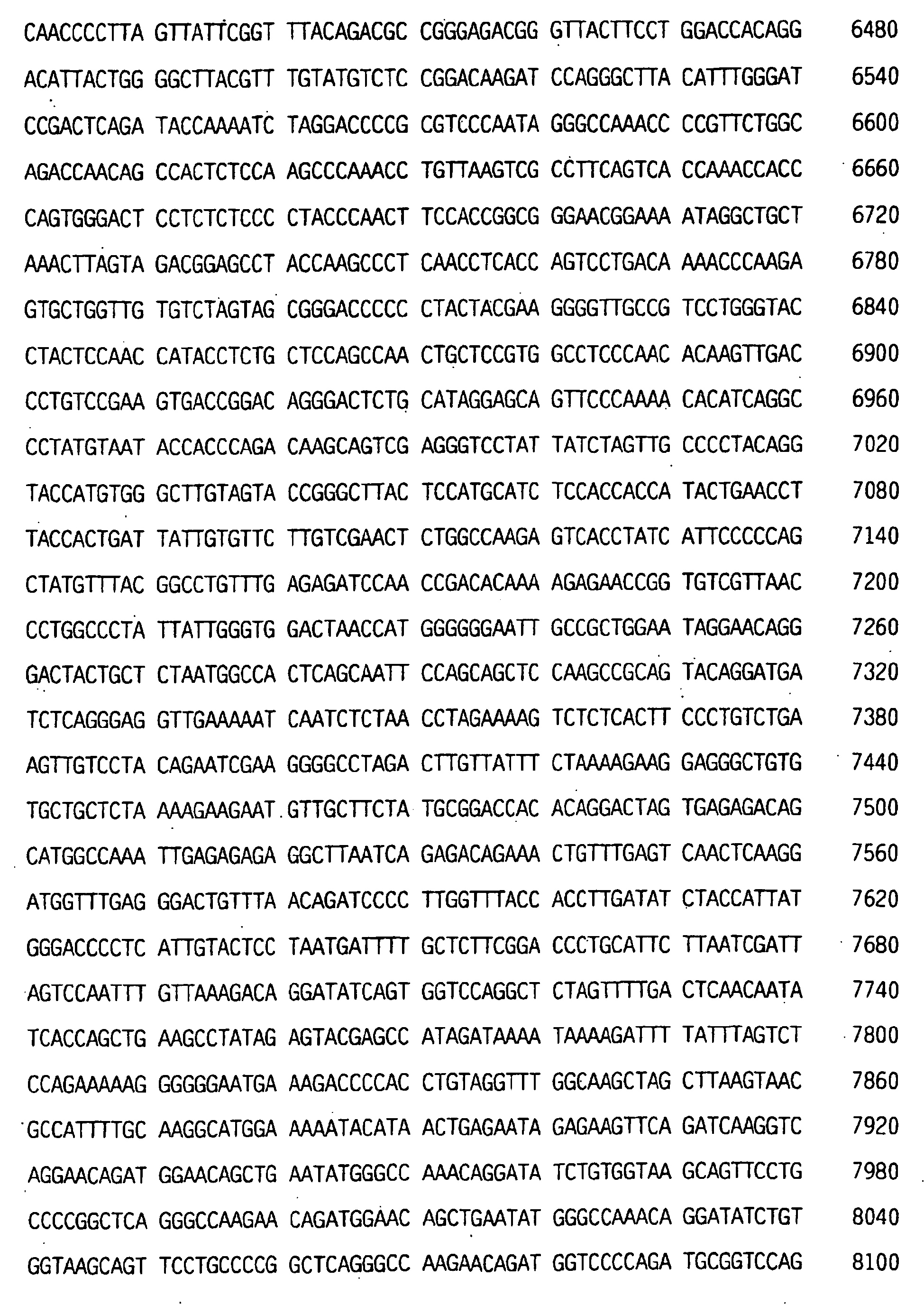

- (i) SEQUENCE CHARACTERISTICS:
- (2) INFORMATION FOR SEQ ID NO:2:
- (i) SEQUENCE CHARACTERISTICS:
- (A) LENGTH: 36 base pairs
- (B) TYPE: nucleic acid
- (C) STRANDEDNESS: single
- (D) TOPOLOGY: linear
- (xi) SEQUENCE DESCRIPTION: SEQ ID NO:2:
GGTAACAGTC TGGCCCGAAT TCTCAGACAA ATACAG 36
- (i) SEQUENCE CHARACTERISTICS:
- (2) INFORMATION FOR SEQ ID NO:3:
- (i) SEQUENCE CHARACTERISTICS:
- (A) LENGTH: 38 base pairs
- (B) TYPE: nucleic acid
- (C) STRANDEDNESS: single
- (D) TOPOLOGY: linear
- (xi) SEQUENCE DESCRIPTION: SEQ ID NO:3:
CTGTATTTGT CTGAGAATTA AGGCTAGACT GTTACCAC 38
- (i) SEQUENCE CHARACTERISTICS:
- (2) INFORMATION FOR SEQ ID NO:4:
- (i) SEQUENCE CHARACTERISTICS:
- (A) LENGTH: 22 base pairs
- (B) TYPE: nucleic acid
- (C) STRANDEDNESS: single
- (D) TOPOLOGY: linear
- (xi) SEQUENCE DESCRIPTION: SEQ ID NO:4:
ATATATATAT ATCGATACCA TG 22
- (i) SEQUENCE CHARACTERISTICS:
- (2) INFORMATION FOR SEQ ID NO:5:
- (i) SEQUENCE CHARACTERISTICS:
- (A) LENGTH: 16 base pairs
- (B) TYPE: nucleic acid
- (C) STRANDEDNESS: single
- (D) TOPOLOGY: linear
- (xi) SEQUENCE DESCRIPTION: SEQ ID NO:5:
GGCGCCAAAC CTAAAC 16
- (i) SEQUENCE CHARACTERISTICS:
- (2) INFORMATION FOR SEQ ID NO:6:
- (i) SEQUENCE CHARACTERISTICS:
- (A) LENGTH: 5 amino acids
- (B) TYPE: amino acid
- (C) STRANDEDNESS: single
- (D) TOPOLOGY: linear
- (xi) SEQUENCE DESCRIPTION: SEQ ID NO:6:
Ser LysAsn Tyr Pro 5
- (i) SEQUENCE CHARACTERISTICS:
- (2) INFORMATION FOR SEQ ID NO:7:
- (i) SEQUENCE CHARACTERISTICS:
- (A) LENGTH: 21 base pairs
- (B) TYPE: nucleic acid
- (C) STRANDEDNESS: single
- (D) TOPOLOGY: linear
- (xi) SEQUENCE DESCRIPTION: SEQ ID NO:7:
ACCATCCTCT GGACGGACAT G 21
- (i) SEQUENCE CHARACTERISTICS:
- (2) INFORMATION FOR SEQ ID NO:8:
- (i) SEQUENCE CHARACTERISTICS:
- (A) LENGTH: 21 base pairs
- (B) TYPE: nucleic acid
- (C) STRANDEDNESS: single
- (D) TOPOLOGY: linear
- (xi) SEQUENCE DESCRIPTION: SEQ ID NO:8:
ACCCGGCCGT GGACGGACAT G 21
- (i) SEQUENCE CHARACTERISTICS:
- (2) INFORMATION FOR SEQ ID NO:9:
- (i) SEQUENCE CHARACTERISTICS:
- (A) LENGTH: 449 base pairs
- (B) TYPE: nucleic acid
- (C) STRANDEDNESS: single
- (D) TOPOLOGY: linear
- (ix) FEATURE:
- (A) NAME/KEY: CDS
- (B) LOCATION: 20..442
- (xi) SEQUENCE DESCRIPTION: SEQ ID NO:9:
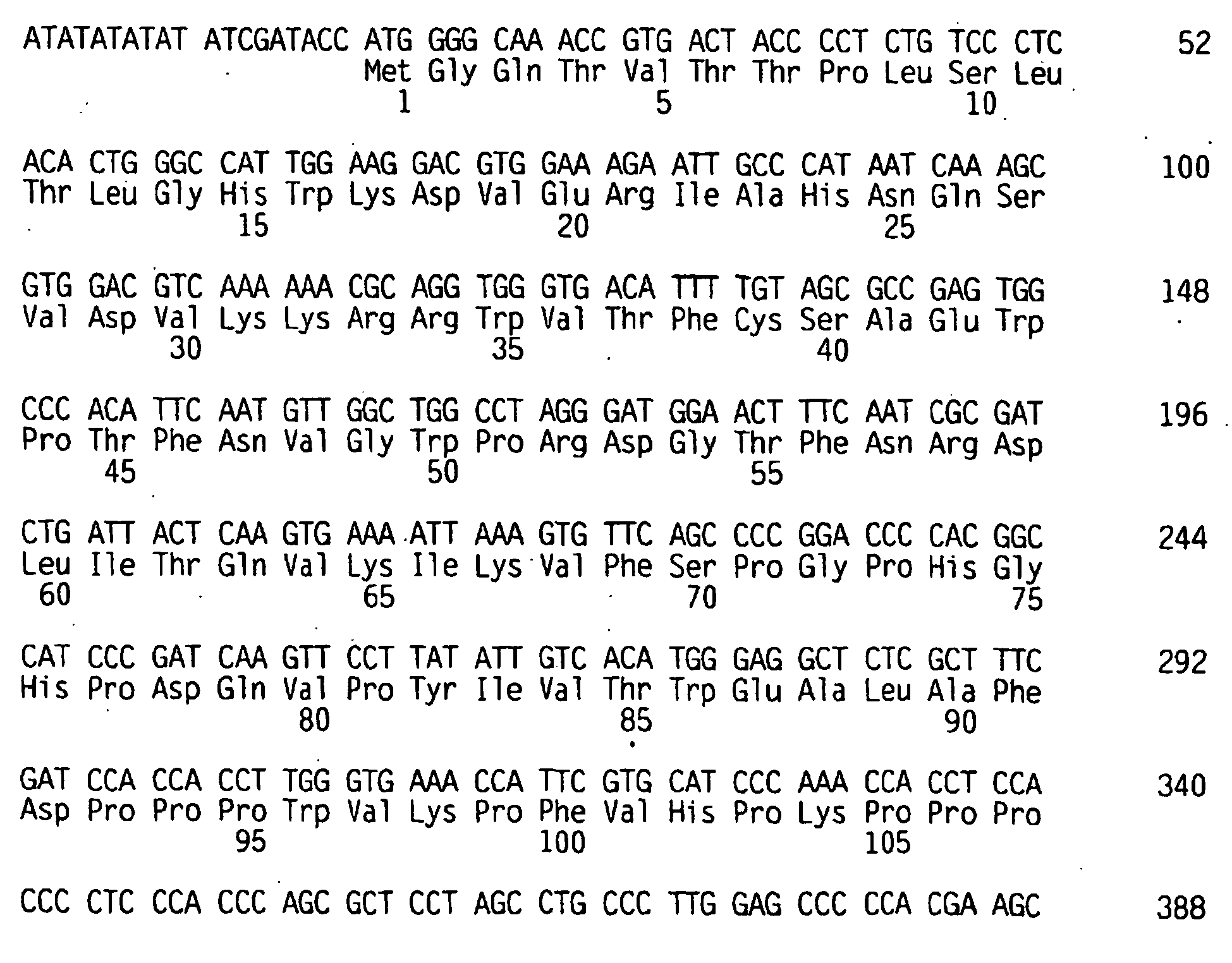
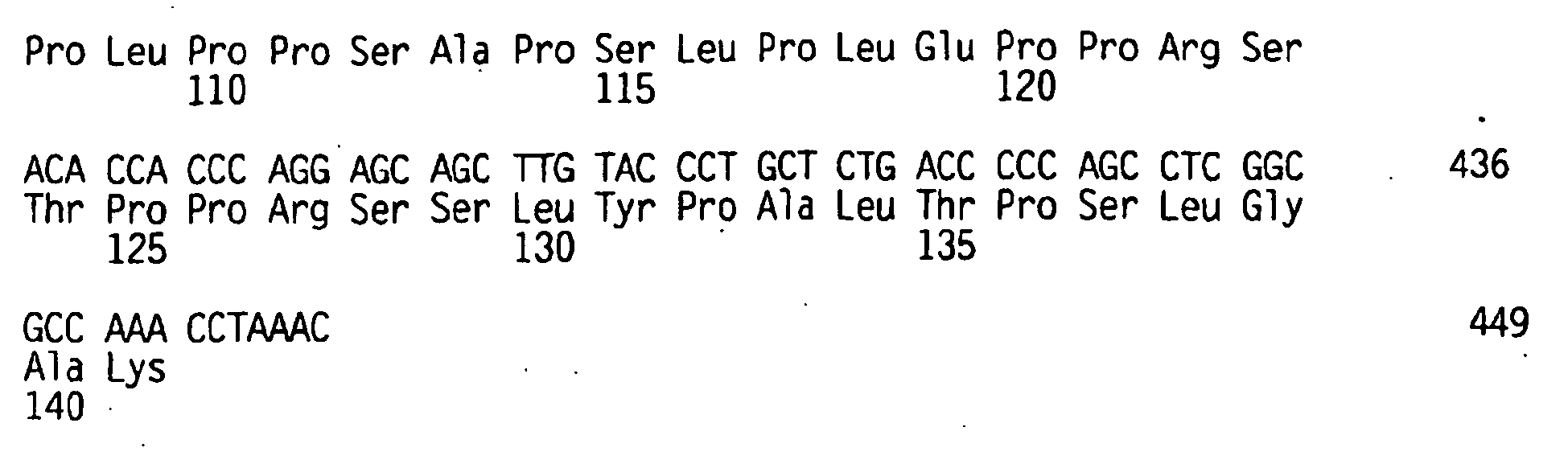
- (i) SEQUENCE CHARACTERISTICS:
- (2) INFORMATION FOR SEQ ID NO:10:
- (i) SEQUENCE CHARACTERISTICS:
- (A) LENGTH: 141 amino acids
- (B) TYPE: amino acid
- (D) TOPOLOGY: linear
- (ii) MOLECULE TYPE: protein
- (xi) SEQUENCE DESCRIPTION: SEQ ID NO:10:
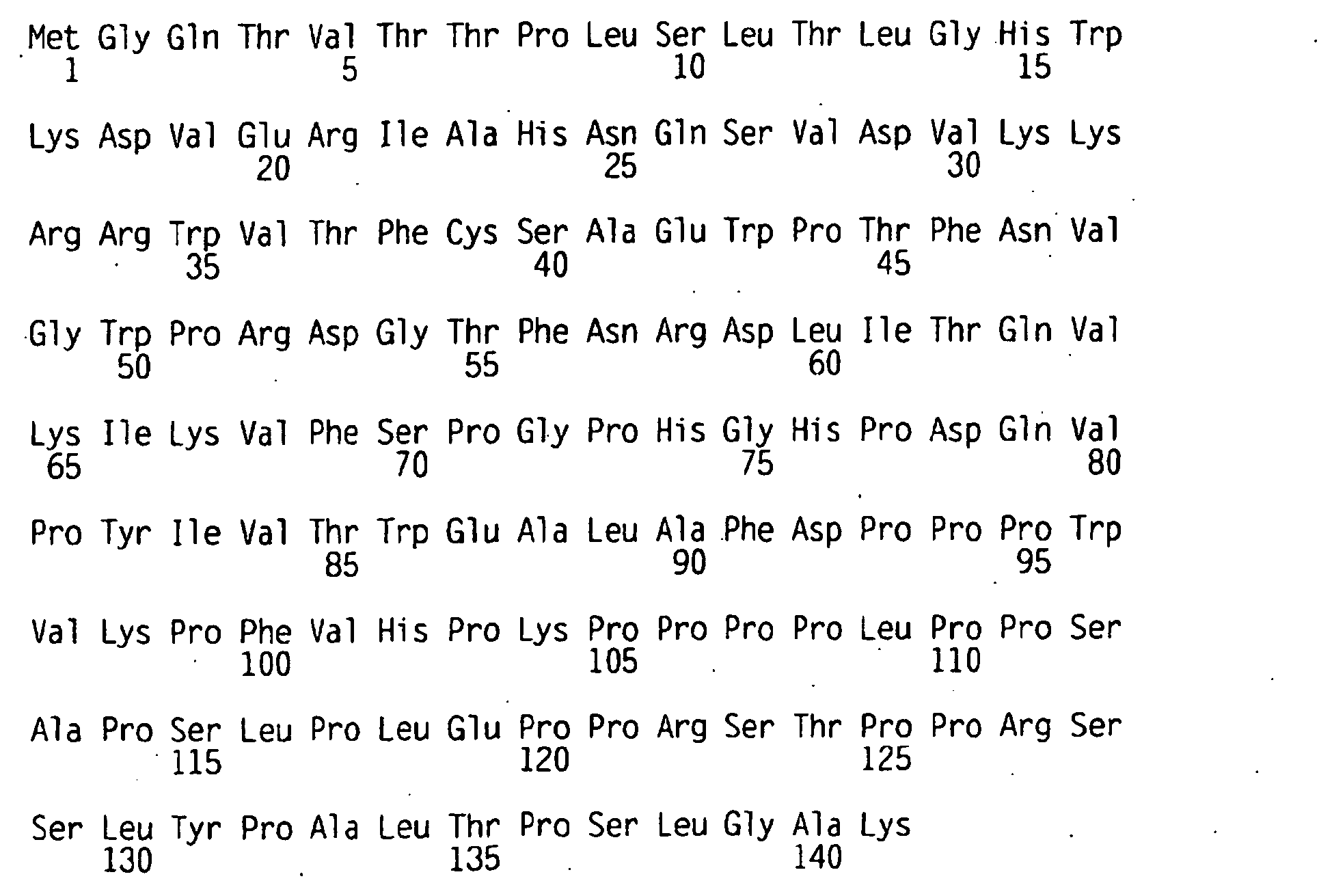
- (i) SEQUENCE CHARACTERISTICS:
- (2) INFORMATION FOR SEQ ID NO:11:
- (i) SEQUENCE CHARACTERISTICS:
- (A) LENGTH: 420 base pairs
- (B) TYPE: nucleic acid
- (C) STRANDEDNESS: single
- (D) TOPOLOGY: linear
- (ix) FEATURE:
- (A) NAME/KEY: CDS
- (B) LOCATION: 1..420
- (xi) SEQUENCE DESCRIPTION: SEQ ID NO:11:
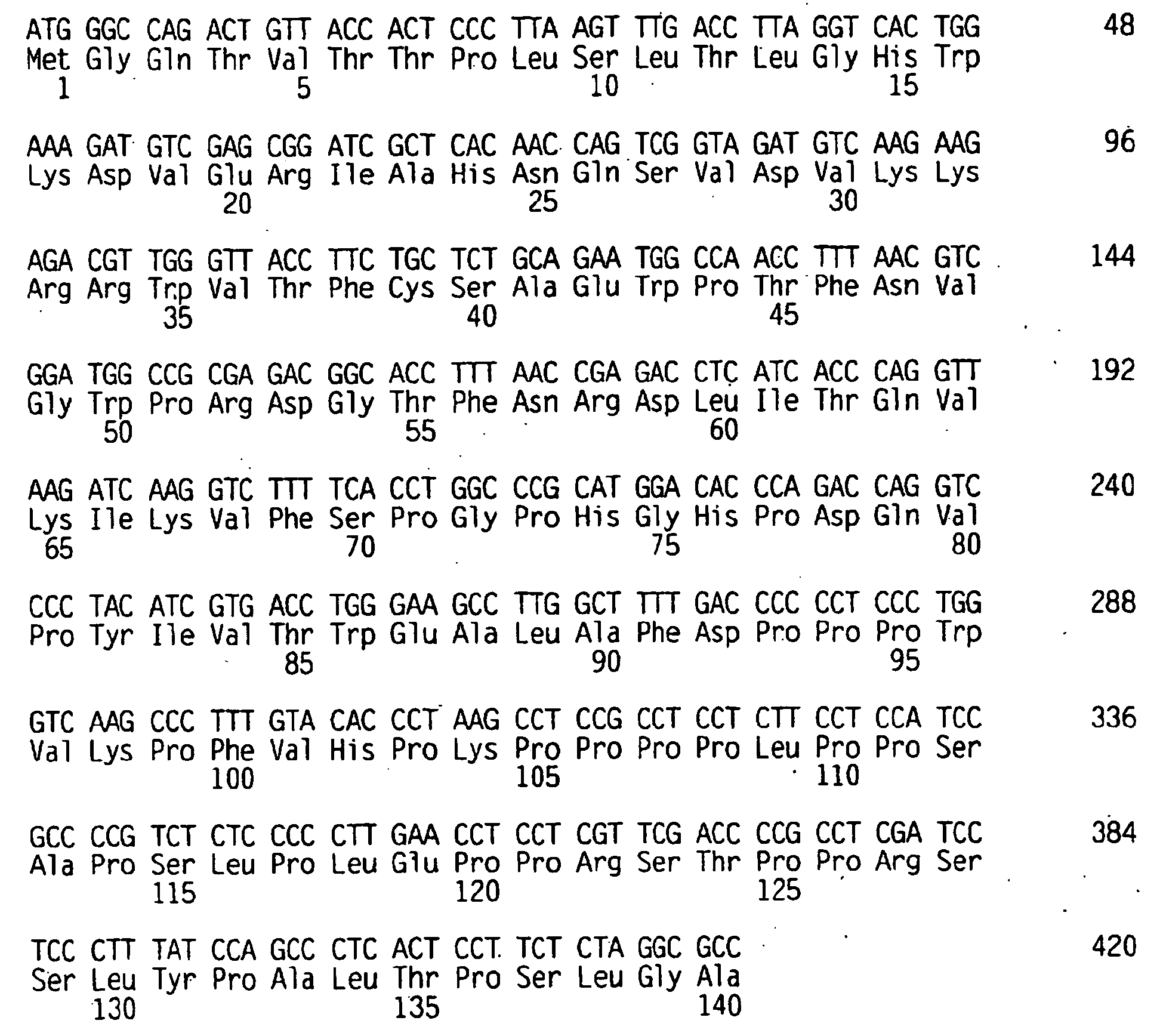
- (i) SEQUENCE CHARACTERISTICS:
- (2) INFORMATION FOR SEQ ID NO:12:
- (i) SEQUENCE CHARACTERISTICS:
- (A) LENGTH: 140 amino acids
- (B) TYPE: amino acid
- (D) TOPOLOGY: linear
- (ii) MOLECULE TYPE: protein
- (xi) SEQUENCE DESCRIPTION: SEQ ID NO:12:
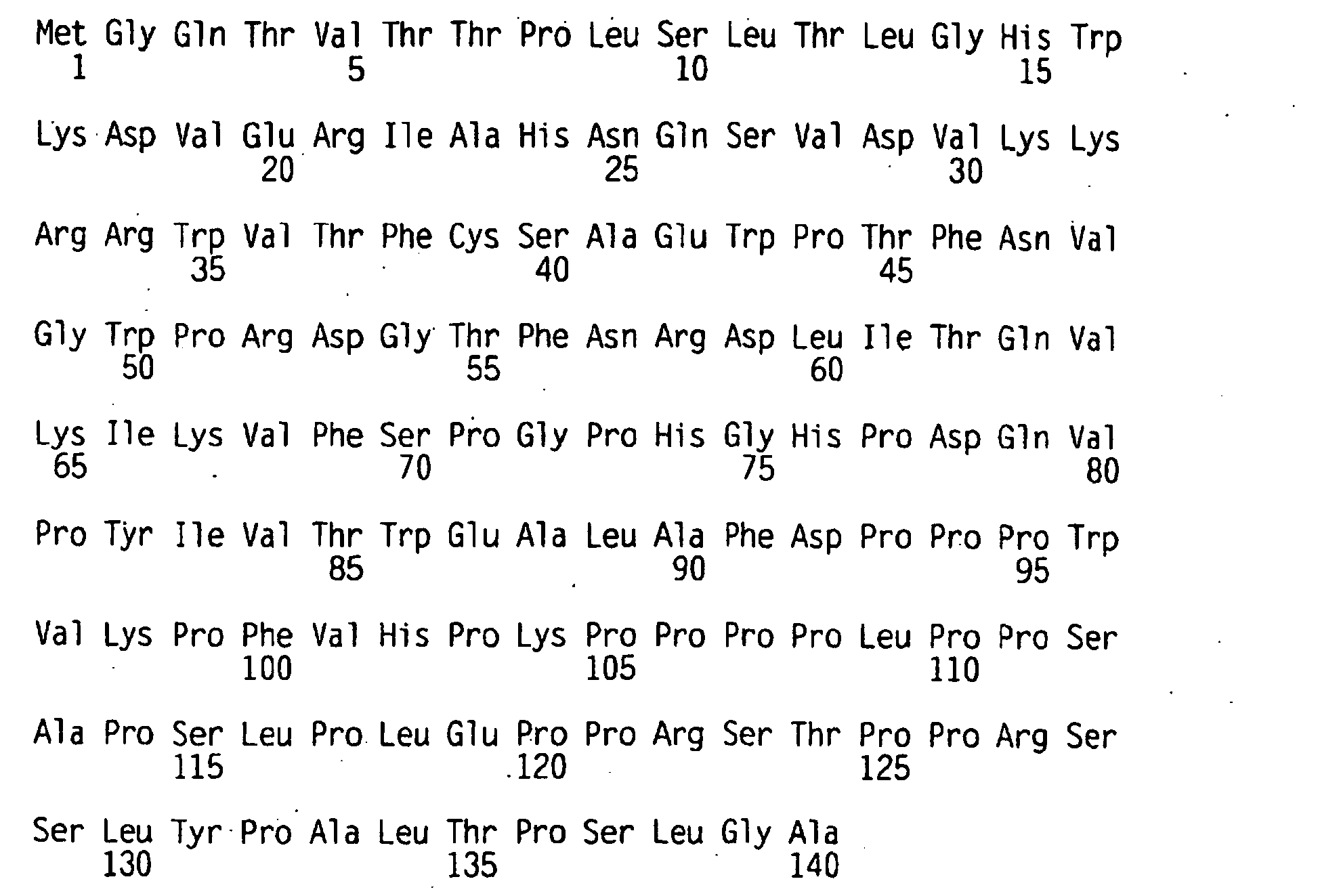
- (i) SEQUENCE CHARACTERISTICS:
- (2) INFORMATION FOR SEQ ID NO:13:
- (i) SEQUENCE CHARACTERISTICS:
- (A) LENGTH: 2001 base pairs
- (B) TYPE: nucleic acid
- (C) STRANDEDNESS: single
- (D) TOPOLOGY: linear
- (xi) SEQUENCE DESCRIPTION: SEQ ID NO:13:


- (i) SEQUENCE CHARACTERISTICS:
- (2) INFORMATION FOR SEQ ID NO:14:
- (i) SEQUENCE CHARACTERISTICS:
- (A) LENGTH: 12 base pairs
- (B) TYPE: nucleic acid
- (C) STRANDEDNESS: single
- (D) TOPOLOGY: linear
- (xi) SEQUENCE DESCRIPTION: SEQ ID NO:14:
CTAGCTAGCT AG 12
- (i) SEQUENCE CHARACTERISTICS:
- (2) INFORMATION FOR SEQ ID NO:15:
- (i) SEQUENCE CHARACTERISTICS:
- (A) LENGTH: 64 base pairs
- (B) TYPE: nucleic acid
- (C) STRANDEDNESS: single
- (D) TOPOLOGY: linear
- (xi) SEQUENCE DESCRIPTION: SEQ ID NO:15:

- (i) SEQUENCE CHARACTERISTICS:
- (2) INFORMATION FOR SEQ ID NO:16:
- (i) SEQUENCE CHARACTERISTICS:
- (A) LENGTH: 52 base pairs
- (B) TYPE: nucleic acid
- (C) STRANDEDNESS: single
- (D) TOPOLOGY: linear
- (xi) SEQUENCE DESCRIPTION: SEQ ID NO:16:
TTGATTATGG GCAATTCTTT CCACGTCCTT CCAATGGCCC AGTGTGAGGG AC 52
- (i) SEQUENCE CHARACTERISTICS:
- (2) INFORMATION FOR SEQ ID NO:17:
- (i) SEQUENCE CHARACTERISTICS:
- (A) LENGTH: 72 base pairs
- (B) TYPE: nucleic acid
- (C) STRANDEDNESS: single
- (D) TOPOLOGY: linear
- (xi) SEQUENCE DESCRIPTION: SEQ ID NO:17:

- (i) SEQUENCE CHARACTERISTICS:
- (2) INFORMATION FOR SEQ ID NO:18:
- (i) SEQUENCE CHARACTERISTICS:
- (A) LENGTH: 52 base pairs
- (B) TYPE: nucleic acid
- (C) STRANDEDNESS: single
- (D) TOPOLOGY: linear
- (xi) SEQUENCE DESCRIPTION: SEQ ID NO:18:
AAGTTCCATC CCTAGGCCAG CCAACATTGA ATGTGGGCCA CTCGGCGCTA CA 52
- (i) SEQUENCE CHARACTERISTICS:
- (2) INFORMATION FOR SEQ ID NO:19:
- (i) SEQUENCE CHARACTERISTICS:
- (A) LENGTH: 72 base pairs
- (B) TYPE: nucleic acid
- (C) STRANDEDNESS: single
- (D) TOPOLOGY: linear
- (xi) SEQUENCE DESCRIPTION: SEQ ID NO:19:

- (i) SEQUENCE CHARACTERISTICS:
- (2) INFORMATION FOR SEQ ID NO:20:
- (i) SEQUENCE CHARACTERISTICS:
- (A) LENGTH: 52 base pairs
- (B) TYPE: nucleic acid
- (C) STRANDEDNESS: single
- (D) TOPOLOGY: linear
- (xi) SEQUENCE DESCRIPTION: SEQ ID NO:20:
GTGACAATAT AAGGAACTTG ATCGGGATGG CCGTGGGGTC CGGGGCTGAA CA 52
- (i) SEQUENCE CHARACTERISTICS:
- (2) INFORMATION FOR SEQ ID NO:21:
- (i) SEQUENCE CHARACTERISTICS:
- (A) LENGTH: 72 base pairs
- (B) TYPE: nucleic acid
- (C) STRANDEDNESS: single
- (D) TOPOLOGY: linear
- (xi) SEQUENCE DESCRIPTION: SEQ ID NO:21:

- (i) SEQUENCE CHARACTERISTICS:
- (2) INFORMATION FOR SEQ ID NO:22:
- (i) SEQUENCE CHARACTERISTICS:
- (A) LENGTH: 52 base pairs
- (B) TYPE: nucleic acid
- (C) STRANDEDNESS: single
- (D) TOPOLOGY: linear
- (xi) SEQUENCE DESCRIPTION: SEQ ID NO:22
AGGAGCGCTG GGTGGGAGGG GTGGAGGTGG TTTGGGATGC ACGAATGGTT TC 52
- (i) SEQUENCE CHARACTERISTICS:
- (2) INFORMATION FOR SEQ ID NO:23
- (i) SEQUENCE CHARACTERISTICS:
- (A) LENGTH: 72 base pairs
- (B) TYPE: nucleic acid
- (C) STRANDEDNESS: single
- (D) TOPOLOGY: linear
- (xi) SEQUENCE DESCRIPTION: SEQ ID NO:23:

- (i) SEQUENCE CHARACTERISTICS:
- (2) INFORMATION FOR SEQ ID NO:24:
- (i) SEQUENCE CHARACTERISTICS:
- (A) LENGTH: 52 base pairs
- (B) TYPE: nucleic acid
- (C) STRANDEDNESS: single
- (D) TOPOLOGY: linear
- (xi) SEQUENCE DESCRIPTION: SEQ ID NO:24:
GTTTAGGTTT GGCGCCGAGG CTGGGGGTCA GAGCAGGGTA CAAGCTGCTC CT 52
- (i) SEQUENCE CHARACTERISTICS:
- (2) INFORMATION FOR SEQ ID NO:25:
- (i) SEQUENCE CHARACTERISTICS:
- (A) LENGTH: 19 base pairs
- (B) TYPE: nucleic acid
- (C) STRANDEDNESS: single
- (D) TOPOLOGY: linear
- (xi) SEQUENCE DESCRIPTION: SEQ ID NO:25:
ATATATATAT ATCGATACC 19
- (i) SEQUENCE CHARACTERISTICS:
- (2) INFORMATION FOR SEQ ID NO:26:
- (i) SEQUENCE CHARACTERISTICS:
- (A) LENGTH: 20 base pairs
- (B) TYPE: nucleic acid
- (C) STRANDEDNESS: single
- (D) TOPOLOGY: linear
- (xi) SEQUENCE DESCRIPTION: SEQ ID NO:26:
GTTTAGGTTT GGCGCCGAGG 20
- (i) SEQUENCE CHARACTERISTICS:
- (2) INFORMATION FOR SEQ ID NO:27:
- (i) SEQUENCE CHARACTERISTICS:
- (A) LENGTH: 32 base pairs
- (B) TYPE: nucleic acid
- (C) STRANDEDNESS: single
- (D) TOPOLOGY: linear
- (xi) SEQUENCE DESCRIPTION: SEQ ID NO:27:
GGGAGTGGTA ACAGTCTGGC CTTAATTCTC AG 32
- (i) SEQUENCE CHARACTERISTICS:
- (2) INFORMATION FOR SEQ ID NO:28:
- (i) SEQUENCE CHARACTERISTICS:
- (A) LENGTH: 23 base pairs
- (B) TYPE: nucleic acid
- (C) STRANDEDNESS: single
- (D) TOPOLOGY: linear
- (xi) SEQUENCE DESCRIPTION: SEQ ID NO:28:
CGGTCGACCT CGAGAATTAA TAC 23
- (i) SEQUENCE CHARACTERISTICS:
- (2) INFORMATION FOR SEQ ID NO:29:
- (i) SEQUENCE CHARACTERISTICS:
- (A) LENGTH: 23 base pairs
- (B) TYPE: nucleic acid
- (C) STRANDEDNESS: single
- (D) TOPOLOGY: linear
- (xi) SEQUENCE DESCRIPTION: SEQ ID NO:29:
CTGGGAGACG TCCCAGGGAC TTC 23
- (i) SEQUENCE CHARACTERISTICS:
- (2) INFORMATION FOR SEQ ID NO:30:
- (i) SEQUENCE CHARACTERISTICS:
- (A) LENGTH: 32 base pairs
- (B) TYPE: nucleic acid
- (C) STRANDEDNESS: single
- (D) TOPOLOGY: linear
- (xi) SEQUENCE DESCRIPTION: SEQ ID NO:30:
GGCCAGACTG TTACCACTCC CTGAAGTTTG AC 32
- (i) SEQUENCE CHARACTERISTICS:
- (2) INFORMATION FOR SEQ ID NO:31:
- (i) SEQUENCE CHARACTERISTICS:
- (A) LENGTH: 30 base pairs
- (B) TYPE: nucleic acid
- (C) STRANDEDNESS: single
- (D) TOPOLOGY: linear
- (x) SEQUENCE DESCRIPTION: SEQ ID NO:31:
CATCGATAAA ATAAAAGATT TTATTTAGTC 30
- (i) SEQUENCE CHARACTERISTICS:
- (2) INFORMATION FOR SEQ ID NO:32:
- (i) SEQUENCE CHARACTERISTICS:
- (A) LENGTH: 22 base pairs
- (B) TYPE: nucleic acid
- (C) STRANDEDNESS: single
- (D) TOPOLOGY: linear
- (xi) SEQUENCE DESCRIPTION: SEQ ID NO:32:
CAAATGAAAG ACCCCCGCTG AC 22
- (i) SEQUENCE CHARACTERISTICS:
- (2) INFORMATION FOR SEQ ID NO:33:
- (i) SEQUENCE CHARACTERISTICS:
- (A) LENGTH: 28 base pairs
- (B) TYPE: nucleic acid
- (C) STRANDEDNESS: single
- (D) TOPOLOGY: linear
- (xi) SEQUENCE DESCRIPTION: SEQ ID NO:33:
CCTATGAGCT CGCCTTCTAG TTGCCAGC 28
- (i) SEQUENCE CHARACTERISTICS:
- (2) INFORMATION FOR SEQ ID NO:34:
- (i) SEQUENCE CHARACTERISTICS:
- (A) LENGTH: 38 base pairs
- (B) TYPE: nucleic acid
- (C) STRANDEDNESS: single
- (D) TOPOLOGY: linear
- (xi) SEQUENCE DESCRIPTION: SEQ ID NO:34:
CCTATGAATT CGCGGCCGCC ATAGAGCCCA CCGCATCC 38
- (i) SEQUENCE CHARACTERISTICS:
- (2) INFORMATION FOR SEQ ID NO:35:
- (i) SEQUENCE CHARACTERISTICS:
- (A) LENGTH: 44 base pairs
- (B) TYPE: nucleic acid
- (C) STRANDEDNESS: single
- (D) TOPOLOGY: linear
- (xi) SEQUENCE DESCRIPTION: SEQ ID NO:35:
TATATATGAG CTCTAATAAA ATGAGGAAAT TGCATCGCAT TGTC 44
- (i) SEQUENCE CHARACTERISTICS:
- (2) INFORMATION FOR SEQ ID NO:36:
- (i) SEQUENCE CHARACTERISTICS:
- (A) LENGTH: 48 base pairs
- (B) TYPE: nucleic acid
- (C) STRANDEDNESS: single
- (D) TOPOLOGY: linear
- (xi) SEQUENCE DESCRIPTION: SEQ ID NO:36:
CCTATGAATT CGCGGCCGCA TAGAATGACA CCTACTCAGA CAATGCGA 48
- (i) SEQUENCE CHARACTERISTICS:
- (2) INFORMATION FOR SEQ ID NO:37:
- (i) SEQUENCE CHARACTERISTICS:
- (A) LENGTH: 21 base pairs
- (B) TYPE: nucleic acid
- (C) STRANDEDNESS: single
- (D) TOPOLOGY: linear
- (xi) SEQUENCE DESCRIPTION: SEQ ID NO:37:
GCTCGTTTAG TGAACCGTCA G 21
- (i) SEQUENCE CHARACTERISTICS:
- (2) INFORMATION FOR SEQ ID NO:38:
- (i) SEQUENCE CHARACTERISTICS:
- (A) LENGTH: 29 base pairs
- (B) TYPE: nucleic acid
- (C) STRANDEDNESS: single
- (D) TOPOLOGY: linear
- (xi) SEQUENCE DESCRIPTION: SEQ ID NO:38:
TATCCGAGCT CATGGCTCGT ACTCTATGG 29
- (i) SEQUENCE CHARACTERISTICS:
- (2) INFORMATION FOR SEQ ID NO:39:
- (i) SEQUENCE CHARACTERISTICS:
- (A) LENGTH: 37 base pairs
- (B) TYPE: nucleic acid
- (C) STRANDEDNESS: single
- (D) TOPOLOGY: linear
- (xi) SEQUENCE DESCRIPTION: SEQ ID NO:39:
CACCTATGCT AGCCACCATG GCGCGTTCAA CGCTCTC 37
- (i) SEQUENCE CHARACTERISTICS:
- (2) INFORMATION FOR SEQ ID NO:40:
- (i) SEQUENCE CHARACTERISTICS:
- (A) LENGTH: 36 base pairs
- (B) TYPE: nucleic acid
- (C) STRANDEDNESS: single
- (D) TOPOLOGY: linear
- (xi) SEQUENCE DESCRIPTION: SEQ ID NO:40:
CACCTATGCG GCCGCTCATG GCTCGTACTC TATGGG 36
- (i) SEQUENCE CHARACTERISTICS:
- (2) INFORMATION FOR SEQ ID NO:41:
- (i) SEQUENCE CHARACTERISTICS:
- (A) LENGTH: 39 base pairs
- (B) TYPE: nucleic acid
- (C) STRANDEDNESS: single
- (D) TOPOLOGY: linear
- (xi) SEQUENCE DESCRIPTION: SEQ ID NO:41:
CACCTATGCGGCCGCCACCA TGGCGCGTTC AACGCTCTC 39
- (i) SEQUENCE CHARACTERISTICS:
- (2) INFORMATION FOR SEQ ID NO:42:
- (i) SEQUENCE CHARACTERISTICS:
- (A) LENGTH: 429 base pairs
- (B) TYPE: nucleic acid
- (C) STRANDEDNESS: single
- (D) TOPOLOGY: linear
- (xi) SEQUENCE DESCRIPTION: SEQ ID NO:42:

- (i) SEQUENCE CHARACTERISTICS:
- (2) INFORMATION FOR SEQ ID NO:43:
- (i) SEQUENCE CHARACTERISTICS:
- (A) LENGTH: 32 base pairs
- (B) TYPE nucleic acid
- (C) STRANDEDNESS: single
- (D) TOPOLOGY: linear
- (xi) SEQUENCE DESCRIPTION: SEQ ID NO:43:
CGAATCGATA CCATGGGCCA GACTGTTACC AC 32
- (i) SEQUENCE CHARACTERISTICS:
- (2) INFORMATION FOR SEQ ID NO:44:
- (i) SEQUENCE CHARACTERISTICS:
- (A) LENGTH: 23 base pairs
- (B) TYPE: nucleic acid
- (C) STRANDEDNESS: single
- (D) TOPOLOGY: linear
- (xi) SEQUENCE DESCRIPTION: SEQ ID NO:44:
CATTCTGCAG AGCAGAAGGT AAC 23
- (i) SEQUENCE CHARACTERISTICS:
- (2) INFORMATION FOR SEQ ID NO:45:
- (i) SEQUENCE CHARACTERISTICS:
- (A) LENGTH: 14 base pairs
- (B) TYPE: nucleic acid
- (C) STRANDEDNESS: single
- (D) TOPOLOGY: linear
- (xi) SEQUENCE DESCRIPTION: SEQ ID NO:45:
TAAGCGGCCG CTTA 14
- (i) SEQUENCE CHARACTERISTICS:
Claims (40)
- A producer cell line, comprising a gag/pol expression cassette, an env expression cassette and a retroviral vector construct, wherein there is no sequence overlap between the gag/pol expression cassette and the env expression cassette, and no sequence overlap between the env expression cassette and the retroviral vector construct, with the proviso that said retroviral vector construct overlaps with at least 4 nucleotides of a 5' terminal end of a gag/pol gene encoded within said gag/pol expression cassette.
- The producer cell line according to claim 1, wherein said retroviral vector construct is a retroviral vector construct comprising a 5' LTR, a tRNA binding site, a packaging signal, an origin of second strand DNA synthesis and a 3' LTR, wherein said vector construct contains gag/pol coding sequences which have been modified to contain one, two or more stop codons.
- The producer cell line according to claim 2 wherein one of the stop codons eliminates the start site.
- The producer cell line according to claim 2 or 3 wherein one of the stop codons has two or three base pair substitutions.
- The producer cell line according to claim 2 wherein said retroviral vector construct lacks an extended packaging signal.
- The producer cell line according to claim 2 wherein said retroviral vector construct lacks a retroviral nucleic acid sequence upstream of said 5' LTR.
- The producer cell line according to claim 6 wherein said retroviral vector construct lacks an env coding sequence upstream of said 5' LTR.
- The producer cell line according to claim 2 wherein said retroviral vector construct lacks an env coding and/or untranslated env sequence upstream of said 3' LTR.
- The producer cell line according to claim 2 wherein said retroviral vector construct lacks a retroviral packaging signal sequence downstream of said 3' LTR.
- The producer cell line according to claim 2 wherein said retroviral vector construct is constructed from a retrovirus selected from the group consisting of amphotropic, ecotropic, xenotropic or polytropic viruses.
- The producer cell line according to claim 2 wherein said retroviral vector construct is constructed from a Murine Leukemia Virus.
- The producer cell line according to claim 2 wherein said retroviral vector construct is constructed from a lentivirus.
- The producer cell line according to claim 2 wherein said retroviral vector construct further comprises a heterologous sequence.
- The producer cell line according to claim 13 wherein said heterologous sequence is a gene encoding a cytotoxic protein.
- The producer cell line according to claim 14 wherein said cytotoxic protein is selected from the group consisting of ricin, abrin, diptheria toxin, cholera toxin, gelonin, pokeweed, antiviral protein, tritin, Shigella toxin and Pseudomonas exotoxin A.
- The producer cell line according to claim 13 wherein said heterologous sequence is an antisense sequence.
- The producer cell line according to claim 13 wherein said heterologous sequence encodes an immune accessory molecule.
- The producer cell line according to claim 17 wherein said immune accessory molecule is selected from the group consisting of IL-1, IL-2, IL-3, IL-4, IL-5, IL-6, IL-7, IL-8, IL-9 IL-10, 1L-11, IL-12, IL-13 and IL-15
- The producer cell line according to claim 17 wherein said immune accessory molecule is selected from the group consisting of ICAM-1, ICAM-2, b-microglobin, LFA3, HLA class I and HLA class II molecules.
- The producer cell line according to claim 13 wherein said heterologous sequence encodes a gene product that activates a compound with little or no cytotoxixity into a toxic product.
- The producer cell line according to claim 20 wherein said gene product is selected from group consisting of HSVTK, VZVTK and cytosine deaminase.
- The producer cell line according to claim 13 wherein said heterologous sequence is a ribozyme.
- The producer cell line according to claim 13 wherein said heterologous sequence is a replacement gene.
- The producer cell line according to claim 23 wherein said replacement gene encodes a protein selected from the group consisting of Factor VIII, ADA, HPRT, CF and the LDL Receptor.
- The producer cell line according to claim 13 wherein said heterologous sequence encodes an immunogenic portion of a virus selected from the group consisting of HBV, HCV, HPV, EBV, FeLV, FIV and HIV.
- The producer cell line according to claim 1 wherein said gag/pol expression cassette comprises a promoter operably linked to a gag/pol gene, and a polyadenylation sequence, wherein a 3' terminal end of said gag/pol gene has been delcted-without affecting the biological activity of
- The producer cell line according to claim 26 wherein said 3' terminal end has been deleted upstream of nucleotide 5751 of Sequence ID No.1.
- The producer cell line according to claim 26 wherein said promoter is a heterologous promoter.
- The producer cell line according to claim 26 wherein said promoter is selected from the group consisting of CMV IE, the HSVTK promoter, RSV promoter, Adenovirus major-latter promoter and the SV40 promoter.
- The producer cell line according to claim 26 wherein said polyadenylation sequence is a heterologous polyadenylation sequence.
- The producer cell line according to claim 30 wherein said heterologous polydenylation sequence is selected from the group consisting of the SV40 late poly A signal, the SV40 early poly A signal and a bovine growth hormone poly A signal.
- The producer cell line according to claim 1 wherein said env expression cassette comprises a promoter operably linked to an env gene, and a polyadenylation sequence, wherein no more than 6 consecutive retroviral nucleotides are included upstream of said env gene.
- The producer cell line according to claim 1 wherein said env expression cassette comprises a promoter operably linked to an env gene, and a polyadenylation sequence, wherein said env expression cassette does not contain a consecutive sequence of more than 8 nucleotides which are found in a gag/pol gene.
- The producer cell line according to claim 1 wherein said env expression cassette comprises a promoter operably linked to an env gene, and a polyadenylation sequence, wherein a 3' terminal end of said env gene has been deleted without effecting the biological activity of env.
- The produce cell line according to claim 34 wherein a 3' terminal end of said env gene has been deleted such that a complete R peptide is not produced by said expression cassette.
- The producer cell line according to claim 34 wherein said env gene is derived form a type C retrovirus, and wherein the 3' terminal end has been deleted such that said env gene includes less that 18 nucleic acids which encode said R peptide.
- The producer cell line according to claim 34 wherein said promoter is a heterologus promoter.
- The producer cell line according to claim 37 wherein said promoter is selected from the group consisting of CMV IE, the HSVTK, promoter, RSV promoter, Adenovirus major-latter promoter and the SV40 promoter.
- The producer cell line according to claim 34 wherein said polyadenylation sequence is a heterologous polyadenylation sequence.
- The producer cell line according to claim 39 wherein said heterologous polyadmylation is selected-from the group consisting of the SV40 late poly A signal, the SV40 early poly A signal and a bovine growth hormone polyadenylation sequence.
Applications Claiming Priority (5)
| Application Number | Priority Date | Filing Date | Title |
|---|---|---|---|
| US64341196A | 1996-05-06 | 1996-05-06 | |
| US643411 | 1996-05-06 | ||
| US72132796A | 1996-09-26 | 1996-09-26 | |
| US721327 | 1996-09-26 | ||
| PCT/US1997/007697 WO1997042338A1 (en) | 1996-05-06 | 1997-05-05 | Crossless retroviral vectors |
Publications (2)
| Publication Number | Publication Date |
|---|---|
| EP0953052A1 EP0953052A1 (en) | 1999-11-03 |
| EP0953052B1 true EP0953052B1 (en) | 2009-03-04 |
Family
ID=27094254
Family Applications (1)
| Application Number | Title | Priority Date | Filing Date |
|---|---|---|---|
| EP97924603A Expired - Lifetime EP0953052B1 (en) | 1996-05-06 | 1997-05-05 | Crossless retroviral vectors |
Country Status (5)
| Country | Link |
|---|---|
| EP (1) | EP0953052B1 (en) |
| AT (1) | ATE424463T1 (en) |
| AU (1) | AU2998597A (en) |
| DE (1) | DE69739286D1 (en) |
| WO (1) | WO1997042338A1 (en) |
Families Citing this family (123)
| Publication number | Priority date | Publication date | Assignee | Title |
|---|---|---|---|---|
| WO1999015641A1 (en) | 1997-09-24 | 1999-04-01 | The Regents Of The University Of California | Non-primate lentiviral vectors and packaging systems |
| CA2318575A1 (en) * | 1998-01-16 | 1999-07-22 | Chiron Corporation | Feline immunodeficiency virus gene therapy vectors |
| GB9803351D0 (en) | 1998-02-17 | 1998-04-15 | Oxford Biomedica Ltd | Anti-viral vectors |
| ATE452982T1 (en) * | 1998-07-10 | 2010-01-15 | Univ Paris Curie | METHOD FOR ADMINISTRATION OF NUCLEIC ACIDS INTO CELLS IN VITRO OR EX VIVO |
| US7625859B1 (en) | 2000-02-16 | 2009-12-01 | Oregon Health & Science University | HER-2 binding antagonists |
| US7700359B2 (en) | 2000-06-02 | 2010-04-20 | Novartis Vaccines And Diagnostics, Inc. | Gene products differentially expressed in cancerous cells |
| EP1953243B1 (en) | 2000-06-15 | 2012-12-26 | Novartis Vaccines and Diagnostics, Inc. | Polynucleotides related to colon cancer |
| WO2002046477A2 (en) | 2000-12-07 | 2002-06-13 | Chiron Corporation | Endogenous retroviruses up-regulated in prostate cancer |
| CN100398551C (en) | 2001-11-09 | 2008-07-02 | 乔治敦大学 | Novel vascular endothelial cell growth inhibitor isoforms |
| AU2003235791A1 (en) | 2002-01-08 | 2003-07-24 | Chiron Corporation | Gene products differentially expressed in cancerous breast cells and their methods of use |
| EP2093233A1 (en) | 2002-03-21 | 2009-08-26 | Sagres Discovery, Inc. | Novel compositions and methods in cancer |
| ATE545651T1 (en) | 2002-06-13 | 2012-03-15 | Novartis Vaccines & Diagnostic | VECTORS FOR EXPRESSING HML-2 POLYPEPTIDES |
| US7252822B2 (en) | 2002-10-08 | 2007-08-07 | Rinat Neuroscience Corp. | Methods for treating post-surgical pain by administering an anti-nerve growth factor antagonist |
| WO2005000194A2 (en) | 2002-10-08 | 2005-01-06 | Rinat Neuroscience Corp. | Methods for treating post-surgical pain by administering an anti-nerve growth factor antagonist antibody and compositions containing the same |
| UA80447C2 (en) | 2002-10-08 | 2007-09-25 | Methods for treating pain by administering nerve growth factor antagonist and opioid analgesic | |
| EP3539569A1 (en) | 2002-12-24 | 2019-09-18 | Rinat Neuroscience Corp. | Anti-ngf antibodies and methods using the same in treating pain associated with musculo-skeletal disorders |
| US7569364B2 (en) | 2002-12-24 | 2009-08-04 | Pfizer Inc. | Anti-NGF antibodies and methods using same |
| US9498530B2 (en) | 2002-12-24 | 2016-11-22 | Rinat Neuroscience Corp. | Methods for treating osteoarthritis pain by administering a nerve growth factor antagonist and compositions containing the same |
| JP2007524362A (en) | 2003-02-14 | 2007-08-30 | サイグレス ディスカバリー, インコーポレイテッド | Therapeutic GPCR targets in cancer |
| WO2004073653A2 (en) | 2003-02-19 | 2004-09-02 | Rinat Neuroscience Corp. | Methods for treating pain by administering a nerve growth factor antagonist and an nsaid and compositions containing the same |
| AP2006003670A0 (en) | 2003-12-23 | 2006-06-30 | Rinat Neuroscience Corp | Agonist anti-TRKC antibodies and methods using same |
| NZ549990A (en) | 2004-04-07 | 2009-08-28 | Rinat Neuroscience Copr | Methods for treating bone cancer pain by administering a nerve growth factor antagonist |
| EP1789593B1 (en) | 2004-07-09 | 2017-03-15 | The Henry M. Jackson Foundation for the Advancement of Military Medicine, Inc. | Soluble forms of hendra virus g glycoprotein |
| US20060024677A1 (en) | 2004-07-20 | 2006-02-02 | Morris David W | Novel therapeutic targets in cancer |
| AU2005290250A1 (en) | 2004-07-30 | 2006-04-06 | Rinat Neuroscience Corp. | Antibodies directed against amyloid-beta peptide and methods using same |
| SG164344A1 (en) | 2005-02-18 | 2010-09-29 | Novartis Vaccines & Diagnostics Srl | Immunogens from uropathogenic escherichia coli |
| EP2062591A1 (en) | 2005-04-07 | 2009-05-27 | Novartis Vaccines and Diagnostics, Inc. | CACNA1E in cancer diagnosis detection and treatment |
| AU2006235258A1 (en) | 2005-04-07 | 2006-10-19 | Novartis Vaccines And Diagnostics Inc. | Cancer-related genes |
| CA2615615A1 (en) | 2005-07-22 | 2007-02-01 | Y's Therapeutics Co., Ltd. | Anti-cd26 antibodies and methods of use thereof |
| EP1957106B2 (en) | 2005-11-14 | 2019-07-24 | Teva Pharmaceuticals International GmbH | Antagonist antibodies directed against calcitonin gene-related peptide and methods using same |
| US7935342B2 (en) | 2006-02-02 | 2011-05-03 | Rinat Neuroscience Corp. | Methods for treating obesity by administering a trkB antagonist |
| HUE043255T2 (en) | 2006-06-07 | 2019-08-28 | Bioalliance Cv | Antibodies that recognize a carbohydrate-containing epitope on CD43 and CEA expressed on cancer cells and methods for their use |
| US20100166788A1 (en) | 2006-08-16 | 2010-07-01 | Novartis Vaccines And Diagnostics | Immunogens from uropathogenic escherichia coli |
| WO2008124176A2 (en) | 2007-04-10 | 2008-10-16 | The Administrators Of The Tulane Educational Fund | Soluble and membrane-anchored forms of lassa virus subunit proteins |
| GB0714963D0 (en) | 2007-08-01 | 2007-09-12 | Novartis Ag | Compositions comprising antigens |
| AU2008337100B2 (en) | 2007-12-17 | 2013-02-28 | Pfizer Limited | Treatment of interstitial cystitis |
| JP5568478B2 (en) | 2007-12-18 | 2014-08-06 | バイオアライアンス セー.フェー. | Antibodies that recognize carbohydrate-containing epitopes of CD-43 and CEA expressed in cancer cells and methods of using the same |
| WO2009126306A2 (en) | 2008-04-10 | 2009-10-15 | Cell Signaling Technology, Inc. | Compositions and methods for detecting egfr mutations in cancer |
| WO2009150623A1 (en) | 2008-06-13 | 2009-12-17 | Pfizer Inc | Treatment of chronic prostatitis |
| TWI445716B (en) | 2008-09-12 | 2014-07-21 | Rinat Neuroscience Corp | Pcsk9 antagonists |
| WO2010086828A2 (en) | 2009-02-02 | 2010-08-05 | Rinat Neuroscience Corporation | Agonist anti-trkb monoclonal antibodies |
| ES2733084T3 (en) | 2009-03-06 | 2019-11-27 | Glaxosmithkline Biologicals Sa | Chlamydia antigens |
| WO2010118243A2 (en) | 2009-04-08 | 2010-10-14 | Genentech, Inc. | Use of il-27 antagonists to treat lupus |
| SG175092A1 (en) | 2009-04-14 | 2011-11-28 | Novartis Ag | Compositions for immunising against staphylococcus aerus |
| WO2010146511A1 (en) | 2009-06-17 | 2010-12-23 | Pfizer Limited | Treatment of overactive bladder |
| WO2011004263A2 (en) | 2009-07-07 | 2011-01-13 | Novartis Ag | Conserved escherichia coli immunogens |
| WO2011007257A1 (en) | 2009-07-16 | 2011-01-20 | Novartis Ag | Detoxified escherichia coli immunogens |
| GB0919690D0 (en) | 2009-11-10 | 2009-12-23 | Guy S And St Thomas S Nhs Foun | compositions for immunising against staphylococcus aureus |
| TWI596114B (en) | 2010-02-24 | 2017-08-21 | 雷那特神經科學股份有限公司 | Antagonist anti-IL-7 receptor antibody and method |
| GB201003333D0 (en) | 2010-02-26 | 2010-04-14 | Novartis Ag | Immunogenic proteins and compositions |
| KR20150002894A (en) | 2010-03-11 | 2015-01-07 | 리나트 뉴로사이언스 코프. | ANTIBODIES WITH pH DEPENDENT ANTIGEN BINDING |
| GB201005625D0 (en) | 2010-04-01 | 2010-05-19 | Novartis Ag | Immunogenic proteins and compositions |
| WO2011133931A1 (en) | 2010-04-22 | 2011-10-27 | Genentech, Inc. | Use of il-27 antagonists for treating inflammatory bowel disease |
| EP2598126A2 (en) | 2010-07-30 | 2013-06-05 | Saint Louis University | Methods of treating pain |
| WO2012072769A1 (en) | 2010-12-01 | 2012-06-07 | Novartis Ag | Pneumococcal rrgb epitopes and clade combinations |
| US20130071375A1 (en) | 2011-08-22 | 2013-03-21 | Saint Louis University | Compositions and methods for treating inflammation |
| WO2013028527A1 (en) | 2011-08-23 | 2013-02-28 | Indiana University Research And Technology Corporation | Compositions and methods for treating cancer |
| CN104053672A (en) | 2011-11-11 | 2014-09-17 | 瑞纳神经科学公司 | Antibodies specific for Trop-2 and their uses |
| BR112014014824A2 (en) | 2011-12-22 | 2019-09-24 | Rinat Neuroscience Corp | human growth hormone receptor antagonist antibodies and methods of use |
| WO2013093693A1 (en) | 2011-12-22 | 2013-06-27 | Rinat Neuroscience Corp. | Staphylococcus aureus specific antibodies and uses thereof |
| WO2014008263A2 (en) | 2012-07-02 | 2014-01-09 | The Henry M. Jackson Foundation For The Advancement Of Military Medicine, Inc. | Paramyxovirus and methods of use |
| US8603470B1 (en) | 2012-08-07 | 2013-12-10 | National Cheng Kung University | Use of IL-20 antagonists for treating liver diseases |
| HK1216428A1 (en) | 2012-11-09 | 2016-11-11 | 辉瑞公司 | Platelet-derived growth factor b specific antibodies and compositions and uses thereof |
| KR20150132473A (en) | 2013-03-15 | 2015-11-25 | 다이액스 코포레이션 | Anti-plasma kallikrein antibodies |
| WO2014181229A2 (en) | 2013-05-07 | 2014-11-13 | Rinat Neuroscience Corp. | Anti-glucagon receptor antibodies and methods of use thereof |
| US10208125B2 (en) | 2013-07-15 | 2019-02-19 | University of Pittsburgh—of the Commonwealth System of Higher Education | Anti-mucin 1 binding agents and uses thereof |
| BR112016002008B1 (en) | 2013-08-02 | 2021-06-22 | Pfizer Inc. | ANTI-CXCR4 ANTIBODIES, THEIR USE, ANTIBODY-DRUG CONJUGATE AND PHARMACEUTICAL COMPOSITION |
| AU2014348676B2 (en) | 2013-11-13 | 2020-06-18 | Bristol-Myers Squibb Company | Tumor necrosis factor-like ligand 1A specific antibodies and compositions and uses thereof |
| WO2015087187A1 (en) | 2013-12-10 | 2015-06-18 | Rinat Neuroscience Corp. | Anti-sclerostin antibodies |
| WO2015109212A1 (en) | 2014-01-17 | 2015-07-23 | Pfizer Inc. | Anti-il-2 antibodies and compositions and uses thereof |
| SI3119431T1 (en) | 2014-03-21 | 2024-06-28 | Teva Pharmaceuticals International Gmbh | Antagonist antibodies directed against calcitonin gene-related peptide and methods using same |
| KR102555955B1 (en) | 2014-03-27 | 2023-07-18 | 다케다 파머수티컬 컴패니 리미티드 | Compositions and methods for treatment of diabetic macular edema |
| EP3139955B1 (en) | 2014-04-30 | 2024-03-20 | President and Fellows of Harvard College | Fusion proteins for treating cancer and related methods |
| US9840553B2 (en) | 2014-06-28 | 2017-12-12 | Kodiak Sciences Inc. | Dual PDGF/VEGF antagonists |
| TWI595006B (en) | 2014-12-09 | 2017-08-11 | 禮納特神經系統科學公司 | Anti-PD-1 antibodies and methods of using same |
| JP6744313B2 (en) | 2015-01-02 | 2020-08-26 | ダイアックス コーポレーション | Bispecific antibodies to plasma kallikrein and factor XII |
| US9758575B2 (en) | 2015-04-06 | 2017-09-12 | Yung Shin Pharmaceutical Industrial Co. Ltd. | Antibodies which specifically bind to canine vascular endothelial growth factor and uses thereof |
| PL3988117T3 (en) | 2015-04-13 | 2025-03-10 | Pfizer Inc. | Therapeutic antibodies and their uses |
| WO2017015431A1 (en) | 2015-07-21 | 2017-01-26 | Dyax Corp. | A monoclonal antibody inhibitor of factor xiia |
| US10877045B2 (en) | 2015-07-21 | 2020-12-29 | Saint Louis University | Compositions and methods for diagnosing and treating endometriosis-related infertility |
| US11066481B2 (en) | 2015-07-23 | 2021-07-20 | The Regents Of The University Of California | Antibodies to coagulation factor XIa and uses thereof |
| KR102438650B1 (en) | 2015-08-19 | 2022-08-31 | 화이자 인코포레이티드 | Tissue factor pathway inhibitor antibodies and uses thereof |
| AU2016323447B2 (en) | 2015-09-15 | 2023-03-30 | Scholar Rock, Inc. | Anti-pro/latent-Myostatin antibodies and uses thereof |
| CN109071648B (en) | 2015-10-23 | 2022-07-19 | 辉瑞有限公司 | anti-IL-2 antibodies and compositions and uses thereof |
| CN106699889A (en) | 2015-11-18 | 2017-05-24 | 礼进生物医药科技(上海)有限公司 | PD-1 resisting antibody and treatment application thereof |
| EP3397276A4 (en) | 2015-12-30 | 2019-12-18 | Kodiak Sciences Inc. | ANTIBODIES AND CONJUGATES THEREOF |
| CN109219618B (en) | 2016-01-21 | 2022-08-09 | 辉瑞大药厂 | Monospecific and bispecific antibodies against epidermal growth factor receptor variants III and CD3 and uses thereof |
| MX2019010458A (en) | 2017-03-03 | 2020-01-20 | Rinat Neuroscience Corp | Anti-gitr antibodies and methods of use thereof. |
| WO2018167621A1 (en) | 2017-03-16 | 2018-09-20 | Pfizer Inc. | Tyrosine prototrophy |
| AU2018250695A1 (en) | 2017-04-14 | 2019-11-07 | Kodiak Sciences Inc. | Complement factor D antagonist antibodies and conjugates thereof |
| CN111108121A (en) | 2017-04-25 | 2020-05-05 | 永福生物科技股份有限公司 | Use of IL-20 antagonists for treating ocular diseases |
| TWI757499B (en) | 2017-06-02 | 2022-03-11 | 美商輝瑞大藥廠 | Antibodies specific for flt3 and their uses |
| US10340030B2 (en) | 2017-06-13 | 2019-07-02 | Bostongene Corporation | Systems and methods for identifying cancer treatments from normalized biomarker scores |
| WO2019016784A1 (en) | 2017-07-21 | 2019-01-24 | Universidade De Coimbra | Anti-nucleolin antibody |
| KR20210027230A (en) | 2017-10-04 | 2021-03-10 | 옵코 파마슈티칼스, 엘엘씨 | Articles and methods for personalized treatment of cancer |
| PT3625263T (en) | 2017-10-27 | 2025-06-20 | Pure Tech Lyt Inc | Anti-galectin-9 antibodies and uses thereof |
| BR112020015662A2 (en) | 2018-02-01 | 2020-12-08 | Pfizer Inc. | CHEMICAL ANTIGEN RECEPTORS AIMED AT CD70 |
| SG11202006988WA (en) | 2018-02-01 | 2020-08-28 | Pfizer | Antibodies specific for cd70 and their uses |
| KR20200128116A (en) | 2018-02-28 | 2020-11-11 | 화이자 인코포레이티드 | IL-15 variants and uses thereof |
| KR20200140817A (en) | 2018-03-02 | 2020-12-16 | 코디악 사이언시스 인코포레이티드 | IL-6 antibodies and fusion constructs and conjugates thereof |
| BR112020022897A2 (en) | 2018-05-23 | 2021-02-23 | Pfizer Inc. | specific antibodies to cd3 and their uses |
| JP7057843B2 (en) | 2018-05-23 | 2022-04-20 | ファイザー・インク | GUCY2c-specific antibodies and their use |
| WO2020078270A1 (en) | 2018-10-15 | 2020-04-23 | Elixiron Immunotherapeutics (hong Kong) Limited | Antibodies to granulocyte-macrophage colony stimulating factor and uses thereof |
| JP7575102B2 (en) | 2018-12-21 | 2024-10-29 | マルチチュード インコーポレーテッド | MUC18-specific antibodies |
| WO2020154548A2 (en) | 2019-01-23 | 2020-07-30 | New York University | Antibodies specific to delta 1 chain of t cell receptor |
| AU2020327680A1 (en) | 2019-07-03 | 2022-01-20 | Bostongene Corporation | Systems and methods for sample preparation, sample sequencing, and sequencing data bias correction and quality control |
| EP4041308A1 (en) | 2019-10-07 | 2022-08-17 | University of Virginia Patent Foundation | Modulating lymphatic vessels in neurological disease |
| CN114786731A (en) | 2019-10-10 | 2022-07-22 | 科达制药股份有限公司 | Methods of treating ocular disorders |
| WO2021072244A1 (en) | 2019-10-11 | 2021-04-15 | Beth Israel Deaconess Medical Center, Inc. | Anti-tn antibodies and uses thereof |
| EP4093426A1 (en) | 2020-01-24 | 2022-11-30 | University of Virginia Patent Foundation | Modulating lymphatic vessels in neurological disease |
| WO2021205325A1 (en) | 2020-04-08 | 2021-10-14 | Pfizer Inc. | Anti-gucy2c antibodies and uses thereof |
| WO2021224850A1 (en) | 2020-05-06 | 2021-11-11 | Crispr Therapeutics Ag | Mask peptides and masked anti-ptk7 antibodies comprising such |
| EP4165071A4 (en) | 2020-06-15 | 2024-07-17 | Academia Sinica | HUMANIZED ACE2-FC FUSION PROTEIN FOR THE TREATMENT AND PREVENTION OF SARS-COV-2 INFECTION |
| WO2022013775A1 (en) | 2020-07-17 | 2022-01-20 | Pfizer Inc. | Therapeutic antibodies and their uses |
| WO2022023972A1 (en) | 2020-07-30 | 2022-02-03 | Pfizer Inc. | Cells having gene duplications and uses thereof |
| US12254961B2 (en) | 2020-12-04 | 2025-03-18 | Bostongene Corporation | Hierarchical machine learning techniques for identifying molecular categories from expression data |
| EP4330969A1 (en) | 2021-04-29 | 2024-03-06 | BostonGene Corporation | Machine learning techniques for estimating tumor cell expression in complex tumor tissue |
| EP4380969A1 (en) | 2021-08-02 | 2024-06-12 | Pfizer Inc. | Improved expression vectors and uses thereof |
| US20230245479A1 (en) | 2022-01-31 | 2023-08-03 | Bostongene Corporation | Machine learning techniques for cytometry |
| KR20240139082A (en) | 2022-02-02 | 2024-09-20 | 화이자 인코포레이티드 | Cysteine prototrophy |
| WO2024015561A1 (en) | 2022-07-15 | 2024-01-18 | Bostongene Corporation | Techniques for detecting homologous recombination deficiency (hrd) |
| WO2025096811A1 (en) | 2023-10-31 | 2025-05-08 | Bostongene Corporation | Machine learning technique for identifying ici responders and non-responders |
| WO2025165590A1 (en) | 2024-02-02 | 2025-08-07 | Seven Bridges Genomics Inc. | Techniques for improved tumor mutational burden (tmb) determination using a population-specific genomic reference |
Family Cites Families (10)
| Publication number | Priority date | Publication date | Assignee | Title |
|---|---|---|---|---|
| US3284693A (en) | 1963-05-10 | 1966-11-08 | Lim James | Method and device to increase the voltage of a direct current voltage source |
| US4683202A (en) | 1985-03-28 | 1987-07-28 | Cetus Corporation | Process for amplifying nucleic acid sequences |
| US4683195A (en) | 1986-01-30 | 1987-07-28 | Cetus Corporation | Process for amplifying, detecting, and/or-cloning nucleic acid sequences |
| US4800159A (en) | 1986-02-07 | 1989-01-24 | Cetus Corporation | Process for amplifying, detecting, and/or cloning nucleic acid sequences |
| WO1989007150A1 (en) * | 1988-02-05 | 1989-08-10 | The Trustees Of Columbia University In The City Of | Retroviral packaging cell lines and processes of using same |
| EP1285967A3 (en) * | 1990-09-21 | 2005-03-02 | Chiron Corporation | Human retroviral packaging cell line |
| US5834256A (en) * | 1993-06-11 | 1998-11-10 | Cell Genesys, Inc. | Method for production of high titer virus and high efficiency retroviral mediated transduction of mammalian cells |
| AU2585395A (en) * | 1994-05-09 | 1995-11-29 | Chiron Corporation | Retroviral vectors having a reduced recombination rate |
| AU2589695A (en) * | 1994-05-13 | 1995-12-05 | Chiron Corporation | Compositions and methods for targeting gene delivery vehicles |
| US5698446A (en) * | 1994-09-07 | 1997-12-16 | Chiron Corporation | Methods and compositions for inhibiting production of replication competent virus |
-
1997
- 1997-05-05 EP EP97924603A patent/EP0953052B1/en not_active Expired - Lifetime
- 1997-05-05 DE DE69739286T patent/DE69739286D1/en not_active Expired - Lifetime
- 1997-05-05 AU AU29985/97A patent/AU2998597A/en not_active Abandoned
- 1997-05-05 AT AT97924603T patent/ATE424463T1/en not_active IP Right Cessation
- 1997-05-05 WO PCT/US1997/007697 patent/WO1997042338A1/en not_active Ceased
Also Published As
| Publication number | Publication date |
|---|---|
| AU2998597A (en) | 1997-11-26 |
| DE69739286D1 (en) | 2009-04-16 |
| WO1997042338A1 (en) | 1997-11-13 |
| ATE424463T1 (en) | 2009-03-15 |
| EP0953052A1 (en) | 1999-11-03 |
Similar Documents
| Publication | Publication Date | Title |
|---|---|---|
| EP0953052B1 (en) | Crossless retroviral vectors | |
| EP0772689B1 (en) | Retroviral vectors having a reduced recombination rate | |
| US6333195B1 (en) | Crossless retroviral vectors | |
| WO1997042338A9 (en) | Crossless retroviral vectors | |
| WO1995030763A9 (en) | Retroviral vectors having a reduced recombination rate | |
| EP0759087B1 (en) | Compositions and methods for targeting gene delivery vehicles | |
| US5714353A (en) | Safe vectors for gene therapy | |
| US6761884B1 (en) | Vectors including foreign genes and negative selective markers | |
| US5672510A (en) | Retroviral vectors | |
| US6872528B2 (en) | Highly productive packaging lines | |
| US5698446A (en) | Methods and compositions for inhibiting production of replication competent virus | |
| EP0859856A2 (en) | Stable packaging cell line producing pseudotyped retroviruses | |
| US5932467A (en) | Retroviral vectors pseudotyped with SRV-3 envelope glycoprotein sequences | |
| AU721326B2 (en) | 10A1 retroviral packaging cells and uses thereof | |
| WO1997012968A9 (en) | Retroviral vectors pseudotyped with srv-3 envelope glycoprotein sequences | |
| DE69829174T2 (en) | EXPRESSION OF A MODIFIED "FOAMY VIRUS ENVELOPE PROTEIN" (SLEEP PROTEIN) | |
| Robbins | Retroviral vectors |
Legal Events
| Date | Code | Title | Description |
|---|---|---|---|
| PUAI | Public reference made under article 153(3) epc to a published international application that has entered the european phase |
Free format text: ORIGINAL CODE: 0009012 |
|
| 17P | Request for examination filed |
Effective date: 19981127 |
|
| AK | Designated contracting states |
Kind code of ref document: A1 Designated state(s): AT BE CH DE DK ES FI FR GB GR IE IT LI LU MC NL PT SE |
|
| 17Q | First examination report despatched |
Effective date: 20031120 |
|
| RAP1 | Party data changed (applicant data changed or rights of an application transferred) |
Owner name: OXFORD BIOMEDICA (UK) LIMITED |
|
| 17Q | First examination report despatched |
Effective date: 20031120 |
|
| REG | Reference to a national code |
Ref country code: HK Ref legal event code: WD Ref document number: 1024718 Country of ref document: HK |
|
| GRAP | Despatch of communication of intention to grant a patent |
Free format text: ORIGINAL CODE: EPIDOSNIGR1 |
|
| GRAS | Grant fee paid |
Free format text: ORIGINAL CODE: EPIDOSNIGR3 |
|
| RAP1 | Party data changed (applicant data changed or rights of an application transferred) |
Owner name: OXFORD BIOMEDICA (UK) LIMITED |
|
| GRAA | (expected) grant |
Free format text: ORIGINAL CODE: 0009210 |
|
| AK | Designated contracting states |
Kind code of ref document: B1 Designated state(s): AT BE CH DE DK ES FI FR GB GR IE IT LI LU MC NL PT SE |
|
| REG | Reference to a national code |
Ref country code: GB Ref legal event code: FG4D |
|
| REG | Reference to a national code |
Ref country code: CH Ref legal event code: EP |
|
| REG | Reference to a national code |
Ref country code: IE Ref legal event code: FG4D |
|
| REG | Reference to a national code |
Ref country code: CH Ref legal event code: NV Representative=s name: MICHELI & CIE SA |
|
| REF | Corresponds to: |
Ref document number: 69739286 Country of ref document: DE Date of ref document: 20090416 Kind code of ref document: P |
|
| PG25 | Lapsed in a contracting state [announced via postgrant information from national office to epo] |
Ref country code: NL Free format text: LAPSE BECAUSE OF FAILURE TO SUBMIT A TRANSLATION OF THE DESCRIPTION OR TO PAY THE FEE WITHIN THE PRESCRIBED TIME-LIMIT Effective date: 20090304 Ref country code: FI Free format text: LAPSE BECAUSE OF FAILURE TO SUBMIT A TRANSLATION OF THE DESCRIPTION OR TO PAY THE FEE WITHIN THE PRESCRIBED TIME-LIMIT Effective date: 20090304 |
|
| NLV1 | Nl: lapsed or annulled due to failure to fulfill the requirements of art. 29p and 29m of the patents act | ||
| PG25 | Lapsed in a contracting state [announced via postgrant information from national office to epo] |
Ref country code: SE Free format text: LAPSE BECAUSE OF FAILURE TO SUBMIT A TRANSLATION OF THE DESCRIPTION OR TO PAY THE FEE WITHIN THE PRESCRIBED TIME-LIMIT Effective date: 20090604 Ref country code: AT Free format text: LAPSE BECAUSE OF FAILURE TO SUBMIT A TRANSLATION OF THE DESCRIPTION OR TO PAY THE FEE WITHIN THE PRESCRIBED TIME-LIMIT Effective date: 20090304 |
|
| PG25 | Lapsed in a contracting state [announced via postgrant information from national office to epo] |
Ref country code: BE Free format text: LAPSE BECAUSE OF FAILURE TO SUBMIT A TRANSLATION OF THE DESCRIPTION OR TO PAY THE FEE WITHIN THE PRESCRIBED TIME-LIMIT Effective date: 20090304 |
|
| PG25 | Lapsed in a contracting state [announced via postgrant information from national office to epo] |
Ref country code: PT Free format text: LAPSE BECAUSE OF FAILURE TO SUBMIT A TRANSLATION OF THE DESCRIPTION OR TO PAY THE FEE WITHIN THE PRESCRIBED TIME-LIMIT Effective date: 20090818 Ref country code: ES Free format text: LAPSE BECAUSE OF FAILURE TO SUBMIT A TRANSLATION OF THE DESCRIPTION OR TO PAY THE FEE WITHIN THE PRESCRIBED TIME-LIMIT Effective date: 20090615 |
|
| PG25 | Lapsed in a contracting state [announced via postgrant information from national office to epo] |
Ref country code: MC Free format text: LAPSE BECAUSE OF NON-PAYMENT OF DUE FEES Effective date: 20090531 |
|
| PLBE | No opposition filed within time limit |
Free format text: ORIGINAL CODE: 0009261 |
|
| STAA | Information on the status of an ep patent application or granted ep patent |
Free format text: STATUS: NO OPPOSITION FILED WITHIN TIME LIMIT |
|
| PG25 | Lapsed in a contracting state [announced via postgrant information from national office to epo] |
Ref country code: DK Free format text: LAPSE BECAUSE OF FAILURE TO SUBMIT A TRANSLATION OF THE DESCRIPTION OR TO PAY THE FEE WITHIN THE PRESCRIBED TIME-LIMIT Effective date: 20090304 |
|
| 26N | No opposition filed |
Effective date: 20091207 |
|
| PG25 | Lapsed in a contracting state [announced via postgrant information from national office to epo] |
Ref country code: GR Free format text: LAPSE BECAUSE OF FAILURE TO SUBMIT A TRANSLATION OF THE DESCRIPTION OR TO PAY THE FEE WITHIN THE PRESCRIBED TIME-LIMIT Effective date: 20090605 |
|
| PG25 | Lapsed in a contracting state [announced via postgrant information from national office to epo] |
Ref country code: IT Free format text: LAPSE BECAUSE OF FAILURE TO SUBMIT A TRANSLATION OF THE DESCRIPTION OR TO PAY THE FEE WITHIN THE PRESCRIBED TIME-LIMIT Effective date: 20090304 |
|
| PG25 | Lapsed in a contracting state [announced via postgrant information from national office to epo] |
Ref country code: LU Free format text: LAPSE BECAUSE OF NON-PAYMENT OF DUE FEES Effective date: 20090505 |
|
| REG | Reference to a national code |
Ref country code: FR Ref legal event code: PLFP Year of fee payment: 19 |
|
| REG | Reference to a national code |
Ref country code: GB Ref legal event code: 732E Free format text: REGISTERED BETWEEN 20150910 AND 20150916 |
|
| REG | Reference to a national code |
Ref country code: FR Ref legal event code: PLFP Year of fee payment: 20 |
|
| PGFP | Annual fee paid to national office [announced via postgrant information from national office to epo] |
Ref country code: DE Payment date: 20160426 Year of fee payment: 20 Ref country code: CH Payment date: 20160511 Year of fee payment: 20 Ref country code: GB Payment date: 20160517 Year of fee payment: 20 Ref country code: IE Payment date: 20160509 Year of fee payment: 20 |
|
| PGFP | Annual fee paid to national office [announced via postgrant information from national office to epo] |
Ref country code: FR Payment date: 20160412 Year of fee payment: 20 |
|
| REG | Reference to a national code |
Ref country code: DE Ref legal event code: R071 Ref document number: 69739286 Country of ref document: DE |
|
| REG | Reference to a national code |
Ref country code: CH Ref legal event code: PL |
|
| REG | Reference to a national code |
Ref country code: GB Ref legal event code: PE20 Expiry date: 20170504 |
|
| REG | Reference to a national code |
Ref country code: IE Ref legal event code: MK9A |
|
| PG25 | Lapsed in a contracting state [announced via postgrant information from national office to epo] |
Ref country code: GB Free format text: LAPSE BECAUSE OF EXPIRATION OF PROTECTION Effective date: 20170504 Ref country code: IE Free format text: LAPSE BECAUSE OF EXPIRATION OF PROTECTION Effective date: 20170505 |